window.__IS_SSR__=true
window.__INITIAL_STATE__={
"attachmentsReducer": {
"audio_0": {
"type": "attachments",
"id": "audio_0",
"imgSizes": {
"kqedFullSize": {
"file": "https://ww2.kqed.org/news/wp-content/themes/KQED-unified/img/audio_bgs/background0.jpg"
}
}
},
"audio_1": {
"type": "attachments",
"id": "audio_1",
"imgSizes": {
"kqedFullSize": {
"file": "https://ww2.kqed.org/news/wp-content/themes/KQED-unified/img/audio_bgs/background1.jpg"
}
}
},
"audio_2": {
"type": "attachments",
"id": "audio_2",
"imgSizes": {
"kqedFullSize": {
"file": "https://ww2.kqed.org/news/wp-content/themes/KQED-unified/img/audio_bgs/background2.jpg"
}
}
},
"audio_3": {
"type": "attachments",
"id": "audio_3",
"imgSizes": {
"kqedFullSize": {
"file": "https://ww2.kqed.org/news/wp-content/themes/KQED-unified/img/audio_bgs/background3.jpg"
}
}
},
"audio_4": {
"type": "attachments",
"id": "audio_4",
"imgSizes": {
"kqedFullSize": {
"file": "https://ww2.kqed.org/news/wp-content/themes/KQED-unified/img/audio_bgs/background4.jpg"
}
}
},
"placeholder": {
"type": "attachments",
"id": "placeholder",
"imgSizes": {
"thumbnail": {
"file": "https://cdn.kqed.org/wp-content/uploads/2024/12/KQED-Default-Image-816638274-2000x1333-1-160x107.jpg",
"width": 160,
"height": 107,
"mimeType": "image/jpeg"
},
"medium": {
"file": "https://cdn.kqed.org/wp-content/uploads/2024/12/KQED-Default-Image-816638274-2000x1333-1-800x533.jpg",
"width": 800,
"height": 533,
"mimeType": "image/jpeg"
},
"medium_large": {
"file": "https://cdn.kqed.org/wp-content/uploads/2024/12/KQED-Default-Image-816638274-2000x1333-1-768x512.jpg",
"width": 768,
"height": 512,
"mimeType": "image/jpeg"
},
"large": {
"file": "https://cdn.kqed.org/wp-content/uploads/2024/12/KQED-Default-Image-816638274-2000x1333-1-1020x680.jpg",
"width": 1020,
"height": 680,
"mimeType": "image/jpeg"
},
"1536x1536": {
"file": "https://cdn.kqed.org/wp-content/uploads/2024/12/KQED-Default-Image-816638274-2000x1333-1-1536x1024.jpg",
"width": 1536,
"height": 1024,
"mimeType": "image/jpeg"
},
"fd-lrg": {
"file": "https://cdn.kqed.org/wp-content/uploads/2024/12/KQED-Default-Image-816638274-2000x1333-1-1536x1024.jpg",
"width": 1536,
"height": 1024,
"mimeType": "image/jpeg"
},
"fd-med": {
"file": "https://cdn.kqed.org/wp-content/uploads/2024/12/KQED-Default-Image-816638274-2000x1333-1-1020x680.jpg",
"width": 1020,
"height": 680,
"mimeType": "image/jpeg"
},
"fd-sm": {
"file": "https://cdn.kqed.org/wp-content/uploads/2024/12/KQED-Default-Image-816638274-2000x1333-1-800x533.jpg",
"width": 800,
"height": 533,
"mimeType": "image/jpeg"
},
"post-thumbnail": {
"file": "https://cdn.kqed.org/wp-content/uploads/2024/12/KQED-Default-Image-816638274-2000x1333-1-672x372.jpg",
"width": 672,
"height": 372,
"mimeType": "image/jpeg"
},
"twentyfourteen-full-width": {
"file": "https://cdn.kqed.org/wp-content/uploads/2024/12/KQED-Default-Image-816638274-2000x1333-1-1038x576.jpg",
"width": 1038,
"height": 576,
"mimeType": "image/jpeg"
},
"xxsmall": {
"file": "https://cdn.kqed.org/wp-content/uploads/2024/12/KQED-Default-Image-816638274-2000x1333-1-160x107.jpg",
"width": 160,
"height": 107,
"mimeType": "image/jpeg"
},
"xsmall": {
"file": "https://cdn.kqed.org/wp-content/uploads/2024/12/KQED-Default-Image-816638274-2000x1333-1-672x372.jpg",
"width": 672,
"height": 372,
"mimeType": "image/jpeg"
},
"small": {
"file": "https://cdn.kqed.org/wp-content/uploads/2024/12/KQED-Default-Image-816638274-2000x1333-1-672x372.jpg",
"width": 672,
"height": 372,
"mimeType": "image/jpeg"
},
"xlarge": {
"file": "https://cdn.kqed.org/wp-content/uploads/2024/12/KQED-Default-Image-816638274-2000x1333-1-1020x680.jpg",
"width": 1020,
"height": 680,
"mimeType": "image/jpeg"
},
"full-width": {
"file": "https://cdn.kqed.org/wp-content/uploads/2024/12/KQED-Default-Image-816638274-2000x1333-1-1920x1280.jpg",
"width": 1920,
"height": 1280,
"mimeType": "image/jpeg"
},
"guest-author-32": {
"file": "https://cdn.kqed.org/wp-content/uploads/2025/01/KQED-Default-Image-816638274-1333x1333-1-160x160.jpg",
"width": 32,
"height": 32,
"mimeType": "image/jpeg"
},
"guest-author-50": {
"file": "https://cdn.kqed.org/wp-content/uploads/2025/01/KQED-Default-Image-816638274-1333x1333-1-160x160.jpg",
"width": 50,
"height": 50,
"mimeType": "image/jpeg"
},
"guest-author-64": {
"file": "https://cdn.kqed.org/wp-content/uploads/2025/01/KQED-Default-Image-816638274-1333x1333-1-160x160.jpg",
"width": 64,
"height": 64,
"mimeType": "image/jpeg"
},
"guest-author-96": {
"file": "https://cdn.kqed.org/wp-content/uploads/2025/01/KQED-Default-Image-816638274-1333x1333-1-160x160.jpg",
"width": 96,
"height": 96,
"mimeType": "image/jpeg"
},
"guest-author-128": {
"file": "https://cdn.kqed.org/wp-content/uploads/2025/01/KQED-Default-Image-816638274-1333x1333-1-160x160.jpg",
"width": 128,
"height": 128,
"mimeType": "image/jpeg"
},
"detail": {
"file": "https://cdn.kqed.org/wp-content/uploads/2025/01/KQED-Default-Image-816638274-1333x1333-1-160x160.jpg",
"width": 160,
"height": 160,
"mimeType": "image/jpeg"
},
"kqedFullSize": {
"file": "https://cdn.kqed.org/wp-content/uploads/2024/12/KQED-Default-Image-816638274-2000x1333-1.jpg",
"width": 2000,
"height": 1333
}
}
},
"news_11876712": {
"type": "attachments",
"id": "news_11876712",
"meta": {
"index": "attachments_1716263798",
"site": "news",
"id": "11876712",
"found": true
},
"parent": 11876711,
"imgSizes": {
"twentyfourteen-full-width": {
"file": "https://ww2.kqed.org/app/uploads/sites/10/2021/06/californa_maternalhealth-01-1024x576.jpeg",
"width": 1024,
"mimeType": "image/jpeg",
"height": 576
},
"thumbnail": {
"file": "https://ww2.kqed.org/app/uploads/sites/10/2021/06/californa_maternalhealth-01-160x107.jpeg",
"width": 160,
"mimeType": "image/jpeg",
"height": 107
},
"post-thumbnail": {
"file": "https://ww2.kqed.org/app/uploads/sites/10/2021/06/californa_maternalhealth-01-672x372.jpeg",
"width": 672,
"mimeType": "image/jpeg",
"height": 372
},
"kqedFullSize": {
"file": "https://ww2.kqed.org/app/uploads/sites/10/2021/06/californa_maternalhealth-01.jpeg",
"width": 1024,
"height": 683
},
"large": {
"file": "https://ww2.kqed.org/app/uploads/sites/10/2021/06/californa_maternalhealth-01-1020x680.jpeg",
"width": 1020,
"mimeType": "image/jpeg",
"height": 680
},
"medium": {
"file": "https://ww2.kqed.org/app/uploads/sites/10/2021/06/californa_maternalhealth-01-800x534.jpeg",
"width": 800,
"mimeType": "image/jpeg",
"height": 534
}
},
"publishDate": 1622830599,
"modified": 1622833811,
"caption": "State lawmakers are seeking a slate of health proposals for low-income families and children, including ending the pink tax and creating a universal basic income pilot program for low-income new parents.",
"description": "State lawmakers are seeking a slate of health proposals for low-income families and children, including ending the pink tax and creating a universal basic income pilot program for low-income new parents.",
"title": "californa_maternalhealth-01",
"credit": "KHN Illustration/Getty Images",
"status": "inherit",
"altTag": null,
"isLoading": false,
"fetchFailed": false
},
"news_11873858": {
"type": "attachments",
"id": "news_11873858",
"meta": {
"index": "attachments_1716263798",
"site": "news",
"id": "11873858",
"found": true
},
"parent": 11873841,
"imgSizes": {
"twentyfourteen-full-width": {
"file": "https://ww2.kqed.org/app/uploads/sites/10/2021/05/RS49033_GettyImages-77681604-qut-1038x576.jpg",
"width": 1038,
"mimeType": "image/jpeg",
"height": 576
},
"thumbnail": {
"file": "https://ww2.kqed.org/app/uploads/sites/10/2021/05/RS49033_GettyImages-77681604-qut-160x107.jpg",
"width": 160,
"mimeType": "image/jpeg",
"height": 107
},
"post-thumbnail": {
"file": "https://ww2.kqed.org/app/uploads/sites/10/2021/05/RS49033_GettyImages-77681604-qut-672x372.jpg",
"width": 672,
"mimeType": "image/jpeg",
"height": 372
},
"kqedFullSize": {
"file": "https://ww2.kqed.org/app/uploads/sites/10/2021/05/RS49033_GettyImages-77681604-qut.jpg",
"width": 1920,
"height": 1280
},
"large": {
"file": "https://ww2.kqed.org/app/uploads/sites/10/2021/05/RS49033_GettyImages-77681604-qut-1020x680.jpg",
"width": 1020,
"mimeType": "image/jpeg",
"height": 680
},
"1536x1536": {
"file": "https://ww2.kqed.org/app/uploads/sites/10/2021/05/RS49033_GettyImages-77681604-qut-1536x1024.jpg",
"width": 1536,
"mimeType": "image/jpeg",
"height": 1024
},
"medium": {
"file": "https://ww2.kqed.org/app/uploads/sites/10/2021/05/RS49033_GettyImages-77681604-qut-800x533.jpg",
"width": 800,
"mimeType": "image/jpeg",
"height": 533
}
},
"publishDate": 1621117124,
"modified": 1621274309,
"caption": "A new bill proposes the decriminalization of psychedelics like Stropharia cubensis mushrooms, pictured here.",
"description": "A new bill proposes the decriminalization of psychedelics like Stropharia cubensis mushrooms, pictured here.",
"title": "RS49033_GettyImages-77681604-qut",
"credit": "Evert-Jan Daniels/AFP via Getty Images",
"status": "inherit",
"altTag": null,
"isLoading": false,
"fetchFailed": false
},
"news_105541": {
"type": "attachments",
"id": "news_105541",
"meta": {
"index": "attachments_1716263798",
"site": "news",
"id": "105541",
"found": true
},
"parent": 105538,
"imgSizes": {
"kqedFullSize": {
"file": "https://ww2.kqed.org/app/uploads/sites/10/2013/08/RS5932_005-scr.jpg",
"width": 850,
"height": 567
}
},
"publishDate": 1375647993,
"modified": 1488573125,
"caption": "Chevron's refinery complex in Richmond. ",
"description": null,
"title": "Chevron Richmond Refinery",
"credit": "Deborah Svoboda/KQED",
"status": "inherit",
"isLoading": false,
"fetchFailed": false
},
"news_11874761": {
"type": "attachments",
"id": "news_11874761",
"meta": {
"index": "attachments_1716263798",
"site": "news",
"id": "11874761",
"found": true
},
"parent": 11874756,
"imgSizes": {
"twentyfourteen-full-width": {
"file": "https://ww2.kqed.org/app/uploads/sites/10/2021/05/RS48975_030_Hayward_Promotoras_05102021-qut-1038x576.jpg",
"width": 1038,
"mimeType": "image/jpeg",
"height": 576
},
"thumbnail": {
"file": "https://ww2.kqed.org/app/uploads/sites/10/2021/05/RS48975_030_Hayward_Promotoras_05102021-qut-160x107.jpg",
"width": 160,
"mimeType": "image/jpeg",
"height": 107
},
"post-thumbnail": {
"file": "https://ww2.kqed.org/app/uploads/sites/10/2021/05/RS48975_030_Hayward_Promotoras_05102021-qut-672x372.jpg",
"width": 672,
"mimeType": "image/jpeg",
"height": 372
},
"kqedFullSize": {
"file": "https://ww2.kqed.org/app/uploads/sites/10/2021/05/RS48975_030_Hayward_Promotoras_05102021-qut.jpg",
"width": 1920,
"height": 1280
},
"large": {
"file": "https://ww2.kqed.org/app/uploads/sites/10/2021/05/RS48975_030_Hayward_Promotoras_05102021-qut-1020x680.jpg",
"width": 1020,
"mimeType": "image/jpeg",
"height": 680
},
"1536x1536": {
"file": "https://ww2.kqed.org/app/uploads/sites/10/2021/05/RS48975_030_Hayward_Promotoras_05102021-qut-1536x1024.jpg",
"width": 1536,
"mimeType": "image/jpeg",
"height": 1024
},
"medium": {
"file": "https://ww2.kqed.org/app/uploads/sites/10/2021/05/RS48975_030_Hayward_Promotoras_05102021-qut-800x533.jpg",
"width": 800,
"mimeType": "image/jpeg",
"height": 533
}
},
"publishDate": 1621627971,
"modified": 1621630821,
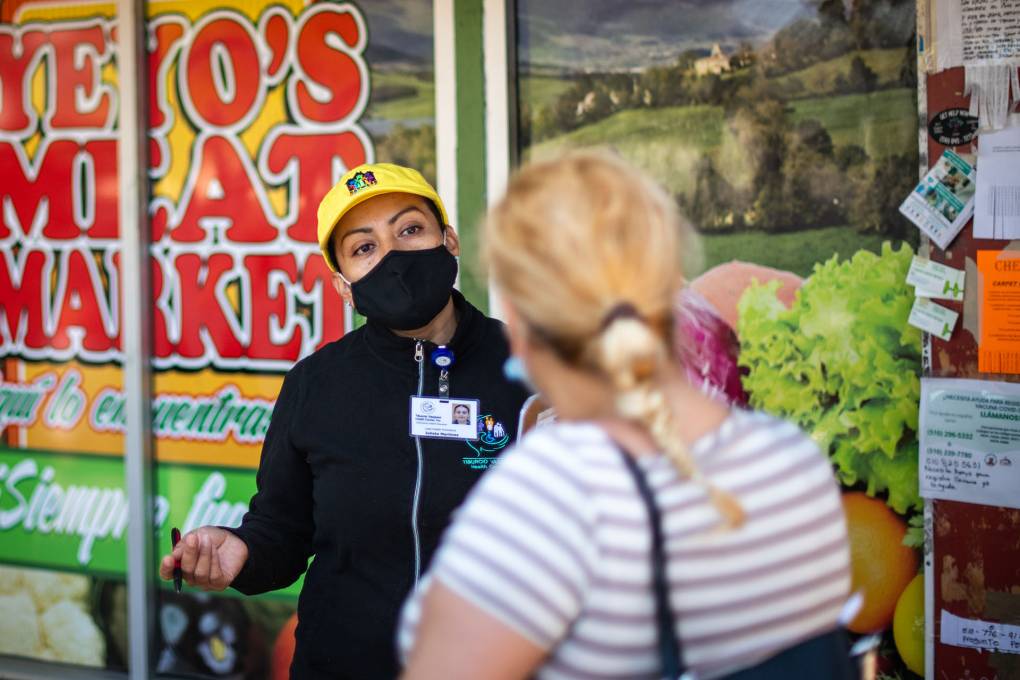
"caption": "Community health worker, or promotora, Julieta Martinez speaks with a customer at Yeyo’s Meat Market about the COVID-19 vaccine during an outreach event in Hayward on May 10, 2021.",
"description": null,
"title": "RS48975_030_Hayward_Promotoras_05102021-qut",
"credit": "Beth LaBerge/KQED",
"status": "inherit",
"altTag": null,
"isLoading": false,
"fetchFailed": false
},
"news_11874800": {
"type": "attachments",
"id": "news_11874800",
"meta": {
"index": "attachments_1716263798",
"site": "news",
"id": "11874800",
"found": true
},
"parent": 11874691,
"imgSizes": {
"twentyfourteen-full-width": {
"file": "https://ww2.kqed.org/app/uploads/sites/10/2021/05/RS48973_028_Hayward_Promotoras_05102021-1038x576.jpg",
"width": 1038,
"mimeType": "image/jpeg",
"height": 576
},
"thumbnail": {
"file": "https://ww2.kqed.org/app/uploads/sites/10/2021/05/RS48973_028_Hayward_Promotoras_05102021-160x107.jpg",
"width": 160,
"mimeType": "image/jpeg",
"height": 107
},
"post-thumbnail": {
"file": "https://ww2.kqed.org/app/uploads/sites/10/2021/05/RS48973_028_Hayward_Promotoras_05102021-672x372.jpg",
"width": 672,
"mimeType": "image/jpeg",
"height": 372
},
"kqedFullSize": {
"file": "https://ww2.kqed.org/app/uploads/sites/10/2021/05/RS48973_028_Hayward_Promotoras_05102021.jpg",
"width": 1920,
"height": 1280
},
"large": {
"file": "https://ww2.kqed.org/app/uploads/sites/10/2021/05/RS48973_028_Hayward_Promotoras_05102021-1020x680.jpg",
"width": 1020,
"mimeType": "image/jpeg",
"height": 680
},
"1536x1536": {
"file": "https://ww2.kqed.org/app/uploads/sites/10/2021/05/RS48973_028_Hayward_Promotoras_05102021-1536x1024.jpg",
"width": 1536,
"mimeType": "image/jpeg",
"height": 1024
},
"medium": {
"file": "https://ww2.kqed.org/app/uploads/sites/10/2021/05/RS48973_028_Hayward_Promotoras_05102021-800x533.jpg",
"width": 800,
"mimeType": "image/jpeg",
"height": 533
}
},
"publishDate": 1621631894,
"modified": 1621632180,
"caption": "Community health worker, or promotora, Julieta Martinez speaks with a customer at Yeyo’s Meat Market about the COVID-19 vaccine during an outreach event in South Hayward on May 10, 2021.",
"description": "Community health worker, or promotora, Julieta Martinez speaks with a customer at Yeyo’s Meat Market about the COVID-19 vaccine during an outreach event in South Hayward on May 10, 2021.",
"title": "RS48973_028_Hayward_Promotoras_05102021",
"credit": "Beth LaBerge/KQED",
"status": "inherit",
"altTag": null,
"isLoading": false,
"fetchFailed": false
},
"news_11874701": {
"type": "attachments",
"id": "news_11874701",
"meta": {
"index": "attachments_1716263798",
"site": "news",
"id": "11874701",
"found": true
},
"parent": 11874680,
"imgSizes": {
"twentyfourteen-full-width": {
"file": "https://ww2.kqed.org/app/uploads/sites/10/2021/05/iStock_suspensefile_01-1038x576.jpeg",
"width": 1038,
"mimeType": "image/jpeg",
"height": 576
},
"thumbnail": {
"file": "https://ww2.kqed.org/app/uploads/sites/10/2021/05/iStock_suspensefile_01-160x109.jpeg",
"width": 160,
"mimeType": "image/jpeg",
"height": 109
},
"post-thumbnail": {
"file": "https://ww2.kqed.org/app/uploads/sites/10/2021/05/iStock_suspensefile_01-672x372.jpeg",
"width": 672,
"mimeType": "image/jpeg",
"height": 372
},
"kqedFullSize": {
"file": "https://ww2.kqed.org/app/uploads/sites/10/2021/05/iStock_suspensefile_01.jpeg",
"width": 2000,
"height": 1368
},
"large": {
"file": "https://ww2.kqed.org/app/uploads/sites/10/2021/05/iStock_suspensefile_01-1020x698.jpeg",
"width": 1020,
"mimeType": "image/jpeg",
"height": 698
},
"1536x1536": {
"file": "https://ww2.kqed.org/app/uploads/sites/10/2021/05/iStock_suspensefile_01-1536x1051.jpeg",
"width": 1536,
"mimeType": "image/jpeg",
"height": 1051
},
"full-width": {
"file": "https://ww2.kqed.org/app/uploads/sites/10/2021/05/iStock_suspensefile_01-1920x1313.jpeg",
"width": 1920,
"mimeType": "image/jpeg",
"height": 1313
},
"medium": {
"file": "https://ww2.kqed.org/app/uploads/sites/10/2021/05/iStock_suspensefile_01-800x547.jpeg",
"width": 800,
"mimeType": "image/jpeg",
"height": 547
}
},
"publishDate": 1621621912,
"modified": 1621621943,
"caption": null,
"description": null,
"title": "lost",
"credit": "Anne Wernikoff/CalMatters",
"status": "inherit",
"altTag": null,
"isLoading": false,
"fetchFailed": false
},
"news_11873983": {
"type": "attachments",
"id": "news_11873983",
"meta": {
"index": "attachments_1716263798",
"site": "news",
"id": "11873983",
"found": true
},
"parent": 11873943,
"imgSizes": {
"twentyfourteen-full-width": {
"file": "https://ww2.kqed.org/app/uploads/sites/10/2021/05/RS46266_015_KQED_SanFrancisco_COVIDShutdown_12042020-qut-1038x576.jpg",
"width": 1038,
"mimeType": "image/jpeg",
"height": 576
},
"thumbnail": {
"file": "https://ww2.kqed.org/app/uploads/sites/10/2021/05/RS46266_015_KQED_SanFrancisco_COVIDShutdown_12042020-qut-160x107.jpg",
"width": 160,
"mimeType": "image/jpeg",
"height": 107
},
"post-thumbnail": {
"file": "https://ww2.kqed.org/app/uploads/sites/10/2021/05/RS46266_015_KQED_SanFrancisco_COVIDShutdown_12042020-qut-672x372.jpg",
"width": 672,
"mimeType": "image/jpeg",
"height": 372
},
"kqedFullSize": {
"file": "https://ww2.kqed.org/app/uploads/sites/10/2021/05/RS46266_015_KQED_SanFrancisco_COVIDShutdown_12042020-qut.jpg",
"width": 1920,
"height": 1280
},
"large": {
"file": "https://ww2.kqed.org/app/uploads/sites/10/2021/05/RS46266_015_KQED_SanFrancisco_COVIDShutdown_12042020-qut-1020x680.jpg",
"width": 1020,
"mimeType": "image/jpeg",
"height": 680
},
"1536x1536": {
"file": "https://ww2.kqed.org/app/uploads/sites/10/2021/05/RS46266_015_KQED_SanFrancisco_COVIDShutdown_12042020-qut-1536x1024.jpg",
"width": 1536,
"mimeType": "image/jpeg",
"height": 1024
},
"medium": {
"file": "https://ww2.kqed.org/app/uploads/sites/10/2021/05/RS46266_015_KQED_SanFrancisco_COVIDShutdown_12042020-qut-800x533.jpg",
"width": 800,
"mimeType": "image/jpeg",
"height": 533
}
},
"publishDate": 1621283368,
"modified": 1621285677,
"caption": "A person wearing a mask crosses a street in Union Square in San Francisco on Dec. 4, 2020.",
"description": "A person wearing a mask crosses a street in Union Square in San Francisco on Dec. 4, 2020.",
"title": "RS46266_015_KQED_SanFrancisco_COVIDShutdown_12042020-qut",
"credit": "Beth LaBerge/KQED",
"status": "inherit",
"altTag": "Masked pedestrian crosses SF street",
"isLoading": false,
"fetchFailed": false
},
"news_11873624": {
"type": "attachments",
"id": "news_11873624",
"meta": {
"index": "attachments_1716263798",
"site": "news",
"id": "11873624",
"found": true
},
"parent": 11873584,
"imgSizes": {
"twentyfourteen-full-width": {
"file": "https://ww2.kqed.org/app/uploads/sites/10/2021/05/Dr-Paulson3-1-1038x576.jpg",
"width": 1038,
"mimeType": "image/jpeg",
"height": 576
},
"thumbnail": {
"file": "https://ww2.kqed.org/app/uploads/sites/10/2021/05/Dr-Paulson3-1-160x107.jpg",
"width": 160,
"mimeType": "image/jpeg",
"height": 107
},
"post-thumbnail": {
"file": "https://ww2.kqed.org/app/uploads/sites/10/2021/05/Dr-Paulson3-1-672x372.jpg",
"width": 672,
"mimeType": "image/jpeg",
"height": 372
},
"kqedFullSize": {
"file": "https://ww2.kqed.org/app/uploads/sites/10/2021/05/Dr-Paulson3-1.jpg",
"width": 1920,
"height": 1279
},
"large": {
"file": "https://ww2.kqed.org/app/uploads/sites/10/2021/05/Dr-Paulson3-1-1020x679.jpg",
"width": 1020,
"mimeType": "image/jpeg",
"height": 679
},
"1536x1536": {
"file": "https://ww2.kqed.org/app/uploads/sites/10/2021/05/Dr-Paulson3-1-1536x1023.jpg",
"width": 1536,
"mimeType": "image/jpeg",
"height": 1023
},
"medium": {
"file": "https://ww2.kqed.org/app/uploads/sites/10/2021/05/Dr-Paulson3-1-800x533.jpg",
"width": 800,
"mimeType": "image/jpeg",
"height": 533
}
},
"publishDate": 1620947351,
"modified": 1621018002,
"caption": "The Mayo Clinic's Dr. Margaret Paulson speaks to a patient holding a tablet computer as part of an in-home patient program that's gaining popularity during the pandemic.",
"description": "The Mayo Clinic's Dr. Margaret Paulson speaks to a patient holding a tablet computer as part of an in-home patient program that's gaining popularity during the pandemic.",
"title": "Dr Paulson3",
"credit": "Courtesy The Mayo Clinic",
"status": "inherit",
"altTag": null,
"isLoading": false,
"fetchFailed": false
},
"news_11872228": {
"type": "attachments",
"id": "news_11872228",
"meta": {
"index": "attachments_1716263798",
"site": "news",
"id": "11872228",
"found": true
},
"parent": 11872011,
"imgSizes": {
"twentyfourteen-full-width": {
"file": "https://ww2.kqed.org/app/uploads/sites/10/2021/05/Image-from-iOS-1038x576.jpg",
"width": 1038,
"mimeType": "image/jpeg",
"height": 576
},
"thumbnail": {
"file": "https://ww2.kqed.org/app/uploads/sites/10/2021/05/Image-from-iOS-160x120.jpg",
"width": 160,
"mimeType": "image/jpeg",
"height": 120
},
"post-thumbnail": {
"file": "https://ww2.kqed.org/app/uploads/sites/10/2021/05/Image-from-iOS-672x372.jpg",
"width": 672,
"mimeType": "image/jpeg",
"height": 372
},
"kqedFullSize": {
"file": "https://ww2.kqed.org/app/uploads/sites/10/2021/05/Image-from-iOS-scaled.jpg",
"width": 2560,
"height": 1920
},
"2048x2048": {
"file": "https://ww2.kqed.org/app/uploads/sites/10/2021/05/Image-from-iOS-2048x1536.jpg",
"width": 2048,
"mimeType": "image/jpeg",
"height": 1536
},
"large": {
"file": "https://ww2.kqed.org/app/uploads/sites/10/2021/05/Image-from-iOS-1020x765.jpg",
"width": 1020,
"mimeType": "image/jpeg",
"height": 765
},
"1536x1536": {
"file": "https://ww2.kqed.org/app/uploads/sites/10/2021/05/Image-from-iOS-1536x1152.jpg",
"width": 1536,
"mimeType": "image/jpeg",
"height": 1152
},
"full-width": {
"file": "https://ww2.kqed.org/app/uploads/sites/10/2021/05/Image-from-iOS-1920x1440.jpg",
"width": 1920,
"mimeType": "image/jpeg",
"height": 1440
},
"medium": {
"file": "https://ww2.kqed.org/app/uploads/sites/10/2021/05/Image-from-iOS-800x600.jpg",
"width": 800,
"mimeType": "image/jpeg",
"height": 600
}
},
"publishDate": 1620170434,
"modified": 1620767681,
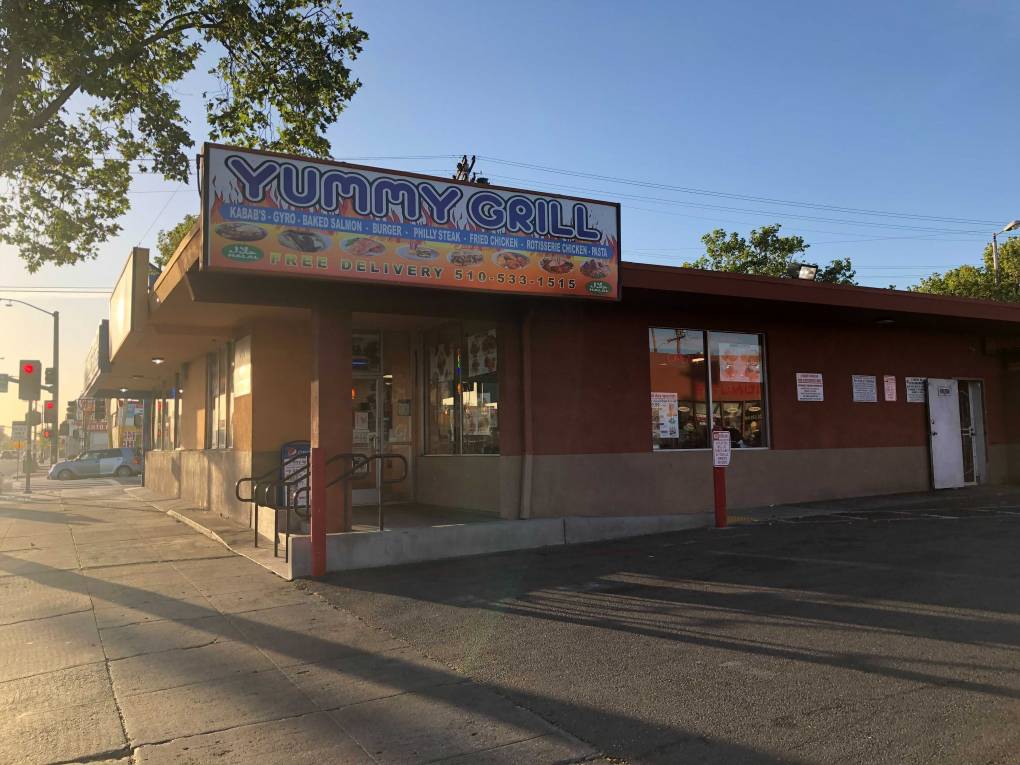
"caption": "Yummy Grill, an Afghan kebab restaurant on International Boulevard, has struggled through the pandemic. After three failed attempts applying for a PPP loan through Chase Bank, it just recently received one through a Utah-based small-business specialist.",
"description": "Yummy Grill, an Afghan kebab restaurant on International Boulevard, has struggled through the pandemic. Only five percent of businesses in this neighborhood who applied for a PPP loan, received one. Yummy Grill only recently received PPP funding through Lendio, a Utah-based small business specialist.",
"title": "Yummy Grill, an Afghan kebab restaurant on International Boulevard, has struggled through the pandemic. Only five percent of businesses in this neighborhood who applied for a PPP loan, received one. Yummy Grill only recently received PPP funding through Lendio, a Utah-based small business specialist.",
"credit": "Adhiti Bandlamudi/KQED",
"status": "inherit",
"altTag": "Yummy Grill, an Afghan kebab restaurant on International Boulevard, has struggled through the pandemic. Only five percent of businesses in this neighborhood who applied for a PPP loan, received one. Yummy Grill only recently received PPP funding through Lendio, a Utah-based small business specialist.",
"isLoading": false,
"fetchFailed": false
},
"news_11872950": {
"type": "attachments",
"id": "news_11872950",
"meta": {
"index": "attachments_1716263798",
"site": "news",
"id": "11872950",
"found": true
},
"parent": 11872949,
"imgSizes": {
"twentyfourteen-full-width": {
"file": "https://ww2.kqed.org/app/uploads/sites/10/2021/05/ap21130440388099-7d5daa186cef6348ec9dc9fa269799e04eaa5340-1038x576.jpg",
"width": 1038,
"mimeType": "image/jpeg",
"height": 576
},
"thumbnail": {
"file": "https://ww2.kqed.org/app/uploads/sites/10/2021/05/ap21130440388099-7d5daa186cef6348ec9dc9fa269799e04eaa5340-160x120.jpg",
"width": 160,
"mimeType": "image/jpeg",
"height": 120
},
"post-thumbnail": {
"file": "https://ww2.kqed.org/app/uploads/sites/10/2021/05/ap21130440388099-7d5daa186cef6348ec9dc9fa269799e04eaa5340-672x372.jpg",
"width": 672,
"mimeType": "image/jpeg",
"height": 372
},
"kqedFullSize": {
"file": "https://ww2.kqed.org/app/uploads/sites/10/2021/05/ap21130440388099-7d5daa186cef6348ec9dc9fa269799e04eaa5340-scaled-e1620669786577.jpg",
"width": 1920,
"height": 1440
},
"2048x2048": {
"file": "https://ww2.kqed.org/app/uploads/sites/10/2021/05/ap21130440388099-7d5daa186cef6348ec9dc9fa269799e04eaa5340-2048x1536.jpg",
"width": 2048,
"mimeType": "image/jpeg",
"height": 1536
},
"large": {
"file": "https://ww2.kqed.org/app/uploads/sites/10/2021/05/ap21130440388099-7d5daa186cef6348ec9dc9fa269799e04eaa5340-1020x765.jpg",
"width": 1020,
"mimeType": "image/jpeg",
"height": 765
},
"1536x1536": {
"file": "https://ww2.kqed.org/app/uploads/sites/10/2021/05/ap21130440388099-7d5daa186cef6348ec9dc9fa269799e04eaa5340-1536x1152.jpg",
"width": 1536,
"mimeType": "image/jpeg",
"height": 1152
},
"full-width": {
"file": "https://ww2.kqed.org/app/uploads/sites/10/2021/05/ap21130440388099-7d5daa186cef6348ec9dc9fa269799e04eaa5340-1920x1440.jpg",
"width": 1920,
"mimeType": "image/jpeg",
"height": 1440
},
"medium": {
"file": "https://ww2.kqed.org/app/uploads/sites/10/2021/05/ap21130440388099-7d5daa186cef6348ec9dc9fa269799e04eaa5340-800x600.jpg",
"width": 800,
"mimeType": "image/jpeg",
"height": 600
}
},
"publishDate": 1620669544,
"modified": 1620674212,
"caption": "The Biden administration says the government will protect gay and transgender people against sex discrimination in health care. In this 2017 photo, Equality March for Unity and Pride participants march past the White House in Washington, D.C.",
"description": "The Biden administration says the government will protect gay and transgender people against sex discrimination in health care. In this 2017 photo, Equality March for Unity and Pride participants march past the White House in Washington.",
"title": "The Biden administration says the government will protect gay and transgender people against sex discrimination in health care. In this 2017 photo, Equality March for Unity and Pride participants march past the White House in Washington.",
"credit": "Carolyn Kaster/AP",
"status": "inherit",
"altTag": null,
"isLoading": false,
"fetchFailed": false
},
"news_11872527": {
"type": "attachments",
"id": "news_11872527",
"meta": {
"index": "attachments_1716263798",
"site": "news",
"id": "11872527",
"found": true
},
"parent": 11872511,
"imgSizes": {
"twentyfourteen-full-width": {
"file": "https://ww2.kqed.org/app/uploads/sites/10/2021/05/DSF9317-1038x576.jpg",
"width": 1038,
"mimeType": "image/jpeg",
"height": 576
},
"thumbnail": {
"file": "https://ww2.kqed.org/app/uploads/sites/10/2021/05/DSF9317-160x120.jpg",
"width": 160,
"mimeType": "image/jpeg",
"height": 120
},
"post-thumbnail": {
"file": "https://ww2.kqed.org/app/uploads/sites/10/2021/05/DSF9317-672x372.jpg",
"width": 672,
"mimeType": "image/jpeg",
"height": 372
},
"kqedFullSize": {
"file": "https://ww2.kqed.org/app/uploads/sites/10/2021/05/DSF9317-scaled-e1620324701699.jpg",
"width": 1920,
"height": 1440
},
"2048x2048": {
"file": "https://ww2.kqed.org/app/uploads/sites/10/2021/05/DSF9317-2048x1536.jpg",
"width": 2048,
"mimeType": "image/jpeg",
"height": 1536
},
"large": {
"file": "https://ww2.kqed.org/app/uploads/sites/10/2021/05/DSF9317-1020x765.jpg",
"width": 1020,
"mimeType": "image/jpeg",
"height": 765
},
"1536x1536": {
"file": "https://ww2.kqed.org/app/uploads/sites/10/2021/05/DSF9317-1536x1152.jpg",
"width": 1536,
"mimeType": "image/jpeg",
"height": 1152
},
"full-width": {
"file": "https://ww2.kqed.org/app/uploads/sites/10/2021/05/DSF9317-1920x1440.jpg",
"width": 1920,
"mimeType": "image/jpeg",
"height": 1440
},
"medium": {
"file": "https://ww2.kqed.org/app/uploads/sites/10/2021/05/DSF9317-800x600.jpg",
"width": 800,
"mimeType": "image/jpeg",
"height": 600
}
},
"publishDate": 1620324670,
"modified": 1620338416,
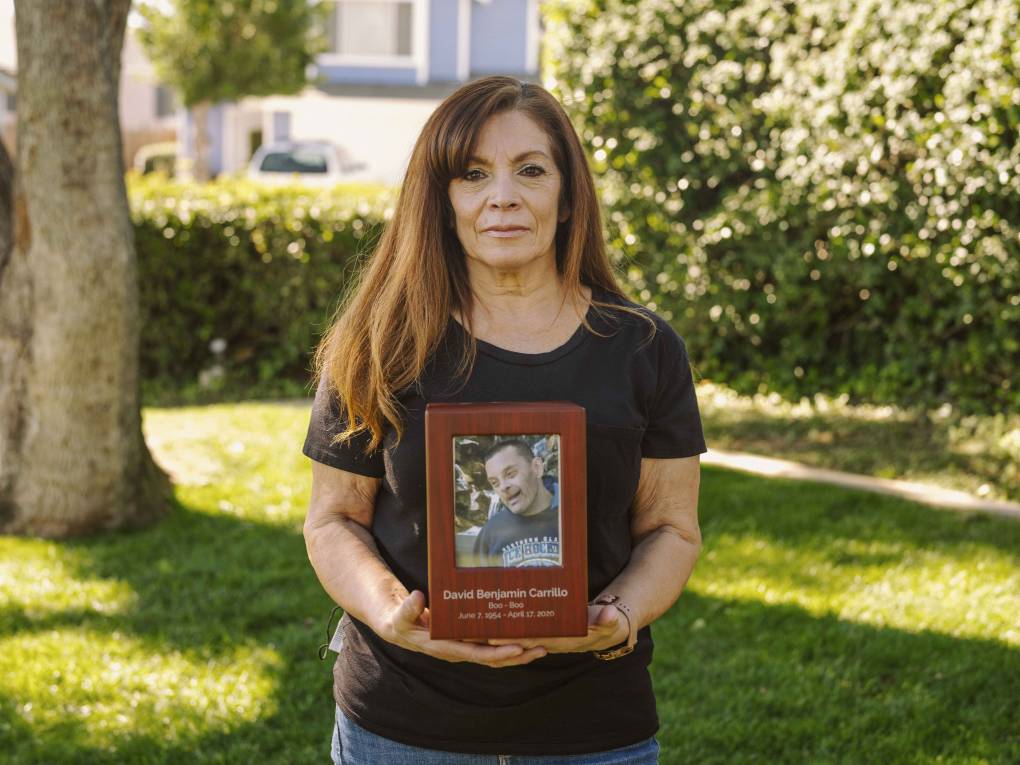
"caption": "After the shutdown last March, Cynthia Carrillo couldn't visit her brother David inside Villa Mesa Care Center, a nursing home in Upland, CA. He died in April 2020 from COVID-19.",
"description": null,
"title": "_DSF9317",
"credit": "Chava Sanchez/LAist",
"status": "inherit",
"altTag": null,
"isLoading": false,
"fetchFailed": false
}
},
"audioPlayerReducer": {
"postId": "stream_live",
"isPaused": true,
"isPlaying": false,
"pfsActive": false,
"pledgeModalIsOpen": true,
"playerDrawerIsOpen": false,
"liveAudioPlayStartedAt": 0,
"liveAudioPlayContext": ""
},
"authorsReducer": {
"byline_news_11876711": {
"type": "authors",
"id": "byline_news_11876711",
"meta": {
"override": true
},
"slug": "byline_news_11876711",
"name": "\u003ca href=\"https://californiahealthline.org/news/author/anna-almendrala/\">Anna Almendrala\u003c/a>",
"isLoading": false
},
"byline_news_11874680": {
"type": "authors",
"id": "byline_news_11874680",
"meta": {
"override": true
},
"slug": "byline_news_11874680",
"name": "\u003ca href=\"https://calmatters.org/author/laurel-rosenhall/\">Laurel Rosenhall\u003c/a>",
"isLoading": false
},
"byline_news_11873584": {
"type": "authors",
"id": "byline_news_11873584",
"meta": {
"override": true
},
"slug": "byline_news_11873584",
"name": "\u003ca href=\"https://twitter.com/ReporterSteph\">Stephanie O’Neill\u003c/a>",
"isLoading": false
},
"byline_news_11872949": {
"type": "authors",
"id": "byline_news_11872949",
"meta": {
"override": true
},
"slug": "byline_news_11872949",
"name": "\u003ca href=\"https://www.npr.org/people/349308023/selena-simmons-duffin\">Selena Simmons-Duffin\u003c/a> and \u003ca href=\"https://www.npr.org/people/348743421/becky-sullivan\">Becky Sullivan\u003c/a>",
"isLoading": false
},
"kqed": {
"type": "authors",
"id": "236",
"meta": {
"index": "authors_1716337520",
"id": "236",
"found": true
},
"name": "KQED News Staff",
"firstName": "KQED News Staff",
"lastName": null,
"slug": "kqed",
"email": "faq@kqed.org",
"display_author_email": false,
"staff_mastheads": [],
"title": null,
"bio": null,
"avatar": "https://secure.gravatar.com/avatar/ef0e801a68c4c54afa9180db14084167?s=600&d=blank&r=g",
"twitter": null,
"facebook": null,
"instagram": null,
"linkedin": null,
"sites": [
{
"site": "arts",
"roles": [
"contributor"
]
},
{
"site": "news",
"roles": [
"editor"
]
},
{
"site": "futureofyou",
"roles": [
"author"
]
}
],
"headData": {
"title": "KQED News Staff | KQED",
"description": null,
"ogImgSrc": "https://secure.gravatar.com/avatar/ef0e801a68c4c54afa9180db14084167?s=600&d=blank&r=g",
"twImgSrc": "https://secure.gravatar.com/avatar/ef0e801a68c4c54afa9180db14084167?s=600&d=blank&r=g"
},
"isLoading": false,
"link": "/author/kqed"
},
"tgoldberg": {
"type": "authors",
"id": "258",
"meta": {
"index": "authors_1716337520",
"id": "258",
"found": true
},
"name": "Ted Goldberg",
"firstName": "Ted",
"lastName": "Goldberg",
"slug": "tgoldberg",
"email": "tgoldberg@kqed.org",
"display_author_email": true,
"staff_mastheads": [
"news"
],
"title": "KQED Managing Editor, News and Newscasts",
"bio": "Ted Goldberg is Managing Editor of News and Newscasts at KQED. His main reporting beat is the Bay Area's oil refining industry.\r\n\r\nPrior to joining KQED in 2014, Ted worked at CBS News and WCBS AM in New York and Bay City News and KCBS Radio in San Francisco. He graduated from Oberlin College in Ohio in 1998.",
"avatar": "https://secure.gravatar.com/avatar/30ce2e4fe89135e104f89be2394d16225b9d36c121b5b3cb7651ce642978b96f?s=600&d=blank&r=g",
"twitter": "TedrickG",
"bluesky": null,
"facebook": null,
"instagram": null,
"linkedin": null,
"sites": [
{
"site": "news",
"roles": [
"editor"
]
},
{
"site": "science",
"roles": [
"editor"
]
}
],
"headData": {
"title": "Ted Goldberg | KQED",
"description": "KQED Managing Editor, News and Newscasts",
"ogImgSrc": "https://secure.gravatar.com/avatar/30ce2e4fe89135e104f89be2394d16225b9d36c121b5b3cb7651ce642978b96f?s=600&d=blank&r=g",
"twImgSrc": "https://secure.gravatar.com/avatar/30ce2e4fe89135e104f89be2394d16225b9d36c121b5b3cb7651ce642978b96f?s=600&d=blank&r=g"
},
"isLoading": false,
"link": "/author/tgoldberg"
},
"matthewgreen": {
"type": "authors",
"id": "1263",
"meta": {
"index": "authors_1716337520",
"id": "1263",
"found": true
},
"name": "Matthew Green",
"firstName": "Matthew",
"lastName": "Green",
"slug": "matthewgreen",
"email": "mgreen@kqed.org",
"display_author_email": false,
"staff_mastheads": [],
"title": "KQED Editor/Reporter",
"bio": "Matthew Green is a digital media producer for KQED News. He previously produced \u003ca href=\"http://www.kqed.org/lowdown\">The Lowdown\u003c/a>, KQED’s multimedia news education blog. Matthew's written for numerous Bay Area publications, including the Oakland Tribune and San Francisco Chronicle. He also taught journalism classes at Fremont High School in East Oakland.\r\n\r\nEmail: mgreen@kqed.org; Twitter: @MGreenKQED",
"avatar": "https://secure.gravatar.com/avatar/3bf498d1267ca02c8494f33d8cfc575e?s=600&d=blank&r=g",
"twitter": "MGreenKQED",
"facebook": null,
"instagram": null,
"linkedin": null,
"sites": [
{
"site": "news",
"roles": []
},
{
"site": "lowdown",
"roles": []
},
{
"site": "science",
"roles": []
},
{
"site": "education",
"roles": []
},
{
"site": "quest",
"roles": []
},
{
"site": "liveblog",
"roles": []
}
],
"headData": {
"title": "Matthew Green | KQED",
"description": "KQED Editor/Reporter",
"ogImgSrc": "https://secure.gravatar.com/avatar/3bf498d1267ca02c8494f33d8cfc575e?s=600&d=blank&r=g",
"twImgSrc": "https://secure.gravatar.com/avatar/3bf498d1267ca02c8494f33d8cfc575e?s=600&d=blank&r=g"
},
"isLoading": false,
"link": "/author/matthewgreen"
},
"adembosky": {
"type": "authors",
"id": "3205",
"meta": {
"index": "authors_1716337520",
"id": "3205",
"found": true
},
"name": "April Dembosky",
"firstName": "April",
"lastName": "Dembosky",
"slug": "adembosky",
"email": "adembosky@kqed.org",
"display_author_email": false,
"staff_mastheads": [
"news",
"science"
],
"title": "KQED Health Correspondent",
"bio": "April Dembosky is the health correspondent for KQED News and a regular contributor to NPR. She specializes in covering altered states of mind, from postpartum depression to methamphetamine-induced psychosis to the insanity defense. Her investigative series on insurance companies sidestepping mental health laws won multiple awards, including first place in beat reporting from the national Association of Health Care Journalists. She is the recipient of numerous other prizes and fellowships, including a national Edward R. Murrow award for investigative reporting, a Society of Professional Journalists award for long-form storytelling, and a Carter Center Fellowship for Mental Health Journalism.\r\n\r\nDembosky reported and produced \u003cem>Soundtrack of Silence\u003c/em>, an audio documentary about music and memory that is currently being made into a feature film by Paramount Pictures.\r\n\r\nBefore joining KQED in 2013, Dembosky covered technology and Silicon Valley for \u003cem>The Financial Times of London,\u003c/em> and contributed business and arts stories to \u003cem>Marketplace \u003c/em>and \u003cem>The New York Times.\u003c/em> She got her undergraduate degree in philosophy from Smith College and her master's in journalism from the University of California, Berkeley. She is a classically trained violinist and proud alum of the first symphony orchestra at Burning Man.",
"avatar": "https://secure.gravatar.com/avatar/ef92999be4ceb9ea60701e7dc276f813?s=600&d=blank&r=g",
"twitter": "adembosky",
"facebook": null,
"instagram": null,
"linkedin": null,
"sites": [
{
"site": "arts",
"roles": [
"author"
]
},
{
"site": "news",
"roles": [
"editor"
]
},
{
"site": "futureofyou",
"roles": [
"author"
]
},
{
"site": "stateofhealth",
"roles": [
"editor"
]
},
{
"site": "science",
"roles": [
"editor"
]
},
{
"site": "forum",
"roles": [
"editor"
]
}
],
"headData": {
"title": "April Dembosky | KQED",
"description": "KQED Health Correspondent",
"ogImgSrc": "https://secure.gravatar.com/avatar/ef92999be4ceb9ea60701e7dc276f813?s=600&d=blank&r=g",
"twImgSrc": "https://secure.gravatar.com/avatar/ef92999be4ceb9ea60701e7dc276f813?s=600&d=blank&r=g"
},
"isLoading": false,
"link": "/author/adembosky"
},
"dkatayama": {
"type": "authors",
"id": "7240",
"meta": {
"index": "authors_1716337520",
"id": "7240",
"found": true
},
"name": "Devin Katayama",
"firstName": "Devin",
"lastName": "Katayama",
"slug": "dkatayama",
"email": "dkatayama@kqed.org",
"display_author_email": true,
"staff_mastheads": [
"news"
],
"title": "Editor of Talent and Development",
"bio": "Devin Katayama is former Editor of Talent and Development for KQED. He supported our internship program and on-call staff by looking for equitable opportunities to improve the newsroom.\r\n\r\nHe previously hosted The Bay and American Suburb podcasts from KQED News. Prior to returning to the Bay Area in 2015, Devin was the education reporter for WFPL in Louisville and worked as a producer with radio stations in Chicago and Portland, OR. His work has appeared on NPR’s \u003cem>Morning Edition, All Things Considered, The Takeaway\u003c/em> and \u003cem>Here and Now.\u003c/em>\r\n\r\nDevin earned his MA in Journalism from Columbia College Chicago, where he was a Follett Fellow and the recipient of the 2011 Studs Terkel Community Media Workshop Scholarship for his story on Chicago's homeless youth. He won WBUR's 2014 Daniel Schorr award and a regional RTNDA Edward R. Murrow Award for his documentary \"At Risk\" that looked at issues facing some of Louisville's students. Devin has also received numerous local awards from the Associated Press and the Society of Professional Journalists.",
"avatar": "https://secure.gravatar.com/avatar/d0d2978a31002fb2de107921a8e18405?s=600&d=blank&r=g",
"twitter": "RadioDevin",
"facebook": null,
"instagram": null,
"linkedin": null,
"sites": [
{
"site": "arts",
"roles": []
},
{
"site": "news",
"roles": [
"author"
]
},
{
"site": "stateofhealth",
"roles": [
"author"
]
},
{
"site": "forum",
"roles": [
"editor"
]
},
{
"site": "perspectives",
"roles": [
"editor"
]
}
],
"headData": {
"title": "Devin Katayama | KQED",
"description": "Editor of Talent and Development",
"ogImgSrc": "https://secure.gravatar.com/avatar/d0d2978a31002fb2de107921a8e18405?s=600&d=blank&r=g",
"twImgSrc": "https://secure.gravatar.com/avatar/d0d2978a31002fb2de107921a8e18405?s=600&d=blank&r=g"
},
"isLoading": false,
"link": "/author/dkatayama"
},
"ecruzguevarra": {
"type": "authors",
"id": "8654",
"meta": {
"index": "authors_1716337520",
"id": "8654",
"found": true
},
"name": "Ericka Cruz Guevarra",
"firstName": "Ericka",
"lastName": "Cruz Guevarra",
"slug": "ecruzguevarra",
"email": "ecruzguevarra@kqed.org",
"display_author_email": true,
"staff_mastheads": [
"news"
],
"title": "Producer, The Bay Podcast",
"bio": "Ericka Cruz Guevarra is host of \u003ca href=\"https://www.kqed.org/podcasts/thebay\">\u003cem>The Bay\u003c/em>\u003c/a> podcast at KQED. Before host, she was the show’s producer. Her work in that capacity includes a three-part reported series on policing in Vallejo, which won a 2020 excellence in journalism award from the Society of Professional Journalists. Ericka has worked as a breaking news reporter at Oregon Public Broadcasting, helped produce the Code Switch podcast, and was KQED’s inaugural Raul Ramirez Diversity Fund intern. She’s also an alumna of NPR’s Next Generation Radio program. Send her an email if you have strong feelings about whether Fairfield and Suisun City are the Bay. Ericka is represented by SAG-AFTRA.",
"avatar": "https://secure.gravatar.com/avatar/accefc1de4bafc7e234b69bcb9b6f6536c130fd84709bc3069ef11a78787e1bb?s=600&d=blank&r=g",
"twitter": "NotoriousECG",
"bluesky": null,
"facebook": null,
"instagram": null,
"linkedin": null,
"sites": [
{
"site": "arts",
"roles": [
"subscriber"
]
},
{
"site": "news",
"roles": [
"editor",
"manage_categories"
]
},
{
"site": "futureofyou",
"roles": [
"subscriber"
]
},
{
"site": "stateofhealth",
"roles": [
"subscriber"
]
},
{
"site": "science",
"roles": [
"editor"
]
},
{
"site": "forum",
"roles": [
"subscriber"
]
}
],
"headData": {
"title": "Ericka Cruz Guevarra | KQED",
"description": "Producer, The Bay Podcast",
"ogImgSrc": "https://secure.gravatar.com/avatar/accefc1de4bafc7e234b69bcb9b6f6536c130fd84709bc3069ef11a78787e1bb?s=600&d=blank&r=g",
"twImgSrc": "https://secure.gravatar.com/avatar/accefc1de4bafc7e234b69bcb9b6f6536c130fd84709bc3069ef11a78787e1bb?s=600&d=blank&r=g"
},
"isLoading": false,
"link": "/author/ecruzguevarra"
},
"fjhabvala": {
"type": "authors",
"id": "8659",
"meta": {
"index": "authors_1716337520",
"id": "8659",
"found": true
},
"name": "Farida Jhabvala Romero",
"firstName": "Farida",
"lastName": "Jhabvala Romero",
"slug": "fjhabvala",
"email": "fjhabvala@kqed.org",
"display_author_email": true,
"staff_mastheads": [
"news"
],
"title": "KQED Contributor",
"bio": "Farida Jhabvala Romero is a Labor Correspondent for KQED. She previously covered immigration. Farida was \u003ca href=\"https://www.ccnma.org/2022-most-influential-latina-journalists\">named\u003c/a> one of the 10 Most Influential Latina Journalists in California in 2022 by the California Chicano News Media Association. Her work has won awards from the Society of Professional Journalists (Northern California), as well as a national and regional Edward M. Murrow Award for the collaborative reporting projects “Dangerous Air” and “Graying California.” Before joining KQED, Farida worked as a producer at Radio Bilingüe, a national public radio network. Farida earned her master’s degree in journalism from Stanford University.",
"avatar": "https://secure.gravatar.com/avatar/f9f022d4e2609741874222a1e9d41f48fea74011aa7c615eef91d9a50c944ebe?s=600&d=blank&r=g",
"twitter": "FaridaJhabvala",
"bluesky": null,
"facebook": null,
"instagram": null,
"linkedin": "https://www.linkedin.com/in/faridajhabvala/",
"sites": [
{
"site": "news",
"roles": [
"editor"
]
},
{
"site": "stateofhealth",
"roles": [
"author"
]
},
{
"site": "liveblog",
"roles": [
"author"
]
}
],
"headData": {
"title": "Farida Jhabvala Romero | KQED",
"description": "KQED Contributor",
"ogImgSrc": "https://secure.gravatar.com/avatar/f9f022d4e2609741874222a1e9d41f48fea74011aa7c615eef91d9a50c944ebe?s=600&d=blank&r=g",
"twImgSrc": "https://secure.gravatar.com/avatar/f9f022d4e2609741874222a1e9d41f48fea74011aa7c615eef91d9a50c944ebe?s=600&d=blank&r=g"
},
"isLoading": false,
"link": "/author/fjhabvala"
},
"lsarah": {
"type": "authors",
"id": "11626",
"meta": {
"index": "authors_1716337520",
"id": "11626",
"found": true
},
"name": "Lakshmi Sarah",
"firstName": "Lakshmi",
"lastName": "Sarah",
"slug": "lsarah",
"email": "lsarah@kqed.org",
"display_author_email": false,
"staff_mastheads": [],
"title": "Digital Producer",
"bio": "Lakshmi Sarah is an educator, author and journalist with a focus on innovative storytelling. She has worked with newspapers, radio and magazines from Ahmedabad, India to Los Angeles, California. She has written and produced for Die Zeit, Global Voices, AJ+, KQED, Fusion Media Group and the New York Times.",
"avatar": "https://secure.gravatar.com/avatar/652dcaecd8b28826fc17a8b2d6bb4e93?s=600&d=blank&r=g",
"twitter": "lakitalki",
"facebook": null,
"instagram": "https://www.instagram.com/laki.talki/",
"linkedin": "https://www.linkedin.com/in/lakisarah/",
"sites": [
{
"site": "arts",
"roles": []
},
{
"site": "news",
"roles": []
},
{
"site": "bayareabites",
"roles": []
},
{
"site": "science",
"roles": []
}
],
"headData": {
"title": "Lakshmi Sarah | KQED",
"description": "Digital Producer",
"ogImgSrc": "https://secure.gravatar.com/avatar/652dcaecd8b28826fc17a8b2d6bb4e93?s=600&d=blank&r=g",
"twImgSrc": "https://secure.gravatar.com/avatar/652dcaecd8b28826fc17a8b2d6bb4e93?s=600&d=blank&r=g"
},
"isLoading": false,
"link": "/author/lsarah"
},
"amontecillo": {
"type": "authors",
"id": "11649",
"meta": {
"index": "authors_1716337520",
"id": "11649",
"found": true
},
"name": "Alan Montecillo",
"firstName": "Alan",
"lastName": "Montecillo",
"slug": "amontecillo",
"email": "amontecillo@kqed.org",
"display_author_email": false,
"staff_mastheads": [
"news"
],
"title": "KQED Contributor",
"bio": "Alan Montecillo is the senior editor of \u003cem>\u003ca href=\"http://kqed.org/thebay\">The Bay\u003c/a>, \u003c/em> KQED's local news podcast. Before moving to the Bay Area, he worked as a senior talk show producer for WILL in Champaign-Urbana, Illinois and at Oregon Public Broadcasting in Portland, Oregon. He has won journalism awards from the Society of Professional Journalists Northern California, the Public Media Journalists Association, The Signal Awards, and has also received a regional Edward R. Murrow award. Alan is a Filipino American from Hong Kong and a graduate of Reed College.",
"avatar": "https://secure.gravatar.com/avatar/268f53a2066899ea9efdd8a5900218b17c822d9862cbc9326cccec53ef41d349?s=600&d=blank&r=g",
"twitter": "alanmontecillo",
"bluesky": null,
"facebook": null,
"instagram": null,
"linkedin": null,
"sites": [
{
"site": "",
"roles": [
"editor"
]
},
{
"site": "news",
"roles": [
"editor",
"manage_categories"
]
}
],
"headData": {
"title": "Alan Montecillo | KQED",
"description": "KQED Contributor",
"ogImgSrc": "https://secure.gravatar.com/avatar/268f53a2066899ea9efdd8a5900218b17c822d9862cbc9326cccec53ef41d349?s=600&d=blank&r=g",
"twImgSrc": "https://secure.gravatar.com/avatar/268f53a2066899ea9efdd8a5900218b17c822d9862cbc9326cccec53ef41d349?s=600&d=blank&r=g"
},
"isLoading": false,
"link": "/author/amontecillo"
},
"abandlamudi": {
"type": "authors",
"id": "11672",
"meta": {
"index": "authors_1716337520",
"id": "11672",
"found": true
},
"name": "Adhiti Bandlamudi",
"firstName": "Adhiti",
"lastName": "Bandlamudi",
"slug": "abandlamudi",
"email": "abandlamudi@kqed.org",
"display_author_email": false,
"staff_mastheads": [
"news"
],
"title": "KQED Housing Reporter",
"bio": "Adhiti Bandlamudi reports for KQED's Housing desk. She focuses on how housing gets built across the Bay Area. Before joining KQED in 2020, she reported for WUNC in Durham, North Carolina, WABE in Atlanta, Georgia and Capital Public Radio in Sacramento. In 2017, she was awarded a Kroc Fellowship at NPR where she reported on everything from sprinkles to the Golden State Killer's arrest. When she's not reporting, she's baking new recipes in her kitchen or watching movies with friends and family. She's originally from Georgia and has strong opinions about Great British Bake Off.",
"avatar": "https://secure.gravatar.com/avatar/868129c8b257bb99a3500e2c86a65400?s=600&d=mm&r=g",
"twitter": "oddity_adhiti",
"facebook": null,
"instagram": null,
"linkedin": null,
"sites": [
{
"site": "arts",
"roles": [
"author"
]
},
{
"site": "news",
"roles": [
"editor"
]
},
{
"site": "liveblog",
"roles": [
"author"
]
}
],
"headData": {
"title": "Adhiti Bandlamudi | KQED",
"description": "KQED Housing Reporter",
"ogImgSrc": "https://secure.gravatar.com/avatar/868129c8b257bb99a3500e2c86a65400?s=600&d=mm&r=g",
"twImgSrc": "https://secure.gravatar.com/avatar/868129c8b257bb99a3500e2c86a65400?s=600&d=mm&r=g"
},
"isLoading": false,
"link": "/author/abandlamudi"
}
},
"pagesReducer": {
"news_tag_health": {
"type": "terms",
"id": "news_18543",
"meta": {
"index": "terms_1716263798",
"site": "news",
"id": "18543",
"score": 6.886699
},
"featImg": null,
"name": "Health",
"description": null,
"taxonomy": "tag",
"headData": {
"twImgId": null,
"twTitle": null,
"ogTitle": null,
"ogImgId": null,
"twDescription": null,
"description": null,
"title": "Health Archives | KQED News",
"ogDescription": null
},
"ttid": 466,
"slug": "health",
"isLoading": false,
"title": "Health",
"pageMeta": {
"site": "news",
"WpPageTemplate": "page-topic-editorial",
"currentPage": 65
},
"blocks": [
{
"blockName": "kqed/post-list",
"attrs": {
"layout": "cardArticle2",
"query": "posts/news?tag=health",
"seeMore": false,
"paginated": true,
"page": 65
}
},
{
"blockName": "kqed/ad"
}
]
}
},
"pfsSessionReducer": {},
"postsReducer": {
"stream_live": {
"type": "live",
"id": "stream_live",
"audioUrl": "https://streams.kqed.org/kqedradio",
"title": "Live Stream",
"excerpt": "Live Stream information currently unavailable.",
"link": "/radio",
"featImg": "",
"label": {
"name": "KQED Live",
"link": "/"
}
},
"stream_kqedNewscast": {
"type": "posts",
"id": "stream_kqedNewscast",
"audioUrl": "https://www.kqed.org/.stream/anon/radio/RDnews/newscast.mp3?_=1",
"title": "KQED Newscast",
"featImg": "",
"label": {
"name": "88.5 FM",
"link": "/"
}
},
"news_11876711": {
"type": "posts",
"id": "news_11876711",
"meta": {
"index": "posts_1716263798",
"site": "news",
"id": "11876711",
"score": null,
"sort": [
1622833910000
]
},
"guestAuthors": [],
"slug": "low-income-families-could-get-more-benefits-with-california-budget-surplus",
"title": "Low-Income Families Could Get More Benefits With California Budget Surplus",
"publishDate": 1622833910,
"format": "standard",
"headTitle": "Low-Income Families Could Get More Benefits With California Budget Surplus | KQED",
"labelTerm": {},
"content": "\u003cp>Amid a pandemic that has pushed millions of \u003ca href=\"https://www.census.gov/library/stories/2021/03/moms-work-and-the-pandemic.html\" target=\"_blank\" rel=\"noopener noreferrer\">mothers out of the workplace\u003c/a>, caused \u003ca href=\"https://www.latimes.com/california/story/2021-05-24/obamacare-made-iuds-affordable-one-reason-behind-californias-covid-baby-bust\" target=\"_blank\" rel=\"noopener noreferrer\">fertility rates to plunge\u003c/a> and \u003ca href=\"https://jamanetwork.com/journals/jamapediatrics/fullarticle/2779182\" target=\"_blank\" rel=\"noopener noreferrer\">heightened the risk of death for pregnant women\u003c/a>, Gov. Gavin Newsom and state Democratic lawmakers are seeking a slate of health proposals for low-income families and children.\u003c/p>\n\u003cp>Newsom, a self-described feminist and the father of four young children, has long advocated family-friendly health and economic policies. Flush with a projected \u003ca href=\"https://www.kqed.org/news/11874125/californias-historic-budget-surplus-is-it-76-billion-or-38-billion\" target=\"_blank\" rel=\"noopener noreferrer\">budget surplus of $75.7 billion\u003c/a>, state politicians have come up with myriad legislative and budget proposals to make poorer families healthier and wealthier.\u003c/p>\n\u003cp>[pullquote size=\"medium\" align=\"right\" citation=\"Assemblymember Cristina Garcia (D-Bell Gardens)\"]‘We don’t need to balance the budget on half of the population that has a uterus.’[/pullquote]They include ending sales taxes on \u003ca href=\"https://esd.dof.ca.gov/dofpublic/public/trailerBill/pdf/414\" target=\"_blank\" rel=\"noopener noreferrer\">menstrual products and diapers\u003c/a>; adding benefits such as doulas and early childhood trauma screenings to Medi-Cal, the state’s Medicaid program; allowing pregnant women to retain Medi-Cal coverage for a year after giving birth; and a pilot program to provide a universal basic income to low-income new parents.\u003c/p>\n\u003cp>“COVID-19 laid inequity bare for all to see,” Assemblymember Wendy Carrillo (D-Los Angeles) said in a written statement. She is the co-author of Senate Bill 65, led by Sen. Nancy Skinner (D-Berkeley), which would pour hundreds of millions of dollars into family and health care programs annually, focusing on minority groups that Carrillo said were “pushed out of the social safety net by the prior White House.”\u003c/p>\n\u003cp>Newsom and the Democratic-controlled legislature are unified on major health care and social safety-net expansions, which would direct billions in health benefits and cash assistance to the state’s most vulnerable residents and low-income parents. Legislative Democrats for years have pushed a progressive agenda to help struggling parents and families, featuring proposals like those to permanently end taxes on menstrual products and diapers — \u003ca href=\"https://lao.ca.gov/Publications/Report/4040\" target=\"_blank\" rel=\"noopener noreferrer\">expected to cost the state millions\u003c/a>.\u003c/p>\n\u003cp>[ad fullwidth]\u003c/p>\n\u003cp>“We don’t need to balance the budget on half of the population that has a uterus,” said Assemblymember Cristina Garcia (D-Bell Gardens), who has \u003ca href=\"https://www.politico.com/states/california/story/2019/05/07/newsom-to-unveil-may-budget-thursday-with-focus-on-low-income-families-1009021\" target=\"_blank\" rel=\"noopener noreferrer\">for years sought an end\u003c/a> to the “pink tax” on diapers and menstrual products.\u003c/p>\n\u003cp>Skinner, chair of the Senate budget committee, is among the powerful lawmakers who’ve put forward legislation to make childbirth safer and parenthood more affordable. Her bill, which cleared the Senate and was up for consideration this week in the state Assembly, has several features that would dramatically expand maternal health care (transgender men also get pregnant and give birth).\u003c/p>\n\u003cp>[aside tag='childbirth' label='Maternity in California']Before the pandemic, Medi-Cal covered mothers only up to 60 days after their pregnancies ended unless their income fell below a certain line or they had a mental health diagnosis. Skinner’s bill, part of a \u003ca href=\"https://www.kff.org/womens-health-policy/issue-brief/expanding-postpartum-medicaid-coverage/\" target=\"_blank\" rel=\"noopener noreferrer\">broader national push\u003c/a> to improve birth outcomes, would expand full Medi-Cal coverage to 12 months after the end of a pregnancy. Other \u003ca href=\"https://leginfo.legislature.ca.gov/faces/billTextClient.xhtml?bill_id=202120220SB65\" target=\"_blank\" rel=\"noopener noreferrer\">parts of the bill\u003c/a> would intensify state reporting and reviews of fetal and pregnancy-related deaths and severe maternal morbidity, expand housing benefits for families that have a pregnant member, and increase training programs for midwives.\u003c/p>\n\u003cp>Newsom’s $268 billion budget blueprint includes about $200 million a year to fully implement the expansion of Medi-Cal coverage for new mothers, with matching dollars from the federal government until those funds expire in 2027. If the expansion were not renewed, the state would revert to previous Medi-Cal qualifications.\u003c/p>\n\u003cp>\u003ca href=\"https://www.chcf.org/publication/2019-edition-maternity-care-in-california/\" target=\"_blank\" rel=\"noopener noreferrer\">Medi-Cal covered 45% of all births\u003c/a> in California in 2017, the last year for which data could be found.\u003c/p>\n\u003cp>“Not all postpartum issues end at 60 days, and when patients lose insurance, we can’t address them in the usual way,” said Dr. Yen Truong, an OB-GYN who works with the American College of Obstetricians and Gynecologists on legislative issues in California.\u003c/p>\n\u003cp>About half of pregnancy-related deaths occur during the pregnancy or on the day of delivery, but about 12% take place \u003ca href=\"https://www.cdc.gov/mmwr/volumes/68/wr/mm6818e1.htm\" target=\"_blank\" rel=\"noopener noreferrer\">between seven weeks and a year\u003c/a> after giving birth, according to the Centers for Disease Control and Prevention.\u003c/p>\n\u003cp>The U.S. had 17.4 early maternal deaths per 100,000 live births in 2018, according to the most recent CDC data with state figures. California’s rate, \u003ca href=\"https://www.cdc.gov/nchs/maternal-mortality/MMR-2018-State-Data-508.pdf\" target=\"_blank\" rel=\"noopener noreferrer\">11.7 per 100,000\u003c/a>, was among the lowest in the nation, but the state collects data on maternal deaths in a way that could result in underestimates.\u003c/p>\n\u003cp>California’s overall numbers also obscure stark racial disparities. Statewide, Black infants averaged \u003ca href=\"https://www.cdph.ca.gov/Programs/CHSI/CDPH%20Document%20Library/CHSP_2021_ADA_FINAL.pdf\" target=\"_blank\" rel=\"noopener noreferrer\">7.8 deaths per 1,000 live births\u003c/a>, compared with an average of three deaths among white babies. Data from 2013 from \u003ca href=\"http://publichealth.lacounty.gov/owh/docs/DataReport/2017-HealthIndicatorsforWomeninLACounty.pdf\" target=\"_blank\" rel=\"noopener noreferrer\">Los Angeles County\u003c/a> showed Black women had pregnancy-related deaths at rates more than four times as high as the overall rate in the state’s largest county.\u003c/p>\n\u003cp>“Given our state’s wealth and medical advancements, this is unacceptable,” Skinner, vice chair of the Legislative Women’s Caucus, said in a news release.\u003c/p>\n\u003cp>Democrats also appear unified on another aspect of Skinner’s bill: a pilot program to test a universal basic income program for struggling families. The bill would give $1,000 a month to low-income expectant and new parents with kids under 2 years old in counties that decide to participate. Newsom has also proposed \u003ca href=\"http://www.ebudget.ca.gov/2021-22/pdf/Revised/BudgetSummary/HealthandHumanServices.pdf\" target=\"_blank\" rel=\"noopener noreferrer\">$35 million over five years\u003c/a> for pilot programs for universal basic income.\u003c/p>\n\u003cp>[pullquote size=\"medium\" align=\"right\" citation=\"Rose Kapolczynski, a campaign consultant\"]‘The budget surplus is allowing many things that were called impossible to be possible, and that includes health care bills.’[/pullquote]These issues could play well, especially among women, and improve Newsom’s standing going into a \u003ca href=\"https://www.kqed.org/news/11875264/new-poll-shows-support-idling-for-newsom-recall-effort\" target=\"_blank\" rel=\"noopener noreferrer\">recall election\u003c/a> later this year, said Rose Kapolczynski, a longtime campaign consultant to former U.S. Sen. Barbara Boxer who has worked on reproductive health care issues in Sacramento.\u003c/p>\n\u003cp>Indefinitely rescinding sales taxes on diapers and menstrual products — the taxes have been \u003ca href=\"https://www.kcra.com/article/sales-tax-for-tampons-diapers-eliminated-in-california-for-2-years/30463779\" target=\"_blank\" rel=\"noopener noreferrer\">temporarily lifted since early last year\u003c/a> — is a particular no-brainer because of its bipartisan appeal, she said.\u003c/p>\n\u003cp>“It’s hard for Republicans to attack something that is a tax cut, and sales taxes are regressive, so progressives would like it,” Kapolczynski said.\u003c/p>\n\u003cp>As for Medi-Cal expansions, Kapolczynski said that even though it wouldn’t affect most Californians, the pandemic has made health care even more important to voters. “The budget surplus is allowing many things that were called impossible to be possible, and that includes health care bills,” she said.\u003c/p>\n\u003cp>[aside tag=\"california-budget\" label=\"More California budget coverage\"]Investing in California’s young families could help close the racial gap in maternal and infant mortality, said \u003ca href=\"https://www.bwwla.org/nourbese-flint-ma/\" target=\"_blank\" rel=\"noopener noreferrer\">Nourbese Flint\u003c/a>, executive director of the Black Women for Wellness Action Project, which endorsed Skinner’s bill.\u003c/p>\n\u003cp>Flint is especially excited about the possibility of covering doulas through Medi-Cal. Doulas, trained as emotional and physical supports for women in pregnancy and postpartum, have been linked to \u003ca href=\"https://www.ncbi.nlm.nih.gov/pmc/articles/PMC5538578/\" target=\"_blank\" rel=\"noopener noreferrer\">lower odds of cesarean births\u003c/a> and \u003ca href=\"https://www.ncbi.nlm.nih.gov/pmc/articles/PMC1595013/\" target=\"_blank\" rel=\"noopener noreferrer\">greater satisfaction with the birth experience\u003c/a>. If doulas saved Medi-Cal money by reducing cesarean births, that could enable the state to renegotiate payments for labor and delivery, according to \u003ca href=\"http://analyses.chbrp.com/document/view.php?id=1496\" target=\"_blank\" rel=\"noopener noreferrer\">an analysis by the independent California Health Benefits Review Program\u003c/a>. Under Newsom’s proposed budget, Medi-Cal coverage of doulas would cost about \u003ca href=\"http://www.ebudget.ca.gov/2021-22/pdf/Revised/BudgetSummary/HealthandHumanServices.pdf\" target=\"_blank\" rel=\"noopener noreferrer\">$4.4 million a year\u003c/a>.\u003c/p>\n\u003cp>California’s would become the first Medicaid program to include “full spectrum” doula coverage, meaning it would include care for women who have abortions, miscarriages and stillbirths, said Amy Chen, a senior attorney at the \u003ca href=\"https://healthlaw.org/about/\" target=\"_blank\" rel=\"noopener noreferrer\">National Health Law Program\u003c/a>.\u003c/p>\n\u003cp>“California has always led the country and been a little bit in front of where our federal government is when it comes to covering folks,” Flint said.\u003c/p>\n\u003cp>\u003cem>California Healthline correspondent Angela Hart contributed to this report.\u003c/em>\u003c/p>\n\u003cp>[ad floatright]\u003c/p>\n\u003cp>\u003cem>This story was produced by \u003ca href=\"https://khn.org/about-us/\" target=\"_blank\" rel=\"noopener noreferrer\">KHN\u003c/a> (Kaiser Health News), a national newsroom that produces in-depth journalism about health issues. Together with Policy Analysis and Polling, KHN is one of the three major operating programs at KFF (Kaiser Family Foundation). \u003ca href=\"https://www.kff.org/about-us/\" target=\"_blank\" rel=\"noopener noreferrer\">KFF\u003c/a> is an endowed nonprofit organization providing information on health issues to the nation.\u003c/em>\u003c/p>\n\n",
"blocks": [],
"excerpt": "State lawmakers are seeking a slate of health proposals for low-income families and children, including ending the pink tax and creating a universal basic income pilot program for low-income new parents.",
"status": "publish",
"parent": 0,
"modified": 1726006338,
"stats": {
"hasAudio": false,
"hasVideo": false,
"hasChartOrMap": false,
"iframeSrcs": [],
"hasGoogleForm": false,
"hasGallery": false,
"hasHearkenModule": false,
"hasPolis": false,
"paragraphCount": 28,
"wordCount": 1397
},
"headData": {
"title": "Low-Income Families Could Get More Benefits With California Budget Surplus | KQED",
"description": "State lawmakers are seeking a slate of health proposals for low-income families and children, including ending the pink tax and creating a universal basic income pilot program for low-income new parents.",
"ogTitle": "",
"ogDescription": "",
"ogImgId": "",
"twTitle": "",
"twDescription": "",
"twImgId": "",
"schema": {
"@context": "https://schema.org",
"@type": "NewsArticle",
"headline": "Low-Income Families Could Get More Benefits With California Budget Surplus",
"datePublished": "2021-06-04T12:11:50-07:00",
"dateModified": "2024-09-10T15:12:18-07:00",
"image": "https://cdn.kqed.org/wp-content/uploads/2020/02/KQED-OG-Image@1x.png",
"isAccessibleForFree": "True",
"publisher": {
"@type": "NewsMediaOrganization",
"@id": "https://www.kqed.org/#organization",
"name": "KQED",
"logo": "https://cdn.kqed.org/wp-content/uploads/2020/02/KQED-OG-Image@1x.png",
"url": "https://www.kqed.org",
"sameAs": [
"https://www.facebook.com/KQED",
"https://twitter.com/KQED",
"https://www.instagram.com/kqed/",
"https://www.tiktok.com/@kqedofficial",
"https://www.linkedin.com/company/kqed",
"https://www.youtube.com/channel/UCeC0IOo7i1P_61zVUWbJ4nw"
]
}
}
},
"source": "California Healthline",
"sourceUrl": "https://californiahealthline.org/",
"sticky": false,
"nprByline": "\u003ca href=\"https://californiahealthline.org/news/author/anna-almendrala/\">Anna Almendrala\u003c/a>",
"path": "/news/11876711/low-income-families-could-get-more-benefits-with-california-budget-surplus",
"audioTrackLength": null,
"parsedContent": [
{
"type": "contentString",
"content": "\u003cdiv class=\"post-body\">\u003cp>\u003cp>Amid a pandemic that has pushed millions of \u003ca href=\"https://www.census.gov/library/stories/2021/03/moms-work-and-the-pandemic.html\" target=\"_blank\" rel=\"noopener noreferrer\">mothers out of the workplace\u003c/a>, caused \u003ca href=\"https://www.latimes.com/california/story/2021-05-24/obamacare-made-iuds-affordable-one-reason-behind-californias-covid-baby-bust\" target=\"_blank\" rel=\"noopener noreferrer\">fertility rates to plunge\u003c/a> and \u003ca href=\"https://jamanetwork.com/journals/jamapediatrics/fullarticle/2779182\" target=\"_blank\" rel=\"noopener noreferrer\">heightened the risk of death for pregnant women\u003c/a>, Gov. Gavin Newsom and state Democratic lawmakers are seeking a slate of health proposals for low-income families and children.\u003c/p>\n\u003cp>Newsom, a self-described feminist and the father of four young children, has long advocated family-friendly health and economic policies. Flush with a projected \u003ca href=\"https://www.kqed.org/news/11874125/californias-historic-budget-surplus-is-it-76-billion-or-38-billion\" target=\"_blank\" rel=\"noopener noreferrer\">budget surplus of $75.7 billion\u003c/a>, state politicians have come up with myriad legislative and budget proposals to make poorer families healthier and wealthier.\u003c/p>\n\u003cp>\u003c/p>\u003c/div>",
"attributes": {
"named": {},
"numeric": []
}
},
{
"type": "component",
"content": "‘We don’t need to balance the budget on half of the population that has a uterus.’",
"name": "pullquote",
"attributes": {
"named": {
"size": "medium",
"align": "right",
"citation": "Assemblymember Cristina Garcia (D-Bell Gardens)",
"label": ""
},
"numeric": []
}
},
{
"type": "contentString",
"content": "\u003cdiv class=\"post-body\">\u003cp>They include ending sales taxes on \u003ca href=\"https://esd.dof.ca.gov/dofpublic/public/trailerBill/pdf/414\" target=\"_blank\" rel=\"noopener noreferrer\">menstrual products and diapers\u003c/a>; adding benefits such as doulas and early childhood trauma screenings to Medi-Cal, the state’s Medicaid program; allowing pregnant women to retain Medi-Cal coverage for a year after giving birth; and a pilot program to provide a universal basic income to low-income new parents.\u003c/p>\n\u003cp>“COVID-19 laid inequity bare for all to see,” Assemblymember Wendy Carrillo (D-Los Angeles) said in a written statement. She is the co-author of Senate Bill 65, led by Sen. Nancy Skinner (D-Berkeley), which would pour hundreds of millions of dollars into family and health care programs annually, focusing on minority groups that Carrillo said were “pushed out of the social safety net by the prior White House.”\u003c/p>\n\u003cp>Newsom and the Democratic-controlled legislature are unified on major health care and social safety-net expansions, which would direct billions in health benefits and cash assistance to the state’s most vulnerable residents and low-income parents. Legislative Democrats for years have pushed a progressive agenda to help struggling parents and families, featuring proposals like those to permanently end taxes on menstrual products and diapers — \u003ca href=\"https://lao.ca.gov/Publications/Report/4040\" target=\"_blank\" rel=\"noopener noreferrer\">expected to cost the state millions\u003c/a>.\u003c/p>\n\u003cp>\u003c/p>\u003c/div>",
"attributes": {
"named": {},
"numeric": []
}
},
{
"type": "component",
"content": "",
"name": "ad",
"attributes": {
"named": {
"label": "fullwidth"
},
"numeric": [
"fullwidth"
]
}
},
{
"type": "contentString",
"content": "\u003cdiv class=\"post-body\">\u003cp>\u003c/p>\n\u003cp>“We don’t need to balance the budget on half of the population that has a uterus,” said Assemblymember Cristina Garcia (D-Bell Gardens), who has \u003ca href=\"https://www.politico.com/states/california/story/2019/05/07/newsom-to-unveil-may-budget-thursday-with-focus-on-low-income-families-1009021\" target=\"_blank\" rel=\"noopener noreferrer\">for years sought an end\u003c/a> to the “pink tax” on diapers and menstrual products.\u003c/p>\n\u003cp>Skinner, chair of the Senate budget committee, is among the powerful lawmakers who’ve put forward legislation to make childbirth safer and parenthood more affordable. Her bill, which cleared the Senate and was up for consideration this week in the state Assembly, has several features that would dramatically expand maternal health care (transgender men also get pregnant and give birth).\u003c/p>\n\u003cp>\u003c/p>\u003c/div>",
"attributes": {
"named": {},
"numeric": []
}
},
{
"type": "component",
"content": "",
"name": "aside",
"attributes": {
"named": {
"tag": "childbirth",
"label": "Maternity in California "
},
"numeric": []
}
},
{
"type": "contentString",
"content": "\u003cdiv class=\"post-body\">\u003cp>Before the pandemic, Medi-Cal covered mothers only up to 60 days after their pregnancies ended unless their income fell below a certain line or they had a mental health diagnosis. Skinner’s bill, part of a \u003ca href=\"https://www.kff.org/womens-health-policy/issue-brief/expanding-postpartum-medicaid-coverage/\" target=\"_blank\" rel=\"noopener noreferrer\">broader national push\u003c/a> to improve birth outcomes, would expand full Medi-Cal coverage to 12 months after the end of a pregnancy. Other \u003ca href=\"https://leginfo.legislature.ca.gov/faces/billTextClient.xhtml?bill_id=202120220SB65\" target=\"_blank\" rel=\"noopener noreferrer\">parts of the bill\u003c/a> would intensify state reporting and reviews of fetal and pregnancy-related deaths and severe maternal morbidity, expand housing benefits for families that have a pregnant member, and increase training programs for midwives.\u003c/p>\n\u003cp>Newsom’s $268 billion budget blueprint includes about $200 million a year to fully implement the expansion of Medi-Cal coverage for new mothers, with matching dollars from the federal government until those funds expire in 2027. If the expansion were not renewed, the state would revert to previous Medi-Cal qualifications.\u003c/p>\n\u003cp>\u003ca href=\"https://www.chcf.org/publication/2019-edition-maternity-care-in-california/\" target=\"_blank\" rel=\"noopener noreferrer\">Medi-Cal covered 45% of all births\u003c/a> in California in 2017, the last year for which data could be found.\u003c/p>\n\u003cp>“Not all postpartum issues end at 60 days, and when patients lose insurance, we can’t address them in the usual way,” said Dr. Yen Truong, an OB-GYN who works with the American College of Obstetricians and Gynecologists on legislative issues in California.\u003c/p>\n\u003cp>About half of pregnancy-related deaths occur during the pregnancy or on the day of delivery, but about 12% take place \u003ca href=\"https://www.cdc.gov/mmwr/volumes/68/wr/mm6818e1.htm\" target=\"_blank\" rel=\"noopener noreferrer\">between seven weeks and a year\u003c/a> after giving birth, according to the Centers for Disease Control and Prevention.\u003c/p>\n\u003cp>The U.S. had 17.4 early maternal deaths per 100,000 live births in 2018, according to the most recent CDC data with state figures. California’s rate, \u003ca href=\"https://www.cdc.gov/nchs/maternal-mortality/MMR-2018-State-Data-508.pdf\" target=\"_blank\" rel=\"noopener noreferrer\">11.7 per 100,000\u003c/a>, was among the lowest in the nation, but the state collects data on maternal deaths in a way that could result in underestimates.\u003c/p>\n\u003cp>California’s overall numbers also obscure stark racial disparities. Statewide, Black infants averaged \u003ca href=\"https://www.cdph.ca.gov/Programs/CHSI/CDPH%20Document%20Library/CHSP_2021_ADA_FINAL.pdf\" target=\"_blank\" rel=\"noopener noreferrer\">7.8 deaths per 1,000 live births\u003c/a>, compared with an average of three deaths among white babies. Data from 2013 from \u003ca href=\"http://publichealth.lacounty.gov/owh/docs/DataReport/2017-HealthIndicatorsforWomeninLACounty.pdf\" target=\"_blank\" rel=\"noopener noreferrer\">Los Angeles County\u003c/a> showed Black women had pregnancy-related deaths at rates more than four times as high as the overall rate in the state’s largest county.\u003c/p>\n\u003cp>“Given our state’s wealth and medical advancements, this is unacceptable,” Skinner, vice chair of the Legislative Women’s Caucus, said in a news release.\u003c/p>\n\u003cp>Democrats also appear unified on another aspect of Skinner’s bill: a pilot program to test a universal basic income program for struggling families. The bill would give $1,000 a month to low-income expectant and new parents with kids under 2 years old in counties that decide to participate. Newsom has also proposed \u003ca href=\"http://www.ebudget.ca.gov/2021-22/pdf/Revised/BudgetSummary/HealthandHumanServices.pdf\" target=\"_blank\" rel=\"noopener noreferrer\">$35 million over five years\u003c/a> for pilot programs for universal basic income.\u003c/p>\n\u003cp>\u003c/p>\u003c/div>",
"attributes": {
"named": {},
"numeric": []
}
},
{
"type": "component",
"content": "‘The budget surplus is allowing many things that were called impossible to be possible, and that includes health care bills.’",
"name": "pullquote",
"attributes": {
"named": {
"size": "medium",
"align": "right",
"citation": "Rose Kapolczynski, a campaign consultant",
"label": ""
},
"numeric": []
}
},
{
"type": "contentString",
"content": "\u003cdiv class=\"post-body\">\u003cp>These issues could play well, especially among women, and improve Newsom’s standing going into a \u003ca href=\"https://www.kqed.org/news/11875264/new-poll-shows-support-idling-for-newsom-recall-effort\" target=\"_blank\" rel=\"noopener noreferrer\">recall election\u003c/a> later this year, said Rose Kapolczynski, a longtime campaign consultant to former U.S. Sen. Barbara Boxer who has worked on reproductive health care issues in Sacramento.\u003c/p>\n\u003cp>Indefinitely rescinding sales taxes on diapers and menstrual products — the taxes have been \u003ca href=\"https://www.kcra.com/article/sales-tax-for-tampons-diapers-eliminated-in-california-for-2-years/30463779\" target=\"_blank\" rel=\"noopener noreferrer\">temporarily lifted since early last year\u003c/a> — is a particular no-brainer because of its bipartisan appeal, she said.\u003c/p>\n\u003cp>“It’s hard for Republicans to attack something that is a tax cut, and sales taxes are regressive, so progressives would like it,” Kapolczynski said.\u003c/p>\n\u003cp>As for Medi-Cal expansions, Kapolczynski said that even though it wouldn’t affect most Californians, the pandemic has made health care even more important to voters. “The budget surplus is allowing many things that were called impossible to be possible, and that includes health care bills,” she said.\u003c/p>\n\u003cp>\u003c/p>\u003c/div>",
"attributes": {
"named": {},
"numeric": []
}
},
{
"type": "component",
"content": "",
"name": "aside",
"attributes": {
"named": {
"tag": "california-budget",
"label": "More California budget coverage "
},
"numeric": []
}
},
{
"type": "contentString",
"content": "\u003cdiv class=\"post-body\">\u003cp>Investing in California’s young families could help close the racial gap in maternal and infant mortality, said \u003ca href=\"https://www.bwwla.org/nourbese-flint-ma/\" target=\"_blank\" rel=\"noopener noreferrer\">Nourbese Flint\u003c/a>, executive director of the Black Women for Wellness Action Project, which endorsed Skinner’s bill.\u003c/p>\n\u003cp>Flint is especially excited about the possibility of covering doulas through Medi-Cal. Doulas, trained as emotional and physical supports for women in pregnancy and postpartum, have been linked to \u003ca href=\"https://www.ncbi.nlm.nih.gov/pmc/articles/PMC5538578/\" target=\"_blank\" rel=\"noopener noreferrer\">lower odds of cesarean births\u003c/a> and \u003ca href=\"https://www.ncbi.nlm.nih.gov/pmc/articles/PMC1595013/\" target=\"_blank\" rel=\"noopener noreferrer\">greater satisfaction with the birth experience\u003c/a>. If doulas saved Medi-Cal money by reducing cesarean births, that could enable the state to renegotiate payments for labor and delivery, according to \u003ca href=\"http://analyses.chbrp.com/document/view.php?id=1496\" target=\"_blank\" rel=\"noopener noreferrer\">an analysis by the independent California Health Benefits Review Program\u003c/a>. Under Newsom’s proposed budget, Medi-Cal coverage of doulas would cost about \u003ca href=\"http://www.ebudget.ca.gov/2021-22/pdf/Revised/BudgetSummary/HealthandHumanServices.pdf\" target=\"_blank\" rel=\"noopener noreferrer\">$4.4 million a year\u003c/a>.\u003c/p>\n\u003cp>California’s would become the first Medicaid program to include “full spectrum” doula coverage, meaning it would include care for women who have abortions, miscarriages and stillbirths, said Amy Chen, a senior attorney at the \u003ca href=\"https://healthlaw.org/about/\" target=\"_blank\" rel=\"noopener noreferrer\">National Health Law Program\u003c/a>.\u003c/p>\n\u003cp>“California has always led the country and been a little bit in front of where our federal government is when it comes to covering folks,” Flint said.\u003c/p>\n\u003cp>\u003cem>California Healthline correspondent Angela Hart contributed to this report.\u003c/em>\u003c/p>\n\u003cp>\u003c/p>\u003c/div>",
"attributes": {
"named": {},
"numeric": []
}
},
{
"type": "component",
"content": "",
"name": "ad",
"attributes": {
"named": {
"label": "floatright"
},
"numeric": [
"floatright"
]
}
},
{
"type": "contentString",
"content": "\u003cdiv class=\"post-body\">\u003cp>\u003c/p>\n\u003cp>\u003cem>This story was produced by \u003ca href=\"https://khn.org/about-us/\" target=\"_blank\" rel=\"noopener noreferrer\">KHN\u003c/a> (Kaiser Health News), a national newsroom that produces in-depth journalism about health issues. Together with Policy Analysis and Polling, KHN is one of the three major operating programs at KFF (Kaiser Family Foundation). \u003ca href=\"https://www.kff.org/about-us/\" target=\"_blank\" rel=\"noopener noreferrer\">KFF\u003c/a> is an endowed nonprofit organization providing information on health issues to the nation.\u003c/em>\u003c/p>\n\n\u003c/div>\u003c/p>",
"attributes": {
"named": {},
"numeric": []
}
}
],
"link": "/news/11876711/low-income-families-could-get-more-benefits-with-california-budget-surplus",
"authors": [
"byline_news_11876711"
],
"categories": [
"news_457",
"news_8"
],
"tags": [
"news_29447",
"news_402",
"news_18543",
"news_21771"
],
"featImg": "news_11876712",
"label": "source_news_11876711"
},
"news_11873841": {
"type": "posts",
"id": "news_11873841",
"meta": {
"index": "posts_1716263798",
"site": "news",
"id": "11873841",
"score": null,
"sort": [
1622674838000
]
},
"guestAuthors": [],
"slug": "decriminalizing-psychedelic-drugs-in-california-as-senate-considers-bill-debate-continues",
"title": "Amid Ongoing Debate, State Senate Approves Bill to Decriminalize Psychedelic Drugs in California",
"publishDate": 1622674838,
"format": "standard",
"headTitle": "Amid Ongoing Debate, State Senate Approves Bill to Decriminalize Psychedelic Drugs in California | KQED",
"labelTerm": {
"site": "news"
},
"content": "\u003cp>The California Senate approved legislation to decriminalize the possession or sharing of psychedelic drugs, Tuesday.\u003c/p>\n\u003cp>\u003ca href=\"https://sd11.senate.ca.gov/news/20210218-senator-wiener-introduces-legislation-decriminalize-possession-and-personal-use\">Senate Bill 519\u003c/a>, introduced by state Sen. Scott Wiener, D-San Francisco, now heads to the state Assembly.\u003c/p>\n\u003cp>“This is a big step for this legislation and for our movement to end the war on drugs and to take a more health and science-based approach and to move away from criminalization of drugs,” Wiener said in a Twitter video posted on Tuesday.\u003c/p>\n\u003cp>https://twitter.com/Scott_Wiener/status/1399867521612881921?ref_src=twsrc%5Etfw%7Ctwcamp%5Etweetembed%7Ctwterm%5E1399867521612881921%7Ctwgr%5E%7Ctwcon%5Es1_&ref_url=https%3A%2F%2Ffox40.com%2Fnews%2Flocal-news%2Fcalifornia-senate-passes-bill-to-decriminalize-psychedelic-drugs%2F\u003c/p>\n\u003cp> \u003c/p>\n\u003cp>The legislation would allow doctors to prescribe psychedelics for treating mental health disorders such as depression and PTSD. It would also allow psychedelics for personal use, and expunge criminal records for people with prior convictions for possession.\u003c/p>\n\u003cp>In May, the medical journal Nature Medicine published results of \u003ca href=\"https://www.nature.com/articles/s41591-021-01336-3\">a study using the psychedelic drug MDMA\u003c/a>, also known as ecstasy, to treat post-traumatic stress disorder among research participants who received the drug, along with counseling. Sixty-seven percent felt their condition had improved to the extent that they no longer qualified for a diagnosis of PTSD.\u003c/p>\n\u003cp>This study adds to a small but growing body of scientific literature exploring the use of psychedelics like MDMA, LSD and psilocybin as therapy for a range of mental health conditions, including depression, eating disorders and end-of-life anxiety. The bill now working its way through the state Legislature aims to build on this momentum.\u003c/p>\n\u003cp>While many veterans and drug advocacy groups support the bill, opponents say the legislation would lead to an increased rate of psychedelic drugs sold and recreationally used. On May 14, \u003ca href=\"https://www.kqed.org/forum/2010101883458/ca-could-become-the-latest-state-to-decriminalize-psychedelics\">KQED Forum host April Dembosky\u003c/a> talked to the following people involved in this debate:\u003c/p>\n\u003cul>\n\u003cli>\u003cstrong>Juliana Mercer\u003c/strong>, a Marine Corps veteran who used psychedelic therapy to overcome her trauma from her time serving in Iraq and Afghanistan\u003c/li>\n\u003cli>\u003cstrong>Sen. Scott Wiener\u003c/strong>, represents San Francisco in the state Senate\u003c/li>\n\u003cli>\u003cstrong>Dr. Jeffrey Lieberman\u003c/strong>, former president of the American Psychiatric Association and chairman of the Department of Psychiatry, Columbia University College of Physicians and Surgeons\u003c/li>\n\u003cli>\u003cstrong>Larry Morse, \u003c/strong>legislative director, California District Attorneys Association\u003c/li>\n\u003cli>\u003cstrong>Dr. Robert Grant\u003c/strong>, professor of medicine at UCSF and prominent academic voice around decriminalization and psychedelic therapy\u003c/li>\n\u003c/ul>\n\u003cp>\u003cem>The following interview has been edited for length and clarity.\u003c/em>\u003c/p>\n\u003ch3>A Veteran’s Personal Experience\u003c/h3>\n\u003cp>\u003cem>Juliana Mercer graduated military boot camp one week before Sept. 11, 2001, and served in the United States Marines for 16 years. She served two tours of duty, one in Iraq and one in Afghanistan.\u003c/em>\u003c/p>\n\u003cp>\u003cstrong>Juliana Mercer:\u003c/strong> Between Iraq and Afghanistan, where I saw the traumas of war in between those two deployments, I spent five years working with our wounded in San Diego at the naval hospital, and I did everything that was non-medical for helping them in a holistic way to get back into their lives with their injuries.\u003c/p>\n\u003cp>During those five years I saw the direct result of war; not just the physical trauma, but the mental trauma. And I did my job every day and did it happily because I was helping my brothers and sisters. But losing quite a few fellow Marines and other veterans to suicide between two war deployments really took a toll on me.\u003c/p>\n\u003cp>I didn’t realize that they had taken a toll on me because I was doing my job every day. A few years after exiting the service and continuing to work with nonprofits that help veterans, I felt just this loss of purpose. Even though I was doing purposeful work, I had a loss of who my authentic self was. My first interaction with these medicines really opened up the acknowledgment that I had suffered a lot of loss, and there was a lot of grief in there. It started to help me unpack all of the grief that I had, and hadn’t revisited because I was so busy doing my job and taking care of my Marines.\u003cspan style=\"font-weight: 400\">[aside postID=\"science_1956693\"]\u003c/span>\u003c/p>\n\u003cp>\u003cem>Mercer eventually connected with the \u003ca href=\"https://www.heroicheartsproject.org/\">Heroic Hearts Project\u003c/a>, which specializes in ayahuasca therapy with military veterans, and traveled to a retreat center in Costa Rica for treatment.\u003c/em>\u003c/p>\n\u003cp>We were there for 10 days and we had four sessions with ayahuasca. And these sessions where you drink the medicine, which is the root that’s found in the Amazon, administered by a shaman.\u003c/p>\n\u003cp>You go into these sessions with intentions of what you want to accomplish and what you want to bring up. I think a session lasts anywhere from six to 12 hours. The ayahuasca and psychedelic medicines really opens you up. They open up your heart and they let you start looking inside of yourself, figuring out what the blockages are.\u003c/p>\n\u003cp>These sessions are [like] 10 years of therapy.\u003c/p>\n\u003ch3>The Proposed Legislation Around Psychedelics\u003c/h3>\n\u003cp>\u003cstrong>State Sen. Scott Wiener:\u003c/strong> The legislation is sponsored by [the Heroic Hearts Project], as well as another group of vets that also works with veterans experiencing PTSD, addiction, other mental health challenges, and combat veterans.\u003c/p>\n\u003cp>And right now, these groups are having to send these combat veterans to other countries, to Costa Rica, to Peru, to Mexico to get treatment. We think to ourselves how outrageous it is that these are people who have gone to war for our country, who have sustained terrible injuries — physical and mental — serving our country, and we’re making it illegal for them to get effective treatment in the U.S. and forcing them to travel to another country.\u003c/p>\n\u003cp>I watched what was happening in Oregon and in various cities around the country as part of the movement towards drug decriminalization. The war on drugs has failed. Incarcerating people for using drugs doesn’t work. We need to take a health-based approach. And for psychedelics in particular, the mounting evidence of the health benefits of all of these substances is just extraordinary. People whose lives are being saved.\u003c/p>\n\u003cp>And yet we have stuck with this terrible criminalization approach and say, no, you can’t have your medicine, it’s illegal. And if you possess your medicine, you might get arrested and go to jail. And so the bill simply decriminalizes the possession of psychedelics. It actually does not authorize doctors to prescribe. That would require a change in federal law so that the doctors wouldn’t lose their prescribing privileges. But that, we hope, will happen at some point. But for now, we want to make sure that California stops arresting and prosecuting people for possessing psychedelics. [pullquote size=\"medium\" align=\"right\" citation=\"Scott Wiener, D-San Francisco\"]‘We want to make sure that California stops arresting and prosecuting people for possessing psychedelics.’[/pullquote]\u003c/p>\n\u003cp>We want to effectively decriminalize it and move towards legalization, and then create pathways for people to expunge their records. It’s hard to describe how destructive the war on drugs has been. It has cost this country untold billions. A lot of people have criminal records because they were low-level drug offenses, and we want to make sure that they can clear their records and not have those convictions hanging over them, which can have implications for housing and for employment. So it’s about saying, “Listen, we made a mistake by criminalizing these substances. We’re moving away from that now.”\u003c/p>\n\u003ch3>What Could the Drawbacks of Decriminalizing Psychedelics Be?\u003c/h3>\n\u003cp>\u003cstrong>Dr. Jeffrey Lieberman, Columbia University:\u003c/strong> Hopefully we won’t commit the same mistake that we did in the ’60s where things got out of control, and they were used recreationally.\u003c/p>\n\u003cp>First, let me just say that I completely agree with the legislation. These drugs should not be criminalized. There should be decriminalization. Secondly, I enthusiastically endorse their study for therapeutic uses for various types of conditions. [aside postID=\"science_1970825\"]\u003c/p>\n\u003cp>But at the same time, I’m very concerned that we’re rushing headlong to a point where practice is leaping ahead of knowledge. And the first way in which this is evident is the fact that “psychedelics” is the term that’s being used to define a certain group of psychoactive drugs. But it’s being used in a way that’s not precise.\u003c/p>\n\u003cp>Psychedelics really refer to compounds that have been used by Indigenous peoples ritualistically for centuries, and then synthetically replicated. Ecstasy, MDMA, ketamine, ibogaine are not classical psychedelics. They have different clinical effects and they have different potential uses.\u003c/p>\n\u003cp>All of these drugs do have some potential uses. The problem is they have not been studied sufficiently to know what they are. So if we let the genie out of the bottle too soon, and base it on the enthusiasm of true believers who have had positive experiences, we’re potentially risking trouble.\u003c/p>\n\u003cp>If this is such a big thing socially for our population and people are benefiting from it and want to have access to it, why isn’t it being studied in the way that rigorously and systematically it should be?\u003c/p>\n\u003cp>\u003cstrong>Larry Morse, California District Attorneys Association:\u003c/strong> I endorse completely what Dr. Lieberman said about the lack of adequate studies that we are talking about: powerful, powerful drugs, LSD.\u003c/p>\n\u003cp>I’m of the generation where I literally remember being with people having an extraordinarily bad experience with LSD all through the evening. And it is a flight of naivete to believe that if we make this more readily accessible, legalize this, that it is not going to be used by kids. They are going to get access to it.\u003c/p>\n\u003cp>We are talking about making a drug more readily available. And it is just denial to suggest that it will not fall into the hands of 15-, 16-, 17-year-olds who will have terrible, terrible, terrifying experiences that have significant likelihood or possibility of long-term effects.\u003c/p>\n\u003cp>Psychosis, paranoia, schizophrenia. This is not like some really strong weed. These are powerful drugs that have dramatic effects on people’s moods and can lead to just horrific consequences.\u003c/p>\n\u003cp>[ad fullwidth]\u003c/p>\n\u003ch3>The Prevalence and Equity of Psychedelic Medicines\u003c/h3>\n\u003cp>\u003cstrong>Dr. Robert Grant, UCSF:\u003c/strong> Psychedelics are already in widespread use in the United States. Surveys have shown that something like 30 million Americans have used psychedelic medicines in their lives and something like 1 million use them on any given year.\u003c/p>\n\u003cp>So these medicines are being used. They’re being used largely in a criminalized context where people have to be very shy about talking about how they’ve used psychedelics, and under what circumstances, and who provided them, and whether that was a good setting for their work.\u003c/p>\n\u003cp>The huge advantage of this particular legislation is that it allows for all of that underground use, which is already happening, to come out and be more public — so that people can talk about when their use of psychedelics went well, and when it went badly. These kinds of open discussions are not possible now because of criminalization, and decriminalization will change that.\u003c/p>\n\u003cp>\u003cem>Three-quarters of the participants in the trial cited in Nature Medicine’s \u003ca href=\"https://www.nature.com/articles/s41591-021-01336-3\">study of MDMA and PTSD\u003c/a> were white. What do we know about the effectiveness of this drug, and access to it, for people of color?\u003c/em>\u003c/p>\n\u003cp>Clinical trials in general tend to recruit predominantly white populations, and we think that that’s an issue of trust — that researchers need to do more to establish trust with communities of color. [pullquote size=\"medium\" align=\"right\" citation=\"Dr. Robert Grant, UCSF\"]‘We do know that communities of color are using these therapies. And we also know that communities of color and queer communities are at much higher risk of having PTSD. So the unmet medical need for those communities of color is enormous, and larger than in other populations.’[/pullquote]\u003c/p>\n\u003cp>We do know that communities of color are using these therapies. And we also know that communities of color and queer communities are at much higher risk of having PTSD. So the unmet medical need for those communities of color is enormous, and larger than in other populations.\u003c/p>\n\u003cp>Medicalization pathways left there on their own without decriminalization will be difficult and delayed, and will have even more difficulty recruiting people of color while we have criminalization laws on the books. So this decriminalization law, I believe, will make it easier for the National Institutes of Health to fund these studies, and that will make it easier for people of color to participate in those studies. And it’ll make it easier for people who are using these medicines therapeutically to talk about their experiences.\u003c/p>\n\u003cp>\u003cem>Listen to \u003ca href=\"https://www.kqed.org/forum/2010101883458/ca-could-become-the-latest-state-to-decriminalize-psychedelics\" target=\"_blank\" rel=\"noopener noreferrer\">KQED Forum\u003c/a> to hear the full episode.\u003c/em>\u003c/p>\n\u003cp>\u003cem>The original version of this story was published on May 16.\u003c/em>\u003c/p>\n\u003cp>[ad floatright]\u003c/p>\n",
"blocks": [],
"excerpt": "Senate Bill 519, which passed the state Senate on Tuesday and now moves to the Assembly, would allow doctors in California to prescribe psychedelics for treating mental health disorders such as depression and PTSD. It would also permit psychedelics for personal use, and expunge criminal records for people with prior convictions for possession.",
"status": "publish",
"parent": 0,
"modified": 1721116100,
"stats": {
"hasAudio": false,
"hasVideo": false,
"hasChartOrMap": false,
"iframeSrcs": [],
"hasGoogleForm": false,
"hasGallery": false,
"hasHearkenModule": false,
"hasPolis": false,
"paragraphCount": 42,
"wordCount": 2163
},
"headData": {
"title": "Amid Ongoing Debate, State Senate Approves Bill to Decriminalize Psychedelic Drugs in California | KQED",
"description": "Senate Bill 519, which passed the state Senate on Tuesday and now moves to the Assembly, would allow doctors in California to prescribe psychedelics for treating mental health disorders such as depression and PTSD. It would also permit psychedelics for personal use, and expunge criminal records for people with prior convictions for possession.",
"ogTitle": "",
"ogDescription": "",
"ogImgId": "",
"twTitle": "",
"twDescription": "",
"twImgId": "",
"schema": {
"@context": "https://schema.org",
"@type": "NewsArticle",
"headline": "Amid Ongoing Debate, State Senate Approves Bill to Decriminalize Psychedelic Drugs in California",
"datePublished": "2021-06-02T16:00:38-07:00",
"dateModified": "2024-07-16T00:48:20-07:00",
"image": "https://cdn.kqed.org/wp-content/uploads/2020/02/KQED-OG-Image@1x.png",
"isAccessibleForFree": "True",
"publisher": {
"@type": "NewsMediaOrganization",
"@id": "https://www.kqed.org/#organization",
"name": "KQED",
"logo": "https://cdn.kqed.org/wp-content/uploads/2020/02/KQED-OG-Image@1x.png",
"url": "https://www.kqed.org",
"sameAs": [
"https://www.facebook.com/KQED",
"https://twitter.com/KQED",
"https://www.instagram.com/kqed/",
"https://www.tiktok.com/@kqedofficial",
"https://www.linkedin.com/company/kqed",
"https://www.youtube.com/channel/UCeC0IOo7i1P_61zVUWbJ4nw"
]
}
}
},
"audioUrl": "https://dcs.megaphone.fm/KQINC2454391093.mp3?key=cecf04ec43c35195f2042c205c19245f",
"sticky": false,
"path": "/news/11873841/decriminalizing-psychedelic-drugs-in-california-as-senate-considers-bill-debate-continues",
"audioTrackLength": null,
"parsedContent": [
{
"type": "contentString",
"content": "\u003cdiv class=\"post-body\">\u003cp>\u003cp>The California Senate approved legislation to decriminalize the possession or sharing of psychedelic drugs, Tuesday.\u003c/p>\n\u003cp>\u003ca href=\"https://sd11.senate.ca.gov/news/20210218-senator-wiener-introduces-legislation-decriminalize-possession-and-personal-use\">Senate Bill 519\u003c/a>, introduced by state Sen. Scott Wiener, D-San Francisco, now heads to the state Assembly.\u003c/p>\n\u003cp>“This is a big step for this legislation and for our movement to end the war on drugs and to take a more health and science-based approach and to move away from criminalization of drugs,” Wiener said in a Twitter video posted on Tuesday.\u003c/p>\u003c/p>\u003c/div>",
"attributes": {
"named": {},
"numeric": []
}
},
{
"type": "component",
"content": "",
"name": "singleTwitterStatus",
"attributes": {
"named": {
"id": "1399867521612881921"
},
"numeric": []
}
},
{
"type": "contentString",
"content": "\u003cdiv class=\"post-body\">\u003cp>\n\u003cp> \u003c/p>\n\u003cp>The legislation would allow doctors to prescribe psychedelics for treating mental health disorders such as depression and PTSD. It would also allow psychedelics for personal use, and expunge criminal records for people with prior convictions for possession.\u003c/p>\n\u003cp>In May, the medical journal Nature Medicine published results of \u003ca href=\"https://www.nature.com/articles/s41591-021-01336-3\">a study using the psychedelic drug MDMA\u003c/a>, also known as ecstasy, to treat post-traumatic stress disorder among research participants who received the drug, along with counseling. Sixty-seven percent felt their condition had improved to the extent that they no longer qualified for a diagnosis of PTSD.\u003c/p>\n\u003cp>This study adds to a small but growing body of scientific literature exploring the use of psychedelics like MDMA, LSD and psilocybin as therapy for a range of mental health conditions, including depression, eating disorders and end-of-life anxiety. The bill now working its way through the state Legislature aims to build on this momentum.\u003c/p>\n\u003cp>While many veterans and drug advocacy groups support the bill, opponents say the legislation would lead to an increased rate of psychedelic drugs sold and recreationally used. On May 14, \u003ca href=\"https://www.kqed.org/forum/2010101883458/ca-could-become-the-latest-state-to-decriminalize-psychedelics\">KQED Forum host April Dembosky\u003c/a> talked to the following people involved in this debate:\u003c/p>\n\u003cul>\n\u003cli>\u003cstrong>Juliana Mercer\u003c/strong>, a Marine Corps veteran who used psychedelic therapy to overcome her trauma from her time serving in Iraq and Afghanistan\u003c/li>\n\u003cli>\u003cstrong>Sen. Scott Wiener\u003c/strong>, represents San Francisco in the state Senate\u003c/li>\n\u003cli>\u003cstrong>Dr. Jeffrey Lieberman\u003c/strong>, former president of the American Psychiatric Association and chairman of the Department of Psychiatry, Columbia University College of Physicians and Surgeons\u003c/li>\n\u003cli>\u003cstrong>Larry Morse, \u003c/strong>legislative director, California District Attorneys Association\u003c/li>\n\u003cli>\u003cstrong>Dr. Robert Grant\u003c/strong>, professor of medicine at UCSF and prominent academic voice around decriminalization and psychedelic therapy\u003c/li>\n\u003c/ul>\n\u003cp>\u003cem>The following interview has been edited for length and clarity.\u003c/em>\u003c/p>\n\u003ch3>A Veteran’s Personal Experience\u003c/h3>\n\u003cp>\u003cem>Juliana Mercer graduated military boot camp one week before Sept. 11, 2001, and served in the United States Marines for 16 years. She served two tours of duty, one in Iraq and one in Afghanistan.\u003c/em>\u003c/p>\n\u003cp>\u003cstrong>Juliana Mercer:\u003c/strong> Between Iraq and Afghanistan, where I saw the traumas of war in between those two deployments, I spent five years working with our wounded in San Diego at the naval hospital, and I did everything that was non-medical for helping them in a holistic way to get back into their lives with their injuries.\u003c/p>\n\u003cp>During those five years I saw the direct result of war; not just the physical trauma, but the mental trauma. And I did my job every day and did it happily because I was helping my brothers and sisters. But losing quite a few fellow Marines and other veterans to suicide between two war deployments really took a toll on me.\u003c/p>\n\u003cp>I didn’t realize that they had taken a toll on me because I was doing my job every day. A few years after exiting the service and continuing to work with nonprofits that help veterans, I felt just this loss of purpose. Even though I was doing purposeful work, I had a loss of who my authentic self was. My first interaction with these medicines really opened up the acknowledgment that I had suffered a lot of loss, and there was a lot of grief in there. It started to help me unpack all of the grief that I had, and hadn’t revisited because I was so busy doing my job and taking care of my Marines.\u003cspan style=\"font-weight: 400\">\u003c/p>\u003c/div>",
"attributes": {
"named": {},
"numeric": []
}
},
{
"type": "component",
"content": "",
"name": "aside",
"attributes": {
"named": {
"postid": "science_1956693",
"label": ""
},
"numeric": []
}
},
{
"type": "contentString",
"content": "\u003cdiv class=\"post-body\">\u003cp>\u003c/span>\u003c/p>\n\u003cp>\u003cem>Mercer eventually connected with the \u003ca href=\"https://www.heroicheartsproject.org/\">Heroic Hearts Project\u003c/a>, which specializes in ayahuasca therapy with military veterans, and traveled to a retreat center in Costa Rica for treatment.\u003c/em>\u003c/p>\n\u003cp>We were there for 10 days and we had four sessions with ayahuasca. And these sessions where you drink the medicine, which is the root that’s found in the Amazon, administered by a shaman.\u003c/p>\n\u003cp>You go into these sessions with intentions of what you want to accomplish and what you want to bring up. I think a session lasts anywhere from six to 12 hours. The ayahuasca and psychedelic medicines really opens you up. They open up your heart and they let you start looking inside of yourself, figuring out what the blockages are.\u003c/p>\n\u003cp>These sessions are [like] 10 years of therapy.\u003c/p>\n\u003ch3>The Proposed Legislation Around Psychedelics\u003c/h3>\n\u003cp>\u003cstrong>State Sen. Scott Wiener:\u003c/strong> The legislation is sponsored by [the Heroic Hearts Project], as well as another group of vets that also works with veterans experiencing PTSD, addiction, other mental health challenges, and combat veterans.\u003c/p>\n\u003cp>And right now, these groups are having to send these combat veterans to other countries, to Costa Rica, to Peru, to Mexico to get treatment. We think to ourselves how outrageous it is that these are people who have gone to war for our country, who have sustained terrible injuries — physical and mental — serving our country, and we’re making it illegal for them to get effective treatment in the U.S. and forcing them to travel to another country.\u003c/p>\n\u003cp>I watched what was happening in Oregon and in various cities around the country as part of the movement towards drug decriminalization. The war on drugs has failed. Incarcerating people for using drugs doesn’t work. We need to take a health-based approach. And for psychedelics in particular, the mounting evidence of the health benefits of all of these substances is just extraordinary. People whose lives are being saved.\u003c/p>\n\u003cp>And yet we have stuck with this terrible criminalization approach and say, no, you can’t have your medicine, it’s illegal. And if you possess your medicine, you might get arrested and go to jail. And so the bill simply decriminalizes the possession of psychedelics. It actually does not authorize doctors to prescribe. That would require a change in federal law so that the doctors wouldn’t lose their prescribing privileges. But that, we hope, will happen at some point. But for now, we want to make sure that California stops arresting and prosecuting people for possessing psychedelics. \u003c/p>\u003c/div>",
"attributes": {
"named": {},
"numeric": []
}
},
{
"type": "component",
"content": "‘We want to make sure that California stops arresting and prosecuting people for possessing psychedelics.’",
"name": "pullquote",
"attributes": {
"named": {
"size": "medium",
"align": "right",
"citation": "Scott Wiener, D-San Francisco",
"label": ""
},
"numeric": []
}
},
{
"type": "contentString",
"content": "\u003cdiv class=\"post-body\">\u003cp>\u003c/p>\n\u003cp>We want to effectively decriminalize it and move towards legalization, and then create pathways for people to expunge their records. It’s hard to describe how destructive the war on drugs has been. It has cost this country untold billions. A lot of people have criminal records because they were low-level drug offenses, and we want to make sure that they can clear their records and not have those convictions hanging over them, which can have implications for housing and for employment. So it’s about saying, “Listen, we made a mistake by criminalizing these substances. We’re moving away from that now.”\u003c/p>\n\u003ch3>What Could the Drawbacks of Decriminalizing Psychedelics Be?\u003c/h3>\n\u003cp>\u003cstrong>Dr. Jeffrey Lieberman, Columbia University:\u003c/strong> Hopefully we won’t commit the same mistake that we did in the ’60s where things got out of control, and they were used recreationally.\u003c/p>\n\u003cp>First, let me just say that I completely agree with the legislation. These drugs should not be criminalized. There should be decriminalization. Secondly, I enthusiastically endorse their study for therapeutic uses for various types of conditions. \u003c/p>\u003c/div>",
"attributes": {
"named": {},
"numeric": []
}
},
{
"type": "component",
"content": "",
"name": "aside",
"attributes": {
"named": {
"postid": "science_1970825",
"label": ""
},
"numeric": []
}
},
{
"type": "contentString",
"content": "\u003cdiv class=\"post-body\">\u003cp>\u003c/p>\n\u003cp>But at the same time, I’m very concerned that we’re rushing headlong to a point where practice is leaping ahead of knowledge. And the first way in which this is evident is the fact that “psychedelics” is the term that’s being used to define a certain group of psychoactive drugs. But it’s being used in a way that’s not precise.\u003c/p>\n\u003cp>Psychedelics really refer to compounds that have been used by Indigenous peoples ritualistically for centuries, and then synthetically replicated. Ecstasy, MDMA, ketamine, ibogaine are not classical psychedelics. They have different clinical effects and they have different potential uses.\u003c/p>\n\u003cp>All of these drugs do have some potential uses. The problem is they have not been studied sufficiently to know what they are. So if we let the genie out of the bottle too soon, and base it on the enthusiasm of true believers who have had positive experiences, we’re potentially risking trouble.\u003c/p>\n\u003cp>If this is such a big thing socially for our population and people are benefiting from it and want to have access to it, why isn’t it being studied in the way that rigorously and systematically it should be?\u003c/p>\n\u003cp>\u003cstrong>Larry Morse, California District Attorneys Association:\u003c/strong> I endorse completely what Dr. Lieberman said about the lack of adequate studies that we are talking about: powerful, powerful drugs, LSD.\u003c/p>\n\u003cp>I’m of the generation where I literally remember being with people having an extraordinarily bad experience with LSD all through the evening. And it is a flight of naivete to believe that if we make this more readily accessible, legalize this, that it is not going to be used by kids. They are going to get access to it.\u003c/p>\n\u003cp>We are talking about making a drug more readily available. And it is just denial to suggest that it will not fall into the hands of 15-, 16-, 17-year-olds who will have terrible, terrible, terrifying experiences that have significant likelihood or possibility of long-term effects.\u003c/p>\n\u003cp>Psychosis, paranoia, schizophrenia. This is not like some really strong weed. These are powerful drugs that have dramatic effects on people’s moods and can lead to just horrific consequences.\u003c/p>\n\u003cp>\u003c/p>\u003c/div>",
"attributes": {
"named": {},
"numeric": []
}
},
{
"type": "component",
"content": "",
"name": "ad",
"attributes": {
"named": {
"label": "fullwidth"
},
"numeric": [
"fullwidth"
]
}
},
{
"type": "contentString",
"content": "\u003cdiv class=\"post-body\">\u003cp>\u003c/p>\n\u003ch3>The Prevalence and Equity of Psychedelic Medicines\u003c/h3>\n\u003cp>\u003cstrong>Dr. Robert Grant, UCSF:\u003c/strong> Psychedelics are already in widespread use in the United States. Surveys have shown that something like 30 million Americans have used psychedelic medicines in their lives and something like 1 million use them on any given year.\u003c/p>\n\u003cp>So these medicines are being used. They’re being used largely in a criminalized context where people have to be very shy about talking about how they’ve used psychedelics, and under what circumstances, and who provided them, and whether that was a good setting for their work.\u003c/p>\n\u003cp>The huge advantage of this particular legislation is that it allows for all of that underground use, which is already happening, to come out and be more public — so that people can talk about when their use of psychedelics went well, and when it went badly. These kinds of open discussions are not possible now because of criminalization, and decriminalization will change that.\u003c/p>\n\u003cp>\u003cem>Three-quarters of the participants in the trial cited in Nature Medicine’s \u003ca href=\"https://www.nature.com/articles/s41591-021-01336-3\">study of MDMA and PTSD\u003c/a> were white. What do we know about the effectiveness of this drug, and access to it, for people of color?\u003c/em>\u003c/p>\n\u003cp>Clinical trials in general tend to recruit predominantly white populations, and we think that that’s an issue of trust — that researchers need to do more to establish trust with communities of color. \u003c/p>\u003c/div>",
"attributes": {
"named": {},
"numeric": []
}
},
{
"type": "component",
"content": "‘We do know that communities of color are using these therapies. And we also know that communities of color and queer communities are at much higher risk of having PTSD. So the unmet medical need for those communities of color is enormous, and larger than in other populations.’",
"name": "pullquote",
"attributes": {
"named": {
"size": "medium",
"align": "right",
"citation": "Dr. Robert Grant, UCSF",
"label": ""
},
"numeric": []
}
},
{
"type": "contentString",
"content": "\u003cdiv class=\"post-body\">\u003cp>\u003c/p>\n\u003cp>We do know that communities of color are using these therapies. And we also know that communities of color and queer communities are at much higher risk of having PTSD. So the unmet medical need for those communities of color is enormous, and larger than in other populations.\u003c/p>\n\u003cp>Medicalization pathways left there on their own without decriminalization will be difficult and delayed, and will have even more difficulty recruiting people of color while we have criminalization laws on the books. So this decriminalization law, I believe, will make it easier for the National Institutes of Health to fund these studies, and that will make it easier for people of color to participate in those studies. And it’ll make it easier for people who are using these medicines therapeutically to talk about their experiences.\u003c/p>\n\u003cp>\u003cem>Listen to \u003ca href=\"https://www.kqed.org/forum/2010101883458/ca-could-become-the-latest-state-to-decriminalize-psychedelics\" target=\"_blank\" rel=\"noopener noreferrer\">KQED Forum\u003c/a> to hear the full episode.\u003c/em>\u003c/p>\n\u003cp>\u003cem>The original version of this story was published on May 16.\u003c/em>\u003c/p>\n\u003cp>\u003c/p>\u003c/div>",
"attributes": {
"named": {},
"numeric": []
}
},
{
"type": "component",
"content": "",
"name": "ad",
"attributes": {
"named": {
"label": "floatright"
},
"numeric": [
"floatright"
]
}
},
{
"type": "contentString",
"content": "\u003cdiv class=\"post-body\">\u003cp>\u003c/p>\n\u003c/div>\u003c/p>",
"attributes": {
"named": {},
"numeric": []
}
}
],
"link": "/news/11873841/decriminalizing-psychedelic-drugs-in-california-as-senate-considers-bill-debate-continues",
"authors": [
"3205",
"11626"
],
"categories": [
"news_457",
"news_8",
"news_13"
],
"tags": [
"news_18543",
"news_5946",
"news_2139"
],
"featImg": "news_11873858",
"label": "news"
},
"news_11874932": {
"type": "posts",
"id": "news_11874932",
"meta": {
"index": "posts_1716263798",
"site": "news",
"id": "11874932",
"score": null,
"sort": [
1622582798000
]
},
"guestAuthors": [],
"slug": "air-regulators-weigh-plan-aimed-at-dramatically-cutting-bay-area-refinery-pollution",
"title": "Air Regulators Weigh Plan Aimed at Dramatically Cutting Bay Area Refinery Pollution",
"publishDate": 1622582798,
"format": "standard",
"headTitle": "Air Regulators Weigh Plan Aimed at Dramatically Cutting Bay Area Refinery Pollution | KQED",
"labelTerm": {
"site": "news"
},
"content": "\u003cp>Bay Area air regulators are considering requiring the oil industry to significantly reduce the amount of pollution local refineries spew into the region’s air.\u003c/p>\n\u003cp>The board that oversees the Bay Area Air Quality Management District plans to vote Wednesday on a proposal that could force two of California’s largest refineries — Chevron’s Richmond refinery and the PBF Energy refinery in Martinez — to install air pollution devices at a cost of hundreds of millions of dollars.\u003c/p>\n\u003cp>Supporters of the proposed rule change, including environmentalists and health and air quality experts, say the change is needed to protect the health of residents who live near the refineries, many of whom are low-income people of color in areas with higher rates of respiratory disease.\u003c/p>\n\u003cp>[pullquote align=\"right\" size=\"medium\" citation=\"Dr. Teresa Muñoz, obstetrician-gynecologist in Richmond\"]‘I am asking the air district to stand with me for our mothers and our babies and to remain true to their mission.’[/pullquote]Advocates argue the board should approve the change, if for no other reason than to honor the agency’s own \u003ca href=\"https://www.baaqmd.gov/about-the-air-district/mission-statement\" target=\"_blank\" rel=\"noopener noreferrer\">stated mission\u003c/a> of protecting and improving public health and air quality.\u003c/p>\n\u003cp>“I am asking the air district to stand with me for our mothers and our babies and to remain true to their mission,” said Dr. Teresa Muñoz, an obstetrician-gynecologist in Richmond, at a press conference last Wednesday held a few blocks from the Chevron refinery. “Please keep your word.”\u003c/p>\n\u003cp>Oil industry representatives, led by Chevron and PBF Energy, are urging the agency to reject the plan.\u003c/p>\n\u003cp>PBF says if the proposal is approved, it will be forced to shut down its Martinez plant, which it purchased from Shell early last year. Attorneys for Chevron say the data the air district staff used in creating the potential change is flawed.\u003c/p>\n\u003cp>“In short, this rulemaking has been procedurally defective, technically inaccurate, and the potential benefits of the proposed amendments are overstated,” Michael Carroll, a partner at Latham & Watkins, wrote on behalf of Chevron in an April 30 \u003ca href=\"https://www.baaqmd.gov/~/media/dotgov/files/rules/reg-6-rule-5-particulate-emissions-from-refinery-fluidized-catalytic-cracking-units/2020-amendment/comments/20210430_chevron_0605-pdf.pdf?la=en\" target=\"_blank\" rel=\"noopener noreferrer\">letter\u003c/a> to the air district.\u003c/p>\n\u003ch3>Cracking Units\u003c/h3>\n\u003cp>At issue are key refinery components called fluidized catalytic cracking units. \u003c/p>\n\u003cp>The cracking units use a chemical catalyst to help break down heavy crude oil into lighter components for products like gasoline. During the cracking process, the catalyst is coated with a carbon material called coke, which is then burned off.\u003c/p>\n\u003cp>The air district says that procedure, part of normal daily operations at many large refineries, emits more \u003ca href=\"https://www.epa.gov/pm-pollution/particulate-matter-pm-basics#PM\" target=\"_blank\" rel=\"noopener noreferrer\">particulate matter\u003c/a> than any other part of the refining process and makes up a significant portion of each plant’s total emissions.\u003c/p>\n\u003ch3>\u003cstrong>Proposal: Bring on the Scrubbers\u003c/strong>\u003c/h3>\n\u003cp>The proposal before the 24-member air district board would amend \u003ca href=\"https://www.baaqmd.gov/rules-and-compliance/rules/reg-6-rule-5-particulate-emissions-from-refinery-fluidized-catalytic-cracking-units?rule_version=2020%20Amendment#:~:text=Description%3A,precursors%20of%20secondary%20particulate%20matter.,\" target=\"_blank\" rel=\"noopener noreferrer\">Regulation 6 Rule 5\u003c/a>, limiting the amount of particulate matter, ammonia and sulfur dioxide the cracking units emit. \u003c/p>\n\u003cp>The air district says the change could cut annual Chevron and PBF emissions of PM10 particulates by an estimated 400 tons — or 72% — from the recently reported level of 554 tons a year. \u003c/p>\n\u003cp>The proposal is not expected to affect Phillips 66 in Rodeo, which does not have a fluid catalytic cracking unit, or Marathon in Martinez, which is currently idled. Both refineries are being converted to produce renewable diesel fuel.\u003c/p>\n\u003cp>If approved, the rule would go into effect in five years, requiring Chevron and PBF to buy and install a system called a wet gas scrubber, a unit that Valero’s Benicia refinery already has. The scrubbers capture and remove pollutants by sending exhaust gas through sprays of scrubbing liquid. The district says the scrubbers can significantly reduce the particulate matter released into the air.\u003c/p>\n\u003ch3>\u003cstrong>Dirty Air\u003c/strong>\u003c/h3>\n\u003cp>Particulate matter is essentially what some experts call “dirty air,” which contains things like soot, dust and dirt.\u003c/p>\n\u003cp>Many Bay Area residents have become more familiar with the air quality concerns associated with particulate matter as a result of massive wildfires in recent years that have fouled the region’s air.\u003c/p>\n\u003cp>“Compelling evidence also indicates that fine particulate matter is the most significant air pollution health hazard in the Bay Area,” \u003ca href=\"https://www.baaqmd.gov/~/media/dotgov/files/rules/reg-6-rule-5-particulate-emissions-from-refinery-fluidized-catalytic-cracking-units/2020-amendment/documents/20210330_sr_0605-pdf.pdf?la=en\" target=\"_blank\" rel=\"noopener noreferrer\">air district staff wrote\u003c/a> in the agency’s report on the proposal. “Reducing particulate matter emissions can reduce mortality and increase average life span.”\u003c/p>\n\u003cp>[aside label=\"related coverage\" tag=\"oil-refineries\"]Fine inhalable particulate matter with diameters that are generally 2.5 micrometers or smaller — known as PM2.5 — can exacerbate conditions for people who have preexisting heart and lung conditions, including children with asthma. \u003c/p>\n\u003cp>Research has linked exposure to particulate matter to cardiovascular disease, changes in cognitive function, low birth weight and preterm births, among other health problems.\u003c/p>\n\u003cp>“Who gets the heaviest exposures to PM2.5? Low-income communities of color,” said John Balmes, a professor of medicine at UCSF, who sits on the California Air Resources Board. “Where do they put refineries? Usually adjacent to low-income communities of color.”\u003c/p>\n\u003cp>The rule change before the board also includes a limit on the total amount of PM10 an oil refinery releases, although most of those emissions are understood to be within the PM2.5 size range, an air district representative said.\u003c/p>\n\u003cp>“The refineries that surround us in the Bay Area are the largest source of industrial air pollution [in the region], which is dangerous to health” said Dr. Amanda Millstein, a pediatrician in Richmond and co-founder of Climate Health Now, a group of California health professionals pushing to transition away from fossil fuels.\u003c/p>\n\u003cp>“It’s time to protect health over the financial interests of the fossil fuel industry,” she said. “The air district board needs to fulfill its mission to provide a healthy breathing environment to every Bay Area resident and require the best available retrofit technology.\u003c/p>\n\u003ch3>\u003cstrong>Industry Opposition\u003c/strong>\u003c/h3>\n\u003cp>PBF says a wet gas scrubber would cost too much and that its Martinez refinery doesn’t have enough space for such a unit. The New Jersey-based company says the scrubber would require considerable amounts of fresh water, electricity and natural gas.\u003c/p>\n\u003cp>In fact, according to air district staff, refineries that use wet gas scrubbers use between 120,000 and 430,000 gallons of water a day.\u003c/p>\n\u003cp>The proposal “will force us to shut down the Martinez refinery,” Paul Davis, PBF’s western region president, wrote in an April 29 letter to the district. He added that the refinery can work to reduce its particulate matter releases but not by as much as air district staff are recommending.\u003c/p>\n\u003cp>[pullquote align=\"right\" size=\"medium\" citation=\"John Balmes, UCSF professor of medicine and California Air Resources Board member\"]‘Who gets the heaviest exposures to PM2.5? Low-income communities of color. Where do they put refineries? Usually adjacent to low-income communities of color.’[/pullquote]Chevron says it has been steadily reducing its emissions. The San Ramon-based oil giant says its Richmond modernization project, which involved bringing in a new hydrogen plant along with other developments, has brought about a larger reduction in particulate emissions than the district’s proposed change would.\u003c/p>\n\u003cp>Chevron said in a series of letters to the the agency that the district’s research on the proposal was riddled with errors and had not taken into account recent refinery improvements. It also said the district had underestimated the cost of installing and operating a wet gas scrubber and overestimated the projected emissions reductions.\u003c/p>\n\u003cp>“While the capital costs will indeed be exorbitant, the public health benefits will be negligible,” Carroll, of Latham & Watkins, \u003ca href=\"https://www.baaqmd.gov/~/media/dotgov/files/rules/reg-6-rule-5-particulate-emissions-from-refinery-fluidized-catalytic-cracking-units/2020-amendment/comments/20210430_chevron_0605-pdf.pdf?la=en\" target=\"_blank\" rel=\"noopener noreferrer\">wrote\u003c/a> on behalf of Chevron.\u003c/p>\n\u003cp>[ad fullwidth]Refinery industry executives and some labor leaders say the rule change could also reduce high-quality blue-collar jobs.\u003c/p>\n\u003cp>But local environmentalists argue the opposite.\u003c/p>\n\u003cp>“It’s good for public health and good for the economy,” said Dan Sakaguchi, a researcher for Communities for a Better Environment, a Richmond-based group that has long called for stronger refinery regulations.\u003c/p>\n\u003cp>“This policy would result in significant economic benefits, including creating thousands of community-supporting jobs, through the installation of new technology to reduce pollution,” he said.\u003c/p>\n\u003cp>The air district \u003ca href=\"https://www.baaqmd.gov/~/media/files/board-of-directors/2021/bod_agenda_060221_rv-pdf.pdf?la=en\" target=\"_blank\" rel=\"noopener noreferrer\">meeting\u003c/a> will be held on Wednesday at 9:30 a.m. The public can read the agency’s presentation \u003ca href=\"https://www.baaqmd.gov/~/media/files/board-of-directors/2021/bod_presentations_060221_op-pdf.pdf?la=en\" target=\"_blank\" rel=\"noopener noreferrer\">here\u003c/a> and watch the hearing live \u003ca href=\"https://bayareametro.zoom.us/j/82294699509#success\" target=\"_blank\" rel=\"noopener noreferrer\">here\u003c/a>.\u003c/p>\n\u003cp>[ad floatright]\u003c/p>\n",
"blocks": [],
"excerpt": "Supporters of the proposed change say the rule would cut particulate emissions from two East Bay refineries by more than 70%.",
"status": "publish",
"parent": 0,
"modified": 1721129665,
"stats": {
"hasAudio": false,
"hasVideo": false,
"hasChartOrMap": false,
"iframeSrcs": [],
"hasGoogleForm": false,
"hasGallery": false,
"hasHearkenModule": false,
"hasPolis": false,
"paragraphCount": 36,
"wordCount": 1419
},
"headData": {
"title": "Air Regulators Weigh Plan Aimed at Dramatically Cutting Bay Area Refinery Pollution | KQED",
"description": "Supporters of the proposed change say the rule would cut particulate emissions from two East Bay refineries by more than 70%.",
"ogTitle": "",
"ogDescription": "",
"ogImgId": "",
"twTitle": "",
"twDescription": "",
"twImgId": "",
"schema": {
"@context": "https://schema.org",
"@type": "NewsArticle",
"headline": "Air Regulators Weigh Plan Aimed at Dramatically Cutting Bay Area Refinery Pollution",
"datePublished": "2021-06-01T14:26:38-07:00",
"dateModified": "2024-07-16T04:34:25-07:00",
"image": "https://cdn.kqed.org/wp-content/uploads/2020/02/KQED-OG-Image@1x.png",
"isAccessibleForFree": "True",
"publisher": {
"@type": "NewsMediaOrganization",
"@id": "https://www.kqed.org/#organization",
"name": "KQED",
"logo": "https://cdn.kqed.org/wp-content/uploads/2020/02/KQED-OG-Image@1x.png",
"url": "https://www.kqed.org",
"sameAs": [
"https://www.facebook.com/KQED",
"https://twitter.com/KQED",
"https://www.instagram.com/kqed/",
"https://www.tiktok.com/@kqedofficial",
"https://www.linkedin.com/company/kqed",
"https://www.youtube.com/channel/UCeC0IOo7i1P_61zVUWbJ4nw"
]
}
}
},
"sticky": false,
"path": "/news/11874932/air-regulators-weigh-plan-aimed-at-dramatically-cutting-bay-area-refinery-pollution",
"audioTrackLength": null,
"parsedContent": [
{
"type": "contentString",
"content": "\u003cdiv class=\"post-body\">\u003cp>\u003cp>Bay Area air regulators are considering requiring the oil industry to significantly reduce the amount of pollution local refineries spew into the region’s air.\u003c/p>\n\u003cp>The board that oversees the Bay Area Air Quality Management District plans to vote Wednesday on a proposal that could force two of California’s largest refineries — Chevron’s Richmond refinery and the PBF Energy refinery in Martinez — to install air pollution devices at a cost of hundreds of millions of dollars.\u003c/p>\n\u003cp>Supporters of the proposed rule change, including environmentalists and health and air quality experts, say the change is needed to protect the health of residents who live near the refineries, many of whom are low-income people of color in areas with higher rates of respiratory disease.\u003c/p>\n\u003cp>\u003c/p>\u003c/div>",
"attributes": {
"named": {},
"numeric": []
}
},
{
"type": "component",
"content": "‘I am asking the air district to stand with me for our mothers and our babies and to remain true to their mission.’",
"name": "pullquote",
"attributes": {
"named": {
"align": "right",
"size": "medium",
"citation": "Dr. Teresa Muñoz, obstetrician-gynecologist in Richmond",
"label": ""
},
"numeric": []
}
},
{
"type": "contentString",
"content": "\u003cdiv class=\"post-body\">\u003cp>Advocates argue the board should approve the change, if for no other reason than to honor the agency’s own \u003ca href=\"https://www.baaqmd.gov/about-the-air-district/mission-statement\" target=\"_blank\" rel=\"noopener noreferrer\">stated mission\u003c/a> of protecting and improving public health and air quality.\u003c/p>\n\u003cp>“I am asking the air district to stand with me for our mothers and our babies and to remain true to their mission,” said Dr. Teresa Muñoz, an obstetrician-gynecologist in Richmond, at a press conference last Wednesday held a few blocks from the Chevron refinery. “Please keep your word.”\u003c/p>\n\u003cp>Oil industry representatives, led by Chevron and PBF Energy, are urging the agency to reject the plan.\u003c/p>\n\u003cp>PBF says if the proposal is approved, it will be forced to shut down its Martinez plant, which it purchased from Shell early last year. Attorneys for Chevron say the data the air district staff used in creating the potential change is flawed.\u003c/p>\n\u003cp>“In short, this rulemaking has been procedurally defective, technically inaccurate, and the potential benefits of the proposed amendments are overstated,” Michael Carroll, a partner at Latham & Watkins, wrote on behalf of Chevron in an April 30 \u003ca href=\"https://www.baaqmd.gov/~/media/dotgov/files/rules/reg-6-rule-5-particulate-emissions-from-refinery-fluidized-catalytic-cracking-units/2020-amendment/comments/20210430_chevron_0605-pdf.pdf?la=en\" target=\"_blank\" rel=\"noopener noreferrer\">letter\u003c/a> to the air district.\u003c/p>\n\u003ch3>Cracking Units\u003c/h3>\n\u003cp>At issue are key refinery components called fluidized catalytic cracking units. \u003c/p>\n\u003cp>The cracking units use a chemical catalyst to help break down heavy crude oil into lighter components for products like gasoline. During the cracking process, the catalyst is coated with a carbon material called coke, which is then burned off.\u003c/p>\n\u003cp>The air district says that procedure, part of normal daily operations at many large refineries, emits more \u003ca href=\"https://www.epa.gov/pm-pollution/particulate-matter-pm-basics#PM\" target=\"_blank\" rel=\"noopener noreferrer\">particulate matter\u003c/a> than any other part of the refining process and makes up a significant portion of each plant’s total emissions.\u003c/p>\n\u003ch3>\u003cstrong>Proposal: Bring on the Scrubbers\u003c/strong>\u003c/h3>\n\u003cp>The proposal before the 24-member air district board would amend \u003ca href=\"https://www.baaqmd.gov/rules-and-compliance/rules/reg-6-rule-5-particulate-emissions-from-refinery-fluidized-catalytic-cracking-units?rule_version=2020%20Amendment#:~:text=Description%3A,precursors%20of%20secondary%20particulate%20matter.,\" target=\"_blank\" rel=\"noopener noreferrer\">Regulation 6 Rule 5\u003c/a>, limiting the amount of particulate matter, ammonia and sulfur dioxide the cracking units emit. \u003c/p>\n\u003cp>The air district says the change could cut annual Chevron and PBF emissions of PM10 particulates by an estimated 400 tons — or 72% — from the recently reported level of 554 tons a year. \u003c/p>\n\u003cp>The proposal is not expected to affect Phillips 66 in Rodeo, which does not have a fluid catalytic cracking unit, or Marathon in Martinez, which is currently idled. Both refineries are being converted to produce renewable diesel fuel.\u003c/p>\n\u003cp>If approved, the rule would go into effect in five years, requiring Chevron and PBF to buy and install a system called a wet gas scrubber, a unit that Valero’s Benicia refinery already has. The scrubbers capture and remove pollutants by sending exhaust gas through sprays of scrubbing liquid. The district says the scrubbers can significantly reduce the particulate matter released into the air.\u003c/p>\n\u003ch3>\u003cstrong>Dirty Air\u003c/strong>\u003c/h3>\n\u003cp>Particulate matter is essentially what some experts call “dirty air,” which contains things like soot, dust and dirt.\u003c/p>\n\u003cp>Many Bay Area residents have become more familiar with the air quality concerns associated with particulate matter as a result of massive wildfires in recent years that have fouled the region’s air.\u003c/p>\n\u003cp>“Compelling evidence also indicates that fine particulate matter is the most significant air pollution health hazard in the Bay Area,” \u003ca href=\"https://www.baaqmd.gov/~/media/dotgov/files/rules/reg-6-rule-5-particulate-emissions-from-refinery-fluidized-catalytic-cracking-units/2020-amendment/documents/20210330_sr_0605-pdf.pdf?la=en\" target=\"_blank\" rel=\"noopener noreferrer\">air district staff wrote\u003c/a> in the agency’s report on the proposal. “Reducing particulate matter emissions can reduce mortality and increase average life span.”\u003c/p>\n\u003cp>\u003c/p>\u003c/div>",
"attributes": {
"named": {},
"numeric": []
}
},
{
"type": "component",
"content": "",
"name": "aside",
"attributes": {
"named": {
"label": "related coverage ",
"tag": "oil-refineries"
},
"numeric": []
}
},
{
"type": "contentString",
"content": "\u003cdiv class=\"post-body\">\u003cp>Fine inhalable particulate matter with diameters that are generally 2.5 micrometers or smaller — known as PM2.5 — can exacerbate conditions for people who have preexisting heart and lung conditions, including children with asthma. \u003c/p>\n\u003cp>Research has linked exposure to particulate matter to cardiovascular disease, changes in cognitive function, low birth weight and preterm births, among other health problems.\u003c/p>\n\u003cp>“Who gets the heaviest exposures to PM2.5? Low-income communities of color,” said John Balmes, a professor of medicine at UCSF, who sits on the California Air Resources Board. “Where do they put refineries? Usually adjacent to low-income communities of color.”\u003c/p>\n\u003cp>The rule change before the board also includes a limit on the total amount of PM10 an oil refinery releases, although most of those emissions are understood to be within the PM2.5 size range, an air district representative said.\u003c/p>\n\u003cp>“The refineries that surround us in the Bay Area are the largest source of industrial air pollution [in the region], which is dangerous to health” said Dr. Amanda Millstein, a pediatrician in Richmond and co-founder of Climate Health Now, a group of California health professionals pushing to transition away from fossil fuels.\u003c/p>\n\u003cp>“It’s time to protect health over the financial interests of the fossil fuel industry,” she said. “The air district board needs to fulfill its mission to provide a healthy breathing environment to every Bay Area resident and require the best available retrofit technology.\u003c/p>\n\u003ch3>\u003cstrong>Industry Opposition\u003c/strong>\u003c/h3>\n\u003cp>PBF says a wet gas scrubber would cost too much and that its Martinez refinery doesn’t have enough space for such a unit. The New Jersey-based company says the scrubber would require considerable amounts of fresh water, electricity and natural gas.\u003c/p>\n\u003cp>In fact, according to air district staff, refineries that use wet gas scrubbers use between 120,000 and 430,000 gallons of water a day.\u003c/p>\n\u003cp>The proposal “will force us to shut down the Martinez refinery,” Paul Davis, PBF’s western region president, wrote in an April 29 letter to the district. He added that the refinery can work to reduce its particulate matter releases but not by as much as air district staff are recommending.\u003c/p>\n\u003cp>\u003c/p>\u003c/div>",
"attributes": {
"named": {},
"numeric": []
}
},
{
"type": "component",
"content": "‘Who gets the heaviest exposures to PM2.5? Low-income communities of color. Where do they put refineries? Usually adjacent to low-income communities of color.’",
"name": "pullquote",
"attributes": {
"named": {
"align": "right",
"size": "medium",
"citation": "John Balmes, UCSF professor of medicine and California Air Resources Board member",
"label": ""
},
"numeric": []
}
},
{
"type": "contentString",
"content": "\u003cdiv class=\"post-body\">\u003cp>Chevron says it has been steadily reducing its emissions. The San Ramon-based oil giant says its Richmond modernization project, which involved bringing in a new hydrogen plant along with other developments, has brought about a larger reduction in particulate emissions than the district’s proposed change would.\u003c/p>\n\u003cp>Chevron said in a series of letters to the the agency that the district’s research on the proposal was riddled with errors and had not taken into account recent refinery improvements. It also said the district had underestimated the cost of installing and operating a wet gas scrubber and overestimated the projected emissions reductions.\u003c/p>\n\u003cp>“While the capital costs will indeed be exorbitant, the public health benefits will be negligible,” Carroll, of Latham & Watkins, \u003ca href=\"https://www.baaqmd.gov/~/media/dotgov/files/rules/reg-6-rule-5-particulate-emissions-from-refinery-fluidized-catalytic-cracking-units/2020-amendment/comments/20210430_chevron_0605-pdf.pdf?la=en\" target=\"_blank\" rel=\"noopener noreferrer\">wrote\u003c/a> on behalf of Chevron.\u003c/p>\n\u003cp>\u003c/p>\u003c/div>",
"attributes": {
"named": {},
"numeric": []
}
},
{
"type": "component",
"content": "",
"name": "ad",
"attributes": {
"named": {
"label": "fullwidth"
},
"numeric": [
"fullwidth"
]
}
},
{
"type": "contentString",
"content": "\u003cdiv class=\"post-body\">\u003cp>Refinery industry executives and some labor leaders say the rule change could also reduce high-quality blue-collar jobs.\u003c/p>\n\u003cp>But local environmentalists argue the opposite.\u003c/p>\n\u003cp>“It’s good for public health and good for the economy,” said Dan Sakaguchi, a researcher for Communities for a Better Environment, a Richmond-based group that has long called for stronger refinery regulations.\u003c/p>\n\u003cp>“This policy would result in significant economic benefits, including creating thousands of community-supporting jobs, through the installation of new technology to reduce pollution,” he said.\u003c/p>\n\u003cp>The air district \u003ca href=\"https://www.baaqmd.gov/~/media/files/board-of-directors/2021/bod_agenda_060221_rv-pdf.pdf?la=en\" target=\"_blank\" rel=\"noopener noreferrer\">meeting\u003c/a> will be held on Wednesday at 9:30 a.m. The public can read the agency’s presentation \u003ca href=\"https://www.baaqmd.gov/~/media/files/board-of-directors/2021/bod_presentations_060221_op-pdf.pdf?la=en\" target=\"_blank\" rel=\"noopener noreferrer\">here\u003c/a> and watch the hearing live \u003ca href=\"https://bayareametro.zoom.us/j/82294699509#success\" target=\"_blank\" rel=\"noopener noreferrer\">here\u003c/a>.\u003c/p>\n\u003cp>\u003c/p>\u003c/div>",
"attributes": {
"named": {},
"numeric": []
}
},
{
"type": "component",
"content": "",
"name": "ad",
"attributes": {
"named": {
"label": "floatright"
},
"numeric": [
"floatright"
]
}
},
{
"type": "contentString",
"content": "\u003cdiv class=\"post-body\">\u003cp>\u003c/p>\n\u003c/div>\u003c/p>",
"attributes": {
"named": {},
"numeric": []
}
}
],
"link": "/news/11874932/air-regulators-weigh-plan-aimed-at-dramatically-cutting-bay-area-refinery-pollution",
"authors": [
"258"
],
"categories": [
"news_1758",
"news_19906",
"news_457",
"news_28250",
"news_8",
"news_356"
],
"tags": [
"news_2928",
"news_20628",
"news_20389",
"news_424",
"news_29152",
"news_18543",
"news_20455",
"news_21390",
"news_21107",
"news_26179"
],
"featImg": "news_105541",
"label": "news"
},
"news_11874756": {
"type": "posts",
"id": "news_11874756",
"meta": {
"index": "posts_1716263798",
"site": "news",
"id": "11874756",
"score": null,
"sort": [
1621850412000
]
},
"guestAuthors": [],
"slug": "the-hard-work-to-get-more-people-in-vaccinated-in-south-hayward",
"title": "South Hayward’s Trailing Vaccination Rate — and What’s Being Done About It",
"publishDate": 1621850412,
"format": "audio",
"headTitle": "South Hayward’s Trailing Vaccination Rate — and What’s Being Done About It | KQED",
"labelTerm": {},
"content": "\u003cp>South Hayward has one of the highest rates of per-capita deaths in Alameda County. It also has one of the lowest vaccination rates. Some aren’t sure whether they want the vaccine, but there are also many other barriers related to language, work and access.\u003c/p>\n\u003cp>For volunteers, county officials and community clinics, addressing these barriers is central to a monthslong, on-the-ground effort to get more people vaccinated in a neighborhood with many immigrants and low-wage workers.\u003c/p>\n\u003cp>\u003cb>Guest: \u003c/b>\u003ca href=\"https://twitter.com/FaridaJhabvala\">Farida Jhabvala Romero\u003c/a>, KQED immigration reporter\u003c/p>\n\u003cp>Episode transcript \u003ca href=\"https://bit.ly/3fdEBRI\">here\u003c/a>.\u003c/p>\n\u003cp>[ad fullwidth]\u003c/p>\u003cp>\u003c/p>\n",
"blocks": [],
"excerpt": null,
"status": "publish",
"parent": 0,
"modified": 1740613590,
"stats": {
"hasAudio": false,
"hasVideo": false,
"hasChartOrMap": false,
"iframeSrcs": [],
"hasGoogleForm": false,
"hasGallery": false,
"hasHearkenModule": false,
"hasPolis": false,
"paragraphCount": 6,
"wordCount": 93
},
"headData": {
"title": "South Hayward’s Trailing Vaccination Rate — and What’s Being Done About It | KQED",
"description": "South Hayward has one of the highest rates of per-capita deaths in Alameda County. It also has one of the lowest vaccination rates. Some aren’t sure whether they want the vaccine, but there are also many other barriers related to language, work and access. For volunteers, county officials and community clinics, addressing these barriers is central to a monthslong, on-the-ground effort to get more people vaccinated in a neighborhood with many immigrants and low-wage workers. Guest: Farida Jhabvala Romero, KQED immigration reporter Episode transcript here.",
"ogTitle": "",
"ogDescription": "",
"ogImgId": "",
"twTitle": "",
"twDescription": "",
"twImgId": "",
"schema": {
"@context": "https://schema.org",
"@type": "NewsArticle",
"headline": "South Hayward’s Trailing Vaccination Rate — and What’s Being Done About It",
"datePublished": "2021-05-24T03:00:12-07:00",
"dateModified": "2025-02-26T15:46:30-08:00",
"image": "https://cdn.kqed.org/wp-content/uploads/2020/02/KQED-OG-Image@1x.png",
"isAccessibleForFree": "True",
"publisher": {
"@type": "NewsMediaOrganization",
"@id": "https://www.kqed.org/#organization",
"name": "KQED",
"logo": "https://cdn.kqed.org/wp-content/uploads/2020/02/KQED-OG-Image@1x.png",
"url": "https://www.kqed.org",
"sameAs": [
"https://www.facebook.com/KQED",
"https://twitter.com/KQED",
"https://www.instagram.com/kqed/",
"https://www.tiktok.com/@kqedofficial",
"https://www.linkedin.com/company/kqed",
"https://www.youtube.com/channel/UCeC0IOo7i1P_61zVUWbJ4nw"
]
}
}
},
"source": "The Bay",
"sourceUrl": "https://www.kqed.org/podcasts/thebay",
"audioUrl": "https://www.podtrac.com/pts/redirect.mp3/traffic.megaphone.fm/KQINC9848949383.mp3",
"sticky": false,
"path": "/news/11874756/the-hard-work-to-get-more-people-in-vaccinated-in-south-hayward",
"audioTrackLength": null,
"parsedContent": [
{
"type": "contentString",
"content": "\u003cdiv class=\"post-body\">\u003cp>\u003cp>South Hayward has one of the highest rates of per-capita deaths in Alameda County. It also has one of the lowest vaccination rates. Some aren’t sure whether they want the vaccine, but there are also many other barriers related to language, work and access.\u003c/p>\n\u003cp>For volunteers, county officials and community clinics, addressing these barriers is central to a monthslong, on-the-ground effort to get more people vaccinated in a neighborhood with many immigrants and low-wage workers.\u003c/p>\n\u003cp>\u003cb>Guest: \u003c/b>\u003ca href=\"https://twitter.com/FaridaJhabvala\">Farida Jhabvala Romero\u003c/a>, KQED immigration reporter\u003c/p>\n\u003cp>Episode transcript \u003ca href=\"https://bit.ly/3fdEBRI\">here\u003c/a>.\u003c/p>\n\u003cp>\u003c/p>\u003c/div>",
"attributes": {
"named": {},
"numeric": []
}
},
{
"type": "component",
"content": "",
"name": "ad",
"attributes": {
"named": {
"label": "fullwidth"
},
"numeric": [
"fullwidth"
]
}
},
{
"type": "contentString",
"content": "\u003cdiv class=\"post-body\">\u003cp>\u003c/p>\u003cp>\u003c/p>\n\u003c/div>\u003c/p>",
"attributes": {
"named": {},
"numeric": []
}
}
],
"link": "/news/11874756/the-hard-work-to-get-more-people-in-vaccinated-in-south-hayward",
"authors": [
"7240",
"8659",
"8654",
"11649"
],
"programs": [
"news_28779"
],
"categories": [
"news_8",
"news_33520"
],
"tags": [
"news_27504",
"news_18543",
"news_22598",
"news_981"
],
"featImg": "news_11874761",
"label": "source_news_11874756"
},
"news_11874691": {
"type": "posts",
"id": "news_11874691",
"meta": {
"index": "posts_1716263798",
"site": "news",
"id": "11874691",
"score": null,
"sort": [
1621632431000
]
},
"guestAuthors": [],
"slug": "in-hardest-hit-parts-of-alameda-county-residents-need-more-vaccine-info-access",
"title": "In Hardest-Hit Parts of Alameda County, Residents Need More Vaccine Info, Access",
"publishDate": 1621632431,
"format": "standard",
"headTitle": "In Hardest-Hit Parts of Alameda County, Residents Need More Vaccine Info, Access | KQED",
"labelTerm": {
"site": "news"
},
"content": "\u003cp>In the parking lot of a small supermarket in South Hayward, a handful of volunteers with the Tiburcio Vasquez Health Center asked shoppers in Spanish if they had received the COVID-19 vaccine, and if not, encouraged them to book an appointment.\u003c/p>\n\u003cp>One of the community health workers — known among Latino immigrants as \u003cem>promotoras\u003c/em> — struck up a conversation with a woman who got out of a pickup truck holding a baby and a toddler dressed in pajamas.\u003c/p>\n\u003cp>[pullquote size=\"medium\" align=\"right\" citation=\"Guadalupe Perez, Tiburcio Vasquez Health Center promotora\"]‘Some people say, ‘No, I don’t want to go in, especially because I heard somebody got sick. So I don’t want to get sick and miss work.’’[/pullquote]The woman, Mayra Contreras, said she was still deciding whether to get the shot, and needed more information. But she said her hands are full working as a babysitter and helping her own children keep up with virtual school at home.\u003c/p>\n\u003cp>“I’m going to think about it,” said Contreras, 36, after accepting a bilingual flyer dispelling \u003ca href=\"https://www.cdc.gov/coronavirus/2019-ncov/vaccines/facts.html\">common myths\u003c/a> about the vaccine and explaining how to sign up. “It’s also because of time. Life is just stressful with kids.”\u003c/p>\n\u003cp>Contreras is one of tens of thousands of residents in ZIP Code 94544 who don’t yet have the shot against the deadly disease. South Hayward, as well as East Oakland and other working-class neighborhoods along the I-880 highway, are lagging behind the rest of Alameda County in \u003ca href=\"https://covid-19.acgov.org/data.page\">vaccination rates\u003c/a> even though they are the very places where people have suffered the highest rates of illness and death from COVID-19.\u003c/p>\n\u003cp>As demand for doses dwindled at mega vaccination sites such as at the Oakland Coliseum, which is \u003ca href=\"https://covid-19.acgov.org/covid19-assets/docs/press/press-release-2021.05.05.pdf\">set to close\u003c/a> on Sunday, Bay Area public health officials are shifting strategies to target communities where a greater proportion of eligible people remain unvaccinated.\u003c/p>\n\u003cp>[ad fullwidth]\u003c/p>\n\u003cp>In South Hayward, health workers say, some adults are holding out because of unreliable information they got from friends or social media. But others are busy with two jobs, trying to make up income they lost earlier in the pandemic, and find it challenging to take time off to get the shot and recover from possible \u003ca href=\"https://www.cdc.gov/coronavirus/2019-ncov/vaccines/expect/after.html\">side effects\u003c/a>, said Guadalupe Perez, a long-time \u003cem>promotora\u003c/em> with the Tiburcio Vasquez clinic.\u003c/p>\n\u003cp>“Some people say, ‘No, I don’t want to go in, especially because I heard somebody got sick. So I don’t want to get sick and miss work,’ ” said Perez. She recommends they weigh the risks of getting seriously ill from the coronavirus versus the short-term tiredness and chills they might feel from the vaccine.\u003c/p>\n\u003cfigure id=\"attachment_11874708\" class=\"wp-caption aligncenter\" style=\"max-width: 1920px\">\u003cimg loading=\"lazy\" decoding=\"async\" class=\"size-full wp-image-11874708\" src=\"https://ww2.kqed.org/app/uploads/sites/10/2021/05/RS48958_012_Hayward_Promotoras_05102021-qut.jpg\" alt=\"\" width=\"1920\" height=\"1280\" srcset=\"https://cdn.kqed.org/wp-content/uploads/sites/10/2021/05/RS48958_012_Hayward_Promotoras_05102021-qut.jpg 1920w, https://cdn.kqed.org/wp-content/uploads/sites/10/2021/05/RS48958_012_Hayward_Promotoras_05102021-qut-800x533.jpg 800w, https://cdn.kqed.org/wp-content/uploads/sites/10/2021/05/RS48958_012_Hayward_Promotoras_05102021-qut-1020x680.jpg 1020w, https://cdn.kqed.org/wp-content/uploads/sites/10/2021/05/RS48958_012_Hayward_Promotoras_05102021-qut-160x107.jpg 160w, https://cdn.kqed.org/wp-content/uploads/sites/10/2021/05/RS48958_012_Hayward_Promotoras_05102021-qut-1536x1024.jpg 1536w\" sizes=\"auto, (max-width: 1920px) 100vw, 1920px\">\u003cfigcaption class=\"wp-caption-text\">Health outreach worker Guadalupe Perez speaks with a customer at Yeyo’s Meat Market about the COVID-19 vaccine in South Hayward on May 10, 2021. \u003ccite>(Beth LaBerge/KQED)\u003c/cite>\u003c/figcaption>\u003c/figure>\n\u003cp>In California, all employees who work for more than 30 days in a year for the same employer are entitled to up to 24 hours of \u003ca href=\"https://www.dir.ca.gov/covid/paid-sick-leave.html\">paid sick leave\u003c/a> they can use to get vaccinated and recover, regardless of their immigration status.\u003c/p>\n\u003cp>The state has mandated COVID-19-related sick leave of \u003ca href=\"https://www.dir.ca.gov/dlse/COVID19Resources/FAQ-for-SPSL-2021.html\">up to 80 hours\u003c/a> for larger employers through September. But many low-wage and front-line workers don’t know they have that right, or they fear retaliation if they assert it, according to a recent \u003ca href=\"https://www.kqed.org/news/11870797/low-wage-workers-lack-covid-protections-fear-retaliation-california-survey-shows\">survey\u003c/a> of hundreds of workers in the restaurant, home health care, janitorial and additional industries.\u003c/p>\n\u003cp>Others who are eligible for the COVID-19 vaccine have delayed it because of lingering medical questions.\u003c/p>\n\u003cp>Norma Bernabe, a tortilla factory worker, said she and her family want to get vaccinated, but they are unsure of when to do it safely. She was very ill with the coronavirus in March, she said, and her husband and 13-year-old son were also sick.\u003c/p>\n\u003cp>[aside postID=news_11866749 hero='https://ww2.kqed.org/app/uploads/sites/10/2021/03/LatinoCovidDeaths-1020x689.jpg']“My husband heard we had to wait 90 days, but I don’t know,” said Bernabe, who also lives in South Hayward, before entering Yeyo’s Meat Market on Gading Road. “That’s why we haven’t made an appointment.”\u003c/p>\n\u003cp>The Centers for Disease Control and Prevention \u003ca href=\"https://covid-19.acgov.org/vaccines-faq#medical\">recommends\u003c/a> most infected people get vaccinated as soon as they finish their isolation period and COVID-19 symptoms disappear, but those who were treated with monoclonal antibodies or convalescent plasma should wait 90 days.\u003c/p>\n\u003cp>Perez, the \u003cem>promotora\u003c/em>, suggested Bernabe check with her doctor first, and then sign up for the shot.\u003c/p>\n\u003cp>As of late last month, 121 people residing in ZIP code 94544 had died due to the virus, more than in any other ZIP code in the county, according to the Alameda County Health Department.\u003c/p>\n\u003cp>The next ZIP code over, 94541, which includes the Cherryland neighborhood, registered the second highest number of COVID-19 fatalities in the county: 107. Both of the populous ZIP codes — where more than 40% of residents identify as Latino and more than a third are immigrants — also had the county’s highest rates of coronavirus deaths per capita.\u003c/p>\n\u003cp>Most of those who died were elderly, including residents at more than a dozen long-term care facilities in those ZIP codes. But many of the younger victims were front-line workers — including an airline mechanic, a butcher, a cook, a dishwasher, a registered nurse and a street sweeper, according to county death records obtained by KQED and the \u003ca href=\"https://documentingcovid19.io/\" target=\"_blank\" rel=\"noopener noreferrer\">Documenting COVID-19\u003c/a> project at Columbia University’s Brown Institute for Media Innovation.\u003c/p>\n\u003cp>[aside tag=\"latinos\" label=\"More Latino coverage\"]Despite the death toll in 94544 and 94541, barely half of the residents 16 and older there are fully vaccinated as of this week, compared to nearly 60% for the entire county, and closer to 80% in wealthier ZIP codes in the Berkeley and Oakland hills.\u003c/p>\n\u003cp>“We have a ways to go,” said Dr. Nicholas Moss, Alameda County health officer. “And it’s compounded by the fact that these are often communities that, because of COVID restrictions and the economic impacts, were in a very difficult spot going into the vaccination campaign.”\u003c/p>\n\u003cp>Latinos in the county got a later start getting vaccinated, he said, because they tend to be younger and fewer of them work in health care jobs, so they didn’t qualify for the early tiers of eligibility. In addition, residents who are not fluent in English or face technology barriers, had a harder time signing up for appointments when vaccine supply was limited, he said.\u003c/p>\n\u003cp>“It’s been a confusing process,” said Moss. “The information has been confusing about when you’re eligible and how to sign up and where we go.”\u003c/p>\n\u003cp>But now that there are enough doses and everyone age 12 and older is eligible, county health officials are focusing on building up the vaccination efforts of community clinics, private health care providers and pharmacies in areas officials consider high priority.\u003c/p>\n\u003cfigure id=\"attachment_11874784\" class=\"wp-caption alignnone\" style=\"max-width: 800px\">\u003cimg loading=\"lazy\" decoding=\"async\" class=\"size-medium wp-image-11874784\" src=\"https://ww2.kqed.org/app/uploads/sites/10/2021/05/RS48963_017_Hayward_Promotoras_05102021-qut-800x533.jpg\" alt=\"\" width=\"800\" height=\"533\" srcset=\"https://cdn.kqed.org/wp-content/uploads/sites/10/2021/05/RS48963_017_Hayward_Promotoras_05102021-qut-800x533.jpg 800w, https://cdn.kqed.org/wp-content/uploads/sites/10/2021/05/RS48963_017_Hayward_Promotoras_05102021-qut-1020x680.jpg 1020w, https://cdn.kqed.org/wp-content/uploads/sites/10/2021/05/RS48963_017_Hayward_Promotoras_05102021-qut-160x107.jpg 160w, https://cdn.kqed.org/wp-content/uploads/sites/10/2021/05/RS48963_017_Hayward_Promotoras_05102021-qut-1536x1024.jpg 1536w, https://cdn.kqed.org/wp-content/uploads/sites/10/2021/05/RS48963_017_Hayward_Promotoras_05102021-qut.jpg 1920w\" sizes=\"auto, (max-width: 800px) 100vw, 800px\">\u003cfigcaption class=\"wp-caption-text\">Community health workers, or promotoras, explain how to sign up for the COVID-19 vaccine and dispel common myths at Yeyo’s Meat Market in South Hayward on May 10, 2021. \u003ccite>(Beth LaBerge/KQED)\u003c/cite>\u003c/figcaption>\u003c/figure>\n\u003cp>To protect more people living in 94544, the county plans to launch a new vaccination site there that will stay open after hours and on Sundays, said Kimi Watkins-Tartt, who directs the Alameda County Public Health Department. That will supplement vaccine clinics at local health centers, like Tiburcio Vasquez, where shots are offered mostly during the work day and on Saturdays.\u003c/p>\n\u003cp>[pullquote size=\"medium\" align=\"right\" citation=\"Dr. Nicholas Moss, Alameda County health officer\"]‘These are often communities that, because of COVID restrictions and the economic impacts, were in a very difficult spot going into the vaccination campaign.’[/pullquote]The county also plans to hold several pop-up clinics at events, schools and businesses, said Watkins-Tartt, to give people more opportunities to get their questions answered and feel comfortable about the vaccine.\u003c/p>\n\u003cp>“We are adding to what’s already there,” she said. “We also just want to be in the community and wait for people to get ready, because even though we want people to get vaccinated as quickly as possible, we also know that a lot of this is also building trust.”\u003c/p>\n\u003cp>The county has already opened an inoculation site at the Hayward Adult School, in ZIP code 94541, and held pop-up clinics at local assisted living centers and other housing facilities, as well as at the Muhajireen Mosque in 94544 — all of which have helped to push up vaccination rates, said health officials.\u003c/p>\n\u003cp>With the virus still circulating as the state prepares to fully reopen next month and remove most mask mandates and social distancing requirements for people who are fully vaccinated, county officials plan to be in South Hayward and other impacted neighborhoods “indefinitely,” said Moss, the county health officer.\u003c/p>\n\u003cp>“I’ve come to believe that COVID is not going away any time soon, that people are going to get vaccinated or they’ll get COVID,” he said. “I don’t think people are going to be able to avoid it and avoid vaccination.”\u003c/p>\n\u003cp>[ad floatright]\u003c/p>\n",
"blocks": [],
"excerpt": "South Hayward, East Oakland and other working-class neighborhoods along the I-880 highway are lagging behind the rest of Alameda County in vaccination rates, even though they are the very places where people have suffered the highest rates of illness and death from COVID-19.",
"status": "publish",
"parent": 0,
"modified": 1740699681,
"stats": {
"hasAudio": false,
"hasVideo": false,
"hasChartOrMap": false,
"iframeSrcs": [],
"hasGoogleForm": false,
"hasGallery": false,
"hasHearkenModule": false,
"hasPolis": false,
"paragraphCount": 31,
"wordCount": 1585
},
"headData": {
"title": "In Hardest-Hit Parts of Alameda County, Residents Need More Vaccine Info, Access | KQED",
"description": "South Hayward, East Oakland and other working-class neighborhoods along the I-880 highway are lagging behind the rest of Alameda County in vaccination rates, even though they are the very places where people have suffered the highest rates of illness and death from COVID-19.",
"ogTitle": "",
"ogDescription": "",
"ogImgId": "",
"twTitle": "",
"twDescription": "",
"twImgId": "",
"schema": {
"@context": "https://schema.org",
"@type": "NewsArticle",
"headline": "In Hardest-Hit Parts of Alameda County, Residents Need More Vaccine Info, Access",
"datePublished": "2021-05-21T14:27:11-07:00",
"dateModified": "2025-02-27T15:41:21-08:00",
"image": "https://cdn.kqed.org/wp-content/uploads/2020/02/KQED-OG-Image@1x.png",
"isAccessibleForFree": "True",
"publisher": {
"@type": "NewsMediaOrganization",
"@id": "https://www.kqed.org/#organization",
"name": "KQED",
"logo": "https://cdn.kqed.org/wp-content/uploads/2020/02/KQED-OG-Image@1x.png",
"url": "https://www.kqed.org",
"sameAs": [
"https://www.facebook.com/KQED",
"https://twitter.com/KQED",
"https://www.instagram.com/kqed/",
"https://www.tiktok.com/@kqedofficial",
"https://www.linkedin.com/company/kqed",
"https://www.youtube.com/channel/UCeC0IOo7i1P_61zVUWbJ4nw"
]
}
}
},
"audioUrl": "https://traffic.omny.fm/d/clips/0af137ef-751e-4b19-a055-aaef00d2d578/ffca7e9f-6831-4[…]f-aaef00f5a073/e7b34460-3e7f-439b-afde-ad2e0123260f/audio.mp3",
"sticky": false,
"path": "/news/11874691/in-hardest-hit-parts-of-alameda-county-residents-need-more-vaccine-info-access",
"audioTrackLength": null,
"parsedContent": [
{
"type": "contentString",
"content": "\u003cdiv class=\"post-body\">\u003cp>\u003cp>In the parking lot of a small supermarket in South Hayward, a handful of volunteers with the Tiburcio Vasquez Health Center asked shoppers in Spanish if they had received the COVID-19 vaccine, and if not, encouraged them to book an appointment.\u003c/p>\n\u003cp>One of the community health workers — known among Latino immigrants as \u003cem>promotoras\u003c/em> — struck up a conversation with a woman who got out of a pickup truck holding a baby and a toddler dressed in pajamas.\u003c/p>\n\u003cp>\u003c/p>\u003c/div>",
"attributes": {
"named": {},
"numeric": []
}
},
{
"type": "component",
"content": "‘Some people say, ‘No, I don’t want to go in, especially because I heard somebody got sick. So I don’t want to get sick and miss work.’’",
"name": "pullquote",
"attributes": {
"named": {
"size": "medium",
"align": "right",
"citation": "Guadalupe Perez, Tiburcio Vasquez Health Center promotora",
"label": ""
},
"numeric": []
}
},
{
"type": "contentString",
"content": "\u003cdiv class=\"post-body\">\u003cp>The woman, Mayra Contreras, said she was still deciding whether to get the shot, and needed more information. But she said her hands are full working as a babysitter and helping her own children keep up with virtual school at home.\u003c/p>\n\u003cp>“I’m going to think about it,” said Contreras, 36, after accepting a bilingual flyer dispelling \u003ca href=\"https://www.cdc.gov/coronavirus/2019-ncov/vaccines/facts.html\">common myths\u003c/a> about the vaccine and explaining how to sign up. “It’s also because of time. Life is just stressful with kids.”\u003c/p>\n\u003cp>Contreras is one of tens of thousands of residents in ZIP Code 94544 who don’t yet have the shot against the deadly disease. South Hayward, as well as East Oakland and other working-class neighborhoods along the I-880 highway, are lagging behind the rest of Alameda County in \u003ca href=\"https://covid-19.acgov.org/data.page\">vaccination rates\u003c/a> even though they are the very places where people have suffered the highest rates of illness and death from COVID-19.\u003c/p>\n\u003cp>As demand for doses dwindled at mega vaccination sites such as at the Oakland Coliseum, which is \u003ca href=\"https://covid-19.acgov.org/covid19-assets/docs/press/press-release-2021.05.05.pdf\">set to close\u003c/a> on Sunday, Bay Area public health officials are shifting strategies to target communities where a greater proportion of eligible people remain unvaccinated.\u003c/p>\n\u003cp>\u003c/p>\u003c/div>",
"attributes": {
"named": {},
"numeric": []
}
},
{
"type": "component",
"content": "",
"name": "ad",
"attributes": {
"named": {
"label": "fullwidth"
},
"numeric": [
"fullwidth"
]
}
},
{
"type": "contentString",
"content": "\u003cdiv class=\"post-body\">\u003cp>\u003c/p>\n\u003cp>In South Hayward, health workers say, some adults are holding out because of unreliable information they got from friends or social media. But others are busy with two jobs, trying to make up income they lost earlier in the pandemic, and find it challenging to take time off to get the shot and recover from possible \u003ca href=\"https://www.cdc.gov/coronavirus/2019-ncov/vaccines/expect/after.html\">side effects\u003c/a>, said Guadalupe Perez, a long-time \u003cem>promotora\u003c/em> with the Tiburcio Vasquez clinic.\u003c/p>\n\u003cp>“Some people say, ‘No, I don’t want to go in, especially because I heard somebody got sick. So I don’t want to get sick and miss work,’ ” said Perez. She recommends they weigh the risks of getting seriously ill from the coronavirus versus the short-term tiredness and chills they might feel from the vaccine.\u003c/p>\n\u003cfigure id=\"attachment_11874708\" class=\"wp-caption aligncenter\" style=\"max-width: 1920px\">\u003cimg loading=\"lazy\" decoding=\"async\" class=\"size-full wp-image-11874708\" src=\"https://ww2.kqed.org/app/uploads/sites/10/2021/05/RS48958_012_Hayward_Promotoras_05102021-qut.jpg\" alt=\"\" width=\"1920\" height=\"1280\" srcset=\"https://cdn.kqed.org/wp-content/uploads/sites/10/2021/05/RS48958_012_Hayward_Promotoras_05102021-qut.jpg 1920w, https://cdn.kqed.org/wp-content/uploads/sites/10/2021/05/RS48958_012_Hayward_Promotoras_05102021-qut-800x533.jpg 800w, https://cdn.kqed.org/wp-content/uploads/sites/10/2021/05/RS48958_012_Hayward_Promotoras_05102021-qut-1020x680.jpg 1020w, https://cdn.kqed.org/wp-content/uploads/sites/10/2021/05/RS48958_012_Hayward_Promotoras_05102021-qut-160x107.jpg 160w, https://cdn.kqed.org/wp-content/uploads/sites/10/2021/05/RS48958_012_Hayward_Promotoras_05102021-qut-1536x1024.jpg 1536w\" sizes=\"auto, (max-width: 1920px) 100vw, 1920px\">\u003cfigcaption class=\"wp-caption-text\">Health outreach worker Guadalupe Perez speaks with a customer at Yeyo’s Meat Market about the COVID-19 vaccine in South Hayward on May 10, 2021. \u003ccite>(Beth LaBerge/KQED)\u003c/cite>\u003c/figcaption>\u003c/figure>\n\u003cp>In California, all employees who work for more than 30 days in a year for the same employer are entitled to up to 24 hours of \u003ca href=\"https://www.dir.ca.gov/covid/paid-sick-leave.html\">paid sick leave\u003c/a> they can use to get vaccinated and recover, regardless of their immigration status.\u003c/p>\n\u003cp>The state has mandated COVID-19-related sick leave of \u003ca href=\"https://www.dir.ca.gov/dlse/COVID19Resources/FAQ-for-SPSL-2021.html\">up to 80 hours\u003c/a> for larger employers through September. But many low-wage and front-line workers don’t know they have that right, or they fear retaliation if they assert it, according to a recent \u003ca href=\"https://www.kqed.org/news/11870797/low-wage-workers-lack-covid-protections-fear-retaliation-california-survey-shows\">survey\u003c/a> of hundreds of workers in the restaurant, home health care, janitorial and additional industries.\u003c/p>\n\u003cp>Others who are eligible for the COVID-19 vaccine have delayed it because of lingering medical questions.\u003c/p>\n\u003cp>Norma Bernabe, a tortilla factory worker, said she and her family want to get vaccinated, but they are unsure of when to do it safely. She was very ill with the coronavirus in March, she said, and her husband and 13-year-old son were also sick.\u003c/p>\n\u003cp>\u003c/p>\u003c/div>",
"attributes": {
"named": {},
"numeric": []
}
},
{
"type": "component",
"content": "",
"name": "aside",
"attributes": {
"named": {
"postid": "news_11866749",
"hero": "https://ww2.kqed.org/app/uploads/sites/10/2021/03/LatinoCovidDeaths-1020x689.jpg",
"label": ""
},
"numeric": []
}
},
{
"type": "contentString",
"content": "\u003cdiv class=\"post-body\">\u003cp>“My husband heard we had to wait 90 days, but I don’t know,” said Bernabe, who also lives in South Hayward, before entering Yeyo’s Meat Market on Gading Road. “That’s why we haven’t made an appointment.”\u003c/p>\n\u003cp>The Centers for Disease Control and Prevention \u003ca href=\"https://covid-19.acgov.org/vaccines-faq#medical\">recommends\u003c/a> most infected people get vaccinated as soon as they finish their isolation period and COVID-19 symptoms disappear, but those who were treated with monoclonal antibodies or convalescent plasma should wait 90 days.\u003c/p>\n\u003cp>Perez, the \u003cem>promotora\u003c/em>, suggested Bernabe check with her doctor first, and then sign up for the shot.\u003c/p>\n\u003cp>As of late last month, 121 people residing in ZIP code 94544 had died due to the virus, more than in any other ZIP code in the county, according to the Alameda County Health Department.\u003c/p>\n\u003cp>The next ZIP code over, 94541, which includes the Cherryland neighborhood, registered the second highest number of COVID-19 fatalities in the county: 107. Both of the populous ZIP codes — where more than 40% of residents identify as Latino and more than a third are immigrants — also had the county’s highest rates of coronavirus deaths per capita.\u003c/p>\n\u003cp>Most of those who died were elderly, including residents at more than a dozen long-term care facilities in those ZIP codes. But many of the younger victims were front-line workers — including an airline mechanic, a butcher, a cook, a dishwasher, a registered nurse and a street sweeper, according to county death records obtained by KQED and the \u003ca href=\"https://documentingcovid19.io/\" target=\"_blank\" rel=\"noopener noreferrer\">Documenting COVID-19\u003c/a> project at Columbia University’s Brown Institute for Media Innovation.\u003c/p>\n\u003cp>\u003c/p>\u003c/div>",
"attributes": {
"named": {},
"numeric": []
}
},
{
"type": "component",
"content": "",
"name": "aside",
"attributes": {
"named": {
"tag": "latinos",
"label": "More Latino coverage "
},
"numeric": []
}
},
{
"type": "contentString",
"content": "\u003cdiv class=\"post-body\">\u003cp>Despite the death toll in 94544 and 94541, barely half of the residents 16 and older there are fully vaccinated as of this week, compared to nearly 60% for the entire county, and closer to 80% in wealthier ZIP codes in the Berkeley and Oakland hills.\u003c/p>\n\u003cp>“We have a ways to go,” said Dr. Nicholas Moss, Alameda County health officer. “And it’s compounded by the fact that these are often communities that, because of COVID restrictions and the economic impacts, were in a very difficult spot going into the vaccination campaign.”\u003c/p>\n\u003cp>Latinos in the county got a later start getting vaccinated, he said, because they tend to be younger and fewer of them work in health care jobs, so they didn’t qualify for the early tiers of eligibility. In addition, residents who are not fluent in English or face technology barriers, had a harder time signing up for appointments when vaccine supply was limited, he said.\u003c/p>\n\u003cp>“It’s been a confusing process,” said Moss. “The information has been confusing about when you’re eligible and how to sign up and where we go.”\u003c/p>\n\u003cp>But now that there are enough doses and everyone age 12 and older is eligible, county health officials are focusing on building up the vaccination efforts of community clinics, private health care providers and pharmacies in areas officials consider high priority.\u003c/p>\n\u003cfigure id=\"attachment_11874784\" class=\"wp-caption alignnone\" style=\"max-width: 800px\">\u003cimg loading=\"lazy\" decoding=\"async\" class=\"size-medium wp-image-11874784\" src=\"https://ww2.kqed.org/app/uploads/sites/10/2021/05/RS48963_017_Hayward_Promotoras_05102021-qut-800x533.jpg\" alt=\"\" width=\"800\" height=\"533\" srcset=\"https://cdn.kqed.org/wp-content/uploads/sites/10/2021/05/RS48963_017_Hayward_Promotoras_05102021-qut-800x533.jpg 800w, https://cdn.kqed.org/wp-content/uploads/sites/10/2021/05/RS48963_017_Hayward_Promotoras_05102021-qut-1020x680.jpg 1020w, https://cdn.kqed.org/wp-content/uploads/sites/10/2021/05/RS48963_017_Hayward_Promotoras_05102021-qut-160x107.jpg 160w, https://cdn.kqed.org/wp-content/uploads/sites/10/2021/05/RS48963_017_Hayward_Promotoras_05102021-qut-1536x1024.jpg 1536w, https://cdn.kqed.org/wp-content/uploads/sites/10/2021/05/RS48963_017_Hayward_Promotoras_05102021-qut.jpg 1920w\" sizes=\"auto, (max-width: 800px) 100vw, 800px\">\u003cfigcaption class=\"wp-caption-text\">Community health workers, or promotoras, explain how to sign up for the COVID-19 vaccine and dispel common myths at Yeyo’s Meat Market in South Hayward on May 10, 2021. \u003ccite>(Beth LaBerge/KQED)\u003c/cite>\u003c/figcaption>\u003c/figure>\n\u003cp>To protect more people living in 94544, the county plans to launch a new vaccination site there that will stay open after hours and on Sundays, said Kimi Watkins-Tartt, who directs the Alameda County Public Health Department. That will supplement vaccine clinics at local health centers, like Tiburcio Vasquez, where shots are offered mostly during the work day and on Saturdays.\u003c/p>\n\u003cp>\u003c/p>\u003c/div>",
"attributes": {
"named": {},
"numeric": []
}
},
{
"type": "component",
"content": "‘These are often communities that, because of COVID restrictions and the economic impacts, were in a very difficult spot going into the vaccination campaign.’",
"name": "pullquote",
"attributes": {
"named": {
"size": "medium",
"align": "right",
"citation": "Dr. Nicholas Moss, Alameda County health officer",
"label": ""
},
"numeric": []
}
},
{
"type": "contentString",
"content": "\u003cdiv class=\"post-body\">\u003cp>The county also plans to hold several pop-up clinics at events, schools and businesses, said Watkins-Tartt, to give people more opportunities to get their questions answered and feel comfortable about the vaccine.\u003c/p>\n\u003cp>“We are adding to what’s already there,” she said. “We also just want to be in the community and wait for people to get ready, because even though we want people to get vaccinated as quickly as possible, we also know that a lot of this is also building trust.”\u003c/p>\n\u003cp>The county has already opened an inoculation site at the Hayward Adult School, in ZIP code 94541, and held pop-up clinics at local assisted living centers and other housing facilities, as well as at the Muhajireen Mosque in 94544 — all of which have helped to push up vaccination rates, said health officials.\u003c/p>\n\u003cp>With the virus still circulating as the state prepares to fully reopen next month and remove most mask mandates and social distancing requirements for people who are fully vaccinated, county officials plan to be in South Hayward and other impacted neighborhoods “indefinitely,” said Moss, the county health officer.\u003c/p>\n\u003cp>“I’ve come to believe that COVID is not going away any time soon, that people are going to get vaccinated or they’ll get COVID,” he said. “I don’t think people are going to be able to avoid it and avoid vaccination.”\u003c/p>\n\u003cp>\u003c/p>\u003c/div>",
"attributes": {
"named": {},
"numeric": []
}
},
{
"type": "component",
"content": "",
"name": "ad",
"attributes": {
"named": {
"label": "floatright"
},
"numeric": [
"floatright"
]
}
},
{
"type": "contentString",
"content": "\u003cdiv class=\"post-body\">\u003cp>\u003c/p>\n\u003c/div>\u003c/p>",
"attributes": {
"named": {},
"numeric": []
}
}
],
"link": "/news/11874691/in-hardest-hit-parts-of-alameda-county-residents-need-more-vaccine-info-access",
"authors": [
"8659"
],
"categories": [
"news_457",
"news_1169",
"news_8"
],
"tags": [
"news_260",
"news_27350",
"news_27504",
"news_21405",
"news_27626",
"news_18543",
"news_20202",
"news_18142",
"news_3228",
"news_981"
],
"featImg": "news_11874800",
"label": "news"
},
"news_11874680": {
"type": "posts",
"id": "news_11874680",
"meta": {
"index": "posts_1716263798",
"site": "news",
"id": "11874680",
"score": null,
"sort": [
1621624999000
]
},
"guestAuthors": [],
"slug": "california-lawmakers-just-killed-200-bills-from-police-background-checks-to-rape-kits",
"title": "California Lawmakers Just Killed 200 Bills, From Police Background Checks to Rape Kits",
"publishDate": 1621624999,
"format": "standard",
"headTitle": "California Lawmakers Just Killed 200 Bills, From Police Background Checks to Rape Kits | KQED",
"labelTerm": {},
"content": "\u003cp>Forget about new protections for California kids cruising the internet. There will be no new requirements for crime labs to process old rape kits, or for background checks to explore if law enforcement officers have been affiliated with hate groups. And some households behind on their water bills won’t get more time to pay them back before their pipes get shut off.\u003c/p>\n\u003cp>Those were some of the more than 200 bills California lawmakers killed Thursday in the rapid-fire and often \u003ca href=\"https://calmatters.org/politics/2017/09/capitol-suspense-california-bills-vanish-almost-without-trace/\">mysterious procedure known as the suspense file\u003c/a>.\u003c/p>\n\u003cp>\u003cstrong>\u003ca href=\"#culling\">Skip to: details on the key proposals lawmakers killed this week\u003c/a>\u003c/strong>\u003c/p>\n\u003cp>Officially, the procedure promotes fiscal responsibility, allowing lawmakers to consider costly bills together and weigh their priorities. But it’s well known at the state Capitol that the suspense file is also a political tool that allows the most powerful legislators to keep controversial bills from reaching the Assembly or Senate floor — typically with no explanation, and sometimes without a public vote.\u003c/p>\n\u003cp>“It’s driven by a hundred different factors, some of which we can never explain and maybe the transparency is weak on,” said Assemblymember Lorena Gonzalez, the San Diego Democrat who chairs the appropriations committee.\u003c/p>\n\u003cp>“But I’ve never once had the speaker come to me and say, ‘This isn’t politically feasible,’ ” Gonzalez said.\u003c/p>\n\u003cp>With more than 350 bills on the Senate’s suspense file and more than 500 on the Assembly’s, the lobbying leading up to Thursday was intense: “Everybody but God himself has contacted me on a bill,” Gonzalez said.\u003c/p>\n\u003cp>[ad fullwidth]\u003c/p>\n\u003cp>Though she downplayed the role of politics, one of her predecessors said the job is like being the “speaker’s henchman.” They can use the suspense file to prevent an idea they don’t like from becoming law, exact revenge on a fellow lawmaker or shield their colleagues from having to take a position on a controversial proposal.\u003c/p>\n\u003cp>“You’ve got to be prepared to take really tough decisions for the caucus,” former Assemblymember Mike Gatto said on a \u003ca href=\"https://podcasts.apple.com/us/podcast/interview-with-former-assemblyman-mike-gatto/id1282148486?i=1000520630981\">recent podcast\u003c/a>.\u003c/p>\n\u003cp>[aside label='More Politics' tag='politics']Governors also try to bottle some things up in the suspense file, Gatto said, adding that when he left office in 2016, then-Gov. Jerry Brown thanked him for keeping legislation from reaching his desk.\u003c/p>\n\u003cp>The suspense file, of course, is not the only tool for slaying bills. Lawmakers can also kill them simply by doing nothing. For the last two years, the Assembly has allowed policy committee chairpersons to decide whether to give bills a hearing. That means they can \u003ca href=\"https://calmatters.org/politics/2019/04/california-legislators-killing-bills-committee-democrats/\">silently snuff them just by not taking them up for a vote\u003c/a>.\u003c/p>\n\u003cp>This is how Democrats, who control the Legislature, have killed some of the \u003ca href=\"https://calmatters.org/newsletters/whatmatters/2021/04/alex-lee-progressive-california/\">most progressive bills introduced this year\u003c/a>, including proposals to develop a single-payer health care system, ban fracking and levy a wealth tax. It’s also what doomed an attempt to \u003ca href=\"https://www.sfchronicle.com/local/article/California-soda-tax-bill-dies-in-another-win-for-16113143.php\">repeal a ban on local soda taxes\u003c/a>.\u003c/p>\n\u003cp>Gov. Gavin Newsom has said he will not sign tax increases this year, with the state awash in COVID-19 relief money from the federal government and taxes paid by wealthier residents benefiting from a booming stock market.\u003c/p>\n\u003cp>“When you’re enjoying a $76-plus billion — and growing — operating surplus, I don’t think it’s the time to do tax increases,” Newsom said last week as he \u003ca href=\"https://calmatters.org/politics/2021/05/gavin-newsom-spending-spree-california-budget/\">presented his updated budget\u003c/a>.\u003c/p>\n\u003cp>Still, one major tax increase survived the suspense file Thursday — a proposal to \u003ca href=\"https://leginfo.legislature.ca.gov/faces/billNavClient.xhtml?bill_id=202120220AB71\">increase taxes on international corporations to fund homeless services\u003c/a>.\u003c/p>\n\u003cp> \u003c/p>\n\u003ch3>Key Proposals That Stalled This Week\u003c/h3>\n\u003cfigure id=\"attachment_11835456\" class=\"wp-caption aligncenter\" style=\"max-width: 1418px\">\u003cimg loading=\"lazy\" decoding=\"async\" class=\"size-full wp-image-11835456\" src=\"https://ww2.kqed.org/app/uploads/sites/10/2020/08/Image-from-iOS-7.jpg\" alt=\"\" width=\"1418\" height=\"945\" srcset=\"https://cdn.kqed.org/wp-content/uploads/sites/10/2020/08/Image-from-iOS-7.jpg 1418w, https://cdn.kqed.org/wp-content/uploads/sites/10/2020/08/Image-from-iOS-7-800x533.jpg 800w, https://cdn.kqed.org/wp-content/uploads/sites/10/2020/08/Image-from-iOS-7-1020x680.jpg 1020w, https://cdn.kqed.org/wp-content/uploads/sites/10/2020/08/Image-from-iOS-7-160x107.jpg 160w\" sizes=\"auto, (max-width: 1418px) 100vw, 1418px\">\u003cfigcaption class=\"wp-caption-text\">Demonstrators stop at a police barricade outside of the Oakland Police Department on Broadway in Oakland on Aug. 26, 2020. \u003ccite>(Beth LaBerge/KQED)\u003c/cite>\u003c/figcaption>\u003c/figure>\n\u003cp>\u003cstrong>Criminal Justice\u003c/strong>\u003c/p>\n\u003cp>A year after protests across the country over police accountability and racism, lobbying by law enforcement groups effectively watered down or stopped a handful of bills aimed at policing the police:\u003c/p>\n\u003cul>\n\u003cli>A proposed requirement that background checks explore if law enforcement officers have been affiliated with \u003ca href=\"https://leginfo.legislature.ca.gov/faces/billNavClient.xhtml?bill_id=202120220AB655\">hate groups in the past\u003c/a> stalled amid opposition from the California Correctional Peace Officers Association\u003c/li>\n\u003c/ul>\n\u003cul>\n\u003cli>A bill requiring police departments to pull in different agencies to \u003ca href=\"https://leginfo.legislature.ca.gov/faces/billNavClient.xhtml?bill_id=202120220AB594\">investigate police shootings of armed people\u003c/a> is on hold until next year\u003c/li>\n\u003c/ul>\n\u003cul>\n\u003cli>The biggest police reform bill of the year — which would allow the state to kick bad cops out of the profession for certain types of misconduct and make it easier for people to sue officers and departments for civil rights violations — survived the suspense file, but only after it was watered down. The version that’s moving ahead is more limited in when a person can sue the police — a change the bill’s author, state Sen. Steve Bradford, said was “difficult to accept.” But the Gardena Democrat said in a statement: “Compromise requires us to work together to find common ground.”\u003c/li>\n\u003c/ul>\n\u003cp>For the second year in a row, the appropriations committee killed a bill requiring law enforcement agencies to process their backlogged rape kits. The California Public Defenders Association argued the bill would take away resources to test other types of evidence.\u003c/p>\n\u003cp>\u003cem>—Byrhonda Lyons and Robert Lewis\u003c/em>\u003c/p>\n\u003cfigure id=\"attachment_11829079\" class=\"wp-caption aligncenter\" style=\"max-width: 1920px\">\u003cimg loading=\"lazy\" decoding=\"async\" class=\"size-full wp-image-11829079\" src=\"https://ww2.kqed.org/app/uploads/sites/10/2020/07/RS41773_007_KQED_HousingSanFrancisco_02102020_2898-qut.jpg\" alt=\"\" width=\"1920\" height=\"1280\" srcset=\"https://cdn.kqed.org/wp-content/uploads/sites/10/2020/07/RS41773_007_KQED_HousingSanFrancisco_02102020_2898-qut.jpg 1920w, https://cdn.kqed.org/wp-content/uploads/sites/10/2020/07/RS41773_007_KQED_HousingSanFrancisco_02102020_2898-qut-800x533.jpg 800w, https://cdn.kqed.org/wp-content/uploads/sites/10/2020/07/RS41773_007_KQED_HousingSanFrancisco_02102020_2898-qut-1020x680.jpg 1020w, https://cdn.kqed.org/wp-content/uploads/sites/10/2020/07/RS41773_007_KQED_HousingSanFrancisco_02102020_2898-qut-160x107.jpg 160w, https://cdn.kqed.org/wp-content/uploads/sites/10/2020/07/RS41773_007_KQED_HousingSanFrancisco_02102020_2898-qut-1536x1024.jpg 1536w\" sizes=\"auto, (max-width: 1920px) 100vw, 1920px\">\u003cfigcaption class=\"wp-caption-text\">San Francisco on Feb. 10, 2020. \u003ccite>(Beth LaBerge/KQED)\u003c/cite>\u003c/figcaption>\u003c/figure>\n\u003cp>\u003cstrong>Housing\u003c/strong>\u003c/p>\n\u003cp>An effort to \u003ca href=\"https://leginfo.legislature.ca.gov/faces/billNavClient.xhtml?bill_id=202120220AB1135\">streamline affordable housing funding\u003c/a> by creating one place for developers to apply for tax credits, bonds and subsidies is on hold until next year. \u003ca href=\"https://ternercenter.berkeley.edu/wp-content/uploads/pdfs/LIHTC_Construction_Costs_March_2020.pdf\">UC Berkeley’s Terner Center\u003c/a> and the \u003ca href=\"https://www.auditor.ca.gov/pdfs/reports/2020-108.pdf\">state auditor\u003c/a> argued this approach would cut the cost and time it takes to build affordable housing, but state Treasurer Fiona Ma, whose office would have given up some power, called the overhaul “risky.”\u003c/p>\n\u003cp>Assemblymember Buffy Wicks’ \u003ca href=\"https://leginfo.legislature.ca.gov/faces/billNavClient.xhtml?bill_id=202120220AB1188\">third attempt to create a registry\u003c/a> making it easier to determine who owns rental housing died amid opposition from the California Association of Realtors, which argued the registry would burden property owners. The California Association of Realtors — a political powerhouse in Sacramento — spent \u003ca href=\"https://cal-access.sos.ca.gov/PDFGen/pdfgen.prg?filingid=2579564&amendid=0\">nearly $350,000 on lobbying\u003c/a> between January and March and also opposed a measure to curb evictions and another to help first-time homebuyers by ending a mortgage interest deduction on second homes, which \u003ca href=\"https://calmatters.org/housing/2021/05/california-homeownership-black/\">died before they even got to the Assembly appropriations committee\u003c/a>.\u003c/p>\n\u003cp>\u003cem>—Manuela Tobias\u003c/em>\u003c/p>\n\u003cp>\u003cimg loading=\"lazy\" decoding=\"async\" class=\"aligncenter size-full wp-image-11874743\" src=\"https://ww2.kqed.org/app/uploads/sites/10/2021/05/iStock-1198252594.jpg\" alt=\"\" width=\"2309\" height=\"1299\" srcset=\"https://cdn.kqed.org/wp-content/uploads/sites/10/2021/05/iStock-1198252594.jpg 2309w, https://cdn.kqed.org/wp-content/uploads/sites/10/2021/05/iStock-1198252594-800x450.jpg 800w, https://cdn.kqed.org/wp-content/uploads/sites/10/2021/05/iStock-1198252594-1020x574.jpg 1020w, https://cdn.kqed.org/wp-content/uploads/sites/10/2021/05/iStock-1198252594-160x90.jpg 160w, https://cdn.kqed.org/wp-content/uploads/sites/10/2021/05/iStock-1198252594-1536x864.jpg 1536w, https://cdn.kqed.org/wp-content/uploads/sites/10/2021/05/iStock-1198252594-2048x1152.jpg 2048w, https://cdn.kqed.org/wp-content/uploads/sites/10/2021/05/iStock-1198252594-1920x1080.jpg 1920w\" sizes=\"auto, (max-width: 2309px) 100vw, 2309px\">\u003cbr>\n\u003cstrong>Poverty and Inequality\u003c/strong>\u003c/p>\n\u003cp>A \u003ca href=\"https://leginfo.legislature.ca.gov/faces/billNavClient.xhtml?bill_id=202120220SB223\">proposal\u003c/a> to shield more \u003ca href=\"https://calmatters.org/california-divide/2021/01/water-debt-california-households-face-water-shutoffs/\">Californians who are late on water bills\u003c/a> from having their water shut off stalled in the face of opposition from municipal water agencies. But hope is not lost for those late on water bills. Newsom wants to spend $1 billion to bail out consumers and providers crushed by water debt. And \u003ca href=\"https://leginfo.legislature.ca.gov/faces/billNavClient.xhtml?bill_id=202120220SB222\">another bill\u003c/a> to create a water assistance program survived Thursday’s bloodbath.\u003c/p>\n\u003cp>A number of proposals aimed at using the tax system to help low-income consumers also died, including a \u003ca href=\"https://leginfo.legislature.ca.gov/faces/billNavClient.xhtml?bill_id=202120220SB691\">bill\u003c/a> to make parents without income eligible for California’s tax credit for young children of as much as $1,000, a \u003ca href=\"https://leginfo.legislature.ca.gov/faces/billNavClient.xhtml?bill_id=202120220SB276\">proposal\u003c/a> to help low-income workers maximize their tax refund by choosing from the last three years of income and a \u003ca href=\"https://leginfo.legislature.ca.gov/faces/billNavClient.xhtml?bill_id=202120220SB553\">plan\u003c/a> to create a state tax credit for employers who hire people who are disabled veterans, on public assistance or formerly incarcerated. For each, legislative analysts questioned whether the benefits outweigh the cost to the state.\u003c/p>\n\u003cp>\u003cem>—Jackie Botts\u003c/em>\u003c/p>\n\u003cp>\u003cimg loading=\"lazy\" decoding=\"async\" class=\"aligncenter size-full wp-image-11806716\" src=\"https://ww2.kqed.org/app/uploads/sites/10/2020/03/Nursing-Home-Hall.jpg\" alt=\"Even among nursing homes crowned with the maximum government rating of five stars for overall quality, nearly half have been cited for an infection-control lapse.\" width=\"1920\" height=\"1314\" srcset=\"https://cdn.kqed.org/wp-content/uploads/sites/10/2020/03/Nursing-Home-Hall.jpg 1920w, https://cdn.kqed.org/wp-content/uploads/sites/10/2020/03/Nursing-Home-Hall-160x110.jpg 160w, https://cdn.kqed.org/wp-content/uploads/sites/10/2020/03/Nursing-Home-Hall-800x548.jpg 800w, https://cdn.kqed.org/wp-content/uploads/sites/10/2020/03/Nursing-Home-Hall-1020x698.jpg 1020w\" sizes=\"auto, (max-width: 1920px) 100vw, 1920px\">\u003c/p>\n\u003cp>\u003cstrong>Health Care\u003c/strong>\u003c/p>\n\u003cp>Insurance companies prevailed in killing a bill that would have allowed the state to require health plans to issue “emergency payments” to struggling health providers in public health crises. \u003ca href=\"https://leginfo.legislature.ca.gov/faces/billTextClient.xhtml?bill_id=202120220AB454\">The legislation\u003c/a> was backed by doctors and dentists who said the pandemic left many medical and dental practices \u003ca href=\"https://calmatters.org/health/2020/04/coronavirus-private-practice-doctors/\">cash-strapped \u003c/a>because of fewer patient visits.\u003c/p>\n\u003cp>A\u003ca href=\"https://leginfo.legislature.ca.gov/faces/billAnalysisClient.xhtml?bill_id=202120220AB285\"> bill\u003c/a> to hire a chief school nurse at the state level also failed, even though — as \u003ca href=\"https://calmatters.org/health/2020/10/california-without-school-nurse-pandemic/\">CalMatters reported\u003c/a> last year — California is one of only 10 states without someone in that position.\u003c/p>\n\u003cp>\u003cem>—Ana B. Ibarra and Barbara Feder Ostrov\u003c/em>\u003c/p>\n\u003cfigure id=\"attachment_10485439\" class=\"wp-caption aligncenter\" style=\"max-width: 1920px\">\u003cimg loading=\"lazy\" decoding=\"async\" class=\"size-full wp-image-10485439\" src=\"https://ww2.kqed.org/app/uploads/sites/10/2015/04/SolarPanel-e1428694379439.jpg\" alt=\"Residential solar panel.\" width=\"1920\" height=\"1440\">\u003cfigcaption class=\"wp-caption-text\">A residential solar panel. \u003ccite>(Craig Miller/KQED)\u003c/cite>\u003c/figcaption>\u003c/figure>\n\u003cp>\u003cstrong>Environment \u003c/strong>\u003c/p>\n\u003cp>An attempt to streamline permitting for residential solar systems died amid opposition from unions representing electrical workers. Environmental groups supported the\u003ca href=\"https://leginfo.legislature.ca.gov/faces/billNavClient.xhtml?bill_id=202120220SB617\"> bill\u003c/a> that would have required cities and counties to establish online permitting and automated approvals for residential solar systems — a response to the often sluggish permitting process and the associated costs that has caused consumers to cool toward adopting solar systems.\u003c/p>\n\u003cp>Environmentalists also lost out with the stalling of a bill to require companies doing business in California with more than $1 billion in annual revenues to publicly \u003ca href=\"https://leginfo.legislature.ca.gov/faces/billTextClient.xhtml?bill_id=202120220SB260\">report their greenhouse gas emissions\u003c/a> from both direct sources, such as manufacturing, and indirect, such as from their supply chain. The bill’s delay until next year “shows just how much control corporate polluters still have in California,” the head of the California League of Conservation Voters said in a statement.\u003c/p>\n\u003cp>\u003cem>—Julie Cart\u003c/em>\u003c/p>\n\u003cfigure id=\"attachment_11796288\" class=\"wp-caption aligncenter\" style=\"max-width: 1920px\">\u003cimg loading=\"lazy\" decoding=\"async\" class=\"size-full wp-image-11796288\" src=\"https://ww2.kqed.org/app/uploads/sites/10/2020/01/Sather-Tower-UCBerkeley.jpg\" alt=\"Students walk near Sather Tower on the UC Berkeley campus.\" width=\"1920\" height=\"1282\" srcset=\"https://cdn.kqed.org/wp-content/uploads/sites/10/2020/01/Sather-Tower-UCBerkeley.jpg 1920w, https://cdn.kqed.org/wp-content/uploads/sites/10/2020/01/Sather-Tower-UCBerkeley-160x107.jpg 160w, https://cdn.kqed.org/wp-content/uploads/sites/10/2020/01/Sather-Tower-UCBerkeley-800x534.jpg 800w, https://cdn.kqed.org/wp-content/uploads/sites/10/2020/01/Sather-Tower-UCBerkeley-1020x681.jpg 1020w, https://cdn.kqed.org/wp-content/uploads/sites/10/2020/01/Sather-Tower-UCBerkeley-1200x801.jpg 1200w\" sizes=\"auto, (max-width: 1920px) 100vw, 1920px\">\u003cfigcaption class=\"wp-caption-text\">Students walk near Sather Tower on the UC Berkeley campus. \u003ccite>(Justin Sullivan/Getty Images)\u003c/cite>\u003c/figcaption>\u003c/figure>\n\u003cp>\u003cstrong>Higher Education\u003c/strong>\u003c/p>\n\u003cp>\u003ca href=\"https://leginfo.legislature.ca.gov/faces/billNavClient.xhtml?bill_id=202120220AB288\">Legislation aimed at preventing\u003c/a> universities from reducing students’ financial aid when they receive private scholarships is on hold until at least next year. A bill that \u003ca href=\"https://leginfo.legislature.ca.gov/faces/billTextClient.xhtml?bill_id=202120220AB940\">would have dedicated $20 million\u003c/a> to expand mental health services to students attending the state’s public colleges and universities also stalled, but Assemblymember Kevin McCarty said he’ll try to fund it through the state budget. \u003ca href=\"https://leginfo.legislature.ca.gov/faces/billTextClient.xhtml?bill_id=202120220SB566\">Legislation\u003c/a> to ensure support staff at California State University campuses get 5% merit raises failed amid opposition from university leaders.\u003c/p>\n\u003cp>Another measure that stalled \u003ca href=\"https://leginfo.legislature.ca.gov/faces/billTextClient.xhtml?bill_id=202120220SB379\">would have barred\u003c/a> the University of California from entering into contracts with health providers that forbid UC medical staff from providing reproductive health care and gender-affirming care for transgender patients. It was pulled to give the UC until next year to establish its own policies, said a spokesperson for the bill’s author, state Sen. Scott Wiener of San Francisco. The proposal was also \u003ca href=\"https://thealliance.net/sites/default/files/sb_379_oppose_senhealth_041421.pdf\">opposed\u003c/a> by Catholic hospitals, which have partnerships with UC hospitals.\u003c/p>\n\u003cp>Left to live another day is arguably the most consequential higher education bill — \u003ca href=\"https://calmatters.org/education/higher-education/2021/04/cal-grant-expansion-older-students/\">a massive expansion of state financial aid\u003c/a>.\u003c/p>\n\u003cp>\u003cem>—Felicia Mello and Mikhail Zinshteyn\u003c/em>\u003c/p>\n\u003cp>\u003cimg loading=\"lazy\" decoding=\"async\" class=\"aligncenter size-full wp-image-10897055\" src=\"https://ww2.kqed.org/app/uploads/sites/10/2016/03/RS11152_131990247-e1477087351446.jpg\" alt=\"Democratic lawmakers in California are moving to stop a private equity firm from buying the internet registry for .org domain names, which are commonly used by non-profits and advocacy groups.\" width=\"1920\" height=\"1280\">\u003cbr>\n\u003cstrong>Broadband Access and Internet Safety\u003c/strong>\u003c/p>\n\u003cp>The pandemic-induced shift to remote work and distance learning prompted a \u003ca href=\"https://calmatters.org/projects/california-digital-divide-broadband/\">slate of proposals aimed at closing the digital divide\u003c/a>. Two of them died Thursday:\u003c/p>\n\u003cul>\n\u003cli>One proposed \u003ca href=\"https://leginfo.legislature.ca.gov/faces/billNavClient.xhtml?bill_id=202120220AB1176\">a statewide broadband subsidy\u003c/a> for low-income people. While it aimed to improve \u003ca href=\"https://calmatters.org/projects/california-broadband-student-access/\">broadband affordability — a barrier to access that has been laid bare by the pandemic\u003c/a> — anti-poverty groups and advocates for lower taxes on businesses opposed its plan to charge telecom companies 23 cents per month per user. Plus, the federal government just created its own \u003ca href=\"https://www.fcc.gov/broadbandbenefit\">$50 per month pandemic broadband benefit\u003c/a> for low-income consumers, though it’s temporary\u003c/li>\n\u003cli>A \u003ca href=\"https://leginfo.legislature.ca.gov/faces/billTextClient.xhtml?bill_id=202120220AB34\">bill\u003c/a> to put a $10 billion bond on the 2022 ballot to fund a public-sector-run broadband network was scrapped after the governor \u003ca href=\"https://calmatters.org/projects/newsom-broadband-expansion/\">earmarked $7 billion\u003c/a> for internet deployment in his budget proposal\u003c/li>\n\u003c/ul>\n\u003cp>Concern that kids can too easily drift into violent or inappropriate content online prompted \u003ca href=\"https://leginfo.legislature.ca.gov/faces/billNavClient.xhtml?bill_id=202120220AB1545\">a bill\u003c/a> that would have prohibited features such as auto-play videos and in-app purchases, unless parents opt-in for their children. But it died for a second year in a row, even after being narrowed to address the tech industry’s opposition to an earlier version.\u003c/p>\n\u003cp>\u003cem>—Jackie Botts, Ben Christopher and Zayna Syed\u003c/em>\u003c/p>\n\u003cp>\u003cem>CalMatters reporters Rachel Becker, Nigel Duara and Jocelyn Wiener contributed to this story.\u003c/em>\u003c/p>\n\u003cp>\u003cem>Editor’s note: An earlier version of this story incorrectly reported that bills to increase transparency and accountability on nursing home ownership and to shorten the waiting period for end-of-life decisions had been killed. Also, the story has been changed to say that a bill to require reporting of greenhouse gas emissions has been delayed a year.\u003c/em>\u003c/p>\n\u003cp>\u003cem>This article was originally published by \u003ca href=\"https://calmatters.org/politics/2021/05/california-bills-legislators-kill/\">CalMatters\u003c/a>.\u003c/em>\u003c/p>\n\u003cp>\u003cem>This \u003ca href=\"https://calmatters.network/2021/05/20/suspense-file-day-which-controversial-bills-did-california-legislators-kill/\" target=\"_blank\" rel=\"noopener noreferrer\">article\u003c/a> first appeared on \u003ca href=\"https://calmatters.network\" target=\"_blank\" rel=\"noopener noreferrer\">CalMatters Network\u003c/a> and is republished here under a Creative Commons license.\u003cimg decoding=\"async\" style=\"width: 1em; height: 1em; margin-left: 10px;\" src=\"https://calmatters.network/wp-content/uploads/2021/01/cropped-cropped-calmatters-favicon-32x32-1.png\">\u003cimg decoding=\"async\" id=\"republication-tracker-tool-source\" style=\"width: 1px; height: 1px;\" src=\"https://calmatters.network/?republication-pixel=true&post=64435&ga=UA-59722930-8\">\u003c/em>\u003c/p>\n\u003cp>[ad floatright]\u003c/p>\n",
"blocks": [],
"excerpt": "Lawmakers shelved dozens of significant bills this week, many opposed by special interests. They include proposals on police reform, housing, health care and more.",
"status": "publish",
"parent": 0,
"modified": 1738186541,
"stats": {
"hasAudio": false,
"hasVideo": false,
"hasChartOrMap": false,
"iframeSrcs": [],
"hasGoogleForm": false,
"hasGallery": false,
"hasHearkenModule": false,
"hasPolis": false,
"paragraphCount": 51,
"wordCount": 2020
},
"headData": {
"title": "California Lawmakers Just Killed 200 Bills, From Police Background Checks to Rape Kits | KQED",
"description": "Lawmakers shelved dozens of significant bills this week, many opposed by special interests. They include proposals on police reform, housing, health care and more.",
"ogTitle": "",
"ogDescription": "",
"ogImgId": "",
"twTitle": "",
"twDescription": "",
"twImgId": "",
"schema": {
"@context": "https://schema.org",
"@type": "NewsArticle",
"headline": "California Lawmakers Just Killed 200 Bills, From Police Background Checks to Rape Kits",
"datePublished": "2021-05-21T12:23:19-07:00",
"dateModified": "2025-01-29T13:35:41-08:00",
"image": "https://cdn.kqed.org/wp-content/uploads/2020/02/KQED-OG-Image@1x.png",
"isAccessibleForFree": "True",
"publisher": {
"@type": "NewsMediaOrganization",
"@id": "https://www.kqed.org/#organization",
"name": "KQED",
"logo": "https://cdn.kqed.org/wp-content/uploads/2020/02/KQED-OG-Image@1x.png",
"url": "https://www.kqed.org",
"sameAs": [
"https://www.facebook.com/KQED",
"https://twitter.com/KQED",
"https://www.instagram.com/kqed/",
"https://www.tiktok.com/@kqedofficial",
"https://www.linkedin.com/company/kqed",
"https://www.youtube.com/channel/UCeC0IOo7i1P_61zVUWbJ4nw"
]
}
}
},
"source": "Calmatters",
"sourceUrl": "https://calmatters.org/",
"sticky": false,
"nprByline": "\u003ca href=\"https://calmatters.org/author/laurel-rosenhall/\">Laurel Rosenhall\u003c/a>",
"path": "/news/11874680/california-lawmakers-just-killed-200-bills-from-police-background-checks-to-rape-kits",
"audioTrackLength": null,
"parsedContent": [
{
"type": "contentString",
"content": "\u003cdiv class=\"post-body\">\u003cp>\u003cp>Forget about new protections for California kids cruising the internet. There will be no new requirements for crime labs to process old rape kits, or for background checks to explore if law enforcement officers have been affiliated with hate groups. And some households behind on their water bills won’t get more time to pay them back before their pipes get shut off.\u003c/p>\n\u003cp>Those were some of the more than 200 bills California lawmakers killed Thursday in the rapid-fire and often \u003ca href=\"https://calmatters.org/politics/2017/09/capitol-suspense-california-bills-vanish-almost-without-trace/\">mysterious procedure known as the suspense file\u003c/a>.\u003c/p>\n\u003cp>\u003cstrong>\u003ca href=\"#culling\">Skip to: details on the key proposals lawmakers killed this week\u003c/a>\u003c/strong>\u003c/p>\n\u003cp>Officially, the procedure promotes fiscal responsibility, allowing lawmakers to consider costly bills together and weigh their priorities. But it’s well known at the state Capitol that the suspense file is also a political tool that allows the most powerful legislators to keep controversial bills from reaching the Assembly or Senate floor — typically with no explanation, and sometimes without a public vote.\u003c/p>\n\u003cp>“It’s driven by a hundred different factors, some of which we can never explain and maybe the transparency is weak on,” said Assemblymember Lorena Gonzalez, the San Diego Democrat who chairs the appropriations committee.\u003c/p>\n\u003cp>“But I’ve never once had the speaker come to me and say, ‘This isn’t politically feasible,’ ” Gonzalez said.\u003c/p>\n\u003cp>With more than 350 bills on the Senate’s suspense file and more than 500 on the Assembly’s, the lobbying leading up to Thursday was intense: “Everybody but God himself has contacted me on a bill,” Gonzalez said.\u003c/p>\n\u003cp>\u003c/p>\u003c/div>",
"attributes": {
"named": {},
"numeric": []
}
},
{
"type": "component",
"content": "",
"name": "ad",
"attributes": {
"named": {
"label": "fullwidth"
},
"numeric": [
"fullwidth"
]
}
},
{
"type": "contentString",
"content": "\u003cdiv class=\"post-body\">\u003cp>\u003c/p>\n\u003cp>Though she downplayed the role of politics, one of her predecessors said the job is like being the “speaker’s henchman.” They can use the suspense file to prevent an idea they don’t like from becoming law, exact revenge on a fellow lawmaker or shield their colleagues from having to take a position on a controversial proposal.\u003c/p>\n\u003cp>“You’ve got to be prepared to take really tough decisions for the caucus,” former Assemblymember Mike Gatto said on a \u003ca href=\"https://podcasts.apple.com/us/podcast/interview-with-former-assemblyman-mike-gatto/id1282148486?i=1000520630981\">recent podcast\u003c/a>.\u003c/p>\n\u003cp>\u003c/p>\u003c/div>",
"attributes": {
"named": {},
"numeric": []
}
},
{
"type": "component",
"content": "",
"name": "aside",
"attributes": {
"named": {
"label": "More Politics ",
"tag": "politics"
},
"numeric": []
}
},
{
"type": "contentString",
"content": "\u003cdiv class=\"post-body\">\u003cp>Governors also try to bottle some things up in the suspense file, Gatto said, adding that when he left office in 2016, then-Gov. Jerry Brown thanked him for keeping legislation from reaching his desk.\u003c/p>\n\u003cp>The suspense file, of course, is not the only tool for slaying bills. Lawmakers can also kill them simply by doing nothing. For the last two years, the Assembly has allowed policy committee chairpersons to decide whether to give bills a hearing. That means they can \u003ca href=\"https://calmatters.org/politics/2019/04/california-legislators-killing-bills-committee-democrats/\">silently snuff them just by not taking them up for a vote\u003c/a>.\u003c/p>\n\u003cp>This is how Democrats, who control the Legislature, have killed some of the \u003ca href=\"https://calmatters.org/newsletters/whatmatters/2021/04/alex-lee-progressive-california/\">most progressive bills introduced this year\u003c/a>, including proposals to develop a single-payer health care system, ban fracking and levy a wealth tax. It’s also what doomed an attempt to \u003ca href=\"https://www.sfchronicle.com/local/article/California-soda-tax-bill-dies-in-another-win-for-16113143.php\">repeal a ban on local soda taxes\u003c/a>.\u003c/p>\n\u003cp>Gov. Gavin Newsom has said he will not sign tax increases this year, with the state awash in COVID-19 relief money from the federal government and taxes paid by wealthier residents benefiting from a booming stock market.\u003c/p>\n\u003cp>“When you’re enjoying a $76-plus billion — and growing — operating surplus, I don’t think it’s the time to do tax increases,” Newsom said last week as he \u003ca href=\"https://calmatters.org/politics/2021/05/gavin-newsom-spending-spree-california-budget/\">presented his updated budget\u003c/a>.\u003c/p>\n\u003cp>Still, one major tax increase survived the suspense file Thursday — a proposal to \u003ca href=\"https://leginfo.legislature.ca.gov/faces/billNavClient.xhtml?bill_id=202120220AB71\">increase taxes on international corporations to fund homeless services\u003c/a>.\u003c/p>\n\u003cp> \u003c/p>\n\u003ch3>Key Proposals That Stalled This Week\u003c/h3>\n\u003cfigure id=\"attachment_11835456\" class=\"wp-caption aligncenter\" style=\"max-width: 1418px\">\u003cimg loading=\"lazy\" decoding=\"async\" class=\"size-full wp-image-11835456\" src=\"https://ww2.kqed.org/app/uploads/sites/10/2020/08/Image-from-iOS-7.jpg\" alt=\"\" width=\"1418\" height=\"945\" srcset=\"https://cdn.kqed.org/wp-content/uploads/sites/10/2020/08/Image-from-iOS-7.jpg 1418w, https://cdn.kqed.org/wp-content/uploads/sites/10/2020/08/Image-from-iOS-7-800x533.jpg 800w, https://cdn.kqed.org/wp-content/uploads/sites/10/2020/08/Image-from-iOS-7-1020x680.jpg 1020w, https://cdn.kqed.org/wp-content/uploads/sites/10/2020/08/Image-from-iOS-7-160x107.jpg 160w\" sizes=\"auto, (max-width: 1418px) 100vw, 1418px\">\u003cfigcaption class=\"wp-caption-text\">Demonstrators stop at a police barricade outside of the Oakland Police Department on Broadway in Oakland on Aug. 26, 2020. \u003ccite>(Beth LaBerge/KQED)\u003c/cite>\u003c/figcaption>\u003c/figure>\n\u003cp>\u003cstrong>Criminal Justice\u003c/strong>\u003c/p>\n\u003cp>A year after protests across the country over police accountability and racism, lobbying by law enforcement groups effectively watered down or stopped a handful of bills aimed at policing the police:\u003c/p>\n\u003cul>\n\u003cli>A proposed requirement that background checks explore if law enforcement officers have been affiliated with \u003ca href=\"https://leginfo.legislature.ca.gov/faces/billNavClient.xhtml?bill_id=202120220AB655\">hate groups in the past\u003c/a> stalled amid opposition from the California Correctional Peace Officers Association\u003c/li>\n\u003c/ul>\n\u003cul>\n\u003cli>A bill requiring police departments to pull in different agencies to \u003ca href=\"https://leginfo.legislature.ca.gov/faces/billNavClient.xhtml?bill_id=202120220AB594\">investigate police shootings of armed people\u003c/a> is on hold until next year\u003c/li>\n\u003c/ul>\n\u003cul>\n\u003cli>The biggest police reform bill of the year — which would allow the state to kick bad cops out of the profession for certain types of misconduct and make it easier for people to sue officers and departments for civil rights violations — survived the suspense file, but only after it was watered down. The version that’s moving ahead is more limited in when a person can sue the police — a change the bill’s author, state Sen. Steve Bradford, said was “difficult to accept.” But the Gardena Democrat said in a statement: “Compromise requires us to work together to find common ground.”\u003c/li>\n\u003c/ul>\n\u003cp>For the second year in a row, the appropriations committee killed a bill requiring law enforcement agencies to process their backlogged rape kits. The California Public Defenders Association argued the bill would take away resources to test other types of evidence.\u003c/p>\n\u003cp>\u003cem>—Byrhonda Lyons and Robert Lewis\u003c/em>\u003c/p>\n\u003cfigure id=\"attachment_11829079\" class=\"wp-caption aligncenter\" style=\"max-width: 1920px\">\u003cimg loading=\"lazy\" decoding=\"async\" class=\"size-full wp-image-11829079\" src=\"https://ww2.kqed.org/app/uploads/sites/10/2020/07/RS41773_007_KQED_HousingSanFrancisco_02102020_2898-qut.jpg\" alt=\"\" width=\"1920\" height=\"1280\" srcset=\"https://cdn.kqed.org/wp-content/uploads/sites/10/2020/07/RS41773_007_KQED_HousingSanFrancisco_02102020_2898-qut.jpg 1920w, https://cdn.kqed.org/wp-content/uploads/sites/10/2020/07/RS41773_007_KQED_HousingSanFrancisco_02102020_2898-qut-800x533.jpg 800w, https://cdn.kqed.org/wp-content/uploads/sites/10/2020/07/RS41773_007_KQED_HousingSanFrancisco_02102020_2898-qut-1020x680.jpg 1020w, https://cdn.kqed.org/wp-content/uploads/sites/10/2020/07/RS41773_007_KQED_HousingSanFrancisco_02102020_2898-qut-160x107.jpg 160w, https://cdn.kqed.org/wp-content/uploads/sites/10/2020/07/RS41773_007_KQED_HousingSanFrancisco_02102020_2898-qut-1536x1024.jpg 1536w\" sizes=\"auto, (max-width: 1920px) 100vw, 1920px\">\u003cfigcaption class=\"wp-caption-text\">San Francisco on Feb. 10, 2020. \u003ccite>(Beth LaBerge/KQED)\u003c/cite>\u003c/figcaption>\u003c/figure>\n\u003cp>\u003cstrong>Housing\u003c/strong>\u003c/p>\n\u003cp>An effort to \u003ca href=\"https://leginfo.legislature.ca.gov/faces/billNavClient.xhtml?bill_id=202120220AB1135\">streamline affordable housing funding\u003c/a> by creating one place for developers to apply for tax credits, bonds and subsidies is on hold until next year. \u003ca href=\"https://ternercenter.berkeley.edu/wp-content/uploads/pdfs/LIHTC_Construction_Costs_March_2020.pdf\">UC Berkeley’s Terner Center\u003c/a> and the \u003ca href=\"https://www.auditor.ca.gov/pdfs/reports/2020-108.pdf\">state auditor\u003c/a> argued this approach would cut the cost and time it takes to build affordable housing, but state Treasurer Fiona Ma, whose office would have given up some power, called the overhaul “risky.”\u003c/p>\n\u003cp>Assemblymember Buffy Wicks’ \u003ca href=\"https://leginfo.legislature.ca.gov/faces/billNavClient.xhtml?bill_id=202120220AB1188\">third attempt to create a registry\u003c/a> making it easier to determine who owns rental housing died amid opposition from the California Association of Realtors, which argued the registry would burden property owners. The California Association of Realtors — a political powerhouse in Sacramento — spent \u003ca href=\"https://cal-access.sos.ca.gov/PDFGen/pdfgen.prg?filingid=2579564&amendid=0\">nearly $350,000 on lobbying\u003c/a> between January and March and also opposed a measure to curb evictions and another to help first-time homebuyers by ending a mortgage interest deduction on second homes, which \u003ca href=\"https://calmatters.org/housing/2021/05/california-homeownership-black/\">died before they even got to the Assembly appropriations committee\u003c/a>.\u003c/p>\n\u003cp>\u003cem>—Manuela Tobias\u003c/em>\u003c/p>\n\u003cp>\u003cimg loading=\"lazy\" decoding=\"async\" class=\"aligncenter size-full wp-image-11874743\" src=\"https://ww2.kqed.org/app/uploads/sites/10/2021/05/iStock-1198252594.jpg\" alt=\"\" width=\"2309\" height=\"1299\" srcset=\"https://cdn.kqed.org/wp-content/uploads/sites/10/2021/05/iStock-1198252594.jpg 2309w, https://cdn.kqed.org/wp-content/uploads/sites/10/2021/05/iStock-1198252594-800x450.jpg 800w, https://cdn.kqed.org/wp-content/uploads/sites/10/2021/05/iStock-1198252594-1020x574.jpg 1020w, https://cdn.kqed.org/wp-content/uploads/sites/10/2021/05/iStock-1198252594-160x90.jpg 160w, https://cdn.kqed.org/wp-content/uploads/sites/10/2021/05/iStock-1198252594-1536x864.jpg 1536w, https://cdn.kqed.org/wp-content/uploads/sites/10/2021/05/iStock-1198252594-2048x1152.jpg 2048w, https://cdn.kqed.org/wp-content/uploads/sites/10/2021/05/iStock-1198252594-1920x1080.jpg 1920w\" sizes=\"auto, (max-width: 2309px) 100vw, 2309px\">\u003cbr>\n\u003cstrong>Poverty and Inequality\u003c/strong>\u003c/p>\n\u003cp>A \u003ca href=\"https://leginfo.legislature.ca.gov/faces/billNavClient.xhtml?bill_id=202120220SB223\">proposal\u003c/a> to shield more \u003ca href=\"https://calmatters.org/california-divide/2021/01/water-debt-california-households-face-water-shutoffs/\">Californians who are late on water bills\u003c/a> from having their water shut off stalled in the face of opposition from municipal water agencies. But hope is not lost for those late on water bills. Newsom wants to spend $1 billion to bail out consumers and providers crushed by water debt. And \u003ca href=\"https://leginfo.legislature.ca.gov/faces/billNavClient.xhtml?bill_id=202120220SB222\">another bill\u003c/a> to create a water assistance program survived Thursday’s bloodbath.\u003c/p>\n\u003cp>A number of proposals aimed at using the tax system to help low-income consumers also died, including a \u003ca href=\"https://leginfo.legislature.ca.gov/faces/billNavClient.xhtml?bill_id=202120220SB691\">bill\u003c/a> to make parents without income eligible for California’s tax credit for young children of as much as $1,000, a \u003ca href=\"https://leginfo.legislature.ca.gov/faces/billNavClient.xhtml?bill_id=202120220SB276\">proposal\u003c/a> to help low-income workers maximize their tax refund by choosing from the last three years of income and a \u003ca href=\"https://leginfo.legislature.ca.gov/faces/billNavClient.xhtml?bill_id=202120220SB553\">plan\u003c/a> to create a state tax credit for employers who hire people who are disabled veterans, on public assistance or formerly incarcerated. For each, legislative analysts questioned whether the benefits outweigh the cost to the state.\u003c/p>\n\u003cp>\u003cem>—Jackie Botts\u003c/em>\u003c/p>\n\u003cp>\u003cimg loading=\"lazy\" decoding=\"async\" class=\"aligncenter size-full wp-image-11806716\" src=\"https://ww2.kqed.org/app/uploads/sites/10/2020/03/Nursing-Home-Hall.jpg\" alt=\"Even among nursing homes crowned with the maximum government rating of five stars for overall quality, nearly half have been cited for an infection-control lapse.\" width=\"1920\" height=\"1314\" srcset=\"https://cdn.kqed.org/wp-content/uploads/sites/10/2020/03/Nursing-Home-Hall.jpg 1920w, https://cdn.kqed.org/wp-content/uploads/sites/10/2020/03/Nursing-Home-Hall-160x110.jpg 160w, https://cdn.kqed.org/wp-content/uploads/sites/10/2020/03/Nursing-Home-Hall-800x548.jpg 800w, https://cdn.kqed.org/wp-content/uploads/sites/10/2020/03/Nursing-Home-Hall-1020x698.jpg 1020w\" sizes=\"auto, (max-width: 1920px) 100vw, 1920px\">\u003c/p>\n\u003cp>\u003cstrong>Health Care\u003c/strong>\u003c/p>\n\u003cp>Insurance companies prevailed in killing a bill that would have allowed the state to require health plans to issue “emergency payments” to struggling health providers in public health crises. \u003ca href=\"https://leginfo.legislature.ca.gov/faces/billTextClient.xhtml?bill_id=202120220AB454\">The legislation\u003c/a> was backed by doctors and dentists who said the pandemic left many medical and dental practices \u003ca href=\"https://calmatters.org/health/2020/04/coronavirus-private-practice-doctors/\">cash-strapped \u003c/a>because of fewer patient visits.\u003c/p>\n\u003cp>A\u003ca href=\"https://leginfo.legislature.ca.gov/faces/billAnalysisClient.xhtml?bill_id=202120220AB285\"> bill\u003c/a> to hire a chief school nurse at the state level also failed, even though — as \u003ca href=\"https://calmatters.org/health/2020/10/california-without-school-nurse-pandemic/\">CalMatters reported\u003c/a> last year — California is one of only 10 states without someone in that position.\u003c/p>\n\u003cp>\u003cem>—Ana B. Ibarra and Barbara Feder Ostrov\u003c/em>\u003c/p>\n\u003cfigure id=\"attachment_10485439\" class=\"wp-caption aligncenter\" style=\"max-width: 1920px\">\u003cimg loading=\"lazy\" decoding=\"async\" class=\"size-full wp-image-10485439\" src=\"https://ww2.kqed.org/app/uploads/sites/10/2015/04/SolarPanel-e1428694379439.jpg\" alt=\"Residential solar panel.\" width=\"1920\" height=\"1440\">\u003cfigcaption class=\"wp-caption-text\">A residential solar panel. \u003ccite>(Craig Miller/KQED)\u003c/cite>\u003c/figcaption>\u003c/figure>\n\u003cp>\u003cstrong>Environment \u003c/strong>\u003c/p>\n\u003cp>An attempt to streamline permitting for residential solar systems died amid opposition from unions representing electrical workers. Environmental groups supported the\u003ca href=\"https://leginfo.legislature.ca.gov/faces/billNavClient.xhtml?bill_id=202120220SB617\"> bill\u003c/a> that would have required cities and counties to establish online permitting and automated approvals for residential solar systems — a response to the often sluggish permitting process and the associated costs that has caused consumers to cool toward adopting solar systems.\u003c/p>\n\u003cp>Environmentalists also lost out with the stalling of a bill to require companies doing business in California with more than $1 billion in annual revenues to publicly \u003ca href=\"https://leginfo.legislature.ca.gov/faces/billTextClient.xhtml?bill_id=202120220SB260\">report their greenhouse gas emissions\u003c/a> from both direct sources, such as manufacturing, and indirect, such as from their supply chain. The bill’s delay until next year “shows just how much control corporate polluters still have in California,” the head of the California League of Conservation Voters said in a statement.\u003c/p>\n\u003cp>\u003cem>—Julie Cart\u003c/em>\u003c/p>\n\u003cfigure id=\"attachment_11796288\" class=\"wp-caption aligncenter\" style=\"max-width: 1920px\">\u003cimg loading=\"lazy\" decoding=\"async\" class=\"size-full wp-image-11796288\" src=\"https://ww2.kqed.org/app/uploads/sites/10/2020/01/Sather-Tower-UCBerkeley.jpg\" alt=\"Students walk near Sather Tower on the UC Berkeley campus.\" width=\"1920\" height=\"1282\" srcset=\"https://cdn.kqed.org/wp-content/uploads/sites/10/2020/01/Sather-Tower-UCBerkeley.jpg 1920w, https://cdn.kqed.org/wp-content/uploads/sites/10/2020/01/Sather-Tower-UCBerkeley-160x107.jpg 160w, https://cdn.kqed.org/wp-content/uploads/sites/10/2020/01/Sather-Tower-UCBerkeley-800x534.jpg 800w, https://cdn.kqed.org/wp-content/uploads/sites/10/2020/01/Sather-Tower-UCBerkeley-1020x681.jpg 1020w, https://cdn.kqed.org/wp-content/uploads/sites/10/2020/01/Sather-Tower-UCBerkeley-1200x801.jpg 1200w\" sizes=\"auto, (max-width: 1920px) 100vw, 1920px\">\u003cfigcaption class=\"wp-caption-text\">Students walk near Sather Tower on the UC Berkeley campus. \u003ccite>(Justin Sullivan/Getty Images)\u003c/cite>\u003c/figcaption>\u003c/figure>\n\u003cp>\u003cstrong>Higher Education\u003c/strong>\u003c/p>\n\u003cp>\u003ca href=\"https://leginfo.legislature.ca.gov/faces/billNavClient.xhtml?bill_id=202120220AB288\">Legislation aimed at preventing\u003c/a> universities from reducing students’ financial aid when they receive private scholarships is on hold until at least next year. A bill that \u003ca href=\"https://leginfo.legislature.ca.gov/faces/billTextClient.xhtml?bill_id=202120220AB940\">would have dedicated $20 million\u003c/a> to expand mental health services to students attending the state’s public colleges and universities also stalled, but Assemblymember Kevin McCarty said he’ll try to fund it through the state budget. \u003ca href=\"https://leginfo.legislature.ca.gov/faces/billTextClient.xhtml?bill_id=202120220SB566\">Legislation\u003c/a> to ensure support staff at California State University campuses get 5% merit raises failed amid opposition from university leaders.\u003c/p>\n\u003cp>Another measure that stalled \u003ca href=\"https://leginfo.legislature.ca.gov/faces/billTextClient.xhtml?bill_id=202120220SB379\">would have barred\u003c/a> the University of California from entering into contracts with health providers that forbid UC medical staff from providing reproductive health care and gender-affirming care for transgender patients. It was pulled to give the UC until next year to establish its own policies, said a spokesperson for the bill’s author, state Sen. Scott Wiener of San Francisco. The proposal was also \u003ca href=\"https://thealliance.net/sites/default/files/sb_379_oppose_senhealth_041421.pdf\">opposed\u003c/a> by Catholic hospitals, which have partnerships with UC hospitals.\u003c/p>\n\u003cp>Left to live another day is arguably the most consequential higher education bill — \u003ca href=\"https://calmatters.org/education/higher-education/2021/04/cal-grant-expansion-older-students/\">a massive expansion of state financial aid\u003c/a>.\u003c/p>\n\u003cp>\u003cem>—Felicia Mello and Mikhail Zinshteyn\u003c/em>\u003c/p>\n\u003cp>\u003cimg loading=\"lazy\" decoding=\"async\" class=\"aligncenter size-full wp-image-10897055\" src=\"https://ww2.kqed.org/app/uploads/sites/10/2016/03/RS11152_131990247-e1477087351446.jpg\" alt=\"Democratic lawmakers in California are moving to stop a private equity firm from buying the internet registry for .org domain names, which are commonly used by non-profits and advocacy groups.\" width=\"1920\" height=\"1280\">\u003cbr>\n\u003cstrong>Broadband Access and Internet Safety\u003c/strong>\u003c/p>\n\u003cp>The pandemic-induced shift to remote work and distance learning prompted a \u003ca href=\"https://calmatters.org/projects/california-digital-divide-broadband/\">slate of proposals aimed at closing the digital divide\u003c/a>. Two of them died Thursday:\u003c/p>\n\u003cul>\n\u003cli>One proposed \u003ca href=\"https://leginfo.legislature.ca.gov/faces/billNavClient.xhtml?bill_id=202120220AB1176\">a statewide broadband subsidy\u003c/a> for low-income people. While it aimed to improve \u003ca href=\"https://calmatters.org/projects/california-broadband-student-access/\">broadband affordability — a barrier to access that has been laid bare by the pandemic\u003c/a> — anti-poverty groups and advocates for lower taxes on businesses opposed its plan to charge telecom companies 23 cents per month per user. Plus, the federal government just created its own \u003ca href=\"https://www.fcc.gov/broadbandbenefit\">$50 per month pandemic broadband benefit\u003c/a> for low-income consumers, though it’s temporary\u003c/li>\n\u003cli>A \u003ca href=\"https://leginfo.legislature.ca.gov/faces/billTextClient.xhtml?bill_id=202120220AB34\">bill\u003c/a> to put a $10 billion bond on the 2022 ballot to fund a public-sector-run broadband network was scrapped after the governor \u003ca href=\"https://calmatters.org/projects/newsom-broadband-expansion/\">earmarked $7 billion\u003c/a> for internet deployment in his budget proposal\u003c/li>\n\u003c/ul>\n\u003cp>Concern that kids can too easily drift into violent or inappropriate content online prompted \u003ca href=\"https://leginfo.legislature.ca.gov/faces/billNavClient.xhtml?bill_id=202120220AB1545\">a bill\u003c/a> that would have prohibited features such as auto-play videos and in-app purchases, unless parents opt-in for their children. But it died for a second year in a row, even after being narrowed to address the tech industry’s opposition to an earlier version.\u003c/p>\n\u003cp>\u003cem>—Jackie Botts, Ben Christopher and Zayna Syed\u003c/em>\u003c/p>\n\u003cp>\u003cem>CalMatters reporters Rachel Becker, Nigel Duara and Jocelyn Wiener contributed to this story.\u003c/em>\u003c/p>\n\u003cp>\u003cem>Editor’s note: An earlier version of this story incorrectly reported that bills to increase transparency and accountability on nursing home ownership and to shorten the waiting period for end-of-life decisions had been killed. Also, the story has been changed to say that a bill to require reporting of greenhouse gas emissions has been delayed a year.\u003c/em>\u003c/p>\n\u003cp>\u003cem>This article was originally published by \u003ca href=\"https://calmatters.org/politics/2021/05/california-bills-legislators-kill/\">CalMatters\u003c/a>.\u003c/em>\u003c/p>\n\u003cp>\u003cem>This \u003ca href=\"https://calmatters.network/2021/05/20/suspense-file-day-which-controversial-bills-did-california-legislators-kill/\" target=\"_blank\" rel=\"noopener noreferrer\">article\u003c/a> first appeared on \u003ca href=\"https://calmatters.network\" target=\"_blank\" rel=\"noopener noreferrer\">CalMatters Network\u003c/a> and is republished here under a Creative Commons license.\u003cimg decoding=\"async\" style=\"width: 1em; height: 1em; margin-left: 10px;\" src=\"https://calmatters.network/wp-content/uploads/2021/01/cropped-cropped-calmatters-favicon-32x32-1.png\">\u003cimg decoding=\"async\" id=\"republication-tracker-tool-source\" style=\"width: 1px; height: 1px;\" src=\"https://calmatters.network/?republication-pixel=true&post=64435&ga=UA-59722930-8\">\u003c/em>\u003c/p>\n\u003cp>\u003c/p>\u003c/div>",
"attributes": {
"named": {},
"numeric": []
}
},
{
"type": "component",
"content": "",
"name": "ad",
"attributes": {
"named": {
"label": "floatright"
},
"numeric": [
"floatright"
]
}
},
{
"type": "contentString",
"content": "\u003cdiv class=\"post-body\">\u003cp>\u003c/p>\n\u003c/div>\u003c/p>",
"attributes": {
"named": {},
"numeric": []
}
}
],
"link": "/news/11874680/california-lawmakers-just-killed-200-bills-from-police-background-checks-to-rape-kits",
"authors": [
"byline_news_11874680"
],
"categories": [
"news_1758",
"news_18540",
"news_457",
"news_6266",
"news_6188",
"news_8",
"news_13"
],
"tags": [
"news_18538",
"news_2704",
"news_18543",
"news_20081",
"news_20625",
"news_17968"
],
"featImg": "news_11874701",
"label": "source_news_11874680"
},
"news_11874066": {
"type": "posts",
"id": "news_11874066",
"meta": {
"index": "posts_1716263798",
"site": "news",
"id": "11874066",
"score": null,
"sort": [
1621309329000
]
},
"parent": 0,
"labelTerm": {
"site": "news"
},
"blocks": [],
"publishDate": 1621309329,
"format": "standard",
"disqusTitle": "When Can You Stop Wearing a Mask in California? State Says June 15",
"title": "When Can You Stop Wearing a Mask in California? State Says June 15",
"headTitle": "KQED News",
"content": "\u003cp>Don't scrap those masks just yet. California health officials on Monday said the state will wait until its planned reopening date of June 15 to let fully vaccinated Californians take their masks off in most indoor settings.\u003c/p>\n\u003cp>\"This four-week period will give Californians time to prepare for this change while we continue the relentless focus on delivering vaccines, particularly to underserved communities and those that were hard hit throughout this pandemic,” said Dr. Mark Ghaly, secretary of California's Health and Human Services Agency, touting the \"amazing progress\" the state has made in its fight against COVID-19.\u003c/p>\n\u003cp>[pullquote align=\"right\" size=\"medium\" citation=\"Dr. Mark Ghaly, secretary of California's Health and Human Services Agency\"]'This four-week period will give Californians time to prepare for this change while we continue the relentless focus on delivering vaccines, particularly to underserved communities and those that were hard hit throughout this pandemic.'[/pullquote]The announcement comes as more than a dozen other states have already begun lifting their mask mandates after getting the green light from the Centers for Disease Control and Prevention, which \u003ca href=\"https://www.npr.org/sections/health-shots/2021/05/14/996879305/confused-by-cdcs-latest-mask-guidance-heres-what-weve-learned\">issued new guidance\u003c/a> on Thursday that says it is safe for fully vaccinated people to forgo face coverings and social distancing in most indoor settings, including stores and restaurants.\u003c/p>\n\u003cp>\"It's in no way saying that the science or the direction by the CDC is wrong or there's a challenge to it,\" Ghaly said. \"It's really just giving ourselves some additional time to have it implemented with a high degree of integrity, with the continued focus on protecting the public health in mind.\"\u003c/p>\n\u003cp>Amid plummeting COVID-19 infections in California and rising inoculation rates, Gov. Gavin Newsom — who is facing a recall election — has been under pressure to ease mask restrictions, and just last week offered conflicting previews on when the state might lift them.\u003c/p>\n\u003cp>\"Until June 15, when California plans to fully reopen our economy, California will keep our existing guidance around masks in place,\" Ghaly said. \"In indoor settings, when you're outside of one's home, including on transportation and in our schools, face coverings continue to be required, regardless of vaccination status.\"\u003c/p>\n\u003cp>Only at that point, he said, when the state plans to drop most of its current pandemic-related restrictions, will it implement the CDC’s new masking guidelines that \"allow fully vaccinated Californians to go without a mask in most indoor settings.\"\u003c/p>\n\u003cp>Even after June 15, California will continue to require mask-wearing in all public schools, in line with CDC guidelines. Masks will also still be required in some public spaces, including hospitals, public transit and congregate housing facilities like nursing homes, homeless shelters and prisons.\u003c/p>\n\u003cp>Ghaly said all businesses in California are expected to adhere to the guidelines, including national chains like Starbucks, Walmart and Trader Joe's, which have already announced they will no longer require customers to don masks in regions where the new CDC guidelines have been adopted. That four-week delay, he added, will help California businesses prepare for the transition to fewer restrictions and give more residents a chance to get vaccinated.\u003c/p>\n\u003cp>As of Monday, \u003ca href=\"https://www.kqed.org/news/11859829/see-how-many-people-got-the-covid-19-vaccine-in-your-county-so-far\">some 15.4 million Californians\u003c/a> — almost 40% of the state — had been fully vaccinated against the virus, and the state's positivity rate had fallen to below 1%, among the lowest in the country.\u003c/p>\n\u003cp>[aside label=\"Related Stories\" postID=\"news_11864473,news_11855623,news_11868240\"]Under \u003ca href=\"https://covid19.ca.gov/masks-and-ppe/#:~:text=For%20unvaccinated%20persons%2C%20face%20coverings,Live%20performances\">current state rules\u003c/a>, people who are fully vaccinated do not need to wear masks outdoors except in specific crowded environments like concerts or sporting events, while unvaccinated people are only required to wear masks outdoors when physical distancing can't be maintained.\u003c/p>\n\u003cp>The CDC's new mask guidance – an abrupt reversal of recommendations it had issued just weeks earlier – caught many local health officials by surprise, leaving them scrambling to decide whether to ease restrictions in the face of mounting public pressure. And while some health experts and officials say the new guidance is justified given the effectiveness of the vaccines and the drop in case rates, others have criticized the change as premature and confusing.\u003c/p>\n\u003cp>\"My blood is boiling that @CDCgov acted so irresponsibly to adopt an \"honor code\" for public mask wearing,\" Ann O'Leary, Newsom's former chief of staff, said \u003ca href=\"https://twitter.com/Ann_OLeary/status/1393984434571923456\">on Twitter\u003c/a>. \"It’s not good public health advice to say to parents whose kids can’t get vaccinated, just trust the public to do the right thing with all the politicization over masks.\"\u003c/p>\n\u003cp>Bob Wachter, chair of the UCSF Department of Medicine, commended state officials for sticking to the June 15 timeline.\u003c/p>\n\u003cp>\"Good call - simply too much virus & too many unvaxxed folks who won't [wear] mask for no-mask indoor spaces to be safe now,\" he said \u003ca href=\"https://twitter.com/Bob_Wachter/status/1394349999194972163\">in a tweet\u003c/a> on Monday.\u003c/p>\n\u003cp>https://twitter.com/Bob_Wachter/status/1394349999194972163\u003c/p>\n\u003cp>[ad fullwidth]Meanwhile, some business leaders said they're concerned the split between state and federal requirements is likely to increase public confusion and put some businesses in difficult positions.\u003c/p>\n\u003cp>\"It's very difficult for small business owners to have to play 'mask cop' on a daily basis,\" said John Kabateck, director of the California chapter of the National Federation of Independent Businesses. \"We hope that they will not be vulnerable to penalties and scrutiny by state regulators or plaintiffs' attorneys because they’re trying to make sense of this labyrinth.\"\u003c/p>\n\u003cp>Still, Kabateck said he was generally supportive of the state's decision.\u003c/p>\n\u003cp>\"We’re on our way to a full reopening in California,\" he said. \"If wearing masks for a little bit longer is an ounce of prevention that’s going to let mom-and-pops reopen their doors and get people back to work, that’s a step in the right direction.\"\u003c/p>\n\u003cp>\u003cem>This article includes reporting from the Associated Press.\u003c/em>\u003c/p>\n",
"disqusIdentifier": "11874066 https://ww2.kqed.org/news/?p=11874066",
"disqusUrl": "https://ww2.kqed.org/news/2021/05/17/when-can-you-stop-wearing-a-mask-in-california-state-says-june-15-2/",
"stats": {
"hasVideo": false,
"hasChartOrMap": false,
"hasAudio": false,
"hasPolis": false,
"wordCount": 965,
"hasGoogleForm": false,
"hasGallery": false,
"hasHearkenModule": false,
"iframeSrcs": [],
"paragraphCount": 20
},
"modified": 1621309329,
"excerpt": "The announcement comes as more than a dozen other states have already begun lifting mask mandates after getting the green light from the CDC.",
"headData": {
"twImgId": "",
"twTitle": "",
"ogTitle": "",
"ogImgId": "",
"twDescription": "",
"description": "The announcement comes as more than a dozen other states have already begun lifting mask mandates after getting the green light from the CDC.",
"title": "When Can You Stop Wearing a Mask in California? State Says June 15 | KQED",
"ogDescription": "",
"schema": {
"@context": "https://schema.org",
"@type": "NewsArticle",
"headline": "When Can You Stop Wearing a Mask in California? State Says June 15",
"datePublished": "2021-05-17T20:42:09-07:00",
"dateModified": "2021-05-17T20:42:09-07:00",
"image": "https://cdn.kqed.org/wp-content/uploads/2020/02/KQED-OG-Image@1x.png",
"isAccessibleForFree": "True",
"publisher": {
"@type": "NewsMediaOrganization",
"@id": "https://www.kqed.org/#organization",
"name": "KQED",
"logo": "https://cdn.kqed.org/wp-content/uploads/2020/02/KQED-OG-Image@1x.png",
"url": "https://www.kqed.org",
"sameAs": [
"https://www.facebook.com/KQED",
"https://twitter.com/KQED",
"https://www.instagram.com/kqed/",
"https://www.tiktok.com/@kqedofficial",
"https://www.linkedin.com/company/kqed",
"https://www.youtube.com/channel/UCeC0IOo7i1P_61zVUWbJ4nw"
]
}
}
},
"guestAuthors": [],
"slug": "when-can-you-stop-wearing-a-mask-in-california-state-says-june-15-2",
"status": "publish",
"justInHeadline": "California will wait until June 15 to lift mask mandate",
"WpOldSlug": "when-can-you-stop-wearing-a-mask-in-california",
"path": "/news/11874066/when-can-you-stop-wearing-a-mask-in-california-state-says-june-15-2",
"audioTrackLength": null,
"parsedContent": [
{
"type": "contentString",
"content": "\u003cdiv class=\"post-body\">\u003cp>\u003cp>Don't scrap those masks just yet. California health officials on Monday said the state will wait until its planned reopening date of June 15 to let fully vaccinated Californians take their masks off in most indoor settings.\u003c/p>\n\u003cp>\"This four-week period will give Californians time to prepare for this change while we continue the relentless focus on delivering vaccines, particularly to underserved communities and those that were hard hit throughout this pandemic,” said Dr. Mark Ghaly, secretary of California's Health and Human Services Agency, touting the \"amazing progress\" the state has made in its fight against COVID-19.\u003c/p>\n\u003cp>\u003c/p>\u003c/div>",
"attributes": {
"named": {},
"numeric": []
}
},
{
"type": "component",
"content": "'This four-week period will give Californians time to prepare for this change while we continue the relentless focus on delivering vaccines, particularly to underserved communities and those that were hard hit throughout this pandemic.'",
"name": "pullquote",
"attributes": {
"named": {
"align": "right",
"size": "medium",
"citation": "Dr. Mark Ghaly, secretary of California's Health and Human Services Agency",
"label": ""
},
"numeric": []
}
},
{
"type": "contentString",
"content": "\u003cdiv class=\"post-body\">\u003cp>The announcement comes as more than a dozen other states have already begun lifting their mask mandates after getting the green light from the Centers for Disease Control and Prevention, which \u003ca href=\"https://www.npr.org/sections/health-shots/2021/05/14/996879305/confused-by-cdcs-latest-mask-guidance-heres-what-weve-learned\">issued new guidance\u003c/a> on Thursday that says it is safe for fully vaccinated people to forgo face coverings and social distancing in most indoor settings, including stores and restaurants.\u003c/p>\n\u003cp>\"It's in no way saying that the science or the direction by the CDC is wrong or there's a challenge to it,\" Ghaly said. \"It's really just giving ourselves some additional time to have it implemented with a high degree of integrity, with the continued focus on protecting the public health in mind.\"\u003c/p>\n\u003cp>Amid plummeting COVID-19 infections in California and rising inoculation rates, Gov. Gavin Newsom — who is facing a recall election — has been under pressure to ease mask restrictions, and just last week offered conflicting previews on when the state might lift them.\u003c/p>\n\u003cp>\"Until June 15, when California plans to fully reopen our economy, California will keep our existing guidance around masks in place,\" Ghaly said. \"In indoor settings, when you're outside of one's home, including on transportation and in our schools, face coverings continue to be required, regardless of vaccination status.\"\u003c/p>\n\u003cp>Only at that point, he said, when the state plans to drop most of its current pandemic-related restrictions, will it implement the CDC’s new masking guidelines that \"allow fully vaccinated Californians to go without a mask in most indoor settings.\"\u003c/p>\n\u003cp>Even after June 15, California will continue to require mask-wearing in all public schools, in line with CDC guidelines. Masks will also still be required in some public spaces, including hospitals, public transit and congregate housing facilities like nursing homes, homeless shelters and prisons.\u003c/p>\n\u003cp>Ghaly said all businesses in California are expected to adhere to the guidelines, including national chains like Starbucks, Walmart and Trader Joe's, which have already announced they will no longer require customers to don masks in regions where the new CDC guidelines have been adopted. That four-week delay, he added, will help California businesses prepare for the transition to fewer restrictions and give more residents a chance to get vaccinated.\u003c/p>\n\u003cp>As of Monday, \u003ca href=\"https://www.kqed.org/news/11859829/see-how-many-people-got-the-covid-19-vaccine-in-your-county-so-far\">some 15.4 million Californians\u003c/a> — almost 40% of the state — had been fully vaccinated against the virus, and the state's positivity rate had fallen to below 1%, among the lowest in the country.\u003c/p>\n\u003cp>\u003c/p>\u003c/div>",
"attributes": {
"named": {},
"numeric": []
}
},
{
"type": "component",
"content": "",
"name": "aside",
"attributes": {
"named": {
"label": "Related Stories ",
"postid": "news_11864473,news_11855623,news_11868240"
},
"numeric": []
}
},
{
"type": "contentString",
"content": "\u003cdiv class=\"post-body\">\u003cp>Under \u003ca href=\"https://covid19.ca.gov/masks-and-ppe/#:~:text=For%20unvaccinated%20persons%2C%20face%20coverings,Live%20performances\">current state rules\u003c/a>, people who are fully vaccinated do not need to wear masks outdoors except in specific crowded environments like concerts or sporting events, while unvaccinated people are only required to wear masks outdoors when physical distancing can't be maintained.\u003c/p>\n\u003cp>The CDC's new mask guidance – an abrupt reversal of recommendations it had issued just weeks earlier – caught many local health officials by surprise, leaving them scrambling to decide whether to ease restrictions in the face of mounting public pressure. And while some health experts and officials say the new guidance is justified given the effectiveness of the vaccines and the drop in case rates, others have criticized the change as premature and confusing.\u003c/p>\n\u003cp>\"My blood is boiling that @CDCgov acted so irresponsibly to adopt an \"honor code\" for public mask wearing,\" Ann O'Leary, Newsom's former chief of staff, said \u003ca href=\"https://twitter.com/Ann_OLeary/status/1393984434571923456\">on Twitter\u003c/a>. \"It’s not good public health advice to say to parents whose kids can’t get vaccinated, just trust the public to do the right thing with all the politicization over masks.\"\u003c/p>\n\u003cp>Bob Wachter, chair of the UCSF Department of Medicine, commended state officials for sticking to the June 15 timeline.\u003c/p>\n\u003cp>\"Good call - simply too much virus & too many unvaxxed folks who won't [wear] mask for no-mask indoor spaces to be safe now,\" he said \u003ca href=\"https://twitter.com/Bob_Wachter/status/1394349999194972163\">in a tweet\u003c/a> on Monday.\u003c/p>\u003c/p>\u003c/div>",
"attributes": {
"named": {},
"numeric": []
}
},
{
"type": "component",
"content": "",
"name": "singleTwitterStatus",
"attributes": {
"named": {
"id": "1394349999194972163"
},
"numeric": []
}
},
{
"type": "contentString",
"content": "\u003cdiv class=\"post-body\">\u003cp>\n\u003cp>\u003c/p>\u003c/div>",
"attributes": {
"named": {},
"numeric": []
}
},
{
"type": "component",
"content": "",
"name": "ad",
"attributes": {
"named": {
"label": "fullwidth"
},
"numeric": [
"fullwidth"
]
}
},
{
"type": "contentString",
"content": "\u003cdiv class=\"post-body\">\u003cp>Meanwhile, some business leaders said they're concerned the split between state and federal requirements is likely to increase public confusion and put some businesses in difficult positions.\u003c/p>\n\u003cp>\"It's very difficult for small business owners to have to play 'mask cop' on a daily basis,\" said John Kabateck, director of the California chapter of the National Federation of Independent Businesses. \"We hope that they will not be vulnerable to penalties and scrutiny by state regulators or plaintiffs' attorneys because they’re trying to make sense of this labyrinth.\"\u003c/p>\n\u003cp>Still, Kabateck said he was generally supportive of the state's decision.\u003c/p>\n\u003cp>\"We’re on our way to a full reopening in California,\" he said. \"If wearing masks for a little bit longer is an ounce of prevention that’s going to let mom-and-pops reopen their doors and get people back to work, that’s a step in the right direction.\"\u003c/p>\n\u003cp>\u003cem>This article includes reporting from the Associated Press.\u003c/em>\u003c/p>\n\u003c/div>\u003c/p>",
"attributes": {
"named": {},
"numeric": []
}
}
],
"link": "/news/11874066/when-can-you-stop-wearing-a-mask-in-california-state-says-june-15-2",
"authors": [
"1263"
],
"categories": [
"news_457",
"news_8"
],
"tags": [
"news_18538",
"news_27350",
"news_27504",
"news_27804",
"news_27626",
"news_18543",
"news_28352",
"news_27881"
],
"featImg": "news_11873983",
"label": "news"
},
"news_11873943": {
"type": "posts",
"id": "news_11873943",
"meta": {
"index": "posts_1716263798",
"site": "news",
"id": "11873943",
"score": null,
"sort": [
1621283211000
]
},
"parent": 0,
"labelTerm": {
"site": "news"
},
"blocks": [],
"publishDate": 1621283211,
"format": "standard",
"disqusTitle": "California Will Wait Until June 15 to Lift Mask Mandate",
"title": "California Will Wait Until June 15 to Lift Mask Mandate",
"headTitle": "KQED News",
"content": "\u003cp>Don't scrap those masks just yet. California health officials on Monday said the state will wait until its planned reopening date of June 15 to let fully vaccinated Californians take their masks off in most indoor settings.\u003c/p>\n\u003cp>\"This four-week period will give Californians time to prepare for this change while we continue the relentless focus on delivering vaccines, particularly to underserved communities and those that were hard hit throughout this pandemic,” said Dr. Mark Ghaly, secretary of California's Health and Human Services Agency, touting the \"amazing progress\" the state has made in its fight against COVID-19.\u003c/p>\n\u003cp>The announcement comes as more than a dozen other states have already begun lifting their mask mandates after getting the green light from the Centers for Disease Control and Prevention, which \u003ca href=\"https://www.npr.org/sections/health-shots/2021/05/14/996879305/confused-by-cdcs-latest-mask-guidance-heres-what-weve-learned\">issued new guidance\u003c/a> on Thursday that says it is safe for fully vaccinated people to forgo face coverings and social distancing in most indoor settings, including stores and restaurants.\u003c/p>\n\u003cp>\"It's in no way saying that the science or the direction by the CDC is wrong or there's a challenge to it,\" Ghaly said. \"It's really just giving ourselves some additional time to have it implemented with a high degree of integrity, with the continued focus on protecting the public health in mind.\"\u003c/p>\n\u003cp>\"Until June 15, when California plans to fully reopen our economy, California will keep our existing guidance around masks in place,\" Ghaly said. \"In indoor settings, when you're outside of one's home, including on transportation and in our schools, face coverings continue to be required, regardless of vaccination status.\"\u003c/p>\n\u003cp>Only at that point, he said, when the state plans to drop most of its current pandemic-related restrictions, will it implement the CDC’s new masking guidelines that \"allow fully vaccinated Californians to go without a mask in most indoor settings.\"\u003c/p>\n\u003cp>Even after June 15, California will continue to require mask-wearing in all public schools, in line with CDC guidelines. Masks will also still be required in some public spaces, including hospitals, public transit and congregate housing facilities like nursing homes, homeless shelters and prisons.\u003c/p>\n\u003cp>As of Monday, \u003ca href=\"https://www.kqed.org/news/11859829/see-how-many-people-got-the-covid-19-vaccine-in-your-county-so-far\">some 15.4 million Californians\u003c/a> — almost 40% of the state — had been fully vaccinated against the virus, and the state's positivity rate had fallen to below 1%, among the lowest in the country.\u003c/p>\n\u003cp>\u003ca href=\"https://www.kqed.org/news/11874066/when-can-you-stop-wearing-a-mask-in-california-state-says-june-15-2\">Read the full story here\u003c/a>. \u003c/p>\n\u003cp>\u003cem>— \u003ca href=\"https://twitter.com/MGreenKQED\">Matthew Green\u003c/a>\u003c/em>\u003c/p>\n",
"disqusIdentifier": "11873943 https://ww2.kqed.org/news/?p=11873943",
"disqusUrl": "https://ww2.kqed.org/news/2021/05/17/when-can-you-stop-wearing-a-mask-in-california-state-says-june-15/",
"stats": {
"hasVideo": false,
"hasChartOrMap": false,
"hasAudio": false,
"hasPolis": false,
"wordCount": 398,
"hasGoogleForm": false,
"hasGallery": false,
"hasHearkenModule": false,
"iframeSrcs": [],
"paragraphCount": 10
},
"modified": 1621309508,
"excerpt": "The announcement comes as more than a dozen other states have already begun lifting mask mandates after getting the green light from the CDC.",
"headData": {
"twImgId": "",
"twTitle": "",
"ogTitle": "",
"ogImgId": "",
"twDescription": "",
"description": "The announcement comes as more than a dozen other states have already begun lifting mask mandates after getting the green light from the CDC.",
"title": "California Will Wait Until June 15 to Lift Mask Mandate | KQED",
"ogDescription": "",
"schema": {
"@context": "https://schema.org",
"@type": "NewsArticle",
"headline": "California Will Wait Until June 15 to Lift Mask Mandate",
"datePublished": "2021-05-17T13:26:51-07:00",
"dateModified": "2021-05-17T20:45:08-07:00",
"image": "https://cdn.kqed.org/wp-content/uploads/2020/02/KQED-OG-Image@1x.png",
"isAccessibleForFree": "True",
"publisher": {
"@type": "NewsMediaOrganization",
"@id": "https://www.kqed.org/#organization",
"name": "KQED",
"logo": "https://cdn.kqed.org/wp-content/uploads/2020/02/KQED-OG-Image@1x.png",
"url": "https://www.kqed.org",
"sameAs": [
"https://www.facebook.com/KQED",
"https://twitter.com/KQED",
"https://www.instagram.com/kqed/",
"https://www.tiktok.com/@kqedofficial",
"https://www.linkedin.com/company/kqed",
"https://www.youtube.com/channel/UCeC0IOo7i1P_61zVUWbJ4nw"
]
}
}
},
"guestAuthors": [],
"slug": "when-can-you-stop-wearing-a-mask-in-california-state-says-june-15",
"status": "publish",
"justInHeadline": "California will wait until June 15 to lift mask mandate",
"WpOldSlug": "when-can-you-stop-wearing-a-mask-in-california",
"path": "/news/11873943/when-can-you-stop-wearing-a-mask-in-california-state-says-june-15",
"redirect": {
"type": "internal",
"url": "/coronavirusliveupdates/news/11873943/when-can-you-stop-wearing-a-mask-in-california-state-says-june-15"
},
"audioTrackLength": null,
"parsedContent": [
{
"type": "contentString",
"content": "\u003cdiv class=\"post-body\">\u003cp>\u003cp>Don't scrap those masks just yet. California health officials on Monday said the state will wait until its planned reopening date of June 15 to let fully vaccinated Californians take their masks off in most indoor settings.\u003c/p>\n\u003cp>\"This four-week period will give Californians time to prepare for this change while we continue the relentless focus on delivering vaccines, particularly to underserved communities and those that were hard hit throughout this pandemic,” said Dr. Mark Ghaly, secretary of California's Health and Human Services Agency, touting the \"amazing progress\" the state has made in its fight against COVID-19.\u003c/p>\n\u003cp>The announcement comes as more than a dozen other states have already begun lifting their mask mandates after getting the green light from the Centers for Disease Control and Prevention, which \u003ca href=\"https://www.npr.org/sections/health-shots/2021/05/14/996879305/confused-by-cdcs-latest-mask-guidance-heres-what-weve-learned\">issued new guidance\u003c/a> on Thursday that says it is safe for fully vaccinated people to forgo face coverings and social distancing in most indoor settings, including stores and restaurants.\u003c/p>\n\u003cp>\"It's in no way saying that the science or the direction by the CDC is wrong or there's a challenge to it,\" Ghaly said. \"It's really just giving ourselves some additional time to have it implemented with a high degree of integrity, with the continued focus on protecting the public health in mind.\"\u003c/p>\n\u003cp>\"Until June 15, when California plans to fully reopen our economy, California will keep our existing guidance around masks in place,\" Ghaly said. \"In indoor settings, when you're outside of one's home, including on transportation and in our schools, face coverings continue to be required, regardless of vaccination status.\"\u003c/p>\n\u003cp>Only at that point, he said, when the state plans to drop most of its current pandemic-related restrictions, will it implement the CDC’s new masking guidelines that \"allow fully vaccinated Californians to go without a mask in most indoor settings.\"\u003c/p>\n\u003cp>Even after June 15, California will continue to require mask-wearing in all public schools, in line with CDC guidelines. Masks will also still be required in some public spaces, including hospitals, public transit and congregate housing facilities like nursing homes, homeless shelters and prisons.\u003c/p>\n\u003cp>As of Monday, \u003ca href=\"https://www.kqed.org/news/11859829/see-how-many-people-got-the-covid-19-vaccine-in-your-county-so-far\">some 15.4 million Californians\u003c/a> — almost 40% of the state — had been fully vaccinated against the virus, and the state's positivity rate had fallen to below 1%, among the lowest in the country.\u003c/p>\n\u003cp>\u003ca href=\"https://www.kqed.org/news/11874066/when-can-you-stop-wearing-a-mask-in-california-state-says-june-15-2\">Read the full story here\u003c/a>. \u003c/p>\n\u003cp>\u003cem>— \u003ca href=\"https://twitter.com/MGreenKQED\">Matthew Green\u003c/a>\u003c/em>\u003c/p>\n\u003c/div>\u003c/p>",
"attributes": {
"named": {},
"numeric": []
}
}
],
"link": "/coronavirusliveupdates/news/11873943/when-can-you-stop-wearing-a-mask-in-california-state-says-june-15",
"authors": [
"1263"
],
"categories": [
"news_457",
"news_27809",
"news_8"
],
"tags": [
"news_18538",
"news_27350",
"news_27504",
"news_27804",
"news_27626",
"news_18543",
"news_27741",
"news_28352",
"news_27881"
],
"featImg": "news_11873983",
"label": "news"
},
"news_11873584": {
"type": "posts",
"id": "news_11873584",
"meta": {
"index": "posts_1716263798",
"site": "news",
"id": "11873584",
"score": null,
"sort": [
1621019143000
]
},
"guestAuthors": [],
"slug": "hospital-level-care-at-home-for-serious-conditions-grows-in-popularity-during-pandemic",
"title": "Hospital-Level Care at Home for Serious Conditions Grows in Popularity During Pandemic",
"publishDate": 1621019143,
"format": "audio",
"headTitle": "Hospital-Level Care at Home for Serious Conditions Grows in Popularity During Pandemic | KQED",
"labelTerm": {
"term": 72,
"site": "news"
},
"content": "\u003cp>Hospital care at home is nothing new for patients with low-level health needs. But since the pandemic began, a growing number of health care providers – including Adventist Health, the Mayo Clinic and California health care giant Kaiser Permanente – are offering people with more serious health conditions hospital-level treatment in the comfort of their homes.\u003c/p>\n\u003cp>It’s something Janet Yetenekian, who lives in Glendale with her family, experienced this year after she came down with a severe case of COVID-19.\u003c/p>\n\u003cp>Back in December, with pandemic isolation finally getting to Yetenekian, her husband and two teenage kids, the family accepted an invitation to join an afternoon barbecue.\u003c/p>\n\u003cp>“We just go, ‘OK, we’ve been home all this time,’ you know, ‘Let’s just go a few hours and come back,’ ” Yetenekian said.\u003c/p>\n\u003cp>But the day after the gathering, the host came down with fever. A test confirmed it was COVID-19. Within two weeks, Yetenekian’s husband and kids got mild cases of the disease while her blood oxygen plummeted to dangerously low levels.\u003c/p>\n\u003cp>“And a few days later, I had to go to the hospital,” she said.\u003c/p>\n\u003cp>[ad fullwidth]\u003c/p>\n\u003cp>Treatment included an IV drip of the antiviral drug Remdesivir and constant monitoring — things normally done in a hospital. So it surprised Yetenekian when her doctor at Adventist Health offered to move all her care home to be monitored virtually.\u003c/p>\n\u003cp>“It was even better than the hospital,” she said. “They were constantly reaching out, ‘It’s time for you to do your vitals,’ or ‘It’s time for you to take your medications.’ ”\u003c/p>\n\u003cp>Doctors and nurses at a command center nearly 200 miles away managed Yetenekian’s care as part of \u003ca href=\"https://protect-us.mimecast.com/s/hh9CC5yWjXSMyAoBty71EA?domain=geekdoctor.blogspot.com\">a new federal effort aimed at freeing up hospital beds\u003c/a> during public health emergencies. Under the model, about 60 illnesses, including COVID-19, qualify for home treatment.\u003c/p>\n\u003cp>“Heart failure, pneumonia, skin infections — those are all patient populations we can safely care for in the home,” said Dr. Margaret Paulson, who leads the Mayo Clinic’s new home-based care program in rural Wisconsin.\u003c/p>\n\u003cfigure id=\"attachment_11873625\" class=\"wp-caption aligncenter\" style=\"max-width: 1920px\">\u003cimg loading=\"lazy\" decoding=\"async\" class=\"size-full wp-image-11873625\" src=\"https://ww2.kqed.org/app/uploads/sites/10/2021/05/Dr.-Maniaci-and-Dr-Paulson-at-the-Command-Center-in-Jacksonville3-1.jpg\" alt=\"\" width=\"1920\" height=\"1279\" srcset=\"https://cdn.kqed.org/wp-content/uploads/sites/10/2021/05/Dr.-Maniaci-and-Dr-Paulson-at-the-Command-Center-in-Jacksonville3-1.jpg 1920w, https://cdn.kqed.org/wp-content/uploads/sites/10/2021/05/Dr.-Maniaci-and-Dr-Paulson-at-the-Command-Center-in-Jacksonville3-1-800x533.jpg 800w, https://cdn.kqed.org/wp-content/uploads/sites/10/2021/05/Dr.-Maniaci-and-Dr-Paulson-at-the-Command-Center-in-Jacksonville3-1-1020x679.jpg 1020w, https://cdn.kqed.org/wp-content/uploads/sites/10/2021/05/Dr.-Maniaci-and-Dr-Paulson-at-the-Command-Center-in-Jacksonville3-1-160x107.jpg 160w, https://cdn.kqed.org/wp-content/uploads/sites/10/2021/05/Dr.-Maniaci-and-Dr-Paulson-at-the-Command-Center-in-Jacksonville3-1-1536x1023.jpg 1536w\" sizes=\"auto, (max-width: 1920px) 100vw, 1920px\">\u003cfigcaption class=\"wp-caption-text\">The Mayo Clinic’s Dr. Margaret Paulson at a a health care command center in Jacksonville, Wisconsin. \u003ccite>(Photo courtesy the Mayo Clinic)\u003c/cite>\u003c/figcaption>\u003c/figure>\n\u003cp>Paulson said once her patients understand that home care does not mean less care, they eagerly embrace it.\u003c/p>\n\u003cp>“Especially for patients who have been in the hospital a lot, to know that they can actually go home and sleep in their own bed and be with their family and have their pets by their side, it’s just really reassuring,” she said.\u003c/p>\n\u003cp>And \u003ca href=\"https://bmjopen.bmj.com/content/11/1/e043285\">studies suggest\u003c/a> at-home care provides better outcomes for patients and costs less to provide than traditional inpatient care.\u003c/p>\n\u003cp>“This is actually a higher level of touch from physicians and advanced practitioners,” said Dr. Kavita Patel, a physician and health policy fellow at the Brookings Institution.\u003c/p>\n\u003cp>Regularly scheduled video conferencing and 24/7 monitoring is augmented by twice-daily, in-person visits by nurses and other health workers who provide basic care like antibiotics.\u003c/p>\n\u003cp>“This isn’t just sending mom or dad to the bedroom,” she said.\u003c/p>\n\u003cp>[aside label='Coronavirus Coverage' tag='coronavirus']Patel said it’s the technology infrastructure that’s key: Wi-Fi phones that ring directly into a hospital’s command center, iPads that allow video conferencing with health professionals and wearable devices with emergency call buttons.\u003c/p>\n\u003cp>Raphael Rakowski is co-founder of Medically Home, the tech company that supports at-home programs for Adventist Health, Mayo Clinic and Kaiser Permanente. On Thursday, those latter two health care entities announced a combined $100 million investment in Medically Home to help expand the service to other health systems.\u003c/p>\n\u003cp>Rakowski said there’s another selling point of the at-home care model — patients don’t have to transfer to a different facility while they heal.\u003c/p>\n\u003cp>“We stay with the patient until they’re fully recovered and that averages anywhere from 20 to 30 days, sometimes longer,” Rakowski said. “So we substitute not just for the hospital, but for all the care that follows.”\u003c/p>\n\u003cp>Still, not every patient is a fit. To be eligible for care at home, they must live within 30 minutes of emergency care. They also need high-speed internet and, said Patel, they can’t be too sick.\u003c/p>\n\u003cp>“This can’t be something where it’s so complicated that you are monitoring a patient, worried that they could crash and need to be in the ICU within minutes,” she said.\u003c/p>\n\u003cp>But for moderate COVID-19 and dozens of other conditions, at-home hospital care programs now offered in 30 states are likely to become a more common option as more health systems adopt the program and even more diseases are added to those now eligible for at-home care.\u003c/p>\n\u003cp>\u003c/p>\n",
"blocks": [],
"excerpt": "A growing number of providers — including Adventist Health, the Mayo Clinic and Kaiser Permanente — are offering people with more serious health conditions hospital-level treatment in the comfort of their homes.",
"status": "publish",
"parent": 0,
"modified": 1738185412,
"stats": {
"hasAudio": false,
"hasVideo": false,
"hasChartOrMap": false,
"iframeSrcs": [],
"hasGoogleForm": false,
"hasGallery": false,
"hasHearkenModule": false,
"hasPolis": false,
"paragraphCount": 25,
"wordCount": 848
},
"headData": {
"title": "Hospital-Level Care at Home for Serious Conditions Grows in Popularity During Pandemic | KQED",
"description": "A growing number of providers — including Adventist Health, the Mayo Clinic and Kaiser Permanente — are offering people with more serious health conditions hospital-level treatment in the comfort of their homes.",
"ogTitle": "",
"ogDescription": "",
"ogImgId": "",
"twTitle": "",
"twDescription": "",
"twImgId": "",
"schema": {
"@context": "https://schema.org",
"@type": "NewsArticle",
"headline": "Hospital-Level Care at Home for Serious Conditions Grows in Popularity During Pandemic",
"datePublished": "2021-05-14T12:05:43-07:00",
"dateModified": "2025-01-29T13:16:52-08:00",
"image": "https://cdn.kqed.org/wp-content/uploads/2020/02/KQED-OG-Image@1x.png",
"isAccessibleForFree": "True",
"publisher": {
"@type": "NewsMediaOrganization",
"@id": "https://www.kqed.org/#organization",
"name": "KQED",
"logo": "https://cdn.kqed.org/wp-content/uploads/2020/02/KQED-OG-Image@1x.png",
"url": "https://www.kqed.org",
"sameAs": [
"https://www.facebook.com/KQED",
"https://twitter.com/KQED",
"https://www.instagram.com/kqed/",
"https://www.tiktok.com/@kqedofficial",
"https://www.linkedin.com/company/kqed",
"https://www.youtube.com/channel/UCeC0IOo7i1P_61zVUWbJ4nw"
]
}
}
},
"audioUrl": "https://traffic.omny.fm/d/clips/0af137ef-751e-4b19-a055-aaef00d2d578/ffca7e9f-6831-41c5-bcaf-aaef00f5a073/67821b68-f112-486d-ab67-ad270106e53d/audio.mp3",
"sticky": false,
"nprByline": "\u003ca href=\"https://twitter.com/ReporterSteph\">Stephanie O’Neill\u003c/a>",
"path": "/news/11873584/hospital-level-care-at-home-for-serious-conditions-grows-in-popularity-during-pandemic",
"audioTrackLength": null,
"parsedContent": [
{
"type": "contentString",
"content": "\u003cdiv class=\"post-body\">\u003cp>\u003cp>Hospital care at home is nothing new for patients with low-level health needs. But since the pandemic began, a growing number of health care providers – including Adventist Health, the Mayo Clinic and California health care giant Kaiser Permanente – are offering people with more serious health conditions hospital-level treatment in the comfort of their homes.\u003c/p>\n\u003cp>It’s something Janet Yetenekian, who lives in Glendale with her family, experienced this year after she came down with a severe case of COVID-19.\u003c/p>\n\u003cp>Back in December, with pandemic isolation finally getting to Yetenekian, her husband and two teenage kids, the family accepted an invitation to join an afternoon barbecue.\u003c/p>\n\u003cp>“We just go, ‘OK, we’ve been home all this time,’ you know, ‘Let’s just go a few hours and come back,’ ” Yetenekian said.\u003c/p>\n\u003cp>But the day after the gathering, the host came down with fever. A test confirmed it was COVID-19. Within two weeks, Yetenekian’s husband and kids got mild cases of the disease while her blood oxygen plummeted to dangerously low levels.\u003c/p>\n\u003cp>“And a few days later, I had to go to the hospital,” she said.\u003c/p>\n\u003cp>\u003c/p>\u003c/div>",
"attributes": {
"named": {},
"numeric": []
}
},
{
"type": "component",
"content": "",
"name": "ad",
"attributes": {
"named": {
"label": "fullwidth"
},
"numeric": [
"fullwidth"
]
}
},
{
"type": "contentString",
"content": "\u003cdiv class=\"post-body\">\u003cp>\u003c/p>\n\u003cp>Treatment included an IV drip of the antiviral drug Remdesivir and constant monitoring — things normally done in a hospital. So it surprised Yetenekian when her doctor at Adventist Health offered to move all her care home to be monitored virtually.\u003c/p>\n\u003cp>“It was even better than the hospital,” she said. “They were constantly reaching out, ‘It’s time for you to do your vitals,’ or ‘It’s time for you to take your medications.’ ”\u003c/p>\n\u003cp>Doctors and nurses at a command center nearly 200 miles away managed Yetenekian’s care as part of \u003ca href=\"https://protect-us.mimecast.com/s/hh9CC5yWjXSMyAoBty71EA?domain=geekdoctor.blogspot.com\">a new federal effort aimed at freeing up hospital beds\u003c/a> during public health emergencies. Under the model, about 60 illnesses, including COVID-19, qualify for home treatment.\u003c/p>\n\u003cp>“Heart failure, pneumonia, skin infections — those are all patient populations we can safely care for in the home,” said Dr. Margaret Paulson, who leads the Mayo Clinic’s new home-based care program in rural Wisconsin.\u003c/p>\n\u003cfigure id=\"attachment_11873625\" class=\"wp-caption aligncenter\" style=\"max-width: 1920px\">\u003cimg loading=\"lazy\" decoding=\"async\" class=\"size-full wp-image-11873625\" src=\"https://ww2.kqed.org/app/uploads/sites/10/2021/05/Dr.-Maniaci-and-Dr-Paulson-at-the-Command-Center-in-Jacksonville3-1.jpg\" alt=\"\" width=\"1920\" height=\"1279\" srcset=\"https://cdn.kqed.org/wp-content/uploads/sites/10/2021/05/Dr.-Maniaci-and-Dr-Paulson-at-the-Command-Center-in-Jacksonville3-1.jpg 1920w, https://cdn.kqed.org/wp-content/uploads/sites/10/2021/05/Dr.-Maniaci-and-Dr-Paulson-at-the-Command-Center-in-Jacksonville3-1-800x533.jpg 800w, https://cdn.kqed.org/wp-content/uploads/sites/10/2021/05/Dr.-Maniaci-and-Dr-Paulson-at-the-Command-Center-in-Jacksonville3-1-1020x679.jpg 1020w, https://cdn.kqed.org/wp-content/uploads/sites/10/2021/05/Dr.-Maniaci-and-Dr-Paulson-at-the-Command-Center-in-Jacksonville3-1-160x107.jpg 160w, https://cdn.kqed.org/wp-content/uploads/sites/10/2021/05/Dr.-Maniaci-and-Dr-Paulson-at-the-Command-Center-in-Jacksonville3-1-1536x1023.jpg 1536w\" sizes=\"auto, (max-width: 1920px) 100vw, 1920px\">\u003cfigcaption class=\"wp-caption-text\">The Mayo Clinic’s Dr. Margaret Paulson at a a health care command center in Jacksonville, Wisconsin. \u003ccite>(Photo courtesy the Mayo Clinic)\u003c/cite>\u003c/figcaption>\u003c/figure>\n\u003cp>Paulson said once her patients understand that home care does not mean less care, they eagerly embrace it.\u003c/p>\n\u003cp>“Especially for patients who have been in the hospital a lot, to know that they can actually go home and sleep in their own bed and be with their family and have their pets by their side, it’s just really reassuring,” she said.\u003c/p>\n\u003cp>And \u003ca href=\"https://bmjopen.bmj.com/content/11/1/e043285\">studies suggest\u003c/a> at-home care provides better outcomes for patients and costs less to provide than traditional inpatient care.\u003c/p>\n\u003cp>“This is actually a higher level of touch from physicians and advanced practitioners,” said Dr. Kavita Patel, a physician and health policy fellow at the Brookings Institution.\u003c/p>\n\u003cp>Regularly scheduled video conferencing and 24/7 monitoring is augmented by twice-daily, in-person visits by nurses and other health workers who provide basic care like antibiotics.\u003c/p>\n\u003cp>“This isn’t just sending mom or dad to the bedroom,” she said.\u003c/p>\n\u003cp>\u003c/p>\u003c/div>",
"attributes": {
"named": {},
"numeric": []
}
},
{
"type": "component",
"content": "",
"name": "aside",
"attributes": {
"named": {
"label": "Coronavirus Coverage ",
"tag": "coronavirus"
},
"numeric": []
}
},
{
"type": "contentString",
"content": "\u003cdiv class=\"post-body\">\u003cp>Patel said it’s the technology infrastructure that’s key: Wi-Fi phones that ring directly into a hospital’s command center, iPads that allow video conferencing with health professionals and wearable devices with emergency call buttons.\u003c/p>\n\u003cp>Raphael Rakowski is co-founder of Medically Home, the tech company that supports at-home programs for Adventist Health, Mayo Clinic and Kaiser Permanente. On Thursday, those latter two health care entities announced a combined $100 million investment in Medically Home to help expand the service to other health systems.\u003c/p>\n\u003cp>Rakowski said there’s another selling point of the at-home care model — patients don’t have to transfer to a different facility while they heal.\u003c/p>\n\u003cp>“We stay with the patient until they’re fully recovered and that averages anywhere from 20 to 30 days, sometimes longer,” Rakowski said. “So we substitute not just for the hospital, but for all the care that follows.”\u003c/p>\n\u003cp>Still, not every patient is a fit. To be eligible for care at home, they must live within 30 minutes of emergency care. They also need high-speed internet and, said Patel, they can’t be too sick.\u003c/p>\n\u003cp>“This can’t be something where it’s so complicated that you are monitoring a patient, worried that they could crash and need to be in the ICU within minutes,” she said.\u003c/p>\n\u003cp>But for moderate COVID-19 and dozens of other conditions, at-home hospital care programs now offered in 30 states are likely to become a more common option as more health systems adopt the program and even more diseases are added to those now eligible for at-home care.\u003c/p>\n\u003cp>\u003c/p>\n\u003c/div>\u003c/p>",
"attributes": {
"named": {},
"numeric": []
}
}
],
"link": "/news/11873584/hospital-level-care-at-home-for-serious-conditions-grows-in-popularity-during-pandemic",
"authors": [
"byline_news_11873584"
],
"programs": [
"news_72"
],
"categories": [
"news_457",
"news_8",
"news_33520",
"news_248"
],
"tags": [
"news_27350",
"news_27504",
"news_18543",
"news_421",
"news_29463",
"news_27660"
],
"featImg": "news_11873624",
"label": "news_72"
},
"news_11872011": {
"type": "posts",
"id": "news_11872011",
"meta": {
"index": "posts_1716263798",
"site": "news",
"id": "11872011",
"score": null,
"sort": [
1620770611000
]
},
"guestAuthors": [],
"slug": "unequal-distribution-how-businesses-in-east-oakland-and-other-communities-of-color-missed-out-on-ppp-loans",
"title": "Unequal Distribution: How Businesses in East Oakland and Other Communities of Color Missed Out on PPP Loans",
"publishDate": 1620770611,
"format": "standard",
"headTitle": "Unequal Distribution: How Businesses in East Oakland and Other Communities of Color Missed Out on PPP Loans | KQED",
"labelTerm": {
"site": "news"
},
"content": "\u003cp>International Boulevard in East Oakland lives up to its name. In particular, the stretch between 42nd and 83rd avenues is home to hundreds of Mexican panaderias, Vietnamese nail salons, Black barber shops and other minority-owned businesses.\u003c/p>\n\u003cp>Before COVID-19 hit, this busy thoroughfare was bustling with foot traffic. But more than a year into the pandemic, almost every other shop is boarded up or closed with metal gates.\u003c/p>\n\u003cp>Across the United States, as the pandemic ravaged local economies, scores of small-business owners applied for forgivable Paycheck Protection Program loans, a federal initiative that injected some $700 billion into businesses as much of the economy shut down. Many often waited months to receive support as they struggled to stay afloat.\u003c/p>\n\u003cp>[aside label=\"related coverage\" tag=\"paycheck-protection-program\"]Yet, \u003ca href=\"https://revealnews.org/article/which-neighborhoods-were-neglected-by-the-paycheck-protection-program/\">a Reveal analysis\u003c/a> of more than 5 million PPP loans issued during the first two rounds of funding from April through August found sweeping racial disparities in how that money was distributed, with businesses in largely white neighborhoods receiving loans at a far greater rate than those in neighborhoods with significant minority populations.\u003c/p>\n\u003cp>Such was the case in this stretch of East Oakland along International Boulevard, where just about 5% of businesses received PPP loans during that period, the analysis found.\u003c/p>\n\u003cp>Compare that to the 49% of businesses who received PPP loans in Montclair, a predominantly white neighborhood in the nearby Oakland Hills.\u003c/p>\n\u003cp>The loan data, which Reveal obtained after successfully suing the U.S. Small Business Administration, provides the number of loans issued per location, but does not include the number of applicants, which means the approval/denial rate in each area is unclear.\u003c/p>\n\u003cp>[Read more about the methodology of Reveal’s analysis \u003ca href=\"https://revealnews.org/article/which-neighborhoods-were-neglected-by-the-paycheck-protection-program/\">here\u003c/a>.]\u003c/p>\n\u003cp>Therefore, the low loan rates in many communities of color may have resulted from a large percentage of businesses not applying — as opposed to having had their applications rejected.\u003c/p>\n\u003cp>But the results are nonetheless disturbing to equitable lending advocates, who note that under federal law, banks must meet the credit needs of the communities they operate in, income notwithstanding. And regardless of whether businesses in many Black and brown communities simply didn’t apply for PPP loans or were rejected, the gaping disparities in reception rates suggest the program failed to effectively serve all communities equally, those advocates say.\u003c/p>\n\u003cp>Many small-business owners, particularly non-English speakers, say they\u003ca href=\"https://smallbusinessmajority.org/press-release/ppp-application-deadline-expires-small-business-majority-releases-stories-struggling-small-business-owners\"> struggled to navigate the complicated PPP application process\u003c/a> or find the resources needed to help them apply.\u003c/p>\n\u003cdiv style=\"width: 100%\" align=\"center\">\n\u003c!-- iframe plugin v.4.3 wordpress.org/plugins/iframe/ -->\u003cbr>\n\u003ciframe loading=\"lazy\" width=\"1000\" height=\"800\" frameborder=\"0\" src=\"https://mgreen.carto.com/builder/c0d6b729-9e21-460a-a814-fce1a83e060e/embed\" scrolling=\"yes\" class=\"iframe-class\">\u003c/iframe>\n\u003c/div>\n\u003ch2>\u003c/h2>\n\u003ch2>Questionable Distribution\u003c/h2>\n\u003cp>Farid Ahmed Bakhtary owns Yummy Grill, an Afghan kebab shop nestled between a strip mall and King Street on International Boulevard. He applied for a PPP loan through Chase Bank three different times, and was declined each time.\u003c/p>\n\u003cp>“We’ve gone through all this struggle and hardship,” Bakhtary said. “Hopefully, there is a light at the end of the tunnel.”\u003c/p>\n\u003cp>He eventually applied through \u003ca href=\"https://www.lendio.com/\">Lendio\u003c/a>, a Utah-based small-business specialist, to get his loan approved. “Some of these big banks, I think it’s not helping the small businesses,” Bakhtary said.\u003c/p>\n\u003cp>Iba Reller, a spokeswoman for Chase Bank, wouldn’t speak specifically about East Oakland or Yummy Grill, but said that nationally more than 32% of her bank’s PPP loans in 2020 were to small businesses in communities of color.\u003c/p>\n\u003cfigure id=\"attachment_11872235\" class=\"wp-caption aligncenter\" style=\"max-width: 2560px\">\u003cimg loading=\"lazy\" decoding=\"async\" class=\"wp-image-11872235 size-full\" src=\"https://ww2.kqed.org/app/uploads/sites/10/2021/05/Image-from-iOS-1-scaled.jpg\" alt=\"Similar to other once busy thoroughfares around the Bay, International Boulevard has suffered during the pandemic. After receiving little to no support from the federal government or banks, some businesses have been forced to close. \" width=\"2560\" height=\"1920\" srcset=\"https://cdn.kqed.org/wp-content/uploads/sites/10/2021/05/Image-from-iOS-1-scaled.jpg 2560w, https://cdn.kqed.org/wp-content/uploads/sites/10/2021/05/Image-from-iOS-1-800x600.jpg 800w, https://cdn.kqed.org/wp-content/uploads/sites/10/2021/05/Image-from-iOS-1-1020x765.jpg 1020w, https://cdn.kqed.org/wp-content/uploads/sites/10/2021/05/Image-from-iOS-1-160x120.jpg 160w, https://cdn.kqed.org/wp-content/uploads/sites/10/2021/05/Image-from-iOS-1-1536x1152.jpg 1536w, https://cdn.kqed.org/wp-content/uploads/sites/10/2021/05/Image-from-iOS-1-2048x1536.jpg 2048w, https://cdn.kqed.org/wp-content/uploads/sites/10/2021/05/Image-from-iOS-1-1920x1440.jpg 1920w\" sizes=\"auto, (max-width: 2560px) 100vw, 2560px\">\u003cfigcaption class=\"wp-caption-text\">Similar to other once-busy thoroughfares in cities around the Bay Area, International Boulevard in East Oakland has suffered during the pandemic. After receiving little to no support from the federal government or banks, some businesses have been forced to close. \u003ccite>(Adhiti Bandlamudi/KQED News)\u003c/cite>\u003c/figcaption>\u003c/figure>\n\u003cp>“Our goal has always been to help as many customers — and their employees — as possible,” Reller said in an email. “We proactively marketed the program specifically to minority-owned businesses, in English and in Spanish, to ensure awareness and how to apply.”\u003c/p>\n\u003cp>Still, Reveal’s analysis found that Chase Bank, one of the biggest PPP lenders, approved about 6,600 PPP loans during the first two rounds of the program in the \u003ca href=\"https://censusreporter.org/profiles/31000US41860-san-francisco-oakland-berkeley-ca-metro-area/\">San Francisco-Oakland-Berkeley metropolitan region\u003c/a> (which includes San Francisco, much of the East Bay and some cities in the South Bay and North Bay). But just over 250 of those went to businesses in predominantly Latinx commercial neighborhoods and a meager 14 to those in predominantly Black neighborhoods, while almost 3,000 went to businesses in white neighborhoods.\u003c/p>\n\u003ch3>‘We Knew There Was Going to Be a Problem’\u003c/h3>\n\u003cp>Paulina Gonzalez-Brito, executive director of the nonprofit \u003ca href=\"https://calreinvest.org/\">California Reinvestment Coalition\u003c/a>, says she was not surprised to find communities of color struggling to land support from the federal government’s PPP loan program.\u003c/p>\n\u003cp>“As soon as we saw the government was going to run the PPP program through the banks, we knew that there was going to be a problem for these small-business owners,” she said.\u003c/p>\n\u003cfigure id=\"attachment_11873194\" class=\"wp-caption alignright\" style=\"max-width: 640px\">\u003ca href=\"https://ww2.kqed.org/app/uploads/sites/10/2021/05/mcGAM-how-big-banks-distributed-ppp-loans-4-1.png\">\u003cimg loading=\"lazy\" decoding=\"async\" class=\"size-large wp-image-11873194\" src=\"https://ww2.kqed.org/app/uploads/sites/10/2021/05/mcGAM-how-big-banks-distributed-ppp-loans-4-1-1020x605.png\" alt=\"\" width=\"640\" height=\"380\" srcset=\"https://cdn.kqed.org/wp-content/uploads/sites/10/2021/05/mcGAM-how-big-banks-distributed-ppp-loans-4-1-1020x605.png 1020w, https://cdn.kqed.org/wp-content/uploads/sites/10/2021/05/mcGAM-how-big-banks-distributed-ppp-loans-4-1-800x474.png 800w, https://cdn.kqed.org/wp-content/uploads/sites/10/2021/05/mcGAM-how-big-banks-distributed-ppp-loans-4-1-160x95.png 160w, https://cdn.kqed.org/wp-content/uploads/sites/10/2021/05/mcGAM-how-big-banks-distributed-ppp-loans-4-1.png 1240w\" sizes=\"auto, (max-width: 640px) 100vw, 640px\">\u003c/a>\u003cfigcaption class=\"wp-caption-text\">Mixed neighborhoods refer to U.S. Census tracts with no racial majority. \u003cbr>Data provided by \u003ca href=\"https://revealnews.org/article/which-neighborhoods-were-neglected-by-the-paycheck-protection-program/\">Reveal\u003c/a> based on figures from the U.S. Small Business Administration, and the U.S. Census, Department of Housing and Urban Development, and Postal Service. \u003ccite>(Chart by Adhiti Bandlamudi)\u003c/cite>\u003c/figcaption>\u003c/figure>\n\u003cp>Chase Bank isn’t the only bank that made a disproportionate share of its PPP loan to businesses in predominantly white neighborhoods. On the whole, Latinx and Black neighborhoods in the Bay Area received the lowest percentage of PPP loans from all major banks and credit unions, further increasing the wealth gap already widened during the pandemic.\u003c/p>\n\u003cp>Gonzales-Brito is also concerned with how much big banks profited during the pandemic from individual retail customers. In the last three months of 2020, 12 of America’s 15 largest banks, including Chase Bank, Wells Fargo and Bank of America, each \u003ca href=\"https://prospect.org/economy/big-banks-charged-billions-in-overdraft-fees-during-pandemic/\">made more than $1 billion\u003c/a> in overdraft fees. Gonzalez-Brito points out that communities of color are more likely to be affected by these fees, especially during the pandemic.\u003c/p>\n\u003cp>“It’s the way our banks, for generations, have not worked for our communities,” she said.\u003c/p>\n\u003cp>\u003ci>Editor’s note: KQED is among the local businesses and media organizations that have received a Paycheck Protection Program loan. This helps us continue to provide essential information and service to our audiences during the COVID-19 pandemic.\u003c/i>\u003c/p>\n\u003cp>\u003cem>This story was done in collaboration with the Center for Investigative Reporting’s Reveal podcast. Read the original investigation, which looked at businesses in Southern California, \u003ca href=\"https://revealnews.org/article/rampant-racial-disparities-plagued-how-billions-of-dollars-in-PPP-loans-were-distributed-in-the-U.S/\">here\u003c/a>.\u003cbr>\n\u003c/em>\u003cbr>\n[ad fullwidth]\u003c/p>\n\u003cp>[ad floatright]\u003c/p>\n",
"blocks": [],
"excerpt": "The Paycheck Protection Program promised to support small businesses as they struggled through the pandemic. But businesses in predominantly white neighborhoods received a much greater percentage of PPP loans than those in neighborhoods of color. ",
"status": "publish",
"parent": 0,
"modified": 1740181441,
"stats": {
"hasAudio": false,
"hasVideo": false,
"hasChartOrMap": true,
"iframeSrcs": [
"https://mgreen.carto.com/builder/c0d6b729-9e21-460a-a814-fce1a83e060e/embed"
],
"hasGoogleForm": false,
"hasGallery": false,
"hasHearkenModule": false,
"hasPolis": false,
"paragraphCount": 25,
"wordCount": 1088
},
"headData": {
"title": "Unequal Distribution: How Businesses in East Oakland and Other Communities of Color Missed Out on PPP Loans | KQED",
"description": "The Paycheck Protection Program promised to support small businesses as they struggled through the pandemic. But businesses in predominantly white neighborhoods received a much greater percentage of PPP loans than those in neighborhoods of color. ",
"ogTitle": "",
"ogDescription": "",
"ogImgId": "",
"twTitle": "",
"twDescription": "",
"twImgId": "",
"schema": {
"@context": "https://schema.org",
"@type": "NewsArticle",
"headline": "Unequal Distribution: How Businesses in East Oakland and Other Communities of Color Missed Out on PPP Loans",
"datePublished": "2021-05-11T15:03:31-07:00",
"dateModified": "2025-02-21T15:44:01-08:00",
"image": "https://cdn.kqed.org/wp-content/uploads/2020/02/KQED-OG-Image@1x.png",
"isAccessibleForFree": "True",
"publisher": {
"@type": "NewsMediaOrganization",
"@id": "https://www.kqed.org/#organization",
"name": "KQED",
"logo": "https://cdn.kqed.org/wp-content/uploads/2020/02/KQED-OG-Image@1x.png",
"url": "https://www.kqed.org",
"sameAs": [
"https://www.facebook.com/KQED",
"https://twitter.com/KQED",
"https://www.instagram.com/kqed/",
"https://www.tiktok.com/@kqedofficial",
"https://www.linkedin.com/company/kqed",
"https://www.youtube.com/channel/UCeC0IOo7i1P_61zVUWbJ4nw"
]
}
}
},
"audioUrl": "https://traffic.omny.fm/d/clips/0af137ef-751e-4b19-a055-aaef00d2d578/ffca7e9f-6831-41c5-bcaf-aaef00f5a073/ee0d339d-4957-4373-99a6-ad1d012516e8/audio.mp3",
"sticky": false,
"excludeFromSiteSearch": "Include",
"articleAge": "0",
"path": "/news/11872011/unequal-distribution-how-businesses-in-east-oakland-and-other-communities-of-color-missed-out-on-ppp-loans",
"audioTrackLength": null,
"parsedContent": [
{
"type": "contentString",
"content": "\u003cdiv class=\"post-body\">\u003cp>\u003cp>International Boulevard in East Oakland lives up to its name. In particular, the stretch between 42nd and 83rd avenues is home to hundreds of Mexican panaderias, Vietnamese nail salons, Black barber shops and other minority-owned businesses.\u003c/p>\n\u003cp>Before COVID-19 hit, this busy thoroughfare was bustling with foot traffic. But more than a year into the pandemic, almost every other shop is boarded up or closed with metal gates.\u003c/p>\n\u003cp>Across the United States, as the pandemic ravaged local economies, scores of small-business owners applied for forgivable Paycheck Protection Program loans, a federal initiative that injected some $700 billion into businesses as much of the economy shut down. Many often waited months to receive support as they struggled to stay afloat.\u003c/p>\n\u003cp>\u003c/p>\u003c/div>",
"attributes": {
"named": {},
"numeric": []
}
},
{
"type": "component",
"content": "",
"name": "aside",
"attributes": {
"named": {
"label": "related coverage ",
"tag": "paycheck-protection-program"
},
"numeric": []
}
},
{
"type": "contentString",
"content": "\u003cdiv class=\"post-body\">\u003cp>Yet, \u003ca href=\"https://revealnews.org/article/which-neighborhoods-were-neglected-by-the-paycheck-protection-program/\">a Reveal analysis\u003c/a> of more than 5 million PPP loans issued during the first two rounds of funding from April through August found sweeping racial disparities in how that money was distributed, with businesses in largely white neighborhoods receiving loans at a far greater rate than those in neighborhoods with significant minority populations.\u003c/p>\n\u003cp>Such was the case in this stretch of East Oakland along International Boulevard, where just about 5% of businesses received PPP loans during that period, the analysis found.\u003c/p>\n\u003cp>Compare that to the 49% of businesses who received PPP loans in Montclair, a predominantly white neighborhood in the nearby Oakland Hills.\u003c/p>\n\u003cp>The loan data, which Reveal obtained after successfully suing the U.S. Small Business Administration, provides the number of loans issued per location, but does not include the number of applicants, which means the approval/denial rate in each area is unclear.\u003c/p>\n\u003cp>[Read more about the methodology of Reveal’s analysis \u003ca href=\"https://revealnews.org/article/which-neighborhoods-were-neglected-by-the-paycheck-protection-program/\">here\u003c/a>.]\u003c/p>\n\u003cp>Therefore, the low loan rates in many communities of color may have resulted from a large percentage of businesses not applying — as opposed to having had their applications rejected.\u003c/p>\n\u003cp>But the results are nonetheless disturbing to equitable lending advocates, who note that under federal law, banks must meet the credit needs of the communities they operate in, income notwithstanding. And regardless of whether businesses in many Black and brown communities simply didn’t apply for PPP loans or were rejected, the gaping disparities in reception rates suggest the program failed to effectively serve all communities equally, those advocates say.\u003c/p>\n\u003cp>Many small-business owners, particularly non-English speakers, say they\u003ca href=\"https://smallbusinessmajority.org/press-release/ppp-application-deadline-expires-small-business-majority-releases-stories-struggling-small-business-owners\"> struggled to navigate the complicated PPP application process\u003c/a> or find the resources needed to help them apply.\u003c/p>\n\u003cdiv style=\"width: 100%\" align=\"center\">\n\u003c!-- iframe plugin v.4.3 wordpress.org/plugins/iframe/ -->\u003cbr>\n\u003ciframe loading=\"lazy\" width=\"1000\" height=\"800\" frameborder=\"0\" src=\"https://mgreen.carto.com/builder/c0d6b729-9e21-460a-a814-fce1a83e060e/embed\" scrolling=\"yes\" class=\"iframe-class\">\u003c/iframe>\n\u003c/div>\n\u003ch2>\u003c/h2>\n\u003ch2>Questionable Distribution\u003c/h2>\n\u003cp>Farid Ahmed Bakhtary owns Yummy Grill, an Afghan kebab shop nestled between a strip mall and King Street on International Boulevard. He applied for a PPP loan through Chase Bank three different times, and was declined each time.\u003c/p>\n\u003cp>“We’ve gone through all this struggle and hardship,” Bakhtary said. “Hopefully, there is a light at the end of the tunnel.”\u003c/p>\n\u003cp>He eventually applied through \u003ca href=\"https://www.lendio.com/\">Lendio\u003c/a>, a Utah-based small-business specialist, to get his loan approved. “Some of these big banks, I think it’s not helping the small businesses,” Bakhtary said.\u003c/p>\n\u003cp>Iba Reller, a spokeswoman for Chase Bank, wouldn’t speak specifically about East Oakland or Yummy Grill, but said that nationally more than 32% of her bank’s PPP loans in 2020 were to small businesses in communities of color.\u003c/p>\n\u003cfigure id=\"attachment_11872235\" class=\"wp-caption aligncenter\" style=\"max-width: 2560px\">\u003cimg loading=\"lazy\" decoding=\"async\" class=\"wp-image-11872235 size-full\" src=\"https://ww2.kqed.org/app/uploads/sites/10/2021/05/Image-from-iOS-1-scaled.jpg\" alt=\"Similar to other once busy thoroughfares around the Bay, International Boulevard has suffered during the pandemic. After receiving little to no support from the federal government or banks, some businesses have been forced to close. \" width=\"2560\" height=\"1920\" srcset=\"https://cdn.kqed.org/wp-content/uploads/sites/10/2021/05/Image-from-iOS-1-scaled.jpg 2560w, https://cdn.kqed.org/wp-content/uploads/sites/10/2021/05/Image-from-iOS-1-800x600.jpg 800w, https://cdn.kqed.org/wp-content/uploads/sites/10/2021/05/Image-from-iOS-1-1020x765.jpg 1020w, https://cdn.kqed.org/wp-content/uploads/sites/10/2021/05/Image-from-iOS-1-160x120.jpg 160w, https://cdn.kqed.org/wp-content/uploads/sites/10/2021/05/Image-from-iOS-1-1536x1152.jpg 1536w, https://cdn.kqed.org/wp-content/uploads/sites/10/2021/05/Image-from-iOS-1-2048x1536.jpg 2048w, https://cdn.kqed.org/wp-content/uploads/sites/10/2021/05/Image-from-iOS-1-1920x1440.jpg 1920w\" sizes=\"auto, (max-width: 2560px) 100vw, 2560px\">\u003cfigcaption class=\"wp-caption-text\">Similar to other once-busy thoroughfares in cities around the Bay Area, International Boulevard in East Oakland has suffered during the pandemic. After receiving little to no support from the federal government or banks, some businesses have been forced to close. \u003ccite>(Adhiti Bandlamudi/KQED News)\u003c/cite>\u003c/figcaption>\u003c/figure>\n\u003cp>“Our goal has always been to help as many customers — and their employees — as possible,” Reller said in an email. “We proactively marketed the program specifically to minority-owned businesses, in English and in Spanish, to ensure awareness and how to apply.”\u003c/p>\n\u003cp>Still, Reveal’s analysis found that Chase Bank, one of the biggest PPP lenders, approved about 6,600 PPP loans during the first two rounds of the program in the \u003ca href=\"https://censusreporter.org/profiles/31000US41860-san-francisco-oakland-berkeley-ca-metro-area/\">San Francisco-Oakland-Berkeley metropolitan region\u003c/a> (which includes San Francisco, much of the East Bay and some cities in the South Bay and North Bay). But just over 250 of those went to businesses in predominantly Latinx commercial neighborhoods and a meager 14 to those in predominantly Black neighborhoods, while almost 3,000 went to businesses in white neighborhoods.\u003c/p>\n\u003ch3>‘We Knew There Was Going to Be a Problem’\u003c/h3>\n\u003cp>Paulina Gonzalez-Brito, executive director of the nonprofit \u003ca href=\"https://calreinvest.org/\">California Reinvestment Coalition\u003c/a>, says she was not surprised to find communities of color struggling to land support from the federal government’s PPP loan program.\u003c/p>\n\u003cp>“As soon as we saw the government was going to run the PPP program through the banks, we knew that there was going to be a problem for these small-business owners,” she said.\u003c/p>\n\u003cfigure id=\"attachment_11873194\" class=\"wp-caption alignright\" style=\"max-width: 640px\">\u003ca href=\"https://ww2.kqed.org/app/uploads/sites/10/2021/05/mcGAM-how-big-banks-distributed-ppp-loans-4-1.png\">\u003cimg loading=\"lazy\" decoding=\"async\" class=\"size-large wp-image-11873194\" src=\"https://ww2.kqed.org/app/uploads/sites/10/2021/05/mcGAM-how-big-banks-distributed-ppp-loans-4-1-1020x605.png\" alt=\"\" width=\"640\" height=\"380\" srcset=\"https://cdn.kqed.org/wp-content/uploads/sites/10/2021/05/mcGAM-how-big-banks-distributed-ppp-loans-4-1-1020x605.png 1020w, https://cdn.kqed.org/wp-content/uploads/sites/10/2021/05/mcGAM-how-big-banks-distributed-ppp-loans-4-1-800x474.png 800w, https://cdn.kqed.org/wp-content/uploads/sites/10/2021/05/mcGAM-how-big-banks-distributed-ppp-loans-4-1-160x95.png 160w, https://cdn.kqed.org/wp-content/uploads/sites/10/2021/05/mcGAM-how-big-banks-distributed-ppp-loans-4-1.png 1240w\" sizes=\"auto, (max-width: 640px) 100vw, 640px\">\u003c/a>\u003cfigcaption class=\"wp-caption-text\">Mixed neighborhoods refer to U.S. Census tracts with no racial majority. \u003cbr>Data provided by \u003ca href=\"https://revealnews.org/article/which-neighborhoods-were-neglected-by-the-paycheck-protection-program/\">Reveal\u003c/a> based on figures from the U.S. Small Business Administration, and the U.S. Census, Department of Housing and Urban Development, and Postal Service. \u003ccite>(Chart by Adhiti Bandlamudi)\u003c/cite>\u003c/figcaption>\u003c/figure>\n\u003cp>Chase Bank isn’t the only bank that made a disproportionate share of its PPP loan to businesses in predominantly white neighborhoods. On the whole, Latinx and Black neighborhoods in the Bay Area received the lowest percentage of PPP loans from all major banks and credit unions, further increasing the wealth gap already widened during the pandemic.\u003c/p>\n\u003cp>Gonzales-Brito is also concerned with how much big banks profited during the pandemic from individual retail customers. In the last three months of 2020, 12 of America’s 15 largest banks, including Chase Bank, Wells Fargo and Bank of America, each \u003ca href=\"https://prospect.org/economy/big-banks-charged-billions-in-overdraft-fees-during-pandemic/\">made more than $1 billion\u003c/a> in overdraft fees. Gonzalez-Brito points out that communities of color are more likely to be affected by these fees, especially during the pandemic.\u003c/p>\n\u003cp>“It’s the way our banks, for generations, have not worked for our communities,” she said.\u003c/p>\n\u003cp>\u003ci>Editor’s note: KQED is among the local businesses and media organizations that have received a Paycheck Protection Program loan. This helps us continue to provide essential information and service to our audiences during the COVID-19 pandemic.\u003c/i>\u003c/p>\n\u003cp>\u003cem>This story was done in collaboration with the Center for Investigative Reporting’s Reveal podcast. Read the original investigation, which looked at businesses in Southern California, \u003ca href=\"https://revealnews.org/article/rampant-racial-disparities-plagued-how-billions-of-dollars-in-PPP-loans-were-distributed-in-the-U.S/\">here\u003c/a>.\u003cbr>\n\u003c/em>\u003cbr>\n\u003c/p>\u003c/div>",
"attributes": {
"named": {},
"numeric": []
}
},
{
"type": "component",
"content": "",
"name": "ad",
"attributes": {
"named": {
"label": "fullwidth"
},
"numeric": [
"fullwidth"
]
}
},
{
"type": "contentString",
"content": "\u003cdiv class=\"post-body\">\u003cp>\u003c/p>\n\u003cp>\u003c/p>\u003c/div>",
"attributes": {
"named": {},
"numeric": []
}
},
{
"type": "component",
"content": "",
"name": "ad",
"attributes": {
"named": {
"label": "floatright"
},
"numeric": [
"floatright"
]
}
},
{
"type": "contentString",
"content": "\u003cdiv class=\"post-body\">\u003cp>\u003c/p>\n\u003c/div>\u003c/p>",
"attributes": {
"named": {},
"numeric": []
}
}
],
"link": "/news/11872011/unequal-distribution-how-businesses-in-east-oakland-and-other-communities-of-color-missed-out-on-ppp-loans",
"authors": [
"11672",
"1263"
],
"categories": [
"news_1758",
"news_18540",
"news_8"
],
"tags": [
"news_27510",
"news_69",
"news_18066",
"news_20013",
"news_27626",
"news_18543",
"news_27814",
"news_20920"
],
"featImg": "news_11872228",
"label": "news"
},
"news_11872949": {
"type": "posts",
"id": "news_11872949",
"meta": {
"index": "posts_1716263798",
"site": "news",
"id": "11872949",
"score": null,
"sort": [
1620670751000
]
},
"guestAuthors": [],
"slug": "u-s-will-protect-gay-and-transgender-people-against-health-care-discrimination",
"title": "US Will Protect Gay and Transgender People Against Health Care Discrimination",
"publishDate": 1620670751,
"format": "standard",
"headTitle": "US Will Protect Gay and Transgender People Against Health Care Discrimination | KQED",
"labelTerm": {},
"content": "\u003cp>Gay and transgender people will be protected from discrimination in health care, the Biden administration announced Monday, effectively reversing \u003ca href=\"https://www.npr.org/sections/health-shots/2020/06/12/868073068/transgender-health-protections-reversed-by-trump-administration\">a Trump-era rule\u003c/a> that went into effect last year. \u003c/p>\n\u003cp>The announcement from the Department of Health and Human Services concerns one of the most notable parts of the Affordable Care Act — the provision in Section 1557 that prevents health care providers and insurance companies from discriminating on the basis “race, color, national origin, sex, age or disability in certain health programs and activities.”\u003c/p>\n\u003cp>[pullquote size=\"medium\" align=\"right\" citation=\"Xavier Becerra, Health and Human Services secretary\"]‘Everyone — including LGBTQ people — should be able to access health care, free from discrimination or interference, period.’[/pullquote]Effective immediately, the agency says it will interpret that provision to encompass discrimination against someone on the basis of their sexual orientation or gender identity in health care. \u003c/p>\n\u003cp>“Fear of discrimination can lead individuals to forgo care, which can have serious negative health consequences,” HHS Secretary Xavier Becerra said in a statement. “It is the position of the Department of Health and Human Services that everyone — including LGBTQ people — should be able to access health care, free from discrimination or interference, period.”\u003c/p>\n\u003cp>Officials at HHS framed the change as updating the agency’s interpretation of existing law to bring it into alignment with \u003ca href=\"https://www.npr.org/2020/06/15/863498848/supreme-court-delivers-major-victory-to-lgbtq-employees\">Bostock v. Clayton County\u003c/a>, last year’s landmark decision by the U.S. Supreme Court. That ruling found that LGBTQ people are protected by the Civil Rights Act of 1964 banning discrimination on the basis of sex. \u003c/p>\n\u003cp>“It is impossible to discriminate against a person for being homosexual or transgender without discriminating against that individual based on sex,” Justice Neil Gorsuch wrote in the ruling. \u003c/p>\n\u003cp>[ad fullwidth]\u003c/p>\n\u003cp>That decision last June came down just a few days after \u003ca href=\"https://www.npr.org/sections/health-shots/2020/06/12/868073068/transgender-health-protections-reversed-by-trump-administration\">the Trump administration finalized a rule\u003c/a> removing nondiscrimination protections for LGBTQ people in health care.\u003c/p>\n\u003cp>“The Supreme Court has made clear that people have a right not to be discriminated against on the basis of sex and receive equal treatment under the law, no matter their gender identity or sexual orientation. That’s why today HHS announced it will act on related reports of discrimination,” Becerra said. \u003c/p>\n\u003cp>The Biden administration will likely put forward a formal rule on this issue, according to health law experts. Normally, federal agencies must follow a lengthy process for issuing new rules and regulations. The Trump administration’s rule, which took effect in August, took about a year to finalize and is still technically on the books.\u003c/p>\n\u003cp>That rule was itself a reversal of an Obama-era executive action. The Trump administration had \u003ca href=\"https://www.npr.org/sections/health-shots/2020/03/02/804873211/whiplash-of-lgbtq-protections-and-rights-from-obama-to-trump\">worked to define protections against sex discrimination\u003c/a> throughout government to exclude LGBTQ people.\u003c/p>\n\u003cp>[aside label='Related Coverage' tag='lgbtq-rights']When that rule was finalized last year, LGBTQ people and advocates criticized the change, saying it could have a chilling effect on gay and transgender people seeking needed health care. \u003c/p>\n\u003cp>“The mission of our Department is to enhance the health and well-being of all Americans, no matter their gender identity or sexual orientation. All people need access to healthcare services to fix a broken bone, protect their heart health, and screen for cancer risk,” said Dr. Rachel Levine, assistant secretary for health, who in March became the first openly transgender person to serve in a Senate-confirmed position.\u003c/p>\n\u003cp>The announcement from HHS comes as conservative state legislatures are working to enact a variety of bills targeting transgender people. Last month in Arkansas, legislators overrode Gov. Asa Hutchinson’s veto to enact a new law banning doctors from providing gender-affirming medical care to transgender youth.\u003c/p>\n\u003cp>“With health care for transgender youth under attack by state legislatures, this move to protect LGBTQ people from discrimination in health care is critical. The Biden administration has affirmed what courts have said for decades: Discrimination against LGBTQ people is against the law. It also affirms what transgender people have long said: Gender-affirming care is life-saving care,” said Chase Strangio, deputy director for transgender justice at the ACLU. \u003c/p>\n\u003cdiv class=\"fullattribution\">Copyright 2021 NPR. To see more, visit \u003ca href=\"https://www.npr.org\">NPR.org\u003c/a>.\u003cimg decoding=\"async\" src=\"https://www.google-analytics.com/__utm.gif?utmac=UA-5828686-4&utmdt=U.S.+Will+Protect+Gay+And+Transgender+People+Against+Discrimination+In+Health+Care&utme=8(APIKey)9(MDAxOTAwOTE4MDEyMTkxMDAzNjczZDljZA004)\">\u003c/div>\n\u003cp>\u003c/p>\n",
"blocks": [],
"excerpt": "The announcement, which effectively reverses a Trump-era rule, springs from last summer's landmark Supreme Court decision banning employment discrimination against LGBTQ people.",
"status": "publish",
"parent": 0,
"modified": 1721120605,
"stats": {
"hasAudio": false,
"hasVideo": false,
"hasChartOrMap": false,
"iframeSrcs": [],
"hasGoogleForm": false,
"hasGallery": false,
"hasHearkenModule": false,
"hasPolis": false,
"paragraphCount": 16,
"wordCount": 704
},
"headData": {
"title": "US Will Protect Gay and Transgender People Against Health Care Discrimination | KQED",
"description": "The announcement, which effectively reverses a Trump-era rule, springs from last summer's landmark Supreme Court decision banning employment discrimination against LGBTQ people.",
"ogTitle": "",
"ogDescription": "",
"ogImgId": "",
"twTitle": "",
"twDescription": "",
"twImgId": "",
"schema": {
"@context": "https://schema.org",
"@type": "NewsArticle",
"headline": "US Will Protect Gay and Transgender People Against Health Care Discrimination",
"datePublished": "2021-05-10T11:19:11-07:00",
"dateModified": "2024-07-16T02:03:25-07:00",
"image": "https://cdn.kqed.org/wp-content/uploads/2020/02/KQED-OG-Image@1x.png",
"isAccessibleForFree": "True",
"publisher": {
"@type": "NewsMediaOrganization",
"@id": "https://www.kqed.org/#organization",
"name": "KQED",
"logo": "https://cdn.kqed.org/wp-content/uploads/2020/02/KQED-OG-Image@1x.png",
"url": "https://www.kqed.org",
"sameAs": [
"https://www.facebook.com/KQED",
"https://twitter.com/KQED",
"https://www.instagram.com/kqed/",
"https://www.tiktok.com/@kqedofficial",
"https://www.linkedin.com/company/kqed",
"https://www.youtube.com/channel/UCeC0IOo7i1P_61zVUWbJ4nw"
]
}
}
},
"source": "NPR",
"sourceUrl": "https://www.npr.org/",
"sticky": false,
"nprImageCredit": "Carolyn Kaster",
"nprByline": "\u003ca href=\"https://www.npr.org/people/349308023/selena-simmons-duffin\">Selena Simmons-Duffin\u003c/a> and \u003ca href=\"https://www.npr.org/people/348743421/becky-sullivan\">Becky Sullivan\u003c/a>",
"nprImageAgency": "AP",
"nprStoryId": "995418963",
"nprApiLink": "http://api.npr.org/query?id=995418963&apiKey=MDAxOTAwOTE4MDEyMTkxMDAzNjczZDljZA004",
"nprHtmlLink": "https://www.npr.org/2021/05/10/995418963/u-s-will-protect-gay-and-transgender-people-against-discrimination-in-health-car?ft=nprml&f=995418963",
"nprRetrievedStory": "1",
"nprPubDate": "Mon, 10 May 2021 12:05:00 -0400",
"nprStoryDate": "Mon, 10 May 2021 11:07:27 -0400",
"nprLastModifiedDate": "Mon, 10 May 2021 12:05:16 -0400",
"path": "/news/11872949/u-s-will-protect-gay-and-transgender-people-against-health-care-discrimination",
"audioTrackLength": null,
"parsedContent": [
{
"type": "contentString",
"content": "\u003cdiv class=\"post-body\">\u003cp>\u003cp>Gay and transgender people will be protected from discrimination in health care, the Biden administration announced Monday, effectively reversing \u003ca href=\"https://www.npr.org/sections/health-shots/2020/06/12/868073068/transgender-health-protections-reversed-by-trump-administration\">a Trump-era rule\u003c/a> that went into effect last year. \u003c/p>\n\u003cp>The announcement from the Department of Health and Human Services concerns one of the most notable parts of the Affordable Care Act — the provision in Section 1557 that prevents health care providers and insurance companies from discriminating on the basis “race, color, national origin, sex, age or disability in certain health programs and activities.”\u003c/p>\n\u003cp>\u003c/p>\u003c/div>",
"attributes": {
"named": {},
"numeric": []
}
},
{
"type": "component",
"content": "‘Everyone — including LGBTQ people — should be able to access health care, free from discrimination or interference, period.’",
"name": "pullquote",
"attributes": {
"named": {
"size": "medium",
"align": "right",
"citation": "Xavier Becerra, Health and Human Services secretary",
"label": ""
},
"numeric": []
}
},
{
"type": "contentString",
"content": "\u003cdiv class=\"post-body\">\u003cp>Effective immediately, the agency says it will interpret that provision to encompass discrimination against someone on the basis of their sexual orientation or gender identity in health care. \u003c/p>\n\u003cp>“Fear of discrimination can lead individuals to forgo care, which can have serious negative health consequences,” HHS Secretary Xavier Becerra said in a statement. “It is the position of the Department of Health and Human Services that everyone — including LGBTQ people — should be able to access health care, free from discrimination or interference, period.”\u003c/p>\n\u003cp>Officials at HHS framed the change as updating the agency’s interpretation of existing law to bring it into alignment with \u003ca href=\"https://www.npr.org/2020/06/15/863498848/supreme-court-delivers-major-victory-to-lgbtq-employees\">Bostock v. Clayton County\u003c/a>, last year’s landmark decision by the U.S. Supreme Court. That ruling found that LGBTQ people are protected by the Civil Rights Act of 1964 banning discrimination on the basis of sex. \u003c/p>\n\u003cp>“It is impossible to discriminate against a person for being homosexual or transgender without discriminating against that individual based on sex,” Justice Neil Gorsuch wrote in the ruling. \u003c/p>\n\u003cp>\u003c/p>\u003c/div>",
"attributes": {
"named": {},
"numeric": []
}
},
{
"type": "component",
"content": "",
"name": "ad",
"attributes": {
"named": {
"label": "fullwidth"
},
"numeric": [
"fullwidth"
]
}
},
{
"type": "contentString",
"content": "\u003cdiv class=\"post-body\">\u003cp>\u003c/p>\n\u003cp>That decision last June came down just a few days after \u003ca href=\"https://www.npr.org/sections/health-shots/2020/06/12/868073068/transgender-health-protections-reversed-by-trump-administration\">the Trump administration finalized a rule\u003c/a> removing nondiscrimination protections for LGBTQ people in health care.\u003c/p>\n\u003cp>“The Supreme Court has made clear that people have a right not to be discriminated against on the basis of sex and receive equal treatment under the law, no matter their gender identity or sexual orientation. That’s why today HHS announced it will act on related reports of discrimination,” Becerra said. \u003c/p>\n\u003cp>The Biden administration will likely put forward a formal rule on this issue, according to health law experts. Normally, federal agencies must follow a lengthy process for issuing new rules and regulations. The Trump administration’s rule, which took effect in August, took about a year to finalize and is still technically on the books.\u003c/p>\n\u003cp>That rule was itself a reversal of an Obama-era executive action. The Trump administration had \u003ca href=\"https://www.npr.org/sections/health-shots/2020/03/02/804873211/whiplash-of-lgbtq-protections-and-rights-from-obama-to-trump\">worked to define protections against sex discrimination\u003c/a> throughout government to exclude LGBTQ people.\u003c/p>\n\u003cp>\u003c/p>\u003c/div>",
"attributes": {
"named": {},
"numeric": []
}
},
{
"type": "component",
"content": "",
"name": "aside",
"attributes": {
"named": {
"label": "Related Coverage ",
"tag": "lgbtq-rights"
},
"numeric": []
}
},
{
"type": "contentString",
"content": "\u003cdiv class=\"post-body\">\u003cp>When that rule was finalized last year, LGBTQ people and advocates criticized the change, saying it could have a chilling effect on gay and transgender people seeking needed health care. \u003c/p>\n\u003cp>“The mission of our Department is to enhance the health and well-being of all Americans, no matter their gender identity or sexual orientation. All people need access to healthcare services to fix a broken bone, protect their heart health, and screen for cancer risk,” said Dr. Rachel Levine, assistant secretary for health, who in March became the first openly transgender person to serve in a Senate-confirmed position.\u003c/p>\n\u003cp>The announcement from HHS comes as conservative state legislatures are working to enact a variety of bills targeting transgender people. Last month in Arkansas, legislators overrode Gov. Asa Hutchinson’s veto to enact a new law banning doctors from providing gender-affirming medical care to transgender youth.\u003c/p>\n\u003cp>“With health care for transgender youth under attack by state legislatures, this move to protect LGBTQ people from discrimination in health care is critical. The Biden administration has affirmed what courts have said for decades: Discrimination against LGBTQ people is against the law. It also affirms what transgender people have long said: Gender-affirming care is life-saving care,” said Chase Strangio, deputy director for transgender justice at the ACLU. \u003c/p>\n\u003cdiv class=\"fullattribution\">Copyright 2021 NPR. To see more, visit \u003ca href=\"https://www.npr.org\">NPR.org\u003c/a>.\u003cimg decoding=\"async\" src=\"https://www.google-analytics.com/__utm.gif?utmac=UA-5828686-4&utmdt=U.S.+Will+Protect+Gay+And+Transgender+People+Against+Discrimination+In+Health+Care&utme=8(APIKey)9(MDAxOTAwOTE4MDEyMTkxMDAzNjczZDljZA004)\">\u003c/div>\n\u003cp>\u003c/p>\n\u003c/div>\u003c/p>",
"attributes": {
"named": {},
"numeric": []
}
}
],
"link": "/news/11872949/u-s-will-protect-gay-and-transgender-people-against-health-care-discrimination",
"authors": [
"byline_news_11872949"
],
"categories": [
"news_457",
"news_8",
"news_13"
],
"tags": [
"news_1323",
"news_18543",
"news_717",
"news_82",
"news_17896",
"news_20004",
"news_19345",
"news_17968",
"news_2486"
],
"featImg": "news_11872950",
"label": "source_news_11872949"
},
"news_11872511": {
"type": "posts",
"id": "news_11872511",
"meta": {
"index": "posts_1716263798",
"site": "news",
"id": "11872511",
"score": null,
"sort": [
1620423012000
]
},
"guestAuthors": [],
"slug": "immediate-jeopardy-death-and-neglect-in-california-nursing-homes",
"title": "Immediate Jeopardy: Death and Neglect in California Nursing Homes",
"publishDate": 1620423012,
"format": "audio",
"headTitle": "Immediate Jeopardy: Death and Neglect in California Nursing Homes | KQED",
"labelTerm": {
"term": 26731,
"site": "news"
},
"content": "\u003cp style=\"padding-left: 40px\">\u003cem>\u003ca href=\"http://itunes.apple.com/us/podcast/the-california-report-magazine/id1314750545?mt=2\" target=\"_blank\" rel=\"noopener noreferrer\">Listen to this and more in-depth storytelling by subscribing to The California Report Magazine podcast.\u003c/a>\u003c/em>\u003c/p>\n\u003cp>Families put their loved ones in nursing homes because they think they’ll receive better care. They assume someone will keep an eye out. But that’s not always true.\u003c/p>\n\u003cp>Conditions were bad in some California nursing homes even before COVID. When the pandemic hit, things got much worse. More than 9,000 nursing home residents in the state have died from COVID-19. Some facilities didn’t even take basic precautions.\u003c/p>\n\u003cp>The missteps, even the deaths come as no surprise to advocates for nursing home reform. But as KPCC investigative reporters Elly Yu and Aaron Mendelson discovered, the state also knows these nursing homes are failing patients, and lets them stay in business. You can listen to the half-hour audio documentary by hitting the play button above, and read their full reporting \u003ca href=\"https://laist.com/death-and-neglect-troubled-california-nursing-home-chain\">here. \u003c/a>\u003c/p>\n\u003cp>[ad fullwidth]\u003c/p>\u003cp>\u003c/p>\n",
"blocks": [],
"excerpt": "A CA nursing home chain has been cited dozens of times for serious breaches in patient safety. ",
"status": "publish",
"parent": 0,
"modified": 1738185418,
"stats": {
"hasAudio": false,
"hasVideo": false,
"hasChartOrMap": false,
"iframeSrcs": [],
"hasGoogleForm": false,
"hasGallery": false,
"hasHearkenModule": false,
"hasPolis": false,
"paragraphCount": 5,
"wordCount": 157
},
"headData": {
"title": "Immediate Jeopardy: Death and Neglect in California Nursing Homes | KQED",
"description": "A CA nursing home chain has been cited dozens of times for serious breaches in patient safety. ",
"ogTitle": "",
"ogDescription": "",
"ogImgId": "",
"twTitle": "",
"twDescription": "",
"twImgId": "",
"schema": {
"@context": "https://schema.org",
"@type": "NewsArticle",
"headline": "Immediate Jeopardy: Death and Neglect in California Nursing Homes",
"datePublished": "2021-05-07T14:30:12-07:00",
"dateModified": "2025-01-29T13:16:58-08:00",
"image": "https://cdn.kqed.org/wp-content/uploads/2020/02/KQED-OG-Image@1x.png",
"isAccessibleForFree": "True",
"publisher": {
"@type": "NewsMediaOrganization",
"@id": "https://www.kqed.org/#organization",
"name": "KQED",
"logo": "https://cdn.kqed.org/wp-content/uploads/2020/02/KQED-OG-Image@1x.png",
"url": "https://www.kqed.org",
"sameAs": [
"https://www.facebook.com/KQED",
"https://twitter.com/KQED",
"https://www.instagram.com/kqed/",
"https://www.tiktok.com/@kqedofficial",
"https://www.linkedin.com/company/kqed",
"https://www.youtube.com/channel/UCeC0IOo7i1P_61zVUWbJ4nw"
]
}
}
},
"sourceUrl": "https://www.kqed.org/californiareportmagazine",
"audioUrl": "https://www.podtrac.com/pts/redirect.mp3/traffic.megaphone.fm/KQINC1879630521.mp3",
"sticky": false,
"path": "/news/11872511/immediate-jeopardy-death-and-neglect-in-california-nursing-homes",
"audioTrackLength": null,
"parsedContent": [
{
"type": "contentString",
"content": "\u003cdiv class=\"post-body\">\u003cp>\u003cp style=\"padding-left: 40px\">\u003cem>\u003ca href=\"http://itunes.apple.com/us/podcast/the-california-report-magazine/id1314750545?mt=2\" target=\"_blank\" rel=\"noopener noreferrer\">Listen to this and more in-depth storytelling by subscribing to The California Report Magazine podcast.\u003c/a>\u003c/em>\u003c/p>\n\u003cp>Families put their loved ones in nursing homes because they think they’ll receive better care. They assume someone will keep an eye out. But that’s not always true.\u003c/p>\n\u003cp>Conditions were bad in some California nursing homes even before COVID. When the pandemic hit, things got much worse. More than 9,000 nursing home residents in the state have died from COVID-19. Some facilities didn’t even take basic precautions.\u003c/p>\n\u003cp>The missteps, even the deaths come as no surprise to advocates for nursing home reform. But as KPCC investigative reporters Elly Yu and Aaron Mendelson discovered, the state also knows these nursing homes are failing patients, and lets them stay in business. You can listen to the half-hour audio documentary by hitting the play button above, and read their full reporting \u003ca href=\"https://laist.com/death-and-neglect-troubled-california-nursing-home-chain\">here. \u003c/a>\u003c/p>\n\u003cp>\u003c/p>\u003c/div>",
"attributes": {
"named": {},
"numeric": []
}
},
{
"type": "component",
"content": "",
"name": "ad",
"attributes": {
"named": {
"label": "fullwidth"
},
"numeric": [
"fullwidth"
]
}
},
{
"type": "contentString",
"content": "\u003cdiv class=\"post-body\">\u003cp>\u003c/p>\u003cp>\u003c/p>\n\u003c/div>\u003c/p>",
"attributes": {
"named": {},
"numeric": []
}
}
],
"link": "/news/11872511/immediate-jeopardy-death-and-neglect-in-california-nursing-homes",
"authors": [
"236"
],
"programs": [
"news_72",
"news_26731"
],
"categories": [
"news_8",
"news_33520"
],
"tags": [
"news_27504",
"news_22072",
"news_18543"
],
"featImg": "news_11872527",
"label": "news_26731"
}
},
"podcastsReducer": {
"isFetching": false,
"fetchFailed": false,
"hasFetched": false,
"podcasts": {}
},
"radioProgramsReducer": {
"isFetching": false,
"fetchFailed": false,
"hasFetched": false,
"radioPrograms": {}
},
"radioSearchSegmentsReducer": {},
"programsReducer": {
"all-things-considered": {
"id": "all-things-considered",
"title": "All Things Considered",
"info": "Every weekday, \u003cem>All Things Considered\u003c/em> hosts Robert Siegel, Audie Cornish, Ari Shapiro, and Kelly McEvers present the program's trademark mix of news, interviews, commentaries, reviews, and offbeat features. Michel Martin hosts on the weekends.",
"airtime": "MON-FRI 1pm-2pm, 4:30pm-6:30pm\u003cbr />SAT-SUN 5pm-6pm",
"imageSrc": "https://cdn.kqed.org/wp-content/uploads/2024/04/All-Things-Considered-Podcast-Tile-360x360-1.jpg",
"officialWebsiteLink": "https://www.npr.org/programs/all-things-considered/",
"meta": {
"site": "news",
"source": "npr"
},
"link": "/radio/program/all-things-considered"
},
"american-suburb-podcast": {
"id": "american-suburb-podcast",
"title": "American Suburb: The Podcast",
"tagline": "The flip side of gentrification, told through one town",
"info": "Gentrification is changing cities across America, forcing people from neighborhoods they have long called home. Call them the displaced. Now those priced out of the Bay Area are looking for a better life in an unlikely place. American Suburb follows this migration to one California town along the Delta, 45 miles from San Francisco. But is this once sleepy suburb ready for them?",
"imageSrc": "https://cdn.kqed.org/wp-content/uploads/2024/04/American-Suburb-Podcast-Tile-703x703-1.jpg",
"officialWebsiteLink": "/news/series/american-suburb-podcast",
"meta": {
"site": "news",
"source": "kqed",
"order": 19
},
"link": "/news/series/american-suburb-podcast/",
"subscribe": {
"npr": "https://rpb3r.app.goo.gl/RBrW",
"apple": "https://itunes.apple.com/WebObjects/MZStore.woa/wa/viewPodcast?mt=2&id=1287748328",
"tuneIn": "https://tunein.com/radio/American-Suburb-p1086805/",
"rss": "https://ww2.kqed.org/news/series/american-suburb-podcast/feed/podcast",
"google": "https://podcasts.google.com/feed/aHR0cHM6Ly9mZWVkcy5tZWdhcGhvbmUuZm0vS1FJTkMzMDExODgxNjA5"
}
},
"baycurious": {
"id": "baycurious",
"title": "Bay Curious",
"tagline": "Exploring the Bay Area, one question at a time",
"info": "KQED’s new podcast, Bay Curious, gets to the bottom of the mysteries — both profound and peculiar — that give the Bay Area its unique identity. And we’ll do it with your help! You ask the questions. You decide what Bay Curious investigates. And you join us on the journey to find the answers.",
"imageSrc": "https://cdn.kqed.org/wp-content/uploads/2024/04/Bay-Curious-Podcast-Tile-703x703-1.jpg",
"imageAlt": "KQED Bay Curious",
"officialWebsiteLink": "/news/series/baycurious",
"meta": {
"site": "news",
"source": "kqed",
"order": 3
},
"link": "/podcasts/baycurious",
"subscribe": {
"apple": "https://podcasts.apple.com/us/podcast/bay-curious/id1172473406",
"npr": "https://www.npr.org/podcasts/500557090/bay-curious",
"rss": "https://ww2.kqed.org/news/category/bay-curious-podcast/feed/podcast",
"amazon": "https://music.amazon.com/podcasts/9a90d476-aa04-455d-9a4c-0871ed6216d4/bay-curious",
"stitcher": "https://www.stitcher.com/podcast/kqed/bay-curious",
"spotify": "https://open.spotify.com/show/6O76IdmhixfijmhTZLIJ8k"
}
},
"bbc-world-service": {
"id": "bbc-world-service",
"title": "BBC World Service",
"info": "The day's top stories from BBC News compiled twice daily in the week, once at weekends.",
"airtime": "MON-FRI 9pm-10pm, TUE-FRI 1am-2am",
"imageSrc": "https://cdn.kqed.org/wp-content/uploads/2024/04/BBC-World-Service-Podcast-Tile-360x360-1.jpg",
"officialWebsiteLink": "https://www.bbc.co.uk/sounds/play/live:bbc_world_service",
"meta": {
"site": "news",
"source": "BBC World Service"
},
"link": "/radio/program/bbc-world-service",
"subscribe": {
"apple": "https://itunes.apple.com/us/podcast/global-news-podcast/id135067274?mt=2",
"tuneIn": "https://tunein.com/radio/BBC-World-Service-p455581/",
"rss": "https://podcasts.files.bbci.co.uk/p02nq0gn.rss"
}
},
"californiareport": {
"id": "californiareport",
"title": "The California Report",
"tagline": "California, day by day",
"info": "KQED’s statewide radio news program providing daily coverage of issues, trends and public policy decisions.",
"imageSrc": "https://cdn.kqed.org/wp-content/uploads/2024/04/The-California-Report-Podcast-Tile-703x703-1.jpg",
"imageAlt": "KQED The California Report",
"officialWebsiteLink": "/californiareport",
"meta": {
"site": "news",
"source": "kqed",
"order": 8
},
"link": "/californiareport",
"subscribe": {
"apple": "https://podcasts.apple.com/us/podcast/kqeds-the-california-report/id79681292",
"amazon": "https://music.amazon.com/podcasts/26099305-72af-4542-9dde-ac1807fe36d5/kqed-s-the-california-report",
"npr": "https://www.npr.org/podcasts/432285393/the-california-report",
"stitcher": "https://www.stitcher.com/podcast/kqedfm-kqeds-the-california-report-podcast-8838",
"rss": "https://ww2.kqed.org/news/tag/tcram/feed/podcast"
}
},
"californiareportmagazine": {
"id": "californiareportmagazine",
"title": "The California Report Magazine",
"tagline": "Your state, your stories",
"info": "Every week, The California Report Magazine takes you on a road trip for the ears: to visit the places and meet the people who make California unique. The in-depth storytelling podcast from the California Report.",
"airtime": "FRI 4:30pm-5pm, 6:30pm-7pm, 11pm-11:30pm",
"imageSrc": "https://cdn.kqed.org/wp-content/uploads/2024/04/The-California-Report-Magazine-Podcast-Tile-703x703-1.jpg",
"imageAlt": "KQED The California Report Magazine",
"officialWebsiteLink": "/californiareportmagazine",
"meta": {
"site": "news",
"source": "kqed",
"order": 10
},
"link": "/californiareportmagazine",
"subscribe": {
"apple": "https://podcasts.apple.com/us/podcast/the-california-report-magazine/id1314750545",
"google": "https://podcasts.google.com/feed/aHR0cHM6Ly9mZWVkcy5tZWdhcGhvbmUuZm0vS1FJTkM3NjkwNjk1OTAz",
"npr": "https://www.npr.org/podcasts/564733126/the-california-report-magazine",
"stitcher": "https://www.stitcher.com/podcast/kqed/the-california-report-magazine",
"rss": "https://ww2.kqed.org/news/tag/tcrmag/feed/podcast"
}
},
"city-arts": {
"id": "city-arts",
"title": "City Arts & Lectures",
"info": "A one-hour radio program to hear celebrated writers, artists and thinkers address contemporary ideas and values, often discussing the creative process. Please note: tapes or transcripts are not available",
"imageSrc": "https://ww2.kqed.org/radio/wp-content/uploads/sites/50/2018/05/cityartsandlecture-300x300.jpg",
"officialWebsiteLink": "https://www.cityarts.net/",
"airtime": "SUN 1pm-2pm, TUE 10pm, WED 1am",
"meta": {
"site": "news",
"source": "City Arts & Lectures"
},
"link": "https://www.cityarts.net",
"subscribe": {
"tuneIn": "https://tunein.com/radio/City-Arts-and-Lectures-p692/",
"rss": "https://www.cityarts.net/feed/"
}
},
"closealltabs": {
"id": "closealltabs",
"title": "Close All Tabs",
"tagline": "Your irreverent guide to the trends redefining our world",
"info": "Close All Tabs breaks down how digital culture shapes our world through thoughtful insights and irreverent humor.",
"imageSrc": "https://cdn.kqed.org/wp-content/uploads/2025/02/CAT_2_Tile-scaled.jpg",
"imageAlt": "KQED Close All Tabs",
"officialWebsiteLink": "/podcasts/closealltabs",
"meta": {
"site": "news",
"source": "kqed",
"order": 1
},
"link": "/podcasts/closealltabs",
"subscribe": {
"apple": "https://podcasts.apple.com/us/podcast/close-all-tabs/id214663465",
"rss": "https://feeds.megaphone.fm/KQINC6993880386",
"amazon": "https://music.amazon.com/podcasts/92d9d4ac-67a3-4eed-b10a-fb45d45b1ef2/close-all-tabs",
"spotify": "https://open.spotify.com/show/6LAJFHnGK1pYXYzv6SIol6?si=deb0cae19813417c"
}
},
"code-switch-life-kit": {
"id": "code-switch-life-kit",
"title": "Code Switch / Life Kit",
"info": "\u003cem>Code Switch\u003c/em>, which listeners will hear in the first part of the hour, has fearless and much-needed conversations about race. Hosted by journalists of color, the show tackles the subject of race head-on, exploring how it impacts every part of society — from politics and pop culture to history, sports and more.\u003cbr />\u003cbr />\u003cem>Life Kit\u003c/em>, which will be in the second part of the hour, guides you through spaces and feelings no one prepares you for — from finances to mental health, from workplace microaggressions to imposter syndrome, from relationships to parenting. The show features experts with real world experience and shares their knowledge. Because everyone needs a little help being human.\u003cbr />\u003cbr />\u003ca href=\"https://www.npr.org/podcasts/510312/codeswitch\">\u003cem>Code Switch\u003c/em> offical site and podcast\u003c/a>\u003cbr />\u003ca href=\"https://www.npr.org/lifekit\">\u003cem>Life Kit\u003c/em> offical site and podcast\u003c/a>\u003cbr />",
"airtime": "SUN 9pm-10pm",
"imageSrc": "https://cdn.kqed.org/wp-content/uploads/2024/04/Code-Switch-Life-Kit-Podcast-Tile-360x360-1.jpg",
"meta": {
"site": "radio",
"source": "npr"
},
"link": "/radio/program/code-switch-life-kit",
"subscribe": {
"apple": "https://podcasts.apple.com/podcast/1112190608?mt=2&at=11l79Y&ct=nprdirectory",
"google": "https://podcasts.google.com/feed/aHR0cHM6Ly93d3cubnByLm9yZy9yc3MvcG9kY2FzdC5waHA_aWQ9NTEwMzEy",
"spotify": "https://open.spotify.com/show/3bExJ9JQpkwNhoHvaIIuyV",
"rss": "https://feeds.npr.org/510312/podcast.xml"
}
},
"commonwealth-club": {
"id": "commonwealth-club",
"title": "Commonwealth Club of California Podcast",
"info": "The Commonwealth Club of California is the nation's oldest and largest public affairs forum. As a non-partisan forum, The Club brings to the public airwaves diverse viewpoints on important topics. The Club's weekly radio broadcast - the oldest in the U.S., dating back to 1924 - is carried across the nation on public radio stations and is now podcasting. Our website archive features audio of our recent programs, as well as selected speeches from our long and distinguished history. This podcast feed is usually updated twice a week and is always un-edited.",
"airtime": "THU 10pm, FRI 1am",
"imageSrc": "https://cdn.kqed.org/wp-content/uploads/2024/04/Commonwealth-Club-Podcast-Tile-360x360-1.jpg",
"officialWebsiteLink": "https://www.commonwealthclub.org/podcasts",
"meta": {
"site": "news",
"source": "Commonwealth Club of California"
},
"link": "/radio/program/commonwealth-club",
"subscribe": {
"apple": "https://itunes.apple.com/us/podcast/commonwealth-club-of-california-podcast/id976334034?mt=2",
"google": "https://podcasts.google.com/feed/aHR0cDovL3d3dy5jb21tb253ZWFsdGhjbHViLm9yZy9hdWRpby9wb2RjYXN0L3dlZWtseS54bWw",
"tuneIn": "https://tunein.com/radio/Commonwealth-Club-of-California-p1060/"
}
},
"forum": {
"id": "forum",
"title": "Forum",
"tagline": "The conversation starts here",
"info": "KQED’s live call-in program discussing local, state, national and international issues, as well as in-depth interviews.",
"airtime": "MON-FRI 9am-11am, 10pm-11pm",
"imageSrc": "https://cdn.kqed.org/wp-content/uploads/2024/04/Forum-Podcast-Tile-703x703-1.jpg",
"imageAlt": "KQED Forum with Mina Kim and Alexis Madrigal",
"officialWebsiteLink": "/forum",
"meta": {
"site": "news",
"source": "kqed",
"order": 9
},
"link": "/forum",
"subscribe": {
"apple": "https://podcasts.apple.com/us/podcast/kqeds-forum/id73329719",
"google": "https://podcasts.google.com/feed/aHR0cHM6Ly9mZWVkcy5tZWdhcGhvbmUuZm0vS1FJTkM5NTU3MzgxNjMz",
"npr": "https://www.npr.org/podcasts/432307980/forum",
"stitcher": "https://www.stitcher.com/podcast/kqedfm-kqeds-forum-podcast",
"rss": "https://feeds.megaphone.fm/KQINC9557381633"
}
},
"freakonomics-radio": {
"id": "freakonomics-radio",
"title": "Freakonomics Radio",
"info": "Freakonomics Radio is a one-hour award-winning podcast and public-radio project hosted by Stephen Dubner, with co-author Steve Levitt as a regular guest. It is produced in partnership with WNYC.",
"imageSrc": "https://ww2.kqed.org/news/wp-content/uploads/sites/10/2018/05/freakonomicsRadio.png",
"officialWebsiteLink": "http://freakonomics.com/",
"airtime": "SUN 1am-2am, SAT 3pm-4pm",
"meta": {
"site": "radio",
"source": "WNYC"
},
"link": "/radio/program/freakonomics-radio",
"subscribe": {
"npr": "https://rpb3r.app.goo.gl/4s8b",
"apple": "https://itunes.apple.com/us/podcast/freakonomics-radio/id354668519",
"tuneIn": "https://tunein.com/podcasts/WNYC-Podcasts/Freakonomics-Radio-p272293/",
"rss": "https://feeds.feedburner.com/freakonomicsradio"
}
},
"fresh-air": {
"id": "fresh-air",
"title": "Fresh Air",
"info": "Hosted by Terry Gross, \u003cem>Fresh Air from WHYY\u003c/em> is the Peabody Award-winning weekday magazine of contemporary arts and issues. One of public radio's most popular programs, Fresh Air features intimate conversations with today's biggest luminaries.",
"airtime": "MON-FRI 7pm-8pm",
"imageSrc": "https://cdn.kqed.org/wp-content/uploads/2024/04/Fresh-Air-Podcast-Tile-360x360-1.jpg",
"officialWebsiteLink": "https://www.npr.org/programs/fresh-air/",
"meta": {
"site": "radio",
"source": "npr"
},
"link": "/radio/program/fresh-air",
"subscribe": {
"npr": "https://rpb3r.app.goo.gl/4s8b",
"apple": "https://itunes.apple.com/WebObjects/MZStore.woa/wa/viewPodcast?s=143441&mt=2&id=214089682&at=11l79Y&ct=nprdirectory",
"tuneIn": "https://tunein.com/radio/Fresh-Air-p17/",
"rss": "https://feeds.npr.org/381444908/podcast.xml"
}
},
"here-and-now": {
"id": "here-and-now",
"title": "Here & Now",
"info": "A live production of NPR and WBUR Boston, in collaboration with stations across the country, Here & Now reflects the fluid world of news as it's happening in the middle of the day, with timely, in-depth news, interviews and conversation. Hosted by Robin Young, Jeremy Hobson and Tonya Mosley.",
"airtime": "MON-THU 11am-12pm",
"imageSrc": "https://cdn.kqed.org/wp-content/uploads/2024/04/Here-And-Now-Podcast-Tile-360x360-1.jpg",
"officialWebsiteLink": "http://www.wbur.org/hereandnow",
"meta": {
"site": "news",
"source": "npr"
},
"link": "/radio/program/here-and-now",
"subsdcribe": {
"apple": "https://itunes.apple.com/WebObjects/MZStore.woa/wa/viewPodcast?mt=2&id=426698661",
"tuneIn": "https://tunein.com/radio/Here--Now-p211/",
"rss": "https://feeds.npr.org/510051/podcast.xml"
}
},
"hidden-brain": {
"id": "hidden-brain",
"title": "Hidden Brain",
"info": "Shankar Vedantam uses science and storytelling to reveal the unconscious patterns that drive human behavior, shape our choices and direct our relationships.",
"imageSrc": "https://ww2.kqed.org/radio/wp-content/uploads/sites/50/2018/05/hiddenbrain.jpg",
"officialWebsiteLink": "https://www.npr.org/series/423302056/hidden-brain",
"airtime": "SUN 7pm-8pm",
"meta": {
"site": "news",
"source": "NPR"
},
"link": "/radio/program/hidden-brain",
"subscribe": {
"apple": "https://itunes.apple.com/us/podcast/hidden-brain/id1028908750?mt=2",
"tuneIn": "https://tunein.com/podcasts/Science-Podcasts/Hidden-Brain-p787503/",
"rss": "https://feeds.npr.org/510308/podcast.xml"
}
},
"how-i-built-this": {
"id": "how-i-built-this",
"title": "How I Built This with Guy Raz",
"info": "Guy Raz dives into the stories behind some of the world's best known companies. How I Built This weaves a narrative journey about innovators, entrepreneurs and idealists—and the movements they built.",
"imageSrc": "https://ww2.kqed.org/news/wp-content/uploads/sites/10/2018/05/howIBuiltThis.png",
"officialWebsiteLink": "https://www.npr.org/podcasts/510313/how-i-built-this",
"airtime": "SUN 7:30pm-8pm",
"meta": {
"site": "news",
"source": "npr"
},
"link": "/radio/program/how-i-built-this",
"subscribe": {
"npr": "https://rpb3r.app.goo.gl/3zxy",
"apple": "https://itunes.apple.com/us/podcast/how-i-built-this-with-guy-raz/id1150510297?mt=2",
"tuneIn": "https://tunein.com/podcasts/Arts--Culture-Podcasts/How-I-Built-This-p910896/",
"rss": "https://feeds.npr.org/510313/podcast.xml"
}
},
"hyphenacion": {
"id": "hyphenacion",
"title": "Hyphenación",
"tagline": "Where conversation and cultura meet",
"info": "What kind of no sabo word is Hyphenación? For us, it’s about living within a hyphenation. Like being a third-gen Mexican-American from the Texas border now living that Bay Area Chicano life. Like Xorje! Each week we bring together a couple of hyphenated Latinos to talk all about personal life choices: family, careers, relationships, belonging … everything is on the table. ",
"imageSrc": "https://cdn.kqed.org/wp-content/uploads/2025/03/Hyphenacion_FinalAssets_PodcastTile.png",
"imageAlt": "KQED Hyphenación",
"officialWebsiteLink": "/podcasts/hyphenacion",
"meta": {
"site": "news",
"source": "kqed",
"order": 15
},
"link": "/podcasts/hyphenacion",
"subscribe": {
"apple": "https://podcasts.apple.com/us/podcast/hyphenaci%C3%B3n/id1191591838",
"spotify": "https://open.spotify.com/show/2p3Fifq96nw9BPcmFdIq0o?si=39209f7b25774f38",
"youtube": "https://www.youtube.com/c/kqedarts",
"amazon": "https://music.amazon.com/podcasts/6c3dd23c-93fb-4aab-97ba-1725fa6315f1/hyphenaci%C3%B3n",
"rss": "https://feeds.megaphone.fm/KQINC2275451163"
}
},
"jerrybrown": {
"id": "jerrybrown",
"title": "The Political Mind of Jerry Brown",
"tagline": "Lessons from a lifetime in politics",
"info": "The Political Mind of Jerry Brown brings listeners the wisdom of the former Governor, Mayor, and presidential candidate. Scott Shafer interviewed Brown for more than 40 hours, covering the former governor's life and half-century in the political game – and Brown has some lessons he'd like to share. ",
"imageSrc": "https://cdn.kqed.org/wp-content/uploads/2024/04/The-Political-Mind-of-Jerry-Brown-Podcast-Tile-703x703-1.jpg",
"imageAlt": "KQED The Political Mind of Jerry Brown",
"officialWebsiteLink": "/podcasts/jerrybrown",
"meta": {
"site": "news",
"source": "kqed",
"order": 18
},
"link": "/podcasts/jerrybrown",
"subscribe": {
"npr": "https://www.npr.org/podcasts/790253322/the-political-mind-of-jerry-brown",
"apple": "https://itunes.apple.com/us/podcast/id1492194549",
"rss": "https://ww2.kqed.org/news/series/jerrybrown/feed/podcast/",
"tuneIn": "http://tun.in/pjGcK",
"stitcher": "https://www.stitcher.com/podcast/kqed/the-political-mind-of-jerry-brown",
"spotify": "https://open.spotify.com/show/54C1dmuyFyKMFttY6X2j6r?si=K8SgRCoISNK6ZbjpXrX5-w",
"amazon": "https://music.amazon.com/podcasts/44420f75-3b0e-4301-ab3b-16da6b09e543/the-political-mind-of-jerry-brown"
}
},
"latino-usa": {
"id": "latino-usa",
"title": "Latino USA",
"airtime": "MON 1am-2am, SUN 6pm-7pm",
"info": "Latino USA, the radio journal of news and culture, is the only national, English-language radio program produced from a Latino perspective.",
"imageSrc": "https://ww2.kqed.org/radio/wp-content/uploads/sites/50/2018/04/latinoUsa.jpg",
"officialWebsiteLink": "http://latinousa.org/",
"meta": {
"site": "news",
"source": "npr"
},
"link": "/radio/program/latino-usa",
"subscribe": {
"npr": "https://rpb3r.app.goo.gl/xtTd",
"apple": "https://itunes.apple.com/WebObjects/MZStore.woa/wa/viewPodcast?s=143441&mt=2&id=79681317&at=11l79Y&ct=nprdirectory",
"tuneIn": "https://tunein.com/radio/Latino-USA-p621/",
"rss": "https://feeds.npr.org/510016/podcast.xml"
}
},
"marketplace": {
"id": "marketplace",
"title": "Marketplace",
"info": "Our flagship program, helmed by Kai Ryssdal, examines what the day in money delivered, through stories, conversations, newsworthy numbers and more. Updated Monday through Friday at about 3:30 p.m. PT.",
"airtime": "MON-FRI 4pm-4:30pm, MON-WED 6:30pm-7pm",
"imageSrc": "https://cdn.kqed.org/wp-content/uploads/2024/04/Marketplace-Podcast-Tile-360x360-1.jpg",
"officialWebsiteLink": "https://www.marketplace.org/",
"meta": {
"site": "news",
"source": "American Public Media"
},
"link": "/radio/program/marketplace",
"subscribe": {
"apple": "https://itunes.apple.com/WebObjects/MZStore.woa/wa/viewPodcast?s=143441&mt=2&id=201853034&at=11l79Y&ct=nprdirectory",
"tuneIn": "https://tunein.com/radio/APM-Marketplace-p88/",
"rss": "https://feeds.publicradio.org/public_feeds/marketplace-pm/rss/rss"
}
},
"masters-of-scale": {
"id": "masters-of-scale",
"title": "Masters of Scale",
"info": "Masters of Scale is an original podcast in which LinkedIn co-founder and Greylock Partner Reid Hoffman sets out to describe and prove theories that explain how great entrepreneurs take their companies from zero to a gazillion in ingenious fashion.",
"airtime": "Every other Wednesday June 12 through October 16 at 8pm (repeats Thursdays at 2am)",
"imageSrc": "https://cdn.kqed.org/wp-content/uploads/2024/04/Masters-of-Scale-Podcast-Tile-360x360-1.jpg",
"officialWebsiteLink": "https://mastersofscale.com/",
"meta": {
"site": "radio",
"source": "WaitWhat"
},
"link": "/radio/program/masters-of-scale",
"subscribe": {
"apple": "http://mastersofscale.app.link/",
"rss": "https://rss.art19.com/masters-of-scale"
}
},
"mindshift": {
"id": "mindshift",
"title": "MindShift",
"tagline": "A podcast about the future of learning and how we raise our kids",
"info": "The MindShift podcast explores the innovations in education that are shaping how kids learn. Hosts Ki Sung and Katrina Schwartz introduce listeners to educators, researchers, parents and students who are developing effective ways to improve how kids learn. We cover topics like how fed-up administrators are developing surprising tactics to deal with classroom disruptions; how listening to podcasts are helping kids develop reading skills; the consequences of overparenting; and why interdisciplinary learning can engage students on all ends of the traditional achievement spectrum. This podcast is part of the MindShift education site, a division of KQED News. KQED is an NPR/PBS member station based in San Francisco. You can also visit the MindShift website for episodes and supplemental blog posts or tweet us \u003ca href=\"https://twitter.com/MindShiftKQED\">@MindShiftKQED\u003c/a> or visit us at \u003ca href=\"/mindshift\">MindShift.KQED.org\u003c/a>",
"imageSrc": "https://cdn.kqed.org/wp-content/uploads/2024/04/Mindshift-Podcast-Tile-703x703-1.jpg",
"imageAlt": "KQED MindShift: How We Will Learn",
"officialWebsiteLink": "/mindshift/",
"meta": {
"site": "news",
"source": "kqed",
"order": 12
},
"link": "/podcasts/mindshift",
"subscribe": {
"apple": "https://podcasts.apple.com/us/podcast/mindshift-podcast/id1078765985",
"google": "https://podcasts.google.com/feed/aHR0cHM6Ly9mZWVkcy5tZWdhcGhvbmUuZm0vS1FJTkM1NzY0NjAwNDI5",
"npr": "https://www.npr.org/podcasts/464615685/mind-shift-podcast",
"stitcher": "https://www.stitcher.com/podcast/kqed/stories-teachers-share",
"spotify": "https://open.spotify.com/show/0MxSpNYZKNprFLCl7eEtyx"
}
},
"morning-edition": {
"id": "morning-edition",
"title": "Morning Edition",
"info": "\u003cem>Morning Edition\u003c/em> takes listeners around the country and the world with multi-faceted stories and commentaries every weekday. Hosts Steve Inskeep, David Greene and Rachel Martin bring you the latest breaking news and features to prepare you for the day.",
"airtime": "MON-FRI 3am-9am",
"imageSrc": "https://cdn.kqed.org/wp-content/uploads/2024/04/Morning-Edition-Podcast-Tile-360x360-1.jpg",
"officialWebsiteLink": "https://www.npr.org/programs/morning-edition/",
"meta": {
"site": "news",
"source": "npr"
},
"link": "/radio/program/morning-edition"
},
"onourwatch": {
"id": "onourwatch",
"title": "On Our Watch",
"tagline": "Deeply-reported investigative journalism",
"info": "For decades, the process for how police police themselves has been inconsistent – if not opaque. In some states, like California, these proceedings were completely hidden. After a new police transparency law unsealed scores of internal affairs files, our reporters set out to examine these cases and the shadow world of police discipline. On Our Watch brings listeners into the rooms where officers are questioned and witnesses are interrogated to find out who this system is really protecting. Is it the officers, or the public they've sworn to serve?",
"imageSrc": "https://cdn.kqed.org/wp-content/uploads/2024/04/On-Our-Watch-Podcast-Tile-703x703-1.jpg",
"imageAlt": "On Our Watch from NPR and KQED",
"officialWebsiteLink": "/podcasts/onourwatch",
"meta": {
"site": "news",
"source": "kqed",
"order": 11
},
"link": "/podcasts/onourwatch",
"subscribe": {
"apple": "https://podcasts.apple.com/podcast/id1567098962",
"google": "https://podcasts.google.com/feed/aHR0cHM6Ly9mZWVkcy5ucHIub3JnLzUxMDM2MC9wb2RjYXN0LnhtbD9zYz1nb29nbGVwb2RjYXN0cw",
"npr": "https://rpb3r.app.goo.gl/onourwatch",
"spotify": "https://open.spotify.com/show/0OLWoyizopu6tY1XiuX70x",
"tuneIn": "https://tunein.com/radio/On-Our-Watch-p1436229/",
"stitcher": "https://www.stitcher.com/show/on-our-watch",
"rss": "https://feeds.npr.org/510360/podcast.xml"
}
},
"on-the-media": {
"id": "on-the-media",
"title": "On The Media",
"info": "Our weekly podcast explores how the media 'sausage' is made, casts an incisive eye on fluctuations in the marketplace of ideas, and examines threats to the freedom of information and expression in America and abroad. For one hour a week, the show tries to lift the veil from the process of \"making media,\" especially news media, because it's through that lens that we see the world and the world sees us",
"airtime": "SUN 2pm-3pm, MON 12am-1am",
"imageSrc": "https://ww2.kqed.org/radio/wp-content/uploads/sites/50/2018/04/onTheMedia.png",
"officialWebsiteLink": "https://www.wnycstudios.org/shows/otm",
"meta": {
"site": "news",
"source": "wnyc"
},
"link": "/radio/program/on-the-media",
"subscribe": {
"apple": "https://itunes.apple.com/us/podcast/on-the-media/id73330715?mt=2",
"tuneIn": "https://tunein.com/radio/On-the-Media-p69/",
"rss": "http://feeds.wnyc.org/onthemedia"
}
},
"pbs-newshour": {
"id": "pbs-newshour",
"title": "PBS NewsHour",
"info": "Analysis, background reports and updates from the PBS NewsHour putting today's news in context.",
"airtime": "MON-FRI 3pm-4pm",
"imageSrc": "https://cdn.kqed.org/wp-content/uploads/2024/04/PBS-News-Hour-Podcast-Tile-360x360-1.jpg",
"officialWebsiteLink": "https://www.pbs.org/newshour/",
"meta": {
"site": "news",
"source": "pbs"
},
"link": "/radio/program/pbs-newshour",
"subscribe": {
"apple": "https://itunes.apple.com/us/podcast/pbs-newshour-full-show/id394432287?mt=2",
"tuneIn": "https://tunein.com/radio/PBS-NewsHour---Full-Show-p425698/",
"rss": "https://www.pbs.org/newshour/feeds/rss/podcasts/show"
}
},
"perspectives": {
"id": "perspectives",
"title": "Perspectives",
"tagline": "KQED's series of daily listener commentaries since 1991",
"info": "KQED's series of daily listener commentaries since 1991.",
"imageSrc": "https://cdn.kqed.org/wp-content/uploads/2025/01/Perspectives_Tile_Final.jpg",
"imageAlt": "KQED Perspectives",
"officialWebsiteLink": "/perspectives/",
"meta": {
"site": "radio",
"source": "kqed",
"order": 14
},
"link": "/perspectives",
"subscribe": {
"apple": "https://podcasts.apple.com/us/podcast/id73801135",
"npr": "https://www.npr.org/podcasts/432309616/perspectives",
"rss": "https://ww2.kqed.org/perspectives/category/perspectives/feed/",
"google": "https://podcasts.google.com/feed/aHR0cHM6Ly93dzIua3FlZC5vcmcvcGVyc3BlY3RpdmVzL2NhdGVnb3J5L3BlcnNwZWN0aXZlcy9mZWVkLw"
}
},
"planet-money": {
"id": "planet-money",
"title": "Planet Money",
"info": "The economy explained. Imagine you could call up a friend and say, Meet me at the bar and tell me what's going on with the economy. Now imagine that's actually a fun evening.",
"airtime": "SUN 3pm-4pm",
"imageSrc": "https://ww2.kqed.org/radio/wp-content/uploads/sites/50/2018/04/planetmoney.jpg",
"officialWebsiteLink": "https://www.npr.org/sections/money/",
"meta": {
"site": "news",
"source": "npr"
},
"link": "/radio/program/planet-money",
"subscribe": {
"npr": "https://rpb3r.app.goo.gl/M4f5",
"apple": "https://itunes.apple.com/us/podcast/planet-money/id290783428?mt=2",
"tuneIn": "https://tunein.com/podcasts/Business--Economics-Podcasts/Planet-Money-p164680/",
"rss": "https://feeds.npr.org/510289/podcast.xml"
}
},
"politicalbreakdown": {
"id": "politicalbreakdown",
"title": "Political Breakdown",
"tagline": "Politics from a personal perspective",
"info": "Political Breakdown is a new series that explores the political intersection of California and the nation. Each week hosts Scott Shafer and Marisa Lagos are joined with a new special guest to unpack politics -- with personality — and offer an insider’s glimpse at how politics happens.",
"airtime": "THU 6:30pm-7pm",
"imageSrc": "https://cdn.kqed.org/wp-content/uploads/2024/04/Political-Breakdown-2024-Podcast-Tile-703x703-1.jpg",
"imageAlt": "KQED Political Breakdown",
"officialWebsiteLink": "/podcasts/politicalbreakdown",
"meta": {
"site": "radio",
"source": "kqed",
"order": 5
},
"link": "/podcasts/politicalbreakdown",
"subscribe": {
"apple": "https://podcasts.apple.com/us/podcast/political-breakdown/id1327641087",
"amazon": "https://music.amazon.com/podcasts/e0c2d153-ad36-4c8d-901d-f1da6a724824/political-breakdown",
"npr": "https://www.npr.org/podcasts/572155894/political-breakdown",
"stitcher": "https://www.stitcher.com/podcast/kqed/political-breakdown",
"spotify": "https://open.spotify.com/show/07RVyIjIdk2WDuVehvBMoN",
"rss": "https://ww2.kqed.org/news/tag/political-breakdown/feed/podcast"
}
},
"possible": {
"id": "possible",
"title": "Possible",
"info": "Possible is hosted by entrepreneur Reid Hoffman and writer Aria Finger. Together in Possible, Hoffman and Finger lead enlightening discussions about building a brighter collective future. The show features interviews with visionary guests like Trevor Noah, Sam Altman and Janette Sadik-Khan. Possible paints an optimistic portrait of the world we can create through science, policy, business, art and our shared humanity. It asks: What if everything goes right for once? How can we get there? Each episode also includes a short fiction story generated by advanced AI GPT-4, serving as a thought-provoking springboard to speculate how humanity could leverage technology for good.",
"airtime": "SUN 2pm",
"imageSrc": "https://cdn.kqed.org/wp-content/uploads/2024/04/Possible-Podcast-Tile-360x360-1.jpg",
"officialWebsiteLink": "https://www.possible.fm/",
"meta": {
"site": "news",
"source": "Possible"
},
"link": "/radio/program/possible",
"subscribe": {
"apple": "https://podcasts.apple.com/us/podcast/possible/id1677184070",
"spotify": "https://open.spotify.com/show/730YpdUSNlMyPQwNnyjp4k"
}
},
"pri-the-world": {
"id": "pri-the-world",
"title": "PRI's The World: Latest Edition",
"info": "Each weekday, host Marco Werman and his team of producers bring you the world's most interesting stories in an hour of radio that reminds us just how small our planet really is.",
"airtime": "MON-FRI 2pm-3pm",
"imageSrc": "https://cdn.kqed.org/wp-content/uploads/2024/04/The-World-Podcast-Tile-360x360-1.jpg",
"officialWebsiteLink": "https://www.pri.org/programs/the-world",
"meta": {
"site": "news",
"source": "PRI"
},
"link": "/radio/program/pri-the-world",
"subscribe": {
"apple": "https://itunes.apple.com/us/podcast/pris-the-world-latest-edition/id278196007?mt=2",
"tuneIn": "https://tunein.com/podcasts/News--Politics-Podcasts/PRIs-The-World-p24/",
"rss": "http://feeds.feedburner.com/pri/theworld"
}
},
"radiolab": {
"id": "radiolab",
"title": "Radiolab",
"info": "A two-time Peabody Award-winner, Radiolab is an investigation told through sounds and stories, and centered around one big idea. In the Radiolab world, information sounds like music and science and culture collide. Hosted by Jad Abumrad and Robert Krulwich, the show is designed for listeners who demand skepticism, but appreciate wonder. WNYC Studios is the producer of other leading podcasts including Freakonomics Radio, Death, Sex & Money, On the Media and many more.",
"airtime": "SUN 12am-1am, SAT 2pm-3pm",
"imageSrc": "https://ww2.kqed.org/radio/wp-content/uploads/sites/50/2018/04/radiolab1400.png",
"officialWebsiteLink": "https://www.wnycstudios.org/shows/radiolab/",
"meta": {
"site": "science",
"source": "WNYC"
},
"link": "/radio/program/radiolab",
"subscribe": {
"apple": "https://itunes.apple.com/us/podcast/radiolab/id152249110?mt=2",
"tuneIn": "https://tunein.com/radio/RadioLab-p68032/",
"rss": "https://feeds.wnyc.org/radiolab"
}
},
"reveal": {
"id": "reveal",
"title": "Reveal",
"info": "Created by The Center for Investigative Reporting and PRX, Reveal is public radios first one-hour weekly radio show and podcast dedicated to investigative reporting. Credible, fact based and without a partisan agenda, Reveal combines the power and artistry of driveway moment storytelling with data-rich reporting on critically important issues. The result is stories that inform and inspire, arming our listeners with information to right injustices, hold the powerful accountable and improve lives.Reveal is hosted by Al Letson and showcases the award-winning work of CIR and newsrooms large and small across the nation. In a radio and podcast market crowded with choices, Reveal focuses on important and often surprising stories that illuminate the world for our listeners.",
"airtime": "SAT 4pm-5pm",
"imageSrc": "https://ww2.kqed.org/radio/wp-content/uploads/sites/50/2018/04/reveal300px.png",
"officialWebsiteLink": "https://www.revealnews.org/episodes/",
"meta": {
"site": "news",
"source": "npr"
},
"link": "/radio/program/reveal",
"subscribe": {
"apple": "https://itunes.apple.com/us/podcast/reveal/id886009669",
"tuneIn": "https://tunein.com/radio/Reveal-p679597/",
"rss": "http://feeds.revealradio.org/revealpodcast"
}
},
"rightnowish": {
"id": "rightnowish",
"title": "Rightnowish",
"tagline": "Art is where you find it",
"info": "Rightnowish digs into life in the Bay Area right now… ish. Journalist Pendarvis Harshaw takes us to galleries painted on the sides of liquor stores in West Oakland. We'll dance in warehouses in the Bayview, make smoothies with kids in South Berkeley, and listen to classical music in a 1984 Cutlass Supreme in Richmond. Every week, Pen talks to movers and shakers about how the Bay Area shapes what they create, and how they shape the place we call home.",
"imageSrc": "https://cdn.kqed.org/wp-content/uploads/2024/04/Rightnowish-Podcast-Tile-500x500-1.jpg",
"imageAlt": "KQED Rightnowish with Pendarvis Harshaw",
"officialWebsiteLink": "/podcasts/rightnowish",
"meta": {
"site": "arts",
"source": "kqed",
"order": 16
},
"link": "/podcasts/rightnowish",
"subscribe": {
"npr": "https://www.npr.org/podcasts/721590300/rightnowish",
"rss": "https://ww2.kqed.org/arts/programs/rightnowish/feed/podcast",
"apple": "https://podcasts.apple.com/us/podcast/rightnowish/id1482187648",
"stitcher": "https://www.stitcher.com/podcast/kqed/rightnowish",
"google": "https://podcasts.google.com/feed/aHR0cHM6Ly9mZWVkcy5tZWdhcGhvbmUuZm0vS1FJTkMxMjU5MTY3NDc4",
"spotify": "https://open.spotify.com/show/7kEJuafTzTVan7B78ttz1I"
}
},
"science-friday": {
"id": "science-friday",
"title": "Science Friday",
"info": "Science Friday is a weekly science talk show, broadcast live over public radio stations nationwide. Each week, the show focuses on science topics that are in the news and tries to bring an educated, balanced discussion to bear on the scientific issues at hand. Panels of expert guests join host Ira Flatow, a veteran science journalist, to discuss science and to take questions from listeners during the call-in portion of the program.",
"airtime": "FRI 11am-1pm",
"imageSrc": "https://cdn.kqed.org/wp-content/uploads/2024/04/Science-Friday-Podcast-Tile-360x360-1.jpg",
"officialWebsiteLink": "https://www.wnycstudios.org/shows/science-friday",
"meta": {
"site": "news",
"source": "npr"
},
"link": "/radio/program/science-friday",
"subscribe": {
"apple": "https://itunes.apple.com/WebObjects/MZStore.woa/wa/viewPodcast?s=143441&mt=2&id=73329284&at=11l79Y&ct=nprdirectory",
"tuneIn": "https://tunein.com/radio/Science-Friday-p394/",
"rss": "http://feeds.wnyc.org/science-friday"
}
},
"snap-judgment": {
"id": "snap-judgment",
"title": "Snap Judgment",
"tagline": "Real stories with killer beats",
"info": "The Snap Judgment radio show and podcast mixes real stories with killer beats to produce cinematic, dramatic radio. Snap's musical brand of storytelling dares listeners to see the world through the eyes of another. This is storytelling... with a BEAT!! Snap first aired on public radio stations nationwide in July 2010. Today, Snap Judgment airs on over 450 public radio stations and is brought to the airwaves by KQED & PRX.",
"airtime": "SAT 1pm-2pm, 9pm-10pm",
"imageSrc": "https://cdn.kqed.org/wp-content/uploads/2024/05/Snap-Judgment-Podcast-Tile-703x703-1.jpg",
"imageAlt": "KQED Snap Judgment",
"officialWebsiteLink": "https://snapjudgment.org",
"meta": {
"site": "arts",
"source": "kqed",
"order": 4
},
"link": "https://snapjudgment.org",
"subscribe": {
"apple": "https://podcasts.apple.com/us/podcast/snap-judgment/id283657561",
"npr": "https://www.npr.org/podcasts/449018144/snap-judgment",
"stitcher": "https://www.pandora.com/podcast/snap-judgment/PC:241?source=stitcher-sunset",
"spotify": "https://open.spotify.com/show/3Cct7ZWmxHNAtLgBTqjC5v",
"rss": "https://snap.feed.snapjudgment.org/"
}
},
"soldout": {
"id": "soldout",
"title": "SOLD OUT: Rethinking Housing in America",
"tagline": "A new future for housing",
"info": "Sold Out: Rethinking Housing in America",
"imageSrc": "https://cdn.kqed.org/wp-content/uploads/2024/04/Sold-Out-Podcast-Tile-703x703-1.jpg",
"imageAlt": "KQED Sold Out: Rethinking Housing in America",
"officialWebsiteLink": "/podcasts/soldout",
"meta": {
"site": "news",
"source": "kqed",
"order": 13
},
"link": "/podcasts/soldout",
"subscribe": {
"npr": "https://www.npr.org/podcasts/911586047/s-o-l-d-o-u-t-a-new-future-for-housing",
"apple": "https://podcasts.apple.com/us/podcast/introducing-sold-out-rethinking-housing-in-america/id1531354937",
"rss": "https://feeds.megaphone.fm/soldout",
"spotify": "https://open.spotify.com/show/38dTBSk2ISFoPiyYNoKn1X",
"stitcher": "https://www.stitcher.com/podcast/kqed/sold-out-rethinking-housing-in-america",
"tunein": "https://tunein.com/radio/SOLD-OUT-Rethinking-Housing-in-America-p1365871/"
}
},
"spooked": {
"id": "spooked",
"title": "Spooked",
"tagline": "True-life supernatural stories",
"info": "",
"imageSrc": "https://cdn.kqed.org/wp-content/uploads/2024/10/Spooked-Podcast-Tile-703x703-1.jpg",
"imageAlt": "KQED Spooked",
"officialWebsiteLink": "https://spookedpodcast.org/",
"meta": {
"site": "news",
"source": "kqed",
"order": 7
},
"link": "https://spookedpodcast.org/",
"subscribe": {
"apple": "https://podcasts.apple.com/us/podcast/spooked/id1279361017",
"npr": "https://www.npr.org/podcasts/549547848/snap-judgment-presents-spooked",
"spotify": "https://open.spotify.com/show/76571Rfl3m7PLJQZKQIGCT",
"rss": "https://feeds.simplecast.com/TBotaapn"
}
},
"tech-nation": {
"id": "tech-nation",
"title": "Tech Nation Radio Podcast",
"info": "Tech Nation is a weekly public radio program, hosted by Dr. Moira Gunn. Founded in 1993, it has grown from a simple interview show to a multi-faceted production, featuring conversations with noted technology and science leaders, and a weekly science and technology-related commentary.",
"airtime": "FRI 10pm",
"imageSrc": "https://cdn.kqed.org/wp-content/uploads/2024/04/Tech-Nation-Radio-Podcast-Tile-360x360-1.jpg",
"officialWebsiteLink": "http://technation.podomatic.com/",
"meta": {
"site": "science",
"source": "Tech Nation Media"
},
"link": "/radio/program/tech-nation",
"subscribe": {
"rss": "https://technation.podomatic.com/rss2.xml"
}
},
"ted-radio-hour": {
"id": "ted-radio-hour",
"title": "TED Radio Hour",
"info": "The TED Radio Hour is a journey through fascinating ideas, astonishing inventions, fresh approaches to old problems, and new ways to think and create.",
"airtime": "SUN 3pm-4pm, SAT 10pm-11pm",
"imageSrc": "https://ww2.kqed.org/radio/wp-content/uploads/sites/50/2018/04/tedRadioHour.jpg",
"officialWebsiteLink": "https://www.npr.org/programs/ted-radio-hour/?showDate=2018-06-22",
"meta": {
"site": "news",
"source": "npr"
},
"link": "/radio/program/ted-radio-hour",
"subscribe": {
"npr": "https://rpb3r.app.goo.gl/8vsS",
"apple": "https://itunes.apple.com/WebObjects/MZStore.woa/wa/viewPodcast?s=143441&mt=2&id=523121474&at=11l79Y&ct=nprdirectory",
"tuneIn": "https://tunein.com/radio/TED-Radio-Hour-p418021/",
"rss": "https://feeds.npr.org/510298/podcast.xml"
}
},
"thebay": {
"id": "thebay",
"title": "The Bay",
"tagline": "Local news to keep you rooted",
"info": "Host Devin Katayama walks you through the biggest story of the day with reporters and newsmakers.",
"imageSrc": "https://cdn.kqed.org/wp-content/uploads/2024/04/The-Bay-Podcast-Tile-703x703-1.jpg",
"imageAlt": "KQED The Bay",
"officialWebsiteLink": "/podcasts/thebay",
"meta": {
"site": "radio",
"source": "kqed",
"order": 2
},
"link": "/podcasts/thebay",
"subscribe": {
"apple": "https://podcasts.apple.com/us/podcast/the-bay/id1350043452",
"amazon": "https://music.amazon.com/podcasts/d800ea4c-7a2c-42f2-b861-edaf78a5db0b/the-bay",
"npr": "https://www.npr.org/podcasts/586725995/the-bay",
"stitcher": "https://www.stitcher.com/podcast/kqed/the-bay",
"spotify": "https://open.spotify.com/show/4BIKBKIujizLHlIlBNaAqQ",
"rss": "https://feeds.megaphone.fm/KQINC8259786327"
}
},
"thelatest": {
"id": "thelatest",
"title": "The Latest",
"tagline": "Trusted local news in real time",
"info": "",
"imageSrc": "https://cdn.kqed.org/wp-content/uploads/2025/05/The-Latest-2025-Podcast-Tile-703x703-1.jpg",
"imageAlt": "KQED The Latest",
"officialWebsiteLink": "/thelatest",
"meta": {
"site": "news",
"source": "kqed",
"order": 6
},
"link": "/thelatest",
"subscribe": {
"apple": "https://podcasts.apple.com/us/podcast/the-latest-from-kqed/id1197721799",
"npr": "https://www.npr.org/podcasts/1257949365/the-latest-from-k-q-e-d",
"spotify": "https://open.spotify.com/show/5KIIXMgM9GTi5AepwOYvIZ?si=bd3053fec7244dba",
"rss": "https://feeds.megaphone.fm/KQINC9137121918"
}
},
"theleap": {
"id": "theleap",
"title": "The Leap",
"tagline": "What if you closed your eyes, and jumped?",
"info": "Stories about people making dramatic, risky changes, told by award-winning public radio reporter Judy Campbell.",
"imageSrc": "https://cdn.kqed.org/wp-content/uploads/2024/04/The-Leap-Podcast-Tile-703x703-1.jpg",
"imageAlt": "KQED The Leap",
"officialWebsiteLink": "/podcasts/theleap",
"meta": {
"site": "news",
"source": "kqed",
"order": 17
},
"link": "/podcasts/theleap",
"subscribe": {
"apple": "https://podcasts.apple.com/us/podcast/the-leap/id1046668171",
"npr": "https://www.npr.org/podcasts/447248267/the-leap",
"stitcher": "https://www.stitcher.com/podcast/kqed/the-leap",
"spotify": "https://open.spotify.com/show/3sSlVHHzU0ytLwuGs1SD1U",
"rss": "https://ww2.kqed.org/news/programs/the-leap/feed/podcast"
}
},
"the-moth-radio-hour": {
"id": "the-moth-radio-hour",
"title": "The Moth Radio Hour",
"info": "Since its launch in 1997, The Moth has presented thousands of true stories, told live and without notes, to standing-room-only crowds worldwide. Moth storytellers stand alone, under a spotlight, with only a microphone and a roomful of strangers. The storyteller and the audience embark on a high-wire act of shared experience which is both terrifying and exhilarating. Since 2008, The Moth podcast has featured many of our favorite stories told live on Moth stages around the country. For information on all of our programs and live events, visit themoth.org.",
"airtime": "SAT 8pm-9pm and SUN 11am-12pm",
"imageSrc": "https://ww2.kqed.org/radio/wp-content/uploads/sites/50/2018/04/theMoth.jpg",
"officialWebsiteLink": "https://themoth.org/",
"meta": {
"site": "arts",
"source": "prx"
},
"link": "/radio/program/the-moth-radio-hour",
"subscribe": {
"apple": "https://itunes.apple.com/us/podcast/the-moth-podcast/id275699983?mt=2",
"tuneIn": "https://tunein.com/radio/The-Moth-p273888/",
"rss": "http://feeds.themoth.org/themothpodcast"
}
},
"the-new-yorker-radio-hour": {
"id": "the-new-yorker-radio-hour",
"title": "The New Yorker Radio Hour",
"info": "The New Yorker Radio Hour is a weekly program presented by the magazine's editor, David Remnick, and produced by WNYC Studios and The New Yorker. Each episode features a diverse mix of interviews, profiles, storytelling, and an occasional burst of humor inspired by the magazine, and shaped by its writers, artists, and editors. This isn't a radio version of a magazine, but something all its own, reflecting the rich possibilities of audio storytelling and conversation. Theme music for the show was composed and performed by Merrill Garbus of tUnE-YArDs.",
"airtime": "SAT 10am-11am",
"imageSrc": "https://cdn.kqed.org/wp-content/uploads/2024/04/The-New-Yorker-Podcast-Tile-360x360-1.jpg",
"officialWebsiteLink": "https://www.wnycstudios.org/shows/tnyradiohour",
"meta": {
"site": "arts",
"source": "WNYC"
},
"link": "/radio/program/the-new-yorker-radio-hour",
"subscribe": {
"apple": "https://itunes.apple.com/us/podcast/id1050430296",
"tuneIn": "https://tunein.com/podcasts/WNYC-Podcasts/New-Yorker-Radio-Hour-p803804/",
"rss": "https://feeds.feedburner.com/newyorkerradiohour"
}
},
"the-sam-sanders-show": {
"id": "the-sam-sanders-show",
"title": "The Sam Sanders Show",
"info": "One of public radio's most dynamic voices, Sam Sanders helped launch The NPR Politics Podcast and hosted NPR's hit show It's Been A Minute. Now, the award-winning host returns with something brand new, The Sam Sanders Show. Every week, Sam Sanders and friends dig into the culture that shapes our lives: what's driving the biggest trends, how artists really think, and even the memes you can't stop scrolling past. Sam is beloved for his way of unpacking the world and bringing you up close to fresh currents and engaging conversations. The Sam Sanders Show is smart, funny and always a good time.",
"airtime": "FRI 12-1pm AND SAT 11am-12pm",
"imageSrc": "https://cdn.kqed.org/wp-content/uploads/2025/11/The-Sam-Sanders-Show-Podcast-Tile-400x400-1.jpg",
"officialWebsiteLink": "https://www.kcrw.com/shows/the-sam-sanders-show/latest",
"meta": {
"site": "arts",
"source": "KCRW"
},
"link": "https://www.kcrw.com/shows/the-sam-sanders-show/latest",
"subscribe": {
"rss": "https://feed.cdnstream1.com/zjb/feed/download/ac/28/59/ac28594c-e1d0-4231-8728-61865cdc80e8.xml"
}
},
"the-splendid-table": {
"id": "the-splendid-table",
"title": "The Splendid Table",
"info": "\u003cem>The Splendid Table\u003c/em> hosts our nation's conversations about cooking, sustainability and food culture.",
"imageSrc": "https://cdn.kqed.org/wp-content/uploads/2024/04/The-Splendid-Table-Podcast-Tile-360x360-1.jpg",
"officialWebsiteLink": "https://www.splendidtable.org/",
"airtime": "SUN 10-11 pm",
"meta": {
"site": "radio",
"source": "npr"
},
"link": "/radio/program/the-splendid-table"
},
"this-american-life": {
"id": "this-american-life",
"title": "This American Life",
"info": "This American Life is a weekly public radio show, heard by 2.2 million people on more than 500 stations. Another 2.5 million people download the weekly podcast. It is hosted by Ira Glass, produced in collaboration with Chicago Public Media, delivered to stations by PRX The Public Radio Exchange, and has won all of the major broadcasting awards.",
"airtime": "SAT 12pm-1pm, 7pm-8pm",
"imageSrc": "https://ww2.kqed.org/radio/wp-content/uploads/sites/50/2018/04/thisAmericanLife.png",
"officialWebsiteLink": "https://www.thisamericanlife.org/",
"meta": {
"site": "news",
"source": "wbez"
},
"link": "/radio/program/this-american-life",
"subscribe": {
"apple": "https://itunes.apple.com/WebObjects/MZStore.woa/wa/viewPodcast?s=143441&mt=2&id=201671138&at=11l79Y&ct=nprdirectory",
"rss": "https://www.thisamericanlife.org/podcast/rss.xml"
}
},
"tinydeskradio": {
"id": "tinydeskradio",
"title": "Tiny Desk Radio",
"info": "We're bringing the best of Tiny Desk to the airwaves, only on public radio.",
"airtime": "SUN 8pm and SAT 9pm",
"imageSrc": "https://cdn.kqed.org/wp-content/uploads/2025/04/300x300-For-Member-Station-Logo-Tiny-Desk-Radio-@2x.png",
"officialWebsiteLink": "https://www.npr.org/series/g-s1-52030/tiny-desk-radio",
"meta": {
"site": "news",
"source": "npr"
},
"link": "/radio/program/tinydeskradio",
"subscribe": {
"rss": "https://feeds.npr.org/g-s1-52030/rss.xml"
}
},
"wait-wait-dont-tell-me": {
"id": "wait-wait-dont-tell-me",
"title": "Wait Wait... Don't Tell Me!",
"info": "Peter Sagal and Bill Kurtis host the weekly NPR News quiz show alongside some of the best and brightest news and entertainment personalities.",
"airtime": "SUN 10am-11am, SAT 11am-12pm, SAT 6pm-7pm",
"imageSrc": "https://cdn.kqed.org/wp-content/uploads/2024/04/Wait-Wait-Podcast-Tile-300x300-1.jpg",
"officialWebsiteLink": "https://www.npr.org/programs/wait-wait-dont-tell-me/",
"meta": {
"site": "news",
"source": "npr"
},
"link": "/radio/program/wait-wait-dont-tell-me",
"subscribe": {
"npr": "https://rpb3r.app.goo.gl/Xogv",
"apple": "https://itunes.apple.com/WebObjects/MZStore.woa/wa/viewPodcast?s=143441&mt=2&id=121493804&at=11l79Y&ct=nprdirectory",
"tuneIn": "https://tunein.com/radio/Wait-Wait-Dont-Tell-Me-p46/",
"rss": "https://feeds.npr.org/344098539/podcast.xml"
}
},
"weekend-edition-saturday": {
"id": "weekend-edition-saturday",
"title": "Weekend Edition Saturday",
"info": "Weekend Edition Saturday wraps up the week's news and offers a mix of analysis and features on a wide range of topics, including arts, sports, entertainment, and human interest stories. The two-hour program is hosted by NPR's Peabody Award-winning Scott Simon.",
"airtime": "SAT 5am-10am",
"imageSrc": "https://cdn.kqed.org/wp-content/uploads/2024/04/Weekend-Edition-Podcast-Tile-360x360-1.jpg",
"officialWebsiteLink": "https://www.npr.org/programs/weekend-edition-saturday/",
"meta": {
"site": "news",
"source": "npr"
},
"link": "/radio/program/weekend-edition-saturday"
},
"weekend-edition-sunday": {
"id": "weekend-edition-sunday",
"title": "Weekend Edition Sunday",
"info": "Weekend Edition Sunday features interviews with newsmakers, artists, scientists, politicians, musicians, writers, theologians and historians. The program has covered news events from Nelson Mandela's 1990 release from a South African prison to the capture of Saddam Hussein.",
"airtime": "SUN 5am-10am",
"imageSrc": "https://cdn.kqed.org/wp-content/uploads/2024/04/Weekend-Edition-Podcast-Tile-360x360-1.jpg",
"officialWebsiteLink": "https://www.npr.org/programs/weekend-edition-sunday/",
"meta": {
"site": "news",
"source": "npr"
},
"link": "/radio/program/weekend-edition-sunday"
}
},
"racesReducer": {},
"racesGenElectionReducer": {},
"racesGenElection2026Reducer": {},
"radioSchedulesReducer": {},
"listsReducer": {
"posts/news?tag=health": {
"isFetching": false,
"latestQuery": {
"from": 768,
"size": 12
},
"vitalsOnly": false,
"totalRequested": 12,
"isLoading": false,
"isLoadingMore": true,
"total": {
"value": 1635,
"relation": "eq"
},
"items": [
"news_11876711",
"news_11873841",
"news_11874932",
"news_11874756",
"news_11874691",
"news_11874680",
"news_11874066",
"news_11873943",
"news_11873584",
"news_11872011",
"news_11872949",
"news_11872511"
],
"complete": true
}
},
"recallGuideReducer": {
"intros": {},
"policy": {},
"candidates": {}
},
"savedArticleReducer": {
"articles": [],
"status": {}
},
"newslettersReducer": {
"isFetching": false,
"fetchFailed": false,
"hasFetched": false,
"newsletters": {},
"isSubscribing": false,
"isUnsubscribing": false,
"subscribedNewsletters": {}
},
"termsReducer": {
"about": {
"name": "About",
"type": "terms",
"id": "about",
"slug": "about",
"link": "/about",
"taxonomy": "site"
},
"arts": {
"name": "Arts & Culture",
"grouping": [
"arts",
"pop",
"trulyca"
],
"description": "KQED Arts provides daily in-depth coverage of the Bay Area's music, art, film, performing arts, literature and arts news, as well as cultural commentary and criticism.",
"type": "terms",
"id": "arts",
"slug": "arts",
"link": "/arts",
"taxonomy": "site"
},
"artschool": {
"name": "Art School",
"parent": "arts",
"type": "terms",
"id": "artschool",
"slug": "artschool",
"link": "/artschool",
"taxonomy": "site"
},
"bayareabites": {
"name": "KQED food",
"grouping": [
"food",
"bayareabites",
"checkplease"
],
"parent": "food",
"type": "terms",
"id": "bayareabites",
"slug": "bayareabites",
"link": "/food",
"taxonomy": "site"
},
"bayareahiphop": {
"name": "Bay Area Hiphop",
"type": "terms",
"id": "bayareahiphop",
"slug": "bayareahiphop",
"link": "/bayareahiphop",
"taxonomy": "site"
},
"campaign21": {
"name": "Campaign 21",
"type": "terms",
"id": "campaign21",
"slug": "campaign21",
"link": "/campaign21",
"taxonomy": "site"
},
"careers": {
"name": "Careers",
"type": "terms",
"id": "careers",
"slug": "careers",
"link": "/careers",
"taxonomy": "site"
},
"checkplease": {
"name": "KQED food",
"grouping": [
"food",
"bayareabites",
"checkplease"
],
"parent": "food",
"type": "terms",
"id": "checkplease",
"slug": "checkplease",
"link": "/food",
"taxonomy": "site"
},
"education": {
"name": "Education",
"grouping": [
"education"
],
"type": "terms",
"id": "education",
"slug": "education",
"link": "/education",
"taxonomy": "site"
},
"elections": {
"name": "Elections",
"type": "terms",
"id": "elections",
"slug": "elections",
"link": "/elections",
"taxonomy": "site"
},
"events": {
"name": "Events",
"type": "terms",
"id": "events",
"slug": "events",
"link": "/events",
"taxonomy": "site"
},
"event": {
"name": "Event",
"alias": "events",
"type": "terms",
"id": "event",
"slug": "event",
"link": "/event",
"taxonomy": "site"
},
"filmschoolshorts": {
"name": "Film School Shorts",
"type": "terms",
"id": "filmschoolshorts",
"slug": "filmschoolshorts",
"link": "/filmschoolshorts",
"taxonomy": "site"
},
"food": {
"name": "KQED food",
"grouping": [
"food",
"bayareabites",
"checkplease"
],
"type": "terms",
"id": "food",
"slug": "food",
"link": "/food",
"taxonomy": "site"
},
"forum": {
"name": "Forum",
"relatedContentQuery": "posts/forum?",
"parent": "news",
"type": "terms",
"id": "forum",
"slug": "forum",
"link": "/forum",
"taxonomy": "site"
},
"futureofyou": {
"name": "Future of You",
"grouping": [
"science",
"futureofyou"
],
"parent": "science",
"type": "terms",
"id": "futureofyou",
"slug": "futureofyou",
"link": "/futureofyou",
"taxonomy": "site"
},
"jpepinheart": {
"name": "KQED food",
"relatedContentQuery": "posts/food,bayareabites,checkplease",
"parent": "food",
"type": "terms",
"id": "jpepinheart",
"slug": "jpepinheart",
"link": "/food",
"taxonomy": "site"
},
"liveblog": {
"name": "Live Blog",
"type": "terms",
"id": "liveblog",
"slug": "liveblog",
"link": "/liveblog",
"taxonomy": "site"
},
"livetv": {
"name": "Live TV",
"parent": "tv",
"type": "terms",
"id": "livetv",
"slug": "livetv",
"link": "/livetv",
"taxonomy": "site"
},
"lowdown": {
"name": "The Lowdown",
"relatedContentQuery": "posts/lowdown?",
"parent": "news",
"type": "terms",
"id": "lowdown",
"slug": "lowdown",
"link": "/lowdown",
"taxonomy": "site"
},
"mindshift": {
"name": "Mindshift",
"parent": "news",
"description": "MindShift explores the future of education by highlighting the innovative – and sometimes counterintuitive – ways educators and parents are helping all children succeed.",
"type": "terms",
"id": "mindshift",
"slug": "mindshift",
"link": "/mindshift",
"taxonomy": "site"
},
"news": {
"name": "News",
"grouping": [
"news",
"forum"
],
"type": "terms",
"id": "news",
"slug": "news",
"link": "/news",
"taxonomy": "site"
},
"newsletters": {
"name": "newsletters",
"type": "terms",
"id": "newsletters",
"slug": "newsletters",
"link": "/newsletters",
"taxonomy": "site"
},
"perspectives": {
"name": "Perspectives",
"parent": "radio",
"type": "terms",
"id": "perspectives",
"slug": "perspectives",
"link": "/perspectives",
"taxonomy": "site"
},
"podcasts": {
"name": "Podcasts",
"type": "terms",
"id": "podcasts",
"slug": "podcasts",
"link": "/podcasts",
"taxonomy": "site"
},
"pop": {
"name": "Pop",
"parent": "arts",
"type": "terms",
"id": "pop",
"slug": "pop",
"link": "/pop",
"taxonomy": "site"
},
"pressroom": {
"name": "Pressroom",
"type": "terms",
"id": "pressroom",
"slug": "pressroom",
"link": "/pressroom",
"taxonomy": "site"
},
"quest": {
"name": "Quest",
"parent": "science",
"type": "terms",
"id": "quest",
"slug": "quest",
"link": "/quest",
"taxonomy": "site"
},
"radio": {
"name": "Radio",
"grouping": [
"forum",
"perspectives"
],
"description": "Listen to KQED Public Radio – home of Forum and The California Report – on 88.5 FM in San Francisco, 89.3 FM in Sacramento, 88.3 FM in Santa Rosa and 88.1 FM in Martinez.",
"type": "terms",
"id": "radio",
"slug": "radio",
"link": "/radio",
"taxonomy": "site"
},
"root": {
"name": "KQED",
"image": "https://ww2.kqed.org/app/uploads/2020/02/KQED-OG-Image@1x.png",
"imageWidth": 1200,
"imageHeight": 630,
"headData": {
"title": "KQED | News, Radio, Podcasts, TV | Public Media for Northern California",
"description": "KQED provides public radio, television, and independent reporting on issues that matter to the Bay Area. We’re the NPR and PBS member station for Northern California."
},
"type": "terms",
"id": "root",
"slug": "root",
"link": "/root",
"taxonomy": "site"
},
"science": {
"name": "Science",
"grouping": [
"science",
"futureofyou"
],
"description": "KQED Science brings you award-winning science and environment coverage from the Bay Area and beyond.",
"type": "terms",
"id": "science",
"slug": "science",
"link": "/science",
"taxonomy": "site"
},
"stateofhealth": {
"name": "State of Health",
"parent": "science",
"type": "terms",
"id": "stateofhealth",
"slug": "stateofhealth",
"link": "/stateofhealth",
"taxonomy": "site"
},
"support": {
"name": "Support",
"type": "terms",
"id": "support",
"slug": "support",
"link": "/support",
"taxonomy": "site"
},
"thedolist": {
"name": "The Do List",
"parent": "arts",
"type": "terms",
"id": "thedolist",
"slug": "thedolist",
"link": "/thedolist",
"taxonomy": "site"
},
"trulyca": {
"name": "Truly CA",
"grouping": [
"arts",
"pop",
"trulyca"
],
"parent": "arts",
"type": "terms",
"id": "trulyca",
"slug": "trulyca",
"link": "/trulyca",
"taxonomy": "site"
},
"tv": {
"name": "TV",
"type": "terms",
"id": "tv",
"slug": "tv",
"link": "/tv",
"taxonomy": "site"
},
"voterguide": {
"name": "Voter Guide",
"parent": "elections",
"alias": "elections",
"type": "terms",
"id": "voterguide",
"slug": "voterguide",
"link": "/voterguide",
"taxonomy": "site"
},
"guiaelectoral": {
"name": "Guia Electoral",
"parent": "elections",
"alias": "elections",
"type": "terms",
"id": "guiaelectoral",
"slug": "guiaelectoral",
"link": "/guiaelectoral",
"taxonomy": "site"
},
"news_tag_health": {
"isLoading": true
},
"news_18543": {
"type": "terms",
"id": "news_18543",
"meta": {
"index": "terms_1716263798",
"site": "news",
"id": "18543",
"found": true
},
"relationships": {},
"featImg": null,
"name": "Health",
"description": null,
"taxonomy": "tag",
"headData": {
"twImgId": null,
"twTitle": null,
"ogTitle": null,
"ogImgId": null,
"twDescription": null,
"description": null,
"title": "Health Archives | KQED News",
"ogDescription": null
},
"ttid": 466,
"slug": "health",
"isLoading": false,
"link": "/news/tag/health"
},
"source_news_11876711": {
"type": "terms",
"id": "source_news_11876711",
"meta": {
"override": true
},
"name": "California Healthline",
"link": "https://californiahealthline.org/",
"isLoading": false
},
"source_news_11874756": {
"type": "terms",
"id": "source_news_11874756",
"meta": {
"override": true
},
"name": "The Bay",
"link": "https://www.kqed.org/podcasts/thebay",
"isLoading": false
},
"source_news_11874680": {
"type": "terms",
"id": "source_news_11874680",
"meta": {
"override": true
},
"name": "Calmatters",
"link": "https://calmatters.org/",
"isLoading": false
},
"source_news_11872949": {
"type": "terms",
"id": "source_news_11872949",
"meta": {
"override": true
},
"name": "NPR",
"link": "https://www.npr.org/",
"isLoading": false
},
"news_457": {
"type": "terms",
"id": "news_457",
"meta": {
"index": "terms_1716263798",
"site": "news",
"id": "457",
"found": true
},
"relationships": {},
"featImg": null,
"name": "Health",
"description": null,
"taxonomy": "category",
"headData": {
"twImgId": null,
"twTitle": null,
"ogTitle": null,
"ogImgId": null,
"twDescription": null,
"description": null,
"title": "Health Archives | KQED News",
"ogDescription": null
},
"ttid": 16998,
"slug": "health",
"isLoading": false,
"link": "/news/category/health"
},
"news_8": {
"type": "terms",
"id": "news_8",
"meta": {
"index": "terms_1716263798",
"site": "news",
"id": "8",
"found": true
},
"relationships": {},
"featImg": null,
"name": "News",
"description": null,
"taxonomy": "category",
"headData": {
"twImgId": null,
"twTitle": null,
"ogTitle": null,
"ogImgId": null,
"twDescription": null,
"description": null,
"title": "News Archives | KQED News",
"ogDescription": null
},
"ttid": 8,
"slug": "news",
"isLoading": false,
"link": "/news/category/news"
},
"news_29447": {
"type": "terms",
"id": "news_29447",
"meta": {
"index": "terms_1716263798",
"site": "news",
"id": "29447",
"found": true
},
"relationships": {},
"featImg": null,
"name": "budget surplus",
"description": null,
"taxonomy": "tag",
"headData": {
"twImgId": null,
"twTitle": null,
"ogTitle": null,
"ogImgId": null,
"twDescription": null,
"description": null,
"title": "budget surplus Archives | KQED News",
"ogDescription": null
},
"ttid": 29464,
"slug": "budget-surplus",
"isLoading": false,
"link": "/news/tag/budget-surplus"
},
"news_402": {
"type": "terms",
"id": "news_402",
"meta": {
"index": "terms_1716263798",
"site": "news",
"id": "402",
"found": true
},
"relationships": {},
"featImg": null,
"name": "California budget",
"description": null,
"taxonomy": "tag",
"headData": {
"twImgId": null,
"twTitle": null,
"ogTitle": null,
"ogImgId": null,
"twDescription": null,
"description": null,
"title": "California budget Archives | KQED News",
"ogDescription": null
},
"ttid": 410,
"slug": "california-budget",
"isLoading": false,
"link": "/news/tag/california-budget"
},
"news_21771": {
"type": "terms",
"id": "news_21771",
"meta": {
"index": "terms_1716263798",
"site": "news",
"id": "21771",
"found": true
},
"relationships": {},
"featImg": null,
"name": "pregnancy",
"description": null,
"taxonomy": "tag",
"headData": {
"twImgId": null,
"twTitle": null,
"ogTitle": null,
"ogImgId": null,
"twDescription": null,
"description": null,
"title": "pregnancy Archives | KQED News",
"ogDescription": null
},
"ttid": 21788,
"slug": "pregnancy",
"isLoading": false,
"link": "/news/tag/pregnancy"
},
"news_13": {
"type": "terms",
"id": "news_13",
"meta": {
"index": "terms_1716263798",
"site": "news",
"id": "13",
"found": true
},
"relationships": {},
"name": "Politics",
"slug": "politics",
"taxonomy": "category",
"description": null,
"featImg": null,
"headData": {
"title": "Politics | KQED News",
"description": null,
"ogTitle": null,
"ogDescription": null,
"ogImgId": null,
"twTitle": null,
"twDescription": null,
"twImgId": null
},
"ttid": 13,
"isLoading": false,
"link": "/news/category/politics"
},
"news_5946": {
"type": "terms",
"id": "news_5946",
"meta": {
"index": "terms_1716263798",
"site": "news",
"id": "5946",
"found": true
},
"relationships": {},
"featImg": null,
"name": "KQED Forum",
"description": null,
"taxonomy": "tag",
"headData": {
"twImgId": null,
"twTitle": null,
"ogTitle": null,
"ogImgId": null,
"twDescription": null,
"description": null,
"title": "KQED Forum Archives | KQED News",
"ogDescription": null
},
"ttid": 5970,
"slug": "kqed-forum",
"isLoading": false,
"link": "/news/tag/kqed-forum"
},
"news_2139": {
"type": "terms",
"id": "news_2139",
"meta": {
"index": "terms_1716263798",
"site": "news",
"id": "2139",
"found": true
},
"relationships": {},
"featImg": null,
"name": "ptsd",
"description": null,
"taxonomy": "tag",
"headData": {
"twImgId": null,
"twTitle": null,
"ogTitle": null,
"ogImgId": null,
"twDescription": null,
"description": null,
"title": "ptsd Archives | KQED News",
"ogDescription": null
},
"ttid": 2154,
"slug": "ptsd",
"isLoading": false,
"link": "/news/tag/ptsd"
},
"news_1758": {
"type": "terms",
"id": "news_1758",
"meta": {
"index": "terms_1716263798",
"site": "news",
"id": "1758",
"found": true
},
"relationships": {},
"featImg": null,
"name": "Economy",
"description": null,
"taxonomy": "category",
"headData": {
"twImgId": null,
"twTitle": null,
"ogTitle": null,
"ogImgId": null,
"twDescription": null,
"description": "Full coverage of the economy",
"title": "Economy Archives | KQED News",
"ogDescription": null
},
"ttid": 2648,
"slug": "economy",
"isLoading": false,
"link": "/news/category/economy"
},
"news_19906": {
"type": "terms",
"id": "news_19906",
"meta": {
"index": "terms_1716263798",
"site": "news",
"id": "19906",
"found": true
},
"relationships": {},
"featImg": null,
"name": "Environment",
"description": null,
"taxonomy": "category",
"headData": {
"twImgId": null,
"twTitle": null,
"ogTitle": null,
"ogImgId": null,
"twDescription": null,
"description": null,
"title": "Environment Archives | KQED News",
"ogDescription": null
},
"ttid": 19923,
"slug": "environment",
"isLoading": false,
"link": "/news/category/environment"
},
"news_28250": {
"type": "terms",
"id": "news_28250",
"meta": {
"index": "terms_1716263798",
"site": "news",
"id": "28250",
"found": true
},
"relationships": {},
"featImg": null,
"name": "Local",
"description": null,
"taxonomy": "category",
"headData": {
"twImgId": null,
"twTitle": null,
"ogTitle": null,
"ogImgId": null,
"twDescription": null,
"description": null,
"title": "Local Archives | KQED News",
"ogDescription": null
},
"ttid": 28267,
"slug": "local",
"isLoading": false,
"link": "/news/category/local"
},
"news_356": {
"type": "terms",
"id": "news_356",
"meta": {
"index": "terms_1716263798",
"site": "news",
"id": "356",
"found": true
},
"relationships": {},
"featImg": null,
"name": "Science",
"description": null,
"taxonomy": "category",
"headData": {
"twImgId": null,
"twTitle": null,
"ogTitle": null,
"ogImgId": null,
"twDescription": null,
"description": null,
"title": "Science Archives | KQED News",
"ogDescription": null
},
"ttid": 364,
"slug": "science",
"isLoading": false,
"link": "/news/category/science"
},
"news_2928": {
"type": "terms",
"id": "news_2928",
"meta": {
"index": "terms_1716263798",
"site": "news",
"id": "2928",
"found": true
},
"relationships": {},
"featImg": null,
"name": "air quality",
"description": null,
"taxonomy": "tag",
"headData": {
"twImgId": null,
"twTitle": null,
"ogTitle": null,
"ogImgId": null,
"twDescription": null,
"description": null,
"title": "air quality Archives | KQED News",
"ogDescription": null
},
"ttid": 2946,
"slug": "air-quality",
"isLoading": false,
"link": "/news/tag/air-quality"
},
"news_20628": {
"type": "terms",
"id": "news_20628",
"meta": {
"index": "terms_1716263798",
"site": "news",
"id": "20628",
"found": true
},
"relationships": {},
"featImg": null,
"name": "Bay Area Air Quality Management District",
"description": null,
"taxonomy": "tag",
"headData": {
"twImgId": null,
"twTitle": null,
"ogTitle": null,
"ogImgId": null,
"twDescription": null,
"description": null,
"title": "Bay Area Air Quality Management District Archives | KQED News",
"ogDescription": null
},
"ttid": 20645,
"slug": "bay-area-air-quality-management-district",
"isLoading": false,
"link": "/news/tag/bay-area-air-quality-management-district"
},
"news_20389": {
"type": "terms",
"id": "news_20389",
"meta": {
"index": "terms_1716263798",
"site": "news",
"id": "20389",
"found": true
},
"relationships": {},
"featImg": null,
"name": "Bay Area refineries",
"description": null,
"taxonomy": "tag",
"headData": {
"twImgId": null,
"twTitle": null,
"ogTitle": null,
"ogImgId": null,
"twDescription": null,
"description": null,
"title": "Bay Area refineries Archives | KQED News",
"ogDescription": null
},
"ttid": 20406,
"slug": "bay-area-refineries",
"isLoading": false,
"link": "/news/tag/bay-area-refineries"
},
"news_424": {
"type": "terms",
"id": "news_424",
"meta": {
"index": "terms_1716263798",
"site": "news",
"id": "424",
"found": true
},
"relationships": {},
"featImg": null,
"name": "Chevron",
"description": null,
"taxonomy": "tag",
"headData": {
"twImgId": null,
"twTitle": null,
"ogTitle": null,
"ogImgId": null,
"twDescription": null,
"description": null,
"title": "Chevron Archives | KQED News",
"ogDescription": null
},
"ttid": 433,
"slug": "chevron",
"isLoading": false,
"link": "/news/tag/chevron"
},
"news_29152": {
"type": "terms",
"id": "news_29152",
"meta": {
"index": "terms_1716263798",
"site": "news",
"id": "29152",
"found": true
},
"relationships": {},
"featImg": null,
"name": "Chevron Richmond refinery",
"description": null,
"taxonomy": "tag",
"headData": {
"twImgId": null,
"twTitle": null,
"ogTitle": null,
"ogImgId": null,
"twDescription": null,
"description": null,
"title": "Chevron Richmond refinery Archives | KQED News",
"ogDescription": null
},
"ttid": 29169,
"slug": "chevron-richmond-refinery",
"isLoading": false,
"link": "/news/tag/chevron-richmond-refinery"
},
"news_20455": {
"type": "terms",
"id": "news_20455",
"meta": {
"index": "terms_1716263798",
"site": "news",
"id": "20455",
"found": true
},
"relationships": {},
"featImg": null,
"name": "Martinez Refinery",
"description": null,
"taxonomy": "tag",
"headData": {
"twImgId": null,
"twTitle": null,
"ogTitle": null,
"ogImgId": null,
"twDescription": null,
"description": null,
"title": "Martinez Refinery Archives | KQED News",
"ogDescription": null
},
"ttid": 20472,
"slug": "martinez-refinery",
"isLoading": false,
"link": "/news/tag/martinez-refinery"
},
"news_21390": {
"type": "terms",
"id": "news_21390",
"meta": {
"index": "terms_1716263798",
"site": "news",
"id": "21390",
"found": true
},
"relationships": {},
"featImg": null,
"name": "oil industry",
"description": null,
"taxonomy": "tag",
"headData": {
"twImgId": null,
"twTitle": null,
"ogTitle": null,
"ogImgId": null,
"twDescription": null,
"description": null,
"title": "oil industry Archives | KQED News",
"ogDescription": null
},
"ttid": 21407,
"slug": "oil-industry",
"isLoading": false,
"link": "/news/tag/oil-industry"
},
"news_21107": {
"type": "terms",
"id": "news_21107",
"meta": {
"index": "terms_1716263798",
"site": "news",
"id": "21107",
"found": true
},
"relationships": {},
"featImg": null,
"name": "oil refineries",
"description": null,
"taxonomy": "tag",
"headData": {
"twImgId": null,
"twTitle": null,
"ogTitle": null,
"ogImgId": null,
"twDescription": null,
"description": null,
"title": "oil refineries Archives | KQED News",
"ogDescription": null
},
"ttid": 21124,
"slug": "oil-refineries",
"isLoading": false,
"link": "/news/tag/oil-refineries"
},
"news_26179": {
"type": "terms",
"id": "news_26179",
"meta": {
"index": "terms_1716263798",
"site": "news",
"id": "26179",
"found": true
},
"relationships": {},
"featImg": null,
"name": "refineries",
"description": null,
"taxonomy": "tag",
"headData": {
"twImgId": null,
"twTitle": null,
"ogTitle": null,
"ogImgId": null,
"twDescription": null,
"description": null,
"title": "refineries Archives | KQED News",
"ogDescription": null
},
"ttid": 26196,
"slug": "refineries",
"isLoading": false,
"link": "/news/tag/refineries"
},
"news_28779": {
"type": "terms",
"id": "news_28779",
"meta": {
"index": "terms_1716263798",
"site": "news",
"id": "28779",
"found": true
},
"relationships": {},
"featImg": null,
"name": "The Bay",
"description": null,
"taxonomy": "program",
"headData": {
"twImgId": null,
"twTitle": null,
"ogTitle": null,
"ogImgId": null,
"twDescription": null,
"description": "The Bay is a daily news and culture program from KQED that covers the latest headlines, trends, and stories that matter to the Bay Area.",
"title": "The Bay Area Archives | KQED",
"ogDescription": null
},
"ttid": 28796,
"slug": "the-bay",
"isLoading": false,
"link": "/news/program/the-bay"
},
"news_33520": {
"type": "terms",
"id": "news_33520",
"meta": {
"index": "terms_1716263798",
"site": "news",
"id": "33520",
"found": true
},
"relationships": {},
"featImg": null,
"name": "Podcast",
"description": null,
"taxonomy": "category",
"headData": {
"twImgId": null,
"twTitle": null,
"ogTitle": null,
"ogImgId": null,
"twDescription": null,
"description": null,
"title": "Podcast Archives | KQED News",
"ogDescription": null
},
"ttid": 33537,
"slug": "podcast",
"isLoading": false,
"link": "/news/category/podcast"
},
"news_27504": {
"type": "terms",
"id": "news_27504",
"meta": {
"index": "terms_1716263798",
"site": "news",
"id": "27504",
"found": true
},
"relationships": {},
"featImg": null,
"name": "covid-19",
"description": null,
"taxonomy": "tag",
"headData": {
"twImgId": null,
"twTitle": null,
"ogTitle": null,
"ogImgId": null,
"twDescription": null,
"description": null,
"title": "covid-19 Archives | KQED News",
"ogDescription": null
},
"ttid": 27521,
"slug": "covid-19",
"isLoading": false,
"link": "/news/tag/covid-19"
},
"news_22598": {
"type": "terms",
"id": "news_22598",
"meta": {
"index": "terms_1716263798",
"site": "news",
"id": "22598",
"found": true
},
"relationships": {},
"featImg": null,
"name": "The Bay",
"description": "\u003cimg class=\"alignnone size-medium wp-image-11638190\" src=\"https://ww2.kqed.org/news/wp-content/uploads/sites/10/2018/02/TheBay_1200x6301.png\" alt=\"\" />\r\n\u003cbr/>\r\n\r\nEvery good story starts local. So that’s where we start. \u003ci>The Bay\u003c/i> is storytelling for daily news. KQED host Devin Katayama talks with reporters to help us make sense of what’s happening in the Bay Area. One story. One conversation. One idea.\r\n\r\n\u003cstrong>Subscribe to The Bay:\u003c/strong>\r\n\r\n\u003ca href=\"https://itunes.apple.com/us/podcast/the-bay/id1350043452?mt=2\">\u003cimg src=\"https://ww2.kqed.org/news/wp-content/uploads/sites/10/2018/01/Listen_on_Apple_Podcasts_sRGB_US-e1515635079510.png\" />\u003c/a>",
"taxonomy": "tag",
"headData": {
"twImgId": null,
"twTitle": null,
"ogTitle": null,
"ogImgId": null,
"twDescription": null,
"description": "Every good story starts local. So that’s where we start. The Bay is storytelling for daily news. KQED host Devin Katayama talks with reporters to help us make sense of what’s happening in the Bay Area. One story. One conversation. One idea. Subscribe to The Bay:",
"title": "The Bay Archives | KQED News",
"ogDescription": null
},
"ttid": 22615,
"slug": "the-bay",
"isLoading": false,
"link": "/news/tag/the-bay"
},
"news_981": {
"type": "terms",
"id": "news_981",
"meta": {
"index": "terms_1716263798",
"site": "news",
"id": "981",
"found": true
},
"relationships": {},
"name": "Vaccines",
"slug": "vaccines",
"taxonomy": "tag",
"description": null,
"featImg": null,
"headData": {
"title": "Vaccines | KQED News",
"description": null,
"ogTitle": null,
"ogDescription": null,
"ogImgId": null,
"twTitle": null,
"twDescription": null,
"twImgId": null
},
"ttid": 991,
"isLoading": false,
"link": "/news/tag/vaccines"
},
"news_1169": {
"type": "terms",
"id": "news_1169",
"meta": {
"index": "terms_1716263798",
"site": "news",
"id": "1169",
"found": true
},
"relationships": {},
"featImg": null,
"name": "Immigration",
"description": null,
"taxonomy": "category",
"headData": {
"twImgId": null,
"twTitle": null,
"ogTitle": null,
"ogImgId": null,
"twDescription": null,
"description": null,
"title": "Immigration Archives | KQED News",
"ogDescription": null
},
"ttid": 1180,
"slug": "immigration",
"isLoading": false,
"link": "/news/category/immigration"
},
"news_260": {
"type": "terms",
"id": "news_260",
"meta": {
"index": "terms_1716263798",
"site": "news",
"id": "260",
"found": true
},
"relationships": {},
"featImg": null,
"name": "Alameda County",
"description": null,
"taxonomy": "tag",
"headData": {
"twImgId": null,
"twTitle": null,
"ogTitle": null,
"ogImgId": null,
"twDescription": null,
"description": null,
"title": "Alameda County Archives | KQED News",
"ogDescription": null
},
"ttid": 268,
"slug": "alameda-county",
"isLoading": false,
"link": "/news/tag/alameda-county"
},
"news_27350": {
"type": "terms",
"id": "news_27350",
"meta": {
"index": "terms_1716263798",
"site": "news",
"id": "27350",
"found": true
},
"relationships": {},
"featImg": null,
"name": "coronavirus",
"description": null,
"taxonomy": "tag",
"headData": {
"twImgId": null,
"twTitle": null,
"ogTitle": null,
"ogImgId": null,
"twDescription": null,
"description": null,
"title": "coronavirus Archives | KQED News",
"ogDescription": null
},
"ttid": 27367,
"slug": "coronavirus",
"isLoading": false,
"link": "/news/tag/coronavirus"
},
"news_21405": {
"type": "terms",
"id": "news_21405",
"meta": {
"index": "terms_1716263798",
"site": "news",
"id": "21405",
"found": true
},
"relationships": {},
"featImg": null,
"name": "equity",
"description": null,
"taxonomy": "tag",
"headData": {
"twImgId": null,
"twTitle": null,
"ogTitle": null,
"ogImgId": null,
"twDescription": null,
"description": null,
"title": "equity Archives | KQED News",
"ogDescription": null
},
"ttid": 21422,
"slug": "equity",
"isLoading": false,
"link": "/news/tag/equity"
},
"news_27626": {
"type": "terms",
"id": "news_27626",
"meta": {
"index": "terms_1716263798",
"site": "news",
"id": "27626",
"found": true
},
"relationships": {},
"featImg": null,
"name": "featured-news",
"description": null,
"taxonomy": "tag",
"headData": {
"twImgId": null,
"twTitle": null,
"ogTitle": null,
"ogImgId": null,
"twDescription": null,
"description": null,
"title": "featured-news Archives | KQED News",
"ogDescription": null
},
"ttid": 27643,
"slug": "featured-news",
"isLoading": false,
"link": "/news/tag/featured-news"
},
"news_20202": {
"type": "terms",
"id": "news_20202",
"meta": {
"index": "terms_1716263798",
"site": "news",
"id": "20202",
"found": true
},
"relationships": {},
"featImg": null,
"name": "immigration",
"description": null,
"taxonomy": "tag",
"headData": {
"twImgId": null,
"twTitle": null,
"ogTitle": null,
"ogImgId": null,
"twDescription": null,
"description": null,
"title": "immigration Archives | KQED News",
"ogDescription": null
},
"ttid": 20219,
"slug": "immigration",
"isLoading": false,
"link": "/news/tag/immigration"
},
"news_18142": {
"type": "terms",
"id": "news_18142",
"meta": {
"index": "terms_1716263798",
"site": "news",
"id": "18142",
"found": true
},
"relationships": {},
"featImg": null,
"name": "Latinos",
"description": null,
"taxonomy": "tag",
"headData": {
"twImgId": null,
"twTitle": null,
"ogTitle": null,
"ogImgId": null,
"twDescription": null,
"description": null,
"title": "Latinos Archives | KQED News",
"ogDescription": null
},
"ttid": 18176,
"slug": "latinos",
"isLoading": false,
"link": "/news/tag/latinos"
},
"news_3228": {
"type": "terms",
"id": "news_3228",
"meta": {
"index": "terms_1716263798",
"site": "news",
"id": "3228",
"found": true
},
"relationships": {},
"featImg": null,
"name": "vaccination",
"description": null,
"taxonomy": "tag",
"headData": {
"twImgId": null,
"twTitle": null,
"ogTitle": null,
"ogImgId": null,
"twDescription": null,
"description": null,
"title": "vaccination Archives | KQED News",
"ogDescription": null
},
"ttid": 3246,
"slug": "vaccination",
"isLoading": false,
"link": "/news/tag/vaccination"
},
"news_18540": {
"type": "terms",
"id": "news_18540",
"meta": {
"index": "terms_1716263798",
"site": "news",
"id": "18540",
"found": true
},
"relationships": {},
"featImg": null,
"name": "Education",
"description": null,
"taxonomy": "category",
"headData": {
"twImgId": null,
"twTitle": null,
"ogTitle": null,
"ogImgId": null,
"twDescription": null,
"description": null,
"title": "Education Archives | KQED News",
"ogDescription": null
},
"ttid": 2595,
"slug": "education",
"isLoading": false,
"link": "/news/category/education"
},
"news_6266": {
"type": "terms",
"id": "news_6266",
"meta": {
"index": "terms_1716263798",
"site": "news",
"id": "6266",
"found": true
},
"relationships": {},
"featImg": null,
"name": "Housing",
"description": null,
"taxonomy": "category",
"headData": {
"twImgId": null,
"twTitle": null,
"ogTitle": null,
"ogImgId": null,
"twDescription": null,
"description": null,
"title": "Housing Archives | KQED News",
"ogDescription": null
},
"ttid": 6290,
"slug": "housing",
"isLoading": false,
"link": "/news/category/housing"
},
"news_6188": {
"type": "terms",
"id": "news_6188",
"meta": {
"index": "terms_1716263798",
"site": "news",
"id": "6188",
"found": true
},
"relationships": {},
"featImg": null,
"name": "Law and Justice",
"description": null,
"taxonomy": "category",
"headData": {
"twImgId": null,
"twTitle": null,
"ogTitle": null,
"ogImgId": null,
"twDescription": null,
"description": null,
"title": "Law and Justice Archives | KQED News",
"ogDescription": null
},
"ttid": 6212,
"slug": "law-and-justice",
"isLoading": false,
"link": "/news/category/law-and-justice"
},
"news_18538": {
"type": "terms",
"id": "news_18538",
"meta": {
"index": "terms_1716263798",
"site": "news",
"id": "18538",
"found": true
},
"relationships": {},
"featImg": null,
"name": "California",
"description": null,
"taxonomy": "tag",
"headData": {
"twImgId": null,
"twTitle": null,
"ogTitle": null,
"ogImgId": null,
"twDescription": null,
"description": null,
"title": "California Archives | KQED News",
"ogDescription": null
},
"ttid": 31,
"slug": "california",
"isLoading": false,
"link": "/news/tag/california"
},
"news_2704": {
"type": "terms",
"id": "news_2704",
"meta": {
"index": "terms_1716263798",
"site": "news",
"id": "2704",
"found": true
},
"relationships": {},
"featImg": null,
"name": "California Legislature",
"description": null,
"taxonomy": "tag",
"headData": {
"twImgId": null,
"twTitle": null,
"ogTitle": null,
"ogImgId": null,
"twDescription": null,
"description": null,
"title": "California Legislature Archives | KQED News",
"ogDescription": null
},
"ttid": 2722,
"slug": "california-legislature",
"isLoading": false,
"link": "/news/tag/california-legislature"
},
"news_20081": {
"type": "terms",
"id": "news_20081",
"meta": {
"index": "terms_1716263798",
"site": "news",
"id": "20081",
"found": true
},
"relationships": {},
"featImg": null,
"name": "police reform",
"description": null,
"taxonomy": "tag",
"headData": {
"twImgId": null,
"twTitle": null,
"ogTitle": null,
"ogImgId": null,
"twDescription": null,
"description": null,
"title": "police reform Archives | KQED News",
"ogDescription": null
},
"ttid": 20098,
"slug": "police-reform",
"isLoading": false,
"link": "/news/tag/police-reform"
},
"news_20625": {
"type": "terms",
"id": "news_20625",
"meta": {
"index": "terms_1716263798",
"site": "news",
"id": "20625",
"found": true
},
"relationships": {},
"featImg": null,
"name": "policing",
"description": null,
"taxonomy": "tag",
"headData": {
"twImgId": null,
"twTitle": null,
"ogTitle": null,
"ogImgId": null,
"twDescription": null,
"description": null,
"title": "policing Archives | KQED News",
"ogDescription": null
},
"ttid": 20642,
"slug": "policing",
"isLoading": false,
"link": "/news/tag/policing"
},
"news_17968": {
"type": "terms",
"id": "news_17968",
"meta": {
"index": "terms_1716263798",
"site": "news",
"id": "17968",
"found": true
},
"relationships": {},
"name": "Politics",
"slug": "politics",
"taxonomy": "tag",
"description": null,
"featImg": null,
"headData": {
"title": "Politics | KQED News",
"description": null,
"ogTitle": null,
"ogDescription": null,
"ogImgId": null,
"twTitle": null,
"twDescription": null,
"twImgId": null
},
"ttid": 18002,
"isLoading": false,
"link": "/news/tag/politics"
},
"news_27804": {
"type": "terms",
"id": "news_27804",
"meta": {
"index": "terms_1716263798",
"site": "news",
"id": "27804",
"found": true
},
"relationships": {},
"featImg": null,
"name": "face masks",
"description": null,
"taxonomy": "tag",
"headData": {
"twImgId": null,
"twTitle": null,
"ogTitle": null,
"ogImgId": null,
"twDescription": null,
"description": null,
"title": "face masks Archives | KQED News",
"ogDescription": null
},
"ttid": 27821,
"slug": "face-masks",
"isLoading": false,
"link": "/news/tag/face-masks"
},
"news_28352": {
"type": "terms",
"id": "news_28352",
"meta": {
"index": "terms_1716263798",
"site": "news",
"id": "28352",
"found": true
},
"relationships": {},
"featImg": null,
"name": "mark ghaly",
"description": null,
"taxonomy": "tag",
"headData": {
"twImgId": null,
"twTitle": null,
"ogTitle": null,
"ogImgId": null,
"twDescription": null,
"description": null,
"title": "mark ghaly Archives | KQED News",
"ogDescription": null
},
"ttid": 28369,
"slug": "mark-ghaly",
"isLoading": false,
"link": "/news/tag/mark-ghaly"
},
"news_27881": {
"type": "terms",
"id": "news_27881",
"meta": {
"index": "terms_1716263798",
"site": "news",
"id": "27881",
"found": true
},
"relationships": {},
"featImg": null,
"name": "reopening",
"description": null,
"taxonomy": "tag",
"headData": {
"twImgId": null,
"twTitle": null,
"ogTitle": null,
"ogImgId": null,
"twDescription": null,
"description": null,
"title": "reopening Archives | KQED News",
"ogDescription": null
},
"ttid": 27898,
"slug": "reopening",
"isLoading": false,
"link": "/news/tag/reopening"
},
"news_27809": {
"type": "terms",
"id": "news_27809",
"meta": {
"index": "terms_1716263798",
"site": "news",
"id": "27809",
"found": true
},
"relationships": {},
"featImg": null,
"name": "Live Updates",
"description": null,
"taxonomy": "category",
"headData": {
"twImgId": null,
"twTitle": null,
"ogTitle": null,
"ogImgId": null,
"twDescription": null,
"description": null,
"title": "Live Updates Archives | KQED News",
"ogDescription": null
},
"ttid": 27826,
"slug": "live-updates",
"isLoading": false,
"link": "/news/category/live-updates"
},
"news_27741": {
"type": "terms",
"id": "news_27741",
"meta": {
"index": "terms_1716263798",
"site": "news",
"id": "27741",
"found": true
},
"relationships": {},
"featImg": null,
"name": "liveupdates",
"description": null,
"taxonomy": "tag",
"headData": {
"twImgId": null,
"twTitle": null,
"ogTitle": null,
"ogImgId": null,
"twDescription": null,
"description": null,
"title": "liveupdates Archives | KQED News",
"ogDescription": null
},
"ttid": 27758,
"slug": "liveupdates",
"isLoading": false,
"link": "/news/tag/liveupdates"
},
"news_72": {
"type": "terms",
"id": "news_72",
"meta": {
"index": "terms_1716263798",
"site": "news",
"id": "72",
"found": true
},
"relationships": {},
"featImg": "https://ww2.kqed.org/app/uploads/sites/10/2014/10/TCR-2-Logo-Web-Banners-03.png",
"name": "The California Report",
"description": null,
"taxonomy": "program",
"headData": {
"twImgId": null,
"twTitle": null,
"ogTitle": null,
"ogImgId": null,
"twDescription": null,
"description": null,
"title": "The California Report Archives | KQED News",
"ogDescription": null
},
"ttid": 6969,
"slug": "the-california-report",
"isLoading": false,
"link": "/news/program/the-california-report"
},
"news_248": {
"type": "terms",
"id": "news_248",
"meta": {
"index": "terms_1716263798",
"site": "news",
"id": "248",
"found": true
},
"relationships": {},
"featImg": null,
"name": "Technology",
"description": null,
"taxonomy": "category",
"headData": {
"twImgId": null,
"twTitle": null,
"ogTitle": null,
"ogImgId": null,
"twDescription": null,
"description": null,
"title": "Technology Archives | KQED News",
"ogDescription": null
},
"ttid": 256,
"slug": "technology",
"isLoading": false,
"link": "/news/category/technology"
},
"news_421": {
"type": "terms",
"id": "news_421",
"meta": {
"index": "terms_1716263798",
"site": "news",
"id": "421",
"found": true
},
"relationships": {},
"featImg": null,
"name": "Kaiser Permanente",
"description": null,
"taxonomy": "tag",
"headData": {
"twImgId": null,
"twTitle": null,
"ogTitle": null,
"ogImgId": null,
"twDescription": null,
"description": null,
"title": "Kaiser Permanente Archives | KQED News",
"ogDescription": null
},
"ttid": 430,
"slug": "kaiser-permanente",
"isLoading": false,
"link": "/news/tag/kaiser-permanente"
},
"news_29463": {
"type": "terms",
"id": "news_29463",
"meta": {
"index": "terms_1716263798",
"site": "news",
"id": "29463",
"found": true
},
"relationships": {},
"name": "Mayo Clinic",
"slug": "mayo-clinic",
"taxonomy": "tag",
"description": null,
"featImg": null,
"headData": {
"title": "Mayo Clinic | KQED News",
"description": null,
"ogTitle": null,
"ogDescription": null,
"ogImgId": null,
"twTitle": null,
"twDescription": null,
"twImgId": null,
"metaRobotsNoIndex": "noindex"
},
"ttid": 29480,
"isLoading": false,
"link": "/news/tag/mayo-clinic"
},
"news_27660": {
"type": "terms",
"id": "news_27660",
"meta": {
"index": "terms_1716263798",
"site": "news",
"id": "27660",
"found": true
},
"relationships": {},
"featImg": null,
"name": "pandemic",
"description": null,
"taxonomy": "tag",
"headData": {
"twImgId": null,
"twTitle": null,
"ogTitle": null,
"ogImgId": null,
"twDescription": null,
"description": null,
"title": "pandemic Archives | KQED News",
"ogDescription": null
},
"ttid": 27677,
"slug": "pandemic",
"isLoading": false,
"link": "/news/tag/pandemic"
},
"news_27510": {
"type": "terms",
"id": "news_27510",
"meta": {
"index": "terms_1716263798",
"site": "news",
"id": "27510",
"found": true
},
"relationships": {},
"featImg": null,
"name": "Adhiti Bandlamudi",
"description": null,
"taxonomy": "tag",
"headData": {
"twImgId": null,
"twTitle": null,
"ogTitle": null,
"ogImgId": null,
"twDescription": null,
"description": null,
"title": "Adhiti Bandlamudi Archives | KQED News",
"ogDescription": null
},
"ttid": 27527,
"slug": "adhiti-bandlamudi",
"isLoading": false,
"link": "/news/tag/adhiti-bandlamudi"
},
"news_69": {
"type": "terms",
"id": "news_69",
"meta": {
"index": "terms_1716263798",
"site": "news",
"id": "69",
"found": true
},
"relationships": {},
"name": "Banks",
"slug": "banks",
"taxonomy": "tag",
"description": null,
"featImg": null,
"headData": {
"title": "Banks | KQED News",
"description": null,
"ogTitle": null,
"ogDescription": null,
"ogImgId": null,
"twTitle": null,
"twDescription": null,
"twImgId": null
},
"ttid": 70,
"isLoading": false,
"link": "/news/tag/banks"
},
"news_18066": {
"type": "terms",
"id": "news_18066",
"meta": {
"index": "terms_1716263798",
"site": "news",
"id": "18066",
"found": true
},
"relationships": {},
"featImg": null,
"name": "east oakland",
"description": null,
"taxonomy": "tag",
"headData": {
"twImgId": null,
"twTitle": null,
"ogTitle": null,
"ogImgId": null,
"twDescription": null,
"description": null,
"title": "east oakland Archives | KQED News",
"ogDescription": null
},
"ttid": 18100,
"slug": "east-oakland",
"isLoading": false,
"link": "/news/tag/east-oakland"
},
"news_20013": {
"type": "terms",
"id": "news_20013",
"meta": {
"index": "terms_1716263798",
"site": "news",
"id": "20013",
"found": true
},
"relationships": {},
"featImg": null,
"name": "education",
"description": null,
"taxonomy": "tag",
"headData": {
"twImgId": null,
"twTitle": null,
"ogTitle": null,
"ogImgId": null,
"twDescription": null,
"description": null,
"title": "education Archives | KQED News",
"ogDescription": null
},
"ttid": 20030,
"slug": "education",
"isLoading": false,
"link": "/news/tag/education"
},
"news_27814": {
"type": "terms",
"id": "news_27814",
"meta": {
"index": "terms_1716263798",
"site": "news",
"id": "27814",
"found": true
},
"relationships": {},
"featImg": null,
"name": "Paycheck Protection Program",
"description": null,
"taxonomy": "tag",
"headData": {
"twImgId": null,
"twTitle": null,
"ogTitle": null,
"ogImgId": null,
"twDescription": null,
"description": null,
"title": "Paycheck Protection Program Archives | KQED News",
"ogDescription": null
},
"ttid": 27831,
"slug": "paycheck-protection-program",
"isLoading": false,
"link": "/news/tag/paycheck-protection-program"
},
"news_20920": {
"type": "terms",
"id": "news_20920",
"meta": {
"index": "terms_1716263798",
"site": "news",
"id": "20920",
"found": true
},
"relationships": {},
"featImg": null,
"name": "small business",
"description": null,
"taxonomy": "tag",
"headData": {
"twImgId": null,
"twTitle": null,
"ogTitle": null,
"ogImgId": null,
"twDescription": null,
"description": null,
"title": "small business Archives | KQED News",
"ogDescription": null
},
"ttid": 20937,
"slug": "small-business",
"isLoading": false,
"link": "/news/tag/small-business"
},
"news_1323": {
"type": "terms",
"id": "news_1323",
"meta": {
"index": "terms_1716263798",
"site": "news",
"id": "1323",
"found": true
},
"relationships": {},
"featImg": null,
"name": "Donald Trump",
"description": null,
"taxonomy": "tag",
"headData": {
"twImgId": null,
"twTitle": null,
"ogTitle": null,
"ogImgId": null,
"twDescription": null,
"description": null,
"title": "Donald Trump Archives | KQED News",
"ogDescription": null
},
"ttid": 1335,
"slug": "donald-trump",
"isLoading": false,
"link": "/news/tag/donald-trump"
},
"news_717": {
"type": "terms",
"id": "news_717",
"meta": {
"index": "terms_1716263798",
"site": "news",
"id": "717",
"found": true
},
"relationships": {},
"featImg": null,
"name": "Joe Biden",
"description": null,
"taxonomy": "tag",
"headData": {
"twImgId": null,
"twTitle": null,
"ogTitle": null,
"ogImgId": null,
"twDescription": null,
"description": null,
"title": "Joe Biden Archives | KQED News",
"ogDescription": null
},
"ttid": 726,
"slug": "joe-biden",
"isLoading": false,
"link": "/news/tag/joe-biden"
},
"news_82": {
"type": "terms",
"id": "news_82",
"meta": {
"index": "terms_1716263798",
"site": "news",
"id": "82",
"found": true
},
"relationships": {},
"featImg": null,
"name": "LGBT",
"description": null,
"taxonomy": "tag",
"headData": {
"twImgId": null,
"twTitle": null,
"ogTitle": null,
"ogImgId": null,
"twDescription": null,
"description": null,
"title": "LGBT Archives | KQED News",
"ogDescription": null
},
"ttid": 83,
"slug": "lgbt",
"isLoading": false,
"link": "/news/tag/lgbt"
},
"news_17896": {
"type": "terms",
"id": "news_17896",
"meta": {
"index": "terms_1716263798",
"site": "news",
"id": "17896",
"found": true
},
"relationships": {},
"featImg": null,
"name": "LGBT rights",
"description": null,
"taxonomy": "tag",
"headData": {
"twImgId": null,
"twTitle": null,
"ogTitle": null,
"ogImgId": null,
"twDescription": null,
"description": null,
"title": "LGBT rights Archives | KQED News",
"ogDescription": null
},
"ttid": 17930,
"slug": "lgbt-rights",
"isLoading": false,
"link": "/news/tag/lgbt-rights"
},
"news_20004": {
"type": "terms",
"id": "news_20004",
"meta": {
"index": "terms_1716263798",
"site": "news",
"id": "20004",
"found": true
},
"relationships": {},
"featImg": null,
"name": "LGBTQ",
"description": null,
"taxonomy": "tag",
"headData": {
"twImgId": null,
"twTitle": null,
"ogTitle": null,
"ogImgId": null,
"twDescription": null,
"description": null,
"title": "LGBTQ Archives | KQED News",
"ogDescription": null
},
"ttid": 20021,
"slug": "lgbtq",
"isLoading": false,
"link": "/news/tag/lgbtq"
},
"news_19345": {
"type": "terms",
"id": "news_19345",
"meta": {
"index": "terms_1716263798",
"site": "news",
"id": "19345",
"found": true
},
"relationships": {},
"featImg": null,
"name": "LGBTQ rights",
"description": null,
"taxonomy": "tag",
"headData": {
"twImgId": null,
"twTitle": null,
"ogTitle": null,
"ogImgId": null,
"twDescription": null,
"description": null,
"title": "LGBTQ rights Archives | KQED News",
"ogDescription": null
},
"ttid": 19362,
"slug": "lgbtq-rights",
"isLoading": false,
"link": "/news/tag/lgbtq-rights"
},
"news_2486": {
"type": "terms",
"id": "news_2486",
"meta": {
"index": "terms_1716263798",
"site": "news",
"id": "2486",
"found": true
},
"relationships": {},
"featImg": null,
"name": "transgender",
"description": null,
"taxonomy": "tag",
"headData": {
"twImgId": null,
"twTitle": null,
"ogTitle": null,
"ogImgId": null,
"twDescription": null,
"description": null,
"title": "transgender Archives | KQED News",
"ogDescription": null
},
"ttid": 2501,
"slug": "transgender",
"isLoading": false,
"link": "/news/tag/transgender"
},
"news_26731": {
"type": "terms",
"id": "news_26731",
"meta": {
"index": "terms_1716263798",
"site": "news",
"id": "26731",
"found": true
},
"relationships": {},
"featImg": null,
"name": "The California Report Magazine",
"description": null,
"taxonomy": "program",
"headData": {
"twImgId": null,
"twTitle": null,
"ogTitle": null,
"ogImgId": null,
"twDescription": null,
"description": null,
"title": "The California Report Magazine Archives | KQED News",
"ogDescription": null
},
"ttid": 26748,
"slug": "the-california-report-magazine",
"isLoading": false,
"link": "/news/program/the-california-report-magazine"
},
"news_22072": {
"type": "terms",
"id": "news_22072",
"meta": {
"index": "terms_1716263798",
"site": "news",
"id": "22072",
"found": true
},
"relationships": {},
"featImg": null,
"name": "elderly",
"description": null,
"taxonomy": "tag",
"headData": {
"twImgId": null,
"twTitle": null,
"ogTitle": null,
"ogImgId": null,
"twDescription": null,
"description": null,
"title": "elderly Archives | KQED News",
"ogDescription": null
},
"ttid": 22089,
"slug": "elderly",
"isLoading": false,
"link": "/news/tag/elderly"
}
},
"userPermissionsReducer": {
"wpLoggedIn": false
},
"eventsReducer": {},
"fssReducer": {},
"tvDailyScheduleReducer": {},
"tvWeeklyScheduleReducer": {},
"tvPrimetimeScheduleReducer": {},
"tvMonthlyScheduleReducer": {},
"userAccountReducer": {
"user": {
"email": null,
"emailStatus": "EMAIL_UNVALIDATED",
"loggedStatus": "LOGGED_OUT",
"loggingChecked": false,
"articles": [],
"firstName": null,
"lastName": null,
"phoneNumber": null,
"fetchingMembership": false,
"membershipError": false,
"memberships": [
{
"id": null,
"startDate": null,
"firstName": null,
"lastName": null,
"familyNumber": null,
"memberNumber": null,
"memberSince": null,
"expirationDate": null,
"pfsEligible": false,
"isSustaining": false,
"membershipLevel": "Prospect",
"membershipStatus": "Non Member",
"lastGiftDate": null,
"renewalDate": null,
"lastDonationAmount": null
}
]
},
"authModal": {
"isOpen": false,
"view": "LANDING_VIEW"
},
"error": null
},
"youthMediaReducer": {},
"checkPleaseReducer": {
"filterData": {
"region": {
"key": "Restaurant Region",
"filters": [
"Any Region"
]
},
"cuisine": {
"key": "Restaurant Cuisine",
"filters": [
"Any Cuisine"
]
}
},
"restaurantDataById": {},
"restaurantIdsSorted": [],
"error": null
},
"userAgentReducer": {
"userAgent": "Mozilla/5.0 AppleWebKit/537.36 (KHTML, like Gecko; compatible; ClaudeBot/1.0; +claudebot@anthropic.com)",
"isBot": true
},
"requestOutcomesReducer": {
"notFound": []
}
}