window.__IS_SSR__=true
window.__INITIAL_STATE__={
"attachmentsReducer": {
"audio_0": {
"type": "attachments",
"id": "audio_0",
"imgSizes": {
"kqedFullSize": {
"file": "https://ww2.kqed.org/news/wp-content/themes/KQED-unified/img/audio_bgs/background0.jpg"
}
}
},
"audio_1": {
"type": "attachments",
"id": "audio_1",
"imgSizes": {
"kqedFullSize": {
"file": "https://ww2.kqed.org/news/wp-content/themes/KQED-unified/img/audio_bgs/background1.jpg"
}
}
},
"audio_2": {
"type": "attachments",
"id": "audio_2",
"imgSizes": {
"kqedFullSize": {
"file": "https://ww2.kqed.org/news/wp-content/themes/KQED-unified/img/audio_bgs/background2.jpg"
}
}
},
"audio_3": {
"type": "attachments",
"id": "audio_3",
"imgSizes": {
"kqedFullSize": {
"file": "https://ww2.kqed.org/news/wp-content/themes/KQED-unified/img/audio_bgs/background3.jpg"
}
}
},
"audio_4": {
"type": "attachments",
"id": "audio_4",
"imgSizes": {
"kqedFullSize": {
"file": "https://ww2.kqed.org/news/wp-content/themes/KQED-unified/img/audio_bgs/background4.jpg"
}
}
},
"placeholder": {
"type": "attachments",
"id": "placeholder",
"imgSizes": {
"thumbnail": {
"file": "https://cdn.kqed.org/wp-content/uploads/2024/12/KQED-Default-Image-816638274-2000x1333-1-160x107.jpg",
"width": 160,
"height": 107,
"mimeType": "image/jpeg"
},
"medium": {
"file": "https://cdn.kqed.org/wp-content/uploads/2024/12/KQED-Default-Image-816638274-2000x1333-1-800x533.jpg",
"width": 800,
"height": 533,
"mimeType": "image/jpeg"
},
"medium_large": {
"file": "https://cdn.kqed.org/wp-content/uploads/2024/12/KQED-Default-Image-816638274-2000x1333-1-768x512.jpg",
"width": 768,
"height": 512,
"mimeType": "image/jpeg"
},
"large": {
"file": "https://cdn.kqed.org/wp-content/uploads/2024/12/KQED-Default-Image-816638274-2000x1333-1-1020x680.jpg",
"width": 1020,
"height": 680,
"mimeType": "image/jpeg"
},
"1536x1536": {
"file": "https://cdn.kqed.org/wp-content/uploads/2024/12/KQED-Default-Image-816638274-2000x1333-1-1536x1024.jpg",
"width": 1536,
"height": 1024,
"mimeType": "image/jpeg"
},
"fd-lrg": {
"file": "https://cdn.kqed.org/wp-content/uploads/2024/12/KQED-Default-Image-816638274-2000x1333-1-1536x1024.jpg",
"width": 1536,
"height": 1024,
"mimeType": "image/jpeg"
},
"fd-med": {
"file": "https://cdn.kqed.org/wp-content/uploads/2024/12/KQED-Default-Image-816638274-2000x1333-1-1020x680.jpg",
"width": 1020,
"height": 680,
"mimeType": "image/jpeg"
},
"fd-sm": {
"file": "https://cdn.kqed.org/wp-content/uploads/2024/12/KQED-Default-Image-816638274-2000x1333-1-800x533.jpg",
"width": 800,
"height": 533,
"mimeType": "image/jpeg"
},
"post-thumbnail": {
"file": "https://cdn.kqed.org/wp-content/uploads/2024/12/KQED-Default-Image-816638274-2000x1333-1-672x372.jpg",
"width": 672,
"height": 372,
"mimeType": "image/jpeg"
},
"twentyfourteen-full-width": {
"file": "https://cdn.kqed.org/wp-content/uploads/2024/12/KQED-Default-Image-816638274-2000x1333-1-1038x576.jpg",
"width": 1038,
"height": 576,
"mimeType": "image/jpeg"
},
"xxsmall": {
"file": "https://cdn.kqed.org/wp-content/uploads/2024/12/KQED-Default-Image-816638274-2000x1333-1-160x107.jpg",
"width": 160,
"height": 107,
"mimeType": "image/jpeg"
},
"xsmall": {
"file": "https://cdn.kqed.org/wp-content/uploads/2024/12/KQED-Default-Image-816638274-2000x1333-1-672x372.jpg",
"width": 672,
"height": 372,
"mimeType": "image/jpeg"
},
"small": {
"file": "https://cdn.kqed.org/wp-content/uploads/2024/12/KQED-Default-Image-816638274-2000x1333-1-672x372.jpg",
"width": 672,
"height": 372,
"mimeType": "image/jpeg"
},
"xlarge": {
"file": "https://cdn.kqed.org/wp-content/uploads/2024/12/KQED-Default-Image-816638274-2000x1333-1-1020x680.jpg",
"width": 1020,
"height": 680,
"mimeType": "image/jpeg"
},
"full-width": {
"file": "https://cdn.kqed.org/wp-content/uploads/2024/12/KQED-Default-Image-816638274-2000x1333-1-1920x1280.jpg",
"width": 1920,
"height": 1280,
"mimeType": "image/jpeg"
},
"guest-author-32": {
"file": "https://cdn.kqed.org/wp-content/uploads/2025/01/KQED-Default-Image-816638274-1333x1333-1-160x160.jpg",
"width": 32,
"height": 32,
"mimeType": "image/jpeg"
},
"guest-author-50": {
"file": "https://cdn.kqed.org/wp-content/uploads/2025/01/KQED-Default-Image-816638274-1333x1333-1-160x160.jpg",
"width": 50,
"height": 50,
"mimeType": "image/jpeg"
},
"guest-author-64": {
"file": "https://cdn.kqed.org/wp-content/uploads/2025/01/KQED-Default-Image-816638274-1333x1333-1-160x160.jpg",
"width": 64,
"height": 64,
"mimeType": "image/jpeg"
},
"guest-author-96": {
"file": "https://cdn.kqed.org/wp-content/uploads/2025/01/KQED-Default-Image-816638274-1333x1333-1-160x160.jpg",
"width": 96,
"height": 96,
"mimeType": "image/jpeg"
},
"guest-author-128": {
"file": "https://cdn.kqed.org/wp-content/uploads/2025/01/KQED-Default-Image-816638274-1333x1333-1-160x160.jpg",
"width": 128,
"height": 128,
"mimeType": "image/jpeg"
},
"detail": {
"file": "https://cdn.kqed.org/wp-content/uploads/2025/01/KQED-Default-Image-816638274-1333x1333-1-160x160.jpg",
"width": 160,
"height": 160,
"mimeType": "image/jpeg"
},
"kqedFullSize": {
"file": "https://cdn.kqed.org/wp-content/uploads/2024/12/KQED-Default-Image-816638274-2000x1333-1.jpg",
"width": 2000,
"height": 1333
}
}
},
"news_11981553": {
"type": "attachments",
"id": "news_11981553",
"meta": {
"index": "attachments_1716263798",
"site": "news",
"id": "11981553",
"found": true
},
"parent": 11981551,
"imgSizes": {
"twentyfourteen-full-width": {
"file": "https://cdn.kqed.org/wp-content/uploads/sites/10/2024/04/ap23364035033281_custom-ae6ce59ed52f313499c61159b45a3a3006fb451c-1038x576.jpg",
"width": 1038,
"mimeType": "image/jpeg",
"height": 576
},
"thumbnail": {
"file": "https://cdn.kqed.org/wp-content/uploads/sites/10/2024/04/ap23364035033281_custom-ae6ce59ed52f313499c61159b45a3a3006fb451c-160x120.jpg",
"width": 160,
"mimeType": "image/jpeg",
"height": 120
},
"post-thumbnail": {
"file": "https://cdn.kqed.org/wp-content/uploads/sites/10/2024/04/ap23364035033281_custom-ae6ce59ed52f313499c61159b45a3a3006fb451c-672x372.jpg",
"width": 672,
"mimeType": "image/jpeg",
"height": 372
},
"kqedFullSize": {
"file": "https://cdn.kqed.org/wp-content/uploads/sites/10/2024/04/ap23364035033281_custom-ae6ce59ed52f313499c61159b45a3a3006fb451c-scaled.jpg",
"width": 2560,
"height": 1926
},
"2048x2048": {
"file": "https://cdn.kqed.org/wp-content/uploads/sites/10/2024/04/ap23364035033281_custom-ae6ce59ed52f313499c61159b45a3a3006fb451c-2048x1541.jpg",
"width": 2048,
"mimeType": "image/jpeg",
"height": 1541
},
"large": {
"file": "https://cdn.kqed.org/wp-content/uploads/sites/10/2024/04/ap23364035033281_custom-ae6ce59ed52f313499c61159b45a3a3006fb451c-1020x767.jpg",
"width": 1020,
"mimeType": "image/jpeg",
"height": 767
},
"1536x1536": {
"file": "https://cdn.kqed.org/wp-content/uploads/sites/10/2024/04/ap23364035033281_custom-ae6ce59ed52f313499c61159b45a3a3006fb451c-1536x1156.jpg",
"width": 1536,
"mimeType": "image/jpeg",
"height": 1156
},
"full-width": {
"file": "https://cdn.kqed.org/wp-content/uploads/sites/10/2024/04/ap23364035033281_custom-ae6ce59ed52f313499c61159b45a3a3006fb451c-1920x1445.jpg",
"width": 1920,
"mimeType": "image/jpeg",
"height": 1445
},
"medium": {
"file": "https://cdn.kqed.org/wp-content/uploads/sites/10/2024/04/ap23364035033281_custom-ae6ce59ed52f313499c61159b45a3a3006fb451c-800x602.jpg",
"width": 800,
"mimeType": "image/jpeg",
"height": 602
}
},
"publishDate": 1712008088,
"modified": 1712014385,
"caption": "The Google app icon is seen on a smartphone on Tuesday, Feb. 28, 2023, in Marple Township, Pennsylvania. Google agreed Thursday, Dec. 28, to settle a $5 billion privacy lawsuit claiming that it continued spying on people who used the “incognito” mode in its Chrome browser—along with similar “private browsing” modes in other browsers—to track their internet use. ",
"description": "FILE - The Google app icon is seen on a smartphone, Tuesday, Feb. 28, 2023, in Marple Township, Pa. Google agreed Thursday, Dec. 28, to settle a $5 billion privacy lawsuit claiming that it continued spying on people who used the “incognito” mode in its Chrome browser — along with similar “private browsing” modes in other browsers — to track their internet use. (AP Photo/Matt Slocum, File)",
"title": "Google will destroy \"billions of data records\" of peoples' private browsing history as part of a settlement disclosed on Monday over the company's web-tracking practices.",
"credit": "Matt Slocum/The Associated Press",
"status": "inherit",
"altTag": "An image of the red, yellow, green and blue Google logo.",
"isLoading": false,
"fetchFailed": false
},
"news_11962789": {
"type": "attachments",
"id": "news_11962789",
"meta": {
"index": "attachments_1716263798",
"site": "news",
"id": "11962789",
"found": true
},
"parent": 11962776,
"imgSizes": {
"thumbnail": {
"file": "https://ww2.kqed.org/app/uploads/sites/10/2023/09/KQED_Podcast_tiles_-_NPR_network_The_Bay-1-160x160.png",
"width": 160,
"mimeType": "image/png",
"height": 160
},
"kqedFullSize": {
"file": "https://ww2.kqed.org/app/uploads/sites/10/2023/09/KQED_Podcast_tiles_-_NPR_network_The_Bay-1.png",
"width": 300,
"height": 300
}
},
"publishDate": 1695936674,
"modified": 1695936674,
"caption": null,
"description": null,
"title": "KQED_Podcast_tiles_-_NPR_network_The_Bay",
"credit": null,
"status": "inherit",
"altTag": null,
"isLoading": false,
"fetchFailed": false
},
"news_11972314": {
"type": "attachments",
"id": "news_11972314",
"meta": {
"index": "attachments_1716263798",
"site": "news",
"id": "11972314",
"found": true
},
"parent": 11972309,
"imgSizes": {
"twentyfourteen-full-width": {
"file": "https://cdn.kqed.org/wp-content/uploads/sites/10/2024/01/CMTech01-1038x576.jpg",
"width": 1038,
"mimeType": "image/jpeg",
"height": 576
},
"thumbnail": {
"file": "https://cdn.kqed.org/wp-content/uploads/sites/10/2024/01/CMTech01-160x107.jpg",
"width": 160,
"mimeType": "image/jpeg",
"height": 107
},
"post-thumbnail": {
"file": "https://cdn.kqed.org/wp-content/uploads/sites/10/2024/01/CMTech01-672x372.jpg",
"width": 672,
"mimeType": "image/jpeg",
"height": 372
},
"kqedFullSize": {
"file": "https://cdn.kqed.org/wp-content/uploads/sites/10/2024/01/CMTech01.jpg",
"width": 2000,
"height": 1333
},
"large": {
"file": "https://cdn.kqed.org/wp-content/uploads/sites/10/2024/01/CMTech01-1020x680.jpg",
"width": 1020,
"mimeType": "image/jpeg",
"height": 680
},
"1536x1536": {
"file": "https://cdn.kqed.org/wp-content/uploads/sites/10/2024/01/CMTech01-1536x1024.jpg",
"width": 1536,
"mimeType": "image/jpeg",
"height": 1024
},
"full-width": {
"file": "https://cdn.kqed.org/wp-content/uploads/sites/10/2024/01/CMTech01-1920x1280.jpg",
"width": 1920,
"mimeType": "image/jpeg",
"height": 1280
},
"medium": {
"file": "https://cdn.kqed.org/wp-content/uploads/sites/10/2024/01/CMTech01-800x533.jpg",
"width": 800,
"mimeType": "image/jpeg",
"height": 533
}
},
"publishDate": 1704996061,
"modified": 1704996229,
"caption": null,
"description": null,
"title": "CMTech01",
"credit": "Miguel Gutierrez Jr./CalMatters/iStock",
"status": "inherit",
"altTag": "A graphic illustration of a capitol building with tech company logos floating around it.",
"isLoading": false,
"fetchFailed": false
},
"news_11969956": {
"type": "attachments",
"id": "news_11969956",
"meta": {
"index": "attachments_1716263798",
"site": "news",
"id": "11969956",
"found": true
},
"parent": 11969898,
"imgSizes": {
"twentyfourteen-full-width": {
"file": "https://cdn.kqed.org/wp-content/uploads/sites/10/2023/12/231214-GazaGoogleProtest-13-BL-1038x576.jpg",
"width": 1038,
"mimeType": "image/jpeg",
"height": 576
},
"thumbnail": {
"file": "https://cdn.kqed.org/wp-content/uploads/sites/10/2023/12/231214-GazaGoogleProtest-13-BL-160x107.jpg",
"width": 160,
"mimeType": "image/jpeg",
"height": 107
},
"post-thumbnail": {
"file": "https://cdn.kqed.org/wp-content/uploads/sites/10/2023/12/231214-GazaGoogleProtest-13-BL-672x372.jpg",
"width": 672,
"mimeType": "image/jpeg",
"height": 372
},
"kqedFullSize": {
"file": "https://cdn.kqed.org/wp-content/uploads/sites/10/2023/12/231214-GazaGoogleProtest-13-BL.jpg",
"width": 1920,
"height": 1280
},
"large": {
"file": "https://cdn.kqed.org/wp-content/uploads/sites/10/2023/12/231214-GazaGoogleProtest-13-BL-1020x680.jpg",
"width": 1020,
"mimeType": "image/jpeg",
"height": 680
},
"1536x1536": {
"file": "https://cdn.kqed.org/wp-content/uploads/sites/10/2023/12/231214-GazaGoogleProtest-13-BL-1536x1024.jpg",
"width": 1536,
"mimeType": "image/jpeg",
"height": 1024
},
"medium": {
"file": "https://cdn.kqed.org/wp-content/uploads/sites/10/2023/12/231214-GazaGoogleProtest-13-BL-800x533.jpg",
"width": 800,
"mimeType": "image/jpeg",
"height": 533
}
},
"publishDate": 1702608994,
"modified": 1702609700,
"caption": "Demonstrators gather outside Google offices in downtown San Francisco on Dec. 14, 2023.",
"description": null,
"title": "231214-GazaGoogleProtest-13-BL",
"credit": "Beth LaBerge/KQED",
"status": "inherit",
"altTag": "Protesters holding signs.",
"isLoading": false,
"fetchFailed": false
},
"news_11970443": {
"type": "attachments",
"id": "news_11970443",
"meta": {
"index": "attachments_1716263798",
"site": "news",
"id": "11970443",
"found": true
},
"parent": 11970442,
"imgSizes": {
"twentyfourteen-full-width": {
"file": "https://cdn.kqed.org/wp-content/uploads/sites/10/2023/12/geoff-7-fixed_custom-4a5abccf15d5be3b5eee94eb14b67eca859e3e95-1038x576.jpg",
"width": 1038,
"mimeType": "image/jpeg",
"height": 576
},
"thumbnail": {
"file": "https://cdn.kqed.org/wp-content/uploads/sites/10/2023/12/geoff-7-fixed_custom-4a5abccf15d5be3b5eee94eb14b67eca859e3e95-160x114.jpg",
"width": 160,
"mimeType": "image/jpeg",
"height": 114
},
"post-thumbnail": {
"file": "https://cdn.kqed.org/wp-content/uploads/sites/10/2023/12/geoff-7-fixed_custom-4a5abccf15d5be3b5eee94eb14b67eca859e3e95-672x372.jpg",
"width": 672,
"mimeType": "image/jpeg",
"height": 372
},
"kqedFullSize": {
"file": "https://cdn.kqed.org/wp-content/uploads/sites/10/2023/12/geoff-7-fixed_custom-4a5abccf15d5be3b5eee94eb14b67eca859e3e95-scaled.jpg",
"width": 2560,
"height": 1829
},
"2048x2048": {
"file": "https://cdn.kqed.org/wp-content/uploads/sites/10/2023/12/geoff-7-fixed_custom-4a5abccf15d5be3b5eee94eb14b67eca859e3e95-2048x1463.jpg",
"width": 2048,
"mimeType": "image/jpeg",
"height": 1463
},
"large": {
"file": "https://cdn.kqed.org/wp-content/uploads/sites/10/2023/12/geoff-7-fixed_custom-4a5abccf15d5be3b5eee94eb14b67eca859e3e95-1020x729.jpg",
"width": 1020,
"mimeType": "image/jpeg",
"height": 729
},
"1536x1536": {
"file": "https://cdn.kqed.org/wp-content/uploads/sites/10/2023/12/geoff-7-fixed_custom-4a5abccf15d5be3b5eee94eb14b67eca859e3e95-1536x1097.jpg",
"width": 1536,
"mimeType": "image/jpeg",
"height": 1097
},
"full-width": {
"file": "https://cdn.kqed.org/wp-content/uploads/sites/10/2023/12/geoff-7-fixed_custom-4a5abccf15d5be3b5eee94eb14b67eca859e3e95-1920x1371.jpg",
"width": 1920,
"mimeType": "image/jpeg",
"height": 1371
},
"medium": {
"file": "https://cdn.kqed.org/wp-content/uploads/sites/10/2023/12/geoff-7-fixed_custom-4a5abccf15d5be3b5eee94eb14b67eca859e3e95-800x571.jpg",
"width": 800,
"mimeType": "image/jpeg",
"height": 571
}
},
"publishDate": 1703017642,
"modified": 1703017642,
"caption": null,
"description": null,
"title": "The PIGEON algorithm was able to geolocate this 2012 photo of the author on a backcountry trail in Yellowstone National Park to within roughly 35 miles of where it was taken.",
"credit": null,
"status": "inherit",
"altTag": null,
"isLoading": false,
"fetchFailed": false
},
"news_11969960": {
"type": "attachments",
"id": "news_11969960",
"meta": {
"index": "attachments_1716263798",
"site": "news",
"id": "11969960",
"found": true
},
"parent": 0,
"imgSizes": {
"twentyfourteen-full-width": {
"file": "https://cdn.kqed.org/wp-content/uploads/sites/10/2023/12/231214-GazaGoogleProtest-30-BL-1038x576.jpg",
"width": 1038,
"mimeType": "image/jpeg",
"height": 576
},
"thumbnail": {
"file": "https://cdn.kqed.org/wp-content/uploads/sites/10/2023/12/231214-GazaGoogleProtest-30-BL-160x107.jpg",
"width": 160,
"mimeType": "image/jpeg",
"height": 107
},
"post-thumbnail": {
"file": "https://cdn.kqed.org/wp-content/uploads/sites/10/2023/12/231214-GazaGoogleProtest-30-BL-672x372.jpg",
"width": 672,
"mimeType": "image/jpeg",
"height": 372
},
"kqedFullSize": {
"file": "https://cdn.kqed.org/wp-content/uploads/sites/10/2023/12/231214-GazaGoogleProtest-30-BL.jpg",
"width": 1920,
"height": 1280
},
"large": {
"file": "https://cdn.kqed.org/wp-content/uploads/sites/10/2023/12/231214-GazaGoogleProtest-30-BL-1020x680.jpg",
"width": 1020,
"mimeType": "image/jpeg",
"height": 680
},
"1536x1536": {
"file": "https://cdn.kqed.org/wp-content/uploads/sites/10/2023/12/231214-GazaGoogleProtest-30-BL-1536x1024.jpg",
"width": 1536,
"mimeType": "image/jpeg",
"height": 1024
},
"medium": {
"file": "https://cdn.kqed.org/wp-content/uploads/sites/10/2023/12/231214-GazaGoogleProtest-30-BL-800x533.jpg",
"width": 800,
"mimeType": "image/jpeg",
"height": 533
}
},
"publishDate": 1702609504,
"modified": 1702673090,
"caption": "Demonstrators gather outside Google offices in downtown San Francisco on Dec. 14, 2023, to call for an immediate end to 'Project Nimbus,' Google's billion-dollar cloud computing project with the Israeli government.",
"description": null,
"title": "231214-GazaGoogleProtest-30-BL",
"credit": "Beth LaBerge/KQED",
"status": "inherit",
"altTag": "Protesters with flags and banners.",
"isLoading": false,
"fetchFailed": false
},
"news_11960800": {
"type": "attachments",
"id": "news_11960800",
"meta": {
"index": "attachments_1716263798",
"site": "news",
"id": "11960800",
"found": true
},
"parent": 11960799,
"imgSizes": {
"twentyfourteen-full-width": {
"file": "https://ww2.kqed.org/app/uploads/sites/10/2023/09/gettyimages-828901244_custom-229c9612c140a46ae79596564c9b7577844dcee3-1038x576.jpg",
"width": 1038,
"mimeType": "image/jpeg",
"height": 576
},
"thumbnail": {
"file": "https://ww2.kqed.org/app/uploads/sites/10/2023/09/gettyimages-828901244_custom-229c9612c140a46ae79596564c9b7577844dcee3-160x107.jpg",
"width": 160,
"mimeType": "image/jpeg",
"height": 107
},
"post-thumbnail": {
"file": "https://ww2.kqed.org/app/uploads/sites/10/2023/09/gettyimages-828901244_custom-229c9612c140a46ae79596564c9b7577844dcee3-672x372.jpg",
"width": 672,
"mimeType": "image/jpeg",
"height": 372
},
"kqedFullSize": {
"file": "https://ww2.kqed.org/app/uploads/sites/10/2023/09/gettyimages-828901244_custom-229c9612c140a46ae79596564c9b7577844dcee3-scaled.jpg",
"width": 2560,
"height": 1705
},
"2048x2048": {
"file": "https://ww2.kqed.org/app/uploads/sites/10/2023/09/gettyimages-828901244_custom-229c9612c140a46ae79596564c9b7577844dcee3-2048x1364.jpg",
"width": 2048,
"mimeType": "image/jpeg",
"height": 1364
},
"large": {
"file": "https://ww2.kqed.org/app/uploads/sites/10/2023/09/gettyimages-828901244_custom-229c9612c140a46ae79596564c9b7577844dcee3-1020x679.jpg",
"width": 1020,
"mimeType": "image/jpeg",
"height": 679
},
"1536x1536": {
"file": "https://ww2.kqed.org/app/uploads/sites/10/2023/09/gettyimages-828901244_custom-229c9612c140a46ae79596564c9b7577844dcee3-1536x1023.jpg",
"width": 1536,
"mimeType": "image/jpeg",
"height": 1023
},
"full-width": {
"file": "https://ww2.kqed.org/app/uploads/sites/10/2023/09/gettyimages-828901244_custom-229c9612c140a46ae79596564c9b7577844dcee3-1920x1279.jpg",
"width": 1920,
"mimeType": "image/jpeg",
"height": 1279
},
"medium": {
"file": "https://ww2.kqed.org/app/uploads/sites/10/2023/09/gettyimages-828901244_custom-229c9612c140a46ae79596564c9b7577844dcee3-800x533.jpg",
"width": 800,
"mimeType": "image/jpeg",
"height": 533
}
},
"publishDate": 1694537441,
"modified": 1694542374,
"caption": "Google is headed to trial in Washington, DC, where it will defend itself over the Justice Department's claims that it abused its monopoly power in its search engine business.",
"description": "LONDON, ENGLAND - AUGUST 09: In this photo illustration, The Google logo is displayed on a mobile phone and computer monitor on August 09, 2017 in London, England. Founded in 1995 by Sergey Brin and Larry Page, Google now makes hundreds of products used by billions of people across the globe, from YouTube and Android to Smartbox and Google Search. (Photo by Leon Neal/Getty Images)",
"title": "Google is headed to trial in Washington D.C., where it will defend itself over the Justice Department's claims that it abused its monopoly power in its search engine business.",
"credit": "Leon Neal/Getty Images",
"status": "inherit",
"altTag": "In this photo illustration, the Google logo is displayed on a mobile phone and computer monitor.",
"isLoading": false,
"fetchFailed": false
},
"news_11958272": {
"type": "attachments",
"id": "news_11958272",
"meta": {
"index": "attachments_1716263798",
"site": "news",
"id": "11958272",
"found": true
},
"parent": 11958271,
"imgSizes": {
"twentyfourteen-full-width": {
"file": "https://ww2.kqed.org/app/uploads/sites/10/2023/08/GettyImages-1556779348-1038x576.jpg",
"width": 1038,
"mimeType": "image/jpeg",
"height": 576
},
"thumbnail": {
"file": "https://ww2.kqed.org/app/uploads/sites/10/2023/08/GettyImages-1556779348-160x107.jpg",
"width": 160,
"mimeType": "image/jpeg",
"height": 107
},
"post-thumbnail": {
"file": "https://ww2.kqed.org/app/uploads/sites/10/2023/08/GettyImages-1556779348-672x372.jpg",
"width": 672,
"mimeType": "image/jpeg",
"height": 372
},
"kqedFullSize": {
"file": "https://ww2.kqed.org/app/uploads/sites/10/2023/08/GettyImages-1556779348-scaled.jpg",
"width": 2560,
"height": 1707
},
"2048x2048": {
"file": "https://ww2.kqed.org/app/uploads/sites/10/2023/08/GettyImages-1556779348-2048x1365.jpg",
"width": 2048,
"mimeType": "image/jpeg",
"height": 1365
},
"large": {
"file": "https://ww2.kqed.org/app/uploads/sites/10/2023/08/GettyImages-1556779348-1020x680.jpg",
"width": 1020,
"mimeType": "image/jpeg",
"height": 680
},
"1536x1536": {
"file": "https://ww2.kqed.org/app/uploads/sites/10/2023/08/GettyImages-1556779348-1536x1024.jpg",
"width": 1536,
"mimeType": "image/jpeg",
"height": 1024
},
"full-width": {
"file": "https://ww2.kqed.org/app/uploads/sites/10/2023/08/GettyImages-1556779348-1920x1280.jpg",
"width": 1920,
"mimeType": "image/jpeg",
"height": 1280
},
"medium": {
"file": "https://ww2.kqed.org/app/uploads/sites/10/2023/08/GettyImages-1556779348-800x533.jpg",
"width": 800,
"mimeType": "image/jpeg",
"height": 533
}
},
"publishDate": 1692134905,
"modified": 1692134982,
"caption": "A driverless robot taxi seen during operation in San Francisco, California, USA on July 24, 2023.",
"description": null,
"title": "Cruise: A driverless robot taxi in San Francisco",
"credit": "Tayfun Coskun/Anadolu Agency via Getty Images",
"status": "inherit",
"altTag": null,
"isLoading": false,
"fetchFailed": false
},
"news_11945374": {
"type": "attachments",
"id": "news_11945374",
"meta": {
"index": "attachments_1716263798",
"site": "news",
"id": "11945374",
"found": true
},
"parent": 11945357,
"imgSizes": {
"twentyfourteen-full-width": {
"file": "https://ww2.kqed.org/app/uploads/sites/10/2023/03/kerr_googleraters_custom-4069495b174aabaffdce0db9f2c6309bd26a9682-s1600-c85-copy-1038x576.jpg",
"width": 1038,
"mimeType": "image/jpeg",
"height": 576
},
"thumbnail": {
"file": "https://ww2.kqed.org/app/uploads/sites/10/2023/03/kerr_googleraters_custom-4069495b174aabaffdce0db9f2c6309bd26a9682-s1600-c85-copy-160x120.jpg",
"width": 160,
"mimeType": "image/jpeg",
"height": 120
},
"post-thumbnail": {
"file": "https://ww2.kqed.org/app/uploads/sites/10/2023/03/kerr_googleraters_custom-4069495b174aabaffdce0db9f2c6309bd26a9682-s1600-c85-copy-672x372.jpg",
"width": 672,
"mimeType": "image/jpeg",
"height": 372
},
"kqedFullSize": {
"file": "https://ww2.kqed.org/app/uploads/sites/10/2023/03/kerr_googleraters_custom-4069495b174aabaffdce0db9f2c6309bd26a9682-s1600-c85-copy.jpg",
"width": 1600,
"height": 1199
},
"large": {
"file": "https://ww2.kqed.org/app/uploads/sites/10/2023/03/kerr_googleraters_custom-4069495b174aabaffdce0db9f2c6309bd26a9682-s1600-c85-copy-1020x764.jpg",
"width": 1020,
"mimeType": "image/jpeg",
"height": 764
},
"1536x1536": {
"file": "https://ww2.kqed.org/app/uploads/sites/10/2023/03/kerr_googleraters_custom-4069495b174aabaffdce0db9f2c6309bd26a9682-s1600-c85-copy-1536x1151.jpg",
"width": 1536,
"mimeType": "image/jpeg",
"height": 1151
},
"medium": {
"file": "https://ww2.kqed.org/app/uploads/sites/10/2023/03/kerr_googleraters_custom-4069495b174aabaffdce0db9f2c6309bd26a9682-s1600-c85-copy-800x600.jpg",
"width": 800,
"mimeType": "image/jpeg",
"height": 600
}
},
"publishDate": 1680297475,
"modified": 1680297574,
"caption": "Google raters get ready for a rally at the company's Silicon Valley headquarters on Feb. 1, 2023.",
"description": null,
"title": "kerr_googleraters_custom-4069495b174aabaffdce0db9f2c6309bd26a9682-s1600-c85 copy",
"credit": "Dana Kerr/NPR",
"status": "inherit",
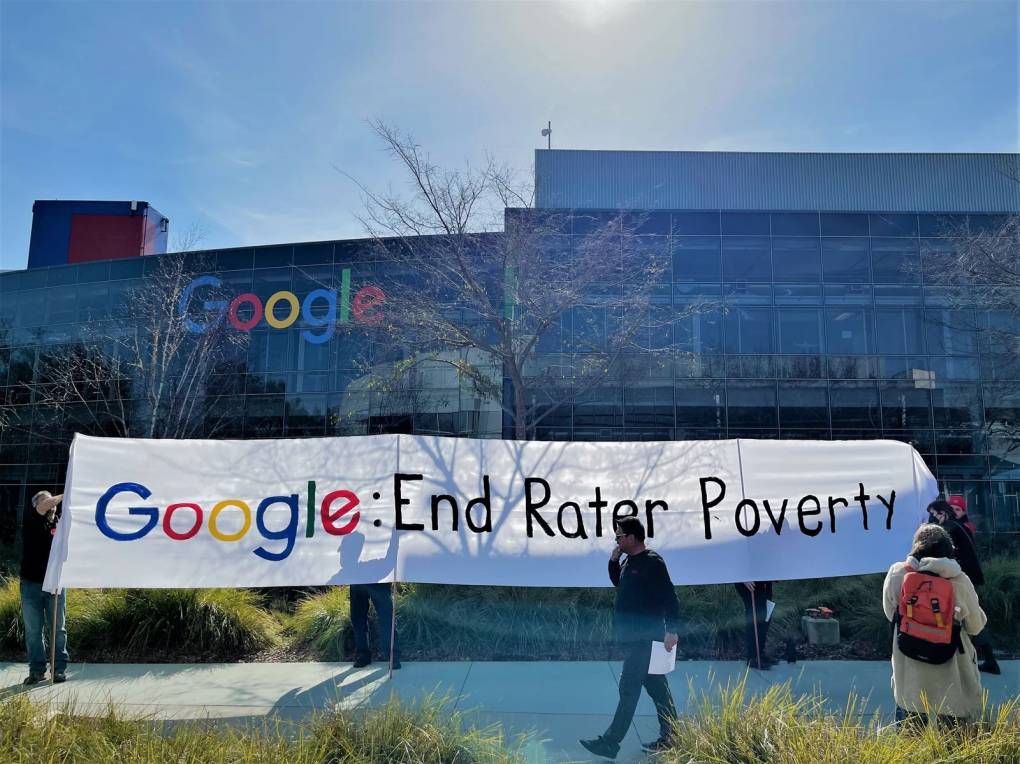
"altTag": "A view of Google headquarters with a banner in front of it that reads \"Google: End Rater Poverty\" and a person standing in front of the banner.",
"isLoading": false,
"fetchFailed": false
},
"news_11939911": {
"type": "attachments",
"id": "news_11939911",
"meta": {
"index": "attachments_1716263798",
"site": "news",
"id": "11939911",
"found": true
},
"parent": 11939910,
"imgSizes": {
"twentyfourteen-full-width": {
"file": "https://ww2.kqed.org/app/uploads/sites/10/2023/01/RS4549_GoogleWorkers20120712-1038x576.jpg",
"width": 1038,
"mimeType": "image/jpeg",
"height": 576
},
"thumbnail": {
"file": "https://ww2.kqed.org/app/uploads/sites/10/2023/01/RS4549_GoogleWorkers20120712-160x107.jpg",
"width": 160,
"mimeType": "image/jpeg",
"height": 107
},
"post-thumbnail": {
"file": "https://ww2.kqed.org/app/uploads/sites/10/2023/01/RS4549_GoogleWorkers20120712-672x372.jpg",
"width": 672,
"mimeType": "image/jpeg",
"height": 372
},
"kqedFullSize": {
"file": "https://ww2.kqed.org/app/uploads/sites/10/2023/01/RS4549_GoogleWorkers20120712-scaled.jpg",
"width": 2560,
"height": 1706
},
"2048x2048": {
"file": "https://ww2.kqed.org/app/uploads/sites/10/2023/01/RS4549_GoogleWorkers20120712-2048x1365.jpg",
"width": 2048,
"mimeType": "image/jpeg",
"height": 1365
},
"large": {
"file": "https://ww2.kqed.org/app/uploads/sites/10/2023/01/RS4549_GoogleWorkers20120712-1020x680.jpg",
"width": 1020,
"mimeType": "image/jpeg",
"height": 680
},
"1536x1536": {
"file": "https://ww2.kqed.org/app/uploads/sites/10/2023/01/RS4549_GoogleWorkers20120712-1536x1023.jpg",
"width": 1536,
"mimeType": "image/jpeg",
"height": 1023
},
"full-width": {
"file": "https://ww2.kqed.org/app/uploads/sites/10/2023/01/RS4549_GoogleWorkers20120712-1920x1279.jpg",
"width": 1920,
"mimeType": "image/jpeg",
"height": 1279
},
"medium": {
"file": "https://ww2.kqed.org/app/uploads/sites/10/2023/01/RS4549_GoogleWorkers20120712-800x533.jpg",
"width": 800,
"mimeType": "image/jpeg",
"height": 533
}
},
"publishDate": 1675208764,
"modified": 1675208791,
"caption": "Nearly 60,000 people have been laid off from Bay Area-based tech companies since November 2022.",
"description": null,
"title": "Google Launches Messaging Service",
"credit": "David Paul Morris/Getty Images",
"status": "inherit",
"altTag": null,
"isLoading": false,
"fetchFailed": false
},
"news_11919282": {
"type": "attachments",
"id": "news_11919282",
"meta": {
"index": "attachments_1716263798",
"site": "news",
"id": "11919282",
"found": true
},
"title": "Google Updates Its Logo",
"publishDate": 1657566086,
"status": "inherit",
"parent": 11919277,
"modified": 1657567640,
"caption": "An image of the Google headquarters in Mountain View.",
"credit": "Justin Sullivan/Getty Images",
"altTag": "An image of a building with the colorful Google logo on the side. The building looks very modern, the whole wall is a grid of glass windows. The Google logo is the new version.",
"description": "The new Google logo is displayed at the Google headquarters on September 2, 2015 in Mountain View, California. Google has made the most dramatic change to their logo since 1999 and have replaced their signature serif font with a new typeface called Product Sans.",
"imgSizes": {
"medium": {
"file": "https://cdn.kqed.org/wp-content/uploads/sites/10/2022/07/RS26525_GettyImages-486234008-800x534.jpg",
"width": 800,
"height": 534,
"mimeType": "image/jpeg"
},
"large": {
"file": "https://cdn.kqed.org/wp-content/uploads/sites/10/2022/07/RS26525_GettyImages-486234008-1020x681.jpg",
"width": 1020,
"height": 681,
"mimeType": "image/jpeg"
},
"thumbnail": {
"file": "https://cdn.kqed.org/wp-content/uploads/sites/10/2022/07/RS26525_GettyImages-486234008-160x107.jpg",
"width": 160,
"height": 107,
"mimeType": "image/jpeg"
},
"1536x1536": {
"file": "https://cdn.kqed.org/wp-content/uploads/sites/10/2022/07/RS26525_GettyImages-486234008-1536x1025.jpg",
"width": 1536,
"height": 1025,
"mimeType": "image/jpeg"
},
"2048x2048": {
"file": "https://cdn.kqed.org/wp-content/uploads/sites/10/2022/07/RS26525_GettyImages-486234008-2048x1367.jpg",
"width": 2048,
"height": 1367,
"mimeType": "image/jpeg"
},
"post-thumbnail": {
"file": "https://cdn.kqed.org/wp-content/uploads/sites/10/2022/07/RS26525_GettyImages-486234008-672x372.jpg",
"width": 672,
"height": 372,
"mimeType": "image/jpeg"
},
"twentyfourteen-full-width": {
"file": "https://cdn.kqed.org/wp-content/uploads/sites/10/2022/07/RS26525_GettyImages-486234008-1038x576.jpg",
"width": 1038,
"height": 576,
"mimeType": "image/jpeg"
},
"full-width": {
"file": "https://cdn.kqed.org/wp-content/uploads/sites/10/2022/07/RS26525_GettyImages-486234008-1920x1281.jpg",
"width": 1920,
"height": 1281,
"mimeType": "image/jpeg"
},
"kqedFullSize": {
"file": "https://cdn.kqed.org/wp-content/uploads/sites/10/2022/07/RS26525_GettyImages-486234008-scaled-e1736207624368.jpg",
"width": 2000,
"height": 1334
}
},
"isLoading": false,
"fetchFailed": false
},
"news_104566": {
"type": "attachments",
"id": "news_104566",
"meta": {
"index": "attachments_1716263798",
"site": "news",
"id": "104566",
"found": true
},
"parent": 104561,
"imgSizes": {
"kqedFullSize": {
"file": "https://ww2.kqed.org/app/uploads/sites/10/2013/07/RS4549_GoogleWorkers20120712-lpr.jpg",
"width": 1536,
"height": 1024
}
},
"publishDate": 1374705183,
"modified": 1647978469,
"caption": "Workers on Google's main campus in Mountain View, 2005. ",
"description": null,
"title": "Google campus",
"credit": "David Paul Morris/Getty Images",
"status": "inherit",
"altTag": "A sign showing the google logo in the foreground with people walking in the background",
"isLoading": false,
"fetchFailed": false
}
},
"audioPlayerReducer": {
"postId": "stream_live",
"isPaused": true,
"isPlaying": false,
"pfsActive": false,
"pledgeModalIsOpen": true,
"playerDrawerIsOpen": false,
"liveAudioPlayStartedAt": 0,
"liveAudioPlayContext": ""
},
"authorsReducer": {
"byline_news_11981551": {
"type": "authors",
"id": "byline_news_11981551",
"meta": {
"override": true
},
"slug": "byline_news_11981551",
"name": "Bobby Allyn",
"isLoading": false
},
"byline_news_11972309": {
"type": "authors",
"id": "byline_news_11972309",
"meta": {
"override": true
},
"slug": "byline_news_11972309",
"name": "\u003ca href=\"https://calmatters.org/author/levi-sumagaysay/\">Levi Sumagaysay\u003c/a>",
"isLoading": false
},
"byline_news_11970442": {
"type": "authors",
"id": "byline_news_11970442",
"meta": {
"override": true
},
"slug": "byline_news_11970442",
"name": "\u003ca href=\"https://www.npr.org/people/279612138/geoff-brumfiel\">Geoff Brumfiel\u003c/a>",
"isLoading": false
},
"byline_news_11960799": {
"type": "authors",
"id": "byline_news_11960799",
"meta": {
"override": true
},
"slug": "byline_news_11960799",
"name": "\u003ca href=\"https://www.npr.org/people/1147860766/dara-kerr\">Dara Kerr\u003c/a>",
"isLoading": false
},
"byline_news_11945357": {
"type": "authors",
"id": "byline_news_11945357",
"meta": {
"override": true
},
"slug": "byline_news_11945357",
"name": "\u003ca href=\"https://www.npr.org/people/1147860766/dara-kerr\">Dara Kerr\u003c/a>",
"isLoading": false
},
"byline_news_11919277": {
"type": "authors",
"id": "byline_news_11919277",
"meta": {
"override": true
},
"slug": "byline_news_11919277",
"name": "Bobby Allyn",
"isLoading": false
},
"byline_news_11908809": {
"type": "authors",
"id": "byline_news_11908809",
"meta": {
"override": true
},
"slug": "byline_news_11908809",
"name": "Barbara Ortutay",
"isLoading": false
},
"rachael-myrow": {
"type": "authors",
"id": "251",
"meta": {
"index": "authors_1716337520",
"id": "251",
"found": true
},
"name": "Rachael Myrow",
"firstName": "Rachael",
"lastName": "Myrow",
"slug": "rachael-myrow",
"email": "rmyrow@kqed.org",
"display_author_email": true,
"staff_mastheads": [
"news"
],
"title": "Senior Editor of KQED's Silicon Valley News Desk",
"bio": "• I write and edit stories about how Silicon Valley power and policies shape everyday life in California. I’m also passionate about making Bay Area history and culture more accessible to a broad public. • I’ve been a journalist for most of my life, starting in high school with The Franklin Press in Los Angeles, where I grew up. While earning my first degree in English at UC Berkeley, I got my start in public radio at KALX-FM. After completing a second degree in journalism at Cal, I landed my first professional job at Marketplace, then moved on to KPCC (now LAist), and then KQED, where I hosted The California Report for more than seven years. • My reporting has appeared on NPR, The World, WBUR’s \u003ci>Here & Now\u003c/i>, and the BBC. I also guest host for KQED’s \u003ci>Forum\u003c/i>, as well as the Commonwealth Club in San Francisco. • I speak periodically on media, democracy and technology issues, and do voiceover work for documentaries and educational video projects. • Outside of the studio, you'll find me hiking Bay Area trails and whipping up Insta-ready meals in my kitchen. • I do not accept gifts, money, or favors from anyone connected to my reporting, I don't pay people for information, and I do not support or donate to political causes. • I strive to treat the people I report on with fairness, honesty, and respect. I also recognize there are often multiple sides to a story and work to verify information through multiple sources and documentation. If I get something wrong, I correct it.",
"avatar": "https://secure.gravatar.com/avatar/3ed8a3c5f26025e4a805ba634cda8cd764906b97438a6d9ce216b044e340da4e?s=600&d=blank&r=g",
"twitter": "rachaelmyrow",
"bluesky": null,
"facebook": null,
"instagram": null,
"linkedin": "https://www.linkedin.com/in/rachaelmyrow/",
"sites": [
{
"site": "arts",
"roles": [
"administrator"
]
},
{
"site": "news",
"roles": [
"edit_others_posts",
"editor"
]
},
{
"site": "futureofyou",
"roles": [
"editor"
]
},
{
"site": "bayareabites",
"roles": [
"editor"
]
},
{
"site": "stateofhealth",
"roles": [
"editor"
]
},
{
"site": "science",
"roles": [
"editor"
]
},
{
"site": "food",
"roles": [
"editor"
]
},
{
"site": "forum",
"roles": [
"editor"
]
},
{
"site": "liveblog",
"roles": [
"author"
]
}
],
"headData": {
"title": "Rachael Myrow | KQED",
"description": "Senior Editor of KQED's Silicon Valley News Desk",
"ogImgSrc": "https://secure.gravatar.com/avatar/3ed8a3c5f26025e4a805ba634cda8cd764906b97438a6d9ce216b044e340da4e?s=600&d=blank&r=g",
"twImgSrc": "https://secure.gravatar.com/avatar/3ed8a3c5f26025e4a805ba634cda8cd764906b97438a6d9ce216b044e340da4e?s=600&d=blank&r=g"
},
"isLoading": false,
"link": "/author/rachael-myrow"
},
"ecruzguevarra": {
"type": "authors",
"id": "8654",
"meta": {
"index": "authors_1716337520",
"id": "8654",
"found": true
},
"name": "Ericka Cruz Guevarra",
"firstName": "Ericka",
"lastName": "Cruz Guevarra",
"slug": "ecruzguevarra",
"email": "ecruzguevarra@kqed.org",
"display_author_email": true,
"staff_mastheads": [
"news"
],
"title": "Producer, The Bay Podcast",
"bio": "Ericka Cruz Guevarra is host of \u003ca href=\"https://www.kqed.org/podcasts/thebay\">\u003cem>The Bay\u003c/em>\u003c/a> podcast at KQED. Before host, she was the show’s producer. Her work in that capacity includes a three-part reported series on policing in Vallejo, which won a 2020 excellence in journalism award from the Society of Professional Journalists. Ericka has worked as a breaking news reporter at Oregon Public Broadcasting, helped produce the Code Switch podcast, and was KQED’s inaugural Raul Ramirez Diversity Fund intern. She’s also an alumna of NPR’s Next Generation Radio program. Send her an email if you have strong feelings about whether Fairfield and Suisun City are the Bay. Ericka is represented by SAG-AFTRA.",
"avatar": "https://secure.gravatar.com/avatar/accefc1de4bafc7e234b69bcb9b6f6536c130fd84709bc3069ef11a78787e1bb?s=600&d=blank&r=g",
"twitter": "NotoriousECG",
"bluesky": null,
"facebook": null,
"instagram": null,
"linkedin": null,
"sites": [
{
"site": "arts",
"roles": [
"subscriber"
]
},
{
"site": "news",
"roles": [
"editor",
"manage_categories"
]
},
{
"site": "futureofyou",
"roles": [
"subscriber"
]
},
{
"site": "stateofhealth",
"roles": [
"subscriber"
]
},
{
"site": "science",
"roles": [
"editor"
]
},
{
"site": "forum",
"roles": [
"subscriber"
]
}
],
"headData": {
"title": "Ericka Cruz Guevarra | KQED",
"description": "Producer, The Bay Podcast",
"ogImgSrc": "https://secure.gravatar.com/avatar/accefc1de4bafc7e234b69bcb9b6f6536c130fd84709bc3069ef11a78787e1bb?s=600&d=blank&r=g",
"twImgSrc": "https://secure.gravatar.com/avatar/accefc1de4bafc7e234b69bcb9b6f6536c130fd84709bc3069ef11a78787e1bb?s=600&d=blank&r=g"
},
"isLoading": false,
"link": "/author/ecruzguevarra"
},
"amontecillo": {
"type": "authors",
"id": "11649",
"meta": {
"index": "authors_1716337520",
"id": "11649",
"found": true
},
"name": "Alan Montecillo",
"firstName": "Alan",
"lastName": "Montecillo",
"slug": "amontecillo",
"email": "amontecillo@kqed.org",
"display_author_email": false,
"staff_mastheads": [
"news"
],
"title": "KQED Contributor",
"bio": "Alan Montecillo is the senior editor of \u003cem>\u003ca href=\"http://kqed.org/thebay\">The Bay\u003c/a>, \u003c/em> KQED's local news podcast. Before moving to the Bay Area, he worked as a senior talk show producer for WILL in Champaign-Urbana, Illinois and at Oregon Public Broadcasting in Portland, Oregon. He has won journalism awards from the Society of Professional Journalists Northern California, the Public Media Journalists Association, The Signal Awards, and has also received a regional Edward R. Murrow award. Alan is a Filipino American from Hong Kong and a graduate of Reed College.",
"avatar": "https://secure.gravatar.com/avatar/268f53a2066899ea9efdd8a5900218b17c822d9862cbc9326cccec53ef41d349?s=600&d=blank&r=g",
"twitter": "alanmontecillo",
"bluesky": null,
"facebook": null,
"instagram": null,
"linkedin": null,
"sites": [
{
"site": "",
"roles": [
"editor"
]
},
{
"site": "news",
"roles": [
"editor",
"manage_categories"
]
}
],
"headData": {
"title": "Alan Montecillo | KQED",
"description": "KQED Contributor",
"ogImgSrc": "https://secure.gravatar.com/avatar/268f53a2066899ea9efdd8a5900218b17c822d9862cbc9326cccec53ef41d349?s=600&d=blank&r=g",
"twImgSrc": "https://secure.gravatar.com/avatar/268f53a2066899ea9efdd8a5900218b17c822d9862cbc9326cccec53ef41d349?s=600&d=blank&r=g"
},
"isLoading": false,
"link": "/author/amontecillo"
},
"mesquinca": {
"type": "authors",
"id": "11802",
"meta": {
"index": "authors_1716337520",
"id": "11802",
"found": true
},
"name": "Maria Esquinca",
"firstName": "Maria",
"lastName": "Esquinca",
"slug": "mesquinca",
"email": "mesquinca@kqed.org",
"display_author_email": false,
"staff_mastheads": [],
"title": "Producer, The Bay",
"bio": "María Esquinca is a producer of The Bay. Before that, she was a New York Women’s Foundation IGNITE Fellow at Latino USA. She worked at Radio Bilingue where she covered the San Joaquin Valley. Maria has interned at WLRN, News 21, The New York Times Student Journalism Institute and at Crain’s Detroit Business as a Dow Jones News Fund Business Reporting Intern. She is an MFA graduate from the University of Miami. In 2017, she graduated from the Walter Cronkite School of Journalism and Mass Communication with a Master of Mass Communication. A fronteriza, she was born in Ciudad Juárez, Chihuahua, Mexico and grew up in El Paso, Texas.",
"avatar": "https://secure.gravatar.com/avatar/77cedba18aae91da775038ba06dcd8d0?s=600&d=blank&r=g",
"twitter": "@m_esquinca",
"facebook": null,
"instagram": null,
"linkedin": null,
"sites": [
{
"site": "news",
"roles": []
}
],
"headData": {
"title": "Maria Esquinca | KQED",
"description": "Producer, The Bay",
"ogImgSrc": "https://secure.gravatar.com/avatar/77cedba18aae91da775038ba06dcd8d0?s=600&d=blank&r=g",
"twImgSrc": "https://secure.gravatar.com/avatar/77cedba18aae91da775038ba06dcd8d0?s=600&d=blank&r=g"
},
"isLoading": false,
"link": "/author/mesquinca"
}
},
"pagesReducer": {
"news_tag_google": {
"type": "terms",
"id": "news_93",
"meta": {
"index": "terms_1716263798",
"site": "news",
"id": "93",
"score": 8.458717
},
"featImg": null,
"name": "Google",
"description": null,
"taxonomy": "tag",
"headData": {
"twImgId": null,
"twTitle": null,
"ogTitle": null,
"ogImgId": null,
"twDescription": null,
"description": null,
"title": "Google Archives | KQED News",
"ogDescription": null
},
"ttid": 96,
"slug": "google",
"isLoading": false,
"title": "Google",
"pageMeta": {
"site": "news",
"WpPageTemplate": "page-topic-editorial",
"currentPage": 4
},
"blocks": [
{
"blockName": "kqed/post-list",
"attrs": {
"layout": "cardArticle2",
"query": "posts/news?tag=google",
"seeMore": false,
"paginated": true,
"page": 4
}
},
{
"blockName": "kqed/ad"
}
]
}
},
"pfsSessionReducer": {},
"postsReducer": {
"stream_live": {
"type": "live",
"id": "stream_live",
"audioUrl": "https://streams.kqed.org/kqedradio",
"title": "Live Stream",
"excerpt": "Live Stream information currently unavailable.",
"link": "/radio",
"featImg": "",
"label": {
"name": "KQED Live",
"link": "/"
}
},
"stream_kqedNewscast": {
"type": "posts",
"id": "stream_kqedNewscast",
"audioUrl": "https://www.kqed.org/.stream/anon/radio/RDnews/newscast.mp3?_=1",
"title": "KQED Newscast",
"featImg": "",
"label": {
"name": "88.5 FM",
"link": "/"
}
},
"news_11981551": {
"type": "posts",
"id": "news_11981551",
"meta": {
"index": "posts_1716263798",
"site": "news",
"id": "11981551",
"score": null,
"sort": [
1712010619000
]
},
"parent": 0,
"labelTerm": {
"site": "news",
"term": 253
},
"blocks": [],
"publishDate": 1712010619,
"format": "standard",
"title": "Google Commits to Deleting 'Incognito' Search Data of Millions",
"headTitle": "Google Commits to Deleting ‘Incognito’ Search Data of Millions | KQED",
"content": "\u003cp>Google will destroy the private browsing history of millions of people who used “incognito” mode in its Chrome browser as a part of \u003ca href=\"https://www.documentcloud.org/documents/24527110-google-unopposed-settlement\">a settlement\u003c/a> filed to federal court on Monday in a case over the company’s secret tracking of web activity.\u003c/p>\n\u003cp>For years, Google simply informed users of Chrome’s internet browser that “you’ve gone Incognito” and “now you can browse privately” when the supposedly untraceable browsing option was turned on — without saying what bits of data the company had been harvesting.\u003c/p>\n\u003cp>Yet, according to \u003ca href=\"https://www.documentcloud.org/documents/24527422-amended-google-complaint\">a 2020 class-action lawsuit\u003c/a>, the tech giant continued to scrape searches by hoovering up data about users who browsed the internet in incognito mode, grabbing “potentially embarrassing” searches of millions of people to measure web traffic and sell advertising.\u003c/p>\n\u003cp>“Google has made itself an unaccountable trove of information so detailed and expansive that George Orwell could never have dreamed it,” wrote lawyer Mark Mao and other plaintiffs’ attorneys who sued the company.\u003c/p>\n\u003cp>As the suit was pending, Google changed the splash screen of incognito mode to state that websites, employers, schools and internet service providers can view browsing activity in incognito mode. But under the deal, Google will have to state that the company itself can also track browsing during incognito mode.\u003c/p>\n\u003cp>[ad fullwidth]\u003c/p>\n\u003cp>In addition, when users use incognito mode, Google will, by default, block third-party companies from tracking peoples’ so-called cookies, which is how advertisers glean information about a person’s search history.\u003c/p>\n\u003cfigure id=\"attachment_11981552\" class=\"wp-caption aligncenter\" style=\"max-width: 921px\">\u003ca href=\"https://cdn.kqed.org/wp-content/uploads/sites/10/2024/04/44444_custom-7e31ede47b505ec4ec03787cd1c4876e47eb4b25.png\">\u003cimg loading=\"lazy\" decoding=\"async\" class=\"size-full wp-image-11981552\" src=\"https://cdn.kqed.org/wp-content/uploads/sites/10/2024/04/44444_custom-7e31ede47b505ec4ec03787cd1c4876e47eb4b25.png\" alt=\"A screenshot of a logo of a hat and glasses under white text that reads "You've gone incognito."\" width=\"921\" height=\"519\" srcset=\"https://cdn.kqed.org/wp-content/uploads/sites/10/2024/04/44444_custom-7e31ede47b505ec4ec03787cd1c4876e47eb4b25.png 921w, https://cdn.kqed.org/wp-content/uploads/sites/10/2024/04/44444_custom-7e31ede47b505ec4ec03787cd1c4876e47eb4b25-800x451.png 800w, https://cdn.kqed.org/wp-content/uploads/sites/10/2024/04/44444_custom-7e31ede47b505ec4ec03787cd1c4876e47eb4b25-160x90.png 160w\" sizes=\"(max-width: 921px) 100vw, 921px\">\u003c/a>\u003cfigcaption class=\"wp-caption-text\">Google now informs users of the limitations of its so-called “incognito mode,” which enables more private web browsing. \u003ccite>(NPR)\u003c/cite>\u003c/figcaption>\u003c/figure>\n\u003cp>Class members, including the tens of millions of people who have browsed using incognito mode, will not receive any monetary damages. But individual users are able to sue Google in California state court to recover money over the covert data tracking, according to the agreement.\u003c/p>\n\u003cp>In a statement, Google spokesman José Castañeda said the company is “happy to delete old technical data that was never associated with an individual and was never used for any form of personalization.” He pointed out that the lawsuit sought $5 billion in damages, but Google will not be making any payment as part of the proposed settlement.\u003c/p>\n\u003ch2>Google employees complained to management about incognito\u003c/h2>\n\u003cp>The suit revealed that Google saved the standard and incognito browsing history of users in the same profile. That data was then used to inform personalized ads that the company served up.\u003c/p>\n\u003cp>“Even when users are browsing the internet in ‘private browsing mode,’ Google continues to track them,” according to the suit. “Google’s tracking occurred and continues to occur no matter how sensitive or personal users’ online activities are.”\u003c/p>\n\u003cp>Lawyers representing the consumers who sued Google cited internal emails from the company showing employees complaining to management about incognito mode not living up to its name.\u003c/p>\n\u003cp>“We need to stop calling it incognito and stop using a Spy Guy icon,” an engineer wrote to Google colleagues in 2018.\u003c/p>\n\u003cp>Another Google employee recommended changing the incognito splash page to say: “You are NOT protected from Google.”\u003c/p>\n\u003cp>The suit referenced an email sent by Google’s marketing chief, Lorraine Twohill, to CEO Sundar Pichai, suggesting that the company was misleading the public about the browsing tool.\u003c/p>\n\u003cp>“We are limited in how strongly we can market incognito because it’s not truly private, thus requiring really fuzzy, hedging language that is almost more damaging,” Twohill wrote Pichai in 2019.\u003c/p>\n\u003cp>U.S. District Judge Yvonne Gonzalez Rogers originally set a February trial date for the case, but that was put on hold in light of the agreement hammered out by both parties.\u003c/p>\n\u003cp>\u003c/p>\n\u003cp>The deal still needs final approval from Gonzalez Rogers.\u003c/p>\n\u003cdiv class=\"fullattribution\">\u003cem>Copyright 2024 NPR. To see more, visit https://www.npr.org.\u003cimg decoding=\"async\" src=\"https://www.google-analytics.com/__utm.gif?utmac=UA-5828686-4&utmdt=Google+to+delete+search+data+of+millions+who+used+%27incognito%27+mode&utme=8(APIKey)9(MDAxOTAwOTE4MDEyMTkxMDAzNjczZDljZA004)\">\u003c/em>\u003c/div>\n\n",
"stats": {
"hasVideo": false,
"hasChartOrMap": false,
"hasAudio": false,
"hasPolis": false,
"wordCount": 665,
"hasGoogleForm": false,
"hasGallery": false,
"hasHearkenModule": false,
"iframeSrcs": [],
"paragraphCount": 19
},
"modified": 1712078085,
"excerpt": "In an agreement released on Monday, Google said it would permanently remove information it secretly gathered when millions of people searched the Internet in \"incognito\" mode. ",
"headData": {
"twImgId": "",
"twTitle": "",
"ogTitle": "",
"ogImgId": "",
"twDescription": "",
"description": "In an agreement released on Monday, Google said it would permanently remove information it secretly gathered when millions of people searched the Internet in "incognito" mode. ",
"title": "Google Commits to Deleting 'Incognito' Search Data of Millions | KQED",
"ogDescription": "",
"schema": {
"@context": "https://schema.org",
"@type": "NewsArticle",
"headline": "Google Commits to Deleting 'Incognito' Search Data of Millions",
"datePublished": "2024-04-01T15:30:19-07:00",
"dateModified": "2024-04-02T10:14:45-07:00",
"image": "https://cdn.kqed.org/wp-content/uploads/2020/02/KQED-OG-Image@1x.png",
"isAccessibleForFree": "True",
"publisher": {
"@type": "NewsMediaOrganization",
"@id": "https://www.kqed.org/#organization",
"name": "KQED",
"logo": "https://cdn.kqed.org/wp-content/uploads/2020/02/KQED-OG-Image@1x.png",
"url": "https://www.kqed.org",
"sameAs": [
"https://www.facebook.com/KQED",
"https://twitter.com/KQED",
"https://www.instagram.com/kqed/",
"https://www.tiktok.com/@kqedofficial",
"https://www.linkedin.com/company/kqed",
"https://www.youtube.com/channel/UCeC0IOo7i1P_61zVUWbJ4nw"
]
}
}
},
"guestAuthors": [],
"slug": "google-commits-to-deleting-incognito-search-data-of-millions",
"status": "publish",
"nprApiLink": "http://api.npr.org/query?id=1242019127&apiKey=MDAxOTAwOTE4MDEyMTkxMDAzNjczZDljZA004",
"nprStoryDate": "Mon, 01 Apr 2024 15:11:17 -0400",
"excludeFromSiteSearch": "Include",
"nprLastModifiedDate": "Mon, 01 Apr 2024 15:27:46 -0400",
"nprHtmlLink": "https://www.npr.org/2024/04/01/1242019127/google-incognito-mode-settlement-search-history?ft=nprml&f=1242019127",
"nprImageAgency": "NPR",
"nprStoryId": "1242019127",
"nprByline": "Bobby Allyn",
"sticky": false,
"showOnAuthorArchivePages": "No",
"articleAge": "0",
"nprRetrievedStory": "1",
"nprPubDate": "Mon, 01 Apr 2024 15:27:00 -0400",
"path": "/news/11981551/google-commits-to-deleting-incognito-search-data-of-millions",
"audioTrackLength": null,
"parsedContent": [
{
"type": "contentString",
"content": "\u003cdiv class=\"post-body\">\u003cp>\u003cp>Google will destroy the private browsing history of millions of people who used “incognito” mode in its Chrome browser as a part of \u003ca href=\"https://www.documentcloud.org/documents/24527110-google-unopposed-settlement\">a settlement\u003c/a> filed to federal court on Monday in a case over the company’s secret tracking of web activity.\u003c/p>\n\u003cp>For years, Google simply informed users of Chrome’s internet browser that “you’ve gone Incognito” and “now you can browse privately” when the supposedly untraceable browsing option was turned on — without saying what bits of data the company had been harvesting.\u003c/p>\n\u003cp>Yet, according to \u003ca href=\"https://www.documentcloud.org/documents/24527422-amended-google-complaint\">a 2020 class-action lawsuit\u003c/a>, the tech giant continued to scrape searches by hoovering up data about users who browsed the internet in incognito mode, grabbing “potentially embarrassing” searches of millions of people to measure web traffic and sell advertising.\u003c/p>\n\u003cp>“Google has made itself an unaccountable trove of information so detailed and expansive that George Orwell could never have dreamed it,” wrote lawyer Mark Mao and other plaintiffs’ attorneys who sued the company.\u003c/p>\n\u003cp>As the suit was pending, Google changed the splash screen of incognito mode to state that websites, employers, schools and internet service providers can view browsing activity in incognito mode. But under the deal, Google will have to state that the company itself can also track browsing during incognito mode.\u003c/p>\n\u003cp>\u003c/p>\u003c/div>",
"attributes": {
"named": {},
"numeric": []
}
},
{
"type": "component",
"content": "",
"name": "ad",
"attributes": {
"named": {
"label": "fullwidth"
},
"numeric": [
"fullwidth"
]
}
},
{
"type": "contentString",
"content": "\u003cdiv class=\"post-body\">\u003cp>\u003c/p>\n\u003cp>In addition, when users use incognito mode, Google will, by default, block third-party companies from tracking peoples’ so-called cookies, which is how advertisers glean information about a person’s search history.\u003c/p>\n\u003cfigure id=\"attachment_11981552\" class=\"wp-caption aligncenter\" style=\"max-width: 921px\">\u003ca href=\"https://cdn.kqed.org/wp-content/uploads/sites/10/2024/04/44444_custom-7e31ede47b505ec4ec03787cd1c4876e47eb4b25.png\">\u003cimg loading=\"lazy\" decoding=\"async\" class=\"size-full wp-image-11981552\" src=\"https://cdn.kqed.org/wp-content/uploads/sites/10/2024/04/44444_custom-7e31ede47b505ec4ec03787cd1c4876e47eb4b25.png\" alt=\"A screenshot of a logo of a hat and glasses under white text that reads "You've gone incognito."\" width=\"921\" height=\"519\" srcset=\"https://cdn.kqed.org/wp-content/uploads/sites/10/2024/04/44444_custom-7e31ede47b505ec4ec03787cd1c4876e47eb4b25.png 921w, https://cdn.kqed.org/wp-content/uploads/sites/10/2024/04/44444_custom-7e31ede47b505ec4ec03787cd1c4876e47eb4b25-800x451.png 800w, https://cdn.kqed.org/wp-content/uploads/sites/10/2024/04/44444_custom-7e31ede47b505ec4ec03787cd1c4876e47eb4b25-160x90.png 160w\" sizes=\"(max-width: 921px) 100vw, 921px\">\u003c/a>\u003cfigcaption class=\"wp-caption-text\">Google now informs users of the limitations of its so-called “incognito mode,” which enables more private web browsing. \u003ccite>(NPR)\u003c/cite>\u003c/figcaption>\u003c/figure>\n\u003cp>Class members, including the tens of millions of people who have browsed using incognito mode, will not receive any monetary damages. But individual users are able to sue Google in California state court to recover money over the covert data tracking, according to the agreement.\u003c/p>\n\u003cp>In a statement, Google spokesman José Castañeda said the company is “happy to delete old technical data that was never associated with an individual and was never used for any form of personalization.” He pointed out that the lawsuit sought $5 billion in damages, but Google will not be making any payment as part of the proposed settlement.\u003c/p>\n\u003ch2>Google employees complained to management about incognito\u003c/h2>\n\u003cp>The suit revealed that Google saved the standard and incognito browsing history of users in the same profile. That data was then used to inform personalized ads that the company served up.\u003c/p>\n\u003cp>“Even when users are browsing the internet in ‘private browsing mode,’ Google continues to track them,” according to the suit. “Google’s tracking occurred and continues to occur no matter how sensitive or personal users’ online activities are.”\u003c/p>\n\u003cp>Lawyers representing the consumers who sued Google cited internal emails from the company showing employees complaining to management about incognito mode not living up to its name.\u003c/p>\n\u003cp>“We need to stop calling it incognito and stop using a Spy Guy icon,” an engineer wrote to Google colleagues in 2018.\u003c/p>\n\u003cp>Another Google employee recommended changing the incognito splash page to say: “You are NOT protected from Google.”\u003c/p>\n\u003cp>The suit referenced an email sent by Google’s marketing chief, Lorraine Twohill, to CEO Sundar Pichai, suggesting that the company was misleading the public about the browsing tool.\u003c/p>\n\u003cp>“We are limited in how strongly we can market incognito because it’s not truly private, thus requiring really fuzzy, hedging language that is almost more damaging,” Twohill wrote Pichai in 2019.\u003c/p>\n\u003cp>U.S. District Judge Yvonne Gonzalez Rogers originally set a February trial date for the case, but that was put on hold in light of the agreement hammered out by both parties.\u003c/p>\n\u003cp>\u003c/p>\n\u003cp>The deal still needs final approval from Gonzalez Rogers.\u003c/p>\n\u003cdiv class=\"fullattribution\">\u003cem>Copyright 2024 NPR. To see more, visit https://www.npr.org.\u003cimg decoding=\"async\" src=\"https://www.google-analytics.com/__utm.gif?utmac=UA-5828686-4&utmdt=Google+to+delete+search+data+of+millions+who+used+%27incognito%27+mode&utme=8(APIKey)9(MDAxOTAwOTE4MDEyMTkxMDAzNjczZDljZA004)\">\u003c/em>\u003c/div>\n\n\u003c/div>\u003c/p>",
"attributes": {
"named": {},
"numeric": []
}
}
],
"link": "/news/11981551/google-commits-to-deleting-incognito-search-data-of-millions",
"authors": [
"byline_news_11981551"
],
"categories": [
"news_8"
],
"tags": [
"news_93",
"news_2414",
"news_33171"
],
"affiliates": [
"news_253"
],
"featImg": "news_11981553",
"label": "news_253"
},
"news_11974251": {
"type": "posts",
"id": "news_11974251",
"meta": {
"index": "posts_1716263798",
"site": "news",
"id": "11974251",
"score": null,
"sort": [
1706698859000
]
},
"guestAuthors": [],
"slug": "january-news-roundup-techs-role-in-media-layoffs-san-mateo-county-criminalizes-camping-sfs-district-attorney-race",
"title": "January News Roundup: Tech's Role in Media Layoffs, San Mateo County Criminalizes Camping, SF's District Attorney Race",
"publishDate": 1706698859,
"format": "audio",
"headTitle": "January News Roundup: Tech’s Role in Media Layoffs, San Mateo County Criminalizes Camping, SF’s District Attorney Race | KQED",
"labelTerm": {},
"content": "\u003cp class=\"p2\">\u003ca href=\"#episode-transcript\">\u003ci>View the full episode transcript.\u003c/i>\u003c/a>\u003c/p>\n\u003cp>In this edition of The Bay’s monthly news roundup, Ericka, Maria and Alan discuss how mass layoffs at the \u003cem>L.A. Times\u003c/em> have brought renewed attention to a California bill that would force tech companies to pay news outlets, San Mateo County’s vote to make it a crime to camp in certain areas when shelter beds are available, and a former prosecutor under Chesa Boudin who’s decided to enter the race for San Francisco District Attorney. Plus, we introduce our new intern!\u003c/p>\n\u003cp>\u003c!-- iframe plugin v.4.3 wordpress.org/plugins/iframe/ -->\u003cbr>\n\u003ciframe loading=\"lazy\" frameborder=\"0\" height=\"200\" scrolling=\"no\" src=\"https://playlist.megaphone.fm/?e=KQINC9460852209\" width=\"100%\" class=\"iframe-class\">\u003c/iframe>\u003c/p>\n\u003cp>Links:\u003c/p>\n\u003cul>\n\u003cli>\u003ca href=\"https://www.sfchronicle.com/politics/article/la-times-layoffs-bill-18624182.php\" target=\"_blank\" rel=\"noopener noreferrer\">As layoffs batter L.A. Times, California lawmaker renews push to force Google, Facebook to pay for news\u003c/a>\u003c/li>\n\u003cli>\u003ca href=\"https://www.sfchronicle.com/bayarea/article/sf-district-attorney-race-khojasteh-18626462.php\" target=\"_blank\" rel=\"noopener noreferrer\">S.F. D.A. Brooke Jenkins fired him. Now he’s running against her\u003c/a>\u003c/li>\n\u003cli>\u003ca href=\"https://www.kqed.org/news/11973307/san-mateo-county-supes-vote-to-criminalize-camping-in-unincorporated-areas\" target=\"_blank\" rel=\"noopener noreferrer\">San Mateo County Supes Vote to Criminalize Camping in Unincorporated Areas\u003c/a>\u003c/li>\n\u003c/ul>\n\u003ch2 id=\"episode-transcript\">Episode Transcript\u003c/h2>\n\u003cp>\u003ci>This is a computer-generated transcript. While our team has reviewed it, there may be errors.\u003c/i>\u003c/p>\n\u003cp>[ad fullwidth]\u003c/p>\n\u003cp>\u003cstrong>Ericka Cruz Guevarra: \u003c/strong>I’m Ericka Cruz Guevarra, and welcome to the Bay and local news to keep you rooted. And welcome to our first news roundup of the New Year. I don’t know if it’s weird to say Happy New Year anymore, but happy New year.\u003c/p>\n\u003cp>\u003cstrong>Maria Esquinca: \u003c/strong>Happy new year.\u003c/p>\n\u003cp>\u003cstrong>Alan Montecillo: \u003c/strong>It’s still okay.\u003c/p>\n\u003cp>\u003cstrong>Ericka Cruz Guevarra: \u003c/strong>This is where we take some time at the end of the month to sit down with the entire Bay production team, to talk about some of the other stories around the Bay area that we’ve been following this month that we maybe didn’t get to make an episode on. I’m joined by our senior editor, Alan Montecillo What’s up? Alan?\u003c/p>\n\u003cp>\u003cstrong>Alan Montecillo: \u003c/strong>Hello.\u003c/p>\n\u003cp>\u003cstrong>Ericka Cruz Guevarra: \u003c/strong>And our producer, Maria Esquinca. And also a very special guest, our intern, Eleanor Prickett-Morgan, who is in their second week with us here at KQED. Welcome, Ellie.\u003c/p>\n\u003cp>\u003cstrong>Ellie Prickett-Morgan: \u003c/strong>Hi. Very excited to be here.\u003c/p>\n\u003cp>\u003cstrong>Ericka Cruz Guevarra: \u003c/strong>Well, before we dive into our news roundup, l’m wondering if you can just tell us a little bit about yourself and your background.\u003c/p>\n\u003cp>\u003cstrong>Ellie Prickett-Morgan: \u003c/strong>I’m a bay transplant by way of Santa Cruz, and I have spent the past couple of years doing some reporting with KPFA on housing and homelessness. I followed the Wood Street encampment for somewhere around a year through their eviction, and then I’ve continued to follow the community. And, yeah, I’m just really passionate about local news.\u003c/p>\n\u003cp>\u003cstrong>Ericka Cruz Guevarra: \u003c/strong>And I know you’ve done a lot of stories out of the East Bay, in particular homelessness and housing. What kind of stories are you excited about working on on our show?\u003c/p>\n\u003cp>\u003cstrong>Ellie Prickett-Morgan: \u003c/strong>I’m really excited to kind of expand the different areas of coverage and pretty rooted in Oakland right now. And I’m also really excited to talk about potentially more labor issues, obviously, like the election coming up and maybe some transit stuff too.\u003c/p>\n\u003cp>\u003cstrong>Ericka Cruz Guevarra: \u003c/strong>Well, Ellie, thank you so much. It’s really exciting to have you here, and we are so excited to see all the things we make with you. Likewise. And right after the break, we’ll talk about the three stories that the Bay team has been following this month. Stay with us.\u003c/p>\n\u003cp>\u003cstrong>Ericka Cruz Guevarra: \u003c/strong>And welcome back to The Bay’s monthly news roundup, our first of the year. We’re going to go ahead and start with my story, which is about a recent wave of layoffs in the media industry and the role that some local lawmakers here in the Bay actually believe that tech can and should play in saving the industry from further catastrophe. Last week, the L.A. times laid off 115 journalists, which amounts to more than 20% of the newsroom. Many of the cuts were to culture writers, the team covering LA’s Latino community, the Washington, D.C. bureau, which I mean, of course, is really crazy to think about in an election year.\u003c/p>\n\u003cp>\u003cstrong>Ericka Cruz Guevarra: \u003c/strong>The union says that the cuts also disproportionately affected black, Latino and Asian American employees, and the paper’s owner, Doctor Patrick Soon-shiong, said the cuts were necessary because the times could no longer lose up to $40 million a year without boosting advertising. It’s also bringing renewed attention to efforts by some California lawmakers to hold tech companies accountable for their role in the plight of the media industry.\u003c/p>\n\u003cp>\u003cstrong>Maria Esquinca: \u003c/strong>Can you explain to us how is the tech industry connected to the news layoffs?\u003c/p>\n\u003cp>\u003cstrong>Ericka Cruz Guevarra: \u003c/strong>So, I mean, if you think about back in the day, right, when everyone needs to get newspapers and the main source of revenue for those newspapers was the advertising, the internet platforms like Google and Facebook. As we all know, those platforms have changed the entire industry. Many of these newspapers are no longer making money from advertising in their newspapers. Right, because everyone’s advertising online. And so the logic is that these platforms have contributed to this really devastating climate for news, while at the same time benefiting from the news articles that are posted to their websites.\u003c/p>\n\u003cp>\u003cstrong>Alan Montecillo: \u003c/strong>In some ways, this is part of a much longer story of local news getting cut and cut and cut. And when you say, you know, California lawmakers are trying to hold tech accountable, how does that factor in to this recent news about the L.A. times?\u003c/p>\n\u003cp>\u003cstrong>Ericka Cruz Guevarra: \u003c/strong>There is at least one local lawmaker, Buffy Wicks, Democrat from Oakland, who believes that tech companies including Google, Facebook and Microsoft have really benefited from the work of journalists whose stories end up on these platforms. And basically, there’s this bill called the Journalism Preservation Act, or AB 886 that would require platforms to pay a journalism usage fee to news organizations.\u003c/p>\n\u003cp>\u003cstrong>Alan Montecillo: \u003c/strong>This isn’t totally new idea, and from what I know, the tech industry is pretty hostile to any notion of paying for content that appears on their platforms. I have to assume something similar is happening in California.\u003c/p>\n\u003cp>\u003cstrong>Ericka Cruz Guevarra: \u003c/strong>Yeah, I mean, this bill actually stalled in the legislature last year, and its author, Buffy Wicks, decided to table it essentially in part because tech companies spent lots of money in 2023 lobbying California lawmakers and regulators against the bill. The LA times ironically reported that Google had spent $1.2 million and ad campaign against AB 886 last year, and that proved to be successful.\u003c/p>\n\u003cp>\u003cstrong>Ericka Cruz Guevarra: \u003c/strong>I mean, despite being passed in the Assembly in June of last year with notably bipartisan support, the bill stalled in the Senate Judiciary Committee. And also meta went as far as to threaten removing news from its platforms last year. In particular Facebook and Instagram. If the bill became law.\u003c/p>\n\u003cp>\u003cstrong>Maria Esquinca: \u003c/strong>So I imagine the tech industry is going to pour a lot of money into trying to fight this bill again. What’s next for this bill?\u003c/p>\n\u003cp>\u003cstrong>Ericka Cruz Guevarra: \u003c/strong>With the recent news out of the L.A. times and this round of layoffs, it’s sort of come up again. Buffy Wicks told the San Francisco Chronicle that this bill and passing it will be a top priority of hers in the coming year. All right. Well, that was my story for the month. Now I want to transition over to our senior editor, Alan Monticello. Alan, what have you been following this month?\u003c/p>\n\u003cp>\u003cstrong>Alan Montecillo: \u003c/strong>My story is, I would say, the latest chapter in the ongoing fights, argument, public debate, whatever you want to call it. About homeless encampments. San Mateo County will soon make it a crime to camp in public and unincorporated areas where shelter beds are available.\u003c/p>\n\u003cp>\u003cstrong>Ericka Cruz Guevarra: \u003c/strong>Can you tell us a little bit more about the particular context around homelessness in San Mateo County? Like, why is this happening?\u003c/p>\n\u003cp>\u003cstrong>Alan Montecillo: \u003c/strong>Well, like all regions in the Bay area, San Mateo County has a housing crisis. It has a homelessness crisis. The most recent data, we have estimated about 1800 people who don’t have a place to live. About a third of those are estimated to be living outside or on the streets. Let’s be clear this law is specific to unincorporated parts of the county, that is, parts of the county that are not part of a city. But it does hit at this issue that residents and advocates and public officials are debating over, which is. And what do you do about homeless encampments?\u003c/p>\n\u003cp>\u003cstrong>Maria Esquinca: \u003c/strong>How is this law going to work?\u003c/p>\n\u003cp>\u003cstrong>Alan Montecillo: \u003c/strong>There’s a number of criteria that you’d have to meet in order to be charged with a crime. You need to have been given two written warnings and you have to have refused shelter twice. And then on top of that, last week they added a couple more provisions, including that there must be mental health screening before the first warning, and that unhoused people won’t be charged money for storing their belongings. Because what happens a lot during homeless encampments is that people’s belongings get taken away or thrown out or destroyed.\u003c/p>\n\u003cp>\u003cstrong>Ericka Cruz Guevarra: \u003c/strong>How do supervisors explain why they want to do this?\u003c/p>\n\u003cp>\u003cstrong>Alan Montecillo: \u003c/strong>I think it is striking that the board voted unanimously. Our colleague Vanessa Rancaño reported on this for KQED, and one of the people she spoke to was board president Warren Slocum. He really frames it as an issue of public health and safety, saying that, you know, laws like this will help compel people who are otherwise resistant into getting the help that they need resources and, crucially, off the streets.\u003c/p>\n\u003cp>\u003cstrong>Warren Slocum: \u003c/strong>This is a, I think, a positive way to encourage homeless residents to get the mental health and drug. Counseling that they need. Plus, get a roof over their heads.\u003c/p>\n\u003cp>\u003cstrong>Alan Montecillo: \u003c/strong>I think the operative word there is encourage. There is, I think, much more political will to compel people into shelter, into mental health treatment. If the authorities can show that they’ve refused it.\u003c/p>\n\u003cp>\u003cstrong>Maria Esquinca: \u003c/strong>That’s what the supporters say. But I imagine a lot of people have something to say about that.\u003c/p>\n\u003cp>\u003cstrong>Alan Montecillo: \u003c/strong>Homelessness advocates are strongly against this, and they and other residents came out and said as much at the Board of Supervisors meeting last week. One of the people who spoke was Tristia Bauman. She’s the directing attorney of housing for the Law Foundation of Silicon Valley. She also spoke with our colleague Vanessa Rancaño about this.\u003c/p>\n\u003cp>\u003cstrong>Tristia Bauman: \u003c/strong>In many ways, it is an example of the failed punitive strategy that, cities and counties have attempted to implement in response to, the growing homelessness crisis.\u003c/p>\n\u003cp>\u003cstrong>Alan Montecillo: \u003c/strong>And you know, what Tristia and others are saying is, look, you’re just cracking down on people for living outside. You’re not actually getting at the root causes of homelessness. Again, this is a debate we’re very familiar with in the Bay area. Supporters of law like this will say, well, they’ve refused shelter a few times. So we now have the right to clear the encampment and in some cases, charge them with a crime.\u003c/p>\n\u003cp>\u003cstrong>Alan Montecillo: \u003c/strong>Advocates and others would say people refuse congregate shelter for a variety of reasons. People don’t feel safe. Some people might not want to leave their stuff there. Maybe they have pets and they’re not allowed. Shelters have all kinds of different rules. You have to leave during certain hours. And so there’s a whole host of reasons why somebody would much rather live outside than live in a congregate shelter.\u003c/p>\n\u003cp>\u003cstrong>Alan Montecillo: \u003c/strong>So this debate played out in San Mateo County. It’s played out in Alameda County, Los Angeles, all over the state, and of course, in San Francisco, where, you know, this is a different story, but the US Supreme Court recently agreed to take up a case that gets at a similar question about what authorities can and can’t do with homeless encampments.\u003c/p>\n\u003cp>\u003cstrong>Ericka Cruz Guevarra: \u003c/strong>Well, thank you so much for that, Alan. And last but not least, Maria, what do you got for us today?\u003c/p>\n\u003cp>\u003cstrong>Maria Esquinca: \u003c/strong>We have a another election story, but this time out of San Francisco, where Ryan Khojasteh has officially filed paperwork to declare himself a candidate against Brooke Jenkins in the race for district attorney.\u003c/p>\n\u003cp>\u003cstrong>Ericka Cruz Guevarra: \u003c/strong>Okay, honestly, that is not a name that I know. Who is this guy? What is his background? What’s his deal?\u003c/p>\n\u003cp>\u003cstrong>Maria Esquinca: \u003c/strong>So he is currently a prosecutor out of Alameda County. He’s 30 years old, which I think is pretty young. And when we’re talking about politics, but I think he’s most known for because he served under Chesa Boudin. But then he was one of 14 other staffers to be fired under Brooke Jenkins when she was appointed as a D.A. by Mayor London Breed.\u003c/p>\n\u003cp>\u003cstrong>Maria Esquinca: \u003c/strong>And according to the San Francisco Chronicle, he did say that he believes that he was fired because he wrote an article that was published in SFGate, where he basically talks about reforms that were implemented under Chesa Boudin. That should have continued.\u003c/p>\n\u003cp>\u003cstrong>Alan Montecillo: \u003c/strong>Well, that’s a good segue to the to my next question, Maria, which is what is Ryan Khojasteh: running on?\u003c/p>\n\u003cp>\u003cstrong>Maria Esquinca: \u003c/strong>So this is interesting because he describes himself as having a moderate approach between Chesa Boudin and Brooke Jenkins. And he talked to our colleague Erika Kelly a little bit about this.\u003c/p>\n\u003cp>\u003cstrong>Ryan Khojasteh: \u003c/strong>I would view the past D.A. as progressive and the current DA’s conservative. And I hope to bring a balance and be a responsible, moderating voice on public safety.\u003c/p>\n\u003cp>\u003cstrong>Maria Esquinca: \u003c/strong>He talks about both being someone that is willing to prosecute, but he also, at the policy level, is pushing against some of the things that Brooke Jenkins has done.\u003c/p>\n\u003cp>\u003cstrong>Ryan Khojasteh: \u003c/strong>You look at Brooke Jenkins reviving failed policies like the war on drugs. Of course, drug overdose deaths will reach a record level if you just arrest drug users.\u003c/p>\n\u003cp>\u003cstrong>Maria Esquinca: \u003c/strong>Yet he’s also willing to prosecute and work with police.\u003c/p>\n\u003cp>\u003cstrong>Ryan Khojasteh: \u003c/strong>I’ve actually prosecuted crime and made difficult decisions to hold people in custody. I’ve asked for jail time and have asked for prison time. I’ve worked directly with police and victims.\u003c/p>\n\u003cp>\u003cstrong>Ericka Cruz Guevarra: \u003c/strong>While San Francisco voters won’t be voting on a Da this March, they will be in November. Right? And he is essentially the first candidate to announce that he’s running against Brooke Jenkins. Is that right? What is the significance of this announcement?\u003c/p>\n\u003cp>\u003cstrong>Maria Esquinca: \u003c/strong>Right now, San Francisco really has risen to the national spotlight when it comes to things like crime and addiction and homelessness. So I imagine that this is particularly a race that is going to get a lot of eyes, a lot of attention, a lot of coverage. And we have our first contender here. I imagine there’s going to be more. And so I think this is really getting the wheels in motion. And, you know, it’s almost feels like the engine is starting to turn on for one of the biggest races this season.\u003c/p>\n\u003cp>\u003cstrong>Ericka Cruz Guevarra: \u003c/strong>And that is it for The Bay’s monthly news roundup this January. Producer Maria Esquinca, thank you so much.\u003c/p>\n\u003cp>\u003cstrong>Maria Esquinca: \u003c/strong>Thank you.\u003c/p>\n\u003cp>\u003cstrong>Ericka Cruz Guevarra: \u003c/strong>And senior editor Alan Montecillo. Thank you.\u003c/p>\n\u003cp>\u003cstrong>Alan Montecillo: \u003c/strong>Go, Niners.\u003c/p>\n\u003cp>[ad floatright]\u003c/p>\n\u003cp>\u003cstrong>Ericka Cruz Guevarra: \u003c/strong>The Bay is a production of member supported KQED. I’m Ericka Cruz Guevarra, thanks so much for listening. Talk to you next time.\u003c/p>\n\n",
"blocks": [],
"excerpt": null,
"status": "publish",
"parent": 0,
"modified": 1740517037,
"stats": {
"hasAudio": true,
"hasVideo": false,
"hasChartOrMap": false,
"iframeSrcs": [],
"hasGoogleForm": false,
"hasGallery": false,
"hasHearkenModule": false,
"hasPolis": false,
"paragraphCount": 63,
"wordCount": 2737
},
"headData": {
"title": "January News Roundup: Tech's Role in Media Layoffs, San Mateo County Criminalizes Camping, SF's District Attorney Race | KQED",
"description": "View the full episode transcript. In this edition of The Bay’s monthly news roundup, Ericka, Maria and Alan discuss how mass layoffs at the L.A. Times have brought renewed attention to a California bill that would force tech companies to pay news outlets, San Mateo County’s vote to make it a crime to camp in certain areas when shelter beds are available, and a former prosecutor under Chesa Boudin who’s decided to enter the race for San Francisco District Attorney. Plus, we introduce our new intern! Links: As layoffs batter L.A. Times, California lawmaker renews push to force Google, Facebook",
"ogTitle": "",
"ogDescription": "",
"ogImgId": "",
"twTitle": "",
"twDescription": "",
"twImgId": "",
"schema": {
"@context": "https://schema.org",
"@type": "NewsArticle",
"headline": "January News Roundup: Tech's Role in Media Layoffs, San Mateo County Criminalizes Camping, SF's District Attorney Race",
"datePublished": "2024-01-31T03:00:59-08:00",
"dateModified": "2025-02-25T12:57:17-08:00",
"image": "https://cdn.kqed.org/wp-content/uploads/2020/02/KQED-OG-Image@1x.png",
"isAccessibleForFree": "True",
"publisher": {
"@type": "NewsMediaOrganization",
"@id": "https://www.kqed.org/#organization",
"name": "KQED",
"logo": "https://cdn.kqed.org/wp-content/uploads/2020/02/KQED-OG-Image@1x.png",
"url": "https://www.kqed.org",
"sameAs": [
"https://www.facebook.com/KQED",
"https://twitter.com/KQED",
"https://www.instagram.com/kqed/",
"https://www.tiktok.com/@kqedofficial",
"https://www.linkedin.com/company/kqed",
"https://www.youtube.com/channel/UCeC0IOo7i1P_61zVUWbJ4nw"
]
}
}
},
"source": "The Bay",
"sourceUrl": "https://www.kqed.org/podcasts/thebay",
"audioUrl": "https://www.podtrac.com/pts/redirect.mp3/chrt.fm/track/G6C7C3/traffic.megaphone.fm/KQINC9460852209.mp3?updated=1706651093",
"sticky": false,
"excludeFromSiteSearch": "Include",
"articleAge": "0",
"path": "/news/11974251/january-news-roundup-techs-role-in-media-layoffs-san-mateo-county-criminalizes-camping-sfs-district-attorney-race",
"audioTrackLength": null,
"parsedContent": [
{
"type": "contentString",
"content": "\u003cdiv class=\"post-body\">\u003cp>\u003cp class=\"p2\">\u003ca href=\"#episode-transcript\">\u003ci>View the full episode transcript.\u003c/i>\u003c/a>\u003c/p>\n\u003cp>In this edition of The Bay’s monthly news roundup, Ericka, Maria and Alan discuss how mass layoffs at the \u003cem>L.A. Times\u003c/em> have brought renewed attention to a California bill that would force tech companies to pay news outlets, San Mateo County’s vote to make it a crime to camp in certain areas when shelter beds are available, and a former prosecutor under Chesa Boudin who’s decided to enter the race for San Francisco District Attorney. Plus, we introduce our new intern!\u003c/p>\n\u003cp>\u003c!-- iframe plugin v.4.3 wordpress.org/plugins/iframe/ -->\u003cbr>\n\u003ciframe loading=\"lazy\" frameborder=\"0\" height=\"200\" scrolling=\"no\" src=\"https://playlist.megaphone.fm/?e=KQINC9460852209\" width=\"100%\" class=\"iframe-class\">\u003c/iframe>\u003c/p>\n\u003cp>Links:\u003c/p>\n\u003cul>\n\u003cli>\u003ca href=\"https://www.sfchronicle.com/politics/article/la-times-layoffs-bill-18624182.php\" target=\"_blank\" rel=\"noopener noreferrer\">As layoffs batter L.A. Times, California lawmaker renews push to force Google, Facebook to pay for news\u003c/a>\u003c/li>\n\u003cli>\u003ca href=\"https://www.sfchronicle.com/bayarea/article/sf-district-attorney-race-khojasteh-18626462.php\" target=\"_blank\" rel=\"noopener noreferrer\">S.F. D.A. Brooke Jenkins fired him. Now he’s running against her\u003c/a>\u003c/li>\n\u003cli>\u003ca href=\"https://www.kqed.org/news/11973307/san-mateo-county-supes-vote-to-criminalize-camping-in-unincorporated-areas\" target=\"_blank\" rel=\"noopener noreferrer\">San Mateo County Supes Vote to Criminalize Camping in Unincorporated Areas\u003c/a>\u003c/li>\n\u003c/ul>\u003c/div>",
"attributes": {
"named": {},
"numeric": []
}
},
{
"type": "contentString",
"content": "\u003cdiv class=\"post-content post-body\">\u003ch2 id=\"episode-transcript\">Episode Transcript\u003c/h2>\n\u003cp>\u003ci>This is a computer-generated transcript. While our team has reviewed it, there may be errors.\u003c/i>\u003c/p>\n\u003cp>\u003c/p>\n\u003cp>\u003cstrong>Ericka Cruz Guevarra: \u003c/strong>I’m Ericka Cruz Guevarra, and welcome to the Bay and local news to keep you rooted. And welcome to our first news roundup of the New Year. I don’t know if it’s weird to say Happy New Year anymore, but happy New year.\u003c/p>\n\u003cp>\u003cstrong>Maria Esquinca: \u003c/strong>Happy new year.\u003c/p>\n\u003cp>\u003cstrong>Alan Montecillo: \u003c/strong>It’s still okay.\u003c/p>\n\u003cp>\u003cstrong>Ericka Cruz Guevarra: \u003c/strong>This is where we take some time at the end of the month to sit down with the entire Bay production team, to talk about some of the other stories around the Bay area that we’ve been following this month that we maybe didn’t get to make an episode on. I’m joined by our senior editor, Alan Montecillo What’s up? Alan?\u003c/p>\n\u003cp>\u003cstrong>Alan Montecillo: \u003c/strong>Hello.\u003c/p>\n\u003cp>\u003cstrong>Ericka Cruz Guevarra: \u003c/strong>And our producer, Maria Esquinca. And also a very special guest, our intern, Eleanor Prickett-Morgan, who is in their second week with us here at KQED. Welcome, Ellie.\u003c/p>\n\u003cp>\u003cstrong>Ellie Prickett-Morgan: \u003c/strong>Hi. Very excited to be here.\u003c/p>\n\u003cp>\u003cstrong>Ericka Cruz Guevarra: \u003c/strong>Well, before we dive into our news roundup, l’m wondering if you can just tell us a little bit about yourself and your background.\u003c/p>\n\u003cp>\u003cstrong>Ellie Prickett-Morgan: \u003c/strong>I’m a bay transplant by way of Santa Cruz, and I have spent the past couple of years doing some reporting with KPFA on housing and homelessness. I followed the Wood Street encampment for somewhere around a year through their eviction, and then I’ve continued to follow the community. And, yeah, I’m just really passionate about local news.\u003c/p>\n\u003cp>\u003cstrong>Ericka Cruz Guevarra: \u003c/strong>And I know you’ve done a lot of stories out of the East Bay, in particular homelessness and housing. What kind of stories are you excited about working on on our show?\u003c/p>\n\u003cp>\u003cstrong>Ellie Prickett-Morgan: \u003c/strong>I’m really excited to kind of expand the different areas of coverage and pretty rooted in Oakland right now. And I’m also really excited to talk about potentially more labor issues, obviously, like the election coming up and maybe some transit stuff too.\u003c/p>\n\u003cp>\u003cstrong>Ericka Cruz Guevarra: \u003c/strong>Well, Ellie, thank you so much. It’s really exciting to have you here, and we are so excited to see all the things we make with you. Likewise. And right after the break, we’ll talk about the three stories that the Bay team has been following this month. Stay with us.\u003c/p>\n\u003cp>\u003cstrong>Ericka Cruz Guevarra: \u003c/strong>And welcome back to The Bay’s monthly news roundup, our first of the year. We’re going to go ahead and start with my story, which is about a recent wave of layoffs in the media industry and the role that some local lawmakers here in the Bay actually believe that tech can and should play in saving the industry from further catastrophe. Last week, the L.A. times laid off 115 journalists, which amounts to more than 20% of the newsroom. Many of the cuts were to culture writers, the team covering LA’s Latino community, the Washington, D.C. bureau, which I mean, of course, is really crazy to think about in an election year.\u003c/p>\n\u003cp>\u003cstrong>Ericka Cruz Guevarra: \u003c/strong>The union says that the cuts also disproportionately affected black, Latino and Asian American employees, and the paper’s owner, Doctor Patrick Soon-shiong, said the cuts were necessary because the times could no longer lose up to $40 million a year without boosting advertising. It’s also bringing renewed attention to efforts by some California lawmakers to hold tech companies accountable for their role in the plight of the media industry.\u003c/p>\n\u003cp>\u003cstrong>Maria Esquinca: \u003c/strong>Can you explain to us how is the tech industry connected to the news layoffs?\u003c/p>\n\u003cp>\u003cstrong>Ericka Cruz Guevarra: \u003c/strong>So, I mean, if you think about back in the day, right, when everyone needs to get newspapers and the main source of revenue for those newspapers was the advertising, the internet platforms like Google and Facebook. As we all know, those platforms have changed the entire industry. Many of these newspapers are no longer making money from advertising in their newspapers. Right, because everyone’s advertising online. And so the logic is that these platforms have contributed to this really devastating climate for news, while at the same time benefiting from the news articles that are posted to their websites.\u003c/p>\n\u003cp>\u003cstrong>Alan Montecillo: \u003c/strong>In some ways, this is part of a much longer story of local news getting cut and cut and cut. And when you say, you know, California lawmakers are trying to hold tech accountable, how does that factor in to this recent news about the L.A. times?\u003c/p>\n\u003cp>\u003cstrong>Ericka Cruz Guevarra: \u003c/strong>There is at least one local lawmaker, Buffy Wicks, Democrat from Oakland, who believes that tech companies including Google, Facebook and Microsoft have really benefited from the work of journalists whose stories end up on these platforms. And basically, there’s this bill called the Journalism Preservation Act, or AB 886 that would require platforms to pay a journalism usage fee to news organizations.\u003c/p>\n\u003cp>\u003cstrong>Alan Montecillo: \u003c/strong>This isn’t totally new idea, and from what I know, the tech industry is pretty hostile to any notion of paying for content that appears on their platforms. I have to assume something similar is happening in California.\u003c/p>\n\u003cp>\u003cstrong>Ericka Cruz Guevarra: \u003c/strong>Yeah, I mean, this bill actually stalled in the legislature last year, and its author, Buffy Wicks, decided to table it essentially in part because tech companies spent lots of money in 2023 lobbying California lawmakers and regulators against the bill. The LA times ironically reported that Google had spent $1.2 million and ad campaign against AB 886 last year, and that proved to be successful.\u003c/p>\n\u003cp>\u003cstrong>Ericka Cruz Guevarra: \u003c/strong>I mean, despite being passed in the Assembly in June of last year with notably bipartisan support, the bill stalled in the Senate Judiciary Committee. And also meta went as far as to threaten removing news from its platforms last year. In particular Facebook and Instagram. If the bill became law.\u003c/p>\n\u003cp>\u003cstrong>Maria Esquinca: \u003c/strong>So I imagine the tech industry is going to pour a lot of money into trying to fight this bill again. What’s next for this bill?\u003c/p>\n\u003cp>\u003cstrong>Ericka Cruz Guevarra: \u003c/strong>With the recent news out of the L.A. times and this round of layoffs, it’s sort of come up again. Buffy Wicks told the San Francisco Chronicle that this bill and passing it will be a top priority of hers in the coming year. All right. Well, that was my story for the month. Now I want to transition over to our senior editor, Alan Monticello. Alan, what have you been following this month?\u003c/p>\n\u003cp>\u003cstrong>Alan Montecillo: \u003c/strong>My story is, I would say, the latest chapter in the ongoing fights, argument, public debate, whatever you want to call it. About homeless encampments. San Mateo County will soon make it a crime to camp in public and unincorporated areas where shelter beds are available.\u003c/p>\n\u003cp>\u003cstrong>Ericka Cruz Guevarra: \u003c/strong>Can you tell us a little bit more about the particular context around homelessness in San Mateo County? Like, why is this happening?\u003c/p>\n\u003cp>\u003cstrong>Alan Montecillo: \u003c/strong>Well, like all regions in the Bay area, San Mateo County has a housing crisis. It has a homelessness crisis. The most recent data, we have estimated about 1800 people who don’t have a place to live. About a third of those are estimated to be living outside or on the streets. Let’s be clear this law is specific to unincorporated parts of the county, that is, parts of the county that are not part of a city. But it does hit at this issue that residents and advocates and public officials are debating over, which is. And what do you do about homeless encampments?\u003c/p>\n\u003cp>\u003cstrong>Maria Esquinca: \u003c/strong>How is this law going to work?\u003c/p>\n\u003cp>\u003cstrong>Alan Montecillo: \u003c/strong>There’s a number of criteria that you’d have to meet in order to be charged with a crime. You need to have been given two written warnings and you have to have refused shelter twice. And then on top of that, last week they added a couple more provisions, including that there must be mental health screening before the first warning, and that unhoused people won’t be charged money for storing their belongings. Because what happens a lot during homeless encampments is that people’s belongings get taken away or thrown out or destroyed.\u003c/p>\n\u003cp>\u003cstrong>Ericka Cruz Guevarra: \u003c/strong>How do supervisors explain why they want to do this?\u003c/p>\n\u003cp>\u003cstrong>Alan Montecillo: \u003c/strong>I think it is striking that the board voted unanimously. Our colleague Vanessa Rancaño reported on this for KQED, and one of the people she spoke to was board president Warren Slocum. He really frames it as an issue of public health and safety, saying that, you know, laws like this will help compel people who are otherwise resistant into getting the help that they need resources and, crucially, off the streets.\u003c/p>\n\u003cp>\u003cstrong>Warren Slocum: \u003c/strong>This is a, I think, a positive way to encourage homeless residents to get the mental health and drug. Counseling that they need. Plus, get a roof over their heads.\u003c/p>\n\u003cp>\u003cstrong>Alan Montecillo: \u003c/strong>I think the operative word there is encourage. There is, I think, much more political will to compel people into shelter, into mental health treatment. If the authorities can show that they’ve refused it.\u003c/p>\n\u003cp>\u003cstrong>Maria Esquinca: \u003c/strong>That’s what the supporters say. But I imagine a lot of people have something to say about that.\u003c/p>\n\u003cp>\u003cstrong>Alan Montecillo: \u003c/strong>Homelessness advocates are strongly against this, and they and other residents came out and said as much at the Board of Supervisors meeting last week. One of the people who spoke was Tristia Bauman. She’s the directing attorney of housing for the Law Foundation of Silicon Valley. She also spoke with our colleague Vanessa Rancaño about this.\u003c/p>\n\u003cp>\u003cstrong>Tristia Bauman: \u003c/strong>In many ways, it is an example of the failed punitive strategy that, cities and counties have attempted to implement in response to, the growing homelessness crisis.\u003c/p>\n\u003cp>\u003cstrong>Alan Montecillo: \u003c/strong>And you know, what Tristia and others are saying is, look, you’re just cracking down on people for living outside. You’re not actually getting at the root causes of homelessness. Again, this is a debate we’re very familiar with in the Bay area. Supporters of law like this will say, well, they’ve refused shelter a few times. So we now have the right to clear the encampment and in some cases, charge them with a crime.\u003c/p>\n\u003cp>\u003cstrong>Alan Montecillo: \u003c/strong>Advocates and others would say people refuse congregate shelter for a variety of reasons. People don’t feel safe. Some people might not want to leave their stuff there. Maybe they have pets and they’re not allowed. Shelters have all kinds of different rules. You have to leave during certain hours. And so there’s a whole host of reasons why somebody would much rather live outside than live in a congregate shelter.\u003c/p>\n\u003cp>\u003cstrong>Alan Montecillo: \u003c/strong>So this debate played out in San Mateo County. It’s played out in Alameda County, Los Angeles, all over the state, and of course, in San Francisco, where, you know, this is a different story, but the US Supreme Court recently agreed to take up a case that gets at a similar question about what authorities can and can’t do with homeless encampments.\u003c/p>\n\u003cp>\u003cstrong>Ericka Cruz Guevarra: \u003c/strong>Well, thank you so much for that, Alan. And last but not least, Maria, what do you got for us today?\u003c/p>\n\u003cp>\u003cstrong>Maria Esquinca: \u003c/strong>We have a another election story, but this time out of San Francisco, where Ryan Khojasteh has officially filed paperwork to declare himself a candidate against Brooke Jenkins in the race for district attorney.\u003c/p>\n\u003cp>\u003cstrong>Ericka Cruz Guevarra: \u003c/strong>Okay, honestly, that is not a name that I know. Who is this guy? What is his background? What’s his deal?\u003c/p>\n\u003cp>\u003cstrong>Maria Esquinca: \u003c/strong>So he is currently a prosecutor out of Alameda County. He’s 30 years old, which I think is pretty young. And when we’re talking about politics, but I think he’s most known for because he served under Chesa Boudin. But then he was one of 14 other staffers to be fired under Brooke Jenkins when she was appointed as a D.A. by Mayor London Breed.\u003c/p>\n\u003cp>\u003cstrong>Maria Esquinca: \u003c/strong>And according to the San Francisco Chronicle, he did say that he believes that he was fired because he wrote an article that was published in SFGate, where he basically talks about reforms that were implemented under Chesa Boudin. That should have continued.\u003c/p>\n\u003cp>\u003cstrong>Alan Montecillo: \u003c/strong>Well, that’s a good segue to the to my next question, Maria, which is what is Ryan Khojasteh: running on?\u003c/p>\n\u003cp>\u003cstrong>Maria Esquinca: \u003c/strong>So this is interesting because he describes himself as having a moderate approach between Chesa Boudin and Brooke Jenkins. And he talked to our colleague Erika Kelly a little bit about this.\u003c/p>\n\u003cp>\u003cstrong>Ryan Khojasteh: \u003c/strong>I would view the past D.A. as progressive and the current DA’s conservative. And I hope to bring a balance and be a responsible, moderating voice on public safety.\u003c/p>\n\u003cp>\u003cstrong>Maria Esquinca: \u003c/strong>He talks about both being someone that is willing to prosecute, but he also, at the policy level, is pushing against some of the things that Brooke Jenkins has done.\u003c/p>\n\u003cp>\u003cstrong>Ryan Khojasteh: \u003c/strong>You look at Brooke Jenkins reviving failed policies like the war on drugs. Of course, drug overdose deaths will reach a record level if you just arrest drug users.\u003c/p>\n\u003cp>\u003cstrong>Maria Esquinca: \u003c/strong>Yet he’s also willing to prosecute and work with police.\u003c/p>\n\u003cp>\u003cstrong>Ryan Khojasteh: \u003c/strong>I’ve actually prosecuted crime and made difficult decisions to hold people in custody. I’ve asked for jail time and have asked for prison time. I’ve worked directly with police and victims.\u003c/p>\n\u003cp>\u003cstrong>Ericka Cruz Guevarra: \u003c/strong>While San Francisco voters won’t be voting on a Da this March, they will be in November. Right? And he is essentially the first candidate to announce that he’s running against Brooke Jenkins. Is that right? What is the significance of this announcement?\u003c/p>\n\u003cp>\u003cstrong>Maria Esquinca: \u003c/strong>Right now, San Francisco really has risen to the national spotlight when it comes to things like crime and addiction and homelessness. So I imagine that this is particularly a race that is going to get a lot of eyes, a lot of attention, a lot of coverage. And we have our first contender here. I imagine there’s going to be more. And so I think this is really getting the wheels in motion. And, you know, it’s almost feels like the engine is starting to turn on for one of the biggest races this season.\u003c/p>\n\u003cp>\u003cstrong>Ericka Cruz Guevarra: \u003c/strong>And that is it for The Bay’s monthly news roundup this January. Producer Maria Esquinca, thank you so much.\u003c/p>\n\u003cp>\u003cstrong>Maria Esquinca: \u003c/strong>Thank you.\u003c/p>\n\u003cp>\u003cstrong>Ericka Cruz Guevarra: \u003c/strong>And senior editor Alan Montecillo. Thank you.\u003c/p>\n\u003cp>\u003cstrong>Alan Montecillo: \u003c/strong>Go, Niners.\u003c/p>\n\u003cp>\u003c/p>\n\u003cp>\u003cstrong>Ericka Cruz Guevarra: \u003c/strong>The Bay is a production of member supported KQED. I’m Ericka Cruz Guevarra, thanks so much for listening. Talk to you next time.\u003c/p>\n\n\u003c/div>"
}
],
"link": "/news/11974251/january-news-roundup-techs-role-in-media-layoffs-san-mateo-county-criminalizes-camping-sfs-district-attorney-race",
"authors": [
"8654",
"11802",
"11649"
],
"programs": [
"news_28779"
],
"categories": [
"news_8",
"news_33520"
],
"tags": [
"news_93",
"news_4020",
"news_33628",
"news_31041",
"news_22598"
],
"featImg": "news_11962789",
"label": "source_news_11974251"
},
"news_11972309": {
"type": "posts",
"id": "news_11972309",
"meta": {
"index": "posts_1716263798",
"site": "news",
"id": "11972309",
"score": null,
"sort": [
1705003460000
]
},
"guestAuthors": [],
"slug": "why-californias-tech-industry-tax-contributions-are-a-double-edged-sword",
"title": "Why California's Tech Industry Tax Contributions Are a Double-Edged Sword",
"publishDate": 1705003460,
"format": "standard",
"headTitle": "Why California’s Tech Industry Tax Contributions Are a Double-Edged Sword | KQED",
"labelTerm": {},
"content": "\u003cp>If you’re a California resident, you use tax-funded roads, schools and other services, so you’re on the Silicon Valley financial roller coaster whether you know it or not.\u003c/p>\n\u003cp>The tech industry has contributed an increasing amount to the state budget, and even the way tech companies pay their employees has become a growing source of the state’s income tax revenue, a new analysis shows.\u003c/p>\n\u003cp>Many tech companies pay their employees base wages as well as stock options. Vested stock options — options that have matured and are fully owned by employees who can choose to sell them — are treated like ordinary income for tax purposes. Companies must pay withholding taxes on part of that income to state and federal governments. Last year, those taxes paid by the four largest tech companies in the state — Apple, Google, Meta and Nvidia — grew to at least $5 billion, making up more than 6% of all of the state’s income-tax withholding, the Legislative Analyst’s Office \u003ca href=\"https://lao.ca.gov/LAOEconTax/Article/Detail/789\">estimated\u003c/a>.\u003c/p>\n\u003cp>[ad fullwidth]\u003c/p>\n\u003cp>That’s up from 4% to 5% pre-pandemic, has more than doubled since 2016 and quadrupled over the past decade. That increase has come as those companies have grown tremendously in market value — the four of them are now worth more than $7 trillion. Last year, the withholding taxes they paid helped offset the effects of fewer initial public offerings on the state’s revenue.\u003c/p>\n\u003cp>Chas Alamo, the principal fiscal and policy analyst for the office, did the analysis. He said that if he had the resources to do a deeper dive and had tallied the stock-equity withholding from all large tech companies in the state instead of just the biggest four, it might make up as much as 10% of all income-tax withholding. That’s on top of what the tech industry contributes to the state’s income-tax revenue, which makes it even more dependent on tech’s ups and downs.\u003c/p>\n\u003cp>Historically, “withholding has been a stable barometer of how the state’s economy is doing,” Alamo said. “It hasn’t been subject to the volatility of the stock market. But that has changed over the last several years.”\u003c/p>\n\u003cp>\u003c!-- iframe plugin v.4.3 wordpress.org/plugins/iframe/ -->\u003cbr>\n\u003ciframe loading=\"lazy\" title=\"Tax revenue from stock-options withholding at the biggest tech companies has quadrupled in the past decade\" aria-label=\"Column Chart\" id=\"datawrapper-chart-CZPfV\" src=\"https://datawrapper.dwcdn.net/CZPfV/3/\" scrolling=\"no\" frameborder=\"0\" style=\"width: 0; min-width: 100% !important; border: none;\" height=\"400\" data-external=\"1\" width=\"100%\" class=\"iframe-class\">\u003c/iframe>\u003c/p>\n\u003cp>All Californians have a stake in the health of the tech industry because the state relies so heavily on personal income taxes for revenue. In light of a \u003ca href=\"https://calmatters.org/politics/2024/01/newsom-budget-california/\">multibillion-dollar budget deficit\u003c/a> and mixed signals around tech — which, on the one hand, continues to lay off employees but, on the other hand, is seeing an artificial intelligence boom that has translated into gains on Wall Street — income-tax withholding from both tech employee wages, as well as the withholding from their stock options, matter more than ever.\u003c/p>\n\u003cp>Pinpointing exactly how much tech-industry employment contributes to the state’s coffers can be tricky because tech companies have many different types of employees, but consider this: Software developers in the state earned about $48.9 billion, based on average annual earnings of about $190,000, according to data from the Employment Development Department as of the first quarter of last year. That total from just one segment of the industry was more than what the state received in total income-tax revenue from all sectors of the labor force through November: $47.2 billion, according to the \u003ca href=\"https://www.sco.ca.gov/2023Nov_personal_income_tax_tracker.html\">State Controller’s tracker\u003c/a>.\u003c/p>\n\u003cp>As for the rise in stock-equity withholding, it was the result of a great 2023 for the large tech companies whose financial filings Alamo analyzed, especially Meta and Nvidia. Shares in chip company Nvidia, whose graphics processing units dominate the artificial intelligence market, ended last year up about 239% from the previous year. Facebook parent company Meta’s investments in artificial intelligence helped propel its stock 198% higher year over year. Meanwhile, the stocks of Apple and Google ended 2023 up 49% and 59% year over year, respectively. [pullquote size=\"medium\" align=\"right\" citation=\"Ahmad Thomas, chief executive, Silicon Valley Leadership Group\"]‘AI is going to power the next wave of economic growth in the state and nation.’[/pullquote]If artificial intelligence continues to lead to stock-market gains for tech companies, the state will keep reaping the rewards.\u003c/p>\n\u003cp>Some experts and economists are plenty optimistic about artificial intelligence.\u003c/p>\n\u003cp>“AI is going to power the next wave of economic growth in the state and nation,” said Ahmad Thomas, chief executive of Silicon Valley Leadership Group, a tech policy advocacy group whose hundreds of member companies include some of the biggest names in tech and business. Thomas called the Bay Area the “epicenter” of artificial intelligence because most hot startups in the space are based in San Francisco or elsewhere in the Bay Area.\u003c/p>\n\u003cp>Stephen Levy, a longtime economist and director of the Center for Continuing Study of the California Economy, an independent, private research organization, said that despite more than 260,000 layoffs in the tech industry worldwide last year, \u003ca href=\"https://layoffs.fyi/\">according to one count\u003c/a>, the number of tech jobs is now higher than what it was before the coronavirus pandemic.\u003c/p>\n\u003cp>The California Center echoes that for Jobs and the Economy, the information arm of the California Business Roundtable, an advocacy organization made up of top executives of the state’s major employers. The center said there were about 1.4 million jobs it considers part of the tech industry as of November 2023, about 76,000 more than the total tech jobs in the state in February 2020.\u003c/p>\n\u003cp>Levy said there is a “rebalancing” that’s going on in tech after all the hiring companies did during the pandemic, but that electric vehicles, cleantech infrastructure and artificial intelligence are “three areas [where he expects] massive amounts of money over the next five years.”\u003c/p>\n\u003cp>The budget Gov. Gavin Newsom proposed on Wednesday mentioned expectations for continued slower and more moderate job growth, which his staff also attributed to “reverting to historical trends as the labor market is now in the post-pandemic recovery period.”\u003c/p>\n\u003cp>In the past couple of years, fewer initial public offerings for companies in California — 195 in 2021 vs. 30 in 2023, according to \u003ca href=\"https://pitchbook.com/news/reports/q3-2023-pitchbook-nvca-venture-monitor\">data from PitchBook\u003c/a>, which keeps track of capital markets — have meant fewer newly minted multimillionaire tech employees and less state revenue from income-tax withholding and capital gains, which is the profit investors make when they sell stock. [aside label='More on Big Tech' tag='tech']PitchBook’s 2024 venture capital outlook, though, said that if inflation continues to ease and the Federal Reserve does not raise interest rates, IPOs could make a comeback.\u003c/p>\n\u003cp>Yet Alamo, of the Legislative Analyst’s Office, cautioned that just as companies’ stock-price surges can result in a bump in revenue from withholding, “the same could happen on the opposite side.”\u003c/p>\n\u003cp>That’s one reason the Center for Jobs and the Economy has warned against the state’s heavy dependence on one region and has said the state needs to regulate — and spend — less. The tech-heavy Bay Area contributes more than 40% of personal income-tax revenue to the state, according to U.S. Bureau of Economic Analysis figures cited by the group. And, as Newsom’s budget also pointed out this week, the top 1% earners in the state, most of whose income comes from stock-based compensation and capital gains, contributed half of all personal income taxes to the state in 2021.\u003c/p>\n\u003cp>“The problem is it really disguises the true economy of California,” said Brooke Armour, president of the California Center for Jobs and the Economy. “When you have one small part of the economy that carries the state, that papers over the affordability crisis.”\u003c/p>\n\u003cp>[ad floatright]\u003c/p>\n",
"blocks": [],
"excerpt": "California’s top tech companies, such as Apple, Google, Meta and Nvidia, paid at least $5 billion, making up more than 6% of the state’s income-tax withholding, the Legislative Analyst’s Office estimates.",
"status": "publish",
"parent": 0,
"modified": 1740178974,
"stats": {
"hasAudio": false,
"hasVideo": false,
"hasChartOrMap": true,
"iframeSrcs": [
"https://datawrapper.dwcdn.net/CZPfV/3/"
],
"hasGoogleForm": false,
"hasGallery": false,
"hasHearkenModule": false,
"hasPolis": false,
"paragraphCount": 22,
"wordCount": 1325
},
"headData": {
"title": "Why California's Tech Industry Tax Contributions Are a Double-Edged Sword | KQED",
"description": "California’s top tech companies, such as Apple, Google, Meta and Nvidia, paid at least $5 billion, making up more than 6% of the state’s income-tax withholding, the Legislative Analyst’s Office estimates.",
"ogTitle": "",
"ogDescription": "",
"ogImgId": "",
"twTitle": "",
"twDescription": "",
"twImgId": "",
"schema": {
"@context": "https://schema.org",
"@type": "NewsArticle",
"headline": "Why California's Tech Industry Tax Contributions Are a Double-Edged Sword",
"datePublished": "2024-01-11T12:04:20-08:00",
"dateModified": "2025-02-21T15:02:54-08:00",
"image": "https://cdn.kqed.org/wp-content/uploads/2020/02/KQED-OG-Image@1x.png",
"isAccessibleForFree": "True",
"publisher": {
"@type": "NewsMediaOrganization",
"@id": "https://www.kqed.org/#organization",
"name": "KQED",
"logo": "https://cdn.kqed.org/wp-content/uploads/2020/02/KQED-OG-Image@1x.png",
"url": "https://www.kqed.org",
"sameAs": [
"https://www.facebook.com/KQED",
"https://twitter.com/KQED",
"https://www.instagram.com/kqed/",
"https://www.tiktok.com/@kqedofficial",
"https://www.linkedin.com/company/kqed",
"https://www.youtube.com/channel/UCeC0IOo7i1P_61zVUWbJ4nw"
]
}
}
},
"source": "CalMatters",
"sourceUrl": "https://calmatters.org/",
"sticky": false,
"nprByline": "\u003ca href=\"https://calmatters.org/author/levi-sumagaysay/\">Levi Sumagaysay\u003c/a>",
"excludeFromSiteSearch": "Include",
"showOnAuthorArchivePages": "No",
"articleAge": "0",
"path": "/news/11972309/why-californias-tech-industry-tax-contributions-are-a-double-edged-sword",
"audioTrackLength": null,
"parsedContent": [
{
"type": "contentString",
"content": "\u003cdiv class=\"post-body\">\u003cp>\u003cp>If you’re a California resident, you use tax-funded roads, schools and other services, so you’re on the Silicon Valley financial roller coaster whether you know it or not.\u003c/p>\n\u003cp>The tech industry has contributed an increasing amount to the state budget, and even the way tech companies pay their employees has become a growing source of the state’s income tax revenue, a new analysis shows.\u003c/p>\n\u003cp>Many tech companies pay their employees base wages as well as stock options. Vested stock options — options that have matured and are fully owned by employees who can choose to sell them — are treated like ordinary income for tax purposes. Companies must pay withholding taxes on part of that income to state and federal governments. Last year, those taxes paid by the four largest tech companies in the state — Apple, Google, Meta and Nvidia — grew to at least $5 billion, making up more than 6% of all of the state’s income-tax withholding, the Legislative Analyst’s Office \u003ca href=\"https://lao.ca.gov/LAOEconTax/Article/Detail/789\">estimated\u003c/a>.\u003c/p>\n\u003cp>\u003c/p>\u003c/div>",
"attributes": {
"named": {},
"numeric": []
}
},
{
"type": "component",
"content": "",
"name": "ad",
"attributes": {
"named": {
"label": "fullwidth"
},
"numeric": [
"fullwidth"
]
}
},
{
"type": "contentString",
"content": "\u003cdiv class=\"post-body\">\u003cp>\u003c/p>\n\u003cp>That’s up from 4% to 5% pre-pandemic, has more than doubled since 2016 and quadrupled over the past decade. That increase has come as those companies have grown tremendously in market value — the four of them are now worth more than $7 trillion. Last year, the withholding taxes they paid helped offset the effects of fewer initial public offerings on the state’s revenue.\u003c/p>\n\u003cp>Chas Alamo, the principal fiscal and policy analyst for the office, did the analysis. He said that if he had the resources to do a deeper dive and had tallied the stock-equity withholding from all large tech companies in the state instead of just the biggest four, it might make up as much as 10% of all income-tax withholding. That’s on top of what the tech industry contributes to the state’s income-tax revenue, which makes it even more dependent on tech’s ups and downs.\u003c/p>\n\u003cp>Historically, “withholding has been a stable barometer of how the state’s economy is doing,” Alamo said. “It hasn’t been subject to the volatility of the stock market. But that has changed over the last several years.”\u003c/p>\n\u003cp>\u003c!-- iframe plugin v.4.3 wordpress.org/plugins/iframe/ -->\u003cbr>\n\u003ciframe loading=\"lazy\" title=\"Tax revenue from stock-options withholding at the biggest tech companies has quadrupled in the past decade\" aria-label=\"Column Chart\" id=\"datawrapper-chart-CZPfV\" src=\"https://datawrapper.dwcdn.net/CZPfV/3/\" scrolling=\"no\" frameborder=\"0\" style=\"width: 0; min-width: 100% !important; border: none;\" height=\"400\" data-external=\"1\" width=\"100%\" class=\"iframe-class\">\u003c/iframe>\u003c/p>\n\u003cp>All Californians have a stake in the health of the tech industry because the state relies so heavily on personal income taxes for revenue. In light of a \u003ca href=\"https://calmatters.org/politics/2024/01/newsom-budget-california/\">multibillion-dollar budget deficit\u003c/a> and mixed signals around tech — which, on the one hand, continues to lay off employees but, on the other hand, is seeing an artificial intelligence boom that has translated into gains on Wall Street — income-tax withholding from both tech employee wages, as well as the withholding from their stock options, matter more than ever.\u003c/p>\n\u003cp>Pinpointing exactly how much tech-industry employment contributes to the state’s coffers can be tricky because tech companies have many different types of employees, but consider this: Software developers in the state earned about $48.9 billion, based on average annual earnings of about $190,000, according to data from the Employment Development Department as of the first quarter of last year. That total from just one segment of the industry was more than what the state received in total income-tax revenue from all sectors of the labor force through November: $47.2 billion, according to the \u003ca href=\"https://www.sco.ca.gov/2023Nov_personal_income_tax_tracker.html\">State Controller’s tracker\u003c/a>.\u003c/p>\n\u003cp>As for the rise in stock-equity withholding, it was the result of a great 2023 for the large tech companies whose financial filings Alamo analyzed, especially Meta and Nvidia. Shares in chip company Nvidia, whose graphics processing units dominate the artificial intelligence market, ended last year up about 239% from the previous year. Facebook parent company Meta’s investments in artificial intelligence helped propel its stock 198% higher year over year. Meanwhile, the stocks of Apple and Google ended 2023 up 49% and 59% year over year, respectively. \u003c/p>\u003c/div>",
"attributes": {
"named": {},
"numeric": []
}
},
{
"type": "component",
"content": "‘AI is going to power the next wave of economic growth in the state and nation.’",
"name": "pullquote",
"attributes": {
"named": {
"size": "medium",
"align": "right",
"citation": "Ahmad Thomas, chief executive, Silicon Valley Leadership Group",
"label": ""
},
"numeric": []
}
},
{
"type": "contentString",
"content": "\u003cdiv class=\"post-body\">\u003cp>If artificial intelligence continues to lead to stock-market gains for tech companies, the state will keep reaping the rewards.\u003c/p>\n\u003cp>Some experts and economists are plenty optimistic about artificial intelligence.\u003c/p>\n\u003cp>“AI is going to power the next wave of economic growth in the state and nation,” said Ahmad Thomas, chief executive of Silicon Valley Leadership Group, a tech policy advocacy group whose hundreds of member companies include some of the biggest names in tech and business. Thomas called the Bay Area the “epicenter” of artificial intelligence because most hot startups in the space are based in San Francisco or elsewhere in the Bay Area.\u003c/p>\n\u003cp>Stephen Levy, a longtime economist and director of the Center for Continuing Study of the California Economy, an independent, private research organization, said that despite more than 260,000 layoffs in the tech industry worldwide last year, \u003ca href=\"https://layoffs.fyi/\">according to one count\u003c/a>, the number of tech jobs is now higher than what it was before the coronavirus pandemic.\u003c/p>\n\u003cp>The California Center echoes that for Jobs and the Economy, the information arm of the California Business Roundtable, an advocacy organization made up of top executives of the state’s major employers. The center said there were about 1.4 million jobs it considers part of the tech industry as of November 2023, about 76,000 more than the total tech jobs in the state in February 2020.\u003c/p>\n\u003cp>Levy said there is a “rebalancing” that’s going on in tech after all the hiring companies did during the pandemic, but that electric vehicles, cleantech infrastructure and artificial intelligence are “three areas [where he expects] massive amounts of money over the next five years.”\u003c/p>\n\u003cp>The budget Gov. Gavin Newsom proposed on Wednesday mentioned expectations for continued slower and more moderate job growth, which his staff also attributed to “reverting to historical trends as the labor market is now in the post-pandemic recovery period.”\u003c/p>\n\u003cp>In the past couple of years, fewer initial public offerings for companies in California — 195 in 2021 vs. 30 in 2023, according to \u003ca href=\"https://pitchbook.com/news/reports/q3-2023-pitchbook-nvca-venture-monitor\">data from PitchBook\u003c/a>, which keeps track of capital markets — have meant fewer newly minted multimillionaire tech employees and less state revenue from income-tax withholding and capital gains, which is the profit investors make when they sell stock. \u003c/p>\u003c/div>",
"attributes": {
"named": {},
"numeric": []
}
},
{
"type": "component",
"content": "",
"name": "aside",
"attributes": {
"named": {
"label": "More on Big Tech ",
"tag": "tech"
},
"numeric": []
}
},
{
"type": "contentString",
"content": "\u003cdiv class=\"post-body\">\u003cp>PitchBook’s 2024 venture capital outlook, though, said that if inflation continues to ease and the Federal Reserve does not raise interest rates, IPOs could make a comeback.\u003c/p>\n\u003cp>Yet Alamo, of the Legislative Analyst’s Office, cautioned that just as companies’ stock-price surges can result in a bump in revenue from withholding, “the same could happen on the opposite side.”\u003c/p>\n\u003cp>That’s one reason the Center for Jobs and the Economy has warned against the state’s heavy dependence on one region and has said the state needs to regulate — and spend — less. The tech-heavy Bay Area contributes more than 40% of personal income-tax revenue to the state, according to U.S. Bureau of Economic Analysis figures cited by the group. And, as Newsom’s budget also pointed out this week, the top 1% earners in the state, most of whose income comes from stock-based compensation and capital gains, contributed half of all personal income taxes to the state in 2021.\u003c/p>\n\u003cp>“The problem is it really disguises the true economy of California,” said Brooke Armour, president of the California Center for Jobs and the Economy. “When you have one small part of the economy that carries the state, that papers over the affordability crisis.”\u003c/p>\n\u003cp>\u003c/p>\u003c/div>",
"attributes": {
"named": {},
"numeric": []
}
},
{
"type": "component",
"content": "",
"name": "ad",
"attributes": {
"named": {
"label": "floatright"
},
"numeric": [
"floatright"
]
}
},
{
"type": "contentString",
"content": "\u003cdiv class=\"post-body\">\u003cp>\u003c/p>\n\u003c/div>\u003c/p>",
"attributes": {
"named": {},
"numeric": []
}
}
],
"link": "/news/11972309/why-californias-tech-industry-tax-contributions-are-a-double-edged-sword",
"authors": [
"byline_news_11972309"
],
"categories": [
"news_8",
"news_248"
],
"tags": [
"news_18538",
"news_3651",
"news_249",
"news_93",
"news_30214",
"news_423",
"news_1631"
],
"affiliates": [
"news_18481"
],
"featImg": "news_11972314",
"label": "source_news_11972309"
},
"news_11971467": {
"type": "posts",
"id": "news_11971467",
"meta": {
"index": "posts_1716263798",
"site": "news",
"id": "11971467",
"score": null,
"sort": [
1704382222000
]
},
"guestAuthors": [],
"slug": "protesting-project-nimbus-what-rights-do-silicon-valley-employees-have",
"title": "Protesting 'Project Nimbus': What Rights Do Google Employees Have?",
"publishDate": 1704382222,
"format": "standard",
"headTitle": "Protesting ‘Project Nimbus’: What Rights Do Google Employees Have? | KQED",
"labelTerm": {
"site": "news"
},
"content": "\u003cp>At a \u003ca href=\"https://www.kqed.org/news/11969898/protesters-outside-google-in-san-francisco-call-for-immediate-end-to-project-nimbus\">protest outside Google offices\u003c/a> in San Francisco last month, protesters called for Google to cancel a seven-year, $1.2 billion contract with \u003ca href=\"https://www.gov.il/en/departments/news/press_01082023_b\">Amazon\u003c/a> and the Israeli government and military called “Project Nimbus.”\u003c/p>\n\u003cp>At the time, a Google spokesperson stated the Nimbus contract is “not directed at highly sensitive or classified military workloads relevant to weapons or intelligence services.” When asked in November about it in an \u003ca href=\"https://www.youtube.com/watch?v=9s4PKv2SQzU\">interview with Bloomberg\u003c/a>, CEO Sundar Pichai said, “Project Nimbus was an RFP [request for proposal] from Israel’s Ministry of Finance,” although the Israeli agency itself \u003ca href=\"https://www.gov.il/en/departments/news/press_01082023_b\">describes the project\u003c/a> as “led by the Accountant General of the Ministry of Finance through the Government Procurement Administration together with the Israel National Digital Agency, the Israel National Cyber Directorate, the Ministry of Defense, the Israel Defense Force (IDF) and other partners in the government.”\u003c/p>\n\u003cp>https://www.youtube.com/watch?v=9s4PKv2SQzU\u003c/p>\n\u003cp> \u003c/p>\n\u003cp>“I view us as a partner to like-minded governments that share democratic values around the world,” Pichai said. “Be it skilling and educating their workforce, be it bringing more access to knowledge and information, and helping them build out their digital infrastructure, including AI. I think that’s the role. We don’t see it in a geopolitical context.”\u003c/p>\n\u003cp>Google also told KQED that the people organizing to kill Project Nimbus “largely don’t work at Google.” Most of the protesters that evening in December were not Google employees, but a few were, like software engineer Valerie Kuan.\u003c/p>\n\u003cp>[pullquote align=\"right\" size=\"medium\" citation=\"Catherine Fisk, professor of labor and employment law, UC Berkeley\"]‘You don’t have a right, unless you’ve negotiated a contract to give you that right, to go to work for Google and then decide that you won’t do certain kinds of work.’[/pullquote]“These are not projects that I’ve personally worked on, but this is an issue that affects all Google workers. Because Google is looking to exploit all of their workers’ labor to profit off of war and profit off of Israeli genocide against the Palestinian people,” Kuan said.\u003c/p>\n\u003cp>She’s not alone. The campaign \u003ca href=\"https://www.notechforapartheid.com\">No Tech For Apartheid\u003c/a>, which organized the December protest, boasts on its website that more than 1,100 Google and Amazon workers have signed its petition demanding both companies stop doing business with Israel.\u003c/p>\n\u003cp>In an email to KQED Wednesday, a spokesperson for Amazon said “We respect our employees’ rights to express themselves without fear of retaliation, intimidation, or harassment.”\u003c/p>\n\u003cp>Are Googlers speaking out on record against their employer at risk of losing their jobs? “It’s especially complicated in California because there is a wide range of laws that might apply,” said Catherine Fisk, a professor of labor and employment law at UC Berkeley.\u003c/p>\n\u003cp>Fisk added most companies read the \u003ca href=\"https://leginfo.legislature.ca.gov/faces/codes_displaySection.xhtml?lawCode=LAB§ionNum=1101\">California Labor Code\u003c/a> as giving employees the right to be free from retaliation for their political activities and affiliations. “Saying, ‘American tech companies should not be contracting with the Israeli government.’ That is almost certainly protected by statute in California for private sector employees and by statute, and by the Constitution, for government employees. Because they’re not speaking as employees. They’re speaking as citizens. They’re speaking on a matter of public concern,” Fisk said.\u003c/p>\n\u003cp>That said, she noted there are not a lot of legal decisions parsing the language, and “the decisions are somewhat mixed.”\u003c/p>\n\u003cp>[ad fullwidth]\u003c/p>\n\u003cp>“If the boss is taking a strong political position, that may not constitute the kind of targeted harassment that would be actionable,” Fisk said, even if the political position is deeply offensive — and employees who feel offended are afraid to voice their disagreement or distress, lest they be fired or demoted.\u003c/p>\n\u003cp>In a similar vein, “You don’t have a right, unless you’ve negotiated a contract to give you that right, to go to work for Google and then decide that you won’t do certain kinds of work,” Fisk said. “Google might decide, for the sake of attracting top talent, that they will allow workers to refuse to work on projects that are inconsistent with their values, but that’s a contractual arrangement. That’s company policy. It’s not mandated by law.”\u003c/p>\n\u003ch2>\u003cstrong>What about criticizing a company’s line of business? \u003c/strong>\u003c/h2>\n\u003cp>A Google spokesperson wrote KQED, “We prohibit retaliation in the workplace and \u003ca href=\"https://services.google.com/fh/files/blogs/policy_workplace_concerns.pdf\">publicly share\u003c/a> our very clear policy.” Since Project Nimbus was announced two years ago, at least one Google marketing manager quit, claiming she was \u003ca href=\"https://medium.com/@arielkoren/googles-complicity-in-israeli-apartheid-how-google-weaponizes-diversity-to-silence-palestinians-cb41b24ac423\">retaliated against\u003c/a>, a claim denied by Google and \u003ca href=\"https://www.nlrb.gov/case/20-CA-286745\">federal labor regulators\u003c/a>. Fisk said U.S. law gives a wide berth to private employers.\u003c/p>\n\u003cp>As part of Google’s \u003ca href=\"https://about.google/community-guidelines/\">community guidelines\u003c/a>, the company counsels employees, “While sharing information and ideas with colleagues helps build community, disrupting the workday to have a raging debate over politics or the latest news story does not. Our primary responsibility is to do the work we’ve each been hired to do, not to spend working time on debates about non-work topics.”\u003c/p>\n\u003cp>[aside postID=news_11969898 hero='https://cdn.kqed.org/wp-content/uploads/sites/10/2023/12/231214-GazaGoogleProtest-30-BL-1020x680.jpg']Fisk adds that many people who find themselves at odds with their bosses’ political opinions, or contracts, are likely to be counseled to look for another job if they feel morally uncomfortable.\u003c/p>\n\u003cp>She added, “Google might be able to say, ‘Criticizing the company, accusing us of being immoral while you are on the payroll: not protected. You can take a political stance — drones are bad, the war in the Middle East is unjust, call for a cease-fire — but what you can’t do is accuse us of immoral conduct.’”\u003c/p>\n\u003cp>That said, Fisk notes that, despite recent restructurings and layoffs that have roiled Silicon Valley of late, software engineers arguably have more labor market power than most U.S. employees.\u003c/p>\n\u003cp>Valerie Kuan said as much at that protest back in December. “In 2018, there was Project Maven, which was a contract with the U.S. Department of Defense to provide them with advanced AI capabilities that would increase how deadly U.S. drone strikes would be. But thankfully, back then, Google workers also organized around this and managed to get it canceled,” Kuan said.\u003c/p>\n\u003cp>That’s true for \u003ca href=\"https://www.wsj.com/video/palmer-luckey-on-google-pulling-out-of-the-militarys-ai-project-maven/92864DF1-3CCB-4B32-A159-B060A867493A\">Project Maven\u003c/a> and, before that, Project Dragonfly, which was to be a\u003ca href=\"https://theintercept.com/2018/12/17/google-china-censored-search-engine-2/\"> Chinese government-friendly version of Google Search\u003c/a>. Although, as CEO Sundar Pichai noted, Google continues to work with the \u003ca href=\"https://cloud.google.com/blog/topics/inside-google-cloud/update-on-google-clouds-work-with-the-us-government\">U.S. government\u003c/a> and others around the world. Will Googlers prevail against Project Nimbus? That remains to be seen.\u003c/p>\n\u003cp>[ad floatright]\u003c/p>\n",
"blocks": [],
"excerpt": "In a time of passionate disagreement over the Israel Hamas war, what legal rights do Silicon Valley employees have to protest against their employers publicly?",
"status": "publish",
"parent": 0,
"modified": 1729027291,
"stats": {
"hasAudio": false,
"hasVideo": true,
"hasChartOrMap": false,
"iframeSrcs": [],
"hasGoogleForm": false,
"hasGallery": false,
"hasHearkenModule": false,
"hasPolis": false,
"paragraphCount": 21,
"wordCount": 1169
},
"headData": {
"title": "Protesting 'Project Nimbus': What Rights Do Google Employees Have? | KQED",
"description": "In a time of passionate disagreement over the Israel Hamas war, what legal rights do Silicon Valley employees have to protest against their employers publicly?",
"ogTitle": "",
"ogDescription": "",
"ogImgId": "",
"twTitle": "",
"twDescription": "",
"twImgId": "",
"schema": {
"@context": "https://schema.org",
"@type": "NewsArticle",
"headline": "Protesting 'Project Nimbus': What Rights Do Google Employees Have?",
"datePublished": "2024-01-04T07:30:22-08:00",
"dateModified": "2024-10-15T14:21:31-07:00",
"image": "https://cdn.kqed.org/wp-content/uploads/2020/02/KQED-OG-Image@1x.png",
"isAccessibleForFree": "True",
"publisher": {
"@type": "NewsMediaOrganization",
"@id": "https://www.kqed.org/#organization",
"name": "KQED",
"logo": "https://cdn.kqed.org/wp-content/uploads/2020/02/KQED-OG-Image@1x.png",
"url": "https://www.kqed.org",
"sameAs": [
"https://www.facebook.com/KQED",
"https://twitter.com/KQED",
"https://www.instagram.com/kqed/",
"https://www.tiktok.com/@kqedofficial",
"https://www.linkedin.com/company/kqed",
"https://www.youtube.com/channel/UCeC0IOo7i1P_61zVUWbJ4nw"
]
}
}
},
"audioUrl": "https://traffic.omny.fm/d/clips/0af137ef-751e-4b19-a055-aaef00d2d578/ffca7e9f-6831-4[…]f-aaef00f5a073/1233e3b8-5c76-4055-8390-b0ed01176043/audio.mp3",
"sticky": false,
"excludeFromSiteSearch": "Include",
"articleAge": "0",
"path": "/news/11971467/protesting-project-nimbus-what-rights-do-silicon-valley-employees-have",
"audioTrackLength": null,
"parsedContent": [
{
"type": "contentString",
"content": "\u003cdiv class=\"post-body\">\u003cp>\u003cp>At a \u003ca href=\"https://www.kqed.org/news/11969898/protesters-outside-google-in-san-francisco-call-for-immediate-end-to-project-nimbus\">protest outside Google offices\u003c/a> in San Francisco last month, protesters called for Google to cancel a seven-year, $1.2 billion contract with \u003ca href=\"https://www.gov.il/en/departments/news/press_01082023_b\">Amazon\u003c/a> and the Israeli government and military called “Project Nimbus.”\u003c/p>\n\u003cp>At the time, a Google spokesperson stated the Nimbus contract is “not directed at highly sensitive or classified military workloads relevant to weapons or intelligence services.” When asked in November about it in an \u003ca href=\"https://www.youtube.com/watch?v=9s4PKv2SQzU\">interview with Bloomberg\u003c/a>, CEO Sundar Pichai said, “Project Nimbus was an RFP [request for proposal] from Israel’s Ministry of Finance,” although the Israeli agency itself \u003ca href=\"https://www.gov.il/en/departments/news/press_01082023_b\">describes the project\u003c/a> as “led by the Accountant General of the Ministry of Finance through the Government Procurement Administration together with the Israel National Digital Agency, the Israel National Cyber Directorate, the Ministry of Defense, the Israel Defense Force (IDF) and other partners in the government.”\u003c/p>\u003c/p>\u003cp>\u003cspan class='utils-parseShortcode-shortcodes-__youtubeShortcode__embedYoutube'>\n \u003cspan class='utils-parseShortcode-shortcodes-__youtubeShortcode__embedYoutubeInside'>\n \u003ciframe\n loading='lazy'\n class='utils-parseShortcode-shortcodes-__youtubeShortcode__youtubePlayer'\n type='text/html'\n src='//www.youtube.com/embed/9s4PKv2SQzU'\n title='//www.youtube.com/embed/9s4PKv2SQzU'\n allowfullscreen='true'\n style='border:0;'>\u003c/iframe>\n \u003c/span>\n \u003c/span>\u003c/p>\u003cp>\u003cp> \u003c/p>\n\u003cp>“I view us as a partner to like-minded governments that share democratic values around the world,” Pichai said. “Be it skilling and educating their workforce, be it bringing more access to knowledge and information, and helping them build out their digital infrastructure, including AI. I think that’s the role. We don’t see it in a geopolitical context.”\u003c/p>\n\u003cp>Google also told KQED that the people organizing to kill Project Nimbus “largely don’t work at Google.” Most of the protesters that evening in December were not Google employees, but a few were, like software engineer Valerie Kuan.\u003c/p>\n\u003cp>\u003c/p>\u003c/div>",
"attributes": {
"named": {},
"numeric": []
}
},
{
"type": "component",
"content": "‘You don’t have a right, unless you’ve negotiated a contract to give you that right, to go to work for Google and then decide that you won’t do certain kinds of work.’",
"name": "pullquote",
"attributes": {
"named": {
"align": "right",
"size": "medium",
"citation": "Catherine Fisk, professor of labor and employment law, UC Berkeley",
"label": ""
},
"numeric": []
}
},
{
"type": "contentString",
"content": "\u003cdiv class=\"post-body\">\u003cp>“These are not projects that I’ve personally worked on, but this is an issue that affects all Google workers. Because Google is looking to exploit all of their workers’ labor to profit off of war and profit off of Israeli genocide against the Palestinian people,” Kuan said.\u003c/p>\n\u003cp>She’s not alone. The campaign \u003ca href=\"https://www.notechforapartheid.com\">No Tech For Apartheid\u003c/a>, which organized the December protest, boasts on its website that more than 1,100 Google and Amazon workers have signed its petition demanding both companies stop doing business with Israel.\u003c/p>\n\u003cp>In an email to KQED Wednesday, a spokesperson for Amazon said “We respect our employees’ rights to express themselves without fear of retaliation, intimidation, or harassment.”\u003c/p>\n\u003cp>Are Googlers speaking out on record against their employer at risk of losing their jobs? “It’s especially complicated in California because there is a wide range of laws that might apply,” said Catherine Fisk, a professor of labor and employment law at UC Berkeley.\u003c/p>\n\u003cp>Fisk added most companies read the \u003ca href=\"https://leginfo.legislature.ca.gov/faces/codes_displaySection.xhtml?lawCode=LAB§ionNum=1101\">California Labor Code\u003c/a> as giving employees the right to be free from retaliation for their political activities and affiliations. “Saying, ‘American tech companies should not be contracting with the Israeli government.’ That is almost certainly protected by statute in California for private sector employees and by statute, and by the Constitution, for government employees. Because they’re not speaking as employees. They’re speaking as citizens. They’re speaking on a matter of public concern,” Fisk said.\u003c/p>\n\u003cp>That said, she noted there are not a lot of legal decisions parsing the language, and “the decisions are somewhat mixed.”\u003c/p>\n\u003cp>\u003c/p>\u003c/div>",
"attributes": {
"named": {},
"numeric": []
}
},
{
"type": "component",
"content": "",
"name": "ad",
"attributes": {
"named": {
"label": "fullwidth"
},
"numeric": [
"fullwidth"
]
}
},
{
"type": "contentString",
"content": "\u003cdiv class=\"post-body\">\u003cp>\u003c/p>\n\u003cp>“If the boss is taking a strong political position, that may not constitute the kind of targeted harassment that would be actionable,” Fisk said, even if the political position is deeply offensive — and employees who feel offended are afraid to voice their disagreement or distress, lest they be fired or demoted.\u003c/p>\n\u003cp>In a similar vein, “You don’t have a right, unless you’ve negotiated a contract to give you that right, to go to work for Google and then decide that you won’t do certain kinds of work,” Fisk said. “Google might decide, for the sake of attracting top talent, that they will allow workers to refuse to work on projects that are inconsistent with their values, but that’s a contractual arrangement. That’s company policy. It’s not mandated by law.”\u003c/p>\n\u003ch2>\u003cstrong>What about criticizing a company’s line of business? \u003c/strong>\u003c/h2>\n\u003cp>A Google spokesperson wrote KQED, “We prohibit retaliation in the workplace and \u003ca href=\"https://services.google.com/fh/files/blogs/policy_workplace_concerns.pdf\">publicly share\u003c/a> our very clear policy.” Since Project Nimbus was announced two years ago, at least one Google marketing manager quit, claiming she was \u003ca href=\"https://medium.com/@arielkoren/googles-complicity-in-israeli-apartheid-how-google-weaponizes-diversity-to-silence-palestinians-cb41b24ac423\">retaliated against\u003c/a>, a claim denied by Google and \u003ca href=\"https://www.nlrb.gov/case/20-CA-286745\">federal labor regulators\u003c/a>. Fisk said U.S. law gives a wide berth to private employers.\u003c/p>\n\u003cp>As part of Google’s \u003ca href=\"https://about.google/community-guidelines/\">community guidelines\u003c/a>, the company counsels employees, “While sharing information and ideas with colleagues helps build community, disrupting the workday to have a raging debate over politics or the latest news story does not. Our primary responsibility is to do the work we’ve each been hired to do, not to spend working time on debates about non-work topics.”\u003c/p>\n\u003cp>\u003c/p>\u003c/div>",
"attributes": {
"named": {},
"numeric": []
}
},
{
"type": "component",
"content": "",
"name": "aside",
"attributes": {
"named": {
"postid": "news_11969898",
"hero": "https://cdn.kqed.org/wp-content/uploads/sites/10/2023/12/231214-GazaGoogleProtest-30-BL-1020x680.jpg",
"label": ""
},
"numeric": []
}
},
{
"type": "contentString",
"content": "\u003cdiv class=\"post-body\">\u003cp>Fisk adds that many people who find themselves at odds with their bosses’ political opinions, or contracts, are likely to be counseled to look for another job if they feel morally uncomfortable.\u003c/p>\n\u003cp>She added, “Google might be able to say, ‘Criticizing the company, accusing us of being immoral while you are on the payroll: not protected. You can take a political stance — drones are bad, the war in the Middle East is unjust, call for a cease-fire — but what you can’t do is accuse us of immoral conduct.’”\u003c/p>\n\u003cp>That said, Fisk notes that, despite recent restructurings and layoffs that have roiled Silicon Valley of late, software engineers arguably have more labor market power than most U.S. employees.\u003c/p>\n\u003cp>Valerie Kuan said as much at that protest back in December. “In 2018, there was Project Maven, which was a contract with the U.S. Department of Defense to provide them with advanced AI capabilities that would increase how deadly U.S. drone strikes would be. But thankfully, back then, Google workers also organized around this and managed to get it canceled,” Kuan said.\u003c/p>\n\u003cp>That’s true for \u003ca href=\"https://www.wsj.com/video/palmer-luckey-on-google-pulling-out-of-the-militarys-ai-project-maven/92864DF1-3CCB-4B32-A159-B060A867493A\">Project Maven\u003c/a> and, before that, Project Dragonfly, which was to be a\u003ca href=\"https://theintercept.com/2018/12/17/google-china-censored-search-engine-2/\"> Chinese government-friendly version of Google Search\u003c/a>. Although, as CEO Sundar Pichai noted, Google continues to work with the \u003ca href=\"https://cloud.google.com/blog/topics/inside-google-cloud/update-on-google-clouds-work-with-the-us-government\">U.S. government\u003c/a> and others around the world. Will Googlers prevail against Project Nimbus? That remains to be seen.\u003c/p>\n\u003cp>\u003c/p>\u003c/div>",
"attributes": {
"named": {},
"numeric": []
}
},
{
"type": "component",
"content": "",
"name": "ad",
"attributes": {
"named": {
"label": "floatright"
},
"numeric": [
"floatright"
]
}
},
{
"type": "contentString",
"content": "\u003cdiv class=\"post-body\">\u003cp>\u003c/p>\n\u003c/div>\u003c/p>",
"attributes": {
"named": {},
"numeric": []
}
}
],
"link": "/news/11971467/protesting-project-nimbus-what-rights-do-silicon-valley-employees-have",
"authors": [
"251"
],
"categories": [
"news_8",
"news_248"
],
"tags": [
"news_27626",
"news_93",
"news_33646",
"news_1631"
],
"featImg": "news_11969956",
"label": "news"
},
"news_11970442": {
"type": "posts",
"id": "news_11970442",
"meta": {
"index": "posts_1716263798",
"site": "news",
"id": "11970442",
"score": null,
"sort": [
1703259015000
]
},
"guestAuthors": [],
"slug": "stanford-students-develop-ai-that-can-pinpoint-your-photo-locations",
"title": "Stanford Students Develop AI That Can Pinpoint Your Photo Locations",
"publishDate": 1703259015,
"format": "standard",
"headTitle": "Stanford Students Develop AI That Can Pinpoint Your Photo Locations | KQED",
"labelTerm": {
"term": 253,
"site": "news"
},
"content": "\u003cp>A student project has revealed yet another power of artificial intelligence — it can be extremely good at geolocating where photos are taken.\u003c/p>\n\u003cp>The project, known as Predicting Image Geolocations (or PIGEON, for short), was designed by three Stanford graduate students to identify locations on Google Street View. [pullquote size=\"medium\" align=\"right\" citation=\"Jay Stanley, senior policy analyst, American Civil Liberties Union\"]‘From a privacy point of view, your location can be a very sensitive set of information.’[/pullquote]But when presented with a few personal photos it had never seen before, the program was, in the majority of cases, able to make accurate guesses about where the photos were taken.\u003c/p>\n\u003cp>Like so many applications of AI, this new power is likely to be a double-edged sword: It may help people identify the locations of old snapshots from relatives or allow field biologists to conduct rapid surveys of entire regions for invasive plant species, to name but a few of many likely beneficial applications.\u003c/p>\n\u003cp>But it could also be used to expose information about individuals they never intended to share, says Jay Stanley, a senior policy analyst at the American Civil Liberties Union who studies technology. Stanley worries that similar technology, which he feels will almost certainly become widely available, could be used for government surveillance, corporate tracking, or even stalking.\u003c/p>\n\u003cp>“From a privacy point of view, your location can be a very sensitive set of information,” he says.\u003c/p>\n\u003cp>[ad fullwidth]\u003c/p>\n\u003ch2>AI has arrived at your destination\u003c/h2>\n\u003cp>It all began with a class at Stanford: Computer Science 330, Deep Multi-task and Meta Learning.\u003c/p>\n\u003cp>Three friends, Michal Skreta, Silas Alberti and Lukas Haas, needed a project, and they shared a common hobby:\u003c/p>\n\u003cp>“During that time, we were actually big players of a Swedish game called GeoGuessr,” Skreta says.\u003c/p>\n\u003cp>\u003ca href=\"https://www.geoguessr.com/\">GeoGuessr\u003c/a> is an online game that challenges players to geolocate photos. It has a pretty straightforward setup, Skreta says: “You enter the game, you’re placed somewhere in the world on Google Street View, and you’re supposed to place a pin on the map that is your best guess of the location.” [aside postID=news_11960814 hero='https://ww2.kqed.org/app/uploads/sites/10/2023/09/091123-PHOTO-AI-RM-01-KQED-1020x673.jpg']The game has over 50 million players who compete in world championships, adds Silas Alberti, another member of the project. “It has YouTubers, Twitch streamers, pro players.”\u003c/p>\n\u003cp>The students wanted to see if they could build an AI player that could do better than humans. They started with an existing system for analyzing images called \u003ca href=\"https://openai.com/research/clip\">CLIP\u003c/a>. It’s a neural network program that can learn about visual images just by reading text about them, and it’s built by OpenAI, the same company that makes ChatGPT.\u003c/p>\n\u003cp>The Stanford students trained their version of the system with images from Google Street View.\u003c/p>\n\u003cp>“We created our own dataset of around 500,000 street view images,” Alberti says. “That’s actually not that much data, [and] we were able to get quite spectacular performance.”\u003c/p>\n\u003cp>The team added additional pieces to the program, including one that helped the AI classify images by their position on the globe. When completed, the PIGEON system could identify the location of a Google Street View image anywhere on Earth. [pullquote size=\"medium\" align=\"right\" citation=\"Silas Alberti, PhD student, Stanford University\"]‘We created our own dataset of around 500,000 street view images. That’s actually not that much data, [and] we were able to get quite spectacular performance.’[/pullquote]It guesses the correct country 95% of the time and can usually pick a location within about 25 miles of the actual site.\u003c/p>\n\u003cp>Next, they pitted their algorithm against a human. Specifically, a really good human named Trevor Rainbolt. Rainbolt is a legend in geoguessing circles —he recently geolocated \u003ca href=\"https://www.instagram.com/reel/C0P96JBS-ei/?utm_source=ig_web_copy_link&igshid=MzRlODBiNWFlZA==\">a photo of a random tree\u003c/a> in Illinois, just for kicks — but he met his match with PIGEON. In \u003ca href=\"https://youtu.be/ts5lPDV--cU?si=6yPIPfSyMmVHZh8r\">a head-to-head competition\u003c/a>, he lost multiple rounds.\u003c/p>\n\u003cp>“We weren’t the first AI that played against Rainbolt,” Alberti says. “We’re just the first AI that won against Rainbolt.”\u003c/p>\n\u003ch2>Noticing the little things\u003c/h2>\n\u003cp>PIGEON excels because it can pick up on all the little clues humans can, and many more subtle ones, like slight differences in foliage, soil, and weather. [pullquote size=\"medium\" align=\"right\" citation=\"Michal Skreta, student, Stanford University\"]‘You like this destination in Italy; where in the world could you go if you want to see something similar?’[/pullquote]The group says the technology has all kinds of potential applications. It could identify roads or power lines that need fixing, help monitor biodiversity, or be used as a teaching tool.\u003c/p>\n\u003cp>Skreta believes ordinary people will also find it useful: “You like this destination in Italy; where in the world could you go if you want to see something similar?”\u003c/p>\n\u003cp>To test PIGEON’s performance, I gave it five personal photos from a trip I took across America years ago, none of which have been published online. Some photos were snapped in cities, but a few were taken in places nowhere near roads or other easily recognizable landmarks.\u003c/p>\n\u003cp>That didn’t seem to matter much.\u003c/p>\n\u003cp>It guessed a campsite in Yellowstone within around 35 miles of the actual location. The program placed another photo, taken on a street in San Francisco, within a few city blocks.\u003c/p>\n\u003cp>Not every photo was an easy match: The program mistakenly linked one image taken on the front range of Wyoming to a spot along the front range of Colorado, more than a hundred miles away. And it guessed that a picture of the Snake River Canyon in Idaho was of the Kawarau Gorge in New Zealand (in fairness, the two landscapes look remarkably similar). [aside label='More Stories on Artificial Intelligence' tag='artificial-intelligence']The ACLU’s Jay Stanley thinks despite these stumbles, the program clearly shows the potential power of AI.\u003c/p>\n\u003cp>“The fact that this was done as a student project makes you wonder what could be done by, for example, Google,” he says.\u003c/p>\n\u003cp>Google already has a feature known as “location estimation,” which uses AI to guess a photo’s location. Currently, it only uses a catalog of roughly a million landmarks rather than the\u003ca href=\"https://blog.google/products/maps/street-view-15-new-features/#:~:text=Fast%20forward%20to%20today%3A%20There,from%20their%20phone%20or%20computer.\"> 220 billion street-view images\u003c/a> that Google has collected. The company told NPR that users \u003ca href=\"https://support.google.com/photos/answer/6153599?hl=en&co=GENIE.Platform%3DAndroid\">can disable the feature\u003c/a>.\u003c/p>\n\u003cp>Stanley worries that companies might soon use AI to track where you’ve traveled or that governments might check your photos to see if you’ve visited a country on a watchlist. Stalking and abuse are also obvious threats, he says. In the past, Stanley says, people have been able to remove GPS location tagging from photos they post online. That may not work anymore.\u003c/p>\n\u003cp>The Stanford graduate students are well aware of the risks. They’ve written \u003ca href=\"https://arxiv.org/abs/2307.05845\">a paper\u003c/a> on their technique, which they co-authored with their professor, Chelsea Finn — but they’ve held back from making their full model publicly available precisely because of these concerns, they say.\u003c/p>\n\u003cp>However, Stanley thinks using AI for geolocation will become even more powerful going forward. He doubts there’s much to be done — except to be aware of what’s in the background photos you post online.\u003c/p>\n\u003cp>[ad floatright]\u003c/p>\n",
"blocks": [],
"excerpt": "Three Stanford graduate students built an AI tool to find a location by looking at pictures. Civil rights advocates warn more advanced versions will further erode online privacy.",
"status": "publish",
"parent": 0,
"modified": 1721158816,
"stats": {
"hasAudio": false,
"hasVideo": false,
"hasChartOrMap": false,
"iframeSrcs": [],
"hasGoogleForm": false,
"hasGallery": false,
"hasHearkenModule": false,
"hasPolis": false,
"paragraphCount": 28,
"wordCount": 1260
},
"headData": {
"title": "Stanford Students Develop AI That Can Pinpoint Your Photo Locations | KQED",
"description": "Three Stanford graduate students built an AI tool to find a location by looking at pictures. Civil rights advocates warn more advanced versions will further erode online privacy.",
"ogTitle": "",
"ogDescription": "",
"ogImgId": "",
"twTitle": "",
"twDescription": "",
"twImgId": "",
"schema": {
"@context": "https://schema.org",
"@type": "NewsArticle",
"headline": "Stanford Students Develop AI That Can Pinpoint Your Photo Locations",
"datePublished": "2023-12-22T07:30:15-08:00",
"dateModified": "2024-07-16T12:40:16-07:00",
"image": "https://cdn.kqed.org/wp-content/uploads/2020/02/KQED-OG-Image@1x.png",
"isAccessibleForFree": "True",
"publisher": {
"@type": "NewsMediaOrganization",
"@id": "https://www.kqed.org/#organization",
"name": "KQED",
"logo": "https://cdn.kqed.org/wp-content/uploads/2020/02/KQED-OG-Image@1x.png",
"url": "https://www.kqed.org",
"sameAs": [
"https://www.facebook.com/KQED",
"https://twitter.com/KQED",
"https://www.instagram.com/kqed/",
"https://www.tiktok.com/@kqedofficial",
"https://www.linkedin.com/company/kqed",
"https://www.youtube.com/channel/UCeC0IOo7i1P_61zVUWbJ4nw"
]
}
}
},
"sticky": false,
"nprByline": "\u003ca href=\"https://www.npr.org/people/279612138/geoff-brumfiel\">Geoff Brumfiel\u003c/a>",
"nprImageAgency": "Courtesy of Geoff Brumfiel",
"nprStoryId": "1219984002",
"nprApiLink": "http://api.npr.org/query?id=1219984002&apiKey=MDAxOTAwOTE4MDEyMTkxMDAzNjczZDljZA004",
"nprHtmlLink": "https://www.npr.org/2023/12/19/1219984002/artificial-intelligence-can-find-your-location-in-photos-worrying-privacy-expert?ft=nprml&f=1219984002",
"nprRetrievedStory": "1",
"nprPubDate": "Tue, 19 Dec 2023 13:39:00 -0500",
"nprStoryDate": "Tue, 19 Dec 2023 05:01:02 -0500",
"nprLastModifiedDate": "Tue, 19 Dec 2023 13:39:31 -0500",
"excludeFromSiteSearch": "Include",
"showOnAuthorArchivePages": "No",
"articleAge": "0",
"path": "/news/11970442/stanford-students-develop-ai-that-can-pinpoint-your-photo-locations",
"audioTrackLength": null,
"parsedContent": [
{
"type": "contentString",
"content": "\u003cdiv class=\"post-body\">\u003cp>\u003cp>A student project has revealed yet another power of artificial intelligence — it can be extremely good at geolocating where photos are taken.\u003c/p>\n\u003cp>The project, known as Predicting Image Geolocations (or PIGEON, for short), was designed by three Stanford graduate students to identify locations on Google Street View. \u003c/p>\u003c/div>",
"attributes": {
"named": {},
"numeric": []
}
},
{
"type": "component",
"content": "‘From a privacy point of view, your location can be a very sensitive set of information.’",
"name": "pullquote",
"attributes": {
"named": {
"size": "medium",
"align": "right",
"citation": "Jay Stanley, senior policy analyst, American Civil Liberties Union",
"label": ""
},
"numeric": []
}
},
{
"type": "contentString",
"content": "\u003cdiv class=\"post-body\">\u003cp>But when presented with a few personal photos it had never seen before, the program was, in the majority of cases, able to make accurate guesses about where the photos were taken.\u003c/p>\n\u003cp>Like so many applications of AI, this new power is likely to be a double-edged sword: It may help people identify the locations of old snapshots from relatives or allow field biologists to conduct rapid surveys of entire regions for invasive plant species, to name but a few of many likely beneficial applications.\u003c/p>\n\u003cp>But it could also be used to expose information about individuals they never intended to share, says Jay Stanley, a senior policy analyst at the American Civil Liberties Union who studies technology. Stanley worries that similar technology, which he feels will almost certainly become widely available, could be used for government surveillance, corporate tracking, or even stalking.\u003c/p>\n\u003cp>“From a privacy point of view, your location can be a very sensitive set of information,” he says.\u003c/p>\n\u003cp>\u003c/p>\u003c/div>",
"attributes": {
"named": {},
"numeric": []
}
},
{
"type": "component",
"content": "",
"name": "ad",
"attributes": {
"named": {
"label": "fullwidth"
},
"numeric": [
"fullwidth"
]
}
},
{
"type": "contentString",
"content": "\u003cdiv class=\"post-body\">\u003cp>\u003c/p>\n\u003ch2>AI has arrived at your destination\u003c/h2>\n\u003cp>It all began with a class at Stanford: Computer Science 330, Deep Multi-task and Meta Learning.\u003c/p>\n\u003cp>Three friends, Michal Skreta, Silas Alberti and Lukas Haas, needed a project, and they shared a common hobby:\u003c/p>\n\u003cp>“During that time, we were actually big players of a Swedish game called GeoGuessr,” Skreta says.\u003c/p>\n\u003cp>\u003ca href=\"https://www.geoguessr.com/\">GeoGuessr\u003c/a> is an online game that challenges players to geolocate photos. It has a pretty straightforward setup, Skreta says: “You enter the game, you’re placed somewhere in the world on Google Street View, and you’re supposed to place a pin on the map that is your best guess of the location.” \u003c/p>\u003c/div>",
"attributes": {
"named": {},
"numeric": []
}
},
{
"type": "component",
"content": "",
"name": "aside",
"attributes": {
"named": {
"postid": "news_11960814",
"hero": "https://ww2.kqed.org/app/uploads/sites/10/2023/09/091123-PHOTO-AI-RM-01-KQED-1020x673.jpg",
"label": ""
},
"numeric": []
}
},
{
"type": "contentString",
"content": "\u003cdiv class=\"post-body\">\u003cp>The game has over 50 million players who compete in world championships, adds Silas Alberti, another member of the project. “It has YouTubers, Twitch streamers, pro players.”\u003c/p>\n\u003cp>The students wanted to see if they could build an AI player that could do better than humans. They started with an existing system for analyzing images called \u003ca href=\"https://openai.com/research/clip\">CLIP\u003c/a>. It’s a neural network program that can learn about visual images just by reading text about them, and it’s built by OpenAI, the same company that makes ChatGPT.\u003c/p>\n\u003cp>The Stanford students trained their version of the system with images from Google Street View.\u003c/p>\n\u003cp>“We created our own dataset of around 500,000 street view images,” Alberti says. “That’s actually not that much data, [and] we were able to get quite spectacular performance.”\u003c/p>\n\u003cp>The team added additional pieces to the program, including one that helped the AI classify images by their position on the globe. When completed, the PIGEON system could identify the location of a Google Street View image anywhere on Earth. \u003c/p>\u003c/div>",
"attributes": {
"named": {},
"numeric": []
}
},
{
"type": "component",
"content": "‘We created our own dataset of around 500,000 street view images. That’s actually not that much data, [and] we were able to get quite spectacular performance.’",
"name": "pullquote",
"attributes": {
"named": {
"size": "medium",
"align": "right",
"citation": "Silas Alberti, PhD student, Stanford University",
"label": ""
},
"numeric": []
}
},
{
"type": "contentString",
"content": "\u003cdiv class=\"post-body\">\u003cp>It guesses the correct country 95% of the time and can usually pick a location within about 25 miles of the actual site.\u003c/p>\n\u003cp>Next, they pitted their algorithm against a human. Specifically, a really good human named Trevor Rainbolt. Rainbolt is a legend in geoguessing circles —he recently geolocated \u003ca href=\"https://www.instagram.com/reel/C0P96JBS-ei/?utm_source=ig_web_copy_link&igshid=MzRlODBiNWFlZA==\">a photo of a random tree\u003c/a> in Illinois, just for kicks — but he met his match with PIGEON. In \u003ca href=\"https://youtu.be/ts5lPDV--cU?si=6yPIPfSyMmVHZh8r\">a head-to-head competition\u003c/a>, he lost multiple rounds.\u003c/p>\n\u003cp>“We weren’t the first AI that played against Rainbolt,” Alberti says. “We’re just the first AI that won against Rainbolt.”\u003c/p>\n\u003ch2>Noticing the little things\u003c/h2>\n\u003cp>PIGEON excels because it can pick up on all the little clues humans can, and many more subtle ones, like slight differences in foliage, soil, and weather. \u003c/p>\u003c/div>",
"attributes": {
"named": {},
"numeric": []
}
},
{
"type": "component",
"content": "‘You like this destination in Italy; where in the world could you go if you want to see something similar?’",
"name": "pullquote",
"attributes": {
"named": {
"size": "medium",
"align": "right",
"citation": "Michal Skreta, student, Stanford University",
"label": ""
},
"numeric": []
}
},
{
"type": "contentString",
"content": "\u003cdiv class=\"post-body\">\u003cp>The group says the technology has all kinds of potential applications. It could identify roads or power lines that need fixing, help monitor biodiversity, or be used as a teaching tool.\u003c/p>\n\u003cp>Skreta believes ordinary people will also find it useful: “You like this destination in Italy; where in the world could you go if you want to see something similar?”\u003c/p>\n\u003cp>To test PIGEON’s performance, I gave it five personal photos from a trip I took across America years ago, none of which have been published online. Some photos were snapped in cities, but a few were taken in places nowhere near roads or other easily recognizable landmarks.\u003c/p>\n\u003cp>That didn’t seem to matter much.\u003c/p>\n\u003cp>It guessed a campsite in Yellowstone within around 35 miles of the actual location. The program placed another photo, taken on a street in San Francisco, within a few city blocks.\u003c/p>\n\u003cp>Not every photo was an easy match: The program mistakenly linked one image taken on the front range of Wyoming to a spot along the front range of Colorado, more than a hundred miles away. And it guessed that a picture of the Snake River Canyon in Idaho was of the Kawarau Gorge in New Zealand (in fairness, the two landscapes look remarkably similar). \u003c/p>\u003c/div>",
"attributes": {
"named": {},
"numeric": []
}
},
{
"type": "component",
"content": "",
"name": "aside",
"attributes": {
"named": {
"label": "More Stories on Artificial Intelligence ",
"tag": "artificial-intelligence"
},
"numeric": []
}
},
{
"type": "contentString",
"content": "\u003cdiv class=\"post-body\">\u003cp>The ACLU’s Jay Stanley thinks despite these stumbles, the program clearly shows the potential power of AI.\u003c/p>\n\u003cp>“The fact that this was done as a student project makes you wonder what could be done by, for example, Google,” he says.\u003c/p>\n\u003cp>Google already has a feature known as “location estimation,” which uses AI to guess a photo’s location. Currently, it only uses a catalog of roughly a million landmarks rather than the\u003ca href=\"https://blog.google/products/maps/street-view-15-new-features/#:~:text=Fast%20forward%20to%20today%3A%20There,from%20their%20phone%20or%20computer.\"> 220 billion street-view images\u003c/a> that Google has collected. The company told NPR that users \u003ca href=\"https://support.google.com/photos/answer/6153599?hl=en&co=GENIE.Platform%3DAndroid\">can disable the feature\u003c/a>.\u003c/p>\n\u003cp>Stanley worries that companies might soon use AI to track where you’ve traveled or that governments might check your photos to see if you’ve visited a country on a watchlist. Stalking and abuse are also obvious threats, he says. In the past, Stanley says, people have been able to remove GPS location tagging from photos they post online. That may not work anymore.\u003c/p>\n\u003cp>The Stanford graduate students are well aware of the risks. They’ve written \u003ca href=\"https://arxiv.org/abs/2307.05845\">a paper\u003c/a> on their technique, which they co-authored with their professor, Chelsea Finn — but they’ve held back from making their full model publicly available precisely because of these concerns, they say.\u003c/p>\n\u003cp>However, Stanley thinks using AI for geolocation will become even more powerful going forward. He doubts there’s much to be done — except to be aware of what’s in the background photos you post online.\u003c/p>\n\u003cp>\u003c/p>\u003c/div>",
"attributes": {
"named": {},
"numeric": []
}
},
{
"type": "component",
"content": "",
"name": "ad",
"attributes": {
"named": {
"label": "floatright"
},
"numeric": [
"floatright"
]
}
},
{
"type": "contentString",
"content": "\u003cdiv class=\"post-body\">\u003cp>\u003c/p>\n\u003c/div>\u003c/p>",
"attributes": {
"named": {},
"numeric": []
}
}
],
"link": "/news/11970442/stanford-students-develop-ai-that-can-pinpoint-your-photo-locations",
"authors": [
"byline_news_11970442"
],
"categories": [
"news_8"
],
"tags": [
"news_25184",
"news_22844",
"news_27626",
"news_93",
"news_2414",
"news_2125",
"news_1859"
],
"affiliates": [
"news_253"
],
"featImg": "news_11970443",
"label": "news_253"
},
"news_11969898": {
"type": "posts",
"id": "news_11969898",
"meta": {
"index": "posts_1716263798",
"site": "news",
"id": "11969898",
"score": null,
"sort": [
1702610957000
]
},
"parent": 0,
"labelTerm": {
"site": "news"
},
"blocks": [],
"publishDate": 1702610957,
"format": "standard",
"title": "Protesters Outside Google in San Francisco Call for Immediate End to 'Project Nimbus'",
"headTitle": "Protesters Outside Google in San Francisco Call for Immediate End to ‘Project Nimbus’ | KQED",
"content": "\u003cp>Pro-Palestinian Google employees protested outside Google offices in San Francisco on Thursday to demand the tech giant cancel a $1.2 billion contract — called “Project Nimbus” — with the Israeli government and military.\u003c/p>\n\u003cp>An estimated 500 protesters chanted “Google, Google you can’t hide, we charge you with genocide,” reflecting growing outrage over the contract during Israel’s ongoing bombardment of Gaza. The Israeli Finance Ministry described the Project Nimbus contract as “intended to provide the government, the defense establishment and others with an all-encompassing cloud solution.”\u003c/p>\n\u003cfigure id=\"attachment_11969956\" class=\"wp-caption alignnone\" style=\"max-width: 1920px\">\u003cimg loading=\"lazy\" decoding=\"async\" class=\"size-full wp-image-11969956\" src=\"https://cdn.kqed.org/wp-content/uploads/sites/10/2023/12/231214-GazaGoogleProtest-13-BL.jpg\" alt=\"Protesters holding signs.\" width=\"1920\" height=\"1280\" srcset=\"https://cdn.kqed.org/wp-content/uploads/sites/10/2023/12/231214-GazaGoogleProtest-13-BL.jpg 1920w, https://cdn.kqed.org/wp-content/uploads/sites/10/2023/12/231214-GazaGoogleProtest-13-BL-800x533.jpg 800w, https://cdn.kqed.org/wp-content/uploads/sites/10/2023/12/231214-GazaGoogleProtest-13-BL-1020x680.jpg 1020w, https://cdn.kqed.org/wp-content/uploads/sites/10/2023/12/231214-GazaGoogleProtest-13-BL-160x107.jpg 160w, https://cdn.kqed.org/wp-content/uploads/sites/10/2023/12/231214-GazaGoogleProtest-13-BL-1536x1024.jpg 1536w\" sizes=\"(max-width: 1920px) 100vw, 1920px\">\u003cfigcaption class=\"wp-caption-text\">Demonstrators gather outside Google offices in downtown San Francisco on Dec. 14, 2023. \u003ccite>(Beth LaBerge/KQED)\u003c/cite>\u003c/figcaption>\u003c/figure>\n\u003cp>Valerie Kuan, a software engineer at Google who was at the protest, said she doesn’t work on Project Nimbus “but this is an issue that affects all Google workers.”\u003c/p>\n\u003cp>“Google is looking to exploit all of their workers’ labor to profit off of war and profit off of Israeli genocide against the Palestinian people,” said Kuan, who has worked at Google for a little more than a year. “There are many ways to run a profitable company without supporting genocide.”\u003c/p>\n\u003cfigure id=\"attachment_11969954\" class=\"wp-caption alignnone\" style=\"max-width: 1920px\">\u003cimg loading=\"lazy\" decoding=\"async\" class=\"size-full wp-image-11969954\" src=\"https://cdn.kqed.org/wp-content/uploads/sites/10/2023/12/231214-GazaGoogleProtest-03-BL.jpg\" alt=\"An young woman with Palestinian garb speaks to protesters through a loud speaker.\" width=\"1920\" height=\"1280\" srcset=\"https://cdn.kqed.org/wp-content/uploads/sites/10/2023/12/231214-GazaGoogleProtest-03-BL.jpg 1920w, https://cdn.kqed.org/wp-content/uploads/sites/10/2023/12/231214-GazaGoogleProtest-03-BL-800x533.jpg 800w, https://cdn.kqed.org/wp-content/uploads/sites/10/2023/12/231214-GazaGoogleProtest-03-BL-1020x680.jpg 1020w, https://cdn.kqed.org/wp-content/uploads/sites/10/2023/12/231214-GazaGoogleProtest-03-BL-160x107.jpg 160w, https://cdn.kqed.org/wp-content/uploads/sites/10/2023/12/231214-GazaGoogleProtest-03-BL-1536x1024.jpg 1536w\" sizes=\"(max-width: 1920px) 100vw, 1920px\">\u003cfigcaption class=\"wp-caption-text\">A demonstrator speaks outside Google offices in downtown San Francisco on Dec. 14, 2023. \u003ccite>(Beth LaBerge/KQED)\u003c/cite>\u003c/figcaption>\u003c/figure>\n\u003cp>A recent\u003ca href=\"https://www.972mag.com/mass-assassination-factory-israel-calculated-bombing-gaza/\"> investigation by +972 Magazine\u003c/a>, an Israeli-Palestinian journalism publication, revealed that the Israeli military is using artificial intelligence to target and assassinate Palestinians in Gaza. The reporting does not identify the source of the technology, but Google workers with the \u003ca href=\"https://www.notechforapartheid.com\">No Tech For Apartheid\u003c/a> campaign claim their company and its Project Nimbus partner, Amazon, are complicit in the Israeli siege.\u003c/p>\n\u003cp>[pullquote align=\"right\" size=\"medium\" citation=\"Khaled Allen, software engineer, Google\"]‘I have a lot of faith in Google as a company. In general, it is a force for good in the world. Because I believe that, that’s why I’m here.’[/pullquote]Protester Khaled Allen, a Google software engineer of part-Palestinian descent, said he hasn’t been very politically active but that he feels “called to do so now.”\u003c/p>\n\u003cp>“I feel very connected to the issue because of my background,” said Allen, who has been at Google for two years. “I have a lot of faith in Google as a company. In general, it is a force for good in the world. Because I believe that, that’s why I’m here.”\u003c/p>\n\u003cp>As the protest grew Thursday night, a dozen protesters lay down on the sidewalk and covered themselves with white sheets bearing the Google logo. \u003ca href=\"https://www.wsj.com/world/middle-east/israel-hamas-press-on-despite-rising-deaths-tolls-on-both-sides-afe9787f\">More than 18,600 people in Gaza\u003c/a> have been killed in the war, most of them women and children, according to Gaza health officials.\u003c/p>\n\u003cfigure id=\"attachment_11969953\" class=\"wp-caption alignnone\" style=\"max-width: 1920px\">\u003cimg loading=\"lazy\" decoding=\"async\" class=\"size-full wp-image-11969953\" src=\"https://cdn.kqed.org/wp-content/uploads/sites/10/2023/12/231214-GazaGoogleProtest-02-BL.jpg\" alt=\"\" width=\"1920\" height=\"1280\" srcset=\"https://cdn.kqed.org/wp-content/uploads/sites/10/2023/12/231214-GazaGoogleProtest-02-BL.jpg 1920w, https://cdn.kqed.org/wp-content/uploads/sites/10/2023/12/231214-GazaGoogleProtest-02-BL-800x533.jpg 800w, https://cdn.kqed.org/wp-content/uploads/sites/10/2023/12/231214-GazaGoogleProtest-02-BL-1020x680.jpg 1020w, https://cdn.kqed.org/wp-content/uploads/sites/10/2023/12/231214-GazaGoogleProtest-02-BL-160x107.jpg 160w, https://cdn.kqed.org/wp-content/uploads/sites/10/2023/12/231214-GazaGoogleProtest-02-BL-1536x1024.jpg 1536w\" sizes=\"(max-width: 1920px) 100vw, 1920px\">\u003cfigcaption class=\"wp-caption-text\">Demonstrators gather outside Google offices in downtown San Francisco. \u003ccite>(Beth LaBerge/KQED)\u003c/cite>\u003c/figcaption>\u003c/figure>\n\u003cp>In a 2021 anonymous open letter to Google and Amazon published in\u003ca href=\"https://www.theguardian.com/commentisfree/2021/oct/12/google-amazon-workers-condemn-project-nimbus-israeli-military-contract\">\u003cem> The Guardian\u003c/em>\u003c/a>, employees described watching their companies “aggressively pursue contracts with institutions like the US Department of Defense, Immigration and Customs Enforcement (ICE), and state and local police departments. These contracts are part of a disturbing pattern of militarization, lack of transparency and avoidance of oversight.”\u003c/p>\n\u003cp>“We cannot look the other way, as the products we build are used to deny Palestinians their basic rights, force Palestinians out of their homes and attack Palestinians in the Gaza Strip — actions that have prompted war crime investigations by the\u003ca href=\"https://www.icc-cpi.int/Pages/item.aspx?name=210303-prosecutor-statement-investigation-palestine\"> international criminal court\u003c/a>,” the letter said.\u003c/p>\n\u003cfigure id=\"attachment_11969959\" class=\"wp-caption alignnone\" style=\"max-width: 1920px\">\u003cimg loading=\"lazy\" decoding=\"async\" class=\"size-full wp-image-11969959\" src=\"https://cdn.kqed.org/wp-content/uploads/sites/10/2023/12/231214-GazaGoogleProtest-12-BL.jpg\" alt=\"\" width=\"1920\" height=\"1280\" srcset=\"https://cdn.kqed.org/wp-content/uploads/sites/10/2023/12/231214-GazaGoogleProtest-12-BL.jpg 1920w, https://cdn.kqed.org/wp-content/uploads/sites/10/2023/12/231214-GazaGoogleProtest-12-BL-800x533.jpg 800w, https://cdn.kqed.org/wp-content/uploads/sites/10/2023/12/231214-GazaGoogleProtest-12-BL-1020x680.jpg 1020w, https://cdn.kqed.org/wp-content/uploads/sites/10/2023/12/231214-GazaGoogleProtest-12-BL-160x107.jpg 160w, https://cdn.kqed.org/wp-content/uploads/sites/10/2023/12/231214-GazaGoogleProtest-12-BL-1536x1024.jpg 1536w\" sizes=\"(max-width: 1920px) 100vw, 1920px\">\u003cfigcaption class=\"wp-caption-text\">Demonstrators gather outside Google offices in downtown San Francisco. \u003ccite>(Beth LaBerge/KQED)\u003c/cite>\u003c/figcaption>\u003c/figure>\n\u003cp>Google did not respond to KQED’s request for comment for this story, but in an email to the \u003cem>San Francisco Chronicle\u003c/em>, it wrote that Project Nimbus was not a military program, adding that the protest “is part of a longstanding campaign by a group of organizations and people who largely don’t work at Google.”\u003c/p>\n\u003cp>“We have been very clear that the Nimbus contract is for workloads running on our commercial platform by Israeli government ministries such as finance, healthcare, transportation, and education,” the statement added. “Our work is not directed at highly sensitive or classified military workloads relevant to weapons or intelligence services.”\u003c/p>\n\u003cfigure id=\"attachment_11969957\" class=\"wp-caption alignnone\" style=\"max-width: 1920px\">\u003cimg loading=\"lazy\" decoding=\"async\" class=\"size-full wp-image-11969957\" src=\"https://cdn.kqed.org/wp-content/uploads/sites/10/2023/12/231214-GazaGoogleProtest-16-BL.jpg\" alt=\"\" width=\"1920\" height=\"1280\" srcset=\"https://cdn.kqed.org/wp-content/uploads/sites/10/2023/12/231214-GazaGoogleProtest-16-BL.jpg 1920w, https://cdn.kqed.org/wp-content/uploads/sites/10/2023/12/231214-GazaGoogleProtest-16-BL-800x533.jpg 800w, https://cdn.kqed.org/wp-content/uploads/sites/10/2023/12/231214-GazaGoogleProtest-16-BL-1020x680.jpg 1020w, https://cdn.kqed.org/wp-content/uploads/sites/10/2023/12/231214-GazaGoogleProtest-16-BL-160x107.jpg 160w, https://cdn.kqed.org/wp-content/uploads/sites/10/2023/12/231214-GazaGoogleProtest-16-BL-1536x1024.jpg 1536w\" sizes=\"(max-width: 1920px) 100vw, 1920px\">\u003cfigcaption class=\"wp-caption-text\">Demonstrators gather outside Google offices in downtown San Francisco. \u003ccite>(Beth LaBerge/KQED)\u003c/cite>\u003c/figcaption>\u003c/figure>\n\u003cp>Last year, a group of Palestinian Google employees and their allied colleagues spoke out anonymously in a public video about the anti-Palestinian bias they said they witnessed at the company. One Palestinian Google employee said she felt like she was making her living “off the oppression of my family back home.” Another Palestinian Google employee said, “Google’s Project Nimbus will be a big ugly moment in Google’s history and a shameful and embarrassing engagement.”\u003c/p>\n\u003cp>https://www.youtube.com/watch?v=2GI-ePG0rTA\u003c/p>\n\u003cp>Another group of workers recently published an\u003ca href=\"https://medium.com/@notechforapartheid/googleopenletter-868f0c4477db\"> open letter\u003c/a> addressed to Google leadership accusing the company of a double standard that allows for “freedom of expression for Israeli Googlers versus Arab, Muslim and Palestinian Googlers.” The unsigned letter was attributed to “Muslim, Palestinian and Arab Google employees joined by anti-Zionist Jewish colleagues.”\u003c/p>\n\u003cp>In another\u003ca href=\"https://docs.google.com/document/u/1/d/e/2PACX-1vQt-eWcx-7rZxWTlx0dngRvhn_goqMdl8bPhqvucPiEenbd6KNpLGe-I_QLPLg1_K37Yrkp86ks4RXl/pub\"> unsigned open letter\u003c/a>, published in mid-October, a group of Google employees demanded the company cancel its Project Nimbus contract “and immediately cease doing business with the Israeli apartheid government and military.” The letter goes on to demand that Google leadership “issue a public condemnation of the ongoing genocide in the strongest possible terms.”\u003c/p>\n\u003cp>[ad fullwidth]\u003c/p>\n\u003cp>\u003c/p>\n",
"stats": {
"hasVideo": true,
"hasChartOrMap": false,
"hasAudio": false,
"hasPolis": false,
"wordCount": 937,
"hasGoogleForm": false,
"hasGallery": false,
"hasHearkenModule": false,
"iframeSrcs": [],
"paragraphCount": 17
},
"modified": 1702673930,
"excerpt": "Around 500 people marched and chanted outside Google offices in San Francisco in an effort to get the Silicon Valley giant to stop 'being complicit' in the mass civilian casualties in Gaza following Hamas' Oct. 7 attack on Israel.",
"headData": {
"twImgId": "",
"twTitle": "",
"ogTitle": "",
"ogImgId": "",
"twDescription": "",
"description": "Around 500 people marched and chanted outside Google offices in San Francisco in an effort to get the Silicon Valley giant to stop 'being complicit' in the mass civilian casualties in Gaza following Hamas' Oct. 7 attack on Israel.",
"title": "Protesters Outside Google in San Francisco Call for Immediate End to 'Project Nimbus' | KQED",
"ogDescription": "",
"schema": {
"@context": "https://schema.org",
"@type": "NewsArticle",
"headline": "Protesters Outside Google in San Francisco Call for Immediate End to 'Project Nimbus'",
"datePublished": "2023-12-14T19:29:17-08:00",
"dateModified": "2023-12-15T12:58:50-08:00",
"image": "https://cdn.kqed.org/wp-content/uploads/2020/02/KQED-OG-Image@1x.png",
"isAccessibleForFree": "True",
"publisher": {
"@type": "NewsMediaOrganization",
"@id": "https://www.kqed.org/#organization",
"name": "KQED",
"logo": "https://cdn.kqed.org/wp-content/uploads/2020/02/KQED-OG-Image@1x.png",
"url": "https://www.kqed.org",
"sameAs": [
"https://www.facebook.com/KQED",
"https://twitter.com/KQED",
"https://www.instagram.com/kqed/",
"https://www.tiktok.com/@kqedofficial",
"https://www.linkedin.com/company/kqed",
"https://www.youtube.com/channel/UCeC0IOo7i1P_61zVUWbJ4nw"
]
}
}
},
"guestAuthors": [],
"slug": "protesters-outside-google-in-san-francisco-call-for-immediate-end-to-project-nimbus",
"status": "publish",
"excludeFromSiteSearch": "Include",
"sticky": false,
"articleAge": "0",
"path": "/news/11969898/protesters-outside-google-in-san-francisco-call-for-immediate-end-to-project-nimbus",
"audioTrackLength": null,
"parsedContent": [
{
"type": "contentString",
"content": "\u003cdiv class=\"post-body\">\u003cp>\u003cp>Pro-Palestinian Google employees protested outside Google offices in San Francisco on Thursday to demand the tech giant cancel a $1.2 billion contract — called “Project Nimbus” — with the Israeli government and military.\u003c/p>\n\u003cp>An estimated 500 protesters chanted “Google, Google you can’t hide, we charge you with genocide,” reflecting growing outrage over the contract during Israel’s ongoing bombardment of Gaza. The Israeli Finance Ministry described the Project Nimbus contract as “intended to provide the government, the defense establishment and others with an all-encompassing cloud solution.”\u003c/p>\n\u003cfigure id=\"attachment_11969956\" class=\"wp-caption alignnone\" style=\"max-width: 1920px\">\u003cimg loading=\"lazy\" decoding=\"async\" class=\"size-full wp-image-11969956\" src=\"https://cdn.kqed.org/wp-content/uploads/sites/10/2023/12/231214-GazaGoogleProtest-13-BL.jpg\" alt=\"Protesters holding signs.\" width=\"1920\" height=\"1280\" srcset=\"https://cdn.kqed.org/wp-content/uploads/sites/10/2023/12/231214-GazaGoogleProtest-13-BL.jpg 1920w, https://cdn.kqed.org/wp-content/uploads/sites/10/2023/12/231214-GazaGoogleProtest-13-BL-800x533.jpg 800w, https://cdn.kqed.org/wp-content/uploads/sites/10/2023/12/231214-GazaGoogleProtest-13-BL-1020x680.jpg 1020w, https://cdn.kqed.org/wp-content/uploads/sites/10/2023/12/231214-GazaGoogleProtest-13-BL-160x107.jpg 160w, https://cdn.kqed.org/wp-content/uploads/sites/10/2023/12/231214-GazaGoogleProtest-13-BL-1536x1024.jpg 1536w\" sizes=\"(max-width: 1920px) 100vw, 1920px\">\u003cfigcaption class=\"wp-caption-text\">Demonstrators gather outside Google offices in downtown San Francisco on Dec. 14, 2023. \u003ccite>(Beth LaBerge/KQED)\u003c/cite>\u003c/figcaption>\u003c/figure>\n\u003cp>Valerie Kuan, a software engineer at Google who was at the protest, said she doesn’t work on Project Nimbus “but this is an issue that affects all Google workers.”\u003c/p>\n\u003cp>“Google is looking to exploit all of their workers’ labor to profit off of war and profit off of Israeli genocide against the Palestinian people,” said Kuan, who has worked at Google for a little more than a year. “There are many ways to run a profitable company without supporting genocide.”\u003c/p>\n\u003cfigure id=\"attachment_11969954\" class=\"wp-caption alignnone\" style=\"max-width: 1920px\">\u003cimg loading=\"lazy\" decoding=\"async\" class=\"size-full wp-image-11969954\" src=\"https://cdn.kqed.org/wp-content/uploads/sites/10/2023/12/231214-GazaGoogleProtest-03-BL.jpg\" alt=\"An young woman with Palestinian garb speaks to protesters through a loud speaker.\" width=\"1920\" height=\"1280\" srcset=\"https://cdn.kqed.org/wp-content/uploads/sites/10/2023/12/231214-GazaGoogleProtest-03-BL.jpg 1920w, https://cdn.kqed.org/wp-content/uploads/sites/10/2023/12/231214-GazaGoogleProtest-03-BL-800x533.jpg 800w, https://cdn.kqed.org/wp-content/uploads/sites/10/2023/12/231214-GazaGoogleProtest-03-BL-1020x680.jpg 1020w, https://cdn.kqed.org/wp-content/uploads/sites/10/2023/12/231214-GazaGoogleProtest-03-BL-160x107.jpg 160w, https://cdn.kqed.org/wp-content/uploads/sites/10/2023/12/231214-GazaGoogleProtest-03-BL-1536x1024.jpg 1536w\" sizes=\"(max-width: 1920px) 100vw, 1920px\">\u003cfigcaption class=\"wp-caption-text\">A demonstrator speaks outside Google offices in downtown San Francisco on Dec. 14, 2023. \u003ccite>(Beth LaBerge/KQED)\u003c/cite>\u003c/figcaption>\u003c/figure>\n\u003cp>A recent\u003ca href=\"https://www.972mag.com/mass-assassination-factory-israel-calculated-bombing-gaza/\"> investigation by +972 Magazine\u003c/a>, an Israeli-Palestinian journalism publication, revealed that the Israeli military is using artificial intelligence to target and assassinate Palestinians in Gaza. The reporting does not identify the source of the technology, but Google workers with the \u003ca href=\"https://www.notechforapartheid.com\">No Tech For Apartheid\u003c/a> campaign claim their company and its Project Nimbus partner, Amazon, are complicit in the Israeli siege.\u003c/p>\n\u003cp>\u003c/p>\u003c/div>",
"attributes": {
"named": {},
"numeric": []
}
},
{
"type": "component",
"content": "‘I have a lot of faith in Google as a company. In general, it is a force for good in the world. Because I believe that, that’s why I’m here.’",
"name": "pullquote",
"attributes": {
"named": {
"align": "right",
"size": "medium",
"citation": "Khaled Allen, software engineer, Google",
"label": ""
},
"numeric": []
}
},
{
"type": "contentString",
"content": "\u003cdiv class=\"post-body\">\u003cp>Protester Khaled Allen, a Google software engineer of part-Palestinian descent, said he hasn’t been very politically active but that he feels “called to do so now.”\u003c/p>\n\u003cp>“I feel very connected to the issue because of my background,” said Allen, who has been at Google for two years. “I have a lot of faith in Google as a company. In general, it is a force for good in the world. Because I believe that, that’s why I’m here.”\u003c/p>\n\u003cp>As the protest grew Thursday night, a dozen protesters lay down on the sidewalk and covered themselves with white sheets bearing the Google logo. \u003ca href=\"https://www.wsj.com/world/middle-east/israel-hamas-press-on-despite-rising-deaths-tolls-on-both-sides-afe9787f\">More than 18,600 people in Gaza\u003c/a> have been killed in the war, most of them women and children, according to Gaza health officials.\u003c/p>\n\u003cfigure id=\"attachment_11969953\" class=\"wp-caption alignnone\" style=\"max-width: 1920px\">\u003cimg loading=\"lazy\" decoding=\"async\" class=\"size-full wp-image-11969953\" src=\"https://cdn.kqed.org/wp-content/uploads/sites/10/2023/12/231214-GazaGoogleProtest-02-BL.jpg\" alt=\"\" width=\"1920\" height=\"1280\" srcset=\"https://cdn.kqed.org/wp-content/uploads/sites/10/2023/12/231214-GazaGoogleProtest-02-BL.jpg 1920w, https://cdn.kqed.org/wp-content/uploads/sites/10/2023/12/231214-GazaGoogleProtest-02-BL-800x533.jpg 800w, https://cdn.kqed.org/wp-content/uploads/sites/10/2023/12/231214-GazaGoogleProtest-02-BL-1020x680.jpg 1020w, https://cdn.kqed.org/wp-content/uploads/sites/10/2023/12/231214-GazaGoogleProtest-02-BL-160x107.jpg 160w, https://cdn.kqed.org/wp-content/uploads/sites/10/2023/12/231214-GazaGoogleProtest-02-BL-1536x1024.jpg 1536w\" sizes=\"(max-width: 1920px) 100vw, 1920px\">\u003cfigcaption class=\"wp-caption-text\">Demonstrators gather outside Google offices in downtown San Francisco. \u003ccite>(Beth LaBerge/KQED)\u003c/cite>\u003c/figcaption>\u003c/figure>\n\u003cp>In a 2021 anonymous open letter to Google and Amazon published in\u003ca href=\"https://www.theguardian.com/commentisfree/2021/oct/12/google-amazon-workers-condemn-project-nimbus-israeli-military-contract\">\u003cem> The Guardian\u003c/em>\u003c/a>, employees described watching their companies “aggressively pursue contracts with institutions like the US Department of Defense, Immigration and Customs Enforcement (ICE), and state and local police departments. These contracts are part of a disturbing pattern of militarization, lack of transparency and avoidance of oversight.”\u003c/p>\n\u003cp>“We cannot look the other way, as the products we build are used to deny Palestinians their basic rights, force Palestinians out of their homes and attack Palestinians in the Gaza Strip — actions that have prompted war crime investigations by the\u003ca href=\"https://www.icc-cpi.int/Pages/item.aspx?name=210303-prosecutor-statement-investigation-palestine\"> international criminal court\u003c/a>,” the letter said.\u003c/p>\n\u003cfigure id=\"attachment_11969959\" class=\"wp-caption alignnone\" style=\"max-width: 1920px\">\u003cimg loading=\"lazy\" decoding=\"async\" class=\"size-full wp-image-11969959\" src=\"https://cdn.kqed.org/wp-content/uploads/sites/10/2023/12/231214-GazaGoogleProtest-12-BL.jpg\" alt=\"\" width=\"1920\" height=\"1280\" srcset=\"https://cdn.kqed.org/wp-content/uploads/sites/10/2023/12/231214-GazaGoogleProtest-12-BL.jpg 1920w, https://cdn.kqed.org/wp-content/uploads/sites/10/2023/12/231214-GazaGoogleProtest-12-BL-800x533.jpg 800w, https://cdn.kqed.org/wp-content/uploads/sites/10/2023/12/231214-GazaGoogleProtest-12-BL-1020x680.jpg 1020w, https://cdn.kqed.org/wp-content/uploads/sites/10/2023/12/231214-GazaGoogleProtest-12-BL-160x107.jpg 160w, https://cdn.kqed.org/wp-content/uploads/sites/10/2023/12/231214-GazaGoogleProtest-12-BL-1536x1024.jpg 1536w\" sizes=\"(max-width: 1920px) 100vw, 1920px\">\u003cfigcaption class=\"wp-caption-text\">Demonstrators gather outside Google offices in downtown San Francisco. \u003ccite>(Beth LaBerge/KQED)\u003c/cite>\u003c/figcaption>\u003c/figure>\n\u003cp>Google did not respond to KQED’s request for comment for this story, but in an email to the \u003cem>San Francisco Chronicle\u003c/em>, it wrote that Project Nimbus was not a military program, adding that the protest “is part of a longstanding campaign by a group of organizations and people who largely don’t work at Google.”\u003c/p>\n\u003cp>“We have been very clear that the Nimbus contract is for workloads running on our commercial platform by Israeli government ministries such as finance, healthcare, transportation, and education,” the statement added. “Our work is not directed at highly sensitive or classified military workloads relevant to weapons or intelligence services.”\u003c/p>\n\u003cfigure id=\"attachment_11969957\" class=\"wp-caption alignnone\" style=\"max-width: 1920px\">\u003cimg loading=\"lazy\" decoding=\"async\" class=\"size-full wp-image-11969957\" src=\"https://cdn.kqed.org/wp-content/uploads/sites/10/2023/12/231214-GazaGoogleProtest-16-BL.jpg\" alt=\"\" width=\"1920\" height=\"1280\" srcset=\"https://cdn.kqed.org/wp-content/uploads/sites/10/2023/12/231214-GazaGoogleProtest-16-BL.jpg 1920w, https://cdn.kqed.org/wp-content/uploads/sites/10/2023/12/231214-GazaGoogleProtest-16-BL-800x533.jpg 800w, https://cdn.kqed.org/wp-content/uploads/sites/10/2023/12/231214-GazaGoogleProtest-16-BL-1020x680.jpg 1020w, https://cdn.kqed.org/wp-content/uploads/sites/10/2023/12/231214-GazaGoogleProtest-16-BL-160x107.jpg 160w, https://cdn.kqed.org/wp-content/uploads/sites/10/2023/12/231214-GazaGoogleProtest-16-BL-1536x1024.jpg 1536w\" sizes=\"(max-width: 1920px) 100vw, 1920px\">\u003cfigcaption class=\"wp-caption-text\">Demonstrators gather outside Google offices in downtown San Francisco. \u003ccite>(Beth LaBerge/KQED)\u003c/cite>\u003c/figcaption>\u003c/figure>\n\u003cp>Last year, a group of Palestinian Google employees and their allied colleagues spoke out anonymously in a public video about the anti-Palestinian bias they said they witnessed at the company. One Palestinian Google employee said she felt like she was making her living “off the oppression of my family back home.” Another Palestinian Google employee said, “Google’s Project Nimbus will be a big ugly moment in Google’s history and a shameful and embarrassing engagement.”\u003c/p>\u003c/p>\u003cp>\u003cspan class='utils-parseShortcode-shortcodes-__youtubeShortcode__embedYoutube'>\n \u003cspan class='utils-parseShortcode-shortcodes-__youtubeShortcode__embedYoutubeInside'>\n \u003ciframe\n loading='lazy'\n class='utils-parseShortcode-shortcodes-__youtubeShortcode__youtubePlayer'\n type='text/html'\n src='//www.youtube.com/embed/2GI-ePG0rTA'\n title='//www.youtube.com/embed/2GI-ePG0rTA'\n allowfullscreen='true'\n style='border:0;'>\u003c/iframe>\n \u003c/span>\n \u003c/span>\u003c/p>\u003cp>\u003cp>Another group of workers recently published an\u003ca href=\"https://medium.com/@notechforapartheid/googleopenletter-868f0c4477db\"> open letter\u003c/a> addressed to Google leadership accusing the company of a double standard that allows for “freedom of expression for Israeli Googlers versus Arab, Muslim and Palestinian Googlers.” The unsigned letter was attributed to “Muslim, Palestinian and Arab Google employees joined by anti-Zionist Jewish colleagues.”\u003c/p>\n\u003cp>In another\u003ca href=\"https://docs.google.com/document/u/1/d/e/2PACX-1vQt-eWcx-7rZxWTlx0dngRvhn_goqMdl8bPhqvucPiEenbd6KNpLGe-I_QLPLg1_K37Yrkp86ks4RXl/pub\"> unsigned open letter\u003c/a>, published in mid-October, a group of Google employees demanded the company cancel its Project Nimbus contract “and immediately cease doing business with the Israeli apartheid government and military.” The letter goes on to demand that Google leadership “issue a public condemnation of the ongoing genocide in the strongest possible terms.”\u003c/p>\n\u003cp>\u003c/p>\u003c/div>",
"attributes": {
"named": {},
"numeric": []
}
},
{
"type": "component",
"content": "",
"name": "ad",
"attributes": {
"named": {
"label": "fullwidth"
},
"numeric": [
"fullwidth"
]
}
},
{
"type": "contentString",
"content": "\u003cdiv class=\"post-body\">\u003cp>\u003c/p>\n\u003cp>\u003c/p>\n\u003c/div>\u003c/p>",
"attributes": {
"named": {},
"numeric": []
}
}
],
"link": "/news/11969898/protesters-outside-google-in-san-francisco-call-for-immediate-end-to-project-nimbus",
"authors": [
"251"
],
"categories": [
"news_8",
"news_248"
],
"tags": [
"news_25184",
"news_2114",
"news_27626",
"news_93",
"news_33647",
"news_33646"
],
"featImg": "news_11969960",
"label": "news"
},
"news_11960799": {
"type": "posts",
"id": "news_11960799",
"meta": {
"index": "posts_1716263798",
"site": "news",
"id": "11960799",
"score": null,
"sort": [
1694541754000
]
},
"parent": 0,
"labelTerm": {
"site": "news",
"term": 253
},
"blocks": [],
"publishDate": 1694541754,
"format": "standard",
"title": "US Takes On Google in Biggest Tech Monopoly Trial of 21st Century",
"headTitle": "US Takes On Google in Biggest Tech Monopoly Trial of 21st Century | KQED",
"content": "\u003cp>The United States government is taking on one of the world’s most powerful companies: Google.\u003c/p>\n\u003cp>A court battle kicks off on Tuesday in which the U.S. Justice Department will argue that Google abused its power as a monopoly to dominate the search engine business. It’s the government’s first major monopoly case to make it to trial in decades and the first in the age of the modern internet.\u003c/p>\n\u003cp>The Justice Department’s \u003ca href=\"https://www.justice.gov/d9/press-releases/attachments/2020/10/20/google_complaint_filed_0.pdf\">case (PDF)\u003c/a> hinges on claims that Google \u003ca href=\"https://www.npr.org/2020/10/20/925736276/google-abuses-its-monopoly-power-over-search-justice-department-says-in-lawsuit\">illegally orchestrated its business dealings\u003c/a>, so that it’s the first search engine people see when they turn on their phones and web browsers. The government says Google’s goal was to stomp out competition.\u003c/p>\n\u003cp>[pullquote size=\"medium\" align=\"right\" citation=\"US Justice Department\"]‘Two decades ago, Google became the darling of Silicon Valley as a scrappy start-up with an innovative way to search the emerging internet. That Google is long gone.’[/pullquote]“This lawsuit strikes at the heart of Google’s grip over the internet for millions of American consumers, advertisers, small businesses and entrepreneurs beholden to an unlawful monopolist,” \u003ca href=\"https://www.justice.gov/opa/pr/justice-department-sues-monopolist-google-violating-antitrust-laws\">said former Attorney General William Barr\u003c/a> when the case was first filed in October 2020.\u003c/p>\n\u003cp>Now nearly three years later, with millions of pages of documents produced and \u003ca href=\"https://www.nytimes.com/2023/09/06/technology/modern-internet-first-monopoly-trial-us-google-dominance.html\">depositions from more than 150 people\u003c/a>, the case is going to trial.\u003c/p>\n\u003ch2>How the internet is run is at stake\u003c/h2>\n\u003cp>The government’s case challenges how tech companies are able to amass power and control the products people now use daily in their lives. The outcome of the case could change how tech giants are able to do business and, in effect, how the internet is run.\u003c/p>\n\u003cp>Google, which is worth $1.7 trillion, controls around \u003ca href=\"https://www.similarweb.com/engines/\">90% of the U.S. search engine market\u003c/a>. It’s \u003ca href=\"https://www.nytimes.com/2023/09/06/technology/google-antitrust-lawyer-kent-walker.html\">put together a massive legal team\u003c/a> and brought on outside law firms to help fight its case.\u003c/p>\n\u003cp>The company says its search product is superior to competitors and that is why it dominates the industry. Google says if people don’t want to use its search engine, they can just switch to another.\u003c/p>\n\u003cp>“People don’t use Google because they have to — they use it because they want to,” Kent Walker, one of Google’s top lawyers and its president of global affairs, wrote in an emailed statement. “It’s easy to switch your default search engine — we’re long past the era of dial-up internet and CD-ROMs.”\u003c/p>\n\u003ch2>Echoes of the Microsoft case, which the government won\u003c/h2>\n\u003cp>The last antitrust case of this magnitude took place in 1998, when the \u003ca href=\"https://www.justice.gov/atr/us-v-microsoft-courts-findings-fact\">Justice Department sued Microsoft\u003c/a>. That trial centered around claims that Microsoft illegally grouped its various products together in a way that both stifled competition and compelled people to use its products.\u003c/p>\n\u003cp>The judge ruled in favor of the Justice Department in that case, saying \u003ca href=\"https://www.nytimes.com/2000/04/04/business/us-vs-microsoft-overview-us-judge-says-microsoft-violated-antitrust-laws-with.html\">Microsoft violated antitrust laws\u003c/a> and held “an oppressive thumb on the scale of competitive fortune.”\u003c/p>\n\u003cp>[ad fullwidth]\u003c/p>\n\u003cp>The Justice Department’s case against Google is \u003ca href=\"https://www.npr.org/2020/10/20/925895717/antitrust-lawsuits-google-2020-vs-microsoft-1998\">strikingly similar\u003c/a> and its lawyers are angling for the same outcome.\u003c/p>\n\u003cp>“That case was about a monopolist tech platform and the government won,” says Rebecca Haw Allensworth, a professor at Vanderbilt Law School who specializes in antitrust law. “And so, everybody has viewed that as a kind of blueprint for how we might enforce the laws against the current tech giants.”\u003c/p>\n\u003cp>“This is a real test of whether or not that theory works,” Allensworth added.\u003c/p>\n\u003ch2>Google’s exclusive deals with Apple & Samsung\u003c/h2>\n\u003cp>The case against Google focuses on the company paying billions of dollars each year for exclusive agreements with phone makers, like Apple and Samsung, and web browsers, like Mozilla, which runs Firefox.\u003c/p>\n\u003cp>Those agreements let Google be the default search engine on most devices. The Justice Department says that by securing this position, Google has been able to box out smaller rivals.\u003c/p>\n\u003cp>DuckDuckGo is one of those smaller rivals. It has centered its search business around privacy and ensuring users aren’t tracked — unlike Google, which has long tracked users for targeted advertising. Kamyl Bazbaz, DuckDuckGo’s vice president of public affairs, says she’s glad this case is headed to trial.\u003c/p>\n\u003cp>“Google has used its monopoly power to block meaningful competition in the search market by putting a stranglehold on major distribution points for more than a decade,” Bazbaz wrote in an email. “So even though DuckDuckGo provides something extremely valuable that people want and Google won’t provide — real privacy — Google makes it unduly difficult to use DuckDuckGo by default.”\u003c/p>\n\u003ch2>A 3-month trial without a jury and the judge will rule\u003c/h2>\n\u003cp>After the Justice Department filed its case against Google in 2020, a group of 35 states, along with Guam, Puerto Rico and the District of Columbia, \u003ca href=\"https://www.npr.org/2020/12/17/947607397/google-hit-with-another-lawsuit-challenging-its-dominance\">filed a near identical suit against Google\u003c/a>. That suit will be tried with the Justice Department’s claims and also be heard at the trial kicking off on Tuesday.\u003c/p>\n\u003cp>Lawyers for the Justice Department are expected to cover the history of Google and how it became one of the most powerful companies on earth.\u003c/p>\n\u003cp>“Two decades ago, Google became the darling of Silicon Valley as a scrappy start-up with an innovative way to search the emerging internet,” the Justice Department wrote in its initial complaint. “That Google is long gone.”\u003c/p>\n\u003cp>Witness lists haven’t yet been released but it’s expected that Google CEO Sundar Pichai will testify. Top executives from other tech companies are also expected, \u003ca href=\"https://www.reuters.com/legal/transactional/apple-execs-lose-bid-block-testimony-google-antitrust-trial-2023-09-05/\">including Apple’s Eddie Cue\u003c/a>.\u003c/p>\n\u003cp>Judge Amit Mehta will preside over the trial; he was appointed by President Barack Obama in 2014. It’s a bench trial, so there’s no jury and Mehta will give the final ruling. The trial is slated to last about three months.\u003c/p>\n\u003cp>If Judge Mehta rules in favor of the Justice Department, it’s still unclear how he’d sanction Google. It could be anything from fines to a restructuring of the company, which could ultimately affect how people experience the internet.\u003c/p>\n\u003cp>\u003cstrong>\u003cem>Editor’s note:\u003c/em>\u003c/strong>\u003cem> Apple and DuckDuckGo are among NPR’s financial supporters.\u003c/em>\u003c/p>\n\u003cdiv class=\"fullattribution\">Copyright 2023 NPR. To see more, visit https://www.npr.org.\u003cimg decoding=\"async\" src=\"https://www.google-analytics.com/__utm.gif?utmac=UA-5828686-4&utmdt=United+States+takes+on+Google+in+biggest+tech+monopoly+trial+of+21st+century&utme=8(APIKey)9(MDAxOTAwOTE4MDEyMTkxMDAzNjczZDljZA004)\">\u003c/div>\n\u003cp>[ad floatright]\u003c/p>\n",
"stats": {
"hasVideo": false,
"hasChartOrMap": false,
"hasAudio": false,
"hasPolis": false,
"wordCount": 1083,
"hasGoogleForm": false,
"hasGallery": false,
"hasHearkenModule": false,
"iframeSrcs": [],
"paragraphCount": 27
},
"modified": 1694544885,
"excerpt": "The biggest antitrust trial in nearly 25 years kicks off on Tuesday as the US Justice Department makes its case that Google is an illegal monopoly.",
"headData": {
"twImgId": "",
"twTitle": "",
"ogTitle": "",
"ogImgId": "",
"twDescription": "",
"description": "The biggest antitrust trial in nearly 25 years kicks off on Tuesday as the US Justice Department makes its case that Google is an illegal monopoly.",
"title": "US Takes On Google in Biggest Tech Monopoly Trial of 21st Century | KQED",
"ogDescription": "",
"schema": {
"@context": "https://schema.org",
"@type": "NewsArticle",
"headline": "US Takes On Google in Biggest Tech Monopoly Trial of 21st Century",
"datePublished": "2023-09-12T11:02:34-07:00",
"dateModified": "2023-09-12T11:54:45-07:00",
"image": "https://cdn.kqed.org/wp-content/uploads/2020/02/KQED-OG-Image@1x.png",
"isAccessibleForFree": "True",
"publisher": {
"@type": "NewsMediaOrganization",
"@id": "https://www.kqed.org/#organization",
"name": "KQED",
"logo": "https://cdn.kqed.org/wp-content/uploads/2020/02/KQED-OG-Image@1x.png",
"url": "https://www.kqed.org",
"sameAs": [
"https://www.facebook.com/KQED",
"https://twitter.com/KQED",
"https://www.instagram.com/kqed/",
"https://www.tiktok.com/@kqedofficial",
"https://www.linkedin.com/company/kqed",
"https://www.youtube.com/channel/UCeC0IOo7i1P_61zVUWbJ4nw"
]
}
}
},
"guestAuthors": [],
"slug": "us-takes-on-google-in-biggest-tech-monopoly-trial-of-21st-century",
"status": "publish",
"nprApiLink": "http://api.npr.org/query?id=1198558372&apiKey=MDAxOTAwOTE4MDEyMTkxMDAzNjczZDljZA004",
"nprStoryDate": "Tue, 12 Sep 2023 05:00:37 -0400",
"excludeFromSiteSearch": "Include",
"nprLastModifiedDate": "Tue, 12 Sep 2023 05:00:37 -0400",
"nprHtmlLink": "https://www.npr.org/2023/09/12/1198558372/doj-google-monopoly-antitrust-trial-search-engine?ft=nprml&f=1198558372",
"nprImageAgency": "Getty Images",
"nprStoryId": "1198558372",
"nprByline": "\u003ca href=\"https://www.npr.org/people/1147860766/dara-kerr\">Dara Kerr\u003c/a>",
"nprImageCredit": "Leon Neal",
"showOnAuthorArchivePages": "No",
"articleAge": "0",
"nprRetrievedStory": "1",
"nprPubDate": "Tue, 12 Sep 2023 05:00:00 -0400",
"path": "/news/11960799/us-takes-on-google-in-biggest-tech-monopoly-trial-of-21st-century",
"audioTrackLength": null,
"parsedContent": [
{
"type": "contentString",
"content": "\u003cdiv class=\"post-body\">\u003cp>\u003cp>The United States government is taking on one of the world’s most powerful companies: Google.\u003c/p>\n\u003cp>A court battle kicks off on Tuesday in which the U.S. Justice Department will argue that Google abused its power as a monopoly to dominate the search engine business. It’s the government’s first major monopoly case to make it to trial in decades and the first in the age of the modern internet.\u003c/p>\n\u003cp>The Justice Department’s \u003ca href=\"https://www.justice.gov/d9/press-releases/attachments/2020/10/20/google_complaint_filed_0.pdf\">case (PDF)\u003c/a> hinges on claims that Google \u003ca href=\"https://www.npr.org/2020/10/20/925736276/google-abuses-its-monopoly-power-over-search-justice-department-says-in-lawsuit\">illegally orchestrated its business dealings\u003c/a>, so that it’s the first search engine people see when they turn on their phones and web browsers. The government says Google’s goal was to stomp out competition.\u003c/p>\n\u003cp>\u003c/p>\u003c/div>",
"attributes": {
"named": {},
"numeric": []
}
},
{
"type": "component",
"content": "‘Two decades ago, Google became the darling of Silicon Valley as a scrappy start-up with an innovative way to search the emerging internet. That Google is long gone.’",
"name": "pullquote",
"attributes": {
"named": {
"size": "medium",
"align": "right",
"citation": "US Justice Department",
"label": ""
},
"numeric": []
}
},
{
"type": "contentString",
"content": "\u003cdiv class=\"post-body\">\u003cp>“This lawsuit strikes at the heart of Google’s grip over the internet for millions of American consumers, advertisers, small businesses and entrepreneurs beholden to an unlawful monopolist,” \u003ca href=\"https://www.justice.gov/opa/pr/justice-department-sues-monopolist-google-violating-antitrust-laws\">said former Attorney General William Barr\u003c/a> when the case was first filed in October 2020.\u003c/p>\n\u003cp>Now nearly three years later, with millions of pages of documents produced and \u003ca href=\"https://www.nytimes.com/2023/09/06/technology/modern-internet-first-monopoly-trial-us-google-dominance.html\">depositions from more than 150 people\u003c/a>, the case is going to trial.\u003c/p>\n\u003ch2>How the internet is run is at stake\u003c/h2>\n\u003cp>The government’s case challenges how tech companies are able to amass power and control the products people now use daily in their lives. The outcome of the case could change how tech giants are able to do business and, in effect, how the internet is run.\u003c/p>\n\u003cp>Google, which is worth $1.7 trillion, controls around \u003ca href=\"https://www.similarweb.com/engines/\">90% of the U.S. search engine market\u003c/a>. It’s \u003ca href=\"https://www.nytimes.com/2023/09/06/technology/google-antitrust-lawyer-kent-walker.html\">put together a massive legal team\u003c/a> and brought on outside law firms to help fight its case.\u003c/p>\n\u003cp>The company says its search product is superior to competitors and that is why it dominates the industry. Google says if people don’t want to use its search engine, they can just switch to another.\u003c/p>\n\u003cp>“People don’t use Google because they have to — they use it because they want to,” Kent Walker, one of Google’s top lawyers and its president of global affairs, wrote in an emailed statement. “It’s easy to switch your default search engine — we’re long past the era of dial-up internet and CD-ROMs.”\u003c/p>\n\u003ch2>Echoes of the Microsoft case, which the government won\u003c/h2>\n\u003cp>The last antitrust case of this magnitude took place in 1998, when the \u003ca href=\"https://www.justice.gov/atr/us-v-microsoft-courts-findings-fact\">Justice Department sued Microsoft\u003c/a>. That trial centered around claims that Microsoft illegally grouped its various products together in a way that both stifled competition and compelled people to use its products.\u003c/p>\n\u003cp>The judge ruled in favor of the Justice Department in that case, saying \u003ca href=\"https://www.nytimes.com/2000/04/04/business/us-vs-microsoft-overview-us-judge-says-microsoft-violated-antitrust-laws-with.html\">Microsoft violated antitrust laws\u003c/a> and held “an oppressive thumb on the scale of competitive fortune.”\u003c/p>\n\u003cp>\u003c/p>\u003c/div>",
"attributes": {
"named": {},
"numeric": []
}
},
{
"type": "component",
"content": "",
"name": "ad",
"attributes": {
"named": {
"label": "fullwidth"
},
"numeric": [
"fullwidth"
]
}
},
{
"type": "contentString",
"content": "\u003cdiv class=\"post-body\">\u003cp>\u003c/p>\n\u003cp>The Justice Department’s case against Google is \u003ca href=\"https://www.npr.org/2020/10/20/925895717/antitrust-lawsuits-google-2020-vs-microsoft-1998\">strikingly similar\u003c/a> and its lawyers are angling for the same outcome.\u003c/p>\n\u003cp>“That case was about a monopolist tech platform and the government won,” says Rebecca Haw Allensworth, a professor at Vanderbilt Law School who specializes in antitrust law. “And so, everybody has viewed that as a kind of blueprint for how we might enforce the laws against the current tech giants.”\u003c/p>\n\u003cp>“This is a real test of whether or not that theory works,” Allensworth added.\u003c/p>\n\u003ch2>Google’s exclusive deals with Apple & Samsung\u003c/h2>\n\u003cp>The case against Google focuses on the company paying billions of dollars each year for exclusive agreements with phone makers, like Apple and Samsung, and web browsers, like Mozilla, which runs Firefox.\u003c/p>\n\u003cp>Those agreements let Google be the default search engine on most devices. The Justice Department says that by securing this position, Google has been able to box out smaller rivals.\u003c/p>\n\u003cp>DuckDuckGo is one of those smaller rivals. It has centered its search business around privacy and ensuring users aren’t tracked — unlike Google, which has long tracked users for targeted advertising. Kamyl Bazbaz, DuckDuckGo’s vice president of public affairs, says she’s glad this case is headed to trial.\u003c/p>\n\u003cp>“Google has used its monopoly power to block meaningful competition in the search market by putting a stranglehold on major distribution points for more than a decade,” Bazbaz wrote in an email. “So even though DuckDuckGo provides something extremely valuable that people want and Google won’t provide — real privacy — Google makes it unduly difficult to use DuckDuckGo by default.”\u003c/p>\n\u003ch2>A 3-month trial without a jury and the judge will rule\u003c/h2>\n\u003cp>After the Justice Department filed its case against Google in 2020, a group of 35 states, along with Guam, Puerto Rico and the District of Columbia, \u003ca href=\"https://www.npr.org/2020/12/17/947607397/google-hit-with-another-lawsuit-challenging-its-dominance\">filed a near identical suit against Google\u003c/a>. That suit will be tried with the Justice Department’s claims and also be heard at the trial kicking off on Tuesday.\u003c/p>\n\u003cp>Lawyers for the Justice Department are expected to cover the history of Google and how it became one of the most powerful companies on earth.\u003c/p>\n\u003cp>“Two decades ago, Google became the darling of Silicon Valley as a scrappy start-up with an innovative way to search the emerging internet,” the Justice Department wrote in its initial complaint. “That Google is long gone.”\u003c/p>\n\u003cp>Witness lists haven’t yet been released but it’s expected that Google CEO Sundar Pichai will testify. Top executives from other tech companies are also expected, \u003ca href=\"https://www.reuters.com/legal/transactional/apple-execs-lose-bid-block-testimony-google-antitrust-trial-2023-09-05/\">including Apple’s Eddie Cue\u003c/a>.\u003c/p>\n\u003cp>Judge Amit Mehta will preside over the trial; he was appointed by President Barack Obama in 2014. It’s a bench trial, so there’s no jury and Mehta will give the final ruling. The trial is slated to last about three months.\u003c/p>\n\u003cp>If Judge Mehta rules in favor of the Justice Department, it’s still unclear how he’d sanction Google. It could be anything from fines to a restructuring of the company, which could ultimately affect how people experience the internet.\u003c/p>\n\u003cp>\u003cstrong>\u003cem>Editor’s note:\u003c/em>\u003c/strong>\u003cem> Apple and DuckDuckGo are among NPR’s financial supporters.\u003c/em>\u003c/p>\n\u003cdiv class=\"fullattribution\">Copyright 2023 NPR. To see more, visit https://www.npr.org.\u003cimg decoding=\"async\" src=\"https://www.google-analytics.com/__utm.gif?utmac=UA-5828686-4&utmdt=United+States+takes+on+Google+in+biggest+tech+monopoly+trial+of+21st+century&utme=8(APIKey)9(MDAxOTAwOTE4MDEyMTkxMDAzNjczZDljZA004)\">\u003c/div>\n\u003cp>\u003c/p>\u003c/div>",
"attributes": {
"named": {},
"numeric": []
}
},
{
"type": "component",
"content": "",
"name": "ad",
"attributes": {
"named": {
"label": "floatright"
},
"numeric": [
"floatright"
]
}
},
{
"type": "contentString",
"content": "\u003cdiv class=\"post-body\">\u003cp>\u003c/p>\n\u003c/div>\u003c/p>",
"attributes": {
"named": {},
"numeric": []
}
}
],
"link": "/news/11960799/us-takes-on-google-in-biggest-tech-monopoly-trial-of-21st-century",
"authors": [
"byline_news_11960799"
],
"categories": [
"news_8"
],
"tags": [
"news_93",
"news_33170",
"news_33171"
],
"affiliates": [
"news_253"
],
"featImg": "news_11960800",
"label": "news_253"
},
"news_11958271": {
"type": "posts",
"id": "news_11958271",
"meta": {
"index": "posts_1716263798",
"site": "news",
"id": "11958271",
"score": null,
"sort": [
1692180005000
]
},
"parent": 0,
"labelTerm": {},
"blocks": [],
"publishDate": 1692180005,
"format": "audio",
"title": "Get Ready For More Robotaxis in S.F.",
"headTitle": "Get Ready For More Robotaxis in S.F. | KQED",
"content": "\u003cp>\u003ca href=\"#episode-transcript\">\u003ci>\u003cspan style=\"font-weight: 400\">View the full episode transcript.\u003c/span>\u003c/i>\u003c/a>\u003c/p>\n\u003cp>\u003cem>This episode contains explicit language.\u003c/em>\u003c/p>\n\u003cp>San Franciscans can expect to see more driverless cars on the road after California regulators approved a permit to allow Waymo and Cruise to charge fares.\u003c/p>\n\u003cp>Once again, the city is the testing ground for new technology. And people on both sides have strong feelings about it. Ida Mojadad from the San Francisco Standard breaks it all down for us.\u003c/p>\n\u003cp>\u003c!-- iframe plugin v.4.3 wordpress.org/plugins/iframe/ -->\u003cbr>\n\u003ciframe loading=\"lazy\" frameborder=\"0\" height=\"200\" scrolling=\"no\" src=\"https://playlist.megaphone.fm/?e=KQINC7090345903\" width=\"100%\" class=\"iframe-class\">\u003c/iframe>\u003c/p>\n\u003ch2 id=\"episode-transcript\">Episode Transcript\u003c/h2>\n\u003cp>\u003ci>\u003cspan style=\"font-weight: 400\">This is a computer-generated transcript. While our team has reviewed it, there may be errors.\u003c/span>\u003c/i>\u003c/p>\n\u003cp>[ad fullwidth]\u003c/p>\n\u003cp style=\"font-weight: 400\">\u003cstrong>Ericka Cruz Guevarra: \u003c/strong>I’m Ericka Cruz Guevarra, And welcome to The Bay. Local news to keep you rooted. Over the weekend, some self-driving cars, a.k.a. autonomous vehicles, a.k.a. robo taxis, got themselves into another little pickle in San Francisco’s North Beach neighborhood.\u003c/p>\n\u003cp style=\"font-weight: 400\">\u003cstrong>Unidentified: \u003c/strong>What the f•ck They’re–\u003c/p>\n\u003cp style=\"font-weight: 400\">\u003cstrong>Ericka Cruz Guevarra: \u003c/strong>Several of these self-driving cars were just chillin in the middle of the road. Blinkers on blocking all kinds of traffic, apparently because of connectivity issues caused by the Outside Lands Music Festival. And the thing is, people have feelings about whether these self-driving cars are safer than human drivers. And whatever happens, there’s no doubt that we’re going to continue hearing about these things because California regulators just gave the go ahead for companies to put an unlimited number of these robo taxis on the roads in San Francisco. Today, the debate over self-driving cars.\u003c/p>\n\u003cp style=\"font-weight: 400\">\u003cstrong>Ida Mojadad: \u003c/strong> So, I pass by a cruise fleet every single day.\u003c/p>\n\u003cp style=\"font-weight: 400\">\u003cstrong>Ericka Cruz Guevarra: \u003c/strong>Ida Mojadad: is a reporter for the San Francisco Standard.\u003c/p>\n\u003cp style=\"font-weight: 400\">\u003cstrong>Ida Mojadad: \u003c/strong>I see it on my way home. On the way to work. Everywhere in between. They’re everywhere, really. But it’s still just a very weird sight, even though they’ve been pretty dominant on the streets this whole year. It’s still new and weird.\u003c/p>\n\u003cp style=\"font-weight: 400\">\u003cstrong>Ericka Cruz Guevarra: \u003c/strong>I think I probably fall in that weirded out bucket. But I mean, how long have people been talking about these robo taxis? How long have they been like, I guess, driving around San Francisco at this point?\u003c/p>\n\u003cp style=\"font-weight: 400\">\u003cstrong>Ida Mojadad: \u003c/strong>So the two that are in San Francisco, Cruise and Waymo have been able to operate and test driverless in the city since about last summer, but they have been really noticeable this whole year, especially in the spring. As you know, certain conflicts have emerged and more people have been able to take them. They have a waitlist for them, but they have tested trusted passengers. So as more people have been able to take them and and there’s just been more run ins with them, they’ve been really noticeable this whole year.\u003c/p>\n\u003cp style=\"font-weight: 400\">\u003cstrong>Ericka Cruz Guevarra: \u003c/strong>And you mentioned Cruise and Waymo, these two big companies behind these driverless vehicles. Can you tell me about those companies? I know I know this idea has been a techie dream for a while.\u003c/p>\n\u003cp style=\"font-weight: 400\">\u003cstrong>Ida Mojadad: \u003c/strong>Sure. So Cruise is owned by General Motors and Waymo is run by Google’s parent company known as Alphabet. A lot of companies have invested in this technology. Billions have been poured into it, but these are the two that are currently in San Francisco and now able to carry people without a driver.\u003c/p>\n\u003cp style=\"font-weight: 400\">\u003cstrong>Ericka Cruz Guevarra: \u003c/strong>I mean, what is with these companies obsession with driverless cars? Like why are they putting so much effort into expanding these fleets?\u003c/p>\n\u003cp style=\"font-weight: 400\">\u003cstrong>Ida Mojadad: \u003c/strong>I think essentially they see it’s the way of the future. They are very enthusiastic about how transformative it can be for people. Their frequent, you know, arguments for it is that it can provide safer streets because they they say that they drive safer than humans and that they have an electric fleet. So it will help reduce emissions. But essentially, they see it as being the future.\u003c/p>\n\u003cp style=\"font-weight: 400\">\u003cstrong>News anchor: \u003c/strong>We see San Francisco as a litmus test for the commercialization of Robotaxis.\u003c/p>\n\u003cp style=\"font-weight: 400\">\u003cstrong>Ida Mojadad: \u003c/strong>News anchor: is the CEO of Cruise and he’s been pretty vocal and active about his company and shared excitement to to expand not just in San Francisco but cities across the country and to do a quick and aggressively.\u003c/p>\n\u003cp style=\"font-weight: 400\">\u003cstrong>News anchor: \u003c/strong>You know, the rate of expansion has been pretty impressive. And this is not because we’re going just just going wild here. It’s actually because the system itself is improving so quickly. And so even just a couple of weeks ago on the GM earnings call, I said we were at about 10,000 rides per week. This last week it was 15,000.\u003c/p>\n\u003cp style=\"font-weight: 400\">\u003cstrong>Ericka Cruz Guevarra: \u003c/strong>A lot of people have been talking about these driverless cars. They’ve been on the roads in San Francisco. What have they been allowed to do up until now?\u003c/p>\n\u003cp style=\"font-weight: 400\">\u003cstrong>Ida Mojadad: \u003c/strong>So Waymo has been able to drive around with these cars for all hours of the day. And Cruise has been able to do during certain hours, mostly at night. But both of them essentially have not been able to charge people without a safety driver present. And that was the biggest hurdle to, you know, expanding their their business operations, essentially. Prior to the vote, Waymo had 250 vehicles in the city with about 100 in operation. Crews has about 400 with 300 operating at night as of last week.\u003c/p>\n\u003cp style=\"font-weight: 400\">\u003cstrong>Ericka Cruz Guevarra: \u003c/strong>Well, I know a really important commission just made a huge decision about expanding these fleets in San Francisco. Can you remind us what the you see is and what was that meeting about exactly?\u003c/p>\n\u003cp style=\"font-weight: 400\">\u003cstrong>Ida Mojadad: \u003c/strong>The California Public Utilities Commission is, in this case tasked with weighing passenger safety in these autonomous vehicles known as robo taxis. And they already approved these, you know, initial permits that allow them to operate on the streets. And now they have just made a big decision to let them operate and charge people, saying that they met the requirements that were asked of them in the first place.\u003c/p>\n\u003cp style=\"font-weight: 400\">\u003cstrong>Ericka Cruz Guevarra: \u003c/strong>I know that there were people who are both for and against these robotaxis at this California Public Utilities Commission meeting. I know these companies, of course, are huge proponents of these, but who else was coming out in favor of robo taxis?\u003c/p>\n\u003cp style=\"font-weight: 400\">\u003cstrong>Ida Mojadad: \u003c/strong>So some big supporters are some street safety advocates, but also a lot of groups that advocate for blind people.\u003c/p>\n\u003cp style=\"font-weight: 400\">\u003cstrong>Activist: \u003c/strong>As a blind woman, I am here fully to support autonomous technology.\u003c/p>\n\u003cp style=\"font-weight: 400\">\u003cstrong>Ida Mojadad: \u003c/strong>They seem to be very enthusiastic about it. They have already been, you know, in talks with these companies.\u003c/p>\n\u003cp style=\"font-weight: 400\">\u003cstrong>Activist: \u003c/strong>Not only has being a Waymo tested rider provided me with a level of independence that I have never been able to experience before. It has provided me with a feeling of safety that I’ve never had before.\u003c/p>\n\u003cp style=\"font-weight: 400\">\u003cstrong>Ida Mojadad: \u003c/strong>Not all disability advocates agree, but they seem to be the most enthusiastic about this. And then there’s also a union, SEIU, that was also in favor of this, because they have been assured by one of the companies that they will be union jobs and their members need jobs right now.\u003c/p>\n\u003cp style=\"font-weight: 400\">\u003cstrong>SEIU Spokesperson \u003c/strong>We already represent workers within cruise spaces. Cruise is one of the few tech companies in San Francisco that is celebrating the fact that they want to stay in San Francisco and operate in San Francisco. And right now, we need to be able to celebrate those opportunities.\u003c/p>\n\u003cp style=\"font-weight: 400\">\u003cstrong>Ericka Cruz Guevarra: \u003c/strong>There’s also this group Safer Roads for All, which is actually affiliated with the companies. What? What’s their deal? Who are they?\u003c/p>\n\u003cp style=\"font-weight: 400\">\u003cstrong>Ida Mojadad: \u003c/strong>They are more of a campaign that brings together tech industry groups. But Waymo is a the only actual company behind that. So these tech industry groups are advocating to let this technology move on. And, you know, the groups behind these have, you know, been advocating for anything from just general tech industry things to specifically autonomous vehicles. But essentially, they are tech groups.\u003c/p>\n\u003cp style=\"font-weight: 400\">\u003cstrong>Ericka Cruz Guevarra: \u003c/strong>How would you maybe summarize what it is that people like about these robo taxis?\u003c/p>\n\u003cp style=\"font-weight: 400\">\u003cstrong>Ida Mojadad: \u003c/strong>In essence, I think it’s the convenience of being able to get from point A to point B.\u003c/p>\n\u003cp style=\"font-weight: 400\">\u003cstrong>News anchor: \u003c/strong>Autonomous vehicles represent a route to safer roads.\u003c/p>\n\u003cp style=\"font-weight: 400\">\u003cstrong>Ida Mojadad: \u003c/strong>Without driving themselves, without dealing with parking and without having a person in the vehicle. Maybe there’s more privacy.\u003c/p>\n\u003cp style=\"font-weight: 400\">\u003cstrong>Advocate: \u003c/strong>As a woman who frequently needs to take rideshare or public transportation on a regular basis, and especially during evening hours, I feel much safer knowing that I’m writing, in a judgment free discrimination, free beer free vehicle rather than one that you nervously navigate.\u003c/p>\n\u003cp style=\"font-weight: 400\">\u003cstrong>Ida Mojadad: \u003c/strong>There’s a novelty. And until last week, they had to be free when there was no driver.\u003c/p>\n\u003cp style=\"font-weight: 400\">\u003cstrong>News anchor: \u003c/strong>I encourage the panel to please embrace this technology that our city and region have long been renowned for. Thank you for your time.\u003c/p>\n\u003cp style=\"font-weight: 400\">\u003cstrong>Ericka Cruz Guevarra: \u003c/strong>So, I mean, there’s been a lot of excitement I know, around these, but there have also been some really strong feelings about them, too. Who is coming out against these robo taxis?\u003c/p>\n\u003cp style=\"font-weight: 400\">\u003cstrong>Ida Mojadad: \u003c/strong>The most vocal opponents of a large expansion of these vehicles are essentially human drivers, those who drive Uber and Lyft and taxi cabs.\u003c/p>\n\u003cp style=\"font-weight: 400\">\u003cstrong>Driver: \u003c/strong>[SPANISH]\u003c/p>\n\u003cp style=\"font-weight: 400\">\u003cstrong>Translator: \u003c/strong>I’m raising five children, if the driverless cars expand, they’re going to take away the work from us. And I have.\u003c/p>\n\u003cp style=\"font-weight: 400\">\u003cstrong>Ida Mojadad: \u003c/strong>As well as some disability advocates who feel like this really just isn’t ready for them. People with more like physical disabilities, they’re in a wheelchair.\u003c/p>\n\u003cp style=\"font-weight: 400\">\u003cstrong>Activist: \u003c/strong>It’s an issue that we we don’t yet have an agreement on what accessibility looks like. How do folks like myself who are full time wheelchair users enter and use and exit these vehicles safely?\u003c/p>\n\u003cp style=\"font-weight: 400\">\u003cstrong>Ida Mojadad: \u003c/strong>City officials from departments of for first responders, transportation agencies and you know Mayor London breed the Board of supervisors President Aaron Peskin are really not for an immediate big expansion. They’re urging more of an incremental approach, but there’s also not a lot that they can do to to stop that.\u003c/p>\n\u003cp style=\"font-weight: 400\">\u003cstrong>Ericka Cruz Guevarra: \u003c/strong>And I know there’s also a lot of safety concerns from firefighters and also police and also first responders. Can you describe some of those incidents for us?\u003c/p>\n\u003cp style=\"font-weight: 400\">\u003cstrong>News anchor: \u003c/strong>Now to an autonomous car that got stuck for hours today on San Francisco Street. This is the latest.\u003c/p>\n\u003cp style=\"font-weight: 400\">\u003cstrong>Ida Mojadad: \u003c/strong>So the fire department has tallied over 50 incidents this year where they have been blocked from doing their job because one of these vehicles, you know, stopped, maybe has overreacted and just didn’t want to run into anything. It’s hard to say exactly.\u003c/p>\n\u003cp style=\"font-weight: 400\">\u003cstrong>News anchor: : \u003c/strong>Firefighters describe driverless cars rolling into fire scenes, running over hoses, even having to break windshields to stop a vehicle.\u003c/p>\n\u003cp style=\"font-weight: 400\">\u003cstrong>Ida Mojadad: \u003c/strong>It’s meant that sometimes these firefighters, while they’re, you know, trying to respond to a fire, are stuck babysitting a robotaxi for a roughly half an hour, which is not what the robotaxi companies themselves say happens. But it’s it’s been noticeable enough to interfere with their jobs.\u003c/p>\n\u003cp style=\"font-weight: 400\">\u003cstrong>Jeanine Nicholson: \u003c/strong>I’m not it’s high technology. What I am is part of safety.\u003c/p>\n\u003cp style=\"font-weight: 400\">\u003cstrong>Ida Mojadad: \u003c/strong>The San Francisco Fire Department chief is Jeanine Nicholson, and she has been pretty vocal that it’s not their job to babysit these cars.\u003c/p>\n\u003cp style=\"font-weight: 400\">\u003cstrong>Jeanine Nicholson: \u003c/strong>Every second can make the difference if you are blocked by an autonomous vehicle. A fire will double in size. And even if that could lead to more and to the people in that.\u003c/p>\n\u003cp style=\"font-weight: 400\">\u003cstrong>Ida Mojadad: \u003c/strong>It is the job of these companies to stay out of their way and train their cars to stay out of their way, and that the training that first responders have received so far from the companies they say doesn’t match what’s actually happening on the ground.\u003c/p>\n\u003cp style=\"font-weight: 400\">\u003cstrong>Jeanine Nicholson: \u003c/strong>But what would have really helped would have been a two way conversation seven years ago. It’s been a one way conversation up until very recently.\u003c/p>\n\u003cp style=\"font-weight: 400\">\u003cstrong>Ida Mojadad: \u003c/strong>And ultimately, she feels that the transparency has been lacking, the collaboration has been lacking, and that it just overall needs to stop interfering with doing the business of saving lives and people’s homes.\u003c/p>\n\u003cp style=\"font-weight: 400\">\u003cstrong>Jeanine Nicholson: \u003c/strong>It’s the unpredictability, the obstructions and the lack of working with us is really that it is really a problem. They are still not ready for prime time because of how they have impacted our operations. And and, you know.\u003c/p>\n\u003cp style=\"font-weight: 400\">\u003cstrong>Ericka Cruz Guevarra: \u003c/strong>And I feel like I also have to ask you about the cones that are being put on these robo taxis sort of as a form of protest. What are those about?\u003c/p>\n\u003cp style=\"font-weight: 400\">\u003cstrong>Ida Mojadad: \u003c/strong>So over the summer, it was another noticeable aspect of these cars is that it has been that there’s been some activists who were placing cones on them.\u003c/p>\n\u003cp style=\"font-weight: 400\">\u003cstrong>News anchor: : \u003c/strong>Marking autonomous vehicles as traffic hazards. The group Safe Street Rebels is placing cones on cruise and Waymo cars as a way to temporarily stop that.\u003c/p>\n\u003cp style=\"font-weight: 400\">\u003cstrong>Ida Mojadad: \u003c/strong>You know, would basically make them not go anywhere and have to be retrieved by the companies. You know, there’s even been some like reports that a firefighter has done that to to to prevent them from interfering further. But the city does not condone it. And it’s it’s just the most visible sign of resistance to this technology and some of the havoc that people say it’s been bringing.\u003c/p>\n\u003cp style=\"font-weight: 400\">\u003cstrong>Ericka Cruz Guevarra: \u003c/strong>In terms of what’s next. I do want to ask you about the commission vote. I know they ultimately approved this new permit for robo taxis. Can you explain how they came to that vote?\u003c/p>\n\u003cp style=\"font-weight: 400\">\u003cstrong>Ida Mojadad: \u003c/strong>So Commissioner Genevieve Sharma was one of the four commissioners who was urging caution, saying they’re not ready for prime time as well, and that they just need more time to really understand the data to from these companies and from the city.\u003c/p>\n\u003cp style=\"font-weight: 400\">\u003cstrong>Unidentified: \u003c/strong>Because of this insufficient record. I believe it is premature to vote to approve these resolutions today. Instead, the resolution should be held or withdrawn so that crews and Waymo have the additional time.\u003c/p>\n\u003cp style=\"font-weight: 400\">\u003cstrong>Ida Mojadad: \u003c/strong>The other three commissioners voted in favor for saying that they met the requirements that were asked of them, that they can always add more restrictions later. And one of the commissioners, Commissioner John Reynolds, was a little bit more enthusiastic about them.\u003c/p>\n\u003cp style=\"font-weight: 400\">\u003cstrong>John Reynolds \u003c/strong>Today is the first of many steps in bringing transportation services to Californians and setting a successful and transparent model for other states to follow.\u003c/p>\n\u003cp style=\"font-weight: 400\">\u003cstrong>Ida Mojadad: \u003c/strong>He actually used to be general counsel for Cruise, but didn’t have to recuse himself because enough time had passed. Commissioner Reynolds said that, you know, he’s able to advocate for both, you know, the people of California and can see what this technology does, essentially.\u003c/p>\n\u003cp style=\"font-weight: 400\">\u003cstrong>Unidentified: \u003c/strong>Commissioner John Reynolds. Yes. Mr. Houck? Yes. Commissioner Sherman. No as. Alice Reynolds.\u003c/p>\n\u003cp style=\"font-weight: 400\">\u003cstrong>Advocate: \u003c/strong>Yes.\u003c/p>\n\u003cp style=\"font-weight: 400\">\u003cstrong>Unknown: \u003c/strong>The vote is three one, tthe item passes. All right.\u003c/p>\n\u003cp style=\"font-weight: 400\">\u003cstrong>Ericka Cruz Guevarra: \u003c/strong>I will now. Well, you mentioned this means there’s going to be a huge expansion of these fleets in San Francisco. But I mean, I definitely have not seen one of these robot taxis where I live in Vallejo. But, I mean, with this vote, does that mean that we could see them possibly expand to other cities?\u003c/p>\n\u003cp style=\"font-weight: 400\">\u003cstrong>Ida Mojadad: \u003c/strong>This vote is specific to San Francisco, but there are many other companies that are doing testing in the Bay Area, both on the peninsula and other places. So people in Nevada Bay Area will probably see these around as more companies continue to test and seek more approvals. Waymo and Cruise are going to be more dominant in the city itself, but everyone’s going to be seeing them more in the future, that’s for sure.\u003c/p>\n\u003cp style=\"font-weight: 400\">\u003cstrong>Ericka Cruz Guevarra: \u003c/strong>Well, I mean, I that this for some reason feels like such a San Francisco story. What do you think this debate says about where San Francisco is at right now?\u003c/p>\n\u003cp style=\"font-weight: 400\">\u003cstrong>Ida Mojadad: \u003c/strong>Well, San Francisco is kind of once again the testing ground for a lot of this emerging technology. We saw with Uber and Lyft. That was our biggest example. And this time, city officials are really not wanting to be the guinea pigs. But for other people, it’s really exciting to be the first ones to do this and to see this, you know, get the first access to a glimpse into the future, a little bit of the Jetsons people compared to. So there’s kind of this split and excitement and trepidation about where this leaves the city. But once again, the city is seeing it before many others.\u003c/p>\n\u003cp style=\"font-weight: 400\">\u003cstrong>Ericka Cruz Guevarra: \u003c/strong>Well, Ida, thank you so much for joining us on the show.\u003c/p>\n\u003cp style=\"font-weight: 400\">\u003cstrong>Ida Mojadad: \u003c/strong>Thank you.\u003c/p>\n\u003cp>[ad floatright]\u003c/p>\n\u003cp style=\"font-weight: 400\">\u003cstrong>Ericka Cruz Guevarra: \u003c/strong>That was Ida Mojadad, a reporter for the San Francisco Standard. This 28 minute conversation with Ida was cut down and edited by producer Maria Esquinca. It was pitched by senior editor Alan Motecillo, who added all the tape. This episode was scored by me. I’m Ericka Cruz Guevara. The Bay is a production of member supported KQED in San Francisco. Thank you so much for listening to next time.\u003c/p>\n\n",
"stats": {
"hasVideo": false,
"hasChartOrMap": false,
"hasAudio": true,
"hasPolis": false,
"wordCount": 3049,
"hasGoogleForm": false,
"hasGallery": false,
"hasHearkenModule": false,
"iframeSrcs": [],
"paragraphCount": 8
},
"modified": 1700689191,
"excerpt": "San Franciscans can expect to see more driverless cars on the road.",
"headData": {
"twImgId": "",
"twTitle": "",
"ogTitle": "",
"ogImgId": "",
"twDescription": "",
"description": "San Franciscans can expect to see more driverless cars on the road.",
"title": "Get Ready For More Robotaxis in S.F. | KQED",
"ogDescription": "",
"schema": {
"@context": "https://schema.org",
"@type": "NewsArticle",
"headline": "Get Ready For More Robotaxis in S.F.",
"datePublished": "2023-08-16T03:00:05-07:00",
"dateModified": "2023-11-22T13:39:51-08:00",
"image": "https://cdn.kqed.org/wp-content/uploads/2020/02/KQED-OG-Image@1x.png",
"isAccessibleForFree": "True",
"publisher": {
"@type": "NewsMediaOrganization",
"@id": "https://www.kqed.org/#organization",
"name": "KQED",
"logo": "https://cdn.kqed.org/wp-content/uploads/2020/02/KQED-OG-Image@1x.png",
"url": "https://www.kqed.org",
"sameAs": [
"https://www.facebook.com/KQED",
"https://twitter.com/KQED",
"https://www.instagram.com/kqed/",
"https://www.tiktok.com/@kqedofficial",
"https://www.linkedin.com/company/kqed",
"https://www.youtube.com/channel/UCeC0IOo7i1P_61zVUWbJ4nw"
]
}
}
},
"guestAuthors": [],
"slug": "san-franciscos-robo-taxi-revolution",
"status": "publish",
"sourceUrl": "https://www.kqed.org/podcasts/thebay",
"audioUrl": "https://www.podtrac.com/pts/redirect.mp3/chrt.fm/track/G6C7C3/traffic.megaphone.fm/KQINC7090345903.mp3?updated=1692135433",
"excludeFromSiteSearch": "Include",
"source": "The Bay",
"articleAge": "0",
"path": "/news/11958271/san-franciscos-robo-taxi-revolution",
"audioTrackLength": null,
"parsedContent": [
{
"type": "contentString",
"content": "\u003cdiv class=\"post-body\">\u003cp>\u003cp>\u003ca href=\"#episode-transcript\">\u003ci>\u003cspan style=\"font-weight: 400\">View the full episode transcript.\u003c/span>\u003c/i>\u003c/a>\u003c/p>\n\u003cp>\u003cem>This episode contains explicit language.\u003c/em>\u003c/p>\n\u003cp>San Franciscans can expect to see more driverless cars on the road after California regulators approved a permit to allow Waymo and Cruise to charge fares.\u003c/p>\n\u003cp>Once again, the city is the testing ground for new technology. And people on both sides have strong feelings about it. Ida Mojadad from the San Francisco Standard breaks it all down for us.\u003c/p>\n\u003cp>\u003c!-- iframe plugin v.4.3 wordpress.org/plugins/iframe/ -->\u003cbr>\n\u003ciframe loading=\"lazy\" frameborder=\"0\" height=\"200\" scrolling=\"no\" src=\"https://playlist.megaphone.fm/?e=KQINC7090345903\" width=\"100%\" class=\"iframe-class\">\u003c/iframe>\u003c/div>",
"attributes": {
"named": {},
"numeric": []
}
},
{
"type": "contentString",
"content": "\u003cdiv class=\"post-content post-body\">\u003ch2 id=\"episode-transcript\">Episode Transcript\u003c/h2>\n\u003cp>\u003ci>\u003cspan style=\"font-weight: 400\">This is a computer-generated transcript. While our team has reviewed it, there may be errors.\u003c/span>\u003c/i>\u003c/p>\n\u003cp>\u003c/p>\n\u003cp style=\"font-weight: 400\">\u003cstrong>Ericka Cruz Guevarra: \u003c/strong>I’m Ericka Cruz Guevarra, And welcome to The Bay. Local news to keep you rooted. Over the weekend, some self-driving cars, a.k.a. autonomous vehicles, a.k.a. robo taxis, got themselves into another little pickle in San Francisco’s North Beach neighborhood.\u003c/p>\n\u003cp style=\"font-weight: 400\">\u003cstrong>Unidentified: \u003c/strong>What the f•ck They’re–\u003c/p>\n\u003cp style=\"font-weight: 400\">\u003cstrong>Ericka Cruz Guevarra: \u003c/strong>Several of these self-driving cars were just chillin in the middle of the road. Blinkers on blocking all kinds of traffic, apparently because of connectivity issues caused by the Outside Lands Music Festival. And the thing is, people have feelings about whether these self-driving cars are safer than human drivers. And whatever happens, there’s no doubt that we’re going to continue hearing about these things because California regulators just gave the go ahead for companies to put an unlimited number of these robo taxis on the roads in San Francisco. Today, the debate over self-driving cars.\u003c/p>\n\u003cp style=\"font-weight: 400\">\u003cstrong>Ida Mojadad: \u003c/strong> So, I pass by a cruise fleet every single day.\u003c/p>\n\u003cp style=\"font-weight: 400\">\u003cstrong>Ericka Cruz Guevarra: \u003c/strong>Ida Mojadad: is a reporter for the San Francisco Standard.\u003c/p>\n\u003cp style=\"font-weight: 400\">\u003cstrong>Ida Mojadad: \u003c/strong>I see it on my way home. On the way to work. Everywhere in between. They’re everywhere, really. But it’s still just a very weird sight, even though they’ve been pretty dominant on the streets this whole year. It’s still new and weird.\u003c/p>\n\u003cp style=\"font-weight: 400\">\u003cstrong>Ericka Cruz Guevarra: \u003c/strong>I think I probably fall in that weirded out bucket. But I mean, how long have people been talking about these robo taxis? How long have they been like, I guess, driving around San Francisco at this point?\u003c/p>\n\u003cp style=\"font-weight: 400\">\u003cstrong>Ida Mojadad: \u003c/strong>So the two that are in San Francisco, Cruise and Waymo have been able to operate and test driverless in the city since about last summer, but they have been really noticeable this whole year, especially in the spring. As you know, certain conflicts have emerged and more people have been able to take them. They have a waitlist for them, but they have tested trusted passengers. So as more people have been able to take them and and there’s just been more run ins with them, they’ve been really noticeable this whole year.\u003c/p>\n\u003cp style=\"font-weight: 400\">\u003cstrong>Ericka Cruz Guevarra: \u003c/strong>And you mentioned Cruise and Waymo, these two big companies behind these driverless vehicles. Can you tell me about those companies? I know I know this idea has been a techie dream for a while.\u003c/p>\n\u003cp style=\"font-weight: 400\">\u003cstrong>Ida Mojadad: \u003c/strong>Sure. So Cruise is owned by General Motors and Waymo is run by Google’s parent company known as Alphabet. A lot of companies have invested in this technology. Billions have been poured into it, but these are the two that are currently in San Francisco and now able to carry people without a driver.\u003c/p>\n\u003cp style=\"font-weight: 400\">\u003cstrong>Ericka Cruz Guevarra: \u003c/strong>I mean, what is with these companies obsession with driverless cars? Like why are they putting so much effort into expanding these fleets?\u003c/p>\n\u003cp style=\"font-weight: 400\">\u003cstrong>Ida Mojadad: \u003c/strong>I think essentially they see it’s the way of the future. They are very enthusiastic about how transformative it can be for people. Their frequent, you know, arguments for it is that it can provide safer streets because they they say that they drive safer than humans and that they have an electric fleet. So it will help reduce emissions. But essentially, they see it as being the future.\u003c/p>\n\u003cp style=\"font-weight: 400\">\u003cstrong>News anchor: \u003c/strong>We see San Francisco as a litmus test for the commercialization of Robotaxis.\u003c/p>\n\u003cp style=\"font-weight: 400\">\u003cstrong>Ida Mojadad: \u003c/strong>News anchor: is the CEO of Cruise and he’s been pretty vocal and active about his company and shared excitement to to expand not just in San Francisco but cities across the country and to do a quick and aggressively.\u003c/p>\n\u003cp style=\"font-weight: 400\">\u003cstrong>News anchor: \u003c/strong>You know, the rate of expansion has been pretty impressive. And this is not because we’re going just just going wild here. It’s actually because the system itself is improving so quickly. And so even just a couple of weeks ago on the GM earnings call, I said we were at about 10,000 rides per week. This last week it was 15,000.\u003c/p>\n\u003cp style=\"font-weight: 400\">\u003cstrong>Ericka Cruz Guevarra: \u003c/strong>A lot of people have been talking about these driverless cars. They’ve been on the roads in San Francisco. What have they been allowed to do up until now?\u003c/p>\n\u003cp style=\"font-weight: 400\">\u003cstrong>Ida Mojadad: \u003c/strong>So Waymo has been able to drive around with these cars for all hours of the day. And Cruise has been able to do during certain hours, mostly at night. But both of them essentially have not been able to charge people without a safety driver present. And that was the biggest hurdle to, you know, expanding their their business operations, essentially. Prior to the vote, Waymo had 250 vehicles in the city with about 100 in operation. Crews has about 400 with 300 operating at night as of last week.\u003c/p>\n\u003cp style=\"font-weight: 400\">\u003cstrong>Ericka Cruz Guevarra: \u003c/strong>Well, I know a really important commission just made a huge decision about expanding these fleets in San Francisco. Can you remind us what the you see is and what was that meeting about exactly?\u003c/p>\n\u003cp style=\"font-weight: 400\">\u003cstrong>Ida Mojadad: \u003c/strong>The California Public Utilities Commission is, in this case tasked with weighing passenger safety in these autonomous vehicles known as robo taxis. And they already approved these, you know, initial permits that allow them to operate on the streets. And now they have just made a big decision to let them operate and charge people, saying that they met the requirements that were asked of them in the first place.\u003c/p>\n\u003cp style=\"font-weight: 400\">\u003cstrong>Ericka Cruz Guevarra: \u003c/strong>I know that there were people who are both for and against these robotaxis at this California Public Utilities Commission meeting. I know these companies, of course, are huge proponents of these, but who else was coming out in favor of robo taxis?\u003c/p>\n\u003cp style=\"font-weight: 400\">\u003cstrong>Ida Mojadad: \u003c/strong>So some big supporters are some street safety advocates, but also a lot of groups that advocate for blind people.\u003c/p>\n\u003cp style=\"font-weight: 400\">\u003cstrong>Activist: \u003c/strong>As a blind woman, I am here fully to support autonomous technology.\u003c/p>\n\u003cp style=\"font-weight: 400\">\u003cstrong>Ida Mojadad: \u003c/strong>They seem to be very enthusiastic about it. They have already been, you know, in talks with these companies.\u003c/p>\n\u003cp style=\"font-weight: 400\">\u003cstrong>Activist: \u003c/strong>Not only has being a Waymo tested rider provided me with a level of independence that I have never been able to experience before. It has provided me with a feeling of safety that I’ve never had before.\u003c/p>\n\u003cp style=\"font-weight: 400\">\u003cstrong>Ida Mojadad: \u003c/strong>Not all disability advocates agree, but they seem to be the most enthusiastic about this. And then there’s also a union, SEIU, that was also in favor of this, because they have been assured by one of the companies that they will be union jobs and their members need jobs right now.\u003c/p>\n\u003cp style=\"font-weight: 400\">\u003cstrong>SEIU Spokesperson \u003c/strong>We already represent workers within cruise spaces. Cruise is one of the few tech companies in San Francisco that is celebrating the fact that they want to stay in San Francisco and operate in San Francisco. And right now, we need to be able to celebrate those opportunities.\u003c/p>\n\u003cp style=\"font-weight: 400\">\u003cstrong>Ericka Cruz Guevarra: \u003c/strong>There’s also this group Safer Roads for All, which is actually affiliated with the companies. What? What’s their deal? Who are they?\u003c/p>\n\u003cp style=\"font-weight: 400\">\u003cstrong>Ida Mojadad: \u003c/strong>They are more of a campaign that brings together tech industry groups. But Waymo is a the only actual company behind that. So these tech industry groups are advocating to let this technology move on. And, you know, the groups behind these have, you know, been advocating for anything from just general tech industry things to specifically autonomous vehicles. But essentially, they are tech groups.\u003c/p>\n\u003cp style=\"font-weight: 400\">\u003cstrong>Ericka Cruz Guevarra: \u003c/strong>How would you maybe summarize what it is that people like about these robo taxis?\u003c/p>\n\u003cp style=\"font-weight: 400\">\u003cstrong>Ida Mojadad: \u003c/strong>In essence, I think it’s the convenience of being able to get from point A to point B.\u003c/p>\n\u003cp style=\"font-weight: 400\">\u003cstrong>News anchor: \u003c/strong>Autonomous vehicles represent a route to safer roads.\u003c/p>\n\u003cp style=\"font-weight: 400\">\u003cstrong>Ida Mojadad: \u003c/strong>Without driving themselves, without dealing with parking and without having a person in the vehicle. Maybe there’s more privacy.\u003c/p>\n\u003cp style=\"font-weight: 400\">\u003cstrong>Advocate: \u003c/strong>As a woman who frequently needs to take rideshare or public transportation on a regular basis, and especially during evening hours, I feel much safer knowing that I’m writing, in a judgment free discrimination, free beer free vehicle rather than one that you nervously navigate.\u003c/p>\n\u003cp style=\"font-weight: 400\">\u003cstrong>Ida Mojadad: \u003c/strong>There’s a novelty. And until last week, they had to be free when there was no driver.\u003c/p>\n\u003cp style=\"font-weight: 400\">\u003cstrong>News anchor: \u003c/strong>I encourage the panel to please embrace this technology that our city and region have long been renowned for. Thank you for your time.\u003c/p>\n\u003cp style=\"font-weight: 400\">\u003cstrong>Ericka Cruz Guevarra: \u003c/strong>So, I mean, there’s been a lot of excitement I know, around these, but there have also been some really strong feelings about them, too. Who is coming out against these robo taxis?\u003c/p>\n\u003cp style=\"font-weight: 400\">\u003cstrong>Ida Mojadad: \u003c/strong>The most vocal opponents of a large expansion of these vehicles are essentially human drivers, those who drive Uber and Lyft and taxi cabs.\u003c/p>\n\u003cp style=\"font-weight: 400\">\u003cstrong>Driver: \u003c/strong>[SPANISH]\u003c/p>\n\u003cp style=\"font-weight: 400\">\u003cstrong>Translator: \u003c/strong>I’m raising five children, if the driverless cars expand, they’re going to take away the work from us. And I have.\u003c/p>\n\u003cp style=\"font-weight: 400\">\u003cstrong>Ida Mojadad: \u003c/strong>As well as some disability advocates who feel like this really just isn’t ready for them. People with more like physical disabilities, they’re in a wheelchair.\u003c/p>\n\u003cp style=\"font-weight: 400\">\u003cstrong>Activist: \u003c/strong>It’s an issue that we we don’t yet have an agreement on what accessibility looks like. How do folks like myself who are full time wheelchair users enter and use and exit these vehicles safely?\u003c/p>\n\u003cp style=\"font-weight: 400\">\u003cstrong>Ida Mojadad: \u003c/strong>City officials from departments of for first responders, transportation agencies and you know Mayor London breed the Board of supervisors President Aaron Peskin are really not for an immediate big expansion. They’re urging more of an incremental approach, but there’s also not a lot that they can do to to stop that.\u003c/p>\n\u003cp style=\"font-weight: 400\">\u003cstrong>Ericka Cruz Guevarra: \u003c/strong>And I know there’s also a lot of safety concerns from firefighters and also police and also first responders. Can you describe some of those incidents for us?\u003c/p>\n\u003cp style=\"font-weight: 400\">\u003cstrong>News anchor: \u003c/strong>Now to an autonomous car that got stuck for hours today on San Francisco Street. This is the latest.\u003c/p>\n\u003cp style=\"font-weight: 400\">\u003cstrong>Ida Mojadad: \u003c/strong>So the fire department has tallied over 50 incidents this year where they have been blocked from doing their job because one of these vehicles, you know, stopped, maybe has overreacted and just didn’t want to run into anything. It’s hard to say exactly.\u003c/p>\n\u003cp style=\"font-weight: 400\">\u003cstrong>News anchor: : \u003c/strong>Firefighters describe driverless cars rolling into fire scenes, running over hoses, even having to break windshields to stop a vehicle.\u003c/p>\n\u003cp style=\"font-weight: 400\">\u003cstrong>Ida Mojadad: \u003c/strong>It’s meant that sometimes these firefighters, while they’re, you know, trying to respond to a fire, are stuck babysitting a robotaxi for a roughly half an hour, which is not what the robotaxi companies themselves say happens. But it’s it’s been noticeable enough to interfere with their jobs.\u003c/p>\n\u003cp style=\"font-weight: 400\">\u003cstrong>Jeanine Nicholson: \u003c/strong>I’m not it’s high technology. What I am is part of safety.\u003c/p>\n\u003cp style=\"font-weight: 400\">\u003cstrong>Ida Mojadad: \u003c/strong>The San Francisco Fire Department chief is Jeanine Nicholson, and she has been pretty vocal that it’s not their job to babysit these cars.\u003c/p>\n\u003cp style=\"font-weight: 400\">\u003cstrong>Jeanine Nicholson: \u003c/strong>Every second can make the difference if you are blocked by an autonomous vehicle. A fire will double in size. And even if that could lead to more and to the people in that.\u003c/p>\n\u003cp style=\"font-weight: 400\">\u003cstrong>Ida Mojadad: \u003c/strong>It is the job of these companies to stay out of their way and train their cars to stay out of their way, and that the training that first responders have received so far from the companies they say doesn’t match what’s actually happening on the ground.\u003c/p>\n\u003cp style=\"font-weight: 400\">\u003cstrong>Jeanine Nicholson: \u003c/strong>But what would have really helped would have been a two way conversation seven years ago. It’s been a one way conversation up until very recently.\u003c/p>\n\u003cp style=\"font-weight: 400\">\u003cstrong>Ida Mojadad: \u003c/strong>And ultimately, she feels that the transparency has been lacking, the collaboration has been lacking, and that it just overall needs to stop interfering with doing the business of saving lives and people’s homes.\u003c/p>\n\u003cp style=\"font-weight: 400\">\u003cstrong>Jeanine Nicholson: \u003c/strong>It’s the unpredictability, the obstructions and the lack of working with us is really that it is really a problem. They are still not ready for prime time because of how they have impacted our operations. And and, you know.\u003c/p>\n\u003cp style=\"font-weight: 400\">\u003cstrong>Ericka Cruz Guevarra: \u003c/strong>And I feel like I also have to ask you about the cones that are being put on these robo taxis sort of as a form of protest. What are those about?\u003c/p>\n\u003cp style=\"font-weight: 400\">\u003cstrong>Ida Mojadad: \u003c/strong>So over the summer, it was another noticeable aspect of these cars is that it has been that there’s been some activists who were placing cones on them.\u003c/p>\n\u003cp style=\"font-weight: 400\">\u003cstrong>News anchor: : \u003c/strong>Marking autonomous vehicles as traffic hazards. The group Safe Street Rebels is placing cones on cruise and Waymo cars as a way to temporarily stop that.\u003c/p>\n\u003cp style=\"font-weight: 400\">\u003cstrong>Ida Mojadad: \u003c/strong>You know, would basically make them not go anywhere and have to be retrieved by the companies. You know, there’s even been some like reports that a firefighter has done that to to to prevent them from interfering further. But the city does not condone it. And it’s it’s just the most visible sign of resistance to this technology and some of the havoc that people say it’s been bringing.\u003c/p>\n\u003cp style=\"font-weight: 400\">\u003cstrong>Ericka Cruz Guevarra: \u003c/strong>In terms of what’s next. I do want to ask you about the commission vote. I know they ultimately approved this new permit for robo taxis. Can you explain how they came to that vote?\u003c/p>\n\u003cp style=\"font-weight: 400\">\u003cstrong>Ida Mojadad: \u003c/strong>So Commissioner Genevieve Sharma was one of the four commissioners who was urging caution, saying they’re not ready for prime time as well, and that they just need more time to really understand the data to from these companies and from the city.\u003c/p>\n\u003cp style=\"font-weight: 400\">\u003cstrong>Unidentified: \u003c/strong>Because of this insufficient record. I believe it is premature to vote to approve these resolutions today. Instead, the resolution should be held or withdrawn so that crews and Waymo have the additional time.\u003c/p>\n\u003cp style=\"font-weight: 400\">\u003cstrong>Ida Mojadad: \u003c/strong>The other three commissioners voted in favor for saying that they met the requirements that were asked of them, that they can always add more restrictions later. And one of the commissioners, Commissioner John Reynolds, was a little bit more enthusiastic about them.\u003c/p>\n\u003cp style=\"font-weight: 400\">\u003cstrong>John Reynolds \u003c/strong>Today is the first of many steps in bringing transportation services to Californians and setting a successful and transparent model for other states to follow.\u003c/p>\n\u003cp style=\"font-weight: 400\">\u003cstrong>Ida Mojadad: \u003c/strong>He actually used to be general counsel for Cruise, but didn’t have to recuse himself because enough time had passed. Commissioner Reynolds said that, you know, he’s able to advocate for both, you know, the people of California and can see what this technology does, essentially.\u003c/p>\n\u003cp style=\"font-weight: 400\">\u003cstrong>Unidentified: \u003c/strong>Commissioner John Reynolds. Yes. Mr. Houck? Yes. Commissioner Sherman. No as. Alice Reynolds.\u003c/p>\n\u003cp style=\"font-weight: 400\">\u003cstrong>Advocate: \u003c/strong>Yes.\u003c/p>\n\u003cp style=\"font-weight: 400\">\u003cstrong>Unknown: \u003c/strong>The vote is three one, tthe item passes. All right.\u003c/p>\n\u003cp style=\"font-weight: 400\">\u003cstrong>Ericka Cruz Guevarra: \u003c/strong>I will now. Well, you mentioned this means there’s going to be a huge expansion of these fleets in San Francisco. But I mean, I definitely have not seen one of these robot taxis where I live in Vallejo. But, I mean, with this vote, does that mean that we could see them possibly expand to other cities?\u003c/p>\n\u003cp style=\"font-weight: 400\">\u003cstrong>Ida Mojadad: \u003c/strong>This vote is specific to San Francisco, but there are many other companies that are doing testing in the Bay Area, both on the peninsula and other places. So people in Nevada Bay Area will probably see these around as more companies continue to test and seek more approvals. Waymo and Cruise are going to be more dominant in the city itself, but everyone’s going to be seeing them more in the future, that’s for sure.\u003c/p>\n\u003cp style=\"font-weight: 400\">\u003cstrong>Ericka Cruz Guevarra: \u003c/strong>Well, I mean, I that this for some reason feels like such a San Francisco story. What do you think this debate says about where San Francisco is at right now?\u003c/p>\n\u003cp style=\"font-weight: 400\">\u003cstrong>Ida Mojadad: \u003c/strong>Well, San Francisco is kind of once again the testing ground for a lot of this emerging technology. We saw with Uber and Lyft. That was our biggest example. And this time, city officials are really not wanting to be the guinea pigs. But for other people, it’s really exciting to be the first ones to do this and to see this, you know, get the first access to a glimpse into the future, a little bit of the Jetsons people compared to. So there’s kind of this split and excitement and trepidation about where this leaves the city. But once again, the city is seeing it before many others.\u003c/p>\n\u003cp style=\"font-weight: 400\">\u003cstrong>Ericka Cruz Guevarra: \u003c/strong>Well, Ida, thank you so much for joining us on the show.\u003c/p>\n\u003cp style=\"font-weight: 400\">\u003cstrong>Ida Mojadad: \u003c/strong>Thank you.\u003c/p>\n\u003cp>\u003c/p>\n\u003cp style=\"font-weight: 400\">\u003cstrong>Ericka Cruz Guevarra: \u003c/strong>That was Ida Mojadad, a reporter for the San Francisco Standard. This 28 minute conversation with Ida was cut down and edited by producer Maria Esquinca. It was pitched by senior editor Alan Motecillo, who added all the tape. This episode was scored by me. I’m Ericka Cruz Guevara. The Bay is a production of member supported KQED in San Francisco. Thank you so much for listening to next time.\u003c/p>\n\n\u003c/div>"
}
],
"link": "/news/11958271/san-franciscos-robo-taxi-revolution",
"authors": [
"8654",
"11802",
"11649"
],
"programs": [
"news_28779"
],
"categories": [
"news_8",
"news_33520"
],
"tags": [
"news_25184",
"news_24027",
"news_20291",
"news_93",
"news_22598",
"news_20576"
],
"featImg": "news_11958272",
"label": "source_news_11958271"
},
"news_11945357": {
"type": "posts",
"id": "news_11945357",
"meta": {
"index": "posts_1716263798",
"site": "news",
"id": "11945357",
"score": null,
"sort": [
1680354039000
]
},
"guestAuthors": [],
"slug": "googles-ghost-workers-demand-to-be-seen-seeking-better-wages-and-benefits-from-tech-giant",
"title": "Google's 'Ghost Workers' Demand to Be Seen, Seeking Better Wages and Benefits From Tech Giant",
"publishDate": 1680354039,
"format": "standard",
"headTitle": "Google’s ‘Ghost Workers’ Demand to Be Seen, Seeking Better Wages and Benefits From Tech Giant | KQED",
"labelTerm": {
"term": 253,
"site": "news"
},
"content": "\u003cp>Teresa Partain has a job few people know exists. She’s a content moderator for Google’s ads engine and many of her colleagues do the same work for Google Search. Their job is to make sure the results people see are accurate and not spam or scams. Google calls these workers “quality raters,” but Partain said they call themselves “ghost workers.”\u003c/p>\n\u003cp>“Most people — even at Google — have no idea that we exist,” Partain said. “They don’t know that there are human beings doing a lot of the work. They think that the software is magic and already perfect and doesn’t need maintenance. And that’s just not true.”\u003c/p>\n\u003cp>But now they want to be seen. They’ve written letters to Google executives, held a rally outside the company’s Silicon Valley headquarters and created a petition to demand benefits and better pay.\u003c/p>\n\u003cp>[ad fullwidth]\u003c/p>\n\u003cp>Partain isn’t employed by Google directly, but by a subcontractor called Appen. And, she said, that employment setup is what has led to worker grievances — mainly low wages, no benefits and isolation from colleagues. Partain is one of at least 10,000 people worldwide doing this job, according to Google.\u003c/p>\n\u003cp>They work from home and even though they’re employed by subcontractors, they’re given assignments directly by Google. Partain evaluates the quality and placement of Google ads, while her colleagues rate the quality of Google Search results. Their tasks can range from confirming a search for “carrot cake recipe” brings up relevant results to making sure an airfare ad doesn’t appear next to a news story about a plane crash.\u003c/p>\n\u003cp>Without them, Google Search wouldn’t function smoothly. Google says it gets \u003ca href=\"https://www.google.com/search/howsearchworks/how-search-works/rigorous-testing/\">billions of queries\u003c/a> every day and it’s constantly making improvements to ensure its algorithms keep up. Danny Sullivan, the company’s public liaison for Search, wrote in a\u003ca href=\"https://blog.google/products/search/raters-experiments-improve-google-search/\"> blog post\u003c/a> that getting feedback from raters is “a key part of our evaluation process.”[pullquote align=\"right\" size=\"medium\" citation=\"Roberto Clack, executive director, Temp Worker Justice\"]‘A lot of people don’t really understand just how prevalent the subcontracting and staffing agency usage is. These models are really the driving force towards lower labor standards.’[/pullquote]Raters work on Google’s two most vital products — Search and ads. In 2022, Google made more than \u003ca href=\"https://abc.xyz/investor/static/pdf/20230203_alphabet_10K.pdf?cache=5ae4398\">$224 billion in revenue (PDF)\u003c/a> from Search and advertising, accounting for more than 79% of its total revenue. For comparison, that’s more than the entire gross domestic product of Greece.\u003c/p>\n\u003cp>“We support billions of dollars of revenue,” Google rater Ed Stackhouse told NPR. “And we get paid less than your average fast food worker.”\u003c/p>\n\u003cp>Google raters who work for Appen make between $14 and $14.50 an hour and under company policy can’t work more than 29 hours a week. Raters who spoke with NPR said they have health conditions or family needs that require them to work from home and they appreciate they can do that. But, since they can’t work more than 29 hours a week, they’re not eligible for benefits like health care and sick leave.\u003c/p>\n\u003cp>Google spokesperson Courtenay Mencini told NPR in a statement that “Our suppliers manage all employment terms for the raters, including pay and benefits.” Appen, which is an Australian company that has other big tech clients such as Salesforce and LinkedIn, didn’t respond to multiple requests for comment.\u003c/p>\n\u003ch2>Ramping up the pressure\u003c/h2>\n\u003cp>A group of about 50 Google workers gathered in an outdoor courtyard at the company’s sprawling California headquarters in February. Many of them wore red t-shirts that sported the Alphabet Workers Union logo, which is a labor group made up of people who work for Google and its parent company Alphabet.\u003c/p>\n\u003cp>They unfurled a massive white cloth banner that read, “Google: End Rater Poverty” and chanted “Equal pay for equal work.”\u003c/p>\n\u003cp>Raters had come from around the country to hand deliver a \u003ca href=\"https://www.ratersunion.org/\">petition\u003c/a> to Prabhakar Raghavan, Google’s senior vice president in charge of Search, ads and other divisions. The petition, which has now been signed by more than 850 raters, asks Raghavan to meet with them to discuss better pay and benefits.[pullquote align=\"right\" size=\"medium\" citation=\"Ed Stackhouse, Google rater\"]‘We support billions of dollars of revenue. And we get paid less than your average fast food worker.’[/pullquote]Partain flew in from Kansas for the rally and said she’d been a rater for more than seven years and that she and her colleagues “want to be able to do our job well, earn a dignified wage and have access to basic benefits.” The raters were joined by worker advocates, local politicians and union representatives.\u003c/p>\n\u003cp>“A lot of people don’t really understand just how prevalent the subcontracting and staffing agency usage is,” said Roberto Clack, executive director of Temp Worker Justice, a nonprofit that advocates for contract workers. “These models are really the driving force towards lower labor standards.”\u003c/p>\n\u003cp>Google’s Mencini declined to provide numbers on the company’s subcontractor workforce. But, according to estimates from the Alphabet Workers Union, Alphabet has around 200,000 contract workers worldwide who do \u003ca href=\"https://everygoogleworker.alphabetworkersunion.org/\">all sorts of jobs\u003c/a>. That’s more than 50% of the company’s total workforce.\u003c/p>\n\u003cdiv>\n\u003cp>The raters’ pressure campaign on Google began last year. With the help of Alphabet Workers Union, they began meeting each other and organizing online.\u003c/p>\n\u003cp>In May, Alphabet Workers Union published an open letter to Raghavan demanding the company raise pay for raters. Then, in January of this year, raters who work for Appen \u003ca href=\"https://www.forbes.com/sites/richardnieva/2023/01/11/google-search-quality-rater-raise/\">got their first-ever raise\u003c/a> to $14 or $14.50 an hour, based on seniority. Previously, workers made roughly $10 to $13 an hour.\u003c/p>\n\u003cp>After the February rally, Appen raters were told they’d get another raise by the end of this year that would increase their pay to $15 an hour. Then, a couple weeks later, Appen sent them an email saying the hours they work could be extended from the previous maximum of 26 hours per week to what raters have now — 29 hours per week. Raters can work their own hours, but it can be no more than 29 per week.\u003c/p>\n\u003cp>“So, the magic 30 hours a week is what we can’t go past,” Partain said.\u003c/p>\n\u003cp>Google’s Mencini told NPR that the company’s \u003ca href=\"https://urldefense.com/v3/__https:/support.google.com/corporate-suppliers/answer/10208902/*zippy=__;Iw!!Iwwt!Ub5DUC5iYYOJz9Y7sePkrMr9s_4Id4QlDovj04rf7c2RxXO5jdmw1TQ2oA5dU4_x1Qyq8MnV7RFg%24\">Wages and Benefits standards\u003c/a> — which would provide health care and sick leave to contractors — only apply to people who are assigned to Google at least 30 hours per week and have access to the company’s corporate systems or campuses.\u003c/p>\n\u003cp>Raters say that as long as they haven’t met that threshold, they’re going to keep up the pressure.\u003c/p>\n\u003cp>“What we’re asking for now is just to be allowed to get the same benefits as people who work 30 hours a week are supposed to get,” Partain said. “And if we have to work 30 hours a week in order to get them, people would be happy to do that.”\u003c/p>\n\u003cp>As far as a response from Raghavan to meet with them, raters say they’re still waiting.\u003c/p>\n\u003c/div>\u003cp>[ad floatright]\u003c/p>\n",
"blocks": [],
"excerpt": "Google's 'quality raters' — who refer to themselves as 'ghost workers' — are employed through subcontractors and number around 10,000 worldwide, helping the company generate 'billions in revenue.' They are demanding better wages and benefits from the tech giant. ",
"status": "publish",
"parent": 0,
"modified": 1740180797,
"stats": {
"hasAudio": false,
"hasVideo": false,
"hasChartOrMap": false,
"iframeSrcs": [],
"hasGoogleForm": false,
"hasGallery": false,
"hasHearkenModule": false,
"hasPolis": false,
"paragraphCount": 24,
"wordCount": 1283
},
"headData": {
"title": "Google's 'Ghost Workers' Demand to Be Seen, Seeking Better Wages and Benefits From Tech Giant | KQED",
"description": "Google's 'quality raters' — who refer to themselves as 'ghost workers' — are employed through subcontractors and number around 10,000 worldwide, helping the company generate 'billions in revenue.' They are demanding better wages and benefits from the tech giant. ",
"ogTitle": "",
"ogDescription": "",
"ogImgId": "",
"twTitle": "",
"twDescription": "",
"twImgId": "",
"schema": {
"@context": "https://schema.org",
"@type": "NewsArticle",
"headline": "Google's 'Ghost Workers' Demand to Be Seen, Seeking Better Wages and Benefits From Tech Giant",
"datePublished": "2023-04-01T06:00:39-07:00",
"dateModified": "2025-02-21T15:33:17-08:00",
"image": "https://cdn.kqed.org/wp-content/uploads/2020/02/KQED-OG-Image@1x.png",
"isAccessibleForFree": "True",
"publisher": {
"@type": "NewsMediaOrganization",
"@id": "https://www.kqed.org/#organization",
"name": "KQED",
"logo": "https://cdn.kqed.org/wp-content/uploads/2020/02/KQED-OG-Image@1x.png",
"url": "https://www.kqed.org",
"sameAs": [
"https://www.facebook.com/KQED",
"https://twitter.com/KQED",
"https://www.instagram.com/kqed/",
"https://www.tiktok.com/@kqedofficial",
"https://www.linkedin.com/company/kqed",
"https://www.youtube.com/channel/UCeC0IOo7i1P_61zVUWbJ4nw"
]
}
}
},
"sticky": false,
"nprByline": "\u003ca href=\"https://www.npr.org/people/1147860766/dara-kerr\">Dara Kerr\u003c/a>",
"excludeFromSiteSearch": "Include",
"showOnAuthorArchivePages": "No",
"articleAge": "0",
"path": "/news/11945357/googles-ghost-workers-demand-to-be-seen-seeking-better-wages-and-benefits-from-tech-giant",
"audioTrackLength": null,
"parsedContent": [
{
"type": "contentString",
"content": "\u003cdiv class=\"post-body\">\u003cp>\u003cp>Teresa Partain has a job few people know exists. She’s a content moderator for Google’s ads engine and many of her colleagues do the same work for Google Search. Their job is to make sure the results people see are accurate and not spam or scams. Google calls these workers “quality raters,” but Partain said they call themselves “ghost workers.”\u003c/p>\n\u003cp>“Most people — even at Google — have no idea that we exist,” Partain said. “They don’t know that there are human beings doing a lot of the work. They think that the software is magic and already perfect and doesn’t need maintenance. And that’s just not true.”\u003c/p>\n\u003cp>But now they want to be seen. They’ve written letters to Google executives, held a rally outside the company’s Silicon Valley headquarters and created a petition to demand benefits and better pay.\u003c/p>\n\u003cp>\u003c/p>\u003c/div>",
"attributes": {
"named": {},
"numeric": []
}
},
{
"type": "component",
"content": "",
"name": "ad",
"attributes": {
"named": {
"label": "fullwidth"
},
"numeric": [
"fullwidth"
]
}
},
{
"type": "contentString",
"content": "\u003cdiv class=\"post-body\">\u003cp>\u003c/p>\n\u003cp>Partain isn’t employed by Google directly, but by a subcontractor called Appen. And, she said, that employment setup is what has led to worker grievances — mainly low wages, no benefits and isolation from colleagues. Partain is one of at least 10,000 people worldwide doing this job, according to Google.\u003c/p>\n\u003cp>They work from home and even though they’re employed by subcontractors, they’re given assignments directly by Google. Partain evaluates the quality and placement of Google ads, while her colleagues rate the quality of Google Search results. Their tasks can range from confirming a search for “carrot cake recipe” brings up relevant results to making sure an airfare ad doesn’t appear next to a news story about a plane crash.\u003c/p>\n\u003cp>Without them, Google Search wouldn’t function smoothly. Google says it gets \u003ca href=\"https://www.google.com/search/howsearchworks/how-search-works/rigorous-testing/\">billions of queries\u003c/a> every day and it’s constantly making improvements to ensure its algorithms keep up. Danny Sullivan, the company’s public liaison for Search, wrote in a\u003ca href=\"https://blog.google/products/search/raters-experiments-improve-google-search/\"> blog post\u003c/a> that getting feedback from raters is “a key part of our evaluation process.”\u003c/p>\u003c/div>",
"attributes": {
"named": {},
"numeric": []
}
},
{
"type": "component",
"content": "‘A lot of people don’t really understand just how prevalent the subcontracting and staffing agency usage is. These models are really the driving force towards lower labor standards.’",
"name": "pullquote",
"attributes": {
"named": {
"align": "right",
"size": "medium",
"citation": "Roberto Clack, executive director, Temp Worker Justice",
"label": ""
},
"numeric": []
}
},
{
"type": "contentString",
"content": "\u003cdiv class=\"post-body\">\u003cp>Raters work on Google’s two most vital products — Search and ads. In 2022, Google made more than \u003ca href=\"https://abc.xyz/investor/static/pdf/20230203_alphabet_10K.pdf?cache=5ae4398\">$224 billion in revenue (PDF)\u003c/a> from Search and advertising, accounting for more than 79% of its total revenue. For comparison, that’s more than the entire gross domestic product of Greece.\u003c/p>\n\u003cp>“We support billions of dollars of revenue,” Google rater Ed Stackhouse told NPR. “And we get paid less than your average fast food worker.”\u003c/p>\n\u003cp>Google raters who work for Appen make between $14 and $14.50 an hour and under company policy can’t work more than 29 hours a week. Raters who spoke with NPR said they have health conditions or family needs that require them to work from home and they appreciate they can do that. But, since they can’t work more than 29 hours a week, they’re not eligible for benefits like health care and sick leave.\u003c/p>\n\u003cp>Google spokesperson Courtenay Mencini told NPR in a statement that “Our suppliers manage all employment terms for the raters, including pay and benefits.” Appen, which is an Australian company that has other big tech clients such as Salesforce and LinkedIn, didn’t respond to multiple requests for comment.\u003c/p>\n\u003ch2>Ramping up the pressure\u003c/h2>\n\u003cp>A group of about 50 Google workers gathered in an outdoor courtyard at the company’s sprawling California headquarters in February. Many of them wore red t-shirts that sported the Alphabet Workers Union logo, which is a labor group made up of people who work for Google and its parent company Alphabet.\u003c/p>\n\u003cp>They unfurled a massive white cloth banner that read, “Google: End Rater Poverty” and chanted “Equal pay for equal work.”\u003c/p>\n\u003cp>Raters had come from around the country to hand deliver a \u003ca href=\"https://www.ratersunion.org/\">petition\u003c/a> to Prabhakar Raghavan, Google’s senior vice president in charge of Search, ads and other divisions. The petition, which has now been signed by more than 850 raters, asks Raghavan to meet with them to discuss better pay and benefits.\u003c/p>\u003c/div>",
"attributes": {
"named": {},
"numeric": []
}
},
{
"type": "component",
"content": "‘We support billions of dollars of revenue. And we get paid less than your average fast food worker.’",
"name": "pullquote",
"attributes": {
"named": {
"align": "right",
"size": "medium",
"citation": "Ed Stackhouse, Google rater",
"label": ""
},
"numeric": []
}
},
{
"type": "contentString",
"content": "\u003cdiv class=\"post-body\">\u003cp>Partain flew in from Kansas for the rally and said she’d been a rater for more than seven years and that she and her colleagues “want to be able to do our job well, earn a dignified wage and have access to basic benefits.” The raters were joined by worker advocates, local politicians and union representatives.\u003c/p>\n\u003cp>“A lot of people don’t really understand just how prevalent the subcontracting and staffing agency usage is,” said Roberto Clack, executive director of Temp Worker Justice, a nonprofit that advocates for contract workers. “These models are really the driving force towards lower labor standards.”\u003c/p>\n\u003cp>Google’s Mencini declined to provide numbers on the company’s subcontractor workforce. But, according to estimates from the Alphabet Workers Union, Alphabet has around 200,000 contract workers worldwide who do \u003ca href=\"https://everygoogleworker.alphabetworkersunion.org/\">all sorts of jobs\u003c/a>. That’s more than 50% of the company’s total workforce.\u003c/p>\n\u003cdiv>\n\u003cp>The raters’ pressure campaign on Google began last year. With the help of Alphabet Workers Union, they began meeting each other and organizing online.\u003c/p>\n\u003cp>In May, Alphabet Workers Union published an open letter to Raghavan demanding the company raise pay for raters. Then, in January of this year, raters who work for Appen \u003ca href=\"https://www.forbes.com/sites/richardnieva/2023/01/11/google-search-quality-rater-raise/\">got their first-ever raise\u003c/a> to $14 or $14.50 an hour, based on seniority. Previously, workers made roughly $10 to $13 an hour.\u003c/p>\n\u003cp>After the February rally, Appen raters were told they’d get another raise by the end of this year that would increase their pay to $15 an hour. Then, a couple weeks later, Appen sent them an email saying the hours they work could be extended from the previous maximum of 26 hours per week to what raters have now — 29 hours per week. Raters can work their own hours, but it can be no more than 29 per week.\u003c/p>\n\u003cp>“So, the magic 30 hours a week is what we can’t go past,” Partain said.\u003c/p>\n\u003cp>Google’s Mencini told NPR that the company’s \u003ca href=\"https://urldefense.com/v3/__https:/support.google.com/corporate-suppliers/answer/10208902/*zippy=__;Iw!!Iwwt!Ub5DUC5iYYOJz9Y7sePkrMr9s_4Id4QlDovj04rf7c2RxXO5jdmw1TQ2oA5dU4_x1Qyq8MnV7RFg%24\">Wages and Benefits standards\u003c/a> — which would provide health care and sick leave to contractors — only apply to people who are assigned to Google at least 30 hours per week and have access to the company’s corporate systems or campuses.\u003c/p>\n\u003cp>Raters say that as long as they haven’t met that threshold, they’re going to keep up the pressure.\u003c/p>\n\u003cp>“What we’re asking for now is just to be allowed to get the same benefits as people who work 30 hours a week are supposed to get,” Partain said. “And if we have to work 30 hours a week in order to get them, people would be happy to do that.”\u003c/p>\n\u003cp>As far as a response from Raghavan to meet with them, raters say they’re still waiting.\u003c/p>\n\u003c/div>\u003cp>\u003c/p>\u003c/div>",
"attributes": {
"named": {},
"numeric": []
}
},
{
"type": "component",
"content": "",
"name": "ad",
"attributes": {
"named": {
"label": "floatright"
},
"numeric": [
"floatright"
]
}
},
{
"type": "contentString",
"content": "\u003cdiv class=\"post-body\">\u003cp>\u003c/p>\n\u003c/div>\u003c/p>",
"attributes": {
"named": {},
"numeric": []
}
}
],
"link": "/news/11945357/googles-ghost-workers-demand-to-be-seen-seeking-better-wages-and-benefits-from-tech-giant",
"authors": [
"byline_news_11945357"
],
"categories": [
"news_31795",
"news_1758",
"news_34551",
"news_8",
"news_248"
],
"tags": [
"news_24027",
"news_18538",
"news_18545",
"news_93",
"news_19904",
"news_1631"
],
"affiliates": [
"news_253"
],
"featImg": "news_11945374",
"label": "news_253"
},
"news_11939910": {
"type": "posts",
"id": "news_11939910",
"meta": {
"index": "posts_1716263798",
"site": "news",
"id": "11939910",
"score": null,
"sort": [
1675249201000
]
},
"guestAuthors": [],
"slug": "a-layoff-spree-at-bay-area-tech-companies",
"title": "A Layoff Spree At Bay Area Tech Companies",
"publishDate": 1675249201,
"format": "audio",
"headTitle": "A Layoff Spree At Bay Area Tech Companies | KQED",
"labelTerm": {},
"content": "\u003cp>\u003cspan style=\"font-weight: 400\">You’ve seen the news by now: tech companies are laying people off in droves. Nearly 60,000 people have been laid off from Bay Area-based tech companies since November 2022, according to the latest estimates from Layoffs.fyi, \u003c/span>\u003cspan style=\"font-weight: 400\">a website that has tracked tech layoffs since the start of the pandemic\u003c/span>\u003cspan style=\"font-weight: 400\">. \u003c/span>\u003c/p>\n\u003cp>\u003cspan style=\"font-weight: 400\">Companies cite everything from the need to cut costs, to over-hiring during the pandemic, to fears of a looming recession. \u003c/span>\u003cspan style=\"font-weight: 400\">But what’s really going on? And what does it mean for the tens of thousands of people who once worked in an industry that is famous for the perks, fancy offices, high pay, and stability?\u003c/span>\u003c/p>\n\u003cp>\u003cb>Guest:\u003c/b> \u003cspan style=\"font-weight: 400\">\u003ca href=\"https://twitter.com/KevinNguyen_89\">Kevin Vu Nguyen\u003c/a>, Bay Area journalist whose work has appeared in the SF Standard, the Sacramento Bee, and the Guardian\u003c/span>\u003c/p>\n\u003cp>\u003c!-- iframe plugin v.4.3 wordpress.org/plugins/iframe/ -->\u003cbr>\n\u003ciframe loading=\"lazy\" frameborder=\"0\" height=\"200\" scrolling=\"no\" src=\"https://playlist.megaphone.fm/?e=KQINC6949236508\" width=\"100%\" class=\"iframe-class\">\u003c/iframe>\u003c/p>\n\u003cp>\u003ca href=\"http://bit.ly/3YfiFKk\" target=\"_blank\" rel=\"noopener\">\u003cem>Episode Transcript\u003c/em>\u003c/a>\u003c/p>\n\u003cp>[ad fullwidth]\u003c/p>\n\u003cp>\u003c/p>\n\u003cp>\u003cstrong>Links:\u003c/strong>\u003c/p>\n\u003cul>\n\u003cli>READ: \u003cstrong>\u003ca href=\"https://sfstandard.com/business/laid-off-tech-workers-are-bracing-for-a-difficult-future/\">Laid-Off Tech Workers Are Bracing for a Difficult Future\u003c/a>,\u003c/strong> by Kevin V. Nguyen\n\u003cdiv class=\"flex flex-col text-sm\">\u003c/div>\n\u003c/li>\n\u003cli>LISTEN: \u003ca href=\"https://www.kqed.org/news/11933923/a-frantic-job-hunt-for-h-1b-visa-holders-in-tech\">\u003cstrong>A Frantic Job Hunt for H-1B Visa Holders in Tech\u003c/strong>\u003c/a>, by Ericka Cruz Guevarra, Rachael Myrow, and Alan Montecillo\n\u003cdiv>\n\u003cdiv class=\"routes-Site-routes-Post-components-Post-components-PostListen-___PostListen__articleListen\">\u003c/div>\n\u003c/div>\n\u003c/li>\n\u003c/ul>\n\n",
"blocks": [],
"excerpt": null,
"status": "publish",
"parent": 0,
"modified": 1740178515,
"stats": {
"hasAudio": true,
"hasVideo": false,
"hasChartOrMap": false,
"iframeSrcs": [],
"hasGoogleForm": false,
"hasGallery": false,
"hasHearkenModule": false,
"hasPolis": false,
"paragraphCount": 8,
"wordCount": 175
},
"headData": {
"title": "A Layoff Spree At Bay Area Tech Companies | KQED",
"description": "You’ve seen the news by now: tech companies are laying people off in droves. Nearly 60,000 people have been laid off from Bay Area-based tech companies since November 2022, according to the latest estimates from Layoffs.fyi, a website that has tracked tech layoffs since the start of the pandemic. Companies cite everything from the need to cut costs, to over-hiring during the pandemic, to fears of a looming recession. But what's really going on? And what does it mean for the tens of thousands of people who once worked in an industry that is famous for the perks, fancy offices,",
"ogTitle": "",
"ogDescription": "",
"ogImgId": "",
"twTitle": "",
"twDescription": "",
"twImgId": "",
"schema": {
"@context": "https://schema.org",
"@type": "NewsArticle",
"headline": "A Layoff Spree At Bay Area Tech Companies",
"datePublished": "2023-02-01T03:00:01-08:00",
"dateModified": "2025-02-21T14:55:15-08:00",
"image": "https://cdn.kqed.org/wp-content/uploads/2020/02/KQED-OG-Image@1x.png",
"isAccessibleForFree": "True",
"publisher": {
"@type": "NewsMediaOrganization",
"@id": "https://www.kqed.org/#organization",
"name": "KQED",
"logo": "https://cdn.kqed.org/wp-content/uploads/2020/02/KQED-OG-Image@1x.png",
"url": "https://www.kqed.org",
"sameAs": [
"https://www.facebook.com/KQED",
"https://twitter.com/KQED",
"https://www.instagram.com/kqed/",
"https://www.tiktok.com/@kqedofficial",
"https://www.linkedin.com/company/kqed",
"https://www.youtube.com/channel/UCeC0IOo7i1P_61zVUWbJ4nw"
]
}
}
},
"source": "The Bay",
"sourceUrl": "https://www.kqed.org/podcasts/thebay",
"audioUrl": "https://www.podtrac.com/pts/redirect.mp3/chrt.fm/track/A511B8/traffic.megaphone.fm/KQINC6949236508.mp3?updated=1675212562",
"sticky": false,
"excludeFromSiteSearch": "Include",
"articleAge": "0",
"path": "/news/11939910/a-layoff-spree-at-bay-area-tech-companies",
"audioTrackLength": null,
"parsedContent": [
{
"type": "contentString",
"content": "\u003cdiv class=\"post-body\">\u003cp>\u003cp>\u003cspan style=\"font-weight: 400\">You’ve seen the news by now: tech companies are laying people off in droves. Nearly 60,000 people have been laid off from Bay Area-based tech companies since November 2022, according to the latest estimates from Layoffs.fyi, \u003c/span>\u003cspan style=\"font-weight: 400\">a website that has tracked tech layoffs since the start of the pandemic\u003c/span>\u003cspan style=\"font-weight: 400\">. \u003c/span>\u003c/p>\n\u003cp>\u003cspan style=\"font-weight: 400\">Companies cite everything from the need to cut costs, to over-hiring during the pandemic, to fears of a looming recession. \u003c/span>\u003cspan style=\"font-weight: 400\">But what’s really going on? And what does it mean for the tens of thousands of people who once worked in an industry that is famous for the perks, fancy offices, high pay, and stability?\u003c/span>\u003c/p>\n\u003cp>\u003cb>Guest:\u003c/b> \u003cspan style=\"font-weight: 400\">\u003ca href=\"https://twitter.com/KevinNguyen_89\">Kevin Vu Nguyen\u003c/a>, Bay Area journalist whose work has appeared in the SF Standard, the Sacramento Bee, and the Guardian\u003c/span>\u003c/p>\n\u003cp>\u003c!-- iframe plugin v.4.3 wordpress.org/plugins/iframe/ -->\u003cbr>\n\u003ciframe loading=\"lazy\" frameborder=\"0\" height=\"200\" scrolling=\"no\" src=\"https://playlist.megaphone.fm/?e=KQINC6949236508\" width=\"100%\" class=\"iframe-class\">\u003c/iframe>\u003c/p>\n\u003cp>\u003ca href=\"http://bit.ly/3YfiFKk\" target=\"_blank\" rel=\"noopener\">\u003cem>Episode Transcript\u003c/em>\u003c/a>\u003c/p>\n\u003cp>\u003c/p>\u003c/div>",
"attributes": {
"named": {},
"numeric": []
}
},
{
"type": "component",
"content": "",
"name": "ad",
"attributes": {
"named": {
"label": "fullwidth"
},
"numeric": [
"fullwidth"
]
}
},
{
"type": "contentString",
"content": "\u003cdiv class=\"post-body\">\u003cp>\u003c/p>\n\u003cp>\u003c/p>\n\u003cp>\u003cstrong>Links:\u003c/strong>\u003c/p>\n\u003cul>\n\u003cli>READ: \u003cstrong>\u003ca href=\"https://sfstandard.com/business/laid-off-tech-workers-are-bracing-for-a-difficult-future/\">Laid-Off Tech Workers Are Bracing for a Difficult Future\u003c/a>,\u003c/strong> by Kevin V. Nguyen\n\u003cdiv class=\"flex flex-col text-sm\">\u003c/div>\n\u003c/li>\n\u003cli>LISTEN: \u003ca href=\"https://www.kqed.org/news/11933923/a-frantic-job-hunt-for-h-1b-visa-holders-in-tech\">\u003cstrong>A Frantic Job Hunt for H-1B Visa Holders in Tech\u003c/strong>\u003c/a>, by Ericka Cruz Guevarra, Rachael Myrow, and Alan Montecillo\n\u003cdiv>\n\u003cdiv class=\"routes-Site-routes-Post-components-Post-components-PostListen-___PostListen__articleListen\">\u003c/div>\n\u003c/div>\n\u003c/li>\n\u003c/ul>\n\n\u003c/div>\u003c/p>",
"attributes": {
"named": {},
"numeric": []
}
}
],
"link": "/news/11939910/a-layoff-spree-at-bay-area-tech-companies",
"authors": [
"8654",
"11802",
"11649"
],
"programs": [
"news_28779"
],
"categories": [
"news_8",
"news_33520",
"news_248"
],
"tags": [
"news_3897",
"news_93",
"news_352",
"news_1631",
"news_22598"
],
"featImg": "news_11939911",
"label": "source_news_11939910"
},
"news_11919277": {
"type": "posts",
"id": "news_11919277",
"meta": {
"index": "posts_1716263798",
"site": "news",
"id": "11919277",
"score": null,
"sort": [
1657572033000
]
},
"parent": 0,
"labelTerm": {},
"blocks": [],
"publishDate": 1657572033,
"format": "standard",
"disqusTitle": "Privacy Advocates Fear Google Will Be Used to Prosecute Abortion Seekers",
"title": "Privacy Advocates Fear Google Will Be Used to Prosecute Abortion Seekers",
"headTitle": "NPR | KQED News",
"content": "\u003cp>When police are trying to solve a crime, they often turn to Google for help.\u003c/p>\n\u003cp>It makes sense since the Silicon Valley giant has grown into a nearly $1.6 trillion company on the strength of its most valuable asset: Data on billions of people.\u003c/p>\n\u003cp>And often, finding out where someone was at the time of a crime, or what they were Googling before a crime occurs, can be pivotal to investigators.\u003c/p>\n\u003cp>Now that the Supreme Court has overturned \u003cem>Roe v. Wade\u003c/em>, privacy advocates fear Google will provide users' data to authorities who may try to target people seeking abortions.\u003c/p>\n\u003cp>When someone uses a Google service on their phone with location history enabled, Google logs that phone's position about every two minutes. The company can estimate the location of a person's device within nine feet, \u003ca href=\"https://www.eff.org/document/united-states-v-chatrie-order-motion-suppress\">court testimony from the company has shown\u003c/a>.\u003c/p>\n\u003cp>[aside label=\"related coverage\" tag=\"reproductive-rights\"]In the first half of last year, \u003ca href=\"https://transparencyreport.google.com/user-data/overview?user_requests_report_period=authority:US\">law enforcement sent Google more than 50,000 subpoenas\u003c/a>, search warrants and other types of legal requests for data Google retains, sometimes drawing from a massive centralized database of users' location history known as \"Sensorvault,\" which was \u003ca href=\"https://www.nytimes.com/2019/04/13/technology/google-sensorvault-location-tracking.html\">first reported by the \u003cem>New York Times \u003c/em>\u003c/a>in 2019.\u003c/p>\n\u003cp>\"Google is increasingly the cornerstone of American policing,\" said Albert Fox Cahn, a lawyer who is also executive director of the Surveillance Technology Oversight Project, an advocacy group.\u003c/p>\n\u003cp>As authorities investigating crimes have become more tech savvy, they have turned to two particularly controversial types of data requests: geofence warrants and keyword warrants.\u003c/p>\n\u003ch3>Geofence and keyword warrants are digital dragnets\u003c/h3>\n\u003cp>Geofence warrants seek information about every device that has crossed into a defined location in a specific period of time, say a bank at which there was recently a robbery, a home that was recently burned down, or an abortion clinic following the Supreme Court ruling.\u003c/p>\n\u003cp>Keyword warrants request information on everyone who has Googled specific search terms, a kind of digital dragnet that has long alarmed privacy advocates, and now abortion-rights advocates as well.\u003c/p>\n\u003cp>\"It is so chilling. It is so broad. It is so contrary to our civil rights. And yet, because Google has so much of our data, it's just a ticking time bomb for pregnant people,\" Cahn said of keyword searches.\u003c/p>\n\u003cp>While it remains unclear whether state authorities will try to prosecute abortion-seekers, and will use digital evidence as part of those potential cases, legal experts say the prospect should be taken seriously.\u003c/p>\n\u003cp>Privacy experts like Cahn consider the keyword search warrants — being able to comb through everyone who Googled a certain term — a type of fishing expedition that violates user privacy.\u003c/p>\n\u003cp>\"This is the equivalent of going to a library and then trying to search every person who checked out a specific book,\" he added. \"We would never allow that in the analog world.\"\u003c/p>\n\u003cp>Such a far-reaching search in the real world would likely violate the Fourth Amendment's ban on unreasonable searches, Cahn said. But courts are still catching up to the technology.\u003c/p>\n\u003ch3>Geofence and keyword warrants are largely untested in U.S. courts\u003c/h3>\n\u003cp>There are very few cases in the U.S. that have tested the legality of geofence warrants.\u003c/p>\n\u003cp>In a Virginia bank robbery case, \u003ca href=\"https://www.documentcloud.org/documents/22081892-lauck-opinion\">a federal judge ruled this year that the use of the geofenced data to catch a suspect was unconstitutional\u003c/a> since police did not demonstrate they had probable cause for the search and it provided authorities with the location data of innocent bystanders. The warrant was approved by a magistrate who did not have a law degree. Yet the judge's ruling in the case does not have any bearing on how authorities in other states use the warrants.\u003c/p>\n\u003cp>Similarly, keyword searches are a relatively novel concept in the American legal system.\u003c/p>\n\u003cp>In Denver, \u003ca href=\"https://www.nbcnews.com/news/us-news/police-google-reverse-keyword-searches-rcna35749\">police used a keyword search to find a suspect in a fire that left five dead\u003c/a>. Authorities obtained from Google the names of people who had searched for the address of the home that was set ablaze and made an arrest.\u003c/p>\n\u003cp>The privacy watchdog group Electronic Frontier Foundation says keyword warrants are \"totally incompatible with constitutional protections for privacy and freedom of speech and expression.\"\u003c/p>\n\u003cp>Jennifer Lynch, a lawyer with the group, said such searches run the risk of implicating innocent people.\u003c/p>\n\u003cp>Since the U.S. does not have a national data privacy law that could ban this type of surveillance, the cases are playing out in courts around the country in scattershot fashion.\u003c/p>\n\u003cp>\"It's still a relatively new search technique, and we're just now seeing judges deal with them,\" she said.\u003c/p>\n\u003cp>Police and prosecutors, however, view geofence and keyword warrants as a way to catch perpetrators of crimes who may have otherwise eluded authorities.\u003c/p>\n\u003ch3>Google's own workers want the company to do more to protect abortion-seekers\u003c/h3>\n\u003cp>Google has said that if data requests from authorities are overly broad, it will challenge them. \u003ca href=\"https://transparencyreport.google.com/user-data/overview?user_requests_report_period=authority:US\">The company's own statistics show that it produces data for authorities about 80% of the time it receives requests\u003c/a>. There is no public evidence of the company resisting a keyword search warrant in the U.S. \u003ca href=\"https://www.eff.org/deeplinks/2022/04/google-fights-dragnet-warrant-users-search-histories-overseas-while-continuing\">It did, however, push back on one in Brazil\u003c/a>.\u003c/p>\n\u003cp>\u003ca href=\"https://blog.google/technology/safety-security/protecting-peoples-privacy-on-health-topics/\">Google earlier this month committed to deleting location data that shows when people go to abortion providers, fertility centers and other \"particularly personal\" places\u003c/a>. In a blog post, Google executive Jen Fitzpatrick wrote that users can also choose to have their location data auto-deleted from their devices.\u003c/p>\n\u003cp>Some Google employees are agitating for the company to do more.\u003c/p>\n\u003cp>\"They're really looking for these short, punchy press releases that get this breathless, 'Wow, Google is doing such good things,' or 'Alphabet is doing such good things,' coverage in the tech media, but then really aren't actually substantial,\" said Ashok Chandwaney, a Google software engineer who is part of the Alphabet Workers' Union. (Alphabet is Google's parent company.)\u003c/p>\n\u003cp>Chandwaney wants Google to vow to figure out all the ways law enforcement can potentially gather data on abortion-seekers from the company.\u003c/p>\n\u003cp>\"And then make it so that the data that could get people charged, or fined, or thrown in jail, or whatever, for seeking out healthcare, is not a thing that the company has to give to law enforcement,\" he said.\u003c/p>\n\u003cp>[ad fullwidth]\u003c/p>\n\u003cp>\u003cem>Shannon Bond contributed to this report.\u003c/em>\u003c/p>\n\u003cdiv class=\"fullattribution\">Copyright 2022 NPR. To see more, visit \u003ca href=\"http://npr.org/\">npr.org\u003c/a>.\u003cimg src=\"https://www.google-analytics.com/__utm.gif?utmac=UA-5828686-4&utmdt=Privacy+advocates+fear+Google+will+be+used+to+prosecute+abortion+seekers&utme=8(APIKey)9(MDAxOTAwOTE4MDEyMTkxMDAzNjczZDljZA004)\">\u003c/div>\n\u003cp>[ad floatright]\u003c/p>\n",
"disqusIdentifier": "11919277 https://ww2.kqed.org/news/?p=11919277",
"disqusUrl": "https://ww2.kqed.org/news/2022/07/11/privacy-advocates-fear-google-will-be-used-to-prosecute-abortion-seekers/",
"stats": {
"hasVideo": false,
"hasChartOrMap": false,
"hasAudio": false,
"hasPolis": false,
"wordCount": 1071,
"hasGoogleForm": false,
"hasGallery": false,
"hasHearkenModule": false,
"iframeSrcs": [],
"paragraphCount": 33
},
"modified": 1657602694,
"excerpt": "When law enforcement requests it, Google usually hands over location and search data collected through its smartphone apps. Will that now be used against people seeking abortions in some states?",
"headData": {
"twImgId": "",
"twTitle": "",
"ogTitle": "",
"ogImgId": "",
"twDescription": "",
"description": "When law enforcement requests it, Google usually hands over location and search data collected through its smartphone apps. Will that now be used against people seeking abortions in some states?",
"title": "Privacy Advocates Fear Google Will Be Used to Prosecute Abortion Seekers | KQED",
"ogDescription": "",
"schema": {
"@context": "https://schema.org",
"@type": "NewsArticle",
"headline": "Privacy Advocates Fear Google Will Be Used to Prosecute Abortion Seekers",
"datePublished": "2022-07-11T13:40:33-07:00",
"dateModified": "2022-07-11T22:11:34-07:00",
"image": "https://cdn.kqed.org/wp-content/uploads/2020/02/KQED-OG-Image@1x.png",
"isAccessibleForFree": "True",
"publisher": {
"@type": "NewsMediaOrganization",
"@id": "https://www.kqed.org/#organization",
"name": "KQED",
"logo": "https://cdn.kqed.org/wp-content/uploads/2020/02/KQED-OG-Image@1x.png",
"url": "https://www.kqed.org",
"sameAs": [
"https://www.facebook.com/KQED",
"https://twitter.com/KQED",
"https://www.instagram.com/kqed/",
"https://www.tiktok.com/@kqedofficial",
"https://www.linkedin.com/company/kqed",
"https://www.youtube.com/channel/UCeC0IOo7i1P_61zVUWbJ4nw"
]
}
}
},
"guestAuthors": [],
"slug": "privacy-advocates-fear-google-will-be-used-to-prosecute-abortion-seekers",
"status": "publish",
"nprApiLink": "http://api.npr.org/query?id=1110391316&apiKey=MDAxOTAwOTE4MDEyMTkxMDAzNjczZDljZA004",
"nprStoryDate": "Mon, 11 Jul 2022 05:00:49 -0400",
"excludeFromSiteSearch": "Include",
"nprLastModifiedDate": "Mon, 11 Jul 2022 10:42:01 -0400",
"nprHtmlLink": "https://www.npr.org/2022/07/11/1110391316/google-data-abortion-prosecutions?ft=nprml&f=1110391316",
"nprImageAgency": "AP",
"source": "NPR",
"nprStoryId": "1110391316",
"sourceUrl": "http://www.npr.com/",
"nprByline": "Bobby Allyn",
"nprImageCredit": "Jeff Chiu",
"showOnAuthorArchivePages": "No",
"nprRetrievedStory": "1",
"nprPubDate": "Mon, 11 Jul 2022 10:42:00 -0400",
"path": "/news/11919277/privacy-advocates-fear-google-will-be-used-to-prosecute-abortion-seekers",
"audioTrackLength": null,
"parsedContent": [
{
"type": "contentString",
"content": "\u003cdiv class=\"post-body\">\u003cp>\u003cp>When police are trying to solve a crime, they often turn to Google for help.\u003c/p>\n\u003cp>It makes sense since the Silicon Valley giant has grown into a nearly $1.6 trillion company on the strength of its most valuable asset: Data on billions of people.\u003c/p>\n\u003cp>And often, finding out where someone was at the time of a crime, or what they were Googling before a crime occurs, can be pivotal to investigators.\u003c/p>\n\u003cp>Now that the Supreme Court has overturned \u003cem>Roe v. Wade\u003c/em>, privacy advocates fear Google will provide users' data to authorities who may try to target people seeking abortions.\u003c/p>\n\u003cp>When someone uses a Google service on their phone with location history enabled, Google logs that phone's position about every two minutes. The company can estimate the location of a person's device within nine feet, \u003ca href=\"https://www.eff.org/document/united-states-v-chatrie-order-motion-suppress\">court testimony from the company has shown\u003c/a>.\u003c/p>\n\u003cp>\u003c/p>\u003c/div>",
"attributes": {
"named": {},
"numeric": []
}
},
{
"type": "component",
"content": "",
"name": "aside",
"attributes": {
"named": {
"label": "related coverage ",
"tag": "reproductive-rights"
},
"numeric": []
}
},
{
"type": "contentString",
"content": "\u003cdiv class=\"post-body\">\u003cp>In the first half of last year, \u003ca href=\"https://transparencyreport.google.com/user-data/overview?user_requests_report_period=authority:US\">law enforcement sent Google more than 50,000 subpoenas\u003c/a>, search warrants and other types of legal requests for data Google retains, sometimes drawing from a massive centralized database of users' location history known as \"Sensorvault,\" which was \u003ca href=\"https://www.nytimes.com/2019/04/13/technology/google-sensorvault-location-tracking.html\">first reported by the \u003cem>New York Times \u003c/em>\u003c/a>in 2019.\u003c/p>\n\u003cp>\"Google is increasingly the cornerstone of American policing,\" said Albert Fox Cahn, a lawyer who is also executive director of the Surveillance Technology Oversight Project, an advocacy group.\u003c/p>\n\u003cp>As authorities investigating crimes have become more tech savvy, they have turned to two particularly controversial types of data requests: geofence warrants and keyword warrants.\u003c/p>\n\u003ch3>Geofence and keyword warrants are digital dragnets\u003c/h3>\n\u003cp>Geofence warrants seek information about every device that has crossed into a defined location in a specific period of time, say a bank at which there was recently a robbery, a home that was recently burned down, or an abortion clinic following the Supreme Court ruling.\u003c/p>\n\u003cp>Keyword warrants request information on everyone who has Googled specific search terms, a kind of digital dragnet that has long alarmed privacy advocates, and now abortion-rights advocates as well.\u003c/p>\n\u003cp>\"It is so chilling. It is so broad. It is so contrary to our civil rights. And yet, because Google has so much of our data, it's just a ticking time bomb for pregnant people,\" Cahn said of keyword searches.\u003c/p>\n\u003cp>While it remains unclear whether state authorities will try to prosecute abortion-seekers, and will use digital evidence as part of those potential cases, legal experts say the prospect should be taken seriously.\u003c/p>\n\u003cp>Privacy experts like Cahn consider the keyword search warrants — being able to comb through everyone who Googled a certain term — a type of fishing expedition that violates user privacy.\u003c/p>\n\u003cp>\"This is the equivalent of going to a library and then trying to search every person who checked out a specific book,\" he added. \"We would never allow that in the analog world.\"\u003c/p>\n\u003cp>Such a far-reaching search in the real world would likely violate the Fourth Amendment's ban on unreasonable searches, Cahn said. But courts are still catching up to the technology.\u003c/p>\n\u003ch3>Geofence and keyword warrants are largely untested in U.S. courts\u003c/h3>\n\u003cp>There are very few cases in the U.S. that have tested the legality of geofence warrants.\u003c/p>\n\u003cp>In a Virginia bank robbery case, \u003ca href=\"https://www.documentcloud.org/documents/22081892-lauck-opinion\">a federal judge ruled this year that the use of the geofenced data to catch a suspect was unconstitutional\u003c/a> since police did not demonstrate they had probable cause for the search and it provided authorities with the location data of innocent bystanders. The warrant was approved by a magistrate who did not have a law degree. Yet the judge's ruling in the case does not have any bearing on how authorities in other states use the warrants.\u003c/p>\n\u003cp>Similarly, keyword searches are a relatively novel concept in the American legal system.\u003c/p>\n\u003cp>In Denver, \u003ca href=\"https://www.nbcnews.com/news/us-news/police-google-reverse-keyword-searches-rcna35749\">police used a keyword search to find a suspect in a fire that left five dead\u003c/a>. Authorities obtained from Google the names of people who had searched for the address of the home that was set ablaze and made an arrest.\u003c/p>\n\u003cp>The privacy watchdog group Electronic Frontier Foundation says keyword warrants are \"totally incompatible with constitutional protections for privacy and freedom of speech and expression.\"\u003c/p>\n\u003cp>Jennifer Lynch, a lawyer with the group, said such searches run the risk of implicating innocent people.\u003c/p>\n\u003cp>Since the U.S. does not have a national data privacy law that could ban this type of surveillance, the cases are playing out in courts around the country in scattershot fashion.\u003c/p>\n\u003cp>\"It's still a relatively new search technique, and we're just now seeing judges deal with them,\" she said.\u003c/p>\n\u003cp>Police and prosecutors, however, view geofence and keyword warrants as a way to catch perpetrators of crimes who may have otherwise eluded authorities.\u003c/p>\n\u003ch3>Google's own workers want the company to do more to protect abortion-seekers\u003c/h3>\n\u003cp>Google has said that if data requests from authorities are overly broad, it will challenge them. \u003ca href=\"https://transparencyreport.google.com/user-data/overview?user_requests_report_period=authority:US\">The company's own statistics show that it produces data for authorities about 80% of the time it receives requests\u003c/a>. There is no public evidence of the company resisting a keyword search warrant in the U.S. \u003ca href=\"https://www.eff.org/deeplinks/2022/04/google-fights-dragnet-warrant-users-search-histories-overseas-while-continuing\">It did, however, push back on one in Brazil\u003c/a>.\u003c/p>\n\u003cp>\u003ca href=\"https://blog.google/technology/safety-security/protecting-peoples-privacy-on-health-topics/\">Google earlier this month committed to deleting location data that shows when people go to abortion providers, fertility centers and other \"particularly personal\" places\u003c/a>. In a blog post, Google executive Jen Fitzpatrick wrote that users can also choose to have their location data auto-deleted from their devices.\u003c/p>\n\u003cp>Some Google employees are agitating for the company to do more.\u003c/p>\n\u003cp>\"They're really looking for these short, punchy press releases that get this breathless, 'Wow, Google is doing such good things,' or 'Alphabet is doing such good things,' coverage in the tech media, but then really aren't actually substantial,\" said Ashok Chandwaney, a Google software engineer who is part of the Alphabet Workers' Union. (Alphabet is Google's parent company.)\u003c/p>\n\u003cp>Chandwaney wants Google to vow to figure out all the ways law enforcement can potentially gather data on abortion-seekers from the company.\u003c/p>\n\u003cp>\"And then make it so that the data that could get people charged, or fined, or thrown in jail, or whatever, for seeking out healthcare, is not a thing that the company has to give to law enforcement,\" he said.\u003c/p>\n\u003cp>\u003c/p>\u003c/div>",
"attributes": {
"named": {},
"numeric": []
}
},
{
"type": "component",
"content": "",
"name": "ad",
"attributes": {
"named": {
"label": "fullwidth"
},
"numeric": [
"fullwidth"
]
}
},
{
"type": "contentString",
"content": "\u003cdiv class=\"post-body\">\u003cp>\u003c/p>\n\u003cp>\u003cem>Shannon Bond contributed to this report.\u003c/em>\u003c/p>\n\u003cdiv class=\"fullattribution\">Copyright 2022 NPR. To see more, visit \u003ca href=\"http://npr.org/\">npr.org\u003c/a>.\u003cimg src=\"https://www.google-analytics.com/__utm.gif?utmac=UA-5828686-4&utmdt=Privacy+advocates+fear+Google+will+be+used+to+prosecute+abortion+seekers&utme=8(APIKey)9(MDAxOTAwOTE4MDEyMTkxMDAzNjczZDljZA004)\">\u003c/div>\n\u003cp>\u003c/p>\u003c/div>",
"attributes": {
"named": {},
"numeric": []
}
},
{
"type": "component",
"content": "",
"name": "ad",
"attributes": {
"named": {
"label": "floatright"
},
"numeric": [
"floatright"
]
}
},
{
"type": "contentString",
"content": "\u003cdiv class=\"post-body\">\u003cp>\u003c/p>\n\u003c/div>\u003c/p>",
"attributes": {
"named": {},
"numeric": []
}
}
],
"link": "/news/11919277/privacy-advocates-fear-google-will-be-used-to-prosecute-abortion-seekers",
"authors": [
"byline_news_11919277"
],
"categories": [
"news_8"
],
"tags": [
"news_866",
"news_31315",
"news_93",
"news_1859",
"news_31046"
],
"affiliates": [
"news_253"
],
"featImg": "news_11919282",
"label": "source_news_11919277"
},
"news_11908809": {
"type": "posts",
"id": "news_11908809",
"meta": {
"index": "posts_1716263798",
"site": "news",
"id": "11908809",
"score": null,
"sort": [
1647974034000
]
},
"guestAuthors": [],
"slug": "pigeon-holed-into-dead-end-jobs-google-discriminates-against-black-workers-lawsuit-says",
"title": "'Pigeon-Holed Into Dead-End Jobs': Google Discriminates Against Black Workers, Lawsuit Says",
"publishDate": 1647974034,
"format": "standard",
"headTitle": "‘Pigeon-Holed Into Dead-End Jobs’: Google Discriminates Against Black Workers, Lawsuit Says | KQED",
"labelTerm": {
"site": "news"
},
"content": "\u003cp>A former Google employee sued the tech giant for racial discrimination, saying it engages in a “pattern and practice” of unfair treatment of its Black workers. The suit claims the company steered them into lower-level and lower-paid jobs and subjected them to a hostile work environment if they spoke out.\u003c/p>\n\u003cp>April Curley was hired in 2014 to recruit Black candidates for the company. Her lawsuit, filed on Friday in U.S. District Court for the Northern District of California in San Jose, claims she was unlawfully fired in 2020 after she began speaking out and “called for reform of the barriers and double standards Google imposed on Black employees and applicants,” according to the lawsuit.[pullquote size=\"medium\" align=\"right\" citation=\"Complaint filed by April Curley, former Google employee\"]‘Pursuant to its strong, racially biased corporate culture, Google is engaged in a pattern and practice of race discrimination against its African American and Black employees.’[/pullquote]“Pursuant to its strong, racially biased corporate culture, Google is engaged in a pattern and practice of race discrimination against its African American and Black employees,” the complaint states. “Google’s centralized leadership, which is nearly devoid of Black representation, holds biased and stereotypical views about the abilities and potential of Black professionals.”\u003c/p>\n\u003cp>As a result, the lawsuit continues, Black employees are paid less, advance less and often leave the company.\u003c/p>\n\u003cp>A representative for Google did not immediately respond to a message for comment on Monday.\u003c/p>\n\u003cp>The lawsuit, which seeks class-action status, echoes years of complaints from Black employees at the company. That includes prominent artificial intelligence scholar Timnit Gebru, who said she was pushed out in 2020 after a dispute over a research paper examining the societal dangers of an emerging branch of artificial intelligence.\u003c/p>\n\u003cp>[ad fullwidth]\u003c/p>\n\u003cp>At the time, Gebru posted on Twitter that she was fired but Google told employees she resigned. More than 1,200 Google employees signed on to an open letter calling the incident “unprecedented research censorship” and faulting the company for racism and defensiveness.\u003c/p>\n\u003cp>\u003cspan style=\"font-weight: 400\">Allegations of discrimination based on gender also are not new to Google. In 2017, James Damore, a former employee at the company, wrote an \u003c/span>\u003ca href=\"https://gizmodo.com/exclusive-heres-the-full-10-page-anti-diversity-screed-1797564320\">\u003cspan style=\"font-weight: 400\">internal memo\u003c/span>\u003c/a>\u003cspan style=\"font-weight: 400\"> arguing against practices that sought to improve gender and racial disparities at the company. While Damore was fired for violating Google’s code of conduct, he said in the memo that he was encouraged to share his views by like-minded co-workers.\u003c/span>\u003c/p>\n\u003cp>\u003cspan style=\"font-weight: 400\">Three former Google professionals filed a \u003c/span>\u003ca href=\"https://googlegendercase.com/wp-content/uploads/2017/09/Ellis_v_Google_Complaint.pdf\">\u003cspan style=\"font-weight: 400\">class-action complaint\u003c/span>\u003c/a>\u003cspan style=\"font-weight: 400\"> against Google in 2017, alleging the company failed to pay men and women a similar wage for similar work. The case was granted \u003c/span>\u003ca href=\"https://googlegendercase.com/\">\u003cspan style=\"font-weight: 400\">class-action status\u003c/span>\u003c/a>\u003cspan style=\"font-weight: 400\"> in 2021 and is being actively litigated for a class of over 11,000 former female employees, saying Google engaged in “\u003c/span>\u003cspan style=\"font-weight: 400\">systemic and pervasive pay and promotion discrimination against its female employees in California.”\u003c/span>\u003c/p>\n\u003cp>\u003cspan style=\"font-weight: 400\">In 2014, Google began publishing an annual diversity report. Figures from 2021 show that the company is about 50% white, 42% Asian, 6% Latinx+, 4% Black+ and less than 1 % Native American.\u003c/span>[pullquote size=\"medium\" align=\"right\" citation=\"Complaint filed by April Curley, former Google employee\"]Hiring managers deemed Black candidates ‘not “Googly” enough, a plain dog whistle for race discrimination.’[/pullquote]\u003cspan style=\"font-weight: 400\">The \u003c/span>\u003cspan style=\"font-weight: 400\">2021 report\u003c/span>\u003cspan style=\"font-weight: 400\"> also shows that \u003ca href=\"https://static.googleusercontent.com/media/diversity.google/en//annual-report/static/pdfs/google_2021_diversity_annual_report.pdf?cachebust=2e13d07#page=49\">employees who identify as Black women and Native American leave the company\u003c/a> at a rate far higher than the national average for employee retention, something they call their “attrition index.” The report stated, “When it comes to our efforts to retain underrepresented talent, we have room for improvement.”\u003c/span>\u003c/p>\n\u003cp>\u003cspan style=\"font-weight: 400\">In a \u003c/span>\u003cspan style=\"font-weight: 400\">2020 letter\u003c/span>\u003cspan style=\"font-weight: 400\">, Google \u003ca href=\"https://blog.google/inside-google/company-announcements/commitments-racial-equity/\">CEO Sundar Pichai outlined steps the company is taking\u003c/a> to increase diversity by 2025, saying the company will improve leadership representation in underrepresented groups by 30%. Google also has committed to doubling the amount of Black+ employees. Google also has committed to doubling the amount of Black+ employees (“\u003ca class=\"c-link\" href=\"https://www.nytimes.com/2022/03/18/technology/google-discrimination-suit-black-employees.html\" target=\"_blank\" rel=\"noopener noreferrer\" data-stringify-link=\"https://www.nytimes.com/2022/03/18/technology/google-discrimination-suit-black-employees.html\" data-sk=\"tooltip_parent\" data-remove-tab-index=\"true\">workers who identify as more than one race, one of which is Black\u003c/a>,” according to The New York Times) in nonleadership roles by 2025.\u003c/span>\u003c/p>\n\u003cp>Still, Curley’s lawsuit claims the company viewed Black job candidates “through harmful racial stereotypes” and claimed that hiring managers deemed Black candidates “not ‘Googly’ enough, a plain dog whistle for race discrimination.”[aside postID=news_11902511 label='More on Google']In addition, according to the suit, interviewers “hazed” and undermined Black candidates and hired Black candidates into lower-paying and lower-level roles with less advancement potential based on their race and racial stereotypes.\u003c/p>\n\u003cp>Curley and others, according to the suit, were often “pigeon-holed into dead-end jobs.”\u003c/p>\n\u003cp>The lawsuit states that Google, which hired Curley specifically to recruit Black candidates for the company, wanted her to “quietly put on a good face for the company and toe the company line.” Instead, according to the suit, she was a champion for Black employees and Black students who “vocally opposed and called for reform of the barriers and double standards Google imposed on Black employees and applicants.”\u003c/p>\n\u003cp>In response, the complaint says, Google “unlawfully marginalized, undermined, and ultimately terminated” Curley.\u003c/p>\n\u003cp>\u003c/p>\n\u003cp>\u003ci data-stringify-type=\"italic\">KQED’s Azul Dahlstrom-Eckman contributed reporting for this story.\u003c/i>\u003c/p>\n\n",
"blocks": [],
"excerpt": "The suit alleges a 'pattern and practice' of racial discrimination against Google's Black workers.",
"status": "publish",
"parent": 0,
"modified": 1729027692,
"stats": {
"hasAudio": false,
"hasVideo": false,
"hasChartOrMap": false,
"iframeSrcs": [],
"hasGoogleForm": false,
"hasGallery": false,
"hasHearkenModule": false,
"hasPolis": false,
"paragraphCount": 17,
"wordCount": 895
},
"headData": {
"title": "'Pigeon-Holed Into Dead-End Jobs': Google Discriminates Against Black Workers, Lawsuit Says | KQED",
"description": "The suit alleges a 'pattern and practice' of racial discrimination against Google's Black workers.",
"ogTitle": "",
"ogDescription": "",
"ogImgId": "",
"twTitle": "",
"twDescription": "",
"twImgId": "",
"schema": {
"@context": "https://schema.org",
"@type": "NewsArticle",
"headline": "'Pigeon-Holed Into Dead-End Jobs': Google Discriminates Against Black Workers, Lawsuit Says",
"datePublished": "2022-03-22T11:33:54-07:00",
"dateModified": "2024-10-15T14:28:12-07:00",
"image": "https://cdn.kqed.org/wp-content/uploads/2020/02/KQED-OG-Image@1x.png",
"isAccessibleForFree": "True",
"publisher": {
"@type": "NewsMediaOrganization",
"@id": "https://www.kqed.org/#organization",
"name": "KQED",
"logo": "https://cdn.kqed.org/wp-content/uploads/2020/02/KQED-OG-Image@1x.png",
"url": "https://www.kqed.org",
"sameAs": [
"https://www.facebook.com/KQED",
"https://twitter.com/KQED",
"https://www.instagram.com/kqed/",
"https://www.tiktok.com/@kqedofficial",
"https://www.linkedin.com/company/kqed",
"https://www.youtube.com/channel/UCeC0IOo7i1P_61zVUWbJ4nw"
]
}
}
},
"sticky": false,
"nprByline": "Barbara Ortutay",
"excludeFromSiteSearch": "Include",
"showOnAuthorArchivePages": "No",
"path": "/news/11908809/pigeon-holed-into-dead-end-jobs-google-discriminates-against-black-workers-lawsuit-says",
"audioTrackLength": null,
"parsedContent": [
{
"type": "contentString",
"content": "\u003cdiv class=\"post-body\">\u003cp>\u003cp>A former Google employee sued the tech giant for racial discrimination, saying it engages in a “pattern and practice” of unfair treatment of its Black workers. The suit claims the company steered them into lower-level and lower-paid jobs and subjected them to a hostile work environment if they spoke out.\u003c/p>\n\u003cp>April Curley was hired in 2014 to recruit Black candidates for the company. Her lawsuit, filed on Friday in U.S. District Court for the Northern District of California in San Jose, claims she was unlawfully fired in 2020 after she began speaking out and “called for reform of the barriers and double standards Google imposed on Black employees and applicants,” according to the lawsuit.\u003c/p>\u003c/div>",
"attributes": {
"named": {},
"numeric": []
}
},
{
"type": "component",
"content": "‘Pursuant to its strong, racially biased corporate culture, Google is engaged in a pattern and practice of race discrimination against its African American and Black employees.’",
"name": "pullquote",
"attributes": {
"named": {
"size": "medium",
"align": "right",
"citation": "Complaint filed by April Curley, former Google employee",
"label": ""
},
"numeric": []
}
},
{
"type": "contentString",
"content": "\u003cdiv class=\"post-body\">\u003cp>“Pursuant to its strong, racially biased corporate culture, Google is engaged in a pattern and practice of race discrimination against its African American and Black employees,” the complaint states. “Google’s centralized leadership, which is nearly devoid of Black representation, holds biased and stereotypical views about the abilities and potential of Black professionals.”\u003c/p>\n\u003cp>As a result, the lawsuit continues, Black employees are paid less, advance less and often leave the company.\u003c/p>\n\u003cp>A representative for Google did not immediately respond to a message for comment on Monday.\u003c/p>\n\u003cp>The lawsuit, which seeks class-action status, echoes years of complaints from Black employees at the company. That includes prominent artificial intelligence scholar Timnit Gebru, who said she was pushed out in 2020 after a dispute over a research paper examining the societal dangers of an emerging branch of artificial intelligence.\u003c/p>\n\u003cp>\u003c/p>\u003c/div>",
"attributes": {
"named": {},
"numeric": []
}
},
{
"type": "component",
"content": "",
"name": "ad",
"attributes": {
"named": {
"label": "fullwidth"
},
"numeric": [
"fullwidth"
]
}
},
{
"type": "contentString",
"content": "\u003cdiv class=\"post-body\">\u003cp>\u003c/p>\n\u003cp>At the time, Gebru posted on Twitter that she was fired but Google told employees she resigned. More than 1,200 Google employees signed on to an open letter calling the incident “unprecedented research censorship” and faulting the company for racism and defensiveness.\u003c/p>\n\u003cp>\u003cspan style=\"font-weight: 400\">Allegations of discrimination based on gender also are not new to Google. In 2017, James Damore, a former employee at the company, wrote an \u003c/span>\u003ca href=\"https://gizmodo.com/exclusive-heres-the-full-10-page-anti-diversity-screed-1797564320\">\u003cspan style=\"font-weight: 400\">internal memo\u003c/span>\u003c/a>\u003cspan style=\"font-weight: 400\"> arguing against practices that sought to improve gender and racial disparities at the company. While Damore was fired for violating Google’s code of conduct, he said in the memo that he was encouraged to share his views by like-minded co-workers.\u003c/span>\u003c/p>\n\u003cp>\u003cspan style=\"font-weight: 400\">Three former Google professionals filed a \u003c/span>\u003ca href=\"https://googlegendercase.com/wp-content/uploads/2017/09/Ellis_v_Google_Complaint.pdf\">\u003cspan style=\"font-weight: 400\">class-action complaint\u003c/span>\u003c/a>\u003cspan style=\"font-weight: 400\"> against Google in 2017, alleging the company failed to pay men and women a similar wage for similar work. The case was granted \u003c/span>\u003ca href=\"https://googlegendercase.com/\">\u003cspan style=\"font-weight: 400\">class-action status\u003c/span>\u003c/a>\u003cspan style=\"font-weight: 400\"> in 2021 and is being actively litigated for a class of over 11,000 former female employees, saying Google engaged in “\u003c/span>\u003cspan style=\"font-weight: 400\">systemic and pervasive pay and promotion discrimination against its female employees in California.”\u003c/span>\u003c/p>\n\u003cp>\u003cspan style=\"font-weight: 400\">In 2014, Google began publishing an annual diversity report. Figures from 2021 show that the company is about 50% white, 42% Asian, 6% Latinx+, 4% Black+ and less than 1 % Native American.\u003c/span>\u003c/p>\u003c/div>",
"attributes": {
"named": {},
"numeric": []
}
},
{
"type": "component",
"content": "Hiring managers deemed Black candidates ‘not “Googly” enough, a plain dog whistle for race discrimination.’",
"name": "pullquote",
"attributes": {
"named": {
"size": "medium",
"align": "right",
"citation": "Complaint filed by April Curley, former Google employee",
"label": ""
},
"numeric": []
}
},
{
"type": "contentString",
"content": "\u003cdiv class=\"post-body\">\u003cp>\u003cspan style=\"font-weight: 400\">The \u003c/span>\u003cspan style=\"font-weight: 400\">2021 report\u003c/span>\u003cspan style=\"font-weight: 400\"> also shows that \u003ca href=\"https://static.googleusercontent.com/media/diversity.google/en//annual-report/static/pdfs/google_2021_diversity_annual_report.pdf?cachebust=2e13d07#page=49\">employees who identify as Black women and Native American leave the company\u003c/a> at a rate far higher than the national average for employee retention, something they call their “attrition index.” The report stated, “When it comes to our efforts to retain underrepresented talent, we have room for improvement.”\u003c/span>\u003c/p>\n\u003cp>\u003cspan style=\"font-weight: 400\">In a \u003c/span>\u003cspan style=\"font-weight: 400\">2020 letter\u003c/span>\u003cspan style=\"font-weight: 400\">, Google \u003ca href=\"https://blog.google/inside-google/company-announcements/commitments-racial-equity/\">CEO Sundar Pichai outlined steps the company is taking\u003c/a> to increase diversity by 2025, saying the company will improve leadership representation in underrepresented groups by 30%. Google also has committed to doubling the amount of Black+ employees. Google also has committed to doubling the amount of Black+ employees (“\u003ca class=\"c-link\" href=\"https://www.nytimes.com/2022/03/18/technology/google-discrimination-suit-black-employees.html\" target=\"_blank\" rel=\"noopener noreferrer\" data-stringify-link=\"https://www.nytimes.com/2022/03/18/technology/google-discrimination-suit-black-employees.html\" data-sk=\"tooltip_parent\" data-remove-tab-index=\"true\">workers who identify as more than one race, one of which is Black\u003c/a>,” according to The New York Times) in nonleadership roles by 2025.\u003c/span>\u003c/p>\n\u003cp>Still, Curley’s lawsuit claims the company viewed Black job candidates “through harmful racial stereotypes” and claimed that hiring managers deemed Black candidates “not ‘Googly’ enough, a plain dog whistle for race discrimination.”\u003c/p>\u003c/div>",
"attributes": {
"named": {},
"numeric": []
}
},
{
"type": "component",
"content": "",
"name": "aside",
"attributes": {
"named": {
"postid": "news_11902511",
"label": "More on Google "
},
"numeric": []
}
},
{
"type": "contentString",
"content": "\u003cdiv class=\"post-body\">\u003cp>In addition, according to the suit, interviewers “hazed” and undermined Black candidates and hired Black candidates into lower-paying and lower-level roles with less advancement potential based on their race and racial stereotypes.\u003c/p>\n\u003cp>Curley and others, according to the suit, were often “pigeon-holed into dead-end jobs.”\u003c/p>\n\u003cp>The lawsuit states that Google, which hired Curley specifically to recruit Black candidates for the company, wanted her to “quietly put on a good face for the company and toe the company line.” Instead, according to the suit, she was a champion for Black employees and Black students who “vocally opposed and called for reform of the barriers and double standards Google imposed on Black employees and applicants.”\u003c/p>\n\u003cp>In response, the complaint says, Google “unlawfully marginalized, undermined, and ultimately terminated” Curley.\u003c/p>\n\u003cp>\u003c/p>\n\u003cp>\u003ci data-stringify-type=\"italic\">KQED’s Azul Dahlstrom-Eckman contributed reporting for this story.\u003c/i>\u003c/p>\n\n\u003c/div>\u003c/p>",
"attributes": {
"named": {},
"numeric": []
}
}
],
"link": "/news/11908809/pigeon-holed-into-dead-end-jobs-google-discriminates-against-black-workers-lawsuit-says",
"authors": [
"byline_news_11908809"
],
"categories": [
"news_8",
"news_248"
],
"tags": [
"news_27626",
"news_93",
"news_1631"
],
"featImg": "news_104566",
"label": "news"
}
},
"podcastsReducer": {
"isFetching": false,
"fetchFailed": false,
"hasFetched": false,
"podcasts": {}
},
"radioProgramsReducer": {
"isFetching": false,
"fetchFailed": false,
"hasFetched": false,
"radioPrograms": {}
},
"radioSearchSegmentsReducer": {},
"programsReducer": {
"all-things-considered": {
"id": "all-things-considered",
"title": "All Things Considered",
"info": "Every weekday, \u003cem>All Things Considered\u003c/em> hosts Robert Siegel, Audie Cornish, Ari Shapiro, and Kelly McEvers present the program's trademark mix of news, interviews, commentaries, reviews, and offbeat features. Michel Martin hosts on the weekends.",
"airtime": "MON-FRI 1pm-2pm, 4:30pm-6:30pm\u003cbr />SAT-SUN 5pm-6pm",
"imageSrc": "https://cdn.kqed.org/wp-content/uploads/2024/04/All-Things-Considered-Podcast-Tile-360x360-1.jpg",
"officialWebsiteLink": "https://www.npr.org/programs/all-things-considered/",
"meta": {
"site": "news",
"source": "npr"
},
"link": "/radio/program/all-things-considered"
},
"american-suburb-podcast": {
"id": "american-suburb-podcast",
"title": "American Suburb: The Podcast",
"tagline": "The flip side of gentrification, told through one town",
"info": "Gentrification is changing cities across America, forcing people from neighborhoods they have long called home. Call them the displaced. Now those priced out of the Bay Area are looking for a better life in an unlikely place. American Suburb follows this migration to one California town along the Delta, 45 miles from San Francisco. But is this once sleepy suburb ready for them?",
"imageSrc": "https://cdn.kqed.org/wp-content/uploads/2024/04/American-Suburb-Podcast-Tile-703x703-1.jpg",
"officialWebsiteLink": "/news/series/american-suburb-podcast",
"meta": {
"site": "news",
"source": "kqed",
"order": 19
},
"link": "/news/series/american-suburb-podcast/",
"subscribe": {
"npr": "https://rpb3r.app.goo.gl/RBrW",
"apple": "https://itunes.apple.com/WebObjects/MZStore.woa/wa/viewPodcast?mt=2&id=1287748328",
"tuneIn": "https://tunein.com/radio/American-Suburb-p1086805/",
"rss": "https://ww2.kqed.org/news/series/american-suburb-podcast/feed/podcast",
"google": "https://podcasts.google.com/feed/aHR0cHM6Ly9mZWVkcy5tZWdhcGhvbmUuZm0vS1FJTkMzMDExODgxNjA5"
}
},
"baycurious": {
"id": "baycurious",
"title": "Bay Curious",
"tagline": "Exploring the Bay Area, one question at a time",
"info": "KQED’s new podcast, Bay Curious, gets to the bottom of the mysteries — both profound and peculiar — that give the Bay Area its unique identity. And we’ll do it with your help! You ask the questions. You decide what Bay Curious investigates. And you join us on the journey to find the answers.",
"imageSrc": "https://cdn.kqed.org/wp-content/uploads/2024/04/Bay-Curious-Podcast-Tile-703x703-1.jpg",
"imageAlt": "KQED Bay Curious",
"officialWebsiteLink": "/news/series/baycurious",
"meta": {
"site": "news",
"source": "kqed",
"order": 3
},
"link": "/podcasts/baycurious",
"subscribe": {
"apple": "https://podcasts.apple.com/us/podcast/bay-curious/id1172473406",
"npr": "https://www.npr.org/podcasts/500557090/bay-curious",
"rss": "https://ww2.kqed.org/news/category/bay-curious-podcast/feed/podcast",
"amazon": "https://music.amazon.com/podcasts/9a90d476-aa04-455d-9a4c-0871ed6216d4/bay-curious",
"stitcher": "https://www.stitcher.com/podcast/kqed/bay-curious",
"spotify": "https://open.spotify.com/show/6O76IdmhixfijmhTZLIJ8k"
}
},
"bbc-world-service": {
"id": "bbc-world-service",
"title": "BBC World Service",
"info": "The day's top stories from BBC News compiled twice daily in the week, once at weekends.",
"airtime": "MON-FRI 9pm-10pm, TUE-FRI 1am-2am",
"imageSrc": "https://cdn.kqed.org/wp-content/uploads/2024/04/BBC-World-Service-Podcast-Tile-360x360-1.jpg",
"officialWebsiteLink": "https://www.bbc.co.uk/sounds/play/live:bbc_world_service",
"meta": {
"site": "news",
"source": "BBC World Service"
},
"link": "/radio/program/bbc-world-service",
"subscribe": {
"apple": "https://itunes.apple.com/us/podcast/global-news-podcast/id135067274?mt=2",
"tuneIn": "https://tunein.com/radio/BBC-World-Service-p455581/",
"rss": "https://podcasts.files.bbci.co.uk/p02nq0gn.rss"
}
},
"californiareport": {
"id": "californiareport",
"title": "The California Report",
"tagline": "California, day by day",
"info": "KQED’s statewide radio news program providing daily coverage of issues, trends and public policy decisions.",
"imageSrc": "https://cdn.kqed.org/wp-content/uploads/2024/04/The-California-Report-Podcast-Tile-703x703-1.jpg",
"imageAlt": "KQED The California Report",
"officialWebsiteLink": "/californiareport",
"meta": {
"site": "news",
"source": "kqed",
"order": 8
},
"link": "/californiareport",
"subscribe": {
"apple": "https://podcasts.apple.com/us/podcast/kqeds-the-california-report/id79681292",
"amazon": "https://music.amazon.com/podcasts/26099305-72af-4542-9dde-ac1807fe36d5/kqed-s-the-california-report",
"npr": "https://www.npr.org/podcasts/432285393/the-california-report",
"stitcher": "https://www.stitcher.com/podcast/kqedfm-kqeds-the-california-report-podcast-8838",
"rss": "https://ww2.kqed.org/news/tag/tcram/feed/podcast"
}
},
"californiareportmagazine": {
"id": "californiareportmagazine",
"title": "The California Report Magazine",
"tagline": "Your state, your stories",
"info": "Every week, The California Report Magazine takes you on a road trip for the ears: to visit the places and meet the people who make California unique. The in-depth storytelling podcast from the California Report.",
"airtime": "FRI 4:30pm-5pm, 6:30pm-7pm, 11pm-11:30pm",
"imageSrc": "https://cdn.kqed.org/wp-content/uploads/2024/04/The-California-Report-Magazine-Podcast-Tile-703x703-1.jpg",
"imageAlt": "KQED The California Report Magazine",
"officialWebsiteLink": "/californiareportmagazine",
"meta": {
"site": "news",
"source": "kqed",
"order": 10
},
"link": "/californiareportmagazine",
"subscribe": {
"apple": "https://podcasts.apple.com/us/podcast/the-california-report-magazine/id1314750545",
"google": "https://podcasts.google.com/feed/aHR0cHM6Ly9mZWVkcy5tZWdhcGhvbmUuZm0vS1FJTkM3NjkwNjk1OTAz",
"npr": "https://www.npr.org/podcasts/564733126/the-california-report-magazine",
"stitcher": "https://www.stitcher.com/podcast/kqed/the-california-report-magazine",
"rss": "https://ww2.kqed.org/news/tag/tcrmag/feed/podcast"
}
},
"city-arts": {
"id": "city-arts",
"title": "City Arts & Lectures",
"info": "A one-hour radio program to hear celebrated writers, artists and thinkers address contemporary ideas and values, often discussing the creative process. Please note: tapes or transcripts are not available",
"imageSrc": "https://ww2.kqed.org/radio/wp-content/uploads/sites/50/2018/05/cityartsandlecture-300x300.jpg",
"officialWebsiteLink": "https://www.cityarts.net/",
"airtime": "SUN 1pm-2pm, TUE 10pm, WED 1am",
"meta": {
"site": "news",
"source": "City Arts & Lectures"
},
"link": "https://www.cityarts.net",
"subscribe": {
"tuneIn": "https://tunein.com/radio/City-Arts-and-Lectures-p692/",
"rss": "https://www.cityarts.net/feed/"
}
},
"closealltabs": {
"id": "closealltabs",
"title": "Close All Tabs",
"tagline": "Your irreverent guide to the trends redefining our world",
"info": "Close All Tabs breaks down how digital culture shapes our world through thoughtful insights and irreverent humor.",
"imageSrc": "https://cdn.kqed.org/wp-content/uploads/2025/02/CAT_2_Tile-scaled.jpg",
"imageAlt": "KQED Close All Tabs",
"officialWebsiteLink": "/podcasts/closealltabs",
"meta": {
"site": "news",
"source": "kqed",
"order": 1
},
"link": "/podcasts/closealltabs",
"subscribe": {
"apple": "https://podcasts.apple.com/us/podcast/close-all-tabs/id214663465",
"rss": "https://feeds.megaphone.fm/KQINC6993880386",
"amazon": "https://music.amazon.com/podcasts/92d9d4ac-67a3-4eed-b10a-fb45d45b1ef2/close-all-tabs",
"spotify": "https://open.spotify.com/show/6LAJFHnGK1pYXYzv6SIol6?si=deb0cae19813417c"
}
},
"code-switch-life-kit": {
"id": "code-switch-life-kit",
"title": "Code Switch / Life Kit",
"info": "\u003cem>Code Switch\u003c/em>, which listeners will hear in the first part of the hour, has fearless and much-needed conversations about race. Hosted by journalists of color, the show tackles the subject of race head-on, exploring how it impacts every part of society — from politics and pop culture to history, sports and more.\u003cbr />\u003cbr />\u003cem>Life Kit\u003c/em>, which will be in the second part of the hour, guides you through spaces and feelings no one prepares you for — from finances to mental health, from workplace microaggressions to imposter syndrome, from relationships to parenting. The show features experts with real world experience and shares their knowledge. Because everyone needs a little help being human.\u003cbr />\u003cbr />\u003ca href=\"https://www.npr.org/podcasts/510312/codeswitch\">\u003cem>Code Switch\u003c/em> offical site and podcast\u003c/a>\u003cbr />\u003ca href=\"https://www.npr.org/lifekit\">\u003cem>Life Kit\u003c/em> offical site and podcast\u003c/a>\u003cbr />",
"airtime": "SUN 9pm-10pm",
"imageSrc": "https://cdn.kqed.org/wp-content/uploads/2024/04/Code-Switch-Life-Kit-Podcast-Tile-360x360-1.jpg",
"meta": {
"site": "radio",
"source": "npr"
},
"link": "/radio/program/code-switch-life-kit",
"subscribe": {
"apple": "https://podcasts.apple.com/podcast/1112190608?mt=2&at=11l79Y&ct=nprdirectory",
"google": "https://podcasts.google.com/feed/aHR0cHM6Ly93d3cubnByLm9yZy9yc3MvcG9kY2FzdC5waHA_aWQ9NTEwMzEy",
"spotify": "https://open.spotify.com/show/3bExJ9JQpkwNhoHvaIIuyV",
"rss": "https://feeds.npr.org/510312/podcast.xml"
}
},
"commonwealth-club": {
"id": "commonwealth-club",
"title": "Commonwealth Club of California Podcast",
"info": "The Commonwealth Club of California is the nation's oldest and largest public affairs forum. As a non-partisan forum, The Club brings to the public airwaves diverse viewpoints on important topics. The Club's weekly radio broadcast - the oldest in the U.S., dating back to 1924 - is carried across the nation on public radio stations and is now podcasting. Our website archive features audio of our recent programs, as well as selected speeches from our long and distinguished history. This podcast feed is usually updated twice a week and is always un-edited.",
"airtime": "THU 10pm, FRI 1am",
"imageSrc": "https://cdn.kqed.org/wp-content/uploads/2024/04/Commonwealth-Club-Podcast-Tile-360x360-1.jpg",
"officialWebsiteLink": "https://www.commonwealthclub.org/podcasts",
"meta": {
"site": "news",
"source": "Commonwealth Club of California"
},
"link": "/radio/program/commonwealth-club",
"subscribe": {
"apple": "https://itunes.apple.com/us/podcast/commonwealth-club-of-california-podcast/id976334034?mt=2",
"google": "https://podcasts.google.com/feed/aHR0cDovL3d3dy5jb21tb253ZWFsdGhjbHViLm9yZy9hdWRpby9wb2RjYXN0L3dlZWtseS54bWw",
"tuneIn": "https://tunein.com/radio/Commonwealth-Club-of-California-p1060/"
}
},
"forum": {
"id": "forum",
"title": "Forum",
"tagline": "The conversation starts here",
"info": "KQED’s live call-in program discussing local, state, national and international issues, as well as in-depth interviews.",
"airtime": "MON-FRI 9am-11am, 10pm-11pm",
"imageSrc": "https://cdn.kqed.org/wp-content/uploads/2024/04/Forum-Podcast-Tile-703x703-1.jpg",
"imageAlt": "KQED Forum with Mina Kim and Alexis Madrigal",
"officialWebsiteLink": "/forum",
"meta": {
"site": "news",
"source": "kqed",
"order": 9
},
"link": "/forum",
"subscribe": {
"apple": "https://podcasts.apple.com/us/podcast/kqeds-forum/id73329719",
"google": "https://podcasts.google.com/feed/aHR0cHM6Ly9mZWVkcy5tZWdhcGhvbmUuZm0vS1FJTkM5NTU3MzgxNjMz",
"npr": "https://www.npr.org/podcasts/432307980/forum",
"stitcher": "https://www.stitcher.com/podcast/kqedfm-kqeds-forum-podcast",
"rss": "https://feeds.megaphone.fm/KQINC9557381633"
}
},
"freakonomics-radio": {
"id": "freakonomics-radio",
"title": "Freakonomics Radio",
"info": "Freakonomics Radio is a one-hour award-winning podcast and public-radio project hosted by Stephen Dubner, with co-author Steve Levitt as a regular guest. It is produced in partnership with WNYC.",
"imageSrc": "https://ww2.kqed.org/news/wp-content/uploads/sites/10/2018/05/freakonomicsRadio.png",
"officialWebsiteLink": "http://freakonomics.com/",
"airtime": "SUN 1am-2am, SAT 3pm-4pm",
"meta": {
"site": "radio",
"source": "WNYC"
},
"link": "/radio/program/freakonomics-radio",
"subscribe": {
"npr": "https://rpb3r.app.goo.gl/4s8b",
"apple": "https://itunes.apple.com/us/podcast/freakonomics-radio/id354668519",
"tuneIn": "https://tunein.com/podcasts/WNYC-Podcasts/Freakonomics-Radio-p272293/",
"rss": "https://feeds.feedburner.com/freakonomicsradio"
}
},
"fresh-air": {
"id": "fresh-air",
"title": "Fresh Air",
"info": "Hosted by Terry Gross, \u003cem>Fresh Air from WHYY\u003c/em> is the Peabody Award-winning weekday magazine of contemporary arts and issues. One of public radio's most popular programs, Fresh Air features intimate conversations with today's biggest luminaries.",
"airtime": "MON-FRI 7pm-8pm",
"imageSrc": "https://cdn.kqed.org/wp-content/uploads/2024/04/Fresh-Air-Podcast-Tile-360x360-1.jpg",
"officialWebsiteLink": "https://www.npr.org/programs/fresh-air/",
"meta": {
"site": "radio",
"source": "npr"
},
"link": "/radio/program/fresh-air",
"subscribe": {
"npr": "https://rpb3r.app.goo.gl/4s8b",
"apple": "https://itunes.apple.com/WebObjects/MZStore.woa/wa/viewPodcast?s=143441&mt=2&id=214089682&at=11l79Y&ct=nprdirectory",
"tuneIn": "https://tunein.com/radio/Fresh-Air-p17/",
"rss": "https://feeds.npr.org/381444908/podcast.xml"
}
},
"here-and-now": {
"id": "here-and-now",
"title": "Here & Now",
"info": "A live production of NPR and WBUR Boston, in collaboration with stations across the country, Here & Now reflects the fluid world of news as it's happening in the middle of the day, with timely, in-depth news, interviews and conversation. Hosted by Robin Young, Jeremy Hobson and Tonya Mosley.",
"airtime": "MON-THU 11am-12pm",
"imageSrc": "https://cdn.kqed.org/wp-content/uploads/2024/04/Here-And-Now-Podcast-Tile-360x360-1.jpg",
"officialWebsiteLink": "http://www.wbur.org/hereandnow",
"meta": {
"site": "news",
"source": "npr"
},
"link": "/radio/program/here-and-now",
"subsdcribe": {
"apple": "https://itunes.apple.com/WebObjects/MZStore.woa/wa/viewPodcast?mt=2&id=426698661",
"tuneIn": "https://tunein.com/radio/Here--Now-p211/",
"rss": "https://feeds.npr.org/510051/podcast.xml"
}
},
"hidden-brain": {
"id": "hidden-brain",
"title": "Hidden Brain",
"info": "Shankar Vedantam uses science and storytelling to reveal the unconscious patterns that drive human behavior, shape our choices and direct our relationships.",
"imageSrc": "https://ww2.kqed.org/radio/wp-content/uploads/sites/50/2018/05/hiddenbrain.jpg",
"officialWebsiteLink": "https://www.npr.org/series/423302056/hidden-brain",
"airtime": "SUN 7pm-8pm",
"meta": {
"site": "news",
"source": "NPR"
},
"link": "/radio/program/hidden-brain",
"subscribe": {
"apple": "https://itunes.apple.com/us/podcast/hidden-brain/id1028908750?mt=2",
"tuneIn": "https://tunein.com/podcasts/Science-Podcasts/Hidden-Brain-p787503/",
"rss": "https://feeds.npr.org/510308/podcast.xml"
}
},
"how-i-built-this": {
"id": "how-i-built-this",
"title": "How I Built This with Guy Raz",
"info": "Guy Raz dives into the stories behind some of the world's best known companies. How I Built This weaves a narrative journey about innovators, entrepreneurs and idealists—and the movements they built.",
"imageSrc": "https://ww2.kqed.org/news/wp-content/uploads/sites/10/2018/05/howIBuiltThis.png",
"officialWebsiteLink": "https://www.npr.org/podcasts/510313/how-i-built-this",
"airtime": "SUN 7:30pm-8pm",
"meta": {
"site": "news",
"source": "npr"
},
"link": "/radio/program/how-i-built-this",
"subscribe": {
"npr": "https://rpb3r.app.goo.gl/3zxy",
"apple": "https://itunes.apple.com/us/podcast/how-i-built-this-with-guy-raz/id1150510297?mt=2",
"tuneIn": "https://tunein.com/podcasts/Arts--Culture-Podcasts/How-I-Built-This-p910896/",
"rss": "https://feeds.npr.org/510313/podcast.xml"
}
},
"hyphenacion": {
"id": "hyphenacion",
"title": "Hyphenación",
"tagline": "Where conversation and cultura meet",
"info": "What kind of no sabo word is Hyphenación? For us, it’s about living within a hyphenation. Like being a third-gen Mexican-American from the Texas border now living that Bay Area Chicano life. Like Xorje! Each week we bring together a couple of hyphenated Latinos to talk all about personal life choices: family, careers, relationships, belonging … everything is on the table. ",
"imageSrc": "https://cdn.kqed.org/wp-content/uploads/2025/03/Hyphenacion_FinalAssets_PodcastTile.png",
"imageAlt": "KQED Hyphenación",
"officialWebsiteLink": "/podcasts/hyphenacion",
"meta": {
"site": "news",
"source": "kqed",
"order": 15
},
"link": "/podcasts/hyphenacion",
"subscribe": {
"apple": "https://podcasts.apple.com/us/podcast/hyphenaci%C3%B3n/id1191591838",
"spotify": "https://open.spotify.com/show/2p3Fifq96nw9BPcmFdIq0o?si=39209f7b25774f38",
"youtube": "https://www.youtube.com/c/kqedarts",
"amazon": "https://music.amazon.com/podcasts/6c3dd23c-93fb-4aab-97ba-1725fa6315f1/hyphenaci%C3%B3n",
"rss": "https://feeds.megaphone.fm/KQINC2275451163"
}
},
"jerrybrown": {
"id": "jerrybrown",
"title": "The Political Mind of Jerry Brown",
"tagline": "Lessons from a lifetime in politics",
"info": "The Political Mind of Jerry Brown brings listeners the wisdom of the former Governor, Mayor, and presidential candidate. Scott Shafer interviewed Brown for more than 40 hours, covering the former governor's life and half-century in the political game – and Brown has some lessons he'd like to share. ",
"imageSrc": "https://cdn.kqed.org/wp-content/uploads/2024/04/The-Political-Mind-of-Jerry-Brown-Podcast-Tile-703x703-1.jpg",
"imageAlt": "KQED The Political Mind of Jerry Brown",
"officialWebsiteLink": "/podcasts/jerrybrown",
"meta": {
"site": "news",
"source": "kqed",
"order": 18
},
"link": "/podcasts/jerrybrown",
"subscribe": {
"npr": "https://www.npr.org/podcasts/790253322/the-political-mind-of-jerry-brown",
"apple": "https://itunes.apple.com/us/podcast/id1492194549",
"rss": "https://ww2.kqed.org/news/series/jerrybrown/feed/podcast/",
"tuneIn": "http://tun.in/pjGcK",
"stitcher": "https://www.stitcher.com/podcast/kqed/the-political-mind-of-jerry-brown",
"spotify": "https://open.spotify.com/show/54C1dmuyFyKMFttY6X2j6r?si=K8SgRCoISNK6ZbjpXrX5-w",
"amazon": "https://music.amazon.com/podcasts/44420f75-3b0e-4301-ab3b-16da6b09e543/the-political-mind-of-jerry-brown"
}
},
"latino-usa": {
"id": "latino-usa",
"title": "Latino USA",
"airtime": "MON 1am-2am, SUN 6pm-7pm",
"info": "Latino USA, the radio journal of news and culture, is the only national, English-language radio program produced from a Latino perspective.",
"imageSrc": "https://ww2.kqed.org/radio/wp-content/uploads/sites/50/2018/04/latinoUsa.jpg",
"officialWebsiteLink": "http://latinousa.org/",
"meta": {
"site": "news",
"source": "npr"
},
"link": "/radio/program/latino-usa",
"subscribe": {
"npr": "https://rpb3r.app.goo.gl/xtTd",
"apple": "https://itunes.apple.com/WebObjects/MZStore.woa/wa/viewPodcast?s=143441&mt=2&id=79681317&at=11l79Y&ct=nprdirectory",
"tuneIn": "https://tunein.com/radio/Latino-USA-p621/",
"rss": "https://feeds.npr.org/510016/podcast.xml"
}
},
"marketplace": {
"id": "marketplace",
"title": "Marketplace",
"info": "Our flagship program, helmed by Kai Ryssdal, examines what the day in money delivered, through stories, conversations, newsworthy numbers and more. Updated Monday through Friday at about 3:30 p.m. PT.",
"airtime": "MON-FRI 4pm-4:30pm, MON-WED 6:30pm-7pm",
"imageSrc": "https://cdn.kqed.org/wp-content/uploads/2024/04/Marketplace-Podcast-Tile-360x360-1.jpg",
"officialWebsiteLink": "https://www.marketplace.org/",
"meta": {
"site": "news",
"source": "American Public Media"
},
"link": "/radio/program/marketplace",
"subscribe": {
"apple": "https://itunes.apple.com/WebObjects/MZStore.woa/wa/viewPodcast?s=143441&mt=2&id=201853034&at=11l79Y&ct=nprdirectory",
"tuneIn": "https://tunein.com/radio/APM-Marketplace-p88/",
"rss": "https://feeds.publicradio.org/public_feeds/marketplace-pm/rss/rss"
}
},
"masters-of-scale": {
"id": "masters-of-scale",
"title": "Masters of Scale",
"info": "Masters of Scale is an original podcast in which LinkedIn co-founder and Greylock Partner Reid Hoffman sets out to describe and prove theories that explain how great entrepreneurs take their companies from zero to a gazillion in ingenious fashion.",
"airtime": "Every other Wednesday June 12 through October 16 at 8pm (repeats Thursdays at 2am)",
"imageSrc": "https://cdn.kqed.org/wp-content/uploads/2024/04/Masters-of-Scale-Podcast-Tile-360x360-1.jpg",
"officialWebsiteLink": "https://mastersofscale.com/",
"meta": {
"site": "radio",
"source": "WaitWhat"
},
"link": "/radio/program/masters-of-scale",
"subscribe": {
"apple": "http://mastersofscale.app.link/",
"rss": "https://rss.art19.com/masters-of-scale"
}
},
"mindshift": {
"id": "mindshift",
"title": "MindShift",
"tagline": "A podcast about the future of learning and how we raise our kids",
"info": "The MindShift podcast explores the innovations in education that are shaping how kids learn. Hosts Ki Sung and Katrina Schwartz introduce listeners to educators, researchers, parents and students who are developing effective ways to improve how kids learn. We cover topics like how fed-up administrators are developing surprising tactics to deal with classroom disruptions; how listening to podcasts are helping kids develop reading skills; the consequences of overparenting; and why interdisciplinary learning can engage students on all ends of the traditional achievement spectrum. This podcast is part of the MindShift education site, a division of KQED News. KQED is an NPR/PBS member station based in San Francisco. You can also visit the MindShift website for episodes and supplemental blog posts or tweet us \u003ca href=\"https://twitter.com/MindShiftKQED\">@MindShiftKQED\u003c/a> or visit us at \u003ca href=\"/mindshift\">MindShift.KQED.org\u003c/a>",
"imageSrc": "https://cdn.kqed.org/wp-content/uploads/2024/04/Mindshift-Podcast-Tile-703x703-1.jpg",
"imageAlt": "KQED MindShift: How We Will Learn",
"officialWebsiteLink": "/mindshift/",
"meta": {
"site": "news",
"source": "kqed",
"order": 12
},
"link": "/podcasts/mindshift",
"subscribe": {
"apple": "https://podcasts.apple.com/us/podcast/mindshift-podcast/id1078765985",
"google": "https://podcasts.google.com/feed/aHR0cHM6Ly9mZWVkcy5tZWdhcGhvbmUuZm0vS1FJTkM1NzY0NjAwNDI5",
"npr": "https://www.npr.org/podcasts/464615685/mind-shift-podcast",
"stitcher": "https://www.stitcher.com/podcast/kqed/stories-teachers-share",
"spotify": "https://open.spotify.com/show/0MxSpNYZKNprFLCl7eEtyx"
}
},
"morning-edition": {
"id": "morning-edition",
"title": "Morning Edition",
"info": "\u003cem>Morning Edition\u003c/em> takes listeners around the country and the world with multi-faceted stories and commentaries every weekday. Hosts Steve Inskeep, David Greene and Rachel Martin bring you the latest breaking news and features to prepare you for the day.",
"airtime": "MON-FRI 3am-9am",
"imageSrc": "https://cdn.kqed.org/wp-content/uploads/2024/04/Morning-Edition-Podcast-Tile-360x360-1.jpg",
"officialWebsiteLink": "https://www.npr.org/programs/morning-edition/",
"meta": {
"site": "news",
"source": "npr"
},
"link": "/radio/program/morning-edition"
},
"onourwatch": {
"id": "onourwatch",
"title": "On Our Watch",
"tagline": "Deeply-reported investigative journalism",
"info": "For decades, the process for how police police themselves has been inconsistent – if not opaque. In some states, like California, these proceedings were completely hidden. After a new police transparency law unsealed scores of internal affairs files, our reporters set out to examine these cases and the shadow world of police discipline. On Our Watch brings listeners into the rooms where officers are questioned and witnesses are interrogated to find out who this system is really protecting. Is it the officers, or the public they've sworn to serve?",
"imageSrc": "https://cdn.kqed.org/wp-content/uploads/2024/04/On-Our-Watch-Podcast-Tile-703x703-1.jpg",
"imageAlt": "On Our Watch from NPR and KQED",
"officialWebsiteLink": "/podcasts/onourwatch",
"meta": {
"site": "news",
"source": "kqed",
"order": 11
},
"link": "/podcasts/onourwatch",
"subscribe": {
"apple": "https://podcasts.apple.com/podcast/id1567098962",
"google": "https://podcasts.google.com/feed/aHR0cHM6Ly9mZWVkcy5ucHIub3JnLzUxMDM2MC9wb2RjYXN0LnhtbD9zYz1nb29nbGVwb2RjYXN0cw",
"npr": "https://rpb3r.app.goo.gl/onourwatch",
"spotify": "https://open.spotify.com/show/0OLWoyizopu6tY1XiuX70x",
"tuneIn": "https://tunein.com/radio/On-Our-Watch-p1436229/",
"stitcher": "https://www.stitcher.com/show/on-our-watch",
"rss": "https://feeds.npr.org/510360/podcast.xml"
}
},
"on-the-media": {
"id": "on-the-media",
"title": "On The Media",
"info": "Our weekly podcast explores how the media 'sausage' is made, casts an incisive eye on fluctuations in the marketplace of ideas, and examines threats to the freedom of information and expression in America and abroad. For one hour a week, the show tries to lift the veil from the process of \"making media,\" especially news media, because it's through that lens that we see the world and the world sees us",
"airtime": "SUN 2pm-3pm, MON 12am-1am",
"imageSrc": "https://ww2.kqed.org/radio/wp-content/uploads/sites/50/2018/04/onTheMedia.png",
"officialWebsiteLink": "https://www.wnycstudios.org/shows/otm",
"meta": {
"site": "news",
"source": "wnyc"
},
"link": "/radio/program/on-the-media",
"subscribe": {
"apple": "https://itunes.apple.com/us/podcast/on-the-media/id73330715?mt=2",
"tuneIn": "https://tunein.com/radio/On-the-Media-p69/",
"rss": "http://feeds.wnyc.org/onthemedia"
}
},
"pbs-newshour": {
"id": "pbs-newshour",
"title": "PBS NewsHour",
"info": "Analysis, background reports and updates from the PBS NewsHour putting today's news in context.",
"airtime": "MON-FRI 3pm-4pm",
"imageSrc": "https://cdn.kqed.org/wp-content/uploads/2024/04/PBS-News-Hour-Podcast-Tile-360x360-1.jpg",
"officialWebsiteLink": "https://www.pbs.org/newshour/",
"meta": {
"site": "news",
"source": "pbs"
},
"link": "/radio/program/pbs-newshour",
"subscribe": {
"apple": "https://itunes.apple.com/us/podcast/pbs-newshour-full-show/id394432287?mt=2",
"tuneIn": "https://tunein.com/radio/PBS-NewsHour---Full-Show-p425698/",
"rss": "https://www.pbs.org/newshour/feeds/rss/podcasts/show"
}
},
"perspectives": {
"id": "perspectives",
"title": "Perspectives",
"tagline": "KQED's series of daily listener commentaries since 1991",
"info": "KQED's series of daily listener commentaries since 1991.",
"imageSrc": "https://cdn.kqed.org/wp-content/uploads/2025/01/Perspectives_Tile_Final.jpg",
"imageAlt": "KQED Perspectives",
"officialWebsiteLink": "/perspectives/",
"meta": {
"site": "radio",
"source": "kqed",
"order": 14
},
"link": "/perspectives",
"subscribe": {
"apple": "https://podcasts.apple.com/us/podcast/id73801135",
"npr": "https://www.npr.org/podcasts/432309616/perspectives",
"rss": "https://ww2.kqed.org/perspectives/category/perspectives/feed/",
"google": "https://podcasts.google.com/feed/aHR0cHM6Ly93dzIua3FlZC5vcmcvcGVyc3BlY3RpdmVzL2NhdGVnb3J5L3BlcnNwZWN0aXZlcy9mZWVkLw"
}
},
"planet-money": {
"id": "planet-money",
"title": "Planet Money",
"info": "The economy explained. Imagine you could call up a friend and say, Meet me at the bar and tell me what's going on with the economy. Now imagine that's actually a fun evening.",
"airtime": "SUN 3pm-4pm",
"imageSrc": "https://ww2.kqed.org/radio/wp-content/uploads/sites/50/2018/04/planetmoney.jpg",
"officialWebsiteLink": "https://www.npr.org/sections/money/",
"meta": {
"site": "news",
"source": "npr"
},
"link": "/radio/program/planet-money",
"subscribe": {
"npr": "https://rpb3r.app.goo.gl/M4f5",
"apple": "https://itunes.apple.com/us/podcast/planet-money/id290783428?mt=2",
"tuneIn": "https://tunein.com/podcasts/Business--Economics-Podcasts/Planet-Money-p164680/",
"rss": "https://feeds.npr.org/510289/podcast.xml"
}
},
"politicalbreakdown": {
"id": "politicalbreakdown",
"title": "Political Breakdown",
"tagline": "Politics from a personal perspective",
"info": "Political Breakdown is a new series that explores the political intersection of California and the nation. Each week hosts Scott Shafer and Marisa Lagos are joined with a new special guest to unpack politics -- with personality — and offer an insider’s glimpse at how politics happens.",
"airtime": "THU 6:30pm-7pm",
"imageSrc": "https://cdn.kqed.org/wp-content/uploads/2024/04/Political-Breakdown-2024-Podcast-Tile-703x703-1.jpg",
"imageAlt": "KQED Political Breakdown",
"officialWebsiteLink": "/podcasts/politicalbreakdown",
"meta": {
"site": "radio",
"source": "kqed",
"order": 5
},
"link": "/podcasts/politicalbreakdown",
"subscribe": {
"apple": "https://podcasts.apple.com/us/podcast/political-breakdown/id1327641087",
"amazon": "https://music.amazon.com/podcasts/e0c2d153-ad36-4c8d-901d-f1da6a724824/political-breakdown",
"npr": "https://www.npr.org/podcasts/572155894/political-breakdown",
"stitcher": "https://www.stitcher.com/podcast/kqed/political-breakdown",
"spotify": "https://open.spotify.com/show/07RVyIjIdk2WDuVehvBMoN",
"rss": "https://ww2.kqed.org/news/tag/political-breakdown/feed/podcast"
}
},
"possible": {
"id": "possible",
"title": "Possible",
"info": "Possible is hosted by entrepreneur Reid Hoffman and writer Aria Finger. Together in Possible, Hoffman and Finger lead enlightening discussions about building a brighter collective future. The show features interviews with visionary guests like Trevor Noah, Sam Altman and Janette Sadik-Khan. Possible paints an optimistic portrait of the world we can create through science, policy, business, art and our shared humanity. It asks: What if everything goes right for once? How can we get there? Each episode also includes a short fiction story generated by advanced AI GPT-4, serving as a thought-provoking springboard to speculate how humanity could leverage technology for good.",
"airtime": "SUN 2pm",
"imageSrc": "https://cdn.kqed.org/wp-content/uploads/2024/04/Possible-Podcast-Tile-360x360-1.jpg",
"officialWebsiteLink": "https://www.possible.fm/",
"meta": {
"site": "news",
"source": "Possible"
},
"link": "/radio/program/possible",
"subscribe": {
"apple": "https://podcasts.apple.com/us/podcast/possible/id1677184070",
"spotify": "https://open.spotify.com/show/730YpdUSNlMyPQwNnyjp4k"
}
},
"pri-the-world": {
"id": "pri-the-world",
"title": "PRI's The World: Latest Edition",
"info": "Each weekday, host Marco Werman and his team of producers bring you the world's most interesting stories in an hour of radio that reminds us just how small our planet really is.",
"airtime": "MON-FRI 2pm-3pm",
"imageSrc": "https://cdn.kqed.org/wp-content/uploads/2024/04/The-World-Podcast-Tile-360x360-1.jpg",
"officialWebsiteLink": "https://www.pri.org/programs/the-world",
"meta": {
"site": "news",
"source": "PRI"
},
"link": "/radio/program/pri-the-world",
"subscribe": {
"apple": "https://itunes.apple.com/us/podcast/pris-the-world-latest-edition/id278196007?mt=2",
"tuneIn": "https://tunein.com/podcasts/News--Politics-Podcasts/PRIs-The-World-p24/",
"rss": "http://feeds.feedburner.com/pri/theworld"
}
},
"radiolab": {
"id": "radiolab",
"title": "Radiolab",
"info": "A two-time Peabody Award-winner, Radiolab is an investigation told through sounds and stories, and centered around one big idea. In the Radiolab world, information sounds like music and science and culture collide. Hosted by Jad Abumrad and Robert Krulwich, the show is designed for listeners who demand skepticism, but appreciate wonder. WNYC Studios is the producer of other leading podcasts including Freakonomics Radio, Death, Sex & Money, On the Media and many more.",
"airtime": "SUN 12am-1am, SAT 2pm-3pm",
"imageSrc": "https://ww2.kqed.org/radio/wp-content/uploads/sites/50/2018/04/radiolab1400.png",
"officialWebsiteLink": "https://www.wnycstudios.org/shows/radiolab/",
"meta": {
"site": "science",
"source": "WNYC"
},
"link": "/radio/program/radiolab",
"subscribe": {
"apple": "https://itunes.apple.com/us/podcast/radiolab/id152249110?mt=2",
"tuneIn": "https://tunein.com/radio/RadioLab-p68032/",
"rss": "https://feeds.wnyc.org/radiolab"
}
},
"reveal": {
"id": "reveal",
"title": "Reveal",
"info": "Created by The Center for Investigative Reporting and PRX, Reveal is public radios first one-hour weekly radio show and podcast dedicated to investigative reporting. Credible, fact based and without a partisan agenda, Reveal combines the power and artistry of driveway moment storytelling with data-rich reporting on critically important issues. The result is stories that inform and inspire, arming our listeners with information to right injustices, hold the powerful accountable and improve lives.Reveal is hosted by Al Letson and showcases the award-winning work of CIR and newsrooms large and small across the nation. In a radio and podcast market crowded with choices, Reveal focuses on important and often surprising stories that illuminate the world for our listeners.",
"airtime": "SAT 4pm-5pm",
"imageSrc": "https://ww2.kqed.org/radio/wp-content/uploads/sites/50/2018/04/reveal300px.png",
"officialWebsiteLink": "https://www.revealnews.org/episodes/",
"meta": {
"site": "news",
"source": "npr"
},
"link": "/radio/program/reveal",
"subscribe": {
"apple": "https://itunes.apple.com/us/podcast/reveal/id886009669",
"tuneIn": "https://tunein.com/radio/Reveal-p679597/",
"rss": "http://feeds.revealradio.org/revealpodcast"
}
},
"rightnowish": {
"id": "rightnowish",
"title": "Rightnowish",
"tagline": "Art is where you find it",
"info": "Rightnowish digs into life in the Bay Area right now… ish. Journalist Pendarvis Harshaw takes us to galleries painted on the sides of liquor stores in West Oakland. We'll dance in warehouses in the Bayview, make smoothies with kids in South Berkeley, and listen to classical music in a 1984 Cutlass Supreme in Richmond. Every week, Pen talks to movers and shakers about how the Bay Area shapes what they create, and how they shape the place we call home.",
"imageSrc": "https://cdn.kqed.org/wp-content/uploads/2024/04/Rightnowish-Podcast-Tile-500x500-1.jpg",
"imageAlt": "KQED Rightnowish with Pendarvis Harshaw",
"officialWebsiteLink": "/podcasts/rightnowish",
"meta": {
"site": "arts",
"source": "kqed",
"order": 16
},
"link": "/podcasts/rightnowish",
"subscribe": {
"npr": "https://www.npr.org/podcasts/721590300/rightnowish",
"rss": "https://ww2.kqed.org/arts/programs/rightnowish/feed/podcast",
"apple": "https://podcasts.apple.com/us/podcast/rightnowish/id1482187648",
"stitcher": "https://www.stitcher.com/podcast/kqed/rightnowish",
"google": "https://podcasts.google.com/feed/aHR0cHM6Ly9mZWVkcy5tZWdhcGhvbmUuZm0vS1FJTkMxMjU5MTY3NDc4",
"spotify": "https://open.spotify.com/show/7kEJuafTzTVan7B78ttz1I"
}
},
"science-friday": {
"id": "science-friday",
"title": "Science Friday",
"info": "Science Friday is a weekly science talk show, broadcast live over public radio stations nationwide. Each week, the show focuses on science topics that are in the news and tries to bring an educated, balanced discussion to bear on the scientific issues at hand. Panels of expert guests join host Ira Flatow, a veteran science journalist, to discuss science and to take questions from listeners during the call-in portion of the program.",
"airtime": "FRI 11am-1pm",
"imageSrc": "https://cdn.kqed.org/wp-content/uploads/2024/04/Science-Friday-Podcast-Tile-360x360-1.jpg",
"officialWebsiteLink": "https://www.wnycstudios.org/shows/science-friday",
"meta": {
"site": "news",
"source": "npr"
},
"link": "/radio/program/science-friday",
"subscribe": {
"apple": "https://itunes.apple.com/WebObjects/MZStore.woa/wa/viewPodcast?s=143441&mt=2&id=73329284&at=11l79Y&ct=nprdirectory",
"tuneIn": "https://tunein.com/radio/Science-Friday-p394/",
"rss": "http://feeds.wnyc.org/science-friday"
}
},
"snap-judgment": {
"id": "snap-judgment",
"title": "Snap Judgment",
"tagline": "Real stories with killer beats",
"info": "The Snap Judgment radio show and podcast mixes real stories with killer beats to produce cinematic, dramatic radio. Snap's musical brand of storytelling dares listeners to see the world through the eyes of another. This is storytelling... with a BEAT!! Snap first aired on public radio stations nationwide in July 2010. Today, Snap Judgment airs on over 450 public radio stations and is brought to the airwaves by KQED & PRX.",
"airtime": "SAT 1pm-2pm, 9pm-10pm",
"imageSrc": "https://cdn.kqed.org/wp-content/uploads/2024/05/Snap-Judgment-Podcast-Tile-703x703-1.jpg",
"imageAlt": "KQED Snap Judgment",
"officialWebsiteLink": "https://snapjudgment.org",
"meta": {
"site": "arts",
"source": "kqed",
"order": 4
},
"link": "https://snapjudgment.org",
"subscribe": {
"apple": "https://podcasts.apple.com/us/podcast/snap-judgment/id283657561",
"npr": "https://www.npr.org/podcasts/449018144/snap-judgment",
"stitcher": "https://www.pandora.com/podcast/snap-judgment/PC:241?source=stitcher-sunset",
"spotify": "https://open.spotify.com/show/3Cct7ZWmxHNAtLgBTqjC5v",
"rss": "https://snap.feed.snapjudgment.org/"
}
},
"soldout": {
"id": "soldout",
"title": "SOLD OUT: Rethinking Housing in America",
"tagline": "A new future for housing",
"info": "Sold Out: Rethinking Housing in America",
"imageSrc": "https://cdn.kqed.org/wp-content/uploads/2024/04/Sold-Out-Podcast-Tile-703x703-1.jpg",
"imageAlt": "KQED Sold Out: Rethinking Housing in America",
"officialWebsiteLink": "/podcasts/soldout",
"meta": {
"site": "news",
"source": "kqed",
"order": 13
},
"link": "/podcasts/soldout",
"subscribe": {
"npr": "https://www.npr.org/podcasts/911586047/s-o-l-d-o-u-t-a-new-future-for-housing",
"apple": "https://podcasts.apple.com/us/podcast/introducing-sold-out-rethinking-housing-in-america/id1531354937",
"rss": "https://feeds.megaphone.fm/soldout",
"spotify": "https://open.spotify.com/show/38dTBSk2ISFoPiyYNoKn1X",
"stitcher": "https://www.stitcher.com/podcast/kqed/sold-out-rethinking-housing-in-america",
"tunein": "https://tunein.com/radio/SOLD-OUT-Rethinking-Housing-in-America-p1365871/"
}
},
"spooked": {
"id": "spooked",
"title": "Spooked",
"tagline": "True-life supernatural stories",
"info": "",
"imageSrc": "https://cdn.kqed.org/wp-content/uploads/2024/10/Spooked-Podcast-Tile-703x703-1.jpg",
"imageAlt": "KQED Spooked",
"officialWebsiteLink": "https://spookedpodcast.org/",
"meta": {
"site": "news",
"source": "kqed",
"order": 7
},
"link": "https://spookedpodcast.org/",
"subscribe": {
"apple": "https://podcasts.apple.com/us/podcast/spooked/id1279361017",
"npr": "https://www.npr.org/podcasts/549547848/snap-judgment-presents-spooked",
"spotify": "https://open.spotify.com/show/76571Rfl3m7PLJQZKQIGCT",
"rss": "https://feeds.simplecast.com/TBotaapn"
}
},
"tech-nation": {
"id": "tech-nation",
"title": "Tech Nation Radio Podcast",
"info": "Tech Nation is a weekly public radio program, hosted by Dr. Moira Gunn. Founded in 1993, it has grown from a simple interview show to a multi-faceted production, featuring conversations with noted technology and science leaders, and a weekly science and technology-related commentary.",
"airtime": "FRI 10pm",
"imageSrc": "https://cdn.kqed.org/wp-content/uploads/2024/04/Tech-Nation-Radio-Podcast-Tile-360x360-1.jpg",
"officialWebsiteLink": "http://technation.podomatic.com/",
"meta": {
"site": "science",
"source": "Tech Nation Media"
},
"link": "/radio/program/tech-nation",
"subscribe": {
"rss": "https://technation.podomatic.com/rss2.xml"
}
},
"ted-radio-hour": {
"id": "ted-radio-hour",
"title": "TED Radio Hour",
"info": "The TED Radio Hour is a journey through fascinating ideas, astonishing inventions, fresh approaches to old problems, and new ways to think and create.",
"airtime": "SUN 3pm-4pm, SAT 10pm-11pm",
"imageSrc": "https://ww2.kqed.org/radio/wp-content/uploads/sites/50/2018/04/tedRadioHour.jpg",
"officialWebsiteLink": "https://www.npr.org/programs/ted-radio-hour/?showDate=2018-06-22",
"meta": {
"site": "news",
"source": "npr"
},
"link": "/radio/program/ted-radio-hour",
"subscribe": {
"npr": "https://rpb3r.app.goo.gl/8vsS",
"apple": "https://itunes.apple.com/WebObjects/MZStore.woa/wa/viewPodcast?s=143441&mt=2&id=523121474&at=11l79Y&ct=nprdirectory",
"tuneIn": "https://tunein.com/radio/TED-Radio-Hour-p418021/",
"rss": "https://feeds.npr.org/510298/podcast.xml"
}
},
"thebay": {
"id": "thebay",
"title": "The Bay",
"tagline": "Local news to keep you rooted",
"info": "Host Devin Katayama walks you through the biggest story of the day with reporters and newsmakers.",
"imageSrc": "https://cdn.kqed.org/wp-content/uploads/2024/04/The-Bay-Podcast-Tile-703x703-1.jpg",
"imageAlt": "KQED The Bay",
"officialWebsiteLink": "/podcasts/thebay",
"meta": {
"site": "radio",
"source": "kqed",
"order": 2
},
"link": "/podcasts/thebay",
"subscribe": {
"apple": "https://podcasts.apple.com/us/podcast/the-bay/id1350043452",
"amazon": "https://music.amazon.com/podcasts/d800ea4c-7a2c-42f2-b861-edaf78a5db0b/the-bay",
"npr": "https://www.npr.org/podcasts/586725995/the-bay",
"stitcher": "https://www.stitcher.com/podcast/kqed/the-bay",
"spotify": "https://open.spotify.com/show/4BIKBKIujizLHlIlBNaAqQ",
"rss": "https://feeds.megaphone.fm/KQINC8259786327"
}
},
"thelatest": {
"id": "thelatest",
"title": "The Latest",
"tagline": "Trusted local news in real time",
"info": "",
"imageSrc": "https://cdn.kqed.org/wp-content/uploads/2025/05/The-Latest-2025-Podcast-Tile-703x703-1.jpg",
"imageAlt": "KQED The Latest",
"officialWebsiteLink": "/thelatest",
"meta": {
"site": "news",
"source": "kqed",
"order": 6
},
"link": "/thelatest",
"subscribe": {
"apple": "https://podcasts.apple.com/us/podcast/the-latest-from-kqed/id1197721799",
"npr": "https://www.npr.org/podcasts/1257949365/the-latest-from-k-q-e-d",
"spotify": "https://open.spotify.com/show/5KIIXMgM9GTi5AepwOYvIZ?si=bd3053fec7244dba",
"rss": "https://feeds.megaphone.fm/KQINC9137121918"
}
},
"theleap": {
"id": "theleap",
"title": "The Leap",
"tagline": "What if you closed your eyes, and jumped?",
"info": "Stories about people making dramatic, risky changes, told by award-winning public radio reporter Judy Campbell.",
"imageSrc": "https://cdn.kqed.org/wp-content/uploads/2024/04/The-Leap-Podcast-Tile-703x703-1.jpg",
"imageAlt": "KQED The Leap",
"officialWebsiteLink": "/podcasts/theleap",
"meta": {
"site": "news",
"source": "kqed",
"order": 17
},
"link": "/podcasts/theleap",
"subscribe": {
"apple": "https://podcasts.apple.com/us/podcast/the-leap/id1046668171",
"npr": "https://www.npr.org/podcasts/447248267/the-leap",
"stitcher": "https://www.stitcher.com/podcast/kqed/the-leap",
"spotify": "https://open.spotify.com/show/3sSlVHHzU0ytLwuGs1SD1U",
"rss": "https://ww2.kqed.org/news/programs/the-leap/feed/podcast"
}
},
"the-moth-radio-hour": {
"id": "the-moth-radio-hour",
"title": "The Moth Radio Hour",
"info": "Since its launch in 1997, The Moth has presented thousands of true stories, told live and without notes, to standing-room-only crowds worldwide. Moth storytellers stand alone, under a spotlight, with only a microphone and a roomful of strangers. The storyteller and the audience embark on a high-wire act of shared experience which is both terrifying and exhilarating. Since 2008, The Moth podcast has featured many of our favorite stories told live on Moth stages around the country. For information on all of our programs and live events, visit themoth.org.",
"airtime": "SAT 8pm-9pm and SUN 11am-12pm",
"imageSrc": "https://ww2.kqed.org/radio/wp-content/uploads/sites/50/2018/04/theMoth.jpg",
"officialWebsiteLink": "https://themoth.org/",
"meta": {
"site": "arts",
"source": "prx"
},
"link": "/radio/program/the-moth-radio-hour",
"subscribe": {
"apple": "https://itunes.apple.com/us/podcast/the-moth-podcast/id275699983?mt=2",
"tuneIn": "https://tunein.com/radio/The-Moth-p273888/",
"rss": "http://feeds.themoth.org/themothpodcast"
}
},
"the-new-yorker-radio-hour": {
"id": "the-new-yorker-radio-hour",
"title": "The New Yorker Radio Hour",
"info": "The New Yorker Radio Hour is a weekly program presented by the magazine's editor, David Remnick, and produced by WNYC Studios and The New Yorker. Each episode features a diverse mix of interviews, profiles, storytelling, and an occasional burst of humor inspired by the magazine, and shaped by its writers, artists, and editors. This isn't a radio version of a magazine, but something all its own, reflecting the rich possibilities of audio storytelling and conversation. Theme music for the show was composed and performed by Merrill Garbus of tUnE-YArDs.",
"airtime": "SAT 10am-11am",
"imageSrc": "https://cdn.kqed.org/wp-content/uploads/2024/04/The-New-Yorker-Podcast-Tile-360x360-1.jpg",
"officialWebsiteLink": "https://www.wnycstudios.org/shows/tnyradiohour",
"meta": {
"site": "arts",
"source": "WNYC"
},
"link": "/radio/program/the-new-yorker-radio-hour",
"subscribe": {
"apple": "https://itunes.apple.com/us/podcast/id1050430296",
"tuneIn": "https://tunein.com/podcasts/WNYC-Podcasts/New-Yorker-Radio-Hour-p803804/",
"rss": "https://feeds.feedburner.com/newyorkerradiohour"
}
},
"the-sam-sanders-show": {
"id": "the-sam-sanders-show",
"title": "The Sam Sanders Show",
"info": "One of public radio's most dynamic voices, Sam Sanders helped launch The NPR Politics Podcast and hosted NPR's hit show It's Been A Minute. Now, the award-winning host returns with something brand new, The Sam Sanders Show. Every week, Sam Sanders and friends dig into the culture that shapes our lives: what's driving the biggest trends, how artists really think, and even the memes you can't stop scrolling past. Sam is beloved for his way of unpacking the world and bringing you up close to fresh currents and engaging conversations. The Sam Sanders Show is smart, funny and always a good time.",
"airtime": "FRI 12-1pm AND SAT 11am-12pm",
"imageSrc": "https://cdn.kqed.org/wp-content/uploads/2025/11/The-Sam-Sanders-Show-Podcast-Tile-400x400-1.jpg",
"officialWebsiteLink": "https://www.kcrw.com/shows/the-sam-sanders-show/latest",
"meta": {
"site": "arts",
"source": "KCRW"
},
"link": "https://www.kcrw.com/shows/the-sam-sanders-show/latest",
"subscribe": {
"rss": "https://feed.cdnstream1.com/zjb/feed/download/ac/28/59/ac28594c-e1d0-4231-8728-61865cdc80e8.xml"
}
},
"the-splendid-table": {
"id": "the-splendid-table",
"title": "The Splendid Table",
"info": "\u003cem>The Splendid Table\u003c/em> hosts our nation's conversations about cooking, sustainability and food culture.",
"imageSrc": "https://cdn.kqed.org/wp-content/uploads/2024/04/The-Splendid-Table-Podcast-Tile-360x360-1.jpg",
"officialWebsiteLink": "https://www.splendidtable.org/",
"airtime": "SUN 10-11 pm",
"meta": {
"site": "radio",
"source": "npr"
},
"link": "/radio/program/the-splendid-table"
},
"this-american-life": {
"id": "this-american-life",
"title": "This American Life",
"info": "This American Life is a weekly public radio show, heard by 2.2 million people on more than 500 stations. Another 2.5 million people download the weekly podcast. It is hosted by Ira Glass, produced in collaboration with Chicago Public Media, delivered to stations by PRX The Public Radio Exchange, and has won all of the major broadcasting awards.",
"airtime": "SAT 12pm-1pm, 7pm-8pm",
"imageSrc": "https://ww2.kqed.org/radio/wp-content/uploads/sites/50/2018/04/thisAmericanLife.png",
"officialWebsiteLink": "https://www.thisamericanlife.org/",
"meta": {
"site": "news",
"source": "wbez"
},
"link": "/radio/program/this-american-life",
"subscribe": {
"apple": "https://itunes.apple.com/WebObjects/MZStore.woa/wa/viewPodcast?s=143441&mt=2&id=201671138&at=11l79Y&ct=nprdirectory",
"rss": "https://www.thisamericanlife.org/podcast/rss.xml"
}
},
"tinydeskradio": {
"id": "tinydeskradio",
"title": "Tiny Desk Radio",
"info": "We're bringing the best of Tiny Desk to the airwaves, only on public radio.",
"airtime": "SUN 8pm and SAT 9pm",
"imageSrc": "https://cdn.kqed.org/wp-content/uploads/2025/04/300x300-For-Member-Station-Logo-Tiny-Desk-Radio-@2x.png",
"officialWebsiteLink": "https://www.npr.org/series/g-s1-52030/tiny-desk-radio",
"meta": {
"site": "news",
"source": "npr"
},
"link": "/radio/program/tinydeskradio",
"subscribe": {
"rss": "https://feeds.npr.org/g-s1-52030/rss.xml"
}
},
"wait-wait-dont-tell-me": {
"id": "wait-wait-dont-tell-me",
"title": "Wait Wait... Don't Tell Me!",
"info": "Peter Sagal and Bill Kurtis host the weekly NPR News quiz show alongside some of the best and brightest news and entertainment personalities.",
"airtime": "SUN 10am-11am, SAT 11am-12pm, SAT 6pm-7pm",
"imageSrc": "https://cdn.kqed.org/wp-content/uploads/2024/04/Wait-Wait-Podcast-Tile-300x300-1.jpg",
"officialWebsiteLink": "https://www.npr.org/programs/wait-wait-dont-tell-me/",
"meta": {
"site": "news",
"source": "npr"
},
"link": "/radio/program/wait-wait-dont-tell-me",
"subscribe": {
"npr": "https://rpb3r.app.goo.gl/Xogv",
"apple": "https://itunes.apple.com/WebObjects/MZStore.woa/wa/viewPodcast?s=143441&mt=2&id=121493804&at=11l79Y&ct=nprdirectory",
"tuneIn": "https://tunein.com/radio/Wait-Wait-Dont-Tell-Me-p46/",
"rss": "https://feeds.npr.org/344098539/podcast.xml"
}
},
"weekend-edition-saturday": {
"id": "weekend-edition-saturday",
"title": "Weekend Edition Saturday",
"info": "Weekend Edition Saturday wraps up the week's news and offers a mix of analysis and features on a wide range of topics, including arts, sports, entertainment, and human interest stories. The two-hour program is hosted by NPR's Peabody Award-winning Scott Simon.",
"airtime": "SAT 5am-10am",
"imageSrc": "https://cdn.kqed.org/wp-content/uploads/2024/04/Weekend-Edition-Podcast-Tile-360x360-1.jpg",
"officialWebsiteLink": "https://www.npr.org/programs/weekend-edition-saturday/",
"meta": {
"site": "news",
"source": "npr"
},
"link": "/radio/program/weekend-edition-saturday"
},
"weekend-edition-sunday": {
"id": "weekend-edition-sunday",
"title": "Weekend Edition Sunday",
"info": "Weekend Edition Sunday features interviews with newsmakers, artists, scientists, politicians, musicians, writers, theologians and historians. The program has covered news events from Nelson Mandela's 1990 release from a South African prison to the capture of Saddam Hussein.",
"airtime": "SUN 5am-10am",
"imageSrc": "https://cdn.kqed.org/wp-content/uploads/2024/04/Weekend-Edition-Podcast-Tile-360x360-1.jpg",
"officialWebsiteLink": "https://www.npr.org/programs/weekend-edition-sunday/",
"meta": {
"site": "news",
"source": "npr"
},
"link": "/radio/program/weekend-edition-sunday"
}
},
"racesReducer": {},
"racesGenElectionReducer": {},
"racesGenElection2026Reducer": {},
"racesGenElection2026PresidentialReducer": {},
"radioSchedulesReducer": {},
"listsReducer": {
"posts/news?tag=google": {
"isFetching": false,
"latestQuery": {
"from": 36,
"size": 12
},
"vitalsOnly": false,
"totalRequested": 12,
"isLoading": false,
"isLoadingMore": true,
"total": {
"value": 283,
"relation": "eq"
},
"items": [
"news_11981551",
"news_11974251",
"news_11972309",
"news_11971467",
"news_11970442",
"news_11969898",
"news_11960799",
"news_11958271",
"news_11945357",
"news_11939910",
"news_11919277",
"news_11908809"
],
"complete": true
}
},
"recallGuideReducer": {
"intros": {},
"policy": {},
"candidates": {}
},
"savedArticleReducer": {
"articles": [],
"status": {}
},
"newslettersReducer": {
"isFetching": false,
"fetchFailed": false,
"hasFetched": false,
"newsletters": {},
"isSubscribing": false,
"isUnsubscribing": false,
"subscribedNewsletters": {}
},
"termsReducer": {
"about": {
"name": "About",
"type": "terms",
"id": "about",
"slug": "about",
"link": "/about",
"taxonomy": "site"
},
"arts": {
"name": "Arts & Culture",
"grouping": [
"arts",
"pop",
"trulyca"
],
"description": "KQED Arts provides daily in-depth coverage of the Bay Area's music, art, film, performing arts, literature and arts news, as well as cultural commentary and criticism.",
"type": "terms",
"id": "arts",
"slug": "arts",
"link": "/arts",
"taxonomy": "site"
},
"artschool": {
"name": "Art School",
"parent": "arts",
"type": "terms",
"id": "artschool",
"slug": "artschool",
"link": "/artschool",
"taxonomy": "site"
},
"bayareabites": {
"name": "KQED food",
"grouping": [
"food",
"bayareabites",
"checkplease"
],
"parent": "food",
"type": "terms",
"id": "bayareabites",
"slug": "bayareabites",
"link": "/food",
"taxonomy": "site"
},
"bayareahiphop": {
"name": "Bay Area Hiphop",
"type": "terms",
"id": "bayareahiphop",
"slug": "bayareahiphop",
"link": "/bayareahiphop",
"taxonomy": "site"
},
"campaign21": {
"name": "Campaign 21",
"type": "terms",
"id": "campaign21",
"slug": "campaign21",
"link": "/campaign21",
"taxonomy": "site"
},
"careers": {
"name": "Careers",
"type": "terms",
"id": "careers",
"slug": "careers",
"link": "/careers",
"taxonomy": "site"
},
"checkplease": {
"name": "KQED food",
"grouping": [
"food",
"bayareabites",
"checkplease"
],
"parent": "food",
"type": "terms",
"id": "checkplease",
"slug": "checkplease",
"link": "/food",
"taxonomy": "site"
},
"education": {
"name": "Education",
"grouping": [
"education"
],
"type": "terms",
"id": "education",
"slug": "education",
"link": "/education",
"taxonomy": "site"
},
"elections": {
"name": "Elections",
"type": "terms",
"id": "elections",
"slug": "elections",
"link": "/elections",
"taxonomy": "site"
},
"events": {
"name": "Events",
"type": "terms",
"id": "events",
"slug": "events",
"link": "/events",
"taxonomy": "site"
},
"event": {
"name": "Event",
"alias": "events",
"type": "terms",
"id": "event",
"slug": "event",
"link": "/event",
"taxonomy": "site"
},
"filmschoolshorts": {
"name": "Film School Shorts",
"type": "terms",
"id": "filmschoolshorts",
"slug": "filmschoolshorts",
"link": "/filmschoolshorts",
"taxonomy": "site"
},
"food": {
"name": "KQED food",
"grouping": [
"food",
"bayareabites",
"checkplease"
],
"type": "terms",
"id": "food",
"slug": "food",
"link": "/food",
"taxonomy": "site"
},
"forum": {
"name": "Forum",
"relatedContentQuery": "posts/forum?",
"parent": "news",
"type": "terms",
"id": "forum",
"slug": "forum",
"link": "/forum",
"taxonomy": "site"
},
"futureofyou": {
"name": "Future of You",
"grouping": [
"science",
"futureofyou"
],
"parent": "science",
"type": "terms",
"id": "futureofyou",
"slug": "futureofyou",
"link": "/futureofyou",
"taxonomy": "site"
},
"jpepinheart": {
"name": "KQED food",
"relatedContentQuery": "posts/food,bayareabites,checkplease",
"parent": "food",
"type": "terms",
"id": "jpepinheart",
"slug": "jpepinheart",
"link": "/food",
"taxonomy": "site"
},
"liveblog": {
"name": "Live Blog",
"type": "terms",
"id": "liveblog",
"slug": "liveblog",
"link": "/liveblog",
"taxonomy": "site"
},
"livetv": {
"name": "Live TV",
"parent": "tv",
"type": "terms",
"id": "livetv",
"slug": "livetv",
"link": "/livetv",
"taxonomy": "site"
},
"lowdown": {
"name": "The Lowdown",
"relatedContentQuery": "posts/lowdown?",
"parent": "news",
"type": "terms",
"id": "lowdown",
"slug": "lowdown",
"link": "/lowdown",
"taxonomy": "site"
},
"mindshift": {
"name": "Mindshift",
"parent": "news",
"description": "MindShift explores the future of education by highlighting the innovative – and sometimes counterintuitive – ways educators and parents are helping all children succeed.",
"type": "terms",
"id": "mindshift",
"slug": "mindshift",
"link": "/mindshift",
"taxonomy": "site"
},
"news": {
"name": "News",
"grouping": [
"news",
"forum"
],
"type": "terms",
"id": "news",
"slug": "news",
"link": "/news",
"taxonomy": "site"
},
"newsletters": {
"name": "newsletters",
"type": "terms",
"id": "newsletters",
"slug": "newsletters",
"link": "/newsletters",
"taxonomy": "site"
},
"perspectives": {
"name": "Perspectives",
"parent": "radio",
"type": "terms",
"id": "perspectives",
"slug": "perspectives",
"link": "/perspectives",
"taxonomy": "site"
},
"podcasts": {
"name": "Podcasts",
"type": "terms",
"id": "podcasts",
"slug": "podcasts",
"link": "/podcasts",
"taxonomy": "site"
},
"pop": {
"name": "Pop",
"parent": "arts",
"type": "terms",
"id": "pop",
"slug": "pop",
"link": "/pop",
"taxonomy": "site"
},
"pressroom": {
"name": "Pressroom",
"type": "terms",
"id": "pressroom",
"slug": "pressroom",
"link": "/pressroom",
"taxonomy": "site"
},
"quest": {
"name": "Quest",
"parent": "science",
"type": "terms",
"id": "quest",
"slug": "quest",
"link": "/quest",
"taxonomy": "site"
},
"radio": {
"name": "Radio",
"grouping": [
"forum",
"perspectives"
],
"description": "Listen to KQED Public Radio – home of Forum and The California Report – on 88.5 FM in San Francisco, 89.3 FM in Sacramento, 88.3 FM in Santa Rosa and 88.1 FM in Martinez.",
"type": "terms",
"id": "radio",
"slug": "radio",
"link": "/radio",
"taxonomy": "site"
},
"root": {
"name": "KQED",
"image": "https://ww2.kqed.org/app/uploads/2020/02/KQED-OG-Image@1x.png",
"imageWidth": 1200,
"imageHeight": 630,
"headData": {
"title": "KQED | News, Radio, Podcasts, TV | Public Media for Northern California",
"description": "KQED provides public radio, television, and independent reporting on issues that matter to the Bay Area. We’re the NPR and PBS member station for Northern California."
},
"type": "terms",
"id": "root",
"slug": "root",
"link": "/root",
"taxonomy": "site"
},
"science": {
"name": "Science",
"grouping": [
"science",
"futureofyou"
],
"description": "KQED Science brings you award-winning science and environment coverage from the Bay Area and beyond.",
"type": "terms",
"id": "science",
"slug": "science",
"link": "/science",
"taxonomy": "site"
},
"stateofhealth": {
"name": "State of Health",
"parent": "science",
"type": "terms",
"id": "stateofhealth",
"slug": "stateofhealth",
"link": "/stateofhealth",
"taxonomy": "site"
},
"support": {
"name": "Support",
"type": "terms",
"id": "support",
"slug": "support",
"link": "/support",
"taxonomy": "site"
},
"thedolist": {
"name": "The Do List",
"parent": "arts",
"type": "terms",
"id": "thedolist",
"slug": "thedolist",
"link": "/thedolist",
"taxonomy": "site"
},
"trulyca": {
"name": "Truly CA",
"grouping": [
"arts",
"pop",
"trulyca"
],
"parent": "arts",
"type": "terms",
"id": "trulyca",
"slug": "trulyca",
"link": "/trulyca",
"taxonomy": "site"
},
"tv": {
"name": "TV",
"type": "terms",
"id": "tv",
"slug": "tv",
"link": "/tv",
"taxonomy": "site"
},
"voterguide": {
"name": "Voter Guide",
"parent": "elections",
"alias": "elections",
"type": "terms",
"id": "voterguide",
"slug": "voterguide",
"link": "/voterguide",
"taxonomy": "site"
},
"guiaelectoral": {
"name": "Guia Electoral",
"parent": "elections",
"alias": "elections",
"type": "terms",
"id": "guiaelectoral",
"slug": "guiaelectoral",
"link": "/guiaelectoral",
"taxonomy": "site"
},
"news_tag_google": {
"isLoading": true
},
"news_93": {
"type": "terms",
"id": "news_93",
"meta": {
"index": "terms_1716263798",
"site": "news",
"id": "93",
"found": true
},
"relationships": {},
"featImg": null,
"name": "Google",
"description": null,
"taxonomy": "tag",
"headData": {
"twImgId": null,
"twTitle": null,
"ogTitle": null,
"ogImgId": null,
"twDescription": null,
"description": null,
"title": "Google Archives | KQED News",
"ogDescription": null
},
"ttid": 96,
"slug": "google",
"isLoading": false,
"link": "/news/tag/google"
},
"source_news_11974251": {
"type": "terms",
"id": "source_news_11974251",
"meta": {
"override": true
},
"name": "The Bay",
"link": "https://www.kqed.org/podcasts/thebay",
"isLoading": false
},
"source_news_11972309": {
"type": "terms",
"id": "source_news_11972309",
"meta": {
"override": true
},
"name": "CalMatters",
"link": "https://calmatters.org/",
"isLoading": false
},
"source_news_11958271": {
"type": "terms",
"id": "source_news_11958271",
"meta": {
"override": true
},
"name": "The Bay",
"link": "https://www.kqed.org/podcasts/thebay",
"isLoading": false
},
"source_news_11939910": {
"type": "terms",
"id": "source_news_11939910",
"meta": {
"override": true
},
"name": "The Bay",
"link": "https://www.kqed.org/podcasts/thebay",
"isLoading": false
},
"source_news_11919277": {
"type": "terms",
"id": "source_news_11919277",
"meta": {
"override": true
},
"name": "NPR",
"link": "http://www.npr.com/",
"isLoading": false
},
"news_8": {
"type": "terms",
"id": "news_8",
"meta": {
"index": "terms_1716263798",
"site": "news",
"id": "8",
"found": true
},
"relationships": {},
"featImg": null,
"name": "News",
"description": null,
"taxonomy": "category",
"headData": {
"twImgId": null,
"twTitle": null,
"ogTitle": null,
"ogImgId": null,
"twDescription": null,
"description": null,
"title": "News Archives | KQED News",
"ogDescription": null
},
"ttid": 8,
"slug": "news",
"isLoading": false,
"link": "/news/category/news"
},
"news_2414": {
"type": "terms",
"id": "news_2414",
"meta": {
"index": "terms_1716263798",
"site": "news",
"id": "2414",
"found": true
},
"relationships": {},
"featImg": null,
"name": "Internet Privacy",
"description": null,
"taxonomy": "tag",
"headData": {
"twImgId": null,
"twTitle": null,
"ogTitle": null,
"ogImgId": null,
"twDescription": null,
"description": null,
"title": "Internet Privacy Archives | KQED News",
"ogDescription": null
},
"ttid": 2429,
"slug": "internet-privacy",
"isLoading": false,
"link": "/news/tag/internet-privacy"
},
"news_33171": {
"type": "terms",
"id": "news_33171",
"meta": {
"index": "terms_1716263798",
"site": "news",
"id": "33171",
"found": true
},
"relationships": {},
"featImg": null,
"name": "search engine business",
"description": null,
"taxonomy": "tag",
"headData": {
"twImgId": null,
"twTitle": null,
"ogTitle": null,
"ogImgId": null,
"twDescription": null,
"description": null,
"title": "search engine business Archives | KQED News",
"ogDescription": null
},
"ttid": 33188,
"slug": "search-engine-business",
"isLoading": false,
"link": "/news/tag/search-engine-business"
},
"news_253": {
"type": "terms",
"id": "news_253",
"meta": {
"index": "terms_1716263798",
"site": "news",
"id": "253",
"found": true
},
"relationships": {},
"featImg": null,
"name": "NPR",
"description": null,
"taxonomy": "affiliate",
"headData": {
"twImgId": null,
"twTitle": null,
"ogTitle": null,
"ogImgId": null,
"twDescription": null,
"description": "KQED is the NPR station for the Bay Area, providing award-winning news, programming, and community engagement.",
"title": "NPR Archives - Get the Latest News and Reports from California | KQED",
"ogDescription": null
},
"ttid": 7083,
"slug": "npr",
"isLoading": false,
"link": "/news/affiliate/npr"
},
"news_33732": {
"type": "terms",
"id": "news_33732",
"meta": {
"index": "terms_1716263798",
"site": "news",
"id": "33732",
"found": true
},
"relationships": {},
"featImg": null,
"name": "Technology",
"description": null,
"taxonomy": "interest",
"headData": {
"twImgId": null,
"twTitle": null,
"ogTitle": null,
"ogImgId": null,
"twDescription": null,
"description": null,
"title": "Technology Archives | KQED News",
"ogDescription": null
},
"ttid": 33749,
"slug": "technology",
"isLoading": false,
"link": "/news/interest/technology"
},
"news_28779": {
"type": "terms",
"id": "news_28779",
"meta": {
"index": "terms_1716263798",
"site": "news",
"id": "28779",
"found": true
},
"relationships": {},
"featImg": null,
"name": "The Bay",
"description": null,
"taxonomy": "program",
"headData": {
"twImgId": null,
"twTitle": null,
"ogTitle": null,
"ogImgId": null,
"twDescription": null,
"description": "The Bay is a daily news and culture program from KQED that covers the latest headlines, trends, and stories that matter to the Bay Area.",
"title": "The Bay Area Archives | KQED",
"ogDescription": null
},
"ttid": 28796,
"slug": "the-bay",
"isLoading": false,
"link": "/news/program/the-bay"
},
"news_33520": {
"type": "terms",
"id": "news_33520",
"meta": {
"index": "terms_1716263798",
"site": "news",
"id": "33520",
"found": true
},
"relationships": {},
"featImg": null,
"name": "Podcast",
"description": null,
"taxonomy": "category",
"headData": {
"twImgId": null,
"twTitle": null,
"ogTitle": null,
"ogImgId": null,
"twDescription": null,
"description": null,
"title": "Podcast Archives | KQED News",
"ogDescription": null
},
"ttid": 33537,
"slug": "podcast",
"isLoading": false,
"link": "/news/category/podcast"
},
"news_4020": {
"type": "terms",
"id": "news_4020",
"meta": {
"index": "terms_1716263798",
"site": "news",
"id": "4020",
"found": true
},
"relationships": {},
"name": "Homelessness",
"slug": "homelessness",
"taxonomy": "tag",
"description": null,
"featImg": null,
"headData": {
"title": "Homelessness | KQED News",
"description": null,
"ogTitle": null,
"ogDescription": null,
"ogImgId": null,
"twTitle": null,
"twDescription": null,
"twImgId": null,
"metaRobotsNoIndex": "index"
},
"ttid": 4039,
"isLoading": false,
"link": "/news/tag/homelessness"
},
"news_33628": {
"type": "terms",
"id": "news_33628",
"meta": {
"index": "terms_1716263798",
"site": "news",
"id": "33628",
"found": true
},
"relationships": {},
"featImg": null,
"name": "San Mateo County Board of Supervisors",
"description": null,
"taxonomy": "tag",
"headData": {
"twImgId": null,
"twTitle": null,
"ogTitle": null,
"ogImgId": null,
"twDescription": null,
"description": null,
"title": "San Mateo County Board of Supervisors Archives | KQED News",
"ogDescription": null
},
"ttid": 33645,
"slug": "san-mateo-county-board-of-supervisors",
"isLoading": false,
"link": "/news/tag/san-mateo-county-board-of-supervisors"
},
"news_31041": {
"type": "terms",
"id": "news_31041",
"meta": {
"index": "terms_1716263798",
"site": "news",
"id": "31041",
"found": true
},
"relationships": {},
"name": "SF DA recall",
"slug": "sf-da-recall",
"taxonomy": "tag",
"description": null,
"featImg": null,
"headData": {
"title": "SF DA recall | KQED News",
"description": null,
"ogTitle": null,
"ogDescription": null,
"ogImgId": null,
"twTitle": null,
"twDescription": null,
"twImgId": null,
"metaRobotsNoIndex": "noindex"
},
"ttid": 31058,
"isLoading": false,
"link": "/news/tag/sf-da-recall"
},
"news_22598": {
"type": "terms",
"id": "news_22598",
"meta": {
"index": "terms_1716263798",
"site": "news",
"id": "22598",
"found": true
},
"relationships": {},
"featImg": null,
"name": "The Bay",
"description": "\u003cimg class=\"alignnone size-medium wp-image-11638190\" src=\"https://ww2.kqed.org/news/wp-content/uploads/sites/10/2018/02/TheBay_1200x6301.png\" alt=\"\" />\r\n\u003cbr/>\r\n\r\nEvery good story starts local. So that’s where we start. \u003ci>The Bay\u003c/i> is storytelling for daily news. KQED host Devin Katayama talks with reporters to help us make sense of what’s happening in the Bay Area. One story. One conversation. One idea.\r\n\r\n\u003cstrong>Subscribe to The Bay:\u003c/strong>\r\n\r\n\u003ca href=\"https://itunes.apple.com/us/podcast/the-bay/id1350043452?mt=2\">\u003cimg src=\"https://ww2.kqed.org/news/wp-content/uploads/sites/10/2018/01/Listen_on_Apple_Podcasts_sRGB_US-e1515635079510.png\" />\u003c/a>",
"taxonomy": "tag",
"headData": {
"twImgId": null,
"twTitle": null,
"ogTitle": null,
"ogImgId": null,
"twDescription": null,
"description": "Every good story starts local. So that’s where we start. The Bay is storytelling for daily news. KQED host Devin Katayama talks with reporters to help us make sense of what’s happening in the Bay Area. One story. One conversation. One idea. Subscribe to The Bay:",
"title": "The Bay Archives | KQED News",
"ogDescription": null
},
"ttid": 22615,
"slug": "the-bay",
"isLoading": false,
"link": "/news/tag/the-bay"
},
"news_248": {
"type": "terms",
"id": "news_248",
"meta": {
"index": "terms_1716263798",
"site": "news",
"id": "248",
"found": true
},
"relationships": {},
"featImg": null,
"name": "Technology",
"description": null,
"taxonomy": "category",
"headData": {
"twImgId": null,
"twTitle": null,
"ogTitle": null,
"ogImgId": null,
"twDescription": null,
"description": null,
"title": "Technology Archives | KQED News",
"ogDescription": null
},
"ttid": 256,
"slug": "technology",
"isLoading": false,
"link": "/news/category/technology"
},
"news_18538": {
"type": "terms",
"id": "news_18538",
"meta": {
"index": "terms_1716263798",
"site": "news",
"id": "18538",
"found": true
},
"relationships": {},
"featImg": null,
"name": "California",
"description": null,
"taxonomy": "tag",
"headData": {
"twImgId": null,
"twTitle": null,
"ogTitle": null,
"ogImgId": null,
"twDescription": null,
"description": null,
"title": "California Archives | KQED News",
"ogDescription": null
},
"ttid": 31,
"slug": "california",
"isLoading": false,
"link": "/news/tag/california"
},
"news_3651": {
"type": "terms",
"id": "news_3651",
"meta": {
"index": "terms_1716263798",
"site": "news",
"id": "3651",
"found": true
},
"relationships": {},
"featImg": null,
"name": "California economy",
"description": null,
"taxonomy": "tag",
"headData": {
"twImgId": null,
"twTitle": null,
"ogTitle": null,
"ogImgId": null,
"twDescription": null,
"description": null,
"title": "California economy Archives | KQED News",
"ogDescription": null
},
"ttid": 3669,
"slug": "california-economy",
"isLoading": false,
"link": "/news/tag/california-economy"
},
"news_249": {
"type": "terms",
"id": "news_249",
"meta": {
"index": "terms_1716263798",
"site": "news",
"id": "249",
"found": true
},
"relationships": {},
"featImg": null,
"name": "Facebook",
"description": null,
"taxonomy": "tag",
"headData": {
"twImgId": null,
"twTitle": null,
"ogTitle": null,
"ogImgId": null,
"twDescription": null,
"description": null,
"title": "Facebook Archives | KQED News",
"ogDescription": null
},
"ttid": 257,
"slug": "facebook",
"isLoading": false,
"link": "/news/tag/facebook"
},
"news_30214": {
"type": "terms",
"id": "news_30214",
"meta": {
"index": "terms_1716263798",
"site": "news",
"id": "30214",
"found": true
},
"relationships": {},
"featImg": null,
"name": "Meta",
"description": null,
"taxonomy": "tag",
"headData": {
"twImgId": null,
"twTitle": null,
"ogTitle": null,
"ogImgId": null,
"twDescription": null,
"description": null,
"title": "Meta Archives | KQED News",
"ogDescription": null
},
"ttid": 30231,
"slug": "meta",
"isLoading": false,
"link": "/news/tag/meta"
},
"news_423": {
"type": "terms",
"id": "news_423",
"meta": {
"index": "terms_1716263798",
"site": "news",
"id": "423",
"found": true
},
"relationships": {},
"featImg": null,
"name": "taxes",
"description": null,
"taxonomy": "tag",
"headData": {
"twImgId": null,
"twTitle": null,
"ogTitle": null,
"ogImgId": null,
"twDescription": null,
"description": null,
"title": "taxes Archives | KQED News",
"ogDescription": null
},
"ttid": 432,
"slug": "taxes",
"isLoading": false,
"link": "/news/tag/taxes"
},
"news_1631": {
"type": "terms",
"id": "news_1631",
"meta": {
"index": "terms_1716263798",
"site": "news",
"id": "1631",
"found": true
},
"relationships": {},
"name": "Technology",
"slug": "technology",
"taxonomy": "tag",
"description": null,
"featImg": null,
"headData": {
"title": "Technology | KQED News",
"description": null,
"ogTitle": null,
"ogDescription": null,
"ogImgId": null,
"twTitle": null,
"twDescription": null,
"twImgId": null
},
"ttid": 1643,
"isLoading": false,
"link": "/news/tag/technology"
},
"news_18481": {
"type": "terms",
"id": "news_18481",
"meta": {
"index": "terms_1716263798",
"site": "news",
"id": "18481",
"found": true
},
"relationships": {},
"featImg": null,
"name": "CALmatters",
"description": null,
"taxonomy": "affiliate",
"headData": {
"twImgId": null,
"twTitle": null,
"ogTitle": null,
"ogImgId": null,
"twDescription": null,
"description": null,
"title": "CALmatters Archives | KQED Arts",
"ogDescription": null
},
"ttid": 18515,
"slug": "calmatters",
"isLoading": false,
"link": "/news/affiliate/calmatters"
},
"news_27626": {
"type": "terms",
"id": "news_27626",
"meta": {
"index": "terms_1716263798",
"site": "news",
"id": "27626",
"found": true
},
"relationships": {},
"featImg": null,
"name": "featured-news",
"description": null,
"taxonomy": "tag",
"headData": {
"twImgId": null,
"twTitle": null,
"ogTitle": null,
"ogImgId": null,
"twDescription": null,
"description": null,
"title": "featured-news Archives | KQED News",
"ogDescription": null
},
"ttid": 27643,
"slug": "featured-news",
"isLoading": false,
"link": "/news/tag/featured-news"
},
"news_33646": {
"type": "terms",
"id": "news_33646",
"meta": {
"index": "terms_1716263798",
"site": "news",
"id": "33646",
"found": true
},
"relationships": {},
"name": "Project Nimbus",
"slug": "project-nimbus",
"taxonomy": "tag",
"description": null,
"featImg": null,
"headData": {
"title": "Project Nimbus | KQED News",
"description": null,
"ogTitle": null,
"ogDescription": null,
"ogImgId": null,
"twTitle": null,
"twDescription": null,
"twImgId": null,
"metaRobotsNoIndex": "noindex"
},
"ttid": 33663,
"isLoading": false,
"link": "/news/tag/project-nimbus"
},
"news_25184": {
"type": "terms",
"id": "news_25184",
"meta": {
"index": "terms_1716263798",
"site": "news",
"id": "25184",
"found": true
},
"relationships": {},
"featImg": null,
"name": "AI",
"description": null,
"taxonomy": "tag",
"headData": {
"twImgId": null,
"twTitle": null,
"ogTitle": null,
"ogImgId": null,
"twDescription": null,
"description": null,
"title": "AI Archives | KQED News",
"ogDescription": null
},
"ttid": 25201,
"slug": "ai",
"isLoading": false,
"link": "/news/tag/ai"
},
"news_22844": {
"type": "terms",
"id": "news_22844",
"meta": {
"index": "terms_1716263798",
"site": "news",
"id": "22844",
"found": true
},
"relationships": {},
"featImg": null,
"name": "Data Privacy",
"description": null,
"taxonomy": "tag",
"headData": {
"twImgId": null,
"twTitle": null,
"ogTitle": null,
"ogImgId": null,
"twDescription": null,
"description": null,
"title": "Data Privacy Archives | KQED News",
"ogDescription": null
},
"ttid": 22861,
"slug": "data-privacy",
"isLoading": false,
"link": "/news/tag/data-privacy"
},
"news_2125": {
"type": "terms",
"id": "news_2125",
"meta": {
"index": "terms_1716263798",
"site": "news",
"id": "2125",
"found": true
},
"relationships": {},
"featImg": null,
"name": "online privacy",
"description": null,
"taxonomy": "tag",
"headData": {
"twImgId": null,
"twTitle": null,
"ogTitle": null,
"ogImgId": null,
"twDescription": null,
"description": null,
"title": "online privacy Archives | KQED News",
"ogDescription": null
},
"ttid": 2140,
"slug": "online-privacy",
"isLoading": false,
"link": "/news/tag/online-privacy"
},
"news_1859": {
"type": "terms",
"id": "news_1859",
"meta": {
"index": "terms_1716263798",
"site": "news",
"id": "1859",
"found": true
},
"relationships": {},
"featImg": null,
"name": "privacy",
"description": null,
"taxonomy": "tag",
"headData": {
"twImgId": null,
"twTitle": null,
"ogTitle": null,
"ogImgId": null,
"twDescription": null,
"description": null,
"title": "privacy Archives | KQED News",
"ogDescription": null
},
"ttid": 1874,
"slug": "privacy",
"isLoading": false,
"link": "/news/tag/privacy"
},
"news_33647": {
"type": "terms",
"id": "news_33647",
"meta": {
"index": "terms_1716263798",
"site": "news",
"id": "33647",
"found": true
},
"relationships": {},
"featImg": null,
"name": "pro-palestinian protest",
"description": null,
"taxonomy": "tag",
"headData": {
"twImgId": null,
"twTitle": null,
"ogTitle": null,
"ogImgId": null,
"twDescription": null,
"description": null,
"title": "pro-palestinian protest Archives | KQED News",
"ogDescription": null
},
"ttid": 33664,
"slug": "pro-palestinian-protest",
"isLoading": false,
"link": "/news/tag/pro-palestinian-protest"
},
"news_33170": {
"type": "terms",
"id": "news_33170",
"meta": {
"index": "terms_1716263798",
"site": "news",
"id": "33170",
"found": true
},
"relationships": {},
"name": "monopoly",
"slug": "monopoly",
"taxonomy": "tag",
"description": null,
"featImg": null,
"headData": {
"title": "monopoly | KQED News",
"description": null,
"ogTitle": null,
"ogDescription": null,
"ogImgId": null,
"twTitle": null,
"twDescription": null,
"twImgId": null,
"metaRobotsNoIndex": "noindex"
},
"ttid": 33187,
"isLoading": false,
"link": "/news/tag/monopoly"
},
"news_24027": {
"type": "terms",
"id": "news_24027",
"meta": {
"index": "terms_1716263798",
"site": "news",
"id": "24027",
"found": true
},
"relationships": {},
"featImg": null,
"name": "Alphabet",
"description": null,
"taxonomy": "tag",
"headData": {
"twImgId": null,
"twTitle": null,
"ogTitle": null,
"ogImgId": null,
"twDescription": null,
"description": null,
"title": "Alphabet Archives | KQED News",
"ogDescription": null
},
"ttid": 24044,
"slug": "alphabet",
"isLoading": false,
"link": "/news/tag/alphabet"
},
"news_20576": {
"type": "terms",
"id": "news_20576",
"meta": {
"index": "terms_1716263798",
"site": "news",
"id": "20576",
"found": true
},
"relationships": {},
"featImg": null,
"name": "Waymo",
"description": null,
"taxonomy": "tag",
"headData": {
"twImgId": null,
"twTitle": null,
"ogTitle": null,
"ogImgId": null,
"twDescription": null,
"description": null,
"title": "Waymo Archives | KQED News",
"ogDescription": null
},
"ttid": 20593,
"slug": "waymo",
"isLoading": false,
"link": "/news/tag/waymo"
},
"news_31795": {
"type": "terms",
"id": "news_31795",
"meta": {
"index": "terms_1716263798",
"site": "news",
"id": "31795",
"found": true
},
"relationships": {},
"featImg": null,
"name": "California",
"description": null,
"taxonomy": "category",
"headData": {
"twImgId": null,
"twTitle": null,
"ogTitle": null,
"ogImgId": null,
"twDescription": null,
"description": null,
"title": "California Archives | KQED News",
"ogDescription": null
},
"ttid": 31812,
"slug": "california",
"isLoading": false,
"link": "/news/category/california"
},
"news_1758": {
"type": "terms",
"id": "news_1758",
"meta": {
"index": "terms_1716263798",
"site": "news",
"id": "1758",
"found": true
},
"relationships": {},
"featImg": null,
"name": "Economy",
"description": null,
"taxonomy": "category",
"headData": {
"twImgId": null,
"twTitle": null,
"ogTitle": null,
"ogImgId": null,
"twDescription": null,
"description": "Full coverage of the economy",
"title": "Economy Archives | KQED News",
"ogDescription": null
},
"ttid": 2648,
"slug": "economy",
"isLoading": false,
"link": "/news/category/economy"
},
"news_34551": {
"type": "terms",
"id": "news_34551",
"meta": {
"index": "terms_1716263798",
"site": "news",
"id": "34551",
"found": true
},
"relationships": {},
"name": "Labor",
"slug": "labor",
"taxonomy": "category",
"description": "We examine worker safety, workplace regulation, employment trends and union organizing.",
"featImg": null,
"headData": {
"title": "Labor | KQED News",
"description": "We examine worker safety, workplace regulation, employment trends and union organizing.",
"ogTitle": null,
"ogDescription": null,
"ogImgId": null,
"twTitle": null,
"twDescription": null,
"twImgId": null
},
"ttid": 34568,
"isLoading": false,
"link": "/news/category/labor"
},
"news_18545": {
"type": "terms",
"id": "news_18545",
"meta": {
"index": "terms_1716263798",
"site": "news",
"id": "18545",
"found": true
},
"relationships": {},
"featImg": null,
"name": "Economy",
"description": null,
"taxonomy": "tag",
"headData": {
"twImgId": null,
"twTitle": null,
"ogTitle": null,
"ogImgId": null,
"twDescription": null,
"description": null,
"title": "Economy Archives | KQED News",
"ogDescription": null
},
"ttid": 1771,
"slug": "economy",
"isLoading": false,
"link": "/news/tag/economy"
},
"news_19904": {
"type": "terms",
"id": "news_19904",
"meta": {
"index": "terms_1716263798",
"site": "news",
"id": "19904",
"found": true
},
"relationships": {},
"name": "Labor",
"slug": "labor",
"taxonomy": "tag",
"description": null,
"featImg": null,
"headData": {
"title": "Labor | KQED News",
"description": null,
"ogTitle": null,
"ogDescription": null,
"ogImgId": null,
"twTitle": null,
"twDescription": null,
"twImgId": null
},
"ttid": 19921,
"isLoading": false,
"link": "/news/tag/labor"
},
"news_3897": {
"type": "terms",
"id": "news_3897",
"meta": {
"index": "terms_1716263798",
"site": "news",
"id": "3897",
"found": true
},
"relationships": {},
"featImg": null,
"name": "Elon Musk",
"description": null,
"taxonomy": "tag",
"headData": {
"twImgId": null,
"twTitle": null,
"ogTitle": null,
"ogImgId": null,
"twDescription": null,
"description": null,
"title": "Elon Musk Archives | KQED News",
"ogDescription": null
},
"ttid": 3916,
"slug": "elon-musk",
"isLoading": false,
"link": "/news/tag/elon-musk"
},
"news_352": {
"type": "terms",
"id": "news_352",
"meta": {
"index": "terms_1716263798",
"site": "news",
"id": "352",
"found": true
},
"relationships": {},
"featImg": null,
"name": "layoffs",
"description": null,
"taxonomy": "tag",
"headData": {
"twImgId": null,
"twTitle": null,
"ogTitle": null,
"ogImgId": null,
"twDescription": null,
"description": null,
"title": "layoffs Archives | KQED News",
"ogDescription": null
},
"ttid": 360,
"slug": "layoffs",
"isLoading": false,
"link": "/news/tag/layoffs"
},
"news_866": {
"type": "terms",
"id": "news_866",
"meta": {
"index": "terms_1716263798",
"site": "news",
"id": "866",
"found": true
},
"relationships": {},
"featImg": null,
"name": "abortion",
"description": null,
"taxonomy": "tag",
"headData": {
"twImgId": null,
"twTitle": null,
"ogTitle": null,
"ogImgId": null,
"twDescription": null,
"description": null,
"title": "abortion Archives | KQED News",
"ogDescription": null
},
"ttid": 876,
"slug": "abortion",
"isLoading": false,
"link": "/news/tag/abortion"
},
"news_31046": {
"type": "terms",
"id": "news_31046",
"meta": {
"index": "terms_1716263798",
"site": "news",
"id": "31046",
"found": true
},
"relationships": {},
"featImg": null,
"name": "reproductive rights",
"description": null,
"taxonomy": "tag",
"headData": {
"twImgId": null,
"twTitle": null,
"ogTitle": null,
"ogImgId": null,
"twDescription": null,
"description": null,
"title": "reproductive rights Archives | KQED News",
"ogDescription": null
},
"ttid": 31063,
"slug": "reproductive-rights",
"isLoading": false,
"link": "/news/tag/reproductive-rights"
}
},
"userPermissionsReducer": {
"wpLoggedIn": false
},
"eventsReducer": {},
"fssReducer": {},
"tvDailyScheduleReducer": {},
"tvWeeklyScheduleReducer": {},
"tvPrimetimeScheduleReducer": {},
"tvMonthlyScheduleReducer": {},
"userAccountReducer": {
"user": {
"email": null,
"emailStatus": "EMAIL_UNVALIDATED",
"loggedStatus": "LOGGED_OUT",
"loggingChecked": false,
"articles": [],
"firstName": null,
"lastName": null,
"phoneNumber": null,
"fetchingMembership": false,
"membershipError": false,
"memberships": [
{
"id": null,
"startDate": null,
"firstName": null,
"lastName": null,
"familyNumber": null,
"memberNumber": null,
"memberSince": null,
"expirationDate": null,
"pfsEligible": false,
"isSustaining": false,
"membershipLevel": "Prospect",
"membershipStatus": "Non Member",
"lastGiftDate": null,
"renewalDate": null,
"lastDonationAmount": null
}
]
},
"authModal": {
"isOpen": false,
"view": "LANDING_VIEW"
},
"error": null
},
"youthMediaReducer": {},
"checkPleaseReducer": {
"filterData": {
"region": {
"key": "Restaurant Region",
"filters": [
"Any Region"
]
},
"cuisine": {
"key": "Restaurant Cuisine",
"filters": [
"Any Cuisine"
]
}
},
"restaurantDataById": {},
"restaurantIdsSorted": [],
"error": null
},
"userAgentReducer": {
"userAgent": "Mozilla/5.0 AppleWebKit/537.36 (KHTML, like Gecko; compatible; ClaudeBot/1.0; +claudebot@anthropic.com)",
"isBot": true
},
"requestOutcomesReducer": {
"notFound": []
}
}