window.__IS_SSR__=true
window.__INITIAL_STATE__={
"attachmentsReducer": {
"audio_0": {
"type": "attachments",
"id": "audio_0",
"imgSizes": {
"kqedFullSize": {
"file": "https://ww2.kqed.org/news/wp-content/themes/KQED-unified/img/audio_bgs/background0.jpg"
}
}
},
"audio_1": {
"type": "attachments",
"id": "audio_1",
"imgSizes": {
"kqedFullSize": {
"file": "https://ww2.kqed.org/news/wp-content/themes/KQED-unified/img/audio_bgs/background1.jpg"
}
}
},
"audio_2": {
"type": "attachments",
"id": "audio_2",
"imgSizes": {
"kqedFullSize": {
"file": "https://ww2.kqed.org/news/wp-content/themes/KQED-unified/img/audio_bgs/background2.jpg"
}
}
},
"audio_3": {
"type": "attachments",
"id": "audio_3",
"imgSizes": {
"kqedFullSize": {
"file": "https://ww2.kqed.org/news/wp-content/themes/KQED-unified/img/audio_bgs/background3.jpg"
}
}
},
"audio_4": {
"type": "attachments",
"id": "audio_4",
"imgSizes": {
"kqedFullSize": {
"file": "https://ww2.kqed.org/news/wp-content/themes/KQED-unified/img/audio_bgs/background4.jpg"
}
}
},
"placeholder": {
"type": "attachments",
"id": "placeholder",
"imgSizes": {
"thumbnail": {
"file": "https://cdn.kqed.org/wp-content/uploads/2024/12/KQED-Default-Image-816638274-2000x1333-1-160x107.jpg",
"width": 160,
"height": 107,
"mimeType": "image/jpeg"
},
"medium": {
"file": "https://cdn.kqed.org/wp-content/uploads/2024/12/KQED-Default-Image-816638274-2000x1333-1-800x533.jpg",
"width": 800,
"height": 533,
"mimeType": "image/jpeg"
},
"medium_large": {
"file": "https://cdn.kqed.org/wp-content/uploads/2024/12/KQED-Default-Image-816638274-2000x1333-1-768x512.jpg",
"width": 768,
"height": 512,
"mimeType": "image/jpeg"
},
"large": {
"file": "https://cdn.kqed.org/wp-content/uploads/2024/12/KQED-Default-Image-816638274-2000x1333-1-1020x680.jpg",
"width": 1020,
"height": 680,
"mimeType": "image/jpeg"
},
"1536x1536": {
"file": "https://cdn.kqed.org/wp-content/uploads/2024/12/KQED-Default-Image-816638274-2000x1333-1-1536x1024.jpg",
"width": 1536,
"height": 1024,
"mimeType": "image/jpeg"
},
"fd-lrg": {
"file": "https://cdn.kqed.org/wp-content/uploads/2024/12/KQED-Default-Image-816638274-2000x1333-1-1536x1024.jpg",
"width": 1536,
"height": 1024,
"mimeType": "image/jpeg"
},
"fd-med": {
"file": "https://cdn.kqed.org/wp-content/uploads/2024/12/KQED-Default-Image-816638274-2000x1333-1-1020x680.jpg",
"width": 1020,
"height": 680,
"mimeType": "image/jpeg"
},
"fd-sm": {
"file": "https://cdn.kqed.org/wp-content/uploads/2024/12/KQED-Default-Image-816638274-2000x1333-1-800x533.jpg",
"width": 800,
"height": 533,
"mimeType": "image/jpeg"
},
"post-thumbnail": {
"file": "https://cdn.kqed.org/wp-content/uploads/2024/12/KQED-Default-Image-816638274-2000x1333-1-672x372.jpg",
"width": 672,
"height": 372,
"mimeType": "image/jpeg"
},
"twentyfourteen-full-width": {
"file": "https://cdn.kqed.org/wp-content/uploads/2024/12/KQED-Default-Image-816638274-2000x1333-1-1038x576.jpg",
"width": 1038,
"height": 576,
"mimeType": "image/jpeg"
},
"xxsmall": {
"file": "https://cdn.kqed.org/wp-content/uploads/2024/12/KQED-Default-Image-816638274-2000x1333-1-160x107.jpg",
"width": 160,
"height": 107,
"mimeType": "image/jpeg"
},
"xsmall": {
"file": "https://cdn.kqed.org/wp-content/uploads/2024/12/KQED-Default-Image-816638274-2000x1333-1-672x372.jpg",
"width": 672,
"height": 372,
"mimeType": "image/jpeg"
},
"small": {
"file": "https://cdn.kqed.org/wp-content/uploads/2024/12/KQED-Default-Image-816638274-2000x1333-1-672x372.jpg",
"width": 672,
"height": 372,
"mimeType": "image/jpeg"
},
"xlarge": {
"file": "https://cdn.kqed.org/wp-content/uploads/2024/12/KQED-Default-Image-816638274-2000x1333-1-1020x680.jpg",
"width": 1020,
"height": 680,
"mimeType": "image/jpeg"
},
"full-width": {
"file": "https://cdn.kqed.org/wp-content/uploads/2024/12/KQED-Default-Image-816638274-2000x1333-1-1920x1280.jpg",
"width": 1920,
"height": 1280,
"mimeType": "image/jpeg"
},
"guest-author-32": {
"file": "https://cdn.kqed.org/wp-content/uploads/2025/01/KQED-Default-Image-816638274-1333x1333-1-160x160.jpg",
"width": 32,
"height": 32,
"mimeType": "image/jpeg"
},
"guest-author-50": {
"file": "https://cdn.kqed.org/wp-content/uploads/2025/01/KQED-Default-Image-816638274-1333x1333-1-160x160.jpg",
"width": 50,
"height": 50,
"mimeType": "image/jpeg"
},
"guest-author-64": {
"file": "https://cdn.kqed.org/wp-content/uploads/2025/01/KQED-Default-Image-816638274-1333x1333-1-160x160.jpg",
"width": 64,
"height": 64,
"mimeType": "image/jpeg"
},
"guest-author-96": {
"file": "https://cdn.kqed.org/wp-content/uploads/2025/01/KQED-Default-Image-816638274-1333x1333-1-160x160.jpg",
"width": 96,
"height": 96,
"mimeType": "image/jpeg"
},
"guest-author-128": {
"file": "https://cdn.kqed.org/wp-content/uploads/2025/01/KQED-Default-Image-816638274-1333x1333-1-160x160.jpg",
"width": 128,
"height": 128,
"mimeType": "image/jpeg"
},
"detail": {
"file": "https://cdn.kqed.org/wp-content/uploads/2025/01/KQED-Default-Image-816638274-1333x1333-1-160x160.jpg",
"width": 160,
"height": 160,
"mimeType": "image/jpeg"
},
"kqedFullSize": {
"file": "https://cdn.kqed.org/wp-content/uploads/2024/12/KQED-Default-Image-816638274-2000x1333-1.jpg",
"width": 2000,
"height": 1333
}
}
},
"news_12052400": {
"type": "attachments",
"id": "news_12052400",
"meta": {
"index": "attachments_1716263798",
"site": "news",
"id": "12052400",
"found": true
},
"title": "California Governor Newsom Makes Announcement On Gerrymandering In Response To Trump's Efforts In Texas",
"publishDate": 1755284023,
"status": "inherit",
"parent": 12052388,
"modified": 1758952603,
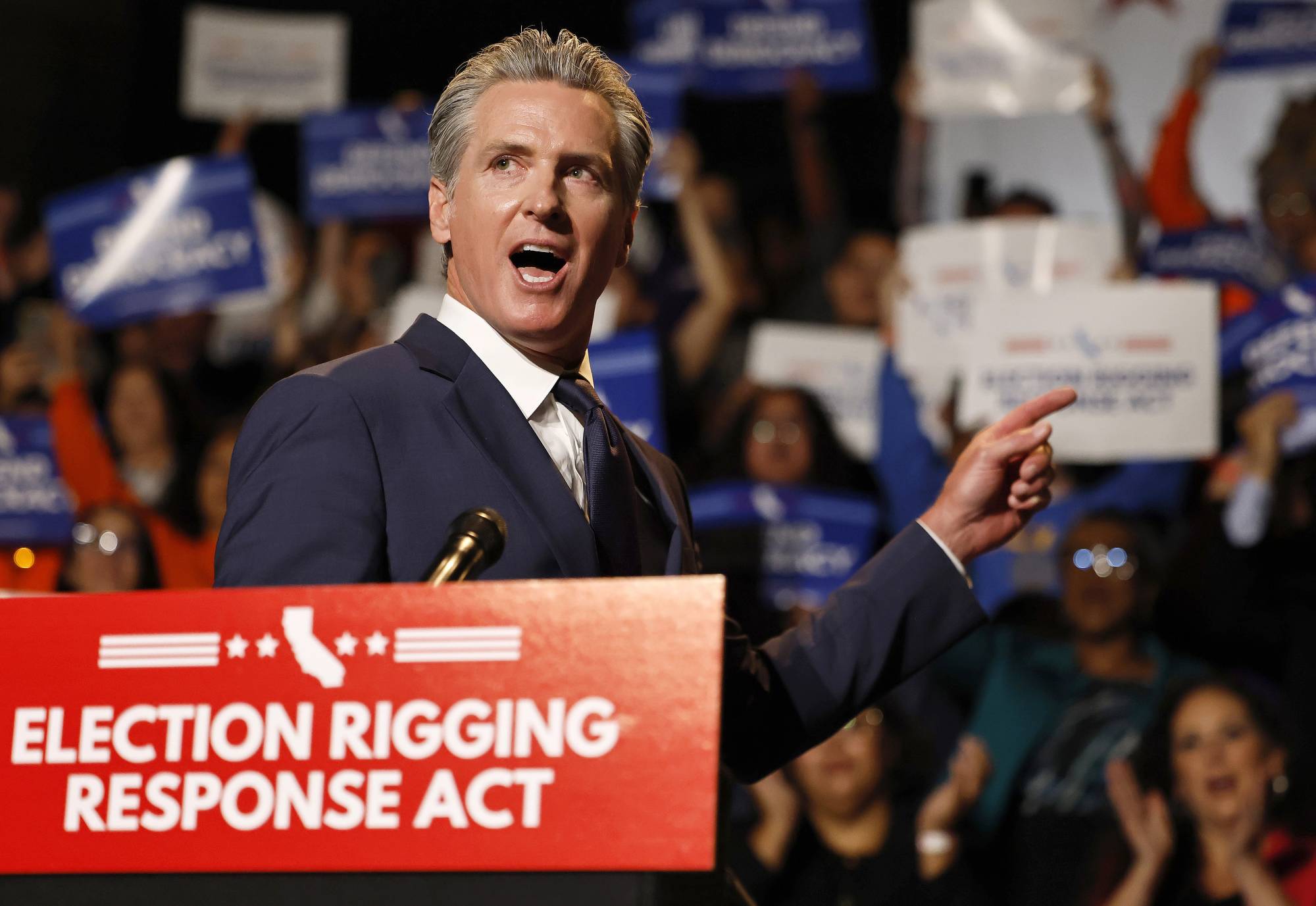
"caption": "LOS ANGELES, CALIFORNIA - AUGUST 14: California Gov. Gavin Newsom speaks about the “Election Rigging Response Act” at a press conference at the Democracy Center, Japanese American National Museum on August 14, 2025 in Los Angeles, California. Newsom spoke about a possible California referendum on redistricting to counter the legislative effort to add five Republican House seats in the state of Texas. ",
"credit": "Mario Tama/Getty Images",
"altTag": null,
"description": null,
"imgSizes": {
"medium": {
"file": "https://cdn.kqed.org/wp-content/uploads/sites/10/2025/08/GettyImages-2230198852-2000x1377.jpg",
"width": 2000,
"height": 1377,
"mimeType": "image/jpeg"
},
"large": {
"file": "https://cdn.kqed.org/wp-content/uploads/sites/10/2025/08/GettyImages-2230198852-2000x1377.jpg",
"width": 2000,
"height": 1377,
"mimeType": "image/jpeg"
},
"thumbnail": {
"file": "https://cdn.kqed.org/wp-content/uploads/sites/10/2025/08/GettyImages-2230198852-160x110.jpg",
"width": 160,
"height": 110,
"mimeType": "image/jpeg"
},
"1536x1536": {
"file": "https://cdn.kqed.org/wp-content/uploads/sites/10/2025/08/GettyImages-2230198852-1536x1057.jpg",
"width": 1536,
"height": 1057,
"mimeType": "image/jpeg"
},
"2048x2048": {
"file": "https://cdn.kqed.org/wp-content/uploads/sites/10/2025/08/GettyImages-2230198852-2048x1410.jpg",
"width": 2048,
"height": 1410,
"mimeType": "image/jpeg"
},
"post-thumbnail": {
"file": "https://cdn.kqed.org/wp-content/uploads/sites/10/2025/08/GettyImages-2230198852-672x372.jpg",
"width": 672,
"height": 372,
"mimeType": "image/jpeg"
},
"twentyfourteen-full-width": {
"file": "https://cdn.kqed.org/wp-content/uploads/sites/10/2025/08/GettyImages-2230198852-1038x576.jpg",
"width": 1038,
"height": 576,
"mimeType": "image/jpeg"
},
"full-width": {
"file": "https://cdn.kqed.org/wp-content/uploads/sites/10/2025/08/GettyImages-2230198852-2000x1377.jpg",
"width": 2000,
"height": 1377,
"mimeType": "image/jpeg"
},
"kqedFullSize": {
"file": "https://cdn.kqed.org/wp-content/uploads/sites/10/2025/08/GettyImages-2230198852-scaled.jpg",
"width": 2560,
"height": 1762
}
},
"isLoading": false,
"fetchFailed": false
},
"news_12050987": {
"type": "attachments",
"id": "news_12050987",
"meta": {
"index": "attachments_1716263798",
"site": "news",
"id": "12050987",
"found": true
},
"title": "Election 2026 California Redistricting",
"publishDate": 1754422424,
"status": "inherit",
"parent": 12050983,
"modified": 1754432188,
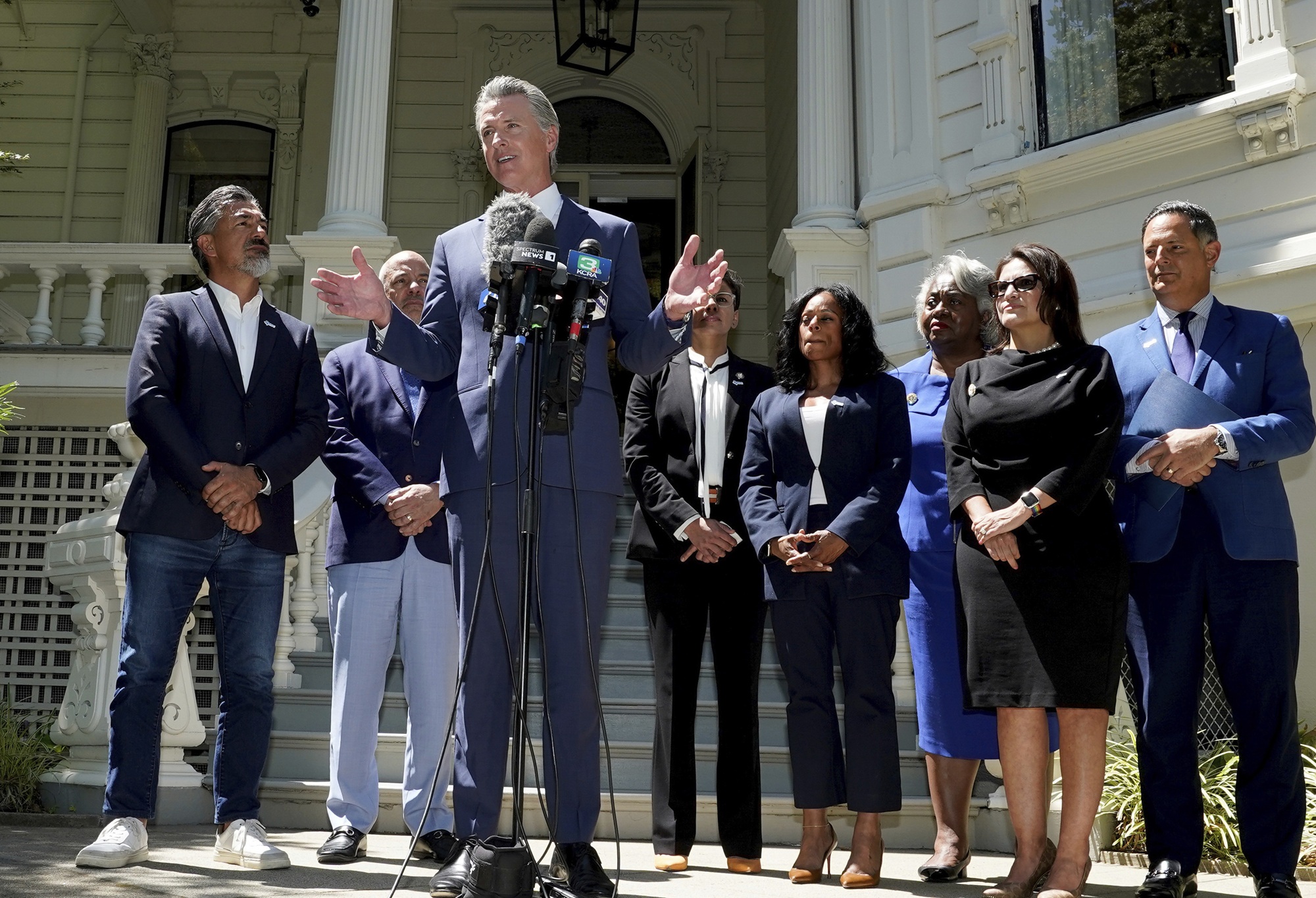
"caption": "California Gov. Gavin Newsom, accompanied by several members of the Texas state Legislature, calls for a new way for California to redraw its voting districts during a news conference in Sacramento, California, on Friday, July 25, 2025. ",
"credit": "Rich Pedroncelli/AP Photo",
"altTag": null,
"description": null,
"imgSizes": {
"thumbnail": {
"file": "https://cdn.kqed.org/wp-content/uploads/sites/10/2025/08/GavinNewsomSacramentoAug2025AP-160x109.jpg",
"width": 160,
"height": 109,
"mimeType": "image/jpeg"
},
"1536x1536": {
"file": "https://cdn.kqed.org/wp-content/uploads/sites/10/2025/08/GavinNewsomSacramentoAug2025AP-1536x1048.jpg",
"width": 1536,
"height": 1048,
"mimeType": "image/jpeg"
},
"post-thumbnail": {
"file": "https://cdn.kqed.org/wp-content/uploads/sites/10/2025/08/GavinNewsomSacramentoAug2025AP-672x372.jpg",
"width": 672,
"height": 372,
"mimeType": "image/jpeg"
},
"twentyfourteen-full-width": {
"file": "https://cdn.kqed.org/wp-content/uploads/sites/10/2025/08/GavinNewsomSacramentoAug2025AP-1038x576.jpg",
"width": 1038,
"height": 576,
"mimeType": "image/jpeg"
},
"kqedFullSize": {
"file": "https://cdn.kqed.org/wp-content/uploads/sites/10/2025/08/GavinNewsomSacramentoAug2025AP.jpg",
"width": 2000,
"height": 1364
}
},
"isLoading": false,
"fetchFailed": false
},
"news_12011901": {
"type": "attachments",
"id": "news_12011901",
"meta": {
"index": "attachments_1716263798",
"site": "news",
"id": "12011901",
"found": true
},
"title": "Early voting process ahead of presidential election in San Francisco",
"publishDate": 1730399191,
"status": "inherit",
"parent": 12011898,
"modified": 1730490547,
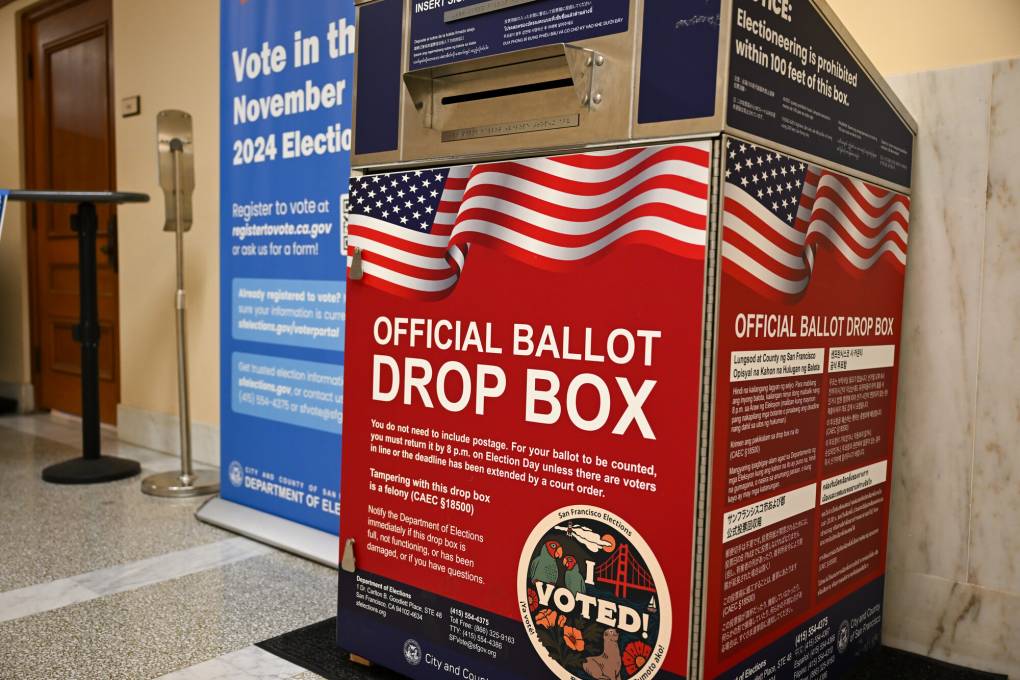
"caption": "A view of an official ballot drop box next to the Department of Elections at City Hall in San Francisco on Oct. 24, 2024. ",
"credit": "Tayfun Coskun/Anadolu via Getty Images",
"altTag": null,
"description": null,
"imgSizes": {
"medium": {
"file": "https://cdn.kqed.org/wp-content/uploads/sites/10/2025/10/GettyImages-2180061713_qed-800x533.jpg",
"width": 800,
"height": 533,
"mimeType": "image/jpeg"
},
"large": {
"file": "https://cdn.kqed.org/wp-content/uploads/sites/10/2025/10/GettyImages-2180061713_qed-1020x680.jpg",
"width": 1020,
"height": 680,
"mimeType": "image/jpeg"
},
"thumbnail": {
"file": "https://cdn.kqed.org/wp-content/uploads/sites/10/2025/10/GettyImages-2180061713_qed-160x107.jpg",
"width": 160,
"height": 107,
"mimeType": "image/jpeg"
},
"1536x1536": {
"file": "https://cdn.kqed.org/wp-content/uploads/sites/10/2025/10/GettyImages-2180061713_qed-1536x1024.jpg",
"width": 1536,
"height": 1024,
"mimeType": "image/jpeg"
},
"post-thumbnail": {
"file": "https://cdn.kqed.org/wp-content/uploads/sites/10/2025/10/GettyImages-2180061713_qed-672x372.jpg",
"width": 672,
"height": 372,
"mimeType": "image/jpeg"
},
"twentyfourteen-full-width": {
"file": "https://cdn.kqed.org/wp-content/uploads/sites/10/2025/10/GettyImages-2180061713_qed-1038x576.jpg",
"width": 1038,
"height": 576,
"mimeType": "image/jpeg"
},
"full-width": {
"file": "https://cdn.kqed.org/wp-content/uploads/sites/10/2025/10/GettyImages-2180061713_qed-1920x1280.jpg",
"width": 1920,
"height": 1280,
"mimeType": "image/jpeg"
},
"kqedFullSize": {
"file": "https://cdn.kqed.org/wp-content/uploads/sites/10/2025/10/GettyImages-2180061713_qed.jpg",
"width": 2000,
"height": 1333
}
},
"isLoading": false,
"fetchFailed": false
},
"news_12036681": {
"type": "attachments",
"id": "news_12036681",
"meta": {
"index": "attachments_1716263798",
"site": "news",
"id": "12036681",
"found": true
},
"title": "250408-SanJoseSpecialElection-24-BL_qed",
"publishDate": 1745008152,
"status": "inherit",
"parent": 12036612,
"modified": 1745008167,
"caption": "Anthony Tordillos, San José Council District 3 candidate, speaks with a supporter during an election night party in San José on April 8, 2025.",
"credit": "Beth LaBerge/KQED",
"altTag": null,
"description": null,
"imgSizes": {
"medium": {
"file": "https://cdn.kqed.org/wp-content/uploads/sites/10/2025/04/250408-SanJoseSpecialElection-24-BL_qed-800x533.jpg",
"width": 800,
"height": 533,
"mimeType": "image/jpeg"
},
"large": {
"file": "https://cdn.kqed.org/wp-content/uploads/sites/10/2025/04/250408-SanJoseSpecialElection-24-BL_qed-1020x680.jpg",
"width": 1020,
"height": 680,
"mimeType": "image/jpeg"
},
"thumbnail": {
"file": "https://cdn.kqed.org/wp-content/uploads/sites/10/2025/04/250408-SanJoseSpecialElection-24-BL_qed-160x107.jpg",
"width": 160,
"height": 107,
"mimeType": "image/jpeg"
},
"1536x1536": {
"file": "https://cdn.kqed.org/wp-content/uploads/sites/10/2025/04/250408-SanJoseSpecialElection-24-BL_qed-1536x1024.jpg",
"width": 1536,
"height": 1024,
"mimeType": "image/jpeg"
},
"post-thumbnail": {
"file": "https://cdn.kqed.org/wp-content/uploads/sites/10/2025/04/250408-SanJoseSpecialElection-24-BL_qed-672x372.jpg",
"width": 672,
"height": 372,
"mimeType": "image/jpeg"
},
"twentyfourteen-full-width": {
"file": "https://cdn.kqed.org/wp-content/uploads/sites/10/2025/04/250408-SanJoseSpecialElection-24-BL_qed-1038x576.jpg",
"width": 1038,
"height": 576,
"mimeType": "image/jpeg"
},
"full-width": {
"file": "https://cdn.kqed.org/wp-content/uploads/sites/10/2025/04/250408-SanJoseSpecialElection-24-BL_qed-1920x1280.jpg",
"width": 1920,
"height": 1280,
"mimeType": "image/jpeg"
},
"kqedFullSize": {
"file": "https://cdn.kqed.org/wp-content/uploads/sites/10/2025/04/250408-SanJoseSpecialElection-24-BL_qed.jpg",
"width": 2000,
"height": 1333
}
},
"isLoading": false,
"fetchFailed": false
},
"news_12035496": {
"type": "attachments",
"id": "news_12035496",
"meta": {
"index": "attachments_1716263798",
"site": "news",
"id": "12035496",
"found": true
},
"title": "npr.brightspotcdn copy",
"publishDate": 1744318400,
"status": "inherit",
"parent": 12035487,
"modified": 1754695655,
"caption": "Potential young voters get information at a voter registration desk at California State University, Los Angeles, on Oct. 22, 2024. ",
"credit": "Frederic J. Brown/AFP via Getty Images",
"altTag": null,
"description": null,
"imgSizes": {
"medium": {
"file": "https://cdn.kqed.org/wp-content/uploads/sites/10/2025/04/npr.brightspotcdn-copy-12-800x510.jpg",
"width": 800,
"height": 510,
"mimeType": "image/jpeg"
},
"large": {
"file": "https://cdn.kqed.org/wp-content/uploads/sites/10/2025/04/npr.brightspotcdn-copy-12-1020x650.jpg",
"width": 1020,
"height": 650,
"mimeType": "image/jpeg"
},
"thumbnail": {
"file": "https://cdn.kqed.org/wp-content/uploads/sites/10/2025/04/npr.brightspotcdn-copy-12-160x102.jpg",
"width": 160,
"height": 102,
"mimeType": "image/jpeg"
},
"1536x1536": {
"file": "https://cdn.kqed.org/wp-content/uploads/sites/10/2025/04/npr.brightspotcdn-copy-12-1536x979.jpg",
"width": 1536,
"height": 979,
"mimeType": "image/jpeg"
},
"post-thumbnail": {
"file": "https://cdn.kqed.org/wp-content/uploads/sites/10/2025/04/npr.brightspotcdn-copy-12-672x372.jpg",
"width": 672,
"height": 372,
"mimeType": "image/jpeg"
},
"twentyfourteen-full-width": {
"file": "https://cdn.kqed.org/wp-content/uploads/sites/10/2025/04/npr.brightspotcdn-copy-12-1038x576.jpg",
"width": 1038,
"height": 576,
"mimeType": "image/jpeg"
},
"kqedFullSize": {
"file": "https://cdn.kqed.org/wp-content/uploads/sites/10/2025/04/npr.brightspotcdn-copy-12.jpg",
"width": 1600,
"height": 1020
}
},
"isLoading": false,
"fetchFailed": false
},
"news_12035097": {
"type": "attachments",
"id": "news_12035097",
"meta": {
"index": "attachments_1716263798",
"site": "news",
"id": "12035097",
"found": true
},
"title": "250408-SanJoseSpecialElection-15-BL",
"publishDate": 1744170442,
"status": "inherit",
"parent": 0,
"modified": 1744174110,
"caption": "Gabby Chavez-Lopez, San José Council District 3 candidate, cheers alongside supporters as the first results come in during an election night party in San José on April 8, 2025.",
"credit": "Beth LaBerge/KQED",
"altTag": null,
"description": null,
"imgSizes": {
"medium": {
"file": "https://cdn.kqed.org/wp-content/uploads/sites/10/2025/04/250408-SanJoseSpecialElection-15-BL-800x533.jpg",
"width": 800,
"height": 533,
"mimeType": "image/jpeg"
},
"large": {
"file": "https://cdn.kqed.org/wp-content/uploads/sites/10/2025/04/250408-SanJoseSpecialElection-15-BL-1020x680.jpg",
"width": 1020,
"height": 680,
"mimeType": "image/jpeg"
},
"thumbnail": {
"file": "https://cdn.kqed.org/wp-content/uploads/sites/10/2025/04/250408-SanJoseSpecialElection-15-BL-160x107.jpg",
"width": 160,
"height": 107,
"mimeType": "image/jpeg"
},
"1536x1536": {
"file": "https://cdn.kqed.org/wp-content/uploads/sites/10/2025/04/250408-SanJoseSpecialElection-15-BL-1536x1024.jpg",
"width": 1536,
"height": 1024,
"mimeType": "image/jpeg"
},
"post-thumbnail": {
"file": "https://cdn.kqed.org/wp-content/uploads/sites/10/2025/04/250408-SanJoseSpecialElection-15-BL-672x372.jpg",
"width": 672,
"height": 372,
"mimeType": "image/jpeg"
},
"twentyfourteen-full-width": {
"file": "https://cdn.kqed.org/wp-content/uploads/sites/10/2025/04/250408-SanJoseSpecialElection-15-BL-1038x576.jpg",
"width": 1038,
"height": 576,
"mimeType": "image/jpeg"
},
"full-width": {
"file": "https://cdn.kqed.org/wp-content/uploads/sites/10/2025/04/250408-SanJoseSpecialElection-15-BL-1920x1280.jpg",
"width": 1920,
"height": 1280,
"mimeType": "image/jpeg"
},
"kqedFullSize": {
"file": "https://cdn.kqed.org/wp-content/uploads/sites/10/2025/04/250408-SanJoseSpecialElection-15-BL.jpg",
"width": 2000,
"height": 1333
}
},
"isLoading": false,
"fetchFailed": false
},
"news_12034232": {
"type": "attachments",
"id": "news_12034232",
"meta": {
"index": "attachments_1716263798",
"site": "news",
"id": "12034232",
"found": true
},
"title": "npr.brightspotcdn copy",
"publishDate": 1743616975,
"status": "inherit",
"parent": 12034230,
"modified": 1743616992,
"caption": "Elon Musk, chief executive officer of Tesla Inc., wears a cheese head hat while arriving for an America PAC town hall ahead of the Wisconsin Supreme Court election at the KI Convention Center in Green Bay, Wisc., on March 30.",
"credit": "Jamie Kelter Davis/Bloomberg via Getty Images",
"altTag": null,
"description": null,
"imgSizes": {
"medium": {
"file": "https://cdn.kqed.org/wp-content/uploads/sites/10/2025/04/npr.brightspotcdn-copy-3-800x534.jpg",
"width": 800,
"height": 534,
"mimeType": "image/jpeg"
},
"large": {
"file": "https://cdn.kqed.org/wp-content/uploads/sites/10/2025/04/npr.brightspotcdn-copy-3-1020x680.jpg",
"width": 1020,
"height": 680,
"mimeType": "image/jpeg"
},
"thumbnail": {
"file": "https://cdn.kqed.org/wp-content/uploads/sites/10/2025/04/npr.brightspotcdn-copy-3-160x107.jpg",
"width": 160,
"height": 107,
"mimeType": "image/jpeg"
},
"1536x1536": {
"file": "https://cdn.kqed.org/wp-content/uploads/sites/10/2025/04/npr.brightspotcdn-copy-3-1536x1024.jpg",
"width": 1536,
"height": 1024,
"mimeType": "image/jpeg"
},
"post-thumbnail": {
"file": "https://cdn.kqed.org/wp-content/uploads/sites/10/2025/04/npr.brightspotcdn-copy-3-672x372.jpg",
"width": 672,
"height": 372,
"mimeType": "image/jpeg"
},
"twentyfourteen-full-width": {
"file": "https://cdn.kqed.org/wp-content/uploads/sites/10/2025/04/npr.brightspotcdn-copy-3-1038x576.jpg",
"width": 1038,
"height": 576,
"mimeType": "image/jpeg"
},
"kqedFullSize": {
"file": "https://cdn.kqed.org/wp-content/uploads/sites/10/2025/04/npr.brightspotcdn-copy-3.jpg",
"width": 1600,
"height": 1067
}
},
"isLoading": false,
"fetchFailed": false
},
"news_12011334": {
"type": "attachments",
"id": "news_12011334",
"meta": {
"index": "attachments_1716263798",
"site": "news",
"id": "12011334",
"found": true
},
"title": "241023-POLLWORKERS-11-BL-KQED",
"publishDate": 1730135038,
"status": "inherit",
"parent": 0,
"modified": 1730486309,
"caption": "Election trainees Ken Einstein (left) and Chihying Wu practice setting up voting machines at the San Mateo County voter registration office on Oct. 23, 2024.",
"credit": "Beth LaBerge/KQED",
"altTag": null,
"description": null,
"imgSizes": {
"medium": {
"file": "https://cdn.kqed.org/wp-content/uploads/sites/10/2024/10/241023-POLLWORKERS-11-BL-KQED-800x533.jpg",
"width": 800,
"height": 533,
"mimeType": "image/jpeg"
},
"large": {
"file": "https://cdn.kqed.org/wp-content/uploads/sites/10/2024/10/241023-POLLWORKERS-11-BL-KQED-1020x680.jpg",
"width": 1020,
"height": 680,
"mimeType": "image/jpeg"
},
"thumbnail": {
"file": "https://cdn.kqed.org/wp-content/uploads/sites/10/2024/10/241023-POLLWORKERS-11-BL-KQED-160x107.jpg",
"width": 160,
"height": 107,
"mimeType": "image/jpeg"
},
"1536x1536": {
"file": "https://cdn.kqed.org/wp-content/uploads/sites/10/2024/10/241023-POLLWORKERS-11-BL-KQED-1536x1024.jpg",
"width": 1536,
"height": 1024,
"mimeType": "image/jpeg"
},
"post-thumbnail": {
"file": "https://cdn.kqed.org/wp-content/uploads/sites/10/2024/10/241023-POLLWORKERS-11-BL-KQED-672x372.jpg",
"width": 672,
"height": 372,
"mimeType": "image/jpeg"
},
"twentyfourteen-full-width": {
"file": "https://cdn.kqed.org/wp-content/uploads/sites/10/2024/10/241023-POLLWORKERS-11-BL-KQED-1038x576.jpg",
"width": 1038,
"height": 576,
"mimeType": "image/jpeg"
},
"full-width": {
"file": "https://cdn.kqed.org/wp-content/uploads/sites/10/2024/10/241023-POLLWORKERS-11-BL-KQED-1920x1280.jpg",
"width": 1920,
"height": 1280,
"mimeType": "image/jpeg"
},
"kqedFullSize": {
"file": "https://cdn.kqed.org/wp-content/uploads/sites/10/2024/10/241023-POLLWORKERS-11-BL-KQED.jpg",
"width": 2000,
"height": 1333
}
},
"isLoading": false,
"fetchFailed": false
},
"news_12033074": {
"type": "attachments",
"id": "news_12033074",
"meta": {
"index": "attachments_1716263798",
"site": "news",
"id": "12033074",
"found": true
},
"title": "sonoma farms",
"publishDate": 1742997281,
"status": "inherit",
"parent": 12033073,
"modified": 1742997330,
"caption": "Erin Roscoe and Brennan Murphy's flock of sheep at Fox Sparrow Farm.",
"credit": "Noah Abrams/KRCB",
"altTag": null,
"description": null,
"imgSizes": {
"thumbnail": {
"file": "https://cdn.kqed.org/wp-content/uploads/sites/10/2025/03/sonoma-farms-160x219.jpg",
"width": 160,
"height": 219,
"mimeType": "image/jpeg"
},
"post-thumbnail": {
"file": "https://cdn.kqed.org/wp-content/uploads/sites/10/2025/03/sonoma-farms-616x372.jpg",
"width": 616,
"height": 372,
"mimeType": "image/jpeg"
},
"twentyfourteen-full-width": {
"file": "https://cdn.kqed.org/wp-content/uploads/sites/10/2025/03/sonoma-farms-616x576.jpg",
"width": 616,
"height": 576,
"mimeType": "image/jpeg"
},
"kqedFullSize": {
"file": "https://cdn.kqed.org/wp-content/uploads/sites/10/2025/03/sonoma-farms.jpg",
"width": 616,
"height": 843
}
},
"isLoading": false,
"fetchFailed": false
},
"news_12031710": {
"type": "attachments",
"id": "news_12031710",
"meta": {
"index": "attachments_1716263798",
"site": "news",
"id": "12031710",
"found": true
},
"title": "20250315_OAKLAND-MAYOR_DB_00039-KQED",
"publishDate": 1742253272,
"status": "inherit",
"parent": 12032042,
"modified": 1742421499,
"caption": "Members of the public attend a forum for Oakland Mayoral Candidates organized by the League of Women Voters of Oakland at Oakland City Hall on March 15, 2025.",
"credit": "David M. Barreda/KQED",
"altTag": null,
"description": null,
"imgSizes": {
"medium": {
"file": "https://cdn.kqed.org/wp-content/uploads/sites/10/2025/03/20250315_OAKLAND-MAYOR_DB_00039-KQED-800x534.jpg",
"width": 800,
"height": 534,
"mimeType": "image/jpeg"
},
"large": {
"file": "https://cdn.kqed.org/wp-content/uploads/sites/10/2025/03/20250315_OAKLAND-MAYOR_DB_00039-KQED-1020x680.jpg",
"width": 1020,
"height": 680,
"mimeType": "image/jpeg"
},
"thumbnail": {
"file": "https://cdn.kqed.org/wp-content/uploads/sites/10/2025/03/20250315_OAKLAND-MAYOR_DB_00039-KQED-160x107.jpg",
"width": 160,
"height": 107,
"mimeType": "image/jpeg"
},
"1536x1536": {
"file": "https://cdn.kqed.org/wp-content/uploads/sites/10/2025/03/20250315_OAKLAND-MAYOR_DB_00039-KQED-1536x1025.jpg",
"width": 1536,
"height": 1025,
"mimeType": "image/jpeg"
},
"post-thumbnail": {
"file": "https://cdn.kqed.org/wp-content/uploads/sites/10/2025/03/20250315_OAKLAND-MAYOR_DB_00039-KQED-672x372.jpg",
"width": 672,
"height": 372,
"mimeType": "image/jpeg"
},
"twentyfourteen-full-width": {
"file": "https://cdn.kqed.org/wp-content/uploads/sites/10/2025/03/20250315_OAKLAND-MAYOR_DB_00039-KQED-1038x576.jpg",
"width": 1038,
"height": 576,
"mimeType": "image/jpeg"
},
"full-width": {
"file": "https://cdn.kqed.org/wp-content/uploads/sites/10/2025/03/20250315_OAKLAND-MAYOR_DB_00039-KQED-1920x1281.jpg",
"width": 1920,
"height": 1281,
"mimeType": "image/jpeg"
},
"kqedFullSize": {
"file": "https://cdn.kqed.org/wp-content/uploads/sites/10/2025/03/20250315_OAKLAND-MAYOR_DB_00039-KQED.jpg",
"width": 2000,
"height": 1334
}
},
"isLoading": false,
"fetchFailed": false
},
"news_12030425": {
"type": "attachments",
"id": "news_12030425",
"meta": {
"index": "attachments_1716263798",
"site": "news",
"id": "12030425",
"found": true
},
"title": "20250306_SANJOSEDISTRICT3_GC-1-KQED-1",
"publishDate": 1741388508,
"status": "inherit",
"parent": 0,
"modified": 1742315789,
"caption": "From left, candidates running for District 3 City Council, Gabby Chavez-Lopez, Philip Dolan, Adam Duran, Irene Smith, Anthony Tordillos and Matthew Quevedo speak at a candidates forum at the San José Women’s Club in San José on March 6, 2025.",
"credit": "Gina Castro/KQED",
"altTag": null,
"description": null,
"imgSizes": {
"medium": {
"file": "https://cdn.kqed.org/wp-content/uploads/sites/10/2025/03/20250306_SANJOSEDISTRICT3_GC-1-KQED-1-800x533.jpg",
"width": 800,
"height": 533,
"mimeType": "image/jpeg"
},
"large": {
"file": "https://cdn.kqed.org/wp-content/uploads/sites/10/2025/03/20250306_SANJOSEDISTRICT3_GC-1-KQED-1-1020x680.jpg",
"width": 1020,
"height": 680,
"mimeType": "image/jpeg"
},
"thumbnail": {
"file": "https://cdn.kqed.org/wp-content/uploads/sites/10/2025/03/20250306_SANJOSEDISTRICT3_GC-1-KQED-1-160x107.jpg",
"width": 160,
"height": 107,
"mimeType": "image/jpeg"
},
"1536x1536": {
"file": "https://cdn.kqed.org/wp-content/uploads/sites/10/2025/03/20250306_SANJOSEDISTRICT3_GC-1-KQED-1-1536x1024.jpg",
"width": 1536,
"height": 1024,
"mimeType": "image/jpeg"
},
"post-thumbnail": {
"file": "https://cdn.kqed.org/wp-content/uploads/sites/10/2025/03/20250306_SANJOSEDISTRICT3_GC-1-KQED-1-672x372.jpg",
"width": 672,
"height": 372,
"mimeType": "image/jpeg"
},
"twentyfourteen-full-width": {
"file": "https://cdn.kqed.org/wp-content/uploads/sites/10/2025/03/20250306_SANJOSEDISTRICT3_GC-1-KQED-1-1038x576.jpg",
"width": 1038,
"height": 576,
"mimeType": "image/jpeg"
},
"full-width": {
"file": "https://cdn.kqed.org/wp-content/uploads/sites/10/2025/03/20250306_SANJOSEDISTRICT3_GC-1-KQED-1-1920x1280.jpg",
"width": 1920,
"height": 1280,
"mimeType": "image/jpeg"
},
"kqedFullSize": {
"file": "https://cdn.kqed.org/wp-content/uploads/sites/10/2025/03/20250306_SANJOSEDISTRICT3_GC-1-KQED-1.jpg",
"width": 2000,
"height": 1333
}
},
"isLoading": false,
"fetchFailed": false
},
"news_12015432": {
"type": "attachments",
"id": "news_12015432",
"meta": {
"index": "attachments_1716263798",
"site": "news",
"id": "12015432",
"found": true
},
"title": "241121-LondonBreedExitInterview-16-BL",
"publishDate": 1732231775,
"status": "inherit",
"parent": 0,
"modified": 1732231951,
"caption": "Mayor London Breed speaks with KQED politics reporters Marisa Lagos and Scott Shafer for Political Breakdown at the KQED offices in San Francisco on Nov. 21, 2024.",
"credit": "Beth LaBerge/KQED",
"altTag": null,
"description": null,
"imgSizes": {
"medium": {
"file": "https://cdn.kqed.org/wp-content/uploads/sites/10/2024/11/241121-LondonBreedExitInterview-16-BL-800x533.jpg",
"width": 800,
"height": 533,
"mimeType": "image/jpeg"
},
"large": {
"file": "https://cdn.kqed.org/wp-content/uploads/sites/10/2024/11/241121-LondonBreedExitInterview-16-BL-1020x679.jpg",
"width": 1020,
"height": 679,
"mimeType": "image/jpeg"
},
"thumbnail": {
"file": "https://cdn.kqed.org/wp-content/uploads/sites/10/2024/11/241121-LondonBreedExitInterview-16-BL-160x107.jpg",
"width": 160,
"height": 107,
"mimeType": "image/jpeg"
},
"1536x1536": {
"file": "https://cdn.kqed.org/wp-content/uploads/sites/10/2024/11/241121-LondonBreedExitInterview-16-BL-1536x1023.jpg",
"width": 1536,
"height": 1023,
"mimeType": "image/jpeg"
},
"post-thumbnail": {
"file": "https://cdn.kqed.org/wp-content/uploads/sites/10/2024/11/241121-LondonBreedExitInterview-16-BL-672x372.jpg",
"width": 672,
"height": 372,
"mimeType": "image/jpeg"
},
"twentyfourteen-full-width": {
"file": "https://cdn.kqed.org/wp-content/uploads/sites/10/2024/11/241121-LondonBreedExitInterview-16-BL-1038x576.jpg",
"width": 1038,
"height": 576,
"mimeType": "image/jpeg"
},
"full-width": {
"file": "https://cdn.kqed.org/wp-content/uploads/sites/10/2024/11/241121-LondonBreedExitInterview-16-BL-1920x1279.jpg",
"width": 1920,
"height": 1279,
"mimeType": "image/jpeg"
},
"kqedFullSize": {
"file": "https://cdn.kqed.org/wp-content/uploads/sites/10/2024/11/241121-LondonBreedExitInterview-16-BL.jpg",
"width": 2000,
"height": 1332
}
},
"isLoading": false,
"fetchFailed": false
}
},
"audioPlayerReducer": {
"postId": "stream_live",
"isPaused": true,
"isPlaying": false,
"pfsActive": false,
"pledgeModalIsOpen": true,
"playerDrawerIsOpen": false,
"liveAudioPlayStartedAt": 0,
"liveAudioPlayContext": ""
},
"authorsReducer": {
"byline_news_12035487": {
"type": "authors",
"id": "byline_news_12035487",
"meta": {
"override": true
},
"slug": "byline_news_12035487",
"name": "\u003ca href=\"https://www.npr.org/people/1244911175/jude-joffe-block\">Jude Joffe-Block, NPR",
"isLoading": false
},
"byline_news_12034230": {
"type": "authors",
"id": "byline_news_12034230",
"meta": {
"override": true
},
"slug": "byline_news_12034230",
"name": "\u003ca href=\"https://www.npr.org/people/392602474/domenico-montanaro\">Domenico Montanaro\u003c/a>, NPR",
"isLoading": false
},
"byline_news_12033731": {
"type": "authors",
"id": "byline_news_12033731",
"meta": {
"override": true
},
"slug": "byline_news_12033731",
"name": "Christina A. Cassidy, Associated Press",
"isLoading": false
},
"gmarzorati": {
"type": "authors",
"id": "227",
"meta": {
"index": "authors_1716337520",
"id": "227",
"found": true
},
"name": "Guy Marzorati",
"firstName": "Guy",
"lastName": "Marzorati",
"slug": "gmarzorati",
"email": "gmarzorati@KQED.org",
"display_author_email": true,
"staff_mastheads": [
"news"
],
"title": "Correspondent",
"bio": "Guy Marzorati is a correspondent on KQED's California Politics and Government Desk, based in San Jose. A graduate of Santa Clara University, Guy joined KQED in 2013. He reports on state and local politics and produces KQED's digital voter guide.",
"avatar": "https://secure.gravatar.com/avatar/771cddf45ce3a8ed533d82dcc214e9ef925d76d2af5794a33da1ce439eb54a32?s=600&d=blank&r=g",
"twitter": "guymarzorati",
"bluesky": null,
"facebook": null,
"instagram": null,
"linkedin": null,
"sites": [
{
"site": "",
"roles": [
"editor"
]
},
{
"site": "news",
"roles": [
"editor"
]
},
{
"site": "science",
"roles": [
"editor"
]
},
{
"site": "forum",
"roles": [
"editor"
]
},
{
"site": "elections",
"roles": [
"editor"
]
},
{
"site": "liveblog",
"roles": [
"editor"
]
}
],
"headData": {
"title": "Guy Marzorati | KQED",
"description": "Correspondent",
"ogImgSrc": "https://secure.gravatar.com/avatar/771cddf45ce3a8ed533d82dcc214e9ef925d76d2af5794a33da1ce439eb54a32?s=600&d=blank&r=g",
"twImgSrc": "https://secure.gravatar.com/avatar/771cddf45ce3a8ed533d82dcc214e9ef925d76d2af5794a33da1ce439eb54a32?s=600&d=blank&r=g"
},
"isLoading": false,
"link": "/author/gmarzorati"
},
"ecruzguevarra": {
"type": "authors",
"id": "8654",
"meta": {
"index": "authors_1716337520",
"id": "8654",
"found": true
},
"name": "Ericka Cruz Guevarra",
"firstName": "Ericka",
"lastName": "Cruz Guevarra",
"slug": "ecruzguevarra",
"email": "ecruzguevarra@kqed.org",
"display_author_email": true,
"staff_mastheads": [
"news"
],
"title": "Producer, The Bay Podcast",
"bio": "Ericka Cruz Guevarra is host of \u003ca href=\"https://www.kqed.org/podcasts/thebay\">\u003cem>The Bay\u003c/em>\u003c/a> podcast at KQED. Before host, she was the show’s producer. Her work in that capacity includes a three-part reported series on policing in Vallejo, which won a 2020 excellence in journalism award from the Society of Professional Journalists. Ericka has worked as a breaking news reporter at Oregon Public Broadcasting, helped produce the Code Switch podcast, and was KQED’s inaugural Raul Ramirez Diversity Fund intern. She’s also an alumna of NPR’s Next Generation Radio program. Send her an email if you have strong feelings about whether Fairfield and Suisun City are the Bay. Ericka is represented by SAG-AFTRA.",
"avatar": "https://secure.gravatar.com/avatar/accefc1de4bafc7e234b69bcb9b6f6536c130fd84709bc3069ef11a78787e1bb?s=600&d=blank&r=g",
"twitter": "NotoriousECG",
"bluesky": null,
"facebook": null,
"instagram": null,
"linkedin": null,
"sites": [
{
"site": "arts",
"roles": [
"subscriber"
]
},
{
"site": "news",
"roles": [
"editor",
"manage_categories"
]
},
{
"site": "futureofyou",
"roles": [
"subscriber"
]
},
{
"site": "stateofhealth",
"roles": [
"subscriber"
]
},
{
"site": "science",
"roles": [
"editor"
]
},
{
"site": "forum",
"roles": [
"subscriber"
]
}
],
"headData": {
"title": "Ericka Cruz Guevarra | KQED",
"description": "Producer, The Bay Podcast",
"ogImgSrc": "https://secure.gravatar.com/avatar/accefc1de4bafc7e234b69bcb9b6f6536c130fd84709bc3069ef11a78787e1bb?s=600&d=blank&r=g",
"twImgSrc": "https://secure.gravatar.com/avatar/accefc1de4bafc7e234b69bcb9b6f6536c130fd84709bc3069ef11a78787e1bb?s=600&d=blank&r=g"
},
"isLoading": false,
"link": "/author/ecruzguevarra"
},
"ahall": {
"type": "authors",
"id": "11490",
"meta": {
"index": "authors_1716337520",
"id": "11490",
"found": true
},
"name": "Alex Hall",
"firstName": "Alex",
"lastName": "Hall",
"slug": "ahall",
"email": "ahall@kqed.org",
"display_author_email": false,
"staff_mastheads": [
"news"
],
"title": "KQED Enterprise & Accountability Reporter",
"bio": "Alex Hall is KQED's Enterprise and Accountability Reporter. She previously covered the Central Valley for five years from KQED's bureau in Fresno. Before joining KQED, Alex was an investigative reporting fellow at Wisconsin Public Radio and the Wisconsin Center for Investigative Journalism. She has also worked as a bilingual producer for NPR's investigative unit and freelance video producer for Reuters TV on the Latin America desk. She got her start in journalism in South America, where she worked as a radio producer and Spanish-English translator for CNN Chile. Her documentary and investigation into the series of deadly COVID-19 outbreaks at Foster Farms won a national Edward R. Murrow award and was named an Investigative Reporters & Editors award finalist. Alex's reporting for Reveal on the Wisconsin dairy industry's reliance on undocumented immigrant labor was made into a film, Los Lecheros, which won a regional Edward R. Murrow award for best news documentary.",
"avatar": "https://secure.gravatar.com/avatar/04c28ad4a7caa7ac2ef39c655c4030c993a3f331481d1da4799bb76ea85b9afa?s=600&d=blank&r=g",
"twitter": "@chalexhall",
"bluesky": null,
"facebook": null,
"instagram": null,
"linkedin": null,
"sites": [
{
"site": "news",
"roles": [
"editor"
]
},
{
"site": "liveblog",
"roles": [
"author"
]
}
],
"headData": {
"title": "Alex Hall | KQED",
"description": "KQED Enterprise & Accountability Reporter",
"ogImgSrc": "https://secure.gravatar.com/avatar/04c28ad4a7caa7ac2ef39c655c4030c993a3f331481d1da4799bb76ea85b9afa?s=600&d=blank&r=g",
"twImgSrc": "https://secure.gravatar.com/avatar/04c28ad4a7caa7ac2ef39c655c4030c993a3f331481d1da4799bb76ea85b9afa?s=600&d=blank&r=g"
},
"isLoading": false,
"link": "/author/ahall"
},
"amontecillo": {
"type": "authors",
"id": "11649",
"meta": {
"index": "authors_1716337520",
"id": "11649",
"found": true
},
"name": "Alan Montecillo",
"firstName": "Alan",
"lastName": "Montecillo",
"slug": "amontecillo",
"email": "amontecillo@kqed.org",
"display_author_email": false,
"staff_mastheads": [
"news"
],
"title": "KQED Contributor",
"bio": "Alan Montecillo is the senior editor of \u003cem>\u003ca href=\"http://kqed.org/thebay\">The Bay\u003c/a>, \u003c/em> KQED's local news podcast. Before moving to the Bay Area, he worked as a senior talk show producer for WILL in Champaign-Urbana, Illinois and at Oregon Public Broadcasting in Portland, Oregon. He has won journalism awards from the Society of Professional Journalists Northern California, the Public Media Journalists Association, The Signal Awards, and has also received a regional Edward R. Murrow award. Alan is a Filipino American from Hong Kong and a graduate of Reed College.",
"avatar": "https://secure.gravatar.com/avatar/268f53a2066899ea9efdd8a5900218b17c822d9862cbc9326cccec53ef41d349?s=600&d=blank&r=g",
"twitter": "alanmontecillo",
"bluesky": null,
"facebook": null,
"instagram": null,
"linkedin": null,
"sites": [
{
"site": "",
"roles": [
"editor"
]
},
{
"site": "news",
"roles": [
"editor",
"manage_categories"
]
}
],
"headData": {
"title": "Alan Montecillo | KQED",
"description": "KQED Contributor",
"ogImgSrc": "https://secure.gravatar.com/avatar/268f53a2066899ea9efdd8a5900218b17c822d9862cbc9326cccec53ef41d349?s=600&d=blank&r=g",
"twImgSrc": "https://secure.gravatar.com/avatar/268f53a2066899ea9efdd8a5900218b17c822d9862cbc9326cccec53ef41d349?s=600&d=blank&r=g"
},
"isLoading": false,
"link": "/author/amontecillo"
},
"agonzalez": {
"type": "authors",
"id": "11724",
"meta": {
"index": "authors_1716337520",
"id": "11724",
"found": true
},
"name": "Alexander Gonzalez",
"firstName": "Alexander",
"lastName": "Gonzalez",
"slug": "agonzalez",
"email": "AlexanderGonzalez@KQED.org",
"display_author_email": false,
"staff_mastheads": [
"news"
],
"title": "KQED Contributor",
"bio": null,
"avatar": "https://secure.gravatar.com/avatar/9e291ed34e154df4c662edf858b641d70b4859939bfe40be478408f9dfd057d2?s=600&d=blank&r=g",
"twitter": null,
"bluesky": null,
"facebook": null,
"instagram": null,
"linkedin": null,
"sites": [
{
"site": "arts",
"roles": [
"editor"
]
},
{
"site": "news",
"roles": [
"editor"
]
},
{
"site": "science",
"roles": [
"editor"
]
}
],
"headData": {
"title": "Alexander Gonzalez | KQED",
"description": "KQED Contributor",
"ogImgSrc": "https://secure.gravatar.com/avatar/9e291ed34e154df4c662edf858b641d70b4859939bfe40be478408f9dfd057d2?s=600&d=blank&r=g",
"twImgSrc": "https://secure.gravatar.com/avatar/9e291ed34e154df4c662edf858b641d70b4859939bfe40be478408f9dfd057d2?s=600&d=blank&r=g"
},
"isLoading": false,
"link": "/author/agonzalez"
},
"kmizuguchi": {
"type": "authors",
"id": "11739",
"meta": {
"index": "authors_1716337520",
"id": "11739",
"found": true
},
"name": "Keith Mizuguchi",
"firstName": "Keith",
"lastName": "Mizuguchi",
"slug": "kmizuguchi",
"email": "kmizuguchi@kqed.org",
"display_author_email": false,
"staff_mastheads": [],
"title": "KQED Contributor",
"bio": null,
"avatar": "https://secure.gravatar.com/avatar/64d8a7de0723d4099b9fe4e915136103febcc20809abce228ee4415bcb237023?s=600&d=blank&r=g",
"twitter": null,
"bluesky": null,
"facebook": null,
"instagram": null,
"linkedin": null,
"sites": [
{
"site": "news",
"roles": [
"editor"
]
},
{
"site": "science",
"roles": [
"editor"
]
}
],
"headData": {
"title": "Keith Mizuguchi | KQED",
"description": "KQED Contributor",
"ogImgSrc": "https://secure.gravatar.com/avatar/64d8a7de0723d4099b9fe4e915136103febcc20809abce228ee4415bcb237023?s=600&d=blank&r=g",
"twImgSrc": "https://secure.gravatar.com/avatar/64d8a7de0723d4099b9fe4e915136103febcc20809abce228ee4415bcb237023?s=600&d=blank&r=g"
},
"isLoading": false,
"link": "/author/kmizuguchi"
},
"jessicakariisa": {
"type": "authors",
"id": "11831",
"meta": {
"index": "authors_1716337520",
"id": "11831",
"found": true
},
"name": "Jessica Kariisa",
"firstName": "Jessica",
"lastName": "Kariisa",
"slug": "jessicakariisa",
"email": "jkariisa@kqed.org",
"display_author_email": false,
"staff_mastheads": [],
"title": "Producer, The Bay",
"bio": "Jessica Kariisa is the producer of The Bay. She first joined KQED as an intern for The California Report Magazine, after which she became an on-call producer. She reported a Bay Curious episode on the use of rap lyrics in criminal trials which won a Society of Professional Journalists award in 2023 for Excellence in Features Journalism and the 2023 Signal Award for Best Conversation Starter. She’s worked on podcasts for Snap Judgment and American Public Media. Before embarking on her audio career, she was a music journalist.\r\n\r\nJessica Kariisa is represented by SAG-AFTRA.",
"avatar": "https://secure.gravatar.com/avatar/522e97b28ac0b3d411621c0fde8f3419c7b71ea2c5c262c57c4bb600963f328c?s=600&d=blank&r=g",
"twitter": null,
"bluesky": null,
"facebook": null,
"instagram": null,
"linkedin": null,
"sites": [
{
"site": "arts",
"roles": [
"author"
]
},
{
"site": "news",
"roles": [
"editor",
"manage_categories"
]
}
],
"headData": {
"title": "Jessica Kariisa | KQED",
"description": "Producer, The Bay",
"ogImgSrc": "https://secure.gravatar.com/avatar/522e97b28ac0b3d411621c0fde8f3419c7b71ea2c5c262c57c4bb600963f328c?s=600&d=blank&r=g",
"twImgSrc": "https://secure.gravatar.com/avatar/522e97b28ac0b3d411621c0fde8f3419c7b71ea2c5c262c57c4bb600963f328c?s=600&d=blank&r=g"
},
"isLoading": false,
"link": "/author/jessicakariisa"
},
"gzada": {
"type": "authors",
"id": "11929",
"meta": {
"index": "authors_1716337520",
"id": "11929",
"found": true
},
"name": "Gilare Zada",
"firstName": "Gilare",
"lastName": "Zada",
"slug": "gzada",
"email": "gzada@kqed.org",
"display_author_email": true,
"staff_mastheads": [
"news"
],
"title": null,
"bio": "Gilare Zada is a Kurdish-American from San Diego, CA. Storytelling, fitness, and binge reading are some of her passions outside of news reporting. Her work has appeared in Mission Local, the Peninsula Press, the San Francisco Press Club, and more. She also writes as a class correspondent for the Stanford Magazine - go Card!",
"avatar": "https://secure.gravatar.com/avatar/33a75f2b947669a488a805edec3fbf3838c1cedaedda710e983770633b4d6a75?s=600&d=blank&r=g",
"twitter": null,
"bluesky": null,
"facebook": null,
"instagram": null,
"linkedin": null,
"sites": [
{
"site": "",
"roles": [
"editor"
]
},
{
"site": "arts",
"roles": [
"editor"
]
},
{
"site": "news",
"roles": [
"administrator"
]
},
{
"site": "science",
"roles": [
"editor"
]
}
],
"headData": {
"title": "Gilare Zada | KQED",
"description": null,
"ogImgSrc": "https://secure.gravatar.com/avatar/33a75f2b947669a488a805edec3fbf3838c1cedaedda710e983770633b4d6a75?s=600&d=blank&r=g",
"twImgSrc": "https://secure.gravatar.com/avatar/33a75f2b947669a488a805edec3fbf3838c1cedaedda710e983770633b4d6a75?s=600&d=blank&r=g"
},
"isLoading": false,
"link": "/author/gzada"
},
"mvelasquez": {
"type": "authors",
"id": "11939",
"meta": {
"index": "authors_1716337520",
"id": "11939",
"found": true
},
"name": "Mel Velasquez",
"firstName": "Mel",
"lastName": "Velasquez",
"slug": "mvelasquez",
"email": "mvelasquez@kqed.org",
"display_author_email": false,
"staff_mastheads": [],
"title": "KQED Contributor",
"bio": null,
"avatar": "https://secure.gravatar.com/avatar/409094312d56fab09fef4251e949ffa6?s=600&d=blank&r=g",
"twitter": null,
"facebook": null,
"instagram": null,
"linkedin": "www.linkedin.com/in/melanievelasquezz",
"sites": [
{
"site": "news",
"roles": [
"editor"
]
}
],
"headData": {
"title": "Mel Velasquez | KQED",
"description": "KQED Contributor",
"ogImgSrc": "https://secure.gravatar.com/avatar/409094312d56fab09fef4251e949ffa6?s=600&d=blank&r=g",
"twImgSrc": "https://secure.gravatar.com/avatar/409094312d56fab09fef4251e949ffa6?s=600&d=blank&r=g"
},
"isLoading": false,
"link": "/author/mvelasquez"
}
},
"pagesReducer": {
"news_tag_elections": {
"type": "terms",
"id": "news_23394",
"meta": {
"index": "terms_1716263798",
"site": "news",
"id": "23394",
"score": 9.107828
},
"featImg": null,
"name": "elections",
"description": null,
"taxonomy": "tag",
"headData": {
"twImgId": null,
"twTitle": null,
"ogTitle": null,
"ogImgId": null,
"twDescription": null,
"description": null,
"title": "elections Archives | KQED News",
"ogDescription": null
},
"ttid": 23411,
"slug": "elections",
"isLoading": false,
"title": "elections",
"pageMeta": {
"site": "news",
"WpPageTemplate": "page-topic-editorial",
"currentPage": 4
},
"blocks": [
{
"blockName": "kqed/post-list",
"attrs": {
"layout": "cardArticle2",
"query": "posts/news?tag=elections",
"seeMore": false,
"paginated": true,
"page": 4
}
},
{
"blockName": "kqed/ad"
}
]
}
},
"pfsSessionReducer": {},
"postsReducer": {
"stream_live": {
"type": "live",
"id": "stream_live",
"audioUrl": "https://hls.kqed.org/hls/kqed_app/playlist.m3u8",
"title": "Live Stream",
"excerpt": "Live Stream information currently unavailable.",
"link": "/radio",
"featImg": "",
"label": {
"name": "KQED Live",
"link": "/"
}
},
"stream_kqedNewscast": {
"type": "posts",
"id": "stream_kqedNewscast",
"audioUrl": "https://www.kqed.org/.stream/anon/radio/RDnews/newscast.mp3?_=1",
"title": "KQED Newscast",
"featImg": "",
"label": {
"name": "88.5 FM",
"link": "/"
}
},
"news_12052802": {
"type": "posts",
"id": "news_12052802",
"meta": {
"index": "posts_1716263798",
"site": "news",
"id": "12052802",
"score": null,
"sort": [
1755684033000
]
},
"guestAuthors": [],
"slug": "12052802",
"title": "California Democrats Release Plan to Redraw Congressional Maps",
"publishDate": 1755684033,
"format": "audio",
"headTitle": "California Democrats Release Plan to Redraw Congressional Maps | KQED",
"labelTerm": {},
"content": "\u003cp class=\"e-91036-text encore-text-body-medium\" data-encore-id=\"text\" data-slate-node=\"element\">\u003cspan data-slate-node=\"text\">\u003cspan class=\"sc-kAyceB grEoze\" data-slate-leaf=\"true\">After pressure from President Donald Trump, Texas Republicans unveiled a new map redrawing the state’s congressional districts 5 years early, in order to win more GOP seats in next year’s midterm elections. \u003c/span>\u003c/span>\u003c/p>\n\u003cp class=\"e-91036-text encore-text-body-medium\" data-encore-id=\"text\" data-slate-node=\"element\" data-slate-fragment=\"JTVCJTdCJTIydHlwZSUyMiUzQSUyMnBhcmFncmFwaCUyMiUyQyUyMmNoaWxkcmVuJTIyJTNBJTVCJTdCJTIydGV4dCUyMiUzQSUyMkFmdGVyJTIwcHJlc3N1cmUlMjBmcm9tJTIwUHJlc2lkZW50JTIwRG9uYWxkJTIwVHJ1bXAlMkMlMjBUZXhhcyUyMFJlcHVibGljYW5zJTIwdW52ZWlsZWQlMjBhJTIwbmV3JTIwbWFwJTIwcmVkcmF3aW5nJTIwdGhlJTIwc3RhdGUlRTIlODAlOTlzJTIwY29uZ3Jlc3Npb25hbCUyMGRpc3RyaWN0cyUyMDUlMjB5ZWFycyUyMGVhcmx5JTJDJTIwaW4lMjBvcmRlciUyMHRvJTIwd2luJTIwbW9yZSUyMEdPUCUyMHNlYXRzJTIwaW4lMjBuZXh0JTIweWVhciVFMiU4MCU5OXMlMjBtaWR0ZXJtJTIwZWxlY3Rpb25zLiUyMCUyMiU3RCU1RCU3RCUyQyU3QiUyMnR5cGUlMjIlM0ElMjJwYXJhZ3JhcGglMjIlMkMlMjJjaGlsZHJlbiUyMiUzQSU1QiU3QiUyMnRleHQlMjIlM0ElMjJXZSUyMHRhbGslMjB3aXRoJTIwS1FFRCdzJTIwR3V5JTIwTWFyem9yYXRpJTIwYWJvdXQlMjBob3clMjBDYWxpZm9ybmlhJTIwRGVtb2NyYXRzJTIwYXJlJTIwY2xhcHBpbmclMjBiYWNrJTIwd2l0aCUyMHRoZWlyJTIwb3duJTIwcmVkcmF3biUyMG1hcHMuJTIwSWYlMjB0aGUlMjBzdGF0ZSUyMGxlZ2lzbGF0dXJlJTIwYXBwcm92ZXMlMjB0aGlzJTIwbmV3JTIwbWFwJTJDJTIwdm90ZXJzJTIwd2lsbCUyMGhhdmUlMjB0aGUlMjBmaW5hbCUyMHNheSUyMGluJTIwYSUyMHNwZWNpYWwlMjBlbGVjdGlvbiUyMHRoaXMlMjBOb3ZlbWJlci4lMjIlN0QlNUQlN0QlNUQ=\">\u003cspan data-slate-node=\"text\">\u003cspan class=\"sc-kAyceB grEoze\" data-slate-leaf=\"true\">We talk with KQED’s Guy Marzorati about how California Democrats are clapping back with their own redrawn maps. If the state legislature approves this new map, voters will have the final say in a special election this November.\u003c/span>\u003c/span>\u003c/p>\n\u003cp data-encore-id=\"text\" data-slate-node=\"element\" data-slate-fragment=\"JTVCJTdCJTIydHlwZSUyMiUzQSUyMnBhcmFncmFwaCUyMiUyQyUyMmNoaWxkcmVuJTIyJTNBJTVCJTdCJTIydGV4dCUyMiUzQSUyMkFmdGVyJTIwcHJlc3N1cmUlMjBmcm9tJTIwUHJlc2lkZW50JTIwRG9uYWxkJTIwVHJ1bXAlMkMlMjBUZXhhcyUyMFJlcHVibGljYW5zJTIwdW52ZWlsZWQlMjBhJTIwbmV3JTIwbWFwJTIwcmVkcmF3aW5nJTIwdGhlJTIwc3RhdGUlRTIlODAlOTlzJTIwY29uZ3Jlc3Npb25hbCUyMGRpc3RyaWN0cyUyMDUlMjB5ZWFycyUyMGVhcmx5JTJDJTIwaW4lMjBvcmRlciUyMHRvJTIwd2luJTIwbW9yZSUyMEdPUCUyMHNlYXRzJTIwaW4lMjBuZXh0JTIweWVhciVFMiU4MCU5OXMlMjBtaWR0ZXJtJTIwZWxlY3Rpb25zLiUyMCUyMiU3RCU1RCU3RCUyQyU3QiUyMnR5cGUlMjIlM0ElMjJwYXJhZ3JhcGglMjIlMkMlMjJjaGlsZHJlbiUyMiUzQSU1QiU3QiUyMnRleHQlMjIlM0ElMjJXZSUyMHRhbGslMjB3aXRoJTIwS1FFRCdzJTIwR3V5JTIwTWFyem9yYXRpJTIwYWJvdXQlMjBob3clMjBDYWxpZm9ybmlhJTIwRGVtb2NyYXRzJTIwYXJlJTIwY2xhcHBpbmclMjBiYWNrJTIwd2l0aCUyMHRoZWlyJTIwb3duJTIwcmVkcmF3biUyMG1hcHMuJTIwSWYlMjB0aGUlMjBzdGF0ZSUyMGxlZ2lzbGF0dXJlJTIwYXBwcm92ZXMlMjB0aGlzJTIwbmV3JTIwbWFwJTJDJTIwdm90ZXJzJTIwd2lsbCUyMGhhdmUlMjB0aGUlMjBmaW5hbCUyMHNheSUyMGluJTIwYSUyMHNwZWNpYWwlMjBlbGVjdGlvbiUyMHRoaXMlMjBOb3ZlbWJlci4lMjIlN0QlNUQlN0QlNUQ=\">\u003cstrong>Links:\u003c/strong>\u003c/p>\n\u003cul>\n\u003cli data-encore-id=\"text\" data-slate-node=\"element\" data-slate-fragment=\"JTVCJTdCJTIydHlwZSUyMiUzQSUyMnBhcmFncmFwaCUyMiUyQyUyMmNoaWxkcmVuJTIyJTNBJTVCJTdCJTIydGV4dCUyMiUzQSUyMkFmdGVyJTIwcHJlc3N1cmUlMjBmcm9tJTIwUHJlc2lkZW50JTIwRG9uYWxkJTIwVHJ1bXAlMkMlMjBUZXhhcyUyMFJlcHVibGljYW5zJTIwdW52ZWlsZWQlMjBhJTIwbmV3JTIwbWFwJTIwcmVkcmF3aW5nJTIwdGhlJTIwc3RhdGUlRTIlODAlOTlzJTIwY29uZ3Jlc3Npb25hbCUyMGRpc3RyaWN0cyUyMDUlMjB5ZWFycyUyMGVhcmx5JTJDJTIwaW4lMjBvcmRlciUyMHRvJTIwd2luJTIwbW9yZSUyMEdPUCUyMHNlYXRzJTIwaW4lMjBuZXh0JTIweWVhciVFMiU4MCU5OXMlMjBtaWR0ZXJtJTIwZWxlY3Rpb25zLiUyMCUyMiU3RCU1RCU3RCUyQyU3QiUyMnR5cGUlMjIlM0ElMjJwYXJhZ3JhcGglMjIlMkMlMjJjaGlsZHJlbiUyMiUzQSU1QiU3QiUyMnRleHQlMjIlM0ElMjJXZSUyMHRhbGslMjB3aXRoJTIwS1FFRCdzJTIwR3V5JTIwTWFyem9yYXRpJTIwYWJvdXQlMjBob3clMjBDYWxpZm9ybmlhJTIwRGVtb2NyYXRzJTIwYXJlJTIwY2xhcHBpbmclMjBiYWNrJTIwd2l0aCUyMHRoZWlyJTIwb3duJTIwcmVkcmF3biUyMG1hcHMuJTIwSWYlMjB0aGUlMjBzdGF0ZSUyMGxlZ2lzbGF0dXJlJTIwYXBwcm92ZXMlMjB0aGlzJTIwbmV3JTIwbWFwJTJDJTIwdm90ZXJzJTIwd2lsbCUyMGhhdmUlMjB0aGUlMjBmaW5hbCUyMHNheSUyMGluJTIwYSUyMHNwZWNpYWwlMjBlbGVjdGlvbiUyMHRoaXMlMjBOb3ZlbWJlci4lMjIlN0QlNUQlN0QlNUQ=\">\u003ca href=\"https://www.kqed.org/news/12052702/california-redistricting-plan-may-swing-on-this-sonoma-county-shakeup\">California Redistricting Plan May Swing on This Sonoma County Shakeup\u003c/a>\u003c/li>\n\u003cli data-encore-id=\"text\" data-slate-node=\"element\" data-slate-fragment=\"JTVCJTdCJTIydHlwZSUyMiUzQSUyMnBhcmFncmFwaCUyMiUyQyUyMmNoaWxkcmVuJTIyJTNBJTVCJTdCJTIydGV4dCUyMiUzQSUyMkFmdGVyJTIwcHJlc3N1cmUlMjBmcm9tJTIwUHJlc2lkZW50JTIwRG9uYWxkJTIwVHJ1bXAlMkMlMjBUZXhhcyUyMFJlcHVibGljYW5zJTIwdW52ZWlsZWQlMjBhJTIwbmV3JTIwbWFwJTIwcmVkcmF3aW5nJTIwdGhlJTIwc3RhdGUlRTIlODAlOTlzJTIwY29uZ3Jlc3Npb25hbCUyMGRpc3RyaWN0cyUyMDUlMjB5ZWFycyUyMGVhcmx5JTJDJTIwaW4lMjBvcmRlciUyMHRvJTIwd2luJTIwbW9yZSUyMEdPUCUyMHNlYXRzJTIwaW4lMjBuZXh0JTIweWVhciVFMiU4MCU5OXMlMjBtaWR0ZXJtJTIwZWxlY3Rpb25zLiUyMCUyMiU3RCU1RCU3RCUyQyU3QiUyMnR5cGUlMjIlM0ElMjJwYXJhZ3JhcGglMjIlMkMlMjJjaGlsZHJlbiUyMiUzQSU1QiU3QiUyMnRleHQlMjIlM0ElMjJXZSUyMHRhbGslMjB3aXRoJTIwS1FFRCdzJTIwR3V5JTIwTWFyem9yYXRpJTIwYWJvdXQlMjBob3clMjBDYWxpZm9ybmlhJTIwRGVtb2NyYXRzJTIwYXJlJTIwY2xhcHBpbmclMjBiYWNrJTIwd2l0aCUyMHRoZWlyJTIwb3duJTIwcmVkcmF3biUyMG1hcHMuJTIwSWYlMjB0aGUlMjBzdGF0ZSUyMGxlZ2lzbGF0dXJlJTIwYXBwcm92ZXMlMjB0aGlzJTIwbmV3JTIwbWFwJTJDJTIwdm90ZXJzJTIwd2lsbCUyMGhhdmUlMjB0aGUlMjBmaW5hbCUyMHNheSUyMGluJTIwYSUyMHNwZWNpYWwlMjBlbGVjdGlvbiUyMHRoaXMlMjBOb3ZlbWJlci4lMjIlN0QlNUQlN0QlNUQ=\">\u003ca href=\"https://calmatters.org/politics/2025/08/find-out-if-your-vote-could-be-affected-by-newsoms-redistricting-plans/\">Find out if your vote could be affected by Newsom’s redistricting plans\u003c/a>\u003c/li>\n\u003c/ul>\n\u003cp>\u003cem>\u003ci>Some members of the KQED podcast team are represented by The Screen Actors Guild, American Federation of Television and Radio Artists. San Francisco Northern California Local.\u003c/i>\u003c/em>\u003c/p>\n\u003cp>\u003c!-- iframe plugin v.4.3 wordpress.org/plugins/iframe/ -->\u003cbr>\n\u003ciframe loading=\"lazy\" frameborder=\"0\" height=\"200\" scrolling=\"no\" src=\"https://playlist.megaphone.fm?e=KQINC5439632163&light=true\" width=\"100%\" class=\"iframe-class\">\u003c/iframe>\u003c/p>\n\u003cp>[ad fullwidth]\u003c/p>\n\u003cp>\u003cem>This is a computer-generated transcript. While our team has reviewed it, there may be errors.\u003c/em>\u003c/p>\n\u003cp>\u003cstrong>Ericka Cruz Guevarra \u003c/strong>[00:00:00] Late last week, Governor Gavin Newsom stood at a podium inside the Japanese American National Museum in Los Angeles, gearing up for another fight against the Trump administration. On the podium were the words, election rigging response.\u003c/p>\n\u003cp>\u003cstrong>Gov. Gavin Newsom \u003c/strong>[00:00:26] Donald Trump, you have poked the bear, and we will punch back.\u003c/p>\n\u003cp>\u003cstrong>Ericka Cruz Guevarra \u003c/strong>[00:00:34] After pressure from President Trump, Republicans in Texas are trying to redraw the state’s congressional districts five years early in order to win more Republican seats during the 2026 midterm elections. Now, California voters will likely be asked to weigh in in November on whether to redrew our own congressional maps. To counteract what’s happening in states like Texas.\u003c/p>\n\u003cp>\u003cstrong>Gov. Gavin Newsom \u003c/strong>[00:01:05] Here’s the good thing about California, folks, we’re the size of 21 state populations combined. We’re the fourth-largest economy in the world. We are not a small, isolated state. I know they say, don’t mess with Texas. Well, don’t mess with the great Golden State.\u003c/p>\n\u003cp>\u003cstrong>Ericka Cruz Guevarra \u003c/strong>[00:01:25] Today, what California’s new proposed congressional maps look like, and what it means for all of us.\u003c/p>\n\u003cp>\u003cstrong>Guy Marzorati \u003c/strong>[00:01:41] The message that we’ve heard from Newsom both at this rally and kind of for weeks has been California did not start this fight. This is parties, you know, politicians stepping in saying, we expressly want to redraw these lines to help our party. And it started in Texas where President Trump went to Governor Greg Abbott in Texas and state legislative leaders and said, I want you to redraw the state’s congressional lines to add five seats for Republicans.\u003c/p>\n\u003cp>\u003cstrong>Gov. Gavin Newsom \u003c/strong>[00:02:20] We can’t stand back and watch this democracy disappear district by district all across this country, not just in Texas. We need to stand up, not just California. Other blue states need to stand up. We need to be firm in our resolve.\u003c/p>\n\u003cp>\u003cstrong>Guy Marzorati \u003c/strong>[00:02:37] The message that we’ve heard from Newsom both at this rally and kind of for weeks has been that when you have states like Texas, most notably that has pursued a gerrymander, a redraw of their districts to help Republicans, that there needed to be some response from Democrats here in California to redraw our maps to help the Democratic Party in next year’s midterms.\u003c/p>\n\u003cp>\u003cstrong>Gov. Gavin Newsom \u003c/strong>[00:03:00] It’s not good enough to just hold hands, have a candlelight vigil, and talk about the way the world should be. We have got to recognize the cards that have been dealt. And we have got meet fire with fire. And we’ve got to be held to a higher level of accountability. So that’s what this is about.\u003c/p>\n\u003cp>\u003cstrong>Ericka Cruz Guevarra \u003c/strong>[00:03:24] Explain, Guy, the mechanics here. How is this different from how California currently draws its maps?\u003c/p>\n\u003cp>\u003cstrong>Guy Marzorati \u003c/strong>[00:03:34] Usually the redistricting in California and other states happens after the census comes out. It’s rare that you have new lines being drawn in the middle of the decade without a new census. So currently in California we have an independent citizens redistricting commission. This body was created by the voters back in 2008 and this was really a response to the previous practice in California where the lines were drawn by politicians. Voters had enough of that and you saw this campaign led by former governor Arnold Schwarzenegger to take the power away from elected officials drawing the lines and give it towards this independent commission. And the commission does not look at who is gonna benefit politically from the lines. In fact, they don’t even look at voter registration. They don’t really look at any political indicator. They’re looking at California and these districts through the lens of what’s the most fair way to draw lines. Let’s figure out how to make sure we’re not splitting up cities. Where they’re places of worship, where the big business corridors in the state, and let’s try to group those together in these maps. This would be a big change from that. This would go to the voters and say, can we give the power to draw these congressional districts back to the state legislature up until 2030? And the state Legislature is going to approve a map before the election so voters will know going into the polls, okay, if we give power back to legislature for this map, this is what they have in mind.\u003c/p>\n\u003cp>\u003cstrong>Ericka Cruz Guevarra \u003c/strong>[00:05:02] And of course, the big news most recently is what exactly those maps are gonna look like. So what did we learn about what these new districts would look like and can you tick through some of the biggest changes there?\u003c/p>\n\u003cp>\u003cstrong>Guy Marzorati \u003c/strong>[00:05:19] Here’s kind of from South to North, how the map makers thought about these lines to help Democrats. Perhaps the biggest change was the 41st Congressional District, which is in the Inland Empire. It’s currently represented by Republican Ken Calvert. That district was basically just lifted up into the air and dropped into LA County, which is as blue as you can get, very democratic. You know, that right away is going to make it difficult for Ken Calvert to win re-election in the district he, you know, currently nominally represents. The kind of fallout from that was you had another district currently held by Republican Darrell Issa near San Diego move up towards Palm Springs. Now that becomes more of a Democratic district. You had changes in the Central Valley where districts were pulled north. Both to help incumbent Democrats like Adam Gray, his district around Merced was moved up towards Stockton. That helps it become more democratic and changes to the Bakersfield district helped by Republican David Valadao, making it more of a Democratic district. And then in Northern California, you had two major changes to the lines here. The first is around Sacramento, where Republican Kevin Kiley represents this district that starts kind of in the suburbs east of Sacramento and then runs down the spine of the state. His district now shifts more towards the city of Sacramento, again, towards a more liberal democratic area. And then the last big change starts at the very Northern part of the State. This is the first congressional district. Right now, it covers a lot of conservative areas in the far north of the state, up to the Oregon border. And when this district was redrawn, it actually is pulled down into Sonoma County, all the way down to including the city of Santa Rosa. So suddenly, the biggest share of this district is now Sonoma county. Now we know Sonoma country, part of the Bay, very heavily democratic. This will make the first congressional district very difficult for a Republican. Like the one who currently holds it, Doug LaMalfa, to actually win re-election.\u003c/p>\n\u003cp>\u003cstrong>Ericka Cruz Guevarra \u003c/strong>[00:07:40] So if I’m counting that right, that’s five districts where there are currently sitting Republicans, now potentially under these new maps and under these districts in peril.\u003c/p>\n\u003cp>\u003cstrong>Guy Marzorati \u003c/strong>[00:07:54] Right, and that was the goal all along, right? Because Texas, their lines move five districts towards the Republican column. The goal here was to kind of counter that with five districts in California move towards Democrats. Now we should say, these are just statistics on paper where you now have these five districts that Democrats could win. We still have to have the election.\u003c/p>\n\u003cp>\u003cstrong>Ericka Cruz Guevarra \u003c/strong>[00:08:16] Well, let’s zoom in on Sonoma County real quick. What has the reaction been like since these new proposed maps have been released?\u003c/p>\n\u003cp>\u003cstrong>Guy Marzorati \u003c/strong>[00:08:29] Yeah, I mean, I’ll say just at the outset, this whole, you know, map making and line drawing is a very insider game, right? If you just walk the streets of Santa Rosa today, there’s probably not going to be many people giving, you know, thoughts on how this line redraw works. But for the folks who are really kind of involved in Democratic Party politics in the North Bay, this is a huge deal.\u003c/p>\n\u003cp>\u003cstrong>Pat Sabo \u003c/strong>[00:08:52] The Republicans have pushed us into a stand that we have to take. And if we don’t, then we have no rights standing up and saying that democracy matters.\u003c/p>\n\u003cp>\u003cstrong>Guy Marzorati \u003c/strong>[00:09:04] Pat Sabo is the party chair of the Sonoma County Democrats. What you hear from Pat is what we’ve heard a lot from kind of the rank and file Democrats in California and across the country, which is the desire to really be more confrontational in their politics.\u003c/p>\n\u003cp>\u003cstrong>Pat Sabo \u003c/strong>[00:09:22] People have felt absolutely helpless in what they can do. There’s now something concrete that they can do to fight back against this blatant takeover of democracy.\u003c/p>\n\u003cp>\u003cstrong>Guy Marzorati \u003c/strong>[00:09:36] This is what is at the heart of this plan, I think for Newsom and other Democrats. It’s like, let’s kind of go on the offensive. Let’s make this move that, yeah, it goes against norms. It goes against, you know, kind of good governance principles, but let’s have more of a partisan fight at the ballot box.\u003c/p>\n\u003cp>\u003cstrong>Pat Sabo \u003c/strong>[00:09:55] We know that we have to work hard to get this done in a very short period of time. And that is to do boots on the ground, to get out, to reach out to our communities, and to educate as many as quickly as we can.\u003c/p>\n\u003cp>\u003cstrong>Guy Marzorati \u003c/strong>[00:10:09] What we’ve heard from Pat and other kind of party activists is a real excitement for getting out there and talking to voters about this plan.\u003c/p>\n\u003cp>\u003cstrong>Ericka Cruz Guevarra \u003c/strong>[00:10:22] We’ll have more with KQED politics and government correspondent Guy Marzorotti after the break. Stay with us. Guy, are all Democrats super pumped about this? Or have you heard more mixed feelings from people?\u003c/p>\n\u003cp>\u003cstrong>Guy Marzorati \u003c/strong>[00:10:44] Yeah, no, I think there’s definitely going to be some mixed feelings about this. There was a poll done by Politico and some groups at Berkeley last week that asked, like, would you be in favor of keeping the independent redistricting commission or handing it over these line drawing powers over to the legislature? And over 60% of Democrats said, no, we want to keep the commission. Now, part of that is like how you frame the question, right? When it becomes more about Trump and fighting Republicans, I would expect to those numbers change.\u003c/p>\n\u003cp>\u003cstrong>Beth Hadley \u003c/strong>[00:11:23] I’m afraid that people will distrust government more. You know, they’ll just see it as another ploy by the politicians.\u003c/p>\n\u003cp>\u003cstrong>Guy Marzorati \u003c/strong>[00:11:30] A good example of this is Beth Hadley, who’s the president of the Sonoma Valley Democrats. And she said, yeah, you know, like she has some reservations about this idea that if you go ahead and you give redistricting powers back to elected officials, it could make people more distrustful of government.\u003c/p>\n\u003cp>\u003cstrong>Beth Hadley \u003c/strong>[00:11:46] They’ll feel like Democrats are sinking to the level of Republicans. I mean, there, there are a lot of cons.\u003c/p>\n\u003cp>\u003cstrong>Guy Marzorati \u003c/strong>[00:11:53] But at the end of the day, Beth falls where I think a lot of Democrats could potentially fall with this, is that if you start viewing it through more of a partisan lens and the desire to take on Trump and take on Republicans, then the idea of redrawing these lines becomes a more attractive proposition.\u003c/p>\n\u003cp>\u003cstrong>Beth Hadley \u003c/strong>[00:12:11] We need to take back the house. We need some guardrails and whatever that takes. As much as I dislike the idea of gerrymandering, I think we have to support this.\u003c/p>\n\u003cp>\u003cstrong>Ericka Cruz Guevarra \u003c/strong>[00:12:22] What about the other side of that coin? I imagine Republicans in California are not very happy about these proposed maps.\u003c/p>\n\u003cp>\u003cstrong>Guy Marzorati \u003c/strong>[00:12:33] Yeah, I mean, Republicans have come out really strongly opposed to these redistricting plans. Obviously, there’s a kernel of self-preservation in here, right, like this congressional map would hurt Republicans, would likely lead some of them to lose their seats. And Republicans have really turned this back to the idea that voters in the first place in California were the ones who approved this independent commission and saying that it’s a betrayal. Of the voters to now go ahead and hand these line drawing powers back to the state legislature for congressional lines.\u003c/p>\n\u003cp>\u003cstrong>Rep. Kevin Kiley \u003c/strong>[00:13:06] California voters overwhelmingly voted in 2010 to say that we should have voters choosing our representatives, we shouldn’t have representatives choosing their voters.\u003c/p>\n\u003cp>\u003cstrong>Guy Marzorati \u003c/strong>[00:13:16] So Kevin Kiley is a Republican Congress member who represents the area around Sacramento and actually much of Eastern California. And he’s come out as a strong opponent of this redistricting plan.\u003c/p>\n\u003cp>\u003cstrong>Rep. Kevin Kiley \u003c/strong>[00:13:29] When you degrade the electoral process in a way that we’re seeing right now, especially in California, then everyone suffers as a result of that.\u003c/p>\n\u003cp>\u003cstrong>Guy Marzorati \u003c/strong>[00:13:40] In fact, he’s gone so far as to even introduce legislation in the House of Representatives to ban all mid-decade redistricting. So basically, stop what California’s doing, stop what Texas is doing. And Kylie has called on the Speaker of the House Of Representatives, Mike Johnson, and said, you know, he wants to see the Speaker come out and say, let’s just stop all of this.\u003c/p>\n\u003cp>\u003cstrong>Rep. Kevin Kiley \u003c/strong>[00:13:59] I’m willing to use any and all means, legislative means necessary to get the bill passed, but even before that, the speaker and leader Jeffries could show some leadership and say, enough is enough. This is not the sort of thing that Americans want. Let’s just call a truce on all of this and get back to the issues that really matter to the country.\u003c/p>\n\u003cp>\u003cstrong>Ericka Cruz Guevarra \u003c/strong>[00:14:20] Well that’s that guy, I mean a lot needs to happen before these maps become the blueprint, right? So what exactly is the timeline here?\u003c/p>\n\u003cp>\u003cstrong>Guy Marzorati \u003c/strong>[00:14:31] We’re just this week kind of watching this move through the legislative process in Sacramento. They’re gonna go through the motions this week and kind of take the votes needed to get this on the ballot in November. And they do need to do that.\u003c/p>\n\u003cp>\u003cstrong>Ericka Cruz Guevarra \u003c/strong>[00:14:46] If ultimately everything goes how Democrats want it to with these new districts, how much of an impact could these new district actually have on Trump’s ability to do what he wants in his last two years of his term on things like immigration, the environment, all these issues that Californians really care about.\u003c/p>\n\u003cp>\u003cstrong>Guy Marzorati \u003c/strong>[00:15:12] I’m looking at this redistricting battle as kind of one piece in what will ultimately decide the House elections in 2026. This is kind of like setting the roadmap for where these elections will take place. There’s still all the other things that actually decide an election. What are the issues of the day? Most notably in a midterm, it’s often a reflection and a referendum on the president. So how are voters perceptions of the economy? How are voter perceptions of the job? That Trump is doing as president, who are the candidates that ultimately end up running in these seats. Those will all go a long way in determining who actually controls the house and whether or not Republicans will continue to have unified control of government. I will say that the line drawing matters perhaps more in this election just because we have seen to some extent kind of a partisan gridlock in the house map. There are fewer and fewer congressional districts and seats that are really actually up for grabs. Both parties are battling for fewer and fewer truly competitive seats. And so I think that’s why you’re seeing so much emphasis and so much attention on these line drawing battles.\u003c/p>\n\u003cp>\u003cstrong>Ericka Cruz Guevarra \u003c/strong>[00:16:33] Well, Guy, thank you so much for breaking this all down for me. Um, I didn’t think it would be an election year, but here we are.\u003c/p>\n\u003cp>\u003cstrong>Guy Marzorati \u003c/strong>[00:16:41] Here we are. Yep, thanks for having me.\u003c/p>\n\u003cp>[ad floatright]\u003c/p>\n\u003cp>\u003cstrong>Ericka Cruz Guevarra \u003c/strong>[00:16:54] So I’m walking away from this conversation with Guy like, okay, the real headline here are these five districts that could change from red to blue. I don’t live in any of those districts and neither do most people in the Bay Area actually. But your district could still change. Actually under this proposed new map, the eighth district where I live and actually the most diverse. Congressional district in California would look really different. It’s pretty much doubled in size and some of the cities that used to be grouped together would instead be split off into other districts in order to help Democrats. So while the conversation that we just had here is really about this larger fight against Trump, I’m also thinking about how this will look on the ground for me. And how even if my district isn’t necessarily flipping from red to blue, it’s still changing. And that when you redraw congressional districts based on party lines, the very specific and very local needs of the places that we live, take a back seat.\u003c/p>\n\n",
"blocks": [],
"excerpt": "If the legislature approves these maps, voters will have the final say in a special election this November.",
"status": "publish",
"parent": 0,
"modified": 1759426309,
"stats": {
"hasAudio": true,
"hasVideo": false,
"hasChartOrMap": false,
"iframeSrcs": [],
"hasGoogleForm": false,
"hasGallery": false,
"hasHearkenModule": false,
"hasPolis": false,
"paragraphCount": 49,
"wordCount": 3233
},
"headData": {
"title": "California Democrats Release Plan to Redraw Congressional Maps | KQED",
"description": "If the legislature approves these maps, voters will have the final say in a special election this November.",
"ogTitle": "",
"ogDescription": "",
"ogImgId": "",
"twTitle": "",
"twDescription": "",
"twImgId": "",
"schema": {
"@context": "https://schema.org",
"@type": "NewsArticle",
"headline": "California Democrats Release Plan to Redraw Congressional Maps",
"datePublished": "2025-08-20T03:00:33-07:00",
"dateModified": "2025-10-02T10:31:49-07:00",
"image": "https://cdn.kqed.org/wp-content/uploads/2020/02/KQED-OG-Image@1x.png",
"isAccessibleForFree": "True",
"publisher": {
"@type": "NewsMediaOrganization",
"@id": "https://www.kqed.org/#organization",
"name": "KQED",
"logo": "https://cdn.kqed.org/wp-content/uploads/2020/02/KQED-OG-Image@1x.png",
"url": "https://www.kqed.org",
"sameAs": [
"https://www.facebook.com/KQED",
"https://twitter.com/KQED",
"https://www.instagram.com/kqed/",
"https://www.tiktok.com/@kqedofficial",
"https://www.linkedin.com/company/kqed",
"https://www.youtube.com/channel/UCeC0IOo7i1P_61zVUWbJ4nw"
]
}
}
},
"primaryCategory": {
"termId": 8,
"slug": "news",
"name": "News"
},
"source": "The Bay",
"sourceUrl": "https://www.kqed.org/podcasts/thebay",
"audioUrl": "https://www.podtrac.com/pts/redirect.mp3/chrt.fm/track/G6C7C3/traffic.megaphone.fm/KQINC5439632163.mp3",
"sticky": false,
"nprStoryId": "kqed-12052802",
"templateType": "standard",
"featuredImageType": "standard",
"excludeFromSiteSearch": "Include",
"articleAge": "0",
"path": "/news/12052802/12052802",
"audioTrackLength": null,
"parsedContent": [
{
"type": "contentString",
"content": "\u003cdiv class=\"post-body\">\u003cp>\u003cp class=\"e-91036-text encore-text-body-medium\" data-encore-id=\"text\" data-slate-node=\"element\">\u003cspan data-slate-node=\"text\">\u003cspan class=\"sc-kAyceB grEoze\" data-slate-leaf=\"true\">After pressure from President Donald Trump, Texas Republicans unveiled a new map redrawing the state’s congressional districts 5 years early, in order to win more GOP seats in next year’s midterm elections. \u003c/span>\u003c/span>\u003c/p>\n\u003cp class=\"e-91036-text encore-text-body-medium\" data-encore-id=\"text\" data-slate-node=\"element\" data-slate-fragment=\"JTVCJTdCJTIydHlwZSUyMiUzQSUyMnBhcmFncmFwaCUyMiUyQyUyMmNoaWxkcmVuJTIyJTNBJTVCJTdCJTIydGV4dCUyMiUzQSUyMkFmdGVyJTIwcHJlc3N1cmUlMjBmcm9tJTIwUHJlc2lkZW50JTIwRG9uYWxkJTIwVHJ1bXAlMkMlMjBUZXhhcyUyMFJlcHVibGljYW5zJTIwdW52ZWlsZWQlMjBhJTIwbmV3JTIwbWFwJTIwcmVkcmF3aW5nJTIwdGhlJTIwc3RhdGUlRTIlODAlOTlzJTIwY29uZ3Jlc3Npb25hbCUyMGRpc3RyaWN0cyUyMDUlMjB5ZWFycyUyMGVhcmx5JTJDJTIwaW4lMjBvcmRlciUyMHRvJTIwd2luJTIwbW9yZSUyMEdPUCUyMHNlYXRzJTIwaW4lMjBuZXh0JTIweWVhciVFMiU4MCU5OXMlMjBtaWR0ZXJtJTIwZWxlY3Rpb25zLiUyMCUyMiU3RCU1RCU3RCUyQyU3QiUyMnR5cGUlMjIlM0ElMjJwYXJhZ3JhcGglMjIlMkMlMjJjaGlsZHJlbiUyMiUzQSU1QiU3QiUyMnRleHQlMjIlM0ElMjJXZSUyMHRhbGslMjB3aXRoJTIwS1FFRCdzJTIwR3V5JTIwTWFyem9yYXRpJTIwYWJvdXQlMjBob3clMjBDYWxpZm9ybmlhJTIwRGVtb2NyYXRzJTIwYXJlJTIwY2xhcHBpbmclMjBiYWNrJTIwd2l0aCUyMHRoZWlyJTIwb3duJTIwcmVkcmF3biUyMG1hcHMuJTIwSWYlMjB0aGUlMjBzdGF0ZSUyMGxlZ2lzbGF0dXJlJTIwYXBwcm92ZXMlMjB0aGlzJTIwbmV3JTIwbWFwJTJDJTIwdm90ZXJzJTIwd2lsbCUyMGhhdmUlMjB0aGUlMjBmaW5hbCUyMHNheSUyMGluJTIwYSUyMHNwZWNpYWwlMjBlbGVjdGlvbiUyMHRoaXMlMjBOb3ZlbWJlci4lMjIlN0QlNUQlN0QlNUQ=\">\u003cspan data-slate-node=\"text\">\u003cspan class=\"sc-kAyceB grEoze\" data-slate-leaf=\"true\">We talk with KQED’s Guy Marzorati about how California Democrats are clapping back with their own redrawn maps. If the state legislature approves this new map, voters will have the final say in a special election this November.\u003c/span>\u003c/span>\u003c/p>\n\u003cp data-encore-id=\"text\" data-slate-node=\"element\" data-slate-fragment=\"JTVCJTdCJTIydHlwZSUyMiUzQSUyMnBhcmFncmFwaCUyMiUyQyUyMmNoaWxkcmVuJTIyJTNBJTVCJTdCJTIydGV4dCUyMiUzQSUyMkFmdGVyJTIwcHJlc3N1cmUlMjBmcm9tJTIwUHJlc2lkZW50JTIwRG9uYWxkJTIwVHJ1bXAlMkMlMjBUZXhhcyUyMFJlcHVibGljYW5zJTIwdW52ZWlsZWQlMjBhJTIwbmV3JTIwbWFwJTIwcmVkcmF3aW5nJTIwdGhlJTIwc3RhdGUlRTIlODAlOTlzJTIwY29uZ3Jlc3Npb25hbCUyMGRpc3RyaWN0cyUyMDUlMjB5ZWFycyUyMGVhcmx5JTJDJTIwaW4lMjBvcmRlciUyMHRvJTIwd2luJTIwbW9yZSUyMEdPUCUyMHNlYXRzJTIwaW4lMjBuZXh0JTIweWVhciVFMiU4MCU5OXMlMjBtaWR0ZXJtJTIwZWxlY3Rpb25zLiUyMCUyMiU3RCU1RCU3RCUyQyU3QiUyMnR5cGUlMjIlM0ElMjJwYXJhZ3JhcGglMjIlMkMlMjJjaGlsZHJlbiUyMiUzQSU1QiU3QiUyMnRleHQlMjIlM0ElMjJXZSUyMHRhbGslMjB3aXRoJTIwS1FFRCdzJTIwR3V5JTIwTWFyem9yYXRpJTIwYWJvdXQlMjBob3clMjBDYWxpZm9ybmlhJTIwRGVtb2NyYXRzJTIwYXJlJTIwY2xhcHBpbmclMjBiYWNrJTIwd2l0aCUyMHRoZWlyJTIwb3duJTIwcmVkcmF3biUyMG1hcHMuJTIwSWYlMjB0aGUlMjBzdGF0ZSUyMGxlZ2lzbGF0dXJlJTIwYXBwcm92ZXMlMjB0aGlzJTIwbmV3JTIwbWFwJTJDJTIwdm90ZXJzJTIwd2lsbCUyMGhhdmUlMjB0aGUlMjBmaW5hbCUyMHNheSUyMGluJTIwYSUyMHNwZWNpYWwlMjBlbGVjdGlvbiUyMHRoaXMlMjBOb3ZlbWJlci4lMjIlN0QlNUQlN0QlNUQ=\">\u003cstrong>Links:\u003c/strong>\u003c/p>\n\u003cul>\n\u003cli data-encore-id=\"text\" data-slate-node=\"element\" data-slate-fragment=\"JTVCJTdCJTIydHlwZSUyMiUzQSUyMnBhcmFncmFwaCUyMiUyQyUyMmNoaWxkcmVuJTIyJTNBJTVCJTdCJTIydGV4dCUyMiUzQSUyMkFmdGVyJTIwcHJlc3N1cmUlMjBmcm9tJTIwUHJlc2lkZW50JTIwRG9uYWxkJTIwVHJ1bXAlMkMlMjBUZXhhcyUyMFJlcHVibGljYW5zJTIwdW52ZWlsZWQlMjBhJTIwbmV3JTIwbWFwJTIwcmVkcmF3aW5nJTIwdGhlJTIwc3RhdGUlRTIlODAlOTlzJTIwY29uZ3Jlc3Npb25hbCUyMGRpc3RyaWN0cyUyMDUlMjB5ZWFycyUyMGVhcmx5JTJDJTIwaW4lMjBvcmRlciUyMHRvJTIwd2luJTIwbW9yZSUyMEdPUCUyMHNlYXRzJTIwaW4lMjBuZXh0JTIweWVhciVFMiU4MCU5OXMlMjBtaWR0ZXJtJTIwZWxlY3Rpb25zLiUyMCUyMiU3RCU1RCU3RCUyQyU3QiUyMnR5cGUlMjIlM0ElMjJwYXJhZ3JhcGglMjIlMkMlMjJjaGlsZHJlbiUyMiUzQSU1QiU3QiUyMnRleHQlMjIlM0ElMjJXZSUyMHRhbGslMjB3aXRoJTIwS1FFRCdzJTIwR3V5JTIwTWFyem9yYXRpJTIwYWJvdXQlMjBob3clMjBDYWxpZm9ybmlhJTIwRGVtb2NyYXRzJTIwYXJlJTIwY2xhcHBpbmclMjBiYWNrJTIwd2l0aCUyMHRoZWlyJTIwb3duJTIwcmVkcmF3biUyMG1hcHMuJTIwSWYlMjB0aGUlMjBzdGF0ZSUyMGxlZ2lzbGF0dXJlJTIwYXBwcm92ZXMlMjB0aGlzJTIwbmV3JTIwbWFwJTJDJTIwdm90ZXJzJTIwd2lsbCUyMGhhdmUlMjB0aGUlMjBmaW5hbCUyMHNheSUyMGluJTIwYSUyMHNwZWNpYWwlMjBlbGVjdGlvbiUyMHRoaXMlMjBOb3ZlbWJlci4lMjIlN0QlNUQlN0QlNUQ=\">\u003ca href=\"https://www.kqed.org/news/12052702/california-redistricting-plan-may-swing-on-this-sonoma-county-shakeup\">California Redistricting Plan May Swing on This Sonoma County Shakeup\u003c/a>\u003c/li>\n\u003cli data-encore-id=\"text\" data-slate-node=\"element\" data-slate-fragment=\"JTVCJTdCJTIydHlwZSUyMiUzQSUyMnBhcmFncmFwaCUyMiUyQyUyMmNoaWxkcmVuJTIyJTNBJTVCJTdCJTIydGV4dCUyMiUzQSUyMkFmdGVyJTIwcHJlc3N1cmUlMjBmcm9tJTIwUHJlc2lkZW50JTIwRG9uYWxkJTIwVHJ1bXAlMkMlMjBUZXhhcyUyMFJlcHVibGljYW5zJTIwdW52ZWlsZWQlMjBhJTIwbmV3JTIwbWFwJTIwcmVkcmF3aW5nJTIwdGhlJTIwc3RhdGUlRTIlODAlOTlzJTIwY29uZ3Jlc3Npb25hbCUyMGRpc3RyaWN0cyUyMDUlMjB5ZWFycyUyMGVhcmx5JTJDJTIwaW4lMjBvcmRlciUyMHRvJTIwd2luJTIwbW9yZSUyMEdPUCUyMHNlYXRzJTIwaW4lMjBuZXh0JTIweWVhciVFMiU4MCU5OXMlMjBtaWR0ZXJtJTIwZWxlY3Rpb25zLiUyMCUyMiU3RCU1RCU3RCUyQyU3QiUyMnR5cGUlMjIlM0ElMjJwYXJhZ3JhcGglMjIlMkMlMjJjaGlsZHJlbiUyMiUzQSU1QiU3QiUyMnRleHQlMjIlM0ElMjJXZSUyMHRhbGslMjB3aXRoJTIwS1FFRCdzJTIwR3V5JTIwTWFyem9yYXRpJTIwYWJvdXQlMjBob3clMjBDYWxpZm9ybmlhJTIwRGVtb2NyYXRzJTIwYXJlJTIwY2xhcHBpbmclMjBiYWNrJTIwd2l0aCUyMHRoZWlyJTIwb3duJTIwcmVkcmF3biUyMG1hcHMuJTIwSWYlMjB0aGUlMjBzdGF0ZSUyMGxlZ2lzbGF0dXJlJTIwYXBwcm92ZXMlMjB0aGlzJTIwbmV3JTIwbWFwJTJDJTIwdm90ZXJzJTIwd2lsbCUyMGhhdmUlMjB0aGUlMjBmaW5hbCUyMHNheSUyMGluJTIwYSUyMHNwZWNpYWwlMjBlbGVjdGlvbiUyMHRoaXMlMjBOb3ZlbWJlci4lMjIlN0QlNUQlN0QlNUQ=\">\u003ca href=\"https://calmatters.org/politics/2025/08/find-out-if-your-vote-could-be-affected-by-newsoms-redistricting-plans/\">Find out if your vote could be affected by Newsom’s redistricting plans\u003c/a>\u003c/li>\n\u003c/ul>\n\u003cp>\u003cem>\u003ci>Some members of the KQED podcast team are represented by The Screen Actors Guild, American Federation of Television and Radio Artists. San Francisco Northern California Local.\u003c/i>\u003c/em>\u003c/p>\n\u003cp>\u003c!-- iframe plugin v.4.3 wordpress.org/plugins/iframe/ -->\u003cbr>\n\u003ciframe loading=\"lazy\" frameborder=\"0\" height=\"200\" scrolling=\"no\" src=\"https://playlist.megaphone.fm?e=KQINC5439632163&light=true\" width=\"100%\" class=\"iframe-class\">\u003c/iframe>\u003c/p>\n\u003cp>\u003c/p>\u003c/div>",
"attributes": {
"named": {},
"numeric": []
}
},
{
"type": "component",
"content": "",
"name": "ad",
"attributes": {
"named": {
"label": "fullwidth"
},
"numeric": [
"fullwidth"
]
}
},
{
"type": "contentString",
"content": "\u003cdiv class=\"post-body\">\u003cp>\u003c/p>\n\u003cp>\u003cem>This is a computer-generated transcript. While our team has reviewed it, there may be errors.\u003c/em>\u003c/p>\n\u003cp>\u003cstrong>Ericka Cruz Guevarra \u003c/strong>[00:00:00] Late last week, Governor Gavin Newsom stood at a podium inside the Japanese American National Museum in Los Angeles, gearing up for another fight against the Trump administration. On the podium were the words, election rigging response.\u003c/p>\n\u003cp>\u003cstrong>Gov. Gavin Newsom \u003c/strong>[00:00:26] Donald Trump, you have poked the bear, and we will punch back.\u003c/p>\n\u003cp>\u003cstrong>Ericka Cruz Guevarra \u003c/strong>[00:00:34] After pressure from President Trump, Republicans in Texas are trying to redraw the state’s congressional districts five years early in order to win more Republican seats during the 2026 midterm elections. Now, California voters will likely be asked to weigh in in November on whether to redrew our own congressional maps. To counteract what’s happening in states like Texas.\u003c/p>\n\u003cp>\u003cstrong>Gov. Gavin Newsom \u003c/strong>[00:01:05] Here’s the good thing about California, folks, we’re the size of 21 state populations combined. We’re the fourth-largest economy in the world. We are not a small, isolated state. I know they say, don’t mess with Texas. Well, don’t mess with the great Golden State.\u003c/p>\n\u003cp>\u003cstrong>Ericka Cruz Guevarra \u003c/strong>[00:01:25] Today, what California’s new proposed congressional maps look like, and what it means for all of us.\u003c/p>\n\u003cp>\u003cstrong>Guy Marzorati \u003c/strong>[00:01:41] The message that we’ve heard from Newsom both at this rally and kind of for weeks has been California did not start this fight. This is parties, you know, politicians stepping in saying, we expressly want to redraw these lines to help our party. And it started in Texas where President Trump went to Governor Greg Abbott in Texas and state legislative leaders and said, I want you to redraw the state’s congressional lines to add five seats for Republicans.\u003c/p>\n\u003cp>\u003cstrong>Gov. Gavin Newsom \u003c/strong>[00:02:20] We can’t stand back and watch this democracy disappear district by district all across this country, not just in Texas. We need to stand up, not just California. Other blue states need to stand up. We need to be firm in our resolve.\u003c/p>\n\u003cp>\u003cstrong>Guy Marzorati \u003c/strong>[00:02:37] The message that we’ve heard from Newsom both at this rally and kind of for weeks has been that when you have states like Texas, most notably that has pursued a gerrymander, a redraw of their districts to help Republicans, that there needed to be some response from Democrats here in California to redraw our maps to help the Democratic Party in next year’s midterms.\u003c/p>\n\u003cp>\u003cstrong>Gov. Gavin Newsom \u003c/strong>[00:03:00] It’s not good enough to just hold hands, have a candlelight vigil, and talk about the way the world should be. We have got to recognize the cards that have been dealt. And we have got meet fire with fire. And we’ve got to be held to a higher level of accountability. So that’s what this is about.\u003c/p>\n\u003cp>\u003cstrong>Ericka Cruz Guevarra \u003c/strong>[00:03:24] Explain, Guy, the mechanics here. How is this different from how California currently draws its maps?\u003c/p>\n\u003cp>\u003cstrong>Guy Marzorati \u003c/strong>[00:03:34] Usually the redistricting in California and other states happens after the census comes out. It’s rare that you have new lines being drawn in the middle of the decade without a new census. So currently in California we have an independent citizens redistricting commission. This body was created by the voters back in 2008 and this was really a response to the previous practice in California where the lines were drawn by politicians. Voters had enough of that and you saw this campaign led by former governor Arnold Schwarzenegger to take the power away from elected officials drawing the lines and give it towards this independent commission. And the commission does not look at who is gonna benefit politically from the lines. In fact, they don’t even look at voter registration. They don’t really look at any political indicator. They’re looking at California and these districts through the lens of what’s the most fair way to draw lines. Let’s figure out how to make sure we’re not splitting up cities. Where they’re places of worship, where the big business corridors in the state, and let’s try to group those together in these maps. This would be a big change from that. This would go to the voters and say, can we give the power to draw these congressional districts back to the state legislature up until 2030? And the state Legislature is going to approve a map before the election so voters will know going into the polls, okay, if we give power back to legislature for this map, this is what they have in mind.\u003c/p>\n\u003cp>\u003cstrong>Ericka Cruz Guevarra \u003c/strong>[00:05:02] And of course, the big news most recently is what exactly those maps are gonna look like. So what did we learn about what these new districts would look like and can you tick through some of the biggest changes there?\u003c/p>\n\u003cp>\u003cstrong>Guy Marzorati \u003c/strong>[00:05:19] Here’s kind of from South to North, how the map makers thought about these lines to help Democrats. Perhaps the biggest change was the 41st Congressional District, which is in the Inland Empire. It’s currently represented by Republican Ken Calvert. That district was basically just lifted up into the air and dropped into LA County, which is as blue as you can get, very democratic. You know, that right away is going to make it difficult for Ken Calvert to win re-election in the district he, you know, currently nominally represents. The kind of fallout from that was you had another district currently held by Republican Darrell Issa near San Diego move up towards Palm Springs. Now that becomes more of a Democratic district. You had changes in the Central Valley where districts were pulled north. Both to help incumbent Democrats like Adam Gray, his district around Merced was moved up towards Stockton. That helps it become more democratic and changes to the Bakersfield district helped by Republican David Valadao, making it more of a Democratic district. And then in Northern California, you had two major changes to the lines here. The first is around Sacramento, where Republican Kevin Kiley represents this district that starts kind of in the suburbs east of Sacramento and then runs down the spine of the state. His district now shifts more towards the city of Sacramento, again, towards a more liberal democratic area. And then the last big change starts at the very Northern part of the State. This is the first congressional district. Right now, it covers a lot of conservative areas in the far north of the state, up to the Oregon border. And when this district was redrawn, it actually is pulled down into Sonoma County, all the way down to including the city of Santa Rosa. So suddenly, the biggest share of this district is now Sonoma county. Now we know Sonoma country, part of the Bay, very heavily democratic. This will make the first congressional district very difficult for a Republican. Like the one who currently holds it, Doug LaMalfa, to actually win re-election.\u003c/p>\n\u003cp>\u003cstrong>Ericka Cruz Guevarra \u003c/strong>[00:07:40] So if I’m counting that right, that’s five districts where there are currently sitting Republicans, now potentially under these new maps and under these districts in peril.\u003c/p>\n\u003cp>\u003cstrong>Guy Marzorati \u003c/strong>[00:07:54] Right, and that was the goal all along, right? Because Texas, their lines move five districts towards the Republican column. The goal here was to kind of counter that with five districts in California move towards Democrats. Now we should say, these are just statistics on paper where you now have these five districts that Democrats could win. We still have to have the election.\u003c/p>\n\u003cp>\u003cstrong>Ericka Cruz Guevarra \u003c/strong>[00:08:16] Well, let’s zoom in on Sonoma County real quick. What has the reaction been like since these new proposed maps have been released?\u003c/p>\n\u003cp>\u003cstrong>Guy Marzorati \u003c/strong>[00:08:29] Yeah, I mean, I’ll say just at the outset, this whole, you know, map making and line drawing is a very insider game, right? If you just walk the streets of Santa Rosa today, there’s probably not going to be many people giving, you know, thoughts on how this line redraw works. But for the folks who are really kind of involved in Democratic Party politics in the North Bay, this is a huge deal.\u003c/p>\n\u003cp>\u003cstrong>Pat Sabo \u003c/strong>[00:08:52] The Republicans have pushed us into a stand that we have to take. And if we don’t, then we have no rights standing up and saying that democracy matters.\u003c/p>\n\u003cp>\u003cstrong>Guy Marzorati \u003c/strong>[00:09:04] Pat Sabo is the party chair of the Sonoma County Democrats. What you hear from Pat is what we’ve heard a lot from kind of the rank and file Democrats in California and across the country, which is the desire to really be more confrontational in their politics.\u003c/p>\n\u003cp>\u003cstrong>Pat Sabo \u003c/strong>[00:09:22] People have felt absolutely helpless in what they can do. There’s now something concrete that they can do to fight back against this blatant takeover of democracy.\u003c/p>\n\u003cp>\u003cstrong>Guy Marzorati \u003c/strong>[00:09:36] This is what is at the heart of this plan, I think for Newsom and other Democrats. It’s like, let’s kind of go on the offensive. Let’s make this move that, yeah, it goes against norms. It goes against, you know, kind of good governance principles, but let’s have more of a partisan fight at the ballot box.\u003c/p>\n\u003cp>\u003cstrong>Pat Sabo \u003c/strong>[00:09:55] We know that we have to work hard to get this done in a very short period of time. And that is to do boots on the ground, to get out, to reach out to our communities, and to educate as many as quickly as we can.\u003c/p>\n\u003cp>\u003cstrong>Guy Marzorati \u003c/strong>[00:10:09] What we’ve heard from Pat and other kind of party activists is a real excitement for getting out there and talking to voters about this plan.\u003c/p>\n\u003cp>\u003cstrong>Ericka Cruz Guevarra \u003c/strong>[00:10:22] We’ll have more with KQED politics and government correspondent Guy Marzorotti after the break. Stay with us. Guy, are all Democrats super pumped about this? Or have you heard more mixed feelings from people?\u003c/p>\n\u003cp>\u003cstrong>Guy Marzorati \u003c/strong>[00:10:44] Yeah, no, I think there’s definitely going to be some mixed feelings about this. There was a poll done by Politico and some groups at Berkeley last week that asked, like, would you be in favor of keeping the independent redistricting commission or handing it over these line drawing powers over to the legislature? And over 60% of Democrats said, no, we want to keep the commission. Now, part of that is like how you frame the question, right? When it becomes more about Trump and fighting Republicans, I would expect to those numbers change.\u003c/p>\n\u003cp>\u003cstrong>Beth Hadley \u003c/strong>[00:11:23] I’m afraid that people will distrust government more. You know, they’ll just see it as another ploy by the politicians.\u003c/p>\n\u003cp>\u003cstrong>Guy Marzorati \u003c/strong>[00:11:30] A good example of this is Beth Hadley, who’s the president of the Sonoma Valley Democrats. And she said, yeah, you know, like she has some reservations about this idea that if you go ahead and you give redistricting powers back to elected officials, it could make people more distrustful of government.\u003c/p>\n\u003cp>\u003cstrong>Beth Hadley \u003c/strong>[00:11:46] They’ll feel like Democrats are sinking to the level of Republicans. I mean, there, there are a lot of cons.\u003c/p>\n\u003cp>\u003cstrong>Guy Marzorati \u003c/strong>[00:11:53] But at the end of the day, Beth falls where I think a lot of Democrats could potentially fall with this, is that if you start viewing it through more of a partisan lens and the desire to take on Trump and take on Republicans, then the idea of redrawing these lines becomes a more attractive proposition.\u003c/p>\n\u003cp>\u003cstrong>Beth Hadley \u003c/strong>[00:12:11] We need to take back the house. We need some guardrails and whatever that takes. As much as I dislike the idea of gerrymandering, I think we have to support this.\u003c/p>\n\u003cp>\u003cstrong>Ericka Cruz Guevarra \u003c/strong>[00:12:22] What about the other side of that coin? I imagine Republicans in California are not very happy about these proposed maps.\u003c/p>\n\u003cp>\u003cstrong>Guy Marzorati \u003c/strong>[00:12:33] Yeah, I mean, Republicans have come out really strongly opposed to these redistricting plans. Obviously, there’s a kernel of self-preservation in here, right, like this congressional map would hurt Republicans, would likely lead some of them to lose their seats. And Republicans have really turned this back to the idea that voters in the first place in California were the ones who approved this independent commission and saying that it’s a betrayal. Of the voters to now go ahead and hand these line drawing powers back to the state legislature for congressional lines.\u003c/p>\n\u003cp>\u003cstrong>Rep. Kevin Kiley \u003c/strong>[00:13:06] California voters overwhelmingly voted in 2010 to say that we should have voters choosing our representatives, we shouldn’t have representatives choosing their voters.\u003c/p>\n\u003cp>\u003cstrong>Guy Marzorati \u003c/strong>[00:13:16] So Kevin Kiley is a Republican Congress member who represents the area around Sacramento and actually much of Eastern California. And he’s come out as a strong opponent of this redistricting plan.\u003c/p>\n\u003cp>\u003cstrong>Rep. Kevin Kiley \u003c/strong>[00:13:29] When you degrade the electoral process in a way that we’re seeing right now, especially in California, then everyone suffers as a result of that.\u003c/p>\n\u003cp>\u003cstrong>Guy Marzorati \u003c/strong>[00:13:40] In fact, he’s gone so far as to even introduce legislation in the House of Representatives to ban all mid-decade redistricting. So basically, stop what California’s doing, stop what Texas is doing. And Kylie has called on the Speaker of the House Of Representatives, Mike Johnson, and said, you know, he wants to see the Speaker come out and say, let’s just stop all of this.\u003c/p>\n\u003cp>\u003cstrong>Rep. Kevin Kiley \u003c/strong>[00:13:59] I’m willing to use any and all means, legislative means necessary to get the bill passed, but even before that, the speaker and leader Jeffries could show some leadership and say, enough is enough. This is not the sort of thing that Americans want. Let’s just call a truce on all of this and get back to the issues that really matter to the country.\u003c/p>\n\u003cp>\u003cstrong>Ericka Cruz Guevarra \u003c/strong>[00:14:20] Well that’s that guy, I mean a lot needs to happen before these maps become the blueprint, right? So what exactly is the timeline here?\u003c/p>\n\u003cp>\u003cstrong>Guy Marzorati \u003c/strong>[00:14:31] We’re just this week kind of watching this move through the legislative process in Sacramento. They’re gonna go through the motions this week and kind of take the votes needed to get this on the ballot in November. And they do need to do that.\u003c/p>\n\u003cp>\u003cstrong>Ericka Cruz Guevarra \u003c/strong>[00:14:46] If ultimately everything goes how Democrats want it to with these new districts, how much of an impact could these new district actually have on Trump’s ability to do what he wants in his last two years of his term on things like immigration, the environment, all these issues that Californians really care about.\u003c/p>\n\u003cp>\u003cstrong>Guy Marzorati \u003c/strong>[00:15:12] I’m looking at this redistricting battle as kind of one piece in what will ultimately decide the House elections in 2026. This is kind of like setting the roadmap for where these elections will take place. There’s still all the other things that actually decide an election. What are the issues of the day? Most notably in a midterm, it’s often a reflection and a referendum on the president. So how are voters perceptions of the economy? How are voter perceptions of the job? That Trump is doing as president, who are the candidates that ultimately end up running in these seats. Those will all go a long way in determining who actually controls the house and whether or not Republicans will continue to have unified control of government. I will say that the line drawing matters perhaps more in this election just because we have seen to some extent kind of a partisan gridlock in the house map. There are fewer and fewer congressional districts and seats that are really actually up for grabs. Both parties are battling for fewer and fewer truly competitive seats. And so I think that’s why you’re seeing so much emphasis and so much attention on these line drawing battles.\u003c/p>\n\u003cp>\u003cstrong>Ericka Cruz Guevarra \u003c/strong>[00:16:33] Well, Guy, thank you so much for breaking this all down for me. Um, I didn’t think it would be an election year, but here we are.\u003c/p>\n\u003cp>\u003cstrong>Guy Marzorati \u003c/strong>[00:16:41] Here we are. Yep, thanks for having me.\u003c/p>\n\u003cp>\u003c/p>\u003c/div>",
"attributes": {
"named": {},
"numeric": []
}
},
{
"type": "component",
"content": "",
"name": "ad",
"attributes": {
"named": {
"label": "floatright"
},
"numeric": [
"floatright"
]
}
},
{
"type": "contentString",
"content": "\u003cdiv class=\"post-body\">\u003cp>\u003c/p>\n\u003cp>\u003cstrong>Ericka Cruz Guevarra \u003c/strong>[00:16:54] So I’m walking away from this conversation with Guy like, okay, the real headline here are these five districts that could change from red to blue. I don’t live in any of those districts and neither do most people in the Bay Area actually. But your district could still change. Actually under this proposed new map, the eighth district where I live and actually the most diverse. Congressional district in California would look really different. It’s pretty much doubled in size and some of the cities that used to be grouped together would instead be split off into other districts in order to help Democrats. So while the conversation that we just had here is really about this larger fight against Trump, I’m also thinking about how this will look on the ground for me. And how even if my district isn’t necessarily flipping from red to blue, it’s still changing. And that when you redraw congressional districts based on party lines, the very specific and very local needs of the places that we live, take a back seat.\u003c/p>\n\n\u003c/div>\u003c/p>",
"attributes": {
"named": {},
"numeric": []
}
}
],
"link": "/news/12052802/12052802",
"authors": [
"8654",
"227",
"11649",
"11831"
],
"categories": [
"news_8"
],
"tags": [
"news_29954",
"news_1323",
"news_35929",
"news_23394",
"news_2582",
"news_34474",
"news_33812",
"news_24474",
"news_23969",
"news_17968",
"news_35928",
"news_22598"
],
"featImg": "news_12052400",
"label": "source_news_12052802"
},
"news_12050983": {
"type": "posts",
"id": "news_12050983",
"meta": {
"index": "posts_1716263798",
"site": "news",
"id": "12050983",
"score": null,
"sort": [
1754478046000
]
},
"guestAuthors": [],
"slug": "californias-political-maps-are-drawn-independently-will-newsom-change-that",
"title": "California’s Political Maps Are Drawn Independently. Will Newsom Change That?",
"publishDate": 1754478046,
"format": "standard",
"headTitle": "California’s Political Maps Are Drawn Independently. Will Newsom Change That? | KQED",
"labelTerm": {
"site": "news"
},
"content": "\u003cp>When Jeanne Raya joined California’s first independent redistricting commission in 2010, she felt emboldened — this was the opportunity for a \u003ca href=\"https://www.kqed.org/news/11895368/drawing-new-political-maps-for-the-bay\">citizen-led group\u003c/a> to do what she viewed as important work, free of partisan politics.\u003c/p>\n\u003cp>“It’s important because the process listens to the people, gives people the opportunity to participate actively, to have access to the maps and to have a voice in how they are drawn,” she said.\u003c/p>\n\u003cp>Raya, a Democrat, is now among the critics speaking out against the escalating political chess game between California and Texas, which races to redistrict ahead of the 2026 midterms.\u003c/p>\n\u003cp>[ad fullwidth]\u003c/p>\n\u003cp>Gov. Gavin Newsom has responded \u003ca href=\"https://www.kqed.org/news/12049973/newsoms-break-the-glass-plan-sets-up-california-midterm-redistricting-fight\">with his own plan to redraw\u003c/a> the state’s political maps if the Republican-led effort in Texas is successful.\u003c/p>\n\u003cp>“It’s triggered on the basis of what occurs or doesn’t occur in Texas,” said Newsom, addressing reporters during an unrelated news conference in Sacramento on Monday. “If they move forward, California will not sit by idly and watch this democracy waste away. We’ll fight fire with fire.”\u003c/p>\n\u003cp>These kinds of bold declarations from Newsom in recent weeks have set the stage for a high-stakes political drama. The state’s voter-approved independent redistricting commission, which advocates against political gerrymandering, is now caught in the middle.\u003c/p>\n\u003cfigure id=\"attachment_12051012\" class=\"wp-caption alignleft\" style=\"max-width: 320px\">\u003cimg loading=\"lazy\" decoding=\"async\" class=\"wp-image-12051012 size-full\" src=\"https://cdn.kqed.org/wp-content/uploads/sites/10/2025/08/320Jeanne-Headshot-320x320-1.jpg\" alt=\"\" width=\"320\" height=\"320\" srcset=\"https://cdn.kqed.org/wp-content/uploads/sites/10/2025/08/320Jeanne-Headshot-320x320-1.jpg 320w, https://cdn.kqed.org/wp-content/uploads/sites/10/2025/08/320Jeanne-Headshot-320x320-1-160x160.jpg 160w\" sizes=\"auto, (max-width: 320px) 100vw, 320px\">\u003cfigcaption class=\"wp-caption-text\">Jeanne Raya, former chair of California’s first independent redistricting commission. \u003ccite>(Courtesy of Jeanne Raya)\u003c/cite>\u003c/figcaption>\u003c/figure>\n\u003cp>In 2008, California voters first approved a ballot measure that removed the power of state legislators to draw their own seats. (In Texas, state lawmakers are currently responsible for redrawing congressional districts.) Two years later, California voters decided to expand the commission’s authority to include congressional maps. This measure garnered over 66% support statewide, according to political data analyst Paul Mitchell.\u003c/p>\n\u003cp>Raya said the maps drawn up during her tenure survived multiple challenges until the next commission began its work in 2020. She said the group’s non-partisan approach, based on population changes and in compliance with the federal Voting Rights Act, helped represent more communities of color that the political system had historically overlooked.\u003c/p>\n\u003cp>“We did draw districts that reflected communities of interest that had not previously had the attention they should have because legislators were drawing districts to choose voters that would assure incumbents staying in office,” Raya said.\u003c/p>\n\u003cp>The commission’s past work resulted, for example, in three more \u003ca href=\"https://calmatters.org/politics/2021/12/california-redistricting-final-maps/\">Latino-majority districts\u003c/a> in the Central Valley. And notably in the Bay Area, the \u003ca href=\"https://www.kqed.org/news/11912468/activists-helped-create-the-bay-areas-most-diverse-congressional-district-now-theyre-probably-getting-john-garamendi\">8th Congressional District\u003c/a> became the most racially and ethnically diverse district in the region and statewide.\u003c/p>\n\u003cp>In the face of the current political moment, Newsom has said he is exploring several different pathways to enact new maps, including asking the state Legislature to place a measure on the ballot in a special election, which would ask voters to approve new maps for congressional districts or to create a new process for drawing them.[aside postID=news_12050648 hero='https://cdn.kqed.org/wp-content/uploads/sites/10/2025/08/20250428_WarrantlessSearches_GC-19_qed.jpg']“The problem is that the commission remains highly popular with voters in polling,” Mitchell told KQED’s Political Breakdown podcast. “To get around that, Newsom may need to make concessions, like a temporary pause that resumes the independent redistricting process, after the next census.”\u003c/p>\n\u003cp>Raya, who spent 10 months working on the commission to draw up the maps at the time, said the special election route would be logistically challenging and costly.\u003c/p>\n\u003cp>“There is absolutely no way you can have that same level of transparency, which is the central component of independent redistricting, in two months,” she said. “Not to mention, of course, the cost of doing this. We’re in a deficit, and we’re going to think about spending a lot of money to put up an initiative that is the governor’s initiative or the legislature’s initiative. So [that’s] partisan right there, as opposed to an initiative from the people.”\u003c/p>\n\u003cp>The redistricting moves have also drawn criticism from Republicans. \u003ca href=\"https://www.kqed.org/news/tag/kevin-kiley\">California Rep. Kevin Kiley, R-Rocklin\u003c/a>, whose seat would be in jeopardy, said he plans to introduce a bill that would invalidate any new political maps drawn up before the 2030 Census. He’s also opposed to throwing out the independent commission to return power to politicians.\u003c/p>\n\u003cp>“I don’t think it was a good thing, regardless of which state is doing it, whether it’s a red state or a blue state,” Kiley told KQED. “Constantly shifting around district lines based upon when you think it’s politically convenient, it’s a really unhealthy thing for democracy.”\u003c/p>\n\u003cp>Raya supports a proposal like Kiley’s and believes the redistricting drama goes against most Californians’ values.\u003c/p>\n\u003cp>“The idea of doing this sort of as retribution for what’s happening in Texas — we’ve seen what retribution politics looks like on the federal level. And I don’t think Californians want that,” she said.\u003c/p>\n\u003cp>\u003cem>KQED’s \u003c/em>\u003ca href=\"https://www.kqed.org/author/kmizuguchi\">\u003cem>Keith Mizuguchi\u003c/em>\u003c/a>\u003cem> and \u003c/em>\u003ca href=\"https://www.kqed.org/author/bwatt\">\u003cem>Brian Watt\u003c/em>\u003c/a>\u003cem> contributed to this report.\u003c/em>\u003c/p>\n\u003cp>\u003c/p>\n",
"blocks": [],
"excerpt": "Gov. Gavin Newsom’s plan to redraw the state’s congressional maps in response to a related effort in Texas is drawing bipartisan criticism.",
"status": "publish",
"parent": 0,
"modified": 1754510318,
"stats": {
"hasAudio": false,
"hasVideo": false,
"hasChartOrMap": false,
"iframeSrcs": [],
"hasGoogleForm": false,
"hasGallery": false,
"hasHearkenModule": false,
"hasPolis": false,
"paragraphCount": 20,
"wordCount": 879
},
"headData": {
"title": "California’s Political Maps Are Drawn Independently. Will Newsom Change That? | KQED",
"description": "Gov. Gavin Newsom’s plan to redraw the state’s congressional maps in response to a related effort in Texas is drawing bipartisan criticism.",
"ogTitle": "",
"ogDescription": "",
"ogImgId": "",
"twTitle": "",
"twDescription": "",
"twImgId": "",
"schema": {
"@context": "https://schema.org",
"@type": "NewsArticle",
"headline": "California’s Political Maps Are Drawn Independently. Will Newsom Change That?",
"datePublished": "2025-08-06T04:00:46-07:00",
"dateModified": "2025-08-06T12:58:38-07:00",
"image": "https://cdn.kqed.org/wp-content/uploads/2020/02/KQED-OG-Image@1x.png",
"isAccessibleForFree": "True",
"publisher": {
"@type": "NewsMediaOrganization",
"@id": "https://www.kqed.org/#organization",
"name": "KQED",
"logo": "https://cdn.kqed.org/wp-content/uploads/2020/02/KQED-OG-Image@1x.png",
"url": "https://www.kqed.org",
"sameAs": [
"https://www.facebook.com/KQED",
"https://twitter.com/KQED",
"https://www.instagram.com/kqed/",
"https://www.tiktok.com/@kqedofficial",
"https://www.linkedin.com/company/kqed",
"https://www.youtube.com/channel/UCeC0IOo7i1P_61zVUWbJ4nw"
]
}
}
},
"primaryCategory": {
"termId": 8,
"slug": "news",
"name": "News"
},
"audioUrl": "https://traffic.omny.fm/d/clips/0af137ef-751e-4b19-a055-aaef00d2d578/ffca7e9f-6831-41c5-bcaf-aaef00f5a073/c890fa87-bb98-4aed-af83-b331010aaa26/audio.mp3",
"sticky": false,
"nprStoryId": "kqed-12050983",
"templateType": "standard",
"featuredImageType": "standard",
"excludeFromSiteSearch": "Include",
"articleAge": "0",
"path": "/news/12050983/californias-political-maps-are-drawn-independently-will-newsom-change-that",
"audioTrackLength": null,
"parsedContent": [
{
"type": "contentString",
"content": "\u003cdiv class=\"post-body\">\u003cp>\u003cp>When Jeanne Raya joined California’s first independent redistricting commission in 2010, she felt emboldened — this was the opportunity for a \u003ca href=\"https://www.kqed.org/news/11895368/drawing-new-political-maps-for-the-bay\">citizen-led group\u003c/a> to do what she viewed as important work, free of partisan politics.\u003c/p>\n\u003cp>“It’s important because the process listens to the people, gives people the opportunity to participate actively, to have access to the maps and to have a voice in how they are drawn,” she said.\u003c/p>\n\u003cp>Raya, a Democrat, is now among the critics speaking out against the escalating political chess game between California and Texas, which races to redistrict ahead of the 2026 midterms.\u003c/p>\n\u003cp>\u003c/p>\u003c/div>",
"attributes": {
"named": {},
"numeric": []
}
},
{
"type": "component",
"content": "",
"name": "ad",
"attributes": {
"named": {
"label": "fullwidth"
},
"numeric": [
"fullwidth"
]
}
},
{
"type": "contentString",
"content": "\u003cdiv class=\"post-body\">\u003cp>\u003c/p>\n\u003cp>Gov. Gavin Newsom has responded \u003ca href=\"https://www.kqed.org/news/12049973/newsoms-break-the-glass-plan-sets-up-california-midterm-redistricting-fight\">with his own plan to redraw\u003c/a> the state’s political maps if the Republican-led effort in Texas is successful.\u003c/p>\n\u003cp>“It’s triggered on the basis of what occurs or doesn’t occur in Texas,” said Newsom, addressing reporters during an unrelated news conference in Sacramento on Monday. “If they move forward, California will not sit by idly and watch this democracy waste away. We’ll fight fire with fire.”\u003c/p>\n\u003cp>These kinds of bold declarations from Newsom in recent weeks have set the stage for a high-stakes political drama. The state’s voter-approved independent redistricting commission, which advocates against political gerrymandering, is now caught in the middle.\u003c/p>\n\u003cfigure id=\"attachment_12051012\" class=\"wp-caption alignleft\" style=\"max-width: 320px\">\u003cimg loading=\"lazy\" decoding=\"async\" class=\"wp-image-12051012 size-full\" src=\"https://cdn.kqed.org/wp-content/uploads/sites/10/2025/08/320Jeanne-Headshot-320x320-1.jpg\" alt=\"\" width=\"320\" height=\"320\" srcset=\"https://cdn.kqed.org/wp-content/uploads/sites/10/2025/08/320Jeanne-Headshot-320x320-1.jpg 320w, https://cdn.kqed.org/wp-content/uploads/sites/10/2025/08/320Jeanne-Headshot-320x320-1-160x160.jpg 160w\" sizes=\"auto, (max-width: 320px) 100vw, 320px\">\u003cfigcaption class=\"wp-caption-text\">Jeanne Raya, former chair of California’s first independent redistricting commission. \u003ccite>(Courtesy of Jeanne Raya)\u003c/cite>\u003c/figcaption>\u003c/figure>\n\u003cp>In 2008, California voters first approved a ballot measure that removed the power of state legislators to draw their own seats. (In Texas, state lawmakers are currently responsible for redrawing congressional districts.) Two years later, California voters decided to expand the commission’s authority to include congressional maps. This measure garnered over 66% support statewide, according to political data analyst Paul Mitchell.\u003c/p>\n\u003cp>Raya said the maps drawn up during her tenure survived multiple challenges until the next commission began its work in 2020. She said the group’s non-partisan approach, based on population changes and in compliance with the federal Voting Rights Act, helped represent more communities of color that the political system had historically overlooked.\u003c/p>\n\u003cp>“We did draw districts that reflected communities of interest that had not previously had the attention they should have because legislators were drawing districts to choose voters that would assure incumbents staying in office,” Raya said.\u003c/p>\n\u003cp>The commission’s past work resulted, for example, in three more \u003ca href=\"https://calmatters.org/politics/2021/12/california-redistricting-final-maps/\">Latino-majority districts\u003c/a> in the Central Valley. And notably in the Bay Area, the \u003ca href=\"https://www.kqed.org/news/11912468/activists-helped-create-the-bay-areas-most-diverse-congressional-district-now-theyre-probably-getting-john-garamendi\">8th Congressional District\u003c/a> became the most racially and ethnically diverse district in the region and statewide.\u003c/p>\n\u003cp>In the face of the current political moment, Newsom has said he is exploring several different pathways to enact new maps, including asking the state Legislature to place a measure on the ballot in a special election, which would ask voters to approve new maps for congressional districts or to create a new process for drawing them.\u003c/p>\u003c/div>",
"attributes": {
"named": {},
"numeric": []
}
},
{
"type": "component",
"content": "",
"name": "aside",
"attributes": {
"named": {
"postid": "news_12050648",
"hero": "https://cdn.kqed.org/wp-content/uploads/sites/10/2025/08/20250428_WarrantlessSearches_GC-19_qed.jpg",
"label": ""
},
"numeric": []
}
},
{
"type": "contentString",
"content": "\u003cdiv class=\"post-body\">\u003cp>“The problem is that the commission remains highly popular with voters in polling,” Mitchell told KQED’s Political Breakdown podcast. “To get around that, Newsom may need to make concessions, like a temporary pause that resumes the independent redistricting process, after the next census.”\u003c/p>\n\u003cp>Raya, who spent 10 months working on the commission to draw up the maps at the time, said the special election route would be logistically challenging and costly.\u003c/p>\n\u003cp>“There is absolutely no way you can have that same level of transparency, which is the central component of independent redistricting, in two months,” she said. “Not to mention, of course, the cost of doing this. We’re in a deficit, and we’re going to think about spending a lot of money to put up an initiative that is the governor’s initiative or the legislature’s initiative. So [that’s] partisan right there, as opposed to an initiative from the people.”\u003c/p>\n\u003cp>The redistricting moves have also drawn criticism from Republicans. \u003ca href=\"https://www.kqed.org/news/tag/kevin-kiley\">California Rep. Kevin Kiley, R-Rocklin\u003c/a>, whose seat would be in jeopardy, said he plans to introduce a bill that would invalidate any new political maps drawn up before the 2030 Census. He’s also opposed to throwing out the independent commission to return power to politicians.\u003c/p>\n\u003cp>“I don’t think it was a good thing, regardless of which state is doing it, whether it’s a red state or a blue state,” Kiley told KQED. “Constantly shifting around district lines based upon when you think it’s politically convenient, it’s a really unhealthy thing for democracy.”\u003c/p>\n\u003cp>Raya supports a proposal like Kiley’s and believes the redistricting drama goes against most Californians’ values.\u003c/p>\n\u003cp>“The idea of doing this sort of as retribution for what’s happening in Texas — we’ve seen what retribution politics looks like on the federal level. And I don’t think Californians want that,” she said.\u003c/p>\n\u003cp>\u003cem>KQED’s \u003c/em>\u003ca href=\"https://www.kqed.org/author/kmizuguchi\">\u003cem>Keith Mizuguchi\u003c/em>\u003c/a>\u003cem> and \u003c/em>\u003ca href=\"https://www.kqed.org/author/bwatt\">\u003cem>Brian Watt\u003c/em>\u003c/a>\u003cem> contributed to this report.\u003c/em>\u003c/p>\n\u003cp>\u003c/p>\n\u003c/div>\u003c/p>",
"attributes": {
"named": {},
"numeric": []
}
}
],
"link": "/news/12050983/californias-political-maps-are-drawn-independently-will-newsom-change-that",
"authors": [
"11724"
],
"categories": [
"news_31795",
"news_28250",
"news_8",
"news_13"
],
"tags": [
"news_18538",
"news_29954",
"news_20149",
"news_1323",
"news_23394",
"news_27626",
"news_34377",
"news_16",
"news_17968",
"news_282",
"news_21540",
"news_2027"
],
"featImg": "news_12050987",
"label": "news"
},
"news_12050403": {
"type": "posts",
"id": "news_12050403",
"meta": {
"index": "posts_1716263798",
"site": "news",
"id": "12050403",
"score": null,
"sort": [
1754004923000
]
},
"guestAuthors": [],
"slug": "sf-officials-push-back-as-doj-seeks-data-on-voters-removed-over-citizenship-rules",
"title": "SF Officials Push Back as DOJ Seeks Data on Voters Removed Over Citizenship Rules",
"publishDate": 1754004923,
"format": "standard",
"headTitle": "SF Officials Push Back as DOJ Seeks Data on Voters Removed Over Citizenship Rules | KQED",
"labelTerm": {
"site": "news"
},
"content": "\u003cp>The U.S. Department of Justice is demanding that \u003ca href=\"https://www.kqed.org/news/tag/san-francisco\">San Francisco\u003c/a> election officials share private information about voters whose registration was cancelled for failing to meet citizenship requirements.\u003c/p>\n\u003cp>That’s according to letters exchanged between the city and the federal department, as well as reports from election officials.\u003c/p>\n\u003cp>The DOJ’s \u003ca href=\"https://drive.google.com/file/d/1ROHHzMDHKMPn4sokEjA3V_0SE-YgnA6k/view?usp=sharing\">letter\u003c/a>, dated July 9, requested from the Department of Elections five years’ worth of records related to registered voters who were found ineligible due to citizenship status.\u003c/p>\n\u003cp>[ad fullwidth]\u003c/p>\n\u003cp>Maureen Riordan, a senior official and the letter’s author, also requested a range of personal information about those voters, including driver’s license numbers, Social Security numbers and dates of birth.\u003c/p>\n\u003cp>The move is the latest in a series of actions by the DOJ targeting major California cities over voter data. Last month, the department \u003ca href=\"https://www.justice.gov/opa/pr/justice-department-files-suit-against-orange-county-california-registrar-voters-refusing\">sued \u003c/a>Orange County’s Registrar of Voters for refusing to disclose the requested information.\u003c/p>\n\u003cfigure id=\"attachment_11680891\" class=\"wp-caption aligncenter\" style=\"max-width: 2000px\">\u003cimg loading=\"lazy\" decoding=\"async\" class=\"size-full wp-image-11680891\" src=\"https://cdn.kqed.org/wp-content/uploads/sites/10/2018/07/john-arntz-e1754004589666.jpg\" alt=\"John Arntz, director of San Francisco's elections department.\" width=\"2000\" height=\"1500\">\u003cfigcaption class=\"wp-caption-text\">John Arntz, director of San Francisco’s elections department. \u003ccite>(Chloe Veltman/KQED)\u003c/cite>\u003c/figcaption>\u003c/figure>\n\u003cp>San Francisco’s Director of Elections, John Arntz, \u003ca href=\"https://drive.google.com/file/d/1NnTgAb13j-5Y4lhEIyVFBQ-0qS1c1K4j/view?usp=sharing\">responded \u003c/a>to Riordan on July 23, saying he would review the request but asked the department to clarify “whether records produced will be kept confidential within the Department of Justice.”\u003c/p>\n\u003cp>Arntz, who didn’t respond to KQED’s requests for comment, raised questions about confidentiality that echo broader concerns over fears the Trump administration could use voter data to ramp up aggressive immigration enforcement.\u003c/p>\n\u003cp>David Becker, executive director of the Center for Election Innovation and Research, said the federal government has no legal standing in the case.\u003c/p>\n\u003cp>“The DOJ has absolutely no authority under any federal law to compel a state to look for non-civilians on their list, to dictate to states that state policy,” Becker said.[aside postID=news_12034004 hero='https://cdn.kqed.org/wp-content/uploads/sites/10/2025/01/250122-OaklandImmigrants-13-BL-1020x680.jpg']Riordan cited the Help America Vote Act in her letter to Arntz, but the act requires local officials to work with their state, not federal, counterparts.\u003c/p>\n\u003cp>Becker also noted a pattern in the counties that the DOJ seems to be most aggressively targeting: San Francisco County, Orange County, San Diego County and Los Angeles County — all Democrat strongholds.\u003c/p>\n\u003cp>“Probably four of the counties with the largest number of Democratic Party voters as opposed to Republican Party voters were targeted,” Becker said. “With little justification.”\u003c/p>\n\u003cp>While Becker believes the DOJ’s case lacks merit, UC Berkeley Law School’s Emily Zhang was more measured in her assessment.\u003c/p>\n\u003cp>“If we have some independent state authority not to disclose this information, are those rules superseded, or being preempted, by some federal law?” Zhang asked.\u003c/p>\n\u003cp>Contrary to claims by the Trump administration, noncitizen voting is “extremely rare,” according to Zhang.\u003c/p>\n\u003cp>“That’s the kind of fraud that they’re saying is happening,” Zhang said. “Now that they are in power, there is a pressure to kind of prove that claim, to demonstrate that this is actually a problem.”\u003c/p>\n\u003cp>\u003c/p>\n",
"blocks": [],
"excerpt": "The Department of Justice is pressuring San Francisco and other major California cities to release personal data on canceled voter registrations, raising legal and privacy questions.",
"status": "publish",
"parent": 0,
"modified": 1754008484,
"stats": {
"hasAudio": false,
"hasVideo": false,
"hasChartOrMap": false,
"iframeSrcs": [],
"hasGoogleForm": false,
"hasGallery": false,
"hasHearkenModule": false,
"hasPolis": false,
"paragraphCount": 17,
"wordCount": 524
},
"headData": {
"title": "SF Officials Push Back as DOJ Seeks Data on Voters Removed Over Citizenship Rules | KQED",
"description": "The Department of Justice is pressuring San Francisco and other major California cities to release personal data on canceled voter registrations, raising legal and privacy questions.",
"ogTitle": "",
"ogDescription": "",
"ogImgId": "",
"twTitle": "",
"twDescription": "",
"twImgId": "",
"schema": {
"@context": "https://schema.org",
"@type": "NewsArticle",
"headline": "SF Officials Push Back as DOJ Seeks Data on Voters Removed Over Citizenship Rules",
"datePublished": "2025-07-31T16:35:23-07:00",
"dateModified": "2025-07-31T17:34:44-07:00",
"image": "https://cdn.kqed.org/wp-content/uploads/2020/02/KQED-OG-Image@1x.png",
"isAccessibleForFree": "True",
"publisher": {
"@type": "NewsMediaOrganization",
"@id": "https://www.kqed.org/#organization",
"name": "KQED",
"logo": "https://cdn.kqed.org/wp-content/uploads/2020/02/KQED-OG-Image@1x.png",
"url": "https://www.kqed.org",
"sameAs": [
"https://www.facebook.com/KQED",
"https://twitter.com/KQED",
"https://www.instagram.com/kqed/",
"https://www.tiktok.com/@kqedofficial",
"https://www.linkedin.com/company/kqed",
"https://www.youtube.com/channel/UCeC0IOo7i1P_61zVUWbJ4nw"
]
}
}
},
"primaryCategory": {
"termId": 8,
"slug": "news",
"name": "News"
},
"sticky": false,
"nprStoryId": "kqed-12050403",
"templateType": "standard",
"featuredImageType": "standard",
"excludeFromSiteSearch": "Include",
"articleAge": "0",
"path": "/news/12050403/sf-officials-push-back-as-doj-seeks-data-on-voters-removed-over-citizenship-rules",
"audioTrackLength": null,
"parsedContent": [
{
"type": "contentString",
"content": "\u003cdiv class=\"post-body\">\u003cp>\u003cp>The U.S. Department of Justice is demanding that \u003ca href=\"https://www.kqed.org/news/tag/san-francisco\">San Francisco\u003c/a> election officials share private information about voters whose registration was cancelled for failing to meet citizenship requirements.\u003c/p>\n\u003cp>That’s according to letters exchanged between the city and the federal department, as well as reports from election officials.\u003c/p>\n\u003cp>The DOJ’s \u003ca href=\"https://drive.google.com/file/d/1ROHHzMDHKMPn4sokEjA3V_0SE-YgnA6k/view?usp=sharing\">letter\u003c/a>, dated July 9, requested from the Department of Elections five years’ worth of records related to registered voters who were found ineligible due to citizenship status.\u003c/p>\n\u003cp>\u003c/p>\u003c/div>",
"attributes": {
"named": {},
"numeric": []
}
},
{
"type": "component",
"content": "",
"name": "ad",
"attributes": {
"named": {
"label": "fullwidth"
},
"numeric": [
"fullwidth"
]
}
},
{
"type": "contentString",
"content": "\u003cdiv class=\"post-body\">\u003cp>\u003c/p>\n\u003cp>Maureen Riordan, a senior official and the letter’s author, also requested a range of personal information about those voters, including driver’s license numbers, Social Security numbers and dates of birth.\u003c/p>\n\u003cp>The move is the latest in a series of actions by the DOJ targeting major California cities over voter data. Last month, the department \u003ca href=\"https://www.justice.gov/opa/pr/justice-department-files-suit-against-orange-county-california-registrar-voters-refusing\">sued \u003c/a>Orange County’s Registrar of Voters for refusing to disclose the requested information.\u003c/p>\n\u003cfigure id=\"attachment_11680891\" class=\"wp-caption aligncenter\" style=\"max-width: 2000px\">\u003cimg loading=\"lazy\" decoding=\"async\" class=\"size-full wp-image-11680891\" src=\"https://cdn.kqed.org/wp-content/uploads/sites/10/2018/07/john-arntz-e1754004589666.jpg\" alt=\"John Arntz, director of San Francisco's elections department.\" width=\"2000\" height=\"1500\">\u003cfigcaption class=\"wp-caption-text\">John Arntz, director of San Francisco’s elections department. \u003ccite>(Chloe Veltman/KQED)\u003c/cite>\u003c/figcaption>\u003c/figure>\n\u003cp>San Francisco’s Director of Elections, John Arntz, \u003ca href=\"https://drive.google.com/file/d/1NnTgAb13j-5Y4lhEIyVFBQ-0qS1c1K4j/view?usp=sharing\">responded \u003c/a>to Riordan on July 23, saying he would review the request but asked the department to clarify “whether records produced will be kept confidential within the Department of Justice.”\u003c/p>\n\u003cp>Arntz, who didn’t respond to KQED’s requests for comment, raised questions about confidentiality that echo broader concerns over fears the Trump administration could use voter data to ramp up aggressive immigration enforcement.\u003c/p>\n\u003cp>David Becker, executive director of the Center for Election Innovation and Research, said the federal government has no legal standing in the case.\u003c/p>\n\u003cp>“The DOJ has absolutely no authority under any federal law to compel a state to look for non-civilians on their list, to dictate to states that state policy,” Becker said.\u003c/p>\u003c/div>",
"attributes": {
"named": {},
"numeric": []
}
},
{
"type": "component",
"content": "",
"name": "aside",
"attributes": {
"named": {
"postid": "news_12034004",
"hero": "https://cdn.kqed.org/wp-content/uploads/sites/10/2025/01/250122-OaklandImmigrants-13-BL-1020x680.jpg",
"label": ""
},
"numeric": []
}
},
{
"type": "contentString",
"content": "\u003cdiv class=\"post-body\">\u003cp>Riordan cited the Help America Vote Act in her letter to Arntz, but the act requires local officials to work with their state, not federal, counterparts.\u003c/p>\n\u003cp>Becker also noted a pattern in the counties that the DOJ seems to be most aggressively targeting: San Francisco County, Orange County, San Diego County and Los Angeles County — all Democrat strongholds.\u003c/p>\n\u003cp>“Probably four of the counties with the largest number of Democratic Party voters as opposed to Republican Party voters were targeted,” Becker said. “With little justification.”\u003c/p>\n\u003cp>While Becker believes the DOJ’s case lacks merit, UC Berkeley Law School’s Emily Zhang was more measured in her assessment.\u003c/p>\n\u003cp>“If we have some independent state authority not to disclose this information, are those rules superseded, or being preempted, by some federal law?” Zhang asked.\u003c/p>\n\u003cp>Contrary to claims by the Trump administration, noncitizen voting is “extremely rare,” according to Zhang.\u003c/p>\n\u003cp>“That’s the kind of fraud that they’re saying is happening,” Zhang said. “Now that they are in power, there is a pressure to kind of prove that claim, to demonstrate that this is actually a problem.”\u003c/p>\n\u003cp>\u003c/p>\n\u003c/div>\u003c/p>",
"attributes": {
"named": {},
"numeric": []
}
}
],
"link": "/news/12050403/sf-officials-push-back-as-doj-seeks-data-on-voters-removed-over-citizenship-rules",
"authors": [
"11929"
],
"categories": [
"news_28250",
"news_8",
"news_13"
],
"tags": [
"news_1386",
"news_3014",
"news_4016",
"news_1323",
"news_23394",
"news_34377",
"news_17708",
"news_20202",
"news_17968",
"news_38",
"news_244"
],
"featImg": "news_12011901",
"label": "news"
},
"news_12036612": {
"type": "posts",
"id": "news_12036612",
"meta": {
"index": "posts_1716263798",
"site": "news",
"id": "12036612",
"score": null,
"sort": [
1745008603000
]
},
"guestAuthors": [],
"slug": "recount-decide-spot-san-jose-council-election-runoff",
"title": "Recount to Decide Spot in San José Council Election Runoff",
"publishDate": 1745008603,
"format": "standard",
"headTitle": "Recount to Decide Spot in San José Council Election Runoff | KQED",
"labelTerm": {
"site": "news"
},
"content": "\u003cp>A recount will determine the second spot in a June \u003ca href=\"https://www.kqed.org/news/12034920/san-jose-city-council-election-headed-to-runoff-chavez-lopez-leads\">runoff election\u003c/a> for a closely-watched San José City Council seat, Santa Clara County election officials announced on Friday.\u003c/p>\n\u003cp>The results of the District 3 race could determine the balance of power at City Hall. Gabby Chavez-Lopez, a nonprofit executive, finished first in the April 8 special election, but she fell short of the majority vote needed to avoid a June 24 runoff between the top two finishers.\u003c/p>\n\u003cp>After weeks of counting, Anthony Tordillos leads Matthew Quevedo for second place by just five votes, triggering an automatic recount under county election rules.\u003c/p>\n\u003cp>[ad fullwidth]\u003c/p>\n\u003cp>The recount will begin on Thursday, April 24, at the Santa Clara County Registrar of Voters’ office.\u003c/p>\n\u003cp>“We estimate the recount to last about a day or two,” said Michael Borja, associate communications officer with the registrar’s office. “We will have our staff counting manually, probably in different teams. They’ll be tallying by hand.”\u003c/p>\n\u003cp>Final election results will be certified on April 28.\u003c/p>\n\u003cfigure id=\"attachment_12036621\" class=\"wp-caption aligncenter\" style=\"max-width: 2500px\">\u003cimg loading=\"lazy\" decoding=\"async\" class=\"size-full wp-image-12036621\" src=\"https://cdn.kqed.org/wp-content/uploads/sites/10/2025/04/Copy-of-KQED-side-by-side-downpage-image-14.jpg\" alt=\"\" width=\"2500\" height=\"833\" srcset=\"https://cdn.kqed.org/wp-content/uploads/sites/10/2025/04/Copy-of-KQED-side-by-side-downpage-image-14.jpg 2500w, https://cdn.kqed.org/wp-content/uploads/sites/10/2025/04/Copy-of-KQED-side-by-side-downpage-image-14-800x267.jpg 800w, https://cdn.kqed.org/wp-content/uploads/sites/10/2025/04/Copy-of-KQED-side-by-side-downpage-image-14-1020x340.jpg 1020w, https://cdn.kqed.org/wp-content/uploads/sites/10/2025/04/Copy-of-KQED-side-by-side-downpage-image-14-160x53.jpg 160w, https://cdn.kqed.org/wp-content/uploads/sites/10/2025/04/Copy-of-KQED-side-by-side-downpage-image-14-1536x512.jpg 1536w, https://cdn.kqed.org/wp-content/uploads/sites/10/2025/04/Copy-of-KQED-side-by-side-downpage-image-14-2048x682.jpg 2048w, https://cdn.kqed.org/wp-content/uploads/sites/10/2025/04/Copy-of-KQED-side-by-side-downpage-image-14-1920x640.jpg 1920w\" sizes=\"auto, (max-width: 2500px) 100vw, 2500px\">\u003cfigcaption class=\"wp-caption-text\">San José City Council District 3 candidates Anthony Tordillos (left) and Matthew Quevedo speak at a candidates forum at the San José Women’s Club in San José on March 6, 2025. \u003ccite>(Gina Castro/KQED)\u003c/cite>\u003c/figcaption>\u003c/figure>\n\u003cp>As of Friday morning, 18 voters had their ballots flagged because of issues with their ballot signatures. Borja said those voters have been contacted and will have until April 26 to “cure” their signature issue, so that their vote can be counted.\u003c/p>\n\u003cp>The result of the election could have major implications for Mayor Matt Mahan’s ability to win support for his agenda at City Hall. Quevedo, Mahan’s former deputy chief of staff, was the only leading candidate to support the mayor’s vision for prioritizing city homelessness dollars for short-term housing and shelter, instead of permanent affordable housing.[aside postID=news_12036247 hero='https://cdn.kqed.org/wp-content/uploads/sites/10/2025/04/250415-OAKLAND-MAYORAL-RESULTS-AC-01-KQED-1020x680.jpg']“We appreciate the diligent work from everyone working to ensure a fast and accurate count, and we appreciate everyone who voted and made their voice heard in this election, whether it was for our campaign for common sense or not,” Quevedo said in a statement. “We are seeing in real time how important it is that every vote is counted!”\u003c/p>\n\u003cp>In the short term, Mahan appears to have enough support on the council to pass his budget plan, which will be voted on in June before the runoff.\u003c/p>\n\u003cp>Tordillos, chair of the San José Planning Commission, said he supported a balance of spending between short-term and permanent housing over time. He was critical of Mahan’s proposal to pursue trespassing charges against people experiencing homelessness who refuse three offers of shelter.\u003c/p>\n\u003cp>A Tordillos campaign spokesperson referred KQED to a previous statement in which Tordillos said he was “glad our substantive message resonated with District 3 voters.”\u003c/p>\n\u003cp>“We must make sure every vote is counted,” Tordillos said.\u003c/p>\n\u003cp>\u003c/p>\n",
"blocks": [],
"excerpt": "The recount will determine whether Anthony Tordillos or Matthew Quevedo advances to the June 24 runoff in the District 3 race.",
"status": "publish",
"parent": 0,
"modified": 1745012700,
"stats": {
"hasAudio": false,
"hasVideo": false,
"hasChartOrMap": false,
"iframeSrcs": [],
"hasGoogleForm": false,
"hasGallery": false,
"hasHearkenModule": false,
"hasPolis": false,
"paragraphCount": 14,
"wordCount": 524
},
"headData": {
"title": "Recount to Decide Spot in San José Council Election Runoff | KQED",
"description": "The recount will determine whether Anthony Tordillos or Matthew Quevedo advances to the June 24 runoff in the District 3 race.",
"ogTitle": "",
"ogDescription": "",
"ogImgId": "",
"twTitle": "",
"twDescription": "",
"twImgId": "",
"schema": {
"@context": "https://schema.org",
"@type": "NewsArticle",
"headline": "Recount to Decide Spot in San José Council Election Runoff",
"datePublished": "2025-04-18T13:36:43-07:00",
"dateModified": "2025-04-18T14:45:00-07:00",
"image": "https://cdn.kqed.org/wp-content/uploads/2020/02/KQED-OG-Image@1x.png",
"isAccessibleForFree": "True",
"publisher": {
"@type": "NewsMediaOrganization",
"@id": "https://www.kqed.org/#organization",
"name": "KQED",
"logo": "https://cdn.kqed.org/wp-content/uploads/2020/02/KQED-OG-Image@1x.png",
"url": "https://www.kqed.org",
"sameAs": [
"https://www.facebook.com/KQED",
"https://twitter.com/KQED",
"https://www.instagram.com/kqed/",
"https://www.tiktok.com/@kqedofficial",
"https://www.linkedin.com/company/kqed",
"https://www.youtube.com/channel/UCeC0IOo7i1P_61zVUWbJ4nw"
]
}
}
},
"sticky": false,
"nprStoryId": "kqed-12036612",
"templateType": "standard",
"featuredImageType": "standard",
"excludeFromSiteSearch": "Include",
"articleAge": "0",
"path": "/news/12036612/recount-decide-spot-san-jose-council-election-runoff",
"audioTrackLength": null,
"parsedContent": [
{
"type": "contentString",
"content": "\u003cdiv class=\"post-body\">\u003cp>\u003cp>A recount will determine the second spot in a June \u003ca href=\"https://www.kqed.org/news/12034920/san-jose-city-council-election-headed-to-runoff-chavez-lopez-leads\">runoff election\u003c/a> for a closely-watched San José City Council seat, Santa Clara County election officials announced on Friday.\u003c/p>\n\u003cp>The results of the District 3 race could determine the balance of power at City Hall. Gabby Chavez-Lopez, a nonprofit executive, finished first in the April 8 special election, but she fell short of the majority vote needed to avoid a June 24 runoff between the top two finishers.\u003c/p>\n\u003cp>After weeks of counting, Anthony Tordillos leads Matthew Quevedo for second place by just five votes, triggering an automatic recount under county election rules.\u003c/p>\n\u003cp>\u003c/p>\u003c/div>",
"attributes": {
"named": {},
"numeric": []
}
},
{
"type": "component",
"content": "",
"name": "ad",
"attributes": {
"named": {
"label": "fullwidth"
},
"numeric": [
"fullwidth"
]
}
},
{
"type": "contentString",
"content": "\u003cdiv class=\"post-body\">\u003cp>\u003c/p>\n\u003cp>The recount will begin on Thursday, April 24, at the Santa Clara County Registrar of Voters’ office.\u003c/p>\n\u003cp>“We estimate the recount to last about a day or two,” said Michael Borja, associate communications officer with the registrar’s office. “We will have our staff counting manually, probably in different teams. They’ll be tallying by hand.”\u003c/p>\n\u003cp>Final election results will be certified on April 28.\u003c/p>\n\u003cfigure id=\"attachment_12036621\" class=\"wp-caption aligncenter\" style=\"max-width: 2500px\">\u003cimg loading=\"lazy\" decoding=\"async\" class=\"size-full wp-image-12036621\" src=\"https://cdn.kqed.org/wp-content/uploads/sites/10/2025/04/Copy-of-KQED-side-by-side-downpage-image-14.jpg\" alt=\"\" width=\"2500\" height=\"833\" srcset=\"https://cdn.kqed.org/wp-content/uploads/sites/10/2025/04/Copy-of-KQED-side-by-side-downpage-image-14.jpg 2500w, https://cdn.kqed.org/wp-content/uploads/sites/10/2025/04/Copy-of-KQED-side-by-side-downpage-image-14-800x267.jpg 800w, https://cdn.kqed.org/wp-content/uploads/sites/10/2025/04/Copy-of-KQED-side-by-side-downpage-image-14-1020x340.jpg 1020w, https://cdn.kqed.org/wp-content/uploads/sites/10/2025/04/Copy-of-KQED-side-by-side-downpage-image-14-160x53.jpg 160w, https://cdn.kqed.org/wp-content/uploads/sites/10/2025/04/Copy-of-KQED-side-by-side-downpage-image-14-1536x512.jpg 1536w, https://cdn.kqed.org/wp-content/uploads/sites/10/2025/04/Copy-of-KQED-side-by-side-downpage-image-14-2048x682.jpg 2048w, https://cdn.kqed.org/wp-content/uploads/sites/10/2025/04/Copy-of-KQED-side-by-side-downpage-image-14-1920x640.jpg 1920w\" sizes=\"auto, (max-width: 2500px) 100vw, 2500px\">\u003cfigcaption class=\"wp-caption-text\">San José City Council District 3 candidates Anthony Tordillos (left) and Matthew Quevedo speak at a candidates forum at the San José Women’s Club in San José on March 6, 2025. \u003ccite>(Gina Castro/KQED)\u003c/cite>\u003c/figcaption>\u003c/figure>\n\u003cp>As of Friday morning, 18 voters had their ballots flagged because of issues with their ballot signatures. Borja said those voters have been contacted and will have until April 26 to “cure” their signature issue, so that their vote can be counted.\u003c/p>\n\u003cp>The result of the election could have major implications for Mayor Matt Mahan’s ability to win support for his agenda at City Hall. Quevedo, Mahan’s former deputy chief of staff, was the only leading candidate to support the mayor’s vision for prioritizing city homelessness dollars for short-term housing and shelter, instead of permanent affordable housing.\u003c/p>\u003c/div>",
"attributes": {
"named": {},
"numeric": []
}
},
{
"type": "component",
"content": "",
"name": "aside",
"attributes": {
"named": {
"postid": "news_12036247",
"hero": "https://cdn.kqed.org/wp-content/uploads/sites/10/2025/04/250415-OAKLAND-MAYORAL-RESULTS-AC-01-KQED-1020x680.jpg",
"label": ""
},
"numeric": []
}
},
{
"type": "contentString",
"content": "\u003cdiv class=\"post-body\">\u003cp>“We appreciate the diligent work from everyone working to ensure a fast and accurate count, and we appreciate everyone who voted and made their voice heard in this election, whether it was for our campaign for common sense or not,” Quevedo said in a statement. “We are seeing in real time how important it is that every vote is counted!”\u003c/p>\n\u003cp>In the short term, Mahan appears to have enough support on the council to pass his budget plan, which will be voted on in June before the runoff.\u003c/p>\n\u003cp>Tordillos, chair of the San José Planning Commission, said he supported a balance of spending between short-term and permanent housing over time. He was critical of Mahan’s proposal to pursue trespassing charges against people experiencing homelessness who refuse three offers of shelter.\u003c/p>\n\u003cp>A Tordillos campaign spokesperson referred KQED to a previous statement in which Tordillos said he was “glad our substantive message resonated with District 3 voters.”\u003c/p>\n\u003cp>“We must make sure every vote is counted,” Tordillos said.\u003c/p>\n\u003cp>\u003c/p>\n\u003c/div>\u003c/p>",
"attributes": {
"named": {},
"numeric": []
}
}
],
"link": "/news/12036612/recount-decide-spot-san-jose-council-election-runoff",
"authors": [
"227"
],
"categories": [
"news_28250",
"news_8",
"news_13"
],
"tags": [
"news_23394",
"news_34377",
"news_17968",
"news_33982",
"news_18541",
"news_21285"
],
"featImg": "news_12036681",
"label": "news"
},
"news_12035487": {
"type": "posts",
"id": "news_12035487",
"meta": {
"index": "posts_1716263798",
"site": "news",
"id": "12035487",
"score": null,
"sort": [
1744319238000
]
},
"guestAuthors": [],
"slug": "the-house-has-passed-the-trump-backed-save-act-here-are-8-things-to-know",
"title": "The House Has Passed the Trump-Backed SAVE Act. Here Are 8 Things to Know",
"publishDate": 1744319238,
"format": "standard",
"headTitle": "The House Has Passed the Trump-Backed SAVE Act. Here Are 8 Things to Know | KQED",
"labelTerm": {
"term": 253,
"site": "news"
},
"content": "\u003cp>The House of Representatives passed the\u003ca href=\"https://www.congress.gov/bill/119th-congress/house-bill/22/text\"> Safeguard American Voter Eligibility Act\u003c/a>, known as the SAVE Act, on Thursday morning by a vote of 220-208.\u003c/p>\n\u003cp>The bill, which received unanimous support from House Republicans along with four Democrats, would make sweeping changes to voter registration, including requiring those signing up to present documents proving U.S. citizenship. But tens of millions of Americans say they don’t have easy access to such documents, and critics say the proposal would dramatically depress voter participation.\u003c/p>\n\u003cp>The bill now heads to the Senate where it will need bipartisan support to overcome a filibuster.\u003c/p>\n\u003cp>[ad fullwidth]\u003c/p>\n\u003cp>The \u003ca href=\"https://www.congress.gov/bill/119th-congress/house-bill/22/text\">Safeguard American Voter Eligibility Act\u003c/a> was first introduced last year as President Trump and his allies focused on the \u003ca href=\"https://www.npr.org/2024/10/16/nx-s1-5147790/noncitizen-voting-claims-trump\">baseless narrative\u003c/a> that noncitizens presented a major threat to the 2024 election.\u003c/p>\n\u003cp>The current \u003ca href=\"https://www.eac.gov/voters/national-mail-voter-registration-form\">federal voter registration form\u003c/a> requires voters to swear — under penalty of perjury — that they are U.S. citizens, and some states take additional steps to verify citizenship. Noncitizens who attempt to vote face steep penalties like jail, fines and deportation. A sweeping \u003ca href=\"https://www.npr.org/2025/03/26/g-s1-55927/trump-voting-citizenship-executive-order\">executive order\u003c/a> Trump signed last month directs the Election Assistance Commission to change the federal registration form to include a requirement to show proof of citizenship. That directive is now \u003ca href=\"https://www.npr.org/2025/04/03/nx-s1-5351751/voting-executive-order-lawsuit\">facing multiple legal challenges\u003c/a> in federal court.\u003c/p>\n\u003cp>Backers of the SAVE Act say requiring voters to show citizenship documents is necessary to protect election integrity — though they have yet to provide evidence that instances of illegal voting by noncitizens are anything but incredibly rare.\u003c/p>\n\u003cp>“They are trying to take something that we all agree on — that only U.S. citizens should vote in U.S. elections — and use that to make it harder for millions of eligible citizens to cast their vote,” Michigan Democratic Secretary of State Jocelyn Benson said in \u003ca href=\"https://www.youtube.com/watch?v=2QAn-xFTKIE\">a video denouncing the bill\u003c/a>.\u003c/p>\n\u003cp>Here are eight things to know about the SAVE Act.\u003c/p>\n\u003ch2>1. The bill was first introduced last year as Republicans focused on noncitizen voting\u003c/h2>\n\u003cp>Ahead of the 2024 election, Trump and his allies repeated the groundless claim that Democrats planned to cheat by encouraging noncitizens to illegally vote. Many political observers and election experts saw the baseless narrative as an attempt to \u003ca href=\"https://www.npr.org/2024/10/12/nx-s1-5147789/voting-election-2024-noncitizen-fact-check-trump\">sow doubt about the election results in case Trump lost\u003c/a>.\u003c/p>\n\u003cp>“We all know, intuitively, that a lot of illegals are voting in federal elections, but it’s not been something that is easily provable,” House Speaker Mike Johnson, R-La., said at a news conference introducing the SAVE Act last May. The bill passed the House in July, \u003ca href=\"https://clerk.house.gov/Votes/2024345\">with five Democrats voting for it,\u003c/a> though it languished in the Senate.\u003c/p>\n\u003cfigure id=\"attachment_12035499\" class=\"wp-caption aligncenter\" style=\"max-width: 1600px\">\u003cimg loading=\"lazy\" decoding=\"async\" class=\"size-full wp-image-12035499\" src=\"https://cdn.kqed.org/wp-content/uploads/sites/10/2025/04/npr.brightspotcdn-copy-13.jpg\" alt=\"\" width=\"1600\" height=\"1067\" srcset=\"https://cdn.kqed.org/wp-content/uploads/sites/10/2025/04/npr.brightspotcdn-copy-13.jpg 1600w, https://cdn.kqed.org/wp-content/uploads/sites/10/2025/04/npr.brightspotcdn-copy-13-800x534.jpg 800w, https://cdn.kqed.org/wp-content/uploads/sites/10/2025/04/npr.brightspotcdn-copy-13-1020x680.jpg 1020w, https://cdn.kqed.org/wp-content/uploads/sites/10/2025/04/npr.brightspotcdn-copy-13-160x107.jpg 160w, https://cdn.kqed.org/wp-content/uploads/sites/10/2025/04/npr.brightspotcdn-copy-13-1536x1024.jpg 1536w\" sizes=\"auto, (max-width: 1600px) 100vw, 1600px\">\u003cfigcaption class=\"wp-caption-text\">House Speaker Mike Johnson (R-La.) speaks during a May 2024 news conference on the steps of the US Capitol as Republicans introduced the SAVE Act. \u003ccite>(Kent Nishimura/Getty Images)\u003c/cite>\u003c/figcaption>\u003c/figure>\n\u003cp>No evidence came to light of any plot to encourage noncitizens to vote in the 2024 election, but that didn’t stop Republicans from \u003ca href=\"//www.npr.org/2025/01/13/nx-s1-5254181/election-integrity-policy-save-act-cleta-mitchell\">reintroducing\u003c/a> the measure at the start of the 119th Congress.\u003c/p>\n\u003cp>“American elections belong to American citizens, and the public’s confidence in those elections is the cornerstone of our republic,” the bill’s sponsor, Rep. Chip Roy, R-Texas, said in a January news release.\u003c/p>\n\u003ch2>2. Millions of Americans don’t have easy access to proof-of-citizenship documents\u003c/h2>\n\u003cp>The requirement to show proof of citizenship would apply to new voters as well as existing voters who update their registrations, such as after a move or name change.\u003c/p>\n\u003cp>But \u003ca href=\"https://www.npr.org/2024/06/11/nx-s1-4991903/voter-registration-proof-of-citizenship-requirement\">one in 10 voting-age American\u003c/a> citizens, or an estimated 21.3 million people, either don’t have a proof-of-citizenship document like a birth certificate, passport or naturalization certificate, or don’t have easy access to one, according to a 2023 \u003ca href=\"https://cdce.umd.edu/sites/cdce.umd.edu/files/pubs/Voter%20ID%20survey%20Key%20Results%20June%202024.pdf\" target=\"_blank\" rel=\"noopener\">survey (PDF)\u003c/a> commissioned by voting rights groups. The survey found people of color are more likely not to have a document proving citizenship.\u003c/p>\n\u003cp>Obtaining these documents takes \u003ca href=\"https://www.mapresearch.org/file/MAP-Identity-Documents-report-2022.pdf\" target=\"_blank\" rel=\"noopener\">time and money (PDF)\u003c/a>. Only about 43% of Americans have passports, according to an analysis by the Voting Rights Lab. The bill says voters can show an ID that indicates citizenship, but currently only five states — Michigan, Minnesota, New York, Vermont and Washington — offer \u003ca href=\"https://www.dhs.gov/enhanced-drivers-licenses-what-are-they\">IDs that meet that criteria\u003c/a>.\u003c/p>\n\u003cp>Voters who don’t have a citizenship document with a photo, like a passport, would need to show two documents — such as a government-issued photo ID along with a document proving citizenship, like a birth certificate.\u003c/p>\n\u003cp>“Adding more requirements to the process — especially costly, unnecessary ones that are a sudden and dramatic departure from existing requirements — will depress turnout overall,” said Lauren Kunis, executive director of VoteRiders, a nonpartisan organization that helps people obtain ID to vote.\u003c/p>\n\u003ch2>3. Married women who changed their names would likely face additional requirements\u003c/h2>\n\u003cp>Up to 69 million American women changed their names after they got married and therefore don’t have birth certificates that match their current names, according to an analysis \u003ca href=\"https://www.americanprogress.org/article/the-save-act-would-disenfranchise-millions-of-citizens/\">by the progressive Center for American Progress\u003c/a>. These women would likely need additional documentation, such as a name change document or marriage certificate, to register to vote.\u003c/p>\n\u003cp>The center’s Greta Bedekovics told NPR that would unfairly burden the women’s right to vote.\u003c/p>\n\u003cp>“Every move, every party affiliation change … and these women would be required to go with all of their documentation every single time,” Bedekovics said.\u003c/p>\n\u003cp>Cleta Mitchell, an advocate for stricter voting requirements who supports the SAVE Act, pushed back against that argument in \u003ca href=\"https://x.com/CletaMitchell/status/1889808249555185879\">a post on X\u003c/a>.\u003c/p>\n\u003cp>“Under this nonsensical theory, married women are not capable of bringing the necessary documentation that shows citizenship AND married status,” she wrote.\u003c/p>\n\u003cp>Rep. Mary Miller, R-Ill., a SAVE Act co-sponsor, \u003ca href=\"https://www.youtube.com/watch?v=W7W1hxeEp-c\">defended the bill\u003c/a> in a congressional hearing, saying, “The SAVE Act does have robust protections for married women whose names have changed.” The legislation does not mention married women but says states should come up with processes to accept additional documentation when voters have a discrepancy on their proof-of-citizenship document. Miller’s office did not respond to a request for comment.\u003c/p>\n\u003ch2>4. Voter registration would likely require a visit to a government office\u003c/h2>\n\u003cp>The bill specifies that if someone registers by mail they must present their documents “in person to the office of the appropriate election official” before the voter registration deadline passes (or if they are in a state where voters can register at a polling place, they could show their documents there). That requirement would also “completely upend” third-party voter registration drives that rely on mail forms, said Jonathan Diaz, an attorney with Campaign Legal Center, which advocates for expanded voter access and \u003ca href=\"https://campaignlegal.org/sites/default/files/2025-01/CLC%20Fact%20Sheet%20on%20the%20SAVE%20Act_0.pdf\" target=\"_blank\" rel=\"noopener\">opposes the SAVE Act (PDF)\u003c/a>.\u003c/p>\n\u003cp>The bill does not mention online voter registration, which is an option in most states. Neither Roy or Rep. Andrew Garbarino, R-N.Y., the bill’s other lead sponsor, responded to an NPR inquiry requesting more details.\u003c/p>\n\u003cp>Some 80 million Americans registered to vote or updated their registrations between the 2020 and 2022 elections, according to \u003ca href=\"https://www.eac.gov/sites/default/files/2023-06/2022_EAVS_Report_508c.pdf\" target=\"_blank\" rel=\"noopener\">data from the Election Assistance Commission (PDF)\u003c/a> (EAC). The most common way people registered was through department of motor vehicles offices, but 9% of voters registered to vote by mail, fax or email, and 14% registered online in 2022, according to the EAC.\u003c/p>\n\u003cp>Requiring voters to show documents in person would be particularly burdensome for rural voters, people who rely on public transit and people who cannot leave work during business hours. In the 30 largest counties by area in the West, voters would have to drive an average of 260 miles to get to their election office, according to \u003ca href=\"https://www.americanprogress.org/article/the-save-act-would-force-many-rural-americans-to-drive-hours-to-register-to-vote/\">an analysis\u003c/a> by the Center for American Progress. The same analysis found some voters in Alaska and Hawaii could have to fly to get to election offices.\u003c/p>\n\u003cp>That’s a concern espoused by Arizona Secretary of State Adrian Fontes, a Democrat.\u003c/p>\n\u003cp>“Because of [a voter’s] physical condition or their age or their distance from their county registrar’s office, they just don’t get to vote anymore?” Fontes questioned. “This is a radical shift in the way we consider preserving the voter’s right to vote.”\u003c/p>\n\u003ch2>5. Election officials have concerns about implementation and new criminal penalties\u003c/h2>\n\u003cp>Fontes said the lawmakers who came up with the SAVE Act may have had a noble idea, but the bill as written is deeply flawed.\u003c/p>\n\u003cp>“It’s going to put a heavy burden on localities and it’s really bad for voters,” Fontes said.\u003c/p>\n\u003cp>Some Republican state officials \u003ca href=\"https://apnews.com/article/congress-elections-citizenship-voter-id-republicans-17c6e7877b7ba63a08b68a771c92da92\">have also voiced concerns\u003c/a> with how the bill would be implemented.\u003c/p>\n\u003cp>Michael Siegrist, a Democrat who runs elections as town clerk in Canton, Mich., said it would be necessary for his office to add some evening hours to accommodate voters who work during the day.\u003c/p>\n\u003cp>And he would have to evaluate people’s birth certificates, which are not uniform. “How am I supposed to know if you forged that birth certificate?” he questioned.\u003c/p>\n\u003cp>Raising the stakes further, the SAVE Act says election officials can face five years in prison or be sued if they register a noncitizen or a citizen who did not show proof. Siegrist worries he and his colleagues could be prosecuted for human errors or targeted by frivolous lawsuits.\u003c/p>\n\u003cp>“It creates too much risk, I think, for any reasonable person to want to stay in the profession,” he said.\u003c/p>\n\u003ch2>6. Key details are still up in the air\u003c/h2>\n\u003cp>The bill leaves the thorniest implementation questions up to states to decide with guidance from the EAC. If an applicant does not possess one of the proof-of-citizenship documents described in the bill, it says states should have a process for those applicants to submit additional evidence and for officials to decide if it is sufficient. The bill also says states should come up with accommodations for voters with disabilities.\u003c/p>\n\u003cp>Voting rights advocates say it is problematic to have gray areas in a bill that also says election officials can face criminal prosecution for missteps.\u003c/p>\n\u003cp>“Every incentive is for officials to not interpret this law broadly and favorably for voters,” said Sean Morales-Doyle, an attorney with the Brennan Center for Justice, which advocates for expanding voting access and opposes the bill. “Because if they make a mistake, they’re putting their neck out there and themselves on the line.”\u003c/p>\n\u003ch2>7. States would get more access to federal immigration data\u003c/h2>\n\u003cp>The SAVE Act would require states to check voter rolls on an ongoing basis to ensure only U.S. citizens are registered. The bill would make it easier for states to use federal immigration data to do that, which has long been \u003ca href=\"https://www.npr.org/2024/10/25/nx-s1-5156112/noncitizen-voting-election-lawsuits-trump-stephen-miller-save\">a point of contention\u003c/a> between state election officials and the federal government.\u003c/p>\n\u003cp>Earlier this year, 21 Republican secretaries of state \u003ca href=\"https://s3.documentcloud.org/documents/25548794/902a7005-1927-42fd-acbe-1a7e3a276420-finaljtsossaveletter.pdf\" target=\"_blank\" rel=\"noopener\">wrote to (PDF)\u003c/a> Homeland Security Secretary Kristi Noem to ask for improved access to a federal data system called the Systematic Alien Verification for Entitlements (SAVE) program to help detect noncitizens on their voter rolls.\u003c/p>\n\u003cp>Some past efforts by states to purge noncitizens from voting rolls, however, \u003ca href=\"https://www.npr.org/2024/10/29/nx-s1-5169204/virginia-noncitizen-voter-purge\">have ensnared eligible U.S. citizens\u003c/a> due to \u003ca href=\"https://www.npr.org/2024/08/30/nx-s1-5091032/noncitizens-voting-election-gop-texas-tennessee-alabama\">data inaccuracies\u003c/a>.\u003c/p>\n\u003ch2>8. States are considering their own proof-of-citizenship laws\u003c/h2>\n\u003cp>The Republican goals behind the SAVE Act have spread to states as well.\u003c/p>\n\u003cp>Lawmakers in at least 20 states, including Texas, Florida and South Carolina, have introduced bills this year that would require documentary proof of citizenship to register to vote in state elections, according to an analysis by the Voting Rights Lab. New Hampshire \u003ca href=\"https://www.npr.org/2024/09/19/nx-s1-5111890/new-hampshire-voting-citizenship-requirements-law\">passed a proof-of-citizenship law\u003c/a> last year.\u003c/p>\n\u003cp>Kansas and Arizona pioneered such laws — and in both states they’ve been controversial.\u003c/p>\n\u003cp>In the first few years that Kansas’ law was in effect, more than 30,000 voter registration applicants were blocked due to not providing proof of citizenship — and a state expert \u003ca href=\"https://apnews.com/article/donald-trump-kansas-voting-rights-elections-us-supreme-court-f12295c7870a94eb7749d94fa5e7019b\">conceded\u003c/a> most of those people were citizens. In 2018 a \u003ca href=\"https://www.npr.org/2018/06/19/621304260/judge-tosses-kansas-proof-of-citizenship-voter-law-and-rebukes-sec-of-state-koba\">federal court declared the state law unconstitutional\u003c/a>.\u003c/p>\n\u003cp>Arizona uses a unique split system in which voters must prove citizenship to participate in state and local elections but not federal elections.\u003c/p>\n\u003cp>Unlike the protocol outlined in the SAVE Act, many Arizonans are able to fulfill the proof-of-citizenship requirement by writing their driver’s license or state ID number on the voter registration form, since the state’s motor vehicle division tracks citizenship. Still, some 32,000 Arizona voters are barred from voting in state and local elections due to proof-of-citizenship requirements, and \u003ca href=\"https://www.votebeat.org/arizona/2023/12/18/arizona-federal-only-voters-concentrated-college-campuses-proof-of-citizenship/\">an analysis by Votebeat\u003c/a> found they are disproportionately young people near college campuses.\u003c/p>\n\u003cp>In February, a federal appeals court found portions of two 2022 Arizona laws that would have imposed further proof of citizenship requirements to be “\u003ca href=\"https://www.votebeat.org/arizona/2025/02/25/voter-proof-of-citizenship-laws-blocked-by-9th-circuit/\">unlawful measures of voter suppression\u003c/a>.”\u003c/p>\n\u003cp>[ad floatright]\u003c/p>\n",
"blocks": [],
"excerpt": "The bill now heads to the Senate where it will need bipartisan support to overcome a filibuster.",
"status": "publish",
"parent": 0,
"modified": 1744319238,
"stats": {
"hasAudio": false,
"hasVideo": false,
"hasChartOrMap": false,
"iframeSrcs": [],
"hasGoogleForm": false,
"hasGallery": false,
"hasHearkenModule": false,
"hasPolis": false,
"paragraphCount": 51,
"wordCount": 2230
},
"headData": {
"title": "The House Has Passed the Trump-Backed SAVE Act. Here Are 8 Things to Know | KQED",
"description": "The bill now heads to the Senate where it will need bipartisan support to overcome a filibuster.",
"ogTitle": "",
"ogDescription": "",
"ogImgId": "",
"twTitle": "",
"twDescription": "",
"twImgId": "",
"schema": {
"@context": "https://schema.org",
"@type": "NewsArticle",
"headline": "The House Has Passed the Trump-Backed SAVE Act. Here Are 8 Things to Know",
"datePublished": "2025-04-10T14:07:18-07:00",
"dateModified": "2025-04-10T14:07:18-07:00",
"image": "https://cdn.kqed.org/wp-content/uploads/2020/02/KQED-OG-Image@1x.png",
"isAccessibleForFree": "True",
"publisher": {
"@type": "NewsMediaOrganization",
"@id": "https://www.kqed.org/#organization",
"name": "KQED",
"logo": "https://cdn.kqed.org/wp-content/uploads/2020/02/KQED-OG-Image@1x.png",
"url": "https://www.kqed.org",
"sameAs": [
"https://www.facebook.com/KQED",
"https://twitter.com/KQED",
"https://www.instagram.com/kqed/",
"https://www.tiktok.com/@kqedofficial",
"https://www.linkedin.com/company/kqed",
"https://www.youtube.com/channel/UCeC0IOo7i1P_61zVUWbJ4nw"
]
}
}
},
"sticky": false,
"nprByline": "\u003ca href=\"https://www.npr.org/people/1244911175/jude-joffe-block\">Jude Joffe-Block, NPR",
"nprStoryId": "kqed-12035487",
"templateType": "standard",
"featuredImageType": "standard",
"excludeFromSiteSearch": "Include",
"showOnAuthorArchivePages": "No",
"articleAge": "0",
"path": "/news/12035487/the-house-has-passed-the-trump-backed-save-act-here-are-8-things-to-know",
"audioTrackLength": null,
"parsedContent": [
{
"type": "contentString",
"content": "\u003cdiv class=\"post-body\">\u003cp>\u003cp>The House of Representatives passed the\u003ca href=\"https://www.congress.gov/bill/119th-congress/house-bill/22/text\"> Safeguard American Voter Eligibility Act\u003c/a>, known as the SAVE Act, on Thursday morning by a vote of 220-208.\u003c/p>\n\u003cp>The bill, which received unanimous support from House Republicans along with four Democrats, would make sweeping changes to voter registration, including requiring those signing up to present documents proving U.S. citizenship. But tens of millions of Americans say they don’t have easy access to such documents, and critics say the proposal would dramatically depress voter participation.\u003c/p>\n\u003cp>The bill now heads to the Senate where it will need bipartisan support to overcome a filibuster.\u003c/p>\n\u003cp>\u003c/p>\u003c/div>",
"attributes": {
"named": {},
"numeric": []
}
},
{
"type": "component",
"content": "",
"name": "ad",
"attributes": {
"named": {
"label": "fullwidth"
},
"numeric": [
"fullwidth"
]
}
},
{
"type": "contentString",
"content": "\u003cdiv class=\"post-body\">\u003cp>\u003c/p>\n\u003cp>The \u003ca href=\"https://www.congress.gov/bill/119th-congress/house-bill/22/text\">Safeguard American Voter Eligibility Act\u003c/a> was first introduced last year as President Trump and his allies focused on the \u003ca href=\"https://www.npr.org/2024/10/16/nx-s1-5147790/noncitizen-voting-claims-trump\">baseless narrative\u003c/a> that noncitizens presented a major threat to the 2024 election.\u003c/p>\n\u003cp>The current \u003ca href=\"https://www.eac.gov/voters/national-mail-voter-registration-form\">federal voter registration form\u003c/a> requires voters to swear — under penalty of perjury — that they are U.S. citizens, and some states take additional steps to verify citizenship. Noncitizens who attempt to vote face steep penalties like jail, fines and deportation. A sweeping \u003ca href=\"https://www.npr.org/2025/03/26/g-s1-55927/trump-voting-citizenship-executive-order\">executive order\u003c/a> Trump signed last month directs the Election Assistance Commission to change the federal registration form to include a requirement to show proof of citizenship. That directive is now \u003ca href=\"https://www.npr.org/2025/04/03/nx-s1-5351751/voting-executive-order-lawsuit\">facing multiple legal challenges\u003c/a> in federal court.\u003c/p>\n\u003cp>Backers of the SAVE Act say requiring voters to show citizenship documents is necessary to protect election integrity — though they have yet to provide evidence that instances of illegal voting by noncitizens are anything but incredibly rare.\u003c/p>\n\u003cp>“They are trying to take something that we all agree on — that only U.S. citizens should vote in U.S. elections — and use that to make it harder for millions of eligible citizens to cast their vote,” Michigan Democratic Secretary of State Jocelyn Benson said in \u003ca href=\"https://www.youtube.com/watch?v=2QAn-xFTKIE\">a video denouncing the bill\u003c/a>.\u003c/p>\n\u003cp>Here are eight things to know about the SAVE Act.\u003c/p>\n\u003ch2>1. The bill was first introduced last year as Republicans focused on noncitizen voting\u003c/h2>\n\u003cp>Ahead of the 2024 election, Trump and his allies repeated the groundless claim that Democrats planned to cheat by encouraging noncitizens to illegally vote. Many political observers and election experts saw the baseless narrative as an attempt to \u003ca href=\"https://www.npr.org/2024/10/12/nx-s1-5147789/voting-election-2024-noncitizen-fact-check-trump\">sow doubt about the election results in case Trump lost\u003c/a>.\u003c/p>\n\u003cp>“We all know, intuitively, that a lot of illegals are voting in federal elections, but it’s not been something that is easily provable,” House Speaker Mike Johnson, R-La., said at a news conference introducing the SAVE Act last May. The bill passed the House in July, \u003ca href=\"https://clerk.house.gov/Votes/2024345\">with five Democrats voting for it,\u003c/a> though it languished in the Senate.\u003c/p>\n\u003cfigure id=\"attachment_12035499\" class=\"wp-caption aligncenter\" style=\"max-width: 1600px\">\u003cimg loading=\"lazy\" decoding=\"async\" class=\"size-full wp-image-12035499\" src=\"https://cdn.kqed.org/wp-content/uploads/sites/10/2025/04/npr.brightspotcdn-copy-13.jpg\" alt=\"\" width=\"1600\" height=\"1067\" srcset=\"https://cdn.kqed.org/wp-content/uploads/sites/10/2025/04/npr.brightspotcdn-copy-13.jpg 1600w, https://cdn.kqed.org/wp-content/uploads/sites/10/2025/04/npr.brightspotcdn-copy-13-800x534.jpg 800w, https://cdn.kqed.org/wp-content/uploads/sites/10/2025/04/npr.brightspotcdn-copy-13-1020x680.jpg 1020w, https://cdn.kqed.org/wp-content/uploads/sites/10/2025/04/npr.brightspotcdn-copy-13-160x107.jpg 160w, https://cdn.kqed.org/wp-content/uploads/sites/10/2025/04/npr.brightspotcdn-copy-13-1536x1024.jpg 1536w\" sizes=\"auto, (max-width: 1600px) 100vw, 1600px\">\u003cfigcaption class=\"wp-caption-text\">House Speaker Mike Johnson (R-La.) speaks during a May 2024 news conference on the steps of the US Capitol as Republicans introduced the SAVE Act. \u003ccite>(Kent Nishimura/Getty Images)\u003c/cite>\u003c/figcaption>\u003c/figure>\n\u003cp>No evidence came to light of any plot to encourage noncitizens to vote in the 2024 election, but that didn’t stop Republicans from \u003ca href=\"//www.npr.org/2025/01/13/nx-s1-5254181/election-integrity-policy-save-act-cleta-mitchell\">reintroducing\u003c/a> the measure at the start of the 119th Congress.\u003c/p>\n\u003cp>“American elections belong to American citizens, and the public’s confidence in those elections is the cornerstone of our republic,” the bill’s sponsor, Rep. Chip Roy, R-Texas, said in a January news release.\u003c/p>\n\u003ch2>2. Millions of Americans don’t have easy access to proof-of-citizenship documents\u003c/h2>\n\u003cp>The requirement to show proof of citizenship would apply to new voters as well as existing voters who update their registrations, such as after a move or name change.\u003c/p>\n\u003cp>But \u003ca href=\"https://www.npr.org/2024/06/11/nx-s1-4991903/voter-registration-proof-of-citizenship-requirement\">one in 10 voting-age American\u003c/a> citizens, or an estimated 21.3 million people, either don’t have a proof-of-citizenship document like a birth certificate, passport or naturalization certificate, or don’t have easy access to one, according to a 2023 \u003ca href=\"https://cdce.umd.edu/sites/cdce.umd.edu/files/pubs/Voter%20ID%20survey%20Key%20Results%20June%202024.pdf\" target=\"_blank\" rel=\"noopener\">survey (PDF)\u003c/a> commissioned by voting rights groups. The survey found people of color are more likely not to have a document proving citizenship.\u003c/p>\n\u003cp>Obtaining these documents takes \u003ca href=\"https://www.mapresearch.org/file/MAP-Identity-Documents-report-2022.pdf\" target=\"_blank\" rel=\"noopener\">time and money (PDF)\u003c/a>. Only about 43% of Americans have passports, according to an analysis by the Voting Rights Lab. The bill says voters can show an ID that indicates citizenship, but currently only five states — Michigan, Minnesota, New York, Vermont and Washington — offer \u003ca href=\"https://www.dhs.gov/enhanced-drivers-licenses-what-are-they\">IDs that meet that criteria\u003c/a>.\u003c/p>\n\u003cp>Voters who don’t have a citizenship document with a photo, like a passport, would need to show two documents — such as a government-issued photo ID along with a document proving citizenship, like a birth certificate.\u003c/p>\n\u003cp>“Adding more requirements to the process — especially costly, unnecessary ones that are a sudden and dramatic departure from existing requirements — will depress turnout overall,” said Lauren Kunis, executive director of VoteRiders, a nonpartisan organization that helps people obtain ID to vote.\u003c/p>\n\u003ch2>3. Married women who changed their names would likely face additional requirements\u003c/h2>\n\u003cp>Up to 69 million American women changed their names after they got married and therefore don’t have birth certificates that match their current names, according to an analysis \u003ca href=\"https://www.americanprogress.org/article/the-save-act-would-disenfranchise-millions-of-citizens/\">by the progressive Center for American Progress\u003c/a>. These women would likely need additional documentation, such as a name change document or marriage certificate, to register to vote.\u003c/p>\n\u003cp>The center’s Greta Bedekovics told NPR that would unfairly burden the women’s right to vote.\u003c/p>\n\u003cp>“Every move, every party affiliation change … and these women would be required to go with all of their documentation every single time,” Bedekovics said.\u003c/p>\n\u003cp>Cleta Mitchell, an advocate for stricter voting requirements who supports the SAVE Act, pushed back against that argument in \u003ca href=\"https://x.com/CletaMitchell/status/1889808249555185879\">a post on X\u003c/a>.\u003c/p>\n\u003cp>“Under this nonsensical theory, married women are not capable of bringing the necessary documentation that shows citizenship AND married status,” she wrote.\u003c/p>\n\u003cp>Rep. Mary Miller, R-Ill., a SAVE Act co-sponsor, \u003ca href=\"https://www.youtube.com/watch?v=W7W1hxeEp-c\">defended the bill\u003c/a> in a congressional hearing, saying, “The SAVE Act does have robust protections for married women whose names have changed.” The legislation does not mention married women but says states should come up with processes to accept additional documentation when voters have a discrepancy on their proof-of-citizenship document. Miller’s office did not respond to a request for comment.\u003c/p>\n\u003ch2>4. Voter registration would likely require a visit to a government office\u003c/h2>\n\u003cp>The bill specifies that if someone registers by mail they must present their documents “in person to the office of the appropriate election official” before the voter registration deadline passes (or if they are in a state where voters can register at a polling place, they could show their documents there). That requirement would also “completely upend” third-party voter registration drives that rely on mail forms, said Jonathan Diaz, an attorney with Campaign Legal Center, which advocates for expanded voter access and \u003ca href=\"https://campaignlegal.org/sites/default/files/2025-01/CLC%20Fact%20Sheet%20on%20the%20SAVE%20Act_0.pdf\" target=\"_blank\" rel=\"noopener\">opposes the SAVE Act (PDF)\u003c/a>.\u003c/p>\n\u003cp>The bill does not mention online voter registration, which is an option in most states. Neither Roy or Rep. Andrew Garbarino, R-N.Y., the bill’s other lead sponsor, responded to an NPR inquiry requesting more details.\u003c/p>\n\u003cp>Some 80 million Americans registered to vote or updated their registrations between the 2020 and 2022 elections, according to \u003ca href=\"https://www.eac.gov/sites/default/files/2023-06/2022_EAVS_Report_508c.pdf\" target=\"_blank\" rel=\"noopener\">data from the Election Assistance Commission (PDF)\u003c/a> (EAC). The most common way people registered was through department of motor vehicles offices, but 9% of voters registered to vote by mail, fax or email, and 14% registered online in 2022, according to the EAC.\u003c/p>\n\u003cp>Requiring voters to show documents in person would be particularly burdensome for rural voters, people who rely on public transit and people who cannot leave work during business hours. In the 30 largest counties by area in the West, voters would have to drive an average of 260 miles to get to their election office, according to \u003ca href=\"https://www.americanprogress.org/article/the-save-act-would-force-many-rural-americans-to-drive-hours-to-register-to-vote/\">an analysis\u003c/a> by the Center for American Progress. The same analysis found some voters in Alaska and Hawaii could have to fly to get to election offices.\u003c/p>\n\u003cp>That’s a concern espoused by Arizona Secretary of State Adrian Fontes, a Democrat.\u003c/p>\n\u003cp>“Because of [a voter’s] physical condition or their age or their distance from their county registrar’s office, they just don’t get to vote anymore?” Fontes questioned. “This is a radical shift in the way we consider preserving the voter’s right to vote.”\u003c/p>\n\u003ch2>5. Election officials have concerns about implementation and new criminal penalties\u003c/h2>\n\u003cp>Fontes said the lawmakers who came up with the SAVE Act may have had a noble idea, but the bill as written is deeply flawed.\u003c/p>\n\u003cp>“It’s going to put a heavy burden on localities and it’s really bad for voters,” Fontes said.\u003c/p>\n\u003cp>Some Republican state officials \u003ca href=\"https://apnews.com/article/congress-elections-citizenship-voter-id-republicans-17c6e7877b7ba63a08b68a771c92da92\">have also voiced concerns\u003c/a> with how the bill would be implemented.\u003c/p>\n\u003cp>Michael Siegrist, a Democrat who runs elections as town clerk in Canton, Mich., said it would be necessary for his office to add some evening hours to accommodate voters who work during the day.\u003c/p>\n\u003cp>And he would have to evaluate people’s birth certificates, which are not uniform. “How am I supposed to know if you forged that birth certificate?” he questioned.\u003c/p>\n\u003cp>Raising the stakes further, the SAVE Act says election officials can face five years in prison or be sued if they register a noncitizen or a citizen who did not show proof. Siegrist worries he and his colleagues could be prosecuted for human errors or targeted by frivolous lawsuits.\u003c/p>\n\u003cp>“It creates too much risk, I think, for any reasonable person to want to stay in the profession,” he said.\u003c/p>\n\u003ch2>6. Key details are still up in the air\u003c/h2>\n\u003cp>The bill leaves the thorniest implementation questions up to states to decide with guidance from the EAC. If an applicant does not possess one of the proof-of-citizenship documents described in the bill, it says states should have a process for those applicants to submit additional evidence and for officials to decide if it is sufficient. The bill also says states should come up with accommodations for voters with disabilities.\u003c/p>\n\u003cp>Voting rights advocates say it is problematic to have gray areas in a bill that also says election officials can face criminal prosecution for missteps.\u003c/p>\n\u003cp>“Every incentive is for officials to not interpret this law broadly and favorably for voters,” said Sean Morales-Doyle, an attorney with the Brennan Center for Justice, which advocates for expanding voting access and opposes the bill. “Because if they make a mistake, they’re putting their neck out there and themselves on the line.”\u003c/p>\n\u003ch2>7. States would get more access to federal immigration data\u003c/h2>\n\u003cp>The SAVE Act would require states to check voter rolls on an ongoing basis to ensure only U.S. citizens are registered. The bill would make it easier for states to use federal immigration data to do that, which has long been \u003ca href=\"https://www.npr.org/2024/10/25/nx-s1-5156112/noncitizen-voting-election-lawsuits-trump-stephen-miller-save\">a point of contention\u003c/a> between state election officials and the federal government.\u003c/p>\n\u003cp>Earlier this year, 21 Republican secretaries of state \u003ca href=\"https://s3.documentcloud.org/documents/25548794/902a7005-1927-42fd-acbe-1a7e3a276420-finaljtsossaveletter.pdf\" target=\"_blank\" rel=\"noopener\">wrote to (PDF)\u003c/a> Homeland Security Secretary Kristi Noem to ask for improved access to a federal data system called the Systematic Alien Verification for Entitlements (SAVE) program to help detect noncitizens on their voter rolls.\u003c/p>\n\u003cp>Some past efforts by states to purge noncitizens from voting rolls, however, \u003ca href=\"https://www.npr.org/2024/10/29/nx-s1-5169204/virginia-noncitizen-voter-purge\">have ensnared eligible U.S. citizens\u003c/a> due to \u003ca href=\"https://www.npr.org/2024/08/30/nx-s1-5091032/noncitizens-voting-election-gop-texas-tennessee-alabama\">data inaccuracies\u003c/a>.\u003c/p>\n\u003ch2>8. States are considering their own proof-of-citizenship laws\u003c/h2>\n\u003cp>The Republican goals behind the SAVE Act have spread to states as well.\u003c/p>\n\u003cp>Lawmakers in at least 20 states, including Texas, Florida and South Carolina, have introduced bills this year that would require documentary proof of citizenship to register to vote in state elections, according to an analysis by the Voting Rights Lab. New Hampshire \u003ca href=\"https://www.npr.org/2024/09/19/nx-s1-5111890/new-hampshire-voting-citizenship-requirements-law\">passed a proof-of-citizenship law\u003c/a> last year.\u003c/p>\n\u003cp>Kansas and Arizona pioneered such laws — and in both states they’ve been controversial.\u003c/p>\n\u003cp>In the first few years that Kansas’ law was in effect, more than 30,000 voter registration applicants were blocked due to not providing proof of citizenship — and a state expert \u003ca href=\"https://apnews.com/article/donald-trump-kansas-voting-rights-elections-us-supreme-court-f12295c7870a94eb7749d94fa5e7019b\">conceded\u003c/a> most of those people were citizens. In 2018 a \u003ca href=\"https://www.npr.org/2018/06/19/621304260/judge-tosses-kansas-proof-of-citizenship-voter-law-and-rebukes-sec-of-state-koba\">federal court declared the state law unconstitutional\u003c/a>.\u003c/p>\n\u003cp>Arizona uses a unique split system in which voters must prove citizenship to participate in state and local elections but not federal elections.\u003c/p>\n\u003cp>Unlike the protocol outlined in the SAVE Act, many Arizonans are able to fulfill the proof-of-citizenship requirement by writing their driver’s license or state ID number on the voter registration form, since the state’s motor vehicle division tracks citizenship. Still, some 32,000 Arizona voters are barred from voting in state and local elections due to proof-of-citizenship requirements, and \u003ca href=\"https://www.votebeat.org/arizona/2023/12/18/arizona-federal-only-voters-concentrated-college-campuses-proof-of-citizenship/\">an analysis by Votebeat\u003c/a> found they are disproportionately young people near college campuses.\u003c/p>\n\u003cp>In February, a federal appeals court found portions of two 2022 Arizona laws that would have imposed further proof of citizenship requirements to be “\u003ca href=\"https://www.votebeat.org/arizona/2025/02/25/voter-proof-of-citizenship-laws-blocked-by-9th-circuit/\">unlawful measures of voter suppression\u003c/a>.”\u003c/p>\n\u003cp>\u003c/p>\u003c/div>",
"attributes": {
"named": {},
"numeric": []
}
},
{
"type": "component",
"content": "",
"name": "ad",
"attributes": {
"named": {
"label": "floatright"
},
"numeric": [
"floatright"
]
}
},
{
"type": "contentString",
"content": "\u003cdiv class=\"post-body\">\u003cp>\u003c/p>\n\u003c/div>\u003c/p>",
"attributes": {
"named": {},
"numeric": []
}
}
],
"link": "/news/12035487/the-house-has-passed-the-trump-backed-save-act-here-are-8-things-to-know",
"authors": [
"byline_news_12035487"
],
"categories": [
"news_8",
"news_13"
],
"tags": [
"news_1323",
"news_23394",
"news_31977"
],
"affiliates": [
"news_253"
],
"featImg": "news_12035496",
"label": "news_253"
},
"news_12034920": {
"type": "posts",
"id": "news_12034920",
"meta": {
"index": "posts_1716263798",
"site": "news",
"id": "12034920",
"score": null,
"sort": [
1744220091000
]
},
"guestAuthors": [],
"slug": "san-jose-city-council-election-headed-to-runoff-chavez-lopez-leads",
"title": "San José Council Election Headed to Runoff, Chavez-Lopez Leads",
"publishDate": 1744220091,
"format": "standard",
"headTitle": "San José Council Election Headed to Runoff, Chavez-Lopez Leads | KQED",
"labelTerm": {
"site": "news"
},
"content": "\u003cp>\u003cem>Updated 10:30 a.m. Wednesday\u003c/em>\u003c/p>\n\u003cp>A hard-fought campaign for \u003ca href=\"https://www.kqed.org/news/12030375/san-jose-district-3-special-election-whos-running-and-how-to-vote\">San José City Council\u003c/a> will continue into the summer, after voters in Tuesday’s special election appeared to propel Gabby Chavez-Lopez into a June 24 runoff for the \u003ca href=\"https://www.kqed.org/news/12031808/homelessness-trust-center-san-jose-district-3-special-election\">District 3 seat\u003c/a>.\u003c/p>\n\u003cp>Chavez-Lopez leads the seven-candidate field with 30% of the vote — short of the majority needed to win the election outright. The second spot in the runoff remains up for grabs: Matthew Quevedo has captured 23% of the vote, holding a narrow 159-vote lead over Anthony Tordillos, who has received 20%.\u003c/p>\n\u003cp>“I’m super encouraged by the results,” Chavez-Lopez told KQED. “Just having such a wide lead really speaks to just the voters’ confidence in a lot that we’ve shared, the plans for our district, the plans for the future, wanting to just start a new chapter for our district.”\u003c/p>\n\u003cp>[ad fullwidth]\u003c/p>\n\u003cp>The election was scheduled after former Councilmember Omar Torres \u003ca href=\"https://www.kqed.org/news/12013122/san-jose-councilmember-omar-torres-resigns-arrested\">resigned in November\u003c/a>. He was arrested on the same day and charged with child molestation.\u003c/p>\n\u003cp>On Tuesday, Torres pleaded no contest to three child sexual abuse charges, the Santa Clara County District Attorney’s Office said.\u003c/p>\n\u003cp>With the \u003ca href=\"https://www.kqed.org/news/12031953/san-joses-district-3-is-picking-a-new-city-councilmember-and-the-stakes-are-high\">balance of power\u003c/a> at City Hall at stake, the campaign has \u003ca href=\"https://www.kqed.org/news/12033826/low-turnout-high-stakes-district-3-election-could-shift-power-san-jose\">become a referendum\u003c/a> on Mayor Matt Mahan’s policy agenda, particularly on homelessness.\u003c/p>\n\u003cfigure id=\"attachment_12035111\" class=\"wp-caption aligncenter\" style=\"max-width: 2000px\">\u003cimg loading=\"lazy\" decoding=\"async\" class=\"size-full wp-image-12035111\" src=\"https://cdn.kqed.org/wp-content/uploads/sites/10/2025/04/250408-SanJoseSpecialElection-17-BL.jpg\" alt=\"\" width=\"2000\" height=\"1333\" srcset=\"https://cdn.kqed.org/wp-content/uploads/sites/10/2025/04/250408-SanJoseSpecialElection-17-BL.jpg 2000w, https://cdn.kqed.org/wp-content/uploads/sites/10/2025/04/250408-SanJoseSpecialElection-17-BL-800x533.jpg 800w, https://cdn.kqed.org/wp-content/uploads/sites/10/2025/04/250408-SanJoseSpecialElection-17-BL-1020x680.jpg 1020w, https://cdn.kqed.org/wp-content/uploads/sites/10/2025/04/250408-SanJoseSpecialElection-17-BL-160x107.jpg 160w, https://cdn.kqed.org/wp-content/uploads/sites/10/2025/04/250408-SanJoseSpecialElection-17-BL-1536x1024.jpg 1536w, https://cdn.kqed.org/wp-content/uploads/sites/10/2025/04/250408-SanJoseSpecialElection-17-BL-1920x1280.jpg 1920w\" sizes=\"auto, (max-width: 2000px) 100vw, 2000px\">\u003cfigcaption class=\"wp-caption-text\">Mayor Matt Mahan speaks with a reporter during an election night party for Matthew Quevedo, San José Council District 3 candidate, in San José on April 8, 2025. \u003ccite>(Beth LaBerge/KQED)\u003c/cite>\u003c/figcaption>\u003c/figure>\n\u003cp>Mahan wants to \u003ca href=\"https://www.kqed.org/news/12026437/san-jose-mayor-proposes-permanent-shift-homeless-funding-from-housing-shelter\">earmark city dollars\u003c/a> for short-term housing and use the \u003ca href=\"https://www.kqed.org/news/12029843/san-jose-mayor-pushes-to-arrest-unhoused-who-refuse-shelter\">threat of arrest\u003c/a> to compel people experiencing homelessness to accept shelter offers. Mahan needs the support of five council members to enact his agenda — a majority he could either maintain or lose in the District 3 race.\u003c/p>\n\u003cp>Chavez-Lopez is the executive director of the nonprofit Latina Coalition of Silicon Valley. She ran on a platform of restoring downtown vibrancy through police foot patrols and converting office buildings into new housing.\u003c/p>\n\u003cp>Chavez-Lopez was critical of Mahan’s plans throughout the campaign and is backed by political groups, most notably the South Bay Labor Council, which is often at odds with the mayor’s agenda.\u003c/p>\n\u003cp>On Tuesday night, dozens of Chavez-Lopez’s supporters crowded into a dentist office on Santa Clara Street that has served as the campaign’s headquarters. Raucous cheers and chants of “Gabby, Gabby” broke out after the initial results were projected onto a screen.\u003c/p>\n\u003cfigure id=\"attachment_12035113\" class=\"wp-caption aligncenter\" style=\"max-width: 2000px\">\u003cimg loading=\"lazy\" decoding=\"async\" class=\"size-full wp-image-12035113\" src=\"https://cdn.kqed.org/wp-content/uploads/sites/10/2025/04/250408-SanJoseSpecialElection-16-BL.jpg\" alt=\"\" width=\"2000\" height=\"1333\" srcset=\"https://cdn.kqed.org/wp-content/uploads/sites/10/2025/04/250408-SanJoseSpecialElection-16-BL.jpg 2000w, https://cdn.kqed.org/wp-content/uploads/sites/10/2025/04/250408-SanJoseSpecialElection-16-BL-800x533.jpg 800w, https://cdn.kqed.org/wp-content/uploads/sites/10/2025/04/250408-SanJoseSpecialElection-16-BL-1020x680.jpg 1020w, https://cdn.kqed.org/wp-content/uploads/sites/10/2025/04/250408-SanJoseSpecialElection-16-BL-160x107.jpg 160w, https://cdn.kqed.org/wp-content/uploads/sites/10/2025/04/250408-SanJoseSpecialElection-16-BL-1536x1024.jpg 1536w, https://cdn.kqed.org/wp-content/uploads/sites/10/2025/04/250408-SanJoseSpecialElection-16-BL-1920x1280.jpg 1920w\" sizes=\"auto, (max-width: 2000px) 100vw, 2000px\">\u003cfigcaption class=\"wp-caption-text\">Supporters of Matthew Quevedo, San José Council District 3 candidate, watch as election results come in during an election night party in San José on April 8, 2025. \u003ccite>(Beth LaBerge/KQED)\u003c/cite>\u003c/figcaption>\u003c/figure>\n\u003cp>“I’ve spoken to thousands of voters, and I’ve walked every inch of this district,” Chavez-Lopez said. “I feel a lot more confident that I know what the needs are and that I know what the pulse is in the community because I’ve done the work.”\u003c/p>\n\u003cp>The scene was more subdued at Quevedo’s election night gathering, held blocks away in San Pedro Square. Quevedo is a staunch ally of Mahan and has worked as the mayor’s campaign manager and deputy chief of staff. He said he felt hopeful of securing a spot in the runoff as additional votes are counted.\u003c/p>\n\u003cp>“We’ll, of course, keep an eye on it,” Quevedo said. “We know the voters that we contacted in the last couple of days are turning out those last-minute ballots, which are so crucial.”\u003c/p>\n\u003cp>Quevedo distinguished himself in the race through his strong support of Mahan’s agenda, including plans for prioritizing investments in temporary units over permanent housing and arresting unhoused people who have refused three offers of shelter.\u003c/p>\n\u003cfigure id=\"attachment_12035112\" class=\"wp-caption aligncenter\" style=\"max-width: 2000px\">\u003cimg loading=\"lazy\" decoding=\"async\" class=\"size-full wp-image-12035112\" src=\"https://cdn.kqed.org/wp-content/uploads/sites/10/2025/04/250408-SanJoseSpecialElection-22-BL.jpg\" alt=\"\" width=\"2000\" height=\"1333\" srcset=\"https://cdn.kqed.org/wp-content/uploads/sites/10/2025/04/250408-SanJoseSpecialElection-22-BL.jpg 2000w, https://cdn.kqed.org/wp-content/uploads/sites/10/2025/04/250408-SanJoseSpecialElection-22-BL-800x533.jpg 800w, https://cdn.kqed.org/wp-content/uploads/sites/10/2025/04/250408-SanJoseSpecialElection-22-BL-1020x680.jpg 1020w, https://cdn.kqed.org/wp-content/uploads/sites/10/2025/04/250408-SanJoseSpecialElection-22-BL-160x107.jpg 160w, https://cdn.kqed.org/wp-content/uploads/sites/10/2025/04/250408-SanJoseSpecialElection-22-BL-1536x1024.jpg 1536w, https://cdn.kqed.org/wp-content/uploads/sites/10/2025/04/250408-SanJoseSpecialElection-22-BL-1920x1280.jpg 1920w\" sizes=\"auto, (max-width: 2000px) 100vw, 2000px\">\u003cfigcaption class=\"wp-caption-text\">Matthew Quevedo, San José Council District 3 candidate, speaks to a reporter during an election night party in San José on April 8, 2025. \u003ccite>(Beth LaBerge/KQED)\u003c/cite>\u003c/figcaption>\u003c/figure>\n\u003cp>“I think voters like the direction the mayor is going in, in terms of focusing on the basics and the essentials,” Quevedo said. “But of course, representing [voters’] interests is first and foremost. So if there are issues where I’m going to be in disagreement with the mayor, making sure I’m representing the community, I’m of course going to take that purely to heart.”\u003c/p>\n\u003cp>Big money also poured into the race. Quevedo’s campaign spent $250,110, Tordillos spent $156,642, and Chavez-Lopez spent $117,306.\u003c/p>\n\u003cp>That spending, however, was dwarfed by the activity of political groups operating independently from the campaigns. Chavez-Lopez was bolstered by over $450,000 from the Labor Council and a separate business-aligned super PAC. Quevedo benefited from over $250,000 in spending from committees funded by business and real estate interests.\u003c/p>\n\u003cfigure id=\"attachment_12035114\" class=\"wp-caption aligncenter\" style=\"max-width: 2000px\">\u003cimg loading=\"lazy\" decoding=\"async\" class=\"size-full wp-image-12035114\" src=\"https://cdn.kqed.org/wp-content/uploads/sites/10/2025/04/250408-SanJoseSpecialElection-26-BL.jpg\" alt=\"\" width=\"2000\" height=\"1333\" srcset=\"https://cdn.kqed.org/wp-content/uploads/sites/10/2025/04/250408-SanJoseSpecialElection-26-BL.jpg 2000w, https://cdn.kqed.org/wp-content/uploads/sites/10/2025/04/250408-SanJoseSpecialElection-26-BL-800x533.jpg 800w, https://cdn.kqed.org/wp-content/uploads/sites/10/2025/04/250408-SanJoseSpecialElection-26-BL-1020x680.jpg 1020w, https://cdn.kqed.org/wp-content/uploads/sites/10/2025/04/250408-SanJoseSpecialElection-26-BL-160x107.jpg 160w, https://cdn.kqed.org/wp-content/uploads/sites/10/2025/04/250408-SanJoseSpecialElection-26-BL-1536x1024.jpg 1536w, https://cdn.kqed.org/wp-content/uploads/sites/10/2025/04/250408-SanJoseSpecialElection-26-BL-1920x1280.jpg 1920w\" sizes=\"auto, (max-width: 2000px) 100vw, 2000px\">\u003cfigcaption class=\"wp-caption-text\">Anthony Tordillos, San José Council District 3 candidate, speaks with supporters during an election night party in San José on April 8, 2025. \u003ccite>(Beth LaBerge/KQED)\u003c/cite>\u003c/figcaption>\u003c/figure>\n\u003cp>That spending, much of which was used for negative advertisements and mailers, may have given an unexpected boost to Tordillos, chair of the San José Planning Commission. Tordillos lacked the support of big-dollar groups who aligned with Chavez-Lopez and Quevedo and instead ran on a pledge to reject corporate contributions.\u003c/p>\n\u003cp>“I definitely heard out at the doors [from] voters who feel like there’s too much of an influence from corporations and other special interests,” Tordillos said. “So I think my message of having a corporate-free campaign and being the only corporate-free candidate in this race really resonated with a lot of folks.”[aside postID=news_12035071 hero='https://cdn.kqed.org/wp-content/uploads/sites/10/2024/10/241016-OMAR-TORRES-GH-1-KQED-1020x680.jpg']Even some of Tordillos’ supporters, who gathered on the terrace of an apartment building on First Street, sounded surprised that he was within reach of a top-two finish. The results, Tordillos said, “very much surpassed all of the expectations from the pundits and a lot of the special interest groups.”\u003c/p>\n\u003cp>“So feeling good about where we are and looking forward to seeing the rest of the vote counted,” he added.\u003c/p>\n\u003cp>Santa Clara County’s Registrar of Voters office will release an update Wednesday afternoon with the results of ballots cast or received on Tuesday.\u003c/p>\n\u003cp>The candidates spent the condensed campaign barnstorming around the city’s downtown and surrounding neighborhoods, such as Northside and Guadalupe-Washington. However, voter interest was muted, with turnout at just 15% of registered voters in the district.\u003c/p>\n\u003cp>The seven-candidate field included Irene Smith, a financial analyst and neighborhood activist, with 17% of the vote. Smith, who lost to Torres in the 2022 general election, centered her campaign on fiscal conservatism and increasing neighborhood input on development.\u003c/p>\n\u003cp>Smith was followed by Adam Duran, a former sheriff’s lieutenant, with 8%. Tyrone Wade, a family counselor, had 2%, and Philip Dolan, a knife sharpener salesman, received 1%.\u003c/p>\n\u003cp>[ad floatright]\u003c/p>\n",
"blocks": [],
"excerpt": "The District 3 race could shift the balance of power at San José City Hall. ",
"status": "publish",
"parent": 0,
"modified": 1744224405,
"stats": {
"hasAudio": false,
"hasVideo": false,
"hasChartOrMap": false,
"iframeSrcs": [],
"hasGoogleForm": false,
"hasGallery": false,
"hasHearkenModule": false,
"hasPolis": false,
"paragraphCount": 27,
"wordCount": 1213
},
"headData": {
"title": "San José Council Election Headed to Runoff, Chavez-Lopez Leads | KQED",
"description": "The District 3 race could shift the balance of power at San José City Hall. ",
"ogTitle": "",
"ogDescription": "",
"ogImgId": "",
"twTitle": "",
"twDescription": "",
"twImgId": "",
"schema": {
"@context": "https://schema.org",
"@type": "NewsArticle",
"headline": "San José Council Election Headed to Runoff, Chavez-Lopez Leads",
"datePublished": "2025-04-09T10:34:51-07:00",
"dateModified": "2025-04-09T11:46:45-07:00",
"image": "https://cdn.kqed.org/wp-content/uploads/2020/02/KQED-OG-Image@1x.png",
"isAccessibleForFree": "True",
"publisher": {
"@type": "NewsMediaOrganization",
"@id": "https://www.kqed.org/#organization",
"name": "KQED",
"logo": "https://cdn.kqed.org/wp-content/uploads/2020/02/KQED-OG-Image@1x.png",
"url": "https://www.kqed.org",
"sameAs": [
"https://www.facebook.com/KQED",
"https://twitter.com/KQED",
"https://www.instagram.com/kqed/",
"https://www.tiktok.com/@kqedofficial",
"https://www.linkedin.com/company/kqed",
"https://www.youtube.com/channel/UCeC0IOo7i1P_61zVUWbJ4nw"
]
}
}
},
"sticky": false,
"nprStoryId": "kqed-12034920",
"templateType": "standard",
"featuredImageType": "standard",
"excludeFromSiteSearch": "Include",
"articleAge": "0",
"path": "/news/12034920/san-jose-city-council-election-headed-to-runoff-chavez-lopez-leads",
"audioTrackLength": null,
"parsedContent": [
{
"type": "contentString",
"content": "\u003cdiv class=\"post-body\">\u003cp>\u003cp>\u003cem>Updated 10:30 a.m. Wednesday\u003c/em>\u003c/p>\n\u003cp>A hard-fought campaign for \u003ca href=\"https://www.kqed.org/news/12030375/san-jose-district-3-special-election-whos-running-and-how-to-vote\">San José City Council\u003c/a> will continue into the summer, after voters in Tuesday’s special election appeared to propel Gabby Chavez-Lopez into a June 24 runoff for the \u003ca href=\"https://www.kqed.org/news/12031808/homelessness-trust-center-san-jose-district-3-special-election\">District 3 seat\u003c/a>.\u003c/p>\n\u003cp>Chavez-Lopez leads the seven-candidate field with 30% of the vote — short of the majority needed to win the election outright. The second spot in the runoff remains up for grabs: Matthew Quevedo has captured 23% of the vote, holding a narrow 159-vote lead over Anthony Tordillos, who has received 20%.\u003c/p>\n\u003cp>“I’m super encouraged by the results,” Chavez-Lopez told KQED. “Just having such a wide lead really speaks to just the voters’ confidence in a lot that we’ve shared, the plans for our district, the plans for the future, wanting to just start a new chapter for our district.”\u003c/p>\n\u003cp>\u003c/p>\u003c/div>",
"attributes": {
"named": {},
"numeric": []
}
},
{
"type": "component",
"content": "",
"name": "ad",
"attributes": {
"named": {
"label": "fullwidth"
},
"numeric": [
"fullwidth"
]
}
},
{
"type": "contentString",
"content": "\u003cdiv class=\"post-body\">\u003cp>\u003c/p>\n\u003cp>The election was scheduled after former Councilmember Omar Torres \u003ca href=\"https://www.kqed.org/news/12013122/san-jose-councilmember-omar-torres-resigns-arrested\">resigned in November\u003c/a>. He was arrested on the same day and charged with child molestation.\u003c/p>\n\u003cp>On Tuesday, Torres pleaded no contest to three child sexual abuse charges, the Santa Clara County District Attorney’s Office said.\u003c/p>\n\u003cp>With the \u003ca href=\"https://www.kqed.org/news/12031953/san-joses-district-3-is-picking-a-new-city-councilmember-and-the-stakes-are-high\">balance of power\u003c/a> at City Hall at stake, the campaign has \u003ca href=\"https://www.kqed.org/news/12033826/low-turnout-high-stakes-district-3-election-could-shift-power-san-jose\">become a referendum\u003c/a> on Mayor Matt Mahan’s policy agenda, particularly on homelessness.\u003c/p>\n\u003cfigure id=\"attachment_12035111\" class=\"wp-caption aligncenter\" style=\"max-width: 2000px\">\u003cimg loading=\"lazy\" decoding=\"async\" class=\"size-full wp-image-12035111\" src=\"https://cdn.kqed.org/wp-content/uploads/sites/10/2025/04/250408-SanJoseSpecialElection-17-BL.jpg\" alt=\"\" width=\"2000\" height=\"1333\" srcset=\"https://cdn.kqed.org/wp-content/uploads/sites/10/2025/04/250408-SanJoseSpecialElection-17-BL.jpg 2000w, https://cdn.kqed.org/wp-content/uploads/sites/10/2025/04/250408-SanJoseSpecialElection-17-BL-800x533.jpg 800w, https://cdn.kqed.org/wp-content/uploads/sites/10/2025/04/250408-SanJoseSpecialElection-17-BL-1020x680.jpg 1020w, https://cdn.kqed.org/wp-content/uploads/sites/10/2025/04/250408-SanJoseSpecialElection-17-BL-160x107.jpg 160w, https://cdn.kqed.org/wp-content/uploads/sites/10/2025/04/250408-SanJoseSpecialElection-17-BL-1536x1024.jpg 1536w, https://cdn.kqed.org/wp-content/uploads/sites/10/2025/04/250408-SanJoseSpecialElection-17-BL-1920x1280.jpg 1920w\" sizes=\"auto, (max-width: 2000px) 100vw, 2000px\">\u003cfigcaption class=\"wp-caption-text\">Mayor Matt Mahan speaks with a reporter during an election night party for Matthew Quevedo, San José Council District 3 candidate, in San José on April 8, 2025. \u003ccite>(Beth LaBerge/KQED)\u003c/cite>\u003c/figcaption>\u003c/figure>\n\u003cp>Mahan wants to \u003ca href=\"https://www.kqed.org/news/12026437/san-jose-mayor-proposes-permanent-shift-homeless-funding-from-housing-shelter\">earmark city dollars\u003c/a> for short-term housing and use the \u003ca href=\"https://www.kqed.org/news/12029843/san-jose-mayor-pushes-to-arrest-unhoused-who-refuse-shelter\">threat of arrest\u003c/a> to compel people experiencing homelessness to accept shelter offers. Mahan needs the support of five council members to enact his agenda — a majority he could either maintain or lose in the District 3 race.\u003c/p>\n\u003cp>Chavez-Lopez is the executive director of the nonprofit Latina Coalition of Silicon Valley. She ran on a platform of restoring downtown vibrancy through police foot patrols and converting office buildings into new housing.\u003c/p>\n\u003cp>Chavez-Lopez was critical of Mahan’s plans throughout the campaign and is backed by political groups, most notably the South Bay Labor Council, which is often at odds with the mayor’s agenda.\u003c/p>\n\u003cp>On Tuesday night, dozens of Chavez-Lopez’s supporters crowded into a dentist office on Santa Clara Street that has served as the campaign’s headquarters. Raucous cheers and chants of “Gabby, Gabby” broke out after the initial results were projected onto a screen.\u003c/p>\n\u003cfigure id=\"attachment_12035113\" class=\"wp-caption aligncenter\" style=\"max-width: 2000px\">\u003cimg loading=\"lazy\" decoding=\"async\" class=\"size-full wp-image-12035113\" src=\"https://cdn.kqed.org/wp-content/uploads/sites/10/2025/04/250408-SanJoseSpecialElection-16-BL.jpg\" alt=\"\" width=\"2000\" height=\"1333\" srcset=\"https://cdn.kqed.org/wp-content/uploads/sites/10/2025/04/250408-SanJoseSpecialElection-16-BL.jpg 2000w, https://cdn.kqed.org/wp-content/uploads/sites/10/2025/04/250408-SanJoseSpecialElection-16-BL-800x533.jpg 800w, https://cdn.kqed.org/wp-content/uploads/sites/10/2025/04/250408-SanJoseSpecialElection-16-BL-1020x680.jpg 1020w, https://cdn.kqed.org/wp-content/uploads/sites/10/2025/04/250408-SanJoseSpecialElection-16-BL-160x107.jpg 160w, https://cdn.kqed.org/wp-content/uploads/sites/10/2025/04/250408-SanJoseSpecialElection-16-BL-1536x1024.jpg 1536w, https://cdn.kqed.org/wp-content/uploads/sites/10/2025/04/250408-SanJoseSpecialElection-16-BL-1920x1280.jpg 1920w\" sizes=\"auto, (max-width: 2000px) 100vw, 2000px\">\u003cfigcaption class=\"wp-caption-text\">Supporters of Matthew Quevedo, San José Council District 3 candidate, watch as election results come in during an election night party in San José on April 8, 2025. \u003ccite>(Beth LaBerge/KQED)\u003c/cite>\u003c/figcaption>\u003c/figure>\n\u003cp>“I’ve spoken to thousands of voters, and I’ve walked every inch of this district,” Chavez-Lopez said. “I feel a lot more confident that I know what the needs are and that I know what the pulse is in the community because I’ve done the work.”\u003c/p>\n\u003cp>The scene was more subdued at Quevedo’s election night gathering, held blocks away in San Pedro Square. Quevedo is a staunch ally of Mahan and has worked as the mayor’s campaign manager and deputy chief of staff. He said he felt hopeful of securing a spot in the runoff as additional votes are counted.\u003c/p>\n\u003cp>“We’ll, of course, keep an eye on it,” Quevedo said. “We know the voters that we contacted in the last couple of days are turning out those last-minute ballots, which are so crucial.”\u003c/p>\n\u003cp>Quevedo distinguished himself in the race through his strong support of Mahan’s agenda, including plans for prioritizing investments in temporary units over permanent housing and arresting unhoused people who have refused three offers of shelter.\u003c/p>\n\u003cfigure id=\"attachment_12035112\" class=\"wp-caption aligncenter\" style=\"max-width: 2000px\">\u003cimg loading=\"lazy\" decoding=\"async\" class=\"size-full wp-image-12035112\" src=\"https://cdn.kqed.org/wp-content/uploads/sites/10/2025/04/250408-SanJoseSpecialElection-22-BL.jpg\" alt=\"\" width=\"2000\" height=\"1333\" srcset=\"https://cdn.kqed.org/wp-content/uploads/sites/10/2025/04/250408-SanJoseSpecialElection-22-BL.jpg 2000w, https://cdn.kqed.org/wp-content/uploads/sites/10/2025/04/250408-SanJoseSpecialElection-22-BL-800x533.jpg 800w, https://cdn.kqed.org/wp-content/uploads/sites/10/2025/04/250408-SanJoseSpecialElection-22-BL-1020x680.jpg 1020w, https://cdn.kqed.org/wp-content/uploads/sites/10/2025/04/250408-SanJoseSpecialElection-22-BL-160x107.jpg 160w, https://cdn.kqed.org/wp-content/uploads/sites/10/2025/04/250408-SanJoseSpecialElection-22-BL-1536x1024.jpg 1536w, https://cdn.kqed.org/wp-content/uploads/sites/10/2025/04/250408-SanJoseSpecialElection-22-BL-1920x1280.jpg 1920w\" sizes=\"auto, (max-width: 2000px) 100vw, 2000px\">\u003cfigcaption class=\"wp-caption-text\">Matthew Quevedo, San José Council District 3 candidate, speaks to a reporter during an election night party in San José on April 8, 2025. \u003ccite>(Beth LaBerge/KQED)\u003c/cite>\u003c/figcaption>\u003c/figure>\n\u003cp>“I think voters like the direction the mayor is going in, in terms of focusing on the basics and the essentials,” Quevedo said. “But of course, representing [voters’] interests is first and foremost. So if there are issues where I’m going to be in disagreement with the mayor, making sure I’m representing the community, I’m of course going to take that purely to heart.”\u003c/p>\n\u003cp>Big money also poured into the race. Quevedo’s campaign spent $250,110, Tordillos spent $156,642, and Chavez-Lopez spent $117,306.\u003c/p>\n\u003cp>That spending, however, was dwarfed by the activity of political groups operating independently from the campaigns. Chavez-Lopez was bolstered by over $450,000 from the Labor Council and a separate business-aligned super PAC. Quevedo benefited from over $250,000 in spending from committees funded by business and real estate interests.\u003c/p>\n\u003cfigure id=\"attachment_12035114\" class=\"wp-caption aligncenter\" style=\"max-width: 2000px\">\u003cimg loading=\"lazy\" decoding=\"async\" class=\"size-full wp-image-12035114\" src=\"https://cdn.kqed.org/wp-content/uploads/sites/10/2025/04/250408-SanJoseSpecialElection-26-BL.jpg\" alt=\"\" width=\"2000\" height=\"1333\" srcset=\"https://cdn.kqed.org/wp-content/uploads/sites/10/2025/04/250408-SanJoseSpecialElection-26-BL.jpg 2000w, https://cdn.kqed.org/wp-content/uploads/sites/10/2025/04/250408-SanJoseSpecialElection-26-BL-800x533.jpg 800w, https://cdn.kqed.org/wp-content/uploads/sites/10/2025/04/250408-SanJoseSpecialElection-26-BL-1020x680.jpg 1020w, https://cdn.kqed.org/wp-content/uploads/sites/10/2025/04/250408-SanJoseSpecialElection-26-BL-160x107.jpg 160w, https://cdn.kqed.org/wp-content/uploads/sites/10/2025/04/250408-SanJoseSpecialElection-26-BL-1536x1024.jpg 1536w, https://cdn.kqed.org/wp-content/uploads/sites/10/2025/04/250408-SanJoseSpecialElection-26-BL-1920x1280.jpg 1920w\" sizes=\"auto, (max-width: 2000px) 100vw, 2000px\">\u003cfigcaption class=\"wp-caption-text\">Anthony Tordillos, San José Council District 3 candidate, speaks with supporters during an election night party in San José on April 8, 2025. \u003ccite>(Beth LaBerge/KQED)\u003c/cite>\u003c/figcaption>\u003c/figure>\n\u003cp>That spending, much of which was used for negative advertisements and mailers, may have given an unexpected boost to Tordillos, chair of the San José Planning Commission. Tordillos lacked the support of big-dollar groups who aligned with Chavez-Lopez and Quevedo and instead ran on a pledge to reject corporate contributions.\u003c/p>\n\u003cp>“I definitely heard out at the doors [from] voters who feel like there’s too much of an influence from corporations and other special interests,” Tordillos said. “So I think my message of having a corporate-free campaign and being the only corporate-free candidate in this race really resonated with a lot of folks.”\u003c/p>\u003c/div>",
"attributes": {
"named": {},
"numeric": []
}
},
{
"type": "component",
"content": "",
"name": "aside",
"attributes": {
"named": {
"postid": "news_12035071",
"hero": "https://cdn.kqed.org/wp-content/uploads/sites/10/2024/10/241016-OMAR-TORRES-GH-1-KQED-1020x680.jpg",
"label": ""
},
"numeric": []
}
},
{
"type": "contentString",
"content": "\u003cdiv class=\"post-body\">\u003cp>Even some of Tordillos’ supporters, who gathered on the terrace of an apartment building on First Street, sounded surprised that he was within reach of a top-two finish. The results, Tordillos said, “very much surpassed all of the expectations from the pundits and a lot of the special interest groups.”\u003c/p>\n\u003cp>“So feeling good about where we are and looking forward to seeing the rest of the vote counted,” he added.\u003c/p>\n\u003cp>Santa Clara County’s Registrar of Voters office will release an update Wednesday afternoon with the results of ballots cast or received on Tuesday.\u003c/p>\n\u003cp>The candidates spent the condensed campaign barnstorming around the city’s downtown and surrounding neighborhoods, such as Northside and Guadalupe-Washington. However, voter interest was muted, with turnout at just 15% of registered voters in the district.\u003c/p>\n\u003cp>The seven-candidate field included Irene Smith, a financial analyst and neighborhood activist, with 17% of the vote. Smith, who lost to Torres in the 2022 general election, centered her campaign on fiscal conservatism and increasing neighborhood input on development.\u003c/p>\n\u003cp>Smith was followed by Adam Duran, a former sheriff’s lieutenant, with 8%. Tyrone Wade, a family counselor, had 2%, and Philip Dolan, a knife sharpener salesman, received 1%.\u003c/p>\n\u003cp>\u003c/p>\u003c/div>",
"attributes": {
"named": {},
"numeric": []
}
},
{
"type": "component",
"content": "",
"name": "ad",
"attributes": {
"named": {
"label": "floatright"
},
"numeric": [
"floatright"
]
}
},
{
"type": "contentString",
"content": "\u003cdiv class=\"post-body\">\u003cp>\u003c/p>\n\u003c/div>\u003c/p>",
"attributes": {
"named": {},
"numeric": []
}
}
],
"link": "/news/12034920/san-jose-city-council-election-headed-to-runoff-chavez-lopez-leads",
"authors": [
"227"
],
"categories": [
"news_31795",
"news_8",
"news_13"
],
"tags": [
"news_23394",
"news_34377",
"news_31197",
"news_17968",
"news_18541",
"news_21285"
],
"featImg": "news_12035097",
"label": "news"
},
"news_12034230": {
"type": "posts",
"id": "news_12034230",
"meta": {
"index": "posts_1716263798",
"site": "news",
"id": "12034230",
"score": null,
"sort": [
1743618600000
]
},
"guestAuthors": [],
"slug": "5-takeaways-from-tuesdays-elections-including-bad-news-for-elon-musk",
"title": "5 Takeaways From Tuesday's Elections, Including Bad News for Elon Musk",
"publishDate": 1743618600,
"format": "standard",
"headTitle": "5 Takeaways From Tuesday’s Elections, Including Bad News for Elon Musk | KQED",
"labelTerm": {
"term": 253,
"site": "news"
},
"content": "\u003cp>Democrats won a \u003ca href=\"https://www.npr.org/2025/04/01/nx-s1-5345862/wisconsin-supreme-court-crawford-schimel-election-results\">judicial election in Wisconsin\u003c/a> that saw a record amount of money spent, national attention and was something of a referendum on Elon Musk, who played a big role, as well as President Trump’s agenda by extension.\u003c/p>\n\u003cp>They also won a state schools superintendent race there, but Republicans got a win on a voter ID measure. And, in Florida, Republicans won two special elections by double-digits.\u003c/p>\n\u003cp>So what should be made of all that 19 months from the 2026 midterm elections?\u003c/p>\n\u003cp>Here are five takeaways:\u003c/p>\n\u003cp>[ad fullwidth]\u003c/p>\n\u003ch2>1. The results show some political headwinds for Trump and Republicans\u003c/h2>\n\u003cp>Susan Crawford, a liberal judge, helped keep the state Supreme Court leaning in Democrats’ direction in a race that saw nearly $70 million in advertising, according to the ad-tracking firm AdImpact, the most ever for a judicial race. That included \u003ca href=\"https://www.npr.org/2025/04/01/nx-s1-5345862/wisconsin-supreme-court-crawford-schimel-election-results\">some $20 million from Musk\u003c/a> (more on him below).\u003c/p>\n\u003cp>It was the marquee race of the elections Tuesday in a state that was decided by 1 point in the 2024 presidential election, and Crawford won it handily, by 10 points with more than 95% of the vote in.[aside postID=news_12033066 hero='https://cdn.kqed.org/wp-content/uploads/sites/10/2025/03/paypal-mafia_web-img-1020x574.png']Republicans, on the other hand, won the two special elections in Florida by roughly 14 points each. But these are very red districts. Republican members of Congress, who had represented these seats before being plucked for the Trump administration, won them by more than 30 points in November, so Democrats ate into the margins significantly there as well — though indications were they might do even better. (These are the seats that were held by Mike Waltz, now the national security adviser, and Matt Gaetz, whom Trump wanted to be attorney general before his nomination was pulled over concerns that he lacked sufficient Republican support to be confirmed.)\u003c/p>\n\u003cp>There were 60 Republican House members who won in 2024 by 15 points or less — and they might be concerned after these results, according to \u003ca href=\"https://ballotpedia.org/Election_results,_2024:_Congressional_margin_of_victory_analysis\">Ballotpedia\u003c/a>. The conservative \u003cem>Wall Street Journal\u003c/em> editorial board, well read in Trump world, is calling the results a “\u003ca href=\"https://www.wsj.com/opinion/wisconsin-supreme-court-election-susan-crawford-brad-schimel-florida-house-gop-jimmy-patronis-randy-fine-38db797f?mod=editorials_article_pos1\">MAGA backlash\u003c/a>.”\u003c/p>\n\u003cp>It’s important to be careful to not overread the results of off-year elections — and Democrats did win a Wisconsin judicial seat in 2023, but lost the state in the presidential election. But there are early warning signs here for the GOP and a reminder that the energy is often with the out-party, which is why they have historically done so well in presidents’ first midterms. And these elections can be breadcrumbs on the path to success in midterms, especially if a president continues with a bold and divisive agenda.\u003c/p>\n\u003ch2>2. It was a very bad night for Elon Musk — and his days may be numbered as Trump’s right hand\u003c/h2>\n\u003cp>Musk went all in in the Wisconsin judicial race. Groups with the \u003ca href=\"https://www.forbes.com/real-time-billionaires/#513fea1e3d78\">world’s richest man’s\u003c/a> backing spent some $20 million. He also made an appearance in the state (wearing a cheese hat), offered $1 million checks to voters and even said “\u003ca href=\"https://www.jsonline.com/story/news/politics/elections/2025/03/30/musk-says-destiny-of-humanity-rests-on-wisconsin-supreme-court-race/82705243007/\">the entire destiny of humanity\u003c/a>” could rest on the race.\u003c/p>\n\u003cp>Talk about raising the stakes.\u003c/p>\n\u003cp>Trump is likely to do what he does — put a positive spin on the results or say everything is fine and point to the Florida elections (as he did in an \u003ca href=\"https://truthsocial.com/@realDonaldTrump/posts/114265493906125093\">ALLCAPS\u003c/a> social media post Tuesday night without mentioning the Wisconsin judicial result). But it likely isn’t making him happy, especially considering how much heat Musk and his DOGE group have taken. Musk’s favorability ratings have been a net-negative nationally — and were in Wisconsin too. Musk represented something of a heat shield for Trump on an unpopular way of making sweeping cuts to the government, but, after Tuesday’s results, how long can he remain in the public eye and not start to affect Trump’s political standing?\u003c/p>\n\u003cp>So far, Trump’s overall approval rating has been marginally higher than during his first term because of \u003ca href=\"https://news.gallup.com/poll/658661/republicans-men-push-trump-approval-higher-second-term.aspx\">strong GOP backing and because of men\u003c/a>. But an AP-NORC poll out this week showed Trump’s \u003ca href=\"https://apnorc.org/wp-content/uploads/2025/03/March-2025-topline-Trump-.pdf\">approval rating falling to 42% (PDF)\u003c/a>, and his \u003ca href=\"https://apnews.com/article/trump-poll-immigration-tariffs-trade-b7a430909606d6b8b27cfbc5049a32b4\">economic approval only at 40%\u003c/a>, compared to better marks he received on immigration. That’s especially telling on this day of reciprocal tariffs as his trade war is unpopular.\u003c/p>\n\u003cp>If Musk does start to lose luster in Trump’s eyes, it could be a result congressional Republicans are quietly happy about. After all, they won their two House seats in Florida, helping shore up their majority, and Wisconsin’s outcome might help move Musk and his blunt, unpopular agenda out of the spotlight.\u003c/p>\n\u003cp>By the way, Musk may be new to politics, but he violated a key rule of it — never put anything on your head you don’t normally wear, even Trump, who likes a good hat, \u003ca href=\"https://www.nbcboston.com/news/local/donald-trump-jabs-michael-dukakis-over-tank-2/140795/\">knows about that one\u003c/a>.\u003c/p>\n\u003ch2>3. Signs of how Democrats combat Trump — and what the base wants.\u003c/h2>\n\u003cp>An easy — and somewhat lazy — framing of the internal battle within the Democratic Party is “progressive vs. moderate.” Largely, many in the party agree on the issues, with obvious exceptions on how far to go on certain things or when to push for them or not.\u003c/p>\n\u003cp>Right now, it is more fighting vs. acquiescence, of standing up vs. complacency.[aside postID=forum_2010101909107 hero='https://cdn.kqed.org/wp-content/uploads/sites/43/2025/03/GettyImages-651462930-1020x680.jpg']That was clear with how angry the “do something” Democratic base was when Senate leader Chuck Schumer allowed a GOP-led spending bill to pass last month to keep the government open. It’s also why so many on the left liked Sen. Cory Booker holding the floor of the Senate with an anti-Trump speech. It is now the longest speech ever in the chamber, more than 24 straight hours, \u003ca href=\"https://www.npr.org/2025/04/01/nx-s1-5347318/cory-booker-senate-speech\">breaking the record\u003c/a> held by the late Strom Thurmond, a \u003ca href=\"https://www.npr.org/sections/thetwo-way/2010/06/22/128020372/scott-beats-strom-thurmond-s-son-in-sc-for-gop-house\">racist South Carolina senator\u003c/a>, a fact Booker, who is Black, said he was “very aware” of.\u003c/p>\n\u003cp>The chairman of the Wisconsin Democratic Party summed up the split among Democrats.\u003c/p>\n\u003cp>“I don’t think that the most meaningful distinction within Democrats now is left versus center,” state party chair Ben Wikler said in MSNBC’s \u003cem>Morning Joe\u003c/em>. “I think it’s actually going on your front foot and fighting back versus rolling over and playing dead.”\u003c/p>\n\u003cp>He noted that Crawford was against an abortion ban at the court, that Jill Underly, the state schools chief, ran against the dismantling of Department of Education, and that they both were against Musk casting “aside any check and balance.”\u003c/p>\n\u003cp>“These are broadly held by progressives, by centrists, by everything in between,” Wickler said. “The critical thing is to go out there and fight. It is to make the case to voters; it is to be omnipresent, to communicate, travel everywhere, and I think the Democrats who do that in the big-tent coalition that makes up the Democratic Party, the anti-MAGA coalition, you’re going to see a lot of success from people who have that energy and that conviction. That’s what voters are looking for right now.”\u003c/p>\n\u003ch2>4. The political realignment is helping Democrats in off-year elections\u003c/h2>\n\u003cp>Both parties poured millions of outside dollars into these races, and that’s because off-year and special elections are hard to mobilize voters.\u003c/p>\n\u003cp>The $70 million spent on ads alone in Wisconsin was the \u003ca href=\"https://www.brennancenter.org/our-work/analysis-opinion/most-expensive-judicial-election-ever\">most ever for a judicial race\u003c/a> and lots of it came from outside the state.\u003c/p>\n\u003cp>In Florida, the 6th congressional district election for Waltz’s seat — the one Trump and the GOP were most concerned about — would have been in the \u003ca href=\"https://www.fec.gov/resources/campaign-finance-statistics/2024/tables/congressional/ConCand8e_2024_21m.pdf\">top 20 for most spending by a single candidate (PDF)\u003c/a> for any House race the \u003cem>entire\u003c/em> 2024 cycle, and that was over 20 months. This was two. The Democrat raised about $10 million in that time and spent more than $8 million, while the Republican spent less than $1 million, as of the candidates’ March 12 filings.\u003c/p>\n\u003cp>Turnout wasn’t bad. It’s always lower in those kinds of races than in presidential elections — and that, of course, was the case in both states. \u003ca href=\"https://www.npr.org/2025/04/01/nx-s1-5345862/wisconsin-supreme-court-crawford-schimel-election-results\">In Wisconsin\u003c/a>, roughly 2.4 million ballots were cast (with 95% in), about 30% less than in November. In Florida, fewer than 200,000 voters went to the polls in each congressional district. In 2024, it was \u003ca href=\"https://apnews.com/projects/election-results-2024/florida/?r=0\">more than double that\u003c/a>. So money isn’t everything.\u003c/p>\n\u003cp>But it’s a reminder that firing up the bases is key in off-year and midterm elections —and that the realignment of college-educated voters, who have higher turnout rates, toward Democrats is helping them in these kinds of elections.\u003c/p>\n\u003ch2>5. Voter ID is an issue that continues to heavily lean right\u003c/h2>\n\u003cp>It should be noted that the same voters who voted for a liberal judge in Wisconsin also \u003ca href=\"https://www.nytimes.com/interactive/2025/04/01/us/elections/results-wisconsin-question.html\">overwhelmingly approved\u003c/a> a measure requiring voter ID.\u003c/p>\n\u003cp>It’s something that’s already state law; this enshrined it in the state constitution.\u003c/p>\n\u003cp>A \u003ca href=\"https://www.pewresearch.org/politics/2024/02/07/bipartisan-support-for-early-in-person-voting-voter-id-election-day-national-holiday/\" target=\"_blank\" rel=\"noopener\">Pew poll\u003c/a> last year found 81% in favor of requiring people to show government-issued photo ID to vote. That included 69% of Democrats. Few things get that level of bipartisan support.\u003c/p>\n\u003cp>So, yes, Democrats can take Tuesday as one of the first bits of good news they’ve had since the 2024 presidential election. But they also have to be aware that there are lots of issues that are still center-right, including voter ID and many measures meant to curb immigration — especially when the party is seeing \u003ca href=\"https://www.cnn.com/2025/03/16/politics/cnn-poll-democrats/index.html\">record\u003c/a> \u003ca href=\"https://thehill.com/blogs/blog-briefing-room/news/5224072-democrats-low-approval-rating/\">lows\u003c/a> in \u003ca href=\"https://www.nbcnews.com/politics/politics-news/democratic-party-hits-new-polling-low-voters-want-fight-trump-harder-rcna196161\">favorability\u003c/a>.\u003c/p>\n\u003cp>[ad floatright]\u003c/p>\n",
"blocks": [],
"excerpt": "With 19 months to go to the midterms, the judicial election in Wisconsin was something of a referendum on Elon Musk and President Trump's agenda. Here are five takeaways from recent elections there, and in Florida.",
"status": "publish",
"parent": 0,
"modified": 1743618628,
"stats": {
"hasAudio": false,
"hasVideo": false,
"hasChartOrMap": false,
"iframeSrcs": [],
"hasGoogleForm": false,
"hasGallery": false,
"hasHearkenModule": false,
"hasPolis": false,
"paragraphCount": 31,
"wordCount": 1705
},
"headData": {
"title": "5 Takeaways From Tuesday's Elections, Including Bad News for Elon Musk | KQED",
"description": "With 19 months to go to the midterms, the judicial election in Wisconsin was something of a referendum on Elon Musk and President Trump's agenda. Here are five takeaways from recent elections there, and in Florida.",
"ogTitle": "",
"ogDescription": "",
"ogImgId": "",
"twTitle": "",
"twDescription": "",
"twImgId": "",
"schema": {
"@context": "https://schema.org",
"@type": "NewsArticle",
"headline": "5 Takeaways From Tuesday's Elections, Including Bad News for Elon Musk",
"datePublished": "2025-04-02T11:30:00-07:00",
"dateModified": "2025-04-02T11:30:28-07:00",
"image": "https://cdn.kqed.org/wp-content/uploads/2020/02/KQED-OG-Image@1x.png",
"isAccessibleForFree": "True",
"publisher": {
"@type": "NewsMediaOrganization",
"@id": "https://www.kqed.org/#organization",
"name": "KQED",
"logo": "https://cdn.kqed.org/wp-content/uploads/2020/02/KQED-OG-Image@1x.png",
"url": "https://www.kqed.org",
"sameAs": [
"https://www.facebook.com/KQED",
"https://twitter.com/KQED",
"https://www.instagram.com/kqed/",
"https://www.tiktok.com/@kqedofficial",
"https://www.linkedin.com/company/kqed",
"https://www.youtube.com/channel/UCeC0IOo7i1P_61zVUWbJ4nw"
]
}
}
},
"sticky": false,
"nprByline": "\u003ca href=\"https://www.npr.org/people/392602474/domenico-montanaro\">Domenico Montanaro\u003c/a>, NPR",
"nprStoryId": "kqed-12034230",
"templateType": "standard",
"featuredImageType": "standard",
"excludeFromSiteSearch": "Include",
"showOnAuthorArchivePages": "No",
"articleAge": "0",
"path": "/news/12034230/5-takeaways-from-tuesdays-elections-including-bad-news-for-elon-musk",
"audioTrackLength": null,
"parsedContent": [
{
"type": "contentString",
"content": "\u003cdiv class=\"post-body\">\u003cp>\u003cp>Democrats won a \u003ca href=\"https://www.npr.org/2025/04/01/nx-s1-5345862/wisconsin-supreme-court-crawford-schimel-election-results\">judicial election in Wisconsin\u003c/a> that saw a record amount of money spent, national attention and was something of a referendum on Elon Musk, who played a big role, as well as President Trump’s agenda by extension.\u003c/p>\n\u003cp>They also won a state schools superintendent race there, but Republicans got a win on a voter ID measure. And, in Florida, Republicans won two special elections by double-digits.\u003c/p>\n\u003cp>So what should be made of all that 19 months from the 2026 midterm elections?\u003c/p>\n\u003cp>Here are five takeaways:\u003c/p>\n\u003cp>\u003c/p>\u003c/div>",
"attributes": {
"named": {},
"numeric": []
}
},
{
"type": "component",
"content": "",
"name": "ad",
"attributes": {
"named": {
"label": "fullwidth"
},
"numeric": [
"fullwidth"
]
}
},
{
"type": "contentString",
"content": "\u003cdiv class=\"post-body\">\u003cp>\u003c/p>\n\u003ch2>1. The results show some political headwinds for Trump and Republicans\u003c/h2>\n\u003cp>Susan Crawford, a liberal judge, helped keep the state Supreme Court leaning in Democrats’ direction in a race that saw nearly $70 million in advertising, according to the ad-tracking firm AdImpact, the most ever for a judicial race. That included \u003ca href=\"https://www.npr.org/2025/04/01/nx-s1-5345862/wisconsin-supreme-court-crawford-schimel-election-results\">some $20 million from Musk\u003c/a> (more on him below).\u003c/p>\n\u003cp>It was the marquee race of the elections Tuesday in a state that was decided by 1 point in the 2024 presidential election, and Crawford won it handily, by 10 points with more than 95% of the vote in.\u003c/p>\u003c/div>",
"attributes": {
"named": {},
"numeric": []
}
},
{
"type": "component",
"content": "",
"name": "aside",
"attributes": {
"named": {
"postid": "news_12033066",
"hero": "https://cdn.kqed.org/wp-content/uploads/sites/10/2025/03/paypal-mafia_web-img-1020x574.png",
"label": ""
},
"numeric": []
}
},
{
"type": "contentString",
"content": "\u003cdiv class=\"post-body\">\u003cp>Republicans, on the other hand, won the two special elections in Florida by roughly 14 points each. But these are very red districts. Republican members of Congress, who had represented these seats before being plucked for the Trump administration, won them by more than 30 points in November, so Democrats ate into the margins significantly there as well — though indications were they might do even better. (These are the seats that were held by Mike Waltz, now the national security adviser, and Matt Gaetz, whom Trump wanted to be attorney general before his nomination was pulled over concerns that he lacked sufficient Republican support to be confirmed.)\u003c/p>\n\u003cp>There were 60 Republican House members who won in 2024 by 15 points or less — and they might be concerned after these results, according to \u003ca href=\"https://ballotpedia.org/Election_results,_2024:_Congressional_margin_of_victory_analysis\">Ballotpedia\u003c/a>. The conservative \u003cem>Wall Street Journal\u003c/em> editorial board, well read in Trump world, is calling the results a “\u003ca href=\"https://www.wsj.com/opinion/wisconsin-supreme-court-election-susan-crawford-brad-schimel-florida-house-gop-jimmy-patronis-randy-fine-38db797f?mod=editorials_article_pos1\">MAGA backlash\u003c/a>.”\u003c/p>\n\u003cp>It’s important to be careful to not overread the results of off-year elections — and Democrats did win a Wisconsin judicial seat in 2023, but lost the state in the presidential election. But there are early warning signs here for the GOP and a reminder that the energy is often with the out-party, which is why they have historically done so well in presidents’ first midterms. And these elections can be breadcrumbs on the path to success in midterms, especially if a president continues with a bold and divisive agenda.\u003c/p>\n\u003ch2>2. It was a very bad night for Elon Musk — and his days may be numbered as Trump’s right hand\u003c/h2>\n\u003cp>Musk went all in in the Wisconsin judicial race. Groups with the \u003ca href=\"https://www.forbes.com/real-time-billionaires/#513fea1e3d78\">world’s richest man’s\u003c/a> backing spent some $20 million. He also made an appearance in the state (wearing a cheese hat), offered $1 million checks to voters and even said “\u003ca href=\"https://www.jsonline.com/story/news/politics/elections/2025/03/30/musk-says-destiny-of-humanity-rests-on-wisconsin-supreme-court-race/82705243007/\">the entire destiny of humanity\u003c/a>” could rest on the race.\u003c/p>\n\u003cp>Talk about raising the stakes.\u003c/p>\n\u003cp>Trump is likely to do what he does — put a positive spin on the results or say everything is fine and point to the Florida elections (as he did in an \u003ca href=\"https://truthsocial.com/@realDonaldTrump/posts/114265493906125093\">ALLCAPS\u003c/a> social media post Tuesday night without mentioning the Wisconsin judicial result). But it likely isn’t making him happy, especially considering how much heat Musk and his DOGE group have taken. Musk’s favorability ratings have been a net-negative nationally — and were in Wisconsin too. Musk represented something of a heat shield for Trump on an unpopular way of making sweeping cuts to the government, but, after Tuesday’s results, how long can he remain in the public eye and not start to affect Trump’s political standing?\u003c/p>\n\u003cp>So far, Trump’s overall approval rating has been marginally higher than during his first term because of \u003ca href=\"https://news.gallup.com/poll/658661/republicans-men-push-trump-approval-higher-second-term.aspx\">strong GOP backing and because of men\u003c/a>. But an AP-NORC poll out this week showed Trump’s \u003ca href=\"https://apnorc.org/wp-content/uploads/2025/03/March-2025-topline-Trump-.pdf\">approval rating falling to 42% (PDF)\u003c/a>, and his \u003ca href=\"https://apnews.com/article/trump-poll-immigration-tariffs-trade-b7a430909606d6b8b27cfbc5049a32b4\">economic approval only at 40%\u003c/a>, compared to better marks he received on immigration. That’s especially telling on this day of reciprocal tariffs as his trade war is unpopular.\u003c/p>\n\u003cp>If Musk does start to lose luster in Trump’s eyes, it could be a result congressional Republicans are quietly happy about. After all, they won their two House seats in Florida, helping shore up their majority, and Wisconsin’s outcome might help move Musk and his blunt, unpopular agenda out of the spotlight.\u003c/p>\n\u003cp>By the way, Musk may be new to politics, but he violated a key rule of it — never put anything on your head you don’t normally wear, even Trump, who likes a good hat, \u003ca href=\"https://www.nbcboston.com/news/local/donald-trump-jabs-michael-dukakis-over-tank-2/140795/\">knows about that one\u003c/a>.\u003c/p>\n\u003ch2>3. Signs of how Democrats combat Trump — and what the base wants.\u003c/h2>\n\u003cp>An easy — and somewhat lazy — framing of the internal battle within the Democratic Party is “progressive vs. moderate.” Largely, many in the party agree on the issues, with obvious exceptions on how far to go on certain things or when to push for them or not.\u003c/p>\n\u003cp>Right now, it is more fighting vs. acquiescence, of standing up vs. complacency.\u003c/p>\u003c/div>",
"attributes": {
"named": {},
"numeric": []
}
},
{
"type": "component",
"content": "",
"name": "aside",
"attributes": {
"named": {
"postid": "forum_2010101909107",
"hero": "https://cdn.kqed.org/wp-content/uploads/sites/43/2025/03/GettyImages-651462930-1020x680.jpg",
"label": ""
},
"numeric": []
}
},
{
"type": "contentString",
"content": "\u003cdiv class=\"post-body\">\u003cp>That was clear with how angry the “do something” Democratic base was when Senate leader Chuck Schumer allowed a GOP-led spending bill to pass last month to keep the government open. It’s also why so many on the left liked Sen. Cory Booker holding the floor of the Senate with an anti-Trump speech. It is now the longest speech ever in the chamber, more than 24 straight hours, \u003ca href=\"https://www.npr.org/2025/04/01/nx-s1-5347318/cory-booker-senate-speech\">breaking the record\u003c/a> held by the late Strom Thurmond, a \u003ca href=\"https://www.npr.org/sections/thetwo-way/2010/06/22/128020372/scott-beats-strom-thurmond-s-son-in-sc-for-gop-house\">racist South Carolina senator\u003c/a>, a fact Booker, who is Black, said he was “very aware” of.\u003c/p>\n\u003cp>The chairman of the Wisconsin Democratic Party summed up the split among Democrats.\u003c/p>\n\u003cp>“I don’t think that the most meaningful distinction within Democrats now is left versus center,” state party chair Ben Wikler said in MSNBC’s \u003cem>Morning Joe\u003c/em>. “I think it’s actually going on your front foot and fighting back versus rolling over and playing dead.”\u003c/p>\n\u003cp>He noted that Crawford was against an abortion ban at the court, that Jill Underly, the state schools chief, ran against the dismantling of Department of Education, and that they both were against Musk casting “aside any check and balance.”\u003c/p>\n\u003cp>“These are broadly held by progressives, by centrists, by everything in between,” Wickler said. “The critical thing is to go out there and fight. It is to make the case to voters; it is to be omnipresent, to communicate, travel everywhere, and I think the Democrats who do that in the big-tent coalition that makes up the Democratic Party, the anti-MAGA coalition, you’re going to see a lot of success from people who have that energy and that conviction. That’s what voters are looking for right now.”\u003c/p>\n\u003ch2>4. The political realignment is helping Democrats in off-year elections\u003c/h2>\n\u003cp>Both parties poured millions of outside dollars into these races, and that’s because off-year and special elections are hard to mobilize voters.\u003c/p>\n\u003cp>The $70 million spent on ads alone in Wisconsin was the \u003ca href=\"https://www.brennancenter.org/our-work/analysis-opinion/most-expensive-judicial-election-ever\">most ever for a judicial race\u003c/a> and lots of it came from outside the state.\u003c/p>\n\u003cp>In Florida, the 6th congressional district election for Waltz’s seat — the one Trump and the GOP were most concerned about — would have been in the \u003ca href=\"https://www.fec.gov/resources/campaign-finance-statistics/2024/tables/congressional/ConCand8e_2024_21m.pdf\">top 20 for most spending by a single candidate (PDF)\u003c/a> for any House race the \u003cem>entire\u003c/em> 2024 cycle, and that was over 20 months. This was two. The Democrat raised about $10 million in that time and spent more than $8 million, while the Republican spent less than $1 million, as of the candidates’ March 12 filings.\u003c/p>\n\u003cp>Turnout wasn’t bad. It’s always lower in those kinds of races than in presidential elections — and that, of course, was the case in both states. \u003ca href=\"https://www.npr.org/2025/04/01/nx-s1-5345862/wisconsin-supreme-court-crawford-schimel-election-results\">In Wisconsin\u003c/a>, roughly 2.4 million ballots were cast (with 95% in), about 30% less than in November. In Florida, fewer than 200,000 voters went to the polls in each congressional district. In 2024, it was \u003ca href=\"https://apnews.com/projects/election-results-2024/florida/?r=0\">more than double that\u003c/a>. So money isn’t everything.\u003c/p>\n\u003cp>But it’s a reminder that firing up the bases is key in off-year and midterm elections —and that the realignment of college-educated voters, who have higher turnout rates, toward Democrats is helping them in these kinds of elections.\u003c/p>\n\u003ch2>5. Voter ID is an issue that continues to heavily lean right\u003c/h2>\n\u003cp>It should be noted that the same voters who voted for a liberal judge in Wisconsin also \u003ca href=\"https://www.nytimes.com/interactive/2025/04/01/us/elections/results-wisconsin-question.html\">overwhelmingly approved\u003c/a> a measure requiring voter ID.\u003c/p>\n\u003cp>It’s something that’s already state law; this enshrined it in the state constitution.\u003c/p>\n\u003cp>A \u003ca href=\"https://www.pewresearch.org/politics/2024/02/07/bipartisan-support-for-early-in-person-voting-voter-id-election-day-national-holiday/\" target=\"_blank\" rel=\"noopener\">Pew poll\u003c/a> last year found 81% in favor of requiring people to show government-issued photo ID to vote. That included 69% of Democrats. Few things get that level of bipartisan support.\u003c/p>\n\u003cp>So, yes, Democrats can take Tuesday as one of the first bits of good news they’ve had since the 2024 presidential election. But they also have to be aware that there are lots of issues that are still center-right, including voter ID and many measures meant to curb immigration — especially when the party is seeing \u003ca href=\"https://www.cnn.com/2025/03/16/politics/cnn-poll-democrats/index.html\">record\u003c/a> \u003ca href=\"https://thehill.com/blogs/blog-briefing-room/news/5224072-democrats-low-approval-rating/\">lows\u003c/a> in \u003ca href=\"https://www.nbcnews.com/politics/politics-news/democratic-party-hits-new-polling-low-voters-want-fight-trump-harder-rcna196161\">favorability\u003c/a>.\u003c/p>\n\u003cp>\u003c/p>\u003c/div>",
"attributes": {
"named": {},
"numeric": []
}
},
{
"type": "component",
"content": "",
"name": "ad",
"attributes": {
"named": {
"label": "floatright"
},
"numeric": [
"floatright"
]
}
},
{
"type": "contentString",
"content": "\u003cdiv class=\"post-body\">\u003cp>\u003c/p>\n\u003c/div>\u003c/p>",
"attributes": {
"named": {},
"numeric": []
}
}
],
"link": "/news/12034230/5-takeaways-from-tuesdays-elections-including-bad-news-for-elon-musk",
"authors": [
"byline_news_12034230"
],
"categories": [
"news_6188",
"news_8",
"news_13"
],
"tags": [
"news_23394",
"news_3897",
"news_932"
],
"affiliates": [
"news_253"
],
"featImg": "news_12034232",
"label": "news_253"
},
"news_12033731": {
"type": "posts",
"id": "news_12033731",
"meta": {
"index": "posts_1716263798",
"site": "news",
"id": "12033731",
"score": null,
"sort": [
1743285625000
]
},
"guestAuthors": [],
"slug": "trumps-election-order-creates-confusion-before-the-next-federal-election-in-2026",
"title": "Trump's Election Order Creates Confusion Before the Next Federal Election in 2026",
"publishDate": 1743285625,
"format": "standard",
"headTitle": "Trump’s Election Order Creates Confusion Before the Next Federal Election in 2026 | KQED",
"labelTerm": {
"site": "news"
},
"content": "\u003cp>President Donald Trump’s \u003ca href=\"https://apnews.com/article/voting-elections-trump-executive-order-4e9edb53f47e61e241a43ceef8164022\">executive order\u003c/a> seeking to change \u003ca href=\"https://www.whitehouse.gov/presidential-actions/2025/03/preserving-and-protecting-the-integrity-of-american-elections/\">how U.S. elections are run\u003c/a> is creating uncertainty for state and local election officials and worries about voter confusion before the next federal election, the 2026 midterms.\u003c/p>\n\u003cp>Election officials were already dealing with the \u003ca href=\"https://apnews.com/article/election-security-cisa-kristi-noem-cybersecurity-5bac8ce416c46b4fbe44c94ae5874b39\">loss of some cybersecurity assistance\u003c/a> from the federal government and now face the potential for \u003ca href=\"https://apnews.com/article/trump-elections-voting-executive-order-citizenship-proof-4bbcf7e13183d8c5004ceb0ca53c7845\">major changes\u003c/a> that include a new voter registration requirement, decertification of certain voting systems and stricter ballot deadlines for many states.\u003c/p>\n\u003cp>In Connecticut, Secretary of the State Stephanie Thomas is hopeful that ballot scanners the state just bought for $20 million will be acceptable under the executive order, but she worries about other states.\u003c/p>\n\u003cp>“It’s not like states have millions and millions of dollars that they can just upgrade their election equipment every couple of years,” said Thomas, a Democrat. “Imagine people purchased new equipment and now it no longer can be used. There is no remedy for that in the order.”\u003c/p>\n\u003cp>[ad fullwidth]\u003c/p>\n\u003cp>Because Trump’s order is \u003ca href=\"https://apnews.com/article/trump-executive-order-elections-voting-constitution-8908477167fd65dc9cd485e1fde5b804\">likely to face legal challenges\u003c/a>, it’s unclear what will be required and when. That means more uncertainty for election officials.\u003c/p>\n\u003cp>“I have no idea what the timeline is for things in the executive order,” said Joseph Kirk, who oversees elections in Bartow County, Georgia. “I really hope we have some clarity on some of this stuff soon because no matter what the answers are, I need to take care of my voters.”\u003c/p>\n\u003ch2 class=\"mb-0 pb-2 ap-font-bold\">Order inserts the federal government into state election operations\u003c/h2>\n\u003cp>In the order Tuesday, Trump criticized the work of election officials across the country and praised how other nations conduct their elections. Trump has long questioned the integrity of U.S. elections, \u003ca href=\"https://apnews.com/events-united-states-presidential-election-03fcd572e84b42a1bfeb5b6f503d9149\">falsely claiming after his White House win in 2016\u003c/a>, when the Republican won the Electoral College but lost the popular vote to Democrat Hillary Clinton, that his support would have been higher if not for large numbers of noncitizens voting in California.\u003c/p>\n\u003cp>Trump \u003ca href=\"https://apnews.com/article/trump-2020-election-lies-debunked-4fc26546b07962fdbf9d66e739fbb50d?utm_source=RecoReel&utm_medium=articlePage&utm_id=Taboola\">continues to claim\u003c/a> his 2020 loss to Democrat Joe Biden was the result of a “rigged” election. There is \u003ca href=\"https://apnews.com/article/voter-fraud-election-2020-joe-biden-donald-trump-7fcb6f134e528fee8237c7601db3328f\">no evidence of widespread fraud\u003c/a> and \u003ca href=\"https://apnews.com/article/top-officials-elections-most-secure-66f9361084ccbc461e3bbf42861057a5\">no evidence that voting systems were manipulated\u003c/a>, with multiple \u003ca href=\"https://apnews.com/article/donald-trump-joe-biden-election-2020-elections-government-and-politics-4b6643aa699480dc63cbce8555aac946\">reviews\u003c/a> in the states where Trump challenged the outcome confirming his loss.\u003c/p>\n\u003cp>[aside postID=news_11303920 hero='https://ww2.kqed.org/app/uploads/sites/10/2017/02/GettyImages-633702748-1180x925.jpg']\u003c/p>\n\u003cp>In the years since, election officials in many parts of the U.S. have endured \u003ca href=\"https://apnews.com/article/election-workers-threats-2024-law-enforcement-d2702ae1e1e57c766c3df36f1a7ff763\">harassment and threats\u003c/a>, a barrage of \u003ca href=\"https://apnews.com/article/2022-midterm-elections-voting-georgia-presidential-florida-dfbe7f00418a35c70c9d53fa3a260111\">record requests\u003c/a> by groups skeptical of their work and \u003ca href=\"https://apnews.com/article/voting-rights-austin-texas-voting-legislature-f6bca0efd177745538e0c08aca796fb0\">legislative changes\u003c/a> pushed by state lawmakers who argue new restrictions are necessary to restore public confidence.\u003c/p>\n\u003cp>Trump’s order, combined with recent decisions by his administration to \u003ca href=\"https://apnews.com/article/trump-election-security-fbi-cisa-foreign-interference-98f1e17c8a6d5923db945a27f06458e7\">pause certain cybersecurity work\u003c/a> and \u003ca href=\"https://apnews.com/article/election-security-cisa-trump-kristi-noem-6c437543f5d26d890704e5f2a8400502\">pull funding\u003c/a> for a dedicated information-sharing network for election offices, have prompted concern about the role of the federal government in elections moving forward.\u003c/p>\n\u003cp>“States run our elections, but the federal government has been an important partner in assisting election officials,” said Larry Norden, an election security expert with the Brennan Center for Justice. “To be a partner, you have to be trusted. You have to provide consistency and certainty. The last few months have utterly destroyed that.”\u003c/p>\n\u003ch2 class=\"mb-0 pb-2 ap-font-bold\">Concerns about requirement to prove US citizenship\u003c/h2>\n\u003cp>One of the major changes outlined in the executive order is a requirement for people to show documentary proof of U.S. citizenship when they register to vote. That is something Republicans in Congress \u003ca href=\"https://apnews.com/article/congress-voting-migrants-citizenship-elections-republicans-8056bde9ea64b13fd20985d56a6a0fde\">pushed last year at Trump’s urging\u003c/a>, but the effort stalled amid Democratic opposition in the Senate.\u003c/p>\n\u003cp>House Republicans \u003ca href=\"https://apnews.com/article/voting-congress-citizenship-voter-id-republicans-88342cf09d01b0555851aa3d64c45432\">plan to try again\u003c/a> with the Safeguard American Voter Eligibility Act, known as the SAVE Act. A House committee is scheduled to discuss the bill on Monday.\u003c/p>\n\u003cp>After the executive order, several Republicans who are top state election officials issued statements praising provisions that direct federal agencies to help states verify voter eligibility and citizenship. Their Democratic counterparts have been more critical.\u003c/p>\n\u003cp>Voting rights groups are raising concerns about the citizenship requirement. They say millions of Americans do not have easy access to their birth certificates, only about half have U.S. passports, and married women would need multiple documents if they have changed their name.\u003c/p>\n\u003cp>While voting by noncitizens does occur, it typically involves \u003ca href=\"https://apnews.com/article/noncitizens-voting-republicans-election-2024-immigration-09b86e6768f755fd875f3c51b0e8ea70\">a tiny fraction of ballots\u003c/a> and is more often \u003ca href=\"https://apnews.com/article/noncitizen-voting-republicans-prosecutions-2024-election-ohio-ae9dafeeb47ea8941bf82f5988b269ef\">an individual mistake\u003c/a> rather than an intentional and coordinated attempt to subvert an election. It also can lead to felony charges and deportation. Under Trump’s order, the burden would fall to election officials to implement this requirement. Experts say that would be expensive and there’s no additional federal money to help pay for it.\u003c/p>\n\u003cp>“It’s creating an entirely new bureaucracy in every single state for the collection of that data, for the storage of that data, and for the retrieval of that data,” said David Becker, a former Justice Department lawyer who leads the Center for Election Innovation & Research. “You don’t wave a magic wand and do that.”\u003c/p>\n\u003cfigure id=\"attachment_11931540\" class=\"wp-caption aligncenter\" style=\"max-width: 1920px\">\u003cimg loading=\"lazy\" decoding=\"async\" class=\"size-full wp-image-11931540\" src=\"https://cdn.kqed.org/wp-content/uploads/sites/10/2022/11/012_KQED_CityHallSFVoting_11082022.jpg\" alt=\"Voters seated at desks to vote.\" width=\"1920\" height=\"1280\" srcset=\"https://cdn.kqed.org/wp-content/uploads/sites/10/2022/11/012_KQED_CityHallSFVoting_11082022.jpg 1920w, https://cdn.kqed.org/wp-content/uploads/sites/10/2022/11/012_KQED_CityHallSFVoting_11082022-800x533.jpg 800w, https://cdn.kqed.org/wp-content/uploads/sites/10/2022/11/012_KQED_CityHallSFVoting_11082022-1020x680.jpg 1020w, https://cdn.kqed.org/wp-content/uploads/sites/10/2022/11/012_KQED_CityHallSFVoting_11082022-160x107.jpg 160w, https://cdn.kqed.org/wp-content/uploads/sites/10/2022/11/012_KQED_CityHallSFVoting_11082022-1536x1024.jpg 1536w\" sizes=\"auto, (max-width: 1920px) 100vw, 1920px\">\u003cfigcaption class=\"wp-caption-text\">Voters fill the City Hall Voting Center in San Francisco on Election Day, Nov. 8, 2022. \u003ccite>(Beth LaBerge/KQED)\u003c/cite>\u003c/figcaption>\u003c/figure>\n\u003ch2 class=\"mb-0 pb-2 ap-font-bold\">Increasing risk of voter confusion\u003c/h2>\n\u003cp>Kate Sweeney Bell, who oversees elections in Indiana’s Marion County, said she does not expect major problems in her state because it has restrictive voting laws that she says have resulted in some of the lowest voter turnout in the country. She worries, though, about the rest of the U.S. and the amount of public education that will be needed to ensure voters are aware of whatever changes are made.\u003c/p>\n\u003cp>“I feel for every other state that doesn’t have the prohibitive laws that Indiana does, because it’s a rough couple of election cycles when changes like this are made,” Sweeney Bell said.\u003c/p>\n\u003cp>One challenge is the likelihood that protracted legal battles will delay clarity for both election officials and the public.\u003c/p>\n\u003cp>“If election officials are uncertain about the rules, there is no doubt that voters will not understand them — creating distrust in the process and ultimately in the validity of the outcome,” said Ryan Macias, an election security and voting systems expert.\u003c/p>\n\u003cp>The uncertainty comes as election officials are preparing for the 2026 elections. Dean Logan, who oversees elections in Los Angeles County, said running a successful election depends on extensive planning, a trained workforce and proper equipment.\u003c/p>\n\u003cp>“Last-minute changes or unilateral mandates significantly increase the risk of voter confusion and operational inconsistencies and can erode voter confidence,” he said.\u003c/p>\n\u003ch2 class=\"mb-0 pb-2 ap-font-bold\">Order could lead to changes in voting machines, without paying for it\u003c/h2>\n\u003cp>Trump’s order also targets voting systems in a way that could require some counties to change machines without offering additional money to help them pay for it. It directs the U.S. Election Assistance Commission, an independent and bipartisan agency created by Congress, to amend voluntary standards for voting systems to prohibit devices that use a barcode or QR code on ballots, with an exception for ones designated for voters with disabilities.\u003c/p>\n\u003cp>The order calls for the commission within 180 days to review, re-certify where appropriate and rescind “all previous certifications of voting equipment based on prior standards.” Beyond the legality of the order, experts say federal law outlines specific procedures and public comment periods for updating the standards.\u003c/p>\n\u003cp>While there are voting systems that do not use barcodes, the process for states to replace equipment takes time, said Mark Lindeman, policy and strategy director with Verified Voting, which focuses on election technology. Election offices must get approval to spend for new voting systems, go through a procurement process, wait for manufacturers to deliver the equipment and eventually train workers on how to use it.\u003c/p>\n\u003cp>“It’s hard for any state to procure and obtain and test new voting systems, and if there was some mad rush for many states to replace their voting systems at once, we don’t know how many systems manufacturers could supply,” Lindeman said.\u003c/p>\n\u003cp>\u003cem>Associated Press writer Susan Haigh in Hartford, Connecticut, contributed to this story.\u003c/em>\u003c/p>\n\u003cp>[ad floatright]\u003c/p>\n",
"blocks": [],
"excerpt": "President Trump’s sweeping executive order Tuesday seeking to change how elections are run in the US is creating uncertainty for state and local election officials and worries about voter confusion before the 2026 midterms. ",
"status": "publish",
"parent": 0,
"modified": 1743282235,
"stats": {
"hasAudio": false,
"hasVideo": false,
"hasChartOrMap": false,
"iframeSrcs": [],
"hasGoogleForm": false,
"hasGallery": false,
"hasHearkenModule": false,
"hasPolis": false,
"paragraphCount": 31,
"wordCount": 1412
},
"headData": {
"title": "Trump's Election Order Creates Confusion Before the Next Federal Election in 2026 | KQED",
"description": "President Trump’s sweeping executive order Tuesday seeking to change how elections are run in the US is creating uncertainty for state and local election officials and worries about voter confusion before the 2026 midterms. ",
"ogTitle": "",
"ogDescription": "",
"ogImgId": "",
"twTitle": "",
"twDescription": "",
"twImgId": "",
"schema": {
"@context": "https://schema.org",
"@type": "NewsArticle",
"headline": "Trump's Election Order Creates Confusion Before the Next Federal Election in 2026",
"datePublished": "2025-03-29T15:00:25-07:00",
"dateModified": "2025-03-29T14:03:55-07:00",
"image": "https://cdn.kqed.org/wp-content/uploads/2020/02/KQED-OG-Image@1x.png",
"isAccessibleForFree": "True",
"publisher": {
"@type": "NewsMediaOrganization",
"@id": "https://www.kqed.org/#organization",
"name": "KQED",
"logo": "https://cdn.kqed.org/wp-content/uploads/2020/02/KQED-OG-Image@1x.png",
"url": "https://www.kqed.org",
"sameAs": [
"https://www.facebook.com/KQED",
"https://twitter.com/KQED",
"https://www.instagram.com/kqed/",
"https://www.tiktok.com/@kqedofficial",
"https://www.linkedin.com/company/kqed",
"https://www.youtube.com/channel/UCeC0IOo7i1P_61zVUWbJ4nw"
]
}
}
},
"sticky": false,
"nprByline": "Christina A. Cassidy, Associated Press",
"templateType": "standard",
"featuredImageType": "standard",
"excludeFromSiteSearch": "Include",
"showOnAuthorArchivePages": "No",
"articleAge": "0",
"path": "/news/12033731/trumps-election-order-creates-confusion-before-the-next-federal-election-in-2026",
"audioTrackLength": null,
"parsedContent": [
{
"type": "contentString",
"content": "\u003cdiv class=\"post-body\">\u003cp>\u003cp>President Donald Trump’s \u003ca href=\"https://apnews.com/article/voting-elections-trump-executive-order-4e9edb53f47e61e241a43ceef8164022\">executive order\u003c/a> seeking to change \u003ca href=\"https://www.whitehouse.gov/presidential-actions/2025/03/preserving-and-protecting-the-integrity-of-american-elections/\">how U.S. elections are run\u003c/a> is creating uncertainty for state and local election officials and worries about voter confusion before the next federal election, the 2026 midterms.\u003c/p>\n\u003cp>Election officials were already dealing with the \u003ca href=\"https://apnews.com/article/election-security-cisa-kristi-noem-cybersecurity-5bac8ce416c46b4fbe44c94ae5874b39\">loss of some cybersecurity assistance\u003c/a> from the federal government and now face the potential for \u003ca href=\"https://apnews.com/article/trump-elections-voting-executive-order-citizenship-proof-4bbcf7e13183d8c5004ceb0ca53c7845\">major changes\u003c/a> that include a new voter registration requirement, decertification of certain voting systems and stricter ballot deadlines for many states.\u003c/p>\n\u003cp>In Connecticut, Secretary of the State Stephanie Thomas is hopeful that ballot scanners the state just bought for $20 million will be acceptable under the executive order, but she worries about other states.\u003c/p>\n\u003cp>“It’s not like states have millions and millions of dollars that they can just upgrade their election equipment every couple of years,” said Thomas, a Democrat. “Imagine people purchased new equipment and now it no longer can be used. There is no remedy for that in the order.”\u003c/p>\n\u003cp>\u003c/p>\u003c/div>",
"attributes": {
"named": {},
"numeric": []
}
},
{
"type": "component",
"content": "",
"name": "ad",
"attributes": {
"named": {
"label": "fullwidth"
},
"numeric": [
"fullwidth"
]
}
},
{
"type": "contentString",
"content": "\u003cdiv class=\"post-body\">\u003cp>\u003c/p>\n\u003cp>Because Trump’s order is \u003ca href=\"https://apnews.com/article/trump-executive-order-elections-voting-constitution-8908477167fd65dc9cd485e1fde5b804\">likely to face legal challenges\u003c/a>, it’s unclear what will be required and when. That means more uncertainty for election officials.\u003c/p>\n\u003cp>“I have no idea what the timeline is for things in the executive order,” said Joseph Kirk, who oversees elections in Bartow County, Georgia. “I really hope we have some clarity on some of this stuff soon because no matter what the answers are, I need to take care of my voters.”\u003c/p>\n\u003ch2 class=\"mb-0 pb-2 ap-font-bold\">Order inserts the federal government into state election operations\u003c/h2>\n\u003cp>In the order Tuesday, Trump criticized the work of election officials across the country and praised how other nations conduct their elections. Trump has long questioned the integrity of U.S. elections, \u003ca href=\"https://apnews.com/events-united-states-presidential-election-03fcd572e84b42a1bfeb5b6f503d9149\">falsely claiming after his White House win in 2016\u003c/a>, when the Republican won the Electoral College but lost the popular vote to Democrat Hillary Clinton, that his support would have been higher if not for large numbers of noncitizens voting in California.\u003c/p>\n\u003cp>Trump \u003ca href=\"https://apnews.com/article/trump-2020-election-lies-debunked-4fc26546b07962fdbf9d66e739fbb50d?utm_source=RecoReel&utm_medium=articlePage&utm_id=Taboola\">continues to claim\u003c/a> his 2020 loss to Democrat Joe Biden was the result of a “rigged” election. There is \u003ca href=\"https://apnews.com/article/voter-fraud-election-2020-joe-biden-donald-trump-7fcb6f134e528fee8237c7601db3328f\">no evidence of widespread fraud\u003c/a> and \u003ca href=\"https://apnews.com/article/top-officials-elections-most-secure-66f9361084ccbc461e3bbf42861057a5\">no evidence that voting systems were manipulated\u003c/a>, with multiple \u003ca href=\"https://apnews.com/article/donald-trump-joe-biden-election-2020-elections-government-and-politics-4b6643aa699480dc63cbce8555aac946\">reviews\u003c/a> in the states where Trump challenged the outcome confirming his loss.\u003c/p>\n\u003cp>\u003c/p>\u003c/div>",
"attributes": {
"named": {},
"numeric": []
}
},
{
"type": "component",
"content": "",
"name": "aside",
"attributes": {
"named": {
"postid": "news_11303920",
"hero": "https://ww2.kqed.org/app/uploads/sites/10/2017/02/GettyImages-633702748-1180x925.jpg",
"label": ""
},
"numeric": []
}
},
{
"type": "contentString",
"content": "\u003cdiv class=\"post-body\">\u003cp>\u003c/p>\n\u003cp>In the years since, election officials in many parts of the U.S. have endured \u003ca href=\"https://apnews.com/article/election-workers-threats-2024-law-enforcement-d2702ae1e1e57c766c3df36f1a7ff763\">harassment and threats\u003c/a>, a barrage of \u003ca href=\"https://apnews.com/article/2022-midterm-elections-voting-georgia-presidential-florida-dfbe7f00418a35c70c9d53fa3a260111\">record requests\u003c/a> by groups skeptical of their work and \u003ca href=\"https://apnews.com/article/voting-rights-austin-texas-voting-legislature-f6bca0efd177745538e0c08aca796fb0\">legislative changes\u003c/a> pushed by state lawmakers who argue new restrictions are necessary to restore public confidence.\u003c/p>\n\u003cp>Trump’s order, combined with recent decisions by his administration to \u003ca href=\"https://apnews.com/article/trump-election-security-fbi-cisa-foreign-interference-98f1e17c8a6d5923db945a27f06458e7\">pause certain cybersecurity work\u003c/a> and \u003ca href=\"https://apnews.com/article/election-security-cisa-trump-kristi-noem-6c437543f5d26d890704e5f2a8400502\">pull funding\u003c/a> for a dedicated information-sharing network for election offices, have prompted concern about the role of the federal government in elections moving forward.\u003c/p>\n\u003cp>“States run our elections, but the federal government has been an important partner in assisting election officials,” said Larry Norden, an election security expert with the Brennan Center for Justice. “To be a partner, you have to be trusted. You have to provide consistency and certainty. The last few months have utterly destroyed that.”\u003c/p>\n\u003ch2 class=\"mb-0 pb-2 ap-font-bold\">Concerns about requirement to prove US citizenship\u003c/h2>\n\u003cp>One of the major changes outlined in the executive order is a requirement for people to show documentary proof of U.S. citizenship when they register to vote. That is something Republicans in Congress \u003ca href=\"https://apnews.com/article/congress-voting-migrants-citizenship-elections-republicans-8056bde9ea64b13fd20985d56a6a0fde\">pushed last year at Trump’s urging\u003c/a>, but the effort stalled amid Democratic opposition in the Senate.\u003c/p>\n\u003cp>House Republicans \u003ca href=\"https://apnews.com/article/voting-congress-citizenship-voter-id-republicans-88342cf09d01b0555851aa3d64c45432\">plan to try again\u003c/a> with the Safeguard American Voter Eligibility Act, known as the SAVE Act. A House committee is scheduled to discuss the bill on Monday.\u003c/p>\n\u003cp>After the executive order, several Republicans who are top state election officials issued statements praising provisions that direct federal agencies to help states verify voter eligibility and citizenship. Their Democratic counterparts have been more critical.\u003c/p>\n\u003cp>Voting rights groups are raising concerns about the citizenship requirement. They say millions of Americans do not have easy access to their birth certificates, only about half have U.S. passports, and married women would need multiple documents if they have changed their name.\u003c/p>\n\u003cp>While voting by noncitizens does occur, it typically involves \u003ca href=\"https://apnews.com/article/noncitizens-voting-republicans-election-2024-immigration-09b86e6768f755fd875f3c51b0e8ea70\">a tiny fraction of ballots\u003c/a> and is more often \u003ca href=\"https://apnews.com/article/noncitizen-voting-republicans-prosecutions-2024-election-ohio-ae9dafeeb47ea8941bf82f5988b269ef\">an individual mistake\u003c/a> rather than an intentional and coordinated attempt to subvert an election. It also can lead to felony charges and deportation. Under Trump’s order, the burden would fall to election officials to implement this requirement. Experts say that would be expensive and there’s no additional federal money to help pay for it.\u003c/p>\n\u003cp>“It’s creating an entirely new bureaucracy in every single state for the collection of that data, for the storage of that data, and for the retrieval of that data,” said David Becker, a former Justice Department lawyer who leads the Center for Election Innovation & Research. “You don’t wave a magic wand and do that.”\u003c/p>\n\u003cfigure id=\"attachment_11931540\" class=\"wp-caption aligncenter\" style=\"max-width: 1920px\">\u003cimg loading=\"lazy\" decoding=\"async\" class=\"size-full wp-image-11931540\" src=\"https://cdn.kqed.org/wp-content/uploads/sites/10/2022/11/012_KQED_CityHallSFVoting_11082022.jpg\" alt=\"Voters seated at desks to vote.\" width=\"1920\" height=\"1280\" srcset=\"https://cdn.kqed.org/wp-content/uploads/sites/10/2022/11/012_KQED_CityHallSFVoting_11082022.jpg 1920w, https://cdn.kqed.org/wp-content/uploads/sites/10/2022/11/012_KQED_CityHallSFVoting_11082022-800x533.jpg 800w, https://cdn.kqed.org/wp-content/uploads/sites/10/2022/11/012_KQED_CityHallSFVoting_11082022-1020x680.jpg 1020w, https://cdn.kqed.org/wp-content/uploads/sites/10/2022/11/012_KQED_CityHallSFVoting_11082022-160x107.jpg 160w, https://cdn.kqed.org/wp-content/uploads/sites/10/2022/11/012_KQED_CityHallSFVoting_11082022-1536x1024.jpg 1536w\" sizes=\"auto, (max-width: 1920px) 100vw, 1920px\">\u003cfigcaption class=\"wp-caption-text\">Voters fill the City Hall Voting Center in San Francisco on Election Day, Nov. 8, 2022. \u003ccite>(Beth LaBerge/KQED)\u003c/cite>\u003c/figcaption>\u003c/figure>\n\u003ch2 class=\"mb-0 pb-2 ap-font-bold\">Increasing risk of voter confusion\u003c/h2>\n\u003cp>Kate Sweeney Bell, who oversees elections in Indiana’s Marion County, said she does not expect major problems in her state because it has restrictive voting laws that she says have resulted in some of the lowest voter turnout in the country. She worries, though, about the rest of the U.S. and the amount of public education that will be needed to ensure voters are aware of whatever changes are made.\u003c/p>\n\u003cp>“I feel for every other state that doesn’t have the prohibitive laws that Indiana does, because it’s a rough couple of election cycles when changes like this are made,” Sweeney Bell said.\u003c/p>\n\u003cp>One challenge is the likelihood that protracted legal battles will delay clarity for both election officials and the public.\u003c/p>\n\u003cp>“If election officials are uncertain about the rules, there is no doubt that voters will not understand them — creating distrust in the process and ultimately in the validity of the outcome,” said Ryan Macias, an election security and voting systems expert.\u003c/p>\n\u003cp>The uncertainty comes as election officials are preparing for the 2026 elections. Dean Logan, who oversees elections in Los Angeles County, said running a successful election depends on extensive planning, a trained workforce and proper equipment.\u003c/p>\n\u003cp>“Last-minute changes or unilateral mandates significantly increase the risk of voter confusion and operational inconsistencies and can erode voter confidence,” he said.\u003c/p>\n\u003ch2 class=\"mb-0 pb-2 ap-font-bold\">Order could lead to changes in voting machines, without paying for it\u003c/h2>\n\u003cp>Trump’s order also targets voting systems in a way that could require some counties to change machines without offering additional money to help them pay for it. It directs the U.S. Election Assistance Commission, an independent and bipartisan agency created by Congress, to amend voluntary standards for voting systems to prohibit devices that use a barcode or QR code on ballots, with an exception for ones designated for voters with disabilities.\u003c/p>\n\u003cp>The order calls for the commission within 180 days to review, re-certify where appropriate and rescind “all previous certifications of voting equipment based on prior standards.” Beyond the legality of the order, experts say federal law outlines specific procedures and public comment periods for updating the standards.\u003c/p>\n\u003cp>While there are voting systems that do not use barcodes, the process for states to replace equipment takes time, said Mark Lindeman, policy and strategy director with Verified Voting, which focuses on election technology. Election offices must get approval to spend for new voting systems, go through a procurement process, wait for manufacturers to deliver the equipment and eventually train workers on how to use it.\u003c/p>\n\u003cp>“It’s hard for any state to procure and obtain and test new voting systems, and if there was some mad rush for many states to replace their voting systems at once, we don’t know how many systems manufacturers could supply,” Lindeman said.\u003c/p>\n\u003cp>\u003cem>Associated Press writer Susan Haigh in Hartford, Connecticut, contributed to this story.\u003c/em>\u003c/p>\n\u003cp>\u003c/p>\u003c/div>",
"attributes": {
"named": {},
"numeric": []
}
},
{
"type": "component",
"content": "",
"name": "ad",
"attributes": {
"named": {
"label": "floatright"
},
"numeric": [
"floatright"
]
}
},
{
"type": "contentString",
"content": "\u003cdiv class=\"post-body\">\u003cp>\u003c/p>\n\u003c/div>\u003c/p>",
"attributes": {
"named": {},
"numeric": []
}
}
],
"link": "/news/12033731/trumps-election-order-creates-confusion-before-the-next-federal-election-in-2026",
"authors": [
"byline_news_12033731"
],
"categories": [
"news_8",
"news_13"
],
"tags": [
"news_1323",
"news_23394",
"news_24474",
"news_17968"
],
"featImg": "news_12011334",
"label": "news"
},
"news_12033073": {
"type": "posts",
"id": "news_12033073",
"meta": {
"index": "posts_1716263798",
"site": "news",
"id": "12033073",
"score": null,
"sort": [
1743010023000
]
},
"guestAuthors": [],
"slug": "program-aims-to-help-sonoma-farmers-map-out-their-future",
"title": "Program Aims To Help Sonoma Farmers Map Out Their Future",
"publishDate": 1743010023,
"format": "audio",
"headTitle": "Program Aims To Help Sonoma Farmers Map Out Their Future | KQED",
"labelTerm": {},
"content": "\u003cp>\u003cb>Here are the morning’s top stories on Wednesday, March 26, 2025…\u003c/b>\u003c/p>\n\u003cul>\n\u003cli style=\"font-weight: 400\">\u003cspan style=\"font-weight: 400\">Sonoma County is of course famous for its vineyards but a lot more is produced there by small farmers. From eggs to milk and all kinds of specialty greens, Sonoma County is the Bay Area’s bread basket. But \u003ca href=\"https://norcalpublicmedia.org/2025032097729/news-feed/sonoma-county-ag-open-space-district-tries-inventive-model-to-keep-small-farms-afloat\">making it as a small farmer in Sonoma\u003c/a> – like the rest of the state — has gotten a lot harder in recent years. In part, because land has gotten so expensive. \u003c/span>\u003c/li>\n\u003cli style=\"font-weight: 400\">\u003cspan style=\"font-weight: 400\">Drivers for ride hailing apps are rallying Wednesday in San Francisco, Los Angeles and San Diego, ahead of mediation talks linked to charges that Uber and Lyft stole wages from drivers. \u003c/span>\u003c/li>\n\u003cli style=\"font-weight: 400\">\u003cspan style=\"font-weight: 400\">The elections clerk in Shasta County, where several debates over voting and election integrity have occurred, \u003ca href=\"https://www.ijpr.org/politics-government/2025-03-25/second-shasta-county-elections-clerk-in-a-row-steps-down-within-a-year\">is resigning\u003c/a> at the end of April.\u003c/span>\u003c/li>\n\u003c/ul>\n\u003ch2>\u003ca href=\"https://norcalpublicmedia.org/2025032097729/news-feed/sonoma-county-ag-open-space-district-tries-inventive-model-to-keep-small-farms-afloat\">\u003cstrong>Sonoma County Tries Inventive Model To Keep Small Farms Afloat\u003c/strong>\u003c/a>\u003c/h2>\n\u003cp>Small farmers are a big part of Sonoma’s identity. In fact, it has the most farming acres of the nine Bay Area counties. But many of the small farmers in the area are having a difficult time making a living, in large part because buying land is becoming such a challenge. But, one new program hopes to make it easier for farmers to find a foothold in Sonoma.\u003c/p>\n\u003cp>Sonoma County’s Ag and Open Space District is launching a pilot program called Buy-Protect-Sell, and it’s meant to help farmers like Erin Roscoe and her partner Brennan Murphy. They run Fox Sparrow Farm west of Cotati, on about 13 acres, but they don’t own the land. “Right now it’s about a 5-year lease term,” Roscoe said. “So it’s not forever.”\u003c/p>\n\u003cp>Mary Chambers is with the Sonoma County Agriculture and Open Space District. She said the pilot program plans to buy one property in 2025. Once Ag & Open Space owns the property, the program plans to protect it with a conservation easement, and that puts all kinds of restrictions on land use. “The most typical restrictions would include things like the property can’t be subdivided into smaller pieces,” Chambers said. “It prevents that property from being converted from open land into like a parking lot or a big shopping center.”\u003c/p>\n\u003cp>Buy Protect Sell is being funded by Measure F, a sales tax that was renewed in 2006. Last year the measure raised about $32 million to conserve open space.\u003c/p>\n\u003ch2>\u003cstrong>Ride-Hailing App Drivers Rally Over Wages\u003c/strong>\u003c/h2>\n\u003cp>Drivers for Uber and Lyft are rallying across the state on Wednesday ahead of mediation talks. Those companies are accused of stealing wages from drivers.\u003c/p>\n\u003cp>[ad fullwidth]\u003c/p>\n\u003cp>In lawsuits filed in 2020, the state and three cities argue Uber and Lyft owe drivers minimum wage, overtime and other benefits. The lawsuits cover a period of time before voters passed Prop 22, which allowed the companies to classify drivers as independent contractors.\u003c/p>\n\u003cp>Uber and Lyft maintain the drivers were always independent contractors.\u003c/p>\n\u003ch2 class=\"ArtP-headline\">\u003ca href=\"https://www.ijpr.org/politics-government/2025-03-25/second-shasta-county-elections-clerk-in-a-row-steps-down-within-a-year\">\u003cstrong>Shasta County Elections Clerk To Step Down \u003c/strong>\u003c/a>\u003c/h2>\n\u003cp>Shasta County Clerk Thomas Toller wasn’t even in the seat for a year, but he’s already stepping down from the position. In a statement, Toller cited a serious illness that’s made it difficult to focus on work.\u003c/p>\n\u003cp>“Based on the advice of my doctors, it has become clear to me that I cannot both focus on my health and continue to serve the citizens of Shasta County with vigor and undivided attention,” he said.\u003c/p>\n\u003cp>Toller was appointed last June by county supervisors to replace the long-standing Clerk Cathy Darling Allen, who also resigned because of health issues, which she related to stress on the job.\u003c/p>\n\u003cp>\u003c/p>\n\u003cp>County supervisors will again have to appoint a replacement. Supervisors had tried to change the way vacancies could be filled, including by calling a special election. Voters rejected that proposal last November.\u003c/p>\n\n",
"blocks": [],
"excerpt": "The Buy Protect Sell is being funded by Measure F.",
"status": "publish",
"parent": 0,
"modified": 1743010023,
"stats": {
"hasAudio": false,
"hasVideo": false,
"hasChartOrMap": false,
"iframeSrcs": [],
"hasGoogleForm": false,
"hasGallery": false,
"hasHearkenModule": false,
"hasPolis": false,
"paragraphCount": 14,
"wordCount": 674
},
"headData": {
"title": "Program Aims To Help Sonoma Farmers Map Out Their Future | KQED",
"description": "The Buy Protect Sell is being funded by Measure F.",
"ogTitle": "",
"ogDescription": "",
"ogImgId": "",
"twTitle": "",
"twDescription": "",
"twImgId": "",
"schema": {
"@context": "https://schema.org",
"@type": "NewsArticle",
"headline": "Program Aims To Help Sonoma Farmers Map Out Their Future",
"datePublished": "2025-03-26T10:27:03-07:00",
"dateModified": "2025-03-26T10:27:03-07:00",
"image": "https://cdn.kqed.org/wp-content/uploads/2020/02/KQED-OG-Image@1x.png",
"isAccessibleForFree": "True",
"publisher": {
"@type": "NewsMediaOrganization",
"@id": "https://www.kqed.org/#organization",
"name": "KQED",
"logo": "https://cdn.kqed.org/wp-content/uploads/2020/02/KQED-OG-Image@1x.png",
"url": "https://www.kqed.org",
"sameAs": [
"https://www.facebook.com/KQED",
"https://twitter.com/KQED",
"https://www.instagram.com/kqed/",
"https://www.tiktok.com/@kqedofficial",
"https://www.linkedin.com/company/kqed",
"https://www.youtube.com/channel/UCeC0IOo7i1P_61zVUWbJ4nw"
]
}
}
},
"source": "The California Report",
"sourceUrl": "https://www.kqed.org/news/tag/tcrarchive/",
"audioUrl": "https://www.podtrac.com/pts/redirect.mp3/chrt.fm/track/G6C7C3/traffic.megaphone.fm/KQINC8594741557.mp3?updated=1742998459",
"sticky": false,
"nprStoryId": "kqed-12033073",
"templateType": "standard",
"featuredImageType": "standard",
"excludeFromSiteSearch": "Include",
"articleAge": "0",
"path": "/news/12033073/program-aims-to-help-sonoma-farmers-map-out-their-future",
"audioTrackLength": null,
"parsedContent": [
{
"type": "contentString",
"content": "\u003cdiv class=\"post-body\">\u003cp>\u003cp>\u003cb>Here are the morning’s top stories on Wednesday, March 26, 2025…\u003c/b>\u003c/p>\n\u003cul>\n\u003cli style=\"font-weight: 400\">\u003cspan style=\"font-weight: 400\">Sonoma County is of course famous for its vineyards but a lot more is produced there by small farmers. From eggs to milk and all kinds of specialty greens, Sonoma County is the Bay Area’s bread basket. But \u003ca href=\"https://norcalpublicmedia.org/2025032097729/news-feed/sonoma-county-ag-open-space-district-tries-inventive-model-to-keep-small-farms-afloat\">making it as a small farmer in Sonoma\u003c/a> – like the rest of the state — has gotten a lot harder in recent years. In part, because land has gotten so expensive. \u003c/span>\u003c/li>\n\u003cli style=\"font-weight: 400\">\u003cspan style=\"font-weight: 400\">Drivers for ride hailing apps are rallying Wednesday in San Francisco, Los Angeles and San Diego, ahead of mediation talks linked to charges that Uber and Lyft stole wages from drivers. \u003c/span>\u003c/li>\n\u003cli style=\"font-weight: 400\">\u003cspan style=\"font-weight: 400\">The elections clerk in Shasta County, where several debates over voting and election integrity have occurred, \u003ca href=\"https://www.ijpr.org/politics-government/2025-03-25/second-shasta-county-elections-clerk-in-a-row-steps-down-within-a-year\">is resigning\u003c/a> at the end of April.\u003c/span>\u003c/li>\n\u003c/ul>\n\u003ch2>\u003ca href=\"https://norcalpublicmedia.org/2025032097729/news-feed/sonoma-county-ag-open-space-district-tries-inventive-model-to-keep-small-farms-afloat\">\u003cstrong>Sonoma County Tries Inventive Model To Keep Small Farms Afloat\u003c/strong>\u003c/a>\u003c/h2>\n\u003cp>Small farmers are a big part of Sonoma’s identity. In fact, it has the most farming acres of the nine Bay Area counties. But many of the small farmers in the area are having a difficult time making a living, in large part because buying land is becoming such a challenge. But, one new program hopes to make it easier for farmers to find a foothold in Sonoma.\u003c/p>\n\u003cp>Sonoma County’s Ag and Open Space District is launching a pilot program called Buy-Protect-Sell, and it’s meant to help farmers like Erin Roscoe and her partner Brennan Murphy. They run Fox Sparrow Farm west of Cotati, on about 13 acres, but they don’t own the land. “Right now it’s about a 5-year lease term,” Roscoe said. “So it’s not forever.”\u003c/p>\n\u003cp>Mary Chambers is with the Sonoma County Agriculture and Open Space District. She said the pilot program plans to buy one property in 2025. Once Ag & Open Space owns the property, the program plans to protect it with a conservation easement, and that puts all kinds of restrictions on land use. “The most typical restrictions would include things like the property can’t be subdivided into smaller pieces,” Chambers said. “It prevents that property from being converted from open land into like a parking lot or a big shopping center.”\u003c/p>\n\u003cp>Buy Protect Sell is being funded by Measure F, a sales tax that was renewed in 2006. Last year the measure raised about $32 million to conserve open space.\u003c/p>\n\u003ch2>\u003cstrong>Ride-Hailing App Drivers Rally Over Wages\u003c/strong>\u003c/h2>\n\u003cp>Drivers for Uber and Lyft are rallying across the state on Wednesday ahead of mediation talks. Those companies are accused of stealing wages from drivers.\u003c/p>\n\u003cp>\u003c/p>\u003c/div>",
"attributes": {
"named": {},
"numeric": []
}
},
{
"type": "component",
"content": "",
"name": "ad",
"attributes": {
"named": {
"label": "fullwidth"
},
"numeric": [
"fullwidth"
]
}
},
{
"type": "contentString",
"content": "\u003cdiv class=\"post-body\">\u003cp>\u003c/p>\n\u003cp>In lawsuits filed in 2020, the state and three cities argue Uber and Lyft owe drivers minimum wage, overtime and other benefits. The lawsuits cover a period of time before voters passed Prop 22, which allowed the companies to classify drivers as independent contractors.\u003c/p>\n\u003cp>Uber and Lyft maintain the drivers were always independent contractors.\u003c/p>\n\u003ch2 class=\"ArtP-headline\">\u003ca href=\"https://www.ijpr.org/politics-government/2025-03-25/second-shasta-county-elections-clerk-in-a-row-steps-down-within-a-year\">\u003cstrong>Shasta County Elections Clerk To Step Down \u003c/strong>\u003c/a>\u003c/h2>\n\u003cp>Shasta County Clerk Thomas Toller wasn’t even in the seat for a year, but he’s already stepping down from the position. In a statement, Toller cited a serious illness that’s made it difficult to focus on work.\u003c/p>\n\u003cp>“Based on the advice of my doctors, it has become clear to me that I cannot both focus on my health and continue to serve the citizens of Shasta County with vigor and undivided attention,” he said.\u003c/p>\n\u003cp>Toller was appointed last June by county supervisors to replace the long-standing Clerk Cathy Darling Allen, who also resigned because of health issues, which she related to stress on the job.\u003c/p>\n\u003cp>\u003c/p>\n\u003cp>County supervisors will again have to appoint a replacement. Supervisors had tried to change the way vacancies could be filled, including by calling a special election. Voters rejected that proposal last November.\u003c/p>\n\n\u003c/div>\u003c/p>",
"attributes": {
"named": {},
"numeric": []
}
}
],
"link": "/news/12033073/program-aims-to-help-sonoma-farmers-map-out-their-future",
"authors": [
"11739"
],
"programs": [
"news_72"
],
"categories": [
"news_33520",
"news_34018"
],
"tags": [
"news_35206",
"news_35208",
"news_23394",
"news_34683",
"news_35207",
"news_22895",
"news_4981",
"news_21998",
"news_21268",
"news_3733"
],
"featImg": "news_12033074",
"label": "source_news_12033073"
},
"news_12032906": {
"type": "posts",
"id": "news_12032906",
"meta": {
"index": "posts_1716263798",
"site": "news",
"id": "12032906",
"score": null,
"sort": [
1742983208000
]
},
"guestAuthors": [],
"slug": "its-time-to-pick-oaklands-next-mayor",
"title": "It’s Time to Pick Oakland’s Next Mayor",
"publishDate": 1742983208,
"format": "audio",
"headTitle": "It’s Time to Pick Oakland’s Next Mayor | KQED",
"labelTerm": {},
"content": "\u003cp>\u003cspan style=\"font-weight: 400\">It’s time for Oakland voters to pick a new mayor. Voting is underway in Oakland’s special election until April 15. Once a mayor is picked, they’ll have to hit the ground running in order to balance the city’s budget and address voters’ concerns about public safety and homelessness. \u003c/span>\u003c/p>\n\u003cp>\u003cspan style=\"font-weight: 400\">Links:\u003c/span>\u003c/p>\n\u003cul>\n\u003cli style=\"font-weight: 400\">\u003ca href=\"https://www.kqed.org/news/12032042/oakland-special-election-candidate-guide-and-how-to-vote\">\u003cspan style=\"font-weight: 400\">Oakland Special Election: Candidate Guide and How to Vote\u003c/span>\u003c/a>\u003c/li>\n\u003c/ul>\n\u003cp>\u003cem>Some members of the KQED podcast team are represented by The Screen Actors Guild, American Federation of Television and Radio Artists. San Francisco Northern California Local.\u003c/em>\u003c/p>\n\u003cp>\u003c!-- iframe plugin v.4.3 wordpress.org/plugins/iframe/ -->\u003cbr>\n\u003ciframe loading=\"lazy\" frameborder=\"0\" height=\"200\" scrolling=\"no\" src=\"https://playlist.megaphone.fm?e=KQINC2920078163&light=true\" width=\"100%\" class=\"iframe-class\">\u003c/iframe>\u003c/p>\n\u003cp>\u003cem>This is a computer-generated transcript. While our team has reviewed it, there may be errors.\u003c/em>\u003c/p>\n\u003cp>[ad fullwidth]\u003c/p>\n\u003cp>\u003cstrong>Ericka Cruz Guevarra \u003c/strong>[00:01:02] It’s kind of crazy to think that we are already at this point. Sheng Thao was recalled in November, which feels like so long ago now, but who’s been in charge since then? Can you remind us about that?\u003c/p>\n\u003cp>\u003cstrong>Alex Hall \u003c/strong>[00:01:16] Yeah, so there’s definitely been ongoing shifting in city leadership since Thao was recalled. The first interim mayor was Nikki Fortunato Bass, who was city council president. She was mayor from mid-December until early January, and then she was sworn in as an Alameda County supervisor, which, you know, she was elected to that post in last year’s election. City council member Kevin Jenkins, who represents District 6 and became council president, he then became interim mayor and he’ll be in that seat until we have a new mayor.\u003c/p>\n\u003cp>\u003cstrong>Ericka Cruz Guevarra \u003c/strong>[00:02:03] I mean, I remember that during the recall of Mayor Sheng Thao, public safety was really the number one issue in Oakland. Is that still the case, I guess, in this mayoral election or have other issues risen to the top as well?\u003c/p>\n\u003cp>\u003cstrong>Alex Hall \u003c/strong>[00:02:20] I think it’s definitely still a big issue. Just in talking to voters on the street in my own reporting, people definitely still bring up public safety, number one. Together with public safety I think the budget is a major issue for people. The city is working to close a multi-million dollar shortfall in this year’s budget. making major cuts to fire stations, cutting jobs, dozens of jobs. And then together they’re also putting together a budget by June 30th that eliminates another major structural deficit that’s projected over the next two years. For voters who are paying attention, I think that is a major issue. And I think also housing and homelessness has come up a lot. There’s been a lot of candidate forums lately, and I think those three issues are probably. the biggest ones on people’s minds.\u003c/p>\n\u003cp>\u003cstrong>Ericka Cruz Guevarra \u003c/strong>[00:03:18] Let’s talk about the candidates then. I know there’s quite a range of people. Tell us about who’s running.\u003c/p>\n\u003cp>\u003cstrong>Alex Hall \u003c/strong>[00:03:26] We’ve got former East Bay congresswoman Barbara Lee, who announced her candidacy in January. Mindy Pechenuk, who is a Trump supporter who has said that she would bring in DOGE to, you know, clean out the city’s finances. Suz Robinson with the Bay Area Council. Eric Simpson, who is a machine operator at the Ghirardelli Chocolate Factory. He’s also a member of the Socialist Workers’ Party. Elizabeth Swaney, who is a comedian, barista, who also competed in the 2018 Winter Olympics on Team Hungary. Loren Taylor, former city council member who narrowly lost to Thao in the 2022 mayoral election. And then Renia Webb, who is a former city staffer. She worked for Sheng Thao as her chief of staff when she was on the city council. And then since then has alleged that she witnessed unethical behavior while working for Thao and is kind of called herself a whistleblower of sorts.\u003c/p>\n\u003cp>\u003cstrong>Ericka Cruz Guevarra \u003c/strong>[00:04:31] It sounds like we’ve got quite a range of people. Who though is rising to the top?\u003c/p>\n\u003cp>\u003cstrong>Alex Hall \u003c/strong>[00:04:38] Well, I think that at this stage in the race, most people, if you ask them, they would say that this is a race between Barbara Lee and Loren Taylor. We went to the Oaklandside forum a couple weeks ago. The audience was able to ask questions and they were able to pose their questions to up to two candidates and every single question was posed just to Lee and Taylor. So I definitely get the impression from people that they’re primarily focused on it being a race between those two.\u003c/p>\n\u003cp>\u003cstrong>Ericka Cruz Guevarra \u003c/strong>[00:05:05] Well, let’s talk then, Alex, about these top two candidates and I guess the kinds of things that they’re saying to convince voters to pick them, starting with Loren Taylor, remind us a little bit about who he is and what his biggest issues on the campaign trail are.\u003c/p>\n\u003cp>\u003cstrong>Alex Hall \u003c/strong>[00:05:21] Yeah, so, Loren Taylor is a former Oakland City Council member, you know, like I said, he narrowly lost to Sheng Thao in the 2022 mayoral election by less than 700 votes. It was a ranked choice vote.\u003c/p>\n\u003cp>\u003cstrong>Loren Taylor \u003c/strong>[00:05:34] Oakland is broken, and we are in need of immediate fixing.\u003c/p>\n\u003cp>\u003cstrong>Alex Hall \u003c/strong>[00:05:39] Taylor has definitely marketed himself as a professional problem solver.\u003c/p>\n\u003cp>\u003cstrong>Loren Taylor \u003c/strong>[00:05:45] I am excited to take my skills as an engineer, as a problem solver, as a former council member, and apply it in a way that moves our city forward.\u003c/p>\n\u003cp>\u003cstrong>Alex Hall \u003c/strong>[00:05:55] His biggest issues, I would probably say, really do kind of overlap with Lee, but I think their approaches differ. The budget, obviously, is a big one. Public safety, of course. Another one that he talks about a lot is helping small businesses in Oakland and revitalizing downtown, making City Hall more responsive, bringing employees back into the office. He also talks about holding city workers accountable and just having the work that City Hall does be more transparent.\u003c/p>\n\u003cp>\u003cstrong>Loren Taylor \u003c/strong>[00:06:24] Oakland needs independent leadership that will make the firm decisions that are hard and necessary choices. I’ve been here, I’ve on the ground for more than six years. I look forward to representing Oakland and driving things forward.\u003c/p>\n\u003cp>\u003cstrong>Ericka Cruz Guevarra \u003c/strong>[00:06:37] And then there’s Barbara Lee, who’s a very well-known name in Oakland, represented the city for many years in Congress. What is she saying on the campaign trail about why she’s running for mayor and what her big issues are?\u003c/p>\n\u003cp>\u003cstrong>Alex Hall \u003c/strong>[00:06:50] Yeah, I think that Barbara Lee is running on a message of unity.\u003c/p>\n\u003cp>\u003cstrong>Barbara Lee \u003c/strong>[00:06:54] For 26 years, I have proudly served Oakland. Of course, four days in Washington, D.C., three days in Oakland. Four days in D. C., three days in Oakland.\u003c/p>\n\u003cp>\u003cstrong>Alex Hall \u003c/strong>[00:07:03] And talking about how at this point in time, Oakland needs someone who can bring people together.\u003c/p>\n\u003cp>\u003cstrong>Barbara Lee \u003c/strong>[00:07:08] And I’ve been so proud to be able to have brought in billions of dollars for housing, for public safety, for infrastructure.\u003c/p>\n\u003cp>\u003cstrong>Alex Hall \u003c/strong>[00:07:17] Taylor, she also focuses a lot on issues like public safety, housing and homelessness is another big one for her, and also accountability and public trust, which I think for all candidates in this race is a big issue, especially after Sheng Thao was indicted in January on bribery and fraud charges.\u003c/p>\n\u003cp>\u003cstrong>Barbara Lee \u003c/strong>[00:07:37] But I also know that Oakland now is at a crossroads, and we need experienced leadership to guide us forward. And I’m running for mayor really because I believe in you, I believe one Oakland.\u003c/p>\n\u003cp>\u003cstrong>Ericka Cruz Guevarra \u003c/strong>[00:07:50] Yeah, it seems like there is quite a bit of overlap in terms of the main issues that these candidates are focused on. How then might you, I guess, differentiate these two on some of these issues?\u003c/p>\n\u003cp>\u003cstrong>Alex Hall \u003c/strong>[00:08:04] I think that when it comes to the budget, both Lee and Taylor have said that they would do an audit of the city’s finances. I think where they differ the most has to do with their relationship to labor. Barbara Lee has the endorsement and financial support of some of the cities major labor unions and she has said that while everything would be on the table, cutting jobs would be a last resort.\u003c/p>\n\u003cp>\u003cstrong>Barbara Lee \u003c/strong>[00:08:31] When it comes to concessions, as I said earlier with regard to the budget, everything is on the table. Cutting jobs would be the last priority because that’s services and jobs. And this city deserves the best services possible.\u003c/p>\n\u003cp>\u003cstrong>Alex Hall \u003c/strong>[00:08:46] Meanwhile, Taylor has taken the approach of saying that basically Oakland’s next mayor needs to really make hard decisions and that he’s prepared to make hard decisions. Even if that means Oakland needs to go through a period where the city isn’t providing all of the jobs it wants to, you know, temporarily so that it can rebound on the other side and grow. And so I think that’s one of the biggest ways that they differ.\u003c/p>\n\u003cp>\u003cstrong>Loren Taylor \u003c/strong>[00:09:12] When it comes to labor, we will have to bring our labor partners to the table to have conversations on how we collectively support this path moving forward.\u003c/p>\n\u003cp>\u003cstrong>Ericka Cruz Guevarra \u003c/strong>[00:09:26] When it comes to public safety, Lee and Taylor say they wanna hire more police officers, but they differ on the right number and how they would fund it. On homeless encampments, Taylor has said that he wants to close, “unsafe encampments” and get more of them into compliance with the city. Lee has not said whether she plans to clear more encampments, but she did say that clearing them without providing housing solutions has led to more instability and public safety concerns. Both support building more housing.\u003c/p>\n\u003cp>\u003cstrong>Ericka Cruz Guevarra \u003c/strong>[00:10:06] I mean, what is your sense of how voters are feeling at this point in the election, especially about these two candidates?\u003c/p>\n\u003cp>\u003cstrong>Alex Hall \u003c/strong>[00:10:16] I think it depends, you know, you talk to different voters and some say, you know, they really like that Taylor is really focused on the details.\u003c/p>\n\u003cp>\u003cstrong>David Peters \u003c/strong>[00:10:24] I’m leaning Taylor I supported Taylor the last election, supported the recall again.\u003c/p>\n\u003cp>\u003cstrong>Alex Hall \u003c/strong>[00:10:30] I spoke to one voter, David Peters, at a candidate forum who said that, you know, Oakland’s finances are in such a dire state that, we really need a mayor who can come into office and just hit the ground running.\u003c/p>\n\u003cp>\u003cstrong>David Peters \u003c/strong>[00:10:43] What Taylor is saying is very specific, concrete. We have a massive but structural budget deficit. There’s no, you have to know the answer now.\u003c/p>\n\u003cp>\u003cstrong>Alex Hall \u003c/strong>[00:10:53] Other people, I think, have the viewpoint that, you know, Oakland might need someone who can unify the city and can use their influence to bring people together and get the city the help that it needs right now.\u003c/p>\n\u003cp>\u003cstrong>Wilson Riles \u003c/strong>[00:11:07] We’ve been tripping over ourselves and fighting each other for too long, and it’s part of the reason why we’re in the trouble that we’re in.\u003c/p>\n\u003cp>\u003cstrong>Alex Hall \u003c/strong>[00:11:16] I talked to Wilson Riles and I talked to him about his opinion as a voter, but we should also acknowledge that he is a member of the Oakland Police Commission.\u003c/p>\n\u003cp>\u003cstrong>Wilson Riles \u003c/strong>[00:11:25] I think the candidate who can pull most of us together better than any of the others that are there is Barbara Lee.\u003c/p>\n\u003cp>\u003cstrong>Alex Hall \u003c/strong>[00:11:38] Especially in a special election, you know, it’s probably going to be not super high turnout. Name recognition goes a really long way. And so I think that there will be voters who are just tuning in right at the last second when they need to cast their ballot, looking at this long list of names and going, and, oh, I know Barbara Lee, and, you know, voting accordingly.\u003c/p>\n\u003cp>\u003cstrong>Ericka Cruz Guevarra \u003c/strong>[00:12:05] And I mean, we have been talking about the top two candidates in the race so far, Alex, but this election is also ranked choice, right? So how could that affect how this all plays out?\u003c/p>\n\u003cp>\u003cstrong>Alex Hall \u003c/strong>[00:12:19] I think it could make it a closer race. It’s really unclear. I mean, like I said, Lee has such this, you know, famous brand and name recognition that, of course, I think will help her a lot in this race. But if neither Lee or Taylor wins more than 50% of the vote, you now, and that’s possible, given that there could be lower turnout in this race. That would definitely insert some more uncertainty because you could have people who are voting for some of the other candidates who then list Lee or Taylor as their second, third, fourth, fifth choice and that could really help either Lee or tailor.\u003c/p>\n\u003cp>\u003cstrong>Ericka Cruz Guevarra \u003c/strong>[00:12:57] The last day to vote is April 15th. What happens after that? When can we expect a new mayor to take office?\u003c/p>\n\u003cp>\u003cstrong>Alex Hall \u003c/strong>[00:13:05] So the winner of this race is going to serve out the rest of Sheng Thao’s term, which is roughly a year and a half. Voting ends on April 15th. The Registrar of Voters has 30 days to certify the election. And then once they do, the city council at one of their meetings has to recognize the results before the mayor can actually be sworn in. So, you know, it could be more than a month after April 15, before we actually have a new mayor sworn into office.\u003c/p>\n\u003cp>\u003cstrong>Ericka Cruz Guevarra \u003c/strong>[00:13:34] Well, I know the mayor isn’t the only thing on the ballot for Oakland voters. There’s also a city council race and a sales tax measure. It seems like there’s a lot at stake in this election and a lot can change in city hall as a result of what happens here.\u003c/p>\n\u003cp>[ad floatright]\u003c/p>\n\u003cp>\u003cstrong>Alex Hall \u003c/strong>[00:13:50] Right, so there’s City Council race for District 2. There’s also Measure A on the ballot, which would increase Oakland sales tax by half of a percent. And the city is really banking on that revenue. In terms of will the outcome of the election have a really big impact, I think yes and no. I think a lot has already changed. You’ve got the city’s former mayor recalled and now indicted, facing possible prison time. And then really the city is in a very bleak financial situation. You have residents raising a lot of questions about how we got here and the decisions that led Oakland to this point. A lot has changed and a lot more change is coming.\u003c/p>\n\n",
"blocks": [],
"excerpt": "Voting is underway in Oakland’s special election until April 15.",
"status": "publish",
"parent": 0,
"modified": 1743104540,
"stats": {
"hasAudio": true,
"hasVideo": false,
"hasChartOrMap": false,
"iframeSrcs": [],
"hasGoogleForm": false,
"hasGallery": false,
"hasHearkenModule": false,
"hasPolis": false,
"paragraphCount": 51,
"wordCount": 2602
},
"headData": {
"title": "It’s Time to Pick Oakland’s Next Mayor | KQED",
"description": "Voting is underway in Oakland’s special election until April 15.",
"ogTitle": "",
"ogDescription": "",
"ogImgId": "",
"twTitle": "",
"twDescription": "",
"twImgId": "",
"schema": {
"@context": "https://schema.org",
"@type": "NewsArticle",
"headline": "It’s Time to Pick Oakland’s Next Mayor",
"datePublished": "2025-03-26T03:00:08-07:00",
"dateModified": "2025-03-27T12:42:20-07:00",
"image": "https://cdn.kqed.org/wp-content/uploads/2020/02/KQED-OG-Image@1x.png",
"isAccessibleForFree": "True",
"publisher": {
"@type": "NewsMediaOrganization",
"@id": "https://www.kqed.org/#organization",
"name": "KQED",
"logo": "https://cdn.kqed.org/wp-content/uploads/2020/02/KQED-OG-Image@1x.png",
"url": "https://www.kqed.org",
"sameAs": [
"https://www.facebook.com/KQED",
"https://twitter.com/KQED",
"https://www.instagram.com/kqed/",
"https://www.tiktok.com/@kqedofficial",
"https://www.linkedin.com/company/kqed",
"https://www.youtube.com/channel/UCeC0IOo7i1P_61zVUWbJ4nw"
]
}
}
},
"source": "The Bay",
"sourceUrl": "https://www.kqed.org/podcasts/thebay",
"audioUrl": "https://www.podtrac.com/pts/redirect.mp3/chrt.fm/track/G6C7C3/traffic.megaphone.fm/KQINC2920078163.mp3?updated=1742942350",
"sticky": false,
"nprStoryId": "kqed-12032906",
"templateType": "standard",
"featuredImageType": "standard",
"excludeFromSiteSearch": "Include",
"articleAge": "0",
"path": "/news/12032906/its-time-to-pick-oaklands-next-mayor",
"audioTrackLength": null,
"parsedContent": [
{
"type": "contentString",
"content": "\u003cdiv class=\"post-body\">\u003cp>\u003cp>\u003cspan style=\"font-weight: 400\">It’s time for Oakland voters to pick a new mayor. Voting is underway in Oakland’s special election until April 15. Once a mayor is picked, they’ll have to hit the ground running in order to balance the city’s budget and address voters’ concerns about public safety and homelessness. \u003c/span>\u003c/p>\n\u003cp>\u003cspan style=\"font-weight: 400\">Links:\u003c/span>\u003c/p>\n\u003cul>\n\u003cli style=\"font-weight: 400\">\u003ca href=\"https://www.kqed.org/news/12032042/oakland-special-election-candidate-guide-and-how-to-vote\">\u003cspan style=\"font-weight: 400\">Oakland Special Election: Candidate Guide and How to Vote\u003c/span>\u003c/a>\u003c/li>\n\u003c/ul>\n\u003cp>\u003cem>Some members of the KQED podcast team are represented by The Screen Actors Guild, American Federation of Television and Radio Artists. San Francisco Northern California Local.\u003c/em>\u003c/p>\n\u003cp>\u003c!-- iframe plugin v.4.3 wordpress.org/plugins/iframe/ -->\u003cbr>\n\u003ciframe loading=\"lazy\" frameborder=\"0\" height=\"200\" scrolling=\"no\" src=\"https://playlist.megaphone.fm?e=KQINC2920078163&light=true\" width=\"100%\" class=\"iframe-class\">\u003c/iframe>\u003c/p>\n\u003cp>\u003cem>This is a computer-generated transcript. While our team has reviewed it, there may be errors.\u003c/em>\u003c/p>\n\u003cp>\u003c/p>\u003c/div>",
"attributes": {
"named": {},
"numeric": []
}
},
{
"type": "component",
"content": "",
"name": "ad",
"attributes": {
"named": {
"label": "fullwidth"
},
"numeric": [
"fullwidth"
]
}
},
{
"type": "contentString",
"content": "\u003cdiv class=\"post-body\">\u003cp>\u003c/p>\n\u003cp>\u003cstrong>Ericka Cruz Guevarra \u003c/strong>[00:01:02] It’s kind of crazy to think that we are already at this point. Sheng Thao was recalled in November, which feels like so long ago now, but who’s been in charge since then? Can you remind us about that?\u003c/p>\n\u003cp>\u003cstrong>Alex Hall \u003c/strong>[00:01:16] Yeah, so there’s definitely been ongoing shifting in city leadership since Thao was recalled. The first interim mayor was Nikki Fortunato Bass, who was city council president. She was mayor from mid-December until early January, and then she was sworn in as an Alameda County supervisor, which, you know, she was elected to that post in last year’s election. City council member Kevin Jenkins, who represents District 6 and became council president, he then became interim mayor and he’ll be in that seat until we have a new mayor.\u003c/p>\n\u003cp>\u003cstrong>Ericka Cruz Guevarra \u003c/strong>[00:02:03] I mean, I remember that during the recall of Mayor Sheng Thao, public safety was really the number one issue in Oakland. Is that still the case, I guess, in this mayoral election or have other issues risen to the top as well?\u003c/p>\n\u003cp>\u003cstrong>Alex Hall \u003c/strong>[00:02:20] I think it’s definitely still a big issue. Just in talking to voters on the street in my own reporting, people definitely still bring up public safety, number one. Together with public safety I think the budget is a major issue for people. The city is working to close a multi-million dollar shortfall in this year’s budget. making major cuts to fire stations, cutting jobs, dozens of jobs. And then together they’re also putting together a budget by June 30th that eliminates another major structural deficit that’s projected over the next two years. For voters who are paying attention, I think that is a major issue. And I think also housing and homelessness has come up a lot. There’s been a lot of candidate forums lately, and I think those three issues are probably. the biggest ones on people’s minds.\u003c/p>\n\u003cp>\u003cstrong>Ericka Cruz Guevarra \u003c/strong>[00:03:18] Let’s talk about the candidates then. I know there’s quite a range of people. Tell us about who’s running.\u003c/p>\n\u003cp>\u003cstrong>Alex Hall \u003c/strong>[00:03:26] We’ve got former East Bay congresswoman Barbara Lee, who announced her candidacy in January. Mindy Pechenuk, who is a Trump supporter who has said that she would bring in DOGE to, you know, clean out the city’s finances. Suz Robinson with the Bay Area Council. Eric Simpson, who is a machine operator at the Ghirardelli Chocolate Factory. He’s also a member of the Socialist Workers’ Party. Elizabeth Swaney, who is a comedian, barista, who also competed in the 2018 Winter Olympics on Team Hungary. Loren Taylor, former city council member who narrowly lost to Thao in the 2022 mayoral election. And then Renia Webb, who is a former city staffer. She worked for Sheng Thao as her chief of staff when she was on the city council. And then since then has alleged that she witnessed unethical behavior while working for Thao and is kind of called herself a whistleblower of sorts.\u003c/p>\n\u003cp>\u003cstrong>Ericka Cruz Guevarra \u003c/strong>[00:04:31] It sounds like we’ve got quite a range of people. Who though is rising to the top?\u003c/p>\n\u003cp>\u003cstrong>Alex Hall \u003c/strong>[00:04:38] Well, I think that at this stage in the race, most people, if you ask them, they would say that this is a race between Barbara Lee and Loren Taylor. We went to the Oaklandside forum a couple weeks ago. The audience was able to ask questions and they were able to pose their questions to up to two candidates and every single question was posed just to Lee and Taylor. So I definitely get the impression from people that they’re primarily focused on it being a race between those two.\u003c/p>\n\u003cp>\u003cstrong>Ericka Cruz Guevarra \u003c/strong>[00:05:05] Well, let’s talk then, Alex, about these top two candidates and I guess the kinds of things that they’re saying to convince voters to pick them, starting with Loren Taylor, remind us a little bit about who he is and what his biggest issues on the campaign trail are.\u003c/p>\n\u003cp>\u003cstrong>Alex Hall \u003c/strong>[00:05:21] Yeah, so, Loren Taylor is a former Oakland City Council member, you know, like I said, he narrowly lost to Sheng Thao in the 2022 mayoral election by less than 700 votes. It was a ranked choice vote.\u003c/p>\n\u003cp>\u003cstrong>Loren Taylor \u003c/strong>[00:05:34] Oakland is broken, and we are in need of immediate fixing.\u003c/p>\n\u003cp>\u003cstrong>Alex Hall \u003c/strong>[00:05:39] Taylor has definitely marketed himself as a professional problem solver.\u003c/p>\n\u003cp>\u003cstrong>Loren Taylor \u003c/strong>[00:05:45] I am excited to take my skills as an engineer, as a problem solver, as a former council member, and apply it in a way that moves our city forward.\u003c/p>\n\u003cp>\u003cstrong>Alex Hall \u003c/strong>[00:05:55] His biggest issues, I would probably say, really do kind of overlap with Lee, but I think their approaches differ. The budget, obviously, is a big one. Public safety, of course. Another one that he talks about a lot is helping small businesses in Oakland and revitalizing downtown, making City Hall more responsive, bringing employees back into the office. He also talks about holding city workers accountable and just having the work that City Hall does be more transparent.\u003c/p>\n\u003cp>\u003cstrong>Loren Taylor \u003c/strong>[00:06:24] Oakland needs independent leadership that will make the firm decisions that are hard and necessary choices. I’ve been here, I’ve on the ground for more than six years. I look forward to representing Oakland and driving things forward.\u003c/p>\n\u003cp>\u003cstrong>Ericka Cruz Guevarra \u003c/strong>[00:06:37] And then there’s Barbara Lee, who’s a very well-known name in Oakland, represented the city for many years in Congress. What is she saying on the campaign trail about why she’s running for mayor and what her big issues are?\u003c/p>\n\u003cp>\u003cstrong>Alex Hall \u003c/strong>[00:06:50] Yeah, I think that Barbara Lee is running on a message of unity.\u003c/p>\n\u003cp>\u003cstrong>Barbara Lee \u003c/strong>[00:06:54] For 26 years, I have proudly served Oakland. Of course, four days in Washington, D.C., three days in Oakland. Four days in D. C., three days in Oakland.\u003c/p>\n\u003cp>\u003cstrong>Alex Hall \u003c/strong>[00:07:03] And talking about how at this point in time, Oakland needs someone who can bring people together.\u003c/p>\n\u003cp>\u003cstrong>Barbara Lee \u003c/strong>[00:07:08] And I’ve been so proud to be able to have brought in billions of dollars for housing, for public safety, for infrastructure.\u003c/p>\n\u003cp>\u003cstrong>Alex Hall \u003c/strong>[00:07:17] Taylor, she also focuses a lot on issues like public safety, housing and homelessness is another big one for her, and also accountability and public trust, which I think for all candidates in this race is a big issue, especially after Sheng Thao was indicted in January on bribery and fraud charges.\u003c/p>\n\u003cp>\u003cstrong>Barbara Lee \u003c/strong>[00:07:37] But I also know that Oakland now is at a crossroads, and we need experienced leadership to guide us forward. And I’m running for mayor really because I believe in you, I believe one Oakland.\u003c/p>\n\u003cp>\u003cstrong>Ericka Cruz Guevarra \u003c/strong>[00:07:50] Yeah, it seems like there is quite a bit of overlap in terms of the main issues that these candidates are focused on. How then might you, I guess, differentiate these two on some of these issues?\u003c/p>\n\u003cp>\u003cstrong>Alex Hall \u003c/strong>[00:08:04] I think that when it comes to the budget, both Lee and Taylor have said that they would do an audit of the city’s finances. I think where they differ the most has to do with their relationship to labor. Barbara Lee has the endorsement and financial support of some of the cities major labor unions and she has said that while everything would be on the table, cutting jobs would be a last resort.\u003c/p>\n\u003cp>\u003cstrong>Barbara Lee \u003c/strong>[00:08:31] When it comes to concessions, as I said earlier with regard to the budget, everything is on the table. Cutting jobs would be the last priority because that’s services and jobs. And this city deserves the best services possible.\u003c/p>\n\u003cp>\u003cstrong>Alex Hall \u003c/strong>[00:08:46] Meanwhile, Taylor has taken the approach of saying that basically Oakland’s next mayor needs to really make hard decisions and that he’s prepared to make hard decisions. Even if that means Oakland needs to go through a period where the city isn’t providing all of the jobs it wants to, you know, temporarily so that it can rebound on the other side and grow. And so I think that’s one of the biggest ways that they differ.\u003c/p>\n\u003cp>\u003cstrong>Loren Taylor \u003c/strong>[00:09:12] When it comes to labor, we will have to bring our labor partners to the table to have conversations on how we collectively support this path moving forward.\u003c/p>\n\u003cp>\u003cstrong>Ericka Cruz Guevarra \u003c/strong>[00:09:26] When it comes to public safety, Lee and Taylor say they wanna hire more police officers, but they differ on the right number and how they would fund it. On homeless encampments, Taylor has said that he wants to close, “unsafe encampments” and get more of them into compliance with the city. Lee has not said whether she plans to clear more encampments, but she did say that clearing them without providing housing solutions has led to more instability and public safety concerns. Both support building more housing.\u003c/p>\n\u003cp>\u003cstrong>Ericka Cruz Guevarra \u003c/strong>[00:10:06] I mean, what is your sense of how voters are feeling at this point in the election, especially about these two candidates?\u003c/p>\n\u003cp>\u003cstrong>Alex Hall \u003c/strong>[00:10:16] I think it depends, you know, you talk to different voters and some say, you know, they really like that Taylor is really focused on the details.\u003c/p>\n\u003cp>\u003cstrong>David Peters \u003c/strong>[00:10:24] I’m leaning Taylor I supported Taylor the last election, supported the recall again.\u003c/p>\n\u003cp>\u003cstrong>Alex Hall \u003c/strong>[00:10:30] I spoke to one voter, David Peters, at a candidate forum who said that, you know, Oakland’s finances are in such a dire state that, we really need a mayor who can come into office and just hit the ground running.\u003c/p>\n\u003cp>\u003cstrong>David Peters \u003c/strong>[00:10:43] What Taylor is saying is very specific, concrete. We have a massive but structural budget deficit. There’s no, you have to know the answer now.\u003c/p>\n\u003cp>\u003cstrong>Alex Hall \u003c/strong>[00:10:53] Other people, I think, have the viewpoint that, you know, Oakland might need someone who can unify the city and can use their influence to bring people together and get the city the help that it needs right now.\u003c/p>\n\u003cp>\u003cstrong>Wilson Riles \u003c/strong>[00:11:07] We’ve been tripping over ourselves and fighting each other for too long, and it’s part of the reason why we’re in the trouble that we’re in.\u003c/p>\n\u003cp>\u003cstrong>Alex Hall \u003c/strong>[00:11:16] I talked to Wilson Riles and I talked to him about his opinion as a voter, but we should also acknowledge that he is a member of the Oakland Police Commission.\u003c/p>\n\u003cp>\u003cstrong>Wilson Riles \u003c/strong>[00:11:25] I think the candidate who can pull most of us together better than any of the others that are there is Barbara Lee.\u003c/p>\n\u003cp>\u003cstrong>Alex Hall \u003c/strong>[00:11:38] Especially in a special election, you know, it’s probably going to be not super high turnout. Name recognition goes a really long way. And so I think that there will be voters who are just tuning in right at the last second when they need to cast their ballot, looking at this long list of names and going, and, oh, I know Barbara Lee, and, you know, voting accordingly.\u003c/p>\n\u003cp>\u003cstrong>Ericka Cruz Guevarra \u003c/strong>[00:12:05] And I mean, we have been talking about the top two candidates in the race so far, Alex, but this election is also ranked choice, right? So how could that affect how this all plays out?\u003c/p>\n\u003cp>\u003cstrong>Alex Hall \u003c/strong>[00:12:19] I think it could make it a closer race. It’s really unclear. I mean, like I said, Lee has such this, you know, famous brand and name recognition that, of course, I think will help her a lot in this race. But if neither Lee or Taylor wins more than 50% of the vote, you now, and that’s possible, given that there could be lower turnout in this race. That would definitely insert some more uncertainty because you could have people who are voting for some of the other candidates who then list Lee or Taylor as their second, third, fourth, fifth choice and that could really help either Lee or tailor.\u003c/p>\n\u003cp>\u003cstrong>Ericka Cruz Guevarra \u003c/strong>[00:12:57] The last day to vote is April 15th. What happens after that? When can we expect a new mayor to take office?\u003c/p>\n\u003cp>\u003cstrong>Alex Hall \u003c/strong>[00:13:05] So the winner of this race is going to serve out the rest of Sheng Thao’s term, which is roughly a year and a half. Voting ends on April 15th. The Registrar of Voters has 30 days to certify the election. And then once they do, the city council at one of their meetings has to recognize the results before the mayor can actually be sworn in. So, you know, it could be more than a month after April 15, before we actually have a new mayor sworn into office.\u003c/p>\n\u003cp>\u003cstrong>Ericka Cruz Guevarra \u003c/strong>[00:13:34] Well, I know the mayor isn’t the only thing on the ballot for Oakland voters. There’s also a city council race and a sales tax measure. It seems like there’s a lot at stake in this election and a lot can change in city hall as a result of what happens here.\u003c/p>\n\u003cp>\u003c/p>\u003c/div>",
"attributes": {
"named": {},
"numeric": []
}
},
{
"type": "component",
"content": "",
"name": "ad",
"attributes": {
"named": {
"label": "floatright"
},
"numeric": [
"floatright"
]
}
},
{
"type": "contentString",
"content": "\u003cdiv class=\"post-body\">\u003cp>\u003c/p>\n\u003cp>\u003cstrong>Alex Hall \u003c/strong>[00:13:50] Right, so there’s City Council race for District 2. There’s also Measure A on the ballot, which would increase Oakland sales tax by half of a percent. And the city is really banking on that revenue. In terms of will the outcome of the election have a really big impact, I think yes and no. I think a lot has already changed. You’ve got the city’s former mayor recalled and now indicted, facing possible prison time. And then really the city is in a very bleak financial situation. You have residents raising a lot of questions about how we got here and the decisions that led Oakland to this point. A lot has changed and a lot more change is coming.\u003c/p>\n\n\u003c/div>\u003c/p>",
"attributes": {
"named": {},
"numeric": []
}
}
],
"link": "/news/12032906/its-time-to-pick-oaklands-next-mayor",
"authors": [
"8654",
"11490",
"11831",
"11939",
"11649"
],
"categories": [
"news_8"
],
"tags": [
"news_23394",
"news_33812",
"news_34054",
"news_22598"
],
"featImg": "news_12031710",
"label": "source_news_12032906"
},
"news_12030375": {
"type": "posts",
"id": "news_12030375",
"meta": {
"index": "posts_1716263798",
"site": "news",
"id": "12030375",
"score": null,
"sort": [
1741617029000
]
},
"guestAuthors": [],
"slug": "san-jose-district-3-special-election-whos-running-and-how-to-vote",
"title": "San José District 3 Special Election: Who’s Running and How to Vote",
"publishDate": 1741617029,
"format": "standard",
"headTitle": "San José District 3 Special Election: Who’s Running and How to Vote | KQED",
"labelTerm": {
"site": "news"
},
"content": "\u003cp>Voting is underway in the April 8 special election to fill the District 3 seat on the San José City Council. The election was called \u003ca href=\"https://www.kqed.org/news/12013122/san-jose-councilmember-omar-torres-resigns-arrested\">after former Councilmember Omar Torres resigned\u003c/a> in November amid multiple criminal charges of child sex abuse.\u003c/p>\n\u003cp>In January, engineering executive Carl Salas was \u003ca href=\"https://www.kqed.org/news/12024327/san-jose-council-taps-engineering-executive-carl-salas-vacant-seat\">appointed to temporarily represent the district\u003c/a>, which includes the city’s downtown and Japantown neighborhoods. Seven candidates are vying to represent the seat through 2026. If a candidate receives over 50% of the vote, they win the special election and take office before the end of April. If no candidate claims a majority, the top two finishers will compete in a runoff election on June 24.\u003c/p>\n\u003cp>Here’s a guide to who is running and how to cast your ballot:\u003c/p>\n\u003cp>[ad fullwidth]\u003c/p>\n\u003ch2>\u003cstrong>The candidates \u003c/strong>\u003c/h2>\n\u003cp>\u003cstrong>Gabby Chavez-Lopez\u003c/strong>\u003c/p>\n\u003cul>\n\u003cli>Executive Director, Latina Coalition of Silicon Valley\u003c/li>\n\u003cli>Key Supporters: State Sen. Dave Cortese, South Bay Labor Council, Santa Clara County Democratic Party\u003c/li>\n\u003c/ul>\n\u003cfigure id=\"attachment_12030412\" class=\"wp-caption aligncenter\" style=\"max-width: 2000px\">\u003cimg loading=\"lazy\" decoding=\"async\" class=\"size-full wp-image-12030412\" src=\"https://cdn.kqed.org/wp-content/uploads/sites/10/2025/03/20250306_SANJOSEDISTRICT3_GC-2-KQED.jpg\" alt=\"\" width=\"2000\" height=\"1348\" srcset=\"https://cdn.kqed.org/wp-content/uploads/sites/10/2025/03/20250306_SANJOSEDISTRICT3_GC-2-KQED.jpg 2000w, https://cdn.kqed.org/wp-content/uploads/sites/10/2025/03/20250306_SANJOSEDISTRICT3_GC-2-KQED-800x539.jpg 800w, https://cdn.kqed.org/wp-content/uploads/sites/10/2025/03/20250306_SANJOSEDISTRICT3_GC-2-KQED-1020x687.jpg 1020w, https://cdn.kqed.org/wp-content/uploads/sites/10/2025/03/20250306_SANJOSEDISTRICT3_GC-2-KQED-160x108.jpg 160w, https://cdn.kqed.org/wp-content/uploads/sites/10/2025/03/20250306_SANJOSEDISTRICT3_GC-2-KQED-1536x1035.jpg 1536w, https://cdn.kqed.org/wp-content/uploads/sites/10/2025/03/20250306_SANJOSEDISTRICT3_GC-2-KQED-1920x1294.jpg 1920w\" sizes=\"auto, (max-width: 2000px) 100vw, 2000px\">\u003cfigcaption class=\"wp-caption-text\">San Jos\u003cspan style=\"font-weight: 400\">é\u003c/span> City Council District 3 candidate, Gabby Chavez-Lopez, speaks at a candidates forum at the San Jos\u003cspan style=\"font-weight: 400\">é\u003c/span> Woman’s Club in San Jos\u003cspan style=\"font-weight: 400\">é\u003c/span> on March 6, 2025. \u003ccite>(Gina Castro/KQED)\u003c/cite>\u003c/figcaption>\u003c/figure>\n\u003cp>\u003cstrong>Philip Dolan\u003c/strong>\u003c/p>\n\u003cul>\n\u003cli>Knife sharpener salesman\u003c/li>\n\u003cli>Key Supporters: N/A\u003c/li>\n\u003c/ul>\n\u003cfigure id=\"attachment_12030414\" class=\"wp-caption aligncenter\" style=\"max-width: 2000px\">\u003cimg loading=\"lazy\" decoding=\"async\" class=\"size-full wp-image-12030414\" src=\"https://cdn.kqed.org/wp-content/uploads/sites/10/2025/03/20250306_SANJOSEDISTRICT3_GC-4-KQED.jpg\" alt=\"\" width=\"2000\" height=\"1333\" srcset=\"https://cdn.kqed.org/wp-content/uploads/sites/10/2025/03/20250306_SANJOSEDISTRICT3_GC-4-KQED.jpg 2000w, https://cdn.kqed.org/wp-content/uploads/sites/10/2025/03/20250306_SANJOSEDISTRICT3_GC-4-KQED-800x533.jpg 800w, https://cdn.kqed.org/wp-content/uploads/sites/10/2025/03/20250306_SANJOSEDISTRICT3_GC-4-KQED-1020x680.jpg 1020w, https://cdn.kqed.org/wp-content/uploads/sites/10/2025/03/20250306_SANJOSEDISTRICT3_GC-4-KQED-160x107.jpg 160w, https://cdn.kqed.org/wp-content/uploads/sites/10/2025/03/20250306_SANJOSEDISTRICT3_GC-4-KQED-1536x1024.jpg 1536w, https://cdn.kqed.org/wp-content/uploads/sites/10/2025/03/20250306_SANJOSEDISTRICT3_GC-4-KQED-1920x1280.jpg 1920w\" sizes=\"auto, (max-width: 2000px) 100vw, 2000px\">\u003cfigcaption class=\"wp-caption-text\">San Jos\u003cspan style=\"font-weight: 400\">é\u003c/span> City Council District 3 candidate, Philip Dolan, speaks at a candidates forum at the San Jos\u003cspan style=\"font-weight: 400\">é\u003c/span> Woman’s Club in San Jos\u003cspan style=\"font-weight: 400\">é\u003c/span> on March 6, 2025. \u003ccite>(Gina Castro/KQED)\u003c/cite>\u003c/figcaption>\u003c/figure>\n\u003cp>\u003cstrong>Adam Duran \u003c/strong>\u003c/p>\n\u003cul>\n\u003cli>Retired lieutenant, Santa Clara County Sheriff’s Office\u003c/li>\n\u003cli>Key Supporters: Former Santa Clara County Undersheriff Ken Binder, former Santa Clara County Department of Corrections Deputy Director Bob Conroy, former Santa Clara County Sheriff’s Department Capt. Kevin Jensen.\u003c/li>\n\u003c/ul>\n\u003cfigure id=\"attachment_12030415\" class=\"wp-caption aligncenter\" style=\"max-width: 2000px\">\u003cimg loading=\"lazy\" decoding=\"async\" class=\"size-full wp-image-12030415\" src=\"https://cdn.kqed.org/wp-content/uploads/sites/10/2025/03/20250306_SANJOSEDISTRICT3_GC-5-KQED.jpg\" alt=\"\" width=\"2000\" height=\"1333\" srcset=\"https://cdn.kqed.org/wp-content/uploads/sites/10/2025/03/20250306_SANJOSEDISTRICT3_GC-5-KQED.jpg 2000w, https://cdn.kqed.org/wp-content/uploads/sites/10/2025/03/20250306_SANJOSEDISTRICT3_GC-5-KQED-800x533.jpg 800w, https://cdn.kqed.org/wp-content/uploads/sites/10/2025/03/20250306_SANJOSEDISTRICT3_GC-5-KQED-1020x680.jpg 1020w, https://cdn.kqed.org/wp-content/uploads/sites/10/2025/03/20250306_SANJOSEDISTRICT3_GC-5-KQED-160x107.jpg 160w, https://cdn.kqed.org/wp-content/uploads/sites/10/2025/03/20250306_SANJOSEDISTRICT3_GC-5-KQED-1536x1024.jpg 1536w, https://cdn.kqed.org/wp-content/uploads/sites/10/2025/03/20250306_SANJOSEDISTRICT3_GC-5-KQED-1920x1280.jpg 1920w\" sizes=\"auto, (max-width: 2000px) 100vw, 2000px\">\u003cfigcaption class=\"wp-caption-text\">San Jos\u003cspan style=\"font-weight: 400\">é\u003c/span> City Council District 3 candidate, Adam Duran, speaks at a candidates forum at the San Jos\u003cspan style=\"font-weight: 400\">é\u003c/span> Woman’s Club in San Jos\u003cspan style=\"font-weight: 400\">é\u003c/span> on March 6, 2025. \u003ccite>(Gina Castro/KQED)\u003c/cite>\u003c/figcaption>\u003c/figure>\n\u003cp>\u003cstrong>Matthew Quevedo\u003c/strong>\u003c/p>\n\u003cul>\n\u003cli>Deputy Chief of Staff, San José Mayor’s Office\u003c/li>\n\u003cli>Key Supporters: San José Mayor Matt Mahan, Rep. Sam Liccardo, former San José Mayor Tom McEnery.\u003c/li>\n\u003c/ul>\n\u003cfigure id=\"attachment_12030418\" class=\"wp-caption aligncenter\" style=\"max-width: 2000px\">\u003cimg loading=\"lazy\" decoding=\"async\" class=\"size-full wp-image-12030418\" src=\"https://cdn.kqed.org/wp-content/uploads/sites/10/2025/03/20250306_SANJOSEDISTRICT3_GC-13-KQED.jpg\" alt=\"\" width=\"2000\" height=\"1333\" srcset=\"https://cdn.kqed.org/wp-content/uploads/sites/10/2025/03/20250306_SANJOSEDISTRICT3_GC-13-KQED.jpg 2000w, https://cdn.kqed.org/wp-content/uploads/sites/10/2025/03/20250306_SANJOSEDISTRICT3_GC-13-KQED-800x533.jpg 800w, https://cdn.kqed.org/wp-content/uploads/sites/10/2025/03/20250306_SANJOSEDISTRICT3_GC-13-KQED-1020x680.jpg 1020w, https://cdn.kqed.org/wp-content/uploads/sites/10/2025/03/20250306_SANJOSEDISTRICT3_GC-13-KQED-160x107.jpg 160w, https://cdn.kqed.org/wp-content/uploads/sites/10/2025/03/20250306_SANJOSEDISTRICT3_GC-13-KQED-1536x1024.jpg 1536w, https://cdn.kqed.org/wp-content/uploads/sites/10/2025/03/20250306_SANJOSEDISTRICT3_GC-13-KQED-1920x1280.jpg 1920w\" sizes=\"auto, (max-width: 2000px) 100vw, 2000px\">\u003cfigcaption class=\"wp-caption-text\">San Jos\u003cspan style=\"font-weight: 400\">é\u003c/span> City Council District 3 candidate, Matthew Quevedo, speaks at a candidates forum at the San Jos\u003cspan style=\"font-weight: 400\">é\u003c/span> Woman’s Club in San Jos\u003cspan style=\"font-weight: 400\">é\u003c/span> on March 6, 2025. \u003ccite>(Gina Castro/KQED)\u003c/cite>\u003c/figcaption>\u003c/figure>\n\u003cp>\u003cstrong>Irene Smith \u003c/strong>\u003c/p>\n\u003cul>\n\u003cli>Financial analyst\u003c/li>\n\u003cli>Key Supporters: Citizens for Fiscal Responsibility. Families & Homes SJ.\u003c/li>\n\u003c/ul>\n\u003cfigure id=\"attachment_12030416\" class=\"wp-caption aligncenter\" style=\"max-width: 2000px\">\u003cimg loading=\"lazy\" decoding=\"async\" class=\"size-full wp-image-12030416\" src=\"https://cdn.kqed.org/wp-content/uploads/sites/10/2025/03/20250306_SANJOSEDISTRICT3_GC-8-KQED.jpg\" alt=\"\" width=\"2000\" height=\"1333\" srcset=\"https://cdn.kqed.org/wp-content/uploads/sites/10/2025/03/20250306_SANJOSEDISTRICT3_GC-8-KQED.jpg 2000w, https://cdn.kqed.org/wp-content/uploads/sites/10/2025/03/20250306_SANJOSEDISTRICT3_GC-8-KQED-800x533.jpg 800w, https://cdn.kqed.org/wp-content/uploads/sites/10/2025/03/20250306_SANJOSEDISTRICT3_GC-8-KQED-1020x680.jpg 1020w, https://cdn.kqed.org/wp-content/uploads/sites/10/2025/03/20250306_SANJOSEDISTRICT3_GC-8-KQED-160x107.jpg 160w, https://cdn.kqed.org/wp-content/uploads/sites/10/2025/03/20250306_SANJOSEDISTRICT3_GC-8-KQED-1536x1024.jpg 1536w, https://cdn.kqed.org/wp-content/uploads/sites/10/2025/03/20250306_SANJOSEDISTRICT3_GC-8-KQED-1920x1280.jpg 1920w\" sizes=\"auto, (max-width: 2000px) 100vw, 2000px\">\u003cfigcaption class=\"wp-caption-text\">San Jos\u003cspan style=\"font-weight: 400\">é\u003c/span> City Council District 3 candidate, Irene Smith, speaks at a candidates forum at the San Jos\u003cspan style=\"font-weight: 400\">é\u003c/span> Woman’s Club in San Jos\u003cspan style=\"font-weight: 400\">é\u003c/span> on March 6, 2025. \u003ccite>(Gina Castro/KQED)\u003c/cite>\u003c/figcaption>\u003c/figure>\n\u003cp>\u003cstrong>Anthony Tordillos\u003c/strong>\u003c/p>\n\u003cul>\n\u003cli>Chair, San José Planning Commission\u003c/li>\n\u003cli>Key Supporters: Former Santa Clara County Supervisor Ken Yeager, Santa Clara County Democratic Party, South Bay YIMBY.\u003c/li>\n\u003c/ul>\n\u003cfigure id=\"attachment_12030417\" class=\"wp-caption aligncenter\" style=\"max-width: 2000px\">\u003cimg loading=\"lazy\" decoding=\"async\" class=\"size-full wp-image-12030417\" src=\"https://cdn.kqed.org/wp-content/uploads/sites/10/2025/03/20250306_SANJOSEDISTRICT3_GC-10-KQED.jpg\" alt=\"\" width=\"2000\" height=\"1288\" srcset=\"https://cdn.kqed.org/wp-content/uploads/sites/10/2025/03/20250306_SANJOSEDISTRICT3_GC-10-KQED.jpg 2000w, https://cdn.kqed.org/wp-content/uploads/sites/10/2025/03/20250306_SANJOSEDISTRICT3_GC-10-KQED-800x515.jpg 800w, https://cdn.kqed.org/wp-content/uploads/sites/10/2025/03/20250306_SANJOSEDISTRICT3_GC-10-KQED-1020x657.jpg 1020w, https://cdn.kqed.org/wp-content/uploads/sites/10/2025/03/20250306_SANJOSEDISTRICT3_GC-10-KQED-160x103.jpg 160w, https://cdn.kqed.org/wp-content/uploads/sites/10/2025/03/20250306_SANJOSEDISTRICT3_GC-10-KQED-1536x989.jpg 1536w, https://cdn.kqed.org/wp-content/uploads/sites/10/2025/03/20250306_SANJOSEDISTRICT3_GC-10-KQED-1920x1236.jpg 1920w\" sizes=\"auto, (max-width: 2000px) 100vw, 2000px\">\u003cfigcaption class=\"wp-caption-text\">San Jos\u003cspan style=\"font-weight: 400\">é\u003c/span> City Council District 3 candidate, Anthony Tordillos, speaks at a candidates forum at the San Jos\u003cspan style=\"font-weight: 400\">é\u003c/span> Woman’s Club in San Jos\u003cspan style=\"font-weight: 400\">é\u003c/span> on March 6, 2025. \u003ccite>(Gina Castro/KQED)\u003c/cite>\u003c/figcaption>\u003c/figure>\n\u003cp>\u003cstrong>Tyrone Wade \u003c/strong>\u003c/p>\n\u003cul>\n\u003cli>Retired family counselor\u003c/li>\n\u003cli>Key Supporters: N/A\u003c/li>\n\u003c/ul>\n\u003ch2>\u003cstrong>Positions on key issues \u003c/strong>\u003c/h2>\n\u003cp>\u003cstrong>San José faces a modest budget shortfall of $45.7 million in the upcoming fiscal year and deficits in future years. What is your plan to balance the city budget for the long haul? \u003c/strong>\u003c/p>\n\u003cp>\u003cstrong>Chavez-Lopez \u003c/strong>supports the conversion of office buildings to apartments to bring more people downtown. “Once you make a destination desirable to visitors and really center that experience, it makes for a better quality of life for those that live here,” Chavez-Lopez said. “Because people who live here want to come downstairs out of their condos or their apartments.”\u003c/p>\n\u003cp>\u003cstrong>Dolan \u003c/strong>faulted the city for “giving essential services away.” He questioned how San José is “going to be able to take care of the homeless when we have to close that gap,” adding, “I don’t think government should be there to give essential services away unless it’s a time of need and a time of war or there’s an economic depression.”[aside postID=news_12026772 hero='https://ww2.kqed.org/app/uploads/sites/10/2023/08/RS67526_20230801-SJCityHall-01-JYKQED-1020x680.jpg']\u003cstrong>Duran \u003c/strong>pointed to his experience managing large teams of sergeants and deputies in the Santa Clara County Sheriff’s Office. “That was a lot of money to be managing because a lieutenant really is a manager position,” he said. Looking at the city budget, Duran said, “Before we get to cuts, let’s get more revenue,” which he believes will come if the city focuses police enforcement downtown and cuts business regulation.\u003c/p>\n\u003cp>\u003cstrong>Quevedo \u003c/strong>said long-term fiscal health will come by focusing spending on a few core issues: building interim housing for people experiencing homelessness, hiring police officers, funding housing construction and suspending taxes for small businesses for the first three years of the business. “Anything else, we have to really have an open and honest conversation on whether or not the city can provide those services,” he said.\u003c/p>\n\u003cp>\u003cstrong>Smith \u003c/strong>touted her experience as a financial analyst with IBM and proposed implementing zero-based budgeting for one city department each year, requiring all expenses to be reapproved rather than using the previous budget as a baseline. Right now, she argued, “We don’t have that feedback loop that tells us what’s being successful and what’s not being successful.”\u003c/p>\n\u003cp>\u003cstrong>Tordillos \u003c/strong>called for more housing development to bolster the city’s property tax base. And he supported exploring changes to the city’s businesses tax to potentially bring in more dollars from the largest companies. “San José’s business tax is much more regressive than what we see in some other cities throughout the Bay Area,” Tordillos said. “And it brings in a lot less revenue than other cities in the Bay Area.”\u003c/p>\n\u003cp>\u003cstrong>Wade \u003c/strong>said the council should “revisit the budget and examine how we’re spending all that and make sure that we’re not doing anything wasteful.” He called for an initiative to encourage small businesses downtown to hire recent graduates from San José State University. “Have them work with the small business mom-and-pop businesses to increase their revenue and their marketing so that they can get past the first five years of development or incorporation.”\u003c/p>\n\u003cfigure id=\"attachment_12030419\" class=\"wp-caption aligncenter\" style=\"max-width: 2000px\">\u003cimg loading=\"lazy\" decoding=\"async\" class=\"size-full wp-image-12030419\" src=\"https://cdn.kqed.org/wp-content/uploads/sites/10/2025/03/20250306_SANJOSEDISTRICT3_GC-14-KQED.jpg\" alt=\"\" width=\"2000\" height=\"1333\" srcset=\"https://cdn.kqed.org/wp-content/uploads/sites/10/2025/03/20250306_SANJOSEDISTRICT3_GC-14-KQED.jpg 2000w, https://cdn.kqed.org/wp-content/uploads/sites/10/2025/03/20250306_SANJOSEDISTRICT3_GC-14-KQED-800x533.jpg 800w, https://cdn.kqed.org/wp-content/uploads/sites/10/2025/03/20250306_SANJOSEDISTRICT3_GC-14-KQED-1020x680.jpg 1020w, https://cdn.kqed.org/wp-content/uploads/sites/10/2025/03/20250306_SANJOSEDISTRICT3_GC-14-KQED-160x107.jpg 160w, https://cdn.kqed.org/wp-content/uploads/sites/10/2025/03/20250306_SANJOSEDISTRICT3_GC-14-KQED-1536x1024.jpg 1536w, https://cdn.kqed.org/wp-content/uploads/sites/10/2025/03/20250306_SANJOSEDISTRICT3_GC-14-KQED-1920x1280.jpg 1920w\" sizes=\"auto, (max-width: 2000px) 100vw, 2000px\">\u003cfigcaption class=\"wp-caption-text\">San Jos\u003cspan style=\"font-weight: 400\">é\u003c/span> District 3 voters attend a District 3 City Council candidates forum at the San José Women’s Club in San José on March 6, 2025. \u003ccite>(Gina Castro/KQED)\u003c/cite>\u003c/figcaption>\u003c/figure>\n\u003cp>\u003cstrong>San José Mayor Matt Mahan has proposed \u003c/strong>\u003ca href=\"https://www.kqed.org/news/12026437/san-jose-mayor-proposes-permanent-shift-homeless-funding-from-housing-shelter\">\u003cstrong>permanently shifting Measure E tax dollars\u003c/strong>\u003c/a>\u003cstrong> to fund interim housing and shelter instead of permanent housing. Do you agree with his plan? How would you spend city dollars to reduce homelessness? \u003c/strong>\u003c/p>\n\u003cp>\u003cstrong>Chavez-Lopez \u003c/strong>opposed Mahan’s plan and said “permanent supportive [housing] should be prioritized” in city spending. Chavez-Lopez recalled her experience campaigning for the Measure E real estate transfer tax in 2020. “We were telling [voters] that it was for permanent supportive housing and prevention,” she said. “So, for me, in a time when trust is at an all-time low, why are we going back on that commitment to voters?”\u003c/p>\n\u003cp>\u003cstrong>Dolan \u003c/strong>criticized spending on both interim and permanent housing and said his focus would be on prioritizing city dollars for families with children who are experiencing homelessness.“If you’re a single man, you’re kind of out of luck. You need to go get a job. If it’s drugs, you need to really pick yourself up. We can’t take care of everybody,” he said.[aside postID=news_12029843 hero='https://cdn.kqed.org/wp-content/uploads/sites/10/2025/03/240620-AffordableHousingPresser-10-BL_qed-1-1020x680.jpg']\u003cstrong>Duran \u003c/strong>said his top priority for city dollars would be to open mental health and drug treatment facilities, in coordination with the state and county government, instead of providing housing first. “Providing a home for them while leaving them in their addiction to me is the opposite of compassion,” Duran said.\u003c/p>\n\u003cp>\u003cstrong>Quevedo \u003c/strong>supported Mahan’s plan and said, “Interim [housing] should definitely be the priority.” He also voiced support for rental assistance to keep people from entering homelessness. “But let’s make sure that for the population that exists on the streets right now, that we’re building the housing that they need and providing the services to help them get off the streets.”\u003c/p>\n\u003cp>\u003cstrong>Smith \u003c/strong>supported Mahan’s plan and said proponents of affordable housing “haven’t been able to build big enough or fast enough. So we have to have interim solutions for folks who are living on the streets and living in tents.” Smith diverged from Mahan in her preference for spending on large congregate shelters instead of tiny homes.\u003c/p>\n\u003cp>\u003cstrong>Tordillos \u003c/strong>opposed Mahan’s plan to permanently shift the Measure E dollars toward interim housing because it would “ignore the will of the voters who impose this tax on themselves.” He supported increased funding for interim housing in the short term but said, “Over time, we need to make sure that we’re getting back to a balanced allocation of Measure E dollars between both shelter spending as well as affordable housing.”\u003c/p>\n\u003cp>\u003cstrong>Wade \u003c/strong>said his experience working in homeless shelters for San Jos\u003cspan style=\"font-weight: 400\">é\u003c/span> Urban Ministries taught him that city spending should be tailored to the specific needs of each unhoused person, which could be counseling, treatment or job training. “It’s not a question of homes or temporary housing,” Wade added. “It’s an experience that has to be followed and coached until someone is stable enough to maintain their own lifestyle.”\u003c/p>\n\u003cp>\u003cstrong>What will you do to restore trust in city government and strengthen communication \u003c/strong>\u003ca href=\"https://www.kqed.org/news/12014643/omar-torres-resigns-from-san-jose-city-council-is-arrested\">\u003cstrong>with District 3 residents after the Torres scandal\u003c/strong>\u003c/a>\u003cstrong>? \u003c/strong>\u003c/p>\n\u003cp>\u003cstrong>Chavez-Lopez \u003c/strong>pointed to the fact she hasn’t run for office or served in government. “It is a real plus because I have been serving in the community and really establishing deep-rooted relationships here.” She referred to herself as “a community organizer at heart” who “will continue to make sure that residents are informed that they have all the information available to them.”\u003c/p>\n\u003cp>\u003cstrong>Dolan \u003c/strong>supported creating an easily accessible online directory that could store information about city departments, making it easier for residents to find where to report specific issues. “So a person … can get on there and say, ‘Bumpers in the street,’ and the search will take you to the [department] and why they’re putting these little bumpers in the street. I want everything to be so transparent.”[aside postID=news_12014643 hero='https://cdn.kqed.org/wp-content/uploads/sites/10/2024/10/241016-OMAR-TORRES-GH-1-KQED-1020x680.jpg']\u003cstrong>Duran \u003c/strong>said “the bruise to the community” from the Torres scandal was deep. He cited his work in the county jail as evidence of his commitment to public service. “I was always that guy trying to serve, even inside behind the walls … so this is all part of my journey in helping people and serving my community.”\u003c/p>\n\u003cp>\u003cstrong>Quevedo \u003c/strong>said that trust will be built if residents receive high-quality services. “I think long before even the [Torres] incident that occurred, there has been an erosion of trust in providing services,” he said. He said the council’s decision to fill the seat through a special election rather than a longer-term appointment will make residents feel that their voice is being heard at City Hall.\u003c/p>\n\u003cp>\u003cstrong>Smith\u003c/strong> called for more opportunities for public feedback on development and criticized the city’s recent elimination of public hearings for housing in already-developed areas, known as infill development. “Where does infill go? That goes into D3,” Smith said. “So they’ve completely eliminated our voice on public infill.”\u003c/p>\n\u003cp>\u003cstrong>Tordillos \u003c/strong>said he would gain voter trust through his decision not to accept campaign donations from corporations or lobbyists. “Some folks in our community feel like special interests often have more of a voice at City Hall than actual residents and community members,” Tordillos said. “So I’m running and rejecting corporate money.”\u003c/p>\n\u003cp>\u003cstrong>Wade \u003c/strong>proposed developing an advisory board of residents and groups, including “community activists, community leaders, churches, schools [and] nonprofits” that would propose ideas to inform his work. “The community has a better feel for what they want and need to be done, and they can direct those services,” he added.\u003c/p>\n\u003ch2>\u003cstrong>How to vote? \u003c/strong>\u003c/h2>\n\u003cp>Election officials are mailing ballots to registered voters in District 3, which also includes the Washington-Guadalupe, Naglee Park and Northside communities.\u003c/p>\n\u003cp>The ballots can be returned at drop boxes at the Santa Clara County Registrar of Voters’ office, San José City Hall, Biblioteca Latinoamericana Branch Library, Joyce Ellington Branch Library, East San José Carnegie Library and the Santa Clara County Civic Center.\u003c/p>\n\u003ch2>In-person voting\u003c/h2>\n\u003cp>For voters who prefer to cast in-person ballots, the county is opening two voting locations on March 29. The location will be open daily from 9 a.m.–5 p.m. through April 7 and from 7 a.m.–8 p.m. on election day, April 8.\u003c/p>\n\u003cul>\n\u003cli>\u003cstrong>Joyce Ellington Branch Library Community Room\u003c/strong>, 491 East Empire St., San José.\u003c/li>\n\u003cli>\u003cstrong>Olinder Community Center Community Room\u003c/strong>, 848 East William St., San José.\u003c/li>\n\u003c/ul>\n\u003cp>A third voting location will open on April 5. The location will be open daily from 9 a.m.–5 p.m. April 5–7 and from 7 a.m.–8 p.m. on April 8.\u003c/p>\n\u003cul>\n\u003cli>\u003cstrong>Center for Employment Training Banquet Room\u003c/strong>, 701 Vine St., San José.\u003c/li>\n\u003c/ul>\n\u003cp>[ad floatright]\u003c/p>\n",
"blocks": [],
"excerpt": "Omar Torres’ resignation led to the April 8 special election with seven candidates to fill his seat on the San José City Council.",
"status": "publish",
"parent": 0,
"modified": 1741823059,
"stats": {
"hasAudio": false,
"hasVideo": false,
"hasChartOrMap": false,
"iframeSrcs": [],
"hasGoogleForm": false,
"hasGallery": false,
"hasHearkenModule": false,
"hasPolis": false,
"paragraphCount": 37,
"wordCount": 2362
},
"headData": {
"title": "San José District 3 Special Election: Who’s Running and How to Vote | KQED",
"description": "Omar Torres’ resignation led to the April 8 special election with seven candidates to fill his seat on the San José City Council.",
"ogTitle": "",
"ogDescription": "",
"ogImgId": "",
"twTitle": "",
"twDescription": "",
"twImgId": "",
"schema": {
"@context": "https://schema.org",
"@type": "NewsArticle",
"headline": "San José District 3 Special Election: Who’s Running and How to Vote",
"datePublished": "2025-03-10T07:30:29-07:00",
"dateModified": "2025-03-12T16:44:19-07:00",
"image": "https://cdn.kqed.org/wp-content/uploads/2020/02/KQED-OG-Image@1x.png",
"isAccessibleForFree": "True",
"publisher": {
"@type": "NewsMediaOrganization",
"@id": "https://www.kqed.org/#organization",
"name": "KQED",
"logo": "https://cdn.kqed.org/wp-content/uploads/2020/02/KQED-OG-Image@1x.png",
"url": "https://www.kqed.org",
"sameAs": [
"https://www.facebook.com/KQED",
"https://twitter.com/KQED",
"https://www.instagram.com/kqed/",
"https://www.tiktok.com/@kqedofficial",
"https://www.linkedin.com/company/kqed",
"https://www.youtube.com/channel/UCeC0IOo7i1P_61zVUWbJ4nw"
]
}
}
},
"audioUrl": "https://traffic.omny.fm/d/clips/0af137ef-751e-4b19-a055-aaef00d2d578/ffca7e9f-6831-41c5-bcaf-aaef00f5a073/a6a7eb66-fa23-44af-8728-b29e01057119/audio.mp3",
"sticky": false,
"nprStoryId": "kqed-12030375",
"templateType": "standard",
"featuredImageType": "standard",
"excludeFromSiteSearch": "Include",
"articleAge": "0",
"path": "/news/12030375/san-jose-district-3-special-election-whos-running-and-how-to-vote",
"audioTrackLength": null,
"parsedContent": [
{
"type": "contentString",
"content": "\u003cdiv class=\"post-body\">\u003cp>\u003cp>Voting is underway in the April 8 special election to fill the District 3 seat on the San José City Council. The election was called \u003ca href=\"https://www.kqed.org/news/12013122/san-jose-councilmember-omar-torres-resigns-arrested\">after former Councilmember Omar Torres resigned\u003c/a> in November amid multiple criminal charges of child sex abuse.\u003c/p>\n\u003cp>In January, engineering executive Carl Salas was \u003ca href=\"https://www.kqed.org/news/12024327/san-jose-council-taps-engineering-executive-carl-salas-vacant-seat\">appointed to temporarily represent the district\u003c/a>, which includes the city’s downtown and Japantown neighborhoods. Seven candidates are vying to represent the seat through 2026. If a candidate receives over 50% of the vote, they win the special election and take office before the end of April. If no candidate claims a majority, the top two finishers will compete in a runoff election on June 24.\u003c/p>\n\u003cp>Here’s a guide to who is running and how to cast your ballot:\u003c/p>\n\u003cp>\u003c/p>\u003c/div>",
"attributes": {
"named": {},
"numeric": []
}
},
{
"type": "component",
"content": "",
"name": "ad",
"attributes": {
"named": {
"label": "fullwidth"
},
"numeric": [
"fullwidth"
]
}
},
{
"type": "contentString",
"content": "\u003cdiv class=\"post-body\">\u003cp>\u003c/p>\n\u003ch2>\u003cstrong>The candidates \u003c/strong>\u003c/h2>\n\u003cp>\u003cstrong>Gabby Chavez-Lopez\u003c/strong>\u003c/p>\n\u003cul>\n\u003cli>Executive Director, Latina Coalition of Silicon Valley\u003c/li>\n\u003cli>Key Supporters: State Sen. Dave Cortese, South Bay Labor Council, Santa Clara County Democratic Party\u003c/li>\n\u003c/ul>\n\u003cfigure id=\"attachment_12030412\" class=\"wp-caption aligncenter\" style=\"max-width: 2000px\">\u003cimg loading=\"lazy\" decoding=\"async\" class=\"size-full wp-image-12030412\" src=\"https://cdn.kqed.org/wp-content/uploads/sites/10/2025/03/20250306_SANJOSEDISTRICT3_GC-2-KQED.jpg\" alt=\"\" width=\"2000\" height=\"1348\" srcset=\"https://cdn.kqed.org/wp-content/uploads/sites/10/2025/03/20250306_SANJOSEDISTRICT3_GC-2-KQED.jpg 2000w, https://cdn.kqed.org/wp-content/uploads/sites/10/2025/03/20250306_SANJOSEDISTRICT3_GC-2-KQED-800x539.jpg 800w, https://cdn.kqed.org/wp-content/uploads/sites/10/2025/03/20250306_SANJOSEDISTRICT3_GC-2-KQED-1020x687.jpg 1020w, https://cdn.kqed.org/wp-content/uploads/sites/10/2025/03/20250306_SANJOSEDISTRICT3_GC-2-KQED-160x108.jpg 160w, https://cdn.kqed.org/wp-content/uploads/sites/10/2025/03/20250306_SANJOSEDISTRICT3_GC-2-KQED-1536x1035.jpg 1536w, https://cdn.kqed.org/wp-content/uploads/sites/10/2025/03/20250306_SANJOSEDISTRICT3_GC-2-KQED-1920x1294.jpg 1920w\" sizes=\"auto, (max-width: 2000px) 100vw, 2000px\">\u003cfigcaption class=\"wp-caption-text\">San Jos\u003cspan style=\"font-weight: 400\">é\u003c/span> City Council District 3 candidate, Gabby Chavez-Lopez, speaks at a candidates forum at the San Jos\u003cspan style=\"font-weight: 400\">é\u003c/span> Woman’s Club in San Jos\u003cspan style=\"font-weight: 400\">é\u003c/span> on March 6, 2025. \u003ccite>(Gina Castro/KQED)\u003c/cite>\u003c/figcaption>\u003c/figure>\n\u003cp>\u003cstrong>Philip Dolan\u003c/strong>\u003c/p>\n\u003cul>\n\u003cli>Knife sharpener salesman\u003c/li>\n\u003cli>Key Supporters: N/A\u003c/li>\n\u003c/ul>\n\u003cfigure id=\"attachment_12030414\" class=\"wp-caption aligncenter\" style=\"max-width: 2000px\">\u003cimg loading=\"lazy\" decoding=\"async\" class=\"size-full wp-image-12030414\" src=\"https://cdn.kqed.org/wp-content/uploads/sites/10/2025/03/20250306_SANJOSEDISTRICT3_GC-4-KQED.jpg\" alt=\"\" width=\"2000\" height=\"1333\" srcset=\"https://cdn.kqed.org/wp-content/uploads/sites/10/2025/03/20250306_SANJOSEDISTRICT3_GC-4-KQED.jpg 2000w, https://cdn.kqed.org/wp-content/uploads/sites/10/2025/03/20250306_SANJOSEDISTRICT3_GC-4-KQED-800x533.jpg 800w, https://cdn.kqed.org/wp-content/uploads/sites/10/2025/03/20250306_SANJOSEDISTRICT3_GC-4-KQED-1020x680.jpg 1020w, https://cdn.kqed.org/wp-content/uploads/sites/10/2025/03/20250306_SANJOSEDISTRICT3_GC-4-KQED-160x107.jpg 160w, https://cdn.kqed.org/wp-content/uploads/sites/10/2025/03/20250306_SANJOSEDISTRICT3_GC-4-KQED-1536x1024.jpg 1536w, https://cdn.kqed.org/wp-content/uploads/sites/10/2025/03/20250306_SANJOSEDISTRICT3_GC-4-KQED-1920x1280.jpg 1920w\" sizes=\"auto, (max-width: 2000px) 100vw, 2000px\">\u003cfigcaption class=\"wp-caption-text\">San Jos\u003cspan style=\"font-weight: 400\">é\u003c/span> City Council District 3 candidate, Philip Dolan, speaks at a candidates forum at the San Jos\u003cspan style=\"font-weight: 400\">é\u003c/span> Woman’s Club in San Jos\u003cspan style=\"font-weight: 400\">é\u003c/span> on March 6, 2025. \u003ccite>(Gina Castro/KQED)\u003c/cite>\u003c/figcaption>\u003c/figure>\n\u003cp>\u003cstrong>Adam Duran \u003c/strong>\u003c/p>\n\u003cul>\n\u003cli>Retired lieutenant, Santa Clara County Sheriff’s Office\u003c/li>\n\u003cli>Key Supporters: Former Santa Clara County Undersheriff Ken Binder, former Santa Clara County Department of Corrections Deputy Director Bob Conroy, former Santa Clara County Sheriff’s Department Capt. Kevin Jensen.\u003c/li>\n\u003c/ul>\n\u003cfigure id=\"attachment_12030415\" class=\"wp-caption aligncenter\" style=\"max-width: 2000px\">\u003cimg loading=\"lazy\" decoding=\"async\" class=\"size-full wp-image-12030415\" src=\"https://cdn.kqed.org/wp-content/uploads/sites/10/2025/03/20250306_SANJOSEDISTRICT3_GC-5-KQED.jpg\" alt=\"\" width=\"2000\" height=\"1333\" srcset=\"https://cdn.kqed.org/wp-content/uploads/sites/10/2025/03/20250306_SANJOSEDISTRICT3_GC-5-KQED.jpg 2000w, https://cdn.kqed.org/wp-content/uploads/sites/10/2025/03/20250306_SANJOSEDISTRICT3_GC-5-KQED-800x533.jpg 800w, https://cdn.kqed.org/wp-content/uploads/sites/10/2025/03/20250306_SANJOSEDISTRICT3_GC-5-KQED-1020x680.jpg 1020w, https://cdn.kqed.org/wp-content/uploads/sites/10/2025/03/20250306_SANJOSEDISTRICT3_GC-5-KQED-160x107.jpg 160w, https://cdn.kqed.org/wp-content/uploads/sites/10/2025/03/20250306_SANJOSEDISTRICT3_GC-5-KQED-1536x1024.jpg 1536w, https://cdn.kqed.org/wp-content/uploads/sites/10/2025/03/20250306_SANJOSEDISTRICT3_GC-5-KQED-1920x1280.jpg 1920w\" sizes=\"auto, (max-width: 2000px) 100vw, 2000px\">\u003cfigcaption class=\"wp-caption-text\">San Jos\u003cspan style=\"font-weight: 400\">é\u003c/span> City Council District 3 candidate, Adam Duran, speaks at a candidates forum at the San Jos\u003cspan style=\"font-weight: 400\">é\u003c/span> Woman’s Club in San Jos\u003cspan style=\"font-weight: 400\">é\u003c/span> on March 6, 2025. \u003ccite>(Gina Castro/KQED)\u003c/cite>\u003c/figcaption>\u003c/figure>\n\u003cp>\u003cstrong>Matthew Quevedo\u003c/strong>\u003c/p>\n\u003cul>\n\u003cli>Deputy Chief of Staff, San José Mayor’s Office\u003c/li>\n\u003cli>Key Supporters: San José Mayor Matt Mahan, Rep. Sam Liccardo, former San José Mayor Tom McEnery.\u003c/li>\n\u003c/ul>\n\u003cfigure id=\"attachment_12030418\" class=\"wp-caption aligncenter\" style=\"max-width: 2000px\">\u003cimg loading=\"lazy\" decoding=\"async\" class=\"size-full wp-image-12030418\" src=\"https://cdn.kqed.org/wp-content/uploads/sites/10/2025/03/20250306_SANJOSEDISTRICT3_GC-13-KQED.jpg\" alt=\"\" width=\"2000\" height=\"1333\" srcset=\"https://cdn.kqed.org/wp-content/uploads/sites/10/2025/03/20250306_SANJOSEDISTRICT3_GC-13-KQED.jpg 2000w, https://cdn.kqed.org/wp-content/uploads/sites/10/2025/03/20250306_SANJOSEDISTRICT3_GC-13-KQED-800x533.jpg 800w, https://cdn.kqed.org/wp-content/uploads/sites/10/2025/03/20250306_SANJOSEDISTRICT3_GC-13-KQED-1020x680.jpg 1020w, https://cdn.kqed.org/wp-content/uploads/sites/10/2025/03/20250306_SANJOSEDISTRICT3_GC-13-KQED-160x107.jpg 160w, https://cdn.kqed.org/wp-content/uploads/sites/10/2025/03/20250306_SANJOSEDISTRICT3_GC-13-KQED-1536x1024.jpg 1536w, https://cdn.kqed.org/wp-content/uploads/sites/10/2025/03/20250306_SANJOSEDISTRICT3_GC-13-KQED-1920x1280.jpg 1920w\" sizes=\"auto, (max-width: 2000px) 100vw, 2000px\">\u003cfigcaption class=\"wp-caption-text\">San Jos\u003cspan style=\"font-weight: 400\">é\u003c/span> City Council District 3 candidate, Matthew Quevedo, speaks at a candidates forum at the San Jos\u003cspan style=\"font-weight: 400\">é\u003c/span> Woman’s Club in San Jos\u003cspan style=\"font-weight: 400\">é\u003c/span> on March 6, 2025. \u003ccite>(Gina Castro/KQED)\u003c/cite>\u003c/figcaption>\u003c/figure>\n\u003cp>\u003cstrong>Irene Smith \u003c/strong>\u003c/p>\n\u003cul>\n\u003cli>Financial analyst\u003c/li>\n\u003cli>Key Supporters: Citizens for Fiscal Responsibility. Families & Homes SJ.\u003c/li>\n\u003c/ul>\n\u003cfigure id=\"attachment_12030416\" class=\"wp-caption aligncenter\" style=\"max-width: 2000px\">\u003cimg loading=\"lazy\" decoding=\"async\" class=\"size-full wp-image-12030416\" src=\"https://cdn.kqed.org/wp-content/uploads/sites/10/2025/03/20250306_SANJOSEDISTRICT3_GC-8-KQED.jpg\" alt=\"\" width=\"2000\" height=\"1333\" srcset=\"https://cdn.kqed.org/wp-content/uploads/sites/10/2025/03/20250306_SANJOSEDISTRICT3_GC-8-KQED.jpg 2000w, https://cdn.kqed.org/wp-content/uploads/sites/10/2025/03/20250306_SANJOSEDISTRICT3_GC-8-KQED-800x533.jpg 800w, https://cdn.kqed.org/wp-content/uploads/sites/10/2025/03/20250306_SANJOSEDISTRICT3_GC-8-KQED-1020x680.jpg 1020w, https://cdn.kqed.org/wp-content/uploads/sites/10/2025/03/20250306_SANJOSEDISTRICT3_GC-8-KQED-160x107.jpg 160w, https://cdn.kqed.org/wp-content/uploads/sites/10/2025/03/20250306_SANJOSEDISTRICT3_GC-8-KQED-1536x1024.jpg 1536w, https://cdn.kqed.org/wp-content/uploads/sites/10/2025/03/20250306_SANJOSEDISTRICT3_GC-8-KQED-1920x1280.jpg 1920w\" sizes=\"auto, (max-width: 2000px) 100vw, 2000px\">\u003cfigcaption class=\"wp-caption-text\">San Jos\u003cspan style=\"font-weight: 400\">é\u003c/span> City Council District 3 candidate, Irene Smith, speaks at a candidates forum at the San Jos\u003cspan style=\"font-weight: 400\">é\u003c/span> Woman’s Club in San Jos\u003cspan style=\"font-weight: 400\">é\u003c/span> on March 6, 2025. \u003ccite>(Gina Castro/KQED)\u003c/cite>\u003c/figcaption>\u003c/figure>\n\u003cp>\u003cstrong>Anthony Tordillos\u003c/strong>\u003c/p>\n\u003cul>\n\u003cli>Chair, San José Planning Commission\u003c/li>\n\u003cli>Key Supporters: Former Santa Clara County Supervisor Ken Yeager, Santa Clara County Democratic Party, South Bay YIMBY.\u003c/li>\n\u003c/ul>\n\u003cfigure id=\"attachment_12030417\" class=\"wp-caption aligncenter\" style=\"max-width: 2000px\">\u003cimg loading=\"lazy\" decoding=\"async\" class=\"size-full wp-image-12030417\" src=\"https://cdn.kqed.org/wp-content/uploads/sites/10/2025/03/20250306_SANJOSEDISTRICT3_GC-10-KQED.jpg\" alt=\"\" width=\"2000\" height=\"1288\" srcset=\"https://cdn.kqed.org/wp-content/uploads/sites/10/2025/03/20250306_SANJOSEDISTRICT3_GC-10-KQED.jpg 2000w, https://cdn.kqed.org/wp-content/uploads/sites/10/2025/03/20250306_SANJOSEDISTRICT3_GC-10-KQED-800x515.jpg 800w, https://cdn.kqed.org/wp-content/uploads/sites/10/2025/03/20250306_SANJOSEDISTRICT3_GC-10-KQED-1020x657.jpg 1020w, https://cdn.kqed.org/wp-content/uploads/sites/10/2025/03/20250306_SANJOSEDISTRICT3_GC-10-KQED-160x103.jpg 160w, https://cdn.kqed.org/wp-content/uploads/sites/10/2025/03/20250306_SANJOSEDISTRICT3_GC-10-KQED-1536x989.jpg 1536w, https://cdn.kqed.org/wp-content/uploads/sites/10/2025/03/20250306_SANJOSEDISTRICT3_GC-10-KQED-1920x1236.jpg 1920w\" sizes=\"auto, (max-width: 2000px) 100vw, 2000px\">\u003cfigcaption class=\"wp-caption-text\">San Jos\u003cspan style=\"font-weight: 400\">é\u003c/span> City Council District 3 candidate, Anthony Tordillos, speaks at a candidates forum at the San Jos\u003cspan style=\"font-weight: 400\">é\u003c/span> Woman’s Club in San Jos\u003cspan style=\"font-weight: 400\">é\u003c/span> on March 6, 2025. \u003ccite>(Gina Castro/KQED)\u003c/cite>\u003c/figcaption>\u003c/figure>\n\u003cp>\u003cstrong>Tyrone Wade \u003c/strong>\u003c/p>\n\u003cul>\n\u003cli>Retired family counselor\u003c/li>\n\u003cli>Key Supporters: N/A\u003c/li>\n\u003c/ul>\n\u003ch2>\u003cstrong>Positions on key issues \u003c/strong>\u003c/h2>\n\u003cp>\u003cstrong>San José faces a modest budget shortfall of $45.7 million in the upcoming fiscal year and deficits in future years. What is your plan to balance the city budget for the long haul? \u003c/strong>\u003c/p>\n\u003cp>\u003cstrong>Chavez-Lopez \u003c/strong>supports the conversion of office buildings to apartments to bring more people downtown. “Once you make a destination desirable to visitors and really center that experience, it makes for a better quality of life for those that live here,” Chavez-Lopez said. “Because people who live here want to come downstairs out of their condos or their apartments.”\u003c/p>\n\u003cp>\u003cstrong>Dolan \u003c/strong>faulted the city for “giving essential services away.” He questioned how San José is “going to be able to take care of the homeless when we have to close that gap,” adding, “I don’t think government should be there to give essential services away unless it’s a time of need and a time of war or there’s an economic depression.”\u003c/p>\u003c/div>",
"attributes": {
"named": {},
"numeric": []
}
},
{
"type": "component",
"content": "",
"name": "aside",
"attributes": {
"named": {
"postid": "news_12026772",
"hero": "https://ww2.kqed.org/app/uploads/sites/10/2023/08/RS67526_20230801-SJCityHall-01-JYKQED-1020x680.jpg",
"label": ""
},
"numeric": []
}
},
{
"type": "contentString",
"content": "\u003cdiv class=\"post-body\">\u003cp>\u003cstrong>Duran \u003c/strong>pointed to his experience managing large teams of sergeants and deputies in the Santa Clara County Sheriff’s Office. “That was a lot of money to be managing because a lieutenant really is a manager position,” he said. Looking at the city budget, Duran said, “Before we get to cuts, let’s get more revenue,” which he believes will come if the city focuses police enforcement downtown and cuts business regulation.\u003c/p>\n\u003cp>\u003cstrong>Quevedo \u003c/strong>said long-term fiscal health will come by focusing spending on a few core issues: building interim housing for people experiencing homelessness, hiring police officers, funding housing construction and suspending taxes for small businesses for the first three years of the business. “Anything else, we have to really have an open and honest conversation on whether or not the city can provide those services,” he said.\u003c/p>\n\u003cp>\u003cstrong>Smith \u003c/strong>touted her experience as a financial analyst with IBM and proposed implementing zero-based budgeting for one city department each year, requiring all expenses to be reapproved rather than using the previous budget as a baseline. Right now, she argued, “We don’t have that feedback loop that tells us what’s being successful and what’s not being successful.”\u003c/p>\n\u003cp>\u003cstrong>Tordillos \u003c/strong>called for more housing development to bolster the city’s property tax base. And he supported exploring changes to the city’s businesses tax to potentially bring in more dollars from the largest companies. “San José’s business tax is much more regressive than what we see in some other cities throughout the Bay Area,” Tordillos said. “And it brings in a lot less revenue than other cities in the Bay Area.”\u003c/p>\n\u003cp>\u003cstrong>Wade \u003c/strong>said the council should “revisit the budget and examine how we’re spending all that and make sure that we’re not doing anything wasteful.” He called for an initiative to encourage small businesses downtown to hire recent graduates from San José State University. “Have them work with the small business mom-and-pop businesses to increase their revenue and their marketing so that they can get past the first five years of development or incorporation.”\u003c/p>\n\u003cfigure id=\"attachment_12030419\" class=\"wp-caption aligncenter\" style=\"max-width: 2000px\">\u003cimg loading=\"lazy\" decoding=\"async\" class=\"size-full wp-image-12030419\" src=\"https://cdn.kqed.org/wp-content/uploads/sites/10/2025/03/20250306_SANJOSEDISTRICT3_GC-14-KQED.jpg\" alt=\"\" width=\"2000\" height=\"1333\" srcset=\"https://cdn.kqed.org/wp-content/uploads/sites/10/2025/03/20250306_SANJOSEDISTRICT3_GC-14-KQED.jpg 2000w, https://cdn.kqed.org/wp-content/uploads/sites/10/2025/03/20250306_SANJOSEDISTRICT3_GC-14-KQED-800x533.jpg 800w, https://cdn.kqed.org/wp-content/uploads/sites/10/2025/03/20250306_SANJOSEDISTRICT3_GC-14-KQED-1020x680.jpg 1020w, https://cdn.kqed.org/wp-content/uploads/sites/10/2025/03/20250306_SANJOSEDISTRICT3_GC-14-KQED-160x107.jpg 160w, https://cdn.kqed.org/wp-content/uploads/sites/10/2025/03/20250306_SANJOSEDISTRICT3_GC-14-KQED-1536x1024.jpg 1536w, https://cdn.kqed.org/wp-content/uploads/sites/10/2025/03/20250306_SANJOSEDISTRICT3_GC-14-KQED-1920x1280.jpg 1920w\" sizes=\"auto, (max-width: 2000px) 100vw, 2000px\">\u003cfigcaption class=\"wp-caption-text\">San Jos\u003cspan style=\"font-weight: 400\">é\u003c/span> District 3 voters attend a District 3 City Council candidates forum at the San José Women’s Club in San José on March 6, 2025. \u003ccite>(Gina Castro/KQED)\u003c/cite>\u003c/figcaption>\u003c/figure>\n\u003cp>\u003cstrong>San José Mayor Matt Mahan has proposed \u003c/strong>\u003ca href=\"https://www.kqed.org/news/12026437/san-jose-mayor-proposes-permanent-shift-homeless-funding-from-housing-shelter\">\u003cstrong>permanently shifting Measure E tax dollars\u003c/strong>\u003c/a>\u003cstrong> to fund interim housing and shelter instead of permanent housing. Do you agree with his plan? How would you spend city dollars to reduce homelessness? \u003c/strong>\u003c/p>\n\u003cp>\u003cstrong>Chavez-Lopez \u003c/strong>opposed Mahan’s plan and said “permanent supportive [housing] should be prioritized” in city spending. Chavez-Lopez recalled her experience campaigning for the Measure E real estate transfer tax in 2020. “We were telling [voters] that it was for permanent supportive housing and prevention,” she said. “So, for me, in a time when trust is at an all-time low, why are we going back on that commitment to voters?”\u003c/p>\n\u003cp>\u003cstrong>Dolan \u003c/strong>criticized spending on both interim and permanent housing and said his focus would be on prioritizing city dollars for families with children who are experiencing homelessness.“If you’re a single man, you’re kind of out of luck. You need to go get a job. If it’s drugs, you need to really pick yourself up. We can’t take care of everybody,” he said.\u003c/p>\u003c/div>",
"attributes": {
"named": {},
"numeric": []
}
},
{
"type": "component",
"content": "",
"name": "aside",
"attributes": {
"named": {
"postid": "news_12029843",
"hero": "https://cdn.kqed.org/wp-content/uploads/sites/10/2025/03/240620-AffordableHousingPresser-10-BL_qed-1-1020x680.jpg",
"label": ""
},
"numeric": []
}
},
{
"type": "contentString",
"content": "\u003cdiv class=\"post-body\">\u003cp>\u003cstrong>Duran \u003c/strong>said his top priority for city dollars would be to open mental health and drug treatment facilities, in coordination with the state and county government, instead of providing housing first. “Providing a home for them while leaving them in their addiction to me is the opposite of compassion,” Duran said.\u003c/p>\n\u003cp>\u003cstrong>Quevedo \u003c/strong>supported Mahan’s plan and said, “Interim [housing] should definitely be the priority.” He also voiced support for rental assistance to keep people from entering homelessness. “But let’s make sure that for the population that exists on the streets right now, that we’re building the housing that they need and providing the services to help them get off the streets.”\u003c/p>\n\u003cp>\u003cstrong>Smith \u003c/strong>supported Mahan’s plan and said proponents of affordable housing “haven’t been able to build big enough or fast enough. So we have to have interim solutions for folks who are living on the streets and living in tents.” Smith diverged from Mahan in her preference for spending on large congregate shelters instead of tiny homes.\u003c/p>\n\u003cp>\u003cstrong>Tordillos \u003c/strong>opposed Mahan’s plan to permanently shift the Measure E dollars toward interim housing because it would “ignore the will of the voters who impose this tax on themselves.” He supported increased funding for interim housing in the short term but said, “Over time, we need to make sure that we’re getting back to a balanced allocation of Measure E dollars between both shelter spending as well as affordable housing.”\u003c/p>\n\u003cp>\u003cstrong>Wade \u003c/strong>said his experience working in homeless shelters for San Jos\u003cspan style=\"font-weight: 400\">é\u003c/span> Urban Ministries taught him that city spending should be tailored to the specific needs of each unhoused person, which could be counseling, treatment or job training. “It’s not a question of homes or temporary housing,” Wade added. “It’s an experience that has to be followed and coached until someone is stable enough to maintain their own lifestyle.”\u003c/p>\n\u003cp>\u003cstrong>What will you do to restore trust in city government and strengthen communication \u003c/strong>\u003ca href=\"https://www.kqed.org/news/12014643/omar-torres-resigns-from-san-jose-city-council-is-arrested\">\u003cstrong>with District 3 residents after the Torres scandal\u003c/strong>\u003c/a>\u003cstrong>? \u003c/strong>\u003c/p>\n\u003cp>\u003cstrong>Chavez-Lopez \u003c/strong>pointed to the fact she hasn’t run for office or served in government. “It is a real plus because I have been serving in the community and really establishing deep-rooted relationships here.” She referred to herself as “a community organizer at heart” who “will continue to make sure that residents are informed that they have all the information available to them.”\u003c/p>\n\u003cp>\u003cstrong>Dolan \u003c/strong>supported creating an easily accessible online directory that could store information about city departments, making it easier for residents to find where to report specific issues. “So a person … can get on there and say, ‘Bumpers in the street,’ and the search will take you to the [department] and why they’re putting these little bumpers in the street. I want everything to be so transparent.”\u003c/p>\u003c/div>",
"attributes": {
"named": {},
"numeric": []
}
},
{
"type": "component",
"content": "",
"name": "aside",
"attributes": {
"named": {
"postid": "news_12014643",
"hero": "https://cdn.kqed.org/wp-content/uploads/sites/10/2024/10/241016-OMAR-TORRES-GH-1-KQED-1020x680.jpg",
"label": ""
},
"numeric": []
}
},
{
"type": "contentString",
"content": "\u003cdiv class=\"post-body\">\u003cp>\u003cstrong>Duran \u003c/strong>said “the bruise to the community” from the Torres scandal was deep. He cited his work in the county jail as evidence of his commitment to public service. “I was always that guy trying to serve, even inside behind the walls … so this is all part of my journey in helping people and serving my community.”\u003c/p>\n\u003cp>\u003cstrong>Quevedo \u003c/strong>said that trust will be built if residents receive high-quality services. “I think long before even the [Torres] incident that occurred, there has been an erosion of trust in providing services,” he said. He said the council’s decision to fill the seat through a special election rather than a longer-term appointment will make residents feel that their voice is being heard at City Hall.\u003c/p>\n\u003cp>\u003cstrong>Smith\u003c/strong> called for more opportunities for public feedback on development and criticized the city’s recent elimination of public hearings for housing in already-developed areas, known as infill development. “Where does infill go? That goes into D3,” Smith said. “So they’ve completely eliminated our voice on public infill.”\u003c/p>\n\u003cp>\u003cstrong>Tordillos \u003c/strong>said he would gain voter trust through his decision not to accept campaign donations from corporations or lobbyists. “Some folks in our community feel like special interests often have more of a voice at City Hall than actual residents and community members,” Tordillos said. “So I’m running and rejecting corporate money.”\u003c/p>\n\u003cp>\u003cstrong>Wade \u003c/strong>proposed developing an advisory board of residents and groups, including “community activists, community leaders, churches, schools [and] nonprofits” that would propose ideas to inform his work. “The community has a better feel for what they want and need to be done, and they can direct those services,” he added.\u003c/p>\n\u003ch2>\u003cstrong>How to vote? \u003c/strong>\u003c/h2>\n\u003cp>Election officials are mailing ballots to registered voters in District 3, which also includes the Washington-Guadalupe, Naglee Park and Northside communities.\u003c/p>\n\u003cp>The ballots can be returned at drop boxes at the Santa Clara County Registrar of Voters’ office, San José City Hall, Biblioteca Latinoamericana Branch Library, Joyce Ellington Branch Library, East San José Carnegie Library and the Santa Clara County Civic Center.\u003c/p>\n\u003ch2>In-person voting\u003c/h2>\n\u003cp>For voters who prefer to cast in-person ballots, the county is opening two voting locations on March 29. The location will be open daily from 9 a.m.–5 p.m. through April 7 and from 7 a.m.–8 p.m. on election day, April 8.\u003c/p>\n\u003cul>\n\u003cli>\u003cstrong>Joyce Ellington Branch Library Community Room\u003c/strong>, 491 East Empire St., San José.\u003c/li>\n\u003cli>\u003cstrong>Olinder Community Center Community Room\u003c/strong>, 848 East William St., San José.\u003c/li>\n\u003c/ul>\n\u003cp>A third voting location will open on April 5. The location will be open daily from 9 a.m.–5 p.m. April 5–7 and from 7 a.m.–8 p.m. on April 8.\u003c/p>\n\u003cul>\n\u003cli>\u003cstrong>Center for Employment Training Banquet Room\u003c/strong>, 701 Vine St., San José.\u003c/li>\n\u003c/ul>\n\u003cp>\u003c/p>\u003c/div>",
"attributes": {
"named": {},
"numeric": []
}
},
{
"type": "component",
"content": "",
"name": "ad",
"attributes": {
"named": {
"label": "floatright"
},
"numeric": [
"floatright"
]
}
},
{
"type": "contentString",
"content": "\u003cdiv class=\"post-body\">\u003cp>\u003c/p>\n\u003c/div>\u003c/p>",
"attributes": {
"named": {},
"numeric": []
}
}
],
"link": "/news/12030375/san-jose-district-3-special-election-whos-running-and-how-to-vote",
"authors": [
"227"
],
"categories": [
"news_28250",
"news_8",
"news_13"
],
"tags": [
"news_23394",
"news_27626",
"news_34377",
"news_23056",
"news_17968",
"news_18541"
],
"featImg": "news_12030425",
"label": "news"
},
"news_12020136": {
"type": "posts",
"id": "news_12020136",
"meta": {
"index": "posts_1716263798",
"site": "news",
"id": "12020136",
"score": null,
"sort": [
1735902012000
]
},
"guestAuthors": [],
"slug": "an-exit-interview-with-san-francisco-mayor-london-breed",
"title": "An Exit Interview With San Francisco Mayor London Breed",
"publishDate": 1735902012,
"format": "audio",
"headTitle": "An Exit Interview With San Francisco Mayor London Breed | KQED",
"labelTerm": {},
"content": "\u003cp>\u003cspan style=\"font-weight: 400\">Next week, San Francisco Mayor London Breed will pass the baton off to Mayor-elect Daniel Lurie. Breed led the city through most of the first Donald Trump presidency, the COVID-19 pandemic and its aftermath. In this exit interview with the Political Breakdown podcast, Breed reflects on her six years as mayor.\u003c/span>\u003c/p>\n\u003cp>\u003c!-- iframe plugin v.4.3 wordpress.org/plugins/iframe/ -->\u003cbr>\n\u003ciframe loading=\"lazy\" frameborder=\"0\" height=\"200\" scrolling=\"no\" src=\"https://playlist.megaphone.fm/?e=KQINC4330761373\" width=\"100%\" class=\"iframe-class\">\u003c/iframe>\u003c/p>\n\u003cp>[ad fullwidth]\u003c/p>\u003cp>\u003c/p>\n",
"blocks": [],
"excerpt": " In this exit interview with the Political Breakdown podcast, London Breed reflects on her six years as mayor of San Francisco.",
"status": "publish",
"parent": 0,
"modified": 1736183674,
"stats": {
"hasAudio": true,
"hasVideo": false,
"hasChartOrMap": false,
"iframeSrcs": [],
"hasGoogleForm": false,
"hasGallery": false,
"hasHearkenModule": false,
"hasPolis": false,
"paragraphCount": 4,
"wordCount": 56
},
"headData": {
"title": "An Exit Interview With San Francisco Mayor London Breed | KQED",
"description": " In this exit interview with the Political Breakdown podcast, London Breed reflects on her six years as mayor of San Francisco.",
"ogTitle": "",
"ogDescription": "",
"ogImgId": "",
"twTitle": "",
"twDescription": "",
"twImgId": "",
"schema": {
"@context": "https://schema.org",
"@type": "NewsArticle",
"headline": "An Exit Interview With San Francisco Mayor London Breed",
"datePublished": "2025-01-03T03:00:12-08:00",
"dateModified": "2025-01-06T09:14:34-08:00",
"image": "https://cdn.kqed.org/wp-content/uploads/2020/02/KQED-OG-Image@1x.png",
"isAccessibleForFree": "True",
"publisher": {
"@type": "NewsMediaOrganization",
"@id": "https://www.kqed.org/#organization",
"name": "KQED",
"logo": "https://cdn.kqed.org/wp-content/uploads/2020/02/KQED-OG-Image@1x.png",
"url": "https://www.kqed.org",
"sameAs": [
"https://www.facebook.com/KQED",
"https://twitter.com/KQED",
"https://www.instagram.com/kqed/",
"https://www.tiktok.com/@kqedofficial",
"https://www.linkedin.com/company/kqed",
"https://www.youtube.com/channel/UCeC0IOo7i1P_61zVUWbJ4nw"
]
}
}
},
"source": "The Bay",
"sourceUrl": "https://www.kqed.org/podcasts/thebay",
"audioUrl": "https://www.podtrac.com/pts/redirect.mp3/chrt.fm/track/G6C7C3/traffic.megaphone.fm/KQINC4330761373.mp3?updated=1735848933",
"sticky": false,
"nprStoryId": "kqed-12020136",
"excludeFromSiteSearch": "Include",
"articleAge": "0",
"path": "/news/12020136/an-exit-interview-with-san-francisco-mayor-london-breed",
"audioTrackLength": null,
"parsedContent": [
{
"type": "contentString",
"content": "\u003cdiv class=\"post-body\">\u003cp>\u003cp>\u003cspan style=\"font-weight: 400\">Next week, San Francisco Mayor London Breed will pass the baton off to Mayor-elect Daniel Lurie. Breed led the city through most of the first Donald Trump presidency, the COVID-19 pandemic and its aftermath. In this exit interview with the Political Breakdown podcast, Breed reflects on her six years as mayor.\u003c/span>\u003c/p>\n\u003cp>\u003c!-- iframe plugin v.4.3 wordpress.org/plugins/iframe/ -->\u003cbr>\n\u003ciframe loading=\"lazy\" frameborder=\"0\" height=\"200\" scrolling=\"no\" src=\"https://playlist.megaphone.fm/?e=KQINC4330761373\" width=\"100%\" class=\"iframe-class\">\u003c/iframe>\u003c/p>\n\u003cp>\u003c/p>\u003c/div>",
"attributes": {
"named": {},
"numeric": []
}
},
{
"type": "component",
"content": "",
"name": "ad",
"attributes": {
"named": {
"label": "fullwidth"
},
"numeric": [
"fullwidth"
]
}
},
{
"type": "contentString",
"content": "\u003cdiv class=\"post-body\">\u003cp>\u003c/p>\u003cp>\u003c/p>\n\u003c/div>\u003c/p>",
"attributes": {
"named": {},
"numeric": []
}
}
],
"link": "/news/12020136/an-exit-interview-with-san-francisco-mayor-london-breed",
"authors": [
"8654",
"11831"
],
"categories": [
"news_8"
],
"tags": [
"news_23394",
"news_33812",
"news_22598"
],
"featImg": "news_12015432",
"label": "source_news_12020136"
}
},
"podcastsReducer": {
"isFetching": false,
"fetchFailed": false,
"hasFetched": false,
"podcasts": {}
},
"radioProgramsReducer": {
"isFetching": false,
"fetchFailed": false,
"hasFetched": false,
"radioPrograms": {}
},
"radioSearchSegmentsReducer": {},
"programsReducer": {
"all-things-considered": {
"id": "all-things-considered",
"title": "All Things Considered",
"info": "Every weekday, \u003cem>All Things Considered\u003c/em> hosts Robert Siegel, Audie Cornish, Ari Shapiro, and Kelly McEvers present the program's trademark mix of news, interviews, commentaries, reviews, and offbeat features. Michel Martin hosts on the weekends.",
"airtime": "MON-FRI 1pm-2pm, 4:30pm-6:30pm\u003cbr />SAT-SUN 5pm-6pm",
"imageSrc": "https://cdn.kqed.org/wp-content/uploads/2024/04/All-Things-Considered-Podcast-Tile-360x360-1.jpg",
"officialWebsiteLink": "https://www.npr.org/programs/all-things-considered/",
"meta": {
"site": "news",
"source": "npr"
},
"link": "/radio/program/all-things-considered"
},
"american-suburb-podcast": {
"id": "american-suburb-podcast",
"title": "American Suburb: The Podcast",
"tagline": "The flip side of gentrification, told through one town",
"info": "Gentrification is changing cities across America, forcing people from neighborhoods they have long called home. Call them the displaced. Now those priced out of the Bay Area are looking for a better life in an unlikely place. American Suburb follows this migration to one California town along the Delta, 45 miles from San Francisco. But is this once sleepy suburb ready for them?",
"imageSrc": "https://cdn.kqed.org/wp-content/uploads/2024/04/American-Suburb-Podcast-Tile-703x703-1.jpg",
"officialWebsiteLink": "/news/series/american-suburb-podcast",
"meta": {
"site": "news",
"source": "kqed",
"order": 19
},
"link": "/news/series/american-suburb-podcast/",
"subscribe": {
"npr": "https://rpb3r.app.goo.gl/RBrW",
"apple": "https://itunes.apple.com/WebObjects/MZStore.woa/wa/viewPodcast?mt=2&id=1287748328",
"tuneIn": "https://tunein.com/radio/American-Suburb-p1086805/",
"rss": "https://ww2.kqed.org/news/series/american-suburb-podcast/feed/podcast",
"google": "https://podcasts.google.com/feed/aHR0cHM6Ly9mZWVkcy5tZWdhcGhvbmUuZm0vS1FJTkMzMDExODgxNjA5"
}
},
"baycurious": {
"id": "baycurious",
"title": "Bay Curious",
"tagline": "Exploring the Bay Area, one question at a time",
"info": "KQED’s new podcast, Bay Curious, gets to the bottom of the mysteries — both profound and peculiar — that give the Bay Area its unique identity. And we’ll do it with your help! You ask the questions. You decide what Bay Curious investigates. And you join us on the journey to find the answers.",
"imageSrc": "https://cdn.kqed.org/wp-content/uploads/2024/04/Bay-Curious-Podcast-Tile-703x703-1.jpg",
"imageAlt": "KQED Bay Curious",
"officialWebsiteLink": "/news/series/baycurious",
"meta": {
"site": "news",
"source": "kqed",
"order": 3
},
"link": "/podcasts/baycurious",
"subscribe": {
"apple": "https://podcasts.apple.com/us/podcast/bay-curious/id1172473406",
"npr": "https://www.npr.org/podcasts/500557090/bay-curious",
"rss": "https://ww2.kqed.org/news/category/bay-curious-podcast/feed/podcast",
"amazon": "https://music.amazon.com/podcasts/9a90d476-aa04-455d-9a4c-0871ed6216d4/bay-curious",
"stitcher": "https://www.stitcher.com/podcast/kqed/bay-curious",
"spotify": "https://open.spotify.com/show/6O76IdmhixfijmhTZLIJ8k"
}
},
"bbc-world-service": {
"id": "bbc-world-service",
"title": "BBC World Service",
"info": "The day's top stories from BBC News compiled twice daily in the week, once at weekends.",
"airtime": "MON-FRI 9pm-10pm, TUE-FRI 1am-2am",
"imageSrc": "https://cdn.kqed.org/wp-content/uploads/2024/04/BBC-World-Service-Podcast-Tile-360x360-1.jpg",
"officialWebsiteLink": "https://www.bbc.co.uk/sounds/play/live:bbc_world_service",
"meta": {
"site": "news",
"source": "BBC World Service"
},
"link": "/radio/program/bbc-world-service",
"subscribe": {
"apple": "https://itunes.apple.com/us/podcast/global-news-podcast/id135067274?mt=2",
"tuneIn": "https://tunein.com/radio/BBC-World-Service-p455581/",
"rss": "https://podcasts.files.bbci.co.uk/p02nq0gn.rss"
}
},
"californiareport": {
"id": "californiareport",
"title": "The California Report",
"tagline": "California, day by day",
"info": "KQED’s statewide radio news program providing daily coverage of issues, trends and public policy decisions.",
"imageSrc": "https://cdn.kqed.org/wp-content/uploads/2024/04/The-California-Report-Podcast-Tile-703x703-1.jpg",
"imageAlt": "KQED The California Report",
"officialWebsiteLink": "/californiareport",
"meta": {
"site": "news",
"source": "kqed",
"order": 8
},
"link": "/californiareport",
"subscribe": {
"apple": "https://podcasts.apple.com/us/podcast/kqeds-the-california-report/id79681292",
"amazon": "https://music.amazon.com/podcasts/26099305-72af-4542-9dde-ac1807fe36d5/kqed-s-the-california-report",
"npr": "https://www.npr.org/podcasts/432285393/the-california-report",
"stitcher": "https://www.stitcher.com/podcast/kqedfm-kqeds-the-california-report-podcast-8838",
"rss": "https://ww2.kqed.org/news/tag/tcram/feed/podcast"
}
},
"californiareportmagazine": {
"id": "californiareportmagazine",
"title": "The California Report Magazine",
"tagline": "Your state, your stories",
"info": "Every week, The California Report Magazine takes you on a road trip for the ears: to visit the places and meet the people who make California unique. The in-depth storytelling podcast from the California Report.",
"airtime": "FRI 4:30pm-5pm, 6:30pm-7pm, 11pm-11:30pm",
"imageSrc": "https://cdn.kqed.org/wp-content/uploads/2024/04/The-California-Report-Magazine-Podcast-Tile-703x703-1.jpg",
"imageAlt": "KQED The California Report Magazine",
"officialWebsiteLink": "/californiareportmagazine",
"meta": {
"site": "news",
"source": "kqed",
"order": 10
},
"link": "/californiareportmagazine",
"subscribe": {
"apple": "https://podcasts.apple.com/us/podcast/the-california-report-magazine/id1314750545",
"google": "https://podcasts.google.com/feed/aHR0cHM6Ly9mZWVkcy5tZWdhcGhvbmUuZm0vS1FJTkM3NjkwNjk1OTAz",
"npr": "https://www.npr.org/podcasts/564733126/the-california-report-magazine",
"stitcher": "https://www.stitcher.com/podcast/kqed/the-california-report-magazine",
"rss": "https://ww2.kqed.org/news/tag/tcrmag/feed/podcast"
}
},
"city-arts": {
"id": "city-arts",
"title": "City Arts & Lectures",
"info": "A one-hour radio program to hear celebrated writers, artists and thinkers address contemporary ideas and values, often discussing the creative process. Please note: tapes or transcripts are not available",
"imageSrc": "https://ww2.kqed.org/radio/wp-content/uploads/sites/50/2018/05/cityartsandlecture-300x300.jpg",
"officialWebsiteLink": "https://www.cityarts.net/",
"airtime": "SUN 1pm-2pm, TUE 10pm, WED 1am",
"meta": {
"site": "news",
"source": "City Arts & Lectures"
},
"link": "https://www.cityarts.net",
"subscribe": {
"tuneIn": "https://tunein.com/radio/City-Arts-and-Lectures-p692/",
"rss": "https://www.cityarts.net/feed/"
}
},
"closealltabs": {
"id": "closealltabs",
"title": "Close All Tabs",
"tagline": "Your irreverent guide to the trends redefining our world",
"info": "Close All Tabs breaks down how digital culture shapes our world through thoughtful insights and irreverent humor.",
"imageSrc": "https://cdn.kqed.org/wp-content/uploads/2025/02/CAT_2_Tile-scaled.jpg",
"imageAlt": "KQED Close All Tabs",
"officialWebsiteLink": "/podcasts/closealltabs",
"meta": {
"site": "news",
"source": "kqed",
"order": 1
},
"link": "/podcasts/closealltabs",
"subscribe": {
"apple": "https://podcasts.apple.com/us/podcast/close-all-tabs/id214663465",
"rss": "https://feeds.megaphone.fm/KQINC6993880386",
"amazon": "https://music.amazon.com/podcasts/92d9d4ac-67a3-4eed-b10a-fb45d45b1ef2/close-all-tabs",
"spotify": "https://open.spotify.com/show/6LAJFHnGK1pYXYzv6SIol6?si=deb0cae19813417c"
}
},
"code-switch-life-kit": {
"id": "code-switch-life-kit",
"title": "Code Switch / Life Kit",
"info": "\u003cem>Code Switch\u003c/em>, which listeners will hear in the first part of the hour, has fearless and much-needed conversations about race. Hosted by journalists of color, the show tackles the subject of race head-on, exploring how it impacts every part of society — from politics and pop culture to history, sports and more.\u003cbr />\u003cbr />\u003cem>Life Kit\u003c/em>, which will be in the second part of the hour, guides you through spaces and feelings no one prepares you for — from finances to mental health, from workplace microaggressions to imposter syndrome, from relationships to parenting. The show features experts with real world experience and shares their knowledge. Because everyone needs a little help being human.\u003cbr />\u003cbr />\u003ca href=\"https://www.npr.org/podcasts/510312/codeswitch\">\u003cem>Code Switch\u003c/em> offical site and podcast\u003c/a>\u003cbr />\u003ca href=\"https://www.npr.org/lifekit\">\u003cem>Life Kit\u003c/em> offical site and podcast\u003c/a>\u003cbr />",
"airtime": "SUN 9pm-10pm",
"imageSrc": "https://cdn.kqed.org/wp-content/uploads/2024/04/Code-Switch-Life-Kit-Podcast-Tile-360x360-1.jpg",
"meta": {
"site": "radio",
"source": "npr"
},
"link": "/radio/program/code-switch-life-kit",
"subscribe": {
"apple": "https://podcasts.apple.com/podcast/1112190608?mt=2&at=11l79Y&ct=nprdirectory",
"google": "https://podcasts.google.com/feed/aHR0cHM6Ly93d3cubnByLm9yZy9yc3MvcG9kY2FzdC5waHA_aWQ9NTEwMzEy",
"spotify": "https://open.spotify.com/show/3bExJ9JQpkwNhoHvaIIuyV",
"rss": "https://feeds.npr.org/510312/podcast.xml"
}
},
"commonwealth-club": {
"id": "commonwealth-club",
"title": "Commonwealth Club of California Podcast",
"info": "The Commonwealth Club of California is the nation's oldest and largest public affairs forum. As a non-partisan forum, The Club brings to the public airwaves diverse viewpoints on important topics. The Club's weekly radio broadcast - the oldest in the U.S., dating back to 1924 - is carried across the nation on public radio stations and is now podcasting. Our website archive features audio of our recent programs, as well as selected speeches from our long and distinguished history. This podcast feed is usually updated twice a week and is always un-edited.",
"airtime": "THU 10pm, FRI 1am",
"imageSrc": "https://cdn.kqed.org/wp-content/uploads/2024/04/Commonwealth-Club-Podcast-Tile-360x360-1.jpg",
"officialWebsiteLink": "https://www.commonwealthclub.org/podcasts",
"meta": {
"site": "news",
"source": "Commonwealth Club of California"
},
"link": "/radio/program/commonwealth-club",
"subscribe": {
"apple": "https://itunes.apple.com/us/podcast/commonwealth-club-of-california-podcast/id976334034?mt=2",
"google": "https://podcasts.google.com/feed/aHR0cDovL3d3dy5jb21tb253ZWFsdGhjbHViLm9yZy9hdWRpby9wb2RjYXN0L3dlZWtseS54bWw",
"tuneIn": "https://tunein.com/radio/Commonwealth-Club-of-California-p1060/"
}
},
"forum": {
"id": "forum",
"title": "Forum",
"tagline": "The conversation starts here",
"info": "KQED’s live call-in program discussing local, state, national and international issues, as well as in-depth interviews.",
"airtime": "MON-FRI 9am-11am, 10pm-11pm",
"imageSrc": "https://cdn.kqed.org/wp-content/uploads/2024/04/Forum-Podcast-Tile-703x703-1.jpg",
"imageAlt": "KQED Forum with Mina Kim and Alexis Madrigal",
"officialWebsiteLink": "/forum",
"meta": {
"site": "news",
"source": "kqed",
"order": 9
},
"link": "/forum",
"subscribe": {
"apple": "https://podcasts.apple.com/us/podcast/kqeds-forum/id73329719",
"google": "https://podcasts.google.com/feed/aHR0cHM6Ly9mZWVkcy5tZWdhcGhvbmUuZm0vS1FJTkM5NTU3MzgxNjMz",
"npr": "https://www.npr.org/podcasts/432307980/forum",
"stitcher": "https://www.stitcher.com/podcast/kqedfm-kqeds-forum-podcast",
"rss": "https://feeds.megaphone.fm/KQINC9557381633"
}
},
"freakonomics-radio": {
"id": "freakonomics-radio",
"title": "Freakonomics Radio",
"info": "Freakonomics Radio is a one-hour award-winning podcast and public-radio project hosted by Stephen Dubner, with co-author Steve Levitt as a regular guest. It is produced in partnership with WNYC.",
"imageSrc": "https://ww2.kqed.org/news/wp-content/uploads/sites/10/2018/05/freakonomicsRadio.png",
"officialWebsiteLink": "http://freakonomics.com/",
"airtime": "SUN 1am-2am, SAT 3pm-4pm",
"meta": {
"site": "radio",
"source": "WNYC"
},
"link": "/radio/program/freakonomics-radio",
"subscribe": {
"npr": "https://rpb3r.app.goo.gl/4s8b",
"apple": "https://itunes.apple.com/us/podcast/freakonomics-radio/id354668519",
"tuneIn": "https://tunein.com/podcasts/WNYC-Podcasts/Freakonomics-Radio-p272293/",
"rss": "https://feeds.feedburner.com/freakonomicsradio"
}
},
"fresh-air": {
"id": "fresh-air",
"title": "Fresh Air",
"info": "Hosted by Terry Gross, \u003cem>Fresh Air from WHYY\u003c/em> is the Peabody Award-winning weekday magazine of contemporary arts and issues. One of public radio's most popular programs, Fresh Air features intimate conversations with today's biggest luminaries.",
"airtime": "MON-FRI 7pm-8pm",
"imageSrc": "https://cdn.kqed.org/wp-content/uploads/2024/04/Fresh-Air-Podcast-Tile-360x360-1.jpg",
"officialWebsiteLink": "https://www.npr.org/programs/fresh-air/",
"meta": {
"site": "radio",
"source": "npr"
},
"link": "/radio/program/fresh-air",
"subscribe": {
"npr": "https://rpb3r.app.goo.gl/4s8b",
"apple": "https://itunes.apple.com/WebObjects/MZStore.woa/wa/viewPodcast?s=143441&mt=2&id=214089682&at=11l79Y&ct=nprdirectory",
"tuneIn": "https://tunein.com/radio/Fresh-Air-p17/",
"rss": "https://feeds.npr.org/381444908/podcast.xml"
}
},
"here-and-now": {
"id": "here-and-now",
"title": "Here & Now",
"info": "A live production of NPR and WBUR Boston, in collaboration with stations across the country, Here & Now reflects the fluid world of news as it's happening in the middle of the day, with timely, in-depth news, interviews and conversation. Hosted by Robin Young, Jeremy Hobson and Tonya Mosley.",
"airtime": "MON-THU 11am-12pm",
"imageSrc": "https://cdn.kqed.org/wp-content/uploads/2024/04/Here-And-Now-Podcast-Tile-360x360-1.jpg",
"officialWebsiteLink": "http://www.wbur.org/hereandnow",
"meta": {
"site": "news",
"source": "npr"
},
"link": "/radio/program/here-and-now",
"subsdcribe": {
"apple": "https://itunes.apple.com/WebObjects/MZStore.woa/wa/viewPodcast?mt=2&id=426698661",
"tuneIn": "https://tunein.com/radio/Here--Now-p211/",
"rss": "https://feeds.npr.org/510051/podcast.xml"
}
},
"hidden-brain": {
"id": "hidden-brain",
"title": "Hidden Brain",
"info": "Shankar Vedantam uses science and storytelling to reveal the unconscious patterns that drive human behavior, shape our choices and direct our relationships.",
"imageSrc": "https://ww2.kqed.org/radio/wp-content/uploads/sites/50/2018/05/hiddenbrain.jpg",
"officialWebsiteLink": "https://www.npr.org/series/423302056/hidden-brain",
"airtime": "SUN 7pm-8pm",
"meta": {
"site": "news",
"source": "NPR"
},
"link": "/radio/program/hidden-brain",
"subscribe": {
"apple": "https://itunes.apple.com/us/podcast/hidden-brain/id1028908750?mt=2",
"tuneIn": "https://tunein.com/podcasts/Science-Podcasts/Hidden-Brain-p787503/",
"rss": "https://feeds.npr.org/510308/podcast.xml"
}
},
"how-i-built-this": {
"id": "how-i-built-this",
"title": "How I Built This with Guy Raz",
"info": "Guy Raz dives into the stories behind some of the world's best known companies. How I Built This weaves a narrative journey about innovators, entrepreneurs and idealists—and the movements they built.",
"imageSrc": "https://ww2.kqed.org/news/wp-content/uploads/sites/10/2018/05/howIBuiltThis.png",
"officialWebsiteLink": "https://www.npr.org/podcasts/510313/how-i-built-this",
"airtime": "SUN 7:30pm-8pm",
"meta": {
"site": "news",
"source": "npr"
},
"link": "/radio/program/how-i-built-this",
"subscribe": {
"npr": "https://rpb3r.app.goo.gl/3zxy",
"apple": "https://itunes.apple.com/us/podcast/how-i-built-this-with-guy-raz/id1150510297?mt=2",
"tuneIn": "https://tunein.com/podcasts/Arts--Culture-Podcasts/How-I-Built-This-p910896/",
"rss": "https://feeds.npr.org/510313/podcast.xml"
}
},
"hyphenacion": {
"id": "hyphenacion",
"title": "Hyphenación",
"tagline": "Where conversation and cultura meet",
"info": "What kind of no sabo word is Hyphenación? For us, it’s about living within a hyphenation. Like being a third-gen Mexican-American from the Texas border now living that Bay Area Chicano life. Like Xorje! Each week we bring together a couple of hyphenated Latinos to talk all about personal life choices: family, careers, relationships, belonging … everything is on the table. ",
"imageSrc": "https://cdn.kqed.org/wp-content/uploads/2025/03/Hyphenacion_FinalAssets_PodcastTile.png",
"imageAlt": "KQED Hyphenación",
"officialWebsiteLink": "/podcasts/hyphenacion",
"meta": {
"site": "news",
"source": "kqed",
"order": 15
},
"link": "/podcasts/hyphenacion",
"subscribe": {
"apple": "https://podcasts.apple.com/us/podcast/hyphenaci%C3%B3n/id1191591838",
"spotify": "https://open.spotify.com/show/2p3Fifq96nw9BPcmFdIq0o?si=39209f7b25774f38",
"youtube": "https://www.youtube.com/c/kqedarts",
"amazon": "https://music.amazon.com/podcasts/6c3dd23c-93fb-4aab-97ba-1725fa6315f1/hyphenaci%C3%B3n",
"rss": "https://feeds.megaphone.fm/KQINC2275451163"
}
},
"jerrybrown": {
"id": "jerrybrown",
"title": "The Political Mind of Jerry Brown",
"tagline": "Lessons from a lifetime in politics",
"info": "The Political Mind of Jerry Brown brings listeners the wisdom of the former Governor, Mayor, and presidential candidate. Scott Shafer interviewed Brown for more than 40 hours, covering the former governor's life and half-century in the political game – and Brown has some lessons he'd like to share. ",
"imageSrc": "https://cdn.kqed.org/wp-content/uploads/2024/04/The-Political-Mind-of-Jerry-Brown-Podcast-Tile-703x703-1.jpg",
"imageAlt": "KQED The Political Mind of Jerry Brown",
"officialWebsiteLink": "/podcasts/jerrybrown",
"meta": {
"site": "news",
"source": "kqed",
"order": 18
},
"link": "/podcasts/jerrybrown",
"subscribe": {
"npr": "https://www.npr.org/podcasts/790253322/the-political-mind-of-jerry-brown",
"apple": "https://itunes.apple.com/us/podcast/id1492194549",
"rss": "https://ww2.kqed.org/news/series/jerrybrown/feed/podcast/",
"tuneIn": "http://tun.in/pjGcK",
"stitcher": "https://www.stitcher.com/podcast/kqed/the-political-mind-of-jerry-brown",
"spotify": "https://open.spotify.com/show/54C1dmuyFyKMFttY6X2j6r?si=K8SgRCoISNK6ZbjpXrX5-w",
"amazon": "https://music.amazon.com/podcasts/44420f75-3b0e-4301-ab3b-16da6b09e543/the-political-mind-of-jerry-brown"
}
},
"latino-usa": {
"id": "latino-usa",
"title": "Latino USA",
"airtime": "MON 1am-2am, SUN 6pm-7pm",
"info": "Latino USA, the radio journal of news and culture, is the only national, English-language radio program produced from a Latino perspective.",
"imageSrc": "https://ww2.kqed.org/radio/wp-content/uploads/sites/50/2018/04/latinoUsa.jpg",
"officialWebsiteLink": "http://latinousa.org/",
"meta": {
"site": "news",
"source": "npr"
},
"link": "/radio/program/latino-usa",
"subscribe": {
"npr": "https://rpb3r.app.goo.gl/xtTd",
"apple": "https://itunes.apple.com/WebObjects/MZStore.woa/wa/viewPodcast?s=143441&mt=2&id=79681317&at=11l79Y&ct=nprdirectory",
"tuneIn": "https://tunein.com/radio/Latino-USA-p621/",
"rss": "https://feeds.npr.org/510016/podcast.xml"
}
},
"marketplace": {
"id": "marketplace",
"title": "Marketplace",
"info": "Our flagship program, helmed by Kai Ryssdal, examines what the day in money delivered, through stories, conversations, newsworthy numbers and more. Updated Monday through Friday at about 3:30 p.m. PT.",
"airtime": "MON-FRI 4pm-4:30pm, MON-WED 6:30pm-7pm",
"imageSrc": "https://cdn.kqed.org/wp-content/uploads/2024/04/Marketplace-Podcast-Tile-360x360-1.jpg",
"officialWebsiteLink": "https://www.marketplace.org/",
"meta": {
"site": "news",
"source": "American Public Media"
},
"link": "/radio/program/marketplace",
"subscribe": {
"apple": "https://itunes.apple.com/WebObjects/MZStore.woa/wa/viewPodcast?s=143441&mt=2&id=201853034&at=11l79Y&ct=nprdirectory",
"tuneIn": "https://tunein.com/radio/APM-Marketplace-p88/",
"rss": "https://feeds.publicradio.org/public_feeds/marketplace-pm/rss/rss"
}
},
"masters-of-scale": {
"id": "masters-of-scale",
"title": "Masters of Scale",
"info": "Masters of Scale is an original podcast in which LinkedIn co-founder and Greylock Partner Reid Hoffman sets out to describe and prove theories that explain how great entrepreneurs take their companies from zero to a gazillion in ingenious fashion.",
"airtime": "Every other Wednesday June 12 through October 16 at 8pm (repeats Thursdays at 2am)",
"imageSrc": "https://cdn.kqed.org/wp-content/uploads/2024/04/Masters-of-Scale-Podcast-Tile-360x360-1.jpg",
"officialWebsiteLink": "https://mastersofscale.com/",
"meta": {
"site": "radio",
"source": "WaitWhat"
},
"link": "/radio/program/masters-of-scale",
"subscribe": {
"apple": "http://mastersofscale.app.link/",
"rss": "https://rss.art19.com/masters-of-scale"
}
},
"mindshift": {
"id": "mindshift",
"title": "MindShift",
"tagline": "A podcast about the future of learning and how we raise our kids",
"info": "The MindShift podcast explores the innovations in education that are shaping how kids learn. Hosts Ki Sung and Katrina Schwartz introduce listeners to educators, researchers, parents and students who are developing effective ways to improve how kids learn. We cover topics like how fed-up administrators are developing surprising tactics to deal with classroom disruptions; how listening to podcasts are helping kids develop reading skills; the consequences of overparenting; and why interdisciplinary learning can engage students on all ends of the traditional achievement spectrum. This podcast is part of the MindShift education site, a division of KQED News. KQED is an NPR/PBS member station based in San Francisco. You can also visit the MindShift website for episodes and supplemental blog posts or tweet us \u003ca href=\"https://twitter.com/MindShiftKQED\">@MindShiftKQED\u003c/a> or visit us at \u003ca href=\"/mindshift\">MindShift.KQED.org\u003c/a>",
"imageSrc": "https://cdn.kqed.org/wp-content/uploads/2024/04/Mindshift-Podcast-Tile-703x703-1.jpg",
"imageAlt": "KQED MindShift: How We Will Learn",
"officialWebsiteLink": "/mindshift/",
"meta": {
"site": "news",
"source": "kqed",
"order": 12
},
"link": "/podcasts/mindshift",
"subscribe": {
"apple": "https://podcasts.apple.com/us/podcast/mindshift-podcast/id1078765985",
"google": "https://podcasts.google.com/feed/aHR0cHM6Ly9mZWVkcy5tZWdhcGhvbmUuZm0vS1FJTkM1NzY0NjAwNDI5",
"npr": "https://www.npr.org/podcasts/464615685/mind-shift-podcast",
"stitcher": "https://www.stitcher.com/podcast/kqed/stories-teachers-share",
"spotify": "https://open.spotify.com/show/0MxSpNYZKNprFLCl7eEtyx"
}
},
"morning-edition": {
"id": "morning-edition",
"title": "Morning Edition",
"info": "\u003cem>Morning Edition\u003c/em> takes listeners around the country and the world with multi-faceted stories and commentaries every weekday. Hosts Steve Inskeep, David Greene and Rachel Martin bring you the latest breaking news and features to prepare you for the day.",
"airtime": "MON-FRI 3am-9am",
"imageSrc": "https://cdn.kqed.org/wp-content/uploads/2024/04/Morning-Edition-Podcast-Tile-360x360-1.jpg",
"officialWebsiteLink": "https://www.npr.org/programs/morning-edition/",
"meta": {
"site": "news",
"source": "npr"
},
"link": "/radio/program/morning-edition"
},
"onourwatch": {
"id": "onourwatch",
"title": "On Our Watch",
"tagline": "Deeply-reported investigative journalism",
"info": "For decades, the process for how police police themselves has been inconsistent – if not opaque. In some states, like California, these proceedings were completely hidden. After a new police transparency law unsealed scores of internal affairs files, our reporters set out to examine these cases and the shadow world of police discipline. On Our Watch brings listeners into the rooms where officers are questioned and witnesses are interrogated to find out who this system is really protecting. Is it the officers, or the public they've sworn to serve?",
"imageSrc": "https://cdn.kqed.org/wp-content/uploads/2024/04/On-Our-Watch-Podcast-Tile-703x703-1.jpg",
"imageAlt": "On Our Watch from NPR and KQED",
"officialWebsiteLink": "/podcasts/onourwatch",
"meta": {
"site": "news",
"source": "kqed",
"order": 11
},
"link": "/podcasts/onourwatch",
"subscribe": {
"apple": "https://podcasts.apple.com/podcast/id1567098962",
"google": "https://podcasts.google.com/feed/aHR0cHM6Ly9mZWVkcy5ucHIub3JnLzUxMDM2MC9wb2RjYXN0LnhtbD9zYz1nb29nbGVwb2RjYXN0cw",
"npr": "https://rpb3r.app.goo.gl/onourwatch",
"spotify": "https://open.spotify.com/show/0OLWoyizopu6tY1XiuX70x",
"tuneIn": "https://tunein.com/radio/On-Our-Watch-p1436229/",
"stitcher": "https://www.stitcher.com/show/on-our-watch",
"rss": "https://feeds.npr.org/510360/podcast.xml"
}
},
"on-the-media": {
"id": "on-the-media",
"title": "On The Media",
"info": "Our weekly podcast explores how the media 'sausage' is made, casts an incisive eye on fluctuations in the marketplace of ideas, and examines threats to the freedom of information and expression in America and abroad. For one hour a week, the show tries to lift the veil from the process of \"making media,\" especially news media, because it's through that lens that we see the world and the world sees us",
"airtime": "SUN 2pm-3pm, MON 12am-1am",
"imageSrc": "https://ww2.kqed.org/radio/wp-content/uploads/sites/50/2018/04/onTheMedia.png",
"officialWebsiteLink": "https://www.wnycstudios.org/shows/otm",
"meta": {
"site": "news",
"source": "wnyc"
},
"link": "/radio/program/on-the-media",
"subscribe": {
"apple": "https://itunes.apple.com/us/podcast/on-the-media/id73330715?mt=2",
"tuneIn": "https://tunein.com/radio/On-the-Media-p69/",
"rss": "http://feeds.wnyc.org/onthemedia"
}
},
"pbs-newshour": {
"id": "pbs-newshour",
"title": "PBS NewsHour",
"info": "Analysis, background reports and updates from the PBS NewsHour putting today's news in context.",
"airtime": "MON-FRI 3pm-4pm",
"imageSrc": "https://cdn.kqed.org/wp-content/uploads/2024/04/PBS-News-Hour-Podcast-Tile-360x360-1.jpg",
"officialWebsiteLink": "https://www.pbs.org/newshour/",
"meta": {
"site": "news",
"source": "pbs"
},
"link": "/radio/program/pbs-newshour",
"subscribe": {
"apple": "https://itunes.apple.com/us/podcast/pbs-newshour-full-show/id394432287?mt=2",
"tuneIn": "https://tunein.com/radio/PBS-NewsHour---Full-Show-p425698/",
"rss": "https://www.pbs.org/newshour/feeds/rss/podcasts/show"
}
},
"perspectives": {
"id": "perspectives",
"title": "Perspectives",
"tagline": "KQED's series of daily listener commentaries since 1991",
"info": "KQED's series of daily listener commentaries since 1991.",
"imageSrc": "https://cdn.kqed.org/wp-content/uploads/2025/01/Perspectives_Tile_Final.jpg",
"imageAlt": "KQED Perspectives",
"officialWebsiteLink": "/perspectives/",
"meta": {
"site": "radio",
"source": "kqed",
"order": 14
},
"link": "/perspectives",
"subscribe": {
"apple": "https://podcasts.apple.com/us/podcast/id73801135",
"npr": "https://www.npr.org/podcasts/432309616/perspectives",
"rss": "https://ww2.kqed.org/perspectives/category/perspectives/feed/",
"google": "https://podcasts.google.com/feed/aHR0cHM6Ly93dzIua3FlZC5vcmcvcGVyc3BlY3RpdmVzL2NhdGVnb3J5L3BlcnNwZWN0aXZlcy9mZWVkLw"
}
},
"planet-money": {
"id": "planet-money",
"title": "Planet Money",
"info": "The economy explained. Imagine you could call up a friend and say, Meet me at the bar and tell me what's going on with the economy. Now imagine that's actually a fun evening.",
"airtime": "SUN 3pm-4pm",
"imageSrc": "https://ww2.kqed.org/radio/wp-content/uploads/sites/50/2018/04/planetmoney.jpg",
"officialWebsiteLink": "https://www.npr.org/sections/money/",
"meta": {
"site": "news",
"source": "npr"
},
"link": "/radio/program/planet-money",
"subscribe": {
"npr": "https://rpb3r.app.goo.gl/M4f5",
"apple": "https://itunes.apple.com/us/podcast/planet-money/id290783428?mt=2",
"tuneIn": "https://tunein.com/podcasts/Business--Economics-Podcasts/Planet-Money-p164680/",
"rss": "https://feeds.npr.org/510289/podcast.xml"
}
},
"politicalbreakdown": {
"id": "politicalbreakdown",
"title": "Political Breakdown",
"tagline": "Politics from a personal perspective",
"info": "Political Breakdown is a new series that explores the political intersection of California and the nation. Each week hosts Scott Shafer and Marisa Lagos are joined with a new special guest to unpack politics -- with personality — and offer an insider’s glimpse at how politics happens.",
"airtime": "THU 6:30pm-7pm",
"imageSrc": "https://cdn.kqed.org/wp-content/uploads/2024/04/Political-Breakdown-2024-Podcast-Tile-703x703-1.jpg",
"imageAlt": "KQED Political Breakdown",
"officialWebsiteLink": "/podcasts/politicalbreakdown",
"meta": {
"site": "radio",
"source": "kqed",
"order": 5
},
"link": "/podcasts/politicalbreakdown",
"subscribe": {
"apple": "https://podcasts.apple.com/us/podcast/political-breakdown/id1327641087",
"amazon": "https://music.amazon.com/podcasts/e0c2d153-ad36-4c8d-901d-f1da6a724824/political-breakdown",
"npr": "https://www.npr.org/podcasts/572155894/political-breakdown",
"stitcher": "https://www.stitcher.com/podcast/kqed/political-breakdown",
"spotify": "https://open.spotify.com/show/07RVyIjIdk2WDuVehvBMoN",
"rss": "https://ww2.kqed.org/news/tag/political-breakdown/feed/podcast"
}
},
"possible": {
"id": "possible",
"title": "Possible",
"info": "Possible is hosted by entrepreneur Reid Hoffman and writer Aria Finger. Together in Possible, Hoffman and Finger lead enlightening discussions about building a brighter collective future. The show features interviews with visionary guests like Trevor Noah, Sam Altman and Janette Sadik-Khan. Possible paints an optimistic portrait of the world we can create through science, policy, business, art and our shared humanity. It asks: What if everything goes right for once? How can we get there? Each episode also includes a short fiction story generated by advanced AI GPT-4, serving as a thought-provoking springboard to speculate how humanity could leverage technology for good.",
"airtime": "SUN 2pm",
"imageSrc": "https://cdn.kqed.org/wp-content/uploads/2024/04/Possible-Podcast-Tile-360x360-1.jpg",
"officialWebsiteLink": "https://www.possible.fm/",
"meta": {
"site": "news",
"source": "Possible"
},
"link": "/radio/program/possible",
"subscribe": {
"apple": "https://podcasts.apple.com/us/podcast/possible/id1677184070",
"spotify": "https://open.spotify.com/show/730YpdUSNlMyPQwNnyjp4k"
}
},
"pri-the-world": {
"id": "pri-the-world",
"title": "PRI's The World: Latest Edition",
"info": "Each weekday, host Marco Werman and his team of producers bring you the world's most interesting stories in an hour of radio that reminds us just how small our planet really is.",
"airtime": "MON-FRI 2pm-3pm",
"imageSrc": "https://cdn.kqed.org/wp-content/uploads/2024/04/The-World-Podcast-Tile-360x360-1.jpg",
"officialWebsiteLink": "https://www.pri.org/programs/the-world",
"meta": {
"site": "news",
"source": "PRI"
},
"link": "/radio/program/pri-the-world",
"subscribe": {
"apple": "https://itunes.apple.com/us/podcast/pris-the-world-latest-edition/id278196007?mt=2",
"tuneIn": "https://tunein.com/podcasts/News--Politics-Podcasts/PRIs-The-World-p24/",
"rss": "http://feeds.feedburner.com/pri/theworld"
}
},
"radiolab": {
"id": "radiolab",
"title": "Radiolab",
"info": "A two-time Peabody Award-winner, Radiolab is an investigation told through sounds and stories, and centered around one big idea. In the Radiolab world, information sounds like music and science and culture collide. Hosted by Jad Abumrad and Robert Krulwich, the show is designed for listeners who demand skepticism, but appreciate wonder. WNYC Studios is the producer of other leading podcasts including Freakonomics Radio, Death, Sex & Money, On the Media and many more.",
"airtime": "SUN 12am-1am, SAT 2pm-3pm",
"imageSrc": "https://ww2.kqed.org/radio/wp-content/uploads/sites/50/2018/04/radiolab1400.png",
"officialWebsiteLink": "https://www.wnycstudios.org/shows/radiolab/",
"meta": {
"site": "science",
"source": "WNYC"
},
"link": "/radio/program/radiolab",
"subscribe": {
"apple": "https://itunes.apple.com/us/podcast/radiolab/id152249110?mt=2",
"tuneIn": "https://tunein.com/radio/RadioLab-p68032/",
"rss": "https://feeds.wnyc.org/radiolab"
}
},
"reveal": {
"id": "reveal",
"title": "Reveal",
"info": "Created by The Center for Investigative Reporting and PRX, Reveal is public radios first one-hour weekly radio show and podcast dedicated to investigative reporting. Credible, fact based and without a partisan agenda, Reveal combines the power and artistry of driveway moment storytelling with data-rich reporting on critically important issues. The result is stories that inform and inspire, arming our listeners with information to right injustices, hold the powerful accountable and improve lives.Reveal is hosted by Al Letson and showcases the award-winning work of CIR and newsrooms large and small across the nation. In a radio and podcast market crowded with choices, Reveal focuses on important and often surprising stories that illuminate the world for our listeners.",
"airtime": "SAT 4pm-5pm",
"imageSrc": "https://ww2.kqed.org/radio/wp-content/uploads/sites/50/2018/04/reveal300px.png",
"officialWebsiteLink": "https://www.revealnews.org/episodes/",
"meta": {
"site": "news",
"source": "npr"
},
"link": "/radio/program/reveal",
"subscribe": {
"apple": "https://itunes.apple.com/us/podcast/reveal/id886009669",
"tuneIn": "https://tunein.com/radio/Reveal-p679597/",
"rss": "http://feeds.revealradio.org/revealpodcast"
}
},
"rightnowish": {
"id": "rightnowish",
"title": "Rightnowish",
"tagline": "Art is where you find it",
"info": "Rightnowish digs into life in the Bay Area right now… ish. Journalist Pendarvis Harshaw takes us to galleries painted on the sides of liquor stores in West Oakland. We'll dance in warehouses in the Bayview, make smoothies with kids in South Berkeley, and listen to classical music in a 1984 Cutlass Supreme in Richmond. Every week, Pen talks to movers and shakers about how the Bay Area shapes what they create, and how they shape the place we call home.",
"imageSrc": "https://cdn.kqed.org/wp-content/uploads/2024/04/Rightnowish-Podcast-Tile-500x500-1.jpg",
"imageAlt": "KQED Rightnowish with Pendarvis Harshaw",
"officialWebsiteLink": "/podcasts/rightnowish",
"meta": {
"site": "arts",
"source": "kqed",
"order": 16
},
"link": "/podcasts/rightnowish",
"subscribe": {
"npr": "https://www.npr.org/podcasts/721590300/rightnowish",
"rss": "https://ww2.kqed.org/arts/programs/rightnowish/feed/podcast",
"apple": "https://podcasts.apple.com/us/podcast/rightnowish/id1482187648",
"stitcher": "https://www.stitcher.com/podcast/kqed/rightnowish",
"google": "https://podcasts.google.com/feed/aHR0cHM6Ly9mZWVkcy5tZWdhcGhvbmUuZm0vS1FJTkMxMjU5MTY3NDc4",
"spotify": "https://open.spotify.com/show/7kEJuafTzTVan7B78ttz1I"
}
},
"science-friday": {
"id": "science-friday",
"title": "Science Friday",
"info": "Science Friday is a weekly science talk show, broadcast live over public radio stations nationwide. Each week, the show focuses on science topics that are in the news and tries to bring an educated, balanced discussion to bear on the scientific issues at hand. Panels of expert guests join host Ira Flatow, a veteran science journalist, to discuss science and to take questions from listeners during the call-in portion of the program.",
"airtime": "FRI 11am-1pm",
"imageSrc": "https://cdn.kqed.org/wp-content/uploads/2024/04/Science-Friday-Podcast-Tile-360x360-1.jpg",
"officialWebsiteLink": "https://www.wnycstudios.org/shows/science-friday",
"meta": {
"site": "news",
"source": "npr"
},
"link": "/radio/program/science-friday",
"subscribe": {
"apple": "https://itunes.apple.com/WebObjects/MZStore.woa/wa/viewPodcast?s=143441&mt=2&id=73329284&at=11l79Y&ct=nprdirectory",
"tuneIn": "https://tunein.com/radio/Science-Friday-p394/",
"rss": "http://feeds.wnyc.org/science-friday"
}
},
"snap-judgment": {
"id": "snap-judgment",
"title": "Snap Judgment",
"tagline": "Real stories with killer beats",
"info": "The Snap Judgment radio show and podcast mixes real stories with killer beats to produce cinematic, dramatic radio. Snap's musical brand of storytelling dares listeners to see the world through the eyes of another. This is storytelling... with a BEAT!! Snap first aired on public radio stations nationwide in July 2010. Today, Snap Judgment airs on over 450 public radio stations and is brought to the airwaves by KQED & PRX.",
"airtime": "SAT 1pm-2pm, 9pm-10pm",
"imageSrc": "https://cdn.kqed.org/wp-content/uploads/2024/05/Snap-Judgment-Podcast-Tile-703x703-1.jpg",
"imageAlt": "KQED Snap Judgment",
"officialWebsiteLink": "https://snapjudgment.org",
"meta": {
"site": "arts",
"source": "kqed",
"order": 4
},
"link": "https://snapjudgment.org",
"subscribe": {
"apple": "https://podcasts.apple.com/us/podcast/snap-judgment/id283657561",
"npr": "https://www.npr.org/podcasts/449018144/snap-judgment",
"stitcher": "https://www.pandora.com/podcast/snap-judgment/PC:241?source=stitcher-sunset",
"spotify": "https://open.spotify.com/show/3Cct7ZWmxHNAtLgBTqjC5v",
"rss": "https://snap.feed.snapjudgment.org/"
}
},
"soldout": {
"id": "soldout",
"title": "SOLD OUT: Rethinking Housing in America",
"tagline": "A new future for housing",
"info": "Sold Out: Rethinking Housing in America",
"imageSrc": "https://cdn.kqed.org/wp-content/uploads/2024/04/Sold-Out-Podcast-Tile-703x703-1.jpg",
"imageAlt": "KQED Sold Out: Rethinking Housing in America",
"officialWebsiteLink": "/podcasts/soldout",
"meta": {
"site": "news",
"source": "kqed",
"order": 13
},
"link": "/podcasts/soldout",
"subscribe": {
"npr": "https://www.npr.org/podcasts/911586047/s-o-l-d-o-u-t-a-new-future-for-housing",
"apple": "https://podcasts.apple.com/us/podcast/introducing-sold-out-rethinking-housing-in-america/id1531354937",
"rss": "https://feeds.megaphone.fm/soldout",
"spotify": "https://open.spotify.com/show/38dTBSk2ISFoPiyYNoKn1X",
"stitcher": "https://www.stitcher.com/podcast/kqed/sold-out-rethinking-housing-in-america",
"tunein": "https://tunein.com/radio/SOLD-OUT-Rethinking-Housing-in-America-p1365871/"
}
},
"spooked": {
"id": "spooked",
"title": "Spooked",
"tagline": "True-life supernatural stories",
"info": "",
"imageSrc": "https://cdn.kqed.org/wp-content/uploads/2024/10/Spooked-Podcast-Tile-703x703-1.jpg",
"imageAlt": "KQED Spooked",
"officialWebsiteLink": "https://spookedpodcast.org/",
"meta": {
"site": "news",
"source": "kqed",
"order": 7
},
"link": "https://spookedpodcast.org/",
"subscribe": {
"apple": "https://podcasts.apple.com/us/podcast/spooked/id1279361017",
"npr": "https://www.npr.org/podcasts/549547848/snap-judgment-presents-spooked",
"spotify": "https://open.spotify.com/show/76571Rfl3m7PLJQZKQIGCT",
"rss": "https://feeds.simplecast.com/TBotaapn"
}
},
"tech-nation": {
"id": "tech-nation",
"title": "Tech Nation Radio Podcast",
"info": "Tech Nation is a weekly public radio program, hosted by Dr. Moira Gunn. Founded in 1993, it has grown from a simple interview show to a multi-faceted production, featuring conversations with noted technology and science leaders, and a weekly science and technology-related commentary.",
"airtime": "FRI 10pm",
"imageSrc": "https://cdn.kqed.org/wp-content/uploads/2024/04/Tech-Nation-Radio-Podcast-Tile-360x360-1.jpg",
"officialWebsiteLink": "http://technation.podomatic.com/",
"meta": {
"site": "science",
"source": "Tech Nation Media"
},
"link": "/radio/program/tech-nation",
"subscribe": {
"rss": "https://technation.podomatic.com/rss2.xml"
}
},
"ted-radio-hour": {
"id": "ted-radio-hour",
"title": "TED Radio Hour",
"info": "The TED Radio Hour is a journey through fascinating ideas, astonishing inventions, fresh approaches to old problems, and new ways to think and create.",
"airtime": "SUN 3pm-4pm, SAT 10pm-11pm",
"imageSrc": "https://ww2.kqed.org/radio/wp-content/uploads/sites/50/2018/04/tedRadioHour.jpg",
"officialWebsiteLink": "https://www.npr.org/programs/ted-radio-hour/?showDate=2018-06-22",
"meta": {
"site": "news",
"source": "npr"
},
"link": "/radio/program/ted-radio-hour",
"subscribe": {
"npr": "https://rpb3r.app.goo.gl/8vsS",
"apple": "https://itunes.apple.com/WebObjects/MZStore.woa/wa/viewPodcast?s=143441&mt=2&id=523121474&at=11l79Y&ct=nprdirectory",
"tuneIn": "https://tunein.com/radio/TED-Radio-Hour-p418021/",
"rss": "https://feeds.npr.org/510298/podcast.xml"
}
},
"thebay": {
"id": "thebay",
"title": "The Bay",
"tagline": "Local news to keep you rooted",
"info": "Host Devin Katayama walks you through the biggest story of the day with reporters and newsmakers.",
"imageSrc": "https://cdn.kqed.org/wp-content/uploads/2024/04/The-Bay-Podcast-Tile-703x703-1.jpg",
"imageAlt": "KQED The Bay",
"officialWebsiteLink": "/podcasts/thebay",
"meta": {
"site": "radio",
"source": "kqed",
"order": 2
},
"link": "/podcasts/thebay",
"subscribe": {
"apple": "https://podcasts.apple.com/us/podcast/the-bay/id1350043452",
"amazon": "https://music.amazon.com/podcasts/d800ea4c-7a2c-42f2-b861-edaf78a5db0b/the-bay",
"npr": "https://www.npr.org/podcasts/586725995/the-bay",
"stitcher": "https://www.stitcher.com/podcast/kqed/the-bay",
"spotify": "https://open.spotify.com/show/4BIKBKIujizLHlIlBNaAqQ",
"rss": "https://feeds.megaphone.fm/KQINC8259786327"
}
},
"thelatest": {
"id": "thelatest",
"title": "The Latest",
"tagline": "Trusted local news in real time",
"info": "",
"imageSrc": "https://cdn.kqed.org/wp-content/uploads/2025/05/The-Latest-2025-Podcast-Tile-703x703-1.jpg",
"imageAlt": "KQED The Latest",
"officialWebsiteLink": "/thelatest",
"meta": {
"site": "news",
"source": "kqed",
"order": 6
},
"link": "/thelatest",
"subscribe": {
"apple": "https://podcasts.apple.com/us/podcast/the-latest-from-kqed/id1197721799",
"npr": "https://www.npr.org/podcasts/1257949365/the-latest-from-k-q-e-d",
"spotify": "https://open.spotify.com/show/5KIIXMgM9GTi5AepwOYvIZ?si=bd3053fec7244dba",
"rss": "https://feeds.megaphone.fm/KQINC9137121918"
}
},
"theleap": {
"id": "theleap",
"title": "The Leap",
"tagline": "What if you closed your eyes, and jumped?",
"info": "Stories about people making dramatic, risky changes, told by award-winning public radio reporter Judy Campbell.",
"imageSrc": "https://cdn.kqed.org/wp-content/uploads/2024/04/The-Leap-Podcast-Tile-703x703-1.jpg",
"imageAlt": "KQED The Leap",
"officialWebsiteLink": "/podcasts/theleap",
"meta": {
"site": "news",
"source": "kqed",
"order": 17
},
"link": "/podcasts/theleap",
"subscribe": {
"apple": "https://podcasts.apple.com/us/podcast/the-leap/id1046668171",
"npr": "https://www.npr.org/podcasts/447248267/the-leap",
"stitcher": "https://www.stitcher.com/podcast/kqed/the-leap",
"spotify": "https://open.spotify.com/show/3sSlVHHzU0ytLwuGs1SD1U",
"rss": "https://ww2.kqed.org/news/programs/the-leap/feed/podcast"
}
},
"the-moth-radio-hour": {
"id": "the-moth-radio-hour",
"title": "The Moth Radio Hour",
"info": "Since its launch in 1997, The Moth has presented thousands of true stories, told live and without notes, to standing-room-only crowds worldwide. Moth storytellers stand alone, under a spotlight, with only a microphone and a roomful of strangers. The storyteller and the audience embark on a high-wire act of shared experience which is both terrifying and exhilarating. Since 2008, The Moth podcast has featured many of our favorite stories told live on Moth stages around the country. For information on all of our programs and live events, visit themoth.org.",
"airtime": "SAT 8pm-9pm and SUN 11am-12pm",
"imageSrc": "https://ww2.kqed.org/radio/wp-content/uploads/sites/50/2018/04/theMoth.jpg",
"officialWebsiteLink": "https://themoth.org/",
"meta": {
"site": "arts",
"source": "prx"
},
"link": "/radio/program/the-moth-radio-hour",
"subscribe": {
"apple": "https://itunes.apple.com/us/podcast/the-moth-podcast/id275699983?mt=2",
"tuneIn": "https://tunein.com/radio/The-Moth-p273888/",
"rss": "http://feeds.themoth.org/themothpodcast"
}
},
"the-new-yorker-radio-hour": {
"id": "the-new-yorker-radio-hour",
"title": "The New Yorker Radio Hour",
"info": "The New Yorker Radio Hour is a weekly program presented by the magazine's editor, David Remnick, and produced by WNYC Studios and The New Yorker. Each episode features a diverse mix of interviews, profiles, storytelling, and an occasional burst of humor inspired by the magazine, and shaped by its writers, artists, and editors. This isn't a radio version of a magazine, but something all its own, reflecting the rich possibilities of audio storytelling and conversation. Theme music for the show was composed and performed by Merrill Garbus of tUnE-YArDs.",
"airtime": "SAT 10am-11am",
"imageSrc": "https://cdn.kqed.org/wp-content/uploads/2024/04/The-New-Yorker-Podcast-Tile-360x360-1.jpg",
"officialWebsiteLink": "https://www.wnycstudios.org/shows/tnyradiohour",
"meta": {
"site": "arts",
"source": "WNYC"
},
"link": "/radio/program/the-new-yorker-radio-hour",
"subscribe": {
"apple": "https://itunes.apple.com/us/podcast/id1050430296",
"tuneIn": "https://tunein.com/podcasts/WNYC-Podcasts/New-Yorker-Radio-Hour-p803804/",
"rss": "https://feeds.feedburner.com/newyorkerradiohour"
}
},
"the-sam-sanders-show": {
"id": "the-sam-sanders-show",
"title": "The Sam Sanders Show",
"info": "One of public radio's most dynamic voices, Sam Sanders helped launch The NPR Politics Podcast and hosted NPR's hit show It's Been A Minute. Now, the award-winning host returns with something brand new, The Sam Sanders Show. Every week, Sam Sanders and friends dig into the culture that shapes our lives: what's driving the biggest trends, how artists really think, and even the memes you can't stop scrolling past. Sam is beloved for his way of unpacking the world and bringing you up close to fresh currents and engaging conversations. The Sam Sanders Show is smart, funny and always a good time.",
"airtime": "FRI 12-1pm AND SAT 11am-12pm",
"imageSrc": "https://cdn.kqed.org/wp-content/uploads/2025/11/The-Sam-Sanders-Show-Podcast-Tile-400x400-1.jpg",
"officialWebsiteLink": "https://www.kcrw.com/shows/the-sam-sanders-show/latest",
"meta": {
"site": "arts",
"source": "KCRW"
},
"link": "https://www.kcrw.com/shows/the-sam-sanders-show/latest",
"subscribe": {
"rss": "https://feed.cdnstream1.com/zjb/feed/download/ac/28/59/ac28594c-e1d0-4231-8728-61865cdc80e8.xml"
}
},
"the-splendid-table": {
"id": "the-splendid-table",
"title": "The Splendid Table",
"info": "\u003cem>The Splendid Table\u003c/em> hosts our nation's conversations about cooking, sustainability and food culture.",
"imageSrc": "https://cdn.kqed.org/wp-content/uploads/2024/04/The-Splendid-Table-Podcast-Tile-360x360-1.jpg",
"officialWebsiteLink": "https://www.splendidtable.org/",
"airtime": "SUN 10-11 pm",
"meta": {
"site": "radio",
"source": "npr"
},
"link": "/radio/program/the-splendid-table"
},
"this-american-life": {
"id": "this-american-life",
"title": "This American Life",
"info": "This American Life is a weekly public radio show, heard by 2.2 million people on more than 500 stations. Another 2.5 million people download the weekly podcast. It is hosted by Ira Glass, produced in collaboration with Chicago Public Media, delivered to stations by PRX The Public Radio Exchange, and has won all of the major broadcasting awards.",
"airtime": "SAT 12pm-1pm, 7pm-8pm",
"imageSrc": "https://ww2.kqed.org/radio/wp-content/uploads/sites/50/2018/04/thisAmericanLife.png",
"officialWebsiteLink": "https://www.thisamericanlife.org/",
"meta": {
"site": "news",
"source": "wbez"
},
"link": "/radio/program/this-american-life",
"subscribe": {
"apple": "https://itunes.apple.com/WebObjects/MZStore.woa/wa/viewPodcast?s=143441&mt=2&id=201671138&at=11l79Y&ct=nprdirectory",
"rss": "https://www.thisamericanlife.org/podcast/rss.xml"
}
},
"tinydeskradio": {
"id": "tinydeskradio",
"title": "Tiny Desk Radio",
"info": "We're bringing the best of Tiny Desk to the airwaves, only on public radio.",
"airtime": "SUN 8pm and SAT 9pm",
"imageSrc": "https://cdn.kqed.org/wp-content/uploads/2025/04/300x300-For-Member-Station-Logo-Tiny-Desk-Radio-@2x.png",
"officialWebsiteLink": "https://www.npr.org/series/g-s1-52030/tiny-desk-radio",
"meta": {
"site": "news",
"source": "npr"
},
"link": "/radio/program/tinydeskradio",
"subscribe": {
"rss": "https://feeds.npr.org/g-s1-52030/rss.xml"
}
},
"wait-wait-dont-tell-me": {
"id": "wait-wait-dont-tell-me",
"title": "Wait Wait... Don't Tell Me!",
"info": "Peter Sagal and Bill Kurtis host the weekly NPR News quiz show alongside some of the best and brightest news and entertainment personalities.",
"airtime": "SUN 10am-11am, SAT 11am-12pm, SAT 6pm-7pm",
"imageSrc": "https://cdn.kqed.org/wp-content/uploads/2024/04/Wait-Wait-Podcast-Tile-300x300-1.jpg",
"officialWebsiteLink": "https://www.npr.org/programs/wait-wait-dont-tell-me/",
"meta": {
"site": "news",
"source": "npr"
},
"link": "/radio/program/wait-wait-dont-tell-me",
"subscribe": {
"npr": "https://rpb3r.app.goo.gl/Xogv",
"apple": "https://itunes.apple.com/WebObjects/MZStore.woa/wa/viewPodcast?s=143441&mt=2&id=121493804&at=11l79Y&ct=nprdirectory",
"tuneIn": "https://tunein.com/radio/Wait-Wait-Dont-Tell-Me-p46/",
"rss": "https://feeds.npr.org/344098539/podcast.xml"
}
},
"weekend-edition-saturday": {
"id": "weekend-edition-saturday",
"title": "Weekend Edition Saturday",
"info": "Weekend Edition Saturday wraps up the week's news and offers a mix of analysis and features on a wide range of topics, including arts, sports, entertainment, and human interest stories. The two-hour program is hosted by NPR's Peabody Award-winning Scott Simon.",
"airtime": "SAT 5am-10am",
"imageSrc": "https://cdn.kqed.org/wp-content/uploads/2024/04/Weekend-Edition-Podcast-Tile-360x360-1.jpg",
"officialWebsiteLink": "https://www.npr.org/programs/weekend-edition-saturday/",
"meta": {
"site": "news",
"source": "npr"
},
"link": "/radio/program/weekend-edition-saturday"
},
"weekend-edition-sunday": {
"id": "weekend-edition-sunday",
"title": "Weekend Edition Sunday",
"info": "Weekend Edition Sunday features interviews with newsmakers, artists, scientists, politicians, musicians, writers, theologians and historians. The program has covered news events from Nelson Mandela's 1990 release from a South African prison to the capture of Saddam Hussein.",
"airtime": "SUN 5am-10am",
"imageSrc": "https://cdn.kqed.org/wp-content/uploads/2024/04/Weekend-Edition-Podcast-Tile-360x360-1.jpg",
"officialWebsiteLink": "https://www.npr.org/programs/weekend-edition-sunday/",
"meta": {
"site": "news",
"source": "npr"
},
"link": "/radio/program/weekend-edition-sunday"
}
},
"racesReducer": {},
"racesGenElectionReducer": {},
"racesGenElection2026Reducer": {},
"racesGenElection2026PresidentialReducer": {},
"radioSchedulesReducer": {},
"listsReducer": {
"posts/news?tag=elections": {
"isFetching": false,
"latestQuery": {
"from": 36,
"size": 12
},
"vitalsOnly": false,
"totalRequested": 12,
"isLoading": false,
"isLoadingMore": true,
"total": {
"value": 207,
"relation": "eq"
},
"items": [
"news_12052802",
"news_12050983",
"news_12050403",
"news_12036612",
"news_12035487",
"news_12034920",
"news_12034230",
"news_12033731",
"news_12033073",
"news_12032906",
"news_12030375",
"news_12020136"
],
"complete": true
}
},
"recallGuideReducer": {
"intros": {},
"policy": {},
"candidates": {}
},
"savedArticleReducer": {
"articles": [],
"status": {}
},
"newslettersReducer": {
"isFetching": false,
"fetchFailed": false,
"hasFetched": false,
"newsletters": {},
"isSubscribing": false,
"isUnsubscribing": false,
"subscribedNewsletters": {}
},
"termsReducer": {
"about": {
"name": "About",
"type": "terms",
"id": "about",
"slug": "about",
"link": "/about",
"taxonomy": "site"
},
"arts": {
"name": "Arts & Culture",
"grouping": [
"arts",
"pop",
"trulyca"
],
"description": "KQED Arts provides daily in-depth coverage of the Bay Area's music, art, film, performing arts, literature and arts news, as well as cultural commentary and criticism.",
"type": "terms",
"id": "arts",
"slug": "arts",
"link": "/arts",
"taxonomy": "site"
},
"artschool": {
"name": "Art School",
"parent": "arts",
"type": "terms",
"id": "artschool",
"slug": "artschool",
"link": "/artschool",
"taxonomy": "site"
},
"bayareabites": {
"name": "KQED food",
"grouping": [
"food",
"bayareabites",
"checkplease"
],
"parent": "food",
"type": "terms",
"id": "bayareabites",
"slug": "bayareabites",
"link": "/food",
"taxonomy": "site"
},
"bayareahiphop": {
"name": "Bay Area Hiphop",
"type": "terms",
"id": "bayareahiphop",
"slug": "bayareahiphop",
"link": "/bayareahiphop",
"taxonomy": "site"
},
"campaign21": {
"name": "Campaign 21",
"type": "terms",
"id": "campaign21",
"slug": "campaign21",
"link": "/campaign21",
"taxonomy": "site"
},
"careers": {
"name": "Careers",
"type": "terms",
"id": "careers",
"slug": "careers",
"link": "/careers",
"taxonomy": "site"
},
"checkplease": {
"name": "KQED food",
"grouping": [
"food",
"bayareabites",
"checkplease"
],
"parent": "food",
"type": "terms",
"id": "checkplease",
"slug": "checkplease",
"link": "/food",
"taxonomy": "site"
},
"education": {
"name": "Education",
"grouping": [
"education"
],
"type": "terms",
"id": "education",
"slug": "education",
"link": "/education",
"taxonomy": "site"
},
"elections": {
"name": "Elections",
"type": "terms",
"id": "elections",
"slug": "elections",
"link": "/elections",
"taxonomy": "site"
},
"events": {
"name": "Events",
"type": "terms",
"id": "events",
"slug": "events",
"link": "/events",
"taxonomy": "site"
},
"event": {
"name": "Event",
"alias": "events",
"type": "terms",
"id": "event",
"slug": "event",
"link": "/event",
"taxonomy": "site"
},
"filmschoolshorts": {
"name": "Film School Shorts",
"type": "terms",
"id": "filmschoolshorts",
"slug": "filmschoolshorts",
"link": "/filmschoolshorts",
"taxonomy": "site"
},
"food": {
"name": "KQED food",
"grouping": [
"food",
"bayareabites",
"checkplease"
],
"type": "terms",
"id": "food",
"slug": "food",
"link": "/food",
"taxonomy": "site"
},
"forum": {
"name": "Forum",
"relatedContentQuery": "posts/forum?",
"parent": "news",
"type": "terms",
"id": "forum",
"slug": "forum",
"link": "/forum",
"taxonomy": "site"
},
"futureofyou": {
"name": "Future of You",
"grouping": [
"science",
"futureofyou"
],
"parent": "science",
"type": "terms",
"id": "futureofyou",
"slug": "futureofyou",
"link": "/futureofyou",
"taxonomy": "site"
},
"jpepinheart": {
"name": "KQED food",
"relatedContentQuery": "posts/food,bayareabites,checkplease",
"parent": "food",
"type": "terms",
"id": "jpepinheart",
"slug": "jpepinheart",
"link": "/food",
"taxonomy": "site"
},
"liveblog": {
"name": "Live Blog",
"type": "terms",
"id": "liveblog",
"slug": "liveblog",
"link": "/liveblog",
"taxonomy": "site"
},
"livetv": {
"name": "Live TV",
"parent": "tv",
"type": "terms",
"id": "livetv",
"slug": "livetv",
"link": "/livetv",
"taxonomy": "site"
},
"lowdown": {
"name": "The Lowdown",
"relatedContentQuery": "posts/lowdown?",
"parent": "news",
"type": "terms",
"id": "lowdown",
"slug": "lowdown",
"link": "/lowdown",
"taxonomy": "site"
},
"mindshift": {
"name": "Mindshift",
"parent": "news",
"description": "MindShift explores the future of education by highlighting the innovative – and sometimes counterintuitive – ways educators and parents are helping all children succeed.",
"type": "terms",
"id": "mindshift",
"slug": "mindshift",
"link": "/mindshift",
"taxonomy": "site"
},
"news": {
"name": "News",
"grouping": [
"news",
"forum"
],
"type": "terms",
"id": "news",
"slug": "news",
"link": "/news",
"taxonomy": "site"
},
"newsletters": {
"name": "newsletters",
"type": "terms",
"id": "newsletters",
"slug": "newsletters",
"link": "/newsletters",
"taxonomy": "site"
},
"perspectives": {
"name": "Perspectives",
"parent": "radio",
"type": "terms",
"id": "perspectives",
"slug": "perspectives",
"link": "/perspectives",
"taxonomy": "site"
},
"podcasts": {
"name": "Podcasts",
"type": "terms",
"id": "podcasts",
"slug": "podcasts",
"link": "/podcasts",
"taxonomy": "site"
},
"pop": {
"name": "Pop",
"parent": "arts",
"type": "terms",
"id": "pop",
"slug": "pop",
"link": "/pop",
"taxonomy": "site"
},
"pressroom": {
"name": "Pressroom",
"type": "terms",
"id": "pressroom",
"slug": "pressroom",
"link": "/pressroom",
"taxonomy": "site"
},
"quest": {
"name": "Quest",
"parent": "science",
"type": "terms",
"id": "quest",
"slug": "quest",
"link": "/quest",
"taxonomy": "site"
},
"radio": {
"name": "Radio",
"grouping": [
"forum",
"perspectives"
],
"description": "Listen to KQED Public Radio – home of Forum and The California Report – on 88.5 FM in San Francisco, 89.3 FM in Sacramento, 88.3 FM in Santa Rosa and 88.1 FM in Martinez.",
"type": "terms",
"id": "radio",
"slug": "radio",
"link": "/radio",
"taxonomy": "site"
},
"root": {
"name": "KQED",
"image": "https://ww2.kqed.org/app/uploads/2020/02/KQED-OG-Image@1x.png",
"imageWidth": 1200,
"imageHeight": 630,
"headData": {
"title": "KQED | News, Radio, Podcasts, TV | Public Media for Northern California",
"description": "KQED provides public radio, television, and independent reporting on issues that matter to the Bay Area. We’re the NPR and PBS member station for Northern California."
},
"type": "terms",
"id": "root",
"slug": "root",
"link": "/root",
"taxonomy": "site"
},
"science": {
"name": "Science",
"grouping": [
"science",
"futureofyou"
],
"description": "KQED Science brings you award-winning science and environment coverage from the Bay Area and beyond.",
"type": "terms",
"id": "science",
"slug": "science",
"link": "/science",
"taxonomy": "site"
},
"stateofhealth": {
"name": "State of Health",
"parent": "science",
"type": "terms",
"id": "stateofhealth",
"slug": "stateofhealth",
"link": "/stateofhealth",
"taxonomy": "site"
},
"support": {
"name": "Support",
"type": "terms",
"id": "support",
"slug": "support",
"link": "/support",
"taxonomy": "site"
},
"thedolist": {
"name": "The Do List",
"parent": "arts",
"type": "terms",
"id": "thedolist",
"slug": "thedolist",
"link": "/thedolist",
"taxonomy": "site"
},
"trulyca": {
"name": "Truly CA",
"grouping": [
"arts",
"pop",
"trulyca"
],
"parent": "arts",
"type": "terms",
"id": "trulyca",
"slug": "trulyca",
"link": "/trulyca",
"taxonomy": "site"
},
"tv": {
"name": "TV",
"type": "terms",
"id": "tv",
"slug": "tv",
"link": "/tv",
"taxonomy": "site"
},
"voterguide": {
"name": "Voter Guide",
"parent": "elections",
"alias": "elections",
"type": "terms",
"id": "voterguide",
"slug": "voterguide",
"link": "/voterguide",
"taxonomy": "site"
},
"guiaelectoral": {
"name": "Guia Electoral",
"parent": "elections",
"alias": "elections",
"type": "terms",
"id": "guiaelectoral",
"slug": "guiaelectoral",
"link": "/guiaelectoral",
"taxonomy": "site"
},
"news_tag_elections": {
"isLoading": true
},
"news_23394": {
"type": "terms",
"id": "news_23394",
"meta": {
"index": "terms_1716263798",
"site": "news",
"id": "23394",
"found": true
},
"relationships": {},
"featImg": null,
"name": "elections",
"description": null,
"taxonomy": "tag",
"headData": {
"twImgId": null,
"twTitle": null,
"ogTitle": null,
"ogImgId": null,
"twDescription": null,
"description": null,
"title": "elections Archives | KQED News",
"ogDescription": null
},
"ttid": 23411,
"slug": "elections",
"isLoading": false,
"link": "/news/tag/elections"
},
"source_news_12052802": {
"type": "terms",
"id": "source_news_12052802",
"meta": {
"override": true
},
"name": "The Bay",
"link": "https://www.kqed.org/podcasts/thebay",
"isLoading": false
},
"source_news_12033073": {
"type": "terms",
"id": "source_news_12033073",
"meta": {
"override": true
},
"name": "The California Report",
"link": "https://www.kqed.org/news/tag/tcrarchive/",
"isLoading": false
},
"source_news_12032906": {
"type": "terms",
"id": "source_news_12032906",
"meta": {
"override": true
},
"name": "The Bay",
"link": "https://www.kqed.org/podcasts/thebay",
"isLoading": false
},
"source_news_12020136": {
"type": "terms",
"id": "source_news_12020136",
"meta": {
"override": true
},
"name": "The Bay",
"link": "https://www.kqed.org/podcasts/thebay",
"isLoading": false
},
"news_8": {
"type": "terms",
"id": "news_8",
"meta": {
"index": "terms_1716263798",
"site": "news",
"id": "8",
"found": true
},
"relationships": {},
"featImg": null,
"name": "News",
"description": null,
"taxonomy": "category",
"headData": {
"twImgId": null,
"twTitle": null,
"ogTitle": null,
"ogImgId": null,
"twDescription": null,
"description": null,
"title": "News Archives | KQED News",
"ogDescription": null
},
"ttid": 8,
"slug": "news",
"isLoading": false,
"link": "/news/category/news"
},
"news_29954": {
"type": "terms",
"id": "news_29954",
"meta": {
"index": "terms_1716263798",
"site": "news",
"id": "29954",
"found": true
},
"relationships": {},
"featImg": null,
"name": "California Citizens Redistricting Commission",
"description": null,
"taxonomy": "tag",
"headData": {
"twImgId": null,
"twTitle": null,
"ogTitle": null,
"ogImgId": null,
"twDescription": null,
"description": null,
"title": "California Citizens Redistricting Commission Archives | KQED News",
"ogDescription": null
},
"ttid": 29971,
"slug": "california-citizens-redistricting-commission",
"isLoading": false,
"link": "/news/tag/california-citizens-redistricting-commission"
},
"news_1323": {
"type": "terms",
"id": "news_1323",
"meta": {
"index": "terms_1716263798",
"site": "news",
"id": "1323",
"found": true
},
"relationships": {},
"featImg": null,
"name": "Donald Trump",
"description": null,
"taxonomy": "tag",
"headData": {
"twImgId": null,
"twTitle": null,
"ogTitle": null,
"ogImgId": null,
"twDescription": null,
"description": null,
"title": "Donald Trump Archives | KQED News",
"ogDescription": null
},
"ttid": 1335,
"slug": "donald-trump",
"isLoading": false,
"link": "/news/tag/donald-trump"
},
"news_35929": {
"type": "terms",
"id": "news_35929",
"meta": {
"index": "terms_1716263798",
"site": "news",
"id": "35929",
"found": true
},
"relationships": {},
"name": "Election 2025",
"slug": "election-2025",
"taxonomy": "tag",
"description": null,
"featImg": null,
"headData": {
"title": "Election 2025 | KQED News",
"description": null,
"ogTitle": null,
"ogDescription": null,
"ogImgId": null,
"twTitle": null,
"twDescription": null,
"twImgId": null
},
"ttid": 35946,
"isLoading": false,
"link": "/news/tag/election-2025"
},
"news_2582": {
"type": "terms",
"id": "news_2582",
"meta": {
"index": "terms_1716263798",
"site": "news",
"id": "2582",
"found": true
},
"relationships": {},
"featImg": null,
"name": "government",
"description": null,
"taxonomy": "tag",
"headData": {
"twImgId": null,
"twTitle": null,
"ogTitle": null,
"ogImgId": null,
"twDescription": null,
"description": null,
"title": "government Archives | KQED News",
"ogDescription": null
},
"ttid": 2598,
"slug": "government-2",
"isLoading": false,
"link": "/news/tag/government-2"
},
"news_34474": {
"type": "terms",
"id": "news_34474",
"meta": {
"index": "terms_1716263798",
"site": "news",
"id": "34474",
"found": true
},
"relationships": {},
"name": "Governor Newsom",
"slug": "governor-newsom",
"taxonomy": "tag",
"description": null,
"featImg": null,
"headData": {
"title": "Governor Newsom | KQED News",
"description": null,
"ogTitle": null,
"ogDescription": null,
"ogImgId": null,
"twTitle": null,
"twDescription": null,
"twImgId": null
},
"ttid": 34491,
"isLoading": false,
"link": "/news/tag/governor-newsom"
},
"news_33812": {
"type": "terms",
"id": "news_33812",
"meta": {
"index": "terms_1716263798",
"site": "news",
"id": "33812",
"found": true
},
"relationships": {},
"featImg": null,
"name": "Interests",
"description": null,
"taxonomy": "tag",
"headData": {
"twImgId": null,
"twTitle": null,
"ogTitle": null,
"ogImgId": null,
"twDescription": null,
"description": null,
"title": "Interests Archives | KQED News",
"ogDescription": null
},
"ttid": 33829,
"slug": "interests",
"isLoading": false,
"link": "/news/tag/interests"
},
"news_24474": {
"type": "terms",
"id": "news_24474",
"meta": {
"index": "terms_1716263798",
"site": "news",
"id": "24474",
"found": true
},
"relationships": {},
"featImg": null,
"name": "midterm election",
"description": null,
"taxonomy": "tag",
"headData": {
"twImgId": null,
"twTitle": null,
"ogTitle": null,
"ogImgId": null,
"twDescription": null,
"description": null,
"title": "midterm election Archives | KQED News",
"ogDescription": null
},
"ttid": 24491,
"slug": "midterm-election",
"isLoading": false,
"link": "/news/tag/midterm-election"
},
"news_23969": {
"type": "terms",
"id": "news_23969",
"meta": {
"index": "terms_1716263798",
"site": "news",
"id": "23969",
"found": true
},
"relationships": {},
"featImg": null,
"name": "midterms",
"description": null,
"taxonomy": "tag",
"headData": {
"twImgId": null,
"twTitle": null,
"ogTitle": null,
"ogImgId": null,
"twDescription": null,
"description": null,
"title": "midterms Archives | KQED News",
"ogDescription": null
},
"ttid": 23986,
"slug": "midterms",
"isLoading": false,
"link": "/news/tag/midterms"
},
"news_17968": {
"type": "terms",
"id": "news_17968",
"meta": {
"index": "terms_1716263798",
"site": "news",
"id": "17968",
"found": true
},
"relationships": {},
"name": "Politics",
"slug": "politics",
"taxonomy": "tag",
"description": null,
"featImg": null,
"headData": {
"title": "Politics | KQED News",
"description": null,
"ogTitle": null,
"ogDescription": null,
"ogImgId": null,
"twTitle": null,
"twDescription": null,
"twImgId": null
},
"ttid": 18002,
"isLoading": false,
"link": "/news/tag/politics"
},
"news_35928": {
"type": "terms",
"id": "news_35928",
"meta": {
"index": "terms_1716263798",
"site": "news",
"id": "35928",
"found": true
},
"relationships": {},
"name": "Proposition 50",
"slug": "proposition-50",
"taxonomy": "tag",
"description": null,
"featImg": null,
"headData": {
"title": "Proposition 50 | KQED News",
"description": null,
"ogTitle": null,
"ogDescription": null,
"ogImgId": null,
"twTitle": null,
"twDescription": null,
"twImgId": null
},
"ttid": 35945,
"isLoading": false,
"link": "/news/tag/proposition-50"
},
"news_22598": {
"type": "terms",
"id": "news_22598",
"meta": {
"index": "terms_1716263798",
"site": "news",
"id": "22598",
"found": true
},
"relationships": {},
"featImg": null,
"name": "The Bay",
"description": "\u003cimg class=\"alignnone size-medium wp-image-11638190\" src=\"https://ww2.kqed.org/news/wp-content/uploads/sites/10/2018/02/TheBay_1200x6301.png\" alt=\"\" />\r\n\u003cbr/>\r\n\r\nEvery good story starts local. So that’s where we start. \u003ci>The Bay\u003c/i> is storytelling for daily news. KQED host Devin Katayama talks with reporters to help us make sense of what’s happening in the Bay Area. One story. One conversation. One idea.\r\n\r\n\u003cstrong>Subscribe to The Bay:\u003c/strong>\r\n\r\n\u003ca href=\"https://itunes.apple.com/us/podcast/the-bay/id1350043452?mt=2\">\u003cimg src=\"https://ww2.kqed.org/news/wp-content/uploads/sites/10/2018/01/Listen_on_Apple_Podcasts_sRGB_US-e1515635079510.png\" />\u003c/a>",
"taxonomy": "tag",
"headData": {
"twImgId": null,
"twTitle": null,
"ogTitle": null,
"ogImgId": null,
"twDescription": null,
"description": "Every good story starts local. So that’s where we start. The Bay is storytelling for daily news. KQED host Devin Katayama talks with reporters to help us make sense of what’s happening in the Bay Area. One story. One conversation. One idea. Subscribe to The Bay:",
"title": "The Bay Archives | KQED News",
"ogDescription": null
},
"ttid": 22615,
"slug": "the-bay",
"isLoading": false,
"link": "/news/tag/the-bay"
},
"news_31795": {
"type": "terms",
"id": "news_31795",
"meta": {
"index": "terms_1716263798",
"site": "news",
"id": "31795",
"found": true
},
"relationships": {},
"featImg": null,
"name": "California",
"description": null,
"taxonomy": "category",
"headData": {
"twImgId": null,
"twTitle": null,
"ogTitle": null,
"ogImgId": null,
"twDescription": null,
"description": null,
"title": "California Archives | KQED News",
"ogDescription": null
},
"ttid": 31812,
"slug": "california",
"isLoading": false,
"link": "/news/category/california"
},
"news_28250": {
"type": "terms",
"id": "news_28250",
"meta": {
"index": "terms_1716263798",
"site": "news",
"id": "28250",
"found": true
},
"relationships": {},
"featImg": null,
"name": "Local",
"description": null,
"taxonomy": "category",
"headData": {
"twImgId": null,
"twTitle": null,
"ogTitle": null,
"ogImgId": null,
"twDescription": null,
"description": null,
"title": "Local Archives | KQED News",
"ogDescription": null
},
"ttid": 28267,
"slug": "local",
"isLoading": false,
"link": "/news/category/local"
},
"news_13": {
"type": "terms",
"id": "news_13",
"meta": {
"index": "terms_1716263798",
"site": "news",
"id": "13",
"found": true
},
"relationships": {},
"name": "Politics",
"slug": "politics",
"taxonomy": "category",
"description": null,
"featImg": null,
"headData": {
"title": "Politics | KQED News",
"description": null,
"ogTitle": null,
"ogDescription": null,
"ogImgId": null,
"twTitle": null,
"twDescription": null,
"twImgId": null
},
"ttid": 13,
"isLoading": false,
"link": "/news/category/politics"
},
"news_18538": {
"type": "terms",
"id": "news_18538",
"meta": {
"index": "terms_1716263798",
"site": "news",
"id": "18538",
"found": true
},
"relationships": {},
"featImg": null,
"name": "California",
"description": null,
"taxonomy": "tag",
"headData": {
"twImgId": null,
"twTitle": null,
"ogTitle": null,
"ogImgId": null,
"twDescription": null,
"description": null,
"title": "California Archives | KQED News",
"ogDescription": null
},
"ttid": 31,
"slug": "california",
"isLoading": false,
"link": "/news/tag/california"
},
"news_20149": {
"type": "terms",
"id": "news_20149",
"meta": {
"index": "terms_1716263798",
"site": "news",
"id": "20149",
"found": true
},
"relationships": {},
"featImg": null,
"name": "Congress",
"description": null,
"taxonomy": "tag",
"headData": {
"twImgId": null,
"twTitle": null,
"ogTitle": null,
"ogImgId": null,
"twDescription": null,
"description": null,
"title": "Congress Archives | KQED News",
"ogDescription": null
},
"ttid": 20166,
"slug": "congress",
"isLoading": false,
"link": "/news/tag/congress"
},
"news_27626": {
"type": "terms",
"id": "news_27626",
"meta": {
"index": "terms_1716263798",
"site": "news",
"id": "27626",
"found": true
},
"relationships": {},
"featImg": null,
"name": "featured-news",
"description": null,
"taxonomy": "tag",
"headData": {
"twImgId": null,
"twTitle": null,
"ogTitle": null,
"ogImgId": null,
"twDescription": null,
"description": null,
"title": "featured-news Archives | KQED News",
"ogDescription": null
},
"ttid": 27643,
"slug": "featured-news",
"isLoading": false,
"link": "/news/tag/featured-news"
},
"news_34377": {
"type": "terms",
"id": "news_34377",
"meta": {
"index": "terms_1716263798",
"site": "news",
"id": "34377",
"found": true
},
"relationships": {},
"name": "featured-politics",
"slug": "featured-politics",
"taxonomy": "tag",
"description": null,
"featImg": null,
"headData": {
"title": "featured-politics Archives | KQED News",
"description": null,
"ogTitle": null,
"ogDescription": null,
"ogImgId": null,
"twTitle": null,
"twDescription": null,
"twImgId": null
},
"ttid": 34394,
"isLoading": false,
"link": "/news/tag/featured-politics"
},
"news_16": {
"type": "terms",
"id": "news_16",
"meta": {
"index": "terms_1716263798",
"site": "news",
"id": "16",
"found": true
},
"relationships": {},
"featImg": null,
"name": "Gavin Newsom",
"description": null,
"taxonomy": "tag",
"headData": {
"twImgId": null,
"twTitle": null,
"ogTitle": null,
"ogImgId": null,
"twDescription": null,
"description": null,
"title": "Gavin Newsom Archives | KQED News",
"ogDescription": null
},
"ttid": 16,
"slug": "gavin-newsom",
"isLoading": false,
"link": "/news/tag/gavin-newsom"
},
"news_282": {
"type": "terms",
"id": "news_282",
"meta": {
"index": "terms_1716263798",
"site": "news",
"id": "282",
"found": true
},
"relationships": {},
"featImg": null,
"name": "redistricting",
"description": null,
"taxonomy": "tag",
"headData": {
"twImgId": null,
"twTitle": null,
"ogTitle": null,
"ogImgId": null,
"twDescription": null,
"description": null,
"title": "redistricting Archives | KQED News",
"ogDescription": null
},
"ttid": 290,
"slug": "redistricting",
"isLoading": false,
"link": "/news/tag/redistricting"
},
"news_21540": {
"type": "terms",
"id": "news_21540",
"meta": {
"index": "terms_1716263798",
"site": "news",
"id": "21540",
"found": true
},
"relationships": {},
"featImg": null,
"name": "Texas",
"description": null,
"taxonomy": "tag",
"headData": {
"twImgId": null,
"twTitle": null,
"ogTitle": null,
"ogImgId": null,
"twDescription": null,
"description": null,
"title": "Texas Archives | KQED News",
"ogDescription": null
},
"ttid": 21557,
"slug": "texas",
"isLoading": false,
"link": "/news/tag/texas"
},
"news_2027": {
"type": "terms",
"id": "news_2027",
"meta": {
"index": "terms_1716263798",
"site": "news",
"id": "2027",
"found": true
},
"relationships": {},
"featImg": null,
"name": "voting",
"description": null,
"taxonomy": "tag",
"headData": {
"twImgId": null,
"twTitle": null,
"ogTitle": null,
"ogImgId": null,
"twDescription": null,
"description": null,
"title": "voting Archives | KQED News",
"ogDescription": null
},
"ttid": 2042,
"slug": "voting",
"isLoading": false,
"link": "/news/tag/voting"
},
"news_33738": {
"type": "terms",
"id": "news_33738",
"meta": {
"index": "terms_1716263798",
"site": "news",
"id": "33738",
"found": true
},
"relationships": {},
"featImg": null,
"name": "California",
"description": null,
"taxonomy": "interest",
"headData": {
"twImgId": null,
"twTitle": null,
"ogTitle": null,
"ogImgId": null,
"twDescription": null,
"description": null,
"title": "California Archives | KQED News",
"ogDescription": null
},
"ttid": 33755,
"slug": "california",
"isLoading": false,
"link": "/news/interest/california"
},
"news_33734": {
"type": "terms",
"id": "news_33734",
"meta": {
"index": "terms_1716263798",
"site": "news",
"id": "33734",
"found": true
},
"relationships": {},
"featImg": null,
"name": "Local Politics",
"description": null,
"taxonomy": "interest",
"headData": {
"twImgId": null,
"twTitle": null,
"ogTitle": null,
"ogImgId": null,
"twDescription": null,
"description": null,
"title": "Local Politics Archives | KQED News",
"ogDescription": null
},
"ttid": 33751,
"slug": "local-politics",
"isLoading": false,
"link": "/news/interest/local-politics"
},
"news_33733": {
"type": "terms",
"id": "news_33733",
"meta": {
"index": "terms_1716263798",
"site": "news",
"id": "33733",
"found": true
},
"relationships": {},
"featImg": null,
"name": "News",
"description": null,
"taxonomy": "interest",
"headData": {
"twImgId": null,
"twTitle": null,
"ogTitle": null,
"ogImgId": null,
"twDescription": null,
"description": null,
"title": "News Archives | KQED News",
"ogDescription": null
},
"ttid": 33750,
"slug": "news",
"isLoading": false,
"link": "/news/interest/news"
},
"news_1386": {
"type": "terms",
"id": "news_1386",
"meta": {
"index": "terms_1716263798",
"site": "news",
"id": "1386",
"found": true
},
"relationships": {},
"featImg": null,
"name": "Bay Area",
"description": null,
"taxonomy": "tag",
"headData": {
"twImgId": null,
"twTitle": null,
"ogTitle": null,
"ogImgId": null,
"twDescription": null,
"description": null,
"title": "Bay Area Archives | KQED News",
"ogDescription": null
},
"ttid": 1398,
"slug": "bay-area",
"isLoading": false,
"link": "/news/tag/bay-area"
},
"news_3014": {
"type": "terms",
"id": "news_3014",
"meta": {
"index": "terms_1716263798",
"site": "news",
"id": "3014",
"found": true
},
"relationships": {},
"featImg": null,
"name": "California Department of Justice",
"description": null,
"taxonomy": "tag",
"headData": {
"twImgId": null,
"twTitle": null,
"ogTitle": null,
"ogImgId": null,
"twDescription": null,
"description": null,
"title": "California Department of Justice Archives | KQED News",
"ogDescription": null
},
"ttid": 3032,
"slug": "california-department-of-justice",
"isLoading": false,
"link": "/news/tag/california-department-of-justice"
},
"news_4016": {
"type": "terms",
"id": "news_4016",
"meta": {
"index": "terms_1716263798",
"site": "news",
"id": "4016",
"found": true
},
"relationships": {},
"featImg": null,
"name": "Department of Justice",
"description": null,
"taxonomy": "tag",
"headData": {
"twImgId": null,
"twTitle": null,
"ogTitle": null,
"ogImgId": null,
"twDescription": null,
"description": null,
"title": "Department of Justice Archives | KQED News",
"ogDescription": null
},
"ttid": 4035,
"slug": "department-of-justice",
"isLoading": false,
"link": "/news/tag/department-of-justice"
},
"news_17708": {
"type": "terms",
"id": "news_17708",
"meta": {
"index": "terms_1716263798",
"site": "news",
"id": "17708",
"found": true
},
"relationships": {},
"featImg": null,
"name": "immigrants",
"description": null,
"taxonomy": "tag",
"headData": {
"twImgId": null,
"twTitle": null,
"ogTitle": null,
"ogImgId": null,
"twDescription": null,
"description": null,
"title": "immigrants Archives | KQED News",
"ogDescription": null
},
"ttid": 17742,
"slug": "immigrants",
"isLoading": false,
"link": "/news/tag/immigrants"
},
"news_20202": {
"type": "terms",
"id": "news_20202",
"meta": {
"index": "terms_1716263798",
"site": "news",
"id": "20202",
"found": true
},
"relationships": {},
"featImg": null,
"name": "immigration",
"description": null,
"taxonomy": "tag",
"headData": {
"twImgId": null,
"twTitle": null,
"ogTitle": null,
"ogImgId": null,
"twDescription": null,
"description": null,
"title": "immigration Archives | KQED News",
"ogDescription": null
},
"ttid": 20219,
"slug": "immigration",
"isLoading": false,
"link": "/news/tag/immigration"
},
"news_38": {
"type": "terms",
"id": "news_38",
"meta": {
"index": "terms_1716263798",
"site": "news",
"id": "38",
"found": true
},
"relationships": {},
"featImg": null,
"name": "San Francisco",
"description": null,
"taxonomy": "tag",
"headData": {
"twImgId": null,
"twTitle": null,
"ogTitle": null,
"ogImgId": null,
"twDescription": null,
"description": null,
"title": "San Francisco Archives | KQED News",
"ogDescription": null
},
"ttid": 58,
"slug": "san-francisco",
"isLoading": false,
"link": "/news/tag/san-francisco"
},
"news_244": {
"type": "terms",
"id": "news_244",
"meta": {
"index": "terms_1716263798",
"site": "news",
"id": "244",
"found": true
},
"relationships": {},
"featImg": null,
"name": "undocumented immigrants",
"description": null,
"taxonomy": "tag",
"headData": {
"twImgId": null,
"twTitle": null,
"ogTitle": null,
"ogImgId": null,
"twDescription": null,
"description": null,
"title": "undocumented immigrants Archives | KQED News",
"ogDescription": null
},
"ttid": 252,
"slug": "undocumented-immigrants",
"isLoading": false,
"link": "/news/tag/undocumented-immigrants"
},
"news_33729": {
"type": "terms",
"id": "news_33729",
"meta": {
"index": "terms_1716263798",
"site": "news",
"id": "33729",
"found": true
},
"relationships": {},
"featImg": null,
"name": "San Francisco",
"description": null,
"taxonomy": "interest",
"headData": {
"twImgId": null,
"twTitle": null,
"ogTitle": null,
"ogImgId": null,
"twDescription": null,
"description": null,
"title": "San Francisco Archives | KQED News",
"ogDescription": null
},
"ttid": 33746,
"slug": "san-francisco",
"isLoading": false,
"link": "/news/interest/san-francisco"
},
"news_33982": {
"type": "terms",
"id": "news_33982",
"meta": {
"index": "terms_1716263798",
"site": "news",
"id": "33982",
"found": true
},
"relationships": {},
"featImg": null,
"name": "recount",
"description": null,
"taxonomy": "tag",
"headData": {
"twImgId": null,
"twTitle": null,
"ogTitle": null,
"ogImgId": null,
"twDescription": null,
"description": null,
"title": "recount Archives | KQED News",
"ogDescription": null
},
"ttid": 33999,
"slug": "recount",
"isLoading": false,
"link": "/news/tag/recount"
},
"news_18541": {
"type": "terms",
"id": "news_18541",
"meta": {
"index": "terms_1716263798",
"site": "news",
"id": "18541",
"found": true
},
"relationships": {},
"featImg": null,
"name": "San Jose",
"description": null,
"taxonomy": "tag",
"headData": {
"twImgId": null,
"twTitle": null,
"ogTitle": null,
"ogImgId": null,
"twDescription": null,
"description": null,
"title": "San Jose Archives | KQED News",
"ogDescription": null
},
"ttid": 91,
"slug": "san-jose",
"isLoading": false,
"link": "/news/tag/san-jose"
},
"news_21285": {
"type": "terms",
"id": "news_21285",
"meta": {
"index": "terms_1716263798",
"site": "news",
"id": "21285",
"found": true
},
"relationships": {},
"featImg": null,
"name": "South Bay",
"description": null,
"taxonomy": "tag",
"headData": {
"twImgId": null,
"twTitle": null,
"ogTitle": null,
"ogImgId": null,
"twDescription": null,
"description": null,
"title": "South Bay Archives | KQED News",
"ogDescription": null
},
"ttid": 21302,
"slug": "south-bay",
"isLoading": false,
"link": "/news/tag/south-bay"
},
"news_33731": {
"type": "terms",
"id": "news_33731",
"meta": {
"index": "terms_1716263798",
"site": "news",
"id": "33731",
"found": true
},
"relationships": {},
"featImg": null,
"name": "South Bay",
"description": null,
"taxonomy": "interest",
"headData": {
"twImgId": null,
"twTitle": null,
"ogTitle": null,
"ogImgId": null,
"twDescription": null,
"description": null,
"title": "South Bay Archives | KQED News",
"ogDescription": null
},
"ttid": 33748,
"slug": "south-bay",
"isLoading": false,
"link": "/news/interest/south-bay"
},
"news_31977": {
"type": "terms",
"id": "news_31977",
"meta": {
"index": "terms_1716263798",
"site": "news",
"id": "31977",
"found": true
},
"relationships": {},
"featImg": null,
"name": "US House of Representatives",
"description": null,
"taxonomy": "tag",
"headData": {
"twImgId": null,
"twTitle": null,
"ogTitle": null,
"ogImgId": null,
"twDescription": null,
"description": null,
"title": "US House of Representatives Archives | KQED News",
"ogDescription": null
},
"ttid": 31994,
"slug": "us-house-of-representatives",
"isLoading": false,
"link": "/news/tag/us-house-of-representatives"
},
"news_253": {
"type": "terms",
"id": "news_253",
"meta": {
"index": "terms_1716263798",
"site": "news",
"id": "253",
"found": true
},
"relationships": {},
"featImg": null,
"name": "NPR",
"description": null,
"taxonomy": "affiliate",
"headData": {
"twImgId": null,
"twTitle": null,
"ogTitle": null,
"ogImgId": null,
"twDescription": null,
"description": "KQED is the NPR station for the Bay Area, providing award-winning news, programming, and community engagement.",
"title": "NPR Archives - Get the Latest News and Reports from California | KQED",
"ogDescription": null
},
"ttid": 7083,
"slug": "npr",
"isLoading": false,
"link": "/news/affiliate/npr"
},
"news_31197": {
"type": "terms",
"id": "news_31197",
"meta": {
"index": "terms_1716263798",
"site": "news",
"id": "31197",
"found": true
},
"relationships": {},
"name": "Matt Mahan",
"slug": "matt-mahan",
"taxonomy": "tag",
"description": null,
"featImg": null,
"headData": {
"title": "Matt Mahan | KQED News",
"description": null,
"ogTitle": null,
"ogDescription": null,
"ogImgId": null,
"twTitle": null,
"twDescription": null,
"twImgId": null
},
"ttid": 31214,
"isLoading": false,
"link": "/news/tag/matt-mahan"
},
"news_6188": {
"type": "terms",
"id": "news_6188",
"meta": {
"index": "terms_1716263798",
"site": "news",
"id": "6188",
"found": true
},
"relationships": {},
"featImg": null,
"name": "Law and Justice",
"description": null,
"taxonomy": "category",
"headData": {
"twImgId": null,
"twTitle": null,
"ogTitle": null,
"ogImgId": null,
"twDescription": null,
"description": null,
"title": "Law and Justice Archives | KQED News",
"ogDescription": null
},
"ttid": 6212,
"slug": "law-and-justice",
"isLoading": false,
"link": "/news/category/law-and-justice"
},
"news_3897": {
"type": "terms",
"id": "news_3897",
"meta": {
"index": "terms_1716263798",
"site": "news",
"id": "3897",
"found": true
},
"relationships": {},
"featImg": null,
"name": "Elon Musk",
"description": null,
"taxonomy": "tag",
"headData": {
"twImgId": null,
"twTitle": null,
"ogTitle": null,
"ogImgId": null,
"twDescription": null,
"description": null,
"title": "Elon Musk Archives | KQED News",
"ogDescription": null
},
"ttid": 3916,
"slug": "elon-musk",
"isLoading": false,
"link": "/news/tag/elon-musk"
},
"news_932": {
"type": "terms",
"id": "news_932",
"meta": {
"index": "terms_1716263798",
"site": "news",
"id": "932",
"found": true
},
"relationships": {},
"featImg": null,
"name": "supreme court",
"description": null,
"taxonomy": "tag",
"headData": {
"twImgId": null,
"twTitle": null,
"ogTitle": null,
"ogImgId": null,
"twDescription": null,
"description": null,
"title": "supreme court Archives | KQED News",
"ogDescription": null
},
"ttid": 942,
"slug": "supreme-court",
"isLoading": false,
"link": "/news/tag/supreme-court"
},
"news_72": {
"type": "terms",
"id": "news_72",
"meta": {
"index": "terms_1716263798",
"site": "news",
"id": "72",
"found": true
},
"relationships": {},
"featImg": "https://ww2.kqed.org/app/uploads/sites/10/2014/10/TCR-2-Logo-Web-Banners-03.png",
"name": "The California Report",
"description": null,
"taxonomy": "program",
"headData": {
"twImgId": null,
"twTitle": null,
"ogTitle": null,
"ogImgId": null,
"twDescription": null,
"description": null,
"title": "The California Report Archives | KQED News",
"ogDescription": null
},
"ttid": 6969,
"slug": "the-california-report",
"isLoading": false,
"link": "/news/program/the-california-report"
},
"news_33520": {
"type": "terms",
"id": "news_33520",
"meta": {
"index": "terms_1716263798",
"site": "news",
"id": "33520",
"found": true
},
"relationships": {},
"featImg": null,
"name": "Podcast",
"description": null,
"taxonomy": "category",
"headData": {
"twImgId": null,
"twTitle": null,
"ogTitle": null,
"ogImgId": null,
"twDescription": null,
"description": null,
"title": "Podcast Archives | KQED News",
"ogDescription": null
},
"ttid": 33537,
"slug": "podcast",
"isLoading": false,
"link": "/news/category/podcast"
},
"news_34018": {
"type": "terms",
"id": "news_34018",
"meta": {
"index": "terms_1716263798",
"site": "news",
"id": "34018",
"found": true
},
"relationships": {},
"featImg": null,
"name": "tcr",
"description": null,
"taxonomy": "category",
"headData": {
"twImgId": null,
"twTitle": null,
"ogTitle": null,
"ogImgId": null,
"twDescription": null,
"description": null,
"title": "tcr Archives | KQED News",
"ogDescription": null
},
"ttid": 34035,
"slug": "tcr",
"isLoading": false,
"link": "/news/category/tcr"
},
"news_35206": {
"type": "terms",
"id": "news_35206",
"meta": {
"index": "terms_1716263798",
"site": "news",
"id": "35206",
"found": true
},
"relationships": {},
"name": "buy protect sell",
"slug": "buy-protect-sell",
"taxonomy": "tag",
"description": null,
"featImg": null,
"headData": {
"title": "buy protect sell | KQED News",
"description": null,
"ogTitle": null,
"ogDescription": null,
"ogImgId": null,
"twTitle": null,
"twDescription": null,
"twImgId": null
},
"ttid": 35223,
"isLoading": false,
"link": "/news/tag/buy-protect-sell"
},
"news_35208": {
"type": "terms",
"id": "news_35208",
"meta": {
"index": "terms_1716263798",
"site": "news",
"id": "35208",
"found": true
},
"relationships": {},
"name": "clerk",
"slug": "clerk",
"taxonomy": "tag",
"description": null,
"featImg": null,
"headData": {
"title": "clerk | KQED News",
"description": null,
"ogTitle": null,
"ogDescription": null,
"ogImgId": null,
"twTitle": null,
"twDescription": null,
"twImgId": null
},
"ttid": 35225,
"isLoading": false,
"link": "/news/tag/clerk"
},
"news_34683": {
"type": "terms",
"id": "news_34683",
"meta": {
"index": "terms_1716263798",
"site": "news",
"id": "34683",
"found": true
},
"relationships": {},
"name": "farming",
"slug": "farming",
"taxonomy": "tag",
"description": null,
"featImg": null,
"headData": {
"title": "farming | KQED News",
"description": null,
"ogTitle": null,
"ogDescription": null,
"ogImgId": null,
"twTitle": null,
"twDescription": null,
"twImgId": null
},
"ttid": 34700,
"isLoading": false,
"link": "/news/tag/farming"
},
"news_35207": {
"type": "terms",
"id": "news_35207",
"meta": {
"index": "terms_1716263798",
"site": "news",
"id": "35207",
"found": true
},
"relationships": {},
"name": "ride hail drivers",
"slug": "ride-hail-drivers",
"taxonomy": "tag",
"description": null,
"featImg": null,
"headData": {
"title": "ride hail drivers | KQED News",
"description": null,
"ogTitle": null,
"ogDescription": null,
"ogImgId": null,
"twTitle": null,
"twDescription": null,
"twImgId": null
},
"ttid": 35224,
"isLoading": false,
"link": "/news/tag/ride-hail-drivers"
},
"news_22895": {
"type": "terms",
"id": "news_22895",
"meta": {
"index": "terms_1716263798",
"site": "news",
"id": "22895",
"found": true
},
"relationships": {},
"featImg": null,
"name": "Shasta County",
"description": null,
"taxonomy": "tag",
"headData": {
"twImgId": null,
"twTitle": null,
"ogTitle": null,
"ogImgId": null,
"twDescription": null,
"description": null,
"title": "Shasta County Archives | KQED News",
"ogDescription": null
},
"ttid": 22912,
"slug": "shasta-county",
"isLoading": false,
"link": "/news/tag/shasta-county"
},
"news_4981": {
"type": "terms",
"id": "news_4981",
"meta": {
"index": "terms_1716263798",
"site": "news",
"id": "4981",
"found": true
},
"relationships": {},
"featImg": null,
"name": "Sonoma County",
"description": null,
"taxonomy": "tag",
"headData": {
"twImgId": null,
"twTitle": null,
"ogTitle": null,
"ogImgId": null,
"twDescription": null,
"description": null,
"title": "Sonoma County Archives | KQED News",
"ogDescription": null
},
"ttid": 5000,
"slug": "sonoma-county",
"isLoading": false,
"link": "/news/tag/sonoma-county"
},
"news_21998": {
"type": "terms",
"id": "news_21998",
"meta": {
"index": "terms_1716263798",
"site": "news",
"id": "21998",
"found": true
},
"relationships": {},
"featImg": null,
"name": "TCRAM",
"description": null,
"taxonomy": "tag",
"headData": {
"twImgId": null,
"twTitle": null,
"ogTitle": null,
"ogImgId": null,
"twDescription": null,
"description": null,
"title": "TCRAM Archives | KQED News",
"ogDescription": null
},
"ttid": 22015,
"slug": "tcram",
"isLoading": false,
"link": "/news/tag/tcram"
},
"news_21268": {
"type": "terms",
"id": "news_21268",
"meta": {
"index": "terms_1716263798",
"site": "news",
"id": "21268",
"found": true
},
"relationships": {},
"featImg": null,
"name": "tcrarchive",
"description": null,
"taxonomy": "tag",
"headData": {
"twImgId": null,
"twTitle": null,
"ogTitle": null,
"ogImgId": null,
"twDescription": null,
"description": null,
"title": "tcrarchive Archives | KQED News",
"ogDescription": null
},
"ttid": 21285,
"slug": "tcrarchive",
"isLoading": false,
"link": "/news/tag/tcrarchive"
},
"news_3733": {
"type": "terms",
"id": "news_3733",
"meta": {
"index": "terms_1716263798",
"site": "news",
"id": "3733",
"found": true
},
"relationships": {},
"featImg": null,
"name": "wages",
"description": null,
"taxonomy": "tag",
"headData": {
"twImgId": null,
"twTitle": null,
"ogTitle": null,
"ogImgId": null,
"twDescription": null,
"description": null,
"title": "wages Archives | KQED News",
"ogDescription": null
},
"ttid": 3751,
"slug": "wages",
"isLoading": false,
"link": "/news/tag/wages"
},
"news_34054": {
"type": "terms",
"id": "news_34054",
"meta": {
"index": "terms_1716263798",
"site": "news",
"id": "34054",
"found": true
},
"relationships": {},
"featImg": null,
"name": "oakland",
"description": null,
"taxonomy": "tag",
"headData": {
"twImgId": null,
"twTitle": null,
"ogTitle": null,
"ogImgId": null,
"twDescription": null,
"description": null,
"title": "oakland Archives | KQED News",
"ogDescription": null
},
"ttid": 34071,
"slug": "oakland",
"isLoading": false,
"link": "/news/tag/oakland"
},
"news_23056": {
"type": "terms",
"id": "news_23056",
"meta": {
"index": "terms_1716263798",
"site": "news",
"id": "23056",
"found": true
},
"relationships": {},
"featImg": null,
"name": "japantown",
"description": null,
"taxonomy": "tag",
"headData": {
"twImgId": null,
"twTitle": null,
"ogTitle": null,
"ogImgId": null,
"twDescription": null,
"description": null,
"title": "japantown Archives | KQED News",
"ogDescription": null
},
"ttid": 23073,
"slug": "japantown",
"isLoading": false,
"link": "/news/tag/japantown"
}
},
"userPermissionsReducer": {
"wpLoggedIn": false
},
"eventsReducer": {},
"fssReducer": {},
"tvDailyScheduleReducer": {},
"tvWeeklyScheduleReducer": {},
"tvPrimetimeScheduleReducer": {},
"tvMonthlyScheduleReducer": {},
"userAccountReducer": {
"user": {
"email": null,
"emailStatus": "EMAIL_UNVALIDATED",
"loggedStatus": "LOGGED_OUT",
"loggingChecked": false,
"articles": [],
"firstName": null,
"lastName": null,
"phoneNumber": null,
"fetchingMembership": false,
"membershipError": false,
"memberships": [
{
"id": null,
"startDate": null,
"firstName": null,
"lastName": null,
"familyNumber": null,
"memberNumber": null,
"memberSince": null,
"expirationDate": null,
"pfsEligible": false,
"isSustaining": false,
"membershipLevel": "Prospect",
"membershipStatus": "Non Member",
"lastGiftDate": null,
"renewalDate": null,
"lastDonationAmount": null
}
]
},
"authModal": {
"isOpen": false,
"view": "LANDING_VIEW"
},
"error": null
},
"youthMediaReducer": {},
"checkPleaseReducer": {
"filterData": {
"region": {
"key": "Restaurant Region",
"filters": [
"Any Region"
]
},
"cuisine": {
"key": "Restaurant Cuisine",
"filters": [
"Any Cuisine"
]
}
},
"restaurantDataById": {},
"restaurantIdsSorted": [],
"error": null
},
"userAgentReducer": {
"userAgent": "Mozilla/5.0 AppleWebKit/537.36 (KHTML, like Gecko; compatible; ClaudeBot/1.0; +claudebot@anthropic.com)",
"isBot": true
},
"requestOutcomesReducer": {
"notFound": []
},
"navPromosReducer": {
"isFetching": false,
"fetchFailed": false,
"hasFetched": true,
"promos": {
"news": {
"name": "2026 Voter Guide",
"link": "/voterguide",
"imageURL": "https://cdn.kqed.org/wp-content/uploads/2026/10/Nav-News-Nov2026ElectionCoverage@2x-7bd4aad4.png",
"description": "Get informed in minutes with our Voter Guide for California’s November 3 election."
},
"podcasts-radio": {},
"video-tv": {},
"events": {},
"support": {}
}
}
}