window.__IS_SSR__=true
window.__INITIAL_STATE__={
"attachmentsReducer": {
"audio_0": {
"type": "attachments",
"id": "audio_0",
"imgSizes": {
"kqedFullSize": {
"file": "https://ww2.kqed.org/news/wp-content/themes/KQED-unified/img/audio_bgs/background0.jpg"
}
}
},
"audio_1": {
"type": "attachments",
"id": "audio_1",
"imgSizes": {
"kqedFullSize": {
"file": "https://ww2.kqed.org/news/wp-content/themes/KQED-unified/img/audio_bgs/background1.jpg"
}
}
},
"audio_2": {
"type": "attachments",
"id": "audio_2",
"imgSizes": {
"kqedFullSize": {
"file": "https://ww2.kqed.org/news/wp-content/themes/KQED-unified/img/audio_bgs/background2.jpg"
}
}
},
"audio_3": {
"type": "attachments",
"id": "audio_3",
"imgSizes": {
"kqedFullSize": {
"file": "https://ww2.kqed.org/news/wp-content/themes/KQED-unified/img/audio_bgs/background3.jpg"
}
}
},
"audio_4": {
"type": "attachments",
"id": "audio_4",
"imgSizes": {
"kqedFullSize": {
"file": "https://ww2.kqed.org/news/wp-content/themes/KQED-unified/img/audio_bgs/background4.jpg"
}
}
},
"placeholder": {
"type": "attachments",
"id": "placeholder",
"imgSizes": {
"thumbnail": {
"file": "https://cdn.kqed.org/wp-content/uploads/2024/12/KQED-Default-Image-816638274-2000x1333-1-160x107.jpg",
"width": 160,
"height": 107,
"mimeType": "image/jpeg"
},
"medium": {
"file": "https://cdn.kqed.org/wp-content/uploads/2024/12/KQED-Default-Image-816638274-2000x1333-1-800x533.jpg",
"width": 800,
"height": 533,
"mimeType": "image/jpeg"
},
"medium_large": {
"file": "https://cdn.kqed.org/wp-content/uploads/2024/12/KQED-Default-Image-816638274-2000x1333-1-768x512.jpg",
"width": 768,
"height": 512,
"mimeType": "image/jpeg"
},
"large": {
"file": "https://cdn.kqed.org/wp-content/uploads/2024/12/KQED-Default-Image-816638274-2000x1333-1-1020x680.jpg",
"width": 1020,
"height": 680,
"mimeType": "image/jpeg"
},
"1536x1536": {
"file": "https://cdn.kqed.org/wp-content/uploads/2024/12/KQED-Default-Image-816638274-2000x1333-1-1536x1024.jpg",
"width": 1536,
"height": 1024,
"mimeType": "image/jpeg"
},
"fd-lrg": {
"file": "https://cdn.kqed.org/wp-content/uploads/2024/12/KQED-Default-Image-816638274-2000x1333-1-1536x1024.jpg",
"width": 1536,
"height": 1024,
"mimeType": "image/jpeg"
},
"fd-med": {
"file": "https://cdn.kqed.org/wp-content/uploads/2024/12/KQED-Default-Image-816638274-2000x1333-1-1020x680.jpg",
"width": 1020,
"height": 680,
"mimeType": "image/jpeg"
},
"fd-sm": {
"file": "https://cdn.kqed.org/wp-content/uploads/2024/12/KQED-Default-Image-816638274-2000x1333-1-800x533.jpg",
"width": 800,
"height": 533,
"mimeType": "image/jpeg"
},
"post-thumbnail": {
"file": "https://cdn.kqed.org/wp-content/uploads/2024/12/KQED-Default-Image-816638274-2000x1333-1-672x372.jpg",
"width": 672,
"height": 372,
"mimeType": "image/jpeg"
},
"twentyfourteen-full-width": {
"file": "https://cdn.kqed.org/wp-content/uploads/2024/12/KQED-Default-Image-816638274-2000x1333-1-1038x576.jpg",
"width": 1038,
"height": 576,
"mimeType": "image/jpeg"
},
"xxsmall": {
"file": "https://cdn.kqed.org/wp-content/uploads/2024/12/KQED-Default-Image-816638274-2000x1333-1-160x107.jpg",
"width": 160,
"height": 107,
"mimeType": "image/jpeg"
},
"xsmall": {
"file": "https://cdn.kqed.org/wp-content/uploads/2024/12/KQED-Default-Image-816638274-2000x1333-1-672x372.jpg",
"width": 672,
"height": 372,
"mimeType": "image/jpeg"
},
"small": {
"file": "https://cdn.kqed.org/wp-content/uploads/2024/12/KQED-Default-Image-816638274-2000x1333-1-672x372.jpg",
"width": 672,
"height": 372,
"mimeType": "image/jpeg"
},
"xlarge": {
"file": "https://cdn.kqed.org/wp-content/uploads/2024/12/KQED-Default-Image-816638274-2000x1333-1-1020x680.jpg",
"width": 1020,
"height": 680,
"mimeType": "image/jpeg"
},
"full-width": {
"file": "https://cdn.kqed.org/wp-content/uploads/2024/12/KQED-Default-Image-816638274-2000x1333-1-1920x1280.jpg",
"width": 1920,
"height": 1280,
"mimeType": "image/jpeg"
},
"guest-author-32": {
"file": "https://cdn.kqed.org/wp-content/uploads/2025/01/KQED-Default-Image-816638274-1333x1333-1-160x160.jpg",
"width": 32,
"height": 32,
"mimeType": "image/jpeg"
},
"guest-author-50": {
"file": "https://cdn.kqed.org/wp-content/uploads/2025/01/KQED-Default-Image-816638274-1333x1333-1-160x160.jpg",
"width": 50,
"height": 50,
"mimeType": "image/jpeg"
},
"guest-author-64": {
"file": "https://cdn.kqed.org/wp-content/uploads/2025/01/KQED-Default-Image-816638274-1333x1333-1-160x160.jpg",
"width": 64,
"height": 64,
"mimeType": "image/jpeg"
},
"guest-author-96": {
"file": "https://cdn.kqed.org/wp-content/uploads/2025/01/KQED-Default-Image-816638274-1333x1333-1-160x160.jpg",
"width": 96,
"height": 96,
"mimeType": "image/jpeg"
},
"guest-author-128": {
"file": "https://cdn.kqed.org/wp-content/uploads/2025/01/KQED-Default-Image-816638274-1333x1333-1-160x160.jpg",
"width": 128,
"height": 128,
"mimeType": "image/jpeg"
},
"detail": {
"file": "https://cdn.kqed.org/wp-content/uploads/2025/01/KQED-Default-Image-816638274-1333x1333-1-160x160.jpg",
"width": 160,
"height": 160,
"mimeType": "image/jpeg"
},
"kqedFullSize": {
"file": "https://cdn.kqed.org/wp-content/uploads/2024/12/KQED-Default-Image-816638274-2000x1333-1.jpg",
"width": 2000,
"height": 1333
}
}
},
"news_12014179": {
"type": "attachments",
"id": "news_12014179",
"meta": {
"index": "attachments_1716263798",
"site": "news",
"id": "12014179",
"found": true
},
"title": "Trump Campaign",
"publishDate": 1731461786,
"status": "inherit",
"parent": 12014081,
"modified": 1739045390,
"caption": "Elon Musk speaks at a Republican campaign rally at Madison Square Garden in New York, NY on Sunday, Oct. 27, 2024.",
"credit": "Jabin Botsford/The Washington Post via Getty Images",
"altTag": null,
"description": null,
"imgSizes": {
"medium": {
"file": "https://cdn.kqed.org/wp-content/uploads/sites/10/2024/11/GettyImages-2181962905-800x533.jpg",
"width": 800,
"height": 533,
"mimeType": "image/jpeg"
},
"large": {
"file": "https://cdn.kqed.org/wp-content/uploads/sites/10/2024/11/GettyImages-2181962905-1020x680.jpg",
"width": 1020,
"height": 680,
"mimeType": "image/jpeg"
},
"thumbnail": {
"file": "https://cdn.kqed.org/wp-content/uploads/sites/10/2024/11/GettyImages-2181962905-160x107.jpg",
"width": 160,
"height": 107,
"mimeType": "image/jpeg"
},
"1536x1536": {
"file": "https://cdn.kqed.org/wp-content/uploads/sites/10/2024/11/GettyImages-2181962905-1536x1024.jpg",
"width": 1536,
"height": 1024,
"mimeType": "image/jpeg"
},
"2048x2048": {
"file": "https://cdn.kqed.org/wp-content/uploads/sites/10/2024/11/GettyImages-2181962905-2048x1365.jpg",
"width": 2048,
"height": 1365,
"mimeType": "image/jpeg"
},
"post-thumbnail": {
"file": "https://cdn.kqed.org/wp-content/uploads/sites/10/2024/11/GettyImages-2181962905-672x372.jpg",
"width": 672,
"height": 372,
"mimeType": "image/jpeg"
},
"twentyfourteen-full-width": {
"file": "https://cdn.kqed.org/wp-content/uploads/sites/10/2024/11/GettyImages-2181962905-1038x576.jpg",
"width": 1038,
"height": 576,
"mimeType": "image/jpeg"
},
"full-width": {
"file": "https://cdn.kqed.org/wp-content/uploads/sites/10/2024/11/GettyImages-2181962905-1920x1280.jpg",
"width": 1920,
"height": 1280,
"mimeType": "image/jpeg"
},
"kqedFullSize": {
"file": "https://cdn.kqed.org/wp-content/uploads/sites/10/2024/11/GettyImages-2181962905-scaled.jpg",
"width": 2560,
"height": 1707
}
},
"isLoading": false,
"fetchFailed": false
},
"news_12013407": {
"type": "attachments",
"id": "news_12013407",
"meta": {
"index": "attachments_1716263798",
"site": "news",
"id": "12013407",
"found": true
},
"title": "Gavin Newsom, Donald Trump, Jerry Brown",
"publishDate": 1731002743,
"status": "inherit",
"parent": 12013395,
"modified": 1739131345,
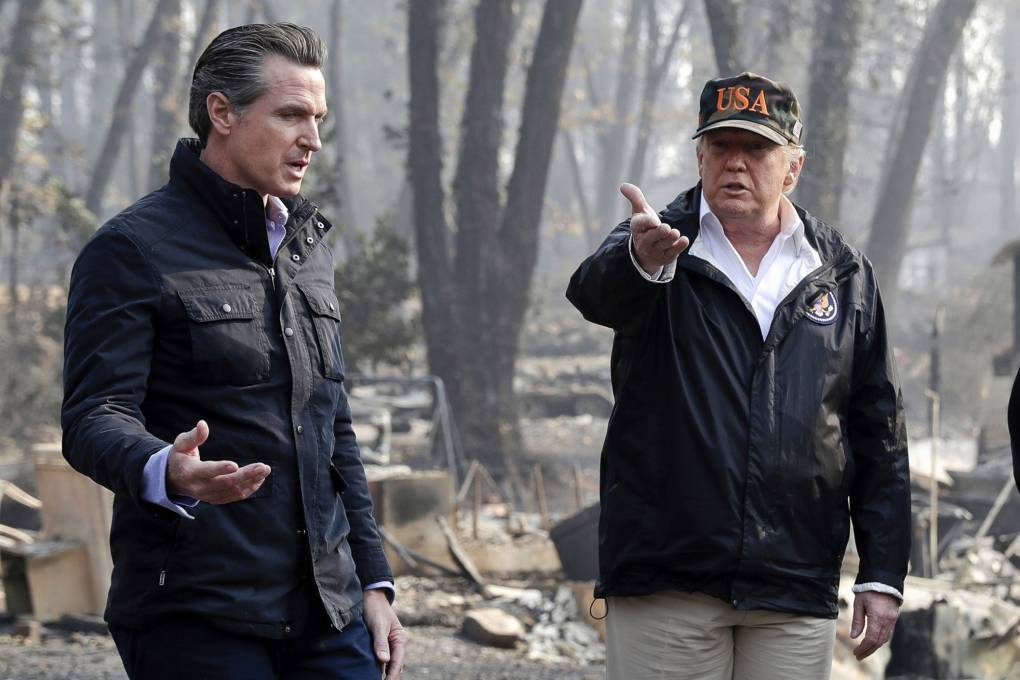
"caption": "President Donald Trump talks with Gov. Gavin Newsom (left) during a visit to a neighborhood impacted by the wildfires in Paradise on Nov. 17, 2018.",
"credit": "Evan Vucci/AP Photo",
"altTag": "Two men wearing jackets and the man on the right points while wearing a black hat stand near each other talking.",
"description": null,
"imgSizes": {
"medium": {
"file": "https://cdn.kqed.org/wp-content/uploads/sites/10/2024/11/NewsomTrump2018AP-800x533.jpg",
"width": 800,
"height": 533,
"mimeType": "image/jpeg"
},
"large": {
"file": "https://cdn.kqed.org/wp-content/uploads/sites/10/2024/11/NewsomTrump2018AP-1020x680.jpg",
"width": 1020,
"height": 680,
"mimeType": "image/jpeg"
},
"thumbnail": {
"file": "https://cdn.kqed.org/wp-content/uploads/sites/10/2024/11/NewsomTrump2018AP-160x107.jpg",
"width": 160,
"height": 107,
"mimeType": "image/jpeg"
},
"1536x1536": {
"file": "https://cdn.kqed.org/wp-content/uploads/sites/10/2024/11/NewsomTrump2018AP-1536x1024.jpg",
"width": 1536,
"height": 1024,
"mimeType": "image/jpeg"
},
"post-thumbnail": {
"file": "https://cdn.kqed.org/wp-content/uploads/sites/10/2024/11/NewsomTrump2018AP-672x372.jpg",
"width": 672,
"height": 372,
"mimeType": "image/jpeg"
},
"twentyfourteen-full-width": {
"file": "https://cdn.kqed.org/wp-content/uploads/sites/10/2024/11/NewsomTrump2018AP-1038x576.jpg",
"width": 1038,
"height": 576,
"mimeType": "image/jpeg"
},
"full-width": {
"file": "https://cdn.kqed.org/wp-content/uploads/sites/10/2024/11/NewsomTrump2018AP-1920x1280.jpg",
"width": 1920,
"height": 1280,
"mimeType": "image/jpeg"
},
"kqedFullSize": {
"file": "https://cdn.kqed.org/wp-content/uploads/sites/10/2024/11/NewsomTrump2018AP.jpg",
"width": 2000,
"height": 1333
}
},
"isLoading": false,
"fetchFailed": false
},
"news_12014041": {
"type": "attachments",
"id": "news_12014041",
"meta": {
"index": "attachments_1716263798",
"site": "news",
"id": "12014041",
"found": true
},
"title": "20161109_203307_qed",
"publishDate": 1731367985,
"status": "inherit",
"parent": 12014032,
"modified": 1731453829,
"caption": "Protests in Oakland on Nov. 9, 2016, in reaction to the election of Donald Trump to President of the United States.",
"credit": "Alex Emslie/KQED",
"altTag": null,
"description": null,
"imgSizes": {
"medium": {
"file": "https://cdn.kqed.org/wp-content/uploads/sites/10/2024/11/20161109_203307_qed-800x600.jpg",
"width": 800,
"height": 600,
"mimeType": "image/jpeg"
},
"large": {
"file": "https://cdn.kqed.org/wp-content/uploads/sites/10/2024/11/20161109_203307_qed-1020x765.jpg",
"width": 1020,
"height": 765,
"mimeType": "image/jpeg"
},
"thumbnail": {
"file": "https://cdn.kqed.org/wp-content/uploads/sites/10/2024/11/20161109_203307_qed-160x120.jpg",
"width": 160,
"height": 120,
"mimeType": "image/jpeg"
},
"1536x1536": {
"file": "https://cdn.kqed.org/wp-content/uploads/sites/10/2024/11/20161109_203307_qed-1536x1152.jpg",
"width": 1536,
"height": 1152,
"mimeType": "image/jpeg"
},
"post-thumbnail": {
"file": "https://cdn.kqed.org/wp-content/uploads/sites/10/2024/11/20161109_203307_qed-672x372.jpg",
"width": 672,
"height": 372,
"mimeType": "image/jpeg"
},
"twentyfourteen-full-width": {
"file": "https://cdn.kqed.org/wp-content/uploads/sites/10/2024/11/20161109_203307_qed-1038x576.jpg",
"width": 1038,
"height": 576,
"mimeType": "image/jpeg"
},
"kqedFullSize": {
"file": "https://cdn.kqed.org/wp-content/uploads/sites/10/2024/11/20161109_203307_qed.jpg",
"width": 1777,
"height": 1333
}
},
"isLoading": false,
"fetchFailed": false
},
"news_12014015": {
"type": "attachments",
"id": "news_12014015",
"meta": {
"index": "attachments_1716263798",
"site": "news",
"id": "12014015",
"found": true
},
"title": "Rogelio_Garcia_-_Convivir[1]",
"publishDate": 1731359518,
"status": "inherit",
"parent": 0,
"modified": 1731368672,
"caption": "Chef Rogelio Garcia is executive chef of Auro, a Michelin Star-winning restaurant at the Four Seasons Resort in Calistoga.",
"credit": "Courtesy of John Troxell",
"altTag": null,
"description": null,
"imgSizes": {
"medium": {
"file": "https://cdn.kqed.org/wp-content/uploads/sites/10/2024/11/Rogelio_Garcia_-_Convivir1-e1731360269373-800x483.png",
"width": 800,
"height": 483,
"mimeType": "image/png"
},
"large": {
"file": "https://cdn.kqed.org/wp-content/uploads/sites/10/2024/11/Rogelio_Garcia_-_Convivir1-e1731360269373-1020x616.png",
"width": 1020,
"height": 616,
"mimeType": "image/png"
},
"thumbnail": {
"file": "https://cdn.kqed.org/wp-content/uploads/sites/10/2024/11/Rogelio_Garcia_-_Convivir1-e1731360269373-160x97.png",
"width": 160,
"height": 97,
"mimeType": "image/png"
},
"1536x1536": {
"file": "https://cdn.kqed.org/wp-content/uploads/sites/10/2024/11/Rogelio_Garcia_-_Convivir1-1267x1536.png",
"width": 1267,
"height": 1536,
"mimeType": "image/png"
},
"post-thumbnail": {
"file": "https://cdn.kqed.org/wp-content/uploads/sites/10/2024/11/Rogelio_Garcia_-_Convivir1-e1731360269373-672x372.png",
"width": 672,
"height": 372,
"mimeType": "image/png"
},
"twentyfourteen-full-width": {
"file": "https://cdn.kqed.org/wp-content/uploads/sites/10/2024/11/Rogelio_Garcia_-_Convivir1-e1731360269373-1038x576.png",
"width": 1038,
"height": 576,
"mimeType": "image/png"
},
"kqedFullSize": {
"file": "https://cdn.kqed.org/wp-content/uploads/sites/10/2024/11/Rogelio_Garcia_-_Convivir1-e1731360269373.png",
"width": 1282,
"height": 774
}
},
"isLoading": false,
"fetchFailed": false
},
"news_12014019": {
"type": "attachments",
"id": "news_12014019",
"meta": {
"index": "attachments_1716263798",
"site": "news",
"id": "12014019",
"found": true
},
"title": "npr.brightspotcdn copy",
"publishDate": 1731361728,
"status": "inherit",
"parent": 12014017,
"modified": 1731361760,
"caption": "Tom Homan speaks at the Republican National Convention in Milwaukee in July. Trump announced on Sunday that the former acting ICE director will oversee border control in his second administration.",
"credit": "Andrew Caballero-Reynolds/AFP via Getty Images",
"altTag": null,
"description": null,
"imgSizes": {
"medium": {
"file": "https://cdn.kqed.org/wp-content/uploads/sites/10/2024/11/npr.brightspotcdn-copy-800x533.jpg",
"width": 800,
"height": 533,
"mimeType": "image/jpeg"
},
"large": {
"file": "https://cdn.kqed.org/wp-content/uploads/sites/10/2024/11/npr.brightspotcdn-copy-1020x680.jpg",
"width": 1020,
"height": 680,
"mimeType": "image/jpeg"
},
"thumbnail": {
"file": "https://cdn.kqed.org/wp-content/uploads/sites/10/2024/11/npr.brightspotcdn-copy-160x107.jpg",
"width": 160,
"height": 107,
"mimeType": "image/jpeg"
},
"post-thumbnail": {
"file": "https://cdn.kqed.org/wp-content/uploads/sites/10/2024/11/npr.brightspotcdn-copy-672x372.jpg",
"width": 672,
"height": 372,
"mimeType": "image/jpeg"
},
"twentyfourteen-full-width": {
"file": "https://cdn.kqed.org/wp-content/uploads/sites/10/2024/11/npr.brightspotcdn-copy-1038x576.jpg",
"width": 1038,
"height": 576,
"mimeType": "image/jpeg"
},
"kqedFullSize": {
"file": "https://cdn.kqed.org/wp-content/uploads/sites/10/2024/11/npr.brightspotcdn-copy.jpg",
"width": 1100,
"height": 733
}
},
"isLoading": false,
"fetchFailed": false
},
"news_12010448": {
"type": "attachments",
"id": "news_12010448",
"meta": {
"index": "attachments_1716263798",
"site": "news",
"id": "12010448",
"found": true
},
"title": "241021-SFUSD BREED STATE PRESSER-MD-05-KQED",
"publishDate": 1729540472,
"status": "inherit",
"parent": 0,
"modified": 1729551090,
"caption": "State Superintendent Tony Thurmond speaks at a press event in front of the SFUSD offices in San Francisco on Oct. 21, 2024.",
"credit": "Martin do Nascimento/KQED",
"altTag": null,
"description": null,
"imgSizes": {
"medium": {
"file": "https://cdn.kqed.org/wp-content/uploads/sites/10/2024/10/241021-SFUSD-BREED-STATE-PRESSER-MD-05-KQED-800x533.jpg",
"width": 800,
"height": 533,
"mimeType": "image/jpeg"
},
"large": {
"file": "https://cdn.kqed.org/wp-content/uploads/sites/10/2024/10/241021-SFUSD-BREED-STATE-PRESSER-MD-05-KQED-1020x680.jpg",
"width": 1020,
"height": 680,
"mimeType": "image/jpeg"
},
"thumbnail": {
"file": "https://cdn.kqed.org/wp-content/uploads/sites/10/2024/10/241021-SFUSD-BREED-STATE-PRESSER-MD-05-KQED-160x107.jpg",
"width": 160,
"height": 107,
"mimeType": "image/jpeg"
},
"1536x1536": {
"file": "https://cdn.kqed.org/wp-content/uploads/sites/10/2024/10/241021-SFUSD-BREED-STATE-PRESSER-MD-05-KQED-1536x1024.jpg",
"width": 1536,
"height": 1024,
"mimeType": "image/jpeg"
},
"post-thumbnail": {
"file": "https://cdn.kqed.org/wp-content/uploads/sites/10/2024/10/241021-SFUSD-BREED-STATE-PRESSER-MD-05-KQED-672x372.jpg",
"width": 672,
"height": 372,
"mimeType": "image/jpeg"
},
"twentyfourteen-full-width": {
"file": "https://cdn.kqed.org/wp-content/uploads/sites/10/2024/10/241021-SFUSD-BREED-STATE-PRESSER-MD-05-KQED-1038x576.jpg",
"width": 1038,
"height": 576,
"mimeType": "image/jpeg"
},
"full-width": {
"file": "https://cdn.kqed.org/wp-content/uploads/sites/10/2024/10/241021-SFUSD-BREED-STATE-PRESSER-MD-05-KQED-1920x1280.jpg",
"width": 1920,
"height": 1280,
"mimeType": "image/jpeg"
},
"kqedFullSize": {
"file": "https://cdn.kqed.org/wp-content/uploads/sites/10/2024/10/241021-SFUSD-BREED-STATE-PRESSER-MD-05-KQED.jpg",
"width": 2000,
"height": 1333
}
},
"isLoading": false,
"fetchFailed": false
},
"news_12013913": {
"type": "attachments",
"id": "news_12013913",
"meta": {
"index": "attachments_1716263798",
"site": "news",
"id": "12013913",
"found": true
},
"title": "022224-General-Dogon-JAH-31",
"publishDate": 1731269995,
"status": "inherit",
"parent": 12013909,
"modified": 1731270077,
"caption": "An encampment sweep by the City of Los Angeles along a block of Skid Row in downtown Los Angeles on Feb. 22, 2024. ",
"credit": "Jules Hotz/CalMatters",
"altTag": "A construction vehicle lifts debris and a tent on the street with a person wearing a yellow safety helmet and bright clothing.",
"description": null,
"imgSizes": {
"medium": {
"file": "https://cdn.kqed.org/wp-content/uploads/sites/10/2024/11/022224-General-Dogon-JAH-31-800x533.jpg",
"width": 800,
"height": 533,
"mimeType": "image/jpeg"
},
"large": {
"file": "https://cdn.kqed.org/wp-content/uploads/sites/10/2024/11/022224-General-Dogon-JAH-31-1020x680.jpg",
"width": 1020,
"height": 680,
"mimeType": "image/jpeg"
},
"thumbnail": {
"file": "https://cdn.kqed.org/wp-content/uploads/sites/10/2024/11/022224-General-Dogon-JAH-31-160x107.jpg",
"width": 160,
"height": 107,
"mimeType": "image/jpeg"
},
"1536x1536": {
"file": "https://cdn.kqed.org/wp-content/uploads/sites/10/2024/11/022224-General-Dogon-JAH-31-1536x1024.jpg",
"width": 1536,
"height": 1024,
"mimeType": "image/jpeg"
},
"post-thumbnail": {
"file": "https://cdn.kqed.org/wp-content/uploads/sites/10/2024/11/022224-General-Dogon-JAH-31-672x372.jpg",
"width": 672,
"height": 372,
"mimeType": "image/jpeg"
},
"twentyfourteen-full-width": {
"file": "https://cdn.kqed.org/wp-content/uploads/sites/10/2024/11/022224-General-Dogon-JAH-31-1038x576.jpg",
"width": 1038,
"height": 576,
"mimeType": "image/jpeg"
},
"full-width": {
"file": "https://cdn.kqed.org/wp-content/uploads/sites/10/2024/11/022224-General-Dogon-JAH-31-1920x1280.jpg",
"width": 1920,
"height": 1280,
"mimeType": "image/jpeg"
},
"kqedFullSize": {
"file": "https://cdn.kqed.org/wp-content/uploads/sites/10/2024/11/022224-General-Dogon-JAH-31.jpg",
"width": 2000,
"height": 1333
}
},
"isLoading": false,
"fetchFailed": false
},
"news_12013789": {
"type": "attachments",
"id": "news_12013789",
"meta": {
"index": "attachments_1716263798",
"site": "news",
"id": "12013789",
"found": true
},
"title": "GettyImages-2183139789-resized copy",
"publishDate": 1731111376,
"status": "inherit",
"parent": 12013788,
"modified": 1731111427,
"caption": "Voters in Oak Creek, Wisconsin, cast ballots on Nov. 5, 2024. ",
"credit": "Stacy Revere/Getty Images",
"altTag": null,
"description": null,
"imgSizes": {
"medium": {
"file": "https://cdn.kqed.org/wp-content/uploads/sites/10/2024/11/GettyImages-2183139789-resized-copy-800x533.jpg",
"width": 800,
"height": 533,
"mimeType": "image/jpeg"
},
"large": {
"file": "https://cdn.kqed.org/wp-content/uploads/sites/10/2024/11/GettyImages-2183139789-resized-copy-1020x680.jpg",
"width": 1020,
"height": 680,
"mimeType": "image/jpeg"
},
"thumbnail": {
"file": "https://cdn.kqed.org/wp-content/uploads/sites/10/2024/11/GettyImages-2183139789-resized-copy-160x107.jpg",
"width": 160,
"height": 107,
"mimeType": "image/jpeg"
},
"1536x1536": {
"file": "https://cdn.kqed.org/wp-content/uploads/sites/10/2024/11/GettyImages-2183139789-resized-copy-1536x1024.jpg",
"width": 1536,
"height": 1024,
"mimeType": "image/jpeg"
},
"2048x2048": {
"file": "https://cdn.kqed.org/wp-content/uploads/sites/10/2024/11/GettyImages-2183139789-resized-copy-2048x1365.jpg",
"width": 2048,
"height": 1365,
"mimeType": "image/jpeg"
},
"post-thumbnail": {
"file": "https://cdn.kqed.org/wp-content/uploads/sites/10/2024/11/GettyImages-2183139789-resized-copy-672x372.jpg",
"width": 672,
"height": 372,
"mimeType": "image/jpeg"
},
"twentyfourteen-full-width": {
"file": "https://cdn.kqed.org/wp-content/uploads/sites/10/2024/11/GettyImages-2183139789-resized-copy-1038x576.jpg",
"width": 1038,
"height": 576,
"mimeType": "image/jpeg"
},
"full-width": {
"file": "https://cdn.kqed.org/wp-content/uploads/sites/10/2024/11/GettyImages-2183139789-resized-copy-1920x1280.jpg",
"width": 1920,
"height": 1280,
"mimeType": "image/jpeg"
},
"kqedFullSize": {
"file": "https://cdn.kqed.org/wp-content/uploads/sites/10/2024/11/GettyImages-2183139789-resized-copy-scaled.jpg",
"width": 2560,
"height": 1707
}
},
"isLoading": false,
"fetchFailed": false
},
"news_12013890": {
"type": "attachments",
"id": "news_12013890",
"meta": {
"index": "attachments_1716263798",
"site": "news",
"id": "12013890",
"found": true
},
"title": "Appeals Court Keeps Abortion Pill Mifepristone Available, But With Restrictions",
"publishDate": 1731188516,
"status": "inherit",
"parent": 12013882,
"modified": 1768514611,
"caption": "In this photo illustration, packages of Mifepristone tablets are displayed at a family planning clinic on April 13, 2023, in Rockville, Maryland. ",
"credit": "Anna Moneymaker/Getty Images",
"altTag": null,
"description": null,
"imgSizes": {
"medium": {
"file": "https://cdn.kqed.org/wp-content/uploads/sites/10/2024/11/GettyImages-1481953389-800x534.jpg",
"width": 800,
"height": 534,
"mimeType": "image/jpeg"
},
"large": {
"file": "https://cdn.kqed.org/wp-content/uploads/sites/10/2024/11/GettyImages-1481953389-1020x680.jpg",
"width": 1020,
"height": 680,
"mimeType": "image/jpeg"
},
"thumbnail": {
"file": "https://cdn.kqed.org/wp-content/uploads/sites/10/2024/11/GettyImages-1481953389-160x107.jpg",
"width": 160,
"height": 107,
"mimeType": "image/jpeg"
},
"post-thumbnail": {
"file": "https://cdn.kqed.org/wp-content/uploads/sites/10/2024/11/GettyImages-1481953389-672x372.jpg",
"width": 672,
"height": 372,
"mimeType": "image/jpeg"
},
"twentyfourteen-full-width": {
"file": "https://cdn.kqed.org/wp-content/uploads/sites/10/2024/11/GettyImages-1481953389-1024x576.jpg",
"width": 1024,
"height": 576,
"mimeType": "image/jpeg"
},
"kqedFullSize": {
"file": "https://cdn.kqed.org/wp-content/uploads/sites/10/2024/11/GettyImages-1481953389.jpg",
"width": 1024,
"height": 683
}
},
"isLoading": false,
"fetchFailed": false
},
"news_12013559": {
"type": "attachments",
"id": "news_12013559",
"meta": {
"index": "attachments_1716263798",
"site": "news",
"id": "12013559",
"found": true
},
"title": "California Legislature",
"publishDate": 1731024071,
"status": "inherit",
"parent": 12013558,
"modified": 1731029821,
"caption": "In this Jan. 25, 2017 file photo, protesters hold signs as they listen to speakers at a rally outside of City Hall in San Francisco. ",
"credit": "Jeff Chiu/AP Photo",
"altTag": null,
"description": null,
"imgSizes": {
"medium": {
"file": "https://cdn.kqed.org/wp-content/uploads/sites/10/2024/11/17230793736301-2048x1393-1-800x544.jpg",
"width": 800,
"height": 544,
"mimeType": "image/jpeg"
},
"large": {
"file": "https://cdn.kqed.org/wp-content/uploads/sites/10/2024/11/17230793736301-2048x1393-1-1020x694.jpg",
"width": 1020,
"height": 694,
"mimeType": "image/jpeg"
},
"thumbnail": {
"file": "https://cdn.kqed.org/wp-content/uploads/sites/10/2024/11/17230793736301-2048x1393-1-160x109.jpg",
"width": 160,
"height": 109,
"mimeType": "image/jpeg"
},
"1536x1536": {
"file": "https://cdn.kqed.org/wp-content/uploads/sites/10/2024/11/17230793736301-2048x1393-1-1536x1045.jpg",
"width": 1536,
"height": 1045,
"mimeType": "image/jpeg"
},
"post-thumbnail": {
"file": "https://cdn.kqed.org/wp-content/uploads/sites/10/2024/11/17230793736301-2048x1393-1-672x372.jpg",
"width": 672,
"height": 372,
"mimeType": "image/jpeg"
},
"twentyfourteen-full-width": {
"file": "https://cdn.kqed.org/wp-content/uploads/sites/10/2024/11/17230793736301-2048x1393-1-1038x576.jpg",
"width": 1038,
"height": 576,
"mimeType": "image/jpeg"
},
"full-width": {
"file": "https://cdn.kqed.org/wp-content/uploads/sites/10/2024/11/17230793736301-2048x1393-1-1920x1306.jpg",
"width": 1920,
"height": 1306,
"mimeType": "image/jpeg"
},
"kqedFullSize": {
"file": "https://cdn.kqed.org/wp-content/uploads/sites/10/2024/11/17230793736301-2048x1393-1.jpg",
"width": 2048,
"height": 1393
}
},
"isLoading": false,
"fetchFailed": false
},
"news_12013439": {
"type": "attachments",
"id": "news_12013439",
"meta": {
"index": "attachments_1716263798",
"site": "news",
"id": "12013439",
"found": true
},
"title": "U.S. Border Patrol Detains Immigrants Crossing Into Arizona",
"publishDate": 1731008232,
"status": "inherit",
"parent": 12013409,
"modified": 1731016944,
"caption": "A U.S. Border Patrol agent guards a group of Mexican immigrants caught after they crossed into the United States on March 6, 2013, near Walker Canyon, Arizona. Due to broad federal sequestration budget cuts, Border Patrol agents are expected to begin taking unpaid furlough days in April, as Customs and Border Protection funding is expected to be reduced by more than $500 million.",
"credit": "Photo by John Moore/Getty Images",
"altTag": null,
"description": null,
"imgSizes": {
"medium": {
"file": "https://cdn.kqed.org/wp-content/uploads/sites/10/2024/11/163289125_qed-800x533.jpg",
"width": 800,
"height": 533,
"mimeType": "image/jpeg"
},
"large": {
"file": "https://cdn.kqed.org/wp-content/uploads/sites/10/2024/11/163289125_qed-1020x680.jpg",
"width": 1020,
"height": 680,
"mimeType": "image/jpeg"
},
"thumbnail": {
"file": "https://cdn.kqed.org/wp-content/uploads/sites/10/2024/11/163289125_qed-160x107.jpg",
"width": 160,
"height": 107,
"mimeType": "image/jpeg"
},
"1536x1536": {
"file": "https://cdn.kqed.org/wp-content/uploads/sites/10/2024/11/163289125_qed-1536x1024.jpg",
"width": 1536,
"height": 1024,
"mimeType": "image/jpeg"
},
"post-thumbnail": {
"file": "https://cdn.kqed.org/wp-content/uploads/sites/10/2024/11/163289125_qed-672x372.jpg",
"width": 672,
"height": 372,
"mimeType": "image/jpeg"
},
"twentyfourteen-full-width": {
"file": "https://cdn.kqed.org/wp-content/uploads/sites/10/2024/11/163289125_qed-1038x576.jpg",
"width": 1038,
"height": 576,
"mimeType": "image/jpeg"
},
"full-width": {
"file": "https://cdn.kqed.org/wp-content/uploads/sites/10/2024/11/163289125_qed-1920x1280.jpg",
"width": 1920,
"height": 1280,
"mimeType": "image/jpeg"
},
"kqedFullSize": {
"file": "https://cdn.kqed.org/wp-content/uploads/sites/10/2024/11/163289125_qed.jpg",
"width": 1999,
"height": 1333
}
},
"isLoading": false,
"fetchFailed": false
},
"news_12013412": {
"type": "attachments",
"id": "news_12013412",
"meta": {
"index": "attachments_1716263798",
"site": "news",
"id": "12013412",
"found": true
},
"title": "2024 Democratic National Convention: Day 3",
"publishDate": 1731003446,
"status": "inherit",
"parent": 12013408,
"modified": 1731017481,
"caption": "California Congressional candidate Lateefah Simon speaks on stage during the third day of the Democratic National Convention at the United Center on Aug. 21, 2024, in Chicago, Illinois. ",
"credit": "Joe Raedle/Getty Images",
"altTag": null,
"description": null,
"imgSizes": {
"medium": {
"file": "https://cdn.kqed.org/wp-content/uploads/sites/10/2024/11/LateefahSimonGetty1-800x533.jpg",
"width": 800,
"height": 533,
"mimeType": "image/jpeg"
},
"large": {
"file": "https://cdn.kqed.org/wp-content/uploads/sites/10/2024/11/LateefahSimonGetty1-1020x680.jpg",
"width": 1020,
"height": 680,
"mimeType": "image/jpeg"
},
"thumbnail": {
"file": "https://cdn.kqed.org/wp-content/uploads/sites/10/2024/11/LateefahSimonGetty1-160x107.jpg",
"width": 160,
"height": 107,
"mimeType": "image/jpeg"
},
"1536x1536": {
"file": "https://cdn.kqed.org/wp-content/uploads/sites/10/2024/11/LateefahSimonGetty1-1536x1024.jpg",
"width": 1536,
"height": 1024,
"mimeType": "image/jpeg"
},
"post-thumbnail": {
"file": "https://cdn.kqed.org/wp-content/uploads/sites/10/2024/11/LateefahSimonGetty1-672x372.jpg",
"width": 672,
"height": 372,
"mimeType": "image/jpeg"
},
"twentyfourteen-full-width": {
"file": "https://cdn.kqed.org/wp-content/uploads/sites/10/2024/11/LateefahSimonGetty1-1038x576.jpg",
"width": 1038,
"height": 576,
"mimeType": "image/jpeg"
},
"full-width": {
"file": "https://cdn.kqed.org/wp-content/uploads/sites/10/2024/11/LateefahSimonGetty1-1920x1280.jpg",
"width": 1920,
"height": 1280,
"mimeType": "image/jpeg"
},
"kqedFullSize": {
"file": "https://cdn.kqed.org/wp-content/uploads/sites/10/2024/11/LateefahSimonGetty1.jpg",
"width": 2000,
"height": 1333
}
},
"isLoading": false,
"fetchFailed": false
}
},
"audioPlayerReducer": {
"postId": "stream_live",
"isPaused": true,
"isPlaying": false,
"pfsActive": false,
"pledgeModalIsOpen": true,
"playerDrawerIsOpen": false,
"liveAudioPlayStartedAt": 0,
"liveAudioPlayContext": ""
},
"authorsReducer": {
"byline_news_12014017": {
"type": "authors",
"id": "byline_news_12014017",
"meta": {
"override": true
},
"slug": "byline_news_12014017",
"name": "\u003ca href=\"https://www.npr.org/people/776048102/rachel-treisman\">Rachel Treisman\u003c/a>, NPR",
"isLoading": false
},
"byline_news_12013909": {
"type": "authors",
"id": "byline_news_12013909",
"meta": {
"override": true
},
"slug": "byline_news_12013909",
"name": "\u003ca href=\"https://calmatters.org/author/marisa-kendall\">Marisa Kendall, \u003c/a>CalMatters",
"isLoading": false
},
"byline_news_12013788": {
"type": "authors",
"id": "byline_news_12013788",
"meta": {
"override": true
},
"slug": "byline_news_12013788",
"name": "\u003ca href=\"https://kffhealthnews.org/news/author/sarah-varney/\">Sarah Varney\u003c/a>, KFF Health News",
"isLoading": false
},
"byline_news_12013882": {
"type": "authors",
"id": "byline_news_12013882",
"meta": {
"override": true
},
"slug": "byline_news_12013882",
"name": "Amanda Seitz, Associated Press",
"isLoading": false
},
"byline_news_12013558": {
"type": "authors",
"id": "byline_news_12013558",
"meta": {
"override": true
},
"slug": "byline_news_12013558",
"name": "\u003ca href=\"https://edsource.org/\">EdSource\u003c/a>",
"isLoading": false
},
"byline_news_12013409": {
"type": "authors",
"id": "byline_news_12013409",
"meta": {
"override": true
},
"slug": "byline_news_12013409",
"name": "Wendy Fry, CalMatters",
"isLoading": false
},
"scottshafer": {
"type": "authors",
"id": "255",
"meta": {
"index": "authors_1716337520",
"id": "255",
"found": true
},
"name": "Scott Shafer",
"firstName": "Scott",
"lastName": "Shafer",
"slug": "scottshafer",
"email": "sshafer@kqed.org",
"display_author_email": false,
"staff_mastheads": [
"news"
],
"title": "KQED Contributor",
"bio": "Scott Shafer is the senior politics correspondent with the KQED Politics and Government desk. He is co-host of \u003cem>Political Breakdown\u003c/em>, the award-winning radio show and podcast with a personal take on the world of politics. Scott came to KQED in 1998 to host the statewide \u003cem>California Report\u003c/em>. Prior to that he had extended stints in politics and government. He uses that inside experience at KQED in his, reporting, hosting and analysis for the politics desk. Scott recently completed a 5-part podcast titled \u003cem>The Speaker\u003c/em>, examining Rep. Nancy Pelosi's life and legacy. Previously he collaborated on \u003cem>Political Breakdown\u003c/em> and on \u003cem>The Political Mind of Jerry Brown\u003c/em>, an eight-part series about the life and extraordinary political career of the former governor. For fun, he plays water polo and swims with the San Francisco Tsunami.",
"avatar": "https://secure.gravatar.com/avatar/a269f2db8e99b39bacd3dfb517e1aea56c8d9706cde1d375abfd9fba57eede2c?s=600&d=blank&r=g",
"twitter": "scottshafer",
"bluesky": null,
"facebook": null,
"instagram": null,
"linkedin": null,
"sites": [
{
"site": "news",
"roles": [
"editor"
]
},
{
"site": "stateofhealth",
"roles": [
"author"
]
},
{
"site": "science",
"roles": [
"author"
]
},
{
"site": "forum",
"roles": [
"subscriber"
]
},
{
"site": "liveblog",
"roles": [
"author"
]
}
],
"headData": {
"title": "Scott Shafer | KQED",
"description": "KQED Contributor",
"ogImgSrc": "https://secure.gravatar.com/avatar/a269f2db8e99b39bacd3dfb517e1aea56c8d9706cde1d375abfd9fba57eede2c?s=600&d=blank&r=g",
"twImgSrc": "https://secure.gravatar.com/avatar/a269f2db8e99b39bacd3dfb517e1aea56c8d9706cde1d375abfd9fba57eede2c?s=600&d=blank&r=g"
},
"isLoading": false,
"link": "/author/scottshafer"
},
"dcronin": {
"type": "authors",
"id": "11362",
"meta": {
"index": "authors_1716337520",
"id": "11362",
"found": true
},
"name": "Dana Cronin",
"firstName": "Dana",
"lastName": "Cronin",
"slug": "dcronin",
"email": "dcronin@KQED.org",
"display_author_email": true,
"staff_mastheads": [],
"title": "KQED Contributor",
"bio": "Dana Cronin is a reporter for KQED News. She loves writing stories about climate change, environmental issues, food and agriculture. She's reported across the country, from Colorado to Washington D.C. to Illinois, and has won numerous awards for her coverage. Her work is regularly featured on national broadcasts, including NPR’s Morning Edition, All Things Considered, PBS Newshour and Science Friday. She lives in Oakland and has an avocado tree in her back yard.",
"avatar": "https://secure.gravatar.com/avatar/b242755225e2f85f37c259df1f4cdfa36dc82f17dcf79e697fb392d658d1750b?s=600&d=blank&r=g",
"twitter": "DanaHCronin",
"bluesky": null,
"facebook": null,
"instagram": null,
"linkedin": null,
"sites": [
{
"site": "arts",
"roles": [
"author"
]
},
{
"site": "news",
"roles": [
"editor"
]
},
{
"site": "science",
"roles": [
"author"
]
},
{
"site": "liveblog",
"roles": [
"author"
]
}
],
"headData": {
"title": "Dana Cronin | KQED",
"description": "KQED Contributor",
"ogImgSrc": "https://secure.gravatar.com/avatar/b242755225e2f85f37c259df1f4cdfa36dc82f17dcf79e697fb392d658d1750b?s=600&d=blank&r=g",
"twImgSrc": "https://secure.gravatar.com/avatar/b242755225e2f85f37c259df1f4cdfa36dc82f17dcf79e697fb392d658d1750b?s=600&d=blank&r=g"
},
"isLoading": false,
"link": "/author/dcronin"
},
"btorres": {
"type": "authors",
"id": "11666",
"meta": {
"index": "authors_1716337520",
"id": "11666",
"found": true
},
"name": "Blanca Torres",
"firstName": "Blanca",
"lastName": "Torres",
"slug": "btorres",
"email": "btorres@kqed.org",
"display_author_email": true,
"staff_mastheads": [
"news"
],
"title": "Producer, Forum",
"bio": "Blanca Torres brings sharp news judgement and keen sense of lively conversation to her work as producer for Forum. She loves producing shows that leave listeners feeling like they heard distinctive voices, learned something new and gained a fresh perspective.\r\n\r\nShe joined KQED in January of 2020 after 16 years of working as a newspaper reporter most recently at the \u003cem>San Francisco Business Times,\u003c/em> where she wrote about real estate and economic development. Before that, she covered a variety of beats including crime, education, retail, workplace, the economy, consumer issues, and small business for the \u003cem>Contra Costa Times, Baltimore Sun\u003c/em> and\u003cem> The Seattle Times\u003c/em>. In addition to reporting, she worked as an editorial writer and columnist for the \u003cem>Seattle Times\u003c/em>. From 2017 to 2020, Blanca won a total of ten awards from the National Association of Real Estate Editors and won first place for land use reporting from the California News Publishers Association two years in a row. She is also a member and former board member for the National Association of Hispanic Journalists.\r\n\r\nA native of the Pacific Northwest, Blanca earned her bachelor's degree from Vanderbilt University in Nashville and a master's in fine arts in creative writing at Mills College. She lives in the East Bay with her family.",
"avatar": "https://secure.gravatar.com/avatar/50b49d19b14a1eed34f26ebf4681152cdd81574ed21851100871ccd29e578cdc?s=600&d=blank&r=g",
"twitter": "@blancawrites",
"bluesky": null,
"facebook": null,
"instagram": null,
"linkedin": null,
"sites": [
{
"site": "arts",
"roles": [
"editor"
]
},
{
"site": "news",
"roles": [
"editor"
]
},
{
"site": "forum",
"roles": [
"editor"
]
}
],
"headData": {
"title": "Blanca Torres | KQED",
"description": "Producer, Forum",
"ogImgSrc": "https://secure.gravatar.com/avatar/50b49d19b14a1eed34f26ebf4681152cdd81574ed21851100871ccd29e578cdc?s=600&d=blank&r=g",
"twImgSrc": "https://secure.gravatar.com/avatar/50b49d19b14a1eed34f26ebf4681152cdd81574ed21851100871ccd29e578cdc?s=600&d=blank&r=g"
},
"isLoading": false,
"link": "/author/btorres"
},
"kmizuguchi": {
"type": "authors",
"id": "11739",
"meta": {
"index": "authors_1716337520",
"id": "11739",
"found": true
},
"name": "Keith Mizuguchi",
"firstName": "Keith",
"lastName": "Mizuguchi",
"slug": "kmizuguchi",
"email": "kmizuguchi@kqed.org",
"display_author_email": false,
"staff_mastheads": [],
"title": "KQED Contributor",
"bio": null,
"avatar": "https://secure.gravatar.com/avatar/64d8a7de0723d4099b9fe4e915136103febcc20809abce228ee4415bcb237023?s=600&d=blank&r=g",
"twitter": null,
"bluesky": null,
"facebook": null,
"instagram": null,
"linkedin": null,
"sites": [
{
"site": "news",
"roles": [
"editor"
]
},
{
"site": "science",
"roles": [
"editor"
]
}
],
"headData": {
"title": "Keith Mizuguchi | KQED",
"description": "KQED Contributor",
"ogImgSrc": "https://secure.gravatar.com/avatar/64d8a7de0723d4099b9fe4e915136103febcc20809abce228ee4415bcb237023?s=600&d=blank&r=g",
"twImgSrc": "https://secure.gravatar.com/avatar/64d8a7de0723d4099b9fe4e915136103febcc20809abce228ee4415bcb237023?s=600&d=blank&r=g"
},
"isLoading": false,
"link": "/author/kmizuguchi"
},
"kdebenedetti": {
"type": "authors",
"id": "11913",
"meta": {
"index": "authors_1716337520",
"id": "11913",
"found": true
},
"name": "Katie DeBenedetti",
"firstName": "Katie",
"lastName": "DeBenedetti",
"slug": "kdebenedetti",
"email": "kdebenedetti@kqed.org",
"display_author_email": false,
"staff_mastheads": [
"news",
"science"
],
"title": "KQED Contributor",
"bio": "Katie DeBenedetti is a digital reporter covering daily news for the Express Desk. Prior to joining KQED as a culture reporting intern in January 2024, she covered education and city government for the Napa Valley Register.",
"avatar": "https://secure.gravatar.com/avatar/6e31073cb8f7e4214ab03f42771d0f45?s=600&d=blank&r=g",
"twitter": null,
"facebook": null,
"instagram": null,
"linkedin": null,
"sites": [
{
"site": "news",
"roles": [
"author"
]
},
{
"site": "science",
"roles": [
"author"
]
},
{
"site": "liveblog",
"roles": [
"author"
]
}
],
"headData": {
"title": "Katie DeBenedetti | KQED",
"description": "KQED Contributor",
"ogImgSrc": "https://secure.gravatar.com/avatar/6e31073cb8f7e4214ab03f42771d0f45?s=600&d=blank&r=g",
"twImgSrc": "https://secure.gravatar.com/avatar/6e31073cb8f7e4214ab03f42771d0f45?s=600&d=blank&r=g"
},
"isLoading": false,
"link": "/author/kdebenedetti"
}
},
"pagesReducer": {
"news_tag_donald-trump": {
"type": "terms",
"id": "news_1323",
"meta": {
"index": "terms_1716263798",
"site": "news",
"id": "1323",
"score": 8.561954
},
"featImg": null,
"name": "Donald Trump",
"description": null,
"taxonomy": "tag",
"headData": {
"twImgId": null,
"twTitle": null,
"ogTitle": null,
"ogImgId": null,
"twDescription": null,
"description": null,
"title": "Donald Trump Archives | KQED News",
"ogDescription": null
},
"ttid": 1335,
"slug": "donald-trump",
"isLoading": false,
"title": "Donald Trump",
"pageMeta": {
"site": "news",
"WpPageTemplate": "page-topic-editorial",
"currentPage": 69
},
"blocks": [
{
"blockName": "kqed/post-list",
"attrs": {
"layout": "cardArticle2",
"query": "posts/news?tag=donald-trump",
"seeMore": false,
"paginated": true,
"page": 69
}
},
{
"blockName": "kqed/ad"
}
]
}
},
"pfsSessionReducer": {},
"postsReducer": {
"stream_live": {
"type": "live",
"id": "stream_live",
"audioUrl": "https://hls.kqed.org/hls/kqed_app/playlist.m3u8",
"title": "Live Stream",
"excerpt": "Live Stream information currently unavailable.",
"link": "/radio",
"featImg": "",
"label": {
"name": "KQED Live",
"link": "/"
}
},
"stream_kqedNewscast": {
"type": "posts",
"id": "stream_kqedNewscast",
"audioUrl": "https://www.kqed.org/.stream/anon/radio/RDnews/newscast.mp3?_=1",
"title": "KQED Newscast",
"featImg": "",
"label": {
"name": "88.5 FM",
"link": "/"
}
},
"news_12014081": {
"type": "posts",
"id": "news_12014081",
"meta": {
"index": "posts_1716263798",
"site": "news",
"id": "12014081",
"score": null,
"sort": [
1731461855000
]
},
"guestAuthors": [],
"slug": "how-a-republican-trifecta-could-change-tech-policy",
"title": "How A Republican Trifecta Could Change Tech Policy",
"publishDate": 1731461855,
"format": "audio",
"headTitle": "How A Republican Trifecta Could Change Tech Policy | KQED",
"labelTerm": {
"term": 33544,
"site": "news"
},
"content": "\u003cp>Republicans have won the presidency and Senate majority and appear on the cusp of holding a narrow majority in the House of Representatives. How might a Republican governing trifecta affect tech policy — on everything from AI to cryptocurrency, consumer privacy, antitrust lawsuits and TikTok? Scott talks with Cristiano Lima-Strong, a tech policy reporter and co-author of The Washington Post’s Tech Brief newsletter.\u003c/p>\n\u003cp>[ad fullwidth]\u003c/p>\u003cp>\u003c/p>\n",
"blocks": [],
"excerpt": null,
"status": "publish",
"parent": 0,
"modified": 1740178954,
"stats": {
"hasAudio": false,
"hasVideo": false,
"hasChartOrMap": false,
"iframeSrcs": [],
"hasGoogleForm": false,
"hasGallery": false,
"hasHearkenModule": false,
"hasPolis": false,
"paragraphCount": 3,
"wordCount": 69
},
"headData": {
"title": "How A Republican Trifecta Could Change Tech Policy | KQED",
"description": "Republicans have won the presidency and Senate majority and appear on the cusp of holding a narrow majority in the House of Representatives. How might a Republican governing trifecta affect tech policy — on everything from AI to cryptocurrency, consumer privacy, antitrust lawsuits and TikTok? Scott talks with Cristiano Lima-Strong, a tech policy reporter and co-author of The Washington Post's Tech Brief newsletter.",
"ogTitle": "",
"ogDescription": "",
"ogImgId": "",
"twTitle": "",
"twDescription": "",
"twImgId": "",
"schema": {
"@context": "https://schema.org",
"@type": "NewsArticle",
"headline": "How A Republican Trifecta Could Change Tech Policy",
"datePublished": "2024-11-12T17:37:35-08:00",
"dateModified": "2025-02-21T15:02:34-08:00",
"image": "https://cdn.kqed.org/wp-content/uploads/2020/02/KQED-OG-Image@1x.png",
"isAccessibleForFree": "True",
"publisher": {
"@type": "NewsMediaOrganization",
"@id": "https://www.kqed.org/#organization",
"name": "KQED",
"logo": "https://cdn.kqed.org/wp-content/uploads/2020/02/KQED-OG-Image@1x.png",
"url": "https://www.kqed.org",
"sameAs": [
"https://www.facebook.com/KQED",
"https://twitter.com/KQED",
"https://www.instagram.com/kqed/",
"https://www.tiktok.com/@kqedofficial",
"https://www.linkedin.com/company/kqed",
"https://www.youtube.com/channel/UCeC0IOo7i1P_61zVUWbJ4nw"
]
}
}
},
"audioUrl": "https://www.podtrac.com/pts/redirect.mp3/chrt.fm/track/G6C7C3/traffic.megaphone.fm/KQINC2211798837.mp3?updated=1731462141",
"sticky": false,
"nprStoryId": "kqed-12014081",
"excludeFromSiteSearch": "Include",
"articleAge": "0",
"path": "/news/12014081/how-a-republican-trifecta-could-change-tech-policy",
"audioTrackLength": null,
"parsedContent": [
{
"type": "contentString",
"content": "\u003cdiv class=\"post-body\">\u003cp>\u003cp>Republicans have won the presidency and Senate majority and appear on the cusp of holding a narrow majority in the House of Representatives. How might a Republican governing trifecta affect tech policy — on everything from AI to cryptocurrency, consumer privacy, antitrust lawsuits and TikTok? Scott talks with Cristiano Lima-Strong, a tech policy reporter and co-author of The Washington Post’s Tech Brief newsletter.\u003c/p>\n\u003cp>\u003c/p>\u003c/div>",
"attributes": {
"named": {},
"numeric": []
}
},
{
"type": "component",
"content": "",
"name": "ad",
"attributes": {
"named": {
"label": "fullwidth"
},
"numeric": [
"fullwidth"
]
}
},
{
"type": "contentString",
"content": "\u003cdiv class=\"post-body\">\u003cp>\u003c/p>\u003cp>\u003c/p>\n\u003c/div>\u003c/p>",
"attributes": {
"named": {},
"numeric": []
}
}
],
"link": "/news/12014081/how-a-republican-trifecta-could-change-tech-policy",
"authors": [
"255"
],
"programs": [
"news_33544"
],
"categories": [
"news_248",
"news_21291"
],
"tags": [
"news_25184",
"news_1323",
"news_22235",
"news_17968",
"news_34624",
"news_34586",
"news_1631"
],
"featImg": "news_12014179",
"label": "news_33544"
},
"news_12014057": {
"type": "posts",
"id": "news_12014057",
"meta": {
"index": "posts_1716263798",
"site": "news",
"id": "12014057",
"score": null,
"sort": [
1731431715000
]
},
"guestAuthors": [],
"slug": "what-a-trump-presidency-means-for-california",
"title": "What a Trump Presidency Means for California",
"publishDate": 1731431715,
"format": "audio",
"headTitle": "What a Trump Presidency Means for California | KQED",
"labelTerm": {},
"content": "\u003cp>\u003cb>Here are the morning’s top stories on Tuesday, November 12, 2024…\u003c/b>\u003c/p>\n\u003cul>\n\u003cli style=\"font-weight: 400\">\u003cspan style=\"font-weight: 400\">President-elect Donald Trump made plenty of promises during his campaign that could affect the state of California. But California is already \u003c/span>\u003ca href=\"https://www.kqed.org/news/12013535/california-and-the-bay-area-took-on-trump-before-theyre-ready-to-do-it-again\">\u003cspan style=\"font-weight: 400\">taking action\u003c/span>\u003c/a>\u003cspan style=\"font-weight: 400\"> to defend itself against potential Trump administration policies. Will it work?\u003c/span>\u003c/li>\n\u003cli style=\"font-weight: 400\">\u003cspan style=\"font-weight: 400\">Federal health officials are making \u003c/span>\u003ca href=\"https://www.kvpr.org/health/2024-11-11/as-feds-recommend-ramping-up-bird-flu-testing-are-human-cases-being-undercounted\">\u003cspan style=\"font-weight: 400\">a new push\u003c/span>\u003c/a>\u003cspan style=\"font-weight: 400\"> to test more workers who might be infected with bird flu. \u003c/span>\u003c/li>\n\u003cli>Republican incumbent Mike Garcia \u003ca href=\"https://apnews.com/article/mike-garcia-california-house-george-whitesides-republicans-98b6a4f98355e21c3b125d1002bc944f\">has conceded\u003c/a> in the closely contested 27th Congressional District race in northern Los Angeles County.\u003c/li>\n\u003c/ul>\n\u003ch2 class=\"routes-Site-routes-Post-Title-__Title__title\">\u003ca href=\"https://www.kqed.org/news/12013535/california-and-the-bay-area-took-on-trump-before-theyre-ready-to-do-it-again\">\u003cstrong>California Took On Trump Before. They’re Ready To Do It Again\u003c/strong>\u003c/a>\u003c/h2>\n\u003cp>Elected officials and legal teams across California are mobilizing after \u003ca href=\"https://www.kqed.org/news/tag/donald-trump\">former President Donald Trump\u003c/a> won back the White House last week.\u003c/p>\n\u003cp>Near-constant battles with the Golden State, \u003ca href=\"https://calmatters.org/justice/2024/11/california-vs-trump-lawsuits/\">which sued him on average about every 12 days\u003c/a>, marked Trump’s first administration, on a wide range of issues including immigration and environmental protection. In the second Trump administration, the state is poised to play a leading role in opposition.\u003c/p>\n\u003cp>Last week in San Francisco, \u003ca href=\"https://www.kqed.org/news/12013588/ag-bonta-pledges-to-protect-california-values-from-trump-presidency\">California Attorney General Rob Bonta\u003c/a> said he’s spent months talking with his department and attorneys general across the country in preparation of a potential second Trump term. “We have thought through all of the possibilities of the attacks on our values, our people, our state, and we expect certain litigation to come or certain actions to come from the federal government and certain litigation that we will take in response,” Bonta said. “There’s a lot of different scenarios on a lot of different topics, from immigration to the environment to civil rights to gun safety … the list goes on, but we are ready.”\u003c/p>\n\u003ch2 class=\"ArtP-headline\">\u003ca href=\"https://www.kvpr.org/health/2024-11-11/as-feds-recommend-ramping-up-bird-flu-testing-are-human-cases-being-undercounted\">\u003cstrong>As Feds Recommend Ramping Up Bird Flu Testing, Are Human Cases Being Undercounted?\u003c/strong>\u003c/a>\u003c/h2>\n\u003cp>Federal health officials have changed their guidance on testing for highly pathogenic avian influenza.\u003c/p>\n\u003cp>[ad fullwidth]\u003c/p>\n\u003cp>The virus, known informally as bird flu, ravaged poultry flocks for years before being found this spring in cattle and, most recently, humans. In California, the virus \u003ca href=\"https://www.cdfa.ca.gov/AHFSS/Animal_Health/HPAI.html\">has been confirmed\u003c/a> in 21 dairy workers — the largest caseload of any of the six states where human cases have been reported — as well as 278 dairies.\u003ca class=\"Link\" href=\"https://www.cdfa.ca.gov/AHFSS/Animal_Health/HPAI.html\" target=\"_blank\" rel=\"noopener\" data-cms-ai=\"0\"> \u003c/a>\u003c/p>\n\u003cp>Until recently, the Centers for Disease Control and Prevention recommended testing only those farmworkers who showed flu symptoms. As of last Thursday, however, \u003ca href=\"https://www.cdc.gov/bird-flu/spotlights/protect-farm-workers-bird-flu.html\">the CDC\u003c/a> changed their guidance to urge any worker to be tested after contact with an infected animal, regardless of symptoms — especially if they were not wearing proper personal protective equipment (PPE).\u003c/p>\n\u003ch2>\u003ca href=\"https://apnews.com/article/mike-garcia-california-house-george-whitesides-republicans-98b6a4f98355e21c3b125d1002bc944f\">\u003cstrong>Republican Congressman Concedes In Race For 27th District Seat\u003c/strong>\u003c/a>\u003c/h2>\n\u003cp>U.S. Rep. Mike Garcia, the last Republican congressman anchored in heavily Democratic Los Angeles County, on Monday conceded to Democrat George Whitesides, ending his reelection bid in a district north of Los Angeles.\u003c/p>\n\u003cp>In a statement, Garcia, a former Navy fighter pilot, said he had congratulated Whitesides and will ensure a smooth handoff of office operations to the former NASA chief of staff.\u003c/p>\n\u003cp>\u003c/p>\n\u003cp>If the results of the race are confirmed, it would be the first House seat in California to flip from Republican to Democrat in this election cycle.\u003c/p>\n\n",
"blocks": [],
"excerpt": "State leaders are already preparing to fight policies from the second Trump administration.",
"status": "publish",
"parent": 0,
"modified": 1738109849,
"stats": {
"hasAudio": false,
"hasVideo": false,
"hasChartOrMap": false,
"iframeSrcs": [],
"hasGoogleForm": false,
"hasGallery": false,
"hasHearkenModule": false,
"hasPolis": false,
"paragraphCount": 12,
"wordCount": 531
},
"headData": {
"title": "What a Trump Presidency Means for California | KQED",
"description": "State leaders are already preparing to fight policies from the second Trump administration.",
"ogTitle": "",
"ogDescription": "",
"ogImgId": "",
"twTitle": "",
"twDescription": "",
"twImgId": "",
"schema": {
"@context": "https://schema.org",
"@type": "NewsArticle",
"headline": "What a Trump Presidency Means for California",
"datePublished": "2024-11-12T09:15:15-08:00",
"dateModified": "2025-01-28T16:17:29-08:00",
"image": "https://cdn.kqed.org/wp-content/uploads/2020/02/KQED-OG-Image@1x.png",
"isAccessibleForFree": "True",
"publisher": {
"@type": "NewsMediaOrganization",
"@id": "https://www.kqed.org/#organization",
"name": "KQED",
"logo": "https://cdn.kqed.org/wp-content/uploads/2020/02/KQED-OG-Image@1x.png",
"url": "https://www.kqed.org",
"sameAs": [
"https://www.facebook.com/KQED",
"https://twitter.com/KQED",
"https://www.instagram.com/kqed/",
"https://www.tiktok.com/@kqedofficial",
"https://www.linkedin.com/company/kqed",
"https://www.youtube.com/channel/UCeC0IOo7i1P_61zVUWbJ4nw"
]
}
}
},
"source": "The California Report",
"sourceUrl": "https://www.kqed.org/news/tag/tcrarchive/",
"audioUrl": "https://www.podtrac.com/pts/redirect.mp3/chrt.fm/track/G6C7C3/traffic.megaphone.fm/KQINC8307398246.mp3?updated=1731424103",
"sticky": false,
"nprStoryId": "kqed-12014057",
"excludeFromSiteSearch": "Include",
"articleAge": "0",
"path": "/news/12014057/what-a-trump-presidency-means-for-california",
"audioTrackLength": null,
"parsedContent": [
{
"type": "contentString",
"content": "\u003cdiv class=\"post-body\">\u003cp>\u003cp>\u003cb>Here are the morning’s top stories on Tuesday, November 12, 2024…\u003c/b>\u003c/p>\n\u003cul>\n\u003cli style=\"font-weight: 400\">\u003cspan style=\"font-weight: 400\">President-elect Donald Trump made plenty of promises during his campaign that could affect the state of California. But California is already \u003c/span>\u003ca href=\"https://www.kqed.org/news/12013535/california-and-the-bay-area-took-on-trump-before-theyre-ready-to-do-it-again\">\u003cspan style=\"font-weight: 400\">taking action\u003c/span>\u003c/a>\u003cspan style=\"font-weight: 400\"> to defend itself against potential Trump administration policies. Will it work?\u003c/span>\u003c/li>\n\u003cli style=\"font-weight: 400\">\u003cspan style=\"font-weight: 400\">Federal health officials are making \u003c/span>\u003ca href=\"https://www.kvpr.org/health/2024-11-11/as-feds-recommend-ramping-up-bird-flu-testing-are-human-cases-being-undercounted\">\u003cspan style=\"font-weight: 400\">a new push\u003c/span>\u003c/a>\u003cspan style=\"font-weight: 400\"> to test more workers who might be infected with bird flu. \u003c/span>\u003c/li>\n\u003cli>Republican incumbent Mike Garcia \u003ca href=\"https://apnews.com/article/mike-garcia-california-house-george-whitesides-republicans-98b6a4f98355e21c3b125d1002bc944f\">has conceded\u003c/a> in the closely contested 27th Congressional District race in northern Los Angeles County.\u003c/li>\n\u003c/ul>\n\u003ch2 class=\"routes-Site-routes-Post-Title-__Title__title\">\u003ca href=\"https://www.kqed.org/news/12013535/california-and-the-bay-area-took-on-trump-before-theyre-ready-to-do-it-again\">\u003cstrong>California Took On Trump Before. They’re Ready To Do It Again\u003c/strong>\u003c/a>\u003c/h2>\n\u003cp>Elected officials and legal teams across California are mobilizing after \u003ca href=\"https://www.kqed.org/news/tag/donald-trump\">former President Donald Trump\u003c/a> won back the White House last week.\u003c/p>\n\u003cp>Near-constant battles with the Golden State, \u003ca href=\"https://calmatters.org/justice/2024/11/california-vs-trump-lawsuits/\">which sued him on average about every 12 days\u003c/a>, marked Trump’s first administration, on a wide range of issues including immigration and environmental protection. In the second Trump administration, the state is poised to play a leading role in opposition.\u003c/p>\n\u003cp>Last week in San Francisco, \u003ca href=\"https://www.kqed.org/news/12013588/ag-bonta-pledges-to-protect-california-values-from-trump-presidency\">California Attorney General Rob Bonta\u003c/a> said he’s spent months talking with his department and attorneys general across the country in preparation of a potential second Trump term. “We have thought through all of the possibilities of the attacks on our values, our people, our state, and we expect certain litigation to come or certain actions to come from the federal government and certain litigation that we will take in response,” Bonta said. “There’s a lot of different scenarios on a lot of different topics, from immigration to the environment to civil rights to gun safety … the list goes on, but we are ready.”\u003c/p>\n\u003ch2 class=\"ArtP-headline\">\u003ca href=\"https://www.kvpr.org/health/2024-11-11/as-feds-recommend-ramping-up-bird-flu-testing-are-human-cases-being-undercounted\">\u003cstrong>As Feds Recommend Ramping Up Bird Flu Testing, Are Human Cases Being Undercounted?\u003c/strong>\u003c/a>\u003c/h2>\n\u003cp>Federal health officials have changed their guidance on testing for highly pathogenic avian influenza.\u003c/p>\n\u003cp>\u003c/p>\u003c/div>",
"attributes": {
"named": {},
"numeric": []
}
},
{
"type": "component",
"content": "",
"name": "ad",
"attributes": {
"named": {
"label": "fullwidth"
},
"numeric": [
"fullwidth"
]
}
},
{
"type": "contentString",
"content": "\u003cdiv class=\"post-body\">\u003cp>\u003c/p>\n\u003cp>The virus, known informally as bird flu, ravaged poultry flocks for years before being found this spring in cattle and, most recently, humans. In California, the virus \u003ca href=\"https://www.cdfa.ca.gov/AHFSS/Animal_Health/HPAI.html\">has been confirmed\u003c/a> in 21 dairy workers — the largest caseload of any of the six states where human cases have been reported — as well as 278 dairies.\u003ca class=\"Link\" href=\"https://www.cdfa.ca.gov/AHFSS/Animal_Health/HPAI.html\" target=\"_blank\" rel=\"noopener\" data-cms-ai=\"0\"> \u003c/a>\u003c/p>\n\u003cp>Until recently, the Centers for Disease Control and Prevention recommended testing only those farmworkers who showed flu symptoms. As of last Thursday, however, \u003ca href=\"https://www.cdc.gov/bird-flu/spotlights/protect-farm-workers-bird-flu.html\">the CDC\u003c/a> changed their guidance to urge any worker to be tested after contact with an infected animal, regardless of symptoms — especially if they were not wearing proper personal protective equipment (PPE).\u003c/p>\n\u003ch2>\u003ca href=\"https://apnews.com/article/mike-garcia-california-house-george-whitesides-republicans-98b6a4f98355e21c3b125d1002bc944f\">\u003cstrong>Republican Congressman Concedes In Race For 27th District Seat\u003c/strong>\u003c/a>\u003c/h2>\n\u003cp>U.S. Rep. Mike Garcia, the last Republican congressman anchored in heavily Democratic Los Angeles County, on Monday conceded to Democrat George Whitesides, ending his reelection bid in a district north of Los Angeles.\u003c/p>\n\u003cp>In a statement, Garcia, a former Navy fighter pilot, said he had congratulated Whitesides and will ensure a smooth handoff of office operations to the former NASA chief of staff.\u003c/p>\n\u003cp>\u003c/p>\n\u003cp>If the results of the race are confirmed, it would be the first House seat in California to flip from Republican to Democrat in this election cycle.\u003c/p>\n\n\u003c/div>\u003c/p>",
"attributes": {
"named": {},
"numeric": []
}
}
],
"link": "/news/12014057/what-a-trump-presidency-means-for-california",
"authors": [
"11739"
],
"programs": [
"news_72"
],
"categories": [
"news_33520",
"news_34018"
],
"tags": [
"news_33648",
"news_18538",
"news_20149",
"news_1323",
"news_21998",
"news_21268",
"news_24721"
],
"featImg": "news_12013407",
"label": "source_news_12014057"
},
"news_12014032": {
"type": "posts",
"id": "news_12014032",
"meta": {
"index": "posts_1716263798",
"site": "news",
"id": "12014032",
"score": null,
"sort": [
1731425437000
]
},
"guestAuthors": [],
"slug": "dispirited-and-humbled-the-conspicuous-absence-of-bay-area-protests-after-trumps-win",
"title": "'Dispirited' and 'Humbled': The Conspicuous Absence of Bay Area Protests After Trump's Win",
"publishDate": 1731425437,
"format": "standard",
"headTitle": "‘Dispirited’ and ‘Humbled’: The Conspicuous Absence of Bay Area Protests After Trump’s Win | KQED",
"labelTerm": {
"site": "news"
},
"content": "\u003cp>Mass protests across the Bay Area met Donald Trump’s election in 2016. Thousands of people flooded the streets in \u003ca href=\"https://www.kqed.org/news/tag/san-francisco\">San Francisco\u003c/a>, Oakland, Berkeley and San José. Some of the protests \u003ca href=\"https://www.kqed.org/news/11166247/trumps-election-greeted-by-berkeley-oakland-protests\">turned violent\u003c/a>.\u003c/p>\n\u003cp>However, in 2024, the days after Trump’s decisive victory over \u003ca href=\"https://www.kqed.org/news/tag/kamala-harris\">Vice President Kamala Harris\u003c/a> have been very different. A couple dozen people \u003ca href=\"https://www.kqed.org/news/12013226/dozens-gather-in-sf-for-vigil-after-trump-win\">gathered for a vigil\u003c/a> at Harvey Milk Plaza on Wednesday night. There was a small demonstration at UC Berkeley, and about 100 people marched through the streets of San José.\u003c/p>\n\u003cp>Mostly, the response has felt muted.\u003c/p>\n\u003cp>“I think the main outcome for many people who might have been out protesting is the feeling of being dispirited, the feeling of being humbled, the feeling of being out of touch with a lot of America,” said Jon Krosnick, a political psychologist at Stanford University. “Those aren’t the kinds of emotions that are inspiring a protest.”\u003c/p>\n\u003cp>[ad fullwidth]\u003c/p>\n\u003cp>Many people KQED spoke with said election results left them feeling defeated. Some are unsure what real impact another march will have. And a significant number of the young people who were coming of age during Trump’s first term say they’re disillusioned with the Democratic Party. While there haven’t been mass protests in the streets, all of these contingents say they are looking toward Trump’s second term and preparing to fight it.\u003c/p>\n\u003cp>Max Flynt, who is a member of the General Union of Palestine Students at San Francisco State, said there wasn’t a possible election outcome that made Trump’s victory worth protesting.\u003c/p>\n\u003cp>“You can’t ignore the biggest anti-war movement in over half a century internationally, but also across campuses all across the United States, and expect young people to be excited,” he told KQED. “You can’t move to the right on immigration, brag about building Donald Trump’s border wall, prosecuting transnational gangs, demonizing immigrants and expect Democrats and young people to vote for the Democratic Party.”\u003c/p>\n\u003cp>Pro-Palestinian protesters have been a force on Bay Area college campuses since Israel began its war in Gaza after a Hamas-led attack killed 1,200 people in October 2023. Activists have criticized the Biden administration’s financial support for Israel throughout the war, which has now killed more than \u003ca href=\"https://www.kqed.org/news/12011429/these-gen-z-voters-are-choosing-kamala-harris-but-gaza-is-still-a-sticking-point\">42,000 Palestinians\u003c/a>, according to Gaza health officials.\u003c/p>\n\u003cp>Ahead of the presidential election, SF State’s General Union of Palestine Students, along with local pro-Palestine campus organizations, encouraged members not to vote for either Trump or Harris, running a “No more votes for genocide” campaign on social media.\u003c/p>\n\u003cp>“We will continue to declare our full support for Palestinian liberation and will not be fooled by a two-party system that continues to be complicit and in full support of the genocide in Gaza,” the organization posted on \u003ca href=\"https://www.instagram.com/p/DBybbr9pPpu/\">Instagram\u003c/a>.\u003c/p>\n\u003cp>Young people between the ages of 18 and 29 did vote at a significantly lower rate — 42% compared to 52% — than in 2020, according to Tufts University’s \u003ca href=\"https://circle.tufts.edu/latest-research/overall-youth-turnout-down-2020-strong-battleground-states\">Center for Information and Research on Civic Learning and Engagement\u003c/a>.\u003c/p>\n\u003cp>Even among those who were fans of Harris, Krosnick said the election’s circumstances are different now than they were in 2016. Then, it felt implausible that someone who used inflammatory language like Trump would be elected. There was outrage that he lost the popular vote.\u003c/p>\n\u003cp>This time, he won the electoral college more handily and is leading in the popular vote by more than a two-point margin. There’s much less shock because he’s held office before. In general, the feeling is more resignation than anger.\u003c/p>\n\u003cp>Whether those feelings linger or turn into determination and defiance will be an important indicator of how national politics will trend in the near future, Krosnick said.\u003c/p>\n\u003cp>“If the part of America that supports the Democratic Party becomes deactivated as a result of this, then the momentum of the Republican Party is going to be tremendous in the coming decades,” he said.\u003c/p>\n\u003cp>Republicans also gained a majority in the Senate, flipping four seats. Control of the House of Representatives has not yet been decided, but Republicans have already picked up two seats from Democrats.\u003c/p>\n\u003cp>“Protest will be critical for balancing the scales,” Krosnick said, adding that demonstrations will rely on young people to be successful.\u003c/p>\n\u003cp>In part, it’s easier for young people to take the time, he said. They also haven’t seen the political pendulum swing left and right as many times and, in the past, have usually been less disillusioned with the impact they can make.\u003c/p>\n\u003cp>“I think a lot more people just are taking their time to kind of process, accept what this means and then move forward,” said Zoe Tweedie, the president of the Stanford University chapter of the American Civil Liberties Union.\u003c/p>\n\u003cp>She and Brian Yan, another one of SF State’s General Union of Palestine Students leaders, do believe that young people will activate around Trump’s policies once he is in office.\u003c/p>\n\u003cp>Yan and Flynt are focused on how the Trump administration handles the war in Gaza. They expect Trump, who has urged Israel to “finish the job” in Gaza, will be less critical of Israeli Prime Minister Benjamin Netanyahu.\u003c/p>\n\u003cp>“I think with Trump in office, this could galvanize people,” Yan said.\u003c/p>\n\u003cp>They see the second Trump term as an opportunity for Democrats to rally around the pro-Palestine movement and move toward the progressive wing of the party.[aside label=\"Related Stories\" postID=\"news_12013226,news_12012421,forum_2010101907754\"]“We’re hoping that we see something similar to the attitude around [Black Lives Matter],” Flynt said. “When Donald Trump became president — [creating] the 1776 project, calling BLM terrorists, calling antifa terrorists — all of a sudden, we see \u003ca href=\"https://www.kqed.org/arts/13881731/a-front-row-seat-at-the-woke-theatre\">Nancy Pelosi wearing a Kente cloth\u003c/a>, on her knee, putting her fist up for the Black Lives Matter movement.”\u003c/p>\n\u003cp>Tweedie expects people to focus less on protest and more on advocacy.\u003c/p>\n\u003cp>“I think what you’re going to see and what I’m already seeing a lot more of is rather than negative campaigns, positive campaigns,” she said. “The ACLU is investing time into, ‘How can we protect rights that we’re scared we’re going to lose?’ rather than ‘How can we protest against Trump?’”\u003c/p>\n\u003cp>Students she’s spoken with want to focus on issue-driven organizing efforts. Tweedie believes state-level mutual aid campaigns and legal fights where abortion restrictions, anti-transgender laws and crackdowns on immigration are the most severe will likely lead Democrats’ resistance to whatever the incoming administration chooses to target.\u003c/p>\n\u003cp>Yan agrees that just because there hasn’t been mass protest on the streets doesn’t mean people aren’t focused on how to face the next four years. One of the biggest questions being considered is: “How do we fight back?”\u003c/p>\n\u003cp>“Maybe people are thinking it can’t just be big marches through the streets. We have to get organized,” he told KQED. “How do we be more tactful about how to fight back and when? Because the repression is only going to get worse under Trump, and we have to start thinking through, ‘How do we get through that, and how do we keep each other safe?’”\u003c/p>\n\u003cp>[ad floatright]\u003c/p>\n",
"blocks": [],
"excerpt": "Eight years ago, protesters filled the streets after Donald Trump was elected over Hillary Clinton. But after he beat Vice President Kamala Harris, the streets are quiet.",
"status": "publish",
"parent": 0,
"modified": 1731455838,
"stats": {
"hasAudio": false,
"hasVideo": false,
"hasChartOrMap": false,
"iframeSrcs": [],
"hasGoogleForm": false,
"hasGallery": false,
"hasHearkenModule": false,
"hasPolis": false,
"paragraphCount": 30,
"wordCount": 1276
},
"headData": {
"title": "'Dispirited' and 'Humbled': The Conspicuous Absence of Bay Area Protests After Trump's Win | KQED",
"description": "Eight years ago, protesters filled the streets after Donald Trump was elected over Hillary Clinton. But after he beat Vice President Kamala Harris, the streets are quiet.",
"ogTitle": "",
"ogDescription": "",
"ogImgId": "",
"twTitle": "",
"twDescription": "",
"twImgId": "",
"schema": {
"@context": "https://schema.org",
"@type": "NewsArticle",
"headline": "'Dispirited' and 'Humbled': The Conspicuous Absence of Bay Area Protests After Trump's Win",
"datePublished": "2024-11-12T07:30:37-08:00",
"dateModified": "2024-11-12T15:57:18-08:00",
"image": "https://cdn.kqed.org/wp-content/uploads/2020/02/KQED-OG-Image@1x.png",
"isAccessibleForFree": "True",
"publisher": {
"@type": "NewsMediaOrganization",
"@id": "https://www.kqed.org/#organization",
"name": "KQED",
"logo": "https://cdn.kqed.org/wp-content/uploads/2020/02/KQED-OG-Image@1x.png",
"url": "https://www.kqed.org",
"sameAs": [
"https://www.facebook.com/KQED",
"https://twitter.com/KQED",
"https://www.instagram.com/kqed/",
"https://www.tiktok.com/@kqedofficial",
"https://www.linkedin.com/company/kqed",
"https://www.youtube.com/channel/UCeC0IOo7i1P_61zVUWbJ4nw"
]
}
}
},
"sticky": false,
"nprStoryId": "kqed-12014032",
"excludeFromSiteSearch": "Include",
"articleAge": "0",
"path": "/news/12014032/dispirited-and-humbled-the-conspicuous-absence-of-bay-area-protests-after-trumps-win",
"audioTrackLength": null,
"parsedContent": [
{
"type": "contentString",
"content": "\u003cdiv class=\"post-body\">\u003cp>\u003cp>Mass protests across the Bay Area met Donald Trump’s election in 2016. Thousands of people flooded the streets in \u003ca href=\"https://www.kqed.org/news/tag/san-francisco\">San Francisco\u003c/a>, Oakland, Berkeley and San José. Some of the protests \u003ca href=\"https://www.kqed.org/news/11166247/trumps-election-greeted-by-berkeley-oakland-protests\">turned violent\u003c/a>.\u003c/p>\n\u003cp>However, in 2024, the days after Trump’s decisive victory over \u003ca href=\"https://www.kqed.org/news/tag/kamala-harris\">Vice President Kamala Harris\u003c/a> have been very different. A couple dozen people \u003ca href=\"https://www.kqed.org/news/12013226/dozens-gather-in-sf-for-vigil-after-trump-win\">gathered for a vigil\u003c/a> at Harvey Milk Plaza on Wednesday night. There was a small demonstration at UC Berkeley, and about 100 people marched through the streets of San José.\u003c/p>\n\u003cp>Mostly, the response has felt muted.\u003c/p>\n\u003cp>“I think the main outcome for many people who might have been out protesting is the feeling of being dispirited, the feeling of being humbled, the feeling of being out of touch with a lot of America,” said Jon Krosnick, a political psychologist at Stanford University. “Those aren’t the kinds of emotions that are inspiring a protest.”\u003c/p>\n\u003cp>\u003c/p>\u003c/div>",
"attributes": {
"named": {},
"numeric": []
}
},
{
"type": "component",
"content": "",
"name": "ad",
"attributes": {
"named": {
"label": "fullwidth"
},
"numeric": [
"fullwidth"
]
}
},
{
"type": "contentString",
"content": "\u003cdiv class=\"post-body\">\u003cp>\u003c/p>\n\u003cp>Many people KQED spoke with said election results left them feeling defeated. Some are unsure what real impact another march will have. And a significant number of the young people who were coming of age during Trump’s first term say they’re disillusioned with the Democratic Party. While there haven’t been mass protests in the streets, all of these contingents say they are looking toward Trump’s second term and preparing to fight it.\u003c/p>\n\u003cp>Max Flynt, who is a member of the General Union of Palestine Students at San Francisco State, said there wasn’t a possible election outcome that made Trump’s victory worth protesting.\u003c/p>\n\u003cp>“You can’t ignore the biggest anti-war movement in over half a century internationally, but also across campuses all across the United States, and expect young people to be excited,” he told KQED. “You can’t move to the right on immigration, brag about building Donald Trump’s border wall, prosecuting transnational gangs, demonizing immigrants and expect Democrats and young people to vote for the Democratic Party.”\u003c/p>\n\u003cp>Pro-Palestinian protesters have been a force on Bay Area college campuses since Israel began its war in Gaza after a Hamas-led attack killed 1,200 people in October 2023. Activists have criticized the Biden administration’s financial support for Israel throughout the war, which has now killed more than \u003ca href=\"https://www.kqed.org/news/12011429/these-gen-z-voters-are-choosing-kamala-harris-but-gaza-is-still-a-sticking-point\">42,000 Palestinians\u003c/a>, according to Gaza health officials.\u003c/p>\n\u003cp>Ahead of the presidential election, SF State’s General Union of Palestine Students, along with local pro-Palestine campus organizations, encouraged members not to vote for either Trump or Harris, running a “No more votes for genocide” campaign on social media.\u003c/p>\n\u003cp>“We will continue to declare our full support for Palestinian liberation and will not be fooled by a two-party system that continues to be complicit and in full support of the genocide in Gaza,” the organization posted on \u003ca href=\"https://www.instagram.com/p/DBybbr9pPpu/\">Instagram\u003c/a>.\u003c/p>\n\u003cp>Young people between the ages of 18 and 29 did vote at a significantly lower rate — 42% compared to 52% — than in 2020, according to Tufts University’s \u003ca href=\"https://circle.tufts.edu/latest-research/overall-youth-turnout-down-2020-strong-battleground-states\">Center for Information and Research on Civic Learning and Engagement\u003c/a>.\u003c/p>\n\u003cp>Even among those who were fans of Harris, Krosnick said the election’s circumstances are different now than they were in 2016. Then, it felt implausible that someone who used inflammatory language like Trump would be elected. There was outrage that he lost the popular vote.\u003c/p>\n\u003cp>This time, he won the electoral college more handily and is leading in the popular vote by more than a two-point margin. There’s much less shock because he’s held office before. In general, the feeling is more resignation than anger.\u003c/p>\n\u003cp>Whether those feelings linger or turn into determination and defiance will be an important indicator of how national politics will trend in the near future, Krosnick said.\u003c/p>\n\u003cp>“If the part of America that supports the Democratic Party becomes deactivated as a result of this, then the momentum of the Republican Party is going to be tremendous in the coming decades,” he said.\u003c/p>\n\u003cp>Republicans also gained a majority in the Senate, flipping four seats. Control of the House of Representatives has not yet been decided, but Republicans have already picked up two seats from Democrats.\u003c/p>\n\u003cp>“Protest will be critical for balancing the scales,” Krosnick said, adding that demonstrations will rely on young people to be successful.\u003c/p>\n\u003cp>In part, it’s easier for young people to take the time, he said. They also haven’t seen the political pendulum swing left and right as many times and, in the past, have usually been less disillusioned with the impact they can make.\u003c/p>\n\u003cp>“I think a lot more people just are taking their time to kind of process, accept what this means and then move forward,” said Zoe Tweedie, the president of the Stanford University chapter of the American Civil Liberties Union.\u003c/p>\n\u003cp>She and Brian Yan, another one of SF State’s General Union of Palestine Students leaders, do believe that young people will activate around Trump’s policies once he is in office.\u003c/p>\n\u003cp>Yan and Flynt are focused on how the Trump administration handles the war in Gaza. They expect Trump, who has urged Israel to “finish the job” in Gaza, will be less critical of Israeli Prime Minister Benjamin Netanyahu.\u003c/p>\n\u003cp>“I think with Trump in office, this could galvanize people,” Yan said.\u003c/p>\n\u003cp>They see the second Trump term as an opportunity for Democrats to rally around the pro-Palestine movement and move toward the progressive wing of the party.\u003c/p>\u003c/div>",
"attributes": {
"named": {},
"numeric": []
}
},
{
"type": "component",
"content": "",
"name": "aside",
"attributes": {
"named": {
"label": "Related Stories ",
"postid": "news_12013226,news_12012421,forum_2010101907754"
},
"numeric": []
}
},
{
"type": "contentString",
"content": "\u003cdiv class=\"post-body\">\u003cp>“We’re hoping that we see something similar to the attitude around [Black Lives Matter],” Flynt said. “When Donald Trump became president — [creating] the 1776 project, calling BLM terrorists, calling antifa terrorists — all of a sudden, we see \u003ca href=\"https://www.kqed.org/arts/13881731/a-front-row-seat-at-the-woke-theatre\">Nancy Pelosi wearing a Kente cloth\u003c/a>, on her knee, putting her fist up for the Black Lives Matter movement.”\u003c/p>\n\u003cp>Tweedie expects people to focus less on protest and more on advocacy.\u003c/p>\n\u003cp>“I think what you’re going to see and what I’m already seeing a lot more of is rather than negative campaigns, positive campaigns,” she said. “The ACLU is investing time into, ‘How can we protect rights that we’re scared we’re going to lose?’ rather than ‘How can we protest against Trump?’”\u003c/p>\n\u003cp>Students she’s spoken with want to focus on issue-driven organizing efforts. Tweedie believes state-level mutual aid campaigns and legal fights where abortion restrictions, anti-transgender laws and crackdowns on immigration are the most severe will likely lead Democrats’ resistance to whatever the incoming administration chooses to target.\u003c/p>\n\u003cp>Yan agrees that just because there hasn’t been mass protest on the streets doesn’t mean people aren’t focused on how to face the next four years. One of the biggest questions being considered is: “How do we fight back?”\u003c/p>\n\u003cp>“Maybe people are thinking it can’t just be big marches through the streets. We have to get organized,” he told KQED. “How do we be more tactful about how to fight back and when? Because the repression is only going to get worse under Trump, and we have to start thinking through, ‘How do we get through that, and how do we keep each other safe?’”\u003c/p>\n\u003cp>\u003c/p>\u003c/div>",
"attributes": {
"named": {},
"numeric": []
}
},
{
"type": "component",
"content": "",
"name": "ad",
"attributes": {
"named": {
"label": "floatright"
},
"numeric": [
"floatright"
]
}
},
{
"type": "contentString",
"content": "\u003cdiv class=\"post-body\">\u003cp>\u003c/p>\n\u003c/div>\u003c/p>",
"attributes": {
"named": {},
"numeric": []
}
}
],
"link": "/news/12014032/dispirited-and-humbled-the-conspicuous-absence-of-bay-area-protests-after-trumps-win",
"authors": [
"11913"
],
"categories": [
"news_8",
"news_13"
],
"tags": [
"news_1323",
"news_32839",
"news_27626",
"news_61",
"news_17968"
],
"featImg": "news_12014041",
"label": "news"
},
"news_12014006": {
"type": "posts",
"id": "news_12014006",
"meta": {
"index": "posts_1716263798",
"site": "news",
"id": "12014006",
"score": null,
"sort": [
1731420052000
]
},
"guestAuthors": [],
"slug": "former-top-chef-contestant-rise-from-dishwasher-michelin-star-honors",
"title": "Former ‘Top Chef’ Contestant on His Rise from Dishwasher to Michelin-Star Honors",
"publishDate": 1731420052,
"format": "standard",
"headTitle": "Former ‘Top Chef’ Contestant on His Rise from Dishwasher to Michelin-Star Honors | KQED",
"labelTerm": {},
"content": "\u003cp>\u003cem>This story was reported for K Onda KQED, a monthly newsletter focused on the Bay Area’s Latinx community. \u003ca href=\"https://www.kqed.org/newsletters/k-onda\">Click here to subscribe\u003c/a>\u003c/em>.\u003c/p>\n\u003cp>Chef Rogelio Garcia has wasted no time living out his culinary dreams. After taking an after-school job as a dishwasher at 15, he dedicated himself to rising up the ranks in fine dining.\u003c/p>\n\u003cp>In his early 20s, he was named executive chef of well-known restaurants, including Angele in Napa, as well as the Commissary and Spruce, both in \u003ca href=\"https://www.kqed.org/arts/tag/san-francisco\">San Francisco\u003c/a>. In 2018, he was a contestant on Bravo’s \u003cem>Top Chef\u003c/em>.\u003c/p>\n\u003cp>In 2022, he took on the challenge of developing and opening Auro, a restaurant in the Four Seasons Resort in Calistoga that earned a Michelin star in its first year, a major accomplishment for any chef.\u003c/p>\n\u003cfigure id=\"attachment_12014014\" class=\"wp-caption aligncenter\" style=\"max-width: 1706px\">\u003cimg loading=\"lazy\" decoding=\"async\" class=\"size-full wp-image-12014014\" src=\"https://cdn.kqed.org/wp-content/uploads/sites/10/2024/11/MushroomTacos_Convivir_p042a1-scaled-e1731360232297.jpg\" alt=\"\" width=\"1706\" height=\"1237\" srcset=\"https://cdn.kqed.org/wp-content/uploads/sites/10/2024/11/MushroomTacos_Convivir_p042a1-scaled-e1731360232297.jpg 1706w, https://cdn.kqed.org/wp-content/uploads/sites/10/2024/11/MushroomTacos_Convivir_p042a1-scaled-e1731360232297-800x580.jpg 800w, https://cdn.kqed.org/wp-content/uploads/sites/10/2024/11/MushroomTacos_Convivir_p042a1-scaled-e1731360232297-1020x740.jpg 1020w, https://cdn.kqed.org/wp-content/uploads/sites/10/2024/11/MushroomTacos_Convivir_p042a1-scaled-e1731360232297-160x116.jpg 160w, https://cdn.kqed.org/wp-content/uploads/sites/10/2024/11/MushroomTacos_Convivir_p042a1-scaled-e1731360232297-1536x1114.jpg 1536w\" sizes=\"(max-width: 1706px) 100vw, 1706px\">\u003cfigcaption class=\"wp-caption-text\">Mushroom tacos from Rogelio Garcia’s cookbook, ‘Convivir: Modern Mexican Cuisine In California’s Wine Country.’ \u003ccite>(Courtesy of John Troxell)\u003c/cite>\u003c/figcaption>\u003c/figure>\n\u003cp>In September, he released a cookbook, \u003cem>Convivir: Modern Mexican Cooking in California’s Wine Country\u003c/em>. All the while, he’s raised two sons who are now 18 and 19.\u003c/p>\n\u003cp>“When I got into this industry, I just needed a job to help my mother,” Garcia, 38, said. “It became such an amazing career.”\u003c/p>\n\u003cp>Garcia is a different kind of dreamer. He is one of more than half a million people who participate in Deferred Action for Childhood Arrivals, \u003ca href=\"https://www.kqed.org/news/tag/deferred-action-for-childhood-arrivals\">the program commonly known as DACA\u003c/a>, which was enacted in 2012 to \u003ca href=\"https://www.kqed.org/news/11881855/tired-of-living-in-limbo-daca-application-backlog-puts-immigrant-lives-on-hold\">protect immigrants from deportation\u003c/a> if they came to the United States as children.\u003c/p>\n\u003cp>[ad fullwidth]\u003c/p>\n\u003cp>Former President Donald Trump tried to end the program during his first term as president. He has promised to deport millions of undocumented immigrants in his second term, which starts in January.\u003c/p>\n\u003cp>I sat down with Garcia two days after Trump won the 2024 presidential election. The \u003ca href=\"https://www.kqed.org/news/11917125/bay-area-daca-recipients-have-mixed-emotions-on-10-year-anniversary\">possibility of DACA ending\u003c/a> keeps him up at night. His hope would be to obtain citizenship one day, but right now he doesn’t have a clear path for that.\u003c/p>\n\u003cfigure id=\"attachment_12014012\" class=\"wp-caption alignright\" style=\"max-width: 800px\">\u003cimg loading=\"lazy\" decoding=\"async\" class=\"size-medium wp-image-12014012\" src=\"https://cdn.kqed.org/wp-content/uploads/sites/10/2024/11/Convivir_Cover1-800x987.jpg\" alt=\"\" width=\"800\" height=\"987\" srcset=\"https://cdn.kqed.org/wp-content/uploads/sites/10/2024/11/Convivir_Cover1-800x987.jpg 800w, https://cdn.kqed.org/wp-content/uploads/sites/10/2024/11/Convivir_Cover1-1020x1259.jpg 1020w, https://cdn.kqed.org/wp-content/uploads/sites/10/2024/11/Convivir_Cover1-160x197.jpg 160w, https://cdn.kqed.org/wp-content/uploads/sites/10/2024/11/Convivir_Cover1-1245x1536.jpg 1245w, https://cdn.kqed.org/wp-content/uploads/sites/10/2024/11/Convivir_Cover1-1659x2048.jpg 1659w, https://cdn.kqed.org/wp-content/uploads/sites/10/2024/11/Convivir_Cover1-1920x2370.jpg 1920w\" sizes=\"(max-width: 800px) 100vw, 800px\">\u003cfigcaption class=\"wp-caption-text\">The cover of Rogelio Garcia’s cookbook, ‘Convivir: Modern Mexican Cuisine In California’s Wine Country.’ \u003ccite>(Courtesy of John Troxell)\u003c/cite>\u003c/figcaption>\u003c/figure>\n\u003cp>“A good friend of mine told me, ‘You can’t waste energy on something you can’t control, because what’s going to happen is going to happen,’” he recalled. “If it was up to me, things would be different, right? But that doesn’t mean that I’m not going to work hard and pursue my dreams and continue to inspire.”\u003c/p>\n\u003cp>Garcia walked me through the dining room at Auro, with its floor-to-ceiling windows framing a stunning view of the Napa Valley. Diners enjoy dishes influenced by Mexican, French and Japanese cuisine. He told me about some of the items he was serving that night on the tasting menu: canapes, king crab from Japan, an al pastor-inspired pineapple sauce and buñuelos for dessert.\u003c/p>\n\u003cp>Living with uncertainty has been a constant for Garcia. He and his two siblings were raised by a single mother who brought him to Los Angeles when he was 2 years old.\u003c/p>\n\u003cp>“I don’t know how she did it,” Garcia said of his mother, who navigated a new country, an unfamiliar language and tight finances. “When the holidays were coming up or my birthday or one of my siblings’ birthdays, she would definitely make an effort to make us feel special, whether it’d be cooking chiles rellenos or making flan.\u003c/p>\n\u003cp>“I knew when she was about to make dessert, it was because it was a special day.”\u003c/p>\n\u003cfigure id=\"attachment_12014013\" class=\"wp-caption aligncenter\" style=\"max-width: 800px\">\u003cimg loading=\"lazy\" decoding=\"async\" class=\"size-full wp-image-12014013\" src=\"https://cdn.kqed.org/wp-content/uploads/sites/10/2024/11/HuaracheswithShrimp_Convivir_p049a1-scaled-e1731360195186-800x620.jpg\" alt=\"\" width=\"800\" height=\"620\" srcset=\"https://cdn.kqed.org/wp-content/uploads/sites/10/2024/11/HuaracheswithShrimp_Convivir_p049a1-scaled-e1731360195186-800x620.jpg 800w, https://cdn.kqed.org/wp-content/uploads/sites/10/2024/11/HuaracheswithShrimp_Convivir_p049a1-scaled-e1731360195186-1020x790.jpg 1020w, https://cdn.kqed.org/wp-content/uploads/sites/10/2024/11/HuaracheswithShrimp_Convivir_p049a1-scaled-e1731360195186-160x124.jpg 160w, https://cdn.kqed.org/wp-content/uploads/sites/10/2024/11/HuaracheswithShrimp_Convivir_p049a1-scaled-e1731360195186-1536x1190.jpg 1536w, https://cdn.kqed.org/wp-content/uploads/sites/10/2024/11/HuaracheswithShrimp_Convivir_p049a1-scaled-e1731360195186.jpg 1706w\" sizes=\"(max-width: 800px) 100vw, 800px\">\u003cfigcaption class=\"wp-caption-text\">Huaraches with shrimp from Rogelio Garcia’s cookbook, ‘Convivir: Modern Mexican Cuisine In California’s Wine Country.’ \u003ccite>(Courtesy of John Troxell)\u003c/cite>\u003c/figcaption>\u003c/figure>\n\u003cp>When he was teenager, the family moved to the Napa Valley to be near relatives. During his time at Vintage High School in Napa, Garcia took drama classes and dreamt of becoming an actor until he learned how hard it would be to make it in Hollywood.\u003c/p>\n\u003cp>What drew him to acting was the chance to express himself as an artist. Food, he decided, could also be an avenue for that.\u003c/p>\n\u003cp>“Whatever I had inside that I wanted to come out, it was going to come out in one form or the other,” he said.\u003c/p>\n\u003cp>He considered going to culinary school, but he couldn’t afford it nor could he apply for financial aid because he was undocumented.[aside label=\"Related Stories\" postID=\"forum_2010101907777,news_12013395,news_11969685\"]“I had more time than money, so I would come in early to learn from the chef or the guy that I was working for to show me how to break down fish, show me how to do X, Y and Z,” he said of his jobs in restaurants. “I was always asking, ‘What book should I buy? What things should I watch on YouTube?’”\u003c/p>\n\u003cp>In 2012, President Obama announced DACA. Garcia began his application right away. He hired a lawyer and spent several weeks pulling together school records, his birth certificate and documents proving he had arrived in the U.S. before his 16th birthday — and that he’d lived here continuously.\u003c/p>\n\u003cp>“I felt like I won the lottery,” he said when his application was approved. “It was just incredible. I don’t have to worry about driving. I can work in places that, even if they check, it is fine because it’s all valid. So that was a huge relief for me.”\u003c/p>\n\u003cp>In 2013, he landed the executive chef role at Angele. He went on to other fine dining establishments, where worked with accomplished chefs and restaurateurs such as Traci des Jardins, Douglas Keane and Michael Mina.\u003c/p>\n\u003cp>As he built up his resume, his dream of winning a Michelin Star, one of the most prestigious awards in the culinary world, lingered. He knew that Auro would give him a chance.\u003c/p>\n\u003cp>“My personal goal was to come to this restaurant and get a Michelin star,” he said. “That’s like the ultimate prize for a chef, but I didn’t plan on doing a book and opening a restaurant at the same time.”\u003c/p>\n\u003cfigure id=\"attachment_12014011\" class=\"wp-caption aligncenter\" style=\"max-width: 800px\">\u003cimg loading=\"lazy\" decoding=\"async\" class=\"size-full wp-image-12014011\" src=\"https://cdn.kqed.org/wp-content/uploads/sites/10/2024/11/CaviarTostones_Convivir_p191a1-scaled-e1731360156713-800x644.jpg\" alt=\"\" width=\"800\" height=\"644\" srcset=\"https://cdn.kqed.org/wp-content/uploads/sites/10/2024/11/CaviarTostones_Convivir_p191a1-scaled-e1731360156713-800x644.jpg 800w, https://cdn.kqed.org/wp-content/uploads/sites/10/2024/11/CaviarTostones_Convivir_p191a1-scaled-e1731360156713-1020x821.jpg 1020w, https://cdn.kqed.org/wp-content/uploads/sites/10/2024/11/CaviarTostones_Convivir_p191a1-scaled-e1731360156713-160x129.jpg 160w, https://cdn.kqed.org/wp-content/uploads/sites/10/2024/11/CaviarTostones_Convivir_p191a1-scaled-e1731360156713-1536x1236.jpg 1536w, https://cdn.kqed.org/wp-content/uploads/sites/10/2024/11/CaviarTostones_Convivir_p191a1-scaled-e1731360156713.jpg 1706w\" sizes=\"(max-width: 800px) 100vw, 800px\">\u003cfigcaption class=\"wp-caption-text\">Branzino with shrimp mousse from Rogelio Garcia’s cookbook, ‘Convivir: Modern Mexican Cuisine In California’s Wine Country.’ \u003ccite>(Courtesy of John Troxell)\u003c/cite>\u003c/figcaption>\u003c/figure>\n\u003cp>Auro was added to the Michelin Guide in 2023, and Garcia was invited to the awards ceremony for California restaurants. Then came an invite to the after party. None of that guarantees a star.\u003c/p>\n\u003cp>“I remember the moment when they called my name and the restaurant’s name — I just couldn’t believe it,” he said.\u003c/p>\n\u003cp>Within minutes, he received so many congratulatory texts and messages that his phone froze. He relished every second. Another dream had come true.\u003c/p>\n\u003cp>That has made sharing his story all the more important. His goal with the cookbook was to demonstrate what he’s accomplished in spite of not having legal status in this country.\u003c/p>\n\u003cp>It’s also a “love letter” to his mother, California and Mexico — his biggest culinary influences. The irony is that he can’t visit Mexico without risking not being able to return to the United States.\u003c/p>\n\u003cp>“It’s like, ‘I love you from afar. I can’t wait to truly meet you and meet the people and hold you. I hold you in my heart. But I can’t be there to hold you in person,’” said Garcia, who makes it a point of speaking about his experiences at local schools. “The most important thing for me is to give back to inspire the younger generation, to young kids who are maybe lost like I was, maybe confused, maybe not guided.”\u003c/p>\n\u003cp>[ad floatright]\u003c/p>\n",
"blocks": [],
"excerpt": "Garcia is one of more than half a million DACA recipients in the country. The possibility of the program ending during a second Trump term keeps him up at night.",
"status": "publish",
"parent": 0,
"modified": 1731544961,
"stats": {
"hasAudio": false,
"hasVideo": false,
"hasChartOrMap": false,
"iframeSrcs": [],
"hasGoogleForm": false,
"hasGallery": false,
"hasHearkenModule": false,
"hasPolis": false,
"paragraphCount": 31,
"wordCount": 1358
},
"headData": {
"title": "Former ‘Top Chef’ Contestant on His Rise from Dishwasher to Michelin-Star Honors | KQED",
"description": "Garcia is one of more than half a million DACA recipients in the country. The possibility of the program ending during a second Trump term keeps him up at night.",
"ogTitle": "",
"ogDescription": "",
"ogImgId": "",
"twTitle": "",
"twDescription": "",
"twImgId": "",
"schema": {
"@context": "https://schema.org",
"@type": "NewsArticle",
"headline": "Former ‘Top Chef’ Contestant on His Rise from Dishwasher to Michelin-Star Honors",
"datePublished": "2024-11-12T06:00:52-08:00",
"dateModified": "2024-11-13T16:42:41-08:00",
"image": "https://cdn.kqed.org/wp-content/uploads/2020/02/KQED-OG-Image@1x.png",
"isAccessibleForFree": "True",
"publisher": {
"@type": "NewsMediaOrganization",
"@id": "https://www.kqed.org/#organization",
"name": "KQED",
"logo": "https://cdn.kqed.org/wp-content/uploads/2020/02/KQED-OG-Image@1x.png",
"url": "https://www.kqed.org",
"sameAs": [
"https://www.facebook.com/KQED",
"https://twitter.com/KQED",
"https://www.instagram.com/kqed/",
"https://www.tiktok.com/@kqedofficial",
"https://www.linkedin.com/company/kqed",
"https://www.youtube.com/channel/UCeC0IOo7i1P_61zVUWbJ4nw"
]
}
}
},
"source": "Commentary",
"sticky": false,
"WpOldSlug": "as-trump-targets-daca-michelin-star-chefs-dream-could-become-a-nightmare",
"nprStoryId": "kqed-12014006",
"excludeFromSiteSearch": "Include",
"articleAge": "0",
"path": "/news/12014006/former-top-chef-contestant-rise-from-dishwasher-michelin-star-honors",
"audioTrackLength": null,
"parsedContent": [
{
"type": "contentString",
"content": "\u003cdiv class=\"post-body\">\u003cp>\u003cp>\u003cem>This story was reported for K Onda KQED, a monthly newsletter focused on the Bay Area’s Latinx community. \u003ca href=\"https://www.kqed.org/newsletters/k-onda\">Click here to subscribe\u003c/a>\u003c/em>.\u003c/p>\n\u003cp>Chef Rogelio Garcia has wasted no time living out his culinary dreams. After taking an after-school job as a dishwasher at 15, he dedicated himself to rising up the ranks in fine dining.\u003c/p>\n\u003cp>In his early 20s, he was named executive chef of well-known restaurants, including Angele in Napa, as well as the Commissary and Spruce, both in \u003ca href=\"https://www.kqed.org/arts/tag/san-francisco\">San Francisco\u003c/a>. In 2018, he was a contestant on Bravo’s \u003cem>Top Chef\u003c/em>.\u003c/p>\n\u003cp>In 2022, he took on the challenge of developing and opening Auro, a restaurant in the Four Seasons Resort in Calistoga that earned a Michelin star in its first year, a major accomplishment for any chef.\u003c/p>\n\u003cfigure id=\"attachment_12014014\" class=\"wp-caption aligncenter\" style=\"max-width: 1706px\">\u003cimg loading=\"lazy\" decoding=\"async\" class=\"size-full wp-image-12014014\" src=\"https://cdn.kqed.org/wp-content/uploads/sites/10/2024/11/MushroomTacos_Convivir_p042a1-scaled-e1731360232297.jpg\" alt=\"\" width=\"1706\" height=\"1237\" srcset=\"https://cdn.kqed.org/wp-content/uploads/sites/10/2024/11/MushroomTacos_Convivir_p042a1-scaled-e1731360232297.jpg 1706w, https://cdn.kqed.org/wp-content/uploads/sites/10/2024/11/MushroomTacos_Convivir_p042a1-scaled-e1731360232297-800x580.jpg 800w, https://cdn.kqed.org/wp-content/uploads/sites/10/2024/11/MushroomTacos_Convivir_p042a1-scaled-e1731360232297-1020x740.jpg 1020w, https://cdn.kqed.org/wp-content/uploads/sites/10/2024/11/MushroomTacos_Convivir_p042a1-scaled-e1731360232297-160x116.jpg 160w, https://cdn.kqed.org/wp-content/uploads/sites/10/2024/11/MushroomTacos_Convivir_p042a1-scaled-e1731360232297-1536x1114.jpg 1536w\" sizes=\"(max-width: 1706px) 100vw, 1706px\">\u003cfigcaption class=\"wp-caption-text\">Mushroom tacos from Rogelio Garcia’s cookbook, ‘Convivir: Modern Mexican Cuisine In California’s Wine Country.’ \u003ccite>(Courtesy of John Troxell)\u003c/cite>\u003c/figcaption>\u003c/figure>\n\u003cp>In September, he released a cookbook, \u003cem>Convivir: Modern Mexican Cooking in California’s Wine Country\u003c/em>. All the while, he’s raised two sons who are now 18 and 19.\u003c/p>\n\u003cp>“When I got into this industry, I just needed a job to help my mother,” Garcia, 38, said. “It became such an amazing career.”\u003c/p>\n\u003cp>Garcia is a different kind of dreamer. He is one of more than half a million people who participate in Deferred Action for Childhood Arrivals, \u003ca href=\"https://www.kqed.org/news/tag/deferred-action-for-childhood-arrivals\">the program commonly known as DACA\u003c/a>, which was enacted in 2012 to \u003ca href=\"https://www.kqed.org/news/11881855/tired-of-living-in-limbo-daca-application-backlog-puts-immigrant-lives-on-hold\">protect immigrants from deportation\u003c/a> if they came to the United States as children.\u003c/p>\n\u003cp>\u003c/p>\u003c/div>",
"attributes": {
"named": {},
"numeric": []
}
},
{
"type": "component",
"content": "",
"name": "ad",
"attributes": {
"named": {
"label": "fullwidth"
},
"numeric": [
"fullwidth"
]
}
},
{
"type": "contentString",
"content": "\u003cdiv class=\"post-body\">\u003cp>\u003c/p>\n\u003cp>Former President Donald Trump tried to end the program during his first term as president. He has promised to deport millions of undocumented immigrants in his second term, which starts in January.\u003c/p>\n\u003cp>I sat down with Garcia two days after Trump won the 2024 presidential election. The \u003ca href=\"https://www.kqed.org/news/11917125/bay-area-daca-recipients-have-mixed-emotions-on-10-year-anniversary\">possibility of DACA ending\u003c/a> keeps him up at night. His hope would be to obtain citizenship one day, but right now he doesn’t have a clear path for that.\u003c/p>\n\u003cfigure id=\"attachment_12014012\" class=\"wp-caption alignright\" style=\"max-width: 800px\">\u003cimg loading=\"lazy\" decoding=\"async\" class=\"size-medium wp-image-12014012\" src=\"https://cdn.kqed.org/wp-content/uploads/sites/10/2024/11/Convivir_Cover1-800x987.jpg\" alt=\"\" width=\"800\" height=\"987\" srcset=\"https://cdn.kqed.org/wp-content/uploads/sites/10/2024/11/Convivir_Cover1-800x987.jpg 800w, https://cdn.kqed.org/wp-content/uploads/sites/10/2024/11/Convivir_Cover1-1020x1259.jpg 1020w, https://cdn.kqed.org/wp-content/uploads/sites/10/2024/11/Convivir_Cover1-160x197.jpg 160w, https://cdn.kqed.org/wp-content/uploads/sites/10/2024/11/Convivir_Cover1-1245x1536.jpg 1245w, https://cdn.kqed.org/wp-content/uploads/sites/10/2024/11/Convivir_Cover1-1659x2048.jpg 1659w, https://cdn.kqed.org/wp-content/uploads/sites/10/2024/11/Convivir_Cover1-1920x2370.jpg 1920w\" sizes=\"(max-width: 800px) 100vw, 800px\">\u003cfigcaption class=\"wp-caption-text\">The cover of Rogelio Garcia’s cookbook, ‘Convivir: Modern Mexican Cuisine In California’s Wine Country.’ \u003ccite>(Courtesy of John Troxell)\u003c/cite>\u003c/figcaption>\u003c/figure>\n\u003cp>“A good friend of mine told me, ‘You can’t waste energy on something you can’t control, because what’s going to happen is going to happen,’” he recalled. “If it was up to me, things would be different, right? But that doesn’t mean that I’m not going to work hard and pursue my dreams and continue to inspire.”\u003c/p>\n\u003cp>Garcia walked me through the dining room at Auro, with its floor-to-ceiling windows framing a stunning view of the Napa Valley. Diners enjoy dishes influenced by Mexican, French and Japanese cuisine. He told me about some of the items he was serving that night on the tasting menu: canapes, king crab from Japan, an al pastor-inspired pineapple sauce and buñuelos for dessert.\u003c/p>\n\u003cp>Living with uncertainty has been a constant for Garcia. He and his two siblings were raised by a single mother who brought him to Los Angeles when he was 2 years old.\u003c/p>\n\u003cp>“I don’t know how she did it,” Garcia said of his mother, who navigated a new country, an unfamiliar language and tight finances. “When the holidays were coming up or my birthday or one of my siblings’ birthdays, she would definitely make an effort to make us feel special, whether it’d be cooking chiles rellenos or making flan.\u003c/p>\n\u003cp>“I knew when she was about to make dessert, it was because it was a special day.”\u003c/p>\n\u003cfigure id=\"attachment_12014013\" class=\"wp-caption aligncenter\" style=\"max-width: 800px\">\u003cimg loading=\"lazy\" decoding=\"async\" class=\"size-full wp-image-12014013\" src=\"https://cdn.kqed.org/wp-content/uploads/sites/10/2024/11/HuaracheswithShrimp_Convivir_p049a1-scaled-e1731360195186-800x620.jpg\" alt=\"\" width=\"800\" height=\"620\" srcset=\"https://cdn.kqed.org/wp-content/uploads/sites/10/2024/11/HuaracheswithShrimp_Convivir_p049a1-scaled-e1731360195186-800x620.jpg 800w, https://cdn.kqed.org/wp-content/uploads/sites/10/2024/11/HuaracheswithShrimp_Convivir_p049a1-scaled-e1731360195186-1020x790.jpg 1020w, https://cdn.kqed.org/wp-content/uploads/sites/10/2024/11/HuaracheswithShrimp_Convivir_p049a1-scaled-e1731360195186-160x124.jpg 160w, https://cdn.kqed.org/wp-content/uploads/sites/10/2024/11/HuaracheswithShrimp_Convivir_p049a1-scaled-e1731360195186-1536x1190.jpg 1536w, https://cdn.kqed.org/wp-content/uploads/sites/10/2024/11/HuaracheswithShrimp_Convivir_p049a1-scaled-e1731360195186.jpg 1706w\" sizes=\"(max-width: 800px) 100vw, 800px\">\u003cfigcaption class=\"wp-caption-text\">Huaraches with shrimp from Rogelio Garcia’s cookbook, ‘Convivir: Modern Mexican Cuisine In California’s Wine Country.’ \u003ccite>(Courtesy of John Troxell)\u003c/cite>\u003c/figcaption>\u003c/figure>\n\u003cp>When he was teenager, the family moved to the Napa Valley to be near relatives. During his time at Vintage High School in Napa, Garcia took drama classes and dreamt of becoming an actor until he learned how hard it would be to make it in Hollywood.\u003c/p>\n\u003cp>What drew him to acting was the chance to express himself as an artist. Food, he decided, could also be an avenue for that.\u003c/p>\n\u003cp>“Whatever I had inside that I wanted to come out, it was going to come out in one form or the other,” he said.\u003c/p>\n\u003cp>He considered going to culinary school, but he couldn’t afford it nor could he apply for financial aid because he was undocumented.\u003c/p>\u003c/div>",
"attributes": {
"named": {},
"numeric": []
}
},
{
"type": "component",
"content": "",
"name": "aside",
"attributes": {
"named": {
"label": "Related Stories ",
"postid": "forum_2010101907777,news_12013395,news_11969685"
},
"numeric": []
}
},
{
"type": "contentString",
"content": "\u003cdiv class=\"post-body\">\u003cp>“I had more time than money, so I would come in early to learn from the chef or the guy that I was working for to show me how to break down fish, show me how to do X, Y and Z,” he said of his jobs in restaurants. “I was always asking, ‘What book should I buy? What things should I watch on YouTube?’”\u003c/p>\n\u003cp>In 2012, President Obama announced DACA. Garcia began his application right away. He hired a lawyer and spent several weeks pulling together school records, his birth certificate and documents proving he had arrived in the U.S. before his 16th birthday — and that he’d lived here continuously.\u003c/p>\n\u003cp>“I felt like I won the lottery,” he said when his application was approved. “It was just incredible. I don’t have to worry about driving. I can work in places that, even if they check, it is fine because it’s all valid. So that was a huge relief for me.”\u003c/p>\n\u003cp>In 2013, he landed the executive chef role at Angele. He went on to other fine dining establishments, where worked with accomplished chefs and restaurateurs such as Traci des Jardins, Douglas Keane and Michael Mina.\u003c/p>\n\u003cp>As he built up his resume, his dream of winning a Michelin Star, one of the most prestigious awards in the culinary world, lingered. He knew that Auro would give him a chance.\u003c/p>\n\u003cp>“My personal goal was to come to this restaurant and get a Michelin star,” he said. “That’s like the ultimate prize for a chef, but I didn’t plan on doing a book and opening a restaurant at the same time.”\u003c/p>\n\u003cfigure id=\"attachment_12014011\" class=\"wp-caption aligncenter\" style=\"max-width: 800px\">\u003cimg loading=\"lazy\" decoding=\"async\" class=\"size-full wp-image-12014011\" src=\"https://cdn.kqed.org/wp-content/uploads/sites/10/2024/11/CaviarTostones_Convivir_p191a1-scaled-e1731360156713-800x644.jpg\" alt=\"\" width=\"800\" height=\"644\" srcset=\"https://cdn.kqed.org/wp-content/uploads/sites/10/2024/11/CaviarTostones_Convivir_p191a1-scaled-e1731360156713-800x644.jpg 800w, https://cdn.kqed.org/wp-content/uploads/sites/10/2024/11/CaviarTostones_Convivir_p191a1-scaled-e1731360156713-1020x821.jpg 1020w, https://cdn.kqed.org/wp-content/uploads/sites/10/2024/11/CaviarTostones_Convivir_p191a1-scaled-e1731360156713-160x129.jpg 160w, https://cdn.kqed.org/wp-content/uploads/sites/10/2024/11/CaviarTostones_Convivir_p191a1-scaled-e1731360156713-1536x1236.jpg 1536w, https://cdn.kqed.org/wp-content/uploads/sites/10/2024/11/CaviarTostones_Convivir_p191a1-scaled-e1731360156713.jpg 1706w\" sizes=\"(max-width: 800px) 100vw, 800px\">\u003cfigcaption class=\"wp-caption-text\">Branzino with shrimp mousse from Rogelio Garcia’s cookbook, ‘Convivir: Modern Mexican Cuisine In California’s Wine Country.’ \u003ccite>(Courtesy of John Troxell)\u003c/cite>\u003c/figcaption>\u003c/figure>\n\u003cp>Auro was added to the Michelin Guide in 2023, and Garcia was invited to the awards ceremony for California restaurants. Then came an invite to the after party. None of that guarantees a star.\u003c/p>\n\u003cp>“I remember the moment when they called my name and the restaurant’s name — I just couldn’t believe it,” he said.\u003c/p>\n\u003cp>Within minutes, he received so many congratulatory texts and messages that his phone froze. He relished every second. Another dream had come true.\u003c/p>\n\u003cp>That has made sharing his story all the more important. His goal with the cookbook was to demonstrate what he’s accomplished in spite of not having legal status in this country.\u003c/p>\n\u003cp>It’s also a “love letter” to his mother, California and Mexico — his biggest culinary influences. The irony is that he can’t visit Mexico without risking not being able to return to the United States.\u003c/p>\n\u003cp>“It’s like, ‘I love you from afar. I can’t wait to truly meet you and meet the people and hold you. I hold you in my heart. But I can’t be there to hold you in person,’” said Garcia, who makes it a point of speaking about his experiences at local schools. “The most important thing for me is to give back to inspire the younger generation, to young kids who are maybe lost like I was, maybe confused, maybe not guided.”\u003c/p>\n\u003cp>\u003c/p>\u003c/div>",
"attributes": {
"named": {},
"numeric": []
}
},
{
"type": "component",
"content": "",
"name": "ad",
"attributes": {
"named": {
"label": "floatright"
},
"numeric": [
"floatright"
]
}
},
{
"type": "contentString",
"content": "\u003cdiv class=\"post-body\">\u003cp>\u003c/p>\n\u003c/div>\u003c/p>",
"attributes": {
"named": {},
"numeric": []
}
}
],
"link": "/news/12014006/former-top-chef-contestant-rise-from-dishwasher-michelin-star-honors",
"authors": [
"11666"
],
"categories": [
"news_24114",
"news_1169",
"news_8"
],
"tags": [
"news_20226",
"news_21021",
"news_1323",
"news_32839",
"news_333",
"news_20202"
],
"featImg": "news_12014015",
"label": "source_news_12014006"
},
"news_12014017": {
"type": "posts",
"id": "news_12014017",
"meta": {
"index": "posts_1716263798",
"site": "news",
"id": "12014017",
"score": null,
"sort": [
1731369609000
]
},
"guestAuthors": [],
"slug": "what-to-know-about-tom-homan-the-former-ice-head-returning-as-trumps-border-czar",
"title": "What to Know About Tom Homan, the Former ICE Head Returning as Trump's 'Border Czar'",
"publishDate": 1731369609,
"format": "standard",
"headTitle": "What to Know About Tom Homan, the Former ICE Head Returning as Trump’s ‘Border Czar’ | KQED",
"labelTerm": {
"term": 253,
"site": "news"
},
"content": "\u003cp>President-elect Trump announced Sunday night that Tom Homan, his former acting head of Immigration and Customs Enforcement (ICE), will join his second administration to oversee border control.\u003c/p>\n\u003cp>In his role as “border czar” — which does not require Senate confirmation — Homan will be in charge of the southern and northern U.S. borders, as well as “all Maritime and Aviation Security,” Trump said in his \u003ca href=\"https://truthsocial.com/@realDonaldTrump/posts/113462412414821782\">post on Truth Social\u003c/a>.\u003c/p>\n\u003cp>“Likewise, Tom Homan will be in charge of all Deportation of Illegal Aliens back to their Country of Origin,” Trump wrote, adding that “there is nobody better at policing and controlling our Borders.”\u003c/p>\n\u003cp>It is unclear what role Homan will take, since managing immigration requires coordination between several agencies under the Department of Homeland Security.[aside postID=news_12011983 hero='https://cdn.kqed.org/wp-content/uploads/sites/10/2024/10/241031-BORDER-CROSSINGS-ZM-02-KQED-1020x680.jpg']Homan, a former police officer and Border Patrol agent, has worked under six presidents during his three decades in law enforcement. He was executive associate director of enforcement and removal operations for Immigration and Customs Enforcement under President Obama. During that administration, ICE carried out a record number of deportations.\u003c/p>\n\u003cp>Honan repeatedly \u003ca href=\"https://www.npr.org/live-updates/trump-2024-rnc-milwaukee#former-acting-ice-director-tells-undocumented-immigrants-to-start-packing\">praised Trump\u003c/a> for being the one who did the most to secure the border.\u003c/p>\n\u003cp>Sunday’s announcement was largely expected, as Trump had said \u003ca href=\"https://ny1.com/nyc/all-boroughs/news/2024/07/15/rnc-chair-whatley-trump-project-2025\">over the summer\u003c/a> that he would tap Homan to help oversee immigration policies in his potential second term. Speaking at the National Conservatism Conference in July, Homan \u003ca href=\"https://www.npr.org/2024/08/14/nx-s1-5037992/trump-immigrants-border-mass-deportation-presidential-race-migrants\">told undocumented immigrants\u003c/a> to “wait till 2025,” adding, “If you’re here illegally, you better be looking over your shoulder.”\u003c/p>\n\u003cp>“Trump comes back in January,” Homan said. “I’ll be on his heels coming back. And I will run the biggest deportation operation this country’s ever seen.”\u003c/p>\n\u003ch2 class=\"edTag\">Homan was behind Trump’s controversial family separation policy\u003c/h2>\n\u003cp>Homan was the face of the Trump administration’s crackdown on immigration during his tenure as acting director of ICE from January 2017 to June 2018.\u003c/p>\n\u003cp>During that time, he often appeared at White House press briefings to defend his agents’ arrests of undocumented immigrants and call for stronger enforcement, \u003ca href=\"https://www.cnn.com/2024/11/10/politics/tom-homan-border-czar-ice-donald-trump/index.html\">according to CNN\u003c/a>, and \u003ca href=\"https://www.washingtonpost.com/immigration/trump-says-he-will-install-fomer-ice-chief-tom-homan-as-new-border-czar/2019/06/14/db9a88d4-8ea8-11e9-b08e-cfd89bd36d4e_story.html\">applauded Trump\u003c/a> for “taking the shackles off” ICE by allowing agents to make a broader range of arrests.\u003c/p>\n\u003cp>[ad fullwidth]\u003c/p>\n\u003cp>Notably, Homan was one of the architects behind its controversial \u003ca href=\"https://www.theatlantic.com/magazine/archive/2022/09/trump-administration-family-separation-policy-immigration/670604/\">family separation policy\u003c/a>. More than 5,500 children of immigrants were separated from their parents at the U.S.-Mexico border in 2018 under the administration’s short-lived “\u003ca href=\"https://www.npr.org/2022/08/10/1116738450/how-the-family-separation-policy-came-to-be\">Zero Tolerance\u003c/a>” policy. According to the Department of Homeland Security, as of April, there were still 1,401 children \u003ca href=\"https://www.dhs.gov/sites/default/files/2024-05/24_0422_sec_frtf-interim-progress-report-final-508.pdf\">without confirmed reunification\u003c/a>.\u003c/p>\n\u003cp>Trump signed an executive order stopping family separations in June 2018 after much condemnation from lawmakers and the public, and the Biden administration \u003ca href=\"https://www.npr.org/2021/01/27/961048895/justice-department-rescinds-trumps-zero-tolerance-immigration-policy\">officially rescinded it\u003c/a> days after President Biden took office in 2021.\u003c/p>\n\u003cp>Homan retired in frustration in 2018 when the White House failed to move his nomination toward Senate confirmation, according to the \u003ca href=\"https://www.washingtonpost.com/immigration/trump-says-he-will-install-fomer-ice-chief-tom-homan-as-new-border-czar/2019/06/14/db9a88d4-8ea8-11e9-b08e-cfd89bd36d4e_story.html\">\u003cem>Washington Post\u003c/em>\u003c/a>\u003cem>. \u003c/em>He became a Fox News contributor, joined the conservative Heritage Foundation as a visiting fellow and \u003ca href=\"https://www.nytimes.com/interactive/2024/10/22/us/politics/project-2025-trump-heritage-foundation.html\">contributed to Project 2025\u003c/a>, its controversial blueprint for reshaping the federal government\u003cem>. \u003c/em>\u003c/p>\n\u003cp>Trump had sought to distance himself from Project 2025 during his campaign, even though it \u003ca href=\"https://www.npr.org/2024/11/05/g-s1-32720/what-is-project-2025-trump-election\">overlaps with his own agenda\u003c/a>. Trump made immigration a major part of his campaign and has vowed to deport millions of immigrants who are in the country without authorization.\u003c/p>\n\u003ch2 class=\"edTag\">Homan has warned undocumented immigrants to ‘start packing’\u003c/h2>\n\u003cp>Homan spoke about how such deportations would work in an interview on Fox \u003cem>Sunday Morning Futures \u003c/em>hours before his appointment was announced, saying it would be a “well-targeted, planned operation, conducted … by the men of ICE.”\u003c/p>\n\u003cp>“When we go out there we’re gonna know who we’re looking for, we most likely know where they’re going to be and it’s gonna be done in a humane manner,” Homan said, adding that it will focus on the “public safety threats and the national security threats first.”[aside label=\"Related Stories\" postID=\"news_12013409,news_12013693,news_12013535\"]But those groups won’t be the only targets, Homan told \u003ca href=\"https://www.cbsnews.com/news/trump-mass-deportation-plan-cost-consequences-60-minutes-transcript/\">CBS’ \u003cem>60 Minutes\u003c/em>\u003c/a> last month. He said he would restart workplace enforcement after the Biden administration moved away from the controversial practice of \u003ca href=\"https://www.cnn.com/2021/10/12/politics/ice-workplace-raids/index.html\">mass worksite immigration raids\u003c/a> in favor of pursuing “exploitative employers.” He also said in that interview that “families can be deported together,” suggesting children who are U.S. citizens but with undocumented parents would have to go with them.\u003c/p>\n\u003cp>Months earlier, speaking onstage at the \u003ca href=\"https://www.npr.org/live-updates/trump-2024-rnc-milwaukee#former-acting-ice-director-tells-undocumented-immigrants-to-start-packing\">Republican National Convention\u003c/a>, Homan said Trump would designate Mexican cartels a “terrorist organization” for their role in getting \u003ca href=\"https://www.npr.org/2024/09/30/nx-s1-5124997/fentanyl-overdose-opioid-btmps-drug-cartel-xylazine-tranq-mexico-china\">fentanyl over the border\u003c/a>, warning, “He’s gonna wipe you off the face of the Earth.”\u003c/p>\n\u003cdiv class=\"ad-header \">\n\u003cp>He also addressed undocumented immigrants at large, whom he said Biden released into the country against federal law.\u003c/p>\n\u003cp>“You better start packing now,” he said, as attendees waving pro-deportation signs cheered. “‘Cause you’re going home.”\u003c/p>\n\u003cp>Trump’s anti-immigrant rhetoric and policy proposals, while clearly a winning issue with voters, aren’t being met without pushback.\u003c/p>\n\u003cp>In the days since Trump’s election, immigrants rights groups have said they stand \u003ca href=\"https://www.npr.org/2024/11/06/nx-s1-5182279/immigrant-rights-border-trump-election-migration-immigration\">ready to challenge his anti-migrant policies\u003c/a> through protests, local legislation and lawsuits. And analysts from the Brookings Institution, the American Enterprise Institute and the Niskanen Center project that lower — potentially even negative — net migration to the U.S. would hurt the country’s economy, as \u003ca href=\"https://www.npr.org/2024/11/06/nx-s1-5181327/trump-election-economy-tariffs-deportations\">NPR has reported\u003c/a>.\u003c/p>\n\u003cp>Homan is not the only appointee that Trump has named for his upcoming term. He announced last week that \u003ca href=\"https://www.npr.org/2024/11/07/nx-s1-5183242/trump-chief-of-staff-susie-wiles\">Susie Wiles\u003c/a> will be his chief of staff.\u003c/p>\n\u003cp>On Monday, Trump offered Rep. Elise Stefanik, the New York Republican who chairs the House Republican Conference, to be the U.S. ambassador to the United Nations. The role requires Senate confirmation, which is all but guaranteed in the soon-to-be Republican-controlled chamber.\u003c/p>\n\u003cp>\u003cem>Sergio Martínez-Beltrán contributed to this report.\u003c/em>\u003c/p>\n\u003c/div>\n\u003cp>\u003c/p>\n",
"blocks": [],
"excerpt": null,
"status": "publish",
"parent": 0,
"modified": 1731362462,
"stats": {
"hasAudio": false,
"hasVideo": false,
"hasChartOrMap": false,
"iframeSrcs": [],
"hasGoogleForm": false,
"hasGallery": false,
"hasHearkenModule": false,
"hasPolis": false,
"paragraphCount": 25,
"wordCount": 1090
},
"headData": {
"title": "What to Know About Tom Homan, the Former ICE Head Returning as Trump's 'Border Czar' | KQED",
"description": "President-elect Trump announced Sunday night that Tom Homan, his former acting head of Immigration and Customs Enforcement (ICE), will join his second administration to oversee border control. In his role as “border czar” — which does not require Senate confirmation — Homan will be in charge of the southern and northern U.S. borders, as well",
"ogTitle": "",
"ogDescription": "",
"ogImgId": "",
"twTitle": "",
"twDescription": "",
"twImgId": "",
"schema": {
"@context": "https://schema.org",
"@type": "NewsArticle",
"headline": "What to Know About Tom Homan, the Former ICE Head Returning as Trump's 'Border Czar'",
"datePublished": "2024-11-11T16:00:09-08:00",
"dateModified": "2024-11-11T14:01:02-08:00",
"image": "https://cdn.kqed.org/wp-content/uploads/2020/02/KQED-OG-Image@1x.png",
"isAccessibleForFree": "True",
"publisher": {
"@type": "NewsMediaOrganization",
"@id": "https://www.kqed.org/#organization",
"name": "KQED",
"logo": "https://cdn.kqed.org/wp-content/uploads/2020/02/KQED-OG-Image@1x.png",
"url": "https://www.kqed.org",
"sameAs": [
"https://www.facebook.com/KQED",
"https://twitter.com/KQED",
"https://www.instagram.com/kqed/",
"https://www.tiktok.com/@kqedofficial",
"https://www.linkedin.com/company/kqed",
"https://www.youtube.com/channel/UCeC0IOo7i1P_61zVUWbJ4nw"
]
}
}
},
"sticky": false,
"nprByline": "\u003ca href=\"https://www.npr.org/people/776048102/rachel-treisman\">Rachel Treisman\u003c/a>, NPR",
"excludeFromSiteSearch": "Include",
"showOnAuthorArchivePages": "No",
"articleAge": "0",
"path": "/news/12014017/what-to-know-about-tom-homan-the-former-ice-head-returning-as-trumps-border-czar",
"audioTrackLength": null,
"parsedContent": [
{
"type": "contentString",
"content": "\u003cdiv class=\"post-body\">\u003cp>\u003cp>President-elect Trump announced Sunday night that Tom Homan, his former acting head of Immigration and Customs Enforcement (ICE), will join his second administration to oversee border control.\u003c/p>\n\u003cp>In his role as “border czar” — which does not require Senate confirmation — Homan will be in charge of the southern and northern U.S. borders, as well as “all Maritime and Aviation Security,” Trump said in his \u003ca href=\"https://truthsocial.com/@realDonaldTrump/posts/113462412414821782\">post on Truth Social\u003c/a>.\u003c/p>\n\u003cp>“Likewise, Tom Homan will be in charge of all Deportation of Illegal Aliens back to their Country of Origin,” Trump wrote, adding that “there is nobody better at policing and controlling our Borders.”\u003c/p>\n\u003cp>It is unclear what role Homan will take, since managing immigration requires coordination between several agencies under the Department of Homeland Security.\u003c/p>\u003c/div>",
"attributes": {
"named": {},
"numeric": []
}
},
{
"type": "component",
"content": "",
"name": "aside",
"attributes": {
"named": {
"postid": "news_12011983",
"hero": "https://cdn.kqed.org/wp-content/uploads/sites/10/2024/10/241031-BORDER-CROSSINGS-ZM-02-KQED-1020x680.jpg",
"label": ""
},
"numeric": []
}
},
{
"type": "contentString",
"content": "\u003cdiv class=\"post-body\">\u003cp>Homan, a former police officer and Border Patrol agent, has worked under six presidents during his three decades in law enforcement. He was executive associate director of enforcement and removal operations for Immigration and Customs Enforcement under President Obama. During that administration, ICE carried out a record number of deportations.\u003c/p>\n\u003cp>Honan repeatedly \u003ca href=\"https://www.npr.org/live-updates/trump-2024-rnc-milwaukee#former-acting-ice-director-tells-undocumented-immigrants-to-start-packing\">praised Trump\u003c/a> for being the one who did the most to secure the border.\u003c/p>\n\u003cp>Sunday’s announcement was largely expected, as Trump had said \u003ca href=\"https://ny1.com/nyc/all-boroughs/news/2024/07/15/rnc-chair-whatley-trump-project-2025\">over the summer\u003c/a> that he would tap Homan to help oversee immigration policies in his potential second term. Speaking at the National Conservatism Conference in July, Homan \u003ca href=\"https://www.npr.org/2024/08/14/nx-s1-5037992/trump-immigrants-border-mass-deportation-presidential-race-migrants\">told undocumented immigrants\u003c/a> to “wait till 2025,” adding, “If you’re here illegally, you better be looking over your shoulder.”\u003c/p>\n\u003cp>“Trump comes back in January,” Homan said. “I’ll be on his heels coming back. And I will run the biggest deportation operation this country’s ever seen.”\u003c/p>\n\u003ch2 class=\"edTag\">Homan was behind Trump’s controversial family separation policy\u003c/h2>\n\u003cp>Homan was the face of the Trump administration’s crackdown on immigration during his tenure as acting director of ICE from January 2017 to June 2018.\u003c/p>\n\u003cp>During that time, he often appeared at White House press briefings to defend his agents’ arrests of undocumented immigrants and call for stronger enforcement, \u003ca href=\"https://www.cnn.com/2024/11/10/politics/tom-homan-border-czar-ice-donald-trump/index.html\">according to CNN\u003c/a>, and \u003ca href=\"https://www.washingtonpost.com/immigration/trump-says-he-will-install-fomer-ice-chief-tom-homan-as-new-border-czar/2019/06/14/db9a88d4-8ea8-11e9-b08e-cfd89bd36d4e_story.html\">applauded Trump\u003c/a> for “taking the shackles off” ICE by allowing agents to make a broader range of arrests.\u003c/p>\n\u003cp>\u003c/p>\u003c/div>",
"attributes": {
"named": {},
"numeric": []
}
},
{
"type": "component",
"content": "",
"name": "ad",
"attributes": {
"named": {
"label": "fullwidth"
},
"numeric": [
"fullwidth"
]
}
},
{
"type": "contentString",
"content": "\u003cdiv class=\"post-body\">\u003cp>\u003c/p>\n\u003cp>Notably, Homan was one of the architects behind its controversial \u003ca href=\"https://www.theatlantic.com/magazine/archive/2022/09/trump-administration-family-separation-policy-immigration/670604/\">family separation policy\u003c/a>. More than 5,500 children of immigrants were separated from their parents at the U.S.-Mexico border in 2018 under the administration’s short-lived “\u003ca href=\"https://www.npr.org/2022/08/10/1116738450/how-the-family-separation-policy-came-to-be\">Zero Tolerance\u003c/a>” policy. According to the Department of Homeland Security, as of April, there were still 1,401 children \u003ca href=\"https://www.dhs.gov/sites/default/files/2024-05/24_0422_sec_frtf-interim-progress-report-final-508.pdf\">without confirmed reunification\u003c/a>.\u003c/p>\n\u003cp>Trump signed an executive order stopping family separations in June 2018 after much condemnation from lawmakers and the public, and the Biden administration \u003ca href=\"https://www.npr.org/2021/01/27/961048895/justice-department-rescinds-trumps-zero-tolerance-immigration-policy\">officially rescinded it\u003c/a> days after President Biden took office in 2021.\u003c/p>\n\u003cp>Homan retired in frustration in 2018 when the White House failed to move his nomination toward Senate confirmation, according to the \u003ca href=\"https://www.washingtonpost.com/immigration/trump-says-he-will-install-fomer-ice-chief-tom-homan-as-new-border-czar/2019/06/14/db9a88d4-8ea8-11e9-b08e-cfd89bd36d4e_story.html\">\u003cem>Washington Post\u003c/em>\u003c/a>\u003cem>. \u003c/em>He became a Fox News contributor, joined the conservative Heritage Foundation as a visiting fellow and \u003ca href=\"https://www.nytimes.com/interactive/2024/10/22/us/politics/project-2025-trump-heritage-foundation.html\">contributed to Project 2025\u003c/a>, its controversial blueprint for reshaping the federal government\u003cem>. \u003c/em>\u003c/p>\n\u003cp>Trump had sought to distance himself from Project 2025 during his campaign, even though it \u003ca href=\"https://www.npr.org/2024/11/05/g-s1-32720/what-is-project-2025-trump-election\">overlaps with his own agenda\u003c/a>. Trump made immigration a major part of his campaign and has vowed to deport millions of immigrants who are in the country without authorization.\u003c/p>\n\u003ch2 class=\"edTag\">Homan has warned undocumented immigrants to ‘start packing’\u003c/h2>\n\u003cp>Homan spoke about how such deportations would work in an interview on Fox \u003cem>Sunday Morning Futures \u003c/em>hours before his appointment was announced, saying it would be a “well-targeted, planned operation, conducted … by the men of ICE.”\u003c/p>\n\u003cp>“When we go out there we’re gonna know who we’re looking for, we most likely know where they’re going to be and it’s gonna be done in a humane manner,” Homan said, adding that it will focus on the “public safety threats and the national security threats first.”\u003c/p>\u003c/div>",
"attributes": {
"named": {},
"numeric": []
}
},
{
"type": "component",
"content": "",
"name": "aside",
"attributes": {
"named": {
"label": "Related Stories ",
"postid": "news_12013409,news_12013693,news_12013535"
},
"numeric": []
}
},
{
"type": "contentString",
"content": "\u003cdiv class=\"post-body\">\u003cp>But those groups won’t be the only targets, Homan told \u003ca href=\"https://www.cbsnews.com/news/trump-mass-deportation-plan-cost-consequences-60-minutes-transcript/\">CBS’ \u003cem>60 Minutes\u003c/em>\u003c/a> last month. He said he would restart workplace enforcement after the Biden administration moved away from the controversial practice of \u003ca href=\"https://www.cnn.com/2021/10/12/politics/ice-workplace-raids/index.html\">mass worksite immigration raids\u003c/a> in favor of pursuing “exploitative employers.” He also said in that interview that “families can be deported together,” suggesting children who are U.S. citizens but with undocumented parents would have to go with them.\u003c/p>\n\u003cp>Months earlier, speaking onstage at the \u003ca href=\"https://www.npr.org/live-updates/trump-2024-rnc-milwaukee#former-acting-ice-director-tells-undocumented-immigrants-to-start-packing\">Republican National Convention\u003c/a>, Homan said Trump would designate Mexican cartels a “terrorist organization” for their role in getting \u003ca href=\"https://www.npr.org/2024/09/30/nx-s1-5124997/fentanyl-overdose-opioid-btmps-drug-cartel-xylazine-tranq-mexico-china\">fentanyl over the border\u003c/a>, warning, “He’s gonna wipe you off the face of the Earth.”\u003c/p>\n\u003cdiv class=\"ad-header \">\n\u003cp>He also addressed undocumented immigrants at large, whom he said Biden released into the country against federal law.\u003c/p>\n\u003cp>“You better start packing now,” he said, as attendees waving pro-deportation signs cheered. “‘Cause you’re going home.”\u003c/p>\n\u003cp>Trump’s anti-immigrant rhetoric and policy proposals, while clearly a winning issue with voters, aren’t being met without pushback.\u003c/p>\n\u003cp>In the days since Trump’s election, immigrants rights groups have said they stand \u003ca href=\"https://www.npr.org/2024/11/06/nx-s1-5182279/immigrant-rights-border-trump-election-migration-immigration\">ready to challenge his anti-migrant policies\u003c/a> through protests, local legislation and lawsuits. And analysts from the Brookings Institution, the American Enterprise Institute and the Niskanen Center project that lower — potentially even negative — net migration to the U.S. would hurt the country’s economy, as \u003ca href=\"https://www.npr.org/2024/11/06/nx-s1-5181327/trump-election-economy-tariffs-deportations\">NPR has reported\u003c/a>.\u003c/p>\n\u003cp>Homan is not the only appointee that Trump has named for his upcoming term. He announced last week that \u003ca href=\"https://www.npr.org/2024/11/07/nx-s1-5183242/trump-chief-of-staff-susie-wiles\">Susie Wiles\u003c/a> will be his chief of staff.\u003c/p>\n\u003cp>On Monday, Trump offered Rep. Elise Stefanik, the New York Republican who chairs the House Republican Conference, to be the U.S. ambassador to the United Nations. The role requires Senate confirmation, which is all but guaranteed in the soon-to-be Republican-controlled chamber.\u003c/p>\n\u003cp>\u003cem>Sergio Martínez-Beltrán contributed to this report.\u003c/em>\u003c/p>\n\u003c/div>\n\u003cp>\u003c/p>\n\u003c/div>\u003c/p>",
"attributes": {
"named": {},
"numeric": []
}
}
],
"link": "/news/12014017/what-to-know-about-tom-homan-the-former-ice-head-returning-as-trumps-border-czar",
"authors": [
"byline_news_12014017"
],
"categories": [
"news_1169",
"news_8",
"news_13"
],
"tags": [
"news_1323",
"news_20202",
"news_20529"
],
"affiliates": [
"news_253"
],
"featImg": "news_12014019",
"label": "news_253"
},
"news_12013686": {
"type": "posts",
"id": "news_12013686",
"meta": {
"index": "posts_1716263798",
"site": "news",
"id": "12013686",
"score": null,
"sort": [
1731355248000
]
},
"guestAuthors": [],
"slug": "california-schools-brace-for-possible-funding-cuts-under-trump",
"title": "California Schools Brace for Possible Funding Cuts Under Trump",
"publishDate": 1731355248,
"format": "standard",
"headTitle": "California Schools Brace for Possible Funding Cuts Under Trump | KQED",
"labelTerm": {
"site": "news"
},
"content": "\u003cp>\u003ca href=\"https://www.kqed.org/news/tag/donald-trump\">Donald Trump\u003c/a> said he would eliminate the Department of Education and cut funding to K–12 schools as he campaigned. He denounced efforts by the Biden administration to forgive student loans. Now that the former president has been reelected, his second term in office is almost certain to spell trouble for public education, including in \u003ca href=\"https://www.kqed.org/news/tag/california\">California\u003c/a>, home to the largest public school system in the country.\u003c/p>\n\u003cp>California education officials are already calling on President-elect Trump to protect public school funding but are preparing for the worst.\u003c/p>\n\u003cp>State Superintendent Tony Thurmond addressed concerns at a press conference on Friday, surrounded by teachers holding “Education is for everyone” and “Protect all students” signs.\u003c/p>\n\u003cp>[ad fullwidth]\u003c/p>\n\u003cp>“This is not a partisan issue,” he said. “This is an issue of continuing to assure that students have access to the resources that they are entitled to under the law. And we will continue to do that.”\u003c/p>\n\u003cp>If Trump follows through on his vow to abolish the Department of Education, California could face a nearly $8 billion loss in funding for public education. If that happens, Thurmond said he would call on the state Legislature and Gov. Gavin Newsom’s office to backfill that funding.\u003c/p>\n\u003cp>“We’ll see where things end up, but we are already prepared to take legislative action and steps to protect funding in education,” Thurmond said.\u003c/p>\n\u003cp>He said he’s already heard from educators worried about the threat to their most vulnerable students, including those from immigrant families, as well as those enrolled in special education programs.\u003c/p>\n\u003cp>“They said, ‘If the U.S. Department of Education is abolished, does that mean that we’re getting rid of special education services for California students?’ And let me be clear: We will not be ever getting rid of special education services in the great state of California,” he said.\u003c/p>\n\u003cp>During Trump’s first term, he rolled back many Obama-era protections for marginalized students, including students of color and transgender students. Then-Education Secretary Betsy DeVos rescinded Obama’s Title IX guidance for transgender students, which allowed them to use restrooms and locker rooms that matched their gender identity. Trump’s administration also tossed Obama-era civil rights efforts in schools, including a policy aimed at preventing schools from disproportionately disciplining students of color.\u003c/p>\n\u003cp>Not every education-related rollback was successful. For instance, \u003ca href=\"https://www.edweek.org/policy-politics/trump-budget-would-make-massive-cuts-to-ed-dept-but-boost-school-choice/2017/03\">Trump tried to cut funding\u003c/a> to the Department of Education by 13% and eliminate popular programs like after-school programs and teacher training, but a Republican-controlled Congress rejected those efforts.\u003c/p>\n\u003cp>Still, California educators are worried about the damage a second Trump presidency could do to their schools and students.\u003c/p>\n\u003cp>“We want to make sure we have a safe space for every student, regardless of their immigration status,” said Jeff Freitas, president of the California Federation of Teachers and a high school math teacher. “We want to make sure this is a safe space for every LGBTQ+ student.”\u003c/p>\n\u003cp>A decrease in funding would be especially troublesome in the Bay Area, where local school districts are already under financial strain.\u003c/p>\n\u003cp>San Francisco Unified School District is currently \u003ca href=\"https://www.kqed.org/news/12006395/sf-school-district-should-focus-on-budget-before-deciding-on-campus-closures-breed-says\">facing a massive budget deficit\u003c/a>, which has forced it to consider closing and merging some schools, causing outcry among parents, teachers and staff.\u003c/p>\n\u003cp>Oakland’s school district is also grappling with a big budget deficit of $174 million. On Friday, the district announced \u003cspan style=\"margin: 0px;padding: 0px\">it \u003ca href=\"https://www.kqed.org/news/12013739/oakland-school-board-spurns-campus-closures-plans-merge-some-schools-instead\" target=\"_blank\" rel=\"noopener\">plans\u003c/a>\u003c/span>\u003ca href=\"https://www.kqed.org/news/12013739/oakland-school-board-spurns-campus-closures-plans-merge-some-schools-instead\"> to merge 10 campuses\u003c/a> to reduce costs.[aside label=\"Related Stories\" postID=\"news_12013558,news_12013269,forum_2010101907754\"]“At a time when we’re facing a fiscal cliff for other reasons, losing $10 million here or $10 million there … it would be really serious for us,” said Sam Davis, outgoing president of the Oakland Unified School District board.\u003c/p>\n\u003cp>Federal funding accounts for about 7% of the district’s funding, according to Davis. That includes funding for Title I programs, which provide academic opportunities for lower-income students, as well as for special education programs.\u003c/p>\n\u003cp>The vast majority of the district’s funding, though, comes from the state. And Davis said he’s encouraged by Thurmond’s commitment to backfill funding should the federal dollars go away.\u003c/p>\n\u003cp>During Trump’s first term in office, Davis said the district didn’t face significant cuts despite Trump’s focus on education privatization.\u003c/p>\n\u003cp>“The last time around, what we saw was an incompetent administration and a lot of infighting, so they weren’t very effective at implementing their agenda,” he said.\u003c/p>\n\u003cp>This time, Davis said the guardrails have come off, and he’s worried about the extreme plans \u003ca href=\"https://www.kqed.org/news/11998288/what-is-project-2025-donald-trump-heritage-foundation-director-steps-down\">laid out in Project 2025\u003c/a>, for example.\u003c/p>\n\u003cp>Davis said he’s most concerned for the more vulnerable students in the district, especially those from immigrant families. Oakland has one of the highest proportional populations of students who have been in the U.S. for fewer than three years in the state, he said.\u003c/p>\n\u003cp>“We are committed to supporting our families through this difficult time,” he said. “I think we just need to be clear-eyed about the fight that we have on our hands over the next four years.”\u003c/p>\n\u003cp>\u003c/p>\n",
"blocks": [],
"excerpt": "On the campaign trail, Trump said he would eliminate the Department of Education, slash funding to K–12 education and roll back Title IX protections. Now, California education officials are preparing to protect against an administration they say will target the most vulnerable students. ",
"status": "publish",
"parent": 0,
"modified": 1731441642,
"stats": {
"hasAudio": false,
"hasVideo": false,
"hasChartOrMap": false,
"iframeSrcs": [],
"hasGoogleForm": false,
"hasGallery": false,
"hasHearkenModule": false,
"hasPolis": false,
"paragraphCount": 24,
"wordCount": 891
},
"headData": {
"title": "California Schools Brace for Possible Funding Cuts Under Trump | KQED",
"description": "On the campaign trail, Trump said he would eliminate the Department of Education, slash funding to K–12 education and roll back Title IX protections. Now, California education officials are preparing to protect against an administration they say will target the most vulnerable students. ",
"ogTitle": "",
"ogDescription": "",
"ogImgId": "",
"twTitle": "",
"twDescription": "",
"twImgId": "",
"schema": {
"@context": "https://schema.org",
"@type": "NewsArticle",
"headline": "California Schools Brace for Possible Funding Cuts Under Trump",
"datePublished": "2024-11-11T12:00:48-08:00",
"dateModified": "2024-11-12T12:00:42-08:00",
"image": "https://cdn.kqed.org/wp-content/uploads/2020/02/KQED-OG-Image@1x.png",
"isAccessibleForFree": "True",
"publisher": {
"@type": "NewsMediaOrganization",
"@id": "https://www.kqed.org/#organization",
"name": "KQED",
"logo": "https://cdn.kqed.org/wp-content/uploads/2020/02/KQED-OG-Image@1x.png",
"url": "https://www.kqed.org",
"sameAs": [
"https://www.facebook.com/KQED",
"https://twitter.com/KQED",
"https://www.instagram.com/kqed/",
"https://www.tiktok.com/@kqedofficial",
"https://www.linkedin.com/company/kqed",
"https://www.youtube.com/channel/UCeC0IOo7i1P_61zVUWbJ4nw"
]
}
}
},
"sticky": false,
"nprStoryId": "kqed-12013686",
"excludeFromSiteSearch": "Include",
"articleAge": "0",
"path": "/news/12013686/california-schools-brace-for-possible-funding-cuts-under-trump",
"audioTrackLength": null,
"parsedContent": [
{
"type": "contentString",
"content": "\u003cdiv class=\"post-body\">\u003cp>\u003cp>\u003ca href=\"https://www.kqed.org/news/tag/donald-trump\">Donald Trump\u003c/a> said he would eliminate the Department of Education and cut funding to K–12 schools as he campaigned. He denounced efforts by the Biden administration to forgive student loans. Now that the former president has been reelected, his second term in office is almost certain to spell trouble for public education, including in \u003ca href=\"https://www.kqed.org/news/tag/california\">California\u003c/a>, home to the largest public school system in the country.\u003c/p>\n\u003cp>California education officials are already calling on President-elect Trump to protect public school funding but are preparing for the worst.\u003c/p>\n\u003cp>State Superintendent Tony Thurmond addressed concerns at a press conference on Friday, surrounded by teachers holding “Education is for everyone” and “Protect all students” signs.\u003c/p>\n\u003cp>\u003c/p>\u003c/div>",
"attributes": {
"named": {},
"numeric": []
}
},
{
"type": "component",
"content": "",
"name": "ad",
"attributes": {
"named": {
"label": "fullwidth"
},
"numeric": [
"fullwidth"
]
}
},
{
"type": "contentString",
"content": "\u003cdiv class=\"post-body\">\u003cp>\u003c/p>\n\u003cp>“This is not a partisan issue,” he said. “This is an issue of continuing to assure that students have access to the resources that they are entitled to under the law. And we will continue to do that.”\u003c/p>\n\u003cp>If Trump follows through on his vow to abolish the Department of Education, California could face a nearly $8 billion loss in funding for public education. If that happens, Thurmond said he would call on the state Legislature and Gov. Gavin Newsom’s office to backfill that funding.\u003c/p>\n\u003cp>“We’ll see where things end up, but we are already prepared to take legislative action and steps to protect funding in education,” Thurmond said.\u003c/p>\n\u003cp>He said he’s already heard from educators worried about the threat to their most vulnerable students, including those from immigrant families, as well as those enrolled in special education programs.\u003c/p>\n\u003cp>“They said, ‘If the U.S. Department of Education is abolished, does that mean that we’re getting rid of special education services for California students?’ And let me be clear: We will not be ever getting rid of special education services in the great state of California,” he said.\u003c/p>\n\u003cp>During Trump’s first term, he rolled back many Obama-era protections for marginalized students, including students of color and transgender students. Then-Education Secretary Betsy DeVos rescinded Obama’s Title IX guidance for transgender students, which allowed them to use restrooms and locker rooms that matched their gender identity. Trump’s administration also tossed Obama-era civil rights efforts in schools, including a policy aimed at preventing schools from disproportionately disciplining students of color.\u003c/p>\n\u003cp>Not every education-related rollback was successful. For instance, \u003ca href=\"https://www.edweek.org/policy-politics/trump-budget-would-make-massive-cuts-to-ed-dept-but-boost-school-choice/2017/03\">Trump tried to cut funding\u003c/a> to the Department of Education by 13% and eliminate popular programs like after-school programs and teacher training, but a Republican-controlled Congress rejected those efforts.\u003c/p>\n\u003cp>Still, California educators are worried about the damage a second Trump presidency could do to their schools and students.\u003c/p>\n\u003cp>“We want to make sure we have a safe space for every student, regardless of their immigration status,” said Jeff Freitas, president of the California Federation of Teachers and a high school math teacher. “We want to make sure this is a safe space for every LGBTQ+ student.”\u003c/p>\n\u003cp>A decrease in funding would be especially troublesome in the Bay Area, where local school districts are already under financial strain.\u003c/p>\n\u003cp>San Francisco Unified School District is currently \u003ca href=\"https://www.kqed.org/news/12006395/sf-school-district-should-focus-on-budget-before-deciding-on-campus-closures-breed-says\">facing a massive budget deficit\u003c/a>, which has forced it to consider closing and merging some schools, causing outcry among parents, teachers and staff.\u003c/p>\n\u003cp>Oakland’s school district is also grappling with a big budget deficit of $174 million. On Friday, the district announced \u003cspan style=\"margin: 0px;padding: 0px\">it \u003ca href=\"https://www.kqed.org/news/12013739/oakland-school-board-spurns-campus-closures-plans-merge-some-schools-instead\" target=\"_blank\" rel=\"noopener\">plans\u003c/a>\u003c/span>\u003ca href=\"https://www.kqed.org/news/12013739/oakland-school-board-spurns-campus-closures-plans-merge-some-schools-instead\"> to merge 10 campuses\u003c/a> to reduce costs.\u003c/p>\u003c/div>",
"attributes": {
"named": {},
"numeric": []
}
},
{
"type": "component",
"content": "",
"name": "aside",
"attributes": {
"named": {
"label": "Related Stories ",
"postid": "news_12013558,news_12013269,forum_2010101907754"
},
"numeric": []
}
},
{
"type": "contentString",
"content": "\u003cdiv class=\"post-body\">\u003cp>“At a time when we’re facing a fiscal cliff for other reasons, losing $10 million here or $10 million there … it would be really serious for us,” said Sam Davis, outgoing president of the Oakland Unified School District board.\u003c/p>\n\u003cp>Federal funding accounts for about 7% of the district’s funding, according to Davis. That includes funding for Title I programs, which provide academic opportunities for lower-income students, as well as for special education programs.\u003c/p>\n\u003cp>The vast majority of the district’s funding, though, comes from the state. And Davis said he’s encouraged by Thurmond’s commitment to backfill funding should the federal dollars go away.\u003c/p>\n\u003cp>During Trump’s first term in office, Davis said the district didn’t face significant cuts despite Trump’s focus on education privatization.\u003c/p>\n\u003cp>“The last time around, what we saw was an incompetent administration and a lot of infighting, so they weren’t very effective at implementing their agenda,” he said.\u003c/p>\n\u003cp>This time, Davis said the guardrails have come off, and he’s worried about the extreme plans \u003ca href=\"https://www.kqed.org/news/11998288/what-is-project-2025-donald-trump-heritage-foundation-director-steps-down\">laid out in Project 2025\u003c/a>, for example.\u003c/p>\n\u003cp>Davis said he’s most concerned for the more vulnerable students in the district, especially those from immigrant families. Oakland has one of the highest proportional populations of students who have been in the U.S. for fewer than three years in the state, he said.\u003c/p>\n\u003cp>“We are committed to supporting our families through this difficult time,” he said. “I think we just need to be clear-eyed about the fight that we have on our hands over the next four years.”\u003c/p>\n\u003cp>\u003c/p>\n\u003c/div>\u003c/p>",
"attributes": {
"named": {},
"numeric": []
}
}
],
"link": "/news/12013686/california-schools-brace-for-possible-funding-cuts-under-trump",
"authors": [
"11362"
],
"categories": [
"news_18540",
"news_8",
"news_13"
],
"tags": [
"news_18538",
"news_25612",
"news_1323",
"news_20013",
"news_32839",
"news_27626",
"news_34377",
"news_17968",
"news_29111",
"news_38",
"news_23313",
"news_21567"
],
"featImg": "news_12010448",
"label": "news"
},
"news_12013909": {
"type": "posts",
"id": "news_12013909",
"meta": {
"index": "posts_1716263798",
"site": "news",
"id": "12013909",
"score": null,
"sort": [
1731276257000
]
},
"guestAuthors": [],
"slug": "trump-and-newsom-both-support-homeless-encampment-removals-heres-why",
"title": "Trump and Newsom Both Support Homeless Encampment Removals. Here's Why",
"publishDate": 1731276257,
"format": "standard",
"headTitle": "Trump and Newsom Both Support Homeless Encampment Removals. Here’s Why | KQED",
"labelTerm": {
"term": 18481,
"site": "news"
},
"content": "\u003cp>When President-elect Donald Trump moves into the White House in January, he will become a key figure in California’s homelessness crisis, holding the federal purse strings and setting policy at the national level.\u003c/p>\n\u003cp>So what will this change of power mean for the state as it tries to move its \u003ca href=\"https://calmatters.org/housing/homelessness/2024/09/pit-count-analysis-2024/\">nearly 186,000 \u003c/a>homeless residents — the most in the nation — indoors?\u003c/p>\n\u003cp>Housing and homeless services experts in California worry the Trump administration will cut federal funding in those areas, while also doing away with policies deemed too “progressive.”\u003c/p>\n\u003cp>But surprisingly, based on what he’s said so far about one of the key issues regarding homelessness, Trump’s agenda isn’t much different from Gov. Gavin Newsom’s. Trump pledged to tackle the encampments that have made cities “unlivable” by working with states to ban urban camping and arrest those who don’t comply — something many cities in California started doing before Election Day, as Newsom encouraged them to clear camps.\u003c/p>\n\u003cp>“The homeless have no right to turn every park and sidewalk into a place for them to squat and do drugs,” Trump said in a \u003ca href=\"https://www.donaldjtrump.com/agenda47/agenda47-ending-the-nightmare-of-the-homeless-drug-addicts-and-dangerously-deranged\">campaign video\u003c/a> posted online in April, 2023. The video appears to be the last time he revealed specific homelessness policy intentions.\u003c/p>\n\u003cp>[ad fullwidth]\u003c/p>\n\u003cp>“There is nothing compassionate about letting these individuals live in filth and squalor rather than getting them the help that they need,” Trump said. [aside postID=\"news_12009858,news_12008860,news_12006541\" label=\"Related Stories\"]\u003c/p>\n\u003cp>Newsom, who in most other arenas is one of Trump’s biggest foes, has said nearly the exact same thing.\u003c/p>\n\u003cp>“There is no compassion in allowing people to suffer the indignity of living in an encampment for years and years,” Newsom said in September before \u003ca href=\"https://www.gov.ca.gov/2024/09/19/governor-newsom-signs-bipartisan-housing-package-and-launches-prop-1-homekey-initiative/\">signing\u003c/a> a package of housing bills. In July, Newsom \u003ca href=\"https://calmatters.org/housing/homelessness/2024/07/newsom-homeless-encampments-order/\">ordered\u003c/a> state agencies to ramp up encampment sweeps, and he threatened to withhold state funding from cities that fail to do the same.\u003c/p>\n\u003cp>More than two-dozen California cities and counties already have introduced or passed new ordinances \u003ca href=\"https://calmatters.org/housing/homelessness/2024/09/camping-ban-ordinances/\">cracking down on camps\u003c/a> (or updated existing ones to make them more punitive), after the \u003ca href=\"https://calmatters.org/housing/2024/06/california-homeless-camps-grants-pass-ruling/\">Supreme Court\u003c/a> gave them the green light to do so in June.\u003c/p>\n\u003cp>Trump also said he would move unhoused people to tent cities staffed with doctors and social workers.\u003c/p>\n\u003cp>That plan alarmed Alex Visotzky, senior California policy fellow for the National Alliance to End Homelessness.\u003c/p>\n\u003cp>“We need to remember that involuntary carceral approaches don’t work and just delay our efforts to end homelessness,” he said.\u003c/p>\n\u003cp>If Trump pushes these policies at the national level, especially if he offers federal funding for sweeps and tent cities, it could spur California cities to further crack down, Visotzky said.\u003c/p>\n\u003cp>As the Trump administration gets to work replacing the heads of federal agencies such as the U.S. Interagency Council on Homelessness, there’s a good chance policies California has come to rely on will get tossed out along the way, said Sharon Rapport, director of California state policy for the Corporation for Supportive Housing. The new guard likely will scrap at least some policies viewed as the gold standard in California, such as “housing first,” which says unhoused people, even those struggling with an addiction or their mental health, should be offered housing with no strings attached, and then services to help them recover.\u003c/p>\n\u003cp>It’s also a good bet California would see large cuts to funding for federal housing and homelessness programs — including the voucher program that subsidizes rents for hundreds of thousands of Californians, Rapport said.\u003c/p>\n\u003cp>That’s worrying for organizations such as Abode, which provides housing and other services for homeless Californians in seven counties.\u003c/p>\n\u003cp>\u003c/p>\n\u003cp>“Federal funding is the brunt of what we receive either directly or through other entities, so it could be really impactful if there’s a huge reduction,” said CEO Vivian Wan. “It’s just going to hurt all of our communities.”\u003c/p>\n\n",
"blocks": [],
"excerpt": "Experts predict funding cuts and policy changes. But Trump and Newsom appear to agree on encampment sweeps.",
"status": "publish",
"parent": 0,
"modified": 1740517960,
"stats": {
"hasAudio": false,
"hasVideo": false,
"hasChartOrMap": false,
"iframeSrcs": [],
"hasGoogleForm": false,
"hasGallery": false,
"hasHearkenModule": false,
"hasPolis": false,
"paragraphCount": 19,
"wordCount": 682
},
"headData": {
"title": "Trump and Newsom Both Support Homeless Encampment Removals. Here's Why | KQED",
"description": "Experts predict funding cuts and policy changes. But Trump and Newsom appear to agree on encampment sweeps.",
"ogTitle": "",
"ogDescription": "",
"ogImgId": "",
"twTitle": "",
"twDescription": "",
"twImgId": "",
"schema": {
"@context": "https://schema.org",
"@type": "NewsArticle",
"headline": "Trump and Newsom Both Support Homeless Encampment Removals. Here's Why",
"datePublished": "2024-11-10T14:04:17-08:00",
"dateModified": "2025-02-25T13:12:40-08:00",
"image": "https://cdn.kqed.org/wp-content/uploads/2020/02/KQED-OG-Image@1x.png",
"isAccessibleForFree": "True",
"publisher": {
"@type": "NewsMediaOrganization",
"@id": "https://www.kqed.org/#organization",
"name": "KQED",
"logo": "https://cdn.kqed.org/wp-content/uploads/2020/02/KQED-OG-Image@1x.png",
"url": "https://www.kqed.org",
"sameAs": [
"https://www.facebook.com/KQED",
"https://twitter.com/KQED",
"https://www.instagram.com/kqed/",
"https://www.tiktok.com/@kqedofficial",
"https://www.linkedin.com/company/kqed",
"https://www.youtube.com/channel/UCeC0IOo7i1P_61zVUWbJ4nw"
]
}
}
},
"sticky": false,
"nprByline": "\u003ca href=\"https://calmatters.org/author/marisa-kendall\">Marisa Kendall, \u003c/a>CalMatters",
"nprStoryId": "kqed-12013909",
"excludeFromSiteSearch": "Include",
"showOnAuthorArchivePages": "No",
"articleAge": "0",
"path": "/news/12013909/trump-and-newsom-both-support-homeless-encampment-removals-heres-why",
"audioTrackLength": null,
"parsedContent": [
{
"type": "contentString",
"content": "\u003cdiv class=\"post-body\">\u003cp>\u003cp>When President-elect Donald Trump moves into the White House in January, he will become a key figure in California’s homelessness crisis, holding the federal purse strings and setting policy at the national level.\u003c/p>\n\u003cp>So what will this change of power mean for the state as it tries to move its \u003ca href=\"https://calmatters.org/housing/homelessness/2024/09/pit-count-analysis-2024/\">nearly 186,000 \u003c/a>homeless residents — the most in the nation — indoors?\u003c/p>\n\u003cp>Housing and homeless services experts in California worry the Trump administration will cut federal funding in those areas, while also doing away with policies deemed too “progressive.”\u003c/p>\n\u003cp>But surprisingly, based on what he’s said so far about one of the key issues regarding homelessness, Trump’s agenda isn’t much different from Gov. Gavin Newsom’s. Trump pledged to tackle the encampments that have made cities “unlivable” by working with states to ban urban camping and arrest those who don’t comply — something many cities in California started doing before Election Day, as Newsom encouraged them to clear camps.\u003c/p>\n\u003cp>“The homeless have no right to turn every park and sidewalk into a place for them to squat and do drugs,” Trump said in a \u003ca href=\"https://www.donaldjtrump.com/agenda47/agenda47-ending-the-nightmare-of-the-homeless-drug-addicts-and-dangerously-deranged\">campaign video\u003c/a> posted online in April, 2023. The video appears to be the last time he revealed specific homelessness policy intentions.\u003c/p>\n\u003cp>\u003c/p>\u003c/div>",
"attributes": {
"named": {},
"numeric": []
}
},
{
"type": "component",
"content": "",
"name": "ad",
"attributes": {
"named": {
"label": "fullwidth"
},
"numeric": [
"fullwidth"
]
}
},
{
"type": "contentString",
"content": "\u003cdiv class=\"post-body\">\u003cp>\u003c/p>\n\u003cp>“There is nothing compassionate about letting these individuals live in filth and squalor rather than getting them the help that they need,” Trump said. \u003c/p>\u003c/div>",
"attributes": {
"named": {},
"numeric": []
}
},
{
"type": "component",
"content": "",
"name": "aside",
"attributes": {
"named": {
"postid": "news_12009858,news_12008860,news_12006541",
"label": "Related Stories "
},
"numeric": []
}
},
{
"type": "contentString",
"content": "\u003cdiv class=\"post-body\">\u003cp>\u003c/p>\n\u003cp>Newsom, who in most other arenas is one of Trump’s biggest foes, has said nearly the exact same thing.\u003c/p>\n\u003cp>“There is no compassion in allowing people to suffer the indignity of living in an encampment for years and years,” Newsom said in September before \u003ca href=\"https://www.gov.ca.gov/2024/09/19/governor-newsom-signs-bipartisan-housing-package-and-launches-prop-1-homekey-initiative/\">signing\u003c/a> a package of housing bills. In July, Newsom \u003ca href=\"https://calmatters.org/housing/homelessness/2024/07/newsom-homeless-encampments-order/\">ordered\u003c/a> state agencies to ramp up encampment sweeps, and he threatened to withhold state funding from cities that fail to do the same.\u003c/p>\n\u003cp>More than two-dozen California cities and counties already have introduced or passed new ordinances \u003ca href=\"https://calmatters.org/housing/homelessness/2024/09/camping-ban-ordinances/\">cracking down on camps\u003c/a> (or updated existing ones to make them more punitive), after the \u003ca href=\"https://calmatters.org/housing/2024/06/california-homeless-camps-grants-pass-ruling/\">Supreme Court\u003c/a> gave them the green light to do so in June.\u003c/p>\n\u003cp>Trump also said he would move unhoused people to tent cities staffed with doctors and social workers.\u003c/p>\n\u003cp>That plan alarmed Alex Visotzky, senior California policy fellow for the National Alliance to End Homelessness.\u003c/p>\n\u003cp>“We need to remember that involuntary carceral approaches don’t work and just delay our efforts to end homelessness,” he said.\u003c/p>\n\u003cp>If Trump pushes these policies at the national level, especially if he offers federal funding for sweeps and tent cities, it could spur California cities to further crack down, Visotzky said.\u003c/p>\n\u003cp>As the Trump administration gets to work replacing the heads of federal agencies such as the U.S. Interagency Council on Homelessness, there’s a good chance policies California has come to rely on will get tossed out along the way, said Sharon Rapport, director of California state policy for the Corporation for Supportive Housing. The new guard likely will scrap at least some policies viewed as the gold standard in California, such as “housing first,” which says unhoused people, even those struggling with an addiction or their mental health, should be offered housing with no strings attached, and then services to help them recover.\u003c/p>\n\u003cp>It’s also a good bet California would see large cuts to funding for federal housing and homelessness programs — including the voucher program that subsidizes rents for hundreds of thousands of Californians, Rapport said.\u003c/p>\n\u003cp>That’s worrying for organizations such as Abode, which provides housing and other services for homeless Californians in seven counties.\u003c/p>\n\u003cp>\u003c/p>\n\u003cp>“Federal funding is the brunt of what we receive either directly or through other entities, so it could be really impactful if there’s a huge reduction,” said CEO Vivian Wan. “It’s just going to hurt all of our communities.”\u003c/p>\n\n\u003c/div>\u003c/p>",
"attributes": {
"named": {},
"numeric": []
}
}
],
"link": "/news/12013909/trump-and-newsom-both-support-homeless-encampment-removals-heres-why",
"authors": [
"byline_news_12013909"
],
"categories": [
"news_8"
],
"tags": [
"news_1323",
"news_34388",
"news_21214",
"news_4020"
],
"affiliates": [
"news_18481"
],
"featImg": "news_12013913",
"label": "news_18481"
},
"news_12013788": {
"type": "posts",
"id": "news_12013788",
"meta": {
"index": "posts_1716263798",
"site": "news",
"id": "12013788",
"score": null,
"sort": [
1731252659000
]
},
"guestAuthors": [],
"slug": "many-voters-backed-abortion-rights-and-donald-trump-a-challenge-for-democrats",
"title": "Many Voters Backed Abortion Rights and Donald Trump, a Challenge for Democrats",
"publishDate": 1731252659,
"format": "standard",
"headTitle": "Many Voters Backed Abortion Rights and Donald Trump, a Challenge for Democrats | KQED",
"labelTerm": {
"site": "news"
},
"content": "\u003cp>Voters in three states — Arizona, Missouri and Nevada — chose on Tuesday to advance protections for abortion rights in their state constitutions. Donald Trump, meanwhile, is likely to win all three states in his victorious bid for the White House.\u003c/p>\n\u003cp>It’s a conundrum for Democrats, who expected ballot initiatives on abortion rights in those states to boost the prospects of their candidates, including Vice President Kamala Harris. But data from VoteCast, a large survey of U.S. voters conducted by The \u003cem>Associated Press\u003c/em> and partners, including KFF, found that about 3 in 10 voters in Arizona, Missouri, and Nevada who supported the abortion rights measures also voted for Trump.\u003c/p>\n\u003cp>“We saw lots of people who voted in favor of abortion access and still voted for Donald Trump,” said Liz Hamel, director of Public Opinion and Survey Research for KFF, a health information nonprofit that includes KFF Health News.\u003c/p>\n\u003cp>[ad fullwidth]\u003c/p>\n\u003cp>VoteCast is a survey of \u003ca href=\"https://www.ap.org/wp-content/uploads/2024/10/VoteCastMethodologyStatement-2024-GE_Prefield-Final-10282024.pdf\">more than 115,000 registered voters\u003c/a> in all 50 states conducted between Oct. 28 and Nov. 5. It’s intended to be “the most accurate picture possible of who has voted, and why,” \u003ca href=\"https://www.ap.org/elections/our-role/ap-votecast/\">according to the AP\u003c/a>.\u003c/p>\n\u003cp>About 1 in 4 of the polled voters said abortion was the “single most important” factor to their vote, though that number was higher among Democrats, young women, Black adults and Hispanic adults.\u003c/p>\n\u003cp>Abortion rights referendums passed in seven states on Tuesday, including Missouri and Arizona, where state bans were overturned. Vice President Kamala Harris made reproductive rights a cornerstone of her campaign, but the VoteCast results reinforce earlier surveys that indicated economic concerns were the foremost issue in the election.\u003c/p>\n\u003cp>Tuesday’s was the first presidential election since the U.S. Supreme Court’s conservative majority overturned \u003cem>Roe v. Wade\u003c/em>. During Trump’s first term as president, he nominated three Supreme Court justices who later joined the 2022 ruling that eliminated women’s constitutional right to abortion care.\u003c/p>\n\u003cp>Mike Islami, 20, voted for Trump in Madison, Wisconsin, where he’s a full-time student. He said abortion is “a woman’s right” that “was definitely in the back of my mind” when he cast his ballot.\u003c/p>\n\u003cp>“I don’t think much is going to change” about abortion access during Trump’s second term, he said. “I believe his policy is that he’s just going to give it back to the states, and from there, they could decide how important it was.”\u003c/p>\n\u003cp>The survey found that the percentage of voters who said abortion was the most important factor in their vote was similar in states that had abortion measures on the ballot and states without them.\u003c/p>\n\u003cp>When voters cast their ballots, they were more motivated by economic anxiety and the cost of filling up their gas tanks, housing, and food, according to the survey results. Trump won those voters as much in hotly contested states such as Pennsylvania and Wisconsin as in reliably red states.\u003c/p>\n\u003cp>Glen Bolger, a Republican campaign strategist, said the 2022 election results demonstrated that Republican candidates are better off talking about the economy and the cost of living than they are about abortion.\u003c/p>\n\u003cp>This year, Trump voters who supported abortion rights amendments may have decided to take Trump “at his word that he was not going to support a national ban,” Bolger said. In casting their vote for Trump, he said, those supporters may have thought, “Let’s elect him to deal with the cost of living and health care and gasoline and everything else.”\u003c/p>\n\u003cp>The VoteCast survey found stronger support for abortion ballot initiatives from female voters: 72% of women in Nevada, 69% in Arizona, 62% in Missouri.\u003c/p>\n\u003cp>Erica Wallace, 39, of Miami, voted for Harris and in favor of an abortion rights ballot measure in Florida, which fell just short of the 60% threshold needed to amend the state constitution.[aside label=\"Related Stories\" postID=\"news_12012326,news_12012908,news_12013256\"]“As a grown woman, you’re out, and you’re working, living your life,” said Wallace, an executive secretary who lives in Miami. She said the state’s ban, which criminalizes abortion care before many women know they’re pregnant, amounts to unequal treatment for women.\u003c/p>\n\u003cp>“I pay my taxes. I live good,” she said. “I’m doing everything every other citizen does.”\u003c/p>\n\u003cp>Men were more likely to vote against protecting abortion rights. Men voted 67% in Nevada, 64% in Arizona, and 55% in Missouri for the abortion rights ballot initiatives.\u003c/p>\n\u003cp>The VoteCast survey found that, overall, voters believed Harris was better able to handle health care. That is consistent with the long-standing view that “Democrats traditionally have the advantage on health care,” Hamel said. Still, Trump outperformed Harris among more than half of voters who said they were very concerned about health care costs.\u003c/p>\n\u003cp>Family premiums for employer-sponsored health insurance rose 7% in 2024 to an average of $25,572 annually, according to KFF’s \u003ca href=\"https://www.kff.org/health-costs/report/2024-employer-health-benefits-survey\">2024 Employer Health Benefits Survey\u003c/a>. On average, workers contribute $6,296 annually to the cost of family coverage.\u003c/p>\n\u003cp>“Everybody is impacted by high health care costs, and nobody has a solution to it,” Bolger said. “That’s something voters are very frustrated about.”\u003c/p>\n\u003cp>\u003cem>Florence Robbins in Madison, Wisconsin, and Denise Hruby in Miami contributed to this report.\u003c/em>\u003c/p>\n\u003cp>\u003c/p>\n",
"blocks": [],
"excerpt": "In a conundrum for Democrats, a large survey of U.S. voters found that about 3 in 10 voters in Arizona, Missouri and Nevada who supported state abortion rights measures also voted for Trump.",
"status": "publish",
"parent": 0,
"modified": 1731114048,
"stats": {
"hasAudio": false,
"hasVideo": false,
"hasChartOrMap": false,
"iframeSrcs": [],
"hasGoogleForm": false,
"hasGallery": false,
"hasHearkenModule": false,
"hasPolis": false,
"paragraphCount": 23,
"wordCount": 928
},
"headData": {
"title": "Many Voters Backed Abortion Rights and Donald Trump, a Challenge for Democrats | KQED",
"description": "In a conundrum for Democrats, a large survey of U.S. voters found that about 3 in 10 voters in Arizona, Missouri and Nevada who supported state abortion rights measures also voted for Trump.",
"ogTitle": "",
"ogDescription": "",
"ogImgId": "",
"twTitle": "",
"twDescription": "",
"twImgId": "",
"schema": {
"@context": "https://schema.org",
"@type": "NewsArticle",
"headline": "Many Voters Backed Abortion Rights and Donald Trump, a Challenge for Democrats",
"datePublished": "2024-11-10T07:30:59-08:00",
"dateModified": "2024-11-08T17:00:48-08:00",
"image": "https://cdn.kqed.org/wp-content/uploads/2020/02/KQED-OG-Image@1x.png",
"isAccessibleForFree": "True",
"publisher": {
"@type": "NewsMediaOrganization",
"@id": "https://www.kqed.org/#organization",
"name": "KQED",
"logo": "https://cdn.kqed.org/wp-content/uploads/2020/02/KQED-OG-Image@1x.png",
"url": "https://www.kqed.org",
"sameAs": [
"https://www.facebook.com/KQED",
"https://twitter.com/KQED",
"https://www.instagram.com/kqed/",
"https://www.tiktok.com/@kqedofficial",
"https://www.linkedin.com/company/kqed",
"https://www.youtube.com/channel/UCeC0IOo7i1P_61zVUWbJ4nw"
]
}
}
},
"sticky": false,
"nprByline": "\u003ca href=\"https://kffhealthnews.org/news/author/sarah-varney/\">Sarah Varney\u003c/a>, KFF Health News",
"excludeFromSiteSearch": "Include",
"showOnAuthorArchivePages": "No",
"articleAge": "0",
"path": "/news/12013788/many-voters-backed-abortion-rights-and-donald-trump-a-challenge-for-democrats",
"audioTrackLength": null,
"parsedContent": [
{
"type": "contentString",
"content": "\u003cdiv class=\"post-body\">\u003cp>\u003cp>Voters in three states — Arizona, Missouri and Nevada — chose on Tuesday to advance protections for abortion rights in their state constitutions. Donald Trump, meanwhile, is likely to win all three states in his victorious bid for the White House.\u003c/p>\n\u003cp>It’s a conundrum for Democrats, who expected ballot initiatives on abortion rights in those states to boost the prospects of their candidates, including Vice President Kamala Harris. But data from VoteCast, a large survey of U.S. voters conducted by The \u003cem>Associated Press\u003c/em> and partners, including KFF, found that about 3 in 10 voters in Arizona, Missouri, and Nevada who supported the abortion rights measures also voted for Trump.\u003c/p>\n\u003cp>“We saw lots of people who voted in favor of abortion access and still voted for Donald Trump,” said Liz Hamel, director of Public Opinion and Survey Research for KFF, a health information nonprofit that includes KFF Health News.\u003c/p>\n\u003cp>\u003c/p>\u003c/div>",
"attributes": {
"named": {},
"numeric": []
}
},
{
"type": "component",
"content": "",
"name": "ad",
"attributes": {
"named": {
"label": "fullwidth"
},
"numeric": [
"fullwidth"
]
}
},
{
"type": "contentString",
"content": "\u003cdiv class=\"post-body\">\u003cp>\u003c/p>\n\u003cp>VoteCast is a survey of \u003ca href=\"https://www.ap.org/wp-content/uploads/2024/10/VoteCastMethodologyStatement-2024-GE_Prefield-Final-10282024.pdf\">more than 115,000 registered voters\u003c/a> in all 50 states conducted between Oct. 28 and Nov. 5. It’s intended to be “the most accurate picture possible of who has voted, and why,” \u003ca href=\"https://www.ap.org/elections/our-role/ap-votecast/\">according to the AP\u003c/a>.\u003c/p>\n\u003cp>About 1 in 4 of the polled voters said abortion was the “single most important” factor to their vote, though that number was higher among Democrats, young women, Black adults and Hispanic adults.\u003c/p>\n\u003cp>Abortion rights referendums passed in seven states on Tuesday, including Missouri and Arizona, where state bans were overturned. Vice President Kamala Harris made reproductive rights a cornerstone of her campaign, but the VoteCast results reinforce earlier surveys that indicated economic concerns were the foremost issue in the election.\u003c/p>\n\u003cp>Tuesday’s was the first presidential election since the U.S. Supreme Court’s conservative majority overturned \u003cem>Roe v. Wade\u003c/em>. During Trump’s first term as president, he nominated three Supreme Court justices who later joined the 2022 ruling that eliminated women’s constitutional right to abortion care.\u003c/p>\n\u003cp>Mike Islami, 20, voted for Trump in Madison, Wisconsin, where he’s a full-time student. He said abortion is “a woman’s right” that “was definitely in the back of my mind” when he cast his ballot.\u003c/p>\n\u003cp>“I don’t think much is going to change” about abortion access during Trump’s second term, he said. “I believe his policy is that he’s just going to give it back to the states, and from there, they could decide how important it was.”\u003c/p>\n\u003cp>The survey found that the percentage of voters who said abortion was the most important factor in their vote was similar in states that had abortion measures on the ballot and states without them.\u003c/p>\n\u003cp>When voters cast their ballots, they were more motivated by economic anxiety and the cost of filling up their gas tanks, housing, and food, according to the survey results. Trump won those voters as much in hotly contested states such as Pennsylvania and Wisconsin as in reliably red states.\u003c/p>\n\u003cp>Glen Bolger, a Republican campaign strategist, said the 2022 election results demonstrated that Republican candidates are better off talking about the economy and the cost of living than they are about abortion.\u003c/p>\n\u003cp>This year, Trump voters who supported abortion rights amendments may have decided to take Trump “at his word that he was not going to support a national ban,” Bolger said. In casting their vote for Trump, he said, those supporters may have thought, “Let’s elect him to deal with the cost of living and health care and gasoline and everything else.”\u003c/p>\n\u003cp>The VoteCast survey found stronger support for abortion ballot initiatives from female voters: 72% of women in Nevada, 69% in Arizona, 62% in Missouri.\u003c/p>\n\u003cp>Erica Wallace, 39, of Miami, voted for Harris and in favor of an abortion rights ballot measure in Florida, which fell just short of the 60% threshold needed to amend the state constitution.\u003c/p>\u003c/div>",
"attributes": {
"named": {},
"numeric": []
}
},
{
"type": "component",
"content": "",
"name": "aside",
"attributes": {
"named": {
"label": "Related Stories ",
"postid": "news_12012326,news_12012908,news_12013256"
},
"numeric": []
}
},
{
"type": "contentString",
"content": "\u003cdiv class=\"post-body\">\u003cp>“As a grown woman, you’re out, and you’re working, living your life,” said Wallace, an executive secretary who lives in Miami. She said the state’s ban, which criminalizes abortion care before many women know they’re pregnant, amounts to unequal treatment for women.\u003c/p>\n\u003cp>“I pay my taxes. I live good,” she said. “I’m doing everything every other citizen does.”\u003c/p>\n\u003cp>Men were more likely to vote against protecting abortion rights. Men voted 67% in Nevada, 64% in Arizona, and 55% in Missouri for the abortion rights ballot initiatives.\u003c/p>\n\u003cp>The VoteCast survey found that, overall, voters believed Harris was better able to handle health care. That is consistent with the long-standing view that “Democrats traditionally have the advantage on health care,” Hamel said. Still, Trump outperformed Harris among more than half of voters who said they were very concerned about health care costs.\u003c/p>\n\u003cp>Family premiums for employer-sponsored health insurance rose 7% in 2024 to an average of $25,572 annually, according to KFF’s \u003ca href=\"https://www.kff.org/health-costs/report/2024-employer-health-benefits-survey\">2024 Employer Health Benefits Survey\u003c/a>. On average, workers contribute $6,296 annually to the cost of family coverage.\u003c/p>\n\u003cp>“Everybody is impacted by high health care costs, and nobody has a solution to it,” Bolger said. “That’s something voters are very frustrated about.”\u003c/p>\n\u003cp>\u003cem>Florence Robbins in Madison, Wisconsin, and Denise Hruby in Miami contributed to this report.\u003c/em>\u003c/p>\n\u003cp>\u003c/p>\n\u003c/div>\u003c/p>",
"attributes": {
"named": {},
"numeric": []
}
}
],
"link": "/news/12013788/many-voters-backed-abortion-rights-and-donald-trump-a-challenge-for-democrats",
"authors": [
"byline_news_12013788"
],
"categories": [
"news_31795",
"news_457",
"news_8",
"news_13"
],
"tags": [
"news_866",
"news_30251",
"news_22880",
"news_1323",
"news_32839"
],
"featImg": "news_12013789",
"label": "news"
},
"news_12013882": {
"type": "posts",
"id": "news_12013882",
"meta": {
"index": "posts_1716263798",
"site": "news",
"id": "12013882",
"score": null,
"sort": [
1731188648000
]
},
"guestAuthors": [],
"slug": "anti-abortion-advocates-press-trump-for-more-restrictions-as-abortion-pill-sales-spike",
"title": "Anti-Abortion Advocates Press Trump for More Restrictions as Abortion Pill Sales Spike",
"publishDate": 1731188648,
"format": "standard",
"headTitle": "Anti-Abortion Advocates Press Trump for More Restrictions as Abortion Pill Sales Spike | KQED",
"labelTerm": {
"site": "news"
},
"content": "\u003cp>Anti-abortion advocates say there is still work to be done to further restrict \u003ca href=\"https://apnews.com/hub/abortion\">access to abortion\u003c/a> when Republican \u003ca href=\"https://apnews.com/hub/donald-trump\">Donald Trump\u003c/a> returns to the White House next year.\u003c/p>\n\u003cp>They point to the federal guidance that the administration of Democratic \u003ca href=\"https://apnews.com/hub/joe-biden\">President Joe Biden\u003c/a> released around \u003ca href=\"https://apnews.com/article/abortion-emergency-room-law-biden-supreme-court-1564fa3f72268114e65f78848c47402b\">emergency abortions\u003c/a>, requiring that hospitals provide them for women whose health or life is at risk, and its easing of prescribing restrictions for \u003ca href=\"https://apnews.com/article/supreme-court-abortion-mifepristone-fda-4073b9a7b1cbb1c3641025290c22be2a#\">abortion pills\u003c/a> that have allowed women to order the medication online with the click of a button.\u003c/p>\n\u003cp>“Now the work begins to dismantle the pro-abortion policies of the Biden-Harris administration,” the Susan B. Anthony List, the powerful anti-abortion lobby, said in a statement Wednesday. “President Trump’s first-term pro-life accomplishments are the baseline for his second term.”\u003c/p>\n\u003cp>[ad fullwidth]\u003c/p>\n\u003cp>The group declined to release details about what, specifically, they will seek to undo. But abortion rights advocates are bracing for further abortion restrictions once Trump takes office. And some women are, too, with online abortion pill orders spiking in the days after Election Day.\u003c/p>\n\u003cp>\u003ca href=\"https://apnews.com/article/trump-abortion-election-2024-ivf-contraception-d91f0959087e803db390be11eb60975b\">Trump has said abortion\u003c/a> is an issue for the states, not the federal government. Yet, during the campaign, he pointedly noted that he appointed justices to the Supreme Court who were in the majority when striking down the national right to abortion. And there are things his administration can do, from picking judges to issuing regulations, to further an anti-abortion agenda.\u003c/p>\n\u003ch2 class=\"mb-0 pb-2 ap-font-bold\">Trump unlikely to require emergency abortions from hospitals\u003c/h2>\n\u003cp>The Trump administration is expected to pull back Biden’s controversial directive that requires emergency rooms to provide abortions when necessary to stabilize a woman’s health or life. The Biden administration had argued that the decades-old federal law, which requires hospitals to provide stabilizing treatment for patients in exchange for Medicare funding, also applies in cases where an abortion might be needed.\u003c/p>\n\u003cp>Reports of women being sent home or left untreated by hospitals in dangerous scenarios have \u003ca href=\"https://apnews.com/article/pregnancy-emergency-care-abortion-supreme-court-roe-9ce6c87c8fc653c840654de1ae5f7a1c\">proliferated across the United States\u003c/a> since the Supreme Court overturned the national right to an abortion in 2022. In some cases, hospitals said state abortion bans had stopped them from terminating a pregnancy.[aside label=\"Related Stories\" postID=\"news_12012326,news_11998288,news_11980822\"]“We’re seeing the lives of pregnant people be put in jeopardy,” Fatima Goss Graves, president and CEO of the National Women’s Law Center, said Wednesday. “We’re seeing women who have become infertile, who have been subject to sepsis and we’re now hearing reports with death.”\u003c/p>\n\u003cp>Even if a Trump administration abandons the guidance of the law, Goss Graves said advocacy groups like hers will continue a legal fight for the Biden administration’s interpretation of the law.\u003c/p>\n\u003cp>Some doctors and hospitals also have said the federal guidance offered a protection for them to perform emergency abortions in states like Idaho and Texas, where threat of prosecution for performing an abortion hangs over their decision-making.\u003c/p>\n\u003cp>Trump has said he supports exceptions for rape and incest cases, as well as when a woman’s life is at risk. But he has not gone as far as saying he supports exemptions when a woman’s health is on the line.\u003c/p>\n\u003cp>Abortions might be necessary to prevent organ loss, significant hemorrhage or dangerous infections for pregnant women in rare but serious scenarios. In cases like ectopic pregnancy, premature rupture of membranes and placental abruptions, a fetus might still be alive but continuing the pregnancy can be detrimental. Doctors have argued that the legal gray area has put them in a bind.\u003c/p>\n\u003cp>In Idaho, for example, one hospital resorted to airlifting women out of the state after a strict abortion ban, which only allowed for abortions to prevent a woman’s death, was enacted.\u003c/p>\n\u003cp>The Biden administration sued Idaho, arguing its state law conflicted with federal law requiring hospitals to provide stabilizing treatment, which might include abortions, for patients. The state amended its law to allow abortions for ectopic pregnancies, but other dangerous scenarios still remain unaccounted for. The Supreme Court declined to address the issue earlier this year, issuing a limited order that cleared the way for hospitals to provide emergency abortions while the case worked its way through lower courts.\u003c/p>\n\u003cp>Enforcement of the federal law, however, is on hold in Texas, which challenged the Biden administration’s guidance on emergency abortions.\u003c/p>\n\u003cp>A patchwork of state laws governing abortion will remain in place under the Trump administration. Voters in Florida, Nebraska and South Dakota on Tuesday defeated constitutional amendments, leaving bans in place.\u003c/p>\n\u003cp>\u003ca href=\"https://apnews.com/article/abortion-ballot-measures-harris-trump-florida-missouri-49c9073cbb6056b66a8a7d0d099795d1\">In Missouri\u003c/a>, however, voters approved a ballot measure on Tuesday to undo one of the nation’s strictest bans. Abortion rights amendments also passed in Arizona, Colorado, Maryland and Montana. Nevada voters also approved an amendment, but they’ll need to pass it again in 2026 for it to take effect.\u003c/p>\n\u003ch2 class=\"mb-0 pb-2 ap-font-bold\">Challenges to abortion pill access will continue under Trump\u003c/h2>\n\u003cp>The ease with which women have been able to get abortion pills could also be up for reconsideration under Trump.\u003c/p>\n\u003cp>During the COVID-19 pandemic, the Food and Drug Administration made it easier to obtain abortion pills, including mifepristone, allowing women to access the medication over telehealth. The agency has approved the drug’s safety through 10 weeks of pregnancy, saying that adverse effects happen for .32% of patients.\u003c/p>\n\u003cp>Anti-abortion advocates have challenged that, arguing the medications are not safe and at the very least not fit for eased access without in-person supervision by a doctor.\u003c/p>\n\u003cp>Although the Supreme Court preserved access to the drug earlier this year, anti-abortion advocates and conservative states have \u003ca href=\"https://apnews.com/article/abortion-pill-mifespristone-state-lawsuit-f03bfe0d9b9fc04e4c8b01a1c6d16851\">renewed their challenge\u003c/a> in lower courts.\u003c/p>\n\u003cp>Some women are worried. Telehealth company Wisp saw an immediate spike in abortion pill orders between Election Day and the following day, with a 600% increase. In states like Florida and Texas, where the medication cannot be legally shipped, the company saw a nearly 1000% percent increase in orders of so-called “morning after” pills, also known as emergency contraception.\u003c/p>\n\u003cp>The company fills about tens of thousands of orders monthly for reproductive products including birth control pills and abortion pills, CEO Monica Cepak told the Associated Press.\u003c/p>\n\u003cp>Right now women typically take a two-step regimen of mifepristone and misoprostol to complete a medication abortion. Cepak said the company will keep a “close eye” on mifepristone under a Trump administration and is prepared to shift to a misoprostol-only regimen should restriction to mifepristone be implemented.\u003c/p>\n\u003cp>But Trump could be a wild card on the issue, said Mary Ziegler, a law professor at the University of California, Davis who is an expert on reproductive health issues. In the final months of the campaign, he backed away from a more rigid stance on abortion — even saying he would not sign a national abortion ban if it came across his desk.\u003c/p>\n\u003cp>Although he has enjoyed firm backing from anti-abortion groups, he is willing to break with allies when he wants.\u003c/p>\n\u003cp>“I don’t think we have a clear sense from him about what he would do,” Ziegler said.\u003c/p>\n\u003cp>\u003cem>Associated Press writer Lindsay Whitehurst contributed to this report.\u003c/em>\u003c/p>\n\u003cp>[ad floatright]\u003c/p>\n",
"blocks": [],
"excerpt": "Anti-abortion advocates say they will quickly dismantle some of President Biden's abortion policies once President-elect Donald Trump returns to the White House next year.",
"status": "publish",
"parent": 0,
"modified": 1731188648,
"stats": {
"hasAudio": false,
"hasVideo": false,
"hasChartOrMap": false,
"iframeSrcs": [],
"hasGoogleForm": false,
"hasGallery": false,
"hasHearkenModule": false,
"hasPolis": false,
"paragraphCount": 29,
"wordCount": 1225
},
"headData": {
"title": "Anti-Abortion Advocates Press Trump for More Restrictions as Abortion Pill Sales Spike | KQED",
"description": "Anti-abortion advocates say they will quickly dismantle some of President Biden's abortion policies once President-elect Donald Trump returns to the White House next year.",
"ogTitle": "",
"ogDescription": "",
"ogImgId": "",
"twTitle": "",
"twDescription": "",
"twImgId": "",
"schema": {
"@context": "https://schema.org",
"@type": "NewsArticle",
"headline": "Anti-Abortion Advocates Press Trump for More Restrictions as Abortion Pill Sales Spike",
"datePublished": "2024-11-09T13:44:08-08:00",
"dateModified": "2024-11-09T13:44:08-08:00",
"image": "https://cdn.kqed.org/wp-content/uploads/2020/02/KQED-OG-Image@1x.png",
"isAccessibleForFree": "True",
"publisher": {
"@type": "NewsMediaOrganization",
"@id": "https://www.kqed.org/#organization",
"name": "KQED",
"logo": "https://cdn.kqed.org/wp-content/uploads/2020/02/KQED-OG-Image@1x.png",
"url": "https://www.kqed.org",
"sameAs": [
"https://www.facebook.com/KQED",
"https://twitter.com/KQED",
"https://www.instagram.com/kqed/",
"https://www.tiktok.com/@kqedofficial",
"https://www.linkedin.com/company/kqed",
"https://www.youtube.com/channel/UCeC0IOo7i1P_61zVUWbJ4nw"
]
}
}
},
"sticky": false,
"nprByline": "Amanda Seitz, Associated Press",
"nprStoryId": "kqed-12013882",
"excludeFromSiteSearch": "Include",
"showOnAuthorArchivePages": "No",
"articleAge": "0",
"path": "/news/12013882/anti-abortion-advocates-press-trump-for-more-restrictions-as-abortion-pill-sales-spike",
"audioTrackLength": null,
"parsedContent": [
{
"type": "contentString",
"content": "\u003cdiv class=\"post-body\">\u003cp>\u003cp>Anti-abortion advocates say there is still work to be done to further restrict \u003ca href=\"https://apnews.com/hub/abortion\">access to abortion\u003c/a> when Republican \u003ca href=\"https://apnews.com/hub/donald-trump\">Donald Trump\u003c/a> returns to the White House next year.\u003c/p>\n\u003cp>They point to the federal guidance that the administration of Democratic \u003ca href=\"https://apnews.com/hub/joe-biden\">President Joe Biden\u003c/a> released around \u003ca href=\"https://apnews.com/article/abortion-emergency-room-law-biden-supreme-court-1564fa3f72268114e65f78848c47402b\">emergency abortions\u003c/a>, requiring that hospitals provide them for women whose health or life is at risk, and its easing of prescribing restrictions for \u003ca href=\"https://apnews.com/article/supreme-court-abortion-mifepristone-fda-4073b9a7b1cbb1c3641025290c22be2a#\">abortion pills\u003c/a> that have allowed women to order the medication online with the click of a button.\u003c/p>\n\u003cp>“Now the work begins to dismantle the pro-abortion policies of the Biden-Harris administration,” the Susan B. Anthony List, the powerful anti-abortion lobby, said in a statement Wednesday. “President Trump’s first-term pro-life accomplishments are the baseline for his second term.”\u003c/p>\n\u003cp>\u003c/p>\u003c/div>",
"attributes": {
"named": {},
"numeric": []
}
},
{
"type": "component",
"content": "",
"name": "ad",
"attributes": {
"named": {
"label": "fullwidth"
},
"numeric": [
"fullwidth"
]
}
},
{
"type": "contentString",
"content": "\u003cdiv class=\"post-body\">\u003cp>\u003c/p>\n\u003cp>The group declined to release details about what, specifically, they will seek to undo. But abortion rights advocates are bracing for further abortion restrictions once Trump takes office. And some women are, too, with online abortion pill orders spiking in the days after Election Day.\u003c/p>\n\u003cp>\u003ca href=\"https://apnews.com/article/trump-abortion-election-2024-ivf-contraception-d91f0959087e803db390be11eb60975b\">Trump has said abortion\u003c/a> is an issue for the states, not the federal government. Yet, during the campaign, he pointedly noted that he appointed justices to the Supreme Court who were in the majority when striking down the national right to abortion. And there are things his administration can do, from picking judges to issuing regulations, to further an anti-abortion agenda.\u003c/p>\n\u003ch2 class=\"mb-0 pb-2 ap-font-bold\">Trump unlikely to require emergency abortions from hospitals\u003c/h2>\n\u003cp>The Trump administration is expected to pull back Biden’s controversial directive that requires emergency rooms to provide abortions when necessary to stabilize a woman’s health or life. The Biden administration had argued that the decades-old federal law, which requires hospitals to provide stabilizing treatment for patients in exchange for Medicare funding, also applies in cases where an abortion might be needed.\u003c/p>\n\u003cp>Reports of women being sent home or left untreated by hospitals in dangerous scenarios have \u003ca href=\"https://apnews.com/article/pregnancy-emergency-care-abortion-supreme-court-roe-9ce6c87c8fc653c840654de1ae5f7a1c\">proliferated across the United States\u003c/a> since the Supreme Court overturned the national right to an abortion in 2022. In some cases, hospitals said state abortion bans had stopped them from terminating a pregnancy.\u003c/p>\u003c/div>",
"attributes": {
"named": {},
"numeric": []
}
},
{
"type": "component",
"content": "",
"name": "aside",
"attributes": {
"named": {
"label": "Related Stories ",
"postid": "news_12012326,news_11998288,news_11980822"
},
"numeric": []
}
},
{
"type": "contentString",
"content": "\u003cdiv class=\"post-body\">\u003cp>“We’re seeing the lives of pregnant people be put in jeopardy,” Fatima Goss Graves, president and CEO of the National Women’s Law Center, said Wednesday. “We’re seeing women who have become infertile, who have been subject to sepsis and we’re now hearing reports with death.”\u003c/p>\n\u003cp>Even if a Trump administration abandons the guidance of the law, Goss Graves said advocacy groups like hers will continue a legal fight for the Biden administration’s interpretation of the law.\u003c/p>\n\u003cp>Some doctors and hospitals also have said the federal guidance offered a protection for them to perform emergency abortions in states like Idaho and Texas, where threat of prosecution for performing an abortion hangs over their decision-making.\u003c/p>\n\u003cp>Trump has said he supports exceptions for rape and incest cases, as well as when a woman’s life is at risk. But he has not gone as far as saying he supports exemptions when a woman’s health is on the line.\u003c/p>\n\u003cp>Abortions might be necessary to prevent organ loss, significant hemorrhage or dangerous infections for pregnant women in rare but serious scenarios. In cases like ectopic pregnancy, premature rupture of membranes and placental abruptions, a fetus might still be alive but continuing the pregnancy can be detrimental. Doctors have argued that the legal gray area has put them in a bind.\u003c/p>\n\u003cp>In Idaho, for example, one hospital resorted to airlifting women out of the state after a strict abortion ban, which only allowed for abortions to prevent a woman’s death, was enacted.\u003c/p>\n\u003cp>The Biden administration sued Idaho, arguing its state law conflicted with federal law requiring hospitals to provide stabilizing treatment, which might include abortions, for patients. The state amended its law to allow abortions for ectopic pregnancies, but other dangerous scenarios still remain unaccounted for. The Supreme Court declined to address the issue earlier this year, issuing a limited order that cleared the way for hospitals to provide emergency abortions while the case worked its way through lower courts.\u003c/p>\n\u003cp>Enforcement of the federal law, however, is on hold in Texas, which challenged the Biden administration’s guidance on emergency abortions.\u003c/p>\n\u003cp>A patchwork of state laws governing abortion will remain in place under the Trump administration. Voters in Florida, Nebraska and South Dakota on Tuesday defeated constitutional amendments, leaving bans in place.\u003c/p>\n\u003cp>\u003ca href=\"https://apnews.com/article/abortion-ballot-measures-harris-trump-florida-missouri-49c9073cbb6056b66a8a7d0d099795d1\">In Missouri\u003c/a>, however, voters approved a ballot measure on Tuesday to undo one of the nation’s strictest bans. Abortion rights amendments also passed in Arizona, Colorado, Maryland and Montana. Nevada voters also approved an amendment, but they’ll need to pass it again in 2026 for it to take effect.\u003c/p>\n\u003ch2 class=\"mb-0 pb-2 ap-font-bold\">Challenges to abortion pill access will continue under Trump\u003c/h2>\n\u003cp>The ease with which women have been able to get abortion pills could also be up for reconsideration under Trump.\u003c/p>\n\u003cp>During the COVID-19 pandemic, the Food and Drug Administration made it easier to obtain abortion pills, including mifepristone, allowing women to access the medication over telehealth. The agency has approved the drug’s safety through 10 weeks of pregnancy, saying that adverse effects happen for .32% of patients.\u003c/p>\n\u003cp>Anti-abortion advocates have challenged that, arguing the medications are not safe and at the very least not fit for eased access without in-person supervision by a doctor.\u003c/p>\n\u003cp>Although the Supreme Court preserved access to the drug earlier this year, anti-abortion advocates and conservative states have \u003ca href=\"https://apnews.com/article/abortion-pill-mifespristone-state-lawsuit-f03bfe0d9b9fc04e4c8b01a1c6d16851\">renewed their challenge\u003c/a> in lower courts.\u003c/p>\n\u003cp>Some women are worried. Telehealth company Wisp saw an immediate spike in abortion pill orders between Election Day and the following day, with a 600% increase. In states like Florida and Texas, where the medication cannot be legally shipped, the company saw a nearly 1000% percent increase in orders of so-called “morning after” pills, also known as emergency contraception.\u003c/p>\n\u003cp>The company fills about tens of thousands of orders monthly for reproductive products including birth control pills and abortion pills, CEO Monica Cepak told the Associated Press.\u003c/p>\n\u003cp>Right now women typically take a two-step regimen of mifepristone and misoprostol to complete a medication abortion. Cepak said the company will keep a “close eye” on mifepristone under a Trump administration and is prepared to shift to a misoprostol-only regimen should restriction to mifepristone be implemented.\u003c/p>\n\u003cp>But Trump could be a wild card on the issue, said Mary Ziegler, a law professor at the University of California, Davis who is an expert on reproductive health issues. In the final months of the campaign, he backed away from a more rigid stance on abortion — even saying he would not sign a national abortion ban if it came across his desk.\u003c/p>\n\u003cp>Although he has enjoyed firm backing from anti-abortion groups, he is willing to break with allies when he wants.\u003c/p>\n\u003cp>“I don’t think we have a clear sense from him about what he would do,” Ziegler said.\u003c/p>\n\u003cp>\u003cem>Associated Press writer Lindsay Whitehurst contributed to this report.\u003c/em>\u003c/p>\n\u003cp>\u003c/p>\u003c/div>",
"attributes": {
"named": {},
"numeric": []
}
},
{
"type": "component",
"content": "",
"name": "ad",
"attributes": {
"named": {
"label": "floatright"
},
"numeric": [
"floatright"
]
}
},
{
"type": "contentString",
"content": "\u003cdiv class=\"post-body\">\u003cp>\u003c/p>\n\u003c/div>\u003c/p>",
"attributes": {
"named": {},
"numeric": []
}
}
],
"link": "/news/12013882/anti-abortion-advocates-press-trump-for-more-restrictions-as-abortion-pill-sales-spike",
"authors": [
"byline_news_12013882"
],
"categories": [
"news_457",
"news_8",
"news_13"
],
"tags": [
"news_866",
"news_30251",
"news_22880",
"news_1323"
],
"featImg": "news_12013890",
"label": "news"
},
"news_12013558": {
"type": "posts",
"id": "news_12013558",
"meta": {
"index": "posts_1716263798",
"site": "news",
"id": "12013558",
"score": null,
"sort": [
1731105958000
]
},
"guestAuthors": [],
"slug": "california-education-leaders-try-to-reassure-students-of-protections-against-trump-policies",
"title": "California Education Leaders Try to Reassure Students of Protections Against Trump Policies",
"publishDate": 1731105958,
"format": "standard",
"headTitle": "California Education Leaders Try to Reassure Students of Protections Against Trump Policies | KQED",
"labelTerm": {
"term": 33681,
"site": "news"
},
"content": "\u003cp>When Alejandra Lopez saw swing states that had gone for Joe Biden in 2020 leaning red for Donald Trump on Tuesday night, it felt like déjà vu.\u003c/p>\n\u003cp>“I was really distraught. Honestly, I really would have never thought I would see him having a second term in office,” said Lopez, who is a second-year political science student at Cal Poly Pomona.\u003c/p>\n\u003cp>For Lopez, the stakes were personal. Both of her parents are undocumented immigrants from Mexico who have lived in the U.S. for almost 20 years. Trump has pledged to enact mass deportation of undocumented immigrants.\u003c/p>\n\u003cp>[ad fullwidth]\u003c/p>\n\u003cp>When Trump won for the first time in 2016, Lopez was 11 years old. She remembers feeling scared that her parents — or even she, a U.S. citizen — would be deported and crying all day in class. Now, she feels more angry.\u003c/p>\n\u003cp>“I’m angry that he was elected into office again, that he has promised the same thing again, and that people keep perpetuating it and moving it forward, not recognizing how harmful it can be,” she said. “You look back, and you see that time and time again, he’s just rephrased the same hate that he’s spewed.”\u003c/p>\n\u003cp>Many California children and their families, including immigrants, transgender students and Black and Latino students, among others, are feeling similar fear and uncertainty, after the election of a candidate who has threatened to deport undocumented immigrants en masse, and to cut school funding to states that protect transgender students and promote diversity, equity and inclusion in their schools.\u003c/p>\n\u003cp>California education leaders and advocates said the fear is palpable and justifiable, but they also urged TK-12 schools, colleges and universities to make sure students and families know about policies to protect their rights, some of which were enacted during the first Trump administration.\u003c/p>\n\u003cp>An estimated \u003ca class=\"external\" href=\"https://childrenspartnership.org/wp-content/uploads/2020/05/ChildIsaChild_Immigrant-2024-FINAL.pdf\" target=\"_blank\" rel=\"noopener\">1 million\u003c/a> California children — about 1 in 10 — have an undocumented immigrant parent, the state estimates. Many more have undocumented family members. About \u003ca class=\"external\" href=\"https://www.cde.ca.gov/sp/ml/t3immdemgraphics.asp\" target=\"_blank\" rel=\"noopener\">165,000\u003c/a> California students are recent immigrants themselves.\u003c/p>\n\u003cp>“If we thought teaching was hard yesterday, wait for today’s questions like, ‘Is Trump going to send me back to the gangs?’ and ‘Is he going to deport my mother/father/brother/cousin?’” wrote teacher Larry Ferlazzo on X (formerly Twitter) Wednesday.\u003c/p>\n\u003cp>Xilonin Cruz-González, deputy director of the advocacy organization Californians Together, said schools must reach out now to immigrant families to ensure they feel welcome and safe in school.\u003c/p>\n\u003cp>“Even though it feels scary, especially for immigrant families, because of the rhetoric we’ve heard through the election cycle and we anticipate we will continue to hear, it’s important to remember, especially in California, we have legal protections for immigrant students,” Cruz-González said. “We have federal protections that require us to make sure our schools are safe and welcoming for all students. And we have California laws, especially AB 699, that was passed in 2017, that requires school districts to ensure that our immigrant students are welcomed into our public schools.”\u003c/p>\n\u003cp>The U.S. Supreme Court established in 1982, in the case Plyler vs. Doe, that all children have a right to a free public education, regardless of their immigration status.\u003c/p>\n\u003cp>California’s \u003ca class=\"external\" href=\"https://www.ilrc.org/sites/default/files/resources/ab_699_final.pdf\" target=\"_blank\" rel=\"noopener\">Assembly Bill 699 (PDF)\u003c/a> was passed in response to the previous Trump administration’s immigration enforcement and the fear it caused among immigrant families in California. The bill instructs schools not to collect information about families’ immigration status unless required by law, and requires schools to pass policies limiting assistance with immigration enforcement at public schools, among other things.\u003c/p>\n\u003cp>Lindsey Bird was a newcomer teacher, working with recent immigrant students in 2016 when Trump was first elected. She said she had Syrian refugee students in tears that day.\u003c/p>\n\u003cp>“They felt like their humanity was on the ballot, and they lost,” she said.\u003c/p>\n\u003cp>Bird now works with Teach Plus California, coaching teachers throughout the state on how best to teach English learners. She said teachers are “heartbroken” for their students after Tuesday’s election and eager to share information with their students about their rights.\u003c/p>\n\u003cp>“One teacher told me, ‘I’ll let myself grieve for the remainder of the week, but then I feel like my mama bear mode has been activated because I feel like I have to protect my students,’” Bird said. “So she was asking, ‘How can I protect them? What are my rights? What are their rights?’”\u003c/p>\n\u003cp>Megan Stanton-Trehan, a senior attorney at Disability Rights California who represents students with disabilities, said she saw many students with disabilities and students of color struggle during the last Trump presidency.\u003c/p>\n\u003cp>“I am really concerned about my clients who have disabilities, who are students of color, who are transgender,” said Stanton-Trehan. “In California, we may have a state that is protecting those students to some degree. We have laws that protect them here that are not dependent upon the way the federal government interprets the law, but that’s a lot of burden to put on the state.”\u003c/p>\n\u003cp>She said that the lessons of that first term, however, are in the power of people standing up to such policies.\u003c/p>\n\u003cp>“I think it’s definitely more than ever a time to really center those students and their needs and, really, their voices too,” Stanton-Trehan said. “They’re the next generation, and they’re living through this as well. They’re the ones at the forefront. If there’s any silver lining, it’s perhaps how galvanizing this can be for young people to say enough is enough.”\u003c/p>\n\u003cp>State Attorney General Rob Bonta has said that his team is preparing to protect immigrants, transgender students and others, with possible litigation against Trump’s expected policies.\u003c/p>\n\u003cp>“Fortunately, and unfortunately, we have four years of Trump 1.0 under our belts. We know what to expect, and we won’t be caught flat-footed,” said a Bonta spokesperson. “California’s Legislature has enacted strong protections for the rights of all students in California, and the Department of Justice will ensure those protections are enforced across the state. We are paying attention to what Trump and his advisers have said about their plans for a second administration, and we will be prepared to defend California’s values.”\u003c/p>\n\u003cp>U.C. Berkeley political science professor Dan Schnur said Gov. Gavin Newsom has battled Trump before, but faces a new reality with Harris’ loss.\u003c/p>\n\u003cp>“Newsom’s challenge is going to be balancing what’s best for him as governor and what’s best for him as a potential presidential candidate,” Schnur said.\u003c/p>\n\u003cp>And Trump recognizes, Schnur said, “how much he can benefit politically with his base by beating up on California. The question is how he decides how much of that political benefit can be realized by threats and how much can be realized through follow-up on those threats.”\u003c/p>\n\u003cp>Trump’s campaign promise of shutting down the U.S. Department of Education is an example.\u003c/p>\n\u003cp>Such a move “is a long, long, long shot,” Schnur said “Even if Republicans do win a House majority, he’s going to have a lot of members here who are reluctant to cast that vote.”\u003c/p>\n\u003cp>But Trump’s railing against transgender people and false claims that children receive gender reassignment surgeries at public schools may keep political traction, Schnur said.\u003c/p>\n\u003cp>“I think that debate is much more likely to be central to his agenda.”\u003c/p>\n\u003cp>LGBTQ+ youth were a major focus of this election season up and down the ballot, according to Jorge Reyes Salinas, communications director for LGBTQ+ civil rights organization Equality California.\u003c/p>\n\u003cp>Trump attacked transgender women playing sports and gender-affirming care for transgender youth. Local school board candidates promoted policies that outed transgender students to their parents, in opposition to \u003ca href=\"https://edsource.org/2024/newsom-signs-bill-to-end-parental-notification-policies-at-schools-but-opponents-say-its-not-over-yet/715767\">a new state law\u003c/a>. Anti-bullying policies at local school districts that specifically name LGBTQ youth have become a flash point.\u003c/p>\n\u003cp>California already has laws on the books that protect these communities, and Salinas noted that voters supported Proposition 3, which enshrines the right to same-sex marriage.\u003c/p>\n\u003cp>“I think being in California does provide a peace of mind,” Salinas said.\u003c/p>\n\u003cp>Equality California will be working with other organizations to ensure that there are no gaps in protecting LGBTQ+ youth in California, and that state laws that do support them are implemented.\u003c/p>\n\u003cp>Some school districts, including Los Angeles Unified, sent messages out to parents prior to or during Election Day, highlighting protections for students and offering mental health support for students experiencing anxiety or fear after the election.\u003c/p>\n\u003cp>The union representing teachers in LAUSD, United Teachers Los Angeles, issued a statement saying that\u003cstrong> “\u003c/strong>Ensuring that students and their families are informed and safe will always be our top priority. We are committed to ensuring that every LAUSD student, especially BIPOC, immigrant, and LGBTQIA+ students, has access to the education, resources, and support they deserve.”\u003c/p>\n\u003cp>Some colleges and universities sent similar messages to students. Santa Monica College sent a message to students before the election to offer counseling and “debriefing” spaces for all students, but particularly for LGBTQ students, undocumented students and “racially minoritized communities.” In a Nov. 6 message, San Francisco State University President Lynn Mahoney encouraged students to seek support from campus counseling services as well as groups including the Dream Resource Center and the Queer & Trans Resource Center.\u003c/p>\n\u003cp>Higher education officials in California are well aware they could face legal and funding challenges from the Trump administration on such issues as enrolling undocumented students, free speech and diversity, equity and inclusion. In a rare move Wednesday, the leaders of California’s three public higher education systems shared a joint statement emphasizing that their campuses are welcoming to students and staff from all backgrounds.\u003c/p>\n\u003cp>“Following the presidential election results, we understand that there is a great deal of uncertainty and anxiety within California’s higher education community,” reads the statement, which was signed by Michael Drake, president of the University of California; Mildred García, chancellor of the California State University; and Sonya Christian, chancellor of California Community Colleges.\u003c/p>\n\u003cp>“The University of California, the California State University, and the California Community Colleges remain steadfast and committed to our values of diversity and inclusivity,” they added.\u003c/p>\n\u003cp>Ju Hong, director of the UCLA Dream Resource Center, said Trump’s call for mass deportation is stoking fear among undocumented students and students who are citizens but have family members who are undocumented.[aside label=\"Related Stories\" postID=\"forum_2010101907711,news_11181738,news_12006150\"]Hong said there’s also concern that the Deferred Action for Childhood Arrivals, or DACA, program could get terminated by the courts during Trump’s presidency. Hong himself is a DACA recipient. If the program gets terminated, he wouldn’t be able to keep his job and would be at risk of deportation.\u003c/p>\n\u003cp>Hong called on UC leaders, including the system’s board of regents, to support immigrant students and staff, both with public statements of support and by advocating for more funding for programs like the Dream Resource Center.\u003c/p>\n\u003cp>“Hopefully they think through what are some creative ways to proactively support immigrant students on and off campus,” Hong said.\u003c/p>\n\u003cp>Kevin R. Johnson, professor and former dean of the UC Davis School of Law, said he is concerned that the election of Trump to a second presidency could deter undocumented students from attending public universities, even in California, where they are eligible for in-state tuition and where all three public college and university systems have legal services for undocumented students and family members.\u003c/p>\n\u003cp>“I do think that over the next few months, we will see a great deal of fear and consternation in the immigrant community, including the immigrant student community,” Johnson said. “I fear that the general tenor and thrust of President Trump and some others about immigrants can chill undocumented students from attending a public university and be worried that any appearance in public places could lead to their removal.”\u003c/p>\n\u003cp>\u003cem>EdSource’s \u003ca href=\"https://edsource.org/author/zstavely\">Zaidee Stavely\u003c/a>, \u003ca href=\"https://edsource.org/author/dlambert\">Diana Lambert\u003c/a>, \u003ca href=\"https://edsource.org/author/bmarquez\">Betty Márquez Rosales\u003c/a>, \u003ca href=\"https://edsource.org/author/egallegos\">Emma Gallegos\u003c/a>, \u003ca href=\"https://edsource.org/author/mburke\">Michael Burke\u003c/a>, \u003ca href=\"https://edsource.org/author/adipierro\">Amy DiPierro\u003c/a>, \u003ca href=\"https://edsource.org/author/mseshadri\">Mallika Seshadri\u003c/a> and \u003ca href=\"https://edsource.org/author/tpeele\">Thomas Peele\u003c/a> contributed to this story that \u003ca href=\"https://edsource.org/2024/california-education-leaders-try-to-reassure-students-of-protections-against-trump-policies/721853\">originally appeared in EdSource\u003c/a>.\u003c/em>\u003c/p>\n\u003cp>[ad floatright]\u003c/p>\n",
"blocks": [],
"excerpt": "Many California children and their families, including immigrants, transgender students and Black and Latino students, among others, are feeling fear and uncertainty over a second Trump presidency.",
"status": "publish",
"parent": 0,
"modified": 1731104924,
"stats": {
"hasAudio": false,
"hasVideo": false,
"hasChartOrMap": false,
"iframeSrcs": [],
"hasGoogleForm": false,
"hasGallery": false,
"hasHearkenModule": false,
"hasPolis": false,
"paragraphCount": 49,
"wordCount": 2141
},
"headData": {
"title": "California Education Leaders Try to Reassure Students of Protections Against Trump Policies | KQED",
"description": "Many California children and their families, including immigrants, transgender students and Black and Latino students, among others, are feeling fear and uncertainty over a second Trump presidency.",
"ogTitle": "",
"ogDescription": "",
"ogImgId": "",
"twTitle": "",
"twDescription": "",
"twImgId": "",
"schema": {
"@context": "https://schema.org",
"@type": "NewsArticle",
"headline": "California Education Leaders Try to Reassure Students of Protections Against Trump Policies",
"datePublished": "2024-11-08T14:45:58-08:00",
"dateModified": "2024-11-08T14:28:44-08:00",
"image": "https://cdn.kqed.org/wp-content/uploads/2020/02/KQED-OG-Image@1x.png",
"isAccessibleForFree": "True",
"publisher": {
"@type": "NewsMediaOrganization",
"@id": "https://www.kqed.org/#organization",
"name": "KQED",
"logo": "https://cdn.kqed.org/wp-content/uploads/2020/02/KQED-OG-Image@1x.png",
"url": "https://www.kqed.org",
"sameAs": [
"https://www.facebook.com/KQED",
"https://twitter.com/KQED",
"https://www.instagram.com/kqed/",
"https://www.tiktok.com/@kqedofficial",
"https://www.linkedin.com/company/kqed",
"https://www.youtube.com/channel/UCeC0IOo7i1P_61zVUWbJ4nw"
]
}
}
},
"sticky": false,
"nprByline": "\u003ca href=\"https://edsource.org/\">EdSource\u003c/a>",
"excludeFromSiteSearch": "Include",
"showOnAuthorArchivePages": "No",
"articleAge": "0",
"path": "/news/12013558/california-education-leaders-try-to-reassure-students-of-protections-against-trump-policies",
"audioTrackLength": null,
"parsedContent": [
{
"type": "contentString",
"content": "\u003cdiv class=\"post-body\">\u003cp>\u003cp>When Alejandra Lopez saw swing states that had gone for Joe Biden in 2020 leaning red for Donald Trump on Tuesday night, it felt like déjà vu.\u003c/p>\n\u003cp>“I was really distraught. Honestly, I really would have never thought I would see him having a second term in office,” said Lopez, who is a second-year political science student at Cal Poly Pomona.\u003c/p>\n\u003cp>For Lopez, the stakes were personal. Both of her parents are undocumented immigrants from Mexico who have lived in the U.S. for almost 20 years. Trump has pledged to enact mass deportation of undocumented immigrants.\u003c/p>\n\u003cp>\u003c/p>\u003c/div>",
"attributes": {
"named": {},
"numeric": []
}
},
{
"type": "component",
"content": "",
"name": "ad",
"attributes": {
"named": {
"label": "fullwidth"
},
"numeric": [
"fullwidth"
]
}
},
{
"type": "contentString",
"content": "\u003cdiv class=\"post-body\">\u003cp>\u003c/p>\n\u003cp>When Trump won for the first time in 2016, Lopez was 11 years old. She remembers feeling scared that her parents — or even she, a U.S. citizen — would be deported and crying all day in class. Now, she feels more angry.\u003c/p>\n\u003cp>“I’m angry that he was elected into office again, that he has promised the same thing again, and that people keep perpetuating it and moving it forward, not recognizing how harmful it can be,” she said. “You look back, and you see that time and time again, he’s just rephrased the same hate that he’s spewed.”\u003c/p>\n\u003cp>Many California children and their families, including immigrants, transgender students and Black and Latino students, among others, are feeling similar fear and uncertainty, after the election of a candidate who has threatened to deport undocumented immigrants en masse, and to cut school funding to states that protect transgender students and promote diversity, equity and inclusion in their schools.\u003c/p>\n\u003cp>California education leaders and advocates said the fear is palpable and justifiable, but they also urged TK-12 schools, colleges and universities to make sure students and families know about policies to protect their rights, some of which were enacted during the first Trump administration.\u003c/p>\n\u003cp>An estimated \u003ca class=\"external\" href=\"https://childrenspartnership.org/wp-content/uploads/2020/05/ChildIsaChild_Immigrant-2024-FINAL.pdf\" target=\"_blank\" rel=\"noopener\">1 million\u003c/a> California children — about 1 in 10 — have an undocumented immigrant parent, the state estimates. Many more have undocumented family members. About \u003ca class=\"external\" href=\"https://www.cde.ca.gov/sp/ml/t3immdemgraphics.asp\" target=\"_blank\" rel=\"noopener\">165,000\u003c/a> California students are recent immigrants themselves.\u003c/p>\n\u003cp>“If we thought teaching was hard yesterday, wait for today’s questions like, ‘Is Trump going to send me back to the gangs?’ and ‘Is he going to deport my mother/father/brother/cousin?’” wrote teacher Larry Ferlazzo on X (formerly Twitter) Wednesday.\u003c/p>\n\u003cp>Xilonin Cruz-González, deputy director of the advocacy organization Californians Together, said schools must reach out now to immigrant families to ensure they feel welcome and safe in school.\u003c/p>\n\u003cp>“Even though it feels scary, especially for immigrant families, because of the rhetoric we’ve heard through the election cycle and we anticipate we will continue to hear, it’s important to remember, especially in California, we have legal protections for immigrant students,” Cruz-González said. “We have federal protections that require us to make sure our schools are safe and welcoming for all students. And we have California laws, especially AB 699, that was passed in 2017, that requires school districts to ensure that our immigrant students are welcomed into our public schools.”\u003c/p>\n\u003cp>The U.S. Supreme Court established in 1982, in the case Plyler vs. Doe, that all children have a right to a free public education, regardless of their immigration status.\u003c/p>\n\u003cp>California’s \u003ca class=\"external\" href=\"https://www.ilrc.org/sites/default/files/resources/ab_699_final.pdf\" target=\"_blank\" rel=\"noopener\">Assembly Bill 699 (PDF)\u003c/a> was passed in response to the previous Trump administration’s immigration enforcement and the fear it caused among immigrant families in California. The bill instructs schools not to collect information about families’ immigration status unless required by law, and requires schools to pass policies limiting assistance with immigration enforcement at public schools, among other things.\u003c/p>\n\u003cp>Lindsey Bird was a newcomer teacher, working with recent immigrant students in 2016 when Trump was first elected. She said she had Syrian refugee students in tears that day.\u003c/p>\n\u003cp>“They felt like their humanity was on the ballot, and they lost,” she said.\u003c/p>\n\u003cp>Bird now works with Teach Plus California, coaching teachers throughout the state on how best to teach English learners. She said teachers are “heartbroken” for their students after Tuesday’s election and eager to share information with their students about their rights.\u003c/p>\n\u003cp>“One teacher told me, ‘I’ll let myself grieve for the remainder of the week, but then I feel like my mama bear mode has been activated because I feel like I have to protect my students,’” Bird said. “So she was asking, ‘How can I protect them? What are my rights? What are their rights?’”\u003c/p>\n\u003cp>Megan Stanton-Trehan, a senior attorney at Disability Rights California who represents students with disabilities, said she saw many students with disabilities and students of color struggle during the last Trump presidency.\u003c/p>\n\u003cp>“I am really concerned about my clients who have disabilities, who are students of color, who are transgender,” said Stanton-Trehan. “In California, we may have a state that is protecting those students to some degree. We have laws that protect them here that are not dependent upon the way the federal government interprets the law, but that’s a lot of burden to put on the state.”\u003c/p>\n\u003cp>She said that the lessons of that first term, however, are in the power of people standing up to such policies.\u003c/p>\n\u003cp>“I think it’s definitely more than ever a time to really center those students and their needs and, really, their voices too,” Stanton-Trehan said. “They’re the next generation, and they’re living through this as well. They’re the ones at the forefront. If there’s any silver lining, it’s perhaps how galvanizing this can be for young people to say enough is enough.”\u003c/p>\n\u003cp>State Attorney General Rob Bonta has said that his team is preparing to protect immigrants, transgender students and others, with possible litigation against Trump’s expected policies.\u003c/p>\n\u003cp>“Fortunately, and unfortunately, we have four years of Trump 1.0 under our belts. We know what to expect, and we won’t be caught flat-footed,” said a Bonta spokesperson. “California’s Legislature has enacted strong protections for the rights of all students in California, and the Department of Justice will ensure those protections are enforced across the state. We are paying attention to what Trump and his advisers have said about their plans for a second administration, and we will be prepared to defend California’s values.”\u003c/p>\n\u003cp>U.C. Berkeley political science professor Dan Schnur said Gov. Gavin Newsom has battled Trump before, but faces a new reality with Harris’ loss.\u003c/p>\n\u003cp>“Newsom’s challenge is going to be balancing what’s best for him as governor and what’s best for him as a potential presidential candidate,” Schnur said.\u003c/p>\n\u003cp>And Trump recognizes, Schnur said, “how much he can benefit politically with his base by beating up on California. The question is how he decides how much of that political benefit can be realized by threats and how much can be realized through follow-up on those threats.”\u003c/p>\n\u003cp>Trump’s campaign promise of shutting down the U.S. Department of Education is an example.\u003c/p>\n\u003cp>Such a move “is a long, long, long shot,” Schnur said “Even if Republicans do win a House majority, he’s going to have a lot of members here who are reluctant to cast that vote.”\u003c/p>\n\u003cp>But Trump’s railing against transgender people and false claims that children receive gender reassignment surgeries at public schools may keep political traction, Schnur said.\u003c/p>\n\u003cp>“I think that debate is much more likely to be central to his agenda.”\u003c/p>\n\u003cp>LGBTQ+ youth were a major focus of this election season up and down the ballot, according to Jorge Reyes Salinas, communications director for LGBTQ+ civil rights organization Equality California.\u003c/p>\n\u003cp>Trump attacked transgender women playing sports and gender-affirming care for transgender youth. Local school board candidates promoted policies that outed transgender students to their parents, in opposition to \u003ca href=\"https://edsource.org/2024/newsom-signs-bill-to-end-parental-notification-policies-at-schools-but-opponents-say-its-not-over-yet/715767\">a new state law\u003c/a>. Anti-bullying policies at local school districts that specifically name LGBTQ youth have become a flash point.\u003c/p>\n\u003cp>California already has laws on the books that protect these communities, and Salinas noted that voters supported Proposition 3, which enshrines the right to same-sex marriage.\u003c/p>\n\u003cp>“I think being in California does provide a peace of mind,” Salinas said.\u003c/p>\n\u003cp>Equality California will be working with other organizations to ensure that there are no gaps in protecting LGBTQ+ youth in California, and that state laws that do support them are implemented.\u003c/p>\n\u003cp>Some school districts, including Los Angeles Unified, sent messages out to parents prior to or during Election Day, highlighting protections for students and offering mental health support for students experiencing anxiety or fear after the election.\u003c/p>\n\u003cp>The union representing teachers in LAUSD, United Teachers Los Angeles, issued a statement saying that\u003cstrong> “\u003c/strong>Ensuring that students and their families are informed and safe will always be our top priority. We are committed to ensuring that every LAUSD student, especially BIPOC, immigrant, and LGBTQIA+ students, has access to the education, resources, and support they deserve.”\u003c/p>\n\u003cp>Some colleges and universities sent similar messages to students. Santa Monica College sent a message to students before the election to offer counseling and “debriefing” spaces for all students, but particularly for LGBTQ students, undocumented students and “racially minoritized communities.” In a Nov. 6 message, San Francisco State University President Lynn Mahoney encouraged students to seek support from campus counseling services as well as groups including the Dream Resource Center and the Queer & Trans Resource Center.\u003c/p>\n\u003cp>Higher education officials in California are well aware they could face legal and funding challenges from the Trump administration on such issues as enrolling undocumented students, free speech and diversity, equity and inclusion. In a rare move Wednesday, the leaders of California’s three public higher education systems shared a joint statement emphasizing that their campuses are welcoming to students and staff from all backgrounds.\u003c/p>\n\u003cp>“Following the presidential election results, we understand that there is a great deal of uncertainty and anxiety within California’s higher education community,” reads the statement, which was signed by Michael Drake, president of the University of California; Mildred García, chancellor of the California State University; and Sonya Christian, chancellor of California Community Colleges.\u003c/p>\n\u003cp>“The University of California, the California State University, and the California Community Colleges remain steadfast and committed to our values of diversity and inclusivity,” they added.\u003c/p>\n\u003cp>Ju Hong, director of the UCLA Dream Resource Center, said Trump’s call for mass deportation is stoking fear among undocumented students and students who are citizens but have family members who are undocumented.\u003c/p>\u003c/div>",
"attributes": {
"named": {},
"numeric": []
}
},
{
"type": "component",
"content": "",
"name": "aside",
"attributes": {
"named": {
"label": "Related Stories ",
"postid": "forum_2010101907711,news_11181738,news_12006150"
},
"numeric": []
}
},
{
"type": "contentString",
"content": "\u003cdiv class=\"post-body\">\u003cp>Hong said there’s also concern that the Deferred Action for Childhood Arrivals, or DACA, program could get terminated by the courts during Trump’s presidency. Hong himself is a DACA recipient. If the program gets terminated, he wouldn’t be able to keep his job and would be at risk of deportation.\u003c/p>\n\u003cp>Hong called on UC leaders, including the system’s board of regents, to support immigrant students and staff, both with public statements of support and by advocating for more funding for programs like the Dream Resource Center.\u003c/p>\n\u003cp>“Hopefully they think through what are some creative ways to proactively support immigrant students on and off campus,” Hong said.\u003c/p>\n\u003cp>Kevin R. Johnson, professor and former dean of the UC Davis School of Law, said he is concerned that the election of Trump to a second presidency could deter undocumented students from attending public universities, even in California, where they are eligible for in-state tuition and where all three public college and university systems have legal services for undocumented students and family members.\u003c/p>\n\u003cp>“I do think that over the next few months, we will see a great deal of fear and consternation in the immigrant community, including the immigrant student community,” Johnson said. “I fear that the general tenor and thrust of President Trump and some others about immigrants can chill undocumented students from attending a public university and be worried that any appearance in public places could lead to their removal.”\u003c/p>\n\u003cp>\u003cem>EdSource’s \u003ca href=\"https://edsource.org/author/zstavely\">Zaidee Stavely\u003c/a>, \u003ca href=\"https://edsource.org/author/dlambert\">Diana Lambert\u003c/a>, \u003ca href=\"https://edsource.org/author/bmarquez\">Betty Márquez Rosales\u003c/a>, \u003ca href=\"https://edsource.org/author/egallegos\">Emma Gallegos\u003c/a>, \u003ca href=\"https://edsource.org/author/mburke\">Michael Burke\u003c/a>, \u003ca href=\"https://edsource.org/author/adipierro\">Amy DiPierro\u003c/a>, \u003ca href=\"https://edsource.org/author/mseshadri\">Mallika Seshadri\u003c/a> and \u003ca href=\"https://edsource.org/author/tpeele\">Thomas Peele\u003c/a> contributed to this story that \u003ca href=\"https://edsource.org/2024/california-education-leaders-try-to-reassure-students-of-protections-against-trump-policies/721853\">originally appeared in EdSource\u003c/a>.\u003c/em>\u003c/p>\n\u003cp>\u003c/p>\u003c/div>",
"attributes": {
"named": {},
"numeric": []
}
},
{
"type": "component",
"content": "",
"name": "ad",
"attributes": {
"named": {
"label": "floatright"
},
"numeric": [
"floatright"
]
}
},
{
"type": "contentString",
"content": "\u003cdiv class=\"post-body\">\u003cp>\u003c/p>\n\u003c/div>\u003c/p>",
"attributes": {
"named": {},
"numeric": []
}
}
],
"link": "/news/12013558/california-education-leaders-try-to-reassure-students-of-protections-against-trump-policies",
"authors": [
"byline_news_12013558"
],
"categories": [
"news_31795",
"news_18540",
"news_8",
"news_13"
],
"tags": [
"news_1323",
"news_20013",
"news_32839",
"news_17968"
],
"affiliates": [
"news_33681"
],
"featImg": "news_12013559",
"label": "news_33681"
},
"news_12013409": {
"type": "posts",
"id": "news_12013409",
"meta": {
"index": "posts_1716263798",
"site": "news",
"id": "12013409",
"score": null,
"sort": [
1731016839000
]
},
"guestAuthors": [],
"slug": "immigrant-advocates-anticipate-fight-against-trump-border-policies",
"title": "Immigrant Advocates Gear Up To Fight Trump on Border Policies",
"publishDate": 1731016839,
"format": "standard",
"headTitle": "Immigrant Advocates Gear Up To Fight Trump on Border Policies | KQED",
"labelTerm": {},
"content": "\u003cp>California immigrant advocates and state officials are bracing for what they describe as the likely massive impact of a second Trump presidency on border policies — vowing to fight his plans in court even as they remain uncertain which will make it from the campaign trail to reality.\u003c/p>\n\u003cp>Trump has pledged to conduct the largest \u003ca href=\"https://www.reuters.com/world/us/how-trump-would-crack-down-immigration-second-term-2023-11-14/\">mass deportation campaign\u003c/a> in U.S. history on Jan. 20 when he takes office; \u003ca href=\"https://www.reuters.com/world/us/trump-says-he-will-put-tariff-mexico-stop-flow-fentanyl-into-us-2024-11-05/\">threatened to impose\u003c/a> tariffs on Mexico if it doesn’t stop the northbound flow of migrants and fentanyl; and described \u003ca href=\"https://apnews.com/article/trump-military-border-civil-unrest-domestic-use-a136c69cc85184b07f161c4c09b46c50\">plans to use the military\u003c/a> as part of his crackdown, contemplating deploying the National Guard to aid in deportations if necessary.\u003c/p>\n\u003cp>“We’re going to have to seal up those borders, and we’re going to have to let people come into our country,” the president-elect said during his acceptance remarks on Tuesday. “We want people to come back in, but we have to, we have to let them come back in, but they have to come in legally.”\u003c/p>\n\u003cp>Lee Gelernt, an attorney with the American Civil Liberties Union who argued challenges to immigration restrictions during Trump’s first term, said, “Many of the policies Trump is advocating and promising, like use of the military, are illegal, and we are prepared to challenge them.” \u003ca href=\"https://www.aclu.org/news/immigrants-rights/trump-on-immigration-tearing-apart-immigrant-families-communities-and-the-fabric-of-our-nation\">An ACLU “roadmap”\u003c/a> on Trump’s reelection described plans to push legislators to block deportations and make cuts to Immigration and Customs Enforcement’s detention operations. It also envisioned “a civil rights firewall” to protect immigrants and litigation against deportations.\u003c/p>\n\u003cp>Other organizations have promised to join the fight.[ad fullwidth]\u003c/p>\n\u003cp>“We believe Trump when he promises to enact disastrous policies that aim to tear families apart, destabilize communities, and weaken our economy,” said Lindsay Toczylowski, CEO and president of Los Angeles-based Immigrant Defenders Law Center.\u003c/p>\n\u003cp>“But the U.S. Constitution didn’t disappear overnight. We will use all the tools we have to protect and defend the rights of all immigrants and \u003ca href=\"https://calmatters.org/newsletter/newsom-ordered-encampment-sweeps-also-impact-asylum-seekers/\">asylum seekers\u003c/a>,” she added.\u003c/p>\n\u003cp>Those planning to fight Trump’s border policy face the strategic challenge of not knowing if or when each of his myriad border-related proposals will be implemented or how feasible and legal they will turn out to be.[aside label=\"Related stories\" tag=\"immigration\"]\u003c/p>\n\u003cp>But immigrant advocates said the impact from his election will likely be massive. California is home to more immigrants than any other state in the nation, about 10.6 million people, as well as the most unauthorized immigrants, according to 2022 numbers \u003ca href=\"https://www.pewresearch.org/short-reads/2024/07/22/what-we-know-about-unauthorized-immigrants-living-in-the-us/\">compiled by the Pew Research Center\u003c/a>. Immigrants make up more than a fourth of the state’s population, and nearly half of all children in California have at least one immigrant parent.\u003c/p>\n\u003cp>“If Donald Trump is successful with deportations, no state will be more impacted from a fiscal perspective, from an economic perspective,” Gov. Gavin Newsom \u003ca href=\"https://www.youtube.com/watch?v=BBgajKQ1F1w\">said at a press briefing last week\u003c/a>.\u003c/p>\n\u003cp>State Attorney General Rob Bonta told CalMatters that his office is prepared to fight, spending the months leading up to the election developing legal strategies.\u003c/p>\n\u003cp>“The best way to protect California, its values, the rights of our people, is to be prepared so we won’t be flat-footed,” Bonta said days before the election. Bonta’s comments indicate that the state, which sued more than 100 times over Trump’s policies in his first term, will again be a thorn in the president’s side.\u003c/p>\n\u003cp>Those waiting in Tijuana to cross legally into the United States through CBP One, the federal government’s phone app, worried on Wednesday that their opportunity to seek asylum had already slipped away.\u003c/p>\n\u003cfigure class=\"wp-block-image size-large\">\u003cimg loading=\"lazy\" decoding=\"async\" class=\"wp-image-446802\" src=\"https://i0.wp.com/calmatters.org/wp-content/uploads/2024/11/072623_Movimiento_Juventud_Migrants_AH_CM_08.jpg?resize=780%2C519&ssl=1\" alt=\"\" width=\"780\" height=\"519\" data-recalc-dims=\"1\">\u003cfigcaption class=\"wp-element-caption\">Various tents at Moviemiento Juventud 2000 provide shelter for roughly 150 asylum seekers in Tijuana on July 26, 2023. Photo by Adriana Heldiz, CalMatters\u003c/figcaption>\u003c/figure>\n\u003cp>“Sadness” is what Emir Mesa said she felt when she heard of Trump’s pending victory. The 45-year-old mother and new grandmother from Michoacán said she fled her hometown because of extreme violence there.\u003c/p>\n\u003cp>“We do not want to enter as illegals,” she said. “That’s why we are here in Tijuana waiting to enter properly, not to be smuggled.” She held her 15-day-old grandchild as she described how her family has been waiting six months at the Movimiento Juventud 2000 migrant shelter, located a stone’s throw from the U.S.-Mexico border.\u003c/p>\n\u003cp>Trump has said he plans to discontinue the Biden administration’s use of CBP One, through which migrants can apply for asylum in the U.S. However, it remains unclear what will happen to people who have already spent months in Mexico on the waiting list for their initial asylum screening appointment.\u003c/p>\n\u003ch3 id=\"h-impact-on-u-s-citizens\" class=\"wp-block-heading\">Impact on U.S. citizens\u003c/h3>\n\u003cp>Trump’s border policies may also have significant impacts on all Californians by disrupting trade and expanding surveillance.\u003c/p>\n\u003cp>His administration would have to extend the border surveillance apparatus already in place to carry out deportations on the scale he has planned, experts said. Federal authorities \u003ca href=\"https://www.motherjones.com/politics/2024/08/border-patrol-wall-automated-surveillance-artificial-intelligence-security-expo/\">have used everything from camera towers to drones\u003c/a> to ground sensors and thermal imaging to detect migrants in recent years.\u003c/p>\n\u003cp>“Given the indiscriminate nature of mass surveillance, it is possible that U.S. citizens and others permanently in the country will also be caught in its web,” said Petra Molnar, a Harvard faculty associate, lawyer and author of the book “The Walls Have Eyes: Surviving Migration in the Age of Artificial Intelligence.”\u003c/p>\n\u003cp>Trump’s plans for the border also seem poised to reverberate across regional economies and in Mexico.\u003c/p>\n\u003cp>On Monday, Trump said he plans to impose tariffs on Mexico if the country doesn’t stop the northbound flow of migrants and fentanyl. Local business leaders scoffed as they recalled the damage to the border region’s economy during Trump’s first term. The peso slumped to a two-year low.\u003c/p>\n\u003cp>“It’s important to remember that we aren’t just trading with Mexico, we’re producing together,” said San Diego Regional Chamber of Commerce CEO Jerry Sanders, a Republican and former mayor of the border city. “At the end of the day, this would be a tax on U.S. customers and would likely set off a domino effect of other countries imposing retaliatory measures to protect their own interests.”\u003c/p>\n\u003cp>A massive deportation campaign clearly would impact California’s economy.\u003c/p>\n\u003cp>Over half of all California workers are immigrants or children of immigrants, and collectively, the state’s undocumented residents paid nearly $8.5 billion in taxes in 2022, playing a key role in stimulating the state’s economy, according to the California Budget & Policy Center and data estimates from the Institute on Taxation and Economic Policy.\u003c/p>\n\u003cp>[ad floatright]\u003c/p>\n",
"blocks": [],
"excerpt": "The president-elect’s border policies could hit trade, privacy, and immigrant families living in California.",
"status": "publish",
"parent": 0,
"modified": 1738096073,
"stats": {
"hasAudio": false,
"hasVideo": false,
"hasChartOrMap": false,
"iframeSrcs": [],
"hasGoogleForm": false,
"hasGallery": false,
"hasHearkenModule": false,
"hasPolis": false,
"paragraphCount": 25,
"wordCount": 1177
},
"headData": {
"title": "Immigrant Advocates Gear Up To Fight Trump on Border Policies | KQED",
"description": "The president-elect’s border policies could hit trade, privacy, and immigrant families living in California.",
"ogTitle": "",
"ogDescription": "",
"ogImgId": "",
"twTitle": "",
"twDescription": "",
"twImgId": "",
"schema": {
"@context": "https://schema.org",
"@type": "NewsArticle",
"headline": "Immigrant Advocates Gear Up To Fight Trump on Border Policies",
"datePublished": "2024-11-07T14:00:39-08:00",
"dateModified": "2025-01-28T12:27:53-08:00",
"image": "https://cdn.kqed.org/wp-content/uploads/2020/02/KQED-OG-Image@1x.png",
"isAccessibleForFree": "True",
"publisher": {
"@type": "NewsMediaOrganization",
"@id": "https://www.kqed.org/#organization",
"name": "KQED",
"logo": "https://cdn.kqed.org/wp-content/uploads/2020/02/KQED-OG-Image@1x.png",
"url": "https://www.kqed.org",
"sameAs": [
"https://www.facebook.com/KQED",
"https://twitter.com/KQED",
"https://www.instagram.com/kqed/",
"https://www.tiktok.com/@kqedofficial",
"https://www.linkedin.com/company/kqed",
"https://www.youtube.com/channel/UCeC0IOo7i1P_61zVUWbJ4nw"
]
}
}
},
"source": "CalMatters",
"sourceUrl": "https://calmatters.org/politics/elections/2024/11/trump-deportation-californians-fight/",
"sticky": false,
"nprByline": "Wendy Fry, CalMatters",
"nprStoryId": "kqed-12013409",
"excludeFromSiteSearch": "Include",
"showOnAuthorArchivePages": "No",
"articleAge": "0",
"path": "/news/12013409/immigrant-advocates-anticipate-fight-against-trump-border-policies",
"audioTrackLength": null,
"parsedContent": [
{
"type": "contentString",
"content": "\u003cdiv class=\"post-body\">\u003cp>\u003cp>California immigrant advocates and state officials are bracing for what they describe as the likely massive impact of a second Trump presidency on border policies — vowing to fight his plans in court even as they remain uncertain which will make it from the campaign trail to reality.\u003c/p>\n\u003cp>Trump has pledged to conduct the largest \u003ca href=\"https://www.reuters.com/world/us/how-trump-would-crack-down-immigration-second-term-2023-11-14/\">mass deportation campaign\u003c/a> in U.S. history on Jan. 20 when he takes office; \u003ca href=\"https://www.reuters.com/world/us/trump-says-he-will-put-tariff-mexico-stop-flow-fentanyl-into-us-2024-11-05/\">threatened to impose\u003c/a> tariffs on Mexico if it doesn’t stop the northbound flow of migrants and fentanyl; and described \u003ca href=\"https://apnews.com/article/trump-military-border-civil-unrest-domestic-use-a136c69cc85184b07f161c4c09b46c50\">plans to use the military\u003c/a> as part of his crackdown, contemplating deploying the National Guard to aid in deportations if necessary.\u003c/p>\n\u003cp>“We’re going to have to seal up those borders, and we’re going to have to let people come into our country,” the president-elect said during his acceptance remarks on Tuesday. “We want people to come back in, but we have to, we have to let them come back in, but they have to come in legally.”\u003c/p>\n\u003cp>Lee Gelernt, an attorney with the American Civil Liberties Union who argued challenges to immigration restrictions during Trump’s first term, said, “Many of the policies Trump is advocating and promising, like use of the military, are illegal, and we are prepared to challenge them.” \u003ca href=\"https://www.aclu.org/news/immigrants-rights/trump-on-immigration-tearing-apart-immigrant-families-communities-and-the-fabric-of-our-nation\">An ACLU “roadmap”\u003c/a> on Trump’s reelection described plans to push legislators to block deportations and make cuts to Immigration and Customs Enforcement’s detention operations. It also envisioned “a civil rights firewall” to protect immigrants and litigation against deportations.\u003c/p>\n\u003cp>Other organizations have promised to join the fight.\u003c/p>\u003c/div>",
"attributes": {
"named": {},
"numeric": []
}
},
{
"type": "component",
"content": "",
"name": "ad",
"attributes": {
"named": {
"label": "fullwidth"
},
"numeric": [
"fullwidth"
]
}
},
{
"type": "contentString",
"content": "\u003cdiv class=\"post-body\">\u003cp>\u003c/p>\n\u003cp>“We believe Trump when he promises to enact disastrous policies that aim to tear families apart, destabilize communities, and weaken our economy,” said Lindsay Toczylowski, CEO and president of Los Angeles-based Immigrant Defenders Law Center.\u003c/p>\n\u003cp>“But the U.S. Constitution didn’t disappear overnight. We will use all the tools we have to protect and defend the rights of all immigrants and \u003ca href=\"https://calmatters.org/newsletter/newsom-ordered-encampment-sweeps-also-impact-asylum-seekers/\">asylum seekers\u003c/a>,” she added.\u003c/p>\n\u003cp>Those planning to fight Trump’s border policy face the strategic challenge of not knowing if or when each of his myriad border-related proposals will be implemented or how feasible and legal they will turn out to be.\u003c/p>\u003c/div>",
"attributes": {
"named": {},
"numeric": []
}
},
{
"type": "component",
"content": "",
"name": "aside",
"attributes": {
"named": {
"label": "Related stories ",
"tag": "immigration"
},
"numeric": []
}
},
{
"type": "contentString",
"content": "\u003cdiv class=\"post-body\">\u003cp>\u003c/p>\n\u003cp>But immigrant advocates said the impact from his election will likely be massive. California is home to more immigrants than any other state in the nation, about 10.6 million people, as well as the most unauthorized immigrants, according to 2022 numbers \u003ca href=\"https://www.pewresearch.org/short-reads/2024/07/22/what-we-know-about-unauthorized-immigrants-living-in-the-us/\">compiled by the Pew Research Center\u003c/a>. Immigrants make up more than a fourth of the state’s population, and nearly half of all children in California have at least one immigrant parent.\u003c/p>\n\u003cp>“If Donald Trump is successful with deportations, no state will be more impacted from a fiscal perspective, from an economic perspective,” Gov. Gavin Newsom \u003ca href=\"https://www.youtube.com/watch?v=BBgajKQ1F1w\">said at a press briefing last week\u003c/a>.\u003c/p>\n\u003cp>State Attorney General Rob Bonta told CalMatters that his office is prepared to fight, spending the months leading up to the election developing legal strategies.\u003c/p>\n\u003cp>“The best way to protect California, its values, the rights of our people, is to be prepared so we won’t be flat-footed,” Bonta said days before the election. Bonta’s comments indicate that the state, which sued more than 100 times over Trump’s policies in his first term, will again be a thorn in the president’s side.\u003c/p>\n\u003cp>Those waiting in Tijuana to cross legally into the United States through CBP One, the federal government’s phone app, worried on Wednesday that their opportunity to seek asylum had already slipped away.\u003c/p>\n\u003cfigure class=\"wp-block-image size-large\">\u003cimg loading=\"lazy\" decoding=\"async\" class=\"wp-image-446802\" src=\"https://i0.wp.com/calmatters.org/wp-content/uploads/2024/11/072623_Movimiento_Juventud_Migrants_AH_CM_08.jpg?resize=780%2C519&ssl=1\" alt=\"\" width=\"780\" height=\"519\" data-recalc-dims=\"1\">\u003cfigcaption class=\"wp-element-caption\">Various tents at Moviemiento Juventud 2000 provide shelter for roughly 150 asylum seekers in Tijuana on July 26, 2023. Photo by Adriana Heldiz, CalMatters\u003c/figcaption>\u003c/figure>\n\u003cp>“Sadness” is what Emir Mesa said she felt when she heard of Trump’s pending victory. The 45-year-old mother and new grandmother from Michoacán said she fled her hometown because of extreme violence there.\u003c/p>\n\u003cp>“We do not want to enter as illegals,” she said. “That’s why we are here in Tijuana waiting to enter properly, not to be smuggled.” She held her 15-day-old grandchild as she described how her family has been waiting six months at the Movimiento Juventud 2000 migrant shelter, located a stone’s throw from the U.S.-Mexico border.\u003c/p>\n\u003cp>Trump has said he plans to discontinue the Biden administration’s use of CBP One, through which migrants can apply for asylum in the U.S. However, it remains unclear what will happen to people who have already spent months in Mexico on the waiting list for their initial asylum screening appointment.\u003c/p>\n\u003ch3 id=\"h-impact-on-u-s-citizens\" class=\"wp-block-heading\">Impact on U.S. citizens\u003c/h3>\n\u003cp>Trump’s border policies may also have significant impacts on all Californians by disrupting trade and expanding surveillance.\u003c/p>\n\u003cp>His administration would have to extend the border surveillance apparatus already in place to carry out deportations on the scale he has planned, experts said. Federal authorities \u003ca href=\"https://www.motherjones.com/politics/2024/08/border-patrol-wall-automated-surveillance-artificial-intelligence-security-expo/\">have used everything from camera towers to drones\u003c/a> to ground sensors and thermal imaging to detect migrants in recent years.\u003c/p>\n\u003cp>“Given the indiscriminate nature of mass surveillance, it is possible that U.S. citizens and others permanently in the country will also be caught in its web,” said Petra Molnar, a Harvard faculty associate, lawyer and author of the book “The Walls Have Eyes: Surviving Migration in the Age of Artificial Intelligence.”\u003c/p>\n\u003cp>Trump’s plans for the border also seem poised to reverberate across regional economies and in Mexico.\u003c/p>\n\u003cp>On Monday, Trump said he plans to impose tariffs on Mexico if the country doesn’t stop the northbound flow of migrants and fentanyl. Local business leaders scoffed as they recalled the damage to the border region’s economy during Trump’s first term. The peso slumped to a two-year low.\u003c/p>\n\u003cp>“It’s important to remember that we aren’t just trading with Mexico, we’re producing together,” said San Diego Regional Chamber of Commerce CEO Jerry Sanders, a Republican and former mayor of the border city. “At the end of the day, this would be a tax on U.S. customers and would likely set off a domino effect of other countries imposing retaliatory measures to protect their own interests.”\u003c/p>\n\u003cp>A massive deportation campaign clearly would impact California’s economy.\u003c/p>\n\u003cp>Over half of all California workers are immigrants or children of immigrants, and collectively, the state’s undocumented residents paid nearly $8.5 billion in taxes in 2022, playing a key role in stimulating the state’s economy, according to the California Budget & Policy Center and data estimates from the Institute on Taxation and Economic Policy.\u003c/p>\n\u003cp>\u003c/p>\u003c/div>",
"attributes": {
"named": {},
"numeric": []
}
},
{
"type": "component",
"content": "",
"name": "ad",
"attributes": {
"named": {
"label": "floatright"
},
"numeric": [
"floatright"
]
}
},
{
"type": "contentString",
"content": "\u003cdiv class=\"post-body\">\u003cp>\u003c/p>\n\u003c/div>\u003c/p>",
"attributes": {
"named": {},
"numeric": []
}
}
],
"link": "/news/12013409/immigrant-advocates-anticipate-fight-against-trump-border-policies",
"authors": [
"byline_news_12013409"
],
"categories": [
"news_1169",
"news_8"
],
"tags": [
"news_20458",
"news_18123",
"news_1323",
"news_32839",
"news_20202",
"news_34468",
"news_23796"
],
"featImg": "news_12013439",
"label": "source_news_12013409"
},
"news_12013408": {
"type": "posts",
"id": "news_12013408",
"meta": {
"index": "posts_1716263798",
"site": "news",
"id": "12013408",
"score": null,
"sort": [
1731016078000
]
},
"guestAuthors": [],
"slug": "east-bay-to-congress-lateefah-simon-ready-fight-like-hell",
"title": "From the East Bay to Congress, Lateefah Simon Is Ready to ‘Fight Like Hell’",
"publishDate": 1731016078,
"format": "standard",
"headTitle": "From the East Bay to Congress, Lateefah Simon Is Ready to ‘Fight Like Hell’ | KQED",
"labelTerm": {
"site": "news"
},
"content": "\u003cp>For \u003ca href=\"https://www.kqed.org/news/12012363/lateefah-simon-leads-race-to-succeed-barbara-lee-in-californias-12th-congressional-district\">Lateefah Simon\u003c/a>, who will almost certainly be heading to Washington next year to succeed \u003ca href=\"https://www.kqed.org/news/tag/barbara-lee\">Rep. Barbara Lee\u003c/a> in the East Bay, election night was a mix of local hope and national devastation.\u003c/p>\n\u003cp>After voters \u003ca href=\"https://www.kqed.org/news/12013145/trump-wins-presidential-election\">sent former President Donald Trump\u003c/a> back to the White House, Simon told KQED that she’s “ready to work” come January — and there’s a lot of work to be done.\u003c/p>\n\u003cp>Simon, a BART board member and a longtime Bay Area colleague and friend of Vice President Kamala Harris, had broad support from the Democratic Party, including Sen. Alex Padilla and Lee, who congratulated Simon from Harris’ deflated watch party on election night.\u003c/p>\n\u003cp>[ad fullwidth]\u003c/p>\n\u003cp>“I’m so honored to pass the baton to you,” Lee said in a video message. “Let us continue to stand up for the values of the 12th Congressional District and continue building a broad coalition, working together for a better world.”\u003c/p>\n\u003cp>Simon, who will represent \u003ca href=\"https://www.kqed.org/elections/results/alameda\">Alameda County\u003c/a> after Lee leaves office following 26 years in Congress, told KQED she is prepared to do just that.\u003c/p>\n\u003cp>“We have to fight like hell,” she said Thursday. “To ensure that the people of the United States have health care, that we push back on the Trump administration’s promise to gut Social Security. Women like my children, my girls, do not have the \u003ca href=\"https://www.kqed.org/news/12012326/californian-votes-really-matter-what-the-election-could-mean-for-reproductive-health\">right to pursue bodily autonomy\u003c/a> in the state of this country.”\u003c/p>\n\u003cfigure id=\"attachment_12012952\" class=\"wp-caption aligncenter\" style=\"max-width: 2000px\">\u003cimg loading=\"lazy\" decoding=\"async\" class=\"size-full wp-image-12012952\" src=\"https://cdn.kqed.org/wp-content/uploads/sites/10/2024/11/241105-ELECTION-NIGHT-SIMON-PARTY-NK-02-KQED.jpg\" alt=\"\" width=\"2000\" height=\"1333\" srcset=\"https://cdn.kqed.org/wp-content/uploads/sites/10/2024/11/241105-ELECTION-NIGHT-SIMON-PARTY-NK-02-KQED.jpg 2000w, https://cdn.kqed.org/wp-content/uploads/sites/10/2024/11/241105-ELECTION-NIGHT-SIMON-PARTY-NK-02-KQED-800x533.jpg 800w, https://cdn.kqed.org/wp-content/uploads/sites/10/2024/11/241105-ELECTION-NIGHT-SIMON-PARTY-NK-02-KQED-1020x680.jpg 1020w, https://cdn.kqed.org/wp-content/uploads/sites/10/2024/11/241105-ELECTION-NIGHT-SIMON-PARTY-NK-02-KQED-160x107.jpg 160w, https://cdn.kqed.org/wp-content/uploads/sites/10/2024/11/241105-ELECTION-NIGHT-SIMON-PARTY-NK-02-KQED-1536x1024.jpg 1536w, https://cdn.kqed.org/wp-content/uploads/sites/10/2024/11/241105-ELECTION-NIGHT-SIMON-PARTY-NK-02-KQED-1920x1280.jpg 1920w\" sizes=\"(max-width: 2000px) 100vw, 2000px\">\u003cfigcaption class=\"wp-caption-text\">Lateefah Simon takes a selfie with a supporter at an election watch party at Town Fare in Oakland on Nov. 5, 2024. \u003ccite>(Nisa Khan/KQED)\u003c/cite>\u003c/figcaption>\u003c/figure>\n\u003cp>The \u003cem>Associated Press\u003c/em> hadn’t officially called the race as of Thursday afternoon, but with about a quarter of the votes counted so far, Simon is leading fellow Democrat Jennifer Tran with 63%. Simon said the House administration had already reached out to arrange travel to its freshman orientation next week.\u003c/p>\n\u003cp>When she arrives on Capitol Hill, Simon said she’ll focus not only on guarding \u003ca href=\"https://www.kqed.org/news/12013395/newsom-calls-special-session-prepare-california-legal-fight-against-trump\">against the Trump administration’s likely extreme policies\u003c/a> but also on public transportation and safety — policy areas she’s been influencing in her home state for years. She is a former president of the BART board, which she has sat on since 2016, and served as co-chair of Gov. Gavin Newson’s police reform task force in 2020.\u003c/p>\n\u003cp>[aside postID=news_12013395 hero='https://cdn.kqed.org/wp-content/uploads/sites/10/2024/11/NewsomTrump2018AP-1020x680.jpg']\u003c/p>\n\u003cp>Simon also campaigned on closing loopholes in federal gun laws, focusing on mental health and addiction treatment, and pursuing an immediate ceasefire in Gaza.\u003c/p>\n\u003cp>Despite having big plans to bring to the national stage, Simon said she knows it will be an uphill battle. On Tuesday, Republicans flipped both the Senate and the presidency. Control \u003ca href=\"https://www.kqed.org/news/12012387/california-will-help-decide-control-of-congress-but-multiple-seats-too-close-to-call\">of the House of Representatives\u003c/a> — and whether the U.S. will have a divided government — still hangs in the balance, but Republicans have held the lower chamber of Congress since 2022.\u003c/p>\n\u003cp>“I understand the House of Representatives; I understand the political process,” Simon told KQED. “I know full well that I’m not coming in next week to introduce a ton of new legislation.”\u003c/p>\n\u003cp>Trump’s looming second presidency is obviously top of mind.\u003c/p>\n\u003cp>“We have to literally cling on to the rights that we have fought for,” she said.\u003c/p>\n\u003cp>As for Harris, whose 2020 bid for the Democratic presidential nomination Simon worked on: “She has big work to do.”\u003c/p>\n\u003cp>“As one of the most powerful women in the world, she’s run an amazing race,” Simon told KQED. “She has been just a consummate professional. She’s been a political light [and] that’s not going away.”\u003c/p>\n\u003cp>\u003cem>KQED’s \u003ca href=\"https://www.kqed.org/author/bwatt\">Brian Watt\u003c/a> contributed to this report.\u003c/em>\u003c/p>\n\u003cp>\u003c/p>\n",
"blocks": [],
"excerpt": "Lateefah Simon, who will almost certainly succeed Rep. Barbara Lee in the House of Representatives, told KQED there’s a lot of work to be done under a second Trump presidency.",
"status": "publish",
"parent": 0,
"modified": 1731018136,
"stats": {
"hasAudio": false,
"hasVideo": false,
"hasChartOrMap": false,
"iframeSrcs": [],
"hasGoogleForm": false,
"hasGallery": false,
"hasHearkenModule": false,
"hasPolis": false,
"paragraphCount": 19,
"wordCount": 653
},
"headData": {
"title": "From the East Bay to Congress, Lateefah Simon Is Ready to ‘Fight Like Hell’ | KQED",
"description": "Lateefah Simon, who will almost certainly succeed Rep. Barbara Lee in the House of Representatives, told KQED there’s a lot of work to be done under a second Trump presidency.",
"ogTitle": "",
"ogDescription": "",
"ogImgId": "",
"twTitle": "",
"twDescription": "",
"twImgId": "",
"schema": {
"@context": "https://schema.org",
"@type": "NewsArticle",
"headline": "From the East Bay to Congress, Lateefah Simon Is Ready to ‘Fight Like Hell’",
"datePublished": "2024-11-07T13:47:58-08:00",
"dateModified": "2024-11-07T14:22:16-08:00",
"image": "https://cdn.kqed.org/wp-content/uploads/2020/02/KQED-OG-Image@1x.png",
"isAccessibleForFree": "True",
"publisher": {
"@type": "NewsMediaOrganization",
"@id": "https://www.kqed.org/#organization",
"name": "KQED",
"logo": "https://cdn.kqed.org/wp-content/uploads/2020/02/KQED-OG-Image@1x.png",
"url": "https://www.kqed.org",
"sameAs": [
"https://www.facebook.com/KQED",
"https://twitter.com/KQED",
"https://www.instagram.com/kqed/",
"https://www.tiktok.com/@kqedofficial",
"https://www.linkedin.com/company/kqed",
"https://www.youtube.com/channel/UCeC0IOo7i1P_61zVUWbJ4nw"
]
}
}
},
"audioUrl": "https://traffic.omny.fm/d/clips/0af137ef-751e-4b19-a055-aaef00d2d578/ffca7e9f-6831-41c5-bcaf-aaef00f5a073/b057f918-fa9c-40ab-a3f7-b2210113355d/audio.mp3",
"sticky": false,
"nprStoryId": "kqed-12013408",
"excludeFromSiteSearch": "Include",
"articleAge": "0",
"path": "/news/12013408/east-bay-to-congress-lateefah-simon-ready-fight-like-hell",
"audioTrackLength": null,
"parsedContent": [
{
"type": "contentString",
"content": "\u003cdiv class=\"post-body\">\u003cp>\u003cp>For \u003ca href=\"https://www.kqed.org/news/12012363/lateefah-simon-leads-race-to-succeed-barbara-lee-in-californias-12th-congressional-district\">Lateefah Simon\u003c/a>, who will almost certainly be heading to Washington next year to succeed \u003ca href=\"https://www.kqed.org/news/tag/barbara-lee\">Rep. Barbara Lee\u003c/a> in the East Bay, election night was a mix of local hope and national devastation.\u003c/p>\n\u003cp>After voters \u003ca href=\"https://www.kqed.org/news/12013145/trump-wins-presidential-election\">sent former President Donald Trump\u003c/a> back to the White House, Simon told KQED that she’s “ready to work” come January — and there’s a lot of work to be done.\u003c/p>\n\u003cp>Simon, a BART board member and a longtime Bay Area colleague and friend of Vice President Kamala Harris, had broad support from the Democratic Party, including Sen. Alex Padilla and Lee, who congratulated Simon from Harris’ deflated watch party on election night.\u003c/p>\n\u003cp>\u003c/p>\u003c/div>",
"attributes": {
"named": {},
"numeric": []
}
},
{
"type": "component",
"content": "",
"name": "ad",
"attributes": {
"named": {
"label": "fullwidth"
},
"numeric": [
"fullwidth"
]
}
},
{
"type": "contentString",
"content": "\u003cdiv class=\"post-body\">\u003cp>\u003c/p>\n\u003cp>“I’m so honored to pass the baton to you,” Lee said in a video message. “Let us continue to stand up for the values of the 12th Congressional District and continue building a broad coalition, working together for a better world.”\u003c/p>\n\u003cp>Simon, who will represent \u003ca href=\"https://www.kqed.org/elections/results/alameda\">Alameda County\u003c/a> after Lee leaves office following 26 years in Congress, told KQED she is prepared to do just that.\u003c/p>\n\u003cp>“We have to fight like hell,” she said Thursday. “To ensure that the people of the United States have health care, that we push back on the Trump administration’s promise to gut Social Security. Women like my children, my girls, do not have the \u003ca href=\"https://www.kqed.org/news/12012326/californian-votes-really-matter-what-the-election-could-mean-for-reproductive-health\">right to pursue bodily autonomy\u003c/a> in the state of this country.”\u003c/p>\n\u003cfigure id=\"attachment_12012952\" class=\"wp-caption aligncenter\" style=\"max-width: 2000px\">\u003cimg loading=\"lazy\" decoding=\"async\" class=\"size-full wp-image-12012952\" src=\"https://cdn.kqed.org/wp-content/uploads/sites/10/2024/11/241105-ELECTION-NIGHT-SIMON-PARTY-NK-02-KQED.jpg\" alt=\"\" width=\"2000\" height=\"1333\" srcset=\"https://cdn.kqed.org/wp-content/uploads/sites/10/2024/11/241105-ELECTION-NIGHT-SIMON-PARTY-NK-02-KQED.jpg 2000w, https://cdn.kqed.org/wp-content/uploads/sites/10/2024/11/241105-ELECTION-NIGHT-SIMON-PARTY-NK-02-KQED-800x533.jpg 800w, https://cdn.kqed.org/wp-content/uploads/sites/10/2024/11/241105-ELECTION-NIGHT-SIMON-PARTY-NK-02-KQED-1020x680.jpg 1020w, https://cdn.kqed.org/wp-content/uploads/sites/10/2024/11/241105-ELECTION-NIGHT-SIMON-PARTY-NK-02-KQED-160x107.jpg 160w, https://cdn.kqed.org/wp-content/uploads/sites/10/2024/11/241105-ELECTION-NIGHT-SIMON-PARTY-NK-02-KQED-1536x1024.jpg 1536w, https://cdn.kqed.org/wp-content/uploads/sites/10/2024/11/241105-ELECTION-NIGHT-SIMON-PARTY-NK-02-KQED-1920x1280.jpg 1920w\" sizes=\"(max-width: 2000px) 100vw, 2000px\">\u003cfigcaption class=\"wp-caption-text\">Lateefah Simon takes a selfie with a supporter at an election watch party at Town Fare in Oakland on Nov. 5, 2024. \u003ccite>(Nisa Khan/KQED)\u003c/cite>\u003c/figcaption>\u003c/figure>\n\u003cp>The \u003cem>Associated Press\u003c/em> hadn’t officially called the race as of Thursday afternoon, but with about a quarter of the votes counted so far, Simon is leading fellow Democrat Jennifer Tran with 63%. Simon said the House administration had already reached out to arrange travel to its freshman orientation next week.\u003c/p>\n\u003cp>When she arrives on Capitol Hill, Simon said she’ll focus not only on guarding \u003ca href=\"https://www.kqed.org/news/12013395/newsom-calls-special-session-prepare-california-legal-fight-against-trump\">against the Trump administration’s likely extreme policies\u003c/a> but also on public transportation and safety — policy areas she’s been influencing in her home state for years. She is a former president of the BART board, which she has sat on since 2016, and served as co-chair of Gov. Gavin Newson’s police reform task force in 2020.\u003c/p>\n\u003cp>\u003c/p>\u003c/div>",
"attributes": {
"named": {},
"numeric": []
}
},
{
"type": "component",
"content": "",
"name": "aside",
"attributes": {
"named": {
"postid": "news_12013395",
"hero": "https://cdn.kqed.org/wp-content/uploads/sites/10/2024/11/NewsomTrump2018AP-1020x680.jpg",
"label": ""
},
"numeric": []
}
},
{
"type": "contentString",
"content": "\u003cdiv class=\"post-body\">\u003cp>\u003c/p>\n\u003cp>Simon also campaigned on closing loopholes in federal gun laws, focusing on mental health and addiction treatment, and pursuing an immediate ceasefire in Gaza.\u003c/p>\n\u003cp>Despite having big plans to bring to the national stage, Simon said she knows it will be an uphill battle. On Tuesday, Republicans flipped both the Senate and the presidency. Control \u003ca href=\"https://www.kqed.org/news/12012387/california-will-help-decide-control-of-congress-but-multiple-seats-too-close-to-call\">of the House of Representatives\u003c/a> — and whether the U.S. will have a divided government — still hangs in the balance, but Republicans have held the lower chamber of Congress since 2022.\u003c/p>\n\u003cp>“I understand the House of Representatives; I understand the political process,” Simon told KQED. “I know full well that I’m not coming in next week to introduce a ton of new legislation.”\u003c/p>\n\u003cp>Trump’s looming second presidency is obviously top of mind.\u003c/p>\n\u003cp>“We have to literally cling on to the rights that we have fought for,” she said.\u003c/p>\n\u003cp>As for Harris, whose 2020 bid for the Democratic presidential nomination Simon worked on: “She has big work to do.”\u003c/p>\n\u003cp>“As one of the most powerful women in the world, she’s run an amazing race,” Simon told KQED. “She has been just a consummate professional. She’s been a political light [and] that’s not going away.”\u003c/p>\n\u003cp>\u003cem>KQED’s \u003ca href=\"https://www.kqed.org/author/bwatt\">Brian Watt\u003c/a> contributed to this report.\u003c/em>\u003c/p>\n\u003cp>\u003c/p>\n\u003c/div>\u003c/p>",
"attributes": {
"named": {},
"numeric": []
}
}
],
"link": "/news/12013408/east-bay-to-congress-lateefah-simon-ready-fight-like-hell",
"authors": [
"11913"
],
"categories": [
"news_31795",
"news_8",
"news_13"
],
"tags": [
"news_18538",
"news_23728",
"news_1323",
"news_18352",
"news_32839",
"news_27626",
"news_34377",
"news_28057",
"news_17968",
"news_29111"
],
"featImg": "news_12013412",
"label": "news"
}
},
"podcastsReducer": {
"isFetching": false,
"fetchFailed": false,
"hasFetched": false,
"podcasts": {}
},
"radioProgramsReducer": {
"isFetching": false,
"fetchFailed": false,
"hasFetched": false,
"radioPrograms": {}
},
"radioSearchSegmentsReducer": {},
"programsReducer": {
"all-things-considered": {
"id": "all-things-considered",
"title": "All Things Considered",
"info": "Every weekday, \u003cem>All Things Considered\u003c/em> hosts Robert Siegel, Audie Cornish, Ari Shapiro, and Kelly McEvers present the program's trademark mix of news, interviews, commentaries, reviews, and offbeat features. Michel Martin hosts on the weekends.",
"airtime": "MON-FRI 1pm-2pm, 4:30pm-6:30pm\u003cbr />SAT-SUN 5pm-6pm",
"imageSrc": "https://cdn.kqed.org/wp-content/uploads/2024/04/All-Things-Considered-Podcast-Tile-360x360-1.jpg",
"officialWebsiteLink": "https://www.npr.org/programs/all-things-considered/",
"meta": {
"site": "news",
"source": "npr"
},
"link": "/radio/program/all-things-considered"
},
"american-suburb-podcast": {
"id": "american-suburb-podcast",
"title": "American Suburb: The Podcast",
"tagline": "The flip side of gentrification, told through one town",
"info": "Gentrification is changing cities across America, forcing people from neighborhoods they have long called home. Call them the displaced. Now those priced out of the Bay Area are looking for a better life in an unlikely place. American Suburb follows this migration to one California town along the Delta, 45 miles from San Francisco. But is this once sleepy suburb ready for them?",
"imageSrc": "https://cdn.kqed.org/wp-content/uploads/2024/04/American-Suburb-Podcast-Tile-703x703-1.jpg",
"officialWebsiteLink": "/news/series/american-suburb-podcast",
"meta": {
"site": "news",
"source": "kqed",
"order": 19
},
"link": "/news/series/american-suburb-podcast/",
"subscribe": {
"npr": "https://rpb3r.app.goo.gl/RBrW",
"apple": "https://itunes.apple.com/WebObjects/MZStore.woa/wa/viewPodcast?mt=2&id=1287748328",
"tuneIn": "https://tunein.com/radio/American-Suburb-p1086805/",
"rss": "https://ww2.kqed.org/news/series/american-suburb-podcast/feed/podcast",
"google": "https://podcasts.google.com/feed/aHR0cHM6Ly9mZWVkcy5tZWdhcGhvbmUuZm0vS1FJTkMzMDExODgxNjA5"
}
},
"baycurious": {
"id": "baycurious",
"title": "Bay Curious",
"tagline": "Exploring the Bay Area, one question at a time",
"info": "KQED’s new podcast, Bay Curious, gets to the bottom of the mysteries — both profound and peculiar — that give the Bay Area its unique identity. And we’ll do it with your help! You ask the questions. You decide what Bay Curious investigates. And you join us on the journey to find the answers.",
"imageSrc": "https://cdn.kqed.org/wp-content/uploads/2024/04/Bay-Curious-Podcast-Tile-703x703-1.jpg",
"imageAlt": "KQED Bay Curious",
"officialWebsiteLink": "/news/series/baycurious",
"meta": {
"site": "news",
"source": "kqed",
"order": 3
},
"link": "/podcasts/baycurious",
"subscribe": {
"apple": "https://podcasts.apple.com/us/podcast/bay-curious/id1172473406",
"npr": "https://www.npr.org/podcasts/500557090/bay-curious",
"rss": "https://ww2.kqed.org/news/category/bay-curious-podcast/feed/podcast",
"amazon": "https://music.amazon.com/podcasts/9a90d476-aa04-455d-9a4c-0871ed6216d4/bay-curious",
"stitcher": "https://www.stitcher.com/podcast/kqed/bay-curious",
"spotify": "https://open.spotify.com/show/6O76IdmhixfijmhTZLIJ8k"
}
},
"bbc-world-service": {
"id": "bbc-world-service",
"title": "BBC World Service",
"info": "The day's top stories from BBC News compiled twice daily in the week, once at weekends.",
"airtime": "MON-FRI 9pm-10pm, TUE-FRI 1am-2am",
"imageSrc": "https://cdn.kqed.org/wp-content/uploads/2024/04/BBC-World-Service-Podcast-Tile-360x360-1.jpg",
"officialWebsiteLink": "https://www.bbc.co.uk/sounds/play/live:bbc_world_service",
"meta": {
"site": "news",
"source": "BBC World Service"
},
"link": "/radio/program/bbc-world-service",
"subscribe": {
"apple": "https://itunes.apple.com/us/podcast/global-news-podcast/id135067274?mt=2",
"tuneIn": "https://tunein.com/radio/BBC-World-Service-p455581/",
"rss": "https://podcasts.files.bbci.co.uk/p02nq0gn.rss"
}
},
"californiareport": {
"id": "californiareport",
"title": "The California Report",
"tagline": "California, day by day",
"info": "KQED’s statewide radio news program providing daily coverage of issues, trends and public policy decisions.",
"imageSrc": "https://cdn.kqed.org/wp-content/uploads/2024/04/The-California-Report-Podcast-Tile-703x703-1.jpg",
"imageAlt": "KQED The California Report",
"officialWebsiteLink": "/californiareport",
"meta": {
"site": "news",
"source": "kqed",
"order": 8
},
"link": "/californiareport",
"subscribe": {
"apple": "https://podcasts.apple.com/us/podcast/kqeds-the-california-report/id79681292",
"amazon": "https://music.amazon.com/podcasts/26099305-72af-4542-9dde-ac1807fe36d5/kqed-s-the-california-report",
"npr": "https://www.npr.org/podcasts/432285393/the-california-report",
"stitcher": "https://www.stitcher.com/podcast/kqedfm-kqeds-the-california-report-podcast-8838",
"rss": "https://ww2.kqed.org/news/tag/tcram/feed/podcast"
}
},
"californiareportmagazine": {
"id": "californiareportmagazine",
"title": "The California Report Magazine",
"tagline": "Your state, your stories",
"info": "Every week, The California Report Magazine takes you on a road trip for the ears: to visit the places and meet the people who make California unique. The in-depth storytelling podcast from the California Report.",
"airtime": "FRI 4:30pm-5pm, 6:30pm-7pm, 11pm-11:30pm",
"imageSrc": "https://cdn.kqed.org/wp-content/uploads/2024/04/The-California-Report-Magazine-Podcast-Tile-703x703-1.jpg",
"imageAlt": "KQED The California Report Magazine",
"officialWebsiteLink": "/californiareportmagazine",
"meta": {
"site": "news",
"source": "kqed",
"order": 10
},
"link": "/californiareportmagazine",
"subscribe": {
"apple": "https://podcasts.apple.com/us/podcast/the-california-report-magazine/id1314750545",
"google": "https://podcasts.google.com/feed/aHR0cHM6Ly9mZWVkcy5tZWdhcGhvbmUuZm0vS1FJTkM3NjkwNjk1OTAz",
"npr": "https://www.npr.org/podcasts/564733126/the-california-report-magazine",
"stitcher": "https://www.stitcher.com/podcast/kqed/the-california-report-magazine",
"rss": "https://ww2.kqed.org/news/tag/tcrmag/feed/podcast"
}
},
"city-arts": {
"id": "city-arts",
"title": "City Arts & Lectures",
"info": "A one-hour radio program to hear celebrated writers, artists and thinkers address contemporary ideas and values, often discussing the creative process. Please note: tapes or transcripts are not available",
"imageSrc": "https://ww2.kqed.org/radio/wp-content/uploads/sites/50/2018/05/cityartsandlecture-300x300.jpg",
"officialWebsiteLink": "https://www.cityarts.net/",
"airtime": "SUN 1pm-2pm, TUE 10pm, WED 1am",
"meta": {
"site": "news",
"source": "City Arts & Lectures"
},
"link": "https://www.cityarts.net",
"subscribe": {
"tuneIn": "https://tunein.com/radio/City-Arts-and-Lectures-p692/",
"rss": "https://www.cityarts.net/feed/"
}
},
"closealltabs": {
"id": "closealltabs",
"title": "Close All Tabs",
"tagline": "Your irreverent guide to the trends redefining our world",
"info": "Close All Tabs breaks down how digital culture shapes our world through thoughtful insights and irreverent humor.",
"imageSrc": "https://cdn.kqed.org/wp-content/uploads/2025/02/CAT_2_Tile-scaled.jpg",
"imageAlt": "KQED Close All Tabs",
"officialWebsiteLink": "/podcasts/closealltabs",
"meta": {
"site": "news",
"source": "kqed",
"order": 1
},
"link": "/podcasts/closealltabs",
"subscribe": {
"apple": "https://podcasts.apple.com/us/podcast/close-all-tabs/id214663465",
"rss": "https://feeds.megaphone.fm/KQINC6993880386",
"amazon": "https://music.amazon.com/podcasts/92d9d4ac-67a3-4eed-b10a-fb45d45b1ef2/close-all-tabs",
"spotify": "https://open.spotify.com/show/6LAJFHnGK1pYXYzv6SIol6?si=deb0cae19813417c"
}
},
"code-switch-life-kit": {
"id": "code-switch-life-kit",
"title": "Code Switch / Life Kit",
"info": "\u003cem>Code Switch\u003c/em>, which listeners will hear in the first part of the hour, has fearless and much-needed conversations about race. Hosted by journalists of color, the show tackles the subject of race head-on, exploring how it impacts every part of society — from politics and pop culture to history, sports and more.\u003cbr />\u003cbr />\u003cem>Life Kit\u003c/em>, which will be in the second part of the hour, guides you through spaces and feelings no one prepares you for — from finances to mental health, from workplace microaggressions to imposter syndrome, from relationships to parenting. The show features experts with real world experience and shares their knowledge. Because everyone needs a little help being human.\u003cbr />\u003cbr />\u003ca href=\"https://www.npr.org/podcasts/510312/codeswitch\">\u003cem>Code Switch\u003c/em> offical site and podcast\u003c/a>\u003cbr />\u003ca href=\"https://www.npr.org/lifekit\">\u003cem>Life Kit\u003c/em> offical site and podcast\u003c/a>\u003cbr />",
"airtime": "SUN 9pm-10pm",
"imageSrc": "https://cdn.kqed.org/wp-content/uploads/2024/04/Code-Switch-Life-Kit-Podcast-Tile-360x360-1.jpg",
"meta": {
"site": "radio",
"source": "npr"
},
"link": "/radio/program/code-switch-life-kit",
"subscribe": {
"apple": "https://podcasts.apple.com/podcast/1112190608?mt=2&at=11l79Y&ct=nprdirectory",
"google": "https://podcasts.google.com/feed/aHR0cHM6Ly93d3cubnByLm9yZy9yc3MvcG9kY2FzdC5waHA_aWQ9NTEwMzEy",
"spotify": "https://open.spotify.com/show/3bExJ9JQpkwNhoHvaIIuyV",
"rss": "https://feeds.npr.org/510312/podcast.xml"
}
},
"commonwealth-club": {
"id": "commonwealth-club",
"title": "Commonwealth Club of California Podcast",
"info": "The Commonwealth Club of California is the nation's oldest and largest public affairs forum. As a non-partisan forum, The Club brings to the public airwaves diverse viewpoints on important topics. The Club's weekly radio broadcast - the oldest in the U.S., dating back to 1924 - is carried across the nation on public radio stations and is now podcasting. Our website archive features audio of our recent programs, as well as selected speeches from our long and distinguished history. This podcast feed is usually updated twice a week and is always un-edited.",
"airtime": "THU 10pm, FRI 1am",
"imageSrc": "https://cdn.kqed.org/wp-content/uploads/2024/04/Commonwealth-Club-Podcast-Tile-360x360-1.jpg",
"officialWebsiteLink": "https://www.commonwealthclub.org/podcasts",
"meta": {
"site": "news",
"source": "Commonwealth Club of California"
},
"link": "/radio/program/commonwealth-club",
"subscribe": {
"apple": "https://itunes.apple.com/us/podcast/commonwealth-club-of-california-podcast/id976334034?mt=2",
"google": "https://podcasts.google.com/feed/aHR0cDovL3d3dy5jb21tb253ZWFsdGhjbHViLm9yZy9hdWRpby9wb2RjYXN0L3dlZWtseS54bWw",
"tuneIn": "https://tunein.com/radio/Commonwealth-Club-of-California-p1060/"
}
},
"forum": {
"id": "forum",
"title": "Forum",
"tagline": "The conversation starts here",
"info": "KQED’s live call-in program discussing local, state, national and international issues, as well as in-depth interviews.",
"airtime": "MON-FRI 9am-11am, 10pm-11pm",
"imageSrc": "https://cdn.kqed.org/wp-content/uploads/2024/04/Forum-Podcast-Tile-703x703-1.jpg",
"imageAlt": "KQED Forum with Mina Kim and Alexis Madrigal",
"officialWebsiteLink": "/forum",
"meta": {
"site": "news",
"source": "kqed",
"order": 9
},
"link": "/forum",
"subscribe": {
"apple": "https://podcasts.apple.com/us/podcast/kqeds-forum/id73329719",
"google": "https://podcasts.google.com/feed/aHR0cHM6Ly9mZWVkcy5tZWdhcGhvbmUuZm0vS1FJTkM5NTU3MzgxNjMz",
"npr": "https://www.npr.org/podcasts/432307980/forum",
"stitcher": "https://www.stitcher.com/podcast/kqedfm-kqeds-forum-podcast",
"rss": "https://feeds.megaphone.fm/KQINC9557381633"
}
},
"freakonomics-radio": {
"id": "freakonomics-radio",
"title": "Freakonomics Radio",
"info": "Freakonomics Radio is a one-hour award-winning podcast and public-radio project hosted by Stephen Dubner, with co-author Steve Levitt as a regular guest. It is produced in partnership with WNYC.",
"imageSrc": "https://ww2.kqed.org/news/wp-content/uploads/sites/10/2018/05/freakonomicsRadio.png",
"officialWebsiteLink": "http://freakonomics.com/",
"airtime": "SUN 1am-2am, SAT 3pm-4pm",
"meta": {
"site": "radio",
"source": "WNYC"
},
"link": "/radio/program/freakonomics-radio",
"subscribe": {
"npr": "https://rpb3r.app.goo.gl/4s8b",
"apple": "https://itunes.apple.com/us/podcast/freakonomics-radio/id354668519",
"tuneIn": "https://tunein.com/podcasts/WNYC-Podcasts/Freakonomics-Radio-p272293/",
"rss": "https://feeds.feedburner.com/freakonomicsradio"
}
},
"fresh-air": {
"id": "fresh-air",
"title": "Fresh Air",
"info": "Hosted by Terry Gross, \u003cem>Fresh Air from WHYY\u003c/em> is the Peabody Award-winning weekday magazine of contemporary arts and issues. One of public radio's most popular programs, Fresh Air features intimate conversations with today's biggest luminaries.",
"airtime": "MON-FRI 7pm-8pm",
"imageSrc": "https://cdn.kqed.org/wp-content/uploads/2024/04/Fresh-Air-Podcast-Tile-360x360-1.jpg",
"officialWebsiteLink": "https://www.npr.org/programs/fresh-air/",
"meta": {
"site": "radio",
"source": "npr"
},
"link": "/radio/program/fresh-air",
"subscribe": {
"npr": "https://rpb3r.app.goo.gl/4s8b",
"apple": "https://itunes.apple.com/WebObjects/MZStore.woa/wa/viewPodcast?s=143441&mt=2&id=214089682&at=11l79Y&ct=nprdirectory",
"tuneIn": "https://tunein.com/radio/Fresh-Air-p17/",
"rss": "https://feeds.npr.org/381444908/podcast.xml"
}
},
"here-and-now": {
"id": "here-and-now",
"title": "Here & Now",
"info": "A live production of NPR and WBUR Boston, in collaboration with stations across the country, Here & Now reflects the fluid world of news as it's happening in the middle of the day, with timely, in-depth news, interviews and conversation. Hosted by Robin Young, Jeremy Hobson and Tonya Mosley.",
"airtime": "MON-THU 11am-12pm",
"imageSrc": "https://cdn.kqed.org/wp-content/uploads/2024/04/Here-And-Now-Podcast-Tile-360x360-1.jpg",
"officialWebsiteLink": "http://www.wbur.org/hereandnow",
"meta": {
"site": "news",
"source": "npr"
},
"link": "/radio/program/here-and-now",
"subsdcribe": {
"apple": "https://itunes.apple.com/WebObjects/MZStore.woa/wa/viewPodcast?mt=2&id=426698661",
"tuneIn": "https://tunein.com/radio/Here--Now-p211/",
"rss": "https://feeds.npr.org/510051/podcast.xml"
}
},
"hidden-brain": {
"id": "hidden-brain",
"title": "Hidden Brain",
"info": "Shankar Vedantam uses science and storytelling to reveal the unconscious patterns that drive human behavior, shape our choices and direct our relationships.",
"imageSrc": "https://ww2.kqed.org/radio/wp-content/uploads/sites/50/2018/05/hiddenbrain.jpg",
"officialWebsiteLink": "https://www.npr.org/series/423302056/hidden-brain",
"airtime": "SUN 7pm-8pm",
"meta": {
"site": "news",
"source": "NPR"
},
"link": "/radio/program/hidden-brain",
"subscribe": {
"apple": "https://itunes.apple.com/us/podcast/hidden-brain/id1028908750?mt=2",
"tuneIn": "https://tunein.com/podcasts/Science-Podcasts/Hidden-Brain-p787503/",
"rss": "https://feeds.npr.org/510308/podcast.xml"
}
},
"how-i-built-this": {
"id": "how-i-built-this",
"title": "How I Built This with Guy Raz",
"info": "Guy Raz dives into the stories behind some of the world's best known companies. How I Built This weaves a narrative journey about innovators, entrepreneurs and idealists—and the movements they built.",
"imageSrc": "https://ww2.kqed.org/news/wp-content/uploads/sites/10/2018/05/howIBuiltThis.png",
"officialWebsiteLink": "https://www.npr.org/podcasts/510313/how-i-built-this",
"airtime": "SUN 7:30pm-8pm",
"meta": {
"site": "news",
"source": "npr"
},
"link": "/radio/program/how-i-built-this",
"subscribe": {
"npr": "https://rpb3r.app.goo.gl/3zxy",
"apple": "https://itunes.apple.com/us/podcast/how-i-built-this-with-guy-raz/id1150510297?mt=2",
"tuneIn": "https://tunein.com/podcasts/Arts--Culture-Podcasts/How-I-Built-This-p910896/",
"rss": "https://feeds.npr.org/510313/podcast.xml"
}
},
"hyphenacion": {
"id": "hyphenacion",
"title": "Hyphenación",
"tagline": "Where conversation and cultura meet",
"info": "What kind of no sabo word is Hyphenación? For us, it’s about living within a hyphenation. Like being a third-gen Mexican-American from the Texas border now living that Bay Area Chicano life. Like Xorje! Each week we bring together a couple of hyphenated Latinos to talk all about personal life choices: family, careers, relationships, belonging … everything is on the table. ",
"imageSrc": "https://cdn.kqed.org/wp-content/uploads/2025/03/Hyphenacion_FinalAssets_PodcastTile.png",
"imageAlt": "KQED Hyphenación",
"officialWebsiteLink": "/podcasts/hyphenacion",
"meta": {
"site": "news",
"source": "kqed",
"order": 15
},
"link": "/podcasts/hyphenacion",
"subscribe": {
"apple": "https://podcasts.apple.com/us/podcast/hyphenaci%C3%B3n/id1191591838",
"spotify": "https://open.spotify.com/show/2p3Fifq96nw9BPcmFdIq0o?si=39209f7b25774f38",
"youtube": "https://www.youtube.com/c/kqedarts",
"amazon": "https://music.amazon.com/podcasts/6c3dd23c-93fb-4aab-97ba-1725fa6315f1/hyphenaci%C3%B3n",
"rss": "https://feeds.megaphone.fm/KQINC2275451163"
}
},
"jerrybrown": {
"id": "jerrybrown",
"title": "The Political Mind of Jerry Brown",
"tagline": "Lessons from a lifetime in politics",
"info": "The Political Mind of Jerry Brown brings listeners the wisdom of the former Governor, Mayor, and presidential candidate. Scott Shafer interviewed Brown for more than 40 hours, covering the former governor's life and half-century in the political game – and Brown has some lessons he'd like to share. ",
"imageSrc": "https://cdn.kqed.org/wp-content/uploads/2024/04/The-Political-Mind-of-Jerry-Brown-Podcast-Tile-703x703-1.jpg",
"imageAlt": "KQED The Political Mind of Jerry Brown",
"officialWebsiteLink": "/podcasts/jerrybrown",
"meta": {
"site": "news",
"source": "kqed",
"order": 18
},
"link": "/podcasts/jerrybrown",
"subscribe": {
"npr": "https://www.npr.org/podcasts/790253322/the-political-mind-of-jerry-brown",
"apple": "https://itunes.apple.com/us/podcast/id1492194549",
"rss": "https://ww2.kqed.org/news/series/jerrybrown/feed/podcast/",
"tuneIn": "http://tun.in/pjGcK",
"stitcher": "https://www.stitcher.com/podcast/kqed/the-political-mind-of-jerry-brown",
"spotify": "https://open.spotify.com/show/54C1dmuyFyKMFttY6X2j6r?si=K8SgRCoISNK6ZbjpXrX5-w",
"amazon": "https://music.amazon.com/podcasts/44420f75-3b0e-4301-ab3b-16da6b09e543/the-political-mind-of-jerry-brown"
}
},
"latino-usa": {
"id": "latino-usa",
"title": "Latino USA",
"airtime": "MON 1am-2am, SUN 6pm-7pm",
"info": "Latino USA, the radio journal of news and culture, is the only national, English-language radio program produced from a Latino perspective.",
"imageSrc": "https://ww2.kqed.org/radio/wp-content/uploads/sites/50/2018/04/latinoUsa.jpg",
"officialWebsiteLink": "http://latinousa.org/",
"meta": {
"site": "news",
"source": "npr"
},
"link": "/radio/program/latino-usa",
"subscribe": {
"npr": "https://rpb3r.app.goo.gl/xtTd",
"apple": "https://itunes.apple.com/WebObjects/MZStore.woa/wa/viewPodcast?s=143441&mt=2&id=79681317&at=11l79Y&ct=nprdirectory",
"tuneIn": "https://tunein.com/radio/Latino-USA-p621/",
"rss": "https://feeds.npr.org/510016/podcast.xml"
}
},
"marketplace": {
"id": "marketplace",
"title": "Marketplace",
"info": "Our flagship program, helmed by Kai Ryssdal, examines what the day in money delivered, through stories, conversations, newsworthy numbers and more. Updated Monday through Friday at about 3:30 p.m. PT.",
"airtime": "MON-FRI 4pm-4:30pm, MON-WED 6:30pm-7pm",
"imageSrc": "https://cdn.kqed.org/wp-content/uploads/2024/04/Marketplace-Podcast-Tile-360x360-1.jpg",
"officialWebsiteLink": "https://www.marketplace.org/",
"meta": {
"site": "news",
"source": "American Public Media"
},
"link": "/radio/program/marketplace",
"subscribe": {
"apple": "https://itunes.apple.com/WebObjects/MZStore.woa/wa/viewPodcast?s=143441&mt=2&id=201853034&at=11l79Y&ct=nprdirectory",
"tuneIn": "https://tunein.com/radio/APM-Marketplace-p88/",
"rss": "https://feeds.publicradio.org/public_feeds/marketplace-pm/rss/rss"
}
},
"masters-of-scale": {
"id": "masters-of-scale",
"title": "Masters of Scale",
"info": "Masters of Scale is an original podcast in which LinkedIn co-founder and Greylock Partner Reid Hoffman sets out to describe and prove theories that explain how great entrepreneurs take their companies from zero to a gazillion in ingenious fashion.",
"airtime": "Every other Wednesday June 12 through October 16 at 8pm (repeats Thursdays at 2am)",
"imageSrc": "https://cdn.kqed.org/wp-content/uploads/2024/04/Masters-of-Scale-Podcast-Tile-360x360-1.jpg",
"officialWebsiteLink": "https://mastersofscale.com/",
"meta": {
"site": "radio",
"source": "WaitWhat"
},
"link": "/radio/program/masters-of-scale",
"subscribe": {
"apple": "http://mastersofscale.app.link/",
"rss": "https://rss.art19.com/masters-of-scale"
}
},
"mindshift": {
"id": "mindshift",
"title": "MindShift",
"tagline": "A podcast about the future of learning and how we raise our kids",
"info": "The MindShift podcast explores the innovations in education that are shaping how kids learn. Hosts Ki Sung and Katrina Schwartz introduce listeners to educators, researchers, parents and students who are developing effective ways to improve how kids learn. We cover topics like how fed-up administrators are developing surprising tactics to deal with classroom disruptions; how listening to podcasts are helping kids develop reading skills; the consequences of overparenting; and why interdisciplinary learning can engage students on all ends of the traditional achievement spectrum. This podcast is part of the MindShift education site, a division of KQED News. KQED is an NPR/PBS member station based in San Francisco. You can also visit the MindShift website for episodes and supplemental blog posts or tweet us \u003ca href=\"https://twitter.com/MindShiftKQED\">@MindShiftKQED\u003c/a> or visit us at \u003ca href=\"/mindshift\">MindShift.KQED.org\u003c/a>",
"imageSrc": "https://cdn.kqed.org/wp-content/uploads/2024/04/Mindshift-Podcast-Tile-703x703-1.jpg",
"imageAlt": "KQED MindShift: How We Will Learn",
"officialWebsiteLink": "/mindshift/",
"meta": {
"site": "news",
"source": "kqed",
"order": 12
},
"link": "/podcasts/mindshift",
"subscribe": {
"apple": "https://podcasts.apple.com/us/podcast/mindshift-podcast/id1078765985",
"google": "https://podcasts.google.com/feed/aHR0cHM6Ly9mZWVkcy5tZWdhcGhvbmUuZm0vS1FJTkM1NzY0NjAwNDI5",
"npr": "https://www.npr.org/podcasts/464615685/mind-shift-podcast",
"stitcher": "https://www.stitcher.com/podcast/kqed/stories-teachers-share",
"spotify": "https://open.spotify.com/show/0MxSpNYZKNprFLCl7eEtyx"
}
},
"morning-edition": {
"id": "morning-edition",
"title": "Morning Edition",
"info": "\u003cem>Morning Edition\u003c/em> takes listeners around the country and the world with multi-faceted stories and commentaries every weekday. Hosts Steve Inskeep, David Greene and Rachel Martin bring you the latest breaking news and features to prepare you for the day.",
"airtime": "MON-FRI 3am-9am",
"imageSrc": "https://cdn.kqed.org/wp-content/uploads/2024/04/Morning-Edition-Podcast-Tile-360x360-1.jpg",
"officialWebsiteLink": "https://www.npr.org/programs/morning-edition/",
"meta": {
"site": "news",
"source": "npr"
},
"link": "/radio/program/morning-edition"
},
"onourwatch": {
"id": "onourwatch",
"title": "On Our Watch",
"tagline": "Deeply-reported investigative journalism",
"info": "For decades, the process for how police police themselves has been inconsistent – if not opaque. In some states, like California, these proceedings were completely hidden. After a new police transparency law unsealed scores of internal affairs files, our reporters set out to examine these cases and the shadow world of police discipline. On Our Watch brings listeners into the rooms where officers are questioned and witnesses are interrogated to find out who this system is really protecting. Is it the officers, or the public they've sworn to serve?",
"imageSrc": "https://cdn.kqed.org/wp-content/uploads/2024/04/On-Our-Watch-Podcast-Tile-703x703-1.jpg",
"imageAlt": "On Our Watch from NPR and KQED",
"officialWebsiteLink": "/podcasts/onourwatch",
"meta": {
"site": "news",
"source": "kqed",
"order": 11
},
"link": "/podcasts/onourwatch",
"subscribe": {
"apple": "https://podcasts.apple.com/podcast/id1567098962",
"google": "https://podcasts.google.com/feed/aHR0cHM6Ly9mZWVkcy5ucHIub3JnLzUxMDM2MC9wb2RjYXN0LnhtbD9zYz1nb29nbGVwb2RjYXN0cw",
"npr": "https://rpb3r.app.goo.gl/onourwatch",
"spotify": "https://open.spotify.com/show/0OLWoyizopu6tY1XiuX70x",
"tuneIn": "https://tunein.com/radio/On-Our-Watch-p1436229/",
"stitcher": "https://www.stitcher.com/show/on-our-watch",
"rss": "https://feeds.npr.org/510360/podcast.xml"
}
},
"on-the-media": {
"id": "on-the-media",
"title": "On The Media",
"info": "Our weekly podcast explores how the media 'sausage' is made, casts an incisive eye on fluctuations in the marketplace of ideas, and examines threats to the freedom of information and expression in America and abroad. For one hour a week, the show tries to lift the veil from the process of \"making media,\" especially news media, because it's through that lens that we see the world and the world sees us",
"airtime": "SUN 2pm-3pm, MON 12am-1am",
"imageSrc": "https://ww2.kqed.org/radio/wp-content/uploads/sites/50/2018/04/onTheMedia.png",
"officialWebsiteLink": "https://www.wnycstudios.org/shows/otm",
"meta": {
"site": "news",
"source": "wnyc"
},
"link": "/radio/program/on-the-media",
"subscribe": {
"apple": "https://itunes.apple.com/us/podcast/on-the-media/id73330715?mt=2",
"tuneIn": "https://tunein.com/radio/On-the-Media-p69/",
"rss": "http://feeds.wnyc.org/onthemedia"
}
},
"pbs-newshour": {
"id": "pbs-newshour",
"title": "PBS NewsHour",
"info": "Analysis, background reports and updates from the PBS NewsHour putting today's news in context.",
"airtime": "MON-FRI 3pm-4pm",
"imageSrc": "https://cdn.kqed.org/wp-content/uploads/2024/04/PBS-News-Hour-Podcast-Tile-360x360-1.jpg",
"officialWebsiteLink": "https://www.pbs.org/newshour/",
"meta": {
"site": "news",
"source": "pbs"
},
"link": "/radio/program/pbs-newshour",
"subscribe": {
"apple": "https://itunes.apple.com/us/podcast/pbs-newshour-full-show/id394432287?mt=2",
"tuneIn": "https://tunein.com/radio/PBS-NewsHour---Full-Show-p425698/",
"rss": "https://www.pbs.org/newshour/feeds/rss/podcasts/show"
}
},
"perspectives": {
"id": "perspectives",
"title": "Perspectives",
"tagline": "KQED's series of daily listener commentaries since 1991",
"info": "KQED's series of daily listener commentaries since 1991.",
"imageSrc": "https://cdn.kqed.org/wp-content/uploads/2025/01/Perspectives_Tile_Final.jpg",
"imageAlt": "KQED Perspectives",
"officialWebsiteLink": "/perspectives/",
"meta": {
"site": "radio",
"source": "kqed",
"order": 14
},
"link": "/perspectives",
"subscribe": {
"apple": "https://podcasts.apple.com/us/podcast/id73801135",
"npr": "https://www.npr.org/podcasts/432309616/perspectives",
"rss": "https://ww2.kqed.org/perspectives/category/perspectives/feed/",
"google": "https://podcasts.google.com/feed/aHR0cHM6Ly93dzIua3FlZC5vcmcvcGVyc3BlY3RpdmVzL2NhdGVnb3J5L3BlcnNwZWN0aXZlcy9mZWVkLw"
}
},
"planet-money": {
"id": "planet-money",
"title": "Planet Money",
"info": "The economy explained. Imagine you could call up a friend and say, Meet me at the bar and tell me what's going on with the economy. Now imagine that's actually a fun evening.",
"airtime": "SUN 3pm-4pm",
"imageSrc": "https://ww2.kqed.org/radio/wp-content/uploads/sites/50/2018/04/planetmoney.jpg",
"officialWebsiteLink": "https://www.npr.org/sections/money/",
"meta": {
"site": "news",
"source": "npr"
},
"link": "/radio/program/planet-money",
"subscribe": {
"npr": "https://rpb3r.app.goo.gl/M4f5",
"apple": "https://itunes.apple.com/us/podcast/planet-money/id290783428?mt=2",
"tuneIn": "https://tunein.com/podcasts/Business--Economics-Podcasts/Planet-Money-p164680/",
"rss": "https://feeds.npr.org/510289/podcast.xml"
}
},
"politicalbreakdown": {
"id": "politicalbreakdown",
"title": "Political Breakdown",
"tagline": "Politics from a personal perspective",
"info": "Political Breakdown is a new series that explores the political intersection of California and the nation. Each week hosts Scott Shafer and Marisa Lagos are joined with a new special guest to unpack politics -- with personality — and offer an insider’s glimpse at how politics happens.",
"airtime": "THU 6:30pm-7pm",
"imageSrc": "https://cdn.kqed.org/wp-content/uploads/2024/04/Political-Breakdown-2024-Podcast-Tile-703x703-1.jpg",
"imageAlt": "KQED Political Breakdown",
"officialWebsiteLink": "/podcasts/politicalbreakdown",
"meta": {
"site": "radio",
"source": "kqed",
"order": 5
},
"link": "/podcasts/politicalbreakdown",
"subscribe": {
"apple": "https://podcasts.apple.com/us/podcast/political-breakdown/id1327641087",
"amazon": "https://music.amazon.com/podcasts/e0c2d153-ad36-4c8d-901d-f1da6a724824/political-breakdown",
"npr": "https://www.npr.org/podcasts/572155894/political-breakdown",
"stitcher": "https://www.stitcher.com/podcast/kqed/political-breakdown",
"spotify": "https://open.spotify.com/show/07RVyIjIdk2WDuVehvBMoN",
"rss": "https://ww2.kqed.org/news/tag/political-breakdown/feed/podcast"
}
},
"possible": {
"id": "possible",
"title": "Possible",
"info": "Possible is hosted by entrepreneur Reid Hoffman and writer Aria Finger. Together in Possible, Hoffman and Finger lead enlightening discussions about building a brighter collective future. The show features interviews with visionary guests like Trevor Noah, Sam Altman and Janette Sadik-Khan. Possible paints an optimistic portrait of the world we can create through science, policy, business, art and our shared humanity. It asks: What if everything goes right for once? How can we get there? Each episode also includes a short fiction story generated by advanced AI GPT-4, serving as a thought-provoking springboard to speculate how humanity could leverage technology for good.",
"airtime": "SUN 2pm",
"imageSrc": "https://cdn.kqed.org/wp-content/uploads/2024/04/Possible-Podcast-Tile-360x360-1.jpg",
"officialWebsiteLink": "https://www.possible.fm/",
"meta": {
"site": "news",
"source": "Possible"
},
"link": "/radio/program/possible",
"subscribe": {
"apple": "https://podcasts.apple.com/us/podcast/possible/id1677184070",
"spotify": "https://open.spotify.com/show/730YpdUSNlMyPQwNnyjp4k"
}
},
"pri-the-world": {
"id": "pri-the-world",
"title": "PRI's The World: Latest Edition",
"info": "Each weekday, host Marco Werman and his team of producers bring you the world's most interesting stories in an hour of radio that reminds us just how small our planet really is.",
"airtime": "MON-FRI 2pm-3pm",
"imageSrc": "https://cdn.kqed.org/wp-content/uploads/2024/04/The-World-Podcast-Tile-360x360-1.jpg",
"officialWebsiteLink": "https://www.pri.org/programs/the-world",
"meta": {
"site": "news",
"source": "PRI"
},
"link": "/radio/program/pri-the-world",
"subscribe": {
"apple": "https://itunes.apple.com/us/podcast/pris-the-world-latest-edition/id278196007?mt=2",
"tuneIn": "https://tunein.com/podcasts/News--Politics-Podcasts/PRIs-The-World-p24/",
"rss": "http://feeds.feedburner.com/pri/theworld"
}
},
"radiolab": {
"id": "radiolab",
"title": "Radiolab",
"info": "A two-time Peabody Award-winner, Radiolab is an investigation told through sounds and stories, and centered around one big idea. In the Radiolab world, information sounds like music and science and culture collide. Hosted by Jad Abumrad and Robert Krulwich, the show is designed for listeners who demand skepticism, but appreciate wonder. WNYC Studios is the producer of other leading podcasts including Freakonomics Radio, Death, Sex & Money, On the Media and many more.",
"airtime": "SUN 12am-1am, SAT 2pm-3pm",
"imageSrc": "https://ww2.kqed.org/radio/wp-content/uploads/sites/50/2018/04/radiolab1400.png",
"officialWebsiteLink": "https://www.wnycstudios.org/shows/radiolab/",
"meta": {
"site": "science",
"source": "WNYC"
},
"link": "/radio/program/radiolab",
"subscribe": {
"apple": "https://itunes.apple.com/us/podcast/radiolab/id152249110?mt=2",
"tuneIn": "https://tunein.com/radio/RadioLab-p68032/",
"rss": "https://feeds.wnyc.org/radiolab"
}
},
"reveal": {
"id": "reveal",
"title": "Reveal",
"info": "Created by The Center for Investigative Reporting and PRX, Reveal is public radios first one-hour weekly radio show and podcast dedicated to investigative reporting. Credible, fact based and without a partisan agenda, Reveal combines the power and artistry of driveway moment storytelling with data-rich reporting on critically important issues. The result is stories that inform and inspire, arming our listeners with information to right injustices, hold the powerful accountable and improve lives.Reveal is hosted by Al Letson and showcases the award-winning work of CIR and newsrooms large and small across the nation. In a radio and podcast market crowded with choices, Reveal focuses on important and often surprising stories that illuminate the world for our listeners.",
"airtime": "SAT 4pm-5pm",
"imageSrc": "https://ww2.kqed.org/radio/wp-content/uploads/sites/50/2018/04/reveal300px.png",
"officialWebsiteLink": "https://www.revealnews.org/episodes/",
"meta": {
"site": "news",
"source": "npr"
},
"link": "/radio/program/reveal",
"subscribe": {
"apple": "https://itunes.apple.com/us/podcast/reveal/id886009669",
"tuneIn": "https://tunein.com/radio/Reveal-p679597/",
"rss": "http://feeds.revealradio.org/revealpodcast"
}
},
"rightnowish": {
"id": "rightnowish",
"title": "Rightnowish",
"tagline": "Art is where you find it",
"info": "Rightnowish digs into life in the Bay Area right now… ish. Journalist Pendarvis Harshaw takes us to galleries painted on the sides of liquor stores in West Oakland. We'll dance in warehouses in the Bayview, make smoothies with kids in South Berkeley, and listen to classical music in a 1984 Cutlass Supreme in Richmond. Every week, Pen talks to movers and shakers about how the Bay Area shapes what they create, and how they shape the place we call home.",
"imageSrc": "https://cdn.kqed.org/wp-content/uploads/2024/04/Rightnowish-Podcast-Tile-500x500-1.jpg",
"imageAlt": "KQED Rightnowish with Pendarvis Harshaw",
"officialWebsiteLink": "/podcasts/rightnowish",
"meta": {
"site": "arts",
"source": "kqed",
"order": 16
},
"link": "/podcasts/rightnowish",
"subscribe": {
"npr": "https://www.npr.org/podcasts/721590300/rightnowish",
"rss": "https://ww2.kqed.org/arts/programs/rightnowish/feed/podcast",
"apple": "https://podcasts.apple.com/us/podcast/rightnowish/id1482187648",
"stitcher": "https://www.stitcher.com/podcast/kqed/rightnowish",
"google": "https://podcasts.google.com/feed/aHR0cHM6Ly9mZWVkcy5tZWdhcGhvbmUuZm0vS1FJTkMxMjU5MTY3NDc4",
"spotify": "https://open.spotify.com/show/7kEJuafTzTVan7B78ttz1I"
}
},
"science-friday": {
"id": "science-friday",
"title": "Science Friday",
"info": "Science Friday is a weekly science talk show, broadcast live over public radio stations nationwide. Each week, the show focuses on science topics that are in the news and tries to bring an educated, balanced discussion to bear on the scientific issues at hand. Panels of expert guests join host Ira Flatow, a veteran science journalist, to discuss science and to take questions from listeners during the call-in portion of the program.",
"airtime": "FRI 11am-1pm",
"imageSrc": "https://cdn.kqed.org/wp-content/uploads/2024/04/Science-Friday-Podcast-Tile-360x360-1.jpg",
"officialWebsiteLink": "https://www.wnycstudios.org/shows/science-friday",
"meta": {
"site": "news",
"source": "npr"
},
"link": "/radio/program/science-friday",
"subscribe": {
"apple": "https://itunes.apple.com/WebObjects/MZStore.woa/wa/viewPodcast?s=143441&mt=2&id=73329284&at=11l79Y&ct=nprdirectory",
"tuneIn": "https://tunein.com/radio/Science-Friday-p394/",
"rss": "http://feeds.wnyc.org/science-friday"
}
},
"snap-judgment": {
"id": "snap-judgment",
"title": "Snap Judgment",
"tagline": "Real stories with killer beats",
"info": "The Snap Judgment radio show and podcast mixes real stories with killer beats to produce cinematic, dramatic radio. Snap's musical brand of storytelling dares listeners to see the world through the eyes of another. This is storytelling... with a BEAT!! Snap first aired on public radio stations nationwide in July 2010. Today, Snap Judgment airs on over 450 public radio stations and is brought to the airwaves by KQED & PRX.",
"airtime": "SAT 1pm-2pm, 9pm-10pm",
"imageSrc": "https://cdn.kqed.org/wp-content/uploads/2024/05/Snap-Judgment-Podcast-Tile-703x703-1.jpg",
"imageAlt": "KQED Snap Judgment",
"officialWebsiteLink": "https://snapjudgment.org",
"meta": {
"site": "arts",
"source": "kqed",
"order": 4
},
"link": "https://snapjudgment.org",
"subscribe": {
"apple": "https://podcasts.apple.com/us/podcast/snap-judgment/id283657561",
"npr": "https://www.npr.org/podcasts/449018144/snap-judgment",
"stitcher": "https://www.pandora.com/podcast/snap-judgment/PC:241?source=stitcher-sunset",
"spotify": "https://open.spotify.com/show/3Cct7ZWmxHNAtLgBTqjC5v",
"rss": "https://snap.feed.snapjudgment.org/"
}
},
"soldout": {
"id": "soldout",
"title": "SOLD OUT: Rethinking Housing in America",
"tagline": "A new future for housing",
"info": "Sold Out: Rethinking Housing in America",
"imageSrc": "https://cdn.kqed.org/wp-content/uploads/2024/04/Sold-Out-Podcast-Tile-703x703-1.jpg",
"imageAlt": "KQED Sold Out: Rethinking Housing in America",
"officialWebsiteLink": "/podcasts/soldout",
"meta": {
"site": "news",
"source": "kqed",
"order": 13
},
"link": "/podcasts/soldout",
"subscribe": {
"npr": "https://www.npr.org/podcasts/911586047/s-o-l-d-o-u-t-a-new-future-for-housing",
"apple": "https://podcasts.apple.com/us/podcast/introducing-sold-out-rethinking-housing-in-america/id1531354937",
"rss": "https://feeds.megaphone.fm/soldout",
"spotify": "https://open.spotify.com/show/38dTBSk2ISFoPiyYNoKn1X",
"stitcher": "https://www.stitcher.com/podcast/kqed/sold-out-rethinking-housing-in-america",
"tunein": "https://tunein.com/radio/SOLD-OUT-Rethinking-Housing-in-America-p1365871/"
}
},
"spooked": {
"id": "spooked",
"title": "Spooked",
"tagline": "True-life supernatural stories",
"info": "",
"imageSrc": "https://cdn.kqed.org/wp-content/uploads/2024/10/Spooked-Podcast-Tile-703x703-1.jpg",
"imageAlt": "KQED Spooked",
"officialWebsiteLink": "https://spookedpodcast.org/",
"meta": {
"site": "news",
"source": "kqed",
"order": 7
},
"link": "https://spookedpodcast.org/",
"subscribe": {
"apple": "https://podcasts.apple.com/us/podcast/spooked/id1279361017",
"npr": "https://www.npr.org/podcasts/549547848/snap-judgment-presents-spooked",
"spotify": "https://open.spotify.com/show/76571Rfl3m7PLJQZKQIGCT",
"rss": "https://feeds.simplecast.com/TBotaapn"
}
},
"tech-nation": {
"id": "tech-nation",
"title": "Tech Nation Radio Podcast",
"info": "Tech Nation is a weekly public radio program, hosted by Dr. Moira Gunn. Founded in 1993, it has grown from a simple interview show to a multi-faceted production, featuring conversations with noted technology and science leaders, and a weekly science and technology-related commentary.",
"airtime": "FRI 10pm",
"imageSrc": "https://cdn.kqed.org/wp-content/uploads/2024/04/Tech-Nation-Radio-Podcast-Tile-360x360-1.jpg",
"officialWebsiteLink": "http://technation.podomatic.com/",
"meta": {
"site": "science",
"source": "Tech Nation Media"
},
"link": "/radio/program/tech-nation",
"subscribe": {
"rss": "https://technation.podomatic.com/rss2.xml"
}
},
"ted-radio-hour": {
"id": "ted-radio-hour",
"title": "TED Radio Hour",
"info": "The TED Radio Hour is a journey through fascinating ideas, astonishing inventions, fresh approaches to old problems, and new ways to think and create.",
"airtime": "SUN 3pm-4pm, SAT 10pm-11pm",
"imageSrc": "https://ww2.kqed.org/radio/wp-content/uploads/sites/50/2018/04/tedRadioHour.jpg",
"officialWebsiteLink": "https://www.npr.org/programs/ted-radio-hour/?showDate=2018-06-22",
"meta": {
"site": "news",
"source": "npr"
},
"link": "/radio/program/ted-radio-hour",
"subscribe": {
"npr": "https://rpb3r.app.goo.gl/8vsS",
"apple": "https://itunes.apple.com/WebObjects/MZStore.woa/wa/viewPodcast?s=143441&mt=2&id=523121474&at=11l79Y&ct=nprdirectory",
"tuneIn": "https://tunein.com/radio/TED-Radio-Hour-p418021/",
"rss": "https://feeds.npr.org/510298/podcast.xml"
}
},
"thebay": {
"id": "thebay",
"title": "The Bay",
"tagline": "Local news to keep you rooted",
"info": "Host Devin Katayama walks you through the biggest story of the day with reporters and newsmakers.",
"imageSrc": "https://cdn.kqed.org/wp-content/uploads/2024/04/The-Bay-Podcast-Tile-703x703-1.jpg",
"imageAlt": "KQED The Bay",
"officialWebsiteLink": "/podcasts/thebay",
"meta": {
"site": "radio",
"source": "kqed",
"order": 2
},
"link": "/podcasts/thebay",
"subscribe": {
"apple": "https://podcasts.apple.com/us/podcast/the-bay/id1350043452",
"amazon": "https://music.amazon.com/podcasts/d800ea4c-7a2c-42f2-b861-edaf78a5db0b/the-bay",
"npr": "https://www.npr.org/podcasts/586725995/the-bay",
"stitcher": "https://www.stitcher.com/podcast/kqed/the-bay",
"spotify": "https://open.spotify.com/show/4BIKBKIujizLHlIlBNaAqQ",
"rss": "https://feeds.megaphone.fm/KQINC8259786327"
}
},
"thelatest": {
"id": "thelatest",
"title": "The Latest",
"tagline": "Trusted local news in real time",
"info": "",
"imageSrc": "https://cdn.kqed.org/wp-content/uploads/2025/05/The-Latest-2025-Podcast-Tile-703x703-1.jpg",
"imageAlt": "KQED The Latest",
"officialWebsiteLink": "/thelatest",
"meta": {
"site": "news",
"source": "kqed",
"order": 6
},
"link": "/thelatest",
"subscribe": {
"apple": "https://podcasts.apple.com/us/podcast/the-latest-from-kqed/id1197721799",
"npr": "https://www.npr.org/podcasts/1257949365/the-latest-from-k-q-e-d",
"spotify": "https://open.spotify.com/show/5KIIXMgM9GTi5AepwOYvIZ?si=bd3053fec7244dba",
"rss": "https://feeds.megaphone.fm/KQINC9137121918"
}
},
"theleap": {
"id": "theleap",
"title": "The Leap",
"tagline": "What if you closed your eyes, and jumped?",
"info": "Stories about people making dramatic, risky changes, told by award-winning public radio reporter Judy Campbell.",
"imageSrc": "https://cdn.kqed.org/wp-content/uploads/2024/04/The-Leap-Podcast-Tile-703x703-1.jpg",
"imageAlt": "KQED The Leap",
"officialWebsiteLink": "/podcasts/theleap",
"meta": {
"site": "news",
"source": "kqed",
"order": 17
},
"link": "/podcasts/theleap",
"subscribe": {
"apple": "https://podcasts.apple.com/us/podcast/the-leap/id1046668171",
"npr": "https://www.npr.org/podcasts/447248267/the-leap",
"stitcher": "https://www.stitcher.com/podcast/kqed/the-leap",
"spotify": "https://open.spotify.com/show/3sSlVHHzU0ytLwuGs1SD1U",
"rss": "https://ww2.kqed.org/news/programs/the-leap/feed/podcast"
}
},
"the-moth-radio-hour": {
"id": "the-moth-radio-hour",
"title": "The Moth Radio Hour",
"info": "Since its launch in 1997, The Moth has presented thousands of true stories, told live and without notes, to standing-room-only crowds worldwide. Moth storytellers stand alone, under a spotlight, with only a microphone and a roomful of strangers. The storyteller and the audience embark on a high-wire act of shared experience which is both terrifying and exhilarating. Since 2008, The Moth podcast has featured many of our favorite stories told live on Moth stages around the country. For information on all of our programs and live events, visit themoth.org.",
"airtime": "SAT 8pm-9pm and SUN 11am-12pm",
"imageSrc": "https://ww2.kqed.org/radio/wp-content/uploads/sites/50/2018/04/theMoth.jpg",
"officialWebsiteLink": "https://themoth.org/",
"meta": {
"site": "arts",
"source": "prx"
},
"link": "/radio/program/the-moth-radio-hour",
"subscribe": {
"apple": "https://itunes.apple.com/us/podcast/the-moth-podcast/id275699983?mt=2",
"tuneIn": "https://tunein.com/radio/The-Moth-p273888/",
"rss": "http://feeds.themoth.org/themothpodcast"
}
},
"the-new-yorker-radio-hour": {
"id": "the-new-yorker-radio-hour",
"title": "The New Yorker Radio Hour",
"info": "The New Yorker Radio Hour is a weekly program presented by the magazine's editor, David Remnick, and produced by WNYC Studios and The New Yorker. Each episode features a diverse mix of interviews, profiles, storytelling, and an occasional burst of humor inspired by the magazine, and shaped by its writers, artists, and editors. This isn't a radio version of a magazine, but something all its own, reflecting the rich possibilities of audio storytelling and conversation. Theme music for the show was composed and performed by Merrill Garbus of tUnE-YArDs.",
"airtime": "SAT 10am-11am",
"imageSrc": "https://cdn.kqed.org/wp-content/uploads/2024/04/The-New-Yorker-Podcast-Tile-360x360-1.jpg",
"officialWebsiteLink": "https://www.wnycstudios.org/shows/tnyradiohour",
"meta": {
"site": "arts",
"source": "WNYC"
},
"link": "/radio/program/the-new-yorker-radio-hour",
"subscribe": {
"apple": "https://itunes.apple.com/us/podcast/id1050430296",
"tuneIn": "https://tunein.com/podcasts/WNYC-Podcasts/New-Yorker-Radio-Hour-p803804/",
"rss": "https://feeds.feedburner.com/newyorkerradiohour"
}
},
"the-sam-sanders-show": {
"id": "the-sam-sanders-show",
"title": "The Sam Sanders Show",
"info": "One of public radio's most dynamic voices, Sam Sanders helped launch The NPR Politics Podcast and hosted NPR's hit show It's Been A Minute. Now, the award-winning host returns with something brand new, The Sam Sanders Show. Every week, Sam Sanders and friends dig into the culture that shapes our lives: what's driving the biggest trends, how artists really think, and even the memes you can't stop scrolling past. Sam is beloved for his way of unpacking the world and bringing you up close to fresh currents and engaging conversations. The Sam Sanders Show is smart, funny and always a good time.",
"airtime": "FRI 12-1pm AND SAT 11am-12pm",
"imageSrc": "https://cdn.kqed.org/wp-content/uploads/2025/11/The-Sam-Sanders-Show-Podcast-Tile-400x400-1.jpg",
"officialWebsiteLink": "https://www.kcrw.com/shows/the-sam-sanders-show/latest",
"meta": {
"site": "arts",
"source": "KCRW"
},
"link": "https://www.kcrw.com/shows/the-sam-sanders-show/latest",
"subscribe": {
"rss": "https://feed.cdnstream1.com/zjb/feed/download/ac/28/59/ac28594c-e1d0-4231-8728-61865cdc80e8.xml"
}
},
"the-splendid-table": {
"id": "the-splendid-table",
"title": "The Splendid Table",
"info": "\u003cem>The Splendid Table\u003c/em> hosts our nation's conversations about cooking, sustainability and food culture.",
"imageSrc": "https://cdn.kqed.org/wp-content/uploads/2024/04/The-Splendid-Table-Podcast-Tile-360x360-1.jpg",
"officialWebsiteLink": "https://www.splendidtable.org/",
"airtime": "SUN 10-11 pm",
"meta": {
"site": "radio",
"source": "npr"
},
"link": "/radio/program/the-splendid-table"
},
"this-american-life": {
"id": "this-american-life",
"title": "This American Life",
"info": "This American Life is a weekly public radio show, heard by 2.2 million people on more than 500 stations. Another 2.5 million people download the weekly podcast. It is hosted by Ira Glass, produced in collaboration with Chicago Public Media, delivered to stations by PRX The Public Radio Exchange, and has won all of the major broadcasting awards.",
"airtime": "SAT 12pm-1pm, 7pm-8pm",
"imageSrc": "https://ww2.kqed.org/radio/wp-content/uploads/sites/50/2018/04/thisAmericanLife.png",
"officialWebsiteLink": "https://www.thisamericanlife.org/",
"meta": {
"site": "news",
"source": "wbez"
},
"link": "/radio/program/this-american-life",
"subscribe": {
"apple": "https://itunes.apple.com/WebObjects/MZStore.woa/wa/viewPodcast?s=143441&mt=2&id=201671138&at=11l79Y&ct=nprdirectory",
"rss": "https://www.thisamericanlife.org/podcast/rss.xml"
}
},
"tinydeskradio": {
"id": "tinydeskradio",
"title": "Tiny Desk Radio",
"info": "We're bringing the best of Tiny Desk to the airwaves, only on public radio.",
"airtime": "SUN 8pm and SAT 9pm",
"imageSrc": "https://cdn.kqed.org/wp-content/uploads/2025/04/300x300-For-Member-Station-Logo-Tiny-Desk-Radio-@2x.png",
"officialWebsiteLink": "https://www.npr.org/series/g-s1-52030/tiny-desk-radio",
"meta": {
"site": "news",
"source": "npr"
},
"link": "/radio/program/tinydeskradio",
"subscribe": {
"rss": "https://feeds.npr.org/g-s1-52030/rss.xml"
}
},
"wait-wait-dont-tell-me": {
"id": "wait-wait-dont-tell-me",
"title": "Wait Wait... Don't Tell Me!",
"info": "Peter Sagal and Bill Kurtis host the weekly NPR News quiz show alongside some of the best and brightest news and entertainment personalities.",
"airtime": "SUN 10am-11am, SAT 11am-12pm, SAT 6pm-7pm",
"imageSrc": "https://cdn.kqed.org/wp-content/uploads/2024/04/Wait-Wait-Podcast-Tile-300x300-1.jpg",
"officialWebsiteLink": "https://www.npr.org/programs/wait-wait-dont-tell-me/",
"meta": {
"site": "news",
"source": "npr"
},
"link": "/radio/program/wait-wait-dont-tell-me",
"subscribe": {
"npr": "https://rpb3r.app.goo.gl/Xogv",
"apple": "https://itunes.apple.com/WebObjects/MZStore.woa/wa/viewPodcast?s=143441&mt=2&id=121493804&at=11l79Y&ct=nprdirectory",
"tuneIn": "https://tunein.com/radio/Wait-Wait-Dont-Tell-Me-p46/",
"rss": "https://feeds.npr.org/344098539/podcast.xml"
}
},
"weekend-edition-saturday": {
"id": "weekend-edition-saturday",
"title": "Weekend Edition Saturday",
"info": "Weekend Edition Saturday wraps up the week's news and offers a mix of analysis and features on a wide range of topics, including arts, sports, entertainment, and human interest stories. The two-hour program is hosted by NPR's Peabody Award-winning Scott Simon.",
"airtime": "SAT 5am-10am",
"imageSrc": "https://cdn.kqed.org/wp-content/uploads/2024/04/Weekend-Edition-Podcast-Tile-360x360-1.jpg",
"officialWebsiteLink": "https://www.npr.org/programs/weekend-edition-saturday/",
"meta": {
"site": "news",
"source": "npr"
},
"link": "/radio/program/weekend-edition-saturday"
},
"weekend-edition-sunday": {
"id": "weekend-edition-sunday",
"title": "Weekend Edition Sunday",
"info": "Weekend Edition Sunday features interviews with newsmakers, artists, scientists, politicians, musicians, writers, theologians and historians. The program has covered news events from Nelson Mandela's 1990 release from a South African prison to the capture of Saddam Hussein.",
"airtime": "SUN 5am-10am",
"imageSrc": "https://cdn.kqed.org/wp-content/uploads/2024/04/Weekend-Edition-Podcast-Tile-360x360-1.jpg",
"officialWebsiteLink": "https://www.npr.org/programs/weekend-edition-sunday/",
"meta": {
"site": "news",
"source": "npr"
},
"link": "/radio/program/weekend-edition-sunday"
}
},
"racesReducer": {},
"racesGenElectionReducer": {},
"racesGenElection2026Reducer": {},
"racesGeneralEl2026Reducer": {},
"radioSchedulesReducer": {},
"listsReducer": {
"posts/news?tag=donald-trump": {
"isFetching": false,
"latestQuery": {
"from": 816,
"size": 12
},
"vitalsOnly": false,
"totalRequested": 12,
"isLoading": false,
"isLoadingMore": true,
"total": {
"value": 2327,
"relation": "eq"
},
"items": [
"news_12014081",
"news_12014057",
"news_12014032",
"news_12014006",
"news_12014017",
"news_12013686",
"news_12013909",
"news_12013788",
"news_12013882",
"news_12013558",
"news_12013409",
"news_12013408"
],
"complete": true
}
},
"recallGuideReducer": {
"intros": {},
"policy": {},
"candidates": {}
},
"savedArticleReducer": {
"articles": [],
"status": {}
},
"newslettersReducer": {
"isFetching": false,
"fetchFailed": false,
"hasFetched": false,
"newsletters": {},
"isSubscribing": false,
"isUnsubscribing": false,
"subscribedNewsletters": {}
},
"termsReducer": {
"about": {
"name": "About",
"type": "terms",
"id": "about",
"slug": "about",
"link": "/about",
"taxonomy": "site"
},
"arts": {
"name": "Arts & Culture",
"grouping": [
"arts",
"pop",
"trulyca"
],
"description": "KQED Arts provides daily in-depth coverage of the Bay Area's music, art, film, performing arts, literature and arts news, as well as cultural commentary and criticism.",
"type": "terms",
"id": "arts",
"slug": "arts",
"link": "/arts",
"taxonomy": "site"
},
"artschool": {
"name": "Art School",
"parent": "arts",
"type": "terms",
"id": "artschool",
"slug": "artschool",
"link": "/artschool",
"taxonomy": "site"
},
"bayareabites": {
"name": "KQED food",
"grouping": [
"food",
"bayareabites",
"checkplease"
],
"parent": "food",
"type": "terms",
"id": "bayareabites",
"slug": "bayareabites",
"link": "/food",
"taxonomy": "site"
},
"bayareahiphop": {
"name": "Bay Area Hiphop",
"type": "terms",
"id": "bayareahiphop",
"slug": "bayareahiphop",
"link": "/bayareahiphop",
"taxonomy": "site"
},
"campaign21": {
"name": "Campaign 21",
"type": "terms",
"id": "campaign21",
"slug": "campaign21",
"link": "/campaign21",
"taxonomy": "site"
},
"careers": {
"name": "Careers",
"type": "terms",
"id": "careers",
"slug": "careers",
"link": "/careers",
"taxonomy": "site"
},
"checkplease": {
"name": "KQED food",
"grouping": [
"food",
"bayareabites",
"checkplease"
],
"parent": "food",
"type": "terms",
"id": "checkplease",
"slug": "checkplease",
"link": "/food",
"taxonomy": "site"
},
"education": {
"name": "Education",
"grouping": [
"education"
],
"type": "terms",
"id": "education",
"slug": "education",
"link": "/education",
"taxonomy": "site"
},
"elections": {
"name": "Elections",
"type": "terms",
"id": "elections",
"slug": "elections",
"link": "/elections",
"taxonomy": "site"
},
"events": {
"name": "Events",
"type": "terms",
"id": "events",
"slug": "events",
"link": "/events",
"taxonomy": "site"
},
"event": {
"name": "Event",
"alias": "events",
"type": "terms",
"id": "event",
"slug": "event",
"link": "/event",
"taxonomy": "site"
},
"filmschoolshorts": {
"name": "Film School Shorts",
"type": "terms",
"id": "filmschoolshorts",
"slug": "filmschoolshorts",
"link": "/filmschoolshorts",
"taxonomy": "site"
},
"food": {
"name": "KQED food",
"grouping": [
"food",
"bayareabites",
"checkplease"
],
"type": "terms",
"id": "food",
"slug": "food",
"link": "/food",
"taxonomy": "site"
},
"forum": {
"name": "Forum",
"relatedContentQuery": "posts/forum?",
"parent": "news",
"type": "terms",
"id": "forum",
"slug": "forum",
"link": "/forum",
"taxonomy": "site"
},
"futureofyou": {
"name": "Future of You",
"grouping": [
"science",
"futureofyou"
],
"parent": "science",
"type": "terms",
"id": "futureofyou",
"slug": "futureofyou",
"link": "/futureofyou",
"taxonomy": "site"
},
"jpepinheart": {
"name": "KQED food",
"relatedContentQuery": "posts/food,bayareabites,checkplease",
"parent": "food",
"type": "terms",
"id": "jpepinheart",
"slug": "jpepinheart",
"link": "/food",
"taxonomy": "site"
},
"liveblog": {
"name": "Live Blog",
"type": "terms",
"id": "liveblog",
"slug": "liveblog",
"link": "/liveblog",
"taxonomy": "site"
},
"livetv": {
"name": "Live TV",
"parent": "tv",
"type": "terms",
"id": "livetv",
"slug": "livetv",
"link": "/livetv",
"taxonomy": "site"
},
"lowdown": {
"name": "The Lowdown",
"relatedContentQuery": "posts/lowdown?",
"parent": "news",
"type": "terms",
"id": "lowdown",
"slug": "lowdown",
"link": "/lowdown",
"taxonomy": "site"
},
"mindshift": {
"name": "Mindshift",
"parent": "news",
"description": "MindShift explores the future of education by highlighting the innovative – and sometimes counterintuitive – ways educators and parents are helping all children succeed.",
"type": "terms",
"id": "mindshift",
"slug": "mindshift",
"link": "/mindshift",
"taxonomy": "site"
},
"news": {
"name": "News",
"grouping": [
"news",
"forum"
],
"type": "terms",
"id": "news",
"slug": "news",
"link": "/news",
"taxonomy": "site"
},
"newsletters": {
"name": "newsletters",
"type": "terms",
"id": "newsletters",
"slug": "newsletters",
"link": "/newsletters",
"taxonomy": "site"
},
"perspectives": {
"name": "Perspectives",
"parent": "radio",
"type": "terms",
"id": "perspectives",
"slug": "perspectives",
"link": "/perspectives",
"taxonomy": "site"
},
"podcasts": {
"name": "Podcasts",
"type": "terms",
"id": "podcasts",
"slug": "podcasts",
"link": "/podcasts",
"taxonomy": "site"
},
"pop": {
"name": "Pop",
"parent": "arts",
"type": "terms",
"id": "pop",
"slug": "pop",
"link": "/pop",
"taxonomy": "site"
},
"pressroom": {
"name": "Pressroom",
"type": "terms",
"id": "pressroom",
"slug": "pressroom",
"link": "/pressroom",
"taxonomy": "site"
},
"quest": {
"name": "Quest",
"parent": "science",
"type": "terms",
"id": "quest",
"slug": "quest",
"link": "/quest",
"taxonomy": "site"
},
"radio": {
"name": "Radio",
"grouping": [
"forum",
"perspectives"
],
"description": "Listen to KQED Public Radio – home of Forum and The California Report – on 88.5 FM in San Francisco, 89.3 FM in Sacramento, 88.3 FM in Santa Rosa and 88.1 FM in Martinez.",
"type": "terms",
"id": "radio",
"slug": "radio",
"link": "/radio",
"taxonomy": "site"
},
"root": {
"name": "KQED",
"image": "https://ww2.kqed.org/app/uploads/2020/02/KQED-OG-Image@1x.png",
"imageWidth": 1200,
"imageHeight": 630,
"headData": {
"title": "KQED | News, Radio, Podcasts, TV | Public Media for Northern California",
"description": "KQED provides public radio, television, and independent reporting on issues that matter to the Bay Area. We’re the NPR and PBS member station for Northern California."
},
"type": "terms",
"id": "root",
"slug": "root",
"link": "/root",
"taxonomy": "site"
},
"science": {
"name": "Science",
"grouping": [
"science",
"futureofyou"
],
"description": "KQED Science brings you award-winning science and environment coverage from the Bay Area and beyond.",
"type": "terms",
"id": "science",
"slug": "science",
"link": "/science",
"taxonomy": "site"
},
"stateofhealth": {
"name": "State of Health",
"parent": "science",
"type": "terms",
"id": "stateofhealth",
"slug": "stateofhealth",
"link": "/stateofhealth",
"taxonomy": "site"
},
"support": {
"name": "Support",
"type": "terms",
"id": "support",
"slug": "support",
"link": "/support",
"taxonomy": "site"
},
"thedolist": {
"name": "The Do List",
"parent": "arts",
"type": "terms",
"id": "thedolist",
"slug": "thedolist",
"link": "/thedolist",
"taxonomy": "site"
},
"trulyca": {
"name": "Truly CA",
"grouping": [
"arts",
"pop",
"trulyca"
],
"parent": "arts",
"type": "terms",
"id": "trulyca",
"slug": "trulyca",
"link": "/trulyca",
"taxonomy": "site"
},
"tv": {
"name": "TV",
"type": "terms",
"id": "tv",
"slug": "tv",
"link": "/tv",
"taxonomy": "site"
},
"voterguide": {
"name": "Voter Guide",
"parent": "elections",
"alias": "elections",
"type": "terms",
"id": "voterguide",
"slug": "voterguide",
"link": "/voterguide",
"taxonomy": "site"
},
"guiaelectoral": {
"name": "Guia Electoral",
"parent": "elections",
"alias": "elections",
"type": "terms",
"id": "guiaelectoral",
"slug": "guiaelectoral",
"link": "/guiaelectoral",
"taxonomy": "site"
},
"news_tag_donald-trump": {
"isLoading": true
},
"news_1323": {
"type": "terms",
"id": "news_1323",
"meta": {
"index": "terms_1716263798",
"site": "news",
"id": "1323",
"found": true
},
"relationships": {},
"featImg": null,
"name": "Donald Trump",
"description": null,
"taxonomy": "tag",
"headData": {
"twImgId": null,
"twTitle": null,
"ogTitle": null,
"ogImgId": null,
"twDescription": null,
"description": null,
"title": "Donald Trump Archives | KQED News",
"ogDescription": null
},
"ttid": 1335,
"slug": "donald-trump",
"isLoading": false,
"link": "/news/tag/donald-trump"
},
"source_news_12014057": {
"type": "terms",
"id": "source_news_12014057",
"meta": {
"override": true
},
"name": "The California Report",
"link": "https://www.kqed.org/news/tag/tcrarchive/",
"isLoading": false
},
"source_news_12014006": {
"type": "terms",
"id": "source_news_12014006",
"meta": {
"override": true
},
"name": "Commentary",
"isLoading": false
},
"source_news_12013409": {
"type": "terms",
"id": "source_news_12013409",
"meta": {
"override": true
},
"name": "CalMatters",
"link": "https://calmatters.org/politics/elections/2024/11/trump-deportation-californians-fight/",
"isLoading": false
},
"news_33544": {
"type": "terms",
"id": "news_33544",
"meta": {
"index": "terms_1716263798",
"site": "news",
"id": "33544",
"found": true
},
"relationships": {},
"featImg": null,
"name": "Political Breakdown",
"description": null,
"taxonomy": "program",
"headData": {
"twImgId": null,
"twTitle": null,
"ogTitle": null,
"ogImgId": null,
"twDescription": null,
"description": null,
"title": "Political Breakdown Archives | KQED News",
"ogDescription": null
},
"ttid": 33561,
"slug": "political-breakdown",
"isLoading": false,
"link": "/news/program/political-breakdown"
},
"news_248": {
"type": "terms",
"id": "news_248",
"meta": {
"index": "terms_1716263798",
"site": "news",
"id": "248",
"found": true
},
"relationships": {},
"featImg": null,
"name": "Technology",
"description": null,
"taxonomy": "category",
"headData": {
"twImgId": null,
"twTitle": null,
"ogTitle": null,
"ogImgId": null,
"twDescription": null,
"description": null,
"title": "Technology Archives | KQED News",
"ogDescription": null
},
"ttid": 256,
"slug": "technology",
"isLoading": false,
"link": "/news/category/technology"
},
"news_21291": {
"type": "terms",
"id": "news_21291",
"meta": {
"index": "terms_1716263798",
"site": "news",
"id": "21291",
"found": true
},
"relationships": {},
"featImg": null,
"name": "Uncategorized",
"description": null,
"taxonomy": "category",
"headData": {
"twImgId": null,
"twTitle": null,
"ogTitle": null,
"ogImgId": null,
"twDescription": null,
"description": null,
"title": "Uncategorized Archives | KQED News",
"ogDescription": null
},
"ttid": 21308,
"slug": "uncategorized",
"isLoading": false,
"link": "/news/category/uncategorized"
},
"news_25184": {
"type": "terms",
"id": "news_25184",
"meta": {
"index": "terms_1716263798",
"site": "news",
"id": "25184",
"found": true
},
"relationships": {},
"featImg": null,
"name": "AI",
"description": null,
"taxonomy": "tag",
"headData": {
"twImgId": null,
"twTitle": null,
"ogTitle": null,
"ogImgId": null,
"twDescription": null,
"description": null,
"title": "AI Archives | KQED News",
"ogDescription": null
},
"ttid": 25201,
"slug": "ai",
"isLoading": false,
"link": "/news/tag/ai"
},
"news_22235": {
"type": "terms",
"id": "news_22235",
"meta": {
"index": "terms_1716263798",
"site": "news",
"id": "22235",
"found": true
},
"relationships": {},
"featImg": null,
"name": "Political Breakdown",
"description": "\u003cimg class=\"alignnone size-medium wp-image-11638190\" src=\"https://ww2.kqed.org/news/wp-content/uploads/sites/10/2018/01/PB-for-FB-links.png\" alt=\"\" />\r\n\r\nJoin hosts\u003cstrong> Scott Shafer\u003c/strong> and \u003cstrong>Marisa Lagos\u003c/strong> as they unpack the week in politics with a California perspective. Featuring interviews with reporters and other insiders involved in the craft of politics—including elected officials, candidates, pollsters, campaign managers, fundraisers, and other political players—\u003ci>Political Breakdown \u003c/i>pulls back the curtain to offer an insider’s glimpse at how politics works today.\r\n\r\n\u003ca href=\"https://itunes.apple.com/us/podcast/political-breakdown/id1327641087?mt=2\">\u003cimg src=\"https://ww2.kqed.org/news/wp-content/uploads/sites/10/2018/01/Listen_on_Apple_Podcasts_sRGB_US-e1515635079510.png\" />\u003c/a>",
"taxonomy": "tag",
"headData": {
"twImgId": null,
"twTitle": null,
"ogTitle": null,
"ogImgId": null,
"twDescription": null,
"description": "Join hosts Scott Shafer and Marisa Lagos as they unpack the week in politics with a California perspective. Featuring interviews with reporters and other insiders involved in the craft of politics—including elected officials, candidates, pollsters, campaign managers, fundraisers, and other political players—Political Breakdown pulls back the curtain to offer an insider’s glimpse at how politics works today.",
"title": "Political Breakdown Archives | KQED News",
"ogDescription": null
},
"ttid": 22252,
"slug": "political-breakdown",
"isLoading": false,
"link": "/news/tag/political-breakdown"
},
"news_17968": {
"type": "terms",
"id": "news_17968",
"meta": {
"index": "terms_1716263798",
"site": "news",
"id": "17968",
"found": true
},
"relationships": {},
"name": "Politics",
"slug": "politics",
"taxonomy": "tag",
"description": null,
"featImg": null,
"headData": {
"title": "Politics | KQED News",
"description": null,
"ogTitle": null,
"ogDescription": null,
"ogImgId": null,
"twTitle": null,
"twDescription": null,
"twImgId": null
},
"ttid": 18002,
"isLoading": false,
"link": "/news/tag/politics"
},
"news_34624": {
"type": "terms",
"id": "news_34624",
"meta": {
"index": "terms_1716263798",
"site": "news",
"id": "34624",
"found": true
},
"relationships": {},
"name": "politics featured",
"slug": "politics-featured",
"taxonomy": "tag",
"description": null,
"featImg": null,
"headData": {
"title": "politics featured | KQED News",
"description": null,
"ogTitle": null,
"ogDescription": null,
"ogImgId": null,
"twTitle": null,
"twDescription": null,
"twImgId": null
},
"ttid": 34641,
"isLoading": false,
"link": "/news/tag/politics-featured"
},
"news_34586": {
"type": "terms",
"id": "news_34586",
"meta": {
"index": "terms_1716263798",
"site": "news",
"id": "34586",
"found": true
},
"relationships": {},
"name": "Silicon Valley",
"slug": "silicon-valley",
"taxonomy": "tag",
"description": null,
"featImg": null,
"headData": {
"title": "Silicon Valley | KQED News",
"description": null,
"ogTitle": null,
"ogDescription": null,
"ogImgId": null,
"twTitle": null,
"twDescription": null,
"twImgId": null
},
"ttid": 34603,
"isLoading": false,
"link": "/news/tag/silicon-valley"
},
"news_1631": {
"type": "terms",
"id": "news_1631",
"meta": {
"index": "terms_1716263798",
"site": "news",
"id": "1631",
"found": true
},
"relationships": {},
"name": "Technology",
"slug": "technology",
"taxonomy": "tag",
"description": null,
"featImg": null,
"headData": {
"title": "Technology | KQED News",
"description": null,
"ogTitle": null,
"ogDescription": null,
"ogImgId": null,
"twTitle": null,
"twDescription": null,
"twImgId": null
},
"ttid": 1643,
"isLoading": false,
"link": "/news/tag/technology"
},
"news_72": {
"type": "terms",
"id": "news_72",
"meta": {
"index": "terms_1716263798",
"site": "news",
"id": "72",
"found": true
},
"relationships": {},
"featImg": "https://ww2.kqed.org/app/uploads/sites/10/2014/10/TCR-2-Logo-Web-Banners-03.png",
"name": "The California Report",
"description": null,
"taxonomy": "program",
"headData": {
"twImgId": null,
"twTitle": null,
"ogTitle": null,
"ogImgId": null,
"twDescription": null,
"description": null,
"title": "The California Report Archives | KQED News",
"ogDescription": null
},
"ttid": 6969,
"slug": "the-california-report",
"isLoading": false,
"link": "/news/program/the-california-report"
},
"news_33520": {
"type": "terms",
"id": "news_33520",
"meta": {
"index": "terms_1716263798",
"site": "news",
"id": "33520",
"found": true
},
"relationships": {},
"featImg": null,
"name": "Podcast",
"description": null,
"taxonomy": "category",
"headData": {
"twImgId": null,
"twTitle": null,
"ogTitle": null,
"ogImgId": null,
"twDescription": null,
"description": null,
"title": "Podcast Archives | KQED News",
"ogDescription": null
},
"ttid": 33537,
"slug": "podcast",
"isLoading": false,
"link": "/news/category/podcast"
},
"news_34018": {
"type": "terms",
"id": "news_34018",
"meta": {
"index": "terms_1716263798",
"site": "news",
"id": "34018",
"found": true
},
"relationships": {},
"featImg": null,
"name": "tcr",
"description": null,
"taxonomy": "category",
"headData": {
"twImgId": null,
"twTitle": null,
"ogTitle": null,
"ogImgId": null,
"twDescription": null,
"description": null,
"title": "tcr Archives | KQED News",
"ogDescription": null
},
"ttid": 34035,
"slug": "tcr",
"isLoading": false,
"link": "/news/category/tcr"
},
"news_33648": {
"type": "terms",
"id": "news_33648",
"meta": {
"index": "terms_1716263798",
"site": "news",
"id": "33648",
"found": true
},
"relationships": {},
"featImg": null,
"name": "bird flu",
"description": null,
"taxonomy": "tag",
"headData": {
"twImgId": null,
"twTitle": null,
"ogTitle": null,
"ogImgId": null,
"twDescription": null,
"description": null,
"title": "bird flu Archives | KQED News",
"ogDescription": null
},
"ttid": 33665,
"slug": "bird-flu",
"isLoading": false,
"link": "/news/tag/bird-flu"
},
"news_18538": {
"type": "terms",
"id": "news_18538",
"meta": {
"index": "terms_1716263798",
"site": "news",
"id": "18538",
"found": true
},
"relationships": {},
"featImg": null,
"name": "California",
"description": null,
"taxonomy": "tag",
"headData": {
"twImgId": null,
"twTitle": null,
"ogTitle": null,
"ogImgId": null,
"twDescription": null,
"description": null,
"title": "California Archives | KQED News",
"ogDescription": null
},
"ttid": 31,
"slug": "california",
"isLoading": false,
"link": "/news/tag/california"
},
"news_20149": {
"type": "terms",
"id": "news_20149",
"meta": {
"index": "terms_1716263798",
"site": "news",
"id": "20149",
"found": true
},
"relationships": {},
"featImg": null,
"name": "Congress",
"description": null,
"taxonomy": "tag",
"headData": {
"twImgId": null,
"twTitle": null,
"ogTitle": null,
"ogImgId": null,
"twDescription": null,
"description": null,
"title": "Congress Archives | KQED News",
"ogDescription": null
},
"ttid": 20166,
"slug": "congress",
"isLoading": false,
"link": "/news/tag/congress"
},
"news_21998": {
"type": "terms",
"id": "news_21998",
"meta": {
"index": "terms_1716263798",
"site": "news",
"id": "21998",
"found": true
},
"relationships": {},
"featImg": null,
"name": "TCRAM",
"description": null,
"taxonomy": "tag",
"headData": {
"twImgId": null,
"twTitle": null,
"ogTitle": null,
"ogImgId": null,
"twDescription": null,
"description": null,
"title": "TCRAM Archives | KQED News",
"ogDescription": null
},
"ttid": 22015,
"slug": "tcram",
"isLoading": false,
"link": "/news/tag/tcram"
},
"news_21268": {
"type": "terms",
"id": "news_21268",
"meta": {
"index": "terms_1716263798",
"site": "news",
"id": "21268",
"found": true
},
"relationships": {},
"featImg": null,
"name": "tcrarchive",
"description": null,
"taxonomy": "tag",
"headData": {
"twImgId": null,
"twTitle": null,
"ogTitle": null,
"ogImgId": null,
"twDescription": null,
"description": null,
"title": "tcrarchive Archives | KQED News",
"ogDescription": null
},
"ttid": 21285,
"slug": "tcrarchive",
"isLoading": false,
"link": "/news/tag/tcrarchive"
},
"news_24721": {
"type": "terms",
"id": "news_24721",
"meta": {
"index": "terms_1716263798",
"site": "news",
"id": "24721",
"found": true
},
"relationships": {},
"featImg": null,
"name": "testing",
"description": null,
"taxonomy": "tag",
"headData": {
"twImgId": null,
"twTitle": null,
"ogTitle": null,
"ogImgId": null,
"twDescription": null,
"description": null,
"title": "testing Archives | KQED News",
"ogDescription": null
},
"ttid": 24738,
"slug": "testing",
"isLoading": false,
"link": "/news/tag/testing"
},
"news_8": {
"type": "terms",
"id": "news_8",
"meta": {
"index": "terms_1716263798",
"site": "news",
"id": "8",
"found": true
},
"relationships": {},
"featImg": null,
"name": "News",
"description": null,
"taxonomy": "category",
"headData": {
"twImgId": null,
"twTitle": null,
"ogTitle": null,
"ogImgId": null,
"twDescription": null,
"description": null,
"title": "News Archives | KQED News",
"ogDescription": null
},
"ttid": 8,
"slug": "news",
"isLoading": false,
"link": "/news/category/news"
},
"news_13": {
"type": "terms",
"id": "news_13",
"meta": {
"index": "terms_1716263798",
"site": "news",
"id": "13",
"found": true
},
"relationships": {},
"name": "Politics",
"slug": "politics",
"taxonomy": "category",
"description": null,
"featImg": null,
"headData": {
"title": "Politics | KQED News",
"description": null,
"ogTitle": null,
"ogDescription": null,
"ogImgId": null,
"twTitle": null,
"twDescription": null,
"twImgId": null
},
"ttid": 13,
"isLoading": false,
"link": "/news/category/politics"
},
"news_32839": {
"type": "terms",
"id": "news_32839",
"meta": {
"index": "terms_1716263798",
"site": "news",
"id": "32839",
"found": true
},
"relationships": {},
"featImg": null,
"name": "Election 2024",
"description": null,
"taxonomy": "tag",
"headData": {
"twImgId": null,
"twTitle": null,
"ogTitle": null,
"ogImgId": null,
"twDescription": null,
"description": null,
"title": "Election 2024 Archives | KQED News",
"ogDescription": null
},
"ttid": 32856,
"slug": "election-2024",
"isLoading": false,
"link": "/news/tag/election-2024"
},
"news_27626": {
"type": "terms",
"id": "news_27626",
"meta": {
"index": "terms_1716263798",
"site": "news",
"id": "27626",
"found": true
},
"relationships": {},
"featImg": null,
"name": "featured-news",
"description": null,
"taxonomy": "tag",
"headData": {
"twImgId": null,
"twTitle": null,
"ogTitle": null,
"ogImgId": null,
"twDescription": null,
"description": null,
"title": "featured-news Archives | KQED News",
"ogDescription": null
},
"ttid": 27643,
"slug": "featured-news",
"isLoading": false,
"link": "/news/tag/featured-news"
},
"news_61": {
"type": "terms",
"id": "news_61",
"meta": {
"index": "terms_1716263798",
"site": "news",
"id": "61",
"found": true
},
"relationships": {},
"name": "Kamala Harris",
"slug": "kamala-harris",
"taxonomy": "tag",
"description": "Browse all our stories on Vice President Kamala Harris, including archive coverage of her accomplishments — and controversies — during her time in Bay Area and California politics before 2020.\r\n\r\nThe Oakland-born, Berkeley-raised Harris was San Francisco district attorney from 2004–10, California attorney general from 2011–17 and United States senator for California from 2017–21. In 2020, she became the first woman, the first Black woman and the first South Asian woman to be elected to vice president.",
"featImg": null,
"headData": {
"title": "Kamala Harris Archives | KQED News",
"description": "Browse all our stories on Vice President Kamala Harris, including archive coverage of her accomplishments — and controversies — during her time in Bay Area and California politics before 2020. The Oakland-born, Berkeley-raised Harris was San Francisco district attorney from 2004–10, California attorney general from 2011–17 and United States senator for California from 2017–21. In 2020, she became the first woman, the first Black woman and the first South Asian woman to be elected to vice president.",
"ogTitle": null,
"ogDescription": null,
"ogImgId": null,
"twTitle": null,
"twDescription": null,
"twImgId": null
},
"ttid": 62,
"isLoading": false,
"link": "/news/tag/kamala-harris"
},
"news_33734": {
"type": "terms",
"id": "news_33734",
"meta": {
"index": "terms_1716263798",
"site": "news",
"id": "33734",
"found": true
},
"relationships": {},
"featImg": null,
"name": "Local Politics",
"description": null,
"taxonomy": "interest",
"headData": {
"twImgId": null,
"twTitle": null,
"ogTitle": null,
"ogImgId": null,
"twDescription": null,
"description": null,
"title": "Local Politics Archives | KQED News",
"ogDescription": null
},
"ttid": 33751,
"slug": "local-politics",
"isLoading": false,
"link": "/news/interest/local-politics"
},
"news_33733": {
"type": "terms",
"id": "news_33733",
"meta": {
"index": "terms_1716263798",
"site": "news",
"id": "33733",
"found": true
},
"relationships": {},
"featImg": null,
"name": "News",
"description": null,
"taxonomy": "interest",
"headData": {
"twImgId": null,
"twTitle": null,
"ogTitle": null,
"ogImgId": null,
"twDescription": null,
"description": null,
"title": "News Archives | KQED News",
"ogDescription": null
},
"ttid": 33750,
"slug": "news",
"isLoading": false,
"link": "/news/interest/news"
},
"news_24114": {
"type": "terms",
"id": "news_24114",
"meta": {
"index": "terms_1716263798",
"site": "news",
"id": "24114",
"found": true
},
"relationships": {},
"featImg": null,
"name": "Food",
"description": null,
"taxonomy": "category",
"headData": {
"twImgId": null,
"twTitle": null,
"ogTitle": null,
"ogImgId": null,
"twDescription": null,
"description": null,
"title": "Food Archives | KQED News",
"ogDescription": null
},
"ttid": 24131,
"slug": "food",
"isLoading": false,
"link": "/news/category/food"
},
"news_1169": {
"type": "terms",
"id": "news_1169",
"meta": {
"index": "terms_1716263798",
"site": "news",
"id": "1169",
"found": true
},
"relationships": {},
"featImg": null,
"name": "Immigration",
"description": null,
"taxonomy": "category",
"headData": {
"twImgId": null,
"twTitle": null,
"ogTitle": null,
"ogImgId": null,
"twDescription": null,
"description": null,
"title": "Immigration Archives | KQED News",
"ogDescription": null
},
"ttid": 1180,
"slug": "immigration",
"isLoading": false,
"link": "/news/category/immigration"
},
"news_20226": {
"type": "terms",
"id": "news_20226",
"meta": {
"index": "terms_1716263798",
"site": "news",
"id": "20226",
"found": true
},
"relationships": {},
"featImg": null,
"name": "DACA",
"description": null,
"taxonomy": "tag",
"headData": {
"twImgId": null,
"twTitle": null,
"ogTitle": null,
"ogImgId": null,
"twDescription": null,
"description": null,
"title": "DACA Archives | KQED News",
"ogDescription": null
},
"ttid": 20243,
"slug": "daca",
"isLoading": false,
"link": "/news/tag/daca"
},
"news_21021": {
"type": "terms",
"id": "news_21021",
"meta": {
"index": "terms_1716263798",
"site": "news",
"id": "21021",
"found": true
},
"relationships": {},
"featImg": null,
"name": "Deferred Action for Childhood Arrivals",
"description": null,
"taxonomy": "tag",
"headData": {
"twImgId": null,
"twTitle": null,
"ogTitle": null,
"ogImgId": null,
"twDescription": null,
"description": null,
"title": "Deferred Action for Childhood Arrivals Archives | KQED News",
"ogDescription": null
},
"ttid": 21038,
"slug": "deferred-action-for-childhood-arrivals",
"isLoading": false,
"link": "/news/tag/deferred-action-for-childhood-arrivals"
},
"news_333": {
"type": "terms",
"id": "news_333",
"meta": {
"index": "terms_1716263798",
"site": "news",
"id": "333",
"found": true
},
"relationships": {},
"featImg": null,
"name": "Food",
"description": null,
"taxonomy": "tag",
"headData": {
"twImgId": null,
"twTitle": null,
"ogTitle": null,
"ogImgId": null,
"twDescription": null,
"description": null,
"title": "Food Archives | KQED News",
"ogDescription": null
},
"ttid": 341,
"slug": "food",
"isLoading": false,
"link": "/news/tag/food"
},
"news_20202": {
"type": "terms",
"id": "news_20202",
"meta": {
"index": "terms_1716263798",
"site": "news",
"id": "20202",
"found": true
},
"relationships": {},
"featImg": null,
"name": "immigration",
"description": null,
"taxonomy": "tag",
"headData": {
"twImgId": null,
"twTitle": null,
"ogTitle": null,
"ogImgId": null,
"twDescription": null,
"description": null,
"title": "immigration Archives | KQED News",
"ogDescription": null
},
"ttid": 20219,
"slug": "immigration",
"isLoading": false,
"link": "/news/tag/immigration"
},
"news_33738": {
"type": "terms",
"id": "news_33738",
"meta": {
"index": "terms_1716263798",
"site": "news",
"id": "33738",
"found": true
},
"relationships": {},
"featImg": null,
"name": "California",
"description": null,
"taxonomy": "interest",
"headData": {
"twImgId": null,
"twTitle": null,
"ogTitle": null,
"ogImgId": null,
"twDescription": null,
"description": null,
"title": "California Archives | KQED News",
"ogDescription": null
},
"ttid": 33755,
"slug": "california",
"isLoading": false,
"link": "/news/interest/california"
},
"news_33748": {
"type": "terms",
"id": "news_33748",
"meta": {
"index": "terms_1716263798",
"site": "news",
"id": "33748",
"found": true
},
"relationships": {},
"featImg": null,
"name": "Immigration",
"description": null,
"taxonomy": "interest",
"headData": {
"twImgId": null,
"twTitle": null,
"ogTitle": null,
"ogImgId": null,
"twDescription": null,
"description": null,
"title": "Immigration Archives | KQED News",
"ogDescription": null
},
"ttid": 33765,
"slug": "immigration",
"isLoading": false,
"link": "/news/interest/immigration"
},
"news_33743": {
"type": "terms",
"id": "news_33743",
"meta": {
"index": "terms_1716263798",
"site": "news",
"id": "33743",
"found": true
},
"relationships": {},
"featImg": null,
"name": "North Bay",
"description": null,
"taxonomy": "interest",
"headData": {
"twImgId": null,
"twTitle": null,
"ogTitle": null,
"ogImgId": null,
"twDescription": null,
"description": null,
"title": "North Bay Archives | KQED News",
"ogDescription": null
},
"ttid": 33760,
"slug": "north-bay",
"isLoading": false,
"link": "/news/interest/north-bay"
},
"news_20529": {
"type": "terms",
"id": "news_20529",
"meta": {
"index": "terms_1716263798",
"site": "news",
"id": "20529",
"found": true
},
"relationships": {},
"featImg": null,
"name": "U.S. Immigration and Customs Enforcement",
"description": null,
"taxonomy": "tag",
"headData": {
"twImgId": null,
"twTitle": null,
"ogTitle": null,
"ogImgId": null,
"twDescription": null,
"description": null,
"title": "U.S. Immigration and Customs Enforcement Archives | KQED News",
"ogDescription": null
},
"ttid": 20546,
"slug": "u-s-immigration-and-customs-enforcement",
"isLoading": false,
"link": "/news/tag/u-s-immigration-and-customs-enforcement"
},
"news_253": {
"type": "terms",
"id": "news_253",
"meta": {
"index": "terms_1716263798",
"site": "news",
"id": "253",
"found": true
},
"relationships": {},
"featImg": null,
"name": "NPR",
"description": null,
"taxonomy": "affiliate",
"headData": {
"twImgId": null,
"twTitle": null,
"ogTitle": null,
"ogImgId": null,
"twDescription": null,
"description": "KQED is the NPR station for the Bay Area, providing award-winning news, programming, and community engagement.",
"title": "NPR Archives - Get the Latest News and Reports from California | KQED",
"ogDescription": null
},
"ttid": 7083,
"slug": "npr",
"isLoading": false,
"link": "/news/affiliate/npr"
},
"news_18540": {
"type": "terms",
"id": "news_18540",
"meta": {
"index": "terms_1716263798",
"site": "news",
"id": "18540",
"found": true
},
"relationships": {},
"featImg": null,
"name": "Education",
"description": null,
"taxonomy": "category",
"headData": {
"twImgId": null,
"twTitle": null,
"ogTitle": null,
"ogImgId": null,
"twDescription": null,
"description": null,
"title": "Education Archives | KQED News",
"ogDescription": null
},
"ttid": 2595,
"slug": "education",
"isLoading": false,
"link": "/news/category/education"
},
"news_25612": {
"type": "terms",
"id": "news_25612",
"meta": {
"index": "terms_1716263798",
"site": "news",
"id": "25612",
"found": true
},
"relationships": {},
"featImg": null,
"name": "California Department of Education",
"description": null,
"taxonomy": "tag",
"headData": {
"twImgId": null,
"twTitle": null,
"ogTitle": null,
"ogImgId": null,
"twDescription": null,
"description": null,
"title": "California Department of Education Archives | KQED News",
"ogDescription": null
},
"ttid": 25629,
"slug": "california-department-of-education",
"isLoading": false,
"link": "/news/tag/california-department-of-education"
},
"news_20013": {
"type": "terms",
"id": "news_20013",
"meta": {
"index": "terms_1716263798",
"site": "news",
"id": "20013",
"found": true
},
"relationships": {},
"featImg": null,
"name": "education",
"description": null,
"taxonomy": "tag",
"headData": {
"twImgId": null,
"twTitle": null,
"ogTitle": null,
"ogImgId": null,
"twDescription": null,
"description": null,
"title": "education Archives | KQED News",
"ogDescription": null
},
"ttid": 20030,
"slug": "education",
"isLoading": false,
"link": "/news/tag/education"
},
"news_34377": {
"type": "terms",
"id": "news_34377",
"meta": {
"index": "terms_1716263798",
"site": "news",
"id": "34377",
"found": true
},
"relationships": {},
"name": "featured-politics",
"slug": "featured-politics",
"taxonomy": "tag",
"description": null,
"featImg": null,
"headData": {
"title": "featured-politics Archives | KQED News",
"description": null,
"ogTitle": null,
"ogDescription": null,
"ogImgId": null,
"twTitle": null,
"twDescription": null,
"twImgId": null
},
"ttid": 34394,
"isLoading": false,
"link": "/news/tag/featured-politics"
},
"news_29111": {
"type": "terms",
"id": "news_29111",
"meta": {
"index": "terms_1716263798",
"site": "news",
"id": "29111",
"found": true
},
"relationships": {},
"name": "Presidential Election",
"slug": "presidential-election",
"taxonomy": "tag",
"description": null,
"featImg": null,
"headData": {
"title": "Presidential Election Archives | KQED News",
"description": null,
"ogTitle": null,
"ogDescription": null,
"ogImgId": null,
"twTitle": null,
"twDescription": null,
"twImgId": null
},
"ttid": 29128,
"isLoading": false,
"link": "/news/tag/presidential-election"
},
"news_38": {
"type": "terms",
"id": "news_38",
"meta": {
"index": "terms_1716263798",
"site": "news",
"id": "38",
"found": true
},
"relationships": {},
"featImg": null,
"name": "San Francisco",
"description": null,
"taxonomy": "tag",
"headData": {
"twImgId": null,
"twTitle": null,
"ogTitle": null,
"ogImgId": null,
"twDescription": null,
"description": null,
"title": "San Francisco Archives | KQED News",
"ogDescription": null
},
"ttid": 58,
"slug": "san-francisco",
"isLoading": false,
"link": "/news/tag/san-francisco"
},
"news_23313": {
"type": "terms",
"id": "news_23313",
"meta": {
"index": "terms_1716263798",
"site": "news",
"id": "23313",
"found": true
},
"relationships": {},
"featImg": null,
"name": "Tony Thurmond",
"description": null,
"taxonomy": "tag",
"headData": {
"twImgId": null,
"twTitle": null,
"ogTitle": null,
"ogImgId": null,
"twDescription": null,
"description": null,
"title": "Tony Thurmond Archives | KQED News",
"ogDescription": null
},
"ttid": 23330,
"slug": "tony-thurmond",
"isLoading": false,
"link": "/news/tag/tony-thurmond"
},
"news_21567": {
"type": "terms",
"id": "news_21567",
"meta": {
"index": "terms_1716263798",
"site": "news",
"id": "21567",
"found": true
},
"relationships": {},
"featImg": null,
"name": "U.S. Department of Education",
"description": null,
"taxonomy": "tag",
"headData": {
"twImgId": null,
"twTitle": null,
"ogTitle": null,
"ogImgId": null,
"twDescription": null,
"description": null,
"title": "U.S. Department of Education Archives | KQED News",
"ogDescription": null
},
"ttid": 21584,
"slug": "u-s-department-of-education",
"isLoading": false,
"link": "/news/tag/u-s-department-of-education"
},
"news_33746": {
"type": "terms",
"id": "news_33746",
"meta": {
"index": "terms_1716263798",
"site": "news",
"id": "33746",
"found": true
},
"relationships": {},
"featImg": null,
"name": "Education",
"description": null,
"taxonomy": "interest",
"headData": {
"twImgId": null,
"twTitle": null,
"ogTitle": null,
"ogImgId": null,
"twDescription": null,
"description": null,
"title": "Education Archives | KQED News",
"ogDescription": null
},
"ttid": 33763,
"slug": "education",
"isLoading": false,
"link": "/news/interest/education"
},
"news_34388": {
"type": "terms",
"id": "news_34388",
"meta": {
"index": "terms_1716263798",
"site": "news",
"id": "34388",
"found": true
},
"relationships": {},
"name": "funding",
"slug": "funding",
"taxonomy": "tag",
"description": null,
"featImg": null,
"headData": {
"title": "funding Archives | KQED News",
"description": null,
"ogTitle": null,
"ogDescription": null,
"ogImgId": null,
"twTitle": null,
"twDescription": null,
"twImgId": null
},
"ttid": 34405,
"isLoading": false,
"link": "/news/tag/funding"
},
"news_21214": {
"type": "terms",
"id": "news_21214",
"meta": {
"index": "terms_1716263798",
"site": "news",
"id": "21214",
"found": true
},
"relationships": {},
"featImg": null,
"name": "homeless encampments",
"description": null,
"taxonomy": "tag",
"headData": {
"twImgId": null,
"twTitle": null,
"ogTitle": null,
"ogImgId": null,
"twDescription": null,
"description": null,
"title": "homeless encampments Archives | KQED News",
"ogDescription": null
},
"ttid": 21231,
"slug": "homeless-encampments",
"isLoading": false,
"link": "/news/tag/homeless-encampments"
},
"news_4020": {
"type": "terms",
"id": "news_4020",
"meta": {
"index": "terms_1716263798",
"site": "news",
"id": "4020",
"found": true
},
"relationships": {},
"name": "Homelessness",
"slug": "homelessness",
"taxonomy": "tag",
"description": null,
"featImg": null,
"headData": {
"title": "Homelessness | KQED News",
"description": null,
"ogTitle": null,
"ogDescription": null,
"ogImgId": null,
"twTitle": null,
"twDescription": null,
"twImgId": null,
"metaRobotsNoIndex": "index"
},
"ttid": 4039,
"isLoading": false,
"link": "/news/tag/homelessness"
},
"news_18481": {
"type": "terms",
"id": "news_18481",
"meta": {
"index": "terms_1716263798",
"site": "news",
"id": "18481",
"found": true
},
"relationships": {},
"featImg": null,
"name": "CALmatters",
"description": null,
"taxonomy": "affiliate",
"headData": {
"twImgId": null,
"twTitle": null,
"ogTitle": null,
"ogImgId": null,
"twDescription": null,
"description": null,
"title": "CALmatters Archives | KQED Arts",
"ogDescription": null
},
"ttid": 18515,
"slug": "calmatters",
"isLoading": false,
"link": "/news/affiliate/calmatters"
},
"news_31795": {
"type": "terms",
"id": "news_31795",
"meta": {
"index": "terms_1716263798",
"site": "news",
"id": "31795",
"found": true
},
"relationships": {},
"featImg": null,
"name": "California",
"description": null,
"taxonomy": "category",
"headData": {
"twImgId": null,
"twTitle": null,
"ogTitle": null,
"ogImgId": null,
"twDescription": null,
"description": null,
"title": "California Archives | KQED News",
"ogDescription": null
},
"ttid": 31812,
"slug": "california",
"isLoading": false,
"link": "/news/category/california"
},
"news_457": {
"type": "terms",
"id": "news_457",
"meta": {
"index": "terms_1716263798",
"site": "news",
"id": "457",
"found": true
},
"relationships": {},
"featImg": null,
"name": "Health",
"description": null,
"taxonomy": "category",
"headData": {
"twImgId": null,
"twTitle": null,
"ogTitle": null,
"ogImgId": null,
"twDescription": null,
"description": null,
"title": "Health Archives | KQED News",
"ogDescription": null
},
"ttid": 16998,
"slug": "health",
"isLoading": false,
"link": "/news/category/health"
},
"news_866": {
"type": "terms",
"id": "news_866",
"meta": {
"index": "terms_1716263798",
"site": "news",
"id": "866",
"found": true
},
"relationships": {},
"featImg": null,
"name": "abortion",
"description": null,
"taxonomy": "tag",
"headData": {
"twImgId": null,
"twTitle": null,
"ogTitle": null,
"ogImgId": null,
"twDescription": null,
"description": null,
"title": "abortion Archives | KQED News",
"ogDescription": null
},
"ttid": 876,
"slug": "abortion",
"isLoading": false,
"link": "/news/tag/abortion"
},
"news_30251": {
"type": "terms",
"id": "news_30251",
"meta": {
"index": "terms_1716263798",
"site": "news",
"id": "30251",
"found": true
},
"relationships": {},
"featImg": null,
"name": "abortion access",
"description": null,
"taxonomy": "tag",
"headData": {
"twImgId": null,
"twTitle": null,
"ogTitle": null,
"ogImgId": null,
"twDescription": null,
"description": null,
"title": "abortion access Archives | KQED News",
"ogDescription": null
},
"ttid": 30268,
"slug": "abortion-access",
"isLoading": false,
"link": "/news/tag/abortion-access"
},
"news_22880": {
"type": "terms",
"id": "news_22880",
"meta": {
"index": "terms_1716263798",
"site": "news",
"id": "22880",
"found": true
},
"relationships": {},
"featImg": null,
"name": "abortion rights",
"description": null,
"taxonomy": "tag",
"headData": {
"twImgId": null,
"twTitle": null,
"ogTitle": null,
"ogImgId": null,
"twDescription": null,
"description": null,
"title": "abortion rights Archives | KQED News",
"ogDescription": null
},
"ttid": 22897,
"slug": "abortion-rights",
"isLoading": false,
"link": "/news/tag/abortion-rights"
},
"news_33747": {
"type": "terms",
"id": "news_33747",
"meta": {
"index": "terms_1716263798",
"site": "news",
"id": "33747",
"found": true
},
"relationships": {},
"featImg": null,
"name": "Health",
"description": null,
"taxonomy": "interest",
"headData": {
"twImgId": null,
"twTitle": null,
"ogTitle": null,
"ogImgId": null,
"twDescription": null,
"description": null,
"title": "Health Archives | KQED News",
"ogDescription": null
},
"ttid": 33764,
"slug": "health",
"isLoading": false,
"link": "/news/interest/health"
},
"news_33681": {
"type": "terms",
"id": "news_33681",
"meta": {
"index": "terms_1716263798",
"site": "news",
"id": "33681",
"found": true
},
"relationships": {},
"featImg": null,
"name": "EdSource",
"description": null,
"taxonomy": "affiliate",
"headData": {
"twImgId": null,
"twTitle": null,
"ogTitle": null,
"ogImgId": null,
"twDescription": null,
"description": null,
"title": "EdSource Archives | KQED News",
"ogDescription": null
},
"ttid": 33698,
"slug": "edsource",
"isLoading": false,
"link": "/news/affiliate/edsource"
},
"news_20458": {
"type": "terms",
"id": "news_20458",
"meta": {
"index": "terms_1716263798",
"site": "news",
"id": "20458",
"found": true
},
"relationships": {},
"featImg": null,
"name": "border",
"description": null,
"taxonomy": "tag",
"headData": {
"twImgId": null,
"twTitle": null,
"ogTitle": null,
"ogImgId": null,
"twDescription": null,
"description": null,
"title": "border Archives | KQED News",
"ogDescription": null
},
"ttid": 20475,
"slug": "border",
"isLoading": false,
"link": "/news/tag/border"
},
"news_18123": {
"type": "terms",
"id": "news_18123",
"meta": {
"index": "terms_1716263798",
"site": "news",
"id": "18123",
"found": true
},
"relationships": {},
"featImg": null,
"name": "deportation",
"description": null,
"taxonomy": "tag",
"headData": {
"twImgId": null,
"twTitle": null,
"ogTitle": null,
"ogImgId": null,
"twDescription": null,
"description": null,
"title": "deportation Archives | KQED News",
"ogDescription": null
},
"ttid": 18157,
"slug": "deportation",
"isLoading": false,
"link": "/news/tag/deportation"
},
"news_34468": {
"type": "terms",
"id": "news_34468",
"meta": {
"index": "terms_1716263798",
"site": "news",
"id": "34468",
"found": true
},
"relationships": {},
"name": "mass deportations",
"slug": "mass-deportations",
"taxonomy": "tag",
"description": null,
"featImg": null,
"headData": {
"title": "mass deportations | KQED News",
"description": null,
"ogTitle": null,
"ogDescription": null,
"ogImgId": null,
"twTitle": null,
"twDescription": null,
"twImgId": null
},
"ttid": 34485,
"isLoading": false,
"link": "/news/tag/mass-deportations"
},
"news_23796": {
"type": "terms",
"id": "news_23796",
"meta": {
"index": "terms_1716263798",
"site": "news",
"id": "23796",
"found": true
},
"relationships": {},
"featImg": null,
"name": "U.S. Border Patrol",
"description": null,
"taxonomy": "tag",
"headData": {
"twImgId": null,
"twTitle": null,
"ogTitle": null,
"ogImgId": null,
"twDescription": null,
"description": null,
"title": "U.S. Border Patrol Archives | KQED News",
"ogDescription": null
},
"ttid": 23813,
"slug": "u-s-border-patrol",
"isLoading": false,
"link": "/news/tag/u-s-border-patrol"
},
"news_23728": {
"type": "terms",
"id": "news_23728",
"meta": {
"index": "terms_1716263798",
"site": "news",
"id": "23728",
"found": true
},
"relationships": {},
"featImg": null,
"name": "Congressional races",
"description": null,
"taxonomy": "tag",
"headData": {
"twImgId": null,
"twTitle": null,
"ogTitle": null,
"ogImgId": null,
"twDescription": null,
"description": null,
"title": "Congressional races Archives | KQED News",
"ogDescription": null
},
"ttid": 23745,
"slug": "congressional-races",
"isLoading": false,
"link": "/news/tag/congressional-races"
},
"news_18352": {
"type": "terms",
"id": "news_18352",
"meta": {
"index": "terms_1716263798",
"site": "news",
"id": "18352",
"found": true
},
"relationships": {},
"featImg": null,
"name": "East Bay",
"description": null,
"taxonomy": "tag",
"headData": {
"twImgId": null,
"twTitle": null,
"ogTitle": null,
"ogImgId": null,
"twDescription": null,
"description": null,
"title": "East Bay Archives | KQED News",
"ogDescription": null
},
"ttid": 18386,
"slug": "east-bay",
"isLoading": false,
"link": "/news/tag/east-bay"
},
"news_28057": {
"type": "terms",
"id": "news_28057",
"meta": {
"index": "terms_1716263798",
"site": "news",
"id": "28057",
"found": true
},
"relationships": {},
"featImg": null,
"name": "Lateefah Simon",
"description": null,
"taxonomy": "tag",
"headData": {
"twImgId": null,
"twTitle": null,
"ogTitle": null,
"ogImgId": null,
"twDescription": null,
"description": null,
"title": "Lateefah Simon Archives | KQED News",
"ogDescription": null
},
"ttid": 28074,
"slug": "lateefah-simon",
"isLoading": false,
"link": "/news/tag/lateefah-simon"
}
},
"userPermissionsReducer": {
"wpLoggedIn": false
},
"eventsReducer": {},
"fssReducer": {},
"tvDailyScheduleReducer": {},
"tvWeeklyScheduleReducer": {},
"tvPrimetimeScheduleReducer": {},
"tvMonthlyScheduleReducer": {},
"userAccountReducer": {
"user": {
"email": null,
"emailStatus": "EMAIL_UNVALIDATED",
"loggedStatus": "LOGGED_OUT",
"loggingChecked": false,
"articles": [],
"firstName": null,
"lastName": null,
"phoneNumber": null,
"fetchingMembership": false,
"membershipError": false,
"memberships": [
{
"id": null,
"startDate": null,
"firstName": null,
"lastName": null,
"familyNumber": null,
"memberNumber": null,
"memberSince": null,
"expirationDate": null,
"pfsEligible": false,
"isSustaining": false,
"membershipLevel": "Prospect",
"membershipStatus": "Non Member",
"lastGiftDate": null,
"renewalDate": null,
"lastDonationAmount": null
}
]
},
"authModal": {
"isOpen": false,
"view": "LANDING_VIEW"
},
"error": null
},
"youthMediaReducer": {},
"checkPleaseReducer": {
"filterData": {
"region": {
"key": "Restaurant Region",
"filters": [
"Any Region"
]
},
"cuisine": {
"key": "Restaurant Cuisine",
"filters": [
"Any Cuisine"
]
}
},
"restaurantDataById": {},
"restaurantIdsSorted": [],
"error": null
},
"userAgentReducer": {
"userAgent": "Mozilla/5.0 AppleWebKit/537.36 (KHTML, like Gecko; compatible; ClaudeBot/1.0; +claudebot@anthropic.com)",
"isBot": true
},
"requestOutcomesReducer": {
"notFound": []
},
"navPromosReducer": {
"isFetching": false,
"fetchFailed": false,
"hasFetched": true,
"promos": {
"news": {},
"podcasts-radio": {},
"video-tv": {},
"events": {},
"support": {
"name": "Shop exclusive Bay Area offers",
"link": "https://shop.kqed.org/",
"imageURL": "https://cdn.kqed.org/wp-content/uploads/2026/11/Nav-Support-KQED-Marketplace@2x-e29b8111.png",
"description": "100% of net proceeds go to support KQED’s mission."
}
}
}
}