window.__IS_SSR__=true
window.__INITIAL_STATE__={
"attachmentsReducer": {
"audio_0": {
"type": "attachments",
"id": "audio_0",
"imgSizes": {
"kqedFullSize": {
"file": "https://ww2.kqed.org/news/wp-content/themes/KQED-unified/img/audio_bgs/background0.jpg"
}
}
},
"audio_1": {
"type": "attachments",
"id": "audio_1",
"imgSizes": {
"kqedFullSize": {
"file": "https://ww2.kqed.org/news/wp-content/themes/KQED-unified/img/audio_bgs/background1.jpg"
}
}
},
"audio_2": {
"type": "attachments",
"id": "audio_2",
"imgSizes": {
"kqedFullSize": {
"file": "https://ww2.kqed.org/news/wp-content/themes/KQED-unified/img/audio_bgs/background2.jpg"
}
}
},
"audio_3": {
"type": "attachments",
"id": "audio_3",
"imgSizes": {
"kqedFullSize": {
"file": "https://ww2.kqed.org/news/wp-content/themes/KQED-unified/img/audio_bgs/background3.jpg"
}
}
},
"audio_4": {
"type": "attachments",
"id": "audio_4",
"imgSizes": {
"kqedFullSize": {
"file": "https://ww2.kqed.org/news/wp-content/themes/KQED-unified/img/audio_bgs/background4.jpg"
}
}
},
"placeholder": {
"type": "attachments",
"id": "placeholder",
"imgSizes": {
"thumbnail": {
"file": "https://cdn.kqed.org/wp-content/uploads/2024/12/KQED-Default-Image-816638274-2000x1333-1-160x107.jpg",
"width": 160,
"height": 107,
"mimeType": "image/jpeg"
},
"medium": {
"file": "https://cdn.kqed.org/wp-content/uploads/2024/12/KQED-Default-Image-816638274-2000x1333-1-800x533.jpg",
"width": 800,
"height": 533,
"mimeType": "image/jpeg"
},
"medium_large": {
"file": "https://cdn.kqed.org/wp-content/uploads/2024/12/KQED-Default-Image-816638274-2000x1333-1-768x512.jpg",
"width": 768,
"height": 512,
"mimeType": "image/jpeg"
},
"large": {
"file": "https://cdn.kqed.org/wp-content/uploads/2024/12/KQED-Default-Image-816638274-2000x1333-1-1020x680.jpg",
"width": 1020,
"height": 680,
"mimeType": "image/jpeg"
},
"1536x1536": {
"file": "https://cdn.kqed.org/wp-content/uploads/2024/12/KQED-Default-Image-816638274-2000x1333-1-1536x1024.jpg",
"width": 1536,
"height": 1024,
"mimeType": "image/jpeg"
},
"fd-lrg": {
"file": "https://cdn.kqed.org/wp-content/uploads/2024/12/KQED-Default-Image-816638274-2000x1333-1-1536x1024.jpg",
"width": 1536,
"height": 1024,
"mimeType": "image/jpeg"
},
"fd-med": {
"file": "https://cdn.kqed.org/wp-content/uploads/2024/12/KQED-Default-Image-816638274-2000x1333-1-1020x680.jpg",
"width": 1020,
"height": 680,
"mimeType": "image/jpeg"
},
"fd-sm": {
"file": "https://cdn.kqed.org/wp-content/uploads/2024/12/KQED-Default-Image-816638274-2000x1333-1-800x533.jpg",
"width": 800,
"height": 533,
"mimeType": "image/jpeg"
},
"post-thumbnail": {
"file": "https://cdn.kqed.org/wp-content/uploads/2024/12/KQED-Default-Image-816638274-2000x1333-1-672x372.jpg",
"width": 672,
"height": 372,
"mimeType": "image/jpeg"
},
"twentyfourteen-full-width": {
"file": "https://cdn.kqed.org/wp-content/uploads/2024/12/KQED-Default-Image-816638274-2000x1333-1-1038x576.jpg",
"width": 1038,
"height": 576,
"mimeType": "image/jpeg"
},
"xxsmall": {
"file": "https://cdn.kqed.org/wp-content/uploads/2024/12/KQED-Default-Image-816638274-2000x1333-1-160x107.jpg",
"width": 160,
"height": 107,
"mimeType": "image/jpeg"
},
"xsmall": {
"file": "https://cdn.kqed.org/wp-content/uploads/2024/12/KQED-Default-Image-816638274-2000x1333-1-672x372.jpg",
"width": 672,
"height": 372,
"mimeType": "image/jpeg"
},
"small": {
"file": "https://cdn.kqed.org/wp-content/uploads/2024/12/KQED-Default-Image-816638274-2000x1333-1-672x372.jpg",
"width": 672,
"height": 372,
"mimeType": "image/jpeg"
},
"xlarge": {
"file": "https://cdn.kqed.org/wp-content/uploads/2024/12/KQED-Default-Image-816638274-2000x1333-1-1020x680.jpg",
"width": 1020,
"height": 680,
"mimeType": "image/jpeg"
},
"full-width": {
"file": "https://cdn.kqed.org/wp-content/uploads/2024/12/KQED-Default-Image-816638274-2000x1333-1-1920x1280.jpg",
"width": 1920,
"height": 1280,
"mimeType": "image/jpeg"
},
"guest-author-32": {
"file": "https://cdn.kqed.org/wp-content/uploads/2025/01/KQED-Default-Image-816638274-1333x1333-1-160x160.jpg",
"width": 32,
"height": 32,
"mimeType": "image/jpeg"
},
"guest-author-50": {
"file": "https://cdn.kqed.org/wp-content/uploads/2025/01/KQED-Default-Image-816638274-1333x1333-1-160x160.jpg",
"width": 50,
"height": 50,
"mimeType": "image/jpeg"
},
"guest-author-64": {
"file": "https://cdn.kqed.org/wp-content/uploads/2025/01/KQED-Default-Image-816638274-1333x1333-1-160x160.jpg",
"width": 64,
"height": 64,
"mimeType": "image/jpeg"
},
"guest-author-96": {
"file": "https://cdn.kqed.org/wp-content/uploads/2025/01/KQED-Default-Image-816638274-1333x1333-1-160x160.jpg",
"width": 96,
"height": 96,
"mimeType": "image/jpeg"
},
"guest-author-128": {
"file": "https://cdn.kqed.org/wp-content/uploads/2025/01/KQED-Default-Image-816638274-1333x1333-1-160x160.jpg",
"width": 128,
"height": 128,
"mimeType": "image/jpeg"
},
"detail": {
"file": "https://cdn.kqed.org/wp-content/uploads/2025/01/KQED-Default-Image-816638274-1333x1333-1-160x160.jpg",
"width": 160,
"height": 160,
"mimeType": "image/jpeg"
},
"kqedFullSize": {
"file": "https://cdn.kqed.org/wp-content/uploads/2024/12/KQED-Default-Image-816638274-2000x1333-1.jpg",
"width": 2000,
"height": 1333
}
}
},
"news_11997713": {
"type": "attachments",
"id": "news_11997713",
"meta": {
"index": "attachments_1716263798",
"site": "news",
"id": "11997713",
"found": true
},
"title": "072324-Kamala-Harris-REUTERS-CM copy",
"publishDate": 1722106328,
"status": "inherit",
"parent": 11997712,
"modified": 1722106351,
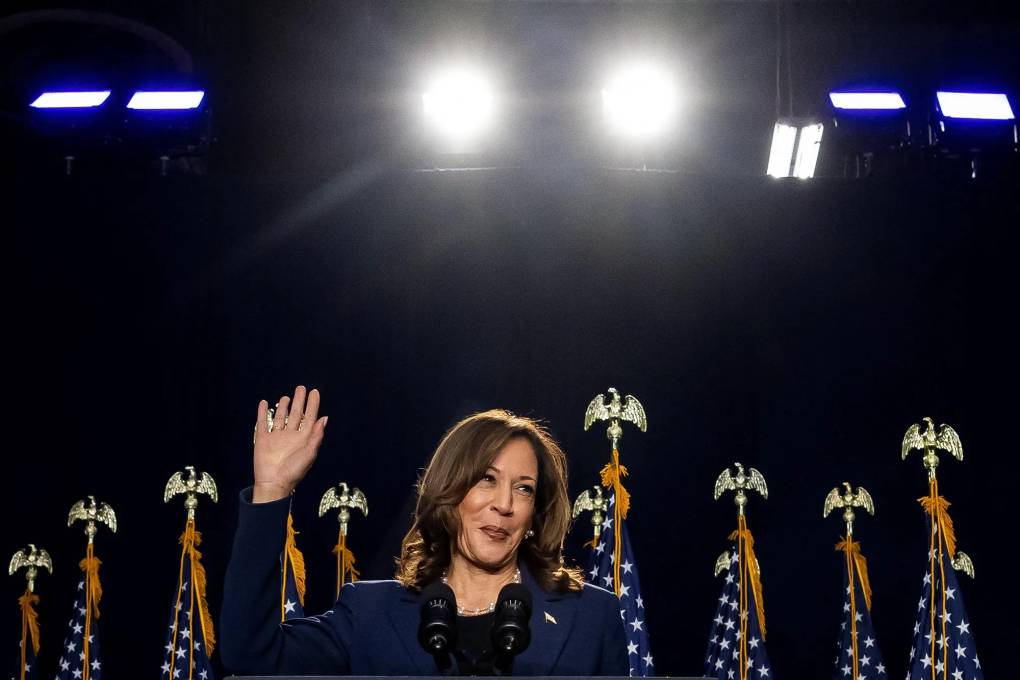
"caption": "Vice President Kamala Harris speaks to supporters at her first campaign event as the presumptive Democratic nominee at West Allis High School in West Allis, Wisconsin, on July 23, 2024. ",
"credit": "Kevin Mohatt/Reuters via CalMatters",
"altTag": null,
"description": null,
"imgSizes": {
"medium": {
"file": "https://cdn.kqed.org/wp-content/uploads/sites/10/2024/07/072324-Kamala-Harris-REUTERS-CM-copy-800x534.jpg",
"width": 800,
"height": 534,
"mimeType": "image/jpeg"
},
"large": {
"file": "https://cdn.kqed.org/wp-content/uploads/sites/10/2024/07/072324-Kamala-Harris-REUTERS-CM-copy-1020x680.jpg",
"width": 1020,
"height": 680,
"mimeType": "image/jpeg"
},
"thumbnail": {
"file": "https://cdn.kqed.org/wp-content/uploads/sites/10/2024/07/072324-Kamala-Harris-REUTERS-CM-copy-160x107.jpg",
"width": 160,
"height": 107,
"mimeType": "image/jpeg"
},
"1536x1536": {
"file": "https://cdn.kqed.org/wp-content/uploads/sites/10/2024/07/072324-Kamala-Harris-REUTERS-CM-copy-1536x1025.jpg",
"width": 1536,
"height": 1025,
"mimeType": "image/jpeg"
},
"post-thumbnail": {
"file": "https://cdn.kqed.org/wp-content/uploads/sites/10/2024/07/072324-Kamala-Harris-REUTERS-CM-copy-672x372.jpg",
"width": 672,
"height": 372,
"mimeType": "image/jpeg"
},
"twentyfourteen-full-width": {
"file": "https://cdn.kqed.org/wp-content/uploads/sites/10/2024/07/072324-Kamala-Harris-REUTERS-CM-copy-1038x576.jpg",
"width": 1038,
"height": 576,
"mimeType": "image/jpeg"
},
"full-width": {
"file": "https://cdn.kqed.org/wp-content/uploads/sites/10/2024/07/072324-Kamala-Harris-REUTERS-CM-copy-1920x1281.jpg",
"width": 1920,
"height": 1281,
"mimeType": "image/jpeg"
},
"kqedFullSize": {
"file": "https://cdn.kqed.org/wp-content/uploads/sites/10/2024/07/072324-Kamala-Harris-REUTERS-CM-copy.jpg",
"width": 2000,
"height": 1334
}
},
"isLoading": false,
"fetchFailed": false
},
"news_11610689": {
"type": "attachments",
"id": "news_11610689",
"meta": {
"index": "attachments_1716263798",
"site": "news",
"id": "11610689",
"found": true
},
"parent": 11610688,
"imgSizes": {
"small": {
"file": "https://ww2.kqed.org/app/uploads/sites/10/2017/08/rts1axax_slide-882d321b832a51b2252a9c58d01f5af7f0c4b338-520x347.jpg",
"width": 520,
"mimeType": "image/jpeg",
"height": 347
},
"twentyfourteen-full-width": {
"file": "https://ww2.kqed.org/app/uploads/sites/10/2017/08/rts1axax_slide-882d321b832a51b2252a9c58d01f5af7f0c4b338-1038x576.jpg",
"width": 1038,
"mimeType": "image/jpeg",
"height": 576
},
"thumbnail": {
"file": "https://ww2.kqed.org/app/uploads/sites/10/2017/08/rts1axax_slide-882d321b832a51b2252a9c58d01f5af7f0c4b338-160x107.jpg",
"width": 160,
"mimeType": "image/jpeg",
"height": 107
},
"fd-sm": {
"file": "https://ww2.kqed.org/app/uploads/sites/10/2017/08/rts1axax_slide-882d321b832a51b2252a9c58d01f5af7f0c4b338-960x640.jpg",
"width": 960,
"mimeType": "image/jpeg",
"height": 640
},
"post-thumbnail": {
"file": "https://ww2.kqed.org/app/uploads/sites/10/2017/08/rts1axax_slide-882d321b832a51b2252a9c58d01f5af7f0c4b338-672x372.jpg",
"width": 672,
"mimeType": "image/jpeg",
"height": 372
},
"xsmall": {
"file": "https://ww2.kqed.org/app/uploads/sites/10/2017/08/rts1axax_slide-882d321b832a51b2252a9c58d01f5af7f0c4b338-375x250.jpg",
"width": 375,
"mimeType": "image/jpeg",
"height": 250
},
"kqedFullSize": {
"file": "https://ww2.kqed.org/app/uploads/sites/10/2017/08/rts1axax_slide-882d321b832a51b2252a9c58d01f5af7f0c4b338-e1502232768698.jpg",
"width": 1920,
"height": 1280
},
"large": {
"file": "https://ww2.kqed.org/app/uploads/sites/10/2017/08/rts1axax_slide-882d321b832a51b2252a9c58d01f5af7f0c4b338-1020x680.jpg",
"width": 1020,
"mimeType": "image/jpeg",
"height": 680
},
"xlarge": {
"file": "https://ww2.kqed.org/app/uploads/sites/10/2017/08/rts1axax_slide-882d321b832a51b2252a9c58d01f5af7f0c4b338-1180x786.jpg",
"width": 1180,
"mimeType": "image/jpeg",
"height": 786
},
"guest-author-50": {
"file": "https://ww2.kqed.org/app/uploads/sites/10/2017/08/rts1axax_slide-882d321b832a51b2252a9c58d01f5af7f0c4b338-50x50.jpg",
"width": 50,
"mimeType": "image/jpeg",
"height": 50
},
"guest-author-96": {
"file": "https://ww2.kqed.org/app/uploads/sites/10/2017/08/rts1axax_slide-882d321b832a51b2252a9c58d01f5af7f0c4b338-96x96.jpg",
"width": 96,
"mimeType": "image/jpeg",
"height": 96
},
"medium": {
"file": "https://ww2.kqed.org/app/uploads/sites/10/2017/08/rts1axax_slide-882d321b832a51b2252a9c58d01f5af7f0c4b338-800x533.jpg",
"width": 800,
"mimeType": "image/jpeg",
"height": 533
},
"guest-author-64": {
"file": "https://ww2.kqed.org/app/uploads/sites/10/2017/08/rts1axax_slide-882d321b832a51b2252a9c58d01f5af7f0c4b338-64x64.jpg",
"width": 64,
"mimeType": "image/jpeg",
"height": 64
},
"guest-author-32": {
"file": "https://ww2.kqed.org/app/uploads/sites/10/2017/08/rts1axax_slide-882d321b832a51b2252a9c58d01f5af7f0c4b338-32x32.jpg",
"width": 32,
"mimeType": "image/jpeg",
"height": 32
},
"fd-lrg": {
"file": "https://ww2.kqed.org/app/uploads/sites/10/2017/08/rts1axax_slide-882d321b832a51b2252a9c58d01f5af7f0c4b338-1920x1280.jpg",
"width": 1920,
"mimeType": "image/jpeg",
"height": 1280
},
"fd-med": {
"file": "https://ww2.kqed.org/app/uploads/sites/10/2017/08/rts1axax_slide-882d321b832a51b2252a9c58d01f5af7f0c4b338-1180x786.jpg",
"width": 1180,
"mimeType": "image/jpeg",
"height": 786
},
"full-width": {
"file": "https://ww2.kqed.org/app/uploads/sites/10/2017/08/rts1axax_slide-882d321b832a51b2252a9c58d01f5af7f0c4b338-1920x1280.jpg",
"width": 1920,
"mimeType": "image/jpeg",
"height": 1280
},
"detail": {
"file": "https://ww2.kqed.org/app/uploads/sites/10/2017/08/rts1axax_slide-882d321b832a51b2252a9c58d01f5af7f0c4b338-150x150.jpg",
"width": 150,
"mimeType": "image/jpeg",
"height": 150
},
"guest-author-128": {
"file": "https://ww2.kqed.org/app/uploads/sites/10/2017/08/rts1axax_slide-882d321b832a51b2252a9c58d01f5af7f0c4b338-128x128.jpg",
"width": 128,
"mimeType": "image/jpeg",
"height": 128
},
"xxsmall": {
"file": "https://ww2.kqed.org/app/uploads/sites/10/2017/08/rts1axax_slide-882d321b832a51b2252a9c58d01f5af7f0c4b338-240x160.jpg",
"width": 240,
"mimeType": "image/jpeg",
"height": 160
}
},
"publishDate": 1502232499,
"modified": 1502232756,
"caption": "Participants look at a world map showing climate anomalies during the World Climate Change Conference 2015 in France. A draft government report on climate, which was leaked ahead of publication, says the U.S. is already experiencing the consequences of global warming.",
"description": "Participants look at a world map showing climate anomalies during the World Climate Change Conference 2015 in France. A draft government report on climate, which was leaked ahead of publication, says the U.S. is already experiencing the consequences of global warming.",
"title": "Participants look at a world map showing climate anomalies during the World Climate Change Conference 2015 in France. A draft government report on climate, which was leaked ahead of publication, says the U.S. is already experiencing the consequences of global warming.",
"credit": "Stephane Mahe/Reuters",
"status": "inherit",
"isLoading": false,
"fetchFailed": false
},
"news_11997292": {
"type": "attachments",
"id": "news_11997292",
"meta": {
"index": "attachments_1716263798",
"site": "news",
"id": "11997292",
"found": true
},
"title": "harris-rally0722",
"publishDate": 1721863759,
"status": "inherit",
"parent": 11997216,
"modified": 1721864192,
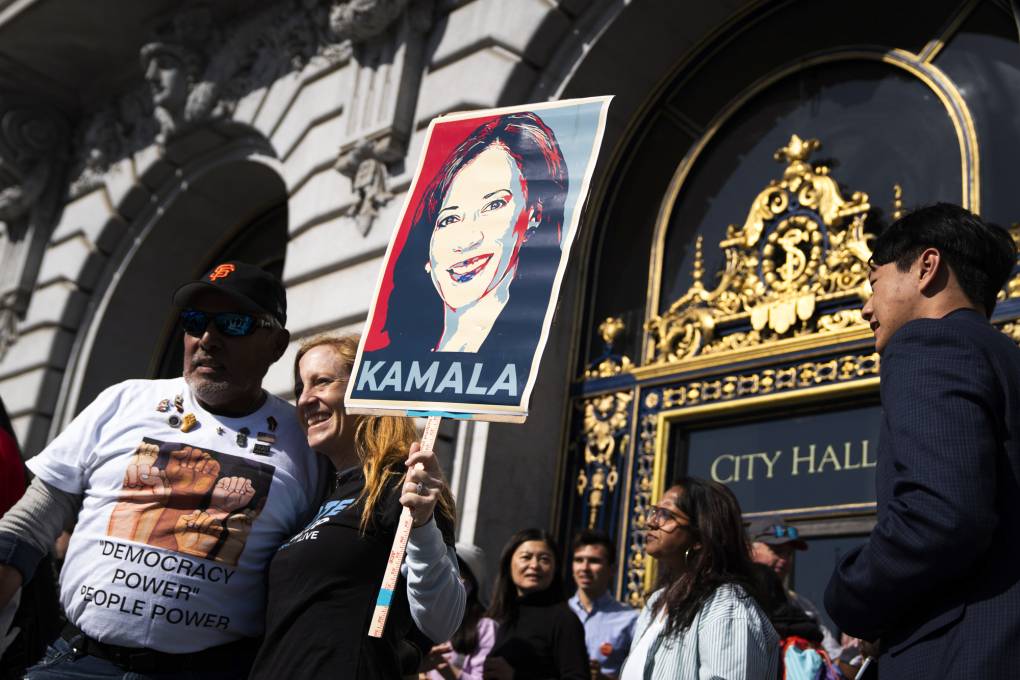
"caption": "Jim Martinez (left) and Lanier Coles pose for a photo with a Kamala Harris sign after a rally supporting Kamala Harris at the San Francisco City Hall in San Francisco on Monday, July 22, 2024.",
"credit": "Minh Connors/San Francisco Chronicle via Getty Images",
"altTag": null,
"description": null,
"imgSizes": {
"medium": {
"file": "https://cdn.kqed.org/wp-content/uploads/sites/10/2024/07/GETTYIMAGES-2162475400-KQED-KQED_1-1-800x533.jpg",
"width": 800,
"height": 533,
"mimeType": "image/jpeg"
},
"large": {
"file": "https://cdn.kqed.org/wp-content/uploads/sites/10/2024/07/GETTYIMAGES-2162475400-KQED-KQED_1-1-1020x680.jpg",
"width": 1020,
"height": 680,
"mimeType": "image/jpeg"
},
"thumbnail": {
"file": "https://cdn.kqed.org/wp-content/uploads/sites/10/2024/07/GETTYIMAGES-2162475400-KQED-KQED_1-1-160x107.jpg",
"width": 160,
"height": 107,
"mimeType": "image/jpeg"
},
"1536x1536": {
"file": "https://cdn.kqed.org/wp-content/uploads/sites/10/2024/07/GETTYIMAGES-2162475400-KQED-KQED_1-1-1536x1024.jpg",
"width": 1536,
"height": 1024,
"mimeType": "image/jpeg"
},
"post-thumbnail": {
"file": "https://cdn.kqed.org/wp-content/uploads/sites/10/2024/07/GETTYIMAGES-2162475400-KQED-KQED_1-1-672x372.jpg",
"width": 672,
"height": 372,
"mimeType": "image/jpeg"
},
"twentyfourteen-full-width": {
"file": "https://cdn.kqed.org/wp-content/uploads/sites/10/2024/07/GETTYIMAGES-2162475400-KQED-KQED_1-1-1038x576.jpg",
"width": 1038,
"height": 576,
"mimeType": "image/jpeg"
},
"full-width": {
"file": "https://cdn.kqed.org/wp-content/uploads/sites/10/2024/07/GETTYIMAGES-2162475400-KQED-KQED_1-1-1920x1280.jpg",
"width": 1920,
"height": 1280,
"mimeType": "image/jpeg"
},
"kqedFullSize": {
"file": "https://cdn.kqed.org/wp-content/uploads/sites/10/2024/07/GETTYIMAGES-2162475400-KQED-KQED_1-1.jpg",
"width": 2000,
"height": 1333
}
},
"isLoading": false,
"fetchFailed": false
},
"news_11997303": {
"type": "attachments",
"id": "news_11997303",
"meta": {
"index": "attachments_1716263798",
"site": "news",
"id": "11997303",
"found": true
},
"title": "230810-FeltonInstituteRally-24-BL_qed",
"publishDate": 1721864538,
"status": "inherit",
"parent": 11997210,
"modified": 1721868167,
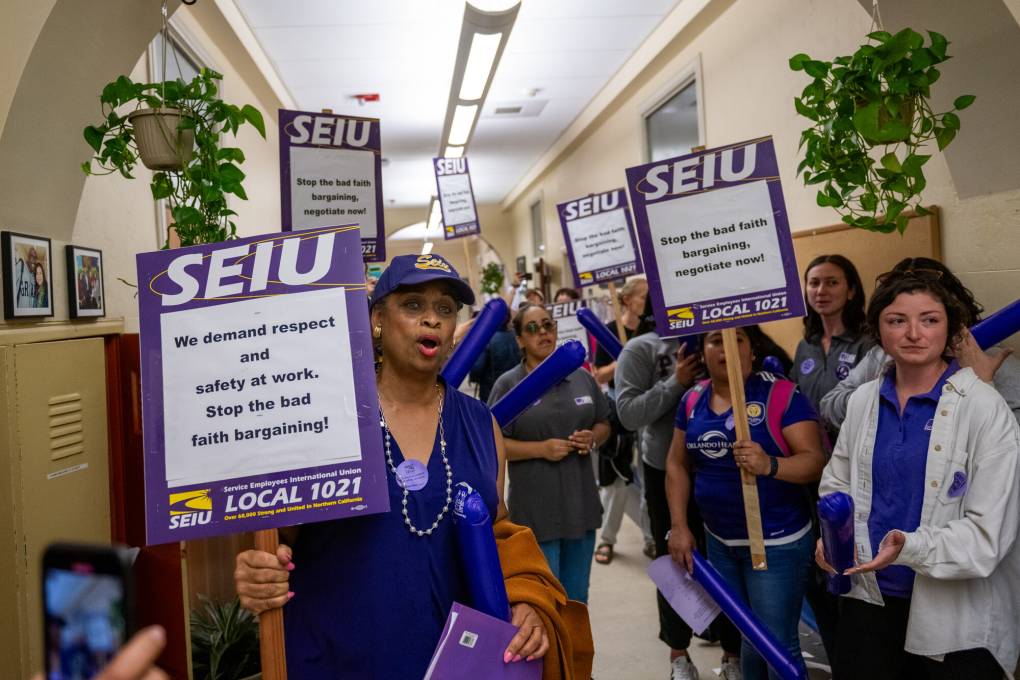
"caption": "Felton Institute employees and union members cheer after delivering their health and safety demands to management during a rally on Aug. 10, 2023, to bring attention to a gas leak employees say went unaddressed for more than a year at Felton's Sunshine Community Center in San Francisco's Mission District. ",
"credit": "Beth LaBerge/KQED",
"altTag": null,
"description": null,
"imgSizes": {
"medium": {
"file": "https://cdn.kqed.org/wp-content/uploads/sites/10/2024/07/230810-FeltonInstituteRally-24-BL_qed-800x533.jpg",
"width": 800,
"height": 533,
"mimeType": "image/jpeg"
},
"large": {
"file": "https://cdn.kqed.org/wp-content/uploads/sites/10/2024/07/230810-FeltonInstituteRally-24-BL_qed-1020x680.jpg",
"width": 1020,
"height": 680,
"mimeType": "image/jpeg"
},
"thumbnail": {
"file": "https://cdn.kqed.org/wp-content/uploads/sites/10/2024/07/230810-FeltonInstituteRally-24-BL_qed-160x107.jpg",
"width": 160,
"height": 107,
"mimeType": "image/jpeg"
},
"1536x1536": {
"file": "https://cdn.kqed.org/wp-content/uploads/sites/10/2024/07/230810-FeltonInstituteRally-24-BL_qed-1536x1024.jpg",
"width": 1536,
"height": 1024,
"mimeType": "image/jpeg"
},
"post-thumbnail": {
"file": "https://cdn.kqed.org/wp-content/uploads/sites/10/2024/07/230810-FeltonInstituteRally-24-BL_qed-672x372.jpg",
"width": 672,
"height": 372,
"mimeType": "image/jpeg"
},
"twentyfourteen-full-width": {
"file": "https://cdn.kqed.org/wp-content/uploads/sites/10/2024/07/230810-FeltonInstituteRally-24-BL_qed-1038x576.jpg",
"width": 1038,
"height": 576,
"mimeType": "image/jpeg"
},
"full-width": {
"file": "https://cdn.kqed.org/wp-content/uploads/sites/10/2024/07/230810-FeltonInstituteRally-24-BL_qed-1920x1280.jpg",
"width": 1920,
"height": 1280,
"mimeType": "image/jpeg"
},
"kqedFullSize": {
"file": "https://cdn.kqed.org/wp-content/uploads/sites/10/2024/07/230810-FeltonInstituteRally-24-BL_qed.jpg",
"width": 2000,
"height": 1333
}
},
"isLoading": false,
"fetchFailed": false
},
"news_11997196": {
"type": "attachments",
"id": "news_11997196",
"meta": {
"index": "attachments_1716263798",
"site": "news",
"id": "11997196",
"found": true
},
"title": "Donald TrumpJD Vance",
"publishDate": 1721853839,
"status": "inherit",
"parent": 11997168,
"modified": 1756337631,
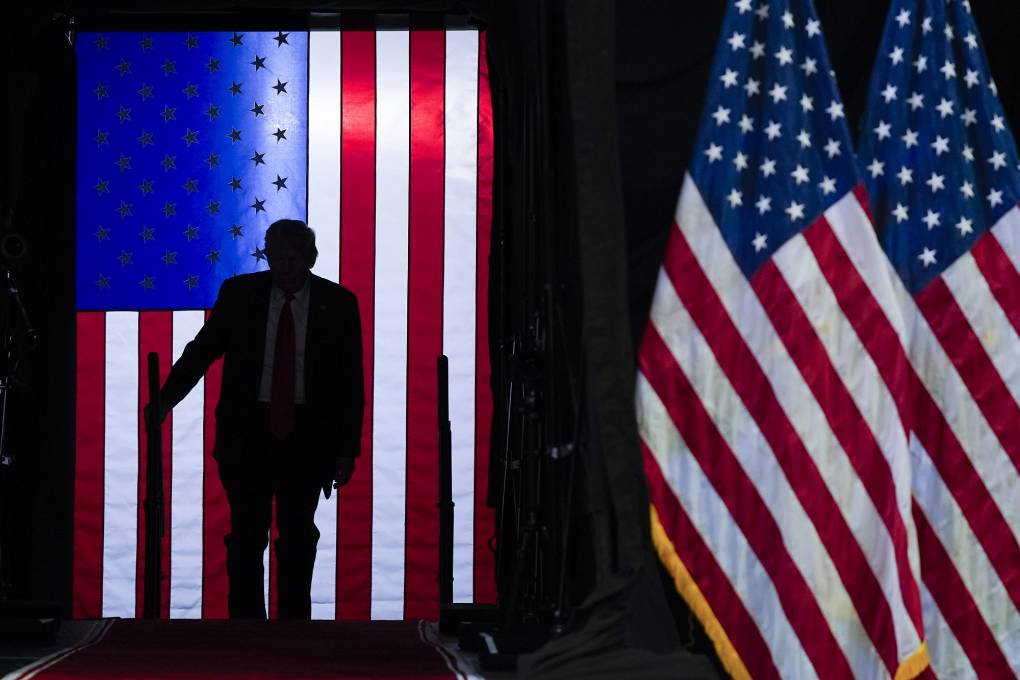
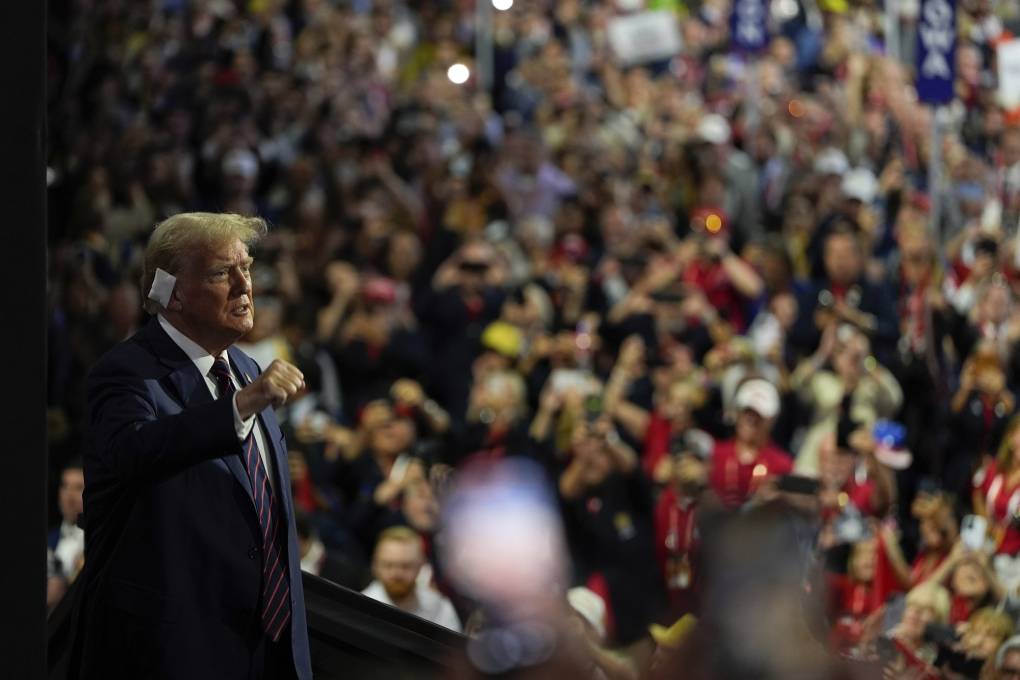
"caption": "Then-Republican presidential candidate and former President Donald Trump arrives at a campaign rally in Grand Rapids, Michigan, on July 20, 2024.",
"credit": "Evan Vucci/AP Photo",
"altTag": null,
"description": null,
"imgSizes": {
"medium": {
"file": "https://cdn.kqed.org/wp-content/uploads/sites/10/2024/07/TrumpRallyAP1-800x533.jpg",
"width": 800,
"height": 533,
"mimeType": "image/jpeg"
},
"large": {
"file": "https://cdn.kqed.org/wp-content/uploads/sites/10/2024/07/TrumpRallyAP1-1020x680.jpg",
"width": 1020,
"height": 680,
"mimeType": "image/jpeg"
},
"thumbnail": {
"file": "https://cdn.kqed.org/wp-content/uploads/sites/10/2024/07/TrumpRallyAP1-160x107.jpg",
"width": 160,
"height": 107,
"mimeType": "image/jpeg"
},
"1536x1536": {
"file": "https://cdn.kqed.org/wp-content/uploads/sites/10/2024/07/TrumpRallyAP1-1536x1024.jpg",
"width": 1536,
"height": 1024,
"mimeType": "image/jpeg"
},
"post-thumbnail": {
"file": "https://cdn.kqed.org/wp-content/uploads/sites/10/2024/07/TrumpRallyAP1-672x372.jpg",
"width": 672,
"height": 372,
"mimeType": "image/jpeg"
},
"twentyfourteen-full-width": {
"file": "https://cdn.kqed.org/wp-content/uploads/sites/10/2024/07/TrumpRallyAP1-1038x576.jpg",
"width": 1038,
"height": 576,
"mimeType": "image/jpeg"
},
"full-width": {
"file": "https://cdn.kqed.org/wp-content/uploads/sites/10/2024/07/TrumpRallyAP1-1920x1280.jpg",
"width": 1920,
"height": 1280,
"mimeType": "image/jpeg"
},
"kqedFullSize": {
"file": "https://cdn.kqed.org/wp-content/uploads/sites/10/2024/07/TrumpRallyAP1.jpg",
"width": 2000,
"height": 1333
}
},
"isLoading": false,
"fetchFailed": false
},
"news_11997003": {
"type": "attachments",
"id": "news_11997003",
"meta": {
"index": "attachments_1716263798",
"site": "news",
"id": "11997003",
"found": true
},
"title": "Vice President Harris Holds Campaign Event In Kalamazoo, Michigan",
"publishDate": 1721769837,
"status": "inherit",
"parent": 11997002,
"modified": 1721773973,
"caption": "U.S. Vice President Kamala Harris attends a moderated conversation with former Trump administration national security official Olivia Troye and former Republican voter Amanda Stratton on July 17, 2024, in Kalamazoo, Michigan. ",
"credit": "Chris duMond/Getty Images",
"altTag": "A woman wearing a black jacket holds a microphone with three U.S. flags in the background.",
"description": "KALAMAZOO, MICHIGAN - JULY 17: U.S. Vice President Kamala Harris attends a moderated conversation with former Trump administration national security official Olivia Troye and former Republican voter Amanda Stratton on July 17, 2024 in Kalamazoo, Michigan. (Photo by Chris duMond/Getty Images)",
"imgSizes": {
"medium": {
"file": "https://cdn.kqed.org/wp-content/uploads/sites/10/2024/07/gettyimages-2162037810-800x533.jpeg",
"width": 800,
"height": 533,
"mimeType": "image/jpeg"
},
"large": {
"file": "https://cdn.kqed.org/wp-content/uploads/sites/10/2024/07/gettyimages-2162037810-1020x680.jpeg",
"width": 1020,
"height": 680,
"mimeType": "image/jpeg"
},
"thumbnail": {
"file": "https://cdn.kqed.org/wp-content/uploads/sites/10/2024/07/gettyimages-2162037810-160x107.jpeg",
"width": 160,
"height": 107,
"mimeType": "image/jpeg"
},
"1536x1536": {
"file": "https://cdn.kqed.org/wp-content/uploads/sites/10/2024/07/gettyimages-2162037810-1536x1024.jpeg",
"width": 1536,
"height": 1024,
"mimeType": "image/jpeg"
},
"2048x2048": {
"file": "https://cdn.kqed.org/wp-content/uploads/sites/10/2024/07/gettyimages-2162037810-2048x1365.jpeg",
"width": 2048,
"height": 1365,
"mimeType": "image/jpeg"
},
"post-thumbnail": {
"file": "https://cdn.kqed.org/wp-content/uploads/sites/10/2024/07/gettyimages-2162037810-672x372.jpeg",
"width": 672,
"height": 372,
"mimeType": "image/jpeg"
},
"twentyfourteen-full-width": {
"file": "https://cdn.kqed.org/wp-content/uploads/sites/10/2024/07/gettyimages-2162037810-1038x576.jpeg",
"width": 1038,
"height": 576,
"mimeType": "image/jpeg"
},
"full-width": {
"file": "https://cdn.kqed.org/wp-content/uploads/sites/10/2024/07/gettyimages-2162037810-1920x1280.jpeg",
"width": 1920,
"height": 1280,
"mimeType": "image/jpeg"
},
"kqedFullSize": {
"file": "https://cdn.kqed.org/wp-content/uploads/sites/10/2024/07/gettyimages-2162037810-scaled.jpeg",
"width": 2560,
"height": 1707
}
},
"isLoading": false,
"fetchFailed": false
},
"news_11996886": {
"type": "attachments",
"id": "news_11996886",
"meta": {
"index": "attachments_1716263798",
"site": "news",
"id": "11996886",
"found": true
},
"title": "TOPSHOT-US-POLITICS-VOTE-HARRIS",
"publishDate": 1721755888,
"status": "inherit",
"parent": 11996883,
"modified": 1721759732,
"caption": "U.S. Vice President and Democratic presidential candidate Kamala Harris speaks at her campaign headquarters in Wilmington, Delaware, on July 22, 2024. Harris on Monday compared her election rival Donald Trump to 'predators' and 'cheaters,' as she attacked the first former U.S. leader to be convicted of a crime.",
"credit": "Erin Schaff/AFP via Getty Images",
"altTag": null,
"description": null,
"imgSizes": {
"medium": {
"file": "https://cdn.kqed.org/wp-content/uploads/sites/10/2024/07/GettyImages-2162466794-800x534.jpg",
"width": 800,
"height": 534,
"mimeType": "image/jpeg"
},
"large": {
"file": "https://cdn.kqed.org/wp-content/uploads/sites/10/2024/07/GettyImages-2162466794-1020x680.jpg",
"width": 1020,
"height": 680,
"mimeType": "image/jpeg"
},
"thumbnail": {
"file": "https://cdn.kqed.org/wp-content/uploads/sites/10/2024/07/GettyImages-2162466794-160x107.jpg",
"width": 160,
"height": 107,
"mimeType": "image/jpeg"
},
"post-thumbnail": {
"file": "https://cdn.kqed.org/wp-content/uploads/sites/10/2024/07/GettyImages-2162466794-672x372.jpg",
"width": 672,
"height": 372,
"mimeType": "image/jpeg"
},
"twentyfourteen-full-width": {
"file": "https://cdn.kqed.org/wp-content/uploads/sites/10/2024/07/GettyImages-2162466794-1024x576.jpg",
"width": 1024,
"height": 576,
"mimeType": "image/jpeg"
},
"kqedFullSize": {
"file": "https://cdn.kqed.org/wp-content/uploads/sites/10/2024/07/GettyImages-2162466794.jpg",
"width": 1024,
"height": 683
}
},
"isLoading": false,
"fetchFailed": false
},
"news_11996256": {
"type": "attachments",
"id": "news_11996256",
"meta": {
"index": "attachments_1716263798",
"site": "news",
"id": "11996256",
"found": true
},
"title": "Follow to Donald Trump Rally Shooting- Butler, PA",
"publishDate": 1721328613,
"status": "inherit",
"parent": 11996255,
"modified": 1721340940,
"caption": "Ruth Weber, left, and Jan Vogel photograph a flag that flew over former President Donald Trump's rally at Butler Farm Show Inc. on Saturday when a shooting broke out is seen on Sunday, July 14, 2024, in Butler, Pennsylvania. The alleged shooter was identified as Thomas Matthew Crooks. ",
"credit": "Matt McClain/The Washington Post via Getty Images",
"altTag": null,
"description": null,
"imgSizes": {
"medium": {
"file": "https://cdn.kqed.org/wp-content/uploads/sites/10/2024/07/America-800x533.jpg",
"width": 800,
"height": 533,
"mimeType": "image/jpeg"
},
"large": {
"file": "https://cdn.kqed.org/wp-content/uploads/sites/10/2024/07/America-1020x680.jpg",
"width": 1020,
"height": 680,
"mimeType": "image/jpeg"
},
"thumbnail": {
"file": "https://cdn.kqed.org/wp-content/uploads/sites/10/2024/07/America-160x107.jpg",
"width": 160,
"height": 107,
"mimeType": "image/jpeg"
},
"1536x1536": {
"file": "https://cdn.kqed.org/wp-content/uploads/sites/10/2024/07/America-1536x1024.jpg",
"width": 1536,
"height": 1024,
"mimeType": "image/jpeg"
},
"post-thumbnail": {
"file": "https://cdn.kqed.org/wp-content/uploads/sites/10/2024/07/America-672x372.jpg",
"width": 672,
"height": 372,
"mimeType": "image/jpeg"
},
"twentyfourteen-full-width": {
"file": "https://cdn.kqed.org/wp-content/uploads/sites/10/2024/07/America-1038x576.jpg",
"width": 1038,
"height": 576,
"mimeType": "image/jpeg"
},
"full-width": {
"file": "https://cdn.kqed.org/wp-content/uploads/sites/10/2024/07/America-1920x1280.jpg",
"width": 1920,
"height": 1280,
"mimeType": "image/jpeg"
},
"kqedFullSize": {
"file": "https://cdn.kqed.org/wp-content/uploads/sites/10/2024/07/America.jpg",
"width": 2000,
"height": 1333
}
},
"isLoading": false,
"fetchFailed": false
},
"news_11996367": {
"type": "attachments",
"id": "news_11996367",
"meta": {
"index": "attachments_1716263798",
"site": "news",
"id": "11996367",
"found": true
},
"title": "2024 Republican National Convention: Day 1",
"publishDate": 1721378635,
"status": "inherit",
"parent": 11996366,
"modified": 1721378635,
"caption": "MILWAUKEE, WISCONSIN - JULY 15: Republican presidential candidate, former U.S. President Donald Trump (L) and Republican vice presidential candidate, U.S. Sen. J.D. Vance (R-OH) appear on the first day of the Republican National Convention at the Fiserv Forum on July 15, 2024 in Milwaukee, Wisconsin. Delegates, politicians, and the Republican faithful are in Milwaukee for the annual convention, concluding with former President Donald Trump accepting his party's presidential nomination. The RNC takes place from July 15-18. (Photo by Joe Raedle/Getty Images)",
"credit": null,
"altTag": null,
"description": null,
"imgSizes": {
"medium": {
"file": "https://cdn.kqed.org/wp-content/uploads/sites/10/2024/07/GettyImages-2162188852-800x533.jpg",
"width": 800,
"height": 533,
"mimeType": "image/jpeg"
},
"large": {
"file": "https://cdn.kqed.org/wp-content/uploads/sites/10/2024/07/GettyImages-2162188852-1020x680.jpg",
"width": 1020,
"height": 680,
"mimeType": "image/jpeg"
},
"thumbnail": {
"file": "https://cdn.kqed.org/wp-content/uploads/sites/10/2024/07/GettyImages-2162188852-160x107.jpg",
"width": 160,
"height": 107,
"mimeType": "image/jpeg"
},
"1536x1536": {
"file": "https://cdn.kqed.org/wp-content/uploads/sites/10/2024/07/GettyImages-2162188852-1536x1024.jpg",
"width": 1536,
"height": 1024,
"mimeType": "image/jpeg"
},
"2048x2048": {
"file": "https://cdn.kqed.org/wp-content/uploads/sites/10/2024/07/GettyImages-2162188852-2048x1365.jpg",
"width": 2048,
"height": 1365,
"mimeType": "image/jpeg"
},
"post-thumbnail": {
"file": "https://cdn.kqed.org/wp-content/uploads/sites/10/2024/07/GettyImages-2162188852-672x372.jpg",
"width": 672,
"height": 372,
"mimeType": "image/jpeg"
},
"twentyfourteen-full-width": {
"file": "https://cdn.kqed.org/wp-content/uploads/sites/10/2024/07/GettyImages-2162188852-1038x576.jpg",
"width": 1038,
"height": 576,
"mimeType": "image/jpeg"
},
"full-width": {
"file": "https://cdn.kqed.org/wp-content/uploads/sites/10/2024/07/GettyImages-2162188852-1920x1280.jpg",
"width": 1920,
"height": 1280,
"mimeType": "image/jpeg"
},
"kqedFullSize": {
"file": "https://cdn.kqed.org/wp-content/uploads/sites/10/2024/07/2024/07/GettyImages-2162188852-scaled.jpg",
"width": 2560,
"height": 1706
}
},
"isLoading": false,
"fetchFailed": false
},
"news_11996310": {
"type": "attachments",
"id": "news_11996310",
"meta": {
"index": "attachments_1716263798",
"site": "news",
"id": "11996310",
"found": true
},
"title": "Election 2024 RNC Photo Gallery",
"publishDate": 1721342163,
"status": "inherit",
"parent": 11996260,
"modified": 1721348450,
"caption": "Republican presidential candidate and former President Donald Trump gestures as he arrives at the Republican National Convention on Wednesday, July 17, 2024, in Milwaukee, Wisconsin.",
"credit": "Julia Nikhinson/AP Photo",
"altTag": null,
"description": null,
"imgSizes": {
"medium": {
"file": "https://cdn.kqed.org/wp-content/uploads/sites/10/2024/07/TrumpRNC2024-800x533.jpg",
"width": 800,
"height": 533,
"mimeType": "image/jpeg"
},
"large": {
"file": "https://cdn.kqed.org/wp-content/uploads/sites/10/2024/07/TrumpRNC2024-1020x680.jpg",
"width": 1020,
"height": 680,
"mimeType": "image/jpeg"
},
"thumbnail": {
"file": "https://cdn.kqed.org/wp-content/uploads/sites/10/2024/07/TrumpRNC2024-160x107.jpg",
"width": 160,
"height": 107,
"mimeType": "image/jpeg"
},
"1536x1536": {
"file": "https://cdn.kqed.org/wp-content/uploads/sites/10/2024/07/TrumpRNC2024-1536x1024.jpg",
"width": 1536,
"height": 1024,
"mimeType": "image/jpeg"
},
"post-thumbnail": {
"file": "https://cdn.kqed.org/wp-content/uploads/sites/10/2024/07/TrumpRNC2024-672x372.jpg",
"width": 672,
"height": 372,
"mimeType": "image/jpeg"
},
"twentyfourteen-full-width": {
"file": "https://cdn.kqed.org/wp-content/uploads/sites/10/2024/07/TrumpRNC2024-1038x576.jpg",
"width": 1038,
"height": 576,
"mimeType": "image/jpeg"
},
"full-width": {
"file": "https://cdn.kqed.org/wp-content/uploads/sites/10/2024/07/TrumpRNC2024-1920x1280.jpg",
"width": 1920,
"height": 1280,
"mimeType": "image/jpeg"
},
"kqedFullSize": {
"file": "https://cdn.kqed.org/wp-content/uploads/sites/10/2024/07/TrumpRNC2024.jpg",
"width": 2000,
"height": 1333
}
},
"isLoading": false,
"fetchFailed": false
},
"news_11996124": {
"type": "attachments",
"id": "news_11996124",
"meta": {
"index": "attachments_1716263798",
"site": "news",
"id": "11996124",
"found": true
},
"title": "Donald Trump Holds A Campaign Rally In Butler, Pennsylvania",
"publishDate": 1721252292,
"status": "inherit",
"parent": 11996066,
"modified": 1721252573,
"caption": "Campaign signs and empty water bottles are seen on the ground of a campaign rally for Republican presidential candidate former President Donald Trump on July 13, 2024 in Butler, Pennsylvania. Trump was injured by a suspected gunman who subsequently died. One audience member also died and 2 others were critically injured at the rally. ",
"credit": "Anna Moneymaker/Getty Images",
"altTag": null,
"description": null,
"imgSizes": {
"medium": {
"file": "https://cdn.kqed.org/wp-content/uploads/sites/10/2024/07/GettyImages-2161942386-800x534.jpg",
"width": 800,
"height": 534,
"mimeType": "image/jpeg"
},
"large": {
"file": "https://cdn.kqed.org/wp-content/uploads/sites/10/2024/07/GettyImages-2161942386-1020x680.jpg",
"width": 1020,
"height": 680,
"mimeType": "image/jpeg"
},
"thumbnail": {
"file": "https://cdn.kqed.org/wp-content/uploads/sites/10/2024/07/GettyImages-2161942386-160x107.jpg",
"width": 160,
"height": 107,
"mimeType": "image/jpeg"
},
"post-thumbnail": {
"file": "https://cdn.kqed.org/wp-content/uploads/sites/10/2024/07/GettyImages-2161942386-672x372.jpg",
"width": 672,
"height": 372,
"mimeType": "image/jpeg"
},
"twentyfourteen-full-width": {
"file": "https://cdn.kqed.org/wp-content/uploads/sites/10/2024/07/GettyImages-2161942386-1024x576.jpg",
"width": 1024,
"height": 576,
"mimeType": "image/jpeg"
},
"kqedFullSize": {
"file": "https://cdn.kqed.org/wp-content/uploads/sites/10/2024/07/GettyImages-2161942386.jpg",
"width": 1024,
"height": 683
}
},
"isLoading": false,
"fetchFailed": false
},
"news_11994186": {
"type": "attachments",
"id": "news_11994186",
"meta": {
"index": "attachments_1716263798",
"site": "news",
"id": "11994186",
"found": true
},
"title": "TOPSHOT-US-POLITICS-VOTE",
"publishDate": 1721086591,
"status": "inherit",
"parent": 11994184,
"modified": 1721086802,
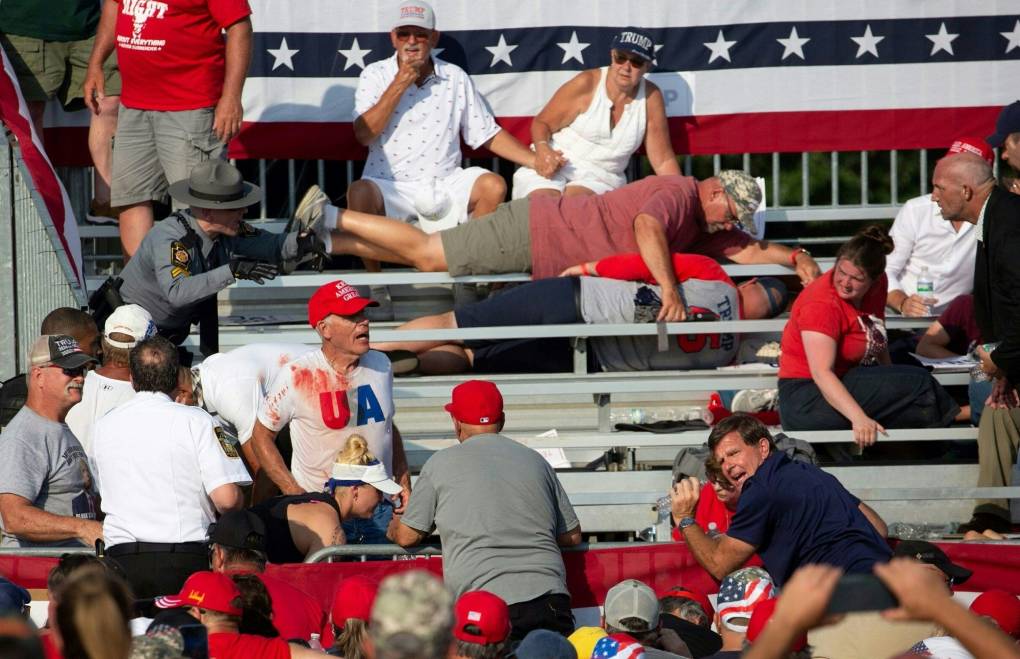
"caption": "Trump supporters are seen covered with blood in the stands after guns were fired at Republican nominee Donald Trump at a campaign event at Butler Farm Show Inc. in Butler, Pennsylvania, July 13, 2024. ",
"credit": "Rebecca Droke/AFP via Getty Images",
"altTag": null,
"description": null,
"imgSizes": {
"medium": {
"file": "https://cdn.kqed.org/wp-content/uploads/sites/10/2024/07/TrumpPennsylvaniaRally2024-800x517.jpg",
"width": 800,
"height": 517,
"mimeType": "image/jpeg"
},
"large": {
"file": "https://cdn.kqed.org/wp-content/uploads/sites/10/2024/07/TrumpPennsylvaniaRally2024-1020x659.jpg",
"width": 1020,
"height": 659,
"mimeType": "image/jpeg"
},
"thumbnail": {
"file": "https://cdn.kqed.org/wp-content/uploads/sites/10/2024/07/TrumpPennsylvaniaRally2024-160x103.jpg",
"width": 160,
"height": 103,
"mimeType": "image/jpeg"
},
"1536x1536": {
"file": "https://cdn.kqed.org/wp-content/uploads/sites/10/2024/07/TrumpPennsylvaniaRally2024-1536x992.jpg",
"width": 1536,
"height": 992,
"mimeType": "image/jpeg"
},
"post-thumbnail": {
"file": "https://cdn.kqed.org/wp-content/uploads/sites/10/2024/07/TrumpPennsylvaniaRally2024-672x372.jpg",
"width": 672,
"height": 372,
"mimeType": "image/jpeg"
},
"twentyfourteen-full-width": {
"file": "https://cdn.kqed.org/wp-content/uploads/sites/10/2024/07/TrumpPennsylvaniaRally2024-1038x576.jpg",
"width": 1038,
"height": 576,
"mimeType": "image/jpeg"
},
"full-width": {
"file": "https://cdn.kqed.org/wp-content/uploads/sites/10/2024/07/TrumpPennsylvaniaRally2024-1920x1240.jpg",
"width": 1920,
"height": 1240,
"mimeType": "image/jpeg"
},
"kqedFullSize": {
"file": "https://cdn.kqed.org/wp-content/uploads/sites/10/2024/07/TrumpPennsylvaniaRally2024.jpg",
"width": 2000,
"height": 1292
}
},
"isLoading": false,
"fetchFailed": false
}
},
"audioPlayerReducer": {
"postId": "stream_live",
"isPaused": true,
"isPlaying": false,
"pfsActive": false,
"pledgeModalIsOpen": true,
"playerDrawerIsOpen": false,
"liveAudioPlayStartedAt": 0,
"liveAudioPlayContext": ""
},
"authorsReducer": {
"byline_news_11997712": {
"type": "authors",
"id": "byline_news_11997712",
"meta": {
"override": true
},
"slug": "byline_news_11997712",
"name": "\u003ca href=\"https://calmatters.org/author/yue-yu/\">Yue Stella Yu\u003c/a>, CalMatters",
"isLoading": false
},
"byline_news_11997002": {
"type": "authors",
"id": "byline_news_11997002",
"meta": {
"override": true
},
"slug": "byline_news_11997002",
"name": "Rachel Treisman",
"isLoading": false
},
"byline_news_11996883": {
"type": "authors",
"id": "byline_news_11996883",
"meta": {
"override": true
},
"slug": "byline_news_11996883",
"name": "Bill Barrow, Associated Press",
"isLoading": false
},
"gmarzorati": {
"type": "authors",
"id": "227",
"meta": {
"index": "authors_1716337520",
"id": "227",
"found": true
},
"name": "Guy Marzorati",
"firstName": "Guy",
"lastName": "Marzorati",
"slug": "gmarzorati",
"email": "gmarzorati@KQED.org",
"display_author_email": true,
"staff_mastheads": [
"news"
],
"title": "Correspondent",
"bio": "Guy Marzorati is a correspondent on KQED's California Politics and Government Desk, based in San Jose. A graduate of Santa Clara University, Guy joined KQED in 2013. He reports on state and local politics and produces KQED's digital voter guide.",
"avatar": "https://secure.gravatar.com/avatar/e7038b8dbfd55b104369b76b1cd0b9de?s=600&d=blank&r=g",
"twitter": "guymarzorati",
"facebook": null,
"instagram": null,
"linkedin": null,
"sites": [
{
"site": "",
"roles": [
"editor"
]
},
{
"site": "news",
"roles": [
"editor"
]
},
{
"site": "science",
"roles": [
"editor"
]
},
{
"site": "forum",
"roles": [
"editor"
]
},
{
"site": "elections",
"roles": [
"editor"
]
},
{
"site": "liveblog",
"roles": [
"editor"
]
}
],
"headData": {
"title": "Guy Marzorati | KQED",
"description": "Correspondent",
"ogImgSrc": "https://secure.gravatar.com/avatar/e7038b8dbfd55b104369b76b1cd0b9de?s=600&d=blank&r=g",
"twImgSrc": "https://secure.gravatar.com/avatar/e7038b8dbfd55b104369b76b1cd0b9de?s=600&d=blank&r=g"
},
"isLoading": false,
"link": "/author/gmarzorati"
},
"rachael-myrow": {
"type": "authors",
"id": "251",
"meta": {
"index": "authors_1716337520",
"id": "251",
"found": true
},
"name": "Rachael Myrow",
"firstName": "Rachael",
"lastName": "Myrow",
"slug": "rachael-myrow",
"email": "rmyrow@kqed.org",
"display_author_email": true,
"staff_mastheads": [
"news"
],
"title": "Senior Editor of KQED's Silicon Valley News Desk",
"bio": "• I write and edit stories about how Silicon Valley power and policies shape everyday life in California. I’m also passionate about making Bay Area history and culture more accessible to a broad public. • I’ve been a journalist for most of my life, starting in high school with The Franklin Press in Los Angeles, where I grew up. While earning my first degree in English at UC Berkeley, I got my start in public radio at KALX-FM. After completing a second degree in journalism at Cal, I landed my first professional job at Marketplace, then moved on to KPCC (now LAist), and then KQED, where I hosted The California Report for more than seven years. • My reporting has appeared on NPR, The World, WBUR’s \u003ci>Here & Now\u003c/i>, and the BBC. I also guest host for KQED’s \u003ci>Forum\u003c/i>, as well as the Commonwealth Club in San Francisco. • I speak periodically on media, democracy and technology issues, and do voiceover work for documentaries and educational video projects. • Outside of the studio, you'll find me hiking Bay Area trails and whipping up Insta-ready meals in my kitchen. • I do not accept gifts, money, or favors from anyone connected to my reporting, I don't pay people for information, and I do not support or donate to political causes. • I strive to treat the people I report on with fairness, honesty, and respect. I also recognize there are often multiple sides to a story and work to verify information through multiple sources and documentation. If I get something wrong, I correct it.",
"avatar": "https://secure.gravatar.com/avatar/87bf8cb5874e045cdff430523a6d48b1?s=600&d=blank&r=g",
"twitter": "rachaelmyrow",
"facebook": null,
"instagram": null,
"linkedin": "https://www.linkedin.com/in/rachaelmyrow/",
"sites": [
{
"site": "arts",
"roles": [
"administrator"
]
},
{
"site": "news",
"roles": [
"edit_others_posts",
"editor"
]
},
{
"site": "futureofyou",
"roles": [
"editor"
]
},
{
"site": "bayareabites",
"roles": [
"editor"
]
},
{
"site": "stateofhealth",
"roles": [
"editor"
]
},
{
"site": "science",
"roles": [
"editor"
]
},
{
"site": "food",
"roles": [
"editor"
]
},
{
"site": "forum",
"roles": [
"editor"
]
},
{
"site": "liveblog",
"roles": [
"author"
]
}
],
"headData": {
"title": "Rachael Myrow | KQED",
"description": "Senior Editor of KQED's Silicon Valley News Desk",
"ogImgSrc": "https://secure.gravatar.com/avatar/87bf8cb5874e045cdff430523a6d48b1?s=600&d=blank&r=g",
"twImgSrc": "https://secure.gravatar.com/avatar/87bf8cb5874e045cdff430523a6d48b1?s=600&d=blank&r=g"
},
"isLoading": false,
"link": "/author/rachael-myrow"
},
"scottshafer": {
"type": "authors",
"id": "255",
"meta": {
"index": "authors_1716337520",
"id": "255",
"found": true
},
"name": "Scott Shafer",
"firstName": "Scott",
"lastName": "Shafer",
"slug": "scottshafer",
"email": "sshafer@kqed.org",
"display_author_email": false,
"staff_mastheads": [
"news"
],
"title": "KQED Contributor",
"bio": "Scott Shafer is a senior editor with the KQED Politics and Government desk. He is co-host of Political Breakdown, the award-winning radio show and podcast with a personal take on the world of politics. Scott came to KQED in 1998 to host the statewide\u003cem> California Report\u003c/em>. Prior to that he had extended stints in politics and government\u003cem>.\u003c/em> He uses that inside experience at KQED in his, reporting, hosting and analysis for the politics desk. Scott collaborated \u003cem>Political Breakdown a\u003c/em>nd on \u003cem>The Political Mind of Jerry Brown, \u003c/em>an eight-part series about the life and extraordinary political career of the former governor. For fun, he plays water polo with the San Francisco Tsunami.",
"avatar": "https://secure.gravatar.com/avatar/a62ebae45b79d7aed1a39a0e3bf68104?s=600&d=blank&r=g",
"twitter": "scottshafer",
"bluesky": null,
"facebook": null,
"instagram": null,
"linkedin": null,
"sites": [
{
"site": "news",
"roles": [
"editor"
]
},
{
"site": "stateofhealth",
"roles": [
"author"
]
},
{
"site": "science",
"roles": [
"author"
]
},
{
"site": "forum",
"roles": [
"subscriber"
]
},
{
"site": "liveblog",
"roles": [
"author"
]
}
],
"headData": {
"title": "Scott Shafer | KQED",
"description": "KQED Contributor",
"ogImgSrc": "https://secure.gravatar.com/avatar/a62ebae45b79d7aed1a39a0e3bf68104?s=600&d=blank&r=g",
"twImgSrc": "https://secure.gravatar.com/avatar/a62ebae45b79d7aed1a39a0e3bf68104?s=600&d=blank&r=g"
},
"isLoading": false,
"link": "/author/scottshafer"
},
"mlagos": {
"type": "authors",
"id": "3239",
"meta": {
"index": "authors_1716337520",
"id": "3239",
"found": true
},
"name": "Marisa Lagos",
"firstName": "Marisa",
"lastName": "Lagos",
"slug": "mlagos",
"email": "mlagos@kqed.org",
"display_author_email": false,
"staff_mastheads": [
"news"
],
"title": "KQED Contributor",
"bio": "Marisa Lagos is a correspondent for KQED’s California Politics and Government Desk and co-hosts the award-winning show and podcast, Political Breakdown. At KQED, Lagos also conducts reporting, analysis and investigations into state, local and national politics for radio, TV, online and onstage. In 2022, she and co-host, Scott Shafer, moderated the only gubernatorial debate in California. In 2020, the \u003ci>Washington Post\u003c/i> named her one of the top political journalists in California; she was nominated for a Peabody and won several other awards for her work investigating the 2017 California wildfires. She has worked at the \u003ci>San Francisco Chronicle\u003c/i>, \u003ci>San Francisco Examiner\u003c/i> and \u003ci>Los Angeles Times\u003c/i>. A UC Santa Barbara graduate, she lives in San Francisco with her two sons and husband.",
"avatar": "https://secure.gravatar.com/avatar/a261a0d3696fc066871ef96b85b5e7d2?s=600&d=blank&r=g",
"twitter": "@mlagos",
"facebook": null,
"instagram": null,
"linkedin": null,
"sites": [
{
"site": "arts",
"roles": [
"author"
]
},
{
"site": "news",
"roles": [
"editor"
]
},
{
"site": "science",
"roles": [
"editor"
]
},
{
"site": "forum",
"roles": [
"author"
]
},
{
"site": "liveblog",
"roles": [
"author"
]
}
],
"headData": {
"title": "Marisa Lagos | KQED",
"description": "KQED Contributor",
"ogImgSrc": "https://secure.gravatar.com/avatar/a261a0d3696fc066871ef96b85b5e7d2?s=600&d=blank&r=g",
"twImgSrc": "https://secure.gravatar.com/avatar/a261a0d3696fc066871ef96b85b5e7d2?s=600&d=blank&r=g"
},
"isLoading": false,
"link": "/author/mlagos"
},
"fjhabvala": {
"type": "authors",
"id": "8659",
"meta": {
"index": "authors_1716337520",
"id": "8659",
"found": true
},
"name": "Farida Jhabvala Romero",
"firstName": "Farida",
"lastName": "Jhabvala Romero",
"slug": "fjhabvala",
"email": "fjhabvala@kqed.org",
"display_author_email": true,
"staff_mastheads": [
"news"
],
"title": "KQED Contributor",
"bio": "\u003cspan style=\"font-weight: 400;\">Farida Jhabvala Romero is a Labor Correspondent for KQED. She previously covered immigration. Farida was \u003ca href=\"https://www.ccnma.org/2022-most-influential-latina-journalists\">named\u003c/a> one of the 10 Most Influential Latina Journalists in California in 2022 by the California Chicano News Media Association. Her work has won awards from the Society of Professional Journalists (Northern California), as well as a national and regional Edward M. Murrow Award for the collaborative reporting projects “Dangerous Air” and “Graying California.” \u003c/span>\u003cspan style=\"font-weight: 400;\">Before joining KQED, Farida worked as a producer at Radio Bilingüe, a national public radio network. Farida earned her master’s degree in journalism from Stanford University.\u003c/span>",
"avatar": "https://secure.gravatar.com/avatar/c3ab27c5554b67b478f80971e515aa02?s=600&d=blank&r=g",
"twitter": "FaridaJhabvala",
"facebook": null,
"instagram": null,
"linkedin": "https://www.linkedin.com/in/faridajhabvala/",
"sites": [
{
"site": "news",
"roles": [
"editor"
]
},
{
"site": "stateofhealth",
"roles": [
"author"
]
}
],
"headData": {
"title": "Farida Jhabvala Romero | KQED",
"description": "KQED Contributor",
"ogImgSrc": "https://secure.gravatar.com/avatar/c3ab27c5554b67b478f80971e515aa02?s=600&d=blank&r=g",
"twImgSrc": "https://secure.gravatar.com/avatar/c3ab27c5554b67b478f80971e515aa02?s=600&d=blank&r=g"
},
"isLoading": false,
"link": "/author/fjhabvala"
},
"dventon": {
"type": "authors",
"id": "11088",
"meta": {
"index": "authors_1716337520",
"id": "11088",
"found": true
},
"name": "Danielle Venton",
"firstName": "Danielle",
"lastName": "Venton",
"slug": "dventon",
"email": "dventon@kqed.org",
"display_author_email": true,
"staff_mastheads": [
"science"
],
"title": "Science reporter",
"bio": "Danielle Venton is a reporter for KQED Science. She covers wildfires, space and oceans (though she is prone to sea sickness).\r\n\r\nBefore joining KQED in 2015, Danielle was a staff reporter at KRCB in Sonoma County and a freelancer. She studied science communication at UC Santa Cruz and formerly worked at CERN in Geneva, Switzerland where she wrote about computing. She lives in Sonoma County and enjoys backpacking.",
"avatar": "https://secure.gravatar.com/avatar/ebaf11ee6cfb7bb40329a143d463829e?s=600&d=blank&r=g",
"twitter": "DanielleVenton",
"facebook": null,
"instagram": null,
"linkedin": null,
"sites": [
{
"site": "arts",
"roles": [
"contributor"
]
},
{
"site": "news",
"roles": [
"editor"
]
},
{
"site": "futureofyou",
"roles": [
"editor"
]
},
{
"site": "science",
"roles": [
"editor"
]
},
{
"site": "liveblog",
"roles": [
"contributor"
]
}
],
"headData": {
"title": "Danielle Venton | KQED",
"description": "Science reporter",
"ogImgSrc": "https://secure.gravatar.com/avatar/ebaf11ee6cfb7bb40329a143d463829e?s=600&d=blank&r=g",
"twImgSrc": "https://secure.gravatar.com/avatar/ebaf11ee6cfb7bb40329a143d463829e?s=600&d=blank&r=g"
},
"isLoading": false,
"link": "/author/dventon"
},
"kevinstark": {
"type": "authors",
"id": "11608",
"meta": {
"index": "authors_1716337520",
"id": "11608",
"found": true
},
"name": "Kevin Stark",
"firstName": "Kevin",
"lastName": "Stark",
"slug": "kevinstark",
"email": "kstark@kqed.org",
"display_author_email": true,
"staff_mastheads": [
"science"
],
"title": "Senior Editor",
"bio": "Kevin is a senior editor for KQED Science, managing the station's health and climate desks. His journalism career began in the Pacific Northwest, and he later became a lead reporter for the San Francisco Public Press. His work has appeared in Pacific Standard magazine, the Energy News Network, the Center for Investigative Reporting's Reveal and WBEZ in Chicago. Kevin joined KQED in 2019, and has covered issues related to energy, wildfire, climate change and the environment.",
"avatar": "https://secure.gravatar.com/avatar/1f646bf546a63d638e04ff23b52b0e79?s=600&d=blank&r=g",
"twitter": "starkkev",
"facebook": null,
"instagram": null,
"linkedin": null,
"sites": [
{
"site": "",
"roles": [
"editor"
]
},
{
"site": "news",
"roles": [
"editor"
]
},
{
"site": "science",
"roles": [
"administrator"
]
}
],
"headData": {
"title": "Kevin Stark | KQED",
"description": "Senior Editor",
"ogImgSrc": "https://secure.gravatar.com/avatar/1f646bf546a63d638e04ff23b52b0e79?s=600&d=blank&r=g",
"twImgSrc": "https://secure.gravatar.com/avatar/1f646bf546a63d638e04ff23b52b0e79?s=600&d=blank&r=g"
},
"isLoading": false,
"link": "/author/kevinstark"
},
"ccabreralomeli": {
"type": "authors",
"id": "11708",
"meta": {
"index": "authors_1716337520",
"id": "11708",
"found": true
},
"name": "Carlos Cabrera-Lomelí",
"firstName": "Carlos",
"lastName": "Cabrera-Lomelí",
"slug": "ccabreralomeli",
"email": "ccabreralomeli@KQED.org",
"display_author_email": true,
"staff_mastheads": [
"news"
],
"title": "Community Reporter",
"bio": "Carlos Cabrera-Lomelí is a community reporter with KQED's digital engagement team. He also reports and co-produces for KQED's bilingual news hub KQED en Español. He grew up in San Francisco's Mission District and has previously worked with Univision, 48 Hills and REFORMA in Mexico City.",
"avatar": "https://secure.gravatar.com/avatar/c309be9665e484f887b818c89e273ecc673004f426f36b24d00a4d813a2e0518?s=600&d=blank&r=g",
"twitter": "@LomeliCabrera",
"bluesky": null,
"facebook": null,
"instagram": null,
"linkedin": null,
"sites": [
{
"site": "arts",
"roles": [
"editor"
]
},
{
"site": "news",
"roles": [
"editor"
]
},
{
"site": "about",
"roles": [
"editor"
]
},
{
"site": "science",
"roles": [
"editor"
]
},
{
"site": "perspectives",
"roles": [
"editor"
]
},
{
"site": "elections",
"roles": [
"editor"
]
},
{
"site": "liveblog",
"roles": [
"contributor"
]
}
],
"headData": {
"title": "Carlos Cabrera-Lomelí | KQED",
"description": "Community Reporter",
"ogImgSrc": "https://secure.gravatar.com/avatar/c309be9665e484f887b818c89e273ecc673004f426f36b24d00a4d813a2e0518?s=600&d=blank&r=g",
"twImgSrc": "https://secure.gravatar.com/avatar/c309be9665e484f887b818c89e273ecc673004f426f36b24d00a4d813a2e0518?s=600&d=blank&r=g"
},
"isLoading": false,
"link": "/author/ccabreralomeli"
},
"kmizuguchi": {
"type": "authors",
"id": "11739",
"meta": {
"index": "authors_1716337520",
"id": "11739",
"found": true
},
"name": "Keith Mizuguchi",
"firstName": "Keith",
"lastName": "Mizuguchi",
"slug": "kmizuguchi",
"email": "kmizuguchi@kqed.org",
"display_author_email": false,
"staff_mastheads": [],
"title": "KQED Contributor",
"bio": null,
"avatar": "https://secure.gravatar.com/avatar/64d8a7de0723d4099b9fe4e915136103febcc20809abce228ee4415bcb237023?s=600&d=blank&r=g",
"twitter": null,
"bluesky": null,
"facebook": null,
"instagram": null,
"linkedin": null,
"sites": [
{
"site": "news",
"roles": [
"editor"
]
},
{
"site": "science",
"roles": [
"editor"
]
}
],
"headData": {
"title": "Keith Mizuguchi | KQED",
"description": "KQED Contributor",
"ogImgSrc": "https://secure.gravatar.com/avatar/64d8a7de0723d4099b9fe4e915136103febcc20809abce228ee4415bcb237023?s=600&d=blank&r=g",
"twImgSrc": "https://secure.gravatar.com/avatar/64d8a7de0723d4099b9fe4e915136103febcc20809abce228ee4415bcb237023?s=600&d=blank&r=g"
},
"isLoading": false,
"link": "/author/kmizuguchi"
},
"sjohnson": {
"type": "authors",
"id": "11840",
"meta": {
"index": "authors_1716337520",
"id": "11840",
"found": true
},
"name": "Sydney Johnson",
"firstName": "Sydney",
"lastName": "Johnson",
"slug": "sjohnson",
"email": "sjohnson@kqed.org",
"display_author_email": false,
"staff_mastheads": [
"news"
],
"title": "KQED Reporter",
"bio": "Sydney Johnson is a general assignment reporter at KQED. She previously reported on public health and city government at the San Francisco Examiner, and before that, she covered statewide education policy for EdSource. Her reporting has won multiple local, state and national awards. Sydney is a graduate of the University of California, Berkeley and lives in San Francisco.",
"avatar": "https://secure.gravatar.com/avatar/97855f2719b72ad6190b7c535fe642c8?s=600&d=blank&r=g",
"twitter": "sydneyfjohnson",
"facebook": null,
"instagram": null,
"linkedin": null,
"sites": [
{
"site": "news",
"roles": [
"editor"
]
}
],
"headData": {
"title": "Sydney Johnson | KQED",
"description": "KQED Reporter",
"ogImgSrc": "https://secure.gravatar.com/avatar/97855f2719b72ad6190b7c535fe642c8?s=600&d=blank&r=g",
"twImgSrc": "https://secure.gravatar.com/avatar/97855f2719b72ad6190b7c535fe642c8?s=600&d=blank&r=g"
},
"isLoading": false,
"link": "/author/sjohnson"
},
"kdebenedetti": {
"type": "authors",
"id": "11913",
"meta": {
"index": "authors_1716337520",
"id": "11913",
"found": true
},
"name": "Katie DeBenedetti",
"firstName": "Katie",
"lastName": "DeBenedetti",
"slug": "kdebenedetti",
"email": "kdebenedetti@kqed.org",
"display_author_email": false,
"staff_mastheads": [
"news",
"science"
],
"title": "KQED Contributor",
"bio": "Katie DeBenedetti is a digital reporter covering daily news for the Express Desk. Prior to joining KQED as a culture reporting intern in January 2024, she covered education and city government for the Napa Valley Register.",
"avatar": "https://secure.gravatar.com/avatar/6e31073cb8f7e4214ab03f42771d0f45?s=600&d=blank&r=g",
"twitter": null,
"facebook": null,
"instagram": null,
"linkedin": null,
"sites": [
{
"site": "news",
"roles": [
"author"
]
},
{
"site": "science",
"roles": [
"author"
]
},
{
"site": "liveblog",
"roles": [
"author"
]
}
],
"headData": {
"title": "Katie DeBenedetti | KQED",
"description": "KQED Contributor",
"ogImgSrc": "https://secure.gravatar.com/avatar/6e31073cb8f7e4214ab03f42771d0f45?s=600&d=blank&r=g",
"twImgSrc": "https://secure.gravatar.com/avatar/6e31073cb8f7e4214ab03f42771d0f45?s=600&d=blank&r=g"
},
"isLoading": false,
"link": "/author/kdebenedetti"
}
},
"pagesReducer": {
"news_tag_donald-trump": {
"type": "terms",
"id": "news_1323",
"meta": {
"index": "terms_1716263798",
"site": "news",
"id": "1323",
"score": 8.554625
},
"featImg": null,
"name": "Donald Trump",
"description": null,
"taxonomy": "tag",
"headData": {
"twImgId": null,
"twTitle": null,
"ogTitle": null,
"ogImgId": null,
"twDescription": null,
"description": null,
"title": "Donald Trump Archives | KQED News",
"ogDescription": null
},
"ttid": 1335,
"slug": "donald-trump",
"isLoading": false,
"title": "Donald Trump",
"pageMeta": {
"site": "news",
"WpPageTemplate": "page-topic-editorial",
"currentPage": 68
},
"blocks": [
{
"blockName": "kqed/post-list",
"attrs": {
"layout": "cardArticle2",
"query": "posts/news?tag=donald-trump",
"seeMore": false,
"paginated": true,
"page": 68
}
},
{
"blockName": "kqed/ad"
}
]
}
},
"pfsSessionReducer": {},
"postsReducer": {
"stream_live": {
"type": "live",
"id": "stream_live",
"audioUrl": "https://streams.kqed.org/kqedradio",
"title": "Live Stream",
"excerpt": "Live Stream information currently unavailable.",
"link": "/radio",
"featImg": "",
"label": {
"name": "KQED Live",
"link": "/"
}
},
"stream_kqedNewscast": {
"type": "posts",
"id": "stream_kqedNewscast",
"audioUrl": "https://www.kqed.org/.stream/anon/radio/RDnews/newscast.mp3?_=1",
"title": "KQED Newscast",
"featImg": "",
"label": {
"name": "88.5 FM",
"link": "/"
}
},
"news_11997712": {
"type": "posts",
"id": "news_11997712",
"meta": {
"index": "posts_1716263798",
"site": "news",
"id": "11997712",
"score": null,
"sort": [
1722164418000
]
},
"guestAuthors": [],
"slug": "california-is-a-piggy-bank-for-kamala-harris-and-donald-trump-heres-how-theyre-trying-to-cash-in",
"title": "California Is a Piggy Bank for Kamala Harris — and Donald Trump. Here's How They're Trying to Cash In",
"publishDate": 1722164418,
"format": "standard",
"headTitle": "California Is a Piggy Bank for Kamala Harris — and Donald Trump. Here’s How They’re Trying to Cash In | KQED",
"labelTerm": {
"term": 18481,
"site": "news"
},
"content": "\u003cp>Within a minute or two, a free Sunday turned into a fundraising frenzy for Dale Schroedel.\u003c/p>\n\u003cp>Shortly after President Joe Biden withdrew from the race and endorsed Vice President \u003ca href=\"https://calmatters.org/tag/kamala-harris/\">Kamala Harris\u003c/a>, Schroedel — a San Francisco Democratic fundraiser for female candidates — was flooded with texts, calls and emails. From her living room, she began contacting donors for Harris for the first time.\u003c/p>\n\u003cp>“It just was non-stop … and I barely remember what happened the rest of the day,” said Schroedel, who raised money for Hillary Clinton’s two presidential bids and Rep. Barbara Lee’s U.S. Senate campaign this year. “The day was suddenly gone.”\u003c/p>\n\u003cp>[ad fullwidth]\u003c/p>\n\u003cp>The feverish fundraising highlights the historical significance of California money in presidential races. For decades, Democrats and Republicans alike have looked to the Golden State’s wealthiest donors. California — boasting ultra-affluent Silicon Valley and star-studded Hollywood — is often the \u003ca href=\"https://www.fec.gov/data/raising-bythenumbers/\">top-giving state\u003c/a>.\u003c/p>\n\u003cp>“When you see candidates making appearances in California, that’s just them making an appearance since they are here raising money,” said Republican consultant Jon Fleischman.\u003c/p>\n\u003cp>“The term that I prefer to use is performing a ‘cash-ectomy,’ which is really what it is,” he said. “It’s the surgical removal of cash from everybody’s pocket.”\u003c/p>\n\u003cp>The wealth is already helping Harris, an \u003ca href=\"https://calmatters.org/politics/2024/07/kamala-harris-california-background/\">Oakland native and California’s favorite daughter\u003c/a> who has decades-long personal relationships with some of the most prolific fundraisers. \u003ca href=\"https://www.politico.com/live-updates/2024/07/22/kamala-harris-campaign-biden-drop-out/big-donors-00170367\">Some California Democratic mega donors\u003c/a> — many of whom had paused their donations to Biden — pledged hundreds of millions to support Harris. Within 24 hours of Biden’s announcement, \u003ca href=\"https://www.latimes.com/politics/story/2024-07-22/kamala-harris-record-breaking-81-million-presidential-bid#:~:text=Vice%20President%20Kamala%20Harris%20raised,such%20a%20period%20in%20history.\">Harris raised a historic $81 million\u003c/a> nationwide — the most anyone has ever raised in such a period in American history — including \u003ca href=\"https://apnews.com/article/kamala-harris-fundraising-democrat-president-biden-trump-434a55ea1eb29e5da92cc9b1f9cb401f\">more than 500,000\u003c/a> first-time donors.\u003c/p>\n\u003cp>But Harris isn’t the only one with California ties.\u003c/p>\n\u003cp>U.S. Sen. J.D. Vance of Ohio — former President Donald Trump’s running mate — brings a network of tech executives and crypto investors he built in the nearly five years he spent \u003ca href=\"https://www.nytimes.com/2024/07/17/technology/jd-vance-tech-silicon-valley.html\">working in Silicon Valley\u003c/a>. The experience is paying off: Vance frequently attends \u003ca href=\"https://www.nytimes.com/2024/07/17/technology/jd-vance-tech-silicon-valley.html\">private dinners\u003c/a> with tech moguls, many of whom have publicly endorsed the Republican ticket. A Vance fundraiser is set for Monday in Silicon Valley: \u003ca href=\"https://x.com/teddyschleifer/status/1815751711601868970\">$15,000 for dinner and a photo\u003c/a>, $3,300 just for the meal. On Wednesday, he’s scheduled to collect checks at \u003ca href=\"https://abc30.com/post/republican-vice-presidential-nominee-jd-vance-coming-coalinga/15069748/\">Harris Ranch in Coalinga\u003c/a>.\u003c/p>\n\u003ch2>‘It’s our money’\u003c/h2>\n\u003cp>For decades, California has been a cash cow for Democrats nationwide. In 2020, money from the state helped Democrats book “every ad time slot” on TV in Atlanta and Philadelphia, said Christian Grose, professor of political science and public policy at the University of Southern California. Those are the biggest TV markets in those two key swing states, which helped put Biden in the White House.\u003c/p>\n\u003cp>But that same fundraising power served as leverage to force Biden to bow out of the 2024 race, Grose said.\u003c/p>\n\u003cp>\u003ca href=\"https://www.latimes.com/politics/story/2024-06-15/biden-obama-celebrities-raise-millions-in-l-a-for-presidents-reelection-bid\">At a Hollywood fundraiser earlier this year\u003c/a> featuring Julia Roberts and George Clooney, Biden and former President Barack Obama raised $30 million. But the event left Clooney so concerned about Biden’s mental and physical decline that he penned an opinion piece urging the president to withdraw. “It’s devastating to say it, but the Joe Biden I was with three weeks ago at the fund-raiser was not the Joe ‘big F— deal’ Biden of 2010,” \u003ca href=\"https://www.nytimes.com/2024/07/10/opinion/joe-biden-democratic-nominee.html\">Clooney wrote\u003c/a>.\u003c/p>\n\u003cp>The significance of Hollywood donors — and the potential of losing them — “is what was so frightening to the Democrats,” Grose said, because that money could fund campaign staffers and get-out-to-vote efforts in key swing states.\u003c/p>\n\u003cp>Now, it appears Hollywood is \u003ca href=\"https://www.latimes.com/entertainment-arts/business/story/2024-07-24/hollywood-power-brokers-pushed-for-biden-to-step-down-now-theyre-stepping-up-for-harris?sfmc_id=6532aaaf25b3640666e1785c&skey_id=7e620d2a1f1d2285f074ab51185984300f0a193a148c3979bc4d5e30d90578da&utm_id=36166407&utm_source=Sailthru&utm_medium=email&utm_campaign=NLTR-Email-List-Essential%20California&utm_term=Newsletter%20-%20Essential%20California\">embracing Harris\u003c/a>.\u003c/p>\n\u003cp>That money will add onto Biden’s warchest that Harris inherited. Between Jan. 1, 2023 and June 30, the Democratic presidential campaign account and allied groups had raised almost $54 million from Californians who each contributed more than $200, according to a CalMatters analysis of campaign finance reports filed with the Federal Election Commission.\u003c/p>\n\u003cp>The Biden-Harris campaign committee alone raised almost $30 million from California. That is more than the $29.4 million raised by Trump’s campaign and 15 other pro-Trump groups combined from California donors who gave more than $200 each.\u003c/p>\n\u003cp>While California is solidly Democratic in presidential races, it is still a fundraising powerhouse for Republicans since it has more GOP voters than any other state, said Fleischman, who noted that Trump collected more money from California than any other state in 2020.\u003c/p>\n\u003cp>But the money Trump and Vance raise in California will likely be spent in battleground states, he said.\u003c/p>\n\u003cp>“Our votes are no longer the commodity that makes California relevant in the presidential elections. It’s our money.”\u003c/p>\n\u003ch2>‘Shot of adrenaline’\u003c/h2>\n\u003cp>For Harris, California donors will likely be critical, and she may have a better shot at their money than during her 2020 presidential bid.\u003c/p>\n\u003cp>\u003ca href=\"https://www.nbcnews.com/politics/2024-election/harris-2020-campaign-was-mess-ended-ticket-time-lot-different-rcna162737\">Harris — then a first-term U.S. senator from California — was struggling to raise\u003c/a> the necessary cash to stand out in the crowded Democratic primary field. \u003ca href=\"https://www.opensecrets.org/news/2019/11/kamala-harris-bundlers-are-funding-other/\">Half of her bundlers\u003c/a> — fundraisers collecting checks on her behalf — were also bundling for her rivals and donating to them as early as a month after Harris launched her campaign.\u003c/p>\n\u003cp>Within a day after Harris became Biden’s chosen successor, she raised $81 million, \u003ca href=\"https://www.fec.gov/data/candidate/P00009423/?cycle=2020&election_full=true\">almost double\u003c/a> the $44 million she raised over the entire 11 months of her earlier campaign.\u003c/p>\n\u003cp>A Sunday Zoom fundraising call organized by a group called “Win With Black Women” drew more than 44,000 participants and another 50,000 “couldn’t get on” the call, said Schroedel, the Democratic fundraiser. The event raised \u003ca href=\"https://www.bloomberg.com/news/articles/2024-07-22/how-44-000-black-women-galvanized-support-for-kamala-harris-on-sunday-night?srnd=homepage-asia&embedded-checkout=true\">$1.5 million\u003c/a> in three hours, Bloomberg reported.\u003c/p>\n\u003cp>The momentum behind Harris “defies every stereotype imaginable,” Schroedel said. Historically, Black women running for office have had a hard time \u003ca href=\"https://www.washingtonpost.com/gender-identity/black-women-are-running-for-office-in-historic-numbers-but-they-arent-getting-the-financial-support-they-need-records-show/\">mustering enough financial support\u003c/a>, she noted.\u003c/p>\n\u003cp>The timing of Biden’s withdrawal and endorsement has helped Harris, Schroedel said. Harris \u003ca href=\"https://calmatters.org/politics/elections/2024/07/biden-drops-out-california-delegates/\">quickly consolidated support among party delegates\u003c/a> and key Democratic leaders, leaving little room for others to challenge her. “It’s the opportunity of the moment,” Schroedel said.\u003c/p>\n\u003cp>Democrats are now looking to Harris to prevent a second term for Trump, Schroedel added. Harris also holds a bolder stance \u003ca href=\"https://www.nbcnews.com/health/health-news/harris-bold-abortion-stance-impact-2024-election-biden-exit-rcna163016\">on abortion rights\u003c/a> than Biden, who \u003ca href=\"https://apnews.com/article/harris-abortion-biden-election-congress-0df7d4956b4323b77139f55f7fe22a75\">rarely uttered the term “abortion,”\u003c/a> Schroedel said: “She’s willing and able to speak about it in a much deeper and personal, profound way.”\u003c/p>\n\u003cp>On a \u003ca href=\"https://x.com/AngeliqueAshby/status/1815900315625087349\">Thursday call for Democratic women\u003c/a> featuring state Sen. \u003ca href=\"https://digitaldemocracy.calmatters.org/legislators/angelique-ashby-165434\">Angelique Ashby\u003c/a>, a Sacramento Democrat, participants hailed from Pennsylvania, Michigan and Arizona. Speakers deemed the November election a fight about advancing reproductive freedom or going backward.\u003c/p>\n\u003cp>“I think the scariest thing in this moment is that the men in this race, the men on the opposing side, would like to define us,” Ashby said.\u003c/p>\n\u003cp>Kimberly Ellis, a San Francisco activist, urged participants — especially Black women — to volunteer and contribute to races up and down the ballot. “This moment isn’t just about electing the first woman president to the United States of America. This moment is also about retaking Congress, keeping the Senate, flipping those swing districts that we need to and making sure we elect women, women of color and Black women at the local level,” she said.\u003c/p>\n\u003cp>The fundraising momentum demonstrates excitement for Harris, and Harris-related memes have gone viral on social media platforms, which could resonate with young voters, said Kevin Liao, a Democratic consultant who worked on Massachusetts U.S. Sen. Elizabeth Warren’s presidential bid and then on Biden’s campaign in Nevada in 2020.\u003c/p>\n\u003cp>“The party was in a doldrums after that first debate,” Liao said. “(Harris) was just like a shot of adrenaline and energy into the party.”\u003c/p>\n\u003cp>Harris’ personal relationships could help open doors. Her husband, Doug Emhoff, was an \u003ca href=\"https://www.washingtonpost.com/politics/2024/07/23/doug-emhoff-kamala-harris-husband/\">entertainment industry attorney\u003c/a> in Los Angeles for 30 years, and Harris is also friends with some Democratic mega donors and fundraisers such as \u003ca href=\"https://www.latimes.com/politics/la-na-pol-buell-harris-20190201-story.html\">Susie Tompkins Buell\u003c/a> and \u003ca href=\"https://www.essence.com/news/california-attorney-general-kamala-harris-americas-next-black-female-senator/\">Chrisette Hudlin\u003c/a>.\u003c/p>\n\u003cp>“Her existing relationships, combined with the sort of donors being less excited about Biden, has made her really situated to benefit quite a bit,” Grose said.\u003c/p>\n\u003ch2>Silicon Valley elegy\u003c/h2>\n\u003cp>Personal relationships Vance has cultivated in Silicon Valley have also helped solidify support for Trump among some of California’s wealthiest, even though the area \u003ca href=\"https://results.enr.clarityelections.com/CA/Santa_Clara/106043/web.264614/#/summary\">overwhelmingly backed Biden\u003c/a> in 2020.\u003c/p>\n\u003cp>Last month, Vance held a fundraiser for Trump in San Francisco and introduced prominent entrepreneurs — including David Sacks — to the former president, \u003cem>The New York Times\u003c/em> reported. A few days later, \u003ca href=\"https://www.nytimes.com/2024/06/06/us/politics/trump-sacks-silicon-valley-donors.html\">Sacks hosted Trump\u003c/a> at his own $20 million mansion in the Pacific Heights neighborhood, raising more than $12 million.\u003c/p>\n\u003cp>“If you’ve got a fellow tech-savvy, venture capitalist who’s now in the race to be the second most powerful person in America and a potential frontrunner for president in four years, that sounds kind of cool,” Fleischman said.\u003c/p>\n\u003cfigure id=\"attachment_11997714\" class=\"wp-caption alignnone\" style=\"max-width: 1568px\">\u003cimg loading=\"lazy\" decoding=\"async\" class=\"size-full wp-image-11997714\" src=\"https://cdn.kqed.org/wp-content/uploads/sites/10/2024/07/072024_Vance-Trump_REUTERS_CM_01-copy.jpg\" alt=\"\" width=\"1568\" height=\"1045\" srcset=\"https://cdn.kqed.org/wp-content/uploads/sites/10/2024/07/072024_Vance-Trump_REUTERS_CM_01-copy.jpg 1568w, https://cdn.kqed.org/wp-content/uploads/sites/10/2024/07/072024_Vance-Trump_REUTERS_CM_01-copy-800x533.jpg 800w, https://cdn.kqed.org/wp-content/uploads/sites/10/2024/07/072024_Vance-Trump_REUTERS_CM_01-copy-1020x680.jpg 1020w, https://cdn.kqed.org/wp-content/uploads/sites/10/2024/07/072024_Vance-Trump_REUTERS_CM_01-copy-160x107.jpg 160w, https://cdn.kqed.org/wp-content/uploads/sites/10/2024/07/072024_Vance-Trump_REUTERS_CM_01-copy-1536x1024.jpg 1536w\" sizes=\"(max-width: 1568px) 100vw, 1568px\">\u003cfigcaption class=\"wp-caption-text\">Former President Donald Trump (right) stands with Sen. J.D. Vance, his Republican running mate, at a rally in Grand Rapids, Mich., on July 20, 2024. \u003ccite>(Tom Brenner/Reuters via CalMatters)\u003c/cite>\u003c/figcaption>\u003c/figure>\n\u003cp>Despite his time in California, Vance is better known for “Hillbilly Elegy,” his best-selling memoir about growing up poor in Ohio. It is that dual background that could help Trump make inroads among Silicon Valley’s economically conservative donors, while also winning working-class votes in midwestern states, said Cathy Abernathy, longtime GOP strategist and an ally to former House Speaker Kevin McCarthy.\u003c/p>\n\u003cp>“The tech world and the rust belt are somehow in the same wavelength with someone like Vance,” she said.\u003c/p>\n\u003cp>Even before Trump picked Vance, some Silicon Valley tycoons were already warming up to the former president.\u003c/p>\n\u003cp>Tesla CEO Elon Musk, for example, endorsed Trump shortly after the assassination attempt two weeks ago, and his allies helped start a \u003ca href=\"https://www.nytimes.com/2024/07/15/us/politics/elon-musk-trump-super-pac.html\">super PAC\u003c/a> to support Trump. Hedge fund executive \u003ca href=\"https://www.washingtonpost.com/technology/2024/07/18/trump-jd-vance-silicon-valley-musk-gop/\">Bill Ackman\u003c/a>, who has largely supported Democrats, also endorsed Trump following the shooting. Ben Horowitz and Marc Andreessen, who founded venture capital firm A16Z, \u003ca href=\"https://www.theguardian.com/us-news/article/2024/jul/17/co-founders-of-silicon-valley-venture-capital-firm-back-trump-presidential-bid\">are also backing Trump\u003c/a>.\u003c/p>\n\u003cp>In the past two decades, it was hard raising money for Republicans in the Bay area, where only Democrats got elected, Abernathy said. But the growing public support from some Silicon Valley executives signals the increasing dissatisfaction with Democratic policies on tech, tax and crime, she said.\u003c/p>\n\u003cp>\u003ca href=\"https://www.latimes.com/entertainment-arts/business/story/2024-07-18/why-some-silicon-valley-investors-are-backing-the-trump-vance-campaign\">Some executives\u003c/a> have pointed to the Biden administration’s antitrust lawsuits against Apple and Google, \u003ca href=\"https://www.wsj.com/articles/sec-ends-probe-into-paxos-over-binance-usd-token-73aeb78a\">federal investigations\u003c/a> into crypto businesses and Biden’s proposal to increase capital gains taxes, the \u003cem>Los Angeles Times\u003c/em> reported.\u003c/p>\n\u003cp>“How much rhetoric do you need to hear that the rich don’t pay enough and we want to raise more taxes?” Fleischman said. “Well, at some point, rich people don’t really like to hear that.”\u003c/p>\n\u003cp>[ad floatright]\u003c/p>\n",
"blocks": [],
"excerpt": "Kamala Harris is bringing back Democratic donors who soured on President Biden. Donald Trump is counting on VP pick J.D. Vance to raise money in Silicon Valley.",
"status": "publish",
"parent": 0,
"modified": 1722107093,
"stats": {
"hasAudio": false,
"hasVideo": false,
"hasChartOrMap": false,
"iframeSrcs": [],
"hasGoogleForm": false,
"hasGallery": false,
"hasHearkenModule": false,
"hasPolis": false,
"paragraphCount": 45,
"wordCount": 1944
},
"headData": {
"title": "California Is a Piggy Bank for Kamala Harris — and Donald Trump. Here's How They're Trying to Cash In | KQED",
"description": "Kamala Harris is bringing back Democratic donors who soured on President Biden. Donald Trump is counting on VP pick J.D. Vance to raise money in Silicon Valley.",
"ogTitle": "",
"ogDescription": "",
"ogImgId": "",
"twTitle": "",
"twDescription": "",
"twImgId": "",
"schema": {
"@context": "https://schema.org",
"@type": "NewsArticle",
"headline": "California Is a Piggy Bank for Kamala Harris — and Donald Trump. Here's How They're Trying to Cash In",
"datePublished": "2024-07-28T04:00:18-07:00",
"dateModified": "2024-07-27T12:04:53-07:00",
"image": "https://cdn.kqed.org/wp-content/uploads/2020/02/KQED-OG-Image@1x.png",
"isAccessibleForFree": "True",
"publisher": {
"@type": "NewsMediaOrganization",
"@id": "https://www.kqed.org/#organization",
"name": "KQED",
"logo": "https://cdn.kqed.org/wp-content/uploads/2020/02/KQED-OG-Image@1x.png",
"url": "https://www.kqed.org",
"sameAs": [
"https://www.facebook.com/KQED",
"https://twitter.com/KQED",
"https://www.instagram.com/kqed/",
"https://www.tiktok.com/@kqedofficial",
"https://www.linkedin.com/company/kqed",
"https://www.youtube.com/channel/UCeC0IOo7i1P_61zVUWbJ4nw"
]
}
}
},
"sticky": false,
"nprByline": "\u003ca href=\"https://calmatters.org/author/yue-yu/\">Yue Stella Yu\u003c/a>, CalMatters",
"excludeFromSiteSearch": "Include",
"showOnAuthorArchivePages": "No",
"articleAge": "0",
"path": "/news/11997712/california-is-a-piggy-bank-for-kamala-harris-and-donald-trump-heres-how-theyre-trying-to-cash-in",
"audioTrackLength": null,
"parsedContent": [
{
"type": "contentString",
"content": "\u003cdiv class=\"post-body\">\u003cp>\u003cp>Within a minute or two, a free Sunday turned into a fundraising frenzy for Dale Schroedel.\u003c/p>\n\u003cp>Shortly after President Joe Biden withdrew from the race and endorsed Vice President \u003ca href=\"https://calmatters.org/tag/kamala-harris/\">Kamala Harris\u003c/a>, Schroedel — a San Francisco Democratic fundraiser for female candidates — was flooded with texts, calls and emails. From her living room, she began contacting donors for Harris for the first time.\u003c/p>\n\u003cp>“It just was non-stop … and I barely remember what happened the rest of the day,” said Schroedel, who raised money for Hillary Clinton’s two presidential bids and Rep. Barbara Lee’s U.S. Senate campaign this year. “The day was suddenly gone.”\u003c/p>\n\u003cp>\u003c/p>\u003c/div>",
"attributes": {
"named": {},
"numeric": []
}
},
{
"type": "component",
"content": "",
"name": "ad",
"attributes": {
"named": {
"label": "fullwidth"
},
"numeric": [
"fullwidth"
]
}
},
{
"type": "contentString",
"content": "\u003cdiv class=\"post-body\">\u003cp>\u003c/p>\n\u003cp>The feverish fundraising highlights the historical significance of California money in presidential races. For decades, Democrats and Republicans alike have looked to the Golden State’s wealthiest donors. California — boasting ultra-affluent Silicon Valley and star-studded Hollywood — is often the \u003ca href=\"https://www.fec.gov/data/raising-bythenumbers/\">top-giving state\u003c/a>.\u003c/p>\n\u003cp>“When you see candidates making appearances in California, that’s just them making an appearance since they are here raising money,” said Republican consultant Jon Fleischman.\u003c/p>\n\u003cp>“The term that I prefer to use is performing a ‘cash-ectomy,’ which is really what it is,” he said. “It’s the surgical removal of cash from everybody’s pocket.”\u003c/p>\n\u003cp>The wealth is already helping Harris, an \u003ca href=\"https://calmatters.org/politics/2024/07/kamala-harris-california-background/\">Oakland native and California’s favorite daughter\u003c/a> who has decades-long personal relationships with some of the most prolific fundraisers. \u003ca href=\"https://www.politico.com/live-updates/2024/07/22/kamala-harris-campaign-biden-drop-out/big-donors-00170367\">Some California Democratic mega donors\u003c/a> — many of whom had paused their donations to Biden — pledged hundreds of millions to support Harris. Within 24 hours of Biden’s announcement, \u003ca href=\"https://www.latimes.com/politics/story/2024-07-22/kamala-harris-record-breaking-81-million-presidential-bid#:~:text=Vice%20President%20Kamala%20Harris%20raised,such%20a%20period%20in%20history.\">Harris raised a historic $81 million\u003c/a> nationwide — the most anyone has ever raised in such a period in American history — including \u003ca href=\"https://apnews.com/article/kamala-harris-fundraising-democrat-president-biden-trump-434a55ea1eb29e5da92cc9b1f9cb401f\">more than 500,000\u003c/a> first-time donors.\u003c/p>\n\u003cp>But Harris isn’t the only one with California ties.\u003c/p>\n\u003cp>U.S. Sen. J.D. Vance of Ohio — former President Donald Trump’s running mate — brings a network of tech executives and crypto investors he built in the nearly five years he spent \u003ca href=\"https://www.nytimes.com/2024/07/17/technology/jd-vance-tech-silicon-valley.html\">working in Silicon Valley\u003c/a>. The experience is paying off: Vance frequently attends \u003ca href=\"https://www.nytimes.com/2024/07/17/technology/jd-vance-tech-silicon-valley.html\">private dinners\u003c/a> with tech moguls, many of whom have publicly endorsed the Republican ticket. A Vance fundraiser is set for Monday in Silicon Valley: \u003ca href=\"https://x.com/teddyschleifer/status/1815751711601868970\">$15,000 for dinner and a photo\u003c/a>, $3,300 just for the meal. On Wednesday, he’s scheduled to collect checks at \u003ca href=\"https://abc30.com/post/republican-vice-presidential-nominee-jd-vance-coming-coalinga/15069748/\">Harris Ranch in Coalinga\u003c/a>.\u003c/p>\n\u003ch2>‘It’s our money’\u003c/h2>\n\u003cp>For decades, California has been a cash cow for Democrats nationwide. In 2020, money from the state helped Democrats book “every ad time slot” on TV in Atlanta and Philadelphia, said Christian Grose, professor of political science and public policy at the University of Southern California. Those are the biggest TV markets in those two key swing states, which helped put Biden in the White House.\u003c/p>\n\u003cp>But that same fundraising power served as leverage to force Biden to bow out of the 2024 race, Grose said.\u003c/p>\n\u003cp>\u003ca href=\"https://www.latimes.com/politics/story/2024-06-15/biden-obama-celebrities-raise-millions-in-l-a-for-presidents-reelection-bid\">At a Hollywood fundraiser earlier this year\u003c/a> featuring Julia Roberts and George Clooney, Biden and former President Barack Obama raised $30 million. But the event left Clooney so concerned about Biden’s mental and physical decline that he penned an opinion piece urging the president to withdraw. “It’s devastating to say it, but the Joe Biden I was with three weeks ago at the fund-raiser was not the Joe ‘big F— deal’ Biden of 2010,” \u003ca href=\"https://www.nytimes.com/2024/07/10/opinion/joe-biden-democratic-nominee.html\">Clooney wrote\u003c/a>.\u003c/p>\n\u003cp>The significance of Hollywood donors — and the potential of losing them — “is what was so frightening to the Democrats,” Grose said, because that money could fund campaign staffers and get-out-to-vote efforts in key swing states.\u003c/p>\n\u003cp>Now, it appears Hollywood is \u003ca href=\"https://www.latimes.com/entertainment-arts/business/story/2024-07-24/hollywood-power-brokers-pushed-for-biden-to-step-down-now-theyre-stepping-up-for-harris?sfmc_id=6532aaaf25b3640666e1785c&skey_id=7e620d2a1f1d2285f074ab51185984300f0a193a148c3979bc4d5e30d90578da&utm_id=36166407&utm_source=Sailthru&utm_medium=email&utm_campaign=NLTR-Email-List-Essential%20California&utm_term=Newsletter%20-%20Essential%20California\">embracing Harris\u003c/a>.\u003c/p>\n\u003cp>That money will add onto Biden’s warchest that Harris inherited. Between Jan. 1, 2023 and June 30, the Democratic presidential campaign account and allied groups had raised almost $54 million from Californians who each contributed more than $200, according to a CalMatters analysis of campaign finance reports filed with the Federal Election Commission.\u003c/p>\n\u003cp>The Biden-Harris campaign committee alone raised almost $30 million from California. That is more than the $29.4 million raised by Trump’s campaign and 15 other pro-Trump groups combined from California donors who gave more than $200 each.\u003c/p>\n\u003cp>While California is solidly Democratic in presidential races, it is still a fundraising powerhouse for Republicans since it has more GOP voters than any other state, said Fleischman, who noted that Trump collected more money from California than any other state in 2020.\u003c/p>\n\u003cp>But the money Trump and Vance raise in California will likely be spent in battleground states, he said.\u003c/p>\n\u003cp>“Our votes are no longer the commodity that makes California relevant in the presidential elections. It’s our money.”\u003c/p>\n\u003ch2>‘Shot of adrenaline’\u003c/h2>\n\u003cp>For Harris, California donors will likely be critical, and she may have a better shot at their money than during her 2020 presidential bid.\u003c/p>\n\u003cp>\u003ca href=\"https://www.nbcnews.com/politics/2024-election/harris-2020-campaign-was-mess-ended-ticket-time-lot-different-rcna162737\">Harris — then a first-term U.S. senator from California — was struggling to raise\u003c/a> the necessary cash to stand out in the crowded Democratic primary field. \u003ca href=\"https://www.opensecrets.org/news/2019/11/kamala-harris-bundlers-are-funding-other/\">Half of her bundlers\u003c/a> — fundraisers collecting checks on her behalf — were also bundling for her rivals and donating to them as early as a month after Harris launched her campaign.\u003c/p>\n\u003cp>Within a day after Harris became Biden’s chosen successor, she raised $81 million, \u003ca href=\"https://www.fec.gov/data/candidate/P00009423/?cycle=2020&election_full=true\">almost double\u003c/a> the $44 million she raised over the entire 11 months of her earlier campaign.\u003c/p>\n\u003cp>A Sunday Zoom fundraising call organized by a group called “Win With Black Women” drew more than 44,000 participants and another 50,000 “couldn’t get on” the call, said Schroedel, the Democratic fundraiser. The event raised \u003ca href=\"https://www.bloomberg.com/news/articles/2024-07-22/how-44-000-black-women-galvanized-support-for-kamala-harris-on-sunday-night?srnd=homepage-asia&embedded-checkout=true\">$1.5 million\u003c/a> in three hours, Bloomberg reported.\u003c/p>\n\u003cp>The momentum behind Harris “defies every stereotype imaginable,” Schroedel said. Historically, Black women running for office have had a hard time \u003ca href=\"https://www.washingtonpost.com/gender-identity/black-women-are-running-for-office-in-historic-numbers-but-they-arent-getting-the-financial-support-they-need-records-show/\">mustering enough financial support\u003c/a>, she noted.\u003c/p>\n\u003cp>The timing of Biden’s withdrawal and endorsement has helped Harris, Schroedel said. Harris \u003ca href=\"https://calmatters.org/politics/elections/2024/07/biden-drops-out-california-delegates/\">quickly consolidated support among party delegates\u003c/a> and key Democratic leaders, leaving little room for others to challenge her. “It’s the opportunity of the moment,” Schroedel said.\u003c/p>\n\u003cp>Democrats are now looking to Harris to prevent a second term for Trump, Schroedel added. Harris also holds a bolder stance \u003ca href=\"https://www.nbcnews.com/health/health-news/harris-bold-abortion-stance-impact-2024-election-biden-exit-rcna163016\">on abortion rights\u003c/a> than Biden, who \u003ca href=\"https://apnews.com/article/harris-abortion-biden-election-congress-0df7d4956b4323b77139f55f7fe22a75\">rarely uttered the term “abortion,”\u003c/a> Schroedel said: “She’s willing and able to speak about it in a much deeper and personal, profound way.”\u003c/p>\n\u003cp>On a \u003ca href=\"https://x.com/AngeliqueAshby/status/1815900315625087349\">Thursday call for Democratic women\u003c/a> featuring state Sen. \u003ca href=\"https://digitaldemocracy.calmatters.org/legislators/angelique-ashby-165434\">Angelique Ashby\u003c/a>, a Sacramento Democrat, participants hailed from Pennsylvania, Michigan and Arizona. Speakers deemed the November election a fight about advancing reproductive freedom or going backward.\u003c/p>\n\u003cp>“I think the scariest thing in this moment is that the men in this race, the men on the opposing side, would like to define us,” Ashby said.\u003c/p>\n\u003cp>Kimberly Ellis, a San Francisco activist, urged participants — especially Black women — to volunteer and contribute to races up and down the ballot. “This moment isn’t just about electing the first woman president to the United States of America. This moment is also about retaking Congress, keeping the Senate, flipping those swing districts that we need to and making sure we elect women, women of color and Black women at the local level,” she said.\u003c/p>\n\u003cp>The fundraising momentum demonstrates excitement for Harris, and Harris-related memes have gone viral on social media platforms, which could resonate with young voters, said Kevin Liao, a Democratic consultant who worked on Massachusetts U.S. Sen. Elizabeth Warren’s presidential bid and then on Biden’s campaign in Nevada in 2020.\u003c/p>\n\u003cp>“The party was in a doldrums after that first debate,” Liao said. “(Harris) was just like a shot of adrenaline and energy into the party.”\u003c/p>\n\u003cp>Harris’ personal relationships could help open doors. Her husband, Doug Emhoff, was an \u003ca href=\"https://www.washingtonpost.com/politics/2024/07/23/doug-emhoff-kamala-harris-husband/\">entertainment industry attorney\u003c/a> in Los Angeles for 30 years, and Harris is also friends with some Democratic mega donors and fundraisers such as \u003ca href=\"https://www.latimes.com/politics/la-na-pol-buell-harris-20190201-story.html\">Susie Tompkins Buell\u003c/a> and \u003ca href=\"https://www.essence.com/news/california-attorney-general-kamala-harris-americas-next-black-female-senator/\">Chrisette Hudlin\u003c/a>.\u003c/p>\n\u003cp>“Her existing relationships, combined with the sort of donors being less excited about Biden, has made her really situated to benefit quite a bit,” Grose said.\u003c/p>\n\u003ch2>Silicon Valley elegy\u003c/h2>\n\u003cp>Personal relationships Vance has cultivated in Silicon Valley have also helped solidify support for Trump among some of California’s wealthiest, even though the area \u003ca href=\"https://results.enr.clarityelections.com/CA/Santa_Clara/106043/web.264614/#/summary\">overwhelmingly backed Biden\u003c/a> in 2020.\u003c/p>\n\u003cp>Last month, Vance held a fundraiser for Trump in San Francisco and introduced prominent entrepreneurs — including David Sacks — to the former president, \u003cem>The New York Times\u003c/em> reported. A few days later, \u003ca href=\"https://www.nytimes.com/2024/06/06/us/politics/trump-sacks-silicon-valley-donors.html\">Sacks hosted Trump\u003c/a> at his own $20 million mansion in the Pacific Heights neighborhood, raising more than $12 million.\u003c/p>\n\u003cp>“If you’ve got a fellow tech-savvy, venture capitalist who’s now in the race to be the second most powerful person in America and a potential frontrunner for president in four years, that sounds kind of cool,” Fleischman said.\u003c/p>\n\u003cfigure id=\"attachment_11997714\" class=\"wp-caption alignnone\" style=\"max-width: 1568px\">\u003cimg loading=\"lazy\" decoding=\"async\" class=\"size-full wp-image-11997714\" src=\"https://cdn.kqed.org/wp-content/uploads/sites/10/2024/07/072024_Vance-Trump_REUTERS_CM_01-copy.jpg\" alt=\"\" width=\"1568\" height=\"1045\" srcset=\"https://cdn.kqed.org/wp-content/uploads/sites/10/2024/07/072024_Vance-Trump_REUTERS_CM_01-copy.jpg 1568w, https://cdn.kqed.org/wp-content/uploads/sites/10/2024/07/072024_Vance-Trump_REUTERS_CM_01-copy-800x533.jpg 800w, https://cdn.kqed.org/wp-content/uploads/sites/10/2024/07/072024_Vance-Trump_REUTERS_CM_01-copy-1020x680.jpg 1020w, https://cdn.kqed.org/wp-content/uploads/sites/10/2024/07/072024_Vance-Trump_REUTERS_CM_01-copy-160x107.jpg 160w, https://cdn.kqed.org/wp-content/uploads/sites/10/2024/07/072024_Vance-Trump_REUTERS_CM_01-copy-1536x1024.jpg 1536w\" sizes=\"(max-width: 1568px) 100vw, 1568px\">\u003cfigcaption class=\"wp-caption-text\">Former President Donald Trump (right) stands with Sen. J.D. Vance, his Republican running mate, at a rally in Grand Rapids, Mich., on July 20, 2024. \u003ccite>(Tom Brenner/Reuters via CalMatters)\u003c/cite>\u003c/figcaption>\u003c/figure>\n\u003cp>Despite his time in California, Vance is better known for “Hillbilly Elegy,” his best-selling memoir about growing up poor in Ohio. It is that dual background that could help Trump make inroads among Silicon Valley’s economically conservative donors, while also winning working-class votes in midwestern states, said Cathy Abernathy, longtime GOP strategist and an ally to former House Speaker Kevin McCarthy.\u003c/p>\n\u003cp>“The tech world and the rust belt are somehow in the same wavelength with someone like Vance,” she said.\u003c/p>\n\u003cp>Even before Trump picked Vance, some Silicon Valley tycoons were already warming up to the former president.\u003c/p>\n\u003cp>Tesla CEO Elon Musk, for example, endorsed Trump shortly after the assassination attempt two weeks ago, and his allies helped start a \u003ca href=\"https://www.nytimes.com/2024/07/15/us/politics/elon-musk-trump-super-pac.html\">super PAC\u003c/a> to support Trump. Hedge fund executive \u003ca href=\"https://www.washingtonpost.com/technology/2024/07/18/trump-jd-vance-silicon-valley-musk-gop/\">Bill Ackman\u003c/a>, who has largely supported Democrats, also endorsed Trump following the shooting. Ben Horowitz and Marc Andreessen, who founded venture capital firm A16Z, \u003ca href=\"https://www.theguardian.com/us-news/article/2024/jul/17/co-founders-of-silicon-valley-venture-capital-firm-back-trump-presidential-bid\">are also backing Trump\u003c/a>.\u003c/p>\n\u003cp>In the past two decades, it was hard raising money for Republicans in the Bay area, where only Democrats got elected, Abernathy said. But the growing public support from some Silicon Valley executives signals the increasing dissatisfaction with Democratic policies on tech, tax and crime, she said.\u003c/p>\n\u003cp>\u003ca href=\"https://www.latimes.com/entertainment-arts/business/story/2024-07-18/why-some-silicon-valley-investors-are-backing-the-trump-vance-campaign\">Some executives\u003c/a> have pointed to the Biden administration’s antitrust lawsuits against Apple and Google, \u003ca href=\"https://www.wsj.com/articles/sec-ends-probe-into-paxos-over-binance-usd-token-73aeb78a\">federal investigations\u003c/a> into crypto businesses and Biden’s proposal to increase capital gains taxes, the \u003cem>Los Angeles Times\u003c/em> reported.\u003c/p>\n\u003cp>“How much rhetoric do you need to hear that the rich don’t pay enough and we want to raise more taxes?” Fleischman said. “Well, at some point, rich people don’t really like to hear that.”\u003c/p>\n\u003cp>\u003c/p>\u003c/div>",
"attributes": {
"named": {},
"numeric": []
}
},
{
"type": "component",
"content": "",
"name": "ad",
"attributes": {
"named": {
"label": "floatright"
},
"numeric": [
"floatright"
]
}
},
{
"type": "contentString",
"content": "\u003cdiv class=\"post-body\">\u003cp>\u003c/p>\n\u003c/div>\u003c/p>",
"attributes": {
"named": {},
"numeric": []
}
}
],
"link": "/news/11997712/california-is-a-piggy-bank-for-kamala-harris-and-donald-trump-heres-how-theyre-trying-to-cash-in",
"authors": [
"byline_news_11997712"
],
"categories": [
"news_8",
"news_13"
],
"tags": [
"news_19905",
"news_26256",
"news_21983",
"news_1323",
"news_3037",
"news_61"
],
"affiliates": [
"news_18481"
],
"featImg": "news_11997713",
"label": "news_18481"
},
"news_11997338": {
"type": "posts",
"id": "news_11997338",
"meta": {
"index": "posts_1716263798",
"site": "news",
"id": "11997338",
"score": null,
"sort": [
1721930453000
]
},
"guestAuthors": [],
"slug": "california-at-a-climate-crossroads",
"title": "California At A Climate Crossroads",
"publishDate": 1721930453,
"format": "standard",
"headTitle": "California At A Climate Crossroads | KQED",
"labelTerm": {},
"content": "\u003cp>\u003cb>Here are the morning’s top stories on Thursday, July 25, 2024…\u003c/b>\u003c/p>\n\u003cul>\n\u003cli style=\"font-weight: 400\">\u003cspan style=\"font-weight: 400\">California finds itself at a climate crossroads. The state has strong, clean air and clean energy goals that are currently aligned with federal policy. And now, with Kamala Harris poised as the Democratic standard bearer, the Golden State could see one of its own in the White House. Harris has spent much of her career working on environmental and climate issues. A Harris administration could help the state meet its goals and perhaps give it additional momentum. But what might happen to the state goals \u003c/span>\u003ca href=\"https://www.kqed.org/news/11997168/california-largely-won-its-climate-fight-with-trump-round-2-could-be-tougher\">\u003cspan style=\"font-weight: 400\">under a second Trump presidency?\u003c/span>\u003c/a>\u003cspan style=\"font-weight: 400\"> \u003c/span>\u003c/li>\n\u003cli>Cal Fire is rushing crews to the latest rapidly growing wildfire in Northern California – this time \u003ca href=\"https://www.kqed.org/science/1993684/arson-suspect-arrested-park-fire-near-chico-californias-largest-this-year\">forcing thousands of people from their homes\u003c/a> in Butte and Tehama counties.\u003c/li>\n\u003c/ul>\n\u003ch2>\u003ca href=\"https://www.kqed.org/news/11997168/california-largely-won-its-climate-fight-with-trump-round-2-could-be-tougher\">\u003cb>California Largely Won Its Climate Fight With Trump. Round 2 Could Be Tougher\u003c/b>\u003c/a>\u003c/h2>\n\u003cp>\u003cspan style=\"font-weight: 400\">California has arguably never had so much climate momentum, enjoying a moment of alignment between its strong environmental goals and federal policy after battling with the Trump administration.\u003c/span>\u003c/p>\n\u003cp>\u003cspan style=\"font-weight: 400\">However, \u003c/span>\u003ca href=\"https://www.kqed.org/news/11993747/if-trump-wins-climate\">\u003cspan style=\"font-weight: 400\">a second term\u003c/span>\u003c/a>\u003cspan style=\"font-weight: 400\"> for former President Donald Trump — a Trump vs. California 2.0 — would almost certainly be a vicious legal rematch between the most populous state in the nation and an administration intent on weakening its regulations and protections.\u003c/span>\u003c/p>\n\u003cp>\u003cspan style=\"font-weight: 400\">California and the Trump administration were constantly fighting in court and in the headlines, with the state participating in almost 100 lawsuits against the U.S. during his presidency, \u003c/span>\u003ca href=\"https://attorneysgeneral.org/multistate-lawsuits-vs-the-federal-government/\">\u003cspan style=\"font-weight: 400\">according to a tracker\u003c/span>\u003c/a>\u003cspan style=\"font-weight: 400\"> developed by a Marquette University political scientist.\u003c/span>\u003c/p>\n\u003cp>\u003cspan style=\"font-weight: 400\">In hindsight, the state’s laws and policies \u003c/span>\u003ca href=\"https://www.kqed.org/science/1956379/on-the-environment-trump-is-getting-trounced-in-the-courts-at-least-so-far\">\u003cspan style=\"font-weight: 400\">emerged relatively unscathed\u003c/span>\u003c/a>\u003cspan style=\"font-weight: 400\">. However, during a second Trump term, the administration could be more successful in hampering California’s climate and environmental policies.\u003c/span>\u003c/p>\n\u003ch2>\u003ca href=\"https://www.kqed.org/science/1993684/arson-suspect-arrested-park-fire-near-chico-californias-largest-this-year\">\u003cb>Park Fire Near Chico Is Largest Burning In State\u003c/b>\u003c/a>\u003c/h2>\n\u003cp>\u003cspan style=\"font-weight: 400\">More fire concerns, this time in Northern California. A massive wildfire has forced thousands of people from their homes in Butte and Tehama counties. \u003c/span>\u003c/p>\n\u003cp>[ad fullwidth]\u003c/p>\n\u003cp>\u003ca href=\"https://www.fire.ca.gov/incidents/2024/7/24/park-fire\">\u003cspan style=\"font-weight: 400\">The Park Fire\u003c/span>\u003c/a>\u003cspan style=\"font-weight: 400\"> started Wednesday afternoon in a rugged open space on the outskirts of Chico. \u003c/span>\u003cspan style=\"font-weight: 400\">Driven by high winds, the fire raced across ridges and through canyons north of the city, cutting off Cohasset, a rural community of several hundred people.\u003c/span>\u003c/p>\n\u003cp>\u003c/p>\n\u003cp>\u003cspan style=\"font-weight: 400\">Cal Fire said its crews and workers from Sierra Pacific Industries, a major timber company in the area, joined to help residents drive back roads to safety.\u003c/span>\u003c/p>\n\n",
"blocks": [],
"excerpt": null,
"status": "publish",
"parent": 0,
"modified": 1738179958,
"stats": {
"hasAudio": false,
"hasVideo": false,
"hasChartOrMap": false,
"iframeSrcs": [],
"hasGoogleForm": false,
"hasGallery": false,
"hasHearkenModule": false,
"hasPolis": false,
"paragraphCount": 10,
"wordCount": 397
},
"headData": {
"title": "California At A Climate Crossroads | KQED",
"description": "Here are the morning's top stories on Thursday, July 25, 2024… California finds itself at a climate crossroads. The state has strong, clean air and clean energy goals that are currently aligned with federal policy. And now, with Kamala Harris poised as the Democratic standard bearer, the Golden State could see one of its own in the White House. Harris has spent much of her career working on environmental and climate issues. A Harris administration could help the state meet its goals and perhaps give it additional momentum. But what might happen to the state goals under a second Trump",
"ogTitle": "",
"ogDescription": "",
"ogImgId": "",
"twTitle": "",
"twDescription": "",
"twImgId": "",
"schema": {
"@context": "https://schema.org",
"@type": "NewsArticle",
"headline": "California At A Climate Crossroads",
"datePublished": "2024-07-25T11:00:53-07:00",
"dateModified": "2025-01-29T11:45:58-08:00",
"image": "https://cdn.kqed.org/wp-content/uploads/2020/02/KQED-OG-Image@1x.png",
"isAccessibleForFree": "True",
"publisher": {
"@type": "NewsMediaOrganization",
"@id": "https://www.kqed.org/#organization",
"name": "KQED",
"logo": "https://cdn.kqed.org/wp-content/uploads/2020/02/KQED-OG-Image@1x.png",
"url": "https://www.kqed.org",
"sameAs": [
"https://www.facebook.com/KQED",
"https://twitter.com/KQED",
"https://www.instagram.com/kqed/",
"https://www.tiktok.com/@kqedofficial",
"https://www.linkedin.com/company/kqed",
"https://www.youtube.com/channel/UCeC0IOo7i1P_61zVUWbJ4nw"
]
}
}
},
"source": "The California Report",
"sourceUrl": "https://www.kqed.org/news/tag/tcrarchive/",
"audioUrl": "https://www.podtrac.com/pts/redirect.mp3/chrt.fm/track/G6C7C3/traffic.megaphone.fm/KQINC2298628137.mp3?updated=1721928316",
"sticky": false,
"nprStoryId": "kqed-11997338",
"excludeFromSiteSearch": "Include",
"articleAge": "0",
"path": "/news/11997338/california-at-a-climate-crossroads",
"audioTrackLength": null,
"parsedContent": [
{
"type": "contentString",
"content": "\u003cdiv class=\"post-body\">\u003cp>\u003cp>\u003cb>Here are the morning’s top stories on Thursday, July 25, 2024…\u003c/b>\u003c/p>\n\u003cul>\n\u003cli style=\"font-weight: 400\">\u003cspan style=\"font-weight: 400\">California finds itself at a climate crossroads. The state has strong, clean air and clean energy goals that are currently aligned with federal policy. And now, with Kamala Harris poised as the Democratic standard bearer, the Golden State could see one of its own in the White House. Harris has spent much of her career working on environmental and climate issues. A Harris administration could help the state meet its goals and perhaps give it additional momentum. But what might happen to the state goals \u003c/span>\u003ca href=\"https://www.kqed.org/news/11997168/california-largely-won-its-climate-fight-with-trump-round-2-could-be-tougher\">\u003cspan style=\"font-weight: 400\">under a second Trump presidency?\u003c/span>\u003c/a>\u003cspan style=\"font-weight: 400\"> \u003c/span>\u003c/li>\n\u003cli>Cal Fire is rushing crews to the latest rapidly growing wildfire in Northern California – this time \u003ca href=\"https://www.kqed.org/science/1993684/arson-suspect-arrested-park-fire-near-chico-californias-largest-this-year\">forcing thousands of people from their homes\u003c/a> in Butte and Tehama counties.\u003c/li>\n\u003c/ul>\n\u003ch2>\u003ca href=\"https://www.kqed.org/news/11997168/california-largely-won-its-climate-fight-with-trump-round-2-could-be-tougher\">\u003cb>California Largely Won Its Climate Fight With Trump. Round 2 Could Be Tougher\u003c/b>\u003c/a>\u003c/h2>\n\u003cp>\u003cspan style=\"font-weight: 400\">California has arguably never had so much climate momentum, enjoying a moment of alignment between its strong environmental goals and federal policy after battling with the Trump administration.\u003c/span>\u003c/p>\n\u003cp>\u003cspan style=\"font-weight: 400\">However, \u003c/span>\u003ca href=\"https://www.kqed.org/news/11993747/if-trump-wins-climate\">\u003cspan style=\"font-weight: 400\">a second term\u003c/span>\u003c/a>\u003cspan style=\"font-weight: 400\"> for former President Donald Trump — a Trump vs. California 2.0 — would almost certainly be a vicious legal rematch between the most populous state in the nation and an administration intent on weakening its regulations and protections.\u003c/span>\u003c/p>\n\u003cp>\u003cspan style=\"font-weight: 400\">California and the Trump administration were constantly fighting in court and in the headlines, with the state participating in almost 100 lawsuits against the U.S. during his presidency, \u003c/span>\u003ca href=\"https://attorneysgeneral.org/multistate-lawsuits-vs-the-federal-government/\">\u003cspan style=\"font-weight: 400\">according to a tracker\u003c/span>\u003c/a>\u003cspan style=\"font-weight: 400\"> developed by a Marquette University political scientist.\u003c/span>\u003c/p>\n\u003cp>\u003cspan style=\"font-weight: 400\">In hindsight, the state’s laws and policies \u003c/span>\u003ca href=\"https://www.kqed.org/science/1956379/on-the-environment-trump-is-getting-trounced-in-the-courts-at-least-so-far\">\u003cspan style=\"font-weight: 400\">emerged relatively unscathed\u003c/span>\u003c/a>\u003cspan style=\"font-weight: 400\">. However, during a second Trump term, the administration could be more successful in hampering California’s climate and environmental policies.\u003c/span>\u003c/p>\n\u003ch2>\u003ca href=\"https://www.kqed.org/science/1993684/arson-suspect-arrested-park-fire-near-chico-californias-largest-this-year\">\u003cb>Park Fire Near Chico Is Largest Burning In State\u003c/b>\u003c/a>\u003c/h2>\n\u003cp>\u003cspan style=\"font-weight: 400\">More fire concerns, this time in Northern California. A massive wildfire has forced thousands of people from their homes in Butte and Tehama counties. \u003c/span>\u003c/p>\n\u003cp>\u003c/p>\u003c/div>",
"attributes": {
"named": {},
"numeric": []
}
},
{
"type": "component",
"content": "",
"name": "ad",
"attributes": {
"named": {
"label": "fullwidth"
},
"numeric": [
"fullwidth"
]
}
},
{
"type": "contentString",
"content": "\u003cdiv class=\"post-body\">\u003cp>\u003c/p>\n\u003cp>\u003ca href=\"https://www.fire.ca.gov/incidents/2024/7/24/park-fire\">\u003cspan style=\"font-weight: 400\">The Park Fire\u003c/span>\u003c/a>\u003cspan style=\"font-weight: 400\"> started Wednesday afternoon in a rugged open space on the outskirts of Chico. \u003c/span>\u003cspan style=\"font-weight: 400\">Driven by high winds, the fire raced across ridges and through canyons north of the city, cutting off Cohasset, a rural community of several hundred people.\u003c/span>\u003c/p>\n\u003cp>\u003c/p>\n\u003cp>\u003cspan style=\"font-weight: 400\">Cal Fire said its crews and workers from Sierra Pacific Industries, a major timber company in the area, joined to help residents drive back roads to safety.\u003c/span>\u003c/p>\n\n\u003c/div>\u003c/p>",
"attributes": {
"named": {},
"numeric": []
}
}
],
"link": "/news/11997338/california-at-a-climate-crossroads",
"authors": [
"11739"
],
"programs": [
"news_72"
],
"categories": [
"news_34165",
"news_33520",
"news_34018"
],
"tags": [
"news_24512",
"news_255",
"news_1323",
"news_34332",
"news_21998",
"news_21268"
],
"featImg": "news_11610689",
"label": "source_news_11997338"
},
"news_11997216": {
"type": "posts",
"id": "news_11997216",
"meta": {
"index": "posts_1716263798",
"site": "news",
"id": "11997216",
"score": null,
"sort": [
1721905229000
]
},
"guestAuthors": [],
"slug": "kamala-harris-san-francisco-bay-area-donald-trump-criticism-factcheck",
"title": "As Kamala Harris Campaigns, the Bay Area Is About to Get (Even More) Hate. Here's What's Real",
"publishDate": 1721905229,
"format": "standard",
"headTitle": "As Kamala Harris Campaigns, the Bay Area Is About to Get (Even More) Hate. Here’s What’s Real | KQED",
"labelTerm": {
"site": "news"
},
"content": "\u003cp>Not even 24 hours after \u003ca href=\"https://www.kqed.org/news/11996616/biden-ends-reelection-campaign-leaving-democrats-next-steps-unclear\">Joe Biden announced his exit from the presidential race on Sunday\u003c/a>, Republican strategists had a new target: Kamala Harris.\u003c/p>\n\u003cp>On Monday, Harris became the likely Democratic nominee \u003ca href=\"https://www.npr.org/2024/07/22/g-s1-12804/kamala-harris-delegates-nominee-dnc-vote\">after receiving the support of enough party delegates to secure the nomination\u003c/a>. That same day,\u003ca href=\"https://www.axios.com/2024/07/22/kamala-harris-senate-republicans-nrsc-president\">\u003cem> Axios\u003c/em> obtained a strategy memo\u003c/a> from the National Republican Senatorial Committee (NRSC), which works to get Republicans elected to the Senate. \u003ca href=\"https://x.com/rbeggin/status/1815469097045692658\">The document, which lists out multiple attack lines\u003c/a>, refers to the vice president as “San Francisco radical Kamala Harris.”\u003c/p>\n\u003cp>Harris served as San Francisco district attorney from 2004–10, California attorney general from 2011–17 and U.S. senator for California from 2017–21 before becoming the first woman, the first Black woman and the first South Asian woman to be vice president in 2020. However, despite it being over a decade since Harris last lived in San Francisco (\u003ca href=\"https://www.latimes.com/politics/story/2024-01-07/kamala-harris-doug-emhoff-los-angeles-home-brentwood\">she and Second Gentleman Doug Emhoff moved to Los Angeles in 2014\u003c/a>), Republican officials and operatives continue to tie Harris to the Bay Area.\u003c/p>\n\u003cp>[ad fullwidth]\u003c/p>\n\u003cp>The region has long been a punching bag for Donald Trump and his allies, who blame Democratic leadership for things \u003ca href=\"https://www.sfchronicle.com/bayarea/article/Trump-criticizes-San-Francisco-for-not-addressing-16664879.php\">like smash-and-grab robberies\u003c/a> and \u003ca href=\"https://www.washingtonpost.com/politics/this-is-what-im-fighting-trump-tries-to-cast-us-cities-as-filthy-and-crime-ridden-in-attempt-to-sway-2020-voters/2019/07/02/089463ca-9cda-11e9-b27f-ed2942f73d70_story.html\">homelessness\u003c/a>.\u003c/p>\n\u003cp>“If you want to know what America would be like under a President Kamala Harris, go visit her hometown of San Francisco,” \u003ca href=\"https://x.com/KevinKileyCA/status/1815091252989481408\">Congressman Kevin Kiley \u003c/a>— a California Republican whose district covers most of the Sierra Nevada — said on X (formerly Twitter) on Sunday. \u003ca href=\"https://www.kqed.org/news/11995538/a-california-story-kamala-harris-road-to-the-white-house\">Harris was, in fact, born in Oakland\u003c/a> and raised in Berkeley.\u003c/p>\n\u003ch2>\u003cstrong>‘Time and time again’\u003c/strong>\u003c/h2>\n\u003cp>For Oakland-based journalist Liam O’Donoghue, the reason why conservative commentators continue to invoke — and attack — the Bay Area is clear: The region is a national symbol for progressive policies, he said.\u003c/p>\n\u003cp>“Anytime there’s a failure or a problem in the Bay Area, they use that to extrapolate and say, ‘Oh, this is the reason why liberalism is bad,’” said O’Donoghue, who also hosts the Bay Area history podcast \u003ca href=\"https://eastbayyesterday.com/\">East Bay Yesterday\u003c/a>. “We’ve seen this time and time and time again.”\u003c/p>\n\u003cp>Two days before Biden announced he was leaving the race, \u003ca href=\"https://eastbayyesterday.substack.com/p/prepare-to-defend-the-bay-area\">O’Donoghue urged his East Bay Yesterday audience to “defend the Bay Area”\u003c/a> from “a coordinated campaign to besmirch” the region for political ends.\u003c/p>\n\u003cp>He wasn’t the only one: Oakland-based writer Abraham Woodliff, who runs the popular Bay Area-focused meme account \u003ca href=\"https://www.instagram.com/realbayareamemes/\">realbayareamemes\u003c/a>, warned his Instagram followers that same day that “If Kamala Harris ends up replacing Biden, the media is going to start attacking the Bay Area hard.”\u003c/p>\n\u003cp>“People should consider the message that they want to spread about the Bay Area,” O’Donaghue told KQED. “When they’re talking to their relatives or arguing with their uncles on Facebook, be ready to have your examples of why you love the Bay and what you want to share about it.”\u003c/p>\n\u003cp>So, given the renewed focus that Republican campaign messaging — and Democratic too — will have on the Bay Area over the next 100 days until Election Day, we’ve brought together just some of the claims already heard from both sides to explore their accuracy.\u003c/p>\n\u003cp>We’ll keep updating this story with new claims — with fact-checks — as they’re made, and if you’ve seen a claim about our region that you’d like us to clarify, you can submit it below.\u003c/p>\n\u003ch2>\u003cstrong>Immigration and sanctuary cities\u003c/strong>\u003c/h2>\n\u003cp>Ever since his first 2016 presidential campaign, \u003ca href=\"https://www.npr.org/2024/07/19/g-s1-12087/watch-trump-rnc-speech\">Trump has blamed immigrants lacking permanent legal status for almost every societal ill in the United States\u003c/a>. “It’s a massive invasion at our \u003cspan style=\"color: #000000;\">southern\u003c/span> border that has spread misery, crime, poverty, disease and destruction to communities all across our land,” he said in his speech at the Republican National Convention in Milwaukee last week.\u003c/p>\n\u003cp>\u003ca href=\"https://www.donaldjtrump.com/news/d4e10c51-01c6-4506-bacd-7047aa9a46d1\">In a memo released on Monday\u003c/a>, the Trump campaign linked Harris directly with the immigration issue, stating that during her time as vice president, she had “helped fuel the invasion at our southern border.” But \u003ca href=\"https://x.com/GOP/status/1815118190768173111\">an attack ad from the Republican Party’s official X account\u003c/a> went further, claiming that during her time as a prosecutor in San Francisco, “Harris allowed illegal immigrant drug dealers to enter job training and have their criminal records wiped clean.” The attack ad also states that “One of the illegal immigrants Harris released went on to steal an SUV and ran down a young woman, seriously injuring her.”\u003c/p>\n\u003cp>The “job training” in question refers to “Back on Track,” a program launched by Kamala Harris in 2005 when she was district attorney for San Francisco. Back on Track provided professional and personal development to \u003ca href=\"https://bja.ojp.gov/sites/g/files/xyckuh186/files/Publications/BackonTrackFS.pdf\">young people ages 18–30 convicted for low-level drug trafficking\u003c/a> with the aim of providing alternatives to selling drugs and preventing participants from committing the same crime in the future. During its initial run, \u003ca href=\"https://bja.ojp.gov/sites/g/files/xyckuh186/files/Publications/BackonTrackFS.pdf\">Back on Track reported that less than 10% of its participants ended up committing the same crime\u003c/a> after completing the program.\u003c/p>\n\u003cp>One of the participants was Alexander Izaguirre, an immigrant lacking permanent legal status, who in 2009 was accused of robbing an SF woman of her purse. \u003ca href=\"https://www.sfgate.com/bayarea/article/D-A-s-office-let-illegal-immigrants-go-3226767.php\">According to reports, Izaguirre then jumped into a nearby SUV\u003c/a> driven by an unidentified accomplice, who then \u003ca href=\"https://www.latimes.com/archives/la-xpm-2009-jun-22-me-harris22-story.html\">ran down the woman and fractured her skull.\u003c/a> Under Harris, the SF District Attorney’s Office later told ABC7 \u003ca href=\"https://abc7news.com/archive/6878510/\">that they were not aware that Izaguirre lacked\u003c/a> permanent legal status because the program did not ask for participants’ immigrant status.\u003c/p>\n\u003cp>It’s not the first time that the Trump campaign has specifically targeted the Bay Area’s immigration population for political gain. In 2015, Kate Steinle was fatally shot at San Francisco’s Pier 19 when \u003ca href=\"https://www.kqed.org/news/11916187/do-not-return-to-this-country-sf-judge-gives-time-served-to-man-acquitted-of-murder-in-2015-kate-steinle-shooting\">a bullet from a gunshot by José Inez García Zárate nearby ricocheted off the ground and hit Steinle\u003c/a>. García Zárate was in the country without legal status and had a criminal history, but the San Francisco sheriff had released him from jail shortly before the shooting \u003ca href=\"https://www.kqed.org/news/11916187/do-not-return-to-this-country-sf-judge-gives-time-served-to-man-acquitted-of-murder-in-2015-kate-steinle-shooting\">despite a federal immigration request to detain him so he could face deportation proceedings\u003c/a>.\u003c/p>\n\u003cp>“This is an absolutely disgraceful situation, and I am the only one that can fix it,”\u003ca href=\"https://www.kqed.org/news/10590304/kate-steinle-shooting-opens-can-of-worms-on-san-francisco-immigration-policy\"> Trump said in 2015\u003c/a> as part of his 2016 presidential campaign, blaming \u003ca href=\"https://www.sf.gov/information/sanctuary-city-ordinance\">San Francisco’s sanctuary city policy\u003c/a>, which blocks local law enforcement from collaborating with federal immigration agencies.\u003c/p>\n\u003cp>Before the Trump campaign pins this one on Harris: San Francisco first adopted a sanctuary city policy in 1989 — long before Harris entered politics. The city enacted the policy thanks to a widely organized grassroots effort led by organizers from \u003ca href=\"https://eltecolote.org/content/en/community-rallies-amid-sanctuary-city-backlash/\">the city’s Latino and Asian communities, who have consistently supported it ever since\u003c/a>.\u003c/p>\n\u003cul>\n\u003cli>\u003cstrong>\u003ca href=\"#tellus\">Tell us: What other claims about the Bay Area have you heard from the Election 2024 campaigns?\u003c/a>\u003c/strong>\u003c/li>\n\u003c/ul>\n\u003ch2>\u003cstrong>Homelessness and substance abuse\u003c/strong>\u003c/h2>\n\u003cp>This one is a popular attack line from Republicans: Point to the Bay Area’s unhoused population as proof that the region is in complete and utter decay.\u003c/p>\n\u003cp>Last summer, Florida Gov. Ron DeSantis — then an aspiring Republican presidential candidate — \u003ca href=\"https://abc7news.com/florida-governor-ron-desantis-san-francisco-gavin-newsom-2024-presidential-election/13408706/\">came to San Francisco to film a campaign ad\u003c/a>, pointing to one littered street corner in the Tenderloin as proof that the city had “really collapsed.”\u003c/p>\n\u003cp>It’s absolutely true that Bay Area cities have frequently struggled to provide adequate shelter to their unhoused population. In some cities, like Oakland,\u003ca href=\"https://oaklandside.org/2024/05/15/pit-count-oakland-homeless-numbers/#:~:text=The%20latest%20point%2Din%2Dtime,Credit:%20Florence%20Middleton\"> homelessness has continued to grow in the past few years\u003c/a> despite record investments from both local and state governments in affordable housing and drug treatment efforts.\u003c/p>\n\u003cp>However, it would be incorrect to attribute homelessness in the Bay Area to a single reason. The work of dozens of Bay Area journalists over the years — \u003ca href=\"https://www.kqed.org/housing\">including KQED’s very own Housing desk\u003c/a> — has shown that homelessness is caused by multiple factors, including insufficient affordable housing, stagnant wages and a shrinking social safety net. We’ve also \u003ca href=\"https://www.kqed.org/news/11993217/debunking-6-common-myths-about-homelessness-in-california\">debunked persistent myths about unhoused communities\u003c/a>, including false notions that all homeless people abuse substances or reject work opportunities.\u003c/p>\n\u003cp>And there isn’t any unified “Bay Area approach” to unhoused communities, either. If you’ve followed Bay Area politics long enough, you know that there are deep differences among local leaders on how to tackle homelessness, which ranges from \u003ca href=\"https://www.kqed.org/news/11989926/san-jose-council-approves-budget-with-historic-shift-in-unhoused-spending\">investing millions in temporary housing units\u003c/a> — like what we saw this year in San José — to pushing for \u003ca href=\"https://www.kqed.org/news/11996234/sf-mayor-says-very-aggressive-encampment-sweeps-will-start-in-august\">more aggressive and punitive sweeps of homeless encampments\u003c/a>, like what is now happening in San Francisco.\u003c/p>\n\u003ch2>\u003cstrong>Crime and retail theft\u003c/strong>\u003c/h2>\n\u003cp>In 2020, Trump branded himself as “the law and order candidate” and \u003ca href=\"https://www.washingtonpost.com/politics/this-is-what-im-fighting-trump-tries-to-cast-us-cities-as-filthy-and-crime-ridden-in-attempt-to-sway-2020-voters/2019/07/02/089463ca-9cda-11e9-b27f-ed2942f73d70_story.html\">blasted Democrat-led cities as crime-ridden national embarrassments\u003c/a>. This time around, he’s doubling down on that message, focusing on retail theft.\u003c/p>\n\u003cp>“You see these gangs of hundreds of young — usually young people — go and attack a department store … in San Francisco and Los Angeles and Chicago, and they run in by the hundreds, and they’re running out carrying refrigerators and carrying air conditioners and big stuff,” \u003ca href=\"https://www.c-span.org/video/?536217-1/president-trump-speaks-turning-point-action-town-hall-arizona\">Trump said at a speech in Arizona last month\u003c/a>.\u003c/p>\n\u003cp>Since 2020, multiple videos have gone viral of groups of people robbing stores in the middle of the day and fleeing the scene with law enforcement nowhere to be seen. Several of these robberies have taken place in Bay Area cities but also are seen in less historically liberal areas of California, like \u003ca href=\"https://ktla.com/video/smash-and-grab-robbery-of-t-mobile-store-in-orange-caught-on-camera/8008705/\">the 2022 smash-and-grab in a T-Mobile store captured on camera in Orange County\u003c/a>. Thieves go after big-name stores \u003ca href=\"https://www.ktvu.com/news/group-dashes-out-of-san-francisco-neiman-marcus-store-after-handbag-robbery\">like Neiman Marcus\u003c/a> but also target smaller family businesses, as in the case of an Oakland jewelry store owned by \u003ca href=\"https://www.nbcbayarea.com/news/local/east-bay/robbery-jewelry-store-oakland-chinatown/3508655/\">an elderly couple who, in April of this year, lost almost everything in a smash-and-grab robbery\u003c/a>.\u003c/p>\n\u003cp>Republican officials have already linked these robberies to Harris. On Sunday, \u003ca href=\"https://x.com/Patterdude/status/1815123927519416662\">California State Assemblymember Joe Patterson wrote on X\u003c/a> that “Kamala Harris is largely responsible for the increased retail theft and drug abuse you see today. She wrote the insanely misleading ballot title and summary for Prop 47.”\u003c/p>\n\u003cp>Proposition 47 is a statewide ballot measure passed by voters in 2014 that \u003ca href=\"https://www.kqed.org/news/11990587/californias-democratic-leaders-clash-with-businesses-over-curbing-retail-theft-heres-what-to-know\">reduced certain theft and drug possession offenses from felonies to misdemeanors\u003c/a>. In California, the attorney general does, in fact, \u003ca href=\"https://oag.ca.gov/initiatives\">prepare a title and summary for proposed ballot initiatives\u003c/a>, and that’s what Harris did for Proposition 47, which in the 2014 ballot was named “Reduced Penalties for Some Crimes Initiative.”\u003c/p>\n\u003cp>Did Harris act in a way biased in favor of Proposition 47? There’s no evidence to make that claim:\u003ca href=\"https://www.sfchronicle.com/politics/article/kamala-harris-prosecutor-19588933.php\"> Harris did not take a position for or against the ballot measure\u003c/a>, something progressives criticized her for. What’s more, these specific kinds of smash-and-grab thefts are also felonies that remain unaffected by Proposition 47, although \u003ca href=\"https://www.kqed.org/news/11975692/prop-47s-impact-on-californias-criminal-justice-system#blame\">that hasn’t stopped other politicians from linking the two.\u003c/a>\u003c/p>\n\u003cp>As for a broader spike in shoplifting in California that both Patterson and Trump point to — that story is also a little more complex.\u003c/p>\n\u003cp>Earlier this month, the Little Hoover Commission — an independent state oversight commission — released \u003ca href=\"https://lhc.ca.gov/wp-content/uploads/Report_RetailTheft-1.pdf\">a report tracking retail theft across California (PDF)\u003c/a>. The commission found that while reports of retail theft had indeed increased since 2019, they not only remained on par with numbers from the 2010s, but they were even lower than the 2000s and 1990s. The bump in theft around 2020–21 also happened in all other 49 states, according to the FBI data obtained by the commission. (An important caveat: the commission could only track \u003cem>reported\u003c/em> incidents of shoplifting and commercial burglary and acknowledges that an important chunk of data could potentially be missing.)\u003c/p>\n\u003cp>Data aside, public perception is much more focused on retail theft than ever before, thanks to how newsrooms cover retail theft — in addition to the compelling nature of viral footage on social media. According to the Center for Just Journalism, which promotes best practices in the industry, \u003ca href=\"https://justjournalism.org/page/retail-theft\">news outlets nationwide published around 200 stories mentioning “organized retail crime” or “organized retail theft”\u003c/a> in 2019. Just two years later, that number had tripled, a rate far outpacing the actual pandemic-era crime bump.\u003c/p>\n\u003cp>Big-name retailers used the narrative to justify closing locations across the Bay Area. Walgreens, for example, closed five stores in San Francisco in 2021, blaming theft, but an analysis of San Francisco Police Department data later found that \u003ca href=\"https://www.sfchronicle.com/sf/article/Is-shoplifting-forcing-Walgreens-to-cut-back-in-16536960.php\">other factors were likely to have also played a role\u003c/a>, including competition from online shopping, reduced foot traffic and an oversaturation of Walgreens locations within the city.\u003c/p>\n\u003cp>“Maybe we cried too much last year,” \u003ca href=\"https://www.nytimes.com/2023/01/06/business/walgreens-shoplifting.html\">James Kehoe, chief financial officer for Walgreens, said in an earnings call last year\u003c/a>, admitting that the company may have overstated how much theft actually happened.\u003c/p>\n\u003ch2>\u003ca id=\"tellus\">\u003c/a>Tell us: What other claims about the Bay Area have you heard in the run-up to the 2024 election?\u003c/h2>\n\u003cp>Use our form below to tell us what you’re hearing. What you submit will make our reporting stronger and help us decide what to cover here on our site and on KQED Public Radio, too.\u003c/p>\n\u003cp>[hearken id=\"10483\" src=\"https://modules.wearehearken.com/kqed/embed/10483.js\"]\u003c/p>\n\u003cp>[ad floatright]\u003c/p>\n",
"blocks": [],
"excerpt": "The Bay and the Golden State have for years been demonized by the right — usually inaccurately or without basis in fact, but not always — and now these attacks will only heighten with Kamala Harris running for president. ",
"status": "publish",
"parent": 0,
"modified": 1726011812,
"stats": {
"hasAudio": false,
"hasVideo": false,
"hasChartOrMap": false,
"iframeSrcs": [],
"hasGoogleForm": false,
"hasGallery": false,
"hasHearkenModule": true,
"hasPolis": false,
"paragraphCount": 39,
"wordCount": 2279
},
"headData": {
"title": "As Kamala Harris Campaigns, the Bay Area Is About to Get (Even More) Hate. Here's What's Real | KQED",
"description": "The Bay and the Golden State have for years been demonized by the right — usually inaccurately or without basis in fact, but not always — and now these attacks will only heighten with Kamala Harris running for president. ",
"ogTitle": "",
"ogDescription": "",
"ogImgId": "",
"twTitle": "",
"twDescription": "",
"twImgId": "",
"schema": {
"@context": "https://schema.org",
"@type": "NewsArticle",
"headline": "As Kamala Harris Campaigns, the Bay Area Is About to Get (Even More) Hate. Here's What's Real",
"datePublished": "2024-07-25T04:00:29-07:00",
"dateModified": "2024-09-10T16:43:32-07:00",
"image": "https://cdn.kqed.org/wp-content/uploads/2020/02/KQED-OG-Image@1x.png",
"isAccessibleForFree": "True",
"publisher": {
"@type": "NewsMediaOrganization",
"@id": "https://www.kqed.org/#organization",
"name": "KQED",
"logo": "https://cdn.kqed.org/wp-content/uploads/2020/02/KQED-OG-Image@1x.png",
"url": "https://www.kqed.org",
"sameAs": [
"https://www.facebook.com/KQED",
"https://twitter.com/KQED",
"https://www.instagram.com/kqed/",
"https://www.tiktok.com/@kqedofficial",
"https://www.linkedin.com/company/kqed",
"https://www.youtube.com/channel/UCeC0IOo7i1P_61zVUWbJ4nw"
]
}
}
},
"sticky": false,
"nprStoryId": "kqed-11997216",
"excludeFromSiteSearch": "Include",
"articleAge": "0",
"path": "/news/11997216/kamala-harris-san-francisco-bay-area-donald-trump-criticism-factcheck",
"audioTrackLength": null,
"parsedContent": [
{
"type": "contentString",
"content": "\u003cdiv class=\"post-body\">\u003cp>\u003cp>Not even 24 hours after \u003ca href=\"https://www.kqed.org/news/11996616/biden-ends-reelection-campaign-leaving-democrats-next-steps-unclear\">Joe Biden announced his exit from the presidential race on Sunday\u003c/a>, Republican strategists had a new target: Kamala Harris.\u003c/p>\n\u003cp>On Monday, Harris became the likely Democratic nominee \u003ca href=\"https://www.npr.org/2024/07/22/g-s1-12804/kamala-harris-delegates-nominee-dnc-vote\">after receiving the support of enough party delegates to secure the nomination\u003c/a>. That same day,\u003ca href=\"https://www.axios.com/2024/07/22/kamala-harris-senate-republicans-nrsc-president\">\u003cem> Axios\u003c/em> obtained a strategy memo\u003c/a> from the National Republican Senatorial Committee (NRSC), which works to get Republicans elected to the Senate. \u003ca href=\"https://x.com/rbeggin/status/1815469097045692658\">The document, which lists out multiple attack lines\u003c/a>, refers to the vice president as “San Francisco radical Kamala Harris.”\u003c/p>\n\u003cp>Harris served as San Francisco district attorney from 2004–10, California attorney general from 2011–17 and U.S. senator for California from 2017–21 before becoming the first woman, the first Black woman and the first South Asian woman to be vice president in 2020. However, despite it being over a decade since Harris last lived in San Francisco (\u003ca href=\"https://www.latimes.com/politics/story/2024-01-07/kamala-harris-doug-emhoff-los-angeles-home-brentwood\">she and Second Gentleman Doug Emhoff moved to Los Angeles in 2014\u003c/a>), Republican officials and operatives continue to tie Harris to the Bay Area.\u003c/p>\n\u003cp>\u003c/p>\u003c/div>",
"attributes": {
"named": {},
"numeric": []
}
},
{
"type": "component",
"content": "",
"name": "ad",
"attributes": {
"named": {
"label": "fullwidth"
},
"numeric": [
"fullwidth"
]
}
},
{
"type": "contentString",
"content": "\u003cdiv class=\"post-body\">\u003cp>\u003c/p>\n\u003cp>The region has long been a punching bag for Donald Trump and his allies, who blame Democratic leadership for things \u003ca href=\"https://www.sfchronicle.com/bayarea/article/Trump-criticizes-San-Francisco-for-not-addressing-16664879.php\">like smash-and-grab robberies\u003c/a> and \u003ca href=\"https://www.washingtonpost.com/politics/this-is-what-im-fighting-trump-tries-to-cast-us-cities-as-filthy-and-crime-ridden-in-attempt-to-sway-2020-voters/2019/07/02/089463ca-9cda-11e9-b27f-ed2942f73d70_story.html\">homelessness\u003c/a>.\u003c/p>\n\u003cp>“If you want to know what America would be like under a President Kamala Harris, go visit her hometown of San Francisco,” \u003ca href=\"https://x.com/KevinKileyCA/status/1815091252989481408\">Congressman Kevin Kiley \u003c/a>— a California Republican whose district covers most of the Sierra Nevada — said on X (formerly Twitter) on Sunday. \u003ca href=\"https://www.kqed.org/news/11995538/a-california-story-kamala-harris-road-to-the-white-house\">Harris was, in fact, born in Oakland\u003c/a> and raised in Berkeley.\u003c/p>\n\u003ch2>\u003cstrong>‘Time and time again’\u003c/strong>\u003c/h2>\n\u003cp>For Oakland-based journalist Liam O’Donoghue, the reason why conservative commentators continue to invoke — and attack — the Bay Area is clear: The region is a national symbol for progressive policies, he said.\u003c/p>\n\u003cp>“Anytime there’s a failure or a problem in the Bay Area, they use that to extrapolate and say, ‘Oh, this is the reason why liberalism is bad,’” said O’Donoghue, who also hosts the Bay Area history podcast \u003ca href=\"https://eastbayyesterday.com/\">East Bay Yesterday\u003c/a>. “We’ve seen this time and time and time again.”\u003c/p>\n\u003cp>Two days before Biden announced he was leaving the race, \u003ca href=\"https://eastbayyesterday.substack.com/p/prepare-to-defend-the-bay-area\">O’Donoghue urged his East Bay Yesterday audience to “defend the Bay Area”\u003c/a> from “a coordinated campaign to besmirch” the region for political ends.\u003c/p>\n\u003cp>He wasn’t the only one: Oakland-based writer Abraham Woodliff, who runs the popular Bay Area-focused meme account \u003ca href=\"https://www.instagram.com/realbayareamemes/\">realbayareamemes\u003c/a>, warned his Instagram followers that same day that “If Kamala Harris ends up replacing Biden, the media is going to start attacking the Bay Area hard.”\u003c/p>\n\u003cp>“People should consider the message that they want to spread about the Bay Area,” O’Donaghue told KQED. “When they’re talking to their relatives or arguing with their uncles on Facebook, be ready to have your examples of why you love the Bay and what you want to share about it.”\u003c/p>\n\u003cp>So, given the renewed focus that Republican campaign messaging — and Democratic too — will have on the Bay Area over the next 100 days until Election Day, we’ve brought together just some of the claims already heard from both sides to explore their accuracy.\u003c/p>\n\u003cp>We’ll keep updating this story with new claims — with fact-checks — as they’re made, and if you’ve seen a claim about our region that you’d like us to clarify, you can submit it below.\u003c/p>\n\u003ch2>\u003cstrong>Immigration and sanctuary cities\u003c/strong>\u003c/h2>\n\u003cp>Ever since his first 2016 presidential campaign, \u003ca href=\"https://www.npr.org/2024/07/19/g-s1-12087/watch-trump-rnc-speech\">Trump has blamed immigrants lacking permanent legal status for almost every societal ill in the United States\u003c/a>. “It’s a massive invasion at our \u003cspan style=\"color: #000000;\">southern\u003c/span> border that has spread misery, crime, poverty, disease and destruction to communities all across our land,” he said in his speech at the Republican National Convention in Milwaukee last week.\u003c/p>\n\u003cp>\u003ca href=\"https://www.donaldjtrump.com/news/d4e10c51-01c6-4506-bacd-7047aa9a46d1\">In a memo released on Monday\u003c/a>, the Trump campaign linked Harris directly with the immigration issue, stating that during her time as vice president, she had “helped fuel the invasion at our southern border.” But \u003ca href=\"https://x.com/GOP/status/1815118190768173111\">an attack ad from the Republican Party’s official X account\u003c/a> went further, claiming that during her time as a prosecutor in San Francisco, “Harris allowed illegal immigrant drug dealers to enter job training and have their criminal records wiped clean.” The attack ad also states that “One of the illegal immigrants Harris released went on to steal an SUV and ran down a young woman, seriously injuring her.”\u003c/p>\n\u003cp>The “job training” in question refers to “Back on Track,” a program launched by Kamala Harris in 2005 when she was district attorney for San Francisco. Back on Track provided professional and personal development to \u003ca href=\"https://bja.ojp.gov/sites/g/files/xyckuh186/files/Publications/BackonTrackFS.pdf\">young people ages 18–30 convicted for low-level drug trafficking\u003c/a> with the aim of providing alternatives to selling drugs and preventing participants from committing the same crime in the future. During its initial run, \u003ca href=\"https://bja.ojp.gov/sites/g/files/xyckuh186/files/Publications/BackonTrackFS.pdf\">Back on Track reported that less than 10% of its participants ended up committing the same crime\u003c/a> after completing the program.\u003c/p>\n\u003cp>One of the participants was Alexander Izaguirre, an immigrant lacking permanent legal status, who in 2009 was accused of robbing an SF woman of her purse. \u003ca href=\"https://www.sfgate.com/bayarea/article/D-A-s-office-let-illegal-immigrants-go-3226767.php\">According to reports, Izaguirre then jumped into a nearby SUV\u003c/a> driven by an unidentified accomplice, who then \u003ca href=\"https://www.latimes.com/archives/la-xpm-2009-jun-22-me-harris22-story.html\">ran down the woman and fractured her skull.\u003c/a> Under Harris, the SF District Attorney’s Office later told ABC7 \u003ca href=\"https://abc7news.com/archive/6878510/\">that they were not aware that Izaguirre lacked\u003c/a> permanent legal status because the program did not ask for participants’ immigrant status.\u003c/p>\n\u003cp>It’s not the first time that the Trump campaign has specifically targeted the Bay Area’s immigration population for political gain. In 2015, Kate Steinle was fatally shot at San Francisco’s Pier 19 when \u003ca href=\"https://www.kqed.org/news/11916187/do-not-return-to-this-country-sf-judge-gives-time-served-to-man-acquitted-of-murder-in-2015-kate-steinle-shooting\">a bullet from a gunshot by José Inez García Zárate nearby ricocheted off the ground and hit Steinle\u003c/a>. García Zárate was in the country without legal status and had a criminal history, but the San Francisco sheriff had released him from jail shortly before the shooting \u003ca href=\"https://www.kqed.org/news/11916187/do-not-return-to-this-country-sf-judge-gives-time-served-to-man-acquitted-of-murder-in-2015-kate-steinle-shooting\">despite a federal immigration request to detain him so he could face deportation proceedings\u003c/a>.\u003c/p>\n\u003cp>“This is an absolutely disgraceful situation, and I am the only one that can fix it,”\u003ca href=\"https://www.kqed.org/news/10590304/kate-steinle-shooting-opens-can-of-worms-on-san-francisco-immigration-policy\"> Trump said in 2015\u003c/a> as part of his 2016 presidential campaign, blaming \u003ca href=\"https://www.sf.gov/information/sanctuary-city-ordinance\">San Francisco’s sanctuary city policy\u003c/a>, which blocks local law enforcement from collaborating with federal immigration agencies.\u003c/p>\n\u003cp>Before the Trump campaign pins this one on Harris: San Francisco first adopted a sanctuary city policy in 1989 — long before Harris entered politics. The city enacted the policy thanks to a widely organized grassroots effort led by organizers from \u003ca href=\"https://eltecolote.org/content/en/community-rallies-amid-sanctuary-city-backlash/\">the city’s Latino and Asian communities, who have consistently supported it ever since\u003c/a>.\u003c/p>\n\u003cul>\n\u003cli>\u003cstrong>\u003ca href=\"#tellus\">Tell us: What other claims about the Bay Area have you heard from the Election 2024 campaigns?\u003c/a>\u003c/strong>\u003c/li>\n\u003c/ul>\n\u003ch2>\u003cstrong>Homelessness and substance abuse\u003c/strong>\u003c/h2>\n\u003cp>This one is a popular attack line from Republicans: Point to the Bay Area’s unhoused population as proof that the region is in complete and utter decay.\u003c/p>\n\u003cp>Last summer, Florida Gov. Ron DeSantis — then an aspiring Republican presidential candidate — \u003ca href=\"https://abc7news.com/florida-governor-ron-desantis-san-francisco-gavin-newsom-2024-presidential-election/13408706/\">came to San Francisco to film a campaign ad\u003c/a>, pointing to one littered street corner in the Tenderloin as proof that the city had “really collapsed.”\u003c/p>\n\u003cp>It’s absolutely true that Bay Area cities have frequently struggled to provide adequate shelter to their unhoused population. In some cities, like Oakland,\u003ca href=\"https://oaklandside.org/2024/05/15/pit-count-oakland-homeless-numbers/#:~:text=The%20latest%20point%2Din%2Dtime,Credit:%20Florence%20Middleton\"> homelessness has continued to grow in the past few years\u003c/a> despite record investments from both local and state governments in affordable housing and drug treatment efforts.\u003c/p>\n\u003cp>However, it would be incorrect to attribute homelessness in the Bay Area to a single reason. The work of dozens of Bay Area journalists over the years — \u003ca href=\"https://www.kqed.org/housing\">including KQED’s very own Housing desk\u003c/a> — has shown that homelessness is caused by multiple factors, including insufficient affordable housing, stagnant wages and a shrinking social safety net. We’ve also \u003ca href=\"https://www.kqed.org/news/11993217/debunking-6-common-myths-about-homelessness-in-california\">debunked persistent myths about unhoused communities\u003c/a>, including false notions that all homeless people abuse substances or reject work opportunities.\u003c/p>\n\u003cp>And there isn’t any unified “Bay Area approach” to unhoused communities, either. If you’ve followed Bay Area politics long enough, you know that there are deep differences among local leaders on how to tackle homelessness, which ranges from \u003ca href=\"https://www.kqed.org/news/11989926/san-jose-council-approves-budget-with-historic-shift-in-unhoused-spending\">investing millions in temporary housing units\u003c/a> — like what we saw this year in San José — to pushing for \u003ca href=\"https://www.kqed.org/news/11996234/sf-mayor-says-very-aggressive-encampment-sweeps-will-start-in-august\">more aggressive and punitive sweeps of homeless encampments\u003c/a>, like what is now happening in San Francisco.\u003c/p>\n\u003ch2>\u003cstrong>Crime and retail theft\u003c/strong>\u003c/h2>\n\u003cp>In 2020, Trump branded himself as “the law and order candidate” and \u003ca href=\"https://www.washingtonpost.com/politics/this-is-what-im-fighting-trump-tries-to-cast-us-cities-as-filthy-and-crime-ridden-in-attempt-to-sway-2020-voters/2019/07/02/089463ca-9cda-11e9-b27f-ed2942f73d70_story.html\">blasted Democrat-led cities as crime-ridden national embarrassments\u003c/a>. This time around, he’s doubling down on that message, focusing on retail theft.\u003c/p>\n\u003cp>“You see these gangs of hundreds of young — usually young people — go and attack a department store … in San Francisco and Los Angeles and Chicago, and they run in by the hundreds, and they’re running out carrying refrigerators and carrying air conditioners and big stuff,” \u003ca href=\"https://www.c-span.org/video/?536217-1/president-trump-speaks-turning-point-action-town-hall-arizona\">Trump said at a speech in Arizona last month\u003c/a>.\u003c/p>\n\u003cp>Since 2020, multiple videos have gone viral of groups of people robbing stores in the middle of the day and fleeing the scene with law enforcement nowhere to be seen. Several of these robberies have taken place in Bay Area cities but also are seen in less historically liberal areas of California, like \u003ca href=\"https://ktla.com/video/smash-and-grab-robbery-of-t-mobile-store-in-orange-caught-on-camera/8008705/\">the 2022 smash-and-grab in a T-Mobile store captured on camera in Orange County\u003c/a>. Thieves go after big-name stores \u003ca href=\"https://www.ktvu.com/news/group-dashes-out-of-san-francisco-neiman-marcus-store-after-handbag-robbery\">like Neiman Marcus\u003c/a> but also target smaller family businesses, as in the case of an Oakland jewelry store owned by \u003ca href=\"https://www.nbcbayarea.com/news/local/east-bay/robbery-jewelry-store-oakland-chinatown/3508655/\">an elderly couple who, in April of this year, lost almost everything in a smash-and-grab robbery\u003c/a>.\u003c/p>\n\u003cp>Republican officials have already linked these robberies to Harris. On Sunday, \u003ca href=\"https://x.com/Patterdude/status/1815123927519416662\">California State Assemblymember Joe Patterson wrote on X\u003c/a> that “Kamala Harris is largely responsible for the increased retail theft and drug abuse you see today. She wrote the insanely misleading ballot title and summary for Prop 47.”\u003c/p>\n\u003cp>Proposition 47 is a statewide ballot measure passed by voters in 2014 that \u003ca href=\"https://www.kqed.org/news/11990587/californias-democratic-leaders-clash-with-businesses-over-curbing-retail-theft-heres-what-to-know\">reduced certain theft and drug possession offenses from felonies to misdemeanors\u003c/a>. In California, the attorney general does, in fact, \u003ca href=\"https://oag.ca.gov/initiatives\">prepare a title and summary for proposed ballot initiatives\u003c/a>, and that’s what Harris did for Proposition 47, which in the 2014 ballot was named “Reduced Penalties for Some Crimes Initiative.”\u003c/p>\n\u003cp>Did Harris act in a way biased in favor of Proposition 47? There’s no evidence to make that claim:\u003ca href=\"https://www.sfchronicle.com/politics/article/kamala-harris-prosecutor-19588933.php\"> Harris did not take a position for or against the ballot measure\u003c/a>, something progressives criticized her for. What’s more, these specific kinds of smash-and-grab thefts are also felonies that remain unaffected by Proposition 47, although \u003ca href=\"https://www.kqed.org/news/11975692/prop-47s-impact-on-californias-criminal-justice-system#blame\">that hasn’t stopped other politicians from linking the two.\u003c/a>\u003c/p>\n\u003cp>As for a broader spike in shoplifting in California that both Patterson and Trump point to — that story is also a little more complex.\u003c/p>\n\u003cp>Earlier this month, the Little Hoover Commission — an independent state oversight commission — released \u003ca href=\"https://lhc.ca.gov/wp-content/uploads/Report_RetailTheft-1.pdf\">a report tracking retail theft across California (PDF)\u003c/a>. The commission found that while reports of retail theft had indeed increased since 2019, they not only remained on par with numbers from the 2010s, but they were even lower than the 2000s and 1990s. The bump in theft around 2020–21 also happened in all other 49 states, according to the FBI data obtained by the commission. (An important caveat: the commission could only track \u003cem>reported\u003c/em> incidents of shoplifting and commercial burglary and acknowledges that an important chunk of data could potentially be missing.)\u003c/p>\n\u003cp>Data aside, public perception is much more focused on retail theft than ever before, thanks to how newsrooms cover retail theft — in addition to the compelling nature of viral footage on social media. According to the Center for Just Journalism, which promotes best practices in the industry, \u003ca href=\"https://justjournalism.org/page/retail-theft\">news outlets nationwide published around 200 stories mentioning “organized retail crime” or “organized retail theft”\u003c/a> in 2019. Just two years later, that number had tripled, a rate far outpacing the actual pandemic-era crime bump.\u003c/p>\n\u003cp>Big-name retailers used the narrative to justify closing locations across the Bay Area. Walgreens, for example, closed five stores in San Francisco in 2021, blaming theft, but an analysis of San Francisco Police Department data later found that \u003ca href=\"https://www.sfchronicle.com/sf/article/Is-shoplifting-forcing-Walgreens-to-cut-back-in-16536960.php\">other factors were likely to have also played a role\u003c/a>, including competition from online shopping, reduced foot traffic and an oversaturation of Walgreens locations within the city.\u003c/p>\n\u003cp>“Maybe we cried too much last year,” \u003ca href=\"https://www.nytimes.com/2023/01/06/business/walgreens-shoplifting.html\">James Kehoe, chief financial officer for Walgreens, said in an earnings call last year\u003c/a>, admitting that the company may have overstated how much theft actually happened.\u003c/p>\n\u003ch2>\u003ca id=\"tellus\">\u003c/a>Tell us: What other claims about the Bay Area have you heard in the run-up to the 2024 election?\u003c/h2>\n\u003cp>Use our form below to tell us what you’re hearing. What you submit will make our reporting stronger and help us decide what to cover here on our site and on KQED Public Radio, too.\u003c/p>\n\u003cp>\u003c/p>\u003c/div>",
"attributes": {
"named": {},
"numeric": []
}
},
{
"type": "component",
"content": "",
"name": "hearken",
"attributes": {
"named": {
"id": "10483",
"src": "https://modules.wearehearken.com/kqed/embed/10483.js",
"label": ""
},
"numeric": []
}
},
{
"type": "contentString",
"content": "\u003cdiv class=\"post-body\">\u003cp>\u003c/p>\n\u003cp>\u003c/p>\u003c/div>",
"attributes": {
"named": {},
"numeric": []
}
},
{
"type": "component",
"content": "",
"name": "ad",
"attributes": {
"named": {
"label": "floatright"
},
"numeric": [
"floatright"
]
}
},
{
"type": "contentString",
"content": "\u003cdiv class=\"post-body\">\u003cp>\u003c/p>\n\u003c/div>\u003c/p>",
"attributes": {
"named": {},
"numeric": []
}
}
],
"link": "/news/11997216/kamala-harris-san-francisco-bay-area-donald-trump-criticism-factcheck",
"authors": [
"11708"
],
"categories": [
"news_31795",
"news_34168",
"news_8",
"news_13"
],
"tags": [
"news_32707",
"news_21983",
"news_1323",
"news_27626",
"news_61",
"news_21447"
],
"featImg": "news_11997292",
"label": "news"
},
"news_11997210": {
"type": "posts",
"id": "news_11997210",
"meta": {
"index": "posts_1716263798",
"site": "news",
"id": "11997210",
"score": null,
"sort": [
1721865380000
]
},
"guestAuthors": [],
"slug": "what-does-a-likely-harris-trump-matchup-mean-for-labor",
"title": "What Does a Likely Harris-Trump Matchup Mean for Labor?",
"publishDate": 1721865380,
"format": "standard",
"headTitle": "What Does a Likely Harris-Trump Matchup Mean for Labor? | KQED",
"labelTerm": {
"site": "news"
},
"content": "\u003cp>The likely matchup between Vice President \u003ca href=\"https://www.kqed.org/news/tag/kamala-harris\">Kamala Harris\u003c/a> and former President Donald Trump for the White House presents a stark difference for voters on labor issues, especially on workers’ push for higher wages and safer workplaces.\u003c/p>\n\u003cp>A surging wave of organized labor is backing Harris, second in command to a president often dubbed as the “most pro-union” in history, at a time when Americans’ \u003ca href=\"https://news.gallup.com/poll/510281/unions-strengthening.aspx\">support for unions\u003c/a> has been the highest in decades. She has been endorsed by major unions, including the \u003ca href=\"https://www.seiu.org/2024/07/seius-verrett-seiu-is-all-in-for-kamala-harris-a-leader-who-will-fight-for-workers-and-beat-donald-trump\">Service Employees International Union\u003c/a>, the \u003ca href=\"https://cwa-union.org/news/releases/communications-workers-america-endorses-kamala-harris-president\">Communications Workers of America\u003c/a> and the \u003ca href=\"https://ufw.org/harrisendorsement7212024/\">United Farm Workers\u003c/a>.\u003c/p>\n\u003cp>On the other hand, Trump has garnered no major endorsements from organized labor despite his campaign to appeal to working-class voters with populist messaging. Teamsters President Sean O’Brien spoke at the Republican National Convention last week, but neither he nor the union endorsed Trump — and the speech drew criticism from other labor leaders.\u003c/p>\n\u003cp>[ad fullwidth]\u003c/p>\n\u003ch2>Why does this matter?\u003c/h2>\n\u003cp>Unions’ support may be able to help Harris win over workers in battleground states who are disenchanted with Democrats after foreign trade agreements decimated their lives, said Bill Gould, a former chairman of the National Labor Relations Board who teaches labor and employment law at Stanford University.\u003c/p>\n\u003cfigure id=\"attachment_11996876\" class=\"wp-caption aligncenter\" style=\"max-width: 2560px\">\u003cimg loading=\"lazy\" decoding=\"async\" class=\"size-full wp-image-11996876\" src=\"https://cdn.kqed.org/wp-content/uploads/sites/10/2024/07/ap24204575794832-scaled.jpeg\" alt=\"A woman wearing a business suit stands at a podium and gestures with her right hand with several people in the background.\" width=\"2560\" height=\"1707\" srcset=\"https://cdn.kqed.org/wp-content/uploads/sites/10/2024/07/ap24204575794832-scaled.jpeg 2560w, https://cdn.kqed.org/wp-content/uploads/sites/10/2024/07/ap24204575794832-800x533.jpeg 800w, https://cdn.kqed.org/wp-content/uploads/sites/10/2024/07/ap24204575794832-1020x680.jpeg 1020w, https://cdn.kqed.org/wp-content/uploads/sites/10/2024/07/ap24204575794832-160x107.jpeg 160w, https://cdn.kqed.org/wp-content/uploads/sites/10/2024/07/ap24204575794832-1536x1024.jpeg 1536w, https://cdn.kqed.org/wp-content/uploads/sites/10/2024/07/ap24204575794832-2048x1365.jpeg 2048w, https://cdn.kqed.org/wp-content/uploads/sites/10/2024/07/ap24204575794832-1920x1280.jpeg 1920w\" sizes=\"(max-width: 2560px) 100vw, 2560px\">\u003cfigcaption class=\"wp-caption-text\">Vice President Kamala Harris speaks from the South Lawn of the White House in Washington, D.C., on Monday, July 22, 2024, during an event with NCAA college athletes.\u003c/figcaption>\u003c/figure>\n\u003cp>He noted it will be important for her to tout efforts launched by the Biden administration, including investments to create jobs and uplift manufacturing, such as through the CHIPS and Science Act and the Inflation Reduction Act.\u003c/p>\n\u003cp>Recent polling has shown voters more likely to see Trump and Republicans as stronger options to reduce \u003ca href=\"https://www.newsweek.com/kamala-harris-losing-trump-economy-inflation-poll-1928909\">inflation\u003c/a>, a key economic anxiety weighing on the campaign. With that in mind, unions’ money, organizing prowess and political advocacy could play a key role in the election.\u003c/p>\n\u003ch2>Why have some big unions endorsed Harris?\u003c/h2>\n\u003cp>Those in organized labor who publicly support Harris see her as likely to advance Biden’s agenda.\u003c/p>\n\u003cp>The Biden-Harris administration also tapped outspoken pro-worker former officials from California to lead the U.S. Department of Labor and the Occupational Safety and Health Administration, tasked with protecting workers.[aside postID=news_11996902 hero='https://cdn.kqed.org/wp-content/uploads/sites/10/2020/04/RS42922_003_KQED_SanFrancisco_MarriottMarquis_04262020-qut-1020x680.jpg']Trump’s record during his first presidency points to a more “hostile” approach towards unions and aversion to efforts to address sexual harassment and discrimination in the workplace, Gould said.\u003c/p>\n\u003cp>Trump was “implacably opposed” to legislation raising the federal minimum wage to $7.25, which was last increased \u003ca href=\"https://www.dol.gov/agencies/whd/minimum-wage#:~:text=The%20federal%20minimum%20wage%20provisions,fringe%20benefits)%20may%20be%20filed.&text=YouthRules!\">15 years ago to the day\u003c/a>, Gould noted. He expects Harris to be more receptive to supporting the raise.\u003c/p>\n\u003cp>“Everything we know about the vice president and her involvement in the Biden administration indicates that she would give workers a chance to move forward,” Gould said. “And everything we know about the Trump administration tells us the exact opposite, that they would restrain worker [organizing] and enhance inequality between those who have and those who have not.”\u003c/p>\n\u003ch2>What have unions said?\u003c/h2>\n\u003cp>In statements endorsing Harris, leaders at various unions praised her record in elected office.\u003c/p>\n\u003cp>AFL-CIO President Liz Shuler, whose organization represents dozens of unions and 12.5 million workers nationwide, said Harris had been a “true partner.”\u003c/p>\n\u003cfigure id=\"attachment_11980299\" class=\"wp-caption aligncenter\" style=\"max-width: 2048px\">\u003cimg loading=\"lazy\" decoding=\"async\" class=\"size-full wp-image-11980299\" src=\"https://cdn.kqed.org/wp-content/uploads/sites/10/2024/03/20240320-DSCF5166.jpg\" alt=\"A group of people in purple shirts hold signs while standing in front of a building. One woman speaks into a microphone.\" width=\"2048\" height=\"1365\" srcset=\"https://cdn.kqed.org/wp-content/uploads/sites/10/2024/03/20240320-DSCF5166.jpg 2048w, https://cdn.kqed.org/wp-content/uploads/sites/10/2024/03/20240320-DSCF5166-800x533.jpg 800w, https://cdn.kqed.org/wp-content/uploads/sites/10/2024/03/20240320-DSCF5166-1020x680.jpg 1020w, https://cdn.kqed.org/wp-content/uploads/sites/10/2024/03/20240320-DSCF5166-160x107.jpg 160w, https://cdn.kqed.org/wp-content/uploads/sites/10/2024/03/20240320-DSCF5166-1536x1024.jpg 1536w, https://cdn.kqed.org/wp-content/uploads/sites/10/2024/03/20240320-DSCF5166-1920x1280.jpg 1920w\" sizes=\"(max-width: 2048px) 100vw, 2048px\">\u003cfigcaption class=\"wp-caption-text\">San Francisco Human Services Agency workers, who are members of SEIU Local 1021, rally outside their office in downtown San Francisco on March 20, 2024, to protest a voter-approved measure that may task their short-staffed workforce with additional responsibilities. \u003ccite>(Nik Altenberg/KQED)\u003c/cite>\u003c/figcaption>\u003c/figure>\n\u003cp>“From taking on Wall Street and corporate greed to leading efforts to expand affordable child care and support vulnerable workers, she’s shown time and again that she’s on our side,” Shuler \u003ca href=\"https://aflcio.org/press/releases/afl-cio-unanimously-endorses-kamala-harris-president\">said in a statement\u003c/a>. “At every step in her distinguished career in public office, she’s proven herself a principled and tenacious fighter for working people and a visionary leader we can count on.”\u003c/p>\n\u003cp>SEIU, whose 2 million members include many women of color working in healthcare, government and other industries, said they were “ALL IN” for Harris in a press release.\u003c/p>\n\u003cp>“She has taken action to make homecare and childcare more accessible and affordable, championed new staffing standards for nursing homes, and has always prioritized all service and care workers and the essential work that they do,” SEIU President April Verrett said in the release. “We cannot risk a MAGA future in which corporations and the wealthy are lavishly rewarded with tax breaks and fewer regulations while working people struggle.\u003c/p>\n\u003cp>Hours after Biden dropped out of the presidential race and endorsed Harris on July 21, United Farm Workers President Teresa Romero said that Harris is “the best leader to defeat Donald Trump and to continue the transformative work of the Biden-Harris administration.”\u003c/p>\n\u003cp>“Since the very beginning of her career in California — the nation’s largest agricultural producer — Kamala Harris has proven herself a loyal friend of all working people,” Romero said in a statement. “The United Farm Workers could not be prouder to endorse her for President of the United States. Together, we continue the work of building an America that works for all of its working people.”\u003c/p>\n\u003cp>\u003c/p>\n",
"blocks": [],
"excerpt": "The potential White House matchup between Vice President Kamala Harris and former President Donald Trump highlights stark differences in workers' demands for higher wages and safer workplaces.",
"status": "publish",
"parent": 0,
"modified": 1725490545,
"stats": {
"hasAudio": false,
"hasVideo": false,
"hasChartOrMap": false,
"iframeSrcs": [],
"hasGoogleForm": false,
"hasGallery": false,
"hasHearkenModule": false,
"hasPolis": false,
"paragraphCount": 19,
"wordCount": 917
},
"headData": {
"title": "What Does a Likely Harris-Trump Matchup Mean for Labor? | KQED",
"description": "The potential White House matchup between Vice President Kamala Harris and former President Donald Trump highlights stark differences in workers' demands for higher wages and safer workplaces.",
"ogTitle": "",
"ogDescription": "",
"ogImgId": "",
"twTitle": "",
"twDescription": "",
"twImgId": "",
"schema": {
"@context": "https://schema.org",
"@type": "NewsArticle",
"headline": "What Does a Likely Harris-Trump Matchup Mean for Labor?",
"datePublished": "2024-07-24T16:56:20-07:00",
"dateModified": "2024-09-04T15:55:45-07:00",
"image": "https://cdn.kqed.org/wp-content/uploads/2020/02/KQED-OG-Image@1x.png",
"isAccessibleForFree": "True",
"publisher": {
"@type": "NewsMediaOrganization",
"@id": "https://www.kqed.org/#organization",
"name": "KQED",
"logo": "https://cdn.kqed.org/wp-content/uploads/2020/02/KQED-OG-Image@1x.png",
"url": "https://www.kqed.org",
"sameAs": [
"https://www.facebook.com/KQED",
"https://twitter.com/KQED",
"https://www.instagram.com/kqed/",
"https://www.tiktok.com/@kqedofficial",
"https://www.linkedin.com/company/kqed",
"https://www.youtube.com/channel/UCeC0IOo7i1P_61zVUWbJ4nw"
]
}
}
},
"sticky": false,
"nprStoryId": "kqed-11997210",
"excludeFromSiteSearch": "Include",
"articleAge": "0",
"path": "/news/11997210/what-does-a-likely-harris-trump-matchup-mean-for-labor",
"audioTrackLength": null,
"parsedContent": [
{
"type": "contentString",
"content": "\u003cdiv class=\"post-body\">\u003cp>\u003cp>The likely matchup between Vice President \u003ca href=\"https://www.kqed.org/news/tag/kamala-harris\">Kamala Harris\u003c/a> and former President Donald Trump for the White House presents a stark difference for voters on labor issues, especially on workers’ push for higher wages and safer workplaces.\u003c/p>\n\u003cp>A surging wave of organized labor is backing Harris, second in command to a president often dubbed as the “most pro-union” in history, at a time when Americans’ \u003ca href=\"https://news.gallup.com/poll/510281/unions-strengthening.aspx\">support for unions\u003c/a> has been the highest in decades. She has been endorsed by major unions, including the \u003ca href=\"https://www.seiu.org/2024/07/seius-verrett-seiu-is-all-in-for-kamala-harris-a-leader-who-will-fight-for-workers-and-beat-donald-trump\">Service Employees International Union\u003c/a>, the \u003ca href=\"https://cwa-union.org/news/releases/communications-workers-america-endorses-kamala-harris-president\">Communications Workers of America\u003c/a> and the \u003ca href=\"https://ufw.org/harrisendorsement7212024/\">United Farm Workers\u003c/a>.\u003c/p>\n\u003cp>On the other hand, Trump has garnered no major endorsements from organized labor despite his campaign to appeal to working-class voters with populist messaging. Teamsters President Sean O’Brien spoke at the Republican National Convention last week, but neither he nor the union endorsed Trump — and the speech drew criticism from other labor leaders.\u003c/p>\n\u003cp>\u003c/p>\u003c/div>",
"attributes": {
"named": {},
"numeric": []
}
},
{
"type": "component",
"content": "",
"name": "ad",
"attributes": {
"named": {
"label": "fullwidth"
},
"numeric": [
"fullwidth"
]
}
},
{
"type": "contentString",
"content": "\u003cdiv class=\"post-body\">\u003cp>\u003c/p>\n\u003ch2>Why does this matter?\u003c/h2>\n\u003cp>Unions’ support may be able to help Harris win over workers in battleground states who are disenchanted with Democrats after foreign trade agreements decimated their lives, said Bill Gould, a former chairman of the National Labor Relations Board who teaches labor and employment law at Stanford University.\u003c/p>\n\u003cfigure id=\"attachment_11996876\" class=\"wp-caption aligncenter\" style=\"max-width: 2560px\">\u003cimg loading=\"lazy\" decoding=\"async\" class=\"size-full wp-image-11996876\" src=\"https://cdn.kqed.org/wp-content/uploads/sites/10/2024/07/ap24204575794832-scaled.jpeg\" alt=\"A woman wearing a business suit stands at a podium and gestures with her right hand with several people in the background.\" width=\"2560\" height=\"1707\" srcset=\"https://cdn.kqed.org/wp-content/uploads/sites/10/2024/07/ap24204575794832-scaled.jpeg 2560w, https://cdn.kqed.org/wp-content/uploads/sites/10/2024/07/ap24204575794832-800x533.jpeg 800w, https://cdn.kqed.org/wp-content/uploads/sites/10/2024/07/ap24204575794832-1020x680.jpeg 1020w, https://cdn.kqed.org/wp-content/uploads/sites/10/2024/07/ap24204575794832-160x107.jpeg 160w, https://cdn.kqed.org/wp-content/uploads/sites/10/2024/07/ap24204575794832-1536x1024.jpeg 1536w, https://cdn.kqed.org/wp-content/uploads/sites/10/2024/07/ap24204575794832-2048x1365.jpeg 2048w, https://cdn.kqed.org/wp-content/uploads/sites/10/2024/07/ap24204575794832-1920x1280.jpeg 1920w\" sizes=\"(max-width: 2560px) 100vw, 2560px\">\u003cfigcaption class=\"wp-caption-text\">Vice President Kamala Harris speaks from the South Lawn of the White House in Washington, D.C., on Monday, July 22, 2024, during an event with NCAA college athletes.\u003c/figcaption>\u003c/figure>\n\u003cp>He noted it will be important for her to tout efforts launched by the Biden administration, including investments to create jobs and uplift manufacturing, such as through the CHIPS and Science Act and the Inflation Reduction Act.\u003c/p>\n\u003cp>Recent polling has shown voters more likely to see Trump and Republicans as stronger options to reduce \u003ca href=\"https://www.newsweek.com/kamala-harris-losing-trump-economy-inflation-poll-1928909\">inflation\u003c/a>, a key economic anxiety weighing on the campaign. With that in mind, unions’ money, organizing prowess and political advocacy could play a key role in the election.\u003c/p>\n\u003ch2>Why have some big unions endorsed Harris?\u003c/h2>\n\u003cp>Those in organized labor who publicly support Harris see her as likely to advance Biden’s agenda.\u003c/p>\n\u003cp>The Biden-Harris administration also tapped outspoken pro-worker former officials from California to lead the U.S. Department of Labor and the Occupational Safety and Health Administration, tasked with protecting workers.\u003c/p>\u003c/div>",
"attributes": {
"named": {},
"numeric": []
}
},
{
"type": "component",
"content": "",
"name": "aside",
"attributes": {
"named": {
"postid": "news_11996902",
"hero": "https://cdn.kqed.org/wp-content/uploads/sites/10/2020/04/RS42922_003_KQED_SanFrancisco_MarriottMarquis_04262020-qut-1020x680.jpg",
"label": ""
},
"numeric": []
}
},
{
"type": "contentString",
"content": "\u003cdiv class=\"post-body\">\u003cp>Trump’s record during his first presidency points to a more “hostile” approach towards unions and aversion to efforts to address sexual harassment and discrimination in the workplace, Gould said.\u003c/p>\n\u003cp>Trump was “implacably opposed” to legislation raising the federal minimum wage to $7.25, which was last increased \u003ca href=\"https://www.dol.gov/agencies/whd/minimum-wage#:~:text=The%20federal%20minimum%20wage%20provisions,fringe%20benefits)%20may%20be%20filed.&text=YouthRules!\">15 years ago to the day\u003c/a>, Gould noted. He expects Harris to be more receptive to supporting the raise.\u003c/p>\n\u003cp>“Everything we know about the vice president and her involvement in the Biden administration indicates that she would give workers a chance to move forward,” Gould said. “And everything we know about the Trump administration tells us the exact opposite, that they would restrain worker [organizing] and enhance inequality between those who have and those who have not.”\u003c/p>\n\u003ch2>What have unions said?\u003c/h2>\n\u003cp>In statements endorsing Harris, leaders at various unions praised her record in elected office.\u003c/p>\n\u003cp>AFL-CIO President Liz Shuler, whose organization represents dozens of unions and 12.5 million workers nationwide, said Harris had been a “true partner.”\u003c/p>\n\u003cfigure id=\"attachment_11980299\" class=\"wp-caption aligncenter\" style=\"max-width: 2048px\">\u003cimg loading=\"lazy\" decoding=\"async\" class=\"size-full wp-image-11980299\" src=\"https://cdn.kqed.org/wp-content/uploads/sites/10/2024/03/20240320-DSCF5166.jpg\" alt=\"A group of people in purple shirts hold signs while standing in front of a building. One woman speaks into a microphone.\" width=\"2048\" height=\"1365\" srcset=\"https://cdn.kqed.org/wp-content/uploads/sites/10/2024/03/20240320-DSCF5166.jpg 2048w, https://cdn.kqed.org/wp-content/uploads/sites/10/2024/03/20240320-DSCF5166-800x533.jpg 800w, https://cdn.kqed.org/wp-content/uploads/sites/10/2024/03/20240320-DSCF5166-1020x680.jpg 1020w, https://cdn.kqed.org/wp-content/uploads/sites/10/2024/03/20240320-DSCF5166-160x107.jpg 160w, https://cdn.kqed.org/wp-content/uploads/sites/10/2024/03/20240320-DSCF5166-1536x1024.jpg 1536w, https://cdn.kqed.org/wp-content/uploads/sites/10/2024/03/20240320-DSCF5166-1920x1280.jpg 1920w\" sizes=\"(max-width: 2048px) 100vw, 2048px\">\u003cfigcaption class=\"wp-caption-text\">San Francisco Human Services Agency workers, who are members of SEIU Local 1021, rally outside their office in downtown San Francisco on March 20, 2024, to protest a voter-approved measure that may task their short-staffed workforce with additional responsibilities. \u003ccite>(Nik Altenberg/KQED)\u003c/cite>\u003c/figcaption>\u003c/figure>\n\u003cp>“From taking on Wall Street and corporate greed to leading efforts to expand affordable child care and support vulnerable workers, she’s shown time and again that she’s on our side,” Shuler \u003ca href=\"https://aflcio.org/press/releases/afl-cio-unanimously-endorses-kamala-harris-president\">said in a statement\u003c/a>. “At every step in her distinguished career in public office, she’s proven herself a principled and tenacious fighter for working people and a visionary leader we can count on.”\u003c/p>\n\u003cp>SEIU, whose 2 million members include many women of color working in healthcare, government and other industries, said they were “ALL IN” for Harris in a press release.\u003c/p>\n\u003cp>“She has taken action to make homecare and childcare more accessible and affordable, championed new staffing standards for nursing homes, and has always prioritized all service and care workers and the essential work that they do,” SEIU President April Verrett said in the release. “We cannot risk a MAGA future in which corporations and the wealthy are lavishly rewarded with tax breaks and fewer regulations while working people struggle.\u003c/p>\n\u003cp>Hours after Biden dropped out of the presidential race and endorsed Harris on July 21, United Farm Workers President Teresa Romero said that Harris is “the best leader to defeat Donald Trump and to continue the transformative work of the Biden-Harris administration.”\u003c/p>\n\u003cp>“Since the very beginning of her career in California — the nation’s largest agricultural producer — Kamala Harris has proven herself a loyal friend of all working people,” Romero said in a statement. “The United Farm Workers could not be prouder to endorse her for President of the United States. Together, we continue the work of building an America that works for all of its working people.”\u003c/p>\n\u003cp>\u003c/p>\n\u003c/div>\u003c/p>",
"attributes": {
"named": {},
"numeric": []
}
}
],
"link": "/news/11997210/what-does-a-likely-harris-trump-matchup-mean-for-labor",
"authors": [
"8659"
],
"categories": [
"news_8"
],
"tags": [
"news_20251",
"news_1323",
"news_61",
"news_19904",
"news_17968"
],
"featImg": "news_11997303",
"label": "news"
},
"news_11997168": {
"type": "posts",
"id": "news_11997168",
"meta": {
"index": "posts_1716263798",
"site": "news",
"id": "11997168",
"score": null,
"sort": [
1721854416000
]
},
"guestAuthors": [],
"slug": "california-largely-won-its-climate-fight-with-trump-round-2-could-be-tougher",
"title": "California Largely Won Its Climate Fight With Trump. Round 2 Could Be Tougher",
"publishDate": 1721854416,
"format": "standard",
"headTitle": "California Largely Won Its Climate Fight With Trump. Round 2 Could Be Tougher | KQED",
"labelTerm": {
"site": "news"
},
"content": "\u003cp>California has arguably never had so much climate momentum, enjoying a moment of alignment between its strong environmental goals and federal policy after battling with the Trump administration.\u003c/p>\n\u003cp>However, \u003ca href=\"https://www.kqed.org/news/11993747/if-trump-wins-climate\">a second term\u003c/a> for former President Donald Trump — a Trump vs. California 2.0 — would almost certainly be a vicious legal rematch between the most populous state in the nation and an administration intent on weakening its regulations and protections.\u003c/p>\n\u003cp>California and the Trump administration were constantly fighting in court and in the headlines, with the state participating in almost 100 lawsuits against the U.S. during his presidency, \u003ca href=\"https://attorneysgeneral.org/multistate-lawsuits-vs-the-federal-government/\">according to a tracker\u003c/a> developed by a Marquette University political scientist.\u003c/p>\n\u003cp>In hindsight, the state’s laws and policies \u003ca href=\"https://www.kqed.org/science/1956379/on-the-environment-trump-is-getting-trounced-in-the-courts-at-least-so-far\">emerged relatively unscathed\u003c/a>. However, during a second Trump term, the administration could be more successful in hampering California’s climate and environmental policies.\u003c/p>\n\u003cp>[ad fullwidth]\u003c/p>\n\u003cp>For one, Trump staffers are likely to be more focused and competent than they were the first time around. Secondly, the legal landscape has changed as Trump-appointed judges sit on benches everywhere, from the Supreme Court to local districts.\u003c/p>\n\u003cp>Mary Nichols, former head of the California Air Resources Board, was one of \u003ca href=\"https://www.theatlantic.com/politics/archive/2018/10/trumps-coming-showdown-with-californias-queen-of-green/571051/\">the chief architects\u003c/a> of California’s ultimately successful legal battle against the Trump administration’s efforts to dismantle the state’s strict auto-emissions standards.\u003c/p>\n\u003cp>The state was helped, Nichols said, by the fact that many Trump appointees “took a long time to figure out how to do as much damage as they wanted to do.”\u003c/p>\n\u003cp>The state often beat them on the grounds that they hadn’t followed correct procedures. But during a second Trump administration, “they’ve already said they’re going to be much more prepared this time around to move very quickly, to start to dismantle everything they can possibly dismantle. So, it will be hard.”\u003c/p>\n\u003cp>On the other hand, with Vice President Kamala Harris poised as the Democratic standard bearer, the Golden State could see one of its own leading the White House. Raised in the Bay Area before she went on to serve as San Francisco district attorney and California attorney general, Harris has spent much of her career working on environmental and climate issues. A Harris administration could help the state meet its goals and perhaps \u003ca href=\"https://www.latimes.com/environment/story/2024-07-23/environmentalists-ecstatic-over-kamala-harris-candidacy\">give it additional momentum\u003c/a>.\u003c/p>\n\u003ch2>The legal landscape has changed\u003c/h2>\n\u003cp>No matter who the next person to enter the White House is, California’s legal chessboard has changed.\u003c/p>\n\u003cp>“The danger, of course, is the Supreme Court,” Nichols said, “which, in his first term, Trump succeeded in skewing very far to the right and particularly far in the direction of supporting an attack on any type of regulatory activity.”\u003c/p>\n\u003cp>Notably, in June, the \u003ca href=\"https://www.mercurynews.com/2024/06/28/landmark-supreme-court-ruling-in-chevron-case-could-curb-environmental-protections-in-california/\">court overturned\u003c/a> a 1984 Supreme Court decision known as the Chevron doctrine. That long-standing precedent said judges in lower courts should defer to the expertise of federal agencies, like the Environmental Protection Agency, when the laws passed by Congress are vague.[aside postID=news_11993386 hero='https://cdn.kqed.org/wp-content/uploads/sites/10/2024/07/ThompsonFireOrovilleAP1-1020x680.jpg']That decision fits into a larger pattern, said \u003ca href=\"https://law.ucla.edu/faculty/faculty-profiles/ann-e-carlson\">Ann Carlson\u003c/a>, an environmental law professor at UCLA and former chief counsel and acting administrator of the National Highway Traffic Safety Administration, under the Biden-Harris administration.\u003c/p>\n\u003cp>“The Supreme Court in the past year and a half or so has taken up four separate environmental cases and has struck down environmental regulations in every one of them, and they’ve done so on different grounds,” Carlson said.\u003c/p>\n\u003cp>The basis of those decisions — what’s known as the major questions doctrine — could be a bigger threat to California’s ability to regulate itself than any individual decision, such as the Chevron doctrine, she said.\u003c/p>\n\u003cp>“The basic idea from the court is that if a regulation transforms the economy in a significant way, and Congress hasn’t directly told the agency to issue that regulation, then the agency lacks the power to do that,” Carlson said.\u003c/p>\n\u003cp>In 2022, the court used this doctrine to \u003ca href=\"https://www.hsph.harvard.edu/news/features/the-supreme-court-curbed-epas-power-to-regulate-carbon-emissions-from-power-plants-what-comes-next/#:~:text=July%2019%2C%202022%20%E2%80%93%20In%20late,sources%20that%20emit%20less%20carbon\">invalidate the Clean Power Plan\u003c/a> (despite it already being scuttled by the Trump administration). It was used to \u003ca href=\"https://nortonrosefulbright.com/en-us/knowledge/publications/81586721/us-supreme-court-decisions-stay-osha-ets-uphold-cms-vaccine-mandate\">invalidate vaccine mandates\u003c/a> for corporations and businesses under the Occupational Safety and Health Administration. The court also used it to \u003ca href=\"https://www.law.upenn.edu/live/news/15982-questions-remain-on-major-questions-doctrine\">strike down\u003c/a> President Biden’s student loan forgiveness program.\u003c/p>\n\u003cp>“So this is a doctrine that they’ve been employing a lot to invalidate big regulatory programs issued by the Biden administration,” Carlson said.\u003c/p>\n\u003cp>A petition for the court to \u003ca href=\"https://www.eenews.net/articles/scotus-bait-legal-battle-over-calif-waiver-begins/\">take up a case challenging\u003c/a> California’s ability to set its own extra-tough vehicle emissions standards is still pending. Under that authority, California has enacted the Advanced Clean Cars Program and will \u003ca href=\"https://www.kqed.org/news/54794/carb-vehicle-emissions-rules\">push automakers to sell\u003c/a> an increasing number of electric vehicles in the state. The state considers this key to meeting not only its climate goals but also its clean air requirements.\u003c/p>\n\u003cp>Regardless of who is the next president, “there’s big legal threats right now to California’s ability to regulate,” Carlson said. “And then if Trump were to succeed and be elected president, there will be big political threats to California’s authority to regulate.”\u003c/p>\n\u003cp>Nichols, the former head of the California Air Resources Board, worries that the legal threats will make state officials wary of carrying out lawsuits. “Are we so afraid of being taken to court or going to court that we end up, you know, not standing up for things that we should be standing up for?”\u003c/p>\n\u003cp>California is likely to continue to face challenges at the Supreme Court, she said, but the state’s prospects will depend on the individual cases.\u003c/p>\n\u003cp>“I’m not convinced that this Supreme Court is just out to screw California or that they really want to, you know, prevent electric cars,” Nichols said. “We’re not automatically screwed. But it doesn’t mean that it’s not going to be harder than it was the last time around.”\u003c/p>\n\u003ch2>Whatever happens in November\u003c/h2>\n\u003cp>Ignoring the political horse race for a moment, Californians would do well to consider the fact that climate change is real, being felt by residents of the state every day and that burning fossil fuel is the primary driver of global heating.\u003c/p>\n\u003cp>“We are on the edge of existential crisis,” Carlson said. “We cannot afford to wait any longer to attack the problem as vigorously as possible.”\u003c/p>\n\u003cp>[ad floatright]\u003c/p>\n",
"blocks": [],
"excerpt": "California has arguably never had so much momentum on its climate goals. However, a second term for former President Donald Trump would almost certainly be a vicious legal rematch.",
"status": "publish",
"parent": 0,
"modified": 1727905146,
"stats": {
"hasAudio": false,
"hasVideo": false,
"hasChartOrMap": false,
"iframeSrcs": [],
"hasGoogleForm": false,
"hasGallery": false,
"hasHearkenModule": false,
"hasPolis": false,
"paragraphCount": 26,
"wordCount": 1115
},
"headData": {
"title": "California Largely Won Its Climate Fight With Trump. Round 2 Could Be Tougher | KQED",
"description": "California has arguably never had so much momentum on its climate goals. However, a second term for former President Donald Trump would almost certainly be a vicious legal rematch.",
"ogTitle": "",
"ogDescription": "",
"ogImgId": "",
"twTitle": "",
"twDescription": "",
"twImgId": "",
"schema": {
"@context": "https://schema.org",
"@type": "NewsArticle",
"headline": "California Largely Won Its Climate Fight With Trump. Round 2 Could Be Tougher",
"datePublished": "2024-07-24T13:53:36-07:00",
"dateModified": "2024-10-02T14:39:06-07:00",
"image": "https://cdn.kqed.org/wp-content/uploads/2020/02/KQED-OG-Image@1x.png",
"isAccessibleForFree": "True",
"publisher": {
"@type": "NewsMediaOrganization",
"@id": "https://www.kqed.org/#organization",
"name": "KQED",
"logo": "https://cdn.kqed.org/wp-content/uploads/2020/02/KQED-OG-Image@1x.png",
"url": "https://www.kqed.org",
"sameAs": [
"https://www.facebook.com/KQED",
"https://twitter.com/KQED",
"https://www.instagram.com/kqed/",
"https://www.tiktok.com/@kqedofficial",
"https://www.linkedin.com/company/kqed",
"https://www.youtube.com/channel/UCeC0IOo7i1P_61zVUWbJ4nw"
]
}
}
},
"sticky": false,
"nprStoryId": "kqed-11997168",
"excludeFromSiteSearch": "Include",
"articleAge": "0",
"path": "/news/11997168/california-largely-won-its-climate-fight-with-trump-round-2-could-be-tougher",
"audioTrackLength": null,
"parsedContent": [
{
"type": "contentString",
"content": "\u003cdiv class=\"post-body\">\u003cp>\u003cp>California has arguably never had so much climate momentum, enjoying a moment of alignment between its strong environmental goals and federal policy after battling with the Trump administration.\u003c/p>\n\u003cp>However, \u003ca href=\"https://www.kqed.org/news/11993747/if-trump-wins-climate\">a second term\u003c/a> for former President Donald Trump — a Trump vs. California 2.0 — would almost certainly be a vicious legal rematch between the most populous state in the nation and an administration intent on weakening its regulations and protections.\u003c/p>\n\u003cp>California and the Trump administration were constantly fighting in court and in the headlines, with the state participating in almost 100 lawsuits against the U.S. during his presidency, \u003ca href=\"https://attorneysgeneral.org/multistate-lawsuits-vs-the-federal-government/\">according to a tracker\u003c/a> developed by a Marquette University political scientist.\u003c/p>\n\u003cp>In hindsight, the state’s laws and policies \u003ca href=\"https://www.kqed.org/science/1956379/on-the-environment-trump-is-getting-trounced-in-the-courts-at-least-so-far\">emerged relatively unscathed\u003c/a>. However, during a second Trump term, the administration could be more successful in hampering California’s climate and environmental policies.\u003c/p>\n\u003cp>\u003c/p>\u003c/div>",
"attributes": {
"named": {},
"numeric": []
}
},
{
"type": "component",
"content": "",
"name": "ad",
"attributes": {
"named": {
"label": "fullwidth"
},
"numeric": [
"fullwidth"
]
}
},
{
"type": "contentString",
"content": "\u003cdiv class=\"post-body\">\u003cp>\u003c/p>\n\u003cp>For one, Trump staffers are likely to be more focused and competent than they were the first time around. Secondly, the legal landscape has changed as Trump-appointed judges sit on benches everywhere, from the Supreme Court to local districts.\u003c/p>\n\u003cp>Mary Nichols, former head of the California Air Resources Board, was one of \u003ca href=\"https://www.theatlantic.com/politics/archive/2018/10/trumps-coming-showdown-with-californias-queen-of-green/571051/\">the chief architects\u003c/a> of California’s ultimately successful legal battle against the Trump administration’s efforts to dismantle the state’s strict auto-emissions standards.\u003c/p>\n\u003cp>The state was helped, Nichols said, by the fact that many Trump appointees “took a long time to figure out how to do as much damage as they wanted to do.”\u003c/p>\n\u003cp>The state often beat them on the grounds that they hadn’t followed correct procedures. But during a second Trump administration, “they’ve already said they’re going to be much more prepared this time around to move very quickly, to start to dismantle everything they can possibly dismantle. So, it will be hard.”\u003c/p>\n\u003cp>On the other hand, with Vice President Kamala Harris poised as the Democratic standard bearer, the Golden State could see one of its own leading the White House. Raised in the Bay Area before she went on to serve as San Francisco district attorney and California attorney general, Harris has spent much of her career working on environmental and climate issues. A Harris administration could help the state meet its goals and perhaps \u003ca href=\"https://www.latimes.com/environment/story/2024-07-23/environmentalists-ecstatic-over-kamala-harris-candidacy\">give it additional momentum\u003c/a>.\u003c/p>\n\u003ch2>The legal landscape has changed\u003c/h2>\n\u003cp>No matter who the next person to enter the White House is, California’s legal chessboard has changed.\u003c/p>\n\u003cp>“The danger, of course, is the Supreme Court,” Nichols said, “which, in his first term, Trump succeeded in skewing very far to the right and particularly far in the direction of supporting an attack on any type of regulatory activity.”\u003c/p>\n\u003cp>Notably, in June, the \u003ca href=\"https://www.mercurynews.com/2024/06/28/landmark-supreme-court-ruling-in-chevron-case-could-curb-environmental-protections-in-california/\">court overturned\u003c/a> a 1984 Supreme Court decision known as the Chevron doctrine. That long-standing precedent said judges in lower courts should defer to the expertise of federal agencies, like the Environmental Protection Agency, when the laws passed by Congress are vague.\u003c/p>\u003c/div>",
"attributes": {
"named": {},
"numeric": []
}
},
{
"type": "component",
"content": "",
"name": "aside",
"attributes": {
"named": {
"postid": "news_11993386",
"hero": "https://cdn.kqed.org/wp-content/uploads/sites/10/2024/07/ThompsonFireOrovilleAP1-1020x680.jpg",
"label": ""
},
"numeric": []
}
},
{
"type": "contentString",
"content": "\u003cdiv class=\"post-body\">\u003cp>That decision fits into a larger pattern, said \u003ca href=\"https://law.ucla.edu/faculty/faculty-profiles/ann-e-carlson\">Ann Carlson\u003c/a>, an environmental law professor at UCLA and former chief counsel and acting administrator of the National Highway Traffic Safety Administration, under the Biden-Harris administration.\u003c/p>\n\u003cp>“The Supreme Court in the past year and a half or so has taken up four separate environmental cases and has struck down environmental regulations in every one of them, and they’ve done so on different grounds,” Carlson said.\u003c/p>\n\u003cp>The basis of those decisions — what’s known as the major questions doctrine — could be a bigger threat to California’s ability to regulate itself than any individual decision, such as the Chevron doctrine, she said.\u003c/p>\n\u003cp>“The basic idea from the court is that if a regulation transforms the economy in a significant way, and Congress hasn’t directly told the agency to issue that regulation, then the agency lacks the power to do that,” Carlson said.\u003c/p>\n\u003cp>In 2022, the court used this doctrine to \u003ca href=\"https://www.hsph.harvard.edu/news/features/the-supreme-court-curbed-epas-power-to-regulate-carbon-emissions-from-power-plants-what-comes-next/#:~:text=July%2019%2C%202022%20%E2%80%93%20In%20late,sources%20that%20emit%20less%20carbon\">invalidate the Clean Power Plan\u003c/a> (despite it already being scuttled by the Trump administration). It was used to \u003ca href=\"https://nortonrosefulbright.com/en-us/knowledge/publications/81586721/us-supreme-court-decisions-stay-osha-ets-uphold-cms-vaccine-mandate\">invalidate vaccine mandates\u003c/a> for corporations and businesses under the Occupational Safety and Health Administration. The court also used it to \u003ca href=\"https://www.law.upenn.edu/live/news/15982-questions-remain-on-major-questions-doctrine\">strike down\u003c/a> President Biden’s student loan forgiveness program.\u003c/p>\n\u003cp>“So this is a doctrine that they’ve been employing a lot to invalidate big regulatory programs issued by the Biden administration,” Carlson said.\u003c/p>\n\u003cp>A petition for the court to \u003ca href=\"https://www.eenews.net/articles/scotus-bait-legal-battle-over-calif-waiver-begins/\">take up a case challenging\u003c/a> California’s ability to set its own extra-tough vehicle emissions standards is still pending. Under that authority, California has enacted the Advanced Clean Cars Program and will \u003ca href=\"https://www.kqed.org/news/54794/carb-vehicle-emissions-rules\">push automakers to sell\u003c/a> an increasing number of electric vehicles in the state. The state considers this key to meeting not only its climate goals but also its clean air requirements.\u003c/p>\n\u003cp>Regardless of who is the next president, “there’s big legal threats right now to California’s ability to regulate,” Carlson said. “And then if Trump were to succeed and be elected president, there will be big political threats to California’s authority to regulate.”\u003c/p>\n\u003cp>Nichols, the former head of the California Air Resources Board, worries that the legal threats will make state officials wary of carrying out lawsuits. “Are we so afraid of being taken to court or going to court that we end up, you know, not standing up for things that we should be standing up for?”\u003c/p>\n\u003cp>California is likely to continue to face challenges at the Supreme Court, she said, but the state’s prospects will depend on the individual cases.\u003c/p>\n\u003cp>“I’m not convinced that this Supreme Court is just out to screw California or that they really want to, you know, prevent electric cars,” Nichols said. “We’re not automatically screwed. But it doesn’t mean that it’s not going to be harder than it was the last time around.”\u003c/p>\n\u003ch2>Whatever happens in November\u003c/h2>\n\u003cp>Ignoring the political horse race for a moment, Californians would do well to consider the fact that climate change is real, being felt by residents of the state every day and that burning fossil fuel is the primary driver of global heating.\u003c/p>\n\u003cp>“We are on the edge of existential crisis,” Carlson said. “We cannot afford to wait any longer to attack the problem as vigorously as possible.”\u003c/p>\n\u003cp>\u003c/p>\u003c/div>",
"attributes": {
"named": {},
"numeric": []
}
},
{
"type": "component",
"content": "",
"name": "ad",
"attributes": {
"named": {
"label": "floatright"
},
"numeric": [
"floatright"
]
}
},
{
"type": "contentString",
"content": "\u003cdiv class=\"post-body\">\u003cp>\u003c/p>\n\u003c/div>\u003c/p>",
"attributes": {
"named": {},
"numeric": []
}
}
],
"link": "/news/11997168/california-largely-won-its-climate-fight-with-trump-round-2-could-be-tougher",
"authors": [
"11088"
],
"categories": [
"news_34165",
"news_8"
],
"tags": [
"news_18538",
"news_19204",
"news_255",
"news_1323",
"news_20023",
"news_31830",
"news_27626",
"news_61",
"news_17968"
],
"featImg": "news_11997196",
"label": "news"
},
"news_11997002": {
"type": "posts",
"id": "news_11997002",
"meta": {
"index": "posts_1716263798",
"site": "news",
"id": "11997002",
"score": null,
"sort": [
1721775618000
]
},
"guestAuthors": [],
"slug": "donald-trump-donated-6000-to-kamala-harris-but-she-gave-it-away-to-human-rights-nonprofit",
"title": "Donald Trump Donated $6,000 to Kamala Harris, but She Gave It Away to Human Rights Nonprofit",
"publishDate": 1721775618,
"format": "standard",
"headTitle": "Donald Trump Donated $6,000 to Kamala Harris, but She Gave It Away to Human Rights Nonprofit | KQED",
"labelTerm": {
"term": 253,
"site": "news"
},
"content": "\u003cp>Former President Donald Trump donated not once but twice to reelect Kamala Harris as the attorney general of California.\u003c/p>\n\u003cp>California \u003ca href=\"https://powersearch.sos.ca.gov/advanced.php\">records show\u003c/a> that Trump contributed $5,000 in September 2011 to Harris’ 2014 reelection campaign and followed up with another $1,000 in February 2013. His daughter, Ivanka Trump, also donated to the campaign, contributing $2,000 in 2014.\u003c/p>\n\u003cp>Harris was elected attorney general in 2011 and reelected in 2014. She served until 2017 when she was sworn into the U.S. Senate.\u003c/p>\n\u003cp>However, Harris did not keep the $6,000 from Trump. A spokesperson \u003ca href=\"https://www.sacbee.com/news/politics-government/capitol-alert/article226975319.html\">told the Sacramento Bee\u003c/a> in 2020 that she donated the money to a “nonprofit that advocates for civil and human rights for Central Americans” in 2015, by which point she had been reelected and was launching her bid for the Senate.\u003c/p>\n\u003cp>News of Trump’s contribution surfaced after Biden picked Harris as his running mate in 2020 and again this week after he endorsed her for president.\u003c/p>\n\u003cp>[ad fullwidth]\u003c/p>\n\u003cp>On Sunday, Rep. Jared Moskowitz (D-Fla.) \u003ca href=\"https://x.com/JaredEMoskowitz/status/1815113296036479175\">tweeted \u003c/a>an image of Trump’s 2011 check to Harris’ campaign, calling it “a wise investment.”\u003c/p>\n\u003cp>https://twitter.com/JaredEMoskowitz/status/1815113296036479175?ref_src=twsrc%5Etfw%7Ctwcamp%5Etweetembed%7Ctwterm%5E1815113296036479175%7Ctwgr%5E414e5263b37ab02d48b8151ed183497f8f170736%7Ctwcon%5Es1_&ref_url=https%3A%2F%2Fwww.npr.org%2F2024%2F07%2F22%2Fg-s1-12696%2Fkamala-harris-donation-trump-election\u003c/p>\n\u003cp>Trump has financially supported plenty of Democrats in his lifetime — in fact, \u003ca href=\"https://www.npr.org/sections/itsallpolitics/2015/07/28/426888268/donald-trumps-flipping-political-donations\">as NPR has reported\u003c/a>, most of his political donations went to Democrats until around 2010.\u003c/p>\n\u003cp>He acknowledged that history on the campaign trail in 2016, \u003ca href=\"https://www.washingtonexaminer.com/opinion/634819/trump-on-buying-politicians-when-i-call-they-kiss-my-ass/\">saying at one rally\u003c/a>, “I’ve got to give to them because when I want something, I get it. When I call, they kiss my a–.”\u003c/p>\n\u003cp>\u003c/p>\n\u003cp>“I was looking at the ones I’m running against. I’ve contributed to most of them — can you believe it?” he said. “I contribute to everybody. I’ve given to Democrats. I’ve given to Hillary. I’ve given to everybody because that was my job.”\u003c/p>\n\n",
"blocks": [],
"excerpt": "Trump donated a total of $6,000 to support Harris' bid for reelection as attorney general of California in 2014. Years later, Harris' team said she had given that money to a human rights nonprofit.",
"status": "publish",
"parent": 0,
"modified": 1723147050,
"stats": {
"hasAudio": false,
"hasVideo": false,
"hasChartOrMap": false,
"iframeSrcs": [],
"hasGoogleForm": false,
"hasGallery": false,
"hasHearkenModule": false,
"hasPolis": false,
"paragraphCount": 11,
"wordCount": 356
},
"headData": {
"title": "Donald Trump Donated $6,000 to Kamala Harris, but She Gave It Away to Human Rights Nonprofit | KQED",
"description": "Trump donated a total of $6,000 to support Harris' bid for reelection as attorney general of California in 2014. Years later, Harris' team said she had given that money to a human rights nonprofit.",
"ogTitle": "",
"ogDescription": "",
"ogImgId": "",
"twTitle": "",
"twDescription": "",
"twImgId": "",
"schema": {
"@context": "https://schema.org",
"@type": "NewsArticle",
"headline": "Donald Trump Donated $6,000 to Kamala Harris, but She Gave It Away to Human Rights Nonprofit",
"datePublished": "2024-07-23T16:00:18-07:00",
"dateModified": "2024-08-08T12:57:30-07:00",
"image": "https://cdn.kqed.org/wp-content/uploads/2020/02/KQED-OG-Image@1x.png",
"isAccessibleForFree": "True",
"publisher": {
"@type": "NewsMediaOrganization",
"@id": "https://www.kqed.org/#organization",
"name": "KQED",
"logo": "https://cdn.kqed.org/wp-content/uploads/2020/02/KQED-OG-Image@1x.png",
"url": "https://www.kqed.org",
"sameAs": [
"https://www.facebook.com/KQED",
"https://twitter.com/KQED",
"https://www.instagram.com/kqed/",
"https://www.tiktok.com/@kqedofficial",
"https://www.linkedin.com/company/kqed",
"https://www.youtube.com/channel/UCeC0IOo7i1P_61zVUWbJ4nw"
]
}
}
},
"sourceUrl": "https://www.npr.org/",
"sticky": false,
"nprByline": "Rachel Treisman",
"nprStoryId": "g-s1-12696",
"nprHtmlLink": "https://www.npr.org/2024/07/22/g-s1-12696/kamala-harris-donation-trump-election",
"nprRetrievedStory": "1",
"nprPubDate": "2024-07-22T11:58:55.92-04:00",
"nprStoryDate": "2024-07-22T11:58:55.92-04:00",
"nprLastModifiedDate": "2024-07-22T11:58:55.92-04:00",
"excludeFromSiteSearch": "Include",
"showOnAuthorArchivePages": "No",
"articleAge": "0",
"path": "/news/11997002/donald-trump-donated-6000-to-kamala-harris-but-she-gave-it-away-to-human-rights-nonprofit",
"audioTrackLength": null,
"parsedContent": [
{
"type": "contentString",
"content": "\u003cdiv class=\"post-body\">\u003cp>\u003cp>Former President Donald Trump donated not once but twice to reelect Kamala Harris as the attorney general of California.\u003c/p>\n\u003cp>California \u003ca href=\"https://powersearch.sos.ca.gov/advanced.php\">records show\u003c/a> that Trump contributed $5,000 in September 2011 to Harris’ 2014 reelection campaign and followed up with another $1,000 in February 2013. His daughter, Ivanka Trump, also donated to the campaign, contributing $2,000 in 2014.\u003c/p>\n\u003cp>Harris was elected attorney general in 2011 and reelected in 2014. She served until 2017 when she was sworn into the U.S. Senate.\u003c/p>\n\u003cp>However, Harris did not keep the $6,000 from Trump. A spokesperson \u003ca href=\"https://www.sacbee.com/news/politics-government/capitol-alert/article226975319.html\">told the Sacramento Bee\u003c/a> in 2020 that she donated the money to a “nonprofit that advocates for civil and human rights for Central Americans” in 2015, by which point she had been reelected and was launching her bid for the Senate.\u003c/p>\n\u003cp>News of Trump’s contribution surfaced after Biden picked Harris as his running mate in 2020 and again this week after he endorsed her for president.\u003c/p>\n\u003cp>\u003c/p>\u003c/div>",
"attributes": {
"named": {},
"numeric": []
}
},
{
"type": "component",
"content": "",
"name": "ad",
"attributes": {
"named": {
"label": "fullwidth"
},
"numeric": [
"fullwidth"
]
}
},
{
"type": "contentString",
"content": "\u003cdiv class=\"post-body\">\u003cp>\u003c/p>\n\u003cp>On Sunday, Rep. Jared Moskowitz (D-Fla.) \u003ca href=\"https://x.com/JaredEMoskowitz/status/1815113296036479175\">tweeted \u003c/a>an image of Trump’s 2011 check to Harris’ campaign, calling it “a wise investment.”\u003c/p>\u003c/p>\u003c/div>",
"attributes": {
"named": {},
"numeric": []
}
},
{
"type": "component",
"content": "",
"name": "singleTwitterStatus",
"attributes": {
"named": {
"id": "1815113296036479175"
},
"numeric": []
}
},
{
"type": "contentString",
"content": "\u003cdiv class=\"post-body\">\u003cp>\n\u003cp>Trump has financially supported plenty of Democrats in his lifetime — in fact, \u003ca href=\"https://www.npr.org/sections/itsallpolitics/2015/07/28/426888268/donald-trumps-flipping-political-donations\">as NPR has reported\u003c/a>, most of his political donations went to Democrats until around 2010.\u003c/p>\n\u003cp>He acknowledged that history on the campaign trail in 2016, \u003ca href=\"https://www.washingtonexaminer.com/opinion/634819/trump-on-buying-politicians-when-i-call-they-kiss-my-ass/\">saying at one rally\u003c/a>, “I’ve got to give to them because when I want something, I get it. When I call, they kiss my a–.”\u003c/p>\n\u003cp>\u003c/p>\n\u003cp>“I was looking at the ones I’m running against. I’ve contributed to most of them — can you believe it?” he said. “I contribute to everybody. I’ve given to Democrats. I’ve given to Hillary. I’ve given to everybody because that was my job.”\u003c/p>\n\n\u003c/div>\u003c/p>",
"attributes": {
"named": {},
"numeric": []
}
}
],
"link": "/news/11997002/donald-trump-donated-6000-to-kamala-harris-but-she-gave-it-away-to-human-rights-nonprofit",
"authors": [
"byline_news_11997002"
],
"categories": [
"news_8"
],
"tags": [
"news_1323",
"news_61",
"news_34320",
"news_29111"
],
"affiliates": [
"news_253"
],
"featImg": "news_11997003",
"label": "news_253"
},
"news_11996883": {
"type": "posts",
"id": "news_11996883",
"meta": {
"index": "posts_1716263798",
"site": "news",
"id": "11996883",
"score": null,
"sort": [
1721768419000
]
},
"guestAuthors": [],
"slug": "as-democrats-rally-around-kamala-harris-her-2020-bid-can-provide-key-lessons",
"title": "What Democrats Can Learn From Kamala Harris' 2020 Campaign",
"publishDate": 1721768419,
"format": "standard",
"headTitle": "What Democrats Can Learn From Kamala Harris’ 2020 Campaign | KQED",
"labelTerm": {
"site": "news"
},
"content": "\u003cp>A massive, cheering crowd greeted Kamala Harris during \u003ca href=\"https://apnews.com/united-states-presidential-election-f0a174c55b2f4ef68aa0983826a95bc1\">the first rally\u003c/a> of her newly announced presidential campaign in 2019. Speaking on a late January day outside city hall in her hometown of Oakland, California, she framed her bid as part of something bigger than simply winning an election.\u003c/p>\n\u003cp>“We are here at this moment in time because we must answer a fundamental question,” Harris said, invoking Robert F. Kennedy’s 1968 call for “moral leadership.” “Who are we as Americans?”\u003c/p>\n\u003cp>The early days of Harris’ campaign were wrapped in historical significance. She formally launched her bid on Martin Luther King Jr. Day, referencing Shirley Chisholm, the first Black person and woman to seek a major party’s presidential nod.\u003c/p>\n\u003cp>At the time, with Democrats in despair over \u003ca href=\"https://apnews.com/hub/donald-trump\">Donald Trump’s\u003c/a> presidency, the first-term California senator appeared to be an ideal cure. The daughter of an Indian mother and a Black Jamaican father, Harris evoked comparisons to \u003ca href=\"https://apnews.com/hub/barack-obama\">Barack Obama\u003c/a>, whose powerful biography and soaring rhetoric galvanized Democrats more than a decade earlier.\u003c/p>\n\u003cp>[ad fullwidth]\u003c/p>\n\u003cp>But the early promise of Harris’ campaign met a more complicated reality as she spent the next 10 months struggling to break through a crowded field of candidates and churning through staff and cash. She ultimately withdrew from the race weeks before the Iowa caucuses, a disappointment mitigated only when nominee Joe Biden \u003ca href=\"https://apnews.com/biden-picks-kamala-harris-as-running-mate-first-black-woman-905fa6cee7441c8b0cd5363d578278ce\">selected her as his running mate\u003c/a>.\u003c/p>\n\u003cp>Now, after Biden \u003ca href=\"https://apnews.com/article/biden-drops-out-2024-election-ddffde72838370032bdcff946cfc2ce6\">ended his reelection bid\u003c/a>, Democrats say Harris has grown into a more savvy candidate who will avoid repeating mistakes from her first campaign.\u003c/p>\n\u003cp>“Look, there’s been no roadmap for Kamala Harris,” said Donna Brazile, a former Democratic National Committee chair and one of the prominent Black Democrats who urged Biden to pick Harris in 2020. “But she’s really found her voice and has been going non-stop since the 2022 midterm campaign, especially. I think she’s become a generational figure and proven she can bring … leadership to the party and the country.”\u003c/p>\n\u003ch2 class=\"mb-0 pb-2 ap-font-bold\">Harris began her campaign as a favorite\u003c/h2>\n\u003cp>A former prosecutor and state attorney general, Harris \u003ca href=\"https://apnews.com/article/4835b99bb5304fffb5c713c16a7db18a\">launched her 2020 campaign\u003c/a> with the slogan: “Kamala Harris: For the People.” She spoke in sweeping terms about an “inflection point” for a country riven with social fissures, economic disparities and political strife. She emphasized her biography and her “stroller’s-eye view” of her parents’ activism in the Civil Rights Movement.\u003c/p>\n\u003cp>An early entrant to the race, Harris’ initial media blitz and massive opening rally solidified her status as a presumed favorite.\u003c/p>\n\u003cp>Her aides outlined a wide path to the nomination.\u003c/p>\n\u003cp>Vermont Sen. Bernie Sanders led the Democrats’ progressive wing, with Massachusetts Sen. Elizabeth Warren offering his biggest challenge. Biden, then the 76-year-old former vice president, had yet to announce but was expected to anchor the more centrist wing, and he stood strong among Black voters who figured so prominently in the first-in-the-South primary in South Carolina and many Super Tuesday states that followed.\u003c/p>\n\u003cp>Harris came to the campaign having hit her stride during Senate Judiciary Committee sessions, especially when questioning Trump’s judicial nominees. She’d also signed on as a co-sponsor to Sanders’ push for a \u003ca href=\"https://apnews.com/article/ec36c409be344f23854ae4497ad87ee5\">“Medicare for All”\u003c/a> national health insurance system. She was a regular on cable news and social media.\u003c/p>\n\u003cp>Some younger progressives distrusted her record as a prosecutor. “Kamala is a cop” became a tagline on social media. That contingent, however vocal, was not viewed as large enough to sway a national primary contest — and its opposition actually affirmed one of Harris’ arguments: “My entire career has been focused on keeping people safe,” she told ABC News. “It is probably one of the things that motivates me more than anything else.”\u003c/p>\n\u003cp>At her full potential, Harris’ aides reasoned, she could appeal to nearly all branches of the party. It was, more or less, a campaign intended to chip away and eventually overtake Biden’s coalition, presuming he joined the race, bolstered with a leftward reach that Biden, the white male veteran of the Washington establishment, could never manage.\u003c/p>\n\u003ch2 class=\"mb-0 pb-2 ap-font-bold\">‘That little girl was me’\u003c/h2>\n\u003cp>There’s an art in presidential politics to entice voters in ways that allow them to see what they want to see: “Hope and Change” from Obama, “Make America Great Again” from Trump. The risk in aiming everywhere, though, is that a candidate may not stick anywhere.\u003c/p>\n\u003cp>Harris’ early appearances in Iowa, first up in the nominating calendar, and South Carolina were dominated by working-age women, a key Democratic demographic. In South Carolina, far more diverse than overwhelmingly white Iowa, her audiences were racially diverse.\u003c/p>\n\u003cp>But as the overall field widened, Harris faded from de facto front-runner status. She became one of many candidates vying for money, media attention and votes — especially once Biden announced in the spring. She raised $12 million in the first quarter of 2019, a solid sum but not one that reflected the electricity of her opening salvo in Oakland.\u003c/p>\n\u003cp>“That thing was a free-for-all,” said Boyd Brown, a former Democratic National Committee member who backed former Texas Rep. Beto O’Rourke for the nomination. “Everybody was trying to catch Biden.”\u003c/p>\n\u003cp>The argument for a Harris presidency never crystallized. Her “For the People” motto notwithstanding, she did not project Sanders’ or Warren’s economic populism. Entreaties about democracy were not central to her brand compared with Biden, whose “Soul of the Nation” pitch framed 2020 as a singular mission: sparing the country another Trump term.\u003c/p>\n\u003cp>And there was another contender Harris did not account for: Pete Buttigieg, the 37-year-old former mayor of South Bend, Indiana, built a grassroots network in Iowa, enjoyed glowing national media attention and became a generational counter to Biden in the primary’s moderate lane.\u003c/p>\n\u003cp>Harris managed a hit moment in the primary’s first debate in June, criticizing Biden for opposing court-ordered busing in the 1970s as an answer to continued public school segregation. She personalized her broadside, telling of a young minority student who attended an integrated school only because of federal action.\u003c/p>\n\u003cp>“That little girl was me,” \u003ca href=\"https://apnews.com/article/dbf7aa798cf54646a7b8c705c6af27e8\">she told Biden\u003c/a>.\u003c/p>\n\u003cp>Harris’ campaign immediately marketed campaign merchandise with the quote, drawing some criticism that the line was canned.\u003c/p>\n\u003ch2 class=\"mb-0 pb-2 ap-font-bold\">A sputtering finish\u003c/h2>\n\u003cp>The debate gave Harris her best fundraising surge since her launch. But the good news was short-lived. She clarified in succeeding days that she did not necessarily support federally mandated busing — the position Biden held as a young U.S. senator. And even with the boost, her second-quarter fundraising haul was only $12 million, well behind Biden, Sanders and Buttigieg, who doubled her mark.\u003c/p>\n\u003cp>In the summer, Harris unveiled her health care plan, proposing to add a Medicare-like public option to existing private health insurance exchanges. It was a shift that abandoned her single-payer position in the Senate and highlighted her difficulty finding a core message. In debates, rivals attacked her record as a prosecutor, especially her aggressiveness against drug offenders. By the fall, her speaking time on stage was middle of the pack, making it difficult to change the dynamics.\u003c/p>\n\u003cp>Biden was faltering in Iowa and New Hampshire. However, Biden’s support among Black voters remained steady, and Harris could not afford television ads. Harris’ ideal scenario — an impressive start in Iowa, then moving ahead of Biden in South Carolina and on Super Tuesday — was closed.\u003c/p>\n\u003cp>“Joe Biden has always been our guy,” said Antjuan Seawright, a prominent Black Democratic consultant in South Carolina, explaining that it was never a rejection of Harris.\u003c/p>\n\u003cp>\u003ca href=\"https://apnews.com/article/ap-top-news-ca-state-wire-politics-election-2020-kamala-harris-9f15f9bae46c54de8d88ad3e8388e4be\">She ended her campaign\u003c/a> on Dec. 3, 2019, saying, “In good faith, I can’t tell you … that I have a path forward if I don’t believe I do.”\u003c/p>\n\u003ch2 class=\"mb-0 pb-2 ap-font-bold\">Still enough for the No. 2 spot — and now No. 1\u003c/h2>\n\u003cp>The harshest assessment is that Harris ran a bad campaign that reflected the principal — a warning about \u003ca href=\"https://apnews.com/article/harris-election-president-wisconsin-democrats-012c6474b8b23960d2cf616e92989a4b\">her 2024 prospects\u003c/a>.\u003c/p>\n\u003cp>“She’s just a horrible candidate who could not communicate a rationale for her candidacy,” said Republican pollster Whit Ayres, who mused that Biden, at 81 years old, may have been quicker to set aside his own reelection ambitions if he had more confidence in his vice president.\u003c/p>\n\u003cp>Most Democrats are more charitable with their hindsight. Certainly, Biden was as he considered his options for second in command.\u003c/p>\n\u003cp>“We made the case that she could bring the right energy and help make the case. … Clearly, he saw something there, too,” Brazile said.\u003c/p>\n\u003cp>Biden himself ran “a lousy presidential campaign” in 2007-08, Brown noted, only to become Obama’s vice president and eventually take down Trump. Now, Harris has that chance.\u003c/p>\n\u003cp>“Politics,” Brown said, “is all about timing.”\u003c/p>\n\u003cp>[ad floatright]\u003c/p>\n",
"blocks": [],
"excerpt": "Democrats argue that in 2024, Harris will be able to leverage the best of her 2020 effort in a matchup against former Republican President Donald Trump.",
"status": "publish",
"parent": 0,
"modified": 1722881219,
"stats": {
"hasAudio": false,
"hasVideo": false,
"hasChartOrMap": false,
"iframeSrcs": [],
"hasGoogleForm": false,
"hasGallery": false,
"hasHearkenModule": false,
"hasPolis": false,
"paragraphCount": 36,
"wordCount": 1558
},
"headData": {
"title": "What Democrats Can Learn From Kamala Harris' 2020 Campaign | KQED",
"description": "Democrats argue that in 2024, Harris will be able to leverage the best of her 2020 effort in a matchup against former Republican President Donald Trump.",
"ogTitle": "",
"ogDescription": "",
"ogImgId": "",
"twTitle": "",
"twDescription": "",
"twImgId": "",
"schema": {
"@context": "https://schema.org",
"@type": "NewsArticle",
"headline": "What Democrats Can Learn From Kamala Harris' 2020 Campaign",
"datePublished": "2024-07-23T14:00:19-07:00",
"dateModified": "2024-08-05T11:06:59-07:00",
"image": "https://cdn.kqed.org/wp-content/uploads/2020/02/KQED-OG-Image@1x.png",
"isAccessibleForFree": "True",
"publisher": {
"@type": "NewsMediaOrganization",
"@id": "https://www.kqed.org/#organization",
"name": "KQED",
"logo": "https://cdn.kqed.org/wp-content/uploads/2020/02/KQED-OG-Image@1x.png",
"url": "https://www.kqed.org",
"sameAs": [
"https://www.facebook.com/KQED",
"https://twitter.com/KQED",
"https://www.instagram.com/kqed/",
"https://www.tiktok.com/@kqedofficial",
"https://www.linkedin.com/company/kqed",
"https://www.youtube.com/channel/UCeC0IOo7i1P_61zVUWbJ4nw"
]
}
}
},
"sticky": false,
"nprByline": "Bill Barrow, Associated Press",
"excludeFromSiteSearch": "Include",
"showOnAuthorArchivePages": "No",
"articleAge": "0",
"path": "/news/11996883/as-democrats-rally-around-kamala-harris-her-2020-bid-can-provide-key-lessons",
"audioTrackLength": null,
"parsedContent": [
{
"type": "contentString",
"content": "\u003cdiv class=\"post-body\">\u003cp>\u003cp>A massive, cheering crowd greeted Kamala Harris during \u003ca href=\"https://apnews.com/united-states-presidential-election-f0a174c55b2f4ef68aa0983826a95bc1\">the first rally\u003c/a> of her newly announced presidential campaign in 2019. Speaking on a late January day outside city hall in her hometown of Oakland, California, she framed her bid as part of something bigger than simply winning an election.\u003c/p>\n\u003cp>“We are here at this moment in time because we must answer a fundamental question,” Harris said, invoking Robert F. Kennedy’s 1968 call for “moral leadership.” “Who are we as Americans?”\u003c/p>\n\u003cp>The early days of Harris’ campaign were wrapped in historical significance. She formally launched her bid on Martin Luther King Jr. Day, referencing Shirley Chisholm, the first Black person and woman to seek a major party’s presidential nod.\u003c/p>\n\u003cp>At the time, with Democrats in despair over \u003ca href=\"https://apnews.com/hub/donald-trump\">Donald Trump’s\u003c/a> presidency, the first-term California senator appeared to be an ideal cure. The daughter of an Indian mother and a Black Jamaican father, Harris evoked comparisons to \u003ca href=\"https://apnews.com/hub/barack-obama\">Barack Obama\u003c/a>, whose powerful biography and soaring rhetoric galvanized Democrats more than a decade earlier.\u003c/p>\n\u003cp>\u003c/p>\u003c/div>",
"attributes": {
"named": {},
"numeric": []
}
},
{
"type": "component",
"content": "",
"name": "ad",
"attributes": {
"named": {
"label": "fullwidth"
},
"numeric": [
"fullwidth"
]
}
},
{
"type": "contentString",
"content": "\u003cdiv class=\"post-body\">\u003cp>\u003c/p>\n\u003cp>But the early promise of Harris’ campaign met a more complicated reality as she spent the next 10 months struggling to break through a crowded field of candidates and churning through staff and cash. She ultimately withdrew from the race weeks before the Iowa caucuses, a disappointment mitigated only when nominee Joe Biden \u003ca href=\"https://apnews.com/biden-picks-kamala-harris-as-running-mate-first-black-woman-905fa6cee7441c8b0cd5363d578278ce\">selected her as his running mate\u003c/a>.\u003c/p>\n\u003cp>Now, after Biden \u003ca href=\"https://apnews.com/article/biden-drops-out-2024-election-ddffde72838370032bdcff946cfc2ce6\">ended his reelection bid\u003c/a>, Democrats say Harris has grown into a more savvy candidate who will avoid repeating mistakes from her first campaign.\u003c/p>\n\u003cp>“Look, there’s been no roadmap for Kamala Harris,” said Donna Brazile, a former Democratic National Committee chair and one of the prominent Black Democrats who urged Biden to pick Harris in 2020. “But she’s really found her voice and has been going non-stop since the 2022 midterm campaign, especially. I think she’s become a generational figure and proven she can bring … leadership to the party and the country.”\u003c/p>\n\u003ch2 class=\"mb-0 pb-2 ap-font-bold\">Harris began her campaign as a favorite\u003c/h2>\n\u003cp>A former prosecutor and state attorney general, Harris \u003ca href=\"https://apnews.com/article/4835b99bb5304fffb5c713c16a7db18a\">launched her 2020 campaign\u003c/a> with the slogan: “Kamala Harris: For the People.” She spoke in sweeping terms about an “inflection point” for a country riven with social fissures, economic disparities and political strife. She emphasized her biography and her “stroller’s-eye view” of her parents’ activism in the Civil Rights Movement.\u003c/p>\n\u003cp>An early entrant to the race, Harris’ initial media blitz and massive opening rally solidified her status as a presumed favorite.\u003c/p>\n\u003cp>Her aides outlined a wide path to the nomination.\u003c/p>\n\u003cp>Vermont Sen. Bernie Sanders led the Democrats’ progressive wing, with Massachusetts Sen. Elizabeth Warren offering his biggest challenge. Biden, then the 76-year-old former vice president, had yet to announce but was expected to anchor the more centrist wing, and he stood strong among Black voters who figured so prominently in the first-in-the-South primary in South Carolina and many Super Tuesday states that followed.\u003c/p>\n\u003cp>Harris came to the campaign having hit her stride during Senate Judiciary Committee sessions, especially when questioning Trump’s judicial nominees. She’d also signed on as a co-sponsor to Sanders’ push for a \u003ca href=\"https://apnews.com/article/ec36c409be344f23854ae4497ad87ee5\">“Medicare for All”\u003c/a> national health insurance system. She was a regular on cable news and social media.\u003c/p>\n\u003cp>Some younger progressives distrusted her record as a prosecutor. “Kamala is a cop” became a tagline on social media. That contingent, however vocal, was not viewed as large enough to sway a national primary contest — and its opposition actually affirmed one of Harris’ arguments: “My entire career has been focused on keeping people safe,” she told ABC News. “It is probably one of the things that motivates me more than anything else.”\u003c/p>\n\u003cp>At her full potential, Harris’ aides reasoned, she could appeal to nearly all branches of the party. It was, more or less, a campaign intended to chip away and eventually overtake Biden’s coalition, presuming he joined the race, bolstered with a leftward reach that Biden, the white male veteran of the Washington establishment, could never manage.\u003c/p>\n\u003ch2 class=\"mb-0 pb-2 ap-font-bold\">‘That little girl was me’\u003c/h2>\n\u003cp>There’s an art in presidential politics to entice voters in ways that allow them to see what they want to see: “Hope and Change” from Obama, “Make America Great Again” from Trump. The risk in aiming everywhere, though, is that a candidate may not stick anywhere.\u003c/p>\n\u003cp>Harris’ early appearances in Iowa, first up in the nominating calendar, and South Carolina were dominated by working-age women, a key Democratic demographic. In South Carolina, far more diverse than overwhelmingly white Iowa, her audiences were racially diverse.\u003c/p>\n\u003cp>But as the overall field widened, Harris faded from de facto front-runner status. She became one of many candidates vying for money, media attention and votes — especially once Biden announced in the spring. She raised $12 million in the first quarter of 2019, a solid sum but not one that reflected the electricity of her opening salvo in Oakland.\u003c/p>\n\u003cp>“That thing was a free-for-all,” said Boyd Brown, a former Democratic National Committee member who backed former Texas Rep. Beto O’Rourke for the nomination. “Everybody was trying to catch Biden.”\u003c/p>\n\u003cp>The argument for a Harris presidency never crystallized. Her “For the People” motto notwithstanding, she did not project Sanders’ or Warren’s economic populism. Entreaties about democracy were not central to her brand compared with Biden, whose “Soul of the Nation” pitch framed 2020 as a singular mission: sparing the country another Trump term.\u003c/p>\n\u003cp>And there was another contender Harris did not account for: Pete Buttigieg, the 37-year-old former mayor of South Bend, Indiana, built a grassroots network in Iowa, enjoyed glowing national media attention and became a generational counter to Biden in the primary’s moderate lane.\u003c/p>\n\u003cp>Harris managed a hit moment in the primary’s first debate in June, criticizing Biden for opposing court-ordered busing in the 1970s as an answer to continued public school segregation. She personalized her broadside, telling of a young minority student who attended an integrated school only because of federal action.\u003c/p>\n\u003cp>“That little girl was me,” \u003ca href=\"https://apnews.com/article/dbf7aa798cf54646a7b8c705c6af27e8\">she told Biden\u003c/a>.\u003c/p>\n\u003cp>Harris’ campaign immediately marketed campaign merchandise with the quote, drawing some criticism that the line was canned.\u003c/p>\n\u003ch2 class=\"mb-0 pb-2 ap-font-bold\">A sputtering finish\u003c/h2>\n\u003cp>The debate gave Harris her best fundraising surge since her launch. But the good news was short-lived. She clarified in succeeding days that she did not necessarily support federally mandated busing — the position Biden held as a young U.S. senator. And even with the boost, her second-quarter fundraising haul was only $12 million, well behind Biden, Sanders and Buttigieg, who doubled her mark.\u003c/p>\n\u003cp>In the summer, Harris unveiled her health care plan, proposing to add a Medicare-like public option to existing private health insurance exchanges. It was a shift that abandoned her single-payer position in the Senate and highlighted her difficulty finding a core message. In debates, rivals attacked her record as a prosecutor, especially her aggressiveness against drug offenders. By the fall, her speaking time on stage was middle of the pack, making it difficult to change the dynamics.\u003c/p>\n\u003cp>Biden was faltering in Iowa and New Hampshire. However, Biden’s support among Black voters remained steady, and Harris could not afford television ads. Harris’ ideal scenario — an impressive start in Iowa, then moving ahead of Biden in South Carolina and on Super Tuesday — was closed.\u003c/p>\n\u003cp>“Joe Biden has always been our guy,” said Antjuan Seawright, a prominent Black Democratic consultant in South Carolina, explaining that it was never a rejection of Harris.\u003c/p>\n\u003cp>\u003ca href=\"https://apnews.com/article/ap-top-news-ca-state-wire-politics-election-2020-kamala-harris-9f15f9bae46c54de8d88ad3e8388e4be\">She ended her campaign\u003c/a> on Dec. 3, 2019, saying, “In good faith, I can’t tell you … that I have a path forward if I don’t believe I do.”\u003c/p>\n\u003ch2 class=\"mb-0 pb-2 ap-font-bold\">Still enough for the No. 2 spot — and now No. 1\u003c/h2>\n\u003cp>The harshest assessment is that Harris ran a bad campaign that reflected the principal — a warning about \u003ca href=\"https://apnews.com/article/harris-election-president-wisconsin-democrats-012c6474b8b23960d2cf616e92989a4b\">her 2024 prospects\u003c/a>.\u003c/p>\n\u003cp>“She’s just a horrible candidate who could not communicate a rationale for her candidacy,” said Republican pollster Whit Ayres, who mused that Biden, at 81 years old, may have been quicker to set aside his own reelection ambitions if he had more confidence in his vice president.\u003c/p>\n\u003cp>Most Democrats are more charitable with their hindsight. Certainly, Biden was as he considered his options for second in command.\u003c/p>\n\u003cp>“We made the case that she could bring the right energy and help make the case. … Clearly, he saw something there, too,” Brazile said.\u003c/p>\n\u003cp>Biden himself ran “a lousy presidential campaign” in 2007-08, Brown noted, only to become Obama’s vice president and eventually take down Trump. Now, Harris has that chance.\u003c/p>\n\u003cp>“Politics,” Brown said, “is all about timing.”\u003c/p>\n\u003cp>\u003c/p>\u003c/div>",
"attributes": {
"named": {},
"numeric": []
}
},
{
"type": "component",
"content": "",
"name": "ad",
"attributes": {
"named": {
"label": "floatright"
},
"numeric": [
"floatright"
]
}
},
{
"type": "contentString",
"content": "\u003cdiv class=\"post-body\">\u003cp>\u003c/p>\n\u003c/div>\u003c/p>",
"attributes": {
"named": {},
"numeric": []
}
}
],
"link": "/news/11996883/as-democrats-rally-around-kamala-harris-her-2020-bid-can-provide-key-lessons",
"authors": [
"byline_news_11996883"
],
"categories": [
"news_8",
"news_13"
],
"tags": [
"news_21983",
"news_1323",
"news_32839",
"news_717",
"news_61",
"news_17968"
],
"featImg": "news_11996886",
"label": "news"
},
"news_11996255": {
"type": "posts",
"id": "news_11996255",
"meta": {
"index": "posts_1716263798",
"site": "news",
"id": "11996255",
"score": null,
"sort": [
1721394021000
]
},
"guestAuthors": [],
"slug": "trump-shooter-thomas-crooks-emerged-from-a-lonely-america",
"title": "Trump Shooter Thomas Crooks Emerged From a Lonely America",
"publishDate": 1721394021,
"format": "standard",
"headTitle": "Trump Shooter Thomas Crooks Emerged From a Lonely America | KQED",
"labelTerm": {
"site": "news"
},
"content": "\u003cp>The 20-year-old who tried to assassinate former President \u003ca href=\"https://www.kqed.org/news/tag/donald-trump\">Donald Trump\u003c/a> left no political manifesto and very little detail about himself online.\u003c/p>\n\u003cp>Still, more details could emerge that will help the country understand why Thomas Matthew Crooks scaled a building near the campaign rally in Pennsylvania and opened fire, grazing Trump’s ear and killing a spectator. For now, the anecdotes that have surfaced in press reports paint a portrait of a smart and isolated young man, a loner fitting into a familiar mold for Americans: that of a mass shooter.\u003c/p>\n\u003cp>“Particularly school shooters in the United States,” said Samuel West, a professor who studies the psychology of violence at Virginia State University. “This is, to my knowledge, the first one of these sorts of events where all of these features seem to point to someone who might have been a school shooter, but what he did was far different from that.”\u003c/p>\n\u003cp>Social isolation is a top indicator shared by the small number of young men who have committed highly public shootings in the U.S., according to West’s \u003ca href=\"https://osf.io/preprints/psyarxiv/63xyt\">research\u003c/a>.\u003c/p>\n\u003cp>[ad fullwidth]\u003c/p>\n\u003cp>And loneliness is a defining characteristic of the accounts of Crooks shared by his former classmates and neighbors.\u003c/p>\n\u003cp>He “sat by himself, didn’t talk to anyone, didn’t even try to make conversation,” Liam Campbell, a 17-year-old neighbor, told the \u003ca href=\"https://apnews.com/video/pennsylvania-national-national-d42374a3279b44ecbf0bf96ec377ce39\">\u003cem>Associated Press\u003c/em>\u003c/a>.\u003c/p>\n\u003cp>“He just wanted to stay by himself,” Jim Knapp, his former guidance counselor, \u003ca href=\"https://www.nytimes.com/2024/07/15/us/trump-rally-shooting-crooks.html?partner=slack&smid=sl-share\">told \u003cem>The New York Times\u003c/em>\u003c/a>.\u003c/p>\n\u003cp>Max Smith, another classmate the \u003ca href=\"https://www.inquirer.com/news/pennsylvania/thomas-matthew-crooks-trump-shooter-id-butler-20240714.html\">\u003cem>Philadelphia Inquirer \u003c/em>interviewed\u003c/a>, described a mock debate course Crooks participated in, where a teacher had students stand on opposite sides of the room to signal their position on issues.[aside postID=news_11994184 hero='https://cdn.kqed.org/wp-content/uploads/sites/10/2024/07/TrumpPennsylvaniaRally2024-1020x659.jpg']Most of the class stood on the liberal side, but Crooks, “no matter what, always stood his ground on the conservative side,” Smith said. “That’s still the picture I have of him. Just standing alone on one side while the rest of the class was on the other.”\u003c/p>\n\u003cp>Crooks’ political leanings are unclear. He registered as a Republican in Pennsylvania but was too young to vote in 2020. Crooks donated $15 to a progressive political action committee on the day President Joe Biden was sworn into office.\u003c/p>\n\u003cp>FBI agents said they are investigating the shooting as an assassination attempt and as a potential act of domestic terrorism. The agency has yet to publicly identify an ideological or political motive.\u003c/p>\n\u003cp>“We have intelligence analysts working from our field office in Pittsburgh, working feverishly to attempt to identify any motives behind why this was done,” FBI Special Agent Kevin Rojek said at a press conference.\u003c/p>\n\u003cp>According to multiple press reports, Crooks had searched the internet for information on Trump’s Pennsylvania rally as well as the upcoming Democratic National Convention in Chicago, and FBI officials told lawmakers in congressional briefings on Wednesday that his search history also included “major depressive disorder.”\u003c/p>\n\u003cp>In the absence of a clear motive, Biden urged people to wait until investigators finish their work before jumping to conclusions. But if the past is any indication, it’s not certain the public will ever have a solid explanation.\u003c/p>\n\u003cp>As an analog, Homeland Security Secretary Alejandro Mayorkas has \u003ca href=\"https://apnews.com/article/trump-rally-shooting-guns-fbi-motive-08e925cb85e52c5266878cd76e796ad2\">reportedly\u003c/a> pointed to the 2017 massacre at an outdoor concert in Las Vegas, the deadliest mass shooting in modern U.S. history. That 17-month federal investigation could not find any motive beyond the gunman’s suspected desire to “attain a certain degree of infamy.”\u003c/p>\n\u003cp>“By some definitions, this was a mass shooting, not just an assassination attempt on the president,” said Dr. Garen Wintemute, an emergency medicine physician at UC Davis and director of the California Firearm Violence Research Center. “The shooter is a young male. White. Used an assault-type rifle. And we’re learning about the possibility of social isolation. All of those things fit.”\u003c/p>\n\u003cp>But he added that these common denominators apply not just to mass shootings but violence in general and also self-harm. “It’s important to stress,” Wintemute said, “most fatal violence is suicide.”[aside postID=news_11996066 hero='https://cdn.kqed.org/wp-content/uploads/sites/10/2024/07/GettyImages-2161942386-1020x680.jpg']Americans have become more isolated over time. Last year, the U.S. surgeon general released a report warning of \u003ca href=\"https://www.npr.org/2023/05/02/1173418268/loneliness-connection-mental-health-dementia-surgeon-general\">an epidemic of loneliness\u003c/a>, with about half of adults surveyed reporting measurable levels of loneliness, even before the COVID-19 pandemic. Isolation is bad for a person’s health and society because lonely people — especially young men — are vulnerable to the appeals of extreme groups.\u003c/p>\n\u003cp>Wintemute, concerned by a spike in gun sales around the 2020 election that did not subside, surveyed Americans’ willingness to engage in political violence for the last two years. In 2022, almost a third of people he surveyed considered violence to be usually or always justified to advance at least one political objective. That dipped in 2023 but was still at around a quarter.\u003c/p>\n\u003cp>Wintemute’s findings led him to write \u003ca href=\"https://thehill.com/opinion/campaign/4731139-one-third-of-americans-think-political-violence-is-justifiable/\">an opinion column\u003c/a> last month in which he said that the country’s drift toward violence this year “will not correct itself” as the election approaches and that the majority of the public who reject political violence “need to make our opposition known, over and over and as publicly as possible.”\u003c/p>\n\u003cp>“We’re losing a sense of community,” he told KQED. “We’re becoming isolated. Given our findings and what’s going on in the news, I’ve been expecting on a daily basis that there would be an outbreak of political violence. And to be honest, just counting it lucky at the end of every day that it didn’t happen.”\u003c/p>\n\u003cp>Last weekend, it did.\u003c/p>\n\u003cp>“Nobody predicted that it would be Donald Trump in a small town in Pennsylvania, with a 20-year-old kid using an AR-15,” Wintemute added. “But that something would happen — the people who knew most about the topic took it as a dead certainty.”\u003c/p>\n\u003cp>\u003c/p>\n",
"blocks": [],
"excerpt": "Press reports of the 20-year-old who tried to assassinate former President Donald Trump fit a familiar mold for Americans: that of a mass shooter.",
"status": "publish",
"parent": 0,
"modified": 1725490611,
"stats": {
"hasAudio": false,
"hasVideo": false,
"hasChartOrMap": false,
"iframeSrcs": [],
"hasGoogleForm": false,
"hasGallery": false,
"hasHearkenModule": false,
"hasPolis": false,
"paragraphCount": 23,
"wordCount": 1065
},
"headData": {
"title": "Trump Shooter Thomas Crooks Emerged From a Lonely America | KQED",
"description": "Press reports of the 20-year-old who tried to assassinate former President Donald Trump fit a familiar mold for Americans: that of a mass shooter.",
"ogTitle": "",
"ogDescription": "",
"ogImgId": "",
"twTitle": "",
"twDescription": "",
"twImgId": "",
"schema": {
"@context": "https://schema.org",
"@type": "NewsArticle",
"headline": "Trump Shooter Thomas Crooks Emerged From a Lonely America",
"datePublished": "2024-07-19T06:00:21-07:00",
"dateModified": "2024-09-04T15:56:51-07:00",
"image": "https://cdn.kqed.org/wp-content/uploads/2020/02/KQED-OG-Image@1x.png",
"isAccessibleForFree": "True",
"publisher": {
"@type": "NewsMediaOrganization",
"@id": "https://www.kqed.org/#organization",
"name": "KQED",
"logo": "https://cdn.kqed.org/wp-content/uploads/2020/02/KQED-OG-Image@1x.png",
"url": "https://www.kqed.org",
"sameAs": [
"https://www.facebook.com/KQED",
"https://twitter.com/KQED",
"https://www.instagram.com/kqed/",
"https://www.tiktok.com/@kqedofficial",
"https://www.linkedin.com/company/kqed",
"https://www.youtube.com/channel/UCeC0IOo7i1P_61zVUWbJ4nw"
]
}
}
},
"sticky": false,
"nprStoryId": "kqed-11996255",
"excludeFromSiteSearch": "Include",
"articleAge": "0",
"path": "/news/11996255/trump-shooter-thomas-crooks-emerged-from-a-lonely-america",
"audioTrackLength": null,
"parsedContent": [
{
"type": "contentString",
"content": "\u003cdiv class=\"post-body\">\u003cp>\u003cp>The 20-year-old who tried to assassinate former President \u003ca href=\"https://www.kqed.org/news/tag/donald-trump\">Donald Trump\u003c/a> left no political manifesto and very little detail about himself online.\u003c/p>\n\u003cp>Still, more details could emerge that will help the country understand why Thomas Matthew Crooks scaled a building near the campaign rally in Pennsylvania and opened fire, grazing Trump’s ear and killing a spectator. For now, the anecdotes that have surfaced in press reports paint a portrait of a smart and isolated young man, a loner fitting into a familiar mold for Americans: that of a mass shooter.\u003c/p>\n\u003cp>“Particularly school shooters in the United States,” said Samuel West, a professor who studies the psychology of violence at Virginia State University. “This is, to my knowledge, the first one of these sorts of events where all of these features seem to point to someone who might have been a school shooter, but what he did was far different from that.”\u003c/p>\n\u003cp>Social isolation is a top indicator shared by the small number of young men who have committed highly public shootings in the U.S., according to West’s \u003ca href=\"https://osf.io/preprints/psyarxiv/63xyt\">research\u003c/a>.\u003c/p>\n\u003cp>\u003c/p>\u003c/div>",
"attributes": {
"named": {},
"numeric": []
}
},
{
"type": "component",
"content": "",
"name": "ad",
"attributes": {
"named": {
"label": "fullwidth"
},
"numeric": [
"fullwidth"
]
}
},
{
"type": "contentString",
"content": "\u003cdiv class=\"post-body\">\u003cp>\u003c/p>\n\u003cp>And loneliness is a defining characteristic of the accounts of Crooks shared by his former classmates and neighbors.\u003c/p>\n\u003cp>He “sat by himself, didn’t talk to anyone, didn’t even try to make conversation,” Liam Campbell, a 17-year-old neighbor, told the \u003ca href=\"https://apnews.com/video/pennsylvania-national-national-d42374a3279b44ecbf0bf96ec377ce39\">\u003cem>Associated Press\u003c/em>\u003c/a>.\u003c/p>\n\u003cp>“He just wanted to stay by himself,” Jim Knapp, his former guidance counselor, \u003ca href=\"https://www.nytimes.com/2024/07/15/us/trump-rally-shooting-crooks.html?partner=slack&smid=sl-share\">told \u003cem>The New York Times\u003c/em>\u003c/a>.\u003c/p>\n\u003cp>Max Smith, another classmate the \u003ca href=\"https://www.inquirer.com/news/pennsylvania/thomas-matthew-crooks-trump-shooter-id-butler-20240714.html\">\u003cem>Philadelphia Inquirer \u003c/em>interviewed\u003c/a>, described a mock debate course Crooks participated in, where a teacher had students stand on opposite sides of the room to signal their position on issues.\u003c/p>\u003c/div>",
"attributes": {
"named": {},
"numeric": []
}
},
{
"type": "component",
"content": "",
"name": "aside",
"attributes": {
"named": {
"postid": "news_11994184",
"hero": "https://cdn.kqed.org/wp-content/uploads/sites/10/2024/07/TrumpPennsylvaniaRally2024-1020x659.jpg",
"label": ""
},
"numeric": []
}
},
{
"type": "contentString",
"content": "\u003cdiv class=\"post-body\">\u003cp>Most of the class stood on the liberal side, but Crooks, “no matter what, always stood his ground on the conservative side,” Smith said. “That’s still the picture I have of him. Just standing alone on one side while the rest of the class was on the other.”\u003c/p>\n\u003cp>Crooks’ political leanings are unclear. He registered as a Republican in Pennsylvania but was too young to vote in 2020. Crooks donated $15 to a progressive political action committee on the day President Joe Biden was sworn into office.\u003c/p>\n\u003cp>FBI agents said they are investigating the shooting as an assassination attempt and as a potential act of domestic terrorism. The agency has yet to publicly identify an ideological or political motive.\u003c/p>\n\u003cp>“We have intelligence analysts working from our field office in Pittsburgh, working feverishly to attempt to identify any motives behind why this was done,” FBI Special Agent Kevin Rojek said at a press conference.\u003c/p>\n\u003cp>According to multiple press reports, Crooks had searched the internet for information on Trump’s Pennsylvania rally as well as the upcoming Democratic National Convention in Chicago, and FBI officials told lawmakers in congressional briefings on Wednesday that his search history also included “major depressive disorder.”\u003c/p>\n\u003cp>In the absence of a clear motive, Biden urged people to wait until investigators finish their work before jumping to conclusions. But if the past is any indication, it’s not certain the public will ever have a solid explanation.\u003c/p>\n\u003cp>As an analog, Homeland Security Secretary Alejandro Mayorkas has \u003ca href=\"https://apnews.com/article/trump-rally-shooting-guns-fbi-motive-08e925cb85e52c5266878cd76e796ad2\">reportedly\u003c/a> pointed to the 2017 massacre at an outdoor concert in Las Vegas, the deadliest mass shooting in modern U.S. history. That 17-month federal investigation could not find any motive beyond the gunman’s suspected desire to “attain a certain degree of infamy.”\u003c/p>\n\u003cp>“By some definitions, this was a mass shooting, not just an assassination attempt on the president,” said Dr. Garen Wintemute, an emergency medicine physician at UC Davis and director of the California Firearm Violence Research Center. “The shooter is a young male. White. Used an assault-type rifle. And we’re learning about the possibility of social isolation. All of those things fit.”\u003c/p>\n\u003cp>But he added that these common denominators apply not just to mass shootings but violence in general and also self-harm. “It’s important to stress,” Wintemute said, “most fatal violence is suicide.”\u003c/p>\u003c/div>",
"attributes": {
"named": {},
"numeric": []
}
},
{
"type": "component",
"content": "",
"name": "aside",
"attributes": {
"named": {
"postid": "news_11996066",
"hero": "https://cdn.kqed.org/wp-content/uploads/sites/10/2024/07/GettyImages-2161942386-1020x680.jpg",
"label": ""
},
"numeric": []
}
},
{
"type": "contentString",
"content": "\u003cdiv class=\"post-body\">\u003cp>Americans have become more isolated over time. Last year, the U.S. surgeon general released a report warning of \u003ca href=\"https://www.npr.org/2023/05/02/1173418268/loneliness-connection-mental-health-dementia-surgeon-general\">an epidemic of loneliness\u003c/a>, with about half of adults surveyed reporting measurable levels of loneliness, even before the COVID-19 pandemic. Isolation is bad for a person’s health and society because lonely people — especially young men — are vulnerable to the appeals of extreme groups.\u003c/p>\n\u003cp>Wintemute, concerned by a spike in gun sales around the 2020 election that did not subside, surveyed Americans’ willingness to engage in political violence for the last two years. In 2022, almost a third of people he surveyed considered violence to be usually or always justified to advance at least one political objective. That dipped in 2023 but was still at around a quarter.\u003c/p>\n\u003cp>Wintemute’s findings led him to write \u003ca href=\"https://thehill.com/opinion/campaign/4731139-one-third-of-americans-think-political-violence-is-justifiable/\">an opinion column\u003c/a> last month in which he said that the country’s drift toward violence this year “will not correct itself” as the election approaches and that the majority of the public who reject political violence “need to make our opposition known, over and over and as publicly as possible.”\u003c/p>\n\u003cp>“We’re losing a sense of community,” he told KQED. “We’re becoming isolated. Given our findings and what’s going on in the news, I’ve been expecting on a daily basis that there would be an outbreak of political violence. And to be honest, just counting it lucky at the end of every day that it didn’t happen.”\u003c/p>\n\u003cp>Last weekend, it did.\u003c/p>\n\u003cp>“Nobody predicted that it would be Donald Trump in a small town in Pennsylvania, with a 20-year-old kid using an AR-15,” Wintemute added. “But that something would happen — the people who knew most about the topic took it as a dead certainty.”\u003c/p>\n\u003cp>\u003c/p>\n\u003c/div>\u003c/p>",
"attributes": {
"named": {},
"numeric": []
}
}
],
"link": "/news/11996255/trump-shooter-thomas-crooks-emerged-from-a-lonely-america",
"authors": [
"11608"
],
"categories": [
"news_8"
],
"tags": [
"news_17725",
"news_1323",
"news_2795",
"news_18939",
"news_17968"
],
"featImg": "news_11996256",
"label": "news"
},
"news_11996366": {
"type": "posts",
"id": "news_11996366",
"meta": {
"index": "posts_1716263798",
"site": "news",
"id": "11996366",
"score": null,
"sort": [
1721390440000
]
},
"guestAuthors": [],
"slug": "our-takeaways-from-trumps-rnc-speech",
"title": "Our Takeaways From Trump's RNC Speech",
"publishDate": 1721390440,
"format": "audio",
"headTitle": "Our Takeaways From Trump’s RNC Speech | KQED",
"labelTerm": {},
"content": "\u003cp>KQED’s Political Breakdown team has been in Milwaukee all week for the Republican National Convention. Now that former President Donald Trump has accepted his party’s nomination and the balloons have dropped, Scott, Marisa and Guy analyze his 93-minute speech and share their takeaways the week, including the Democrats’ turmoil.\u003c/p>\n\u003cp>[ad fullwidth]\u003c/p>\u003cp>\u003c/p>\n",
"blocks": [],
"excerpt": null,
"status": "publish",
"parent": 0,
"modified": 1723235688,
"stats": {
"hasAudio": false,
"hasVideo": false,
"hasChartOrMap": false,
"iframeSrcs": [],
"hasGoogleForm": false,
"hasGallery": false,
"hasHearkenModule": false,
"hasPolis": false,
"paragraphCount": 3,
"wordCount": 57
},
"headData": {
"title": "Our Takeaways From Trump's RNC Speech | KQED",
"description": "KQED's Political Breakdown team has been in Milwaukee all week for the Republican National Convention. Now that former President Donald Trump has accepted his party's nomination and the balloons have dropped, Scott, Marisa and Guy analyze his 93-minute speech and share their takeaways the week, including the Democrats' turmoil.",
"ogTitle": "",
"ogDescription": "",
"ogImgId": "",
"twTitle": "",
"twDescription": "",
"twImgId": "",
"schema": {
"@context": "https://schema.org",
"@type": "NewsArticle",
"headline": "Our Takeaways From Trump's RNC Speech",
"datePublished": "2024-07-19T05:00:40-07:00",
"dateModified": "2024-08-09T13:34:48-07:00",
"image": "https://cdn.kqed.org/wp-content/uploads/2020/02/KQED-OG-Image@1x.png",
"isAccessibleForFree": "True",
"publisher": {
"@type": "NewsMediaOrganization",
"@id": "https://www.kqed.org/#organization",
"name": "KQED",
"logo": "https://cdn.kqed.org/wp-content/uploads/2020/02/KQED-OG-Image@1x.png",
"url": "https://www.kqed.org",
"sameAs": [
"https://www.facebook.com/KQED",
"https://twitter.com/KQED",
"https://www.instagram.com/kqed/",
"https://www.tiktok.com/@kqedofficial",
"https://www.linkedin.com/company/kqed",
"https://www.youtube.com/channel/UCeC0IOo7i1P_61zVUWbJ4nw"
]
}
}
},
"source": "Political Breakdown",
"audioUrl": "https://www.podtrac.com/pts/redirect.mp3/chrt.fm/track/G6C7C3/traffic.megaphone.fm/KQINC2254455034.mp3?updated=1721379057",
"sticky": false,
"nprStoryId": "kqed-11996366",
"excludeFromSiteSearch": "Include",
"articleAge": "0",
"path": "/news/11996366/our-takeaways-from-trumps-rnc-speech",
"audioTrackLength": null,
"parsedContent": [
{
"type": "contentString",
"content": "\u003cdiv class=\"post-body\">\u003cp>\u003cp>KQED’s Political Breakdown team has been in Milwaukee all week for the Republican National Convention. Now that former President Donald Trump has accepted his party’s nomination and the balloons have dropped, Scott, Marisa and Guy analyze his 93-minute speech and share their takeaways the week, including the Democrats’ turmoil.\u003c/p>\n\u003cp>\u003c/p>\u003c/div>",
"attributes": {
"named": {},
"numeric": []
}
},
{
"type": "component",
"content": "",
"name": "ad",
"attributes": {
"named": {
"label": "fullwidth"
},
"numeric": [
"fullwidth"
]
}
},
{
"type": "contentString",
"content": "\u003cdiv class=\"post-body\">\u003cp>\u003c/p>\u003cp>\u003c/p>\n\u003c/div>\u003c/p>",
"attributes": {
"named": {},
"numeric": []
}
}
],
"link": "/news/11996366/our-takeaways-from-trumps-rnc-speech",
"authors": [
"255",
"3239",
"227"
],
"programs": [
"news_33544"
],
"categories": [
"news_8"
],
"tags": [
"news_1323",
"news_32839",
"news_22235",
"news_17968",
"news_29111",
"news_34277"
],
"featImg": "news_11996367",
"label": "source_news_11996366"
},
"news_11996260": {
"type": "posts",
"id": "news_11996260",
"meta": {
"index": "posts_1716263798",
"site": "news",
"id": "11996260",
"score": null,
"sort": [
1721345768000
]
},
"guestAuthors": [],
"slug": "6-things-to-watch-for-in-trumps-primetime-gop-speech",
"title": "6 Things to Watch For in Trump’s Primetime GOP Speech",
"publishDate": 1721345768,
"format": "standard",
"headTitle": "6 Things to Watch For in Trump’s Primetime GOP Speech | KQED",
"labelTerm": {
"site": "news"
},
"content": "\u003cp>Former President Donald Trump will walk onto the \u003ca href=\"https://www.kqed.org/forum/2010101906373/gop-spirits-high-as-republican-national-convention-enters-final-stretch\">Republican National Convention\u003c/a> stage on Thursday night to accept his third consecutive presidential nomination and give his first televised speech since narrowly escaping bullets from a would-be assassin less than a week ago.\u003c/p>\n\u003cp>The Milwaukee arena, full of \u003ca href=\"https://www.kqed.org/news/11995910/this-east-bay-elected-official-is-a-delegate-at-the-republican-national-convention\">loyal party delegates\u003c/a> and MAGA die-hards, will give him an emotional and thunderous greeting.\u003c/p>\n\u003cp>But for those watching at home, here are six things to look for.\u003c/p>\n\u003ch2>1. Is there a kinder, gentler Donald Trump?\u003c/h2>\n\u003cp>Following Saturday’s shocking \u003ca href=\"https://www.kqed.org/news/11996066/why-conspiracy-theories-spread-on-the-left-and-right-after-the-assassination-attempt-on-trump\">attempt on Trump’s life\u003c/a> in Pennsylvania, the former First Lady Melania Trump sent out an uncharacteristically soft message.\u003c/p>\n\u003cp>“We are all humans and fundamentally want to help each other. American politics are only one vehicle to uplift our communities. Love, compassion, kindness and empathy are necessities.”\u003c/p>\n\u003cp>[ad fullwidth]\u003c/p>\n\u003cp>\u003ca href=\"https://www.washingtonexaminer.com/news/campaigns/presidential/3082180/trump-rewrites-republican-convention-speech-focus-unity-not-biden/\">Trump told\u003c/a> the \u003cem>Washington Examiner\u003c/em> he \u003cem>was\u003c/em> going to give a “humdinger” of a speech attacking President Joe Biden — until the shooting.\u003c/p>\n\u003cp>“Honestly,” he said, “it’s going to be a whole different speech now.”\u003c/p>\n\u003cp>Whether Trump — whose inaugural address in 2017 ignored the tradition of giving inspirational, unifying speeches — is able to resist the temptation to attack Democrats will be among the biggest questions answered on Thursday.\u003c/p>\n\u003ch2>2. Preview of attacking Kamala Harris at the top of the ticket?\u003c/h2>\n\u003cp>The chances of Biden being replaced on the ticket increased with Wednesday’s COVID-19 diagnosis and the mounting discontent from fellow Democrats, who are terrified that he will lead them to political ruin up and down the ballot.\u003c/p>\n\u003cp>With Vice President Kamala Harris a likely replacement, Republicans, including Trump, have been ratcheting up criticisms of her. One common refrain now is that she participated in “gaslighting” the American people by vouching for Biden’s mental acuity when she must have known better.\u003c/p>\n\u003cp>They also refer to her as Biden’s “border czar,” an attempt to tie her to the at-times overwhelming flow of migrants seeking asylum. (That was never her portfolio, although the president asked her to visit Central American countries to try to improve the underlying conditions that have led so many residents to make the treacherous journey north.)\u003c/p>\n\u003cp>Look for how much time Trump spends on Harris versus Biden on Thursday night.\u003c/p>\n\u003cp>One other thing: How will the former president pronounce Harris’ first name? Republicans can’t seem to say it correctly, consistently misplacing the emphasis on the second syllable (kah-\u003cem>MA\u003c/em>-luh vs. \u003cem>KAH\u003c/em>-muh-luh).\u003c/p>\n\u003cp>It’s a clear sign of disrespect and a crude way of calling attention to her name, which means “lotus” in Sanskrit, a nod to her Indian American mother. Deliberately mangling her name is clearly part of an effort to make her seem “un-American,” a tactic similar to one employed by Trump against President Barack Obama.\u003c/p>\n\u003ch2>3. How much time will Trump devote to the virtues of Sen. J.D. Vance?\u003c/h2>\n\u003cp>Trump is famously focused on himself, asserting a conveyor belt of superlatives about every aspect of life, from his business ventures to his personal health and his golf game. He \u003ca href=\"https://www.kqed.org/news/11994136/california-republicans-applaud-trumps-vp-pick-of-jd-vance-at-national-convention\">chose Vance\u003c/a>, so obviously, he thinks Ohio’s junior senator can help him win. But will he spend more time talking about Vance’s virtues or his own brilliance in making the pick?\u003c/p>\n\u003cp>When Vance sat in the president’s box on Monday night, there was very little visible chemistry between them. When their families come out on stage after Trump speaks — assuming Vance is afforded that opportunity — will they seem like a genuine team or just two guys running together on the same ticket?\u003c/p>\n\u003ch2>4. How will he frame crime, immigration and border security?\u003c/h2>\n\u003cp>In the past, Trump has used extremely harsh language describing people who cross the border to seek asylum or sneak across without proper documents. After becoming president in 2017, he immediately issued a ban on entry from several Muslim-majority countries before the courts struck it down.\u003c/p>\n\u003cp>He blames “illegal aliens” for taking jobs from U.S. citizens and committing heinous crimes, even saying in December that they’re “poisoning the blood of our country.”\u003c/p>\n\u003cp>At this convention, Republicans have tried to center people of color and immigrant families in an apparent effort to soften the harsh edges of the GOP created by Trump’s rhetoric. But many on the arena floor waved signs reading “Mass deportations now!”\u003c/p>\n\u003cp>Will Trump tone that down Thursday night, or just continue with more of the same?\u003c/p>\n\u003ch2>5. Will the word abortion pass his lips?\u003c/h2>\n\u003cp>Past Republican platforms have used extreme language to describe abortion and declare the rights of unborn children.\u003c/p>\n\u003cp>Trump, recognizing the political liability of such positions, successfully shortened and toned down the abortion issue, removing calls for a national ban on abortions and inserting a “let the states decide” position, as well as adding support for IVF treatments and opposition to late-term abortions, which are exceedingly rare.\u003c/p>\n\u003cp>Over the course of his life, Trump has gone from supporting abortion rights to promising to appoint Supreme Court justices that would overturn the Roe v. Wade decision granting the nationwide right to an abortion to now saying he opposes a national ban of any kind.\u003c/p>\n\u003cp>His base largely accepted this watered-down stance, but it will be interesting to see how much time he devotes to the issue or whether he mentions it at all.\u003c/p>\n\u003ch2>6. Still a dictator on day one?\u003c/h2>\n\u003cp>In an interview with Fox News a few months ago, host Sean Hannity asked Trump whether, as his critics alleged, Trump would be a dictator if he regained the White House. He responded that he would not be a dictator, except on his first day in office.\u003c/p>\n\u003cp>“I want to close the border, and I want to drill, drill, drill,” \u003ca href=\"https://www.politico.com/news/2023/12/05/trump-dictator-day-one-00130310\">Trump said\u003c/a>. “Other than that, I am not a dictator.”\u003c/p>\n\u003cp>Democrats pounced on that comment, saying it was proof that Trump had authoritarian instincts and could not be trusted to return to 1600 Pennsylvania Ave.\u003c/p>\n\u003cp>Those allegations have been underscored by \u003ca href=\"https://www.project2025.org/\">Project 2025\u003c/a>, the 900-plus page manifesto issued by the conservative Heritage Foundation and written by many former Trump staffers and allies. It calls for specific steps the former president could take upon returning to power, from mass deportations of undocumented immigrants to undoing climate change and green energy initiatives and politicizing the Department of Justice to go after political enemies.\u003c/p>\n\u003cp>[ad floatright]\u003c/p>\n\u003cp>Whether Trump leans into or avoids policy promises like those will be interesting to watch.\u003c/p>\n\n",
"blocks": [],
"excerpt": "Former President Trump is set to accept the Republican nomination in his first televised speech since last weekend’s assassination attempt.",
"status": "publish",
"parent": 0,
"modified": 1725490619,
"stats": {
"hasAudio": false,
"hasVideo": false,
"hasChartOrMap": false,
"iframeSrcs": [],
"hasGoogleForm": false,
"hasGallery": false,
"hasHearkenModule": false,
"hasPolis": false,
"paragraphCount": 31,
"wordCount": 1121
},
"headData": {
"title": "6 Things to Watch For in Trump’s Primetime GOP Speech | KQED",
"description": "Former President Trump is set to accept the Republican nomination in his first televised speech since last weekend’s assassination attempt.",
"ogTitle": "",
"ogDescription": "",
"ogImgId": "",
"twTitle": "",
"twDescription": "",
"twImgId": "",
"schema": {
"@context": "https://schema.org",
"@type": "NewsArticle",
"headline": "6 Things to Watch For in Trump’s Primetime GOP Speech",
"datePublished": "2024-07-18T16:36:08-07:00",
"dateModified": "2024-09-04T15:56:59-07:00",
"image": "https://cdn.kqed.org/wp-content/uploads/2020/02/KQED-OG-Image@1x.png",
"isAccessibleForFree": "True",
"publisher": {
"@type": "NewsMediaOrganization",
"@id": "https://www.kqed.org/#organization",
"name": "KQED",
"logo": "https://cdn.kqed.org/wp-content/uploads/2020/02/KQED-OG-Image@1x.png",
"url": "https://www.kqed.org",
"sameAs": [
"https://www.facebook.com/KQED",
"https://twitter.com/KQED",
"https://www.instagram.com/kqed/",
"https://www.tiktok.com/@kqedofficial",
"https://www.linkedin.com/company/kqed",
"https://www.youtube.com/channel/UCeC0IOo7i1P_61zVUWbJ4nw"
]
}
}
},
"sticky": false,
"nprStoryId": "kqed-11996260",
"excludeFromSiteSearch": "Include",
"articleAge": "0",
"path": "/news/11996260/6-things-to-watch-for-in-trumps-primetime-gop-speech",
"audioTrackLength": null,
"parsedContent": [
{
"type": "contentString",
"content": "\u003cdiv class=\"post-body\">\u003cp>\u003cp>Former President Donald Trump will walk onto the \u003ca href=\"https://www.kqed.org/forum/2010101906373/gop-spirits-high-as-republican-national-convention-enters-final-stretch\">Republican National Convention\u003c/a> stage on Thursday night to accept his third consecutive presidential nomination and give his first televised speech since narrowly escaping bullets from a would-be assassin less than a week ago.\u003c/p>\n\u003cp>The Milwaukee arena, full of \u003ca href=\"https://www.kqed.org/news/11995910/this-east-bay-elected-official-is-a-delegate-at-the-republican-national-convention\">loyal party delegates\u003c/a> and MAGA die-hards, will give him an emotional and thunderous greeting.\u003c/p>\n\u003cp>But for those watching at home, here are six things to look for.\u003c/p>\n\u003ch2>1. Is there a kinder, gentler Donald Trump?\u003c/h2>\n\u003cp>Following Saturday’s shocking \u003ca href=\"https://www.kqed.org/news/11996066/why-conspiracy-theories-spread-on-the-left-and-right-after-the-assassination-attempt-on-trump\">attempt on Trump’s life\u003c/a> in Pennsylvania, the former First Lady Melania Trump sent out an uncharacteristically soft message.\u003c/p>\n\u003cp>“We are all humans and fundamentally want to help each other. American politics are only one vehicle to uplift our communities. Love, compassion, kindness and empathy are necessities.”\u003c/p>\n\u003cp>\u003c/p>\u003c/div>",
"attributes": {
"named": {},
"numeric": []
}
},
{
"type": "component",
"content": "",
"name": "ad",
"attributes": {
"named": {
"label": "fullwidth"
},
"numeric": [
"fullwidth"
]
}
},
{
"type": "contentString",
"content": "\u003cdiv class=\"post-body\">\u003cp>\u003c/p>\n\u003cp>\u003ca href=\"https://www.washingtonexaminer.com/news/campaigns/presidential/3082180/trump-rewrites-republican-convention-speech-focus-unity-not-biden/\">Trump told\u003c/a> the \u003cem>Washington Examiner\u003c/em> he \u003cem>was\u003c/em> going to give a “humdinger” of a speech attacking President Joe Biden — until the shooting.\u003c/p>\n\u003cp>“Honestly,” he said, “it’s going to be a whole different speech now.”\u003c/p>\n\u003cp>Whether Trump — whose inaugural address in 2017 ignored the tradition of giving inspirational, unifying speeches — is able to resist the temptation to attack Democrats will be among the biggest questions answered on Thursday.\u003c/p>\n\u003ch2>2. Preview of attacking Kamala Harris at the top of the ticket?\u003c/h2>\n\u003cp>The chances of Biden being replaced on the ticket increased with Wednesday’s COVID-19 diagnosis and the mounting discontent from fellow Democrats, who are terrified that he will lead them to political ruin up and down the ballot.\u003c/p>\n\u003cp>With Vice President Kamala Harris a likely replacement, Republicans, including Trump, have been ratcheting up criticisms of her. One common refrain now is that she participated in “gaslighting” the American people by vouching for Biden’s mental acuity when she must have known better.\u003c/p>\n\u003cp>They also refer to her as Biden’s “border czar,” an attempt to tie her to the at-times overwhelming flow of migrants seeking asylum. (That was never her portfolio, although the president asked her to visit Central American countries to try to improve the underlying conditions that have led so many residents to make the treacherous journey north.)\u003c/p>\n\u003cp>Look for how much time Trump spends on Harris versus Biden on Thursday night.\u003c/p>\n\u003cp>One other thing: How will the former president pronounce Harris’ first name? Republicans can’t seem to say it correctly, consistently misplacing the emphasis on the second syllable (kah-\u003cem>MA\u003c/em>-luh vs. \u003cem>KAH\u003c/em>-muh-luh).\u003c/p>\n\u003cp>It’s a clear sign of disrespect and a crude way of calling attention to her name, which means “lotus” in Sanskrit, a nod to her Indian American mother. Deliberately mangling her name is clearly part of an effort to make her seem “un-American,” a tactic similar to one employed by Trump against President Barack Obama.\u003c/p>\n\u003ch2>3. How much time will Trump devote to the virtues of Sen. J.D. Vance?\u003c/h2>\n\u003cp>Trump is famously focused on himself, asserting a conveyor belt of superlatives about every aspect of life, from his business ventures to his personal health and his golf game. He \u003ca href=\"https://www.kqed.org/news/11994136/california-republicans-applaud-trumps-vp-pick-of-jd-vance-at-national-convention\">chose Vance\u003c/a>, so obviously, he thinks Ohio’s junior senator can help him win. But will he spend more time talking about Vance’s virtues or his own brilliance in making the pick?\u003c/p>\n\u003cp>When Vance sat in the president’s box on Monday night, there was very little visible chemistry between them. When their families come out on stage after Trump speaks — assuming Vance is afforded that opportunity — will they seem like a genuine team or just two guys running together on the same ticket?\u003c/p>\n\u003ch2>4. How will he frame crime, immigration and border security?\u003c/h2>\n\u003cp>In the past, Trump has used extremely harsh language describing people who cross the border to seek asylum or sneak across without proper documents. After becoming president in 2017, he immediately issued a ban on entry from several Muslim-majority countries before the courts struck it down.\u003c/p>\n\u003cp>He blames “illegal aliens” for taking jobs from U.S. citizens and committing heinous crimes, even saying in December that they’re “poisoning the blood of our country.”\u003c/p>\n\u003cp>At this convention, Republicans have tried to center people of color and immigrant families in an apparent effort to soften the harsh edges of the GOP created by Trump’s rhetoric. But many on the arena floor waved signs reading “Mass deportations now!”\u003c/p>\n\u003cp>Will Trump tone that down Thursday night, or just continue with more of the same?\u003c/p>\n\u003ch2>5. Will the word abortion pass his lips?\u003c/h2>\n\u003cp>Past Republican platforms have used extreme language to describe abortion and declare the rights of unborn children.\u003c/p>\n\u003cp>Trump, recognizing the political liability of such positions, successfully shortened and toned down the abortion issue, removing calls for a national ban on abortions and inserting a “let the states decide” position, as well as adding support for IVF treatments and opposition to late-term abortions, which are exceedingly rare.\u003c/p>\n\u003cp>Over the course of his life, Trump has gone from supporting abortion rights to promising to appoint Supreme Court justices that would overturn the Roe v. Wade decision granting the nationwide right to an abortion to now saying he opposes a national ban of any kind.\u003c/p>\n\u003cp>His base largely accepted this watered-down stance, but it will be interesting to see how much time he devotes to the issue or whether he mentions it at all.\u003c/p>\n\u003ch2>6. Still a dictator on day one?\u003c/h2>\n\u003cp>In an interview with Fox News a few months ago, host Sean Hannity asked Trump whether, as his critics alleged, Trump would be a dictator if he regained the White House. He responded that he would not be a dictator, except on his first day in office.\u003c/p>\n\u003cp>“I want to close the border, and I want to drill, drill, drill,” \u003ca href=\"https://www.politico.com/news/2023/12/05/trump-dictator-day-one-00130310\">Trump said\u003c/a>. “Other than that, I am not a dictator.”\u003c/p>\n\u003cp>Democrats pounced on that comment, saying it was proof that Trump had authoritarian instincts and could not be trusted to return to 1600 Pennsylvania Ave.\u003c/p>\n\u003cp>Those allegations have been underscored by \u003ca href=\"https://www.project2025.org/\">Project 2025\u003c/a>, the 900-plus page manifesto issued by the conservative Heritage Foundation and written by many former Trump staffers and allies. It calls for specific steps the former president could take upon returning to power, from mass deportations of undocumented immigrants to undoing climate change and green energy initiatives and politicizing the Department of Justice to go after political enemies.\u003c/p>\n\u003cp>\u003c/p>\u003c/div>",
"attributes": {
"named": {},
"numeric": []
}
},
{
"type": "component",
"content": "",
"name": "ad",
"attributes": {
"named": {
"label": "floatright"
},
"numeric": [
"floatright"
]
}
},
{
"type": "contentString",
"content": "\u003cdiv class=\"post-body\">\u003cp>\u003c/p>\n\u003cp>Whether Trump leans into or avoids policy promises like those will be interesting to watch.\u003c/p>\n\n\u003c/div>\u003c/p>",
"attributes": {
"named": {},
"numeric": []
}
}
],
"link": "/news/11996260/6-things-to-watch-for-in-trumps-primetime-gop-speech",
"authors": [
"255"
],
"categories": [
"news_8"
],
"tags": [
"news_1323",
"news_17968",
"news_34277"
],
"featImg": "news_11996310",
"label": "news"
},
"news_11996066": {
"type": "posts",
"id": "news_11996066",
"meta": {
"index": "posts_1716263798",
"site": "news",
"id": "11996066",
"score": null,
"sort": [
1721252653000
]
},
"guestAuthors": [],
"slug": "why-conspiracy-theories-spread-on-the-left-and-right-after-the-assassination-attempt-on-trump",
"title": "Why Conspiracy Theories Spread on the Left and Right After the Assassination Attempt on Trump",
"publishDate": 1721252653,
"format": "standard",
"headTitle": "Why Conspiracy Theories Spread on the Left and Right After the Assassination Attempt on Trump | KQED",
"labelTerm": {
"site": "news"
},
"content": "\u003cp>Former President Donald Trump had barely been whisked off the stage at a campaign event on Saturday, bleeding from his ear, when the internet exploded with a flurry of speculation, misinformation and conspiracy theories about the assassination attempt.\u003c/p>\n\u003cp>That’s despite the fact that numerous credible news organizations posted accounts almost immediately, corroborated by video footage from attendees in the crowd.\u003c/p>\n\u003cp>\u003cstrong>“\u003c/strong>It’s become the predictable norm rather than the exception, especially following newsworthy attacks like this,” said Sara Aniano, a disinformation analyst at the Anti-Defamation League’s Center on Extremism. She covers false and misleading narratives and harmful rhetoric that embolden extremists and purveyors of hate to act, on and offline.\u003c/p>\n\u003cp>[ad fullwidth]\u003c/p>\n\u003cp>KQED’s Rachael Myrow spoke with Aniano about which conspiracy theories had gained the most momentum in the wake of the shooting and why.\u003c/p>\n\u003cp>\u003cem>This conversation has been edited for length and clarity.\u003c/em>\u003c/p>\n\u003cp>\u003cstrong>Rachael Myrow:\u003c/strong>\u003cstrong> For the benefit of people unfamiliar with how you do the work you do, where do you start to look when high-profile events like this happen? What are you looking for?\u003c/strong>\u003c/p>\n\u003cp>\u003cstrong>Sara Aniano:\u003c/strong> Basically, what we are looking for are the top themes. What are the most salient and problematic? It will all trickle down, or trickle up, from the prominent people to the not-so-prominent people. We look at influencers, especially those in the disinformation or \u003ca href=\"https://www.kqed.org/news/11765841/how-hate-filled-online-groups-encourage-budding-psychopaths-to-kill-others\">extremist worlds\u003c/a> because they have so much influence.\u003c/p>\n\u003cp>\u003cstrong>Along these lines, we should just go through the list of, you know, classic categories of conspiracy theories. For example, who’s operating in the \u003c/strong>\u003ca href=\"https://www.adl.org/resources/blog/trump-assassination-attempt-sparks-antisemitic-conspiracy-theories-and-violent\">\u003cstrong>anti-Semitic\u003c/strong>\u003c/a>\u003cstrong> space? This doesn’t seem like one that would make sense, given that \u003c/strong>\u003ca href=\"https://www.politico.com/news/2024/04/04/trump-israel-gaza-war-00150577\">\u003cstrong>Trump has been pro-Israel\u003c/strong>\u003c/a>\u003cstrong> and even pro [Benjamin] Netanyahu in the past, as has \u003c/strong>\u003ca href=\"https://www.nbcnews.com/politics/white-house/biden-faces-new-democratic-divisions-israel-shift-rcna151580\">\u003cstrong>President Joe Biden\u003c/strong>\u003c/a>\u003cstrong>. \u003c/strong>\u003c/p>\n\u003cp>This particular kind of conspiracy theory, as you can imagine, is not terribly original. They just \u003ca href=\"https://www.kqed.org/news/11746552/no-lone-shooter-how-anti-semitism-is-winning-new-converts-on-the-internet\">blame Jews\u003c/a> at any and all opportunity that they can, to promote the narrative that Jews are evil, and working alongside the nefarious and secretive Deep State, and actively trying to dismantle the democratic process, the electoral process.\u003c/p>\n\u003cp>There was a space on X titled \u003ca href=\"https://www.jpost.com/diaspora/antisemitism/article-810332\">Jews Try to Assassinate Trump\u003c/a>, which featured a number of problematic individuals. We saw similar theories about the \u003ca href=\"https://uk.news.yahoo.com/social-media-accounts-spew-conspiracy-155807361.html\">Baltimore Bridge collapse\u003c/a>, which is such a different event. A lot of people will \u003ca href=\"https://www.nsa.gov/portals/75/documents/news-features/declassified-documents/jfk/jfk00067.pdf\">blame the JFK assassination on the Jews\u003c/a>. So, there’s a historical precedent for trying to demonize Jews as responsible for the upheaval of the country.\u003c/p>\n\u003cp>But when you’re a conspiracy theorist, you have already arrived at your conclusion. You can always find dots to connect retroactively, right? It’s not evidence of a conspiracy, but you can make it look like evidence of a conspiracy.\u003c/p>\n\u003cp>\u003cstrong>Who are the people that were speculating about the involvement of the Deep State? How did they make the dots connect? \u003c/strong>\u003c/p>\n\u003cp>There are some predictable folks sharing “The Deep State Did It” theory. \u003ca href=\"https://www.nytimes.com/2024/07/15/technology/trump-shooting-conspiracy-theories.html\">Laura Loomer\u003c/a> is one, \u003ca href=\"https://www.cbsnews.com/news/trump-rally-shooting-misinformation-conspiracy-theories/\">Alex Jones\u003c/a> is another. This alleged Deep State, which is almost always referring to the left, has to regain control, and they are working from the inside out to take out Trump. That’s been the main premise for \u003ca href=\"https://www.nytimes.com/article/what-is-qanon.html\">QAnon\u003c/a>. So again, that is another narrative that is just easy, because of the nature of the highly politicized, highly partisan nature of what happened.\u003c/p>\n\u003cp>\u003cstrong>There’s also, on the left, “\u003c/strong>\u003ca href=\"https://www.theguardian.com/us-news/article/2024/jul/15/trump-shooting-shows-conspiracy-theories-not-confined-to-right-wing\">\u003cstrong>The Republicans Did It\u003c/strong>\u003c/a>\u003cstrong>” theory. The idea that it’s just too convenient. This is \u003c/strong>\u003ca href=\"https://x.com/oldmanebro/status/1812267797852107235\">\u003cstrong>too much of a boost to the Trump campaign\u003c/strong>\u003c/a>\u003cstrong>. Was that real blood streaming down his face or, you know, a ketchup packet on his cheek? Who’s making that argument? \u003c/strong>\u003c/p>\n\u003cp>There were highly graphic videos circulating that showed really every moment. Start to finish. It’s all out there. That part is not shrouded in mystery. It was actually made quite available to the public very quickly. In part, thanks to photojournalists, but also thanks to on-the-ground witnesses who were documenting it at the time.\u003c/p>\n\u003cp>When people see shocking, traumatizing, and frankly remarkable footage like that, it scares people. People on the left understand how the story could be used politically to drum up sympathy. There is no evidence that this was staged or incited by the Trump campaign. The reality is, we don’t have a lot of information on the [gunman’s] motive as to why.\u003c/p>\n\u003cp>\u003cstrong>Is there an argument to be made that we should all have the space to work out in public what happened last weekend? The various social media platforms are spaces for people to have open, honest conversations, even if they’re idiots, or maliciously minded, or willing to lie. \u003c/strong>\u003c/p>\n\u003cp>We always call upon social media platforms to limit as much hate and extremist rhetoric on their platforms as possible. Confusion and legitimate questions are harder to police. I mean, what’s the first thing I did when I wanted to know what was going on after the assassination attempt? I went on social media. That’s very natural. I understand why people want to ask questions and throw theories out there. I don’t know that the public generally understands how damaging that is when it’s coming from millions and millions of people all at once, from influencers to the average user.\u003c/p>\n\u003cp>That is all the more reason for the user to be responsible. By that, I mean don’t reshare every new theory you see. Make sure that something is actually credible before you reshare it. Maybe you don’t share anything at all.\u003c/p>\n\u003cp>\u003cstrong>Over the weekend, people started coming to me with questions because I’m a reporter. My first reaction was — really my honest reaction — was just, “I don’t know. We don’t know yet.” \u003c/strong>\u003c/p>\n\u003cp>\u003cstrong>But these days, we can all do what many of the major papers were doing, which is, you know, review the video and listen to people who are experts in Secret Service-style protection of political candidates and attempt to come up with a working theory. You’re not a bad person for trying to parse out what’s happening.\u003c/strong>\u003c/p>\n\u003cp>\u003cstrong>But also, maybe you need to just question yourself if your go-to, gut reaction is that there must be some way in which this incident fits into that \u003c/strong>\u003ca href=\"https://www.urbandictionary.com/define.php?term=unified%20field%20theory\">\u003cstrong>unified field theory\u003c/strong>\u003c/a>\u003cstrong> of politics you have. In other words, question yourself. \u003c/strong>\u003c/p>\n\u003cp>It sounds conspiratorial to use the phrase “Question everything.” But what I mean is, have a healthy amount of suspicion when the first thing you see is the most salacious thing. Right? The “power of pause” cannot be overstated. Normalize saying, “I don’t know.” But also, have patience because, with a case as serious as this, we’re going to have to understand that the [gunman’s] motive may never be clear. It’s just too early to say.\u003c/p>\n\u003cp>\u003cstrong>Are we likely to see one or more conspiracy theories metastasize before the election? Precisely because we’re in a contested election?\u003c/strong>\u003c/p>\n\u003cp>In sports, they say, “There’s a lot of game left.” I would use that analogy here. There’s a lot that could change between now and November. Journalists will have their work cut out for them this coming election.\u003c/p>\n\u003cp>If there is a motive or an ideology [that explains] the shooter, that could also change everything. If there is no information about the shooter, then you can kind of tell whatever story you want to tell about who he was. Which is also dangerous. So, the ask is always for more answers, and the hope is always for a clear conclusion. But the expectation is that it might be somewhere in the middle and that the false and misleading narratives will pick up on whatever that is.\u003c/p>\n\u003cp>Not all shocking, earth-shattering things are the product of a conspiracy. This is just … history.\u003c/p>\n\u003cp>[ad floatright]\u003c/p>\n",
"blocks": [],
"excerpt": "Posts filled with evidence-free speculation, hate and abuse have racked up millions of views on a wide variety of social media platforms.",
"status": "publish",
"parent": 0,
"modified": 1729027115,
"stats": {
"hasAudio": false,
"hasVideo": false,
"hasChartOrMap": false,
"iframeSrcs": [],
"hasGoogleForm": false,
"hasGallery": false,
"hasHearkenModule": false,
"hasPolis": false,
"paragraphCount": 29,
"wordCount": 1368
},
"headData": {
"title": "Why Conspiracy Theories Spread on the Left and Right After the Assassination Attempt on Trump | KQED",
"description": "Posts filled with evidence-free speculation, hate and abuse have racked up millions of views on a wide variety of social media platforms.",
"ogTitle": "",
"ogDescription": "",
"ogImgId": "",
"twTitle": "",
"twDescription": "",
"twImgId": "",
"schema": {
"@context": "https://schema.org",
"@type": "NewsArticle",
"headline": "Why Conspiracy Theories Spread on the Left and Right After the Assassination Attempt on Trump",
"datePublished": "2024-07-17T14:44:13-07:00",
"dateModified": "2024-10-15T14:18:35-07:00",
"image": "https://cdn.kqed.org/wp-content/uploads/2020/02/KQED-OG-Image@1x.png",
"isAccessibleForFree": "True",
"publisher": {
"@type": "NewsMediaOrganization",
"@id": "https://www.kqed.org/#organization",
"name": "KQED",
"logo": "https://cdn.kqed.org/wp-content/uploads/2020/02/KQED-OG-Image@1x.png",
"url": "https://www.kqed.org",
"sameAs": [
"https://www.facebook.com/KQED",
"https://twitter.com/KQED",
"https://www.instagram.com/kqed/",
"https://www.tiktok.com/@kqedofficial",
"https://www.linkedin.com/company/kqed",
"https://www.youtube.com/channel/UCeC0IOo7i1P_61zVUWbJ4nw"
]
}
}
},
"sticky": false,
"nprStoryId": "kqed-11996066",
"excludeFromSiteSearch": "Include",
"articleAge": "0",
"path": "/news/11996066/why-conspiracy-theories-spread-on-the-left-and-right-after-the-assassination-attempt-on-trump",
"audioTrackLength": null,
"parsedContent": [
{
"type": "contentString",
"content": "\u003cdiv class=\"post-body\">\u003cp>\u003cp>Former President Donald Trump had barely been whisked off the stage at a campaign event on Saturday, bleeding from his ear, when the internet exploded with a flurry of speculation, misinformation and conspiracy theories about the assassination attempt.\u003c/p>\n\u003cp>That’s despite the fact that numerous credible news organizations posted accounts almost immediately, corroborated by video footage from attendees in the crowd.\u003c/p>\n\u003cp>\u003cstrong>“\u003c/strong>It’s become the predictable norm rather than the exception, especially following newsworthy attacks like this,” said Sara Aniano, a disinformation analyst at the Anti-Defamation League’s Center on Extremism. She covers false and misleading narratives and harmful rhetoric that embolden extremists and purveyors of hate to act, on and offline.\u003c/p>\n\u003cp>\u003c/p>\u003c/div>",
"attributes": {
"named": {},
"numeric": []
}
},
{
"type": "component",
"content": "",
"name": "ad",
"attributes": {
"named": {
"label": "fullwidth"
},
"numeric": [
"fullwidth"
]
}
},
{
"type": "contentString",
"content": "\u003cdiv class=\"post-body\">\u003cp>\u003c/p>\n\u003cp>KQED’s Rachael Myrow spoke with Aniano about which conspiracy theories had gained the most momentum in the wake of the shooting and why.\u003c/p>\n\u003cp>\u003cem>This conversation has been edited for length and clarity.\u003c/em>\u003c/p>\n\u003cp>\u003cstrong>Rachael Myrow:\u003c/strong>\u003cstrong> For the benefit of people unfamiliar with how you do the work you do, where do you start to look when high-profile events like this happen? What are you looking for?\u003c/strong>\u003c/p>\n\u003cp>\u003cstrong>Sara Aniano:\u003c/strong> Basically, what we are looking for are the top themes. What are the most salient and problematic? It will all trickle down, or trickle up, from the prominent people to the not-so-prominent people. We look at influencers, especially those in the disinformation or \u003ca href=\"https://www.kqed.org/news/11765841/how-hate-filled-online-groups-encourage-budding-psychopaths-to-kill-others\">extremist worlds\u003c/a> because they have so much influence.\u003c/p>\n\u003cp>\u003cstrong>Along these lines, we should just go through the list of, you know, classic categories of conspiracy theories. For example, who’s operating in the \u003c/strong>\u003ca href=\"https://www.adl.org/resources/blog/trump-assassination-attempt-sparks-antisemitic-conspiracy-theories-and-violent\">\u003cstrong>anti-Semitic\u003c/strong>\u003c/a>\u003cstrong> space? This doesn’t seem like one that would make sense, given that \u003c/strong>\u003ca href=\"https://www.politico.com/news/2024/04/04/trump-israel-gaza-war-00150577\">\u003cstrong>Trump has been pro-Israel\u003c/strong>\u003c/a>\u003cstrong> and even pro [Benjamin] Netanyahu in the past, as has \u003c/strong>\u003ca href=\"https://www.nbcnews.com/politics/white-house/biden-faces-new-democratic-divisions-israel-shift-rcna151580\">\u003cstrong>President Joe Biden\u003c/strong>\u003c/a>\u003cstrong>. \u003c/strong>\u003c/p>\n\u003cp>This particular kind of conspiracy theory, as you can imagine, is not terribly original. They just \u003ca href=\"https://www.kqed.org/news/11746552/no-lone-shooter-how-anti-semitism-is-winning-new-converts-on-the-internet\">blame Jews\u003c/a> at any and all opportunity that they can, to promote the narrative that Jews are evil, and working alongside the nefarious and secretive Deep State, and actively trying to dismantle the democratic process, the electoral process.\u003c/p>\n\u003cp>There was a space on X titled \u003ca href=\"https://www.jpost.com/diaspora/antisemitism/article-810332\">Jews Try to Assassinate Trump\u003c/a>, which featured a number of problematic individuals. We saw similar theories about the \u003ca href=\"https://uk.news.yahoo.com/social-media-accounts-spew-conspiracy-155807361.html\">Baltimore Bridge collapse\u003c/a>, which is such a different event. A lot of people will \u003ca href=\"https://www.nsa.gov/portals/75/documents/news-features/declassified-documents/jfk/jfk00067.pdf\">blame the JFK assassination on the Jews\u003c/a>. So, there’s a historical precedent for trying to demonize Jews as responsible for the upheaval of the country.\u003c/p>\n\u003cp>But when you’re a conspiracy theorist, you have already arrived at your conclusion. You can always find dots to connect retroactively, right? It’s not evidence of a conspiracy, but you can make it look like evidence of a conspiracy.\u003c/p>\n\u003cp>\u003cstrong>Who are the people that were speculating about the involvement of the Deep State? How did they make the dots connect? \u003c/strong>\u003c/p>\n\u003cp>There are some predictable folks sharing “The Deep State Did It” theory. \u003ca href=\"https://www.nytimes.com/2024/07/15/technology/trump-shooting-conspiracy-theories.html\">Laura Loomer\u003c/a> is one, \u003ca href=\"https://www.cbsnews.com/news/trump-rally-shooting-misinformation-conspiracy-theories/\">Alex Jones\u003c/a> is another. This alleged Deep State, which is almost always referring to the left, has to regain control, and they are working from the inside out to take out Trump. That’s been the main premise for \u003ca href=\"https://www.nytimes.com/article/what-is-qanon.html\">QAnon\u003c/a>. So again, that is another narrative that is just easy, because of the nature of the highly politicized, highly partisan nature of what happened.\u003c/p>\n\u003cp>\u003cstrong>There’s also, on the left, “\u003c/strong>\u003ca href=\"https://www.theguardian.com/us-news/article/2024/jul/15/trump-shooting-shows-conspiracy-theories-not-confined-to-right-wing\">\u003cstrong>The Republicans Did It\u003c/strong>\u003c/a>\u003cstrong>” theory. The idea that it’s just too convenient. This is \u003c/strong>\u003ca href=\"https://x.com/oldmanebro/status/1812267797852107235\">\u003cstrong>too much of a boost to the Trump campaign\u003c/strong>\u003c/a>\u003cstrong>. Was that real blood streaming down his face or, you know, a ketchup packet on his cheek? Who’s making that argument? \u003c/strong>\u003c/p>\n\u003cp>There were highly graphic videos circulating that showed really every moment. Start to finish. It’s all out there. That part is not shrouded in mystery. It was actually made quite available to the public very quickly. In part, thanks to photojournalists, but also thanks to on-the-ground witnesses who were documenting it at the time.\u003c/p>\n\u003cp>When people see shocking, traumatizing, and frankly remarkable footage like that, it scares people. People on the left understand how the story could be used politically to drum up sympathy. There is no evidence that this was staged or incited by the Trump campaign. The reality is, we don’t have a lot of information on the [gunman’s] motive as to why.\u003c/p>\n\u003cp>\u003cstrong>Is there an argument to be made that we should all have the space to work out in public what happened last weekend? The various social media platforms are spaces for people to have open, honest conversations, even if they’re idiots, or maliciously minded, or willing to lie. \u003c/strong>\u003c/p>\n\u003cp>We always call upon social media platforms to limit as much hate and extremist rhetoric on their platforms as possible. Confusion and legitimate questions are harder to police. I mean, what’s the first thing I did when I wanted to know what was going on after the assassination attempt? I went on social media. That’s very natural. I understand why people want to ask questions and throw theories out there. I don’t know that the public generally understands how damaging that is when it’s coming from millions and millions of people all at once, from influencers to the average user.\u003c/p>\n\u003cp>That is all the more reason for the user to be responsible. By that, I mean don’t reshare every new theory you see. Make sure that something is actually credible before you reshare it. Maybe you don’t share anything at all.\u003c/p>\n\u003cp>\u003cstrong>Over the weekend, people started coming to me with questions because I’m a reporter. My first reaction was — really my honest reaction — was just, “I don’t know. We don’t know yet.” \u003c/strong>\u003c/p>\n\u003cp>\u003cstrong>But these days, we can all do what many of the major papers were doing, which is, you know, review the video and listen to people who are experts in Secret Service-style protection of political candidates and attempt to come up with a working theory. You’re not a bad person for trying to parse out what’s happening.\u003c/strong>\u003c/p>\n\u003cp>\u003cstrong>But also, maybe you need to just question yourself if your go-to, gut reaction is that there must be some way in which this incident fits into that \u003c/strong>\u003ca href=\"https://www.urbandictionary.com/define.php?term=unified%20field%20theory\">\u003cstrong>unified field theory\u003c/strong>\u003c/a>\u003cstrong> of politics you have. In other words, question yourself. \u003c/strong>\u003c/p>\n\u003cp>It sounds conspiratorial to use the phrase “Question everything.” But what I mean is, have a healthy amount of suspicion when the first thing you see is the most salacious thing. Right? The “power of pause” cannot be overstated. Normalize saying, “I don’t know.” But also, have patience because, with a case as serious as this, we’re going to have to understand that the [gunman’s] motive may never be clear. It’s just too early to say.\u003c/p>\n\u003cp>\u003cstrong>Are we likely to see one or more conspiracy theories metastasize before the election? Precisely because we’re in a contested election?\u003c/strong>\u003c/p>\n\u003cp>In sports, they say, “There’s a lot of game left.” I would use that analogy here. There’s a lot that could change between now and November. Journalists will have their work cut out for them this coming election.\u003c/p>\n\u003cp>If there is a motive or an ideology [that explains] the shooter, that could also change everything. If there is no information about the shooter, then you can kind of tell whatever story you want to tell about who he was. Which is also dangerous. So, the ask is always for more answers, and the hope is always for a clear conclusion. But the expectation is that it might be somewhere in the middle and that the false and misleading narratives will pick up on whatever that is.\u003c/p>\n\u003cp>Not all shocking, earth-shattering things are the product of a conspiracy. This is just … history.\u003c/p>\n\u003cp>\u003c/p>\u003c/div>",
"attributes": {
"named": {},
"numeric": []
}
},
{
"type": "component",
"content": "",
"name": "ad",
"attributes": {
"named": {
"label": "floatright"
},
"numeric": [
"floatright"
]
}
},
{
"type": "contentString",
"content": "\u003cdiv class=\"post-body\">\u003cp>\u003c/p>\n\u003c/div>\u003c/p>",
"attributes": {
"named": {},
"numeric": []
}
}
],
"link": "/news/11996066/why-conspiracy-theories-spread-on-the-left-and-right-after-the-assassination-attempt-on-trump",
"authors": [
"251"
],
"categories": [
"news_8",
"news_13",
"news_248"
],
"tags": [
"news_1323",
"news_32839",
"news_3428",
"news_1631"
],
"featImg": "news_11996124",
"label": "news"
},
"news_11994184": {
"type": "posts",
"id": "news_11994184",
"meta": {
"index": "posts_1716263798",
"site": "news",
"id": "11994184",
"score": null,
"sort": [
1721159865000
]
},
"guestAuthors": [],
"slug": "it-really-hits-home-bay-area-leaders-reflect-on-political-violence-after-trump-shooting",
"title": "'It Really Hits Home': Bay Area Leaders Reflect on Political Violence After Trump Shooting",
"publishDate": 1721159865,
"format": "standard",
"headTitle": "‘It Really Hits Home’: Bay Area Leaders Reflect on Political Violence After Trump Shooting | KQED",
"labelTerm": {
"site": "news"
},
"content": "\u003cp>The \u003ca href=\"https://www.kqed.org/news/11994004/after-trump-shooting-california-republicans-hope-to-turn-down-the-burner-at-convention\">attempted assassination\u003c/a> of former President Donald Trump at a campaign rally in Pennsylvania over the weekend has awakened national memories of violence across the political spectrum.\u003c/p>\n\u003cp>For several Bay Area leaders, the shooting served as a reminder that threats they receive — which, by several accounts, have escalated in recent years — are real and dangerous. Political rhetoric is increasingly divisive and violent, and research shows members of marginalized groups are disproportionately targeted.\u003c/p>\n\u003cp>In San Francisco, the assassination attempt stirred painful memories of the city’s most notorious act of political violence: the 1978 shootings of Mayor George Moscone and Supervisor Harvey Milk by a former colleague in City Hall. More recently, Speaker Emerita Nancy Pelosi’s husband, Paul, was \u003ca href=\"https://www.kqed.org/news/11967595/david-depape-found-guilty-in-paul-pelosi-hammer-attack\">attacked\u003c/a> in the family’s Pacific Heights home by a man who was allegedly \u003ca href=\"https://www.kqed.org/news/11991336/jury-finds-man-who-attacked-paul-pelosi-with-hammer-guilty-in-state-trial\">radicalized by conspiracy theories\u003c/a>.\u003c/p>\n\u003cp>[ad fullwidth]\u003c/p>\n\u003cp>“It brought back memories, and it really hits home that these threats of violence are not that far away,” Jeffrey Kwong, the president of the Harvey Milk LGBTQ Democratic Club, said of the shooting at Trump’s rally on Saturday.\u003c/p>\n\u003cp>Kwong said that many can still recall the horrific back-to-back assassinations of Moscone and Milk, the city’s first openly gay supervisor, by former Supervisor Dan White.\u003c/p>\n\u003cfigure id=\"attachment_11950275\" class=\"wp-caption aligncenter\" style=\"max-width: 1024px\">\u003cimg loading=\"lazy\" decoding=\"async\" class=\"size-full wp-image-11950275\" src=\"https://cdn.kqed.org/wp-content/uploads/sites/10/2030/05/GettyImages-685195553.jpg\" alt='A white man and a Black man hold candles with another white man to the side and a sign above and behind them that says \"In Memoriam George Moscone Harvey Milk\"' width=\"1024\" height=\"689\" srcset=\"https://cdn.kqed.org/wp-content/uploads/sites/10/2030/05/GettyImages-685195553.jpg 1024w, https://cdn.kqed.org/wp-content/uploads/sites/10/2030/05/GettyImages-685195553-800x538.jpg 800w, https://cdn.kqed.org/wp-content/uploads/sites/10/2030/05/GettyImages-685195553-1020x686.jpg 1020w, https://cdn.kqed.org/wp-content/uploads/sites/10/2030/05/GettyImages-685195553-160x108.jpg 160w\" sizes=\"(max-width: 1024px) 100vw, 1024px\">\u003cfigcaption class=\"wp-caption-text\">Mourners hold a candlelight vigil for Mayor George Moscone and Supervisor Harvey Milk after they were assassinated at San Francisco City Hall on Nov. 27, 1978. \u003ccite>(Roger Ressmeyer/Corbis/VCG via Getty Images)\u003c/cite>\u003c/figcaption>\u003c/figure>\n\u003cp>“We still have a lot of members that remember that night, recollect the emotional outpouring of people — thousands walking from Castro to City Hall with flowers and candles,” he said.\u003c/p>\n\u003cp>State Sen. Scott Wiener knows the dangers of political violence on a personal level. He had his home \u003ca href=\"https://www.kqed.org/news/11934374/state-sen-scott-wiener-target-of-another-death-threat\">searched\u003c/a> following bomb threats in 2022, which he said were related to his policy work for the LGBTQ+ community.\u003c/p>\n\u003cp>Wiener, who is gay, wrote in a \u003ca href=\"https://x.com/Scott_Wiener/status/1600210494068965376?ref_src=twsrc%5Etfw%7Ctwcamp%5Etweetembed%7Ctwterm%5E1600210494068965376%7Ctwgr%5E75f71bdef0f608a6e03cbb40c5d7b50ccb5751cf%7Ctwcon%5Es1_&ref_url=https%3A%2F%2Fwww.kqed.org%2Fnews%2F11934374%2Fstate-sen-scott-wiener-target-of-another-death-threat\">post\u003c/a> on X at the time that the threats came after Rep. Marjorie Taylor Greene (R-Ga.) and conservative political activist Charlie Kirk posted “homophobic lies” about him.\u003c/p>\n\u003cp>“The San Francisco bomb dog is very familiar with my home because I’ve received bomb threats at my home,” he told KQED. Political violence “is very real, and San Francisco is very impacted by it.”\u003c/p>\n\u003cfigure id=\"attachment_11995861\" class=\"wp-caption aligncenter\" style=\"max-width: 2000px\">\u003cimg loading=\"lazy\" decoding=\"async\" class=\"size-full wp-image-11995861\" src=\"https://cdn.kqed.org/wp-content/uploads/sites/10/2024/07/Scott_Wiener_20111118_1473_qed.jpg\" alt=\"\" width=\"2000\" height=\"1333\" srcset=\"https://cdn.kqed.org/wp-content/uploads/sites/10/2024/07/Scott_Wiener_20111118_1473_qed.jpg 2000w, https://cdn.kqed.org/wp-content/uploads/sites/10/2024/07/Scott_Wiener_20111118_1473_qed-800x533.jpg 800w, https://cdn.kqed.org/wp-content/uploads/sites/10/2024/07/Scott_Wiener_20111118_1473_qed-1020x680.jpg 1020w, https://cdn.kqed.org/wp-content/uploads/sites/10/2024/07/Scott_Wiener_20111118_1473_qed-160x107.jpg 160w, https://cdn.kqed.org/wp-content/uploads/sites/10/2024/07/Scott_Wiener_20111118_1473_qed-1536x1024.jpg 1536w, https://cdn.kqed.org/wp-content/uploads/sites/10/2024/07/Scott_Wiener_20111118_1473_qed-1920x1280.jpg 1920w\" sizes=\"(max-width: 2000px) 100vw, 2000px\">\u003cfigcaption class=\"wp-caption-text\">State Sen. Scott Wiener had his home searched following bomb threats in 2022, which he said were related to his policy work for the LGBTQ+ community. \u003ccite>(Michelle Gachet/KQED)\u003c/cite>\u003c/figcaption>\u003c/figure>\n\u003cp>In January, technology entrepreneur Garry Tan wished death upon seven members of the San Francisco Board of Supervisors in an apparently alcohol-fueled rant on X. The Y Combinator CEO said, “Die slow motherf—ers,” an allusion to Young Thug lyrics he directed at seven of the board’s progressive members. After Tan’s posts, some of the supervisors he named received letters that said: “Garry Tan is right! I wish a slow and painful death for you and your loved ones.”\u003c/p>\n\u003cp>In the wake of the assassination attempt on Trump, Supervisor Connie Chan, one of the officials targeted by Tan, said such violent rhetoric needs to be taken seriously.\u003c/p>\n\u003cp>“We need to really draw the line when it comes to threats of violence and violent acts. We have to denounce it immediately,” she said. “Things like this have happened in the past in American history, and yet we haven’t learned from it.”\u003c/p>\n\u003cp>Tan has since deleted the post and publicly apologized, but Chan and others said his close ties with the city’s moderate political wing — Tan is a board member of the powerful political action committee GrowSF and a major donor to the Democratic Party and moderate causes — contributes to the normalizing of such threatening language.\u003c/p>\n\u003cfigure id=\"attachment_11995864\" class=\"wp-caption aligncenter\" style=\"max-width: 2560px\">\u003cimg loading=\"lazy\" decoding=\"async\" class=\"size-full wp-image-11995864\" src=\"https://cdn.kqed.org/wp-content/uploads/sites/10/2024/07/240409-SF-LIBRARY-RALLY-MD-19-scaled.jpg\" alt=\"\" width=\"2560\" height=\"1707\" srcset=\"https://cdn.kqed.org/wp-content/uploads/sites/10/2024/07/240409-SF-LIBRARY-RALLY-MD-19-scaled.jpg 2560w, https://cdn.kqed.org/wp-content/uploads/sites/10/2024/07/240409-SF-LIBRARY-RALLY-MD-19-800x533.jpg 800w, https://cdn.kqed.org/wp-content/uploads/sites/10/2024/07/240409-SF-LIBRARY-RALLY-MD-19-1020x680.jpg 1020w, https://cdn.kqed.org/wp-content/uploads/sites/10/2024/07/240409-SF-LIBRARY-RALLY-MD-19-160x107.jpg 160w, https://cdn.kqed.org/wp-content/uploads/sites/10/2024/07/240409-SF-LIBRARY-RALLY-MD-19-1536x1024.jpg 1536w, https://cdn.kqed.org/wp-content/uploads/sites/10/2024/07/240409-SF-LIBRARY-RALLY-MD-19-2048x1365.jpg 2048w, https://cdn.kqed.org/wp-content/uploads/sites/10/2024/07/240409-SF-LIBRARY-RALLY-MD-19-1920x1280.jpg 1920w\" sizes=\"(max-width: 2560px) 100vw, 2560px\">\u003cfigcaption class=\"wp-caption-text\">District 1 Supervisor Connie Chan speaks at a rally in front of Main Library in San Francisco, calling for greater safety measures at the city’s public libraries on April 9, 2024. \u003ccite>(Martin do Nascimento/KQED)\u003c/cite>\u003c/figcaption>\u003c/figure>\n\u003cp>“We are not holding people accountable when they make threats of violence against elected officials,” Chan told KQED. “We downplay it, and we normalize it, and that’s not acceptable if you’re a Democrat or a Republican.”\u003c/p>\n\u003cp>Supervisor Dean Preston, who was also named in Tan’s online rant, noted that “no one returned his money.”\u003c/p>\n\u003cp>“We see Democrats here making statements about the violence against Trump and his supporters at the rally this weekend, and yet we have many local leaders and candidates for office who were completely silent when we had tech CEO Garry Tan calling for the death of supervisors followed by direct mailings calling for the death of supervisors and our families,” Preston told KQED.\u003c/p>\n\u003cp>Multiple studies show that harassment and violence directed at \u003ca href=\"https://www.nlc.org/post/2021/11/10/new-report-harassment-threats-and-violence-directed-at-local-elected-officials-rising-at-an-alarming-rate/\">local officials is increasing\u003c/a> across the country.\u003c/p>\n\u003cp>According to a 2021 study from the National League of Cities, people who identify as LGBTQ+, people of color, women and nonbinary people or other marginalized groups are “disproportionately targeted, and perpetrators of harassment, threats and violence capitalize on the identities of public officials.”\u003c/p>\n\u003cp>In the East Bay, Oakland City Councilmember Carroll Fife said \u003ca href=\"https://www.kqed.org/news/11938303/its-gotten-worse-oakland-city-council-member-carroll-fife-faces-racist-violent-threats\">threats against her\u003c/a> and other public officials have felt like they are ramping up.\u003c/p>\n\u003cfigure id=\"attachment_11995869\" class=\"wp-caption aligncenter\" style=\"max-width: 2000px\">\u003cimg loading=\"lazy\" decoding=\"async\" class=\"size-full wp-image-11995869\" src=\"https://cdn.kqed.org/wp-content/uploads/sites/10/2024/07/010_KQED_CarrollFife_10312022_qed.jpg\" alt=\"\" width=\"2000\" height=\"1333\" srcset=\"https://cdn.kqed.org/wp-content/uploads/sites/10/2024/07/010_KQED_CarrollFife_10312022_qed.jpg 2000w, https://cdn.kqed.org/wp-content/uploads/sites/10/2024/07/010_KQED_CarrollFife_10312022_qed-800x533.jpg 800w, https://cdn.kqed.org/wp-content/uploads/sites/10/2024/07/010_KQED_CarrollFife_10312022_qed-1020x680.jpg 1020w, https://cdn.kqed.org/wp-content/uploads/sites/10/2024/07/010_KQED_CarrollFife_10312022_qed-160x107.jpg 160w, https://cdn.kqed.org/wp-content/uploads/sites/10/2024/07/010_KQED_CarrollFife_10312022_qed-1536x1024.jpg 1536w, https://cdn.kqed.org/wp-content/uploads/sites/10/2024/07/010_KQED_CarrollFife_10312022_qed-1920x1280.jpg 1920w\" sizes=\"(max-width: 2000px) 100vw, 2000px\">\u003cfigcaption class=\"wp-caption-text\">Oakland District 3 Councilmember Carroll Fife decided to publicize multiple racist, threatening voicemails she’s received in a series of posts on X in January. \u003ccite>(Beth LaBerge/KQED)\u003c/cite>\u003c/figcaption>\u003c/figure>\n\u003cp>In a series of posts on X in January, Fife, who is Black, shared several voicemails containing horrific and violent threats that were made against her. More recently, she has been accosted outside of City Hall by people donning Trump and MAGA gear, photos and videos shared with KQED show.\u003c/p>\n\u003cp>“They are getting more and more aggressive and it’s concerning. People think MAGA is outside of the liberal Bay Area, and it’s absolutely not,” Fife told KQED. “We have people in Oakland who are doing the exact same thing.”\u003c/p>\n\u003cp>Antioch City Councilmember Tamisha Torres-Walker, an Afro-Latina woman, said harassment got so bad she started paying for private security out of pocket to follow her at large events. She has since stopped, she said, because the cost was unsustainable.\u003c/p>\n\u003cp>“At one point, I felt unsafe going to City Council meetings because I have been confronted by an angry mob,” she said. “I have never been afraid; I used to walk and run in my neighborhood before I was on council. As soon as I got elected, I no longer felt safe in the community.”\u003c/p>\n\u003cp>In January, a member of Berkeley’s City Council who \u003ca href=\"https://www.kqed.org/news/11972108/uc-berkeleys-housing-project-in-peoples-park-still-needs-a-developer\">pushed for permanent supportive housin\u003c/a>g at People’s Park resigned over “harassment, stalking, and threats” that he said took a toll on his personal and family life. Rigel Robinson wrote in a column published in \u003ca href=\"https://www.berkeleyside.org/2024/01/09/opinion-why-i-am-stepping-down-from-the-berkeley-city-council\">\u003cem>Berkeleyside\u003c/em>\u003c/a> that the job and associated backlash left him in a “perpetual state of stress and exhaustion.”\u003c/p>\n\u003cfigure id=\"attachment_11981374\" class=\"wp-caption aligncenter\" style=\"max-width: 1920px\">\u003cimg loading=\"lazy\" decoding=\"async\" class=\"size-full wp-image-11981374\" src=\"https://cdn.kqed.org/wp-content/uploads/sites/10/2024/03/036_Berkeley_PeoplesPark_02192021_qut.jpg\" alt=\"A sign that says 'Save people's park' is hung between trees, next to a tent, in a park.\" width=\"1920\" height=\"1280\" srcset=\"https://cdn.kqed.org/wp-content/uploads/sites/10/2024/03/036_Berkeley_PeoplesPark_02192021_qut.jpg 1920w, https://cdn.kqed.org/wp-content/uploads/sites/10/2024/03/036_Berkeley_PeoplesPark_02192021_qut-800x533.jpg 800w, https://cdn.kqed.org/wp-content/uploads/sites/10/2024/03/036_Berkeley_PeoplesPark_02192021_qut-1020x680.jpg 1020w, https://cdn.kqed.org/wp-content/uploads/sites/10/2024/03/036_Berkeley_PeoplesPark_02192021_qut-160x107.jpg 160w, https://cdn.kqed.org/wp-content/uploads/sites/10/2024/03/036_Berkeley_PeoplesPark_02192021_qut-1536x1024.jpg 1536w\" sizes=\"(max-width: 1920px) 100vw, 1920px\">\u003cfigcaption class=\"wp-caption-text\">A sign says, ‘Save Peoples Park, No More Buildings’ at People’s Park in Berkeley in 2021. \u003ccite>(Beth LaBerge/KQED)\u003c/cite>\u003c/figcaption>\u003c/figure>\n\u003cp>The mounting instances of threats and political violence are especially concerning in an increasingly tense election year.\u003c/p>\n\u003cp>Public opinion polls show that a growing number of Americans “say that political violence would be acceptable in at least some circumstances,” according to Shirin Sinnar, a legal scholar on political violence at Stanford Law. [aside postID=news_11994004 hero='https://cdn.kqed.org/wp-content/uploads/sites/10/2024/07/RNC2024-1020x680.jpg']Political violence has escalated across the political spectrum, she said, “but right-wing attacks [are] actually more frequent and far more deadly in terms of lives lost in recent years.”\u003c/p>\n\u003cp>Wiener said the nature of the threats he receives from right-wing actors is more violent.\u003c/p>\n\u003cp>“I get criticized by both extremes on the left and the right, and I get sometimes harshly criticized. But the death threats I receive, it’s only one side — it’s from the extreme right,” he told KQED.\u003c/p>\n\u003cp>He warned against “both-sidesing” the blame for increasing violent rhetoric following Trump’s assassination attempt, recalling that after the attack on Paul Pelosi, Republicans and Democrats did not exactly come together.\u003c/p>\n\u003cp>“Some of the people on the right are being so aggressive and self-righteous about the [Trump] attack, falsely claiming that Democrats somehow instigated this violence — which I think is very untrue,” Wiener told KQED. “These are some of the same people who made fun of Paul Pelosi for being brutalized almost to death.”\u003c/p>\n\u003cp>\u003cem>KQED’s \u003ca href=\"https://www.kqed.org/author/agonzalez\">Alex Gonzalez\u003c/a> and \u003ca href=\"https://www.kqed.org/author/slewis\">Sukey Lewis\u003c/a> contributed to this report.\u003c/em>\u003c/p>\n\u003cp>[ad floatright]\u003c/p>\n",
"blocks": [],
"excerpt": "Bay Area leaders have been targets of politically motivated attacks throughout the years. The assassination attempt is a reminder that threats are real and dangerous.",
"status": "publish",
"parent": 0,
"modified": 1725490665,
"stats": {
"hasAudio": false,
"hasVideo": false,
"hasChartOrMap": false,
"iframeSrcs": [],
"hasGoogleForm": false,
"hasGallery": false,
"hasHearkenModule": false,
"hasPolis": false,
"paragraphCount": 33,
"wordCount": 1493
},
"headData": {
"title": "'It Really Hits Home': Bay Area Leaders Reflect on Political Violence After Trump Shooting | KQED",
"description": "Bay Area leaders have been targets of politically motivated attacks throughout the years. The assassination attempt is a reminder that threats are real and dangerous.",
"ogTitle": "",
"ogDescription": "",
"ogImgId": "",
"twTitle": "",
"twDescription": "",
"twImgId": "",
"schema": {
"@context": "https://schema.org",
"@type": "NewsArticle",
"headline": "'It Really Hits Home': Bay Area Leaders Reflect on Political Violence After Trump Shooting",
"datePublished": "2024-07-16T12:57:45-07:00",
"dateModified": "2024-09-04T15:57:45-07:00",
"image": "https://cdn.kqed.org/wp-content/uploads/2020/02/KQED-OG-Image@1x.png",
"isAccessibleForFree": "True",
"publisher": {
"@type": "NewsMediaOrganization",
"@id": "https://www.kqed.org/#organization",
"name": "KQED",
"logo": "https://cdn.kqed.org/wp-content/uploads/2020/02/KQED-OG-Image@1x.png",
"url": "https://www.kqed.org",
"sameAs": [
"https://www.facebook.com/KQED",
"https://twitter.com/KQED",
"https://www.instagram.com/kqed/",
"https://www.tiktok.com/@kqedofficial",
"https://www.linkedin.com/company/kqed",
"https://www.youtube.com/channel/UCeC0IOo7i1P_61zVUWbJ4nw"
]
}
}
},
"audioUrl": "https://traffic.omny.fm/d/clips/0af137ef-751e-4b19-a055-aaef00d2d578/ffca7e9f-6831-4[…]f-aaef00f5a073/f6d0d0e8-a701-44da-9307-b1b10105c8e0/audio.mp3",
"sticky": false,
"nprStoryId": "kqed-11994184",
"excludeFromSiteSearch": "Include",
"articleAge": "0",
"path": "/news/11994184/it-really-hits-home-bay-area-leaders-reflect-on-political-violence-after-trump-shooting",
"audioTrackLength": null,
"parsedContent": [
{
"type": "contentString",
"content": "\u003cdiv class=\"post-body\">\u003cp>\u003cp>The \u003ca href=\"https://www.kqed.org/news/11994004/after-trump-shooting-california-republicans-hope-to-turn-down-the-burner-at-convention\">attempted assassination\u003c/a> of former President Donald Trump at a campaign rally in Pennsylvania over the weekend has awakened national memories of violence across the political spectrum.\u003c/p>\n\u003cp>For several Bay Area leaders, the shooting served as a reminder that threats they receive — which, by several accounts, have escalated in recent years — are real and dangerous. Political rhetoric is increasingly divisive and violent, and research shows members of marginalized groups are disproportionately targeted.\u003c/p>\n\u003cp>In San Francisco, the assassination attempt stirred painful memories of the city’s most notorious act of political violence: the 1978 shootings of Mayor George Moscone and Supervisor Harvey Milk by a former colleague in City Hall. More recently, Speaker Emerita Nancy Pelosi’s husband, Paul, was \u003ca href=\"https://www.kqed.org/news/11967595/david-depape-found-guilty-in-paul-pelosi-hammer-attack\">attacked\u003c/a> in the family’s Pacific Heights home by a man who was allegedly \u003ca href=\"https://www.kqed.org/news/11991336/jury-finds-man-who-attacked-paul-pelosi-with-hammer-guilty-in-state-trial\">radicalized by conspiracy theories\u003c/a>.\u003c/p>\n\u003cp>\u003c/p>\u003c/div>",
"attributes": {
"named": {},
"numeric": []
}
},
{
"type": "component",
"content": "",
"name": "ad",
"attributes": {
"named": {
"label": "fullwidth"
},
"numeric": [
"fullwidth"
]
}
},
{
"type": "contentString",
"content": "\u003cdiv class=\"post-body\">\u003cp>\u003c/p>\n\u003cp>“It brought back memories, and it really hits home that these threats of violence are not that far away,” Jeffrey Kwong, the president of the Harvey Milk LGBTQ Democratic Club, said of the shooting at Trump’s rally on Saturday.\u003c/p>\n\u003cp>Kwong said that many can still recall the horrific back-to-back assassinations of Moscone and Milk, the city’s first openly gay supervisor, by former Supervisor Dan White.\u003c/p>\n\u003cfigure id=\"attachment_11950275\" class=\"wp-caption aligncenter\" style=\"max-width: 1024px\">\u003cimg loading=\"lazy\" decoding=\"async\" class=\"size-full wp-image-11950275\" src=\"https://cdn.kqed.org/wp-content/uploads/sites/10/2030/05/GettyImages-685195553.jpg\" alt='A white man and a Black man hold candles with another white man to the side and a sign above and behind them that says \"In Memoriam George Moscone Harvey Milk\"' width=\"1024\" height=\"689\" srcset=\"https://cdn.kqed.org/wp-content/uploads/sites/10/2030/05/GettyImages-685195553.jpg 1024w, https://cdn.kqed.org/wp-content/uploads/sites/10/2030/05/GettyImages-685195553-800x538.jpg 800w, https://cdn.kqed.org/wp-content/uploads/sites/10/2030/05/GettyImages-685195553-1020x686.jpg 1020w, https://cdn.kqed.org/wp-content/uploads/sites/10/2030/05/GettyImages-685195553-160x108.jpg 160w\" sizes=\"(max-width: 1024px) 100vw, 1024px\">\u003cfigcaption class=\"wp-caption-text\">Mourners hold a candlelight vigil for Mayor George Moscone and Supervisor Harvey Milk after they were assassinated at San Francisco City Hall on Nov. 27, 1978. \u003ccite>(Roger Ressmeyer/Corbis/VCG via Getty Images)\u003c/cite>\u003c/figcaption>\u003c/figure>\n\u003cp>“We still have a lot of members that remember that night, recollect the emotional outpouring of people — thousands walking from Castro to City Hall with flowers and candles,” he said.\u003c/p>\n\u003cp>State Sen. Scott Wiener knows the dangers of political violence on a personal level. He had his home \u003ca href=\"https://www.kqed.org/news/11934374/state-sen-scott-wiener-target-of-another-death-threat\">searched\u003c/a> following bomb threats in 2022, which he said were related to his policy work for the LGBTQ+ community.\u003c/p>\n\u003cp>Wiener, who is gay, wrote in a \u003ca href=\"https://x.com/Scott_Wiener/status/1600210494068965376?ref_src=twsrc%5Etfw%7Ctwcamp%5Etweetembed%7Ctwterm%5E1600210494068965376%7Ctwgr%5E75f71bdef0f608a6e03cbb40c5d7b50ccb5751cf%7Ctwcon%5Es1_&ref_url=https%3A%2F%2Fwww.kqed.org%2Fnews%2F11934374%2Fstate-sen-scott-wiener-target-of-another-death-threat\">post\u003c/a> on X at the time that the threats came after Rep. Marjorie Taylor Greene (R-Ga.) and conservative political activist Charlie Kirk posted “homophobic lies” about him.\u003c/p>\n\u003cp>“The San Francisco bomb dog is very familiar with my home because I’ve received bomb threats at my home,” he told KQED. Political violence “is very real, and San Francisco is very impacted by it.”\u003c/p>\n\u003cfigure id=\"attachment_11995861\" class=\"wp-caption aligncenter\" style=\"max-width: 2000px\">\u003cimg loading=\"lazy\" decoding=\"async\" class=\"size-full wp-image-11995861\" src=\"https://cdn.kqed.org/wp-content/uploads/sites/10/2024/07/Scott_Wiener_20111118_1473_qed.jpg\" alt=\"\" width=\"2000\" height=\"1333\" srcset=\"https://cdn.kqed.org/wp-content/uploads/sites/10/2024/07/Scott_Wiener_20111118_1473_qed.jpg 2000w, https://cdn.kqed.org/wp-content/uploads/sites/10/2024/07/Scott_Wiener_20111118_1473_qed-800x533.jpg 800w, https://cdn.kqed.org/wp-content/uploads/sites/10/2024/07/Scott_Wiener_20111118_1473_qed-1020x680.jpg 1020w, https://cdn.kqed.org/wp-content/uploads/sites/10/2024/07/Scott_Wiener_20111118_1473_qed-160x107.jpg 160w, https://cdn.kqed.org/wp-content/uploads/sites/10/2024/07/Scott_Wiener_20111118_1473_qed-1536x1024.jpg 1536w, https://cdn.kqed.org/wp-content/uploads/sites/10/2024/07/Scott_Wiener_20111118_1473_qed-1920x1280.jpg 1920w\" sizes=\"(max-width: 2000px) 100vw, 2000px\">\u003cfigcaption class=\"wp-caption-text\">State Sen. Scott Wiener had his home searched following bomb threats in 2022, which he said were related to his policy work for the LGBTQ+ community. \u003ccite>(Michelle Gachet/KQED)\u003c/cite>\u003c/figcaption>\u003c/figure>\n\u003cp>In January, technology entrepreneur Garry Tan wished death upon seven members of the San Francisco Board of Supervisors in an apparently alcohol-fueled rant on X. The Y Combinator CEO said, “Die slow motherf—ers,” an allusion to Young Thug lyrics he directed at seven of the board’s progressive members. After Tan’s posts, some of the supervisors he named received letters that said: “Garry Tan is right! I wish a slow and painful death for you and your loved ones.”\u003c/p>\n\u003cp>In the wake of the assassination attempt on Trump, Supervisor Connie Chan, one of the officials targeted by Tan, said such violent rhetoric needs to be taken seriously.\u003c/p>\n\u003cp>“We need to really draw the line when it comes to threats of violence and violent acts. We have to denounce it immediately,” she said. “Things like this have happened in the past in American history, and yet we haven’t learned from it.”\u003c/p>\n\u003cp>Tan has since deleted the post and publicly apologized, but Chan and others said his close ties with the city’s moderate political wing — Tan is a board member of the powerful political action committee GrowSF and a major donor to the Democratic Party and moderate causes — contributes to the normalizing of such threatening language.\u003c/p>\n\u003cfigure id=\"attachment_11995864\" class=\"wp-caption aligncenter\" style=\"max-width: 2560px\">\u003cimg loading=\"lazy\" decoding=\"async\" class=\"size-full wp-image-11995864\" src=\"https://cdn.kqed.org/wp-content/uploads/sites/10/2024/07/240409-SF-LIBRARY-RALLY-MD-19-scaled.jpg\" alt=\"\" width=\"2560\" height=\"1707\" srcset=\"https://cdn.kqed.org/wp-content/uploads/sites/10/2024/07/240409-SF-LIBRARY-RALLY-MD-19-scaled.jpg 2560w, https://cdn.kqed.org/wp-content/uploads/sites/10/2024/07/240409-SF-LIBRARY-RALLY-MD-19-800x533.jpg 800w, https://cdn.kqed.org/wp-content/uploads/sites/10/2024/07/240409-SF-LIBRARY-RALLY-MD-19-1020x680.jpg 1020w, https://cdn.kqed.org/wp-content/uploads/sites/10/2024/07/240409-SF-LIBRARY-RALLY-MD-19-160x107.jpg 160w, https://cdn.kqed.org/wp-content/uploads/sites/10/2024/07/240409-SF-LIBRARY-RALLY-MD-19-1536x1024.jpg 1536w, https://cdn.kqed.org/wp-content/uploads/sites/10/2024/07/240409-SF-LIBRARY-RALLY-MD-19-2048x1365.jpg 2048w, https://cdn.kqed.org/wp-content/uploads/sites/10/2024/07/240409-SF-LIBRARY-RALLY-MD-19-1920x1280.jpg 1920w\" sizes=\"(max-width: 2560px) 100vw, 2560px\">\u003cfigcaption class=\"wp-caption-text\">District 1 Supervisor Connie Chan speaks at a rally in front of Main Library in San Francisco, calling for greater safety measures at the city’s public libraries on April 9, 2024. \u003ccite>(Martin do Nascimento/KQED)\u003c/cite>\u003c/figcaption>\u003c/figure>\n\u003cp>“We are not holding people accountable when they make threats of violence against elected officials,” Chan told KQED. “We downplay it, and we normalize it, and that’s not acceptable if you’re a Democrat or a Republican.”\u003c/p>\n\u003cp>Supervisor Dean Preston, who was also named in Tan’s online rant, noted that “no one returned his money.”\u003c/p>\n\u003cp>“We see Democrats here making statements about the violence against Trump and his supporters at the rally this weekend, and yet we have many local leaders and candidates for office who were completely silent when we had tech CEO Garry Tan calling for the death of supervisors followed by direct mailings calling for the death of supervisors and our families,” Preston told KQED.\u003c/p>\n\u003cp>Multiple studies show that harassment and violence directed at \u003ca href=\"https://www.nlc.org/post/2021/11/10/new-report-harassment-threats-and-violence-directed-at-local-elected-officials-rising-at-an-alarming-rate/\">local officials is increasing\u003c/a> across the country.\u003c/p>\n\u003cp>According to a 2021 study from the National League of Cities, people who identify as LGBTQ+, people of color, women and nonbinary people or other marginalized groups are “disproportionately targeted, and perpetrators of harassment, threats and violence capitalize on the identities of public officials.”\u003c/p>\n\u003cp>In the East Bay, Oakland City Councilmember Carroll Fife said \u003ca href=\"https://www.kqed.org/news/11938303/its-gotten-worse-oakland-city-council-member-carroll-fife-faces-racist-violent-threats\">threats against her\u003c/a> and other public officials have felt like they are ramping up.\u003c/p>\n\u003cfigure id=\"attachment_11995869\" class=\"wp-caption aligncenter\" style=\"max-width: 2000px\">\u003cimg loading=\"lazy\" decoding=\"async\" class=\"size-full wp-image-11995869\" src=\"https://cdn.kqed.org/wp-content/uploads/sites/10/2024/07/010_KQED_CarrollFife_10312022_qed.jpg\" alt=\"\" width=\"2000\" height=\"1333\" srcset=\"https://cdn.kqed.org/wp-content/uploads/sites/10/2024/07/010_KQED_CarrollFife_10312022_qed.jpg 2000w, https://cdn.kqed.org/wp-content/uploads/sites/10/2024/07/010_KQED_CarrollFife_10312022_qed-800x533.jpg 800w, https://cdn.kqed.org/wp-content/uploads/sites/10/2024/07/010_KQED_CarrollFife_10312022_qed-1020x680.jpg 1020w, https://cdn.kqed.org/wp-content/uploads/sites/10/2024/07/010_KQED_CarrollFife_10312022_qed-160x107.jpg 160w, https://cdn.kqed.org/wp-content/uploads/sites/10/2024/07/010_KQED_CarrollFife_10312022_qed-1536x1024.jpg 1536w, https://cdn.kqed.org/wp-content/uploads/sites/10/2024/07/010_KQED_CarrollFife_10312022_qed-1920x1280.jpg 1920w\" sizes=\"(max-width: 2000px) 100vw, 2000px\">\u003cfigcaption class=\"wp-caption-text\">Oakland District 3 Councilmember Carroll Fife decided to publicize multiple racist, threatening voicemails she’s received in a series of posts on X in January. \u003ccite>(Beth LaBerge/KQED)\u003c/cite>\u003c/figcaption>\u003c/figure>\n\u003cp>In a series of posts on X in January, Fife, who is Black, shared several voicemails containing horrific and violent threats that were made against her. More recently, she has been accosted outside of City Hall by people donning Trump and MAGA gear, photos and videos shared with KQED show.\u003c/p>\n\u003cp>“They are getting more and more aggressive and it’s concerning. People think MAGA is outside of the liberal Bay Area, and it’s absolutely not,” Fife told KQED. “We have people in Oakland who are doing the exact same thing.”\u003c/p>\n\u003cp>Antioch City Councilmember Tamisha Torres-Walker, an Afro-Latina woman, said harassment got so bad she started paying for private security out of pocket to follow her at large events. She has since stopped, she said, because the cost was unsustainable.\u003c/p>\n\u003cp>“At one point, I felt unsafe going to City Council meetings because I have been confronted by an angry mob,” she said. “I have never been afraid; I used to walk and run in my neighborhood before I was on council. As soon as I got elected, I no longer felt safe in the community.”\u003c/p>\n\u003cp>In January, a member of Berkeley’s City Council who \u003ca href=\"https://www.kqed.org/news/11972108/uc-berkeleys-housing-project-in-peoples-park-still-needs-a-developer\">pushed for permanent supportive housin\u003c/a>g at People’s Park resigned over “harassment, stalking, and threats” that he said took a toll on his personal and family life. Rigel Robinson wrote in a column published in \u003ca href=\"https://www.berkeleyside.org/2024/01/09/opinion-why-i-am-stepping-down-from-the-berkeley-city-council\">\u003cem>Berkeleyside\u003c/em>\u003c/a> that the job and associated backlash left him in a “perpetual state of stress and exhaustion.”\u003c/p>\n\u003cfigure id=\"attachment_11981374\" class=\"wp-caption aligncenter\" style=\"max-width: 1920px\">\u003cimg loading=\"lazy\" decoding=\"async\" class=\"size-full wp-image-11981374\" src=\"https://cdn.kqed.org/wp-content/uploads/sites/10/2024/03/036_Berkeley_PeoplesPark_02192021_qut.jpg\" alt=\"A sign that says 'Save people's park' is hung between trees, next to a tent, in a park.\" width=\"1920\" height=\"1280\" srcset=\"https://cdn.kqed.org/wp-content/uploads/sites/10/2024/03/036_Berkeley_PeoplesPark_02192021_qut.jpg 1920w, https://cdn.kqed.org/wp-content/uploads/sites/10/2024/03/036_Berkeley_PeoplesPark_02192021_qut-800x533.jpg 800w, https://cdn.kqed.org/wp-content/uploads/sites/10/2024/03/036_Berkeley_PeoplesPark_02192021_qut-1020x680.jpg 1020w, https://cdn.kqed.org/wp-content/uploads/sites/10/2024/03/036_Berkeley_PeoplesPark_02192021_qut-160x107.jpg 160w, https://cdn.kqed.org/wp-content/uploads/sites/10/2024/03/036_Berkeley_PeoplesPark_02192021_qut-1536x1024.jpg 1536w\" sizes=\"(max-width: 1920px) 100vw, 1920px\">\u003cfigcaption class=\"wp-caption-text\">A sign says, ‘Save Peoples Park, No More Buildings’ at People’s Park in Berkeley in 2021. \u003ccite>(Beth LaBerge/KQED)\u003c/cite>\u003c/figcaption>\u003c/figure>\n\u003cp>The mounting instances of threats and political violence are especially concerning in an increasingly tense election year.\u003c/p>\n\u003cp>Public opinion polls show that a growing number of Americans “say that political violence would be acceptable in at least some circumstances,” according to Shirin Sinnar, a legal scholar on political violence at Stanford Law. \u003c/p>\u003c/div>",
"attributes": {
"named": {},
"numeric": []
}
},
{
"type": "component",
"content": "",
"name": "aside",
"attributes": {
"named": {
"postid": "news_11994004",
"hero": "https://cdn.kqed.org/wp-content/uploads/sites/10/2024/07/RNC2024-1020x680.jpg",
"label": ""
},
"numeric": []
}
},
{
"type": "contentString",
"content": "\u003cdiv class=\"post-body\">\u003cp>Political violence has escalated across the political spectrum, she said, “but right-wing attacks [are] actually more frequent and far more deadly in terms of lives lost in recent years.”\u003c/p>\n\u003cp>Wiener said the nature of the threats he receives from right-wing actors is more violent.\u003c/p>\n\u003cp>“I get criticized by both extremes on the left and the right, and I get sometimes harshly criticized. But the death threats I receive, it’s only one side — it’s from the extreme right,” he told KQED.\u003c/p>\n\u003cp>He warned against “both-sidesing” the blame for increasing violent rhetoric following Trump’s assassination attempt, recalling that after the attack on Paul Pelosi, Republicans and Democrats did not exactly come together.\u003c/p>\n\u003cp>“Some of the people on the right are being so aggressive and self-righteous about the [Trump] attack, falsely claiming that Democrats somehow instigated this violence — which I think is very untrue,” Wiener told KQED. “These are some of the same people who made fun of Paul Pelosi for being brutalized almost to death.”\u003c/p>\n\u003cp>\u003cem>KQED’s \u003ca href=\"https://www.kqed.org/author/agonzalez\">Alex Gonzalez\u003c/a> and \u003ca href=\"https://www.kqed.org/author/slewis\">Sukey Lewis\u003c/a> contributed to this report.\u003c/em>\u003c/p>\n\u003cp>\u003c/p>\u003c/div>",
"attributes": {
"named": {},
"numeric": []
}
},
{
"type": "component",
"content": "",
"name": "ad",
"attributes": {
"named": {
"label": "floatright"
},
"numeric": [
"floatright"
]
}
},
{
"type": "contentString",
"content": "\u003cdiv class=\"post-body\">\u003cp>\u003c/p>\n\u003c/div>\u003c/p>",
"attributes": {
"named": {},
"numeric": []
}
}
],
"link": "/news/11994184/it-really-hits-home-bay-area-leaders-reflect-on-political-violence-after-trump-shooting",
"authors": [
"11913",
"11840"
],
"categories": [
"news_8",
"news_13"
],
"tags": [
"news_1386",
"news_1323",
"news_27626",
"news_1681",
"news_1682",
"news_20004",
"news_177",
"news_31916",
"news_17968",
"news_38",
"news_196",
"news_1217"
],
"featImg": "news_11994186",
"label": "news"
}
},
"podcastsReducer": {
"isFetching": false,
"fetchFailed": false,
"hasFetched": false,
"podcasts": {}
},
"radioProgramsReducer": {
"isFetching": false,
"fetchFailed": false,
"hasFetched": false,
"radioPrograms": {}
},
"programsReducer": {
"all-things-considered": {
"id": "all-things-considered",
"title": "All Things Considered",
"info": "Every weekday, \u003cem>All Things Considered\u003c/em> hosts Robert Siegel, Audie Cornish, Ari Shapiro, and Kelly McEvers present the program's trademark mix of news, interviews, commentaries, reviews, and offbeat features. Michel Martin hosts on the weekends.",
"airtime": "MON-FRI 1pm-2pm, 4:30pm-6:30pm\u003cbr />SAT-SUN 5pm-6pm",
"imageSrc": "https://cdn.kqed.org/wp-content/uploads/2024/04/All-Things-Considered-Podcast-Tile-360x360-1.jpg",
"officialWebsiteLink": "https://www.npr.org/programs/all-things-considered/",
"meta": {
"site": "news",
"source": "npr"
},
"link": "/radio/program/all-things-considered"
},
"american-suburb-podcast": {
"id": "american-suburb-podcast",
"title": "American Suburb: The Podcast",
"tagline": "The flip side of gentrification, told through one town",
"info": "Gentrification is changing cities across America, forcing people from neighborhoods they have long called home. Call them the displaced. Now those priced out of the Bay Area are looking for a better life in an unlikely place. American Suburb follows this migration to one California town along the Delta, 45 miles from San Francisco. But is this once sleepy suburb ready for them?",
"imageSrc": "https://cdn.kqed.org/wp-content/uploads/2024/04/American-Suburb-Podcast-Tile-703x703-1.jpg",
"officialWebsiteLink": "/news/series/american-suburb-podcast",
"meta": {
"site": "news",
"source": "kqed",
"order": 19
},
"link": "/news/series/american-suburb-podcast/",
"subscribe": {
"npr": "https://rpb3r.app.goo.gl/RBrW",
"apple": "https://itunes.apple.com/WebObjects/MZStore.woa/wa/viewPodcast?mt=2&id=1287748328",
"tuneIn": "https://tunein.com/radio/American-Suburb-p1086805/",
"rss": "https://ww2.kqed.org/news/series/american-suburb-podcast/feed/podcast",
"google": "https://podcasts.google.com/feed/aHR0cHM6Ly9mZWVkcy5tZWdhcGhvbmUuZm0vS1FJTkMzMDExODgxNjA5"
}
},
"baycurious": {
"id": "baycurious",
"title": "Bay Curious",
"tagline": "Exploring the Bay Area, one question at a time",
"info": "KQED’s new podcast, Bay Curious, gets to the bottom of the mysteries — both profound and peculiar — that give the Bay Area its unique identity. And we’ll do it with your help! You ask the questions. You decide what Bay Curious investigates. And you join us on the journey to find the answers.",
"imageSrc": "https://cdn.kqed.org/wp-content/uploads/2024/04/Bay-Curious-Podcast-Tile-703x703-1.jpg",
"imageAlt": "KQED Bay Curious",
"officialWebsiteLink": "/news/series/baycurious",
"meta": {
"site": "news",
"source": "kqed",
"order": 3
},
"link": "/podcasts/baycurious",
"subscribe": {
"apple": "https://podcasts.apple.com/us/podcast/bay-curious/id1172473406",
"npr": "https://www.npr.org/podcasts/500557090/bay-curious",
"rss": "https://ww2.kqed.org/news/category/bay-curious-podcast/feed/podcast",
"amazon": "https://music.amazon.com/podcasts/9a90d476-aa04-455d-9a4c-0871ed6216d4/bay-curious",
"stitcher": "https://www.stitcher.com/podcast/kqed/bay-curious",
"spotify": "https://open.spotify.com/show/6O76IdmhixfijmhTZLIJ8k"
}
},
"bbc-world-service": {
"id": "bbc-world-service",
"title": "BBC World Service",
"info": "The day's top stories from BBC News compiled twice daily in the week, once at weekends.",
"airtime": "MON-FRI 9pm-10pm, TUE-FRI 1am-2am",
"imageSrc": "https://cdn.kqed.org/wp-content/uploads/2024/04/BBC-World-Service-Podcast-Tile-360x360-1.jpg",
"officialWebsiteLink": "https://www.bbc.co.uk/sounds/play/live:bbc_world_service",
"meta": {
"site": "news",
"source": "BBC World Service"
},
"link": "/radio/program/bbc-world-service",
"subscribe": {
"apple": "https://itunes.apple.com/us/podcast/global-news-podcast/id135067274?mt=2",
"tuneIn": "https://tunein.com/radio/BBC-World-Service-p455581/",
"rss": "https://podcasts.files.bbci.co.uk/p02nq0gn.rss"
}
},
"californiareport": {
"id": "californiareport",
"title": "The California Report",
"tagline": "California, day by day",
"info": "KQED’s statewide radio news program providing daily coverage of issues, trends and public policy decisions.",
"imageSrc": "https://cdn.kqed.org/wp-content/uploads/2024/04/The-California-Report-Podcast-Tile-703x703-1.jpg",
"imageAlt": "KQED The California Report",
"officialWebsiteLink": "/californiareport",
"meta": {
"site": "news",
"source": "kqed",
"order": 8
},
"link": "/californiareport",
"subscribe": {
"apple": "https://podcasts.apple.com/us/podcast/kqeds-the-california-report/id79681292",
"amazon": "https://music.amazon.com/podcasts/26099305-72af-4542-9dde-ac1807fe36d5/kqed-s-the-california-report",
"npr": "https://www.npr.org/podcasts/432285393/the-california-report",
"stitcher": "https://www.stitcher.com/podcast/kqedfm-kqeds-the-california-report-podcast-8838",
"rss": "https://ww2.kqed.org/news/tag/tcram/feed/podcast"
}
},
"californiareportmagazine": {
"id": "californiareportmagazine",
"title": "The California Report Magazine",
"tagline": "Your state, your stories",
"info": "Every week, The California Report Magazine takes you on a road trip for the ears: to visit the places and meet the people who make California unique. The in-depth storytelling podcast from the California Report.",
"airtime": "FRI 4:30pm-5pm, 6:30pm-7pm, 11pm-11:30pm",
"imageSrc": "https://cdn.kqed.org/wp-content/uploads/2024/04/The-California-Report-Magazine-Podcast-Tile-703x703-1.jpg",
"imageAlt": "KQED The California Report Magazine",
"officialWebsiteLink": "/californiareportmagazine",
"meta": {
"site": "news",
"source": "kqed",
"order": 10
},
"link": "/californiareportmagazine",
"subscribe": {
"apple": "https://podcasts.apple.com/us/podcast/the-california-report-magazine/id1314750545",
"google": "https://podcasts.google.com/feed/aHR0cHM6Ly9mZWVkcy5tZWdhcGhvbmUuZm0vS1FJTkM3NjkwNjk1OTAz",
"npr": "https://www.npr.org/podcasts/564733126/the-california-report-magazine",
"stitcher": "https://www.stitcher.com/podcast/kqed/the-california-report-magazine",
"rss": "https://ww2.kqed.org/news/tag/tcrmag/feed/podcast"
}
},
"city-arts": {
"id": "city-arts",
"title": "City Arts & Lectures",
"info": "A one-hour radio program to hear celebrated writers, artists and thinkers address contemporary ideas and values, often discussing the creative process. Please note: tapes or transcripts are not available",
"imageSrc": "https://ww2.kqed.org/radio/wp-content/uploads/sites/50/2018/05/cityartsandlecture-300x300.jpg",
"officialWebsiteLink": "https://www.cityarts.net/",
"airtime": "SUN 1pm-2pm, TUE 10pm, WED 1am",
"meta": {
"site": "news",
"source": "City Arts & Lectures"
},
"link": "https://www.cityarts.net",
"subscribe": {
"tuneIn": "https://tunein.com/radio/City-Arts-and-Lectures-p692/",
"rss": "https://www.cityarts.net/feed/"
}
},
"closealltabs": {
"id": "closealltabs",
"title": "Close All Tabs",
"tagline": "Your irreverent guide to the trends redefining our world",
"info": "Close All Tabs breaks down how digital culture shapes our world through thoughtful insights and irreverent humor.",
"imageSrc": "https://cdn.kqed.org/wp-content/uploads/2025/02/CAT_2_Tile-scaled.jpg",
"imageAlt": "KQED Close All Tabs",
"officialWebsiteLink": "/podcasts/closealltabs",
"meta": {
"site": "news",
"source": "kqed",
"order": 1
},
"link": "/podcasts/closealltabs",
"subscribe": {
"apple": "https://podcasts.apple.com/us/podcast/close-all-tabs/id214663465",
"rss": "https://feeds.megaphone.fm/KQINC6993880386",
"amazon": "https://music.amazon.com/podcasts/92d9d4ac-67a3-4eed-b10a-fb45d45b1ef2/close-all-tabs",
"spotify": "https://open.spotify.com/show/6LAJFHnGK1pYXYzv6SIol6?si=deb0cae19813417c"
}
},
"code-switch-life-kit": {
"id": "code-switch-life-kit",
"title": "Code Switch / Life Kit",
"info": "\u003cem>Code Switch\u003c/em>, which listeners will hear in the first part of the hour, has fearless and much-needed conversations about race. Hosted by journalists of color, the show tackles the subject of race head-on, exploring how it impacts every part of society — from politics and pop culture to history, sports and more.\u003cbr />\u003cbr />\u003cem>Life Kit\u003c/em>, which will be in the second part of the hour, guides you through spaces and feelings no one prepares you for — from finances to mental health, from workplace microaggressions to imposter syndrome, from relationships to parenting. The show features experts with real world experience and shares their knowledge. Because everyone needs a little help being human.\u003cbr />\u003cbr />\u003ca href=\"https://www.npr.org/podcasts/510312/codeswitch\">\u003cem>Code Switch\u003c/em> offical site and podcast\u003c/a>\u003cbr />\u003ca href=\"https://www.npr.org/lifekit\">\u003cem>Life Kit\u003c/em> offical site and podcast\u003c/a>\u003cbr />",
"airtime": "SUN 9pm-10pm",
"imageSrc": "https://cdn.kqed.org/wp-content/uploads/2024/04/Code-Switch-Life-Kit-Podcast-Tile-360x360-1.jpg",
"meta": {
"site": "radio",
"source": "npr"
},
"link": "/radio/program/code-switch-life-kit",
"subscribe": {
"apple": "https://podcasts.apple.com/podcast/1112190608?mt=2&at=11l79Y&ct=nprdirectory",
"google": "https://podcasts.google.com/feed/aHR0cHM6Ly93d3cubnByLm9yZy9yc3MvcG9kY2FzdC5waHA_aWQ9NTEwMzEy",
"spotify": "https://open.spotify.com/show/3bExJ9JQpkwNhoHvaIIuyV",
"rss": "https://feeds.npr.org/510312/podcast.xml"
}
},
"commonwealth-club": {
"id": "commonwealth-club",
"title": "Commonwealth Club of California Podcast",
"info": "The Commonwealth Club of California is the nation's oldest and largest public affairs forum. As a non-partisan forum, The Club brings to the public airwaves diverse viewpoints on important topics. The Club's weekly radio broadcast - the oldest in the U.S., dating back to 1924 - is carried across the nation on public radio stations and is now podcasting. Our website archive features audio of our recent programs, as well as selected speeches from our long and distinguished history. This podcast feed is usually updated twice a week and is always un-edited.",
"airtime": "THU 10pm, FRI 1am",
"imageSrc": "https://cdn.kqed.org/wp-content/uploads/2024/04/Commonwealth-Club-Podcast-Tile-360x360-1.jpg",
"officialWebsiteLink": "https://www.commonwealthclub.org/podcasts",
"meta": {
"site": "news",
"source": "Commonwealth Club of California"
},
"link": "/radio/program/commonwealth-club",
"subscribe": {
"apple": "https://itunes.apple.com/us/podcast/commonwealth-club-of-california-podcast/id976334034?mt=2",
"google": "https://podcasts.google.com/feed/aHR0cDovL3d3dy5jb21tb253ZWFsdGhjbHViLm9yZy9hdWRpby9wb2RjYXN0L3dlZWtseS54bWw",
"tuneIn": "https://tunein.com/radio/Commonwealth-Club-of-California-p1060/"
}
},
"forum": {
"id": "forum",
"title": "Forum",
"tagline": "The conversation starts here",
"info": "KQED’s live call-in program discussing local, state, national and international issues, as well as in-depth interviews.",
"airtime": "MON-FRI 9am-11am, 10pm-11pm",
"imageSrc": "https://cdn.kqed.org/wp-content/uploads/2024/04/Forum-Podcast-Tile-703x703-1.jpg",
"imageAlt": "KQED Forum with Mina Kim and Alexis Madrigal",
"officialWebsiteLink": "/forum",
"meta": {
"site": "news",
"source": "kqed",
"order": 9
},
"link": "/forum",
"subscribe": {
"apple": "https://podcasts.apple.com/us/podcast/kqeds-forum/id73329719",
"google": "https://podcasts.google.com/feed/aHR0cHM6Ly9mZWVkcy5tZWdhcGhvbmUuZm0vS1FJTkM5NTU3MzgxNjMz",
"npr": "https://www.npr.org/podcasts/432307980/forum",
"stitcher": "https://www.stitcher.com/podcast/kqedfm-kqeds-forum-podcast",
"rss": "https://feeds.megaphone.fm/KQINC9557381633"
}
},
"freakonomics-radio": {
"id": "freakonomics-radio",
"title": "Freakonomics Radio",
"info": "Freakonomics Radio is a one-hour award-winning podcast and public-radio project hosted by Stephen Dubner, with co-author Steve Levitt as a regular guest. It is produced in partnership with WNYC.",
"imageSrc": "https://ww2.kqed.org/news/wp-content/uploads/sites/10/2018/05/freakonomicsRadio.png",
"officialWebsiteLink": "http://freakonomics.com/",
"airtime": "SUN 1am-2am, SAT 3pm-4pm",
"meta": {
"site": "radio",
"source": "WNYC"
},
"link": "/radio/program/freakonomics-radio",
"subscribe": {
"npr": "https://rpb3r.app.goo.gl/4s8b",
"apple": "https://itunes.apple.com/us/podcast/freakonomics-radio/id354668519",
"tuneIn": "https://tunein.com/podcasts/WNYC-Podcasts/Freakonomics-Radio-p272293/",
"rss": "https://feeds.feedburner.com/freakonomicsradio"
}
},
"fresh-air": {
"id": "fresh-air",
"title": "Fresh Air",
"info": "Hosted by Terry Gross, \u003cem>Fresh Air from WHYY\u003c/em> is the Peabody Award-winning weekday magazine of contemporary arts and issues. One of public radio's most popular programs, Fresh Air features intimate conversations with today's biggest luminaries.",
"airtime": "MON-FRI 7pm-8pm",
"imageSrc": "https://cdn.kqed.org/wp-content/uploads/2024/04/Fresh-Air-Podcast-Tile-360x360-1.jpg",
"officialWebsiteLink": "https://www.npr.org/programs/fresh-air/",
"meta": {
"site": "radio",
"source": "npr"
},
"link": "/radio/program/fresh-air",
"subscribe": {
"npr": "https://rpb3r.app.goo.gl/4s8b",
"apple": "https://itunes.apple.com/WebObjects/MZStore.woa/wa/viewPodcast?s=143441&mt=2&id=214089682&at=11l79Y&ct=nprdirectory",
"tuneIn": "https://tunein.com/radio/Fresh-Air-p17/",
"rss": "https://feeds.npr.org/381444908/podcast.xml"
}
},
"here-and-now": {
"id": "here-and-now",
"title": "Here & Now",
"info": "A live production of NPR and WBUR Boston, in collaboration with stations across the country, Here & Now reflects the fluid world of news as it's happening in the middle of the day, with timely, in-depth news, interviews and conversation. Hosted by Robin Young, Jeremy Hobson and Tonya Mosley.",
"airtime": "MON-THU 11am-12pm",
"imageSrc": "https://cdn.kqed.org/wp-content/uploads/2024/04/Here-And-Now-Podcast-Tile-360x360-1.jpg",
"officialWebsiteLink": "http://www.wbur.org/hereandnow",
"meta": {
"site": "news",
"source": "npr"
},
"link": "/radio/program/here-and-now",
"subsdcribe": {
"apple": "https://itunes.apple.com/WebObjects/MZStore.woa/wa/viewPodcast?mt=2&id=426698661",
"tuneIn": "https://tunein.com/radio/Here--Now-p211/",
"rss": "https://feeds.npr.org/510051/podcast.xml"
}
},
"hidden-brain": {
"id": "hidden-brain",
"title": "Hidden Brain",
"info": "Shankar Vedantam uses science and storytelling to reveal the unconscious patterns that drive human behavior, shape our choices and direct our relationships.",
"imageSrc": "https://ww2.kqed.org/radio/wp-content/uploads/sites/50/2018/05/hiddenbrain.jpg",
"officialWebsiteLink": "https://www.npr.org/series/423302056/hidden-brain",
"airtime": "SUN 7pm-8pm",
"meta": {
"site": "news",
"source": "NPR"
},
"link": "/radio/program/hidden-brain",
"subscribe": {
"apple": "https://itunes.apple.com/us/podcast/hidden-brain/id1028908750?mt=2",
"tuneIn": "https://tunein.com/podcasts/Science-Podcasts/Hidden-Brain-p787503/",
"rss": "https://feeds.npr.org/510308/podcast.xml"
}
},
"how-i-built-this": {
"id": "how-i-built-this",
"title": "How I Built This with Guy Raz",
"info": "Guy Raz dives into the stories behind some of the world's best known companies. How I Built This weaves a narrative journey about innovators, entrepreneurs and idealists—and the movements they built.",
"imageSrc": "https://ww2.kqed.org/news/wp-content/uploads/sites/10/2018/05/howIBuiltThis.png",
"officialWebsiteLink": "https://www.npr.org/podcasts/510313/how-i-built-this",
"airtime": "SUN 7:30pm-8pm",
"meta": {
"site": "news",
"source": "npr"
},
"link": "/radio/program/how-i-built-this",
"subscribe": {
"npr": "https://rpb3r.app.goo.gl/3zxy",
"apple": "https://itunes.apple.com/us/podcast/how-i-built-this-with-guy-raz/id1150510297?mt=2",
"tuneIn": "https://tunein.com/podcasts/Arts--Culture-Podcasts/How-I-Built-This-p910896/",
"rss": "https://feeds.npr.org/510313/podcast.xml"
}
},
"hyphenacion": {
"id": "hyphenacion",
"title": "Hyphenación",
"tagline": "Where conversation and cultura meet",
"info": "What kind of no sabo word is Hyphenación? For us, it’s about living within a hyphenation. Like being a third-gen Mexican-American from the Texas border now living that Bay Area Chicano life. Like Xorje! Each week we bring together a couple of hyphenated Latinos to talk all about personal life choices: family, careers, relationships, belonging … everything is on the table. ",
"imageSrc": "https://cdn.kqed.org/wp-content/uploads/2025/03/Hyphenacion_FinalAssets_PodcastTile.png",
"imageAlt": "KQED Hyphenación",
"officialWebsiteLink": "/podcasts/hyphenacion",
"meta": {
"site": "news",
"source": "kqed",
"order": 15
},
"link": "/podcasts/hyphenacion",
"subscribe": {
"apple": "https://podcasts.apple.com/us/podcast/hyphenaci%C3%B3n/id1191591838",
"spotify": "https://open.spotify.com/show/2p3Fifq96nw9BPcmFdIq0o?si=39209f7b25774f38",
"youtube": "https://www.youtube.com/c/kqedarts",
"amazon": "https://music.amazon.com/podcasts/6c3dd23c-93fb-4aab-97ba-1725fa6315f1/hyphenaci%C3%B3n",
"rss": "https://feeds.megaphone.fm/KQINC2275451163"
}
},
"jerrybrown": {
"id": "jerrybrown",
"title": "The Political Mind of Jerry Brown",
"tagline": "Lessons from a lifetime in politics",
"info": "The Political Mind of Jerry Brown brings listeners the wisdom of the former Governor, Mayor, and presidential candidate. Scott Shafer interviewed Brown for more than 40 hours, covering the former governor's life and half-century in the political game – and Brown has some lessons he'd like to share. ",
"imageSrc": "https://cdn.kqed.org/wp-content/uploads/2024/04/The-Political-Mind-of-Jerry-Brown-Podcast-Tile-703x703-1.jpg",
"imageAlt": "KQED The Political Mind of Jerry Brown",
"officialWebsiteLink": "/podcasts/jerrybrown",
"meta": {
"site": "news",
"source": "kqed",
"order": 18
},
"link": "/podcasts/jerrybrown",
"subscribe": {
"npr": "https://www.npr.org/podcasts/790253322/the-political-mind-of-jerry-brown",
"apple": "https://itunes.apple.com/us/podcast/id1492194549",
"rss": "https://ww2.kqed.org/news/series/jerrybrown/feed/podcast/",
"tuneIn": "http://tun.in/pjGcK",
"stitcher": "https://www.stitcher.com/podcast/kqed/the-political-mind-of-jerry-brown",
"spotify": "https://open.spotify.com/show/54C1dmuyFyKMFttY6X2j6r?si=K8SgRCoISNK6ZbjpXrX5-w",
"amazon": "https://music.amazon.com/podcasts/44420f75-3b0e-4301-ab3b-16da6b09e543/the-political-mind-of-jerry-brown"
}
},
"latino-usa": {
"id": "latino-usa",
"title": "Latino USA",
"airtime": "MON 1am-2am, SUN 6pm-7pm",
"info": "Latino USA, the radio journal of news and culture, is the only national, English-language radio program produced from a Latino perspective.",
"imageSrc": "https://ww2.kqed.org/radio/wp-content/uploads/sites/50/2018/04/latinoUsa.jpg",
"officialWebsiteLink": "http://latinousa.org/",
"meta": {
"site": "news",
"source": "npr"
},
"link": "/radio/program/latino-usa",
"subscribe": {
"npr": "https://rpb3r.app.goo.gl/xtTd",
"apple": "https://itunes.apple.com/WebObjects/MZStore.woa/wa/viewPodcast?s=143441&mt=2&id=79681317&at=11l79Y&ct=nprdirectory",
"tuneIn": "https://tunein.com/radio/Latino-USA-p621/",
"rss": "https://feeds.npr.org/510016/podcast.xml"
}
},
"marketplace": {
"id": "marketplace",
"title": "Marketplace",
"info": "Our flagship program, helmed by Kai Ryssdal, examines what the day in money delivered, through stories, conversations, newsworthy numbers and more. Updated Monday through Friday at about 3:30 p.m. PT.",
"airtime": "MON-FRI 4pm-4:30pm, MON-WED 6:30pm-7pm",
"imageSrc": "https://cdn.kqed.org/wp-content/uploads/2024/04/Marketplace-Podcast-Tile-360x360-1.jpg",
"officialWebsiteLink": "https://www.marketplace.org/",
"meta": {
"site": "news",
"source": "American Public Media"
},
"link": "/radio/program/marketplace",
"subscribe": {
"apple": "https://itunes.apple.com/WebObjects/MZStore.woa/wa/viewPodcast?s=143441&mt=2&id=201853034&at=11l79Y&ct=nprdirectory",
"tuneIn": "https://tunein.com/radio/APM-Marketplace-p88/",
"rss": "https://feeds.publicradio.org/public_feeds/marketplace-pm/rss/rss"
}
},
"masters-of-scale": {
"id": "masters-of-scale",
"title": "Masters of Scale",
"info": "Masters of Scale is an original podcast in which LinkedIn co-founder and Greylock Partner Reid Hoffman sets out to describe and prove theories that explain how great entrepreneurs take their companies from zero to a gazillion in ingenious fashion.",
"airtime": "Every other Wednesday June 12 through October 16 at 8pm (repeats Thursdays at 2am)",
"imageSrc": "https://cdn.kqed.org/wp-content/uploads/2024/04/Masters-of-Scale-Podcast-Tile-360x360-1.jpg",
"officialWebsiteLink": "https://mastersofscale.com/",
"meta": {
"site": "radio",
"source": "WaitWhat"
},
"link": "/radio/program/masters-of-scale",
"subscribe": {
"apple": "http://mastersofscale.app.link/",
"rss": "https://rss.art19.com/masters-of-scale"
}
},
"mindshift": {
"id": "mindshift",
"title": "MindShift",
"tagline": "A podcast about the future of learning and how we raise our kids",
"info": "The MindShift podcast explores the innovations in education that are shaping how kids learn. Hosts Ki Sung and Katrina Schwartz introduce listeners to educators, researchers, parents and students who are developing effective ways to improve how kids learn. We cover topics like how fed-up administrators are developing surprising tactics to deal with classroom disruptions; how listening to podcasts are helping kids develop reading skills; the consequences of overparenting; and why interdisciplinary learning can engage students on all ends of the traditional achievement spectrum. This podcast is part of the MindShift education site, a division of KQED News. KQED is an NPR/PBS member station based in San Francisco. You can also visit the MindShift website for episodes and supplemental blog posts or tweet us \u003ca href=\"https://twitter.com/MindShiftKQED\">@MindShiftKQED\u003c/a> or visit us at \u003ca href=\"/mindshift\">MindShift.KQED.org\u003c/a>",
"imageSrc": "https://cdn.kqed.org/wp-content/uploads/2024/04/Mindshift-Podcast-Tile-703x703-1.jpg",
"imageAlt": "KQED MindShift: How We Will Learn",
"officialWebsiteLink": "/mindshift/",
"meta": {
"site": "news",
"source": "kqed",
"order": 12
},
"link": "/podcasts/mindshift",
"subscribe": {
"apple": "https://podcasts.apple.com/us/podcast/mindshift-podcast/id1078765985",
"google": "https://podcasts.google.com/feed/aHR0cHM6Ly9mZWVkcy5tZWdhcGhvbmUuZm0vS1FJTkM1NzY0NjAwNDI5",
"npr": "https://www.npr.org/podcasts/464615685/mind-shift-podcast",
"stitcher": "https://www.stitcher.com/podcast/kqed/stories-teachers-share",
"spotify": "https://open.spotify.com/show/0MxSpNYZKNprFLCl7eEtyx"
}
},
"morning-edition": {
"id": "morning-edition",
"title": "Morning Edition",
"info": "\u003cem>Morning Edition\u003c/em> takes listeners around the country and the world with multi-faceted stories and commentaries every weekday. Hosts Steve Inskeep, David Greene and Rachel Martin bring you the latest breaking news and features to prepare you for the day.",
"airtime": "MON-FRI 3am-9am",
"imageSrc": "https://cdn.kqed.org/wp-content/uploads/2024/04/Morning-Edition-Podcast-Tile-360x360-1.jpg",
"officialWebsiteLink": "https://www.npr.org/programs/morning-edition/",
"meta": {
"site": "news",
"source": "npr"
},
"link": "/radio/program/morning-edition"
},
"onourwatch": {
"id": "onourwatch",
"title": "On Our Watch",
"tagline": "Deeply-reported investigative journalism",
"info": "For decades, the process for how police police themselves has been inconsistent – if not opaque. In some states, like California, these proceedings were completely hidden. After a new police transparency law unsealed scores of internal affairs files, our reporters set out to examine these cases and the shadow world of police discipline. On Our Watch brings listeners into the rooms where officers are questioned and witnesses are interrogated to find out who this system is really protecting. Is it the officers, or the public they've sworn to serve?",
"imageSrc": "https://cdn.kqed.org/wp-content/uploads/2024/04/On-Our-Watch-Podcast-Tile-703x703-1.jpg",
"imageAlt": "On Our Watch from NPR and KQED",
"officialWebsiteLink": "/podcasts/onourwatch",
"meta": {
"site": "news",
"source": "kqed",
"order": 11
},
"link": "/podcasts/onourwatch",
"subscribe": {
"apple": "https://podcasts.apple.com/podcast/id1567098962",
"google": "https://podcasts.google.com/feed/aHR0cHM6Ly9mZWVkcy5ucHIub3JnLzUxMDM2MC9wb2RjYXN0LnhtbD9zYz1nb29nbGVwb2RjYXN0cw",
"npr": "https://rpb3r.app.goo.gl/onourwatch",
"spotify": "https://open.spotify.com/show/0OLWoyizopu6tY1XiuX70x",
"tuneIn": "https://tunein.com/radio/On-Our-Watch-p1436229/",
"stitcher": "https://www.stitcher.com/show/on-our-watch",
"rss": "https://feeds.npr.org/510360/podcast.xml"
}
},
"on-the-media": {
"id": "on-the-media",
"title": "On The Media",
"info": "Our weekly podcast explores how the media 'sausage' is made, casts an incisive eye on fluctuations in the marketplace of ideas, and examines threats to the freedom of information and expression in America and abroad. For one hour a week, the show tries to lift the veil from the process of \"making media,\" especially news media, because it's through that lens that we see the world and the world sees us",
"airtime": "SUN 2pm-3pm, MON 12am-1am",
"imageSrc": "https://ww2.kqed.org/radio/wp-content/uploads/sites/50/2018/04/onTheMedia.png",
"officialWebsiteLink": "https://www.wnycstudios.org/shows/otm",
"meta": {
"site": "news",
"source": "wnyc"
},
"link": "/radio/program/on-the-media",
"subscribe": {
"apple": "https://itunes.apple.com/us/podcast/on-the-media/id73330715?mt=2",
"tuneIn": "https://tunein.com/radio/On-the-Media-p69/",
"rss": "http://feeds.wnyc.org/onthemedia"
}
},
"pbs-newshour": {
"id": "pbs-newshour",
"title": "PBS NewsHour",
"info": "Analysis, background reports and updates from the PBS NewsHour putting today's news in context.",
"airtime": "MON-FRI 3pm-4pm",
"imageSrc": "https://cdn.kqed.org/wp-content/uploads/2024/04/PBS-News-Hour-Podcast-Tile-360x360-1.jpg",
"officialWebsiteLink": "https://www.pbs.org/newshour/",
"meta": {
"site": "news",
"source": "pbs"
},
"link": "/radio/program/pbs-newshour",
"subscribe": {
"apple": "https://itunes.apple.com/us/podcast/pbs-newshour-full-show/id394432287?mt=2",
"tuneIn": "https://tunein.com/radio/PBS-NewsHour---Full-Show-p425698/",
"rss": "https://www.pbs.org/newshour/feeds/rss/podcasts/show"
}
},
"perspectives": {
"id": "perspectives",
"title": "Perspectives",
"tagline": "KQED's series of daily listener commentaries since 1991",
"info": "KQED's series of daily listener commentaries since 1991.",
"imageSrc": "https://cdn.kqed.org/wp-content/uploads/2025/01/Perspectives_Tile_Final.jpg",
"imageAlt": "KQED Perspectives",
"officialWebsiteLink": "/perspectives/",
"meta": {
"site": "radio",
"source": "kqed",
"order": 14
},
"link": "/perspectives",
"subscribe": {
"apple": "https://podcasts.apple.com/us/podcast/id73801135",
"npr": "https://www.npr.org/podcasts/432309616/perspectives",
"rss": "https://ww2.kqed.org/perspectives/category/perspectives/feed/",
"google": "https://podcasts.google.com/feed/aHR0cHM6Ly93dzIua3FlZC5vcmcvcGVyc3BlY3RpdmVzL2NhdGVnb3J5L3BlcnNwZWN0aXZlcy9mZWVkLw"
}
},
"planet-money": {
"id": "planet-money",
"title": "Planet Money",
"info": "The economy explained. Imagine you could call up a friend and say, Meet me at the bar and tell me what's going on with the economy. Now imagine that's actually a fun evening.",
"airtime": "SUN 3pm-4pm",
"imageSrc": "https://ww2.kqed.org/radio/wp-content/uploads/sites/50/2018/04/planetmoney.jpg",
"officialWebsiteLink": "https://www.npr.org/sections/money/",
"meta": {
"site": "news",
"source": "npr"
},
"link": "/radio/program/planet-money",
"subscribe": {
"npr": "https://rpb3r.app.goo.gl/M4f5",
"apple": "https://itunes.apple.com/us/podcast/planet-money/id290783428?mt=2",
"tuneIn": "https://tunein.com/podcasts/Business--Economics-Podcasts/Planet-Money-p164680/",
"rss": "https://feeds.npr.org/510289/podcast.xml"
}
},
"politicalbreakdown": {
"id": "politicalbreakdown",
"title": "Political Breakdown",
"tagline": "Politics from a personal perspective",
"info": "Political Breakdown is a new series that explores the political intersection of California and the nation. Each week hosts Scott Shafer and Marisa Lagos are joined with a new special guest to unpack politics -- with personality — and offer an insider’s glimpse at how politics happens.",
"airtime": "THU 6:30pm-7pm",
"imageSrc": "https://cdn.kqed.org/wp-content/uploads/2024/04/Political-Breakdown-2024-Podcast-Tile-703x703-1.jpg",
"imageAlt": "KQED Political Breakdown",
"officialWebsiteLink": "/podcasts/politicalbreakdown",
"meta": {
"site": "radio",
"source": "kqed",
"order": 5
},
"link": "/podcasts/politicalbreakdown",
"subscribe": {
"apple": "https://podcasts.apple.com/us/podcast/political-breakdown/id1327641087",
"amazon": "https://music.amazon.com/podcasts/e0c2d153-ad36-4c8d-901d-f1da6a724824/political-breakdown",
"npr": "https://www.npr.org/podcasts/572155894/political-breakdown",
"stitcher": "https://www.stitcher.com/podcast/kqed/political-breakdown",
"spotify": "https://open.spotify.com/show/07RVyIjIdk2WDuVehvBMoN",
"rss": "https://ww2.kqed.org/news/tag/political-breakdown/feed/podcast"
}
},
"possible": {
"id": "possible",
"title": "Possible",
"info": "Possible is hosted by entrepreneur Reid Hoffman and writer Aria Finger. Together in Possible, Hoffman and Finger lead enlightening discussions about building a brighter collective future. The show features interviews with visionary guests like Trevor Noah, Sam Altman and Janette Sadik-Khan. Possible paints an optimistic portrait of the world we can create through science, policy, business, art and our shared humanity. It asks: What if everything goes right for once? How can we get there? Each episode also includes a short fiction story generated by advanced AI GPT-4, serving as a thought-provoking springboard to speculate how humanity could leverage technology for good.",
"airtime": "SUN 2pm",
"imageSrc": "https://cdn.kqed.org/wp-content/uploads/2024/04/Possible-Podcast-Tile-360x360-1.jpg",
"officialWebsiteLink": "https://www.possible.fm/",
"meta": {
"site": "news",
"source": "Possible"
},
"link": "/radio/program/possible",
"subscribe": {
"apple": "https://podcasts.apple.com/us/podcast/possible/id1677184070",
"spotify": "https://open.spotify.com/show/730YpdUSNlMyPQwNnyjp4k"
}
},
"pri-the-world": {
"id": "pri-the-world",
"title": "PRI's The World: Latest Edition",
"info": "Each weekday, host Marco Werman and his team of producers bring you the world's most interesting stories in an hour of radio that reminds us just how small our planet really is.",
"airtime": "MON-FRI 2pm-3pm",
"imageSrc": "https://cdn.kqed.org/wp-content/uploads/2024/04/The-World-Podcast-Tile-360x360-1.jpg",
"officialWebsiteLink": "https://www.pri.org/programs/the-world",
"meta": {
"site": "news",
"source": "PRI"
},
"link": "/radio/program/pri-the-world",
"subscribe": {
"apple": "https://itunes.apple.com/us/podcast/pris-the-world-latest-edition/id278196007?mt=2",
"tuneIn": "https://tunein.com/podcasts/News--Politics-Podcasts/PRIs-The-World-p24/",
"rss": "http://feeds.feedburner.com/pri/theworld"
}
},
"radiolab": {
"id": "radiolab",
"title": "Radiolab",
"info": "A two-time Peabody Award-winner, Radiolab is an investigation told through sounds and stories, and centered around one big idea. In the Radiolab world, information sounds like music and science and culture collide. Hosted by Jad Abumrad and Robert Krulwich, the show is designed for listeners who demand skepticism, but appreciate wonder. WNYC Studios is the producer of other leading podcasts including Freakonomics Radio, Death, Sex & Money, On the Media and many more.",
"airtime": "SUN 12am-1am, SAT 2pm-3pm",
"imageSrc": "https://ww2.kqed.org/radio/wp-content/uploads/sites/50/2018/04/radiolab1400.png",
"officialWebsiteLink": "https://www.wnycstudios.org/shows/radiolab/",
"meta": {
"site": "science",
"source": "WNYC"
},
"link": "/radio/program/radiolab",
"subscribe": {
"apple": "https://itunes.apple.com/us/podcast/radiolab/id152249110?mt=2",
"tuneIn": "https://tunein.com/radio/RadioLab-p68032/",
"rss": "https://feeds.wnyc.org/radiolab"
}
},
"reveal": {
"id": "reveal",
"title": "Reveal",
"info": "Created by The Center for Investigative Reporting and PRX, Reveal is public radios first one-hour weekly radio show and podcast dedicated to investigative reporting. Credible, fact based and without a partisan agenda, Reveal combines the power and artistry of driveway moment storytelling with data-rich reporting on critically important issues. The result is stories that inform and inspire, arming our listeners with information to right injustices, hold the powerful accountable and improve lives.Reveal is hosted by Al Letson and showcases the award-winning work of CIR and newsrooms large and small across the nation. In a radio and podcast market crowded with choices, Reveal focuses on important and often surprising stories that illuminate the world for our listeners.",
"airtime": "SAT 4pm-5pm",
"imageSrc": "https://ww2.kqed.org/radio/wp-content/uploads/sites/50/2018/04/reveal300px.png",
"officialWebsiteLink": "https://www.revealnews.org/episodes/",
"meta": {
"site": "news",
"source": "npr"
},
"link": "/radio/program/reveal",
"subscribe": {
"apple": "https://itunes.apple.com/us/podcast/reveal/id886009669",
"tuneIn": "https://tunein.com/radio/Reveal-p679597/",
"rss": "http://feeds.revealradio.org/revealpodcast"
}
},
"rightnowish": {
"id": "rightnowish",
"title": "Rightnowish",
"tagline": "Art is where you find it",
"info": "Rightnowish digs into life in the Bay Area right now… ish. Journalist Pendarvis Harshaw takes us to galleries painted on the sides of liquor stores in West Oakland. We'll dance in warehouses in the Bayview, make smoothies with kids in South Berkeley, and listen to classical music in a 1984 Cutlass Supreme in Richmond. Every week, Pen talks to movers and shakers about how the Bay Area shapes what they create, and how they shape the place we call home.",
"imageSrc": "https://cdn.kqed.org/wp-content/uploads/2024/04/Rightnowish-Podcast-Tile-500x500-1.jpg",
"imageAlt": "KQED Rightnowish with Pendarvis Harshaw",
"officialWebsiteLink": "/podcasts/rightnowish",
"meta": {
"site": "arts",
"source": "kqed",
"order": 16
},
"link": "/podcasts/rightnowish",
"subscribe": {
"npr": "https://www.npr.org/podcasts/721590300/rightnowish",
"rss": "https://ww2.kqed.org/arts/programs/rightnowish/feed/podcast",
"apple": "https://podcasts.apple.com/us/podcast/rightnowish/id1482187648",
"stitcher": "https://www.stitcher.com/podcast/kqed/rightnowish",
"google": "https://podcasts.google.com/feed/aHR0cHM6Ly9mZWVkcy5tZWdhcGhvbmUuZm0vS1FJTkMxMjU5MTY3NDc4",
"spotify": "https://open.spotify.com/show/7kEJuafTzTVan7B78ttz1I"
}
},
"science-friday": {
"id": "science-friday",
"title": "Science Friday",
"info": "Science Friday is a weekly science talk show, broadcast live over public radio stations nationwide. Each week, the show focuses on science topics that are in the news and tries to bring an educated, balanced discussion to bear on the scientific issues at hand. Panels of expert guests join host Ira Flatow, a veteran science journalist, to discuss science and to take questions from listeners during the call-in portion of the program.",
"airtime": "FRI 11am-1pm",
"imageSrc": "https://cdn.kqed.org/wp-content/uploads/2024/04/Science-Friday-Podcast-Tile-360x360-1.jpg",
"officialWebsiteLink": "https://www.wnycstudios.org/shows/science-friday",
"meta": {
"site": "news",
"source": "npr"
},
"link": "/radio/program/science-friday",
"subscribe": {
"apple": "https://itunes.apple.com/WebObjects/MZStore.woa/wa/viewPodcast?s=143441&mt=2&id=73329284&at=11l79Y&ct=nprdirectory",
"tuneIn": "https://tunein.com/radio/Science-Friday-p394/",
"rss": "http://feeds.wnyc.org/science-friday"
}
},
"snap-judgment": {
"id": "snap-judgment",
"title": "Snap Judgment",
"tagline": "Real stories with killer beats",
"info": "The Snap Judgment radio show and podcast mixes real stories with killer beats to produce cinematic, dramatic radio. Snap's musical brand of storytelling dares listeners to see the world through the eyes of another. This is storytelling... with a BEAT!! Snap first aired on public radio stations nationwide in July 2010. Today, Snap Judgment airs on over 450 public radio stations and is brought to the airwaves by KQED & PRX.",
"airtime": "SAT 1pm-2pm, 9pm-10pm",
"imageSrc": "https://cdn.kqed.org/wp-content/uploads/2024/05/Snap-Judgment-Podcast-Tile-703x703-1.jpg",
"imageAlt": "KQED Snap Judgment",
"officialWebsiteLink": "https://snapjudgment.org",
"meta": {
"site": "arts",
"source": "kqed",
"order": 4
},
"link": "https://snapjudgment.org",
"subscribe": {
"apple": "https://podcasts.apple.com/us/podcast/snap-judgment/id283657561",
"npr": "https://www.npr.org/podcasts/449018144/snap-judgment",
"stitcher": "https://www.pandora.com/podcast/snap-judgment/PC:241?source=stitcher-sunset",
"spotify": "https://open.spotify.com/show/3Cct7ZWmxHNAtLgBTqjC5v",
"rss": "https://snap.feed.snapjudgment.org/"
}
},
"soldout": {
"id": "soldout",
"title": "SOLD OUT: Rethinking Housing in America",
"tagline": "A new future for housing",
"info": "Sold Out: Rethinking Housing in America",
"imageSrc": "https://cdn.kqed.org/wp-content/uploads/2024/04/Sold-Out-Podcast-Tile-703x703-1.jpg",
"imageAlt": "KQED Sold Out: Rethinking Housing in America",
"officialWebsiteLink": "/podcasts/soldout",
"meta": {
"site": "news",
"source": "kqed",
"order": 13
},
"link": "/podcasts/soldout",
"subscribe": {
"npr": "https://www.npr.org/podcasts/911586047/s-o-l-d-o-u-t-a-new-future-for-housing",
"apple": "https://podcasts.apple.com/us/podcast/introducing-sold-out-rethinking-housing-in-america/id1531354937",
"rss": "https://feeds.megaphone.fm/soldout",
"spotify": "https://open.spotify.com/show/38dTBSk2ISFoPiyYNoKn1X",
"stitcher": "https://www.stitcher.com/podcast/kqed/sold-out-rethinking-housing-in-america",
"tunein": "https://tunein.com/radio/SOLD-OUT-Rethinking-Housing-in-America-p1365871/"
}
},
"spooked": {
"id": "spooked",
"title": "Spooked",
"tagline": "True-life supernatural stories",
"info": "",
"imageSrc": "https://cdn.kqed.org/wp-content/uploads/2024/10/Spooked-Podcast-Tile-703x703-1.jpg",
"imageAlt": "KQED Spooked",
"officialWebsiteLink": "https://spookedpodcast.org/",
"meta": {
"site": "news",
"source": "kqed",
"order": 7
},
"link": "https://spookedpodcast.org/",
"subscribe": {
"apple": "https://podcasts.apple.com/us/podcast/spooked/id1279361017",
"npr": "https://www.npr.org/podcasts/549547848/snap-judgment-presents-spooked",
"spotify": "https://open.spotify.com/show/76571Rfl3m7PLJQZKQIGCT",
"rss": "https://feeds.simplecast.com/TBotaapn"
}
},
"tech-nation": {
"id": "tech-nation",
"title": "Tech Nation Radio Podcast",
"info": "Tech Nation is a weekly public radio program, hosted by Dr. Moira Gunn. Founded in 1993, it has grown from a simple interview show to a multi-faceted production, featuring conversations with noted technology and science leaders, and a weekly science and technology-related commentary.",
"airtime": "FRI 10pm",
"imageSrc": "https://cdn.kqed.org/wp-content/uploads/2024/04/Tech-Nation-Radio-Podcast-Tile-360x360-1.jpg",
"officialWebsiteLink": "http://technation.podomatic.com/",
"meta": {
"site": "science",
"source": "Tech Nation Media"
},
"link": "/radio/program/tech-nation",
"subscribe": {
"rss": "https://technation.podomatic.com/rss2.xml"
}
},
"ted-radio-hour": {
"id": "ted-radio-hour",
"title": "TED Radio Hour",
"info": "The TED Radio Hour is a journey through fascinating ideas, astonishing inventions, fresh approaches to old problems, and new ways to think and create.",
"airtime": "SUN 3pm-4pm, SAT 10pm-11pm",
"imageSrc": "https://ww2.kqed.org/radio/wp-content/uploads/sites/50/2018/04/tedRadioHour.jpg",
"officialWebsiteLink": "https://www.npr.org/programs/ted-radio-hour/?showDate=2018-06-22",
"meta": {
"site": "news",
"source": "npr"
},
"link": "/radio/program/ted-radio-hour",
"subscribe": {
"npr": "https://rpb3r.app.goo.gl/8vsS",
"apple": "https://itunes.apple.com/WebObjects/MZStore.woa/wa/viewPodcast?s=143441&mt=2&id=523121474&at=11l79Y&ct=nprdirectory",
"tuneIn": "https://tunein.com/radio/TED-Radio-Hour-p418021/",
"rss": "https://feeds.npr.org/510298/podcast.xml"
}
},
"thebay": {
"id": "thebay",
"title": "The Bay",
"tagline": "Local news to keep you rooted",
"info": "Host Devin Katayama walks you through the biggest story of the day with reporters and newsmakers.",
"imageSrc": "https://cdn.kqed.org/wp-content/uploads/2024/04/The-Bay-Podcast-Tile-703x703-1.jpg",
"imageAlt": "KQED The Bay",
"officialWebsiteLink": "/podcasts/thebay",
"meta": {
"site": "radio",
"source": "kqed",
"order": 2
},
"link": "/podcasts/thebay",
"subscribe": {
"apple": "https://podcasts.apple.com/us/podcast/the-bay/id1350043452",
"amazon": "https://music.amazon.com/podcasts/d800ea4c-7a2c-42f2-b861-edaf78a5db0b/the-bay",
"npr": "https://www.npr.org/podcasts/586725995/the-bay",
"stitcher": "https://www.stitcher.com/podcast/kqed/the-bay",
"spotify": "https://open.spotify.com/show/4BIKBKIujizLHlIlBNaAqQ",
"rss": "https://feeds.megaphone.fm/KQINC8259786327"
}
},
"thelatest": {
"id": "thelatest",
"title": "The Latest",
"tagline": "Trusted local news in real time",
"info": "",
"imageSrc": "https://cdn.kqed.org/wp-content/uploads/2025/05/The-Latest-2025-Podcast-Tile-703x703-1.jpg",
"imageAlt": "KQED The Latest",
"officialWebsiteLink": "/thelatest",
"meta": {
"site": "news",
"source": "kqed",
"order": 6
},
"link": "/thelatest",
"subscribe": {
"apple": "https://podcasts.apple.com/us/podcast/the-latest-from-kqed/id1197721799",
"npr": "https://www.npr.org/podcasts/1257949365/the-latest-from-k-q-e-d",
"spotify": "https://open.spotify.com/show/5KIIXMgM9GTi5AepwOYvIZ?si=bd3053fec7244dba",
"rss": "https://feeds.megaphone.fm/KQINC9137121918"
}
},
"theleap": {
"id": "theleap",
"title": "The Leap",
"tagline": "What if you closed your eyes, and jumped?",
"info": "Stories about people making dramatic, risky changes, told by award-winning public radio reporter Judy Campbell.",
"imageSrc": "https://cdn.kqed.org/wp-content/uploads/2024/04/The-Leap-Podcast-Tile-703x703-1.jpg",
"imageAlt": "KQED The Leap",
"officialWebsiteLink": "/podcasts/theleap",
"meta": {
"site": "news",
"source": "kqed",
"order": 17
},
"link": "/podcasts/theleap",
"subscribe": {
"apple": "https://podcasts.apple.com/us/podcast/the-leap/id1046668171",
"npr": "https://www.npr.org/podcasts/447248267/the-leap",
"stitcher": "https://www.stitcher.com/podcast/kqed/the-leap",
"spotify": "https://open.spotify.com/show/3sSlVHHzU0ytLwuGs1SD1U",
"rss": "https://ww2.kqed.org/news/programs/the-leap/feed/podcast"
}
},
"the-moth-radio-hour": {
"id": "the-moth-radio-hour",
"title": "The Moth Radio Hour",
"info": "Since its launch in 1997, The Moth has presented thousands of true stories, told live and without notes, to standing-room-only crowds worldwide. Moth storytellers stand alone, under a spotlight, with only a microphone and a roomful of strangers. The storyteller and the audience embark on a high-wire act of shared experience which is both terrifying and exhilarating. Since 2008, The Moth podcast has featured many of our favorite stories told live on Moth stages around the country. For information on all of our programs and live events, visit themoth.org.",
"airtime": "SAT 8pm-9pm and SUN 11am-12pm",
"imageSrc": "https://ww2.kqed.org/radio/wp-content/uploads/sites/50/2018/04/theMoth.jpg",
"officialWebsiteLink": "https://themoth.org/",
"meta": {
"site": "arts",
"source": "prx"
},
"link": "/radio/program/the-moth-radio-hour",
"subscribe": {
"apple": "https://itunes.apple.com/us/podcast/the-moth-podcast/id275699983?mt=2",
"tuneIn": "https://tunein.com/radio/The-Moth-p273888/",
"rss": "http://feeds.themoth.org/themothpodcast"
}
},
"the-new-yorker-radio-hour": {
"id": "the-new-yorker-radio-hour",
"title": "The New Yorker Radio Hour",
"info": "The New Yorker Radio Hour is a weekly program presented by the magazine's editor, David Remnick, and produced by WNYC Studios and The New Yorker. Each episode features a diverse mix of interviews, profiles, storytelling, and an occasional burst of humor inspired by the magazine, and shaped by its writers, artists, and editors. This isn't a radio version of a magazine, but something all its own, reflecting the rich possibilities of audio storytelling and conversation. Theme music for the show was composed and performed by Merrill Garbus of tUnE-YArDs.",
"airtime": "SAT 10am-11am",
"imageSrc": "https://cdn.kqed.org/wp-content/uploads/2024/04/The-New-Yorker-Podcast-Tile-360x360-1.jpg",
"officialWebsiteLink": "https://www.wnycstudios.org/shows/tnyradiohour",
"meta": {
"site": "arts",
"source": "WNYC"
},
"link": "/radio/program/the-new-yorker-radio-hour",
"subscribe": {
"apple": "https://itunes.apple.com/us/podcast/id1050430296",
"tuneIn": "https://tunein.com/podcasts/WNYC-Podcasts/New-Yorker-Radio-Hour-p803804/",
"rss": "https://feeds.feedburner.com/newyorkerradiohour"
}
},
"the-sam-sanders-show": {
"id": "the-sam-sanders-show",
"title": "The Sam Sanders Show",
"info": "One of public radio's most dynamic voices, Sam Sanders helped launch The NPR Politics Podcast and hosted NPR's hit show It's Been A Minute. Now, the award-winning host returns with something brand new, The Sam Sanders Show. Every week, Sam Sanders and friends dig into the culture that shapes our lives: what's driving the biggest trends, how artists really think, and even the memes you can't stop scrolling past. Sam is beloved for his way of unpacking the world and bringing you up close to fresh currents and engaging conversations. The Sam Sanders Show is smart, funny and always a good time.",
"airtime": "FRI 12-1pm AND SAT 11am-12pm",
"imageSrc": "https://cdn.kqed.org/wp-content/uploads/2025/11/The-Sam-Sanders-Show-Podcast-Tile-400x400-1.jpg",
"officialWebsiteLink": "https://www.kcrw.com/shows/the-sam-sanders-show/latest",
"meta": {
"site": "arts",
"source": "KCRW"
},
"link": "https://www.kcrw.com/shows/the-sam-sanders-show/latest",
"subscribe": {
"rss": "https://feed.cdnstream1.com/zjb/feed/download/ac/28/59/ac28594c-e1d0-4231-8728-61865cdc80e8.xml"
}
},
"the-splendid-table": {
"id": "the-splendid-table",
"title": "The Splendid Table",
"info": "\u003cem>The Splendid Table\u003c/em> hosts our nation's conversations about cooking, sustainability and food culture.",
"imageSrc": "https://cdn.kqed.org/wp-content/uploads/2024/04/The-Splendid-Table-Podcast-Tile-360x360-1.jpg",
"officialWebsiteLink": "https://www.splendidtable.org/",
"airtime": "SUN 10-11 pm",
"meta": {
"site": "radio",
"source": "npr"
},
"link": "/radio/program/the-splendid-table"
},
"this-american-life": {
"id": "this-american-life",
"title": "This American Life",
"info": "This American Life is a weekly public radio show, heard by 2.2 million people on more than 500 stations. Another 2.5 million people download the weekly podcast. It is hosted by Ira Glass, produced in collaboration with Chicago Public Media, delivered to stations by PRX The Public Radio Exchange, and has won all of the major broadcasting awards.",
"airtime": "SAT 12pm-1pm, 7pm-8pm",
"imageSrc": "https://ww2.kqed.org/radio/wp-content/uploads/sites/50/2018/04/thisAmericanLife.png",
"officialWebsiteLink": "https://www.thisamericanlife.org/",
"meta": {
"site": "news",
"source": "wbez"
},
"link": "/radio/program/this-american-life",
"subscribe": {
"apple": "https://itunes.apple.com/WebObjects/MZStore.woa/wa/viewPodcast?s=143441&mt=2&id=201671138&at=11l79Y&ct=nprdirectory",
"rss": "https://www.thisamericanlife.org/podcast/rss.xml"
}
},
"tinydeskradio": {
"id": "tinydeskradio",
"title": "Tiny Desk Radio",
"info": "We're bringing the best of Tiny Desk to the airwaves, only on public radio.",
"airtime": "SUN 8pm and SAT 9pm",
"imageSrc": "https://cdn.kqed.org/wp-content/uploads/2025/04/300x300-For-Member-Station-Logo-Tiny-Desk-Radio-@2x.png",
"officialWebsiteLink": "https://www.npr.org/series/g-s1-52030/tiny-desk-radio",
"meta": {
"site": "news",
"source": "npr"
},
"link": "/radio/program/tinydeskradio",
"subscribe": {
"rss": "https://feeds.npr.org/g-s1-52030/rss.xml"
}
},
"wait-wait-dont-tell-me": {
"id": "wait-wait-dont-tell-me",
"title": "Wait Wait... Don't Tell Me!",
"info": "Peter Sagal and Bill Kurtis host the weekly NPR News quiz show alongside some of the best and brightest news and entertainment personalities.",
"airtime": "SUN 10am-11am, SAT 11am-12pm, SAT 6pm-7pm",
"imageSrc": "https://cdn.kqed.org/wp-content/uploads/2024/04/Wait-Wait-Podcast-Tile-300x300-1.jpg",
"officialWebsiteLink": "https://www.npr.org/programs/wait-wait-dont-tell-me/",
"meta": {
"site": "news",
"source": "npr"
},
"link": "/radio/program/wait-wait-dont-tell-me",
"subscribe": {
"npr": "https://rpb3r.app.goo.gl/Xogv",
"apple": "https://itunes.apple.com/WebObjects/MZStore.woa/wa/viewPodcast?s=143441&mt=2&id=121493804&at=11l79Y&ct=nprdirectory",
"tuneIn": "https://tunein.com/radio/Wait-Wait-Dont-Tell-Me-p46/",
"rss": "https://feeds.npr.org/344098539/podcast.xml"
}
},
"weekend-edition-saturday": {
"id": "weekend-edition-saturday",
"title": "Weekend Edition Saturday",
"info": "Weekend Edition Saturday wraps up the week's news and offers a mix of analysis and features on a wide range of topics, including arts, sports, entertainment, and human interest stories. The two-hour program is hosted by NPR's Peabody Award-winning Scott Simon.",
"airtime": "SAT 5am-10am",
"imageSrc": "https://cdn.kqed.org/wp-content/uploads/2024/04/Weekend-Edition-Podcast-Tile-360x360-1.jpg",
"officialWebsiteLink": "https://www.npr.org/programs/weekend-edition-saturday/",
"meta": {
"site": "news",
"source": "npr"
},
"link": "/radio/program/weekend-edition-saturday"
},
"weekend-edition-sunday": {
"id": "weekend-edition-sunday",
"title": "Weekend Edition Sunday",
"info": "Weekend Edition Sunday features interviews with newsmakers, artists, scientists, politicians, musicians, writers, theologians and historians. The program has covered news events from Nelson Mandela's 1990 release from a South African prison to the capture of Saddam Hussein.",
"airtime": "SUN 5am-10am",
"imageSrc": "https://cdn.kqed.org/wp-content/uploads/2024/04/Weekend-Edition-Podcast-Tile-360x360-1.jpg",
"officialWebsiteLink": "https://www.npr.org/programs/weekend-edition-sunday/",
"meta": {
"site": "news",
"source": "npr"
},
"link": "/radio/program/weekend-edition-sunday"
}
},
"racesReducer": {},
"racesGenElectionReducer": {},
"racesGenElection2026Reducer": {},
"radioSchedulesReducer": {},
"listsReducer": {
"posts/news?tag=donald-trump": {
"isFetching": false,
"latestQuery": {
"from": 804,
"size": 12
},
"vitalsOnly": false,
"totalRequested": 12,
"isLoading": false,
"isLoadingMore": true,
"total": {
"value": 2273,
"relation": "eq"
},
"items": [
"news_11997712",
"news_11997338",
"news_11997216",
"news_11997210",
"news_11997168",
"news_11997002",
"news_11996883",
"news_11996255",
"news_11996366",
"news_11996260",
"news_11996066",
"news_11994184"
],
"complete": true
}
},
"recallGuideReducer": {
"intros": {},
"policy": {},
"candidates": {}
},
"savedArticleReducer": {
"articles": [],
"status": {}
},
"newslettersReducer": {
"isFetching": false,
"fetchFailed": false,
"hasFetched": false,
"newsletters": {},
"isSubscribing": false,
"isUnsubscribing": false,
"subscribedNewsletters": {}
},
"termsReducer": {
"about": {
"name": "About",
"type": "terms",
"id": "about",
"slug": "about",
"link": "/about",
"taxonomy": "site"
},
"arts": {
"name": "Arts & Culture",
"grouping": [
"arts",
"pop",
"trulyca"
],
"description": "KQED Arts provides daily in-depth coverage of the Bay Area's music, art, film, performing arts, literature and arts news, as well as cultural commentary and criticism.",
"type": "terms",
"id": "arts",
"slug": "arts",
"link": "/arts",
"taxonomy": "site"
},
"artschool": {
"name": "Art School",
"parent": "arts",
"type": "terms",
"id": "artschool",
"slug": "artschool",
"link": "/artschool",
"taxonomy": "site"
},
"bayareabites": {
"name": "KQED food",
"grouping": [
"food",
"bayareabites",
"checkplease"
],
"parent": "food",
"type": "terms",
"id": "bayareabites",
"slug": "bayareabites",
"link": "/food",
"taxonomy": "site"
},
"bayareahiphop": {
"name": "Bay Area Hiphop",
"type": "terms",
"id": "bayareahiphop",
"slug": "bayareahiphop",
"link": "/bayareahiphop",
"taxonomy": "site"
},
"campaign21": {
"name": "Campaign 21",
"type": "terms",
"id": "campaign21",
"slug": "campaign21",
"link": "/campaign21",
"taxonomy": "site"
},
"careers": {
"name": "Careers",
"type": "terms",
"id": "careers",
"slug": "careers",
"link": "/careers",
"taxonomy": "site"
},
"checkplease": {
"name": "KQED food",
"grouping": [
"food",
"bayareabites",
"checkplease"
],
"parent": "food",
"type": "terms",
"id": "checkplease",
"slug": "checkplease",
"link": "/food",
"taxonomy": "site"
},
"education": {
"name": "Education",
"grouping": [
"education"
],
"type": "terms",
"id": "education",
"slug": "education",
"link": "/education",
"taxonomy": "site"
},
"elections": {
"name": "Elections",
"type": "terms",
"id": "elections",
"slug": "elections",
"link": "/elections",
"taxonomy": "site"
},
"events": {
"name": "Events",
"type": "terms",
"id": "events",
"slug": "events",
"link": "/events",
"taxonomy": "site"
},
"event": {
"name": "Event",
"alias": "events",
"type": "terms",
"id": "event",
"slug": "event",
"link": "/event",
"taxonomy": "site"
},
"filmschoolshorts": {
"name": "Film School Shorts",
"type": "terms",
"id": "filmschoolshorts",
"slug": "filmschoolshorts",
"link": "/filmschoolshorts",
"taxonomy": "site"
},
"food": {
"name": "KQED food",
"grouping": [
"food",
"bayareabites",
"checkplease"
],
"type": "terms",
"id": "food",
"slug": "food",
"link": "/food",
"taxonomy": "site"
},
"forum": {
"name": "Forum",
"relatedContentQuery": "posts/forum?",
"parent": "news",
"type": "terms",
"id": "forum",
"slug": "forum",
"link": "/forum",
"taxonomy": "site"
},
"futureofyou": {
"name": "Future of You",
"grouping": [
"science",
"futureofyou"
],
"parent": "science",
"type": "terms",
"id": "futureofyou",
"slug": "futureofyou",
"link": "/futureofyou",
"taxonomy": "site"
},
"jpepinheart": {
"name": "KQED food",
"relatedContentQuery": "posts/food,bayareabites,checkplease",
"parent": "food",
"type": "terms",
"id": "jpepinheart",
"slug": "jpepinheart",
"link": "/food",
"taxonomy": "site"
},
"liveblog": {
"name": "Live Blog",
"type": "terms",
"id": "liveblog",
"slug": "liveblog",
"link": "/liveblog",
"taxonomy": "site"
},
"livetv": {
"name": "Live TV",
"parent": "tv",
"type": "terms",
"id": "livetv",
"slug": "livetv",
"link": "/livetv",
"taxonomy": "site"
},
"lowdown": {
"name": "The Lowdown",
"relatedContentQuery": "posts/lowdown?",
"parent": "news",
"type": "terms",
"id": "lowdown",
"slug": "lowdown",
"link": "/lowdown",
"taxonomy": "site"
},
"mindshift": {
"name": "Mindshift",
"parent": "news",
"description": "MindShift explores the future of education by highlighting the innovative – and sometimes counterintuitive – ways educators and parents are helping all children succeed.",
"type": "terms",
"id": "mindshift",
"slug": "mindshift",
"link": "/mindshift",
"taxonomy": "site"
},
"news": {
"name": "News",
"grouping": [
"news",
"forum"
],
"type": "terms",
"id": "news",
"slug": "news",
"link": "/news",
"taxonomy": "site"
},
"newsletters": {
"name": "newsletters",
"type": "terms",
"id": "newsletters",
"slug": "newsletters",
"link": "/newsletters",
"taxonomy": "site"
},
"perspectives": {
"name": "Perspectives",
"parent": "radio",
"type": "terms",
"id": "perspectives",
"slug": "perspectives",
"link": "/perspectives",
"taxonomy": "site"
},
"podcasts": {
"name": "Podcasts",
"type": "terms",
"id": "podcasts",
"slug": "podcasts",
"link": "/podcasts",
"taxonomy": "site"
},
"pop": {
"name": "Pop",
"parent": "arts",
"type": "terms",
"id": "pop",
"slug": "pop",
"link": "/pop",
"taxonomy": "site"
},
"pressroom": {
"name": "Pressroom",
"type": "terms",
"id": "pressroom",
"slug": "pressroom",
"link": "/pressroom",
"taxonomy": "site"
},
"quest": {
"name": "Quest",
"parent": "science",
"type": "terms",
"id": "quest",
"slug": "quest",
"link": "/quest",
"taxonomy": "site"
},
"radio": {
"name": "Radio",
"grouping": [
"forum",
"perspectives"
],
"description": "Listen to KQED Public Radio – home of Forum and The California Report – on 88.5 FM in San Francisco, 89.3 FM in Sacramento, 88.3 FM in Santa Rosa and 88.1 FM in Martinez.",
"type": "terms",
"id": "radio",
"slug": "radio",
"link": "/radio",
"taxonomy": "site"
},
"root": {
"name": "KQED",
"image": "https://ww2.kqed.org/app/uploads/2020/02/KQED-OG-Image@1x.png",
"imageWidth": 1200,
"imageHeight": 630,
"headData": {
"title": "KQED | News, Radio, Podcasts, TV | Public Media for Northern California",
"description": "KQED provides public radio, television, and independent reporting on issues that matter to the Bay Area. We’re the NPR and PBS member station for Northern California."
},
"type": "terms",
"id": "root",
"slug": "root",
"link": "/root",
"taxonomy": "site"
},
"science": {
"name": "Science",
"grouping": [
"science",
"futureofyou"
],
"description": "KQED Science brings you award-winning science and environment coverage from the Bay Area and beyond.",
"type": "terms",
"id": "science",
"slug": "science",
"link": "/science",
"taxonomy": "site"
},
"stateofhealth": {
"name": "State of Health",
"parent": "science",
"type": "terms",
"id": "stateofhealth",
"slug": "stateofhealth",
"link": "/stateofhealth",
"taxonomy": "site"
},
"support": {
"name": "Support",
"type": "terms",
"id": "support",
"slug": "support",
"link": "/support",
"taxonomy": "site"
},
"thedolist": {
"name": "The Do List",
"parent": "arts",
"type": "terms",
"id": "thedolist",
"slug": "thedolist",
"link": "/thedolist",
"taxonomy": "site"
},
"trulyca": {
"name": "Truly CA",
"grouping": [
"arts",
"pop",
"trulyca"
],
"parent": "arts",
"type": "terms",
"id": "trulyca",
"slug": "trulyca",
"link": "/trulyca",
"taxonomy": "site"
},
"tv": {
"name": "TV",
"type": "terms",
"id": "tv",
"slug": "tv",
"link": "/tv",
"taxonomy": "site"
},
"voterguide": {
"name": "Voter Guide",
"parent": "elections",
"alias": "elections",
"type": "terms",
"id": "voterguide",
"slug": "voterguide",
"link": "/voterguide",
"taxonomy": "site"
},
"guiaelectoral": {
"name": "Guia Electoral",
"parent": "elections",
"alias": "elections",
"type": "terms",
"id": "guiaelectoral",
"slug": "guiaelectoral",
"link": "/guiaelectoral",
"taxonomy": "site"
},
"news_tag_donald-trump": {
"isLoading": true
},
"news_1323": {
"type": "terms",
"id": "news_1323",
"meta": {
"index": "terms_1716263798",
"site": "news",
"id": "1323",
"found": true
},
"relationships": {},
"featImg": null,
"name": "Donald Trump",
"description": null,
"taxonomy": "tag",
"headData": {
"twImgId": null,
"twTitle": null,
"ogTitle": null,
"ogImgId": null,
"twDescription": null,
"description": null,
"title": "Donald Trump Archives | KQED News",
"ogDescription": null
},
"ttid": 1335,
"slug": "donald-trump",
"isLoading": false,
"link": "/news/tag/donald-trump"
},
"source_news_11997338": {
"type": "terms",
"id": "source_news_11997338",
"meta": {
"override": true
},
"name": "The California Report",
"link": "https://www.kqed.org/news/tag/tcrarchive/",
"isLoading": false
},
"source_news_11996366": {
"type": "terms",
"id": "source_news_11996366",
"meta": {
"override": true
},
"name": "Political Breakdown",
"isLoading": false
},
"news_8": {
"type": "terms",
"id": "news_8",
"meta": {
"index": "terms_1716263798",
"site": "news",
"id": "8",
"found": true
},
"relationships": {},
"featImg": null,
"name": "News",
"description": null,
"taxonomy": "category",
"headData": {
"twImgId": null,
"twTitle": null,
"ogTitle": null,
"ogImgId": null,
"twDescription": null,
"description": null,
"title": "News Archives | KQED News",
"ogDescription": null
},
"ttid": 8,
"slug": "news",
"isLoading": false,
"link": "/news/category/news"
},
"news_13": {
"type": "terms",
"id": "news_13",
"meta": {
"index": "terms_1716263798",
"site": "news",
"id": "13",
"found": true
},
"relationships": {},
"name": "Politics",
"slug": "politics",
"taxonomy": "category",
"description": null,
"featImg": null,
"headData": {
"title": "Politics | KQED News",
"description": null,
"ogTitle": null,
"ogDescription": null,
"ogImgId": null,
"twTitle": null,
"twDescription": null,
"twImgId": null
},
"ttid": 13,
"isLoading": false,
"link": "/news/category/politics"
},
"news_19905": {
"type": "terms",
"id": "news_19905",
"meta": {
"index": "terms_1716263798",
"site": "news",
"id": "19905",
"found": true
},
"relationships": {},
"featImg": null,
"name": "campaign finance",
"description": null,
"taxonomy": "tag",
"headData": {
"twImgId": null,
"twTitle": null,
"ogTitle": null,
"ogImgId": null,
"twDescription": null,
"description": null,
"title": "campaign finance Archives | KQED News",
"ogDescription": null
},
"ttid": 19922,
"slug": "campaign-finance",
"isLoading": false,
"link": "/news/tag/campaign-finance"
},
"news_26256": {
"type": "terms",
"id": "news_26256",
"meta": {
"index": "terms_1716263798",
"site": "news",
"id": "26256",
"found": true
},
"relationships": {},
"featImg": null,
"name": "campaign fundraising",
"description": null,
"taxonomy": "tag",
"headData": {
"twImgId": null,
"twTitle": null,
"ogTitle": null,
"ogImgId": null,
"twDescription": null,
"description": null,
"title": "campaign fundraising Archives | KQED News",
"ogDescription": null
},
"ttid": 26273,
"slug": "campaign-fundraising",
"isLoading": false,
"link": "/news/tag/campaign-fundraising"
},
"news_21983": {
"type": "terms",
"id": "news_21983",
"meta": {
"index": "terms_1716263798",
"site": "news",
"id": "21983",
"found": true
},
"relationships": {},
"featImg": null,
"name": "democratic party",
"description": null,
"taxonomy": "tag",
"headData": {
"twImgId": null,
"twTitle": null,
"ogTitle": null,
"ogImgId": null,
"twDescription": null,
"description": null,
"title": "democratic party Archives | KQED News",
"ogDescription": null
},
"ttid": 22000,
"slug": "democratic-party",
"isLoading": false,
"link": "/news/tag/democratic-party"
},
"news_3037": {
"type": "terms",
"id": "news_3037",
"meta": {
"index": "terms_1716263798",
"site": "news",
"id": "3037",
"found": true
},
"relationships": {},
"featImg": null,
"name": "GOP",
"description": null,
"taxonomy": "tag",
"headData": {
"twImgId": null,
"twTitle": null,
"ogTitle": null,
"ogImgId": null,
"twDescription": null,
"description": null,
"title": "GOP Archives | KQED News",
"ogDescription": null
},
"ttid": 3055,
"slug": "gop",
"isLoading": false,
"link": "/news/tag/gop"
},
"news_61": {
"type": "terms",
"id": "news_61",
"meta": {
"index": "terms_1716263798",
"site": "news",
"id": "61",
"found": true
},
"relationships": {},
"name": "Kamala Harris",
"slug": "kamala-harris",
"taxonomy": "tag",
"description": "Browse all our stories on Vice President Kamala Harris, including archive coverage of her accomplishments — and controversies — during her time in Bay Area and California politics before 2020.\r\n\r\nThe Oakland-born, Berkeley-raised Harris was San Francisco district attorney from 2004–10, California attorney general from 2011–17 and United States senator for California from 2017–21. In 2020, she became the first woman, the first Black woman and the first South Asian woman to be elected to vice president.",
"featImg": null,
"headData": {
"title": "Kamala Harris Archives | KQED News",
"description": "Browse all our stories on Vice President Kamala Harris, including archive coverage of her accomplishments — and controversies — during her time in Bay Area and California politics before 2020. The Oakland-born, Berkeley-raised Harris was San Francisco district attorney from 2004–10, California attorney general from 2011–17 and United States senator for California from 2017–21. In 2020, she became the first woman, the first Black woman and the first South Asian woman to be elected to vice president.",
"ogTitle": null,
"ogDescription": null,
"ogImgId": null,
"twTitle": null,
"twDescription": null,
"twImgId": null
},
"ttid": 62,
"isLoading": false,
"link": "/news/tag/kamala-harris"
},
"news_18481": {
"type": "terms",
"id": "news_18481",
"meta": {
"index": "terms_1716263798",
"site": "news",
"id": "18481",
"found": true
},
"relationships": {},
"featImg": null,
"name": "CALmatters",
"description": null,
"taxonomy": "affiliate",
"headData": {
"twImgId": null,
"twTitle": null,
"ogTitle": null,
"ogImgId": null,
"twDescription": null,
"description": null,
"title": "CALmatters Archives | KQED Arts",
"ogDescription": null
},
"ttid": 18515,
"slug": "calmatters",
"isLoading": false,
"link": "/news/affiliate/calmatters"
},
"news_33733": {
"type": "terms",
"id": "news_33733",
"meta": {
"index": "terms_1716263798",
"site": "news",
"id": "33733",
"found": true
},
"relationships": {},
"featImg": null,
"name": "News",
"description": null,
"taxonomy": "interest",
"headData": {
"twImgId": null,
"twTitle": null,
"ogTitle": null,
"ogImgId": null,
"twDescription": null,
"description": null,
"title": "News Archives | KQED News",
"ogDescription": null
},
"ttid": 33750,
"slug": "news",
"isLoading": false,
"link": "/news/interest/news"
},
"news_72": {
"type": "terms",
"id": "news_72",
"meta": {
"index": "terms_1716263798",
"site": "news",
"id": "72",
"found": true
},
"relationships": {},
"featImg": "https://ww2.kqed.org/app/uploads/sites/10/2014/10/TCR-2-Logo-Web-Banners-03.png",
"name": "The California Report",
"description": null,
"taxonomy": "program",
"headData": {
"twImgId": null,
"twTitle": null,
"ogTitle": null,
"ogImgId": null,
"twDescription": null,
"description": null,
"title": "The California Report Archives | KQED News",
"ogDescription": null
},
"ttid": 6969,
"slug": "the-california-report",
"isLoading": false,
"link": "/news/program/the-california-report"
},
"news_34165": {
"type": "terms",
"id": "news_34165",
"meta": {
"index": "terms_1716263798",
"site": "news",
"id": "34165",
"found": true
},
"relationships": {},
"name": "Climate",
"slug": "climate",
"taxonomy": "category",
"description": null,
"featImg": null,
"headData": {
"title": "Climate Archives | KQED News",
"description": null,
"ogTitle": null,
"ogDescription": null,
"ogImgId": null,
"twTitle": null,
"twDescription": null,
"twImgId": null
},
"ttid": 34182,
"isLoading": false,
"link": "/news/category/climate"
},
"news_33520": {
"type": "terms",
"id": "news_33520",
"meta": {
"index": "terms_1716263798",
"site": "news",
"id": "33520",
"found": true
},
"relationships": {},
"featImg": null,
"name": "Podcast",
"description": null,
"taxonomy": "category",
"headData": {
"twImgId": null,
"twTitle": null,
"ogTitle": null,
"ogImgId": null,
"twDescription": null,
"description": null,
"title": "Podcast Archives | KQED News",
"ogDescription": null
},
"ttid": 33537,
"slug": "podcast",
"isLoading": false,
"link": "/news/category/podcast"
},
"news_34018": {
"type": "terms",
"id": "news_34018",
"meta": {
"index": "terms_1716263798",
"site": "news",
"id": "34018",
"found": true
},
"relationships": {},
"featImg": null,
"name": "tcr",
"description": null,
"taxonomy": "category",
"headData": {
"twImgId": null,
"twTitle": null,
"ogTitle": null,
"ogImgId": null,
"twDescription": null,
"description": null,
"title": "tcr Archives | KQED News",
"ogDescription": null
},
"ttid": 34035,
"slug": "tcr",
"isLoading": false,
"link": "/news/category/tcr"
},
"news_24512": {
"type": "terms",
"id": "news_24512",
"meta": {
"index": "terms_1716263798",
"site": "news",
"id": "24512",
"found": true
},
"relationships": {},
"featImg": null,
"name": "chico",
"description": null,
"taxonomy": "tag",
"headData": {
"twImgId": null,
"twTitle": null,
"ogTitle": null,
"ogImgId": null,
"twDescription": null,
"description": null,
"title": "chico Archives | KQED News",
"ogDescription": null
},
"ttid": 24529,
"slug": "chico",
"isLoading": false,
"link": "/news/tag/chico"
},
"news_255": {
"type": "terms",
"id": "news_255",
"meta": {
"index": "terms_1716263798",
"site": "news",
"id": "255",
"found": true
},
"relationships": {},
"featImg": null,
"name": "climate change",
"description": null,
"taxonomy": "tag",
"headData": {
"twImgId": null,
"twTitle": null,
"ogTitle": null,
"ogImgId": null,
"twDescription": null,
"description": null,
"title": "climate change Archives | KQED News",
"ogDescription": null
},
"ttid": 263,
"slug": "climate-change",
"isLoading": false,
"link": "/news/tag/climate-change"
},
"news_34332": {
"type": "terms",
"id": "news_34332",
"meta": {
"index": "terms_1716263798",
"site": "news",
"id": "34332",
"found": true
},
"relationships": {},
"name": "Park Fire",
"slug": "park-fire",
"taxonomy": "tag",
"description": null,
"featImg": null,
"headData": {
"title": "Park Fire Archives | KQED News",
"description": null,
"ogTitle": null,
"ogDescription": null,
"ogImgId": null,
"twTitle": null,
"twDescription": null,
"twImgId": null
},
"ttid": 34349,
"isLoading": false,
"link": "/news/tag/park-fire"
},
"news_21998": {
"type": "terms",
"id": "news_21998",
"meta": {
"index": "terms_1716263798",
"site": "news",
"id": "21998",
"found": true
},
"relationships": {},
"featImg": null,
"name": "TCRAM",
"description": null,
"taxonomy": "tag",
"headData": {
"twImgId": null,
"twTitle": null,
"ogTitle": null,
"ogImgId": null,
"twDescription": null,
"description": null,
"title": "TCRAM Archives | KQED News",
"ogDescription": null
},
"ttid": 22015,
"slug": "tcram",
"isLoading": false,
"link": "/news/tag/tcram"
},
"news_21268": {
"type": "terms",
"id": "news_21268",
"meta": {
"index": "terms_1716263798",
"site": "news",
"id": "21268",
"found": true
},
"relationships": {},
"featImg": null,
"name": "tcrarchive",
"description": null,
"taxonomy": "tag",
"headData": {
"twImgId": null,
"twTitle": null,
"ogTitle": null,
"ogImgId": null,
"twDescription": null,
"description": null,
"title": "tcrarchive Archives | KQED News",
"ogDescription": null
},
"ttid": 21285,
"slug": "tcrarchive",
"isLoading": false,
"link": "/news/tag/tcrarchive"
},
"news_31795": {
"type": "terms",
"id": "news_31795",
"meta": {
"index": "terms_1716263798",
"site": "news",
"id": "31795",
"found": true
},
"relationships": {},
"featImg": null,
"name": "California",
"description": null,
"taxonomy": "category",
"headData": {
"twImgId": null,
"twTitle": null,
"ogTitle": null,
"ogImgId": null,
"twDescription": null,
"description": null,
"title": "California Archives | KQED News",
"ogDescription": null
},
"ttid": 31812,
"slug": "california",
"isLoading": false,
"link": "/news/category/california"
},
"news_34168": {
"type": "terms",
"id": "news_34168",
"meta": {
"index": "terms_1716263798",
"site": "news",
"id": "34168",
"found": true
},
"relationships": {},
"name": "Guides and Explainers",
"slug": "guides-and-explainers",
"taxonomy": "category",
"description": null,
"featImg": null,
"headData": {
"title": "Guides and Explainers Archives | KQED News",
"description": null,
"ogTitle": null,
"ogDescription": null,
"ogImgId": null,
"twTitle": null,
"twDescription": null,
"twImgId": null
},
"ttid": 34185,
"isLoading": false,
"link": "/news/category/guides-and-explainers"
},
"news_32707": {
"type": "terms",
"id": "news_32707",
"meta": {
"index": "terms_1716263798",
"site": "news",
"id": "32707",
"found": true
},
"relationships": {},
"featImg": null,
"name": "audience-news",
"description": null,
"taxonomy": "tag",
"headData": {
"twImgId": null,
"twTitle": null,
"ogTitle": null,
"ogImgId": null,
"twDescription": null,
"description": null,
"title": "audience-news Archives | KQED News",
"ogDescription": null
},
"ttid": 32724,
"slug": "audience-news",
"isLoading": false,
"link": "/news/tag/audience-news"
},
"news_27626": {
"type": "terms",
"id": "news_27626",
"meta": {
"index": "terms_1716263798",
"site": "news",
"id": "27626",
"found": true
},
"relationships": {},
"featImg": null,
"name": "featured-news",
"description": null,
"taxonomy": "tag",
"headData": {
"twImgId": null,
"twTitle": null,
"ogTitle": null,
"ogImgId": null,
"twDescription": null,
"description": null,
"title": "featured-news Archives | KQED News",
"ogDescription": null
},
"ttid": 27643,
"slug": "featured-news",
"isLoading": false,
"link": "/news/tag/featured-news"
},
"news_21447": {
"type": "terms",
"id": "news_21447",
"meta": {
"index": "terms_1716263798",
"site": "news",
"id": "21447",
"found": true
},
"relationships": {},
"featImg": null,
"name": "Republican Party",
"description": null,
"taxonomy": "tag",
"headData": {
"twImgId": null,
"twTitle": null,
"ogTitle": null,
"ogImgId": null,
"twDescription": null,
"description": null,
"title": "Republican Party Archives | KQED News",
"ogDescription": null
},
"ttid": 21464,
"slug": "republican-party",
"isLoading": false,
"link": "/news/tag/republican-party"
},
"news_33738": {
"type": "terms",
"id": "news_33738",
"meta": {
"index": "terms_1716263798",
"site": "news",
"id": "33738",
"found": true
},
"relationships": {},
"featImg": null,
"name": "California",
"description": null,
"taxonomy": "interest",
"headData": {
"twImgId": null,
"twTitle": null,
"ogTitle": null,
"ogImgId": null,
"twDescription": null,
"description": null,
"title": "California Archives | KQED News",
"ogDescription": null
},
"ttid": 33755,
"slug": "california",
"isLoading": false,
"link": "/news/interest/california"
},
"news_33734": {
"type": "terms",
"id": "news_33734",
"meta": {
"index": "terms_1716263798",
"site": "news",
"id": "33734",
"found": true
},
"relationships": {},
"featImg": null,
"name": "Local Politics",
"description": null,
"taxonomy": "interest",
"headData": {
"twImgId": null,
"twTitle": null,
"ogTitle": null,
"ogImgId": null,
"twDescription": null,
"description": null,
"title": "Local Politics Archives | KQED News",
"ogDescription": null
},
"ttid": 33751,
"slug": "local-politics",
"isLoading": false,
"link": "/news/interest/local-politics"
},
"news_33729": {
"type": "terms",
"id": "news_33729",
"meta": {
"index": "terms_1716263798",
"site": "news",
"id": "33729",
"found": true
},
"relationships": {},
"featImg": null,
"name": "San Francisco",
"description": null,
"taxonomy": "interest",
"headData": {
"twImgId": null,
"twTitle": null,
"ogTitle": null,
"ogImgId": null,
"twDescription": null,
"description": null,
"title": "San Francisco Archives | KQED News",
"ogDescription": null
},
"ttid": 33746,
"slug": "san-francisco",
"isLoading": false,
"link": "/news/interest/san-francisco"
},
"news_20251": {
"type": "terms",
"id": "news_20251",
"meta": {
"index": "terms_1716263798",
"site": "news",
"id": "20251",
"found": true
},
"relationships": {},
"featImg": null,
"name": "California Democrats",
"description": null,
"taxonomy": "tag",
"headData": {
"twImgId": null,
"twTitle": null,
"ogTitle": null,
"ogImgId": null,
"twDescription": null,
"description": null,
"title": "California Democrats Archives | KQED News",
"ogDescription": null
},
"ttid": 20268,
"slug": "california-democrats",
"isLoading": false,
"link": "/news/tag/california-democrats"
},
"news_19904": {
"type": "terms",
"id": "news_19904",
"meta": {
"index": "terms_1716263798",
"site": "news",
"id": "19904",
"found": true
},
"relationships": {},
"name": "Labor",
"slug": "labor",
"taxonomy": "tag",
"description": null,
"featImg": null,
"headData": {
"title": "Labor | KQED News",
"description": null,
"ogTitle": null,
"ogDescription": null,
"ogImgId": null,
"twTitle": null,
"twDescription": null,
"twImgId": null
},
"ttid": 19921,
"isLoading": false,
"link": "/news/tag/labor"
},
"news_17968": {
"type": "terms",
"id": "news_17968",
"meta": {
"index": "terms_1716263798",
"site": "news",
"id": "17968",
"found": true
},
"relationships": {},
"name": "Politics",
"slug": "politics",
"taxonomy": "tag",
"description": null,
"featImg": null,
"headData": {
"title": "Politics | KQED News",
"description": null,
"ogTitle": null,
"ogDescription": null,
"ogImgId": null,
"twTitle": null,
"twDescription": null,
"twImgId": null
},
"ttid": 18002,
"isLoading": false,
"link": "/news/tag/politics"
},
"news_18538": {
"type": "terms",
"id": "news_18538",
"meta": {
"index": "terms_1716263798",
"site": "news",
"id": "18538",
"found": true
},
"relationships": {},
"featImg": null,
"name": "California",
"description": null,
"taxonomy": "tag",
"headData": {
"twImgId": null,
"twTitle": null,
"ogTitle": null,
"ogImgId": null,
"twDescription": null,
"description": null,
"title": "California Archives | KQED News",
"ogDescription": null
},
"ttid": 31,
"slug": "california",
"isLoading": false,
"link": "/news/tag/california"
},
"news_19204": {
"type": "terms",
"id": "news_19204",
"meta": {
"index": "terms_1716263798",
"site": "news",
"id": "19204",
"found": true
},
"relationships": {},
"featImg": null,
"name": "climate",
"description": null,
"taxonomy": "tag",
"headData": {
"twImgId": null,
"twTitle": null,
"ogTitle": null,
"ogImgId": null,
"twDescription": null,
"description": null,
"title": "climate Archives | KQED News",
"ogDescription": null
},
"ttid": 19221,
"slug": "climate",
"isLoading": false,
"link": "/news/tag/climate"
},
"news_20023": {
"type": "terms",
"id": "news_20023",
"meta": {
"index": "terms_1716263798",
"site": "news",
"id": "20023",
"found": true
},
"relationships": {},
"featImg": null,
"name": "environment",
"description": null,
"taxonomy": "tag",
"headData": {
"twImgId": null,
"twTitle": null,
"ogTitle": null,
"ogImgId": null,
"twDescription": null,
"description": null,
"title": "environment Archives | KQED News",
"ogDescription": null
},
"ttid": 20040,
"slug": "environment",
"isLoading": false,
"link": "/news/tag/environment"
},
"news_31830": {
"type": "terms",
"id": "news_31830",
"meta": {
"index": "terms_1716263798",
"site": "news",
"id": "31830",
"found": true
},
"relationships": {},
"featImg": null,
"name": "environmental pollution",
"description": null,
"taxonomy": "tag",
"headData": {
"twImgId": null,
"twTitle": null,
"ogTitle": null,
"ogImgId": null,
"twDescription": null,
"description": null,
"title": "environmental pollution Archives | KQED News",
"ogDescription": null
},
"ttid": 31847,
"slug": "environmental-pollution",
"isLoading": false,
"link": "/news/tag/environmental-pollution"
},
"news_33750": {
"type": "terms",
"id": "news_33750",
"meta": {
"index": "terms_1716263798",
"site": "news",
"id": "33750",
"found": true
},
"relationships": {},
"featImg": null,
"name": "Climate",
"description": null,
"taxonomy": "interest",
"headData": {
"twImgId": null,
"twTitle": null,
"ogTitle": null,
"ogImgId": null,
"twDescription": null,
"description": null,
"title": "Climate Archives | KQED News",
"ogDescription": null
},
"ttid": 33767,
"slug": "climate",
"isLoading": false,
"link": "/news/interest/climate"
},
"news_34320": {
"type": "terms",
"id": "news_34320",
"meta": {
"index": "terms_1716263798",
"site": "news",
"id": "34320",
"found": true
},
"relationships": {},
"name": "political donations",
"slug": "political-donations",
"taxonomy": "tag",
"description": null,
"featImg": null,
"headData": {
"title": "political donations Archives | KQED News",
"description": null,
"ogTitle": null,
"ogDescription": null,
"ogImgId": null,
"twTitle": null,
"twDescription": null,
"twImgId": null
},
"ttid": 34337,
"isLoading": false,
"link": "/news/tag/political-donations"
},
"news_29111": {
"type": "terms",
"id": "news_29111",
"meta": {
"index": "terms_1716263798",
"site": "news",
"id": "29111",
"found": true
},
"relationships": {},
"name": "Presidential Election",
"slug": "presidential-election",
"taxonomy": "tag",
"description": null,
"featImg": null,
"headData": {
"title": "Presidential Election Archives | KQED News",
"description": null,
"ogTitle": null,
"ogDescription": null,
"ogImgId": null,
"twTitle": null,
"twDescription": null,
"twImgId": null
},
"ttid": 29128,
"isLoading": false,
"link": "/news/tag/presidential-election"
},
"news_253": {
"type": "terms",
"id": "news_253",
"meta": {
"index": "terms_1716263798",
"site": "news",
"id": "253",
"found": true
},
"relationships": {},
"featImg": null,
"name": "NPR",
"description": null,
"taxonomy": "affiliate",
"headData": {
"twImgId": null,
"twTitle": null,
"ogTitle": null,
"ogImgId": null,
"twDescription": null,
"description": "KQED is the NPR station for the Bay Area, providing award-winning news, programming, and community engagement.",
"title": "NPR Archives - Get the Latest News and Reports from California | KQED",
"ogDescription": null
},
"ttid": 7083,
"slug": "npr",
"isLoading": false,
"link": "/news/affiliate/npr"
},
"news_32839": {
"type": "terms",
"id": "news_32839",
"meta": {
"index": "terms_1716263798",
"site": "news",
"id": "32839",
"found": true
},
"relationships": {},
"featImg": null,
"name": "Election 2024",
"description": null,
"taxonomy": "tag",
"headData": {
"twImgId": null,
"twTitle": null,
"ogTitle": null,
"ogImgId": null,
"twDescription": null,
"description": null,
"title": "Election 2024 Archives | KQED News",
"ogDescription": null
},
"ttid": 32856,
"slug": "election-2024",
"isLoading": false,
"link": "/news/tag/election-2024"
},
"news_717": {
"type": "terms",
"id": "news_717",
"meta": {
"index": "terms_1716263798",
"site": "news",
"id": "717",
"found": true
},
"relationships": {},
"featImg": null,
"name": "Joe Biden",
"description": null,
"taxonomy": "tag",
"headData": {
"twImgId": null,
"twTitle": null,
"ogTitle": null,
"ogImgId": null,
"twDescription": null,
"description": null,
"title": "Joe Biden Archives | KQED News",
"ogDescription": null
},
"ttid": 726,
"slug": "joe-biden",
"isLoading": false,
"link": "/news/tag/joe-biden"
},
"news_17725": {
"type": "terms",
"id": "news_17725",
"meta": {
"index": "terms_1716263798",
"site": "news",
"id": "17725",
"found": true
},
"relationships": {},
"featImg": null,
"name": "criminal justice",
"description": null,
"taxonomy": "tag",
"headData": {
"twImgId": null,
"twTitle": null,
"ogTitle": null,
"ogImgId": null,
"twDescription": null,
"description": null,
"title": "criminal justice Archives | KQED News",
"ogDescription": null
},
"ttid": 17759,
"slug": "criminal-justice",
"isLoading": false,
"link": "/news/tag/criminal-justice"
},
"news_2795": {
"type": "terms",
"id": "news_2795",
"meta": {
"index": "terms_1716263798",
"site": "news",
"id": "2795",
"found": true
},
"relationships": {},
"featImg": null,
"name": "gun control",
"description": null,
"taxonomy": "tag",
"headData": {
"twImgId": null,
"twTitle": null,
"ogTitle": null,
"ogImgId": null,
"twDescription": null,
"description": null,
"title": "gun control Archives | KQED News",
"ogDescription": null
},
"ttid": 2813,
"slug": "gun-control",
"isLoading": false,
"link": "/news/tag/gun-control"
},
"news_18939": {
"type": "terms",
"id": "news_18939",
"meta": {
"index": "terms_1716263798",
"site": "news",
"id": "18939",
"found": true
},
"relationships": {},
"featImg": null,
"name": "mass shootings",
"description": null,
"taxonomy": "tag",
"headData": {
"twImgId": null,
"twTitle": null,
"ogTitle": null,
"ogImgId": null,
"twDescription": null,
"description": null,
"title": "mass shootings Archives | KQED News",
"ogDescription": null
},
"ttid": 18956,
"slug": "mass-shootings",
"isLoading": false,
"link": "/news/tag/mass-shootings"
},
"news_33745": {
"type": "terms",
"id": "news_33745",
"meta": {
"index": "terms_1716263798",
"site": "news",
"id": "33745",
"found": true
},
"relationships": {},
"featImg": null,
"name": "Criminal Justice",
"description": null,
"taxonomy": "interest",
"headData": {
"twImgId": null,
"twTitle": null,
"ogTitle": null,
"ogImgId": null,
"twDescription": null,
"description": null,
"title": "Criminal Justice Archives | KQED News",
"ogDescription": null
},
"ttid": 33762,
"slug": "criminal-justice",
"isLoading": false,
"link": "/news/interest/criminal-justice"
},
"news_33544": {
"type": "terms",
"id": "news_33544",
"meta": {
"index": "terms_1716263798",
"site": "news",
"id": "33544",
"found": true
},
"relationships": {},
"featImg": null,
"name": "Political Breakdown",
"description": null,
"taxonomy": "program",
"headData": {
"twImgId": null,
"twTitle": null,
"ogTitle": null,
"ogImgId": null,
"twDescription": null,
"description": null,
"title": "Political Breakdown Archives | KQED News",
"ogDescription": null
},
"ttid": 33561,
"slug": "political-breakdown",
"isLoading": false,
"link": "/news/program/political-breakdown"
},
"news_22235": {
"type": "terms",
"id": "news_22235",
"meta": {
"index": "terms_1716263798",
"site": "news",
"id": "22235",
"found": true
},
"relationships": {},
"featImg": null,
"name": "Political Breakdown",
"description": "\u003cimg class=\"alignnone size-medium wp-image-11638190\" src=\"https://ww2.kqed.org/news/wp-content/uploads/sites/10/2018/01/PB-for-FB-links.png\" alt=\"\" />\r\n\r\nJoin hosts\u003cstrong> Scott Shafer\u003c/strong> and \u003cstrong>Marisa Lagos\u003c/strong> as they unpack the week in politics with a California perspective. Featuring interviews with reporters and other insiders involved in the craft of politics—including elected officials, candidates, pollsters, campaign managers, fundraisers, and other political players—\u003ci>Political Breakdown \u003c/i>pulls back the curtain to offer an insider’s glimpse at how politics works today.\r\n\r\n\u003ca href=\"https://itunes.apple.com/us/podcast/political-breakdown/id1327641087?mt=2\">\u003cimg src=\"https://ww2.kqed.org/news/wp-content/uploads/sites/10/2018/01/Listen_on_Apple_Podcasts_sRGB_US-e1515635079510.png\" />\u003c/a>",
"taxonomy": "tag",
"headData": {
"twImgId": null,
"twTitle": null,
"ogTitle": null,
"ogImgId": null,
"twDescription": null,
"description": "Join hosts Scott Shafer and Marisa Lagos as they unpack the week in politics with a California perspective. Featuring interviews with reporters and other insiders involved in the craft of politics—including elected officials, candidates, pollsters, campaign managers, fundraisers, and other political players—Political Breakdown pulls back the curtain to offer an insider’s glimpse at how politics works today.",
"title": "Political Breakdown Archives | KQED News",
"ogDescription": null
},
"ttid": 22252,
"slug": "political-breakdown",
"isLoading": false,
"link": "/news/tag/political-breakdown"
},
"news_34277": {
"type": "terms",
"id": "news_34277",
"meta": {
"index": "terms_1716263798",
"site": "news",
"id": "34277",
"found": true
},
"relationships": {},
"name": "Republican National Convention",
"slug": "republican-national-convention",
"taxonomy": "tag",
"description": null,
"featImg": null,
"headData": {
"title": "Republican National Convention Archives | KQED News",
"description": null,
"ogTitle": null,
"ogDescription": null,
"ogImgId": null,
"twTitle": null,
"twDescription": null,
"twImgId": null
},
"ttid": 34294,
"isLoading": false,
"link": "/news/tag/republican-national-convention"
},
"news_248": {
"type": "terms",
"id": "news_248",
"meta": {
"index": "terms_1716263798",
"site": "news",
"id": "248",
"found": true
},
"relationships": {},
"featImg": null,
"name": "Technology",
"description": null,
"taxonomy": "category",
"headData": {
"twImgId": null,
"twTitle": null,
"ogTitle": null,
"ogImgId": null,
"twDescription": null,
"description": null,
"title": "Technology Archives | KQED News",
"ogDescription": null
},
"ttid": 256,
"slug": "technology",
"isLoading": false,
"link": "/news/category/technology"
},
"news_3428": {
"type": "terms",
"id": "news_3428",
"meta": {
"index": "terms_1716263798",
"site": "news",
"id": "3428",
"found": true
},
"relationships": {},
"name": "gunman",
"slug": "gunman",
"taxonomy": "tag",
"description": null,
"featImg": null,
"headData": {
"title": "gunman | KQED News",
"description": null,
"ogTitle": null,
"ogDescription": null,
"ogImgId": null,
"twTitle": null,
"twDescription": null,
"twImgId": null,
"metaRobotsNoIndex": "noindex"
},
"ttid": 3446,
"isLoading": false,
"link": "/news/tag/gunman"
},
"news_1631": {
"type": "terms",
"id": "news_1631",
"meta": {
"index": "terms_1716263798",
"site": "news",
"id": "1631",
"found": true
},
"relationships": {},
"name": "Technology",
"slug": "technology",
"taxonomy": "tag",
"description": null,
"featImg": null,
"headData": {
"title": "Technology | KQED News",
"description": null,
"ogTitle": null,
"ogDescription": null,
"ogImgId": null,
"twTitle": null,
"twDescription": null,
"twImgId": null
},
"ttid": 1643,
"isLoading": false,
"link": "/news/tag/technology"
},
"news_33732": {
"type": "terms",
"id": "news_33732",
"meta": {
"index": "terms_1716263798",
"site": "news",
"id": "33732",
"found": true
},
"relationships": {},
"featImg": null,
"name": "Technology",
"description": null,
"taxonomy": "interest",
"headData": {
"twImgId": null,
"twTitle": null,
"ogTitle": null,
"ogImgId": null,
"twDescription": null,
"description": null,
"title": "Technology Archives | KQED News",
"ogDescription": null
},
"ttid": 33749,
"slug": "technology",
"isLoading": false,
"link": "/news/interest/technology"
},
"news_1386": {
"type": "terms",
"id": "news_1386",
"meta": {
"index": "terms_1716263798",
"site": "news",
"id": "1386",
"found": true
},
"relationships": {},
"featImg": null,
"name": "Bay Area",
"description": null,
"taxonomy": "tag",
"headData": {
"twImgId": null,
"twTitle": null,
"ogTitle": null,
"ogImgId": null,
"twDescription": null,
"description": null,
"title": "Bay Area Archives | KQED News",
"ogDescription": null
},
"ttid": 1398,
"slug": "bay-area",
"isLoading": false,
"link": "/news/tag/bay-area"
},
"news_1681": {
"type": "terms",
"id": "news_1681",
"meta": {
"index": "terms_1716263798",
"site": "news",
"id": "1681",
"found": true
},
"relationships": {},
"featImg": null,
"name": "George Moscone",
"description": null,
"taxonomy": "tag",
"headData": {
"twImgId": null,
"twTitle": null,
"ogTitle": null,
"ogImgId": null,
"twDescription": null,
"description": null,
"title": "George Moscone Archives | KQED News",
"ogDescription": null
},
"ttid": 1693,
"slug": "george-moscone",
"isLoading": false,
"link": "/news/tag/george-moscone"
},
"news_1682": {
"type": "terms",
"id": "news_1682",
"meta": {
"index": "terms_1716263798",
"site": "news",
"id": "1682",
"found": true
},
"relationships": {},
"featImg": null,
"name": "Harvey Milk",
"description": null,
"taxonomy": "tag",
"headData": {
"twImgId": null,
"twTitle": null,
"ogTitle": null,
"ogImgId": null,
"twDescription": null,
"description": null,
"title": "Harvey Milk Archives | KQED News",
"ogDescription": null
},
"ttid": 1694,
"slug": "harvey-milk",
"isLoading": false,
"link": "/news/tag/harvey-milk"
},
"news_20004": {
"type": "terms",
"id": "news_20004",
"meta": {
"index": "terms_1716263798",
"site": "news",
"id": "20004",
"found": true
},
"relationships": {},
"featImg": null,
"name": "LGBTQ",
"description": null,
"taxonomy": "tag",
"headData": {
"twImgId": null,
"twTitle": null,
"ogTitle": null,
"ogImgId": null,
"twDescription": null,
"description": null,
"title": "LGBTQ Archives | KQED News",
"ogDescription": null
},
"ttid": 20021,
"slug": "lgbtq",
"isLoading": false,
"link": "/news/tag/lgbtq"
},
"news_177": {
"type": "terms",
"id": "news_177",
"meta": {
"index": "terms_1716263798",
"site": "news",
"id": "177",
"found": true
},
"relationships": {},
"featImg": null,
"name": "Nancy Pelosi",
"description": null,
"taxonomy": "tag",
"headData": {
"twImgId": null,
"twTitle": null,
"ogTitle": null,
"ogImgId": null,
"twDescription": null,
"description": null,
"title": "Nancy Pelosi Archives | KQED News",
"ogDescription": null
},
"ttid": 184,
"slug": "nancy-pelosi",
"isLoading": false,
"link": "/news/tag/nancy-pelosi"
},
"news_31916": {
"type": "terms",
"id": "news_31916",
"meta": {
"index": "terms_1716263798",
"site": "news",
"id": "31916",
"found": true
},
"relationships": {},
"featImg": null,
"name": "paul pelosi",
"description": null,
"taxonomy": "tag",
"headData": {
"twImgId": null,
"twTitle": null,
"ogTitle": null,
"ogImgId": null,
"twDescription": null,
"description": null,
"title": "paul pelosi Archives | KQED News",
"ogDescription": null
},
"ttid": 31933,
"slug": "paul-pelosi",
"isLoading": false,
"link": "/news/tag/paul-pelosi"
},
"news_38": {
"type": "terms",
"id": "news_38",
"meta": {
"index": "terms_1716263798",
"site": "news",
"id": "38",
"found": true
},
"relationships": {},
"featImg": null,
"name": "San Francisco",
"description": null,
"taxonomy": "tag",
"headData": {
"twImgId": null,
"twTitle": null,
"ogTitle": null,
"ogImgId": null,
"twDescription": null,
"description": null,
"title": "San Francisco Archives | KQED News",
"ogDescription": null
},
"ttid": 58,
"slug": "san-francisco",
"isLoading": false,
"link": "/news/tag/san-francisco"
},
"news_196": {
"type": "terms",
"id": "news_196",
"meta": {
"index": "terms_1716263798",
"site": "news",
"id": "196",
"found": true
},
"relationships": {},
"featImg": null,
"name": "San Francisco Board of Supervisors",
"description": null,
"taxonomy": "tag",
"headData": {
"twImgId": null,
"twTitle": null,
"ogTitle": null,
"ogImgId": null,
"twDescription": null,
"description": null,
"title": "San Francisco Board of Supervisors Archives | KQED News",
"ogDescription": null
},
"ttid": 204,
"slug": "san-francisco-board-of-supervisors",
"isLoading": false,
"link": "/news/tag/san-francisco-board-of-supervisors"
},
"news_1217": {
"type": "terms",
"id": "news_1217",
"meta": {
"index": "terms_1716263798",
"site": "news",
"id": "1217",
"found": true
},
"relationships": {},
"featImg": null,
"name": "Scott Wiener",
"description": null,
"taxonomy": "tag",
"headData": {
"twImgId": null,
"twTitle": null,
"ogTitle": null,
"ogImgId": null,
"twDescription": null,
"description": null,
"title": "Scott Wiener Archives | KQED News",
"ogDescription": null
},
"ttid": 1229,
"slug": "scott-wiener",
"isLoading": false,
"link": "/news/tag/scott-wiener"
}
},
"userPermissionsReducer": {
"wpLoggedIn": false
},
"eventsReducer": {},
"fssReducer": {},
"tvDailyScheduleReducer": {},
"tvWeeklyScheduleReducer": {},
"tvPrimetimeScheduleReducer": {},
"tvMonthlyScheduleReducer": {},
"userAccountReducer": {
"user": {
"email": null,
"emailStatus": "EMAIL_UNVALIDATED",
"loggedStatus": "LOGGED_OUT",
"loggingChecked": false,
"articles": [],
"firstName": null,
"lastName": null,
"phoneNumber": null,
"fetchingMembership": false,
"membershipError": false,
"memberships": [
{
"id": null,
"startDate": null,
"firstName": null,
"lastName": null,
"familyNumber": null,
"memberNumber": null,
"memberSince": null,
"expirationDate": null,
"pfsEligible": false,
"isSustaining": false,
"membershipLevel": "Prospect",
"membershipStatus": "Non Member",
"lastGiftDate": null,
"renewalDate": null,
"lastDonationAmount": null
}
]
},
"authModal": {
"isOpen": false,
"view": "LANDING_VIEW"
},
"error": null
},
"youthMediaReducer": {},
"checkPleaseReducer": {
"filterData": {
"region": {
"key": "Restaurant Region",
"filters": [
"Any Region"
]
},
"cuisine": {
"key": "Restaurant Cuisine",
"filters": [
"Any Cuisine"
]
}
},
"restaurantDataById": {},
"restaurantIdsSorted": [],
"error": null
},
"userAgentReducer": {
"userAgent": "Mozilla/5.0 AppleWebKit/537.36 (KHTML, like Gecko; compatible; ClaudeBot/1.0; +claudebot@anthropic.com)",
"isBot": true
}
}