window.__IS_SSR__=true
window.__INITIAL_STATE__={
"attachmentsReducer": {
"audio_0": {
"type": "attachments",
"id": "audio_0",
"imgSizes": {
"kqedFullSize": {
"file": "https://ww2.kqed.org/news/wp-content/themes/KQED-unified/img/audio_bgs/background0.jpg"
}
}
},
"audio_1": {
"type": "attachments",
"id": "audio_1",
"imgSizes": {
"kqedFullSize": {
"file": "https://ww2.kqed.org/news/wp-content/themes/KQED-unified/img/audio_bgs/background1.jpg"
}
}
},
"audio_2": {
"type": "attachments",
"id": "audio_2",
"imgSizes": {
"kqedFullSize": {
"file": "https://ww2.kqed.org/news/wp-content/themes/KQED-unified/img/audio_bgs/background2.jpg"
}
}
},
"audio_3": {
"type": "attachments",
"id": "audio_3",
"imgSizes": {
"kqedFullSize": {
"file": "https://ww2.kqed.org/news/wp-content/themes/KQED-unified/img/audio_bgs/background3.jpg"
}
}
},
"audio_4": {
"type": "attachments",
"id": "audio_4",
"imgSizes": {
"kqedFullSize": {
"file": "https://ww2.kqed.org/news/wp-content/themes/KQED-unified/img/audio_bgs/background4.jpg"
}
}
},
"placeholder": {
"type": "attachments",
"id": "placeholder",
"imgSizes": {
"thumbnail": {
"file": "https://cdn.kqed.org/wp-content/uploads/2024/12/KQED-Default-Image-816638274-2000x1333-1-160x107.jpg",
"width": 160,
"height": 107,
"mimeType": "image/jpeg"
},
"medium": {
"file": "https://cdn.kqed.org/wp-content/uploads/2024/12/KQED-Default-Image-816638274-2000x1333-1-800x533.jpg",
"width": 800,
"height": 533,
"mimeType": "image/jpeg"
},
"medium_large": {
"file": "https://cdn.kqed.org/wp-content/uploads/2024/12/KQED-Default-Image-816638274-2000x1333-1-768x512.jpg",
"width": 768,
"height": 512,
"mimeType": "image/jpeg"
},
"large": {
"file": "https://cdn.kqed.org/wp-content/uploads/2024/12/KQED-Default-Image-816638274-2000x1333-1-1020x680.jpg",
"width": 1020,
"height": 680,
"mimeType": "image/jpeg"
},
"1536x1536": {
"file": "https://cdn.kqed.org/wp-content/uploads/2024/12/KQED-Default-Image-816638274-2000x1333-1-1536x1024.jpg",
"width": 1536,
"height": 1024,
"mimeType": "image/jpeg"
},
"fd-lrg": {
"file": "https://cdn.kqed.org/wp-content/uploads/2024/12/KQED-Default-Image-816638274-2000x1333-1-1536x1024.jpg",
"width": 1536,
"height": 1024,
"mimeType": "image/jpeg"
},
"fd-med": {
"file": "https://cdn.kqed.org/wp-content/uploads/2024/12/KQED-Default-Image-816638274-2000x1333-1-1020x680.jpg",
"width": 1020,
"height": 680,
"mimeType": "image/jpeg"
},
"fd-sm": {
"file": "https://cdn.kqed.org/wp-content/uploads/2024/12/KQED-Default-Image-816638274-2000x1333-1-800x533.jpg",
"width": 800,
"height": 533,
"mimeType": "image/jpeg"
},
"post-thumbnail": {
"file": "https://cdn.kqed.org/wp-content/uploads/2024/12/KQED-Default-Image-816638274-2000x1333-1-672x372.jpg",
"width": 672,
"height": 372,
"mimeType": "image/jpeg"
},
"twentyfourteen-full-width": {
"file": "https://cdn.kqed.org/wp-content/uploads/2024/12/KQED-Default-Image-816638274-2000x1333-1-1038x576.jpg",
"width": 1038,
"height": 576,
"mimeType": "image/jpeg"
},
"xxsmall": {
"file": "https://cdn.kqed.org/wp-content/uploads/2024/12/KQED-Default-Image-816638274-2000x1333-1-160x107.jpg",
"width": 160,
"height": 107,
"mimeType": "image/jpeg"
},
"xsmall": {
"file": "https://cdn.kqed.org/wp-content/uploads/2024/12/KQED-Default-Image-816638274-2000x1333-1-672x372.jpg",
"width": 672,
"height": 372,
"mimeType": "image/jpeg"
},
"small": {
"file": "https://cdn.kqed.org/wp-content/uploads/2024/12/KQED-Default-Image-816638274-2000x1333-1-672x372.jpg",
"width": 672,
"height": 372,
"mimeType": "image/jpeg"
},
"xlarge": {
"file": "https://cdn.kqed.org/wp-content/uploads/2024/12/KQED-Default-Image-816638274-2000x1333-1-1020x680.jpg",
"width": 1020,
"height": 680,
"mimeType": "image/jpeg"
},
"full-width": {
"file": "https://cdn.kqed.org/wp-content/uploads/2024/12/KQED-Default-Image-816638274-2000x1333-1-1920x1280.jpg",
"width": 1920,
"height": 1280,
"mimeType": "image/jpeg"
},
"guest-author-32": {
"file": "https://cdn.kqed.org/wp-content/uploads/2025/01/KQED-Default-Image-816638274-1333x1333-1-160x160.jpg",
"width": 32,
"height": 32,
"mimeType": "image/jpeg"
},
"guest-author-50": {
"file": "https://cdn.kqed.org/wp-content/uploads/2025/01/KQED-Default-Image-816638274-1333x1333-1-160x160.jpg",
"width": 50,
"height": 50,
"mimeType": "image/jpeg"
},
"guest-author-64": {
"file": "https://cdn.kqed.org/wp-content/uploads/2025/01/KQED-Default-Image-816638274-1333x1333-1-160x160.jpg",
"width": 64,
"height": 64,
"mimeType": "image/jpeg"
},
"guest-author-96": {
"file": "https://cdn.kqed.org/wp-content/uploads/2025/01/KQED-Default-Image-816638274-1333x1333-1-160x160.jpg",
"width": 96,
"height": 96,
"mimeType": "image/jpeg"
},
"guest-author-128": {
"file": "https://cdn.kqed.org/wp-content/uploads/2025/01/KQED-Default-Image-816638274-1333x1333-1-160x160.jpg",
"width": 128,
"height": 128,
"mimeType": "image/jpeg"
},
"detail": {
"file": "https://cdn.kqed.org/wp-content/uploads/2025/01/KQED-Default-Image-816638274-1333x1333-1-160x160.jpg",
"width": 160,
"height": 160,
"mimeType": "image/jpeg"
},
"kqedFullSize": {
"file": "https://cdn.kqed.org/wp-content/uploads/2024/12/KQED-Default-Image-816638274-2000x1333-1.jpg",
"width": 2000,
"height": 1333
}
}
},
"news_11758916": {
"type": "attachments",
"id": "news_11758916",
"meta": {
"index": "attachments_1716263798",
"site": "news",
"id": "11758916",
"found": true
},
"parent": 11758900,
"imgSizes": {
"apple_news_ca_square_4_0": {
"file": "https://ww2.kqed.org/app/uploads/sites/10/2019/07/GettyImages-1153544672-2-470x470.jpg",
"width": 470,
"mimeType": "image/jpeg",
"height": 470
},
"twentyfourteen-full-width": {
"file": "https://ww2.kqed.org/app/uploads/sites/10/2019/07/GettyImages-1153544672-2-1024x576.jpg",
"width": 1024,
"mimeType": "image/jpeg",
"height": 576
},
"thumbnail": {
"file": "https://ww2.kqed.org/app/uploads/sites/10/2019/07/GettyImages-1153544672-2-160x107.jpg",
"width": 160,
"mimeType": "image/jpeg",
"height": 107
},
"post-thumbnail": {
"file": "https://ww2.kqed.org/app/uploads/sites/10/2019/07/GettyImages-1153544672-2-672x372.jpg",
"width": 672,
"mimeType": "image/jpeg",
"height": 372
},
"kqedFullSize": {
"file": "https://ww2.kqed.org/app/uploads/sites/10/2019/07/GettyImages-1153544672-2.jpg",
"width": 1024,
"height": 683
},
"apple_news_ca_landscape_4_7": {
"file": "https://ww2.kqed.org/app/uploads/sites/10/2019/07/GettyImages-1153544672-2-632x474.jpg",
"width": 632,
"mimeType": "image/jpeg",
"height": 474
},
"large": {
"file": "https://ww2.kqed.org/app/uploads/sites/10/2019/07/GettyImages-1153544672-2-1020x680.jpg",
"width": 1020,
"mimeType": "image/jpeg",
"height": 680
},
"apple_news_ca_landscape_4_0": {
"file": "https://ww2.kqed.org/app/uploads/sites/10/2019/07/GettyImages-1153544672-2-536x402.jpg",
"width": 536,
"mimeType": "image/jpeg",
"height": 402
},
"medium": {
"file": "https://ww2.kqed.org/app/uploads/sites/10/2019/07/GettyImages-1153544672-2-800x534.jpg",
"width": 800,
"mimeType": "image/jpeg",
"height": 534
},
"apple_news_ca_portrait_4_0": {
"file": "https://ww2.kqed.org/app/uploads/sites/10/2019/07/GettyImages-1153544672-2-354x472.jpg",
"width": 354,
"mimeType": "image/jpeg",
"height": 472
},
"apple_news_ca_portrait_9_7": {
"file": "https://ww2.kqed.org/app/uploads/sites/10/2019/07/GettyImages-1153544672-2-840x683.jpg",
"width": 840,
"mimeType": "image/jpeg",
"height": 683
},
"apple_news_ca_portrait_4_7": {
"file": "https://ww2.kqed.org/app/uploads/sites/10/2019/07/GettyImages-1153544672-2-414x552.jpg",
"width": 414,
"mimeType": "image/jpeg",
"height": 552
},
"apple_news_ca_portrait_5_5": {
"file": "https://ww2.kqed.org/app/uploads/sites/10/2019/07/GettyImages-1153544672-2-687x683.jpg",
"width": 687,
"mimeType": "image/jpeg",
"height": 683
},
"apple_news_ca_square_4_7": {
"file": "https://ww2.kqed.org/app/uploads/sites/10/2019/07/GettyImages-1153544672-2-550x550.jpg",
"width": 550,
"mimeType": "image/jpeg",
"height": 550
},
"apple_news_ca_square_5_5": {
"file": "https://ww2.kqed.org/app/uploads/sites/10/2019/07/GettyImages-1153544672-2-912x683.jpg",
"width": 912,
"mimeType": "image/jpeg",
"height": 683
}
},
"publishDate": 1562182260,
"modified": 1562196572,
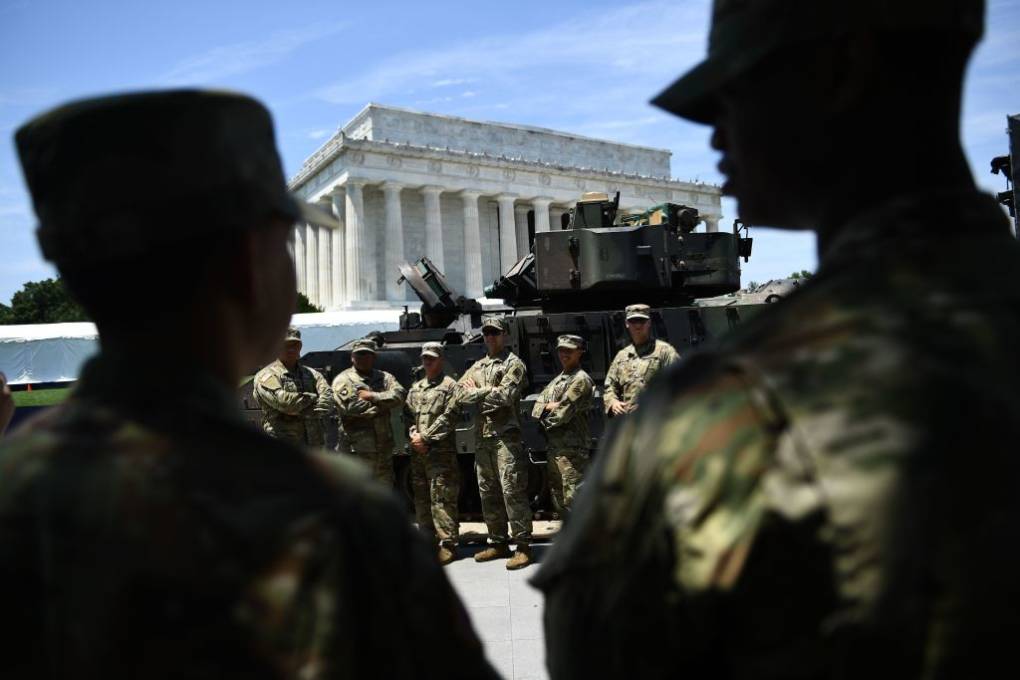
"caption": "Members of the military stand by a Bradley Fighting Vehicle on July 3, 2019, as preparations are made for the \"Salute to America\" Fourth of July event with President Trump at the Lincoln Memorial in Washington, D.C. The event will feature flyovers by the Blue Angels, an airplane used as Air Force One, military demonstrations and a speech by Trump. ",
"description": "Military servicemembers stand by a Bradley Fighting Vehicle as preparations are made for the \"Salute to America\" Fourth of July event with President Donald Trump at the Lincoln Memorial in Washington, D.C. on July 3, 2019. The July 4 event will feature flyovers by the Blue Angels, an airplane used as Air Force One, as well as military demonstrations and a speech by Trump. ",
"title": "US-POLITICS-TRUMP-JULY4-HOLIDAY",
"credit": "Brendan Smialowski/AFP/Getty Images",
"status": "inherit",
"isLoading": false,
"fetchFailed": false
},
"news_11758847": {
"type": "attachments",
"id": "news_11758847",
"meta": {
"index": "attachments_1716263798",
"site": "news",
"id": "11758847",
"found": true
},
"parent": 11758846,
"imgSizes": {
"apple_news_ca_square_4_0": {
"file": "https://ww2.kqed.org/app/uploads/sites/10/2019/07/oigreportphoto_custom-ff75df49ac5d54d8f8a2414fbb16789c766a1a8d-470x470.jpg",
"width": 470,
"mimeType": "image/jpeg",
"height": 470
},
"thumbnail": {
"file": "https://ww2.kqed.org/app/uploads/sites/10/2019/07/oigreportphoto_custom-ff75df49ac5d54d8f8a2414fbb16789c766a1a8d-160x96.jpg",
"width": 160,
"mimeType": "image/jpeg",
"height": 96
},
"post-thumbnail": {
"file": "https://ww2.kqed.org/app/uploads/sites/10/2019/07/oigreportphoto_custom-ff75df49ac5d54d8f8a2414fbb16789c766a1a8d-672x372.jpg",
"width": 672,
"mimeType": "image/jpeg",
"height": 372
},
"kqedFullSize": {
"file": "https://ww2.kqed.org/app/uploads/sites/10/2019/07/oigreportphoto_custom-ff75df49ac5d54d8f8a2414fbb16789c766a1a8d.jpg",
"width": 826,
"height": 498
},
"apple_news_ca_landscape_4_7": {
"file": "https://ww2.kqed.org/app/uploads/sites/10/2019/07/oigreportphoto_custom-ff75df49ac5d54d8f8a2414fbb16789c766a1a8d-632x474.jpg",
"width": 632,
"mimeType": "image/jpeg",
"height": 474
},
"apple_news_ca_portrait_4_7": {
"file": "https://ww2.kqed.org/app/uploads/sites/10/2019/07/oigreportphoto_custom-ff75df49ac5d54d8f8a2414fbb16789c766a1a8d-414x498.jpg",
"width": 414,
"mimeType": "image/jpeg",
"height": 498
},
"apple_news_ca_portrait_5_5": {
"file": "https://ww2.kqed.org/app/uploads/sites/10/2019/07/oigreportphoto_custom-ff75df49ac5d54d8f8a2414fbb16789c766a1a8d-687x498.jpg",
"width": 687,
"mimeType": "image/jpeg",
"height": 498
},
"apple_news_ca_square_4_7": {
"file": "https://ww2.kqed.org/app/uploads/sites/10/2019/07/oigreportphoto_custom-ff75df49ac5d54d8f8a2414fbb16789c766a1a8d-550x498.jpg",
"width": 550,
"mimeType": "image/jpeg",
"height": 498
},
"apple_news_ca_landscape_4_0": {
"file": "https://ww2.kqed.org/app/uploads/sites/10/2019/07/oigreportphoto_custom-ff75df49ac5d54d8f8a2414fbb16789c766a1a8d-536x402.jpg",
"width": 536,
"mimeType": "image/jpeg",
"height": 402
},
"medium": {
"file": "https://ww2.kqed.org/app/uploads/sites/10/2019/07/oigreportphoto_custom-ff75df49ac5d54d8f8a2414fbb16789c766a1a8d-800x482.jpg",
"width": 800,
"mimeType": "image/jpeg",
"height": 482
},
"apple_news_ca_portrait_4_0": {
"file": "https://ww2.kqed.org/app/uploads/sites/10/2019/07/oigreportphoto_custom-ff75df49ac5d54d8f8a2414fbb16789c766a1a8d-354x472.jpg",
"width": 354,
"mimeType": "image/jpeg",
"height": 472
}
},
"publishDate": 1562159803,
"modified": 1562159845,
"caption": "The Inspector General at the Department of Homeland Security observed overcrowding of families on June 10 at a detention center in McAllen, Texas. The OIG issued a blistering report raising concerns that overcrowding and prolonged detention represent an immediate risk to DHS agents and detainees.",
"description": "The Inspector General at the Department of Homeland Security observed overcrowding of families on June 10 at a detention center in McAllen, Texas. The OIG issued a blistering report raising concerns that overcrowding and prolonged detention represent an immediate risk to DHS agents and detainees.",
"title": "The Inspector General at the Department of Homeland Security observed overcrowding of families on June 10 at a detention center in McAllen, Texas. The OIG issued a blistering report raising concerns that overcrowding and prolonged detention represent an immediate risk to DHS agents and detainees.",
"credit": "Office of Inspector General ",
"status": "inherit",
"isLoading": false,
"fetchFailed": false
},
"news_11758661": {
"type": "attachments",
"id": "news_11758661",
"meta": {
"index": "attachments_1716263798",
"site": "news",
"id": "11758661",
"found": true
},
"parent": 11758660,
"imgSizes": {
"apple_news_ca_landscape_5_5": {
"file": "https://ww2.kqed.org/app/uploads/sites/10/2019/07/ap_19181721349760_custom-d377b3a9314404f3e05653fe1e693e7ebf15c3d1-1044x783.jpg",
"width": 1044,
"mimeType": "image/jpeg",
"height": 783
},
"apple_news_ca_square_4_0": {
"file": "https://ww2.kqed.org/app/uploads/sites/10/2019/07/ap_19181721349760_custom-d377b3a9314404f3e05653fe1e693e7ebf15c3d1-470x470.jpg",
"width": 470,
"mimeType": "image/jpeg",
"height": 470
},
"twentyfourteen-full-width": {
"file": "https://ww2.kqed.org/app/uploads/sites/10/2019/07/ap_19181721349760_custom-d377b3a9314404f3e05653fe1e693e7ebf15c3d1-1038x576.jpg",
"width": 1038,
"mimeType": "image/jpeg",
"height": 576
},
"thumbnail": {
"file": "https://ww2.kqed.org/app/uploads/sites/10/2019/07/ap_19181721349760_custom-d377b3a9314404f3e05653fe1e693e7ebf15c3d1-160x100.jpg",
"width": 160,
"mimeType": "image/jpeg",
"height": 100
},
"post-thumbnail": {
"file": "https://ww2.kqed.org/app/uploads/sites/10/2019/07/ap_19181721349760_custom-d377b3a9314404f3e05653fe1e693e7ebf15c3d1-672x372.jpg",
"width": 672,
"mimeType": "image/jpeg",
"height": 372
},
"kqedFullSize": {
"file": "https://ww2.kqed.org/app/uploads/sites/10/2019/07/ap_19181721349760_custom-d377b3a9314404f3e05653fe1e693e7ebf15c3d1-e1562094881717.jpg",
"width": 1920,
"height": 1205
},
"apple_news_ca_landscape_4_7": {
"file": "https://ww2.kqed.org/app/uploads/sites/10/2019/07/ap_19181721349760_custom-d377b3a9314404f3e05653fe1e693e7ebf15c3d1-632x474.jpg",
"width": 632,
"mimeType": "image/jpeg",
"height": 474
},
"large": {
"file": "https://ww2.kqed.org/app/uploads/sites/10/2019/07/ap_19181721349760_custom-d377b3a9314404f3e05653fe1e693e7ebf15c3d1-1020x640.jpg",
"width": 1020,
"mimeType": "image/jpeg",
"height": 640
},
"complete_open_graph": {
"file": "https://ww2.kqed.org/app/uploads/sites/10/2019/07/ap_19181721349760_custom-d377b3a9314404f3e05653fe1e693e7ebf15c3d1-1200x753.jpg",
"width": 1200,
"mimeType": "image/jpeg",
"height": 753
},
"apple_news_ca_landscape_4_0": {
"file": "https://ww2.kqed.org/app/uploads/sites/10/2019/07/ap_19181721349760_custom-d377b3a9314404f3e05653fe1e693e7ebf15c3d1-536x402.jpg",
"width": 536,
"mimeType": "image/jpeg",
"height": 402
},
"apple_news_ca_portrait_12_9": {
"file": "https://ww2.kqed.org/app/uploads/sites/10/2019/07/ap_19181721349760_custom-d377b3a9314404f3e05653fe1e693e7ebf15c3d1-1122x1496.jpg",
"width": 1122,
"mimeType": "image/jpeg",
"height": 1496
},
"medium": {
"file": "https://ww2.kqed.org/app/uploads/sites/10/2019/07/ap_19181721349760_custom-d377b3a9314404f3e05653fe1e693e7ebf15c3d1-800x502.jpg",
"width": 800,
"mimeType": "image/jpeg",
"height": 502
},
"apple_news_ca_portrait_4_0": {
"file": "https://ww2.kqed.org/app/uploads/sites/10/2019/07/ap_19181721349760_custom-d377b3a9314404f3e05653fe1e693e7ebf15c3d1-354x472.jpg",
"width": 354,
"mimeType": "image/jpeg",
"height": 472
},
"apple_news_ca_portrait_9_7": {
"file": "https://ww2.kqed.org/app/uploads/sites/10/2019/07/ap_19181721349760_custom-d377b3a9314404f3e05653fe1e693e7ebf15c3d1-840x1120.jpg",
"width": 840,
"mimeType": "image/jpeg",
"height": 1120
},
"apple_news_ca_landscape_12_9": {
"file": "https://ww2.kqed.org/app/uploads/sites/10/2019/07/ap_19181721349760_custom-d377b3a9314404f3e05653fe1e693e7ebf15c3d1-1832x1374.jpg",
"width": 1832,
"mimeType": "image/jpeg",
"height": 1374
},
"apple_news_ca_square_9_7": {
"file": "https://ww2.kqed.org/app/uploads/sites/10/2019/07/ap_19181721349760_custom-d377b3a9314404f3e05653fe1e693e7ebf15c3d1-1104x1104.jpg",
"width": 1104,
"mimeType": "image/jpeg",
"height": 1104
},
"apple_news_ca_portrait_4_7": {
"file": "https://ww2.kqed.org/app/uploads/sites/10/2019/07/ap_19181721349760_custom-d377b3a9314404f3e05653fe1e693e7ebf15c3d1-414x552.jpg",
"width": 414,
"mimeType": "image/jpeg",
"height": 552
},
"apple_news_ca_square_12_9": {
"file": "https://ww2.kqed.org/app/uploads/sites/10/2019/07/ap_19181721349760_custom-d377b3a9314404f3e05653fe1e693e7ebf15c3d1-1472x1472.jpg",
"width": 1472,
"mimeType": "image/jpeg",
"height": 1472
},
"apple_news_ca_portrait_5_5": {
"file": "https://ww2.kqed.org/app/uploads/sites/10/2019/07/ap_19181721349760_custom-d377b3a9314404f3e05653fe1e693e7ebf15c3d1-687x916.jpg",
"width": 687,
"mimeType": "image/jpeg",
"height": 916
},
"full-width": {
"file": "https://ww2.kqed.org/app/uploads/sites/10/2019/07/ap_19181721349760_custom-d377b3a9314404f3e05653fe1e693e7ebf15c3d1-1920x1205.jpg",
"width": 1920,
"mimeType": "image/jpeg",
"height": 1205
},
"apple_news_ca_square_4_7": {
"file": "https://ww2.kqed.org/app/uploads/sites/10/2019/07/ap_19181721349760_custom-d377b3a9314404f3e05653fe1e693e7ebf15c3d1-550x550.jpg",
"width": 550,
"mimeType": "image/jpeg",
"height": 550
},
"apple_news_ca_landscape_9_7": {
"file": "https://ww2.kqed.org/app/uploads/sites/10/2019/07/ap_19181721349760_custom-d377b3a9314404f3e05653fe1e693e7ebf15c3d1-1376x1032.jpg",
"width": 1376,
"mimeType": "image/jpeg",
"height": 1032
},
"apple_news_ca_square_5_5": {
"file": "https://ww2.kqed.org/app/uploads/sites/10/2019/07/ap_19181721349760_custom-d377b3a9314404f3e05653fe1e693e7ebf15c3d1-912x912.jpg",
"width": 912,
"mimeType": "image/jpeg",
"height": 912
}
},
"publishDate": 1562094689,
"modified": 1562110677,
"caption": "A youth stands by the border fence that separates Mexico from the United States, where candles and crosses honor migrants who have died during their journey toward the U.S., in Tijuana, Mexico.",
"description": "A youth stands by the border fence that separates Mexico from the United States, where candles and crosses stand in memory of migrants who have died during their journey toward the U.S., in Tijuana, Mexico.",
"title": "A youth stands by the border fence that separates Mexico from the United States, where candles and crosses stand in memory of migrants who have died during their journey toward the U.S., in Tijuana, Mexico.",
"credit": "Emilio Espejel/AP",
"status": "inherit",
"isLoading": false,
"fetchFailed": false
},
"news_11758517": {
"type": "attachments",
"id": "news_11758517",
"meta": {
"index": "attachments_1716263798",
"site": "news",
"id": "11758517",
"found": true
},
"parent": 11758516,
"imgSizes": {
"apple_news_ca_landscape_5_5": {
"file": "https://ww2.kqed.org/app/uploads/sites/10/2019/07/pratje_mpp_joelrose-71-edit_custom-504035a24a61ae832a665410c007d2fd38b4b584-1-1044x783.jpg",
"width": 1044,
"mimeType": "image/jpeg",
"height": 783
},
"apple_news_ca_square_4_0": {
"file": "https://ww2.kqed.org/app/uploads/sites/10/2019/07/pratje_mpp_joelrose-71-edit_custom-504035a24a61ae832a665410c007d2fd38b4b584-1-470x470.jpg",
"width": 470,
"mimeType": "image/jpeg",
"height": 470
},
"twentyfourteen-full-width": {
"file": "https://ww2.kqed.org/app/uploads/sites/10/2019/07/pratje_mpp_joelrose-71-edit_custom-504035a24a61ae832a665410c007d2fd38b4b584-1-1038x576.jpg",
"width": 1038,
"mimeType": "image/jpeg",
"height": 576
},
"thumbnail": {
"file": "https://ww2.kqed.org/app/uploads/sites/10/2019/07/pratje_mpp_joelrose-71-edit_custom-504035a24a61ae832a665410c007d2fd38b4b584-1-160x107.jpg",
"width": 160,
"mimeType": "image/jpeg",
"height": 107
},
"post-thumbnail": {
"file": "https://ww2.kqed.org/app/uploads/sites/10/2019/07/pratje_mpp_joelrose-71-edit_custom-504035a24a61ae832a665410c007d2fd38b4b584-1-672x372.jpg",
"width": 672,
"mimeType": "image/jpeg",
"height": 372
},
"kqedFullSize": {
"file": "https://ww2.kqed.org/app/uploads/sites/10/2019/07/pratje_mpp_joelrose-71-edit_custom-504035a24a61ae832a665410c007d2fd38b4b584-1-e1562014325363.jpg",
"width": 1920,
"height": 1279
},
"apple_news_ca_landscape_4_7": {
"file": "https://ww2.kqed.org/app/uploads/sites/10/2019/07/pratje_mpp_joelrose-71-edit_custom-504035a24a61ae832a665410c007d2fd38b4b584-1-632x474.jpg",
"width": 632,
"mimeType": "image/jpeg",
"height": 474
},
"large": {
"file": "https://ww2.kqed.org/app/uploads/sites/10/2019/07/pratje_mpp_joelrose-71-edit_custom-504035a24a61ae832a665410c007d2fd38b4b584-1-1020x679.jpg",
"width": 1020,
"mimeType": "image/jpeg",
"height": 679
},
"complete_open_graph": {
"file": "https://ww2.kqed.org/app/uploads/sites/10/2019/07/pratje_mpp_joelrose-71-edit_custom-504035a24a61ae832a665410c007d2fd38b4b584-1-1200x799.jpg",
"width": 1200,
"mimeType": "image/jpeg",
"height": 799
},
"apple_news_ca_landscape_4_0": {
"file": "https://ww2.kqed.org/app/uploads/sites/10/2019/07/pratje_mpp_joelrose-71-edit_custom-504035a24a61ae832a665410c007d2fd38b4b584-1-536x402.jpg",
"width": 536,
"mimeType": "image/jpeg",
"height": 402
},
"apple_news_ca_portrait_12_9": {
"file": "https://ww2.kqed.org/app/uploads/sites/10/2019/07/pratje_mpp_joelrose-71-edit_custom-504035a24a61ae832a665410c007d2fd38b4b584-1-1122x1496.jpg",
"width": 1122,
"mimeType": "image/jpeg",
"height": 1496
},
"medium": {
"file": "https://ww2.kqed.org/app/uploads/sites/10/2019/07/pratje_mpp_joelrose-71-edit_custom-504035a24a61ae832a665410c007d2fd38b4b584-1-800x533.jpg",
"width": 800,
"mimeType": "image/jpeg",
"height": 533
},
"apple_news_ca_portrait_4_0": {
"file": "https://ww2.kqed.org/app/uploads/sites/10/2019/07/pratje_mpp_joelrose-71-edit_custom-504035a24a61ae832a665410c007d2fd38b4b584-1-354x472.jpg",
"width": 354,
"mimeType": "image/jpeg",
"height": 472
},
"apple_news_ca_portrait_9_7": {
"file": "https://ww2.kqed.org/app/uploads/sites/10/2019/07/pratje_mpp_joelrose-71-edit_custom-504035a24a61ae832a665410c007d2fd38b4b584-1-840x1120.jpg",
"width": 840,
"mimeType": "image/jpeg",
"height": 1120
},
"apple_news_ca_landscape_12_9": {
"file": "https://ww2.kqed.org/app/uploads/sites/10/2019/07/pratje_mpp_joelrose-71-edit_custom-504035a24a61ae832a665410c007d2fd38b4b584-1-1832x1374.jpg",
"width": 1832,
"mimeType": "image/jpeg",
"height": 1374
},
"apple_news_ca_square_9_7": {
"file": "https://ww2.kqed.org/app/uploads/sites/10/2019/07/pratje_mpp_joelrose-71-edit_custom-504035a24a61ae832a665410c007d2fd38b4b584-1-1104x1104.jpg",
"width": 1104,
"mimeType": "image/jpeg",
"height": 1104
},
"apple_news_ca_portrait_4_7": {
"file": "https://ww2.kqed.org/app/uploads/sites/10/2019/07/pratje_mpp_joelrose-71-edit_custom-504035a24a61ae832a665410c007d2fd38b4b584-1-414x552.jpg",
"width": 414,
"mimeType": "image/jpeg",
"height": 552
},
"apple_news_ca_square_12_9": {
"file": "https://ww2.kqed.org/app/uploads/sites/10/2019/07/pratje_mpp_joelrose-71-edit_custom-504035a24a61ae832a665410c007d2fd38b4b584-1-1472x1472.jpg",
"width": 1472,
"mimeType": "image/jpeg",
"height": 1472
},
"apple_news_ca_portrait_5_5": {
"file": "https://ww2.kqed.org/app/uploads/sites/10/2019/07/pratje_mpp_joelrose-71-edit_custom-504035a24a61ae832a665410c007d2fd38b4b584-1-687x916.jpg",
"width": 687,
"mimeType": "image/jpeg",
"height": 916
},
"full-width": {
"file": "https://ww2.kqed.org/app/uploads/sites/10/2019/07/pratje_mpp_joelrose-71-edit_custom-504035a24a61ae832a665410c007d2fd38b4b584-1-1920x1278.jpg",
"width": 1920,
"mimeType": "image/jpeg",
"height": 1278
},
"apple_news_ca_square_4_7": {
"file": "https://ww2.kqed.org/app/uploads/sites/10/2019/07/pratje_mpp_joelrose-71-edit_custom-504035a24a61ae832a665410c007d2fd38b4b584-1-550x550.jpg",
"width": 550,
"mimeType": "image/jpeg",
"height": 550
},
"apple_news_ca_landscape_9_7": {
"file": "https://ww2.kqed.org/app/uploads/sites/10/2019/07/pratje_mpp_joelrose-71-edit_custom-504035a24a61ae832a665410c007d2fd38b4b584-1-1376x1032.jpg",
"width": 1376,
"mimeType": "image/jpeg",
"height": 1032
},
"apple_news_ca_square_5_5": {
"file": "https://ww2.kqed.org/app/uploads/sites/10/2019/07/pratje_mpp_joelrose-71-edit_custom-504035a24a61ae832a665410c007d2fd38b4b584-1-912x912.jpg",
"width": 912,
"mimeType": "image/jpeg",
"height": 912
}
},
"publishDate": 1562011717,
"modified": 1562014742,
"caption": "Genero, a migrant from Guatemala, walks through the pedestrian entrance at the Paso del Norte International Bridge in Ciudad Juárez, Mexico, on his way to immigration court in El Paso, Texas",
"description": "Genero, a migrant from Guatemala, walks through the pedestrian entrance at the Paso del Norte International Bridge in Ciudad Juárez, Mexico, on his way to immigration court in El Paso, Texas",
"title": "Genero, a migrant from Guatemala, walks through the pedestrian entrance at the Paso del Norte International Bridge in Ciudad Juárez, Mexico, on his way to immigration court in El Paso, Texas.",
"credit": "Paul Ratje/NPR",
"status": "inherit",
"isLoading": false,
"fetchFailed": false
},
"news_11758320": {
"type": "attachments",
"id": "news_11758320",
"meta": {
"index": "attachments_1716263798",
"site": "news",
"id": "11758320",
"found": true
},
"parent": 11758319,
"imgSizes": {
"apple_news_ca_landscape_5_5": {
"file": "https://ww2.kqed.org/app/uploads/sites/10/2019/06/gettyimages-1152906866_wide-e0ff45c101326dfb52ade1c6176cde841a313e06-1044x783.jpg",
"width": 1044,
"mimeType": "image/jpeg",
"height": 783
},
"apple_news_ca_square_4_0": {
"file": "https://ww2.kqed.org/app/uploads/sites/10/2019/06/gettyimages-1152906866_wide-e0ff45c101326dfb52ade1c6176cde841a313e06-470x470.jpg",
"width": 470,
"mimeType": "image/jpeg",
"height": 470
},
"twentyfourteen-full-width": {
"file": "https://ww2.kqed.org/app/uploads/sites/10/2019/06/gettyimages-1152906866_wide-e0ff45c101326dfb52ade1c6176cde841a313e06-1038x576.jpg",
"width": 1038,
"mimeType": "image/jpeg",
"height": 576
},
"thumbnail": {
"file": "https://ww2.kqed.org/app/uploads/sites/10/2019/06/gettyimages-1152906866_wide-e0ff45c101326dfb52ade1c6176cde841a313e06-160x90.jpg",
"width": 160,
"mimeType": "image/jpeg",
"height": 90
},
"post-thumbnail": {
"file": "https://ww2.kqed.org/app/uploads/sites/10/2019/06/gettyimages-1152906866_wide-e0ff45c101326dfb52ade1c6176cde841a313e06-672x372.jpg",
"width": 672,
"mimeType": "image/jpeg",
"height": 372
},
"kqedFullSize": {
"file": "https://ww2.kqed.org/app/uploads/sites/10/2019/06/gettyimages-1152906866_wide-e0ff45c101326dfb52ade1c6176cde841a313e06.jpg",
"width": 2048,
"height": 1152
},
"apple_news_ca_landscape_4_7": {
"file": "https://ww2.kqed.org/app/uploads/sites/10/2019/06/gettyimages-1152906866_wide-e0ff45c101326dfb52ade1c6176cde841a313e06-632x474.jpg",
"width": 632,
"mimeType": "image/jpeg",
"height": 474
},
"large": {
"file": "https://ww2.kqed.org/app/uploads/sites/10/2019/06/gettyimages-1152906866_wide-e0ff45c101326dfb52ade1c6176cde841a313e06-1020x574.jpg",
"width": 1020,
"mimeType": "image/jpeg",
"height": 574
},
"complete_open_graph": {
"file": "https://ww2.kqed.org/app/uploads/sites/10/2019/06/gettyimages-1152906866_wide-e0ff45c101326dfb52ade1c6176cde841a313e06-1200x675.jpg",
"width": 1200,
"mimeType": "image/jpeg",
"height": 675
},
"apple_news_ca_landscape_4_0": {
"file": "https://ww2.kqed.org/app/uploads/sites/10/2019/06/gettyimages-1152906866_wide-e0ff45c101326dfb52ade1c6176cde841a313e06-536x402.jpg",
"width": 536,
"mimeType": "image/jpeg",
"height": 402
},
"apple_news_ca_portrait_12_9": {
"file": "https://ww2.kqed.org/app/uploads/sites/10/2019/06/gettyimages-1152906866_wide-e0ff45c101326dfb52ade1c6176cde841a313e06-1122x1496.jpg",
"width": 1122,
"mimeType": "image/jpeg",
"height": 1496
},
"medium": {
"file": "https://ww2.kqed.org/app/uploads/sites/10/2019/06/gettyimages-1152906866_wide-e0ff45c101326dfb52ade1c6176cde841a313e06-800x450.jpg",
"width": 800,
"mimeType": "image/jpeg",
"height": 450
},
"apple_news_ca_portrait_4_0": {
"file": "https://ww2.kqed.org/app/uploads/sites/10/2019/06/gettyimages-1152906866_wide-e0ff45c101326dfb52ade1c6176cde841a313e06-354x472.jpg",
"width": 354,
"mimeType": "image/jpeg",
"height": 472
},
"apple_news_ca_portrait_9_7": {
"file": "https://ww2.kqed.org/app/uploads/sites/10/2019/06/gettyimages-1152906866_wide-e0ff45c101326dfb52ade1c6176cde841a313e06-840x1120.jpg",
"width": 840,
"mimeType": "image/jpeg",
"height": 1120
},
"apple_news_ca_landscape_12_9": {
"file": "https://ww2.kqed.org/app/uploads/sites/10/2019/06/gettyimages-1152906866_wide-e0ff45c101326dfb52ade1c6176cde841a313e06-1832x1374.jpg",
"width": 1832,
"mimeType": "image/jpeg",
"height": 1374
},
"apple_news_ca_square_9_7": {
"file": "https://ww2.kqed.org/app/uploads/sites/10/2019/06/gettyimages-1152906866_wide-e0ff45c101326dfb52ade1c6176cde841a313e06-1104x1104.jpg",
"width": 1104,
"mimeType": "image/jpeg",
"height": 1104
},
"apple_news_ca_portrait_4_7": {
"file": "https://ww2.kqed.org/app/uploads/sites/10/2019/06/gettyimages-1152906866_wide-e0ff45c101326dfb52ade1c6176cde841a313e06-414x552.jpg",
"width": 414,
"mimeType": "image/jpeg",
"height": 552
},
"apple_news_ca_square_12_9": {
"file": "https://ww2.kqed.org/app/uploads/sites/10/2019/06/gettyimages-1152906866_wide-e0ff45c101326dfb52ade1c6176cde841a313e06-1472x1472.jpg",
"width": 1472,
"mimeType": "image/jpeg",
"height": 1472
},
"apple_news_ca_portrait_5_5": {
"file": "https://ww2.kqed.org/app/uploads/sites/10/2019/06/gettyimages-1152906866_wide-e0ff45c101326dfb52ade1c6176cde841a313e06-687x916.jpg",
"width": 687,
"mimeType": "image/jpeg",
"height": 916
},
"full-width": {
"file": "https://ww2.kqed.org/app/uploads/sites/10/2019/06/gettyimages-1152906866_wide-e0ff45c101326dfb52ade1c6176cde841a313e06-1920x1080.jpg",
"width": 1920,
"mimeType": "image/jpeg",
"height": 1080
},
"apple_news_ca_square_4_7": {
"file": "https://ww2.kqed.org/app/uploads/sites/10/2019/06/gettyimages-1152906866_wide-e0ff45c101326dfb52ade1c6176cde841a313e06-550x550.jpg",
"width": 550,
"mimeType": "image/jpeg",
"height": 550
},
"apple_news_ca_landscape_9_7": {
"file": "https://ww2.kqed.org/app/uploads/sites/10/2019/06/gettyimages-1152906866_wide-e0ff45c101326dfb52ade1c6176cde841a313e06-1376x1032.jpg",
"width": 1376,
"mimeType": "image/jpeg",
"height": 1032
},
"apple_news_ca_square_5_5": {
"file": "https://ww2.kqed.org/app/uploads/sites/10/2019/06/gettyimages-1152906866_wide-e0ff45c101326dfb52ade1c6176cde841a313e06-912x912.jpg",
"width": 912,
"mimeType": "image/jpeg",
"height": 912
}
},
"publishDate": 1561905384,
"modified": 1561906560,
"caption": "North Korea's leader Kim Jong Un walks with President Trump north of the Military Demarcation Line that divides North and South Korea, in the Joint Security Area (JSA) of Panmunjom in the Demilitarized zone (DMZ) on Sunday.",
"description": "North Korea's leader Kim Jong Un walks with President Trump north of the Military Demarcation Line that divides North and South Korea, in the Joint Security Area (JSA) of Panmunjom in the Demilitarized zone (DMZ) on Sunday",
"title": "North Korea's leader Kim Jong Un walks with President Trump north of the Military Demarcation Line that divides North and South Korea, in the Joint Security Area (JSA) of Panmunjom in the Demilitarized zone (DMZ) on Sunday.",
"credit": "Brendan Smialowski/AFP/Getty Images",
"status": "inherit",
"isLoading": false,
"fetchFailed": false
},
"news_11758251": {
"type": "attachments",
"id": "news_11758251",
"meta": {
"index": "attachments_1716263798",
"site": "news",
"id": "11758251",
"found": true
},
"parent": 11758248,
"imgSizes": {
"apple_news_ca_landscape_5_5": {
"file": "https://ww2.kqed.org/app/uploads/sites/10/2019/06/RS37929_GettyImages-1124832681-qut-1044x783.jpg",
"width": 1044,
"mimeType": "image/jpeg",
"height": 783
},
"apple_news_ca_square_4_0": {
"file": "https://ww2.kqed.org/app/uploads/sites/10/2019/06/RS37929_GettyImages-1124832681-qut-470x470.jpg",
"width": 470,
"mimeType": "image/jpeg",
"height": 470
},
"twentyfourteen-full-width": {
"file": "https://ww2.kqed.org/app/uploads/sites/10/2019/06/RS37929_GettyImages-1124832681-qut-1038x576.jpg",
"width": 1038,
"mimeType": "image/jpeg",
"height": 576
},
"thumbnail": {
"file": "https://ww2.kqed.org/app/uploads/sites/10/2019/06/RS37929_GettyImages-1124832681-qut-160x107.jpg",
"width": 160,
"mimeType": "image/jpeg",
"height": 107
},
"post-thumbnail": {
"file": "https://ww2.kqed.org/app/uploads/sites/10/2019/06/RS37929_GettyImages-1124832681-qut-672x372.jpg",
"width": 672,
"mimeType": "image/jpeg",
"height": 372
},
"kqedFullSize": {
"file": "https://ww2.kqed.org/app/uploads/sites/10/2019/06/RS37929_GettyImages-1124832681-qut.jpg",
"width": 1920,
"height": 1280
},
"apple_news_ca_landscape_4_7": {
"file": "https://ww2.kqed.org/app/uploads/sites/10/2019/06/RS37929_GettyImages-1124832681-qut-632x474.jpg",
"width": 632,
"mimeType": "image/jpeg",
"height": 474
},
"large": {
"file": "https://ww2.kqed.org/app/uploads/sites/10/2019/06/RS37929_GettyImages-1124832681-qut-1020x680.jpg",
"width": 1020,
"mimeType": "image/jpeg",
"height": 680
},
"complete_open_graph": {
"file": "https://ww2.kqed.org/app/uploads/sites/10/2019/06/RS37929_GettyImages-1124832681-qut-1200x800.jpg",
"width": 1200,
"mimeType": "image/jpeg",
"height": 800
},
"apple_news_ca_landscape_4_0": {
"file": "https://ww2.kqed.org/app/uploads/sites/10/2019/06/RS37929_GettyImages-1124832681-qut-536x402.jpg",
"width": 536,
"mimeType": "image/jpeg",
"height": 402
},
"apple_news_ca_portrait_12_9": {
"file": "https://ww2.kqed.org/app/uploads/sites/10/2019/06/RS37929_GettyImages-1124832681-qut-1122x1280.jpg",
"width": 1122,
"mimeType": "image/jpeg",
"height": 1280
},
"medium": {
"file": "https://ww2.kqed.org/app/uploads/sites/10/2019/06/RS37929_GettyImages-1124832681-qut-800x533.jpg",
"width": 800,
"mimeType": "image/jpeg",
"height": 533
},
"apple_news_ca_portrait_4_0": {
"file": "https://ww2.kqed.org/app/uploads/sites/10/2019/06/RS37929_GettyImages-1124832681-qut-354x472.jpg",
"width": 354,
"mimeType": "image/jpeg",
"height": 472
},
"apple_news_ca_portrait_9_7": {
"file": "https://ww2.kqed.org/app/uploads/sites/10/2019/06/RS37929_GettyImages-1124832681-qut-840x1120.jpg",
"width": 840,
"mimeType": "image/jpeg",
"height": 1120
},
"apple_news_ca_landscape_12_9": {
"file": "https://ww2.kqed.org/app/uploads/sites/10/2019/06/RS37929_GettyImages-1124832681-qut-1832x1280.jpg",
"width": 1832,
"mimeType": "image/jpeg",
"height": 1280
},
"apple_news_ca_square_9_7": {
"file": "https://ww2.kqed.org/app/uploads/sites/10/2019/06/RS37929_GettyImages-1124832681-qut-1104x1104.jpg",
"width": 1104,
"mimeType": "image/jpeg",
"height": 1104
},
"apple_news_ca_portrait_4_7": {
"file": "https://ww2.kqed.org/app/uploads/sites/10/2019/06/RS37929_GettyImages-1124832681-qut-414x552.jpg",
"width": 414,
"mimeType": "image/jpeg",
"height": 552
},
"apple_news_ca_square_12_9": {
"file": "https://ww2.kqed.org/app/uploads/sites/10/2019/06/RS37929_GettyImages-1124832681-qut-1472x1280.jpg",
"width": 1472,
"mimeType": "image/jpeg",
"height": 1280
},
"apple_news_ca_portrait_5_5": {
"file": "https://ww2.kqed.org/app/uploads/sites/10/2019/06/RS37929_GettyImages-1124832681-qut-687x916.jpg",
"width": 687,
"mimeType": "image/jpeg",
"height": 916
},
"full-width": {
"file": "https://ww2.kqed.org/app/uploads/sites/10/2019/06/RS37929_GettyImages-1124832681-qut-1920x1280.jpg",
"width": 1920,
"mimeType": "image/jpeg",
"height": 1280
},
"apple_news_ca_square_4_7": {
"file": "https://ww2.kqed.org/app/uploads/sites/10/2019/06/RS37929_GettyImages-1124832681-qut-550x550.jpg",
"width": 550,
"mimeType": "image/jpeg",
"height": 550
},
"apple_news_ca_landscape_9_7": {
"file": "https://ww2.kqed.org/app/uploads/sites/10/2019/06/RS37929_GettyImages-1124832681-qut-1376x1032.jpg",
"width": 1376,
"mimeType": "image/jpeg",
"height": 1032
},
"apple_news_ca_square_5_5": {
"file": "https://ww2.kqed.org/app/uploads/sites/10/2019/06/RS37929_GettyImages-1124832681-qut-912x912.jpg",
"width": 912,
"mimeType": "image/jpeg",
"height": 912
}
},
"publishDate": 1561817686,
"modified": 1561817786,
"caption": "A sign hangs on the wall which separates the United States and Mexico on January 25, 2019 in Calexico, California. A judge in Oakland has again ruled against the Trump administration's efforts to use military funds to build portions of the border wall.",
"description": "A sign hangs on the wall which separates the United States and Mexico on January 25, 2019 in Calexico, California. A judge in Oakland has again ruled against the Trump administration's efforts to use military funds to build portions of the border wall.",
"title": "Border Wall Funding The Focus Of Continued Partial Government Shutdown",
"credit": "Scott Olson/Getty Images",
"status": "inherit",
"isLoading": false,
"fetchFailed": false
},
"news_11757891": {
"type": "attachments",
"id": "news_11757891",
"meta": {
"index": "attachments_1716263798",
"site": "news",
"id": "11757891",
"found": true
},
"parent": 11757890,
"imgSizes": {
"apple_news_ca_landscape_5_5": {
"file": "https://ww2.kqed.org/app/uploads/sites/10/2019/06/ap_18010737469139_custom-3795f676deb1cfc93e7e4a1ef57cc72575dbe379-1044x783.jpg",
"width": 1044,
"mimeType": "image/jpeg",
"height": 783
},
"apple_news_ca_square_4_0": {
"file": "https://ww2.kqed.org/app/uploads/sites/10/2019/06/ap_18010737469139_custom-3795f676deb1cfc93e7e4a1ef57cc72575dbe379-470x470.jpg",
"width": 470,
"mimeType": "image/jpeg",
"height": 470
},
"twentyfourteen-full-width": {
"file": "https://ww2.kqed.org/app/uploads/sites/10/2019/06/ap_18010737469139_custom-3795f676deb1cfc93e7e4a1ef57cc72575dbe379-1038x576.jpg",
"width": 1038,
"mimeType": "image/jpeg",
"height": 576
},
"thumbnail": {
"file": "https://ww2.kqed.org/app/uploads/sites/10/2019/06/ap_18010737469139_custom-3795f676deb1cfc93e7e4a1ef57cc72575dbe379-160x108.jpg",
"width": 160,
"mimeType": "image/jpeg",
"height": 108
},
"post-thumbnail": {
"file": "https://ww2.kqed.org/app/uploads/sites/10/2019/06/ap_18010737469139_custom-3795f676deb1cfc93e7e4a1ef57cc72575dbe379-672x372.jpg",
"width": 672,
"mimeType": "image/jpeg",
"height": 372
},
"kqedFullSize": {
"file": "https://ww2.kqed.org/app/uploads/sites/10/2019/06/ap_18010737469139_custom-3795f676deb1cfc93e7e4a1ef57cc72575dbe379-e1561730370136.jpg",
"width": 1920,
"height": 1296
},
"apple_news_ca_landscape_4_7": {
"file": "https://ww2.kqed.org/app/uploads/sites/10/2019/06/ap_18010737469139_custom-3795f676deb1cfc93e7e4a1ef57cc72575dbe379-632x474.jpg",
"width": 632,
"mimeType": "image/jpeg",
"height": 474
},
"large": {
"file": "https://ww2.kqed.org/app/uploads/sites/10/2019/06/ap_18010737469139_custom-3795f676deb1cfc93e7e4a1ef57cc72575dbe379-1020x688.jpg",
"width": 1020,
"mimeType": "image/jpeg",
"height": 688
},
"complete_open_graph": {
"file": "https://ww2.kqed.org/app/uploads/sites/10/2019/06/ap_18010737469139_custom-3795f676deb1cfc93e7e4a1ef57cc72575dbe379-1200x810.jpg",
"width": 1200,
"mimeType": "image/jpeg",
"height": 810
},
"apple_news_ca_landscape_4_0": {
"file": "https://ww2.kqed.org/app/uploads/sites/10/2019/06/ap_18010737469139_custom-3795f676deb1cfc93e7e4a1ef57cc72575dbe379-536x402.jpg",
"width": 536,
"mimeType": "image/jpeg",
"height": 402
},
"apple_news_ca_portrait_12_9": {
"file": "https://ww2.kqed.org/app/uploads/sites/10/2019/06/ap_18010737469139_custom-3795f676deb1cfc93e7e4a1ef57cc72575dbe379-1122x1496.jpg",
"width": 1122,
"mimeType": "image/jpeg",
"height": 1496
},
"medium": {
"file": "https://ww2.kqed.org/app/uploads/sites/10/2019/06/ap_18010737469139_custom-3795f676deb1cfc93e7e4a1ef57cc72575dbe379-800x540.jpg",
"width": 800,
"mimeType": "image/jpeg",
"height": 540
},
"apple_news_ca_portrait_4_0": {
"file": "https://ww2.kqed.org/app/uploads/sites/10/2019/06/ap_18010737469139_custom-3795f676deb1cfc93e7e4a1ef57cc72575dbe379-354x472.jpg",
"width": 354,
"mimeType": "image/jpeg",
"height": 472
},
"apple_news_ca_portrait_9_7": {
"file": "https://ww2.kqed.org/app/uploads/sites/10/2019/06/ap_18010737469139_custom-3795f676deb1cfc93e7e4a1ef57cc72575dbe379-840x1120.jpg",
"width": 840,
"mimeType": "image/jpeg",
"height": 1120
},
"apple_news_ca_landscape_12_9": {
"file": "https://ww2.kqed.org/app/uploads/sites/10/2019/06/ap_18010737469139_custom-3795f676deb1cfc93e7e4a1ef57cc72575dbe379-1832x1374.jpg",
"width": 1832,
"mimeType": "image/jpeg",
"height": 1374
},
"apple_news_ca_square_9_7": {
"file": "https://ww2.kqed.org/app/uploads/sites/10/2019/06/ap_18010737469139_custom-3795f676deb1cfc93e7e4a1ef57cc72575dbe379-1104x1104.jpg",
"width": 1104,
"mimeType": "image/jpeg",
"height": 1104
},
"apple_news_ca_portrait_4_7": {
"file": "https://ww2.kqed.org/app/uploads/sites/10/2019/06/ap_18010737469139_custom-3795f676deb1cfc93e7e4a1ef57cc72575dbe379-414x552.jpg",
"width": 414,
"mimeType": "image/jpeg",
"height": 552
},
"apple_news_ca_square_12_9": {
"file": "https://ww2.kqed.org/app/uploads/sites/10/2019/06/ap_18010737469139_custom-3795f676deb1cfc93e7e4a1ef57cc72575dbe379-1472x1472.jpg",
"width": 1472,
"mimeType": "image/jpeg",
"height": 1472
},
"apple_news_ca_portrait_5_5": {
"file": "https://ww2.kqed.org/app/uploads/sites/10/2019/06/ap_18010737469139_custom-3795f676deb1cfc93e7e4a1ef57cc72575dbe379-687x916.jpg",
"width": 687,
"mimeType": "image/jpeg",
"height": 916
},
"full-width": {
"file": "https://ww2.kqed.org/app/uploads/sites/10/2019/06/ap_18010737469139_custom-3795f676deb1cfc93e7e4a1ef57cc72575dbe379-1920x1295.jpg",
"width": 1920,
"mimeType": "image/jpeg",
"height": 1295
},
"apple_news_ca_square_4_7": {
"file": "https://ww2.kqed.org/app/uploads/sites/10/2019/06/ap_18010737469139_custom-3795f676deb1cfc93e7e4a1ef57cc72575dbe379-550x550.jpg",
"width": 550,
"mimeType": "image/jpeg",
"height": 550
},
"apple_news_ca_landscape_9_7": {
"file": "https://ww2.kqed.org/app/uploads/sites/10/2019/06/ap_18010737469139_custom-3795f676deb1cfc93e7e4a1ef57cc72575dbe379-1376x1032.jpg",
"width": 1376,
"mimeType": "image/jpeg",
"height": 1032
},
"apple_news_ca_square_5_5": {
"file": "https://ww2.kqed.org/app/uploads/sites/10/2019/06/ap_18010737469139_custom-3795f676deb1cfc93e7e4a1ef57cc72575dbe379-912x912.jpg",
"width": 912,
"mimeType": "image/jpeg",
"height": 912
}
},
"publishDate": 1561730296,
"modified": 1561730592,
"caption": "People brought to the U.S. illegally as children, known as \"Dreamers,\" and other supporters of the Deferred Action for Childhood Arrivals program, listen as lawmakers speak at the U.S. Capitol.",
"description": "People brought to the U.S. illegally as children, known as \"Dreamers,\" and other supporters of the Deferred Action for Childhood Arrivals program, listen as lawmakers speak at the U.S. Capitol.",
"title": "People brought to the U.S. illegally as children, known as \"Dreamers,\" and other supporters of the Deferred Action for Childhood Arrivals program, listen as lawmakers speak at the U.S. Capitol.",
"credit": "J. Scott Applewhite/AP",
"status": "inherit",
"isLoading": false,
"fetchFailed": false
},
"news_11757698": {
"type": "attachments",
"id": "news_11757698",
"meta": {
"index": "attachments_1716263798",
"site": "news",
"id": "11757698",
"found": true
},
"parent": 11757697,
"imgSizes": {
"apple_news_ca_square_4_0": {
"file": "https://ww2.kqed.org/app/uploads/sites/10/2019/06/twitter-screen-eb1088a93004926934f14ad24b0a3d3715193915-470x470.png",
"width": 470,
"mimeType": "image/png",
"height": 470
},
"twentyfourteen-full-width": {
"file": "https://ww2.kqed.org/app/uploads/sites/10/2019/06/twitter-screen-eb1088a93004926934f14ad24b0a3d3715193915-806x576.png",
"width": 806,
"mimeType": "image/png",
"height": 576
},
"thumbnail": {
"file": "https://ww2.kqed.org/app/uploads/sites/10/2019/06/twitter-screen-eb1088a93004926934f14ad24b0a3d3715193915-160x120.png",
"width": 160,
"mimeType": "image/png",
"height": 120
},
"post-thumbnail": {
"file": "https://ww2.kqed.org/app/uploads/sites/10/2019/06/twitter-screen-eb1088a93004926934f14ad24b0a3d3715193915-672x372.png",
"width": 672,
"mimeType": "image/png",
"height": 372
},
"kqedFullSize": {
"file": "https://ww2.kqed.org/app/uploads/sites/10/2019/06/twitter-screen-eb1088a93004926934f14ad24b0a3d3715193915.png",
"width": 806,
"height": 604
},
"apple_news_ca_landscape_4_7": {
"file": "https://ww2.kqed.org/app/uploads/sites/10/2019/06/twitter-screen-eb1088a93004926934f14ad24b0a3d3715193915-632x474.png",
"width": 632,
"mimeType": "image/png",
"height": 474
},
"apple_news_ca_portrait_4_7": {
"file": "https://ww2.kqed.org/app/uploads/sites/10/2019/06/twitter-screen-eb1088a93004926934f14ad24b0a3d3715193915-414x552.png",
"width": 414,
"mimeType": "image/png",
"height": 552
},
"apple_news_ca_portrait_5_5": {
"file": "https://ww2.kqed.org/app/uploads/sites/10/2019/06/twitter-screen-eb1088a93004926934f14ad24b0a3d3715193915-687x604.png",
"width": 687,
"mimeType": "image/png",
"height": 604
},
"apple_news_ca_square_4_7": {
"file": "https://ww2.kqed.org/app/uploads/sites/10/2019/06/twitter-screen-eb1088a93004926934f14ad24b0a3d3715193915-550x550.png",
"width": 550,
"mimeType": "image/png",
"height": 550
},
"apple_news_ca_landscape_4_0": {
"file": "https://ww2.kqed.org/app/uploads/sites/10/2019/06/twitter-screen-eb1088a93004926934f14ad24b0a3d3715193915-536x402.png",
"width": 536,
"mimeType": "image/png",
"height": 402
},
"medium": {
"file": "https://ww2.kqed.org/app/uploads/sites/10/2019/06/twitter-screen-eb1088a93004926934f14ad24b0a3d3715193915-800x600.png",
"width": 800,
"mimeType": "image/png",
"height": 600
},
"apple_news_ca_portrait_4_0": {
"file": "https://ww2.kqed.org/app/uploads/sites/10/2019/06/twitter-screen-eb1088a93004926934f14ad24b0a3d3715193915-354x472.png",
"width": 354,
"mimeType": "image/png",
"height": 472
}
},
"publishDate": 1561669445,
"modified": 1561669563,
"caption": "A sample of the new warning notices that Twitter users will see before clicking to see tweets by government officials and political figures that violate Twitter's rules.",
"description": "A sample of the new warning notices that Twitter users will see before clicking to see tweets by government officials and political figures that violate Twitter's rules.",
"title": "A sample of the new warning notices that Twitter users will see before clicking to see tweets by government officials and political figures that violate Twitter's rules.",
"credit": "Twitter",
"status": "inherit",
"isLoading": false,
"fetchFailed": false
},
"news_11757637": {
"type": "attachments",
"id": "news_11757637",
"meta": {
"index": "attachments_1716263798",
"site": "news",
"id": "11757637",
"found": true
},
"parent": 11757636,
"imgSizes": {
"apple_news_ca_landscape_5_5": {
"file": "https://ww2.kqed.org/app/uploads/sites/10/2019/06/ap_19126782050207_wide-926c85f779a71eddf5da6a166e583dd036c4cd76-1044x783.jpg",
"width": 1044,
"mimeType": "image/jpeg",
"height": 783
},
"apple_news_ca_square_4_0": {
"file": "https://ww2.kqed.org/app/uploads/sites/10/2019/06/ap_19126782050207_wide-926c85f779a71eddf5da6a166e583dd036c4cd76-470x470.jpg",
"width": 470,
"mimeType": "image/jpeg",
"height": 470
},
"twentyfourteen-full-width": {
"file": "https://ww2.kqed.org/app/uploads/sites/10/2019/06/ap_19126782050207_wide-926c85f779a71eddf5da6a166e583dd036c4cd76-1038x576.jpg",
"width": 1038,
"mimeType": "image/jpeg",
"height": 576
},
"thumbnail": {
"file": "https://ww2.kqed.org/app/uploads/sites/10/2019/06/ap_19126782050207_wide-926c85f779a71eddf5da6a166e583dd036c4cd76-160x90.jpg",
"width": 160,
"mimeType": "image/jpeg",
"height": 90
},
"post-thumbnail": {
"file": "https://ww2.kqed.org/app/uploads/sites/10/2019/06/ap_19126782050207_wide-926c85f779a71eddf5da6a166e583dd036c4cd76-672x372.jpg",
"width": 672,
"mimeType": "image/jpeg",
"height": 372
},
"kqedFullSize": {
"file": "https://ww2.kqed.org/app/uploads/sites/10/2019/06/ap_19126782050207_wide-926c85f779a71eddf5da6a166e583dd036c4cd76-e1561657013559.jpg",
"width": 1920,
"height": 1080
},
"apple_news_ca_landscape_4_7": {
"file": "https://ww2.kqed.org/app/uploads/sites/10/2019/06/ap_19126782050207_wide-926c85f779a71eddf5da6a166e583dd036c4cd76-632x474.jpg",
"width": 632,
"mimeType": "image/jpeg",
"height": 474
},
"large": {
"file": "https://ww2.kqed.org/app/uploads/sites/10/2019/06/ap_19126782050207_wide-926c85f779a71eddf5da6a166e583dd036c4cd76-1020x574.jpg",
"width": 1020,
"mimeType": "image/jpeg",
"height": 574
},
"complete_open_graph": {
"file": "https://ww2.kqed.org/app/uploads/sites/10/2019/06/ap_19126782050207_wide-926c85f779a71eddf5da6a166e583dd036c4cd76-1200x675.jpg",
"width": 1200,
"mimeType": "image/jpeg",
"height": 675
},
"apple_news_ca_landscape_4_0": {
"file": "https://ww2.kqed.org/app/uploads/sites/10/2019/06/ap_19126782050207_wide-926c85f779a71eddf5da6a166e583dd036c4cd76-536x402.jpg",
"width": 536,
"mimeType": "image/jpeg",
"height": 402
},
"apple_news_ca_portrait_12_9": {
"file": "https://ww2.kqed.org/app/uploads/sites/10/2019/06/ap_19126782050207_wide-926c85f779a71eddf5da6a166e583dd036c4cd76-1122x1313.jpg",
"width": 1122,
"mimeType": "image/jpeg",
"height": 1313
},
"medium": {
"file": "https://ww2.kqed.org/app/uploads/sites/10/2019/06/ap_19126782050207_wide-926c85f779a71eddf5da6a166e583dd036c4cd76-800x450.jpg",
"width": 800,
"mimeType": "image/jpeg",
"height": 450
},
"apple_news_ca_portrait_4_0": {
"file": "https://ww2.kqed.org/app/uploads/sites/10/2019/06/ap_19126782050207_wide-926c85f779a71eddf5da6a166e583dd036c4cd76-354x472.jpg",
"width": 354,
"mimeType": "image/jpeg",
"height": 472
},
"apple_news_ca_portrait_9_7": {
"file": "https://ww2.kqed.org/app/uploads/sites/10/2019/06/ap_19126782050207_wide-926c85f779a71eddf5da6a166e583dd036c4cd76-840x1120.jpg",
"width": 840,
"mimeType": "image/jpeg",
"height": 1120
},
"apple_news_ca_landscape_12_9": {
"file": "https://ww2.kqed.org/app/uploads/sites/10/2019/06/ap_19126782050207_wide-926c85f779a71eddf5da6a166e583dd036c4cd76-1832x1313.jpg",
"width": 1832,
"mimeType": "image/jpeg",
"height": 1313
},
"apple_news_ca_square_9_7": {
"file": "https://ww2.kqed.org/app/uploads/sites/10/2019/06/ap_19126782050207_wide-926c85f779a71eddf5da6a166e583dd036c4cd76-1104x1104.jpg",
"width": 1104,
"mimeType": "image/jpeg",
"height": 1104
},
"apple_news_ca_portrait_4_7": {
"file": "https://ww2.kqed.org/app/uploads/sites/10/2019/06/ap_19126782050207_wide-926c85f779a71eddf5da6a166e583dd036c4cd76-414x552.jpg",
"width": 414,
"mimeType": "image/jpeg",
"height": 552
},
"apple_news_ca_square_12_9": {
"file": "https://ww2.kqed.org/app/uploads/sites/10/2019/06/ap_19126782050207_wide-926c85f779a71eddf5da6a166e583dd036c4cd76-1472x1313.jpg",
"width": 1472,
"mimeType": "image/jpeg",
"height": 1313
},
"apple_news_ca_portrait_5_5": {
"file": "https://ww2.kqed.org/app/uploads/sites/10/2019/06/ap_19126782050207_wide-926c85f779a71eddf5da6a166e583dd036c4cd76-687x916.jpg",
"width": 687,
"mimeType": "image/jpeg",
"height": 916
},
"full-width": {
"file": "https://ww2.kqed.org/app/uploads/sites/10/2019/06/ap_19126782050207_wide-926c85f779a71eddf5da6a166e583dd036c4cd76-1920x1080.jpg",
"width": 1920,
"mimeType": "image/jpeg",
"height": 1080
},
"apple_news_ca_square_4_7": {
"file": "https://ww2.kqed.org/app/uploads/sites/10/2019/06/ap_19126782050207_wide-926c85f779a71eddf5da6a166e583dd036c4cd76-550x550.jpg",
"width": 550,
"mimeType": "image/jpeg",
"height": 550
},
"apple_news_ca_landscape_9_7": {
"file": "https://ww2.kqed.org/app/uploads/sites/10/2019/06/ap_19126782050207_wide-926c85f779a71eddf5da6a166e583dd036c4cd76-1376x1032.jpg",
"width": 1376,
"mimeType": "image/jpeg",
"height": 1032
},
"apple_news_ca_square_5_5": {
"file": "https://ww2.kqed.org/app/uploads/sites/10/2019/06/ap_19126782050207_wide-926c85f779a71eddf5da6a166e583dd036c4cd76-912x912.jpg",
"width": 912,
"mimeType": "image/jpeg",
"height": 912
}
},
"publishDate": 1561656795,
"modified": 1561675801,
"caption": "Cuban migrants cross a bridge in Mexico to be processed as asylum-seekers in the U.S. The labor union representing asylum officers claims the policy, formally known as the Migrant Protection Protocols, is a \"widespread violation\" of international and domestic law.",
"description": "Cuban migrants cross a bridge in Mexico to be processed as asylum-seekers in the U.S. The labor union representing asylum officers claims the policy formally known as the Migrant Protection Protocols is a \"widespread violation\" of international and domestic la",
"title": "Cuban migrants cross a bridge in Mexico to be processed as asylum-seekers in the U.S. The labor union representing asylum officers claims the policy formally known as the Migrant Protection Protocols is a \"widespread violation\" of international and domestic law.",
"credit": "Christian Torres/AP ",
"status": "inherit",
"isLoading": false,
"fetchFailed": false
},
"news_11756822": {
"type": "attachments",
"id": "news_11756822",
"meta": {
"index": "attachments_1716263798",
"site": "news",
"id": "11756822",
"found": true
},
"parent": 11756535,
"imgSizes": {
"apple_news_ca_landscape_5_5": {
"file": "https://ww2.kqed.org/app/uploads/sites/10/2019/06/cbp-1920-1044x783.jpg",
"width": 1044,
"mimeType": "image/jpeg",
"height": 783
},
"apple_news_ca_square_4_0": {
"file": "https://ww2.kqed.org/app/uploads/sites/10/2019/06/cbp-1920-470x470.jpg",
"width": 470,
"mimeType": "image/jpeg",
"height": 470
},
"twentyfourteen-full-width": {
"file": "https://ww2.kqed.org/app/uploads/sites/10/2019/06/cbp-1920-1038x576.jpg",
"width": 1038,
"mimeType": "image/jpeg",
"height": 576
},
"thumbnail": {
"file": "https://ww2.kqed.org/app/uploads/sites/10/2019/06/cbp-1920-160x108.jpg",
"width": 160,
"mimeType": "image/jpeg",
"height": 108
},
"post-thumbnail": {
"file": "https://ww2.kqed.org/app/uploads/sites/10/2019/06/cbp-1920-672x372.jpg",
"width": 672,
"mimeType": "image/jpeg",
"height": 372
},
"kqedFullSize": {
"file": "https://ww2.kqed.org/app/uploads/sites/10/2019/06/cbp-1920.jpg",
"width": 1920,
"height": 1290
},
"apple_news_ca_landscape_4_7": {
"file": "https://ww2.kqed.org/app/uploads/sites/10/2019/06/cbp-1920-632x474.jpg",
"width": 632,
"mimeType": "image/jpeg",
"height": 474
},
"large": {
"file": "https://ww2.kqed.org/app/uploads/sites/10/2019/06/cbp-1920-1020x685.jpg",
"width": 1020,
"mimeType": "image/jpeg",
"height": 685
},
"complete_open_graph": {
"file": "https://ww2.kqed.org/app/uploads/sites/10/2019/06/cbp-1920-1200x806.jpg",
"width": 1200,
"mimeType": "image/jpeg",
"height": 806
},
"apple_news_ca_landscape_4_0": {
"file": "https://ww2.kqed.org/app/uploads/sites/10/2019/06/cbp-1920-536x402.jpg",
"width": 536,
"mimeType": "image/jpeg",
"height": 402
},
"apple_news_ca_portrait_12_9": {
"file": "https://ww2.kqed.org/app/uploads/sites/10/2019/06/cbp-1920-1122x1290.jpg",
"width": 1122,
"mimeType": "image/jpeg",
"height": 1290
},
"medium": {
"file": "https://ww2.kqed.org/app/uploads/sites/10/2019/06/cbp-1920-800x538.jpg",
"width": 800,
"mimeType": "image/jpeg",
"height": 538
},
"apple_news_ca_portrait_4_0": {
"file": "https://ww2.kqed.org/app/uploads/sites/10/2019/06/cbp-1920-354x472.jpg",
"width": 354,
"mimeType": "image/jpeg",
"height": 472
},
"apple_news_ca_portrait_9_7": {
"file": "https://ww2.kqed.org/app/uploads/sites/10/2019/06/cbp-1920-840x1120.jpg",
"width": 840,
"mimeType": "image/jpeg",
"height": 1120
},
"apple_news_ca_landscape_12_9": {
"file": "https://ww2.kqed.org/app/uploads/sites/10/2019/06/cbp-1920-1832x1290.jpg",
"width": 1832,
"mimeType": "image/jpeg",
"height": 1290
},
"apple_news_ca_square_9_7": {
"file": "https://ww2.kqed.org/app/uploads/sites/10/2019/06/cbp-1920-1104x1104.jpg",
"width": 1104,
"mimeType": "image/jpeg",
"height": 1104
},
"apple_news_ca_portrait_4_7": {
"file": "https://ww2.kqed.org/app/uploads/sites/10/2019/06/cbp-1920-414x552.jpg",
"width": 414,
"mimeType": "image/jpeg",
"height": 552
},
"apple_news_ca_square_12_9": {
"file": "https://ww2.kqed.org/app/uploads/sites/10/2019/06/cbp-1920-1472x1290.jpg",
"width": 1472,
"mimeType": "image/jpeg",
"height": 1290
},
"apple_news_ca_portrait_5_5": {
"file": "https://ww2.kqed.org/app/uploads/sites/10/2019/06/cbp-1920-687x916.jpg",
"width": 687,
"mimeType": "image/jpeg",
"height": 916
},
"full-width": {
"file": "https://ww2.kqed.org/app/uploads/sites/10/2019/06/cbp-1920-1920x1290.jpg",
"width": 1920,
"mimeType": "image/jpeg",
"height": 1290
},
"apple_news_ca_square_4_7": {
"file": "https://ww2.kqed.org/app/uploads/sites/10/2019/06/cbp-1920-550x550.jpg",
"width": 550,
"mimeType": "image/jpeg",
"height": 550
},
"apple_news_ca_landscape_9_7": {
"file": "https://ww2.kqed.org/app/uploads/sites/10/2019/06/cbp-1920-1376x1032.jpg",
"width": 1376,
"mimeType": "image/jpeg",
"height": 1032
},
"apple_news_ca_square_5_5": {
"file": "https://ww2.kqed.org/app/uploads/sites/10/2019/06/cbp-1920-912x912.jpg",
"width": 912,
"mimeType": "image/jpeg",
"height": 912
}
},
"publishDate": 1561391100,
"modified": 1561423047,
"caption": "Migrants are loaded onto a bus by U.S. Border Patrol agents after being detained when they crossed into the United States from Mexico on June 1, 2019, in El Paso, Texas. The location is in an area where migrants frequently turn themselves in to Border Patrol and ask for asylum after crossing the border. In recent months, U.S. immigration officials have seen a surge in the number of asylum-seekers arriving at the border.",
"description": null,
"title": "cbp-1920",
"credit": "Joe Raedle/Getty Images",
"status": "inherit",
"isLoading": false,
"fetchFailed": false
},
"news_11756674": {
"type": "attachments",
"id": "news_11756674",
"meta": {
"index": "attachments_1716263798",
"site": "news",
"id": "11756674",
"found": true
},
"parent": 11756670,
"imgSizes": {
"apple_news_ca_landscape_5_5": {
"file": "https://ww2.kqed.org/app/uploads/sites/10/2019/06/RS23894_GettyImages-632849048-qut-1044x783.jpg",
"width": 1044,
"mimeType": "image/jpeg",
"height": 783
},
"apple_news_ca_square_4_0": {
"file": "https://ww2.kqed.org/app/uploads/sites/10/2019/06/RS23894_GettyImages-632849048-qut-470x470.jpg",
"width": 470,
"mimeType": "image/jpeg",
"height": 470
},
"twentyfourteen-full-width": {
"file": "https://ww2.kqed.org/app/uploads/sites/10/2019/06/RS23894_GettyImages-632849048-qut-1038x576.jpg",
"width": 1038,
"mimeType": "image/jpeg",
"height": 576
},
"thumbnail": {
"file": "https://ww2.kqed.org/app/uploads/sites/10/2019/06/RS23894_GettyImages-632849048-qut-160x107.jpg",
"width": 160,
"mimeType": "image/jpeg",
"height": 107
},
"post-thumbnail": {
"file": "https://ww2.kqed.org/app/uploads/sites/10/2019/06/RS23894_GettyImages-632849048-qut-672x372.jpg",
"width": 672,
"mimeType": "image/jpeg",
"height": 372
},
"kqedFullSize": {
"file": "https://ww2.kqed.org/app/uploads/sites/10/2019/06/RS23894_GettyImages-632849048-qut.jpg",
"width": 1920,
"height": 1283
},
"apple_news_ca_landscape_4_7": {
"file": "https://ww2.kqed.org/app/uploads/sites/10/2019/06/RS23894_GettyImages-632849048-qut-632x474.jpg",
"width": 632,
"mimeType": "image/jpeg",
"height": 474
},
"large": {
"file": "https://ww2.kqed.org/app/uploads/sites/10/2019/06/RS23894_GettyImages-632849048-qut-1020x682.jpg",
"width": 1020,
"mimeType": "image/jpeg",
"height": 682
},
"complete_open_graph": {
"file": "https://ww2.kqed.org/app/uploads/sites/10/2019/06/RS23894_GettyImages-632849048-qut-1200x802.jpg",
"width": 1200,
"mimeType": "image/jpeg",
"height": 802
},
"apple_news_ca_landscape_4_0": {
"file": "https://ww2.kqed.org/app/uploads/sites/10/2019/06/RS23894_GettyImages-632849048-qut-536x402.jpg",
"width": 536,
"mimeType": "image/jpeg",
"height": 402
},
"apple_news_ca_portrait_12_9": {
"file": "https://ww2.kqed.org/app/uploads/sites/10/2019/06/RS23894_GettyImages-632849048-qut-1122x1283.jpg",
"width": 1122,
"mimeType": "image/jpeg",
"height": 1283
},
"medium": {
"file": "https://ww2.kqed.org/app/uploads/sites/10/2019/06/RS23894_GettyImages-632849048-qut-800x535.jpg",
"width": 800,
"mimeType": "image/jpeg",
"height": 535
},
"apple_news_ca_portrait_4_0": {
"file": "https://ww2.kqed.org/app/uploads/sites/10/2019/06/RS23894_GettyImages-632849048-qut-354x472.jpg",
"width": 354,
"mimeType": "image/jpeg",
"height": 472
},
"apple_news_ca_portrait_9_7": {
"file": "https://ww2.kqed.org/app/uploads/sites/10/2019/06/RS23894_GettyImages-632849048-qut-840x1120.jpg",
"width": 840,
"mimeType": "image/jpeg",
"height": 1120
},
"apple_news_ca_landscape_12_9": {
"file": "https://ww2.kqed.org/app/uploads/sites/10/2019/06/RS23894_GettyImages-632849048-qut-1832x1283.jpg",
"width": 1832,
"mimeType": "image/jpeg",
"height": 1283
},
"apple_news_ca_square_9_7": {
"file": "https://ww2.kqed.org/app/uploads/sites/10/2019/06/RS23894_GettyImages-632849048-qut-1104x1104.jpg",
"width": 1104,
"mimeType": "image/jpeg",
"height": 1104
},
"apple_news_ca_portrait_4_7": {
"file": "https://ww2.kqed.org/app/uploads/sites/10/2019/06/RS23894_GettyImages-632849048-qut-414x552.jpg",
"width": 414,
"mimeType": "image/jpeg",
"height": 552
},
"apple_news_ca_square_12_9": {
"file": "https://ww2.kqed.org/app/uploads/sites/10/2019/06/RS23894_GettyImages-632849048-qut-1472x1283.jpg",
"width": 1472,
"mimeType": "image/jpeg",
"height": 1283
},
"apple_news_ca_portrait_5_5": {
"file": "https://ww2.kqed.org/app/uploads/sites/10/2019/06/RS23894_GettyImages-632849048-qut-687x916.jpg",
"width": 687,
"mimeType": "image/jpeg",
"height": 916
},
"full-width": {
"file": "https://ww2.kqed.org/app/uploads/sites/10/2019/06/RS23894_GettyImages-632849048-qut-1920x1283.jpg",
"width": 1920,
"mimeType": "image/jpeg",
"height": 1283
},
"apple_news_ca_square_4_7": {
"file": "https://ww2.kqed.org/app/uploads/sites/10/2019/06/RS23894_GettyImages-632849048-qut-550x550.jpg",
"width": 550,
"mimeType": "image/jpeg",
"height": 550
},
"apple_news_ca_landscape_9_7": {
"file": "https://ww2.kqed.org/app/uploads/sites/10/2019/06/RS23894_GettyImages-632849048-qut-1376x1032.jpg",
"width": 1376,
"mimeType": "image/jpeg",
"height": 1032
},
"apple_news_ca_square_5_5": {
"file": "https://ww2.kqed.org/app/uploads/sites/10/2019/06/RS23894_GettyImages-632849048-qut-912x912.jpg",
"width": 912,
"mimeType": "image/jpeg",
"height": 912
}
},
"publishDate": 1561233329,
"modified": 1561233499,
"caption": "President Donald Trump speaks during a press conference in the White House on January 27, 2017 in Washington, DC. Trump tweeted on Saturday that deportations will proceed unless Congress finds a solution on the US-Mexico border.",
"description": null,
"title": "RS23894_GettyImages-632849048-qut",
"credit": "Mandel Ngan/AFP",
"status": "inherit",
"isLoading": false,
"fetchFailed": false
}
},
"audioPlayerReducer": {
"postId": "stream_live",
"isPaused": true,
"isPlaying": false,
"pfsActive": false,
"pledgeModalIsOpen": true,
"playerDrawerIsOpen": false,
"liveAudioPlayStartedAt": 0,
"liveAudioPlayContext": ""
},
"authorsReducer": {
"byline_news_11758900": {
"type": "authors",
"id": "byline_news_11758900",
"meta": {
"override": true
},
"slug": "byline_news_11758900",
"name": "\u003ca href= \"https://www.npr.org/people/731633770/claudia-grisales\"> Claudia Grisales \u003ca/>",
"isLoading": false
},
"byline_news_11758846": {
"type": "authors",
"id": "byline_news_11758846",
"meta": {
"override": true
},
"slug": "byline_news_11758846",
"name": "\u003cstrong>Joel Rose and John Burnett\u003cbr />NPR\u003c/strong>",
"isLoading": false
},
"byline_news_11758660": {
"type": "authors",
"id": "byline_news_11758660",
"meta": {
"override": true
},
"slug": "byline_news_11758660",
"name": "\u003cstrong>Franco Ordoñez\u003cbr />NPR\u003c/strong>",
"isLoading": false
},
"byline_news_11758516": {
"type": "authors",
"id": "byline_news_11758516",
"meta": {
"override": true
},
"slug": "byline_news_11758516",
"name": "\u003ca href= \"https://www.npr.org/people/159989569/joel-rose\"> Joel Rose \u003ca/> and \u003ca href= \"https://www.npr.org/people/616321980/laura-smitherman\"> Laura Smitherman \u003ca/>",
"isLoading": false
},
"byline_news_11758319": {
"type": "authors",
"id": "byline_news_11758319",
"meta": {
"override": true
},
"slug": "byline_news_11758319",
"name": "James Doubek \u003cbr> NPR",
"isLoading": false
},
"byline_news_11758248": {
"type": "authors",
"id": "byline_news_11758248",
"meta": {
"override": true
},
"slug": "byline_news_11758248",
"name": "Associated Press",
"isLoading": false
},
"byline_news_11757890": {
"type": "authors",
"id": "byline_news_11757890",
"meta": {
"override": true
},
"slug": "byline_news_11757890",
"name": "\u003cstrong>Nina Totenberg and Domenico Montanaro\u003cbr />NPR\u003c/strong>",
"isLoading": false
},
"byline_news_11757697": {
"type": "authors",
"id": "byline_news_11757697",
"meta": {
"override": true
},
"slug": "byline_news_11757697",
"name": "Aarti Shahani",
"isLoading": false
},
"byline_news_11757636": {
"type": "authors",
"id": "byline_news_11757636",
"meta": {
"override": true
},
"slug": "byline_news_11757636",
"name": "\u003cstrong>Bobby Allyn\u003cbr />NPR\u003c/strong>",
"isLoading": false
},
"byline_news_11757610": {
"type": "authors",
"id": "byline_news_11757610",
"meta": {
"override": true
},
"slug": "byline_news_11757610",
"name": "\u003cstrong>Nina Totenberg and Hansi Lo Wang\u003cbr />NPR\u003c/strong>",
"isLoading": false
},
"byline_news_11756670": {
"type": "authors",
"id": "byline_news_11756670",
"meta": {
"override": true
},
"slug": "byline_news_11756670",
"name": "Colleen Long \u003cbr> Associated Press",
"isLoading": false
},
"lklivans": {
"type": "authors",
"id": "8648",
"meta": {
"index": "authors_1716337520",
"id": "8648",
"found": true
},
"name": "Laura Klivans",
"firstName": "Laura",
"lastName": "Klivans",
"slug": "lklivans",
"email": "lklivans@kqed.org",
"display_author_email": true,
"staff_mastheads": [
"news",
"science"
],
"title": "Reporter",
"bio": "Laura Klivans is an award-winning science reporter for KQED News, where she covers climate change with an eye on both groundbreaking progress and gaps in action. She is the former host of KQED's blockbuster video series about tiny, amazing animals, \u003cem>Deep Look\u003c/em>. Her work reaches national audiences through NPR, \u003cem>Here & Now, \u003c/em>PRI, and other major outlets. \r\n\r\nLaura’s won five Northern California Area Emmy Awards for Deep Look and First Place in the Greater Bay Area Journalism Awards for a podcast exploring how one Oakland neighborhood teamed up to reduce planet-heating pollution.\r\n\r\nBeyond her reporting, she hosts and moderates events. In the past, she taught audio storytelling at the UC Berkeley Graduate School of Journalism, led international education programs, worked with immigrants and refugees along the Thai-Burmese border, taught high schoolers sex ed, and was an actress. \r\n\r\nShe's a former UC Berkeley Human Rights Fellow, USC Center for Health Journalism's California Fellow and Coro Fellow in Public Affairs. Laura has a master’s in journalism from UC Berkeley, a master’s in education from Harvard, and an undergraduate degree from Northwestern University.\r\n\r\nShe loves trying to riddle the meaning out of vanity license plates.",
"avatar": "https://secure.gravatar.com/avatar/2d2ecd1550a494cc10ad4a503406965585902124739e775a9b3817eebf1d88be?s=600&d=blank&r=g",
"twitter": "lauraklivans",
"bluesky": null,
"facebook": null,
"instagram": null,
"linkedin": null,
"sites": [
{
"site": "news",
"roles": [
"editor"
]
},
{
"site": "stateofhealth",
"roles": [
"contributor",
"editor"
]
},
{
"site": "science",
"roles": [
"editor"
]
},
{
"site": "forum",
"roles": [
"editor"
]
}
],
"headData": {
"title": "Laura Klivans | KQED",
"description": "Reporter",
"ogImgSrc": "https://secure.gravatar.com/avatar/2d2ecd1550a494cc10ad4a503406965585902124739e775a9b3817eebf1d88be?s=600&d=blank&r=g",
"twImgSrc": "https://secure.gravatar.com/avatar/2d2ecd1550a494cc10ad4a503406965585902124739e775a9b3817eebf1d88be?s=600&d=blank&r=g"
},
"isLoading": false,
"link": "/author/lklivans"
}
},
"pagesReducer": {
"news_tag_donald-trump": {
"type": "terms",
"id": "news_1323",
"meta": {
"index": "terms_1716263798",
"site": "news",
"id": "1323",
"score": 8.561914
},
"featImg": null,
"name": "Donald Trump",
"description": null,
"taxonomy": "tag",
"headData": {
"twImgId": null,
"twTitle": null,
"ogTitle": null,
"ogImgId": null,
"twDescription": null,
"description": null,
"title": "Donald Trump Archives | KQED News",
"ogDescription": null
},
"ttid": 1335,
"slug": "donald-trump",
"isLoading": false,
"title": "Donald Trump",
"pageMeta": {
"site": "news",
"WpPageTemplate": "page-topic-editorial",
"currentPage": 107
},
"blocks": [
{
"blockName": "kqed/post-list",
"attrs": {
"layout": "cardArticle2",
"query": "posts/news?tag=donald-trump",
"seeMore": false,
"paginated": true,
"page": 107
}
},
{
"blockName": "kqed/ad"
}
]
}
},
"pfsSessionReducer": {},
"postsReducer": {
"stream_live": {
"type": "live",
"id": "stream_live",
"audioUrl": "https://hls.kqed.org/hls/kqed_app/playlist.m3u8",
"title": "Live Stream",
"excerpt": "Live Stream information currently unavailable.",
"link": "/radio",
"featImg": "",
"label": {
"name": "KQED Live",
"link": "/"
}
},
"stream_kqedNewscast": {
"type": "posts",
"id": "stream_kqedNewscast",
"audioUrl": "https://www.kqed.org/.stream/anon/radio/RDnews/newscast.mp3?_=1",
"title": "KQED Newscast",
"featImg": "",
"label": {
"name": "88.5 FM",
"link": "/"
}
},
"news_11758900": {
"type": "posts",
"id": "news_11758900",
"meta": {
"index": "posts_1716263798",
"site": "news",
"id": "11758900",
"score": null,
"sort": [
1562193290000
]
},
"parent": 0,
"labelTerm": {},
"blocks": [],
"publishDate": 1562193290,
"format": "standard",
"disqusTitle": "'It’s Grotesque': Democratic Lawmakers Push Back on Costs, Pomp of Trump’s July 4",
"title": "'It’s Grotesque': Democratic Lawmakers Push Back on Costs, Pomp of Trump’s July 4",
"headTitle": "The California Report | KQED News",
"content": "\u003cp>American taxpayers are looking at a bigger bill for this year's Independence Day party in the nation's capital.\u003c/p>\n\u003cp>For this Fourth of July, President Trump has added an address from the Lincoln Memorial, tanks stationed in the area, an extended fireworks display and military aircraft flyovers.\u003c/p>\n\u003cp>Democrats in Congress are complaining about the added expenses and politicization of the event.\u003c/p>\n\u003cp>\"He's just cheapening and weaponizing patriotism in a way that I hope a lot of Americans find deeply disturbing,\" Rep. Jared Huffman (D-San Rafael) told KQED News.\u003c/p>\n\u003cp>The annual July 4 parade will be followed by a 6:30 p.m. Trump address from the Lincoln Memorial with military flyovers and performances by the Army Old Guard Fife and Drum Corps and others. That evening, the Capitol Fourth concert, also a trademark of the usual D.C. holiday, will be followed by an extended fireworks show lasting 35 to 40 minutes.\u003c/p>\n\u003cp>[pullquote size='medium' align='right' citation='Rep. Jared Huffman D-San Rafael']'He's just cheapening and weaponizing patriotism in a way that I hope a lot of Americans find deeply disturbing.'[/pullquote]\u003c/p>\n\u003cp>\"There's going to be a big price tag for this and the taxpayers will have to pick up the tab,\" said Sen. Chris Van Hollen, D-Md., a member of the Senate Appropriations Committee, which directs spending for such events.\u003c/p>\n\u003cp>Van Hollen and other Democratic appropriators on Capitol Hill have raised questions and concerns for months that spending for the day could go haywire.\u003c/p>\n\u003cp>\u003ca href=\"https://www.washingtonpost.com/politics/white-house-gives-tickets-to-trumps-july-fourth-extravaganza-to-gop-donors/2019/07/02/9109a566-9ce0-11e9-b27f-ed2942f73d70_story.html?utm_term=.fc6e1c9ff642\" target=\"_blank\" rel=\"noopener\">The Washington Post reported\u003c/a> Tuesday the National Park Service will redirect almost $2.5 million in entrance and recreation fees allocated for park improvement to cover costs for Trump's plans.\u003c/p>\n\u003cp>\"When you take something funded by the Park Service ... you know to aggrandize Donald Trump, and then hand out tickets to his big Republican donors, it's grotesque,\" said Huffman, who sits on the House Committee on Natural Resources that oversees the National Park Service. \"It is a spectacle, a partisan spectacle.\"\u003c/p>\n\u003cp>\"I hope that somewhere in the endless stream of these outrages, the sensibilities of this country turn more strongly against this man and what he's trying to do,\" he added.\u003c/p>\n\u003cp>And just before the big event, Democratic appropriators still don't know how much it will all cost in total.\u003c/p>\n\u003cp>\u003cstrong>Congress Waiting on Total Costs. Experts Say it's Not Cheap\u003c/strong>\u003c/p>\n\u003cp>\"We haven't heard anything,\" said New Mexico Sen. Tom Udall, ranking Democrat for the Senate Appropriations Committee panel on interior and related agencies. \"It's disturbing.\"\u003c/p>\n\u003cp>The Federal Aviation Administration said it would \u003ca href=\"https://twitter.com/FAANews/status/1146079484807909376\">suspend operations at Reagan National Airport for 1.5 hours\u003c/a> for Trump's speech and flyovers. The aerial program will feature the jetliner used for Air Force One and aircraft representing all five military services, including the Navy's Blue Angels, said Jeffrey Reinbold, a superintendent of the National Park Service.\u003c/p>\n\u003cp>A military official told NPR it could also include F-35s and F-18s. And there will be military tanks parked along the National Mall, Trump said.\u003c/p>\n\u003cp>Trump said there would be \"the brand new Sherman tanks and we have the brand new Abram tanks.\" However, production of Sherman tanks ended in the 1940s.\u003c/p>\n\u003cp>\"We're gonna have a great Fourth of July in Washington, D.C. It'll be like no other, it'll be special and I hope a lot of people come and it's going to be about this country and it's a salute to America,\" Trump said from the Oval Office Monday. \"I'm going to be here and I'm going to say a few words, and we're going to have planes going overhead, the best fighter jets in the world and other planes too. And we're gonna have some tanks stationed outside.\"\u003c/p>\n\u003cp>NPR's multiple requests for costs related to the plans, as well as more extensive details on the additional military personnel, equipment and security for the day from the Interior Department, National Park Service, U.S. Secret Service, the Pentagon and the five military services went unanswered. A military official said the White House was not approving Pentagon requests to share such details.\u003c/p>\n\u003cp>It won't be cheap, experts said.\u003c/p>\n\u003cfigure id=\"attachment_11758945\" class=\"wp-caption alignnone\" style=\"max-width: 1024px\">\u003ca href=\"https://ww2.kqed.org/news/wp-content/uploads/sites/10/2019/07/GettyImages-1153544455.jpg\">\u003cimg class=\"wp-image-11758945 size-full\" src=\"https://ww2.kqed.org/news/wp-content/uploads/sites/10/2019/07/GettyImages-1153544455.jpg\" alt=\"\" width=\"1024\" height=\"601\" srcset=\"https://ww2.kqed.org/app/uploads/sites/10/2019/07/GettyImages-1153544455.jpg 1024w, https://ww2.kqed.org/app/uploads/sites/10/2019/07/GettyImages-1153544455-160x94.jpg 160w, https://ww2.kqed.org/app/uploads/sites/10/2019/07/GettyImages-1153544455-800x470.jpg 800w, https://ww2.kqed.org/app/uploads/sites/10/2019/07/GettyImages-1153544455-1020x599.jpg 1020w\" sizes=\"(max-width: 1024px) 100vw, 1024px\">\u003c/a>\u003cfigcaption class=\"wp-caption-text\">Preparations are made for the \"Salute to America\" Fourth of July event with President Trump at the Lincoln Memorial on the National Mall in Washington, D.C., July 3, 2019, which will feature flyovers by the Blue Angels, an airplane used as Air Force One, military demonstrations and a speech by Trump. \u003ccite>(Saul Loeb/AFP/Getty Images)\u003c/cite>\u003c/figcaption>\u003c/figure>\n\u003cp>University of Denver professor Andrew Sherbo, who tracks such figures, said the Boeing 747 used for Air Force One could come at a cost of $205,000 an hour (the jetliner is considered Air Force One only when the president is aboard).\u003c/p>\n\u003cp>The cost per flying hour for the F-35 can be $20,000 or more, according to Department of Defense comptroller figures.\u003c/p>\n\u003cp>The Blue Angels could cost a more reasonable $6,000 per day, since air shows are tied to their training, said Sherbo, a former Pentagon official who now teaches finance.\u003c/p>\n\u003cp>The Capitol Concerts portion of the program, plus the annual Memorial Day concert, is budgeted at $6.4 million from the National Park Service budget, which is under the Interior Department, said Annie Orloff, Udall's press secretary.\u003c/p>\n\u003cp>\"The Park Service needs that money for real things, real needs, the backlog of deferred maintenance. And the important mission at the Park Service has nothing to do with a military parade,\" Huffman said.\u003c/p>\n\u003cp>It will be followed by a joint show put on by two fireworks companies, Phantom Fireworks and Fireworks by Grucci, that will launch from behind the Lincoln Memorial for a display lasting 15 to 20 minutes. As a result, they are donating an estimated $750,000 or more as part of the plans, said William Weimer, vice president of Phantom Fireworks.\u003c/p>\n\u003cp>[aside postID='news_11721340,news_11391561,news_11286211' label='More on Trump and the NPS']\u003c/p>\n\u003cp>\"It will be a pretty overwhelming display,\" said Weimer. \"We saw an opportunity and approached the government in March to make the donation and try to give back to the country that has been so good to us. ... It's a privilege and an honor for us to do this.\"\u003c/p>\n\u003cp>They will be followed by Garden State Fireworks, a mainstay of the annual D.C. program since 2013, which will put on a 20-minute show from a new location at West Potomac Park. It will come at a cost of more than $250,000, said Christopher Santore, a choreographer whose family founded the company in 1890.\u003c/p>\n\u003cp>Last year, Garden State's show was 17.5 minutes long, Santore said.\u003c/p>\n\u003cp>The celebration is funded by three pots of money: donations, the Interior Department and the Defense Department. This year, the Interior Department and Secretary David Bernhardt have been tasked with leading the expanded plans.\u003c/p>\n\u003cp>Mark Cancian, a senior adviser with the Washington think tank Center for Strategic and International Studies, said since the Capitol's Fourth celebration is paid by three different sources of money, it's a hard tally to track down in a traditional year.\u003c/p>\n\u003cp>Add to that all the new elements for the presidential address and extended programming, and the costs become even fuzzier.\u003c/p>\n\u003cp>\"It's a good question,\" Cancian said. \"It's difficult to answer.\"\u003c/p>\n\u003cp>Udall, Van Hollen and others have pressed Bernhardt and his agency for answers. They have warned that taxpayer funds can't be used for a political rally and say Trump's plans appear to cross that line.\u003c/p>\n\u003cfigure id=\"attachment_11758947\" class=\"wp-caption alignnone\" style=\"max-width: 1024px\">\u003ca href=\"https://ww2.kqed.org/news/wp-content/uploads/sites/10/2019/07/GettyImages-1153534326.jpg\">\u003cimg class=\"size-full wp-image-11758947\" src=\"https://ww2.kqed.org/news/wp-content/uploads/sites/10/2019/07/GettyImages-1153534326.jpg\" alt=\"\" width=\"1024\" height=\"683\" srcset=\"https://ww2.kqed.org/app/uploads/sites/10/2019/07/GettyImages-1153534326.jpg 1024w, https://ww2.kqed.org/app/uploads/sites/10/2019/07/GettyImages-1153534326-160x107.jpg 160w, https://ww2.kqed.org/app/uploads/sites/10/2019/07/GettyImages-1153534326-800x534.jpg 800w, https://ww2.kqed.org/app/uploads/sites/10/2019/07/GettyImages-1153534326-1020x680.jpg 1020w\" sizes=\"(max-width: 1024px) 100vw, 1024px\">\u003c/a>\u003cfigcaption class=\"wp-caption-text\">A member of the Code Pink group poses in front a Bradley Fighting Vehicle ahead of the \"Salute to America\" Fourth of July event with President Trump at the Lincoln Memorial on the National Mall in Washington, D.C., on July 3, 2019. The event will feature flyovers by the Blue Angels, an airplane used as Air Force One, military demonstrations and a speech by Trump. \u003ccite>(Alastair Pike/AFP/Getty Images)\u003c/cite>\u003c/figcaption>\u003c/figure>\n\u003cp>\u003cstrong>Special Access for VIP Section \u003c/strong>\u003c/p>\n\u003cp>The White House is issuing special VIP tickets to access a new, restricted area at the steps to Trump's speech as well as halfway along the Lincoln Memorial Reflecting Pool.\u003c/p>\n\u003cp>A White House official said the area is being reserved for friends, family, Cabinet officials and possibly members of Congress. Military personnel, who are slated to perform, will also be in the ticketed area.\u003c/p>\n\u003cp>On Tuesday, a Republican National Committee official confirmed it had received a \"small number of tickets\" to distribute for the special section. The official said it was similar to other customary moves under Democratic and Republican administrations to share tickets for Christmas open houses and garden tours at the White House.\u003c/p>\n\u003cp>But some Democrats were quick to disagree.\u003c/p>\n\u003cp>Udall noted there are specific regulations that bar taxpayers from paying for a partisan event, and propaganda is prohibited. Trump's plans seem to veer into that \"very tricky area,\" he said.\u003c/p>\n\u003cp>\"It is unacceptable that the Interior Department is failing to inform Congress about how it plans to spend taxpayer money to fund the president's lavish July 4\u003csup>th\u003c/sup> plans, which reportedly include special access to the National Mall for the politically connected,\" Udall said in a statement Tuesday. \"The American people deserve to know how much of their money the president is spending to turn their July 4\u003csup>th\u003c/sup> celebration into a de facto campaign rally. All reports indicate that the president is planning to turn a national day of unity into a day of vanity – trying to use the military for political purposes and doling out perks to his political backers – at the taxpayers' expense. We need answers.\"\u003c/p>\n\u003cp>[pullquote size='medium' align='right' citation='New Mexico Sen. Tom Udall']'The American people deserve to know how much of their money the president is spending to turn their July 4th celebration into a de facto campaign rally.'[/pullquote]\u003c/p>\n\u003cp>However, a White House official countered that notion and said Trump's speech will focus on a unifying theme.\u003c/p>\n\u003cp>\"The president has been very clear that he wants to help all Americans celebrate America. It's America's birthday and he wants to celebrate America, our flag and our great military, and the men and women who serve in it,\" the official said. \"This speech is not going to be political. It will be a celebration and salute to America.\"\u003c/p>\n\u003cp>In a May congressional hearing, Udall and Sen. Lisa Murkowski, R-Alaska, chairwoman of the Senate Appropriations Committee subpanel on interior and related agencies, said they wanted cost figures for the new Fourth plans.\u003c/p>\n\u003cp>\"You know that we had asked for those numbers on that,\" Murkowski told Bernhardt. \"We do want this celebration that is a wonderful celebration and a great tribute to our nation to be able to continue and to have the public continue to enjoy it.\"\u003c/p>\n\u003cp>In June, Van Hollen, Udall and Sen. Patrick Leahy, D-Vt., vice chairman of the Senate Appropriations Committee, wrote to Bernhardt demanding his agency share the budget.\u003c/p>\n\u003cp>They say there's precedent to worry.\u003c/p>\n\u003cp>The Trump administration still owes the D.C. administration $7.3 million from the January 2017 inauguration. As a result, members such as D.C.'s representative in Congress, Del. Eleanor Holmes Norton, are sounding the alarm that appropriators must replenish the account, known as the Emergency Planning and Security Fund, before it goes dry.\u003c/p>\n\u003cp>\"We are very concerned with an event we can't even price at a time when we are owed money,\" Norton said. \"And I don't think the city can refuse to provide the necessary security. So it is extremely unfair to the city to hold an unprecedented event and not at least choke up money to make it happen.\"\u003c/p>\n\u003cp>\u003cstrong>'It Will be Wild'\u003c/strong>\u003c/p>\n\u003cp>After Trump attended the French celebration of Bastille Day in July 2017, he said one of his first calls was to replicate and \"try and top it.\" The plans, which were slated for Veterans Day weekend in November 2018, were scratched after word leaked of a $92 million price tag.\u003c/p>\n\u003cp>Then in February, Trump announced the plans to \"HOLD THE DATE\" on \u003ca href=\"https://twitter.com/realDonaldTrump/status/1099651121088466946\">Twitter.\u003c/a>\u003c/p>\n\u003cp>https://twitter.com/realDonaldTrump/status/1099651121088466946\u003c/p>\n\u003cp>\"We will be having one of the biggest gatherings in the history of Washington, D.C., on July 4th,\" Trump tweeted Feb. 24. \"It will be called 'A Salute To America' and will be held at the Lincoln Memorial. Major fireworks display, entertainment and an address by your favorite President, me!\"\u003c/p>\n\u003cp>However, some groups are determined to make it clear Trump isn't their favorite president. And that could mean more demands for security.\u003c/p>\n\u003cp>Progressive political organization VoteVets, which largely supports Democratic military veterans on Capitol Hill, has raised about $40,000 off its plans to counter Trump.\u003c/p>\n\u003cp>The group is helping spearhead an effort to pass out thousands of shirts on the Fourth featuring the late Arizona Republican Sen. John McCain, the Navy war hero and lawmaker who died last year and remains a target of Trump's ire.\u003c/p>\n\u003cp>Activist group Code Pink will display the \"Baby Trump\" blimp that has been seen at protests around the world. The group received a physical permit this week to stand the 20-foot balloon on the northwest quadrant of the National Mall at 17th Street, said co-director Medea Benjamin.\u003c/p>\n\u003cp>Now, the group is fighting to gain FAA approval to inflate the balloon with a small portion of helium to lift it at least 2 feet off the ground. If not, it will inflate the balloon with a leaf blower to meet requirements, Benjamin said.\u003c/p>\n\u003cp>The group will also be passing out 100 miniversions of the balloons, Benjamin noted.\u003c/p>\n\u003cp>\"It will be wild,\" she said. \"There will be tons of people.\"\u003c/p>\n\u003cdiv>\u003cem>KQED's Peter Jon Shuler contributed to this report.\u003c/em>\u003c/div>\n\u003cdiv>\u003c/div>\n\u003cdiv class=\"fullattribution\">\u003cem>Copyright 2019 NPR. To see more, visit https://www.npr.org.\u003cimg src=\"https://www.google-analytics.com/__utm.gif?utmac=UA-5828686-4&utmdt=Tanks%2C+Flyovers+And+Heightened+Security%3A+Trump%27s+4th+Of+July+Ups+Taxpayer+Cost&utme=8(APIKey)9(MDAxOTAwOTE4MDEyMTkxMDAzNjczZDljZA004)\">\u003c/em>\u003c/div>\n\u003cp>[ad fullwidth]\u003c/p>\n\u003cp>[ad floatright]\u003c/p>\n",
"disqusIdentifier": "11758900 https://ww2.kqed.org/news/?p=11758900",
"disqusUrl": "https://ww2.kqed.org/news/2019/07/03/its-grotesque-democratic-lawmakers-push-back-on-costs-pomp-of-trumps-july-4/",
"stats": {
"hasVideo": false,
"hasChartOrMap": false,
"hasAudio": false,
"hasPolis": false,
"wordCount": 2326,
"hasGoogleForm": false,
"hasGallery": false,
"hasHearkenModule": false,
"iframeSrcs": [],
"paragraphCount": 64
},
"modified": 1562198039,
"excerpt": "Lawmakers are still waiting to hear the price tag on this year's event. Thursday's celebration is expected to feature military hardware and a speech by President Trump at the Lincoln Memorial.",
"headData": {
"twImgId": "",
"twTitle": "",
"ogTitle": "",
"ogImgId": "",
"twDescription": "",
"description": "Lawmakers are still waiting to hear the price tag on this year's event. Thursday's celebration is expected to feature military hardware and a speech by President Trump at the Lincoln Memorial.",
"title": "'It’s Grotesque': Democratic Lawmakers Push Back on Costs, Pomp of Trump’s July 4 | KQED",
"ogDescription": "",
"schema": {
"@context": "https://schema.org",
"@type": "NewsArticle",
"headline": "'It’s Grotesque': Democratic Lawmakers Push Back on Costs, Pomp of Trump’s July 4",
"datePublished": "2019-07-03T15:34:50-07:00",
"dateModified": "2019-07-03T16:53:59-07:00",
"image": "https://cdn.kqed.org/wp-content/uploads/2020/02/KQED-OG-Image@1x.png",
"isAccessibleForFree": "True",
"publisher": {
"@type": "NewsMediaOrganization",
"@id": "https://www.kqed.org/#organization",
"name": "KQED",
"logo": "https://cdn.kqed.org/wp-content/uploads/2020/02/KQED-OG-Image@1x.png",
"url": "https://www.kqed.org",
"sameAs": [
"https://www.facebook.com/KQED",
"https://twitter.com/KQED",
"https://www.instagram.com/kqed/",
"https://www.tiktok.com/@kqedofficial",
"https://www.linkedin.com/company/kqed",
"https://www.youtube.com/channel/UCeC0IOo7i1P_61zVUWbJ4nw"
]
}
}
},
"guestAuthors": [],
"slug": "its-grotesque-democratic-lawmakers-push-back-on-costs-pomp-of-trumps-july-4",
"status": "publish",
"nprApiLink": "http://api.npr.org/query?id=737144875&apiKey=MDAxOTAwOTE4MDEyMTkxMDAzNjczZDljZA004",
"nprStoryDate": "Tue, 02 Jul 2019 12:39:00 -0400",
"nprLastModifiedDate": "Wed, 03 Jul 2019 14:08:17 -0400",
"nprHtmlLink": "https://www.npr.org/2019/07/02/737144875/tanks-flyovers-and-heightened-security-trumps-fourth-of-july-ups-taxpayer-cost?ft=nprml&f=737144875",
"nprAudio": "https://ondemand.npr.org/anon.npr-mp3/npr/me/2019/07/20190703_me_tanks_flyovers_and_heightened_security_trumps_4th_of_july_ups_taxpayer_cost.mp3?orgId=1&topicId=1014&d=237&p=3&story=737144875&ft=nprml&f=737144875",
"nprImageAgency": "AP",
"source": "NPR",
"nprAudioM3u": "http://api.npr.org/m3u/1738384257-a267f7.m3u?orgId=1&topicId=1014&d=237&p=3&story=737144875&ft=nprml&f=737144875",
"nprStoryId": "737144875",
"sourceUrl": "https://www.npr.org",
"nprByline": "\u003ca href= \"https://www.npr.org/people/731633770/claudia-grisales\"> Claudia Grisales \u003ca/>",
"audioTrackLength": 238,
"nprImageCredit": "Patrick Semansky",
"nprRetrievedStory": "1",
"nprPubDate": "Wed, 03 Jul 2019 08:30:00 -0400",
"path": "/news/11758900/its-grotesque-democratic-lawmakers-push-back-on-costs-pomp-of-trumps-july-4",
"audioUrl": "https://ondemand.npr.org/anon.npr-mp3/npr/me/2019/07/20190703_me_tanks_flyovers_and_heightened_security_trumps_4th_of_july_ups_taxpayer_cost.mp3?orgId=1&topicId=1014&d=237&p=3&story=737144875&ft=nprml&f=737144875",
"parsedContent": [
{
"type": "contentString",
"content": "\u003cdiv class=\"post-body\">\u003cp>\u003cp>American taxpayers are looking at a bigger bill for this year's Independence Day party in the nation's capital.\u003c/p>\n\u003cp>For this Fourth of July, President Trump has added an address from the Lincoln Memorial, tanks stationed in the area, an extended fireworks display and military aircraft flyovers.\u003c/p>\n\u003cp>Democrats in Congress are complaining about the added expenses and politicization of the event.\u003c/p>\n\u003cp>\"He's just cheapening and weaponizing patriotism in a way that I hope a lot of Americans find deeply disturbing,\" Rep. Jared Huffman (D-San Rafael) told KQED News.\u003c/p>\n\u003cp>The annual July 4 parade will be followed by a 6:30 p.m. Trump address from the Lincoln Memorial with military flyovers and performances by the Army Old Guard Fife and Drum Corps and others. That evening, the Capitol Fourth concert, also a trademark of the usual D.C. holiday, will be followed by an extended fireworks show lasting 35 to 40 minutes.\u003c/p>\n\u003cp>\u003c/p>\u003c/div>",
"attributes": {
"named": {},
"numeric": []
}
},
{
"type": "component",
"content": "'He's just cheapening and weaponizing patriotism in a way that I hope a lot of Americans find deeply disturbing.'",
"name": "pullquote",
"attributes": {
"named": {
"size": "medium",
"align": "right",
"citation": "Rep. Jared Huffman D-San Rafael",
"label": ""
},
"numeric": []
}
},
{
"type": "contentString",
"content": "\u003cdiv class=\"post-body\">\u003cp>\u003c/p>\n\u003cp>\"There's going to be a big price tag for this and the taxpayers will have to pick up the tab,\" said Sen. Chris Van Hollen, D-Md., a member of the Senate Appropriations Committee, which directs spending for such events.\u003c/p>\n\u003cp>Van Hollen and other Democratic appropriators on Capitol Hill have raised questions and concerns for months that spending for the day could go haywire.\u003c/p>\n\u003cp>\u003ca href=\"https://www.washingtonpost.com/politics/white-house-gives-tickets-to-trumps-july-fourth-extravaganza-to-gop-donors/2019/07/02/9109a566-9ce0-11e9-b27f-ed2942f73d70_story.html?utm_term=.fc6e1c9ff642\" target=\"_blank\" rel=\"noopener\">The Washington Post reported\u003c/a> Tuesday the National Park Service will redirect almost $2.5 million in entrance and recreation fees allocated for park improvement to cover costs for Trump's plans.\u003c/p>\n\u003cp>\"When you take something funded by the Park Service ... you know to aggrandize Donald Trump, and then hand out tickets to his big Republican donors, it's grotesque,\" said Huffman, who sits on the House Committee on Natural Resources that oversees the National Park Service. \"It is a spectacle, a partisan spectacle.\"\u003c/p>\n\u003cp>\"I hope that somewhere in the endless stream of these outrages, the sensibilities of this country turn more strongly against this man and what he's trying to do,\" he added.\u003c/p>\n\u003cp>And just before the big event, Democratic appropriators still don't know how much it will all cost in total.\u003c/p>\n\u003cp>\u003cstrong>Congress Waiting on Total Costs. Experts Say it's Not Cheap\u003c/strong>\u003c/p>\n\u003cp>\"We haven't heard anything,\" said New Mexico Sen. Tom Udall, ranking Democrat for the Senate Appropriations Committee panel on interior and related agencies. \"It's disturbing.\"\u003c/p>\n\u003cp>The Federal Aviation Administration said it would \u003ca href=\"https://twitter.com/FAANews/status/1146079484807909376\">suspend operations at Reagan National Airport for 1.5 hours\u003c/a> for Trump's speech and flyovers. The aerial program will feature the jetliner used for Air Force One and aircraft representing all five military services, including the Navy's Blue Angels, said Jeffrey Reinbold, a superintendent of the National Park Service.\u003c/p>\n\u003cp>A military official told NPR it could also include F-35s and F-18s. And there will be military tanks parked along the National Mall, Trump said.\u003c/p>\n\u003cp>Trump said there would be \"the brand new Sherman tanks and we have the brand new Abram tanks.\" However, production of Sherman tanks ended in the 1940s.\u003c/p>\n\u003cp>\"We're gonna have a great Fourth of July in Washington, D.C. It'll be like no other, it'll be special and I hope a lot of people come and it's going to be about this country and it's a salute to America,\" Trump said from the Oval Office Monday. \"I'm going to be here and I'm going to say a few words, and we're going to have planes going overhead, the best fighter jets in the world and other planes too. And we're gonna have some tanks stationed outside.\"\u003c/p>\n\u003cp>NPR's multiple requests for costs related to the plans, as well as more extensive details on the additional military personnel, equipment and security for the day from the Interior Department, National Park Service, U.S. Secret Service, the Pentagon and the five military services went unanswered. A military official said the White House was not approving Pentagon requests to share such details.\u003c/p>\n\u003cp>It won't be cheap, experts said.\u003c/p>\n\u003cfigure id=\"attachment_11758945\" class=\"wp-caption alignnone\" style=\"max-width: 1024px\">\u003ca href=\"https://ww2.kqed.org/news/wp-content/uploads/sites/10/2019/07/GettyImages-1153544455.jpg\">\u003cimg class=\"wp-image-11758945 size-full\" src=\"https://ww2.kqed.org/news/wp-content/uploads/sites/10/2019/07/GettyImages-1153544455.jpg\" alt=\"\" width=\"1024\" height=\"601\" srcset=\"https://ww2.kqed.org/app/uploads/sites/10/2019/07/GettyImages-1153544455.jpg 1024w, https://ww2.kqed.org/app/uploads/sites/10/2019/07/GettyImages-1153544455-160x94.jpg 160w, https://ww2.kqed.org/app/uploads/sites/10/2019/07/GettyImages-1153544455-800x470.jpg 800w, https://ww2.kqed.org/app/uploads/sites/10/2019/07/GettyImages-1153544455-1020x599.jpg 1020w\" sizes=\"(max-width: 1024px) 100vw, 1024px\">\u003c/a>\u003cfigcaption class=\"wp-caption-text\">Preparations are made for the \"Salute to America\" Fourth of July event with President Trump at the Lincoln Memorial on the National Mall in Washington, D.C., July 3, 2019, which will feature flyovers by the Blue Angels, an airplane used as Air Force One, military demonstrations and a speech by Trump. \u003ccite>(Saul Loeb/AFP/Getty Images)\u003c/cite>\u003c/figcaption>\u003c/figure>\n\u003cp>University of Denver professor Andrew Sherbo, who tracks such figures, said the Boeing 747 used for Air Force One could come at a cost of $205,000 an hour (the jetliner is considered Air Force One only when the president is aboard).\u003c/p>\n\u003cp>The cost per flying hour for the F-35 can be $20,000 or more, according to Department of Defense comptroller figures.\u003c/p>\n\u003cp>The Blue Angels could cost a more reasonable $6,000 per day, since air shows are tied to their training, said Sherbo, a former Pentagon official who now teaches finance.\u003c/p>\n\u003cp>The Capitol Concerts portion of the program, plus the annual Memorial Day concert, is budgeted at $6.4 million from the National Park Service budget, which is under the Interior Department, said Annie Orloff, Udall's press secretary.\u003c/p>\n\u003cp>\"The Park Service needs that money for real things, real needs, the backlog of deferred maintenance. And the important mission at the Park Service has nothing to do with a military parade,\" Huffman said.\u003c/p>\n\u003cp>It will be followed by a joint show put on by two fireworks companies, Phantom Fireworks and Fireworks by Grucci, that will launch from behind the Lincoln Memorial for a display lasting 15 to 20 minutes. As a result, they are donating an estimated $750,000 or more as part of the plans, said William Weimer, vice president of Phantom Fireworks.\u003c/p>\n\u003cp>\u003c/p>\u003c/div>",
"attributes": {
"named": {},
"numeric": []
}
},
{
"type": "component",
"content": "",
"name": "aside",
"attributes": {
"named": {
"postid": "news_11721340,news_11391561,news_11286211",
"label": "More on Trump and the NPS "
},
"numeric": []
}
},
{
"type": "contentString",
"content": "\u003cdiv class=\"post-body\">\u003cp>\u003c/p>\n\u003cp>\"It will be a pretty overwhelming display,\" said Weimer. \"We saw an opportunity and approached the government in March to make the donation and try to give back to the country that has been so good to us. ... It's a privilege and an honor for us to do this.\"\u003c/p>\n\u003cp>They will be followed by Garden State Fireworks, a mainstay of the annual D.C. program since 2013, which will put on a 20-minute show from a new location at West Potomac Park. It will come at a cost of more than $250,000, said Christopher Santore, a choreographer whose family founded the company in 1890.\u003c/p>\n\u003cp>Last year, Garden State's show was 17.5 minutes long, Santore said.\u003c/p>\n\u003cp>The celebration is funded by three pots of money: donations, the Interior Department and the Defense Department. This year, the Interior Department and Secretary David Bernhardt have been tasked with leading the expanded plans.\u003c/p>\n\u003cp>Mark Cancian, a senior adviser with the Washington think tank Center for Strategic and International Studies, said since the Capitol's Fourth celebration is paid by three different sources of money, it's a hard tally to track down in a traditional year.\u003c/p>\n\u003cp>Add to that all the new elements for the presidential address and extended programming, and the costs become even fuzzier.\u003c/p>\n\u003cp>\"It's a good question,\" Cancian said. \"It's difficult to answer.\"\u003c/p>\n\u003cp>Udall, Van Hollen and others have pressed Bernhardt and his agency for answers. They have warned that taxpayer funds can't be used for a political rally and say Trump's plans appear to cross that line.\u003c/p>\n\u003cfigure id=\"attachment_11758947\" class=\"wp-caption alignnone\" style=\"max-width: 1024px\">\u003ca href=\"https://ww2.kqed.org/news/wp-content/uploads/sites/10/2019/07/GettyImages-1153534326.jpg\">\u003cimg class=\"size-full wp-image-11758947\" src=\"https://ww2.kqed.org/news/wp-content/uploads/sites/10/2019/07/GettyImages-1153534326.jpg\" alt=\"\" width=\"1024\" height=\"683\" srcset=\"https://ww2.kqed.org/app/uploads/sites/10/2019/07/GettyImages-1153534326.jpg 1024w, https://ww2.kqed.org/app/uploads/sites/10/2019/07/GettyImages-1153534326-160x107.jpg 160w, https://ww2.kqed.org/app/uploads/sites/10/2019/07/GettyImages-1153534326-800x534.jpg 800w, https://ww2.kqed.org/app/uploads/sites/10/2019/07/GettyImages-1153534326-1020x680.jpg 1020w\" sizes=\"(max-width: 1024px) 100vw, 1024px\">\u003c/a>\u003cfigcaption class=\"wp-caption-text\">A member of the Code Pink group poses in front a Bradley Fighting Vehicle ahead of the \"Salute to America\" Fourth of July event with President Trump at the Lincoln Memorial on the National Mall in Washington, D.C., on July 3, 2019. The event will feature flyovers by the Blue Angels, an airplane used as Air Force One, military demonstrations and a speech by Trump. \u003ccite>(Alastair Pike/AFP/Getty Images)\u003c/cite>\u003c/figcaption>\u003c/figure>\n\u003cp>\u003cstrong>Special Access for VIP Section \u003c/strong>\u003c/p>\n\u003cp>The White House is issuing special VIP tickets to access a new, restricted area at the steps to Trump's speech as well as halfway along the Lincoln Memorial Reflecting Pool.\u003c/p>\n\u003cp>A White House official said the area is being reserved for friends, family, Cabinet officials and possibly members of Congress. Military personnel, who are slated to perform, will also be in the ticketed area.\u003c/p>\n\u003cp>On Tuesday, a Republican National Committee official confirmed it had received a \"small number of tickets\" to distribute for the special section. The official said it was similar to other customary moves under Democratic and Republican administrations to share tickets for Christmas open houses and garden tours at the White House.\u003c/p>\n\u003cp>But some Democrats were quick to disagree.\u003c/p>\n\u003cp>Udall noted there are specific regulations that bar taxpayers from paying for a partisan event, and propaganda is prohibited. Trump's plans seem to veer into that \"very tricky area,\" he said.\u003c/p>\n\u003cp>\"It is unacceptable that the Interior Department is failing to inform Congress about how it plans to spend taxpayer money to fund the president's lavish July 4\u003csup>th\u003c/sup> plans, which reportedly include special access to the National Mall for the politically connected,\" Udall said in a statement Tuesday. \"The American people deserve to know how much of their money the president is spending to turn their July 4\u003csup>th\u003c/sup> celebration into a de facto campaign rally. All reports indicate that the president is planning to turn a national day of unity into a day of vanity – trying to use the military for political purposes and doling out perks to his political backers – at the taxpayers' expense. We need answers.\"\u003c/p>\n\u003cp>\u003c/p>\u003c/div>",
"attributes": {
"named": {},
"numeric": []
}
},
{
"type": "component",
"content": "'The American people deserve to know how much of their money the president is spending to turn their July 4th celebration into a de facto campaign rally.'",
"name": "pullquote",
"attributes": {
"named": {
"size": "medium",
"align": "right",
"citation": "New Mexico Sen. Tom Udall",
"label": ""
},
"numeric": []
}
},
{
"type": "contentString",
"content": "\u003cdiv class=\"post-body\">\u003cp>\u003c/p>\n\u003cp>However, a White House official countered that notion and said Trump's speech will focus on a unifying theme.\u003c/p>\n\u003cp>\"The president has been very clear that he wants to help all Americans celebrate America. It's America's birthday and he wants to celebrate America, our flag and our great military, and the men and women who serve in it,\" the official said. \"This speech is not going to be political. It will be a celebration and salute to America.\"\u003c/p>\n\u003cp>In a May congressional hearing, Udall and Sen. Lisa Murkowski, R-Alaska, chairwoman of the Senate Appropriations Committee subpanel on interior and related agencies, said they wanted cost figures for the new Fourth plans.\u003c/p>\n\u003cp>\"You know that we had asked for those numbers on that,\" Murkowski told Bernhardt. \"We do want this celebration that is a wonderful celebration and a great tribute to our nation to be able to continue and to have the public continue to enjoy it.\"\u003c/p>\n\u003cp>In June, Van Hollen, Udall and Sen. Patrick Leahy, D-Vt., vice chairman of the Senate Appropriations Committee, wrote to Bernhardt demanding his agency share the budget.\u003c/p>\n\u003cp>They say there's precedent to worry.\u003c/p>\n\u003cp>The Trump administration still owes the D.C. administration $7.3 million from the January 2017 inauguration. As a result, members such as D.C.'s representative in Congress, Del. Eleanor Holmes Norton, are sounding the alarm that appropriators must replenish the account, known as the Emergency Planning and Security Fund, before it goes dry.\u003c/p>\n\u003cp>\"We are very concerned with an event we can't even price at a time when we are owed money,\" Norton said. \"And I don't think the city can refuse to provide the necessary security. So it is extremely unfair to the city to hold an unprecedented event and not at least choke up money to make it happen.\"\u003c/p>\n\u003cp>\u003cstrong>'It Will be Wild'\u003c/strong>\u003c/p>\n\u003cp>After Trump attended the French celebration of Bastille Day in July 2017, he said one of his first calls was to replicate and \"try and top it.\" The plans, which were slated for Veterans Day weekend in November 2018, were scratched after word leaked of a $92 million price tag.\u003c/p>\n\u003cp>Then in February, Trump announced the plans to \"HOLD THE DATE\" on \u003ca href=\"https://twitter.com/realDonaldTrump/status/1099651121088466946\">Twitter.\u003c/a>\u003c/p>\u003c/p>\u003c/div>",
"attributes": {
"named": {},
"numeric": []
}
},
{
"type": "component",
"content": "",
"name": "singleTwitterStatus",
"attributes": {
"named": {
"id": "1099651121088466946"
},
"numeric": []
}
},
{
"type": "contentString",
"content": "\u003cdiv class=\"post-body\">\u003cp>\n\u003cp>\"We will be having one of the biggest gatherings in the history of Washington, D.C., on July 4th,\" Trump tweeted Feb. 24. \"It will be called 'A Salute To America' and will be held at the Lincoln Memorial. Major fireworks display, entertainment and an address by your favorite President, me!\"\u003c/p>\n\u003cp>However, some groups are determined to make it clear Trump isn't their favorite president. And that could mean more demands for security.\u003c/p>\n\u003cp>Progressive political organization VoteVets, which largely supports Democratic military veterans on Capitol Hill, has raised about $40,000 off its plans to counter Trump.\u003c/p>\n\u003cp>The group is helping spearhead an effort to pass out thousands of shirts on the Fourth featuring the late Arizona Republican Sen. John McCain, the Navy war hero and lawmaker who died last year and remains a target of Trump's ire.\u003c/p>\n\u003cp>Activist group Code Pink will display the \"Baby Trump\" blimp that has been seen at protests around the world. The group received a physical permit this week to stand the 20-foot balloon on the northwest quadrant of the National Mall at 17th Street, said co-director Medea Benjamin.\u003c/p>\n\u003cp>Now, the group is fighting to gain FAA approval to inflate the balloon with a small portion of helium to lift it at least 2 feet off the ground. If not, it will inflate the balloon with a leaf blower to meet requirements, Benjamin said.\u003c/p>\n\u003cp>The group will also be passing out 100 miniversions of the balloons, Benjamin noted.\u003c/p>\n\u003cp>\"It will be wild,\" she said. \"There will be tons of people.\"\u003c/p>\n\u003cdiv>\u003cem>KQED's Peter Jon Shuler contributed to this report.\u003c/em>\u003c/div>\n\u003cdiv>\u003c/div>\n\u003cdiv class=\"fullattribution\">\u003cem>Copyright 2019 NPR. To see more, visit https://www.npr.org.\u003cimg src=\"https://www.google-analytics.com/__utm.gif?utmac=UA-5828686-4&utmdt=Tanks%2C+Flyovers+And+Heightened+Security%3A+Trump%27s+4th+Of+July+Ups+Taxpayer+Cost&utme=8(APIKey)9(MDAxOTAwOTE4MDEyMTkxMDAzNjczZDljZA004)\">\u003c/em>\u003c/div>\n\u003cp>\u003c/p>\u003c/div>",
"attributes": {
"named": {},
"numeric": []
}
},
{
"type": "component",
"content": "",
"name": "ad",
"attributes": {
"named": {
"label": "fullwidth"
},
"numeric": [
"fullwidth"
]
}
},
{
"type": "contentString",
"content": "\u003cdiv class=\"post-body\">\u003cp>\u003c/p>\n\u003cp>\u003c/p>\u003c/div>",
"attributes": {
"named": {},
"numeric": []
}
},
{
"type": "component",
"content": "",
"name": "ad",
"attributes": {
"named": {
"label": "floatright"
},
"numeric": [
"floatright"
]
}
},
{
"type": "contentString",
"content": "\u003cdiv class=\"post-body\">\u003cp>\u003c/p>\n\u003c/div>\u003c/p>",
"attributes": {
"named": {},
"numeric": []
}
}
],
"link": "/news/11758900/its-grotesque-democratic-lawmakers-push-back-on-costs-pomp-of-trumps-july-4",
"authors": [
"byline_news_11758900"
],
"programs": [
"news_72"
],
"categories": [
"news_1758",
"news_8",
"news_13"
],
"tags": [
"news_1323",
"news_19542",
"news_1616",
"news_2563",
"news_1617",
"news_17898"
],
"affiliates": [
"news_253"
],
"featImg": "news_11758916",
"label": "source_news_11758900"
},
"news_11758846": {
"type": "posts",
"id": "news_11758846",
"meta": {
"index": "posts_1716263798",
"site": "news",
"id": "11758846",
"score": null,
"sort": [
1562160310000
]
},
"parent": 0,
"labelTerm": {},
"blocks": [],
"publishDate": 1562160310,
"format": "standard",
"disqusTitle": "DHS Inspector General Finds 'Dangerous Overcrowding' in Border Patrol Facilities",
"title": "DHS Inspector General Finds 'Dangerous Overcrowding' in Border Patrol Facilities",
"headTitle": "The California Report | KQED News",
"content": "\u003cp>The Department of Homeland Security's Office of Inspector General is warning about \"dangerous overcrowding\" in Border Patrol facilities in the Rio Grande Valley of South Texas.\u003c/p>\n\u003cp>In a \u003ca href=\"https://www.oig.dhs.gov/sites/default/files/assets/2019-07/OIG-19-51-Jul19_.pdf\">strongly worded report\u003c/a>, the inspector general said the prolonged detention of migrants without proper food, hygiene or laundry facilities — some for more than a month — requires \"immediate attention and action.\"\u003c/p>\n\u003cp>[aside postID='news_11758640' label='More Coverage From KQED']\u003c/p>\n\u003cp>The report comes amid growing outrage over detention conditions for migrants and follows reports that migrant children were kept in squalid conditions without enough food and basic necessities in a Border Patrol station in West Texas.\u003c/p>\n\u003cp>Inspectors from DHS's Office of Inspector General in June visited Border Patrol facilities and ports of entry across the Rio Grande Valley in Texas, the busiest sector in the country for illegal border crossings.\u003c/p>\n\u003cp>[ad fullwidth]\u003c/p>\n\u003cp>\"We are concerned that overcrowding and prolonged detention represent an immediate risk to the health and safety of DHS agents and officers, and to those detained,\" they wrote.\u003c/p>\n\u003cp>In its response to the report, the Department of Homeland Security says the surge of migrants crossing the Southern border has led to an \"acute and worsening crisis.\"\u003c/p>\n\u003cp>\"The current migration flow and the resulting humanitarian crisis are rapidly overwhelming the ability of the Federal Government to respond,\" DHS says.\u003c/p>\n\u003cp>Bay Area congresswoman Zoe Lofgren, D-San Jose, said she and congressman Jerry Nadler, D-N.Y., are asking individuals with the DHS Office of the Inspector General to testify before the House Judiciary Committee.\u003cbr>\n \u003cbr>\n\"The first thing we hope to do — and I spoke to Jerry Nadler, the chairman, earlier today — is to have the Inspector General in to go through the full report with the judiciary committee,\" said Lofgren, who chairs the House Judiciary Committee's subcommittee on immigration and citizenship.\u003cbr>\n \u003cbr>\n\"We need to hold the departments to account,\" Lofgren said. “What they are doing violates their requirements under the law. And they have to stop.”\u003c/p>\n\u003cp>In May, according to DHS, an average of more than 4,600 people a day crossed illegally or arrived at ports of entry without the proper documents, compared to less than 700 a day in the same period two years ago.\u003c/p>\n\u003cp>DHS says Customs and Border Protection facilities are at \"peak capacity\" and that the agency is adding detention capacity at three tent facilities in order to improve the conditions for migrants. CBP also says it \"continues to take steps to address the health and safety of those in custody,\" including by expanding medical services.\u003c/p>\n\u003cp>[aside tag='immigration' label='More Immigration Coverage']\u003c/p>\n\u003cp>The inspector general's office released \u003ca href=\"https://www.oig.dhs.gov/sites/default/files/assets/2019-05/OIG-19-46-May19.pdf\">a report in May\u003c/a> describing similarly dangerous overcrowding conditions in Border Patrol cells in the El Paso region.\u003c/p>\n\u003cp>The latest report from the Rio Grande Valley includes photos of migrants penned into overcrowded Border Patrol facilities — including one man pressing a cardboard sign to a cell window with the word \"Help.\"\u003c/p>\n\u003cp>The inspectors quote one unnamed senior manager calling the situation a \"ticking time bomb.\"\u003c/p>\n\u003cp>Inspectors found that hundreds of children were held for longer than the 72 hours, the maximum time federal rules allow. In some cases, kids were held for more than two weeks. And some adults were kept in standing-room-only cells, without access to showers, for more than a week.\u003c/p>\n\u003cp>Inspectors said Border Patrol management informed them there had been \"security incidents,\" such as detainees clogging toilets with Mylar blankets and socks in order to be released from their cells during maintenance.\u003c/p>\n\u003cp>\"We ended our site visit at one Border Patrol facility early because our presence was agitating an already difficult situation,\" the inspectors wrote. \"Specifically, when detainees observed us, they banged on the cell windows, shouted, pressed notes to the window with their time in custody, and gestured to evidence of their time in custody (e.g., beards).\"\u003c/p>\n\u003cp>KQED's Jeremy Siegel contributed to this report.\u003c/p>\n\u003cp>\u003c/p>\n\u003cp>Copyright 2019 NPR. To see more, visit https://www.npr.org.\u003c/p>\n\n",
"disqusIdentifier": "11758846 https://ww2.kqed.org/news/?p=11758846",
"disqusUrl": "https://ww2.kqed.org/news/2019/07/03/dhs-inspector-general-finds-dangerous-overcrowding-in-border-patrol-facilities/",
"stats": {
"hasVideo": false,
"hasChartOrMap": false,
"hasAudio": false,
"hasPolis": false,
"wordCount": 666,
"hasGoogleForm": false,
"hasGallery": false,
"hasHearkenModule": false,
"iframeSrcs": [],
"paragraphCount": 22
},
"modified": 1562187105,
"excerpt": "The inspector general's office visited Customs and Border Protection sites across the Rio Grande Valley in South Texas. They found migrants penned in overcrowded Border Patrol facilities.",
"headData": {
"twImgId": "",
"twTitle": "",
"ogTitle": "",
"ogImgId": "",
"twDescription": "",
"description": "The inspector general's office visited Customs and Border Protection sites across the Rio Grande Valley in South Texas. They found migrants penned in overcrowded Border Patrol facilities.",
"title": "DHS Inspector General Finds 'Dangerous Overcrowding' in Border Patrol Facilities | KQED",
"ogDescription": "",
"schema": {
"@context": "https://schema.org",
"@type": "NewsArticle",
"headline": "DHS Inspector General Finds 'Dangerous Overcrowding' in Border Patrol Facilities",
"datePublished": "2019-07-03T06:25:10-07:00",
"dateModified": "2019-07-03T13:51:45-07:00",
"image": "https://cdn.kqed.org/wp-content/uploads/2020/02/KQED-OG-Image@1x.png",
"isAccessibleForFree": "True",
"publisher": {
"@type": "NewsMediaOrganization",
"@id": "https://www.kqed.org/#organization",
"name": "KQED",
"logo": "https://cdn.kqed.org/wp-content/uploads/2020/02/KQED-OG-Image@1x.png",
"url": "https://www.kqed.org",
"sameAs": [
"https://www.facebook.com/KQED",
"https://twitter.com/KQED",
"https://www.instagram.com/kqed/",
"https://www.tiktok.com/@kqedofficial",
"https://www.linkedin.com/company/kqed",
"https://www.youtube.com/channel/UCeC0IOo7i1P_61zVUWbJ4nw"
]
}
}
},
"guestAuthors": [],
"slug": "dhs-inspector-general-finds-dangerous-overcrowding-in-border-patrol-facilities",
"status": "publish",
"nprApiLink": "http://api.npr.org/query?id=738179391&apiKey=MDAxOTAwOTE4MDEyMTkxMDAzNjczZDljZA004",
"nprStoryDate": "Tue, 02 Jul 2019 19:57:00 -0400",
"nprLastModifiedDate": "Wed, 03 Jul 2019 08:56:32 -0400",
"nprHtmlLink": "https://www.npr.org/2019/07/02/738179391/dhs-inspector-general-finds-dangerous-overcrowding-in-border-patrol-facilities?ft=nprml&f=738179391",
"nprAudio": "https://ondemand.npr.org/anon.npr-mp3/npr/me/2019/07/20190703_me_dhs_inspector_general_finds_dangerous_overcrowding_in_border_patrol_facilities.mp3?orgId=1&topicId=1003&d=251&p=3&story=738179391&ft=nprml&f=738179391",
"nprImageAgency": "Office of Inspector General ",
"source": "NPR",
"nprAudioM3u": "http://api.npr.org/m3u/1738384263-f3aa2b.m3u?orgId=1&topicId=1003&d=251&p=3&story=738179391&ft=nprml&f=738179391",
"nprStoryId": "738179391",
"sourceUrl": "https://www.npr.org/",
"nprByline": "\u003cstrong>Joel Rose and John Burnett\u003cbr />NPR\u003c/strong>",
"audioTrackLength": 252,
"nprRetrievedStory": "1",
"nprPubDate": "Wed, 03 Jul 2019 08:56:00 -0400",
"path": "/news/11758846/dhs-inspector-general-finds-dangerous-overcrowding-in-border-patrol-facilities",
"audioUrl": "https://ondemand.npr.org/anon.npr-mp3/npr/me/2019/07/20190703_me_dhs_inspector_general_finds_dangerous_overcrowding_in_border_patrol_facilities.mp3?orgId=1&topicId=1003&d=251&p=3&story=738179391&ft=nprml&f=738179391",
"parsedContent": [
{
"type": "contentString",
"content": "\u003cdiv class=\"post-body\">\u003cp>\u003cp>The Department of Homeland Security's Office of Inspector General is warning about \"dangerous overcrowding\" in Border Patrol facilities in the Rio Grande Valley of South Texas.\u003c/p>\n\u003cp>In a \u003ca href=\"https://www.oig.dhs.gov/sites/default/files/assets/2019-07/OIG-19-51-Jul19_.pdf\">strongly worded report\u003c/a>, the inspector general said the prolonged detention of migrants without proper food, hygiene or laundry facilities — some for more than a month — requires \"immediate attention and action.\"\u003c/p>\n\u003cp>\u003c/p>\u003c/div>",
"attributes": {
"named": {},
"numeric": []
}
},
{
"type": "component",
"content": "",
"name": "aside",
"attributes": {
"named": {
"postid": "news_11758640",
"label": "More Coverage From KQED "
},
"numeric": []
}
},
{
"type": "contentString",
"content": "\u003cdiv class=\"post-body\">\u003cp>\u003c/p>\n\u003cp>The report comes amid growing outrage over detention conditions for migrants and follows reports that migrant children were kept in squalid conditions without enough food and basic necessities in a Border Patrol station in West Texas.\u003c/p>\n\u003cp>Inspectors from DHS's Office of Inspector General in June visited Border Patrol facilities and ports of entry across the Rio Grande Valley in Texas, the busiest sector in the country for illegal border crossings.\u003c/p>\n\u003cp>\u003c/p>\u003c/div>",
"attributes": {
"named": {},
"numeric": []
}
},
{
"type": "component",
"content": "",
"name": "ad",
"attributes": {
"named": {
"label": "fullwidth"
},
"numeric": [
"fullwidth"
]
}
},
{
"type": "contentString",
"content": "\u003cdiv class=\"post-body\">\u003cp>\u003c/p>\n\u003cp>\"We are concerned that overcrowding and prolonged detention represent an immediate risk to the health and safety of DHS agents and officers, and to those detained,\" they wrote.\u003c/p>\n\u003cp>In its response to the report, the Department of Homeland Security says the surge of migrants crossing the Southern border has led to an \"acute and worsening crisis.\"\u003c/p>\n\u003cp>\"The current migration flow and the resulting humanitarian crisis are rapidly overwhelming the ability of the Federal Government to respond,\" DHS says.\u003c/p>\n\u003cp>Bay Area congresswoman Zoe Lofgren, D-San Jose, said she and congressman Jerry Nadler, D-N.Y., are asking individuals with the DHS Office of the Inspector General to testify before the House Judiciary Committee.\u003cbr>\n \u003cbr>\n\"The first thing we hope to do — and I spoke to Jerry Nadler, the chairman, earlier today — is to have the Inspector General in to go through the full report with the judiciary committee,\" said Lofgren, who chairs the House Judiciary Committee's subcommittee on immigration and citizenship.\u003cbr>\n \u003cbr>\n\"We need to hold the departments to account,\" Lofgren said. “What they are doing violates their requirements under the law. And they have to stop.”\u003c/p>\n\u003cp>In May, according to DHS, an average of more than 4,600 people a day crossed illegally or arrived at ports of entry without the proper documents, compared to less than 700 a day in the same period two years ago.\u003c/p>\n\u003cp>DHS says Customs and Border Protection facilities are at \"peak capacity\" and that the agency is adding detention capacity at three tent facilities in order to improve the conditions for migrants. CBP also says it \"continues to take steps to address the health and safety of those in custody,\" including by expanding medical services.\u003c/p>\n\u003cp>\u003c/p>\u003c/div>",
"attributes": {
"named": {},
"numeric": []
}
},
{
"type": "component",
"content": "",
"name": "aside",
"attributes": {
"named": {
"tag": "immigration",
"label": "More Immigration Coverage "
},
"numeric": []
}
},
{
"type": "contentString",
"content": "\u003cdiv class=\"post-body\">\u003cp>\u003c/p>\n\u003cp>The inspector general's office released \u003ca href=\"https://www.oig.dhs.gov/sites/default/files/assets/2019-05/OIG-19-46-May19.pdf\">a report in May\u003c/a> describing similarly dangerous overcrowding conditions in Border Patrol cells in the El Paso region.\u003c/p>\n\u003cp>The latest report from the Rio Grande Valley includes photos of migrants penned into overcrowded Border Patrol facilities — including one man pressing a cardboard sign to a cell window with the word \"Help.\"\u003c/p>\n\u003cp>The inspectors quote one unnamed senior manager calling the situation a \"ticking time bomb.\"\u003c/p>\n\u003cp>Inspectors found that hundreds of children were held for longer than the 72 hours, the maximum time federal rules allow. In some cases, kids were held for more than two weeks. And some adults were kept in standing-room-only cells, without access to showers, for more than a week.\u003c/p>\n\u003cp>Inspectors said Border Patrol management informed them there had been \"security incidents,\" such as detainees clogging toilets with Mylar blankets and socks in order to be released from their cells during maintenance.\u003c/p>\n\u003cp>\"We ended our site visit at one Border Patrol facility early because our presence was agitating an already difficult situation,\" the inspectors wrote. \"Specifically, when detainees observed us, they banged on the cell windows, shouted, pressed notes to the window with their time in custody, and gestured to evidence of their time in custody (e.g., beards).\"\u003c/p>\n\u003cp>KQED's Jeremy Siegel contributed to this report.\u003c/p>\n\u003cp>\u003c/p>\n\u003cp>Copyright 2019 NPR. To see more, visit https://www.npr.org.\u003c/p>\n\n\u003c/div>\u003c/p>",
"attributes": {
"named": {},
"numeric": []
}
}
],
"link": "/news/11758846/dhs-inspector-general-finds-dangerous-overcrowding-in-border-patrol-facilities",
"authors": [
"byline_news_11758846"
],
"programs": [
"news_72"
],
"categories": [
"news_457",
"news_1169",
"news_6188",
"news_8",
"news_13"
],
"tags": [
"news_20595",
"news_21200",
"news_1323",
"news_20202",
"news_22226"
],
"affiliates": [
"news_253"
],
"featImg": "news_11758847",
"label": "source_news_11758846"
},
"news_11758660": {
"type": "posts",
"id": "news_11758660",
"meta": {
"index": "posts_1716263798",
"site": "news",
"id": "11758660",
"score": null,
"sort": [
1562096703000
]
},
"parent": 0,
"labelTerm": {},
"blocks": [],
"publishDate": 1562096703,
"format": "standard",
"disqusTitle": "Trump Administration Sends Out Notices of $500,000 Fines for Those in U.S. Illegally",
"title": "Trump Administration Sends Out Notices of $500,000 Fines for Those in U.S. Illegally",
"headTitle": "The California Report | KQED News",
"content": "\u003cp>The Trump administration is seeking to fine some immigrants in the United States illegally hundreds of thousands of dollars for failing to take steps to leave after being ordered to do so, according to government documents obtained by NPR.\u003c/p>\n\u003cp>The Department of Homeland Security sent out a batch of notices across the country to targeted individuals, ordering them to pay fines of up to nearly $500,000 for \"failing to depart the U.S. as previously agreed,\" among other factors.\u003c/p>\n\u003cp>It's the latest hard-line effort by the administration as it clamps down on illegal immigration at the border and increases interior enforcement.\u003c/p>\n\u003cp>\"It is the intention of ICE to order you pay a fine in the amount of $497,777,\" Lisa Hoechst, U.S. Immigration and Customs Enforcement officer, wrote to Edith Espinal Moreno in a letter dated June 25, 2019, obtained by NPR from lawyers for Moreno.\u003c/p>\n\u003cp>The letters come as the Trump administration prepares to\u003ca href=\"https://www.npr.org/2019/06/22/735083190/trump-delays-immigration-raids-giving-democrats-two-weeks-to-reform-asylum-laws\"> carry out delayed immigration sweeps\u003c/a> of migrant families who have received deportation orders. President Trump said Monday, while signing legislation providing $4.6 billion in funding to address the influx of migrants from Central America, that the immigration raids will begin after the July 4 holiday unless Congress can pass new restrictions on asylum laws.\u003c/p>\n\u003cp>[ad fullwidth]\u003c/p>\n\u003cp>At the beginning of his term, Trump signed an \u003ca href=\"https://www.whitehouse.gov/presidential-actions/executive-order-enhancing-public-safety-interior-united-states/\">executive order promising\u003c/a>, \"as soon as practicable, and by no later than one year after the date of this order,\" that the administration would begin collection of \"all fines and penalties that the Secretary is authorized under the law to assess and collect from aliens unlawfully present in the United States.\"\u003c/p>\n\u003cp>ICE said the \u003ca href=\"https://www.uscis.gov/legal-resources/immigration-and-nationality-act\">Immigration and Nationality Act\u003c/a> grants the agency the right to impose \"civil fines on aliens who have been ordered removed or granted voluntary departure and fail to depart the United States.\"\u003c/p>\n\u003cp>It states fines of no more \u003ca href=\"http://uscode.house.gov/view.xhtml?req=granuleid:USC-prelim-title8-section1324d&num=0&edition=prelim\">than $500 for each day the person is in violation of this section\u003c/a>. But immigration lawyers say they've never heard of it used in this manner.\u003c/p>\n\u003cp>[aside tag='immigration' label='Related Coverage']\u003c/p>\n\u003cp>An ICE official said undocumented immigrants who willfully refuse to meet the obligations of an order issued by the Justice Department's Executive Office for Immigration Review may receive a \"Notice of Intention to Fine\" and then are subsequently provided a 30-day period to respond before a formal decision whether to issue a fine is made.\u003c/p>\n\u003cp>ICE officials said the agency began issuing these notices in December 2018 on a case-by-case basis, taking into account steps the individual has taken to fulfill the court's orders.\u003c/p>\n\u003cp>\"ICE is committed to using various enforcement methods — including arrest, detention, technological monitoring and financial penalties — to enforce U.S. immigration law and maintain the integrity of legal orders issued by judges,\" ICE spokesman Matthew Bourke told NPR.\u003c/p>\n\u003cp>Pro-immigrant advocates argue the Trump administration is trying to instill fear and confusion in immigrant communities, expecting the immigrants will leave. They report similar letters being received by immigrants in similar situations in North Carolina, Utah, Virginia and Texas.\u003c/p>\n\u003cp>Espinal, 42, said she could not believe the U.S. government thought she would have almost half a million dollars. She has been living in sanctuary at an Ohio church since an immigration judge ordered her removed two years ago. The church, its congregation and the community have largely supported her and her family.\u003c/p>\n\u003cp>\"They want to scare me,\" Espinal said \"because they know I am in sanctuary. And they know I don't have this amount of money.\"\u003c/p>\n\u003cp>Espinal said she came to the United States from Mexico with her father when she was 16. She now has three children of her own, including two who are U.S. citizens. She said her whole life is in the United States and she cannot return to Mexico.\u003c/p>\n\u003cp>Leon Fresco, who served as deputy assistant attorney general for the \u003ca href=\"https://www.justice.gov/civil/office-immigration-litigation\">Office of Immigration Litigation \u003c/a>in the Obama administration, said he could not recall a time when such high fines were used during the previous administration.\u003c/p>\n\u003cp>\"It's a vivid illustration of the lengths the Trump administration will go to use any available authority to try to enforce immigration law,\" Fresco said. \"I have not seen a $300,000 fine for failing to facilitate one's own removal.\"\u003c/p>\n\u003cp>Espinal's attorney, Lizbeth Mateo, said she started laughing when she first saw the letter. She fears the administration is laying the groundwork for criminal penalties and could use fees in other ways to increase pressure on immigrants to leave.\u003c/p>\n\u003cp>\"It's almost half a million dollars. Are they for real? Do they really think that she's going to pay this?\" Mateo said. \"I laughed, because there has to be someone in some basement in D.C. thinking, 'Oh, what else can I do to mess with immigrants? What else can I do to hurt them?' \"\u003c/p>\n\u003cp>Copyright 2019 NPR. To see more, visit https://www.npr.org.\u003c/p>\n\u003cp>\u003c/p>\n\u003cp>[documentcloud url=\"https://www.documentcloud.org/documents/6180018-Trump-Admin-Letter\" notes=\"true\" text=\"true\" search=\"true\" sidebar=\"true\" pdf=\"true\" responsive=\"true\" page=\"1\"]\u003c/p>\n\n",
"disqusIdentifier": "11758660 https://ww2.kqed.org/news/?p=11758660",
"disqusUrl": "https://ww2.kqed.org/news/2019/07/02/trump-administration-sends-out-notices-of-500000-fines-for-those-in-u-s-illegally/",
"stats": {
"hasVideo": false,
"hasChartOrMap": false,
"hasAudio": false,
"hasPolis": false,
"wordCount": 856,
"hasGoogleForm": false,
"hasGallery": false,
"hasHearkenModule": false,
"iframeSrcs": [],
"paragraphCount": 24
},
"modified": 1618876250,
"excerpt": "The Trump administration is seeking to fine some immigrants in the country illegally hundreds of thousands of dollars for failing to follow court's directions so they can be removed.",
"headData": {
"twImgId": "",
"twTitle": "",
"ogTitle": "",
"ogImgId": "",
"twDescription": "",
"description": "The Trump administration is seeking to fine some immigrants in the country illegally hundreds of thousands of dollars for failing to follow court's directions so they can be removed.",
"title": "Trump Administration Sends Out Notices of $500,000 Fines for Those in U.S. Illegally | KQED",
"ogDescription": "",
"schema": {
"@context": "https://schema.org",
"@type": "NewsArticle",
"headline": "Trump Administration Sends Out Notices of $500,000 Fines for Those in U.S. Illegally",
"datePublished": "2019-07-02T12:45:03-07:00",
"dateModified": "2021-04-19T16:50:50-07:00",
"image": "https://cdn.kqed.org/wp-content/uploads/2020/02/KQED-OG-Image@1x.png",
"isAccessibleForFree": "True",
"publisher": {
"@type": "NewsMediaOrganization",
"@id": "https://www.kqed.org/#organization",
"name": "KQED",
"logo": "https://cdn.kqed.org/wp-content/uploads/2020/02/KQED-OG-Image@1x.png",
"url": "https://www.kqed.org",
"sameAs": [
"https://www.facebook.com/KQED",
"https://twitter.com/KQED",
"https://www.instagram.com/kqed/",
"https://www.tiktok.com/@kqedofficial",
"https://www.linkedin.com/company/kqed",
"https://www.youtube.com/channel/UCeC0IOo7i1P_61zVUWbJ4nw"
]
}
}
},
"guestAuthors": [],
"slug": "trump-administration-sends-out-notices-of-500000-fines-for-those-in-u-s-illegally",
"status": "publish",
"nprApiLink": "http://api.npr.org/query?id=738059913&apiKey=MDAxOTAwOTE4MDEyMTkxMDAzNjczZDljZA004",
"templateType": "standard",
"nprStoryDate": "Tue, 02 Jul 2019 14:36:47 -0400",
"nprLastModifiedDate": "Tue, 02 Jul 2019 15:37:51 -0400",
"featuredImageType": "standard",
"nprHtmlLink": "https://www.npr.org/2019/07/02/738059913/trump-administration-sends-out-notices-of-500-000-fines-for-those-in-u-s-illegal?ft=nprml&f=738059913",
"nprImageAgency": "AP",
"source": "NPR",
"nprStoryId": "738059913",
"sourceUrl": "https://www.npr.org/",
"nprByline": "\u003cstrong>Franco Ordoñez\u003cbr />NPR\u003c/strong>",
"nprImageCredit": "Emilio Espejel",
"nprRetrievedStory": "1",
"nprPubDate": "Tue, 02 Jul 2019 15:37:00 -0400",
"path": "/news/11758660/trump-administration-sends-out-notices-of-500000-fines-for-those-in-u-s-illegally",
"audioTrackLength": null,
"parsedContent": [
{
"type": "contentString",
"content": "\u003cdiv class=\"post-body\">\u003cp>\u003cp>The Trump administration is seeking to fine some immigrants in the United States illegally hundreds of thousands of dollars for failing to take steps to leave after being ordered to do so, according to government documents obtained by NPR.\u003c/p>\n\u003cp>The Department of Homeland Security sent out a batch of notices across the country to targeted individuals, ordering them to pay fines of up to nearly $500,000 for \"failing to depart the U.S. as previously agreed,\" among other factors.\u003c/p>\n\u003cp>It's the latest hard-line effort by the administration as it clamps down on illegal immigration at the border and increases interior enforcement.\u003c/p>\n\u003cp>\"It is the intention of ICE to order you pay a fine in the amount of $497,777,\" Lisa Hoechst, U.S. Immigration and Customs Enforcement officer, wrote to Edith Espinal Moreno in a letter dated June 25, 2019, obtained by NPR from lawyers for Moreno.\u003c/p>\n\u003cp>The letters come as the Trump administration prepares to\u003ca href=\"https://www.npr.org/2019/06/22/735083190/trump-delays-immigration-raids-giving-democrats-two-weeks-to-reform-asylum-laws\"> carry out delayed immigration sweeps\u003c/a> of migrant families who have received deportation orders. President Trump said Monday, while signing legislation providing $4.6 billion in funding to address the influx of migrants from Central America, that the immigration raids will begin after the July 4 holiday unless Congress can pass new restrictions on asylum laws.\u003c/p>\n\u003cp>\u003c/p>\u003c/div>",
"attributes": {
"named": {},
"numeric": []
}
},
{
"type": "component",
"content": "",
"name": "ad",
"attributes": {
"named": {
"label": "fullwidth"
},
"numeric": [
"fullwidth"
]
}
},
{
"type": "contentString",
"content": "\u003cdiv class=\"post-body\">\u003cp>\u003c/p>\n\u003cp>At the beginning of his term, Trump signed an \u003ca href=\"https://www.whitehouse.gov/presidential-actions/executive-order-enhancing-public-safety-interior-united-states/\">executive order promising\u003c/a>, \"as soon as practicable, and by no later than one year after the date of this order,\" that the administration would begin collection of \"all fines and penalties that the Secretary is authorized under the law to assess and collect from aliens unlawfully present in the United States.\"\u003c/p>\n\u003cp>ICE said the \u003ca href=\"https://www.uscis.gov/legal-resources/immigration-and-nationality-act\">Immigration and Nationality Act\u003c/a> grants the agency the right to impose \"civil fines on aliens who have been ordered removed or granted voluntary departure and fail to depart the United States.\"\u003c/p>\n\u003cp>It states fines of no more \u003ca href=\"http://uscode.house.gov/view.xhtml?req=granuleid:USC-prelim-title8-section1324d&num=0&edition=prelim\">than $500 for each day the person is in violation of this section\u003c/a>. But immigration lawyers say they've never heard of it used in this manner.\u003c/p>\n\u003cp>\u003c/p>\u003c/div>",
"attributes": {
"named": {},
"numeric": []
}
},
{
"type": "component",
"content": "",
"name": "aside",
"attributes": {
"named": {
"tag": "immigration",
"label": "Related Coverage "
},
"numeric": []
}
},
{
"type": "contentString",
"content": "\u003cdiv class=\"post-body\">\u003cp>\u003c/p>\n\u003cp>An ICE official said undocumented immigrants who willfully refuse to meet the obligations of an order issued by the Justice Department's Executive Office for Immigration Review may receive a \"Notice of Intention to Fine\" and then are subsequently provided a 30-day period to respond before a formal decision whether to issue a fine is made.\u003c/p>\n\u003cp>ICE officials said the agency began issuing these notices in December 2018 on a case-by-case basis, taking into account steps the individual has taken to fulfill the court's orders.\u003c/p>\n\u003cp>\"ICE is committed to using various enforcement methods — including arrest, detention, technological monitoring and financial penalties — to enforce U.S. immigration law and maintain the integrity of legal orders issued by judges,\" ICE spokesman Matthew Bourke told NPR.\u003c/p>\n\u003cp>Pro-immigrant advocates argue the Trump administration is trying to instill fear and confusion in immigrant communities, expecting the immigrants will leave. They report similar letters being received by immigrants in similar situations in North Carolina, Utah, Virginia and Texas.\u003c/p>\n\u003cp>Espinal, 42, said she could not believe the U.S. government thought she would have almost half a million dollars. She has been living in sanctuary at an Ohio church since an immigration judge ordered her removed two years ago. The church, its congregation and the community have largely supported her and her family.\u003c/p>\n\u003cp>\"They want to scare me,\" Espinal said \"because they know I am in sanctuary. And they know I don't have this amount of money.\"\u003c/p>\n\u003cp>Espinal said she came to the United States from Mexico with her father when she was 16. She now has three children of her own, including two who are U.S. citizens. She said her whole life is in the United States and she cannot return to Mexico.\u003c/p>\n\u003cp>Leon Fresco, who served as deputy assistant attorney general for the \u003ca href=\"https://www.justice.gov/civil/office-immigration-litigation\">Office of Immigration Litigation \u003c/a>in the Obama administration, said he could not recall a time when such high fines were used during the previous administration.\u003c/p>\n\u003cp>\"It's a vivid illustration of the lengths the Trump administration will go to use any available authority to try to enforce immigration law,\" Fresco said. \"I have not seen a $300,000 fine for failing to facilitate one's own removal.\"\u003c/p>\n\u003cp>Espinal's attorney, Lizbeth Mateo, said she started laughing when she first saw the letter. She fears the administration is laying the groundwork for criminal penalties and could use fees in other ways to increase pressure on immigrants to leave.\u003c/p>\n\u003cp>\"It's almost half a million dollars. Are they for real? Do they really think that she's going to pay this?\" Mateo said. \"I laughed, because there has to be someone in some basement in D.C. thinking, 'Oh, what else can I do to mess with immigrants? What else can I do to hurt them?' \"\u003c/p>\n\u003cp>Copyright 2019 NPR. To see more, visit https://www.npr.org.\u003c/p>\n\u003cp>\u003c/p>\n\u003cp>\u003c/p>\u003c/div>",
"attributes": {
"named": {},
"numeric": []
}
},
{
"type": "component",
"content": "",
"name": "documentcloud",
"attributes": {
"named": {
"url": "https://www.documentcloud.org/documents/6180018-Trump-Admin-Letter",
"notes": "true",
"text": "true",
"search": "true",
"sidebar": "true",
"pdf": "true",
"responsive": "true",
"page": "1",
"label": ""
},
"numeric": []
}
},
{
"type": "contentString",
"content": "\u003cdiv class=\"post-body\">\u003cp>\u003c/p>\n\n\u003c/div>\u003c/p>",
"attributes": {
"named": {},
"numeric": []
}
}
],
"link": "/news/11758660/trump-administration-sends-out-notices-of-500000-fines-for-those-in-u-s-illegally",
"authors": [
"byline_news_11758660"
],
"programs": [
"news_72"
],
"categories": [
"news_1169",
"news_8"
],
"tags": [
"news_1323",
"news_20529"
],
"featImg": "news_11758661",
"label": "source_news_11758660"
},
"news_11758516": {
"type": "posts",
"id": "news_11758516",
"meta": {
"index": "posts_1716263798",
"site": "news",
"id": "11758516",
"score": null,
"sort": [
1562015675000
]
},
"parent": 0,
"labelTerm": {},
"blocks": [],
"publishDate": 1562015675,
"format": "standard",
"disqusTitle": "Fear, Confusion and Separation as Trump Administration Sends Migrants Back to Mexico",
"title": "Fear, Confusion and Separation as Trump Administration Sends Migrants Back to Mexico",
"headTitle": "NPR | KQED News",
"content": "\u003cp>Several dozen Central American migrants crossed the U.S.-Mexico border again, this time escorted by federal agents to an El Paso, Texas, courtroom, as part of an unprecedented effort by the Trump administration to control migration.\u003c/p>\n\u003cp>One by one, the judge asked if the migrants had a lawyer during a hearing last week. Nearly all of them said, \"No.\"\u003c/p>\n\u003cp>That's not unusual. More than 6,000 migrants who came to the United States to ask for asylum have been sent back to Ciudad Juárez, Mexico, just across the border from El Paso, to wait for their day in U.S. immigration court under the \"Remain in Mexico\" program. But only about 20 of them have lawyers, according to human rights groups and attorneys who work with the migrants.\u003c/p>\n\u003cp>Remain in Mexico is a key part of the Trump administration's plan to turn back a crush of migrants at the southern border, and it's a historic shift in how the asylum system works.\u003c/p>\n\u003cfigure id=\"attachment_11758532\" class=\"wp-caption alignnone\" style=\"max-width: 1300px\">\u003ca href=\"https://ww2.kqed.org/news/wp-content/uploads/sites/10/2019/07/diptych_custom-b41df3689c86727838d66cfa460bbb37faaf5a1f-s1300-c85-2.jpg\">\u003cimg class=\"wp-image-11758532 size-full\" src=\"https://ww2.kqed.org/news/wp-content/uploads/sites/10/2019/07/diptych_custom-b41df3689c86727838d66cfa460bbb37faaf5a1f-s1300-c85-2.jpg\" alt=\"\" width=\"1300\" height=\"433\" srcset=\"https://ww2.kqed.org/app/uploads/sites/10/2019/07/diptych_custom-b41df3689c86727838d66cfa460bbb37faaf5a1f-s1300-c85-2.jpg 1300w, https://ww2.kqed.org/app/uploads/sites/10/2019/07/diptych_custom-b41df3689c86727838d66cfa460bbb37faaf5a1f-s1300-c85-2-160x53.jpg 160w, https://ww2.kqed.org/app/uploads/sites/10/2019/07/diptych_custom-b41df3689c86727838d66cfa460bbb37faaf5a1f-s1300-c85-2-800x266.jpg 800w, https://ww2.kqed.org/app/uploads/sites/10/2019/07/diptych_custom-b41df3689c86727838d66cfa460bbb37faaf5a1f-s1300-c85-2-1020x340.jpg 1020w, https://ww2.kqed.org/app/uploads/sites/10/2019/07/diptych_custom-b41df3689c86727838d66cfa460bbb37faaf5a1f-s1300-c85-2-1200x400.jpg 1200w\" sizes=\"(max-width: 1300px) 100vw, 1300px\">\u003c/a>\u003cfigcaption class=\"wp-caption-text\">Left: Belongings of asylum-seekers sit on a desk in a church shelter in Ciudad Juárez. Right: Giovanni, 44, his son, Jonathan, 8, and his twin daughters, Catherine and Carl,a were sent back under the program known as \"Remain in Mexico\" to await their immigration court dates. \u003ccite>(Paul Ratje/NPR)\u003c/cite>\u003c/figcaption>\u003c/figure>\n\u003cp> \u003c/p>\n\u003cp>[ad fullwidth]\u003c/p>\n\u003cp>The administration says the program will help restore a \"safe and orderly immigration process\" and prevent migrants from gaming the system by asking for asylum and then never turning up for court and disappearing in the interior of the United States. In June, the U.S. and Mexico announced plans to expand the program widely along their shared border.\u003c/p>\n\u003cp>But Remain in Mexico is drawing widespread criticism. Immigrant advocates, lawyers and former U.S. officials say the country is turning its back on asylum-seekers — vulnerable people who are allowed under U.S. law to seek sanctuary here. Instead, these migrants travel thousands of miles, only to get stopped on the doorstep of the U.S.\u003c/p>\n\u003cfigure id=\"attachment_11758513\" class=\"wp-caption alignright\" style=\"max-width: 1920px\">\u003ca href=\"https://ww2.kqed.org/news/wp-content/uploads/sites/10/2019/07/pratje_mpp_joelrose-66-edit_custom-a04c22524e832f60c6ebdd8e607fc1a789d00d85-e1562014796513.jpg\">\u003cimg class=\"size-full wp-image-11758513\" src=\"https://ww2.kqed.org/news/wp-content/uploads/sites/10/2019/07/pratje_mpp_joelrose-66-edit_custom-a04c22524e832f60c6ebdd8e607fc1a789d00d85-e1562014796513.jpg\" alt=\"\" width=\"1920\" height=\"1281\">\u003c/a>\u003cfigcaption class=\"wp-caption-text\">Taylor Levy, an El Paso immigration attorney, speaks with a Guatemalan migrant named Genero at the Paso del Norte International Bridge. In practice, lawyers say, few migrants in Juarez have access to legal counsel.\u003c/figcaption>\u003c/figure>\n\u003cp>The union that represents U.S. asylum officers \u003ca href=\"https://www.npr.org/2019/06/27/736461700/asylum-officers-trumps-remain-in-mexico-policy-is-against-moral-fabric-of-u-s\">filed a brief in federal court last week \u003c/a>as part of a lawsuit seeking to block the program, arguing it is \"fundamentally contrary to the moral fabric of our nation.\" In a separate brief, former Director of National Intelligence James Clapper and former Homeland Security Secretary Janet Napolitano, among others, argued the program runs afoul of international commitments.\u003c/p>\n\u003cp>The Remain in Mexico program in El Paso is one of the largest in the nation. And it offers a case study in how the program is working: Many migrants are confused about the legal process and fearful for their safety in dangerous Mexican border towns. Moreover, advocates and lawyers say more migrant families are being separated under the program.\u003c/p>\n\u003cp>\"It's just a complete farce,\" said Taylor Levy, an immigration lawyer in El Paso, noting that the Trump administration now calls the program Migrant Protection Protocols.\u003c/p>\n\u003cp>\"I have worked with asylum-seekers for 10 years,\" Levy said. \"I have never seen people as scared, who are just viscerally terrified while they're begging me, 'Please don't let me get sent back. Please don't let me get sent back.' \"\u003c/p>\n\u003cp>Asylum-seekers do not have a right to a court-appointed lawyer in immigration court. The administration says it provides migrants in the program with a list of legal service providers in the area that offer help at little or no expense.\u003c/p>\n\u003cfigure id=\"attachment_11758520\" class=\"wp-caption alignnone\" style=\"max-width: 1920px\">\u003ca href=\"https://ww2.kqed.org/news/wp-content/uploads/sites/10/2019/07/pratje_mpp_joelrose-22-edit_custom-5aa9a741acf28ed10026739648c148b42dc6d05a-1-e1562014854200.jpg\">\u003cimg class=\"size-full wp-image-11758520\" src=\"https://ww2.kqed.org/news/wp-content/uploads/sites/10/2019/07/pratje_mpp_joelrose-22-edit_custom-5aa9a741acf28ed10026739648c148b42dc6d05a-1-e1562014854200.jpg\" alt=\"\" width=\"1920\" height=\"1281\">\u003c/a>\u003cfigcaption class=\"wp-caption-text\">The exterior of El Buen Pastor, a shelter for migrants in Ciudad Juarez. \u003ccite>(Paul Ratje/NPR)\u003c/cite>\u003c/figcaption>\u003c/figure>\n\u003cp>But in reality, lawyers in El Paso said not enough nonprofit or pro bono lawyers are willing or able to take the time to trek back and forth across the international bridge where wait times can be several hours long. That leaves many migrants to navigate the process themselves.\u003c/p>\n\u003cp>At the same time, advocates say, migrants have frequently become victims of crime in Juarez, including kidnappings and robberies. And migrants say they feel like they're targets because they stand out.\u003c/p>\n\u003cfigure id=\"attachment_11758536\" class=\"wp-caption alignright\" style=\"max-width: 500px\">\u003ca href=\"https://ww2.kqed.org/news/wp-content/uploads/sites/10/2019/07/pratje_mpp_joelrose-91-edit_custom-cea3ab274c19947674380af9c036b22d5a77e6cd-s500-c85.jpg\">\u003cimg class=\"size-full wp-image-11758536\" src=\"https://ww2.kqed.org/news/wp-content/uploads/sites/10/2019/07/pratje_mpp_joelrose-91-edit_custom-cea3ab274c19947674380af9c036b22d5a77e6cd-s500-c85.jpg\" alt=\"\" width=\"500\" height=\"333\" srcset=\"https://ww2.kqed.org/app/uploads/sites/10/2019/07/pratje_mpp_joelrose-91-edit_custom-cea3ab274c19947674380af9c036b22d5a77e6cd-s500-c85.jpg 500w, https://ww2.kqed.org/app/uploads/sites/10/2019/07/pratje_mpp_joelrose-91-edit_custom-cea3ab274c19947674380af9c036b22d5a77e6cd-s500-c85-160x107.jpg 160w\" sizes=\"(max-width: 500px) 100vw, 500px\">\u003c/a>\u003cfigcaption class=\"wp-caption-text\">Serafin Aguilera Perez, 39, from Havana, Cuba, shows bruises on his face that he says he sustained after he was attacked by two people who tried to take money that his sister had wired to him. \u003ccite>(Paul Ratje/NPR)\u003c/cite>\u003c/figcaption>\u003c/figure>\n\u003cp>\"We are all afraid when we go out,\" said a Cuban migrant named Serafin Aguilera Perez. He said he was returned to Juarez last month after spending more than 40 days in U.S. custody. His sister in Miami wired him money to help him find shelter and food in Juarez, he told NPR. But when he went to a convenience store, Aguilera said, he was jumped from behind by two attackers who knocked him down and tried to take his money.\u003c/p>\n\u003cp>\"How could I feel safe?\" he said. \"Look how beat up I am.\"\u003c/p>\n\u003cp>The assailants didn't get the money, Aguilera said. But they left him with a black eye and visible scrapes on his chin and cheek. Aguilera said he wound up paying 7,000 pesos — more than $350 — to a hospital in Juarez that treated his injuries.\u003c/p>\n\u003cp>Many of the migrants in Juarez, who fled extreme poverty and violence in Central America, Cuba and Africa, say they feel trapped in the crowded migrant shelters run by churches in Juarez.\u003c/p>\n\u003cp>\"You can't go anywhere because you don't know the area, and it's dangerous, too,\" said Jose Baires Chavez, a migrant from El Salvador.\u003c/p>\n\u003cp>Back home, Baires said, gangs tried to recruit him after he left the military. So he fled to the U.S. along with his son, Walter. But the two were returned to Juarez, and found their way to a migrant shelter in the city called El Buen Pastor. Now Baires said they're afraid to leave the shelter.\u003c/p>\n\u003cfigure id=\"attachment_11758539\" class=\"wp-caption alignright\" style=\"max-width: 500px\">\u003ca href=\"https://ww2.kqed.org/news/wp-content/uploads/sites/10/2019/07/pratje_mpp_joelrose-16-edit1_custom-404521363db28f19aae6ceda143d061bac65e3ba-s500-c85.jpg\">\u003cimg class=\"size-full wp-image-11758539\" src=\"https://ww2.kqed.org/news/wp-content/uploads/sites/10/2019/07/pratje_mpp_joelrose-16-edit1_custom-404521363db28f19aae6ceda143d061bac65e3ba-s500-c85.jpg\" alt=\"\" width=\"500\" height=\"333\" srcset=\"https://ww2.kqed.org/app/uploads/sites/10/2019/07/pratje_mpp_joelrose-16-edit1_custom-404521363db28f19aae6ceda143d061bac65e3ba-s500-c85.jpg 500w, https://ww2.kqed.org/app/uploads/sites/10/2019/07/pratje_mpp_joelrose-16-edit1_custom-404521363db28f19aae6ceda143d061bac65e3ba-s500-c85-160x107.jpg 160w\" sizes=\"(max-width: 500px) 100vw, 500px\">\u003c/a>\u003cfigcaption class=\"wp-caption-text\">Jose Baires Chavez and his son, Walter, at El Buen Pastor migrant shelter in Ciudad Juárez. They fled threats of violence in El Salvador and are waiting in Mexico for their U.S. asylum hearing, a process that could take months. \u003ccite>(Paul Ratje/NPR)\u003c/cite>\u003c/figcaption>\u003c/figure>\n\u003cp>\"It's like we're deprived of our freedom,\" he said.\u003c/p>\n\u003cp>\"Never have we dealt with clients that are in so much danger,\" said Linda Rivas, executive director of the \u003ca href=\"https://las-americas.org\" target=\"_blank\" rel=\"noopener\">Las Americas Immigrant Advocacy Center\u003c/a>. Rivas is one of the few lawyers in El Paso who is representing migrants in the program. She tells the story of a Honduran woman who asked for asylum and was put in this program. The woman told U.S. authorities she didn't feel safe in Juarez as a single woman, but she was sent back anyway.\u003c/p>\n\u003cp>Then, Rivas said, the woman alleged she was kidnapped and raped by multiple attackers. When Rivas heard about the allegations, she said that she and other advocates escorted the woman to the international bridge and convinced authorities to let her wait in the U.S. for her day in court.\u003c/p>\n\u003cp>Rivas said she's terrified for her other clients who remain in Mexico.\u003c/p>\n\u003cp>\"You're representing them, and you know they're going to be back in Juarez,\" Rivas said. \"And you don't know if something's going to happen to them while they're waiting for the court, or they're waiting for you to go out there and work on their asylum cases with them. Anything can happen. And it's happening.\"\u003c/p>\n\u003cp>The administration said it will assess claims from migrants who say they fear returning to Mexico, and will exempt them if they are found to be \"more likely than not\" to face persecution or torture in Mexico. But in practice, advocates say, such exceptions are extremely rare.\u003c/p>\n\u003cp>Immigrant advocates and lawyers in El Paso are also concerned about families in the program being separated.\u003c/p>\n\u003cp>The Trump administration drew international condemnation when it routinely separated migrant parents from their children before abandoning the zero tolerance policy last year.\u003c/p>\n\u003cfigure id=\"attachment_11758533\" class=\"wp-caption alignnone\" style=\"max-width: 1300px\">\u003ca href=\"https://ww2.kqed.org/news/wp-content/uploads/sites/10/2019/07/pratje_mpp_joelrose-108-edit_custom-4f724b999136569349f3f2e9b0f013cf55c93fb8-s1300-c85.jpg\">\u003cimg class=\"wp-image-11758533 size-full\" src=\"https://ww2.kqed.org/news/wp-content/uploads/sites/10/2019/07/pratje_mpp_joelrose-108-edit_custom-4f724b999136569349f3f2e9b0f013cf55c93fb8-s1300-c85.jpg\" alt=\"\" width=\"1300\" height=\"867\" srcset=\"https://ww2.kqed.org/app/uploads/sites/10/2019/07/pratje_mpp_joelrose-108-edit_custom-4f724b999136569349f3f2e9b0f013cf55c93fb8-s1300-c85.jpg 1300w, https://ww2.kqed.org/app/uploads/sites/10/2019/07/pratje_mpp_joelrose-108-edit_custom-4f724b999136569349f3f2e9b0f013cf55c93fb8-s1300-c85-160x107.jpg 160w, https://ww2.kqed.org/app/uploads/sites/10/2019/07/pratje_mpp_joelrose-108-edit_custom-4f724b999136569349f3f2e9b0f013cf55c93fb8-s1300-c85-800x534.jpg 800w, https://ww2.kqed.org/app/uploads/sites/10/2019/07/pratje_mpp_joelrose-108-edit_custom-4f724b999136569349f3f2e9b0f013cf55c93fb8-s1300-c85-1020x680.jpg 1020w, https://ww2.kqed.org/app/uploads/sites/10/2019/07/pratje_mpp_joelrose-108-edit_custom-4f724b999136569349f3f2e9b0f013cf55c93fb8-s1300-c85-1200x800.jpg 1200w\" sizes=\"(max-width: 1300px) 100vw, 1300px\">\u003c/a>\u003cfigcaption class=\"wp-caption-text\">Members of Mexico's National Guard and Federal Police patrol the U.S.-Mexico border to prevent migrants from crossing from Ciudad Juárez. Residents and officials say they've never before seen a deployment of Mexican military forces on the northern border. \u003ccite>(Paul Ratje/NPR)\u003c/cite>\u003c/figcaption>\u003c/figure>\n\u003cp>Now lawyers say they have handled cases of families in which some members — sometimes the father and children older than 18 — are sent back to Mexico, while the mother and younger kids are allowed to stay in the U.S.\u003c/p>\n\u003cp>Lawyers and advocates also say that families are separated when children come to the border with an adult who is not their parent or legal guardian, such as a grandparent, aunt or uncle, or older sibling.\u003c/p>\n\u003cfigure id=\"attachment_11758538\" class=\"wp-caption alignright\" style=\"max-width: 500px\">\u003ca href=\"https://ww2.kqed.org/news/wp-content/uploads/sites/10/2019/07/pratje_mpp_joelrose-34_custom-dabf810eb09af05c7af6d1306c6afed3212acc07-s500-c85.jpg\">\u003cimg class=\"size-full wp-image-11758538\" src=\"https://ww2.kqed.org/news/wp-content/uploads/sites/10/2019/07/pratje_mpp_joelrose-34_custom-dabf810eb09af05c7af6d1306c6afed3212acc07-s500-c85.jpg\" alt=\"\" width=\"500\" height=\"333\" srcset=\"https://ww2.kqed.org/app/uploads/sites/10/2019/07/pratje_mpp_joelrose-34_custom-dabf810eb09af05c7af6d1306c6afed3212acc07-s500-c85.jpg 500w, https://ww2.kqed.org/app/uploads/sites/10/2019/07/pratje_mpp_joelrose-34_custom-dabf810eb09af05c7af6d1306c6afed3212acc07-s500-c85-160x107.jpg 160w\" sizes=\"(max-width: 500px) 100vw, 500px\">\u003c/a>\u003cfigcaption class=\"wp-caption-text\">A Guatemalan woman holds her immigration documents at a migrant shelter in Ciudad Juárez. \u003ccite>(Paul Ratje/NPR)\u003c/cite>\u003c/figcaption>\u003c/figure>\n\u003cp>While these relatives may have served as primary caretakers back in their home countries, authorities say they need legal proof of guardianship and that they're trying to ensure kids aren't being trafficked. This has been the policy in previous administrations, too.\u003c/p>\n\u003cp>But under Remain in Mexico, these relatives are separated indefinitely with no means of contacting the children, who are taken into U.S. custody and eventually sent to shelters operated by the Office of Refugee Resettlement before being placed with sponsors, often other family members, in the U.S.\u003c/p>\n\u003cp>\"The government is not documenting these cases, is failing to provide ORR with critical information, and has no ability to track or reunify the families it is separating. This practice is traumatizing and endangering children,\" the \u003ca href=\"https://www.womensrefugeecommission.org\" target=\"_blank\" rel=\"noopener\">Women's Refugee Commission\u003c/a>, a nonprofit advocacy group, wrote in a report on Remain in Mexico.\u003c/p>\n\u003cp>The administration said migrant children who arrive at the border alone, or who are separated from their families, will not be subject to Remain in Mexico. The program also excludes \"vulnerable populations\" on a case-by-case basis.\u003c/p>\n\u003cfigure id=\"attachment_11758537\" class=\"wp-caption alignright\" style=\"max-width: 500px\">\u003ca href=\"https://ww2.kqed.org/news/wp-content/uploads/sites/10/2019/07/pratje_mpp_joelrose-29-edit_custom-3c586f3704657aef309e8981f8ee303003574ae7-s500-c85.jpg\">\u003cimg class=\"size-full wp-image-11758537\" src=\"https://ww2.kqed.org/news/wp-content/uploads/sites/10/2019/07/pratje_mpp_joelrose-29-edit_custom-3c586f3704657aef309e8981f8ee303003574ae7-s500-c85.jpg\" alt=\"\" width=\"500\" height=\"750\" srcset=\"https://ww2.kqed.org/app/uploads/sites/10/2019/07/pratje_mpp_joelrose-29-edit_custom-3c586f3704657aef309e8981f8ee303003574ae7-s500-c85.jpg 500w, https://ww2.kqed.org/app/uploads/sites/10/2019/07/pratje_mpp_joelrose-29-edit_custom-3c586f3704657aef309e8981f8ee303003574ae7-s500-c85-160x240.jpg 160w\" sizes=\"(max-width: 500px) 100vw, 500px\">\u003c/a>\u003cfigcaption class=\"wp-caption-text\">Enrique Valenzuela, a Mexican state immigration official, says Juárez is bracing for more migrants to arrive from the south — and to be returned from the United States. \u003ccite>(Paul Ratje/NPR)\u003c/cite>\u003c/figcaption>\u003c/figure>\n\u003cp>Meanwhile, the administration plans to grow the program. Mexico agreed to an expansion after President Trump threatened to impose tariffs unless that country did more to stem the flow of migrants coming north.\u003c/p>\n\u003cp>Mexico also agreed to dispatch its National Guard on that county's southern and northern borders. In Juarez, there's a highly visible military presence of Mexican National Guard and Army forces. Residents and officials say they haven't seen such a deployment on the northern border before.\u003c/p>\n\u003cp>The armed soldiers say they're not there to arrest anyone. Instead, they are there to deter migrants crossing the border illegally and directing migrants to get on a waiting list to be able to cross at an official port of entry.\u003c/p>\n\u003cp>Migrants are spending months on that list, often to be returned to Mexico after being processed by U.S. immigration authorities.\u003c/p>\n\u003cp>Acting Homeland Security Secretary Kevin McAleenan said Mexico's efforts to deter migration, along with the Remain in Mexico program, are having an impact. At a press conference on Friday, McAleenan said apprehensions at the border are expected to drop 25% percent in June compared to the previous month.\u003c/p>\n\u003cp>Still, apprehensions in the El Paso-Juarez region remain high. The U.S. Border Patrol said last week that agents are taking into custody an average of about 800 people a day in the El Paso sector. That's down slightly from May, but still far above the number of apprehensions in the region six months ago.\u003c/p>\n\u003cfigure id=\"attachment_11758534\" class=\"wp-caption alignnone\" style=\"max-width: 1300px\">\u003ca href=\"https://ww2.kqed.org/news/wp-content/uploads/sites/10/2019/07/pratje_mpp_joelrose-92_custom-ef958e368255e6ea790bf94d2970bfe630efea1d-s1300-c85.jpg\">\u003cimg class=\"size-full wp-image-11758534\" src=\"https://ww2.kqed.org/news/wp-content/uploads/sites/10/2019/07/pratje_mpp_joelrose-92_custom-ef958e368255e6ea790bf94d2970bfe630efea1d-s1300-c85.jpg\" alt=\"\" width=\"1300\" height=\"865\" srcset=\"https://ww2.kqed.org/app/uploads/sites/10/2019/07/pratje_mpp_joelrose-92_custom-ef958e368255e6ea790bf94d2970bfe630efea1d-s1300-c85.jpg 1300w, https://ww2.kqed.org/app/uploads/sites/10/2019/07/pratje_mpp_joelrose-92_custom-ef958e368255e6ea790bf94d2970bfe630efea1d-s1300-c85-160x106.jpg 160w, https://ww2.kqed.org/app/uploads/sites/10/2019/07/pratje_mpp_joelrose-92_custom-ef958e368255e6ea790bf94d2970bfe630efea1d-s1300-c85-800x532.jpg 800w, https://ww2.kqed.org/app/uploads/sites/10/2019/07/pratje_mpp_joelrose-92_custom-ef958e368255e6ea790bf94d2970bfe630efea1d-s1300-c85-1020x679.jpg 1020w, https://ww2.kqed.org/app/uploads/sites/10/2019/07/pratje_mpp_joelrose-92_custom-ef958e368255e6ea790bf94d2970bfe630efea1d-s1300-c85-1200x798.jpg 1200w\" sizes=\"(max-width: 1300px) 100vw, 1300px\">\u003c/a>\u003cfigcaption class=\"wp-caption-text\">Cuban migrants give each other a tearful hug after being returned to Ciudad Juárez under the Remain in Mexico program. \u003ccite>(Paul Ratje/NPR)\u003c/cite>\u003c/figcaption>\u003c/figure>\n\u003cp>Enrique Valenzuela, a Mexican state immigration official, said Juarez is bracing for more migrants to arrive from the south — and to be returned from the U.S.\u003c/p>\n\u003cp>[ad floatright]\u003c/p>\n\u003cp>\"This is a situation that even though we did not cause locally, we have been coping locally,\" he said. \"We have been working to gather any kind of resources you can get a hold of.\"\u003c/p>\n\u003cdiv class=\"fullattribution\">\u003cem>Copyright 2019 NPR. To see more, visit \u003ca href=\"https://www.npr.org\">https://www.npr.org\u003c/a>.\u003cimg src=\"https://www.google-analytics.com/__utm.gif?utmac=UA-5828686-4&utmdt=Fear%2C+Confusion+And+Separation+As+Trump+Administration+Sends+Migrants+Back+To+Mexico&utme=8(APIKey)9(MDAxOTAwOTE4MDEyMTkxMDAzNjczZDljZA004)\">\u003c/em>\u003c/div>\n\n",
"disqusIdentifier": "11758516 https://ww2.kqed.org/news/?p=11758516",
"disqusUrl": "https://ww2.kqed.org/news/2019/07/01/fear-confusion-and-separation-as-trump-administration-sends-migrants-back-to-mexico/",
"stats": {
"hasVideo": false,
"hasChartOrMap": false,
"hasAudio": false,
"hasPolis": false,
"wordCount": 2070,
"hasGoogleForm": false,
"hasGallery": false,
"hasHearkenModule": false,
"iframeSrcs": [],
"paragraphCount": 43
},
"modified": 1562028085,
"excerpt": "The \"Remain in Mexico\" program is a key part of the Trump administration's plan to turn back a crush of migrants at the southern border, and it's a historic shift in how the asylum system works.",
"headData": {
"twImgId": "",
"twTitle": "",
"ogTitle": "",
"ogImgId": "",
"twDescription": "",
"description": "The "Remain in Mexico" program is a key part of the Trump administration's plan to turn back a crush of migrants at the southern border, and it's a historic shift in how the asylum system works.",
"title": "Fear, Confusion and Separation as Trump Administration Sends Migrants Back to Mexico | KQED",
"ogDescription": "",
"schema": {
"@context": "https://schema.org",
"@type": "NewsArticle",
"headline": "Fear, Confusion and Separation as Trump Administration Sends Migrants Back to Mexico",
"datePublished": "2019-07-01T14:14:35-07:00",
"dateModified": "2019-07-01T17:41:25-07:00",
"image": "https://cdn.kqed.org/wp-content/uploads/2020/02/KQED-OG-Image@1x.png",
"isAccessibleForFree": "True",
"publisher": {
"@type": "NewsMediaOrganization",
"@id": "https://www.kqed.org/#organization",
"name": "KQED",
"logo": "https://cdn.kqed.org/wp-content/uploads/2020/02/KQED-OG-Image@1x.png",
"url": "https://www.kqed.org",
"sameAs": [
"https://www.facebook.com/KQED",
"https://twitter.com/KQED",
"https://www.instagram.com/kqed/",
"https://www.tiktok.com/@kqedofficial",
"https://www.linkedin.com/company/kqed",
"https://www.youtube.com/channel/UCeC0IOo7i1P_61zVUWbJ4nw"
]
}
}
},
"guestAuthors": [],
"slug": "fear-confusion-and-separation-as-trump-administration-sends-migrants-back-to-mexico",
"status": "publish",
"sourceUrl": "https://www.npr.org",
"nprByline": "\u003ca href= \"https://www.npr.org/people/159989569/joel-rose\"> Joel Rose \u003ca/> and \u003ca href= \"https://www.npr.org/people/616321980/laura-smitherman\"> Laura Smitherman \u003ca/>",
"nprImageAgency": "Paul Ratje for NPR",
"source": "NPR",
"path": "/news/11758516/fear-confusion-and-separation-as-trump-administration-sends-migrants-back-to-mexico",
"audioTrackLength": null,
"parsedContent": [
{
"type": "contentString",
"content": "\u003cdiv class=\"post-body\">\u003cp>\u003cp>Several dozen Central American migrants crossed the U.S.-Mexico border again, this time escorted by federal agents to an El Paso, Texas, courtroom, as part of an unprecedented effort by the Trump administration to control migration.\u003c/p>\n\u003cp>One by one, the judge asked if the migrants had a lawyer during a hearing last week. Nearly all of them said, \"No.\"\u003c/p>\n\u003cp>That's not unusual. More than 6,000 migrants who came to the United States to ask for asylum have been sent back to Ciudad Juárez, Mexico, just across the border from El Paso, to wait for their day in U.S. immigration court under the \"Remain in Mexico\" program. But only about 20 of them have lawyers, according to human rights groups and attorneys who work with the migrants.\u003c/p>\n\u003cp>Remain in Mexico is a key part of the Trump administration's plan to turn back a crush of migrants at the southern border, and it's a historic shift in how the asylum system works.\u003c/p>\n\u003cfigure id=\"attachment_11758532\" class=\"wp-caption alignnone\" style=\"max-width: 1300px\">\u003ca href=\"https://ww2.kqed.org/news/wp-content/uploads/sites/10/2019/07/diptych_custom-b41df3689c86727838d66cfa460bbb37faaf5a1f-s1300-c85-2.jpg\">\u003cimg class=\"wp-image-11758532 size-full\" src=\"https://ww2.kqed.org/news/wp-content/uploads/sites/10/2019/07/diptych_custom-b41df3689c86727838d66cfa460bbb37faaf5a1f-s1300-c85-2.jpg\" alt=\"\" width=\"1300\" height=\"433\" srcset=\"https://ww2.kqed.org/app/uploads/sites/10/2019/07/diptych_custom-b41df3689c86727838d66cfa460bbb37faaf5a1f-s1300-c85-2.jpg 1300w, https://ww2.kqed.org/app/uploads/sites/10/2019/07/diptych_custom-b41df3689c86727838d66cfa460bbb37faaf5a1f-s1300-c85-2-160x53.jpg 160w, https://ww2.kqed.org/app/uploads/sites/10/2019/07/diptych_custom-b41df3689c86727838d66cfa460bbb37faaf5a1f-s1300-c85-2-800x266.jpg 800w, https://ww2.kqed.org/app/uploads/sites/10/2019/07/diptych_custom-b41df3689c86727838d66cfa460bbb37faaf5a1f-s1300-c85-2-1020x340.jpg 1020w, https://ww2.kqed.org/app/uploads/sites/10/2019/07/diptych_custom-b41df3689c86727838d66cfa460bbb37faaf5a1f-s1300-c85-2-1200x400.jpg 1200w\" sizes=\"(max-width: 1300px) 100vw, 1300px\">\u003c/a>\u003cfigcaption class=\"wp-caption-text\">Left: Belongings of asylum-seekers sit on a desk in a church shelter in Ciudad Juárez. Right: Giovanni, 44, his son, Jonathan, 8, and his twin daughters, Catherine and Carl,a were sent back under the program known as \"Remain in Mexico\" to await their immigration court dates. \u003ccite>(Paul Ratje/NPR)\u003c/cite>\u003c/figcaption>\u003c/figure>\n\u003cp> \u003c/p>\n\u003cp>\u003c/p>\u003c/div>",
"attributes": {
"named": {},
"numeric": []
}
},
{
"type": "component",
"content": "",
"name": "ad",
"attributes": {
"named": {
"label": "fullwidth"
},
"numeric": [
"fullwidth"
]
}
},
{
"type": "contentString",
"content": "\u003cdiv class=\"post-body\">\u003cp>\u003c/p>\n\u003cp>The administration says the program will help restore a \"safe and orderly immigration process\" and prevent migrants from gaming the system by asking for asylum and then never turning up for court and disappearing in the interior of the United States. In June, the U.S. and Mexico announced plans to expand the program widely along their shared border.\u003c/p>\n\u003cp>But Remain in Mexico is drawing widespread criticism. Immigrant advocates, lawyers and former U.S. officials say the country is turning its back on asylum-seekers — vulnerable people who are allowed under U.S. law to seek sanctuary here. Instead, these migrants travel thousands of miles, only to get stopped on the doorstep of the U.S.\u003c/p>\n\u003cfigure id=\"attachment_11758513\" class=\"wp-caption alignright\" style=\"max-width: 1920px\">\u003ca href=\"https://ww2.kqed.org/news/wp-content/uploads/sites/10/2019/07/pratje_mpp_joelrose-66-edit_custom-a04c22524e832f60c6ebdd8e607fc1a789d00d85-e1562014796513.jpg\">\u003cimg class=\"size-full wp-image-11758513\" src=\"https://ww2.kqed.org/news/wp-content/uploads/sites/10/2019/07/pratje_mpp_joelrose-66-edit_custom-a04c22524e832f60c6ebdd8e607fc1a789d00d85-e1562014796513.jpg\" alt=\"\" width=\"1920\" height=\"1281\">\u003c/a>\u003cfigcaption class=\"wp-caption-text\">Taylor Levy, an El Paso immigration attorney, speaks with a Guatemalan migrant named Genero at the Paso del Norte International Bridge. In practice, lawyers say, few migrants in Juarez have access to legal counsel.\u003c/figcaption>\u003c/figure>\n\u003cp>The union that represents U.S. asylum officers \u003ca href=\"https://www.npr.org/2019/06/27/736461700/asylum-officers-trumps-remain-in-mexico-policy-is-against-moral-fabric-of-u-s\">filed a brief in federal court last week \u003c/a>as part of a lawsuit seeking to block the program, arguing it is \"fundamentally contrary to the moral fabric of our nation.\" In a separate brief, former Director of National Intelligence James Clapper and former Homeland Security Secretary Janet Napolitano, among others, argued the program runs afoul of international commitments.\u003c/p>\n\u003cp>The Remain in Mexico program in El Paso is one of the largest in the nation. And it offers a case study in how the program is working: Many migrants are confused about the legal process and fearful for their safety in dangerous Mexican border towns. Moreover, advocates and lawyers say more migrant families are being separated under the program.\u003c/p>\n\u003cp>\"It's just a complete farce,\" said Taylor Levy, an immigration lawyer in El Paso, noting that the Trump administration now calls the program Migrant Protection Protocols.\u003c/p>\n\u003cp>\"I have worked with asylum-seekers for 10 years,\" Levy said. \"I have never seen people as scared, who are just viscerally terrified while they're begging me, 'Please don't let me get sent back. Please don't let me get sent back.' \"\u003c/p>\n\u003cp>Asylum-seekers do not have a right to a court-appointed lawyer in immigration court. The administration says it provides migrants in the program with a list of legal service providers in the area that offer help at little or no expense.\u003c/p>\n\u003cfigure id=\"attachment_11758520\" class=\"wp-caption alignnone\" style=\"max-width: 1920px\">\u003ca href=\"https://ww2.kqed.org/news/wp-content/uploads/sites/10/2019/07/pratje_mpp_joelrose-22-edit_custom-5aa9a741acf28ed10026739648c148b42dc6d05a-1-e1562014854200.jpg\">\u003cimg class=\"size-full wp-image-11758520\" src=\"https://ww2.kqed.org/news/wp-content/uploads/sites/10/2019/07/pratje_mpp_joelrose-22-edit_custom-5aa9a741acf28ed10026739648c148b42dc6d05a-1-e1562014854200.jpg\" alt=\"\" width=\"1920\" height=\"1281\">\u003c/a>\u003cfigcaption class=\"wp-caption-text\">The exterior of El Buen Pastor, a shelter for migrants in Ciudad Juarez. \u003ccite>(Paul Ratje/NPR)\u003c/cite>\u003c/figcaption>\u003c/figure>\n\u003cp>But in reality, lawyers in El Paso said not enough nonprofit or pro bono lawyers are willing or able to take the time to trek back and forth across the international bridge where wait times can be several hours long. That leaves many migrants to navigate the process themselves.\u003c/p>\n\u003cp>At the same time, advocates say, migrants have frequently become victims of crime in Juarez, including kidnappings and robberies. And migrants say they feel like they're targets because they stand out.\u003c/p>\n\u003cfigure id=\"attachment_11758536\" class=\"wp-caption alignright\" style=\"max-width: 500px\">\u003ca href=\"https://ww2.kqed.org/news/wp-content/uploads/sites/10/2019/07/pratje_mpp_joelrose-91-edit_custom-cea3ab274c19947674380af9c036b22d5a77e6cd-s500-c85.jpg\">\u003cimg class=\"size-full wp-image-11758536\" src=\"https://ww2.kqed.org/news/wp-content/uploads/sites/10/2019/07/pratje_mpp_joelrose-91-edit_custom-cea3ab274c19947674380af9c036b22d5a77e6cd-s500-c85.jpg\" alt=\"\" width=\"500\" height=\"333\" srcset=\"https://ww2.kqed.org/app/uploads/sites/10/2019/07/pratje_mpp_joelrose-91-edit_custom-cea3ab274c19947674380af9c036b22d5a77e6cd-s500-c85.jpg 500w, https://ww2.kqed.org/app/uploads/sites/10/2019/07/pratje_mpp_joelrose-91-edit_custom-cea3ab274c19947674380af9c036b22d5a77e6cd-s500-c85-160x107.jpg 160w\" sizes=\"(max-width: 500px) 100vw, 500px\">\u003c/a>\u003cfigcaption class=\"wp-caption-text\">Serafin Aguilera Perez, 39, from Havana, Cuba, shows bruises on his face that he says he sustained after he was attacked by two people who tried to take money that his sister had wired to him. \u003ccite>(Paul Ratje/NPR)\u003c/cite>\u003c/figcaption>\u003c/figure>\n\u003cp>\"We are all afraid when we go out,\" said a Cuban migrant named Serafin Aguilera Perez. He said he was returned to Juarez last month after spending more than 40 days in U.S. custody. His sister in Miami wired him money to help him find shelter and food in Juarez, he told NPR. But when he went to a convenience store, Aguilera said, he was jumped from behind by two attackers who knocked him down and tried to take his money.\u003c/p>\n\u003cp>\"How could I feel safe?\" he said. \"Look how beat up I am.\"\u003c/p>\n\u003cp>The assailants didn't get the money, Aguilera said. But they left him with a black eye and visible scrapes on his chin and cheek. Aguilera said he wound up paying 7,000 pesos — more than $350 — to a hospital in Juarez that treated his injuries.\u003c/p>\n\u003cp>Many of the migrants in Juarez, who fled extreme poverty and violence in Central America, Cuba and Africa, say they feel trapped in the crowded migrant shelters run by churches in Juarez.\u003c/p>\n\u003cp>\"You can't go anywhere because you don't know the area, and it's dangerous, too,\" said Jose Baires Chavez, a migrant from El Salvador.\u003c/p>\n\u003cp>Back home, Baires said, gangs tried to recruit him after he left the military. So he fled to the U.S. along with his son, Walter. But the two were returned to Juarez, and found their way to a migrant shelter in the city called El Buen Pastor. Now Baires said they're afraid to leave the shelter.\u003c/p>\n\u003cfigure id=\"attachment_11758539\" class=\"wp-caption alignright\" style=\"max-width: 500px\">\u003ca href=\"https://ww2.kqed.org/news/wp-content/uploads/sites/10/2019/07/pratje_mpp_joelrose-16-edit1_custom-404521363db28f19aae6ceda143d061bac65e3ba-s500-c85.jpg\">\u003cimg class=\"size-full wp-image-11758539\" src=\"https://ww2.kqed.org/news/wp-content/uploads/sites/10/2019/07/pratje_mpp_joelrose-16-edit1_custom-404521363db28f19aae6ceda143d061bac65e3ba-s500-c85.jpg\" alt=\"\" width=\"500\" height=\"333\" srcset=\"https://ww2.kqed.org/app/uploads/sites/10/2019/07/pratje_mpp_joelrose-16-edit1_custom-404521363db28f19aae6ceda143d061bac65e3ba-s500-c85.jpg 500w, https://ww2.kqed.org/app/uploads/sites/10/2019/07/pratje_mpp_joelrose-16-edit1_custom-404521363db28f19aae6ceda143d061bac65e3ba-s500-c85-160x107.jpg 160w\" sizes=\"(max-width: 500px) 100vw, 500px\">\u003c/a>\u003cfigcaption class=\"wp-caption-text\">Jose Baires Chavez and his son, Walter, at El Buen Pastor migrant shelter in Ciudad Juárez. They fled threats of violence in El Salvador and are waiting in Mexico for their U.S. asylum hearing, a process that could take months. \u003ccite>(Paul Ratje/NPR)\u003c/cite>\u003c/figcaption>\u003c/figure>\n\u003cp>\"It's like we're deprived of our freedom,\" he said.\u003c/p>\n\u003cp>\"Never have we dealt with clients that are in so much danger,\" said Linda Rivas, executive director of the \u003ca href=\"https://las-americas.org\" target=\"_blank\" rel=\"noopener\">Las Americas Immigrant Advocacy Center\u003c/a>. Rivas is one of the few lawyers in El Paso who is representing migrants in the program. She tells the story of a Honduran woman who asked for asylum and was put in this program. The woman told U.S. authorities she didn't feel safe in Juarez as a single woman, but she was sent back anyway.\u003c/p>\n\u003cp>Then, Rivas said, the woman alleged she was kidnapped and raped by multiple attackers. When Rivas heard about the allegations, she said that she and other advocates escorted the woman to the international bridge and convinced authorities to let her wait in the U.S. for her day in court.\u003c/p>\n\u003cp>Rivas said she's terrified for her other clients who remain in Mexico.\u003c/p>\n\u003cp>\"You're representing them, and you know they're going to be back in Juarez,\" Rivas said. \"And you don't know if something's going to happen to them while they're waiting for the court, or they're waiting for you to go out there and work on their asylum cases with them. Anything can happen. And it's happening.\"\u003c/p>\n\u003cp>The administration said it will assess claims from migrants who say they fear returning to Mexico, and will exempt them if they are found to be \"more likely than not\" to face persecution or torture in Mexico. But in practice, advocates say, such exceptions are extremely rare.\u003c/p>\n\u003cp>Immigrant advocates and lawyers in El Paso are also concerned about families in the program being separated.\u003c/p>\n\u003cp>The Trump administration drew international condemnation when it routinely separated migrant parents from their children before abandoning the zero tolerance policy last year.\u003c/p>\n\u003cfigure id=\"attachment_11758533\" class=\"wp-caption alignnone\" style=\"max-width: 1300px\">\u003ca href=\"https://ww2.kqed.org/news/wp-content/uploads/sites/10/2019/07/pratje_mpp_joelrose-108-edit_custom-4f724b999136569349f3f2e9b0f013cf55c93fb8-s1300-c85.jpg\">\u003cimg class=\"wp-image-11758533 size-full\" src=\"https://ww2.kqed.org/news/wp-content/uploads/sites/10/2019/07/pratje_mpp_joelrose-108-edit_custom-4f724b999136569349f3f2e9b0f013cf55c93fb8-s1300-c85.jpg\" alt=\"\" width=\"1300\" height=\"867\" srcset=\"https://ww2.kqed.org/app/uploads/sites/10/2019/07/pratje_mpp_joelrose-108-edit_custom-4f724b999136569349f3f2e9b0f013cf55c93fb8-s1300-c85.jpg 1300w, https://ww2.kqed.org/app/uploads/sites/10/2019/07/pratje_mpp_joelrose-108-edit_custom-4f724b999136569349f3f2e9b0f013cf55c93fb8-s1300-c85-160x107.jpg 160w, https://ww2.kqed.org/app/uploads/sites/10/2019/07/pratje_mpp_joelrose-108-edit_custom-4f724b999136569349f3f2e9b0f013cf55c93fb8-s1300-c85-800x534.jpg 800w, https://ww2.kqed.org/app/uploads/sites/10/2019/07/pratje_mpp_joelrose-108-edit_custom-4f724b999136569349f3f2e9b0f013cf55c93fb8-s1300-c85-1020x680.jpg 1020w, https://ww2.kqed.org/app/uploads/sites/10/2019/07/pratje_mpp_joelrose-108-edit_custom-4f724b999136569349f3f2e9b0f013cf55c93fb8-s1300-c85-1200x800.jpg 1200w\" sizes=\"(max-width: 1300px) 100vw, 1300px\">\u003c/a>\u003cfigcaption class=\"wp-caption-text\">Members of Mexico's National Guard and Federal Police patrol the U.S.-Mexico border to prevent migrants from crossing from Ciudad Juárez. Residents and officials say they've never before seen a deployment of Mexican military forces on the northern border. \u003ccite>(Paul Ratje/NPR)\u003c/cite>\u003c/figcaption>\u003c/figure>\n\u003cp>Now lawyers say they have handled cases of families in which some members — sometimes the father and children older than 18 — are sent back to Mexico, while the mother and younger kids are allowed to stay in the U.S.\u003c/p>\n\u003cp>Lawyers and advocates also say that families are separated when children come to the border with an adult who is not their parent or legal guardian, such as a grandparent, aunt or uncle, or older sibling.\u003c/p>\n\u003cfigure id=\"attachment_11758538\" class=\"wp-caption alignright\" style=\"max-width: 500px\">\u003ca href=\"https://ww2.kqed.org/news/wp-content/uploads/sites/10/2019/07/pratje_mpp_joelrose-34_custom-dabf810eb09af05c7af6d1306c6afed3212acc07-s500-c85.jpg\">\u003cimg class=\"size-full wp-image-11758538\" src=\"https://ww2.kqed.org/news/wp-content/uploads/sites/10/2019/07/pratje_mpp_joelrose-34_custom-dabf810eb09af05c7af6d1306c6afed3212acc07-s500-c85.jpg\" alt=\"\" width=\"500\" height=\"333\" srcset=\"https://ww2.kqed.org/app/uploads/sites/10/2019/07/pratje_mpp_joelrose-34_custom-dabf810eb09af05c7af6d1306c6afed3212acc07-s500-c85.jpg 500w, https://ww2.kqed.org/app/uploads/sites/10/2019/07/pratje_mpp_joelrose-34_custom-dabf810eb09af05c7af6d1306c6afed3212acc07-s500-c85-160x107.jpg 160w\" sizes=\"(max-width: 500px) 100vw, 500px\">\u003c/a>\u003cfigcaption class=\"wp-caption-text\">A Guatemalan woman holds her immigration documents at a migrant shelter in Ciudad Juárez. \u003ccite>(Paul Ratje/NPR)\u003c/cite>\u003c/figcaption>\u003c/figure>\n\u003cp>While these relatives may have served as primary caretakers back in their home countries, authorities say they need legal proof of guardianship and that they're trying to ensure kids aren't being trafficked. This has been the policy in previous administrations, too.\u003c/p>\n\u003cp>But under Remain in Mexico, these relatives are separated indefinitely with no means of contacting the children, who are taken into U.S. custody and eventually sent to shelters operated by the Office of Refugee Resettlement before being placed with sponsors, often other family members, in the U.S.\u003c/p>\n\u003cp>\"The government is not documenting these cases, is failing to provide ORR with critical information, and has no ability to track or reunify the families it is separating. This practice is traumatizing and endangering children,\" the \u003ca href=\"https://www.womensrefugeecommission.org\" target=\"_blank\" rel=\"noopener\">Women's Refugee Commission\u003c/a>, a nonprofit advocacy group, wrote in a report on Remain in Mexico.\u003c/p>\n\u003cp>The administration said migrant children who arrive at the border alone, or who are separated from their families, will not be subject to Remain in Mexico. The program also excludes \"vulnerable populations\" on a case-by-case basis.\u003c/p>\n\u003cfigure id=\"attachment_11758537\" class=\"wp-caption alignright\" style=\"max-width: 500px\">\u003ca href=\"https://ww2.kqed.org/news/wp-content/uploads/sites/10/2019/07/pratje_mpp_joelrose-29-edit_custom-3c586f3704657aef309e8981f8ee303003574ae7-s500-c85.jpg\">\u003cimg class=\"size-full wp-image-11758537\" src=\"https://ww2.kqed.org/news/wp-content/uploads/sites/10/2019/07/pratje_mpp_joelrose-29-edit_custom-3c586f3704657aef309e8981f8ee303003574ae7-s500-c85.jpg\" alt=\"\" width=\"500\" height=\"750\" srcset=\"https://ww2.kqed.org/app/uploads/sites/10/2019/07/pratje_mpp_joelrose-29-edit_custom-3c586f3704657aef309e8981f8ee303003574ae7-s500-c85.jpg 500w, https://ww2.kqed.org/app/uploads/sites/10/2019/07/pratje_mpp_joelrose-29-edit_custom-3c586f3704657aef309e8981f8ee303003574ae7-s500-c85-160x240.jpg 160w\" sizes=\"(max-width: 500px) 100vw, 500px\">\u003c/a>\u003cfigcaption class=\"wp-caption-text\">Enrique Valenzuela, a Mexican state immigration official, says Juárez is bracing for more migrants to arrive from the south — and to be returned from the United States. \u003ccite>(Paul Ratje/NPR)\u003c/cite>\u003c/figcaption>\u003c/figure>\n\u003cp>Meanwhile, the administration plans to grow the program. Mexico agreed to an expansion after President Trump threatened to impose tariffs unless that country did more to stem the flow of migrants coming north.\u003c/p>\n\u003cp>Mexico also agreed to dispatch its National Guard on that county's southern and northern borders. In Juarez, there's a highly visible military presence of Mexican National Guard and Army forces. Residents and officials say they haven't seen such a deployment on the northern border before.\u003c/p>\n\u003cp>The armed soldiers say they're not there to arrest anyone. Instead, they are there to deter migrants crossing the border illegally and directing migrants to get on a waiting list to be able to cross at an official port of entry.\u003c/p>\n\u003cp>Migrants are spending months on that list, often to be returned to Mexico after being processed by U.S. immigration authorities.\u003c/p>\n\u003cp>Acting Homeland Security Secretary Kevin McAleenan said Mexico's efforts to deter migration, along with the Remain in Mexico program, are having an impact. At a press conference on Friday, McAleenan said apprehensions at the border are expected to drop 25% percent in June compared to the previous month.\u003c/p>\n\u003cp>Still, apprehensions in the El Paso-Juarez region remain high. The U.S. Border Patrol said last week that agents are taking into custody an average of about 800 people a day in the El Paso sector. That's down slightly from May, but still far above the number of apprehensions in the region six months ago.\u003c/p>\n\u003cfigure id=\"attachment_11758534\" class=\"wp-caption alignnone\" style=\"max-width: 1300px\">\u003ca href=\"https://ww2.kqed.org/news/wp-content/uploads/sites/10/2019/07/pratje_mpp_joelrose-92_custom-ef958e368255e6ea790bf94d2970bfe630efea1d-s1300-c85.jpg\">\u003cimg class=\"size-full wp-image-11758534\" src=\"https://ww2.kqed.org/news/wp-content/uploads/sites/10/2019/07/pratje_mpp_joelrose-92_custom-ef958e368255e6ea790bf94d2970bfe630efea1d-s1300-c85.jpg\" alt=\"\" width=\"1300\" height=\"865\" srcset=\"https://ww2.kqed.org/app/uploads/sites/10/2019/07/pratje_mpp_joelrose-92_custom-ef958e368255e6ea790bf94d2970bfe630efea1d-s1300-c85.jpg 1300w, https://ww2.kqed.org/app/uploads/sites/10/2019/07/pratje_mpp_joelrose-92_custom-ef958e368255e6ea790bf94d2970bfe630efea1d-s1300-c85-160x106.jpg 160w, https://ww2.kqed.org/app/uploads/sites/10/2019/07/pratje_mpp_joelrose-92_custom-ef958e368255e6ea790bf94d2970bfe630efea1d-s1300-c85-800x532.jpg 800w, https://ww2.kqed.org/app/uploads/sites/10/2019/07/pratje_mpp_joelrose-92_custom-ef958e368255e6ea790bf94d2970bfe630efea1d-s1300-c85-1020x679.jpg 1020w, https://ww2.kqed.org/app/uploads/sites/10/2019/07/pratje_mpp_joelrose-92_custom-ef958e368255e6ea790bf94d2970bfe630efea1d-s1300-c85-1200x798.jpg 1200w\" sizes=\"(max-width: 1300px) 100vw, 1300px\">\u003c/a>\u003cfigcaption class=\"wp-caption-text\">Cuban migrants give each other a tearful hug after being returned to Ciudad Juárez under the Remain in Mexico program. \u003ccite>(Paul Ratje/NPR)\u003c/cite>\u003c/figcaption>\u003c/figure>\n\u003cp>Enrique Valenzuela, a Mexican state immigration official, said Juarez is bracing for more migrants to arrive from the south — and to be returned from the U.S.\u003c/p>\n\u003cp>\u003c/p>\u003c/div>",
"attributes": {
"named": {},
"numeric": []
}
},
{
"type": "component",
"content": "",
"name": "ad",
"attributes": {
"named": {
"label": "floatright"
},
"numeric": [
"floatright"
]
}
},
{
"type": "contentString",
"content": "\u003cdiv class=\"post-body\">\u003cp>\u003c/p>\n\u003cp>\"This is a situation that even though we did not cause locally, we have been coping locally,\" he said. \"We have been working to gather any kind of resources you can get a hold of.\"\u003c/p>\n\u003cdiv class=\"fullattribution\">\u003cem>Copyright 2019 NPR. To see more, visit \u003ca href=\"https://www.npr.org\">https://www.npr.org\u003c/a>.\u003cimg src=\"https://www.google-analytics.com/__utm.gif?utmac=UA-5828686-4&utmdt=Fear%2C+Confusion+And+Separation+As+Trump+Administration+Sends+Migrants+Back+To+Mexico&utme=8(APIKey)9(MDAxOTAwOTE4MDEyMTkxMDAzNjczZDljZA004)\">\u003c/em>\u003c/div>\n\n\u003c/div>\u003c/p>",
"attributes": {
"named": {},
"numeric": []
}
}
],
"link": "/news/11758516/fear-confusion-and-separation-as-trump-administration-sends-migrants-back-to-mexico",
"authors": [
"byline_news_11758516"
],
"categories": [
"news_1169",
"news_6188",
"news_8",
"news_13"
],
"tags": [
"news_23653",
"news_20458",
"news_1323",
"news_23792",
"news_26112",
"news_21038"
],
"affiliates": [
"news_253"
],
"featImg": "news_11758517",
"label": "source_news_11758516"
},
"news_11758319": {
"type": "posts",
"id": "news_11758319",
"meta": {
"index": "posts_1716263798",
"site": "news",
"id": "11758319",
"score": null,
"sort": [
1561906739000
]
},
"guestAuthors": [],
"slug": "trump-meets-kim-jong-un-at-demilitarized-zone-says-nuclear-negotiations-with-north-korea-will-resume",
"title": "Trump Meets Kim Jong Un at Demilitarized Zone, Says Nuclear Negotiations With North Korea Will Resume",
"publishDate": 1561906739,
"format": "standard",
"headTitle": "Trump Meets Kim Jong Un at Demilitarized Zone, Says Nuclear Negotiations With North Korea Will Resume | KQED",
"labelTerm": {},
"content": "\u003cp>\u003cstrong>Updated at 10:22 a.m. ET\u003c/strong>\u003c/p>\n\u003cp>President Trump met North Korean leader Kim Jong Un for the third time on Sunday, becoming the first sitting U.S. president to step foot in North Korea before announcing that the two countries would look to revive stalled nuclear talks.\u003c/p>\n\u003cp>The meeting, held behind closed doors at the Demilitarized Zone that separates the two Koreas, lasted longer than Trump’s initial stated plan of simply shaking hands.\u003c/p>\n\u003cp>“I never expected to meet you at this place,” Kim told Trump through an interpreter as they greeted each other at the demarcation line. Trump walked with Kim a few steps into North Korean territory where the two shook hands and posed for photos, before both crossed over into South Korea.\u003c/p>\n\u003cp>Trump said stepping over the demarcation line was “a great honor,” while Kim said the event “has a lot of significance because it means that we want to bring an end to the unpleasant past” and called it a “courageous and determined act.”\u003c/p>\n\u003cp>[ad fullwidth]\u003c/p>\n\u003cp>The two met privately in the building on the South Korean side known as Freedom House for about 50 minutes before Trump escorted Kim back to North Korea’s territory.\u003c/p>\n\u003cp>“The meeting was a very good one,” Trump told reporters afterward, saying with nuclear negotiations, “we’re not looking for speed, we’re looking to get it right.”\u003c/p>\n\u003cp>He said the U.S. would be employing a designated team selected by Secretary of State Mike Pompeo to start work on new negotiations in the next few weeks, while North Korea would have a team as well.\u003c/p>\n\u003cp>Kim, through a translator, also offered a sunny assessment.\u003c/p>\n\u003cp>“I think it’s a meeting that demonstrates to many people that we can change for the better going forward,” he said.\u003c/p>\n\u003cp>South Korean President Moon Jae-in, standing next to Trump, said the meeting and future negotiations “presented a big hope” to the Korean people.\u003c/p>\n\u003cp>Trump \u003ca href=\"https://www.theguardian.com/us-news/2019/jun/30/trump-to-travel-to-demilitarised-zone-for-possible-meeting-with-kim-jong-un\" target=\"_blank\" rel=\"noopener\">also invited\u003c/a> Kim to visit the United States “when the time is right.”\u003c/p>\n\u003cp>Trump said sanctions, which the North wants lifted and were a sticking point in the second meeting between he and Kim, would remain in place, but said he was “looking forward to taking them off.”\u003c/p>\n\u003cp>Earlier in the day in Seoul, Trump said “we’ve developed a very good relationship, and we understand each other, I do believe he understands me and I think I maybe understand him.”\u003c/p>\n\u003cp>The president initially described the meeting as only a brief encounter to shake hands. Trump proposed the get-together on Twitter on Saturday while he was in Japan.\u003c/p>\n\u003cp>He became the first sitting U.S. president to hold a summit with a sitting North Korean leader when he met with Kim in Singapore in June 2018. The summit ended with promises for North Korea to pursue denuclearization — but little in the way of details on \u003ca href=\"https://www.npr.org/2018/06/11/619026761/watch-live-president-trump-and-kim-jong-un-set-to-begin-summit-in-singapore\" target=\"_blank\" rel=\"noopener\">how to get that done\u003c/a>.\u003c/p>\n\u003cp>Trump’s second summit with Kim, in Vietnam in February, ended early after the two could not reach an agreement on moving forward. Trump said Kim insisted on sanctions being removed before dismantling key nuclear programs, to which he responded that \u003ca href=\"https://www.npr.org/2019/02/28/698848039/second-nuclear-summit-ends-with-no-deal\" target=\"_blank\" rel=\"noopener\">“we couldn’t do that.”\u003c/a>\u003c/p>\n\u003cp>After their talks fell apart, the future of nuclear negotiations grew uncertain. They became even more unclear in May, when North Korea was caught testing a short-range ballistic missile in violation of United Nations resolutions. The missile was \u003ca href=\"https://www.npr.org/2019/05/08/721135496/north-koreas-newest-missile-appears-similar-to-advanced-russian-design\" target=\"_blank\" rel=\"noopener\">capable of striking a target\u003c/a> 150 miles away.\u003c/p>\n\u003cp>An additional strain exists around the subject of returning the remains of thousands of service members who died in the Korean War back to the U.S. The Pentagon \u003ca href=\"https://www.npr.org/2019/05/08/721369652/pentagon-idles-program-to-recover-korean-war-remains-as-the-north-goes-silent\" target=\"_blank\" rel=\"noopener\">ended its efforts\u003c/a> in trying to recover the remains after military leaders said Pyongyang went silent on the subject.\u003c/p>\n\u003cp>The two leaders have since \u003ca href=\"https://www.france24.com/en/20190627-trump-kim-exchanged-12-letters-korea-minister\" target=\"_blank\" rel=\"noopener\">exchanged letters\u003c/a>, which Trump has portrayed as evidence of a more productive relationship.\u003c/p>\n\u003cp>On Sunday, Kim said Trump stepping into North Korea, an act that critics of the president said was nothing more than a photo-op, was indicative of something more significant, saying through a translator that it is “an expression of President Trump’s extraordinary determination to move beyond the bad past and open a new, good future.”\u003c/p>\n\u003cp>At the news conference earlier Sunday in Seoul, Trump and Moon were questioned about whether the meeting might help grease the wheels for a third formal summit between Trump and Kim on denuclearizing the Korean peninsula, with the potential for the North to abandon its nuclear arsenal in exchange for a lifting of heavy international sanctions.\u003c/p>\n\u003cp>Trump was uncharacteristically restrained about the notion. “Let’s see what happens today before we start thinking about that,” he said.\u003c/p>\n\u003cp>\u003c/p>\n\u003cp>\u003cem>NPR’s Michael Sullivan and Bobby Allyn contributed reporting.\u003c/em>\u003c/p>\n\n",
"blocks": [],
"excerpt": "President Trump greeted North Korean leader Kim Jong Un at the Demilitarized Zone that separates the two Koreas. He briefly stepped over into North Korea, a first for a sitting U.S. president.",
"status": "publish",
"parent": 0,
"modified": 1738178972,
"stats": {
"hasAudio": false,
"hasVideo": false,
"hasChartOrMap": false,
"iframeSrcs": [],
"hasGoogleForm": false,
"hasGallery": false,
"hasHearkenModule": false,
"hasPolis": false,
"paragraphCount": 26,
"wordCount": 826
},
"headData": {
"title": "Trump Meets Kim Jong Un at Demilitarized Zone, Says Nuclear Negotiations With North Korea Will Resume | KQED",
"description": "President Trump greeted North Korean leader Kim Jong Un at the Demilitarized Zone that separates the two Koreas. He briefly stepped over into North Korea, a first for a sitting U.S. president.",
"ogTitle": "",
"ogDescription": "",
"ogImgId": "",
"twTitle": "",
"twDescription": "",
"twImgId": "",
"schema": {
"@context": "https://schema.org",
"@type": "NewsArticle",
"headline": "Trump Meets Kim Jong Un at Demilitarized Zone, Says Nuclear Negotiations With North Korea Will Resume",
"datePublished": "2019-06-30T07:58:59-07:00",
"dateModified": "2025-01-29T11:29:32-08:00",
"image": "https://cdn.kqed.org/wp-content/uploads/2020/02/KQED-OG-Image@1x.png",
"isAccessibleForFree": "True",
"publisher": {
"@type": "NewsMediaOrganization",
"@id": "https://www.kqed.org/#organization",
"name": "KQED",
"logo": "https://cdn.kqed.org/wp-content/uploads/2020/02/KQED-OG-Image@1x.png",
"url": "https://www.kqed.org",
"sameAs": [
"https://www.facebook.com/KQED",
"https://twitter.com/KQED",
"https://www.instagram.com/kqed/",
"https://www.tiktok.com/@kqedofficial",
"https://www.linkedin.com/company/kqed",
"https://www.youtube.com/channel/UCeC0IOo7i1P_61zVUWbJ4nw"
]
}
}
},
"source": "NPR",
"sticky": false,
"nprImageCredit": "Brendan Smialowski",
"nprByline": "James Doubek \u003cbr> NPR",
"nprImageAgency": "AFP/Getty Images",
"nprStoryId": "737365074",
"nprApiLink": "http://api.npr.org/query?id=737365074&apiKey=MDAxOTAwOTE4MDEyMTkxMDAzNjczZDljZA004",
"nprHtmlLink": "https://www.npr.org/2019/06/30/737365074/trump-to-meet-kim-jong-un-at-dmz?ft=nprml&f=737365074",
"nprRetrievedStory": "1",
"nprPubDate": "Sun, 30 Jun 2019 10:22:00 -0400",
"nprStoryDate": "Sun, 30 Jun 2019 01:13:00 -0400",
"nprLastModifiedDate": "Sun, 30 Jun 2019 10:22:29 -0400",
"path": "/news/11758319/trump-meets-kim-jong-un-at-demilitarized-zone-says-nuclear-negotiations-with-north-korea-will-resume",
"audioTrackLength": null,
"parsedContent": [
{
"type": "contentString",
"content": "\u003cdiv class=\"post-body\">\u003cp>\u003cp>\u003cstrong>Updated at 10:22 a.m. ET\u003c/strong>\u003c/p>\n\u003cp>President Trump met North Korean leader Kim Jong Un for the third time on Sunday, becoming the first sitting U.S. president to step foot in North Korea before announcing that the two countries would look to revive stalled nuclear talks.\u003c/p>\n\u003cp>The meeting, held behind closed doors at the Demilitarized Zone that separates the two Koreas, lasted longer than Trump’s initial stated plan of simply shaking hands.\u003c/p>\n\u003cp>“I never expected to meet you at this place,” Kim told Trump through an interpreter as they greeted each other at the demarcation line. Trump walked with Kim a few steps into North Korean territory where the two shook hands and posed for photos, before both crossed over into South Korea.\u003c/p>\n\u003cp>Trump said stepping over the demarcation line was “a great honor,” while Kim said the event “has a lot of significance because it means that we want to bring an end to the unpleasant past” and called it a “courageous and determined act.”\u003c/p>\n\u003cp>\u003c/p>\u003c/div>",
"attributes": {
"named": {},
"numeric": []
}
},
{
"type": "component",
"content": "",
"name": "ad",
"attributes": {
"named": {
"label": "fullwidth"
},
"numeric": [
"fullwidth"
]
}
},
{
"type": "contentString",
"content": "\u003cdiv class=\"post-body\">\u003cp>\u003c/p>\n\u003cp>The two met privately in the building on the South Korean side known as Freedom House for about 50 minutes before Trump escorted Kim back to North Korea’s territory.\u003c/p>\n\u003cp>“The meeting was a very good one,” Trump told reporters afterward, saying with nuclear negotiations, “we’re not looking for speed, we’re looking to get it right.”\u003c/p>\n\u003cp>He said the U.S. would be employing a designated team selected by Secretary of State Mike Pompeo to start work on new negotiations in the next few weeks, while North Korea would have a team as well.\u003c/p>\n\u003cp>Kim, through a translator, also offered a sunny assessment.\u003c/p>\n\u003cp>“I think it’s a meeting that demonstrates to many people that we can change for the better going forward,” he said.\u003c/p>\n\u003cp>South Korean President Moon Jae-in, standing next to Trump, said the meeting and future negotiations “presented a big hope” to the Korean people.\u003c/p>\n\u003cp>Trump \u003ca href=\"https://www.theguardian.com/us-news/2019/jun/30/trump-to-travel-to-demilitarised-zone-for-possible-meeting-with-kim-jong-un\" target=\"_blank\" rel=\"noopener\">also invited\u003c/a> Kim to visit the United States “when the time is right.”\u003c/p>\n\u003cp>Trump said sanctions, which the North wants lifted and were a sticking point in the second meeting between he and Kim, would remain in place, but said he was “looking forward to taking them off.”\u003c/p>\n\u003cp>Earlier in the day in Seoul, Trump said “we’ve developed a very good relationship, and we understand each other, I do believe he understands me and I think I maybe understand him.”\u003c/p>\n\u003cp>The president initially described the meeting as only a brief encounter to shake hands. Trump proposed the get-together on Twitter on Saturday while he was in Japan.\u003c/p>\n\u003cp>He became the first sitting U.S. president to hold a summit with a sitting North Korean leader when he met with Kim in Singapore in June 2018. The summit ended with promises for North Korea to pursue denuclearization — but little in the way of details on \u003ca href=\"https://www.npr.org/2018/06/11/619026761/watch-live-president-trump-and-kim-jong-un-set-to-begin-summit-in-singapore\" target=\"_blank\" rel=\"noopener\">how to get that done\u003c/a>.\u003c/p>\n\u003cp>Trump’s second summit with Kim, in Vietnam in February, ended early after the two could not reach an agreement on moving forward. Trump said Kim insisted on sanctions being removed before dismantling key nuclear programs, to which he responded that \u003ca href=\"https://www.npr.org/2019/02/28/698848039/second-nuclear-summit-ends-with-no-deal\" target=\"_blank\" rel=\"noopener\">“we couldn’t do that.”\u003c/a>\u003c/p>\n\u003cp>After their talks fell apart, the future of nuclear negotiations grew uncertain. They became even more unclear in May, when North Korea was caught testing a short-range ballistic missile in violation of United Nations resolutions. The missile was \u003ca href=\"https://www.npr.org/2019/05/08/721135496/north-koreas-newest-missile-appears-similar-to-advanced-russian-design\" target=\"_blank\" rel=\"noopener\">capable of striking a target\u003c/a> 150 miles away.\u003c/p>\n\u003cp>An additional strain exists around the subject of returning the remains of thousands of service members who died in the Korean War back to the U.S. The Pentagon \u003ca href=\"https://www.npr.org/2019/05/08/721369652/pentagon-idles-program-to-recover-korean-war-remains-as-the-north-goes-silent\" target=\"_blank\" rel=\"noopener\">ended its efforts\u003c/a> in trying to recover the remains after military leaders said Pyongyang went silent on the subject.\u003c/p>\n\u003cp>The two leaders have since \u003ca href=\"https://www.france24.com/en/20190627-trump-kim-exchanged-12-letters-korea-minister\" target=\"_blank\" rel=\"noopener\">exchanged letters\u003c/a>, which Trump has portrayed as evidence of a more productive relationship.\u003c/p>\n\u003cp>On Sunday, Kim said Trump stepping into North Korea, an act that critics of the president said was nothing more than a photo-op, was indicative of something more significant, saying through a translator that it is “an expression of President Trump’s extraordinary determination to move beyond the bad past and open a new, good future.”\u003c/p>\n\u003cp>At the news conference earlier Sunday in Seoul, Trump and Moon were questioned about whether the meeting might help grease the wheels for a third formal summit between Trump and Kim on denuclearizing the Korean peninsula, with the potential for the North to abandon its nuclear arsenal in exchange for a lifting of heavy international sanctions.\u003c/p>\n\u003cp>Trump was uncharacteristically restrained about the notion. “Let’s see what happens today before we start thinking about that,” he said.\u003c/p>\n\u003cp>\u003c/p>\n\u003cp>\u003cem>NPR’s Michael Sullivan and Bobby Allyn contributed reporting.\u003c/em>\u003c/p>\n\n\u003c/div>\u003c/p>",
"attributes": {
"named": {},
"numeric": []
}
}
],
"link": "/news/11758319/trump-meets-kim-jong-un-at-demilitarized-zone-says-nuclear-negotiations-with-north-korea-will-resume",
"authors": [
"byline_news_11758319"
],
"categories": [
"news_8"
],
"tags": [
"news_1323",
"news_2166",
"news_17968"
],
"featImg": "news_11758320",
"label": "source_news_11758319"
},
"news_11758248": {
"type": "posts",
"id": "news_11758248",
"meta": {
"index": "posts_1716263798",
"site": "news",
"id": "11758248",
"score": null,
"sort": [
1561818665000
]
},
"guestAuthors": [],
"slug": "oakland-judge-stops-trump-from-using-2-5-billion-to-build-border-wall",
"title": "Oakland Judge Stops Trump From Using $2.5 Billion to Build Border Wall",
"publishDate": 1561818665,
"format": "standard",
"headTitle": "Oakland Judge Stops Trump From Using $2.5 Billion to Build Border Wall | KQED",
"labelTerm": {},
"content": "\u003cp>A federal judge on Friday prohibited President Donald Trump from tapping $2.5 billion in military funding to build high-priority segments of his prized border wall in California, Arizona and New Mexico.\u003c/p>\n\u003cp>Judge Haywood S. Gilliam, Jr. in Oakland acted in two lawsuits filed by California and by activists who contended that the money transfer was unlawful and that building the wall would pose environmental threats.\u003c/p>\n\u003cp>“All President Trump has succeeded in building is a constitutional crisis, threatening immediate harm to our state,” said California Attorney General Xavier Becerra, who led a 20-state coalition of attorneys general in one lawsuit.\u003c/p>\n\u003cp>Speaking Saturday at a press conference marking the end of the Group of 20 summit in Osaka, Japan, Trump called the decision “a disgrace.”\u003c/p>\n\u003cp>“So we’re immediately appealing it, and we think we’ll win the appeal,” he went on to say. “There was no reason that that should have happened. And a lot of wall is being built.”\u003c/p>\n\u003cp>[ad fullwidth]\u003c/p>\n\u003cp>The decisions are in line with Gilliam’s ruling \u003ca href=\"https://www.kqed.org/news/11749974/judge-blocks-trump-from-building-sections-of-border-wall\" rel=\"noopener\" target=\"_blank\">last month\u003c/a> that blocked work from beginning on two of the highest-priority projects — one spanning 46 miles in New Mexico and another covering 5 miles in Yuma, Arizona.\u003c/p>\n\u003cp>But the fight is far from over. The U.S. 9th Circuit Court of Appeals is expected to take up the same issue of using military money next week.[aside tag='border-wall' label='More Coverage of the Border']\u003c/p>\n\u003cp>At issue is President Donald Trump’s February declaration of a national emergency so that he could divert $6.7 billion from military and other sources to begin construction of the wall, which could have begun as early as Monday.\u003c/p>\n\u003cp>Trump declared the emergency after losing a fight with the Democratic-led House that led to a 35-day government shutdown.\u003c/p>\n\u003cp>The president identified $3.6 billion from military construction funds, $2.5 billion from Defense Department counterdrug activities and $600 million from the Treasury Department’s asset forfeiture fund.\u003c/p>\n\u003cp>The judge Friday didn’t rule on funding from the military construction and Treasury budgets.\u003c/p>\n\u003cp>\u003c/p>\n\u003cp>In the second suit, brought by the American Civil Liberties Union on behalf of Sierra Club and the Southern Border Communities Coalition, the judge determined that the use of the $2.5 billion for two sectors of the wall was unlawful, although he rejected environmental arguments that wall construction would threaten species such as bighorn sheep.\u003c/p>\n\n",
"blocks": [],
"excerpt": "At issue is President Donald Trump's February declaration of a national emergency so that he could divert $6.7 billion from military and other sources to begin construction of the wall, which could have begun as early as Monday.",
"status": "publish",
"parent": 0,
"modified": 1721154767,
"stats": {
"hasAudio": false,
"hasVideo": false,
"hasChartOrMap": false,
"iframeSrcs": [],
"hasGoogleForm": false,
"hasGallery": false,
"hasHearkenModule": false,
"hasPolis": false,
"paragraphCount": 14,
"wordCount": 417
},
"headData": {
"title": "Oakland Judge Stops Trump From Using $2.5 Billion to Build Border Wall | KQED",
"description": "At issue is President Donald Trump's February declaration of a national emergency so that he could divert $6.7 billion from military and other sources to begin construction of the wall, which could have begun as early as Monday.",
"ogTitle": "",
"ogDescription": "",
"ogImgId": "",
"twTitle": "",
"twDescription": "",
"twImgId": "",
"schema": {
"@context": "https://schema.org",
"@type": "NewsArticle",
"headline": "Oakland Judge Stops Trump From Using $2.5 Billion to Build Border Wall",
"datePublished": "2019-06-29T07:31:05-07:00",
"dateModified": "2024-07-16T11:32:47-07:00",
"image": "https://cdn.kqed.org/wp-content/uploads/2020/02/KQED-OG-Image@1x.png",
"isAccessibleForFree": "True",
"publisher": {
"@type": "NewsMediaOrganization",
"@id": "https://www.kqed.org/#organization",
"name": "KQED",
"logo": "https://cdn.kqed.org/wp-content/uploads/2020/02/KQED-OG-Image@1x.png",
"url": "https://www.kqed.org",
"sameAs": [
"https://www.facebook.com/KQED",
"https://twitter.com/KQED",
"https://www.instagram.com/kqed/",
"https://www.tiktok.com/@kqedofficial",
"https://www.linkedin.com/company/kqed",
"https://www.youtube.com/channel/UCeC0IOo7i1P_61zVUWbJ4nw"
]
}
}
},
"source": "Associated Press",
"sticky": false,
"nprByline": "Associated Press",
"path": "/news/11758248/oakland-judge-stops-trump-from-using-2-5-billion-to-build-border-wall",
"audioTrackLength": null,
"parsedContent": [
{
"type": "contentString",
"content": "\u003cdiv class=\"post-body\">\u003cp>\u003cp>A federal judge on Friday prohibited President Donald Trump from tapping $2.5 billion in military funding to build high-priority segments of his prized border wall in California, Arizona and New Mexico.\u003c/p>\n\u003cp>Judge Haywood S. Gilliam, Jr. in Oakland acted in two lawsuits filed by California and by activists who contended that the money transfer was unlawful and that building the wall would pose environmental threats.\u003c/p>\n\u003cp>“All President Trump has succeeded in building is a constitutional crisis, threatening immediate harm to our state,” said California Attorney General Xavier Becerra, who led a 20-state coalition of attorneys general in one lawsuit.\u003c/p>\n\u003cp>Speaking Saturday at a press conference marking the end of the Group of 20 summit in Osaka, Japan, Trump called the decision “a disgrace.”\u003c/p>\n\u003cp>“So we’re immediately appealing it, and we think we’ll win the appeal,” he went on to say. “There was no reason that that should have happened. And a lot of wall is being built.”\u003c/p>\n\u003cp>\u003c/p>\u003c/div>",
"attributes": {
"named": {},
"numeric": []
}
},
{
"type": "component",
"content": "",
"name": "ad",
"attributes": {
"named": {
"label": "fullwidth"
},
"numeric": [
"fullwidth"
]
}
},
{
"type": "contentString",
"content": "\u003cdiv class=\"post-body\">\u003cp>\u003c/p>\n\u003cp>The decisions are in line with Gilliam’s ruling \u003ca href=\"https://www.kqed.org/news/11749974/judge-blocks-trump-from-building-sections-of-border-wall\" rel=\"noopener\" target=\"_blank\">last month\u003c/a> that blocked work from beginning on two of the highest-priority projects — one spanning 46 miles in New Mexico and another covering 5 miles in Yuma, Arizona.\u003c/p>\n\u003cp>But the fight is far from over. The U.S. 9th Circuit Court of Appeals is expected to take up the same issue of using military money next week.\u003c/p>\u003c/div>",
"attributes": {
"named": {},
"numeric": []
}
},
{
"type": "component",
"content": "",
"name": "aside",
"attributes": {
"named": {
"tag": "border-wall",
"label": "More Coverage of the Border "
},
"numeric": []
}
},
{
"type": "contentString",
"content": "\u003cdiv class=\"post-body\">\u003cp>\u003c/p>\n\u003cp>At issue is President Donald Trump’s February declaration of a national emergency so that he could divert $6.7 billion from military and other sources to begin construction of the wall, which could have begun as early as Monday.\u003c/p>\n\u003cp>Trump declared the emergency after losing a fight with the Democratic-led House that led to a 35-day government shutdown.\u003c/p>\n\u003cp>The president identified $3.6 billion from military construction funds, $2.5 billion from Defense Department counterdrug activities and $600 million from the Treasury Department’s asset forfeiture fund.\u003c/p>\n\u003cp>The judge Friday didn’t rule on funding from the military construction and Treasury budgets.\u003c/p>\n\u003cp>\u003c/p>\n\u003cp>In the second suit, brought by the American Civil Liberties Union on behalf of Sierra Club and the Southern Border Communities Coalition, the judge determined that the use of the $2.5 billion for two sectors of the wall was unlawful, although he rejected environmental arguments that wall construction would threaten species such as bighorn sheep.\u003c/p>\n\n\u003c/div>\u003c/p>",
"attributes": {
"named": {},
"numeric": []
}
}
],
"link": "/news/11758248/oakland-judge-stops-trump-from-using-2-5-billion-to-build-border-wall",
"authors": [
"byline_news_11758248"
],
"programs": [
"news_72"
],
"categories": [
"news_1169",
"news_6188",
"news_8",
"news_13"
],
"tags": [
"news_20446",
"news_1323",
"news_20202"
],
"featImg": "news_11758251",
"label": "source_news_11758248"
},
"news_11757890": {
"type": "posts",
"id": "news_11757890",
"meta": {
"index": "posts_1716263798",
"site": "news",
"id": "11757890",
"score": null,
"sort": [
1561734601000
]
},
"parent": 0,
"labelTerm": {},
"blocks": [],
"publishDate": 1561734601,
"format": "standard",
"disqusTitle": "Supreme Court Takes Up DACA Appeal",
"title": "Supreme Court Takes Up DACA Appeal",
"headTitle": "The California Report | KQED News",
"content": "\u003cp>The fates of almost a million people brought to the country illegally as children, known as DREAMers, are now in the hands of the U.S. Supreme Court. \u003c/p>\n\u003cp>The court granted an appeal to the Trump administration's decision to end the DACA program, or Deferred Action for Childhood Arrivals.\u003c/p>\n\u003cp>The Obama-era program to protect DREAMers will get a one-hour hearing before the high court next term. The court said it would consolidate three appeals into one argument.\u003c/p>\n\u003cp>The program provided temporary legal status and protection from deportation for nearly 800,000 young people who were brought to the U.S. without legal papers when they were children. \u003c/p>\n\u003cp>President Trump sought to revoke their protected status in 2017, seven months after taking office. The administration claimed in court that it could revoke DREAMers' status anytime because the original Obama program was illegal. It also asserted that the courts had no power to review its decision. \u003c/p>\n\u003cp>[ad fullwidth]\u003c/p>\n\u003cp>Four federal appeals courts subsequently rejected those arguments, and the Supreme Court earlier this month refused to expedite high court consideration of the cases.\u003c/p>\n\u003cp>Now, the court will hear arguments next term, with a decision expected a year from now — just as the 2020 presidential election will be kicking into high gear.\u003c/p>\n\u003cp>While public approval for DREAMers is high — around 80% in most public opinion polls — the issues in the case are tricky. Were the administration willing to concede that President Barack Obama acted legally in enacting the program, the Trump administration could rescind the program as long as it provided a good reason and followed the rules for such a policy reversal.\u003c/p>\n\u003cp>But the administration has hinged its legal position on its contention that Obama acted illegally. And that is a tough sell, given that other administrations of both parties have used deferred action to permit certain large categories of people to remain in the United States. \u003c/p>\n\u003cp>The DACA controversy also has been intertwined with politics. President Trump sought to use the program as a bargaining chip to get Democrats to agree to build a wall along the U.S.-Mexico border. And when that failed, and the administration still maintained that DACA was illegal, the administration's push to get the case into the Supreme Court earlier was seen by some critics as an effort to shift the blame for an unpopular act onto the court. \u003c/p>\n\u003cp>The question of what to do about DREAMers was intensely debated within the Trump administration in the summer of 2017. John Kelly, then the secretary of Homeland Security, twice declined to close the program.\u003c/p>\n\u003cp>The president's daughter, Ivanka, and his son-in-law, Jared Kushner, were both said to be DACA supporters, and the president himself had often spoken approvingly about DREAMers, calling them \"great kids,\" and expressing his \"love\" for them.\u003c/p>\n\u003cp>\u003c/p>\n\u003cp>Copyright 2019 NPR. To see more, visit https://www.npr.org.\u003c/p>\n\n",
"disqusIdentifier": "11757890 https://ww2.kqed.org/news/?p=11757890",
"disqusUrl": "https://ww2.kqed.org/news/2019/06/28/supreme-court-takes-up-daca-appeal/",
"stats": {
"hasVideo": false,
"hasChartOrMap": false,
"hasAudio": false,
"hasPolis": false,
"wordCount": 484,
"hasGoogleForm": false,
"hasGallery": false,
"hasHearkenModule": false,
"iframeSrcs": [],
"paragraphCount": 15
},
"modified": 1561734774,
"excerpt": "The high court agrees to review the Trump administration's elimination of a program designed to help children brought to the country illegally.",
"headData": {
"twImgId": "",
"twTitle": "",
"ogTitle": "",
"ogImgId": "",
"twDescription": "",
"description": "The high court agrees to review the Trump administration's elimination of a program designed to help children brought to the country illegally.",
"title": "Supreme Court Takes Up DACA Appeal | KQED",
"ogDescription": "",
"schema": {
"@context": "https://schema.org",
"@type": "NewsArticle",
"headline": "Supreme Court Takes Up DACA Appeal",
"datePublished": "2019-06-28T08:10:01-07:00",
"dateModified": "2019-06-28T08:12:54-07:00",
"image": "https://cdn.kqed.org/wp-content/uploads/2020/02/KQED-OG-Image@1x.png",
"isAccessibleForFree": "True",
"publisher": {
"@type": "NewsMediaOrganization",
"@id": "https://www.kqed.org/#organization",
"name": "KQED",
"logo": "https://cdn.kqed.org/wp-content/uploads/2020/02/KQED-OG-Image@1x.png",
"url": "https://www.kqed.org",
"sameAs": [
"https://www.facebook.com/KQED",
"https://twitter.com/KQED",
"https://www.instagram.com/kqed/",
"https://www.tiktok.com/@kqedofficial",
"https://www.linkedin.com/company/kqed",
"https://www.youtube.com/channel/UCeC0IOo7i1P_61zVUWbJ4nw"
]
}
}
},
"guestAuthors": [],
"slug": "supreme-court-takes-up-daca-appeal",
"status": "publish",
"sourceUrl": "https://www.npr.org/",
"nprApiLink": "http://api.npr.org/query?id=733774906&apiKey=MDAxOTAwOTE4MDEyMTkxMDAzNjczZDljZA004",
"nprByline": "\u003cstrong>Nina Totenberg and Domenico Montanaro\u003cbr />NPR\u003c/strong>",
"nprStoryDate": "Fri, 28 Jun 2019 09:50:01 -0400",
"nprLastModifiedDate": "Fri, 28 Jun 2019 11:05:58 -0400",
"nprHtmlLink": "https://www.npr.org/2019/06/28/733774906/supreme-court-takes-up-daca-appeal?ft=nprml&f=733774906",
"nprImageAgency": "AP",
"nprImageCredit": "J. Scott Applewhite",
"source": "NPR",
"nprStoryId": "733774906",
"nprRetrievedStory": "1",
"nprPubDate": "Fri, 28 Jun 2019 11:05:00 -0400",
"path": "/news/11757890/supreme-court-takes-up-daca-appeal",
"audioTrackLength": null,
"parsedContent": [
{
"type": "contentString",
"content": "\u003cdiv class=\"post-body\">\u003cp>\u003cp>The fates of almost a million people brought to the country illegally as children, known as DREAMers, are now in the hands of the U.S. Supreme Court. \u003c/p>\n\u003cp>The court granted an appeal to the Trump administration's decision to end the DACA program, or Deferred Action for Childhood Arrivals.\u003c/p>\n\u003cp>The Obama-era program to protect DREAMers will get a one-hour hearing before the high court next term. The court said it would consolidate three appeals into one argument.\u003c/p>\n\u003cp>The program provided temporary legal status and protection from deportation for nearly 800,000 young people who were brought to the U.S. without legal papers when they were children. \u003c/p>\n\u003cp>President Trump sought to revoke their protected status in 2017, seven months after taking office. The administration claimed in court that it could revoke DREAMers' status anytime because the original Obama program was illegal. It also asserted that the courts had no power to review its decision. \u003c/p>\n\u003cp>\u003c/p>\u003c/div>",
"attributes": {
"named": {},
"numeric": []
}
},
{
"type": "component",
"content": "",
"name": "ad",
"attributes": {
"named": {
"label": "fullwidth"
},
"numeric": [
"fullwidth"
]
}
},
{
"type": "contentString",
"content": "\u003cdiv class=\"post-body\">\u003cp>\u003c/p>\n\u003cp>Four federal appeals courts subsequently rejected those arguments, and the Supreme Court earlier this month refused to expedite high court consideration of the cases.\u003c/p>\n\u003cp>Now, the court will hear arguments next term, with a decision expected a year from now — just as the 2020 presidential election will be kicking into high gear.\u003c/p>\n\u003cp>While public approval for DREAMers is high — around 80% in most public opinion polls — the issues in the case are tricky. Were the administration willing to concede that President Barack Obama acted legally in enacting the program, the Trump administration could rescind the program as long as it provided a good reason and followed the rules for such a policy reversal.\u003c/p>\n\u003cp>But the administration has hinged its legal position on its contention that Obama acted illegally. And that is a tough sell, given that other administrations of both parties have used deferred action to permit certain large categories of people to remain in the United States. \u003c/p>\n\u003cp>The DACA controversy also has been intertwined with politics. President Trump sought to use the program as a bargaining chip to get Democrats to agree to build a wall along the U.S.-Mexico border. And when that failed, and the administration still maintained that DACA was illegal, the administration's push to get the case into the Supreme Court earlier was seen by some critics as an effort to shift the blame for an unpopular act onto the court. \u003c/p>\n\u003cp>The question of what to do about DREAMers was intensely debated within the Trump administration in the summer of 2017. John Kelly, then the secretary of Homeland Security, twice declined to close the program.\u003c/p>\n\u003cp>The president's daughter, Ivanka, and his son-in-law, Jared Kushner, were both said to be DACA supporters, and the president himself had often spoken approvingly about DREAMers, calling them \"great kids,\" and expressing his \"love\" for them.\u003c/p>\n\u003cp>\u003c/p>\n\u003cp>Copyright 2019 NPR. To see more, visit https://www.npr.org.\u003c/p>\n\n\u003c/div>\u003c/p>",
"attributes": {
"named": {},
"numeric": []
}
}
],
"link": "/news/11757890/supreme-court-takes-up-daca-appeal",
"authors": [
"byline_news_11757890"
],
"programs": [
"news_72"
],
"categories": [
"news_1169",
"news_6188",
"news_8"
],
"tags": [
"news_20226",
"news_21021",
"news_1323",
"news_20415",
"news_1172"
],
"featImg": "news_11757891",
"label": "source_news_11757890"
},
"news_11757697": {
"type": "posts",
"id": "news_11757697",
"meta": {
"index": "posts_1716263798",
"site": "news",
"id": "11757697",
"score": null,
"sort": [
1561669989000
]
},
"parent": 0,
"labelTerm": {},
"blocks": [],
"publishDate": 1561669989,
"format": "standard",
"disqusTitle": "Twitter Adds Warning Label for Offensive Tweets by Political Figures",
"title": "Twitter Adds Warning Label for Offensive Tweets by Political Figures",
"headTitle": "The California Report | KQED News",
"content": "\u003cp>Twitter is creating a warning label to flag and suppress political tweets that break the platform's rules on acceptable speech. It's a bold step for the company, which has come under sharp criticism for its handling of tweets by major political figures, including President Trump.\u003c/p>\n\u003cp>[aside label=\"Related Coverage\" tag=\"twitter\"]\u003c/p>\n\u003cp>The company will not delete the offensive, bullying or hateful tweets of politicians. But, it announced in a \u003ca href=\"https://blog.twitter.com/en_us/topics/company/2019/publicinterest.html\">blog post\u003c/a> Thursday, it will begin marking them up.\u003c/p>\n\u003cp>When a politician's tweet breaks the rules, it will get hidden under a warning label that says:\u003c/p>\n\u003cp>\"The Twitter Rules about abusive behavior apply to this Tweet. However, Twitter has determined it may be in the public's interest for the Tweet to remain available.\"\u003c/p>\n\u003cp>A user will have to click or tap to view.\u003c/p>\n\u003cp>The new measure applies to verified political leaders and candidates who have more than 100,000 followers. The abusive tweets will be ranked down by algorithms as well, thereby getting fewer views.\u003c/p>\n\u003cp>Twitter leadership once referred to the company as \"\u003ca href=\"https://www.theguardian.com/media/2012/mar/22/twitter-tony-wang-free-speech\">the free speech wing of the free speech party\u003c/a>.\"\u003c/p>\n\u003cp>Those days are long gone.\u003c/p>\n\u003cp>[ad fullwidth]\u003c/p>\n\u003cp>Following the massacre in Christchurch, New Zealand, which was livestreamed on Facebook, Twitter entered \u003ca href=\"https://blog.twitter.com/en_us/topics/company/2019/addressing-the-abuse-of-tech-to-spread-terrorist-and-extremist-c.html\">a compact with other social media giants\u003c/a> to more aggressively track down violent or extremist content.\u003c/p>\n\u003cp>Meanwhile, Republican leaders have repeatedly accused Twitter and others of having \u003ca href=\"https://www.npr.org/2018/09/11/646333029/justice-probe-into-bias-at-tech-companies-should-include-democrats-california-ag\">an anti-conservative bias\u003c/a>.\u003c/p>\n\u003cp>Last year, Twitter CEO Jack Dorsey said in congressional testimony: \"Twitter does not use political ideology to make any decisions, whether related to ranking content on our service or how we enforce our rules.\"\u003c/p>\n\u003cdiv class=\"fullattribution\">Copyright 2019 NPR. To see more, visit \u003ca href=\"https://www.npr.org\" target=\"_blank\" rel=\"noopener\">NPR.org\u003c/a>.\u003cimg src=\"https://www.google-analytics.com/__utm.gif?utmac=UA-5828686-4&utmdt=Twitter+Adds+Warning+Label+For+Offensive+Political+Tweets&utme=8(APIKey)9(MDAxOTAwOTE4MDEyMTkxMDAzNjczZDljZA004)\">\u003c/div>\n\u003cp>\u003c/p>\n",
"disqusIdentifier": "11757697 https://ww2.kqed.org/news/?p=11757697",
"disqusUrl": "https://ww2.kqed.org/news/2019/06/27/twitter-adds-warning-label-for-offensive-tweets-by-political-figures/",
"stats": {
"hasVideo": false,
"hasChartOrMap": false,
"hasAudio": false,
"hasPolis": false,
"wordCount": 280,
"hasGoogleForm": false,
"hasGallery": false,
"hasHearkenModule": false,
"iframeSrcs": [],
"paragraphCount": 14
},
"modified": 1561674509,
"excerpt": "Twitter won't delete the tweets of politicians that are bullying or derogatory, but it will label them. The service has been criticized for its handling of tweets posted by President Trump and others.",
"headData": {
"twImgId": "",
"twTitle": "",
"ogTitle": "",
"ogImgId": "",
"twDescription": "",
"description": "Twitter won't delete the tweets of politicians that are bullying or derogatory, but it will label them. The service has been criticized for its handling of tweets posted by President Trump and others.",
"title": "Twitter Adds Warning Label for Offensive Tweets by Political Figures | KQED",
"ogDescription": "",
"schema": {
"@context": "https://schema.org",
"@type": "NewsArticle",
"headline": "Twitter Adds Warning Label for Offensive Tweets by Political Figures",
"datePublished": "2019-06-27T14:13:09-07:00",
"dateModified": "2019-06-27T15:28:29-07:00",
"image": "https://cdn.kqed.org/wp-content/uploads/2020/02/KQED-OG-Image@1x.png",
"isAccessibleForFree": "True",
"publisher": {
"@type": "NewsMediaOrganization",
"@id": "https://www.kqed.org/#organization",
"name": "KQED",
"logo": "https://cdn.kqed.org/wp-content/uploads/2020/02/KQED-OG-Image@1x.png",
"url": "https://www.kqed.org",
"sameAs": [
"https://www.facebook.com/KQED",
"https://twitter.com/KQED",
"https://www.instagram.com/kqed/",
"https://www.tiktok.com/@kqedofficial",
"https://www.linkedin.com/company/kqed",
"https://www.youtube.com/channel/UCeC0IOo7i1P_61zVUWbJ4nw"
]
}
}
},
"guestAuthors": [
{
"lastName": "Shahani",
"yahooim": "",
"website": "",
"jabber": "",
"aim": "",
"displayName": "Aarti Shahani",
"linkedAccount": "aartishahani",
"description": "",
"type": "guest-author",
"userNicename": "aarti-shahani",
"userLogin": "aarti-shahani",
"firstName": "Aarti",
"userEmail": "ashahani@kqed.org",
"ID": "98603"
}
],
"slug": "twitter-adds-warning-label-for-offensive-tweets-by-political-figures",
"status": "publish",
"sourceUrl": "https://www.npr.org/",
"nprApiLink": "http://api.npr.org/query?id=736668003&apiKey=MDAxOTAwOTE4MDEyMTkxMDAzNjczZDljZA004",
"nprByline": "Aarti Shahani",
"nprStoryDate": "Thu, 27 Jun 2019 15:35:13 -0400",
"nprLastModifiedDate": "Thu, 27 Jun 2019 16:33:26 -0400",
"nprHtmlLink": "https://www.npr.org/2019/06/27/736668003/twitter-adds-warning-label-for-offensive-political-tweets?ft=nprml&f=736668003",
"nprImageAgency": "Twitter",
"source": "NPR",
"nprStoryId": "736668003",
"nprRetrievedStory": "1",
"nprPubDate": "Thu, 27 Jun 2019 16:33:00 -0400",
"path": "/news/11757697/twitter-adds-warning-label-for-offensive-tweets-by-political-figures",
"audioTrackLength": null,
"parsedContent": [
{
"type": "contentString",
"content": "\u003cdiv class=\"post-body\">\u003cp>\u003cp>Twitter is creating a warning label to flag and suppress political tweets that break the platform's rules on acceptable speech. It's a bold step for the company, which has come under sharp criticism for its handling of tweets by major political figures, including President Trump.\u003c/p>\n\u003cp>\u003c/p>\u003c/div>",
"attributes": {
"named": {},
"numeric": []
}
},
{
"type": "component",
"content": "",
"name": "aside",
"attributes": {
"named": {
"label": "Related Coverage ",
"tag": "twitter"
},
"numeric": []
}
},
{
"type": "contentString",
"content": "\u003cdiv class=\"post-body\">\u003cp>\u003c/p>\n\u003cp>The company will not delete the offensive, bullying or hateful tweets of politicians. But, it announced in a \u003ca href=\"https://blog.twitter.com/en_us/topics/company/2019/publicinterest.html\">blog post\u003c/a> Thursday, it will begin marking them up.\u003c/p>\n\u003cp>When a politician's tweet breaks the rules, it will get hidden under a warning label that says:\u003c/p>\n\u003cp>\"The Twitter Rules about abusive behavior apply to this Tweet. However, Twitter has determined it may be in the public's interest for the Tweet to remain available.\"\u003c/p>\n\u003cp>A user will have to click or tap to view.\u003c/p>\n\u003cp>The new measure applies to verified political leaders and candidates who have more than 100,000 followers. The abusive tweets will be ranked down by algorithms as well, thereby getting fewer views.\u003c/p>\n\u003cp>Twitter leadership once referred to the company as \"\u003ca href=\"https://www.theguardian.com/media/2012/mar/22/twitter-tony-wang-free-speech\">the free speech wing of the free speech party\u003c/a>.\"\u003c/p>\n\u003cp>Those days are long gone.\u003c/p>\n\u003cp>\u003c/p>\u003c/div>",
"attributes": {
"named": {},
"numeric": []
}
},
{
"type": "component",
"content": "",
"name": "ad",
"attributes": {
"named": {
"label": "fullwidth"
},
"numeric": [
"fullwidth"
]
}
},
{
"type": "contentString",
"content": "\u003cdiv class=\"post-body\">\u003cp>\u003c/p>\n\u003cp>Following the massacre in Christchurch, New Zealand, which was livestreamed on Facebook, Twitter entered \u003ca href=\"https://blog.twitter.com/en_us/topics/company/2019/addressing-the-abuse-of-tech-to-spread-terrorist-and-extremist-c.html\">a compact with other social media giants\u003c/a> to more aggressively track down violent or extremist content.\u003c/p>\n\u003cp>Meanwhile, Republican leaders have repeatedly accused Twitter and others of having \u003ca href=\"https://www.npr.org/2018/09/11/646333029/justice-probe-into-bias-at-tech-companies-should-include-democrats-california-ag\">an anti-conservative bias\u003c/a>.\u003c/p>\n\u003cp>Last year, Twitter CEO Jack Dorsey said in congressional testimony: \"Twitter does not use political ideology to make any decisions, whether related to ranking content on our service or how we enforce our rules.\"\u003c/p>\n\u003cdiv class=\"fullattribution\">Copyright 2019 NPR. To see more, visit \u003ca href=\"https://www.npr.org\" target=\"_blank\" rel=\"noopener\">NPR.org\u003c/a>.\u003cimg src=\"https://www.google-analytics.com/__utm.gif?utmac=UA-5828686-4&utmdt=Twitter+Adds+Warning+Label+For+Offensive+Political+Tweets&utme=8(APIKey)9(MDAxOTAwOTE4MDEyMTkxMDAzNjczZDljZA004)\">\u003c/div>\n\u003cp>\u003c/p>\n\u003c/div>\u003c/p>",
"attributes": {
"named": {},
"numeric": []
}
}
],
"link": "/news/11757697/twitter-adds-warning-label-for-offensive-tweets-by-political-figures",
"authors": [
"byline_news_11757697"
],
"programs": [
"news_72"
],
"categories": [
"news_8",
"news_13",
"news_248"
],
"tags": [
"news_25247",
"news_1323",
"news_21319",
"news_346"
],
"affiliates": [
"news_253"
],
"featImg": "news_11757698",
"label": "source_news_11757697"
},
"news_11757636": {
"type": "posts",
"id": "news_11757636",
"meta": {
"index": "posts_1716263798",
"site": "news",
"id": "11757636",
"score": null,
"sort": [
1561658039000
]
},
"parent": 0,
"labelTerm": {},
"blocks": [],
"publishDate": 1561658039,
"format": "standard",
"disqusTitle": "Asylum Officers: Trump's 'Remain in Mexico' Policy Is Against 'Moral Fabric' of U.S.",
"title": "Asylum Officers: Trump's 'Remain in Mexico' Policy Is Against 'Moral Fabric' of U.S.",
"headTitle": "NPR | KQED News",
"content": "\u003cp>The labor union for federal asylum officers is condemning President Trump's policy of sending migrants to Mexico as they wait for their assigned court dates in the U.S., calling the Trump administration's program \"fundamentally contrary to the moral fabric of our Nation.\"\u003c/p>\n\u003cp>The asylum officers, who are tasked with carrying out a policy widely known as \"Remain in Mexico,\" said they have a duty \"to protect vulnerable asylum seekers from persecution,\" claiming that Trump's policy creates a conflict between their professional responsibility and the president's directives.\u003c/p>\n\u003cp>The policy formally known as the Migrant Protection Protocols is a \"widespread violation\" of international and domestic law, the asylum workers' union wrote.\u003c/p>\n\u003cp>\"[The Migrant Protection Protocols program] violates our Nation's longstanding tradition and international treaty and domestic obligation not to return those fleeing persecution to a territory where they will be persecuted,\" the union, the American Federation of Government Employees Local 1924, wrote to the 9th U.S. Circuit Court of Appeals \u003ca href=\"https://www.documentcloud.org/documents/6172520-Local-1924-Amicus-Brief.html\">in an amicus brief filing\u003c/a>.\u003c/p>\n\u003cp>It is significant and unusual for a sitting president's own federal workers to publicly criticize a policy they have been directed to follow. The asylum officers say the MPP program undercuts a core part of their job and may endanger the lives of asylum-seekers, so the officers are asking the federal appeals court to halt the program.\u003c/p>\n\u003cp>[ad fullwidth]\u003c/p>\n\u003cp>\"The MPP, contrary to the Administration's claim, does nothing to streamline the process, but instead increases the burdens on our immigration courts and makes the system more inefficient,\" the federal workers wrote.\u003c/p>\n\u003cp>The policy does not allow for all migrants to be asked whether they fear persecution in Mexico, providing for that discussion only if the applicant raises it, the workers said.\u003c/p>\n\u003cp>And, according to the filing, some migrants do have a reason to be uneasy about waiting in Mexico for their U.S. court hearing.\u003c/p>\n\u003cp>The union said human rights abuses, gang violence and kidnappings remain a problem in Mexico, citing a State Department report. In particular, migrants who are ethnic minorities could \"face persecution in Mexico that is similar to the persecution they face in their home countries.\"\u003c/p>\n\u003cp>The union writes in the filing that helping advance the MPP could place the lives of migrants hoping to win asylum back into danger, which is \"something that they did not sign up to do when they decided to become asylum and refugee officers for the United States government.\"\u003c/p>\n\u003cp>[aside tag='immigration' label='More Immigration Coverage']\u003c/p>\n\u003cp>\u003ca href=\"https://www.documentcloud.org/documents/6172563-Former-US-Gov-Officials-Amicus-Brief.html\">In a separate friend-of-the-court brief \u003c/a>filed Wednesday as part of the same lawsuit, former U.S. officials, including Janet Napolitano, who served as secretary of Homeland Security in the Obama administration, and James Clapper, former U.S. director of national intelligence, write that the Trump program runs afoul of international commitments.\u003c/p>\n\u003cp>\"Violating this obligation does more than place these particular migrants in harm's way — it threatens the foundation of the international refugee system, which depends on cooperation between countries that cannot be sustained in the face of flagrant violations under the MPP,\" the former federal officials write.\u003c/p>\n\u003cp>They argue to the appeals court that there is \"no evidence\" that asylum-seekers pose a security risk to American citizens, nor is there any basis for the claim that migrants who apply for asylum are smuggling illegal drugs over the border.\u003c/p>\n\u003cp>A federal judge initially blocked the program, but in May, the 9th Circuit overruled the lower court and allowed the program to continue. The American Civil Liberties Union and other groups are challenging the policy that has sent many thousands of migrants back to Mexico since January.\u003c/p>\n\u003cp>Trump has long slammed what he calls catch-and-release policies, where migrants seeking asylum are \u003ca href=\"https://www.npr.org/2018/10/18/658607385/as-caravan-of-migrants-heads-north-trump-threatens-to-close-southern-u-s-border\">released into the U.S.\u003c/a> while they wait for their immigration court hearings.\u003c/p>\n\u003cp>The filings come as Trump officials push Congress to pass $4.6 billion in aid to address humanitarian problems at the border. The Republican-led Senate \u003ca href=\"https://www.npr.org/2019/06/26/736337435/senate-passes-4-6-billion-emergency-border-funding-bill-signalling-battle-with-h\">passed a bill\u003c/a> on Wednesday that is a version of the emergency border aid bill passed by the House. The bill advanced the same day lawmakers in Washington fielded questions \u003ca href=\"https://www.npr.org/2019/06/26/736177694/a-father-and-daughter-drowned-at-the-border-put-attention-on-immigration\">about a disturbing photo\u003c/a> of a drowned father and daughter. The pair are face-down, having died attempting to cross the Rio Grande, fleeing poverty in El Salvador.\u003c/p>\n\u003cp>As Trump continues to crack down on border crossings, the flow of migrants across the country's southern border has not slowed. In fact, migration has accelerated recently.\u003c/p>\n\u003cp>In May alone, \u003ca href=\"https://www.cbp.gov/newsroom/stats/sw-border-migration\">according to U.S. Customs and Border Protection\u003c/a>, the number of apprehensions along the U.S.-Mexico border exceeded 144,000, the highest one-month total in more than a decade. Many of the migrants are escaping violence and poverty in Central America.\u003c/p>\n\u003cp>Copyright 2019 NPR. To see more, visit https://www.npr.org.\u003c/p>\n\u003cp>\u003c/p>\n\u003cp>[documentcloud url=\"https://www.documentcloud.org/documents/6174089-Local-1924-Amicus-Brief\" notes=\"true\" text=\"true\" search=\"true\" sidebar=\"true\" pdf=\"true\" responsive=\"true\" page=\"1\"]\u003c/p>\n\n",
"disqusIdentifier": "11757636 https://ww2.kqed.org/news/?p=11757636",
"disqusUrl": "https://ww2.kqed.org/news/2019/06/27/asylum-officers-trumps-remain-in-mexico-policy-is-against-moral-fabric-of-u-s/",
"stats": {
"hasVideo": false,
"hasChartOrMap": false,
"hasAudio": false,
"hasPolis": false,
"wordCount": 833,
"hasGoogleForm": false,
"hasGallery": false,
"hasHearkenModule": false,
"iframeSrcs": [],
"paragraphCount": 23
},
"modified": 1618876287,
"excerpt": "The labor union representing asylum officers claims the policy formally known as the Migrant Protection Protocols is a \"widespread violation\" of international and domestic law.",
"headData": {
"twImgId": "",
"twTitle": "",
"ogTitle": "",
"ogImgId": "",
"twDescription": "",
"description": "The labor union representing asylum officers claims the policy formally known as the Migrant Protection Protocols is a "widespread violation" of international and domestic law.",
"title": "Asylum Officers: Trump's 'Remain in Mexico' Policy Is Against 'Moral Fabric' of U.S. | KQED",
"ogDescription": "",
"schema": {
"@context": "https://schema.org",
"@type": "NewsArticle",
"headline": "Asylum Officers: Trump's 'Remain in Mexico' Policy Is Against 'Moral Fabric' of U.S.",
"datePublished": "2019-06-27T10:53:59-07:00",
"dateModified": "2021-04-19T16:51:27-07:00",
"image": "https://cdn.kqed.org/wp-content/uploads/2020/02/KQED-OG-Image@1x.png",
"isAccessibleForFree": "True",
"publisher": {
"@type": "NewsMediaOrganization",
"@id": "https://www.kqed.org/#organization",
"name": "KQED",
"logo": "https://cdn.kqed.org/wp-content/uploads/2020/02/KQED-OG-Image@1x.png",
"url": "https://www.kqed.org",
"sameAs": [
"https://www.facebook.com/KQED",
"https://twitter.com/KQED",
"https://www.instagram.com/kqed/",
"https://www.tiktok.com/@kqedofficial",
"https://www.linkedin.com/company/kqed",
"https://www.youtube.com/channel/UCeC0IOo7i1P_61zVUWbJ4nw"
]
}
}
},
"guestAuthors": [],
"slug": "asylum-officers-trumps-remain-in-mexico-policy-is-against-moral-fabric-of-u-s",
"status": "publish",
"nprApiLink": "http://api.npr.org/query?id=736461700&apiKey=MDAxOTAwOTE4MDEyMTkxMDAzNjczZDljZA004",
"templateType": "standard",
"nprStoryDate": "Thu, 27 Jun 2019 00:01:07 -0400",
"nprLastModifiedDate": "Thu, 27 Jun 2019 08:25:11 -0400",
"featuredImageType": "standard",
"nprHtmlLink": "https://www.npr.org/2019/06/27/736461700/asylum-officers-trumps-remain-in-mexico-policy-is-against-moral-fabric-of-u-s?ft=nprml&f=736461700",
"nprImageAgency": "AP",
"source": "NPR",
"nprStoryId": "736461700",
"sourceUrl": "https://www.npr.org/",
"nprByline": "\u003cstrong>Bobby Allyn\u003cbr />NPR\u003c/strong>",
"nprImageCredit": "Christian Torres",
"nprRetrievedStory": "1",
"nprPubDate": "Thu, 27 Jun 2019 08:25:00 -0400",
"path": "/news/11757636/asylum-officers-trumps-remain-in-mexico-policy-is-against-moral-fabric-of-u-s",
"audioTrackLength": null,
"parsedContent": [
{
"type": "contentString",
"content": "\u003cdiv class=\"post-body\">\u003cp>\u003cp>The labor union for federal asylum officers is condemning President Trump's policy of sending migrants to Mexico as they wait for their assigned court dates in the U.S., calling the Trump administration's program \"fundamentally contrary to the moral fabric of our Nation.\"\u003c/p>\n\u003cp>The asylum officers, who are tasked with carrying out a policy widely known as \"Remain in Mexico,\" said they have a duty \"to protect vulnerable asylum seekers from persecution,\" claiming that Trump's policy creates a conflict between their professional responsibility and the president's directives.\u003c/p>\n\u003cp>The policy formally known as the Migrant Protection Protocols is a \"widespread violation\" of international and domestic law, the asylum workers' union wrote.\u003c/p>\n\u003cp>\"[The Migrant Protection Protocols program] violates our Nation's longstanding tradition and international treaty and domestic obligation not to return those fleeing persecution to a territory where they will be persecuted,\" the union, the American Federation of Government Employees Local 1924, wrote to the 9th U.S. Circuit Court of Appeals \u003ca href=\"https://www.documentcloud.org/documents/6172520-Local-1924-Amicus-Brief.html\">in an amicus brief filing\u003c/a>.\u003c/p>\n\u003cp>It is significant and unusual for a sitting president's own federal workers to publicly criticize a policy they have been directed to follow. The asylum officers say the MPP program undercuts a core part of their job and may endanger the lives of asylum-seekers, so the officers are asking the federal appeals court to halt the program.\u003c/p>\n\u003cp>\u003c/p>\u003c/div>",
"attributes": {
"named": {},
"numeric": []
}
},
{
"type": "component",
"content": "",
"name": "ad",
"attributes": {
"named": {
"label": "fullwidth"
},
"numeric": [
"fullwidth"
]
}
},
{
"type": "contentString",
"content": "\u003cdiv class=\"post-body\">\u003cp>\u003c/p>\n\u003cp>\"The MPP, contrary to the Administration's claim, does nothing to streamline the process, but instead increases the burdens on our immigration courts and makes the system more inefficient,\" the federal workers wrote.\u003c/p>\n\u003cp>The policy does not allow for all migrants to be asked whether they fear persecution in Mexico, providing for that discussion only if the applicant raises it, the workers said.\u003c/p>\n\u003cp>And, according to the filing, some migrants do have a reason to be uneasy about waiting in Mexico for their U.S. court hearing.\u003c/p>\n\u003cp>The union said human rights abuses, gang violence and kidnappings remain a problem in Mexico, citing a State Department report. In particular, migrants who are ethnic minorities could \"face persecution in Mexico that is similar to the persecution they face in their home countries.\"\u003c/p>\n\u003cp>The union writes in the filing that helping advance the MPP could place the lives of migrants hoping to win asylum back into danger, which is \"something that they did not sign up to do when they decided to become asylum and refugee officers for the United States government.\"\u003c/p>\n\u003cp>\u003c/p>\u003c/div>",
"attributes": {
"named": {},
"numeric": []
}
},
{
"type": "component",
"content": "",
"name": "aside",
"attributes": {
"named": {
"tag": "immigration",
"label": "More Immigration Coverage "
},
"numeric": []
}
},
{
"type": "contentString",
"content": "\u003cdiv class=\"post-body\">\u003cp>\u003c/p>\n\u003cp>\u003ca href=\"https://www.documentcloud.org/documents/6172563-Former-US-Gov-Officials-Amicus-Brief.html\">In a separate friend-of-the-court brief \u003c/a>filed Wednesday as part of the same lawsuit, former U.S. officials, including Janet Napolitano, who served as secretary of Homeland Security in the Obama administration, and James Clapper, former U.S. director of national intelligence, write that the Trump program runs afoul of international commitments.\u003c/p>\n\u003cp>\"Violating this obligation does more than place these particular migrants in harm's way — it threatens the foundation of the international refugee system, which depends on cooperation between countries that cannot be sustained in the face of flagrant violations under the MPP,\" the former federal officials write.\u003c/p>\n\u003cp>They argue to the appeals court that there is \"no evidence\" that asylum-seekers pose a security risk to American citizens, nor is there any basis for the claim that migrants who apply for asylum are smuggling illegal drugs over the border.\u003c/p>\n\u003cp>A federal judge initially blocked the program, but in May, the 9th Circuit overruled the lower court and allowed the program to continue. The American Civil Liberties Union and other groups are challenging the policy that has sent many thousands of migrants back to Mexico since January.\u003c/p>\n\u003cp>Trump has long slammed what he calls catch-and-release policies, where migrants seeking asylum are \u003ca href=\"https://www.npr.org/2018/10/18/658607385/as-caravan-of-migrants-heads-north-trump-threatens-to-close-southern-u-s-border\">released into the U.S.\u003c/a> while they wait for their immigration court hearings.\u003c/p>\n\u003cp>The filings come as Trump officials push Congress to pass $4.6 billion in aid to address humanitarian problems at the border. The Republican-led Senate \u003ca href=\"https://www.npr.org/2019/06/26/736337435/senate-passes-4-6-billion-emergency-border-funding-bill-signalling-battle-with-h\">passed a bill\u003c/a> on Wednesday that is a version of the emergency border aid bill passed by the House. The bill advanced the same day lawmakers in Washington fielded questions \u003ca href=\"https://www.npr.org/2019/06/26/736177694/a-father-and-daughter-drowned-at-the-border-put-attention-on-immigration\">about a disturbing photo\u003c/a> of a drowned father and daughter. The pair are face-down, having died attempting to cross the Rio Grande, fleeing poverty in El Salvador.\u003c/p>\n\u003cp>As Trump continues to crack down on border crossings, the flow of migrants across the country's southern border has not slowed. In fact, migration has accelerated recently.\u003c/p>\n\u003cp>In May alone, \u003ca href=\"https://www.cbp.gov/newsroom/stats/sw-border-migration\">according to U.S. Customs and Border Protection\u003c/a>, the number of apprehensions along the U.S.-Mexico border exceeded 144,000, the highest one-month total in more than a decade. Many of the migrants are escaping violence and poverty in Central America.\u003c/p>\n\u003cp>Copyright 2019 NPR. To see more, visit https://www.npr.org.\u003c/p>\n\u003cp>\u003c/p>\n\u003cp>\u003c/p>\u003c/div>",
"attributes": {
"named": {},
"numeric": []
}
},
{
"type": "component",
"content": "",
"name": "documentcloud",
"attributes": {
"named": {
"url": "https://www.documentcloud.org/documents/6174089-Local-1924-Amicus-Brief",
"notes": "true",
"text": "true",
"search": "true",
"sidebar": "true",
"pdf": "true",
"responsive": "true",
"page": "1",
"label": ""
},
"numeric": []
}
},
{
"type": "contentString",
"content": "\u003cdiv class=\"post-body\">\u003cp>\u003c/p>\n\n\u003c/div>\u003c/p>",
"attributes": {
"named": {},
"numeric": []
}
}
],
"link": "/news/11757636/asylum-officers-trumps-remain-in-mexico-policy-is-against-moral-fabric-of-u-s",
"authors": [
"byline_news_11757636"
],
"categories": [
"news_1169",
"news_6188",
"news_8"
],
"tags": [
"news_1323",
"news_20202",
"news_17041"
],
"affiliates": [
"news_253"
],
"featImg": "news_11757637",
"label": "source_news_11757636"
},
"news_11757610": {
"type": "posts",
"id": "news_11757610",
"meta": {
"index": "posts_1716263798",
"site": "news",
"id": "11757610",
"score": null,
"sort": [
1561648628000
]
},
"parent": 0,
"labelTerm": {},
"blocks": [],
"publishDate": 1561648628,
"format": "standard",
"disqusTitle": "Trump Threatens Census Delay After Supreme Court Leaves Citizenship Question Blocked",
"title": "Trump Threatens Census Delay After Supreme Court Leaves Citizenship Question Blocked",
"headTitle": "The California Report | KQED News",
"content": "\u003cp>\u003cstrong>Updated at 1:46 p.m. ET\u003c/strong>\u003c/p>\n\u003cp>In a defeat for the Trump administration, the Supreme Court leaves the citizenship question blocked from the 2020 census for now, in part because of the government's explanation for why it added it in the first place.\u003c/p>\n\u003cp>Opponents of the question, who have worked for more than a year to get it removed, are claiming victory. President Trump says he is talking to lawyers about delaying the entire census count to try to get the question back on.\u003c/p>\n\u003cp>The majority opinion, written by Chief Justice John Roberts, said it \"cannot ignore the disconnect between the decision made and the explanation given\" by the Trump administration.\u003c/p>\n\u003cp>\"The reasoned explanation requirement of administrative law, after all, is meant to ensure that agencies offer genuine justifications for important decisions, reasons that can be scrutinized by courts and the interested public,\" the majority opinion continued. \"Accepting contrived reasons would defeat the purpose of the enterprise. If judicial review is to be more than an empty ritual, it must demand something better than the explanation offered for the action taken in this case.\"\u003c/p>\n\u003cp>[ad fullwidth]\u003c/p>\n\u003cp>The complicated decision comes more than a year after Commerce Secretary Wilbur Ross, who oversees the Census Bureau, overruled the unanimous advice of Census Bureau experts and approved the addition of the question, \"\u003ca href=\"https://www.npr.org/2019/06/27/717635291/supreme-court-leaves-citizenship-question-blocked-from-2020-census\" target=\"_blank\" rel=\"noopener\">Is this person a citizen of the United States?\u003c/a>\"\u003c/p>\n\u003cp>The high court's decision could have profound political consequences. The new population counts from the 2020 census will determine for the next 10 years how many seats each state gets in the U.S. House of Representatives and how many Electoral College votes each state gets in presidential elections beginning in 2024. They also help determine how some \u003ca href=\"https://gwipp.gwu.edu/sites/g/files/zaxdzs2181/f/downloads/Counting%20for%20Dollars%20%234%20Census-derived%20Datasets.pdf\" target=\"_blank\" rel=\"noopener\">$900 billion a year\u003c/a> in federal money is allocated across the country for roads, schools, hospitals, health care and more.\u003c/p>\n\u003cp>New York Attorney General Letitia James, whose office led one of the lawsuits, \u003ca href=\"https://twitter.com/hansilowang/status/1144290005344489472\" target=\"_blank\" rel=\"noopener\">says she is \"pleased\" with the court's decision\u003c/a>. \"Thanks to the Court, the census will remain a tool for delivering our government's promise of fairness and equity,\" she said in a written statement.\u003c/p>\n\u003cp>Department of Justice Spokesperson Kelly Laco \u003ca href=\"https://twitter.com/hansilowang/status/1144285539207712769\" target=\"_blank\" rel=\"noopener\">said in a statement\u003c/a> that the department is \"disappointed by the Supreme Court's decision\" and that it will \"continue to defend this Administration's lawful exercises of executive power.\"\u003c/p>\n\u003cp>Meanwhile, President Trump \u003ca href=\"https://twitter.com/realDonaldTrump/status/1144298734311878657\" target=\"_blank\" rel=\"noopener\">tweeted\u003c/a> that he has asked lawyers if they can \"delay the Census, no matter how long, until the United States Supreme Court is given additional information from which it can make a final and decisive decision on this very critical matter.\"\u003c/p>\n\u003cp>He added: \"Can anyone really believe that as a great Country, we are not able the ask whether or not someone is a Citizen. Only in America!\"\u003c/p>\n\u003cp>Census Bureau research has long shown that adding a citizenship question often leads people in households with immigrants — including those who are U.S. citizens — to simply not fill out the census form. That could result in an undercount that is not only substantial but uneven, according to Census Bureau experts, and it hits mainly in urban areas where immigrant groups live, while leaving rural, mainly white areas largely unaffected.\u003c/p>\n\u003cp>\u003ca href=\"https://apps.npr.org/documents/document.html?id=6165808-U-S-Census-Bureau-Working-Paper-Understanding\" target=\"_blank\" rel=\"noopener\">According to the Census Bureau's own expert estimates\u003c/a>, the addition of the question is likely to reduce census responses among households with at least one noncitizen by at least 8 percentage points. That translates to an estimated 9 million people not participating in the constitutionally mandated head count of every person living in the U.S.\u003c/p>\n\u003cp>The bureau has also found that responses to the question would produce data less accurate and more expensive than existing government records on citizenship.\u003c/p>\n\u003cp>Dozens of states, cities and other groups challenged the addition of the citizenship question in court. The challengers maintained that Ross' motivation for adding the question was political. Ross said the Justice Department wanted the citizenship information for enforcement of the Voting Rights Act. Three federal district courts subsequently found that explanation \"pretextual\" — in other words, a sham.\u003c/p>\n\u003cp>California Democratic Sen. Dianne Feinstein said in a statement she was \"pleased the court rejected the administration’s rationale for adding the question.\" Her statement continued:\u003c/p>\n\u003cblockquote>\u003cp>However, the court’s conservative majority overlooked clear evidence that adding a citizenship question would discourage census participation in immigrant communities and communities of color, and I’m concerned what that will mean for future rulings.\u003cbr>\n \u003cbr>\nThe Constitution calls for an accurate count of ALL individuals living in the United States. A Census Bureau report found that adding the citizenship question could result in an up to 8 percent undercount – such a result would affect everything from voting representation to federal funding for infrastructure, schools and safety-net programs – which would be particularly harmful to diverse states like California.\u003c/p>\n\u003cp>I hope the administration will abandon this partisan endeavor and instead work with Congress and the states to maximize responses to the census to ensure a fair and accurate count of everyone living in the United States.\u003c/p>\u003c/blockquote>\n\u003cp>California Attorney General Xavier Becerra said in a statement that he encouraged Californians and individuals nationwide to participate in the census. He statement read: \u003c/p>\n\u003cblockquote>\u003cp>Today’s decision calls into question the Trump Administration’s dubious reasoning for adding the citizenship question to the 2020 census, but we also know that the fight must go on. We will continue to defend a value we hold dear in California: everyone counts. We will fight to ensure that our friends, neighbors, and loved ones can stand up and be counted without fear. The services we all rely on — good schools, decent roads and public transportation, reliable public safety, and quality hospitals and clinics — are all on the line. In 2020, with this census, 40 million Californians — young and old, rich and poor, citizen and immigrant — will have a chance to lift their voices together to declare: We’re here, we count, and none of us will be pushed into the shadows.\u003c/p>\u003c/blockquote>\n\u003cp>The high court's decision comes amid a variety of new developments.\u003c/p>\n\u003cp>On June 12, \u003ca href=\"https://www.npr.org/2019/06/12/732051545/justice-dept-cites-executive-privilege-in-keeping-census-documents-from-democrat\" target=\"_blank\" rel=\"noopener\">the House oversight committee voted to hold Ross and Attorney General William Barr in contempt\u003c/a> for failure to produce \u003ca href=\"https://www.npr.org/2019/06/14/732599732/trump-blocked-congress-from-seeing-these-emails-about-the-census-unredacted\" target=\"_blank\" rel=\"noopener\">emails and other documents involving the citizenship question\u003c/a>. Unless there is an agreement, the full House could vote on the contempt citation, but the timing is unclear. And unless the issue is resolved through the usual process of negotiation, it would be litigated in the courts.\u003c/p>\n\u003cp>In a separate development later that same day, organizations challenging the addition of the citizenship question in New York \u003ca href=\"https://www.npr.org/2019/06/12/732191078/citizenship-question-lawsuit-plaintiffs-ask-supreme-court-to-delay-ruling\" target=\"_blank\" rel=\"noopener\">asked the Supreme Court to send the census case back to the lower court\u003c/a> if necessary to resolve what the plaintiffs called newly discovered evidence casting doubt on Trump administration claims. The groups cite unpublished documents regarding the citizenship question on the late Thomas Hofeller's hard drives, which were found by his daughter.\u003c/p>\n\u003cp>Hofeller, who died 10 months ago, was long one of the Republican Party's top strategists on redistricting. Attorneys for the challengers in New York, led by the ACLU, contend that his hard drives contain documents showing that Hofeller \"played a significant, previously undisclosed role in orchestrating\" the addition of the citizenship question to be able to \u003ca href=\"https://www.npr.org/2019/05/30/728232221/gop-redistricting-strategist-played-role-in-push-for-census-citizenship-question\" target=\"_blank\" rel=\"noopener\">redraw political maps to favor Republicans and non-Hispanic white people\u003c/a>. U.S. District Judge Jesse Furman of New York is \u003ca href=\"https://www.npr.org/2019/06/05/729317952/judge-delays-review-of-serious-allegations-of-citizenship-question-cover-up\" target=\"_blank\" rel=\"noopener\">set to review these allegations this summer\u003c/a>.\u003c/p>\n\u003cp>\"These allegations cut to the heart of this case,\" attorneys for the New York challengers said in their \u003ca href=\"https://www.supremecourt.gov/DocketPDF/18/18-966/102858/20190612195236397_18-966%20US%20Dept%20of%20Commerce%20v%20State%20of%20New%20York%20et%20al%20NYIC%20Respondents%20Motion%20for%20Limited%20Remand.pdf\" target=\"_blank\" rel=\"noopener\">Supreme Court filing\u003c/a>.\u003c/p>\n\u003cp>They said that the Hofeller documents, which were discovered after the census case was argued before the Supreme Court, show that the administration's rationale for adding the citizenship question was \"concocted\" to hide a racially and politically discriminatory motive.\u003c/p>\n\u003cp>The Hofeller files have also spurred U.S. District Judge George Hazel of Maryland to revisit claims in two Maryland-based lawsuits over the question. Plaintiffs in those cases asked him to reconsider claims of discrimination and of a conspiracy among Trump administration officials that the judge had previously decided did not have enough evidence to support.\u003c/p>\n\u003cp>In an \u003ca href=\"https://www.documentcloud.org/documents/6166152-June-24-2019-Opinion-by-U-S-District-Judge.html\" target=\"_blank\" rel=\"noopener\">opinion released earlier this week\u003c/a>, Hazel said the new evidence \"potentially connects the dots between a discriminatory purpose — diluting Hispanics' political power — and Secretary Ross's decision.\"\u003c/p>\n\u003cp>\"As more puzzle pieces are placed on the mat, a disturbing picture of the decisionmakers' motives takes shape,\" the judge added.\u003c/p>\n\u003cp>The Trump administration's attorneys have said Hofeller played \"little, if any, role\" in pushing for a citizenship question. But in a recent court filing, attorneys for the Maryland plaintiffs say that he was \u003ca href=\"https://www.npr.org/2019/06/15/732669380/emails-connect-census-official-with-gop-strategist-on-citizenship-question\" target=\"_blank\" rel=\"noopener\">in touch with a high-ranking Census Bureau official about the question\u003c/a> as early as 2015.\u003c/p>\n\u003cp>Finally, earlier this month, the Census Bureau \u003ca href=\"https://www.npr.org/2019/06/13/731629018/as-legal-battle-persists-census-citizenship-question-is-put-to-the-test\" target=\"_blank\" rel=\"noopener\">began conducting a test census\u003c/a> with around 480,000 households in most parts of the U.S. to come up with a better fix for offsetting the projected decrease in census participation because of a citizenship question. The results \"will inform staffing, training and planning decisions\" for next year's head count, Victoria Velkoff, an associate director at the Census Bureau, said at \u003ca href=\"https://www.youtube.com/watch?v=b96n0AiZZSE&feature=youtu.be&t=7376\" target=\"_blank\" rel=\"noopener\">a public meeting in February\u003c/a>.\u003c/p>\n\u003cp>The citizenship question issue is likely to continue to be a political lightning rod as the 2020 presidential race progresses.\u003c/p>\n\u003cp>In an April tweet, President Trump said that a census without a citizenship question would be \"\u003ca href=\"https://twitter.com/realDonaldTrump/status/1112702018383212544\" target=\"_blank\" rel=\"noopener\">meaningless\u003c/a>.\"\u003c/p>\n\u003cp>[ad floatright]\u003c/p>\n\u003cp>Copyright 2019 NPR. To see more, visit https://www.npr.org.\u003c/p>\n\n",
"disqusIdentifier": "11757610 https://ww2.kqed.org/news/?p=11757610",
"disqusUrl": "https://ww2.kqed.org/news/2019/06/27/supreme-court-leaves-citizenship-question-blocked-for-now-from-2020-census/",
"stats": {
"hasVideo": false,
"hasChartOrMap": false,
"hasAudio": false,
"hasPolis": false,
"wordCount": 1593,
"hasGoogleForm": false,
"hasGallery": false,
"hasHearkenModule": false,
"iframeSrcs": [],
"paragraphCount": 36
},
"modified": 1561667714,
"excerpt": "The decision comes more than a year after the Trump administration announced plans to include on forms for the national head count the question, \"Is this person a citizen of the United States?\"",
"headData": {
"twImgId": "",
"twTitle": "",
"ogTitle": "",
"ogImgId": "",
"twDescription": "",
"description": "The decision comes more than a year after the Trump administration announced plans to include on forms for the national head count the question, "Is this person a citizen of the United States?"",
"title": "Trump Threatens Census Delay After Supreme Court Leaves Citizenship Question Blocked | KQED",
"ogDescription": "",
"schema": {
"@context": "https://schema.org",
"@type": "NewsArticle",
"headline": "Trump Threatens Census Delay After Supreme Court Leaves Citizenship Question Blocked",
"datePublished": "2019-06-27T08:17:08-07:00",
"dateModified": "2019-06-27T13:35:14-07:00",
"image": "https://cdn.kqed.org/wp-content/uploads/2020/02/KQED-OG-Image@1x.png",
"isAccessibleForFree": "True",
"publisher": {
"@type": "NewsMediaOrganization",
"@id": "https://www.kqed.org/#organization",
"name": "KQED",
"logo": "https://cdn.kqed.org/wp-content/uploads/2020/02/KQED-OG-Image@1x.png",
"url": "https://www.kqed.org",
"sameAs": [
"https://www.facebook.com/KQED",
"https://twitter.com/KQED",
"https://www.instagram.com/kqed/",
"https://www.tiktok.com/@kqedofficial",
"https://www.linkedin.com/company/kqed",
"https://www.youtube.com/channel/UCeC0IOo7i1P_61zVUWbJ4nw"
]
}
}
},
"guestAuthors": [],
"slug": "supreme-court-leaves-citizenship-question-blocked-for-now-from-2020-census",
"status": "publish",
"sourceUrl": "https://www.npr.org/",
"audioUrl": "https://www.kqed.org/.stream/anon/radio/tcr/2019/06/JamaliChanCensus2way.mp3",
"nprByline": "\u003cstrong>Nina Totenberg and Hansi Lo Wang\u003cbr />NPR\u003c/strong>",
"audioTrackLength": 172,
"source": "NPR",
"path": "/news/11757610/supreme-court-leaves-citizenship-question-blocked-for-now-from-2020-census",
"audioDuration": 172000,
"parsedContent": [
{
"type": "contentString",
"content": "\u003cdiv class=\"post-body\">\u003cp>\u003cp>\u003cstrong>Updated at 1:46 p.m. ET\u003c/strong>\u003c/p>\n\u003cp>In a defeat for the Trump administration, the Supreme Court leaves the citizenship question blocked from the 2020 census for now, in part because of the government's explanation for why it added it in the first place.\u003c/p>\n\u003cp>Opponents of the question, who have worked for more than a year to get it removed, are claiming victory. President Trump says he is talking to lawyers about delaying the entire census count to try to get the question back on.\u003c/p>\n\u003cp>The majority opinion, written by Chief Justice John Roberts, said it \"cannot ignore the disconnect between the decision made and the explanation given\" by the Trump administration.\u003c/p>\n\u003cp>\"The reasoned explanation requirement of administrative law, after all, is meant to ensure that agencies offer genuine justifications for important decisions, reasons that can be scrutinized by courts and the interested public,\" the majority opinion continued. \"Accepting contrived reasons would defeat the purpose of the enterprise. If judicial review is to be more than an empty ritual, it must demand something better than the explanation offered for the action taken in this case.\"\u003c/p>\n\u003cp>\u003c/p>\u003c/div>",
"attributes": {
"named": {},
"numeric": []
}
},
{
"type": "component",
"content": "",
"name": "ad",
"attributes": {
"named": {
"label": "fullwidth"
},
"numeric": [
"fullwidth"
]
}
},
{
"type": "contentString",
"content": "\u003cdiv class=\"post-body\">\u003cp>\u003c/p>\n\u003cp>The complicated decision comes more than a year after Commerce Secretary Wilbur Ross, who oversees the Census Bureau, overruled the unanimous advice of Census Bureau experts and approved the addition of the question, \"\u003ca href=\"https://www.npr.org/2019/06/27/717635291/supreme-court-leaves-citizenship-question-blocked-from-2020-census\" target=\"_blank\" rel=\"noopener\">Is this person a citizen of the United States?\u003c/a>\"\u003c/p>\n\u003cp>The high court's decision could have profound political consequences. The new population counts from the 2020 census will determine for the next 10 years how many seats each state gets in the U.S. House of Representatives and how many Electoral College votes each state gets in presidential elections beginning in 2024. They also help determine how some \u003ca href=\"https://gwipp.gwu.edu/sites/g/files/zaxdzs2181/f/downloads/Counting%20for%20Dollars%20%234%20Census-derived%20Datasets.pdf\" target=\"_blank\" rel=\"noopener\">$900 billion a year\u003c/a> in federal money is allocated across the country for roads, schools, hospitals, health care and more.\u003c/p>\n\u003cp>New York Attorney General Letitia James, whose office led one of the lawsuits, \u003ca href=\"https://twitter.com/hansilowang/status/1144290005344489472\" target=\"_blank\" rel=\"noopener\">says she is \"pleased\" with the court's decision\u003c/a>. \"Thanks to the Court, the census will remain a tool for delivering our government's promise of fairness and equity,\" she said in a written statement.\u003c/p>\n\u003cp>Department of Justice Spokesperson Kelly Laco \u003ca href=\"https://twitter.com/hansilowang/status/1144285539207712769\" target=\"_blank\" rel=\"noopener\">said in a statement\u003c/a> that the department is \"disappointed by the Supreme Court's decision\" and that it will \"continue to defend this Administration's lawful exercises of executive power.\"\u003c/p>\n\u003cp>Meanwhile, President Trump \u003ca href=\"https://twitter.com/realDonaldTrump/status/1144298734311878657\" target=\"_blank\" rel=\"noopener\">tweeted\u003c/a> that he has asked lawyers if they can \"delay the Census, no matter how long, until the United States Supreme Court is given additional information from which it can make a final and decisive decision on this very critical matter.\"\u003c/p>\n\u003cp>He added: \"Can anyone really believe that as a great Country, we are not able the ask whether or not someone is a Citizen. Only in America!\"\u003c/p>\n\u003cp>Census Bureau research has long shown that adding a citizenship question often leads people in households with immigrants — including those who are U.S. citizens — to simply not fill out the census form. That could result in an undercount that is not only substantial but uneven, according to Census Bureau experts, and it hits mainly in urban areas where immigrant groups live, while leaving rural, mainly white areas largely unaffected.\u003c/p>\n\u003cp>\u003ca href=\"https://apps.npr.org/documents/document.html?id=6165808-U-S-Census-Bureau-Working-Paper-Understanding\" target=\"_blank\" rel=\"noopener\">According to the Census Bureau's own expert estimates\u003c/a>, the addition of the question is likely to reduce census responses among households with at least one noncitizen by at least 8 percentage points. That translates to an estimated 9 million people not participating in the constitutionally mandated head count of every person living in the U.S.\u003c/p>\n\u003cp>The bureau has also found that responses to the question would produce data less accurate and more expensive than existing government records on citizenship.\u003c/p>\n\u003cp>Dozens of states, cities and other groups challenged the addition of the citizenship question in court. The challengers maintained that Ross' motivation for adding the question was political. Ross said the Justice Department wanted the citizenship information for enforcement of the Voting Rights Act. Three federal district courts subsequently found that explanation \"pretextual\" — in other words, a sham.\u003c/p>\n\u003cp>California Democratic Sen. Dianne Feinstein said in a statement she was \"pleased the court rejected the administration’s rationale for adding the question.\" Her statement continued:\u003c/p>\n\u003cblockquote>\u003cp>However, the court’s conservative majority overlooked clear evidence that adding a citizenship question would discourage census participation in immigrant communities and communities of color, and I’m concerned what that will mean for future rulings.\u003cbr>\n \u003cbr>\nThe Constitution calls for an accurate count of ALL individuals living in the United States. A Census Bureau report found that adding the citizenship question could result in an up to 8 percent undercount – such a result would affect everything from voting representation to federal funding for infrastructure, schools and safety-net programs – which would be particularly harmful to diverse states like California.\u003c/p>\n\u003cp>I hope the administration will abandon this partisan endeavor and instead work with Congress and the states to maximize responses to the census to ensure a fair and accurate count of everyone living in the United States.\u003c/p>\u003c/blockquote>\n\u003cp>California Attorney General Xavier Becerra said in a statement that he encouraged Californians and individuals nationwide to participate in the census. He statement read: \u003c/p>\n\u003cblockquote>\u003cp>Today’s decision calls into question the Trump Administration’s dubious reasoning for adding the citizenship question to the 2020 census, but we also know that the fight must go on. We will continue to defend a value we hold dear in California: everyone counts. We will fight to ensure that our friends, neighbors, and loved ones can stand up and be counted without fear. The services we all rely on — good schools, decent roads and public transportation, reliable public safety, and quality hospitals and clinics — are all on the line. In 2020, with this census, 40 million Californians — young and old, rich and poor, citizen and immigrant — will have a chance to lift their voices together to declare: We’re here, we count, and none of us will be pushed into the shadows.\u003c/p>\u003c/blockquote>\n\u003cp>The high court's decision comes amid a variety of new developments.\u003c/p>\n\u003cp>On June 12, \u003ca href=\"https://www.npr.org/2019/06/12/732051545/justice-dept-cites-executive-privilege-in-keeping-census-documents-from-democrat\" target=\"_blank\" rel=\"noopener\">the House oversight committee voted to hold Ross and Attorney General William Barr in contempt\u003c/a> for failure to produce \u003ca href=\"https://www.npr.org/2019/06/14/732599732/trump-blocked-congress-from-seeing-these-emails-about-the-census-unredacted\" target=\"_blank\" rel=\"noopener\">emails and other documents involving the citizenship question\u003c/a>. Unless there is an agreement, the full House could vote on the contempt citation, but the timing is unclear. And unless the issue is resolved through the usual process of negotiation, it would be litigated in the courts.\u003c/p>\n\u003cp>In a separate development later that same day, organizations challenging the addition of the citizenship question in New York \u003ca href=\"https://www.npr.org/2019/06/12/732191078/citizenship-question-lawsuit-plaintiffs-ask-supreme-court-to-delay-ruling\" target=\"_blank\" rel=\"noopener\">asked the Supreme Court to send the census case back to the lower court\u003c/a> if necessary to resolve what the plaintiffs called newly discovered evidence casting doubt on Trump administration claims. The groups cite unpublished documents regarding the citizenship question on the late Thomas Hofeller's hard drives, which were found by his daughter.\u003c/p>\n\u003cp>Hofeller, who died 10 months ago, was long one of the Republican Party's top strategists on redistricting. Attorneys for the challengers in New York, led by the ACLU, contend that his hard drives contain documents showing that Hofeller \"played a significant, previously undisclosed role in orchestrating\" the addition of the citizenship question to be able to \u003ca href=\"https://www.npr.org/2019/05/30/728232221/gop-redistricting-strategist-played-role-in-push-for-census-citizenship-question\" target=\"_blank\" rel=\"noopener\">redraw political maps to favor Republicans and non-Hispanic white people\u003c/a>. U.S. District Judge Jesse Furman of New York is \u003ca href=\"https://www.npr.org/2019/06/05/729317952/judge-delays-review-of-serious-allegations-of-citizenship-question-cover-up\" target=\"_blank\" rel=\"noopener\">set to review these allegations this summer\u003c/a>.\u003c/p>\n\u003cp>\"These allegations cut to the heart of this case,\" attorneys for the New York challengers said in their \u003ca href=\"https://www.supremecourt.gov/DocketPDF/18/18-966/102858/20190612195236397_18-966%20US%20Dept%20of%20Commerce%20v%20State%20of%20New%20York%20et%20al%20NYIC%20Respondents%20Motion%20for%20Limited%20Remand.pdf\" target=\"_blank\" rel=\"noopener\">Supreme Court filing\u003c/a>.\u003c/p>\n\u003cp>They said that the Hofeller documents, which were discovered after the census case was argued before the Supreme Court, show that the administration's rationale for adding the citizenship question was \"concocted\" to hide a racially and politically discriminatory motive.\u003c/p>\n\u003cp>The Hofeller files have also spurred U.S. District Judge George Hazel of Maryland to revisit claims in two Maryland-based lawsuits over the question. Plaintiffs in those cases asked him to reconsider claims of discrimination and of a conspiracy among Trump administration officials that the judge had previously decided did not have enough evidence to support.\u003c/p>\n\u003cp>In an \u003ca href=\"https://www.documentcloud.org/documents/6166152-June-24-2019-Opinion-by-U-S-District-Judge.html\" target=\"_blank\" rel=\"noopener\">opinion released earlier this week\u003c/a>, Hazel said the new evidence \"potentially connects the dots between a discriminatory purpose — diluting Hispanics' political power — and Secretary Ross's decision.\"\u003c/p>\n\u003cp>\"As more puzzle pieces are placed on the mat, a disturbing picture of the decisionmakers' motives takes shape,\" the judge added.\u003c/p>\n\u003cp>The Trump administration's attorneys have said Hofeller played \"little, if any, role\" in pushing for a citizenship question. But in a recent court filing, attorneys for the Maryland plaintiffs say that he was \u003ca href=\"https://www.npr.org/2019/06/15/732669380/emails-connect-census-official-with-gop-strategist-on-citizenship-question\" target=\"_blank\" rel=\"noopener\">in touch with a high-ranking Census Bureau official about the question\u003c/a> as early as 2015.\u003c/p>\n\u003cp>Finally, earlier this month, the Census Bureau \u003ca href=\"https://www.npr.org/2019/06/13/731629018/as-legal-battle-persists-census-citizenship-question-is-put-to-the-test\" target=\"_blank\" rel=\"noopener\">began conducting a test census\u003c/a> with around 480,000 households in most parts of the U.S. to come up with a better fix for offsetting the projected decrease in census participation because of a citizenship question. The results \"will inform staffing, training and planning decisions\" for next year's head count, Victoria Velkoff, an associate director at the Census Bureau, said at \u003ca href=\"https://www.youtube.com/watch?v=b96n0AiZZSE&feature=youtu.be&t=7376\" target=\"_blank\" rel=\"noopener\">a public meeting in February\u003c/a>.\u003c/p>\n\u003cp>The citizenship question issue is likely to continue to be a political lightning rod as the 2020 presidential race progresses.\u003c/p>\n\u003cp>In an April tweet, President Trump said that a census without a citizenship question would be \"\u003ca href=\"https://twitter.com/realDonaldTrump/status/1112702018383212544\" target=\"_blank\" rel=\"noopener\">meaningless\u003c/a>.\"\u003c/p>\n\u003cp>\u003c/p>\u003c/div>",
"attributes": {
"named": {},
"numeric": []
}
},
{
"type": "component",
"content": "",
"name": "ad",
"attributes": {
"named": {
"label": "floatright"
},
"numeric": [
"floatright"
]
}
},
{
"type": "contentString",
"content": "\u003cdiv class=\"post-body\">\u003cp>\u003c/p>\n\u003cp>Copyright 2019 NPR. To see more, visit https://www.npr.org.\u003c/p>\n\n\u003c/div>\u003c/p>",
"attributes": {
"named": {},
"numeric": []
}
}
],
"link": "/news/11757610/supreme-court-leaves-citizenship-question-blocked-for-now-from-2020-census",
"authors": [
"byline_news_11757610"
],
"programs": [
"news_72"
],
"categories": [
"news_1169",
"news_6188",
"news_8",
"news_13"
],
"tags": [
"news_482",
"news_1323",
"news_19542",
"news_1172"
],
"label": "source_news_11757610"
},
"news_11756535": {
"type": "posts",
"id": "news_11756535",
"meta": {
"index": "posts_1716263798",
"site": "news",
"id": "11756535",
"score": null,
"sort": [
1561395088000
]
},
"parent": 0,
"labelTerm": {
"site": "news",
"term": 72
},
"blocks": [],
"publishDate": 1561395088,
"format": "standard",
"disqusTitle": "Trump Immigration Policies Spark Increased Anxiety and Poorer Sleep for Latino Youth, Study Finds",
"title": "Trump Immigration Policies Spark Increased Anxiety and Poorer Sleep for Latino Youth, Study Finds",
"headTitle": "The California Report | KQED News",
"content": "\u003cp>A UC Berkeley School of Public Health \u003ca href=\"https://jamanetwork.com/journals/jamapediatrics/article-abstract/2735685\" target=\"_blank\" rel=\"noopener\">study\u003c/a> suggests that since the 2016 presidential election, some Latino youth have experienced increased anxiety and poorer sleep.\u003c/p>\n\u003cp>Researchers assessed the health of nearly 400 teenagers living in California before and after the 2016 election. All youth in the study were born in the U.S. and have at least one immigrant parent.\u003c/p>\n\u003cp>More than 40% reported worrying about the impacts of U.S. immigration policy on their family, and those with concerns also had higher anxiety and worse sleep than their peers.\u003c/p>\n\u003cp>The study is part of \u003ca href=\"https://cerch.berkeley.edu/research-programs/chamacos-study\" target=\"_blank\" rel=\"noopener\">ongoing research\u003c/a> following primarily Mexican American farmworker families.\u003c/p>\n\u003cp>\"The study is important because we're showing that the current anti-immigration rhetoric and policies in the U.S. following the 2016 election is affecting the health of Latinx youth, including U.S. citizens,\" said Brenda Eskenazi, professor of maternal and child health and epidemiology at the UC Berkeley School of Public Health and lead author of the study.\u003c/p>\n\u003cp>[ad fullwidth]\u003c/p>\n\u003cp>Whereas previous studies have looked at Deferred Action for Childhood Arrivals recipients or undocumented immigrants, Eskenazi's research focused on U.S. citizens.\u003c/p>\n\u003cp>[aside tag='immigration' label='More Immigration Coverage']\u003c/p>\n\u003cp>\"They are citizens by birthright,\" she said. \"The implications are that the impact of the U.S. policies are further-reaching than we had known before.\"\u003c/p>\n\u003cp>Dr. Katherine D’Harlingue, associate medical director for pediatrics at the health center \u003ca href=\"https://www.laclinica.org/\" target=\"_blank\" rel=\"noopener\">La Clínica\u003c/a> in Oakland, said she didn’t need a study to tell her about increased anxiety among immigrant populations. During her eight years at La Clínica, she has always seen her patients worry about immigration, but their fears dramatically increased after Donald Trump’s election.\u003c/p>\n\u003cp>\"We’ve definitely seen increased rates of anxiety, depression, a lot of kids just being really fearful and wanting to cling to their parents,\" D’Harlingue said. \"We also just see a lot of kids with things that present as medical problems: abdominal pain, migraines, that when you actually get to the bottom of it there’s a lot of stress and anxiety that is related to immigration.\"\u003c/p>\n\u003cp>\u003c/p>\n\u003cp>Study authors are following up with the teenagers to see if their anxiety has persisted.\u003c/p>\n\n",
"disqusIdentifier": "11756535 https://ww2.kqed.org/news/?p=11756535",
"disqusUrl": "https://ww2.kqed.org/news/2019/06/24/trump-immigration-policies-spark-increased-anxiety-and-poorer-sleep-for-latino-youth-study-finds/",
"stats": {
"hasVideo": false,
"hasChartOrMap": false,
"hasAudio": false,
"hasPolis": false,
"wordCount": 375,
"hasGoogleForm": false,
"hasGallery": false,
"hasHearkenModule": false,
"iframeSrcs": [],
"paragraphCount": 13
},
"modified": 1561423420,
"excerpt": "The study found that U.S.-born citizens with an immigrant parent have concerns for the safety of their families.",
"headData": {
"twImgId": "",
"twTitle": "",
"ogTitle": "",
"ogImgId": "",
"twDescription": "",
"description": "The study found that U.S.-born citizens with an immigrant parent have concerns for the safety of their families.",
"title": "Trump Immigration Policies Spark Increased Anxiety and Poorer Sleep for Latino Youth, Study Finds | KQED",
"ogDescription": "",
"schema": {
"@context": "https://schema.org",
"@type": "NewsArticle",
"headline": "Trump Immigration Policies Spark Increased Anxiety and Poorer Sleep for Latino Youth, Study Finds",
"datePublished": "2019-06-24T09:51:28-07:00",
"dateModified": "2019-06-24T17:43:40-07:00",
"image": "https://cdn.kqed.org/wp-content/uploads/2020/02/KQED-OG-Image@1x.png",
"isAccessibleForFree": "True",
"publisher": {
"@type": "NewsMediaOrganization",
"@id": "https://www.kqed.org/#organization",
"name": "KQED",
"logo": "https://cdn.kqed.org/wp-content/uploads/2020/02/KQED-OG-Image@1x.png",
"url": "https://www.kqed.org",
"sameAs": [
"https://www.facebook.com/KQED",
"https://twitter.com/KQED",
"https://www.instagram.com/kqed/",
"https://www.tiktok.com/@kqedofficial",
"https://www.linkedin.com/company/kqed",
"https://www.youtube.com/channel/UCeC0IOo7i1P_61zVUWbJ4nw"
]
}
}
},
"guestAuthors": [],
"slug": "trump-immigration-policies-spark-increased-anxiety-and-poorer-sleep-for-latino-youth-study-finds",
"status": "publish",
"audioUrl": "https://www.kqed.org/.stream/anon/radio/tcr/2019/06/klivans20190624.mp3",
"audioTrackLength": 97,
"path": "/news/11756535/trump-immigration-policies-spark-increased-anxiety-and-poorer-sleep-for-latino-youth-study-finds",
"audioDuration": 97000,
"parsedContent": [
{
"type": "contentString",
"content": "\u003cdiv class=\"post-body\">\u003cp>\u003cp>A UC Berkeley School of Public Health \u003ca href=\"https://jamanetwork.com/journals/jamapediatrics/article-abstract/2735685\" target=\"_blank\" rel=\"noopener\">study\u003c/a> suggests that since the 2016 presidential election, some Latino youth have experienced increased anxiety and poorer sleep.\u003c/p>\n\u003cp>Researchers assessed the health of nearly 400 teenagers living in California before and after the 2016 election. All youth in the study were born in the U.S. and have at least one immigrant parent.\u003c/p>\n\u003cp>More than 40% reported worrying about the impacts of U.S. immigration policy on their family, and those with concerns also had higher anxiety and worse sleep than their peers.\u003c/p>\n\u003cp>The study is part of \u003ca href=\"https://cerch.berkeley.edu/research-programs/chamacos-study\" target=\"_blank\" rel=\"noopener\">ongoing research\u003c/a> following primarily Mexican American farmworker families.\u003c/p>\n\u003cp>\"The study is important because we're showing that the current anti-immigration rhetoric and policies in the U.S. following the 2016 election is affecting the health of Latinx youth, including U.S. citizens,\" said Brenda Eskenazi, professor of maternal and child health and epidemiology at the UC Berkeley School of Public Health and lead author of the study.\u003c/p>\n\u003cp>\u003c/p>\u003c/div>",
"attributes": {
"named": {},
"numeric": []
}
},
{
"type": "component",
"content": "",
"name": "ad",
"attributes": {
"named": {
"label": "fullwidth"
},
"numeric": [
"fullwidth"
]
}
},
{
"type": "contentString",
"content": "\u003cdiv class=\"post-body\">\u003cp>\u003c/p>\n\u003cp>Whereas previous studies have looked at Deferred Action for Childhood Arrivals recipients or undocumented immigrants, Eskenazi's research focused on U.S. citizens.\u003c/p>\n\u003cp>\u003c/p>\u003c/div>",
"attributes": {
"named": {},
"numeric": []
}
},
{
"type": "component",
"content": "",
"name": "aside",
"attributes": {
"named": {
"tag": "immigration",
"label": "More Immigration Coverage "
},
"numeric": []
}
},
{
"type": "contentString",
"content": "\u003cdiv class=\"post-body\">\u003cp>\u003c/p>\n\u003cp>\"They are citizens by birthright,\" she said. \"The implications are that the impact of the U.S. policies are further-reaching than we had known before.\"\u003c/p>\n\u003cp>Dr. Katherine D’Harlingue, associate medical director for pediatrics at the health center \u003ca href=\"https://www.laclinica.org/\" target=\"_blank\" rel=\"noopener\">La Clínica\u003c/a> in Oakland, said she didn’t need a study to tell her about increased anxiety among immigrant populations. During her eight years at La Clínica, she has always seen her patients worry about immigration, but their fears dramatically increased after Donald Trump’s election.\u003c/p>\n\u003cp>\"We’ve definitely seen increased rates of anxiety, depression, a lot of kids just being really fearful and wanting to cling to their parents,\" D’Harlingue said. \"We also just see a lot of kids with things that present as medical problems: abdominal pain, migraines, that when you actually get to the bottom of it there’s a lot of stress and anxiety that is related to immigration.\"\u003c/p>\n\u003cp>\u003c/p>\n\u003cp>Study authors are following up with the teenagers to see if their anxiety has persisted.\u003c/p>\n\n\u003c/div>\u003c/p>",
"attributes": {
"named": {},
"numeric": []
}
}
],
"link": "/news/11756535/trump-immigration-policies-spark-increased-anxiety-and-poorer-sleep-for-latino-youth-study-finds",
"authors": [
"8648"
],
"programs": [
"news_72"
],
"categories": [
"news_457",
"news_1169",
"news_8"
],
"tags": [
"news_1323",
"news_20202",
"news_17041"
],
"featImg": "news_11756822",
"label": "news_72"
},
"news_11756670": {
"type": "posts",
"id": "news_11756670",
"meta": {
"index": "posts_1716263798",
"site": "news",
"id": "11756670",
"score": null,
"sort": [
1561233986000
]
},
"guestAuthors": [],
"slug": "trump-delays-nationwide-ice-raids-including-san-francisco",
"title": "Trump Delays Nationwide ICE Raids, Including San Francisco",
"publishDate": 1561233986,
"format": "standard",
"headTitle": "Trump Delays Nationwide ICE Raids, Including San Francisco | KQED",
"labelTerm": {},
"content": "\u003cp>President Donald Trump says he is delaying a nationwide sweep to deport people living in the U.S. illegally. San Francisco was among the cities likely being \u003ca href=\"https://www.kqed.org/news/11756483/trumps-threat-of-mass-deportations-could-test-bay-area-legal-aid-networks-for-immigrants\" target=\"_blank\" rel=\"noopener\">targeted\u003c/a>, along with Atlanta, Baltimore, Chicago, Denver, Houston, Los Angeles, Miami, New Orleans and New York.\u003c/p>\n\u003cp>He said in a tweet Saturday he would delay for two weeks to give lawmakers time to discuss border solutions.\u003c/p>\n\u003cp>https://twitter.com/realDonaldTrump/status/1142506687020130306\u003c/p>\n\u003cp>Three administration officials told The Associated Press the operation had been canceled because details had leaked in the media and officer safety could be jeopardized. The officials were not authorized to speak publicly on the operation and spoke on condition of anonymity.\u003c/p>\n\u003cp>The operation was expected to begin Sunday and would have targeted people with final orders of removal, including families whose immigration cases had been fast-tracked by judges.\u003c/p>\n\u003cdiv class=\"Article\">\n\u003cp>Trump earlier this week tweeted that an operation was upcoming and said the agency would begin to remove “millions” of people.\u003c/p>\n\u003cp>https://twitter.com/realDonaldTrump/status/1140791400658870274\u003c/p>\n\u003c/div>\n\u003cp>[ad fullwidth]\u003c/p>\u003cp>\u003c/p>\n",
"blocks": [],
"excerpt": "Earlier Saturday, Trump had defended the raids, arguing that targeted families have been running from the law.",
"status": "publish",
"parent": 0,
"modified": 1721114606,
"stats": {
"hasAudio": false,
"hasVideo": false,
"hasChartOrMap": false,
"iframeSrcs": [],
"hasGoogleForm": false,
"hasGallery": false,
"hasHearkenModule": false,
"hasPolis": false,
"paragraphCount": 7,
"wordCount": 172
},
"headData": {
"title": "Trump Delays Nationwide ICE Raids, Including San Francisco | KQED",
"description": "Earlier Saturday, Trump had defended the raids, arguing that targeted families have been running from the law.",
"ogTitle": "",
"ogDescription": "",
"ogImgId": "",
"twTitle": "",
"twDescription": "",
"twImgId": "",
"schema": {
"@context": "https://schema.org",
"@type": "NewsArticle",
"headline": "Trump Delays Nationwide ICE Raids, Including San Francisco",
"datePublished": "2019-06-22T13:06:26-07:00",
"dateModified": "2024-07-16T00:23:26-07:00",
"image": "https://cdn.kqed.org/wp-content/uploads/2020/02/KQED-OG-Image@1x.png",
"isAccessibleForFree": "True",
"publisher": {
"@type": "NewsMediaOrganization",
"@id": "https://www.kqed.org/#organization",
"name": "KQED",
"logo": "https://cdn.kqed.org/wp-content/uploads/2020/02/KQED-OG-Image@1x.png",
"url": "https://www.kqed.org",
"sameAs": [
"https://www.facebook.com/KQED",
"https://twitter.com/KQED",
"https://www.instagram.com/kqed/",
"https://www.tiktok.com/@kqedofficial",
"https://www.linkedin.com/company/kqed",
"https://www.youtube.com/channel/UCeC0IOo7i1P_61zVUWbJ4nw"
]
}
}
},
"source": "Associated Press",
"sticky": false,
"nprByline": "Colleen Long \u003cbr> Associated Press",
"excludeFromSiteSearch": "Include",
"showOnAuthorArchivePages": "No",
"articleAge": "0",
"path": "/news/11756670/trump-delays-nationwide-ice-raids-including-san-francisco",
"audioTrackLength": null,
"parsedContent": [
{
"type": "contentString",
"content": "\u003cdiv class=\"post-body\">\u003cp>\u003cp>President Donald Trump says he is delaying a nationwide sweep to deport people living in the U.S. illegally. San Francisco was among the cities likely being \u003ca href=\"https://www.kqed.org/news/11756483/trumps-threat-of-mass-deportations-could-test-bay-area-legal-aid-networks-for-immigrants\" target=\"_blank\" rel=\"noopener\">targeted\u003c/a>, along with Atlanta, Baltimore, Chicago, Denver, Houston, Los Angeles, Miami, New Orleans and New York.\u003c/p>\n\u003cp>He said in a tweet Saturday he would delay for two weeks to give lawmakers time to discuss border solutions.\u003c/p>\u003c/p>\u003c/div>",
"attributes": {
"named": {},
"numeric": []
}
},
{
"type": "component",
"content": "",
"name": "singleTwitterStatus",
"attributes": {
"named": {
"id": "1142506687020130306"
},
"numeric": []
}
},
{
"type": "contentString",
"content": "\u003cdiv class=\"post-body\">\u003cp>\n\u003cp>Three administration officials told The Associated Press the operation had been canceled because details had leaked in the media and officer safety could be jeopardized. The officials were not authorized to speak publicly on the operation and spoke on condition of anonymity.\u003c/p>\n\u003cp>The operation was expected to begin Sunday and would have targeted people with final orders of removal, including families whose immigration cases had been fast-tracked by judges.\u003c/p>\n\u003cdiv class=\"Article\">\n\u003cp>Trump earlier this week tweeted that an operation was upcoming and said the agency would begin to remove “millions” of people.\u003c/p>\u003c/p>\u003c/div>",
"attributes": {
"named": {},
"numeric": []
}
},
{
"type": "component",
"content": "",
"name": "singleTwitterStatus",
"attributes": {
"named": {
"id": "1140791400658870274"
},
"numeric": []
}
},
{
"type": "contentString",
"content": "\u003cdiv class=\"post-body\">\u003cp>\n\u003c/div>\n\u003cp>\u003c/p>\u003c/div>",
"attributes": {
"named": {},
"numeric": []
}
},
{
"type": "component",
"content": "",
"name": "ad",
"attributes": {
"named": {
"label": "fullwidth"
},
"numeric": [
"fullwidth"
]
}
},
{
"type": "contentString",
"content": "\u003cdiv class=\"post-body\">\u003cp>\u003c/p>\u003cp>\u003c/p>\n\u003c/div>\u003c/p>",
"attributes": {
"named": {},
"numeric": []
}
}
],
"link": "/news/11756670/trump-delays-nationwide-ice-raids-including-san-francisco",
"authors": [
"byline_news_11756670"
],
"categories": [
"news_1169",
"news_8"
],
"tags": [
"news_18123",
"news_1323",
"news_21027",
"news_20202"
],
"featImg": "news_11756674",
"label": "source_news_11756670"
}
},
"podcastsReducer": {
"isFetching": false,
"fetchFailed": false,
"hasFetched": false,
"podcasts": {}
},
"radioProgramsReducer": {
"isFetching": false,
"fetchFailed": false,
"hasFetched": false,
"radioPrograms": {}
},
"radioSearchSegmentsReducer": {},
"programsReducer": {
"all-things-considered": {
"id": "all-things-considered",
"title": "All Things Considered",
"info": "Every weekday, \u003cem>All Things Considered\u003c/em> hosts Robert Siegel, Audie Cornish, Ari Shapiro, and Kelly McEvers present the program's trademark mix of news, interviews, commentaries, reviews, and offbeat features. Michel Martin hosts on the weekends.",
"airtime": "MON-FRI 1pm-2pm, 4:30pm-6:30pm\u003cbr />SAT-SUN 5pm-6pm",
"imageSrc": "https://cdn.kqed.org/wp-content/uploads/2024/04/All-Things-Considered-Podcast-Tile-360x360-1.jpg",
"officialWebsiteLink": "https://www.npr.org/programs/all-things-considered/",
"meta": {
"site": "news",
"source": "npr"
},
"link": "/radio/program/all-things-considered"
},
"american-suburb-podcast": {
"id": "american-suburb-podcast",
"title": "American Suburb: The Podcast",
"tagline": "The flip side of gentrification, told through one town",
"info": "Gentrification is changing cities across America, forcing people from neighborhoods they have long called home. Call them the displaced. Now those priced out of the Bay Area are looking for a better life in an unlikely place. American Suburb follows this migration to one California town along the Delta, 45 miles from San Francisco. But is this once sleepy suburb ready for them?",
"imageSrc": "https://cdn.kqed.org/wp-content/uploads/2024/04/American-Suburb-Podcast-Tile-703x703-1.jpg",
"officialWebsiteLink": "/news/series/american-suburb-podcast",
"meta": {
"site": "news",
"source": "kqed",
"order": 19
},
"link": "/news/series/american-suburb-podcast/",
"subscribe": {
"npr": "https://rpb3r.app.goo.gl/RBrW",
"apple": "https://itunes.apple.com/WebObjects/MZStore.woa/wa/viewPodcast?mt=2&id=1287748328",
"tuneIn": "https://tunein.com/radio/American-Suburb-p1086805/",
"rss": "https://ww2.kqed.org/news/series/american-suburb-podcast/feed/podcast",
"google": "https://podcasts.google.com/feed/aHR0cHM6Ly9mZWVkcy5tZWdhcGhvbmUuZm0vS1FJTkMzMDExODgxNjA5"
}
},
"baycurious": {
"id": "baycurious",
"title": "Bay Curious",
"tagline": "Exploring the Bay Area, one question at a time",
"info": "KQED’s new podcast, Bay Curious, gets to the bottom of the mysteries — both profound and peculiar — that give the Bay Area its unique identity. And we’ll do it with your help! You ask the questions. You decide what Bay Curious investigates. And you join us on the journey to find the answers.",
"imageSrc": "https://cdn.kqed.org/wp-content/uploads/2024/04/Bay-Curious-Podcast-Tile-703x703-1.jpg",
"imageAlt": "KQED Bay Curious",
"officialWebsiteLink": "/news/series/baycurious",
"meta": {
"site": "news",
"source": "kqed",
"order": 3
},
"link": "/podcasts/baycurious",
"subscribe": {
"apple": "https://podcasts.apple.com/us/podcast/bay-curious/id1172473406",
"npr": "https://www.npr.org/podcasts/500557090/bay-curious",
"rss": "https://ww2.kqed.org/news/category/bay-curious-podcast/feed/podcast",
"amazon": "https://music.amazon.com/podcasts/9a90d476-aa04-455d-9a4c-0871ed6216d4/bay-curious",
"stitcher": "https://www.stitcher.com/podcast/kqed/bay-curious",
"spotify": "https://open.spotify.com/show/6O76IdmhixfijmhTZLIJ8k"
}
},
"bbc-world-service": {
"id": "bbc-world-service",
"title": "BBC World Service",
"info": "The day's top stories from BBC News compiled twice daily in the week, once at weekends.",
"airtime": "MON-FRI 9pm-10pm, TUE-FRI 1am-2am",
"imageSrc": "https://cdn.kqed.org/wp-content/uploads/2024/04/BBC-World-Service-Podcast-Tile-360x360-1.jpg",
"officialWebsiteLink": "https://www.bbc.co.uk/sounds/play/live:bbc_world_service",
"meta": {
"site": "news",
"source": "BBC World Service"
},
"link": "/radio/program/bbc-world-service",
"subscribe": {
"apple": "https://itunes.apple.com/us/podcast/global-news-podcast/id135067274?mt=2",
"tuneIn": "https://tunein.com/radio/BBC-World-Service-p455581/",
"rss": "https://podcasts.files.bbci.co.uk/p02nq0gn.rss"
}
},
"californiareport": {
"id": "californiareport",
"title": "The California Report",
"tagline": "California, day by day",
"info": "KQED’s statewide radio news program providing daily coverage of issues, trends and public policy decisions.",
"imageSrc": "https://cdn.kqed.org/wp-content/uploads/2024/04/The-California-Report-Podcast-Tile-703x703-1.jpg",
"imageAlt": "KQED The California Report",
"officialWebsiteLink": "/californiareport",
"meta": {
"site": "news",
"source": "kqed",
"order": 8
},
"link": "/californiareport",
"subscribe": {
"apple": "https://podcasts.apple.com/us/podcast/kqeds-the-california-report/id79681292",
"amazon": "https://music.amazon.com/podcasts/26099305-72af-4542-9dde-ac1807fe36d5/kqed-s-the-california-report",
"npr": "https://www.npr.org/podcasts/432285393/the-california-report",
"stitcher": "https://www.stitcher.com/podcast/kqedfm-kqeds-the-california-report-podcast-8838",
"rss": "https://ww2.kqed.org/news/tag/tcram/feed/podcast"
}
},
"californiareportmagazine": {
"id": "californiareportmagazine",
"title": "The California Report Magazine",
"tagline": "Your state, your stories",
"info": "Every week, The California Report Magazine takes you on a road trip for the ears: to visit the places and meet the people who make California unique. The in-depth storytelling podcast from the California Report.",
"airtime": "FRI 4:30pm-5pm, 6:30pm-7pm, 11pm-11:30pm",
"imageSrc": "https://cdn.kqed.org/wp-content/uploads/2024/04/The-California-Report-Magazine-Podcast-Tile-703x703-1.jpg",
"imageAlt": "KQED The California Report Magazine",
"officialWebsiteLink": "/californiareportmagazine",
"meta": {
"site": "news",
"source": "kqed",
"order": 10
},
"link": "/californiareportmagazine",
"subscribe": {
"apple": "https://podcasts.apple.com/us/podcast/the-california-report-magazine/id1314750545",
"google": "https://podcasts.google.com/feed/aHR0cHM6Ly9mZWVkcy5tZWdhcGhvbmUuZm0vS1FJTkM3NjkwNjk1OTAz",
"npr": "https://www.npr.org/podcasts/564733126/the-california-report-magazine",
"stitcher": "https://www.stitcher.com/podcast/kqed/the-california-report-magazine",
"rss": "https://ww2.kqed.org/news/tag/tcrmag/feed/podcast"
}
},
"city-arts": {
"id": "city-arts",
"title": "City Arts & Lectures",
"info": "A one-hour radio program to hear celebrated writers, artists and thinkers address contemporary ideas and values, often discussing the creative process. Please note: tapes or transcripts are not available",
"imageSrc": "https://ww2.kqed.org/radio/wp-content/uploads/sites/50/2018/05/cityartsandlecture-300x300.jpg",
"officialWebsiteLink": "https://www.cityarts.net/",
"airtime": "SUN 1pm-2pm, TUE 10pm, WED 1am",
"meta": {
"site": "news",
"source": "City Arts & Lectures"
},
"link": "https://www.cityarts.net",
"subscribe": {
"tuneIn": "https://tunein.com/radio/City-Arts-and-Lectures-p692/",
"rss": "https://www.cityarts.net/feed/"
}
},
"closealltabs": {
"id": "closealltabs",
"title": "Close All Tabs",
"tagline": "Your irreverent guide to the trends redefining our world",
"info": "Close All Tabs breaks down how digital culture shapes our world through thoughtful insights and irreverent humor.",
"imageSrc": "https://cdn.kqed.org/wp-content/uploads/2025/02/CAT_2_Tile-scaled.jpg",
"imageAlt": "KQED Close All Tabs",
"officialWebsiteLink": "/podcasts/closealltabs",
"meta": {
"site": "news",
"source": "kqed",
"order": 1
},
"link": "/podcasts/closealltabs",
"subscribe": {
"apple": "https://podcasts.apple.com/us/podcast/close-all-tabs/id214663465",
"rss": "https://feeds.megaphone.fm/KQINC6993880386",
"amazon": "https://music.amazon.com/podcasts/92d9d4ac-67a3-4eed-b10a-fb45d45b1ef2/close-all-tabs",
"spotify": "https://open.spotify.com/show/6LAJFHnGK1pYXYzv6SIol6?si=deb0cae19813417c"
}
},
"code-switch-life-kit": {
"id": "code-switch-life-kit",
"title": "Code Switch / Life Kit",
"info": "\u003cem>Code Switch\u003c/em>, which listeners will hear in the first part of the hour, has fearless and much-needed conversations about race. Hosted by journalists of color, the show tackles the subject of race head-on, exploring how it impacts every part of society — from politics and pop culture to history, sports and more.\u003cbr />\u003cbr />\u003cem>Life Kit\u003c/em>, which will be in the second part of the hour, guides you through spaces and feelings no one prepares you for — from finances to mental health, from workplace microaggressions to imposter syndrome, from relationships to parenting. The show features experts with real world experience and shares their knowledge. Because everyone needs a little help being human.\u003cbr />\u003cbr />\u003ca href=\"https://www.npr.org/podcasts/510312/codeswitch\">\u003cem>Code Switch\u003c/em> offical site and podcast\u003c/a>\u003cbr />\u003ca href=\"https://www.npr.org/lifekit\">\u003cem>Life Kit\u003c/em> offical site and podcast\u003c/a>\u003cbr />",
"airtime": "SUN 9pm-10pm",
"imageSrc": "https://cdn.kqed.org/wp-content/uploads/2024/04/Code-Switch-Life-Kit-Podcast-Tile-360x360-1.jpg",
"meta": {
"site": "radio",
"source": "npr"
},
"link": "/radio/program/code-switch-life-kit",
"subscribe": {
"apple": "https://podcasts.apple.com/podcast/1112190608?mt=2&at=11l79Y&ct=nprdirectory",
"google": "https://podcasts.google.com/feed/aHR0cHM6Ly93d3cubnByLm9yZy9yc3MvcG9kY2FzdC5waHA_aWQ9NTEwMzEy",
"spotify": "https://open.spotify.com/show/3bExJ9JQpkwNhoHvaIIuyV",
"rss": "https://feeds.npr.org/510312/podcast.xml"
}
},
"commonwealth-club": {
"id": "commonwealth-club",
"title": "Commonwealth Club of California Podcast",
"info": "The Commonwealth Club of California is the nation's oldest and largest public affairs forum. As a non-partisan forum, The Club brings to the public airwaves diverse viewpoints on important topics. The Club's weekly radio broadcast - the oldest in the U.S., dating back to 1924 - is carried across the nation on public radio stations and is now podcasting. Our website archive features audio of our recent programs, as well as selected speeches from our long and distinguished history. This podcast feed is usually updated twice a week and is always un-edited.",
"airtime": "THU 10pm, FRI 1am",
"imageSrc": "https://cdn.kqed.org/wp-content/uploads/2024/04/Commonwealth-Club-Podcast-Tile-360x360-1.jpg",
"officialWebsiteLink": "https://www.commonwealthclub.org/podcasts",
"meta": {
"site": "news",
"source": "Commonwealth Club of California"
},
"link": "/radio/program/commonwealth-club",
"subscribe": {
"apple": "https://itunes.apple.com/us/podcast/commonwealth-club-of-california-podcast/id976334034?mt=2",
"google": "https://podcasts.google.com/feed/aHR0cDovL3d3dy5jb21tb253ZWFsdGhjbHViLm9yZy9hdWRpby9wb2RjYXN0L3dlZWtseS54bWw",
"tuneIn": "https://tunein.com/radio/Commonwealth-Club-of-California-p1060/"
}
},
"forum": {
"id": "forum",
"title": "Forum",
"tagline": "The conversation starts here",
"info": "KQED’s live call-in program discussing local, state, national and international issues, as well as in-depth interviews.",
"airtime": "MON-FRI 9am-11am, 10pm-11pm",
"imageSrc": "https://cdn.kqed.org/wp-content/uploads/2024/04/Forum-Podcast-Tile-703x703-1.jpg",
"imageAlt": "KQED Forum with Mina Kim and Alexis Madrigal",
"officialWebsiteLink": "/forum",
"meta": {
"site": "news",
"source": "kqed",
"order": 9
},
"link": "/forum",
"subscribe": {
"apple": "https://podcasts.apple.com/us/podcast/kqeds-forum/id73329719",
"google": "https://podcasts.google.com/feed/aHR0cHM6Ly9mZWVkcy5tZWdhcGhvbmUuZm0vS1FJTkM5NTU3MzgxNjMz",
"npr": "https://www.npr.org/podcasts/432307980/forum",
"stitcher": "https://www.stitcher.com/podcast/kqedfm-kqeds-forum-podcast",
"rss": "https://feeds.megaphone.fm/KQINC9557381633"
}
},
"freakonomics-radio": {
"id": "freakonomics-radio",
"title": "Freakonomics Radio",
"info": "Freakonomics Radio is a one-hour award-winning podcast and public-radio project hosted by Stephen Dubner, with co-author Steve Levitt as a regular guest. It is produced in partnership with WNYC.",
"imageSrc": "https://ww2.kqed.org/news/wp-content/uploads/sites/10/2018/05/freakonomicsRadio.png",
"officialWebsiteLink": "http://freakonomics.com/",
"airtime": "SUN 1am-2am, SAT 3pm-4pm",
"meta": {
"site": "radio",
"source": "WNYC"
},
"link": "/radio/program/freakonomics-radio",
"subscribe": {
"npr": "https://rpb3r.app.goo.gl/4s8b",
"apple": "https://itunes.apple.com/us/podcast/freakonomics-radio/id354668519",
"tuneIn": "https://tunein.com/podcasts/WNYC-Podcasts/Freakonomics-Radio-p272293/",
"rss": "https://feeds.feedburner.com/freakonomicsradio"
}
},
"fresh-air": {
"id": "fresh-air",
"title": "Fresh Air",
"info": "Hosted by Terry Gross, \u003cem>Fresh Air from WHYY\u003c/em> is the Peabody Award-winning weekday magazine of contemporary arts and issues. One of public radio's most popular programs, Fresh Air features intimate conversations with today's biggest luminaries.",
"airtime": "MON-FRI 7pm-8pm",
"imageSrc": "https://cdn.kqed.org/wp-content/uploads/2024/04/Fresh-Air-Podcast-Tile-360x360-1.jpg",
"officialWebsiteLink": "https://www.npr.org/programs/fresh-air/",
"meta": {
"site": "radio",
"source": "npr"
},
"link": "/radio/program/fresh-air",
"subscribe": {
"npr": "https://rpb3r.app.goo.gl/4s8b",
"apple": "https://itunes.apple.com/WebObjects/MZStore.woa/wa/viewPodcast?s=143441&mt=2&id=214089682&at=11l79Y&ct=nprdirectory",
"tuneIn": "https://tunein.com/radio/Fresh-Air-p17/",
"rss": "https://feeds.npr.org/381444908/podcast.xml"
}
},
"here-and-now": {
"id": "here-and-now",
"title": "Here & Now",
"info": "A live production of NPR and WBUR Boston, in collaboration with stations across the country, Here & Now reflects the fluid world of news as it's happening in the middle of the day, with timely, in-depth news, interviews and conversation. Hosted by Robin Young, Jeremy Hobson and Tonya Mosley.",
"airtime": "MON-THU 11am-12pm",
"imageSrc": "https://cdn.kqed.org/wp-content/uploads/2024/04/Here-And-Now-Podcast-Tile-360x360-1.jpg",
"officialWebsiteLink": "http://www.wbur.org/hereandnow",
"meta": {
"site": "news",
"source": "npr"
},
"link": "/radio/program/here-and-now",
"subsdcribe": {
"apple": "https://itunes.apple.com/WebObjects/MZStore.woa/wa/viewPodcast?mt=2&id=426698661",
"tuneIn": "https://tunein.com/radio/Here--Now-p211/",
"rss": "https://feeds.npr.org/510051/podcast.xml"
}
},
"hidden-brain": {
"id": "hidden-brain",
"title": "Hidden Brain",
"info": "Shankar Vedantam uses science and storytelling to reveal the unconscious patterns that drive human behavior, shape our choices and direct our relationships.",
"imageSrc": "https://ww2.kqed.org/radio/wp-content/uploads/sites/50/2018/05/hiddenbrain.jpg",
"officialWebsiteLink": "https://www.npr.org/series/423302056/hidden-brain",
"airtime": "SUN 7pm-8pm",
"meta": {
"site": "news",
"source": "NPR"
},
"link": "/radio/program/hidden-brain",
"subscribe": {
"apple": "https://itunes.apple.com/us/podcast/hidden-brain/id1028908750?mt=2",
"tuneIn": "https://tunein.com/podcasts/Science-Podcasts/Hidden-Brain-p787503/",
"rss": "https://feeds.npr.org/510308/podcast.xml"
}
},
"how-i-built-this": {
"id": "how-i-built-this",
"title": "How I Built This with Guy Raz",
"info": "Guy Raz dives into the stories behind some of the world's best known companies. How I Built This weaves a narrative journey about innovators, entrepreneurs and idealists—and the movements they built.",
"imageSrc": "https://ww2.kqed.org/news/wp-content/uploads/sites/10/2018/05/howIBuiltThis.png",
"officialWebsiteLink": "https://www.npr.org/podcasts/510313/how-i-built-this",
"airtime": "SUN 7:30pm-8pm",
"meta": {
"site": "news",
"source": "npr"
},
"link": "/radio/program/how-i-built-this",
"subscribe": {
"npr": "https://rpb3r.app.goo.gl/3zxy",
"apple": "https://itunes.apple.com/us/podcast/how-i-built-this-with-guy-raz/id1150510297?mt=2",
"tuneIn": "https://tunein.com/podcasts/Arts--Culture-Podcasts/How-I-Built-This-p910896/",
"rss": "https://feeds.npr.org/510313/podcast.xml"
}
},
"hyphenacion": {
"id": "hyphenacion",
"title": "Hyphenación",
"tagline": "Where conversation and cultura meet",
"info": "What kind of no sabo word is Hyphenación? For us, it’s about living within a hyphenation. Like being a third-gen Mexican-American from the Texas border now living that Bay Area Chicano life. Like Xorje! Each week we bring together a couple of hyphenated Latinos to talk all about personal life choices: family, careers, relationships, belonging … everything is on the table. ",
"imageSrc": "https://cdn.kqed.org/wp-content/uploads/2025/03/Hyphenacion_FinalAssets_PodcastTile.png",
"imageAlt": "KQED Hyphenación",
"officialWebsiteLink": "/podcasts/hyphenacion",
"meta": {
"site": "news",
"source": "kqed",
"order": 15
},
"link": "/podcasts/hyphenacion",
"subscribe": {
"apple": "https://podcasts.apple.com/us/podcast/hyphenaci%C3%B3n/id1191591838",
"spotify": "https://open.spotify.com/show/2p3Fifq96nw9BPcmFdIq0o?si=39209f7b25774f38",
"youtube": "https://www.youtube.com/c/kqedarts",
"amazon": "https://music.amazon.com/podcasts/6c3dd23c-93fb-4aab-97ba-1725fa6315f1/hyphenaci%C3%B3n",
"rss": "https://feeds.megaphone.fm/KQINC2275451163"
}
},
"jerrybrown": {
"id": "jerrybrown",
"title": "The Political Mind of Jerry Brown",
"tagline": "Lessons from a lifetime in politics",
"info": "The Political Mind of Jerry Brown brings listeners the wisdom of the former Governor, Mayor, and presidential candidate. Scott Shafer interviewed Brown for more than 40 hours, covering the former governor's life and half-century in the political game – and Brown has some lessons he'd like to share. ",
"imageSrc": "https://cdn.kqed.org/wp-content/uploads/2024/04/The-Political-Mind-of-Jerry-Brown-Podcast-Tile-703x703-1.jpg",
"imageAlt": "KQED The Political Mind of Jerry Brown",
"officialWebsiteLink": "/podcasts/jerrybrown",
"meta": {
"site": "news",
"source": "kqed",
"order": 18
},
"link": "/podcasts/jerrybrown",
"subscribe": {
"npr": "https://www.npr.org/podcasts/790253322/the-political-mind-of-jerry-brown",
"apple": "https://itunes.apple.com/us/podcast/id1492194549",
"rss": "https://ww2.kqed.org/news/series/jerrybrown/feed/podcast/",
"tuneIn": "http://tun.in/pjGcK",
"stitcher": "https://www.stitcher.com/podcast/kqed/the-political-mind-of-jerry-brown",
"spotify": "https://open.spotify.com/show/54C1dmuyFyKMFttY6X2j6r?si=K8SgRCoISNK6ZbjpXrX5-w",
"amazon": "https://music.amazon.com/podcasts/44420f75-3b0e-4301-ab3b-16da6b09e543/the-political-mind-of-jerry-brown"
}
},
"latino-usa": {
"id": "latino-usa",
"title": "Latino USA",
"airtime": "MON 1am-2am, SUN 6pm-7pm",
"info": "Latino USA, the radio journal of news and culture, is the only national, English-language radio program produced from a Latino perspective.",
"imageSrc": "https://ww2.kqed.org/radio/wp-content/uploads/sites/50/2018/04/latinoUsa.jpg",
"officialWebsiteLink": "http://latinousa.org/",
"meta": {
"site": "news",
"source": "npr"
},
"link": "/radio/program/latino-usa",
"subscribe": {
"npr": "https://rpb3r.app.goo.gl/xtTd",
"apple": "https://itunes.apple.com/WebObjects/MZStore.woa/wa/viewPodcast?s=143441&mt=2&id=79681317&at=11l79Y&ct=nprdirectory",
"tuneIn": "https://tunein.com/radio/Latino-USA-p621/",
"rss": "https://feeds.npr.org/510016/podcast.xml"
}
},
"marketplace": {
"id": "marketplace",
"title": "Marketplace",
"info": "Our flagship program, helmed by Kai Ryssdal, examines what the day in money delivered, through stories, conversations, newsworthy numbers and more. Updated Monday through Friday at about 3:30 p.m. PT.",
"airtime": "MON-FRI 4pm-4:30pm, MON-WED 6:30pm-7pm",
"imageSrc": "https://cdn.kqed.org/wp-content/uploads/2024/04/Marketplace-Podcast-Tile-360x360-1.jpg",
"officialWebsiteLink": "https://www.marketplace.org/",
"meta": {
"site": "news",
"source": "American Public Media"
},
"link": "/radio/program/marketplace",
"subscribe": {
"apple": "https://itunes.apple.com/WebObjects/MZStore.woa/wa/viewPodcast?s=143441&mt=2&id=201853034&at=11l79Y&ct=nprdirectory",
"tuneIn": "https://tunein.com/radio/APM-Marketplace-p88/",
"rss": "https://feeds.publicradio.org/public_feeds/marketplace-pm/rss/rss"
}
},
"masters-of-scale": {
"id": "masters-of-scale",
"title": "Masters of Scale",
"info": "Masters of Scale is an original podcast in which LinkedIn co-founder and Greylock Partner Reid Hoffman sets out to describe and prove theories that explain how great entrepreneurs take their companies from zero to a gazillion in ingenious fashion.",
"airtime": "Every other Wednesday June 12 through October 16 at 8pm (repeats Thursdays at 2am)",
"imageSrc": "https://cdn.kqed.org/wp-content/uploads/2024/04/Masters-of-Scale-Podcast-Tile-360x360-1.jpg",
"officialWebsiteLink": "https://mastersofscale.com/",
"meta": {
"site": "radio",
"source": "WaitWhat"
},
"link": "/radio/program/masters-of-scale",
"subscribe": {
"apple": "http://mastersofscale.app.link/",
"rss": "https://rss.art19.com/masters-of-scale"
}
},
"mindshift": {
"id": "mindshift",
"title": "MindShift",
"tagline": "A podcast about the future of learning and how we raise our kids",
"info": "The MindShift podcast explores the innovations in education that are shaping how kids learn. Hosts Ki Sung and Katrina Schwartz introduce listeners to educators, researchers, parents and students who are developing effective ways to improve how kids learn. We cover topics like how fed-up administrators are developing surprising tactics to deal with classroom disruptions; how listening to podcasts are helping kids develop reading skills; the consequences of overparenting; and why interdisciplinary learning can engage students on all ends of the traditional achievement spectrum. This podcast is part of the MindShift education site, a division of KQED News. KQED is an NPR/PBS member station based in San Francisco. You can also visit the MindShift website for episodes and supplemental blog posts or tweet us \u003ca href=\"https://twitter.com/MindShiftKQED\">@MindShiftKQED\u003c/a> or visit us at \u003ca href=\"/mindshift\">MindShift.KQED.org\u003c/a>",
"imageSrc": "https://cdn.kqed.org/wp-content/uploads/2024/04/Mindshift-Podcast-Tile-703x703-1.jpg",
"imageAlt": "KQED MindShift: How We Will Learn",
"officialWebsiteLink": "/mindshift/",
"meta": {
"site": "news",
"source": "kqed",
"order": 12
},
"link": "/podcasts/mindshift",
"subscribe": {
"apple": "https://podcasts.apple.com/us/podcast/mindshift-podcast/id1078765985",
"google": "https://podcasts.google.com/feed/aHR0cHM6Ly9mZWVkcy5tZWdhcGhvbmUuZm0vS1FJTkM1NzY0NjAwNDI5",
"npr": "https://www.npr.org/podcasts/464615685/mind-shift-podcast",
"stitcher": "https://www.stitcher.com/podcast/kqed/stories-teachers-share",
"spotify": "https://open.spotify.com/show/0MxSpNYZKNprFLCl7eEtyx"
}
},
"morning-edition": {
"id": "morning-edition",
"title": "Morning Edition",
"info": "\u003cem>Morning Edition\u003c/em> takes listeners around the country and the world with multi-faceted stories and commentaries every weekday. Hosts Steve Inskeep, David Greene and Rachel Martin bring you the latest breaking news and features to prepare you for the day.",
"airtime": "MON-FRI 3am-9am",
"imageSrc": "https://cdn.kqed.org/wp-content/uploads/2024/04/Morning-Edition-Podcast-Tile-360x360-1.jpg",
"officialWebsiteLink": "https://www.npr.org/programs/morning-edition/",
"meta": {
"site": "news",
"source": "npr"
},
"link": "/radio/program/morning-edition"
},
"onourwatch": {
"id": "onourwatch",
"title": "On Our Watch",
"tagline": "Deeply-reported investigative journalism",
"info": "For decades, the process for how police police themselves has been inconsistent – if not opaque. In some states, like California, these proceedings were completely hidden. After a new police transparency law unsealed scores of internal affairs files, our reporters set out to examine these cases and the shadow world of police discipline. On Our Watch brings listeners into the rooms where officers are questioned and witnesses are interrogated to find out who this system is really protecting. Is it the officers, or the public they've sworn to serve?",
"imageSrc": "https://cdn.kqed.org/wp-content/uploads/2024/04/On-Our-Watch-Podcast-Tile-703x703-1.jpg",
"imageAlt": "On Our Watch from NPR and KQED",
"officialWebsiteLink": "/podcasts/onourwatch",
"meta": {
"site": "news",
"source": "kqed",
"order": 11
},
"link": "/podcasts/onourwatch",
"subscribe": {
"apple": "https://podcasts.apple.com/podcast/id1567098962",
"google": "https://podcasts.google.com/feed/aHR0cHM6Ly9mZWVkcy5ucHIub3JnLzUxMDM2MC9wb2RjYXN0LnhtbD9zYz1nb29nbGVwb2RjYXN0cw",
"npr": "https://rpb3r.app.goo.gl/onourwatch",
"spotify": "https://open.spotify.com/show/0OLWoyizopu6tY1XiuX70x",
"tuneIn": "https://tunein.com/radio/On-Our-Watch-p1436229/",
"stitcher": "https://www.stitcher.com/show/on-our-watch",
"rss": "https://feeds.npr.org/510360/podcast.xml"
}
},
"on-the-media": {
"id": "on-the-media",
"title": "On The Media",
"info": "Our weekly podcast explores how the media 'sausage' is made, casts an incisive eye on fluctuations in the marketplace of ideas, and examines threats to the freedom of information and expression in America and abroad. For one hour a week, the show tries to lift the veil from the process of \"making media,\" especially news media, because it's through that lens that we see the world and the world sees us",
"airtime": "SUN 2pm-3pm, MON 12am-1am",
"imageSrc": "https://ww2.kqed.org/radio/wp-content/uploads/sites/50/2018/04/onTheMedia.png",
"officialWebsiteLink": "https://www.wnycstudios.org/shows/otm",
"meta": {
"site": "news",
"source": "wnyc"
},
"link": "/radio/program/on-the-media",
"subscribe": {
"apple": "https://itunes.apple.com/us/podcast/on-the-media/id73330715?mt=2",
"tuneIn": "https://tunein.com/radio/On-the-Media-p69/",
"rss": "http://feeds.wnyc.org/onthemedia"
}
},
"pbs-newshour": {
"id": "pbs-newshour",
"title": "PBS NewsHour",
"info": "Analysis, background reports and updates from the PBS NewsHour putting today's news in context.",
"airtime": "MON-FRI 3pm-4pm",
"imageSrc": "https://cdn.kqed.org/wp-content/uploads/2024/04/PBS-News-Hour-Podcast-Tile-360x360-1.jpg",
"officialWebsiteLink": "https://www.pbs.org/newshour/",
"meta": {
"site": "news",
"source": "pbs"
},
"link": "/radio/program/pbs-newshour",
"subscribe": {
"apple": "https://itunes.apple.com/us/podcast/pbs-newshour-full-show/id394432287?mt=2",
"tuneIn": "https://tunein.com/radio/PBS-NewsHour---Full-Show-p425698/",
"rss": "https://www.pbs.org/newshour/feeds/rss/podcasts/show"
}
},
"perspectives": {
"id": "perspectives",
"title": "Perspectives",
"tagline": "KQED's series of daily listener commentaries since 1991",
"info": "KQED's series of daily listener commentaries since 1991.",
"imageSrc": "https://cdn.kqed.org/wp-content/uploads/2025/01/Perspectives_Tile_Final.jpg",
"imageAlt": "KQED Perspectives",
"officialWebsiteLink": "/perspectives/",
"meta": {
"site": "radio",
"source": "kqed",
"order": 14
},
"link": "/perspectives",
"subscribe": {
"apple": "https://podcasts.apple.com/us/podcast/id73801135",
"npr": "https://www.npr.org/podcasts/432309616/perspectives",
"rss": "https://ww2.kqed.org/perspectives/category/perspectives/feed/",
"google": "https://podcasts.google.com/feed/aHR0cHM6Ly93dzIua3FlZC5vcmcvcGVyc3BlY3RpdmVzL2NhdGVnb3J5L3BlcnNwZWN0aXZlcy9mZWVkLw"
}
},
"planet-money": {
"id": "planet-money",
"title": "Planet Money",
"info": "The economy explained. Imagine you could call up a friend and say, Meet me at the bar and tell me what's going on with the economy. Now imagine that's actually a fun evening.",
"airtime": "SUN 3pm-4pm",
"imageSrc": "https://ww2.kqed.org/radio/wp-content/uploads/sites/50/2018/04/planetmoney.jpg",
"officialWebsiteLink": "https://www.npr.org/sections/money/",
"meta": {
"site": "news",
"source": "npr"
},
"link": "/radio/program/planet-money",
"subscribe": {
"npr": "https://rpb3r.app.goo.gl/M4f5",
"apple": "https://itunes.apple.com/us/podcast/planet-money/id290783428?mt=2",
"tuneIn": "https://tunein.com/podcasts/Business--Economics-Podcasts/Planet-Money-p164680/",
"rss": "https://feeds.npr.org/510289/podcast.xml"
}
},
"politicalbreakdown": {
"id": "politicalbreakdown",
"title": "Political Breakdown",
"tagline": "Politics from a personal perspective",
"info": "Political Breakdown is a new series that explores the political intersection of California and the nation. Each week hosts Scott Shafer and Marisa Lagos are joined with a new special guest to unpack politics -- with personality — and offer an insider’s glimpse at how politics happens.",
"airtime": "THU 6:30pm-7pm",
"imageSrc": "https://cdn.kqed.org/wp-content/uploads/2024/04/Political-Breakdown-2024-Podcast-Tile-703x703-1.jpg",
"imageAlt": "KQED Political Breakdown",
"officialWebsiteLink": "/podcasts/politicalbreakdown",
"meta": {
"site": "radio",
"source": "kqed",
"order": 5
},
"link": "/podcasts/politicalbreakdown",
"subscribe": {
"apple": "https://podcasts.apple.com/us/podcast/political-breakdown/id1327641087",
"amazon": "https://music.amazon.com/podcasts/e0c2d153-ad36-4c8d-901d-f1da6a724824/political-breakdown",
"npr": "https://www.npr.org/podcasts/572155894/political-breakdown",
"stitcher": "https://www.stitcher.com/podcast/kqed/political-breakdown",
"spotify": "https://open.spotify.com/show/07RVyIjIdk2WDuVehvBMoN",
"rss": "https://ww2.kqed.org/news/tag/political-breakdown/feed/podcast"
}
},
"possible": {
"id": "possible",
"title": "Possible",
"info": "Possible is hosted by entrepreneur Reid Hoffman and writer Aria Finger. Together in Possible, Hoffman and Finger lead enlightening discussions about building a brighter collective future. The show features interviews with visionary guests like Trevor Noah, Sam Altman and Janette Sadik-Khan. Possible paints an optimistic portrait of the world we can create through science, policy, business, art and our shared humanity. It asks: What if everything goes right for once? How can we get there? Each episode also includes a short fiction story generated by advanced AI GPT-4, serving as a thought-provoking springboard to speculate how humanity could leverage technology for good.",
"airtime": "SUN 2pm",
"imageSrc": "https://cdn.kqed.org/wp-content/uploads/2024/04/Possible-Podcast-Tile-360x360-1.jpg",
"officialWebsiteLink": "https://www.possible.fm/",
"meta": {
"site": "news",
"source": "Possible"
},
"link": "/radio/program/possible",
"subscribe": {
"apple": "https://podcasts.apple.com/us/podcast/possible/id1677184070",
"spotify": "https://open.spotify.com/show/730YpdUSNlMyPQwNnyjp4k"
}
},
"pri-the-world": {
"id": "pri-the-world",
"title": "PRI's The World: Latest Edition",
"info": "Each weekday, host Marco Werman and his team of producers bring you the world's most interesting stories in an hour of radio that reminds us just how small our planet really is.",
"airtime": "MON-FRI 2pm-3pm",
"imageSrc": "https://cdn.kqed.org/wp-content/uploads/2024/04/The-World-Podcast-Tile-360x360-1.jpg",
"officialWebsiteLink": "https://www.pri.org/programs/the-world",
"meta": {
"site": "news",
"source": "PRI"
},
"link": "/radio/program/pri-the-world",
"subscribe": {
"apple": "https://itunes.apple.com/us/podcast/pris-the-world-latest-edition/id278196007?mt=2",
"tuneIn": "https://tunein.com/podcasts/News--Politics-Podcasts/PRIs-The-World-p24/",
"rss": "http://feeds.feedburner.com/pri/theworld"
}
},
"radiolab": {
"id": "radiolab",
"title": "Radiolab",
"info": "A two-time Peabody Award-winner, Radiolab is an investigation told through sounds and stories, and centered around one big idea. In the Radiolab world, information sounds like music and science and culture collide. Hosted by Jad Abumrad and Robert Krulwich, the show is designed for listeners who demand skepticism, but appreciate wonder. WNYC Studios is the producer of other leading podcasts including Freakonomics Radio, Death, Sex & Money, On the Media and many more.",
"airtime": "SUN 12am-1am, SAT 2pm-3pm",
"imageSrc": "https://ww2.kqed.org/radio/wp-content/uploads/sites/50/2018/04/radiolab1400.png",
"officialWebsiteLink": "https://www.wnycstudios.org/shows/radiolab/",
"meta": {
"site": "science",
"source": "WNYC"
},
"link": "/radio/program/radiolab",
"subscribe": {
"apple": "https://itunes.apple.com/us/podcast/radiolab/id152249110?mt=2",
"tuneIn": "https://tunein.com/radio/RadioLab-p68032/",
"rss": "https://feeds.wnyc.org/radiolab"
}
},
"reveal": {
"id": "reveal",
"title": "Reveal",
"info": "Created by The Center for Investigative Reporting and PRX, Reveal is public radios first one-hour weekly radio show and podcast dedicated to investigative reporting. Credible, fact based and without a partisan agenda, Reveal combines the power and artistry of driveway moment storytelling with data-rich reporting on critically important issues. The result is stories that inform and inspire, arming our listeners with information to right injustices, hold the powerful accountable and improve lives.Reveal is hosted by Al Letson and showcases the award-winning work of CIR and newsrooms large and small across the nation. In a radio and podcast market crowded with choices, Reveal focuses on important and often surprising stories that illuminate the world for our listeners.",
"airtime": "SAT 4pm-5pm",
"imageSrc": "https://ww2.kqed.org/radio/wp-content/uploads/sites/50/2018/04/reveal300px.png",
"officialWebsiteLink": "https://www.revealnews.org/episodes/",
"meta": {
"site": "news",
"source": "npr"
},
"link": "/radio/program/reveal",
"subscribe": {
"apple": "https://itunes.apple.com/us/podcast/reveal/id886009669",
"tuneIn": "https://tunein.com/radio/Reveal-p679597/",
"rss": "http://feeds.revealradio.org/revealpodcast"
}
},
"rightnowish": {
"id": "rightnowish",
"title": "Rightnowish",
"tagline": "Art is where you find it",
"info": "Rightnowish digs into life in the Bay Area right now… ish. Journalist Pendarvis Harshaw takes us to galleries painted on the sides of liquor stores in West Oakland. We'll dance in warehouses in the Bayview, make smoothies with kids in South Berkeley, and listen to classical music in a 1984 Cutlass Supreme in Richmond. Every week, Pen talks to movers and shakers about how the Bay Area shapes what they create, and how they shape the place we call home.",
"imageSrc": "https://cdn.kqed.org/wp-content/uploads/2024/04/Rightnowish-Podcast-Tile-500x500-1.jpg",
"imageAlt": "KQED Rightnowish with Pendarvis Harshaw",
"officialWebsiteLink": "/podcasts/rightnowish",
"meta": {
"site": "arts",
"source": "kqed",
"order": 16
},
"link": "/podcasts/rightnowish",
"subscribe": {
"npr": "https://www.npr.org/podcasts/721590300/rightnowish",
"rss": "https://ww2.kqed.org/arts/programs/rightnowish/feed/podcast",
"apple": "https://podcasts.apple.com/us/podcast/rightnowish/id1482187648",
"stitcher": "https://www.stitcher.com/podcast/kqed/rightnowish",
"google": "https://podcasts.google.com/feed/aHR0cHM6Ly9mZWVkcy5tZWdhcGhvbmUuZm0vS1FJTkMxMjU5MTY3NDc4",
"spotify": "https://open.spotify.com/show/7kEJuafTzTVan7B78ttz1I"
}
},
"science-friday": {
"id": "science-friday",
"title": "Science Friday",
"info": "Science Friday is a weekly science talk show, broadcast live over public radio stations nationwide. Each week, the show focuses on science topics that are in the news and tries to bring an educated, balanced discussion to bear on the scientific issues at hand. Panels of expert guests join host Ira Flatow, a veteran science journalist, to discuss science and to take questions from listeners during the call-in portion of the program.",
"airtime": "FRI 11am-1pm",
"imageSrc": "https://cdn.kqed.org/wp-content/uploads/2024/04/Science-Friday-Podcast-Tile-360x360-1.jpg",
"officialWebsiteLink": "https://www.wnycstudios.org/shows/science-friday",
"meta": {
"site": "news",
"source": "npr"
},
"link": "/radio/program/science-friday",
"subscribe": {
"apple": "https://itunes.apple.com/WebObjects/MZStore.woa/wa/viewPodcast?s=143441&mt=2&id=73329284&at=11l79Y&ct=nprdirectory",
"tuneIn": "https://tunein.com/radio/Science-Friday-p394/",
"rss": "http://feeds.wnyc.org/science-friday"
}
},
"snap-judgment": {
"id": "snap-judgment",
"title": "Snap Judgment",
"tagline": "Real stories with killer beats",
"info": "The Snap Judgment radio show and podcast mixes real stories with killer beats to produce cinematic, dramatic radio. Snap's musical brand of storytelling dares listeners to see the world through the eyes of another. This is storytelling... with a BEAT!! Snap first aired on public radio stations nationwide in July 2010. Today, Snap Judgment airs on over 450 public radio stations and is brought to the airwaves by KQED & PRX.",
"airtime": "SAT 1pm-2pm, 9pm-10pm",
"imageSrc": "https://cdn.kqed.org/wp-content/uploads/2024/05/Snap-Judgment-Podcast-Tile-703x703-1.jpg",
"imageAlt": "KQED Snap Judgment",
"officialWebsiteLink": "https://snapjudgment.org",
"meta": {
"site": "arts",
"source": "kqed",
"order": 4
},
"link": "https://snapjudgment.org",
"subscribe": {
"apple": "https://podcasts.apple.com/us/podcast/snap-judgment/id283657561",
"npr": "https://www.npr.org/podcasts/449018144/snap-judgment",
"stitcher": "https://www.pandora.com/podcast/snap-judgment/PC:241?source=stitcher-sunset",
"spotify": "https://open.spotify.com/show/3Cct7ZWmxHNAtLgBTqjC5v",
"rss": "https://snap.feed.snapjudgment.org/"
}
},
"soldout": {
"id": "soldout",
"title": "SOLD OUT: Rethinking Housing in America",
"tagline": "A new future for housing",
"info": "Sold Out: Rethinking Housing in America",
"imageSrc": "https://cdn.kqed.org/wp-content/uploads/2024/04/Sold-Out-Podcast-Tile-703x703-1.jpg",
"imageAlt": "KQED Sold Out: Rethinking Housing in America",
"officialWebsiteLink": "/podcasts/soldout",
"meta": {
"site": "news",
"source": "kqed",
"order": 13
},
"link": "/podcasts/soldout",
"subscribe": {
"npr": "https://www.npr.org/podcasts/911586047/s-o-l-d-o-u-t-a-new-future-for-housing",
"apple": "https://podcasts.apple.com/us/podcast/introducing-sold-out-rethinking-housing-in-america/id1531354937",
"rss": "https://feeds.megaphone.fm/soldout",
"spotify": "https://open.spotify.com/show/38dTBSk2ISFoPiyYNoKn1X",
"stitcher": "https://www.stitcher.com/podcast/kqed/sold-out-rethinking-housing-in-america",
"tunein": "https://tunein.com/radio/SOLD-OUT-Rethinking-Housing-in-America-p1365871/"
}
},
"spooked": {
"id": "spooked",
"title": "Spooked",
"tagline": "True-life supernatural stories",
"info": "",
"imageSrc": "https://cdn.kqed.org/wp-content/uploads/2024/10/Spooked-Podcast-Tile-703x703-1.jpg",
"imageAlt": "KQED Spooked",
"officialWebsiteLink": "https://spookedpodcast.org/",
"meta": {
"site": "news",
"source": "kqed",
"order": 7
},
"link": "https://spookedpodcast.org/",
"subscribe": {
"apple": "https://podcasts.apple.com/us/podcast/spooked/id1279361017",
"npr": "https://www.npr.org/podcasts/549547848/snap-judgment-presents-spooked",
"spotify": "https://open.spotify.com/show/76571Rfl3m7PLJQZKQIGCT",
"rss": "https://feeds.simplecast.com/TBotaapn"
}
},
"tech-nation": {
"id": "tech-nation",
"title": "Tech Nation Radio Podcast",
"info": "Tech Nation is a weekly public radio program, hosted by Dr. Moira Gunn. Founded in 1993, it has grown from a simple interview show to a multi-faceted production, featuring conversations with noted technology and science leaders, and a weekly science and technology-related commentary.",
"airtime": "FRI 10pm",
"imageSrc": "https://cdn.kqed.org/wp-content/uploads/2024/04/Tech-Nation-Radio-Podcast-Tile-360x360-1.jpg",
"officialWebsiteLink": "http://technation.podomatic.com/",
"meta": {
"site": "science",
"source": "Tech Nation Media"
},
"link": "/radio/program/tech-nation",
"subscribe": {
"rss": "https://technation.podomatic.com/rss2.xml"
}
},
"ted-radio-hour": {
"id": "ted-radio-hour",
"title": "TED Radio Hour",
"info": "The TED Radio Hour is a journey through fascinating ideas, astonishing inventions, fresh approaches to old problems, and new ways to think and create.",
"airtime": "SUN 3pm-4pm, SAT 10pm-11pm",
"imageSrc": "https://ww2.kqed.org/radio/wp-content/uploads/sites/50/2018/04/tedRadioHour.jpg",
"officialWebsiteLink": "https://www.npr.org/programs/ted-radio-hour/?showDate=2018-06-22",
"meta": {
"site": "news",
"source": "npr"
},
"link": "/radio/program/ted-radio-hour",
"subscribe": {
"npr": "https://rpb3r.app.goo.gl/8vsS",
"apple": "https://itunes.apple.com/WebObjects/MZStore.woa/wa/viewPodcast?s=143441&mt=2&id=523121474&at=11l79Y&ct=nprdirectory",
"tuneIn": "https://tunein.com/radio/TED-Radio-Hour-p418021/",
"rss": "https://feeds.npr.org/510298/podcast.xml"
}
},
"thebay": {
"id": "thebay",
"title": "The Bay",
"tagline": "Local news to keep you rooted",
"info": "Host Devin Katayama walks you through the biggest story of the day with reporters and newsmakers.",
"imageSrc": "https://cdn.kqed.org/wp-content/uploads/2024/04/The-Bay-Podcast-Tile-703x703-1.jpg",
"imageAlt": "KQED The Bay",
"officialWebsiteLink": "/podcasts/thebay",
"meta": {
"site": "radio",
"source": "kqed",
"order": 2
},
"link": "/podcasts/thebay",
"subscribe": {
"apple": "https://podcasts.apple.com/us/podcast/the-bay/id1350043452",
"amazon": "https://music.amazon.com/podcasts/d800ea4c-7a2c-42f2-b861-edaf78a5db0b/the-bay",
"npr": "https://www.npr.org/podcasts/586725995/the-bay",
"stitcher": "https://www.stitcher.com/podcast/kqed/the-bay",
"spotify": "https://open.spotify.com/show/4BIKBKIujizLHlIlBNaAqQ",
"rss": "https://feeds.megaphone.fm/KQINC8259786327"
}
},
"thelatest": {
"id": "thelatest",
"title": "The Latest",
"tagline": "Trusted local news in real time",
"info": "",
"imageSrc": "https://cdn.kqed.org/wp-content/uploads/2025/05/The-Latest-2025-Podcast-Tile-703x703-1.jpg",
"imageAlt": "KQED The Latest",
"officialWebsiteLink": "/thelatest",
"meta": {
"site": "news",
"source": "kqed",
"order": 6
},
"link": "/thelatest",
"subscribe": {
"apple": "https://podcasts.apple.com/us/podcast/the-latest-from-kqed/id1197721799",
"npr": "https://www.npr.org/podcasts/1257949365/the-latest-from-k-q-e-d",
"spotify": "https://open.spotify.com/show/5KIIXMgM9GTi5AepwOYvIZ?si=bd3053fec7244dba",
"rss": "https://feeds.megaphone.fm/KQINC9137121918"
}
},
"theleap": {
"id": "theleap",
"title": "The Leap",
"tagline": "What if you closed your eyes, and jumped?",
"info": "Stories about people making dramatic, risky changes, told by award-winning public radio reporter Judy Campbell.",
"imageSrc": "https://cdn.kqed.org/wp-content/uploads/2024/04/The-Leap-Podcast-Tile-703x703-1.jpg",
"imageAlt": "KQED The Leap",
"officialWebsiteLink": "/podcasts/theleap",
"meta": {
"site": "news",
"source": "kqed",
"order": 17
},
"link": "/podcasts/theleap",
"subscribe": {
"apple": "https://podcasts.apple.com/us/podcast/the-leap/id1046668171",
"npr": "https://www.npr.org/podcasts/447248267/the-leap",
"stitcher": "https://www.stitcher.com/podcast/kqed/the-leap",
"spotify": "https://open.spotify.com/show/3sSlVHHzU0ytLwuGs1SD1U",
"rss": "https://ww2.kqed.org/news/programs/the-leap/feed/podcast"
}
},
"the-moth-radio-hour": {
"id": "the-moth-radio-hour",
"title": "The Moth Radio Hour",
"info": "Since its launch in 1997, The Moth has presented thousands of true stories, told live and without notes, to standing-room-only crowds worldwide. Moth storytellers stand alone, under a spotlight, with only a microphone and a roomful of strangers. The storyteller and the audience embark on a high-wire act of shared experience which is both terrifying and exhilarating. Since 2008, The Moth podcast has featured many of our favorite stories told live on Moth stages around the country. For information on all of our programs and live events, visit themoth.org.",
"airtime": "SAT 8pm-9pm and SUN 11am-12pm",
"imageSrc": "https://ww2.kqed.org/radio/wp-content/uploads/sites/50/2018/04/theMoth.jpg",
"officialWebsiteLink": "https://themoth.org/",
"meta": {
"site": "arts",
"source": "prx"
},
"link": "/radio/program/the-moth-radio-hour",
"subscribe": {
"apple": "https://itunes.apple.com/us/podcast/the-moth-podcast/id275699983?mt=2",
"tuneIn": "https://tunein.com/radio/The-Moth-p273888/",
"rss": "http://feeds.themoth.org/themothpodcast"
}
},
"the-new-yorker-radio-hour": {
"id": "the-new-yorker-radio-hour",
"title": "The New Yorker Radio Hour",
"info": "The New Yorker Radio Hour is a weekly program presented by the magazine's editor, David Remnick, and produced by WNYC Studios and The New Yorker. Each episode features a diverse mix of interviews, profiles, storytelling, and an occasional burst of humor inspired by the magazine, and shaped by its writers, artists, and editors. This isn't a radio version of a magazine, but something all its own, reflecting the rich possibilities of audio storytelling and conversation. Theme music for the show was composed and performed by Merrill Garbus of tUnE-YArDs.",
"airtime": "SAT 10am-11am",
"imageSrc": "https://cdn.kqed.org/wp-content/uploads/2024/04/The-New-Yorker-Podcast-Tile-360x360-1.jpg",
"officialWebsiteLink": "https://www.wnycstudios.org/shows/tnyradiohour",
"meta": {
"site": "arts",
"source": "WNYC"
},
"link": "/radio/program/the-new-yorker-radio-hour",
"subscribe": {
"apple": "https://itunes.apple.com/us/podcast/id1050430296",
"tuneIn": "https://tunein.com/podcasts/WNYC-Podcasts/New-Yorker-Radio-Hour-p803804/",
"rss": "https://feeds.feedburner.com/newyorkerradiohour"
}
},
"the-sam-sanders-show": {
"id": "the-sam-sanders-show",
"title": "The Sam Sanders Show",
"info": "One of public radio's most dynamic voices, Sam Sanders helped launch The NPR Politics Podcast and hosted NPR's hit show It's Been A Minute. Now, the award-winning host returns with something brand new, The Sam Sanders Show. Every week, Sam Sanders and friends dig into the culture that shapes our lives: what's driving the biggest trends, how artists really think, and even the memes you can't stop scrolling past. Sam is beloved for his way of unpacking the world and bringing you up close to fresh currents and engaging conversations. The Sam Sanders Show is smart, funny and always a good time.",
"airtime": "FRI 12-1pm AND SAT 11am-12pm",
"imageSrc": "https://cdn.kqed.org/wp-content/uploads/2025/11/The-Sam-Sanders-Show-Podcast-Tile-400x400-1.jpg",
"officialWebsiteLink": "https://www.kcrw.com/shows/the-sam-sanders-show/latest",
"meta": {
"site": "arts",
"source": "KCRW"
},
"link": "https://www.kcrw.com/shows/the-sam-sanders-show/latest",
"subscribe": {
"rss": "https://feed.cdnstream1.com/zjb/feed/download/ac/28/59/ac28594c-e1d0-4231-8728-61865cdc80e8.xml"
}
},
"the-splendid-table": {
"id": "the-splendid-table",
"title": "The Splendid Table",
"info": "\u003cem>The Splendid Table\u003c/em> hosts our nation's conversations about cooking, sustainability and food culture.",
"imageSrc": "https://cdn.kqed.org/wp-content/uploads/2024/04/The-Splendid-Table-Podcast-Tile-360x360-1.jpg",
"officialWebsiteLink": "https://www.splendidtable.org/",
"airtime": "SUN 10-11 pm",
"meta": {
"site": "radio",
"source": "npr"
},
"link": "/radio/program/the-splendid-table"
},
"this-american-life": {
"id": "this-american-life",
"title": "This American Life",
"info": "This American Life is a weekly public radio show, heard by 2.2 million people on more than 500 stations. Another 2.5 million people download the weekly podcast. It is hosted by Ira Glass, produced in collaboration with Chicago Public Media, delivered to stations by PRX The Public Radio Exchange, and has won all of the major broadcasting awards.",
"airtime": "SAT 12pm-1pm, 7pm-8pm",
"imageSrc": "https://ww2.kqed.org/radio/wp-content/uploads/sites/50/2018/04/thisAmericanLife.png",
"officialWebsiteLink": "https://www.thisamericanlife.org/",
"meta": {
"site": "news",
"source": "wbez"
},
"link": "/radio/program/this-american-life",
"subscribe": {
"apple": "https://itunes.apple.com/WebObjects/MZStore.woa/wa/viewPodcast?s=143441&mt=2&id=201671138&at=11l79Y&ct=nprdirectory",
"rss": "https://www.thisamericanlife.org/podcast/rss.xml"
}
},
"tinydeskradio": {
"id": "tinydeskradio",
"title": "Tiny Desk Radio",
"info": "We're bringing the best of Tiny Desk to the airwaves, only on public radio.",
"airtime": "SUN 8pm and SAT 9pm",
"imageSrc": "https://cdn.kqed.org/wp-content/uploads/2025/04/300x300-For-Member-Station-Logo-Tiny-Desk-Radio-@2x.png",
"officialWebsiteLink": "https://www.npr.org/series/g-s1-52030/tiny-desk-radio",
"meta": {
"site": "news",
"source": "npr"
},
"link": "/radio/program/tinydeskradio",
"subscribe": {
"rss": "https://feeds.npr.org/g-s1-52030/rss.xml"
}
},
"wait-wait-dont-tell-me": {
"id": "wait-wait-dont-tell-me",
"title": "Wait Wait... Don't Tell Me!",
"info": "Peter Sagal and Bill Kurtis host the weekly NPR News quiz show alongside some of the best and brightest news and entertainment personalities.",
"airtime": "SUN 10am-11am, SAT 11am-12pm, SAT 6pm-7pm",
"imageSrc": "https://cdn.kqed.org/wp-content/uploads/2024/04/Wait-Wait-Podcast-Tile-300x300-1.jpg",
"officialWebsiteLink": "https://www.npr.org/programs/wait-wait-dont-tell-me/",
"meta": {
"site": "news",
"source": "npr"
},
"link": "/radio/program/wait-wait-dont-tell-me",
"subscribe": {
"npr": "https://rpb3r.app.goo.gl/Xogv",
"apple": "https://itunes.apple.com/WebObjects/MZStore.woa/wa/viewPodcast?s=143441&mt=2&id=121493804&at=11l79Y&ct=nprdirectory",
"tuneIn": "https://tunein.com/radio/Wait-Wait-Dont-Tell-Me-p46/",
"rss": "https://feeds.npr.org/344098539/podcast.xml"
}
},
"weekend-edition-saturday": {
"id": "weekend-edition-saturday",
"title": "Weekend Edition Saturday",
"info": "Weekend Edition Saturday wraps up the week's news and offers a mix of analysis and features on a wide range of topics, including arts, sports, entertainment, and human interest stories. The two-hour program is hosted by NPR's Peabody Award-winning Scott Simon.",
"airtime": "SAT 5am-10am",
"imageSrc": "https://cdn.kqed.org/wp-content/uploads/2024/04/Weekend-Edition-Podcast-Tile-360x360-1.jpg",
"officialWebsiteLink": "https://www.npr.org/programs/weekend-edition-saturday/",
"meta": {
"site": "news",
"source": "npr"
},
"link": "/radio/program/weekend-edition-saturday"
},
"weekend-edition-sunday": {
"id": "weekend-edition-sunday",
"title": "Weekend Edition Sunday",
"info": "Weekend Edition Sunday features interviews with newsmakers, artists, scientists, politicians, musicians, writers, theologians and historians. The program has covered news events from Nelson Mandela's 1990 release from a South African prison to the capture of Saddam Hussein.",
"airtime": "SUN 5am-10am",
"imageSrc": "https://cdn.kqed.org/wp-content/uploads/2024/04/Weekend-Edition-Podcast-Tile-360x360-1.jpg",
"officialWebsiteLink": "https://www.npr.org/programs/weekend-edition-sunday/",
"meta": {
"site": "news",
"source": "npr"
},
"link": "/radio/program/weekend-edition-sunday"
}
},
"racesReducer": {},
"racesGenElectionReducer": {},
"racesGenElection2026Reducer": {},
"racesGeneralEl2026Reducer": {},
"radioSchedulesReducer": {},
"listsReducer": {
"posts/news?tag=donald-trump": {
"isFetching": false,
"latestQuery": {
"from": 1272,
"size": 12
},
"vitalsOnly": false,
"totalRequested": 12,
"isLoading": false,
"isLoadingMore": true,
"total": {
"value": 2327,
"relation": "eq"
},
"items": [
"news_11758900",
"news_11758846",
"news_11758660",
"news_11758516",
"news_11758319",
"news_11758248",
"news_11757890",
"news_11757697",
"news_11757636",
"news_11757610",
"news_11756535",
"news_11756670"
],
"complete": true
}
},
"recallGuideReducer": {
"intros": {},
"policy": {},
"candidates": {}
},
"savedArticleReducer": {
"articles": [],
"status": {}
},
"newslettersReducer": {
"isFetching": false,
"fetchFailed": false,
"hasFetched": false,
"newsletters": {},
"isSubscribing": false,
"isUnsubscribing": false,
"subscribedNewsletters": {}
},
"termsReducer": {
"about": {
"name": "About",
"type": "terms",
"id": "about",
"slug": "about",
"link": "/about",
"taxonomy": "site"
},
"arts": {
"name": "Arts & Culture",
"grouping": [
"arts",
"pop",
"trulyca"
],
"description": "KQED Arts provides daily in-depth coverage of the Bay Area's music, art, film, performing arts, literature and arts news, as well as cultural commentary and criticism.",
"type": "terms",
"id": "arts",
"slug": "arts",
"link": "/arts",
"taxonomy": "site"
},
"artschool": {
"name": "Art School",
"parent": "arts",
"type": "terms",
"id": "artschool",
"slug": "artschool",
"link": "/artschool",
"taxonomy": "site"
},
"bayareabites": {
"name": "KQED food",
"grouping": [
"food",
"bayareabites",
"checkplease"
],
"parent": "food",
"type": "terms",
"id": "bayareabites",
"slug": "bayareabites",
"link": "/food",
"taxonomy": "site"
},
"bayareahiphop": {
"name": "Bay Area Hiphop",
"type": "terms",
"id": "bayareahiphop",
"slug": "bayareahiphop",
"link": "/bayareahiphop",
"taxonomy": "site"
},
"campaign21": {
"name": "Campaign 21",
"type": "terms",
"id": "campaign21",
"slug": "campaign21",
"link": "/campaign21",
"taxonomy": "site"
},
"careers": {
"name": "Careers",
"type": "terms",
"id": "careers",
"slug": "careers",
"link": "/careers",
"taxonomy": "site"
},
"checkplease": {
"name": "KQED food",
"grouping": [
"food",
"bayareabites",
"checkplease"
],
"parent": "food",
"type": "terms",
"id": "checkplease",
"slug": "checkplease",
"link": "/food",
"taxonomy": "site"
},
"education": {
"name": "Education",
"grouping": [
"education"
],
"type": "terms",
"id": "education",
"slug": "education",
"link": "/education",
"taxonomy": "site"
},
"elections": {
"name": "Elections",
"type": "terms",
"id": "elections",
"slug": "elections",
"link": "/elections",
"taxonomy": "site"
},
"events": {
"name": "Events",
"type": "terms",
"id": "events",
"slug": "events",
"link": "/events",
"taxonomy": "site"
},
"event": {
"name": "Event",
"alias": "events",
"type": "terms",
"id": "event",
"slug": "event",
"link": "/event",
"taxonomy": "site"
},
"filmschoolshorts": {
"name": "Film School Shorts",
"type": "terms",
"id": "filmschoolshorts",
"slug": "filmschoolshorts",
"link": "/filmschoolshorts",
"taxonomy": "site"
},
"food": {
"name": "KQED food",
"grouping": [
"food",
"bayareabites",
"checkplease"
],
"type": "terms",
"id": "food",
"slug": "food",
"link": "/food",
"taxonomy": "site"
},
"forum": {
"name": "Forum",
"relatedContentQuery": "posts/forum?",
"parent": "news",
"type": "terms",
"id": "forum",
"slug": "forum",
"link": "/forum",
"taxonomy": "site"
},
"futureofyou": {
"name": "Future of You",
"grouping": [
"science",
"futureofyou"
],
"parent": "science",
"type": "terms",
"id": "futureofyou",
"slug": "futureofyou",
"link": "/futureofyou",
"taxonomy": "site"
},
"jpepinheart": {
"name": "KQED food",
"relatedContentQuery": "posts/food,bayareabites,checkplease",
"parent": "food",
"type": "terms",
"id": "jpepinheart",
"slug": "jpepinheart",
"link": "/food",
"taxonomy": "site"
},
"liveblog": {
"name": "Live Blog",
"type": "terms",
"id": "liveblog",
"slug": "liveblog",
"link": "/liveblog",
"taxonomy": "site"
},
"livetv": {
"name": "Live TV",
"parent": "tv",
"type": "terms",
"id": "livetv",
"slug": "livetv",
"link": "/livetv",
"taxonomy": "site"
},
"lowdown": {
"name": "The Lowdown",
"relatedContentQuery": "posts/lowdown?",
"parent": "news",
"type": "terms",
"id": "lowdown",
"slug": "lowdown",
"link": "/lowdown",
"taxonomy": "site"
},
"mindshift": {
"name": "Mindshift",
"parent": "news",
"description": "MindShift explores the future of education by highlighting the innovative – and sometimes counterintuitive – ways educators and parents are helping all children succeed.",
"type": "terms",
"id": "mindshift",
"slug": "mindshift",
"link": "/mindshift",
"taxonomy": "site"
},
"news": {
"name": "News",
"grouping": [
"news",
"forum"
],
"type": "terms",
"id": "news",
"slug": "news",
"link": "/news",
"taxonomy": "site"
},
"newsletters": {
"name": "newsletters",
"type": "terms",
"id": "newsletters",
"slug": "newsletters",
"link": "/newsletters",
"taxonomy": "site"
},
"perspectives": {
"name": "Perspectives",
"parent": "radio",
"type": "terms",
"id": "perspectives",
"slug": "perspectives",
"link": "/perspectives",
"taxonomy": "site"
},
"podcasts": {
"name": "Podcasts",
"type": "terms",
"id": "podcasts",
"slug": "podcasts",
"link": "/podcasts",
"taxonomy": "site"
},
"pop": {
"name": "Pop",
"parent": "arts",
"type": "terms",
"id": "pop",
"slug": "pop",
"link": "/pop",
"taxonomy": "site"
},
"pressroom": {
"name": "Pressroom",
"type": "terms",
"id": "pressroom",
"slug": "pressroom",
"link": "/pressroom",
"taxonomy": "site"
},
"quest": {
"name": "Quest",
"parent": "science",
"type": "terms",
"id": "quest",
"slug": "quest",
"link": "/quest",
"taxonomy": "site"
},
"radio": {
"name": "Radio",
"grouping": [
"forum",
"perspectives"
],
"description": "Listen to KQED Public Radio – home of Forum and The California Report – on 88.5 FM in San Francisco, 89.3 FM in Sacramento, 88.3 FM in Santa Rosa and 88.1 FM in Martinez.",
"type": "terms",
"id": "radio",
"slug": "radio",
"link": "/radio",
"taxonomy": "site"
},
"root": {
"name": "KQED",
"image": "https://ww2.kqed.org/app/uploads/2020/02/KQED-OG-Image@1x.png",
"imageWidth": 1200,
"imageHeight": 630,
"headData": {
"title": "KQED | News, Radio, Podcasts, TV | Public Media for Northern California",
"description": "KQED provides public radio, television, and independent reporting on issues that matter to the Bay Area. We’re the NPR and PBS member station for Northern California."
},
"type": "terms",
"id": "root",
"slug": "root",
"link": "/root",
"taxonomy": "site"
},
"science": {
"name": "Science",
"grouping": [
"science",
"futureofyou"
],
"description": "KQED Science brings you award-winning science and environment coverage from the Bay Area and beyond.",
"type": "terms",
"id": "science",
"slug": "science",
"link": "/science",
"taxonomy": "site"
},
"stateofhealth": {
"name": "State of Health",
"parent": "science",
"type": "terms",
"id": "stateofhealth",
"slug": "stateofhealth",
"link": "/stateofhealth",
"taxonomy": "site"
},
"support": {
"name": "Support",
"type": "terms",
"id": "support",
"slug": "support",
"link": "/support",
"taxonomy": "site"
},
"thedolist": {
"name": "The Do List",
"parent": "arts",
"type": "terms",
"id": "thedolist",
"slug": "thedolist",
"link": "/thedolist",
"taxonomy": "site"
},
"trulyca": {
"name": "Truly CA",
"grouping": [
"arts",
"pop",
"trulyca"
],
"parent": "arts",
"type": "terms",
"id": "trulyca",
"slug": "trulyca",
"link": "/trulyca",
"taxonomy": "site"
},
"tv": {
"name": "TV",
"type": "terms",
"id": "tv",
"slug": "tv",
"link": "/tv",
"taxonomy": "site"
},
"voterguide": {
"name": "Voter Guide",
"parent": "elections",
"alias": "elections",
"type": "terms",
"id": "voterguide",
"slug": "voterguide",
"link": "/voterguide",
"taxonomy": "site"
},
"guiaelectoral": {
"name": "Guia Electoral",
"parent": "elections",
"alias": "elections",
"type": "terms",
"id": "guiaelectoral",
"slug": "guiaelectoral",
"link": "/guiaelectoral",
"taxonomy": "site"
},
"news_tag_donald-trump": {
"isLoading": true
},
"news_1323": {
"type": "terms",
"id": "news_1323",
"meta": {
"index": "terms_1716263798",
"site": "news",
"id": "1323",
"found": true
},
"relationships": {},
"featImg": null,
"name": "Donald Trump",
"description": null,
"taxonomy": "tag",
"headData": {
"twImgId": null,
"twTitle": null,
"ogTitle": null,
"ogImgId": null,
"twDescription": null,
"description": null,
"title": "Donald Trump Archives | KQED News",
"ogDescription": null
},
"ttid": 1335,
"slug": "donald-trump",
"isLoading": false,
"link": "/news/tag/donald-trump"
},
"source_news_11758900": {
"type": "terms",
"id": "source_news_11758900",
"meta": {
"override": true
},
"name": "NPR",
"link": "https://www.npr.org",
"isLoading": false
},
"source_news_11758846": {
"type": "terms",
"id": "source_news_11758846",
"meta": {
"override": true
},
"name": "NPR",
"link": "https://www.npr.org/",
"isLoading": false
},
"source_news_11758660": {
"type": "terms",
"id": "source_news_11758660",
"meta": {
"override": true
},
"name": "NPR",
"link": "https://www.npr.org/",
"isLoading": false
},
"source_news_11758516": {
"type": "terms",
"id": "source_news_11758516",
"meta": {
"override": true
},
"name": "NPR",
"link": "https://www.npr.org",
"isLoading": false
},
"source_news_11758319": {
"type": "terms",
"id": "source_news_11758319",
"meta": {
"override": true
},
"name": "NPR",
"isLoading": false
},
"source_news_11758248": {
"type": "terms",
"id": "source_news_11758248",
"meta": {
"override": true
},
"name": "Associated Press",
"isLoading": false
},
"source_news_11757890": {
"type": "terms",
"id": "source_news_11757890",
"meta": {
"override": true
},
"name": "NPR",
"link": "https://www.npr.org/",
"isLoading": false
},
"source_news_11757697": {
"type": "terms",
"id": "source_news_11757697",
"meta": {
"override": true
},
"name": "NPR",
"link": "https://www.npr.org/",
"isLoading": false
},
"source_news_11757636": {
"type": "terms",
"id": "source_news_11757636",
"meta": {
"override": true
},
"name": "NPR",
"link": "https://www.npr.org/",
"isLoading": false
},
"source_news_11757610": {
"type": "terms",
"id": "source_news_11757610",
"meta": {
"override": true
},
"name": "NPR",
"link": "https://www.npr.org/",
"isLoading": false
},
"source_news_11756670": {
"type": "terms",
"id": "source_news_11756670",
"meta": {
"override": true
},
"name": "Associated Press",
"isLoading": false
},
"news_72": {
"type": "terms",
"id": "news_72",
"meta": {
"index": "terms_1716263798",
"site": "news",
"id": "72",
"found": true
},
"relationships": {},
"featImg": "https://ww2.kqed.org/app/uploads/sites/10/2014/10/TCR-2-Logo-Web-Banners-03.png",
"name": "The California Report",
"description": null,
"taxonomy": "program",
"headData": {
"twImgId": null,
"twTitle": null,
"ogTitle": null,
"ogImgId": null,
"twDescription": null,
"description": null,
"title": "The California Report Archives | KQED News",
"ogDescription": null
},
"ttid": 6969,
"slug": "the-california-report",
"isLoading": false,
"link": "/news/program/the-california-report"
},
"news_1758": {
"type": "terms",
"id": "news_1758",
"meta": {
"index": "terms_1716263798",
"site": "news",
"id": "1758",
"found": true
},
"relationships": {},
"featImg": null,
"name": "Economy",
"description": null,
"taxonomy": "category",
"headData": {
"twImgId": null,
"twTitle": null,
"ogTitle": null,
"ogImgId": null,
"twDescription": null,
"description": "Full coverage of the economy",
"title": "Economy Archives | KQED News",
"ogDescription": null
},
"ttid": 2648,
"slug": "economy",
"isLoading": false,
"link": "/news/category/economy"
},
"news_8": {
"type": "terms",
"id": "news_8",
"meta": {
"index": "terms_1716263798",
"site": "news",
"id": "8",
"found": true
},
"relationships": {},
"featImg": null,
"name": "News",
"description": null,
"taxonomy": "category",
"headData": {
"twImgId": null,
"twTitle": null,
"ogTitle": null,
"ogImgId": null,
"twDescription": null,
"description": null,
"title": "News Archives | KQED News",
"ogDescription": null
},
"ttid": 8,
"slug": "news",
"isLoading": false,
"link": "/news/category/news"
},
"news_13": {
"type": "terms",
"id": "news_13",
"meta": {
"index": "terms_1716263798",
"site": "news",
"id": "13",
"found": true
},
"relationships": {},
"name": "Politics",
"slug": "politics",
"taxonomy": "category",
"description": null,
"featImg": null,
"headData": {
"title": "Politics | KQED News",
"description": null,
"ogTitle": null,
"ogDescription": null,
"ogImgId": null,
"twTitle": null,
"twDescription": null,
"twImgId": null
},
"ttid": 13,
"isLoading": false,
"link": "/news/category/politics"
},
"news_19542": {
"type": "terms",
"id": "news_19542",
"meta": {
"index": "terms_1716263798",
"site": "news",
"id": "19542",
"found": true
},
"relationships": {},
"featImg": null,
"name": "featured",
"description": null,
"taxonomy": "tag",
"headData": {
"twImgId": null,
"twTitle": null,
"ogTitle": null,
"ogImgId": null,
"twDescription": null,
"description": null,
"title": "featured Archives | KQED News",
"ogDescription": null
},
"ttid": 19559,
"slug": "featured",
"isLoading": false,
"link": "/news/tag/featured"
},
"news_1616": {
"type": "terms",
"id": "news_1616",
"meta": {
"index": "terms_1716263798",
"site": "news",
"id": "1616",
"found": true
},
"relationships": {},
"featImg": null,
"name": "Fourth of July",
"description": null,
"taxonomy": "tag",
"headData": {
"twImgId": null,
"twTitle": null,
"ogTitle": null,
"ogImgId": null,
"twDescription": null,
"description": null,
"title": "Fourth of July Archives | KQED News",
"ogDescription": null
},
"ttid": 1628,
"slug": "fourth-of-july",
"isLoading": false,
"link": "/news/tag/fourth-of-july"
},
"news_2563": {
"type": "terms",
"id": "news_2563",
"meta": {
"index": "terms_1716263798",
"site": "news",
"id": "2563",
"found": true
},
"relationships": {},
"featImg": null,
"name": "Jared Huffman",
"description": null,
"taxonomy": "tag",
"headData": {
"twImgId": null,
"twTitle": null,
"ogTitle": null,
"ogImgId": null,
"twDescription": null,
"description": null,
"title": "Jared Huffman Archives | KQED News",
"ogDescription": null
},
"ttid": 2578,
"slug": "jared-huffman",
"isLoading": false,
"link": "/news/tag/jared-huffman"
},
"news_1617": {
"type": "terms",
"id": "news_1617",
"meta": {
"index": "terms_1716263798",
"site": "news",
"id": "1617",
"found": true
},
"relationships": {},
"featImg": null,
"name": "July 4",
"description": null,
"taxonomy": "tag",
"headData": {
"twImgId": null,
"twTitle": null,
"ogTitle": null,
"ogImgId": null,
"twDescription": null,
"description": null,
"title": "July 4 Archives | KQED News",
"ogDescription": null
},
"ttid": 1629,
"slug": "july-4",
"isLoading": false,
"link": "/news/tag/july-4"
},
"news_17898": {
"type": "terms",
"id": "news_17898",
"meta": {
"index": "terms_1716263798",
"site": "news",
"id": "17898",
"found": true
},
"relationships": {},
"featImg": null,
"name": "National Park Service",
"description": null,
"taxonomy": "tag",
"headData": {
"twImgId": null,
"twTitle": null,
"ogTitle": null,
"ogImgId": null,
"twDescription": null,
"description": null,
"title": "National Park Service Archives | KQED News",
"ogDescription": null
},
"ttid": 17932,
"slug": "national-park-service",
"isLoading": false,
"link": "/news/tag/national-park-service"
},
"news_253": {
"type": "terms",
"id": "news_253",
"meta": {
"index": "terms_1716263798",
"site": "news",
"id": "253",
"found": true
},
"relationships": {},
"featImg": null,
"name": "NPR",
"description": null,
"taxonomy": "affiliate",
"headData": {
"twImgId": null,
"twTitle": null,
"ogTitle": null,
"ogImgId": null,
"twDescription": null,
"description": "KQED is the NPR station for the Bay Area, providing award-winning news, programming, and community engagement.",
"title": "NPR Archives - Get the Latest News and Reports from California | KQED",
"ogDescription": null
},
"ttid": 7083,
"slug": "npr",
"isLoading": false,
"link": "/news/affiliate/npr"
},
"news_457": {
"type": "terms",
"id": "news_457",
"meta": {
"index": "terms_1716263798",
"site": "news",
"id": "457",
"found": true
},
"relationships": {},
"featImg": null,
"name": "Health",
"description": null,
"taxonomy": "category",
"headData": {
"twImgId": null,
"twTitle": null,
"ogTitle": null,
"ogImgId": null,
"twDescription": null,
"description": null,
"title": "Health Archives | KQED News",
"ogDescription": null
},
"ttid": 16998,
"slug": "health",
"isLoading": false,
"link": "/news/category/health"
},
"news_1169": {
"type": "terms",
"id": "news_1169",
"meta": {
"index": "terms_1716263798",
"site": "news",
"id": "1169",
"found": true
},
"relationships": {},
"featImg": null,
"name": "Immigration",
"description": null,
"taxonomy": "category",
"headData": {
"twImgId": null,
"twTitle": null,
"ogTitle": null,
"ogImgId": null,
"twDescription": null,
"description": null,
"title": "Immigration Archives | KQED News",
"ogDescription": null
},
"ttid": 1180,
"slug": "immigration",
"isLoading": false,
"link": "/news/category/immigration"
},
"news_6188": {
"type": "terms",
"id": "news_6188",
"meta": {
"index": "terms_1716263798",
"site": "news",
"id": "6188",
"found": true
},
"relationships": {},
"featImg": null,
"name": "Law and Justice",
"description": null,
"taxonomy": "category",
"headData": {
"twImgId": null,
"twTitle": null,
"ogTitle": null,
"ogImgId": null,
"twDescription": null,
"description": null,
"title": "Law and Justice Archives | KQED News",
"ogDescription": null
},
"ttid": 6212,
"slug": "law-and-justice",
"isLoading": false,
"link": "/news/category/law-and-justice"
},
"news_20595": {
"type": "terms",
"id": "news_20595",
"meta": {
"index": "terms_1716263798",
"site": "news",
"id": "20595",
"found": true
},
"relationships": {},
"featImg": null,
"name": "border patrol",
"description": null,
"taxonomy": "tag",
"headData": {
"twImgId": null,
"twTitle": null,
"ogTitle": null,
"ogImgId": null,
"twDescription": null,
"description": null,
"title": "border patrol Archives | KQED News",
"ogDescription": null
},
"ttid": 20612,
"slug": "border-patrol",
"isLoading": false,
"link": "/news/tag/border-patrol"
},
"news_21200": {
"type": "terms",
"id": "news_21200",
"meta": {
"index": "terms_1716263798",
"site": "news",
"id": "21200",
"found": true
},
"relationships": {},
"featImg": null,
"name": "Customs and Border Protection",
"description": null,
"taxonomy": "tag",
"headData": {
"twImgId": null,
"twTitle": null,
"ogTitle": null,
"ogImgId": null,
"twDescription": null,
"description": null,
"title": "Customs and Border Protection Archives | KQED News",
"ogDescription": null
},
"ttid": 21217,
"slug": "customs-and-border-protection",
"isLoading": false,
"link": "/news/tag/customs-and-border-protection"
},
"news_20202": {
"type": "terms",
"id": "news_20202",
"meta": {
"index": "terms_1716263798",
"site": "news",
"id": "20202",
"found": true
},
"relationships": {},
"featImg": null,
"name": "immigration",
"description": null,
"taxonomy": "tag",
"headData": {
"twImgId": null,
"twTitle": null,
"ogTitle": null,
"ogImgId": null,
"twDescription": null,
"description": null,
"title": "immigration Archives | KQED News",
"ogDescription": null
},
"ttid": 20219,
"slug": "immigration",
"isLoading": false,
"link": "/news/tag/immigration"
},
"news_22226": {
"type": "terms",
"id": "news_22226",
"meta": {
"index": "terms_1716263798",
"site": "news",
"id": "22226",
"found": true
},
"relationships": {},
"featImg": null,
"name": "U.S. Department of Homeland Security",
"description": null,
"taxonomy": "tag",
"headData": {
"twImgId": null,
"twTitle": null,
"ogTitle": null,
"ogImgId": null,
"twDescription": null,
"description": null,
"title": "U.S. Department of Homeland Security Archives | KQED News",
"ogDescription": null
},
"ttid": 22243,
"slug": "u-s-department-of-homeland-security",
"isLoading": false,
"link": "/news/tag/u-s-department-of-homeland-security"
},
"news_20529": {
"type": "terms",
"id": "news_20529",
"meta": {
"index": "terms_1716263798",
"site": "news",
"id": "20529",
"found": true
},
"relationships": {},
"featImg": null,
"name": "U.S. Immigration and Customs Enforcement",
"description": null,
"taxonomy": "tag",
"headData": {
"twImgId": null,
"twTitle": null,
"ogTitle": null,
"ogImgId": null,
"twDescription": null,
"description": null,
"title": "U.S. Immigration and Customs Enforcement Archives | KQED News",
"ogDescription": null
},
"ttid": 20546,
"slug": "u-s-immigration-and-customs-enforcement",
"isLoading": false,
"link": "/news/tag/u-s-immigration-and-customs-enforcement"
},
"news_23653": {
"type": "terms",
"id": "news_23653",
"meta": {
"index": "terms_1716263798",
"site": "news",
"id": "23653",
"found": true
},
"relationships": {},
"featImg": null,
"name": "Asylum-seekers",
"description": null,
"taxonomy": "tag",
"headData": {
"twImgId": null,
"twTitle": null,
"ogTitle": null,
"ogImgId": null,
"twDescription": null,
"description": null,
"title": "Asylum-seekers Archives | KQED News",
"ogDescription": null
},
"ttid": 23670,
"slug": "asylum-seekers",
"isLoading": false,
"link": "/news/tag/asylum-seekers"
},
"news_20458": {
"type": "terms",
"id": "news_20458",
"meta": {
"index": "terms_1716263798",
"site": "news",
"id": "20458",
"found": true
},
"relationships": {},
"featImg": null,
"name": "border",
"description": null,
"taxonomy": "tag",
"headData": {
"twImgId": null,
"twTitle": null,
"ogTitle": null,
"ogImgId": null,
"twDescription": null,
"description": null,
"title": "border Archives | KQED News",
"ogDescription": null
},
"ttid": 20475,
"slug": "border",
"isLoading": false,
"link": "/news/tag/border"
},
"news_23792": {
"type": "terms",
"id": "news_23792",
"meta": {
"index": "terms_1716263798",
"site": "news",
"id": "23792",
"found": true
},
"relationships": {},
"featImg": null,
"name": "migrant families",
"description": null,
"taxonomy": "tag",
"headData": {
"twImgId": null,
"twTitle": null,
"ogTitle": null,
"ogImgId": null,
"twDescription": null,
"description": null,
"title": "migrant families Archives | KQED News",
"ogDescription": null
},
"ttid": 23809,
"slug": "migrant-families",
"isLoading": false,
"link": "/news/tag/migrant-families"
},
"news_26112": {
"type": "terms",
"id": "news_26112",
"meta": {
"index": "terms_1716263798",
"site": "news",
"id": "26112",
"found": true
},
"relationships": {},
"featImg": null,
"name": "Remain in Mexico",
"description": null,
"taxonomy": "tag",
"headData": {
"twImgId": null,
"twTitle": null,
"ogTitle": null,
"ogImgId": null,
"twDescription": null,
"description": null,
"title": "Remain in Mexico Archives | KQED News",
"ogDescription": null
},
"ttid": 26129,
"slug": "remain-in-mexico",
"isLoading": false,
"link": "/news/tag/remain-in-mexico"
},
"news_21038": {
"type": "terms",
"id": "news_21038",
"meta": {
"index": "terms_1716263798",
"site": "news",
"id": "21038",
"found": true
},
"relationships": {},
"featImg": null,
"name": "U.S. Mexico border",
"description": null,
"taxonomy": "tag",
"headData": {
"twImgId": null,
"twTitle": null,
"ogTitle": null,
"ogImgId": null,
"twDescription": null,
"description": null,
"title": "U.S. Mexico border Archives | KQED News",
"ogDescription": null
},
"ttid": 21055,
"slug": "u-s-mexico-border",
"isLoading": false,
"link": "/news/tag/u-s-mexico-border"
},
"news_2166": {
"type": "terms",
"id": "news_2166",
"meta": {
"index": "terms_1716263798",
"site": "news",
"id": "2166",
"found": true
},
"relationships": {},
"featImg": null,
"name": "North Korea",
"description": null,
"taxonomy": "tag",
"headData": {
"twImgId": null,
"twTitle": null,
"ogTitle": null,
"ogImgId": null,
"twDescription": null,
"description": null,
"title": "North Korea Archives | KQED News",
"ogDescription": null
},
"ttid": 2181,
"slug": "north-korea",
"isLoading": false,
"link": "/news/tag/north-korea"
},
"news_17968": {
"type": "terms",
"id": "news_17968",
"meta": {
"index": "terms_1716263798",
"site": "news",
"id": "17968",
"found": true
},
"relationships": {},
"name": "Politics",
"slug": "politics",
"taxonomy": "tag",
"description": null,
"featImg": null,
"headData": {
"title": "Politics | KQED News",
"description": null,
"ogTitle": null,
"ogDescription": null,
"ogImgId": null,
"twTitle": null,
"twDescription": null,
"twImgId": null
},
"ttid": 18002,
"isLoading": false,
"link": "/news/tag/politics"
},
"news_20446": {
"type": "terms",
"id": "news_20446",
"meta": {
"index": "terms_1716263798",
"site": "news",
"id": "20446",
"found": true
},
"relationships": {},
"featImg": null,
"name": "Border Wall",
"description": null,
"taxonomy": "tag",
"headData": {
"twImgId": null,
"twTitle": null,
"ogTitle": null,
"ogImgId": null,
"twDescription": null,
"description": null,
"title": "Border Wall Archives | KQED News",
"ogDescription": null
},
"ttid": 20463,
"slug": "border-wall",
"isLoading": false,
"link": "/news/tag/border-wall"
},
"news_20226": {
"type": "terms",
"id": "news_20226",
"meta": {
"index": "terms_1716263798",
"site": "news",
"id": "20226",
"found": true
},
"relationships": {},
"featImg": null,
"name": "DACA",
"description": null,
"taxonomy": "tag",
"headData": {
"twImgId": null,
"twTitle": null,
"ogTitle": null,
"ogImgId": null,
"twDescription": null,
"description": null,
"title": "DACA Archives | KQED News",
"ogDescription": null
},
"ttid": 20243,
"slug": "daca",
"isLoading": false,
"link": "/news/tag/daca"
},
"news_21021": {
"type": "terms",
"id": "news_21021",
"meta": {
"index": "terms_1716263798",
"site": "news",
"id": "21021",
"found": true
},
"relationships": {},
"featImg": null,
"name": "Deferred Action for Childhood Arrivals",
"description": null,
"taxonomy": "tag",
"headData": {
"twImgId": null,
"twTitle": null,
"ogTitle": null,
"ogImgId": null,
"twDescription": null,
"description": null,
"title": "Deferred Action for Childhood Arrivals Archives | KQED News",
"ogDescription": null
},
"ttid": 21038,
"slug": "deferred-action-for-childhood-arrivals",
"isLoading": false,
"link": "/news/tag/deferred-action-for-childhood-arrivals"
},
"news_20415": {
"type": "terms",
"id": "news_20415",
"meta": {
"index": "terms_1716263798",
"site": "news",
"id": "20415",
"found": true
},
"relationships": {},
"featImg": null,
"name": "dreamers",
"description": null,
"taxonomy": "tag",
"headData": {
"twImgId": null,
"twTitle": null,
"ogTitle": null,
"ogImgId": null,
"twDescription": null,
"description": null,
"title": "dreamers Archives | KQED News",
"ogDescription": null
},
"ttid": 20432,
"slug": "dreamers",
"isLoading": false,
"link": "/news/tag/dreamers"
},
"news_1172": {
"type": "terms",
"id": "news_1172",
"meta": {
"index": "terms_1716263798",
"site": "news",
"id": "1172",
"found": true
},
"relationships": {},
"featImg": null,
"name": "U.S. Supreme Court",
"description": null,
"taxonomy": "tag",
"headData": {
"twImgId": null,
"twTitle": null,
"ogTitle": null,
"ogImgId": null,
"twDescription": null,
"description": null,
"title": "U.S. Supreme Court Archives | KQED News",
"ogDescription": null
},
"ttid": 1183,
"slug": "u-s-supreme-court",
"isLoading": false,
"link": "/news/tag/u-s-supreme-court"
},
"news_248": {
"type": "terms",
"id": "news_248",
"meta": {
"index": "terms_1716263798",
"site": "news",
"id": "248",
"found": true
},
"relationships": {},
"featImg": null,
"name": "Technology",
"description": null,
"taxonomy": "category",
"headData": {
"twImgId": null,
"twTitle": null,
"ogTitle": null,
"ogImgId": null,
"twDescription": null,
"description": null,
"title": "Technology Archives | KQED News",
"ogDescription": null
},
"ttid": 256,
"slug": "technology",
"isLoading": false,
"link": "/news/category/technology"
},
"news_25247": {
"type": "terms",
"id": "news_25247",
"meta": {
"index": "terms_1716263798",
"site": "news",
"id": "25247",
"found": true
},
"relationships": {},
"name": "Christchurch shooting",
"slug": "christchurch-shooting",
"taxonomy": "tag",
"description": null,
"featImg": null,
"headData": {
"title": "Christchurch shooting | KQED News",
"description": null,
"ogTitle": null,
"ogDescription": null,
"ogImgId": null,
"twTitle": null,
"twDescription": null,
"twImgId": null,
"metaRobotsNoIndex": "noindex"
},
"ttid": 25264,
"isLoading": false,
"link": "/news/tag/christchurch-shooting"
},
"news_21319": {
"type": "terms",
"id": "news_21319",
"meta": {
"index": "terms_1716263798",
"site": "news",
"id": "21319",
"found": true
},
"relationships": {},
"featImg": null,
"name": "hate speech",
"description": null,
"taxonomy": "tag",
"headData": {
"twImgId": null,
"twTitle": null,
"ogTitle": null,
"ogImgId": null,
"twDescription": null,
"description": null,
"title": "hate speech Archives | KQED News",
"ogDescription": null
},
"ttid": 21336,
"slug": "hate-speech",
"isLoading": false,
"link": "/news/tag/hate-speech"
},
"news_346": {
"type": "terms",
"id": "news_346",
"meta": {
"index": "terms_1716263798",
"site": "news",
"id": "346",
"found": true
},
"relationships": {},
"featImg": null,
"name": "Twitter",
"description": null,
"taxonomy": "tag",
"headData": {
"twImgId": null,
"twTitle": null,
"ogTitle": null,
"ogImgId": null,
"twDescription": null,
"description": null,
"title": "Twitter Archives | KQED News",
"ogDescription": null
},
"ttid": 354,
"slug": "twitter",
"isLoading": false,
"link": "/news/tag/twitter"
},
"news_17041": {
"type": "terms",
"id": "news_17041",
"meta": {
"index": "terms_1716263798",
"site": "news",
"id": "17041",
"found": true
},
"relationships": {},
"featImg": null,
"name": "the-california-report-featured",
"description": null,
"taxonomy": "tag",
"headData": {
"twImgId": null,
"twTitle": null,
"ogTitle": null,
"ogImgId": null,
"twDescription": null,
"description": null,
"title": "the-california-report-featured Archives | KQED News",
"ogDescription": null
},
"ttid": 17067,
"slug": "the-california-report-featured",
"isLoading": false,
"link": "/news/tag/the-california-report-featured"
},
"news_482": {
"type": "terms",
"id": "news_482",
"meta": {
"index": "terms_1716263798",
"site": "news",
"id": "482",
"found": true
},
"relationships": {},
"featImg": null,
"name": "census",
"description": null,
"taxonomy": "tag",
"headData": {
"twImgId": null,
"twTitle": null,
"ogTitle": null,
"ogImgId": null,
"twDescription": null,
"description": null,
"title": "census Archives | KQED News",
"ogDescription": null
},
"ttid": 491,
"slug": "census",
"isLoading": false,
"link": "/news/tag/census"
},
"news_18123": {
"type": "terms",
"id": "news_18123",
"meta": {
"index": "terms_1716263798",
"site": "news",
"id": "18123",
"found": true
},
"relationships": {},
"featImg": null,
"name": "deportation",
"description": null,
"taxonomy": "tag",
"headData": {
"twImgId": null,
"twTitle": null,
"ogTitle": null,
"ogImgId": null,
"twDescription": null,
"description": null,
"title": "deportation Archives | KQED News",
"ogDescription": null
},
"ttid": 18157,
"slug": "deportation",
"isLoading": false,
"link": "/news/tag/deportation"
},
"news_21027": {
"type": "terms",
"id": "news_21027",
"meta": {
"index": "terms_1716263798",
"site": "news",
"id": "21027",
"found": true
},
"relationships": {},
"featImg": null,
"name": "ICE",
"description": null,
"taxonomy": "tag",
"headData": {
"twImgId": null,
"twTitle": null,
"ogTitle": null,
"ogImgId": null,
"twDescription": null,
"description": null,
"title": "ICE Archives | KQED News",
"ogDescription": null
},
"ttid": 21044,
"slug": "ice",
"isLoading": false,
"link": "/news/tag/ice"
}
},
"userPermissionsReducer": {
"wpLoggedIn": false
},
"eventsReducer": {},
"fssReducer": {},
"tvDailyScheduleReducer": {},
"tvWeeklyScheduleReducer": {},
"tvPrimetimeScheduleReducer": {},
"tvMonthlyScheduleReducer": {},
"userAccountReducer": {
"user": {
"email": null,
"emailStatus": "EMAIL_UNVALIDATED",
"loggedStatus": "LOGGED_OUT",
"loggingChecked": false,
"articles": [],
"firstName": null,
"lastName": null,
"phoneNumber": null,
"fetchingMembership": false,
"membershipError": false,
"memberships": [
{
"id": null,
"startDate": null,
"firstName": null,
"lastName": null,
"familyNumber": null,
"memberNumber": null,
"memberSince": null,
"expirationDate": null,
"pfsEligible": false,
"isSustaining": false,
"membershipLevel": "Prospect",
"membershipStatus": "Non Member",
"lastGiftDate": null,
"renewalDate": null,
"lastDonationAmount": null
}
]
},
"authModal": {
"isOpen": false,
"view": "LANDING_VIEW"
},
"error": null
},
"youthMediaReducer": {},
"checkPleaseReducer": {
"filterData": {
"region": {
"key": "Restaurant Region",
"filters": [
"Any Region"
]
},
"cuisine": {
"key": "Restaurant Cuisine",
"filters": [
"Any Cuisine"
]
}
},
"restaurantDataById": {},
"restaurantIdsSorted": [],
"error": null
},
"userAgentReducer": {
"userAgent": "Mozilla/5.0 AppleWebKit/537.36 (KHTML, like Gecko; compatible; ClaudeBot/1.0; +claudebot@anthropic.com)",
"isBot": true
},
"requestOutcomesReducer": {
"notFound": []
},
"navPromosReducer": {
"isFetching": false,
"fetchFailed": false,
"hasFetched": true,
"promos": {
"news": {},
"podcasts-radio": {},
"video-tv": {},
"events": {},
"support": {
"name": "Shop exclusive Bay Area offers",
"link": "https://shop.kqed.org/",
"imageURL": "https://cdn.kqed.org/wp-content/uploads/2026/11/Nav-Support-KQED-Marketplace@2x-e29b8111.png",
"description": "100% of net proceeds go to support KQED’s mission."
}
}
}
}