window.__IS_SSR__=true
window.__INITIAL_STATE__={
"attachmentsReducer": {
"audio_0": {
"type": "attachments",
"id": "audio_0",
"imgSizes": {
"kqedFullSize": {
"file": "https://ww2.kqed.org/news/wp-content/themes/KQED-unified/img/audio_bgs/background0.jpg"
}
}
},
"audio_1": {
"type": "attachments",
"id": "audio_1",
"imgSizes": {
"kqedFullSize": {
"file": "https://ww2.kqed.org/news/wp-content/themes/KQED-unified/img/audio_bgs/background1.jpg"
}
}
},
"audio_2": {
"type": "attachments",
"id": "audio_2",
"imgSizes": {
"kqedFullSize": {
"file": "https://ww2.kqed.org/news/wp-content/themes/KQED-unified/img/audio_bgs/background2.jpg"
}
}
},
"audio_3": {
"type": "attachments",
"id": "audio_3",
"imgSizes": {
"kqedFullSize": {
"file": "https://ww2.kqed.org/news/wp-content/themes/KQED-unified/img/audio_bgs/background3.jpg"
}
}
},
"audio_4": {
"type": "attachments",
"id": "audio_4",
"imgSizes": {
"kqedFullSize": {
"file": "https://ww2.kqed.org/news/wp-content/themes/KQED-unified/img/audio_bgs/background4.jpg"
}
}
},
"placeholder": {
"type": "attachments",
"id": "placeholder",
"imgSizes": {
"thumbnail": {
"file": "https://cdn.kqed.org/wp-content/uploads/2024/12/KQED-Default-Image-816638274-2000x1333-1-160x107.jpg",
"width": 160,
"height": 107,
"mimeType": "image/jpeg"
},
"medium": {
"file": "https://cdn.kqed.org/wp-content/uploads/2024/12/KQED-Default-Image-816638274-2000x1333-1-800x533.jpg",
"width": 800,
"height": 533,
"mimeType": "image/jpeg"
},
"medium_large": {
"file": "https://cdn.kqed.org/wp-content/uploads/2024/12/KQED-Default-Image-816638274-2000x1333-1-768x512.jpg",
"width": 768,
"height": 512,
"mimeType": "image/jpeg"
},
"large": {
"file": "https://cdn.kqed.org/wp-content/uploads/2024/12/KQED-Default-Image-816638274-2000x1333-1-1020x680.jpg",
"width": 1020,
"height": 680,
"mimeType": "image/jpeg"
},
"1536x1536": {
"file": "https://cdn.kqed.org/wp-content/uploads/2024/12/KQED-Default-Image-816638274-2000x1333-1-1536x1024.jpg",
"width": 1536,
"height": 1024,
"mimeType": "image/jpeg"
},
"fd-lrg": {
"file": "https://cdn.kqed.org/wp-content/uploads/2024/12/KQED-Default-Image-816638274-2000x1333-1-1536x1024.jpg",
"width": 1536,
"height": 1024,
"mimeType": "image/jpeg"
},
"fd-med": {
"file": "https://cdn.kqed.org/wp-content/uploads/2024/12/KQED-Default-Image-816638274-2000x1333-1-1020x680.jpg",
"width": 1020,
"height": 680,
"mimeType": "image/jpeg"
},
"fd-sm": {
"file": "https://cdn.kqed.org/wp-content/uploads/2024/12/KQED-Default-Image-816638274-2000x1333-1-800x533.jpg",
"width": 800,
"height": 533,
"mimeType": "image/jpeg"
},
"post-thumbnail": {
"file": "https://cdn.kqed.org/wp-content/uploads/2024/12/KQED-Default-Image-816638274-2000x1333-1-672x372.jpg",
"width": 672,
"height": 372,
"mimeType": "image/jpeg"
},
"twentyfourteen-full-width": {
"file": "https://cdn.kqed.org/wp-content/uploads/2024/12/KQED-Default-Image-816638274-2000x1333-1-1038x576.jpg",
"width": 1038,
"height": 576,
"mimeType": "image/jpeg"
},
"xxsmall": {
"file": "https://cdn.kqed.org/wp-content/uploads/2024/12/KQED-Default-Image-816638274-2000x1333-1-160x107.jpg",
"width": 160,
"height": 107,
"mimeType": "image/jpeg"
},
"xsmall": {
"file": "https://cdn.kqed.org/wp-content/uploads/2024/12/KQED-Default-Image-816638274-2000x1333-1-672x372.jpg",
"width": 672,
"height": 372,
"mimeType": "image/jpeg"
},
"small": {
"file": "https://cdn.kqed.org/wp-content/uploads/2024/12/KQED-Default-Image-816638274-2000x1333-1-672x372.jpg",
"width": 672,
"height": 372,
"mimeType": "image/jpeg"
},
"xlarge": {
"file": "https://cdn.kqed.org/wp-content/uploads/2024/12/KQED-Default-Image-816638274-2000x1333-1-1020x680.jpg",
"width": 1020,
"height": 680,
"mimeType": "image/jpeg"
},
"full-width": {
"file": "https://cdn.kqed.org/wp-content/uploads/2024/12/KQED-Default-Image-816638274-2000x1333-1-1920x1280.jpg",
"width": 1920,
"height": 1280,
"mimeType": "image/jpeg"
},
"guest-author-32": {
"file": "https://cdn.kqed.org/wp-content/uploads/2025/01/KQED-Default-Image-816638274-1333x1333-1-160x160.jpg",
"width": 32,
"height": 32,
"mimeType": "image/jpeg"
},
"guest-author-50": {
"file": "https://cdn.kqed.org/wp-content/uploads/2025/01/KQED-Default-Image-816638274-1333x1333-1-160x160.jpg",
"width": 50,
"height": 50,
"mimeType": "image/jpeg"
},
"guest-author-64": {
"file": "https://cdn.kqed.org/wp-content/uploads/2025/01/KQED-Default-Image-816638274-1333x1333-1-160x160.jpg",
"width": 64,
"height": 64,
"mimeType": "image/jpeg"
},
"guest-author-96": {
"file": "https://cdn.kqed.org/wp-content/uploads/2025/01/KQED-Default-Image-816638274-1333x1333-1-160x160.jpg",
"width": 96,
"height": 96,
"mimeType": "image/jpeg"
},
"guest-author-128": {
"file": "https://cdn.kqed.org/wp-content/uploads/2025/01/KQED-Default-Image-816638274-1333x1333-1-160x160.jpg",
"width": 128,
"height": 128,
"mimeType": "image/jpeg"
},
"detail": {
"file": "https://cdn.kqed.org/wp-content/uploads/2025/01/KQED-Default-Image-816638274-1333x1333-1-160x160.jpg",
"width": 160,
"height": 160,
"mimeType": "image/jpeg"
},
"kqedFullSize": {
"file": "https://cdn.kqed.org/wp-content/uploads/2024/12/KQED-Default-Image-816638274-2000x1333-1.jpg",
"width": 2000,
"height": 1333
}
}
},
"news_12054023": {
"type": "attachments",
"id": "news_12054023",
"meta": {
"index": "attachments_1716263798",
"site": "news",
"id": "12054023",
"found": true
},
"title": "250827-CLIMATERESILIENTCHILDCARECENTER-04-BL-KQED",
"publishDate": 1756338810,
"status": "inherit",
"parent": 0,
"modified": 1756338960,
"caption": "Laly Cervantes, master head teacher for infant programs at the North Bay Children’s Center, works with young children at the Novato location on Aug. 27, 2025.",
"credit": "Beth LaBerge/KQED",
"altTag": null,
"description": null,
"imgSizes": {
"thumbnail": {
"file": "https://cdn.kqed.org/wp-content/uploads/sites/10/2025/08/250827-CLIMATERESILIENTCHILDCARECENTER-04-BL-KQED-160x107.jpg",
"width": 160,
"height": 107,
"mimeType": "image/jpeg"
},
"1536x1536": {
"file": "https://cdn.kqed.org/wp-content/uploads/sites/10/2025/08/250827-CLIMATERESILIENTCHILDCARECENTER-04-BL-KQED-1536x1024.jpg",
"width": 1536,
"height": 1024,
"mimeType": "image/jpeg"
},
"post-thumbnail": {
"file": "https://cdn.kqed.org/wp-content/uploads/sites/10/2025/08/250827-CLIMATERESILIENTCHILDCARECENTER-04-BL-KQED-672x372.jpg",
"width": 672,
"height": 372,
"mimeType": "image/jpeg"
},
"twentyfourteen-full-width": {
"file": "https://cdn.kqed.org/wp-content/uploads/sites/10/2025/08/250827-CLIMATERESILIENTCHILDCARECENTER-04-BL-KQED-1038x576.jpg",
"width": 1038,
"height": 576,
"mimeType": "image/jpeg"
},
"kqedFullSize": {
"file": "https://cdn.kqed.org/wp-content/uploads/sites/10/2025/08/250827-CLIMATERESILIENTCHILDCARECENTER-04-BL-KQED.jpg",
"width": 2000,
"height": 1333
}
},
"isLoading": false,
"fetchFailed": false
},
"news_12054087": {
"type": "attachments",
"id": "news_12054087",
"meta": {
"index": "attachments_1716263798",
"site": "news",
"id": "12054087",
"found": true
},
"title": "Pickett Fire in California",
"publishDate": 1756407212,
"status": "inherit",
"parent": 12054072,
"modified": 1757104458,
"caption": "Wine grapes are seen at a vineyard as the Pickett Fire burns on a ridge in a distance in Pope Valley, Calif., Friday, Aug. 22, 2025. ",
"credit": "Photo by Stephen Lam/San Francisco Chronicle via Getty Images",
"altTag": null,
"description": null,
"imgSizes": {
"thumbnail": {
"file": "https://cdn.kqed.org/wp-content/uploads/sites/10/2025/08/GettyImages-2230716833-160x107.jpg",
"width": 160,
"height": 107,
"mimeType": "image/jpeg"
},
"post-thumbnail": {
"file": "https://cdn.kqed.org/wp-content/uploads/sites/10/2025/08/GettyImages-2230716833-672x372.jpg",
"width": 672,
"height": 372,
"mimeType": "image/jpeg"
},
"twentyfourteen-full-width": {
"file": "https://cdn.kqed.org/wp-content/uploads/sites/10/2025/08/GettyImages-2230716833-1024x576.jpg",
"width": 1024,
"height": 576,
"mimeType": "image/jpeg"
},
"kqedFullSize": {
"file": "https://cdn.kqed.org/wp-content/uploads/sites/10/2025/08/GettyImages-2230716833.jpg",
"width": 1024,
"height": 683
}
},
"isLoading": false,
"fetchFailed": false
},
"news_12053555": {
"type": "attachments",
"id": "news_12053555",
"meta": {
"index": "attachments_1716263798",
"site": "news",
"id": "12053555",
"found": true
},
"title": "WildfiresAPM1",
"publishDate": 1756143110,
"status": "inherit",
"parent": 12053436,
"modified": 1756143229,
"caption": "Engineering professor Andrew Whelton in his lab on the campus of Purdue University. ",
"credit": "Benjamin Thorp/APM Reports",
"altTag": null,
"description": null,
"imgSizes": {
"thumbnail": {
"file": "https://cdn.kqed.org/wp-content/uploads/sites/10/2025/08/WildfiresAPM1-160x107.jpg",
"width": 160,
"height": 107,
"mimeType": "image/jpeg"
},
"1536x1536": {
"file": "https://cdn.kqed.org/wp-content/uploads/sites/10/2025/08/WildfiresAPM1-1536x1024.jpg",
"width": 1536,
"height": 1024,
"mimeType": "image/jpeg"
},
"post-thumbnail": {
"file": "https://cdn.kqed.org/wp-content/uploads/sites/10/2025/08/WildfiresAPM1-672x372.jpg",
"width": 672,
"height": 372,
"mimeType": "image/jpeg"
},
"twentyfourteen-full-width": {
"file": "https://cdn.kqed.org/wp-content/uploads/sites/10/2025/08/WildfiresAPM1-1038x576.jpg",
"width": 1038,
"height": 576,
"mimeType": "image/jpeg"
},
"kqedFullSize": {
"file": "https://cdn.kqed.org/wp-content/uploads/sites/10/2025/08/WildfiresAPM1.jpg",
"width": 2000,
"height": 1333
}
},
"isLoading": false,
"fetchFailed": false
},
"news_12053184": {
"type": "attachments",
"id": "news_12053184",
"meta": {
"index": "attachments_1716263798",
"site": "news",
"id": "12053184",
"found": true
},
"title": "20240711_HeatFeatures-4_qed",
"publishDate": 1755806019,
"status": "inherit",
"parent": 12053125,
"modified": 1755806045,
"caption": "A mother and her 2-year-old daughter enjoy the spray grounds at Prince Gateway Park in Santa Rosa as the temperature reached 100 degrees on July 11, 2024.",
"credit": "Gina Castro/KQED",
"altTag": null,
"description": null,
"imgSizes": {
"thumbnail": {
"file": "https://cdn.kqed.org/wp-content/uploads/sites/10/2025/08/20240711_HeatFeatures-4_qed-160x106.jpg",
"width": 160,
"height": 106,
"mimeType": "image/jpeg"
},
"1536x1536": {
"file": "https://cdn.kqed.org/wp-content/uploads/sites/10/2025/08/20240711_HeatFeatures-4_qed-1536x1014.jpg",
"width": 1536,
"height": 1014,
"mimeType": "image/jpeg"
},
"post-thumbnail": {
"file": "https://cdn.kqed.org/wp-content/uploads/sites/10/2025/08/20240711_HeatFeatures-4_qed-672x372.jpg",
"width": 672,
"height": 372,
"mimeType": "image/jpeg"
},
"twentyfourteen-full-width": {
"file": "https://cdn.kqed.org/wp-content/uploads/sites/10/2025/08/20240711_HeatFeatures-4_qed-1038x576.jpg",
"width": 1038,
"height": 576,
"mimeType": "image/jpeg"
},
"kqedFullSize": {
"file": "https://cdn.kqed.org/wp-content/uploads/sites/10/2025/08/20240711_HeatFeatures-4_qed.jpg",
"width": 2000,
"height": 1320
}
},
"isLoading": false,
"fetchFailed": false
},
"news_12052998": {
"type": "attachments",
"id": "news_12052998",
"meta": {
"index": "attachments_1716263798",
"site": "news",
"id": "12052998",
"found": true
},
"title": "A woman watching sunrise from a tent.",
"publishDate": 1755713705,
"status": "inherit",
"parent": 12052990,
"modified": 1788548132,
"caption": "A woman takes in the view of Half Dome at sunrise while camping in the mountains on Jan. 6, 2015.",
"credit": "Jordan Siemens/Getty Images",
"altTag": null,
"description": null,
"imgSizes": {
"thumbnail": {
"file": "https://cdn.kqed.org/wp-content/uploads/sites/10/2025/08/CampingGetty-160x107.jpg",
"width": 160,
"height": 107,
"mimeType": "image/jpeg"
},
"1536x1536": {
"file": "https://cdn.kqed.org/wp-content/uploads/sites/10/2025/08/CampingGetty-1536x1024.jpg",
"width": 1536,
"height": 1024,
"mimeType": "image/jpeg"
},
"post-thumbnail": {
"file": "https://cdn.kqed.org/wp-content/uploads/sites/10/2025/08/CampingGetty-672x372.jpg",
"width": 672,
"height": 372,
"mimeType": "image/jpeg"
},
"twentyfourteen-full-width": {
"file": "https://cdn.kqed.org/wp-content/uploads/sites/10/2025/08/CampingGetty-1038x576.jpg",
"width": 1038,
"height": 576,
"mimeType": "image/jpeg"
},
"kqedFullSize": {
"file": "https://cdn.kqed.org/wp-content/uploads/sites/10/2025/08/CampingGetty.jpg",
"width": 2000,
"height": 1333
}
},
"isLoading": false,
"fetchFailed": false
},
"news_12052401": {
"type": "attachments",
"id": "news_12052401",
"meta": {
"index": "attachments_1716263798",
"site": "news",
"id": "12052401",
"found": true
},
"title": "Bay Area Residents Cool Off At Alameda Beach During Heat Wave",
"publishDate": 1755284030,
"status": "inherit",
"parent": 12052393,
"modified": 1781119267,
"caption": "Residents lounge near the water on Alameda Beach in Alameda, California, Wednesday, Oct. 2, 2024, during an exceptional heat wave across the Bay Area and inland. ",
"credit": "Jessica Christian/San Francisco Chronicle via Getty Images",
"altTag": null,
"description": null,
"imgSizes": {
"medium": {
"file": "https://cdn.kqed.org/wp-content/uploads/sites/10/2025/08/GettyImages-2175515837-2000x1333.jpg",
"width": 2000,
"height": 1333,
"mimeType": "image/jpeg"
},
"large": {
"file": "https://cdn.kqed.org/wp-content/uploads/sites/10/2025/08/GettyImages-2175515837-2000x1333.jpg",
"width": 2000,
"height": 1333,
"mimeType": "image/jpeg"
},
"thumbnail": {
"file": "https://cdn.kqed.org/wp-content/uploads/sites/10/2025/08/GettyImages-2175515837-160x107.jpg",
"width": 160,
"height": 107,
"mimeType": "image/jpeg"
},
"1536x1536": {
"file": "https://cdn.kqed.org/wp-content/uploads/sites/10/2025/08/GettyImages-2175515837-1536x1024.jpg",
"width": 1536,
"height": 1024,
"mimeType": "image/jpeg"
},
"2048x2048": {
"file": "https://cdn.kqed.org/wp-content/uploads/sites/10/2025/08/GettyImages-2175515837-2048x1365.jpg",
"width": 2048,
"height": 1365,
"mimeType": "image/jpeg"
},
"post-thumbnail": {
"file": "https://cdn.kqed.org/wp-content/uploads/sites/10/2025/08/GettyImages-2175515837-672x372.jpg",
"width": 672,
"height": 372,
"mimeType": "image/jpeg"
},
"twentyfourteen-full-width": {
"file": "https://cdn.kqed.org/wp-content/uploads/sites/10/2025/08/GettyImages-2175515837-1038x576.jpg",
"width": 1038,
"height": 576,
"mimeType": "image/jpeg"
},
"full-width": {
"file": "https://cdn.kqed.org/wp-content/uploads/sites/10/2025/08/GettyImages-2175515837-2000x1333.jpg",
"width": 2000,
"height": 1333,
"mimeType": "image/jpeg"
},
"kqedFullSize": {
"file": "https://cdn.kqed.org/wp-content/uploads/sites/10/2025/08/GettyImages-2175515837-scaled-e1781119253267.jpg",
"width": 2000,
"height": 1333
}
},
"isLoading": false,
"fetchFailed": false
},
"news_12051889": {
"type": "attachments",
"id": "news_12051889",
"meta": {
"index": "attachments_1716263798",
"site": "news",
"id": "12051889",
"found": true
},
"title": "250523-SOLAR-BALCONY-MD-08-KQED-1920x1281",
"publishDate": 1755025934,
"status": "inherit",
"parent": 12051880,
"modified": 1755025971,
"caption": "Rupert Mayer tests the newly installed solar panels at Matthew Milner’s home in Kensington on May 23, 2025",
"credit": "Martin do Nascimento/KQED",
"altTag": null,
"description": null,
"imgSizes": {
"thumbnail": {
"file": "https://cdn.kqed.org/wp-content/uploads/sites/10/2025/08/250523-SOLAR-BALCONY-MD-08-KQED-1920x1281-1-160x107.jpg",
"width": 160,
"height": 107,
"mimeType": "image/jpeg"
},
"1536x1536": {
"file": "https://cdn.kqed.org/wp-content/uploads/sites/10/2025/08/250523-SOLAR-BALCONY-MD-08-KQED-1920x1281-1-1536x1025.jpg",
"width": 1536,
"height": 1025,
"mimeType": "image/jpeg"
},
"post-thumbnail": {
"file": "https://cdn.kqed.org/wp-content/uploads/sites/10/2025/08/250523-SOLAR-BALCONY-MD-08-KQED-1920x1281-1-672x372.jpg",
"width": 672,
"height": 372,
"mimeType": "image/jpeg"
},
"twentyfourteen-full-width": {
"file": "https://cdn.kqed.org/wp-content/uploads/sites/10/2025/08/250523-SOLAR-BALCONY-MD-08-KQED-1920x1281-1-1038x576.jpg",
"width": 1038,
"height": 576,
"mimeType": "image/jpeg"
},
"kqedFullSize": {
"file": "https://cdn.kqed.org/wp-content/uploads/sites/10/2025/08/250523-SOLAR-BALCONY-MD-08-KQED-1920x1281-1.jpg",
"width": 1920,
"height": 1281
}
},
"isLoading": false,
"fetchFailed": false
},
"news_12051881": {
"type": "attachments",
"id": "news_12051881",
"meta": {
"index": "attachments_1716263798",
"site": "news",
"id": "12051881",
"found": true
},
"title": "California Wildfires",
"publishDate": 1755025372,
"status": "inherit",
"parent": 12051870,
"modified": 1755030586,
"caption": "Smoke from the Gifford Fire fills the sky as the sun sets over Los Padres National Forest, California, on Monday, Aug. 4, 2025. ",
"credit": "Noah Berger/AP Photo",
"altTag": null,
"description": null,
"imgSizes": {
"thumbnail": {
"file": "https://cdn.kqed.org/wp-content/uploads/sites/10/2025/08/GiffordFireSmokeAP-160x107.jpg",
"width": 160,
"height": 107,
"mimeType": "image/jpeg"
},
"1536x1536": {
"file": "https://cdn.kqed.org/wp-content/uploads/sites/10/2025/08/GiffordFireSmokeAP-1536x1024.jpg",
"width": 1536,
"height": 1024,
"mimeType": "image/jpeg"
},
"post-thumbnail": {
"file": "https://cdn.kqed.org/wp-content/uploads/sites/10/2025/08/GiffordFireSmokeAP-672x372.jpg",
"width": 672,
"height": 372,
"mimeType": "image/jpeg"
},
"twentyfourteen-full-width": {
"file": "https://cdn.kqed.org/wp-content/uploads/sites/10/2025/08/GiffordFireSmokeAP-1038x576.jpg",
"width": 1038,
"height": 576,
"mimeType": "image/jpeg"
},
"kqedFullSize": {
"file": "https://cdn.kqed.org/wp-content/uploads/sites/10/2025/08/GiffordFireSmokeAP.jpg",
"width": 2000,
"height": 1333
}
},
"isLoading": false,
"fetchFailed": false
},
"news_12051490": {
"type": "attachments",
"id": "news_12051490",
"meta": {
"index": "attachments_1716263798",
"site": "news",
"id": "12051490",
"found": true
},
"title": "California Wildfires",
"publishDate": 1754678814,
"status": "inherit",
"parent": 12051487,
"modified": 1754679020,
"caption": "Firefighters battle the Gifford Fire burning on Monday, Aug. 4, 2025, in Los Padres National Forest, California.",
"credit": "Noah Berger/AP Photo",
"altTag": null,
"description": null,
"imgSizes": {
"thumbnail": {
"file": "https://cdn.kqed.org/wp-content/uploads/sites/10/2025/08/GiffordFireAP-160x107.jpg",
"width": 160,
"height": 107,
"mimeType": "image/jpeg"
},
"1536x1536": {
"file": "https://cdn.kqed.org/wp-content/uploads/sites/10/2025/08/GiffordFireAP-1536x1024.jpg",
"width": 1536,
"height": 1024,
"mimeType": "image/jpeg"
},
"post-thumbnail": {
"file": "https://cdn.kqed.org/wp-content/uploads/sites/10/2025/08/GiffordFireAP-672x372.jpg",
"width": 672,
"height": 372,
"mimeType": "image/jpeg"
},
"twentyfourteen-full-width": {
"file": "https://cdn.kqed.org/wp-content/uploads/sites/10/2025/08/GiffordFireAP-1038x576.jpg",
"width": 1038,
"height": 576,
"mimeType": "image/jpeg"
},
"kqedFullSize": {
"file": "https://cdn.kqed.org/wp-content/uploads/sites/10/2025/08/GiffordFireAP.jpg",
"width": 2000,
"height": 1333
}
},
"isLoading": false,
"fetchFailed": false
},
"news_12051307": {
"type": "attachments",
"id": "news_12051307",
"meta": {
"index": "attachments_1716263798",
"site": "news",
"id": "12051307",
"found": true
},
"title": "021820_Solar-Panels_AW_CM_03",
"publishDate": 1754595347,
"status": "inherit",
"parent": 12051305,
"modified": 1754595362,
"caption": "Rooftop solar panels on a home in the Rockridge neighborhood of Oakland, on Feb. 18, 2020. ",
"credit": "Photo by Anne Wernikoff for CalMatters",
"altTag": null,
"description": null,
"imgSizes": {
"thumbnail": {
"file": "https://cdn.kqed.org/wp-content/uploads/sites/10/2025/08/021820_Solar-Panels_AW_CM_03-160x107.jpg",
"width": 160,
"height": 107,
"mimeType": "image/jpeg"
},
"1536x1536": {
"file": "https://cdn.kqed.org/wp-content/uploads/sites/10/2025/08/021820_Solar-Panels_AW_CM_03-1536x1024.jpg",
"width": 1536,
"height": 1024,
"mimeType": "image/jpeg"
},
"post-thumbnail": {
"file": "https://cdn.kqed.org/wp-content/uploads/sites/10/2025/08/021820_Solar-Panels_AW_CM_03-672x372.jpg",
"width": 672,
"height": 372,
"mimeType": "image/jpeg"
},
"twentyfourteen-full-width": {
"file": "https://cdn.kqed.org/wp-content/uploads/sites/10/2025/08/021820_Solar-Panels_AW_CM_03-1038x576.jpg",
"width": 1038,
"height": 576,
"mimeType": "image/jpeg"
},
"kqedFullSize": {
"file": "https://cdn.kqed.org/wp-content/uploads/sites/10/2025/08/021820_Solar-Panels_AW_CM_03.jpg",
"width": 2000,
"height": 1333
}
},
"isLoading": false,
"fetchFailed": false
},
"news_12051054": {
"type": "attachments",
"id": "news_12051054",
"meta": {
"index": "attachments_1716263798",
"site": "news",
"id": "12051054",
"found": true
},
"title": "US-POLITICS-TRUMP-FEMA",
"publishDate": 1754436690,
"status": "inherit",
"parent": 12051050,
"modified": 1754436746,
"caption": "FEMA (Federal Emergency Management Agency) Headquarters is seen in Washington, D.C., on Feb. 11, 2025. President Donald Trump launched a fresh attack Tuesday on the U.S. federal disaster agency FEMA, calling for it to be shut down and its duties instead handed to individual states. ",
"credit": "Saul Loeb/AFP via Getty Images",
"altTag": null,
"description": null,
"imgSizes": {
"thumbnail": {
"file": "https://cdn.kqed.org/wp-content/uploads/sites/10/2025/08/FEMAGetty-160x107.jpg",
"width": 160,
"height": 107,
"mimeType": "image/jpeg"
},
"1536x1536": {
"file": "https://cdn.kqed.org/wp-content/uploads/sites/10/2025/08/FEMAGetty-1536x1024.jpg",
"width": 1536,
"height": 1024,
"mimeType": "image/jpeg"
},
"post-thumbnail": {
"file": "https://cdn.kqed.org/wp-content/uploads/sites/10/2025/08/FEMAGetty-672x372.jpg",
"width": 672,
"height": 372,
"mimeType": "image/jpeg"
},
"twentyfourteen-full-width": {
"file": "https://cdn.kqed.org/wp-content/uploads/sites/10/2025/08/FEMAGetty-1038x576.jpg",
"width": 1038,
"height": 576,
"mimeType": "image/jpeg"
},
"kqedFullSize": {
"file": "https://cdn.kqed.org/wp-content/uploads/sites/10/2025/08/FEMAGetty.jpg",
"width": 2000,
"height": 1333
}
},
"isLoading": false,
"fetchFailed": false
},
"news_12050859": {
"type": "attachments",
"id": "news_12050859",
"meta": {
"index": "attachments_1716263798",
"site": "news",
"id": "12050859",
"found": true
},
"title": "Wildfire-Rages-Through-Los-Padres-Forest",
"publishDate": 1754335137,
"status": "inherit",
"parent": 12050852,
"modified": 1754335185,
"caption": "The Gifford Fire burns 30,000 acres in Los Padres National Forest on Aug. 2, 2025. Flames sweep through rugged terrain near Santa Maria, California, forcing evacuations and endangering nearby communities and wildlife. Firefighters battle extreme heat, shifting winds and dry vegetation as they work to contain the rapidly expanding wildfire. The blaze, fueled by ongoing drought and high temperatures, sends thick smoke across the region, prompting air quality warnings and road closures. The Gifford Fire becomes one of the largest wildfires of the season in California, illustrating the intensifying impact of climate change on fire behavior and frequency in the American West. Authorities continue to monitor fire lines while urging residents to remain alert to changing conditions. ",
"credit": "Benjamin Hanson/Middle East Images/AFP via Getty Images",
"altTag": null,
"description": null,
"imgSizes": {
"thumbnail": {
"file": "https://cdn.kqed.org/wp-content/uploads/sites/10/2025/08/GiffordFireGetty1-160x107.jpg",
"width": 160,
"height": 107,
"mimeType": "image/jpeg"
},
"1536x1536": {
"file": "https://cdn.kqed.org/wp-content/uploads/sites/10/2025/08/GiffordFireGetty1-1536x1024.jpg",
"width": 1536,
"height": 1024,
"mimeType": "image/jpeg"
},
"post-thumbnail": {
"file": "https://cdn.kqed.org/wp-content/uploads/sites/10/2025/08/GiffordFireGetty1-672x372.jpg",
"width": 672,
"height": 372,
"mimeType": "image/jpeg"
},
"twentyfourteen-full-width": {
"file": "https://cdn.kqed.org/wp-content/uploads/sites/10/2025/08/GiffordFireGetty1-1038x576.jpg",
"width": 1038,
"height": 576,
"mimeType": "image/jpeg"
},
"kqedFullSize": {
"file": "https://cdn.kqed.org/wp-content/uploads/sites/10/2025/08/GiffordFireGetty1.jpg",
"width": 2000,
"height": 1333
}
},
"isLoading": false,
"fetchFailed": false
}
},
"audioPlayerReducer": {
"postId": "stream_live",
"isPaused": true,
"isPlaying": false,
"pfsActive": false,
"pledgeModalIsOpen": true,
"playerDrawerIsOpen": false,
"liveAudioPlayStartedAt": 0,
"liveAudioPlayContext": ""
},
"authorsReducer": {
"byline_news_12053436": {
"type": "authors",
"id": "byline_news_12053436",
"meta": {
"override": true
},
"slug": "byline_news_12053436",
"name": "Jennifer Lu, APM Reports",
"isLoading": false
},
"byline_news_12051305": {
"type": "authors",
"id": "byline_news_12051305",
"meta": {
"override": true
},
"slug": "byline_news_12051305",
"name": "Malena Carollo, CalMatters",
"isLoading": false
},
"lklivans": {
"type": "authors",
"id": "8648",
"meta": {
"index": "authors_1716337520",
"id": "8648",
"found": true
},
"name": "Laura Klivans",
"firstName": "Laura",
"lastName": "Klivans",
"slug": "lklivans",
"email": "lklivans@kqed.org",
"display_author_email": true,
"staff_mastheads": [
"news",
"science"
],
"title": "Reporter",
"bio": "Laura Klivans is an award-winning science reporter for KQED News, where she covers climate change with an eye on both groundbreaking progress and gaps in action. She is the former host of KQED's blockbuster video series about tiny, amazing animals, \u003cem>Deep Look\u003c/em>. Her work reaches national audiences through NPR, \u003cem>Here & Now, \u003c/em>PRI, and other major outlets. \r\n\r\nLaura’s won five Northern California Area Emmy Awards for Deep Look and First Place in the Greater Bay Area Journalism Awards for a podcast exploring how one Oakland neighborhood teamed up to reduce planet-heating pollution.\r\n\r\nBeyond her reporting, she hosts and moderates events. In the past, she taught audio storytelling at the UC Berkeley Graduate School of Journalism, led international education programs, worked with immigrants and refugees along the Thai-Burmese border, taught high schoolers sex ed, and was an actress. \r\n\r\nShe's a former UC Berkeley Human Rights Fellow, USC Center for Health Journalism's California Fellow and Coro Fellow in Public Affairs. Laura has a master’s in journalism from UC Berkeley, a master’s in education from Harvard, and an undergraduate degree from Northwestern University.\r\n\r\nShe loves trying to riddle the meaning out of vanity license plates.",
"avatar": "https://secure.gravatar.com/avatar/2d2ecd1550a494cc10ad4a503406965585902124739e775a9b3817eebf1d88be?s=600&d=blank&r=g",
"twitter": "lauraklivans",
"bluesky": null,
"facebook": null,
"instagram": null,
"linkedin": null,
"sites": [
{
"site": "news",
"roles": [
"editor"
]
},
{
"site": "stateofhealth",
"roles": [
"contributor",
"editor"
]
},
{
"site": "science",
"roles": [
"editor"
]
},
{
"site": "forum",
"roles": [
"editor"
]
}
],
"headData": {
"title": "Laura Klivans | KQED",
"description": "Reporter",
"ogImgSrc": "https://secure.gravatar.com/avatar/2d2ecd1550a494cc10ad4a503406965585902124739e775a9b3817eebf1d88be?s=600&d=blank&r=g",
"twImgSrc": "https://secure.gravatar.com/avatar/2d2ecd1550a494cc10ad4a503406965585902124739e775a9b3817eebf1d88be?s=600&d=blank&r=g"
},
"isLoading": false,
"link": "/author/lklivans"
},
"ecruzguevarra": {
"type": "authors",
"id": "8654",
"meta": {
"index": "authors_1716337520",
"id": "8654",
"found": true
},
"name": "Ericka Cruz Guevarra",
"firstName": "Ericka",
"lastName": "Cruz Guevarra",
"slug": "ecruzguevarra",
"email": "ecruzguevarra@kqed.org",
"display_author_email": true,
"staff_mastheads": [
"news"
],
"title": "Producer, The Bay Podcast",
"bio": "Ericka Cruz Guevarra is host of \u003ca href=\"https://www.kqed.org/podcasts/thebay\">\u003cem>The Bay\u003c/em>\u003c/a> podcast at KQED. Before host, she was the show’s producer. Her work in that capacity includes a three-part reported series on policing in Vallejo, which won a 2020 excellence in journalism award from the Society of Professional Journalists. Ericka has worked as a breaking news reporter at Oregon Public Broadcasting, helped produce the Code Switch podcast, and was KQED’s inaugural Raul Ramirez Diversity Fund intern. She’s also an alumna of NPR’s Next Generation Radio program. Send her an email if you have strong feelings about whether Fairfield and Suisun City are the Bay. Ericka is represented by SAG-AFTRA.",
"avatar": "https://secure.gravatar.com/avatar/accefc1de4bafc7e234b69bcb9b6f6536c130fd84709bc3069ef11a78787e1bb?s=600&d=blank&r=g",
"twitter": "NotoriousECG",
"bluesky": null,
"facebook": null,
"instagram": null,
"linkedin": null,
"sites": [
{
"site": "arts",
"roles": [
"subscriber"
]
},
{
"site": "news",
"roles": [
"editor",
"manage_categories"
]
},
{
"site": "futureofyou",
"roles": [
"subscriber"
]
},
{
"site": "stateofhealth",
"roles": [
"subscriber"
]
},
{
"site": "science",
"roles": [
"editor"
]
},
{
"site": "forum",
"roles": [
"subscriber"
]
}
],
"headData": {
"title": "Ericka Cruz Guevarra | KQED",
"description": "Producer, The Bay Podcast",
"ogImgSrc": "https://secure.gravatar.com/avatar/accefc1de4bafc7e234b69bcb9b6f6536c130fd84709bc3069ef11a78787e1bb?s=600&d=blank&r=g",
"twImgSrc": "https://secure.gravatar.com/avatar/accefc1de4bafc7e234b69bcb9b6f6536c130fd84709bc3069ef11a78787e1bb?s=600&d=blank&r=g"
},
"isLoading": false,
"link": "/author/ecruzguevarra"
},
"dventon": {
"type": "authors",
"id": "11088",
"meta": {
"index": "authors_1716337520",
"id": "11088",
"found": true
},
"name": "Danielle Venton",
"firstName": "Danielle",
"lastName": "Venton",
"slug": "dventon",
"email": "dventon@kqed.org",
"display_author_email": true,
"staff_mastheads": [
"science"
],
"title": "Science reporter",
"bio": "Danielle Venton is a reporter for KQED Science. She covers wildfires, space and oceans (though she is prone to sea sickness).\r\n\r\nBefore joining KQED in 2015, Danielle was a staff reporter at KRCB in Sonoma County and a freelancer. She studied science communication at UC Santa Cruz and formerly worked at CERN in Geneva, Switzerland where she wrote about computing. She lives in Sonoma County and enjoys backpacking.",
"avatar": "https://secure.gravatar.com/avatar/37b292b5c40c8d93959c4f48d73b5286f41b7abd8588277e941905a3ed4c801c?s=600&d=blank&r=g",
"twitter": "DanielleVenton",
"bluesky": null,
"facebook": null,
"instagram": null,
"linkedin": null,
"sites": [
{
"site": "arts",
"roles": [
"contributor"
]
},
{
"site": "news",
"roles": [
"editor"
]
},
{
"site": "futureofyou",
"roles": [
"editor"
]
},
{
"site": "science",
"roles": [
"editor"
]
},
{
"site": "liveblog",
"roles": [
"contributor"
]
}
],
"headData": {
"title": "Danielle Venton | KQED",
"description": "Science reporter",
"ogImgSrc": "https://secure.gravatar.com/avatar/37b292b5c40c8d93959c4f48d73b5286f41b7abd8588277e941905a3ed4c801c?s=600&d=blank&r=g",
"twImgSrc": "https://secure.gravatar.com/avatar/37b292b5c40c8d93959c4f48d73b5286f41b7abd8588277e941905a3ed4c801c?s=600&d=blank&r=g"
},
"isLoading": false,
"link": "/author/dventon"
},
"nvoynovskaya": {
"type": "authors",
"id": "11387",
"meta": {
"index": "authors_1716337520",
"id": "11387",
"found": true
},
"name": "Nastia Voynovskaya",
"firstName": "Nastia",
"lastName": "Voynovskaya",
"slug": "nvoynovskaya",
"email": "nvoynovskaya@kqed.org",
"display_author_email": false,
"staff_mastheads": [
"arts"
],
"title": "Editor and reporter",
"bio": "Nastia Voynovskaya is a reporter, editor and host at KQED Arts & Culture. She's been covering the arts in the Bay Area for over a decade, with a focus on music, queer culture, labor issues and grassroots organizing. She has edited KQED story series such as Trans Bay: A History of San Francisco's Gender-Diverse Community, and co-created KQED's Bay Area hip-hop history project, That's My Word. Nastia's work has been recognized by the Society of Professional Journalists and San Francisco Press Club. She regularly appears on podcasts and radio programs, including NPR's All Songs Considered, and hosts live events where music, culture and conversation meet.",
"avatar": "https://secure.gravatar.com/avatar/5025ee460e5a85d69ca20ea6c6f2f80d7e17795c828f61ea3aecfcd924e9042e?s=600&d=blank&r=g",
"twitter": null,
"bluesky": null,
"facebook": null,
"instagram": "https://www.instagram.com/nananastia/",
"linkedin": null,
"sites": [
{
"site": "",
"roles": [
"editor"
]
},
{
"site": "arts",
"roles": [
"administrator"
]
},
{
"site": "news",
"roles": [
"editor"
]
},
{
"site": "pop",
"roles": [
"administrator"
]
},
{
"site": "bayareabites",
"roles": [
"editor"
]
},
{
"site": "podcasts",
"roles": [
"editor"
]
},
{
"site": "hiphop",
"roles": [
"editor"
]
}
],
"headData": {
"title": "Nastia Voynovskaya | KQED",
"description": "Editor and reporter",
"ogImgSrc": "https://secure.gravatar.com/avatar/5025ee460e5a85d69ca20ea6c6f2f80d7e17795c828f61ea3aecfcd924e9042e?s=600&d=blank&r=g",
"twImgSrc": "https://secure.gravatar.com/avatar/5025ee460e5a85d69ca20ea6c6f2f80d7e17795c828f61ea3aecfcd924e9042e?s=600&d=blank&r=g"
},
"isLoading": false,
"link": "/author/nvoynovskaya"
},
"amontecillo": {
"type": "authors",
"id": "11649",
"meta": {
"index": "authors_1716337520",
"id": "11649",
"found": true
},
"name": "Alan Montecillo",
"firstName": "Alan",
"lastName": "Montecillo",
"slug": "amontecillo",
"email": "amontecillo@kqed.org",
"display_author_email": false,
"staff_mastheads": [
"news"
],
"title": "KQED Contributor",
"bio": "Alan Montecillo is the senior editor of \u003cem>\u003ca href=\"http://kqed.org/thebay\">The Bay\u003c/a>, \u003c/em> KQED's local news podcast. Before moving to the Bay Area, he worked as a senior talk show producer for WILL in Champaign-Urbana, Illinois and at Oregon Public Broadcasting in Portland, Oregon. He has won journalism awards from the Society of Professional Journalists Northern California, the Public Media Journalists Association, The Signal Awards, and has also received a regional Edward R. Murrow award. Alan is a Filipino American from Hong Kong and a graduate of Reed College.",
"avatar": "https://secure.gravatar.com/avatar/268f53a2066899ea9efdd8a5900218b17c822d9862cbc9326cccec53ef41d349?s=600&d=blank&r=g",
"twitter": "alanmontecillo",
"bluesky": null,
"facebook": null,
"instagram": null,
"linkedin": null,
"sites": [
{
"site": "",
"roles": [
"editor"
]
},
{
"site": "news",
"roles": [
"editor",
"manage_categories"
]
}
],
"headData": {
"title": "Alan Montecillo | KQED",
"description": "KQED Contributor",
"ogImgSrc": "https://secure.gravatar.com/avatar/268f53a2066899ea9efdd8a5900218b17c822d9862cbc9326cccec53ef41d349?s=600&d=blank&r=g",
"twImgSrc": "https://secure.gravatar.com/avatar/268f53a2066899ea9efdd8a5900218b17c822d9862cbc9326cccec53ef41d349?s=600&d=blank&r=g"
},
"isLoading": false,
"link": "/author/amontecillo"
},
"daisynguyen": {
"type": "authors",
"id": "11829",
"meta": {
"index": "authors_1716337520",
"id": "11829",
"found": true
},
"name": "Daisy Nguyen",
"firstName": "Daisy",
"lastName": "Nguyen",
"slug": "daisynguyen",
"email": "daisynguyen@kqed.org",
"display_author_email": true,
"staff_mastheads": [
"news"
],
"title": "KQED Contributor",
"bio": "I have covered early childhood education and child care for KQED since 2022. I focus on policies aimed at increasing access to early care and education and how they shape individual lives. I've been a journalist for more than two decades, with most of that time devoted to covering breaking news throughout California for The Associated Press. I grew up in San Francisco and studied at UC Davis and Columbia University's Graduate School of Journalism. I live in Oakland with my husband and two kids.",
"avatar": "https://secure.gravatar.com/avatar/2da2127c27f7143b53ebd419800fd55f?s=600&d=blank&r=g",
"twitter": null,
"facebook": null,
"instagram": null,
"linkedin": "https://www.linkedin.com/in/daisynguyen/",
"sites": [
{
"site": "news",
"roles": [
"author"
]
},
{
"site": "liveblog",
"roles": [
"author"
]
}
],
"headData": {
"title": "Daisy Nguyen | KQED",
"description": "KQED Contributor",
"ogImgSrc": "https://secure.gravatar.com/avatar/2da2127c27f7143b53ebd419800fd55f?s=600&d=blank&r=g",
"twImgSrc": "https://secure.gravatar.com/avatar/2da2127c27f7143b53ebd419800fd55f?s=600&d=blank&r=g"
},
"isLoading": false,
"link": "/author/daisynguyen"
},
"jessicakariisa": {
"type": "authors",
"id": "11831",
"meta": {
"index": "authors_1716337520",
"id": "11831",
"found": true
},
"name": "Jessica Kariisa",
"firstName": "Jessica",
"lastName": "Kariisa",
"slug": "jessicakariisa",
"email": "jkariisa@kqed.org",
"display_author_email": false,
"staff_mastheads": [],
"title": "Producer, The Bay",
"bio": "Jessica Kariisa is the producer of The Bay. She first joined KQED as an intern for The California Report Magazine, after which she became an on-call producer. She reported a Bay Curious episode on the use of rap lyrics in criminal trials which won a Society of Professional Journalists award in 2023 for Excellence in Features Journalism and the 2023 Signal Award for Best Conversation Starter. She’s worked on podcasts for Snap Judgment and American Public Media. Before embarking on her audio career, she was a music journalist.\r\n\r\nJessica Kariisa is represented by SAG-AFTRA.",
"avatar": "https://secure.gravatar.com/avatar/522e97b28ac0b3d411621c0fde8f3419c7b71ea2c5c262c57c4bb600963f328c?s=600&d=blank&r=g",
"twitter": null,
"bluesky": null,
"facebook": null,
"instagram": null,
"linkedin": null,
"sites": [
{
"site": "arts",
"roles": [
"author"
]
},
{
"site": "news",
"roles": [
"editor",
"manage_categories"
]
}
],
"headData": {
"title": "Jessica Kariisa | KQED",
"description": "Producer, The Bay",
"ogImgSrc": "https://secure.gravatar.com/avatar/522e97b28ac0b3d411621c0fde8f3419c7b71ea2c5c262c57c4bb600963f328c?s=600&d=blank&r=g",
"twImgSrc": "https://secure.gravatar.com/avatar/522e97b28ac0b3d411621c0fde8f3419c7b71ea2c5c262c57c4bb600963f328c?s=600&d=blank&r=g"
},
"isLoading": false,
"link": "/author/jessicakariisa"
},
"kdebenedetti": {
"type": "authors",
"id": "11913",
"meta": {
"index": "authors_1716337520",
"id": "11913",
"found": true
},
"name": "Katie DeBenedetti",
"firstName": "Katie",
"lastName": "DeBenedetti",
"slug": "kdebenedetti",
"email": "kdebenedetti@kqed.org",
"display_author_email": false,
"staff_mastheads": [
"news",
"science"
],
"title": "KQED Contributor",
"bio": "Katie DeBenedetti is a digital reporter covering daily news for the Express Desk. Prior to joining KQED as a culture reporting intern in January 2024, she covered education and city government for the Napa Valley Register.",
"avatar": "https://secure.gravatar.com/avatar/6e31073cb8f7e4214ab03f42771d0f45?s=600&d=blank&r=g",
"twitter": null,
"facebook": null,
"instagram": null,
"linkedin": null,
"sites": [
{
"site": "news",
"roles": [
"author"
]
},
{
"site": "science",
"roles": [
"author"
]
},
{
"site": "liveblog",
"roles": [
"author"
]
}
],
"headData": {
"title": "Katie DeBenedetti | KQED",
"description": "KQED Contributor",
"ogImgSrc": "https://secure.gravatar.com/avatar/6e31073cb8f7e4214ab03f42771d0f45?s=600&d=blank&r=g",
"twImgSrc": "https://secure.gravatar.com/avatar/6e31073cb8f7e4214ab03f42771d0f45?s=600&d=blank&r=g"
},
"isLoading": false,
"link": "/author/kdebenedetti"
},
"gzada": {
"type": "authors",
"id": "11929",
"meta": {
"index": "authors_1716337520",
"id": "11929",
"found": true
},
"name": "Gilare Zada",
"firstName": "Gilare",
"lastName": "Zada",
"slug": "gzada",
"email": "gzada@kqed.org",
"display_author_email": true,
"staff_mastheads": [
"news"
],
"title": null,
"bio": "Gilare Zada is a Kurdish-American from San Diego, CA. Storytelling, fitness, and binge reading are some of her passions outside of news reporting. Her work has appeared in Mission Local, the Peninsula Press, the San Francisco Press Club, and more. She also writes as a class correspondent for the Stanford Magazine - go Card!",
"avatar": "https://secure.gravatar.com/avatar/33a75f2b947669a488a805edec3fbf3838c1cedaedda710e983770633b4d6a75?s=600&d=blank&r=g",
"twitter": null,
"bluesky": null,
"facebook": null,
"instagram": null,
"linkedin": null,
"sites": [
{
"site": "arts",
"roles": [
"editor"
]
},
{
"site": "news",
"roles": [
"administrator"
]
},
{
"site": "science",
"roles": [
"editor"
]
}
],
"headData": {
"title": "Gilare Zada | KQED",
"description": null,
"ogImgSrc": "https://secure.gravatar.com/avatar/33a75f2b947669a488a805edec3fbf3838c1cedaedda710e983770633b4d6a75?s=600&d=blank&r=g",
"twImgSrc": "https://secure.gravatar.com/avatar/33a75f2b947669a488a805edec3fbf3838c1cedaedda710e983770633b4d6a75?s=600&d=blank&r=g"
},
"isLoading": false,
"link": "/author/gzada"
},
"skennedy": {
"type": "authors",
"id": "11935",
"meta": {
"index": "authors_1716337520",
"id": "11935",
"found": true
},
"name": "Samantha Kennedy",
"firstName": "Samantha",
"lastName": "Kennedy",
"slug": "skennedy",
"email": "SKennedy@kqed.org",
"display_author_email": false,
"staff_mastheads": [],
"title": "KQED Contributor",
"bio": null,
"avatar": "https://secure.gravatar.com/avatar/adc7b14bf1e801793202a156ecc864d4ad505b0fd63162a2f3da0e5ba57222d0?s=600&d=blank&r=g",
"twitter": null,
"bluesky": null,
"facebook": null,
"instagram": null,
"linkedin": null,
"sites": [
{
"site": "arts",
"roles": [
"author"
]
},
{
"site": "news",
"roles": [
"editor"
]
},
{
"site": "science",
"roles": [
"editor"
]
}
],
"headData": {
"title": "Samantha Kennedy | KQED",
"description": "KQED Contributor",
"ogImgSrc": "https://secure.gravatar.com/avatar/adc7b14bf1e801793202a156ecc864d4ad505b0fd63162a2f3da0e5ba57222d0?s=600&d=blank&r=g",
"twImgSrc": "https://secure.gravatar.com/avatar/adc7b14bf1e801793202a156ecc864d4ad505b0fd63162a2f3da0e5ba57222d0?s=600&d=blank&r=g"
},
"isLoading": false,
"link": "/author/skennedy"
},
"sarahwright": {
"type": "authors",
"id": "11956",
"meta": {
"index": "authors_1716337520",
"id": "11956",
"found": true
},
"name": "Sarah Wright",
"firstName": "Sarah",
"lastName": "Wright",
"slug": "sarahwright",
"email": "swright@kqed.org",
"display_author_email": true,
"staff_mastheads": [],
"title": "Outdoors Engagement Reporter",
"bio": "Sarah Wright is KQED's Outdoors Engagement Reporter. Originally from Lake Tahoe, she completed a thru-hike of the Pacific Crest Trail in 2019 and was a U.S. Fulbright Program grantee to Argentina in 2023. Her journalism has appeared in The Guardian, The San Francisco Standard, The Palo Alto Weekly and the Half Moon Bay Review.",
"avatar": "https://secure.gravatar.com/avatar/c161a3d6441865cba25e6db4fa561099ad665799e9432e34da2b84d7e371524c?s=600&d=blank&r=g",
"twitter": null,
"bluesky": null,
"facebook": null,
"instagram": null,
"linkedin": null,
"sites": [
{
"site": "arts",
"roles": [
"editor"
]
},
{
"site": "news",
"roles": [
"editor"
]
},
{
"site": "science",
"roles": [
"contributor",
"author"
]
},
{
"site": "forum",
"roles": [
"editor"
]
}
],
"headData": {
"title": "Sarah Wright | KQED",
"description": "Outdoors Engagement Reporter",
"ogImgSrc": "https://secure.gravatar.com/avatar/c161a3d6441865cba25e6db4fa561099ad665799e9432e34da2b84d7e371524c?s=600&d=blank&r=g",
"twImgSrc": "https://secure.gravatar.com/avatar/c161a3d6441865cba25e6db4fa561099ad665799e9432e34da2b84d7e371524c?s=600&d=blank&r=g"
},
"isLoading": false,
"link": "/author/sarahwright"
}
},
"pagesReducer": {
"news_tag_climate": {
"type": "terms",
"id": "news_19204",
"meta": {
"index": "terms_1716263798",
"site": "news",
"id": "19204",
"score": 7.059354
},
"featImg": null,
"name": "climate",
"description": null,
"taxonomy": "tag",
"headData": {
"twImgId": null,
"twTitle": null,
"ogTitle": null,
"ogImgId": null,
"twDescription": null,
"description": null,
"title": "climate Archives | KQED News",
"ogDescription": null
},
"ttid": 19221,
"slug": "climate",
"isLoading": false,
"title": "climate",
"pageMeta": {
"site": "news",
"WpPageTemplate": "page-topic-editorial",
"currentPage": 10
},
"blocks": [
{
"blockName": "kqed/post-list",
"attrs": {
"layout": "cardArticle2",
"query": "posts/news?tag=climate",
"seeMore": false,
"paginated": true,
"page": 10
}
},
{
"blockName": "kqed/ad"
}
]
}
},
"pfsSessionReducer": {},
"postsReducer": {
"stream_live": {
"type": "live",
"id": "stream_live",
"audioUrl": "https://streams.kqed.org/kqedradio",
"title": "Live Stream",
"excerpt": "Live Stream information currently unavailable.",
"link": "/radio",
"featImg": "",
"label": {
"name": "KQED Live",
"link": "/"
}
},
"stream_kqedNewscast": {
"type": "posts",
"id": "stream_kqedNewscast",
"audioUrl": "https://www.kqed.org/.stream/anon/radio/RDnews/newscast.mp3?_=1",
"title": "KQED Newscast",
"featImg": "",
"label": {
"name": "88.5 FM",
"link": "/"
}
},
"news_12053877": {
"type": "posts",
"id": "news_12053877",
"meta": {
"index": "posts_1716263798",
"site": "news",
"id": "12053877",
"score": null,
"sort": [
1756476030000
]
},
"guestAuthors": [],
"slug": "this-new-north-bay-child-care-center-is-adapting-to-climate-change",
"title": "This New North Bay Child Care Center Is Adapting to Climate Change",
"publishDate": 1756476030,
"format": "standard",
"headTitle": "This New North Bay Child Care Center Is Adapting to Climate Change | KQED",
"labelTerm": {
"site": "news"
},
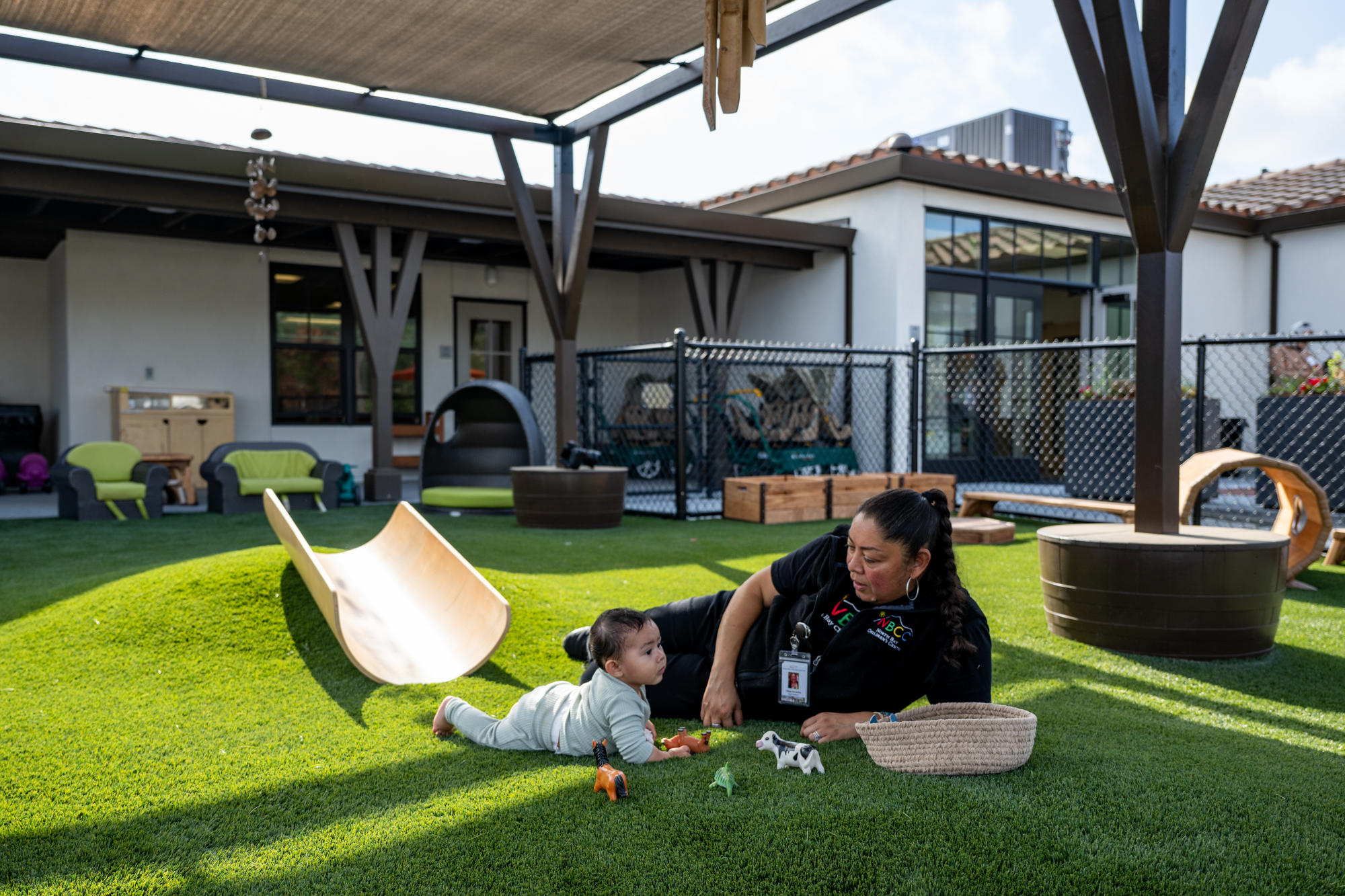
"content": "\u003cp>\u003ca href=\"https://www.kqed.org/wildfires\">Wildfire\u003c/a> smoke, extreme heat and contagious viruses — unhealthy for anyone — are especially dangerous for young bodies, so schools and \u003ca href=\"https://www.kqed.org/news/12051850/as-californias-electricity-rates-rise-parents-struggle-to-pay-their-bills\">child care\u003c/a> are often forced to close when disasters hit.\u003c/p>\n\u003cp>Since 2017, the staff at North Bay Children’s Center has seen the rippling consequences of these emergencies: parents had to drop what they were doing to pick up their children.\u003c/p>\n\u003cp>“During the fires, because of poor air quality, and during the pandemic, the natural reaction to our school districts and many of our colleagues in child care was to close,” said Susan Gilmore, CEO of the nonprofit, which operates 14 child development centers in Sonoma and Marin counties.\u003c/p>\n\u003cp>[ad fullwidth]\u003c/p>\n\u003cp>“And our parents can’t afford that,” she said. “Most of them are essential employees; they live paycheck to paycheck and cannot miss work.”\u003c/p>\n\u003cp>This week, the NBCC opened its biggest center in Novato, serving 176 infants, toddlers and preschoolers, and it’s designed to stay open amidst wildfire smoke, extreme heat and other climate-related events, and provide not just for kids but their families as well.\u003c/p>\n\u003cfigure id=\"attachment_12054027\" class=\"wp-caption aligncenter\" style=\"max-width: 2000px\">\u003cimg loading=\"lazy\" decoding=\"async\" class=\"size-full wp-image-12054027\" src=\"https://cdn.kqed.org/wp-content/uploads/sites/10/2025/08/250827-CLIMATERESILIENTCHILDCARECENTER-11-BL-KQED.jpg\" alt=\"\" width=\"2000\" height=\"1333\" srcset=\"https://cdn.kqed.org/wp-content/uploads/sites/10/2025/08/250827-CLIMATERESILIENTCHILDCARECENTER-11-BL-KQED.jpg 2000w, https://cdn.kqed.org/wp-content/uploads/sites/10/2025/08/250827-CLIMATERESILIENTCHILDCARECENTER-11-BL-KQED-160x107.jpg 160w, https://cdn.kqed.org/wp-content/uploads/sites/10/2025/08/250827-CLIMATERESILIENTCHILDCARECENTER-11-BL-KQED-1536x1024.jpg 1536w\" sizes=\"auto, (max-width: 2000px) 100vw, 2000px\">\u003cfigcaption class=\"wp-caption-text\">A preschool classroom at the North Bay Children’s Center in Novato on Aug. 27, 2025. \u003ccite>(Beth LaBerge/KQED)\u003c/cite>\u003c/figcaption>\u003c/figure>\n\u003cp>Inside, each classroom has its own climate control and filtration system to ensure the air stays cool and clean — and to minimize germs spreading from one room to another.\u003c/p>\n\u003cp>Outside, trees and shade structures protect the play yard from the heat. The ground is mostly covered in mulch and astroturf instead of asphalt, which can radiate dangerously high temperatures, cutting outdoor playtime short.\u003c/p>\n\u003cp>To extend that time, playground builders studied the sun.\u003c/p>\n\u003cfigure id=\"attachment_12054024\" class=\"wp-caption aligncenter\" style=\"max-width: 2000px\">\u003cimg loading=\"lazy\" decoding=\"async\" class=\"size-full wp-image-12054024\" src=\"https://cdn.kqed.org/wp-content/uploads/sites/10/2025/08/250827-CLIMATERESILIENTCHILDCARECENTER-05-BL-KQED.jpg\" alt=\"\" width=\"2000\" height=\"1333\" srcset=\"https://cdn.kqed.org/wp-content/uploads/sites/10/2025/08/250827-CLIMATERESILIENTCHILDCARECENTER-05-BL-KQED.jpg 2000w, https://cdn.kqed.org/wp-content/uploads/sites/10/2025/08/250827-CLIMATERESILIENTCHILDCARECENTER-05-BL-KQED-160x107.jpg 160w, https://cdn.kqed.org/wp-content/uploads/sites/10/2025/08/250827-CLIMATERESILIENTCHILDCARECENTER-05-BL-KQED-1536x1024.jpg 1536w\" sizes=\"auto, (max-width: 2000px) 100vw, 2000px\">\u003cfigcaption class=\"wp-caption-text\">A child from the infant program plays in the outdoor area at the North Bay Children’s Center in Novato on Aug. 27, 2025. \u003ccite>(Beth LaBerge/KQED)\u003c/cite>\u003c/figcaption>\u003c/figure>\n\u003cp>Babies, toddlers and kids under 5 are more vulnerable to heat exhaustion because their bodies heat up faster, and they have a harder time cooling down.\u003c/p>\n\u003cp>“We live in an area where those extreme heat days are hotter and they last longer, so we have to make sure that our environments can support what children need,” Gilmore said.\u003c/p>\n\u003cp>Crews carefully positioned fabric panels above the sandbox to provide shade as sunlight shifts, said Brian St. Peter, head of facilities for the NBCC.\u003c/p>\n\u003cfigure id=\"attachment_12054028\" class=\"wp-caption aligncenter\" style=\"max-width: 2000px\">\u003cimg loading=\"lazy\" decoding=\"async\" class=\"size-full wp-image-12054028\" src=\"https://cdn.kqed.org/wp-content/uploads/sites/10/2025/08/250827-CLIMATERESILIENTCHILDCARECENTER-12-BL-KQED.jpg\" alt=\"\" width=\"2000\" height=\"1333\" srcset=\"https://cdn.kqed.org/wp-content/uploads/sites/10/2025/08/250827-CLIMATERESILIENTCHILDCARECENTER-12-BL-KQED.jpg 2000w, https://cdn.kqed.org/wp-content/uploads/sites/10/2025/08/250827-CLIMATERESILIENTCHILDCARECENTER-12-BL-KQED-160x107.jpg 160w, https://cdn.kqed.org/wp-content/uploads/sites/10/2025/08/250827-CLIMATERESILIENTCHILDCARECENTER-12-BL-KQED-1536x1024.jpg 1536w\" sizes=\"auto, (max-width: 2000px) 100vw, 2000px\">\u003cfigcaption class=\"wp-caption-text\">Teresa Fogolini, director of Garden of Eatin’, checks on lettuce growing in the garden at the North Bay Children’s Center in Novato on Aug. 27, 2025. The program teaches children about healthy food through hands-on gardening. \u003ccite>(Beth LaBerge/KQED)\u003c/cite>\u003c/figcaption>\u003c/figure>\n\u003cp>“We really had to look at exactly where it’s coming during the summer months, just to be able to accommodate the most shade for kids where they’re actually going to be playing,” he said.\u003c/p>\n\u003cp>The $12.5 million campus is on former military land that the NBCC purchased from the federal government for $1 years ago.\u003c/p>\n\u003cp>Gilmore already had blueprints for the building in 2015, but when the 2017 North Bay wildfires devastated the region and upended the lives of many families — including teachers and other members of the staff — Gilmore said it became crucial to add design features that address climate change.\u003c/p>\n\u003cfigure id=\"attachment_12054031\" class=\"wp-caption aligncenter\" style=\"max-width: 2000px\">\u003cimg loading=\"lazy\" decoding=\"async\" class=\"size-full wp-image-12054031\" src=\"https://cdn.kqed.org/wp-content/uploads/sites/10/2025/08/250827-CLIMATERESILIENTCHILDCARECENTER-19-BL-KQED.jpg\" alt=\"\" width=\"2000\" height=\"1333\" srcset=\"https://cdn.kqed.org/wp-content/uploads/sites/10/2025/08/250827-CLIMATERESILIENTCHILDCARECENTER-19-BL-KQED.jpg 2000w, https://cdn.kqed.org/wp-content/uploads/sites/10/2025/08/250827-CLIMATERESILIENTCHILDCARECENTER-19-BL-KQED-160x107.jpg 160w, https://cdn.kqed.org/wp-content/uploads/sites/10/2025/08/250827-CLIMATERESILIENTCHILDCARECENTER-19-BL-KQED-1536x1024.jpg 1536w\" sizes=\"auto, (max-width: 2000px) 100vw, 2000px\">\u003cfigcaption class=\"wp-caption-text\">Students learn how to cut vegetables for a salad at the North Bay Children’s Center in Novato on Aug. 27, 2025. \u003ccite>(Beth LaBerge/KQED)\u003c/cite>\u003c/figcaption>\u003c/figure>\n\u003cp>To prepare for future emergencies, the new building will serve as a “resiliency hub” where families can go and be safe instead of an evacuation shelter.\u003c/p>\n\u003cp>\u003cstrong>“\u003c/strong>If they’re in a place where they can’t get to their home, it’s important that we do have enough food, we do have enough water, and that we do have space outside of the classrooms where families can gather,” she said.\u003c/p>\n\u003cp>\u003c/p>\n",
"blocks": [],
"excerpt": "Heat, wildfire and other disasters often force child care centers to close, leaving families in the lurch.",
"status": "publish",
"parent": 0,
"modified": 1756924481,
"stats": {
"hasAudio": false,
"hasVideo": false,
"hasChartOrMap": false,
"iframeSrcs": [],
"hasGoogleForm": false,
"hasGallery": false,
"hasHearkenModule": false,
"hasPolis": false,
"paragraphCount": 18,
"wordCount": 651
},
"headData": {
"title": "This New North Bay Child Care Center Is Adapting to Climate Change | KQED",
"description": "Heat, wildfire and other disasters often force child care centers to close, leaving families in the lurch.",
"ogTitle": "",
"ogDescription": "",
"ogImgId": "",
"twTitle": "",
"twDescription": "",
"twImgId": "",
"schema": {
"@context": "https://schema.org",
"@type": "NewsArticle",
"headline": "This New North Bay Child Care Center Is Adapting to Climate Change",
"datePublished": "2025-08-29T07:00:30-07:00",
"dateModified": "2025-09-03T11:34:41-07:00",
"image": "https://cdn.kqed.org/wp-content/uploads/2020/02/KQED-OG-Image@1x.png",
"isAccessibleForFree": "True",
"publisher": {
"@type": "NewsMediaOrganization",
"@id": "https://www.kqed.org/#organization",
"name": "KQED",
"logo": "https://cdn.kqed.org/wp-content/uploads/2020/02/KQED-OG-Image@1x.png",
"url": "https://www.kqed.org",
"sameAs": [
"https://www.facebook.com/KQED",
"https://twitter.com/KQED",
"https://www.instagram.com/kqed/",
"https://www.tiktok.com/@kqedofficial",
"https://www.linkedin.com/company/kqed",
"https://www.youtube.com/channel/UCeC0IOo7i1P_61zVUWbJ4nw"
]
}
}
},
"primaryCategory": {
"termId": 8,
"slug": "news",
"name": "News"
},
"audioUrl": "https://traffic.omny.fm/d/clips/0af137ef-751e-4b19-a055-aaef00d2d578/ffca7e9f-6831-41c5-bcaf-aaef00f5a073/6713fa6f-9838-43ab-998a-b34d010e11b1/audio.mp3",
"sticky": false,
"nprStoryId": "kqed-12053877",
"templateType": "standard",
"featuredImageType": "standard",
"excludeFromSiteSearch": "Include",
"articleAge": "0",
"path": "/news/12053877/this-new-north-bay-child-care-center-is-adapting-to-climate-change",
"audioTrackLength": null,
"parsedContent": [
{
"type": "contentString",
"content": "\u003cdiv class=\"post-body\">\u003cp>\u003cp>\u003ca href=\"https://www.kqed.org/wildfires\">Wildfire\u003c/a> smoke, extreme heat and contagious viruses — unhealthy for anyone — are especially dangerous for young bodies, so schools and \u003ca href=\"https://www.kqed.org/news/12051850/as-californias-electricity-rates-rise-parents-struggle-to-pay-their-bills\">child care\u003c/a> are often forced to close when disasters hit.\u003c/p>\n\u003cp>Since 2017, the staff at North Bay Children’s Center has seen the rippling consequences of these emergencies: parents had to drop what they were doing to pick up their children.\u003c/p>\n\u003cp>“During the fires, because of poor air quality, and during the pandemic, the natural reaction to our school districts and many of our colleagues in child care was to close,” said Susan Gilmore, CEO of the nonprofit, which operates 14 child development centers in Sonoma and Marin counties.\u003c/p>\n\u003cp>\u003c/p>\u003c/div>",
"attributes": {
"named": {},
"numeric": []
}
},
{
"type": "component",
"content": "",
"name": "ad",
"attributes": {
"named": {
"label": "fullwidth"
},
"numeric": [
"fullwidth"
]
}
},
{
"type": "contentString",
"content": "\u003cdiv class=\"post-body\">\u003cp>\u003c/p>\n\u003cp>“And our parents can’t afford that,” she said. “Most of them are essential employees; they live paycheck to paycheck and cannot miss work.”\u003c/p>\n\u003cp>This week, the NBCC opened its biggest center in Novato, serving 176 infants, toddlers and preschoolers, and it’s designed to stay open amidst wildfire smoke, extreme heat and other climate-related events, and provide not just for kids but their families as well.\u003c/p>\n\u003cfigure id=\"attachment_12054027\" class=\"wp-caption aligncenter\" style=\"max-width: 2000px\">\u003cimg loading=\"lazy\" decoding=\"async\" class=\"size-full wp-image-12054027\" src=\"https://cdn.kqed.org/wp-content/uploads/sites/10/2025/08/250827-CLIMATERESILIENTCHILDCARECENTER-11-BL-KQED.jpg\" alt=\"\" width=\"2000\" height=\"1333\" srcset=\"https://cdn.kqed.org/wp-content/uploads/sites/10/2025/08/250827-CLIMATERESILIENTCHILDCARECENTER-11-BL-KQED.jpg 2000w, https://cdn.kqed.org/wp-content/uploads/sites/10/2025/08/250827-CLIMATERESILIENTCHILDCARECENTER-11-BL-KQED-160x107.jpg 160w, https://cdn.kqed.org/wp-content/uploads/sites/10/2025/08/250827-CLIMATERESILIENTCHILDCARECENTER-11-BL-KQED-1536x1024.jpg 1536w\" sizes=\"auto, (max-width: 2000px) 100vw, 2000px\">\u003cfigcaption class=\"wp-caption-text\">A preschool classroom at the North Bay Children’s Center in Novato on Aug. 27, 2025. \u003ccite>(Beth LaBerge/KQED)\u003c/cite>\u003c/figcaption>\u003c/figure>\n\u003cp>Inside, each classroom has its own climate control and filtration system to ensure the air stays cool and clean — and to minimize germs spreading from one room to another.\u003c/p>\n\u003cp>Outside, trees and shade structures protect the play yard from the heat. The ground is mostly covered in mulch and astroturf instead of asphalt, which can radiate dangerously high temperatures, cutting outdoor playtime short.\u003c/p>\n\u003cp>To extend that time, playground builders studied the sun.\u003c/p>\n\u003cfigure id=\"attachment_12054024\" class=\"wp-caption aligncenter\" style=\"max-width: 2000px\">\u003cimg loading=\"lazy\" decoding=\"async\" class=\"size-full wp-image-12054024\" src=\"https://cdn.kqed.org/wp-content/uploads/sites/10/2025/08/250827-CLIMATERESILIENTCHILDCARECENTER-05-BL-KQED.jpg\" alt=\"\" width=\"2000\" height=\"1333\" srcset=\"https://cdn.kqed.org/wp-content/uploads/sites/10/2025/08/250827-CLIMATERESILIENTCHILDCARECENTER-05-BL-KQED.jpg 2000w, https://cdn.kqed.org/wp-content/uploads/sites/10/2025/08/250827-CLIMATERESILIENTCHILDCARECENTER-05-BL-KQED-160x107.jpg 160w, https://cdn.kqed.org/wp-content/uploads/sites/10/2025/08/250827-CLIMATERESILIENTCHILDCARECENTER-05-BL-KQED-1536x1024.jpg 1536w\" sizes=\"auto, (max-width: 2000px) 100vw, 2000px\">\u003cfigcaption class=\"wp-caption-text\">A child from the infant program plays in the outdoor area at the North Bay Children’s Center in Novato on Aug. 27, 2025. \u003ccite>(Beth LaBerge/KQED)\u003c/cite>\u003c/figcaption>\u003c/figure>\n\u003cp>Babies, toddlers and kids under 5 are more vulnerable to heat exhaustion because their bodies heat up faster, and they have a harder time cooling down.\u003c/p>\n\u003cp>“We live in an area where those extreme heat days are hotter and they last longer, so we have to make sure that our environments can support what children need,” Gilmore said.\u003c/p>\n\u003cp>Crews carefully positioned fabric panels above the sandbox to provide shade as sunlight shifts, said Brian St. Peter, head of facilities for the NBCC.\u003c/p>\n\u003cfigure id=\"attachment_12054028\" class=\"wp-caption aligncenter\" style=\"max-width: 2000px\">\u003cimg loading=\"lazy\" decoding=\"async\" class=\"size-full wp-image-12054028\" src=\"https://cdn.kqed.org/wp-content/uploads/sites/10/2025/08/250827-CLIMATERESILIENTCHILDCARECENTER-12-BL-KQED.jpg\" alt=\"\" width=\"2000\" height=\"1333\" srcset=\"https://cdn.kqed.org/wp-content/uploads/sites/10/2025/08/250827-CLIMATERESILIENTCHILDCARECENTER-12-BL-KQED.jpg 2000w, https://cdn.kqed.org/wp-content/uploads/sites/10/2025/08/250827-CLIMATERESILIENTCHILDCARECENTER-12-BL-KQED-160x107.jpg 160w, https://cdn.kqed.org/wp-content/uploads/sites/10/2025/08/250827-CLIMATERESILIENTCHILDCARECENTER-12-BL-KQED-1536x1024.jpg 1536w\" sizes=\"auto, (max-width: 2000px) 100vw, 2000px\">\u003cfigcaption class=\"wp-caption-text\">Teresa Fogolini, director of Garden of Eatin’, checks on lettuce growing in the garden at the North Bay Children’s Center in Novato on Aug. 27, 2025. The program teaches children about healthy food through hands-on gardening. \u003ccite>(Beth LaBerge/KQED)\u003c/cite>\u003c/figcaption>\u003c/figure>\n\u003cp>“We really had to look at exactly where it’s coming during the summer months, just to be able to accommodate the most shade for kids where they’re actually going to be playing,” he said.\u003c/p>\n\u003cp>The $12.5 million campus is on former military land that the NBCC purchased from the federal government for $1 years ago.\u003c/p>\n\u003cp>Gilmore already had blueprints for the building in 2015, but when the 2017 North Bay wildfires devastated the region and upended the lives of many families — including teachers and other members of the staff — Gilmore said it became crucial to add design features that address climate change.\u003c/p>\n\u003cfigure id=\"attachment_12054031\" class=\"wp-caption aligncenter\" style=\"max-width: 2000px\">\u003cimg loading=\"lazy\" decoding=\"async\" class=\"size-full wp-image-12054031\" src=\"https://cdn.kqed.org/wp-content/uploads/sites/10/2025/08/250827-CLIMATERESILIENTCHILDCARECENTER-19-BL-KQED.jpg\" alt=\"\" width=\"2000\" height=\"1333\" srcset=\"https://cdn.kqed.org/wp-content/uploads/sites/10/2025/08/250827-CLIMATERESILIENTCHILDCARECENTER-19-BL-KQED.jpg 2000w, https://cdn.kqed.org/wp-content/uploads/sites/10/2025/08/250827-CLIMATERESILIENTCHILDCARECENTER-19-BL-KQED-160x107.jpg 160w, https://cdn.kqed.org/wp-content/uploads/sites/10/2025/08/250827-CLIMATERESILIENTCHILDCARECENTER-19-BL-KQED-1536x1024.jpg 1536w\" sizes=\"auto, (max-width: 2000px) 100vw, 2000px\">\u003cfigcaption class=\"wp-caption-text\">Students learn how to cut vegetables for a salad at the North Bay Children’s Center in Novato on Aug. 27, 2025. \u003ccite>(Beth LaBerge/KQED)\u003c/cite>\u003c/figcaption>\u003c/figure>\n\u003cp>To prepare for future emergencies, the new building will serve as a “resiliency hub” where families can go and be safe instead of an evacuation shelter.\u003c/p>\n\u003cp>\u003cstrong>“\u003c/strong>If they’re in a place where they can’t get to their home, it’s important that we do have enough food, we do have enough water, and that we do have space outside of the classrooms where families can gather,” she said.\u003c/p>\n\u003cp>\u003c/p>\n\u003c/div>\u003c/p>",
"attributes": {
"named": {},
"numeric": []
}
}
],
"link": "/news/12053877/this-new-north-bay-child-care-center-is-adapting-to-climate-change",
"authors": [
"11829"
],
"categories": [
"news_31795",
"news_34165",
"news_18540",
"news_8"
],
"tags": [
"news_25647",
"news_18538",
"news_20754",
"news_32768",
"news_2043",
"news_29886",
"news_19204",
"news_255",
"news_32102",
"news_32928",
"news_20013",
"news_27626"
],
"featImg": "news_12054023",
"label": "news"
},
"news_12054072": {
"type": "posts",
"id": "news_12054072",
"meta": {
"index": "posts_1716263798",
"site": "news",
"id": "12054072",
"score": null,
"sort": [
1756461609000
]
},
"guestAuthors": [],
"slug": "the-pickett-fire-barts-tap-and-ride-and-local-artists-leaving-spotify",
"title": "The Pickett Fire, BART’s ‘Tap and Ride', and Local Artists Leaving Spotify",
"publishDate": 1756461609,
"format": "audio",
"headTitle": "The Pickett Fire, BART’s ‘Tap and Ride’, and Local Artists Leaving Spotify | KQED",
"labelTerm": {},
"content": "\u003cp>On this edition of The Bay’s monthly news roundup, Ericka is joined by The Bay’s senior editor Alan Montecillo and KQED associate arts and culture editor Nastia Voynovskaya. We talk about the Pickett Fire currently burning in Napa, scheduling and payment changes to public transit across the Bay, and why some local artists have decided to take their music off Spotify.\u003c/p>\n\u003cp>\u003c!-- iframe plugin v.4.3 wordpress.org/plugins/iframe/ -->\u003cbr>\n\u003ciframe loading=\"lazy\" frameborder=\"0\" height=\"200\" scrolling=\"no\" src=\"https://playlist.megaphone.fm?e=KQINC1460162369&light=true\" width=\"100%\" class=\"iframe-class\">\u003c/iframe>\u003c/p>\n\u003cp>\u003cem>\u003ci>Some members of the KQED podcast team are represented by The Screen Actors Guild, American Federation of Television and Radio Artists. San Francisco Northern California Local.\u003c/i>\u003c/em>\u003c/p>\n\u003cp>\u003cb>Links:\u003c/b>\u003c/p>\n\u003cul>\n\u003cli>\u003ca href=\"https://www.fire.ca.gov/incidents/2025/8/21/pickett-fire\">Pickett Fire\u003c/a>\u003c/li>\n\u003cli>\u003ca href=\"https://www.pressdemocrat.com/article/napa/pickett-fire-napa-cause-woodbridge/\">Did ‘escaped control burn’ cause Napa County’s Pickett Fire? Dispatch records raise questions about blaze’s origin\u003c/a>\u003c/li>\n\u003cli>\u003ca href=\"https://www.kqed.org/news/12052690/bart-fares-2025-credit-card-clipper-tap-and-ride-contactless\">Starting This Week, You Can Tap Onto BART With a Credit Card — Here’s How\u003c/a>\u003c/li>\n\u003cli>\u003ca href=\"https://www.kqed.org/arts/13978141/deerhoof-quits-spotify-daniel-ek-700-million-military-ai-investment\">SF Band Ditches Spotify Over CEO’s $700M Military AI Investment\u003c/a>\u003c/li>\n\u003cli>\u003ca href=\"https://www.bart.gov/news/articles/2025/news20250811\">Bay Area transit’s latest Big Sync improves transfers, saving riders up to 20 minutes per trip\u003c/a>\u003c/li>\n\u003c/ul>\n\u003cp>\u003cem>This is a computer-generated transcript. While our team has reviewed it, there may be errors.\u003c/em>\u003c/p>\n\u003cp>[ad fullwidth]\u003c/p>\n\u003cp>\u003cstrong>Ericka Cruz Guevarra \u003c/strong>[00:00:02] I’m Ericka Cruz Guevarra and welcome to The Bay, local news to keep you rooted. And welcome to our August news roundup where we talk about some of the other stories that The Bay team and today a special guest have been following this month. I’m joined by senior editor, Alan Montecillo. What’s up, Alan?\u003c/p>\n\u003cp>\u003cstrong>Alan Montecillo \u003c/strong>[00:00:21] Hello.\u003c/p>\n\u003cp>\u003cstrong>Ericka Cruz Guevarra \u003c/strong>[00:00:22] And our very special guest today is Nastia Vojnovskaya, associate editor of arts and culture for KQED. Hey Nastia.\u003c/p>\n\u003cp>\u003cstrong>Nastia Voynovskaya \u003c/strong>[00:00:29] Hi Ericka!\u003c/p>\n\u003cp>\u003cstrong>Ericka Cruz Guevarra \u003c/strong>[00:00:30] Thank you so much for joining us.\u003c/p>\n\u003cp>\u003cstrong>Nastia Voynovskaya \u003c/strong>[00:00:32] Thanks for having me.\u003c/p>\n\u003cp>\u003cstrong>Ericka Cruz Guevarra \u003c/strong>[00:00:35] Before we dig into the stories that we’ve been following, Nastia, we wanted to have you on because it’s been a pretty busy August for you and the Arts Desk. Can you tell us a little bit about all the things you’ve been covering this month?\u003c/p>\n\u003cp>\u003cstrong>Nastia Voynovskaya \u003c/strong>[00:00:49] It’s music festival season and full swing in the Bay Area. So earlier this month, I had the pleasure of covering Outside Lands. Um, I cover it every year. And this was a particularly good one where had I not been covering, I would have definitely wanted to be there for fun. Super standout performance by Doechii, who was not even a headliner.\u003c/p>\n\u003cp>\u003cstrong>Ericka Cruz Guevarra \u003c/strong>[00:01:13] Wow. I was just going to ask what were your favorite sets?\u003c/p>\n\u003cp>\u003cstrong>Nastia Voynovskaya \u003c/strong>[00:01:25] She already had been at the top of my list of artists I’m watching, just based on her super strong album from last year, Alligator Bites Never Heal. And she just really showed everyone what showmanship and what being a performer is all about.\u003c/p>\n\u003cp>\u003cstrong>Nastia Voynovskaya \u003c/strong>[00:01:52] She can rap with the dexterity of Kendrick Lamar while moving like Megan Thee Stallion with no backing track. And then the whole performance was also formatted with this cheeky classroom lesson theme about hip hop. There were also so many homages to who came before and where she came from while creating this super futuristic vision.\u003c/p>\n\u003cp>\u003cstrong>Alan Montecillo \u003c/strong>[00:02:16] August was kind of the month of music festivals or concerts in Golden Gate Park, right? There was Denton Company, Outside Lands, Zach Bryan. With Outside Lands how did it compare to previous years? And I mean, how do you know as an attendee and as someone covering it, whether it was like a big success compared to years past?\u003c/p>\n\u003cp>\u003cstrong>Nastia Voynovskaya \u003c/strong>[00:02:35] I would say this year they did some very, very savvy booking. So in addition to Doechii, they had Doja Cat and also Tyler, The Creator. Tyler, he had played Outside Lands before, so when they announced it back in April, I was like, okay, I’m excited to see him again. I like him. But shortly before the festival, he released a fantastic new album. And it’s called Don’t Tap the Glass and the whole theme of that album is being present for the music in person and not being on your phone. And you kind of saw that translate in the crowd the way that people were so engaged. There were some really smart choices of well-positioned breakout acts that they booked. There’s this Brooklyn indie band whose name unfortunately we cannot say on the Radio, and it’s spelled F-C-U-K-E-R-S. And they played this smaller side stage earlier in the day. And I was so impressed by just how they packed out that stage with teens and 20-somethings who were just in this very dense crowd jumping up and down. They kind of have this indie sleaze vibe with electronics and live instruments and just like very sassy vocals. It’s very children of brat. And that band actually had a super packed high energy show, The Rickshaw Stop the night before. So I was just very impressed by how the festival had this mix of established and breaking acts that I think are about to be a lot bigger soon.\u003c/p>\n\u003cp>\u003cstrong>Ericka Cruz Guevarra \u003c/strong>[00:04:05] I know LaRussell also performed at Outside Lands, and we also did a really amazing event with him this month as well. More on that on the show next month, actually. We did a real cool music showcase with LaRussall and the Good Company team. Really got to see some amazing artists locally, and we’re gonna do an interview with the winner next month. So look out for that, listeners.\u003c/p>\n\u003cp>\u003cstrong>Alan Montecillo \u003c/strong>[00:04:34] I have a confession to make. I live next to the park. I have lived next to park for several years and I haven’t been to outside lands yet.\u003c/p>\n\u003cp>\u003cstrong>Nastia Voynovskaya \u003c/strong>[00:04:41] But at least you can hear it.\u003c/p>\n\u003cp>\u003cstrong>Alan Montecillo \u003c/strong>[00:04:43] I can hear it, I can definitely hear it. Some of my neighbors don’t love the fact that they can hear it, but I don’t mind. I should go and I will go. It’s expensive, but from what I hear, it’s worth it. I will get around to it, but I’m always a little embarrassed whenever this comes up.\u003c/p>\n\u003cp>\u003cstrong>Ericka Cruz Guevarra \u003c/strong>[00:04:59] Very clutch parking spot in front of his house, if you’re an outside lens attendee. Not that I’m offering it to our listeners. Well we’re gonna take a quick break and when we come back we’re going to dig into all the stories that we have been following this month. Stay with us.\u003c/p>\n\u003cp>\u003cstrong>Ericka Cruz Guevarra \u003c/strong>[00:05:27] Let’s go ahead and dive into some of the other stories that we have been following this month. Alan, I wanna start with you and you’ve been following the Pickett Fire in Napa.\u003c/p>\n\u003cp>\u003cstrong>Alan Montecillo \u003c/strong>[00:05:38] Yes, after a cold summer, a robust marine layer, Karl the Fog, out in full force, we are essentially in peak fire season from now until winter, basically, when it starts raining. And over the last week, we’ve had what has been the largest fire in the Bay Area so far, which is the Pickett fire. As of this taping, so Thursday morning, it has burned about 6,800 acres and is about 33% contained.\u003c/p>\n\u003cp>\u003cstrong>Ericka Cruz Guevarra \u003c/strong>[00:06:07] Yeah, and obviously whenever it comes to fire in the Bay Area, I think one of the main ways folks experience it is air quality, and I’ve been really watching that very closely. But can you tell us a little bit about where the fire is burning exactly? I know it’s pretty close to some big wineries in Napa, right, who are just about to approach harvest season.\u003c/p>\n\u003cp>\u003cstrong>Alan Montecillo \u003c/strong>[00:06:33] Yeah. So the fire broke out on the 21st of August along Pickett road in Napa County, just outside the town of Calistoga near several vineyards. So this fire is firmly, you know, in wine country, you know, In terms of smoke, the air quality management district did lift that advisory on Tuesday. So hopefully it’s not too bad anymore, but there’s still many areas where there are evacuation orders or evacuation warnings.\u003c/p>\n\u003cp>\u003cstrong>Nastia Voynovskaya \u003c/strong>[00:07:00] So has it burned down any residential areas?\u003c/p>\n\u003cp>\u003cstrong>Alan Montecillo \u003c/strong>[00:07:03] So far, it doesn’t seem like that’s happened. Not all the damage has been assessed yet. It seems like the main damage that’s been done, apart from smoke that can be hazardous to people’s health, is to crops. As Ericka mentioned, it is harvest season for these wineries. One early estimate from the county ag commissioner says approximately 1,500 acres of crops have been affected either by fire, by heat, or by smoke. Totaling and estimated, and again this is preliminary, about $65 million in damage.\u003c/p>\n\u003cp>\u003cstrong>Ericka Cruz Guevarra \u003c/strong>[00:07:38] Oh, wow.\u003c/p>\n\u003cp>\u003cstrong>Alan Montecillo \u003c/strong>[00:07:38] And what that means in a practical sense is, are wine grapes going to get ruined by the fire? This happened in 2020. And so the question just is, could that happen again?\u003c/p>\n\u003cp>\u003cstrong>Nastia Voynovskaya \u003c/strong>[00:07:50] Do you know how the wine industry has been adapting to that, if at all?\u003c/p>\n\u003cp>\u003cstrong>Alan Montecillo \u003c/strong>[00:07:54] Winemakers say, you know, over the last decade or so, the industry is trying to push for more research to figure out how to reduce the taste of smoke and minimize the effects of wildfire because you know it’s hard to tell immediately if the smoke has ruined your grapes. You won’t really know until you taste it. And there actually isn’t a ton of research yet on how to at least mitigate that. So maybe you do have smoke in your area because fire is a reality in California, but maybe there’s ways to minimize the taste and save the crops.\u003c/p>\n\u003cp>\u003cstrong>Nastia Voynovskaya \u003c/strong>[00:08:23] And I know it usually takes a while to figure out how a fire actually started, but do we know anything about how this fire in Napa began?\u003c/p>\n\u003cp>\u003cstrong>Alan Montecillo \u003c/strong>[00:08:33] So that is still under investigation. We don’t know for sure. But there have been some questions and details trickling out, and reporters asking whether this fire started as the result of a “escaped control burn”, basically a fire that’s intended to reduce vegetation on a property. The Press Democrat noted that those words, escape control, burn, appeared on a Cal Fire public safety dispatch around the same time the fire was reported. For what it’s worth, the winery in question said through a spokesperson, you know, we’re working with fire investigators. This is premature. So nothing has been confirmed officially yet, but there are some worries that this could have been how the fire started.\u003c/p>\n\u003cp>\u003cstrong>Ericka Cruz Guevarra \u003c/strong>[00:09:19] Well, Alan, thank you so much for sharing that story with us. We’re going to be following that one in the weeks ahead, I’m sure. Moving on to the story that I have been following this month, Nastia, Alan, you’re both public transit writers in the Bay Area, right?\u003c/p>\n\u003cp>\u003cstrong>Nastia Voynovskaya \u003c/strong>[00:09:39] Yes, I took BART here this morning.\u003c/p>\n\u003cp>\u003cstrong>Alan Montecillo \u003c/strong>[00:09:42] I’m a regular N rider.\u003c/p>\n\u003cp>\u003cstrong>Ericka Cruz Guevarra \u003c/strong>[00:09:44] Nice and of course I’m a regular ferry rider and this might be of interest to all of us in this room. Some big changes have been happening to public transit in the Bay Area that is really all about making transit easier to ride. Not sure if you all have started using your debit or credit cards to ride BART but that is now a thing that you can do. And there’s also something called the Big Sync that is happening. Basically, all these transit systems in the Bay Area coordinating to make transfers a lot easier if you’re using one or more transit system. It’s about time. Right. I remember going to New York a couple of years ago and being able to ride the subway by just tapping my credit card. And as a tourist. I was amazed. I was mind blown.\u003c/p>\n\u003cp>\u003cstrong>Nastia Voynovskaya \u003c/strong>[00:10:43] Yeah, when they got rid of paper tickets and introduced clipper cards, I honestly always found it really problematic that if you lose your clipper card, you have to spend three dollars or something to get a new plastic card. And if you’re a low-income rider, you know that’s money you could be using for a meal. So I’m glad that they’re changing the way it’s done.\u003c/p>\n\u003cp>\u003cstrong>Alan Montecillo \u003c/strong>[00:11:02] Well, and it also brings BART closer to transit systems that already have this. You mentioned this already. New York has it. Chicago has it, many places overseas have it already. Sadly, for those of us who travel among multiple transit agencies, so let’s say you’re going BART to Muni like you do, it hasn’t come to Muni yet, right? You’ll still tap your credit card for BART and then use something else for Muni.\u003c/p>\n\u003cp>\u003cstrong>Ericka Cruz Guevarra \u003c/strong>[00:11:25] Yeah, fumble to find your other plastic card to ride Muni. Yes, that is correct. This open payment system, as it’s called, of using a debit card or a credit card has not rolled out for Muni yet, but that kind of is the goal. Bay Area Transit officials say that they do want to use this eventually for all regional operators, Muni, Caltrain, AC Transit. So TBD for you, Alan. But I will say there is still something for Muni writers in the month of August, which is this big sink that I’m talking about. Have any of you heard of that? No, tell us more. So if you’re using more than one transit system, so you’re going from BART to Muni, all these agencies have tried to overhaul their schedules in order to make transfers a lot easier and a lot faster. So the focus is really for transfer hubs. In the Bay Area, so Dublin Pleasanton, BART, Daly City BART, Palo Alto Caltrain, and Concord BART Station. In all, these agencies adjusted 18 bus routes at these four hubs to improve connection times with each other. No more sprinting from Caltrain to BART for example. These agencies are saying that these changes account for a 33% increase in weekday ideal transfers. So basically you get five to 10 minutes in between one transit system to another to calmly start your morning and walk to your next transfer.\u003c/p>\n\u003cp>\u003cstrong>Nastia Voynovskaya \u003c/strong>[00:13:08] That’s gonna make a big difference for a lot of people, because I talk to so many people that want to ride public transit more, but oftentimes it just takes so much longer than driving or getting a rideshare.\u003c/p>\n\u003cp>\u003cstrong>Ericka Cruz Guevarra \u003c/strong>[00:13:19] Right, exactly. You know, these agencies, these transportation agencies that have been really struggling since the pandemic, they got a lot of work to do to get people back on busses and trains, right? And this is really part of it. In terms of the why, this is part of an ongoing implementation of what’s known as the Bay Area Transformation Action Plan from 2021, which is all about improving public transit, making it more user-friendly. And creating a more connected system among all these different transit agencies around the Bay Area.\u003c/p>\n\u003cp>\u003cstrong>Nastia Voynovskaya \u003c/strong>[00:13:54] Love to see it.\u003c/p>\n\u003cp>\u003cstrong>Alan Montecillo \u003c/strong>[00:13:55] See you on the N, or the 22…maybe I shouldn’t give out —\u003c/p>\n\u003cp>\u003cstrong>Ericka Cruz Guevarra \u003c/strong>[00:13:58] Yeah you’re right. We’re just getting closer and closer to figuring out where Alan Montecillo lives in this episode.\u003c/p>\n\u003cp>\u003cstrong>Ericka Cruz Guevarra \u003c/strong>[00:14:15] Well, that is the story that I have been following. Nastia, we’re gonna wrap this one up with you. What story have you been following this month?\u003c/p>\n\u003cp>\u003cstrong>Nastia Voynovskaya \u003c/strong>[00:14:24] I’ve been following the story of cultural boycotts. So in late July, a bunch of artists announced that they’re taking their music off Spotify because the CEO, Daniel Ek actually just became the chairman of an AI weapons company called Helsing. In light of Israel’s war in Gaza, a lot of artists have been thinking in past couple of years, how… Cultural institutions and companies that serve the culture sector can be complicit in war profiteering. Gabe Moline from KQED Arts wrote a great piece about how Dear Hoof, which is an indie band that formed in San Francisco and are pretty big, announced taking their music off Spotify. And another big voice in that has been Kadia Bonet, who’s this great singer-songwriter, also from the Bay.\u003c/p>\n\u003cp>\u003cstrong>Alan Montecillo \u003c/strong>[00:15:19] How much of a financial hit would artists take for deciding to pull their music off something like Spotify, which obviously is huge, you know, so many people use it.\u003c/p>\n\u003cp>\u003cstrong>Nastia Voynovskaya \u003c/strong>[00:15:28] Well, just based off streams, honestly, negligible.\u003c/p>\n\u003cp>\u003cstrong>Alan Montecillo \u003c/strong>[00:15:32] Because they don’t get paid that much?\u003c/p>\n\u003cp>\u003cstrong>Ericka Cruz Guevarra \u003c/strong>[00:15:32] They do not. They do not get paid much at all. I’ve actually been covering artists’ fight for better pay on streaming services for a few years now. And Spotify doesn’t release its exact figures of how much it pays, but the general estimate going around in the industry is that they get a third of a cent per stream. So basically to make the equivalent of earning $15 an hour at a full time job, an artist would have to get over 650,000 Spotify streams per month.\u003c/p>\n\u003cp>\u003cstrong>Ericka Cruz Guevarra \u003c/strong>[00:16:06] Oh my gosh.\u003c/p>\n\u003cp>\u003cstrong>Nastia Voynovskaya\u003c/strong> [00:16:06] So you have to be very popular to even see any amount of money. Most of the money in the music industry is in touring, but of course, Spotify does have a lot of clout. There’s a lot clout attached to being featured in a prominent playlist and having your music served up. To listeners, but despite that, there are a lot of artists that have been saying the way that Spotify is set up is rigged against the small indie artists.\u003c/p>\n\u003cp>\u003cstrong>Ericka Cruz Guevarra \u003c/strong>[00:16:32] This is making me think about the story of the Bay Area DJs who protested boiler room for coming to San Francisco because of the company’s investments in the defense industry in Israel. Sort of the same kind of deal, and I feel like Bay Area artists really like putting their foot down.\u003c/p>\n\u003cp>\u003cstrong>Nastia Voynovskaya \u003c/strong>[00:16:53] Yeah, very similar. My good friend Olivia Cruz Mayeda covered that story for SF Chronicle.\u003c/p>\n\u003cp>\u003cstrong>Ericka Cruz Guevarra \u003c/strong>[00:16:59] Shout out Olivia.\u003c/p>\n\u003cp>\u003cstrong>Nastia Voynovskaya \u003c/strong>[00:17:00] Yeah, shout out Olivia! Boiler Room, for those that don’t know, it’s this huge online platform for DJs and they basically go to all these really cool music scenes from around the world and produce these really high quality videos of DJs killing it at parties that really puts you in the scene. So in previous years, being in BoilerRoom for a DJ was a stamp of approval. So it was a really big deal that all these smaller electronic music collectives that I’m sure would want the clout that comes with Boiler Room put their foot down and they pretty much organized an anti-Boiler Room music festival as a sign of protest because Boiler Rooms parent company, KKR, has weapons investments.\u003c/p>\n\u003cp>\u003cstrong>Alan Montecillo \u003c/strong>[00:17:44] Has Spotify said anything about this? Are they noticing that there are some artists who are upset, whether it’s about their CEO specifically or payment in general?\u003c/p>\n\u003cp>\u003cstrong>Nastia Voynovskaya \u003c/strong>[00:17:54] So Spotify has not issued a public statement about its CEO becoming chairman of the AI weapons company, but it does have a lot of information on its website kind of arguing that it does give artists all these opportunities and that artists wouldn’t be making a certain amount of money if it wasn’t for Spotify. So they do have a whole section of their website that’s all about payment structure that people can go look at.\u003c/p>\n\u003cp>\u003cstrong>Alan Montecillo \u003c/strong>[00:18:20] From the consumer side, let’s say I really like one of these bands and I use Spotify and they’ve taken their music off, how should I listen to and support these artists?\u003c/p>\n\u003cp>\u003cstrong>Nastia Voynovskaya \u003c/strong>[00:18:30] A lot of people recommend Bandcamp, not every artist has their music on there, but you can buy it directly and a big percentage goes to the artists. I know Apple Music introduced a new feature that easily allows you to transfer your Spotify playlists to Apple Music. People are talking about title. There are other streaming alternatives, but I will say I don’t think any of these artists would say that any of the services are perfect and all have their drawbacks. But I think if people want to support artists, especially the independent artists and their community, the best way is to buy tickets and show up to live shows and honestly buy merch, because merch is really the way that most artists make money these days.\u003c/p>\n\u003cp>\u003cstrong>Nastia Voynovskaya \u003c/strong>[00:19:16] Well, Nastia Voynovskaya, Associate Editor of Arts and Culture, thank you so much for bringing that story.\u003c/p>\n\u003cp>\u003cstrong>Nastia Voynovskaya \u003c/strong>[00:19:22] Thank you, Ericka and Alan for having me.\u003c/p>\n\u003cp>\u003cstrong>Ericka Cruz Guevarra \u003c/strong>[00:19:26] And Alan Montecillo, Senior Editor of The Bay, thank you as well.\u003c/p>\n\u003cp>[ad floatright]\u003c/p>\n\u003cp>\u003cstrong>Alan Montecillo \u003c/strong>[00:19:30] My pleasure.\u003c/p>\n\n",
"blocks": [],
"excerpt": "We talk about the Pickett Fire currently burning in Napa, scheduling and payment changes to public transit across the Bay, and why some local artists have decided to take their music off Spotify.",
"status": "publish",
"parent": 0,
"modified": 1756497528,
"stats": {
"hasAudio": true,
"hasVideo": false,
"hasChartOrMap": false,
"iframeSrcs": [],
"hasGoogleForm": false,
"hasGallery": false,
"hasHearkenModule": false,
"hasPolis": false,
"paragraphCount": 69,
"wordCount": 3815
},
"headData": {
"title": "The Pickett Fire, BART’s ‘Tap and Ride', and Local Artists Leaving Spotify | KQED",
"description": "We talk about the Pickett Fire currently burning in Napa, scheduling and payment changes to public transit across the Bay, and why some local artists have decided to take their music off Spotify.",
"ogTitle": "",
"ogDescription": "",
"ogImgId": "",
"twTitle": "",
"twDescription": "",
"twImgId": "",
"schema": {
"@context": "https://schema.org",
"@type": "NewsArticle",
"headline": "The Pickett Fire, BART’s ‘Tap and Ride', and Local Artists Leaving Spotify",
"datePublished": "2025-08-29T03:00:09-07:00",
"dateModified": "2025-08-29T12:58:48-07:00",
"image": "https://cdn.kqed.org/wp-content/uploads/2020/02/KQED-OG-Image@1x.png",
"isAccessibleForFree": "True",
"publisher": {
"@type": "NewsMediaOrganization",
"@id": "https://www.kqed.org/#organization",
"name": "KQED",
"logo": "https://cdn.kqed.org/wp-content/uploads/2020/02/KQED-OG-Image@1x.png",
"url": "https://www.kqed.org",
"sameAs": [
"https://www.facebook.com/KQED",
"https://twitter.com/KQED",
"https://www.instagram.com/kqed/",
"https://www.tiktok.com/@kqedofficial",
"https://www.linkedin.com/company/kqed",
"https://www.youtube.com/channel/UCeC0IOo7i1P_61zVUWbJ4nw"
]
}
}
},
"source": "The Bay",
"sourceUrl": "https://www.kqed.org/podcasts/thebay",
"audioUrl": "https://www.podtrac.com/pts/redirect.mp3/chrt.fm/track/G6C7C3/traffic.megaphone.fm/KQINC1460162369.mp3?updated=1756443433",
"sticky": false,
"nprStoryId": "kqed-12054072",
"templateType": "standard",
"featuredImageType": "standard",
"excludeFromSiteSearch": "Include",
"articleAge": "0",
"path": "/news/12054072/the-pickett-fire-barts-tap-and-ride-and-local-artists-leaving-spotify",
"audioTrackLength": null,
"parsedContent": [
{
"type": "contentString",
"content": "\u003cdiv class=\"post-body\">\u003cp>\u003cp>On this edition of The Bay’s monthly news roundup, Ericka is joined by The Bay’s senior editor Alan Montecillo and KQED associate arts and culture editor Nastia Voynovskaya. We talk about the Pickett Fire currently burning in Napa, scheduling and payment changes to public transit across the Bay, and why some local artists have decided to take their music off Spotify.\u003c/p>\n\u003cp>\u003c!-- iframe plugin v.4.3 wordpress.org/plugins/iframe/ -->\u003cbr>\n\u003ciframe loading=\"lazy\" frameborder=\"0\" height=\"200\" scrolling=\"no\" src=\"https://playlist.megaphone.fm?e=KQINC1460162369&light=true\" width=\"100%\" class=\"iframe-class\">\u003c/iframe>\u003c/p>\n\u003cp>\u003cem>\u003ci>Some members of the KQED podcast team are represented by The Screen Actors Guild, American Federation of Television and Radio Artists. San Francisco Northern California Local.\u003c/i>\u003c/em>\u003c/p>\n\u003cp>\u003cb>Links:\u003c/b>\u003c/p>\n\u003cul>\n\u003cli>\u003ca href=\"https://www.fire.ca.gov/incidents/2025/8/21/pickett-fire\">Pickett Fire\u003c/a>\u003c/li>\n\u003cli>\u003ca href=\"https://www.pressdemocrat.com/article/napa/pickett-fire-napa-cause-woodbridge/\">Did ‘escaped control burn’ cause Napa County’s Pickett Fire? Dispatch records raise questions about blaze’s origin\u003c/a>\u003c/li>\n\u003cli>\u003ca href=\"https://www.kqed.org/news/12052690/bart-fares-2025-credit-card-clipper-tap-and-ride-contactless\">Starting This Week, You Can Tap Onto BART With a Credit Card — Here’s How\u003c/a>\u003c/li>\n\u003cli>\u003ca href=\"https://www.kqed.org/arts/13978141/deerhoof-quits-spotify-daniel-ek-700-million-military-ai-investment\">SF Band Ditches Spotify Over CEO’s $700M Military AI Investment\u003c/a>\u003c/li>\n\u003cli>\u003ca href=\"https://www.bart.gov/news/articles/2025/news20250811\">Bay Area transit’s latest Big Sync improves transfers, saving riders up to 20 minutes per trip\u003c/a>\u003c/li>\n\u003c/ul>\n\u003cp>\u003cem>This is a computer-generated transcript. While our team has reviewed it, there may be errors.\u003c/em>\u003c/p>\n\u003cp>\u003c/p>\u003c/div>",
"attributes": {
"named": {},
"numeric": []
}
},
{
"type": "component",
"content": "",
"name": "ad",
"attributes": {
"named": {
"label": "fullwidth"
},
"numeric": [
"fullwidth"
]
}
},
{
"type": "contentString",
"content": "\u003cdiv class=\"post-body\">\u003cp>\u003c/p>\n\u003cp>\u003cstrong>Ericka Cruz Guevarra \u003c/strong>[00:00:02] I’m Ericka Cruz Guevarra and welcome to The Bay, local news to keep you rooted. And welcome to our August news roundup where we talk about some of the other stories that The Bay team and today a special guest have been following this month. I’m joined by senior editor, Alan Montecillo. What’s up, Alan?\u003c/p>\n\u003cp>\u003cstrong>Alan Montecillo \u003c/strong>[00:00:21] Hello.\u003c/p>\n\u003cp>\u003cstrong>Ericka Cruz Guevarra \u003c/strong>[00:00:22] And our very special guest today is Nastia Vojnovskaya, associate editor of arts and culture for KQED. Hey Nastia.\u003c/p>\n\u003cp>\u003cstrong>Nastia Voynovskaya \u003c/strong>[00:00:29] Hi Ericka!\u003c/p>\n\u003cp>\u003cstrong>Ericka Cruz Guevarra \u003c/strong>[00:00:30] Thank you so much for joining us.\u003c/p>\n\u003cp>\u003cstrong>Nastia Voynovskaya \u003c/strong>[00:00:32] Thanks for having me.\u003c/p>\n\u003cp>\u003cstrong>Ericka Cruz Guevarra \u003c/strong>[00:00:35] Before we dig into the stories that we’ve been following, Nastia, we wanted to have you on because it’s been a pretty busy August for you and the Arts Desk. Can you tell us a little bit about all the things you’ve been covering this month?\u003c/p>\n\u003cp>\u003cstrong>Nastia Voynovskaya \u003c/strong>[00:00:49] It’s music festival season and full swing in the Bay Area. So earlier this month, I had the pleasure of covering Outside Lands. Um, I cover it every year. And this was a particularly good one where had I not been covering, I would have definitely wanted to be there for fun. Super standout performance by Doechii, who was not even a headliner.\u003c/p>\n\u003cp>\u003cstrong>Ericka Cruz Guevarra \u003c/strong>[00:01:13] Wow. I was just going to ask what were your favorite sets?\u003c/p>\n\u003cp>\u003cstrong>Nastia Voynovskaya \u003c/strong>[00:01:25] She already had been at the top of my list of artists I’m watching, just based on her super strong album from last year, Alligator Bites Never Heal. And she just really showed everyone what showmanship and what being a performer is all about.\u003c/p>\n\u003cp>\u003cstrong>Nastia Voynovskaya \u003c/strong>[00:01:52] She can rap with the dexterity of Kendrick Lamar while moving like Megan Thee Stallion with no backing track. And then the whole performance was also formatted with this cheeky classroom lesson theme about hip hop. There were also so many homages to who came before and where she came from while creating this super futuristic vision.\u003c/p>\n\u003cp>\u003cstrong>Alan Montecillo \u003c/strong>[00:02:16] August was kind of the month of music festivals or concerts in Golden Gate Park, right? There was Denton Company, Outside Lands, Zach Bryan. With Outside Lands how did it compare to previous years? And I mean, how do you know as an attendee and as someone covering it, whether it was like a big success compared to years past?\u003c/p>\n\u003cp>\u003cstrong>Nastia Voynovskaya \u003c/strong>[00:02:35] I would say this year they did some very, very savvy booking. So in addition to Doechii, they had Doja Cat and also Tyler, The Creator. Tyler, he had played Outside Lands before, so when they announced it back in April, I was like, okay, I’m excited to see him again. I like him. But shortly before the festival, he released a fantastic new album. And it’s called Don’t Tap the Glass and the whole theme of that album is being present for the music in person and not being on your phone. And you kind of saw that translate in the crowd the way that people were so engaged. There were some really smart choices of well-positioned breakout acts that they booked. There’s this Brooklyn indie band whose name unfortunately we cannot say on the Radio, and it’s spelled F-C-U-K-E-R-S. And they played this smaller side stage earlier in the day. And I was so impressed by just how they packed out that stage with teens and 20-somethings who were just in this very dense crowd jumping up and down. They kind of have this indie sleaze vibe with electronics and live instruments and just like very sassy vocals. It’s very children of brat. And that band actually had a super packed high energy show, The Rickshaw Stop the night before. So I was just very impressed by how the festival had this mix of established and breaking acts that I think are about to be a lot bigger soon.\u003c/p>\n\u003cp>\u003cstrong>Ericka Cruz Guevarra \u003c/strong>[00:04:05] I know LaRussell also performed at Outside Lands, and we also did a really amazing event with him this month as well. More on that on the show next month, actually. We did a real cool music showcase with LaRussall and the Good Company team. Really got to see some amazing artists locally, and we’re gonna do an interview with the winner next month. So look out for that, listeners.\u003c/p>\n\u003cp>\u003cstrong>Alan Montecillo \u003c/strong>[00:04:34] I have a confession to make. I live next to the park. I have lived next to park for several years and I haven’t been to outside lands yet.\u003c/p>\n\u003cp>\u003cstrong>Nastia Voynovskaya \u003c/strong>[00:04:41] But at least you can hear it.\u003c/p>\n\u003cp>\u003cstrong>Alan Montecillo \u003c/strong>[00:04:43] I can hear it, I can definitely hear it. Some of my neighbors don’t love the fact that they can hear it, but I don’t mind. I should go and I will go. It’s expensive, but from what I hear, it’s worth it. I will get around to it, but I’m always a little embarrassed whenever this comes up.\u003c/p>\n\u003cp>\u003cstrong>Ericka Cruz Guevarra \u003c/strong>[00:04:59] Very clutch parking spot in front of his house, if you’re an outside lens attendee. Not that I’m offering it to our listeners. Well we’re gonna take a quick break and when we come back we’re going to dig into all the stories that we have been following this month. Stay with us.\u003c/p>\n\u003cp>\u003cstrong>Ericka Cruz Guevarra \u003c/strong>[00:05:27] Let’s go ahead and dive into some of the other stories that we have been following this month. Alan, I wanna start with you and you’ve been following the Pickett Fire in Napa.\u003c/p>\n\u003cp>\u003cstrong>Alan Montecillo \u003c/strong>[00:05:38] Yes, after a cold summer, a robust marine layer, Karl the Fog, out in full force, we are essentially in peak fire season from now until winter, basically, when it starts raining. And over the last week, we’ve had what has been the largest fire in the Bay Area so far, which is the Pickett fire. As of this taping, so Thursday morning, it has burned about 6,800 acres and is about 33% contained.\u003c/p>\n\u003cp>\u003cstrong>Ericka Cruz Guevarra \u003c/strong>[00:06:07] Yeah, and obviously whenever it comes to fire in the Bay Area, I think one of the main ways folks experience it is air quality, and I’ve been really watching that very closely. But can you tell us a little bit about where the fire is burning exactly? I know it’s pretty close to some big wineries in Napa, right, who are just about to approach harvest season.\u003c/p>\n\u003cp>\u003cstrong>Alan Montecillo \u003c/strong>[00:06:33] Yeah. So the fire broke out on the 21st of August along Pickett road in Napa County, just outside the town of Calistoga near several vineyards. So this fire is firmly, you know, in wine country, you know, In terms of smoke, the air quality management district did lift that advisory on Tuesday. So hopefully it’s not too bad anymore, but there’s still many areas where there are evacuation orders or evacuation warnings.\u003c/p>\n\u003cp>\u003cstrong>Nastia Voynovskaya \u003c/strong>[00:07:00] So has it burned down any residential areas?\u003c/p>\n\u003cp>\u003cstrong>Alan Montecillo \u003c/strong>[00:07:03] So far, it doesn’t seem like that’s happened. Not all the damage has been assessed yet. It seems like the main damage that’s been done, apart from smoke that can be hazardous to people’s health, is to crops. As Ericka mentioned, it is harvest season for these wineries. One early estimate from the county ag commissioner says approximately 1,500 acres of crops have been affected either by fire, by heat, or by smoke. Totaling and estimated, and again this is preliminary, about $65 million in damage.\u003c/p>\n\u003cp>\u003cstrong>Ericka Cruz Guevarra \u003c/strong>[00:07:38] Oh, wow.\u003c/p>\n\u003cp>\u003cstrong>Alan Montecillo \u003c/strong>[00:07:38] And what that means in a practical sense is, are wine grapes going to get ruined by the fire? This happened in 2020. And so the question just is, could that happen again?\u003c/p>\n\u003cp>\u003cstrong>Nastia Voynovskaya \u003c/strong>[00:07:50] Do you know how the wine industry has been adapting to that, if at all?\u003c/p>\n\u003cp>\u003cstrong>Alan Montecillo \u003c/strong>[00:07:54] Winemakers say, you know, over the last decade or so, the industry is trying to push for more research to figure out how to reduce the taste of smoke and minimize the effects of wildfire because you know it’s hard to tell immediately if the smoke has ruined your grapes. You won’t really know until you taste it. And there actually isn’t a ton of research yet on how to at least mitigate that. So maybe you do have smoke in your area because fire is a reality in California, but maybe there’s ways to minimize the taste and save the crops.\u003c/p>\n\u003cp>\u003cstrong>Nastia Voynovskaya \u003c/strong>[00:08:23] And I know it usually takes a while to figure out how a fire actually started, but do we know anything about how this fire in Napa began?\u003c/p>\n\u003cp>\u003cstrong>Alan Montecillo \u003c/strong>[00:08:33] So that is still under investigation. We don’t know for sure. But there have been some questions and details trickling out, and reporters asking whether this fire started as the result of a “escaped control burn”, basically a fire that’s intended to reduce vegetation on a property. The Press Democrat noted that those words, escape control, burn, appeared on a Cal Fire public safety dispatch around the same time the fire was reported. For what it’s worth, the winery in question said through a spokesperson, you know, we’re working with fire investigators. This is premature. So nothing has been confirmed officially yet, but there are some worries that this could have been how the fire started.\u003c/p>\n\u003cp>\u003cstrong>Ericka Cruz Guevarra \u003c/strong>[00:09:19] Well, Alan, thank you so much for sharing that story with us. We’re going to be following that one in the weeks ahead, I’m sure. Moving on to the story that I have been following this month, Nastia, Alan, you’re both public transit writers in the Bay Area, right?\u003c/p>\n\u003cp>\u003cstrong>Nastia Voynovskaya \u003c/strong>[00:09:39] Yes, I took BART here this morning.\u003c/p>\n\u003cp>\u003cstrong>Alan Montecillo \u003c/strong>[00:09:42] I’m a regular N rider.\u003c/p>\n\u003cp>\u003cstrong>Ericka Cruz Guevarra \u003c/strong>[00:09:44] Nice and of course I’m a regular ferry rider and this might be of interest to all of us in this room. Some big changes have been happening to public transit in the Bay Area that is really all about making transit easier to ride. Not sure if you all have started using your debit or credit cards to ride BART but that is now a thing that you can do. And there’s also something called the Big Sync that is happening. Basically, all these transit systems in the Bay Area coordinating to make transfers a lot easier if you’re using one or more transit system. It’s about time. Right. I remember going to New York a couple of years ago and being able to ride the subway by just tapping my credit card. And as a tourist. I was amazed. I was mind blown.\u003c/p>\n\u003cp>\u003cstrong>Nastia Voynovskaya \u003c/strong>[00:10:43] Yeah, when they got rid of paper tickets and introduced clipper cards, I honestly always found it really problematic that if you lose your clipper card, you have to spend three dollars or something to get a new plastic card. And if you’re a low-income rider, you know that’s money you could be using for a meal. So I’m glad that they’re changing the way it’s done.\u003c/p>\n\u003cp>\u003cstrong>Alan Montecillo \u003c/strong>[00:11:02] Well, and it also brings BART closer to transit systems that already have this. You mentioned this already. New York has it. Chicago has it, many places overseas have it already. Sadly, for those of us who travel among multiple transit agencies, so let’s say you’re going BART to Muni like you do, it hasn’t come to Muni yet, right? You’ll still tap your credit card for BART and then use something else for Muni.\u003c/p>\n\u003cp>\u003cstrong>Ericka Cruz Guevarra \u003c/strong>[00:11:25] Yeah, fumble to find your other plastic card to ride Muni. Yes, that is correct. This open payment system, as it’s called, of using a debit card or a credit card has not rolled out for Muni yet, but that kind of is the goal. Bay Area Transit officials say that they do want to use this eventually for all regional operators, Muni, Caltrain, AC Transit. So TBD for you, Alan. But I will say there is still something for Muni writers in the month of August, which is this big sink that I’m talking about. Have any of you heard of that? No, tell us more. So if you’re using more than one transit system, so you’re going from BART to Muni, all these agencies have tried to overhaul their schedules in order to make transfers a lot easier and a lot faster. So the focus is really for transfer hubs. In the Bay Area, so Dublin Pleasanton, BART, Daly City BART, Palo Alto Caltrain, and Concord BART Station. In all, these agencies adjusted 18 bus routes at these four hubs to improve connection times with each other. No more sprinting from Caltrain to BART for example. These agencies are saying that these changes account for a 33% increase in weekday ideal transfers. So basically you get five to 10 minutes in between one transit system to another to calmly start your morning and walk to your next transfer.\u003c/p>\n\u003cp>\u003cstrong>Nastia Voynovskaya \u003c/strong>[00:13:08] That’s gonna make a big difference for a lot of people, because I talk to so many people that want to ride public transit more, but oftentimes it just takes so much longer than driving or getting a rideshare.\u003c/p>\n\u003cp>\u003cstrong>Ericka Cruz Guevarra \u003c/strong>[00:13:19] Right, exactly. You know, these agencies, these transportation agencies that have been really struggling since the pandemic, they got a lot of work to do to get people back on busses and trains, right? And this is really part of it. In terms of the why, this is part of an ongoing implementation of what’s known as the Bay Area Transformation Action Plan from 2021, which is all about improving public transit, making it more user-friendly. And creating a more connected system among all these different transit agencies around the Bay Area.\u003c/p>\n\u003cp>\u003cstrong>Nastia Voynovskaya \u003c/strong>[00:13:54] Love to see it.\u003c/p>\n\u003cp>\u003cstrong>Alan Montecillo \u003c/strong>[00:13:55] See you on the N, or the 22…maybe I shouldn’t give out —\u003c/p>\n\u003cp>\u003cstrong>Ericka Cruz Guevarra \u003c/strong>[00:13:58] Yeah you’re right. We’re just getting closer and closer to figuring out where Alan Montecillo lives in this episode.\u003c/p>\n\u003cp>\u003cstrong>Ericka Cruz Guevarra \u003c/strong>[00:14:15] Well, that is the story that I have been following. Nastia, we’re gonna wrap this one up with you. What story have you been following this month?\u003c/p>\n\u003cp>\u003cstrong>Nastia Voynovskaya \u003c/strong>[00:14:24] I’ve been following the story of cultural boycotts. So in late July, a bunch of artists announced that they’re taking their music off Spotify because the CEO, Daniel Ek actually just became the chairman of an AI weapons company called Helsing. In light of Israel’s war in Gaza, a lot of artists have been thinking in past couple of years, how… Cultural institutions and companies that serve the culture sector can be complicit in war profiteering. Gabe Moline from KQED Arts wrote a great piece about how Dear Hoof, which is an indie band that formed in San Francisco and are pretty big, announced taking their music off Spotify. And another big voice in that has been Kadia Bonet, who’s this great singer-songwriter, also from the Bay.\u003c/p>\n\u003cp>\u003cstrong>Alan Montecillo \u003c/strong>[00:15:19] How much of a financial hit would artists take for deciding to pull their music off something like Spotify, which obviously is huge, you know, so many people use it.\u003c/p>\n\u003cp>\u003cstrong>Nastia Voynovskaya \u003c/strong>[00:15:28] Well, just based off streams, honestly, negligible.\u003c/p>\n\u003cp>\u003cstrong>Alan Montecillo \u003c/strong>[00:15:32] Because they don’t get paid that much?\u003c/p>\n\u003cp>\u003cstrong>Ericka Cruz Guevarra \u003c/strong>[00:15:32] They do not. They do not get paid much at all. I’ve actually been covering artists’ fight for better pay on streaming services for a few years now. And Spotify doesn’t release its exact figures of how much it pays, but the general estimate going around in the industry is that they get a third of a cent per stream. So basically to make the equivalent of earning $15 an hour at a full time job, an artist would have to get over 650,000 Spotify streams per month.\u003c/p>\n\u003cp>\u003cstrong>Ericka Cruz Guevarra \u003c/strong>[00:16:06] Oh my gosh.\u003c/p>\n\u003cp>\u003cstrong>Nastia Voynovskaya\u003c/strong> [00:16:06] So you have to be very popular to even see any amount of money. Most of the money in the music industry is in touring, but of course, Spotify does have a lot of clout. There’s a lot clout attached to being featured in a prominent playlist and having your music served up. To listeners, but despite that, there are a lot of artists that have been saying the way that Spotify is set up is rigged against the small indie artists.\u003c/p>\n\u003cp>\u003cstrong>Ericka Cruz Guevarra \u003c/strong>[00:16:32] This is making me think about the story of the Bay Area DJs who protested boiler room for coming to San Francisco because of the company’s investments in the defense industry in Israel. Sort of the same kind of deal, and I feel like Bay Area artists really like putting their foot down.\u003c/p>\n\u003cp>\u003cstrong>Nastia Voynovskaya \u003c/strong>[00:16:53] Yeah, very similar. My good friend Olivia Cruz Mayeda covered that story for SF Chronicle.\u003c/p>\n\u003cp>\u003cstrong>Ericka Cruz Guevarra \u003c/strong>[00:16:59] Shout out Olivia.\u003c/p>\n\u003cp>\u003cstrong>Nastia Voynovskaya \u003c/strong>[00:17:00] Yeah, shout out Olivia! Boiler Room, for those that don’t know, it’s this huge online platform for DJs and they basically go to all these really cool music scenes from around the world and produce these really high quality videos of DJs killing it at parties that really puts you in the scene. So in previous years, being in BoilerRoom for a DJ was a stamp of approval. So it was a really big deal that all these smaller electronic music collectives that I’m sure would want the clout that comes with Boiler Room put their foot down and they pretty much organized an anti-Boiler Room music festival as a sign of protest because Boiler Rooms parent company, KKR, has weapons investments.\u003c/p>\n\u003cp>\u003cstrong>Alan Montecillo \u003c/strong>[00:17:44] Has Spotify said anything about this? Are they noticing that there are some artists who are upset, whether it’s about their CEO specifically or payment in general?\u003c/p>\n\u003cp>\u003cstrong>Nastia Voynovskaya \u003c/strong>[00:17:54] So Spotify has not issued a public statement about its CEO becoming chairman of the AI weapons company, but it does have a lot of information on its website kind of arguing that it does give artists all these opportunities and that artists wouldn’t be making a certain amount of money if it wasn’t for Spotify. So they do have a whole section of their website that’s all about payment structure that people can go look at.\u003c/p>\n\u003cp>\u003cstrong>Alan Montecillo \u003c/strong>[00:18:20] From the consumer side, let’s say I really like one of these bands and I use Spotify and they’ve taken their music off, how should I listen to and support these artists?\u003c/p>\n\u003cp>\u003cstrong>Nastia Voynovskaya \u003c/strong>[00:18:30] A lot of people recommend Bandcamp, not every artist has their music on there, but you can buy it directly and a big percentage goes to the artists. I know Apple Music introduced a new feature that easily allows you to transfer your Spotify playlists to Apple Music. People are talking about title. There are other streaming alternatives, but I will say I don’t think any of these artists would say that any of the services are perfect and all have their drawbacks. But I think if people want to support artists, especially the independent artists and their community, the best way is to buy tickets and show up to live shows and honestly buy merch, because merch is really the way that most artists make money these days.\u003c/p>\n\u003cp>\u003cstrong>Nastia Voynovskaya \u003c/strong>[00:19:16] Well, Nastia Voynovskaya, Associate Editor of Arts and Culture, thank you so much for bringing that story.\u003c/p>\n\u003cp>\u003cstrong>Nastia Voynovskaya \u003c/strong>[00:19:22] Thank you, Ericka and Alan for having me.\u003c/p>\n\u003cp>\u003cstrong>Ericka Cruz Guevarra \u003c/strong>[00:19:26] And Alan Montecillo, Senior Editor of The Bay, thank you as well.\u003c/p>\n\u003cp>\u003c/p>\u003c/div>",
"attributes": {
"named": {},
"numeric": []
}
},
{
"type": "component",
"content": "",
"name": "ad",
"attributes": {
"named": {
"label": "floatright"
},
"numeric": [
"floatright"
]
}
},
{
"type": "contentString",
"content": "\u003cdiv class=\"post-body\">\u003cp>\u003c/p>\n\u003cp>\u003cstrong>Alan Montecillo \u003c/strong>[00:19:30] My pleasure.\u003c/p>\n\n\u003c/div>\u003c/p>",
"attributes": {
"named": {},
"numeric": []
}
}
],
"link": "/news/12054072/the-pickett-fire-barts-tap-and-ride-and-local-artists-leaving-spotify",
"authors": [
"8654",
"11649",
"11387",
"11831"
],
"categories": [
"news_8"
],
"tags": [
"news_21077",
"news_4092",
"news_25184",
"news_32662",
"news_269",
"news_19204",
"news_33812",
"news_1425",
"news_2520",
"news_6565",
"news_35807",
"news_1764",
"news_1533",
"news_22598",
"news_34684",
"news_1275",
"news_21765"
],
"featImg": "news_12054087",
"label": "source_news_12054072"
},
"news_12053436": {
"type": "posts",
"id": "news_12053436",
"meta": {
"index": "posts_1716263798",
"site": "news",
"id": "12053436",
"score": null,
"sort": [
1756224029000
]
},
"guestAuthors": [],
"slug": "when-wildfires-compromise-californias-drinking-water-utilities-lean-on-this-professors-advice",
"title": "When Wildfires Compromise California's Drinking Water, Utilities Lean on This Professor’s Advice",
"publishDate": 1756224029,
"format": "standard",
"headTitle": "When Wildfires Compromise California’s Drinking Water, Utilities Lean on This Professor’s Advice | KQED",
"labelTerm": {
"site": "news"
},
"content": "\u003cp>In 2017, after the Tubbs Fire blazed through parts of \u003ca href=\"https://www.kqed.org/news/tag/california\">California’s\u003c/a> wine country, a Santa Rosa resident returned home to one of the few structures left standing in his fire-scarred neighborhood. He turned on the tap and reported that the water smelled like gasoline.\u003c/p>\n\u003cp>Sampling identified the source of the odor as benzene, a compound found in petroleum products. One sample contained 8,000 times the amount of benzene that the Environmental Protection Agency allows in drinking water.\u003c/p>\n\u003cp>After ruling out the usual culprits for benzene contamination, such as a gasoline spill or leaking underground storage tanks, utility staff were left with a startling realization: The wildfire had contaminated the water system.\u003c/p>\n\u003cp>[ad fullwidth]\u003c/p>\n\u003cp>Typically, state regulators support and guide how public water systems address contamination. But this threat from wildfire was new.\u003c/p>\n\u003cp>No guidance or protocol existed for Santa Rosa’s water system to follow. Staff at Santa Rosa Water started reaching out to experts with experience responding to chemical spills, including a Purdue University engineering professor named Andrew Whelton. Whelton replied with exceptional interest, said Emma Walton, then a deputy director at the utility.\u003c/p>\n\u003cp>Since then, at least eight wildfires have contaminated public drinking water systems across the United States, and Whelton has become the de facto national authority on response and recovery.\u003c/p>\n\u003cfigure id=\"attachment_12053442\" class=\"wp-caption aligncenter\" style=\"max-width: 1760px\">\u003cimg loading=\"lazy\" decoding=\"async\" class=\"size-full wp-image-12053442\" src=\"https://cdn.kqed.org/wp-content/uploads/sites/10/2025/08/LA_BFeinzimer.jpg\" alt=\"\" width=\"1760\" height=\"1174\" srcset=\"https://cdn.kqed.org/wp-content/uploads/sites/10/2025/08/LA_BFeinzimer.jpg 1760w, https://cdn.kqed.org/wp-content/uploads/sites/10/2025/08/LA_BFeinzimer-160x107.jpg 160w, https://cdn.kqed.org/wp-content/uploads/sites/10/2025/08/LA_BFeinzimer-1536x1025.jpg 1536w\" sizes=\"auto, (max-width: 1760px) 100vw, 1760px\">\u003cfigcaption class=\"wp-caption-text\">Firefighters spray water onto a burning property in Altadena, California, during the L.A. wildfires earlier this year. \u003ccite>(Courtesy of Brian Feinzimer/LAist)\u003c/cite>\u003c/figcaption>\u003c/figure>\n\u003cp>He has rushed from his home in Indiana to the side of utility managers from Colorado to Hawaii who were facing some of the most stressful infrastructure crises of their careers.\u003c/p>\n\u003cp>He has clashed with California regulators over specific protocol and recommended managers test for more contaminants than regulators there require. Last year, Whelton published a blueprint for how water utility staff can look for and decontaminate their systems. Utility managers say it provides a resource in an area where federal and state guidelines are lacking.\u003c/p>\n\u003cp>It’s hard to describe how complex it was before we had this resource, because you were doing a lot of guessing on what was right and wrong,” said Kurt Kowar, a utility director who sought Whelton’s help in the aftermath of Colorado’s Marshall Fire in 2021. “And now, there’s no more guessing.”\u003c/p>\n\u003cp>Jonathan Leung, director of water quality at Los Angeles Department of Water and Power, said his staff referred to this playbook to make their recovery plan after the LA fires earlier this year.\u003c/p>\n\u003cp>Armed with this tool, LADWP was able to restore water service in two months.\u003c/p>\n\u003ch2>‘He wrote back, I think within 30 minutes’\u003c/h2>\n\u003cp>The benzene found in Santa Rosa’s water is one of many VOCs, or volatile organic compounds, that can enter municipal water systems when the buildings they’re connected to are destroyed by wildfire.\u003c/p>\n\u003cp>VOCs are a broad category of chemicals known for their ability to off-gas. They’re found in household and industrial products, including paints, pesticides, dry cleaning agents and petroleum fuels. They also form during natural processes such as volcanic eruptions and forest fires.\u003c/p>\n\u003cfigure id=\"attachment_12053565\" class=\"wp-caption aligncenter\" style=\"max-width: 2000px\">\u003cimg loading=\"lazy\" decoding=\"async\" class=\"size-full wp-image-12053565\" src=\"https://cdn.kqed.org/wp-content/uploads/sites/10/2025/08/WildfiresAPM2.jpg\" alt=\"\" width=\"2000\" height=\"1452\" srcset=\"https://cdn.kqed.org/wp-content/uploads/sites/10/2025/08/WildfiresAPM2.jpg 2000w, https://cdn.kqed.org/wp-content/uploads/sites/10/2025/08/WildfiresAPM2-160x116.jpg 160w, https://cdn.kqed.org/wp-content/uploads/sites/10/2025/08/WildfiresAPM2-1536x1115.jpg 1536w\" sizes=\"auto, (max-width: 2000px) 100vw, 2000px\">\u003cfigcaption class=\"wp-caption-text\">Purdue professor Andrew Whelton in his office on the school’s campus. \u003ccite>(Benjamin Thorp/APM Reports)\u003c/cite>\u003c/figcaption>\u003c/figure>\n\u003cp>Before the Tubbs Fires, experts understood that wildfires can contaminate water sources through soil erosion and runoff. Events in Santa Rosa revealed that wildfires can also contaminate water systems at the pipes that bring treated drinking water to buildings.\u003c/p>\n\u003cp>Experts say it works like this: damage to structures and excess demand for water cause depressurization. This creates a vacuum in the distribution system that can pull contaminants into service lines, water mains and connecting fixtures. Plastic pipes can also degrade at high temperatures, causing chemicals in the plastic to leach into the water. The contamination can be distributed unevenly in damaged areas, making it difficult to catch without sufficient sampling.\u003c/p>\n\u003cp>The Environmental Protection Agency regulates about 20 VOCs in drinking water that harm human health. Benzene, for example, has been linked to anemia, a decrease in blood platelets, and an increased risk of cancer. The agency limits benzene in drinking water to 5 micrograms per liter.[aside postID=news_12043312 hero='https://cdn.kqed.org/wp-content/uploads/sites/10/2025/06/CLAIRE-SCHWARTZ-L-AND-NINA-RAJ-WITH-A-CHILD_S-DRAWING-RECOVERED-BY-RAJ-AFTER-THE-EATON-FIRE-KQED-1020x765.jpg']California has a lower allowable maximum at 1 microgram per liter. If a million people consumed contaminated drinking water at this concentration over a 70-year period, the chemical would cause between six and seven cases of cancer, according to California regulators.\u003c/p>\n\u003cp>But national drinking water standards set by the EPA do not account for this newly understood mode of contamination from wildfires. Water utilities routinely monitor for VOCs as the water leaves the treatment plant, upstream of where wildfire contamination is likely to occur.\u003c/p>\n\u003cp>In 2018, after the Camp Fire engulfed more than 90% of Paradise, California, Kevin Phillips needed answers to some pressing questions. The Paradise Irrigation District had just confirmed the presence of benzene in its water system and Phillips, the district manager, wanted to know if it would permanently contaminate the pipes. A contact at the University of California, Berkeley, suggested his team reach out to Whelton.\u003c/p>\n\u003cp>“[Whelton] wrote back, I think within 30 minutes, a list of things we should look for and how we go about this,” Phillips said.\u003c/p>\n\u003cp>In his response, Whelton recommended that Paradise begin by flushing the distribution network to remove any contaminated water currently in the pipes. But, he cautioned, success depended on the types of materials the water came into contact with, the concentration of chemicals in the water, the water temperature and other factors.\u003c/p>\n\u003cfigure id=\"attachment_12053446\" class=\"wp-caption aligncenter\" style=\"max-width: 2560px\">\u003cimg loading=\"lazy\" decoding=\"async\" class=\"size-full wp-image-12053446\" src=\"https://cdn.kqed.org/wp-content/uploads/sites/10/2025/08/Paradise_DVenton-scaled.jpg\" alt=\"\" width=\"2560\" height=\"1707\" srcset=\"https://cdn.kqed.org/wp-content/uploads/sites/10/2025/08/Paradise_DVenton-scaled.jpg 2560w, https://cdn.kqed.org/wp-content/uploads/sites/10/2025/08/Paradise_DVenton-2000x1333.jpg 2000w, https://cdn.kqed.org/wp-content/uploads/sites/10/2025/08/Paradise_DVenton-160x107.jpg 160w, https://cdn.kqed.org/wp-content/uploads/sites/10/2025/08/Paradise_DVenton-1536x1024.jpg 1536w, https://cdn.kqed.org/wp-content/uploads/sites/10/2025/08/Paradise_DVenton-2048x1365.jpg 2048w\" sizes=\"auto, (max-width: 2560px) 100vw, 2560px\">\u003cfigcaption class=\"wp-caption-text\">Debris left behind by the Camp Fire in Paradise, California. \u003ccite>(Danielle Venton/KQED)\u003c/cite>\u003c/figcaption>\u003c/figure>\n\u003cp>“Plastics would be my biggest concern,” Whelton wrote. “Once you flush away the contaminated water, chemicals absorbed inside the plastic will then begin to leach out into the clean water.”\u003c/p>\n\u003cp>The speed at which the chemicals leach out of the plastic determines how long decontamination takes, regardless of flushing, Whelton added.\u003c/p>\n\u003cp>About a month later, Phillips flew Whelton and a small team from Purdue to Paradise to assist.\u003c/p>\n\u003cp>“From that point on, he was really kind of our go-to expert when it came to water contamination,” Phillips said.[aside postID=news_12051854 hero='https://cdn.kqed.org/wp-content/uploads/sites/10/2025/01/240109-CAWindStorm-075_qed-1020x680.jpg']This would not be the last time Whelton would steer a besieged water utility through such a crisis.\u003c/p>\n\u003cp>About three years later, the Marshall Fire plowed through several neighborhoods in the town of Louisville, Colorado. Kurt Kowar, director of public works and utilities in Louisville, said state regulators told him their agency didn’t have the expertise to address this kind of contamination.\u003c/p>\n\u003cp>Instead, they suggested that he call Whelton, whom Kowar then looked up on Twitter. Kowar said Whelton called within a half hour of receiving Kowar’s introductory email.\u003c/p>\n\u003cp>By the end of their conversation, Kowar said he knew what he needed to do next. “That’s when I said, ‘I’m gonna buy you a plane ticket. You’re gonna get on a plane. You’re gonna come here tomorrow, because we got to figure this out.’”\u003c/p>\n\u003cp>Whelton, who had just returned home from a business trip, immediately headed to the airport, booking a redeye flight on his way there.\u003c/p>\n\u003cp>The next morning, Whelton, Louisville water system staff, state regulators and others Whelton had recommended met in a nondescript conference room to make a plan.\u003c/p>\n\u003cp>From his seat in the back of the room, Whelton noticed their questions were similar to the ones utility staff in Santa Rosa and Paradise had posed when they were going through their respective water contamination crises.\u003c/p>\n\u003cfigure id=\"attachment_12053454\" class=\"wp-caption aligncenter\" style=\"max-width: 1024px\">\u003cimg loading=\"lazy\" decoding=\"async\" class=\"size-full wp-image-12053454\" src=\"https://cdn.kqed.org/wp-content/uploads/sites/10/2025/08/C1.jpeg\" alt=\"\" width=\"1024\" height=\"682\" srcset=\"https://cdn.kqed.org/wp-content/uploads/sites/10/2025/08/C1.jpeg 1024w, https://cdn.kqed.org/wp-content/uploads/sites/10/2025/08/C1-160x107.jpeg 160w\" sizes=\"auto, (max-width: 1024px) 100vw, 1024px\">\u003cfigcaption class=\"wp-caption-text\">Colorado’s Marshall Fire destroyed some homes while leaving others intact. \u003ccite>(Courtesy of Hart Van Denburg/Colorado Public Radio)\u003c/cite>\u003c/figcaption>\u003c/figure>\n\u003cp>This time, Whelton decided to take notes.\u003c/p>\n\u003cp>Whelton had worked for the U.S. Army on water infrastructure security before going into academia. The experience left him a firm believer in establishing military decision-making frameworks to address emerging disasters.\u003c/p>\n\u003cp>He decided to turn their questions into a similarly styled manual for water utility recovery in the aftermath of a wildfire.[aside postID=news_12033286 hero='https://cdn.kqed.org/wp-content/uploads/sites/10/2025/03/20250312_Stay-Behinds_JB_00010-1020x680.jpg']He started putting together a concept of operations, or CONOPS, plan for water distribution system testing and recovery. The name was a nod to his military experience.\u003c/p>\n\u003cp>With funding from the Water Research Foundation, a nonprofit that serves water utilities, Whelton and two other Purdue researchers published the guide in 2024 to help utility managers “get from Point A to Point B with an evidence-based approach,” Whelton said.\u003c/p>\n\u003cp>The report outlines the responsibilities of different parties during disaster response, from water utility staff to public health officials to state drinking water regulators. It also helps utility managers determine their options after a system tests positive for contamination.\u003c/p>\n\u003cp>Prior to the CONOPS, such information was spread out “on websites or in news articles or in people’s heads,” Kowar said.\u003c/p>\n\u003cp>The EPA issued a seven-page document in 2021, but it reads like a “high-level guidance,” Kowar said. The CONOPS plan “is a much more thorough, vetted document” that takes the guesswork out of recovery efforts and reflects industry best practices, he said.\u003c/p>\n\u003cp>During the 2023 wildfires in Maui, the CONOPS plan got its first test run with Whelton, Phillips and Kowar present.\u003c/p>\n\u003cp>“I have no interest in doing this for the next 10 to 20 years,” Whelton said. “We need to train these leaders, operators and engineers in communities to help themselves in times of crises.”\u003c/p>\n\u003ch2>‘If somebody would have shown me a draft’\u003c/h2>\n\u003cp>In 2024, California law began requiring water utilities to test for benzene contamination whenever a wildfire of 300 or more acres damaged or destroyed structures connected to a water system. California appears to be the only state with mandated testing after wildfires.\u003c/p>\n\u003cp>But according to Whelton, California’s law is not protective enough because it only requires water systems to test for benzene and not other VOCs.\u003c/p>\n\u003cfigure id=\"attachment_12053455\" class=\"wp-caption aligncenter\" style=\"max-width: 1024px\">\u003cimg loading=\"lazy\" decoding=\"async\" class=\"size-full wp-image-12053455\" src=\"https://cdn.kqed.org/wp-content/uploads/sites/10/2025/08/C2.jpeg\" alt=\"\" width=\"1024\" height=\"682\" srcset=\"https://cdn.kqed.org/wp-content/uploads/sites/10/2025/08/C2.jpeg 1024w, https://cdn.kqed.org/wp-content/uploads/sites/10/2025/08/C2-160x107.jpeg 160w\" sizes=\"auto, (max-width: 1024px) 100vw, 1024px\">\u003cfigcaption class=\"wp-caption-text\">VOC contamination tends to occur in areas where water systems lose pressure and structures connected to the water system are damaged. Photo from a flyover of neighborhoods affected by the Marshall Fire. \u003ccite>(Courtesy Hart Van Denburg/Colorado Public Radio)\u003c/cite>\u003c/figcaption>\u003c/figure>\n\u003cp>The idea that a single chemical could be “the panacea for a complex issue is bonkers,” he said. “If somebody would have shown me a draft of what actually got promulgated, I would have made clear that the code as written is going to result in potentially unsafe water for people.”\u003c/p>\n\u003cp>While benzene is the most common VOC found in water after wildfires, data from previous fires show that other VOCs can contaminate drinking water after wildfires, too. Sometimes those VOCs are present even when benzene isn’t.\u003c/p>\n\u003cp>This happened in about a quarter of the samples taken after the Marshall Fire, according to Corona Environmental Consulting, a local agency that worked on the response.\u003c/p>\n\u003cfigure id=\"attachment_12053681\" class=\"wp-caption aligncenter\" style=\"max-width: 2000px\">\u003cimg loading=\"lazy\" decoding=\"async\" class=\"size-full wp-image-12053681\" src=\"https://cdn.kqed.org/wp-content/uploads/sites/10/2025/08/WildfiresAPM3.jpg\" alt=\"\" width=\"2000\" height=\"1333\" srcset=\"https://cdn.kqed.org/wp-content/uploads/sites/10/2025/08/WildfiresAPM3.jpg 2000w, https://cdn.kqed.org/wp-content/uploads/sites/10/2025/08/WildfiresAPM3-160x107.jpg 160w, https://cdn.kqed.org/wp-content/uploads/sites/10/2025/08/WildfiresAPM3-1536x1024.jpg 1536w\" sizes=\"auto, (max-width: 2000px) 100vw, 2000px\">\u003cfigcaption class=\"wp-caption-text\">Andrew Whelton holds a piece of fire-damaged water infrastructure in his lab. \u003ccite>(Benjamin Thorp/APM Reports)\u003c/cite>\u003c/figcaption>\u003c/figure>\n\u003cp>Regulators at the California State Water Resources Control Board who weighed in on the law have said benzene is an adequate indicator for VOC contamination, nevertheless.\u003c/p>\n\u003cp>Darrin Polhemus, deputy director of the state water board’s drinking water division, acknowledged that other VOCs will sometimes show up in samples where benzene is not present. But he said that benzene has the highest signal of all the VOCs based on sampling data.\u003c/p>\n\u003cp>“Because of that, what we believe is that if you can manage for benzene, you’re basically managing for all of them,” Polhemus said, chalking the differences in perspective up to risk perception. “We’re dealing with the practicalities of cost and time and how to manage that compared with getting people back to their homes.”\u003c/p>\n\u003cp>While Whelton disagrees, he said he is glad that “California decided that it’s important that people have their drinking water tested after a wildfire.”\u003c/p>\n\u003ch2>On the ground in Los Angeles\u003c/h2>\n\u003cp>After the January wildfires, Leung, the director of water quality at LAWDP, said his team opted to test for a broad panel of VOCs even though state law only required them to test for benzene.\u003c/p>\n\u003cp>Of the 482 samples they took, Leung said, VOCs were detected without benzene present about 11 percent of the time, but “at levels far below the drinking water standard.”\u003c/p>\n\u003cfigure id=\"attachment_12023445\" class=\"wp-caption aligncenter\" style=\"max-width: 2000px\">\u003cimg loading=\"lazy\" decoding=\"async\" class=\"size-full wp-image-12023445\" src=\"https://cdn.kqed.org/wp-content/uploads/sites/10/2025/01/240109-CAWindStorm-075_qed.jpg\" alt=\"\" width=\"2000\" height=\"1333\" srcset=\"https://cdn.kqed.org/wp-content/uploads/sites/10/2025/01/240109-CAWindStorm-075_qed.jpg 2000w, https://cdn.kqed.org/wp-content/uploads/sites/10/2025/01/240109-CAWindStorm-075_qed-800x533.jpg 800w, https://cdn.kqed.org/wp-content/uploads/sites/10/2025/01/240109-CAWindStorm-075_qed-1020x680.jpg 1020w, https://cdn.kqed.org/wp-content/uploads/sites/10/2025/01/240109-CAWindStorm-075_qed-160x107.jpg 160w, https://cdn.kqed.org/wp-content/uploads/sites/10/2025/01/240109-CAWindStorm-075_qed-1536x1024.jpg 1536w, https://cdn.kqed.org/wp-content/uploads/sites/10/2025/01/240109-CAWindStorm-075_qed-1920x1280.jpg 1920w\" sizes=\"auto, (max-width: 2000px) 100vw, 2000px\">\u003cfigcaption class=\"wp-caption-text\">The remains of a house in Altadena, California, after the Eaton Fire swept through the area northeast of Los Angeles, on Thursday, Jan. 9, 2025. \u003ccite>(Beth LaBerge/KQED)\u003c/cite>\u003c/figcaption>\u003c/figure>\n\u003cp>Leung said his counterparts at the public water system in Oakland, California, sent him Whelton’s plan in the days after the fires. It was a document Leung said he found himself returning to as he began thinking about the water system’s next steps.\u003c/p>\n\u003cp>Screening for and removing wildfire contaminants is “not necessarily intuitive,” he said.\u003c/p>\n\u003cp>In the past, water utilities have thought their water systems were clean after analyzing samples taken immediately after flushing, only to have contaminants show up later as chemicals that had adhered to plastic pipes leached back into the water.\u003c/p>\n\u003cp>Leung said he took care to make sure that the water sat in the pipes for 72 hours before collecting samples, even though the water system used mostly metal pipes.\u003c/p>\n\u003cp>He said Whelton’s plan helped him understand how different pipe materials absorb, retain and release VOCs, which cleaning strategies to use, and which areas of the water system to prioritize. Since LADWP’s water system had mostly copper, steel and galvanized iron water lines, Leung realized there was less concern about chemicals adhering to pipes.\u003cbr>\n[aside postID=news_12034277 hero='https://cdn.kqed.org/wp-content/uploads/sites/10/2025/04/20250328_Zorthian-Ranch_SK_17-1020x680.jpg']This, to Whelton, is proof that the CONOPS plan is working.\u003c/p>\n\u003cp>The plan empowered water utilities in Los Angeles County to address the threat of contamination head-on, Whelton said. “They actually read the plan, they used it, they called us on the telephone or webinar, and then they made decisions for themselves and were able to find their way out of that disaster.”\u003c/p>\n\u003cp>Whelton said he worries that some people outside of California may see VOC contamination as “a California problem,” even though wildfires are increasingly intersecting with urban communities because of climate change. And outside of California, it is completely discretionary whether a water system tests for contamination after a wildfire, Whelton said.\u003c/p>\n\u003cp>Effective disaster response depends on who’s in the room making decisions and the information they have access to, Whelton said.\u003c/p>\n\u003cp>Whelton takes heart in the fact that public servants such as Walton, Phillips and Kowar have “stepped up when they were not legally required to,” and in doing so helped create the CONOPS plan.\u003c/p>\n\u003cp>“I drove the effort, but it was because of everyone else coming together [that] we were able to deliver,” he said.\u003c/p>\n\u003cp>[ad floatright]\u003c/p>\n",
"blocks": [],
"excerpt": "In 2017, the Tubbs Fire in Santa Rosa, California, exposed a new threat to public health: Wildfires can contaminate drinking water with toxic chemicals, which federally mandated testing is not designed to catch.",
"status": "publish",
"parent": 0,
"modified": 1756226350,
"stats": {
"hasAudio": false,
"hasVideo": false,
"hasChartOrMap": false,
"iframeSrcs": [],
"hasGoogleForm": false,
"hasGallery": false,
"hasHearkenModule": false,
"hasPolis": false,
"paragraphCount": 62,
"wordCount": 2594
},
"headData": {
"title": "When Wildfires Compromise California's Drinking Water, Utilities Lean on This Professor’s Advice | KQED",
"description": "In 2017, the Tubbs Fire in Santa Rosa, California, exposed a new threat to public health: Wildfires can contaminate drinking water with toxic chemicals, which federally mandated testing is not designed to catch.",
"ogTitle": "",
"ogDescription": "",
"ogImgId": "",
"twTitle": "",
"twDescription": "",
"twImgId": "",
"schema": {
"@context": "https://schema.org",
"@type": "NewsArticle",
"headline": "When Wildfires Compromise California's Drinking Water, Utilities Lean on This Professor’s Advice",
"datePublished": "2025-08-26T09:00:29-07:00",
"dateModified": "2025-08-26T09:39:10-07:00",
"image": "https://cdn.kqed.org/wp-content/uploads/2020/02/KQED-OG-Image@1x.png",
"isAccessibleForFree": "True",
"publisher": {
"@type": "NewsMediaOrganization",
"@id": "https://www.kqed.org/#organization",
"name": "KQED",
"logo": "https://cdn.kqed.org/wp-content/uploads/2020/02/KQED-OG-Image@1x.png",
"url": "https://www.kqed.org",
"sameAs": [
"https://www.facebook.com/KQED",
"https://twitter.com/KQED",
"https://www.instagram.com/kqed/",
"https://www.tiktok.com/@kqedofficial",
"https://www.linkedin.com/company/kqed",
"https://www.youtube.com/channel/UCeC0IOo7i1P_61zVUWbJ4nw"
]
}
}
},
"primaryCategory": {
"termId": 8,
"slug": "news",
"name": "News"
},
"sticky": false,
"nprByline": "Jennifer Lu, APM Reports",
"nprStoryId": "kqed-12053436",
"templateType": "standard",
"featuredImageType": "standard",
"excludeFromSiteSearch": "Include",
"showOnAuthorArchivePages": "No",
"articleAge": "0",
"path": "/news/12053436/when-wildfires-compromise-californias-drinking-water-utilities-lean-on-this-professors-advice",
"audioTrackLength": null,
"parsedContent": [
{
"type": "contentString",
"content": "\u003cdiv class=\"post-body\">\u003cp>\u003cp>In 2017, after the Tubbs Fire blazed through parts of \u003ca href=\"https://www.kqed.org/news/tag/california\">California’s\u003c/a> wine country, a Santa Rosa resident returned home to one of the few structures left standing in his fire-scarred neighborhood. He turned on the tap and reported that the water smelled like gasoline.\u003c/p>\n\u003cp>Sampling identified the source of the odor as benzene, a compound found in petroleum products. One sample contained 8,000 times the amount of benzene that the Environmental Protection Agency allows in drinking water.\u003c/p>\n\u003cp>After ruling out the usual culprits for benzene contamination, such as a gasoline spill or leaking underground storage tanks, utility staff were left with a startling realization: The wildfire had contaminated the water system.\u003c/p>\n\u003cp>\u003c/p>\u003c/div>",
"attributes": {
"named": {},
"numeric": []
}
},
{
"type": "component",
"content": "",
"name": "ad",
"attributes": {
"named": {
"label": "fullwidth"
},
"numeric": [
"fullwidth"
]
}
},
{
"type": "contentString",
"content": "\u003cdiv class=\"post-body\">\u003cp>\u003c/p>\n\u003cp>Typically, state regulators support and guide how public water systems address contamination. But this threat from wildfire was new.\u003c/p>\n\u003cp>No guidance or protocol existed for Santa Rosa’s water system to follow. Staff at Santa Rosa Water started reaching out to experts with experience responding to chemical spills, including a Purdue University engineering professor named Andrew Whelton. Whelton replied with exceptional interest, said Emma Walton, then a deputy director at the utility.\u003c/p>\n\u003cp>Since then, at least eight wildfires have contaminated public drinking water systems across the United States, and Whelton has become the de facto national authority on response and recovery.\u003c/p>\n\u003cfigure id=\"attachment_12053442\" class=\"wp-caption aligncenter\" style=\"max-width: 1760px\">\u003cimg loading=\"lazy\" decoding=\"async\" class=\"size-full wp-image-12053442\" src=\"https://cdn.kqed.org/wp-content/uploads/sites/10/2025/08/LA_BFeinzimer.jpg\" alt=\"\" width=\"1760\" height=\"1174\" srcset=\"https://cdn.kqed.org/wp-content/uploads/sites/10/2025/08/LA_BFeinzimer.jpg 1760w, https://cdn.kqed.org/wp-content/uploads/sites/10/2025/08/LA_BFeinzimer-160x107.jpg 160w, https://cdn.kqed.org/wp-content/uploads/sites/10/2025/08/LA_BFeinzimer-1536x1025.jpg 1536w\" sizes=\"auto, (max-width: 1760px) 100vw, 1760px\">\u003cfigcaption class=\"wp-caption-text\">Firefighters spray water onto a burning property in Altadena, California, during the L.A. wildfires earlier this year. \u003ccite>(Courtesy of Brian Feinzimer/LAist)\u003c/cite>\u003c/figcaption>\u003c/figure>\n\u003cp>He has rushed from his home in Indiana to the side of utility managers from Colorado to Hawaii who were facing some of the most stressful infrastructure crises of their careers.\u003c/p>\n\u003cp>He has clashed with California regulators over specific protocol and recommended managers test for more contaminants than regulators there require. Last year, Whelton published a blueprint for how water utility staff can look for and decontaminate their systems. Utility managers say it provides a resource in an area where federal and state guidelines are lacking.\u003c/p>\n\u003cp>It’s hard to describe how complex it was before we had this resource, because you were doing a lot of guessing on what was right and wrong,” said Kurt Kowar, a utility director who sought Whelton’s help in the aftermath of Colorado’s Marshall Fire in 2021. “And now, there’s no more guessing.”\u003c/p>\n\u003cp>Jonathan Leung, director of water quality at Los Angeles Department of Water and Power, said his staff referred to this playbook to make their recovery plan after the LA fires earlier this year.\u003c/p>\n\u003cp>Armed with this tool, LADWP was able to restore water service in two months.\u003c/p>\n\u003ch2>‘He wrote back, I think within 30 minutes’\u003c/h2>\n\u003cp>The benzene found in Santa Rosa’s water is one of many VOCs, or volatile organic compounds, that can enter municipal water systems when the buildings they’re connected to are destroyed by wildfire.\u003c/p>\n\u003cp>VOCs are a broad category of chemicals known for their ability to off-gas. They’re found in household and industrial products, including paints, pesticides, dry cleaning agents and petroleum fuels. They also form during natural processes such as volcanic eruptions and forest fires.\u003c/p>\n\u003cfigure id=\"attachment_12053565\" class=\"wp-caption aligncenter\" style=\"max-width: 2000px\">\u003cimg loading=\"lazy\" decoding=\"async\" class=\"size-full wp-image-12053565\" src=\"https://cdn.kqed.org/wp-content/uploads/sites/10/2025/08/WildfiresAPM2.jpg\" alt=\"\" width=\"2000\" height=\"1452\" srcset=\"https://cdn.kqed.org/wp-content/uploads/sites/10/2025/08/WildfiresAPM2.jpg 2000w, https://cdn.kqed.org/wp-content/uploads/sites/10/2025/08/WildfiresAPM2-160x116.jpg 160w, https://cdn.kqed.org/wp-content/uploads/sites/10/2025/08/WildfiresAPM2-1536x1115.jpg 1536w\" sizes=\"auto, (max-width: 2000px) 100vw, 2000px\">\u003cfigcaption class=\"wp-caption-text\">Purdue professor Andrew Whelton in his office on the school’s campus. \u003ccite>(Benjamin Thorp/APM Reports)\u003c/cite>\u003c/figcaption>\u003c/figure>\n\u003cp>Before the Tubbs Fires, experts understood that wildfires can contaminate water sources through soil erosion and runoff. Events in Santa Rosa revealed that wildfires can also contaminate water systems at the pipes that bring treated drinking water to buildings.\u003c/p>\n\u003cp>Experts say it works like this: damage to structures and excess demand for water cause depressurization. This creates a vacuum in the distribution system that can pull contaminants into service lines, water mains and connecting fixtures. Plastic pipes can also degrade at high temperatures, causing chemicals in the plastic to leach into the water. The contamination can be distributed unevenly in damaged areas, making it difficult to catch without sufficient sampling.\u003c/p>\n\u003cp>The Environmental Protection Agency regulates about 20 VOCs in drinking water that harm human health. Benzene, for example, has been linked to anemia, a decrease in blood platelets, and an increased risk of cancer. The agency limits benzene in drinking water to 5 micrograms per liter.\u003c/p>\u003c/div>",
"attributes": {
"named": {},
"numeric": []
}
},
{
"type": "component",
"content": "",
"name": "aside",
"attributes": {
"named": {
"postid": "news_12043312",
"hero": "https://cdn.kqed.org/wp-content/uploads/sites/10/2025/06/CLAIRE-SCHWARTZ-L-AND-NINA-RAJ-WITH-A-CHILD_S-DRAWING-RECOVERED-BY-RAJ-AFTER-THE-EATON-FIRE-KQED-1020x765.jpg",
"label": ""
},
"numeric": []
}
},
{
"type": "contentString",
"content": "\u003cdiv class=\"post-body\">\u003cp>California has a lower allowable maximum at 1 microgram per liter. If a million people consumed contaminated drinking water at this concentration over a 70-year period, the chemical would cause between six and seven cases of cancer, according to California regulators.\u003c/p>\n\u003cp>But national drinking water standards set by the EPA do not account for this newly understood mode of contamination from wildfires. Water utilities routinely monitor for VOCs as the water leaves the treatment plant, upstream of where wildfire contamination is likely to occur.\u003c/p>\n\u003cp>In 2018, after the Camp Fire engulfed more than 90% of Paradise, California, Kevin Phillips needed answers to some pressing questions. The Paradise Irrigation District had just confirmed the presence of benzene in its water system and Phillips, the district manager, wanted to know if it would permanently contaminate the pipes. A contact at the University of California, Berkeley, suggested his team reach out to Whelton.\u003c/p>\n\u003cp>“[Whelton] wrote back, I think within 30 minutes, a list of things we should look for and how we go about this,” Phillips said.\u003c/p>\n\u003cp>In his response, Whelton recommended that Paradise begin by flushing the distribution network to remove any contaminated water currently in the pipes. But, he cautioned, success depended on the types of materials the water came into contact with, the concentration of chemicals in the water, the water temperature and other factors.\u003c/p>\n\u003cfigure id=\"attachment_12053446\" class=\"wp-caption aligncenter\" style=\"max-width: 2560px\">\u003cimg loading=\"lazy\" decoding=\"async\" class=\"size-full wp-image-12053446\" src=\"https://cdn.kqed.org/wp-content/uploads/sites/10/2025/08/Paradise_DVenton-scaled.jpg\" alt=\"\" width=\"2560\" height=\"1707\" srcset=\"https://cdn.kqed.org/wp-content/uploads/sites/10/2025/08/Paradise_DVenton-scaled.jpg 2560w, https://cdn.kqed.org/wp-content/uploads/sites/10/2025/08/Paradise_DVenton-2000x1333.jpg 2000w, https://cdn.kqed.org/wp-content/uploads/sites/10/2025/08/Paradise_DVenton-160x107.jpg 160w, https://cdn.kqed.org/wp-content/uploads/sites/10/2025/08/Paradise_DVenton-1536x1024.jpg 1536w, https://cdn.kqed.org/wp-content/uploads/sites/10/2025/08/Paradise_DVenton-2048x1365.jpg 2048w\" sizes=\"auto, (max-width: 2560px) 100vw, 2560px\">\u003cfigcaption class=\"wp-caption-text\">Debris left behind by the Camp Fire in Paradise, California. \u003ccite>(Danielle Venton/KQED)\u003c/cite>\u003c/figcaption>\u003c/figure>\n\u003cp>“Plastics would be my biggest concern,” Whelton wrote. “Once you flush away the contaminated water, chemicals absorbed inside the plastic will then begin to leach out into the clean water.”\u003c/p>\n\u003cp>The speed at which the chemicals leach out of the plastic determines how long decontamination takes, regardless of flushing, Whelton added.\u003c/p>\n\u003cp>About a month later, Phillips flew Whelton and a small team from Purdue to Paradise to assist.\u003c/p>\n\u003cp>“From that point on, he was really kind of our go-to expert when it came to water contamination,” Phillips said.\u003c/p>\u003c/div>",
"attributes": {
"named": {},
"numeric": []
}
},
{
"type": "component",
"content": "",
"name": "aside",
"attributes": {
"named": {
"postid": "news_12051854",
"hero": "https://cdn.kqed.org/wp-content/uploads/sites/10/2025/01/240109-CAWindStorm-075_qed-1020x680.jpg",
"label": ""
},
"numeric": []
}
},
{
"type": "contentString",
"content": "\u003cdiv class=\"post-body\">\u003cp>This would not be the last time Whelton would steer a besieged water utility through such a crisis.\u003c/p>\n\u003cp>About three years later, the Marshall Fire plowed through several neighborhoods in the town of Louisville, Colorado. Kurt Kowar, director of public works and utilities in Louisville, said state regulators told him their agency didn’t have the expertise to address this kind of contamination.\u003c/p>\n\u003cp>Instead, they suggested that he call Whelton, whom Kowar then looked up on Twitter. Kowar said Whelton called within a half hour of receiving Kowar’s introductory email.\u003c/p>\n\u003cp>By the end of their conversation, Kowar said he knew what he needed to do next. “That’s when I said, ‘I’m gonna buy you a plane ticket. You’re gonna get on a plane. You’re gonna come here tomorrow, because we got to figure this out.’”\u003c/p>\n\u003cp>Whelton, who had just returned home from a business trip, immediately headed to the airport, booking a redeye flight on his way there.\u003c/p>\n\u003cp>The next morning, Whelton, Louisville water system staff, state regulators and others Whelton had recommended met in a nondescript conference room to make a plan.\u003c/p>\n\u003cp>From his seat in the back of the room, Whelton noticed their questions were similar to the ones utility staff in Santa Rosa and Paradise had posed when they were going through their respective water contamination crises.\u003c/p>\n\u003cfigure id=\"attachment_12053454\" class=\"wp-caption aligncenter\" style=\"max-width: 1024px\">\u003cimg loading=\"lazy\" decoding=\"async\" class=\"size-full wp-image-12053454\" src=\"https://cdn.kqed.org/wp-content/uploads/sites/10/2025/08/C1.jpeg\" alt=\"\" width=\"1024\" height=\"682\" srcset=\"https://cdn.kqed.org/wp-content/uploads/sites/10/2025/08/C1.jpeg 1024w, https://cdn.kqed.org/wp-content/uploads/sites/10/2025/08/C1-160x107.jpeg 160w\" sizes=\"auto, (max-width: 1024px) 100vw, 1024px\">\u003cfigcaption class=\"wp-caption-text\">Colorado’s Marshall Fire destroyed some homes while leaving others intact. \u003ccite>(Courtesy of Hart Van Denburg/Colorado Public Radio)\u003c/cite>\u003c/figcaption>\u003c/figure>\n\u003cp>This time, Whelton decided to take notes.\u003c/p>\n\u003cp>Whelton had worked for the U.S. Army on water infrastructure security before going into academia. The experience left him a firm believer in establishing military decision-making frameworks to address emerging disasters.\u003c/p>\n\u003cp>He decided to turn their questions into a similarly styled manual for water utility recovery in the aftermath of a wildfire.\u003c/p>\u003c/div>",
"attributes": {
"named": {},
"numeric": []
}
},
{
"type": "component",
"content": "",
"name": "aside",
"attributes": {
"named": {
"postid": "news_12033286",
"hero": "https://cdn.kqed.org/wp-content/uploads/sites/10/2025/03/20250312_Stay-Behinds_JB_00010-1020x680.jpg",
"label": ""
},
"numeric": []
}
},
{
"type": "contentString",
"content": "\u003cdiv class=\"post-body\">\u003cp>He started putting together a concept of operations, or CONOPS, plan for water distribution system testing and recovery. The name was a nod to his military experience.\u003c/p>\n\u003cp>With funding from the Water Research Foundation, a nonprofit that serves water utilities, Whelton and two other Purdue researchers published the guide in 2024 to help utility managers “get from Point A to Point B with an evidence-based approach,” Whelton said.\u003c/p>\n\u003cp>The report outlines the responsibilities of different parties during disaster response, from water utility staff to public health officials to state drinking water regulators. It also helps utility managers determine their options after a system tests positive for contamination.\u003c/p>\n\u003cp>Prior to the CONOPS, such information was spread out “on websites or in news articles or in people’s heads,” Kowar said.\u003c/p>\n\u003cp>The EPA issued a seven-page document in 2021, but it reads like a “high-level guidance,” Kowar said. The CONOPS plan “is a much more thorough, vetted document” that takes the guesswork out of recovery efforts and reflects industry best practices, he said.\u003c/p>\n\u003cp>During the 2023 wildfires in Maui, the CONOPS plan got its first test run with Whelton, Phillips and Kowar present.\u003c/p>\n\u003cp>“I have no interest in doing this for the next 10 to 20 years,” Whelton said. “We need to train these leaders, operators and engineers in communities to help themselves in times of crises.”\u003c/p>\n\u003ch2>‘If somebody would have shown me a draft’\u003c/h2>\n\u003cp>In 2024, California law began requiring water utilities to test for benzene contamination whenever a wildfire of 300 or more acres damaged or destroyed structures connected to a water system. California appears to be the only state with mandated testing after wildfires.\u003c/p>\n\u003cp>But according to Whelton, California’s law is not protective enough because it only requires water systems to test for benzene and not other VOCs.\u003c/p>\n\u003cfigure id=\"attachment_12053455\" class=\"wp-caption aligncenter\" style=\"max-width: 1024px\">\u003cimg loading=\"lazy\" decoding=\"async\" class=\"size-full wp-image-12053455\" src=\"https://cdn.kqed.org/wp-content/uploads/sites/10/2025/08/C2.jpeg\" alt=\"\" width=\"1024\" height=\"682\" srcset=\"https://cdn.kqed.org/wp-content/uploads/sites/10/2025/08/C2.jpeg 1024w, https://cdn.kqed.org/wp-content/uploads/sites/10/2025/08/C2-160x107.jpeg 160w\" sizes=\"auto, (max-width: 1024px) 100vw, 1024px\">\u003cfigcaption class=\"wp-caption-text\">VOC contamination tends to occur in areas where water systems lose pressure and structures connected to the water system are damaged. Photo from a flyover of neighborhoods affected by the Marshall Fire. \u003ccite>(Courtesy Hart Van Denburg/Colorado Public Radio)\u003c/cite>\u003c/figcaption>\u003c/figure>\n\u003cp>The idea that a single chemical could be “the panacea for a complex issue is bonkers,” he said. “If somebody would have shown me a draft of what actually got promulgated, I would have made clear that the code as written is going to result in potentially unsafe water for people.”\u003c/p>\n\u003cp>While benzene is the most common VOC found in water after wildfires, data from previous fires show that other VOCs can contaminate drinking water after wildfires, too. Sometimes those VOCs are present even when benzene isn’t.\u003c/p>\n\u003cp>This happened in about a quarter of the samples taken after the Marshall Fire, according to Corona Environmental Consulting, a local agency that worked on the response.\u003c/p>\n\u003cfigure id=\"attachment_12053681\" class=\"wp-caption aligncenter\" style=\"max-width: 2000px\">\u003cimg loading=\"lazy\" decoding=\"async\" class=\"size-full wp-image-12053681\" src=\"https://cdn.kqed.org/wp-content/uploads/sites/10/2025/08/WildfiresAPM3.jpg\" alt=\"\" width=\"2000\" height=\"1333\" srcset=\"https://cdn.kqed.org/wp-content/uploads/sites/10/2025/08/WildfiresAPM3.jpg 2000w, https://cdn.kqed.org/wp-content/uploads/sites/10/2025/08/WildfiresAPM3-160x107.jpg 160w, https://cdn.kqed.org/wp-content/uploads/sites/10/2025/08/WildfiresAPM3-1536x1024.jpg 1536w\" sizes=\"auto, (max-width: 2000px) 100vw, 2000px\">\u003cfigcaption class=\"wp-caption-text\">Andrew Whelton holds a piece of fire-damaged water infrastructure in his lab. \u003ccite>(Benjamin Thorp/APM Reports)\u003c/cite>\u003c/figcaption>\u003c/figure>\n\u003cp>Regulators at the California State Water Resources Control Board who weighed in on the law have said benzene is an adequate indicator for VOC contamination, nevertheless.\u003c/p>\n\u003cp>Darrin Polhemus, deputy director of the state water board’s drinking water division, acknowledged that other VOCs will sometimes show up in samples where benzene is not present. But he said that benzene has the highest signal of all the VOCs based on sampling data.\u003c/p>\n\u003cp>“Because of that, what we believe is that if you can manage for benzene, you’re basically managing for all of them,” Polhemus said, chalking the differences in perspective up to risk perception. “We’re dealing with the practicalities of cost and time and how to manage that compared with getting people back to their homes.”\u003c/p>\n\u003cp>While Whelton disagrees, he said he is glad that “California decided that it’s important that people have their drinking water tested after a wildfire.”\u003c/p>\n\u003ch2>On the ground in Los Angeles\u003c/h2>\n\u003cp>After the January wildfires, Leung, the director of water quality at LAWDP, said his team opted to test for a broad panel of VOCs even though state law only required them to test for benzene.\u003c/p>\n\u003cp>Of the 482 samples they took, Leung said, VOCs were detected without benzene present about 11 percent of the time, but “at levels far below the drinking water standard.”\u003c/p>\n\u003cfigure id=\"attachment_12023445\" class=\"wp-caption aligncenter\" style=\"max-width: 2000px\">\u003cimg loading=\"lazy\" decoding=\"async\" class=\"size-full wp-image-12023445\" src=\"https://cdn.kqed.org/wp-content/uploads/sites/10/2025/01/240109-CAWindStorm-075_qed.jpg\" alt=\"\" width=\"2000\" height=\"1333\" srcset=\"https://cdn.kqed.org/wp-content/uploads/sites/10/2025/01/240109-CAWindStorm-075_qed.jpg 2000w, https://cdn.kqed.org/wp-content/uploads/sites/10/2025/01/240109-CAWindStorm-075_qed-800x533.jpg 800w, https://cdn.kqed.org/wp-content/uploads/sites/10/2025/01/240109-CAWindStorm-075_qed-1020x680.jpg 1020w, https://cdn.kqed.org/wp-content/uploads/sites/10/2025/01/240109-CAWindStorm-075_qed-160x107.jpg 160w, https://cdn.kqed.org/wp-content/uploads/sites/10/2025/01/240109-CAWindStorm-075_qed-1536x1024.jpg 1536w, https://cdn.kqed.org/wp-content/uploads/sites/10/2025/01/240109-CAWindStorm-075_qed-1920x1280.jpg 1920w\" sizes=\"auto, (max-width: 2000px) 100vw, 2000px\">\u003cfigcaption class=\"wp-caption-text\">The remains of a house in Altadena, California, after the Eaton Fire swept through the area northeast of Los Angeles, on Thursday, Jan. 9, 2025. \u003ccite>(Beth LaBerge/KQED)\u003c/cite>\u003c/figcaption>\u003c/figure>\n\u003cp>Leung said his counterparts at the public water system in Oakland, California, sent him Whelton’s plan in the days after the fires. It was a document Leung said he found himself returning to as he began thinking about the water system’s next steps.\u003c/p>\n\u003cp>Screening for and removing wildfire contaminants is “not necessarily intuitive,” he said.\u003c/p>\n\u003cp>In the past, water utilities have thought their water systems were clean after analyzing samples taken immediately after flushing, only to have contaminants show up later as chemicals that had adhered to plastic pipes leached back into the water.\u003c/p>\n\u003cp>Leung said he took care to make sure that the water sat in the pipes for 72 hours before collecting samples, even though the water system used mostly metal pipes.\u003c/p>\n\u003cp>He said Whelton’s plan helped him understand how different pipe materials absorb, retain and release VOCs, which cleaning strategies to use, and which areas of the water system to prioritize. Since LADWP’s water system had mostly copper, steel and galvanized iron water lines, Leung realized there was less concern about chemicals adhering to pipes.\u003cbr>\n\u003c/p>\u003c/div>",
"attributes": {
"named": {},
"numeric": []
}
},
{
"type": "component",
"content": "",
"name": "aside",
"attributes": {
"named": {
"postid": "news_12034277",
"hero": "https://cdn.kqed.org/wp-content/uploads/sites/10/2025/04/20250328_Zorthian-Ranch_SK_17-1020x680.jpg",
"label": ""
},
"numeric": []
}
},
{
"type": "contentString",
"content": "\u003cdiv class=\"post-body\">\u003cp>This, to Whelton, is proof that the CONOPS plan is working.\u003c/p>\n\u003cp>The plan empowered water utilities in Los Angeles County to address the threat of contamination head-on, Whelton said. “They actually read the plan, they used it, they called us on the telephone or webinar, and then they made decisions for themselves and were able to find their way out of that disaster.”\u003c/p>\n\u003cp>Whelton said he worries that some people outside of California may see VOC contamination as “a California problem,” even though wildfires are increasingly intersecting with urban communities because of climate change. And outside of California, it is completely discretionary whether a water system tests for contamination after a wildfire, Whelton said.\u003c/p>\n\u003cp>Effective disaster response depends on who’s in the room making decisions and the information they have access to, Whelton said.\u003c/p>\n\u003cp>Whelton takes heart in the fact that public servants such as Walton, Phillips and Kowar have “stepped up when they were not legally required to,” and in doing so helped create the CONOPS plan.\u003c/p>\n\u003cp>“I drove the effort, but it was because of everyone else coming together [that] we were able to deliver,” he said.\u003c/p>\n\u003cp>\u003c/p>\u003c/div>",
"attributes": {
"named": {},
"numeric": []
}
},
{
"type": "component",
"content": "",
"name": "ad",
"attributes": {
"named": {
"label": "floatright"
},
"numeric": [
"floatright"
]
}
},
{
"type": "contentString",
"content": "\u003cdiv class=\"post-body\">\u003cp>\u003c/p>\n\u003c/div>\u003c/p>",
"attributes": {
"named": {},
"numeric": []
}
}
],
"link": "/news/12053436/when-wildfires-compromise-californias-drinking-water-utilities-lean-on-this-professors-advice",
"authors": [
"byline_news_12053436"
],
"categories": [
"news_31795",
"news_34165",
"news_457",
"news_8"
],
"tags": [
"news_1386",
"news_18538",
"news_19204",
"news_255",
"news_27626",
"news_28199",
"news_18543",
"news_4",
"news_34868",
"news_474",
"news_21760",
"news_4463"
],
"featImg": "news_12053555",
"label": "news"
},
"news_12053125": {
"type": "posts",
"id": "news_12053125",
"meta": {
"index": "posts_1716263798",
"site": "news",
"id": "12053125",
"score": null,
"sort": [
1755806231000
]
},
"guestAuthors": [],
"slug": "bay-area-cities-swelter-as-temperatures-near-triple-digits",
"title": "Bay Area Cities Swelter as Temperatures Near Triple Digits",
"publishDate": 1755806231,
"format": "standard",
"headTitle": "Bay Area Cities Swelter as Temperatures Near Triple Digits | KQED",
"labelTerm": {
"site": "news"
},
"content": "\u003cp>After an unusually cool summer in the \u003ca href=\"https://www.kqed.org/news/tag/bay-area\">Bay Area\u003c/a>, national weather officials have issued moderate heat risk advisories to cities both inland and coastal, with some areas experiencing the longest heat wave so far this year.\u003c/p>\n\u003cp>Temperatures in the Bay Area ticked up Tuesday, jumping 10 degrees by Wednesday. Cities like Santa Rosa, San Rafael and Napa are forecasted to approach triple digits on Thursday — marking the first time they hit 100 degrees this year.\u003c/p>\n\u003cp>The North, South and East Bay, as well as Monterey and San Benito County, are all under a moderate heat risk advisory through Saturday.\u003c/p>\n\u003cp>[ad fullwidth]\u003c/p>\n\u003cp>The Peninsula — including San Francisco, Half Moon Bay and San Mateo counties — is under the same advisory through Thursday, with temperatures expected to fall significantly by Friday. The National Weather Service will hold a minor heat risk warning for the Peninsula, as Friday will still see temperatures well into the 80s.\u003c/p>\n\u003cp>NWS meteorologist Dylan Flynn told KQED the entire summer went by without a single heat wave advisory, which is “not normal at all.”\u003c/p>\n\u003cp>The last recorded heat advisory was May 31, which Flynn said is starkly different from what the Bay Area experienced around this time last year.\u003c/p>\n\u003cfigure id=\"attachment_12047560\" class=\"wp-caption aligncenter\" style=\"max-width: 2000px\">\u003cimg loading=\"lazy\" decoding=\"async\" class=\"size-full wp-image-12047560\" src=\"https://cdn.kqed.org/wp-content/uploads/sites/10/2025/07/Heat-Wave-SF-Getty.jpg\" alt=\"\" width=\"2000\" height=\"1358\" srcset=\"https://cdn.kqed.org/wp-content/uploads/sites/10/2025/07/Heat-Wave-SF-Getty.jpg 2000w, https://cdn.kqed.org/wp-content/uploads/sites/10/2025/07/Heat-Wave-SF-Getty-160x109.jpg 160w, https://cdn.kqed.org/wp-content/uploads/sites/10/2025/07/Heat-Wave-SF-Getty-1536x1043.jpg 1536w\" sizes=\"auto, (max-width: 2000px) 100vw, 2000px\">\u003cfigcaption class=\"wp-caption-text\">People enjoying the sun at the Palace of Fine Arts as a heat wave rolls through San Francisco on July 11, 2024. \u003ccite>(Tayfun Coskun/Anadolu via Getty Images)\u003c/cite>\u003c/figcaption>\u003c/figure>\n\u003cp>“Last year, by this time, we had 23 days under a heat advisory for some portion of the Bay Area,” Flynn said. “So this summer has been cool and we’re kind of snapping out of that today.”\u003c/p>\n\u003cp>Flynn said the warm-up — a term \u003ca href=\"https://www.kqed.org/science/1998156/the-bay-area-weekend-warm-up-isnt-a-heat-wave-although-it-may-feel-like-one\">weather officials typically use\u003c/a> unless there is an excessive, extreme heat advisory in place — may impact residents more intensely than in years past “due to a lack of acclimatization,” thanks to the cooler summer.\u003c/p>\n\u003cp>Flynn said that a big difference between this heat wave and past recorded ones is that humidity is a significant factor, whereas, regularly, heat waves in the Bay Area have been dry.\u003c/p>\n\u003cp>“When it’s humid, the sweat kind of stays on you, and it doesn’t cool you off as well,” Flynn said. “What that does is just increases your body temperature, and that’s what we’re concerned about.”[aside postID=news_12052990 hero='https://cdn.kqed.org/wp-content/uploads/sites/10/2025/08/CampingGetty.jpg']The NWS has been issuing safety messaging to emergency management partners in affected areas, Flynn said.\u003c/p>\n\u003cp>Santa Clara County opened cooling centers designated for more vulnerable populations like the unhoused and elderly, with free bus rides to transport them.\u003c/p>\n\u003cp>Despite the heat, inland cities like Concord and Napa will continue monitoring the heatwave and will not open cooling centers at this time. City officials encouraged residents to keep pets cool, limit sun exposure and stay hydrated.\u003c/p>\n\u003cp>Flynn said that although weather officials haven’t issued specific advisories related to schools, as the academic year is back in session for most districts, there is general guidance for students to be vigilant in the heat.\u003c/p>\n\u003cp>He said taking breaks in the shade and staying as hydrated as possible are some best practices for preventing heat stress.\u003c/p>\n\u003cp>Lauren Schwartz, from the San Rafael City Manager’s office, told KQED that city staff have also been dealing with a large structure \u003ca href=\"https://www.kqed.org/news/12053120/san-rafael-apartment-building-fire-injures-8-displaces-50-residents\">fire\u003c/a> affecting residents, but said the office has an advisory \u003ca href=\"https://www.cityofsanrafael.org/beat-the-heat-all-about-heat-advisories-excessive-heat-warnings-and-red-flag-warnings/\">online\u003c/a> in place for residents to use for safety.\u003c/p>\n\u003cp>Flynn estimated that temperatures will start to cool off by Sunday, although it will be a gradual return to normal.\u003c/p>\n\u003cp>“There’s not like a big cold front coming that’s going to bring noticeable relief right away,” he said. “By the time we get to the middle of next week, we should be closer to normal temperatures.”\u003c/p>\n\u003cp>\u003c/p>\n",
"blocks": [],
"excerpt": "As temperatures across the Bay Area soar, the National Weather Service has issued a moderate heat advisory for residents to keep cool and stay safe.",
"status": "publish",
"parent": 0,
"modified": 1755810560,
"stats": {
"hasAudio": false,
"hasVideo": false,
"hasChartOrMap": false,
"iframeSrcs": [],
"hasGoogleForm": false,
"hasGallery": false,
"hasHearkenModule": false,
"hasPolis": false,
"paragraphCount": 19,
"wordCount": 659
},
"headData": {
"title": "Bay Area Cities Swelter as Temperatures Near Triple Digits | KQED",
"description": "As temperatures across the Bay Area soar, the National Weather Service has issued a moderate heat advisory for residents to keep cool and stay safe.",
"ogTitle": "",
"ogDescription": "",
"ogImgId": "",
"twTitle": "",
"twDescription": "",
"twImgId": "",
"schema": {
"@context": "https://schema.org",
"@type": "NewsArticle",
"headline": "Bay Area Cities Swelter as Temperatures Near Triple Digits",
"datePublished": "2025-08-21T12:57:11-07:00",
"dateModified": "2025-08-21T14:09:20-07:00",
"image": "https://cdn.kqed.org/wp-content/uploads/2020/02/KQED-OG-Image@1x.png",
"isAccessibleForFree": "True",
"publisher": {
"@type": "NewsMediaOrganization",
"@id": "https://www.kqed.org/#organization",
"name": "KQED",
"logo": "https://cdn.kqed.org/wp-content/uploads/2020/02/KQED-OG-Image@1x.png",
"url": "https://www.kqed.org",
"sameAs": [
"https://www.facebook.com/KQED",
"https://twitter.com/KQED",
"https://www.instagram.com/kqed/",
"https://www.tiktok.com/@kqedofficial",
"https://www.linkedin.com/company/kqed",
"https://www.youtube.com/channel/UCeC0IOo7i1P_61zVUWbJ4nw"
]
}
}
},
"primaryCategory": {
"termId": 8,
"slug": "news",
"name": "News"
},
"sticky": false,
"nprStoryId": "kqed-12053125",
"templateType": "standard",
"featuredImageType": "standard",
"excludeFromSiteSearch": "Include",
"articleAge": "0",
"path": "/news/12053125/bay-area-cities-swelter-as-temperatures-near-triple-digits",
"audioTrackLength": null,
"parsedContent": [
{
"type": "contentString",
"content": "\u003cdiv class=\"post-body\">\u003cp>\u003cp>After an unusually cool summer in the \u003ca href=\"https://www.kqed.org/news/tag/bay-area\">Bay Area\u003c/a>, national weather officials have issued moderate heat risk advisories to cities both inland and coastal, with some areas experiencing the longest heat wave so far this year.\u003c/p>\n\u003cp>Temperatures in the Bay Area ticked up Tuesday, jumping 10 degrees by Wednesday. Cities like Santa Rosa, San Rafael and Napa are forecasted to approach triple digits on Thursday — marking the first time they hit 100 degrees this year.\u003c/p>\n\u003cp>The North, South and East Bay, as well as Monterey and San Benito County, are all under a moderate heat risk advisory through Saturday.\u003c/p>\n\u003cp>\u003c/p>\u003c/div>",
"attributes": {
"named": {},
"numeric": []
}
},
{
"type": "component",
"content": "",
"name": "ad",
"attributes": {
"named": {
"label": "fullwidth"
},
"numeric": [
"fullwidth"
]
}
},
{
"type": "contentString",
"content": "\u003cdiv class=\"post-body\">\u003cp>\u003c/p>\n\u003cp>The Peninsula — including San Francisco, Half Moon Bay and San Mateo counties — is under the same advisory through Thursday, with temperatures expected to fall significantly by Friday. The National Weather Service will hold a minor heat risk warning for the Peninsula, as Friday will still see temperatures well into the 80s.\u003c/p>\n\u003cp>NWS meteorologist Dylan Flynn told KQED the entire summer went by without a single heat wave advisory, which is “not normal at all.”\u003c/p>\n\u003cp>The last recorded heat advisory was May 31, which Flynn said is starkly different from what the Bay Area experienced around this time last year.\u003c/p>\n\u003cfigure id=\"attachment_12047560\" class=\"wp-caption aligncenter\" style=\"max-width: 2000px\">\u003cimg loading=\"lazy\" decoding=\"async\" class=\"size-full wp-image-12047560\" src=\"https://cdn.kqed.org/wp-content/uploads/sites/10/2025/07/Heat-Wave-SF-Getty.jpg\" alt=\"\" width=\"2000\" height=\"1358\" srcset=\"https://cdn.kqed.org/wp-content/uploads/sites/10/2025/07/Heat-Wave-SF-Getty.jpg 2000w, https://cdn.kqed.org/wp-content/uploads/sites/10/2025/07/Heat-Wave-SF-Getty-160x109.jpg 160w, https://cdn.kqed.org/wp-content/uploads/sites/10/2025/07/Heat-Wave-SF-Getty-1536x1043.jpg 1536w\" sizes=\"auto, (max-width: 2000px) 100vw, 2000px\">\u003cfigcaption class=\"wp-caption-text\">People enjoying the sun at the Palace of Fine Arts as a heat wave rolls through San Francisco on July 11, 2024. \u003ccite>(Tayfun Coskun/Anadolu via Getty Images)\u003c/cite>\u003c/figcaption>\u003c/figure>\n\u003cp>“Last year, by this time, we had 23 days under a heat advisory for some portion of the Bay Area,” Flynn said. “So this summer has been cool and we’re kind of snapping out of that today.”\u003c/p>\n\u003cp>Flynn said the warm-up — a term \u003ca href=\"https://www.kqed.org/science/1998156/the-bay-area-weekend-warm-up-isnt-a-heat-wave-although-it-may-feel-like-one\">weather officials typically use\u003c/a> unless there is an excessive, extreme heat advisory in place — may impact residents more intensely than in years past “due to a lack of acclimatization,” thanks to the cooler summer.\u003c/p>\n\u003cp>Flynn said that a big difference between this heat wave and past recorded ones is that humidity is a significant factor, whereas, regularly, heat waves in the Bay Area have been dry.\u003c/p>\n\u003cp>“When it’s humid, the sweat kind of stays on you, and it doesn’t cool you off as well,” Flynn said. “What that does is just increases your body temperature, and that’s what we’re concerned about.”\u003c/p>\u003c/div>",
"attributes": {
"named": {},
"numeric": []
}
},
{
"type": "component",
"content": "",
"name": "aside",
"attributes": {
"named": {
"postid": "news_12052990",
"hero": "https://cdn.kqed.org/wp-content/uploads/sites/10/2025/08/CampingGetty.jpg",
"label": ""
},
"numeric": []
}
},
{
"type": "contentString",
"content": "\u003cdiv class=\"post-body\">\u003cp>The NWS has been issuing safety messaging to emergency management partners in affected areas, Flynn said.\u003c/p>\n\u003cp>Santa Clara County opened cooling centers designated for more vulnerable populations like the unhoused and elderly, with free bus rides to transport them.\u003c/p>\n\u003cp>Despite the heat, inland cities like Concord and Napa will continue monitoring the heatwave and will not open cooling centers at this time. City officials encouraged residents to keep pets cool, limit sun exposure and stay hydrated.\u003c/p>\n\u003cp>Flynn said that although weather officials haven’t issued specific advisories related to schools, as the academic year is back in session for most districts, there is general guidance for students to be vigilant in the heat.\u003c/p>\n\u003cp>He said taking breaks in the shade and staying as hydrated as possible are some best practices for preventing heat stress.\u003c/p>\n\u003cp>Lauren Schwartz, from the San Rafael City Manager’s office, told KQED that city staff have also been dealing with a large structure \u003ca href=\"https://www.kqed.org/news/12053120/san-rafael-apartment-building-fire-injures-8-displaces-50-residents\">fire\u003c/a> affecting residents, but said the office has an advisory \u003ca href=\"https://www.cityofsanrafael.org/beat-the-heat-all-about-heat-advisories-excessive-heat-warnings-and-red-flag-warnings/\">online\u003c/a> in place for residents to use for safety.\u003c/p>\n\u003cp>Flynn estimated that temperatures will start to cool off by Sunday, although it will be a gradual return to normal.\u003c/p>\n\u003cp>“There’s not like a big cold front coming that’s going to bring noticeable relief right away,” he said. “By the time we get to the middle of next week, we should be closer to normal temperatures.”\u003c/p>\n\u003cp>\u003c/p>\n\u003c/div>\u003c/p>",
"attributes": {
"named": {},
"numeric": []
}
}
],
"link": "/news/12053125/bay-area-cities-swelter-as-temperatures-near-triple-digits",
"authors": [
"11929"
],
"categories": [
"news_31795",
"news_34165",
"news_28250",
"news_8"
],
"tags": [
"news_1386",
"news_34945",
"news_18538",
"news_19204",
"news_18352",
"news_2929",
"news_18578",
"news_38",
"news_3"
],
"featImg": "news_12053184",
"label": "news"
},
"news_12052990": {
"type": "posts",
"id": "news_12052990",
"meta": {
"index": "posts_1716263798",
"site": "news",
"id": "12052990",
"score": null,
"sort": [
1755714993000
]
},
"guestAuthors": [],
"slug": "summer-camping-california-bay-area-weather-heat-wave-campsites",
"title": "Going Camping in Super Hot Weather? How to Keep Your Campsite Comfortable (and Safe)",
"publishDate": 1755714993,
"format": "standard",
"headTitle": "Going Camping in Super Hot Weather? How to Keep Your Campsite Comfortable (and Safe) | KQED",
"labelTerm": {
"site": "news"
},
"content": "\u003cp>Shivering in your sleeping bag on a freezing cold night camping is an experience that many can relate to.\u003c/p>\n\u003cp>But California summer camping in \u003ca href=\"https://www.kqed.org/science/1998156/the-bay-area-weekend-warm-up-isnt-a-heat-wave-although-it-may-feel-like-one\">hot weather\u003c/a> can be equally unpleasant — not to mention potentially dangerous.\u003c/p>\n\u003cp>Heat-related illness is one of the leading causes of weather-related deaths in the country, \u003ca href=\"https://www.cdc.gov/nssp/php/partnerships/health-impact-from-heat-waves.html\">according to data from the Centers for Disease and Control\u003c/a>. And at the very least, hot weather in the forecast can dampen your plans for a fun-filled weekend of camping, that is, if you’re not prepared.\u003c/p>\n\u003cp>[ad fullwidth]\u003c/p>\n\u003cp>But if you’re worrying about sky-high temperatures on your next summer camping trip, rest assured, there are ways to get the most out of even a broiling hot campsite.\u003c/p>\n\u003cp>Keep reading for tips from the experts on how to keep safe, keep cool and keep having fun while camping during super hot weather.\u003c/p>\n\u003ch2>Seek out shade — or make some\u003c/h2>\n\u003cp>If you’ve got plans to go inland toward the heat and can’t change them, finding — or bringing — shade can be a lifesaver.\u003c/p>\n\u003cfigure id=\"attachment_12035546\" class=\"wp-caption aligncenter\" style=\"max-width: 1998px\">\u003cimg loading=\"lazy\" decoding=\"async\" class=\"size-full wp-image-12035546\" src=\"https://cdn.kqed.org/wp-content/uploads/sites/10/2025/04/GettyImages-1366211065_qed.jpg\" alt=\"\" width=\"1998\" height=\"1333\" srcset=\"https://cdn.kqed.org/wp-content/uploads/sites/10/2025/04/GettyImages-1366211065_qed.jpg 1998w, https://cdn.kqed.org/wp-content/uploads/sites/10/2025/04/GettyImages-1366211065_qed-800x534.jpg 800w, https://cdn.kqed.org/wp-content/uploads/sites/10/2025/04/GettyImages-1366211065_qed-1020x681.jpg 1020w, https://cdn.kqed.org/wp-content/uploads/sites/10/2025/04/GettyImages-1366211065_qed-160x107.jpg 160w, https://cdn.kqed.org/wp-content/uploads/sites/10/2025/04/GettyImages-1366211065_qed-1536x1025.jpg 1536w, https://cdn.kqed.org/wp-content/uploads/sites/10/2025/04/GettyImages-1366211065_qed-1920x1281.jpg 1920w\" sizes=\"auto, (max-width: 1998px) 100vw, 1998px\">\u003cfigcaption class=\"wp-caption-text\">Look for a spot with ample trees for shade, away from valleys or even a space on a ridgeline for more wind. \u003ccite>(Twenty47studio/Getty Images)\u003c/cite>\u003c/figcaption>\u003c/figure>\n\u003cp>If you have flexibility with your choice, site selection is key here. Look for a spot with ample trees for shade or that’s away from valleys, or even a spot on a ridgeline for more wind.\u003c/p>\n\u003cp>Worried that your campsite might be too exposed? Sports Basement rental operations manager Mateo Sanchez recommends \u003ca href=\"https://www.kqed.org/news/12052357/campsites-california-rentals-comfort-bougie-camping\">renting \u003c/a>a pop-up canopy to create your own shade, which you can even set up \u003cem>above \u003c/em>your tent to keep your sleeping space sheltered from the hot sun.\u003c/p>\n\u003ch2>Make sure you’re dressing right for the heat\u003c/h2>\n\u003cp>This may sound counterintuitive, but wearing more clothes can sometimes keep you cooler. Put on generous amounts of sunscreen, but also look for shirts with a \u003ca href=\"https://www.skincancer.org/skin-cancer-prevention/sun-protection/sun-protective-clothing/\">UPF rating\u003c/a> or that are made of natural fibers like linen, cotton or even lightweight wool, and won’t be as stuffy.\u003c/p>\n\u003cp>Covering up means your skin stays cool and protected from the sun’s harsh rays, and you’re less likely to get a sunburn.\u003c/p>\n\u003cp>“You always want to dress in layers,” California State Parks Central Valley District spokesperson Amber Sprock said. “Even if it’s hot, it may cool off in the evening.”\u003c/p>\n\u003cp>Bring a hat and sunglasses to keep you comfortable even while you’re out and about. You can even dunk your hat, a bandana or your clothes into cold water to keep cool. To combat sweaty feet, leave the hiking boots at home and opt for mesh-topped running shoes or sandals if you don’t plan on hiking.\u003c/p>\n\u003cp>The bottom line, Sanchez said: “Stay out of the sun.”\u003c/p>\n\u003ch2>Create ventilation for your tent\u003c/h2>\n\u003cp>Sometimes, all it takes to turn a boiling hot campsite into a summer paradise is a strong breeze. So set up your site to take advantage of \u003cem>any \u003c/em>wind that comes through the area by looking for perches like ridgelines up and out of valleys and sites that aren’t enclosed by dense forest or buildings on more than one side. If your tent has mesh windows, aim them toward the source of the wind.\u003c/p>\n\u003cp>Pitch your tent to take advantage of the morning shade by tracing the sun’s path backwards toward the east and finding trees that might block it in the morning — and so long as there’s no rain in the forecast, leave your rain fly off the tent. That will allow for more ventilation to run through your sleeping area to keep you cool at night.\u003c/p>\n\u003cp>\u003ca href=\"https://koa.com/blog/tips-for-staying-cool-on-summer-camping-trips/\">You can even disassemble your tent during the hottest part of the day\u003c/a> to avoid it heating up on the inside. Skip the bedtime campfire and the sleeping bag if it’s too hot, or try out sleeping in a hammock in the shade to avoid a stuffy tent entirely.\u003c/p>\n\u003cp>Going to bed early and starting early can also keep you from waking up in a pool of your own nighttime sweat.\u003c/p>\n\u003cp>And if you’ve got the space, consider bringing a portable fan that’s solar or battery powered or a large box fan and a generator to your campsite to help create your own wind. Or, you can choose to camp in a spot like \u003ca href=\"https://www.ebparks.org/parks/anthony-chabot/camping\">Anthony Chabot Campground \u003c/a>in Castro Valley that has full electricity, sewer and water hookups — typically used by RVers — even if you’re just tent camping.\u003c/p>\n\u003cp>“In the hookup sites, people have all kinds of things,” Anthony Chabot Campground Park Supervisor Maurice Quince said. “I’ve even seen people with misters on the side of their pop-up tents.”\u003c/p>\n\u003cp>A strong crosswind will also help disperse bugs like mosquitoes, as they tend to be active during the summer months.\u003c/p>\n\u003cfigure id=\"attachment_11953871\" class=\"wp-caption alignnone\" style=\"max-width: 1920px\">\u003cimg loading=\"lazy\" decoding=\"async\" class=\"wp-image-11953871 size-full\" src=\"https://cdn.kqed.org/wp-content/uploads/sites/10/2023/06/RS66535_GettyImages-523679818-1-qut.jpg\" alt=\"A view of two yellow tents in a forest of tall redwood treats, in low light\" width=\"1920\" height=\"1291\" srcset=\"https://cdn.kqed.org/wp-content/uploads/sites/10/2023/06/RS66535_GettyImages-523679818-1-qut.jpg 1920w, https://cdn.kqed.org/wp-content/uploads/sites/10/2023/06/RS66535_GettyImages-523679818-1-qut-800x538.jpg 800w, https://cdn.kqed.org/wp-content/uploads/sites/10/2023/06/RS66535_GettyImages-523679818-1-qut-1020x686.jpg 1020w, https://cdn.kqed.org/wp-content/uploads/sites/10/2023/06/RS66535_GettyImages-523679818-1-qut-160x108.jpg 160w, https://cdn.kqed.org/wp-content/uploads/sites/10/2023/06/RS66535_GettyImages-523679818-1-qut-1536x1033.jpg 1536w\" sizes=\"auto, (max-width: 1920px) 100vw, 1920px\">\u003cfigcaption class=\"wp-caption-text\">There are many ways to keep your campsite cool in high summer heat. \u003ccite>(Robert Holmes/Getty)\u003c/cite>\u003c/figcaption>\u003c/figure>\n\u003ch2>Plan activities during morning and evening\u003c/h2>\n\u003cp>Sprock, whose district covers Central Valley parks like \u003ca href=\"https://www.parks.ca.gov/?page_id=557\">Caswell Memorial State Park\u003c/a> in San Joaquin County — \u003ca href=\"https://calmatters.org/newsletter/extreme-heat-california-illness/\">one of the hottest areas in the state \u003c/a>— said she recommends getting an early start to your day or delaying strenuous activities so you’re not out in direct sun during the hottest part of the day.\u003c/p>\n\u003cp>“If you have a hike you want to do, or you have some outdoor picnicking you’d like to do, maybe planning it earlier in the morning or later towards the evening is better so you can avoid that heat,” she said.[aside postID=news_12052357 hero='https://cdn.kqed.org/wp-content/uploads/sites/10/2025/08/GettyImages-1707931940-2000x1334.jpg']Caswell is situated on the \u003ca href=\"https://stanislausriver.com/\">Stanislaus River\u003c/a> and has plenty of shade from its oak riparian forest, making it an ideal pick for hot-weather campers who want plenty of access to cool shade and water.\u003c/p>\n\u003cp>And while you’re out and about, don’t forget to bring \u003cem>lots \u003c/em>of water, Sprock said. A cooler full of ice and cold drinks, \u003ca href=\"https://www.uab.edu/news/news-you-can-use/understanding-the-relationship-between-electrolytes-hydration-and-summer-heat\">especially those with electrolytes,\u003c/a> will help you keep your body hydrated and your temperature in check — and you can use the ice water it creates as relief for your neck or back.\u003c/p>\n\u003cp>Most of all, it’s OK to pause what you’re doing, get out of the heat and stay safe during midday.\u003c/p>\n\u003cp>“If you know it’s gonna be 105,” Sprock said, “make sure that there is a place for you to take a break — either in your vehicle or on a shaded picnic bench.”\u003c/p>\n\u003ch2>For your next trip: Head toward cooler temperatures …\u003c/h2>\n\u003cp>While \u003ca href=\"https://www.theguardian.com/us-news/2025/jul/28/us-weather-heatwave-temperatures-east\">some areas of the country have been experiencing a heat wave\u003c/a> this summer, \u003ca href=\"https://www.kqed.org/science/1997911/cool-for-the-summer-bay-area-sweater-weather-could-linger-into-august\">parts of the Bay Area have been largely spared\u003c/a> and are even reporting colder-than-normal summer temperatures. That’s in large part due to its \u003ca href=\"https://www.kqed.org/science/1997579/bay-area-hikes-views-clouds-marine-inversion-layer\">proximity to the Pacific Ocean, \u003c/a>which brings ample fog to the California coast.\u003c/p>\n\u003cp>So if you’re worried about heat while camping in the future, consider heading away from inland locations and out toward the ocean — where wind and fog will keep you cooler.\u003c/p>\n\u003cfigure id=\"attachment_12049142\" class=\"wp-caption aligncenter\" style=\"max-width: 2000px\">\u003cimg loading=\"lazy\" decoding=\"async\" class=\"size-full wp-image-12049142\" src=\"https://cdn.kqed.org/wp-content/uploads/sites/10/2025/07/BigSurGetty.jpg\" alt=\"\" width=\"2000\" height=\"1333\" srcset=\"https://cdn.kqed.org/wp-content/uploads/sites/10/2025/07/BigSurGetty.jpg 2000w, https://cdn.kqed.org/wp-content/uploads/sites/10/2025/07/BigSurGetty-160x107.jpg 160w, https://cdn.kqed.org/wp-content/uploads/sites/10/2025/07/BigSurGetty-1536x1024.jpg 1536w\" sizes=\"auto, (max-width: 2000px) 100vw, 2000px\">\u003cfigcaption class=\"wp-caption-text\">A couple climbs a pilaster to get a view south to the coastline of Julia Pfeiffer Burns State Park along California Highway 1 on May 2, 2021, in Big Sur, California. \u003ccite>(Brian van der Brug/Los Angeles Times via Getty Images)\u003c/cite>\u003c/figcaption>\u003c/figure>\n\u003cp>“Our rule of thumb is: ‘When it gets hot, head more towards the coast,’” Sports Basement’s Sanchez said. “That’s going to be cooler nine times out of 10.”\u003c/p>\n\u003cp>Alternatively, you can always go up in altitude — think Tahoe or the High Sierra, where temperatures tend to stay below the 90s during the day and cool down rapidly at night, especially if you camp outside \u003ca href=\"https://www.fs.usda.gov/r05/laketahoebasin\">the Lake Tahoe Basin\u003c/a> itself.\u003c/p>\n\u003ch2>… and plan to camp near water\u003c/h2>\n\u003cp>If you’re planning to stay close by, consider camping near a river or lake where you can take frequent dips to stay cool. For example, \u003ca href=\"https://www.kqed.org/news/12048728/where-to-swim-lakes-bay-area-not-lake-tahoe\">some non-Lake Tahoe lake spots that are still within a few hours’ drive of the Bay Area\u003c/a> may be less crowded once school is back in session.\u003c/p>\n\u003cp>Stacy Wyman, who manages \u003ca href=\"https://www.goldcountrycampground.com/\">Gold Country Campground Resort\u003c/a> in Amador County’s Pine Grove, said the hottest months bring their peak visitation, between May and October.\u003c/p>\n\u003cp>That’s also when their swimming pool and spray park are open to keep visitors cool during the heat of the summer.\u003c/p>\n\u003cp>“On holidays, especially when it’s super hot, we’ll even have water games,” Wyman said.\u003c/p>\n\u003cp>\u003ca href=\"https://www.kqed.org/news/12045255/south-yuba-state-park-american-river-safety-2025-weather\">Just remember — if you’re planning to cool off in a fast-moving river, stay aware of the dangers\u003c/a>, and don’t forget your life jacket.\u003c/p>\n\u003cp>https://docs.google.com/forms/d/e/1FAIpQLSeCeDp_MY_h4G6VWj_-VPl-BJlQ3Uya2H0vxRZZd_47BpXwVA/viewform?embedded=true\u003c/p>\n\u003cp>[ad floatright]\u003c/p>\n",
"blocks": [],
"excerpt": "Going camping in California but worried that the heat might ruin your overnight plans? We have tips on making camping in hot weather possible.",
"status": "publish",
"parent": 0,
"modified": 1755718080,
"stats": {
"hasAudio": false,
"hasVideo": false,
"hasChartOrMap": false,
"iframeSrcs": [],
"hasGoogleForm": true,
"hasGallery": false,
"hasHearkenModule": false,
"hasPolis": false,
"paragraphCount": 36,
"wordCount": 1536
},
"headData": {
"title": "Going Camping in Super Hot Weather? How to Keep Your Campsite Comfortable (and Safe) | KQED",
"description": "Going camping in California but worried that the heat might ruin your overnight plans? We have tips on making camping in hot weather possible.",
"ogTitle": "",
"ogDescription": "",
"ogImgId": "",
"twTitle": "",
"twDescription": "",
"twImgId": "",
"schema": {
"@context": "https://schema.org",
"@type": "NewsArticle",
"headline": "Going Camping in Super Hot Weather? How to Keep Your Campsite Comfortable (and Safe)",
"datePublished": "2025-08-20T11:36:33-07:00",
"dateModified": "2025-08-20T12:28:00-07:00",
"image": "https://cdn.kqed.org/wp-content/uploads/2020/02/KQED-OG-Image@1x.png",
"isAccessibleForFree": "True",
"publisher": {
"@type": "NewsMediaOrganization",
"@id": "https://www.kqed.org/#organization",
"name": "KQED",
"logo": "https://cdn.kqed.org/wp-content/uploads/2020/02/KQED-OG-Image@1x.png",
"url": "https://www.kqed.org",
"sameAs": [
"https://www.facebook.com/KQED",
"https://twitter.com/KQED",
"https://www.instagram.com/kqed/",
"https://www.tiktok.com/@kqedofficial",
"https://www.linkedin.com/company/kqed",
"https://www.youtube.com/channel/UCeC0IOo7i1P_61zVUWbJ4nw"
]
}
}
},
"primaryCategory": {
"termId": 8,
"slug": "news",
"name": "News"
},
"sticky": false,
"nprStoryId": "kqed-12052990",
"templateType": "standard",
"featuredImageType": "standard",
"excludeFromSiteSearch": "Include",
"articleAge": "0",
"path": "/news/12052990/summer-camping-california-bay-area-weather-heat-wave-campsites",
"audioTrackLength": null,
"parsedContent": [
{
"type": "contentString",
"content": "\u003cdiv class=\"post-body\">\u003cp>\u003cp>Shivering in your sleeping bag on a freezing cold night camping is an experience that many can relate to.\u003c/p>\n\u003cp>But California summer camping in \u003ca href=\"https://www.kqed.org/science/1998156/the-bay-area-weekend-warm-up-isnt-a-heat-wave-although-it-may-feel-like-one\">hot weather\u003c/a> can be equally unpleasant — not to mention potentially dangerous.\u003c/p>\n\u003cp>Heat-related illness is one of the leading causes of weather-related deaths in the country, \u003ca href=\"https://www.cdc.gov/nssp/php/partnerships/health-impact-from-heat-waves.html\">according to data from the Centers for Disease and Control\u003c/a>. And at the very least, hot weather in the forecast can dampen your plans for a fun-filled weekend of camping, that is, if you’re not prepared.\u003c/p>\n\u003cp>\u003c/p>\u003c/div>",
"attributes": {
"named": {},
"numeric": []
}
},
{
"type": "component",
"content": "",
"name": "ad",
"attributes": {
"named": {
"label": "fullwidth"
},
"numeric": [
"fullwidth"
]
}
},
{
"type": "contentString",
"content": "\u003cdiv class=\"post-body\">\u003cp>\u003c/p>\n\u003cp>But if you’re worrying about sky-high temperatures on your next summer camping trip, rest assured, there are ways to get the most out of even a broiling hot campsite.\u003c/p>\n\u003cp>Keep reading for tips from the experts on how to keep safe, keep cool and keep having fun while camping during super hot weather.\u003c/p>\n\u003ch2>Seek out shade — or make some\u003c/h2>\n\u003cp>If you’ve got plans to go inland toward the heat and can’t change them, finding — or bringing — shade can be a lifesaver.\u003c/p>\n\u003cfigure id=\"attachment_12035546\" class=\"wp-caption aligncenter\" style=\"max-width: 1998px\">\u003cimg loading=\"lazy\" decoding=\"async\" class=\"size-full wp-image-12035546\" src=\"https://cdn.kqed.org/wp-content/uploads/sites/10/2025/04/GettyImages-1366211065_qed.jpg\" alt=\"\" width=\"1998\" height=\"1333\" srcset=\"https://cdn.kqed.org/wp-content/uploads/sites/10/2025/04/GettyImages-1366211065_qed.jpg 1998w, https://cdn.kqed.org/wp-content/uploads/sites/10/2025/04/GettyImages-1366211065_qed-800x534.jpg 800w, https://cdn.kqed.org/wp-content/uploads/sites/10/2025/04/GettyImages-1366211065_qed-1020x681.jpg 1020w, https://cdn.kqed.org/wp-content/uploads/sites/10/2025/04/GettyImages-1366211065_qed-160x107.jpg 160w, https://cdn.kqed.org/wp-content/uploads/sites/10/2025/04/GettyImages-1366211065_qed-1536x1025.jpg 1536w, https://cdn.kqed.org/wp-content/uploads/sites/10/2025/04/GettyImages-1366211065_qed-1920x1281.jpg 1920w\" sizes=\"auto, (max-width: 1998px) 100vw, 1998px\">\u003cfigcaption class=\"wp-caption-text\">Look for a spot with ample trees for shade, away from valleys or even a space on a ridgeline for more wind. \u003ccite>(Twenty47studio/Getty Images)\u003c/cite>\u003c/figcaption>\u003c/figure>\n\u003cp>If you have flexibility with your choice, site selection is key here. Look for a spot with ample trees for shade or that’s away from valleys, or even a spot on a ridgeline for more wind.\u003c/p>\n\u003cp>Worried that your campsite might be too exposed? Sports Basement rental operations manager Mateo Sanchez recommends \u003ca href=\"https://www.kqed.org/news/12052357/campsites-california-rentals-comfort-bougie-camping\">renting \u003c/a>a pop-up canopy to create your own shade, which you can even set up \u003cem>above \u003c/em>your tent to keep your sleeping space sheltered from the hot sun.\u003c/p>\n\u003ch2>Make sure you’re dressing right for the heat\u003c/h2>\n\u003cp>This may sound counterintuitive, but wearing more clothes can sometimes keep you cooler. Put on generous amounts of sunscreen, but also look for shirts with a \u003ca href=\"https://www.skincancer.org/skin-cancer-prevention/sun-protection/sun-protective-clothing/\">UPF rating\u003c/a> or that are made of natural fibers like linen, cotton or even lightweight wool, and won’t be as stuffy.\u003c/p>\n\u003cp>Covering up means your skin stays cool and protected from the sun’s harsh rays, and you’re less likely to get a sunburn.\u003c/p>\n\u003cp>“You always want to dress in layers,” California State Parks Central Valley District spokesperson Amber Sprock said. “Even if it’s hot, it may cool off in the evening.”\u003c/p>\n\u003cp>Bring a hat and sunglasses to keep you comfortable even while you’re out and about. You can even dunk your hat, a bandana or your clothes into cold water to keep cool. To combat sweaty feet, leave the hiking boots at home and opt for mesh-topped running shoes or sandals if you don’t plan on hiking.\u003c/p>\n\u003cp>The bottom line, Sanchez said: “Stay out of the sun.”\u003c/p>\n\u003ch2>Create ventilation for your tent\u003c/h2>\n\u003cp>Sometimes, all it takes to turn a boiling hot campsite into a summer paradise is a strong breeze. So set up your site to take advantage of \u003cem>any \u003c/em>wind that comes through the area by looking for perches like ridgelines up and out of valleys and sites that aren’t enclosed by dense forest or buildings on more than one side. If your tent has mesh windows, aim them toward the source of the wind.\u003c/p>\n\u003cp>Pitch your tent to take advantage of the morning shade by tracing the sun’s path backwards toward the east and finding trees that might block it in the morning — and so long as there’s no rain in the forecast, leave your rain fly off the tent. That will allow for more ventilation to run through your sleeping area to keep you cool at night.\u003c/p>\n\u003cp>\u003ca href=\"https://koa.com/blog/tips-for-staying-cool-on-summer-camping-trips/\">You can even disassemble your tent during the hottest part of the day\u003c/a> to avoid it heating up on the inside. Skip the bedtime campfire and the sleeping bag if it’s too hot, or try out sleeping in a hammock in the shade to avoid a stuffy tent entirely.\u003c/p>\n\u003cp>Going to bed early and starting early can also keep you from waking up in a pool of your own nighttime sweat.\u003c/p>\n\u003cp>And if you’ve got the space, consider bringing a portable fan that’s solar or battery powered or a large box fan and a generator to your campsite to help create your own wind. Or, you can choose to camp in a spot like \u003ca href=\"https://www.ebparks.org/parks/anthony-chabot/camping\">Anthony Chabot Campground \u003c/a>in Castro Valley that has full electricity, sewer and water hookups — typically used by RVers — even if you’re just tent camping.\u003c/p>\n\u003cp>“In the hookup sites, people have all kinds of things,” Anthony Chabot Campground Park Supervisor Maurice Quince said. “I’ve even seen people with misters on the side of their pop-up tents.”\u003c/p>\n\u003cp>A strong crosswind will also help disperse bugs like mosquitoes, as they tend to be active during the summer months.\u003c/p>\n\u003cfigure id=\"attachment_11953871\" class=\"wp-caption alignnone\" style=\"max-width: 1920px\">\u003cimg loading=\"lazy\" decoding=\"async\" class=\"wp-image-11953871 size-full\" src=\"https://cdn.kqed.org/wp-content/uploads/sites/10/2023/06/RS66535_GettyImages-523679818-1-qut.jpg\" alt=\"A view of two yellow tents in a forest of tall redwood treats, in low light\" width=\"1920\" height=\"1291\" srcset=\"https://cdn.kqed.org/wp-content/uploads/sites/10/2023/06/RS66535_GettyImages-523679818-1-qut.jpg 1920w, https://cdn.kqed.org/wp-content/uploads/sites/10/2023/06/RS66535_GettyImages-523679818-1-qut-800x538.jpg 800w, https://cdn.kqed.org/wp-content/uploads/sites/10/2023/06/RS66535_GettyImages-523679818-1-qut-1020x686.jpg 1020w, https://cdn.kqed.org/wp-content/uploads/sites/10/2023/06/RS66535_GettyImages-523679818-1-qut-160x108.jpg 160w, https://cdn.kqed.org/wp-content/uploads/sites/10/2023/06/RS66535_GettyImages-523679818-1-qut-1536x1033.jpg 1536w\" sizes=\"auto, (max-width: 1920px) 100vw, 1920px\">\u003cfigcaption class=\"wp-caption-text\">There are many ways to keep your campsite cool in high summer heat. \u003ccite>(Robert Holmes/Getty)\u003c/cite>\u003c/figcaption>\u003c/figure>\n\u003ch2>Plan activities during morning and evening\u003c/h2>\n\u003cp>Sprock, whose district covers Central Valley parks like \u003ca href=\"https://www.parks.ca.gov/?page_id=557\">Caswell Memorial State Park\u003c/a> in San Joaquin County — \u003ca href=\"https://calmatters.org/newsletter/extreme-heat-california-illness/\">one of the hottest areas in the state \u003c/a>— said she recommends getting an early start to your day or delaying strenuous activities so you’re not out in direct sun during the hottest part of the day.\u003c/p>\n\u003cp>“If you have a hike you want to do, or you have some outdoor picnicking you’d like to do, maybe planning it earlier in the morning or later towards the evening is better so you can avoid that heat,” she said.\u003c/p>\u003c/div>",
"attributes": {
"named": {},
"numeric": []
}
},
{
"type": "component",
"content": "",
"name": "aside",
"attributes": {
"named": {
"postid": "news_12052357",
"hero": "https://cdn.kqed.org/wp-content/uploads/sites/10/2025/08/GettyImages-1707931940-2000x1334.jpg",
"label": ""
},
"numeric": []
}
},
{
"type": "contentString",
"content": "\u003cdiv class=\"post-body\">\u003cp>Caswell is situated on the \u003ca href=\"https://stanislausriver.com/\">Stanislaus River\u003c/a> and has plenty of shade from its oak riparian forest, making it an ideal pick for hot-weather campers who want plenty of access to cool shade and water.\u003c/p>\n\u003cp>And while you’re out and about, don’t forget to bring \u003cem>lots \u003c/em>of water, Sprock said. A cooler full of ice and cold drinks, \u003ca href=\"https://www.uab.edu/news/news-you-can-use/understanding-the-relationship-between-electrolytes-hydration-and-summer-heat\">especially those with electrolytes,\u003c/a> will help you keep your body hydrated and your temperature in check — and you can use the ice water it creates as relief for your neck or back.\u003c/p>\n\u003cp>Most of all, it’s OK to pause what you’re doing, get out of the heat and stay safe during midday.\u003c/p>\n\u003cp>“If you know it’s gonna be 105,” Sprock said, “make sure that there is a place for you to take a break — either in your vehicle or on a shaded picnic bench.”\u003c/p>\n\u003ch2>For your next trip: Head toward cooler temperatures …\u003c/h2>\n\u003cp>While \u003ca href=\"https://www.theguardian.com/us-news/2025/jul/28/us-weather-heatwave-temperatures-east\">some areas of the country have been experiencing a heat wave\u003c/a> this summer, \u003ca href=\"https://www.kqed.org/science/1997911/cool-for-the-summer-bay-area-sweater-weather-could-linger-into-august\">parts of the Bay Area have been largely spared\u003c/a> and are even reporting colder-than-normal summer temperatures. That’s in large part due to its \u003ca href=\"https://www.kqed.org/science/1997579/bay-area-hikes-views-clouds-marine-inversion-layer\">proximity to the Pacific Ocean, \u003c/a>which brings ample fog to the California coast.\u003c/p>\n\u003cp>So if you’re worried about heat while camping in the future, consider heading away from inland locations and out toward the ocean — where wind and fog will keep you cooler.\u003c/p>\n\u003cfigure id=\"attachment_12049142\" class=\"wp-caption aligncenter\" style=\"max-width: 2000px\">\u003cimg loading=\"lazy\" decoding=\"async\" class=\"size-full wp-image-12049142\" src=\"https://cdn.kqed.org/wp-content/uploads/sites/10/2025/07/BigSurGetty.jpg\" alt=\"\" width=\"2000\" height=\"1333\" srcset=\"https://cdn.kqed.org/wp-content/uploads/sites/10/2025/07/BigSurGetty.jpg 2000w, https://cdn.kqed.org/wp-content/uploads/sites/10/2025/07/BigSurGetty-160x107.jpg 160w, https://cdn.kqed.org/wp-content/uploads/sites/10/2025/07/BigSurGetty-1536x1024.jpg 1536w\" sizes=\"auto, (max-width: 2000px) 100vw, 2000px\">\u003cfigcaption class=\"wp-caption-text\">A couple climbs a pilaster to get a view south to the coastline of Julia Pfeiffer Burns State Park along California Highway 1 on May 2, 2021, in Big Sur, California. \u003ccite>(Brian van der Brug/Los Angeles Times via Getty Images)\u003c/cite>\u003c/figcaption>\u003c/figure>\n\u003cp>“Our rule of thumb is: ‘When it gets hot, head more towards the coast,’” Sports Basement’s Sanchez said. “That’s going to be cooler nine times out of 10.”\u003c/p>\n\u003cp>Alternatively, you can always go up in altitude — think Tahoe or the High Sierra, where temperatures tend to stay below the 90s during the day and cool down rapidly at night, especially if you camp outside \u003ca href=\"https://www.fs.usda.gov/r05/laketahoebasin\">the Lake Tahoe Basin\u003c/a> itself.\u003c/p>\n\u003ch2>… and plan to camp near water\u003c/h2>\n\u003cp>If you’re planning to stay close by, consider camping near a river or lake where you can take frequent dips to stay cool. For example, \u003ca href=\"https://www.kqed.org/news/12048728/where-to-swim-lakes-bay-area-not-lake-tahoe\">some non-Lake Tahoe lake spots that are still within a few hours’ drive of the Bay Area\u003c/a> may be less crowded once school is back in session.\u003c/p>\n\u003cp>Stacy Wyman, who manages \u003ca href=\"https://www.goldcountrycampground.com/\">Gold Country Campground Resort\u003c/a> in Amador County’s Pine Grove, said the hottest months bring their peak visitation, between May and October.\u003c/p>\n\u003cp>That’s also when their swimming pool and spray park are open to keep visitors cool during the heat of the summer.\u003c/p>\n\u003cp>“On holidays, especially when it’s super hot, we’ll even have water games,” Wyman said.\u003c/p>\n\u003cp>\u003ca href=\"https://www.kqed.org/news/12045255/south-yuba-state-park-american-river-safety-2025-weather\">Just remember — if you’re planning to cool off in a fast-moving river, stay aware of the dangers\u003c/a>, and don’t forget your life jacket.\u003c/p>\u003c/p>\u003cp>\u003cdiv class='utils-parseShortcode-shortcodes-__shortcodes__shortcodeWrapper'>\n \u003ciframe\n src='https://docs.google.com/forms/d/e/1FAIpQLSeCeDp_MY_h4G6VWj_-VPl-BJlQ3Uya2H0vxRZZd_47BpXwVA/viewform?embedded=true?embedded=true'\n title='https://docs.google.com/forms/d/e/1FAIpQLSeCeDp_MY_h4G6VWj_-VPl-BJlQ3Uya2H0vxRZZd_47BpXwVA/viewform?embedded=true'\n width='760' height='500'\n frameborder='0'\n marginheight='0' marginwidth='0'>\u003c/iframe>\u003c/div>\u003c/p>\u003cp>\u003cp>\u003c/p>\u003c/div>",
"attributes": {
"named": {},
"numeric": []
}
},
{
"type": "component",
"content": "",
"name": "ad",
"attributes": {
"named": {
"label": "floatright"
},
"numeric": [
"floatright"
]
}
},
{
"type": "contentString",
"content": "\u003cdiv class=\"post-body\">\u003cp>\u003c/p>\n\u003c/div>\u003c/p>",
"attributes": {
"named": {},
"numeric": []
}
}
],
"link": "/news/12052990/summer-camping-california-bay-area-weather-heat-wave-campsites",
"authors": [
"11956"
],
"categories": [
"news_31795",
"news_34168",
"news_8"
],
"tags": [
"news_32707",
"news_1386",
"news_18538",
"news_19204",
"news_2929",
"news_21950"
],
"featImg": "news_12052998",
"label": "news"
},
"news_12052393": {
"type": "posts",
"id": "news_12052393",
"meta": {
"index": "posts_1716263798",
"site": "news",
"id": "12052393",
"score": null,
"sort": [
1755284335000
]
},
"guestAuthors": [],
"slug": "sun-and-strong-winds-come-to-the-bay-area-before-a-chillier-weekend",
"title": "Sun and Strong Winds Come to the Bay Area Before a Chillier Weekend",
"publishDate": 1755284335,
"format": "standard",
"headTitle": "Sun and Strong Winds Come to the Bay Area Before a Chillier Weekend | KQED",
"labelTerm": {
"site": "news"
},
"content": "\u003cp>The Bay Area is getting a tease of warm \u003ca href=\"https://www.kqed.org/news/tag/bay-area-weather\">weather\u003c/a> on Friday, with temperatures up to 90 degrees inland and in the 70s along the coast.\u003c/p>\n\u003cp>But the summer heat won’t last, according to the National Weather Service. Friday’s sun will fade just as quickly as it came, making room for an unseasonably chilly weekend, believe it or not.\u003c/p>\n\u003cp>“Over the weekend itself, temperatures are going to nosedive,” said Matt Mehle, a lead meteorologist at the weather service’s Bay Area office. “We’re going to see temperatures drop by about 5 to 8 degrees on Saturday, and even more cooling is expected by Sunday.”\u003c/p>\n\u003cp>[ad fullwidth]\u003c/p>\n\u003cp>Thanks to an area of high atmospheric pressure passing over the Bay Area on Friday, those heading outdoors might finally be able to \u003ca href=\"https://www.kqed.org/science/1997911/cool-for-the-summer-bay-area-sweater-weather-could-linger-into-august\">swap out their layers\u003c/a> for sunglasses and SPF. In the East and North Bay regions, temperatures will hit the 80s and peak in the 90s inland, while the coast should reach the high 60s or low 70s.\u003c/p>\n\u003cp>But you might still want to bring a sweatshirt, since strong winds are expected to pick up through the afternoon and evening, hitting speeds up to 40 mph, according to Mehle.\u003c/p>\n\u003cfigure id=\"attachment_12041156\" class=\"wp-caption aligncenter\" style=\"max-width: 2000px\">\u003ca href=\"https://cdn.kqed.org/wp-content/uploads/sites/10/2025/05/250210-SurferSewage-16-BL_qed.jpg\">\u003cimg loading=\"lazy\" decoding=\"async\" class=\"size-full wp-image-12041156\" src=\"https://cdn.kqed.org/wp-content/uploads/sites/10/2025/05/250210-SurferSewage-16-BL_qed.jpg\" alt=\"\" width=\"2000\" height=\"1333\" srcset=\"https://cdn.kqed.org/wp-content/uploads/sites/10/2025/05/250210-SurferSewage-16-BL_qed.jpg 2000w, https://cdn.kqed.org/wp-content/uploads/sites/10/2025/05/250210-SurferSewage-16-BL_qed-800x533.jpg 800w, https://cdn.kqed.org/wp-content/uploads/sites/10/2025/05/250210-SurferSewage-16-BL_qed-1020x680.jpg 1020w, https://cdn.kqed.org/wp-content/uploads/sites/10/2025/05/250210-SurferSewage-16-BL_qed-160x107.jpg 160w, https://cdn.kqed.org/wp-content/uploads/sites/10/2025/05/250210-SurferSewage-16-BL_qed-1536x1024.jpg 1536w, https://cdn.kqed.org/wp-content/uploads/sites/10/2025/05/250210-SurferSewage-16-BL_qed-1920x1280.jpg 1920w\" sizes=\"auto, (max-width: 2000px) 100vw, 2000px\">\u003c/a>\u003cfigcaption class=\"wp-caption-text\">A surfer catches a wave at Ocean Beach in San Francisco on Feb. 10, 2025. \u003ccite>(Beth LaBerge/KQED)\u003c/cite>\u003c/figcaption>\u003c/figure>\n\u003cp>Light to moderate gusts will extend through the morning, gaining speed throughout the afternoon. West and northwest winds will reach their height on Friday evening before tapering off by dawn on Saturday.\u003c/p>\n\u003cp>Mehle said the wind will hit coastal and high elevation areas especially hard.\u003c/p>\n\u003cp>“We would not be surprised if we see some winds up to about 50 mph along portions of our coastline,” he said. “If you are \u003ca href=\"https://www.kqed.org/news/12049568/best-bay-area-hikes-for-cold-gloomy-weather\">recreating outdoors\u003c/a> and you’re moving inland or away from the coast — [to the] East Bay Hills or North Bay Mountains — you’re going to see windy conditions as well.”[aside postID=news_11878134 hero='https://cdn.kqed.org/wp-content/uploads/sites/10/2024/09/GettyImages-2175344883-1020x680.jpg']The afternoon gales mean an increased risk of downed trees, flying debris and power outages, and will likely make for rougher water on the Pacific Ocean. The National Weather Service has issued a small craft advisory along the coast from Point Reyes to Pescadero that lasts until 3 p.m. Friday, and another around the Suisun Bay and the San Francisco Bay north of the Bay Bridge that begins at 3 p.m. and extends through Saturday evening.\u003c/p>\n\u003cp>“We do have some marine-related hazards out,” Mehle said. “This afternoon, if you’re recreating inside San Francisco Bay on a smaller boat or paddleboarding or kayaking, just be mindful that we’ve got small craft advisories up for those winds.”\u003c/p>\n\u003cp>While heightened winds mean the usual increased risks for power outages, downed trees and wildfire, Mehle said fire risk won’t reach red flag warning or fire watch levels, since humidity isn’t expected to dip too low.\u003c/p>\n\u003cp>Looking ahead to next week, another peak in the Bay Area’s temperatures is expected on Wednesday and Thursday, and Mehle said projections through the end of the month are looking similarly sunny.\u003c/p>\n\u003cp>“The current eight-to-14-day outlook has above-normal temperatures for much of the West, including California, and that will take us all the way through the end of August,” he said.\u003c/p>\n\u003cp>\u003c/p>\n",
"blocks": [],
"excerpt": "The Bay Area is expected to see temperatures up to 90 degrees inland and in the 70s along the coast on Friday. Strong winds will pick up through the afternoon and evening.",
"status": "publish",
"parent": 0,
"modified": 1755285564,
"stats": {
"hasAudio": false,
"hasVideo": false,
"hasChartOrMap": false,
"iframeSrcs": [],
"hasGoogleForm": false,
"hasGallery": false,
"hasHearkenModule": false,
"hasPolis": false,
"paragraphCount": 14,
"wordCount": 588
},
"headData": {
"title": "Sun and Strong Winds Come to the Bay Area Before a Chillier Weekend | KQED",
"description": "The Bay Area is expected to see temperatures up to 90 degrees inland and in the 70s along the coast on Friday. Strong winds will pick up through the afternoon and evening.",
"ogTitle": "",
"ogDescription": "",
"ogImgId": "",
"twTitle": "",
"twDescription": "",
"twImgId": "",
"schema": {
"@context": "https://schema.org",
"@type": "NewsArticle",
"headline": "Sun and Strong Winds Come to the Bay Area Before a Chillier Weekend",
"datePublished": "2025-08-15T11:58:55-07:00",
"dateModified": "2025-08-15T12:19:24-07:00",
"image": "https://cdn.kqed.org/wp-content/uploads/2020/02/KQED-OG-Image@1x.png",
"isAccessibleForFree": "True",
"publisher": {
"@type": "NewsMediaOrganization",
"@id": "https://www.kqed.org/#organization",
"name": "KQED",
"logo": "https://cdn.kqed.org/wp-content/uploads/2020/02/KQED-OG-Image@1x.png",
"url": "https://www.kqed.org",
"sameAs": [
"https://www.facebook.com/KQED",
"https://twitter.com/KQED",
"https://www.instagram.com/kqed/",
"https://www.tiktok.com/@kqedofficial",
"https://www.linkedin.com/company/kqed",
"https://www.youtube.com/channel/UCeC0IOo7i1P_61zVUWbJ4nw"
]
}
}
},
"primaryCategory": {
"termId": 8,
"slug": "news",
"name": "News"
},
"sticky": false,
"nprStoryId": "kqed-12052393",
"templateType": "standard",
"featuredImageType": "standard",
"excludeFromSiteSearch": "Include",
"articleAge": "0",
"path": "/news/12052393/sun-and-strong-winds-come-to-the-bay-area-before-a-chillier-weekend",
"audioTrackLength": null,
"parsedContent": [
{
"type": "contentString",
"content": "\u003cdiv class=\"post-body\">\u003cp>\u003cp>The Bay Area is getting a tease of warm \u003ca href=\"https://www.kqed.org/news/tag/bay-area-weather\">weather\u003c/a> on Friday, with temperatures up to 90 degrees inland and in the 70s along the coast.\u003c/p>\n\u003cp>But the summer heat won’t last, according to the National Weather Service. Friday’s sun will fade just as quickly as it came, making room for an unseasonably chilly weekend, believe it or not.\u003c/p>\n\u003cp>“Over the weekend itself, temperatures are going to nosedive,” said Matt Mehle, a lead meteorologist at the weather service’s Bay Area office. “We’re going to see temperatures drop by about 5 to 8 degrees on Saturday, and even more cooling is expected by Sunday.”\u003c/p>\n\u003cp>\u003c/p>\u003c/div>",
"attributes": {
"named": {},
"numeric": []
}
},
{
"type": "component",
"content": "",
"name": "ad",
"attributes": {
"named": {
"label": "fullwidth"
},
"numeric": [
"fullwidth"
]
}
},
{
"type": "contentString",
"content": "\u003cdiv class=\"post-body\">\u003cp>\u003c/p>\n\u003cp>Thanks to an area of high atmospheric pressure passing over the Bay Area on Friday, those heading outdoors might finally be able to \u003ca href=\"https://www.kqed.org/science/1997911/cool-for-the-summer-bay-area-sweater-weather-could-linger-into-august\">swap out their layers\u003c/a> for sunglasses and SPF. In the East and North Bay regions, temperatures will hit the 80s and peak in the 90s inland, while the coast should reach the high 60s or low 70s.\u003c/p>\n\u003cp>But you might still want to bring a sweatshirt, since strong winds are expected to pick up through the afternoon and evening, hitting speeds up to 40 mph, according to Mehle.\u003c/p>\n\u003cfigure id=\"attachment_12041156\" class=\"wp-caption aligncenter\" style=\"max-width: 2000px\">\u003ca href=\"https://cdn.kqed.org/wp-content/uploads/sites/10/2025/05/250210-SurferSewage-16-BL_qed.jpg\">\u003cimg loading=\"lazy\" decoding=\"async\" class=\"size-full wp-image-12041156\" src=\"https://cdn.kqed.org/wp-content/uploads/sites/10/2025/05/250210-SurferSewage-16-BL_qed.jpg\" alt=\"\" width=\"2000\" height=\"1333\" srcset=\"https://cdn.kqed.org/wp-content/uploads/sites/10/2025/05/250210-SurferSewage-16-BL_qed.jpg 2000w, https://cdn.kqed.org/wp-content/uploads/sites/10/2025/05/250210-SurferSewage-16-BL_qed-800x533.jpg 800w, https://cdn.kqed.org/wp-content/uploads/sites/10/2025/05/250210-SurferSewage-16-BL_qed-1020x680.jpg 1020w, https://cdn.kqed.org/wp-content/uploads/sites/10/2025/05/250210-SurferSewage-16-BL_qed-160x107.jpg 160w, https://cdn.kqed.org/wp-content/uploads/sites/10/2025/05/250210-SurferSewage-16-BL_qed-1536x1024.jpg 1536w, https://cdn.kqed.org/wp-content/uploads/sites/10/2025/05/250210-SurferSewage-16-BL_qed-1920x1280.jpg 1920w\" sizes=\"auto, (max-width: 2000px) 100vw, 2000px\">\u003c/a>\u003cfigcaption class=\"wp-caption-text\">A surfer catches a wave at Ocean Beach in San Francisco on Feb. 10, 2025. \u003ccite>(Beth LaBerge/KQED)\u003c/cite>\u003c/figcaption>\u003c/figure>\n\u003cp>Light to moderate gusts will extend through the morning, gaining speed throughout the afternoon. West and northwest winds will reach their height on Friday evening before tapering off by dawn on Saturday.\u003c/p>\n\u003cp>Mehle said the wind will hit coastal and high elevation areas especially hard.\u003c/p>\n\u003cp>“We would not be surprised if we see some winds up to about 50 mph along portions of our coastline,” he said. “If you are \u003ca href=\"https://www.kqed.org/news/12049568/best-bay-area-hikes-for-cold-gloomy-weather\">recreating outdoors\u003c/a> and you’re moving inland or away from the coast — [to the] East Bay Hills or North Bay Mountains — you’re going to see windy conditions as well.”\u003c/p>\u003c/div>",
"attributes": {
"named": {},
"numeric": []
}
},
{
"type": "component",
"content": "",
"name": "aside",
"attributes": {
"named": {
"postid": "news_11878134",
"hero": "https://cdn.kqed.org/wp-content/uploads/sites/10/2024/09/GettyImages-2175344883-1020x680.jpg",
"label": ""
},
"numeric": []
}
},
{
"type": "contentString",
"content": "\u003cdiv class=\"post-body\">\u003cp>The afternoon gales mean an increased risk of downed trees, flying debris and power outages, and will likely make for rougher water on the Pacific Ocean. The National Weather Service has issued a small craft advisory along the coast from Point Reyes to Pescadero that lasts until 3 p.m. Friday, and another around the Suisun Bay and the San Francisco Bay north of the Bay Bridge that begins at 3 p.m. and extends through Saturday evening.\u003c/p>\n\u003cp>“We do have some marine-related hazards out,” Mehle said. “This afternoon, if you’re recreating inside San Francisco Bay on a smaller boat or paddleboarding or kayaking, just be mindful that we’ve got small craft advisories up for those winds.”\u003c/p>\n\u003cp>While heightened winds mean the usual increased risks for power outages, downed trees and wildfire, Mehle said fire risk won’t reach red flag warning or fire watch levels, since humidity isn’t expected to dip too low.\u003c/p>\n\u003cp>Looking ahead to next week, another peak in the Bay Area’s temperatures is expected on Wednesday and Thursday, and Mehle said projections through the end of the month are looking similarly sunny.\u003c/p>\n\u003cp>“The current eight-to-14-day outlook has above-normal temperatures for much of the West, including California, and that will take us all the way through the end of August,” he said.\u003c/p>\n\u003cp>\u003c/p>\n\u003c/div>\u003c/p>",
"attributes": {
"named": {},
"numeric": []
}
}
],
"link": "/news/12052393/sun-and-strong-winds-come-to-the-bay-area-before-a-chillier-weekend",
"authors": [
"11913"
],
"categories": [
"news_34165",
"news_28250",
"news_8"
],
"tags": [
"news_1386",
"news_34945",
"news_18538",
"news_19204",
"news_2929",
"news_18578",
"news_3"
],
"featImg": "news_12052401",
"label": "news"
},
"news_12051880": {
"type": "posts",
"id": "news_12051880",
"meta": {
"index": "posts_1716263798",
"site": "news",
"id": "12051880",
"score": null,
"sort": [
1755079247000
]
},
"guestAuthors": [],
"slug": "solar-on-your-apartment-balcony-these-folks-want-to-make-it-happen",
"title": "Solar on Your Apartment Balcony? These Folks Want to Make It Happen",
"publishDate": 1755079247,
"format": "audio",
"headTitle": "Solar on Your Apartment Balcony? These Folks Want to Make It Happen | KQED",
"labelTerm": {},
"content": "\u003cp>\u003cspan style=\"font-weight: 400\">If you want solar power in your home, you usually need to be a homeowner with a good roof and a decent amount of cash to pay up front.\u003c/span>\u003c/p>\n\u003cp>\u003cspan style=\"font-weight: 400\">But some Bay Area residents are trying out plug-in solar, which can hang from an apartment balcony, out a window, or be tented in the backyard.\u003c/span>\u003c/p>\n\u003cp>\u003cb>Links:\u003c/b>\u003c/p>\n\u003cul>\n\u003cli style=\"font-weight: 400\">\u003ca href=\"https://www.kqed.org/science/1997918/forget-rooftops-bay-area-residents-are-plugging-solar-into-the-wall\">\u003cspan style=\"font-weight: 400\">Forget Rooftops — Bay Area Residents Are Plugging Solar Into the Wall\u003c/span>\u003c/a>\u003c/li>\n\u003c/ul>\n\u003cdiv>\u003cem>\u003ci>Some members of the KQED podcast team are represented by The Screen Actors Guild, American Federation of Television and Radio Artists. San Francisco Northern California Local.\u003c/i>\u003c/em>\u003c/div>\n\u003cdiv>\u003c/div>\n\u003cdiv>\n\u003c!-- iframe plugin v.4.3 wordpress.org/plugins/iframe/ -->\u003cbr>\n\u003ciframe loading=\"lazy\" frameborder=\"0\" height=\"200\" scrolling=\"no\" src=\"https://playlist.megaphone.fm?e=KQINC1091634272&light=true\" width=\"100%\" class=\"iframe-class\">\u003c/iframe>\n\u003c/div>\n\u003cdiv class=\"post-body\">\u003c/div>\n\u003cdiv>\u003c/div>\n\u003cdiv>\u003cem>This is a computer-generated transcript. While our team has reviewed it, there may be errors.\u003c/em>\u003c/div>\n\u003cdiv>\u003c/div>\n\u003cdiv>\n\u003cp>\u003cstrong>Laura Klivans \u003c/strong>[00:01:44] The dream for Plugin Solar is you go to a big box store or you just look online and you click a button or you check out, you set it up and then you plug it into your wall and you start offsetting your electrical bill. The idea here is like, this makes solar available to all kinds of people. You don’t need a roof, or even if you have a roof you could just put it up in your backyard. You could hang it off of a fence or a balcony. You could even drape it out of your window and just sort of set it up according to instructions.\u003c/p>\n\u003cp>\u003cstrong>Ericka Cruz Guevarra \u003c/strong>[00:02:28] I know you went to see someone get some plug-in solar installed. Tell me what that was like and who you went to go meet.\u003c/p>\n\u003cp>\u003cstrong>Laura Klivans \u003c/strong>[00:02:36] Yeah, I went to Berkeley, to the hills, and I met Matt Milner.\u003c/p>\n\u003cp>\u003cstrong>Matthew Milner \u003c/strong>[00:02:42] I’m Matthew Milner, and I’m a scientist.\u003c/p>\n\u003cp>\u003cstrong>Laura Klivans \u003c/strong>[00:02:46] He is interested in reducing his impact on the climate. He’s a father, he has two kids, so he thinks about this.\u003c/p>\n\u003cp>\u003cstrong>Matthew Milner \u003c/strong>[00:02:53] Because the world is changing and so we’re just trying to make the world a better place for our kids and we wanted to get rooftop solar but it’s so expensive this kind of allows us to dip our toe in a little bit without having a huge financial cost.\u003c/p>\n\u003cp>\u003cstrong>Laura Klivans \u003c/strong>[00:03:10] He saw something about Plug& Solar, and he was curious. And he saw one of the organizations that was doing it was based in the Bay Area. And he was like, oh, interesting. That organization turns out to be this nonprofit called Bright Saver.\u003c/p>\n\u003cp>\u003cstrong>Rupert Mayer \u003c/strong>[00:03:23] Do you want a hammer to drive it in? No, I was thinking where I’m getting the shuffle. I’m just digging a little bit of a hole.\u003c/p>\n\u003cp>\u003cstrong>Laura Klivans \u003c/strong>[00:03:28] Two of the co-founders were there. One of them was Rupert Mayer, who was helping to do this installation.\u003c/p>\n\u003cp>\u003cstrong>Rupert Mayer \u003c/strong>[00:03:34] This is all the gear that we’ll be using. Oftentimes, including here, we are mounting a dedicated outlet outside the house because the break-up handle is…\u003c/p>\n\u003cp>\u003cstrong>Laura Klivans \u003c/strong>[00:03:44] And they had an electrician as well to make sure it was, you know, totally fine. And it took like two or three hours.\u003c/p>\n\u003cp>\u003cstrong>Rupert Mayer \u003c/strong>[00:03:51] You know what? I think I’ll grab another of these legs and mount it on this side. Then both sides are standing on a leg and we could fine tune…\u003c/p>\n\u003cp>\u003cstrong>Laura Klivans \u003c/strong>[00:04:06] What it looks like is just angled solar panels against his wooden fence. They’re secured to the fence. There’s like, they dug a little bit of holes and stuff into the dirt at the bottom. So they’re secured there. And then they ran a cord through something that will convert the power from solar to something we can use in our homes. And then there’s just another cord and goes with a standard plug and they can plug it right in. So they plugged it into an outside outlet.\u003c/p>\n\u003cp>\u003cstrong>Rupert Mayer \u003c/strong>[00:04:32] So we will be plugging in the solar panel, big moment.\u003c/p>\n\u003cp>\u003cstrong>Laura Klivans \u003c/strong>[00:04:39] And then he started offsetting his bill.\u003c/p>\n\u003cp>\u003cstrong>Rupert Mayer \u003c/strong>[00:04:43] Are running your house on clean, free energy from your backyard. The investment aside, the marginal cost is zero.\u003c/p>\n\u003cp>\u003cstrong>Ericka Cruz Guevarra \u003c/strong>[00:04:56] So for Matthew, it took about two to three hours to install this thing. How much did it ultimately cost him? And also how much power is he going to be able to get out of this plugin solar?\u003c/p>\n\u003cp>\u003cstrong>Laura Klivans \u003c/strong>[00:05:07] Yeah, so it cost him $1,700 and that is before he’ll get 30% back from federal rebates. A lot of the cost of solar is in the labor and the installation. It generates at most 800 watts of electricity. So it could offset like a refrigerator, your phones, your laptop, your TV, some, you know, your lights. It’s around a fifth of the amount of energy that a typical California household would use.\u003c/p>\n\u003cp>\u003cstrong>Ericka Cruz Guevarra \u003c/strong>[00:05:40] That $1,700 that Matt Milner paid is much lower than the usual cost of rooftop solar, which can go for anywhere from $8,000 to $30,000. Supporters of Plugin Solar hope that someday, anyone could just go to a store, buy Plugin solar, and set it up themselves. And it turns out that’s not a pipe dream. And there are also other countries where this technology is actually pretty normal, right?\u003c/p>\n\u003cp>\u003cstrong>Laura Klivans \u003c/strong>[00:06:16] Yeah, in Germany, it’s very common. And they have built a movement that’s taken more than a decade to break through some of the barriers that exist right now for this to take off in the United States. But in Germany there are about 4 million arrays, like 4 million people or households with these.\u003c/p>\n\u003cp>\u003cstrong>Cora Stryker \u003c/strong>[00:06:36] We don’t want it to take 10 years like it took in Germany. We feel much more urgency when it comes to climate.\u003c/p>\n\u003cp>\u003cstrong>Laura Klivans \u003c/strong>[00:06:42] Cora Stryker is one of the co-founders of Bright Saver.\u003c/p>\n\u003cp>\u003cstrong>Cora Stryker \u003c/strong>[00:06:46] Here to jumpstart the movement, get more manufacturers into the game, competition will drive down prices, increase ease of use.\u003c/p>\n\u003cp>\u003cstrong>Laura Klivans \u003c/strong>[00:06:53] Their goal is to move this plug-in solar idea forward in the United States. And then there’s a bunch of other companies in this space around the country too.\u003c/p>\n\u003cp>\u003cstrong>Ericka Cruz Guevarra \u003c/strong>[00:07:07] So, I mean, you mentioned barriers in Germany. I imagine that might be the reason why not a lot of people here seem to have plug-in solar or even know about them. I mean why isn’t it sort of more widespread?\u003c/p>\n\u003cp>\u003cstrong>Laura Klivans \u003c/strong>[00:07:24] There are a lot of barriers right now in the United States. So there’s some technical barriers, but those don’t seem to be really the biggest ones. The biggest ones are, this is such a new technology, so we don’t have this written into electrical codes. You know, these codes exist for safety and for utilities to be able to plan. There are also safety standards. Like any appliance, there are risks for plug-in solar. You could overheat a wire and cause a fire or send electricity back to the grid in a way that might harm a utility worker. The companies that I talked to all had mechanisms that prevented those things from happening. There’s also what’s required from state regulators and utilities. So for example, right now in California, our state regulator and PG&E say you have to register a plug-in solar system as if it were a rooftop solar system. That’s just a decent amount of paperwork. It comes with a fee anywhere from 100 ish dollars to 800 dollars depending on how you apply and it can take some time for PG&E They say it often only takes three days But it’s a barrier and and the idea with this thing is like off the shelf plug it in. In Germany for example, the registration form is just four questions. Then you’re legit.\u003c/p>\n\u003cp>\u003cstrong>Ericka Cruz Guevarra \u003c/strong>[00:08:48] All this registration stuff means that plug-in solar is something of a gray area. PG&E says this process is important for safety and reliability, but supporters of plug-ins solar say it puts up unnecessary barriers. For now, Bright Saver, the nonprofit that installed Matt Milner’s plug-In Solar, is shifting its focus to education. And hopes that California and other states will update their rules to make plug-in solar easier to set up.\u003c/p>\n\u003cp>\u003cstrong>Ericka Cruz Guevarra \u003c/strong>[00:09:27] What would it take to make plug-in solar as easy to get as an IKEA table?\u003c/p>\n\u003cp>\u003cstrong>Laura Klivans \u003c/strong>[00:09:35] Just a change in the registration process and updated safety standards, updated state codes, acknowledgement, perhaps legislation. Right now, there is one state that soon this will all be allowed in, and that’s Utah. Utah passed a bill unanimously with bipartisan support. It will allow people to put in plug-in solar without registering them at all. They just have to meet safety, certifications, and electrical.\u003c/p>\n\u003cp>\u003cstrong>Ericka Cruz Guevarra \u003c/strong>[00:10:07] And ultimately, I mean, how much of a dent could this make in our energy consumption in California? Has anyone looked into that?\u003c/p>\n\u003cp>\u003cstrong>Laura Klivans \u003c/strong>[00:10:18] I read that in Germany, despite four million of these, it’s only offsets about 1% of their consumption. So why would you do it? There are a lot of reasons still.\u003c/p>\n\u003cp>\u003cstrong>Dan Kammen \u003c/strong>[00:10:32] Reducing our need for utility scale fossil energy one rooftop at a time or one balcony time matters.\u003c/p>\n\u003cp>\u003cstrong>Laura Klivans \u003c/strong>[00:10:40] Dan Kammen is an energy professor at Johns Hopkins University. He brings up some really great points.\u003c/p>\n\u003cp>\u003cstrong>Dan Kammen \u003c/strong>[00:10:46] I think it’s impactful on two fronts. One is every bit helps, and especially with the turmoil in the markets, finding new markets is a good thing. But more importantly, this is a behavior that’s easy to emulate.\u003c/p>\n\u003cp>\u003cstrong>Laura Klivans \u003c/strong>[00:11:01] You see this hanging off of someone’s window and you start talking to them about it and it signals what matters to you and your values to other people and they start to change their mind a bit.\u003c/p>\n\u003cp>\u003cstrong>Dan Kammen \u003c/strong>[00:11:13] And the more you learn about solar panels and electric vehicles for your home purchases, the more that you can translate that into the business world. And that education is invaluable.\u003c/p>\n\u003cp>\u003cstrong>Ericka Cruz Guevarra \u003c/strong>[00:11:25] Yeah, I do think if I saw a plug-in solar thing leaning on my neighbor’s backyard fence, I would ask some questions.\u003c/p>\n\u003cp>\u003cstrong>Laura Klivans \u003c/strong>[00:11:35] Yeah, and I think one thing that’s neat about this too is we feel so little agency in climate change. We really are feeling the effects already. And it’s just so hard to answer, what can I actually do? And this actually feels like something you can do, and it would help a little bit.\u003c/p>\n\u003c/div>\n\u003cp>[ad fullwidth]\u003c/p>\u003cp>[ad floatright]\u003c/p>\n",
"blocks": [],
"excerpt": "How plug-in solar, which can hang from a balcony or be tented in the yard, is making solar more accessible in the Bay Area.",
"status": "publish",
"parent": 0,
"modified": 1755301898,
"stats": {
"hasAudio": true,
"hasVideo": false,
"hasChartOrMap": false,
"iframeSrcs": [],
"hasGoogleForm": false,
"hasGallery": false,
"hasHearkenModule": false,
"hasPolis": false,
"paragraphCount": 43,
"wordCount": 1956
},
"headData": {
"title": "Solar on Your Apartment Balcony? These Folks Want to Make It Happen | KQED",
"description": "How plug-in solar, which can hang from a balcony or be tented in the yard, is making solar more accessible in the Bay Area.",
"ogTitle": "",
"ogDescription": "",
"ogImgId": "",
"twTitle": "",
"twDescription": "",
"twImgId": "",
"schema": {
"@context": "https://schema.org",
"@type": "NewsArticle",
"headline": "Solar on Your Apartment Balcony? These Folks Want to Make It Happen",
"datePublished": "2025-08-13T03:00:47-07:00",
"dateModified": "2025-08-15T16:51:38-07:00",
"image": "https://cdn.kqed.org/wp-content/uploads/2020/02/KQED-OG-Image@1x.png",
"isAccessibleForFree": "True",
"publisher": {
"@type": "NewsMediaOrganization",
"@id": "https://www.kqed.org/#organization",
"name": "KQED",
"logo": "https://cdn.kqed.org/wp-content/uploads/2020/02/KQED-OG-Image@1x.png",
"url": "https://www.kqed.org",
"sameAs": [
"https://www.facebook.com/KQED",
"https://twitter.com/KQED",
"https://www.instagram.com/kqed/",
"https://www.tiktok.com/@kqedofficial",
"https://www.linkedin.com/company/kqed",
"https://www.youtube.com/channel/UCeC0IOo7i1P_61zVUWbJ4nw"
]
}
}
},
"primaryCategory": {
"termId": 8,
"slug": "news",
"name": "News"
},
"source": "The Bay",
"sourceUrl": "https://www.kqed.org/podcasts/thebay",
"audioUrl": "https://www.podtrac.com/pts/redirect.mp3/chrt.fm/track/G6C7C3/traffic.megaphone.fm/KQINC1091634272.mp3",
"sticky": false,
"nprStoryId": "kqed-12051880",
"templateType": "standard",
"featuredImageType": "standard",
"excludeFromSiteSearch": "Include",
"articleAge": "0",
"path": "/news/12051880/solar-on-your-apartment-balcony-these-folks-want-to-make-it-happen",
"audioTrackLength": null,
"parsedContent": [
{
"type": "contentString",
"content": "\u003cdiv class=\"post-body\">\u003cp>\u003cp>\u003cspan style=\"font-weight: 400\">If you want solar power in your home, you usually need to be a homeowner with a good roof and a decent amount of cash to pay up front.\u003c/span>\u003c/p>\n\u003cp>\u003cspan style=\"font-weight: 400\">But some Bay Area residents are trying out plug-in solar, which can hang from an apartment balcony, out a window, or be tented in the backyard.\u003c/span>\u003c/p>\n\u003cp>\u003cb>Links:\u003c/b>\u003c/p>\n\u003cul>\n\u003cli style=\"font-weight: 400\">\u003ca href=\"https://www.kqed.org/science/1997918/forget-rooftops-bay-area-residents-are-plugging-solar-into-the-wall\">\u003cspan style=\"font-weight: 400\">Forget Rooftops — Bay Area Residents Are Plugging Solar Into the Wall\u003c/span>\u003c/a>\u003c/li>\n\u003c/ul>\n\u003cdiv>\u003cem>\u003ci>Some members of the KQED podcast team are represented by The Screen Actors Guild, American Federation of Television and Radio Artists. San Francisco Northern California Local.\u003c/i>\u003c/em>\u003c/div>\n\u003cdiv>\u003c/div>\n\u003cdiv>\n\u003c!-- iframe plugin v.4.3 wordpress.org/plugins/iframe/ -->\u003cbr>\n\u003ciframe loading=\"lazy\" frameborder=\"0\" height=\"200\" scrolling=\"no\" src=\"https://playlist.megaphone.fm?e=KQINC1091634272&light=true\" width=\"100%\" class=\"iframe-class\">\u003c/iframe>\n\u003c/div>\n\u003cdiv class=\"post-body\">\u003c/div>\n\u003cdiv>\u003c/div>\n\u003cdiv>\u003cem>This is a computer-generated transcript. While our team has reviewed it, there may be errors.\u003c/em>\u003c/div>\n\u003cdiv>\u003c/div>\n\u003cdiv>\n\u003cp>\u003cstrong>Laura Klivans \u003c/strong>[00:01:44] The dream for Plugin Solar is you go to a big box store or you just look online and you click a button or you check out, you set it up and then you plug it into your wall and you start offsetting your electrical bill. The idea here is like, this makes solar available to all kinds of people. You don’t need a roof, or even if you have a roof you could just put it up in your backyard. You could hang it off of a fence or a balcony. You could even drape it out of your window and just sort of set it up according to instructions.\u003c/p>\n\u003cp>\u003cstrong>Ericka Cruz Guevarra \u003c/strong>[00:02:28] I know you went to see someone get some plug-in solar installed. Tell me what that was like and who you went to go meet.\u003c/p>\n\u003cp>\u003cstrong>Laura Klivans \u003c/strong>[00:02:36] Yeah, I went to Berkeley, to the hills, and I met Matt Milner.\u003c/p>\n\u003cp>\u003cstrong>Matthew Milner \u003c/strong>[00:02:42] I’m Matthew Milner, and I’m a scientist.\u003c/p>\n\u003cp>\u003cstrong>Laura Klivans \u003c/strong>[00:02:46] He is interested in reducing his impact on the climate. He’s a father, he has two kids, so he thinks about this.\u003c/p>\n\u003cp>\u003cstrong>Matthew Milner \u003c/strong>[00:02:53] Because the world is changing and so we’re just trying to make the world a better place for our kids and we wanted to get rooftop solar but it’s so expensive this kind of allows us to dip our toe in a little bit without having a huge financial cost.\u003c/p>\n\u003cp>\u003cstrong>Laura Klivans \u003c/strong>[00:03:10] He saw something about Plug& Solar, and he was curious. And he saw one of the organizations that was doing it was based in the Bay Area. And he was like, oh, interesting. That organization turns out to be this nonprofit called Bright Saver.\u003c/p>\n\u003cp>\u003cstrong>Rupert Mayer \u003c/strong>[00:03:23] Do you want a hammer to drive it in? No, I was thinking where I’m getting the shuffle. I’m just digging a little bit of a hole.\u003c/p>\n\u003cp>\u003cstrong>Laura Klivans \u003c/strong>[00:03:28] Two of the co-founders were there. One of them was Rupert Mayer, who was helping to do this installation.\u003c/p>\n\u003cp>\u003cstrong>Rupert Mayer \u003c/strong>[00:03:34] This is all the gear that we’ll be using. Oftentimes, including here, we are mounting a dedicated outlet outside the house because the break-up handle is…\u003c/p>\n\u003cp>\u003cstrong>Laura Klivans \u003c/strong>[00:03:44] And they had an electrician as well to make sure it was, you know, totally fine. And it took like two or three hours.\u003c/p>\n\u003cp>\u003cstrong>Rupert Mayer \u003c/strong>[00:03:51] You know what? I think I’ll grab another of these legs and mount it on this side. Then both sides are standing on a leg and we could fine tune…\u003c/p>\n\u003cp>\u003cstrong>Laura Klivans \u003c/strong>[00:04:06] What it looks like is just angled solar panels against his wooden fence. They’re secured to the fence. There’s like, they dug a little bit of holes and stuff into the dirt at the bottom. So they’re secured there. And then they ran a cord through something that will convert the power from solar to something we can use in our homes. And then there’s just another cord and goes with a standard plug and they can plug it right in. So they plugged it into an outside outlet.\u003c/p>\n\u003cp>\u003cstrong>Rupert Mayer \u003c/strong>[00:04:32] So we will be plugging in the solar panel, big moment.\u003c/p>\n\u003cp>\u003cstrong>Laura Klivans \u003c/strong>[00:04:39] And then he started offsetting his bill.\u003c/p>\n\u003cp>\u003cstrong>Rupert Mayer \u003c/strong>[00:04:43] Are running your house on clean, free energy from your backyard. The investment aside, the marginal cost is zero.\u003c/p>\n\u003cp>\u003cstrong>Ericka Cruz Guevarra \u003c/strong>[00:04:56] So for Matthew, it took about two to three hours to install this thing. How much did it ultimately cost him? And also how much power is he going to be able to get out of this plugin solar?\u003c/p>\n\u003cp>\u003cstrong>Laura Klivans \u003c/strong>[00:05:07] Yeah, so it cost him $1,700 and that is before he’ll get 30% back from federal rebates. A lot of the cost of solar is in the labor and the installation. It generates at most 800 watts of electricity. So it could offset like a refrigerator, your phones, your laptop, your TV, some, you know, your lights. It’s around a fifth of the amount of energy that a typical California household would use.\u003c/p>\n\u003cp>\u003cstrong>Ericka Cruz Guevarra \u003c/strong>[00:05:40] That $1,700 that Matt Milner paid is much lower than the usual cost of rooftop solar, which can go for anywhere from $8,000 to $30,000. Supporters of Plugin Solar hope that someday, anyone could just go to a store, buy Plugin solar, and set it up themselves. And it turns out that’s not a pipe dream. And there are also other countries where this technology is actually pretty normal, right?\u003c/p>\n\u003cp>\u003cstrong>Laura Klivans \u003c/strong>[00:06:16] Yeah, in Germany, it’s very common. And they have built a movement that’s taken more than a decade to break through some of the barriers that exist right now for this to take off in the United States. But in Germany there are about 4 million arrays, like 4 million people or households with these.\u003c/p>\n\u003cp>\u003cstrong>Cora Stryker \u003c/strong>[00:06:36] We don’t want it to take 10 years like it took in Germany. We feel much more urgency when it comes to climate.\u003c/p>\n\u003cp>\u003cstrong>Laura Klivans \u003c/strong>[00:06:42] Cora Stryker is one of the co-founders of Bright Saver.\u003c/p>\n\u003cp>\u003cstrong>Cora Stryker \u003c/strong>[00:06:46] Here to jumpstart the movement, get more manufacturers into the game, competition will drive down prices, increase ease of use.\u003c/p>\n\u003cp>\u003cstrong>Laura Klivans \u003c/strong>[00:06:53] Their goal is to move this plug-in solar idea forward in the United States. And then there’s a bunch of other companies in this space around the country too.\u003c/p>\n\u003cp>\u003cstrong>Ericka Cruz Guevarra \u003c/strong>[00:07:07] So, I mean, you mentioned barriers in Germany. I imagine that might be the reason why not a lot of people here seem to have plug-in solar or even know about them. I mean why isn’t it sort of more widespread?\u003c/p>\n\u003cp>\u003cstrong>Laura Klivans \u003c/strong>[00:07:24] There are a lot of barriers right now in the United States. So there’s some technical barriers, but those don’t seem to be really the biggest ones. The biggest ones are, this is such a new technology, so we don’t have this written into electrical codes. You know, these codes exist for safety and for utilities to be able to plan. There are also safety standards. Like any appliance, there are risks for plug-in solar. You could overheat a wire and cause a fire or send electricity back to the grid in a way that might harm a utility worker. The companies that I talked to all had mechanisms that prevented those things from happening. There’s also what’s required from state regulators and utilities. So for example, right now in California, our state regulator and PG&E say you have to register a plug-in solar system as if it were a rooftop solar system. That’s just a decent amount of paperwork. It comes with a fee anywhere from 100 ish dollars to 800 dollars depending on how you apply and it can take some time for PG&E They say it often only takes three days But it’s a barrier and and the idea with this thing is like off the shelf plug it in. In Germany for example, the registration form is just four questions. Then you’re legit.\u003c/p>\n\u003cp>\u003cstrong>Ericka Cruz Guevarra \u003c/strong>[00:08:48] All this registration stuff means that plug-in solar is something of a gray area. PG&E says this process is important for safety and reliability, but supporters of plug-ins solar say it puts up unnecessary barriers. For now, Bright Saver, the nonprofit that installed Matt Milner’s plug-In Solar, is shifting its focus to education. And hopes that California and other states will update their rules to make plug-in solar easier to set up.\u003c/p>\n\u003cp>\u003cstrong>Ericka Cruz Guevarra \u003c/strong>[00:09:27] What would it take to make plug-in solar as easy to get as an IKEA table?\u003c/p>\n\u003cp>\u003cstrong>Laura Klivans \u003c/strong>[00:09:35] Just a change in the registration process and updated safety standards, updated state codes, acknowledgement, perhaps legislation. Right now, there is one state that soon this will all be allowed in, and that’s Utah. Utah passed a bill unanimously with bipartisan support. It will allow people to put in plug-in solar without registering them at all. They just have to meet safety, certifications, and electrical.\u003c/p>\n\u003cp>\u003cstrong>Ericka Cruz Guevarra \u003c/strong>[00:10:07] And ultimately, I mean, how much of a dent could this make in our energy consumption in California? Has anyone looked into that?\u003c/p>\n\u003cp>\u003cstrong>Laura Klivans \u003c/strong>[00:10:18] I read that in Germany, despite four million of these, it’s only offsets about 1% of their consumption. So why would you do it? There are a lot of reasons still.\u003c/p>\n\u003cp>\u003cstrong>Dan Kammen \u003c/strong>[00:10:32] Reducing our need for utility scale fossil energy one rooftop at a time or one balcony time matters.\u003c/p>\n\u003cp>\u003cstrong>Laura Klivans \u003c/strong>[00:10:40] Dan Kammen is an energy professor at Johns Hopkins University. He brings up some really great points.\u003c/p>\n\u003cp>\u003cstrong>Dan Kammen \u003c/strong>[00:10:46] I think it’s impactful on two fronts. One is every bit helps, and especially with the turmoil in the markets, finding new markets is a good thing. But more importantly, this is a behavior that’s easy to emulate.\u003c/p>\n\u003cp>\u003cstrong>Laura Klivans \u003c/strong>[00:11:01] You see this hanging off of someone’s window and you start talking to them about it and it signals what matters to you and your values to other people and they start to change their mind a bit.\u003c/p>\n\u003cp>\u003cstrong>Dan Kammen \u003c/strong>[00:11:13] And the more you learn about solar panels and electric vehicles for your home purchases, the more that you can translate that into the business world. And that education is invaluable.\u003c/p>\n\u003cp>\u003cstrong>Ericka Cruz Guevarra \u003c/strong>[00:11:25] Yeah, I do think if I saw a plug-in solar thing leaning on my neighbor’s backyard fence, I would ask some questions.\u003c/p>\n\u003cp>\u003cstrong>Laura Klivans \u003c/strong>[00:11:35] Yeah, and I think one thing that’s neat about this too is we feel so little agency in climate change. We really are feeling the effects already. And it’s just so hard to answer, what can I actually do? And this actually feels like something you can do, and it would help a little bit.\u003c/p>\n\u003c/div>\n\u003cp>\u003c/p>\u003c/div>",
"attributes": {
"named": {},
"numeric": []
}
},
{
"type": "component",
"content": "",
"name": "ad",
"attributes": {
"named": {
"label": "fullwidth"
},
"numeric": [
"fullwidth"
]
}
},
{
"type": "contentString",
"content": "\u003cdiv class=\"post-body\">\u003cp>\u003c/p>\u003cp>\u003c/p>\u003c/div>",
"attributes": {
"named": {},
"numeric": []
}
},
{
"type": "component",
"content": "",
"name": "ad",
"attributes": {
"named": {
"label": "floatright"
},
"numeric": [
"floatright"
]
}
},
{
"type": "contentString",
"content": "\u003cdiv class=\"post-body\">\u003cp>\u003c/p>\n\u003c/div>\u003c/p>",
"attributes": {
"named": {},
"numeric": []
}
}
],
"link": "/news/12051880/solar-on-your-apartment-balcony-these-folks-want-to-make-it-happen",
"authors": [
"8654",
"8648",
"11649"
],
"categories": [
"news_8"
],
"tags": [
"news_129",
"news_21349",
"news_19204",
"news_30472",
"news_20023",
"news_33812",
"news_35515",
"news_394",
"news_22598"
],
"featImg": "news_12051889",
"label": "source_news_12051880"
},
"news_12051870": {
"type": "posts",
"id": "news_12051870",
"meta": {
"index": "posts_1716263798",
"site": "news",
"id": "12051870",
"score": null,
"sort": [
1755028462000
]
},
"guestAuthors": [],
"slug": "smoke-from-californias-largest-wildfire-this-year-is-expected-to-hit-bay-area-today",
"title": "Smoke From California’s Largest Wildfire This Year Is Expected to Hit Bay Area on Tuesday",
"publishDate": 1755028462,
"format": "standard",
"headTitle": "Smoke From California’s Largest Wildfire This Year Is Expected to Hit Bay Area on Tuesday | KQED",
"labelTerm": {
"site": "news"
},
"content": "\u003cp>Smoke from California’s largest \u003ca href=\"https://www.kqed.org/wildfires\">wildfire\u003c/a> this year is expected to move into the Bay Area on Tuesday, prompting an air quality advisory from the Bay Area Air District.\u003c/p>\n\u003cp>The \u003ca href=\"https://www.kqed.org/news/12050852/fire-danger-on-the-rise-this-week-as-crews-battle-multiple-blazes-in-california\">Gifford Fire\u003c/a> is burning about 200 miles away in parts of Santa Barbara and San Luis Obispo counties, but air district spokesperson Aaron Richardson said southern winds overnight and into the morning brought a large plume over the Bay Area. That could result in smoky and hazy skies, and at higher elevations, the air district said the smell of smoke could be present.\u003c/p>\n\u003cp>“We’re not calling a full spare the air alert; we don’t think the impacts at ground level will be too bad,” Richardson said. “We might have some broader air quality, but we don’t expect federal health standards to be exceeded throughout the Bay Area.”\u003c/p>\n\u003cp>[ad fullwidth]\u003c/p>\n\u003cp>Though the advisory covers the entire Bay Area, Richardson said portions of the South Bay and the East Bay are especially expected to see the impacts of the smoke.\u003c/p>\n\u003cp>Wildfire smoke contains fine particulate matter and other harmful pollutants, according to the district, and exposure is unhealthy, “even for short periods of time.”\u003c/p>\n\u003cfigure id=\"attachment_12042385\" class=\"wp-caption aligncenter\" style=\"max-width: 1999px\">\u003cimg loading=\"lazy\" decoding=\"async\" class=\"size-full wp-image-12042385\" src=\"https://cdn.kqed.org/wp-content/uploads/sites/10/2025/06/230920-OAKLAND-AIR-QUALITY-MD-07_qed.jpg\" alt=\"\" width=\"1999\" height=\"1333\" srcset=\"https://cdn.kqed.org/wp-content/uploads/sites/10/2025/06/230920-OAKLAND-AIR-QUALITY-MD-07_qed.jpg 1999w, https://cdn.kqed.org/wp-content/uploads/sites/10/2025/06/230920-OAKLAND-AIR-QUALITY-MD-07_qed-800x533.jpg 800w, https://cdn.kqed.org/wp-content/uploads/sites/10/2025/06/230920-OAKLAND-AIR-QUALITY-MD-07_qed-1020x680.jpg 1020w, https://cdn.kqed.org/wp-content/uploads/sites/10/2025/06/230920-OAKLAND-AIR-QUALITY-MD-07_qed-160x107.jpg 160w, https://cdn.kqed.org/wp-content/uploads/sites/10/2025/06/230920-OAKLAND-AIR-QUALITY-MD-07_qed-1536x1024.jpg 1536w, https://cdn.kqed.org/wp-content/uploads/sites/10/2025/06/230920-OAKLAND-AIR-QUALITY-MD-07_qed-1920x1280.jpg 1920w\" sizes=\"auto, (max-width: 1999px) 100vw, 1999px\">\u003cfigcaption class=\"wp-caption-text\">Downtown Oakland is seen through the wildfire-caused haze in Oakland on Sept. 20, 2023. \u003ccite>(Martin do Nascimento/KQED)\u003c/cite>\u003c/figcaption>\u003c/figure>\n\u003cp>The smoke can irritate eyes, airways and sinuses, which could result in coughing and a scratchy throat. Children, older adults and those with respiratory illnesses are among those especially at risk from the effects of smoke.\u003c/p>\n\u003cp>Richardson said the air district doesn’t expect high concentrations of smoke at ground levels on Tuesday, but it is monitoring the situation to see whether the advisory will need to be extended into Wednesday.[aside postID=news_12051487 hero='https://cdn.kqed.org/wp-content/uploads/sites/10/2025/08/GiffordFireAP.jpg']Conditions can “change rapidly,” and knowing the amount of smoke at ground levels as a result of the wildfire is hard to predict, according to the district.\u003c/p>\n\u003cp>Generally, Richardson said, when wildfire smoke is affecting the region, residents should stay inside with windows and doors closed. If not possible, residents can also reduce smoke exposure by setting their car systems to recirculate, which prevents outside air from getting inside.\u003c/p>\n\u003cp>Bay Area residents can monitor real-time smoke pollution levels in their area on the U.S. Environmental Protection Agency’s online \u003ca href=\"https://fire.airnow.gov/\">fire and smoke map\u003c/a>. The California Air Resources Board also offers a map of clean air centers with filtered air and good ventilation on its \u003ca href=\"https://ww2.arb.ca.gov/cleanaircenters\">website.\u003c/a>\u003c/p>\n\u003cp>The Gifford Fire has grown to 122,065 acres since it started Aug. 1, \u003ca href=\"https://www.fire.ca.gov/incidents/2025/8/1/gifford-fire\">according to Cal Fire\u003c/a>. The wildfire, the largest in the state this year, is 33% contained so far.\u003c/p>\n\u003cp>More than 4,800 personnel have been deployed to respond to the blaze, Cal Fire said. The California Office of Emergency Services said that 19 fire agencies from the Bay Area — including those from the San Francisco and Oakland fire departments — are \u003ca href=\"https://www.kqed.org/news/12051487/bay-area-fire-departments-dispatch-engines-strike-teams-to-fight-gifford-fire-in-slo\">assisting other first responders\u003c/a> with managing the fire.\u003c/p>\n\u003cp>\u003c/p>\n",
"blocks": [],
"excerpt": "Winds overnight and into the morning brought a large plume from the Gifford Fire over the Bay Area, prompting an air quality advisory.",
"status": "publish",
"parent": 0,
"modified": 1755031004,
"stats": {
"hasAudio": false,
"hasVideo": false,
"hasChartOrMap": false,
"iframeSrcs": [],
"hasGoogleForm": false,
"hasGallery": false,
"hasHearkenModule": false,
"hasPolis": false,
"paragraphCount": 13,
"wordCount": 517
},
"headData": {
"title": "Smoke From California’s Largest Wildfire This Year Is Expected to Hit Bay Area on Tuesday | KQED",
"description": "Winds overnight and into the morning brought a large plume from the Gifford Fire over the Bay Area, prompting an air quality advisory.",
"ogTitle": "",
"ogDescription": "",
"ogImgId": "",
"twTitle": "",
"twDescription": "",
"twImgId": "",
"schema": {
"@context": "https://schema.org",
"@type": "NewsArticle",
"headline": "Smoke From California’s Largest Wildfire This Year Is Expected to Hit Bay Area on Tuesday",
"datePublished": "2025-08-12T12:54:22-07:00",
"dateModified": "2025-08-12T13:36:44-07:00",
"image": "https://cdn.kqed.org/wp-content/uploads/2020/02/KQED-OG-Image@1x.png",
"isAccessibleForFree": "True",
"publisher": {
"@type": "NewsMediaOrganization",
"@id": "https://www.kqed.org/#organization",
"name": "KQED",
"logo": "https://cdn.kqed.org/wp-content/uploads/2020/02/KQED-OG-Image@1x.png",
"url": "https://www.kqed.org",
"sameAs": [
"https://www.facebook.com/KQED",
"https://twitter.com/KQED",
"https://www.instagram.com/kqed/",
"https://www.tiktok.com/@kqedofficial",
"https://www.linkedin.com/company/kqed",
"https://www.youtube.com/channel/UCeC0IOo7i1P_61zVUWbJ4nw"
]
}
}
},
"primaryCategory": {
"termId": 8,
"slug": "news",
"name": "News"
},
"sticky": false,
"nprStoryId": "kqed-12051870",
"templateType": "standard",
"featuredImageType": "standard",
"excludeFromSiteSearch": "Include",
"articleAge": "0",
"path": "/news/12051870/smoke-from-californias-largest-wildfire-this-year-is-expected-to-hit-bay-area-today",
"audioTrackLength": null,
"parsedContent": [
{
"type": "contentString",
"content": "\u003cdiv class=\"post-body\">\u003cp>\u003cp>Smoke from California’s largest \u003ca href=\"https://www.kqed.org/wildfires\">wildfire\u003c/a> this year is expected to move into the Bay Area on Tuesday, prompting an air quality advisory from the Bay Area Air District.\u003c/p>\n\u003cp>The \u003ca href=\"https://www.kqed.org/news/12050852/fire-danger-on-the-rise-this-week-as-crews-battle-multiple-blazes-in-california\">Gifford Fire\u003c/a> is burning about 200 miles away in parts of Santa Barbara and San Luis Obispo counties, but air district spokesperson Aaron Richardson said southern winds overnight and into the morning brought a large plume over the Bay Area. That could result in smoky and hazy skies, and at higher elevations, the air district said the smell of smoke could be present.\u003c/p>\n\u003cp>“We’re not calling a full spare the air alert; we don’t think the impacts at ground level will be too bad,” Richardson said. “We might have some broader air quality, but we don’t expect federal health standards to be exceeded throughout the Bay Area.”\u003c/p>\n\u003cp>\u003c/p>\u003c/div>",
"attributes": {
"named": {},
"numeric": []
}
},
{
"type": "component",
"content": "",
"name": "ad",
"attributes": {
"named": {
"label": "fullwidth"
},
"numeric": [
"fullwidth"
]
}
},
{
"type": "contentString",
"content": "\u003cdiv class=\"post-body\">\u003cp>\u003c/p>\n\u003cp>Though the advisory covers the entire Bay Area, Richardson said portions of the South Bay and the East Bay are especially expected to see the impacts of the smoke.\u003c/p>\n\u003cp>Wildfire smoke contains fine particulate matter and other harmful pollutants, according to the district, and exposure is unhealthy, “even for short periods of time.”\u003c/p>\n\u003cfigure id=\"attachment_12042385\" class=\"wp-caption aligncenter\" style=\"max-width: 1999px\">\u003cimg loading=\"lazy\" decoding=\"async\" class=\"size-full wp-image-12042385\" src=\"https://cdn.kqed.org/wp-content/uploads/sites/10/2025/06/230920-OAKLAND-AIR-QUALITY-MD-07_qed.jpg\" alt=\"\" width=\"1999\" height=\"1333\" srcset=\"https://cdn.kqed.org/wp-content/uploads/sites/10/2025/06/230920-OAKLAND-AIR-QUALITY-MD-07_qed.jpg 1999w, https://cdn.kqed.org/wp-content/uploads/sites/10/2025/06/230920-OAKLAND-AIR-QUALITY-MD-07_qed-800x533.jpg 800w, https://cdn.kqed.org/wp-content/uploads/sites/10/2025/06/230920-OAKLAND-AIR-QUALITY-MD-07_qed-1020x680.jpg 1020w, https://cdn.kqed.org/wp-content/uploads/sites/10/2025/06/230920-OAKLAND-AIR-QUALITY-MD-07_qed-160x107.jpg 160w, https://cdn.kqed.org/wp-content/uploads/sites/10/2025/06/230920-OAKLAND-AIR-QUALITY-MD-07_qed-1536x1024.jpg 1536w, https://cdn.kqed.org/wp-content/uploads/sites/10/2025/06/230920-OAKLAND-AIR-QUALITY-MD-07_qed-1920x1280.jpg 1920w\" sizes=\"auto, (max-width: 1999px) 100vw, 1999px\">\u003cfigcaption class=\"wp-caption-text\">Downtown Oakland is seen through the wildfire-caused haze in Oakland on Sept. 20, 2023. \u003ccite>(Martin do Nascimento/KQED)\u003c/cite>\u003c/figcaption>\u003c/figure>\n\u003cp>The smoke can irritate eyes, airways and sinuses, which could result in coughing and a scratchy throat. Children, older adults and those with respiratory illnesses are among those especially at risk from the effects of smoke.\u003c/p>\n\u003cp>Richardson said the air district doesn’t expect high concentrations of smoke at ground levels on Tuesday, but it is monitoring the situation to see whether the advisory will need to be extended into Wednesday.\u003c/p>\u003c/div>",
"attributes": {
"named": {},
"numeric": []
}
},
{
"type": "component",
"content": "",
"name": "aside",
"attributes": {
"named": {
"postid": "news_12051487",
"hero": "https://cdn.kqed.org/wp-content/uploads/sites/10/2025/08/GiffordFireAP.jpg",
"label": ""
},
"numeric": []
}
},
{
"type": "contentString",
"content": "\u003cdiv class=\"post-body\">\u003cp>Conditions can “change rapidly,” and knowing the amount of smoke at ground levels as a result of the wildfire is hard to predict, according to the district.\u003c/p>\n\u003cp>Generally, Richardson said, when wildfire smoke is affecting the region, residents should stay inside with windows and doors closed. If not possible, residents can also reduce smoke exposure by setting their car systems to recirculate, which prevents outside air from getting inside.\u003c/p>\n\u003cp>Bay Area residents can monitor real-time smoke pollution levels in their area on the U.S. Environmental Protection Agency’s online \u003ca href=\"https://fire.airnow.gov/\">fire and smoke map\u003c/a>. The California Air Resources Board also offers a map of clean air centers with filtered air and good ventilation on its \u003ca href=\"https://ww2.arb.ca.gov/cleanaircenters\">website.\u003c/a>\u003c/p>\n\u003cp>The Gifford Fire has grown to 122,065 acres since it started Aug. 1, \u003ca href=\"https://www.fire.ca.gov/incidents/2025/8/1/gifford-fire\">according to Cal Fire\u003c/a>. The wildfire, the largest in the state this year, is 33% contained so far.\u003c/p>\n\u003cp>More than 4,800 personnel have been deployed to respond to the blaze, Cal Fire said. The California Office of Emergency Services said that 19 fire agencies from the Bay Area — including those from the San Francisco and Oakland fire departments — are \u003ca href=\"https://www.kqed.org/news/12051487/bay-area-fire-departments-dispatch-engines-strike-teams-to-fight-gifford-fire-in-slo\">assisting other first responders\u003c/a> with managing the fire.\u003c/p>\n\u003cp>\u003c/p>\n\u003c/div>\u003c/p>",
"attributes": {
"named": {},
"numeric": []
}
}
],
"link": "/news/12051870/smoke-from-californias-largest-wildfire-this-year-is-expected-to-hit-bay-area-today",
"authors": [
"11935"
],
"categories": [
"news_31795",
"news_34165",
"news_19906",
"news_457",
"news_8"
],
"tags": [
"news_2036",
"news_2928",
"news_1386",
"news_18538",
"news_19204",
"news_255",
"news_28199",
"news_16",
"news_18543",
"news_881",
"news_19960",
"news_22456",
"news_21147",
"news_35738",
"news_18044",
"news_21169",
"news_18355",
"news_29851",
"news_4463"
],
"featImg": "news_12051881",
"label": "news"
},
"news_12051487": {
"type": "posts",
"id": "news_12051487",
"meta": {
"index": "posts_1716263798",
"site": "news",
"id": "12051487",
"score": null,
"sort": [
1754693745000
]
},
"guestAuthors": [],
"slug": "bay-area-fire-departments-dispatch-engines-strike-teams-to-fight-gifford-fire-in-slo",
"title": "Bay Area Fire Departments Dispatch Engines, Strike Teams to Fight Gifford Fire in San Luis Obispo",
"publishDate": 1754693745,
"format": "standard",
"headTitle": "Bay Area Fire Departments Dispatch Engines, Strike Teams to Fight Gifford Fire in San Luis Obispo | KQED",
"labelTerm": {
"site": "news"
},
"content": "\u003cp>\u003cem>Updated 5:56 p.m.\u003c/em>\u003c/p>\n\u003cp>Nearly 20 Bay Area fire departments have deployed resources to San Luis Obispo to combat \u003ca href=\"https://www.kqed.org/news/12050852/fire-danger-on-the-rise-this-week-as-crews-battle-multiple-blazes-in-california\">California’s largest fire yet in 2025\u003c/a>, a blaze which has \u003ca href=\"https://www.fire.ca.gov/incidents/2025/8/1/gifford-fire\">consumed \u003c/a>nearly 100,000 acres of land since it worsened Thursday morning.\u003c/p>\n\u003cp>Fire departments and districts of all sizes, ranging from Sonoma to San Francisco, and in the south, from Watsonville Fire Department to Zayante Fire Protection District in Felton, have all confirmed dispatching engines, strike teams and other resources to help fight the fire that broke out on Aug. 1 along Highway 166.\u003c/p>\n\u003cp>According to a Cal Fire status report from the first day of the wildfire, the blaze consumed roughly 800 acres, a number that would multiply across San Luis Obispo and Santa Barbara counties by more than tenfold within a week.\u003c/p>\n\u003cp>[ad fullwidth]\u003c/p>\n\u003cp>The U.S. Forest Service released an incident \u003ca href=\"https://www.fs.usda.gov/sites/nfs/files/r05/lospadres/publication/alerts/update_Gifford_08_07_25_AM.pdf\">update\u003c/a> on Thursday morning that overnight winds exceeded 30 mph, causing the blaze to spread rapidly and prompting more evacuations.\u003c/p>\n\u003cp>A spokesperson for Alameda County Fire Department confirmed that two engines and a strike team leader trainee were deployed to help fight the wildfire on Aug. 2, and dispatched an additional safety officer just two days later.\u003c/p>\n\u003cp>Marin County also sent 40 firefighters to help, according to a spokesperson for its fire department.[aside postID=news_12050852 hero='https://cdn.kqed.org/wp-content/uploads/sites/10/2025/08/GiffordFireGetty1.jpg']San Francisco’s Fire Department Lieutenant Elias Mariano told KQED that the department sent a strike team to the site on Aug. 6; each strike team comprised of five engines, each engine carrying three crew members.\u003c/p>\n\u003cp>An additional chief’s vehicle was also deployed.\u003c/p>\n\u003cp>Mariano said the Office of Emergency Services called out their crews to respond to the fire.\u003c/p>\n\u003cp>He said the state actually owns the vehicles, and they’re housed within several different firehouses in San Francisco.\u003c/p>\n\u003cp>At any moment’s notice, Mariano said, SFFD is required to provide the personnel on those fire engines to immediately respond.\u003c/p>\n\u003cp>“San Francisco fire is well-trained, we’re ready to help people whenever needed,” Mariano said. “We appreciate the support from anyone who waves at us.”\u003c/p>\n\u003cp>\u003c/p>\n",
"blocks": [],
"excerpt": "As California’s largest fire currently rages on in San Luis Obispo County, consuming nearly 100,000 acres of land with only 15% containment, several Bay Area counties have deployed resources down south to combat the wildfire.",
"status": "publish",
"parent": 0,
"modified": 1754701291,
"stats": {
"hasAudio": false,
"hasVideo": false,
"hasChartOrMap": false,
"iframeSrcs": [],
"hasGoogleForm": false,
"hasGallery": false,
"hasHearkenModule": false,
"hasPolis": false,
"paragraphCount": 14,
"wordCount": 371
},
"headData": {
"title": "Bay Area Fire Departments Dispatch Engines, Strike Teams to Fight Gifford Fire in San Luis Obispo | KQED",
"description": "As California’s largest fire currently rages on in San Luis Obispo County, consuming nearly 100,000 acres of land with only 15% containment, several Bay Area counties have deployed resources down south to combat the wildfire.",
"ogTitle": "",
"ogDescription": "",
"ogImgId": "",
"twTitle": "",
"twDescription": "",
"twImgId": "",
"schema": {
"@context": "https://schema.org",
"@type": "NewsArticle",
"headline": "Bay Area Fire Departments Dispatch Engines, Strike Teams to Fight Gifford Fire in San Luis Obispo",
"datePublished": "2025-08-08T15:55:45-07:00",
"dateModified": "2025-08-08T18:01:31-07:00",
"image": "https://cdn.kqed.org/wp-content/uploads/2020/02/KQED-OG-Image@1x.png",
"isAccessibleForFree": "True",
"publisher": {
"@type": "NewsMediaOrganization",
"@id": "https://www.kqed.org/#organization",
"name": "KQED",
"logo": "https://cdn.kqed.org/wp-content/uploads/2020/02/KQED-OG-Image@1x.png",
"url": "https://www.kqed.org",
"sameAs": [
"https://www.facebook.com/KQED",
"https://twitter.com/KQED",
"https://www.instagram.com/kqed/",
"https://www.tiktok.com/@kqedofficial",
"https://www.linkedin.com/company/kqed",
"https://www.youtube.com/channel/UCeC0IOo7i1P_61zVUWbJ4nw"
]
}
}
},
"primaryCategory": {
"termId": 8,
"slug": "news",
"name": "News"
},
"sticky": false,
"nprStoryId": "kqed-12051487",
"templateType": "standard",
"featuredImageType": "standard",
"excludeFromSiteSearch": "Include",
"articleAge": "0",
"path": "/news/12051487/bay-area-fire-departments-dispatch-engines-strike-teams-to-fight-gifford-fire-in-slo",
"audioTrackLength": null,
"parsedContent": [
{
"type": "contentString",
"content": "\u003cdiv class=\"post-body\">\u003cp>\u003cp>\u003cem>Updated 5:56 p.m.\u003c/em>\u003c/p>\n\u003cp>Nearly 20 Bay Area fire departments have deployed resources to San Luis Obispo to combat \u003ca href=\"https://www.kqed.org/news/12050852/fire-danger-on-the-rise-this-week-as-crews-battle-multiple-blazes-in-california\">California’s largest fire yet in 2025\u003c/a>, a blaze which has \u003ca href=\"https://www.fire.ca.gov/incidents/2025/8/1/gifford-fire\">consumed \u003c/a>nearly 100,000 acres of land since it worsened Thursday morning.\u003c/p>\n\u003cp>Fire departments and districts of all sizes, ranging from Sonoma to San Francisco, and in the south, from Watsonville Fire Department to Zayante Fire Protection District in Felton, have all confirmed dispatching engines, strike teams and other resources to help fight the fire that broke out on Aug. 1 along Highway 166.\u003c/p>\n\u003cp>According to a Cal Fire status report from the first day of the wildfire, the blaze consumed roughly 800 acres, a number that would multiply across San Luis Obispo and Santa Barbara counties by more than tenfold within a week.\u003c/p>\n\u003cp>\u003c/p>\u003c/div>",
"attributes": {
"named": {},
"numeric": []
}
},
{
"type": "component",
"content": "",
"name": "ad",
"attributes": {
"named": {
"label": "fullwidth"
},
"numeric": [
"fullwidth"
]
}
},
{
"type": "contentString",
"content": "\u003cdiv class=\"post-body\">\u003cp>\u003c/p>\n\u003cp>The U.S. Forest Service released an incident \u003ca href=\"https://www.fs.usda.gov/sites/nfs/files/r05/lospadres/publication/alerts/update_Gifford_08_07_25_AM.pdf\">update\u003c/a> on Thursday morning that overnight winds exceeded 30 mph, causing the blaze to spread rapidly and prompting more evacuations.\u003c/p>\n\u003cp>A spokesperson for Alameda County Fire Department confirmed that two engines and a strike team leader trainee were deployed to help fight the wildfire on Aug. 2, and dispatched an additional safety officer just two days later.\u003c/p>\n\u003cp>Marin County also sent 40 firefighters to help, according to a spokesperson for its fire department.\u003c/p>\u003c/div>",
"attributes": {
"named": {},
"numeric": []
}
},
{
"type": "component",
"content": "",
"name": "aside",
"attributes": {
"named": {
"postid": "news_12050852",
"hero": "https://cdn.kqed.org/wp-content/uploads/sites/10/2025/08/GiffordFireGetty1.jpg",
"label": ""
},
"numeric": []
}
},
{
"type": "contentString",
"content": "\u003cdiv class=\"post-body\">\u003cp>San Francisco’s Fire Department Lieutenant Elias Mariano told KQED that the department sent a strike team to the site on Aug. 6; each strike team comprised of five engines, each engine carrying three crew members.\u003c/p>\n\u003cp>An additional chief’s vehicle was also deployed.\u003c/p>\n\u003cp>Mariano said the Office of Emergency Services called out their crews to respond to the fire.\u003c/p>\n\u003cp>He said the state actually owns the vehicles, and they’re housed within several different firehouses in San Francisco.\u003c/p>\n\u003cp>At any moment’s notice, Mariano said, SFFD is required to provide the personnel on those fire engines to immediately respond.\u003c/p>\n\u003cp>“San Francisco fire is well-trained, we’re ready to help people whenever needed,” Mariano said. “We appreciate the support from anyone who waves at us.”\u003c/p>\n\u003cp>\u003c/p>\n\u003c/div>\u003c/p>",
"attributes": {
"named": {},
"numeric": []
}
}
],
"link": "/news/12051487/bay-area-fire-departments-dispatch-engines-strike-teams-to-fight-gifford-fire-in-slo",
"authors": [
"11929"
],
"categories": [
"news_31795",
"news_34165",
"news_19906",
"news_8"
],
"tags": [
"news_18538",
"news_19204",
"news_255",
"news_27626",
"news_28199",
"news_21147",
"news_21169",
"news_18355",
"news_4463"
],
"featImg": "news_12051490",
"label": "news"
},
"news_12051305": {
"type": "posts",
"id": "news_12051305",
"meta": {
"index": "posts_1716263798",
"site": "news",
"id": "12051305",
"score": null,
"sort": [
1754595852000
]
},
"guestAuthors": [],
"slug": "california-supreme-court-hands-victory-to-rooftop-solar-panel-owners",
"title": "California Supreme Court Hands Victory to Rooftop Solar Panel Owners",
"publishDate": 1754595852,
"format": "standard",
"headTitle": "California Supreme Court Hands Victory to Rooftop Solar Panel Owners | KQED",
"labelTerm": {},
"content": "\u003cp>\u003cem>This story was originally published by \u003ca href=\"https://calmatters.org/\">CalMatters\u003c/a>. \u003ca href=\"https://calmatters.org/subscribe-to-calmatters/\">Sign up\u003c/a> for their newsletters.\u003c/em>\u003c/p>\n\u003cp>The California Supreme Court today sided with environmental groups in a case seen as pivotal for the proliferation of rooftop solar power in California.\u003c/p>\n\u003cp>In a unanimous vote, justices told a lower court to revisit a ruling that upheld reduced payments to solar panel owners for selling excess power back to utility companies. Justices did not rule on whether the changes to the solar program were legal, requiring the court of appeals to determine this.\u003c/p>\n\u003cp>“They basically said the lower court kind of punted on the whole substance of the [solar payments] decision,” Bernadette Del Chiaro, vice president for California at the Environmental Working Group, said. “I do think they’re clearly stating this needs to be reviewed.”\u003c/p>\n\u003cp>[ad fullwidth]\u003cbr>\nAt issue is a 2022 decision by state regulators to reduce by about 75% payments to solar panel owners for excess power. The change was intended to help make bills affordable for all customers while still encouraging the adoption of renewable energy sources. Three environmental groups that brought the lawsuit — the Center for Biological Diversity, The Protect our Communities Foundation, and the Environmental Working Group — argued in the case that the state utility commission’s decision left out crucial considerations around benefits to customers and disadvantaged communities.\u003cbr>\u003cstrong>\u003cbr>\u003c/strong>“We don’t need [to be in] an affordability crisis if we have more local generation,” Roger Lin, senior attorney fro the Center for Biological Diversity, said.\u003c/p>\n\u003cfigure id=\"attachment_11998389\" class=\"wp-caption aligncenter\" style=\"max-width: 2560px\">\u003ca href=\"https://cdn.kqed.org/wp-content/uploads/sites/10/2024/08/gettyimages-1747758424-scaled.jpeg\">\u003cimg loading=\"lazy\" decoding=\"async\" src=\"https://cdn.kqed.org/wp-content/uploads/sites/10/2024/08/gettyimages-1747758424-scaled.jpeg\" alt=\"Two workers wearing hard hats carry a solar panel onto a rooftop.\" width=\"2560\" height=\"1760\" class=\"size-full wp-image-11998389\" srcset=\"https://cdn.kqed.org/wp-content/uploads/sites/10/2024/08/gettyimages-1747758424-scaled.jpeg 2560w, https://cdn.kqed.org/wp-content/uploads/sites/10/2024/08/gettyimages-1747758424-800x550.jpeg 800w, https://cdn.kqed.org/wp-content/uploads/sites/10/2024/08/gettyimages-1747758424-1020x701.jpeg 1020w, https://cdn.kqed.org/wp-content/uploads/sites/10/2024/08/gettyimages-1747758424-160x110.jpeg 160w, https://cdn.kqed.org/wp-content/uploads/sites/10/2024/08/gettyimages-1747758424-1536x1056.jpeg 1536w, https://cdn.kqed.org/wp-content/uploads/sites/10/2024/08/gettyimages-1747758424-2048x1408.jpeg 2048w, https://cdn.kqed.org/wp-content/uploads/sites/10/2024/08/gettyimages-1747758424-1920x1320.jpeg 1920w\" sizes=\"auto, (max-width: 2560px) 100vw, 2560px\">\u003c/a>\u003cfigcaption class=\"wp-caption-text\">GRID Alternatives employees Sal Miranda, center, and Tony Chang, left, install no-cost solar panels on the rooftop of a low-income household on Oct. 19, 2023, in Pomona, California. \u003ccite>(Mario Tama/Getty Images)\u003c/cite>\u003c/figcaption>\u003c/figure>\n\u003cp>Utilities pay solar panel owners for their excess power under a program known as “net energy metering.” In previous iterations of the program – “NEM 1.0” and “NEM 2.0” – utilities paid solar customers a retail rate for their extra energy, which is the same price the utilities charge other customers when they resell that energy. This was changed under the current iteration of the program – “NEM 3.0” – which instead gives customers the “avoided cost,” which is how much utilities save by not buying that power on the wholesale market. \u003c/p>\n\u003cp>Customers who joined the program after mid-April 2023 receive the new rate, while customers under the prior two versions will continue to receive the old rate for the duration of their contracts, which is typically about 20 years.\u003c/p>\n\u003cp>Utility commissioners ruled in favor of power companies, which argued that older versions of the program created an unfair cost burden on customers. Those without rooftop solar, utilities said, have to pay more than their peers for routine maintenance to the grid. The groups bringing the lawsuit said this idea is overblown.[aside postID=science_1997918 hero='https://cdn.kqed.org/wp-content/uploads/sites/35/2025/05/250523-SOLAR-BALCONY-MD-01-KQED-1020x680.jpg']A court of appeals decision upheld regulators’ decision, relying on a legal standard that gives significant deference to decisions made by the California Public Utilities Commission.\u003c/p>\n\u003cp>Thursday’s decision said the court of appeals “erred” by using this standard. \u003c/p>\n\u003cp>Whether or not the change in how solar panel owners are paid is legal will be left to the lower courts. But the decision this week could have farther-reaching implications for state utility regulators.\u003c/p>\n\u003cp>Advocates said the decision reinforces that the utilities’ commission must ensure that its decisions fit squarely within the law. \u003c/p>\n\u003cp>“For too long, they really have operated in a black box behind a shroud of complexity,” Del Chiaro said. “Consumers and the planet have consistently lost out as a result of that.”\u003c/p>\n\u003cp>The fallout from the utility commission’s 2022 net metering decision included an 82% drop in customers requesting connections for rooftop solar installations, and industry groups expected a loss of about 17,000 jobs during the first year of the change.\u003c/p>\n\u003cp>\u003cem>This is a developing story.\u003c/em>\u003c/p>\n\u003cp>\u003cem>\u003c/em>\u003c/p>\n\u003cp>This article was \u003ca href=\"https://calmatters.org/economy/2025/08/california-supreme-court-rules-on-net-metering-cuts/\">originally published on CalMatters\u003c/a> and was republished under the \u003ca href=\"https://creativecommons.org/licenses/by-nc-nd/4.0/\">Creative Commons Attribution-NonCommercial-NoDerivatives\u003c/a> license.\u003c/p>\n\u003cp>\u003c/p>\n\u003cp>\u003c/p>\n",
"blocks": [],
"excerpt": "Justices told a lower court to revisit their decision to uphold cuts of 75 percent to payments for solar panel owners.",
"status": "publish",
"parent": 0,
"modified": 1754595902,
"stats": {
"hasAudio": false,
"hasVideo": false,
"hasChartOrMap": false,
"iframeSrcs": [],
"hasGoogleForm": false,
"hasGallery": false,
"hasHearkenModule": false,
"hasPolis": false,
"paragraphCount": 18,
"wordCount": 707
},
"headData": {
"title": "California Supreme Court Hands Victory to Rooftop Solar Panel Owners | KQED",
"description": "Justices told a lower court to revisit their decision to uphold cuts of 75 percent to payments for solar panel owners.",
"ogTitle": "",
"ogDescription": "",
"ogImgId": "",
"twTitle": "",
"twDescription": "",
"twImgId": "",
"schema": {
"@context": "https://schema.org",
"@type": "NewsArticle",
"headline": "California Supreme Court Hands Victory to Rooftop Solar Panel Owners",
"datePublished": "2025-08-07T12:44:12-07:00",
"dateModified": "2025-08-07T12:45:02-07:00",
"image": "https://cdn.kqed.org/wp-content/uploads/2020/02/KQED-OG-Image@1x.png",
"isAccessibleForFree": "True",
"publisher": {
"@type": "NewsMediaOrganization",
"@id": "https://www.kqed.org/#organization",
"name": "KQED",
"logo": "https://cdn.kqed.org/wp-content/uploads/2020/02/KQED-OG-Image@1x.png",
"url": "https://www.kqed.org",
"sameAs": [
"https://www.facebook.com/KQED",
"https://twitter.com/KQED",
"https://www.instagram.com/kqed/",
"https://www.tiktok.com/@kqedofficial",
"https://www.linkedin.com/company/kqed",
"https://www.youtube.com/channel/UCeC0IOo7i1P_61zVUWbJ4nw"
]
}
}
},
"primaryCategory": {
"termId": 8,
"slug": "news",
"name": "News"
},
"source": "Calmatters",
"sourceUrl": "https://calmatters.org/",
"sticky": false,
"nprByline": "Malena Carollo, CalMatters",
"nprStoryId": "kqed-12051305",
"templateType": "standard",
"featuredImageType": "standard",
"excludeFromSiteSearch": "Include",
"showOnAuthorArchivePages": "No",
"articleAge": "0",
"path": "/news/12051305/california-supreme-court-hands-victory-to-rooftop-solar-panel-owners",
"audioTrackLength": null,
"parsedContent": [
{
"type": "contentString",
"content": "\u003cdiv class=\"post-body\">\u003cp>\u003cp>\u003cem>This story was originally published by \u003ca href=\"https://calmatters.org/\">CalMatters\u003c/a>. \u003ca href=\"https://calmatters.org/subscribe-to-calmatters/\">Sign up\u003c/a> for their newsletters.\u003c/em>\u003c/p>\n\u003cp>The California Supreme Court today sided with environmental groups in a case seen as pivotal for the proliferation of rooftop solar power in California.\u003c/p>\n\u003cp>In a unanimous vote, justices told a lower court to revisit a ruling that upheld reduced payments to solar panel owners for selling excess power back to utility companies. Justices did not rule on whether the changes to the solar program were legal, requiring the court of appeals to determine this.\u003c/p>\n\u003cp>“They basically said the lower court kind of punted on the whole substance of the [solar payments] decision,” Bernadette Del Chiaro, vice president for California at the Environmental Working Group, said. “I do think they’re clearly stating this needs to be reviewed.”\u003c/p>\n\u003cp>\u003c/p>\u003c/div>",
"attributes": {
"named": {},
"numeric": []
}
},
{
"type": "component",
"content": "",
"name": "ad",
"attributes": {
"named": {
"label": "fullwidth"
},
"numeric": [
"fullwidth"
]
}
},
{
"type": "contentString",
"content": "\u003cdiv class=\"post-body\">\u003cp>\u003cbr>\nAt issue is a 2022 decision by state regulators to reduce by about 75% payments to solar panel owners for excess power. The change was intended to help make bills affordable for all customers while still encouraging the adoption of renewable energy sources. Three environmental groups that brought the lawsuit — the Center for Biological Diversity, The Protect our Communities Foundation, and the Environmental Working Group — argued in the case that the state utility commission’s decision left out crucial considerations around benefits to customers and disadvantaged communities.\u003cbr>\u003cstrong>\u003cbr>\u003c/strong>“We don’t need [to be in] an affordability crisis if we have more local generation,” Roger Lin, senior attorney fro the Center for Biological Diversity, said.\u003c/p>\n\u003cfigure id=\"attachment_11998389\" class=\"wp-caption aligncenter\" style=\"max-width: 2560px\">\u003ca href=\"https://cdn.kqed.org/wp-content/uploads/sites/10/2024/08/gettyimages-1747758424-scaled.jpeg\">\u003cimg loading=\"lazy\" decoding=\"async\" src=\"https://cdn.kqed.org/wp-content/uploads/sites/10/2024/08/gettyimages-1747758424-scaled.jpeg\" alt=\"Two workers wearing hard hats carry a solar panel onto a rooftop.\" width=\"2560\" height=\"1760\" class=\"size-full wp-image-11998389\" srcset=\"https://cdn.kqed.org/wp-content/uploads/sites/10/2024/08/gettyimages-1747758424-scaled.jpeg 2560w, https://cdn.kqed.org/wp-content/uploads/sites/10/2024/08/gettyimages-1747758424-800x550.jpeg 800w, https://cdn.kqed.org/wp-content/uploads/sites/10/2024/08/gettyimages-1747758424-1020x701.jpeg 1020w, https://cdn.kqed.org/wp-content/uploads/sites/10/2024/08/gettyimages-1747758424-160x110.jpeg 160w, https://cdn.kqed.org/wp-content/uploads/sites/10/2024/08/gettyimages-1747758424-1536x1056.jpeg 1536w, https://cdn.kqed.org/wp-content/uploads/sites/10/2024/08/gettyimages-1747758424-2048x1408.jpeg 2048w, https://cdn.kqed.org/wp-content/uploads/sites/10/2024/08/gettyimages-1747758424-1920x1320.jpeg 1920w\" sizes=\"auto, (max-width: 2560px) 100vw, 2560px\">\u003c/a>\u003cfigcaption class=\"wp-caption-text\">GRID Alternatives employees Sal Miranda, center, and Tony Chang, left, install no-cost solar panels on the rooftop of a low-income household on Oct. 19, 2023, in Pomona, California. \u003ccite>(Mario Tama/Getty Images)\u003c/cite>\u003c/figcaption>\u003c/figure>\n\u003cp>Utilities pay solar panel owners for their excess power under a program known as “net energy metering.” In previous iterations of the program – “NEM 1.0” and “NEM 2.0” – utilities paid solar customers a retail rate for their extra energy, which is the same price the utilities charge other customers when they resell that energy. This was changed under the current iteration of the program – “NEM 3.0” – which instead gives customers the “avoided cost,” which is how much utilities save by not buying that power on the wholesale market. \u003c/p>\n\u003cp>Customers who joined the program after mid-April 2023 receive the new rate, while customers under the prior two versions will continue to receive the old rate for the duration of their contracts, which is typically about 20 years.\u003c/p>\n\u003cp>Utility commissioners ruled in favor of power companies, which argued that older versions of the program created an unfair cost burden on customers. Those without rooftop solar, utilities said, have to pay more than their peers for routine maintenance to the grid. The groups bringing the lawsuit said this idea is overblown.\u003c/p>\u003c/div>",
"attributes": {
"named": {},
"numeric": []
}
},
{
"type": "component",
"content": "",
"name": "aside",
"attributes": {
"named": {
"postid": "science_1997918",
"hero": "https://cdn.kqed.org/wp-content/uploads/sites/35/2025/05/250523-SOLAR-BALCONY-MD-01-KQED-1020x680.jpg",
"label": ""
},
"numeric": []
}
},
{
"type": "contentString",
"content": "\u003cdiv class=\"post-body\">\u003cp>A court of appeals decision upheld regulators’ decision, relying on a legal standard that gives significant deference to decisions made by the California Public Utilities Commission.\u003c/p>\n\u003cp>Thursday’s decision said the court of appeals “erred” by using this standard. \u003c/p>\n\u003cp>Whether or not the change in how solar panel owners are paid is legal will be left to the lower courts. But the decision this week could have farther-reaching implications for state utility regulators.\u003c/p>\n\u003cp>Advocates said the decision reinforces that the utilities’ commission must ensure that its decisions fit squarely within the law. \u003c/p>\n\u003cp>“For too long, they really have operated in a black box behind a shroud of complexity,” Del Chiaro said. “Consumers and the planet have consistently lost out as a result of that.”\u003c/p>\n\u003cp>The fallout from the utility commission’s 2022 net metering decision included an 82% drop in customers requesting connections for rooftop solar installations, and industry groups expected a loss of about 17,000 jobs during the first year of the change.\u003c/p>\n\u003cp>\u003cem>This is a developing story.\u003c/em>\u003c/p>\n\u003cp>\u003cem>\u003c/em>\u003c/p>\n\u003cp>This article was \u003ca href=\"https://calmatters.org/economy/2025/08/california-supreme-court-rules-on-net-metering-cuts/\">originally published on CalMatters\u003c/a> and was republished under the \u003ca href=\"https://creativecommons.org/licenses/by-nc-nd/4.0/\">Creative Commons Attribution-NonCommercial-NoDerivatives\u003c/a> license.\u003c/p>\n\u003cp>\u003c/p>\n\u003cp>\u003c/p>\n\u003c/div>\u003c/p>",
"attributes": {
"named": {},
"numeric": []
}
}
],
"link": "/news/12051305/california-supreme-court-hands-victory-to-rooftop-solar-panel-owners",
"authors": [
"byline_news_12051305"
],
"categories": [
"news_31795",
"news_34165",
"news_19906",
"news_8"
],
"tags": [
"news_18538",
"news_548",
"news_19204",
"news_20023",
"news_31972",
"news_394"
],
"affiliates": [
"news_18481"
],
"featImg": "news_12051307",
"label": "source_news_12051305"
},
"news_12051050": {
"type": "posts",
"id": "news_12051050",
"meta": {
"index": "posts_1716263798",
"site": "news",
"id": "12051050",
"score": null,
"sort": [
1754436983000
]
},
"guestAuthors": [],
"slug": "judge-blocks-fema-from-diverting-funds-from-landmark-disaster-preparedness-program",
"title": "Judge Blocks FEMA From Diverting Funds From Landmark Disaster Preparedness Program",
"publishDate": 1754436983,
"format": "standard",
"headTitle": "Judge Blocks FEMA From Diverting Funds From Landmark Disaster Preparedness Program | KQED",
"labelTerm": {
"site": "news"
},
"content": "\u003cp>A district judge in Massachusetts has granted a request from California Attorney General Rob Bonta temporarily barring the Federal Emergency Management Agency from \u003ca href=\"https://www.kqed.org/science/1997852/bonta-sues-trump-again-this-time-for-torching-disaster-prep-in-crisis-prone-summer\">redirecting money from a landmark program\u003c/a> designed to help states prepare for and avoid disasters.\u003c/p>\n\u003cp>The \u003ca href=\"https://oag.ca.gov/system/files/attachments/press-docs/PI%20order.pdf\">court order\u003c/a> [PDF] issued Tuesday approves a preliminary injunction against the Trump administration’s FEMA. The agency is seeking to end a program known as Building Resilient Infrastructure and Communities, or BRIC, without approval from Congress.\u003c/p>\n\u003cp>Bonta, along with attorneys general and governors of 19 other states, filed a lawsuit on July 16 \u003ca href=\"https://www.kqed.org/science/1997852/bonta-sues-trump-again-this-time-for-torching-disaster-prep-in-crisis-prone-summer\">contending that\u003c/a> this is an illegal shuttering of a much-needed program. While the ruling doesn’t release the funds, it does stop them from being used for other purposes until a final ruling is reached in the case.\u003c/p>\n\u003cp>[ad fullwidth]\u003c/p>\n\u003cp>“The President keeps breaking the law, and we keep holding him accountable in court,” Bonta said in a statement. “Shuttering this program would do nothing to prevent waste, fraud, and abuse or improve government efficiency.”\u003c/p>\n\u003cp>In California, this program is helping to fund projects to reduce risks from landslides, flooding, fires and earthquakes.\u003c/p>\n\u003cp>“I’m pleased the District Court has ensured this funding will not be redirected and misspent while our litigation continues,” Bonta said.\u003c/p>\n\u003cfigure id=\"attachment_11959336\" class=\"wp-caption aligncenter\" style=\"max-width: 2000px\">\u003cimg loading=\"lazy\" decoding=\"async\" class=\"size-full wp-image-11959336\" src=\"https://cdn.kqed.org/wp-content/uploads/sites/10/2023/08/230828-ROB-BONTA-AP-MJS-KQED.jpg\" alt=\"A man wearing a navy blue suit, white shirt and blue foulard tie speaks into a microphone.\" width=\"2000\" height=\"1333\" srcset=\"https://cdn.kqed.org/wp-content/uploads/sites/10/2023/08/230828-ROB-BONTA-AP-MJS-KQED.jpg 2000w, https://cdn.kqed.org/wp-content/uploads/sites/10/2023/08/230828-ROB-BONTA-AP-MJS-KQED-800x533.jpg 800w, https://cdn.kqed.org/wp-content/uploads/sites/10/2023/08/230828-ROB-BONTA-AP-MJS-KQED-1020x680.jpg 1020w, https://cdn.kqed.org/wp-content/uploads/sites/10/2023/08/230828-ROB-BONTA-AP-MJS-KQED-160x107.jpg 160w, https://cdn.kqed.org/wp-content/uploads/sites/10/2023/08/230828-ROB-BONTA-AP-MJS-KQED-1536x1024.jpg 1536w, https://cdn.kqed.org/wp-content/uploads/sites/10/2023/08/230828-ROB-BONTA-AP-MJS-KQED-1920x1280.jpg 1920w\" sizes=\"auto, (max-width: 2000px) 100vw, 2000px\">\u003cfigcaption class=\"wp-caption-text\">California Attorney General Rob Bonta fields questions during a press conference on Monday, Aug. 28, 2023, in Los Angeles. \u003ccite>(Marcio Jose Sanchez/AP Photo)\u003c/cite>\u003c/figcaption>\u003c/figure>\n\u003cp>While FEMA officials said in public statements and advisories last April that they were concluding the program, they later said in court documents that they have not formally terminated the program, that they have the discretion to reallocate funds from the BRIC account and that the states lacked standing to sue because they hadn’t yet suffered harm.\u003c/p>\n\u003cp>The judge rejected these arguments and ruled in favor of the states, saying the threat of harm hung overhead like the “Sword of Damocles” and that states didn’t have to wait until the sword dropped before seeking relief.\u003c/p>\n\u003cp>The judge wrote: “The BRIC program is designed to protect against natural disasters and save lives. The potential hardship to the Government, in contrast, is minimal.”[aside postID=science_1997852 hero='https://cdn.kqed.org/wp-content/uploads/sites/35/2025/07/240109-CAWindStorm-081_qed-1.jpg']A FEMA spokesperson didn’t immediately respond to a request for comment on Tuesday.\u003c/p>\n\u003cp>While FEMA has said previously that the program is wasteful and has become politicized, states say it is highly effective and has saved money and lives during disasters.\u003c/p>\n\u003cp>The creation of BRIC after Hurricane Katrina was a milestone in foresight, Jeffrey Schlegelmilch, associate professor at the Columbia Climate School and director of the National Center for Disaster Preparedness, told\u003ca href=\"https://www.kqed.org/science/1997852/bonta-sues-trump-again-this-time-for-torching-disaster-prep-in-crisis-prone-summer\"> KQED in July\u003c/a>.\u003c/p>\n\u003cp>It has historically been very difficult for states to fund infrastructure projects, but a dollar spent in pre-planning can save many more post-disaster. Indeed, FEMA’s own\u003ca href=\"https://www.fema.gov/sites/default/files/2020-07/fema_mitsaves-factsheet_2018.pdf\"> fact sheets\u003c/a> say every $1 spent on federal mitigation grants saves $6.\u003c/p>\n\u003cp>“What the BRIC funding did was it created a standing mechanism where states and localities — through the states — could get funding for these really sort of large, kind of expensive infrastructure projects that would actually build resilience and prevent the loss of lives and loss of livelihood,” Schlegelmilch said. “So it marked a really important turning point. It was actually a very forward-looking achievement.”\u003c/p>\n\u003cp>According to the July lawsuit, in recent years, four states — Louisiana, New Jersey, New York and Texas — have each avoided at least $10 billion in post-disaster costs thanks to BRIC grants.\u003c/p>\n\u003cp>\u003c/p>\n",
"blocks": [],
"excerpt": "A Massachusetts judge has sided with California Attorney General Rob Bonta in a request blocking the Trump administration from gutting one of the nation’s most effective tools for preventing flood, earthquake and wildfire damage.",
"status": "publish",
"parent": 0,
"modified": 1754439960,
"stats": {
"hasAudio": false,
"hasVideo": false,
"hasChartOrMap": false,
"iframeSrcs": [],
"hasGoogleForm": false,
"hasGallery": false,
"hasHearkenModule": false,
"hasPolis": false,
"paragraphCount": 16,
"wordCount": 615
},
"headData": {
"title": "Judge Blocks FEMA From Diverting Funds From Landmark Disaster Preparedness Program | KQED",
"description": "A Massachusetts judge has sided with California Attorney General Rob Bonta in a request blocking the Trump administration from gutting one of the nation’s most effective tools for preventing flood, earthquake and wildfire damage.",
"ogTitle": "",
"ogDescription": "",
"ogImgId": "",
"twTitle": "",
"twDescription": "",
"twImgId": "",
"schema": {
"@context": "https://schema.org",
"@type": "NewsArticle",
"headline": "Judge Blocks FEMA From Diverting Funds From Landmark Disaster Preparedness Program",
"datePublished": "2025-08-05T16:36:23-07:00",
"dateModified": "2025-08-05T17:26:00-07:00",
"image": "https://cdn.kqed.org/wp-content/uploads/2020/02/KQED-OG-Image@1x.png",
"isAccessibleForFree": "True",
"publisher": {
"@type": "NewsMediaOrganization",
"@id": "https://www.kqed.org/#organization",
"name": "KQED",
"logo": "https://cdn.kqed.org/wp-content/uploads/2020/02/KQED-OG-Image@1x.png",
"url": "https://www.kqed.org",
"sameAs": [
"https://www.facebook.com/KQED",
"https://twitter.com/KQED",
"https://www.instagram.com/kqed/",
"https://www.tiktok.com/@kqedofficial",
"https://www.linkedin.com/company/kqed",
"https://www.youtube.com/channel/UCeC0IOo7i1P_61zVUWbJ4nw"
]
}
}
},
"primaryCategory": {
"termId": 8,
"slug": "news",
"name": "News"
},
"sticky": false,
"nprStoryId": "kqed-12051050",
"templateType": "standard",
"featuredImageType": "standard",
"excludeFromSiteSearch": "Include",
"articleAge": "0",
"path": "/news/12051050/judge-blocks-fema-from-diverting-funds-from-landmark-disaster-preparedness-program",
"audioTrackLength": null,
"parsedContent": [
{
"type": "contentString",
"content": "\u003cdiv class=\"post-body\">\u003cp>\u003cp>A district judge in Massachusetts has granted a request from California Attorney General Rob Bonta temporarily barring the Federal Emergency Management Agency from \u003ca href=\"https://www.kqed.org/science/1997852/bonta-sues-trump-again-this-time-for-torching-disaster-prep-in-crisis-prone-summer\">redirecting money from a landmark program\u003c/a> designed to help states prepare for and avoid disasters.\u003c/p>\n\u003cp>The \u003ca href=\"https://oag.ca.gov/system/files/attachments/press-docs/PI%20order.pdf\">court order\u003c/a> [PDF] issued Tuesday approves a preliminary injunction against the Trump administration’s FEMA. The agency is seeking to end a program known as Building Resilient Infrastructure and Communities, or BRIC, without approval from Congress.\u003c/p>\n\u003cp>Bonta, along with attorneys general and governors of 19 other states, filed a lawsuit on July 16 \u003ca href=\"https://www.kqed.org/science/1997852/bonta-sues-trump-again-this-time-for-torching-disaster-prep-in-crisis-prone-summer\">contending that\u003c/a> this is an illegal shuttering of a much-needed program. While the ruling doesn’t release the funds, it does stop them from being used for other purposes until a final ruling is reached in the case.\u003c/p>\n\u003cp>\u003c/p>\u003c/div>",
"attributes": {
"named": {},
"numeric": []
}
},
{
"type": "component",
"content": "",
"name": "ad",
"attributes": {
"named": {
"label": "fullwidth"
},
"numeric": [
"fullwidth"
]
}
},
{
"type": "contentString",
"content": "\u003cdiv class=\"post-body\">\u003cp>\u003c/p>\n\u003cp>“The President keeps breaking the law, and we keep holding him accountable in court,” Bonta said in a statement. “Shuttering this program would do nothing to prevent waste, fraud, and abuse or improve government efficiency.”\u003c/p>\n\u003cp>In California, this program is helping to fund projects to reduce risks from landslides, flooding, fires and earthquakes.\u003c/p>\n\u003cp>“I’m pleased the District Court has ensured this funding will not be redirected and misspent while our litigation continues,” Bonta said.\u003c/p>\n\u003cfigure id=\"attachment_11959336\" class=\"wp-caption aligncenter\" style=\"max-width: 2000px\">\u003cimg loading=\"lazy\" decoding=\"async\" class=\"size-full wp-image-11959336\" src=\"https://cdn.kqed.org/wp-content/uploads/sites/10/2023/08/230828-ROB-BONTA-AP-MJS-KQED.jpg\" alt=\"A man wearing a navy blue suit, white shirt and blue foulard tie speaks into a microphone.\" width=\"2000\" height=\"1333\" srcset=\"https://cdn.kqed.org/wp-content/uploads/sites/10/2023/08/230828-ROB-BONTA-AP-MJS-KQED.jpg 2000w, https://cdn.kqed.org/wp-content/uploads/sites/10/2023/08/230828-ROB-BONTA-AP-MJS-KQED-800x533.jpg 800w, https://cdn.kqed.org/wp-content/uploads/sites/10/2023/08/230828-ROB-BONTA-AP-MJS-KQED-1020x680.jpg 1020w, https://cdn.kqed.org/wp-content/uploads/sites/10/2023/08/230828-ROB-BONTA-AP-MJS-KQED-160x107.jpg 160w, https://cdn.kqed.org/wp-content/uploads/sites/10/2023/08/230828-ROB-BONTA-AP-MJS-KQED-1536x1024.jpg 1536w, https://cdn.kqed.org/wp-content/uploads/sites/10/2023/08/230828-ROB-BONTA-AP-MJS-KQED-1920x1280.jpg 1920w\" sizes=\"auto, (max-width: 2000px) 100vw, 2000px\">\u003cfigcaption class=\"wp-caption-text\">California Attorney General Rob Bonta fields questions during a press conference on Monday, Aug. 28, 2023, in Los Angeles. \u003ccite>(Marcio Jose Sanchez/AP Photo)\u003c/cite>\u003c/figcaption>\u003c/figure>\n\u003cp>While FEMA officials said in public statements and advisories last April that they were concluding the program, they later said in court documents that they have not formally terminated the program, that they have the discretion to reallocate funds from the BRIC account and that the states lacked standing to sue because they hadn’t yet suffered harm.\u003c/p>\n\u003cp>The judge rejected these arguments and ruled in favor of the states, saying the threat of harm hung overhead like the “Sword of Damocles” and that states didn’t have to wait until the sword dropped before seeking relief.\u003c/p>\n\u003cp>The judge wrote: “The BRIC program is designed to protect against natural disasters and save lives. The potential hardship to the Government, in contrast, is minimal.”\u003c/p>\u003c/div>",
"attributes": {
"named": {},
"numeric": []
}
},
{
"type": "component",
"content": "",
"name": "aside",
"attributes": {
"named": {
"postid": "science_1997852",
"hero": "https://cdn.kqed.org/wp-content/uploads/sites/35/2025/07/240109-CAWindStorm-081_qed-1.jpg",
"label": ""
},
"numeric": []
}
},
{
"type": "contentString",
"content": "\u003cdiv class=\"post-body\">\u003cp>A FEMA spokesperson didn’t immediately respond to a request for comment on Tuesday.\u003c/p>\n\u003cp>While FEMA has said previously that the program is wasteful and has become politicized, states say it is highly effective and has saved money and lives during disasters.\u003c/p>\n\u003cp>The creation of BRIC after Hurricane Katrina was a milestone in foresight, Jeffrey Schlegelmilch, associate professor at the Columbia Climate School and director of the National Center for Disaster Preparedness, told\u003ca href=\"https://www.kqed.org/science/1997852/bonta-sues-trump-again-this-time-for-torching-disaster-prep-in-crisis-prone-summer\"> KQED in July\u003c/a>.\u003c/p>\n\u003cp>It has historically been very difficult for states to fund infrastructure projects, but a dollar spent in pre-planning can save many more post-disaster. Indeed, FEMA’s own\u003ca href=\"https://www.fema.gov/sites/default/files/2020-07/fema_mitsaves-factsheet_2018.pdf\"> fact sheets\u003c/a> say every $1 spent on federal mitigation grants saves $6.\u003c/p>\n\u003cp>“What the BRIC funding did was it created a standing mechanism where states and localities — through the states — could get funding for these really sort of large, kind of expensive infrastructure projects that would actually build resilience and prevent the loss of lives and loss of livelihood,” Schlegelmilch said. “So it marked a really important turning point. It was actually a very forward-looking achievement.”\u003c/p>\n\u003cp>According to the July lawsuit, in recent years, four states — Louisiana, New Jersey, New York and Texas — have each avoided at least $10 billion in post-disaster costs thanks to BRIC grants.\u003c/p>\n\u003cp>\u003c/p>\n\u003c/div>\u003c/p>",
"attributes": {
"named": {},
"numeric": []
}
}
],
"link": "/news/12051050/judge-blocks-fema-from-diverting-funds-from-landmark-disaster-preparedness-program",
"authors": [
"11088"
],
"categories": [
"news_31795",
"news_34165",
"news_8",
"news_13"
],
"tags": [
"news_18538",
"news_19204",
"news_25411",
"news_1323",
"news_34377",
"news_28199",
"news_35063",
"news_21917",
"news_3396",
"news_881",
"news_17968",
"news_3674"
],
"featImg": "news_12051054",
"label": "news"
},
"news_12050852": {
"type": "posts",
"id": "news_12050852",
"meta": {
"index": "posts_1716263798",
"site": "news",
"id": "12050852",
"score": null,
"sort": [
1754335902000
]
},
"guestAuthors": [],
"slug": "fire-danger-on-the-rise-this-week-as-crews-battle-multiple-blazes-in-california",
"title": "Fire Danger on the Rise This Week as Crews Battle Multiple Blazes in California",
"publishDate": 1754335902,
"format": "standard",
"headTitle": "Fire Danger on the Rise This Week as Crews Battle Multiple Blazes in California | KQED",
"labelTerm": {
"site": "news"
},
"content": "\u003cp>\u003cem>Updated at 3:20 p.m.\u003c/em>\u003c/p>\n\u003cp>As multiple \u003ca href=\"https://www.kqed.org/wildfires\">blazes\u003c/a> burn across California, the Bay Area is facing increased fire risk this week, the National Weather Service warned Monday.\u003c/p>\n\u003cp>Meteorologist Rick Canepa said inland parts of Northern California — where grass and brush have dried out in the summer heat — will be particularly vulnerable amid low humidity and winds up to 40 mph during the afternoon and evening hours through Friday.\u003c/p>\n\u003cp>“We’ll be watching the parameters closely,” he said, especially in interior counties that are far from the typical reach of the San Francisco Bay’s marine layer. “The East Bay hills, down across the southern interior, areas farther inland into Napa County [and] northernmost Sonoma County [are] far removed from any coastal influence so that the conditions have dried out.”\u003c/p>\n\u003cp>[ad fullwidth]\u003c/p>\n\u003cp>In inland Lake County, just north of Napa and Sonoma, an “erratic” blaze broke out Sunday afternoon, spreading rapidly through dry brush and grass for multiple hours before firefighters halted forward progress just after 6 p.m.\u003c/p>\n\u003cp>The Lake Fire grew to 400 acres, prompting evacuation orders for more than 3,380 people who reside there. Those orders were downgraded to warnings on Sunday night, and by Monday morning, all evacuation warnings were lifted. The blaze is 40% contained.\u003c/p>\n\u003cp>One structure was destroyed. One firefighter was taken to a local hospital for treatment of minor injuries, according to Cal Fire’s Sonoma–Lake–Napa unit.\u003c/p>\n\u003cfigure id=\"attachment_12050861\" class=\"wp-caption aligncenter\" style=\"max-width: 2000px\">\u003cimg loading=\"lazy\" decoding=\"async\" class=\"size-full wp-image-12050861\" src=\"https://cdn.kqed.org/wp-content/uploads/sites/10/2025/08/GiffordFireGetty2.jpg\" alt=\"\" width=\"2000\" height=\"1333\" srcset=\"https://cdn.kqed.org/wp-content/uploads/sites/10/2025/08/GiffordFireGetty2.jpg 2000w, https://cdn.kqed.org/wp-content/uploads/sites/10/2025/08/GiffordFireGetty2-160x107.jpg 160w, https://cdn.kqed.org/wp-content/uploads/sites/10/2025/08/GiffordFireGetty2-1536x1024.jpg 1536w\" sizes=\"auto, (max-width: 2000px) 100vw, 2000px\">\u003cfigcaption class=\"wp-caption-text\">The Gifford Fire burns 30,000 acres in Los Padres National Forest on Aug. 2, 2025. The fire becomes one of the largest wildfires of the season in California, illustrating the intensifying impact of climate change on fire behavior and frequency on the West Coast. \u003ccite>(Benjamin Hanson/Middle East Images/AFP via Getty Images)\u003c/cite>\u003c/figcaption>\u003c/figure>\n\u003cp>“Day shift operations will continue focusing on strengthening the established control lines, mopping up the interior of the fire, mitigating any hazards on the site and providing for both public and emergency personnel safety at all times,” the agency \u003ca href=\"https://x.com/CALFIRELNU/status/1952374157900943795\">wrote on social media\u003c/a> on Monday morning.\u003c/p>\n\u003cp>Farther south, in similarly dry San Luis Obispo County, the Gifford Fire has taken a firmer hold. Over the weekend, the blaze grew out of multiple smaller wildfires that sparked Friday afternoon along Highway 166.\u003c/p>\n\u003cp>The fire has so far spanned southern Santa Barbara and northern San Luis Obispo counties. As of Monday morning, it was still spreading north and south.\u003c/p>\n\u003cp>Los Padres National Forest spokesperson Flemming Bertelsen said that the southern direction is a multiple-front fire and has entered the San Rafael Wilderness — one of the first wilderness areas in the country to gain federal preservation protections.[aside postID=science_1998021 hero='https://cdn.kqed.org/wp-content/uploads/sites/35/2025/08/240109-CAWindStorm-069_qed.jpg']The area’s status makes firefighting more difficult, Bertelsen said, in part because it prohibits crews from using certain tools, like specialized bulldozers and chainsaws, without federal permission.\u003c/p>\n\u003cp>“We were doing our best to try to keep it out of the wilderness,” Bertelsen said. “Once the fire gets established in pretty much any wilderness area, it’s significantly more challenging to stop due to the lack of roads and trails and fuel breaks.”\u003c/p>\n\u003cp>The topography on the northern front of the fire is slightly more forgiving, Bertelsen said, and to the northeast, the blaze has already run into an area that burned in a separate, fully contained wildfire. He said firefighters are focused on ensuring flames don’t reach another wilderness area, the Machesna Mountain Wilderness, farther north.\u003c/p>\n\u003cp>Because of the steep, sloping terrain and critically dry brush and other fuels in the area, Bertelsen said it’s likely that tall columns of smoke and gases will form within the fire throughout the day.\u003c/p>\n\u003cp>“Just imagine lighting a match, turning it upside down and observing how much faster it burns and how much more aggressively it burns,” he said. “When you have everything coming into alignment — the steep slopes, continuous fuels, the wind and then the solar radiation — it kind of sets things up to burn aggressively.”\u003c/p>\n\u003cfigure id=\"attachment_11840687\" class=\"wp-caption aligncenter\" style=\"max-width: 1920px\">\u003cimg loading=\"lazy\" decoding=\"async\" class=\"size-full wp-image-11840687\" src=\"https://cdn.kqed.org/wp-content/uploads/sites/10/2020/10/RS45154_008_KQED_Napa_GlassFire_09302020-qut.jpg\" alt=\"\" width=\"1920\" height=\"1280\" srcset=\"https://cdn.kqed.org/wp-content/uploads/sites/10/2020/10/RS45154_008_KQED_Napa_GlassFire_09302020-qut.jpg 1920w, https://cdn.kqed.org/wp-content/uploads/sites/10/2020/10/RS45154_008_KQED_Napa_GlassFire_09302020-qut-800x533.jpg 800w, https://cdn.kqed.org/wp-content/uploads/sites/10/2020/10/RS45154_008_KQED_Napa_GlassFire_09302020-qut-1020x680.jpg 1020w, https://cdn.kqed.org/wp-content/uploads/sites/10/2020/10/RS45154_008_KQED_Napa_GlassFire_09302020-qut-160x107.jpg 160w, https://cdn.kqed.org/wp-content/uploads/sites/10/2020/10/RS45154_008_KQED_Napa_GlassFire_09302020-qut-1536x1024.jpg 1536w\" sizes=\"auto, (max-width: 1920px) 100vw, 1920px\">\u003cfigcaption class=\"wp-caption-text\">A building destroyed at Calistoga Ranch in the Napa Valley on Sept. 30, 2020, after the Glass Fire tore through the area. \u003ccite>(Beth LaBerge/KQED)\u003c/cite>\u003c/figcaption>\u003c/figure>\n\u003cp>While Monday’s weather is supposed to be slightly more favorable for fire suppression, Bertelsen said, “We’re still a long ways off from hooking around these flaming fronts and buttoning them up to the point where we can say we’re approaching containment.”\u003c/p>\n\u003cp>So far, there have been three fire-related injuries. One person driving a car along Highway 166 shortly after the blaze began Friday was burned, and two others were injured while conducting a utility check in the area. Bertelsen said those two injuries were not a direct result of flames or fire smoke.\u003c/p>\n\u003cp>More than 180 people have been evacuated and an additional 225 are under evacuation warnings.\u003c/p>\n\u003cp>According to Bertelsen, there are ranches and residential pockets just on the perimeter of the fire that could be at risk as the fire progresses.\u003c/p>\n\u003cp>One building, a historical cabin, has been destroyed.\u003c/p>\n\u003cp>Live fuel moistures — or the moisture level of materials that commonly catch fire, like grasses, brush and trees — are “below critical” in Central California, making it extremely easy for fire to catch, Bertelsen said.\u003c/p>\n\u003cp>“[If] you were to drop 10 embers out there, nine of them would ignite force fuels and spread,” he told KQED.\u003c/p>\n\u003cp>The dry, hot and windy conditions there are similar to those forecast in the Bay Area this week, increasing fire risk here.\u003c/p>\n\u003cp>According to weather service meteorologist Canepa, the marine layer causing San Francisco’s \u003ca href=\"https://www.kqed.org/science/1997911/cool-for-the-summer-bay-area-sweater-weather-could-linger-into-august\">particularly foggy summer\u003c/a> hasn’t usually extended into the interior counties. Since July is the driest month of the year on average, many of these places are nearing their peak fire risk.\u003c/p>\n\u003cp>Combined with a warming trend through the week, fire risk looks to be at its highest on Wednesday and Thursday. In the month ahead, the weather service is predicting that the Bay Area will shift into a stronger high-pressure system, which could lead to a more prolonged period of warm to hot weather.\u003c/p>\n\u003cp>\u003c/p>\n",
"blocks": [],
"excerpt": "With grass and brush dried out in the summer heat in inland parts of the Bay Area, meteorologists are keeping a close eye on dry, windy conditions this week.",
"status": "publish",
"parent": 0,
"modified": 1754346410,
"stats": {
"hasAudio": false,
"hasVideo": false,
"hasChartOrMap": false,
"iframeSrcs": [],
"hasGoogleForm": false,
"hasGallery": false,
"hasHearkenModule": false,
"hasPolis": false,
"paragraphCount": 27,
"wordCount": 1061
},
"headData": {
"title": "Fire Danger on the Rise This Week as Crews Battle Multiple Blazes in California | KQED",
"description": "With grass and brush dried out in the summer heat in inland parts of the Bay Area, meteorologists are keeping a close eye on dry, windy conditions this week.",
"ogTitle": "",
"ogDescription": "",
"ogImgId": "",
"twTitle": "",
"twDescription": "",
"twImgId": "",
"schema": {
"@context": "https://schema.org",
"@type": "NewsArticle",
"headline": "Fire Danger on the Rise This Week as Crews Battle Multiple Blazes in California",
"datePublished": "2025-08-04T12:31:42-07:00",
"dateModified": "2025-08-04T15:26:50-07:00",
"image": "https://cdn.kqed.org/wp-content/uploads/2020/02/KQED-OG-Image@1x.png",
"isAccessibleForFree": "True",
"publisher": {
"@type": "NewsMediaOrganization",
"@id": "https://www.kqed.org/#organization",
"name": "KQED",
"logo": "https://cdn.kqed.org/wp-content/uploads/2020/02/KQED-OG-Image@1x.png",
"url": "https://www.kqed.org",
"sameAs": [
"https://www.facebook.com/KQED",
"https://twitter.com/KQED",
"https://www.instagram.com/kqed/",
"https://www.tiktok.com/@kqedofficial",
"https://www.linkedin.com/company/kqed",
"https://www.youtube.com/channel/UCeC0IOo7i1P_61zVUWbJ4nw"
]
}
}
},
"primaryCategory": {
"termId": 8,
"slug": "news",
"name": "News"
},
"sticky": false,
"nprStoryId": "kqed-12050852",
"templateType": "standard",
"featuredImageType": "standard",
"excludeFromSiteSearch": "Include",
"articleAge": "0",
"path": "/news/12050852/fire-danger-on-the-rise-this-week-as-crews-battle-multiple-blazes-in-california",
"audioTrackLength": null,
"parsedContent": [
{
"type": "contentString",
"content": "\u003cdiv class=\"post-body\">\u003cp>\u003cp>\u003cem>Updated at 3:20 p.m.\u003c/em>\u003c/p>\n\u003cp>As multiple \u003ca href=\"https://www.kqed.org/wildfires\">blazes\u003c/a> burn across California, the Bay Area is facing increased fire risk this week, the National Weather Service warned Monday.\u003c/p>\n\u003cp>Meteorologist Rick Canepa said inland parts of Northern California — where grass and brush have dried out in the summer heat — will be particularly vulnerable amid low humidity and winds up to 40 mph during the afternoon and evening hours through Friday.\u003c/p>\n\u003cp>“We’ll be watching the parameters closely,” he said, especially in interior counties that are far from the typical reach of the San Francisco Bay’s marine layer. “The East Bay hills, down across the southern interior, areas farther inland into Napa County [and] northernmost Sonoma County [are] far removed from any coastal influence so that the conditions have dried out.”\u003c/p>\n\u003cp>\u003c/p>\u003c/div>",
"attributes": {
"named": {},
"numeric": []
}
},
{
"type": "component",
"content": "",
"name": "ad",
"attributes": {
"named": {
"label": "fullwidth"
},
"numeric": [
"fullwidth"
]
}
},
{
"type": "contentString",
"content": "\u003cdiv class=\"post-body\">\u003cp>\u003c/p>\n\u003cp>In inland Lake County, just north of Napa and Sonoma, an “erratic” blaze broke out Sunday afternoon, spreading rapidly through dry brush and grass for multiple hours before firefighters halted forward progress just after 6 p.m.\u003c/p>\n\u003cp>The Lake Fire grew to 400 acres, prompting evacuation orders for more than 3,380 people who reside there. Those orders were downgraded to warnings on Sunday night, and by Monday morning, all evacuation warnings were lifted. The blaze is 40% contained.\u003c/p>\n\u003cp>One structure was destroyed. One firefighter was taken to a local hospital for treatment of minor injuries, according to Cal Fire’s Sonoma–Lake–Napa unit.\u003c/p>\n\u003cfigure id=\"attachment_12050861\" class=\"wp-caption aligncenter\" style=\"max-width: 2000px\">\u003cimg loading=\"lazy\" decoding=\"async\" class=\"size-full wp-image-12050861\" src=\"https://cdn.kqed.org/wp-content/uploads/sites/10/2025/08/GiffordFireGetty2.jpg\" alt=\"\" width=\"2000\" height=\"1333\" srcset=\"https://cdn.kqed.org/wp-content/uploads/sites/10/2025/08/GiffordFireGetty2.jpg 2000w, https://cdn.kqed.org/wp-content/uploads/sites/10/2025/08/GiffordFireGetty2-160x107.jpg 160w, https://cdn.kqed.org/wp-content/uploads/sites/10/2025/08/GiffordFireGetty2-1536x1024.jpg 1536w\" sizes=\"auto, (max-width: 2000px) 100vw, 2000px\">\u003cfigcaption class=\"wp-caption-text\">The Gifford Fire burns 30,000 acres in Los Padres National Forest on Aug. 2, 2025. The fire becomes one of the largest wildfires of the season in California, illustrating the intensifying impact of climate change on fire behavior and frequency on the West Coast. \u003ccite>(Benjamin Hanson/Middle East Images/AFP via Getty Images)\u003c/cite>\u003c/figcaption>\u003c/figure>\n\u003cp>“Day shift operations will continue focusing on strengthening the established control lines, mopping up the interior of the fire, mitigating any hazards on the site and providing for both public and emergency personnel safety at all times,” the agency \u003ca href=\"https://x.com/CALFIRELNU/status/1952374157900943795\">wrote on social media\u003c/a> on Monday morning.\u003c/p>\n\u003cp>Farther south, in similarly dry San Luis Obispo County, the Gifford Fire has taken a firmer hold. Over the weekend, the blaze grew out of multiple smaller wildfires that sparked Friday afternoon along Highway 166.\u003c/p>\n\u003cp>The fire has so far spanned southern Santa Barbara and northern San Luis Obispo counties. As of Monday morning, it was still spreading north and south.\u003c/p>\n\u003cp>Los Padres National Forest spokesperson Flemming Bertelsen said that the southern direction is a multiple-front fire and has entered the San Rafael Wilderness — one of the first wilderness areas in the country to gain federal preservation protections.\u003c/p>\u003c/div>",
"attributes": {
"named": {},
"numeric": []
}
},
{
"type": "component",
"content": "",
"name": "aside",
"attributes": {
"named": {
"postid": "science_1998021",
"hero": "https://cdn.kqed.org/wp-content/uploads/sites/35/2025/08/240109-CAWindStorm-069_qed.jpg",
"label": ""
},
"numeric": []
}
},
{
"type": "contentString",
"content": "\u003cdiv class=\"post-body\">\u003cp>The area’s status makes firefighting more difficult, Bertelsen said, in part because it prohibits crews from using certain tools, like specialized bulldozers and chainsaws, without federal permission.\u003c/p>\n\u003cp>“We were doing our best to try to keep it out of the wilderness,” Bertelsen said. “Once the fire gets established in pretty much any wilderness area, it’s significantly more challenging to stop due to the lack of roads and trails and fuel breaks.”\u003c/p>\n\u003cp>The topography on the northern front of the fire is slightly more forgiving, Bertelsen said, and to the northeast, the blaze has already run into an area that burned in a separate, fully contained wildfire. He said firefighters are focused on ensuring flames don’t reach another wilderness area, the Machesna Mountain Wilderness, farther north.\u003c/p>\n\u003cp>Because of the steep, sloping terrain and critically dry brush and other fuels in the area, Bertelsen said it’s likely that tall columns of smoke and gases will form within the fire throughout the day.\u003c/p>\n\u003cp>“Just imagine lighting a match, turning it upside down and observing how much faster it burns and how much more aggressively it burns,” he said. “When you have everything coming into alignment — the steep slopes, continuous fuels, the wind and then the solar radiation — it kind of sets things up to burn aggressively.”\u003c/p>\n\u003cfigure id=\"attachment_11840687\" class=\"wp-caption aligncenter\" style=\"max-width: 1920px\">\u003cimg loading=\"lazy\" decoding=\"async\" class=\"size-full wp-image-11840687\" src=\"https://cdn.kqed.org/wp-content/uploads/sites/10/2020/10/RS45154_008_KQED_Napa_GlassFire_09302020-qut.jpg\" alt=\"\" width=\"1920\" height=\"1280\" srcset=\"https://cdn.kqed.org/wp-content/uploads/sites/10/2020/10/RS45154_008_KQED_Napa_GlassFire_09302020-qut.jpg 1920w, https://cdn.kqed.org/wp-content/uploads/sites/10/2020/10/RS45154_008_KQED_Napa_GlassFire_09302020-qut-800x533.jpg 800w, https://cdn.kqed.org/wp-content/uploads/sites/10/2020/10/RS45154_008_KQED_Napa_GlassFire_09302020-qut-1020x680.jpg 1020w, https://cdn.kqed.org/wp-content/uploads/sites/10/2020/10/RS45154_008_KQED_Napa_GlassFire_09302020-qut-160x107.jpg 160w, https://cdn.kqed.org/wp-content/uploads/sites/10/2020/10/RS45154_008_KQED_Napa_GlassFire_09302020-qut-1536x1024.jpg 1536w\" sizes=\"auto, (max-width: 1920px) 100vw, 1920px\">\u003cfigcaption class=\"wp-caption-text\">A building destroyed at Calistoga Ranch in the Napa Valley on Sept. 30, 2020, after the Glass Fire tore through the area. \u003ccite>(Beth LaBerge/KQED)\u003c/cite>\u003c/figcaption>\u003c/figure>\n\u003cp>While Monday’s weather is supposed to be slightly more favorable for fire suppression, Bertelsen said, “We’re still a long ways off from hooking around these flaming fronts and buttoning them up to the point where we can say we’re approaching containment.”\u003c/p>\n\u003cp>So far, there have been three fire-related injuries. One person driving a car along Highway 166 shortly after the blaze began Friday was burned, and two others were injured while conducting a utility check in the area. Bertelsen said those two injuries were not a direct result of flames or fire smoke.\u003c/p>\n\u003cp>More than 180 people have been evacuated and an additional 225 are under evacuation warnings.\u003c/p>\n\u003cp>According to Bertelsen, there are ranches and residential pockets just on the perimeter of the fire that could be at risk as the fire progresses.\u003c/p>\n\u003cp>One building, a historical cabin, has been destroyed.\u003c/p>\n\u003cp>Live fuel moistures — or the moisture level of materials that commonly catch fire, like grasses, brush and trees — are “below critical” in Central California, making it extremely easy for fire to catch, Bertelsen said.\u003c/p>\n\u003cp>“[If] you were to drop 10 embers out there, nine of them would ignite force fuels and spread,” he told KQED.\u003c/p>\n\u003cp>The dry, hot and windy conditions there are similar to those forecast in the Bay Area this week, increasing fire risk here.\u003c/p>\n\u003cp>According to weather service meteorologist Canepa, the marine layer causing San Francisco’s \u003ca href=\"https://www.kqed.org/science/1997911/cool-for-the-summer-bay-area-sweater-weather-could-linger-into-august\">particularly foggy summer\u003c/a> hasn’t usually extended into the interior counties. Since July is the driest month of the year on average, many of these places are nearing their peak fire risk.\u003c/p>\n\u003cp>Combined with a warming trend through the week, fire risk looks to be at its highest on Wednesday and Thursday. In the month ahead, the weather service is predicting that the Bay Area will shift into a stronger high-pressure system, which could lead to a more prolonged period of warm to hot weather.\u003c/p>\n\u003cp>\u003c/p>\n\u003c/div>\u003c/p>",
"attributes": {
"named": {},
"numeric": []
}
}
],
"link": "/news/12050852/fire-danger-on-the-rise-this-week-as-crews-battle-multiple-blazes-in-california",
"authors": [
"11913"
],
"categories": [
"news_31795",
"news_34165",
"news_28250",
"news_8"
],
"tags": [
"news_1386",
"news_18538",
"news_19204",
"news_255",
"news_28199",
"news_18411",
"news_6565",
"news_4981",
"news_4463"
],
"featImg": "news_12050859",
"label": "news"
}
},
"podcastsReducer": {
"isFetching": false,
"fetchFailed": false,
"hasFetched": false,
"podcasts": {}
},
"radioProgramsReducer": {
"isFetching": false,
"fetchFailed": false,
"hasFetched": false,
"radioPrograms": {}
},
"radioSearchSegmentsReducer": {},
"programsReducer": {
"all-things-considered": {
"id": "all-things-considered",
"title": "All Things Considered",
"info": "Every weekday, \u003cem>All Things Considered\u003c/em> hosts Robert Siegel, Audie Cornish, Ari Shapiro, and Kelly McEvers present the program's trademark mix of news, interviews, commentaries, reviews, and offbeat features. Michel Martin hosts on the weekends.",
"airtime": "MON-FRI 1pm-2pm, 4:30pm-6:30pm\u003cbr />SAT-SUN 5pm-6pm",
"imageSrc": "https://cdn.kqed.org/wp-content/uploads/2024/04/All-Things-Considered-Podcast-Tile-360x360-1.jpg",
"officialWebsiteLink": "https://www.npr.org/programs/all-things-considered/",
"meta": {
"site": "news",
"source": "npr"
},
"link": "/radio/program/all-things-considered"
},
"american-suburb-podcast": {
"id": "american-suburb-podcast",
"title": "American Suburb: The Podcast",
"tagline": "The flip side of gentrification, told through one town",
"info": "Gentrification is changing cities across America, forcing people from neighborhoods they have long called home. Call them the displaced. Now those priced out of the Bay Area are looking for a better life in an unlikely place. American Suburb follows this migration to one California town along the Delta, 45 miles from San Francisco. But is this once sleepy suburb ready for them?",
"imageSrc": "https://cdn.kqed.org/wp-content/uploads/2024/04/American-Suburb-Podcast-Tile-703x703-1.jpg",
"officialWebsiteLink": "/news/series/american-suburb-podcast",
"meta": {
"site": "news",
"source": "kqed",
"order": 19
},
"link": "/news/series/american-suburb-podcast/",
"subscribe": {
"npr": "https://rpb3r.app.goo.gl/RBrW",
"apple": "https://itunes.apple.com/WebObjects/MZStore.woa/wa/viewPodcast?mt=2&id=1287748328",
"tuneIn": "https://tunein.com/radio/American-Suburb-p1086805/",
"rss": "https://ww2.kqed.org/news/series/american-suburb-podcast/feed/podcast",
"google": "https://podcasts.google.com/feed/aHR0cHM6Ly9mZWVkcy5tZWdhcGhvbmUuZm0vS1FJTkMzMDExODgxNjA5"
}
},
"baycurious": {
"id": "baycurious",
"title": "Bay Curious",
"tagline": "Exploring the Bay Area, one question at a time",
"info": "KQED’s new podcast, Bay Curious, gets to the bottom of the mysteries — both profound and peculiar — that give the Bay Area its unique identity. And we’ll do it with your help! You ask the questions. You decide what Bay Curious investigates. And you join us on the journey to find the answers.",
"imageSrc": "https://cdn.kqed.org/wp-content/uploads/2024/04/Bay-Curious-Podcast-Tile-703x703-1.jpg",
"imageAlt": "KQED Bay Curious",
"officialWebsiteLink": "/news/series/baycurious",
"meta": {
"site": "news",
"source": "kqed",
"order": 3
},
"link": "/podcasts/baycurious",
"subscribe": {
"apple": "https://podcasts.apple.com/us/podcast/bay-curious/id1172473406",
"npr": "https://www.npr.org/podcasts/500557090/bay-curious",
"rss": "https://ww2.kqed.org/news/category/bay-curious-podcast/feed/podcast",
"amazon": "https://music.amazon.com/podcasts/9a90d476-aa04-455d-9a4c-0871ed6216d4/bay-curious",
"stitcher": "https://www.stitcher.com/podcast/kqed/bay-curious",
"spotify": "https://open.spotify.com/show/6O76IdmhixfijmhTZLIJ8k"
}
},
"bbc-world-service": {
"id": "bbc-world-service",
"title": "BBC World Service",
"info": "The day's top stories from BBC News compiled twice daily in the week, once at weekends.",
"airtime": "MON-FRI 9pm-10pm, TUE-FRI 1am-2am",
"imageSrc": "https://cdn.kqed.org/wp-content/uploads/2024/04/BBC-World-Service-Podcast-Tile-360x360-1.jpg",
"officialWebsiteLink": "https://www.bbc.co.uk/sounds/play/live:bbc_world_service",
"meta": {
"site": "news",
"source": "BBC World Service"
},
"link": "/radio/program/bbc-world-service",
"subscribe": {
"apple": "https://itunes.apple.com/us/podcast/global-news-podcast/id135067274?mt=2",
"tuneIn": "https://tunein.com/radio/BBC-World-Service-p455581/",
"rss": "https://podcasts.files.bbci.co.uk/p02nq0gn.rss"
}
},
"californiareport": {
"id": "californiareport",
"title": "The California Report",
"tagline": "California, day by day",
"info": "KQED’s statewide radio news program providing daily coverage of issues, trends and public policy decisions.",
"imageSrc": "https://cdn.kqed.org/wp-content/uploads/2024/04/The-California-Report-Podcast-Tile-703x703-1.jpg",
"imageAlt": "KQED The California Report",
"officialWebsiteLink": "/californiareport",
"meta": {
"site": "news",
"source": "kqed",
"order": 8
},
"link": "/californiareport",
"subscribe": {
"apple": "https://podcasts.apple.com/us/podcast/kqeds-the-california-report/id79681292",
"amazon": "https://music.amazon.com/podcasts/26099305-72af-4542-9dde-ac1807fe36d5/kqed-s-the-california-report",
"npr": "https://www.npr.org/podcasts/432285393/the-california-report",
"stitcher": "https://www.stitcher.com/podcast/kqedfm-kqeds-the-california-report-podcast-8838",
"rss": "https://ww2.kqed.org/news/tag/tcram/feed/podcast"
}
},
"californiareportmagazine": {
"id": "californiareportmagazine",
"title": "The California Report Magazine",
"tagline": "Your state, your stories",
"info": "Every week, The California Report Magazine takes you on a road trip for the ears: to visit the places and meet the people who make California unique. The in-depth storytelling podcast from the California Report.",
"airtime": "FRI 4:30pm-5pm, 6:30pm-7pm, 11pm-11:30pm",
"imageSrc": "https://cdn.kqed.org/wp-content/uploads/2024/04/The-California-Report-Magazine-Podcast-Tile-703x703-1.jpg",
"imageAlt": "KQED The California Report Magazine",
"officialWebsiteLink": "/californiareportmagazine",
"meta": {
"site": "news",
"source": "kqed",
"order": 10
},
"link": "/californiareportmagazine",
"subscribe": {
"apple": "https://podcasts.apple.com/us/podcast/the-california-report-magazine/id1314750545",
"google": "https://podcasts.google.com/feed/aHR0cHM6Ly9mZWVkcy5tZWdhcGhvbmUuZm0vS1FJTkM3NjkwNjk1OTAz",
"npr": "https://www.npr.org/podcasts/564733126/the-california-report-magazine",
"stitcher": "https://www.stitcher.com/podcast/kqed/the-california-report-magazine",
"rss": "https://ww2.kqed.org/news/tag/tcrmag/feed/podcast"
}
},
"city-arts": {
"id": "city-arts",
"title": "City Arts & Lectures",
"info": "A one-hour radio program to hear celebrated writers, artists and thinkers address contemporary ideas and values, often discussing the creative process. Please note: tapes or transcripts are not available",
"imageSrc": "https://ww2.kqed.org/radio/wp-content/uploads/sites/50/2018/05/cityartsandlecture-300x300.jpg",
"officialWebsiteLink": "https://www.cityarts.net/",
"airtime": "SUN 1pm-2pm, TUE 10pm, WED 1am",
"meta": {
"site": "news",
"source": "City Arts & Lectures"
},
"link": "https://www.cityarts.net",
"subscribe": {
"tuneIn": "https://tunein.com/radio/City-Arts-and-Lectures-p692/",
"rss": "https://www.cityarts.net/feed/"
}
},
"closealltabs": {
"id": "closealltabs",
"title": "Close All Tabs",
"tagline": "Your irreverent guide to the trends redefining our world",
"info": "Close All Tabs breaks down how digital culture shapes our world through thoughtful insights and irreverent humor.",
"imageSrc": "https://cdn.kqed.org/wp-content/uploads/2025/02/CAT_2_Tile-scaled.jpg",
"imageAlt": "KQED Close All Tabs",
"officialWebsiteLink": "/podcasts/closealltabs",
"meta": {
"site": "news",
"source": "kqed",
"order": 1
},
"link": "/podcasts/closealltabs",
"subscribe": {
"apple": "https://podcasts.apple.com/us/podcast/close-all-tabs/id214663465",
"rss": "https://feeds.megaphone.fm/KQINC6993880386",
"amazon": "https://music.amazon.com/podcasts/92d9d4ac-67a3-4eed-b10a-fb45d45b1ef2/close-all-tabs",
"spotify": "https://open.spotify.com/show/6LAJFHnGK1pYXYzv6SIol6?si=deb0cae19813417c"
}
},
"code-switch-life-kit": {
"id": "code-switch-life-kit",
"title": "Code Switch / Life Kit",
"info": "\u003cem>Code Switch\u003c/em>, which listeners will hear in the first part of the hour, has fearless and much-needed conversations about race. Hosted by journalists of color, the show tackles the subject of race head-on, exploring how it impacts every part of society — from politics and pop culture to history, sports and more.\u003cbr />\u003cbr />\u003cem>Life Kit\u003c/em>, which will be in the second part of the hour, guides you through spaces and feelings no one prepares you for — from finances to mental health, from workplace microaggressions to imposter syndrome, from relationships to parenting. The show features experts with real world experience and shares their knowledge. Because everyone needs a little help being human.\u003cbr />\u003cbr />\u003ca href=\"https://www.npr.org/podcasts/510312/codeswitch\">\u003cem>Code Switch\u003c/em> offical site and podcast\u003c/a>\u003cbr />\u003ca href=\"https://www.npr.org/lifekit\">\u003cem>Life Kit\u003c/em> offical site and podcast\u003c/a>\u003cbr />",
"airtime": "SUN 9pm-10pm",
"imageSrc": "https://cdn.kqed.org/wp-content/uploads/2024/04/Code-Switch-Life-Kit-Podcast-Tile-360x360-1.jpg",
"meta": {
"site": "radio",
"source": "npr"
},
"link": "/radio/program/code-switch-life-kit",
"subscribe": {
"apple": "https://podcasts.apple.com/podcast/1112190608?mt=2&at=11l79Y&ct=nprdirectory",
"google": "https://podcasts.google.com/feed/aHR0cHM6Ly93d3cubnByLm9yZy9yc3MvcG9kY2FzdC5waHA_aWQ9NTEwMzEy",
"spotify": "https://open.spotify.com/show/3bExJ9JQpkwNhoHvaIIuyV",
"rss": "https://feeds.npr.org/510312/podcast.xml"
}
},
"commonwealth-club": {
"id": "commonwealth-club",
"title": "Commonwealth Club of California Podcast",
"info": "The Commonwealth Club of California is the nation's oldest and largest public affairs forum. As a non-partisan forum, The Club brings to the public airwaves diverse viewpoints on important topics. The Club's weekly radio broadcast - the oldest in the U.S., dating back to 1924 - is carried across the nation on public radio stations and is now podcasting. Our website archive features audio of our recent programs, as well as selected speeches from our long and distinguished history. This podcast feed is usually updated twice a week and is always un-edited.",
"airtime": "THU 10pm, FRI 1am",
"imageSrc": "https://cdn.kqed.org/wp-content/uploads/2024/04/Commonwealth-Club-Podcast-Tile-360x360-1.jpg",
"officialWebsiteLink": "https://www.commonwealthclub.org/podcasts",
"meta": {
"site": "news",
"source": "Commonwealth Club of California"
},
"link": "/radio/program/commonwealth-club",
"subscribe": {
"apple": "https://itunes.apple.com/us/podcast/commonwealth-club-of-california-podcast/id976334034?mt=2",
"google": "https://podcasts.google.com/feed/aHR0cDovL3d3dy5jb21tb253ZWFsdGhjbHViLm9yZy9hdWRpby9wb2RjYXN0L3dlZWtseS54bWw",
"tuneIn": "https://tunein.com/radio/Commonwealth-Club-of-California-p1060/"
}
},
"forum": {
"id": "forum",
"title": "Forum",
"tagline": "The conversation starts here",
"info": "KQED’s live call-in program discussing local, state, national and international issues, as well as in-depth interviews.",
"airtime": "MON-FRI 9am-11am, 10pm-11pm",
"imageSrc": "https://cdn.kqed.org/wp-content/uploads/2024/04/Forum-Podcast-Tile-703x703-1.jpg",
"imageAlt": "KQED Forum with Mina Kim and Alexis Madrigal",
"officialWebsiteLink": "/forum",
"meta": {
"site": "news",
"source": "kqed",
"order": 9
},
"link": "/forum",
"subscribe": {
"apple": "https://podcasts.apple.com/us/podcast/kqeds-forum/id73329719",
"google": "https://podcasts.google.com/feed/aHR0cHM6Ly9mZWVkcy5tZWdhcGhvbmUuZm0vS1FJTkM5NTU3MzgxNjMz",
"npr": "https://www.npr.org/podcasts/432307980/forum",
"stitcher": "https://www.stitcher.com/podcast/kqedfm-kqeds-forum-podcast",
"rss": "https://feeds.megaphone.fm/KQINC9557381633"
}
},
"freakonomics-radio": {
"id": "freakonomics-radio",
"title": "Freakonomics Radio",
"info": "Freakonomics Radio is a one-hour award-winning podcast and public-radio project hosted by Stephen Dubner, with co-author Steve Levitt as a regular guest. It is produced in partnership with WNYC.",
"imageSrc": "https://ww2.kqed.org/news/wp-content/uploads/sites/10/2018/05/freakonomicsRadio.png",
"officialWebsiteLink": "http://freakonomics.com/",
"airtime": "SUN 1am-2am, SAT 3pm-4pm",
"meta": {
"site": "radio",
"source": "WNYC"
},
"link": "/radio/program/freakonomics-radio",
"subscribe": {
"npr": "https://rpb3r.app.goo.gl/4s8b",
"apple": "https://itunes.apple.com/us/podcast/freakonomics-radio/id354668519",
"tuneIn": "https://tunein.com/podcasts/WNYC-Podcasts/Freakonomics-Radio-p272293/",
"rss": "https://feeds.feedburner.com/freakonomicsradio"
}
},
"fresh-air": {
"id": "fresh-air",
"title": "Fresh Air",
"info": "Hosted by Terry Gross, \u003cem>Fresh Air from WHYY\u003c/em> is the Peabody Award-winning weekday magazine of contemporary arts and issues. One of public radio's most popular programs, Fresh Air features intimate conversations with today's biggest luminaries.",
"airtime": "MON-FRI 7pm-8pm",
"imageSrc": "https://cdn.kqed.org/wp-content/uploads/2024/04/Fresh-Air-Podcast-Tile-360x360-1.jpg",
"officialWebsiteLink": "https://www.npr.org/programs/fresh-air/",
"meta": {
"site": "radio",
"source": "npr"
},
"link": "/radio/program/fresh-air",
"subscribe": {
"npr": "https://rpb3r.app.goo.gl/4s8b",
"apple": "https://itunes.apple.com/WebObjects/MZStore.woa/wa/viewPodcast?s=143441&mt=2&id=214089682&at=11l79Y&ct=nprdirectory",
"tuneIn": "https://tunein.com/radio/Fresh-Air-p17/",
"rss": "https://feeds.npr.org/381444908/podcast.xml"
}
},
"here-and-now": {
"id": "here-and-now",
"title": "Here & Now",
"info": "A live production of NPR and WBUR Boston, in collaboration with stations across the country, Here & Now reflects the fluid world of news as it's happening in the middle of the day, with timely, in-depth news, interviews and conversation. Hosted by Robin Young, Jeremy Hobson and Tonya Mosley.",
"airtime": "MON-THU 11am-12pm",
"imageSrc": "https://cdn.kqed.org/wp-content/uploads/2024/04/Here-And-Now-Podcast-Tile-360x360-1.jpg",
"officialWebsiteLink": "http://www.wbur.org/hereandnow",
"meta": {
"site": "news",
"source": "npr"
},
"link": "/radio/program/here-and-now",
"subsdcribe": {
"apple": "https://itunes.apple.com/WebObjects/MZStore.woa/wa/viewPodcast?mt=2&id=426698661",
"tuneIn": "https://tunein.com/radio/Here--Now-p211/",
"rss": "https://feeds.npr.org/510051/podcast.xml"
}
},
"hidden-brain": {
"id": "hidden-brain",
"title": "Hidden Brain",
"info": "Shankar Vedantam uses science and storytelling to reveal the unconscious patterns that drive human behavior, shape our choices and direct our relationships.",
"imageSrc": "https://ww2.kqed.org/radio/wp-content/uploads/sites/50/2018/05/hiddenbrain.jpg",
"officialWebsiteLink": "https://www.npr.org/series/423302056/hidden-brain",
"airtime": "SUN 7pm-8pm",
"meta": {
"site": "news",
"source": "NPR"
},
"link": "/radio/program/hidden-brain",
"subscribe": {
"apple": "https://itunes.apple.com/us/podcast/hidden-brain/id1028908750?mt=2",
"tuneIn": "https://tunein.com/podcasts/Science-Podcasts/Hidden-Brain-p787503/",
"rss": "https://feeds.npr.org/510308/podcast.xml"
}
},
"how-i-built-this": {
"id": "how-i-built-this",
"title": "How I Built This with Guy Raz",
"info": "Guy Raz dives into the stories behind some of the world's best known companies. How I Built This weaves a narrative journey about innovators, entrepreneurs and idealists—and the movements they built.",
"imageSrc": "https://ww2.kqed.org/news/wp-content/uploads/sites/10/2018/05/howIBuiltThis.png",
"officialWebsiteLink": "https://www.npr.org/podcasts/510313/how-i-built-this",
"airtime": "SUN 7:30pm-8pm",
"meta": {
"site": "news",
"source": "npr"
},
"link": "/radio/program/how-i-built-this",
"subscribe": {
"npr": "https://rpb3r.app.goo.gl/3zxy",
"apple": "https://itunes.apple.com/us/podcast/how-i-built-this-with-guy-raz/id1150510297?mt=2",
"tuneIn": "https://tunein.com/podcasts/Arts--Culture-Podcasts/How-I-Built-This-p910896/",
"rss": "https://feeds.npr.org/510313/podcast.xml"
}
},
"hyphenacion": {
"id": "hyphenacion",
"title": "Hyphenación",
"tagline": "Where conversation and cultura meet",
"info": "What kind of no sabo word is Hyphenación? For us, it’s about living within a hyphenation. Like being a third-gen Mexican-American from the Texas border now living that Bay Area Chicano life. Like Xorje! Each week we bring together a couple of hyphenated Latinos to talk all about personal life choices: family, careers, relationships, belonging … everything is on the table. ",
"imageSrc": "https://cdn.kqed.org/wp-content/uploads/2025/03/Hyphenacion_FinalAssets_PodcastTile.png",
"imageAlt": "KQED Hyphenación",
"officialWebsiteLink": "/podcasts/hyphenacion",
"meta": {
"site": "news",
"source": "kqed",
"order": 15
},
"link": "/podcasts/hyphenacion",
"subscribe": {
"apple": "https://podcasts.apple.com/us/podcast/hyphenaci%C3%B3n/id1191591838",
"spotify": "https://open.spotify.com/show/2p3Fifq96nw9BPcmFdIq0o?si=39209f7b25774f38",
"youtube": "https://www.youtube.com/c/kqedarts",
"amazon": "https://music.amazon.com/podcasts/6c3dd23c-93fb-4aab-97ba-1725fa6315f1/hyphenaci%C3%B3n",
"rss": "https://feeds.megaphone.fm/KQINC2275451163"
}
},
"jerrybrown": {
"id": "jerrybrown",
"title": "The Political Mind of Jerry Brown",
"tagline": "Lessons from a lifetime in politics",
"info": "The Political Mind of Jerry Brown brings listeners the wisdom of the former Governor, Mayor, and presidential candidate. Scott Shafer interviewed Brown for more than 40 hours, covering the former governor's life and half-century in the political game – and Brown has some lessons he'd like to share. ",
"imageSrc": "https://cdn.kqed.org/wp-content/uploads/2024/04/The-Political-Mind-of-Jerry-Brown-Podcast-Tile-703x703-1.jpg",
"imageAlt": "KQED The Political Mind of Jerry Brown",
"officialWebsiteLink": "/podcasts/jerrybrown",
"meta": {
"site": "news",
"source": "kqed",
"order": 18
},
"link": "/podcasts/jerrybrown",
"subscribe": {
"npr": "https://www.npr.org/podcasts/790253322/the-political-mind-of-jerry-brown",
"apple": "https://itunes.apple.com/us/podcast/id1492194549",
"rss": "https://ww2.kqed.org/news/series/jerrybrown/feed/podcast/",
"tuneIn": "http://tun.in/pjGcK",
"stitcher": "https://www.stitcher.com/podcast/kqed/the-political-mind-of-jerry-brown",
"spotify": "https://open.spotify.com/show/54C1dmuyFyKMFttY6X2j6r?si=K8SgRCoISNK6ZbjpXrX5-w",
"amazon": "https://music.amazon.com/podcasts/44420f75-3b0e-4301-ab3b-16da6b09e543/the-political-mind-of-jerry-brown"
}
},
"latino-usa": {
"id": "latino-usa",
"title": "Latino USA",
"airtime": "MON 1am-2am, SUN 6pm-7pm",
"info": "Latino USA, the radio journal of news and culture, is the only national, English-language radio program produced from a Latino perspective.",
"imageSrc": "https://ww2.kqed.org/radio/wp-content/uploads/sites/50/2018/04/latinoUsa.jpg",
"officialWebsiteLink": "http://latinousa.org/",
"meta": {
"site": "news",
"source": "npr"
},
"link": "/radio/program/latino-usa",
"subscribe": {
"npr": "https://rpb3r.app.goo.gl/xtTd",
"apple": "https://itunes.apple.com/WebObjects/MZStore.woa/wa/viewPodcast?s=143441&mt=2&id=79681317&at=11l79Y&ct=nprdirectory",
"tuneIn": "https://tunein.com/radio/Latino-USA-p621/",
"rss": "https://feeds.npr.org/510016/podcast.xml"
}
},
"marketplace": {
"id": "marketplace",
"title": "Marketplace",
"info": "Our flagship program, helmed by Kai Ryssdal, examines what the day in money delivered, through stories, conversations, newsworthy numbers and more. Updated Monday through Friday at about 3:30 p.m. PT.",
"airtime": "MON-FRI 4pm-4:30pm, MON-WED 6:30pm-7pm",
"imageSrc": "https://cdn.kqed.org/wp-content/uploads/2024/04/Marketplace-Podcast-Tile-360x360-1.jpg",
"officialWebsiteLink": "https://www.marketplace.org/",
"meta": {
"site": "news",
"source": "American Public Media"
},
"link": "/radio/program/marketplace",
"subscribe": {
"apple": "https://itunes.apple.com/WebObjects/MZStore.woa/wa/viewPodcast?s=143441&mt=2&id=201853034&at=11l79Y&ct=nprdirectory",
"tuneIn": "https://tunein.com/radio/APM-Marketplace-p88/",
"rss": "https://feeds.publicradio.org/public_feeds/marketplace-pm/rss/rss"
}
},
"masters-of-scale": {
"id": "masters-of-scale",
"title": "Masters of Scale",
"info": "Masters of Scale is an original podcast in which LinkedIn co-founder and Greylock Partner Reid Hoffman sets out to describe and prove theories that explain how great entrepreneurs take their companies from zero to a gazillion in ingenious fashion.",
"airtime": "Every other Wednesday June 12 through October 16 at 8pm (repeats Thursdays at 2am)",
"imageSrc": "https://cdn.kqed.org/wp-content/uploads/2024/04/Masters-of-Scale-Podcast-Tile-360x360-1.jpg",
"officialWebsiteLink": "https://mastersofscale.com/",
"meta": {
"site": "radio",
"source": "WaitWhat"
},
"link": "/radio/program/masters-of-scale",
"subscribe": {
"apple": "http://mastersofscale.app.link/",
"rss": "https://rss.art19.com/masters-of-scale"
}
},
"mindshift": {
"id": "mindshift",
"title": "MindShift",
"tagline": "A podcast about the future of learning and how we raise our kids",
"info": "The MindShift podcast explores the innovations in education that are shaping how kids learn. Hosts Ki Sung and Katrina Schwartz introduce listeners to educators, researchers, parents and students who are developing effective ways to improve how kids learn. We cover topics like how fed-up administrators are developing surprising tactics to deal with classroom disruptions; how listening to podcasts are helping kids develop reading skills; the consequences of overparenting; and why interdisciplinary learning can engage students on all ends of the traditional achievement spectrum. This podcast is part of the MindShift education site, a division of KQED News. KQED is an NPR/PBS member station based in San Francisco. You can also visit the MindShift website for episodes and supplemental blog posts or tweet us \u003ca href=\"https://twitter.com/MindShiftKQED\">@MindShiftKQED\u003c/a> or visit us at \u003ca href=\"/mindshift\">MindShift.KQED.org\u003c/a>",
"imageSrc": "https://cdn.kqed.org/wp-content/uploads/2024/04/Mindshift-Podcast-Tile-703x703-1.jpg",
"imageAlt": "KQED MindShift: How We Will Learn",
"officialWebsiteLink": "/mindshift/",
"meta": {
"site": "news",
"source": "kqed",
"order": 12
},
"link": "/podcasts/mindshift",
"subscribe": {
"apple": "https://podcasts.apple.com/us/podcast/mindshift-podcast/id1078765985",
"google": "https://podcasts.google.com/feed/aHR0cHM6Ly9mZWVkcy5tZWdhcGhvbmUuZm0vS1FJTkM1NzY0NjAwNDI5",
"npr": "https://www.npr.org/podcasts/464615685/mind-shift-podcast",
"stitcher": "https://www.stitcher.com/podcast/kqed/stories-teachers-share",
"spotify": "https://open.spotify.com/show/0MxSpNYZKNprFLCl7eEtyx"
}
},
"morning-edition": {
"id": "morning-edition",
"title": "Morning Edition",
"info": "\u003cem>Morning Edition\u003c/em> takes listeners around the country and the world with multi-faceted stories and commentaries every weekday. Hosts Steve Inskeep, David Greene and Rachel Martin bring you the latest breaking news and features to prepare you for the day.",
"airtime": "MON-FRI 3am-9am",
"imageSrc": "https://cdn.kqed.org/wp-content/uploads/2024/04/Morning-Edition-Podcast-Tile-360x360-1.jpg",
"officialWebsiteLink": "https://www.npr.org/programs/morning-edition/",
"meta": {
"site": "news",
"source": "npr"
},
"link": "/radio/program/morning-edition"
},
"onourwatch": {
"id": "onourwatch",
"title": "On Our Watch",
"tagline": "Deeply-reported investigative journalism",
"info": "For decades, the process for how police police themselves has been inconsistent – if not opaque. In some states, like California, these proceedings were completely hidden. After a new police transparency law unsealed scores of internal affairs files, our reporters set out to examine these cases and the shadow world of police discipline. On Our Watch brings listeners into the rooms where officers are questioned and witnesses are interrogated to find out who this system is really protecting. Is it the officers, or the public they've sworn to serve?",
"imageSrc": "https://cdn.kqed.org/wp-content/uploads/2024/04/On-Our-Watch-Podcast-Tile-703x703-1.jpg",
"imageAlt": "On Our Watch from NPR and KQED",
"officialWebsiteLink": "/podcasts/onourwatch",
"meta": {
"site": "news",
"source": "kqed",
"order": 11
},
"link": "/podcasts/onourwatch",
"subscribe": {
"apple": "https://podcasts.apple.com/podcast/id1567098962",
"google": "https://podcasts.google.com/feed/aHR0cHM6Ly9mZWVkcy5ucHIub3JnLzUxMDM2MC9wb2RjYXN0LnhtbD9zYz1nb29nbGVwb2RjYXN0cw",
"npr": "https://rpb3r.app.goo.gl/onourwatch",
"spotify": "https://open.spotify.com/show/0OLWoyizopu6tY1XiuX70x",
"tuneIn": "https://tunein.com/radio/On-Our-Watch-p1436229/",
"stitcher": "https://www.stitcher.com/show/on-our-watch",
"rss": "https://feeds.npr.org/510360/podcast.xml"
}
},
"on-the-media": {
"id": "on-the-media",
"title": "On The Media",
"info": "Our weekly podcast explores how the media 'sausage' is made, casts an incisive eye on fluctuations in the marketplace of ideas, and examines threats to the freedom of information and expression in America and abroad. For one hour a week, the show tries to lift the veil from the process of \"making media,\" especially news media, because it's through that lens that we see the world and the world sees us",
"airtime": "SUN 2pm-3pm, MON 12am-1am",
"imageSrc": "https://ww2.kqed.org/radio/wp-content/uploads/sites/50/2018/04/onTheMedia.png",
"officialWebsiteLink": "https://www.wnycstudios.org/shows/otm",
"meta": {
"site": "news",
"source": "wnyc"
},
"link": "/radio/program/on-the-media",
"subscribe": {
"apple": "https://itunes.apple.com/us/podcast/on-the-media/id73330715?mt=2",
"tuneIn": "https://tunein.com/radio/On-the-Media-p69/",
"rss": "http://feeds.wnyc.org/onthemedia"
}
},
"pbs-newshour": {
"id": "pbs-newshour",
"title": "PBS NewsHour",
"info": "Analysis, background reports and updates from the PBS NewsHour putting today's news in context.",
"airtime": "MON-FRI 3pm-4pm",
"imageSrc": "https://cdn.kqed.org/wp-content/uploads/2024/04/PBS-News-Hour-Podcast-Tile-360x360-1.jpg",
"officialWebsiteLink": "https://www.pbs.org/newshour/",
"meta": {
"site": "news",
"source": "pbs"
},
"link": "/radio/program/pbs-newshour",
"subscribe": {
"apple": "https://itunes.apple.com/us/podcast/pbs-newshour-full-show/id394432287?mt=2",
"tuneIn": "https://tunein.com/radio/PBS-NewsHour---Full-Show-p425698/",
"rss": "https://www.pbs.org/newshour/feeds/rss/podcasts/show"
}
},
"perspectives": {
"id": "perspectives",
"title": "Perspectives",
"tagline": "KQED's series of daily listener commentaries since 1991",
"info": "KQED's series of daily listener commentaries since 1991.",
"imageSrc": "https://cdn.kqed.org/wp-content/uploads/2025/01/Perspectives_Tile_Final.jpg",
"imageAlt": "KQED Perspectives",
"officialWebsiteLink": "/perspectives/",
"meta": {
"site": "radio",
"source": "kqed",
"order": 14
},
"link": "/perspectives",
"subscribe": {
"apple": "https://podcasts.apple.com/us/podcast/id73801135",
"npr": "https://www.npr.org/podcasts/432309616/perspectives",
"rss": "https://ww2.kqed.org/perspectives/category/perspectives/feed/",
"google": "https://podcasts.google.com/feed/aHR0cHM6Ly93dzIua3FlZC5vcmcvcGVyc3BlY3RpdmVzL2NhdGVnb3J5L3BlcnNwZWN0aXZlcy9mZWVkLw"
}
},
"planet-money": {
"id": "planet-money",
"title": "Planet Money",
"info": "The economy explained. Imagine you could call up a friend and say, Meet me at the bar and tell me what's going on with the economy. Now imagine that's actually a fun evening.",
"airtime": "SUN 3pm-4pm",
"imageSrc": "https://ww2.kqed.org/radio/wp-content/uploads/sites/50/2018/04/planetmoney.jpg",
"officialWebsiteLink": "https://www.npr.org/sections/money/",
"meta": {
"site": "news",
"source": "npr"
},
"link": "/radio/program/planet-money",
"subscribe": {
"npr": "https://rpb3r.app.goo.gl/M4f5",
"apple": "https://itunes.apple.com/us/podcast/planet-money/id290783428?mt=2",
"tuneIn": "https://tunein.com/podcasts/Business--Economics-Podcasts/Planet-Money-p164680/",
"rss": "https://feeds.npr.org/510289/podcast.xml"
}
},
"politicalbreakdown": {
"id": "politicalbreakdown",
"title": "Political Breakdown",
"tagline": "Politics from a personal perspective",
"info": "Political Breakdown is a new series that explores the political intersection of California and the nation. Each week hosts Scott Shafer and Marisa Lagos are joined with a new special guest to unpack politics -- with personality — and offer an insider’s glimpse at how politics happens.",
"airtime": "THU 6:30pm-7pm",
"imageSrc": "https://cdn.kqed.org/wp-content/uploads/2024/04/Political-Breakdown-2024-Podcast-Tile-703x703-1.jpg",
"imageAlt": "KQED Political Breakdown",
"officialWebsiteLink": "/podcasts/politicalbreakdown",
"meta": {
"site": "radio",
"source": "kqed",
"order": 5
},
"link": "/podcasts/politicalbreakdown",
"subscribe": {
"apple": "https://podcasts.apple.com/us/podcast/political-breakdown/id1327641087",
"amazon": "https://music.amazon.com/podcasts/e0c2d153-ad36-4c8d-901d-f1da6a724824/political-breakdown",
"npr": "https://www.npr.org/podcasts/572155894/political-breakdown",
"stitcher": "https://www.stitcher.com/podcast/kqed/political-breakdown",
"spotify": "https://open.spotify.com/show/07RVyIjIdk2WDuVehvBMoN",
"rss": "https://ww2.kqed.org/news/tag/political-breakdown/feed/podcast"
}
},
"possible": {
"id": "possible",
"title": "Possible",
"info": "Possible is hosted by entrepreneur Reid Hoffman and writer Aria Finger. Together in Possible, Hoffman and Finger lead enlightening discussions about building a brighter collective future. The show features interviews with visionary guests like Trevor Noah, Sam Altman and Janette Sadik-Khan. Possible paints an optimistic portrait of the world we can create through science, policy, business, art and our shared humanity. It asks: What if everything goes right for once? How can we get there? Each episode also includes a short fiction story generated by advanced AI GPT-4, serving as a thought-provoking springboard to speculate how humanity could leverage technology for good.",
"airtime": "SUN 2pm",
"imageSrc": "https://cdn.kqed.org/wp-content/uploads/2024/04/Possible-Podcast-Tile-360x360-1.jpg",
"officialWebsiteLink": "https://www.possible.fm/",
"meta": {
"site": "news",
"source": "Possible"
},
"link": "/radio/program/possible",
"subscribe": {
"apple": "https://podcasts.apple.com/us/podcast/possible/id1677184070",
"spotify": "https://open.spotify.com/show/730YpdUSNlMyPQwNnyjp4k"
}
},
"pri-the-world": {
"id": "pri-the-world",
"title": "PRI's The World: Latest Edition",
"info": "Each weekday, host Marco Werman and his team of producers bring you the world's most interesting stories in an hour of radio that reminds us just how small our planet really is.",
"airtime": "MON-FRI 2pm-3pm",
"imageSrc": "https://cdn.kqed.org/wp-content/uploads/2024/04/The-World-Podcast-Tile-360x360-1.jpg",
"officialWebsiteLink": "https://www.pri.org/programs/the-world",
"meta": {
"site": "news",
"source": "PRI"
},
"link": "/radio/program/pri-the-world",
"subscribe": {
"apple": "https://itunes.apple.com/us/podcast/pris-the-world-latest-edition/id278196007?mt=2",
"tuneIn": "https://tunein.com/podcasts/News--Politics-Podcasts/PRIs-The-World-p24/",
"rss": "http://feeds.feedburner.com/pri/theworld"
}
},
"radiolab": {
"id": "radiolab",
"title": "Radiolab",
"info": "A two-time Peabody Award-winner, Radiolab is an investigation told through sounds and stories, and centered around one big idea. In the Radiolab world, information sounds like music and science and culture collide. Hosted by Jad Abumrad and Robert Krulwich, the show is designed for listeners who demand skepticism, but appreciate wonder. WNYC Studios is the producer of other leading podcasts including Freakonomics Radio, Death, Sex & Money, On the Media and many more.",
"airtime": "SUN 12am-1am, SAT 2pm-3pm",
"imageSrc": "https://ww2.kqed.org/radio/wp-content/uploads/sites/50/2018/04/radiolab1400.png",
"officialWebsiteLink": "https://www.wnycstudios.org/shows/radiolab/",
"meta": {
"site": "science",
"source": "WNYC"
},
"link": "/radio/program/radiolab",
"subscribe": {
"apple": "https://itunes.apple.com/us/podcast/radiolab/id152249110?mt=2",
"tuneIn": "https://tunein.com/radio/RadioLab-p68032/",
"rss": "https://feeds.wnyc.org/radiolab"
}
},
"reveal": {
"id": "reveal",
"title": "Reveal",
"info": "Created by The Center for Investigative Reporting and PRX, Reveal is public radios first one-hour weekly radio show and podcast dedicated to investigative reporting. Credible, fact based and without a partisan agenda, Reveal combines the power and artistry of driveway moment storytelling with data-rich reporting on critically important issues. The result is stories that inform and inspire, arming our listeners with information to right injustices, hold the powerful accountable and improve lives.Reveal is hosted by Al Letson and showcases the award-winning work of CIR and newsrooms large and small across the nation. In a radio and podcast market crowded with choices, Reveal focuses on important and often surprising stories that illuminate the world for our listeners.",
"airtime": "SAT 4pm-5pm",
"imageSrc": "https://ww2.kqed.org/radio/wp-content/uploads/sites/50/2018/04/reveal300px.png",
"officialWebsiteLink": "https://www.revealnews.org/episodes/",
"meta": {
"site": "news",
"source": "npr"
},
"link": "/radio/program/reveal",
"subscribe": {
"apple": "https://itunes.apple.com/us/podcast/reveal/id886009669",
"tuneIn": "https://tunein.com/radio/Reveal-p679597/",
"rss": "http://feeds.revealradio.org/revealpodcast"
}
},
"rightnowish": {
"id": "rightnowish",
"title": "Rightnowish",
"tagline": "Art is where you find it",
"info": "Rightnowish digs into life in the Bay Area right now… ish. Journalist Pendarvis Harshaw takes us to galleries painted on the sides of liquor stores in West Oakland. We'll dance in warehouses in the Bayview, make smoothies with kids in South Berkeley, and listen to classical music in a 1984 Cutlass Supreme in Richmond. Every week, Pen talks to movers and shakers about how the Bay Area shapes what they create, and how they shape the place we call home.",
"imageSrc": "https://cdn.kqed.org/wp-content/uploads/2024/04/Rightnowish-Podcast-Tile-500x500-1.jpg",
"imageAlt": "KQED Rightnowish with Pendarvis Harshaw",
"officialWebsiteLink": "/podcasts/rightnowish",
"meta": {
"site": "arts",
"source": "kqed",
"order": 16
},
"link": "/podcasts/rightnowish",
"subscribe": {
"npr": "https://www.npr.org/podcasts/721590300/rightnowish",
"rss": "https://ww2.kqed.org/arts/programs/rightnowish/feed/podcast",
"apple": "https://podcasts.apple.com/us/podcast/rightnowish/id1482187648",
"stitcher": "https://www.stitcher.com/podcast/kqed/rightnowish",
"google": "https://podcasts.google.com/feed/aHR0cHM6Ly9mZWVkcy5tZWdhcGhvbmUuZm0vS1FJTkMxMjU5MTY3NDc4",
"spotify": "https://open.spotify.com/show/7kEJuafTzTVan7B78ttz1I"
}
},
"science-friday": {
"id": "science-friday",
"title": "Science Friday",
"info": "Science Friday is a weekly science talk show, broadcast live over public radio stations nationwide. Each week, the show focuses on science topics that are in the news and tries to bring an educated, balanced discussion to bear on the scientific issues at hand. Panels of expert guests join host Ira Flatow, a veteran science journalist, to discuss science and to take questions from listeners during the call-in portion of the program.",
"airtime": "FRI 11am-1pm",
"imageSrc": "https://cdn.kqed.org/wp-content/uploads/2024/04/Science-Friday-Podcast-Tile-360x360-1.jpg",
"officialWebsiteLink": "https://www.wnycstudios.org/shows/science-friday",
"meta": {
"site": "news",
"source": "npr"
},
"link": "/radio/program/science-friday",
"subscribe": {
"apple": "https://itunes.apple.com/WebObjects/MZStore.woa/wa/viewPodcast?s=143441&mt=2&id=73329284&at=11l79Y&ct=nprdirectory",
"tuneIn": "https://tunein.com/radio/Science-Friday-p394/",
"rss": "http://feeds.wnyc.org/science-friday"
}
},
"snap-judgment": {
"id": "snap-judgment",
"title": "Snap Judgment",
"tagline": "Real stories with killer beats",
"info": "The Snap Judgment radio show and podcast mixes real stories with killer beats to produce cinematic, dramatic radio. Snap's musical brand of storytelling dares listeners to see the world through the eyes of another. This is storytelling... with a BEAT!! Snap first aired on public radio stations nationwide in July 2010. Today, Snap Judgment airs on over 450 public radio stations and is brought to the airwaves by KQED & PRX.",
"airtime": "SAT 1pm-2pm, 9pm-10pm",
"imageSrc": "https://cdn.kqed.org/wp-content/uploads/2024/05/Snap-Judgment-Podcast-Tile-703x703-1.jpg",
"imageAlt": "KQED Snap Judgment",
"officialWebsiteLink": "https://snapjudgment.org",
"meta": {
"site": "arts",
"source": "kqed",
"order": 4
},
"link": "https://snapjudgment.org",
"subscribe": {
"apple": "https://podcasts.apple.com/us/podcast/snap-judgment/id283657561",
"npr": "https://www.npr.org/podcasts/449018144/snap-judgment",
"stitcher": "https://www.pandora.com/podcast/snap-judgment/PC:241?source=stitcher-sunset",
"spotify": "https://open.spotify.com/show/3Cct7ZWmxHNAtLgBTqjC5v",
"rss": "https://snap.feed.snapjudgment.org/"
}
},
"soldout": {
"id": "soldout",
"title": "SOLD OUT: Rethinking Housing in America",
"tagline": "A new future for housing",
"info": "Sold Out: Rethinking Housing in America",
"imageSrc": "https://cdn.kqed.org/wp-content/uploads/2024/04/Sold-Out-Podcast-Tile-703x703-1.jpg",
"imageAlt": "KQED Sold Out: Rethinking Housing in America",
"officialWebsiteLink": "/podcasts/soldout",
"meta": {
"site": "news",
"source": "kqed",
"order": 13
},
"link": "/podcasts/soldout",
"subscribe": {
"npr": "https://www.npr.org/podcasts/911586047/s-o-l-d-o-u-t-a-new-future-for-housing",
"apple": "https://podcasts.apple.com/us/podcast/introducing-sold-out-rethinking-housing-in-america/id1531354937",
"rss": "https://feeds.megaphone.fm/soldout",
"spotify": "https://open.spotify.com/show/38dTBSk2ISFoPiyYNoKn1X",
"stitcher": "https://www.stitcher.com/podcast/kqed/sold-out-rethinking-housing-in-america",
"tunein": "https://tunein.com/radio/SOLD-OUT-Rethinking-Housing-in-America-p1365871/"
}
},
"spooked": {
"id": "spooked",
"title": "Spooked",
"tagline": "True-life supernatural stories",
"info": "",
"imageSrc": "https://cdn.kqed.org/wp-content/uploads/2024/10/Spooked-Podcast-Tile-703x703-1.jpg",
"imageAlt": "KQED Spooked",
"officialWebsiteLink": "https://spookedpodcast.org/",
"meta": {
"site": "news",
"source": "kqed",
"order": 7
},
"link": "https://spookedpodcast.org/",
"subscribe": {
"apple": "https://podcasts.apple.com/us/podcast/spooked/id1279361017",
"npr": "https://www.npr.org/podcasts/549547848/snap-judgment-presents-spooked",
"spotify": "https://open.spotify.com/show/76571Rfl3m7PLJQZKQIGCT",
"rss": "https://feeds.simplecast.com/TBotaapn"
}
},
"tech-nation": {
"id": "tech-nation",
"title": "Tech Nation Radio Podcast",
"info": "Tech Nation is a weekly public radio program, hosted by Dr. Moira Gunn. Founded in 1993, it has grown from a simple interview show to a multi-faceted production, featuring conversations with noted technology and science leaders, and a weekly science and technology-related commentary.",
"airtime": "FRI 10pm",
"imageSrc": "https://cdn.kqed.org/wp-content/uploads/2024/04/Tech-Nation-Radio-Podcast-Tile-360x360-1.jpg",
"officialWebsiteLink": "http://technation.podomatic.com/",
"meta": {
"site": "science",
"source": "Tech Nation Media"
},
"link": "/radio/program/tech-nation",
"subscribe": {
"rss": "https://technation.podomatic.com/rss2.xml"
}
},
"ted-radio-hour": {
"id": "ted-radio-hour",
"title": "TED Radio Hour",
"info": "The TED Radio Hour is a journey through fascinating ideas, astonishing inventions, fresh approaches to old problems, and new ways to think and create.",
"airtime": "SUN 3pm-4pm, SAT 10pm-11pm",
"imageSrc": "https://ww2.kqed.org/radio/wp-content/uploads/sites/50/2018/04/tedRadioHour.jpg",
"officialWebsiteLink": "https://www.npr.org/programs/ted-radio-hour/?showDate=2018-06-22",
"meta": {
"site": "news",
"source": "npr"
},
"link": "/radio/program/ted-radio-hour",
"subscribe": {
"npr": "https://rpb3r.app.goo.gl/8vsS",
"apple": "https://itunes.apple.com/WebObjects/MZStore.woa/wa/viewPodcast?s=143441&mt=2&id=523121474&at=11l79Y&ct=nprdirectory",
"tuneIn": "https://tunein.com/radio/TED-Radio-Hour-p418021/",
"rss": "https://feeds.npr.org/510298/podcast.xml"
}
},
"thebay": {
"id": "thebay",
"title": "The Bay",
"tagline": "Local news to keep you rooted",
"info": "Host Devin Katayama walks you through the biggest story of the day with reporters and newsmakers.",
"imageSrc": "https://cdn.kqed.org/wp-content/uploads/2024/04/The-Bay-Podcast-Tile-703x703-1.jpg",
"imageAlt": "KQED The Bay",
"officialWebsiteLink": "/podcasts/thebay",
"meta": {
"site": "radio",
"source": "kqed",
"order": 2
},
"link": "/podcasts/thebay",
"subscribe": {
"apple": "https://podcasts.apple.com/us/podcast/the-bay/id1350043452",
"amazon": "https://music.amazon.com/podcasts/d800ea4c-7a2c-42f2-b861-edaf78a5db0b/the-bay",
"npr": "https://www.npr.org/podcasts/586725995/the-bay",
"stitcher": "https://www.stitcher.com/podcast/kqed/the-bay",
"spotify": "https://open.spotify.com/show/4BIKBKIujizLHlIlBNaAqQ",
"rss": "https://feeds.megaphone.fm/KQINC8259786327"
}
},
"thelatest": {
"id": "thelatest",
"title": "The Latest",
"tagline": "Trusted local news in real time",
"info": "",
"imageSrc": "https://cdn.kqed.org/wp-content/uploads/2025/05/The-Latest-2025-Podcast-Tile-703x703-1.jpg",
"imageAlt": "KQED The Latest",
"officialWebsiteLink": "/thelatest",
"meta": {
"site": "news",
"source": "kqed",
"order": 6
},
"link": "/thelatest",
"subscribe": {
"apple": "https://podcasts.apple.com/us/podcast/the-latest-from-kqed/id1197721799",
"npr": "https://www.npr.org/podcasts/1257949365/the-latest-from-k-q-e-d",
"spotify": "https://open.spotify.com/show/5KIIXMgM9GTi5AepwOYvIZ?si=bd3053fec7244dba",
"rss": "https://feeds.megaphone.fm/KQINC9137121918"
}
},
"theleap": {
"id": "theleap",
"title": "The Leap",
"tagline": "What if you closed your eyes, and jumped?",
"info": "Stories about people making dramatic, risky changes, told by award-winning public radio reporter Judy Campbell.",
"imageSrc": "https://cdn.kqed.org/wp-content/uploads/2024/04/The-Leap-Podcast-Tile-703x703-1.jpg",
"imageAlt": "KQED The Leap",
"officialWebsiteLink": "/podcasts/theleap",
"meta": {
"site": "news",
"source": "kqed",
"order": 17
},
"link": "/podcasts/theleap",
"subscribe": {
"apple": "https://podcasts.apple.com/us/podcast/the-leap/id1046668171",
"npr": "https://www.npr.org/podcasts/447248267/the-leap",
"stitcher": "https://www.stitcher.com/podcast/kqed/the-leap",
"spotify": "https://open.spotify.com/show/3sSlVHHzU0ytLwuGs1SD1U",
"rss": "https://ww2.kqed.org/news/programs/the-leap/feed/podcast"
}
},
"the-moth-radio-hour": {
"id": "the-moth-radio-hour",
"title": "The Moth Radio Hour",
"info": "Since its launch in 1997, The Moth has presented thousands of true stories, told live and without notes, to standing-room-only crowds worldwide. Moth storytellers stand alone, under a spotlight, with only a microphone and a roomful of strangers. The storyteller and the audience embark on a high-wire act of shared experience which is both terrifying and exhilarating. Since 2008, The Moth podcast has featured many of our favorite stories told live on Moth stages around the country. For information on all of our programs and live events, visit themoth.org.",
"airtime": "SAT 8pm-9pm and SUN 11am-12pm",
"imageSrc": "https://ww2.kqed.org/radio/wp-content/uploads/sites/50/2018/04/theMoth.jpg",
"officialWebsiteLink": "https://themoth.org/",
"meta": {
"site": "arts",
"source": "prx"
},
"link": "/radio/program/the-moth-radio-hour",
"subscribe": {
"apple": "https://itunes.apple.com/us/podcast/the-moth-podcast/id275699983?mt=2",
"tuneIn": "https://tunein.com/radio/The-Moth-p273888/",
"rss": "http://feeds.themoth.org/themothpodcast"
}
},
"the-new-yorker-radio-hour": {
"id": "the-new-yorker-radio-hour",
"title": "The New Yorker Radio Hour",
"info": "The New Yorker Radio Hour is a weekly program presented by the magazine's editor, David Remnick, and produced by WNYC Studios and The New Yorker. Each episode features a diverse mix of interviews, profiles, storytelling, and an occasional burst of humor inspired by the magazine, and shaped by its writers, artists, and editors. This isn't a radio version of a magazine, but something all its own, reflecting the rich possibilities of audio storytelling and conversation. Theme music for the show was composed and performed by Merrill Garbus of tUnE-YArDs.",
"airtime": "SAT 10am-11am",
"imageSrc": "https://cdn.kqed.org/wp-content/uploads/2024/04/The-New-Yorker-Podcast-Tile-360x360-1.jpg",
"officialWebsiteLink": "https://www.wnycstudios.org/shows/tnyradiohour",
"meta": {
"site": "arts",
"source": "WNYC"
},
"link": "/radio/program/the-new-yorker-radio-hour",
"subscribe": {
"apple": "https://itunes.apple.com/us/podcast/id1050430296",
"tuneIn": "https://tunein.com/podcasts/WNYC-Podcasts/New-Yorker-Radio-Hour-p803804/",
"rss": "https://feeds.feedburner.com/newyorkerradiohour"
}
},
"the-sam-sanders-show": {
"id": "the-sam-sanders-show",
"title": "The Sam Sanders Show",
"info": "One of public radio's most dynamic voices, Sam Sanders helped launch The NPR Politics Podcast and hosted NPR's hit show It's Been A Minute. Now, the award-winning host returns with something brand new, The Sam Sanders Show. Every week, Sam Sanders and friends dig into the culture that shapes our lives: what's driving the biggest trends, how artists really think, and even the memes you can't stop scrolling past. Sam is beloved for his way of unpacking the world and bringing you up close to fresh currents and engaging conversations. The Sam Sanders Show is smart, funny and always a good time.",
"airtime": "FRI 12-1pm AND SAT 11am-12pm",
"imageSrc": "https://cdn.kqed.org/wp-content/uploads/2025/11/The-Sam-Sanders-Show-Podcast-Tile-400x400-1.jpg",
"officialWebsiteLink": "https://www.kcrw.com/shows/the-sam-sanders-show/latest",
"meta": {
"site": "arts",
"source": "KCRW"
},
"link": "https://www.kcrw.com/shows/the-sam-sanders-show/latest",
"subscribe": {
"rss": "https://feed.cdnstream1.com/zjb/feed/download/ac/28/59/ac28594c-e1d0-4231-8728-61865cdc80e8.xml"
}
},
"the-splendid-table": {
"id": "the-splendid-table",
"title": "The Splendid Table",
"info": "\u003cem>The Splendid Table\u003c/em> hosts our nation's conversations about cooking, sustainability and food culture.",
"imageSrc": "https://cdn.kqed.org/wp-content/uploads/2024/04/The-Splendid-Table-Podcast-Tile-360x360-1.jpg",
"officialWebsiteLink": "https://www.splendidtable.org/",
"airtime": "SUN 10-11 pm",
"meta": {
"site": "radio",
"source": "npr"
},
"link": "/radio/program/the-splendid-table"
},
"this-american-life": {
"id": "this-american-life",
"title": "This American Life",
"info": "This American Life is a weekly public radio show, heard by 2.2 million people on more than 500 stations. Another 2.5 million people download the weekly podcast. It is hosted by Ira Glass, produced in collaboration with Chicago Public Media, delivered to stations by PRX The Public Radio Exchange, and has won all of the major broadcasting awards.",
"airtime": "SAT 12pm-1pm, 7pm-8pm",
"imageSrc": "https://ww2.kqed.org/radio/wp-content/uploads/sites/50/2018/04/thisAmericanLife.png",
"officialWebsiteLink": "https://www.thisamericanlife.org/",
"meta": {
"site": "news",
"source": "wbez"
},
"link": "/radio/program/this-american-life",
"subscribe": {
"apple": "https://itunes.apple.com/WebObjects/MZStore.woa/wa/viewPodcast?s=143441&mt=2&id=201671138&at=11l79Y&ct=nprdirectory",
"rss": "https://www.thisamericanlife.org/podcast/rss.xml"
}
},
"tinydeskradio": {
"id": "tinydeskradio",
"title": "Tiny Desk Radio",
"info": "We're bringing the best of Tiny Desk to the airwaves, only on public radio.",
"airtime": "SUN 8pm and SAT 9pm",
"imageSrc": "https://cdn.kqed.org/wp-content/uploads/2025/04/300x300-For-Member-Station-Logo-Tiny-Desk-Radio-@2x.png",
"officialWebsiteLink": "https://www.npr.org/series/g-s1-52030/tiny-desk-radio",
"meta": {
"site": "news",
"source": "npr"
},
"link": "/radio/program/tinydeskradio",
"subscribe": {
"rss": "https://feeds.npr.org/g-s1-52030/rss.xml"
}
},
"wait-wait-dont-tell-me": {
"id": "wait-wait-dont-tell-me",
"title": "Wait Wait... Don't Tell Me!",
"info": "Peter Sagal and Bill Kurtis host the weekly NPR News quiz show alongside some of the best and brightest news and entertainment personalities.",
"airtime": "SUN 10am-11am, SAT 11am-12pm, SAT 6pm-7pm",
"imageSrc": "https://cdn.kqed.org/wp-content/uploads/2024/04/Wait-Wait-Podcast-Tile-300x300-1.jpg",
"officialWebsiteLink": "https://www.npr.org/programs/wait-wait-dont-tell-me/",
"meta": {
"site": "news",
"source": "npr"
},
"link": "/radio/program/wait-wait-dont-tell-me",
"subscribe": {
"npr": "https://rpb3r.app.goo.gl/Xogv",
"apple": "https://itunes.apple.com/WebObjects/MZStore.woa/wa/viewPodcast?s=143441&mt=2&id=121493804&at=11l79Y&ct=nprdirectory",
"tuneIn": "https://tunein.com/radio/Wait-Wait-Dont-Tell-Me-p46/",
"rss": "https://feeds.npr.org/344098539/podcast.xml"
}
},
"weekend-edition-saturday": {
"id": "weekend-edition-saturday",
"title": "Weekend Edition Saturday",
"info": "Weekend Edition Saturday wraps up the week's news and offers a mix of analysis and features on a wide range of topics, including arts, sports, entertainment, and human interest stories. The two-hour program is hosted by NPR's Peabody Award-winning Scott Simon.",
"airtime": "SAT 5am-10am",
"imageSrc": "https://cdn.kqed.org/wp-content/uploads/2024/04/Weekend-Edition-Podcast-Tile-360x360-1.jpg",
"officialWebsiteLink": "https://www.npr.org/programs/weekend-edition-saturday/",
"meta": {
"site": "news",
"source": "npr"
},
"link": "/radio/program/weekend-edition-saturday"
},
"weekend-edition-sunday": {
"id": "weekend-edition-sunday",
"title": "Weekend Edition Sunday",
"info": "Weekend Edition Sunday features interviews with newsmakers, artists, scientists, politicians, musicians, writers, theologians and historians. The program has covered news events from Nelson Mandela's 1990 release from a South African prison to the capture of Saddam Hussein.",
"airtime": "SUN 5am-10am",
"imageSrc": "https://cdn.kqed.org/wp-content/uploads/2024/04/Weekend-Edition-Podcast-Tile-360x360-1.jpg",
"officialWebsiteLink": "https://www.npr.org/programs/weekend-edition-sunday/",
"meta": {
"site": "news",
"source": "npr"
},
"link": "/radio/program/weekend-edition-sunday"
}
},
"racesReducer": {},
"racesGenElectionReducer": {},
"racesGenElection2026Reducer": {},
"radioSchedulesReducer": {},
"listsReducer": {
"posts/news?tag=climate": {
"isFetching": false,
"latestQuery": {
"from": 108,
"size": 12
},
"vitalsOnly": false,
"totalRequested": 12,
"isLoading": false,
"isLoadingMore": true,
"total": {
"value": 362,
"relation": "eq"
},
"items": [
"news_12053877",
"news_12054072",
"news_12053436",
"news_12053125",
"news_12052990",
"news_12052393",
"news_12051880",
"news_12051870",
"news_12051487",
"news_12051305",
"news_12051050",
"news_12050852"
],
"complete": true
}
},
"recallGuideReducer": {
"intros": {},
"policy": {},
"candidates": {}
},
"savedArticleReducer": {
"articles": [],
"status": {}
},
"newslettersReducer": {
"isFetching": false,
"fetchFailed": false,
"hasFetched": false,
"newsletters": {},
"isSubscribing": false,
"isUnsubscribing": false,
"subscribedNewsletters": {}
},
"termsReducer": {
"about": {
"name": "About",
"type": "terms",
"id": "about",
"slug": "about",
"link": "/about",
"taxonomy": "site"
},
"arts": {
"name": "Arts & Culture",
"grouping": [
"arts",
"pop",
"trulyca"
],
"description": "KQED Arts provides daily in-depth coverage of the Bay Area's music, art, film, performing arts, literature and arts news, as well as cultural commentary and criticism.",
"type": "terms",
"id": "arts",
"slug": "arts",
"link": "/arts",
"taxonomy": "site"
},
"artschool": {
"name": "Art School",
"parent": "arts",
"type": "terms",
"id": "artschool",
"slug": "artschool",
"link": "/artschool",
"taxonomy": "site"
},
"bayareabites": {
"name": "KQED food",
"grouping": [
"food",
"bayareabites",
"checkplease"
],
"parent": "food",
"type": "terms",
"id": "bayareabites",
"slug": "bayareabites",
"link": "/food",
"taxonomy": "site"
},
"bayareahiphop": {
"name": "Bay Area Hiphop",
"type": "terms",
"id": "bayareahiphop",
"slug": "bayareahiphop",
"link": "/bayareahiphop",
"taxonomy": "site"
},
"campaign21": {
"name": "Campaign 21",
"type": "terms",
"id": "campaign21",
"slug": "campaign21",
"link": "/campaign21",
"taxonomy": "site"
},
"careers": {
"name": "Careers",
"type": "terms",
"id": "careers",
"slug": "careers",
"link": "/careers",
"taxonomy": "site"
},
"checkplease": {
"name": "KQED food",
"grouping": [
"food",
"bayareabites",
"checkplease"
],
"parent": "food",
"type": "terms",
"id": "checkplease",
"slug": "checkplease",
"link": "/food",
"taxonomy": "site"
},
"education": {
"name": "Education",
"grouping": [
"education"
],
"type": "terms",
"id": "education",
"slug": "education",
"link": "/education",
"taxonomy": "site"
},
"elections": {
"name": "Elections",
"type": "terms",
"id": "elections",
"slug": "elections",
"link": "/elections",
"taxonomy": "site"
},
"events": {
"name": "Events",
"type": "terms",
"id": "events",
"slug": "events",
"link": "/events",
"taxonomy": "site"
},
"event": {
"name": "Event",
"alias": "events",
"type": "terms",
"id": "event",
"slug": "event",
"link": "/event",
"taxonomy": "site"
},
"filmschoolshorts": {
"name": "Film School Shorts",
"type": "terms",
"id": "filmschoolshorts",
"slug": "filmschoolshorts",
"link": "/filmschoolshorts",
"taxonomy": "site"
},
"food": {
"name": "KQED food",
"grouping": [
"food",
"bayareabites",
"checkplease"
],
"type": "terms",
"id": "food",
"slug": "food",
"link": "/food",
"taxonomy": "site"
},
"forum": {
"name": "Forum",
"relatedContentQuery": "posts/forum?",
"parent": "news",
"type": "terms",
"id": "forum",
"slug": "forum",
"link": "/forum",
"taxonomy": "site"
},
"futureofyou": {
"name": "Future of You",
"grouping": [
"science",
"futureofyou"
],
"parent": "science",
"type": "terms",
"id": "futureofyou",
"slug": "futureofyou",
"link": "/futureofyou",
"taxonomy": "site"
},
"jpepinheart": {
"name": "KQED food",
"relatedContentQuery": "posts/food,bayareabites,checkplease",
"parent": "food",
"type": "terms",
"id": "jpepinheart",
"slug": "jpepinheart",
"link": "/food",
"taxonomy": "site"
},
"liveblog": {
"name": "Live Blog",
"type": "terms",
"id": "liveblog",
"slug": "liveblog",
"link": "/liveblog",
"taxonomy": "site"
},
"livetv": {
"name": "Live TV",
"parent": "tv",
"type": "terms",
"id": "livetv",
"slug": "livetv",
"link": "/livetv",
"taxonomy": "site"
},
"lowdown": {
"name": "The Lowdown",
"relatedContentQuery": "posts/lowdown?",
"parent": "news",
"type": "terms",
"id": "lowdown",
"slug": "lowdown",
"link": "/lowdown",
"taxonomy": "site"
},
"mindshift": {
"name": "Mindshift",
"parent": "news",
"description": "MindShift explores the future of education by highlighting the innovative – and sometimes counterintuitive – ways educators and parents are helping all children succeed.",
"type": "terms",
"id": "mindshift",
"slug": "mindshift",
"link": "/mindshift",
"taxonomy": "site"
},
"news": {
"name": "News",
"grouping": [
"news",
"forum"
],
"type": "terms",
"id": "news",
"slug": "news",
"link": "/news",
"taxonomy": "site"
},
"newsletters": {
"name": "newsletters",
"type": "terms",
"id": "newsletters",
"slug": "newsletters",
"link": "/newsletters",
"taxonomy": "site"
},
"perspectives": {
"name": "Perspectives",
"parent": "radio",
"type": "terms",
"id": "perspectives",
"slug": "perspectives",
"link": "/perspectives",
"taxonomy": "site"
},
"podcasts": {
"name": "Podcasts",
"type": "terms",
"id": "podcasts",
"slug": "podcasts",
"link": "/podcasts",
"taxonomy": "site"
},
"pop": {
"name": "Pop",
"parent": "arts",
"type": "terms",
"id": "pop",
"slug": "pop",
"link": "/pop",
"taxonomy": "site"
},
"pressroom": {
"name": "Pressroom",
"type": "terms",
"id": "pressroom",
"slug": "pressroom",
"link": "/pressroom",
"taxonomy": "site"
},
"quest": {
"name": "Quest",
"parent": "science",
"type": "terms",
"id": "quest",
"slug": "quest",
"link": "/quest",
"taxonomy": "site"
},
"radio": {
"name": "Radio",
"grouping": [
"forum",
"perspectives"
],
"description": "Listen to KQED Public Radio – home of Forum and The California Report – on 88.5 FM in San Francisco, 89.3 FM in Sacramento, 88.3 FM in Santa Rosa and 88.1 FM in Martinez.",
"type": "terms",
"id": "radio",
"slug": "radio",
"link": "/radio",
"taxonomy": "site"
},
"root": {
"name": "KQED",
"image": "https://ww2.kqed.org/app/uploads/2020/02/KQED-OG-Image@1x.png",
"imageWidth": 1200,
"imageHeight": 630,
"headData": {
"title": "KQED | News, Radio, Podcasts, TV | Public Media for Northern California",
"description": "KQED provides public radio, television, and independent reporting on issues that matter to the Bay Area. We’re the NPR and PBS member station for Northern California."
},
"type": "terms",
"id": "root",
"slug": "root",
"link": "/root",
"taxonomy": "site"
},
"science": {
"name": "Science",
"grouping": [
"science",
"futureofyou"
],
"description": "KQED Science brings you award-winning science and environment coverage from the Bay Area and beyond.",
"type": "terms",
"id": "science",
"slug": "science",
"link": "/science",
"taxonomy": "site"
},
"stateofhealth": {
"name": "State of Health",
"parent": "science",
"type": "terms",
"id": "stateofhealth",
"slug": "stateofhealth",
"link": "/stateofhealth",
"taxonomy": "site"
},
"support": {
"name": "Support",
"type": "terms",
"id": "support",
"slug": "support",
"link": "/support",
"taxonomy": "site"
},
"thedolist": {
"name": "The Do List",
"parent": "arts",
"type": "terms",
"id": "thedolist",
"slug": "thedolist",
"link": "/thedolist",
"taxonomy": "site"
},
"trulyca": {
"name": "Truly CA",
"grouping": [
"arts",
"pop",
"trulyca"
],
"parent": "arts",
"type": "terms",
"id": "trulyca",
"slug": "trulyca",
"link": "/trulyca",
"taxonomy": "site"
},
"tv": {
"name": "TV",
"type": "terms",
"id": "tv",
"slug": "tv",
"link": "/tv",
"taxonomy": "site"
},
"voterguide": {
"name": "Voter Guide",
"parent": "elections",
"alias": "elections",
"type": "terms",
"id": "voterguide",
"slug": "voterguide",
"link": "/voterguide",
"taxonomy": "site"
},
"guiaelectoral": {
"name": "Guia Electoral",
"parent": "elections",
"alias": "elections",
"type": "terms",
"id": "guiaelectoral",
"slug": "guiaelectoral",
"link": "/guiaelectoral",
"taxonomy": "site"
},
"news_tag_climate": {
"isLoading": true
},
"news_19204": {
"type": "terms",
"id": "news_19204",
"meta": {
"index": "terms_1716263798",
"site": "news",
"id": "19204",
"found": true
},
"relationships": {},
"featImg": null,
"name": "climate",
"description": null,
"taxonomy": "tag",
"headData": {
"twImgId": null,
"twTitle": null,
"ogTitle": null,
"ogImgId": null,
"twDescription": null,
"description": null,
"title": "climate Archives | KQED News",
"ogDescription": null
},
"ttid": 19221,
"slug": "climate",
"isLoading": false,
"link": "/news/tag/climate"
},
"source_news_12054072": {
"type": "terms",
"id": "source_news_12054072",
"meta": {
"override": true
},
"name": "The Bay",
"link": "https://www.kqed.org/podcasts/thebay",
"isLoading": false
},
"source_news_12051880": {
"type": "terms",
"id": "source_news_12051880",
"meta": {
"override": true
},
"name": "The Bay",
"link": "https://www.kqed.org/podcasts/thebay",
"isLoading": false
},
"source_news_12051305": {
"type": "terms",
"id": "source_news_12051305",
"meta": {
"override": true
},
"name": "Calmatters",
"link": "https://calmatters.org/",
"isLoading": false
},
"news_31795": {
"type": "terms",
"id": "news_31795",
"meta": {
"index": "terms_1716263798",
"site": "news",
"id": "31795",
"found": true
},
"relationships": {},
"featImg": null,
"name": "California",
"description": null,
"taxonomy": "category",
"headData": {
"twImgId": null,
"twTitle": null,
"ogTitle": null,
"ogImgId": null,
"twDescription": null,
"description": null,
"title": "California Archives | KQED News",
"ogDescription": null
},
"ttid": 31812,
"slug": "california",
"isLoading": false,
"link": "/news/category/california"
},
"news_34165": {
"type": "terms",
"id": "news_34165",
"meta": {
"index": "terms_1716263798",
"site": "news",
"id": "34165",
"found": true
},
"relationships": {},
"name": "Climate",
"slug": "climate",
"taxonomy": "category",
"description": null,
"featImg": null,
"headData": {
"title": "Climate Archives | KQED News",
"description": null,
"ogTitle": null,
"ogDescription": null,
"ogImgId": null,
"twTitle": null,
"twDescription": null,
"twImgId": null
},
"ttid": 34182,
"isLoading": false,
"link": "/news/category/climate"
},
"news_18540": {
"type": "terms",
"id": "news_18540",
"meta": {
"index": "terms_1716263798",
"site": "news",
"id": "18540",
"found": true
},
"relationships": {},
"featImg": null,
"name": "Education",
"description": null,
"taxonomy": "category",
"headData": {
"twImgId": null,
"twTitle": null,
"ogTitle": null,
"ogImgId": null,
"twDescription": null,
"description": null,
"title": "Education Archives | KQED News",
"ogDescription": null
},
"ttid": 2595,
"slug": "education",
"isLoading": false,
"link": "/news/category/education"
},
"news_8": {
"type": "terms",
"id": "news_8",
"meta": {
"index": "terms_1716263798",
"site": "news",
"id": "8",
"found": true
},
"relationships": {},
"featImg": null,
"name": "News",
"description": null,
"taxonomy": "category",
"headData": {
"twImgId": null,
"twTitle": null,
"ogTitle": null,
"ogImgId": null,
"twDescription": null,
"description": null,
"title": "News Archives | KQED News",
"ogDescription": null
},
"ttid": 8,
"slug": "news",
"isLoading": false,
"link": "/news/category/news"
},
"news_25647": {
"type": "terms",
"id": "news_25647",
"meta": {
"index": "terms_1716263798",
"site": "news",
"id": "25647",
"found": true
},
"relationships": {},
"name": "affordable child care",
"slug": "affordable-child-care",
"taxonomy": "tag",
"description": null,
"featImg": null,
"headData": {
"title": "affordable child care | KQED News",
"description": null,
"ogTitle": null,
"ogDescription": null,
"ogImgId": null,
"twTitle": null,
"twDescription": null,
"twImgId": null,
"metaRobotsNoIndex": "noindex"
},
"ttid": 25664,
"isLoading": false,
"link": "/news/tag/affordable-child-care"
},
"news_18538": {
"type": "terms",
"id": "news_18538",
"meta": {
"index": "terms_1716263798",
"site": "news",
"id": "18538",
"found": true
},
"relationships": {},
"featImg": null,
"name": "California",
"description": null,
"taxonomy": "tag",
"headData": {
"twImgId": null,
"twTitle": null,
"ogTitle": null,
"ogImgId": null,
"twDescription": null,
"description": null,
"title": "California Archives | KQED News",
"ogDescription": null
},
"ttid": 31,
"slug": "california",
"isLoading": false,
"link": "/news/tag/california"
},
"news_20754": {
"type": "terms",
"id": "news_20754",
"meta": {
"index": "terms_1716263798",
"site": "news",
"id": "20754",
"found": true
},
"relationships": {},
"featImg": null,
"name": "child care",
"description": null,
"taxonomy": "tag",
"headData": {
"twImgId": null,
"twTitle": null,
"ogTitle": null,
"ogImgId": null,
"twDescription": null,
"description": null,
"title": "child care Archives | KQED News",
"ogDescription": null
},
"ttid": 20771,
"slug": "child-care",
"isLoading": false,
"link": "/news/tag/child-care"
},
"news_32768": {
"type": "terms",
"id": "news_32768",
"meta": {
"index": "terms_1716263798",
"site": "news",
"id": "32768",
"found": true
},
"relationships": {},
"featImg": null,
"name": "child care centers",
"description": null,
"taxonomy": "tag",
"headData": {
"twImgId": null,
"twTitle": null,
"ogTitle": null,
"ogImgId": null,
"twDescription": null,
"description": null,
"title": "child care centers Archives | KQED News",
"ogDescription": null
},
"ttid": 32785,
"slug": "child-care-centers",
"isLoading": false,
"link": "/news/tag/child-care-centers"
},
"news_2043": {
"type": "terms",
"id": "news_2043",
"meta": {
"index": "terms_1716263798",
"site": "news",
"id": "2043",
"found": true
},
"relationships": {},
"featImg": null,
"name": "children",
"description": null,
"taxonomy": "tag",
"headData": {
"twImgId": null,
"twTitle": null,
"ogTitle": null,
"ogImgId": null,
"twDescription": null,
"description": null,
"title": "children Archives | KQED News",
"ogDescription": null
},
"ttid": 2058,
"slug": "children",
"isLoading": false,
"link": "/news/tag/children"
},
"news_29886": {
"type": "terms",
"id": "news_29886",
"meta": {
"index": "terms_1716263798",
"site": "news",
"id": "29886",
"found": true
},
"relationships": {},
"featImg": null,
"name": "children's health",
"description": null,
"taxonomy": "tag",
"headData": {
"twImgId": null,
"twTitle": null,
"ogTitle": null,
"ogImgId": null,
"twDescription": null,
"description": null,
"title": "children's health Archives | KQED News",
"ogDescription": null
},
"ttid": 29903,
"slug": "childrens-health",
"isLoading": false,
"link": "/news/tag/childrens-health"
},
"news_255": {
"type": "terms",
"id": "news_255",
"meta": {
"index": "terms_1716263798",
"site": "news",
"id": "255",
"found": true
},
"relationships": {},
"featImg": null,
"name": "climate change",
"description": null,
"taxonomy": "tag",
"headData": {
"twImgId": null,
"twTitle": null,
"ogTitle": null,
"ogImgId": null,
"twDescription": null,
"description": null,
"title": "climate change Archives | KQED News",
"ogDescription": null
},
"ttid": 263,
"slug": "climate-change",
"isLoading": false,
"link": "/news/tag/climate-change"
},
"news_32102": {
"type": "terms",
"id": "news_32102",
"meta": {
"index": "terms_1716263798",
"site": "news",
"id": "32102",
"found": true
},
"relationships": {},
"featImg": null,
"name": "early childhood education and care",
"description": null,
"taxonomy": "tag",
"headData": {
"twImgId": null,
"twTitle": null,
"ogTitle": null,
"ogImgId": null,
"twDescription": null,
"description": null,
"title": "early childhood education and care Archives | KQED News",
"ogDescription": null
},
"ttid": 32119,
"slug": "early-childhood-education-and-care",
"isLoading": false,
"link": "/news/tag/early-childhood-education-and-care"
},
"news_32928": {
"type": "terms",
"id": "news_32928",
"meta": {
"index": "terms_1716263798",
"site": "news",
"id": "32928",
"found": true
},
"relationships": {},
"featImg": null,
"name": "early childhood services",
"description": null,
"taxonomy": "tag",
"headData": {
"twImgId": null,
"twTitle": null,
"ogTitle": null,
"ogImgId": null,
"twDescription": null,
"description": null,
"title": "early childhood services Archives | KQED News",
"ogDescription": null
},
"ttid": 32945,
"slug": "early-childhood-services",
"isLoading": false,
"link": "/news/tag/early-childhood-services"
},
"news_20013": {
"type": "terms",
"id": "news_20013",
"meta": {
"index": "terms_1716263798",
"site": "news",
"id": "20013",
"found": true
},
"relationships": {},
"featImg": null,
"name": "education",
"description": null,
"taxonomy": "tag",
"headData": {
"twImgId": null,
"twTitle": null,
"ogTitle": null,
"ogImgId": null,
"twDescription": null,
"description": null,
"title": "education Archives | KQED News",
"ogDescription": null
},
"ttid": 20030,
"slug": "education",
"isLoading": false,
"link": "/news/tag/education"
},
"news_27626": {
"type": "terms",
"id": "news_27626",
"meta": {
"index": "terms_1716263798",
"site": "news",
"id": "27626",
"found": true
},
"relationships": {},
"featImg": null,
"name": "featured-news",
"description": null,
"taxonomy": "tag",
"headData": {
"twImgId": null,
"twTitle": null,
"ogTitle": null,
"ogImgId": null,
"twDescription": null,
"description": null,
"title": "featured-news Archives | KQED News",
"ogDescription": null
},
"ttid": 27643,
"slug": "featured-news",
"isLoading": false,
"link": "/news/tag/featured-news"
},
"news_33750": {
"type": "terms",
"id": "news_33750",
"meta": {
"index": "terms_1716263798",
"site": "news",
"id": "33750",
"found": true
},
"relationships": {},
"featImg": null,
"name": "Climate",
"description": null,
"taxonomy": "interest",
"headData": {
"twImgId": null,
"twTitle": null,
"ogTitle": null,
"ogImgId": null,
"twDescription": null,
"description": null,
"title": "Climate Archives | KQED News",
"ogDescription": null
},
"ttid": 33767,
"slug": "climate",
"isLoading": false,
"link": "/news/interest/climate"
},
"news_33746": {
"type": "terms",
"id": "news_33746",
"meta": {
"index": "terms_1716263798",
"site": "news",
"id": "33746",
"found": true
},
"relationships": {},
"featImg": null,
"name": "Education",
"description": null,
"taxonomy": "interest",
"headData": {
"twImgId": null,
"twTitle": null,
"ogTitle": null,
"ogImgId": null,
"twDescription": null,
"description": null,
"title": "Education Archives | KQED News",
"ogDescription": null
},
"ttid": 33763,
"slug": "education",
"isLoading": false,
"link": "/news/interest/education"
},
"news_33733": {
"type": "terms",
"id": "news_33733",
"meta": {
"index": "terms_1716263798",
"site": "news",
"id": "33733",
"found": true
},
"relationships": {},
"featImg": null,
"name": "News",
"description": null,
"taxonomy": "interest",
"headData": {
"twImgId": null,
"twTitle": null,
"ogTitle": null,
"ogImgId": null,
"twDescription": null,
"description": null,
"title": "News Archives | KQED News",
"ogDescription": null
},
"ttid": 33750,
"slug": "news",
"isLoading": false,
"link": "/news/interest/news"
},
"news_21077": {
"type": "terms",
"id": "news_21077",
"meta": {
"index": "terms_1716263798",
"site": "news",
"id": "21077",
"found": true
},
"relationships": {},
"featImg": null,
"name": "activism",
"description": null,
"taxonomy": "tag",
"headData": {
"twImgId": null,
"twTitle": null,
"ogTitle": null,
"ogImgId": null,
"twDescription": null,
"description": null,
"title": "activism Archives | KQED News",
"ogDescription": null
},
"ttid": 21094,
"slug": "activism",
"isLoading": false,
"link": "/news/tag/activism"
},
"news_4092": {
"type": "terms",
"id": "news_4092",
"meta": {
"index": "terms_1716263798",
"site": "news",
"id": "4092",
"found": true
},
"relationships": {},
"featImg": null,
"name": "agriculture",
"description": null,
"taxonomy": "tag",
"headData": {
"twImgId": null,
"twTitle": null,
"ogTitle": null,
"ogImgId": null,
"twDescription": null,
"description": null,
"title": "agriculture Archives | KQED News",
"ogDescription": null
},
"ttid": 4111,
"slug": "agriculture-2",
"isLoading": false,
"link": "/news/tag/agriculture-2"
},
"news_25184": {
"type": "terms",
"id": "news_25184",
"meta": {
"index": "terms_1716263798",
"site": "news",
"id": "25184",
"found": true
},
"relationships": {},
"featImg": null,
"name": "AI",
"description": null,
"taxonomy": "tag",
"headData": {
"twImgId": null,
"twTitle": null,
"ogTitle": null,
"ogImgId": null,
"twDescription": null,
"description": null,
"title": "AI Archives | KQED News",
"ogDescription": null
},
"ttid": 25201,
"slug": "ai",
"isLoading": false,
"link": "/news/tag/ai"
},
"news_32662": {
"type": "terms",
"id": "news_32662",
"meta": {
"index": "terms_1716263798",
"site": "news",
"id": "32662",
"found": true
},
"relationships": {},
"featImg": null,
"name": "arts and culture",
"description": null,
"taxonomy": "tag",
"headData": {
"twImgId": null,
"twTitle": null,
"ogTitle": null,
"ogImgId": null,
"twDescription": null,
"description": null,
"title": "arts and culture Archives | KQED News",
"ogDescription": null
},
"ttid": 32679,
"slug": "arts-and-culture",
"isLoading": false,
"link": "/news/tag/arts-and-culture"
},
"news_269": {
"type": "terms",
"id": "news_269",
"meta": {
"index": "terms_1716263798",
"site": "news",
"id": "269",
"found": true
},
"relationships": {},
"featImg": null,
"name": "BART",
"description": null,
"taxonomy": "tag",
"headData": {
"twImgId": null,
"twTitle": null,
"ogTitle": null,
"ogImgId": null,
"twDescription": null,
"description": null,
"title": "BART Archives | KQED News",
"ogDescription": null
},
"ttid": 277,
"slug": "bart",
"isLoading": false,
"link": "/news/tag/bart"
},
"news_33812": {
"type": "terms",
"id": "news_33812",
"meta": {
"index": "terms_1716263798",
"site": "news",
"id": "33812",
"found": true
},
"relationships": {},
"featImg": null,
"name": "Interests",
"description": null,
"taxonomy": "tag",
"headData": {
"twImgId": null,
"twTitle": null,
"ogTitle": null,
"ogImgId": null,
"twDescription": null,
"description": null,
"title": "Interests Archives | KQED News",
"ogDescription": null
},
"ttid": 33829,
"slug": "interests",
"isLoading": false,
"link": "/news/tag/interests"
},
"news_1425": {
"type": "terms",
"id": "news_1425",
"meta": {
"index": "terms_1716263798",
"site": "news",
"id": "1425",
"found": true
},
"relationships": {},
"featImg": null,
"name": "music",
"description": null,
"taxonomy": "tag",
"headData": {
"twImgId": null,
"twTitle": null,
"ogTitle": null,
"ogImgId": null,
"twDescription": null,
"description": null,
"title": "music Archives | KQED News",
"ogDescription": null
},
"ttid": 1437,
"slug": "music",
"isLoading": false,
"link": "/news/tag/music"
},
"news_2520": {
"type": "terms",
"id": "news_2520",
"meta": {
"index": "terms_1716263798",
"site": "news",
"id": "2520",
"found": true
},
"relationships": {},
"featImg": null,
"name": "Napa",
"description": null,
"taxonomy": "tag",
"headData": {
"twImgId": null,
"twTitle": null,
"ogTitle": null,
"ogImgId": null,
"twDescription": null,
"description": null,
"title": "Napa Archives | KQED News",
"ogDescription": null
},
"ttid": 2535,
"slug": "napa",
"isLoading": false,
"link": "/news/tag/napa"
},
"news_6565": {
"type": "terms",
"id": "news_6565",
"meta": {
"index": "terms_1716263798",
"site": "news",
"id": "6565",
"found": true
},
"relationships": {},
"featImg": null,
"name": "Napa County",
"description": null,
"taxonomy": "tag",
"headData": {
"twImgId": null,
"twTitle": null,
"ogTitle": null,
"ogImgId": null,
"twDescription": null,
"description": null,
"title": "Napa County Archives | KQED News",
"ogDescription": null
},
"ttid": 6589,
"slug": "napa-county",
"isLoading": false,
"link": "/news/tag/napa-county"
},
"news_35807": {
"type": "terms",
"id": "news_35807",
"meta": {
"index": "terms_1716263798",
"site": "news",
"id": "35807",
"found": true
},
"relationships": {},
"name": "Pickett Fire",
"slug": "pickett-fire",
"taxonomy": "tag",
"description": null,
"featImg": null,
"headData": {
"title": "Pickett Fire | KQED News",
"description": null,
"ogTitle": null,
"ogDescription": null,
"ogImgId": null,
"twTitle": null,
"twDescription": null,
"twImgId": null
},
"ttid": 35824,
"isLoading": false,
"link": "/news/tag/pickett-fire"
},
"news_1764": {
"type": "terms",
"id": "news_1764",
"meta": {
"index": "terms_1716263798",
"site": "news",
"id": "1764",
"found": true
},
"relationships": {},
"featImg": null,
"name": "public transit",
"description": null,
"taxonomy": "tag",
"headData": {
"twImgId": null,
"twTitle": null,
"ogTitle": null,
"ogImgId": null,
"twDescription": null,
"description": null,
"title": "public transit Archives | KQED News",
"ogDescription": null
},
"ttid": 1777,
"slug": "public-transit",
"isLoading": false,
"link": "/news/tag/public-transit"
},
"news_1533": {
"type": "terms",
"id": "news_1533",
"meta": {
"index": "terms_1716263798",
"site": "news",
"id": "1533",
"found": true
},
"relationships": {},
"featImg": null,
"name": "public transportation",
"description": null,
"taxonomy": "tag",
"headData": {
"twImgId": null,
"twTitle": null,
"ogTitle": null,
"ogImgId": null,
"twDescription": null,
"description": null,
"title": "public transportation Archives | KQED News",
"ogDescription": null
},
"ttid": 1545,
"slug": "public-transportation",
"isLoading": false,
"link": "/news/tag/public-transportation"
},
"news_22598": {
"type": "terms",
"id": "news_22598",
"meta": {
"index": "terms_1716263798",
"site": "news",
"id": "22598",
"found": true
},
"relationships": {},
"featImg": null,
"name": "The Bay",
"description": "\u003cimg class=\"alignnone size-medium wp-image-11638190\" src=\"https://ww2.kqed.org/news/wp-content/uploads/sites/10/2018/02/TheBay_1200x6301.png\" alt=\"\" />\r\n\u003cbr/>\r\n\r\nEvery good story starts local. So that’s where we start. \u003ci>The Bay\u003c/i> is storytelling for daily news. KQED host Devin Katayama talks with reporters to help us make sense of what’s happening in the Bay Area. One story. One conversation. One idea.\r\n\r\n\u003cstrong>Subscribe to The Bay:\u003c/strong>\r\n\r\n\u003ca href=\"https://itunes.apple.com/us/podcast/the-bay/id1350043452?mt=2\">\u003cimg src=\"https://ww2.kqed.org/news/wp-content/uploads/sites/10/2018/01/Listen_on_Apple_Podcasts_sRGB_US-e1515635079510.png\" />\u003c/a>",
"taxonomy": "tag",
"headData": {
"twImgId": null,
"twTitle": null,
"ogTitle": null,
"ogImgId": null,
"twDescription": null,
"description": "Every good story starts local. So that’s where we start. The Bay is storytelling for daily news. KQED host Devin Katayama talks with reporters to help us make sense of what’s happening in the Bay Area. One story. One conversation. One idea. Subscribe to The Bay:",
"title": "The Bay Archives | KQED News",
"ogDescription": null
},
"ttid": 22615,
"slug": "the-bay",
"isLoading": false,
"link": "/news/tag/the-bay"
},
"news_34684": {
"type": "terms",
"id": "news_34684",
"meta": {
"index": "terms_1716263798",
"site": "news",
"id": "34684",
"found": true
},
"relationships": {},
"name": "wildfire",
"slug": "wildfire",
"taxonomy": "tag",
"description": null,
"featImg": null,
"headData": {
"title": "wildfire | KQED News",
"description": null,
"ogTitle": null,
"ogDescription": null,
"ogImgId": null,
"twTitle": null,
"twDescription": null,
"twImgId": null
},
"ttid": 34701,
"isLoading": false,
"link": "/news/tag/wildfire"
},
"news_1275": {
"type": "terms",
"id": "news_1275",
"meta": {
"index": "terms_1716263798",
"site": "news",
"id": "1275",
"found": true
},
"relationships": {},
"featImg": null,
"name": "wine",
"description": null,
"taxonomy": "tag",
"headData": {
"twImgId": null,
"twTitle": null,
"ogTitle": null,
"ogImgId": null,
"twDescription": null,
"description": null,
"title": "wine Archives | KQED News",
"ogDescription": null
},
"ttid": 1287,
"slug": "wine",
"isLoading": false,
"link": "/news/tag/wine"
},
"news_21765": {
"type": "terms",
"id": "news_21765",
"meta": {
"index": "terms_1716263798",
"site": "news",
"id": "21765",
"found": true
},
"relationships": {},
"featImg": null,
"name": "wine country",
"description": null,
"taxonomy": "tag",
"headData": {
"twImgId": null,
"twTitle": null,
"ogTitle": null,
"ogImgId": null,
"twDescription": null,
"description": null,
"title": "wine country Archives | KQED News",
"ogDescription": null
},
"ttid": 21782,
"slug": "wine-country",
"isLoading": false,
"link": "/news/tag/wine-country"
},
"news_457": {
"type": "terms",
"id": "news_457",
"meta": {
"index": "terms_1716263798",
"site": "news",
"id": "457",
"found": true
},
"relationships": {},
"featImg": null,
"name": "Health",
"description": null,
"taxonomy": "category",
"headData": {
"twImgId": null,
"twTitle": null,
"ogTitle": null,
"ogImgId": null,
"twDescription": null,
"description": null,
"title": "Health Archives | KQED News",
"ogDescription": null
},
"ttid": 16998,
"slug": "health",
"isLoading": false,
"link": "/news/category/health"
},
"news_1386": {
"type": "terms",
"id": "news_1386",
"meta": {
"index": "terms_1716263798",
"site": "news",
"id": "1386",
"found": true
},
"relationships": {},
"featImg": null,
"name": "Bay Area",
"description": null,
"taxonomy": "tag",
"headData": {
"twImgId": null,
"twTitle": null,
"ogTitle": null,
"ogImgId": null,
"twDescription": null,
"description": null,
"title": "Bay Area Archives | KQED News",
"ogDescription": null
},
"ttid": 1398,
"slug": "bay-area",
"isLoading": false,
"link": "/news/tag/bay-area"
},
"news_28199": {
"type": "terms",
"id": "news_28199",
"meta": {
"index": "terms_1716263798",
"site": "news",
"id": "28199",
"found": true
},
"relationships": {},
"featImg": null,
"name": "featured-science",
"description": null,
"taxonomy": "tag",
"headData": {
"twImgId": null,
"twTitle": null,
"ogTitle": null,
"ogImgId": null,
"twDescription": null,
"description": null,
"title": "featured-science Archives | KQED News",
"ogDescription": null
},
"ttid": 28216,
"slug": "featured-science",
"isLoading": false,
"link": "/news/tag/featured-science"
},
"news_18543": {
"type": "terms",
"id": "news_18543",
"meta": {
"index": "terms_1716263798",
"site": "news",
"id": "18543",
"found": true
},
"relationships": {},
"featImg": null,
"name": "Health",
"description": null,
"taxonomy": "tag",
"headData": {
"twImgId": null,
"twTitle": null,
"ogTitle": null,
"ogImgId": null,
"twDescription": null,
"description": null,
"title": "Health Archives | KQED News",
"ogDescription": null
},
"ttid": 466,
"slug": "health",
"isLoading": false,
"link": "/news/tag/health"
},
"news_4": {
"type": "terms",
"id": "news_4",
"meta": {
"index": "terms_1716263798",
"site": "news",
"id": "4",
"found": true
},
"relationships": {},
"featImg": null,
"name": "los angeles",
"description": null,
"taxonomy": "tag",
"headData": {
"twImgId": null,
"twTitle": null,
"ogTitle": null,
"ogImgId": null,
"twDescription": null,
"description": null,
"title": "los angeles Archives | KQED News",
"ogDescription": null
},
"ttid": 4,
"slug": "los-angeles",
"isLoading": false,
"link": "/news/tag/los-angeles"
},
"news_34868": {
"type": "terms",
"id": "news_34868",
"meta": {
"index": "terms_1716263798",
"site": "news",
"id": "34868",
"found": true
},
"relationships": {},
"name": "los angeles fires",
"slug": "los-angeles-fires",
"taxonomy": "tag",
"description": null,
"featImg": null,
"headData": {
"title": "los angeles fires | KQED News",
"description": null,
"ogTitle": null,
"ogDescription": null,
"ogImgId": null,
"twTitle": null,
"twDescription": null,
"twImgId": null
},
"ttid": 34885,
"isLoading": false,
"link": "/news/tag/los-angeles-fires"
},
"news_474": {
"type": "terms",
"id": "news_474",
"meta": {
"index": "terms_1716263798",
"site": "news",
"id": "474",
"found": true
},
"relationships": {},
"featImg": null,
"name": "Santa Rosa",
"description": null,
"taxonomy": "tag",
"headData": {
"twImgId": null,
"twTitle": null,
"ogTitle": null,
"ogImgId": null,
"twDescription": null,
"description": null,
"title": "Santa Rosa Archives | KQED News",
"ogDescription": null
},
"ttid": 483,
"slug": "santa-rosa",
"isLoading": false,
"link": "/news/tag/santa-rosa"
},
"news_21760": {
"type": "terms",
"id": "news_21760",
"meta": {
"index": "terms_1716263798",
"site": "news",
"id": "21760",
"found": true
},
"relationships": {},
"featImg": null,
"name": "Tubbs Fire",
"description": null,
"taxonomy": "tag",
"headData": {
"twImgId": null,
"twTitle": null,
"ogTitle": null,
"ogImgId": null,
"twDescription": null,
"description": null,
"title": "Tubbs Fire Archives | KQED News",
"ogDescription": null
},
"ttid": 21777,
"slug": "tubbs-fire",
"isLoading": false,
"link": "/news/tag/tubbs-fire"
},
"news_4463": {
"type": "terms",
"id": "news_4463",
"meta": {
"index": "terms_1716263798",
"site": "news",
"id": "4463",
"found": true
},
"relationships": {},
"featImg": null,
"name": "wildfires",
"description": null,
"taxonomy": "tag",
"headData": {
"twImgId": null,
"twTitle": null,
"ogTitle": null,
"ogImgId": null,
"twDescription": null,
"description": null,
"title": "wildfires Archives | KQED News",
"ogDescription": null
},
"ttid": 4482,
"slug": "wildfires",
"isLoading": false,
"link": "/news/tag/wildfires"
},
"news_33738": {
"type": "terms",
"id": "news_33738",
"meta": {
"index": "terms_1716263798",
"site": "news",
"id": "33738",
"found": true
},
"relationships": {},
"featImg": null,
"name": "California",
"description": null,
"taxonomy": "interest",
"headData": {
"twImgId": null,
"twTitle": null,
"ogTitle": null,
"ogImgId": null,
"twDescription": null,
"description": null,
"title": "California Archives | KQED News",
"ogDescription": null
},
"ttid": 33755,
"slug": "california",
"isLoading": false,
"link": "/news/interest/california"
},
"news_28250": {
"type": "terms",
"id": "news_28250",
"meta": {
"index": "terms_1716263798",
"site": "news",
"id": "28250",
"found": true
},
"relationships": {},
"featImg": null,
"name": "Local",
"description": null,
"taxonomy": "category",
"headData": {
"twImgId": null,
"twTitle": null,
"ogTitle": null,
"ogImgId": null,
"twDescription": null,
"description": null,
"title": "Local Archives | KQED News",
"ogDescription": null
},
"ttid": 28267,
"slug": "local",
"isLoading": false,
"link": "/news/category/local"
},
"news_34945": {
"type": "terms",
"id": "news_34945",
"meta": {
"index": "terms_1716263798",
"site": "news",
"id": "34945",
"found": true
},
"relationships": {},
"name": "bay area weather",
"slug": "bay-area-weather",
"taxonomy": "tag",
"description": null,
"featImg": null,
"headData": {
"title": "bay area weather | KQED News",
"description": null,
"ogTitle": null,
"ogDescription": null,
"ogImgId": null,
"twTitle": null,
"twDescription": null,
"twImgId": null
},
"ttid": 34962,
"isLoading": false,
"link": "/news/tag/bay-area-weather"
},
"news_18352": {
"type": "terms",
"id": "news_18352",
"meta": {
"index": "terms_1716263798",
"site": "news",
"id": "18352",
"found": true
},
"relationships": {},
"featImg": null,
"name": "East Bay",
"description": null,
"taxonomy": "tag",
"headData": {
"twImgId": null,
"twTitle": null,
"ogTitle": null,
"ogImgId": null,
"twDescription": null,
"description": null,
"title": "East Bay Archives | KQED News",
"ogDescription": null
},
"ttid": 18386,
"slug": "east-bay",
"isLoading": false,
"link": "/news/tag/east-bay"
},
"news_2929": {
"type": "terms",
"id": "news_2929",
"meta": {
"index": "terms_1716263798",
"site": "news",
"id": "2929",
"found": true
},
"relationships": {},
"featImg": null,
"name": "heat",
"description": null,
"taxonomy": "tag",
"headData": {
"twImgId": null,
"twTitle": null,
"ogTitle": null,
"ogImgId": null,
"twDescription": null,
"description": null,
"title": "heat Archives | KQED News",
"ogDescription": null
},
"ttid": 2947,
"slug": "heat",
"isLoading": false,
"link": "/news/tag/heat"
},
"news_18578": {
"type": "terms",
"id": "news_18578",
"meta": {
"index": "terms_1716263798",
"site": "news",
"id": "18578",
"found": true
},
"relationships": {},
"featImg": null,
"name": "heat wave",
"description": null,
"taxonomy": "tag",
"headData": {
"twImgId": null,
"twTitle": null,
"ogTitle": null,
"ogImgId": null,
"twDescription": null,
"description": null,
"title": "heat wave Archives | KQED News",
"ogDescription": null
},
"ttid": 18595,
"slug": "heat-wave",
"isLoading": false,
"link": "/news/tag/heat-wave"
},
"news_38": {
"type": "terms",
"id": "news_38",
"meta": {
"index": "terms_1716263798",
"site": "news",
"id": "38",
"found": true
},
"relationships": {},
"featImg": null,
"name": "San Francisco",
"description": null,
"taxonomy": "tag",
"headData": {
"twImgId": null,
"twTitle": null,
"ogTitle": null,
"ogImgId": null,
"twDescription": null,
"description": null,
"title": "San Francisco Archives | KQED News",
"ogDescription": null
},
"ttid": 58,
"slug": "san-francisco",
"isLoading": false,
"link": "/news/tag/san-francisco"
},
"news_3": {
"type": "terms",
"id": "news_3",
"meta": {
"index": "terms_1716263798",
"site": "news",
"id": "3",
"found": true
},
"relationships": {},
"featImg": null,
"name": "weather",
"description": null,
"taxonomy": "tag",
"headData": {
"twImgId": null,
"twTitle": null,
"ogTitle": null,
"ogImgId": null,
"twDescription": null,
"description": null,
"title": "weather Archives | KQED News",
"ogDescription": null
},
"ttid": 3,
"slug": "weather",
"isLoading": false,
"link": "/news/tag/weather"
},
"news_34168": {
"type": "terms",
"id": "news_34168",
"meta": {
"index": "terms_1716263798",
"site": "news",
"id": "34168",
"found": true
},
"relationships": {},
"name": "Guides and Explainers",
"slug": "guides-and-explainers",
"taxonomy": "category",
"description": null,
"featImg": null,
"headData": {
"title": "Guides and Explainers Archives | KQED News",
"description": null,
"ogTitle": null,
"ogDescription": null,
"ogImgId": null,
"twTitle": null,
"twDescription": null,
"twImgId": null
},
"ttid": 34185,
"isLoading": false,
"link": "/news/category/guides-and-explainers"
},
"news_32707": {
"type": "terms",
"id": "news_32707",
"meta": {
"index": "terms_1716263798",
"site": "news",
"id": "32707",
"found": true
},
"relationships": {},
"featImg": null,
"name": "audience-news",
"description": null,
"taxonomy": "tag",
"headData": {
"twImgId": null,
"twTitle": null,
"ogTitle": null,
"ogImgId": null,
"twDescription": null,
"description": null,
"title": "audience-news Archives | KQED News",
"ogDescription": null
},
"ttid": 32724,
"slug": "audience-news",
"isLoading": false,
"link": "/news/tag/audience-news"
},
"news_21950": {
"type": "terms",
"id": "news_21950",
"meta": {
"index": "terms_1716263798",
"site": "news",
"id": "21950",
"found": true
},
"relationships": {},
"featImg": null,
"name": "nature",
"description": null,
"taxonomy": "tag",
"headData": {
"twImgId": null,
"twTitle": null,
"ogTitle": null,
"ogImgId": null,
"twDescription": null,
"description": null,
"title": "nature Archives | KQED News",
"ogDescription": null
},
"ttid": 21967,
"slug": "nature",
"isLoading": false,
"link": "/news/tag/nature"
},
"news_129": {
"type": "terms",
"id": "news_129",
"meta": {
"index": "terms_1716263798",
"site": "news",
"id": "129",
"found": true
},
"relationships": {},
"featImg": null,
"name": "Berkeley",
"description": null,
"taxonomy": "tag",
"headData": {
"twImgId": null,
"twTitle": null,
"ogTitle": null,
"ogImgId": null,
"twDescription": null,
"description": null,
"title": "Berkeley Archives | KQED News",
"ogDescription": null
},
"ttid": 133,
"slug": "berkeley",
"isLoading": false,
"link": "/news/tag/berkeley"
},
"news_21349": {
"type": "terms",
"id": "news_21349",
"meta": {
"index": "terms_1716263798",
"site": "news",
"id": "21349",
"found": true
},
"relationships": {},
"featImg": null,
"name": "clean energy",
"description": null,
"taxonomy": "tag",
"headData": {
"twImgId": null,
"twTitle": null,
"ogTitle": null,
"ogImgId": null,
"twDescription": null,
"description": null,
"title": "clean energy Archives | KQED News",
"ogDescription": null
},
"ttid": 21366,
"slug": "clean-energy",
"isLoading": false,
"link": "/news/tag/clean-energy"
},
"news_30472": {
"type": "terms",
"id": "news_30472",
"meta": {
"index": "terms_1716263798",
"site": "news",
"id": "30472",
"found": true
},
"relationships": {},
"featImg": null,
"name": "electrical grid",
"description": null,
"taxonomy": "tag",
"headData": {
"twImgId": null,
"twTitle": null,
"ogTitle": null,
"ogImgId": null,
"twDescription": null,
"description": null,
"title": "electrical grid Archives | KQED News",
"ogDescription": null
},
"ttid": 30489,
"slug": "electrical-grid",
"isLoading": false,
"link": "/news/tag/electrical-grid"
},
"news_20023": {
"type": "terms",
"id": "news_20023",
"meta": {
"index": "terms_1716263798",
"site": "news",
"id": "20023",
"found": true
},
"relationships": {},
"featImg": null,
"name": "environment",
"description": null,
"taxonomy": "tag",
"headData": {
"twImgId": null,
"twTitle": null,
"ogTitle": null,
"ogImgId": null,
"twDescription": null,
"description": null,
"title": "environment Archives | KQED News",
"ogDescription": null
},
"ttid": 20040,
"slug": "environment",
"isLoading": false,
"link": "/news/tag/environment"
},
"news_35515": {
"type": "terms",
"id": "news_35515",
"meta": {
"index": "terms_1716263798",
"site": "news",
"id": "35515",
"found": true
},
"relationships": {},
"name": "solar panels",
"slug": "solar-panels",
"taxonomy": "tag",
"description": null,
"featImg": null,
"headData": {
"title": "solar panels | KQED News",
"description": null,
"ogTitle": null,
"ogDescription": null,
"ogImgId": null,
"twTitle": null,
"twDescription": null,
"twImgId": null
},
"ttid": 35532,
"isLoading": false,
"link": "/news/tag/solar-panels"
},
"news_394": {
"type": "terms",
"id": "news_394",
"meta": {
"index": "terms_1716263798",
"site": "news",
"id": "394",
"found": true
},
"relationships": {},
"featImg": null,
"name": "solar power",
"description": null,
"taxonomy": "tag",
"headData": {
"twImgId": null,
"twTitle": null,
"ogTitle": null,
"ogImgId": null,
"twDescription": null,
"description": null,
"title": "solar power Archives | KQED News",
"ogDescription": null
},
"ttid": 402,
"slug": "solar-power",
"isLoading": false,
"link": "/news/tag/solar-power"
},
"news_19906": {
"type": "terms",
"id": "news_19906",
"meta": {
"index": "terms_1716263798",
"site": "news",
"id": "19906",
"found": true
},
"relationships": {},
"featImg": null,
"name": "Environment",
"description": null,
"taxonomy": "category",
"headData": {
"twImgId": null,
"twTitle": null,
"ogTitle": null,
"ogImgId": null,
"twDescription": null,
"description": null,
"title": "Environment Archives | KQED News",
"ogDescription": null
},
"ttid": 19923,
"slug": "environment",
"isLoading": false,
"link": "/news/category/environment"
},
"news_2036": {
"type": "terms",
"id": "news_2036",
"meta": {
"index": "terms_1716263798",
"site": "news",
"id": "2036",
"found": true
},
"relationships": {},
"featImg": null,
"name": "air pollution",
"description": null,
"taxonomy": "tag",
"headData": {
"twImgId": null,
"twTitle": null,
"ogTitle": null,
"ogImgId": null,
"twDescription": null,
"description": null,
"title": "air pollution Archives | KQED News",
"ogDescription": null
},
"ttid": 2051,
"slug": "air-pollution",
"isLoading": false,
"link": "/news/tag/air-pollution"
},
"news_2928": {
"type": "terms",
"id": "news_2928",
"meta": {
"index": "terms_1716263798",
"site": "news",
"id": "2928",
"found": true
},
"relationships": {},
"featImg": null,
"name": "air quality",
"description": null,
"taxonomy": "tag",
"headData": {
"twImgId": null,
"twTitle": null,
"ogTitle": null,
"ogImgId": null,
"twDescription": null,
"description": null,
"title": "air quality Archives | KQED News",
"ogDescription": null
},
"ttid": 2946,
"slug": "air-quality",
"isLoading": false,
"link": "/news/tag/air-quality"
},
"news_16": {
"type": "terms",
"id": "news_16",
"meta": {
"index": "terms_1716263798",
"site": "news",
"id": "16",
"found": true
},
"relationships": {},
"featImg": null,
"name": "Gavin Newsom",
"description": null,
"taxonomy": "tag",
"headData": {
"twImgId": null,
"twTitle": null,
"ogTitle": null,
"ogImgId": null,
"twDescription": null,
"description": null,
"title": "Gavin Newsom Archives | KQED News",
"ogDescription": null
},
"ttid": 16,
"slug": "gavin-newsom",
"isLoading": false,
"link": "/news/tag/gavin-newsom"
},
"news_881": {
"type": "terms",
"id": "news_881",
"meta": {
"index": "terms_1716263798",
"site": "news",
"id": "881",
"found": true
},
"relationships": {},
"featImg": null,
"name": "Natural Disasters",
"description": null,
"taxonomy": "tag",
"headData": {
"twImgId": null,
"twTitle": null,
"ogTitle": null,
"ogImgId": null,
"twDescription": null,
"description": null,
"title": "Natural Disasters Archives | KQED News",
"ogDescription": null
},
"ttid": 891,
"slug": "natural-disasters",
"isLoading": false,
"link": "/news/tag/natural-disasters"
},
"news_19960": {
"type": "terms",
"id": "news_19960",
"meta": {
"index": "terms_1716263798",
"site": "news",
"id": "19960",
"found": true
},
"relationships": {},
"featImg": null,
"name": "public health",
"description": null,
"taxonomy": "tag",
"headData": {
"twImgId": null,
"twTitle": null,
"ogTitle": null,
"ogImgId": null,
"twDescription": null,
"description": null,
"title": "public health Archives | KQED News",
"ogDescription": null
},
"ttid": 19977,
"slug": "public-health",
"isLoading": false,
"link": "/news/tag/public-health"
},
"news_22456": {
"type": "terms",
"id": "news_22456",
"meta": {
"index": "terms_1716263798",
"site": "news",
"id": "22456",
"found": true
},
"relationships": {},
"featImg": null,
"name": "public safety",
"description": null,
"taxonomy": "tag",
"headData": {
"twImgId": null,
"twTitle": null,
"ogTitle": null,
"ogImgId": null,
"twDescription": null,
"description": null,
"title": "public safety Archives | KQED News",
"ogDescription": null
},
"ttid": 22473,
"slug": "public-safety",
"isLoading": false,
"link": "/news/tag/public-safety"
},
"news_21147": {
"type": "terms",
"id": "news_21147",
"meta": {
"index": "terms_1716263798",
"site": "news",
"id": "21147",
"found": true
},
"relationships": {},
"featImg": null,
"name": "San Luis Obispo",
"description": null,
"taxonomy": "tag",
"headData": {
"twImgId": null,
"twTitle": null,
"ogTitle": null,
"ogImgId": null,
"twDescription": null,
"description": null,
"title": "San Luis Obispo Archives | KQED News",
"ogDescription": null
},
"ttid": 21164,
"slug": "san-luis-obispo",
"isLoading": false,
"link": "/news/tag/san-luis-obispo"
},
"news_35738": {
"type": "terms",
"id": "news_35738",
"meta": {
"index": "terms_1716263798",
"site": "news",
"id": "35738",
"found": true
},
"relationships": {},
"name": "San Luis Obispo County",
"slug": "san-luis-obispo-county",
"taxonomy": "tag",
"description": null,
"featImg": null,
"headData": {
"title": "San Luis Obispo County | KQED News",
"description": null,
"ogTitle": null,
"ogDescription": null,
"ogImgId": null,
"twTitle": null,
"twDescription": null,
"twImgId": null
},
"ttid": 35755,
"isLoading": false,
"link": "/news/tag/san-luis-obispo-county"
},
"news_18044": {
"type": "terms",
"id": "news_18044",
"meta": {
"index": "terms_1716263798",
"site": "news",
"id": "18044",
"found": true
},
"relationships": {},
"featImg": null,
"name": "Santa Barbara",
"description": null,
"taxonomy": "tag",
"headData": {
"twImgId": null,
"twTitle": null,
"ogTitle": null,
"ogImgId": null,
"twDescription": null,
"description": null,
"title": "Santa Barbara Archives | KQED News",
"ogDescription": null
},
"ttid": 18078,
"slug": "santa-barbara",
"isLoading": false,
"link": "/news/tag/santa-barbara"
},
"news_21169": {
"type": "terms",
"id": "news_21169",
"meta": {
"index": "terms_1716263798",
"site": "news",
"id": "21169",
"found": true
},
"relationships": {},
"featImg": null,
"name": "Santa Barbara County",
"description": null,
"taxonomy": "tag",
"headData": {
"twImgId": null,
"twTitle": null,
"ogTitle": null,
"ogImgId": null,
"twDescription": null,
"description": null,
"title": "Santa Barbara County Archives | KQED News",
"ogDescription": null
},
"ttid": 21186,
"slug": "santa-barbara-county",
"isLoading": false,
"link": "/news/tag/santa-barbara-county"
},
"news_18355": {
"type": "terms",
"id": "news_18355",
"meta": {
"index": "terms_1716263798",
"site": "news",
"id": "18355",
"found": true
},
"relationships": {},
"featImg": null,
"name": "Southern California",
"description": null,
"taxonomy": "tag",
"headData": {
"twImgId": null,
"twTitle": null,
"ogTitle": null,
"ogImgId": null,
"twDescription": null,
"description": null,
"title": "Southern California Archives | KQED News",
"ogDescription": null
},
"ttid": 18389,
"slug": "southern-california",
"isLoading": false,
"link": "/news/tag/southern-california"
},
"news_29851": {
"type": "terms",
"id": "news_29851",
"meta": {
"index": "terms_1716263798",
"site": "news",
"id": "29851",
"found": true
},
"relationships": {},
"featImg": null,
"name": "wildfire smoke",
"description": null,
"taxonomy": "tag",
"headData": {
"twImgId": null,
"twTitle": null,
"ogTitle": null,
"ogImgId": null,
"twDescription": null,
"description": null,
"title": "wildfire smoke Archives | KQED News",
"ogDescription": null
},
"ttid": 29868,
"slug": "wildfire-smoke",
"isLoading": false,
"link": "/news/tag/wildfire-smoke"
},
"news_33747": {
"type": "terms",
"id": "news_33747",
"meta": {
"index": "terms_1716263798",
"site": "news",
"id": "33747",
"found": true
},
"relationships": {},
"featImg": null,
"name": "Health",
"description": null,
"taxonomy": "interest",
"headData": {
"twImgId": null,
"twTitle": null,
"ogTitle": null,
"ogImgId": null,
"twDescription": null,
"description": null,
"title": "Health Archives | KQED News",
"ogDescription": null
},
"ttid": 33764,
"slug": "health",
"isLoading": false,
"link": "/news/interest/health"
},
"news_548": {
"type": "terms",
"id": "news_548",
"meta": {
"index": "terms_1716263798",
"site": "news",
"id": "548",
"found": true
},
"relationships": {},
"featImg": null,
"name": "California Supreme Court",
"description": null,
"taxonomy": "tag",
"headData": {
"twImgId": null,
"twTitle": null,
"ogTitle": null,
"ogImgId": null,
"twDescription": null,
"description": null,
"title": "California Supreme Court Archives | KQED News",
"ogDescription": null
},
"ttid": 557,
"slug": "california-supreme-court",
"isLoading": false,
"link": "/news/tag/california-supreme-court"
},
"news_31972": {
"type": "terms",
"id": "news_31972",
"meta": {
"index": "terms_1716263798",
"site": "news",
"id": "31972",
"found": true
},
"relationships": {},
"name": "rooftop solar",
"slug": "rooftop-solar",
"taxonomy": "tag",
"description": null,
"featImg": null,
"headData": {
"title": "rooftop solar | KQED News",
"description": null,
"ogTitle": null,
"ogDescription": null,
"ogImgId": null,
"twTitle": null,
"twDescription": null,
"twImgId": null,
"metaRobotsNoIndex": "noindex"
},
"ttid": 31989,
"isLoading": false,
"link": "/news/tag/rooftop-solar"
},
"news_18481": {
"type": "terms",
"id": "news_18481",
"meta": {
"index": "terms_1716263798",
"site": "news",
"id": "18481",
"found": true
},
"relationships": {},
"featImg": null,
"name": "CALmatters",
"description": null,
"taxonomy": "affiliate",
"headData": {
"twImgId": null,
"twTitle": null,
"ogTitle": null,
"ogImgId": null,
"twDescription": null,
"description": null,
"title": "CALmatters Archives | KQED Arts",
"ogDescription": null
},
"ttid": 18515,
"slug": "calmatters",
"isLoading": false,
"link": "/news/affiliate/calmatters"
},
"news_13": {
"type": "terms",
"id": "news_13",
"meta": {
"index": "terms_1716263798",
"site": "news",
"id": "13",
"found": true
},
"relationships": {},
"name": "Politics",
"slug": "politics",
"taxonomy": "category",
"description": null,
"featImg": null,
"headData": {
"title": "Politics | KQED News",
"description": null,
"ogTitle": null,
"ogDescription": null,
"ogImgId": null,
"twTitle": null,
"twDescription": null,
"twImgId": null
},
"ttid": 13,
"isLoading": false,
"link": "/news/category/politics"
},
"news_25411": {
"type": "terms",
"id": "news_25411",
"meta": {
"index": "terms_1716263798",
"site": "news",
"id": "25411",
"found": true
},
"relationships": {},
"featImg": null,
"name": "disaster preparedness",
"description": null,
"taxonomy": "tag",
"headData": {
"twImgId": null,
"twTitle": null,
"ogTitle": null,
"ogImgId": null,
"twDescription": null,
"description": null,
"title": "disaster preparedness Archives | KQED News",
"ogDescription": null
},
"ttid": 25428,
"slug": "disaster-preparedness",
"isLoading": false,
"link": "/news/tag/disaster-preparedness"
},
"news_1323": {
"type": "terms",
"id": "news_1323",
"meta": {
"index": "terms_1716263798",
"site": "news",
"id": "1323",
"found": true
},
"relationships": {},
"featImg": null,
"name": "Donald Trump",
"description": null,
"taxonomy": "tag",
"headData": {
"twImgId": null,
"twTitle": null,
"ogTitle": null,
"ogImgId": null,
"twDescription": null,
"description": null,
"title": "Donald Trump Archives | KQED News",
"ogDescription": null
},
"ttid": 1335,
"slug": "donald-trump",
"isLoading": false,
"link": "/news/tag/donald-trump"
},
"news_34377": {
"type": "terms",
"id": "news_34377",
"meta": {
"index": "terms_1716263798",
"site": "news",
"id": "34377",
"found": true
},
"relationships": {},
"name": "featured-politics",
"slug": "featured-politics",
"taxonomy": "tag",
"description": null,
"featImg": null,
"headData": {
"title": "featured-politics Archives | KQED News",
"description": null,
"ogTitle": null,
"ogDescription": null,
"ogImgId": null,
"twTitle": null,
"twDescription": null,
"twImgId": null
},
"ttid": 34394,
"isLoading": false,
"link": "/news/tag/featured-politics"
},
"news_35063": {
"type": "terms",
"id": "news_35063",
"meta": {
"index": "terms_1716263798",
"site": "news",
"id": "35063",
"found": true
},
"relationships": {},
"name": "federal funding",
"slug": "federal-funding",
"taxonomy": "tag",
"description": null,
"featImg": null,
"headData": {
"title": "federal funding | KQED News",
"description": null,
"ogTitle": null,
"ogDescription": null,
"ogImgId": null,
"twTitle": null,
"twDescription": null,
"twImgId": null
},
"ttid": 35080,
"isLoading": false,
"link": "/news/tag/federal-funding"
},
"news_21917": {
"type": "terms",
"id": "news_21917",
"meta": {
"index": "terms_1716263798",
"site": "news",
"id": "21917",
"found": true
},
"relationships": {},
"featImg": null,
"name": "FEMA",
"description": null,
"taxonomy": "tag",
"headData": {
"twImgId": null,
"twTitle": null,
"ogTitle": null,
"ogImgId": null,
"twDescription": null,
"description": null,
"title": "FEMA Archives | KQED News",
"ogDescription": null
},
"ttid": 21934,
"slug": "fema",
"isLoading": false,
"link": "/news/tag/fema"
},
"news_3396": {
"type": "terms",
"id": "news_3396",
"meta": {
"index": "terms_1716263798",
"site": "news",
"id": "3396",
"found": true
},
"relationships": {},
"featImg": null,
"name": "natural disaster",
"description": null,
"taxonomy": "tag",
"headData": {
"twImgId": null,
"twTitle": null,
"ogTitle": null,
"ogImgId": null,
"twDescription": null,
"description": null,
"title": "natural disaster Archives | KQED News",
"ogDescription": null
},
"ttid": 3414,
"slug": "natural-disaster",
"isLoading": false,
"link": "/news/tag/natural-disaster"
},
"news_17968": {
"type": "terms",
"id": "news_17968",
"meta": {
"index": "terms_1716263798",
"site": "news",
"id": "17968",
"found": true
},
"relationships": {},
"name": "Politics",
"slug": "politics",
"taxonomy": "tag",
"description": null,
"featImg": null,
"headData": {
"title": "Politics | KQED News",
"description": null,
"ogTitle": null,
"ogDescription": null,
"ogImgId": null,
"twTitle": null,
"twDescription": null,
"twImgId": null
},
"ttid": 18002,
"isLoading": false,
"link": "/news/tag/politics"
},
"news_3674": {
"type": "terms",
"id": "news_3674",
"meta": {
"index": "terms_1716263798",
"site": "news",
"id": "3674",
"found": true
},
"relationships": {},
"featImg": null,
"name": "Rob Bonta",
"description": null,
"taxonomy": "tag",
"headData": {
"twImgId": null,
"twTitle": null,
"ogTitle": null,
"ogImgId": null,
"twDescription": null,
"description": null,
"title": "Rob Bonta Archives | KQED News",
"ogDescription": null
},
"ttid": 3692,
"slug": "rob-bonta",
"isLoading": false,
"link": "/news/tag/rob-bonta"
},
"news_33734": {
"type": "terms",
"id": "news_33734",
"meta": {
"index": "terms_1716263798",
"site": "news",
"id": "33734",
"found": true
},
"relationships": {},
"featImg": null,
"name": "Local Politics",
"description": null,
"taxonomy": "interest",
"headData": {
"twImgId": null,
"twTitle": null,
"ogTitle": null,
"ogImgId": null,
"twDescription": null,
"description": null,
"title": "Local Politics Archives | KQED News",
"ogDescription": null
},
"ttid": 33751,
"slug": "local-politics",
"isLoading": false,
"link": "/news/interest/local-politics"
},
"news_18411": {
"type": "terms",
"id": "news_18411",
"meta": {
"index": "terms_1716263798",
"site": "news",
"id": "18411",
"found": true
},
"relationships": {},
"featImg": null,
"name": "Lake County",
"description": null,
"taxonomy": "tag",
"headData": {
"twImgId": null,
"twTitle": null,
"ogTitle": null,
"ogImgId": null,
"twDescription": null,
"description": null,
"title": "Lake County Archives | KQED News",
"ogDescription": null
},
"ttid": 18445,
"slug": "lake-county",
"isLoading": false,
"link": "/news/tag/lake-county"
},
"news_4981": {
"type": "terms",
"id": "news_4981",
"meta": {
"index": "terms_1716263798",
"site": "news",
"id": "4981",
"found": true
},
"relationships": {},
"featImg": null,
"name": "Sonoma County",
"description": null,
"taxonomy": "tag",
"headData": {
"twImgId": null,
"twTitle": null,
"ogTitle": null,
"ogImgId": null,
"twDescription": null,
"description": null,
"title": "Sonoma County Archives | KQED News",
"ogDescription": null
},
"ttid": 5000,
"slug": "sonoma-county",
"isLoading": false,
"link": "/news/tag/sonoma-county"
}
},
"userPermissionsReducer": {
"wpLoggedIn": false
},
"eventsReducer": {},
"fssReducer": {},
"tvDailyScheduleReducer": {},
"tvWeeklyScheduleReducer": {},
"tvPrimetimeScheduleReducer": {},
"tvMonthlyScheduleReducer": {},
"userAccountReducer": {
"user": {
"email": null,
"emailStatus": "EMAIL_UNVALIDATED",
"loggedStatus": "LOGGED_OUT",
"loggingChecked": false,
"articles": [],
"firstName": null,
"lastName": null,
"phoneNumber": null,
"fetchingMembership": false,
"membershipError": false,
"memberships": [
{
"id": null,
"startDate": null,
"firstName": null,
"lastName": null,
"familyNumber": null,
"memberNumber": null,
"memberSince": null,
"expirationDate": null,
"pfsEligible": false,
"isSustaining": false,
"membershipLevel": "Prospect",
"membershipStatus": "Non Member",
"lastGiftDate": null,
"renewalDate": null,
"lastDonationAmount": null
}
]
},
"authModal": {
"isOpen": false,
"view": "LANDING_VIEW"
},
"error": null
},
"youthMediaReducer": {},
"checkPleaseReducer": {
"filterData": {
"region": {
"key": "Restaurant Region",
"filters": [
"Any Region"
]
},
"cuisine": {
"key": "Restaurant Cuisine",
"filters": [
"Any Cuisine"
]
}
},
"restaurantDataById": {},
"restaurantIdsSorted": [],
"error": null
},
"userAgentReducer": {
"userAgent": "Mozilla/5.0 AppleWebKit/537.36 (KHTML, like Gecko; compatible; ClaudeBot/1.0; +claudebot@anthropic.com)",
"isBot": true
},
"requestOutcomesReducer": {
"notFound": []
}
}