window.__IS_SSR__=true
window.__INITIAL_STATE__={
"attachmentsReducer": {
"audio_0": {
"type": "attachments",
"id": "audio_0",
"imgSizes": {
"kqedFullSize": {
"file": "https://ww2.kqed.org/news/wp-content/themes/KQED-unified/img/audio_bgs/background0.jpg"
}
}
},
"audio_1": {
"type": "attachments",
"id": "audio_1",
"imgSizes": {
"kqedFullSize": {
"file": "https://ww2.kqed.org/news/wp-content/themes/KQED-unified/img/audio_bgs/background1.jpg"
}
}
},
"audio_2": {
"type": "attachments",
"id": "audio_2",
"imgSizes": {
"kqedFullSize": {
"file": "https://ww2.kqed.org/news/wp-content/themes/KQED-unified/img/audio_bgs/background2.jpg"
}
}
},
"audio_3": {
"type": "attachments",
"id": "audio_3",
"imgSizes": {
"kqedFullSize": {
"file": "https://ww2.kqed.org/news/wp-content/themes/KQED-unified/img/audio_bgs/background3.jpg"
}
}
},
"audio_4": {
"type": "attachments",
"id": "audio_4",
"imgSizes": {
"kqedFullSize": {
"file": "https://ww2.kqed.org/news/wp-content/themes/KQED-unified/img/audio_bgs/background4.jpg"
}
}
},
"placeholder": {
"type": "attachments",
"id": "placeholder",
"imgSizes": {
"thumbnail": {
"file": "https://cdn.kqed.org/wp-content/uploads/2024/12/KQED-Default-Image-816638274-2000x1333-1-160x107.jpg",
"width": 160,
"height": 107,
"mimeType": "image/jpeg"
},
"medium": {
"file": "https://cdn.kqed.org/wp-content/uploads/2024/12/KQED-Default-Image-816638274-2000x1333-1-800x533.jpg",
"width": 800,
"height": 533,
"mimeType": "image/jpeg"
},
"medium_large": {
"file": "https://cdn.kqed.org/wp-content/uploads/2024/12/KQED-Default-Image-816638274-2000x1333-1-768x512.jpg",
"width": 768,
"height": 512,
"mimeType": "image/jpeg"
},
"large": {
"file": "https://cdn.kqed.org/wp-content/uploads/2024/12/KQED-Default-Image-816638274-2000x1333-1-1020x680.jpg",
"width": 1020,
"height": 680,
"mimeType": "image/jpeg"
},
"1536x1536": {
"file": "https://cdn.kqed.org/wp-content/uploads/2024/12/KQED-Default-Image-816638274-2000x1333-1-1536x1024.jpg",
"width": 1536,
"height": 1024,
"mimeType": "image/jpeg"
},
"fd-lrg": {
"file": "https://cdn.kqed.org/wp-content/uploads/2024/12/KQED-Default-Image-816638274-2000x1333-1-1536x1024.jpg",
"width": 1536,
"height": 1024,
"mimeType": "image/jpeg"
},
"fd-med": {
"file": "https://cdn.kqed.org/wp-content/uploads/2024/12/KQED-Default-Image-816638274-2000x1333-1-1020x680.jpg",
"width": 1020,
"height": 680,
"mimeType": "image/jpeg"
},
"fd-sm": {
"file": "https://cdn.kqed.org/wp-content/uploads/2024/12/KQED-Default-Image-816638274-2000x1333-1-800x533.jpg",
"width": 800,
"height": 533,
"mimeType": "image/jpeg"
},
"post-thumbnail": {
"file": "https://cdn.kqed.org/wp-content/uploads/2024/12/KQED-Default-Image-816638274-2000x1333-1-672x372.jpg",
"width": 672,
"height": 372,
"mimeType": "image/jpeg"
},
"twentyfourteen-full-width": {
"file": "https://cdn.kqed.org/wp-content/uploads/2024/12/KQED-Default-Image-816638274-2000x1333-1-1038x576.jpg",
"width": 1038,
"height": 576,
"mimeType": "image/jpeg"
},
"xxsmall": {
"file": "https://cdn.kqed.org/wp-content/uploads/2024/12/KQED-Default-Image-816638274-2000x1333-1-160x107.jpg",
"width": 160,
"height": 107,
"mimeType": "image/jpeg"
},
"xsmall": {
"file": "https://cdn.kqed.org/wp-content/uploads/2024/12/KQED-Default-Image-816638274-2000x1333-1-672x372.jpg",
"width": 672,
"height": 372,
"mimeType": "image/jpeg"
},
"small": {
"file": "https://cdn.kqed.org/wp-content/uploads/2024/12/KQED-Default-Image-816638274-2000x1333-1-672x372.jpg",
"width": 672,
"height": 372,
"mimeType": "image/jpeg"
},
"xlarge": {
"file": "https://cdn.kqed.org/wp-content/uploads/2024/12/KQED-Default-Image-816638274-2000x1333-1-1020x680.jpg",
"width": 1020,
"height": 680,
"mimeType": "image/jpeg"
},
"full-width": {
"file": "https://cdn.kqed.org/wp-content/uploads/2024/12/KQED-Default-Image-816638274-2000x1333-1-1920x1280.jpg",
"width": 1920,
"height": 1280,
"mimeType": "image/jpeg"
},
"guest-author-32": {
"file": "https://cdn.kqed.org/wp-content/uploads/2025/01/KQED-Default-Image-816638274-1333x1333-1-160x160.jpg",
"width": 32,
"height": 32,
"mimeType": "image/jpeg"
},
"guest-author-50": {
"file": "https://cdn.kqed.org/wp-content/uploads/2025/01/KQED-Default-Image-816638274-1333x1333-1-160x160.jpg",
"width": 50,
"height": 50,
"mimeType": "image/jpeg"
},
"guest-author-64": {
"file": "https://cdn.kqed.org/wp-content/uploads/2025/01/KQED-Default-Image-816638274-1333x1333-1-160x160.jpg",
"width": 64,
"height": 64,
"mimeType": "image/jpeg"
},
"guest-author-96": {
"file": "https://cdn.kqed.org/wp-content/uploads/2025/01/KQED-Default-Image-816638274-1333x1333-1-160x160.jpg",
"width": 96,
"height": 96,
"mimeType": "image/jpeg"
},
"guest-author-128": {
"file": "https://cdn.kqed.org/wp-content/uploads/2025/01/KQED-Default-Image-816638274-1333x1333-1-160x160.jpg",
"width": 128,
"height": 128,
"mimeType": "image/jpeg"
},
"detail": {
"file": "https://cdn.kqed.org/wp-content/uploads/2025/01/KQED-Default-Image-816638274-1333x1333-1-160x160.jpg",
"width": 160,
"height": 160,
"mimeType": "image/jpeg"
},
"kqedFullSize": {
"file": "https://cdn.kqed.org/wp-content/uploads/2024/12/KQED-Default-Image-816638274-2000x1333-1.jpg",
"width": 2000,
"height": 1333
}
}
},
"news_12061772": {
"type": "attachments",
"id": "news_12061772",
"meta": {
"index": "attachments_1716263798",
"site": "news",
"id": "12061772",
"found": true
},
"title": "251027-CHILD CARE PRICES-MD-05-1-KQED",
"publishDate": 1761603293,
"status": "inherit",
"parent": 0,
"modified": 1761603350,
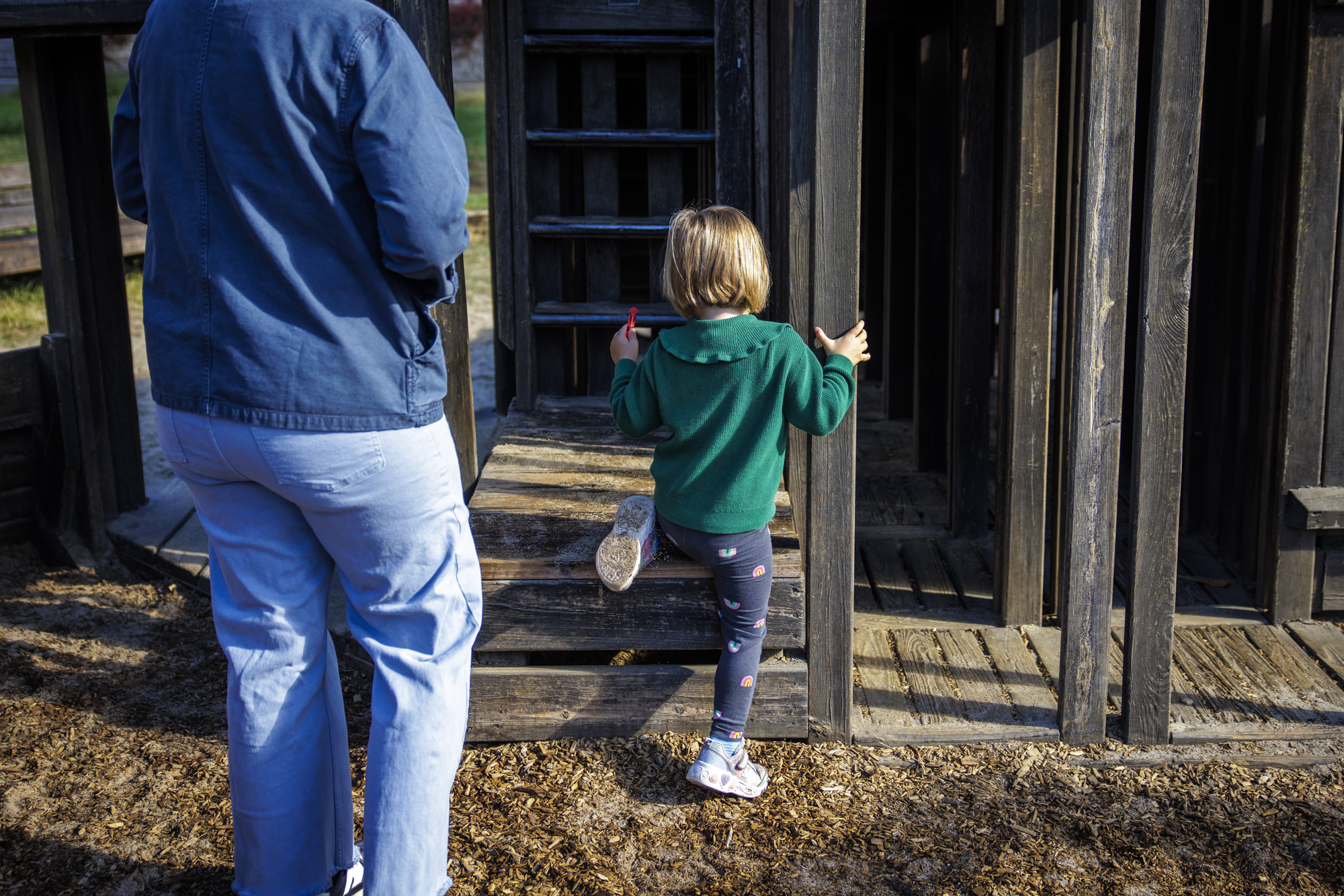
"caption": "Monica Vaughan and her daughter Hazel play in City Park in Benicia, California, on Oct. 27, 2025. The high cost of child care in the Bay Area is pushing families to make tough choices about jobs, homes and whether to have more kids. ",
"credit": "Martin do Nascimento/KQED",
"altTag": null,
"description": null,
"imgSizes": {
"thumbnail": {
"file": "https://cdn.kqed.org/wp-content/uploads/sites/10/2025/10/251027-CHILD-CARE-PRICES-MD-05-1-KQED-160x107.jpg",
"width": 160,
"height": 107,
"mimeType": "image/jpeg"
},
"1536x1536": {
"file": "https://cdn.kqed.org/wp-content/uploads/sites/10/2025/10/251027-CHILD-CARE-PRICES-MD-05-1-KQED-1536x1025.jpg",
"width": 1536,
"height": 1025,
"mimeType": "image/jpeg"
},
"post-thumbnail": {
"file": "https://cdn.kqed.org/wp-content/uploads/sites/10/2025/10/251027-CHILD-CARE-PRICES-MD-05-1-KQED-672x372.jpg",
"width": 672,
"height": 372,
"mimeType": "image/jpeg"
},
"twentyfourteen-full-width": {
"file": "https://cdn.kqed.org/wp-content/uploads/sites/10/2025/10/251027-CHILD-CARE-PRICES-MD-05-1-KQED-1038x576.jpg",
"width": 1038,
"height": 576,
"mimeType": "image/jpeg"
},
"npr-cds-wide": {
"file": "https://cdn.kqed.org/wp-content/uploads/sites/10/2025/10/251027-CHILD-CARE-PRICES-MD-05-1-KQED-1600x900.jpg",
"width": 1600,
"height": 900,
"mimeType": "image/jpeg"
},
"kqedFullSize": {
"file": "https://cdn.kqed.org/wp-content/uploads/sites/10/2025/10/251027-CHILD-CARE-PRICES-MD-05-1-KQED.jpg",
"width": 2000,
"height": 1334
}
},
"isLoading": false,
"fetchFailed": false
},
"news_12030542": {
"type": "attachments",
"id": "news_12030542",
"meta": {
"index": "attachments_1716263798",
"site": "news",
"id": "12030542",
"found": true
},
"title": "20250307_ALAMEDACHILDCARE_GC-2-KQED",
"publishDate": 1741613314,
"status": "inherit",
"parent": 0,
"modified": 1741613404,
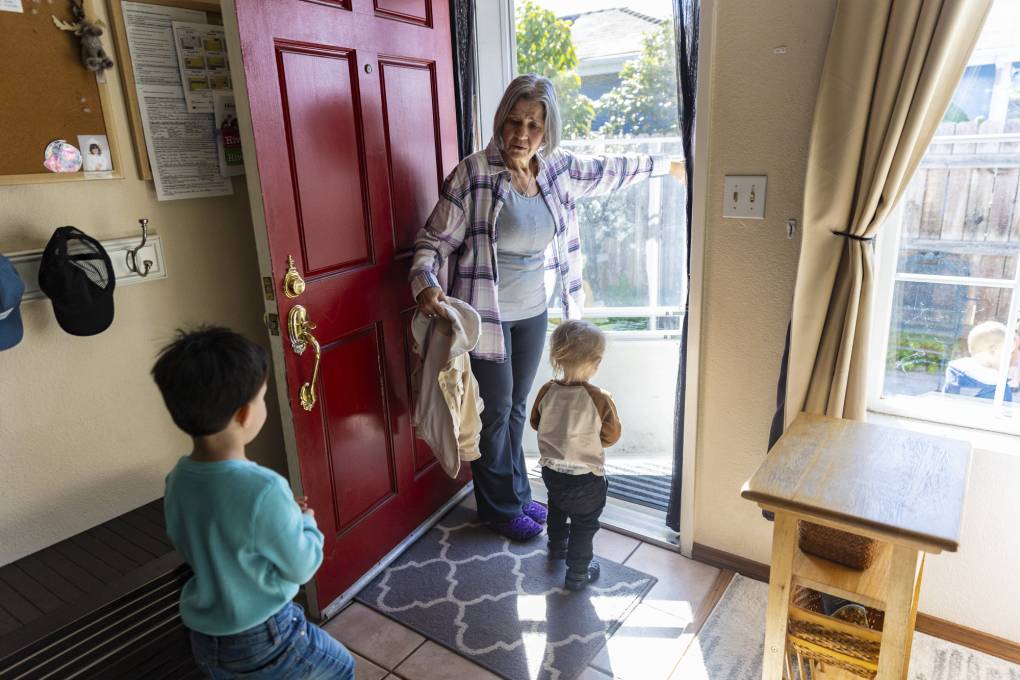
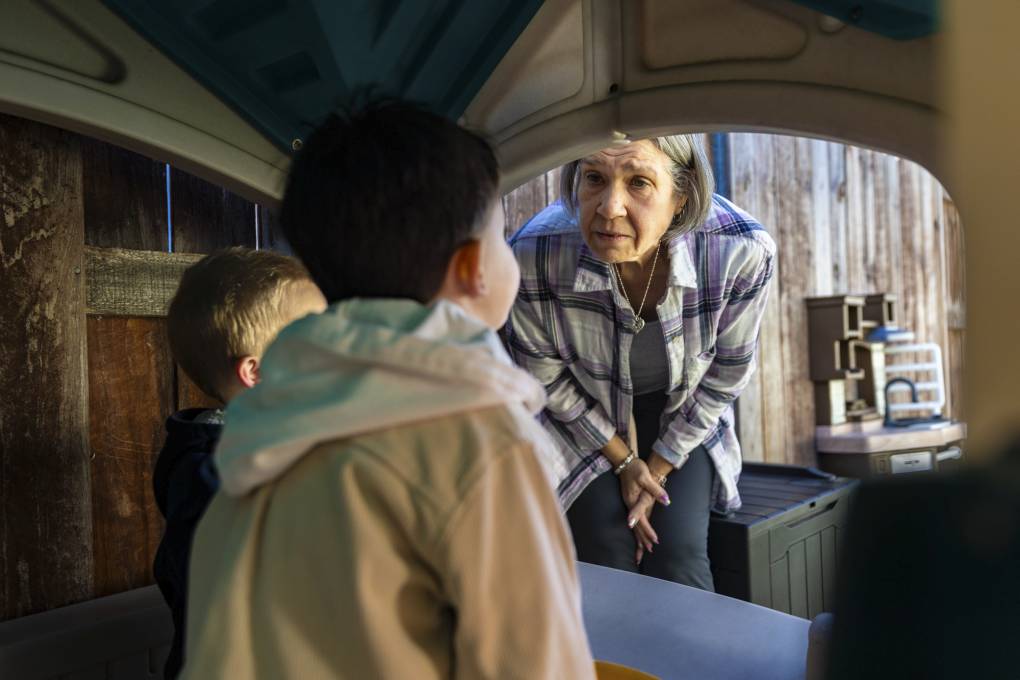
"caption": "Lisa Zarodney lets Hudson, 3, and Ryden, 1, out to play at her home in Livermore, where she runs a childcare operation, on March 7, 2025.",
"credit": "Gina Castro/KQED",
"altTag": null,
"description": null,
"imgSizes": {
"medium": {
"file": "https://cdn.kqed.org/wp-content/uploads/sites/10/2025/03/20250307_ALAMEDACHILDCARE_GC-2-KQED-800x533.jpg",
"width": 800,
"height": 533,
"mimeType": "image/jpeg"
},
"large": {
"file": "https://cdn.kqed.org/wp-content/uploads/sites/10/2025/03/20250307_ALAMEDACHILDCARE_GC-2-KQED-1020x680.jpg",
"width": 1020,
"height": 680,
"mimeType": "image/jpeg"
},
"thumbnail": {
"file": "https://cdn.kqed.org/wp-content/uploads/sites/10/2025/03/20250307_ALAMEDACHILDCARE_GC-2-KQED-160x107.jpg",
"width": 160,
"height": 107,
"mimeType": "image/jpeg"
},
"1536x1536": {
"file": "https://cdn.kqed.org/wp-content/uploads/sites/10/2025/03/20250307_ALAMEDACHILDCARE_GC-2-KQED-1536x1024.jpg",
"width": 1536,
"height": 1024,
"mimeType": "image/jpeg"
},
"post-thumbnail": {
"file": "https://cdn.kqed.org/wp-content/uploads/sites/10/2025/03/20250307_ALAMEDACHILDCARE_GC-2-KQED-672x372.jpg",
"width": 672,
"height": 372,
"mimeType": "image/jpeg"
},
"twentyfourteen-full-width": {
"file": "https://cdn.kqed.org/wp-content/uploads/sites/10/2025/03/20250307_ALAMEDACHILDCARE_GC-2-KQED-1038x576.jpg",
"width": 1038,
"height": 576,
"mimeType": "image/jpeg"
},
"full-width": {
"file": "https://cdn.kqed.org/wp-content/uploads/sites/10/2025/03/20250307_ALAMEDACHILDCARE_GC-2-KQED-1920x1280.jpg",
"width": 1920,
"height": 1280,
"mimeType": "image/jpeg"
},
"kqedFullSize": {
"file": "https://cdn.kqed.org/wp-content/uploads/sites/10/2025/03/20250307_ALAMEDACHILDCARE_GC-2-KQED.jpg",
"width": 2000,
"height": 1333
}
},
"isLoading": false,
"fetchFailed": false
},
"news_12055947": {
"type": "attachments",
"id": "news_12055947",
"meta": {
"index": "attachments_1716263798",
"site": "news",
"id": "12055947",
"found": true
},
"title": "250911-ALAMEDASCHILDCARETAX-06-BL-KQED",
"publishDate": 1757952800,
"status": "inherit",
"parent": 0,
"modified": 1757952834,
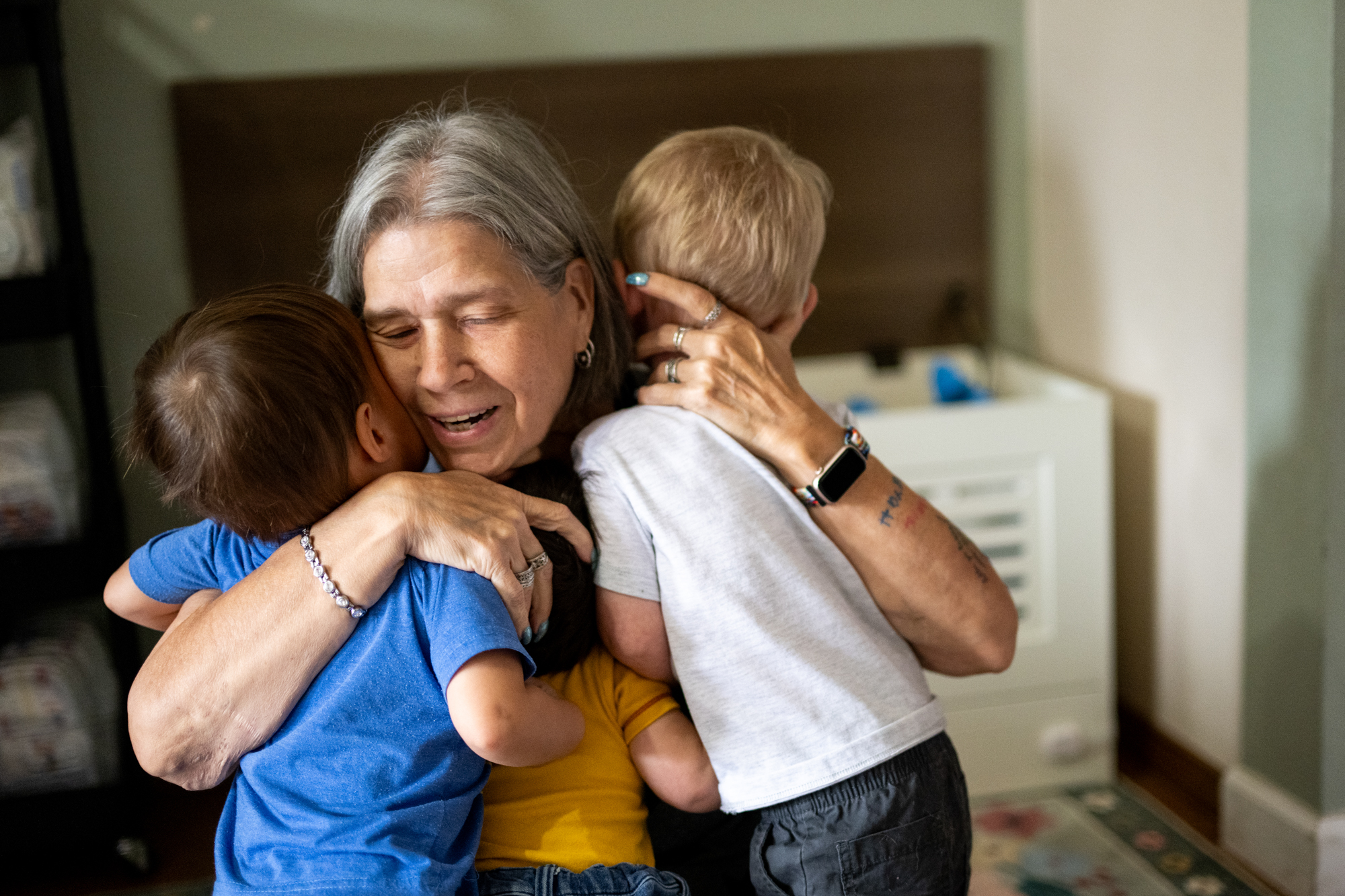
"caption": "Lisa Zarodney hugs children at the daycare center she runs out of her home in Livermore on Sept. 11, 2025.",
"credit": "Beth LaBerge/KQED",
"altTag": null,
"description": null,
"imgSizes": {
"thumbnail": {
"file": "https://cdn.kqed.org/wp-content/uploads/sites/10/2025/09/250911-ALAMEDASCHILDCARETAX-06-BL-KQED-160x107.jpg",
"width": 160,
"height": 107,
"mimeType": "image/jpeg"
},
"1536x1536": {
"file": "https://cdn.kqed.org/wp-content/uploads/sites/10/2025/09/250911-ALAMEDASCHILDCARETAX-06-BL-KQED-1536x1024.jpg",
"width": 1536,
"height": 1024,
"mimeType": "image/jpeg"
},
"post-thumbnail": {
"file": "https://cdn.kqed.org/wp-content/uploads/sites/10/2025/09/250911-ALAMEDASCHILDCARETAX-06-BL-KQED-672x372.jpg",
"width": 672,
"height": 372,
"mimeType": "image/jpeg"
},
"twentyfourteen-full-width": {
"file": "https://cdn.kqed.org/wp-content/uploads/sites/10/2025/09/250911-ALAMEDASCHILDCARETAX-06-BL-KQED-1038x576.jpg",
"width": 1038,
"height": 576,
"mimeType": "image/jpeg"
},
"kqedFullSize": {
"file": "https://cdn.kqed.org/wp-content/uploads/sites/10/2025/09/250911-ALAMEDASCHILDCARETAX-06-BL-KQED.jpg",
"width": 2000,
"height": 1333
}
},
"isLoading": false,
"fetchFailed": false
},
"news_12054023": {
"type": "attachments",
"id": "news_12054023",
"meta": {
"index": "attachments_1716263798",
"site": "news",
"id": "12054023",
"found": true
},
"title": "250827-CLIMATERESILIENTCHILDCARECENTER-04-BL-KQED",
"publishDate": 1756338810,
"status": "inherit",
"parent": 0,
"modified": 1756338960,
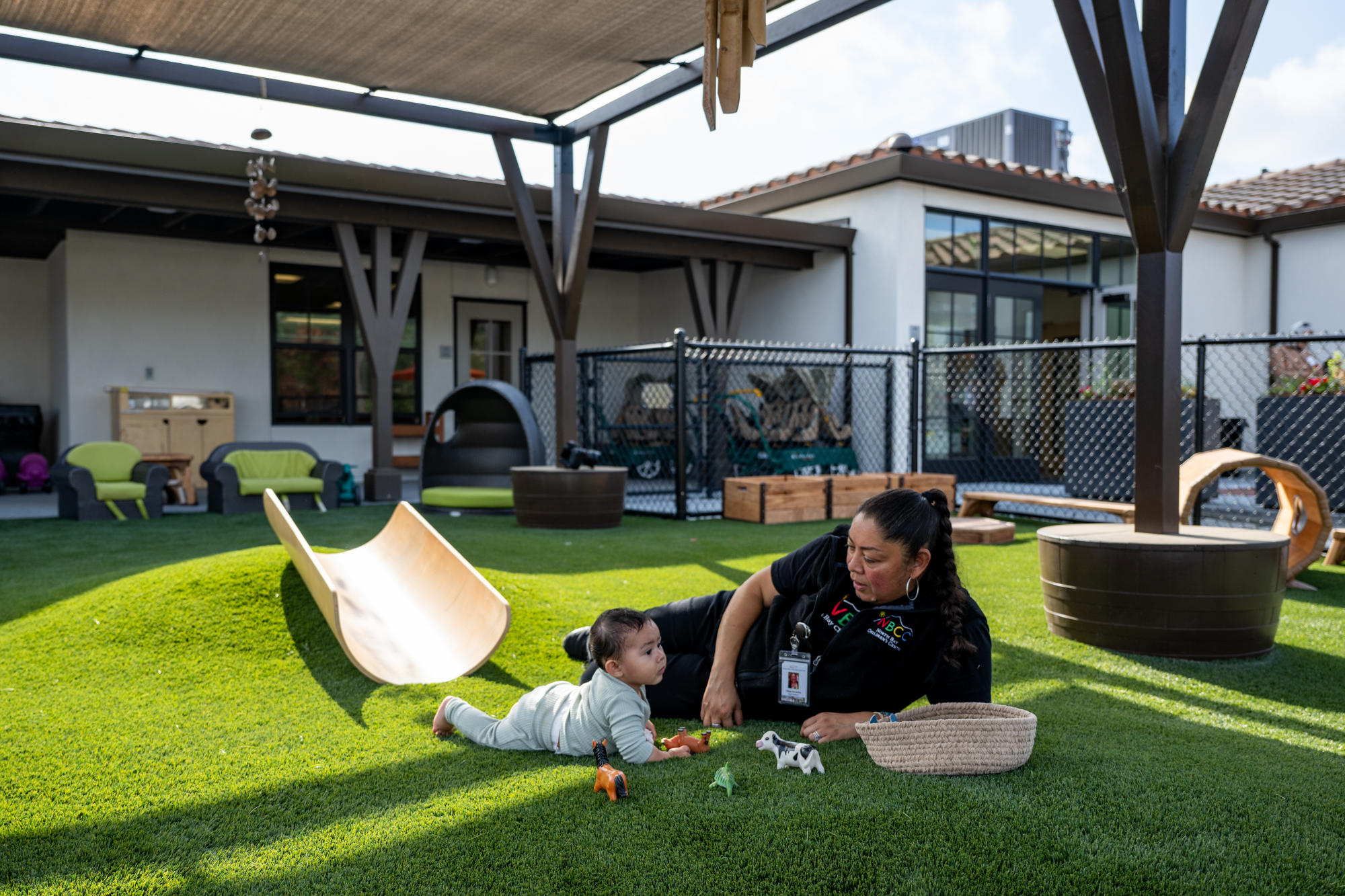
"caption": "Laly Cervantes, master head teacher for infant programs at the North Bay Children’s Center, works with young children at the Novato location on Aug. 27, 2025.",
"credit": "Beth LaBerge/KQED",
"altTag": null,
"description": null,
"imgSizes": {
"thumbnail": {
"file": "https://cdn.kqed.org/wp-content/uploads/sites/10/2025/08/250827-CLIMATERESILIENTCHILDCARECENTER-04-BL-KQED-160x107.jpg",
"width": 160,
"height": 107,
"mimeType": "image/jpeg"
},
"1536x1536": {
"file": "https://cdn.kqed.org/wp-content/uploads/sites/10/2025/08/250827-CLIMATERESILIENTCHILDCARECENTER-04-BL-KQED-1536x1024.jpg",
"width": 1536,
"height": 1024,
"mimeType": "image/jpeg"
},
"post-thumbnail": {
"file": "https://cdn.kqed.org/wp-content/uploads/sites/10/2025/08/250827-CLIMATERESILIENTCHILDCARECENTER-04-BL-KQED-672x372.jpg",
"width": 672,
"height": 372,
"mimeType": "image/jpeg"
},
"twentyfourteen-full-width": {
"file": "https://cdn.kqed.org/wp-content/uploads/sites/10/2025/08/250827-CLIMATERESILIENTCHILDCARECENTER-04-BL-KQED-1038x576.jpg",
"width": 1038,
"height": 576,
"mimeType": "image/jpeg"
},
"kqedFullSize": {
"file": "https://cdn.kqed.org/wp-content/uploads/sites/10/2025/08/250827-CLIMATERESILIENTCHILDCARECENTER-04-BL-KQED.jpg",
"width": 2000,
"height": 1333
}
},
"isLoading": false,
"fetchFailed": false
},
"news_12053524": {
"type": "attachments",
"id": "news_12053524",
"meta": {
"index": "attachments_1716263798",
"site": "news",
"id": "12053524",
"found": true
},
"title": "250822-ECONOMICINSTABILITYIMPACTONKIDS-08-BL-KQED",
"publishDate": 1756139130,
"status": "inherit",
"parent": 0,
"modified": 1756139202,
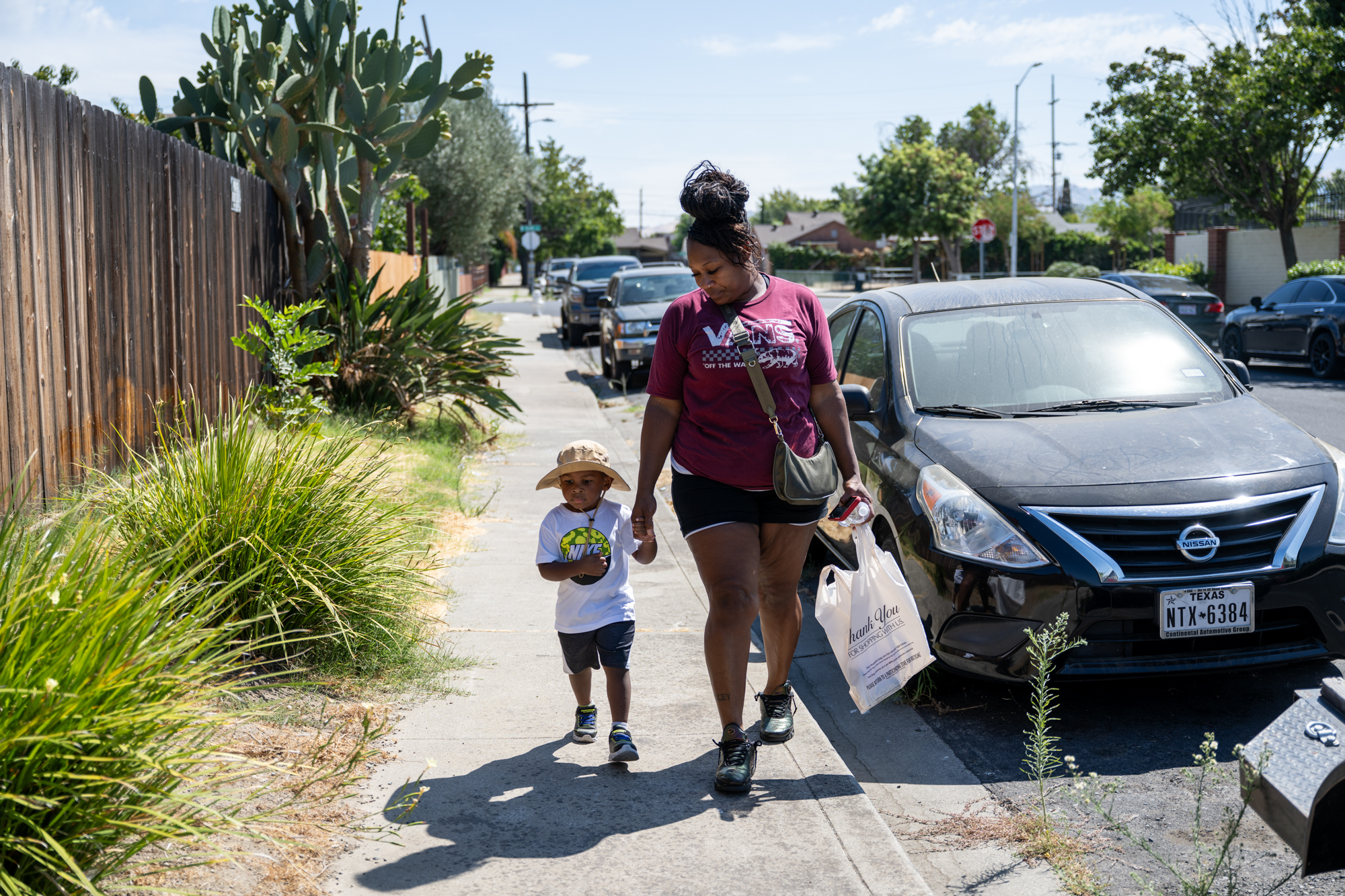
"caption": "Harnesha Burks walks with her son Zyon, 2, near their home in Antioch on Aug. 22, 2025.",
"credit": "Beth LaBerge/KQED",
"altTag": null,
"description": null,
"imgSizes": {
"thumbnail": {
"file": "https://cdn.kqed.org/wp-content/uploads/sites/10/2025/08/250822-ECONOMICINSTABILITYIMPACTONKIDS-08-BL-KQED-160x107.jpg",
"width": 160,
"height": 107,
"mimeType": "image/jpeg"
},
"1536x1536": {
"file": "https://cdn.kqed.org/wp-content/uploads/sites/10/2025/08/250822-ECONOMICINSTABILITYIMPACTONKIDS-08-BL-KQED-1536x1024.jpg",
"width": 1536,
"height": 1024,
"mimeType": "image/jpeg"
},
"post-thumbnail": {
"file": "https://cdn.kqed.org/wp-content/uploads/sites/10/2025/08/250822-ECONOMICINSTABILITYIMPACTONKIDS-08-BL-KQED-672x372.jpg",
"width": 672,
"height": 372,
"mimeType": "image/jpeg"
},
"twentyfourteen-full-width": {
"file": "https://cdn.kqed.org/wp-content/uploads/sites/10/2025/08/250822-ECONOMICINSTABILITYIMPACTONKIDS-08-BL-KQED-1038x576.jpg",
"width": 1038,
"height": 576,
"mimeType": "image/jpeg"
},
"kqedFullSize": {
"file": "https://cdn.kqed.org/wp-content/uploads/sites/10/2025/08/250822-ECONOMICINSTABILITYIMPACTONKIDS-08-BL-KQED.jpg",
"width": 2000,
"height": 1333
}
},
"isLoading": false,
"fetchFailed": false
},
"news_12039813": {
"type": "attachments",
"id": "news_12039813",
"meta": {
"index": "attachments_1716263798",
"site": "news",
"id": "12039813",
"found": true
},
"title": "250512-DAY WITHOUT CHILDCARE-MD-04-KQED",
"publishDate": 1747085855,
"status": "inherit",
"parent": 12043521,
"modified": 1749600493,
"caption": "Attendees hold signs at the Day Without Childcare rally in front of the Federal Building in San José on May 12, 2025.",
"credit": "Martin do Nascimento/KQED",
"altTag": null,
"description": null,
"imgSizes": {
"medium": {
"file": "https://cdn.kqed.org/wp-content/uploads/sites/10/2025/05/250512-DAY-WITHOUT-CHILDCARE-MD-04-KQED-800x534.jpg",
"width": 800,
"height": 534,
"mimeType": "image/jpeg"
},
"large": {
"file": "https://cdn.kqed.org/wp-content/uploads/sites/10/2025/05/250512-DAY-WITHOUT-CHILDCARE-MD-04-KQED-1020x680.jpg",
"width": 1020,
"height": 680,
"mimeType": "image/jpeg"
},
"thumbnail": {
"file": "https://cdn.kqed.org/wp-content/uploads/sites/10/2025/05/250512-DAY-WITHOUT-CHILDCARE-MD-04-KQED-160x107.jpg",
"width": 160,
"height": 107,
"mimeType": "image/jpeg"
},
"1536x1536": {
"file": "https://cdn.kqed.org/wp-content/uploads/sites/10/2025/05/250512-DAY-WITHOUT-CHILDCARE-MD-04-KQED-1536x1025.jpg",
"width": 1536,
"height": 1025,
"mimeType": "image/jpeg"
},
"post-thumbnail": {
"file": "https://cdn.kqed.org/wp-content/uploads/sites/10/2025/05/250512-DAY-WITHOUT-CHILDCARE-MD-04-KQED-672x372.jpg",
"width": 672,
"height": 372,
"mimeType": "image/jpeg"
},
"twentyfourteen-full-width": {
"file": "https://cdn.kqed.org/wp-content/uploads/sites/10/2025/05/250512-DAY-WITHOUT-CHILDCARE-MD-04-KQED-1038x576.jpg",
"width": 1038,
"height": 576,
"mimeType": "image/jpeg"
},
"full-width": {
"file": "https://cdn.kqed.org/wp-content/uploads/sites/10/2025/05/250512-DAY-WITHOUT-CHILDCARE-MD-04-KQED-1920x1281.jpg",
"width": 1920,
"height": 1281,
"mimeType": "image/jpeg"
},
"kqedFullSize": {
"file": "https://cdn.kqed.org/wp-content/uploads/sites/10/2025/05/250512-DAY-WITHOUT-CHILDCARE-MD-04-KQED.jpg",
"width": 2000,
"height": 1334
}
},
"isLoading": false,
"fetchFailed": false
},
"news_12044141": {
"type": "attachments",
"id": "news_12044141",
"meta": {
"index": "attachments_1716263798",
"site": "news",
"id": "12044141",
"found": true
},
"title": "250610-HEADSTARTPROGRAMS-39-BL-KQED",
"publishDate": 1749833095,
"status": "inherit",
"parent": 0,
"modified": 1749833155,
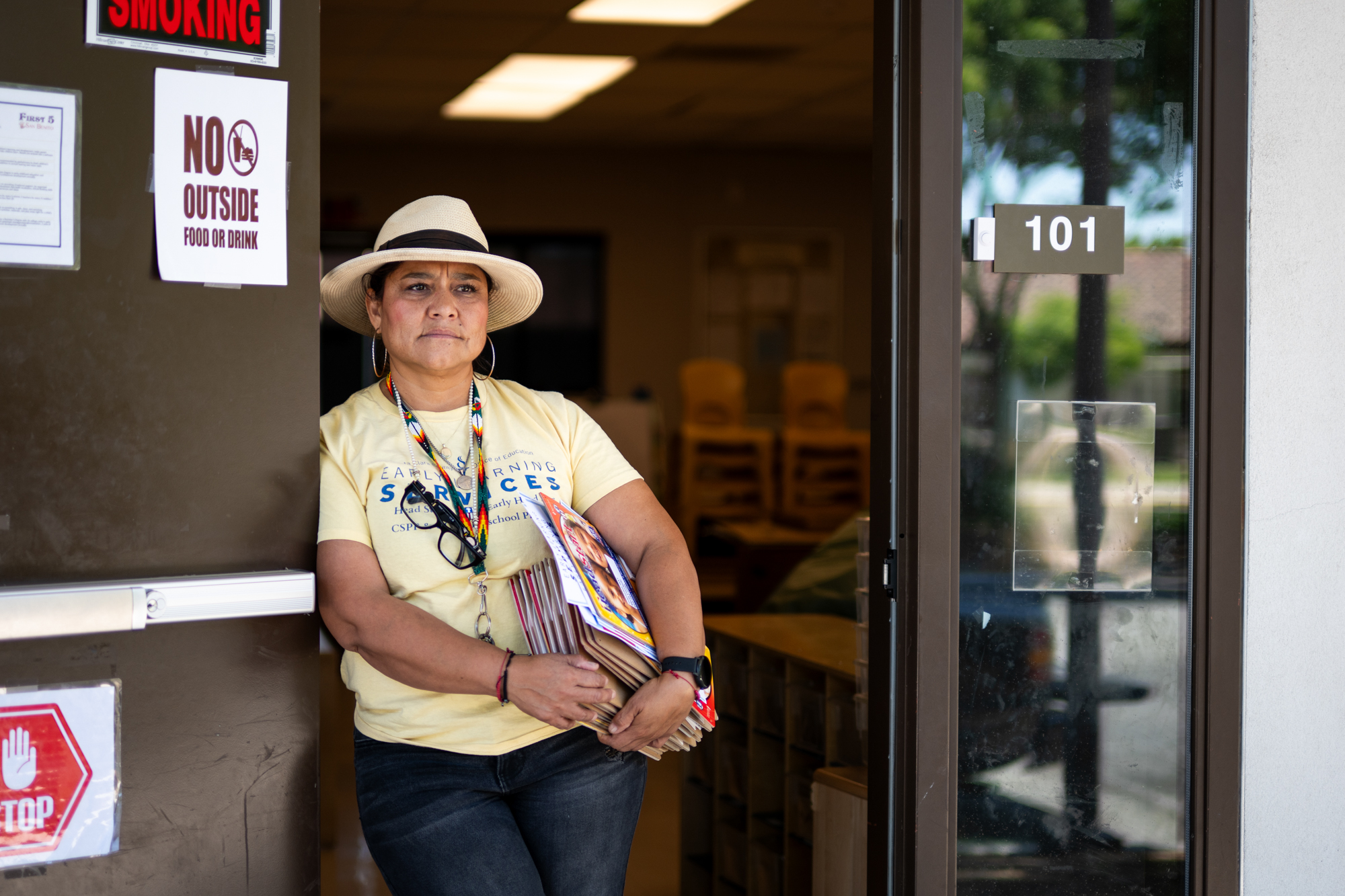
"caption": "Maria Corchado, a Head Start teacher, stands outside one of the classrooms in Hollister, San Benito County, on June 10, 2025.",
"credit": "Beth LaBerge/KQED",
"altTag": null,
"description": null,
"imgSizes": {
"thumbnail": {
"file": "https://cdn.kqed.org/wp-content/uploads/sites/10/2025/06/250610-HEADSTARTPROGRAMS-39-BL-KQED-160x107.jpg",
"width": 160,
"height": 107,
"mimeType": "image/jpeg"
},
"1536x1536": {
"file": "https://cdn.kqed.org/wp-content/uploads/sites/10/2025/06/250610-HEADSTARTPROGRAMS-39-BL-KQED-1536x1024.jpg",
"width": 1536,
"height": 1024,
"mimeType": "image/jpeg"
},
"post-thumbnail": {
"file": "https://cdn.kqed.org/wp-content/uploads/sites/10/2025/06/250610-HEADSTARTPROGRAMS-39-BL-KQED-672x372.jpg",
"width": 672,
"height": 372,
"mimeType": "image/jpeg"
},
"twentyfourteen-full-width": {
"file": "https://cdn.kqed.org/wp-content/uploads/sites/10/2025/06/250610-HEADSTARTPROGRAMS-39-BL-KQED-1038x576.jpg",
"width": 1038,
"height": 576,
"mimeType": "image/jpeg"
},
"kqedFullSize": {
"file": "https://cdn.kqed.org/wp-content/uploads/sites/10/2025/06/250610-HEADSTARTPROGRAMS-39-BL-KQED.jpg",
"width": 2000,
"height": 1333
}
},
"isLoading": false,
"fetchFailed": false
},
"news_12030543": {
"type": "attachments",
"id": "news_12030543",
"meta": {
"index": "attachments_1716263798",
"site": "news",
"id": "12030543",
"found": true
},
"title": "20250307_ALAMEDACHILDCARE_GC-4-KQED",
"publishDate": 1741613320,
"status": "inherit",
"parent": 12030561,
"modified": 1741648270,
"caption": "Lisa Zarodney speaks to Hudson, 3, at her home in Livermore, where she runs a childcare operation, on March 7, 2025.",
"credit": "Gina Castro/KQED",
"altTag": null,
"description": null,
"imgSizes": {
"medium": {
"file": "https://cdn.kqed.org/wp-content/uploads/sites/10/2025/03/20250307_ALAMEDACHILDCARE_GC-4-KQED-800x533.jpg",
"width": 800,
"height": 533,
"mimeType": "image/jpeg"
},
"large": {
"file": "https://cdn.kqed.org/wp-content/uploads/sites/10/2025/03/20250307_ALAMEDACHILDCARE_GC-4-KQED-1020x680.jpg",
"width": 1020,
"height": 680,
"mimeType": "image/jpeg"
},
"thumbnail": {
"file": "https://cdn.kqed.org/wp-content/uploads/sites/10/2025/03/20250307_ALAMEDACHILDCARE_GC-4-KQED-160x107.jpg",
"width": 160,
"height": 107,
"mimeType": "image/jpeg"
},
"1536x1536": {
"file": "https://cdn.kqed.org/wp-content/uploads/sites/10/2025/03/20250307_ALAMEDACHILDCARE_GC-4-KQED-1536x1024.jpg",
"width": 1536,
"height": 1024,
"mimeType": "image/jpeg"
},
"post-thumbnail": {
"file": "https://cdn.kqed.org/wp-content/uploads/sites/10/2025/03/20250307_ALAMEDACHILDCARE_GC-4-KQED-672x372.jpg",
"width": 672,
"height": 372,
"mimeType": "image/jpeg"
},
"twentyfourteen-full-width": {
"file": "https://cdn.kqed.org/wp-content/uploads/sites/10/2025/03/20250307_ALAMEDACHILDCARE_GC-4-KQED-1038x576.jpg",
"width": 1038,
"height": 576,
"mimeType": "image/jpeg"
},
"full-width": {
"file": "https://cdn.kqed.org/wp-content/uploads/sites/10/2025/03/20250307_ALAMEDACHILDCARE_GC-4-KQED-1920x1280.jpg",
"width": 1920,
"height": 1280,
"mimeType": "image/jpeg"
},
"kqedFullSize": {
"file": "https://cdn.kqed.org/wp-content/uploads/sites/10/2025/03/20250307_ALAMEDACHILDCARE_GC-4-KQED.jpg",
"width": 2000,
"height": 1333
}
},
"isLoading": false,
"fetchFailed": false
},
"news_12041290": {
"type": "attachments",
"id": "news_12041290",
"meta": {
"index": "attachments_1716263798",
"site": "news",
"id": "12041290",
"found": true
},
"title": "240520-TKBilingualLearners-03-BL_qed",
"publishDate": 1747939937,
"status": "inherit",
"parent": 12041279,
"modified": 1747939947,
"caption": "Students form a line to get ready for lunchtime at La Plazita Preschool in Oakland on May 20, 2024.",
"credit": "Beth LaBerge/KQED",
"altTag": null,
"description": null,
"imgSizes": {
"medium": {
"file": "https://cdn.kqed.org/wp-content/uploads/sites/10/2025/05/240520-TKBilingualLearners-03-BL_qed-800x533.jpg",
"width": 800,
"height": 533,
"mimeType": "image/jpeg"
},
"large": {
"file": "https://cdn.kqed.org/wp-content/uploads/sites/10/2025/05/240520-TKBilingualLearners-03-BL_qed-1020x680.jpg",
"width": 1020,
"height": 680,
"mimeType": "image/jpeg"
},
"thumbnail": {
"file": "https://cdn.kqed.org/wp-content/uploads/sites/10/2025/05/240520-TKBilingualLearners-03-BL_qed-160x107.jpg",
"width": 160,
"height": 107,
"mimeType": "image/jpeg"
},
"1536x1536": {
"file": "https://cdn.kqed.org/wp-content/uploads/sites/10/2025/05/240520-TKBilingualLearners-03-BL_qed-1536x1024.jpg",
"width": 1536,
"height": 1024,
"mimeType": "image/jpeg"
},
"post-thumbnail": {
"file": "https://cdn.kqed.org/wp-content/uploads/sites/10/2025/05/240520-TKBilingualLearners-03-BL_qed-672x372.jpg",
"width": 672,
"height": 372,
"mimeType": "image/jpeg"
},
"twentyfourteen-full-width": {
"file": "https://cdn.kqed.org/wp-content/uploads/sites/10/2025/05/240520-TKBilingualLearners-03-BL_qed-1038x576.jpg",
"width": 1038,
"height": 576,
"mimeType": "image/jpeg"
},
"full-width": {
"file": "https://cdn.kqed.org/wp-content/uploads/sites/10/2025/05/240520-TKBilingualLearners-03-BL_qed-1920x1280.jpg",
"width": 1920,
"height": 1280,
"mimeType": "image/jpeg"
},
"kqedFullSize": {
"file": "https://cdn.kqed.org/wp-content/uploads/sites/10/2025/05/240520-TKBilingualLearners-03-BL_qed.jpg",
"width": 2000,
"height": 1333
}
},
"isLoading": false,
"fetchFailed": false
},
"news_11988062": {
"type": "attachments",
"id": "news_11988062",
"meta": {
"index": "attachments_1716263798",
"site": "news",
"id": "11988062",
"found": true
},
"title": "240517-TKBilingualLearners-98-BL_qut",
"publishDate": 1717007060,
"status": "inherit",
"parent": 11989465,
"modified": 1717795731,
"caption": "Students raise their hands in a bilingual transitional kindergarten class at Global Family Elementary School in Oakland.",
"credit": "Beth LaBerge/KQED",
"altTag": "A young student stands and raises her hand in class as other students around her remain seated in a classroom",
"description": null,
"imgSizes": {
"medium": {
"file": "https://cdn.kqed.org/wp-content/uploads/sites/10/2024/05/240517-TKBilingualLearners-98-BL_qut-800x533.jpg",
"width": 800,
"height": 533,
"mimeType": "image/jpeg"
},
"large": {
"file": "https://cdn.kqed.org/wp-content/uploads/sites/10/2024/05/240517-TKBilingualLearners-98-BL_qut-1020x680.jpg",
"width": 1020,
"height": 680,
"mimeType": "image/jpeg"
},
"thumbnail": {
"file": "https://cdn.kqed.org/wp-content/uploads/sites/10/2024/05/240517-TKBilingualLearners-98-BL_qut-160x107.jpg",
"width": 160,
"height": 107,
"mimeType": "image/jpeg"
},
"1536x1536": {
"file": "https://cdn.kqed.org/wp-content/uploads/sites/10/2024/05/240517-TKBilingualLearners-98-BL_qut-1536x1024.jpg",
"width": 1536,
"height": 1024,
"mimeType": "image/jpeg"
},
"post-thumbnail": {
"file": "https://cdn.kqed.org/wp-content/uploads/sites/10/2024/05/240517-TKBilingualLearners-98-BL_qut-672x372.jpg",
"width": 672,
"height": 372,
"mimeType": "image/jpeg"
},
"twentyfourteen-full-width": {
"file": "https://cdn.kqed.org/wp-content/uploads/sites/10/2024/05/240517-TKBilingualLearners-98-BL_qut-1038x576.jpg",
"width": 1038,
"height": 576,
"mimeType": "image/jpeg"
},
"kqedFullSize": {
"file": "https://cdn.kqed.org/wp-content/uploads/sites/10/2024/05/240517-TKBilingualLearners-98-BL_qut.jpg",
"width": 1920,
"height": 1280
}
},
"isLoading": false,
"fetchFailed": false
},
"news_12039810": {
"type": "attachments",
"id": "news_12039810",
"meta": {
"index": "attachments_1716263798",
"site": "news",
"id": "12039810",
"found": true
},
"title": "250512-DAY WITHOUT CHILDCARE-MD-01-KQED",
"publishDate": 1747085840,
"status": "inherit",
"parent": 12045220,
"modified": 1750446707,
"caption": "Khulood Jamil (center) and other childcare providers and supporters march to the Federal Building in San José on May 12, 2025.",
"credit": "Martin do Nascimento/KQED",
"altTag": null,
"description": null,
"imgSizes": {
"medium": {
"file": "https://cdn.kqed.org/wp-content/uploads/sites/10/2025/05/250512-DAY-WITHOUT-CHILDCARE-MD-01-KQED-800x534.jpg",
"width": 800,
"height": 534,
"mimeType": "image/jpeg"
},
"large": {
"file": "https://cdn.kqed.org/wp-content/uploads/sites/10/2025/05/250512-DAY-WITHOUT-CHILDCARE-MD-01-KQED-1020x680.jpg",
"width": 1020,
"height": 680,
"mimeType": "image/jpeg"
},
"thumbnail": {
"file": "https://cdn.kqed.org/wp-content/uploads/sites/10/2025/05/250512-DAY-WITHOUT-CHILDCARE-MD-01-KQED-160x107.jpg",
"width": 160,
"height": 107,
"mimeType": "image/jpeg"
},
"1536x1536": {
"file": "https://cdn.kqed.org/wp-content/uploads/sites/10/2025/05/250512-DAY-WITHOUT-CHILDCARE-MD-01-KQED-1536x1025.jpg",
"width": 1536,
"height": 1025,
"mimeType": "image/jpeg"
},
"post-thumbnail": {
"file": "https://cdn.kqed.org/wp-content/uploads/sites/10/2025/05/250512-DAY-WITHOUT-CHILDCARE-MD-01-KQED-672x372.jpg",
"width": 672,
"height": 372,
"mimeType": "image/jpeg"
},
"twentyfourteen-full-width": {
"file": "https://cdn.kqed.org/wp-content/uploads/sites/10/2025/05/250512-DAY-WITHOUT-CHILDCARE-MD-01-KQED-1038x576.jpg",
"width": 1038,
"height": 576,
"mimeType": "image/jpeg"
},
"full-width": {
"file": "https://cdn.kqed.org/wp-content/uploads/sites/10/2025/05/250512-DAY-WITHOUT-CHILDCARE-MD-01-KQED-1920x1281.jpg",
"width": 1920,
"height": 1281,
"mimeType": "image/jpeg"
},
"kqedFullSize": {
"file": "https://cdn.kqed.org/wp-content/uploads/sites/10/2025/05/250512-DAY-WITHOUT-CHILDCARE-MD-01-KQED.jpg",
"width": 2000,
"height": 1334
}
},
"isLoading": false,
"fetchFailed": false
},
"news_11988306": {
"type": "attachments",
"id": "news_11988306",
"meta": {
"index": "attachments_1716263798",
"site": "news",
"id": "11988306",
"found": true
},
"title": "20240524_MobileHeadStart-34_qut",
"publishDate": 1717105688,
"status": "inherit",
"parent": 11992142,
"modified": 1738111838,
"caption": "Families play with their children inside Oakland's Head Start mobile classroom on May 24, 2024.",
"credit": "Gina Castro/KQED",
"altTag": "Two mothers play with their young children on a green rug inside a classroom.",
"description": null,
"imgSizes": {
"medium": {
"file": "https://cdn.kqed.org/wp-content/uploads/sites/10/2024/05/20240524_MobileHeadStart-34_qut-800x533.jpg",
"width": 800,
"height": 533,
"mimeType": "image/jpeg"
},
"large": {
"file": "https://cdn.kqed.org/wp-content/uploads/sites/10/2024/05/20240524_MobileHeadStart-34_qut-1020x680.jpg",
"width": 1020,
"height": 680,
"mimeType": "image/jpeg"
},
"thumbnail": {
"file": "https://cdn.kqed.org/wp-content/uploads/sites/10/2024/05/20240524_MobileHeadStart-34_qut-160x107.jpg",
"width": 160,
"height": 107,
"mimeType": "image/jpeg"
},
"1536x1536": {
"file": "https://cdn.kqed.org/wp-content/uploads/sites/10/2024/05/20240524_MobileHeadStart-34_qut-1536x1024.jpg",
"width": 1536,
"height": 1024,
"mimeType": "image/jpeg"
},
"post-thumbnail": {
"file": "https://cdn.kqed.org/wp-content/uploads/sites/10/2024/05/20240524_MobileHeadStart-34_qut-672x372.jpg",
"width": 672,
"height": 372,
"mimeType": "image/jpeg"
},
"twentyfourteen-full-width": {
"file": "https://cdn.kqed.org/wp-content/uploads/sites/10/2024/05/20240524_MobileHeadStart-34_qut-1038x576.jpg",
"width": 1038,
"height": 576,
"mimeType": "image/jpeg"
},
"kqedFullSize": {
"file": "https://cdn.kqed.org/wp-content/uploads/sites/10/2024/05/20240524_MobileHeadStart-34_qut.jpg",
"width": 1920,
"height": 1280
}
},
"isLoading": false,
"fetchFailed": false
}
},
"audioPlayerReducer": {
"postId": "stream_live",
"isPaused": true,
"isPlaying": false,
"pfsActive": false,
"pledgeModalIsOpen": true,
"playerDrawerIsOpen": false,
"liveAudioPlayStartedAt": 0,
"liveAudioPlayContext": ""
},
"authorsReducer": {
"ecruzguevarra": {
"type": "authors",
"id": "8654",
"meta": {
"index": "authors_1716337520",
"id": "8654",
"found": true
},
"name": "Ericka Cruz Guevarra",
"firstName": "Ericka",
"lastName": "Cruz Guevarra",
"slug": "ecruzguevarra",
"email": "ecruzguevarra@kqed.org",
"display_author_email": true,
"staff_mastheads": [
"news"
],
"title": "Producer, The Bay Podcast",
"bio": "Ericka Cruz Guevarra is host of \u003ca href=\"https://www.kqed.org/podcasts/thebay\">\u003cem>The Bay\u003c/em>\u003c/a> podcast at KQED. Before host, she was the show’s producer. Her work in that capacity includes a three-part reported series on policing in Vallejo, which won a 2020 excellence in journalism award from the Society of Professional Journalists. Ericka has worked as a breaking news reporter at Oregon Public Broadcasting, helped produce the Code Switch podcast, and was KQED’s inaugural Raul Ramirez Diversity Fund intern. She’s also an alumna of NPR’s Next Generation Radio program. Send her an email if you have strong feelings about whether Fairfield and Suisun City are the Bay. Ericka is represented by SAG-AFTRA.",
"avatar": "https://secure.gravatar.com/avatar/accefc1de4bafc7e234b69bcb9b6f6536c130fd84709bc3069ef11a78787e1bb?s=600&d=blank&r=g",
"twitter": "NotoriousECG",
"bluesky": null,
"facebook": null,
"instagram": null,
"linkedin": null,
"sites": [
{
"site": "arts",
"roles": [
"subscriber"
]
},
{
"site": "news",
"roles": [
"editor",
"manage_categories"
]
},
{
"site": "futureofyou",
"roles": [
"subscriber"
]
},
{
"site": "stateofhealth",
"roles": [
"subscriber"
]
},
{
"site": "science",
"roles": [
"editor"
]
},
{
"site": "forum",
"roles": [
"subscriber"
]
}
],
"headData": {
"title": "Ericka Cruz Guevarra | KQED",
"description": "Producer, The Bay Podcast",
"ogImgSrc": "https://secure.gravatar.com/avatar/accefc1de4bafc7e234b69bcb9b6f6536c130fd84709bc3069ef11a78787e1bb?s=600&d=blank&r=g",
"twImgSrc": "https://secure.gravatar.com/avatar/accefc1de4bafc7e234b69bcb9b6f6536c130fd84709bc3069ef11a78787e1bb?s=600&d=blank&r=g"
},
"isLoading": false,
"link": "/author/ecruzguevarra"
},
"amontecillo": {
"type": "authors",
"id": "11649",
"meta": {
"index": "authors_1716337520",
"id": "11649",
"found": true
},
"name": "Alan Montecillo",
"firstName": "Alan",
"lastName": "Montecillo",
"slug": "amontecillo",
"email": "amontecillo@kqed.org",
"display_author_email": false,
"staff_mastheads": [
"news"
],
"title": "KQED Contributor",
"bio": "Alan Montecillo is the senior editor of \u003cem>\u003ca href=\"http://kqed.org/thebay\">The Bay\u003c/a>, \u003c/em> KQED's local news podcast. Before moving to the Bay Area, he worked as a senior talk show producer for WILL in Champaign-Urbana, Illinois and at Oregon Public Broadcasting in Portland, Oregon. He has won journalism awards from the Society of Professional Journalists Northern California, the Public Media Journalists Association, The Signal Awards, and has also received a regional Edward R. Murrow award. Alan is a Filipino American from Hong Kong and a graduate of Reed College.",
"avatar": "https://secure.gravatar.com/avatar/268f53a2066899ea9efdd8a5900218b17c822d9862cbc9326cccec53ef41d349?s=600&d=blank&r=g",
"twitter": "alanmontecillo",
"bluesky": null,
"facebook": null,
"instagram": null,
"linkedin": null,
"sites": [
{
"site": "",
"roles": [
"editor"
]
},
{
"site": "news",
"roles": [
"editor",
"manage_categories"
]
}
],
"headData": {
"title": "Alan Montecillo | KQED",
"description": "KQED Contributor",
"ogImgSrc": "https://secure.gravatar.com/avatar/268f53a2066899ea9efdd8a5900218b17c822d9862cbc9326cccec53ef41d349?s=600&d=blank&r=g",
"twImgSrc": "https://secure.gravatar.com/avatar/268f53a2066899ea9efdd8a5900218b17c822d9862cbc9326cccec53ef41d349?s=600&d=blank&r=g"
},
"isLoading": false,
"link": "/author/amontecillo"
},
"daisynguyen": {
"type": "authors",
"id": "11829",
"meta": {
"index": "authors_1716337520",
"id": "11829",
"found": true
},
"name": "Daisy Nguyen",
"firstName": "Daisy",
"lastName": "Nguyen",
"slug": "daisynguyen",
"email": "daisynguyen@kqed.org",
"display_author_email": true,
"staff_mastheads": [
"news"
],
"title": "KQED Contributor",
"bio": "I have covered early childhood education and child care for KQED since 2022. I focus on policies aimed at increasing access to early care and education and how they shape individual lives. I've been a journalist for more than two decades, with most of that time devoted to covering breaking news throughout California for The Associated Press. I grew up in San Francisco and studied at UC Davis and Columbia University's Graduate School of Journalism. I live in Oakland with my husband and two kids.",
"avatar": "https://secure.gravatar.com/avatar/2da2127c27f7143b53ebd419800fd55f?s=600&d=blank&r=g",
"twitter": null,
"facebook": null,
"instagram": null,
"linkedin": "https://www.linkedin.com/in/daisynguyen/",
"sites": [
{
"site": "news",
"roles": [
"author"
]
},
{
"site": "liveblog",
"roles": [
"author"
]
}
],
"headData": {
"title": "Daisy Nguyen | KQED",
"description": "KQED Contributor",
"ogImgSrc": "https://secure.gravatar.com/avatar/2da2127c27f7143b53ebd419800fd55f?s=600&d=blank&r=g",
"twImgSrc": "https://secure.gravatar.com/avatar/2da2127c27f7143b53ebd419800fd55f?s=600&d=blank&r=g"
},
"isLoading": false,
"link": "/author/daisynguyen"
},
"jessicakariisa": {
"type": "authors",
"id": "11831",
"meta": {
"index": "authors_1716337520",
"id": "11831",
"found": true
},
"name": "Jessica Kariisa",
"firstName": "Jessica",
"lastName": "Kariisa",
"slug": "jessicakariisa",
"email": "jkariisa@kqed.org",
"display_author_email": false,
"staff_mastheads": [],
"title": "Producer, The Bay",
"bio": "Jessica Kariisa is the producer of The Bay. She first joined KQED as an intern for The California Report Magazine, after which she became an on-call producer. She reported a Bay Curious episode on the use of rap lyrics in criminal trials which won a Society of Professional Journalists award in 2023 for Excellence in Features Journalism and the 2023 Signal Award for Best Conversation Starter. She’s worked on podcasts for Snap Judgment and American Public Media. Before embarking on her audio career, she was a music journalist.\r\n\r\nJessica Kariisa is represented by SAG-AFTRA.",
"avatar": "https://secure.gravatar.com/avatar/522e97b28ac0b3d411621c0fde8f3419c7b71ea2c5c262c57c4bb600963f328c?s=600&d=blank&r=g",
"twitter": null,
"bluesky": null,
"facebook": null,
"instagram": null,
"linkedin": null,
"sites": [
{
"site": "arts",
"roles": [
"author"
]
},
{
"site": "news",
"roles": [
"editor",
"manage_categories"
]
}
],
"headData": {
"title": "Jessica Kariisa | KQED",
"description": "Producer, The Bay",
"ogImgSrc": "https://secure.gravatar.com/avatar/522e97b28ac0b3d411621c0fde8f3419c7b71ea2c5c262c57c4bb600963f328c?s=600&d=blank&r=g",
"twImgSrc": "https://secure.gravatar.com/avatar/522e97b28ac0b3d411621c0fde8f3419c7b71ea2c5c262c57c4bb600963f328c?s=600&d=blank&r=g"
},
"isLoading": false,
"link": "/author/jessicakariisa"
},
"kdebenedetti": {
"type": "authors",
"id": "11913",
"meta": {
"index": "authors_1716337520",
"id": "11913",
"found": true
},
"name": "Katie DeBenedetti",
"firstName": "Katie",
"lastName": "DeBenedetti",
"slug": "kdebenedetti",
"email": "kdebenedetti@kqed.org",
"display_author_email": false,
"staff_mastheads": [
"news",
"science"
],
"title": "KQED Contributor",
"bio": "Katie DeBenedetti is a digital reporter covering daily news for the Express Desk. Prior to joining KQED as a culture reporting intern in January 2024, she covered education and city government for the Napa Valley Register.",
"avatar": "https://secure.gravatar.com/avatar/6e31073cb8f7e4214ab03f42771d0f45?s=600&d=blank&r=g",
"twitter": null,
"facebook": null,
"instagram": null,
"linkedin": null,
"sites": [
{
"site": "news",
"roles": [
"author"
]
},
{
"site": "science",
"roles": [
"author"
]
},
{
"site": "liveblog",
"roles": [
"author"
]
}
],
"headData": {
"title": "Katie DeBenedetti | KQED",
"description": "KQED Contributor",
"ogImgSrc": "https://secure.gravatar.com/avatar/6e31073cb8f7e4214ab03f42771d0f45?s=600&d=blank&r=g",
"twImgSrc": "https://secure.gravatar.com/avatar/6e31073cb8f7e4214ab03f42771d0f45?s=600&d=blank&r=g"
},
"isLoading": false,
"link": "/author/kdebenedetti"
}
},
"pagesReducer": {
"news_tag_child-care": {
"type": "terms",
"id": "news_20754",
"meta": {
"index": "terms_1716263798",
"site": "news",
"id": "20754",
"score": 9.893801
},
"featImg": null,
"name": "child care",
"description": null,
"taxonomy": "tag",
"headData": {
"twImgId": null,
"twTitle": null,
"ogTitle": null,
"ogImgId": null,
"twDescription": null,
"description": null,
"title": "child care Archives | KQED News",
"ogDescription": null
},
"ttid": 20771,
"slug": "child-care",
"isLoading": false,
"title": "child care",
"pageMeta": {
"site": "news",
"WpPageTemplate": "page-topic-editorial",
"currentPage": 3
},
"blocks": [
{
"blockName": "kqed/post-list",
"attrs": {
"layout": "cardArticle2",
"query": "posts/news?tag=child-care",
"seeMore": false,
"paginated": true,
"page": 3
}
},
{
"blockName": "kqed/ad"
}
]
}
},
"pfsSessionReducer": {},
"postsReducer": {
"stream_live": {
"type": "live",
"id": "stream_live",
"audioUrl": "https://streams.kqed.org/kqedradio",
"title": "Live Stream",
"excerpt": "Live Stream information currently unavailable.",
"link": "/radio",
"featImg": "",
"label": {
"name": "KQED Live",
"link": "/"
}
},
"stream_kqedNewscast": {
"type": "posts",
"id": "stream_kqedNewscast",
"audioUrl": "https://www.kqed.org/.stream/anon/radio/RDnews/newscast.mp3?_=1",
"title": "KQED Newscast",
"featImg": "",
"label": {
"name": "88.5 FM",
"link": "/"
}
},
"news_12061802": {
"type": "posts",
"id": "news_12061802",
"meta": {
"index": "posts_1716263798",
"site": "news",
"id": "12061802",
"score": null,
"sort": [
1761746404000
]
},
"guestAuthors": [],
"slug": "how-are-child-care-costs-affecting-the-lives-of-bay-area-families-you-told-us",
"title": "How Are Child Care Costs Affecting the Lives of Bay Area Families? You Told Us",
"publishDate": 1761746404,
"format": "standard",
"headTitle": "How Are Child Care Costs Affecting the Lives of Bay Area Families? You Told Us | KQED",
"labelTerm": {
"site": "news"
},
"content": "\u003cp>Parents pay more for child care in the \u003ca href=\"https://www.kqed.org/news/tag/bay-area\">Bay Area\u003c/a> than almost anywhere else in the country, according to the \u003ca href=\"https://www.google.com/url?q=https://www.dol.gov/agencies/wb/topics/childcare/price-by-age-care-setting-2022&sa=D&source=docs&ust=1761685582830978&usg=AOvVaw29yG_HrebGaRIn8KFMNtQG\">National Database on Childcare Prices\u003c/a>.\u003c/p>\n\u003cp>KQED recently published a story about \u003ca href=\"https://www.kqed.org/news/12055336/alameda-county-is-giving-cash-to-child-care-providers-other-bay-area-counties-are-envious\">how some Bay Area counties are addressing the crisis, and how others are looking into solutions\u003c/a>.\u003c/p>\n\u003cp>\u003ca href=\"https://www.kqed.org/news/12057125/tell-us-how-much-do-you-pay-for-child-care-in-the-bay-area\">We also asked you how much you pay for child care\u003c/a> and how it affects your financial and family-planning decisions.\u003c/p>\n\u003cp>The numbers were eye-popping, and the stories you shared were frustrating and painfully honest. Each one emphasized a common struggle to afford child care while keeping up with the cost of living in the Bay Area.\u003c/p>\n\u003cp>\u003cem>Some of these responses have been edited for length.\u003c/em>\u003c/p>\n\u003cp>[ad fullwidth]\u003c/p>\n\u003ch2>How much are Bay Area families paying monthly for child care?\u003c/h2>\n\u003cul>\n\u003cli>$2,200 for full-time toddler care\u003c/li>\n\u003c/ul>\n\u003cp>“The amount we pay in child care keeps us from looking to buy a home because we couldn’t also pay for a mortgage. We relied on family members to help with student loans for a little while.” — \u003cstrong>Colby\u003c/strong>\u003c/p>\n\u003cul>\n\u003cli>$2,400 until baby turned 1 ½, now paying $1,915 for toddler care\u003c/li>\n\u003c/ul>\n\u003cp>Honestly, I feel a little traumatized from trying to find an open day care, the stress of the cost and then the fact that we were sick all the time. It makes me much more hesitant to have a second.” — \u003cstrong>Whitney Hall\u003c/strong>\u003c/p>\n\u003cul>\n\u003cli>$2,500 for full-time infant care\u003c/li>\n\u003c/ul>\n\u003cfigure id=\"attachment_12061774\" class=\"wp-caption aligncenter\" style=\"max-width: 2000px\">\u003cimg loading=\"lazy\" decoding=\"async\" class=\"size-full wp-image-12061774\" src=\"https://cdn.kqed.org/wp-content/uploads/sites/10/2025/10/251027-CHILD-CARE-PRICES-MD-07-1-KQED.jpg\" alt=\"\" width=\"2000\" height=\"1334\" srcset=\"https://cdn.kqed.org/wp-content/uploads/sites/10/2025/10/251027-CHILD-CARE-PRICES-MD-07-1-KQED.jpg 2000w, https://cdn.kqed.org/wp-content/uploads/sites/10/2025/10/251027-CHILD-CARE-PRICES-MD-07-1-KQED-160x107.jpg 160w, https://cdn.kqed.org/wp-content/uploads/sites/10/2025/10/251027-CHILD-CARE-PRICES-MD-07-1-KQED-1536x1025.jpg 1536w\" sizes=\"auto, (max-width: 2000px) 100vw, 2000px\">\u003cfigcaption class=\"wp-caption-text\">Monica Vaughan and her daughter, Hazel, play in City Park in Benicia on Oct. 27, 2025. \u003ccite>(Martin do Nascimento/KQED)\u003c/cite>\u003c/figcaption>\u003c/figure>\n\u003cp>My partner was laid off during his paternity leave, speeding up the timeline we needed to find child care. We found a home day care that recently opened and got the last available spot. It’s perfect for us right now except for the cost, which is more than our mortgage, and this was the second cheapest option! We’re taking it a month at a time and might move to part-time care to save a bit of money. —\u003cstrong> May\u003c/strong>\u003c/p>\n\u003cul>\n\u003cli>$3,800 for in-home care for two kids, ages 4 and 2\u003c/li>\n\u003c/ul>\n\u003cp>“We decided to forego a couple of preferred child care options because their cost exceeded our budget. My husband took a lesser-paying job with a less demanding schedule to accommodate pickup and drop-off times. With two children in private child care, we are looking forward to the relative financial relief of public school.” — \u003cstrong>Jessica Hsu\u003c/strong>\u003c/p>\n\u003cul>\n\u003cli>$2315 for a 3-year-old, $575 in after-school care for a 6-year-old\u003c/li>\n\u003c/ul>\n\u003cfigure id=\"attachment_12061773\" class=\"wp-caption aligncenter\" style=\"max-width: 2000px\">\u003cimg loading=\"lazy\" decoding=\"async\" class=\"size-full wp-image-12061773\" src=\"https://cdn.kqed.org/wp-content/uploads/sites/10/2025/10/251027-CHILD-CARE-PRICES-MD-06-1-KQED.jpg\" alt=\"\" width=\"2000\" height=\"1334\" srcset=\"https://cdn.kqed.org/wp-content/uploads/sites/10/2025/10/251027-CHILD-CARE-PRICES-MD-06-1-KQED.jpg 2000w, https://cdn.kqed.org/wp-content/uploads/sites/10/2025/10/251027-CHILD-CARE-PRICES-MD-06-1-KQED-160x107.jpg 160w, https://cdn.kqed.org/wp-content/uploads/sites/10/2025/10/251027-CHILD-CARE-PRICES-MD-06-1-KQED-1536x1025.jpg 1536w\" sizes=\"auto, (max-width: 2000px) 100vw, 2000px\">\u003cfigcaption class=\"wp-caption-text\">Monica Vaughan and her daughter, Hazel, play in City Park in Benicia on Oct. 27, 2025. \u003ccite>(Martin do Nascimento/KQED)\u003c/cite>\u003c/figcaption>\u003c/figure>\n\u003cp>“Plus $100 to $150 per day for day camps, drop-in care or babysitters for the MANY professional development days and holidays when schools are closed but parents are still working. We make six figures, but we feel broke every month and are living beyond our means [because of spouse’s layoff].” — \u003cstrong>The Munoz Family \u003c/strong>\u003c/p>\n\u003cul>\n\u003cli>$5200 for two kids, ages 10 months and almost 3 years\u003c/li>\n\u003c/ul>\n\u003cp>“Luckily, we both have jobs right now that allow us to afford this, and we had a good amount of savings before becoming parents. But if one of us lost a job, keeping our kids in day care wouldn’t be feasible. Also, a career change to a more interesting but lower-paying career or going back to school isn’t really an option right now, because we have to keep our tech jobs to make day care even worth it.” — \u003cstrong>Yasmine Mortazavi\u003c/strong>\u003c/p>\n\u003ch2>How are parents trying to make it work?\u003c/h2>\n\u003cp>“Not considering buying a house, less vacations, less eating out, deciding to only have one child.” — \u003cstrong>Kala\u003c/strong>, who pays $1800 per month for part-time infant care.\u003c/p>\n\u003cp>“We try to minimize all other expenses, and to do our best to live within our means in order to pay for a day care center we feel comfortable with that best meets our child’s needs. Also, we had to wait until our first almost transitioned to TK \u003ca href=\"https://www.kqed.org/news/11989955/what-to-expect-when-enrolling-your-child-in-transitional-kindergarten\">[a free public school-based pre-kindergarten program\u003c/a>] before having a second baby since we can’t afford the cost of two overlapping at day care.” — \u003cstrong>Jeff Chan\u003c/strong>, who pays $2615 per month for his 3-year-old’s child care.\u003c/p>\n\u003cfigure id=\"attachment_12061770\" class=\"wp-caption aligncenter\" style=\"max-width: 2000px\">\u003cimg loading=\"lazy\" decoding=\"async\" class=\"size-full wp-image-12061770\" src=\"https://cdn.kqed.org/wp-content/uploads/sites/10/2025/10/251027-CHILD-CARE-PRICES-MD-03-1-KQED.jpg\" alt=\"\" width=\"2000\" height=\"1334\" srcset=\"https://cdn.kqed.org/wp-content/uploads/sites/10/2025/10/251027-CHILD-CARE-PRICES-MD-03-1-KQED.jpg 2000w, https://cdn.kqed.org/wp-content/uploads/sites/10/2025/10/251027-CHILD-CARE-PRICES-MD-03-1-KQED-160x107.jpg 160w, https://cdn.kqed.org/wp-content/uploads/sites/10/2025/10/251027-CHILD-CARE-PRICES-MD-03-1-KQED-1536x1025.jpg 1536w\" sizes=\"auto, (max-width: 2000px) 100vw, 2000px\">\u003cfigcaption class=\"wp-caption-text\">Amy Cruz adds raspberries to her son Nolan’s breakfast on Oct. 27, 2025. \u003ccite>(Martin do Nascimento/KQED)\u003c/cite>\u003c/figcaption>\u003c/figure>\n\u003cp>“We have a mix of babysitters who are college students and grandparents to help care for our toddler. We also have flexible work arrangements, but that means we rarely have time together as a family, as when one of us is not working, we’re caring for our baby and vice versa.”— \u003cstrong>Ana\u003c/strong>, who pays about $1656 per month for child care.\u003c/p>\n\u003cp>“My son was in a nanny share for the first two years of his life. I was working a six-figure nursing job, and it still didn’t feel like working was the better option. After taxes and 401K savings, half of my paycheck was going to our nanny. She deserves it and should be paid well for the work she does, but seeing that much money leave our accounts every month was tough.\u003c/p>\n\u003cp>I recently left my job, and my son’s child care costs went down significantly when he started a part-time Pre-K program. I’m covering the cost by teaching dance. When our second kid comes into the picture, I plan to be a nanny, taking care of my baby and someone else’s child, while my older is in Pre-K. This choice is both personal and financial for me. It’s more worth it to make a little less money but be able to be with my kids more. I know not everyone has this option.” — \u003cstrong>Amy Cruz\u003c/strong>, who pays $1,600 per month for three days of Pre-K for her 2 1/2 -year-old son\u003c/p>\n\u003cfigure id=\"attachment_12061829\" class=\"wp-caption aligncenter\" style=\"max-width: 1500px\">\u003cimg loading=\"lazy\" decoding=\"async\" class=\"size-full wp-image-12061829\" src=\"https://cdn.kqed.org/wp-content/uploads/sites/10/2025/10/251028-CHILD-CARE-PRICES-04-KQED.jpg\" alt=\"\" width=\"1500\" height=\"2000\" srcset=\"https://cdn.kqed.org/wp-content/uploads/sites/10/2025/10/251028-CHILD-CARE-PRICES-04-KQED.jpg 1500w, https://cdn.kqed.org/wp-content/uploads/sites/10/2025/10/251028-CHILD-CARE-PRICES-04-KQED-160x213.jpg 160w, https://cdn.kqed.org/wp-content/uploads/sites/10/2025/10/251028-CHILD-CARE-PRICES-04-KQED-1152x1536.jpg 1152w\" sizes=\"auto, (max-width: 1500px) 100vw, 1500px\">\u003cfigcaption class=\"wp-caption-text\">Meaghan Johnson with her children in San José Del Cabo, Mexico, during their 15-month road trip in 2023 and 2024. \u003ccite>(Courtesy of Cody McClintock)\u003c/cite>\u003c/figcaption>\u003c/figure>\n\u003cp>“We decided it was cheaper and better to rent out our house in the spring of 2023 and travel on a bus through the Western U.S., Canada and Mexico with our two small children before they became school age.\u003c/p>\n\u003cp>Nothing about the 15-month trip was easy, but it was so worth it to be on a huge adventure as a family, and not be spending our full-time salaries on day care. We unplugged for a while, and it was awesome. We found a neat private school in Baja, so we went back and rented a small house in San José del Cabo for $1500 for 5 months. The school was half-Spanish, half-English and outdoors. It costs $900 per month for both kids to attend. I believe day care in Santa Cruz costs us $3200 per month. Now we’re back, kids are in public school, we’re working again and feel fulfilled by our time together.” — \u003cstrong>Meaghan Johnson\u003c/strong>\u003c/p>\n\u003ch2>What advice do people have for first-time parents?\u003c/h2>\n\u003cp>“Maximize your parental leave if you have it by taking it at different times. For example, I took my full leave immediately. My spouse took three weeks after the birth and then will finish his leave when I return to work. So our baby will be almost 10 months old before needing care. Since infant care is more expensive, this saves a lot of money.” — \u003cstrong>Heidi\u003c/strong>\u003c/p>\n\u003cp>“Nanny-share as long as you can and take advantage of family groups. Also, some childcare programs offer discounts if you can teach a skill. One of us always taught music classes for a discounted rate and that requires a flexible work arrangement. Many people we know wake up early (like 3 to 4 a.m.) to work from home while the kids are sleeping or have part-time child care from like 9 a.m. to 1 p.m., then provide child care until they fall asleep. Crazy! But it works for them and they feel like it’s worth it to be present for their children instead of hiring a nanny or paying for full-time child care.” — \u003cstrong>Heather Quinones\u003c/strong>[aside postID=news_12058949 hero='https://cdn.kqed.org/wp-content/uploads/sites/10/2025/10/251008-CHILDCARE-DISCRIMINATION-MD-07-KQED.jpg']“My advice would be to tap into local Facebook mom groups. In Alameda, where I live, there is an infamous document created a few years ago with nearly every single day care option listed on a Google Sheet. It included crowdsourced details on costs, meals, schedule, age limits, languages spoken, ratios, etc. That’s how I found my day care arrangement. Also, in-home is usually cheaper than a center.” — \u003cstrong>Shiantel \u003c/strong>\u003c/p>\n\u003cp>“Make sure the day care is transparent and allows parents the choice to walk in and see at any time. We’ve seen instances of continuously understaffed day care. Try and find out if they’re flexible with drop-off and pickup times if work requires flexibility.” — \u003cstrong>Paul \u003c/strong>\u003c/p>\n\u003cp>“My number one advice for stay-at-home parents: Gift yourself child care, even just a few hours a week. It will make you a better parent. It might save your marriage. It will certainly help save your sanity. It’s OK to need a break, to take care of yourself, and to have a few hours where you can have more than two consecutive thoughts without interruption.” — \u003cstrong>Monica Vaughan\u003c/strong>, who works part-time and pays $620 a month for 2 days of child care per week.\u003c/p>\n\u003cp>“Look for community mutual aid. Finding families who are open to swapping child care, pickups from school, etc., was one of the best things we’ve done to support the sustainability of our family.” — \u003cstrong>Lesley Paige \u003c/strong>\u003c/p>\n\u003cp>“Try to get on a day care waitlist the moment you find out you are pregnant — that might help your kid get a spot, but it won’t help with the fact that affordable daycare is not something our society values, and you will have to pay a ton of money to ensure your child is being cared for while you’re at work. Hopefully, we can work to create a world where our children won’t be burdened with day care costs in the same way we are.” — \u003cstrong>Yasmine Mortazavi\u003c/strong>\u003c/p>\n\u003ch2>Tell us: How much do you pay for child care?\u003c/h2>\n\u003cp>https://docs.google.com/forms/d/e/1FAIpQLScXzIe1VspLGIBi0B8oelJqEYifr1IJZxE8U7IVVp4G77wZow/viewform?embedded=true\u003c/p>\n\u003cp>[ad floatright]\u003c/p>\n",
"blocks": [],
"excerpt": "The high cost of childcare in the Bay Area is pushing families to make tough choices about jobs, homes and whether to have more kids. ",
"status": "publish",
"parent": 0,
"modified": 1767830604,
"stats": {
"hasAudio": false,
"hasVideo": false,
"hasChartOrMap": false,
"iframeSrcs": [],
"hasGoogleForm": true,
"hasGallery": false,
"hasHearkenModule": false,
"hasPolis": false,
"paragraphCount": 26,
"wordCount": 1840
},
"headData": {
"title": "How Are Child Care Costs Affecting the Lives of Bay Area Families? You Told Us | KQED",
"description": "The high cost of childcare in the Bay Area is pushing families to make tough choices about jobs, homes and whether to have more kids. ",
"ogTitle": "",
"ogDescription": "",
"ogImgId": "",
"twTitle": "",
"twDescription": "",
"twImgId": "",
"schema": {
"@context": "https://schema.org",
"@type": "NewsArticle",
"headline": "How Are Child Care Costs Affecting the Lives of Bay Area Families? You Told Us",
"datePublished": "2025-10-29T07:00:04-07:00",
"dateModified": "2026-01-07T16:03:24-08:00",
"image": "https://cdn.kqed.org/wp-content/uploads/2020/02/KQED-OG-Image@1x.png",
"isAccessibleForFree": "True",
"publisher": {
"@type": "NewsMediaOrganization",
"@id": "https://www.kqed.org/#organization",
"name": "KQED",
"logo": "https://cdn.kqed.org/wp-content/uploads/2020/02/KQED-OG-Image@1x.png",
"url": "https://www.kqed.org",
"sameAs": [
"https://www.facebook.com/KQED",
"https://twitter.com/KQED",
"https://www.instagram.com/kqed/",
"https://www.tiktok.com/@kqedofficial",
"https://www.linkedin.com/company/kqed",
"https://www.youtube.com/channel/UCeC0IOo7i1P_61zVUWbJ4nw"
]
}
}
},
"primaryCategory": {
"termId": 18540,
"slug": "education",
"name": "Education"
},
"sticky": false,
"nprStoryId": "kqed-12061802",
"templateType": "standard",
"featuredImageType": "standard",
"excludeFromSiteSearch": "Include",
"articleAge": "0",
"path": "/news/12061802/how-are-child-care-costs-affecting-the-lives-of-bay-area-families-you-told-us",
"audioTrackLength": null,
"parsedContent": [
{
"type": "contentString",
"content": "\u003cdiv class=\"post-body\">\u003cp>\u003cp>Parents pay more for child care in the \u003ca href=\"https://www.kqed.org/news/tag/bay-area\">Bay Area\u003c/a> than almost anywhere else in the country, according to the \u003ca href=\"https://www.google.com/url?q=https://www.dol.gov/agencies/wb/topics/childcare/price-by-age-care-setting-2022&sa=D&source=docs&ust=1761685582830978&usg=AOvVaw29yG_HrebGaRIn8KFMNtQG\">National Database on Childcare Prices\u003c/a>.\u003c/p>\n\u003cp>KQED recently published a story about \u003ca href=\"https://www.kqed.org/news/12055336/alameda-county-is-giving-cash-to-child-care-providers-other-bay-area-counties-are-envious\">how some Bay Area counties are addressing the crisis, and how others are looking into solutions\u003c/a>.\u003c/p>\n\u003cp>\u003ca href=\"https://www.kqed.org/news/12057125/tell-us-how-much-do-you-pay-for-child-care-in-the-bay-area\">We also asked you how much you pay for child care\u003c/a> and how it affects your financial and family-planning decisions.\u003c/p>\n\u003cp>The numbers were eye-popping, and the stories you shared were frustrating and painfully honest. Each one emphasized a common struggle to afford child care while keeping up with the cost of living in the Bay Area.\u003c/p>\n\u003cp>\u003cem>Some of these responses have been edited for length.\u003c/em>\u003c/p>\n\u003cp>\u003c/p>\u003c/div>",
"attributes": {
"named": {},
"numeric": []
}
},
{
"type": "component",
"content": "",
"name": "ad",
"attributes": {
"named": {
"label": "fullwidth"
},
"numeric": [
"fullwidth"
]
}
},
{
"type": "contentString",
"content": "\u003cdiv class=\"post-body\">\u003cp>\u003c/p>\n\u003ch2>How much are Bay Area families paying monthly for child care?\u003c/h2>\n\u003cul>\n\u003cli>$2,200 for full-time toddler care\u003c/li>\n\u003c/ul>\n\u003cp>“The amount we pay in child care keeps us from looking to buy a home because we couldn’t also pay for a mortgage. We relied on family members to help with student loans for a little while.” — \u003cstrong>Colby\u003c/strong>\u003c/p>\n\u003cul>\n\u003cli>$2,400 until baby turned 1 ½, now paying $1,915 for toddler care\u003c/li>\n\u003c/ul>\n\u003cp>Honestly, I feel a little traumatized from trying to find an open day care, the stress of the cost and then the fact that we were sick all the time. It makes me much more hesitant to have a second.” — \u003cstrong>Whitney Hall\u003c/strong>\u003c/p>\n\u003cul>\n\u003cli>$2,500 for full-time infant care\u003c/li>\n\u003c/ul>\n\u003cfigure id=\"attachment_12061774\" class=\"wp-caption aligncenter\" style=\"max-width: 2000px\">\u003cimg loading=\"lazy\" decoding=\"async\" class=\"size-full wp-image-12061774\" src=\"https://cdn.kqed.org/wp-content/uploads/sites/10/2025/10/251027-CHILD-CARE-PRICES-MD-07-1-KQED.jpg\" alt=\"\" width=\"2000\" height=\"1334\" srcset=\"https://cdn.kqed.org/wp-content/uploads/sites/10/2025/10/251027-CHILD-CARE-PRICES-MD-07-1-KQED.jpg 2000w, https://cdn.kqed.org/wp-content/uploads/sites/10/2025/10/251027-CHILD-CARE-PRICES-MD-07-1-KQED-160x107.jpg 160w, https://cdn.kqed.org/wp-content/uploads/sites/10/2025/10/251027-CHILD-CARE-PRICES-MD-07-1-KQED-1536x1025.jpg 1536w\" sizes=\"auto, (max-width: 2000px) 100vw, 2000px\">\u003cfigcaption class=\"wp-caption-text\">Monica Vaughan and her daughter, Hazel, play in City Park in Benicia on Oct. 27, 2025. \u003ccite>(Martin do Nascimento/KQED)\u003c/cite>\u003c/figcaption>\u003c/figure>\n\u003cp>My partner was laid off during his paternity leave, speeding up the timeline we needed to find child care. We found a home day care that recently opened and got the last available spot. It’s perfect for us right now except for the cost, which is more than our mortgage, and this was the second cheapest option! We’re taking it a month at a time and might move to part-time care to save a bit of money. —\u003cstrong> May\u003c/strong>\u003c/p>\n\u003cul>\n\u003cli>$3,800 for in-home care for two kids, ages 4 and 2\u003c/li>\n\u003c/ul>\n\u003cp>“We decided to forego a couple of preferred child care options because their cost exceeded our budget. My husband took a lesser-paying job with a less demanding schedule to accommodate pickup and drop-off times. With two children in private child care, we are looking forward to the relative financial relief of public school.” — \u003cstrong>Jessica Hsu\u003c/strong>\u003c/p>\n\u003cul>\n\u003cli>$2315 for a 3-year-old, $575 in after-school care for a 6-year-old\u003c/li>\n\u003c/ul>\n\u003cfigure id=\"attachment_12061773\" class=\"wp-caption aligncenter\" style=\"max-width: 2000px\">\u003cimg loading=\"lazy\" decoding=\"async\" class=\"size-full wp-image-12061773\" src=\"https://cdn.kqed.org/wp-content/uploads/sites/10/2025/10/251027-CHILD-CARE-PRICES-MD-06-1-KQED.jpg\" alt=\"\" width=\"2000\" height=\"1334\" srcset=\"https://cdn.kqed.org/wp-content/uploads/sites/10/2025/10/251027-CHILD-CARE-PRICES-MD-06-1-KQED.jpg 2000w, https://cdn.kqed.org/wp-content/uploads/sites/10/2025/10/251027-CHILD-CARE-PRICES-MD-06-1-KQED-160x107.jpg 160w, https://cdn.kqed.org/wp-content/uploads/sites/10/2025/10/251027-CHILD-CARE-PRICES-MD-06-1-KQED-1536x1025.jpg 1536w\" sizes=\"auto, (max-width: 2000px) 100vw, 2000px\">\u003cfigcaption class=\"wp-caption-text\">Monica Vaughan and her daughter, Hazel, play in City Park in Benicia on Oct. 27, 2025. \u003ccite>(Martin do Nascimento/KQED)\u003c/cite>\u003c/figcaption>\u003c/figure>\n\u003cp>“Plus $100 to $150 per day for day camps, drop-in care or babysitters for the MANY professional development days and holidays when schools are closed but parents are still working. We make six figures, but we feel broke every month and are living beyond our means [because of spouse’s layoff].” — \u003cstrong>The Munoz Family \u003c/strong>\u003c/p>\n\u003cul>\n\u003cli>$5200 for two kids, ages 10 months and almost 3 years\u003c/li>\n\u003c/ul>\n\u003cp>“Luckily, we both have jobs right now that allow us to afford this, and we had a good amount of savings before becoming parents. But if one of us lost a job, keeping our kids in day care wouldn’t be feasible. Also, a career change to a more interesting but lower-paying career or going back to school isn’t really an option right now, because we have to keep our tech jobs to make day care even worth it.” — \u003cstrong>Yasmine Mortazavi\u003c/strong>\u003c/p>\n\u003ch2>How are parents trying to make it work?\u003c/h2>\n\u003cp>“Not considering buying a house, less vacations, less eating out, deciding to only have one child.” — \u003cstrong>Kala\u003c/strong>, who pays $1800 per month for part-time infant care.\u003c/p>\n\u003cp>“We try to minimize all other expenses, and to do our best to live within our means in order to pay for a day care center we feel comfortable with that best meets our child’s needs. Also, we had to wait until our first almost transitioned to TK \u003ca href=\"https://www.kqed.org/news/11989955/what-to-expect-when-enrolling-your-child-in-transitional-kindergarten\">[a free public school-based pre-kindergarten program\u003c/a>] before having a second baby since we can’t afford the cost of two overlapping at day care.” — \u003cstrong>Jeff Chan\u003c/strong>, who pays $2615 per month for his 3-year-old’s child care.\u003c/p>\n\u003cfigure id=\"attachment_12061770\" class=\"wp-caption aligncenter\" style=\"max-width: 2000px\">\u003cimg loading=\"lazy\" decoding=\"async\" class=\"size-full wp-image-12061770\" src=\"https://cdn.kqed.org/wp-content/uploads/sites/10/2025/10/251027-CHILD-CARE-PRICES-MD-03-1-KQED.jpg\" alt=\"\" width=\"2000\" height=\"1334\" srcset=\"https://cdn.kqed.org/wp-content/uploads/sites/10/2025/10/251027-CHILD-CARE-PRICES-MD-03-1-KQED.jpg 2000w, https://cdn.kqed.org/wp-content/uploads/sites/10/2025/10/251027-CHILD-CARE-PRICES-MD-03-1-KQED-160x107.jpg 160w, https://cdn.kqed.org/wp-content/uploads/sites/10/2025/10/251027-CHILD-CARE-PRICES-MD-03-1-KQED-1536x1025.jpg 1536w\" sizes=\"auto, (max-width: 2000px) 100vw, 2000px\">\u003cfigcaption class=\"wp-caption-text\">Amy Cruz adds raspberries to her son Nolan’s breakfast on Oct. 27, 2025. \u003ccite>(Martin do Nascimento/KQED)\u003c/cite>\u003c/figcaption>\u003c/figure>\n\u003cp>“We have a mix of babysitters who are college students and grandparents to help care for our toddler. We also have flexible work arrangements, but that means we rarely have time together as a family, as when one of us is not working, we’re caring for our baby and vice versa.”— \u003cstrong>Ana\u003c/strong>, who pays about $1656 per month for child care.\u003c/p>\n\u003cp>“My son was in a nanny share for the first two years of his life. I was working a six-figure nursing job, and it still didn’t feel like working was the better option. After taxes and 401K savings, half of my paycheck was going to our nanny. She deserves it and should be paid well for the work she does, but seeing that much money leave our accounts every month was tough.\u003c/p>\n\u003cp>I recently left my job, and my son’s child care costs went down significantly when he started a part-time Pre-K program. I’m covering the cost by teaching dance. When our second kid comes into the picture, I plan to be a nanny, taking care of my baby and someone else’s child, while my older is in Pre-K. This choice is both personal and financial for me. It’s more worth it to make a little less money but be able to be with my kids more. I know not everyone has this option.” — \u003cstrong>Amy Cruz\u003c/strong>, who pays $1,600 per month for three days of Pre-K for her 2 1/2 -year-old son\u003c/p>\n\u003cfigure id=\"attachment_12061829\" class=\"wp-caption aligncenter\" style=\"max-width: 1500px\">\u003cimg loading=\"lazy\" decoding=\"async\" class=\"size-full wp-image-12061829\" src=\"https://cdn.kqed.org/wp-content/uploads/sites/10/2025/10/251028-CHILD-CARE-PRICES-04-KQED.jpg\" alt=\"\" width=\"1500\" height=\"2000\" srcset=\"https://cdn.kqed.org/wp-content/uploads/sites/10/2025/10/251028-CHILD-CARE-PRICES-04-KQED.jpg 1500w, https://cdn.kqed.org/wp-content/uploads/sites/10/2025/10/251028-CHILD-CARE-PRICES-04-KQED-160x213.jpg 160w, https://cdn.kqed.org/wp-content/uploads/sites/10/2025/10/251028-CHILD-CARE-PRICES-04-KQED-1152x1536.jpg 1152w\" sizes=\"auto, (max-width: 1500px) 100vw, 1500px\">\u003cfigcaption class=\"wp-caption-text\">Meaghan Johnson with her children in San José Del Cabo, Mexico, during their 15-month road trip in 2023 and 2024. \u003ccite>(Courtesy of Cody McClintock)\u003c/cite>\u003c/figcaption>\u003c/figure>\n\u003cp>“We decided it was cheaper and better to rent out our house in the spring of 2023 and travel on a bus through the Western U.S., Canada and Mexico with our two small children before they became school age.\u003c/p>\n\u003cp>Nothing about the 15-month trip was easy, but it was so worth it to be on a huge adventure as a family, and not be spending our full-time salaries on day care. We unplugged for a while, and it was awesome. We found a neat private school in Baja, so we went back and rented a small house in San José del Cabo for $1500 for 5 months. The school was half-Spanish, half-English and outdoors. It costs $900 per month for both kids to attend. I believe day care in Santa Cruz costs us $3200 per month. Now we’re back, kids are in public school, we’re working again and feel fulfilled by our time together.” — \u003cstrong>Meaghan Johnson\u003c/strong>\u003c/p>\n\u003ch2>What advice do people have for first-time parents?\u003c/h2>\n\u003cp>“Maximize your parental leave if you have it by taking it at different times. For example, I took my full leave immediately. My spouse took three weeks after the birth and then will finish his leave when I return to work. So our baby will be almost 10 months old before needing care. Since infant care is more expensive, this saves a lot of money.” — \u003cstrong>Heidi\u003c/strong>\u003c/p>\n\u003cp>“Nanny-share as long as you can and take advantage of family groups. Also, some childcare programs offer discounts if you can teach a skill. One of us always taught music classes for a discounted rate and that requires a flexible work arrangement. Many people we know wake up early (like 3 to 4 a.m.) to work from home while the kids are sleeping or have part-time child care from like 9 a.m. to 1 p.m., then provide child care until they fall asleep. Crazy! But it works for them and they feel like it’s worth it to be present for their children instead of hiring a nanny or paying for full-time child care.” — \u003cstrong>Heather Quinones\u003c/strong>\u003c/p>\u003c/div>",
"attributes": {
"named": {},
"numeric": []
}
},
{
"type": "component",
"content": "",
"name": "aside",
"attributes": {
"named": {
"postid": "news_12058949",
"hero": "https://cdn.kqed.org/wp-content/uploads/sites/10/2025/10/251008-CHILDCARE-DISCRIMINATION-MD-07-KQED.jpg",
"label": ""
},
"numeric": []
}
},
{
"type": "contentString",
"content": "\u003cdiv class=\"post-body\">\u003cp>“My advice would be to tap into local Facebook mom groups. In Alameda, where I live, there is an infamous document created a few years ago with nearly every single day care option listed on a Google Sheet. It included crowdsourced details on costs, meals, schedule, age limits, languages spoken, ratios, etc. That’s how I found my day care arrangement. Also, in-home is usually cheaper than a center.” — \u003cstrong>Shiantel \u003c/strong>\u003c/p>\n\u003cp>“Make sure the day care is transparent and allows parents the choice to walk in and see at any time. We’ve seen instances of continuously understaffed day care. Try and find out if they’re flexible with drop-off and pickup times if work requires flexibility.” — \u003cstrong>Paul \u003c/strong>\u003c/p>\n\u003cp>“My number one advice for stay-at-home parents: Gift yourself child care, even just a few hours a week. It will make you a better parent. It might save your marriage. It will certainly help save your sanity. It’s OK to need a break, to take care of yourself, and to have a few hours where you can have more than two consecutive thoughts without interruption.” — \u003cstrong>Monica Vaughan\u003c/strong>, who works part-time and pays $620 a month for 2 days of child care per week.\u003c/p>\n\u003cp>“Look for community mutual aid. Finding families who are open to swapping child care, pickups from school, etc., was one of the best things we’ve done to support the sustainability of our family.” — \u003cstrong>Lesley Paige \u003c/strong>\u003c/p>\n\u003cp>“Try to get on a day care waitlist the moment you find out you are pregnant — that might help your kid get a spot, but it won’t help with the fact that affordable daycare is not something our society values, and you will have to pay a ton of money to ensure your child is being cared for while you’re at work. Hopefully, we can work to create a world where our children won’t be burdened with day care costs in the same way we are.” — \u003cstrong>Yasmine Mortazavi\u003c/strong>\u003c/p>\n\u003ch2>Tell us: How much do you pay for child care?\u003c/h2>\u003c/p>\u003cp>\u003cdiv class='utils-parseShortcode-shortcodes-__shortcodes__shortcodeWrapper'>\n \u003ciframe\n src='https://docs.google.com/forms/d/e/1FAIpQLScXzIe1VspLGIBi0B8oelJqEYifr1IJZxE8U7IVVp4G77wZow/viewform?embedded=true?embedded=true'\n title='https://docs.google.com/forms/d/e/1FAIpQLScXzIe1VspLGIBi0B8oelJqEYifr1IJZxE8U7IVVp4G77wZow/viewform?embedded=true'\n width='760' height='500'\n frameborder='0'\n marginheight='0' marginwidth='0'>\u003c/iframe>\u003c/div>\u003c/p>\u003cp>\u003cp>\u003c/p>\u003c/div>",
"attributes": {
"named": {},
"numeric": []
}
},
{
"type": "component",
"content": "",
"name": "ad",
"attributes": {
"named": {
"label": "floatright"
},
"numeric": [
"floatright"
]
}
},
{
"type": "contentString",
"content": "\u003cdiv class=\"post-body\">\u003cp>\u003c/p>\n\u003c/div>\u003c/p>",
"attributes": {
"named": {},
"numeric": []
}
}
],
"link": "/news/12061802/how-are-child-care-costs-affecting-the-lives-of-bay-area-families-you-told-us",
"authors": [
"11829"
],
"categories": [
"news_31795",
"news_18540",
"news_28250",
"news_8"
],
"tags": [
"news_26598",
"news_25647",
"news_32707",
"news_1386",
"news_18538",
"news_20754",
"news_32102",
"news_32928",
"news_29460",
"news_18545",
"news_20013",
"news_27626"
],
"featImg": "news_12061772",
"label": "news"
},
"news_12058938": {
"type": "posts",
"id": "news_12058938",
"meta": {
"index": "posts_1716263798",
"site": "news",
"id": "12058938",
"score": null,
"sort": [
1759917642000
]
},
"guestAuthors": [],
"slug": "alameda-county-child-care-providers-receive-much-needed-cash",
"title": "Alameda County Child Care Providers Receive Much Needed Cash",
"publishDate": 1759917642,
"format": "audio",
"headTitle": "Alameda County Child Care Providers Receive Much Needed Cash | KQED",
"labelTerm": {},
"content": "\u003cp>After a yearslong holdup, Alameda County has started distributing funds from Measure C, a 2020 ballot measure that uses a half-cent sales tax to increase access to child care and preschool for the county’s youngest residents. Now, officials from other Bay Area counties are considering doing the same.\u003c/p>\n\u003cp>\u003cb>Links:\u003c/b>\u003c/p>\n\u003cul>\n\u003cli>\u003ca href=\"https://www.kqed.org/news/12055336/alameda-county-is-giving-cash-to-child-care-providers-other-bay-area-counties-are-envious\">Alameda County Is Giving Cash to Child Care Providers. Other Bay Area Counties Are Envious\u003c/a>\u003c/li>\n\u003c/ul>\n\u003cp>\u003cem>\u003ci>Some members of the KQED podcast team are represented by The Screen Actors Guild, American Federation of Television and Radio Artists. San Francisco Northern California Local.\u003c/i>\u003c/em>\u003c/p>\n\u003cp>\u003c!-- iframe plugin v.4.3 wordpress.org/plugins/iframe/ -->\u003cbr>\n\u003ciframe loading=\"lazy\" frameborder=\"0\" height=\"200\" scrolling=\"no\" src=\"https://playlist.megaphone.fm?e=KQINC8128644045&light=true\" width=\"100%\" class=\"iframe-class\">\u003c/iframe>\u003c/p>\n\u003cp>\u003cem>This transcript is computer-generated. While our team has reviewed it, there are errors.\u003c/em>\u003c/p>\n\u003cp>[ad fullwidth]\u003c/p>\n\u003cp>\u003cstrong>Daisy Nguyen \u003c/strong>[00:01:35] According to federal data, families in the Bay Area face some of the highest costs for child care. We recently put out a survey asking families in the Bay Area how much they pay for childcare and we got some really surprising answers. Some families were telling me that they pay $2,400 per month and it’s not even for full-time childcare. It causes them to have to make some tough choices. Like one parent has left the workforce to care for their kids or they’ve had to move.\u003c/p>\n\u003cp>\u003cstrong>Ericka Cruz Guevarra \u003c/strong>[00:02:25] So Daisy, we’re talking today because Alameda County is throwing a bunch of money into the child care system. Where is this money coming from?\u003c/p>\n\u003cp>\u003cstrong>Daisy Nguyen \u003c/strong>[00:02:34] So the money is coming from a half-cent sales tax known as Measure C, and it was something that voters passed more than five years ago to increase access to child care and preschool and also health care for the county’s youngest residents. The tax is expected to generate about $150 million per year, but a taxpayer group’s lawsuit, held up the money until recently. What’s interesting is that during these years of litigation, the county went ahead to collect the tax and placed it in a trust, so that money grew to about a billion dollars.\u003c/p>\n\u003cp>\u003cstrong>Ericka Cruz Guevarra \u003c/strong>[00:03:14] Oh wow.\u003c/p>\n\u003cp>\u003cstrong>Daisy Nguyen \u003c/strong>[00:03:14] Mm-hmm.\u003c/p>\n\u003cp>\u003cstrong>Ericka Cruz Guevarra \u003c/strong>[00:03:15] And now we’re at a point where this money is actually being distributed, right? Who are some of the people who are benefiting from this tax?\u003c/p>\n\u003cp>\u003cstrong>Daisy Nguyen \u003c/strong>[00:03:27] It’s going into the hands of child care providers who are at risk of closing their doors. It could be a small business owner who rents a daycare out of their home, or it could be big child care center.\u003c/p>\n\u003cp>\u003cstrong>Lisa Zarodney \u003c/strong>[00:03:41] All the money I earn is for my daycare. It goes back in my day care.\u003c/p>\n\u003cp>\u003cstrong>Daisy Nguyen \u003c/strong>[00:03:46] Lisa Zarodney is a family child care provider. She’s been providing care out of her home in Livermore for the last 27 years.\u003c/p>\n\u003cp>\u003cstrong>Lisa Zarodney \u003c/strong>[00:03:55] I love what I do and I’ve been doing it for song because I love it not because I make money off of it because I don’t pay myself.\u003c/p>\n\u003cp>\u003cstrong>Ericka Cruz Guevarra \u003c/strong>[00:04:03] What did she tell you about, I guess, what the last few years as a child care worker has been like for her, especially since the pandemic?\u003c/p>\n\u003cp>\u003cstrong>Daisy Nguyen \u003c/strong>[00:04:13] Fewer kids were coming to her home during the pandemic. And then I think even after the reopening, a lot of parents who were working from home kept their kids at home as well.\u003c/p>\n\u003cp>\u003cstrong>Lisa Zarodney \u003c/strong>[00:04:24] And slowly but surely, a lot of these providers, including myself, are in jeopardy of closing their doors because we just can’t catch up from\u003c/p>\n\u003cp>\u003cstrong>Daisy Nguyen \u003c/strong>[00:04:36] And then there was this new program in California called Transitional Kindergarten, so some of the older kids, the four-year-olds, there are families who are choosing to take their kids out of her program and putting their kids in free school, right, public school. All those things made her programs under-enrolled, so she was losing money, but at the same she had to, you know, continue paying for her rent, her utilities. All the expenses that come with running a business out of your home. She said her credit card bill, she racked up up to $50,000 in credit card, and the way she was also just managing to get through this difficult financial period was drawing from her late husband’s insurance and retirement fund.\u003c/p>\n\u003cp>\u003cstrong>Lisa Zarodney \u003c/strong>[00:05:28] But on the back end, I have to pay taxes on that. I can’t do anything with my own family and my own grandkids because I don’t have the money to enjoy a life outside of just taking care of kids.\u003c/p>\n\u003cp>\u003cstrong>Ericka Cruz Guevarra \u003c/strong>[00:05:42] Daisy first interviewed Lisa back in March of this year, when the funds from Alameda County’s Measure C were still being held up by lawsuits. But this summer, five years after voters passed Measure C, the County Board of Supervisors approved a plan to spend the money. And in August, Lisa finally got the help she needed. Daisy checked back in with her once she got the money So she’s among the folks who Measure C is supposed to help, it sounds like.\u003c/p>\n\u003cp>\u003cstrong>Ericka Cruz Guevarra \u003c/strong>[00:06:21] How much money did she get from Measure C and what did she say about how it helped her?\u003c/p>\n\u003cp>\u003cstrong>Daisy Nguyen \u003c/strong>[00:06:28] The county started issuing big checks. They are one-time emergency grants ranging from $40,000 to $100,000 depending on the type of child care provider. She received a $40,000 check in the mail.\u003c/p>\n\u003cp>\u003cstrong>Lisa Zarodney \u003c/strong>[00:06:44] It was amazing. I couldn’t get the smile off my face.\u003c/p>\n\u003cp>\u003cstrong>Daisy Nguyen \u003c/strong>[00:06:48] You know, it didn’t completely reduce her credit card bill, but it reduced it to a manageable level because now the kids are coming back.\u003c/p>\n\u003cp>\u003cstrong>Lisa Zarodney \u003c/strong>[00:06:56] I just needed that one check. I got it. And now I can get new toys for the kids. I can outside stuff for the toys for kids. I can pay my back credit card bill that I’ve been paying on and living on. The interest alone will kill you. So it’s just so many things that are starting to come together. Mostly part of that is because of measure C.\u003c/p>\n\u003cp>\u003cstrong>Daisy Nguyen \u003c/strong>[00:07:20] She told me it was relief, it helped her stabilize and it took a huge burden off her shoulder.\u003c/p>\n\u003cp>\u003cstrong>Lisa Zarodney \u003c/strong>[00:07:29] It was like finally something went right. After everything that I went through and with the possibility of shutting down and all the emotions, it was finally gonna be okay.\u003c/p>\n\u003cp>\u003cstrong>Ericka Cruz Guevarra \u003c/strong>[00:07:42] How does the money given to people like Lisa, how does that trickle down to helping parents who are paying for childcare in the Bay?\u003c/p>\n\u003cp>\u003cstrong>Daisy Nguyen \u003c/strong>[00:07:53] Well for Lisa, she thought she was going to have to close her business by the end of this year because she was facing so much debt. And a person like her leaving the field, it just creates more fragility in the system. What’s special about in-home daycare providers is that they are caring for kids sometimes around the clock or during weekends or evenings hours. So that really accommodate parents who might work a night shift. Those are the parents who really rely on that type of service. And when there are fewer of providers like Lisa, then parents are really in a better place.\u003c/p>\n\u003cp>\u003cstrong>Ericka Cruz Guevarra \u003c/strong>[00:08:38] And it makes whatever childcare options are left more expensive, it sounds like.\u003c/p>\n\u003cp>\u003cstrong>Daisy Nguyen \u003c/strong>[00:08:45] It costs a lot of money.\u003c/p>\n\u003cp>\u003cstrong>Ericka Cruz Guevarra \u003c/strong>[00:08:52] Coming up, the other Bay Area counties looking for a local solution to the childcare crisis. Stay with us. How unique is what Alameda County is doing to address the childcare crisis in the county.\u003c/p>\n\u003cp>\u003cstrong>Daisy Nguyen \u003c/strong>[00:09:18] Alameda is not the only county doing this. It’s just the latest county in the Bay Area to distribute money from a dedicated tax. San Francisco has been doing the same, and for longer, it uses funds from a commercial property tax to offer families free or subsidized childcare, to add more childcare facilities, and to pay early educators a living wage. Sonoma County is also doing the same. It’s starting to spend funds from a quarter cent sales tax to offer some grants to early educators and to improve childcare facilities. Why are these local governments turning to tax measures in particular? These local governments are turning to local tax measures because state funding has declined. California has long used a tobacco tax to fund early childhood services, but as you know, that tax has declined as tobacco use has also declined. Federal funding for early childhood programs like Head Start are, you know, facing an uncertain future under the current Trump administration. So you know those are reasons why counties are looking for local solutions to make child care more affordable.\u003c/p>\n\u003cp>\u003cstrong>Ericka Cruz Guevarra \u003c/strong>[00:10:44] Well, are other Bay Area counties interested in doing what Alameda County and I guess some of these other municipalities are doing to help the system of child care?\u003c/p>\n\u003cp>\u003cstrong>Daisy Nguyen \u003c/strong>[00:10:58] In the Bay Area? Yeah, like Measure C in Alameda County or Baby Prop C in San Francisco, they’re seen as models for other counties that are looking for a local solution. In places like Marin County, like the cost of an infant care at a center has risen to $32,000 per year. Oh my gosh, that’s crazy. It is.\u003c/p>\n\u003cp>\u003cstrong>Eric Lucan \u003c/strong>[00:11:22] We’ve seen successful measures in San Francisco, in Alameda, in Sonoma County and there’s lots of questions around Moran if that’s the path to go.\u003c/p>\n\u003cp>\u003cstrong>Daisy Nguyen \u003c/strong>[00:11:33] Eric Lucan is a Marin County supervisor. He’s also a dad. He has two young kids.\u003c/p>\n\u003cp>\u003cstrong>Eric Lucan \u003c/strong>[00:11:40] On average, almost $2,000 a month is what we were paying. There was about a five-month period of time when my wife and I were paying that for both kids at the same time.\u003c/p>\n\u003cp>\u003cstrong>Daisy Nguyen \u003c/strong>[00:11:52] He wants to place a child care funding tax on next year’s ballot. He was also involved in a similar effort in 2016, which failed. But he thinks this time the issue is gaining political momentum in Marin because child care costs has just become so expensive.\u003c/p>\n\u003cp>\u003cstrong>Jackie Speier \u003c/strong>[00:12:11] They’re choking on their costs and if they can’t make it here, they’re going to leave.\u003c/p>\n\u003cp>\u003cstrong>Daisy Nguyen \u003c/strong>[00:12:18] Jackie Speier is a supervisor in San Mateo County. She’s been really focused on the high cost of childcare in San Matteo County, because she’s also a grandmother and she’s seeing her children grapple with trying to find affordable and available childcare.\u003c/p>\n\u003cp>\u003cstrong>Jackie Speier \u003c/strong>[00:12:40] And in San Mateo County, there’s an annual loss of about $80 million due to childcare pickups that a family has. There’s about $775 million of lost economic productivity. So this is economic survival for our county.\u003c/p>\n\u003cp>\u003cstrong>Daisy Nguyen \u003c/strong>[00:12:59] There was a countywide survey that found more than 45% of parents left the workforce to care for their children. I’m sure most of those were moms too. So that’s like women leaving the workforce. Jackie Spear told me that she wants to copy Alameda’s sales tax model, but she’s worried about putting it on next year’s ballot because it may wind up competing with a potential sales tax measure to fund the Bay Area’s crippling transit system.\u003c/p>\n\u003cp>\u003cstrong>Jackie Speier \u003c/strong>[00:13:32] My goal was to put the sales tax on the ballot in next November. I may still try to do that.\u003c/p>\n\u003cp>\u003cstrong>Ericka Cruz Guevarra \u003c/strong>[00:13:39] I mean, it seems like there’s a lot of momentum around support, like local governments trying to support the childcare systems in their respective counties. Do we have any sense yet if the ones that exist now are helping?\u003c/p>\n\u003cp>[ad floatright]\u003c/p>\n\u003cp>\u003cstrong>Daisy Nguyen \u003c/strong>[00:13:55] Since San Francisco has been at the forefront of investing in early childhood education, one of the impacts of that investment is that it’s seen an increase in kindergarten readiness. And the research shows that when kids have the basic social, behavioral, and cognitive skills for kindergarten, they tend to do well in later grades. And so it’s a really important measuring stick. And for San Francisco, they’ve really seen that rise. The state offers subsidized childcare to families who make below a certain income amount. And it comes through this general fund, which can fluctuate from year to year. And so counties are looking for a local solution to make childcare more affordable. And to do that, they have to create a dedicated funding stream locally.\u003c/p>\n\n",
"blocks": [],
"excerpt": "After a yearslong holdup, Alameda County has started distributing funds from Measure C, a 2020 ballot measure that uses a half-cent sales tax to increase access to child care.",
"status": "publish",
"parent": 0,
"modified": 1759873066,
"stats": {
"hasAudio": true,
"hasVideo": false,
"hasChartOrMap": false,
"iframeSrcs": [],
"hasGoogleForm": false,
"hasGallery": false,
"hasHearkenModule": false,
"hasPolis": false,
"paragraphCount": 49,
"wordCount": 2274
},
"headData": {
"title": "Alameda County Child Care Providers Receive Much Needed Cash | KQED",
"description": "After a yearslong holdup, Alameda County has started distributing funds from Measure C, a 2020 ballot measure that uses a half-cent sales tax to increase access to child care.",
"ogTitle": "",
"ogDescription": "",
"ogImgId": "",
"twTitle": "",
"twDescription": "",
"twImgId": "",
"schema": {
"@context": "https://schema.org",
"@type": "NewsArticle",
"headline": "Alameda County Child Care Providers Receive Much Needed Cash",
"datePublished": "2025-10-08T03:00:42-07:00",
"dateModified": "2025-10-07T14:37:46-07:00",
"image": "https://cdn.kqed.org/wp-content/uploads/2020/02/KQED-OG-Image@1x.png",
"isAccessibleForFree": "True",
"publisher": {
"@type": "NewsMediaOrganization",
"@id": "https://www.kqed.org/#organization",
"name": "KQED",
"logo": "https://cdn.kqed.org/wp-content/uploads/2020/02/KQED-OG-Image@1x.png",
"url": "https://www.kqed.org",
"sameAs": [
"https://www.facebook.com/KQED",
"https://twitter.com/KQED",
"https://www.instagram.com/kqed/",
"https://www.tiktok.com/@kqedofficial",
"https://www.linkedin.com/company/kqed",
"https://www.youtube.com/channel/UCeC0IOo7i1P_61zVUWbJ4nw"
]
}
}
},
"primaryCategory": {
"termId": 8,
"slug": "news",
"name": "News"
},
"source": "The Bay",
"sourceUrl": "https://www.kqed.org/podcasts/thebay",
"audioUrl": "https://www.podtrac.com/pts/redirect.mp3/chrt.fm/track/G6C7C3/traffic.megaphone.fm/KQINC8128644045.mp3",
"sticky": false,
"templateType": "standard",
"featuredImageType": "standard",
"excludeFromSiteSearch": "Include",
"articleAge": "0",
"path": "/news/12058938/alameda-county-child-care-providers-receive-much-needed-cash",
"audioTrackLength": null,
"parsedContent": [
{
"type": "contentString",
"content": "\u003cdiv class=\"post-body\">\u003cp>\u003cp>After a yearslong holdup, Alameda County has started distributing funds from Measure C, a 2020 ballot measure that uses a half-cent sales tax to increase access to child care and preschool for the county’s youngest residents. Now, officials from other Bay Area counties are considering doing the same.\u003c/p>\n\u003cp>\u003cb>Links:\u003c/b>\u003c/p>\n\u003cul>\n\u003cli>\u003ca href=\"https://www.kqed.org/news/12055336/alameda-county-is-giving-cash-to-child-care-providers-other-bay-area-counties-are-envious\">Alameda County Is Giving Cash to Child Care Providers. Other Bay Area Counties Are Envious\u003c/a>\u003c/li>\n\u003c/ul>\n\u003cp>\u003cem>\u003ci>Some members of the KQED podcast team are represented by The Screen Actors Guild, American Federation of Television and Radio Artists. San Francisco Northern California Local.\u003c/i>\u003c/em>\u003c/p>\n\u003cp>\u003c!-- iframe plugin v.4.3 wordpress.org/plugins/iframe/ -->\u003cbr>\n\u003ciframe loading=\"lazy\" frameborder=\"0\" height=\"200\" scrolling=\"no\" src=\"https://playlist.megaphone.fm?e=KQINC8128644045&light=true\" width=\"100%\" class=\"iframe-class\">\u003c/iframe>\u003c/p>\n\u003cp>\u003cem>This transcript is computer-generated. While our team has reviewed it, there are errors.\u003c/em>\u003c/p>\n\u003cp>\u003c/p>\u003c/div>",
"attributes": {
"named": {},
"numeric": []
}
},
{
"type": "component",
"content": "",
"name": "ad",
"attributes": {
"named": {
"label": "fullwidth"
},
"numeric": [
"fullwidth"
]
}
},
{
"type": "contentString",
"content": "\u003cdiv class=\"post-body\">\u003cp>\u003c/p>\n\u003cp>\u003cstrong>Daisy Nguyen \u003c/strong>[00:01:35] According to federal data, families in the Bay Area face some of the highest costs for child care. We recently put out a survey asking families in the Bay Area how much they pay for childcare and we got some really surprising answers. Some families were telling me that they pay $2,400 per month and it’s not even for full-time childcare. It causes them to have to make some tough choices. Like one parent has left the workforce to care for their kids or they’ve had to move.\u003c/p>\n\u003cp>\u003cstrong>Ericka Cruz Guevarra \u003c/strong>[00:02:25] So Daisy, we’re talking today because Alameda County is throwing a bunch of money into the child care system. Where is this money coming from?\u003c/p>\n\u003cp>\u003cstrong>Daisy Nguyen \u003c/strong>[00:02:34] So the money is coming from a half-cent sales tax known as Measure C, and it was something that voters passed more than five years ago to increase access to child care and preschool and also health care for the county’s youngest residents. The tax is expected to generate about $150 million per year, but a taxpayer group’s lawsuit, held up the money until recently. What’s interesting is that during these years of litigation, the county went ahead to collect the tax and placed it in a trust, so that money grew to about a billion dollars.\u003c/p>\n\u003cp>\u003cstrong>Ericka Cruz Guevarra \u003c/strong>[00:03:14] Oh wow.\u003c/p>\n\u003cp>\u003cstrong>Daisy Nguyen \u003c/strong>[00:03:14] Mm-hmm.\u003c/p>\n\u003cp>\u003cstrong>Ericka Cruz Guevarra \u003c/strong>[00:03:15] And now we’re at a point where this money is actually being distributed, right? Who are some of the people who are benefiting from this tax?\u003c/p>\n\u003cp>\u003cstrong>Daisy Nguyen \u003c/strong>[00:03:27] It’s going into the hands of child care providers who are at risk of closing their doors. It could be a small business owner who rents a daycare out of their home, or it could be big child care center.\u003c/p>\n\u003cp>\u003cstrong>Lisa Zarodney \u003c/strong>[00:03:41] All the money I earn is for my daycare. It goes back in my day care.\u003c/p>\n\u003cp>\u003cstrong>Daisy Nguyen \u003c/strong>[00:03:46] Lisa Zarodney is a family child care provider. She’s been providing care out of her home in Livermore for the last 27 years.\u003c/p>\n\u003cp>\u003cstrong>Lisa Zarodney \u003c/strong>[00:03:55] I love what I do and I’ve been doing it for song because I love it not because I make money off of it because I don’t pay myself.\u003c/p>\n\u003cp>\u003cstrong>Ericka Cruz Guevarra \u003c/strong>[00:04:03] What did she tell you about, I guess, what the last few years as a child care worker has been like for her, especially since the pandemic?\u003c/p>\n\u003cp>\u003cstrong>Daisy Nguyen \u003c/strong>[00:04:13] Fewer kids were coming to her home during the pandemic. And then I think even after the reopening, a lot of parents who were working from home kept their kids at home as well.\u003c/p>\n\u003cp>\u003cstrong>Lisa Zarodney \u003c/strong>[00:04:24] And slowly but surely, a lot of these providers, including myself, are in jeopardy of closing their doors because we just can’t catch up from\u003c/p>\n\u003cp>\u003cstrong>Daisy Nguyen \u003c/strong>[00:04:36] And then there was this new program in California called Transitional Kindergarten, so some of the older kids, the four-year-olds, there are families who are choosing to take their kids out of her program and putting their kids in free school, right, public school. All those things made her programs under-enrolled, so she was losing money, but at the same she had to, you know, continue paying for her rent, her utilities. All the expenses that come with running a business out of your home. She said her credit card bill, she racked up up to $50,000 in credit card, and the way she was also just managing to get through this difficult financial period was drawing from her late husband’s insurance and retirement fund.\u003c/p>\n\u003cp>\u003cstrong>Lisa Zarodney \u003c/strong>[00:05:28] But on the back end, I have to pay taxes on that. I can’t do anything with my own family and my own grandkids because I don’t have the money to enjoy a life outside of just taking care of kids.\u003c/p>\n\u003cp>\u003cstrong>Ericka Cruz Guevarra \u003c/strong>[00:05:42] Daisy first interviewed Lisa back in March of this year, when the funds from Alameda County’s Measure C were still being held up by lawsuits. But this summer, five years after voters passed Measure C, the County Board of Supervisors approved a plan to spend the money. And in August, Lisa finally got the help she needed. Daisy checked back in with her once she got the money So she’s among the folks who Measure C is supposed to help, it sounds like.\u003c/p>\n\u003cp>\u003cstrong>Ericka Cruz Guevarra \u003c/strong>[00:06:21] How much money did she get from Measure C and what did she say about how it helped her?\u003c/p>\n\u003cp>\u003cstrong>Daisy Nguyen \u003c/strong>[00:06:28] The county started issuing big checks. They are one-time emergency grants ranging from $40,000 to $100,000 depending on the type of child care provider. She received a $40,000 check in the mail.\u003c/p>\n\u003cp>\u003cstrong>Lisa Zarodney \u003c/strong>[00:06:44] It was amazing. I couldn’t get the smile off my face.\u003c/p>\n\u003cp>\u003cstrong>Daisy Nguyen \u003c/strong>[00:06:48] You know, it didn’t completely reduce her credit card bill, but it reduced it to a manageable level because now the kids are coming back.\u003c/p>\n\u003cp>\u003cstrong>Lisa Zarodney \u003c/strong>[00:06:56] I just needed that one check. I got it. And now I can get new toys for the kids. I can outside stuff for the toys for kids. I can pay my back credit card bill that I’ve been paying on and living on. The interest alone will kill you. So it’s just so many things that are starting to come together. Mostly part of that is because of measure C.\u003c/p>\n\u003cp>\u003cstrong>Daisy Nguyen \u003c/strong>[00:07:20] She told me it was relief, it helped her stabilize and it took a huge burden off her shoulder.\u003c/p>\n\u003cp>\u003cstrong>Lisa Zarodney \u003c/strong>[00:07:29] It was like finally something went right. After everything that I went through and with the possibility of shutting down and all the emotions, it was finally gonna be okay.\u003c/p>\n\u003cp>\u003cstrong>Ericka Cruz Guevarra \u003c/strong>[00:07:42] How does the money given to people like Lisa, how does that trickle down to helping parents who are paying for childcare in the Bay?\u003c/p>\n\u003cp>\u003cstrong>Daisy Nguyen \u003c/strong>[00:07:53] Well for Lisa, she thought she was going to have to close her business by the end of this year because she was facing so much debt. And a person like her leaving the field, it just creates more fragility in the system. What’s special about in-home daycare providers is that they are caring for kids sometimes around the clock or during weekends or evenings hours. So that really accommodate parents who might work a night shift. Those are the parents who really rely on that type of service. And when there are fewer of providers like Lisa, then parents are really in a better place.\u003c/p>\n\u003cp>\u003cstrong>Ericka Cruz Guevarra \u003c/strong>[00:08:38] And it makes whatever childcare options are left more expensive, it sounds like.\u003c/p>\n\u003cp>\u003cstrong>Daisy Nguyen \u003c/strong>[00:08:45] It costs a lot of money.\u003c/p>\n\u003cp>\u003cstrong>Ericka Cruz Guevarra \u003c/strong>[00:08:52] Coming up, the other Bay Area counties looking for a local solution to the childcare crisis. Stay with us. How unique is what Alameda County is doing to address the childcare crisis in the county.\u003c/p>\n\u003cp>\u003cstrong>Daisy Nguyen \u003c/strong>[00:09:18] Alameda is not the only county doing this. It’s just the latest county in the Bay Area to distribute money from a dedicated tax. San Francisco has been doing the same, and for longer, it uses funds from a commercial property tax to offer families free or subsidized childcare, to add more childcare facilities, and to pay early educators a living wage. Sonoma County is also doing the same. It’s starting to spend funds from a quarter cent sales tax to offer some grants to early educators and to improve childcare facilities. Why are these local governments turning to tax measures in particular? These local governments are turning to local tax measures because state funding has declined. California has long used a tobacco tax to fund early childhood services, but as you know, that tax has declined as tobacco use has also declined. Federal funding for early childhood programs like Head Start are, you know, facing an uncertain future under the current Trump administration. So you know those are reasons why counties are looking for local solutions to make child care more affordable.\u003c/p>\n\u003cp>\u003cstrong>Ericka Cruz Guevarra \u003c/strong>[00:10:44] Well, are other Bay Area counties interested in doing what Alameda County and I guess some of these other municipalities are doing to help the system of child care?\u003c/p>\n\u003cp>\u003cstrong>Daisy Nguyen \u003c/strong>[00:10:58] In the Bay Area? Yeah, like Measure C in Alameda County or Baby Prop C in San Francisco, they’re seen as models for other counties that are looking for a local solution. In places like Marin County, like the cost of an infant care at a center has risen to $32,000 per year. Oh my gosh, that’s crazy. It is.\u003c/p>\n\u003cp>\u003cstrong>Eric Lucan \u003c/strong>[00:11:22] We’ve seen successful measures in San Francisco, in Alameda, in Sonoma County and there’s lots of questions around Moran if that’s the path to go.\u003c/p>\n\u003cp>\u003cstrong>Daisy Nguyen \u003c/strong>[00:11:33] Eric Lucan is a Marin County supervisor. He’s also a dad. He has two young kids.\u003c/p>\n\u003cp>\u003cstrong>Eric Lucan \u003c/strong>[00:11:40] On average, almost $2,000 a month is what we were paying. There was about a five-month period of time when my wife and I were paying that for both kids at the same time.\u003c/p>\n\u003cp>\u003cstrong>Daisy Nguyen \u003c/strong>[00:11:52] He wants to place a child care funding tax on next year’s ballot. He was also involved in a similar effort in 2016, which failed. But he thinks this time the issue is gaining political momentum in Marin because child care costs has just become so expensive.\u003c/p>\n\u003cp>\u003cstrong>Jackie Speier \u003c/strong>[00:12:11] They’re choking on their costs and if they can’t make it here, they’re going to leave.\u003c/p>\n\u003cp>\u003cstrong>Daisy Nguyen \u003c/strong>[00:12:18] Jackie Speier is a supervisor in San Mateo County. She’s been really focused on the high cost of childcare in San Matteo County, because she’s also a grandmother and she’s seeing her children grapple with trying to find affordable and available childcare.\u003c/p>\n\u003cp>\u003cstrong>Jackie Speier \u003c/strong>[00:12:40] And in San Mateo County, there’s an annual loss of about $80 million due to childcare pickups that a family has. There’s about $775 million of lost economic productivity. So this is economic survival for our county.\u003c/p>\n\u003cp>\u003cstrong>Daisy Nguyen \u003c/strong>[00:12:59] There was a countywide survey that found more than 45% of parents left the workforce to care for their children. I’m sure most of those were moms too. So that’s like women leaving the workforce. Jackie Spear told me that she wants to copy Alameda’s sales tax model, but she’s worried about putting it on next year’s ballot because it may wind up competing with a potential sales tax measure to fund the Bay Area’s crippling transit system.\u003c/p>\n\u003cp>\u003cstrong>Jackie Speier \u003c/strong>[00:13:32] My goal was to put the sales tax on the ballot in next November. I may still try to do that.\u003c/p>\n\u003cp>\u003cstrong>Ericka Cruz Guevarra \u003c/strong>[00:13:39] I mean, it seems like there’s a lot of momentum around support, like local governments trying to support the childcare systems in their respective counties. Do we have any sense yet if the ones that exist now are helping?\u003c/p>\n\u003cp>\u003c/p>\u003c/div>",
"attributes": {
"named": {},
"numeric": []
}
},
{
"type": "component",
"content": "",
"name": "ad",
"attributes": {
"named": {
"label": "floatright"
},
"numeric": [
"floatright"
]
}
},
{
"type": "contentString",
"content": "\u003cdiv class=\"post-body\">\u003cp>\u003c/p>\n\u003cp>\u003cstrong>Daisy Nguyen \u003c/strong>[00:13:55] Since San Francisco has been at the forefront of investing in early childhood education, one of the impacts of that investment is that it’s seen an increase in kindergarten readiness. And the research shows that when kids have the basic social, behavioral, and cognitive skills for kindergarten, they tend to do well in later grades. And so it’s a really important measuring stick. And for San Francisco, they’ve really seen that rise. The state offers subsidized childcare to families who make below a certain income amount. And it comes through this general fund, which can fluctuate from year to year. And so counties are looking for a local solution to make childcare more affordable. And to do that, they have to create a dedicated funding stream locally.\u003c/p>\n\n\u003c/div>\u003c/p>",
"attributes": {
"named": {},
"numeric": []
}
}
],
"link": "/news/12058938/alameda-county-child-care-providers-receive-much-needed-cash",
"authors": [
"8654",
"11829",
"11831",
"11649"
],
"categories": [
"news_8"
],
"tags": [
"news_260",
"news_20754",
"news_25966",
"news_2043",
"news_33812",
"news_22598"
],
"featImg": "news_12030542",
"label": "source_news_12058938"
},
"news_12055336": {
"type": "posts",
"id": "news_12055336",
"meta": {
"index": "posts_1716263798",
"site": "news",
"id": "12055336",
"score": null,
"sort": [
1758549611000
]
},
"guestAuthors": [],
"slug": "alameda-county-is-giving-cash-to-child-care-providers-other-bay-area-counties-are-envious",
"title": "Alameda County Is Giving Cash to Child Care Providers. Other Bay Area Counties Are Envious",
"publishDate": 1758549611,
"format": "standard",
"headTitle": "Alameda County Is Giving Cash to Child Care Providers. Other Bay Area Counties Are Envious | KQED",
"labelTerm": {
"site": "news"
},
"content": "\u003cp>\u003ca href=\"https://www.kqed.org/news/12030561/alameda-county-child-care-providers-wait-anxiously-long-held-relief-funds\">Lisa Zarodney\u003c/a> has spent 25 years caring for children in her single-story home in Livermore.\u003c/p>\n\u003cp>There’s no sign on the front door or even a name for her business. Her work is hidden from view. But inside, she’s juggling a lot.\u003c/p>\n\u003cp>On a recent visit, Zarodney rocked a 3-month-old girl in her arms while three toddlers stacked blocks on her living room floor. They had just finished eating the lunch she made in her kitchen and were squeezing in a bit of play time before taking their naps.\u003c/p>\n\u003cp>[ad fullwidth]\u003c/p>\n\u003cp>“The work is never easy, but it’s what I love to do,” she said.\u003c/p>\n\u003cp>She estimates that she has cared for hundreds of kids.\u003c/p>\n\u003cp>But earlier this year, she thought she would have to shutter her business.\u003c/p>\n\u003cp>Zarodney had racked up $50,000 in credit card debt to get through the pandemic and its aftermath. Parents working from home kept their kids at home too, or opted for California’s expanding transitional kindergarten program. At one point, only two kids were coming to her house full-time, even though she could handle up to eight. With the program underenrolled, Zarodney earned less but still had to cover food, rent, insurance and other expenses.\u003c/p>\n\u003cfigure id=\"attachment_12055949\" class=\"wp-caption aligncenter\" style=\"max-width: 2000px\">\u003cimg loading=\"lazy\" decoding=\"async\" class=\"size-full wp-image-12055949\" src=\"https://cdn.kqed.org/wp-content/uploads/sites/10/2025/09/250911-ALAMEDASCHILDCARETAX-13-BL-KQED.jpg\" alt=\"\" width=\"2000\" height=\"1333\" srcset=\"https://cdn.kqed.org/wp-content/uploads/sites/10/2025/09/250911-ALAMEDASCHILDCARETAX-13-BL-KQED.jpg 2000w, https://cdn.kqed.org/wp-content/uploads/sites/10/2025/09/250911-ALAMEDASCHILDCARETAX-13-BL-KQED-160x107.jpg 160w, https://cdn.kqed.org/wp-content/uploads/sites/10/2025/09/250911-ALAMEDASCHILDCARETAX-13-BL-KQED-1536x1024.jpg 1536w\" sizes=\"auto, (max-width: 2000px) 100vw, 2000px\">\u003cfigcaption class=\"wp-caption-text\">Lisa Zarodney stands in the doorway of the day care center she runs out of her home in Livermore on Sept. 11, 2025. \u003ccite>(Beth LaBerge/KQED)\u003c/cite>\u003c/figcaption>\u003c/figure>\n\u003cp>She was also diagnosed with cervical cancer, which led to thousands of dollars in medical bills.\u003c/p>\n\u003cp>“I was freaking out, I didn’t see (my debt) going down because interest rates don’t go down unless you pay it off,” she said, “You take one shovel out and two go in, and you just bury yourself.”\u003c/p>\n\u003cp>Then came relief.\u003c/p>\n\u003cp>Last month, she received a $40,000 check. The money came from Measure C, a half-cent sales tax to increase access to child care throughout Alameda County. \u003ca href=\"https://www.kqed.org/news/12043521/alameda-county-supervisors-approve-long-awaited-child-care-funding\">After a yearslong holdup\u003c/a>, funds from the measure are flowing to providers like Zarodney, helping them get back on track financially so they don’t close or leave for better-paying jobs.\u003c/p>\n\u003cp>“Finally, something went right after everything that I went through,” Zarodney said. “It was finally going to be OK.”\u003c/p>\n\u003cp>In the Bay Area, where child care costs are among the highest in the nation, Alameda County is the latest to distribute dedicated tax revenue to caregivers and the families who rely on them.[aside postID=news_12051850 hero='https://cdn.kqed.org/wp-content/uploads/sites/10/2025/08/250822-ECONOMICINSTABILITYIMPACTONKIDS-08-BL-KQED.jpg']San Francisco is offering families \u003ca href=\"https://sfdec.org/annual-impact-report-2024/\">free or subsidized child care\u003c/a>, adding more child-care space and paying early educators a living wage, using funds from a commercial property tax. Last month, Sonoma County \u003ca href=\"https://www.pressdemocrat.com/2025/08/26/sonoma-county-board-of-supervisors-approves-release-of-first-114-million-raised-by-tax-measure-to-support-child-care/\">released the first batch of funds\u003c/a> from a half-cent sales tax to offer grants to early educators and improve early learning facilities.\u003c/p>\n\u003cp>The local tax measures come as California’s tobacco tax, which has long funded early childhood services, dwindles and federal programs like Head Start face an uncertain future.\u003c/p>\n\u003cp>The success of Alameda, San Francisco and Sonoma counties is the envy of advocates around the Bay who are looking for local solutions to make child care more affordable for families struggling with the high cost of living.\u003c/p>\n\u003cp>“I think it’s the only way we’re gonna be able to address it,” said Marin County Supervisor Eric Lucan, who wants to place a child care funding tax on next year’s ballot.\u003c/p>\n\u003cp>A similar effort failed in 2016, but Lucan thinks the issue is gaining political support now that the cost of infant care in Marin has \u003ca href=\"https://www.dol.gov/agencies/wb/topics/childcare/price-by-age-care-setting-2022\">risen to $32,000 per year\u003c/a>, according to the U.S. Department of Labor’s National Database of Childcare Prices.\u003c/p>\n\u003cp>The federal government considers child care affordable when it costs no more than 7% of a family’s annual income. That means a family must earn $400,000 a year to afford infant care in Marin County.\u003c/p>\n\u003cfigure id=\"attachment_12055946\" class=\"wp-caption aligncenter\" style=\"max-width: 2000px\">\u003cimg loading=\"lazy\" decoding=\"async\" class=\"size-full wp-image-12055946\" src=\"https://cdn.kqed.org/wp-content/uploads/sites/10/2025/09/250911-ALAMEDASCHILDCARETAX-01-BL-KQED.jpg\" alt=\"\" width=\"2000\" height=\"1333\" srcset=\"https://cdn.kqed.org/wp-content/uploads/sites/10/2025/09/250911-ALAMEDASCHILDCARETAX-01-BL-KQED.jpg 2000w, https://cdn.kqed.org/wp-content/uploads/sites/10/2025/09/250911-ALAMEDASCHILDCARETAX-01-BL-KQED-160x107.jpg 160w, https://cdn.kqed.org/wp-content/uploads/sites/10/2025/09/250911-ALAMEDASCHILDCARETAX-01-BL-KQED-1536x1024.jpg 1536w\" sizes=\"auto, (max-width: 2000px) 100vw, 2000px\">\u003cfigcaption class=\"wp-caption-text\">Lisa Zarodney sits with children at the day care center she runs from her home in Livermore on Sept. 11, 2025. \u003ccite>(Beth LaBerge/KQED)\u003c/cite>\u003c/figcaption>\u003c/figure>\n\u003cp>\u003cstrong>“\u003c/strong>It’s not just very low-income families, we’re talking working families making good salaries that are [struggling],” Lucan said. “And when you throw in housing costs with child care costs and energy costs and everything, it’s becoming very, very unaffordable for families of young children.”\u003c/p>\n\u003cp>Lucan said he and his wife paid about $2,000 per month in child care for each of their two kids, and whenever he mentions the figure in conversations, “it’s pretty mind-blowing for a lot of folks.”\u003c/p>\n\u003cp>Parents who can’t afford those high monthly costs make other difficult tradeoffs.\u003c/p>\n\u003cp>At a town hall meeting in East Palo Alto, a college student described taking two-hourlong bus rides to drop off her toddler with her sister because she couldn’t find affordable child care closer to home.\u003c/p>\n\u003cp>San Mateo County supervisors Jackie Speier and Lisa Gauthier have held three of the meetings to hear from families and child care workers.\u003c/p>\n\u003cp>Speier and Gauthier said they’re both grandmothers whose adult children are grappling with the shortage of reliable, affordable child care. They’re worried that high child care prices are driving down the birth rate, pushing young families out of the county and harming the local economy. Speier is particularly struck by \u003ca href=\"https://www.smcalltogetherbetter.org/\">a countywide survey \u003c/a>that found more than 45% of parents left the workforce to care for their children.\u003c/p>\n\u003cp>“I really think it’s a crisis that we have ignored, and we can’t do that anymore, not for the health of our communities,” she said.\u003c/p>\n\u003cp>Speier said she would like to place a half-cent sales tax measure to fund child care on the November 2026 ballot, but worries about competing with a potential sales tax measure to fund the Bay Area’s crippling transit systems.\u003c/p>\n\u003cp>Gov. Gavin Newsom is expected to approve placing the measure on the ballot.\u003c/p>\n\u003cp>Speier said if that happens, she will seek an alternative solution, such as tapping into funds from a \u003ca href=\"https://smcmeasurek.org/\">previously approved half-cent sales tax\u003c/a> and fees from car rentals at San Francisco International Airport. She also wants to introduce “Tri-Share,” in which workers, their employers, and government split the cost of child care. The concept was first launched in Michigan in 2021 to help families afford child care and businesses recruit and retain workers.\u003c/p>\n\u003cp>“I think I can convince some employers to recognize that this is the way to go,” Speier said. “And it’s a benefit that they can also deduct on their business taxes. I mean, it’s not like it’s a heavy lift.\u003cem>”\u003c/em>\u003c/p>\n\u003cfigure id=\"attachment_12039813\" class=\"wp-caption aligncenter\" style=\"max-width: 2000px\">\u003cimg loading=\"lazy\" decoding=\"async\" class=\"size-full wp-image-12039813\" src=\"https://cdn.kqed.org/wp-content/uploads/sites/10/2025/05/250512-DAY-WITHOUT-CHILDCARE-MD-04-KQED.jpg\" alt=\"\" width=\"2000\" height=\"1334\" srcset=\"https://cdn.kqed.org/wp-content/uploads/sites/10/2025/05/250512-DAY-WITHOUT-CHILDCARE-MD-04-KQED.jpg 2000w, https://cdn.kqed.org/wp-content/uploads/sites/10/2025/05/250512-DAY-WITHOUT-CHILDCARE-MD-04-KQED-800x534.jpg 800w, https://cdn.kqed.org/wp-content/uploads/sites/10/2025/05/250512-DAY-WITHOUT-CHILDCARE-MD-04-KQED-1020x680.jpg 1020w, https://cdn.kqed.org/wp-content/uploads/sites/10/2025/05/250512-DAY-WITHOUT-CHILDCARE-MD-04-KQED-160x107.jpg 160w, https://cdn.kqed.org/wp-content/uploads/sites/10/2025/05/250512-DAY-WITHOUT-CHILDCARE-MD-04-KQED-1536x1025.jpg 1536w, https://cdn.kqed.org/wp-content/uploads/sites/10/2025/05/250512-DAY-WITHOUT-CHILDCARE-MD-04-KQED-1920x1281.jpg 1920w\" sizes=\"auto, (max-width: 2000px) 100vw, 2000px\">\u003cfigcaption class=\"wp-caption-text\">Attendees hold signs at the Day Without Childcare rally in front of the Federal Building in San José on May 12, 2025. \u003ccite>(Martin do Nascimento/KQED)\u003c/cite>\u003c/figcaption>\u003c/figure>\n\u003cp>She wishes San Mateo County could boldly replicate New Mexico, which is \u003ca href=\"https://knpr.org/2025-09-18/new-mexico-takes-a-big-step-toward-universal-childcare\">about to offer free child care to all parents\u003c/a>, using profits from oil and gas production.\u003c/p>\n\u003cp>Meanwhile, Alameda County officials approved a plan to spend roughly $1 billion generated from Measure C in the last four years. A five-year spending plan calls for boosting early educators’ wages to at least $25 per hour, subsidizing 2,400 child care slots and offering monthly stipends to an often overlooked group known as license-exempt Family, Friends and Neighbors who receive subsidies for their caregiving.\u003c/p>\n\u003cp>Quinetta Lewis is the director of St. Mary’s Center in West Oakland, which received a $50,000 emergency grant from the county. She gave her teachers $1,000 stipends and plans to hire a substitute so they can plan their lessons and undergo training for their professional development.\u003c/p>\n\u003cp>Although St. Mary’s pays teachers between $25 and $32 per hour, Lewis said the preschool has a hard time retaining new hires.\u003c/p>\n\u003cp>“People find that this job is too hard or too taxing, so they choose a different field to be in,” she said.\u003c/p>\n\u003cp>Lisa Zarodney said the grant she received will help her pay down her debt to a manageable level.\u003c/p>\n\u003cp>“People keep saying ‘you must have a lot of money because you run a day care.’ And I’m like, no, you really don’t. I never pay myself,” she said. “Everything I make goes back into the day care, every single thing.”\u003c/p>\n\u003cp>Soon, she will be at capacity once again, as she starts caring for the babies of two teachers who are heading back to the classroom. She’s also in remission after undergoing cancer surgery.\u003c/p>\n\u003cp>“So it just makes me feel like I’m going to make it,” she said.\u003c/p>\n\u003cp>https://docs.google.com/forms/d/e/1FAIpQLScXzIe1VspLGIBi0B8oelJqEYifr1IJZxE8U7IVVp4G77wZow/viewform?embedded=true\u003c/p>\n\u003cp>[ad floatright]\u003c/p>\n",
"blocks": [],
"excerpt": "In the Bay Area, where child care costs are among the highest in the nation, counties are seeking local funding solutions to support caregivers and the families who rely on them. ",
"status": "publish",
"parent": 0,
"modified": 1767830737,
"stats": {
"hasAudio": false,
"hasVideo": false,
"hasChartOrMap": false,
"iframeSrcs": [],
"hasGoogleForm": true,
"hasGallery": false,
"hasHearkenModule": false,
"hasPolis": false,
"paragraphCount": 40,
"wordCount": 1529
},
"headData": {
"title": "Alameda County Is Giving Cash to Child Care Providers. Other Bay Area Counties Are Envious | KQED",
"description": "In the Bay Area, where child care costs are among the highest in the nation, counties are seeking local funding solutions to support caregivers and the families who rely on them. ",
"ogTitle": "",
"ogDescription": "",
"ogImgId": "",
"twTitle": "",
"twDescription": "",
"twImgId": "",
"schema": {
"@context": "https://schema.org",
"@type": "NewsArticle",
"headline": "Alameda County Is Giving Cash to Child Care Providers. Other Bay Area Counties Are Envious",
"datePublished": "2025-09-22T07:00:11-07:00",
"dateModified": "2026-01-07T16:05:37-08:00",
"image": "https://cdn.kqed.org/wp-content/uploads/2020/02/KQED-OG-Image@1x.png",
"isAccessibleForFree": "True",
"publisher": {
"@type": "NewsMediaOrganization",
"@id": "https://www.kqed.org/#organization",
"name": "KQED",
"logo": "https://cdn.kqed.org/wp-content/uploads/2020/02/KQED-OG-Image@1x.png",
"url": "https://www.kqed.org",
"sameAs": [
"https://www.facebook.com/KQED",
"https://twitter.com/KQED",
"https://www.instagram.com/kqed/",
"https://www.tiktok.com/@kqedofficial",
"https://www.linkedin.com/company/kqed",
"https://www.youtube.com/channel/UCeC0IOo7i1P_61zVUWbJ4nw"
]
}
}
},
"primaryCategory": {
"termId": 18540,
"slug": "education",
"name": "Education"
},
"audioUrl": "https://traffic.omny.fm/d/clips/0af137ef-751e-4b19-a055-aaef00d2d578/ffca7e9f-6831-41c5-bcaf-aaef00f5a073/e6f57e74-58d8-48b6-a805-b364010924ac/audio.mp3",
"sticky": false,
"nprStoryId": "kqed-12055336",
"templateType": "standard",
"featuredImageType": "standard",
"excludeFromSiteSearch": "Include",
"articleAge": "0",
"path": "/news/12055336/alameda-county-is-giving-cash-to-child-care-providers-other-bay-area-counties-are-envious",
"audioTrackLength": null,
"parsedContent": [
{
"type": "contentString",
"content": "\u003cdiv class=\"post-body\">\u003cp>\u003cp>\u003ca href=\"https://www.kqed.org/news/12030561/alameda-county-child-care-providers-wait-anxiously-long-held-relief-funds\">Lisa Zarodney\u003c/a> has spent 25 years caring for children in her single-story home in Livermore.\u003c/p>\n\u003cp>There’s no sign on the front door or even a name for her business. Her work is hidden from view. But inside, she’s juggling a lot.\u003c/p>\n\u003cp>On a recent visit, Zarodney rocked a 3-month-old girl in her arms while three toddlers stacked blocks on her living room floor. They had just finished eating the lunch she made in her kitchen and were squeezing in a bit of play time before taking their naps.\u003c/p>\n\u003cp>\u003c/p>\u003c/div>",
"attributes": {
"named": {},
"numeric": []
}
},
{
"type": "component",
"content": "",
"name": "ad",
"attributes": {
"named": {
"label": "fullwidth"
},
"numeric": [
"fullwidth"
]
}
},
{
"type": "contentString",
"content": "\u003cdiv class=\"post-body\">\u003cp>\u003c/p>\n\u003cp>“The work is never easy, but it’s what I love to do,” she said.\u003c/p>\n\u003cp>She estimates that she has cared for hundreds of kids.\u003c/p>\n\u003cp>But earlier this year, she thought she would have to shutter her business.\u003c/p>\n\u003cp>Zarodney had racked up $50,000 in credit card debt to get through the pandemic and its aftermath. Parents working from home kept their kids at home too, or opted for California’s expanding transitional kindergarten program. At one point, only two kids were coming to her house full-time, even though she could handle up to eight. With the program underenrolled, Zarodney earned less but still had to cover food, rent, insurance and other expenses.\u003c/p>\n\u003cfigure id=\"attachment_12055949\" class=\"wp-caption aligncenter\" style=\"max-width: 2000px\">\u003cimg loading=\"lazy\" decoding=\"async\" class=\"size-full wp-image-12055949\" src=\"https://cdn.kqed.org/wp-content/uploads/sites/10/2025/09/250911-ALAMEDASCHILDCARETAX-13-BL-KQED.jpg\" alt=\"\" width=\"2000\" height=\"1333\" srcset=\"https://cdn.kqed.org/wp-content/uploads/sites/10/2025/09/250911-ALAMEDASCHILDCARETAX-13-BL-KQED.jpg 2000w, https://cdn.kqed.org/wp-content/uploads/sites/10/2025/09/250911-ALAMEDASCHILDCARETAX-13-BL-KQED-160x107.jpg 160w, https://cdn.kqed.org/wp-content/uploads/sites/10/2025/09/250911-ALAMEDASCHILDCARETAX-13-BL-KQED-1536x1024.jpg 1536w\" sizes=\"auto, (max-width: 2000px) 100vw, 2000px\">\u003cfigcaption class=\"wp-caption-text\">Lisa Zarodney stands in the doorway of the day care center she runs out of her home in Livermore on Sept. 11, 2025. \u003ccite>(Beth LaBerge/KQED)\u003c/cite>\u003c/figcaption>\u003c/figure>\n\u003cp>She was also diagnosed with cervical cancer, which led to thousands of dollars in medical bills.\u003c/p>\n\u003cp>“I was freaking out, I didn’t see (my debt) going down because interest rates don’t go down unless you pay it off,” she said, “You take one shovel out and two go in, and you just bury yourself.”\u003c/p>\n\u003cp>Then came relief.\u003c/p>\n\u003cp>Last month, she received a $40,000 check. The money came from Measure C, a half-cent sales tax to increase access to child care throughout Alameda County. \u003ca href=\"https://www.kqed.org/news/12043521/alameda-county-supervisors-approve-long-awaited-child-care-funding\">After a yearslong holdup\u003c/a>, funds from the measure are flowing to providers like Zarodney, helping them get back on track financially so they don’t close or leave for better-paying jobs.\u003c/p>\n\u003cp>“Finally, something went right after everything that I went through,” Zarodney said. “It was finally going to be OK.”\u003c/p>\n\u003cp>In the Bay Area, where child care costs are among the highest in the nation, Alameda County is the latest to distribute dedicated tax revenue to caregivers and the families who rely on them.\u003c/p>\u003c/div>",
"attributes": {
"named": {},
"numeric": []
}
},
{
"type": "component",
"content": "",
"name": "aside",
"attributes": {
"named": {
"postid": "news_12051850",
"hero": "https://cdn.kqed.org/wp-content/uploads/sites/10/2025/08/250822-ECONOMICINSTABILITYIMPACTONKIDS-08-BL-KQED.jpg",
"label": ""
},
"numeric": []
}
},
{
"type": "contentString",
"content": "\u003cdiv class=\"post-body\">\u003cp>San Francisco is offering families \u003ca href=\"https://sfdec.org/annual-impact-report-2024/\">free or subsidized child care\u003c/a>, adding more child-care space and paying early educators a living wage, using funds from a commercial property tax. Last month, Sonoma County \u003ca href=\"https://www.pressdemocrat.com/2025/08/26/sonoma-county-board-of-supervisors-approves-release-of-first-114-million-raised-by-tax-measure-to-support-child-care/\">released the first batch of funds\u003c/a> from a half-cent sales tax to offer grants to early educators and improve early learning facilities.\u003c/p>\n\u003cp>The local tax measures come as California’s tobacco tax, which has long funded early childhood services, dwindles and federal programs like Head Start face an uncertain future.\u003c/p>\n\u003cp>The success of Alameda, San Francisco and Sonoma counties is the envy of advocates around the Bay who are looking for local solutions to make child care more affordable for families struggling with the high cost of living.\u003c/p>\n\u003cp>“I think it’s the only way we’re gonna be able to address it,” said Marin County Supervisor Eric Lucan, who wants to place a child care funding tax on next year’s ballot.\u003c/p>\n\u003cp>A similar effort failed in 2016, but Lucan thinks the issue is gaining political support now that the cost of infant care in Marin has \u003ca href=\"https://www.dol.gov/agencies/wb/topics/childcare/price-by-age-care-setting-2022\">risen to $32,000 per year\u003c/a>, according to the U.S. Department of Labor’s National Database of Childcare Prices.\u003c/p>\n\u003cp>The federal government considers child care affordable when it costs no more than 7% of a family’s annual income. That means a family must earn $400,000 a year to afford infant care in Marin County.\u003c/p>\n\u003cfigure id=\"attachment_12055946\" class=\"wp-caption aligncenter\" style=\"max-width: 2000px\">\u003cimg loading=\"lazy\" decoding=\"async\" class=\"size-full wp-image-12055946\" src=\"https://cdn.kqed.org/wp-content/uploads/sites/10/2025/09/250911-ALAMEDASCHILDCARETAX-01-BL-KQED.jpg\" alt=\"\" width=\"2000\" height=\"1333\" srcset=\"https://cdn.kqed.org/wp-content/uploads/sites/10/2025/09/250911-ALAMEDASCHILDCARETAX-01-BL-KQED.jpg 2000w, https://cdn.kqed.org/wp-content/uploads/sites/10/2025/09/250911-ALAMEDASCHILDCARETAX-01-BL-KQED-160x107.jpg 160w, https://cdn.kqed.org/wp-content/uploads/sites/10/2025/09/250911-ALAMEDASCHILDCARETAX-01-BL-KQED-1536x1024.jpg 1536w\" sizes=\"auto, (max-width: 2000px) 100vw, 2000px\">\u003cfigcaption class=\"wp-caption-text\">Lisa Zarodney sits with children at the day care center she runs from her home in Livermore on Sept. 11, 2025. \u003ccite>(Beth LaBerge/KQED)\u003c/cite>\u003c/figcaption>\u003c/figure>\n\u003cp>\u003cstrong>“\u003c/strong>It’s not just very low-income families, we’re talking working families making good salaries that are [struggling],” Lucan said. “And when you throw in housing costs with child care costs and energy costs and everything, it’s becoming very, very unaffordable for families of young children.”\u003c/p>\n\u003cp>Lucan said he and his wife paid about $2,000 per month in child care for each of their two kids, and whenever he mentions the figure in conversations, “it’s pretty mind-blowing for a lot of folks.”\u003c/p>\n\u003cp>Parents who can’t afford those high monthly costs make other difficult tradeoffs.\u003c/p>\n\u003cp>At a town hall meeting in East Palo Alto, a college student described taking two-hourlong bus rides to drop off her toddler with her sister because she couldn’t find affordable child care closer to home.\u003c/p>\n\u003cp>San Mateo County supervisors Jackie Speier and Lisa Gauthier have held three of the meetings to hear from families and child care workers.\u003c/p>\n\u003cp>Speier and Gauthier said they’re both grandmothers whose adult children are grappling with the shortage of reliable, affordable child care. They’re worried that high child care prices are driving down the birth rate, pushing young families out of the county and harming the local economy. Speier is particularly struck by \u003ca href=\"https://www.smcalltogetherbetter.org/\">a countywide survey \u003c/a>that found more than 45% of parents left the workforce to care for their children.\u003c/p>\n\u003cp>“I really think it’s a crisis that we have ignored, and we can’t do that anymore, not for the health of our communities,” she said.\u003c/p>\n\u003cp>Speier said she would like to place a half-cent sales tax measure to fund child care on the November 2026 ballot, but worries about competing with a potential sales tax measure to fund the Bay Area’s crippling transit systems.\u003c/p>\n\u003cp>Gov. Gavin Newsom is expected to approve placing the measure on the ballot.\u003c/p>\n\u003cp>Speier said if that happens, she will seek an alternative solution, such as tapping into funds from a \u003ca href=\"https://smcmeasurek.org/\">previously approved half-cent sales tax\u003c/a> and fees from car rentals at San Francisco International Airport. She also wants to introduce “Tri-Share,” in which workers, their employers, and government split the cost of child care. The concept was first launched in Michigan in 2021 to help families afford child care and businesses recruit and retain workers.\u003c/p>\n\u003cp>“I think I can convince some employers to recognize that this is the way to go,” Speier said. “And it’s a benefit that they can also deduct on their business taxes. I mean, it’s not like it’s a heavy lift.\u003cem>”\u003c/em>\u003c/p>\n\u003cfigure id=\"attachment_12039813\" class=\"wp-caption aligncenter\" style=\"max-width: 2000px\">\u003cimg loading=\"lazy\" decoding=\"async\" class=\"size-full wp-image-12039813\" src=\"https://cdn.kqed.org/wp-content/uploads/sites/10/2025/05/250512-DAY-WITHOUT-CHILDCARE-MD-04-KQED.jpg\" alt=\"\" width=\"2000\" height=\"1334\" srcset=\"https://cdn.kqed.org/wp-content/uploads/sites/10/2025/05/250512-DAY-WITHOUT-CHILDCARE-MD-04-KQED.jpg 2000w, https://cdn.kqed.org/wp-content/uploads/sites/10/2025/05/250512-DAY-WITHOUT-CHILDCARE-MD-04-KQED-800x534.jpg 800w, https://cdn.kqed.org/wp-content/uploads/sites/10/2025/05/250512-DAY-WITHOUT-CHILDCARE-MD-04-KQED-1020x680.jpg 1020w, https://cdn.kqed.org/wp-content/uploads/sites/10/2025/05/250512-DAY-WITHOUT-CHILDCARE-MD-04-KQED-160x107.jpg 160w, https://cdn.kqed.org/wp-content/uploads/sites/10/2025/05/250512-DAY-WITHOUT-CHILDCARE-MD-04-KQED-1536x1025.jpg 1536w, https://cdn.kqed.org/wp-content/uploads/sites/10/2025/05/250512-DAY-WITHOUT-CHILDCARE-MD-04-KQED-1920x1281.jpg 1920w\" sizes=\"auto, (max-width: 2000px) 100vw, 2000px\">\u003cfigcaption class=\"wp-caption-text\">Attendees hold signs at the Day Without Childcare rally in front of the Federal Building in San José on May 12, 2025. \u003ccite>(Martin do Nascimento/KQED)\u003c/cite>\u003c/figcaption>\u003c/figure>\n\u003cp>She wishes San Mateo County could boldly replicate New Mexico, which is \u003ca href=\"https://knpr.org/2025-09-18/new-mexico-takes-a-big-step-toward-universal-childcare\">about to offer free child care to all parents\u003c/a>, using profits from oil and gas production.\u003c/p>\n\u003cp>Meanwhile, Alameda County officials approved a plan to spend roughly $1 billion generated from Measure C in the last four years. A five-year spending plan calls for boosting early educators’ wages to at least $25 per hour, subsidizing 2,400 child care slots and offering monthly stipends to an often overlooked group known as license-exempt Family, Friends and Neighbors who receive subsidies for their caregiving.\u003c/p>\n\u003cp>Quinetta Lewis is the director of St. Mary’s Center in West Oakland, which received a $50,000 emergency grant from the county. She gave her teachers $1,000 stipends and plans to hire a substitute so they can plan their lessons and undergo training for their professional development.\u003c/p>\n\u003cp>Although St. Mary’s pays teachers between $25 and $32 per hour, Lewis said the preschool has a hard time retaining new hires.\u003c/p>\n\u003cp>“People find that this job is too hard or too taxing, so they choose a different field to be in,” she said.\u003c/p>\n\u003cp>Lisa Zarodney said the grant she received will help her pay down her debt to a manageable level.\u003c/p>\n\u003cp>“People keep saying ‘you must have a lot of money because you run a day care.’ And I’m like, no, you really don’t. I never pay myself,” she said. “Everything I make goes back into the day care, every single thing.”\u003c/p>\n\u003cp>Soon, she will be at capacity once again, as she starts caring for the babies of two teachers who are heading back to the classroom. She’s also in remission after undergoing cancer surgery.\u003c/p>\n\u003cp>“So it just makes me feel like I’m going to make it,” she said.\u003c/p>\u003c/p>\u003cp>\u003cdiv class='utils-parseShortcode-shortcodes-__shortcodes__shortcodeWrapper'>\n \u003ciframe\n src='https://docs.google.com/forms/d/e/1FAIpQLScXzIe1VspLGIBi0B8oelJqEYifr1IJZxE8U7IVVp4G77wZow/viewform?embedded=true?embedded=true'\n title='https://docs.google.com/forms/d/e/1FAIpQLScXzIe1VspLGIBi0B8oelJqEYifr1IJZxE8U7IVVp4G77wZow/viewform?embedded=true'\n width='760' height='500'\n frameborder='0'\n marginheight='0' marginwidth='0'>\u003c/iframe>\u003c/div>\u003c/p>\u003cp>\u003cp>\u003c/p>\u003c/div>",
"attributes": {
"named": {},
"numeric": []
}
},
{
"type": "component",
"content": "",
"name": "ad",
"attributes": {
"named": {
"label": "floatright"
},
"numeric": [
"floatright"
]
}
},
{
"type": "contentString",
"content": "\u003cdiv class=\"post-body\">\u003cp>\u003c/p>\n\u003c/div>\u003c/p>",
"attributes": {
"named": {},
"numeric": []
}
}
],
"link": "/news/12055336/alameda-county-is-giving-cash-to-child-care-providers-other-bay-area-counties-are-envious",
"authors": [
"11829"
],
"categories": [
"news_31795",
"news_18540",
"news_8"
],
"tags": [
"news_26598",
"news_25647",
"news_260",
"news_1386",
"news_18538",
"news_20754",
"news_32102",
"news_32928",
"news_27626",
"news_17996"
],
"featImg": "news_12055947",
"label": "news"
},
"news_12053877": {
"type": "posts",
"id": "news_12053877",
"meta": {
"index": "posts_1716263798",
"site": "news",
"id": "12053877",
"score": null,
"sort": [
1756476030000
]
},
"guestAuthors": [],
"slug": "this-new-north-bay-child-care-center-is-adapting-to-climate-change",
"title": "This New North Bay Child Care Center Is Adapting to Climate Change",
"publishDate": 1756476030,
"format": "standard",
"headTitle": "This New North Bay Child Care Center Is Adapting to Climate Change | KQED",
"labelTerm": {
"site": "news"
},
"content": "\u003cp>\u003ca href=\"https://www.kqed.org/wildfires\">Wildfire\u003c/a> smoke, extreme heat and contagious viruses — unhealthy for anyone — are especially dangerous for young bodies, so schools and \u003ca href=\"https://www.kqed.org/news/12051850/as-californias-electricity-rates-rise-parents-struggle-to-pay-their-bills\">child care\u003c/a> are often forced to close when disasters hit.\u003c/p>\n\u003cp>Since 2017, the staff at North Bay Children’s Center has seen the rippling consequences of these emergencies: parents had to drop what they were doing to pick up their children.\u003c/p>\n\u003cp>“During the fires, because of poor air quality, and during the pandemic, the natural reaction to our school districts and many of our colleagues in child care was to close,” said Susan Gilmore, CEO of the nonprofit, which operates 14 child development centers in Sonoma and Marin counties.\u003c/p>\n\u003cp>[ad fullwidth]\u003c/p>\n\u003cp>“And our parents can’t afford that,” she said. “Most of them are essential employees; they live paycheck to paycheck and cannot miss work.”\u003c/p>\n\u003cp>This week, the NBCC opened its biggest center in Novato, serving 176 infants, toddlers and preschoolers, and it’s designed to stay open amidst wildfire smoke, extreme heat and other climate-related events, and provide not just for kids but their families as well.\u003c/p>\n\u003cfigure id=\"attachment_12054027\" class=\"wp-caption aligncenter\" style=\"max-width: 2000px\">\u003cimg loading=\"lazy\" decoding=\"async\" class=\"size-full wp-image-12054027\" src=\"https://cdn.kqed.org/wp-content/uploads/sites/10/2025/08/250827-CLIMATERESILIENTCHILDCARECENTER-11-BL-KQED.jpg\" alt=\"\" width=\"2000\" height=\"1333\" srcset=\"https://cdn.kqed.org/wp-content/uploads/sites/10/2025/08/250827-CLIMATERESILIENTCHILDCARECENTER-11-BL-KQED.jpg 2000w, https://cdn.kqed.org/wp-content/uploads/sites/10/2025/08/250827-CLIMATERESILIENTCHILDCARECENTER-11-BL-KQED-160x107.jpg 160w, https://cdn.kqed.org/wp-content/uploads/sites/10/2025/08/250827-CLIMATERESILIENTCHILDCARECENTER-11-BL-KQED-1536x1024.jpg 1536w\" sizes=\"auto, (max-width: 2000px) 100vw, 2000px\">\u003cfigcaption class=\"wp-caption-text\">A preschool classroom at the North Bay Children’s Center in Novato on Aug. 27, 2025. \u003ccite>(Beth LaBerge/KQED)\u003c/cite>\u003c/figcaption>\u003c/figure>\n\u003cp>Inside, each classroom has its own climate control and filtration system to ensure the air stays cool and clean — and to minimize germs spreading from one room to another.\u003c/p>\n\u003cp>Outside, trees and shade structures protect the play yard from the heat. The ground is mostly covered in mulch and astroturf instead of asphalt, which can radiate dangerously high temperatures, cutting outdoor playtime short.\u003c/p>\n\u003cp>To extend that time, playground builders studied the sun.\u003c/p>\n\u003cfigure id=\"attachment_12054024\" class=\"wp-caption aligncenter\" style=\"max-width: 2000px\">\u003cimg loading=\"lazy\" decoding=\"async\" class=\"size-full wp-image-12054024\" src=\"https://cdn.kqed.org/wp-content/uploads/sites/10/2025/08/250827-CLIMATERESILIENTCHILDCARECENTER-05-BL-KQED.jpg\" alt=\"\" width=\"2000\" height=\"1333\" srcset=\"https://cdn.kqed.org/wp-content/uploads/sites/10/2025/08/250827-CLIMATERESILIENTCHILDCARECENTER-05-BL-KQED.jpg 2000w, https://cdn.kqed.org/wp-content/uploads/sites/10/2025/08/250827-CLIMATERESILIENTCHILDCARECENTER-05-BL-KQED-160x107.jpg 160w, https://cdn.kqed.org/wp-content/uploads/sites/10/2025/08/250827-CLIMATERESILIENTCHILDCARECENTER-05-BL-KQED-1536x1024.jpg 1536w\" sizes=\"auto, (max-width: 2000px) 100vw, 2000px\">\u003cfigcaption class=\"wp-caption-text\">A child from the infant program plays in the outdoor area at the North Bay Children’s Center in Novato on Aug. 27, 2025. \u003ccite>(Beth LaBerge/KQED)\u003c/cite>\u003c/figcaption>\u003c/figure>\n\u003cp>Babies, toddlers and kids under 5 are more vulnerable to heat exhaustion because their bodies heat up faster, and they have a harder time cooling down.\u003c/p>\n\u003cp>“We live in an area where those extreme heat days are hotter and they last longer, so we have to make sure that our environments can support what children need,” Gilmore said.\u003c/p>\n\u003cp>Crews carefully positioned fabric panels above the sandbox to provide shade as sunlight shifts, said Brian St. Peter, head of facilities for the NBCC.\u003c/p>\n\u003cfigure id=\"attachment_12054028\" class=\"wp-caption aligncenter\" style=\"max-width: 2000px\">\u003cimg loading=\"lazy\" decoding=\"async\" class=\"size-full wp-image-12054028\" src=\"https://cdn.kqed.org/wp-content/uploads/sites/10/2025/08/250827-CLIMATERESILIENTCHILDCARECENTER-12-BL-KQED.jpg\" alt=\"\" width=\"2000\" height=\"1333\" srcset=\"https://cdn.kqed.org/wp-content/uploads/sites/10/2025/08/250827-CLIMATERESILIENTCHILDCARECENTER-12-BL-KQED.jpg 2000w, https://cdn.kqed.org/wp-content/uploads/sites/10/2025/08/250827-CLIMATERESILIENTCHILDCARECENTER-12-BL-KQED-160x107.jpg 160w, https://cdn.kqed.org/wp-content/uploads/sites/10/2025/08/250827-CLIMATERESILIENTCHILDCARECENTER-12-BL-KQED-1536x1024.jpg 1536w\" sizes=\"auto, (max-width: 2000px) 100vw, 2000px\">\u003cfigcaption class=\"wp-caption-text\">Teresa Fogolini, director of Garden of Eatin’, checks on lettuce growing in the garden at the North Bay Children’s Center in Novato on Aug. 27, 2025. The program teaches children about healthy food through hands-on gardening. \u003ccite>(Beth LaBerge/KQED)\u003c/cite>\u003c/figcaption>\u003c/figure>\n\u003cp>“We really had to look at exactly where it’s coming during the summer months, just to be able to accommodate the most shade for kids where they’re actually going to be playing,” he said.\u003c/p>\n\u003cp>The $12.5 million campus is on former military land that the NBCC purchased from the federal government for $1 years ago.\u003c/p>\n\u003cp>Gilmore already had blueprints for the building in 2015, but when the 2017 North Bay wildfires devastated the region and upended the lives of many families — including teachers and other members of the staff — Gilmore said it became crucial to add design features that address climate change.\u003c/p>\n\u003cfigure id=\"attachment_12054031\" class=\"wp-caption aligncenter\" style=\"max-width: 2000px\">\u003cimg loading=\"lazy\" decoding=\"async\" class=\"size-full wp-image-12054031\" src=\"https://cdn.kqed.org/wp-content/uploads/sites/10/2025/08/250827-CLIMATERESILIENTCHILDCARECENTER-19-BL-KQED.jpg\" alt=\"\" width=\"2000\" height=\"1333\" srcset=\"https://cdn.kqed.org/wp-content/uploads/sites/10/2025/08/250827-CLIMATERESILIENTCHILDCARECENTER-19-BL-KQED.jpg 2000w, https://cdn.kqed.org/wp-content/uploads/sites/10/2025/08/250827-CLIMATERESILIENTCHILDCARECENTER-19-BL-KQED-160x107.jpg 160w, https://cdn.kqed.org/wp-content/uploads/sites/10/2025/08/250827-CLIMATERESILIENTCHILDCARECENTER-19-BL-KQED-1536x1024.jpg 1536w\" sizes=\"auto, (max-width: 2000px) 100vw, 2000px\">\u003cfigcaption class=\"wp-caption-text\">Students learn how to cut vegetables for a salad at the North Bay Children’s Center in Novato on Aug. 27, 2025. \u003ccite>(Beth LaBerge/KQED)\u003c/cite>\u003c/figcaption>\u003c/figure>\n\u003cp>To prepare for future emergencies, the new building will serve as a “resiliency hub” where families can go and be safe instead of an evacuation shelter.\u003c/p>\n\u003cp>\u003cstrong>“\u003c/strong>If they’re in a place where they can’t get to their home, it’s important that we do have enough food, we do have enough water, and that we do have space outside of the classrooms where families can gather,” she said.\u003c/p>\n\u003cp>\u003c/p>\n",
"blocks": [],
"excerpt": "Heat, wildfire and other disasters often force child care centers to close, leaving families in the lurch.",
"status": "publish",
"parent": 0,
"modified": 1756924481,
"stats": {
"hasAudio": false,
"hasVideo": false,
"hasChartOrMap": false,
"iframeSrcs": [],
"hasGoogleForm": false,
"hasGallery": false,
"hasHearkenModule": false,
"hasPolis": false,
"paragraphCount": 18,
"wordCount": 651
},
"headData": {
"title": "This New North Bay Child Care Center Is Adapting to Climate Change | KQED",
"description": "Heat, wildfire and other disasters often force child care centers to close, leaving families in the lurch.",
"ogTitle": "",
"ogDescription": "",
"ogImgId": "",
"twTitle": "",
"twDescription": "",
"twImgId": "",
"schema": {
"@context": "https://schema.org",
"@type": "NewsArticle",
"headline": "This New North Bay Child Care Center Is Adapting to Climate Change",
"datePublished": "2025-08-29T07:00:30-07:00",
"dateModified": "2025-09-03T11:34:41-07:00",
"image": "https://cdn.kqed.org/wp-content/uploads/2020/02/KQED-OG-Image@1x.png",
"isAccessibleForFree": "True",
"publisher": {
"@type": "NewsMediaOrganization",
"@id": "https://www.kqed.org/#organization",
"name": "KQED",
"logo": "https://cdn.kqed.org/wp-content/uploads/2020/02/KQED-OG-Image@1x.png",
"url": "https://www.kqed.org",
"sameAs": [
"https://www.facebook.com/KQED",
"https://twitter.com/KQED",
"https://www.instagram.com/kqed/",
"https://www.tiktok.com/@kqedofficial",
"https://www.linkedin.com/company/kqed",
"https://www.youtube.com/channel/UCeC0IOo7i1P_61zVUWbJ4nw"
]
}
}
},
"primaryCategory": {
"termId": 8,
"slug": "news",
"name": "News"
},
"audioUrl": "https://traffic.omny.fm/d/clips/0af137ef-751e-4b19-a055-aaef00d2d578/ffca7e9f-6831-41c5-bcaf-aaef00f5a073/6713fa6f-9838-43ab-998a-b34d010e11b1/audio.mp3",
"sticky": false,
"nprStoryId": "kqed-12053877",
"templateType": "standard",
"featuredImageType": "standard",
"excludeFromSiteSearch": "Include",
"articleAge": "0",
"path": "/news/12053877/this-new-north-bay-child-care-center-is-adapting-to-climate-change",
"audioTrackLength": null,
"parsedContent": [
{
"type": "contentString",
"content": "\u003cdiv class=\"post-body\">\u003cp>\u003cp>\u003ca href=\"https://www.kqed.org/wildfires\">Wildfire\u003c/a> smoke, extreme heat and contagious viruses — unhealthy for anyone — are especially dangerous for young bodies, so schools and \u003ca href=\"https://www.kqed.org/news/12051850/as-californias-electricity-rates-rise-parents-struggle-to-pay-their-bills\">child care\u003c/a> are often forced to close when disasters hit.\u003c/p>\n\u003cp>Since 2017, the staff at North Bay Children’s Center has seen the rippling consequences of these emergencies: parents had to drop what they were doing to pick up their children.\u003c/p>\n\u003cp>“During the fires, because of poor air quality, and during the pandemic, the natural reaction to our school districts and many of our colleagues in child care was to close,” said Susan Gilmore, CEO of the nonprofit, which operates 14 child development centers in Sonoma and Marin counties.\u003c/p>\n\u003cp>\u003c/p>\u003c/div>",
"attributes": {
"named": {},
"numeric": []
}
},
{
"type": "component",
"content": "",
"name": "ad",
"attributes": {
"named": {
"label": "fullwidth"
},
"numeric": [
"fullwidth"
]
}
},
{
"type": "contentString",
"content": "\u003cdiv class=\"post-body\">\u003cp>\u003c/p>\n\u003cp>“And our parents can’t afford that,” she said. “Most of them are essential employees; they live paycheck to paycheck and cannot miss work.”\u003c/p>\n\u003cp>This week, the NBCC opened its biggest center in Novato, serving 176 infants, toddlers and preschoolers, and it’s designed to stay open amidst wildfire smoke, extreme heat and other climate-related events, and provide not just for kids but their families as well.\u003c/p>\n\u003cfigure id=\"attachment_12054027\" class=\"wp-caption aligncenter\" style=\"max-width: 2000px\">\u003cimg loading=\"lazy\" decoding=\"async\" class=\"size-full wp-image-12054027\" src=\"https://cdn.kqed.org/wp-content/uploads/sites/10/2025/08/250827-CLIMATERESILIENTCHILDCARECENTER-11-BL-KQED.jpg\" alt=\"\" width=\"2000\" height=\"1333\" srcset=\"https://cdn.kqed.org/wp-content/uploads/sites/10/2025/08/250827-CLIMATERESILIENTCHILDCARECENTER-11-BL-KQED.jpg 2000w, https://cdn.kqed.org/wp-content/uploads/sites/10/2025/08/250827-CLIMATERESILIENTCHILDCARECENTER-11-BL-KQED-160x107.jpg 160w, https://cdn.kqed.org/wp-content/uploads/sites/10/2025/08/250827-CLIMATERESILIENTCHILDCARECENTER-11-BL-KQED-1536x1024.jpg 1536w\" sizes=\"auto, (max-width: 2000px) 100vw, 2000px\">\u003cfigcaption class=\"wp-caption-text\">A preschool classroom at the North Bay Children’s Center in Novato on Aug. 27, 2025. \u003ccite>(Beth LaBerge/KQED)\u003c/cite>\u003c/figcaption>\u003c/figure>\n\u003cp>Inside, each classroom has its own climate control and filtration system to ensure the air stays cool and clean — and to minimize germs spreading from one room to another.\u003c/p>\n\u003cp>Outside, trees and shade structures protect the play yard from the heat. The ground is mostly covered in mulch and astroturf instead of asphalt, which can radiate dangerously high temperatures, cutting outdoor playtime short.\u003c/p>\n\u003cp>To extend that time, playground builders studied the sun.\u003c/p>\n\u003cfigure id=\"attachment_12054024\" class=\"wp-caption aligncenter\" style=\"max-width: 2000px\">\u003cimg loading=\"lazy\" decoding=\"async\" class=\"size-full wp-image-12054024\" src=\"https://cdn.kqed.org/wp-content/uploads/sites/10/2025/08/250827-CLIMATERESILIENTCHILDCARECENTER-05-BL-KQED.jpg\" alt=\"\" width=\"2000\" height=\"1333\" srcset=\"https://cdn.kqed.org/wp-content/uploads/sites/10/2025/08/250827-CLIMATERESILIENTCHILDCARECENTER-05-BL-KQED.jpg 2000w, https://cdn.kqed.org/wp-content/uploads/sites/10/2025/08/250827-CLIMATERESILIENTCHILDCARECENTER-05-BL-KQED-160x107.jpg 160w, https://cdn.kqed.org/wp-content/uploads/sites/10/2025/08/250827-CLIMATERESILIENTCHILDCARECENTER-05-BL-KQED-1536x1024.jpg 1536w\" sizes=\"auto, (max-width: 2000px) 100vw, 2000px\">\u003cfigcaption class=\"wp-caption-text\">A child from the infant program plays in the outdoor area at the North Bay Children’s Center in Novato on Aug. 27, 2025. \u003ccite>(Beth LaBerge/KQED)\u003c/cite>\u003c/figcaption>\u003c/figure>\n\u003cp>Babies, toddlers and kids under 5 are more vulnerable to heat exhaustion because their bodies heat up faster, and they have a harder time cooling down.\u003c/p>\n\u003cp>“We live in an area where those extreme heat days are hotter and they last longer, so we have to make sure that our environments can support what children need,” Gilmore said.\u003c/p>\n\u003cp>Crews carefully positioned fabric panels above the sandbox to provide shade as sunlight shifts, said Brian St. Peter, head of facilities for the NBCC.\u003c/p>\n\u003cfigure id=\"attachment_12054028\" class=\"wp-caption aligncenter\" style=\"max-width: 2000px\">\u003cimg loading=\"lazy\" decoding=\"async\" class=\"size-full wp-image-12054028\" src=\"https://cdn.kqed.org/wp-content/uploads/sites/10/2025/08/250827-CLIMATERESILIENTCHILDCARECENTER-12-BL-KQED.jpg\" alt=\"\" width=\"2000\" height=\"1333\" srcset=\"https://cdn.kqed.org/wp-content/uploads/sites/10/2025/08/250827-CLIMATERESILIENTCHILDCARECENTER-12-BL-KQED.jpg 2000w, https://cdn.kqed.org/wp-content/uploads/sites/10/2025/08/250827-CLIMATERESILIENTCHILDCARECENTER-12-BL-KQED-160x107.jpg 160w, https://cdn.kqed.org/wp-content/uploads/sites/10/2025/08/250827-CLIMATERESILIENTCHILDCARECENTER-12-BL-KQED-1536x1024.jpg 1536w\" sizes=\"auto, (max-width: 2000px) 100vw, 2000px\">\u003cfigcaption class=\"wp-caption-text\">Teresa Fogolini, director of Garden of Eatin’, checks on lettuce growing in the garden at the North Bay Children’s Center in Novato on Aug. 27, 2025. The program teaches children about healthy food through hands-on gardening. \u003ccite>(Beth LaBerge/KQED)\u003c/cite>\u003c/figcaption>\u003c/figure>\n\u003cp>“We really had to look at exactly where it’s coming during the summer months, just to be able to accommodate the most shade for kids where they’re actually going to be playing,” he said.\u003c/p>\n\u003cp>The $12.5 million campus is on former military land that the NBCC purchased from the federal government for $1 years ago.\u003c/p>\n\u003cp>Gilmore already had blueprints for the building in 2015, but when the 2017 North Bay wildfires devastated the region and upended the lives of many families — including teachers and other members of the staff — Gilmore said it became crucial to add design features that address climate change.\u003c/p>\n\u003cfigure id=\"attachment_12054031\" class=\"wp-caption aligncenter\" style=\"max-width: 2000px\">\u003cimg loading=\"lazy\" decoding=\"async\" class=\"size-full wp-image-12054031\" src=\"https://cdn.kqed.org/wp-content/uploads/sites/10/2025/08/250827-CLIMATERESILIENTCHILDCARECENTER-19-BL-KQED.jpg\" alt=\"\" width=\"2000\" height=\"1333\" srcset=\"https://cdn.kqed.org/wp-content/uploads/sites/10/2025/08/250827-CLIMATERESILIENTCHILDCARECENTER-19-BL-KQED.jpg 2000w, https://cdn.kqed.org/wp-content/uploads/sites/10/2025/08/250827-CLIMATERESILIENTCHILDCARECENTER-19-BL-KQED-160x107.jpg 160w, https://cdn.kqed.org/wp-content/uploads/sites/10/2025/08/250827-CLIMATERESILIENTCHILDCARECENTER-19-BL-KQED-1536x1024.jpg 1536w\" sizes=\"auto, (max-width: 2000px) 100vw, 2000px\">\u003cfigcaption class=\"wp-caption-text\">Students learn how to cut vegetables for a salad at the North Bay Children’s Center in Novato on Aug. 27, 2025. \u003ccite>(Beth LaBerge/KQED)\u003c/cite>\u003c/figcaption>\u003c/figure>\n\u003cp>To prepare for future emergencies, the new building will serve as a “resiliency hub” where families can go and be safe instead of an evacuation shelter.\u003c/p>\n\u003cp>\u003cstrong>“\u003c/strong>If they’re in a place where they can’t get to their home, it’s important that we do have enough food, we do have enough water, and that we do have space outside of the classrooms where families can gather,” she said.\u003c/p>\n\u003cp>\u003c/p>\n\u003c/div>\u003c/p>",
"attributes": {
"named": {},
"numeric": []
}
}
],
"link": "/news/12053877/this-new-north-bay-child-care-center-is-adapting-to-climate-change",
"authors": [
"11829"
],
"categories": [
"news_31795",
"news_34165",
"news_18540",
"news_8"
],
"tags": [
"news_25647",
"news_18538",
"news_20754",
"news_32768",
"news_2043",
"news_29886",
"news_19204",
"news_255",
"news_32102",
"news_32928",
"news_20013",
"news_27626"
],
"featImg": "news_12054023",
"label": "news"
},
"news_12051850": {
"type": "posts",
"id": "news_12051850",
"meta": {
"index": "posts_1716263798",
"site": "news",
"id": "12051850",
"score": null,
"sort": [
1756306827000
]
},
"guestAuthors": [],
"slug": "as-californias-electricity-rates-rise-parents-struggle-to-pay-their-bills",
"title": "As California’s Electricity Rates Rise, Parents Struggle to Pay Their Bills",
"publishDate": 1756306827,
"format": "standard",
"headTitle": "As California’s Electricity Rates Rise, Parents Struggle to Pay Their Bills | KQED",
"labelTerm": {
"site": "news"
},
"content": "\u003cp>Harnesha Burks’ financial setback began with a high-risk pregnancy.\u003c/p>\n\u003cp>At the time, she was working as a mail handler for the U.S. Postal Service in \u003ca href=\"https://www.kqed.org/news/tag/oakland\">Oakland\u003c/a>, and her doctor told her the heavy lifting she was doing at work wasn’t safe for her and the baby she was carrying.\u003c/p>\n\u003cp>The doctor advised her to take time off, but the postal service doesn’t offer paid maternity leave, and she didn’t qualify for state benefits, so she started to fall behind on her monthly bills.\u003c/p>\n\u003cp>[ad fullwidth]\u003c/p>\n\u003cp>“It was really, really stressful, really hard,” she said.\u003c/p>\n\u003cp>Burks got help from local churches and public assistance programs to cover food and rent for the apartment she shared with her baby and teenage son in Antioch. But she didn’t always have enough money to pay her gas, electricity and cellphone bills. Eventually, she owed Pacific Gas & Electric $1,700.\u003c/p>\n\u003cp>Her debt caught up to her when, a month after coming from the hospital with her newborn, the power was cut off.\u003c/p>\n\u003cfigure id=\"attachment_12053521\" class=\"wp-caption aligncenter\" style=\"max-width: 2000px\">\u003cimg loading=\"lazy\" decoding=\"async\" class=\"size-full wp-image-12053521\" src=\"https://cdn.kqed.org/wp-content/uploads/sites/10/2025/08/250822-ECONOMICINSTABILITYIMPACTONKIDS-03-BL-KQED.jpg\" alt=\"\" width=\"2000\" height=\"1333\" srcset=\"https://cdn.kqed.org/wp-content/uploads/sites/10/2025/08/250822-ECONOMICINSTABILITYIMPACTONKIDS-03-BL-KQED.jpg 2000w, https://cdn.kqed.org/wp-content/uploads/sites/10/2025/08/250822-ECONOMICINSTABILITYIMPACTONKIDS-03-BL-KQED-160x107.jpg 160w, https://cdn.kqed.org/wp-content/uploads/sites/10/2025/08/250822-ECONOMICINSTABILITYIMPACTONKIDS-03-BL-KQED-1536x1024.jpg 1536w\" sizes=\"auto, (max-width: 2000px) 100vw, 2000px\">\u003cfigcaption class=\"wp-caption-text\">Harnesha Burks plays with her son Zyon, 2, at a park near their home in Antioch on Aug. 22, 2025. \u003ccite>(Beth LaBerge/KQED)\u003c/cite>\u003c/figcaption>\u003c/figure>\n\u003cp>“I ended up going straight to rock bottom,” she said.\u003c/p>\n\u003cp>Burks is among one in three California parents of young kids who struggle to afford their utility bills, \u003ca href=\"https://rapidsurveyproject.com/article/utility-costs-rise-leaving-california-parents-of-young-children-in-a-tough-spot/\">according to \u003c/a>a statewide survey, which found that when parents have trouble making ends meet, their children’s well-being and development suffer. As \u003ca href=\"https://www.kqed.org/news/12033386/pge-electricity-rates-have-jumped-nearly-70-since-2020\">electricity rates rise sharply\u003c/a> in California, parents told the survey they need to make tough choices between basic needs.\u003c/p>\n\u003cp>“People pay for food and housing first and foremost but utilities are, I think, something that often falls between the cracks because if people can’t pay for basic things like the rent they get evicted, or if they don’t have enough food on their table, it constitutes an emergency,” said Philip Fisher, director of the Stanford Center on Early Childhood, which surveyed as part of its multi-year RAPID project. [aside postID=news_12023805 hero='https://cdn.kqed.org/wp-content/uploads/sites/10/2025/01/P1100923_qed-1020x680.jpg']Fisher said when researchers followed up with these parents, they reported feeling elevated levels of anxiety, loneliness, depression and stress, and that their children were more fussy or defiant.\u003c/p>\n\u003cp>The parents also filled out \u003ca href=\"https://www.unmc.edu/publichealth/research/multidisciplinary-programs/kidsights/index\">an online survey\u003c/a> that measures the typical development of children under 5 years old. The results showed that when parents face economic hardships, their babies experience emotional distress and developmental delays, which affects their ability to learn in the long term.\u003c/p>\n\u003cp>Previous research has pointed to the impacts that financial strain has on parents and their children. Fisher cited a UC Berkeley study that found that caregivers with low socioeconomic status ran short on money, and they \u003ca href=\"https://onlinelibrary.wiley.com/doi/epdf/10.1111/desc.13151\">spoke less to their infants and toddlers at the end of the month\u003c/a>. The “word gap” is a concern for researchers because chatting with babies, even before they can talk, boosts their communication and social skills later on.\u003c/p>\n\u003cp>“If we’re concerned about kids’ education and [their] readiness to attend school, then these economic hardship issues are really at the center of what we’re talking about,” he said.\u003c/p>\n\u003cp>After her power was cut off, Burks said she spent several weeks couch surfing with relatives. Her older son, Bradley, went to her grandparents’ house to be closer to his high school. She felt guilty about being away from him while living out of bags with her baby, Zyon.\u003c/p>\n\u003cfigure id=\"attachment_12053525\" class=\"wp-caption aligncenter\" style=\"max-width: 2000px\">\u003cimg loading=\"lazy\" decoding=\"async\" class=\"size-full wp-image-12053525\" src=\"https://cdn.kqed.org/wp-content/uploads/sites/10/2025/08/250822-ECONOMICINSTABILITYIMPACTONKIDS-09-BL-KQED.jpg\" alt=\"\" width=\"2000\" height=\"1333\" srcset=\"https://cdn.kqed.org/wp-content/uploads/sites/10/2025/08/250822-ECONOMICINSTABILITYIMPACTONKIDS-09-BL-KQED.jpg 2000w, https://cdn.kqed.org/wp-content/uploads/sites/10/2025/08/250822-ECONOMICINSTABILITYIMPACTONKIDS-09-BL-KQED-160x107.jpg 160w, https://cdn.kqed.org/wp-content/uploads/sites/10/2025/08/250822-ECONOMICINSTABILITYIMPACTONKIDS-09-BL-KQED-1536x1024.jpg 1536w\" sizes=\"auto, (max-width: 2000px) 100vw, 2000px\">\u003cfigcaption class=\"wp-caption-text\">Harnesha Burks holds her son Zyon, 2, near their home in Antioch on Aug. 22, 2025. \u003ccite>(Beth LaBerge/KQED)\u003c/cite>\u003c/figcaption>\u003c/figure>\n\u003cp>\u003cstrong>“\u003c/strong>We were ripped from our nests,” she said.\u003c/p>\n\u003cp>Family members helped Burks pay the PG&E bill to get the electricity flowing again. She returned home after six weeks to a refrigerator full of spoiled food.\u003c/p>\n\u003cp>“I had to pretty much start over with [restocking] the refrigerator and the freezer … so I had a setback on that,” she said. “It was so hard.”\u003c/p>\n\u003cp>To get out of what she called a financial “black hole,” Burks returned to work. But going back meant working a graveyard shift and leaving Bradley to care for his brother by himself. She felt bad for making Bradley take on a huge responsibility and for leaving Zyon so soon.[aside postID=news_12052609 hero='https://cdn.kqed.org/wp-content/uploads/sites/10/2025/08/240520-TKParentsDilemma-32-BL_qed.jpg']“We didn’t get the bonding time that I felt that we needed. A lot of nights, he had to go to sleep without me,” she said. “I was in an unstable place, but I had to go back to work because who’s going to keep the lights on? Who’s going to take care of me and my kids?”\u003cem> \u003c/em>\u003c/p>\n\u003cp>When she came home, she tried to make up for lost time with Zyon but sacrificed her own sleep. Relief came on the two days Zyon’s dad, with whom she shares custody, took him to his house, but she was still exhausted. Burks began to experience debilitating postpartum depression, which she had never had after giving birth to Bradley.\u003c/p>\n\u003cp>\u003cstrong>“\u003c/strong>I was supposed to be sleeping, cuddling, bonding with my baby. I didn’t have that. So that depression set heavy: I gained a lot of weight, my hair fell out, it was so stressful,” she said.\u003cem> \u003c/em>\u003c/p>\n\u003cp>For a while, she shut out her family members as she slid deeper into her depression, but eventually she turned to a sister who works for the advocacy group Parent Voices for help.\u003c/p>\n\u003cp>Burks applied for CalWORKS, the state welfare program, but was denied cash aid because, although she was on unpaid leave, she was technically employed. Her sister helped her sign up for a monthly discount on her energy bill, and when she fell behind again on her payments, \u003ca href=\"https://www.pge.com/en/account/billing-and-assistance/financial-assistance/arrearage-management-plan-amp.html\">PG&E offered to enroll her in its debt forgiveness program\u003c/a> as long as she made on-time payments for 12 consecutive months.\u003c/p>\n\u003cfigure id=\"attachment_12053523\" class=\"wp-caption aligncenter\" style=\"max-width: 2000px\">\u003cimg loading=\"lazy\" decoding=\"async\" class=\"size-full wp-image-12053523\" src=\"https://cdn.kqed.org/wp-content/uploads/sites/10/2025/08/250822-ECONOMICINSTABILITYIMPACTONKIDS-07-BL-KQED.jpg\" alt=\"\" width=\"2000\" height=\"1333\" srcset=\"https://cdn.kqed.org/wp-content/uploads/sites/10/2025/08/250822-ECONOMICINSTABILITYIMPACTONKIDS-07-BL-KQED.jpg 2000w, https://cdn.kqed.org/wp-content/uploads/sites/10/2025/08/250822-ECONOMICINSTABILITYIMPACTONKIDS-07-BL-KQED-160x107.jpg 160w, https://cdn.kqed.org/wp-content/uploads/sites/10/2025/08/250822-ECONOMICINSTABILITYIMPACTONKIDS-07-BL-KQED-1536x1024.jpg 1536w\" sizes=\"auto, (max-width: 2000px) 100vw, 2000px\">\u003cfigcaption class=\"wp-caption-text\">Harnesha Burks holds her son Zyon, 2, at a park near their home in Antioch on Aug. 22, 2025. \u003ccite>(Beth LaBerge/KQED)\u003c/cite>\u003c/figcaption>\u003c/figure>\n\u003cp>The utility giant offers several \u003ca href=\"https://www.pge.com/en/account/billing-and-assistance/financial-assistance.html?vnt=billhelp\">financial assistance programs\u003c/a> to help lower-income customers cope with their bills. But almost one in three parents told the RAPID survey team they didn’t apply because they weren’t sure they would qualify, even though they were eligible.\u003c/p>\n\u003cp>Burks said when she first tried to arrange a payment plan with a PG&E representative to prevent losing power, that person didn’t offer financial aid.\u003c/p>\n\u003cp>When we met at her home in late Spring, Burks said she was starting to feel more stable as Bradley prepared to graduate and head to community college. She also planned to enroll Zyon in a local Head Start program.\u003c/p>\n\u003cp>The tot was energetic and chatty after waking up from a nap, but was willing to sit still to watch Ms. Rachel, his favorite YouTube personality, while his mom prepared chicken nuggets for dinner.\u003c/p>\n\u003cp>Burks said even though caregiving has gotten easier now that Zyon is two years old, she thinks he’s still clingy whenever she leaves him for work.\u003c/p>\n\u003cp>“He’s very joyful, but he has his moments. He has these tantrums I’ve never seen before,” Burks said. “It’s probably from my depression and my issues, you know, [kids] pick up what they see.”\u003c/p>\n\u003cp>Burks said she’s come out of postpartum depression, but on certain days, she gets overwhelmed.\u003c/p>\n\u003cp>“I don’t go back into that deep depression, but just that feeling comes over me, like what am I going to do,” she said. “Not knowing if I can pay this bill or not knowing how much food is gonna last this month.”\u003c/p>\n\u003cp>[ad floatright]\u003c/p>\n",
"blocks": [],
"excerpt": "When parents have a hard time affording rent, food or utilities, research shows their babies experience ripple effects like emotional distress and developmental delays.",
"status": "publish",
"parent": 0,
"modified": 1767830647,
"stats": {
"hasAudio": false,
"hasVideo": false,
"hasChartOrMap": false,
"iframeSrcs": [],
"hasGoogleForm": false,
"hasGallery": false,
"hasHearkenModule": false,
"hasPolis": false,
"paragraphCount": 31,
"wordCount": 1358
},
"headData": {
"title": "As California’s Electricity Rates Rise, Parents Struggle to Pay Their Bills | KQED",
"description": "When parents have a hard time affording rent, food or utilities, research shows their babies experience ripple effects like emotional distress and developmental delays.",
"ogTitle": "",
"ogDescription": "",
"ogImgId": "",
"twTitle": "",
"twDescription": "",
"twImgId": "",
"schema": {
"@context": "https://schema.org",
"@type": "NewsArticle",
"headline": "As California’s Electricity Rates Rise, Parents Struggle to Pay Their Bills",
"datePublished": "2025-08-27T08:00:27-07:00",
"dateModified": "2026-01-07T16:04:07-08:00",
"image": "https://cdn.kqed.org/wp-content/uploads/2020/02/KQED-OG-Image@1x.png",
"isAccessibleForFree": "True",
"publisher": {
"@type": "NewsMediaOrganization",
"@id": "https://www.kqed.org/#organization",
"name": "KQED",
"logo": "https://cdn.kqed.org/wp-content/uploads/2020/02/KQED-OG-Image@1x.png",
"url": "https://www.kqed.org",
"sameAs": [
"https://www.facebook.com/KQED",
"https://twitter.com/KQED",
"https://www.instagram.com/kqed/",
"https://www.tiktok.com/@kqedofficial",
"https://www.linkedin.com/company/kqed",
"https://www.youtube.com/channel/UCeC0IOo7i1P_61zVUWbJ4nw"
]
}
}
},
"primaryCategory": {
"termId": 8,
"slug": "news",
"name": "News"
},
"audioUrl": "https://traffic.omny.fm/d/clips/0af137ef-751e-4b19-a055-aaef00d2d578/ffca7e9f-6831-41c5-bcaf-aaef00f5a073/a9e7f9c7-cdf2-44b0-ad1a-b347012a91a6/audio.mp3",
"sticky": false,
"nprStoryId": "kqed-12051850",
"templateType": "standard",
"featuredImageType": "standard",
"excludeFromSiteSearch": "Include",
"articleAge": "0",
"path": "/news/12051850/as-californias-electricity-rates-rise-parents-struggle-to-pay-their-bills",
"audioTrackLength": null,
"parsedContent": [
{
"type": "contentString",
"content": "\u003cdiv class=\"post-body\">\u003cp>\u003cp>Harnesha Burks’ financial setback began with a high-risk pregnancy.\u003c/p>\n\u003cp>At the time, she was working as a mail handler for the U.S. Postal Service in \u003ca href=\"https://www.kqed.org/news/tag/oakland\">Oakland\u003c/a>, and her doctor told her the heavy lifting she was doing at work wasn’t safe for her and the baby she was carrying.\u003c/p>\n\u003cp>The doctor advised her to take time off, but the postal service doesn’t offer paid maternity leave, and she didn’t qualify for state benefits, so she started to fall behind on her monthly bills.\u003c/p>\n\u003cp>\u003c/p>\u003c/div>",
"attributes": {
"named": {},
"numeric": []
}
},
{
"type": "component",
"content": "",
"name": "ad",
"attributes": {
"named": {
"label": "fullwidth"
},
"numeric": [
"fullwidth"
]
}
},
{
"type": "contentString",
"content": "\u003cdiv class=\"post-body\">\u003cp>\u003c/p>\n\u003cp>“It was really, really stressful, really hard,” she said.\u003c/p>\n\u003cp>Burks got help from local churches and public assistance programs to cover food and rent for the apartment she shared with her baby and teenage son in Antioch. But she didn’t always have enough money to pay her gas, electricity and cellphone bills. Eventually, she owed Pacific Gas & Electric $1,700.\u003c/p>\n\u003cp>Her debt caught up to her when, a month after coming from the hospital with her newborn, the power was cut off.\u003c/p>\n\u003cfigure id=\"attachment_12053521\" class=\"wp-caption aligncenter\" style=\"max-width: 2000px\">\u003cimg loading=\"lazy\" decoding=\"async\" class=\"size-full wp-image-12053521\" src=\"https://cdn.kqed.org/wp-content/uploads/sites/10/2025/08/250822-ECONOMICINSTABILITYIMPACTONKIDS-03-BL-KQED.jpg\" alt=\"\" width=\"2000\" height=\"1333\" srcset=\"https://cdn.kqed.org/wp-content/uploads/sites/10/2025/08/250822-ECONOMICINSTABILITYIMPACTONKIDS-03-BL-KQED.jpg 2000w, https://cdn.kqed.org/wp-content/uploads/sites/10/2025/08/250822-ECONOMICINSTABILITYIMPACTONKIDS-03-BL-KQED-160x107.jpg 160w, https://cdn.kqed.org/wp-content/uploads/sites/10/2025/08/250822-ECONOMICINSTABILITYIMPACTONKIDS-03-BL-KQED-1536x1024.jpg 1536w\" sizes=\"auto, (max-width: 2000px) 100vw, 2000px\">\u003cfigcaption class=\"wp-caption-text\">Harnesha Burks plays with her son Zyon, 2, at a park near their home in Antioch on Aug. 22, 2025. \u003ccite>(Beth LaBerge/KQED)\u003c/cite>\u003c/figcaption>\u003c/figure>\n\u003cp>“I ended up going straight to rock bottom,” she said.\u003c/p>\n\u003cp>Burks is among one in three California parents of young kids who struggle to afford their utility bills, \u003ca href=\"https://rapidsurveyproject.com/article/utility-costs-rise-leaving-california-parents-of-young-children-in-a-tough-spot/\">according to \u003c/a>a statewide survey, which found that when parents have trouble making ends meet, their children’s well-being and development suffer. As \u003ca href=\"https://www.kqed.org/news/12033386/pge-electricity-rates-have-jumped-nearly-70-since-2020\">electricity rates rise sharply\u003c/a> in California, parents told the survey they need to make tough choices between basic needs.\u003c/p>\n\u003cp>“People pay for food and housing first and foremost but utilities are, I think, something that often falls between the cracks because if people can’t pay for basic things like the rent they get evicted, or if they don’t have enough food on their table, it constitutes an emergency,” said Philip Fisher, director of the Stanford Center on Early Childhood, which surveyed as part of its multi-year RAPID project. \u003c/p>\u003c/div>",
"attributes": {
"named": {},
"numeric": []
}
},
{
"type": "component",
"content": "",
"name": "aside",
"attributes": {
"named": {
"postid": "news_12023805",
"hero": "https://cdn.kqed.org/wp-content/uploads/sites/10/2025/01/P1100923_qed-1020x680.jpg",
"label": ""
},
"numeric": []
}
},
{
"type": "contentString",
"content": "\u003cdiv class=\"post-body\">\u003cp>Fisher said when researchers followed up with these parents, they reported feeling elevated levels of anxiety, loneliness, depression and stress, and that their children were more fussy or defiant.\u003c/p>\n\u003cp>The parents also filled out \u003ca href=\"https://www.unmc.edu/publichealth/research/multidisciplinary-programs/kidsights/index\">an online survey\u003c/a> that measures the typical development of children under 5 years old. The results showed that when parents face economic hardships, their babies experience emotional distress and developmental delays, which affects their ability to learn in the long term.\u003c/p>\n\u003cp>Previous research has pointed to the impacts that financial strain has on parents and their children. Fisher cited a UC Berkeley study that found that caregivers with low socioeconomic status ran short on money, and they \u003ca href=\"https://onlinelibrary.wiley.com/doi/epdf/10.1111/desc.13151\">spoke less to their infants and toddlers at the end of the month\u003c/a>. The “word gap” is a concern for researchers because chatting with babies, even before they can talk, boosts their communication and social skills later on.\u003c/p>\n\u003cp>“If we’re concerned about kids’ education and [their] readiness to attend school, then these economic hardship issues are really at the center of what we’re talking about,” he said.\u003c/p>\n\u003cp>After her power was cut off, Burks said she spent several weeks couch surfing with relatives. Her older son, Bradley, went to her grandparents’ house to be closer to his high school. She felt guilty about being away from him while living out of bags with her baby, Zyon.\u003c/p>\n\u003cfigure id=\"attachment_12053525\" class=\"wp-caption aligncenter\" style=\"max-width: 2000px\">\u003cimg loading=\"lazy\" decoding=\"async\" class=\"size-full wp-image-12053525\" src=\"https://cdn.kqed.org/wp-content/uploads/sites/10/2025/08/250822-ECONOMICINSTABILITYIMPACTONKIDS-09-BL-KQED.jpg\" alt=\"\" width=\"2000\" height=\"1333\" srcset=\"https://cdn.kqed.org/wp-content/uploads/sites/10/2025/08/250822-ECONOMICINSTABILITYIMPACTONKIDS-09-BL-KQED.jpg 2000w, https://cdn.kqed.org/wp-content/uploads/sites/10/2025/08/250822-ECONOMICINSTABILITYIMPACTONKIDS-09-BL-KQED-160x107.jpg 160w, https://cdn.kqed.org/wp-content/uploads/sites/10/2025/08/250822-ECONOMICINSTABILITYIMPACTONKIDS-09-BL-KQED-1536x1024.jpg 1536w\" sizes=\"auto, (max-width: 2000px) 100vw, 2000px\">\u003cfigcaption class=\"wp-caption-text\">Harnesha Burks holds her son Zyon, 2, near their home in Antioch on Aug. 22, 2025. \u003ccite>(Beth LaBerge/KQED)\u003c/cite>\u003c/figcaption>\u003c/figure>\n\u003cp>\u003cstrong>“\u003c/strong>We were ripped from our nests,” she said.\u003c/p>\n\u003cp>Family members helped Burks pay the PG&E bill to get the electricity flowing again. She returned home after six weeks to a refrigerator full of spoiled food.\u003c/p>\n\u003cp>“I had to pretty much start over with [restocking] the refrigerator and the freezer … so I had a setback on that,” she said. “It was so hard.”\u003c/p>\n\u003cp>To get out of what she called a financial “black hole,” Burks returned to work. But going back meant working a graveyard shift and leaving Bradley to care for his brother by himself. She felt bad for making Bradley take on a huge responsibility and for leaving Zyon so soon.\u003c/p>\u003c/div>",
"attributes": {
"named": {},
"numeric": []
}
},
{
"type": "component",
"content": "",
"name": "aside",
"attributes": {
"named": {
"postid": "news_12052609",
"hero": "https://cdn.kqed.org/wp-content/uploads/sites/10/2025/08/240520-TKParentsDilemma-32-BL_qed.jpg",
"label": ""
},
"numeric": []
}
},
{
"type": "contentString",
"content": "\u003cdiv class=\"post-body\">\u003cp>“We didn’t get the bonding time that I felt that we needed. A lot of nights, he had to go to sleep without me,” she said. “I was in an unstable place, but I had to go back to work because who’s going to keep the lights on? Who’s going to take care of me and my kids?”\u003cem> \u003c/em>\u003c/p>\n\u003cp>When she came home, she tried to make up for lost time with Zyon but sacrificed her own sleep. Relief came on the two days Zyon’s dad, with whom she shares custody, took him to his house, but she was still exhausted. Burks began to experience debilitating postpartum depression, which she had never had after giving birth to Bradley.\u003c/p>\n\u003cp>\u003cstrong>“\u003c/strong>I was supposed to be sleeping, cuddling, bonding with my baby. I didn’t have that. So that depression set heavy: I gained a lot of weight, my hair fell out, it was so stressful,” she said.\u003cem> \u003c/em>\u003c/p>\n\u003cp>For a while, she shut out her family members as she slid deeper into her depression, but eventually she turned to a sister who works for the advocacy group Parent Voices for help.\u003c/p>\n\u003cp>Burks applied for CalWORKS, the state welfare program, but was denied cash aid because, although she was on unpaid leave, she was technically employed. Her sister helped her sign up for a monthly discount on her energy bill, and when she fell behind again on her payments, \u003ca href=\"https://www.pge.com/en/account/billing-and-assistance/financial-assistance/arrearage-management-plan-amp.html\">PG&E offered to enroll her in its debt forgiveness program\u003c/a> as long as she made on-time payments for 12 consecutive months.\u003c/p>\n\u003cfigure id=\"attachment_12053523\" class=\"wp-caption aligncenter\" style=\"max-width: 2000px\">\u003cimg loading=\"lazy\" decoding=\"async\" class=\"size-full wp-image-12053523\" src=\"https://cdn.kqed.org/wp-content/uploads/sites/10/2025/08/250822-ECONOMICINSTABILITYIMPACTONKIDS-07-BL-KQED.jpg\" alt=\"\" width=\"2000\" height=\"1333\" srcset=\"https://cdn.kqed.org/wp-content/uploads/sites/10/2025/08/250822-ECONOMICINSTABILITYIMPACTONKIDS-07-BL-KQED.jpg 2000w, https://cdn.kqed.org/wp-content/uploads/sites/10/2025/08/250822-ECONOMICINSTABILITYIMPACTONKIDS-07-BL-KQED-160x107.jpg 160w, https://cdn.kqed.org/wp-content/uploads/sites/10/2025/08/250822-ECONOMICINSTABILITYIMPACTONKIDS-07-BL-KQED-1536x1024.jpg 1536w\" sizes=\"auto, (max-width: 2000px) 100vw, 2000px\">\u003cfigcaption class=\"wp-caption-text\">Harnesha Burks holds her son Zyon, 2, at a park near their home in Antioch on Aug. 22, 2025. \u003ccite>(Beth LaBerge/KQED)\u003c/cite>\u003c/figcaption>\u003c/figure>\n\u003cp>The utility giant offers several \u003ca href=\"https://www.pge.com/en/account/billing-and-assistance/financial-assistance.html?vnt=billhelp\">financial assistance programs\u003c/a> to help lower-income customers cope with their bills. But almost one in three parents told the RAPID survey team they didn’t apply because they weren’t sure they would qualify, even though they were eligible.\u003c/p>\n\u003cp>Burks said when she first tried to arrange a payment plan with a PG&E representative to prevent losing power, that person didn’t offer financial aid.\u003c/p>\n\u003cp>When we met at her home in late Spring, Burks said she was starting to feel more stable as Bradley prepared to graduate and head to community college. She also planned to enroll Zyon in a local Head Start program.\u003c/p>\n\u003cp>The tot was energetic and chatty after waking up from a nap, but was willing to sit still to watch Ms. Rachel, his favorite YouTube personality, while his mom prepared chicken nuggets for dinner.\u003c/p>\n\u003cp>Burks said even though caregiving has gotten easier now that Zyon is two years old, she thinks he’s still clingy whenever she leaves him for work.\u003c/p>\n\u003cp>“He’s very joyful, but he has his moments. He has these tantrums I’ve never seen before,” Burks said. “It’s probably from my depression and my issues, you know, [kids] pick up what they see.”\u003c/p>\n\u003cp>Burks said she’s come out of postpartum depression, but on certain days, she gets overwhelmed.\u003c/p>\n\u003cp>“I don’t go back into that deep depression, but just that feeling comes over me, like what am I going to do,” she said. “Not knowing if I can pay this bill or not knowing how much food is gonna last this month.”\u003c/p>\n\u003cp>\u003c/p>\u003c/div>",
"attributes": {
"named": {},
"numeric": []
}
},
{
"type": "component",
"content": "",
"name": "ad",
"attributes": {
"named": {
"label": "floatright"
},
"numeric": [
"floatright"
]
}
},
{
"type": "contentString",
"content": "\u003cdiv class=\"post-body\">\u003cp>\u003c/p>\n\u003c/div>\u003c/p>",
"attributes": {
"named": {},
"numeric": []
}
}
],
"link": "/news/12051850/as-californias-electricity-rates-rise-parents-struggle-to-pay-their-bills",
"authors": [
"11829"
],
"categories": [
"news_31795",
"news_18540",
"news_28250",
"news_8"
],
"tags": [
"news_26598",
"news_25647",
"news_1386",
"news_18538",
"news_20754",
"news_32768",
"news_32102",
"news_32928",
"news_29460",
"news_27626",
"news_23900"
],
"featImg": "news_12053524",
"label": "news"
},
"news_12045220": {
"type": "posts",
"id": "news_12045220",
"meta": {
"index": "posts_1716263798",
"site": "news",
"id": "12045220",
"score": null,
"sort": [
1750690803000
]
},
"guestAuthors": [],
"slug": "after-historic-win-child-care-union-fears-pushback-over-pay-benefits",
"title": "After Historic Win, Child Care Union Fears Pushback Over Pay, Benefits",
"publishDate": 1750690803,
"format": "standard",
"headTitle": "After Historic Win, Child Care Union Fears Pushback Over Pay, Benefits | KQED",
"labelTerm": {
"site": "news"
},
"content": "\u003cp>\u003ca href=\"https://www.kqed.org/news/tag/california\">California\u003c/a> made history two years ago by agreeing to establish the nation’s first retirement fund for home-based child care workers and to pay them fairly for providing subsidized care.\u003c/p>\n\u003cp>The deal \u003ca href=\"https://www.kqed.org/news/11964236/how-a-california-child-care-workers-union-fought-for-living-wages-and-won\">was considered a huge win\u003c/a> for the roughly 60,000 members of Child Care Providers United, who said for years that the state doesn’t pay them enough to cover the costs of caring for children out of their homes. But with their current contract set to expire at the end of June, and bargaining for a new one under way, they’re worried the state wants to cut back some of the benefits and delay implementing a new plan that would bring their payments up to the “true cost of care.”\u003c/p>\n\u003cp>“We had some victories, but right now, it’s like [they’re] turning their backs on us,” said Patricia Moran, a family child care provider from San José and member of the union’s bargaining team.\u003c/p>\n\u003cp>[ad fullwidth]\u003c/p>\n\u003cp>When asked about the union’s stance, the California Department of Social Services said it doesn’t comment on ongoing contract negotiations.\u003c/p>\n\u003cp>As small-business owners, home-based child care providers don’t have access to employer-provided benefits. In 2019, they won the right to collectively bargain because many of them receive reimbursements from the state for serving lower-income families.\u003c/p>\n\u003cfigure id=\"attachment_12039810\" class=\"wp-caption aligncenter\" style=\"max-width: 2000px\">\u003ca href=\"https://cdn.kqed.org/wp-content/uploads/sites/10/2025/05/250512-DAY-WITHOUT-CHILDCARE-MD-01-KQED.jpg\">\u003cimg loading=\"lazy\" decoding=\"async\" class=\"size-full wp-image-12039810\" src=\"https://cdn.kqed.org/wp-content/uploads/sites/10/2025/05/250512-DAY-WITHOUT-CHILDCARE-MD-01-KQED.jpg\" alt=\"\" width=\"2000\" height=\"1334\" srcset=\"https://cdn.kqed.org/wp-content/uploads/sites/10/2025/05/250512-DAY-WITHOUT-CHILDCARE-MD-01-KQED.jpg 2000w, https://cdn.kqed.org/wp-content/uploads/sites/10/2025/05/250512-DAY-WITHOUT-CHILDCARE-MD-01-KQED-800x534.jpg 800w, https://cdn.kqed.org/wp-content/uploads/sites/10/2025/05/250512-DAY-WITHOUT-CHILDCARE-MD-01-KQED-1020x680.jpg 1020w, https://cdn.kqed.org/wp-content/uploads/sites/10/2025/05/250512-DAY-WITHOUT-CHILDCARE-MD-01-KQED-160x107.jpg 160w, https://cdn.kqed.org/wp-content/uploads/sites/10/2025/05/250512-DAY-WITHOUT-CHILDCARE-MD-01-KQED-1536x1025.jpg 1536w, https://cdn.kqed.org/wp-content/uploads/sites/10/2025/05/250512-DAY-WITHOUT-CHILDCARE-MD-01-KQED-1920x1281.jpg 1920w\" sizes=\"auto, (max-width: 2000px) 100vw, 2000px\">\u003c/a>\u003cfigcaption class=\"wp-caption-text\">Khulood Jamil (center) and other child care providers and supporters march to the Federal Building in San José on May 12, 2025. \u003ccite>(Martin do Nascimento/KQED)\u003c/cite>\u003c/figcaption>\u003c/figure>\n\u003cp>In California, more than 70% of families who receive child care vouchers send their kids to Family Child Care homes or they choose friends, family or neighbors as caregivers, \u003ca href=\"https://rrnetwork.org/assets/general-files/CCP-2023-Slides_2025.04.29.pdf\" target=\"_blank\" rel=\"noopener\">according to state data\u003c/a>.\u003c/p>\n\u003cp>Over the last few contract deals, the union secured a $100 million fund to help reduce health care expenses for its members, $80 million in annual funding for retirement benefits, plus more than $40 million for training.\u003c/p>\n\u003cp>The state also committed to using an “alternative methodology” to calculate subsidy rates based on how much it actually costs to provide early care and education, instead of on the current system which is based on what parents have been paying for it.\u003c/p>\n\u003cp>Experts agree\u003ca href=\"https://cdss.ca.gov/Portals/9/CalWORKs/CCT/CCDD/Rate%20and%20Quality%20Stakeholder%20Workgroup%20Report_August%202022_FINAL%20ADA%20(2).pdf?ver=2022-08-24-081240-333\" target=\"_blank\" rel=\"noopener\"> that the current system is flawed (PDF)\u003c/a>. Because providers lower tuition prices to meet what parents in their communities can afford for child care, the rates don’t reflect what it actually costs.\u003c/p>\n\u003cp>A\u003ca href=\"https://www.prenatal5fiscal.org/_files/ugd/8fd549_831af20bfb4142b59fda11194bb908fd.pdf\" target=\"_blank\" rel=\"noopener\"> 2022 study (PDF)\u003c/a> commissioned by the state found the rates are far below the current costs to provide child care, resulting in lower wages for the workers and a chronic shortage of licensed child care. The most recent \u003ca href=\"https://rrnetwork.org/assets/general-files/CCP-2023-Slides_2025.04.29.pdf\" target=\"_blank\" rel=\"noopener\">state data shows (PDF)\u003c/a> that while the number of licensed Family Child Care spaces slightly increased between 2021 and 2023, only 26% of working families have access to licensed child care.[aside postID=news_12044082 hero='https://cdn.kqed.org/wp-content/uploads/sites/10/2025/06/250610-HEADSTARTPROGRAMS-39-BL-KQED.jpg']“Essentially when the state doesn’t pay child care providers fairly, that really just shifts costs towards California families,” said Julia Forte Frudden, a policy analyst at the Child Care Law Center, an advocacy group based in Berkeley. “And I think that’s really hard right now when so many families are feeling the squeeze of cost of living and are really fearful too about where our economy is going.”\u003c/p>\n\u003cp>When contract talks began, Moran said negotiators representing the state proposed eliminating the health care fund and reducing the retirement fund.\u003c/p>\n\u003cp>The past two years, the health care fund helped her cover out-of-pocket expenses for medication for her rheumatoid arthritis, which costs $5,000 per month, she said.\u003c/p>\n\u003cp>“Without that medication, I can’t lift a baby, I can’t sit down with my children for circle time,” Moran said.\u003c/p>\n\u003cp>She said she’s also frustrated that the state wants to delay implementing the new payment method by at least two years. In his revised budget for the 2025–26, Gov. Gavin Newsom cited needing more time to update technology systems for the change. Last month, he said that while he’s proud of his administration’s \u003ca href=\"https://www.cdss.ca.gov/Portals/13/Press%20Releases/2022/CDSSNewsRelease-CCPU.pdf\" target=\"_blank\" rel=\"noopener\">unprecedented investments (PDF)\u003c/a> in child care, he must “hold the line” in his budget proposal due to a bleak fiscal outlook. The governor blamed President \u003ca href=\"https://www.kqed.org/news/12040025/newsom-blames-trump-california-budget-deficit-aims-cap-undocumented-health-care\">Donald Trump’s chaotic tariffs strategy \u003c/a>for creating financial uncertainties.\u003c/p>\n\u003cfigure id=\"attachment_12030547\" class=\"wp-caption aligncenter\" style=\"max-width: 2000px\">\u003ca href=\"https://cdn.kqed.org/wp-content/uploads/sites/10/2025/03/20250307_ALAMEDACHILDCARE_GC-22-KQED.jpg\">\u003cimg loading=\"lazy\" decoding=\"async\" class=\"size-full wp-image-12030547\" src=\"https://cdn.kqed.org/wp-content/uploads/sites/10/2025/03/20250307_ALAMEDACHILDCARE_GC-22-KQED.jpg\" alt=\"\" width=\"2000\" height=\"1333\" srcset=\"https://cdn.kqed.org/wp-content/uploads/sites/10/2025/03/20250307_ALAMEDACHILDCARE_GC-22-KQED.jpg 2000w, https://cdn.kqed.org/wp-content/uploads/sites/10/2025/03/20250307_ALAMEDACHILDCARE_GC-22-KQED-800x533.jpg 800w, https://cdn.kqed.org/wp-content/uploads/sites/10/2025/03/20250307_ALAMEDACHILDCARE_GC-22-KQED-1020x680.jpg 1020w, https://cdn.kqed.org/wp-content/uploads/sites/10/2025/03/20250307_ALAMEDACHILDCARE_GC-22-KQED-160x107.jpg 160w, https://cdn.kqed.org/wp-content/uploads/sites/10/2025/03/20250307_ALAMEDACHILDCARE_GC-22-KQED-1536x1024.jpg 1536w, https://cdn.kqed.org/wp-content/uploads/sites/10/2025/03/20250307_ALAMEDACHILDCARE_GC-22-KQED-1920x1280.jpg 1920w\" sizes=\"auto, (max-width: 2000px) 100vw, 2000px\">\u003c/a>\u003cfigcaption class=\"wp-caption-text\">Children’s cars and scooters at Lisa Zarodney’s home in Livermore, where she runs a child care operation, on March 7, 2025. \u003ccite>(Gina Castro/KQED)\u003c/cite>\u003c/figcaption>\u003c/figure>\n\u003cp>But to Max Arias, the chief negotiator for the union, that reason “is like taking advantage of the moment.”\u003c/p>\n\u003cp>“It also seems like a 180 turnabout on what they were saying up until a few months ago, that it was a priority of the administration to get to the cost of care,” Arias said.\u003c/p>\n\u003cp>He said workers should at least get a bump in reimbursement rates while they wait for the new model.\u003c/p>\n\u003cp>As the talks continue, union members are calling on Newsom and legislators to include funding for them as they negotiate a final budget before the July 1 start of the fiscal year.\u003c/p>\n\u003cp>“If they really value what we do, they’re going to pay us like we’re professionals,” Moran said. “We want to have peace of mind when we pay our bills at the end of the month.”\u003c/p>\n\u003cp>\u003c/p>\n",
"blocks": [],
"excerpt": "Since 2019, the union representing some 60,000 workers who provide child care out of their homes made landmark gains. As they negotiate a new contract, the workers say they’re worried the state wants to cut back some benefits and delay a plan that would increase their wages. ",
"status": "publish",
"parent": 0,
"modified": 1750716423,
"stats": {
"hasAudio": false,
"hasVideo": false,
"hasChartOrMap": false,
"iframeSrcs": [],
"hasGoogleForm": false,
"hasGallery": false,
"hasHearkenModule": false,
"hasPolis": false,
"paragraphCount": 21,
"wordCount": 939
},
"headData": {
"title": "After Historic Win, Child Care Union Fears Pushback Over Pay, Benefits | KQED",
"description": "Since 2019, the union representing some 60,000 workers who provide child care out of their homes made landmark gains. As they negotiate a new contract, the workers say they’re worried the state wants to cut back some benefits and delay a plan that would increase their wages. ",
"ogTitle": "",
"ogDescription": "",
"ogImgId": "",
"twTitle": "",
"twDescription": "",
"twImgId": "",
"schema": {
"@context": "https://schema.org",
"@type": "NewsArticle",
"headline": "After Historic Win, Child Care Union Fears Pushback Over Pay, Benefits",
"datePublished": "2025-06-23T08:00:03-07:00",
"dateModified": "2025-06-23T15:07:03-07:00",
"image": "https://cdn.kqed.org/wp-content/uploads/2020/02/KQED-OG-Image@1x.png",
"isAccessibleForFree": "True",
"publisher": {
"@type": "NewsMediaOrganization",
"@id": "https://www.kqed.org/#organization",
"name": "KQED",
"logo": "https://cdn.kqed.org/wp-content/uploads/2020/02/KQED-OG-Image@1x.png",
"url": "https://www.kqed.org",
"sameAs": [
"https://www.facebook.com/KQED",
"https://twitter.com/KQED",
"https://www.instagram.com/kqed/",
"https://www.tiktok.com/@kqedofficial",
"https://www.linkedin.com/company/kqed",
"https://www.youtube.com/channel/UCeC0IOo7i1P_61zVUWbJ4nw"
]
}
}
},
"sticky": false,
"nprStoryId": "kqed-12045220",
"templateType": "standard",
"featuredImageType": "standard",
"excludeFromSiteSearch": "Include",
"articleAge": "0",
"path": "/news/12045220/after-historic-win-child-care-union-fears-pushback-over-pay-benefits",
"audioTrackLength": null,
"parsedContent": [
{
"type": "contentString",
"content": "\u003cdiv class=\"post-body\">\u003cp>\u003cp>\u003ca href=\"https://www.kqed.org/news/tag/california\">California\u003c/a> made history two years ago by agreeing to establish the nation’s first retirement fund for home-based child care workers and to pay them fairly for providing subsidized care.\u003c/p>\n\u003cp>The deal \u003ca href=\"https://www.kqed.org/news/11964236/how-a-california-child-care-workers-union-fought-for-living-wages-and-won\">was considered a huge win\u003c/a> for the roughly 60,000 members of Child Care Providers United, who said for years that the state doesn’t pay them enough to cover the costs of caring for children out of their homes. But with their current contract set to expire at the end of June, and bargaining for a new one under way, they’re worried the state wants to cut back some of the benefits and delay implementing a new plan that would bring their payments up to the “true cost of care.”\u003c/p>\n\u003cp>“We had some victories, but right now, it’s like [they’re] turning their backs on us,” said Patricia Moran, a family child care provider from San José and member of the union’s bargaining team.\u003c/p>\n\u003cp>\u003c/p>\u003c/div>",
"attributes": {
"named": {},
"numeric": []
}
},
{
"type": "component",
"content": "",
"name": "ad",
"attributes": {
"named": {
"label": "fullwidth"
},
"numeric": [
"fullwidth"
]
}
},
{
"type": "contentString",
"content": "\u003cdiv class=\"post-body\">\u003cp>\u003c/p>\n\u003cp>When asked about the union’s stance, the California Department of Social Services said it doesn’t comment on ongoing contract negotiations.\u003c/p>\n\u003cp>As small-business owners, home-based child care providers don’t have access to employer-provided benefits. In 2019, they won the right to collectively bargain because many of them receive reimbursements from the state for serving lower-income families.\u003c/p>\n\u003cfigure id=\"attachment_12039810\" class=\"wp-caption aligncenter\" style=\"max-width: 2000px\">\u003ca href=\"https://cdn.kqed.org/wp-content/uploads/sites/10/2025/05/250512-DAY-WITHOUT-CHILDCARE-MD-01-KQED.jpg\">\u003cimg loading=\"lazy\" decoding=\"async\" class=\"size-full wp-image-12039810\" src=\"https://cdn.kqed.org/wp-content/uploads/sites/10/2025/05/250512-DAY-WITHOUT-CHILDCARE-MD-01-KQED.jpg\" alt=\"\" width=\"2000\" height=\"1334\" srcset=\"https://cdn.kqed.org/wp-content/uploads/sites/10/2025/05/250512-DAY-WITHOUT-CHILDCARE-MD-01-KQED.jpg 2000w, https://cdn.kqed.org/wp-content/uploads/sites/10/2025/05/250512-DAY-WITHOUT-CHILDCARE-MD-01-KQED-800x534.jpg 800w, https://cdn.kqed.org/wp-content/uploads/sites/10/2025/05/250512-DAY-WITHOUT-CHILDCARE-MD-01-KQED-1020x680.jpg 1020w, https://cdn.kqed.org/wp-content/uploads/sites/10/2025/05/250512-DAY-WITHOUT-CHILDCARE-MD-01-KQED-160x107.jpg 160w, https://cdn.kqed.org/wp-content/uploads/sites/10/2025/05/250512-DAY-WITHOUT-CHILDCARE-MD-01-KQED-1536x1025.jpg 1536w, https://cdn.kqed.org/wp-content/uploads/sites/10/2025/05/250512-DAY-WITHOUT-CHILDCARE-MD-01-KQED-1920x1281.jpg 1920w\" sizes=\"auto, (max-width: 2000px) 100vw, 2000px\">\u003c/a>\u003cfigcaption class=\"wp-caption-text\">Khulood Jamil (center) and other child care providers and supporters march to the Federal Building in San José on May 12, 2025. \u003ccite>(Martin do Nascimento/KQED)\u003c/cite>\u003c/figcaption>\u003c/figure>\n\u003cp>In California, more than 70% of families who receive child care vouchers send their kids to Family Child Care homes or they choose friends, family or neighbors as caregivers, \u003ca href=\"https://rrnetwork.org/assets/general-files/CCP-2023-Slides_2025.04.29.pdf\" target=\"_blank\" rel=\"noopener\">according to state data\u003c/a>.\u003c/p>\n\u003cp>Over the last few contract deals, the union secured a $100 million fund to help reduce health care expenses for its members, $80 million in annual funding for retirement benefits, plus more than $40 million for training.\u003c/p>\n\u003cp>The state also committed to using an “alternative methodology” to calculate subsidy rates based on how much it actually costs to provide early care and education, instead of on the current system which is based on what parents have been paying for it.\u003c/p>\n\u003cp>Experts agree\u003ca href=\"https://cdss.ca.gov/Portals/9/CalWORKs/CCT/CCDD/Rate%20and%20Quality%20Stakeholder%20Workgroup%20Report_August%202022_FINAL%20ADA%20(2).pdf?ver=2022-08-24-081240-333\" target=\"_blank\" rel=\"noopener\"> that the current system is flawed (PDF)\u003c/a>. Because providers lower tuition prices to meet what parents in their communities can afford for child care, the rates don’t reflect what it actually costs.\u003c/p>\n\u003cp>A\u003ca href=\"https://www.prenatal5fiscal.org/_files/ugd/8fd549_831af20bfb4142b59fda11194bb908fd.pdf\" target=\"_blank\" rel=\"noopener\"> 2022 study (PDF)\u003c/a> commissioned by the state found the rates are far below the current costs to provide child care, resulting in lower wages for the workers and a chronic shortage of licensed child care. The most recent \u003ca href=\"https://rrnetwork.org/assets/general-files/CCP-2023-Slides_2025.04.29.pdf\" target=\"_blank\" rel=\"noopener\">state data shows (PDF)\u003c/a> that while the number of licensed Family Child Care spaces slightly increased between 2021 and 2023, only 26% of working families have access to licensed child care.\u003c/p>\u003c/div>",
"attributes": {
"named": {},
"numeric": []
}
},
{
"type": "component",
"content": "",
"name": "aside",
"attributes": {
"named": {
"postid": "news_12044082",
"hero": "https://cdn.kqed.org/wp-content/uploads/sites/10/2025/06/250610-HEADSTARTPROGRAMS-39-BL-KQED.jpg",
"label": ""
},
"numeric": []
}
},
{
"type": "contentString",
"content": "\u003cdiv class=\"post-body\">\u003cp>“Essentially when the state doesn’t pay child care providers fairly, that really just shifts costs towards California families,” said Julia Forte Frudden, a policy analyst at the Child Care Law Center, an advocacy group based in Berkeley. “And I think that’s really hard right now when so many families are feeling the squeeze of cost of living and are really fearful too about where our economy is going.”\u003c/p>\n\u003cp>When contract talks began, Moran said negotiators representing the state proposed eliminating the health care fund and reducing the retirement fund.\u003c/p>\n\u003cp>The past two years, the health care fund helped her cover out-of-pocket expenses for medication for her rheumatoid arthritis, which costs $5,000 per month, she said.\u003c/p>\n\u003cp>“Without that medication, I can’t lift a baby, I can’t sit down with my children for circle time,” Moran said.\u003c/p>\n\u003cp>She said she’s also frustrated that the state wants to delay implementing the new payment method by at least two years. In his revised budget for the 2025–26, Gov. Gavin Newsom cited needing more time to update technology systems for the change. Last month, he said that while he’s proud of his administration’s \u003ca href=\"https://www.cdss.ca.gov/Portals/13/Press%20Releases/2022/CDSSNewsRelease-CCPU.pdf\" target=\"_blank\" rel=\"noopener\">unprecedented investments (PDF)\u003c/a> in child care, he must “hold the line” in his budget proposal due to a bleak fiscal outlook. The governor blamed President \u003ca href=\"https://www.kqed.org/news/12040025/newsom-blames-trump-california-budget-deficit-aims-cap-undocumented-health-care\">Donald Trump’s chaotic tariffs strategy \u003c/a>for creating financial uncertainties.\u003c/p>\n\u003cfigure id=\"attachment_12030547\" class=\"wp-caption aligncenter\" style=\"max-width: 2000px\">\u003ca href=\"https://cdn.kqed.org/wp-content/uploads/sites/10/2025/03/20250307_ALAMEDACHILDCARE_GC-22-KQED.jpg\">\u003cimg loading=\"lazy\" decoding=\"async\" class=\"size-full wp-image-12030547\" src=\"https://cdn.kqed.org/wp-content/uploads/sites/10/2025/03/20250307_ALAMEDACHILDCARE_GC-22-KQED.jpg\" alt=\"\" width=\"2000\" height=\"1333\" srcset=\"https://cdn.kqed.org/wp-content/uploads/sites/10/2025/03/20250307_ALAMEDACHILDCARE_GC-22-KQED.jpg 2000w, https://cdn.kqed.org/wp-content/uploads/sites/10/2025/03/20250307_ALAMEDACHILDCARE_GC-22-KQED-800x533.jpg 800w, https://cdn.kqed.org/wp-content/uploads/sites/10/2025/03/20250307_ALAMEDACHILDCARE_GC-22-KQED-1020x680.jpg 1020w, https://cdn.kqed.org/wp-content/uploads/sites/10/2025/03/20250307_ALAMEDACHILDCARE_GC-22-KQED-160x107.jpg 160w, https://cdn.kqed.org/wp-content/uploads/sites/10/2025/03/20250307_ALAMEDACHILDCARE_GC-22-KQED-1536x1024.jpg 1536w, https://cdn.kqed.org/wp-content/uploads/sites/10/2025/03/20250307_ALAMEDACHILDCARE_GC-22-KQED-1920x1280.jpg 1920w\" sizes=\"auto, (max-width: 2000px) 100vw, 2000px\">\u003c/a>\u003cfigcaption class=\"wp-caption-text\">Children’s cars and scooters at Lisa Zarodney’s home in Livermore, where she runs a child care operation, on March 7, 2025. \u003ccite>(Gina Castro/KQED)\u003c/cite>\u003c/figcaption>\u003c/figure>\n\u003cp>But to Max Arias, the chief negotiator for the union, that reason “is like taking advantage of the moment.”\u003c/p>\n\u003cp>“It also seems like a 180 turnabout on what they were saying up until a few months ago, that it was a priority of the administration to get to the cost of care,” Arias said.\u003c/p>\n\u003cp>He said workers should at least get a bump in reimbursement rates while they wait for the new model.\u003c/p>\n\u003cp>As the talks continue, union members are calling on Newsom and legislators to include funding for them as they negotiate a final budget before the July 1 start of the fiscal year.\u003c/p>\n\u003cp>“If they really value what we do, they’re going to pay us like we’re professionals,” Moran said. “We want to have peace of mind when we pay our bills at the end of the month.”\u003c/p>\n\u003cp>\u003c/p>\n\u003c/div>\u003c/p>",
"attributes": {
"named": {},
"numeric": []
}
}
],
"link": "/news/12045220/after-historic-win-child-care-union-fears-pushback-over-pay-benefits",
"authors": [
"11829"
],
"categories": [
"news_31795",
"news_18540",
"news_8"
],
"tags": [
"news_25647",
"news_18538",
"news_32887",
"news_20754",
"news_18543"
],
"featImg": "news_12039813",
"label": "news"
},
"news_12044082": {
"type": "posts",
"id": "news_12044082",
"meta": {
"index": "posts_1716263798",
"site": "news",
"id": "12044082",
"score": null,
"sort": [
1749834937000
]
},
"guestAuthors": [],
"slug": "layoff-threats-weigh-on-head-start-teachers-and-parents-in-hollister",
"title": "Layoff Threats Weigh on Head Start Teachers and Parents in Hollister",
"publishDate": 1749834937,
"format": "standard",
"headTitle": "Layoff Threats Weigh on Head Start Teachers and Parents in Hollister | KQED",
"labelTerm": {},
"content": "\u003cp>In a park steps away from their \u003ca href=\"https://www.kqed.org/news/tag/head-start\">Head Start\u003c/a> classrooms in Hollister, a group of kids marked the end of their preschool year with a moving-up ceremony. They wore colorful caps and gowns as they were called, one by one, to a balloon archway to receive their certificate of achievement.\u003c/p>\n\u003cp>The kids who are going to kindergarten were born during the pandemic. Though some of them had a challenging start to preschool, their teacher, Maricela Orozco, said they had the social-emotional skills for the next stage of schooling.\u003c/p>\n\u003cp>“They’re more than ready, I can say that, for elementary,” Orozco said.\u003c/p>\n\u003cp>[ad fullwidth]\u003c/p>\n\u003cp>But parents of 4-year-olds who just finished one year of preschool thought their kids would spend another year at Head Start, which uses federal funds to provide educational and other services to lower-income families with children up to 5 years old. They’re upset that the Santa Clara County Office of Education, which runs the Head Start center in this rural community 45 miles southeast of San José, still hasn’t gotten its $38 million federal grant renewed.\u003c/p>\n\u003cp>Without that guarantee, \u003ca href=\"https://acrobat.adobe.com/id/urn:aaid:sc:US:1b080735-7d1a-4549-bfac-3918fab447ac?viewer%21megaVerb=group-discover\">combined with reduced or expired funding\u003c/a> that supported the office’s early learning, migrant education and special education services, nearly 275 workers will be laid off June 30. Some 1200 families enrolled in Head Start will have to look for another child care option.\u003c/p>\n\u003cfigure id=\"attachment_12044137\" class=\"wp-caption aligncenter\" style=\"max-width: 2000px\">\u003cimg loading=\"lazy\" decoding=\"async\" class=\"size-full wp-image-12044137\" src=\"https://cdn.kqed.org/wp-content/uploads/sites/10/2025/06/250610-HEADSTARTPROGRAMS-15-BL-KQED.jpg\" alt=\"\" width=\"2000\" height=\"1333\" srcset=\"https://cdn.kqed.org/wp-content/uploads/sites/10/2025/06/250610-HEADSTARTPROGRAMS-15-BL-KQED.jpg 2000w, https://cdn.kqed.org/wp-content/uploads/sites/10/2025/06/250610-HEADSTARTPROGRAMS-15-BL-KQED-160x107.jpg 160w, https://cdn.kqed.org/wp-content/uploads/sites/10/2025/06/250610-HEADSTARTPROGRAMS-15-BL-KQED-1536x1024.jpg 1536w\" sizes=\"auto, (max-width: 2000px) 100vw, 2000px\">\u003cfigcaption class=\"wp-caption-text\">Maria Corchado, a Head Start teacher in Hollister, San Benito County, sits with parents and students outside the school on June 10, 2025. \u003ccite>(Beth LaBerge/KQED)\u003c/cite>\u003c/figcaption>\u003c/figure>\n\u003cp>In Hollister, where 10% of the population lives below the poverty line, parents rely on Head Start for full-time child care while they go to work.\u003c/p>\n\u003cp>“It’s very frustrating, it’s very hard. Just not knowing has been rough for us,” Vanessa Hernandez said.\u003c/p>\n\u003cp>Her son, Daniel, is old enough to begin transitional kindergarten at an elementary school, but Hernandez said he could benefit from another year at Head Start, where classroom sizes are smaller and students and their parents get more individualized support.[aside postID=news_12039626 hero='https://cdn.kqed.org/wp-content/uploads/sites/10/2025/05/250512-DAY-WITHOUT-CHILDCARE-MD-01-KQED-1020x680.jpg']“With Head Start, you get more time to grow and become more social. In TK, they already expect that of you,” she said. “He needs to be here longer because without the teachers helping him, I don’t know that he’ll succeed for the coming years.”\u003c/p>\n\u003cp>Evelyn Melchor said when her son started at Head Start, he only spoke Spanish and had a hard time communicating with teachers and classmates. But after his first full year of preschool, Melchor said her son “has done a complete 360.”\u003c/p>\n\u003cp>“If I ask him how he’s doing, how his day went, whatever he’s going through, he’s able to tell me everything in English and in Spanish,” she said. “Developmentally, so many things have just changed, and to me, it’s the best thing that could have happened to us.\u003cem>”\u003c/em>\u003c/p>\n\u003cp>Melchor was also counting on sending her younger son to Head Start when he’s old enough to enroll next year, so she could go back to work as a medical assistant. She said she stopped working when she had her second child because she couldn’t keep up with the rising cost of child care.\u003c/p>\n\u003cp>“We did take a hit financially, and it’s been rough,” she said.\u003c/p>\n\u003cp>The uncertainty of the Head Start program in Hollister makes it hard for Melchor to plan for her own future.\u003c/p>\n\u003cfigure id=\"attachment_12044135\" class=\"wp-caption aligncenter\" style=\"max-width: 2000px\">\u003cimg loading=\"lazy\" decoding=\"async\" class=\"size-full wp-image-12044135\" src=\"https://cdn.kqed.org/wp-content/uploads/sites/10/2025/06/250610-HEADSTARTPROGRAMS-01-BL-KQED.jpg\" alt=\"\" width=\"2000\" height=\"1333\" srcset=\"https://cdn.kqed.org/wp-content/uploads/sites/10/2025/06/250610-HEADSTARTPROGRAMS-01-BL-KQED.jpg 2000w, https://cdn.kqed.org/wp-content/uploads/sites/10/2025/06/250610-HEADSTARTPROGRAMS-01-BL-KQED-160x107.jpg 160w, https://cdn.kqed.org/wp-content/uploads/sites/10/2025/06/250610-HEADSTARTPROGRAMS-01-BL-KQED-1536x1024.jpg 1536w\" sizes=\"auto, (max-width: 2000px) 100vw, 2000px\">\u003cfigcaption class=\"wp-caption-text\">Janelle, 6, and Daniel, 4, a current student, play on the playground outside the Head Start in Hollister on June 10, 2025. \u003ccite>(Beth LaBerge/KQED)\u003c/cite>\u003c/figcaption>\u003c/figure>\n\u003cp>“How do I commit [to an employer] if I don’t know what’s gonna happen,” she said.\u003c/p>\n\u003cp>The situation is a fallout of cuts the Trump administration made to the federal workforce, including people who help administer Head Start grants to school districts, nonprofits and other agencies that operate the early childhood education program, said Ed Condon, executive director of the Region 9 Head Start Association, which represents agencies serving Head Start families in the western U.S.\u003c/p>\n\u003cp>He said ever since the Health and Human Services department \u003ca href=\"https://www.kqed.org/news/12035966/i-know-the-power-of-head-start-laid-off-worker-fears-for-programs-future\">closed half of its regional centers\u003c/a>, including one in San Francisco, local programs have faced long delays in getting help and receiving payments.\u003c/p>\n\u003cp>“We are in contact with people from all over the country, and this very unnecessary disruption and uncertainty has all been generated from the regional office consolidation,” Condon said.\u003c/p>\n\u003cfigure id=\"attachment_12044138\" class=\"wp-caption aligncenter\" style=\"max-width: 2000px\">\u003cimg loading=\"lazy\" decoding=\"async\" class=\"size-full wp-image-12044138\" src=\"https://cdn.kqed.org/wp-content/uploads/sites/10/2025/06/250610-HEADSTARTPROGRAMS-21-BL-KQED.jpg\" alt=\"\" width=\"2000\" height=\"1333\" srcset=\"https://cdn.kqed.org/wp-content/uploads/sites/10/2025/06/250610-HEADSTARTPROGRAMS-21-BL-KQED.jpg 2000w, https://cdn.kqed.org/wp-content/uploads/sites/10/2025/06/250610-HEADSTARTPROGRAMS-21-BL-KQED-160x107.jpg 160w, https://cdn.kqed.org/wp-content/uploads/sites/10/2025/06/250610-HEADSTARTPROGRAMS-21-BL-KQED-1536x1024.jpg 1536w\" sizes=\"auto, (max-width: 2000px) 100vw, 2000px\">\u003cfigcaption class=\"wp-caption-text\">Maria Corchado reads to Janelle, 6, on June 10, 2025, outside of the school. \u003ccite>(Beth LaBerge/KQED)\u003c/cite>\u003c/figcaption>\u003c/figure>\n\u003cp>But he said he has also seen the government come through with funding at the last minute, allowing Head Start programs to keep going.\u003c/p>\n\u003cp>“It’s not typical, and it creates a lot of angst for staff and parents in particular, but I think the most harmed are staff because they are left without the reality of a job,” Condon said\u003cem>.\u003c/em>\u003c/p>\n\u003cp>The Administration of Children and Families, which oversees Head Start and other childcare and child welfare programs, told KQED it’s processing the Santa Clara County Office of Education’s grant application and that funding “is being awarded as expeditiously as possible.”\u003c/p>\n\u003cp>In the meantime, teachers must clean out their classrooms and wait to hear their fate.\u003c/p>\n\u003cp>“We hope that we get some good news during the summertime and we can come back and keep serving a lot of families,” Orozco said.\u003c/p>\n\u003cfigure id=\"attachment_12044140\" class=\"wp-caption aligncenter\" style=\"max-width: 2000px\">\u003cimg loading=\"lazy\" decoding=\"async\" class=\"size-full wp-image-12044140\" src=\"https://cdn.kqed.org/wp-content/uploads/sites/10/2025/06/250610-HEADSTARTPROGRAMS-32-BL-KQED.jpg\" alt=\"\" width=\"2000\" height=\"1333\" srcset=\"https://cdn.kqed.org/wp-content/uploads/sites/10/2025/06/250610-HEADSTARTPROGRAMS-32-BL-KQED.jpg 2000w, https://cdn.kqed.org/wp-content/uploads/sites/10/2025/06/250610-HEADSTARTPROGRAMS-32-BL-KQED-160x107.jpg 160w, https://cdn.kqed.org/wp-content/uploads/sites/10/2025/06/250610-HEADSTARTPROGRAMS-32-BL-KQED-1536x1024.jpg 1536w\" sizes=\"auto, (max-width: 2000px) 100vw, 2000px\">\u003cfigcaption class=\"wp-caption-text\">Maria Corchado speaks to a community member while leaving flyers at local businesses on June 10, 2025, to help ensure preschool classes stay full. \u003ccite>(Beth LaBerge/KQED)\u003c/cite>\u003c/figcaption>\u003c/figure>\n\u003cp>Staffers like Maria Corchado said she planned to continue scouting for families with young kids at playgrounds, medical clinics, laundromats and resource centers around Hollister to tell them about Head Start and help them enroll in the program, should it receive more funding.\u003c/p>\n\u003cp>“I promised [the teachers], ‘hey, you guys go on break and I’m going to look for the kids that you need to fill the classrooms in the fall,’” Corchado said.\u003c/p>\n\u003cp>As a parent advocate, Corchado likens her job to being a last-resort safety net for families. She leads classes on financial literacy, mental health awareness and ways to support children as they transition to TK or kindergarten. As part of that, she ensures children undergo dental and health checkups before they enter public schools — going as far as helping parents make appointments and finding transportation to the closest pediatric dentist in Salinas, 25 miles away.\u003c/p>\n\u003cp>She said losing Head Start would hurt working-class families who are already bracing for cuts to Medicaid and food stamps, better known as CalFresh in California.\u003c/p>\n\u003cp>“It’s going to be harder for them to find medical facilities that will take them, and now they may not have a place to take their kids,” Corchado said. “It’s scary for a lot of people.”\u003c/p>\n\u003cp>[ad floatright]\u003c/p>\n",
"blocks": [],
"excerpt": "With funding running out on June 30 and no word on a new grant, parents and staff at a Head Start center in Hollister don’t know if they’ll have a classroom or job to return to in the fall.",
"status": "publish",
"parent": 0,
"modified": 1749836777,
"stats": {
"hasAudio": false,
"hasVideo": false,
"hasChartOrMap": false,
"iframeSrcs": [],
"hasGoogleForm": false,
"hasGallery": false,
"hasHearkenModule": false,
"hasPolis": false,
"paragraphCount": 29,
"wordCount": 1240
},
"headData": {
"title": "Layoff Threats Weigh on Head Start Teachers and Parents in Hollister | KQED",
"description": "With funding running out on June 30 and no word on a new grant, parents and staff at a Head Start center in Hollister don’t know if they’ll have a classroom or job to return to in the fall.",
"ogTitle": "",
"ogDescription": "",
"ogImgId": "",
"twTitle": "",
"twDescription": "",
"twImgId": "",
"schema": {
"@context": "https://schema.org",
"@type": "NewsArticle",
"headline": "Layoff Threats Weigh on Head Start Teachers and Parents in Hollister",
"datePublished": "2025-06-13T10:15:37-07:00",
"dateModified": "2025-06-13T10:46:17-07:00",
"image": "https://cdn.kqed.org/wp-content/uploads/2020/02/KQED-OG-Image@1x.png",
"isAccessibleForFree": "True",
"publisher": {
"@type": "NewsMediaOrganization",
"@id": "https://www.kqed.org/#organization",
"name": "KQED",
"logo": "https://cdn.kqed.org/wp-content/uploads/2020/02/KQED-OG-Image@1x.png",
"url": "https://www.kqed.org",
"sameAs": [
"https://www.facebook.com/KQED",
"https://twitter.com/KQED",
"https://www.instagram.com/kqed/",
"https://www.tiktok.com/@kqedofficial",
"https://www.linkedin.com/company/kqed",
"https://www.youtube.com/channel/UCeC0IOo7i1P_61zVUWbJ4nw"
]
}
}
},
"source": "News",
"audioUrl": "https://traffic.omny.fm/d/clips/0af137ef-751e-4b19-a055-aaef00d2d578/ffca7e9f-6831-41c5-bcaf-aaef00f5a073/605aaf56-1e4d-4ea3-8d64-b2fa010455f5/audio.mp3",
"sticky": false,
"nprStoryId": "kqed-12044082",
"templateType": "standard",
"featuredImageType": "standard",
"excludeFromSiteSearch": "Include",
"articleAge": "0",
"path": "/news/12044082/layoff-threats-weigh-on-head-start-teachers-and-parents-in-hollister",
"audioTrackLength": null,
"parsedContent": [
{
"type": "contentString",
"content": "\u003cdiv class=\"post-body\">\u003cp>\u003cp>In a park steps away from their \u003ca href=\"https://www.kqed.org/news/tag/head-start\">Head Start\u003c/a> classrooms in Hollister, a group of kids marked the end of their preschool year with a moving-up ceremony. They wore colorful caps and gowns as they were called, one by one, to a balloon archway to receive their certificate of achievement.\u003c/p>\n\u003cp>The kids who are going to kindergarten were born during the pandemic. Though some of them had a challenging start to preschool, their teacher, Maricela Orozco, said they had the social-emotional skills for the next stage of schooling.\u003c/p>\n\u003cp>“They’re more than ready, I can say that, for elementary,” Orozco said.\u003c/p>\n\u003cp>\u003c/p>\u003c/div>",
"attributes": {
"named": {},
"numeric": []
}
},
{
"type": "component",
"content": "",
"name": "ad",
"attributes": {
"named": {
"label": "fullwidth"
},
"numeric": [
"fullwidth"
]
}
},
{
"type": "contentString",
"content": "\u003cdiv class=\"post-body\">\u003cp>\u003c/p>\n\u003cp>But parents of 4-year-olds who just finished one year of preschool thought their kids would spend another year at Head Start, which uses federal funds to provide educational and other services to lower-income families with children up to 5 years old. They’re upset that the Santa Clara County Office of Education, which runs the Head Start center in this rural community 45 miles southeast of San José, still hasn’t gotten its $38 million federal grant renewed.\u003c/p>\n\u003cp>Without that guarantee, \u003ca href=\"https://acrobat.adobe.com/id/urn:aaid:sc:US:1b080735-7d1a-4549-bfac-3918fab447ac?viewer%21megaVerb=group-discover\">combined with reduced or expired funding\u003c/a> that supported the office’s early learning, migrant education and special education services, nearly 275 workers will be laid off June 30. Some 1200 families enrolled in Head Start will have to look for another child care option.\u003c/p>\n\u003cfigure id=\"attachment_12044137\" class=\"wp-caption aligncenter\" style=\"max-width: 2000px\">\u003cimg loading=\"lazy\" decoding=\"async\" class=\"size-full wp-image-12044137\" src=\"https://cdn.kqed.org/wp-content/uploads/sites/10/2025/06/250610-HEADSTARTPROGRAMS-15-BL-KQED.jpg\" alt=\"\" width=\"2000\" height=\"1333\" srcset=\"https://cdn.kqed.org/wp-content/uploads/sites/10/2025/06/250610-HEADSTARTPROGRAMS-15-BL-KQED.jpg 2000w, https://cdn.kqed.org/wp-content/uploads/sites/10/2025/06/250610-HEADSTARTPROGRAMS-15-BL-KQED-160x107.jpg 160w, https://cdn.kqed.org/wp-content/uploads/sites/10/2025/06/250610-HEADSTARTPROGRAMS-15-BL-KQED-1536x1024.jpg 1536w\" sizes=\"auto, (max-width: 2000px) 100vw, 2000px\">\u003cfigcaption class=\"wp-caption-text\">Maria Corchado, a Head Start teacher in Hollister, San Benito County, sits with parents and students outside the school on June 10, 2025. \u003ccite>(Beth LaBerge/KQED)\u003c/cite>\u003c/figcaption>\u003c/figure>\n\u003cp>In Hollister, where 10% of the population lives below the poverty line, parents rely on Head Start for full-time child care while they go to work.\u003c/p>\n\u003cp>“It’s very frustrating, it’s very hard. Just not knowing has been rough for us,” Vanessa Hernandez said.\u003c/p>\n\u003cp>Her son, Daniel, is old enough to begin transitional kindergarten at an elementary school, but Hernandez said he could benefit from another year at Head Start, where classroom sizes are smaller and students and their parents get more individualized support.\u003c/p>\u003c/div>",
"attributes": {
"named": {},
"numeric": []
}
},
{
"type": "component",
"content": "",
"name": "aside",
"attributes": {
"named": {
"postid": "news_12039626",
"hero": "https://cdn.kqed.org/wp-content/uploads/sites/10/2025/05/250512-DAY-WITHOUT-CHILDCARE-MD-01-KQED-1020x680.jpg",
"label": ""
},
"numeric": []
}
},
{
"type": "contentString",
"content": "\u003cdiv class=\"post-body\">\u003cp>“With Head Start, you get more time to grow and become more social. In TK, they already expect that of you,” she said. “He needs to be here longer because without the teachers helping him, I don’t know that he’ll succeed for the coming years.”\u003c/p>\n\u003cp>Evelyn Melchor said when her son started at Head Start, he only spoke Spanish and had a hard time communicating with teachers and classmates. But after his first full year of preschool, Melchor said her son “has done a complete 360.”\u003c/p>\n\u003cp>“If I ask him how he’s doing, how his day went, whatever he’s going through, he’s able to tell me everything in English and in Spanish,” she said. “Developmentally, so many things have just changed, and to me, it’s the best thing that could have happened to us.\u003cem>”\u003c/em>\u003c/p>\n\u003cp>Melchor was also counting on sending her younger son to Head Start when he’s old enough to enroll next year, so she could go back to work as a medical assistant. She said she stopped working when she had her second child because she couldn’t keep up with the rising cost of child care.\u003c/p>\n\u003cp>“We did take a hit financially, and it’s been rough,” she said.\u003c/p>\n\u003cp>The uncertainty of the Head Start program in Hollister makes it hard for Melchor to plan for her own future.\u003c/p>\n\u003cfigure id=\"attachment_12044135\" class=\"wp-caption aligncenter\" style=\"max-width: 2000px\">\u003cimg loading=\"lazy\" decoding=\"async\" class=\"size-full wp-image-12044135\" src=\"https://cdn.kqed.org/wp-content/uploads/sites/10/2025/06/250610-HEADSTARTPROGRAMS-01-BL-KQED.jpg\" alt=\"\" width=\"2000\" height=\"1333\" srcset=\"https://cdn.kqed.org/wp-content/uploads/sites/10/2025/06/250610-HEADSTARTPROGRAMS-01-BL-KQED.jpg 2000w, https://cdn.kqed.org/wp-content/uploads/sites/10/2025/06/250610-HEADSTARTPROGRAMS-01-BL-KQED-160x107.jpg 160w, https://cdn.kqed.org/wp-content/uploads/sites/10/2025/06/250610-HEADSTARTPROGRAMS-01-BL-KQED-1536x1024.jpg 1536w\" sizes=\"auto, (max-width: 2000px) 100vw, 2000px\">\u003cfigcaption class=\"wp-caption-text\">Janelle, 6, and Daniel, 4, a current student, play on the playground outside the Head Start in Hollister on June 10, 2025. \u003ccite>(Beth LaBerge/KQED)\u003c/cite>\u003c/figcaption>\u003c/figure>\n\u003cp>“How do I commit [to an employer] if I don’t know what’s gonna happen,” she said.\u003c/p>\n\u003cp>The situation is a fallout of cuts the Trump administration made to the federal workforce, including people who help administer Head Start grants to school districts, nonprofits and other agencies that operate the early childhood education program, said Ed Condon, executive director of the Region 9 Head Start Association, which represents agencies serving Head Start families in the western U.S.\u003c/p>\n\u003cp>He said ever since the Health and Human Services department \u003ca href=\"https://www.kqed.org/news/12035966/i-know-the-power-of-head-start-laid-off-worker-fears-for-programs-future\">closed half of its regional centers\u003c/a>, including one in San Francisco, local programs have faced long delays in getting help and receiving payments.\u003c/p>\n\u003cp>“We are in contact with people from all over the country, and this very unnecessary disruption and uncertainty has all been generated from the regional office consolidation,” Condon said.\u003c/p>\n\u003cfigure id=\"attachment_12044138\" class=\"wp-caption aligncenter\" style=\"max-width: 2000px\">\u003cimg loading=\"lazy\" decoding=\"async\" class=\"size-full wp-image-12044138\" src=\"https://cdn.kqed.org/wp-content/uploads/sites/10/2025/06/250610-HEADSTARTPROGRAMS-21-BL-KQED.jpg\" alt=\"\" width=\"2000\" height=\"1333\" srcset=\"https://cdn.kqed.org/wp-content/uploads/sites/10/2025/06/250610-HEADSTARTPROGRAMS-21-BL-KQED.jpg 2000w, https://cdn.kqed.org/wp-content/uploads/sites/10/2025/06/250610-HEADSTARTPROGRAMS-21-BL-KQED-160x107.jpg 160w, https://cdn.kqed.org/wp-content/uploads/sites/10/2025/06/250610-HEADSTARTPROGRAMS-21-BL-KQED-1536x1024.jpg 1536w\" sizes=\"auto, (max-width: 2000px) 100vw, 2000px\">\u003cfigcaption class=\"wp-caption-text\">Maria Corchado reads to Janelle, 6, on June 10, 2025, outside of the school. \u003ccite>(Beth LaBerge/KQED)\u003c/cite>\u003c/figcaption>\u003c/figure>\n\u003cp>But he said he has also seen the government come through with funding at the last minute, allowing Head Start programs to keep going.\u003c/p>\n\u003cp>“It’s not typical, and it creates a lot of angst for staff and parents in particular, but I think the most harmed are staff because they are left without the reality of a job,” Condon said\u003cem>.\u003c/em>\u003c/p>\n\u003cp>The Administration of Children and Families, which oversees Head Start and other childcare and child welfare programs, told KQED it’s processing the Santa Clara County Office of Education’s grant application and that funding “is being awarded as expeditiously as possible.”\u003c/p>\n\u003cp>In the meantime, teachers must clean out their classrooms and wait to hear their fate.\u003c/p>\n\u003cp>“We hope that we get some good news during the summertime and we can come back and keep serving a lot of families,” Orozco said.\u003c/p>\n\u003cfigure id=\"attachment_12044140\" class=\"wp-caption aligncenter\" style=\"max-width: 2000px\">\u003cimg loading=\"lazy\" decoding=\"async\" class=\"size-full wp-image-12044140\" src=\"https://cdn.kqed.org/wp-content/uploads/sites/10/2025/06/250610-HEADSTARTPROGRAMS-32-BL-KQED.jpg\" alt=\"\" width=\"2000\" height=\"1333\" srcset=\"https://cdn.kqed.org/wp-content/uploads/sites/10/2025/06/250610-HEADSTARTPROGRAMS-32-BL-KQED.jpg 2000w, https://cdn.kqed.org/wp-content/uploads/sites/10/2025/06/250610-HEADSTARTPROGRAMS-32-BL-KQED-160x107.jpg 160w, https://cdn.kqed.org/wp-content/uploads/sites/10/2025/06/250610-HEADSTARTPROGRAMS-32-BL-KQED-1536x1024.jpg 1536w\" sizes=\"auto, (max-width: 2000px) 100vw, 2000px\">\u003cfigcaption class=\"wp-caption-text\">Maria Corchado speaks to a community member while leaving flyers at local businesses on June 10, 2025, to help ensure preschool classes stay full. \u003ccite>(Beth LaBerge/KQED)\u003c/cite>\u003c/figcaption>\u003c/figure>\n\u003cp>Staffers like Maria Corchado said she planned to continue scouting for families with young kids at playgrounds, medical clinics, laundromats and resource centers around Hollister to tell them about Head Start and help them enroll in the program, should it receive more funding.\u003c/p>\n\u003cp>“I promised [the teachers], ‘hey, you guys go on break and I’m going to look for the kids that you need to fill the classrooms in the fall,’” Corchado said.\u003c/p>\n\u003cp>As a parent advocate, Corchado likens her job to being a last-resort safety net for families. She leads classes on financial literacy, mental health awareness and ways to support children as they transition to TK or kindergarten. As part of that, she ensures children undergo dental and health checkups before they enter public schools — going as far as helping parents make appointments and finding transportation to the closest pediatric dentist in Salinas, 25 miles away.\u003c/p>\n\u003cp>She said losing Head Start would hurt working-class families who are already bracing for cuts to Medicaid and food stamps, better known as CalFresh in California.\u003c/p>\n\u003cp>“It’s going to be harder for them to find medical facilities that will take them, and now they may not have a place to take their kids,” Corchado said. “It’s scary for a lot of people.”\u003c/p>\n\u003cp>\u003c/p>\u003c/div>",
"attributes": {
"named": {},
"numeric": []
}
},
{
"type": "component",
"content": "",
"name": "ad",
"attributes": {
"named": {
"label": "floatright"
},
"numeric": [
"floatright"
]
}
},
{
"type": "contentString",
"content": "\u003cdiv class=\"post-body\">\u003cp>\u003c/p>\n\u003c/div>\u003c/p>",
"attributes": {
"named": {},
"numeric": []
}
}
],
"link": "/news/12044082/layoff-threats-weigh-on-head-start-teachers-and-parents-in-hollister",
"authors": [
"11829"
],
"programs": [
"news_26731"
],
"categories": [
"news_31795",
"news_18540",
"news_8"
],
"tags": [
"news_1386",
"news_20754",
"news_1323",
"news_32102",
"news_32928",
"news_20013",
"news_35063",
"news_33388",
"news_17763",
"news_1749",
"news_18188",
"news_21998",
"news_34163"
],
"featImg": "news_12044141",
"label": "source_news_12044082"
},
"news_12043521": {
"type": "posts",
"id": "news_12043521",
"meta": {
"index": "posts_1716263798",
"site": "news",
"id": "12043521",
"score": null,
"sort": [
1749657646000
]
},
"guestAuthors": [],
"slug": "alameda-county-supervisors-approve-long-awaited-child-care-funding",
"title": "Alameda County Supervisors Approve Long-Awaited Child Care Funding",
"publishDate": 1749657646,
"format": "standard",
"headTitle": "Alameda County Supervisors Approve Long-Awaited Child Care Funding | KQED",
"labelTerm": {
"site": "news"
},
"content": "\u003cp>Officials have approved a five-year plan to spend close to $1 billion to boost Alameda County’s early childhood education system and bring much-needed relief for providers and parents struggling to keep pace with the high cost of child care.\u003c/p>\n\u003cp>The county Board of Supervisors’ decision on Tuesday came after a yearslong battle over the validity of Measure C, a half-cent sales tax approved by voters in March 2020, right before COVID-19 hit and devastated the child care industry. A \u003ca href=\"https://www.kqed.org/news/11984169/state-court-upholds-alameda-county-tax-measure-yielding-hundreds-of-millions-for-child-care\">taxpayer group’s lawsuit\u003c/a> and \u003ca href=\"https://www.kqed.org/news/12031853/fearing-legal-threats-alameda-county-supervisors-delay-spending-child-care-funds\">threat over the release of \u003c/a>some of the funds held up the money until now.\u003c/p>\n\u003cp>“Our parents, caregivers and teachers are relieved to receive safety and support from Measure C … it’s going to be such a huge relief for so many members of our community,” said Clarissa Doutherd, executive director of Parent Voices Oakland, who helped lead the effort to get the measure on the ballot.\u003c/p>\n\u003cp>[ad fullwidth]\u003c/p>\n\u003cp>She said she’s excited to see the money get into the hands of child care providers who are at risk of closing their doors.\u003c/p>\n\u003cp>An advisory council appointed by the supervisors has been holding public meetings and surveying families and child care providers to determine how to best use the money.\u003c/p>\n\u003cfigure id=\"attachment_12039813\" class=\"wp-caption aligncenter\" style=\"max-width: 2000px\">\u003ca href=\"https://cdn.kqed.org/wp-content/uploads/sites/10/2025/05/250512-DAY-WITHOUT-CHILDCARE-MD-04-KQED.jpg\">\u003cimg loading=\"lazy\" decoding=\"async\" class=\"size-full wp-image-12039813\" src=\"https://cdn.kqed.org/wp-content/uploads/sites/10/2025/05/250512-DAY-WITHOUT-CHILDCARE-MD-04-KQED.jpg\" alt=\"\" width=\"2000\" height=\"1334\" srcset=\"https://cdn.kqed.org/wp-content/uploads/sites/10/2025/05/250512-DAY-WITHOUT-CHILDCARE-MD-04-KQED.jpg 2000w, https://cdn.kqed.org/wp-content/uploads/sites/10/2025/05/250512-DAY-WITHOUT-CHILDCARE-MD-04-KQED-800x534.jpg 800w, https://cdn.kqed.org/wp-content/uploads/sites/10/2025/05/250512-DAY-WITHOUT-CHILDCARE-MD-04-KQED-1020x680.jpg 1020w, https://cdn.kqed.org/wp-content/uploads/sites/10/2025/05/250512-DAY-WITHOUT-CHILDCARE-MD-04-KQED-160x107.jpg 160w, https://cdn.kqed.org/wp-content/uploads/sites/10/2025/05/250512-DAY-WITHOUT-CHILDCARE-MD-04-KQED-1536x1025.jpg 1536w, https://cdn.kqed.org/wp-content/uploads/sites/10/2025/05/250512-DAY-WITHOUT-CHILDCARE-MD-04-KQED-1920x1281.jpg 1920w\" sizes=\"auto, (max-width: 2000px) 100vw, 2000px\">\u003c/a>\u003cfigcaption class=\"wp-caption-text\">Attendees hold signs at the Day Without Childcare rally in front of the Federal Building in San José on May 12, 2025. \u003ccite>(Martin do Nascimento/KQED)\u003c/cite>\u003c/figcaption>\u003c/figure>\n\u003cp>“Once we have these precious resources, we want to make sure that we’re doing the best we can in service to families and communities in developing a plan and then implementing it to have the most impact,” said Kristin Spanos, CEO of First 5 Alameda County, which will administer the funds.\u003c/p>\n\u003cp>“We think it’s really crucial. This is foundational to the health of our communities and families and kids,” she said.\u003c/p>\n\u003cp>In Alameda County, 90% of infants and toddlers who qualify for subsidized child care do not have access to it, according to \u003ca href=\"https://www.first5alameda.org/wp-content/uploads/2025/06/Measure-C-5-Year-Plan-June-2025.pdf\">a report by First 5\u003c/a>, which points to low pay as one of the main factors behind the shortage of child care providers.\u003c/p>\n\u003cp>Given that a child’s brain undergoes rapid development in the first five years of life, Spanos said it’s crucial to support the early education workforce.\u003c/p>\n\u003cp>The plan calls for spending close to $190 million in the first year to provide emergency relief grants, ranging from $40,000 to $100,000, to home-based Family Child Care providers and child care centers. Providers of subsidized child care or those who are in a census tract with a 5% poverty rate qualify for the grants.[aside postID=news_12033209 hero='https://cdn.kqed.org/wp-content/uploads/sites/10/2025/03/20250325_TEACHERS-FOR-TK_DMB_00048-KQED-1020x680.jpg']A category of caregivers who work outside of the formal childcare system, called license-exempt Family, Friend and Neighbor, can also apply for $4,000 in grants now and $500 monthly vouchers the following year.\u003c/p>\n\u003cp>Spanos said providers can start applying for the grants, and they may receive the money as early as next month.\u003c/p>\n\u003cp>The plan also calls for funding subsidized child care slots for nearly 2,500 children, raising wages for early educators to at least $25 per hour, supporting their professional development and increasing apprenticeship programs.\u003c/p>\n\u003cp>The ultimate goal is to improve young kids’ readiness for school.\u003c/p>\n\u003cp>Since 2008, assessments conducted by parents and educators have found that two out of three children in Alameda County were not ready for kindergarten. Because kindergarten readiness is linked to students’ achievements in later grades, Spanos hopes public investment in early care and education will boost children’s kindergarten readiness.\u003c/p>\n\u003cp>She noted that San Francisco, which has been using funds from a commercial rent tax to improve access to child care, has seen a\u003ca href=\"https://sfdec.org/annual-impact-report-2024/\">n increase in overall kindergarten readiness since 2021\u003c/a>.\u003c/p>\n\u003cfigure id=\"attachment_11929192\" class=\"wp-caption aligncenter\" style=\"max-width: 1920px\">\u003ca href=\"https://cdn.kqed.org/wp-content/uploads/sites/10/2022/10/RS52303_021_SanLeandro_KidConnectPreschool_10222021-qut.jpg\">\u003cimg loading=\"lazy\" decoding=\"async\" class=\"size-full wp-image-11929192\" src=\"https://cdn.kqed.org/wp-content/uploads/sites/10/2022/10/RS52303_021_SanLeandro_KidConnectPreschool_10222021-qut.jpg\" alt=\"a young child in a colorful sweater works on an art project at preschool while a teacher helps\" width=\"1920\" height=\"1280\" srcset=\"https://cdn.kqed.org/wp-content/uploads/sites/10/2022/10/RS52303_021_SanLeandro_KidConnectPreschool_10222021-qut.jpg 1920w, https://cdn.kqed.org/wp-content/uploads/sites/10/2022/10/RS52303_021_SanLeandro_KidConnectPreschool_10222021-qut-800x533.jpg 800w, https://cdn.kqed.org/wp-content/uploads/sites/10/2022/10/RS52303_021_SanLeandro_KidConnectPreschool_10222021-qut-1020x680.jpg 1020w, https://cdn.kqed.org/wp-content/uploads/sites/10/2022/10/RS52303_021_SanLeandro_KidConnectPreschool_10222021-qut-160x107.jpg 160w, https://cdn.kqed.org/wp-content/uploads/sites/10/2022/10/RS52303_021_SanLeandro_KidConnectPreschool_10222021-qut-1536x1024.jpg 1536w\" sizes=\"auto, (max-width: 1920px) 100vw, 1920px\">\u003c/a>\u003cfigcaption class=\"wp-caption-text\">A teacher works with students on an art project at Kids Connect Infant Care and Preschool in San Leandro. \u003ccite>(Beth LaBerge/KQED)\u003c/cite>\u003c/figcaption>\u003c/figure>\n\u003cp>“We hope to do the same and are excited to be in service to families and young kids in Alameda County,” Spanos said.\u003c/p>\n\u003cp>Measure C is expected to raise about $150 million in tax revenue annually over the course of 20 years. But because the money has been accruing in a trust since 2020, First 5 expects to invest close to $1 billion in the next five years in the county’s early childhood education and care system. First 5 is also administering $30 million raised annually from \u003ca href=\"https://www.oaklandca.gov/boards-commissions/childrens-initiative-oversight-commission\">an Oakland parcel tax\u003c/a>, approved by voters in 2018, to expand access to child care.\u003c/p>\n\u003cp>Although the dollars won’t be combined, First 5 will coordinate with the city of Oakland to ensure investments from both funds will make the most impact, Spanos said.\u003c/p>\n\u003cp>About 20% of Measure C funds go toward improving access to pediatric health care. UCSF Benioff Children’s Oakland, which is the only pediatric trauma center in Alameda County, started receiving funds in April to increase staffing for complex surgeries and other trauma-related work, according to UCSF spokeswoman Jess Berthold.\u003c/p>\n\u003cp>\u003c/p>\n",
"blocks": [],
"excerpt": "Nearly $1 billion from Measure C, passed by voters in 2020, will provide relief to both parents and caregivers. \r\n\r\n",
"status": "publish",
"parent": 0,
"modified": 1749604504,
"stats": {
"hasAudio": false,
"hasVideo": false,
"hasChartOrMap": false,
"iframeSrcs": [],
"hasGoogleForm": false,
"hasGallery": false,
"hasHearkenModule": false,
"hasPolis": false,
"paragraphCount": 21,
"wordCount": 871
},
"headData": {
"title": "Alameda County Supervisors Approve Long-Awaited Child Care Funding | KQED",
"description": "Nearly $1 billion from Measure C, passed by voters in 2020, will provide relief to both parents and caregivers. \r\n\r\n",
"ogTitle": "",
"ogDescription": "",
"ogImgId": "",
"twTitle": "",
"twDescription": "",
"twImgId": "",
"schema": {
"@context": "https://schema.org",
"@type": "NewsArticle",
"headline": "Alameda County Supervisors Approve Long-Awaited Child Care Funding",
"datePublished": "2025-06-11T09:00:46-07:00",
"dateModified": "2025-06-10T18:15:04-07:00",
"image": "https://cdn.kqed.org/wp-content/uploads/2020/02/KQED-OG-Image@1x.png",
"isAccessibleForFree": "True",
"publisher": {
"@type": "NewsMediaOrganization",
"@id": "https://www.kqed.org/#organization",
"name": "KQED",
"logo": "https://cdn.kqed.org/wp-content/uploads/2020/02/KQED-OG-Image@1x.png",
"url": "https://www.kqed.org",
"sameAs": [
"https://www.facebook.com/KQED",
"https://twitter.com/KQED",
"https://www.instagram.com/kqed/",
"https://www.tiktok.com/@kqedofficial",
"https://www.linkedin.com/company/kqed",
"https://www.youtube.com/channel/UCeC0IOo7i1P_61zVUWbJ4nw"
]
}
}
},
"sticky": false,
"templateType": "standard",
"featuredImageType": "standard",
"excludeFromSiteSearch": "Include",
"articleAge": "0",
"path": "/news/12043521/alameda-county-supervisors-approve-long-awaited-child-care-funding",
"audioTrackLength": null,
"parsedContent": [
{
"type": "contentString",
"content": "\u003cdiv class=\"post-body\">\u003cp>\u003cp>Officials have approved a five-year plan to spend close to $1 billion to boost Alameda County’s early childhood education system and bring much-needed relief for providers and parents struggling to keep pace with the high cost of child care.\u003c/p>\n\u003cp>The county Board of Supervisors’ decision on Tuesday came after a yearslong battle over the validity of Measure C, a half-cent sales tax approved by voters in March 2020, right before COVID-19 hit and devastated the child care industry. A \u003ca href=\"https://www.kqed.org/news/11984169/state-court-upholds-alameda-county-tax-measure-yielding-hundreds-of-millions-for-child-care\">taxpayer group’s lawsuit\u003c/a> and \u003ca href=\"https://www.kqed.org/news/12031853/fearing-legal-threats-alameda-county-supervisors-delay-spending-child-care-funds\">threat over the release of \u003c/a>some of the funds held up the money until now.\u003c/p>\n\u003cp>“Our parents, caregivers and teachers are relieved to receive safety and support from Measure C … it’s going to be such a huge relief for so many members of our community,” said Clarissa Doutherd, executive director of Parent Voices Oakland, who helped lead the effort to get the measure on the ballot.\u003c/p>\n\u003cp>\u003c/p>\u003c/div>",
"attributes": {
"named": {},
"numeric": []
}
},
{
"type": "component",
"content": "",
"name": "ad",
"attributes": {
"named": {
"label": "fullwidth"
},
"numeric": [
"fullwidth"
]
}
},
{
"type": "contentString",
"content": "\u003cdiv class=\"post-body\">\u003cp>\u003c/p>\n\u003cp>She said she’s excited to see the money get into the hands of child care providers who are at risk of closing their doors.\u003c/p>\n\u003cp>An advisory council appointed by the supervisors has been holding public meetings and surveying families and child care providers to determine how to best use the money.\u003c/p>\n\u003cfigure id=\"attachment_12039813\" class=\"wp-caption aligncenter\" style=\"max-width: 2000px\">\u003ca href=\"https://cdn.kqed.org/wp-content/uploads/sites/10/2025/05/250512-DAY-WITHOUT-CHILDCARE-MD-04-KQED.jpg\">\u003cimg loading=\"lazy\" decoding=\"async\" class=\"size-full wp-image-12039813\" src=\"https://cdn.kqed.org/wp-content/uploads/sites/10/2025/05/250512-DAY-WITHOUT-CHILDCARE-MD-04-KQED.jpg\" alt=\"\" width=\"2000\" height=\"1334\" srcset=\"https://cdn.kqed.org/wp-content/uploads/sites/10/2025/05/250512-DAY-WITHOUT-CHILDCARE-MD-04-KQED.jpg 2000w, https://cdn.kqed.org/wp-content/uploads/sites/10/2025/05/250512-DAY-WITHOUT-CHILDCARE-MD-04-KQED-800x534.jpg 800w, https://cdn.kqed.org/wp-content/uploads/sites/10/2025/05/250512-DAY-WITHOUT-CHILDCARE-MD-04-KQED-1020x680.jpg 1020w, https://cdn.kqed.org/wp-content/uploads/sites/10/2025/05/250512-DAY-WITHOUT-CHILDCARE-MD-04-KQED-160x107.jpg 160w, https://cdn.kqed.org/wp-content/uploads/sites/10/2025/05/250512-DAY-WITHOUT-CHILDCARE-MD-04-KQED-1536x1025.jpg 1536w, https://cdn.kqed.org/wp-content/uploads/sites/10/2025/05/250512-DAY-WITHOUT-CHILDCARE-MD-04-KQED-1920x1281.jpg 1920w\" sizes=\"auto, (max-width: 2000px) 100vw, 2000px\">\u003c/a>\u003cfigcaption class=\"wp-caption-text\">Attendees hold signs at the Day Without Childcare rally in front of the Federal Building in San José on May 12, 2025. \u003ccite>(Martin do Nascimento/KQED)\u003c/cite>\u003c/figcaption>\u003c/figure>\n\u003cp>“Once we have these precious resources, we want to make sure that we’re doing the best we can in service to families and communities in developing a plan and then implementing it to have the most impact,” said Kristin Spanos, CEO of First 5 Alameda County, which will administer the funds.\u003c/p>\n\u003cp>“We think it’s really crucial. This is foundational to the health of our communities and families and kids,” she said.\u003c/p>\n\u003cp>In Alameda County, 90% of infants and toddlers who qualify for subsidized child care do not have access to it, according to \u003ca href=\"https://www.first5alameda.org/wp-content/uploads/2025/06/Measure-C-5-Year-Plan-June-2025.pdf\">a report by First 5\u003c/a>, which points to low pay as one of the main factors behind the shortage of child care providers.\u003c/p>\n\u003cp>Given that a child’s brain undergoes rapid development in the first five years of life, Spanos said it’s crucial to support the early education workforce.\u003c/p>\n\u003cp>The plan calls for spending close to $190 million in the first year to provide emergency relief grants, ranging from $40,000 to $100,000, to home-based Family Child Care providers and child care centers. Providers of subsidized child care or those who are in a census tract with a 5% poverty rate qualify for the grants.\u003c/p>\u003c/div>",
"attributes": {
"named": {},
"numeric": []
}
},
{
"type": "component",
"content": "",
"name": "aside",
"attributes": {
"named": {
"postid": "news_12033209",
"hero": "https://cdn.kqed.org/wp-content/uploads/sites/10/2025/03/20250325_TEACHERS-FOR-TK_DMB_00048-KQED-1020x680.jpg",
"label": ""
},
"numeric": []
}
},
{
"type": "contentString",
"content": "\u003cdiv class=\"post-body\">\u003cp>A category of caregivers who work outside of the formal childcare system, called license-exempt Family, Friend and Neighbor, can also apply for $4,000 in grants now and $500 monthly vouchers the following year.\u003c/p>\n\u003cp>Spanos said providers can start applying for the grants, and they may receive the money as early as next month.\u003c/p>\n\u003cp>The plan also calls for funding subsidized child care slots for nearly 2,500 children, raising wages for early educators to at least $25 per hour, supporting their professional development and increasing apprenticeship programs.\u003c/p>\n\u003cp>The ultimate goal is to improve young kids’ readiness for school.\u003c/p>\n\u003cp>Since 2008, assessments conducted by parents and educators have found that two out of three children in Alameda County were not ready for kindergarten. Because kindergarten readiness is linked to students’ achievements in later grades, Spanos hopes public investment in early care and education will boost children’s kindergarten readiness.\u003c/p>\n\u003cp>She noted that San Francisco, which has been using funds from a commercial rent tax to improve access to child care, has seen a\u003ca href=\"https://sfdec.org/annual-impact-report-2024/\">n increase in overall kindergarten readiness since 2021\u003c/a>.\u003c/p>\n\u003cfigure id=\"attachment_11929192\" class=\"wp-caption aligncenter\" style=\"max-width: 1920px\">\u003ca href=\"https://cdn.kqed.org/wp-content/uploads/sites/10/2022/10/RS52303_021_SanLeandro_KidConnectPreschool_10222021-qut.jpg\">\u003cimg loading=\"lazy\" decoding=\"async\" class=\"size-full wp-image-11929192\" src=\"https://cdn.kqed.org/wp-content/uploads/sites/10/2022/10/RS52303_021_SanLeandro_KidConnectPreschool_10222021-qut.jpg\" alt=\"a young child in a colorful sweater works on an art project at preschool while a teacher helps\" width=\"1920\" height=\"1280\" srcset=\"https://cdn.kqed.org/wp-content/uploads/sites/10/2022/10/RS52303_021_SanLeandro_KidConnectPreschool_10222021-qut.jpg 1920w, https://cdn.kqed.org/wp-content/uploads/sites/10/2022/10/RS52303_021_SanLeandro_KidConnectPreschool_10222021-qut-800x533.jpg 800w, https://cdn.kqed.org/wp-content/uploads/sites/10/2022/10/RS52303_021_SanLeandro_KidConnectPreschool_10222021-qut-1020x680.jpg 1020w, https://cdn.kqed.org/wp-content/uploads/sites/10/2022/10/RS52303_021_SanLeandro_KidConnectPreschool_10222021-qut-160x107.jpg 160w, https://cdn.kqed.org/wp-content/uploads/sites/10/2022/10/RS52303_021_SanLeandro_KidConnectPreschool_10222021-qut-1536x1024.jpg 1536w\" sizes=\"auto, (max-width: 1920px) 100vw, 1920px\">\u003c/a>\u003cfigcaption class=\"wp-caption-text\">A teacher works with students on an art project at Kids Connect Infant Care and Preschool in San Leandro. \u003ccite>(Beth LaBerge/KQED)\u003c/cite>\u003c/figcaption>\u003c/figure>\n\u003cp>“We hope to do the same and are excited to be in service to families and young kids in Alameda County,” Spanos said.\u003c/p>\n\u003cp>Measure C is expected to raise about $150 million in tax revenue annually over the course of 20 years. But because the money has been accruing in a trust since 2020, First 5 expects to invest close to $1 billion in the next five years in the county’s early childhood education and care system. First 5 is also administering $30 million raised annually from \u003ca href=\"https://www.oaklandca.gov/boards-commissions/childrens-initiative-oversight-commission\">an Oakland parcel tax\u003c/a>, approved by voters in 2018, to expand access to child care.\u003c/p>\n\u003cp>Although the dollars won’t be combined, First 5 will coordinate with the city of Oakland to ensure investments from both funds will make the most impact, Spanos said.\u003c/p>\n\u003cp>About 20% of Measure C funds go toward improving access to pediatric health care. UCSF Benioff Children’s Oakland, which is the only pediatric trauma center in Alameda County, started receiving funds in April to increase staffing for complex surgeries and other trauma-related work, according to UCSF spokeswoman Jess Berthold.\u003c/p>\n\u003cp>\u003c/p>\n\u003c/div>\u003c/p>",
"attributes": {
"named": {},
"numeric": []
}
}
],
"link": "/news/12043521/alameda-county-supervisors-approve-long-awaited-child-care-funding",
"authors": [
"11829"
],
"categories": [
"news_18540",
"news_28250",
"news_8"
],
"tags": [
"news_25647",
"news_260",
"news_1386",
"news_18538",
"news_20754",
"news_32768",
"news_25966",
"news_32102",
"news_32928",
"news_20013",
"news_34388"
],
"featImg": "news_12030543",
"label": "news"
},
"news_12041279": {
"type": "posts",
"id": "news_12041279",
"meta": {
"index": "posts_1716263798",
"site": "news",
"id": "12041279",
"score": null,
"sort": [
1747950258000
]
},
"guestAuthors": [],
"slug": "ousd-cancels-controversial-after-school-cuts-but-deep-divisions-within-school-board-remain",
"title": "OUSD Cancels Controversial After-School Cuts, but Deep Divisions Within School Board Remain",
"publishDate": 1747950258,
"format": "standard",
"headTitle": "OUSD Cancels Controversial After-School Cuts, but Deep Divisions Within School Board Remain | KQED",
"labelTerm": {
"site": "news"
},
"content": "\u003cp>\u003cem>Updated 3:30 p.m. Thursday\u003c/em>\u003c/p>\n\u003cp>\u003ca href=\"https://www.kqed.org/news/tag/oakland-school-board\">Oakland’s school board\u003c/a> voted Wednesday to cancel spending caps that would have cut after-school care by at least 50% next year. However, that funding will likely remain in limbo until the new fiscal year begins in July, adding uncertainty for the services’ providers, already wary of infighting in district leadership.\u003c/p>\n\u003cp>Lukas Brekke-Miesner, the executive director of Oakland Kids First, which runs Castlemont High School’s after-school enrichment program, told KQED that his and other agencies were instructed Wednesday by the district’s head of expanded learning to plan for programs as usual.\u003c/p>\n\u003cp>But, he said, “If July becomes this really critical moment to figure everything out, I wouldn’t say that this board has demonstrated sufficient acumen to navigate what could be a very difficult process.”\u003c/p>\n\u003cp>“And I’m unclear within the central office who would be equipped to shepherd that through,” Brekke-Miesner continued.\u003c/p>\n\u003cp>[ad fullwidth]\u003c/p>\n\u003cp>This year has been a rollercoaster for the Oakland Unified School District. Board members are deeply divided and a majority voted last month on a \u003ca href=\"https://www.kqed.org/news/12037315/oakland-school-board-votes-remove-superintendent-sparking-worries-instability\">separation agreement with longtime Superintendent Kyla Johnson-Trammell\u003c/a>, terminating her contract early this summer.\u003c/p>\n\u003cp>Much of the controversy between board members began surrounding a set of budget proposals co-sponsored by Board President Jennifer Brouhard in March — one of which, referred to as alternative budget adjustments, put caps on contracts the district has with consultants and service providers, certain employee salaries and for books and supplies.\u003c/p>\n\u003cfigure id=\"attachment_12041367\" class=\"wp-caption aligncenter\" style=\"max-width: 2000px\">\u003cimg loading=\"lazy\" decoding=\"async\" class=\"wp-image-12041367 size-full\" src=\"https://cdn.kqed.org/wp-content/uploads/sites/10/2025/05/20250423_OUSDSupe_GC-18_qed.jpg\" alt=\"\" width=\"2000\" height=\"1316\" srcset=\"https://cdn.kqed.org/wp-content/uploads/sites/10/2025/05/20250423_OUSDSupe_GC-18_qed.jpg 2000w, https://cdn.kqed.org/wp-content/uploads/sites/10/2025/05/20250423_OUSDSupe_GC-18_qed-800x526.jpg 800w, https://cdn.kqed.org/wp-content/uploads/sites/10/2025/05/20250423_OUSDSupe_GC-18_qed-1020x671.jpg 1020w, https://cdn.kqed.org/wp-content/uploads/sites/10/2025/05/20250423_OUSDSupe_GC-18_qed-160x105.jpg 160w, https://cdn.kqed.org/wp-content/uploads/sites/10/2025/05/20250423_OUSDSupe_GC-18_qed-1536x1011.jpg 1536w, https://cdn.kqed.org/wp-content/uploads/sites/10/2025/05/20250423_OUSDSupe_GC-18_qed-1920x1263.jpg 1920w\" sizes=\"auto, (max-width: 2000px) 100vw, 2000px\">\u003cfigcaption class=\"wp-caption-text\">Oakland Unified School District board president Jennifer Brouhard speaks during a meeting at Metwest High School in Oakland on April 23, 2025. \u003ccite>(Gina Castro/KQED)\u003c/cite>\u003c/figcaption>\u003c/figure>\n\u003cp>Members of the district’s budget staff and board member Mike Hutchinson, who chairs the budget and finance committee, adamantly opposed the resolution at the time, saying it was rushed and could have unintended consequences. But the budget measures passed with a slim majority.\u003c/p>\n\u003cp>While the resolution aimed to restrict spending on services and salaries that don’t directly serve students, the language used caused it to backfire, leading district staff to place caps on contracts with local nonprofits who provide enrichment and after care services in OUSD schools next fall, requiring at least 50% reductions in their services. In total, the resolution would have resulted in $29 million in budget cuts.\u003c/p>\n\u003cp>After community outrage, the board held a special meeting on Wednesday where it debated for nearly three hours whether to slash the alternative budget adjustments, or add last-minute changes to the legislation it was discussing that would keep but delay the cuts. Those changes earned frank criticism from district staff.[aside postID=news_12039737 hero='https://cdn.kqed.org/wp-content/uploads/sites/10/2025/05/OaklandSchoolChildren-1020x696.jpg']“If you don’t want this repeat cycle, we would have conferred and I would have been able to see this [amendment] prior to 30 minutes before the meeting,” budget chief Lisa Grant-Dawson said. “Please know that if you adopt this [amended] resolution, it still will have problems.”\u003c/p>\n\u003cp>Ultimately, the board majority chose to repeal the resolution entirely, but the meeting further deepened the chasm between board members and with staff — and could threaten their collective goal to serve Oakland students.\u003c/p>\n\u003cp>Grant-Dawson told KQED after the meeting that even with the budget adjustments repealed, staff won’t have time to reinstate the funding to schools until after the budget process is completed at the end of June.\u003c/p>\n\u003cp>“We’re too far into budget development to take off the [caps] and then rebalance and still be ready for the [Local Control and Accountability Plan] and budget,” she said. “We’re literally weeks away from our public hearing as well as the adoption.\u003c/p>\n\u003cp>“This has created a whole different degree of consternation of us having to adjust all these budgets. It took me almost a month to figure out what was the most equitable way to do it, because we’re not talking about five lines of data, we are talking about thousands of lines of data to change,” Grant-Dawson continued.\u003c/p>\n\u003cp>She said the plan is to lift the spending limits once the budget process wraps up at the end of June.\u003c/p>\n\u003cfigure id=\"attachment_12041376\" class=\"wp-caption aligncenter\" style=\"max-width: 1999px\">\u003cimg loading=\"lazy\" decoding=\"async\" class=\"size-full wp-image-12041376\" src=\"https://cdn.kqed.org/wp-content/uploads/sites/10/2025/05/20250226_Youth-Vote_DMB_00088_qed.jpg\" alt=\"\" width=\"1999\" height=\"1333\" srcset=\"https://cdn.kqed.org/wp-content/uploads/sites/10/2025/05/20250226_Youth-Vote_DMB_00088_qed.jpg 1999w, https://cdn.kqed.org/wp-content/uploads/sites/10/2025/05/20250226_Youth-Vote_DMB_00088_qed-800x533.jpg 800w, https://cdn.kqed.org/wp-content/uploads/sites/10/2025/05/20250226_Youth-Vote_DMB_00088_qed-1020x680.jpg 1020w, https://cdn.kqed.org/wp-content/uploads/sites/10/2025/05/20250226_Youth-Vote_DMB_00088_qed-160x107.jpg 160w, https://cdn.kqed.org/wp-content/uploads/sites/10/2025/05/20250226_Youth-Vote_DMB_00088_qed-1536x1024.jpg 1536w, https://cdn.kqed.org/wp-content/uploads/sites/10/2025/05/20250226_Youth-Vote_DMB_00088_qed-1920x1280.jpg 1920w\" sizes=\"auto, (max-width: 1999px) 100vw, 1999px\">\u003cfigcaption class=\"wp-caption-text\">Lukas Brekke-Miesner, executive director of Oakland Kids First, which helped launch youth voting in Oakland in 2019, at Willard Park in Berkeley on Feb. 26, 2025. \u003ccite>(David M. Barreda/KQED)\u003c/cite>\u003c/figcaption>\u003c/figure>\n\u003cp>According to Brekke-Miesner, stalling that technical change won’t financially impact his program, but it does extend his and other aftercare program providers’ uncertainty.\u003c/p>\n\u003cp>“It creates a lot of confusion, and a delay like this basically means that agencies are going into summer not knowing if everything is going to be remediated and restored,” Brekke-Miesner said. “That means that they could then have to lay off staff in July or August, or tell families in July or August that, ‘Actually, your kid doesn’t have aftercare next year,’ when the ship has sailed on any other alternatives.”\u003c/p>\n\u003cp>It is expected that when Johnson-Trammell departs the district at the end of June, other executive staff, including Grant-Dawson, could leave with her. Grant-Dawson was previously set to depart OUSD in alignment with Johnson-Trammell’s transition out in 2026.\u003c/p>\n\u003cp>An application was also opened for an interim superintendent earlier this month, but no one has been named to take over in July.\u003c/p>\n\u003cp>Brekke-Miesner said that while questions of who will be district leadership are a concern, ultimately, his main worry is with the school board’s inability to get along.\u003c/p>\n\u003cp>“The level of discourse and derision and disrespect is just so constant and high level that I think it thwarts the ability to really effectively try to solve some really complicated problems,” he told KQED. “I think collectively, the board has to kind of have a ‘Come to Jesus moment’ because it’s going to require a lot more cooperation and respect.”\u003c/p>\n\u003cp>\u003c/p>\n",
"blocks": [],
"excerpt": "Oakland schools repealed a measure that accidentally cut school nonprofit funding, but the debacle only heightened tensions between school board members after a year of turmoil. ",
"status": "publish",
"parent": 0,
"modified": 1747953467,
"stats": {
"hasAudio": false,
"hasVideo": false,
"hasChartOrMap": false,
"iframeSrcs": [],
"hasGoogleForm": false,
"hasGallery": false,
"hasHearkenModule": false,
"hasPolis": false,
"paragraphCount": 23,
"wordCount": 1030
},
"headData": {
"title": "OUSD Cancels Controversial After-School Cuts, but Deep Divisions Within School Board Remain | KQED",
"description": "Oakland schools repealed a measure that accidentally cut school nonprofit funding, but the debacle only heightened tensions between school board members after a year of turmoil. ",
"ogTitle": "",
"ogDescription": "",
"ogImgId": "",
"twTitle": "",
"twDescription": "",
"twImgId": "",
"schema": {
"@context": "https://schema.org",
"@type": "NewsArticle",
"headline": "OUSD Cancels Controversial After-School Cuts, but Deep Divisions Within School Board Remain",
"datePublished": "2025-05-22T14:44:18-07:00",
"dateModified": "2025-05-22T15:37:47-07:00",
"image": "https://cdn.kqed.org/wp-content/uploads/2020/02/KQED-OG-Image@1x.png",
"isAccessibleForFree": "True",
"publisher": {
"@type": "NewsMediaOrganization",
"@id": "https://www.kqed.org/#organization",
"name": "KQED",
"logo": "https://cdn.kqed.org/wp-content/uploads/2020/02/KQED-OG-Image@1x.png",
"url": "https://www.kqed.org",
"sameAs": [
"https://www.facebook.com/KQED",
"https://twitter.com/KQED",
"https://www.instagram.com/kqed/",
"https://www.tiktok.com/@kqedofficial",
"https://www.linkedin.com/company/kqed",
"https://www.youtube.com/channel/UCeC0IOo7i1P_61zVUWbJ4nw"
]
}
}
},
"sticky": false,
"nprStoryId": "kqed-12041279",
"templateType": "standard",
"featuredImageType": "standard",
"excludeFromSiteSearch": "Include",
"articleAge": "0",
"path": "/news/12041279/ousd-cancels-controversial-after-school-cuts-but-deep-divisions-within-school-board-remain",
"audioTrackLength": null,
"parsedContent": [
{
"type": "contentString",
"content": "\u003cdiv class=\"post-body\">\u003cp>\u003cp>\u003cem>Updated 3:30 p.m. Thursday\u003c/em>\u003c/p>\n\u003cp>\u003ca href=\"https://www.kqed.org/news/tag/oakland-school-board\">Oakland’s school board\u003c/a> voted Wednesday to cancel spending caps that would have cut after-school care by at least 50% next year. However, that funding will likely remain in limbo until the new fiscal year begins in July, adding uncertainty for the services’ providers, already wary of infighting in district leadership.\u003c/p>\n\u003cp>Lukas Brekke-Miesner, the executive director of Oakland Kids First, which runs Castlemont High School’s after-school enrichment program, told KQED that his and other agencies were instructed Wednesday by the district’s head of expanded learning to plan for programs as usual.\u003c/p>\n\u003cp>But, he said, “If July becomes this really critical moment to figure everything out, I wouldn’t say that this board has demonstrated sufficient acumen to navigate what could be a very difficult process.”\u003c/p>\n\u003cp>“And I’m unclear within the central office who would be equipped to shepherd that through,” Brekke-Miesner continued.\u003c/p>\n\u003cp>\u003c/p>\u003c/div>",
"attributes": {
"named": {},
"numeric": []
}
},
{
"type": "component",
"content": "",
"name": "ad",
"attributes": {
"named": {
"label": "fullwidth"
},
"numeric": [
"fullwidth"
]
}
},
{
"type": "contentString",
"content": "\u003cdiv class=\"post-body\">\u003cp>\u003c/p>\n\u003cp>This year has been a rollercoaster for the Oakland Unified School District. Board members are deeply divided and a majority voted last month on a \u003ca href=\"https://www.kqed.org/news/12037315/oakland-school-board-votes-remove-superintendent-sparking-worries-instability\">separation agreement with longtime Superintendent Kyla Johnson-Trammell\u003c/a>, terminating her contract early this summer.\u003c/p>\n\u003cp>Much of the controversy between board members began surrounding a set of budget proposals co-sponsored by Board President Jennifer Brouhard in March — one of which, referred to as alternative budget adjustments, put caps on contracts the district has with consultants and service providers, certain employee salaries and for books and supplies.\u003c/p>\n\u003cfigure id=\"attachment_12041367\" class=\"wp-caption aligncenter\" style=\"max-width: 2000px\">\u003cimg loading=\"lazy\" decoding=\"async\" class=\"wp-image-12041367 size-full\" src=\"https://cdn.kqed.org/wp-content/uploads/sites/10/2025/05/20250423_OUSDSupe_GC-18_qed.jpg\" alt=\"\" width=\"2000\" height=\"1316\" srcset=\"https://cdn.kqed.org/wp-content/uploads/sites/10/2025/05/20250423_OUSDSupe_GC-18_qed.jpg 2000w, https://cdn.kqed.org/wp-content/uploads/sites/10/2025/05/20250423_OUSDSupe_GC-18_qed-800x526.jpg 800w, https://cdn.kqed.org/wp-content/uploads/sites/10/2025/05/20250423_OUSDSupe_GC-18_qed-1020x671.jpg 1020w, https://cdn.kqed.org/wp-content/uploads/sites/10/2025/05/20250423_OUSDSupe_GC-18_qed-160x105.jpg 160w, https://cdn.kqed.org/wp-content/uploads/sites/10/2025/05/20250423_OUSDSupe_GC-18_qed-1536x1011.jpg 1536w, https://cdn.kqed.org/wp-content/uploads/sites/10/2025/05/20250423_OUSDSupe_GC-18_qed-1920x1263.jpg 1920w\" sizes=\"auto, (max-width: 2000px) 100vw, 2000px\">\u003cfigcaption class=\"wp-caption-text\">Oakland Unified School District board president Jennifer Brouhard speaks during a meeting at Metwest High School in Oakland on April 23, 2025. \u003ccite>(Gina Castro/KQED)\u003c/cite>\u003c/figcaption>\u003c/figure>\n\u003cp>Members of the district’s budget staff and board member Mike Hutchinson, who chairs the budget and finance committee, adamantly opposed the resolution at the time, saying it was rushed and could have unintended consequences. But the budget measures passed with a slim majority.\u003c/p>\n\u003cp>While the resolution aimed to restrict spending on services and salaries that don’t directly serve students, the language used caused it to backfire, leading district staff to place caps on contracts with local nonprofits who provide enrichment and after care services in OUSD schools next fall, requiring at least 50% reductions in their services. In total, the resolution would have resulted in $29 million in budget cuts.\u003c/p>\n\u003cp>After community outrage, the board held a special meeting on Wednesday where it debated for nearly three hours whether to slash the alternative budget adjustments, or add last-minute changes to the legislation it was discussing that would keep but delay the cuts. Those changes earned frank criticism from district staff.\u003c/p>\u003c/div>",
"attributes": {
"named": {},
"numeric": []
}
},
{
"type": "component",
"content": "",
"name": "aside",
"attributes": {
"named": {
"postid": "news_12039737",
"hero": "https://cdn.kqed.org/wp-content/uploads/sites/10/2025/05/OaklandSchoolChildren-1020x696.jpg",
"label": ""
},
"numeric": []
}
},
{
"type": "contentString",
"content": "\u003cdiv class=\"post-body\">\u003cp>“If you don’t want this repeat cycle, we would have conferred and I would have been able to see this [amendment] prior to 30 minutes before the meeting,” budget chief Lisa Grant-Dawson said. “Please know that if you adopt this [amended] resolution, it still will have problems.”\u003c/p>\n\u003cp>Ultimately, the board majority chose to repeal the resolution entirely, but the meeting further deepened the chasm between board members and with staff — and could threaten their collective goal to serve Oakland students.\u003c/p>\n\u003cp>Grant-Dawson told KQED after the meeting that even with the budget adjustments repealed, staff won’t have time to reinstate the funding to schools until after the budget process is completed at the end of June.\u003c/p>\n\u003cp>“We’re too far into budget development to take off the [caps] and then rebalance and still be ready for the [Local Control and Accountability Plan] and budget,” she said. “We’re literally weeks away from our public hearing as well as the adoption.\u003c/p>\n\u003cp>“This has created a whole different degree of consternation of us having to adjust all these budgets. It took me almost a month to figure out what was the most equitable way to do it, because we’re not talking about five lines of data, we are talking about thousands of lines of data to change,” Grant-Dawson continued.\u003c/p>\n\u003cp>She said the plan is to lift the spending limits once the budget process wraps up at the end of June.\u003c/p>\n\u003cfigure id=\"attachment_12041376\" class=\"wp-caption aligncenter\" style=\"max-width: 1999px\">\u003cimg loading=\"lazy\" decoding=\"async\" class=\"size-full wp-image-12041376\" src=\"https://cdn.kqed.org/wp-content/uploads/sites/10/2025/05/20250226_Youth-Vote_DMB_00088_qed.jpg\" alt=\"\" width=\"1999\" height=\"1333\" srcset=\"https://cdn.kqed.org/wp-content/uploads/sites/10/2025/05/20250226_Youth-Vote_DMB_00088_qed.jpg 1999w, https://cdn.kqed.org/wp-content/uploads/sites/10/2025/05/20250226_Youth-Vote_DMB_00088_qed-800x533.jpg 800w, https://cdn.kqed.org/wp-content/uploads/sites/10/2025/05/20250226_Youth-Vote_DMB_00088_qed-1020x680.jpg 1020w, https://cdn.kqed.org/wp-content/uploads/sites/10/2025/05/20250226_Youth-Vote_DMB_00088_qed-160x107.jpg 160w, https://cdn.kqed.org/wp-content/uploads/sites/10/2025/05/20250226_Youth-Vote_DMB_00088_qed-1536x1024.jpg 1536w, https://cdn.kqed.org/wp-content/uploads/sites/10/2025/05/20250226_Youth-Vote_DMB_00088_qed-1920x1280.jpg 1920w\" sizes=\"auto, (max-width: 1999px) 100vw, 1999px\">\u003cfigcaption class=\"wp-caption-text\">Lukas Brekke-Miesner, executive director of Oakland Kids First, which helped launch youth voting in Oakland in 2019, at Willard Park in Berkeley on Feb. 26, 2025. \u003ccite>(David M. Barreda/KQED)\u003c/cite>\u003c/figcaption>\u003c/figure>\n\u003cp>According to Brekke-Miesner, stalling that technical change won’t financially impact his program, but it does extend his and other aftercare program providers’ uncertainty.\u003c/p>\n\u003cp>“It creates a lot of confusion, and a delay like this basically means that agencies are going into summer not knowing if everything is going to be remediated and restored,” Brekke-Miesner said. “That means that they could then have to lay off staff in July or August, or tell families in July or August that, ‘Actually, your kid doesn’t have aftercare next year,’ when the ship has sailed on any other alternatives.”\u003c/p>\n\u003cp>It is expected that when Johnson-Trammell departs the district at the end of June, other executive staff, including Grant-Dawson, could leave with her. Grant-Dawson was previously set to depart OUSD in alignment with Johnson-Trammell’s transition out in 2026.\u003c/p>\n\u003cp>An application was also opened for an interim superintendent earlier this month, but no one has been named to take over in July.\u003c/p>\n\u003cp>Brekke-Miesner said that while questions of who will be district leadership are a concern, ultimately, his main worry is with the school board’s inability to get along.\u003c/p>\n\u003cp>“The level of discourse and derision and disrespect is just so constant and high level that I think it thwarts the ability to really effectively try to solve some really complicated problems,” he told KQED. “I think collectively, the board has to kind of have a ‘Come to Jesus moment’ because it’s going to require a lot more cooperation and respect.”\u003c/p>\n\u003cp>\u003c/p>\n\u003c/div>\u003c/p>",
"attributes": {
"named": {},
"numeric": []
}
}
],
"link": "/news/12041279/ousd-cancels-controversial-after-school-cuts-but-deep-divisions-within-school-board-remain",
"authors": [
"11913"
],
"categories": [
"news_18540",
"news_34551",
"news_28250",
"news_8"
],
"tags": [
"news_3854",
"news_20754",
"news_18352",
"news_20013",
"news_19904",
"news_34054",
"news_2432",
"news_4281",
"news_3202",
"news_24851",
"news_1826",
"news_3366"
],
"featImg": "news_12041290",
"label": "news"
},
"news_12041122": {
"type": "posts",
"id": "news_12041122",
"meta": {
"index": "posts_1716263798",
"site": "news",
"id": "12041122",
"score": null,
"sort": [
1747868416000
]
},
"guestAuthors": [],
"slug": "california-public-school-enrollment-continues-post-pandemic-decline",
"title": "California Public School Enrollment Continues Post-Pandemic Decline",
"publishDate": 1747868416,
"format": "standard",
"headTitle": "California Public School Enrollment Continues Post-Pandemic Decline | KQED",
"labelTerm": {
"site": "news"
},
"content": "\u003cp>Enrollment in \u003ca href=\"https://www.kqed.org/news/12027158/how-oakland-and-sf-ended-up-among-7-ca-school-districts-who-cant-pay-their-bills\">California public schools\u003c/a> declined for the seventh straight year, placing continuing financial pressure on school districts to cut staff or close schools to account for the lower number of students in their classrooms.\u003c/p>\n\u003cp>Enrollment for the current school year totaled 5,806,221 students, down 31,469 or 0.54% from the prior year, according to \u003ca href=\"https://dq.cde.ca.gov/dataquest/dqcensus/EnrGrdYears.aspx?cds=00&agglevel=state&year=2024-25\">data released Tuesday\u003c/a> by the California Department of Education. The number is significantly lower than the 6.1 million students enrolled in the state’s public schools in the year before the COVID-19 pandemic hit.\u003c/p>\n\u003cp>“The most striking indication of these latest enrollment data is that … the dramatic exodus of families and students from public schools early in the pandemic has not reversed itself,” said Thomas Dee, an education professor at Stanford University who has been studying public school enrollment since the pandemic.\u003c/p>\n\u003cp>[ad fullwidth]\u003c/p>\n\u003cp>Dee said a substantial amount of enrollment decline is due to lower birth rates, families moving out of the state, and a rise in private school and homeschooling enrollment. The most recent \u003ca href=\"https://www.cde.ca.gov/ds/si/ps/psastatcountsbyyear.asp\">state data shows\u003c/a> enrollment in homeschools almost doubled from 25,423 in 2018–19 to 49,402 in 2023–24, while private school enrollment increased from 521,116 to 551,052.\u003c/p>\n\u003cp>Districts that saw substantial enrollment declines “cannot expect these families to come back anytime soon,” Dee said. “They’ll have to reckon with the financial implications of underpopulated schools that still have the same number of staff.”\u003c/p>\n\u003cfigure id=\"attachment_12031806\" class=\"wp-caption aligncenter\" style=\"max-width: 2000px\">\u003cimg loading=\"lazy\" decoding=\"async\" class=\"size-full wp-image-12031806\" src=\"https://cdn.kqed.org/wp-content/uploads/sites/10/2025/03/TKSF.jpg\" alt=\"\" width=\"2000\" height=\"1500\" srcset=\"https://cdn.kqed.org/wp-content/uploads/sites/10/2025/03/TKSF.jpg 2000w, https://cdn.kqed.org/wp-content/uploads/sites/10/2025/03/TKSF-800x600.jpg 800w, https://cdn.kqed.org/wp-content/uploads/sites/10/2025/03/TKSF-1020x765.jpg 1020w, https://cdn.kqed.org/wp-content/uploads/sites/10/2025/03/TKSF-160x120.jpg 160w, https://cdn.kqed.org/wp-content/uploads/sites/10/2025/03/TKSF-1536x1152.jpg 1536w, https://cdn.kqed.org/wp-content/uploads/sites/10/2025/03/TKSF-1920x1440.jpg 1920w\" sizes=\"auto, (max-width: 2000px) 100vw, 2000px\">\u003cfigcaption class=\"wp-caption-text\">Four-year-old students head back to their transitional kindergarten class at Tule Elk Park Early Educational School in San Francisco on Jan. 8, 2001. \u003ccite>(Ana Tintocalis/KQED)\u003c/cite>\u003c/figcaption>\u003c/figure>\n\u003cp>Growing enrollment for transitional kindergarten and dual language programs slowed the overall decline. The number of TK students grew 17.2%, from 151,491 to 177,570, while most other grade levels saw a dip in enrollment.\u003c/p>\n\u003cp>“While we have more work to do, the dramatic growth in TK is inspiring and shows that providing rigorous and quality programs can be a key ingredient to bringing more families back to our schools,” Tony Thurmond, the state Superintendent of Public Instruction, said in a statement.[aside postID=news_11989955 hero='https://cdn.kqed.org/wp-content/uploads/sites/10/2024/06/240520-TKPARENTSDILEMMA-07-BL-KQED-1020x680.jpg']California is in the middle of expanding this new grade so that by this fall, any child who turns 4 by Sept. 1 can enroll in a free year of pre-kindergarten. San Francisco Unified School District, which is facing a major budget shortfall partly caused by declining enrollment, reported \u003ca href=\"https://www.kqed.org/news/12031802/san-francisco-public-schools-see-surge-applications-thanks-transitional-kindergarten-demand\">a 10% increase in applications\u003c/a> for the 2025-26 school year, with the biggest surge in enrollment for TK.\u003c/p>\n\u003cp>Gov. Gavin Newsom initially proposed spending $3.9 billion in the 2025–26 budget to fully implement the program, anticipating roughly 60,000 additional TK students would enroll. But last week, he \u003ca href=\"https://ebudget.ca.gov/2025-26/pdf/Revised/BudgetSummary/TK-12Education.pdf\">scaled back funding for TK in the May revision \u003c/a>of his proposed budget by $300 million, partly due to a reduction in the state’s projected enrollment for this grade.\u003c/p>\n\u003cp>Proponents of the state’s TK expansion said the growth is worth celebrating.\u003c/p>\n\u003cp>“We’re going to become the state with the largest universal preschool program in the nation,” said Carolyne Crolotte, director of policy at Early Edge California. “We know the importance of early learning in this critical time in children’s life, and we have the opportunity to set them up for success in their K–12 journey and beyond, so this is very exciting.”\u003c/p>\n\u003cp>\u003c/p>\n",
"blocks": [],
"excerpt": "Increased enrollment in transitional kindergarten, which will be available to all 4-year-olds this year, helped slow the overall decline. ",
"status": "publish",
"parent": 0,
"modified": 1747874093,
"stats": {
"hasAudio": false,
"hasVideo": false,
"hasChartOrMap": false,
"iframeSrcs": [],
"hasGoogleForm": false,
"hasGallery": false,
"hasHearkenModule": false,
"hasPolis": false,
"paragraphCount": 12,
"wordCount": 608
},
"headData": {
"title": "California Public School Enrollment Continues Post-Pandemic Decline | KQED",
"description": "Increased enrollment in transitional kindergarten, which will be available to all 4-year-olds this year, helped slow the overall decline. ",
"ogTitle": "",
"ogDescription": "",
"ogImgId": "",
"twTitle": "",
"twDescription": "",
"twImgId": "",
"schema": {
"@context": "https://schema.org",
"@type": "NewsArticle",
"headline": "California Public School Enrollment Continues Post-Pandemic Decline",
"datePublished": "2025-05-21T16:00:16-07:00",
"dateModified": "2025-05-21T17:34:53-07:00",
"image": "https://cdn.kqed.org/wp-content/uploads/2020/02/KQED-OG-Image@1x.png",
"isAccessibleForFree": "True",
"publisher": {
"@type": "NewsMediaOrganization",
"@id": "https://www.kqed.org/#organization",
"name": "KQED",
"logo": "https://cdn.kqed.org/wp-content/uploads/2020/02/KQED-OG-Image@1x.png",
"url": "https://www.kqed.org",
"sameAs": [
"https://www.facebook.com/KQED",
"https://twitter.com/KQED",
"https://www.instagram.com/kqed/",
"https://www.tiktok.com/@kqedofficial",
"https://www.linkedin.com/company/kqed",
"https://www.youtube.com/channel/UCeC0IOo7i1P_61zVUWbJ4nw"
]
}
}
},
"sticky": false,
"nprStoryId": "kqed-12041122",
"templateType": "standard",
"featuredImageType": "standard",
"excludeFromSiteSearch": "Include",
"articleAge": "0",
"path": "/news/12041122/california-public-school-enrollment-continues-post-pandemic-decline",
"audioTrackLength": null,
"parsedContent": [
{
"type": "contentString",
"content": "\u003cdiv class=\"post-body\">\u003cp>\u003cp>Enrollment in \u003ca href=\"https://www.kqed.org/news/12027158/how-oakland-and-sf-ended-up-among-7-ca-school-districts-who-cant-pay-their-bills\">California public schools\u003c/a> declined for the seventh straight year, placing continuing financial pressure on school districts to cut staff or close schools to account for the lower number of students in their classrooms.\u003c/p>\n\u003cp>Enrollment for the current school year totaled 5,806,221 students, down 31,469 or 0.54% from the prior year, according to \u003ca href=\"https://dq.cde.ca.gov/dataquest/dqcensus/EnrGrdYears.aspx?cds=00&agglevel=state&year=2024-25\">data released Tuesday\u003c/a> by the California Department of Education. The number is significantly lower than the 6.1 million students enrolled in the state’s public schools in the year before the COVID-19 pandemic hit.\u003c/p>\n\u003cp>“The most striking indication of these latest enrollment data is that … the dramatic exodus of families and students from public schools early in the pandemic has not reversed itself,” said Thomas Dee, an education professor at Stanford University who has been studying public school enrollment since the pandemic.\u003c/p>\n\u003cp>\u003c/p>\u003c/div>",
"attributes": {
"named": {},
"numeric": []
}
},
{
"type": "component",
"content": "",
"name": "ad",
"attributes": {
"named": {
"label": "fullwidth"
},
"numeric": [
"fullwidth"
]
}
},
{
"type": "contentString",
"content": "\u003cdiv class=\"post-body\">\u003cp>\u003c/p>\n\u003cp>Dee said a substantial amount of enrollment decline is due to lower birth rates, families moving out of the state, and a rise in private school and homeschooling enrollment. The most recent \u003ca href=\"https://www.cde.ca.gov/ds/si/ps/psastatcountsbyyear.asp\">state data shows\u003c/a> enrollment in homeschools almost doubled from 25,423 in 2018–19 to 49,402 in 2023–24, while private school enrollment increased from 521,116 to 551,052.\u003c/p>\n\u003cp>Districts that saw substantial enrollment declines “cannot expect these families to come back anytime soon,” Dee said. “They’ll have to reckon with the financial implications of underpopulated schools that still have the same number of staff.”\u003c/p>\n\u003cfigure id=\"attachment_12031806\" class=\"wp-caption aligncenter\" style=\"max-width: 2000px\">\u003cimg loading=\"lazy\" decoding=\"async\" class=\"size-full wp-image-12031806\" src=\"https://cdn.kqed.org/wp-content/uploads/sites/10/2025/03/TKSF.jpg\" alt=\"\" width=\"2000\" height=\"1500\" srcset=\"https://cdn.kqed.org/wp-content/uploads/sites/10/2025/03/TKSF.jpg 2000w, https://cdn.kqed.org/wp-content/uploads/sites/10/2025/03/TKSF-800x600.jpg 800w, https://cdn.kqed.org/wp-content/uploads/sites/10/2025/03/TKSF-1020x765.jpg 1020w, https://cdn.kqed.org/wp-content/uploads/sites/10/2025/03/TKSF-160x120.jpg 160w, https://cdn.kqed.org/wp-content/uploads/sites/10/2025/03/TKSF-1536x1152.jpg 1536w, https://cdn.kqed.org/wp-content/uploads/sites/10/2025/03/TKSF-1920x1440.jpg 1920w\" sizes=\"auto, (max-width: 2000px) 100vw, 2000px\">\u003cfigcaption class=\"wp-caption-text\">Four-year-old students head back to their transitional kindergarten class at Tule Elk Park Early Educational School in San Francisco on Jan. 8, 2001. \u003ccite>(Ana Tintocalis/KQED)\u003c/cite>\u003c/figcaption>\u003c/figure>\n\u003cp>Growing enrollment for transitional kindergarten and dual language programs slowed the overall decline. The number of TK students grew 17.2%, from 151,491 to 177,570, while most other grade levels saw a dip in enrollment.\u003c/p>\n\u003cp>“While we have more work to do, the dramatic growth in TK is inspiring and shows that providing rigorous and quality programs can be a key ingredient to bringing more families back to our schools,” Tony Thurmond, the state Superintendent of Public Instruction, said in a statement.\u003c/p>\u003c/div>",
"attributes": {
"named": {},
"numeric": []
}
},
{
"type": "component",
"content": "",
"name": "aside",
"attributes": {
"named": {
"postid": "news_11989955",
"hero": "https://cdn.kqed.org/wp-content/uploads/sites/10/2024/06/240520-TKPARENTSDILEMMA-07-BL-KQED-1020x680.jpg",
"label": ""
},
"numeric": []
}
},
{
"type": "contentString",
"content": "\u003cdiv class=\"post-body\">\u003cp>California is in the middle of expanding this new grade so that by this fall, any child who turns 4 by Sept. 1 can enroll in a free year of pre-kindergarten. San Francisco Unified School District, which is facing a major budget shortfall partly caused by declining enrollment, reported \u003ca href=\"https://www.kqed.org/news/12031802/san-francisco-public-schools-see-surge-applications-thanks-transitional-kindergarten-demand\">a 10% increase in applications\u003c/a> for the 2025-26 school year, with the biggest surge in enrollment for TK.\u003c/p>\n\u003cp>Gov. Gavin Newsom initially proposed spending $3.9 billion in the 2025–26 budget to fully implement the program, anticipating roughly 60,000 additional TK students would enroll. But last week, he \u003ca href=\"https://ebudget.ca.gov/2025-26/pdf/Revised/BudgetSummary/TK-12Education.pdf\">scaled back funding for TK in the May revision \u003c/a>of his proposed budget by $300 million, partly due to a reduction in the state’s projected enrollment for this grade.\u003c/p>\n\u003cp>Proponents of the state’s TK expansion said the growth is worth celebrating.\u003c/p>\n\u003cp>“We’re going to become the state with the largest universal preschool program in the nation,” said Carolyne Crolotte, director of policy at Early Edge California. “We know the importance of early learning in this critical time in children’s life, and we have the opportunity to set them up for success in their K–12 journey and beyond, so this is very exciting.”\u003c/p>\n\u003cp>\u003c/p>\n\u003c/div>\u003c/p>",
"attributes": {
"named": {},
"numeric": []
}
}
],
"link": "/news/12041122/california-public-school-enrollment-continues-post-pandemic-decline",
"authors": [
"11829"
],
"categories": [
"news_31795",
"news_18540",
"news_8"
],
"tags": [
"news_25647",
"news_18538",
"news_25612",
"news_20754",
"news_32102",
"news_32928",
"news_20013",
"news_34163"
],
"featImg": "news_11988062",
"label": "news"
},
"news_12039626": {
"type": "posts",
"id": "news_12039626",
"meta": {
"index": "posts_1716263798",
"site": "news",
"id": "12039626",
"score": null,
"sort": [
1747134032000
]
},
"guestAuthors": [],
"slug": "child-care-advocates-denounce-head-start-layoffs-in-santa-clara-county",
"title": "Child Care Advocates Denounce Head Start Layoffs in Santa Clara County",
"publishDate": 1747134032,
"format": "standard",
"headTitle": "Child Care Advocates Denounce Head Start Layoffs in Santa Clara County | KQED",
"labelTerm": {
"site": "news"
},
"content": "\u003cp>Several dozen child care providers and advocates rallied Monday outside the federal building in San José to call on Congress to protect \u003ca href=\"https://www.kqed.org/news/12038904/hundreds-of-pink-slips-prompt-california-lawmakers-to-warn-of-threats-to-head-start\">Head Start\u003c/a> and other programs that support low-income families.\u003c/p>\n\u003cp>“Don’t you dare cut child care!” they chanted as they marched from the building to a nearby park to mark A Day Without Child Care. A handful of childcare providers closed their doors to attend the rally, but there was little evidence of a widespread work stoppage, as national organizers of the event have urged.\u003c/p>\n\u003cp>Advocates used the occasion to denounce the Santa Clara County Office of Education’s decision to lay off more than 250 teachers and staffers and effectively shut services to low-income children enrolled in its Early Head Start, Head Start, migrant education and special education programs.\u003c/p>\n\u003cp>[ad fullwidth]\u003c/p>\n\u003cp>Early Head Start provides care for kids from birth to 3 years old, and Head Start serves kids between 3 and 5 years old. The county serves more than 1,200 families in Santa Clara and San Benito counties, as well as migrant families who live in other Bay Area counties.\u003c/p>\n\u003cp>The SCCOE has cited federal funding uncertainties as the reason for the layoffs. Jennifer Gravem, a spokeswoman for the office, said it has not heard whether its grants to operate Early Head Start, Head Start and the migrant education programs, which are set to expire on June 30, will be renewed.\u003c/p>\n\u003cfigure id=\"attachment_12039811\" class=\"wp-caption aligncenter\" style=\"max-width: 2000px\">\u003cimg loading=\"lazy\" decoding=\"async\" class=\"wp-image-12039811 size-full\" src=\"https://cdn.kqed.org/wp-content/uploads/sites/10/2025/05/250512-DAY-WITHOUT-CHILDCARE-MD-02-KQED.jpg\" alt=\"\" width=\"2000\" height=\"1334\" srcset=\"https://cdn.kqed.org/wp-content/uploads/sites/10/2025/05/250512-DAY-WITHOUT-CHILDCARE-MD-02-KQED.jpg 2000w, https://cdn.kqed.org/wp-content/uploads/sites/10/2025/05/250512-DAY-WITHOUT-CHILDCARE-MD-02-KQED-800x534.jpg 800w, https://cdn.kqed.org/wp-content/uploads/sites/10/2025/05/250512-DAY-WITHOUT-CHILDCARE-MD-02-KQED-1020x680.jpg 1020w, https://cdn.kqed.org/wp-content/uploads/sites/10/2025/05/250512-DAY-WITHOUT-CHILDCARE-MD-02-KQED-160x107.jpg 160w, https://cdn.kqed.org/wp-content/uploads/sites/10/2025/05/250512-DAY-WITHOUT-CHILDCARE-MD-02-KQED-1536x1025.jpg 1536w, https://cdn.kqed.org/wp-content/uploads/sites/10/2025/05/250512-DAY-WITHOUT-CHILDCARE-MD-02-KQED-1920x1281.jpg 1920w\" sizes=\"auto, (max-width: 2000px) 100vw, 2000px\">\u003cfigcaption class=\"wp-caption-text\">Clarissa Doutherd speaks at the Day Without Child Care rally in front of the Federal Building in San José on May 12, 2025. \u003ccite>(Martin do Nascimento/KQED)\u003c/cite>\u003c/figcaption>\u003c/figure>\n\u003cp>“If grants are reduced or eliminated, SCCOE will be unable to sustain these programs,” she said in a statement to KQED last week.\u003c/p>\n\u003cp>That means some of the families enrolled in Head Start’s year-round programs won’t have any child care starting July 1, said Veronica Arellano, who has spent 19 years working as a family advocate at Head Start.\u003c/p>\n\u003cp>“It’s been very nerve-racking and stressful for myself, but more so for our families that really depend on it,” she said.\u003c/p>\n\u003cp>Some Head Start funding has been delayed since the Trump administration closed several regional offices of the Department of Health and Human Services, \u003ca href=\"https://www.kqed.org/news/12035966/i-know-the-power-of-head-start-laid-off-worker-fears-for-programs-future\">including one in San Francisco\u003c/a>, and laid off federal workers who support Head Start.\u003c/p>\n\u003cp>[aside postID=news_12038904 hero='https://cdn.kqed.org/wp-content/uploads/sites/10/2024/05/20240524_MobileHeadStart-34_qut-1020x680.jpg']\u003c/p>\n\u003cp>As a consequence, the SEIU union locals that represent many Head Start workers in California said at least 1,000 of their members have gotten or expect to receive pink slips.\u003c/p>\n\u003cp>Union workers are calling on the SCCOE to rescind the layoff notices before they go into effect May 25.\u003c/p>\n\u003cp>Mercedes Hill, who helps administer Head Start for the SCCOE, pointed out that the Merced County Office of Education has decided to continue paying its workers while it waits for the federal government to renew its Head Start grant, which is also up for renewal soon.\u003c/p>\n\u003cp>Hill said she and her coworkers are “fairly certain” the grant will come through because the county has received funding to operate Head Start for the past 60 years.\u003c/p>\n\u003cp>“It’s just demoralizing to the staff. We just don’t know what we’re going to do come July 1,” she said. “ The potential break in service would be devastating, even if it’s for a day.”\u003c/p>\n\u003cfigure id=\"attachment_12039812\" class=\"wp-caption aligncenter\" style=\"max-width: 2000px\">\u003cimg loading=\"lazy\" decoding=\"async\" class=\"wp-image-12039812 size-full\" src=\"https://cdn.kqed.org/wp-content/uploads/sites/10/2025/05/250512-DAY-WITHOUT-CHILDCARE-MD-03-KQED.jpg\" alt=\"\" width=\"2000\" height=\"1334\" srcset=\"https://cdn.kqed.org/wp-content/uploads/sites/10/2025/05/250512-DAY-WITHOUT-CHILDCARE-MD-03-KQED.jpg 2000w, https://cdn.kqed.org/wp-content/uploads/sites/10/2025/05/250512-DAY-WITHOUT-CHILDCARE-MD-03-KQED-800x534.jpg 800w, https://cdn.kqed.org/wp-content/uploads/sites/10/2025/05/250512-DAY-WITHOUT-CHILDCARE-MD-03-KQED-1020x680.jpg 1020w, https://cdn.kqed.org/wp-content/uploads/sites/10/2025/05/250512-DAY-WITHOUT-CHILDCARE-MD-03-KQED-160x107.jpg 160w, https://cdn.kqed.org/wp-content/uploads/sites/10/2025/05/250512-DAY-WITHOUT-CHILDCARE-MD-03-KQED-1536x1025.jpg 1536w, https://cdn.kqed.org/wp-content/uploads/sites/10/2025/05/250512-DAY-WITHOUT-CHILDCARE-MD-03-KQED-1920x1281.jpg 1920w\" sizes=\"auto, (max-width: 2000px) 100vw, 2000px\">\u003cfigcaption class=\"wp-caption-text\">Diane Nguyen (left) and Yadira Orozco (center) hold their children at the Day Without Child Care rally in front of the Federal Building in San José on May 12, 2025. \u003ccite>(Martin do Nascimento/KQED)\u003c/cite>\u003c/figcaption>\u003c/figure>\n\u003cp>Diane Nguyen, a parent who sends her 4-year-old son to a Head Start center in San José, said if she loses child care, she would have to put her pursuit of a nursing degree on hold. Nguyen credited the teachers and staff at Head Start for supporting her and her son as they coped with the deaths of her mom and best friend.\u003c/p>\n\u003cp>“Head Start is not just another childcare to me, it’s family — the family advocates, the teachers, they’re not just teachers and family advocates. They’re a second mom or an auntie,” she said.\u003c/p>\n\u003cp>KQED’s \u003ca href=\"https://www.kqed.org/author/rcooke\">Riley Cooke\u003c/a> contributed to this report.\u003c/p>\n\u003cp>\u003c/p>\n",
"blocks": [],
"excerpt": "On the 4th annual Day Without Childcare, advocates rallied to denounce the Santa Clara County Office of Education’s decision to lay off more than 250 teachers and staffers.",
"status": "publish",
"parent": 0,
"modified": 1747143096,
"stats": {
"hasAudio": false,
"hasVideo": false,
"hasChartOrMap": false,
"iframeSrcs": [],
"hasGoogleForm": false,
"hasGallery": false,
"hasHearkenModule": false,
"hasPolis": false,
"paragraphCount": 20,
"wordCount": 743
},
"headData": {
"title": "Child Care Advocates Denounce Head Start Layoffs in Santa Clara County | KQED",
"description": "On the 4th annual Day Without Childcare, advocates rallied to denounce the Santa Clara County Office of Education’s decision to lay off more than 250 teachers and staffers.",
"ogTitle": "",
"ogDescription": "",
"ogImgId": "",
"twTitle": "",
"twDescription": "",
"twImgId": "",
"schema": {
"@context": "https://schema.org",
"@type": "NewsArticle",
"headline": "Child Care Advocates Denounce Head Start Layoffs in Santa Clara County",
"datePublished": "2025-05-13T04:00:32-07:00",
"dateModified": "2025-05-13T06:31:36-07:00",
"image": "https://cdn.kqed.org/wp-content/uploads/2020/02/KQED-OG-Image@1x.png",
"isAccessibleForFree": "True",
"publisher": {
"@type": "NewsMediaOrganization",
"@id": "https://www.kqed.org/#organization",
"name": "KQED",
"logo": "https://cdn.kqed.org/wp-content/uploads/2020/02/KQED-OG-Image@1x.png",
"url": "https://www.kqed.org",
"sameAs": [
"https://www.facebook.com/KQED",
"https://twitter.com/KQED",
"https://www.instagram.com/kqed/",
"https://www.tiktok.com/@kqedofficial",
"https://www.linkedin.com/company/kqed",
"https://www.youtube.com/channel/UCeC0IOo7i1P_61zVUWbJ4nw"
]
}
}
},
"sticky": false,
"nprStoryId": "kqed-12039626",
"templateType": "standard",
"featuredImageType": "standard",
"excludeFromSiteSearch": "Include",
"articleAge": "0",
"path": "/news/12039626/child-care-advocates-denounce-head-start-layoffs-in-santa-clara-county",
"audioTrackLength": null,
"parsedContent": [
{
"type": "contentString",
"content": "\u003cdiv class=\"post-body\">\u003cp>\u003cp>Several dozen child care providers and advocates rallied Monday outside the federal building in San José to call on Congress to protect \u003ca href=\"https://www.kqed.org/news/12038904/hundreds-of-pink-slips-prompt-california-lawmakers-to-warn-of-threats-to-head-start\">Head Start\u003c/a> and other programs that support low-income families.\u003c/p>\n\u003cp>“Don’t you dare cut child care!” they chanted as they marched from the building to a nearby park to mark A Day Without Child Care. A handful of childcare providers closed their doors to attend the rally, but there was little evidence of a widespread work stoppage, as national organizers of the event have urged.\u003c/p>\n\u003cp>Advocates used the occasion to denounce the Santa Clara County Office of Education’s decision to lay off more than 250 teachers and staffers and effectively shut services to low-income children enrolled in its Early Head Start, Head Start, migrant education and special education programs.\u003c/p>\n\u003cp>\u003c/p>\u003c/div>",
"attributes": {
"named": {},
"numeric": []
}
},
{
"type": "component",
"content": "",
"name": "ad",
"attributes": {
"named": {
"label": "fullwidth"
},
"numeric": [
"fullwidth"
]
}
},
{
"type": "contentString",
"content": "\u003cdiv class=\"post-body\">\u003cp>\u003c/p>\n\u003cp>Early Head Start provides care for kids from birth to 3 years old, and Head Start serves kids between 3 and 5 years old. The county serves more than 1,200 families in Santa Clara and San Benito counties, as well as migrant families who live in other Bay Area counties.\u003c/p>\n\u003cp>The SCCOE has cited federal funding uncertainties as the reason for the layoffs. Jennifer Gravem, a spokeswoman for the office, said it has not heard whether its grants to operate Early Head Start, Head Start and the migrant education programs, which are set to expire on June 30, will be renewed.\u003c/p>\n\u003cfigure id=\"attachment_12039811\" class=\"wp-caption aligncenter\" style=\"max-width: 2000px\">\u003cimg loading=\"lazy\" decoding=\"async\" class=\"wp-image-12039811 size-full\" src=\"https://cdn.kqed.org/wp-content/uploads/sites/10/2025/05/250512-DAY-WITHOUT-CHILDCARE-MD-02-KQED.jpg\" alt=\"\" width=\"2000\" height=\"1334\" srcset=\"https://cdn.kqed.org/wp-content/uploads/sites/10/2025/05/250512-DAY-WITHOUT-CHILDCARE-MD-02-KQED.jpg 2000w, https://cdn.kqed.org/wp-content/uploads/sites/10/2025/05/250512-DAY-WITHOUT-CHILDCARE-MD-02-KQED-800x534.jpg 800w, https://cdn.kqed.org/wp-content/uploads/sites/10/2025/05/250512-DAY-WITHOUT-CHILDCARE-MD-02-KQED-1020x680.jpg 1020w, https://cdn.kqed.org/wp-content/uploads/sites/10/2025/05/250512-DAY-WITHOUT-CHILDCARE-MD-02-KQED-160x107.jpg 160w, https://cdn.kqed.org/wp-content/uploads/sites/10/2025/05/250512-DAY-WITHOUT-CHILDCARE-MD-02-KQED-1536x1025.jpg 1536w, https://cdn.kqed.org/wp-content/uploads/sites/10/2025/05/250512-DAY-WITHOUT-CHILDCARE-MD-02-KQED-1920x1281.jpg 1920w\" sizes=\"auto, (max-width: 2000px) 100vw, 2000px\">\u003cfigcaption class=\"wp-caption-text\">Clarissa Doutherd speaks at the Day Without Child Care rally in front of the Federal Building in San José on May 12, 2025. \u003ccite>(Martin do Nascimento/KQED)\u003c/cite>\u003c/figcaption>\u003c/figure>\n\u003cp>“If grants are reduced or eliminated, SCCOE will be unable to sustain these programs,” she said in a statement to KQED last week.\u003c/p>\n\u003cp>That means some of the families enrolled in Head Start’s year-round programs won’t have any child care starting July 1, said Veronica Arellano, who has spent 19 years working as a family advocate at Head Start.\u003c/p>\n\u003cp>“It’s been very nerve-racking and stressful for myself, but more so for our families that really depend on it,” she said.\u003c/p>\n\u003cp>Some Head Start funding has been delayed since the Trump administration closed several regional offices of the Department of Health and Human Services, \u003ca href=\"https://www.kqed.org/news/12035966/i-know-the-power-of-head-start-laid-off-worker-fears-for-programs-future\">including one in San Francisco\u003c/a>, and laid off federal workers who support Head Start.\u003c/p>\n\u003cp>\u003c/p>\u003c/div>",
"attributes": {
"named": {},
"numeric": []
}
},
{
"type": "component",
"content": "",
"name": "aside",
"attributes": {
"named": {
"postid": "news_12038904",
"hero": "https://cdn.kqed.org/wp-content/uploads/sites/10/2024/05/20240524_MobileHeadStart-34_qut-1020x680.jpg",
"label": ""
},
"numeric": []
}
},
{
"type": "contentString",
"content": "\u003cdiv class=\"post-body\">\u003cp>\u003c/p>\n\u003cp>As a consequence, the SEIU union locals that represent many Head Start workers in California said at least 1,000 of their members have gotten or expect to receive pink slips.\u003c/p>\n\u003cp>Union workers are calling on the SCCOE to rescind the layoff notices before they go into effect May 25.\u003c/p>\n\u003cp>Mercedes Hill, who helps administer Head Start for the SCCOE, pointed out that the Merced County Office of Education has decided to continue paying its workers while it waits for the federal government to renew its Head Start grant, which is also up for renewal soon.\u003c/p>\n\u003cp>Hill said she and her coworkers are “fairly certain” the grant will come through because the county has received funding to operate Head Start for the past 60 years.\u003c/p>\n\u003cp>“It’s just demoralizing to the staff. We just don’t know what we’re going to do come July 1,” she said. “ The potential break in service would be devastating, even if it’s for a day.”\u003c/p>\n\u003cfigure id=\"attachment_12039812\" class=\"wp-caption aligncenter\" style=\"max-width: 2000px\">\u003cimg loading=\"lazy\" decoding=\"async\" class=\"wp-image-12039812 size-full\" src=\"https://cdn.kqed.org/wp-content/uploads/sites/10/2025/05/250512-DAY-WITHOUT-CHILDCARE-MD-03-KQED.jpg\" alt=\"\" width=\"2000\" height=\"1334\" srcset=\"https://cdn.kqed.org/wp-content/uploads/sites/10/2025/05/250512-DAY-WITHOUT-CHILDCARE-MD-03-KQED.jpg 2000w, https://cdn.kqed.org/wp-content/uploads/sites/10/2025/05/250512-DAY-WITHOUT-CHILDCARE-MD-03-KQED-800x534.jpg 800w, https://cdn.kqed.org/wp-content/uploads/sites/10/2025/05/250512-DAY-WITHOUT-CHILDCARE-MD-03-KQED-1020x680.jpg 1020w, https://cdn.kqed.org/wp-content/uploads/sites/10/2025/05/250512-DAY-WITHOUT-CHILDCARE-MD-03-KQED-160x107.jpg 160w, https://cdn.kqed.org/wp-content/uploads/sites/10/2025/05/250512-DAY-WITHOUT-CHILDCARE-MD-03-KQED-1536x1025.jpg 1536w, https://cdn.kqed.org/wp-content/uploads/sites/10/2025/05/250512-DAY-WITHOUT-CHILDCARE-MD-03-KQED-1920x1281.jpg 1920w\" sizes=\"auto, (max-width: 2000px) 100vw, 2000px\">\u003cfigcaption class=\"wp-caption-text\">Diane Nguyen (left) and Yadira Orozco (center) hold their children at the Day Without Child Care rally in front of the Federal Building in San José on May 12, 2025. \u003ccite>(Martin do Nascimento/KQED)\u003c/cite>\u003c/figcaption>\u003c/figure>\n\u003cp>Diane Nguyen, a parent who sends her 4-year-old son to a Head Start center in San José, said if she loses child care, she would have to put her pursuit of a nursing degree on hold. Nguyen credited the teachers and staff at Head Start for supporting her and her son as they coped with the deaths of her mom and best friend.\u003c/p>\n\u003cp>“Head Start is not just another childcare to me, it’s family — the family advocates, the teachers, they’re not just teachers and family advocates. They’re a second mom or an auntie,” she said.\u003c/p>\n\u003cp>KQED’s \u003ca href=\"https://www.kqed.org/author/rcooke\">Riley Cooke\u003c/a> contributed to this report.\u003c/p>\n\u003cp>\u003c/p>\n\u003c/div>\u003c/p>",
"attributes": {
"named": {},
"numeric": []
}
}
],
"link": "/news/12039626/child-care-advocates-denounce-head-start-layoffs-in-santa-clara-county",
"authors": [
"11829"
],
"categories": [
"news_31795",
"news_18540",
"news_28250",
"news_8"
],
"tags": [
"news_25647",
"news_1386",
"news_18538",
"news_20754",
"news_32768",
"news_25966",
"news_1323",
"news_32102",
"news_32928",
"news_20013",
"news_20466",
"news_27626",
"news_35063",
"news_33388"
],
"featImg": "news_12039810",
"label": "news"
},
"news_12038904": {
"type": "posts",
"id": "news_12038904",
"meta": {
"index": "posts_1716263798",
"site": "news",
"id": "12038904",
"score": null,
"sort": [
1746567493000
]
},
"guestAuthors": [],
"slug": "hundreds-of-pink-slips-prompt-california-lawmakers-to-warn-of-threats-to-head-start",
"title": "Hundreds of Pink Slips Prompt California Lawmakers to Warn of Threats to Head Start",
"publishDate": 1746567493,
"format": "standard",
"headTitle": "Hundreds of Pink Slips Prompt California Lawmakers to Warn of Threats to Head Start | KQED",
"labelTerm": {
"site": "news"
},
"content": "\u003cp>At least 1,000 \u003ca href=\"https://www.kqed.org/news/tag/head-start\">Head Start\u003c/a> teachers and staff members across California have received pink slips due to federal funding uncertainties, according to state lawmakers who warned Tuesday that cuts to the early childhood education program will damage the state’s economy.\u003c/p>\n\u003cp>Although the Trump administration \u003ca href=\"https://nhsa.org/press_release/statement-from-the-national-head-start-association-on-white-house-budget-recommendations/\">did not eliminate funding to Head Start in its 2026 budget proposal\u003c/a> released last week, teachers, families and advocates are worried about the stability of the program, which uses federal funds to provide educational and other services to low-income families with children up to 5 years old.\u003c/p>\n\u003cp>Some funding has been delayed since the administration closed several regional offices of the Department of Health and Human Services, \u003ca href=\"https://www.kqed.org/news/12035966/i-know-the-power-of-head-start-laid-off-worker-fears-for-programs-future\">including one in San Francisco\u003c/a>, and laid off federal workers who support the program.\u003c/p>\n\u003cp>[ad fullwidth]\u003c/p>\n\u003cp>“I’m really thankful that the president’s budget doesn’t suggest cuts to Head Start, but the administration was discussing entirely eliminating this program, and the administration and Congress are planning massive cuts to the federal government spending, many of which have yet to be detailed,” said Assemblymember Patrick Ahrens (D–Sunnyvale), who noted that some of the Head Start workers who received pink slips are in his Silicon Valley district.\u003ca href=\"https://www.paloaltoonline.com/education/2025/03/19/santa-clara-county-cuts-early-education-program/\"> \u003c/a>\u003c/p>\n\u003cp>He was referring to the \u003ca href=\"https://sanjosespotlight.com/santa-clara-county-cuts-early-education-program/\">Santa Clara County Office of Education’s decision\u003c/a> to warn employees that their jobs were at risk because the federal government had yet to indicate whether it would reinstate the office’s Head Start grant.\u003c/p>\n\u003cfigure id=\"attachment_12036030\" class=\"wp-caption aligncenter\" style=\"max-width: 2000px\">\u003ca href=\"https://cdn.kqed.org/wp-content/uploads/sites/10/2025/04/250213-HeadStartFundingInterruption-14-BL_qed.jpg\">\u003cimg loading=\"lazy\" decoding=\"async\" class=\"size-full wp-image-12036030\" src=\"https://cdn.kqed.org/wp-content/uploads/sites/10/2025/04/250213-HeadStartFundingInterruption-14-BL_qed.jpg\" alt=\"\" width=\"2000\" height=\"1333\" srcset=\"https://cdn.kqed.org/wp-content/uploads/sites/10/2025/04/250213-HeadStartFundingInterruption-14-BL_qed.jpg 2000w, https://cdn.kqed.org/wp-content/uploads/sites/10/2025/04/250213-HeadStartFundingInterruption-14-BL_qed-800x533.jpg 800w, https://cdn.kqed.org/wp-content/uploads/sites/10/2025/04/250213-HeadStartFundingInterruption-14-BL_qed-1020x680.jpg 1020w, https://cdn.kqed.org/wp-content/uploads/sites/10/2025/04/250213-HeadStartFundingInterruption-14-BL_qed-160x107.jpg 160w, https://cdn.kqed.org/wp-content/uploads/sites/10/2025/04/250213-HeadStartFundingInterruption-14-BL_qed-1536x1024.jpg 1536w, https://cdn.kqed.org/wp-content/uploads/sites/10/2025/04/250213-HeadStartFundingInterruption-14-BL_qed-1920x1280.jpg 1920w\" sizes=\"auto, (max-width: 2000px) 100vw, 2000px\">\u003c/a>\u003cfigcaption class=\"wp-caption-text\">Children ride bicycles in the playground at a Head Start program in American Canyon, California, on Feb. 13, 2025. \u003ccite>(Beth LaBerge/KQED)\u003c/cite>\u003c/figcaption>\u003c/figure>\n\u003cp>It’s not clear exactly how many employees received pink slips across the state, but the SEIU union locals that represent many Head Start workers in California said about 1,000 of their members have gotten or expect to receive a termination notice.\u003c/p>\n\u003cp>Meanwhile, more than three-quarters of the Legislature signed a bipartisan letter urging California’s congressional delegation to protect funding for Head Start, Ahrens said. The letter noted that school districts and nonprofits in California receive $1.5 billion in federal funding each year to operate local Head Start programs that serve more than 80,000 children and employ nearly 27,000 people.\u003c/p>\n\u003cp>[aside postID=news_12037453 hero='https://cdn.kqed.org/wp-content/uploads/sites/10/2025/04/250414-HEAD-START-WORKER-LAID-OFF-MD-07-KQED-1020x680.jpg']\u003c/p>\n\u003cp>“That money supports not only early education and family services, but thousands of jobs, child care providers, bus drivers, cooks, support staff, many of them right here in rural areas where employment opportunities are already limited,” said Assemblymember Heather Hadwick (R–Modoc County), who said cuts to Head Start would devastate the rural communities she represents in far Northern California.\u003c/p>\n\u003cp>Hadwick said she attended a Head Start center when she was raised by a single mother and called the program “a lifeline” for her family. She said the center was a safe place for her to learn and grow, which gave her mom peace of mind while she worked two jobs to make a living.\u003c/p>\n\u003cp>“I fully believe that we need to cut our budget and cut waste,” she said. “I just hope that we don’t do that on the backs of our low-income working families and our children.”\u003c/p>\n\u003cp>\u003ca href=\"https://www.kqed.org/news/12027906/local-head-start-program-scrambles-to-keep-supporting-kids-amid-trumps-funding-freezes\">Head Start funding\u003c/a> is also critical to school districts and other agencies that use it to supplement California State Preschool and other publicly funded child care programs. Cuts to Head Start funds could lead to reduced child care hours for those programs, said Melanee Cottrill, executive director of Head Start California, an association of Head Start grant recipients in the state.\u003c/p>\n\u003cp>\u003c/p>\n",
"blocks": [],
"excerpt": "At least 1,000 Head Start teachers and staff members across California have received termination notices due to federal funding uncertainties, state lawmakers said. \r\n",
"status": "publish",
"parent": 0,
"modified": 1746568303,
"stats": {
"hasAudio": false,
"hasVideo": false,
"hasChartOrMap": false,
"iframeSrcs": [],
"hasGoogleForm": false,
"hasGallery": false,
"hasHearkenModule": false,
"hasPolis": false,
"paragraphCount": 14,
"wordCount": 630
},
"headData": {
"title": "Hundreds of Pink Slips Prompt California Lawmakers to Warn of Threats to Head Start | KQED",
"description": "At least 1,000 Head Start teachers and staff members across California have received termination notices due to federal funding uncertainties, state lawmakers said. \r\n",
"ogTitle": "",
"ogDescription": "",
"ogImgId": "",
"twTitle": "",
"twDescription": "",
"twImgId": "",
"schema": {
"@context": "https://schema.org",
"@type": "NewsArticle",
"headline": "Hundreds of Pink Slips Prompt California Lawmakers to Warn of Threats to Head Start",
"datePublished": "2025-05-06T14:38:13-07:00",
"dateModified": "2025-05-06T14:51:43-07:00",
"image": "https://cdn.kqed.org/wp-content/uploads/2020/02/KQED-OG-Image@1x.png",
"isAccessibleForFree": "True",
"publisher": {
"@type": "NewsMediaOrganization",
"@id": "https://www.kqed.org/#organization",
"name": "KQED",
"logo": "https://cdn.kqed.org/wp-content/uploads/2020/02/KQED-OG-Image@1x.png",
"url": "https://www.kqed.org",
"sameAs": [
"https://www.facebook.com/KQED",
"https://twitter.com/KQED",
"https://www.instagram.com/kqed/",
"https://www.tiktok.com/@kqedofficial",
"https://www.linkedin.com/company/kqed",
"https://www.youtube.com/channel/UCeC0IOo7i1P_61zVUWbJ4nw"
]
}
}
},
"sticky": false,
"nprStoryId": "kqed-12038904",
"templateType": "standard",
"featuredImageType": "standard",
"excludeFromSiteSearch": "Include",
"articleAge": "0",
"path": "/news/12038904/hundreds-of-pink-slips-prompt-california-lawmakers-to-warn-of-threats-to-head-start",
"audioTrackLength": null,
"parsedContent": [
{
"type": "contentString",
"content": "\u003cdiv class=\"post-body\">\u003cp>\u003cp>At least 1,000 \u003ca href=\"https://www.kqed.org/news/tag/head-start\">Head Start\u003c/a> teachers and staff members across California have received pink slips due to federal funding uncertainties, according to state lawmakers who warned Tuesday that cuts to the early childhood education program will damage the state’s economy.\u003c/p>\n\u003cp>Although the Trump administration \u003ca href=\"https://nhsa.org/press_release/statement-from-the-national-head-start-association-on-white-house-budget-recommendations/\">did not eliminate funding to Head Start in its 2026 budget proposal\u003c/a> released last week, teachers, families and advocates are worried about the stability of the program, which uses federal funds to provide educational and other services to low-income families with children up to 5 years old.\u003c/p>\n\u003cp>Some funding has been delayed since the administration closed several regional offices of the Department of Health and Human Services, \u003ca href=\"https://www.kqed.org/news/12035966/i-know-the-power-of-head-start-laid-off-worker-fears-for-programs-future\">including one in San Francisco\u003c/a>, and laid off federal workers who support the program.\u003c/p>\n\u003cp>\u003c/p>\u003c/div>",
"attributes": {
"named": {},
"numeric": []
}
},
{
"type": "component",
"content": "",
"name": "ad",
"attributes": {
"named": {
"label": "fullwidth"
},
"numeric": [
"fullwidth"
]
}
},
{
"type": "contentString",
"content": "\u003cdiv class=\"post-body\">\u003cp>\u003c/p>\n\u003cp>“I’m really thankful that the president’s budget doesn’t suggest cuts to Head Start, but the administration was discussing entirely eliminating this program, and the administration and Congress are planning massive cuts to the federal government spending, many of which have yet to be detailed,” said Assemblymember Patrick Ahrens (D–Sunnyvale), who noted that some of the Head Start workers who received pink slips are in his Silicon Valley district.\u003ca href=\"https://www.paloaltoonline.com/education/2025/03/19/santa-clara-county-cuts-early-education-program/\"> \u003c/a>\u003c/p>\n\u003cp>He was referring to the \u003ca href=\"https://sanjosespotlight.com/santa-clara-county-cuts-early-education-program/\">Santa Clara County Office of Education’s decision\u003c/a> to warn employees that their jobs were at risk because the federal government had yet to indicate whether it would reinstate the office’s Head Start grant.\u003c/p>\n\u003cfigure id=\"attachment_12036030\" class=\"wp-caption aligncenter\" style=\"max-width: 2000px\">\u003ca href=\"https://cdn.kqed.org/wp-content/uploads/sites/10/2025/04/250213-HeadStartFundingInterruption-14-BL_qed.jpg\">\u003cimg loading=\"lazy\" decoding=\"async\" class=\"size-full wp-image-12036030\" src=\"https://cdn.kqed.org/wp-content/uploads/sites/10/2025/04/250213-HeadStartFundingInterruption-14-BL_qed.jpg\" alt=\"\" width=\"2000\" height=\"1333\" srcset=\"https://cdn.kqed.org/wp-content/uploads/sites/10/2025/04/250213-HeadStartFundingInterruption-14-BL_qed.jpg 2000w, https://cdn.kqed.org/wp-content/uploads/sites/10/2025/04/250213-HeadStartFundingInterruption-14-BL_qed-800x533.jpg 800w, https://cdn.kqed.org/wp-content/uploads/sites/10/2025/04/250213-HeadStartFundingInterruption-14-BL_qed-1020x680.jpg 1020w, https://cdn.kqed.org/wp-content/uploads/sites/10/2025/04/250213-HeadStartFundingInterruption-14-BL_qed-160x107.jpg 160w, https://cdn.kqed.org/wp-content/uploads/sites/10/2025/04/250213-HeadStartFundingInterruption-14-BL_qed-1536x1024.jpg 1536w, https://cdn.kqed.org/wp-content/uploads/sites/10/2025/04/250213-HeadStartFundingInterruption-14-BL_qed-1920x1280.jpg 1920w\" sizes=\"auto, (max-width: 2000px) 100vw, 2000px\">\u003c/a>\u003cfigcaption class=\"wp-caption-text\">Children ride bicycles in the playground at a Head Start program in American Canyon, California, on Feb. 13, 2025. \u003ccite>(Beth LaBerge/KQED)\u003c/cite>\u003c/figcaption>\u003c/figure>\n\u003cp>It’s not clear exactly how many employees received pink slips across the state, but the SEIU union locals that represent many Head Start workers in California said about 1,000 of their members have gotten or expect to receive a termination notice.\u003c/p>\n\u003cp>Meanwhile, more than three-quarters of the Legislature signed a bipartisan letter urging California’s congressional delegation to protect funding for Head Start, Ahrens said. The letter noted that school districts and nonprofits in California receive $1.5 billion in federal funding each year to operate local Head Start programs that serve more than 80,000 children and employ nearly 27,000 people.\u003c/p>\n\u003cp>\u003c/p>\u003c/div>",
"attributes": {
"named": {},
"numeric": []
}
},
{
"type": "component",
"content": "",
"name": "aside",
"attributes": {
"named": {
"postid": "news_12037453",
"hero": "https://cdn.kqed.org/wp-content/uploads/sites/10/2025/04/250414-HEAD-START-WORKER-LAID-OFF-MD-07-KQED-1020x680.jpg",
"label": ""
},
"numeric": []
}
},
{
"type": "contentString",
"content": "\u003cdiv class=\"post-body\">\u003cp>\u003c/p>\n\u003cp>“That money supports not only early education and family services, but thousands of jobs, child care providers, bus drivers, cooks, support staff, many of them right here in rural areas where employment opportunities are already limited,” said Assemblymember Heather Hadwick (R–Modoc County), who said cuts to Head Start would devastate the rural communities she represents in far Northern California.\u003c/p>\n\u003cp>Hadwick said she attended a Head Start center when she was raised by a single mother and called the program “a lifeline” for her family. She said the center was a safe place for her to learn and grow, which gave her mom peace of mind while she worked two jobs to make a living.\u003c/p>\n\u003cp>“I fully believe that we need to cut our budget and cut waste,” she said. “I just hope that we don’t do that on the backs of our low-income working families and our children.”\u003c/p>\n\u003cp>\u003ca href=\"https://www.kqed.org/news/12027906/local-head-start-program-scrambles-to-keep-supporting-kids-amid-trumps-funding-freezes\">Head Start funding\u003c/a> is also critical to school districts and other agencies that use it to supplement California State Preschool and other publicly funded child care programs. Cuts to Head Start funds could lead to reduced child care hours for those programs, said Melanee Cottrill, executive director of Head Start California, an association of Head Start grant recipients in the state.\u003c/p>\n\u003cp>\u003c/p>\n\u003c/div>\u003c/p>",
"attributes": {
"named": {},
"numeric": []
}
}
],
"link": "/news/12038904/hundreds-of-pink-slips-prompt-california-lawmakers-to-warn-of-threats-to-head-start",
"authors": [
"11829"
],
"categories": [
"news_31795",
"news_18540",
"news_8"
],
"tags": [
"news_3854",
"news_18538",
"news_20754",
"news_32768",
"news_23556",
"news_1323",
"news_32102",
"news_32928",
"news_20013",
"news_34377",
"news_33388",
"news_17968"
],
"featImg": "news_11988306",
"label": "news"
}
},
"podcastsReducer": {
"isFetching": false,
"fetchFailed": false,
"hasFetched": false,
"podcasts": {}
},
"radioProgramsReducer": {
"isFetching": false,
"fetchFailed": false,
"hasFetched": false,
"radioPrograms": {}
},
"radioSearchSegmentsReducer": {},
"programsReducer": {
"all-things-considered": {
"id": "all-things-considered",
"title": "All Things Considered",
"info": "Every weekday, \u003cem>All Things Considered\u003c/em> hosts Robert Siegel, Audie Cornish, Ari Shapiro, and Kelly McEvers present the program's trademark mix of news, interviews, commentaries, reviews, and offbeat features. Michel Martin hosts on the weekends.",
"airtime": "MON-FRI 1pm-2pm, 4:30pm-6:30pm\u003cbr />SAT-SUN 5pm-6pm",
"imageSrc": "https://cdn.kqed.org/wp-content/uploads/2024/04/All-Things-Considered-Podcast-Tile-360x360-1.jpg",
"officialWebsiteLink": "https://www.npr.org/programs/all-things-considered/",
"meta": {
"site": "news",
"source": "npr"
},
"link": "/radio/program/all-things-considered"
},
"american-suburb-podcast": {
"id": "american-suburb-podcast",
"title": "American Suburb: The Podcast",
"tagline": "The flip side of gentrification, told through one town",
"info": "Gentrification is changing cities across America, forcing people from neighborhoods they have long called home. Call them the displaced. Now those priced out of the Bay Area are looking for a better life in an unlikely place. American Suburb follows this migration to one California town along the Delta, 45 miles from San Francisco. But is this once sleepy suburb ready for them?",
"imageSrc": "https://cdn.kqed.org/wp-content/uploads/2024/04/American-Suburb-Podcast-Tile-703x703-1.jpg",
"officialWebsiteLink": "/news/series/american-suburb-podcast",
"meta": {
"site": "news",
"source": "kqed",
"order": 19
},
"link": "/news/series/american-suburb-podcast/",
"subscribe": {
"npr": "https://rpb3r.app.goo.gl/RBrW",
"apple": "https://itunes.apple.com/WebObjects/MZStore.woa/wa/viewPodcast?mt=2&id=1287748328",
"tuneIn": "https://tunein.com/radio/American-Suburb-p1086805/",
"rss": "https://ww2.kqed.org/news/series/american-suburb-podcast/feed/podcast",
"google": "https://podcasts.google.com/feed/aHR0cHM6Ly9mZWVkcy5tZWdhcGhvbmUuZm0vS1FJTkMzMDExODgxNjA5"
}
},
"baycurious": {
"id": "baycurious",
"title": "Bay Curious",
"tagline": "Exploring the Bay Area, one question at a time",
"info": "KQED’s new podcast, Bay Curious, gets to the bottom of the mysteries — both profound and peculiar — that give the Bay Area its unique identity. And we’ll do it with your help! You ask the questions. You decide what Bay Curious investigates. And you join us on the journey to find the answers.",
"imageSrc": "https://cdn.kqed.org/wp-content/uploads/2024/04/Bay-Curious-Podcast-Tile-703x703-1.jpg",
"imageAlt": "KQED Bay Curious",
"officialWebsiteLink": "/news/series/baycurious",
"meta": {
"site": "news",
"source": "kqed",
"order": 3
},
"link": "/podcasts/baycurious",
"subscribe": {
"apple": "https://podcasts.apple.com/us/podcast/bay-curious/id1172473406",
"npr": "https://www.npr.org/podcasts/500557090/bay-curious",
"rss": "https://ww2.kqed.org/news/category/bay-curious-podcast/feed/podcast",
"amazon": "https://music.amazon.com/podcasts/9a90d476-aa04-455d-9a4c-0871ed6216d4/bay-curious",
"stitcher": "https://www.stitcher.com/podcast/kqed/bay-curious",
"spotify": "https://open.spotify.com/show/6O76IdmhixfijmhTZLIJ8k"
}
},
"bbc-world-service": {
"id": "bbc-world-service",
"title": "BBC World Service",
"info": "The day's top stories from BBC News compiled twice daily in the week, once at weekends.",
"airtime": "MON-FRI 9pm-10pm, TUE-FRI 1am-2am",
"imageSrc": "https://cdn.kqed.org/wp-content/uploads/2024/04/BBC-World-Service-Podcast-Tile-360x360-1.jpg",
"officialWebsiteLink": "https://www.bbc.co.uk/sounds/play/live:bbc_world_service",
"meta": {
"site": "news",
"source": "BBC World Service"
},
"link": "/radio/program/bbc-world-service",
"subscribe": {
"apple": "https://itunes.apple.com/us/podcast/global-news-podcast/id135067274?mt=2",
"tuneIn": "https://tunein.com/radio/BBC-World-Service-p455581/",
"rss": "https://podcasts.files.bbci.co.uk/p02nq0gn.rss"
}
},
"californiareport": {
"id": "californiareport",
"title": "The California Report",
"tagline": "California, day by day",
"info": "KQED’s statewide radio news program providing daily coverage of issues, trends and public policy decisions.",
"imageSrc": "https://cdn.kqed.org/wp-content/uploads/2024/04/The-California-Report-Podcast-Tile-703x703-1.jpg",
"imageAlt": "KQED The California Report",
"officialWebsiteLink": "/californiareport",
"meta": {
"site": "news",
"source": "kqed",
"order": 8
},
"link": "/californiareport",
"subscribe": {
"apple": "https://podcasts.apple.com/us/podcast/kqeds-the-california-report/id79681292",
"amazon": "https://music.amazon.com/podcasts/26099305-72af-4542-9dde-ac1807fe36d5/kqed-s-the-california-report",
"npr": "https://www.npr.org/podcasts/432285393/the-california-report",
"stitcher": "https://www.stitcher.com/podcast/kqedfm-kqeds-the-california-report-podcast-8838",
"rss": "https://ww2.kqed.org/news/tag/tcram/feed/podcast"
}
},
"californiareportmagazine": {
"id": "californiareportmagazine",
"title": "The California Report Magazine",
"tagline": "Your state, your stories",
"info": "Every week, The California Report Magazine takes you on a road trip for the ears: to visit the places and meet the people who make California unique. The in-depth storytelling podcast from the California Report.",
"airtime": "FRI 4:30pm-5pm, 6:30pm-7pm, 11pm-11:30pm",
"imageSrc": "https://cdn.kqed.org/wp-content/uploads/2024/04/The-California-Report-Magazine-Podcast-Tile-703x703-1.jpg",
"imageAlt": "KQED The California Report Magazine",
"officialWebsiteLink": "/californiareportmagazine",
"meta": {
"site": "news",
"source": "kqed",
"order": 10
},
"link": "/californiareportmagazine",
"subscribe": {
"apple": "https://podcasts.apple.com/us/podcast/the-california-report-magazine/id1314750545",
"google": "https://podcasts.google.com/feed/aHR0cHM6Ly9mZWVkcy5tZWdhcGhvbmUuZm0vS1FJTkM3NjkwNjk1OTAz",
"npr": "https://www.npr.org/podcasts/564733126/the-california-report-magazine",
"stitcher": "https://www.stitcher.com/podcast/kqed/the-california-report-magazine",
"rss": "https://ww2.kqed.org/news/tag/tcrmag/feed/podcast"
}
},
"city-arts": {
"id": "city-arts",
"title": "City Arts & Lectures",
"info": "A one-hour radio program to hear celebrated writers, artists and thinkers address contemporary ideas and values, often discussing the creative process. Please note: tapes or transcripts are not available",
"imageSrc": "https://ww2.kqed.org/radio/wp-content/uploads/sites/50/2018/05/cityartsandlecture-300x300.jpg",
"officialWebsiteLink": "https://www.cityarts.net/",
"airtime": "SUN 1pm-2pm, TUE 10pm, WED 1am",
"meta": {
"site": "news",
"source": "City Arts & Lectures"
},
"link": "https://www.cityarts.net",
"subscribe": {
"tuneIn": "https://tunein.com/radio/City-Arts-and-Lectures-p692/",
"rss": "https://www.cityarts.net/feed/"
}
},
"closealltabs": {
"id": "closealltabs",
"title": "Close All Tabs",
"tagline": "Your irreverent guide to the trends redefining our world",
"info": "Close All Tabs breaks down how digital culture shapes our world through thoughtful insights and irreverent humor.",
"imageSrc": "https://cdn.kqed.org/wp-content/uploads/2025/02/CAT_2_Tile-scaled.jpg",
"imageAlt": "KQED Close All Tabs",
"officialWebsiteLink": "/podcasts/closealltabs",
"meta": {
"site": "news",
"source": "kqed",
"order": 1
},
"link": "/podcasts/closealltabs",
"subscribe": {
"apple": "https://podcasts.apple.com/us/podcast/close-all-tabs/id214663465",
"rss": "https://feeds.megaphone.fm/KQINC6993880386",
"amazon": "https://music.amazon.com/podcasts/92d9d4ac-67a3-4eed-b10a-fb45d45b1ef2/close-all-tabs",
"spotify": "https://open.spotify.com/show/6LAJFHnGK1pYXYzv6SIol6?si=deb0cae19813417c"
}
},
"code-switch-life-kit": {
"id": "code-switch-life-kit",
"title": "Code Switch / Life Kit",
"info": "\u003cem>Code Switch\u003c/em>, which listeners will hear in the first part of the hour, has fearless and much-needed conversations about race. Hosted by journalists of color, the show tackles the subject of race head-on, exploring how it impacts every part of society — from politics and pop culture to history, sports and more.\u003cbr />\u003cbr />\u003cem>Life Kit\u003c/em>, which will be in the second part of the hour, guides you through spaces and feelings no one prepares you for — from finances to mental health, from workplace microaggressions to imposter syndrome, from relationships to parenting. The show features experts with real world experience and shares their knowledge. Because everyone needs a little help being human.\u003cbr />\u003cbr />\u003ca href=\"https://www.npr.org/podcasts/510312/codeswitch\">\u003cem>Code Switch\u003c/em> offical site and podcast\u003c/a>\u003cbr />\u003ca href=\"https://www.npr.org/lifekit\">\u003cem>Life Kit\u003c/em> offical site and podcast\u003c/a>\u003cbr />",
"airtime": "SUN 9pm-10pm",
"imageSrc": "https://cdn.kqed.org/wp-content/uploads/2024/04/Code-Switch-Life-Kit-Podcast-Tile-360x360-1.jpg",
"meta": {
"site": "radio",
"source": "npr"
},
"link": "/radio/program/code-switch-life-kit",
"subscribe": {
"apple": "https://podcasts.apple.com/podcast/1112190608?mt=2&at=11l79Y&ct=nprdirectory",
"google": "https://podcasts.google.com/feed/aHR0cHM6Ly93d3cubnByLm9yZy9yc3MvcG9kY2FzdC5waHA_aWQ9NTEwMzEy",
"spotify": "https://open.spotify.com/show/3bExJ9JQpkwNhoHvaIIuyV",
"rss": "https://feeds.npr.org/510312/podcast.xml"
}
},
"commonwealth-club": {
"id": "commonwealth-club",
"title": "Commonwealth Club of California Podcast",
"info": "The Commonwealth Club of California is the nation's oldest and largest public affairs forum. As a non-partisan forum, The Club brings to the public airwaves diverse viewpoints on important topics. The Club's weekly radio broadcast - the oldest in the U.S., dating back to 1924 - is carried across the nation on public radio stations and is now podcasting. Our website archive features audio of our recent programs, as well as selected speeches from our long and distinguished history. This podcast feed is usually updated twice a week and is always un-edited.",
"airtime": "THU 10pm, FRI 1am",
"imageSrc": "https://cdn.kqed.org/wp-content/uploads/2024/04/Commonwealth-Club-Podcast-Tile-360x360-1.jpg",
"officialWebsiteLink": "https://www.commonwealthclub.org/podcasts",
"meta": {
"site": "news",
"source": "Commonwealth Club of California"
},
"link": "/radio/program/commonwealth-club",
"subscribe": {
"apple": "https://itunes.apple.com/us/podcast/commonwealth-club-of-california-podcast/id976334034?mt=2",
"google": "https://podcasts.google.com/feed/aHR0cDovL3d3dy5jb21tb253ZWFsdGhjbHViLm9yZy9hdWRpby9wb2RjYXN0L3dlZWtseS54bWw",
"tuneIn": "https://tunein.com/radio/Commonwealth-Club-of-California-p1060/"
}
},
"forum": {
"id": "forum",
"title": "Forum",
"tagline": "The conversation starts here",
"info": "KQED’s live call-in program discussing local, state, national and international issues, as well as in-depth interviews.",
"airtime": "MON-FRI 9am-11am, 10pm-11pm",
"imageSrc": "https://cdn.kqed.org/wp-content/uploads/2024/04/Forum-Podcast-Tile-703x703-1.jpg",
"imageAlt": "KQED Forum with Mina Kim and Alexis Madrigal",
"officialWebsiteLink": "/forum",
"meta": {
"site": "news",
"source": "kqed",
"order": 9
},
"link": "/forum",
"subscribe": {
"apple": "https://podcasts.apple.com/us/podcast/kqeds-forum/id73329719",
"google": "https://podcasts.google.com/feed/aHR0cHM6Ly9mZWVkcy5tZWdhcGhvbmUuZm0vS1FJTkM5NTU3MzgxNjMz",
"npr": "https://www.npr.org/podcasts/432307980/forum",
"stitcher": "https://www.stitcher.com/podcast/kqedfm-kqeds-forum-podcast",
"rss": "https://feeds.megaphone.fm/KQINC9557381633"
}
},
"freakonomics-radio": {
"id": "freakonomics-radio",
"title": "Freakonomics Radio",
"info": "Freakonomics Radio is a one-hour award-winning podcast and public-radio project hosted by Stephen Dubner, with co-author Steve Levitt as a regular guest. It is produced in partnership with WNYC.",
"imageSrc": "https://ww2.kqed.org/news/wp-content/uploads/sites/10/2018/05/freakonomicsRadio.png",
"officialWebsiteLink": "http://freakonomics.com/",
"airtime": "SUN 1am-2am, SAT 3pm-4pm",
"meta": {
"site": "radio",
"source": "WNYC"
},
"link": "/radio/program/freakonomics-radio",
"subscribe": {
"npr": "https://rpb3r.app.goo.gl/4s8b",
"apple": "https://itunes.apple.com/us/podcast/freakonomics-radio/id354668519",
"tuneIn": "https://tunein.com/podcasts/WNYC-Podcasts/Freakonomics-Radio-p272293/",
"rss": "https://feeds.feedburner.com/freakonomicsradio"
}
},
"fresh-air": {
"id": "fresh-air",
"title": "Fresh Air",
"info": "Hosted by Terry Gross, \u003cem>Fresh Air from WHYY\u003c/em> is the Peabody Award-winning weekday magazine of contemporary arts and issues. One of public radio's most popular programs, Fresh Air features intimate conversations with today's biggest luminaries.",
"airtime": "MON-FRI 7pm-8pm",
"imageSrc": "https://cdn.kqed.org/wp-content/uploads/2024/04/Fresh-Air-Podcast-Tile-360x360-1.jpg",
"officialWebsiteLink": "https://www.npr.org/programs/fresh-air/",
"meta": {
"site": "radio",
"source": "npr"
},
"link": "/radio/program/fresh-air",
"subscribe": {
"npr": "https://rpb3r.app.goo.gl/4s8b",
"apple": "https://itunes.apple.com/WebObjects/MZStore.woa/wa/viewPodcast?s=143441&mt=2&id=214089682&at=11l79Y&ct=nprdirectory",
"tuneIn": "https://tunein.com/radio/Fresh-Air-p17/",
"rss": "https://feeds.npr.org/381444908/podcast.xml"
}
},
"here-and-now": {
"id": "here-and-now",
"title": "Here & Now",
"info": "A live production of NPR and WBUR Boston, in collaboration with stations across the country, Here & Now reflects the fluid world of news as it's happening in the middle of the day, with timely, in-depth news, interviews and conversation. Hosted by Robin Young, Jeremy Hobson and Tonya Mosley.",
"airtime": "MON-THU 11am-12pm",
"imageSrc": "https://cdn.kqed.org/wp-content/uploads/2024/04/Here-And-Now-Podcast-Tile-360x360-1.jpg",
"officialWebsiteLink": "http://www.wbur.org/hereandnow",
"meta": {
"site": "news",
"source": "npr"
},
"link": "/radio/program/here-and-now",
"subsdcribe": {
"apple": "https://itunes.apple.com/WebObjects/MZStore.woa/wa/viewPodcast?mt=2&id=426698661",
"tuneIn": "https://tunein.com/radio/Here--Now-p211/",
"rss": "https://feeds.npr.org/510051/podcast.xml"
}
},
"hidden-brain": {
"id": "hidden-brain",
"title": "Hidden Brain",
"info": "Shankar Vedantam uses science and storytelling to reveal the unconscious patterns that drive human behavior, shape our choices and direct our relationships.",
"imageSrc": "https://ww2.kqed.org/radio/wp-content/uploads/sites/50/2018/05/hiddenbrain.jpg",
"officialWebsiteLink": "https://www.npr.org/series/423302056/hidden-brain",
"airtime": "SUN 7pm-8pm",
"meta": {
"site": "news",
"source": "NPR"
},
"link": "/radio/program/hidden-brain",
"subscribe": {
"apple": "https://itunes.apple.com/us/podcast/hidden-brain/id1028908750?mt=2",
"tuneIn": "https://tunein.com/podcasts/Science-Podcasts/Hidden-Brain-p787503/",
"rss": "https://feeds.npr.org/510308/podcast.xml"
}
},
"how-i-built-this": {
"id": "how-i-built-this",
"title": "How I Built This with Guy Raz",
"info": "Guy Raz dives into the stories behind some of the world's best known companies. How I Built This weaves a narrative journey about innovators, entrepreneurs and idealists—and the movements they built.",
"imageSrc": "https://ww2.kqed.org/news/wp-content/uploads/sites/10/2018/05/howIBuiltThis.png",
"officialWebsiteLink": "https://www.npr.org/podcasts/510313/how-i-built-this",
"airtime": "SUN 7:30pm-8pm",
"meta": {
"site": "news",
"source": "npr"
},
"link": "/radio/program/how-i-built-this",
"subscribe": {
"npr": "https://rpb3r.app.goo.gl/3zxy",
"apple": "https://itunes.apple.com/us/podcast/how-i-built-this-with-guy-raz/id1150510297?mt=2",
"tuneIn": "https://tunein.com/podcasts/Arts--Culture-Podcasts/How-I-Built-This-p910896/",
"rss": "https://feeds.npr.org/510313/podcast.xml"
}
},
"hyphenacion": {
"id": "hyphenacion",
"title": "Hyphenación",
"tagline": "Where conversation and cultura meet",
"info": "What kind of no sabo word is Hyphenación? For us, it’s about living within a hyphenation. Like being a third-gen Mexican-American from the Texas border now living that Bay Area Chicano life. Like Xorje! Each week we bring together a couple of hyphenated Latinos to talk all about personal life choices: family, careers, relationships, belonging … everything is on the table. ",
"imageSrc": "https://cdn.kqed.org/wp-content/uploads/2025/03/Hyphenacion_FinalAssets_PodcastTile.png",
"imageAlt": "KQED Hyphenación",
"officialWebsiteLink": "/podcasts/hyphenacion",
"meta": {
"site": "news",
"source": "kqed",
"order": 15
},
"link": "/podcasts/hyphenacion",
"subscribe": {
"apple": "https://podcasts.apple.com/us/podcast/hyphenaci%C3%B3n/id1191591838",
"spotify": "https://open.spotify.com/show/2p3Fifq96nw9BPcmFdIq0o?si=39209f7b25774f38",
"youtube": "https://www.youtube.com/c/kqedarts",
"amazon": "https://music.amazon.com/podcasts/6c3dd23c-93fb-4aab-97ba-1725fa6315f1/hyphenaci%C3%B3n",
"rss": "https://feeds.megaphone.fm/KQINC2275451163"
}
},
"jerrybrown": {
"id": "jerrybrown",
"title": "The Political Mind of Jerry Brown",
"tagline": "Lessons from a lifetime in politics",
"info": "The Political Mind of Jerry Brown brings listeners the wisdom of the former Governor, Mayor, and presidential candidate. Scott Shafer interviewed Brown for more than 40 hours, covering the former governor's life and half-century in the political game – and Brown has some lessons he'd like to share. ",
"imageSrc": "https://cdn.kqed.org/wp-content/uploads/2024/04/The-Political-Mind-of-Jerry-Brown-Podcast-Tile-703x703-1.jpg",
"imageAlt": "KQED The Political Mind of Jerry Brown",
"officialWebsiteLink": "/podcasts/jerrybrown",
"meta": {
"site": "news",
"source": "kqed",
"order": 18
},
"link": "/podcasts/jerrybrown",
"subscribe": {
"npr": "https://www.npr.org/podcasts/790253322/the-political-mind-of-jerry-brown",
"apple": "https://itunes.apple.com/us/podcast/id1492194549",
"rss": "https://ww2.kqed.org/news/series/jerrybrown/feed/podcast/",
"tuneIn": "http://tun.in/pjGcK",
"stitcher": "https://www.stitcher.com/podcast/kqed/the-political-mind-of-jerry-brown",
"spotify": "https://open.spotify.com/show/54C1dmuyFyKMFttY6X2j6r?si=K8SgRCoISNK6ZbjpXrX5-w",
"amazon": "https://music.amazon.com/podcasts/44420f75-3b0e-4301-ab3b-16da6b09e543/the-political-mind-of-jerry-brown"
}
},
"latino-usa": {
"id": "latino-usa",
"title": "Latino USA",
"airtime": "MON 1am-2am, SUN 6pm-7pm",
"info": "Latino USA, the radio journal of news and culture, is the only national, English-language radio program produced from a Latino perspective.",
"imageSrc": "https://ww2.kqed.org/radio/wp-content/uploads/sites/50/2018/04/latinoUsa.jpg",
"officialWebsiteLink": "http://latinousa.org/",
"meta": {
"site": "news",
"source": "npr"
},
"link": "/radio/program/latino-usa",
"subscribe": {
"npr": "https://rpb3r.app.goo.gl/xtTd",
"apple": "https://itunes.apple.com/WebObjects/MZStore.woa/wa/viewPodcast?s=143441&mt=2&id=79681317&at=11l79Y&ct=nprdirectory",
"tuneIn": "https://tunein.com/radio/Latino-USA-p621/",
"rss": "https://feeds.npr.org/510016/podcast.xml"
}
},
"marketplace": {
"id": "marketplace",
"title": "Marketplace",
"info": "Our flagship program, helmed by Kai Ryssdal, examines what the day in money delivered, through stories, conversations, newsworthy numbers and more. Updated Monday through Friday at about 3:30 p.m. PT.",
"airtime": "MON-FRI 4pm-4:30pm, MON-WED 6:30pm-7pm",
"imageSrc": "https://cdn.kqed.org/wp-content/uploads/2024/04/Marketplace-Podcast-Tile-360x360-1.jpg",
"officialWebsiteLink": "https://www.marketplace.org/",
"meta": {
"site": "news",
"source": "American Public Media"
},
"link": "/radio/program/marketplace",
"subscribe": {
"apple": "https://itunes.apple.com/WebObjects/MZStore.woa/wa/viewPodcast?s=143441&mt=2&id=201853034&at=11l79Y&ct=nprdirectory",
"tuneIn": "https://tunein.com/radio/APM-Marketplace-p88/",
"rss": "https://feeds.publicradio.org/public_feeds/marketplace-pm/rss/rss"
}
},
"masters-of-scale": {
"id": "masters-of-scale",
"title": "Masters of Scale",
"info": "Masters of Scale is an original podcast in which LinkedIn co-founder and Greylock Partner Reid Hoffman sets out to describe and prove theories that explain how great entrepreneurs take their companies from zero to a gazillion in ingenious fashion.",
"airtime": "Every other Wednesday June 12 through October 16 at 8pm (repeats Thursdays at 2am)",
"imageSrc": "https://cdn.kqed.org/wp-content/uploads/2024/04/Masters-of-Scale-Podcast-Tile-360x360-1.jpg",
"officialWebsiteLink": "https://mastersofscale.com/",
"meta": {
"site": "radio",
"source": "WaitWhat"
},
"link": "/radio/program/masters-of-scale",
"subscribe": {
"apple": "http://mastersofscale.app.link/",
"rss": "https://rss.art19.com/masters-of-scale"
}
},
"mindshift": {
"id": "mindshift",
"title": "MindShift",
"tagline": "A podcast about the future of learning and how we raise our kids",
"info": "The MindShift podcast explores the innovations in education that are shaping how kids learn. Hosts Ki Sung and Katrina Schwartz introduce listeners to educators, researchers, parents and students who are developing effective ways to improve how kids learn. We cover topics like how fed-up administrators are developing surprising tactics to deal with classroom disruptions; how listening to podcasts are helping kids develop reading skills; the consequences of overparenting; and why interdisciplinary learning can engage students on all ends of the traditional achievement spectrum. This podcast is part of the MindShift education site, a division of KQED News. KQED is an NPR/PBS member station based in San Francisco. You can also visit the MindShift website for episodes and supplemental blog posts or tweet us \u003ca href=\"https://twitter.com/MindShiftKQED\">@MindShiftKQED\u003c/a> or visit us at \u003ca href=\"/mindshift\">MindShift.KQED.org\u003c/a>",
"imageSrc": "https://cdn.kqed.org/wp-content/uploads/2024/04/Mindshift-Podcast-Tile-703x703-1.jpg",
"imageAlt": "KQED MindShift: How We Will Learn",
"officialWebsiteLink": "/mindshift/",
"meta": {
"site": "news",
"source": "kqed",
"order": 12
},
"link": "/podcasts/mindshift",
"subscribe": {
"apple": "https://podcasts.apple.com/us/podcast/mindshift-podcast/id1078765985",
"google": "https://podcasts.google.com/feed/aHR0cHM6Ly9mZWVkcy5tZWdhcGhvbmUuZm0vS1FJTkM1NzY0NjAwNDI5",
"npr": "https://www.npr.org/podcasts/464615685/mind-shift-podcast",
"stitcher": "https://www.stitcher.com/podcast/kqed/stories-teachers-share",
"spotify": "https://open.spotify.com/show/0MxSpNYZKNprFLCl7eEtyx"
}
},
"morning-edition": {
"id": "morning-edition",
"title": "Morning Edition",
"info": "\u003cem>Morning Edition\u003c/em> takes listeners around the country and the world with multi-faceted stories and commentaries every weekday. Hosts Steve Inskeep, David Greene and Rachel Martin bring you the latest breaking news and features to prepare you for the day.",
"airtime": "MON-FRI 3am-9am",
"imageSrc": "https://cdn.kqed.org/wp-content/uploads/2024/04/Morning-Edition-Podcast-Tile-360x360-1.jpg",
"officialWebsiteLink": "https://www.npr.org/programs/morning-edition/",
"meta": {
"site": "news",
"source": "npr"
},
"link": "/radio/program/morning-edition"
},
"onourwatch": {
"id": "onourwatch",
"title": "On Our Watch",
"tagline": "Deeply-reported investigative journalism",
"info": "For decades, the process for how police police themselves has been inconsistent – if not opaque. In some states, like California, these proceedings were completely hidden. After a new police transparency law unsealed scores of internal affairs files, our reporters set out to examine these cases and the shadow world of police discipline. On Our Watch brings listeners into the rooms where officers are questioned and witnesses are interrogated to find out who this system is really protecting. Is it the officers, or the public they've sworn to serve?",
"imageSrc": "https://cdn.kqed.org/wp-content/uploads/2024/04/On-Our-Watch-Podcast-Tile-703x703-1.jpg",
"imageAlt": "On Our Watch from NPR and KQED",
"officialWebsiteLink": "/podcasts/onourwatch",
"meta": {
"site": "news",
"source": "kqed",
"order": 11
},
"link": "/podcasts/onourwatch",
"subscribe": {
"apple": "https://podcasts.apple.com/podcast/id1567098962",
"google": "https://podcasts.google.com/feed/aHR0cHM6Ly9mZWVkcy5ucHIub3JnLzUxMDM2MC9wb2RjYXN0LnhtbD9zYz1nb29nbGVwb2RjYXN0cw",
"npr": "https://rpb3r.app.goo.gl/onourwatch",
"spotify": "https://open.spotify.com/show/0OLWoyizopu6tY1XiuX70x",
"tuneIn": "https://tunein.com/radio/On-Our-Watch-p1436229/",
"stitcher": "https://www.stitcher.com/show/on-our-watch",
"rss": "https://feeds.npr.org/510360/podcast.xml"
}
},
"on-the-media": {
"id": "on-the-media",
"title": "On The Media",
"info": "Our weekly podcast explores how the media 'sausage' is made, casts an incisive eye on fluctuations in the marketplace of ideas, and examines threats to the freedom of information and expression in America and abroad. For one hour a week, the show tries to lift the veil from the process of \"making media,\" especially news media, because it's through that lens that we see the world and the world sees us",
"airtime": "SUN 2pm-3pm, MON 12am-1am",
"imageSrc": "https://ww2.kqed.org/radio/wp-content/uploads/sites/50/2018/04/onTheMedia.png",
"officialWebsiteLink": "https://www.wnycstudios.org/shows/otm",
"meta": {
"site": "news",
"source": "wnyc"
},
"link": "/radio/program/on-the-media",
"subscribe": {
"apple": "https://itunes.apple.com/us/podcast/on-the-media/id73330715?mt=2",
"tuneIn": "https://tunein.com/radio/On-the-Media-p69/",
"rss": "http://feeds.wnyc.org/onthemedia"
}
},
"pbs-newshour": {
"id": "pbs-newshour",
"title": "PBS NewsHour",
"info": "Analysis, background reports and updates from the PBS NewsHour putting today's news in context.",
"airtime": "MON-FRI 3pm-4pm",
"imageSrc": "https://cdn.kqed.org/wp-content/uploads/2024/04/PBS-News-Hour-Podcast-Tile-360x360-1.jpg",
"officialWebsiteLink": "https://www.pbs.org/newshour/",
"meta": {
"site": "news",
"source": "pbs"
},
"link": "/radio/program/pbs-newshour",
"subscribe": {
"apple": "https://itunes.apple.com/us/podcast/pbs-newshour-full-show/id394432287?mt=2",
"tuneIn": "https://tunein.com/radio/PBS-NewsHour---Full-Show-p425698/",
"rss": "https://www.pbs.org/newshour/feeds/rss/podcasts/show"
}
},
"perspectives": {
"id": "perspectives",
"title": "Perspectives",
"tagline": "KQED's series of daily listener commentaries since 1991",
"info": "KQED's series of daily listener commentaries since 1991.",
"imageSrc": "https://cdn.kqed.org/wp-content/uploads/2025/01/Perspectives_Tile_Final.jpg",
"imageAlt": "KQED Perspectives",
"officialWebsiteLink": "/perspectives/",
"meta": {
"site": "radio",
"source": "kqed",
"order": 14
},
"link": "/perspectives",
"subscribe": {
"apple": "https://podcasts.apple.com/us/podcast/id73801135",
"npr": "https://www.npr.org/podcasts/432309616/perspectives",
"rss": "https://ww2.kqed.org/perspectives/category/perspectives/feed/",
"google": "https://podcasts.google.com/feed/aHR0cHM6Ly93dzIua3FlZC5vcmcvcGVyc3BlY3RpdmVzL2NhdGVnb3J5L3BlcnNwZWN0aXZlcy9mZWVkLw"
}
},
"planet-money": {
"id": "planet-money",
"title": "Planet Money",
"info": "The economy explained. Imagine you could call up a friend and say, Meet me at the bar and tell me what's going on with the economy. Now imagine that's actually a fun evening.",
"airtime": "SUN 3pm-4pm",
"imageSrc": "https://ww2.kqed.org/radio/wp-content/uploads/sites/50/2018/04/planetmoney.jpg",
"officialWebsiteLink": "https://www.npr.org/sections/money/",
"meta": {
"site": "news",
"source": "npr"
},
"link": "/radio/program/planet-money",
"subscribe": {
"npr": "https://rpb3r.app.goo.gl/M4f5",
"apple": "https://itunes.apple.com/us/podcast/planet-money/id290783428?mt=2",
"tuneIn": "https://tunein.com/podcasts/Business--Economics-Podcasts/Planet-Money-p164680/",
"rss": "https://feeds.npr.org/510289/podcast.xml"
}
},
"politicalbreakdown": {
"id": "politicalbreakdown",
"title": "Political Breakdown",
"tagline": "Politics from a personal perspective",
"info": "Political Breakdown is a new series that explores the political intersection of California and the nation. Each week hosts Scott Shafer and Marisa Lagos are joined with a new special guest to unpack politics -- with personality — and offer an insider’s glimpse at how politics happens.",
"airtime": "THU 6:30pm-7pm",
"imageSrc": "https://cdn.kqed.org/wp-content/uploads/2024/04/Political-Breakdown-2024-Podcast-Tile-703x703-1.jpg",
"imageAlt": "KQED Political Breakdown",
"officialWebsiteLink": "/podcasts/politicalbreakdown",
"meta": {
"site": "radio",
"source": "kqed",
"order": 5
},
"link": "/podcasts/politicalbreakdown",
"subscribe": {
"apple": "https://podcasts.apple.com/us/podcast/political-breakdown/id1327641087",
"amazon": "https://music.amazon.com/podcasts/e0c2d153-ad36-4c8d-901d-f1da6a724824/political-breakdown",
"npr": "https://www.npr.org/podcasts/572155894/political-breakdown",
"stitcher": "https://www.stitcher.com/podcast/kqed/political-breakdown",
"spotify": "https://open.spotify.com/show/07RVyIjIdk2WDuVehvBMoN",
"rss": "https://ww2.kqed.org/news/tag/political-breakdown/feed/podcast"
}
},
"possible": {
"id": "possible",
"title": "Possible",
"info": "Possible is hosted by entrepreneur Reid Hoffman and writer Aria Finger. Together in Possible, Hoffman and Finger lead enlightening discussions about building a brighter collective future. The show features interviews with visionary guests like Trevor Noah, Sam Altman and Janette Sadik-Khan. Possible paints an optimistic portrait of the world we can create through science, policy, business, art and our shared humanity. It asks: What if everything goes right for once? How can we get there? Each episode also includes a short fiction story generated by advanced AI GPT-4, serving as a thought-provoking springboard to speculate how humanity could leverage technology for good.",
"airtime": "SUN 2pm",
"imageSrc": "https://cdn.kqed.org/wp-content/uploads/2024/04/Possible-Podcast-Tile-360x360-1.jpg",
"officialWebsiteLink": "https://www.possible.fm/",
"meta": {
"site": "news",
"source": "Possible"
},
"link": "/radio/program/possible",
"subscribe": {
"apple": "https://podcasts.apple.com/us/podcast/possible/id1677184070",
"spotify": "https://open.spotify.com/show/730YpdUSNlMyPQwNnyjp4k"
}
},
"pri-the-world": {
"id": "pri-the-world",
"title": "PRI's The World: Latest Edition",
"info": "Each weekday, host Marco Werman and his team of producers bring you the world's most interesting stories in an hour of radio that reminds us just how small our planet really is.",
"airtime": "MON-FRI 2pm-3pm",
"imageSrc": "https://cdn.kqed.org/wp-content/uploads/2024/04/The-World-Podcast-Tile-360x360-1.jpg",
"officialWebsiteLink": "https://www.pri.org/programs/the-world",
"meta": {
"site": "news",
"source": "PRI"
},
"link": "/radio/program/pri-the-world",
"subscribe": {
"apple": "https://itunes.apple.com/us/podcast/pris-the-world-latest-edition/id278196007?mt=2",
"tuneIn": "https://tunein.com/podcasts/News--Politics-Podcasts/PRIs-The-World-p24/",
"rss": "http://feeds.feedburner.com/pri/theworld"
}
},
"radiolab": {
"id": "radiolab",
"title": "Radiolab",
"info": "A two-time Peabody Award-winner, Radiolab is an investigation told through sounds and stories, and centered around one big idea. In the Radiolab world, information sounds like music and science and culture collide. Hosted by Jad Abumrad and Robert Krulwich, the show is designed for listeners who demand skepticism, but appreciate wonder. WNYC Studios is the producer of other leading podcasts including Freakonomics Radio, Death, Sex & Money, On the Media and many more.",
"airtime": "SUN 12am-1am, SAT 2pm-3pm",
"imageSrc": "https://ww2.kqed.org/radio/wp-content/uploads/sites/50/2018/04/radiolab1400.png",
"officialWebsiteLink": "https://www.wnycstudios.org/shows/radiolab/",
"meta": {
"site": "science",
"source": "WNYC"
},
"link": "/radio/program/radiolab",
"subscribe": {
"apple": "https://itunes.apple.com/us/podcast/radiolab/id152249110?mt=2",
"tuneIn": "https://tunein.com/radio/RadioLab-p68032/",
"rss": "https://feeds.wnyc.org/radiolab"
}
},
"reveal": {
"id": "reveal",
"title": "Reveal",
"info": "Created by The Center for Investigative Reporting and PRX, Reveal is public radios first one-hour weekly radio show and podcast dedicated to investigative reporting. Credible, fact based and without a partisan agenda, Reveal combines the power and artistry of driveway moment storytelling with data-rich reporting on critically important issues. The result is stories that inform and inspire, arming our listeners with information to right injustices, hold the powerful accountable and improve lives.Reveal is hosted by Al Letson and showcases the award-winning work of CIR and newsrooms large and small across the nation. In a radio and podcast market crowded with choices, Reveal focuses on important and often surprising stories that illuminate the world for our listeners.",
"airtime": "SAT 4pm-5pm",
"imageSrc": "https://ww2.kqed.org/radio/wp-content/uploads/sites/50/2018/04/reveal300px.png",
"officialWebsiteLink": "https://www.revealnews.org/episodes/",
"meta": {
"site": "news",
"source": "npr"
},
"link": "/radio/program/reveal",
"subscribe": {
"apple": "https://itunes.apple.com/us/podcast/reveal/id886009669",
"tuneIn": "https://tunein.com/radio/Reveal-p679597/",
"rss": "http://feeds.revealradio.org/revealpodcast"
}
},
"rightnowish": {
"id": "rightnowish",
"title": "Rightnowish",
"tagline": "Art is where you find it",
"info": "Rightnowish digs into life in the Bay Area right now… ish. Journalist Pendarvis Harshaw takes us to galleries painted on the sides of liquor stores in West Oakland. We'll dance in warehouses in the Bayview, make smoothies with kids in South Berkeley, and listen to classical music in a 1984 Cutlass Supreme in Richmond. Every week, Pen talks to movers and shakers about how the Bay Area shapes what they create, and how they shape the place we call home.",
"imageSrc": "https://cdn.kqed.org/wp-content/uploads/2024/04/Rightnowish-Podcast-Tile-500x500-1.jpg",
"imageAlt": "KQED Rightnowish with Pendarvis Harshaw",
"officialWebsiteLink": "/podcasts/rightnowish",
"meta": {
"site": "arts",
"source": "kqed",
"order": 16
},
"link": "/podcasts/rightnowish",
"subscribe": {
"npr": "https://www.npr.org/podcasts/721590300/rightnowish",
"rss": "https://ww2.kqed.org/arts/programs/rightnowish/feed/podcast",
"apple": "https://podcasts.apple.com/us/podcast/rightnowish/id1482187648",
"stitcher": "https://www.stitcher.com/podcast/kqed/rightnowish",
"google": "https://podcasts.google.com/feed/aHR0cHM6Ly9mZWVkcy5tZWdhcGhvbmUuZm0vS1FJTkMxMjU5MTY3NDc4",
"spotify": "https://open.spotify.com/show/7kEJuafTzTVan7B78ttz1I"
}
},
"science-friday": {
"id": "science-friday",
"title": "Science Friday",
"info": "Science Friday is a weekly science talk show, broadcast live over public radio stations nationwide. Each week, the show focuses on science topics that are in the news and tries to bring an educated, balanced discussion to bear on the scientific issues at hand. Panels of expert guests join host Ira Flatow, a veteran science journalist, to discuss science and to take questions from listeners during the call-in portion of the program.",
"airtime": "FRI 11am-1pm",
"imageSrc": "https://cdn.kqed.org/wp-content/uploads/2024/04/Science-Friday-Podcast-Tile-360x360-1.jpg",
"officialWebsiteLink": "https://www.wnycstudios.org/shows/science-friday",
"meta": {
"site": "news",
"source": "npr"
},
"link": "/radio/program/science-friday",
"subscribe": {
"apple": "https://itunes.apple.com/WebObjects/MZStore.woa/wa/viewPodcast?s=143441&mt=2&id=73329284&at=11l79Y&ct=nprdirectory",
"tuneIn": "https://tunein.com/radio/Science-Friday-p394/",
"rss": "http://feeds.wnyc.org/science-friday"
}
},
"snap-judgment": {
"id": "snap-judgment",
"title": "Snap Judgment",
"tagline": "Real stories with killer beats",
"info": "The Snap Judgment radio show and podcast mixes real stories with killer beats to produce cinematic, dramatic radio. Snap's musical brand of storytelling dares listeners to see the world through the eyes of another. This is storytelling... with a BEAT!! Snap first aired on public radio stations nationwide in July 2010. Today, Snap Judgment airs on over 450 public radio stations and is brought to the airwaves by KQED & PRX.",
"airtime": "SAT 1pm-2pm, 9pm-10pm",
"imageSrc": "https://cdn.kqed.org/wp-content/uploads/2024/05/Snap-Judgment-Podcast-Tile-703x703-1.jpg",
"imageAlt": "KQED Snap Judgment",
"officialWebsiteLink": "https://snapjudgment.org",
"meta": {
"site": "arts",
"source": "kqed",
"order": 4
},
"link": "https://snapjudgment.org",
"subscribe": {
"apple": "https://podcasts.apple.com/us/podcast/snap-judgment/id283657561",
"npr": "https://www.npr.org/podcasts/449018144/snap-judgment",
"stitcher": "https://www.pandora.com/podcast/snap-judgment/PC:241?source=stitcher-sunset",
"spotify": "https://open.spotify.com/show/3Cct7ZWmxHNAtLgBTqjC5v",
"rss": "https://snap.feed.snapjudgment.org/"
}
},
"soldout": {
"id": "soldout",
"title": "SOLD OUT: Rethinking Housing in America",
"tagline": "A new future for housing",
"info": "Sold Out: Rethinking Housing in America",
"imageSrc": "https://cdn.kqed.org/wp-content/uploads/2024/04/Sold-Out-Podcast-Tile-703x703-1.jpg",
"imageAlt": "KQED Sold Out: Rethinking Housing in America",
"officialWebsiteLink": "/podcasts/soldout",
"meta": {
"site": "news",
"source": "kqed",
"order": 13
},
"link": "/podcasts/soldout",
"subscribe": {
"npr": "https://www.npr.org/podcasts/911586047/s-o-l-d-o-u-t-a-new-future-for-housing",
"apple": "https://podcasts.apple.com/us/podcast/introducing-sold-out-rethinking-housing-in-america/id1531354937",
"rss": "https://feeds.megaphone.fm/soldout",
"spotify": "https://open.spotify.com/show/38dTBSk2ISFoPiyYNoKn1X",
"stitcher": "https://www.stitcher.com/podcast/kqed/sold-out-rethinking-housing-in-america",
"tunein": "https://tunein.com/radio/SOLD-OUT-Rethinking-Housing-in-America-p1365871/"
}
},
"spooked": {
"id": "spooked",
"title": "Spooked",
"tagline": "True-life supernatural stories",
"info": "",
"imageSrc": "https://cdn.kqed.org/wp-content/uploads/2024/10/Spooked-Podcast-Tile-703x703-1.jpg",
"imageAlt": "KQED Spooked",
"officialWebsiteLink": "https://spookedpodcast.org/",
"meta": {
"site": "news",
"source": "kqed",
"order": 7
},
"link": "https://spookedpodcast.org/",
"subscribe": {
"apple": "https://podcasts.apple.com/us/podcast/spooked/id1279361017",
"npr": "https://www.npr.org/podcasts/549547848/snap-judgment-presents-spooked",
"spotify": "https://open.spotify.com/show/76571Rfl3m7PLJQZKQIGCT",
"rss": "https://feeds.simplecast.com/TBotaapn"
}
},
"tech-nation": {
"id": "tech-nation",
"title": "Tech Nation Radio Podcast",
"info": "Tech Nation is a weekly public radio program, hosted by Dr. Moira Gunn. Founded in 1993, it has grown from a simple interview show to a multi-faceted production, featuring conversations with noted technology and science leaders, and a weekly science and technology-related commentary.",
"airtime": "FRI 10pm",
"imageSrc": "https://cdn.kqed.org/wp-content/uploads/2024/04/Tech-Nation-Radio-Podcast-Tile-360x360-1.jpg",
"officialWebsiteLink": "http://technation.podomatic.com/",
"meta": {
"site": "science",
"source": "Tech Nation Media"
},
"link": "/radio/program/tech-nation",
"subscribe": {
"rss": "https://technation.podomatic.com/rss2.xml"
}
},
"ted-radio-hour": {
"id": "ted-radio-hour",
"title": "TED Radio Hour",
"info": "The TED Radio Hour is a journey through fascinating ideas, astonishing inventions, fresh approaches to old problems, and new ways to think and create.",
"airtime": "SUN 3pm-4pm, SAT 10pm-11pm",
"imageSrc": "https://ww2.kqed.org/radio/wp-content/uploads/sites/50/2018/04/tedRadioHour.jpg",
"officialWebsiteLink": "https://www.npr.org/programs/ted-radio-hour/?showDate=2018-06-22",
"meta": {
"site": "news",
"source": "npr"
},
"link": "/radio/program/ted-radio-hour",
"subscribe": {
"npr": "https://rpb3r.app.goo.gl/8vsS",
"apple": "https://itunes.apple.com/WebObjects/MZStore.woa/wa/viewPodcast?s=143441&mt=2&id=523121474&at=11l79Y&ct=nprdirectory",
"tuneIn": "https://tunein.com/radio/TED-Radio-Hour-p418021/",
"rss": "https://feeds.npr.org/510298/podcast.xml"
}
},
"thebay": {
"id": "thebay",
"title": "The Bay",
"tagline": "Local news to keep you rooted",
"info": "Host Devin Katayama walks you through the biggest story of the day with reporters and newsmakers.",
"imageSrc": "https://cdn.kqed.org/wp-content/uploads/2024/04/The-Bay-Podcast-Tile-703x703-1.jpg",
"imageAlt": "KQED The Bay",
"officialWebsiteLink": "/podcasts/thebay",
"meta": {
"site": "radio",
"source": "kqed",
"order": 2
},
"link": "/podcasts/thebay",
"subscribe": {
"apple": "https://podcasts.apple.com/us/podcast/the-bay/id1350043452",
"amazon": "https://music.amazon.com/podcasts/d800ea4c-7a2c-42f2-b861-edaf78a5db0b/the-bay",
"npr": "https://www.npr.org/podcasts/586725995/the-bay",
"stitcher": "https://www.stitcher.com/podcast/kqed/the-bay",
"spotify": "https://open.spotify.com/show/4BIKBKIujizLHlIlBNaAqQ",
"rss": "https://feeds.megaphone.fm/KQINC8259786327"
}
},
"thelatest": {
"id": "thelatest",
"title": "The Latest",
"tagline": "Trusted local news in real time",
"info": "",
"imageSrc": "https://cdn.kqed.org/wp-content/uploads/2025/05/The-Latest-2025-Podcast-Tile-703x703-1.jpg",
"imageAlt": "KQED The Latest",
"officialWebsiteLink": "/thelatest",
"meta": {
"site": "news",
"source": "kqed",
"order": 6
},
"link": "/thelatest",
"subscribe": {
"apple": "https://podcasts.apple.com/us/podcast/the-latest-from-kqed/id1197721799",
"npr": "https://www.npr.org/podcasts/1257949365/the-latest-from-k-q-e-d",
"spotify": "https://open.spotify.com/show/5KIIXMgM9GTi5AepwOYvIZ?si=bd3053fec7244dba",
"rss": "https://feeds.megaphone.fm/KQINC9137121918"
}
},
"theleap": {
"id": "theleap",
"title": "The Leap",
"tagline": "What if you closed your eyes, and jumped?",
"info": "Stories about people making dramatic, risky changes, told by award-winning public radio reporter Judy Campbell.",
"imageSrc": "https://cdn.kqed.org/wp-content/uploads/2024/04/The-Leap-Podcast-Tile-703x703-1.jpg",
"imageAlt": "KQED The Leap",
"officialWebsiteLink": "/podcasts/theleap",
"meta": {
"site": "news",
"source": "kqed",
"order": 17
},
"link": "/podcasts/theleap",
"subscribe": {
"apple": "https://podcasts.apple.com/us/podcast/the-leap/id1046668171",
"npr": "https://www.npr.org/podcasts/447248267/the-leap",
"stitcher": "https://www.stitcher.com/podcast/kqed/the-leap",
"spotify": "https://open.spotify.com/show/3sSlVHHzU0ytLwuGs1SD1U",
"rss": "https://ww2.kqed.org/news/programs/the-leap/feed/podcast"
}
},
"the-moth-radio-hour": {
"id": "the-moth-radio-hour",
"title": "The Moth Radio Hour",
"info": "Since its launch in 1997, The Moth has presented thousands of true stories, told live and without notes, to standing-room-only crowds worldwide. Moth storytellers stand alone, under a spotlight, with only a microphone and a roomful of strangers. The storyteller and the audience embark on a high-wire act of shared experience which is both terrifying and exhilarating. Since 2008, The Moth podcast has featured many of our favorite stories told live on Moth stages around the country. For information on all of our programs and live events, visit themoth.org.",
"airtime": "SAT 8pm-9pm and SUN 11am-12pm",
"imageSrc": "https://ww2.kqed.org/radio/wp-content/uploads/sites/50/2018/04/theMoth.jpg",
"officialWebsiteLink": "https://themoth.org/",
"meta": {
"site": "arts",
"source": "prx"
},
"link": "/radio/program/the-moth-radio-hour",
"subscribe": {
"apple": "https://itunes.apple.com/us/podcast/the-moth-podcast/id275699983?mt=2",
"tuneIn": "https://tunein.com/radio/The-Moth-p273888/",
"rss": "http://feeds.themoth.org/themothpodcast"
}
},
"the-new-yorker-radio-hour": {
"id": "the-new-yorker-radio-hour",
"title": "The New Yorker Radio Hour",
"info": "The New Yorker Radio Hour is a weekly program presented by the magazine's editor, David Remnick, and produced by WNYC Studios and The New Yorker. Each episode features a diverse mix of interviews, profiles, storytelling, and an occasional burst of humor inspired by the magazine, and shaped by its writers, artists, and editors. This isn't a radio version of a magazine, but something all its own, reflecting the rich possibilities of audio storytelling and conversation. Theme music for the show was composed and performed by Merrill Garbus of tUnE-YArDs.",
"airtime": "SAT 10am-11am",
"imageSrc": "https://cdn.kqed.org/wp-content/uploads/2024/04/The-New-Yorker-Podcast-Tile-360x360-1.jpg",
"officialWebsiteLink": "https://www.wnycstudios.org/shows/tnyradiohour",
"meta": {
"site": "arts",
"source": "WNYC"
},
"link": "/radio/program/the-new-yorker-radio-hour",
"subscribe": {
"apple": "https://itunes.apple.com/us/podcast/id1050430296",
"tuneIn": "https://tunein.com/podcasts/WNYC-Podcasts/New-Yorker-Radio-Hour-p803804/",
"rss": "https://feeds.feedburner.com/newyorkerradiohour"
}
},
"the-sam-sanders-show": {
"id": "the-sam-sanders-show",
"title": "The Sam Sanders Show",
"info": "One of public radio's most dynamic voices, Sam Sanders helped launch The NPR Politics Podcast and hosted NPR's hit show It's Been A Minute. Now, the award-winning host returns with something brand new, The Sam Sanders Show. Every week, Sam Sanders and friends dig into the culture that shapes our lives: what's driving the biggest trends, how artists really think, and even the memes you can't stop scrolling past. Sam is beloved for his way of unpacking the world and bringing you up close to fresh currents and engaging conversations. The Sam Sanders Show is smart, funny and always a good time.",
"airtime": "FRI 12-1pm AND SAT 11am-12pm",
"imageSrc": "https://cdn.kqed.org/wp-content/uploads/2025/11/The-Sam-Sanders-Show-Podcast-Tile-400x400-1.jpg",
"officialWebsiteLink": "https://www.kcrw.com/shows/the-sam-sanders-show/latest",
"meta": {
"site": "arts",
"source": "KCRW"
},
"link": "https://www.kcrw.com/shows/the-sam-sanders-show/latest",
"subscribe": {
"rss": "https://feed.cdnstream1.com/zjb/feed/download/ac/28/59/ac28594c-e1d0-4231-8728-61865cdc80e8.xml"
}
},
"the-splendid-table": {
"id": "the-splendid-table",
"title": "The Splendid Table",
"info": "\u003cem>The Splendid Table\u003c/em> hosts our nation's conversations about cooking, sustainability and food culture.",
"imageSrc": "https://cdn.kqed.org/wp-content/uploads/2024/04/The-Splendid-Table-Podcast-Tile-360x360-1.jpg",
"officialWebsiteLink": "https://www.splendidtable.org/",
"airtime": "SUN 10-11 pm",
"meta": {
"site": "radio",
"source": "npr"
},
"link": "/radio/program/the-splendid-table"
},
"this-american-life": {
"id": "this-american-life",
"title": "This American Life",
"info": "This American Life is a weekly public radio show, heard by 2.2 million people on more than 500 stations. Another 2.5 million people download the weekly podcast. It is hosted by Ira Glass, produced in collaboration with Chicago Public Media, delivered to stations by PRX The Public Radio Exchange, and has won all of the major broadcasting awards.",
"airtime": "SAT 12pm-1pm, 7pm-8pm",
"imageSrc": "https://ww2.kqed.org/radio/wp-content/uploads/sites/50/2018/04/thisAmericanLife.png",
"officialWebsiteLink": "https://www.thisamericanlife.org/",
"meta": {
"site": "news",
"source": "wbez"
},
"link": "/radio/program/this-american-life",
"subscribe": {
"apple": "https://itunes.apple.com/WebObjects/MZStore.woa/wa/viewPodcast?s=143441&mt=2&id=201671138&at=11l79Y&ct=nprdirectory",
"rss": "https://www.thisamericanlife.org/podcast/rss.xml"
}
},
"tinydeskradio": {
"id": "tinydeskradio",
"title": "Tiny Desk Radio",
"info": "We're bringing the best of Tiny Desk to the airwaves, only on public radio.",
"airtime": "SUN 8pm and SAT 9pm",
"imageSrc": "https://cdn.kqed.org/wp-content/uploads/2025/04/300x300-For-Member-Station-Logo-Tiny-Desk-Radio-@2x.png",
"officialWebsiteLink": "https://www.npr.org/series/g-s1-52030/tiny-desk-radio",
"meta": {
"site": "news",
"source": "npr"
},
"link": "/radio/program/tinydeskradio",
"subscribe": {
"rss": "https://feeds.npr.org/g-s1-52030/rss.xml"
}
},
"wait-wait-dont-tell-me": {
"id": "wait-wait-dont-tell-me",
"title": "Wait Wait... Don't Tell Me!",
"info": "Peter Sagal and Bill Kurtis host the weekly NPR News quiz show alongside some of the best and brightest news and entertainment personalities.",
"airtime": "SUN 10am-11am, SAT 11am-12pm, SAT 6pm-7pm",
"imageSrc": "https://cdn.kqed.org/wp-content/uploads/2024/04/Wait-Wait-Podcast-Tile-300x300-1.jpg",
"officialWebsiteLink": "https://www.npr.org/programs/wait-wait-dont-tell-me/",
"meta": {
"site": "news",
"source": "npr"
},
"link": "/radio/program/wait-wait-dont-tell-me",
"subscribe": {
"npr": "https://rpb3r.app.goo.gl/Xogv",
"apple": "https://itunes.apple.com/WebObjects/MZStore.woa/wa/viewPodcast?s=143441&mt=2&id=121493804&at=11l79Y&ct=nprdirectory",
"tuneIn": "https://tunein.com/radio/Wait-Wait-Dont-Tell-Me-p46/",
"rss": "https://feeds.npr.org/344098539/podcast.xml"
}
},
"weekend-edition-saturday": {
"id": "weekend-edition-saturday",
"title": "Weekend Edition Saturday",
"info": "Weekend Edition Saturday wraps up the week's news and offers a mix of analysis and features on a wide range of topics, including arts, sports, entertainment, and human interest stories. The two-hour program is hosted by NPR's Peabody Award-winning Scott Simon.",
"airtime": "SAT 5am-10am",
"imageSrc": "https://cdn.kqed.org/wp-content/uploads/2024/04/Weekend-Edition-Podcast-Tile-360x360-1.jpg",
"officialWebsiteLink": "https://www.npr.org/programs/weekend-edition-saturday/",
"meta": {
"site": "news",
"source": "npr"
},
"link": "/radio/program/weekend-edition-saturday"
},
"weekend-edition-sunday": {
"id": "weekend-edition-sunday",
"title": "Weekend Edition Sunday",
"info": "Weekend Edition Sunday features interviews with newsmakers, artists, scientists, politicians, musicians, writers, theologians and historians. The program has covered news events from Nelson Mandela's 1990 release from a South African prison to the capture of Saddam Hussein.",
"airtime": "SUN 5am-10am",
"imageSrc": "https://cdn.kqed.org/wp-content/uploads/2024/04/Weekend-Edition-Podcast-Tile-360x360-1.jpg",
"officialWebsiteLink": "https://www.npr.org/programs/weekend-edition-sunday/",
"meta": {
"site": "news",
"source": "npr"
},
"link": "/radio/program/weekend-edition-sunday"
}
},
"racesReducer": {},
"racesGenElectionReducer": {},
"racesGenElection2026Reducer": {},
"racesGenElection2026PresidentialReducer": {},
"radioSchedulesReducer": {},
"listsReducer": {
"posts/news?tag=child-care": {
"isFetching": false,
"latestQuery": {
"from": 24,
"size": 12
},
"vitalsOnly": false,
"totalRequested": 12,
"isLoading": false,
"isLoadingMore": true,
"total": {
"value": 85,
"relation": "eq"
},
"items": [
"news_12061802",
"news_12058938",
"news_12055336",
"news_12053877",
"news_12051850",
"news_12045220",
"news_12044082",
"news_12043521",
"news_12041279",
"news_12041122",
"news_12039626",
"news_12038904"
],
"complete": true
}
},
"recallGuideReducer": {
"intros": {},
"policy": {},
"candidates": {}
},
"savedArticleReducer": {
"articles": [],
"status": {}
},
"newslettersReducer": {
"isFetching": false,
"fetchFailed": false,
"hasFetched": false,
"newsletters": {},
"isSubscribing": false,
"isUnsubscribing": false,
"subscribedNewsletters": {}
},
"termsReducer": {
"about": {
"name": "About",
"type": "terms",
"id": "about",
"slug": "about",
"link": "/about",
"taxonomy": "site"
},
"arts": {
"name": "Arts & Culture",
"grouping": [
"arts",
"pop",
"trulyca"
],
"description": "KQED Arts provides daily in-depth coverage of the Bay Area's music, art, film, performing arts, literature and arts news, as well as cultural commentary and criticism.",
"type": "terms",
"id": "arts",
"slug": "arts",
"link": "/arts",
"taxonomy": "site"
},
"artschool": {
"name": "Art School",
"parent": "arts",
"type": "terms",
"id": "artschool",
"slug": "artschool",
"link": "/artschool",
"taxonomy": "site"
},
"bayareabites": {
"name": "KQED food",
"grouping": [
"food",
"bayareabites",
"checkplease"
],
"parent": "food",
"type": "terms",
"id": "bayareabites",
"slug": "bayareabites",
"link": "/food",
"taxonomy": "site"
},
"bayareahiphop": {
"name": "Bay Area Hiphop",
"type": "terms",
"id": "bayareahiphop",
"slug": "bayareahiphop",
"link": "/bayareahiphop",
"taxonomy": "site"
},
"campaign21": {
"name": "Campaign 21",
"type": "terms",
"id": "campaign21",
"slug": "campaign21",
"link": "/campaign21",
"taxonomy": "site"
},
"careers": {
"name": "Careers",
"type": "terms",
"id": "careers",
"slug": "careers",
"link": "/careers",
"taxonomy": "site"
},
"checkplease": {
"name": "KQED food",
"grouping": [
"food",
"bayareabites",
"checkplease"
],
"parent": "food",
"type": "terms",
"id": "checkplease",
"slug": "checkplease",
"link": "/food",
"taxonomy": "site"
},
"education": {
"name": "Education",
"grouping": [
"education"
],
"type": "terms",
"id": "education",
"slug": "education",
"link": "/education",
"taxonomy": "site"
},
"elections": {
"name": "Elections",
"type": "terms",
"id": "elections",
"slug": "elections",
"link": "/elections",
"taxonomy": "site"
},
"events": {
"name": "Events",
"type": "terms",
"id": "events",
"slug": "events",
"link": "/events",
"taxonomy": "site"
},
"event": {
"name": "Event",
"alias": "events",
"type": "terms",
"id": "event",
"slug": "event",
"link": "/event",
"taxonomy": "site"
},
"filmschoolshorts": {
"name": "Film School Shorts",
"type": "terms",
"id": "filmschoolshorts",
"slug": "filmschoolshorts",
"link": "/filmschoolshorts",
"taxonomy": "site"
},
"food": {
"name": "KQED food",
"grouping": [
"food",
"bayareabites",
"checkplease"
],
"type": "terms",
"id": "food",
"slug": "food",
"link": "/food",
"taxonomy": "site"
},
"forum": {
"name": "Forum",
"relatedContentQuery": "posts/forum?",
"parent": "news",
"type": "terms",
"id": "forum",
"slug": "forum",
"link": "/forum",
"taxonomy": "site"
},
"futureofyou": {
"name": "Future of You",
"grouping": [
"science",
"futureofyou"
],
"parent": "science",
"type": "terms",
"id": "futureofyou",
"slug": "futureofyou",
"link": "/futureofyou",
"taxonomy": "site"
},
"jpepinheart": {
"name": "KQED food",
"relatedContentQuery": "posts/food,bayareabites,checkplease",
"parent": "food",
"type": "terms",
"id": "jpepinheart",
"slug": "jpepinheart",
"link": "/food",
"taxonomy": "site"
},
"liveblog": {
"name": "Live Blog",
"type": "terms",
"id": "liveblog",
"slug": "liveblog",
"link": "/liveblog",
"taxonomy": "site"
},
"livetv": {
"name": "Live TV",
"parent": "tv",
"type": "terms",
"id": "livetv",
"slug": "livetv",
"link": "/livetv",
"taxonomy": "site"
},
"lowdown": {
"name": "The Lowdown",
"relatedContentQuery": "posts/lowdown?",
"parent": "news",
"type": "terms",
"id": "lowdown",
"slug": "lowdown",
"link": "/lowdown",
"taxonomy": "site"
},
"mindshift": {
"name": "Mindshift",
"parent": "news",
"description": "MindShift explores the future of education by highlighting the innovative – and sometimes counterintuitive – ways educators and parents are helping all children succeed.",
"type": "terms",
"id": "mindshift",
"slug": "mindshift",
"link": "/mindshift",
"taxonomy": "site"
},
"news": {
"name": "News",
"grouping": [
"news",
"forum"
],
"type": "terms",
"id": "news",
"slug": "news",
"link": "/news",
"taxonomy": "site"
},
"newsletters": {
"name": "newsletters",
"type": "terms",
"id": "newsletters",
"slug": "newsletters",
"link": "/newsletters",
"taxonomy": "site"
},
"perspectives": {
"name": "Perspectives",
"parent": "radio",
"type": "terms",
"id": "perspectives",
"slug": "perspectives",
"link": "/perspectives",
"taxonomy": "site"
},
"podcasts": {
"name": "Podcasts",
"type": "terms",
"id": "podcasts",
"slug": "podcasts",
"link": "/podcasts",
"taxonomy": "site"
},
"pop": {
"name": "Pop",
"parent": "arts",
"type": "terms",
"id": "pop",
"slug": "pop",
"link": "/pop",
"taxonomy": "site"
},
"pressroom": {
"name": "Pressroom",
"type": "terms",
"id": "pressroom",
"slug": "pressroom",
"link": "/pressroom",
"taxonomy": "site"
},
"quest": {
"name": "Quest",
"parent": "science",
"type": "terms",
"id": "quest",
"slug": "quest",
"link": "/quest",
"taxonomy": "site"
},
"radio": {
"name": "Radio",
"grouping": [
"forum",
"perspectives"
],
"description": "Listen to KQED Public Radio – home of Forum and The California Report – on 88.5 FM in San Francisco, 89.3 FM in Sacramento, 88.3 FM in Santa Rosa and 88.1 FM in Martinez.",
"type": "terms",
"id": "radio",
"slug": "radio",
"link": "/radio",
"taxonomy": "site"
},
"root": {
"name": "KQED",
"image": "https://ww2.kqed.org/app/uploads/2020/02/KQED-OG-Image@1x.png",
"imageWidth": 1200,
"imageHeight": 630,
"headData": {
"title": "KQED | News, Radio, Podcasts, TV | Public Media for Northern California",
"description": "KQED provides public radio, television, and independent reporting on issues that matter to the Bay Area. We’re the NPR and PBS member station for Northern California."
},
"type": "terms",
"id": "root",
"slug": "root",
"link": "/root",
"taxonomy": "site"
},
"science": {
"name": "Science",
"grouping": [
"science",
"futureofyou"
],
"description": "KQED Science brings you award-winning science and environment coverage from the Bay Area and beyond.",
"type": "terms",
"id": "science",
"slug": "science",
"link": "/science",
"taxonomy": "site"
},
"stateofhealth": {
"name": "State of Health",
"parent": "science",
"type": "terms",
"id": "stateofhealth",
"slug": "stateofhealth",
"link": "/stateofhealth",
"taxonomy": "site"
},
"support": {
"name": "Support",
"type": "terms",
"id": "support",
"slug": "support",
"link": "/support",
"taxonomy": "site"
},
"thedolist": {
"name": "The Do List",
"parent": "arts",
"type": "terms",
"id": "thedolist",
"slug": "thedolist",
"link": "/thedolist",
"taxonomy": "site"
},
"trulyca": {
"name": "Truly CA",
"grouping": [
"arts",
"pop",
"trulyca"
],
"parent": "arts",
"type": "terms",
"id": "trulyca",
"slug": "trulyca",
"link": "/trulyca",
"taxonomy": "site"
},
"tv": {
"name": "TV",
"type": "terms",
"id": "tv",
"slug": "tv",
"link": "/tv",
"taxonomy": "site"
},
"voterguide": {
"name": "Voter Guide",
"parent": "elections",
"alias": "elections",
"type": "terms",
"id": "voterguide",
"slug": "voterguide",
"link": "/voterguide",
"taxonomy": "site"
},
"guiaelectoral": {
"name": "Guia Electoral",
"parent": "elections",
"alias": "elections",
"type": "terms",
"id": "guiaelectoral",
"slug": "guiaelectoral",
"link": "/guiaelectoral",
"taxonomy": "site"
},
"news_tag_child-care": {
"isLoading": true
},
"news_20754": {
"type": "terms",
"id": "news_20754",
"meta": {
"index": "terms_1716263798",
"site": "news",
"id": "20754",
"found": true
},
"relationships": {},
"featImg": null,
"name": "child care",
"description": null,
"taxonomy": "tag",
"headData": {
"twImgId": null,
"twTitle": null,
"ogTitle": null,
"ogImgId": null,
"twDescription": null,
"description": null,
"title": "child care Archives | KQED News",
"ogDescription": null
},
"ttid": 20771,
"slug": "child-care",
"isLoading": false,
"link": "/news/tag/child-care"
},
"source_news_12058938": {
"type": "terms",
"id": "source_news_12058938",
"meta": {
"override": true
},
"name": "The Bay",
"link": "https://www.kqed.org/podcasts/thebay",
"isLoading": false
},
"source_news_12044082": {
"type": "terms",
"id": "source_news_12044082",
"meta": {
"override": true
},
"name": "News",
"isLoading": false
},
"news_31795": {
"type": "terms",
"id": "news_31795",
"meta": {
"index": "terms_1716263798",
"site": "news",
"id": "31795",
"found": true
},
"relationships": {},
"featImg": null,
"name": "California",
"description": null,
"taxonomy": "category",
"headData": {
"twImgId": null,
"twTitle": null,
"ogTitle": null,
"ogImgId": null,
"twDescription": null,
"description": null,
"title": "California Archives | KQED News",
"ogDescription": null
},
"ttid": 31812,
"slug": "california",
"isLoading": false,
"link": "/news/category/california"
},
"news_18540": {
"type": "terms",
"id": "news_18540",
"meta": {
"index": "terms_1716263798",
"site": "news",
"id": "18540",
"found": true
},
"relationships": {},
"featImg": null,
"name": "Education",
"description": null,
"taxonomy": "category",
"headData": {
"twImgId": null,
"twTitle": null,
"ogTitle": null,
"ogImgId": null,
"twDescription": null,
"description": null,
"title": "Education Archives | KQED News",
"ogDescription": null
},
"ttid": 2595,
"slug": "education",
"isLoading": false,
"link": "/news/category/education"
},
"news_28250": {
"type": "terms",
"id": "news_28250",
"meta": {
"index": "terms_1716263798",
"site": "news",
"id": "28250",
"found": true
},
"relationships": {},
"featImg": null,
"name": "Local",
"description": null,
"taxonomy": "category",
"headData": {
"twImgId": null,
"twTitle": null,
"ogTitle": null,
"ogImgId": null,
"twDescription": null,
"description": null,
"title": "Local Archives | KQED News",
"ogDescription": null
},
"ttid": 28267,
"slug": "local",
"isLoading": false,
"link": "/news/category/local"
},
"news_8": {
"type": "terms",
"id": "news_8",
"meta": {
"index": "terms_1716263798",
"site": "news",
"id": "8",
"found": true
},
"relationships": {},
"featImg": null,
"name": "News",
"description": null,
"taxonomy": "category",
"headData": {
"twImgId": null,
"twTitle": null,
"ogTitle": null,
"ogImgId": null,
"twDescription": null,
"description": null,
"title": "News Archives | KQED News",
"ogDescription": null
},
"ttid": 8,
"slug": "news",
"isLoading": false,
"link": "/news/category/news"
},
"news_26598": {
"type": "terms",
"id": "news_26598",
"meta": {
"index": "terms_1716263798",
"site": "news",
"id": "26598",
"found": true
},
"relationships": {},
"name": "affordability",
"slug": "affordability",
"taxonomy": "tag",
"description": null,
"featImg": null,
"headData": {
"title": "affordability | KQED News",
"description": null,
"ogTitle": null,
"ogDescription": null,
"ogImgId": null,
"twTitle": null,
"twDescription": null,
"twImgId": null,
"metaRobotsNoIndex": "noindex"
},
"ttid": 26615,
"isLoading": false,
"link": "/news/tag/affordability"
},
"news_25647": {
"type": "terms",
"id": "news_25647",
"meta": {
"index": "terms_1716263798",
"site": "news",
"id": "25647",
"found": true
},
"relationships": {},
"name": "affordable child care",
"slug": "affordable-child-care",
"taxonomy": "tag",
"description": null,
"featImg": null,
"headData": {
"title": "affordable child care | KQED News",
"description": null,
"ogTitle": null,
"ogDescription": null,
"ogImgId": null,
"twTitle": null,
"twDescription": null,
"twImgId": null,
"metaRobotsNoIndex": "noindex"
},
"ttid": 25664,
"isLoading": false,
"link": "/news/tag/affordable-child-care"
},
"news_32707": {
"type": "terms",
"id": "news_32707",
"meta": {
"index": "terms_1716263798",
"site": "news",
"id": "32707",
"found": true
},
"relationships": {},
"featImg": null,
"name": "audience-news",
"description": null,
"taxonomy": "tag",
"headData": {
"twImgId": null,
"twTitle": null,
"ogTitle": null,
"ogImgId": null,
"twDescription": null,
"description": null,
"title": "audience-news Archives | KQED News",
"ogDescription": null
},
"ttid": 32724,
"slug": "audience-news",
"isLoading": false,
"link": "/news/tag/audience-news"
},
"news_1386": {
"type": "terms",
"id": "news_1386",
"meta": {
"index": "terms_1716263798",
"site": "news",
"id": "1386",
"found": true
},
"relationships": {},
"featImg": null,
"name": "Bay Area",
"description": null,
"taxonomy": "tag",
"headData": {
"twImgId": null,
"twTitle": null,
"ogTitle": null,
"ogImgId": null,
"twDescription": null,
"description": null,
"title": "Bay Area Archives | KQED News",
"ogDescription": null
},
"ttid": 1398,
"slug": "bay-area",
"isLoading": false,
"link": "/news/tag/bay-area"
},
"news_18538": {
"type": "terms",
"id": "news_18538",
"meta": {
"index": "terms_1716263798",
"site": "news",
"id": "18538",
"found": true
},
"relationships": {},
"featImg": null,
"name": "California",
"description": null,
"taxonomy": "tag",
"headData": {
"twImgId": null,
"twTitle": null,
"ogTitle": null,
"ogImgId": null,
"twDescription": null,
"description": null,
"title": "California Archives | KQED News",
"ogDescription": null
},
"ttid": 31,
"slug": "california",
"isLoading": false,
"link": "/news/tag/california"
},
"news_32102": {
"type": "terms",
"id": "news_32102",
"meta": {
"index": "terms_1716263798",
"site": "news",
"id": "32102",
"found": true
},
"relationships": {},
"featImg": null,
"name": "early childhood education and care",
"description": null,
"taxonomy": "tag",
"headData": {
"twImgId": null,
"twTitle": null,
"ogTitle": null,
"ogImgId": null,
"twDescription": null,
"description": null,
"title": "early childhood education and care Archives | KQED News",
"ogDescription": null
},
"ttid": 32119,
"slug": "early-childhood-education-and-care",
"isLoading": false,
"link": "/news/tag/early-childhood-education-and-care"
},
"news_32928": {
"type": "terms",
"id": "news_32928",
"meta": {
"index": "terms_1716263798",
"site": "news",
"id": "32928",
"found": true
},
"relationships": {},
"featImg": null,
"name": "early childhood services",
"description": null,
"taxonomy": "tag",
"headData": {
"twImgId": null,
"twTitle": null,
"ogTitle": null,
"ogImgId": null,
"twDescription": null,
"description": null,
"title": "early childhood services Archives | KQED News",
"ogDescription": null
},
"ttid": 32945,
"slug": "early-childhood-services",
"isLoading": false,
"link": "/news/tag/early-childhood-services"
},
"news_29460": {
"type": "terms",
"id": "news_29460",
"meta": {
"index": "terms_1716263798",
"site": "news",
"id": "29460",
"found": true
},
"relationships": {},
"featImg": null,
"name": "early education",
"description": null,
"taxonomy": "tag",
"headData": {
"twImgId": null,
"twTitle": null,
"ogTitle": null,
"ogImgId": null,
"twDescription": null,
"description": null,
"title": "early education Archives | KQED News",
"ogDescription": null
},
"ttid": 29477,
"slug": "early-education",
"isLoading": false,
"link": "/news/tag/early-education"
},
"news_18545": {
"type": "terms",
"id": "news_18545",
"meta": {
"index": "terms_1716263798",
"site": "news",
"id": "18545",
"found": true
},
"relationships": {},
"featImg": null,
"name": "Economy",
"description": null,
"taxonomy": "tag",
"headData": {
"twImgId": null,
"twTitle": null,
"ogTitle": null,
"ogImgId": null,
"twDescription": null,
"description": null,
"title": "Economy Archives | KQED News",
"ogDescription": null
},
"ttid": 1771,
"slug": "economy",
"isLoading": false,
"link": "/news/tag/economy"
},
"news_20013": {
"type": "terms",
"id": "news_20013",
"meta": {
"index": "terms_1716263798",
"site": "news",
"id": "20013",
"found": true
},
"relationships": {},
"featImg": null,
"name": "education",
"description": null,
"taxonomy": "tag",
"headData": {
"twImgId": null,
"twTitle": null,
"ogTitle": null,
"ogImgId": null,
"twDescription": null,
"description": null,
"title": "education Archives | KQED News",
"ogDescription": null
},
"ttid": 20030,
"slug": "education",
"isLoading": false,
"link": "/news/tag/education"
},
"news_27626": {
"type": "terms",
"id": "news_27626",
"meta": {
"index": "terms_1716263798",
"site": "news",
"id": "27626",
"found": true
},
"relationships": {},
"featImg": null,
"name": "featured-news",
"description": null,
"taxonomy": "tag",
"headData": {
"twImgId": null,
"twTitle": null,
"ogTitle": null,
"ogImgId": null,
"twDescription": null,
"description": null,
"title": "featured-news Archives | KQED News",
"ogDescription": null
},
"ttid": 27643,
"slug": "featured-news",
"isLoading": false,
"link": "/news/tag/featured-news"
},
"news_33738": {
"type": "terms",
"id": "news_33738",
"meta": {
"index": "terms_1716263798",
"site": "news",
"id": "33738",
"found": true
},
"relationships": {},
"featImg": null,
"name": "California",
"description": null,
"taxonomy": "interest",
"headData": {
"twImgId": null,
"twTitle": null,
"ogTitle": null,
"ogImgId": null,
"twDescription": null,
"description": null,
"title": "California Archives | KQED News",
"ogDescription": null
},
"ttid": 33755,
"slug": "california",
"isLoading": false,
"link": "/news/interest/california"
},
"news_33746": {
"type": "terms",
"id": "news_33746",
"meta": {
"index": "terms_1716263798",
"site": "news",
"id": "33746",
"found": true
},
"relationships": {},
"featImg": null,
"name": "Education",
"description": null,
"taxonomy": "interest",
"headData": {
"twImgId": null,
"twTitle": null,
"ogTitle": null,
"ogImgId": null,
"twDescription": null,
"description": null,
"title": "Education Archives | KQED News",
"ogDescription": null
},
"ttid": 33763,
"slug": "education",
"isLoading": false,
"link": "/news/interest/education"
},
"news_33733": {
"type": "terms",
"id": "news_33733",
"meta": {
"index": "terms_1716263798",
"site": "news",
"id": "33733",
"found": true
},
"relationships": {},
"featImg": null,
"name": "News",
"description": null,
"taxonomy": "interest",
"headData": {
"twImgId": null,
"twTitle": null,
"ogTitle": null,
"ogImgId": null,
"twDescription": null,
"description": null,
"title": "News Archives | KQED News",
"ogDescription": null
},
"ttid": 33750,
"slug": "news",
"isLoading": false,
"link": "/news/interest/news"
},
"news_260": {
"type": "terms",
"id": "news_260",
"meta": {
"index": "terms_1716263798",
"site": "news",
"id": "260",
"found": true
},
"relationships": {},
"featImg": null,
"name": "Alameda County",
"description": null,
"taxonomy": "tag",
"headData": {
"twImgId": null,
"twTitle": null,
"ogTitle": null,
"ogImgId": null,
"twDescription": null,
"description": null,
"title": "Alameda County Archives | KQED News",
"ogDescription": null
},
"ttid": 268,
"slug": "alameda-county",
"isLoading": false,
"link": "/news/tag/alameda-county"
},
"news_25966": {
"type": "terms",
"id": "news_25966",
"meta": {
"index": "terms_1716263798",
"site": "news",
"id": "25966",
"found": true
},
"relationships": {},
"featImg": null,
"name": "child care providers",
"description": null,
"taxonomy": "tag",
"headData": {
"twImgId": null,
"twTitle": null,
"ogTitle": null,
"ogImgId": null,
"twDescription": null,
"description": null,
"title": "child care providers Archives | KQED News",
"ogDescription": null
},
"ttid": 25983,
"slug": "child-care-providers",
"isLoading": false,
"link": "/news/tag/child-care-providers"
},
"news_2043": {
"type": "terms",
"id": "news_2043",
"meta": {
"index": "terms_1716263798",
"site": "news",
"id": "2043",
"found": true
},
"relationships": {},
"featImg": null,
"name": "children",
"description": null,
"taxonomy": "tag",
"headData": {
"twImgId": null,
"twTitle": null,
"ogTitle": null,
"ogImgId": null,
"twDescription": null,
"description": null,
"title": "children Archives | KQED News",
"ogDescription": null
},
"ttid": 2058,
"slug": "children",
"isLoading": false,
"link": "/news/tag/children"
},
"news_33812": {
"type": "terms",
"id": "news_33812",
"meta": {
"index": "terms_1716263798",
"site": "news",
"id": "33812",
"found": true
},
"relationships": {},
"featImg": null,
"name": "Interests",
"description": null,
"taxonomy": "tag",
"headData": {
"twImgId": null,
"twTitle": null,
"ogTitle": null,
"ogImgId": null,
"twDescription": null,
"description": null,
"title": "Interests Archives | KQED News",
"ogDescription": null
},
"ttid": 33829,
"slug": "interests",
"isLoading": false,
"link": "/news/tag/interests"
},
"news_22598": {
"type": "terms",
"id": "news_22598",
"meta": {
"index": "terms_1716263798",
"site": "news",
"id": "22598",
"found": true
},
"relationships": {},
"featImg": null,
"name": "The Bay",
"description": "\u003cimg class=\"alignnone size-medium wp-image-11638190\" src=\"https://ww2.kqed.org/news/wp-content/uploads/sites/10/2018/02/TheBay_1200x6301.png\" alt=\"\" />\r\n\u003cbr/>\r\n\r\nEvery good story starts local. So that’s where we start. \u003ci>The Bay\u003c/i> is storytelling for daily news. KQED host Devin Katayama talks with reporters to help us make sense of what’s happening in the Bay Area. One story. One conversation. One idea.\r\n\r\n\u003cstrong>Subscribe to The Bay:\u003c/strong>\r\n\r\n\u003ca href=\"https://itunes.apple.com/us/podcast/the-bay/id1350043452?mt=2\">\u003cimg src=\"https://ww2.kqed.org/news/wp-content/uploads/sites/10/2018/01/Listen_on_Apple_Podcasts_sRGB_US-e1515635079510.png\" />\u003c/a>",
"taxonomy": "tag",
"headData": {
"twImgId": null,
"twTitle": null,
"ogTitle": null,
"ogImgId": null,
"twDescription": null,
"description": "Every good story starts local. So that’s where we start. The Bay is storytelling for daily news. KQED host Devin Katayama talks with reporters to help us make sense of what’s happening in the Bay Area. One story. One conversation. One idea. Subscribe to The Bay:",
"title": "The Bay Archives | KQED News",
"ogDescription": null
},
"ttid": 22615,
"slug": "the-bay",
"isLoading": false,
"link": "/news/tag/the-bay"
},
"news_17996": {
"type": "terms",
"id": "news_17996",
"meta": {
"index": "terms_1716263798",
"site": "news",
"id": "17996",
"found": true
},
"relationships": {},
"featImg": null,
"name": "News",
"description": null,
"taxonomy": "tag",
"headData": {
"twImgId": null,
"twTitle": null,
"ogTitle": null,
"ogImgId": null,
"twDescription": null,
"description": null,
"title": "News Archives | KQED News",
"ogDescription": null
},
"ttid": 18030,
"slug": "news",
"isLoading": false,
"link": "/news/tag/news"
},
"news_34165": {
"type": "terms",
"id": "news_34165",
"meta": {
"index": "terms_1716263798",
"site": "news",
"id": "34165",
"found": true
},
"relationships": {},
"name": "Climate",
"slug": "climate",
"taxonomy": "category",
"description": null,
"featImg": null,
"headData": {
"title": "Climate Archives | KQED News",
"description": null,
"ogTitle": null,
"ogDescription": null,
"ogImgId": null,
"twTitle": null,
"twDescription": null,
"twImgId": null
},
"ttid": 34182,
"isLoading": false,
"link": "/news/category/climate"
},
"news_32768": {
"type": "terms",
"id": "news_32768",
"meta": {
"index": "terms_1716263798",
"site": "news",
"id": "32768",
"found": true
},
"relationships": {},
"featImg": null,
"name": "child care centers",
"description": null,
"taxonomy": "tag",
"headData": {
"twImgId": null,
"twTitle": null,
"ogTitle": null,
"ogImgId": null,
"twDescription": null,
"description": null,
"title": "child care centers Archives | KQED News",
"ogDescription": null
},
"ttid": 32785,
"slug": "child-care-centers",
"isLoading": false,
"link": "/news/tag/child-care-centers"
},
"news_29886": {
"type": "terms",
"id": "news_29886",
"meta": {
"index": "terms_1716263798",
"site": "news",
"id": "29886",
"found": true
},
"relationships": {},
"featImg": null,
"name": "children's health",
"description": null,
"taxonomy": "tag",
"headData": {
"twImgId": null,
"twTitle": null,
"ogTitle": null,
"ogImgId": null,
"twDescription": null,
"description": null,
"title": "children's health Archives | KQED News",
"ogDescription": null
},
"ttid": 29903,
"slug": "childrens-health",
"isLoading": false,
"link": "/news/tag/childrens-health"
},
"news_19204": {
"type": "terms",
"id": "news_19204",
"meta": {
"index": "terms_1716263798",
"site": "news",
"id": "19204",
"found": true
},
"relationships": {},
"featImg": null,
"name": "climate",
"description": null,
"taxonomy": "tag",
"headData": {
"twImgId": null,
"twTitle": null,
"ogTitle": null,
"ogImgId": null,
"twDescription": null,
"description": null,
"title": "climate Archives | KQED News",
"ogDescription": null
},
"ttid": 19221,
"slug": "climate",
"isLoading": false,
"link": "/news/tag/climate"
},
"news_255": {
"type": "terms",
"id": "news_255",
"meta": {
"index": "terms_1716263798",
"site": "news",
"id": "255",
"found": true
},
"relationships": {},
"featImg": null,
"name": "climate change",
"description": null,
"taxonomy": "tag",
"headData": {
"twImgId": null,
"twTitle": null,
"ogTitle": null,
"ogImgId": null,
"twDescription": null,
"description": null,
"title": "climate change Archives | KQED News",
"ogDescription": null
},
"ttid": 263,
"slug": "climate-change",
"isLoading": false,
"link": "/news/tag/climate-change"
},
"news_33750": {
"type": "terms",
"id": "news_33750",
"meta": {
"index": "terms_1716263798",
"site": "news",
"id": "33750",
"found": true
},
"relationships": {},
"featImg": null,
"name": "Climate",
"description": null,
"taxonomy": "interest",
"headData": {
"twImgId": null,
"twTitle": null,
"ogTitle": null,
"ogImgId": null,
"twDescription": null,
"description": null,
"title": "Climate Archives | KQED News",
"ogDescription": null
},
"ttid": 33767,
"slug": "climate",
"isLoading": false,
"link": "/news/interest/climate"
},
"news_23900": {
"type": "terms",
"id": "news_23900",
"meta": {
"index": "terms_1716263798",
"site": "news",
"id": "23900",
"found": true
},
"relationships": {},
"featImg": null,
"name": "utilities",
"description": null,
"taxonomy": "tag",
"headData": {
"twImgId": null,
"twTitle": null,
"ogTitle": null,
"ogImgId": null,
"twDescription": null,
"description": null,
"title": "utilities Archives | KQED News",
"ogDescription": null
},
"ttid": 23917,
"slug": "utilities",
"isLoading": false,
"link": "/news/tag/utilities"
},
"news_32887": {
"type": "terms",
"id": "news_32887",
"meta": {
"index": "terms_1716263798",
"site": "news",
"id": "32887",
"found": true
},
"relationships": {},
"featImg": null,
"name": "California child care workers",
"description": null,
"taxonomy": "tag",
"headData": {
"twImgId": null,
"twTitle": null,
"ogTitle": null,
"ogImgId": null,
"twDescription": null,
"description": null,
"title": "California child care workers Archives | KQED News",
"ogDescription": null
},
"ttid": 32904,
"slug": "california-child-care-workers",
"isLoading": false,
"link": "/news/tag/california-child-care-workers"
},
"news_18543": {
"type": "terms",
"id": "news_18543",
"meta": {
"index": "terms_1716263798",
"site": "news",
"id": "18543",
"found": true
},
"relationships": {},
"featImg": null,
"name": "Health",
"description": null,
"taxonomy": "tag",
"headData": {
"twImgId": null,
"twTitle": null,
"ogTitle": null,
"ogImgId": null,
"twDescription": null,
"description": null,
"title": "Health Archives | KQED News",
"ogDescription": null
},
"ttid": 466,
"slug": "health",
"isLoading": false,
"link": "/news/tag/health"
},
"news_26731": {
"type": "terms",
"id": "news_26731",
"meta": {
"index": "terms_1716263798",
"site": "news",
"id": "26731",
"found": true
},
"relationships": {},
"featImg": null,
"name": "The California Report Magazine",
"description": null,
"taxonomy": "program",
"headData": {
"twImgId": null,
"twTitle": null,
"ogTitle": null,
"ogImgId": null,
"twDescription": null,
"description": null,
"title": "The California Report Magazine Archives | KQED News",
"ogDescription": null
},
"ttid": 26748,
"slug": "the-california-report-magazine",
"isLoading": false,
"link": "/news/program/the-california-report-magazine"
},
"news_1323": {
"type": "terms",
"id": "news_1323",
"meta": {
"index": "terms_1716263798",
"site": "news",
"id": "1323",
"found": true
},
"relationships": {},
"featImg": null,
"name": "Donald Trump",
"description": null,
"taxonomy": "tag",
"headData": {
"twImgId": null,
"twTitle": null,
"ogTitle": null,
"ogImgId": null,
"twDescription": null,
"description": null,
"title": "Donald Trump Archives | KQED News",
"ogDescription": null
},
"ttid": 1335,
"slug": "donald-trump",
"isLoading": false,
"link": "/news/tag/donald-trump"
},
"news_35063": {
"type": "terms",
"id": "news_35063",
"meta": {
"index": "terms_1716263798",
"site": "news",
"id": "35063",
"found": true
},
"relationships": {},
"name": "federal funding",
"slug": "federal-funding",
"taxonomy": "tag",
"description": null,
"featImg": null,
"headData": {
"title": "federal funding | KQED News",
"description": null,
"ogTitle": null,
"ogDescription": null,
"ogImgId": null,
"twTitle": null,
"twDescription": null,
"twImgId": null
},
"ttid": 35080,
"isLoading": false,
"link": "/news/tag/federal-funding"
},
"news_33388": {
"type": "terms",
"id": "news_33388",
"meta": {
"index": "terms_1716263798",
"site": "news",
"id": "33388",
"found": true
},
"relationships": {},
"featImg": null,
"name": "Head Start",
"description": null,
"taxonomy": "tag",
"headData": {
"twImgId": null,
"twTitle": null,
"ogTitle": null,
"ogImgId": null,
"twDescription": null,
"description": null,
"title": "Head Start Archives | KQED News",
"ogDescription": null
},
"ttid": 33405,
"slug": "head-start",
"isLoading": false,
"link": "/news/tag/head-start"
},
"news_17763": {
"type": "terms",
"id": "news_17763",
"meta": {
"index": "terms_1716263798",
"site": "news",
"id": "17763",
"found": true
},
"relationships": {},
"featImg": null,
"name": "preschool",
"description": null,
"taxonomy": "tag",
"headData": {
"twImgId": null,
"twTitle": null,
"ogTitle": null,
"ogImgId": null,
"twDescription": null,
"description": null,
"title": "preschool Archives | KQED News",
"ogDescription": null
},
"ttid": 17797,
"slug": "preschool",
"isLoading": false,
"link": "/news/tag/preschool"
},
"news_1749": {
"type": "terms",
"id": "news_1749",
"meta": {
"index": "terms_1716263798",
"site": "news",
"id": "1749",
"found": true
},
"relationships": {},
"featImg": null,
"name": "Santa Clara",
"description": null,
"taxonomy": "tag",
"headData": {
"twImgId": null,
"twTitle": null,
"ogTitle": null,
"ogImgId": null,
"twDescription": null,
"description": null,
"title": "Santa Clara Archives | KQED News",
"ogDescription": null
},
"ttid": 1761,
"slug": "santa-clara",
"isLoading": false,
"link": "/news/tag/santa-clara"
},
"news_18188": {
"type": "terms",
"id": "news_18188",
"meta": {
"index": "terms_1716263798",
"site": "news",
"id": "18188",
"found": true
},
"relationships": {},
"featImg": null,
"name": "Santa Clara County",
"description": null,
"taxonomy": "tag",
"headData": {
"twImgId": null,
"twTitle": null,
"ogTitle": null,
"ogImgId": null,
"twDescription": null,
"description": null,
"title": "Santa Clara County Archives | KQED News",
"ogDescription": null
},
"ttid": 18222,
"slug": "santa-clara-county",
"isLoading": false,
"link": "/news/tag/santa-clara-county"
},
"news_21998": {
"type": "terms",
"id": "news_21998",
"meta": {
"index": "terms_1716263798",
"site": "news",
"id": "21998",
"found": true
},
"relationships": {},
"featImg": null,
"name": "TCRAM",
"description": null,
"taxonomy": "tag",
"headData": {
"twImgId": null,
"twTitle": null,
"ogTitle": null,
"ogImgId": null,
"twDescription": null,
"description": null,
"title": "TCRAM Archives | KQED News",
"ogDescription": null
},
"ttid": 22015,
"slug": "tcram",
"isLoading": false,
"link": "/news/tag/tcram"
},
"news_34163": {
"type": "terms",
"id": "news_34163",
"meta": {
"index": "terms_1716263798",
"site": "news",
"id": "34163",
"found": true
},
"relationships": {},
"name": "TK",
"slug": "tk",
"taxonomy": "tag",
"description": null,
"featImg": null,
"headData": {
"title": "TK Archives | KQED News",
"description": null,
"ogTitle": null,
"ogDescription": null,
"ogImgId": null,
"twTitle": null,
"twDescription": null,
"twImgId": null
},
"ttid": 34180,
"isLoading": false,
"link": "/news/tag/tk"
},
"news_34388": {
"type": "terms",
"id": "news_34388",
"meta": {
"index": "terms_1716263798",
"site": "news",
"id": "34388",
"found": true
},
"relationships": {},
"name": "funding",
"slug": "funding",
"taxonomy": "tag",
"description": null,
"featImg": null,
"headData": {
"title": "funding Archives | KQED News",
"description": null,
"ogTitle": null,
"ogDescription": null,
"ogImgId": null,
"twTitle": null,
"twDescription": null,
"twImgId": null
},
"ttid": 34405,
"isLoading": false,
"link": "/news/tag/funding"
},
"news_34551": {
"type": "terms",
"id": "news_34551",
"meta": {
"index": "terms_1716263798",
"site": "news",
"id": "34551",
"found": true
},
"relationships": {},
"name": "Labor",
"slug": "labor",
"taxonomy": "category",
"description": "We examine worker safety, workplace regulation, employment trends and union organizing.",
"featImg": null,
"headData": {
"title": "Labor | KQED News",
"description": "We examine worker safety, workplace regulation, employment trends and union organizing.",
"ogTitle": null,
"ogDescription": null,
"ogImgId": null,
"twTitle": null,
"twDescription": null,
"twImgId": null
},
"ttid": 34568,
"isLoading": false,
"link": "/news/category/labor"
},
"news_3854": {
"type": "terms",
"id": "news_3854",
"meta": {
"index": "terms_1716263798",
"site": "news",
"id": "3854",
"found": true
},
"relationships": {},
"featImg": null,
"name": "budget cuts",
"description": null,
"taxonomy": "tag",
"headData": {
"twImgId": null,
"twTitle": null,
"ogTitle": null,
"ogImgId": null,
"twDescription": null,
"description": null,
"title": "budget cuts Archives | KQED News",
"ogDescription": null
},
"ttid": 3873,
"slug": "budget-cuts",
"isLoading": false,
"link": "/news/tag/budget-cuts"
},
"news_18352": {
"type": "terms",
"id": "news_18352",
"meta": {
"index": "terms_1716263798",
"site": "news",
"id": "18352",
"found": true
},
"relationships": {},
"featImg": null,
"name": "East Bay",
"description": null,
"taxonomy": "tag",
"headData": {
"twImgId": null,
"twTitle": null,
"ogTitle": null,
"ogImgId": null,
"twDescription": null,
"description": null,
"title": "East Bay Archives | KQED News",
"ogDescription": null
},
"ttid": 18386,
"slug": "east-bay",
"isLoading": false,
"link": "/news/tag/east-bay"
},
"news_19904": {
"type": "terms",
"id": "news_19904",
"meta": {
"index": "terms_1716263798",
"site": "news",
"id": "19904",
"found": true
},
"relationships": {},
"name": "Labor",
"slug": "labor",
"taxonomy": "tag",
"description": null,
"featImg": null,
"headData": {
"title": "Labor | KQED News",
"description": null,
"ogTitle": null,
"ogDescription": null,
"ogImgId": null,
"twTitle": null,
"twDescription": null,
"twImgId": null
},
"ttid": 19921,
"isLoading": false,
"link": "/news/tag/labor"
},
"news_34054": {
"type": "terms",
"id": "news_34054",
"meta": {
"index": "terms_1716263798",
"site": "news",
"id": "34054",
"found": true
},
"relationships": {},
"featImg": null,
"name": "oakland",
"description": null,
"taxonomy": "tag",
"headData": {
"twImgId": null,
"twTitle": null,
"ogTitle": null,
"ogImgId": null,
"twDescription": null,
"description": null,
"title": "oakland Archives | KQED News",
"ogDescription": null
},
"ttid": 34071,
"slug": "oakland",
"isLoading": false,
"link": "/news/tag/oakland"
},
"news_2432": {
"type": "terms",
"id": "news_2432",
"meta": {
"index": "terms_1716263798",
"site": "news",
"id": "2432",
"found": true
},
"relationships": {},
"featImg": null,
"name": "Oakland Education Association",
"description": null,
"taxonomy": "tag",
"headData": {
"twImgId": null,
"twTitle": null,
"ogTitle": null,
"ogImgId": null,
"twDescription": null,
"description": null,
"title": "Oakland Education Association Archives | KQED News",
"ogDescription": null
},
"ttid": 2447,
"slug": "oakland-education-association",
"isLoading": false,
"link": "/news/tag/oakland-education-association"
},
"news_4281": {
"type": "terms",
"id": "news_4281",
"meta": {
"index": "terms_1716263798",
"site": "news",
"id": "4281",
"found": true
},
"relationships": {},
"featImg": null,
"name": "Oakland School Board",
"description": null,
"taxonomy": "tag",
"headData": {
"twImgId": null,
"twTitle": null,
"ogTitle": null,
"ogImgId": null,
"twDescription": null,
"description": null,
"title": "Oakland School Board Archives | KQED News",
"ogDescription": null
},
"ttid": 4300,
"slug": "oakland-school-board",
"isLoading": false,
"link": "/news/tag/oakland-school-board"
},
"news_3202": {
"type": "terms",
"id": "news_3202",
"meta": {
"index": "terms_1716263798",
"site": "news",
"id": "3202",
"found": true
},
"relationships": {},
"featImg": null,
"name": "Oakland schools",
"description": null,
"taxonomy": "tag",
"headData": {
"twImgId": null,
"twTitle": null,
"ogTitle": null,
"ogImgId": null,
"twDescription": null,
"description": null,
"title": "Oakland schools Archives | KQED News",
"ogDescription": null
},
"ttid": 3220,
"slug": "oakland-schools",
"isLoading": false,
"link": "/news/tag/oakland-schools"
},
"news_24851": {
"type": "terms",
"id": "news_24851",
"meta": {
"index": "terms_1716263798",
"site": "news",
"id": "24851",
"found": true
},
"relationships": {},
"featImg": null,
"name": "Oakland teachers",
"description": null,
"taxonomy": "tag",
"headData": {
"twImgId": null,
"twTitle": null,
"ogTitle": null,
"ogImgId": null,
"twDescription": null,
"description": null,
"title": "Oakland teachers Archives | KQED News",
"ogDescription": null
},
"ttid": 24868,
"slug": "oakland-teachers",
"isLoading": false,
"link": "/news/tag/oakland-teachers"
},
"news_1826": {
"type": "terms",
"id": "news_1826",
"meta": {
"index": "terms_1716263798",
"site": "news",
"id": "1826",
"found": true
},
"relationships": {},
"featImg": null,
"name": "Oakland Unified School District",
"description": null,
"taxonomy": "tag",
"headData": {
"twImgId": null,
"twTitle": null,
"ogTitle": null,
"ogImgId": null,
"twDescription": null,
"description": null,
"title": "Oakland Unified School District Archives | KQED News",
"ogDescription": null
},
"ttid": 1841,
"slug": "oakland-unified-school-district",
"isLoading": false,
"link": "/news/tag/oakland-unified-school-district"
},
"news_3366": {
"type": "terms",
"id": "news_3366",
"meta": {
"index": "terms_1716263798",
"site": "news",
"id": "3366",
"found": true
},
"relationships": {},
"featImg": null,
"name": "OUSD",
"description": null,
"taxonomy": "tag",
"headData": {
"twImgId": null,
"twTitle": null,
"ogTitle": null,
"ogImgId": null,
"twDescription": null,
"description": null,
"title": "OUSD Archives | KQED News",
"ogDescription": null
},
"ttid": 3384,
"slug": "ousd",
"isLoading": false,
"link": "/news/tag/ousd"
},
"news_33730": {
"type": "terms",
"id": "news_33730",
"meta": {
"index": "terms_1716263798",
"site": "news",
"id": "33730",
"found": true
},
"relationships": {},
"featImg": null,
"name": "Oakland",
"description": null,
"taxonomy": "interest",
"headData": {
"twImgId": null,
"twTitle": null,
"ogTitle": null,
"ogImgId": null,
"twDescription": null,
"description": null,
"title": "Oakland Archives | KQED News",
"ogDescription": null
},
"ttid": 33747,
"slug": "oakland",
"isLoading": false,
"link": "/news/interest/oakland"
},
"news_25612": {
"type": "terms",
"id": "news_25612",
"meta": {
"index": "terms_1716263798",
"site": "news",
"id": "25612",
"found": true
},
"relationships": {},
"featImg": null,
"name": "California Department of Education",
"description": null,
"taxonomy": "tag",
"headData": {
"twImgId": null,
"twTitle": null,
"ogTitle": null,
"ogImgId": null,
"twDescription": null,
"description": null,
"title": "California Department of Education Archives | KQED News",
"ogDescription": null
},
"ttid": 25629,
"slug": "california-department-of-education",
"isLoading": false,
"link": "/news/tag/california-department-of-education"
},
"news_20466": {
"type": "terms",
"id": "news_20466",
"meta": {
"index": "terms_1716263798",
"site": "news",
"id": "20466",
"found": true
},
"relationships": {},
"featImg": null,
"name": "Executive Order",
"description": null,
"taxonomy": "tag",
"headData": {
"twImgId": null,
"twTitle": null,
"ogTitle": null,
"ogImgId": null,
"twDescription": null,
"description": null,
"title": "Executive Order Archives | KQED News",
"ogDescription": null
},
"ttid": 20483,
"slug": "executive-order",
"isLoading": false,
"link": "/news/tag/executive-order"
},
"news_23556": {
"type": "terms",
"id": "news_23556",
"meta": {
"index": "terms_1716263798",
"site": "news",
"id": "23556",
"found": true
},
"relationships": {},
"featImg": null,
"name": "Department of Health and Human Services",
"description": null,
"taxonomy": "tag",
"headData": {
"twImgId": null,
"twTitle": null,
"ogTitle": null,
"ogImgId": null,
"twDescription": null,
"description": null,
"title": "Department of Health and Human Services Archives | KQED News",
"ogDescription": null
},
"ttid": 23573,
"slug": "department-of-health-and-human-services",
"isLoading": false,
"link": "/news/tag/department-of-health-and-human-services"
},
"news_34377": {
"type": "terms",
"id": "news_34377",
"meta": {
"index": "terms_1716263798",
"site": "news",
"id": "34377",
"found": true
},
"relationships": {},
"name": "featured-politics",
"slug": "featured-politics",
"taxonomy": "tag",
"description": null,
"featImg": null,
"headData": {
"title": "featured-politics Archives | KQED News",
"description": null,
"ogTitle": null,
"ogDescription": null,
"ogImgId": null,
"twTitle": null,
"twDescription": null,
"twImgId": null
},
"ttid": 34394,
"isLoading": false,
"link": "/news/tag/featured-politics"
},
"news_17968": {
"type": "terms",
"id": "news_17968",
"meta": {
"index": "terms_1716263798",
"site": "news",
"id": "17968",
"found": true
},
"relationships": {},
"name": "Politics",
"slug": "politics",
"taxonomy": "tag",
"description": null,
"featImg": null,
"headData": {
"title": "Politics | KQED News",
"description": null,
"ogTitle": null,
"ogDescription": null,
"ogImgId": null,
"twTitle": null,
"twDescription": null,
"twImgId": null
},
"ttid": 18002,
"isLoading": false,
"link": "/news/tag/politics"
}
},
"userPermissionsReducer": {
"wpLoggedIn": false
},
"eventsReducer": {},
"fssReducer": {},
"tvDailyScheduleReducer": {},
"tvWeeklyScheduleReducer": {},
"tvPrimetimeScheduleReducer": {},
"tvMonthlyScheduleReducer": {},
"userAccountReducer": {
"user": {
"email": null,
"emailStatus": "EMAIL_UNVALIDATED",
"loggedStatus": "LOGGED_OUT",
"loggingChecked": false,
"articles": [],
"firstName": null,
"lastName": null,
"phoneNumber": null,
"fetchingMembership": false,
"membershipError": false,
"memberships": [
{
"id": null,
"startDate": null,
"firstName": null,
"lastName": null,
"familyNumber": null,
"memberNumber": null,
"memberSince": null,
"expirationDate": null,
"pfsEligible": false,
"isSustaining": false,
"membershipLevel": "Prospect",
"membershipStatus": "Non Member",
"lastGiftDate": null,
"renewalDate": null,
"lastDonationAmount": null
}
]
},
"authModal": {
"isOpen": false,
"view": "LANDING_VIEW"
},
"error": null
},
"youthMediaReducer": {},
"checkPleaseReducer": {
"filterData": {
"region": {
"key": "Restaurant Region",
"filters": [
"Any Region"
]
},
"cuisine": {
"key": "Restaurant Cuisine",
"filters": [
"Any Cuisine"
]
}
},
"restaurantDataById": {},
"restaurantIdsSorted": [],
"error": null
},
"userAgentReducer": {
"userAgent": "Mozilla/5.0 AppleWebKit/537.36 (KHTML, like Gecko; compatible; ClaudeBot/1.0; +claudebot@anthropic.com)",
"isBot": true
},
"requestOutcomesReducer": {
"notFound": []
}
}