window.__IS_SSR__=true
window.__INITIAL_STATE__={
"attachmentsReducer": {
"audio_0": {
"type": "attachments",
"id": "audio_0",
"imgSizes": {
"kqedFullSize": {
"file": "https://ww2.kqed.org/news/wp-content/themes/KQED-unified/img/audio_bgs/background0.jpg"
}
}
},
"audio_1": {
"type": "attachments",
"id": "audio_1",
"imgSizes": {
"kqedFullSize": {
"file": "https://ww2.kqed.org/news/wp-content/themes/KQED-unified/img/audio_bgs/background1.jpg"
}
}
},
"audio_2": {
"type": "attachments",
"id": "audio_2",
"imgSizes": {
"kqedFullSize": {
"file": "https://ww2.kqed.org/news/wp-content/themes/KQED-unified/img/audio_bgs/background2.jpg"
}
}
},
"audio_3": {
"type": "attachments",
"id": "audio_3",
"imgSizes": {
"kqedFullSize": {
"file": "https://ww2.kqed.org/news/wp-content/themes/KQED-unified/img/audio_bgs/background3.jpg"
}
}
},
"audio_4": {
"type": "attachments",
"id": "audio_4",
"imgSizes": {
"kqedFullSize": {
"file": "https://ww2.kqed.org/news/wp-content/themes/KQED-unified/img/audio_bgs/background4.jpg"
}
}
},
"placeholder": {
"type": "attachments",
"id": "placeholder",
"imgSizes": {
"thumbnail": {
"file": "https://cdn.kqed.org/wp-content/uploads/2024/12/KQED-Default-Image-816638274-2000x1333-1-160x107.jpg",
"width": 160,
"height": 107,
"mimeType": "image/jpeg"
},
"medium": {
"file": "https://cdn.kqed.org/wp-content/uploads/2024/12/KQED-Default-Image-816638274-2000x1333-1-800x533.jpg",
"width": 800,
"height": 533,
"mimeType": "image/jpeg"
},
"medium_large": {
"file": "https://cdn.kqed.org/wp-content/uploads/2024/12/KQED-Default-Image-816638274-2000x1333-1-768x512.jpg",
"width": 768,
"height": 512,
"mimeType": "image/jpeg"
},
"large": {
"file": "https://cdn.kqed.org/wp-content/uploads/2024/12/KQED-Default-Image-816638274-2000x1333-1-1020x680.jpg",
"width": 1020,
"height": 680,
"mimeType": "image/jpeg"
},
"1536x1536": {
"file": "https://cdn.kqed.org/wp-content/uploads/2024/12/KQED-Default-Image-816638274-2000x1333-1-1536x1024.jpg",
"width": 1536,
"height": 1024,
"mimeType": "image/jpeg"
},
"fd-lrg": {
"file": "https://cdn.kqed.org/wp-content/uploads/2024/12/KQED-Default-Image-816638274-2000x1333-1-1536x1024.jpg",
"width": 1536,
"height": 1024,
"mimeType": "image/jpeg"
},
"fd-med": {
"file": "https://cdn.kqed.org/wp-content/uploads/2024/12/KQED-Default-Image-816638274-2000x1333-1-1020x680.jpg",
"width": 1020,
"height": 680,
"mimeType": "image/jpeg"
},
"fd-sm": {
"file": "https://cdn.kqed.org/wp-content/uploads/2024/12/KQED-Default-Image-816638274-2000x1333-1-800x533.jpg",
"width": 800,
"height": 533,
"mimeType": "image/jpeg"
},
"post-thumbnail": {
"file": "https://cdn.kqed.org/wp-content/uploads/2024/12/KQED-Default-Image-816638274-2000x1333-1-672x372.jpg",
"width": 672,
"height": 372,
"mimeType": "image/jpeg"
},
"twentyfourteen-full-width": {
"file": "https://cdn.kqed.org/wp-content/uploads/2024/12/KQED-Default-Image-816638274-2000x1333-1-1038x576.jpg",
"width": 1038,
"height": 576,
"mimeType": "image/jpeg"
},
"xxsmall": {
"file": "https://cdn.kqed.org/wp-content/uploads/2024/12/KQED-Default-Image-816638274-2000x1333-1-160x107.jpg",
"width": 160,
"height": 107,
"mimeType": "image/jpeg"
},
"xsmall": {
"file": "https://cdn.kqed.org/wp-content/uploads/2024/12/KQED-Default-Image-816638274-2000x1333-1-672x372.jpg",
"width": 672,
"height": 372,
"mimeType": "image/jpeg"
},
"small": {
"file": "https://cdn.kqed.org/wp-content/uploads/2024/12/KQED-Default-Image-816638274-2000x1333-1-672x372.jpg",
"width": 672,
"height": 372,
"mimeType": "image/jpeg"
},
"xlarge": {
"file": "https://cdn.kqed.org/wp-content/uploads/2024/12/KQED-Default-Image-816638274-2000x1333-1-1020x680.jpg",
"width": 1020,
"height": 680,
"mimeType": "image/jpeg"
},
"full-width": {
"file": "https://cdn.kqed.org/wp-content/uploads/2024/12/KQED-Default-Image-816638274-2000x1333-1-1920x1280.jpg",
"width": 1920,
"height": 1280,
"mimeType": "image/jpeg"
},
"guest-author-32": {
"file": "https://cdn.kqed.org/wp-content/uploads/2025/01/KQED-Default-Image-816638274-1333x1333-1-160x160.jpg",
"width": 32,
"height": 32,
"mimeType": "image/jpeg"
},
"guest-author-50": {
"file": "https://cdn.kqed.org/wp-content/uploads/2025/01/KQED-Default-Image-816638274-1333x1333-1-160x160.jpg",
"width": 50,
"height": 50,
"mimeType": "image/jpeg"
},
"guest-author-64": {
"file": "https://cdn.kqed.org/wp-content/uploads/2025/01/KQED-Default-Image-816638274-1333x1333-1-160x160.jpg",
"width": 64,
"height": 64,
"mimeType": "image/jpeg"
},
"guest-author-96": {
"file": "https://cdn.kqed.org/wp-content/uploads/2025/01/KQED-Default-Image-816638274-1333x1333-1-160x160.jpg",
"width": 96,
"height": 96,
"mimeType": "image/jpeg"
},
"guest-author-128": {
"file": "https://cdn.kqed.org/wp-content/uploads/2025/01/KQED-Default-Image-816638274-1333x1333-1-160x160.jpg",
"width": 128,
"height": 128,
"mimeType": "image/jpeg"
},
"detail": {
"file": "https://cdn.kqed.org/wp-content/uploads/2025/01/KQED-Default-Image-816638274-1333x1333-1-160x160.jpg",
"width": 160,
"height": 160,
"mimeType": "image/jpeg"
},
"kqedFullSize": {
"file": "https://cdn.kqed.org/wp-content/uploads/2024/12/KQED-Default-Image-816638274-2000x1333-1.jpg",
"width": 2000,
"height": 1333
}
}
},
"news_12077661": {
"type": "attachments",
"id": "news_12077661",
"meta": {
"index": "attachments_1716263798",
"site": "news",
"id": "12077661",
"found": true
},
"title": "020_Antioch_AngeloQuintoMemorial_03102021_qed",
"publishDate": 1774550525,
"status": "inherit",
"parent": 12077656,
"modified": 1774550600,
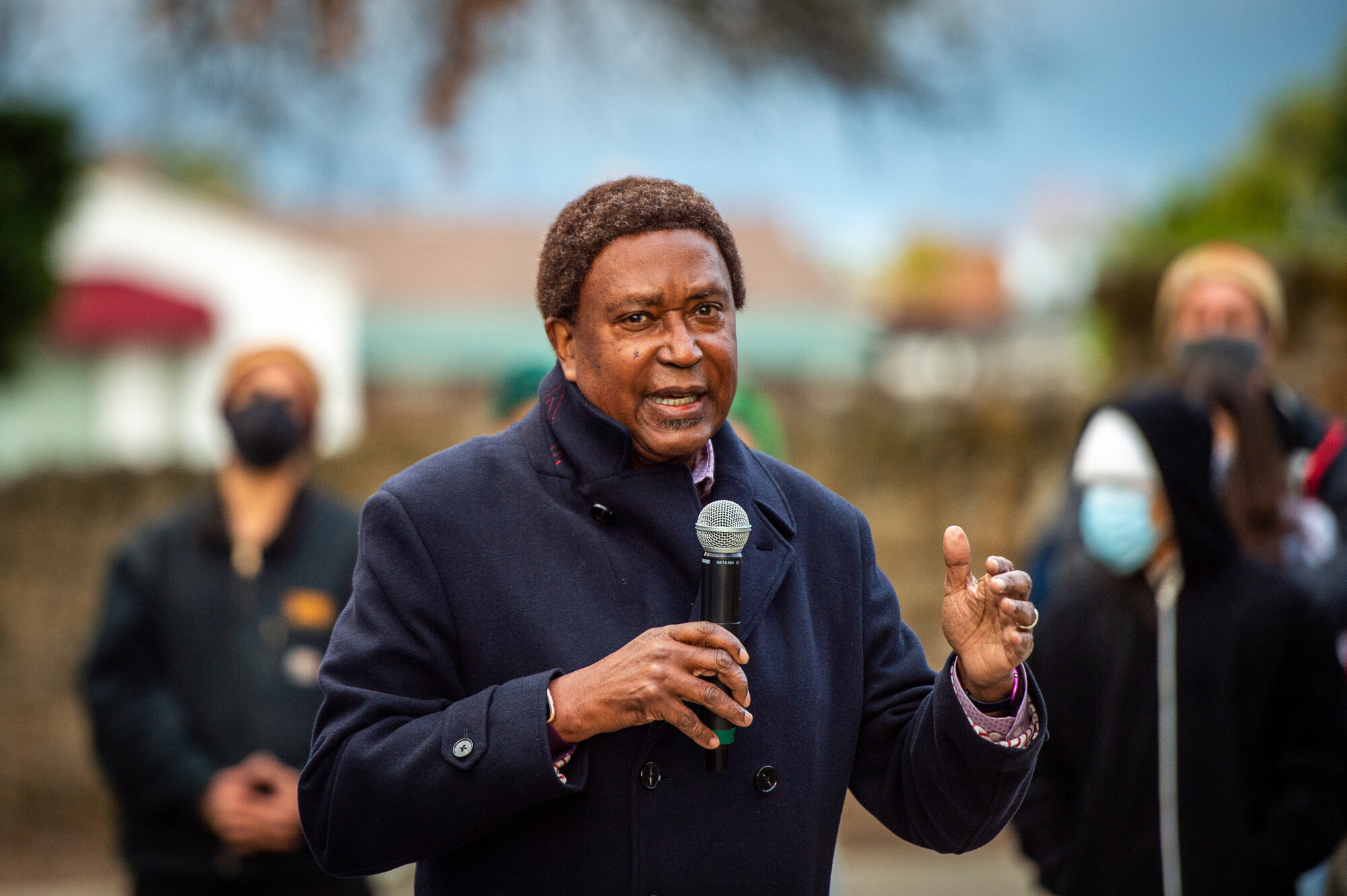
"caption": "Attorney John Burris speaks during a candlelight vigil in remembrance of Angelo Quinto at Antioch City Park on March 10, 2021. Burris, an Oakland-based civil rights attorney, is leading a legal coalition filing 10 claims alleging abuse by federal agents during the immigration enforcement surge in Minneapolis.\r\n",
"credit": "Beth LaBerge/KQED",
"altTag": null,
"description": null,
"imgSizes": {
"thumbnail": {
"file": "https://cdn.kqed.org/wp-content/uploads/sites/10/2026/03/020_Antioch_AngeloQuintoMemorial_03102021_qed-160x106.jpg",
"width": 160,
"height": 106,
"mimeType": "image/jpeg"
},
"1536x1536": {
"file": "https://cdn.kqed.org/wp-content/uploads/sites/10/2026/03/020_Antioch_AngeloQuintoMemorial_03102021_qed-1536x1022.jpg",
"width": 1536,
"height": 1022,
"mimeType": "image/jpeg"
},
"post-thumbnail": {
"file": "https://cdn.kqed.org/wp-content/uploads/sites/10/2026/03/020_Antioch_AngeloQuintoMemorial_03102021_qed-672x372.jpg",
"width": 672,
"height": 372,
"mimeType": "image/jpeg"
},
"twentyfourteen-full-width": {
"file": "https://cdn.kqed.org/wp-content/uploads/sites/10/2026/03/020_Antioch_AngeloQuintoMemorial_03102021_qed-1038x576.jpg",
"width": 1038,
"height": 576,
"mimeType": "image/jpeg"
},
"npr-cds-wide": {
"file": "https://cdn.kqed.org/wp-content/uploads/sites/10/2026/03/020_Antioch_AngeloQuintoMemorial_03102021_qed-1200x675.jpg",
"width": 1200,
"height": 675,
"mimeType": "image/jpeg"
},
"npr-cds-square": {
"file": "https://cdn.kqed.org/wp-content/uploads/sites/10/2026/03/020_Antioch_AngeloQuintoMemorial_03102021_qed-600x600.jpg",
"width": 600,
"height": 600,
"mimeType": "image/jpeg"
},
"kqedFullSize": {
"file": "https://cdn.kqed.org/wp-content/uploads/sites/10/2026/03/020_Antioch_AngeloQuintoMemorial_03102021_qed.jpg",
"width": 2000,
"height": 1331
}
},
"isLoading": false,
"fetchFailed": false
},
"news_12062227": {
"type": "attachments",
"id": "news_12062227",
"meta": {
"index": "attachments_1716263798",
"site": "news",
"id": "12062227",
"found": true
},
"title": "20251029_STANFORDFILE--_GH-2-KQED",
"publishDate": 1761843198,
"status": "inherit",
"parent": 0,
"modified": 1761843299,
"caption": "The arched walkways of Stanford’s Main Quad in Stanford Oct. 29, 2025.",
"credit": "Gustavo Hernandez/KQED",
"altTag": null,
"description": null,
"imgSizes": {
"thumbnail": {
"file": "https://cdn.kqed.org/wp-content/uploads/sites/10/2025/10/20251029_STANFORDFILE-_GH-2-KQED-160x107.jpg",
"width": 160,
"height": 107,
"mimeType": "image/jpeg"
},
"1536x1536": {
"file": "https://cdn.kqed.org/wp-content/uploads/sites/10/2025/10/20251029_STANFORDFILE-_GH-2-KQED-1536x1024.jpg",
"width": 1536,
"height": 1024,
"mimeType": "image/jpeg"
},
"post-thumbnail": {
"file": "https://cdn.kqed.org/wp-content/uploads/sites/10/2025/10/20251029_STANFORDFILE-_GH-2-KQED-672x372.jpg",
"width": 672,
"height": 372,
"mimeType": "image/jpeg"
},
"twentyfourteen-full-width": {
"file": "https://cdn.kqed.org/wp-content/uploads/sites/10/2025/10/20251029_STANFORDFILE-_GH-2-KQED-1038x576.jpg",
"width": 1038,
"height": 576,
"mimeType": "image/jpeg"
},
"npr-cds-wide": {
"file": "https://cdn.kqed.org/wp-content/uploads/sites/10/2025/10/20251029_STANFORDFILE-_GH-2-KQED-1600x900.jpg",
"width": 1600,
"height": 900,
"mimeType": "image/jpeg"
},
"kqedFullSize": {
"file": "https://cdn.kqed.org/wp-content/uploads/sites/10/2025/10/20251029_STANFORDFILE-_GH-2-KQED.jpg",
"width": 2000,
"height": 1333
}
},
"isLoading": false,
"fetchFailed": false
},
"news_12077694": {
"type": "attachments",
"id": "news_12077694",
"meta": {
"index": "attachments_1716263798",
"site": "news",
"id": "12077694",
"found": true
},
"title": "Chavez Allegations Fallout",
"publishDate": 1774555774,
"status": "inherit",
"parent": 12077691,
"modified": 1774555814,
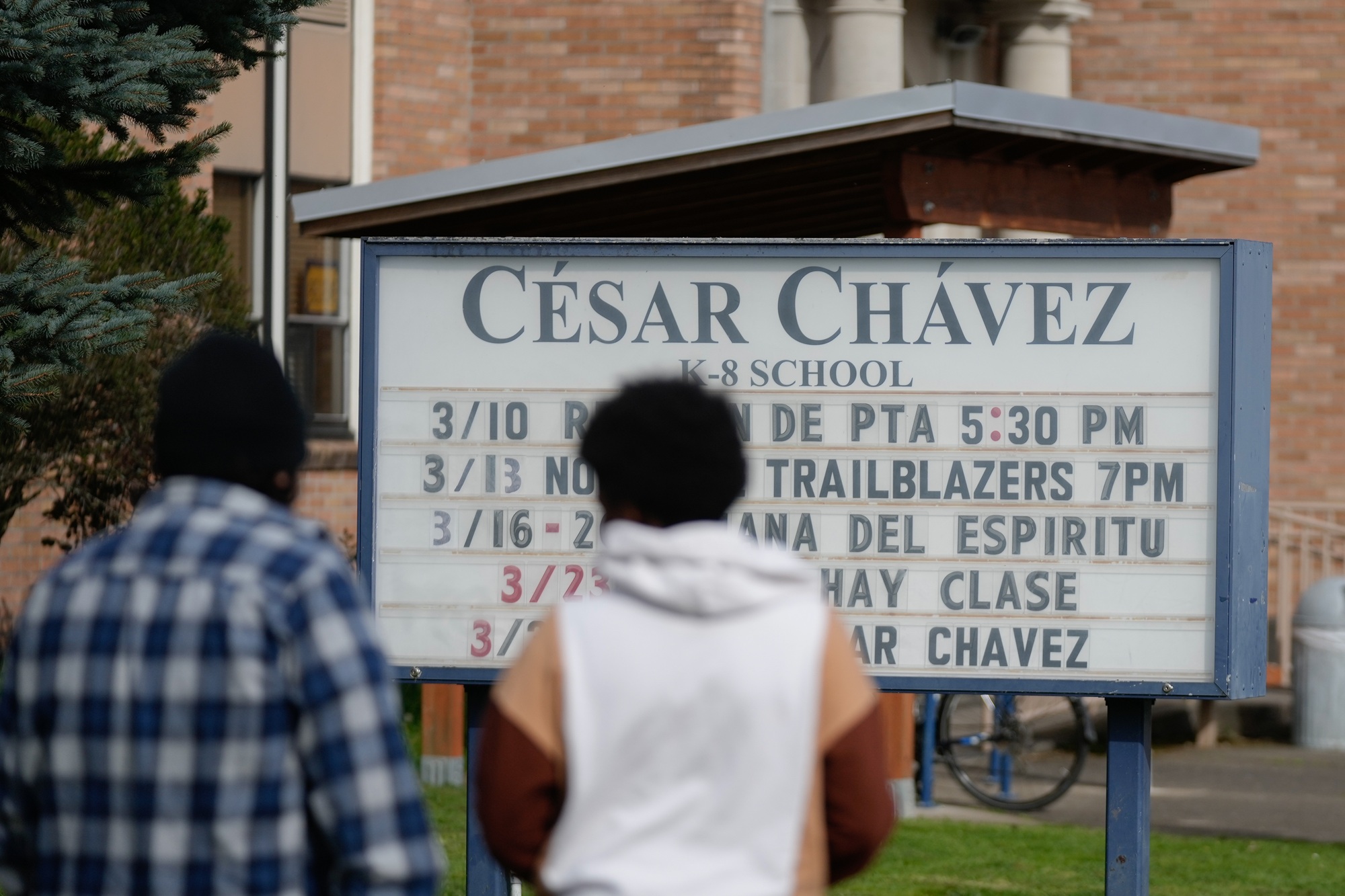
"caption": "A sign for Cesar Chavez School is seen on March 18, 2026, in Portland, Oregon.",
"credit": "Jenny Kane/AP Photo",
"altTag": null,
"description": null,
"imgSizes": {
"thumbnail": {
"file": "https://cdn.kqed.org/wp-content/uploads/sites/10/2026/03/CesarChavezSchoolAP-160x107.jpg",
"width": 160,
"height": 107,
"mimeType": "image/jpeg"
},
"1536x1536": {
"file": "https://cdn.kqed.org/wp-content/uploads/sites/10/2026/03/CesarChavezSchoolAP-1536x1024.jpg",
"width": 1536,
"height": 1024,
"mimeType": "image/jpeg"
},
"post-thumbnail": {
"file": "https://cdn.kqed.org/wp-content/uploads/sites/10/2026/03/CesarChavezSchoolAP-672x372.jpg",
"width": 672,
"height": 372,
"mimeType": "image/jpeg"
},
"twentyfourteen-full-width": {
"file": "https://cdn.kqed.org/wp-content/uploads/sites/10/2026/03/CesarChavezSchoolAP-1038x576.jpg",
"width": 1038,
"height": 576,
"mimeType": "image/jpeg"
},
"npr-cds-wide": {
"file": "https://cdn.kqed.org/wp-content/uploads/sites/10/2026/03/CesarChavezSchoolAP-1200x675.jpg",
"width": 1200,
"height": 675,
"mimeType": "image/jpeg"
},
"npr-cds-square": {
"file": "https://cdn.kqed.org/wp-content/uploads/sites/10/2026/03/CesarChavezSchoolAP-600x600.jpg",
"width": 600,
"height": 600,
"mimeType": "image/jpeg"
},
"kqedFullSize": {
"file": "https://cdn.kqed.org/wp-content/uploads/sites/10/2026/03/CesarChavezSchoolAP.jpg",
"width": 2000,
"height": 1333
}
},
"isLoading": false,
"fetchFailed": false
},
"news_12077679": {
"type": "attachments",
"id": "news_12077679",
"meta": {
"index": "attachments_1716263798",
"site": "news",
"id": "12077679",
"found": true
},
"title": "050422-SAN-JOSE-HOMELESS-SJM-DS-CM",
"publishDate": 1774552662,
"status": "inherit",
"parent": 12077674,
"modified": 1774552713,
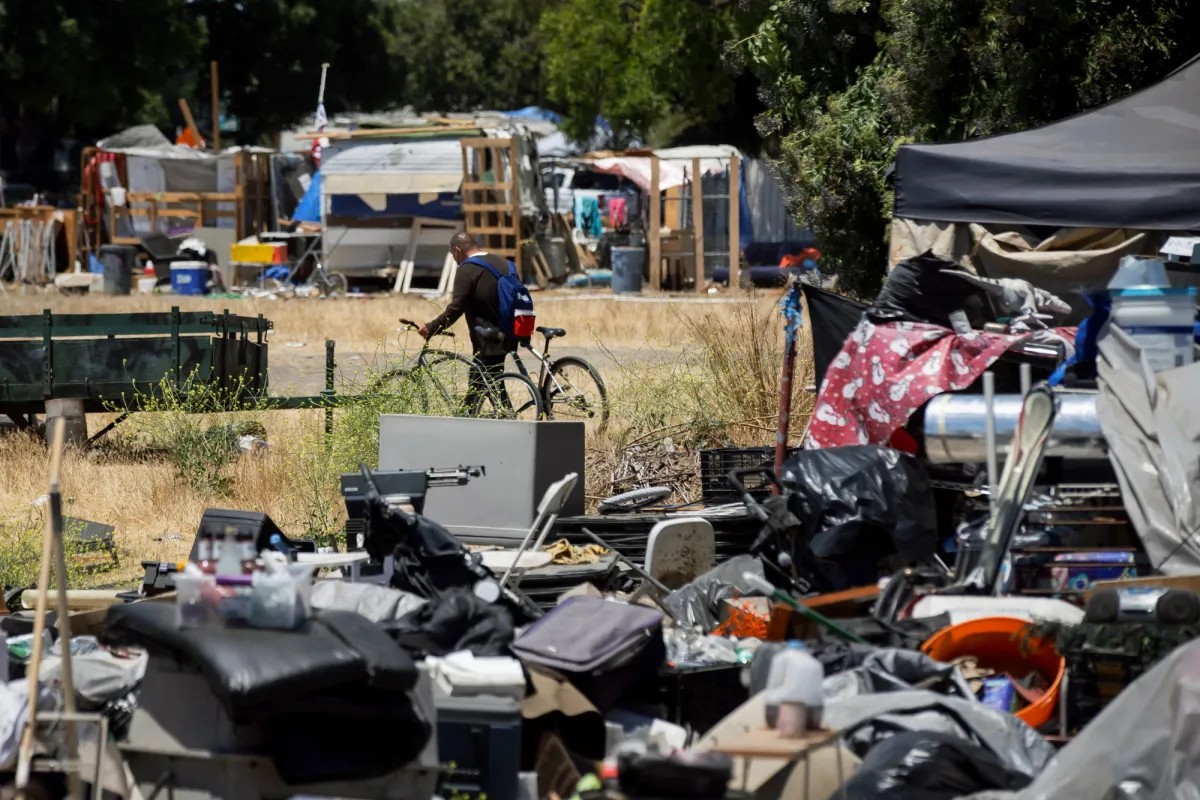
"caption": "A man walks at the homeless encampment located along Coleman Avenue between West Hedding Street and Asbury Street in San Jose on June 22, 2021. ",
"credit": "Dai Sugano/Bay Area News Group",
"altTag": null,
"description": null,
"imgSizes": {
"thumbnail": {
"file": "https://cdn.kqed.org/wp-content/uploads/sites/10/2026/03/050422-SAN-JOSE-HOMELESS-SJM-DS-CM-160x107.jpg",
"width": 160,
"height": 107,
"mimeType": "image/jpeg"
},
"post-thumbnail": {
"file": "https://cdn.kqed.org/wp-content/uploads/sites/10/2026/03/050422-SAN-JOSE-HOMELESS-SJM-DS-CM-672x372.jpg",
"width": 672,
"height": 372,
"mimeType": "image/jpeg"
},
"twentyfourteen-full-width": {
"file": "https://cdn.kqed.org/wp-content/uploads/sites/10/2026/03/050422-SAN-JOSE-HOMELESS-SJM-DS-CM-1038x576.jpg",
"width": 1038,
"height": 576,
"mimeType": "image/jpeg"
},
"npr-cds-wide": {
"file": "https://cdn.kqed.org/wp-content/uploads/sites/10/2026/03/050422-SAN-JOSE-HOMELESS-SJM-DS-CM-1200x675.jpg",
"width": 1200,
"height": 675,
"mimeType": "image/jpeg"
},
"npr-cds-square": {
"file": "https://cdn.kqed.org/wp-content/uploads/sites/10/2026/03/050422-SAN-JOSE-HOMELESS-SJM-DS-CM-600x600.jpg",
"width": 600,
"height": 600,
"mimeType": "image/jpeg"
},
"kqedFullSize": {
"file": "https://cdn.kqed.org/wp-content/uploads/sites/10/2026/03/050422-SAN-JOSE-HOMELESS-SJM-DS-CM.jpg",
"width": 1200,
"height": 800
}
},
"isLoading": false,
"fetchFailed": false
},
"news_12077425": {
"type": "attachments",
"id": "news_12077425",
"meta": {
"index": "attachments_1716263798",
"site": "news",
"id": "12077425",
"found": true
},
"title": "022425-Chad-Bianco-MB-Rueters-01-CM",
"publishDate": 1774391412,
"status": "inherit",
"parent": 12077421,
"modified": 1774391457,
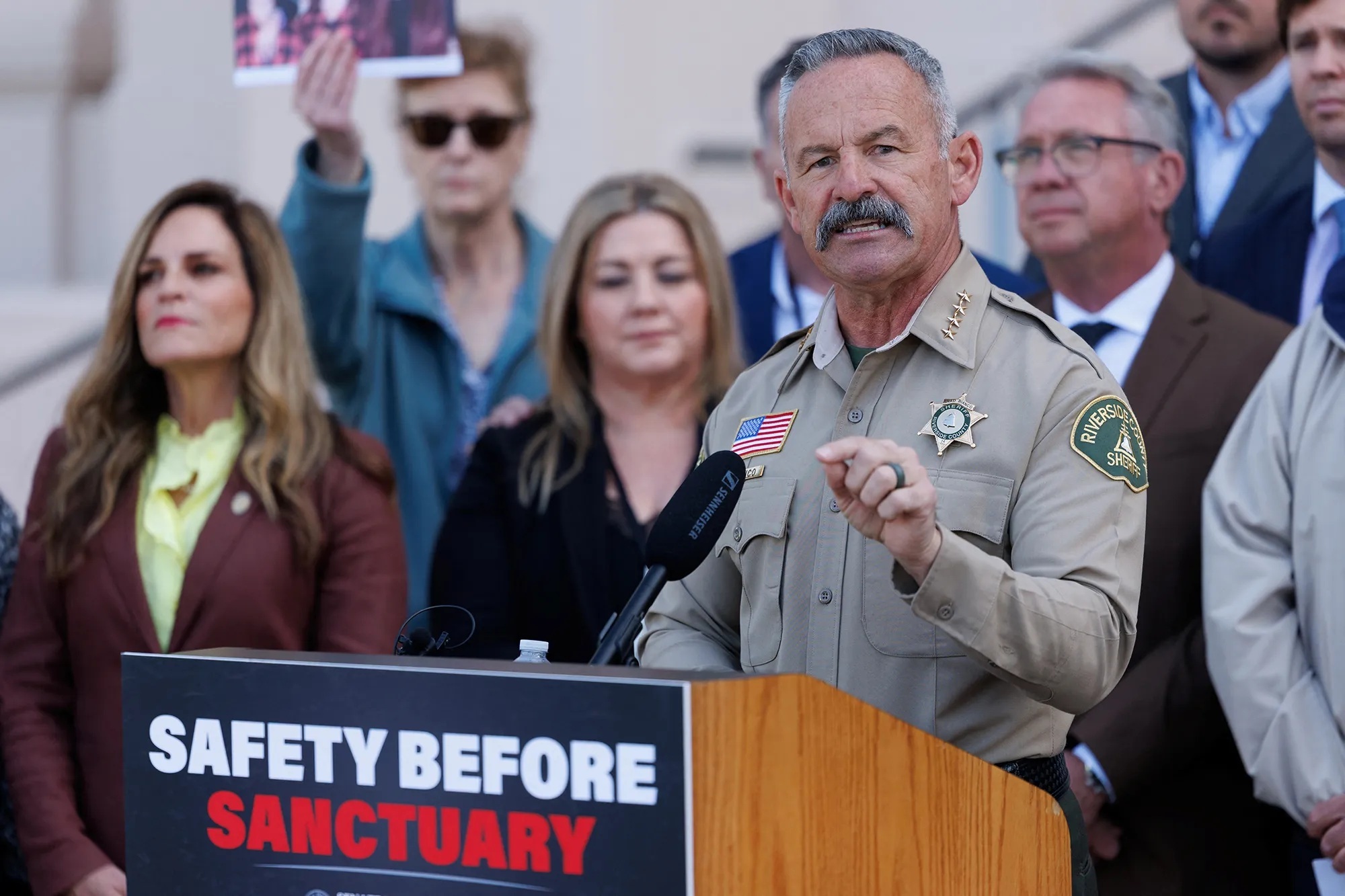
"caption": "Riverside County Sheriff Chad Bianco speaks at a press conference in support of changing California's \"sanctuary city\" law after announcing that he is running for governor of California in 2026, becoming the first major Republican to announce a bid for the office in San Diego, on Feb. 21, 2025. ",
"credit": "Mike Blake/Reuters",
"altTag": null,
"description": null,
"imgSizes": {
"thumbnail": {
"file": "https://cdn.kqed.org/wp-content/uploads/sites/10/2026/03/022425-Chad-Bianco-MB-Rueters-01-CM-160x107.jpg",
"width": 160,
"height": 107,
"mimeType": "image/jpeg"
},
"1536x1536": {
"file": "https://cdn.kqed.org/wp-content/uploads/sites/10/2026/03/022425-Chad-Bianco-MB-Rueters-01-CM-1536x1024.jpg",
"width": 1536,
"height": 1024,
"mimeType": "image/jpeg"
},
"post-thumbnail": {
"file": "https://cdn.kqed.org/wp-content/uploads/sites/10/2026/03/022425-Chad-Bianco-MB-Rueters-01-CM-672x372.jpg",
"width": 672,
"height": 372,
"mimeType": "image/jpeg"
},
"twentyfourteen-full-width": {
"file": "https://cdn.kqed.org/wp-content/uploads/sites/10/2026/03/022425-Chad-Bianco-MB-Rueters-01-CM-1038x576.jpg",
"width": 1038,
"height": 576,
"mimeType": "image/jpeg"
},
"npr-cds-wide": {
"file": "https://cdn.kqed.org/wp-content/uploads/sites/10/2026/03/022425-Chad-Bianco-MB-Rueters-01-CM-1200x675.jpg",
"width": 1200,
"height": 675,
"mimeType": "image/jpeg"
},
"npr-cds-square": {
"file": "https://cdn.kqed.org/wp-content/uploads/sites/10/2026/03/022425-Chad-Bianco-MB-Rueters-01-CM-600x600.jpg",
"width": 600,
"height": 600,
"mimeType": "image/jpeg"
},
"kqedFullSize": {
"file": "https://cdn.kqed.org/wp-content/uploads/sites/10/2026/03/022425-Chad-Bianco-MB-Rueters-01-CM.jpg",
"width": 2000,
"height": 1333
}
},
"isLoading": false,
"fetchFailed": false
},
"news_12062438": {
"type": "attachments",
"id": "news_12062438",
"meta": {
"index": "attachments_1716263798",
"site": "news",
"id": "12062438",
"found": true
},
"title": "251027-ALMADENQUICKSILVER00034_TV-KQED",
"publishDate": 1761912370,
"status": "inherit",
"parent": 0,
"modified": 1774479490,
"caption": "The New Almaden Quicksilver Mining Museum is located in what used to be the mine manager’s mansion, also known as Casa Grande, in the hills south of San José. ",
"credit": "Tâm Vũ/KQED",
"altTag": null,
"description": null,
"imgSizes": {
"thumbnail": {
"file": "https://cdn.kqed.org/wp-content/uploads/sites/10/2025/10/251027-ALMADENQUICKSILVER00034_TV-KQED-160x107.jpg",
"width": 160,
"height": 107,
"mimeType": "image/jpeg"
},
"1536x1536": {
"file": "https://cdn.kqed.org/wp-content/uploads/sites/10/2025/10/251027-ALMADENQUICKSILVER00034_TV-KQED-1536x1024.jpg",
"width": 1536,
"height": 1024,
"mimeType": "image/jpeg"
},
"post-thumbnail": {
"file": "https://cdn.kqed.org/wp-content/uploads/sites/10/2025/10/251027-ALMADENQUICKSILVER00034_TV-KQED-672x372.jpg",
"width": 672,
"height": 372,
"mimeType": "image/jpeg"
},
"twentyfourteen-full-width": {
"file": "https://cdn.kqed.org/wp-content/uploads/sites/10/2025/10/251027-ALMADENQUICKSILVER00034_TV-KQED-1038x576.jpg",
"width": 1038,
"height": 576,
"mimeType": "image/jpeg"
},
"npr-cds-wide": {
"file": "https://cdn.kqed.org/wp-content/uploads/sites/10/2025/10/251027-ALMADENQUICKSILVER00034_TV-KQED-1200x675.jpg",
"width": 1200,
"height": 675,
"mimeType": "image/jpeg"
},
"kqedFullSize": {
"file": "https://cdn.kqed.org/wp-content/uploads/sites/10/2025/10/251027-ALMADENQUICKSILVER00034_TV-KQED.jpg",
"width": 2000,
"height": 1333
}
},
"isLoading": false,
"fetchFailed": false
},
"news_12077553": {
"type": "attachments",
"id": "news_12077553",
"meta": {
"index": "attachments_1716263798",
"site": "news",
"id": "12077553",
"found": true
},
"title": "US-TECH-META-INTERNET-TRIAL-COMPUTERS-ADDICTION",
"publishDate": 1774469979,
"status": "inherit",
"parent": 12077549,
"modified": 1774469979,
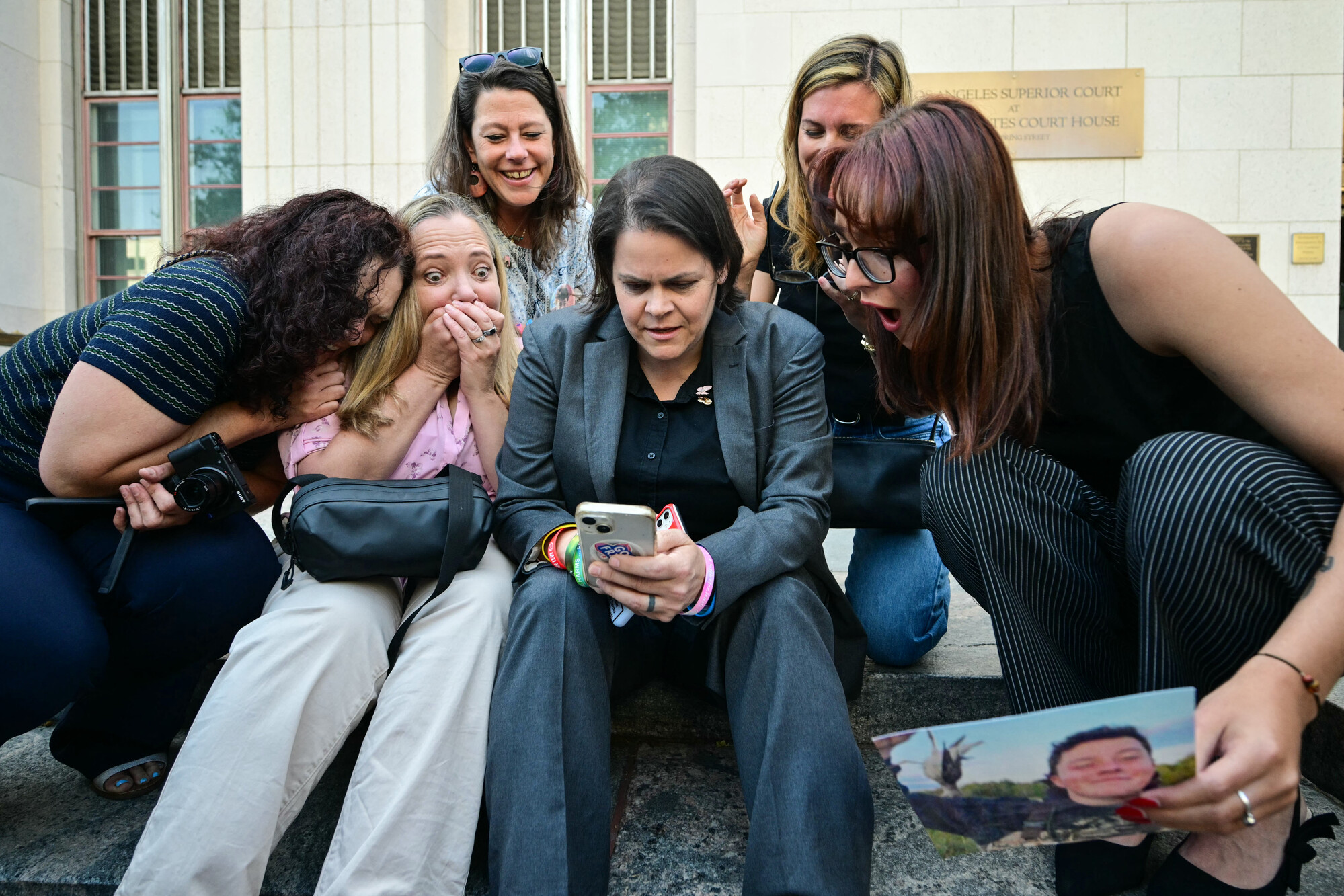
"caption": "Laura Marquez-Garrett (C, gray blazer), plaintiffs' attorney for SMVLC (Social Media Victims Law Center), gathers with parents and family members of victims as they react to news that the jury has found Meta and YouTube liable in the social media addiction trial, outside the Los Angeles Superior Court , in Los Angeles, on March 25, 2026. A Los Angeles jury on Wednesday found Meta and YouTube liable for harming a young woman through the addictive design of their social media platforms and ordered the companies to pay $3 million in damages. The decision delivering a landmark verdict that could reshape how the tech industry faces legal accountability for the mental health of young users. (Photo by Frederic J. Brown / AFP via Getty Images)",
"credit": null,
"altTag": null,
"description": null,
"imgSizes": {
"thumbnail": {
"file": "https://cdn.kqed.org/wp-content/uploads/sites/10/2026/03/GettyImages-2267811581_qed-160x107.jpg",
"width": 160,
"height": 107,
"mimeType": "image/jpeg"
},
"1536x1536": {
"file": "https://cdn.kqed.org/wp-content/uploads/sites/10/2026/03/GettyImages-2267811581_qed-1536x1024.jpg",
"width": 1536,
"height": 1024,
"mimeType": "image/jpeg"
},
"post-thumbnail": {
"file": "https://cdn.kqed.org/wp-content/uploads/sites/10/2026/03/GettyImages-2267811581_qed-672x372.jpg",
"width": 672,
"height": 372,
"mimeType": "image/jpeg"
},
"twentyfourteen-full-width": {
"file": "https://cdn.kqed.org/wp-content/uploads/sites/10/2026/03/GettyImages-2267811581_qed-1038x576.jpg",
"width": 1038,
"height": 576,
"mimeType": "image/jpeg"
},
"npr-cds-wide": {
"file": "https://cdn.kqed.org/wp-content/uploads/sites/10/2026/03/GettyImages-2267811581_qed-1200x675.jpg",
"width": 1200,
"height": 675,
"mimeType": "image/jpeg"
},
"npr-cds-square": {
"file": "https://cdn.kqed.org/wp-content/uploads/sites/10/2026/03/GettyImages-2267811581_qed-600x600.jpg",
"width": 600,
"height": 600,
"mimeType": "image/jpeg"
},
"kqedFullSize": {
"file": "https://cdn.kqed.org/wp-content/uploads/sites/10/2026/03/GettyImages-2267811581_qed.jpg",
"width": 1999,
"height": 1333
}
},
"isLoading": false,
"fetchFailed": false
},
"news_11729066": {
"type": "attachments",
"id": "news_11729066",
"meta": {
"index": "attachments_1716263798",
"site": "news",
"id": "11729066",
"found": true
},
"parent": 11728992,
"imgSizes": {
"twentyfourteen-full-width": {
"file": "https://ww2.kqed.org/app/uploads/sites/10/2019/02/GettyImages-450371283-1038x576.jpg",
"width": 1038,
"mimeType": "image/jpeg",
"height": 576
},
"thumbnail": {
"file": "https://ww2.kqed.org/app/uploads/sites/10/2019/02/GettyImages-450371283-160x107.jpg",
"width": 160,
"mimeType": "image/jpeg",
"height": 107
},
"post-thumbnail": {
"file": "https://ww2.kqed.org/app/uploads/sites/10/2019/02/GettyImages-450371283-672x372.jpg",
"width": 672,
"mimeType": "image/jpeg",
"height": 372
},
"kqedFullSize": {
"file": "https://ww2.kqed.org/app/uploads/sites/10/2019/02/GettyImages-450371283.jpg",
"width": 2048,
"height": 1365
},
"large": {
"file": "https://ww2.kqed.org/app/uploads/sites/10/2019/02/GettyImages-450371283-1020x680.jpg",
"width": 1020,
"mimeType": "image/jpeg",
"height": 680
},
"complete_open_graph": {
"file": "https://ww2.kqed.org/app/uploads/sites/10/2019/02/GettyImages-450371283-1200x800.jpg",
"width": 1200,
"mimeType": "image/jpeg",
"height": 800
},
"guest-author-50": {
"file": "https://ww2.kqed.org/app/uploads/sites/10/2019/02/GettyImages-450371283-50x50.jpg",
"width": 50,
"mimeType": "image/jpeg",
"height": 50
},
"guest-author-96": {
"file": "https://ww2.kqed.org/app/uploads/sites/10/2019/02/GettyImages-450371283-96x96.jpg",
"width": 96,
"mimeType": "image/jpeg",
"height": 96
},
"medium": {
"file": "https://ww2.kqed.org/app/uploads/sites/10/2019/02/GettyImages-450371283-800x533.jpg",
"width": 800,
"mimeType": "image/jpeg",
"height": 533
},
"guest-author-64": {
"file": "https://ww2.kqed.org/app/uploads/sites/10/2019/02/GettyImages-450371283-64x64.jpg",
"width": 64,
"mimeType": "image/jpeg",
"height": 64
},
"guest-author-32": {
"file": "https://ww2.kqed.org/app/uploads/sites/10/2019/02/GettyImages-450371283-32x32.jpg",
"width": 32,
"mimeType": "image/jpeg",
"height": 32
},
"full-width": {
"file": "https://ww2.kqed.org/app/uploads/sites/10/2019/02/GettyImages-450371283-1920x1280.jpg",
"width": 1920,
"mimeType": "image/jpeg",
"height": 1280
},
"detail": {
"file": "https://ww2.kqed.org/app/uploads/sites/10/2019/02/GettyImages-450371283-150x150.jpg",
"width": 150,
"mimeType": "image/jpeg",
"height": 150
},
"guest-author-128": {
"file": "https://ww2.kqed.org/app/uploads/sites/10/2019/02/GettyImages-450371283-128x128.jpg",
"width": 128,
"mimeType": "image/jpeg",
"height": 128
}
},
"publishDate": 1551211893,
"modified": 1551211976,
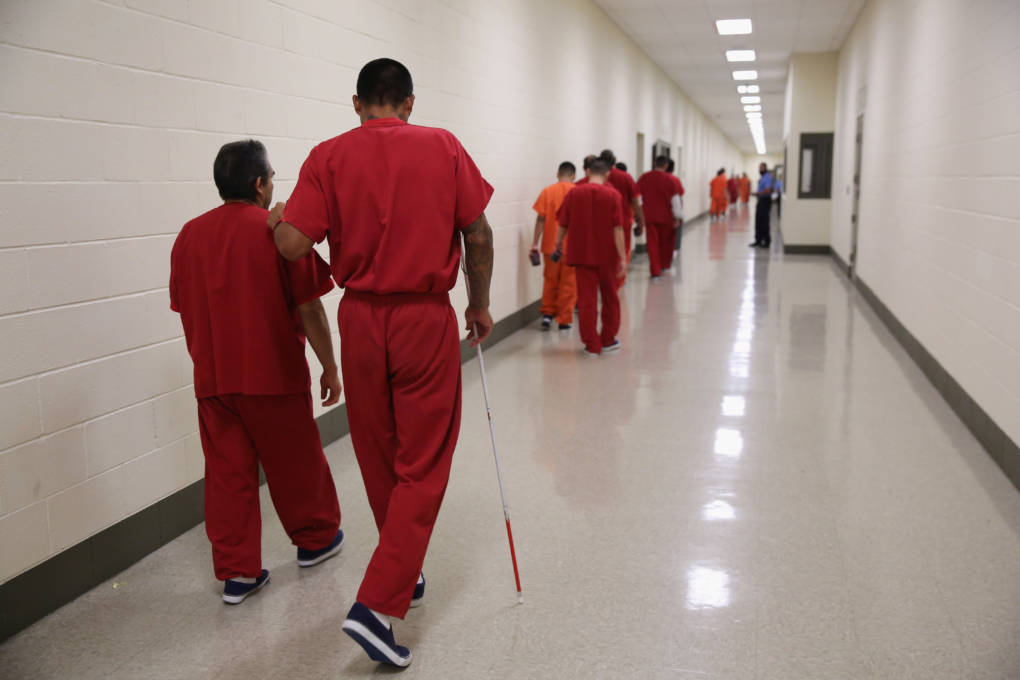
"caption": "Immigration detainees at the facility in Adelanto, California, which houses an average of 1,100 immigrants in custody pending a decision in their immigration cases or awaiting deportation. ",
"description": "Immigration detainees at the facility in Adelanto, California, which houses an average of 1,100 immigrants in custody pending a decision in their immigration cases or awaiting deportation. ",
"title": "ICE Holds Immigrants At Adelanto Detention Facility",
"credit": "John Moore/Getty Images",
"status": "inherit",
"isLoading": false,
"fetchFailed": false
},
"news_12077504": {
"type": "attachments",
"id": "news_12077504",
"meta": {
"index": "attachments_1716263798",
"site": "news",
"id": "12077504",
"found": true
},
"title": "Trump Sends ICE Agents To Airports As DHS Remains Unfunded",
"publishDate": 1774462696,
"status": "inherit",
"parent": 12077353,
"modified": 1779816919,
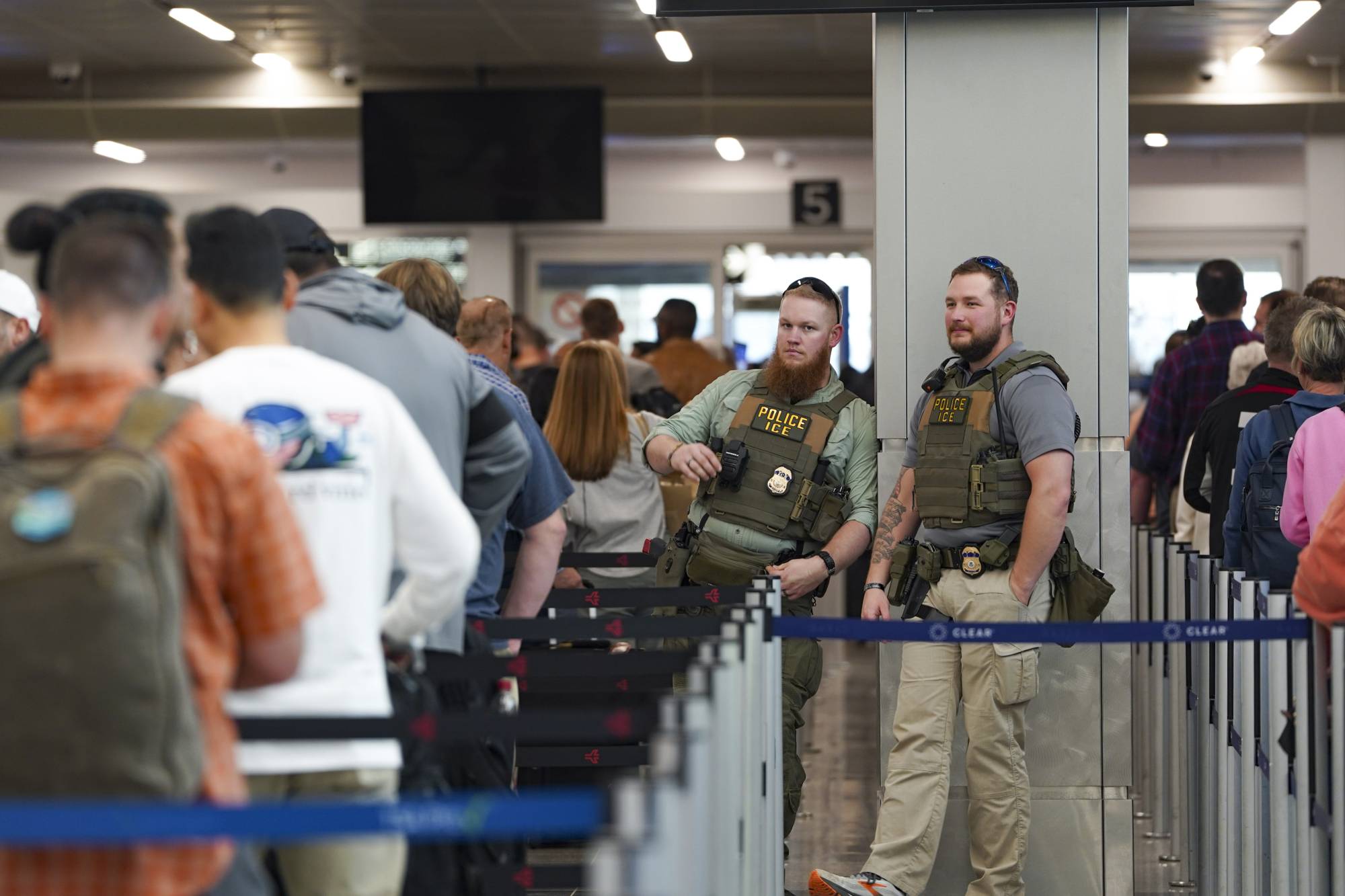
"caption": "CE agents stand next to the security line at Atlanta Hartsfield-Jackson International Airport on March 23, 2026 in Atlanta, Georgia. ",
"credit": "Megan Varner/Getty Images",
"altTag": null,
"description": null,
"imgSizes": {
"medium": {
"file": "https://cdn.kqed.org/wp-content/uploads/sites/10/2026/03/GettyImages-2267571375-2000x1333.jpg",
"width": 2000,
"height": 1333,
"mimeType": "image/jpeg"
},
"large": {
"file": "https://cdn.kqed.org/wp-content/uploads/sites/10/2026/03/GettyImages-2267571375-2000x1333.jpg",
"width": 2000,
"height": 1333,
"mimeType": "image/jpeg"
},
"thumbnail": {
"file": "https://cdn.kqed.org/wp-content/uploads/sites/10/2026/03/GettyImages-2267571375-160x107.jpg",
"width": 160,
"height": 107,
"mimeType": "image/jpeg"
},
"1536x1536": {
"file": "https://cdn.kqed.org/wp-content/uploads/sites/10/2026/03/GettyImages-2267571375-1536x1024.jpg",
"width": 1536,
"height": 1024,
"mimeType": "image/jpeg"
},
"2048x2048": {
"file": "https://cdn.kqed.org/wp-content/uploads/sites/10/2026/03/GettyImages-2267571375-2048x1365.jpg",
"width": 2048,
"height": 1365,
"mimeType": "image/jpeg"
},
"post-thumbnail": {
"file": "https://cdn.kqed.org/wp-content/uploads/sites/10/2026/03/GettyImages-2267571375-672x372.jpg",
"width": 672,
"height": 372,
"mimeType": "image/jpeg"
},
"twentyfourteen-full-width": {
"file": "https://cdn.kqed.org/wp-content/uploads/sites/10/2026/03/GettyImages-2267571375-1038x576.jpg",
"width": 1038,
"height": 576,
"mimeType": "image/jpeg"
},
"full-width": {
"file": "https://cdn.kqed.org/wp-content/uploads/sites/10/2026/03/GettyImages-2267571375-2000x1333.jpg",
"width": 2000,
"height": 1333,
"mimeType": "image/jpeg"
},
"npr-cds-wide": {
"file": "https://cdn.kqed.org/wp-content/uploads/sites/10/2026/03/GettyImages-2267571375-1200x675.jpg",
"width": 1200,
"height": 675,
"mimeType": "image/jpeg"
},
"npr-cds-square": {
"file": "https://cdn.kqed.org/wp-content/uploads/sites/10/2026/03/GettyImages-2267571375-600x600.jpg",
"width": 600,
"height": 600,
"mimeType": "image/jpeg"
},
"kqedFullSize": {
"file": "https://cdn.kqed.org/wp-content/uploads/sites/10/2026/03/GettyImages-2267571375-scaled-e1774462803299.jpg",
"width": 2000,
"height": 1334
}
},
"isLoading": false,
"fetchFailed": false
},
"news_12077403": {
"type": "attachments",
"id": "news_12077403",
"meta": {
"index": "attachments_1716263798",
"site": "news",
"id": "12077403",
"found": true
},
"title": "Spring Arrives at Lake Tahoe",
"publishDate": 1774386446,
"status": "inherit",
"parent": 12077367,
"modified": 1774386494,
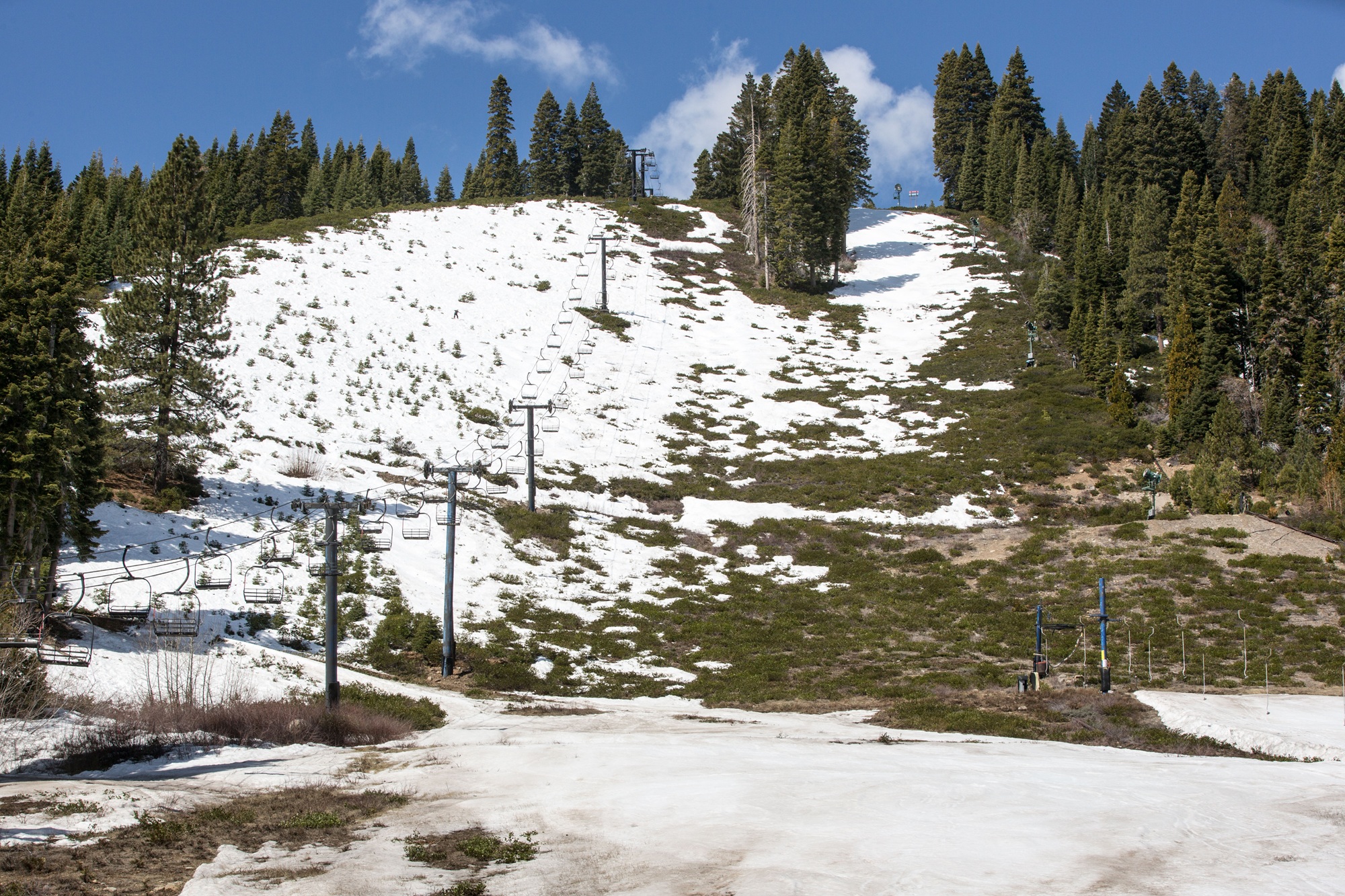
"caption": "The ski area at Homewood has closed due to poor snow conditions as viewed on April 14, 2021, in Homewood, California. ",
"credit": "George Rose/Getty Images",
"altTag": null,
"description": "The ski area at Homewood has closed due to poor snow conditions as viewed on April 14, 2021, in Homewood, California. With Sierra Nevada snowpack levels at less than 60% of normal for the year, California's principal source of drinking and agricultural water has alreday pushed much of the state into a \"severe\" or \"extreme\" drought situation. ",
"imgSizes": {
"thumbnail": {
"file": "https://cdn.kqed.org/wp-content/uploads/sites/10/2026/03/TahoeSnowGetty-160x107.jpg",
"width": 160,
"height": 107,
"mimeType": "image/jpeg"
},
"1536x1536": {
"file": "https://cdn.kqed.org/wp-content/uploads/sites/10/2026/03/TahoeSnowGetty-1536x1024.jpg",
"width": 1536,
"height": 1024,
"mimeType": "image/jpeg"
},
"post-thumbnail": {
"file": "https://cdn.kqed.org/wp-content/uploads/sites/10/2026/03/TahoeSnowGetty-672x372.jpg",
"width": 672,
"height": 372,
"mimeType": "image/jpeg"
},
"twentyfourteen-full-width": {
"file": "https://cdn.kqed.org/wp-content/uploads/sites/10/2026/03/TahoeSnowGetty-1038x576.jpg",
"width": 1038,
"height": 576,
"mimeType": "image/jpeg"
},
"npr-cds-wide": {
"file": "https://cdn.kqed.org/wp-content/uploads/sites/10/2026/03/TahoeSnowGetty-1200x675.jpg",
"width": 1200,
"height": 675,
"mimeType": "image/jpeg"
},
"npr-cds-square": {
"file": "https://cdn.kqed.org/wp-content/uploads/sites/10/2026/03/TahoeSnowGetty-600x600.jpg",
"width": 600,
"height": 600,
"mimeType": "image/jpeg"
},
"kqedFullSize": {
"file": "https://cdn.kqed.org/wp-content/uploads/sites/10/2026/03/TahoeSnowGetty.jpg",
"width": 2000,
"height": 1333
}
},
"isLoading": false,
"fetchFailed": false
},
"news_12077285": {
"type": "attachments",
"id": "news_12077285",
"meta": {
"index": "attachments_1716263798",
"site": "news",
"id": "12077285",
"found": true
},
"title": "042924_State-Capitol-Session-MG_CM_25",
"publishDate": 1774285685,
"status": "inherit",
"parent": 12077281,
"modified": 1774285788,
"caption": "State Sen. Scott Wiener on the Senate floor at the state Capitol in Sacramento on April 29, 2024. ",
"credit": "Miguel Gutierrez Jr./CalMatters",
"altTag": null,
"description": null,
"imgSizes": {
"thumbnail": {
"file": "https://cdn.kqed.org/wp-content/uploads/sites/10/2026/03/042924_State-Capitol-Session-MG_CM_25-160x107.jpeg",
"width": 160,
"height": 107,
"mimeType": "image/jpeg"
},
"1536x1536": {
"file": "https://cdn.kqed.org/wp-content/uploads/sites/10/2026/03/042924_State-Capitol-Session-MG_CM_25-1536x1024.jpeg",
"width": 1536,
"height": 1024,
"mimeType": "image/jpeg"
},
"post-thumbnail": {
"file": "https://cdn.kqed.org/wp-content/uploads/sites/10/2026/03/042924_State-Capitol-Session-MG_CM_25-672x372.jpeg",
"width": 672,
"height": 372,
"mimeType": "image/jpeg"
},
"twentyfourteen-full-width": {
"file": "https://cdn.kqed.org/wp-content/uploads/sites/10/2026/03/042924_State-Capitol-Session-MG_CM_25-1038x576.jpeg",
"width": 1038,
"height": 576,
"mimeType": "image/jpeg"
},
"npr-cds-wide": {
"file": "https://cdn.kqed.org/wp-content/uploads/sites/10/2026/03/042924_State-Capitol-Session-MG_CM_25-1200x675.jpeg",
"width": 1200,
"height": 675,
"mimeType": "image/jpeg"
},
"kqedFullSize": {
"file": "https://cdn.kqed.org/wp-content/uploads/sites/10/2026/03/042924_State-Capitol-Session-MG_CM_25.jpeg",
"width": 2000,
"height": 1333
}
},
"isLoading": false,
"fetchFailed": false
}
},
"audioPlayerReducer": {
"postId": "stream_live",
"isPaused": true,
"isPlaying": false,
"pfsActive": false,
"pledgeModalIsOpen": true,
"playerDrawerIsOpen": false,
"liveAudioPlayStartedAt": 0,
"liveAudioPlayContext": ""
},
"authorsReducer": {
"byline_news_12077715": {
"type": "authors",
"id": "byline_news_12077715",
"meta": {
"override": true
},
"slug": "byline_news_12077715",
"name": "The Associated Press",
"isLoading": false
},
"byline_news_12077691": {
"type": "authors",
"id": "byline_news_12077691",
"meta": {
"override": true
},
"slug": "byline_news_12077691",
"name": "Trân Nguyễn, The Associated Press",
"isLoading": false
},
"byline_news_12077674": {
"type": "authors",
"id": "byline_news_12077674",
"meta": {
"override": true
},
"slug": "byline_news_12077674",
"name": "\u003ca href=\"https://calmatters.org/author/marisa-kendall/\">Marisa Kendall\u003c/a>, CalMatters",
"isLoading": false
},
"byline_news_12077549": {
"type": "authors",
"id": "byline_news_12077549",
"meta": {
"override": true
},
"slug": "byline_news_12077549",
"name": "Bobby Allyn, NPR",
"isLoading": false
},
"byline_news_12077421": {
"type": "authors",
"id": "byline_news_12077421",
"meta": {
"override": true
},
"slug": "byline_news_12077421",
"name": "Cayla Mihalovich and Jeanne Kuang, CalMatters",
"isLoading": false
},
"byline_news_12077281": {
"type": "authors",
"id": "byline_news_12077281",
"meta": {
"override": true
},
"slug": "byline_news_12077281",
"name": "\u003ca href=\"https://calmatters.org/author/ben-christopher/\">Ben Christopher\u003c/a>, CalMatters",
"isLoading": false
},
"gmarzorati": {
"type": "authors",
"id": "227",
"meta": {
"index": "authors_1716337520",
"id": "227",
"found": true
},
"name": "Guy Marzorati",
"firstName": "Guy",
"lastName": "Marzorati",
"slug": "gmarzorati",
"email": "gmarzorati@KQED.org",
"display_author_email": true,
"staff_mastheads": [
"news"
],
"title": "Correspondent",
"bio": "Guy Marzorati is a correspondent on KQED's California Politics and Government Desk, based in San Jose. A graduate of Santa Clara University, Guy joined KQED in 2013. He reports on state and local politics and produces KQED's digital voter guide.",
"avatar": "https://secure.gravatar.com/avatar/e7038b8dbfd55b104369b76b1cd0b9de?s=600&d=blank&r=g",
"twitter": "guymarzorati",
"facebook": null,
"instagram": null,
"linkedin": null,
"sites": [
{
"site": "",
"roles": [
"editor"
]
},
{
"site": "news",
"roles": [
"editor"
]
},
{
"site": "science",
"roles": [
"editor"
]
},
{
"site": "forum",
"roles": [
"editor"
]
},
{
"site": "elections",
"roles": [
"editor"
]
},
{
"site": "liveblog",
"roles": [
"editor"
]
}
],
"headData": {
"title": "Guy Marzorati | KQED",
"description": "Correspondent",
"ogImgSrc": "https://secure.gravatar.com/avatar/e7038b8dbfd55b104369b76b1cd0b9de?s=600&d=blank&r=g",
"twImgSrc": "https://secure.gravatar.com/avatar/e7038b8dbfd55b104369b76b1cd0b9de?s=600&d=blank&r=g"
},
"isLoading": false,
"link": "/author/gmarzorati"
},
"minakim": {
"type": "authors",
"id": "243",
"meta": {
"index": "authors_1716337520",
"id": "243",
"found": true
},
"name": "Mina Kim",
"firstName": "Mina",
"lastName": "Kim",
"slug": "minakim",
"email": "mkim@kqed.org",
"display_author_email": false,
"staff_mastheads": [
"news"
],
"title": "Host, Forum",
"bio": "Mina Kim is host of the 10 a.m. statewide hour of Forum; a live daily talk show for curious Californians on issues that matter to the state and nation, with a particular emphasis on race and equity.\r\n\r\nBefore joining the Forum team, Mina was KQED’s evening news anchor, and health reporter for The California Report. Her award-winning work has included natural disasters in Napa and gun violence in Oakland. Mina grew up in St. John’s, Newfoundland.",
"avatar": "https://secure.gravatar.com/avatar/145ce657a2d08cb86d93686beb958982?s=600&d=blank&r=g",
"twitter": "mkimreporter",
"facebook": null,
"instagram": null,
"linkedin": null,
"sites": [
{
"site": "news",
"roles": [
"contributor"
]
},
{
"site": "stateofhealth",
"roles": [
"author"
]
},
{
"site": "forum",
"roles": [
"editor"
]
}
],
"headData": {
"title": "Mina Kim | KQED",
"description": "Host, Forum",
"ogImgSrc": "https://secure.gravatar.com/avatar/145ce657a2d08cb86d93686beb958982?s=600&d=blank&r=g",
"twImgSrc": "https://secure.gravatar.com/avatar/145ce657a2d08cb86d93686beb958982?s=600&d=blank&r=g"
},
"isLoading": false,
"link": "/author/minakim"
},
"rachael-myrow": {
"type": "authors",
"id": "251",
"meta": {
"index": "authors_1716337520",
"id": "251",
"found": true
},
"name": "Rachael Myrow",
"firstName": "Rachael",
"lastName": "Myrow",
"slug": "rachael-myrow",
"email": "rmyrow@kqed.org",
"display_author_email": true,
"staff_mastheads": [
"news"
],
"title": "Senior Editor of KQED's Silicon Valley News Desk",
"bio": "• I write and edit stories about how Silicon Valley power and policies shape everyday life in California. I’m also passionate about making Bay Area history and culture more accessible to a broad public. • I’ve been a journalist for most of my life, starting in high school with The Franklin Press in Los Angeles, where I grew up. While earning my first degree in English at UC Berkeley, I got my start in public radio at KALX-FM. After completing a second degree in journalism at Cal, I landed my first professional job at Marketplace, then moved on to KPCC (now LAist), and then KQED, where I hosted The California Report for more than seven years. • My reporting has appeared on NPR, The World, WBUR’s \u003ci>Here & Now\u003c/i>, and the BBC. I also guest host for KQED’s \u003ci>Forum\u003c/i>, as well as the Commonwealth Club in San Francisco. • I speak periodically on media, democracy and technology issues, and do voiceover work for documentaries and educational video projects. • Outside of the studio, you'll find me hiking Bay Area trails and whipping up Insta-ready meals in my kitchen. • I do not accept gifts, money, or favors from anyone connected to my reporting, I don't pay people for information, and I do not support or donate to political causes. • I strive to treat the people I report on with fairness, honesty, and respect. I also recognize there are often multiple sides to a story and work to verify information through multiple sources and documentation. If I get something wrong, I correct it.",
"avatar": "https://secure.gravatar.com/avatar/3ed8a3c5f26025e4a805ba634cda8cd764906b97438a6d9ce216b044e340da4e?s=600&d=blank&r=g",
"twitter": "rachaelmyrow",
"bluesky": null,
"facebook": null,
"instagram": null,
"linkedin": "https://www.linkedin.com/in/rachaelmyrow/",
"sites": [
{
"site": "arts",
"roles": [
"administrator"
]
},
{
"site": "news",
"roles": [
"edit_others_posts",
"editor"
]
},
{
"site": "futureofyou",
"roles": [
"editor"
]
},
{
"site": "bayareabites",
"roles": [
"editor"
]
},
{
"site": "stateofhealth",
"roles": [
"editor"
]
},
{
"site": "science",
"roles": [
"editor"
]
},
{
"site": "food",
"roles": [
"editor"
]
},
{
"site": "forum",
"roles": [
"editor"
]
},
{
"site": "liveblog",
"roles": [
"author"
]
}
],
"headData": {
"title": "Rachael Myrow | KQED",
"description": "Senior Editor of KQED's Silicon Valley News Desk",
"ogImgSrc": "https://secure.gravatar.com/avatar/3ed8a3c5f26025e4a805ba634cda8cd764906b97438a6d9ce216b044e340da4e?s=600&d=blank&r=g",
"twImgSrc": "https://secure.gravatar.com/avatar/3ed8a3c5f26025e4a805ba634cda8cd764906b97438a6d9ce216b044e340da4e?s=600&d=blank&r=g"
},
"isLoading": false,
"link": "/author/rachael-myrow"
},
"tychehendricks": {
"type": "authors",
"id": "259",
"meta": {
"index": "authors_1716337520",
"id": "259",
"found": true
},
"name": "Tyche Hendricks",
"firstName": "Tyche",
"lastName": "Hendricks",
"slug": "tychehendricks",
"email": "thendricks@kqed.org",
"display_author_email": true,
"staff_mastheads": [
"news"
],
"title": "KQED Senior Editor, Immigration",
"bio": "\u003cspan style=\"font-weight: 400;\">Tyche Hendricks is KQED’s senior editor for immigration, leading coverage of the policy and politics that affect California’s immigrant communities. Her work for KQED’s radio and online audiences is also carried on NPR and other national outlets. She has been recognized with awards from the Radio and Television News Directors Association, the Society for Professional Journalists; the Education Writers Association; the Best of the West and the National Federation of Community Broadcasters. Before joining KQED in 2010, Tyche spent more than a dozen years as a newspaper reporter, notably at the \u003c/span>\u003ci>\u003cspan style=\"font-weight: 400;\">San Francisco Chronicle\u003c/span>\u003c/i>\u003cspan style=\"font-weight: 400;\">. At different times she has covered criminal justice, government and politics and urban planning. Tyche has taught in the MFA Creative Writing program at the University of San Francisco and at UC Berkeley’s Graduate School of Journalism, where she was co-director of a national immigration symposium for professional journalists. She is the author of \u003c/span>\u003ci>\u003cspan style=\"font-weight: 400;\">The Wind Doesn't Need a Passport: Stories from the U.S.-Mexico Borderlands\u003c/span>\u003c/i>\u003cspan style=\"font-weight: 400;\"> (University of California Press). \u003c/span>",
"avatar": "https://secure.gravatar.com/avatar/b8ee458e2731c2d43df86882ce17267e?s=600&d=blank&r=g",
"twitter": "tychehendricks",
"facebook": null,
"instagram": null,
"linkedin": null,
"sites": [
{
"site": "news",
"roles": [
"editor"
]
},
{
"site": "stateofhealth",
"roles": [
"editor"
]
}
],
"headData": {
"title": "Tyche Hendricks | KQED",
"description": "KQED Senior Editor, Immigration",
"ogImgSrc": "https://secure.gravatar.com/avatar/b8ee458e2731c2d43df86882ce17267e?s=600&d=blank&r=g",
"twImgSrc": "https://secure.gravatar.com/avatar/b8ee458e2731c2d43df86882ce17267e?s=600&d=blank&r=g"
},
"isLoading": false,
"link": "/author/tychehendricks"
},
"nkhan": {
"type": "authors",
"id": "11867",
"meta": {
"index": "authors_1716337520",
"id": "11867",
"found": true
},
"name": "Nisa Khan",
"firstName": "Nisa",
"lastName": "Khan",
"slug": "nkhan",
"email": "nkhan@kqed.org",
"display_author_email": false,
"staff_mastheads": [],
"title": "KQED Contributor",
"bio": "Nisa Khan is a reporter for KQED's Audience News Desk. She was formerly a data reporter at Michigan Radio. She earned a Bachelor of Science in Information from the University of Michigan and a Master of Arts in Communication from Stanford University.",
"avatar": "https://secure.gravatar.com/avatar/8720459eef081ff64582b3506b124d58523e80e120704a0cbd9892533c914991?s=600&d=blank&r=g",
"twitter": "mnisakhan",
"bluesky": null,
"facebook": null,
"instagram": null,
"linkedin": null,
"sites": [
{
"site": "arts",
"roles": [
"editor"
]
},
{
"site": "news",
"roles": [
"editor"
]
},
{
"site": "science",
"roles": [
"editor",
"author"
]
},
{
"site": "forum",
"roles": [
"editor"
]
},
{
"site": "liveblog",
"roles": [
"contributor"
]
}
],
"headData": {
"title": "Nisa Khan | KQED",
"description": "KQED Contributor",
"ogImgSrc": "https://secure.gravatar.com/avatar/8720459eef081ff64582b3506b124d58523e80e120704a0cbd9892533c914991?s=600&d=blank&r=g",
"twImgSrc": "https://secure.gravatar.com/avatar/8720459eef081ff64582b3506b124d58523e80e120704a0cbd9892533c914991?s=600&d=blank&r=g"
},
"isLoading": false,
"link": "/author/nkhan"
},
"emanoukian": {
"type": "authors",
"id": "11925",
"meta": {
"index": "authors_1716337520",
"id": "11925",
"found": true
},
"name": "Elize Manoukian",
"firstName": "Elize",
"lastName": "Manoukian",
"slug": "emanoukian",
"email": "emanoukian@KQED.org",
"display_author_email": false,
"staff_mastheads": [
"news"
],
"title": "Digital News Editor",
"bio": "Elize Manoukian is an award-winning audio producer and Senior Editor on the Express Desk, KQED's digital news platform. Her work has appeared on KPFA, Interlochen Public Radio, Oregon Public Broadcast, the New York Daily News, LA Times and the San Diego Union-Tribune.",
"avatar": "https://secure.gravatar.com/avatar/4525f1a8e46ccb30933b32653d9772064cfefe3fa655eb45b3b3a80341f6bdad?s=600&d=blank&r=g",
"twitter": null,
"bluesky": null,
"facebook": null,
"instagram": null,
"linkedin": null,
"sites": [
{
"site": "arts",
"roles": [
"editor"
]
},
{
"site": "news",
"roles": [
"editor"
]
},
{
"site": "science",
"roles": [
"editor"
]
}
],
"headData": {
"title": "Elize Manoukian | KQED",
"description": "Digital News Editor",
"ogImgSrc": "https://secure.gravatar.com/avatar/4525f1a8e46ccb30933b32653d9772064cfefe3fa655eb45b3b3a80341f6bdad?s=600&d=blank&r=g",
"twImgSrc": "https://secure.gravatar.com/avatar/4525f1a8e46ccb30933b32653d9772064cfefe3fa655eb45b3b3a80341f6bdad?s=600&d=blank&r=g"
},
"isLoading": false,
"link": "/author/emanoukian"
},
"sarahwright": {
"type": "authors",
"id": "11956",
"meta": {
"index": "authors_1716337520",
"id": "11956",
"found": true
},
"name": "Sarah Wright",
"firstName": "Sarah",
"lastName": "Wright",
"slug": "sarahwright",
"email": "swright@kqed.org",
"display_author_email": true,
"staff_mastheads": [],
"title": "Outdoors Engagement Reporter",
"bio": "Sarah Wright is KQED's Outdoors Engagement Reporter. Originally from Lake Tahoe, she completed a thru-hike of the Pacific Crest Trail in 2019 and was a U.S. Fulbright Program grantee to Argentina in 2023. Her journalism has appeared in The Guardian, The San Francisco Standard, The Palo Alto Weekly and the Half Moon Bay Review.",
"avatar": "https://secure.gravatar.com/avatar/c161a3d6441865cba25e6db4fa561099ad665799e9432e34da2b84d7e371524c?s=600&d=blank&r=g",
"twitter": null,
"bluesky": null,
"facebook": null,
"instagram": null,
"linkedin": null,
"sites": [
{
"site": "arts",
"roles": [
"editor"
]
},
{
"site": "news",
"roles": [
"editor"
]
},
{
"site": "science",
"roles": [
"contributor",
"author"
]
},
{
"site": "forum",
"roles": [
"editor"
]
}
],
"headData": {
"title": "Sarah Wright | KQED",
"description": "Outdoors Engagement Reporter",
"ogImgSrc": "https://secure.gravatar.com/avatar/c161a3d6441865cba25e6db4fa561099ad665799e9432e34da2b84d7e371524c?s=600&d=blank&r=g",
"twImgSrc": "https://secure.gravatar.com/avatar/c161a3d6441865cba25e6db4fa561099ad665799e9432e34da2b84d7e371524c?s=600&d=blank&r=g"
},
"isLoading": false,
"link": "/author/sarahwright"
}
},
"pagesReducer": {
"news_tag_california": {
"type": "terms",
"id": "news_18538",
"meta": {
"index": "terms_1716263798",
"site": "news",
"id": "18538",
"score": 6.847839
},
"featImg": null,
"name": "California",
"description": null,
"taxonomy": "tag",
"headData": {
"twImgId": null,
"twTitle": null,
"ogTitle": null,
"ogImgId": null,
"twDescription": null,
"description": null,
"title": "California Archives | KQED News",
"ogDescription": null
},
"ttid": 31,
"slug": "california",
"isLoading": false,
"title": "California",
"pageMeta": {
"site": "news",
"WpPageTemplate": "page-topic-editorial",
"currentPage": 31
},
"blocks": [
{
"blockName": "kqed/post-list",
"attrs": {
"layout": "cardArticle2",
"query": "posts/news?tag=california",
"seeMore": false,
"paginated": true,
"page": 31
}
},
{
"blockName": "kqed/ad"
}
]
}
},
"pfsSessionReducer": {},
"postsReducer": {
"stream_live": {
"type": "live",
"id": "stream_live",
"audioUrl": "https://streams.kqed.org/kqedradio",
"title": "Live Stream",
"excerpt": "Live Stream information currently unavailable.",
"link": "/radio",
"featImg": "",
"label": {
"name": "KQED Live",
"link": "/"
}
},
"stream_kqedNewscast": {
"type": "posts",
"id": "stream_kqedNewscast",
"audioUrl": "https://www.kqed.org/.stream/anon/radio/RDnews/newscast.mp3?_=1",
"title": "KQED Newscast",
"featImg": "",
"label": {
"name": "88.5 FM",
"link": "/"
}
},
"news_12077656": {
"type": "posts",
"id": "news_12077656",
"meta": {
"index": "posts_1716263798",
"site": "news",
"id": "12077656",
"score": null,
"sort": [
1774568933000
]
},
"guestAuthors": [],
"slug": "how-a-bay-area-attorney-aims-to-hold-us-agents-accountable-for-violence-in-minneapolis",
"title": "How a Bay Area Attorney Aims to Hold US Agents Accountable for Violence in Minneapolis",
"publishDate": 1774568933,
"format": "standard",
"headTitle": "How a Bay Area Attorney Aims to Hold US Agents Accountable for Violence in Minneapolis | KQED",
"labelTerm": {
"site": "news"
},
"content": "\u003cp>A prominent Bay Area civil rights attorney led a legal coalition in Minneapolis that filed claims on Thursday alleging abuse by federal agents during the \u003ca href=\"https://www.kqed.org/news/12070016/why-a-bay-area-attorney-says-immigrants-rights-are-being-violated-in-minneapolis\">immigration enforcement surge\u003c/a> there this winter.\u003c/p>\n\u003cp>The firm of Oakland-based attorney John Burris filed 10 federal claims against the Department of Homeland Security and other agencies, charging that officers violated the rights of Minneapolis residents to protest, illegally detained them and used excessive force.\u003c/p>\n\u003cp>During the surge and subsequent protests, federal officers arrested several thousand immigrants and \u003ca href=\"https://www.kqed.org/forum/2010101912777/whats-the-endgame-in-dhs-brutality\">fatally shot\u003c/a> two U.S. citizen demonstrators.\u003c/p>\n\u003cp>“There were some bad actors involved in this, people who seemed not to be well-trained in basic law enforcement,” said Burris, who has built a long career representing plaintiffs in police brutality cases, and who got involved in the Minneapolis cases at the urging of his colleague James Cook, who’s from Minnesota.\u003c/p>\n\u003cp>[ad fullwidth]\u003c/p>\n\u003cp>He described the behavior of Border Patrol and U.S. Immigration and Customs Enforcement officers in Minneapolis as “Gestapo-type techniques.”\u003c/p>\n\u003cp>The 10 claims seek monetary damages for pain and suffering as a result of federal agents’ actions. Under the Federal Tort Claims Act, private individuals can sue the U.S. government for damages inflicted by agents acting on the government’s behalf.\u003c/p>\n\u003cp>In an emailed statement responding to the claims, a DHS spokesperson said, “Likening ICE to the Gestapo is gross.” \u003c/p>\n\u003cfigure id=\"attachment_12071712\" class=\"wp-caption aligncenter\" style=\"max-width: 2000px\">\u003cimg loading=\"lazy\" decoding=\"async\" class=\"wp-image-12071712 size-full\" src=\"https://cdn.kqed.org/wp-content/uploads/sites/10/2026/01/ICEAgentsMinnesotaGetty.jpg\" alt=\"\" width=\"2000\" height=\"1333\" srcset=\"https://cdn.kqed.org/wp-content/uploads/sites/10/2026/01/ICEAgentsMinnesotaGetty.jpg 2000w, https://cdn.kqed.org/wp-content/uploads/sites/10/2026/01/ICEAgentsMinnesotaGetty-160x107.jpg 160w, https://cdn.kqed.org/wp-content/uploads/sites/10/2026/01/ICEAgentsMinnesotaGetty-1536x1024.jpg 1536w\" sizes=\"auto, (max-width: 2000px) 100vw, 2000px\">\u003cfigcaption class=\"wp-caption-text\">Sheriff’s deputies keep an eye on protesters blocking the entrance to the Bishop Henry Whipple Federal Building in Minneapolis, Minnesota, on Jan. 30, 2026. \u003ccite>(Roberto Schmidt/AFP via Getty Images)\u003c/cite>\u003c/figcaption>\u003c/figure>\n\u003cp>DHS officers have been subject to “grave threats and dangerous situations,” the spokesperson said, and added that while the First Amendment protects free speech and peaceful assembly, it does not protect rioting. \u003c/p>\n\u003cp>“We remind the public that rioting is dangerous, obstructing law enforcement is a federal crime and assaulting law enforcement is a felony,” the statement said. did not respond to a request for comment.\u003c/p>\n\u003cp>According to the claim against DHS byof Georgia Wynn Savageford, she was blowing a whistle and engaged in peaceful protest on the morning of Jan. 24 when an officer pushed her to the pavement, dragged her face-down across the street and knelt on her back to handcuff her.\u003c/p>\n\u003cp>From the back of an ICE vehicle, she watched a federal officer shoot and kill \u003ca href=\"https://www.kqed.org/news/12071074/heres-what-california-leaders-said-about-latest-minneapolis-killing\">fellow protester Alex Pretti\u003c/a>, the claim said, then she was taken to a warehouse next to the federal building, where she said she was held all day.\u003c/p>\n\u003cp>“For approximately five hours, agents repeatedly moved Ms. Savageford between cells to ask ‘who was paying’ Ms. Savageford. Over the course of the detention, agents frequently searched beneath Ms. Savageford’s clothing and forced Ms. Savageford to undress,” according to the complaint.\u003c/p>\n\u003cp>The claim of Matt Allen said he came out to a protest later that day, after Pretti was shot. When federal agents began using tear gas and flash-bang grenades, Allen began to walk away, but he was hit in the back with projectiles. When he started to run, the claim said, agents tackled him to the ground and arrested him.[aside postID=news_12070016 hero='https://cdn.kqed.org/wp-content/uploads/sites/10/2026/01/260115-JAMES-COOK-EF-01-KQED.jpg']“The agents repeatedly told Mr. Allen to ‘stop resisting,’ but Mr. Allen was not resisting,” the claim said. “The agents called Mr. Allen names such as ‘fat ass’ and ‘black bitch.’ One agent pepper-sprayed Mr. Allen in the face.”\u003c/p>\n\u003cp>Speaking at a German restaurant in Minneapolis on Thursday in a press conference announcing the claims, Allen’s wife, Sarah Allen, said she heard a commotion behind her that day and a man’s voice crying out.\u003c/p>\n\u003cp>“When I turn around to see what was happening, all I can see is a group of masked agents violently assaulting my husband,” she said. “It is incredibly difficult to explain the kind of fear that you feel as you realize that these people who hours before had just shot and killed an innocent man in the street might now do the same to the love of your life in front of your eyes.”\u003c/p>\n\u003cp>Paramedics eventually took Matt Allen to the emergency room, according to his claim.\u003c/p>\n\u003cp>Burris said the claims are the first step toward a class-action lawsuit. He said the legal team, which also involves lawyers in Minnesota, is in the process of vetting 80 more cases, and added that additional people came forward with potential claims after the press conference.\u003c/p>\n\u003cp>But he said one obstacle to filing a lawsuit is identifying the agents involved, most of whom \u003ca href=\"https://www.kqed.org/news/12072927/after-us-judge-blocks-californias-ice-mask-ban-scott-wiener-says-he-will-make-it-enforceable\">were masked\u003c/a> and did not wear visible identification of their names or badge numbers.\u003c/p>\n\u003cp>Burris said Trump administration leadership, including then-Homeland Security Secretary \u003ca href=\"https://www.kqed.org/news/12075499/trump-fires-kristi-noem-as-dhs-chief-names-sen-markwayne-mullin-to-replace-her\">Kristi Noem\u003c/a> and White House deputy chief of staff Stephen Miller, also bear responsibility because of statements they made that officers \u003ca href=\"https://www.kqed.org/news/12070101/california-prosecutors-push-back-on-ice-immunity-claims\">had legal immunity\u003c/a> for their actions.\u003c/p>\n\u003cfigure id=\"attachment_12075500\" class=\"wp-caption aligncenter\" style=\"max-width: 2000px\">\u003cimg loading=\"lazy\" decoding=\"async\" class=\"size-full wp-image-12075500\" src=\"https://cdn.kqed.org/wp-content/uploads/sites/10/2026/03/gettyimages-2247182200-scaled-e1772739892149.jpeg\" alt=\"Homeland Security Secretary Kristi Noem attends a meeting in the Oval Office on Nov. 17, 2025.\" width=\"2000\" height=\"1344\">\u003cfigcaption class=\"wp-caption-text\">Homeland Security Secretary Kristi Noem attends a meeting in the Oval Office on Nov. 17, 2025. \u003ccite>(Win McNamee/Getty Images)\u003c/cite>\u003c/figcaption>\u003c/figure>\n\u003cp>“That gave direction, it seems to me, to the officers to believe that there were no restraints,” he said. “This goes to the very top of the agency, because they’re the ones that created this environment.”\u003c/p>\n\u003cp>Burris said he was struck by what good people the Minneapolis protesters are and feels honored to represent them.\u003c/p>\n\u003cp>“These are just ordinary citizens who are speaking up in a sense of outrage over what was happening to the people in their community,” he said.\u003c/p>\n\u003cp>Sarah Allen added that she and her husband were filing the claims to hold the Trump administration accountable for breaking the law.\u003c/p>\n\u003cp>“We cannot allow this to continue,” she said. “We’re Minnesotan through and through, which means we protect each other. If you show up here to terrorize and brutalize our neighbors and our streets, we’re going to show you just how Minnesota nice we are.”\u003c/p>\n\u003cp>\u003c/p>\n",
"blocks": [],
"excerpt": "Oakland-based civil rights attorney John Burris is leading a legal coalition filing 10 claims alleging abuse by federal agents during the immigration enforcement surge in Minneapolis.",
"status": "publish",
"parent": 0,
"modified": 1774643376,
"stats": {
"hasAudio": false,
"hasVideo": false,
"hasChartOrMap": false,
"iframeSrcs": [],
"hasGoogleForm": false,
"hasGallery": false,
"hasHearkenModule": false,
"hasPolis": false,
"paragraphCount": 26,
"wordCount": 1039
},
"headData": {
"title": "How a Bay Area Attorney Aims to Hold US Agents Accountable for Violence in Minneapolis | KQED",
"description": "Oakland-based civil rights attorney John Burris is leading a legal coalition filing 10 claims alleging abuse by federal agents during the immigration enforcement surge in Minneapolis.",
"ogTitle": "",
"ogDescription": "",
"ogImgId": "",
"twTitle": "",
"twDescription": "",
"twImgId": "",
"schema": {
"@context": "https://schema.org",
"@type": "NewsArticle",
"headline": "How a Bay Area Attorney Aims to Hold US Agents Accountable for Violence in Minneapolis",
"datePublished": "2026-03-26T16:48:53-07:00",
"dateModified": "2026-03-27T13:29:36-07:00",
"image": "https://cdn.kqed.org/wp-content/uploads/2020/02/KQED-OG-Image@1x.png",
"isAccessibleForFree": "True",
"publisher": {
"@type": "NewsMediaOrganization",
"@id": "https://www.kqed.org/#organization",
"name": "KQED",
"logo": "https://cdn.kqed.org/wp-content/uploads/2020/02/KQED-OG-Image@1x.png",
"url": "https://www.kqed.org",
"sameAs": [
"https://www.facebook.com/KQED",
"https://twitter.com/KQED",
"https://www.instagram.com/kqed/",
"https://www.tiktok.com/@kqedofficial",
"https://www.linkedin.com/company/kqed",
"https://www.youtube.com/channel/UCeC0IOo7i1P_61zVUWbJ4nw"
]
}
}
},
"primaryCategory": {
"termId": 6188,
"slug": "law-and-justice",
"name": "Law and Justice"
},
"audioUrl": "https://traffic.omny.fm/d/clips/0af137ef-751e-4b19-a055-aaef00d2d578/ffca7e9f-6831-4[…]f-aaef00f5a073/f7b18b9e-f6a4-4ac1-b7c3-b41a014d8439/audio.mp3",
"sticky": false,
"nprStoryId": "kqed-12077656",
"templateType": "standard",
"featuredImageType": "standard",
"excludeFromSiteSearch": "Include",
"articleAge": "0",
"path": "/news/12077656/how-a-bay-area-attorney-aims-to-hold-us-agents-accountable-for-violence-in-minneapolis",
"audioTrackLength": null,
"parsedContent": [
{
"type": "contentString",
"content": "\u003cdiv class=\"post-body\">\u003cp>\u003cp>A prominent Bay Area civil rights attorney led a legal coalition in Minneapolis that filed claims on Thursday alleging abuse by federal agents during the \u003ca href=\"https://www.kqed.org/news/12070016/why-a-bay-area-attorney-says-immigrants-rights-are-being-violated-in-minneapolis\">immigration enforcement surge\u003c/a> there this winter.\u003c/p>\n\u003cp>The firm of Oakland-based attorney John Burris filed 10 federal claims against the Department of Homeland Security and other agencies, charging that officers violated the rights of Minneapolis residents to protest, illegally detained them and used excessive force.\u003c/p>\n\u003cp>During the surge and subsequent protests, federal officers arrested several thousand immigrants and \u003ca href=\"https://www.kqed.org/forum/2010101912777/whats-the-endgame-in-dhs-brutality\">fatally shot\u003c/a> two U.S. citizen demonstrators.\u003c/p>\n\u003cp>“There were some bad actors involved in this, people who seemed not to be well-trained in basic law enforcement,” said Burris, who has built a long career representing plaintiffs in police brutality cases, and who got involved in the Minneapolis cases at the urging of his colleague James Cook, who’s from Minnesota.\u003c/p>\n\u003cp>\u003c/p>\u003c/div>",
"attributes": {
"named": {},
"numeric": []
}
},
{
"type": "component",
"content": "",
"name": "ad",
"attributes": {
"named": {
"label": "fullwidth"
},
"numeric": [
"fullwidth"
]
}
},
{
"type": "contentString",
"content": "\u003cdiv class=\"post-body\">\u003cp>\u003c/p>\n\u003cp>He described the behavior of Border Patrol and U.S. Immigration and Customs Enforcement officers in Minneapolis as “Gestapo-type techniques.”\u003c/p>\n\u003cp>The 10 claims seek monetary damages for pain and suffering as a result of federal agents’ actions. Under the Federal Tort Claims Act, private individuals can sue the U.S. government for damages inflicted by agents acting on the government’s behalf.\u003c/p>\n\u003cp>In an emailed statement responding to the claims, a DHS spokesperson said, “Likening ICE to the Gestapo is gross.” \u003c/p>\n\u003cfigure id=\"attachment_12071712\" class=\"wp-caption aligncenter\" style=\"max-width: 2000px\">\u003cimg loading=\"lazy\" decoding=\"async\" class=\"wp-image-12071712 size-full\" src=\"https://cdn.kqed.org/wp-content/uploads/sites/10/2026/01/ICEAgentsMinnesotaGetty.jpg\" alt=\"\" width=\"2000\" height=\"1333\" srcset=\"https://cdn.kqed.org/wp-content/uploads/sites/10/2026/01/ICEAgentsMinnesotaGetty.jpg 2000w, https://cdn.kqed.org/wp-content/uploads/sites/10/2026/01/ICEAgentsMinnesotaGetty-160x107.jpg 160w, https://cdn.kqed.org/wp-content/uploads/sites/10/2026/01/ICEAgentsMinnesotaGetty-1536x1024.jpg 1536w\" sizes=\"auto, (max-width: 2000px) 100vw, 2000px\">\u003cfigcaption class=\"wp-caption-text\">Sheriff’s deputies keep an eye on protesters blocking the entrance to the Bishop Henry Whipple Federal Building in Minneapolis, Minnesota, on Jan. 30, 2026. \u003ccite>(Roberto Schmidt/AFP via Getty Images)\u003c/cite>\u003c/figcaption>\u003c/figure>\n\u003cp>DHS officers have been subject to “grave threats and dangerous situations,” the spokesperson said, and added that while the First Amendment protects free speech and peaceful assembly, it does not protect rioting. \u003c/p>\n\u003cp>“We remind the public that rioting is dangerous, obstructing law enforcement is a federal crime and assaulting law enforcement is a felony,” the statement said. did not respond to a request for comment.\u003c/p>\n\u003cp>According to the claim against DHS byof Georgia Wynn Savageford, she was blowing a whistle and engaged in peaceful protest on the morning of Jan. 24 when an officer pushed her to the pavement, dragged her face-down across the street and knelt on her back to handcuff her.\u003c/p>\n\u003cp>From the back of an ICE vehicle, she watched a federal officer shoot and kill \u003ca href=\"https://www.kqed.org/news/12071074/heres-what-california-leaders-said-about-latest-minneapolis-killing\">fellow protester Alex Pretti\u003c/a>, the claim said, then she was taken to a warehouse next to the federal building, where she said she was held all day.\u003c/p>\n\u003cp>“For approximately five hours, agents repeatedly moved Ms. Savageford between cells to ask ‘who was paying’ Ms. Savageford. Over the course of the detention, agents frequently searched beneath Ms. Savageford’s clothing and forced Ms. Savageford to undress,” according to the complaint.\u003c/p>\n\u003cp>The claim of Matt Allen said he came out to a protest later that day, after Pretti was shot. When federal agents began using tear gas and flash-bang grenades, Allen began to walk away, but he was hit in the back with projectiles. When he started to run, the claim said, agents tackled him to the ground and arrested him.\u003c/p>\u003c/div>",
"attributes": {
"named": {},
"numeric": []
}
},
{
"type": "component",
"content": "",
"name": "aside",
"attributes": {
"named": {
"postid": "news_12070016",
"hero": "https://cdn.kqed.org/wp-content/uploads/sites/10/2026/01/260115-JAMES-COOK-EF-01-KQED.jpg",
"label": ""
},
"numeric": []
}
},
{
"type": "contentString",
"content": "\u003cdiv class=\"post-body\">\u003cp>“The agents repeatedly told Mr. Allen to ‘stop resisting,’ but Mr. Allen was not resisting,” the claim said. “The agents called Mr. Allen names such as ‘fat ass’ and ‘black bitch.’ One agent pepper-sprayed Mr. Allen in the face.”\u003c/p>\n\u003cp>Speaking at a German restaurant in Minneapolis on Thursday in a press conference announcing the claims, Allen’s wife, Sarah Allen, said she heard a commotion behind her that day and a man’s voice crying out.\u003c/p>\n\u003cp>“When I turn around to see what was happening, all I can see is a group of masked agents violently assaulting my husband,” she said. “It is incredibly difficult to explain the kind of fear that you feel as you realize that these people who hours before had just shot and killed an innocent man in the street might now do the same to the love of your life in front of your eyes.”\u003c/p>\n\u003cp>Paramedics eventually took Matt Allen to the emergency room, according to his claim.\u003c/p>\n\u003cp>Burris said the claims are the first step toward a class-action lawsuit. He said the legal team, which also involves lawyers in Minnesota, is in the process of vetting 80 more cases, and added that additional people came forward with potential claims after the press conference.\u003c/p>\n\u003cp>But he said one obstacle to filing a lawsuit is identifying the agents involved, most of whom \u003ca href=\"https://www.kqed.org/news/12072927/after-us-judge-blocks-californias-ice-mask-ban-scott-wiener-says-he-will-make-it-enforceable\">were masked\u003c/a> and did not wear visible identification of their names or badge numbers.\u003c/p>\n\u003cp>Burris said Trump administration leadership, including then-Homeland Security Secretary \u003ca href=\"https://www.kqed.org/news/12075499/trump-fires-kristi-noem-as-dhs-chief-names-sen-markwayne-mullin-to-replace-her\">Kristi Noem\u003c/a> and White House deputy chief of staff Stephen Miller, also bear responsibility because of statements they made that officers \u003ca href=\"https://www.kqed.org/news/12070101/california-prosecutors-push-back-on-ice-immunity-claims\">had legal immunity\u003c/a> for their actions.\u003c/p>\n\u003cfigure id=\"attachment_12075500\" class=\"wp-caption aligncenter\" style=\"max-width: 2000px\">\u003cimg loading=\"lazy\" decoding=\"async\" class=\"size-full wp-image-12075500\" src=\"https://cdn.kqed.org/wp-content/uploads/sites/10/2026/03/gettyimages-2247182200-scaled-e1772739892149.jpeg\" alt=\"Homeland Security Secretary Kristi Noem attends a meeting in the Oval Office on Nov. 17, 2025.\" width=\"2000\" height=\"1344\">\u003cfigcaption class=\"wp-caption-text\">Homeland Security Secretary Kristi Noem attends a meeting in the Oval Office on Nov. 17, 2025. \u003ccite>(Win McNamee/Getty Images)\u003c/cite>\u003c/figcaption>\u003c/figure>\n\u003cp>“That gave direction, it seems to me, to the officers to believe that there were no restraints,” he said. “This goes to the very top of the agency, because they’re the ones that created this environment.”\u003c/p>\n\u003cp>Burris said he was struck by what good people the Minneapolis protesters are and feels honored to represent them.\u003c/p>\n\u003cp>“These are just ordinary citizens who are speaking up in a sense of outrage over what was happening to the people in their community,” he said.\u003c/p>\n\u003cp>Sarah Allen added that she and her husband were filing the claims to hold the Trump administration accountable for breaking the law.\u003c/p>\n\u003cp>“We cannot allow this to continue,” she said. “We’re Minnesotan through and through, which means we protect each other. If you show up here to terrorize and brutalize our neighbors and our streets, we’re going to show you just how Minnesota nice we are.”\u003c/p>\n\u003cp>\u003c/p>\n\u003c/div>\u003c/p>",
"attributes": {
"named": {},
"numeric": []
}
}
],
"link": "/news/12077656/how-a-bay-area-attorney-aims-to-hold-us-agents-accountable-for-violence-in-minneapolis",
"authors": [
"259"
],
"categories": [
"news_31795",
"news_34167",
"news_1169",
"news_6188",
"news_8"
],
"tags": [
"news_18538",
"news_4750",
"news_27626",
"news_35957",
"news_20202",
"news_19954",
"news_21891",
"news_34380",
"news_20529"
],
"featImg": "news_12077661",
"label": "news"
},
"news_12077715": {
"type": "posts",
"id": "news_12077715",
"meta": {
"index": "posts_1716263798",
"site": "news",
"id": "12077715",
"score": null,
"sort": [
1774561085000
]
},
"guestAuthors": [],
"slug": "trump-administration-opens-investigation-into-race-in-admissions-at-stanford-medical-school",
"title": "Trump Administration Opens Investigation Into Race in Admissions at Stanford Medical School",
"publishDate": 1774561085,
"format": "standard",
"headTitle": "Trump Administration Opens Investigation Into Race in Admissions at Stanford Medical School | KQED",
"labelTerm": {
"site": "news"
},
"content": "\u003cdiv class=\"mceTemp\">\u003c/div>\n\u003cp>The Trump administration has opened investigations into how race is considered in admissions at \u003ca href=\"https://www.kqed.org/news/tag/stanford-university\">Stanford University\u003c/a>, Ohio State and the University of California, San Diego, ratcheting up its pressure campaign against colleges and universities.\u003c/p>\n\u003cp>Harmeet Dhillon, the Justice Department’s assistant attorney general for civil rights, \u003ca href=\"https://x.com/AAGDhillon/status/2037236817376743455\">announced\u003c/a> the investigations Wednesday on X.\u003c/p>\n\u003cp>Through a series of investigations and executive actions, President Donald Trump has been ramping up scrutiny of universities he decries as overrun by liberal influence. His administration previously has targeted undergraduate admissions at selective colleges, demanding they collect data to show they are in line with a 2023 Supreme Court decision forbidding affirmative action in college admissions.\u003c/p>\n\u003cp>[ad fullwidth]\u003c/p>\n\u003cp>The investigations were reported first by \u003ca href=\"https://www.nytimes.com/2026/03/26/us/politics/trump-medical-schools-civil-rights.html\">The New York Times\u003c/a>.\u003c/p>\n\u003cp>In a letter to Ohio State, Dhillon wrote that the Justice Department was seeking any documents related to “the use or lack of use of race” in evaluating applicants. She said they were also seeking all applicant-level admissions data and any reviews by the school of admissions trends or outcomes by race.\u003c/p>\n\u003cp>A separate, five-page document details the records the government is seeking. It includes data on standardized test scores, information collected or inferred on race and ethnicity, and admissions decisions for each applicant going back to the incoming class that started in 2019.\u003c/p>\n\u003cfigure id=\"attachment_12062228\" class=\"wp-caption aligncenter\" style=\"max-width: 2000px\">\u003ca href=\"https://cdn.kqed.org/wp-content/uploads/sites/10/2025/10/20251029_STANFORDFILE-_GH-3-KQED.jpg\">\u003cimg loading=\"lazy\" decoding=\"async\" class=\"size-full wp-image-12062228\" src=\"https://cdn.kqed.org/wp-content/uploads/sites/10/2025/10/20251029_STANFORDFILE-_GH-3-KQED.jpg\" alt=\"\" width=\"2000\" height=\"1333\" srcset=\"https://cdn.kqed.org/wp-content/uploads/sites/10/2025/10/20251029_STANFORDFILE-_GH-3-KQED.jpg 2000w, https://cdn.kqed.org/wp-content/uploads/sites/10/2025/10/20251029_STANFORDFILE-_GH-3-KQED-160x107.jpg 160w, https://cdn.kqed.org/wp-content/uploads/sites/10/2025/10/20251029_STANFORDFILE-_GH-3-KQED-1536x1024.jpg 1536w\" sizes=\"auto, (max-width: 2000px) 100vw, 2000px\">\u003c/a>\u003cfigcaption class=\"wp-caption-text\">Students walk and bike past the fountain outside Memorial Auditorium at Stanford University in Stanford on Oct. 29, 2025. \u003ccite>(Gustavo Hernandez/KQED)\u003c/cite>\u003c/figcaption>\u003c/figure>\n\u003cp>Ohio State spokesperson Benjamin Johnson said the school is compliant with state and federal regulations and legal rulings regarding admissions. “We’ve received the attached letter and will respond appropriately,” he said.\u003c/p>\n\u003cp>UC San Diego said in a written statement that it was reviewing the notice from the Justice Department. “UC San Diego is committed to fair processes in all of our programs and activities, including admissions, consistent with federal and state anti-discrimination laws,” the university said in a written statement.\u003c/p>\n\u003cp>[aside postID=news_12077496 hero='https://ww2.kqed.org/app/uploads/sites/10/2019/02/GettyImages-450371283-1020x680.jpg']\u003c/p>\n\u003cp>Stanford School of Medicine spokesperson Cecilia Arradaza said it was reviewing the letter. “Stanford School of Medicine prohibits unlawful discrimination on the basis of race, color, national or ethnic origin, or any other characteristic protected by applicable law,” Arradaza said in a written statement.\u003c/p>\n\u003cp>The Justice Department confirmed to KQED that the initial focus of the investigation is admissions.\u003c/p>\n\u003cp>The Supreme Court ruling that banned the use of \u003ca href=\"https://apnews.com/article/supreme-court-affirmative-action-college-race-f83d6318017ec9b9029b12ee2256e744\">affirmative action in admissions\u003c/a> said colleges could still consider how race has shaped students’ lives if applicants share that information in their admissions essays. Trump has raised concerns that colleges and universities were using personal statements and other proxies to consider race, which he views as illegal discrimination.\u003c/p>\n\u003cp>Earlier this month, a coalition of 17 Democratic state attorneys general filed a lawsuit challenging a \u003ca href=\"https://apnews.com/article/trump-race-college-admissions-executive-order-9fe070750d31879b24800032a013659d\">Trump administration policy\u003c/a> that requires higher education institutions to collect data showing they aren’t considering race in admissions. A federal judge in Massachusetts is weighing their request to block the demand.\u003c/p>\n\u003cp>\u003cem>KQED’s Sara Gaiser contributed to this report. \u003c/em>\u003c/p>\n\u003cp>\u003c/p>\n",
"blocks": [],
"excerpt": "The Justice Department has been ramping up scrutiny of universities, using tools such as control of federal research funding as leverage.",
"status": "publish",
"parent": 0,
"modified": 1774569106,
"stats": {
"hasAudio": false,
"hasVideo": false,
"hasChartOrMap": false,
"iframeSrcs": [],
"hasGoogleForm": false,
"hasGallery": false,
"hasHearkenModule": false,
"hasPolis": false,
"paragraphCount": 16,
"wordCount": 532
},
"headData": {
"title": "Trump Administration Opens Investigation Into Race in Admissions at Stanford Medical School | KQED",
"description": "The Justice Department has been ramping up scrutiny of universities, using tools such as control of federal research funding as leverage.",
"ogTitle": "",
"ogDescription": "",
"ogImgId": "",
"twTitle": "",
"twDescription": "",
"twImgId": "",
"schema": {
"@context": "https://schema.org",
"@type": "NewsArticle",
"headline": "Trump Administration Opens Investigation Into Race in Admissions at Stanford Medical School",
"datePublished": "2026-03-26T14:38:05-07:00",
"dateModified": "2026-03-26T16:51:46-07:00",
"image": "https://cdn.kqed.org/wp-content/uploads/2020/02/KQED-OG-Image@1x.png",
"isAccessibleForFree": "True",
"publisher": {
"@type": "NewsMediaOrganization",
"@id": "https://www.kqed.org/#organization",
"name": "KQED",
"logo": "https://cdn.kqed.org/wp-content/uploads/2020/02/KQED-OG-Image@1x.png",
"url": "https://www.kqed.org",
"sameAs": [
"https://www.facebook.com/KQED",
"https://twitter.com/KQED",
"https://www.instagram.com/kqed/",
"https://www.tiktok.com/@kqedofficial",
"https://www.linkedin.com/company/kqed",
"https://www.youtube.com/channel/UCeC0IOo7i1P_61zVUWbJ4nw"
]
}
}
},
"primaryCategory": {
"termId": 13,
"slug": "politics",
"name": "Politics"
},
"sticky": false,
"nprByline": "The Associated Press",
"nprStoryId": "kqed-12077715",
"templateType": "standard",
"featuredImageType": "standard",
"excludeFromSiteSearch": "Include",
"showOnAuthorArchivePages": "No",
"articleAge": "0",
"path": "/news/12077715/trump-administration-opens-investigation-into-race-in-admissions-at-stanford-medical-school",
"audioTrackLength": null,
"parsedContent": [
{
"type": "contentString",
"content": "\u003cdiv class=\"post-body\">\u003cp>\u003cdiv class=\"mceTemp\">\u003c/div>\n\u003cp>The Trump administration has opened investigations into how race is considered in admissions at \u003ca href=\"https://www.kqed.org/news/tag/stanford-university\">Stanford University\u003c/a>, Ohio State and the University of California, San Diego, ratcheting up its pressure campaign against colleges and universities.\u003c/p>\n\u003cp>Harmeet Dhillon, the Justice Department’s assistant attorney general for civil rights, \u003ca href=\"https://x.com/AAGDhillon/status/2037236817376743455\">announced\u003c/a> the investigations Wednesday on X.\u003c/p>\n\u003cp>Through a series of investigations and executive actions, President Donald Trump has been ramping up scrutiny of universities he decries as overrun by liberal influence. His administration previously has targeted undergraduate admissions at selective colleges, demanding they collect data to show they are in line with a 2023 Supreme Court decision forbidding affirmative action in college admissions.\u003c/p>\n\u003cp>\u003c/p>\u003c/div>",
"attributes": {
"named": {},
"numeric": []
}
},
{
"type": "component",
"content": "",
"name": "ad",
"attributes": {
"named": {
"label": "fullwidth"
},
"numeric": [
"fullwidth"
]
}
},
{
"type": "contentString",
"content": "\u003cdiv class=\"post-body\">\u003cp>\u003c/p>\n\u003cp>The investigations were reported first by \u003ca href=\"https://www.nytimes.com/2026/03/26/us/politics/trump-medical-schools-civil-rights.html\">The New York Times\u003c/a>.\u003c/p>\n\u003cp>In a letter to Ohio State, Dhillon wrote that the Justice Department was seeking any documents related to “the use or lack of use of race” in evaluating applicants. She said they were also seeking all applicant-level admissions data and any reviews by the school of admissions trends or outcomes by race.\u003c/p>\n\u003cp>A separate, five-page document details the records the government is seeking. It includes data on standardized test scores, information collected or inferred on race and ethnicity, and admissions decisions for each applicant going back to the incoming class that started in 2019.\u003c/p>\n\u003cfigure id=\"attachment_12062228\" class=\"wp-caption aligncenter\" style=\"max-width: 2000px\">\u003ca href=\"https://cdn.kqed.org/wp-content/uploads/sites/10/2025/10/20251029_STANFORDFILE-_GH-3-KQED.jpg\">\u003cimg loading=\"lazy\" decoding=\"async\" class=\"size-full wp-image-12062228\" src=\"https://cdn.kqed.org/wp-content/uploads/sites/10/2025/10/20251029_STANFORDFILE-_GH-3-KQED.jpg\" alt=\"\" width=\"2000\" height=\"1333\" srcset=\"https://cdn.kqed.org/wp-content/uploads/sites/10/2025/10/20251029_STANFORDFILE-_GH-3-KQED.jpg 2000w, https://cdn.kqed.org/wp-content/uploads/sites/10/2025/10/20251029_STANFORDFILE-_GH-3-KQED-160x107.jpg 160w, https://cdn.kqed.org/wp-content/uploads/sites/10/2025/10/20251029_STANFORDFILE-_GH-3-KQED-1536x1024.jpg 1536w\" sizes=\"auto, (max-width: 2000px) 100vw, 2000px\">\u003c/a>\u003cfigcaption class=\"wp-caption-text\">Students walk and bike past the fountain outside Memorial Auditorium at Stanford University in Stanford on Oct. 29, 2025. \u003ccite>(Gustavo Hernandez/KQED)\u003c/cite>\u003c/figcaption>\u003c/figure>\n\u003cp>Ohio State spokesperson Benjamin Johnson said the school is compliant with state and federal regulations and legal rulings regarding admissions. “We’ve received the attached letter and will respond appropriately,” he said.\u003c/p>\n\u003cp>UC San Diego said in a written statement that it was reviewing the notice from the Justice Department. “UC San Diego is committed to fair processes in all of our programs and activities, including admissions, consistent with federal and state anti-discrimination laws,” the university said in a written statement.\u003c/p>\n\u003cp>\u003c/p>\u003c/div>",
"attributes": {
"named": {},
"numeric": []
}
},
{
"type": "component",
"content": "",
"name": "aside",
"attributes": {
"named": {
"postid": "news_12077496",
"hero": "https://ww2.kqed.org/app/uploads/sites/10/2019/02/GettyImages-450371283-1020x680.jpg",
"label": ""
},
"numeric": []
}
},
{
"type": "contentString",
"content": "\u003cdiv class=\"post-body\">\u003cp>\u003c/p>\n\u003cp>Stanford School of Medicine spokesperson Cecilia Arradaza said it was reviewing the letter. “Stanford School of Medicine prohibits unlawful discrimination on the basis of race, color, national or ethnic origin, or any other characteristic protected by applicable law,” Arradaza said in a written statement.\u003c/p>\n\u003cp>The Justice Department confirmed to KQED that the initial focus of the investigation is admissions.\u003c/p>\n\u003cp>The Supreme Court ruling that banned the use of \u003ca href=\"https://apnews.com/article/supreme-court-affirmative-action-college-race-f83d6318017ec9b9029b12ee2256e744\">affirmative action in admissions\u003c/a> said colleges could still consider how race has shaped students’ lives if applicants share that information in their admissions essays. Trump has raised concerns that colleges and universities were using personal statements and other proxies to consider race, which he views as illegal discrimination.\u003c/p>\n\u003cp>Earlier this month, a coalition of 17 Democratic state attorneys general filed a lawsuit challenging a \u003ca href=\"https://apnews.com/article/trump-race-college-admissions-executive-order-9fe070750d31879b24800032a013659d\">Trump administration policy\u003c/a> that requires higher education institutions to collect data showing they aren’t considering race in admissions. A federal judge in Massachusetts is weighing their request to block the demand.\u003c/p>\n\u003cp>\u003cem>KQED’s Sara Gaiser contributed to this report. \u003c/em>\u003c/p>\n\u003cp>\u003c/p>\n\u003c/div>\u003c/p>",
"attributes": {
"named": {},
"numeric": []
}
}
],
"link": "/news/12077715/trump-administration-opens-investigation-into-race-in-admissions-at-stanford-medical-school",
"authors": [
"byline_news_12077715"
],
"categories": [
"news_31795",
"news_18540",
"news_8",
"news_13"
],
"tags": [
"news_18538",
"news_32395",
"news_1323",
"news_20013",
"news_1928"
],
"featImg": "news_12062227",
"label": "news"
},
"news_12077691": {
"type": "posts",
"id": "news_12077691",
"meta": {
"index": "posts_1716263798",
"site": "news",
"id": "12077691",
"score": null,
"sort": [
1774556244000
]
},
"guestAuthors": [],
"slug": "california-lawmakers-pass-bill-to-rename-cesar-chavez-day-following-sexual-abuse-allegations",
"title": "California Lawmakers Pass Bill to Rename Cesar Chavez Day Following Sexual Abuse Allegations",
"publishDate": 1774556244,
"format": "standard",
"headTitle": "California Lawmakers Pass Bill to Rename Cesar Chavez Day Following Sexual Abuse Allegations | KQED",
"labelTerm": {
"site": "news"
},
"content": "\u003cp>California lawmakers voted Thursday to rename \u003ca href=\"https://www.kqed.org/news/tag/cesar-chavez\">Cesar Chavez\u003c/a> Day as Farmworkers Day in an effort to reconcile the Latino labor icon’s legacy with explosive sexual abuse allegations before the state holiday on March 31.\u003c/p>\n\u003cp>Democratic Gov. Gavin Newsom is expected to quickly sign the bill.\u003c/p>\n\u003cp>The change comes after allegations became public last week that Chavez had \u003ca href=\"https://www.kqed.org/news/12077073/cesar-chavez-was-a-hero-to-farmworkers-now-they-confront-the-pain-of-alleged-abuse\">sexually abused girls and women\u003c/a> during his days building a major farmworker labor rights movement in the 1960s in California’s agricultural heartland. Among those who accused him was \u003ca href=\"https://www.kqed.org/news/tag/dolores-huerta\">Dolores Huerta\u003c/a>, who co-led the movement that eventually became the United Farm Workers.\u003c/p>\n\u003cp>[ad fullwidth]\u003c/p>\n\u003cp>The state’s effort to rename the holiday is part of a wave of other moves to\u003ca href=\"https://www.kqed.org/news/12077059/san-francisco-fought-to-name-a-major-street-after-cesar-chavez-will-it-be-renamed-again\"> alter memorials honoring the man\u003c/a> who, in the 1960s and 1970s, helped secure better wages and working conditions for farmworkers and had been admired by many Democratic leaders. The swift and sweeping effort to \u003ca href=\"https://www.kqed.org/news/12077159/east-san-jose-leaders-call-for-supporting-survivors-after-cesar-chavez-allegations\">erase Chavez’s name from public\u003c/a> life was previously unthinkable, as his status had only grown more iconic since his death in 1993.\u003c/p>\n\u003cp>Republican Sen. Suzette Valladares said Thursday that her family built a life in California by working the fields and that the movement brought together workers from different backgrounds.\u003c/p>\n\u003cp>“This is not about one person. This is not about one narrative,” she said. “It’s about honoring generations of sacrifice, of resilience and hope.”\u003c/p>\n\u003cfigure id=\"attachment_12077058\" class=\"wp-caption aligncenter\" style=\"max-width: 2000px\">\u003cimg loading=\"lazy\" decoding=\"async\" class=\"size-full wp-image-12077058\" src=\"https://cdn.kqed.org/wp-content/uploads/sites/10/2026/03/260319-CESAR-CHAVEZ-STREET-MD-01-KQED.jpg\" alt=\"\" width=\"2000\" height=\"1333\" srcset=\"https://cdn.kqed.org/wp-content/uploads/sites/10/2026/03/260319-CESAR-CHAVEZ-STREET-MD-01-KQED.jpg 2000w, https://cdn.kqed.org/wp-content/uploads/sites/10/2026/03/260319-CESAR-CHAVEZ-STREET-MD-01-KQED-160x107.jpg 160w, https://cdn.kqed.org/wp-content/uploads/sites/10/2026/03/260319-CESAR-CHAVEZ-STREET-MD-01-KQED-1536x1024.jpg 1536w\" sizes=\"auto, (max-width: 2000px) 100vw, 2000px\">\u003cfigcaption class=\"wp-caption-text\">A street sign on Cesar Chavez Street in San Francisco on March 19, 2026. \u003ccite>(Martin do Nascimento/KQED)\u003c/cite>\u003c/figcaption>\u003c/figure>\n\u003cp>Senate President Pro Tempore Monique Limon said honoring farmworkers is especially important in the face of a series of federal raids across the state last year. A worker in her district \u003ca href=\"https://apnews.com/article/jaime-alanis-immigrant-farmworker-death-raid-c3c6f60a087f5f9f1d2b053fcef35b57\" target=\"_blank\" rel=\"noopener\">died after being chased\u003c/a> by a U.S. Immigration and Customs Enforcement agent last summer, Limon said.\u003c/p>\n\u003cp>“His death is a reminder of how much farmworkers risk every day to put food on our table,” she said before the vote. “Our farmworkers remind us that everyone deserves to be treated with dignity and respect.”\u003c/p>\n\u003cp>California was the first state to designate Chavez’s birthday, March 31, as a holiday to honor the civil rights leader nearly 30 years ago. The Legislature then, in 2000, passed a bill to make it an official paid day off for state employees and require that students learn about his legacy and his role in the labor movement in California. The legislation passed Thursday didn’t address the curriculum requirement. State leaders said they’re in conversation with school officials to adjust lesson plans.\u003c/p>\n\u003cp>The California bill also passed in the Assembly with bipartisan support on Monday.[aside postID=news_12077073 hero='https://cdn.kqed.org/wp-content/uploads/sites/10/2026/03/CesarChavezGetty2.jpg']“We cannot ignore wrongdoing and we should not continue to celebrate a single person when the movement itself is so much bigger,” Assemblymember Cecilia Aguiar-Curry said before the vote Monday.\u003c/p>\n\u003cp>Since the allegations came to light, California State University, Fresno, has covered up Chavez’s statue on campus, while cities like San Francisco, Los Angeles and Sacramento have taken steps to erase his name from public landmarks. Some advocated for Huerta’s name to replace Chavez’s, and several states already said they won’t observe the day.\u003c/p>\n\u003cp>As his birthday approaches, cities across the country have remade or canceled annual celebrations to honor him. In Tucson last weekend, the annual Cesar Chavez and Dolores Huerta March and Rally were scaled back and rebranded. There was no march or car show, and it was billed instead as the Comunidad y Labor Unity Fair to focus more broadly on labor rights without mentioning Chavez.\u003c/p>\n\u003cp>In Grand Junction, Colorado, the organizers of the annual event in Mesa County had already printed flyers and T-shirts, all bearing Chavez’s name. There has been a flurry of social media posts in recent days to let people know the event will go on Saturday as the Sí, Se Puede Celebration instead.\u003c/p>\n\u003cp>In El Paso, Texas, March 31 will be celebrated as the Community and Labor Heritage Day.\u003c/p>\n\u003cp>\u003cem>Associated Press writer Susan Montoya Bryan contributed from Albuquerque, New Mexico.\u003c/em>\u003c/p>\n\u003cp>\u003c/p>\n",
"blocks": [],
"excerpt": "The California Senate has voted to rename Cesar Chavez Day to Farmworkers Day following sexual abuse allegations against the Latino labor icon. ",
"status": "publish",
"parent": 0,
"modified": 1774556438,
"stats": {
"hasAudio": false,
"hasVideo": false,
"hasChartOrMap": false,
"iframeSrcs": [],
"hasGoogleForm": false,
"hasGallery": false,
"hasHearkenModule": false,
"hasPolis": false,
"paragraphCount": 17,
"wordCount": 719
},
"headData": {
"title": "California Lawmakers Pass Bill to Rename Cesar Chavez Day Following Sexual Abuse Allegations | KQED",
"description": "The California Senate has voted to rename Cesar Chavez Day to Farmworkers Day following sexual abuse allegations against the Latino labor icon. ",
"ogTitle": "",
"ogDescription": "",
"ogImgId": "",
"twTitle": "",
"twDescription": "",
"twImgId": "",
"schema": {
"@context": "https://schema.org",
"@type": "NewsArticle",
"headline": "California Lawmakers Pass Bill to Rename Cesar Chavez Day Following Sexual Abuse Allegations",
"datePublished": "2026-03-26T13:17:24-07:00",
"dateModified": "2026-03-26T13:20:38-07:00",
"image": "https://cdn.kqed.org/wp-content/uploads/2020/02/KQED-OG-Image@1x.png",
"isAccessibleForFree": "True",
"publisher": {
"@type": "NewsMediaOrganization",
"@id": "https://www.kqed.org/#organization",
"name": "KQED",
"logo": "https://cdn.kqed.org/wp-content/uploads/2020/02/KQED-OG-Image@1x.png",
"url": "https://www.kqed.org",
"sameAs": [
"https://www.facebook.com/KQED",
"https://twitter.com/KQED",
"https://www.instagram.com/kqed/",
"https://www.tiktok.com/@kqedofficial",
"https://www.linkedin.com/company/kqed",
"https://www.youtube.com/channel/UCeC0IOo7i1P_61zVUWbJ4nw"
]
}
}
},
"primaryCategory": {
"termId": 31795,
"slug": "california",
"name": "California"
},
"sticky": false,
"nprByline": "Trân Nguyễn, The Associated Press",
"nprStoryId": "kqed-12077691",
"templateType": "standard",
"featuredImageType": "standard",
"excludeFromSiteSearch": "Include",
"showOnAuthorArchivePages": "No",
"articleAge": "0",
"path": "/news/12077691/california-lawmakers-pass-bill-to-rename-cesar-chavez-day-following-sexual-abuse-allegations",
"audioTrackLength": null,
"parsedContent": [
{
"type": "contentString",
"content": "\u003cdiv class=\"post-body\">\u003cp>\u003cp>California lawmakers voted Thursday to rename \u003ca href=\"https://www.kqed.org/news/tag/cesar-chavez\">Cesar Chavez\u003c/a> Day as Farmworkers Day in an effort to reconcile the Latino labor icon’s legacy with explosive sexual abuse allegations before the state holiday on March 31.\u003c/p>\n\u003cp>Democratic Gov. Gavin Newsom is expected to quickly sign the bill.\u003c/p>\n\u003cp>The change comes after allegations became public last week that Chavez had \u003ca href=\"https://www.kqed.org/news/12077073/cesar-chavez-was-a-hero-to-farmworkers-now-they-confront-the-pain-of-alleged-abuse\">sexually abused girls and women\u003c/a> during his days building a major farmworker labor rights movement in the 1960s in California’s agricultural heartland. Among those who accused him was \u003ca href=\"https://www.kqed.org/news/tag/dolores-huerta\">Dolores Huerta\u003c/a>, who co-led the movement that eventually became the United Farm Workers.\u003c/p>\n\u003cp>\u003c/p>\u003c/div>",
"attributes": {
"named": {},
"numeric": []
}
},
{
"type": "component",
"content": "",
"name": "ad",
"attributes": {
"named": {
"label": "fullwidth"
},
"numeric": [
"fullwidth"
]
}
},
{
"type": "contentString",
"content": "\u003cdiv class=\"post-body\">\u003cp>\u003c/p>\n\u003cp>The state’s effort to rename the holiday is part of a wave of other moves to\u003ca href=\"https://www.kqed.org/news/12077059/san-francisco-fought-to-name-a-major-street-after-cesar-chavez-will-it-be-renamed-again\"> alter memorials honoring the man\u003c/a> who, in the 1960s and 1970s, helped secure better wages and working conditions for farmworkers and had been admired by many Democratic leaders. The swift and sweeping effort to \u003ca href=\"https://www.kqed.org/news/12077159/east-san-jose-leaders-call-for-supporting-survivors-after-cesar-chavez-allegations\">erase Chavez’s name from public\u003c/a> life was previously unthinkable, as his status had only grown more iconic since his death in 1993.\u003c/p>\n\u003cp>Republican Sen. Suzette Valladares said Thursday that her family built a life in California by working the fields and that the movement brought together workers from different backgrounds.\u003c/p>\n\u003cp>“This is not about one person. This is not about one narrative,” she said. “It’s about honoring generations of sacrifice, of resilience and hope.”\u003c/p>\n\u003cfigure id=\"attachment_12077058\" class=\"wp-caption aligncenter\" style=\"max-width: 2000px\">\u003cimg loading=\"lazy\" decoding=\"async\" class=\"size-full wp-image-12077058\" src=\"https://cdn.kqed.org/wp-content/uploads/sites/10/2026/03/260319-CESAR-CHAVEZ-STREET-MD-01-KQED.jpg\" alt=\"\" width=\"2000\" height=\"1333\" srcset=\"https://cdn.kqed.org/wp-content/uploads/sites/10/2026/03/260319-CESAR-CHAVEZ-STREET-MD-01-KQED.jpg 2000w, https://cdn.kqed.org/wp-content/uploads/sites/10/2026/03/260319-CESAR-CHAVEZ-STREET-MD-01-KQED-160x107.jpg 160w, https://cdn.kqed.org/wp-content/uploads/sites/10/2026/03/260319-CESAR-CHAVEZ-STREET-MD-01-KQED-1536x1024.jpg 1536w\" sizes=\"auto, (max-width: 2000px) 100vw, 2000px\">\u003cfigcaption class=\"wp-caption-text\">A street sign on Cesar Chavez Street in San Francisco on March 19, 2026. \u003ccite>(Martin do Nascimento/KQED)\u003c/cite>\u003c/figcaption>\u003c/figure>\n\u003cp>Senate President Pro Tempore Monique Limon said honoring farmworkers is especially important in the face of a series of federal raids across the state last year. A worker in her district \u003ca href=\"https://apnews.com/article/jaime-alanis-immigrant-farmworker-death-raid-c3c6f60a087f5f9f1d2b053fcef35b57\" target=\"_blank\" rel=\"noopener\">died after being chased\u003c/a> by a U.S. Immigration and Customs Enforcement agent last summer, Limon said.\u003c/p>\n\u003cp>“His death is a reminder of how much farmworkers risk every day to put food on our table,” she said before the vote. “Our farmworkers remind us that everyone deserves to be treated with dignity and respect.”\u003c/p>\n\u003cp>California was the first state to designate Chavez’s birthday, March 31, as a holiday to honor the civil rights leader nearly 30 years ago. The Legislature then, in 2000, passed a bill to make it an official paid day off for state employees and require that students learn about his legacy and his role in the labor movement in California. The legislation passed Thursday didn’t address the curriculum requirement. State leaders said they’re in conversation with school officials to adjust lesson plans.\u003c/p>\n\u003cp>The California bill also passed in the Assembly with bipartisan support on Monday.\u003c/p>\u003c/div>",
"attributes": {
"named": {},
"numeric": []
}
},
{
"type": "component",
"content": "",
"name": "aside",
"attributes": {
"named": {
"postid": "news_12077073",
"hero": "https://cdn.kqed.org/wp-content/uploads/sites/10/2026/03/CesarChavezGetty2.jpg",
"label": ""
},
"numeric": []
}
},
{
"type": "contentString",
"content": "\u003cdiv class=\"post-body\">\u003cp>“We cannot ignore wrongdoing and we should not continue to celebrate a single person when the movement itself is so much bigger,” Assemblymember Cecilia Aguiar-Curry said before the vote Monday.\u003c/p>\n\u003cp>Since the allegations came to light, California State University, Fresno, has covered up Chavez’s statue on campus, while cities like San Francisco, Los Angeles and Sacramento have taken steps to erase his name from public landmarks. Some advocated for Huerta’s name to replace Chavez’s, and several states already said they won’t observe the day.\u003c/p>\n\u003cp>As his birthday approaches, cities across the country have remade or canceled annual celebrations to honor him. In Tucson last weekend, the annual Cesar Chavez and Dolores Huerta March and Rally were scaled back and rebranded. There was no march or car show, and it was billed instead as the Comunidad y Labor Unity Fair to focus more broadly on labor rights without mentioning Chavez.\u003c/p>\n\u003cp>In Grand Junction, Colorado, the organizers of the annual event in Mesa County had already printed flyers and T-shirts, all bearing Chavez’s name. There has been a flurry of social media posts in recent days to let people know the event will go on Saturday as the Sí, Se Puede Celebration instead.\u003c/p>\n\u003cp>In El Paso, Texas, March 31 will be celebrated as the Community and Labor Heritage Day.\u003c/p>\n\u003cp>\u003cem>Associated Press writer Susan Montoya Bryan contributed from Albuquerque, New Mexico.\u003c/em>\u003c/p>\n\u003cp>\u003c/p>\n\u003c/div>\u003c/p>",
"attributes": {
"named": {},
"numeric": []
}
}
],
"link": "/news/12077691/california-lawmakers-pass-bill-to-rename-cesar-chavez-day-following-sexual-abuse-allegations",
"authors": [
"byline_news_12077691"
],
"categories": [
"news_31795",
"news_1169",
"news_34551",
"news_8"
],
"tags": [
"news_18538",
"news_914",
"news_885",
"news_5796",
"news_344",
"news_32889",
"news_17708",
"news_20202",
"news_19904",
"news_17968",
"news_4435",
"news_2700",
"news_1527",
"news_1602"
],
"featImg": "news_12077694",
"label": "news"
},
"news_12077674": {
"type": "posts",
"id": "news_12077674",
"meta": {
"index": "posts_1716263798",
"site": "news",
"id": "12077674",
"score": null,
"sort": [
1774553219000
]
},
"guestAuthors": [],
"slug": "a-new-homelessness-strategy-with-roots-in-the-south-bay-is-sweeping-california",
"title": "A New Homelessness Strategy With Roots in the South Bay Is Sweeping California",
"publishDate": 1774553219,
"format": "standard",
"headTitle": "A New Homelessness Strategy With Roots in the South Bay Is Sweeping California | KQED",
"labelTerm": {
"term": 18481,
"site": "news"
},
"content": "\u003cp>\u003cem>This story was originally published by \u003ca href=\"https://calmatters.org/\">CalMatters\u003c/a>. \u003ca href=\"https://calmatters.org/subscribe-to-calmatters/\">Sign up\u003c/a> for their newsletters.\u003c/em>\u003c/p>\n\u003cp>Maybe the way out of \u003ca href=\"https://www.kqed.org/housing\">California’s homelessness \u003c/a>crisis is to prevent it in the first place, rather than focusing only on people who have already lost their housing.\u003c/p>\n\u003cp>That’s the thinking behind a program in \u003ca href=\"https://www.kqed.org/news/tag/santa-clara-county\">Santa Clara County\u003c/a> — and others like it around the state — that has gained traction and will soon test its strategy beyond California.\u003c/p>\n\u003cp>[ad fullwidth]\u003c/p>\n\u003cp>These prevention programs have found that with a payment of several thousand dollars, aid organizations can head off someone’s homelessness. That both prevents the trauma that comes with losing a home, and saves the state or local government the potentially tens of thousands of dollars it takes to help someone after they become homeless.\u003c/p>\n\u003cp>The Santa Clara County program by nonprofit Destination: Home recently inspired the launch of \u003ca href=\"https://rightathomeusa.org/\">10 more pilot projects\u003c/a> throughout the country, marking the first large-scale, multi-state test of this strategy. If it works in those test counties, advocates will push for a nationwide program.\u003c/p>\n\u003cfigure id=\"attachment_12015960\" class=\"wp-caption aligncenter\" style=\"max-width: 2000px\">\u003ca href=\"https://cdn.kqed.org/wp-content/uploads/sites/10/2024/11/SantaClaraCountyHomelessnessGetty1.jpg\">\u003cimg loading=\"lazy\" decoding=\"async\" class=\"size-full wp-image-12015960\" src=\"https://cdn.kqed.org/wp-content/uploads/sites/10/2024/11/SantaClaraCountyHomelessnessGetty1.jpg\" alt=\"\" width=\"2000\" height=\"1333\" srcset=\"https://cdn.kqed.org/wp-content/uploads/sites/10/2024/11/SantaClaraCountyHomelessnessGetty1.jpg 2000w, https://cdn.kqed.org/wp-content/uploads/sites/10/2024/11/SantaClaraCountyHomelessnessGetty1-800x533.jpg 800w, https://cdn.kqed.org/wp-content/uploads/sites/10/2024/11/SantaClaraCountyHomelessnessGetty1-1020x680.jpg 1020w, https://cdn.kqed.org/wp-content/uploads/sites/10/2024/11/SantaClaraCountyHomelessnessGetty1-160x107.jpg 160w, https://cdn.kqed.org/wp-content/uploads/sites/10/2024/11/SantaClaraCountyHomelessnessGetty1-1536x1024.jpg 1536w, https://cdn.kqed.org/wp-content/uploads/sites/10/2024/11/SantaClaraCountyHomelessnessGetty1-1920x1280.jpg 1920w\" sizes=\"auto, (max-width: 2000px) 100vw, 2000px\">\u003c/a>\u003cfigcaption class=\"wp-caption-text\">Clusters of tents belonging to unhoused residents line the banks of Coyote Creek near Tully Road on Jan. 4, 2023, in San José, California. \u003ccite>(Dai Sugano/MediaNews Group/The Mercury News via Getty Images)\u003c/cite>\u003c/figcaption>\u003c/figure>\n\u003cp>Meanwhile, \u003ca href=\"https://calmatters.digitaldemocracy.org/bills/ca_202520260ab1924\">a bill\u003c/a> introduced this year in California would require the state to come up with a broad homelessness prevention strategy.\u003c/p>\n\u003cp>“The single most obvious answer to homelessness is to not let it happen in the first place,” said Jennifer Loving, CEO of Destination: Home.\u003c/p>\n\u003cp>Focusing on prevention marks a significant shift in thinking. Traditionally, cities, counties and the state reserve their resources for helping the people in most dire need — those currently living on the street — get back on their feet. The problem with that strategy is that for every one person they move into housing, multiple other people fall into homelessness. That leaves cities spinning their wheels without meaningfully lessening the problem.\u003c/p>\n\u003cp>But prevention has its own challenges: The aid is most effective when it goes to people imminently at risk of losing their housing, and determining exactly who that is can be tricky. Several Bay Area communities use a questionnaire to evaluate how likely someone is to wind up homeless unless they get help. A Los Angeles County program \u003ca href=\"https://calmatters.org/housing/homelessness/2024/03/california-homeless-los-angeles-ai/\">uses artificial intelligence\u003c/a>.\u003c/p>\n\u003cp>“The risk is you give out a lot of precious resources to people who otherwise would be able to prevent homelessness on their own, and that takes away from things like emergency shelters or transitional shelters or permanent supportive housing,” said Jim Sullivan, director of the University of Notre Dame’s Lab for Economic Opportunities. His team evaluated Santa Clara County’s prevention program and found that people who received prevention funds were 78% less likely to become homeless than people in similar situations who got no funds.\u003c/p>\n\u003cp>Even among the people who didn’t get prevention funds, the overall rate of homelessness in these studies tends to be small (in Santa Clara County, 4.1% of people who didn’t get help became homeless, compared to 0.9% who did get help). That’s because, despite the very visible humanitarian crisis on the streets of California, statistically speaking, homelessness is still extremely rare, said Janey Rountree, executive director of the California Policy Lab at UCLA, which helped develop a similar program in Los Angeles County. The vast majority of people are able to keep a roof over their head by getting help from family or friends.\u003c/p>\n\u003ch2>How homelessness prevention works\u003c/h2>\n\u003cp>Destination: Home helped launch Santa Clara County’s first homelessness prevention program in 2017. At the time, there wasn’t much help available for people on the brink of homelessness. Families staring down looming evictions were told to call back once they actually ended up on the street.\u003c/p>\n\u003cp>With a budget of $1 million secured through donations, the program helped 200 households that first year. Over the following years, the nonprofit got results — and buy-in from county officials. Now, the program has an annual budget of $30 million (most of which is publicly funded) and serves 2,500 households per year. [aside postID=news_12077101 hero='https://cdn.kqed.org/wp-content/uploads/sites/10/2026/03/260310-UnhousedMail-02-BL_qed.jpg'] The program appears to be making a dent. Prior to its existence, for every homeless person who got housing, another three lost their homes. Now, for every one person housed, the math works out to 1.7 people losing their homes, according to Destination: Home.\u003c/p>\n\u003cp>People who apply to the program hear about it in different ways, including through food banks and other service providers, by word of mouth and through outreach workers in eviction court. Then they fill out a questionnaire designed to assess how likely they are to become homeless. Multiple factors could put them at greater risk: if they have experienced domestic violence, have been homeless before or are disabled, for example. If they check off enough risk factors, they qualify for aid.\u003c/p>\n\u003cp>Over the past year, people accepted into the program received an average of about $6,500 (including if they returned multiple times for help), most of which went directly to rent, security deposits and other housing expenses. Participants can use the money to address whatever problem is threatening their housing, including fixing their car so they can get to work, paying for a hotel while they are between apartments, covering medical expenses or paying down a credit card debt if the large monthly payment is hurting their ability to pay rent.\u003c/p>\n\u003cp>Participants can come back for help multiple times if they need, and many do.\u003c/p>\n\u003cp>“We’re providing temporary assistance to folks that are facing long-term, systemic problems, and we don’t expect that hanging out with us for a few months is all of a sudden going to increase the supply of affordable housing or living-wage jobs,” said Erin Stanton, director of family assistance at Sacred Heart Community Service, which coordinates the aid.\u003c/p>\n\u003cp>Now, Destination: Home is expanding its prevention model to 10 new places across the country, including San Mateo County in California, as well as Miami-Dade County, Florida; Atlanta, Georgia; Austin-Travis County, Texas; communities in Alaska and multiple tribal communities in Minnesota. The idea is to see if the model can be successful outside of Santa Clara County and to see how it might be tweaked depending on the community it is serving. The needs in an economically depressed community, or one saturated by addiction, will be different from those in a rapidly gentrifying area, for example.\u003c/p>\n\u003cblockquote>\u003cp>\u003cstrong>\u003cem>California is an expensive place to live. Are you feeling the pinch? \u003ca href=\"#Shareyourstory\">Share your story\u003c/a> with KQED by leaving us a voicemail at \u003ca href=\"tel:4155532115\">415-553-2115\u003c/a> or \u003ca href=\"https://docs.google.com/forms/d/e/1FAIpQLSe5v6Atf-zIWjJr8ZXgyOmDSRVu2kSdv4_RdPTIWLdBmnVoXg/viewform?usp=header\">clicking here\u003c/a>.\u003c/em>\u003c/strong>\u003c/p>\u003c/blockquote>\n\u003cp>Destination: Home, which raised nearly $80 million for this effort from private donors, is giving each community $500,000 to plan their own homelessness prevention program modeled after Santa Clara County’s, and then at least $5 million to run the program for three years. The first programs are expected to launch this fall.\u003c/p>\n\u003cp>The University of Notre Dame will evaluate the programs to see if they work. If they do, Destination: Home plans to push for a nationwide prevention strategy.\u003c/p>\n\u003cp>San Mateo County signed on to be a test community because it’s an “exciting opportunity,” said Amy Davidson, director of the county’s Center on Homelessness. The county already runs an emergency financial assistance program, but it doesn’t screen participants to determine who is most likely to end up on the street. With Destination: Home’s help, the county will launch a second program that more specifically targets people at risk of homelessness.\u003c/p>\n\u003cp>“It seemed like a really great learning experience for us to try to learn what works really well, and what haven’t we done that we could consider doing,” Davidson said.\u003c/p>\n\u003ch2>Lower rates of homelessness\u003c/h2>\n\u003cp>Five other Bay Area communities, including San Francisco and Oakland, already have \u003ca href=\"https://www.allhomeca.org/regional-homelessness-prevention-2/\">similar prevention programs\u003c/a>, which together have served more than 30,000 people. They’re supported by the organizations All Home and Bay Area Community Services, which helped fund the programs and developed a standardized online form that evaluates each applicant’s risk of homelessness. A sixth program in Marin County is set to launch later this year.\u003c/p>\n\u003cp>In San Francisco, participants were \u003ca href=\"https://focusstrategies.net/wp-content/uploads/2025/12/SF-ERAP-Evaluation-Brief_Focus-Strategies.pdf\">40% less likely\u003c/a> to end up homeless than those in similar circumstances who didn’t get help. Between March 2023 and February 2025, less than 5% of program participants became homeless within a year of receiving prevention funds, compared with 8% of similarly situated people who didn’t receive funds.\u003c/p>\n\u003cfigure id=\"attachment_12072190\" class=\"wp-caption aligncenter\" style=\"max-width: 2000px\">\u003ca href=\"https://cdn.kqed.org/wp-content/uploads/sites/10/2026/02/260127-SUPERBOWLHOMELESSNESS-11-BL-KQED.jpg\">\u003cimg loading=\"lazy\" decoding=\"async\" class=\"size-full wp-image-12072190\" src=\"https://cdn.kqed.org/wp-content/uploads/sites/10/2026/02/260127-SUPERBOWLHOMELESSNESS-11-BL-KQED.jpg\" alt=\"\" width=\"2000\" height=\"1333\" srcset=\"https://cdn.kqed.org/wp-content/uploads/sites/10/2026/02/260127-SUPERBOWLHOMELESSNESS-11-BL-KQED.jpg 2000w, https://cdn.kqed.org/wp-content/uploads/sites/10/2026/02/260127-SUPERBOWLHOMELESSNESS-11-BL-KQED-160x107.jpg 160w, https://cdn.kqed.org/wp-content/uploads/sites/10/2026/02/260127-SUPERBOWLHOMELESSNESS-11-BL-KQED-1536x1024.jpg 1536w\" sizes=\"auto, (max-width: 2000px) 100vw, 2000px\">\u003c/a>\u003cfigcaption class=\"wp-caption-text\">Jacob Miles pets the dogs he helps care for after moving his belongings from Merlin Street to nearby Fifth Street in San Francisco on Jan. 27, 2026, following a scheduled encampment sweep. \u003ccite>(Beth LaBerge/KQED)\u003c/cite>\u003c/figcaption>\u003c/figure>\n\u003cp>In Los Angeles County, people helped by the Homelessness Prevention Unit were \u003ca href=\"https://capolicylab.org/wp-content/uploads/2025/07/HPU-Early-Outcomes-Report.pdf\">71% less likely\u003c/a> to later end up in a homeless shelter or use street outreach services. As in Santa Clara County, the overall rates of homelessness are still small: Less than 2% of people enrolled in the program became homeless and used street or shelter services within 18 months, compared to a little more than 6% of people in similar circumstances but not enrolled in the program.\u003c/p>\n\u003cp>Los Angeles County’s tool is unique because it \u003ca href=\"https://calmatters.org/housing/homelessness/2024/03/california-homeless-los-angeles-ai/\">uses AI to predict\u003c/a> who is most likely to become homeless. Participants don’t apply to the program. If the AI model picks them out, program staff cold-call them and invite them to participate.\u003c/p>\n\u003cp>The county is still testing the program, and a detailed analysis is expected next year. In the meantime, local leaders have thrown their support behind it. The county recently poured additional Measure A funding into the program, and is launching a new prevention program focused on young people.\u003c/p>\n\u003cp>Feeding off the momentum generated by these efforts, a bill introduced this year would require the state to establish a statewide homelessness prevention strategy by July 2027. The state is expecting a budget deficit this year, and \u003ca href=\"https://calmatters.digitaldemocracy.org/bills/ca_202520260ab1924\">Assembly Bill 1924\u003c/a> doesn’t come with funding. But supporters say it’s still a step forward.\u003c/p>\n\u003cp>“Now that we have proven models from the Bay Area and LA, we believe that it’s time for the state to be doing more to articulate goals and strategies for having a prevention program, with the hope that in the future if there’s more budget surplus those strategies could get better funding,” said Irene Farnsworth, director of regional homelessness prevention for All Home, which is co-sponsoring the bill by \u003ca href=\"https://calmatters.digitaldemocracy.org/legislators/jesse-gabriel-160858\">Assemblymember Jesse Gabriel\u003c/a>, a Democrat from Encino.\u003c/p>\n\u003ch2>‘They won’t just leave you hanging’\u003c/h2>\n\u003cp>Desiré Campusano knows how to hustle. She’s crashed with relatives when she couldn’t afford rent and worked multiple jobs at once. But in 2021, something unexpected happened: She became an emergency foster parent to two of her young relatives. She felt herself foundering.\u003c/p>\n\u003cp>That’s when she found Santa Clara County’s homelessness prevention program. It helped her stay afloat as she navigated moving into her own apartment in Milpitas, changing jobs and suddenly becoming a single guardian to two children.\u003c/p>\n\u003cp>She asked for help twice that year, once receiving her full rent payment of $1,575, and once receiving $1,000 to help her get by. The next year, her rent increased and she asked for help each time she couldn’t quite make the payment — for example when the kids got COVID and couldn’t go to day care, so she had to miss work and not get paid. She got help four times that year.\u003c/p>\n\u003cp>“I’d be fine for a month or two, and then I’d need it again,” Campusano said.\u003c/p>\n\u003cp>In 2023, her rent went up again and she had to move out. She went to stay with her godfather in Hollister, but that meant a grueling commute to San Jose for work every day. Then, at the start of 2025, Campusano moved into a subsidized apartment in San Jose. The county’s homelessness prevention program helped her secure the apartment by paying her first and last month’s rent.\u003c/p>\n\u003cp>That ongoing support was a gamechanger for Campusano, who finally feels like she’s back on her feet. She’s now teaching sociology and Mexican-American history at San Jose City College.\u003c/p>\n\u003cp>“They won’t just leave you hanging,” she said. “They’ll make sure you feel stable.”\u003c/p>\n\u003cp>\u003cem>This article was \u003ca href=\"https://calmatters.org/housing/homelessness/2026/03/homelessness-prevention-pilot/\">originally published on CalMatters\u003c/a> and was republished under the \u003ca href=\"https://creativecommons.org/licenses/by-nc-nd/4.0/\">Creative Commons Attribution-NonCommercial-NoDerivatives\u003c/a> license.\u003c/em>\u003c/p>\n\u003ch2>\u003ca id=\"Shareyourstory\">\u003c/a>California is expensive. Share your story of how you get by\u003c/h2>\n\u003cp>https://docs.google.com/forms/d/e/1FAIpQLSe5v6Atf-zIWjJr8ZXgyOmDSRVu2kSdv4_RdPTIWLdBmnVoXg/viewform?usp=header\u003c/p>\n\u003cp>[ad floatright]\u003c/p>\n",
"blocks": [],
"excerpt": "Homelessness prevention shows promising results in California, as advocates push to spread it statewide and nationally.\r\n\r\n",
"status": "publish",
"parent": 0,
"modified": 1774556559,
"stats": {
"hasAudio": false,
"hasVideo": false,
"hasChartOrMap": false,
"iframeSrcs": [],
"hasGoogleForm": true,
"hasGallery": false,
"hasHearkenModule": false,
"hasPolis": false,
"paragraphCount": 40,
"wordCount": 2196
},
"headData": {
"title": "A New Homelessness Strategy With Roots in the South Bay Is Sweeping California | KQED",
"description": "Homelessness prevention shows promising results in California, as advocates push to spread it statewide and nationally.\r\n\r\n",
"ogTitle": "",
"ogDescription": "",
"ogImgId": "",
"twTitle": "",
"twDescription": "",
"twImgId": "",
"schema": {
"@context": "https://schema.org",
"@type": "NewsArticle",
"headline": "A New Homelessness Strategy With Roots in the South Bay Is Sweeping California",
"datePublished": "2026-03-26T12:26:59-07:00",
"dateModified": "2026-03-26T13:22:39-07:00",
"image": "https://cdn.kqed.org/wp-content/uploads/2020/02/KQED-OG-Image@1x.png",
"isAccessibleForFree": "True",
"publisher": {
"@type": "NewsMediaOrganization",
"@id": "https://www.kqed.org/#organization",
"name": "KQED",
"logo": "https://cdn.kqed.org/wp-content/uploads/2020/02/KQED-OG-Image@1x.png",
"url": "https://www.kqed.org",
"sameAs": [
"https://www.facebook.com/KQED",
"https://twitter.com/KQED",
"https://www.instagram.com/kqed/",
"https://www.tiktok.com/@kqedofficial",
"https://www.linkedin.com/company/kqed",
"https://www.youtube.com/channel/UCeC0IOo7i1P_61zVUWbJ4nw"
]
}
}
},
"primaryCategory": {
"termId": 6266,
"slug": "housing",
"name": "Housing"
},
"sticky": false,
"nprByline": "\u003ca href=\"https://calmatters.org/author/marisa-kendall/\">Marisa Kendall\u003c/a>, CalMatters",
"nprStoryId": "kqed-12077674",
"templateType": "standard",
"featuredImageType": "standard",
"excludeFromSiteSearch": "Include",
"showOnAuthorArchivePages": "No",
"articleAge": "0",
"path": "/news/12077674/a-new-homelessness-strategy-with-roots-in-the-south-bay-is-sweeping-california",
"audioTrackLength": null,
"parsedContent": [
{
"type": "contentString",
"content": "\u003cdiv class=\"post-body\">\u003cp>\u003cp>\u003cem>This story was originally published by \u003ca href=\"https://calmatters.org/\">CalMatters\u003c/a>. \u003ca href=\"https://calmatters.org/subscribe-to-calmatters/\">Sign up\u003c/a> for their newsletters.\u003c/em>\u003c/p>\n\u003cp>Maybe the way out of \u003ca href=\"https://www.kqed.org/housing\">California’s homelessness \u003c/a>crisis is to prevent it in the first place, rather than focusing only on people who have already lost their housing.\u003c/p>\n\u003cp>That’s the thinking behind a program in \u003ca href=\"https://www.kqed.org/news/tag/santa-clara-county\">Santa Clara County\u003c/a> — and others like it around the state — that has gained traction and will soon test its strategy beyond California.\u003c/p>\n\u003cp>\u003c/p>\u003c/div>",
"attributes": {
"named": {},
"numeric": []
}
},
{
"type": "component",
"content": "",
"name": "ad",
"attributes": {
"named": {
"label": "fullwidth"
},
"numeric": [
"fullwidth"
]
}
},
{
"type": "contentString",
"content": "\u003cdiv class=\"post-body\">\u003cp>\u003c/p>\n\u003cp>These prevention programs have found that with a payment of several thousand dollars, aid organizations can head off someone’s homelessness. That both prevents the trauma that comes with losing a home, and saves the state or local government the potentially tens of thousands of dollars it takes to help someone after they become homeless.\u003c/p>\n\u003cp>The Santa Clara County program by nonprofit Destination: Home recently inspired the launch of \u003ca href=\"https://rightathomeusa.org/\">10 more pilot projects\u003c/a> throughout the country, marking the first large-scale, multi-state test of this strategy. If it works in those test counties, advocates will push for a nationwide program.\u003c/p>\n\u003cfigure id=\"attachment_12015960\" class=\"wp-caption aligncenter\" style=\"max-width: 2000px\">\u003ca href=\"https://cdn.kqed.org/wp-content/uploads/sites/10/2024/11/SantaClaraCountyHomelessnessGetty1.jpg\">\u003cimg loading=\"lazy\" decoding=\"async\" class=\"size-full wp-image-12015960\" src=\"https://cdn.kqed.org/wp-content/uploads/sites/10/2024/11/SantaClaraCountyHomelessnessGetty1.jpg\" alt=\"\" width=\"2000\" height=\"1333\" srcset=\"https://cdn.kqed.org/wp-content/uploads/sites/10/2024/11/SantaClaraCountyHomelessnessGetty1.jpg 2000w, https://cdn.kqed.org/wp-content/uploads/sites/10/2024/11/SantaClaraCountyHomelessnessGetty1-800x533.jpg 800w, https://cdn.kqed.org/wp-content/uploads/sites/10/2024/11/SantaClaraCountyHomelessnessGetty1-1020x680.jpg 1020w, https://cdn.kqed.org/wp-content/uploads/sites/10/2024/11/SantaClaraCountyHomelessnessGetty1-160x107.jpg 160w, https://cdn.kqed.org/wp-content/uploads/sites/10/2024/11/SantaClaraCountyHomelessnessGetty1-1536x1024.jpg 1536w, https://cdn.kqed.org/wp-content/uploads/sites/10/2024/11/SantaClaraCountyHomelessnessGetty1-1920x1280.jpg 1920w\" sizes=\"auto, (max-width: 2000px) 100vw, 2000px\">\u003c/a>\u003cfigcaption class=\"wp-caption-text\">Clusters of tents belonging to unhoused residents line the banks of Coyote Creek near Tully Road on Jan. 4, 2023, in San José, California. \u003ccite>(Dai Sugano/MediaNews Group/The Mercury News via Getty Images)\u003c/cite>\u003c/figcaption>\u003c/figure>\n\u003cp>Meanwhile, \u003ca href=\"https://calmatters.digitaldemocracy.org/bills/ca_202520260ab1924\">a bill\u003c/a> introduced this year in California would require the state to come up with a broad homelessness prevention strategy.\u003c/p>\n\u003cp>“The single most obvious answer to homelessness is to not let it happen in the first place,” said Jennifer Loving, CEO of Destination: Home.\u003c/p>\n\u003cp>Focusing on prevention marks a significant shift in thinking. Traditionally, cities, counties and the state reserve their resources for helping the people in most dire need — those currently living on the street — get back on their feet. The problem with that strategy is that for every one person they move into housing, multiple other people fall into homelessness. That leaves cities spinning their wheels without meaningfully lessening the problem.\u003c/p>\n\u003cp>But prevention has its own challenges: The aid is most effective when it goes to people imminently at risk of losing their housing, and determining exactly who that is can be tricky. Several Bay Area communities use a questionnaire to evaluate how likely someone is to wind up homeless unless they get help. A Los Angeles County program \u003ca href=\"https://calmatters.org/housing/homelessness/2024/03/california-homeless-los-angeles-ai/\">uses artificial intelligence\u003c/a>.\u003c/p>\n\u003cp>“The risk is you give out a lot of precious resources to people who otherwise would be able to prevent homelessness on their own, and that takes away from things like emergency shelters or transitional shelters or permanent supportive housing,” said Jim Sullivan, director of the University of Notre Dame’s Lab for Economic Opportunities. His team evaluated Santa Clara County’s prevention program and found that people who received prevention funds were 78% less likely to become homeless than people in similar situations who got no funds.\u003c/p>\n\u003cp>Even among the people who didn’t get prevention funds, the overall rate of homelessness in these studies tends to be small (in Santa Clara County, 4.1% of people who didn’t get help became homeless, compared to 0.9% who did get help). That’s because, despite the very visible humanitarian crisis on the streets of California, statistically speaking, homelessness is still extremely rare, said Janey Rountree, executive director of the California Policy Lab at UCLA, which helped develop a similar program in Los Angeles County. The vast majority of people are able to keep a roof over their head by getting help from family or friends.\u003c/p>\n\u003ch2>How homelessness prevention works\u003c/h2>\n\u003cp>Destination: Home helped launch Santa Clara County’s first homelessness prevention program in 2017. At the time, there wasn’t much help available for people on the brink of homelessness. Families staring down looming evictions were told to call back once they actually ended up on the street.\u003c/p>\n\u003cp>With a budget of $1 million secured through donations, the program helped 200 households that first year. Over the following years, the nonprofit got results — and buy-in from county officials. Now, the program has an annual budget of $30 million (most of which is publicly funded) and serves 2,500 households per year. \u003c/p>\u003c/div>",
"attributes": {
"named": {},
"numeric": []
}
},
{
"type": "component",
"content": "",
"name": "aside",
"attributes": {
"named": {
"postid": "news_12077101",
"hero": "https://cdn.kqed.org/wp-content/uploads/sites/10/2026/03/260310-UnhousedMail-02-BL_qed.jpg",
"label": ""
},
"numeric": []
}
},
{
"type": "contentString",
"content": "\u003cdiv class=\"post-body\">\u003cp> The program appears to be making a dent. Prior to its existence, for every homeless person who got housing, another three lost their homes. Now, for every one person housed, the math works out to 1.7 people losing their homes, according to Destination: Home.\u003c/p>\n\u003cp>People who apply to the program hear about it in different ways, including through food banks and other service providers, by word of mouth and through outreach workers in eviction court. Then they fill out a questionnaire designed to assess how likely they are to become homeless. Multiple factors could put them at greater risk: if they have experienced domestic violence, have been homeless before or are disabled, for example. If they check off enough risk factors, they qualify for aid.\u003c/p>\n\u003cp>Over the past year, people accepted into the program received an average of about $6,500 (including if they returned multiple times for help), most of which went directly to rent, security deposits and other housing expenses. Participants can use the money to address whatever problem is threatening their housing, including fixing their car so they can get to work, paying for a hotel while they are between apartments, covering medical expenses or paying down a credit card debt if the large monthly payment is hurting their ability to pay rent.\u003c/p>\n\u003cp>Participants can come back for help multiple times if they need, and many do.\u003c/p>\n\u003cp>“We’re providing temporary assistance to folks that are facing long-term, systemic problems, and we don’t expect that hanging out with us for a few months is all of a sudden going to increase the supply of affordable housing or living-wage jobs,” said Erin Stanton, director of family assistance at Sacred Heart Community Service, which coordinates the aid.\u003c/p>\n\u003cp>Now, Destination: Home is expanding its prevention model to 10 new places across the country, including San Mateo County in California, as well as Miami-Dade County, Florida; Atlanta, Georgia; Austin-Travis County, Texas; communities in Alaska and multiple tribal communities in Minnesota. The idea is to see if the model can be successful outside of Santa Clara County and to see how it might be tweaked depending on the community it is serving. The needs in an economically depressed community, or one saturated by addiction, will be different from those in a rapidly gentrifying area, for example.\u003c/p>\n\u003cblockquote>\u003cp>\u003cstrong>\u003cem>California is an expensive place to live. Are you feeling the pinch? \u003ca href=\"#Shareyourstory\">Share your story\u003c/a> with KQED by leaving us a voicemail at \u003ca href=\"tel:4155532115\">415-553-2115\u003c/a> or \u003ca href=\"https://docs.google.com/forms/d/e/1FAIpQLSe5v6Atf-zIWjJr8ZXgyOmDSRVu2kSdv4_RdPTIWLdBmnVoXg/viewform?usp=header\">clicking here\u003c/a>.\u003c/em>\u003c/strong>\u003c/p>\u003c/blockquote>\n\u003cp>Destination: Home, which raised nearly $80 million for this effort from private donors, is giving each community $500,000 to plan their own homelessness prevention program modeled after Santa Clara County’s, and then at least $5 million to run the program for three years. The first programs are expected to launch this fall.\u003c/p>\n\u003cp>The University of Notre Dame will evaluate the programs to see if they work. If they do, Destination: Home plans to push for a nationwide prevention strategy.\u003c/p>\n\u003cp>San Mateo County signed on to be a test community because it’s an “exciting opportunity,” said Amy Davidson, director of the county’s Center on Homelessness. The county already runs an emergency financial assistance program, but it doesn’t screen participants to determine who is most likely to end up on the street. With Destination: Home’s help, the county will launch a second program that more specifically targets people at risk of homelessness.\u003c/p>\n\u003cp>“It seemed like a really great learning experience for us to try to learn what works really well, and what haven’t we done that we could consider doing,” Davidson said.\u003c/p>\n\u003ch2>Lower rates of homelessness\u003c/h2>\n\u003cp>Five other Bay Area communities, including San Francisco and Oakland, already have \u003ca href=\"https://www.allhomeca.org/regional-homelessness-prevention-2/\">similar prevention programs\u003c/a>, which together have served more than 30,000 people. They’re supported by the organizations All Home and Bay Area Community Services, which helped fund the programs and developed a standardized online form that evaluates each applicant’s risk of homelessness. A sixth program in Marin County is set to launch later this year.\u003c/p>\n\u003cp>In San Francisco, participants were \u003ca href=\"https://focusstrategies.net/wp-content/uploads/2025/12/SF-ERAP-Evaluation-Brief_Focus-Strategies.pdf\">40% less likely\u003c/a> to end up homeless than those in similar circumstances who didn’t get help. Between March 2023 and February 2025, less than 5% of program participants became homeless within a year of receiving prevention funds, compared with 8% of similarly situated people who didn’t receive funds.\u003c/p>\n\u003cfigure id=\"attachment_12072190\" class=\"wp-caption aligncenter\" style=\"max-width: 2000px\">\u003ca href=\"https://cdn.kqed.org/wp-content/uploads/sites/10/2026/02/260127-SUPERBOWLHOMELESSNESS-11-BL-KQED.jpg\">\u003cimg loading=\"lazy\" decoding=\"async\" class=\"size-full wp-image-12072190\" src=\"https://cdn.kqed.org/wp-content/uploads/sites/10/2026/02/260127-SUPERBOWLHOMELESSNESS-11-BL-KQED.jpg\" alt=\"\" width=\"2000\" height=\"1333\" srcset=\"https://cdn.kqed.org/wp-content/uploads/sites/10/2026/02/260127-SUPERBOWLHOMELESSNESS-11-BL-KQED.jpg 2000w, https://cdn.kqed.org/wp-content/uploads/sites/10/2026/02/260127-SUPERBOWLHOMELESSNESS-11-BL-KQED-160x107.jpg 160w, https://cdn.kqed.org/wp-content/uploads/sites/10/2026/02/260127-SUPERBOWLHOMELESSNESS-11-BL-KQED-1536x1024.jpg 1536w\" sizes=\"auto, (max-width: 2000px) 100vw, 2000px\">\u003c/a>\u003cfigcaption class=\"wp-caption-text\">Jacob Miles pets the dogs he helps care for after moving his belongings from Merlin Street to nearby Fifth Street in San Francisco on Jan. 27, 2026, following a scheduled encampment sweep. \u003ccite>(Beth LaBerge/KQED)\u003c/cite>\u003c/figcaption>\u003c/figure>\n\u003cp>In Los Angeles County, people helped by the Homelessness Prevention Unit were \u003ca href=\"https://capolicylab.org/wp-content/uploads/2025/07/HPU-Early-Outcomes-Report.pdf\">71% less likely\u003c/a> to later end up in a homeless shelter or use street outreach services. As in Santa Clara County, the overall rates of homelessness are still small: Less than 2% of people enrolled in the program became homeless and used street or shelter services within 18 months, compared to a little more than 6% of people in similar circumstances but not enrolled in the program.\u003c/p>\n\u003cp>Los Angeles County’s tool is unique because it \u003ca href=\"https://calmatters.org/housing/homelessness/2024/03/california-homeless-los-angeles-ai/\">uses AI to predict\u003c/a> who is most likely to become homeless. Participants don’t apply to the program. If the AI model picks them out, program staff cold-call them and invite them to participate.\u003c/p>\n\u003cp>The county is still testing the program, and a detailed analysis is expected next year. In the meantime, local leaders have thrown their support behind it. The county recently poured additional Measure A funding into the program, and is launching a new prevention program focused on young people.\u003c/p>\n\u003cp>Feeding off the momentum generated by these efforts, a bill introduced this year would require the state to establish a statewide homelessness prevention strategy by July 2027. The state is expecting a budget deficit this year, and \u003ca href=\"https://calmatters.digitaldemocracy.org/bills/ca_202520260ab1924\">Assembly Bill 1924\u003c/a> doesn’t come with funding. But supporters say it’s still a step forward.\u003c/p>\n\u003cp>“Now that we have proven models from the Bay Area and LA, we believe that it’s time for the state to be doing more to articulate goals and strategies for having a prevention program, with the hope that in the future if there’s more budget surplus those strategies could get better funding,” said Irene Farnsworth, director of regional homelessness prevention for All Home, which is co-sponsoring the bill by \u003ca href=\"https://calmatters.digitaldemocracy.org/legislators/jesse-gabriel-160858\">Assemblymember Jesse Gabriel\u003c/a>, a Democrat from Encino.\u003c/p>\n\u003ch2>‘They won’t just leave you hanging’\u003c/h2>\n\u003cp>Desiré Campusano knows how to hustle. She’s crashed with relatives when she couldn’t afford rent and worked multiple jobs at once. But in 2021, something unexpected happened: She became an emergency foster parent to two of her young relatives. She felt herself foundering.\u003c/p>\n\u003cp>That’s when she found Santa Clara County’s homelessness prevention program. It helped her stay afloat as she navigated moving into her own apartment in Milpitas, changing jobs and suddenly becoming a single guardian to two children.\u003c/p>\n\u003cp>She asked for help twice that year, once receiving her full rent payment of $1,575, and once receiving $1,000 to help her get by. The next year, her rent increased and she asked for help each time she couldn’t quite make the payment — for example when the kids got COVID and couldn’t go to day care, so she had to miss work and not get paid. She got help four times that year.\u003c/p>\n\u003cp>“I’d be fine for a month or two, and then I’d need it again,” Campusano said.\u003c/p>\n\u003cp>In 2023, her rent went up again and she had to move out. She went to stay with her godfather in Hollister, but that meant a grueling commute to San Jose for work every day. Then, at the start of 2025, Campusano moved into a subsidized apartment in San Jose. The county’s homelessness prevention program helped her secure the apartment by paying her first and last month’s rent.\u003c/p>\n\u003cp>That ongoing support was a gamechanger for Campusano, who finally feels like she’s back on her feet. She’s now teaching sociology and Mexican-American history at San Jose City College.\u003c/p>\n\u003cp>“They won’t just leave you hanging,” she said. “They’ll make sure you feel stable.”\u003c/p>\n\u003cp>\u003cem>This article was \u003ca href=\"https://calmatters.org/housing/homelessness/2026/03/homelessness-prevention-pilot/\">originally published on CalMatters\u003c/a> and was republished under the \u003ca href=\"https://creativecommons.org/licenses/by-nc-nd/4.0/\">Creative Commons Attribution-NonCommercial-NoDerivatives\u003c/a> license.\u003c/em>\u003c/p>\n\u003ch2>\u003ca id=\"Shareyourstory\">\u003c/a>California is expensive. Share your story of how you get by\u003c/h2>\u003c/p>\u003cp>\u003cdiv class='utils-parseShortcode-shortcodes-__shortcodes__shortcodeWrapper'>\n \u003ciframe\n src='https://docs.google.com/forms/d/e/1FAIpQLSe5v6Atf-zIWjJr8ZXgyOmDSRVu2kSdv4_RdPTIWLdBmnVoXg/viewform?usp=header?embedded=true'\n title='https://docs.google.com/forms/d/e/1FAIpQLSe5v6Atf-zIWjJr8ZXgyOmDSRVu2kSdv4_RdPTIWLdBmnVoXg/viewform?usp=header'\n width='760' height='500'\n frameborder='0'\n marginheight='0' marginwidth='0'>\u003c/iframe>\u003c/div>\u003c/p>\u003cp>\u003cp>\u003c/p>\u003c/div>",
"attributes": {
"named": {},
"numeric": []
}
},
{
"type": "component",
"content": "",
"name": "ad",
"attributes": {
"named": {
"label": "floatright"
},
"numeric": [
"floatright"
]
}
},
{
"type": "contentString",
"content": "\u003cdiv class=\"post-body\">\u003cp>\u003c/p>\n\u003c/div>\u003c/p>",
"attributes": {
"named": {},
"numeric": []
}
}
],
"link": "/news/12077674/a-new-homelessness-strategy-with-roots-in-the-south-bay-is-sweeping-california",
"authors": [
"byline_news_12077674"
],
"categories": [
"news_31795",
"news_6266",
"news_8",
"news_13"
],
"tags": [
"news_3921",
"news_32945",
"news_18538",
"news_22772",
"news_18188"
],
"affiliates": [
"news_18481"
],
"featImg": "news_12077679",
"label": "news_18481"
},
"news_12077491": {
"type": "posts",
"id": "news_12077491",
"meta": {
"index": "posts_1716263798",
"site": "news",
"id": "12077491",
"score": null,
"sort": [
1774533622000
]
},
"guestAuthors": [],
"slug": "california-vote-by-mail-faces-legal-political-challenges-from-trump-allies",
"title": "California Vote-By-Mail Faces Legal, Political Challenges From Trump Allies",
"publishDate": 1774533622,
"format": "standard",
"headTitle": "California Vote-By-Mail Faces Legal, Political Challenges From Trump Allies | KQED",
"labelTerm": {},
"content": "\u003cp>\u003cem>\u003cstrong>[This column was reported for Political Breakdown, a bi-monthly newsletter offering analysis and context on Bay Area and California political news. \u003ca href=\"https://www.kqed.org/newsletters/political-breakdown\">Click here to subscribe\u003c/a>.]\u003c/strong>\u003c/em>\u003c/p>\n\u003cp>California’s expansive system of \u003ca href=\"https://www.kqed.org/news/tag/vote-by-mail\">vote-by-mail\u003c/a> is facing a two-pronged attack driven by President Donald Trump’s spurious attempts – without evidence – to discredit mail voting as electoral cheating.\u003c/p>\n\u003cp>At the local level, Riverside County Sheriff Chad Bianco, a Republican running for governor, has seized all ballots cast within his county during the November 2025 election to conduct what he calls an investigation into potential fraud.\u003c/p>\n\u003cp>Conservative justices on the Supreme Court also raised the specter of potential fraud this week as they \u003ca href=\"https://www.npr.org/2026/03/23/nx-s1-5757916/supreme-court-considers-laws-allowing-mail-in-votes-to-be-counted-after-election-day\">questioned\u003c/a> a Mississippi law, similar to one in California, that allows ballots postmarked by Election Day to be received and counted up to five days later.\u003c/p>\n\u003cp>[ad fullwidth]\u003c/p>\n\u003cp>Jenny Farrell, the executive director of the League of Women Voters of California, told me that taken together, the developments are part of “a growing pattern of actions both in California and nationally that risk undermining public confidence in our elections.”\u003c/p>\n\u003cp>Bianco’s office seized roughly 1,000 boxes – about 650,000 ballots – from the Riverside County Registrar of Voters in late February.\u003c/p>\n\u003cp>His reasoning: A citizens group called the Riverside Election Integrity Team, said their audit of ballot intake forms found just 611,426 ballots — 45,896 short of the county’s final count of 657,322 votes. The local group claimed officials overstated the tally in an election where California voters overwhelmingly approved \u003ca href=\"https://www.kqed.org/proposition-50\">Proposition 50\u003c/a>, a Democratic redistricting plan.\u003c/p>\n\u003cp>“The investigation is going to determine what the discrepancy is,” Bianco said at a news conference Friday. “Is it human error? Is it machine error?”\u003c/p>\n\u003cp>But in a \u003ca href=\"https://www.youtube.com/watch?v=RhzqeYHkhtU&t=2s&pp=ygUncml2ZXJzaWRlIGJvYXJkIG9mIHN1cGVydmlzb3JzIGZlYnJ1YXJ5\">presentation\u003c/a> to the Riverside County Board of Supervisors in February, Registrar of Voters Art Tinoco said the ballot intake forms, filled out by hand by volunteers at voting locations, were not a reliable source to compare to the final vote count — which takes place after a machine scan of ballots at county offices.\u003c/p>\n\u003cp>“These are completed in the field by election officers during long work days — let’s keep that in mind, folks get tired,” Tinoco said. “It’s very possible that the staff may not have recorded the numbers accurately on these daily mail intake forms.”\u003c/p>\n\u003cfigure id=\"attachment_12024173\" class=\"wp-caption aligncenter\" style=\"max-width: 2000px\">\u003cimg loading=\"lazy\" decoding=\"async\" class=\"size-full wp-image-12024173\" src=\"https://cdn.kqed.org/wp-content/uploads/sites/10/2025/01/110524-Election-Fresno_LV_CM_20.jpg\" alt=\"A hand places a pieces of paper in the ballot box.\" width=\"2000\" height=\"1333\" srcset=\"https://cdn.kqed.org/wp-content/uploads/sites/10/2025/01/110524-Election-Fresno_LV_CM_20.jpg 2000w, https://cdn.kqed.org/wp-content/uploads/sites/10/2025/01/110524-Election-Fresno_LV_CM_20-800x533.jpg 800w, https://cdn.kqed.org/wp-content/uploads/sites/10/2025/01/110524-Election-Fresno_LV_CM_20-1020x680.jpg 1020w, https://cdn.kqed.org/wp-content/uploads/sites/10/2025/01/110524-Election-Fresno_LV_CM_20-160x107.jpg 160w, https://cdn.kqed.org/wp-content/uploads/sites/10/2025/01/110524-Election-Fresno_LV_CM_20-1536x1024.jpg 1536w, https://cdn.kqed.org/wp-content/uploads/sites/10/2025/01/110524-Election-Fresno_LV_CM_20-1920x1280.jpg 1920w\" sizes=\"auto, (max-width: 2000px) 100vw, 2000px\">\u003cfigcaption class=\"wp-caption-text\">A voter casts a mail-in ballot at a polling site at Fresno City College in Fresno on Nov. 5, 2024. California’s vote-by-mail system is facing renewed legal and political challenges. \u003ccite>(Larry Valenzuela/CalMatters/CatchLight Local)\u003c/cite>\u003c/figcaption>\u003c/figure>\n\u003cp>County supervisors vowed to look further into the ballot intake forms. But Bianco’s move to seize the ballots was “unprecedented,” said Matt Barreto, faculty director of the UCLA Voting Rights Project.\u003c/p>\n\u003cp>“The single most important thing is having transparency and trust in the counting of the ballots,” Barreto said. “In no election should law enforcement officials be seizing ballots, removing them from the county and doing a private and separate count.”\u003c/p>\n\u003cp>After all, Bianco is a leading candidate for \u003ca href=\"https://www.kqed.org/news/12075943/a-crowded-race-for-california-governor\">governor\u003c/a> in the state’s June 2 primary. Any move to align himself with Trump’s crusade against mail voting could help Bianco overtake his Republican rival in the race, commentator Steve Hilton.\u003c/p>\n\u003cp>“He’s certainly pursuing it only for publicity, not for election integrity,” Barreto said — a charge Bianco denied at his press conference.\u003c/p>\n\u003cp>In a lawsuit filed Monday, California Attorney Rob Bonta asked the state’s 4th District Court of Appeal to freeze Bianco’s investigation and halt a new count of ballots.\u003c/p>\n\u003cp>“The Sheriff has not identified any particular crime that may have been committed by anyone — a necessary predicate to obtain a criminal search warrant,” Bonta’s office said in a statement. “By all appearances, this investigation is little more than a fishing expedition meant to sow distrust and undermine public confidence in our elections.”\u003c/p>\n\u003cp>But a three-judge panel on the appeals court denied Bonta’s petition on Tuesday and instructed the attorney general to file his suit with a lower court instead.\u003c/p>\n\u003cp>No one appears more determined to discredit vote-by-mail than Trump, who this week said, “mail-in voting means mail-in cheating.”[aside postID=news_11985554 hero='https://cdn.kqed.org/wp-content/uploads/sites/10/2024/05/GettyImages-1244637624-scaled.jpg']Trump and Republicans in Congress are advocating for the \u003ca href=\"https://www.kqed.org/news/12035487/the-house-has-passed-the-trump-backed-save-act-here-are-8-things-to-know\">SAVE Act\u003c/a>, which would ban states such as California from automatically mailing all voters a ballot and instead require voters to submit an application and show proof-of-citizenship documents in order to receive a mail ballot.\u003c/p>\n\u003cp>While that bill faces uncertain prospects of clearing the Senate, the U.S. Supreme Court could soon block states from counting ballots that arrive by mail after Election Day. In California, ballots postmarked by Election Day can be counted if they are received up to one week later.\u003c/p>\n\u003cp>During \u003ca href=\"https://www.supremecourt.gov/oral_arguments/argument_transcripts/2025/24-1260_8njq.pdf\">oral arguments\u003c/a> Monday in \u003cem>Watson v. National Republican Committee\u003c/em>, a challenge to Mississippi’s voting rules, conservative Justices Brett Kavanaugh and Samuel Alito raised concern that significant changes in results in the days and weeks after Election Day — a common occurrence in closely-contested California races — could undermine public confidence in elections.\u003c/p>\n\u003cp>“Some of the briefs have argued that confidence in election outcomes can be seriously undermined if the apparent outcome of the election on the day after the polls close is radically flipped by the acceptance later of a big stash of ballots that flip the election,” Alito said.\u003c/p>\n\u003cp>In reality, a relatively small number of ballots arrive days after the election in California, said \u003ca href=\"https://www.kqed.org/news/11985554/shasta-county-elections-chief-who-fought-far-right-extremists-reflects-on-democracy\">Cathy Darling Allen\u003c/a>, the former registrar of voters in Shasta County. The real slowdown comes from the sheer volume of ballots that arrive on Election Day, she said, with each requiring election workers to conduct a signature match before it can be counted.\u003c/p>\n\u003cp>To speed up the count, Darling Allen said, counties need money for more election workers — and larger facilities for ballots and machines. “We need more space, not only to store ballots after elections, but also to process them,” she said.\u003c/p>\n\u003cp>A decision to limit the ballot-arrival window is only likely to add more headaches in the June 2 primary, Darling Allen said.\u003c/p>\n\u003cp>A decision in the Watson case is expected in late June, right as California must certify its June primary results.\u003c/p>\n\u003cp>“What does that mean for the ballots that were received on June 3rd or 4th or 5th in California?” Darling Allen said. “Are registrars going to have to segregate those ballots? Do they not even open the envelopes until the Supreme Court rules?\u003c/p>\n\u003cp>“That’s what I’m worried about.”\u003c/p>\n\u003cp>[ad floatright]\u003c/p>\n",
"blocks": [],
"excerpt": "Riverside County Sheriff Chad Bianco’s seizure of 650,000 ballots, a challenge from Attorney General Rob Bonta, and a pending U.S. Supreme Court case raise new questions about election processes in California.",
"status": "publish",
"parent": 0,
"modified": 1774504078,
"stats": {
"hasAudio": false,
"hasVideo": false,
"hasChartOrMap": false,
"iframeSrcs": [],
"hasGoogleForm": false,
"hasGallery": false,
"hasHearkenModule": false,
"hasPolis": false,
"paragraphCount": 29,
"wordCount": 1166
},
"headData": {
"title": "California Vote-By-Mail Faces Legal, Political Challenges From Trump Allies | KQED",
"description": "Riverside County Sheriff Chad Bianco’s seizure of 650,000 ballots, a challenge from Attorney General Rob Bonta, and a pending U.S. Supreme Court case raise new questions about election processes in California.",
"ogTitle": "",
"ogDescription": "",
"ogImgId": "",
"twTitle": "",
"twDescription": "",
"twImgId": "",
"schema": {
"@context": "https://schema.org",
"@type": "NewsArticle",
"headline": "California Vote-By-Mail Faces Legal, Political Challenges From Trump Allies",
"datePublished": "2026-03-26T07:00:22-07:00",
"dateModified": "2026-03-25T22:47:58-07:00",
"image": "https://cdn.kqed.org/wp-content/uploads/2020/02/KQED-OG-Image@1x.png",
"isAccessibleForFree": "True",
"publisher": {
"@type": "NewsMediaOrganization",
"@id": "https://www.kqed.org/#organization",
"name": "KQED",
"logo": "https://cdn.kqed.org/wp-content/uploads/2020/02/KQED-OG-Image@1x.png",
"url": "https://www.kqed.org",
"sameAs": [
"https://www.facebook.com/KQED",
"https://twitter.com/KQED",
"https://www.instagram.com/kqed/",
"https://www.tiktok.com/@kqedofficial",
"https://www.linkedin.com/company/kqed",
"https://www.youtube.com/channel/UCeC0IOo7i1P_61zVUWbJ4nw"
]
}
}
},
"primaryCategory": {
"termId": 13,
"slug": "politics",
"name": "Politics"
},
"source": "Political Breakdown",
"sourceUrl": "https://www.kqed.org/podcasts/politicalbreakdown",
"sticky": false,
"templateType": "standard",
"featuredImageType": "standard",
"excludeFromSiteSearch": "Include",
"articleAge": "0",
"path": "/news/12077491/california-vote-by-mail-faces-legal-political-challenges-from-trump-allies",
"audioTrackLength": null,
"parsedContent": [
{
"type": "contentString",
"content": "\u003cdiv class=\"post-body\">\u003cp>\u003cp>\u003cem>\u003cstrong>[This column was reported for Political Breakdown, a bi-monthly newsletter offering analysis and context on Bay Area and California political news. \u003ca href=\"https://www.kqed.org/newsletters/political-breakdown\">Click here to subscribe\u003c/a>.]\u003c/strong>\u003c/em>\u003c/p>\n\u003cp>California’s expansive system of \u003ca href=\"https://www.kqed.org/news/tag/vote-by-mail\">vote-by-mail\u003c/a> is facing a two-pronged attack driven by President Donald Trump’s spurious attempts – without evidence – to discredit mail voting as electoral cheating.\u003c/p>\n\u003cp>At the local level, Riverside County Sheriff Chad Bianco, a Republican running for governor, has seized all ballots cast within his county during the November 2025 election to conduct what he calls an investigation into potential fraud.\u003c/p>\n\u003cp>Conservative justices on the Supreme Court also raised the specter of potential fraud this week as they \u003ca href=\"https://www.npr.org/2026/03/23/nx-s1-5757916/supreme-court-considers-laws-allowing-mail-in-votes-to-be-counted-after-election-day\">questioned\u003c/a> a Mississippi law, similar to one in California, that allows ballots postmarked by Election Day to be received and counted up to five days later.\u003c/p>\n\u003cp>\u003c/p>\u003c/div>",
"attributes": {
"named": {},
"numeric": []
}
},
{
"type": "component",
"content": "",
"name": "ad",
"attributes": {
"named": {
"label": "fullwidth"
},
"numeric": [
"fullwidth"
]
}
},
{
"type": "contentString",
"content": "\u003cdiv class=\"post-body\">\u003cp>\u003c/p>\n\u003cp>Jenny Farrell, the executive director of the League of Women Voters of California, told me that taken together, the developments are part of “a growing pattern of actions both in California and nationally that risk undermining public confidence in our elections.”\u003c/p>\n\u003cp>Bianco’s office seized roughly 1,000 boxes – about 650,000 ballots – from the Riverside County Registrar of Voters in late February.\u003c/p>\n\u003cp>His reasoning: A citizens group called the Riverside Election Integrity Team, said their audit of ballot intake forms found just 611,426 ballots — 45,896 short of the county’s final count of 657,322 votes. The local group claimed officials overstated the tally in an election where California voters overwhelmingly approved \u003ca href=\"https://www.kqed.org/proposition-50\">Proposition 50\u003c/a>, a Democratic redistricting plan.\u003c/p>\n\u003cp>“The investigation is going to determine what the discrepancy is,” Bianco said at a news conference Friday. “Is it human error? Is it machine error?”\u003c/p>\n\u003cp>But in a \u003ca href=\"https://www.youtube.com/watch?v=RhzqeYHkhtU&t=2s&pp=ygUncml2ZXJzaWRlIGJvYXJkIG9mIHN1cGVydmlzb3JzIGZlYnJ1YXJ5\">presentation\u003c/a> to the Riverside County Board of Supervisors in February, Registrar of Voters Art Tinoco said the ballot intake forms, filled out by hand by volunteers at voting locations, were not a reliable source to compare to the final vote count — which takes place after a machine scan of ballots at county offices.\u003c/p>\n\u003cp>“These are completed in the field by election officers during long work days — let’s keep that in mind, folks get tired,” Tinoco said. “It’s very possible that the staff may not have recorded the numbers accurately on these daily mail intake forms.”\u003c/p>\n\u003cfigure id=\"attachment_12024173\" class=\"wp-caption aligncenter\" style=\"max-width: 2000px\">\u003cimg loading=\"lazy\" decoding=\"async\" class=\"size-full wp-image-12024173\" src=\"https://cdn.kqed.org/wp-content/uploads/sites/10/2025/01/110524-Election-Fresno_LV_CM_20.jpg\" alt=\"A hand places a pieces of paper in the ballot box.\" width=\"2000\" height=\"1333\" srcset=\"https://cdn.kqed.org/wp-content/uploads/sites/10/2025/01/110524-Election-Fresno_LV_CM_20.jpg 2000w, https://cdn.kqed.org/wp-content/uploads/sites/10/2025/01/110524-Election-Fresno_LV_CM_20-800x533.jpg 800w, https://cdn.kqed.org/wp-content/uploads/sites/10/2025/01/110524-Election-Fresno_LV_CM_20-1020x680.jpg 1020w, https://cdn.kqed.org/wp-content/uploads/sites/10/2025/01/110524-Election-Fresno_LV_CM_20-160x107.jpg 160w, https://cdn.kqed.org/wp-content/uploads/sites/10/2025/01/110524-Election-Fresno_LV_CM_20-1536x1024.jpg 1536w, https://cdn.kqed.org/wp-content/uploads/sites/10/2025/01/110524-Election-Fresno_LV_CM_20-1920x1280.jpg 1920w\" sizes=\"auto, (max-width: 2000px) 100vw, 2000px\">\u003cfigcaption class=\"wp-caption-text\">A voter casts a mail-in ballot at a polling site at Fresno City College in Fresno on Nov. 5, 2024. California’s vote-by-mail system is facing renewed legal and political challenges. \u003ccite>(Larry Valenzuela/CalMatters/CatchLight Local)\u003c/cite>\u003c/figcaption>\u003c/figure>\n\u003cp>County supervisors vowed to look further into the ballot intake forms. But Bianco’s move to seize the ballots was “unprecedented,” said Matt Barreto, faculty director of the UCLA Voting Rights Project.\u003c/p>\n\u003cp>“The single most important thing is having transparency and trust in the counting of the ballots,” Barreto said. “In no election should law enforcement officials be seizing ballots, removing them from the county and doing a private and separate count.”\u003c/p>\n\u003cp>After all, Bianco is a leading candidate for \u003ca href=\"https://www.kqed.org/news/12075943/a-crowded-race-for-california-governor\">governor\u003c/a> in the state’s June 2 primary. Any move to align himself with Trump’s crusade against mail voting could help Bianco overtake his Republican rival in the race, commentator Steve Hilton.\u003c/p>\n\u003cp>“He’s certainly pursuing it only for publicity, not for election integrity,” Barreto said — a charge Bianco denied at his press conference.\u003c/p>\n\u003cp>In a lawsuit filed Monday, California Attorney Rob Bonta asked the state’s 4th District Court of Appeal to freeze Bianco’s investigation and halt a new count of ballots.\u003c/p>\n\u003cp>“The Sheriff has not identified any particular crime that may have been committed by anyone — a necessary predicate to obtain a criminal search warrant,” Bonta’s office said in a statement. “By all appearances, this investigation is little more than a fishing expedition meant to sow distrust and undermine public confidence in our elections.”\u003c/p>\n\u003cp>But a three-judge panel on the appeals court denied Bonta’s petition on Tuesday and instructed the attorney general to file his suit with a lower court instead.\u003c/p>\n\u003cp>No one appears more determined to discredit vote-by-mail than Trump, who this week said, “mail-in voting means mail-in cheating.”\u003c/p>\u003c/div>",
"attributes": {
"named": {},
"numeric": []
}
},
{
"type": "component",
"content": "",
"name": "aside",
"attributes": {
"named": {
"postid": "news_11985554",
"hero": "https://cdn.kqed.org/wp-content/uploads/sites/10/2024/05/GettyImages-1244637624-scaled.jpg",
"label": ""
},
"numeric": []
}
},
{
"type": "contentString",
"content": "\u003cdiv class=\"post-body\">\u003cp>Trump and Republicans in Congress are advocating for the \u003ca href=\"https://www.kqed.org/news/12035487/the-house-has-passed-the-trump-backed-save-act-here-are-8-things-to-know\">SAVE Act\u003c/a>, which would ban states such as California from automatically mailing all voters a ballot and instead require voters to submit an application and show proof-of-citizenship documents in order to receive a mail ballot.\u003c/p>\n\u003cp>While that bill faces uncertain prospects of clearing the Senate, the U.S. Supreme Court could soon block states from counting ballots that arrive by mail after Election Day. In California, ballots postmarked by Election Day can be counted if they are received up to one week later.\u003c/p>\n\u003cp>During \u003ca href=\"https://www.supremecourt.gov/oral_arguments/argument_transcripts/2025/24-1260_8njq.pdf\">oral arguments\u003c/a> Monday in \u003cem>Watson v. National Republican Committee\u003c/em>, a challenge to Mississippi’s voting rules, conservative Justices Brett Kavanaugh and Samuel Alito raised concern that significant changes in results in the days and weeks after Election Day — a common occurrence in closely-contested California races — could undermine public confidence in elections.\u003c/p>\n\u003cp>“Some of the briefs have argued that confidence in election outcomes can be seriously undermined if the apparent outcome of the election on the day after the polls close is radically flipped by the acceptance later of a big stash of ballots that flip the election,” Alito said.\u003c/p>\n\u003cp>In reality, a relatively small number of ballots arrive days after the election in California, said \u003ca href=\"https://www.kqed.org/news/11985554/shasta-county-elections-chief-who-fought-far-right-extremists-reflects-on-democracy\">Cathy Darling Allen\u003c/a>, the former registrar of voters in Shasta County. The real slowdown comes from the sheer volume of ballots that arrive on Election Day, she said, with each requiring election workers to conduct a signature match before it can be counted.\u003c/p>\n\u003cp>To speed up the count, Darling Allen said, counties need money for more election workers — and larger facilities for ballots and machines. “We need more space, not only to store ballots after elections, but also to process them,” she said.\u003c/p>\n\u003cp>A decision to limit the ballot-arrival window is only likely to add more headaches in the June 2 primary, Darling Allen said.\u003c/p>\n\u003cp>A decision in the Watson case is expected in late June, right as California must certify its June primary results.\u003c/p>\n\u003cp>“What does that mean for the ballots that were received on June 3rd or 4th or 5th in California?” Darling Allen said. “Are registrars going to have to segregate those ballots? Do they not even open the envelopes until the Supreme Court rules?\u003c/p>\n\u003cp>“That’s what I’m worried about.”\u003c/p>\n\u003cp>\u003c/p>\u003c/div>",
"attributes": {
"named": {},
"numeric": []
}
},
{
"type": "component",
"content": "",
"name": "ad",
"attributes": {
"named": {
"label": "floatright"
},
"numeric": [
"floatright"
]
}
},
{
"type": "contentString",
"content": "\u003cdiv class=\"post-body\">\u003cp>\u003c/p>\n\u003c/div>\u003c/p>",
"attributes": {
"named": {},
"numeric": []
}
}
],
"link": "/news/12077491/california-vote-by-mail-faces-legal-political-challenges-from-trump-allies",
"authors": [
"227"
],
"categories": [
"news_31795",
"news_8",
"news_13"
],
"tags": [
"news_18538",
"news_35040",
"news_1323",
"news_34377",
"news_3674"
],
"featImg": "news_12077425",
"label": "source_news_12077491"
},
"news_12077572": {
"type": "posts",
"id": "news_12077572",
"meta": {
"index": "posts_1716263798",
"site": "news",
"id": "12077572",
"score": null,
"sort": [
1774519232000
]
},
"guestAuthors": [],
"slug": "new-almaden-the-mercury-mine-that-built-a-boomtown-south-of-san-jose",
"title": "New Almaden: The Mercury Mine That Built a Boomtown South of San José",
"publishDate": 1774519232,
"format": "standard",
"headTitle": "New Almaden: The Mercury Mine That Built a Boomtown South of San José | KQED",
"labelTerm": {},
"content": "\u003cp>\u003ca href=\"#Viewthefullepisodetranscript\">View\u003c/a>\u003cem>\u003ca href=\"#Viewthefullepisodetranscript\"> the full episode transcript.\u003c/a>\u003c/em>\u003c/p>\n\u003cp>Visitors to the Almaden Quicksilver County Park may well wonder what the heck accounts for the name.\u003c/p>\n\u003cp>Who or what was Almaden? What is quicksilver? Why is there a 27-room Classical Revival mansion nestled in more than 4,000 acres in the hills south of San José? So many questions!\u003c/p>\n\u003cp>It beggars belief today, given how bucolic the park is, but New Almaden once hummed with a busy mining operation in the late 19th and early 20th centuries.\u003c/p>\n\u003cp>[ad fullwidth]\u003c/p>\n\u003cp>In its heyday, 1,800 miners and their families lived here, primarily in a couple of self-contained villages. Imagine churches, saloons, a school, a post office, and more. Now there are just a few moldering cemeteries and the old mine supervisor’s mansion, which has been turned into a \u003ca href=\"https://parks.santaclaracounty.gov/learn/visit-historic-sites/almaden-quicksilver-mining-museum\">museum\u003c/a>.\u003c/p>\n\u003ch2>\u003cstrong>How quicksilver is used to extract gold\u003c/strong>\u003c/h2>\n\u003cp>Before we get to our audience questions sent in about Almaden Quicksilver Park, let’s get a handle on why this place was once so valuable.\u003c/p>\n\u003cp>The South Bay is full of cinnabar, a bright red rock the color of a stop sign. It formed 10 million to 12 million years ago during a time of intense volcanic and hydrothermal activity. Chemically speaking, cinnabar is mercury bonded to sulfur, and mercury is the more proper name for the silver-colored quicksilver. To get mercury out of cinnabar, you heat the rocks up and the mercury essentially sweats out.\u003c/p>\n\u003cfigure id=\"attachment_12062447\" class=\"wp-caption aligncenter\" style=\"max-width: 2000px\">\u003ca href=\"https://cdn.kqed.org/wp-content/uploads/sites/10/2025/10/251027-ALMADENQUICKSILVER00307_TV-KQED.jpg\">\u003cimg loading=\"lazy\" decoding=\"async\" class=\"size-full wp-image-12062447\" src=\"https://cdn.kqed.org/wp-content/uploads/sites/10/2025/10/251027-ALMADENQUICKSILVER00307_TV-KQED.jpg\" alt=\"\" width=\"2000\" height=\"1333\" srcset=\"https://cdn.kqed.org/wp-content/uploads/sites/10/2025/10/251027-ALMADENQUICKSILVER00307_TV-KQED.jpg 2000w, https://cdn.kqed.org/wp-content/uploads/sites/10/2025/10/251027-ALMADENQUICKSILVER00307_TV-KQED-160x107.jpg 160w, https://cdn.kqed.org/wp-content/uploads/sites/10/2025/10/251027-ALMADENQUICKSILVER00307_TV-KQED-1536x1024.jpg 1536w\" sizes=\"auto, (max-width: 2000px) 100vw, 2000px\">\u003c/a>\u003cfigcaption class=\"wp-caption-text\">Exhibits at The New Almaden Quicksilver Mining Museum, south of San José, on Oct. 27, 2025, paint a picture of the dangerous but lucrative craft of mining quicksilver from cinnabar. \u003ccite>(Tâm Vũ/KQED)\u003c/cite>\u003c/figcaption>\u003c/figure>\n\u003cp>Mercury was super important during the Gold Rush, because in its liquid form, gold and silver miners used the quicksilver to extract precious metals from the crushed rocks they were trapped in.\u003c/p>\n\u003cp>“The mercury kind of grabs on to any precious metal,” said Lynda Will, parks program coordinator at Santa Clara County Parks and Recreation. “All the sand and other waste rock is left alone and left behind. And then you have a kinda of silver putty.”\u003c/p>\n\u003cp>Miners call that an amalgam. You heat that amalgam to 1,076 degrees Fahrenheit, the mercury vapor goes off into the air, leaving you with your precious metal.\u003c/p>\n\u003cp>“It usually looks like spun sugar,” Will said. “It has all these holes where the mercury had been. So then you can take that spun gold, as we call it, and so you can make nuggets or even bars.”\u003c/p>\n\u003ch2>\u003cstrong>How a Mexican cavalry officer discovered the cinnabar deposit in 1845\u003c/strong>\u003c/h2>\n\u003cp>Just a few years prior to the discovery of gold at Sutter’s Mill near Sacramento in 1848, California was a Mexican territory. The Mexican government sent a cavalry officer named Andrés Castillero to catalogue strategic assets, and as was the practice at that time, officers and citizens could claim mines they discovered for themselves.\u003c/p>\n\u003cp>Castillero was traveling in the South Bay when he noticed a fiery red-orange paint local Indigenous people were using on the walls of nearby missions. Castillero knew exactly what he was looking at. He knew that red paint had to have come from cinnabar.\u003c/p>\n\u003cfigure id=\"attachment_12062440\" class=\"wp-caption aligncenter\" style=\"max-width: 2000px\">\u003ca href=\"https://cdn.kqed.org/wp-content/uploads/sites/10/2025/10/251027-ALMADENQUICKSILVER00156_TV-KQED.jpg\">\u003cimg loading=\"lazy\" decoding=\"async\" class=\"size-full wp-image-12062440\" src=\"https://cdn.kqed.org/wp-content/uploads/sites/10/2025/10/251027-ALMADENQUICKSILVER00156_TV-KQED.jpg\" alt=\"\" width=\"2000\" height=\"1333\" srcset=\"https://cdn.kqed.org/wp-content/uploads/sites/10/2025/10/251027-ALMADENQUICKSILVER00156_TV-KQED.jpg 2000w, https://cdn.kqed.org/wp-content/uploads/sites/10/2025/10/251027-ALMADENQUICKSILVER00156_TV-KQED-160x107.jpg 160w, https://cdn.kqed.org/wp-content/uploads/sites/10/2025/10/251027-ALMADENQUICKSILVER00156_TV-KQED-1536x1024.jpg 1536w\" sizes=\"auto, (max-width: 2000px) 100vw, 2000px\">\u003c/a>\u003cfigcaption class=\"wp-caption-text\">The New Almaden Quicksilver Mining Museum features different kinds of ore in a display on Oct. 27, 2025. \u003ccite>(Tâm Vũ/KQED)\u003c/cite>\u003c/figcaption>\u003c/figure>\n\u003cp>At the time, the world’s main source of mercury was in Almadén, Spain. Spain controlled the supply, which meant they could charge what they wanted. Castillero, just from reading the newspapers, would have understood he was looking at a potential fortune in the hills south of San José.\u003c/p>\n\u003cp>As you can imagine, it wasn’t long after Castillero discovered the cinnabar that other people wanted to take the mine from him, especially after the Gold Rush kicked off in 1848 and sent demand for quicksilver soaring. Multiple parties, including private investors and mining companies, tried to claim the land, and the case went all the way to the U.S. Supreme Court. In 1859, the Supreme Court recognized Castillero’s claim, but the mine’s ownership remained split among several parties.\u003c/p>\n\u003cp>And then in 1861, the U.S. Civil War started. During the Civil War, the federal government briefly attempted to seize the New Almaden mine because mercury was essential for extracting gold used to finance the Union war effort.\u003c/p>\n\u003cp>And this is where we get to Bay Curious listener Kiera O’Hara’s question:\u003c/p>\n\u003ch2>\u003cstrong>What was the Civil War history behind the Almaden mercury mine in San José? I remember hearing Abraham Lincoln was involved?! \u003c/strong>\u003c/h2>\n\u003cp>At the museum, parks program coordinator Will told of an aide to President Lincoln who thought, “There’s enough questionability about who owns this land, so maybe it’s owned by the U.S. government.”\u003c/p>\n\u003cp>Again, the quicksilver mine is an obvious money maker, and war is expensive. California gold was vital to the Union’s war effort, providing more than $170 million (roughly $7 billion today), in gold mostly, that stabilized the federal currency and paid for roughly 10% of things like weapons and supplies.\u003c/p>\n\u003cfigure id=\"attachment_12062439\" class=\"wp-caption aligncenter\" style=\"max-width: 2000px\">\u003ca href=\"https://cdn.kqed.org/wp-content/uploads/sites/10/2025/10/251027-ALMADENQUICKSILVER00110_TV-KQED.jpg\">\u003cimg loading=\"lazy\" decoding=\"async\" class=\"size-full wp-image-12062439\" src=\"https://cdn.kqed.org/wp-content/uploads/sites/10/2025/10/251027-ALMADENQUICKSILVER00110_TV-KQED.jpg\" alt=\"\" width=\"2000\" height=\"1333\" srcset=\"https://cdn.kqed.org/wp-content/uploads/sites/10/2025/10/251027-ALMADENQUICKSILVER00110_TV-KQED.jpg 2000w, https://cdn.kqed.org/wp-content/uploads/sites/10/2025/10/251027-ALMADENQUICKSILVER00110_TV-KQED-160x107.jpg 160w, https://cdn.kqed.org/wp-content/uploads/sites/10/2025/10/251027-ALMADENQUICKSILVER00110_TV-KQED-1536x1024.jpg 1536w\" sizes=\"auto, (max-width: 2000px) 100vw, 2000px\">\u003c/a>\u003cfigcaption class=\"wp-caption-text\">The New Almaden Quicksilver Mining Museum features photos of village life for quicksilver miners and their families during the late 19th and early 20th centuries. \u003ccite>(Tâm Vũ/KQED)\u003c/cite>\u003c/figcaption>\u003c/figure>\n\u003cp>This aide was thinking something along the lines of, “Why not claim the New Almaden mine and its profits for the Union side of the Civil War?”\u003c/p>\n\u003cp>“And so he came down with a marshal and even a cavalry behind him to say, ‘Lincoln’s going to take over this mine. And, you know, you’re supposed to just surrender it to me.’” Will said. The mine manager at the time, John Young, rallied the miners working for him by saying something akin to “If they take over the mines, you’re going to be out of a job. So come down with, you know, your best rifles and your guns and, you know, help me defend this,” Will said.\u003c/p>\n\u003cp>Young also fired off urgent telegraphs, not only to other mine operators across California, but to a former New Almaden manager who happened to be working inside Lincoln’s administration.\u003c/p>\n\u003cp>Young warned the well-placed friend that the federal government was about to set off a destructive chain reaction across the West, at a moment when the Union depended on the support of California’s gold miners. There were people in the state who sympathized with the South during the Civil War. So it would be really, really dumb to piss off Union supporters and drive them into the waiting arms of the Confederacy.\u003c/p>\n\u003cp>Will thinks it’s possible Lincoln didn’t even know this whole fight was going on, given how distracted he was with the Civil War. Whatever the case, John Young’s quick thinking stopped a bright idea from a government man that could have thrown California and the rest of the Western U.S. to the Confederate side.\u003c/p>\n\u003ch2>Has the mercury in San José caused environmental problems?\u003c/h2>\n\u003cp>You don’t have to be a geologist to know mercury is a neurotoxin and an environmental hazard.\u003c/p>\n\u003cp>Some of the mercury dug up at New Almaden \u003ca href=\"https://www.kqed.org/quest/17411/mercury-in-the-bay-part-1\">made its way downstream\u003c/a>, into the San Francisco Bay. Mining continued into the 1970s, and in 2002, scientists identified this mine as the \u003ca href=\"https://www.sfgate.com/bayarea/article/tracking-a-toxic-trail-long-closed-mine-2709557.php\">single largest source\u003c/a> of mercury in the Bay, making the fish unsafe to eat for humans and birds alike.\u003c/p>\n\u003cfigure id=\"attachment_12062445\" class=\"wp-caption aligncenter\" style=\"max-width: 2000px\">\u003ca href=\"https://cdn.kqed.org/wp-content/uploads/sites/10/2025/10/251027-ALMADENQUICKSILVER00255_TV-KQED.jpg\">\u003cimg loading=\"lazy\" decoding=\"async\" class=\"size-full wp-image-12062445\" src=\"https://cdn.kqed.org/wp-content/uploads/sites/10/2025/10/251027-ALMADENQUICKSILVER00255_TV-KQED.jpg\" alt=\"\" width=\"2000\" height=\"1334\" srcset=\"https://cdn.kqed.org/wp-content/uploads/sites/10/2025/10/251027-ALMADENQUICKSILVER00255_TV-KQED.jpg 2000w, https://cdn.kqed.org/wp-content/uploads/sites/10/2025/10/251027-ALMADENQUICKSILVER00255_TV-KQED-160x107.jpg 160w, https://cdn.kqed.org/wp-content/uploads/sites/10/2025/10/251027-ALMADENQUICKSILVER00255_TV-KQED-1536x1025.jpg 1536w\" sizes=\"auto, (max-width: 2000px) 100vw, 2000px\">\u003c/a>\u003cfigcaption class=\"wp-caption-text\">A statue of a miner is featured at The New Almaden Quicksilver Mining Museum south of San Joséon Oct. 27, 2025. \u003ccite>(Tâm Vũ/KQED)\u003c/cite>\u003c/figcaption>\u003c/figure>\n\u003cp>“When we acquired the land in the mid-1970s, there was quite a bit of mercury contamination of the land,” Will said. “Under the furnace yards were pools of mercury. They had paved roads with cinnabar waste rock, which we call calcines. They had just dumped it over the sides of the hills. They had dumped it into the creeks. And so we have been remediating it ever since.”\u003c/p>\n\u003cp>Local governments, including Santa Clara County, purchased part of the mine property for parkland, found themselves partially on the hook for a multimillion-dollar \u003ca href=\"https://dtsc.ca.gov/dtsc-oversees-environmental-cleanup-of-mercury-contaminated-park/\">cleanup effort\u003c/a> to comply with the federal Clean Water Act. They did get help from the state and federal agencies. Additional work and monitoring continue, but authorities say it’s safe to picnic, hike, ride horses and otherwise recreate.\u003c/p>\n\u003ch2>\u003cstrong>Is it safe to eat fish from the San Francisco Bay?\u003c/strong>\u003c/h2>\n\u003cp>As recently as 10 years ago, two years into the big effort to clean up the Bay, \u003ca href=\"https://youtu.be/cpwQ5OFIZRQ?si=SP5B4deyax67I7iR&t=356\">KQED explored this question\u003c/a>.\u003c/p>\n\u003cp>https://youtu.be/cpwQ5OFIZRQ?si=SP5B4deyax67I7iR&t=356 \u003c/p>\n\u003cp>Because mercury converts into methylmercury, which bioaccumulates up the food chain, fish, especially large fish, can carry high levels.\u003c/p>\n\u003cp>“The Bay is slowly cleaning itself, washing 3,100 pounds a year out to sea, but because so much has built up over time, it needs a helping hand,” the story said. “At a minimum, three generations will be impacted by the potent and long-lasting poison still lingering in the Bay mud. It may take more than 100 years for the Bay to recover.”\u003c/p>\n\u003cp>In 2023, California’s Office of Environmental Health Hazard Assessment recommended that children and women of childbearing age steer clear of fish like \u003ca href=\"https://oehha.ca.gov/sites/default/files/media/downloads/advisories/fishadvisorysfbayreport2023.pdf\">sharks and striped bass\u003c/a>. Ocean-going fish like Chinook salmon would be the safer bet.\u003c/p>\n\u003ch2>\u003cstrong>Has Cornish culture survived in the region?\u003c/strong>\u003c/h2>\n\u003cp>Our final listener question comes from Andrew Long, who lives all the way over in Cornwall, on the far southwest tip of England. He came to the Bay Area some time ago to visit a relative and had some questions.\u003c/p>\n\u003cp>“I’m Cornish from the U.K. I know of the Cornish Camp at the Alamaden Quicksilver Mine. It would be great to know if Cornish culture survived, and is growing, like it is here with our language,” Long said.\u003c/p>\n\u003cfigure id=\"attachment_12062446\" class=\"wp-caption aligncenter\" style=\"max-width: 2000px\">\u003ca href=\"https://cdn.kqed.org/wp-content/uploads/sites/10/2025/10/251027-ALMADENQUICKSILVER00296_TV-KQED.jpg\">\u003cimg loading=\"lazy\" decoding=\"async\" class=\"size-full wp-image-12062446\" src=\"https://cdn.kqed.org/wp-content/uploads/sites/10/2025/10/251027-ALMADENQUICKSILVER00296_TV-KQED.jpg\" alt=\"\" width=\"2000\" height=\"1333\" srcset=\"https://cdn.kqed.org/wp-content/uploads/sites/10/2025/10/251027-ALMADENQUICKSILVER00296_TV-KQED.jpg 2000w, https://cdn.kqed.org/wp-content/uploads/sites/10/2025/10/251027-ALMADENQUICKSILVER00296_TV-KQED-160x107.jpg 160w, https://cdn.kqed.org/wp-content/uploads/sites/10/2025/10/251027-ALMADENQUICKSILVER00296_TV-KQED-1536x1024.jpg 1536w\" sizes=\"auto, (max-width: 2000px) 100vw, 2000px\">\u003c/a>\u003cfigcaption class=\"wp-caption-text\">The New Almaden Quicksilver Mining Museum features a Cinnabar display south of San Joséon Oct. 27, 2025. \u003ccite>(Tâm Vũ/KQED)\u003c/cite>\u003c/figcaption>\u003c/figure>\n\u003cp>Long filled me in on the long, rich history of mining tin and copper in Cornwall, which extends all the way back to the early Bronze Age, circa 2200 B.C.\u003c/p>\n\u003cp>Some of you may be thinking about the British TV series “\u003ca href=\"https://www.youtube.com/watch?v=7A0U6kQNCN0\">Poldark,\u003c/a>” and you’d be in the right territory. There were more than 300 active mines in Cornwall in the 1860s. But by the late 19th century, the industry had largely collapsed, and Cornish miners left in droves, traveling across the world to places like New Almaden in search of work.\u003c/p>\n\u003cp>“There is a saying, ‘If you go to the bottom of a mine, a hole in the ground, at the bottom of it you’ll find a Cornishman,’” Long said.\u003c/p>\n\u003cp>They took a bit of Cornwall with them and left cultural evidence everywhere they went. In central Mexico, they introduced the Cornish pasty, which became, in Spanish, the paste. Over in \u003ca href=\"https://califcornishcousins.org/\">Grass Valley\u003c/a>, home to a lot of gold mining back in the day, there’s an annual Cornish Christmas Celebration. But in the South Bay, the history’s more subtle, almost hiding in plain sight. Like cinnabar.[aside postID=news_12076973 hero='https://cdn.kqed.org/wp-content/uploads/sites/10/2026/03/260317-MONARCH-THE-BEAR-07-KQED.jpg']“I just did a very cursory search of your phone book in San José, and I saw a scattering of Cornish surnames,” Long said. Also on his trip to San José not too long ago, he spotted the \u003ca href=\"https://www.vta.org/go/stations/ohlone-chynoweth\">Ohlone-Chynoweth\u003c/a> station sign for the Santa Clara Valley Transportation Authority.\u003c/p>\n\u003cp>“Chynoweth in Cornish means ‘new house.’ So that got me thinking, well, there’s got to be a reason you have a Cornish name for a Cornish railway station in South San José,” Long said.\u003c/p>\n\u003cp>The two most prominent settlements at New Almaden were Spanish Town and English Camp, but that was really Cornish Camp, if you ask him.\u003c/p>\n\u003cp>A 1960 documentary collaboration entitled \u003ca href=\"https://archive.org/details/casjhsj_000081\">Quicksilver!\u003c/a> noted that, even then, in the mid-20th century, the mine was fading into the mists of time.\u003c/p>\n\u003cp>“The international flavor of the old mining camp is shown by the names that survive. Manyales. Danielson. Castro. At one time, 26 nationalities were represented in New Almaden, and they helped fill two other cemeteries up on Mine Hill, which have long since been swept bare by souvenir hunters and the ravages of time.”\u003c/p>\n\u003cp>Cornish culture has largely faded into the rearview mirror in the South Bay, but Long has an idea related to his membership in a Cornish chorus. The Cornish are big singers. Here’s Barrett’s Privateers singing \u003ca href=\"https://open.spotify.com/track/60i1cJcq1fCNgolbUc67Xn\">The Miners’ Anthem\u003c/a>.\u003c/p>\n\u003cp>Long wants to take the band on tour to the South Bay, to reintroduce locals to our Cornish connections and light a fire under our interest in the history.\u003c/p>\n\u003cp>“Maybe to link up with a museum and do some promotional singing in shopping malls and that sort of stuff, to give people an idea that where they’re living has a history that is maybe something they never knew about,” Long said.\u003c/p>\n\u003cp>[baycuriousquestion]\u003c/p>\n\u003ch2>\u003ca id=\"Viewthefullepisodetranscript\">\u003c/a>Episode transcript\u003c/h2>\n\u003cp>\u003cstrong>Olivia Allen-Price: \u003c/strong>This story starts with three things that don’t seem like they belong together: Cornish miners, mercury poisoning, and Abraham Lincoln. They are, however, all connected to a mine in the foothills south of San José. We’re talking about the Almaden Quicksilver mine. Its glory days are long gone, and so Bay Curious gets a lot of questions about it. KQED’s Rachael Myrow knows all sorts of things South Bay, so we called her up to answer some of your questions. Hey, Rachael!\u003c/p>\n\u003cp>\u003cstrong>Rachael Myrow: \u003c/strong>Hey, Olivia!\u003c/p>\n\u003cp>\u003cstrong>Olivia Allen-Price: \u003c/strong>So the Almaden Quicksilver mine sits in what is today Almaden Quicksilver County Park. I visited some years ago, and I remember a sprawling park with rolling hills. I think I went in the summertime, so it was very, very, very hot and quite dry. But I can’t say I remember the mine.\u003c/p>\n\u003cp>\u003cstrong>Rachael Myrow:\u003c/strong> That could be because there’s not a lot of the mining apparatus left. But in its heyday, in the 19th century, 1,800 miners and their families populated these hills, primarily in a couple of self-contained villages. Imagine churches, saloons, a school, and much, much more. Now there’s just a few moldering cemeteries …and the old mine supervisor’s mansion, which has been turned into a museum, with really restricted hours. I’m going to guess it was closed when you hiked or drove past.\u003c/p>\n\u003cp>\u003cstrong>Olivia Allen-Price: \u003c/strong>Hmmm, yeah. Must have been. Now, over the years on Bay Curious, we have done quite a few stories that touch on the California Gold Rush, less about the Silver Rushes that followed, but really nothing about quicksilver. To be honest, I don’t even really know what quicksilver is …\u003c/p>\n\u003cp>\u003cstrong>Rachael Myrow: \u003c/strong>To be honest, Olivia, neither did I before reporting this story out. But mining it was a lucrative hustle during the Gold Rush.\u003c/p>\n\u003cp>\u003cstrong>Olivia Allen-Price: \u003c/strong>OK, well, before we dive in, then, could we do a little quicksilver 101?\u003c/p>\n\u003cp>\u003cstrong>Rachael Myrow: \u003c/strong>Of course! The South Bay is full of \u003cem>cinnabar\u003c/em>, a bright red rock the color of a stop sign. It formed 10-12 million years ago during a time of intense volcanic and hydrothermal activity. Chemically speaking, cinnabar is mercury bonded to sulfur. Mercury being a more proper name for quicksilver, by the way …\u003c/p>\n\u003cp>\u003cstrong>Olivia Allen-Price: \u003c/strong>This is really taking me back to high school chemistry class.\u003c/p>\n\u003cp>\u003cstrong>Rachael Myrow:\u003c/strong> As it should! And what do you remember about mercury, Olivia?\u003c/p>\n\u003cp>\u003cstrong>Olivia Allen-Price:\u003c/strong> OK, well, it’s a liquid at room temperature, and that’s unusual for a metal. And it’s a silvery color…\u003c/p>\n\u003cp>\u003cstrong>Rachael Myrow:\u003c/strong> You’ve got it! To get mercury out of cinnabar, you heat the rocks up and the mercury essentially sweats out. Now, mercury was super important during the Gold Rush because it was used by gold and silver miners to extract the precious metals from the crushed rocks they were trapped in. Here’s Lynda Will, parks program coordinator at Santa Clara County Parks and Recreation, to explain further.\u003c/p>\n\u003cp>\u003cstrong>Lynda Will: \u003c/strong>So you pour your mercury over that sand. The mercury kind of grabs onto any precious metal. All the sand and other waste rock is left alone and left behind. And then you have — uh — looks kinda of like a silver putty. So it’s called an amalgam, and then you heat that amalgam to 1,076 degrees, the mercury vapor goes off into the air, and then you are left with your precious metal, which could be gold or silver. It usually looks like spun sugar, almost. It has all these holes where the mercury had been. So then you can take that spun gold, as we call it, and so you can make nuggets or even bars.\u003c/p>\n\u003cp>\u003cstrong>Olivia Allen-Price:\u003c/strong> All right, I get it. And this stuff must have been in high demand after the Gold Rush kicked off in 1848. I imagine?\u003c/p>\n\u003cp>\u003cstrong>Rachael Myrow:\u003c/strong> Exactly. In 1845, California is still a Mexican territory. A Mexican cavalry officer named Andrés Castillero was riding through these foothills when he noticed something unusual — a fiery red-orange paint that local Indigenous people were using on the walls of nearby missions. Castillero knew exactly what he was looking at. He knew that red paint had to have come from cinnabar.\u003c/p>\n\u003cp>\u003cstrong>Olivia Allen-Price:\u003c/strong> But how did he know?\u003c/p>\n\u003cp>\u003cstrong>Rachael Myrow:\u003c/strong> At the time Castillero made his discovery, the world’s main source of mercury was in Almadén, Spain. So Spain controlled the supply. Which meant they could charge what they wanted. Castillero, just from reading the newspapers, would have understood mercury’s importance in economic terms. So when Castillero saw that cinnabar in 1845, he understood he was looking at a potential fortune.\u003c/p>\n\u003cp>\u003cstrong>Olivia Allen-Price:\u003c/strong> What was Castillero doing in San José anyway?\u003c/p>\n\u003cp>\u003cstrong>Rachael Myrow: \u003c/strong>He was sent by the Mexican government to catalogue strategic assets. Now, under Mexican law, officers and citizens could claim mines they discovered for themselves. So when Castillero saw the cinnabar, his life changed forever.\u003c/p>\n\u003cp>\u003cstrong>Olivia Allen-Price:\u003c/strong> And this brings us to one of our Almaden Quicksilver listener questions! It comes from Kiera O’Hara of Santa Clara, who joined you, Rachael, on her \u003cem>second\u003c/em> tour of the Almaden Quicksilver Museum. Second, because she first visited when she was seven or eight years old. The museum is a regular pit stop for South Bay school children.\u003c/p>\n\u003cp>\u003cstrong>Kiera O’Hara:\u003c/strong> What was the Civil War history behind the Almaden mercury mine in San José? I remember hearing Abraham Lincoln was involved?!\u003c/p>\n\u003cp>\u003cstrong>Rachael Myrow: \u003c/strong>The museum sits in the Casa Grande, or big house, a 27-room Classical Revival mansion the mine’s superintendents used to live in. As you can imagine, it wasn’t long after Castillero discovered the cinnabar that other people wanted to take the mine from him, especially after the Gold Rush sent demand for quicksilver soaring.\u003c/p>\n\u003cp>So multiple parties, including private investors and mining companies, tried to claim the land, and the case went all the way to the U.S. Supreme Court. In 1859, SCOTUS recognized Castillero’s claim, but the mine’s ownership remained split among several parties. And then in 1861, the U.S. Civil War started. And this is where we get to Kiera’s question, about whether Abraham Lincoln was involved.\u003c/p>\n\u003cp>\u003cstrong>Lynda Will: \u003c/strong>There was an aide to President Lincoln who went, “Oh, there’s enough questionability about who owns this land, so maybe it’s owned by the U.S. government.\u003c/p>\n\u003cp>\u003cstrong>Rachael Myrow:\u003c/strong> Again, the quicksilver mine is an obvious money maker, and war is expensive. California gold was vital to the Union’s war effort, providing more than $170 million dollars in gold mostly that stabilized the federal currency and paid for roughly 10% of things like weapons and supplies. For those of you wondering, $170 million dollars in the 1860s would be worth roughly $7 billion dollars today.\u003c/p>\n\u003cp>So this aide is thinking, ‘Why not claim the New Almaden mine and its profits for the Union side of the U.S. civil war?”\u003c/p>\n\u003cp>\u003cstrong>Lynda Will: \u003c/strong>And so he came down with a marshal and even a cavalry behind him to say, “Lincoln’s going to take over this mine. And, you know, you’re supposed to just surrender it to me, the aide.” Then, mine manager, John Young, said ‘no!’\u003c/p>\n\u003cp>\u003cstrong>Rachael Myrow: \u003c/strong>So, just put yourself in John Young’s shoes. Who the heck is this aide showing up all of a sudden with troops behind him and a half-baked plan to take over the mine, because says who?\u003c/p>\n\u003cp>\u003cstrong>Lynda Will: \u003c/strong>He got the miners and said, “If they take over the mines, you’re going to be out of a job. So come down with, you know, your best rifles and your guns and, you know, help me defend this.”\u003c/p>\n\u003cp>\u003cstrong>Rachael Myrow: \u003c/strong>First, Young rallies his workers. And he fires off urgent telegraphs, not only to other mine operators across California, but to a former Almaden manager who now sits inside Lincoln’s administration.\u003c/p>\n\u003cp>\u003cstrong>Lynda Will: \u003c/strong>And said, “This is what’s happening out here. If he takes this mine, there’s the potential that he could take over every mine in California and the western United States.”\u003c/p>\n\u003cp>\u003cstrong>Rachael Myrow:\u003c/strong> Young was essentially saying, if the federal government seizes this mine, it could set off a chain reaction across the West, and at a moment when the Union depends on the support of California’s gold miners. There \u003cem>were\u003c/em> people in the state who sympathized with the South during the Civil War. So it would be really, really dumb to piss off Union supporters and drive them into the waiting arms of the Confederacy.\u003c/p>\n\u003cp>Kiera, our question asker, asked if Abraham Lincoln was involved. Lynda told us it’s possible Lincoln didn’t even know this whole fight was going on, given how distracted he was with the Civil War. Whatever the case, John Young’s quick thinking — his calculated warning framed as patriotism — stopped a bright idea from a government man that could have thrown California and the rest of the Western U.S. to the Confederate side.\u003c/p>\n\u003cp>\u003cstrong>Olivia Allen-Price: \u003c/strong>When we return, we dig in on the environmental impacts of this mine. Plus a listener question about the miners who once worked there. Stay with us.\u003c/p>\n\u003cp>\u003cem>\u003cstrong>Sponsor Message\u003c/strong>\u003c/em>\u003c/p>\n\u003cp>\u003cstrong>Olivia Allen-Price: \u003c/strong>So we’ve learned that mercury comes from cinnabar. It was super valuable during the Gold Rush because it helps separate gold from ore. And there was a big kerfuffle over the ownership of the Almaden mine that could have changed California’s posture during the Civil War.\u003c/p>\n\u003cp>Next, I want to touch on the environment … because you don’t have to be a geologist to know mercury is a neurotoxin, and a huge environmental hazard.\u003c/p>\n\u003cp>\u003cstrong>Rachael Myrow: \u003c/strong>Yes. Unfortunately, some of that mercury made its way downstream, into the San Francisco Bay. In 2002 — not that long ago — scientists identified \u003cem>this\u003c/em> mine as the single largest source of mercury in the Bay, making the fish unsafe to eat for humans and birds alike. I asked Lynda Will, parks program coordinator at Santa Clara County Parks and Recreation, about this very question …\u003c/p>\n\u003cp>\u003cstrong>Lynda Will: \u003c/strong>I can tell you a little bit about it. Yeah. When we acquired the land in the mid-70s, 1970s, there was quite a bit of mercury contamination of the land. Under the furnace yards was, you know, pools of mercury. They had paved roads with cinnabar waste rock, which we call calcines. They had just dumped it over the sides of the hills. They had dumped it into the creeks. And so we have been remediating it ever since.\u003c/p>\n\u003cp>\u003cstrong>Rachael Myrow: \u003c/strong>Local governments, including Santa Clara County, which purchased part of the mine property for parkland, found themselves partially on the hook for a multimillion-dollar cleanup effort to comply with the federal Clean Water Act. They did, I should mention, get help from the state and the feds.\u003c/p>\n\u003cp>\u003cstrong>Olivia Allen-Price: \u003c/strong>Is it safe for us to be in this park?\u003c/p>\n\u003cp>\u003cstrong>Rachael Myrow:\u003c/strong> Additional work and monitoring continues, but authorities say it’s safe to picnic, hike, ride horses, et cetera.\u003c/p>\n\u003cp>\u003cstrong>Olivia Allen-Price: \u003c/strong>And what about the fish in the Bay, can we eat them?\u003c/p>\n\u003cp>\u003cstrong>Rachael Myrow:\u003c/strong> Errr, that’s a different story, more complicated. As recently as 10 years ago, 2 years then into the big effort to clean up the Bay, KQED explored this very question. Let’s just say, they were still describing it as problematic, not just because of the direct legacy from mining days, but from stormwater runoff and air pollution. Because mercury converts into methylmercury, which bioaccumulates up the food chain, fish … especially large fish … can carry high levels.\u003c/p>\n\u003cp>\u003cstrong>Clip from documentary: \u003c/strong>The Bay is slowly cleaning itself, washing 3,100 pounds a year out to sea, but because so much has built up over time, it needs a helping hand. … At a minimum, three generations will be impacted by the potent and long-lasting poison still lingering in the Bay mud.\u003cstrong> \u003c/strong>\u003c/p>\n\u003cp>\u003cstrong>Olivia Allen-Price:\u003c/strong> So that old adage, “Don’t fish off the pier,” sounds like it remains true today.\u003c/p>\n\u003cp>\u003cstrong>Rachael Myrow:\u003c/strong> Well, the longer-lived, big fish, especially. In 2023, California’s Office of Environmental Health Hazard Assessment, or OEHHA, recommended children and women of childbearing age steer clear of fish like sharks and striped bass. Ocean-going fish like Chinook salmon would be the safer bet.\u003c/p>\n\u003cp>\u003cstrong>Olivia Allen-Price: \u003c/strong>Alright, so that’s two questions dispatched. Let’s move on to question number three. It comes from Andrew Long, who lives all the way over in Cornwall — the county at the far south west tip of England. He came to the Bay Area some time ago to visit a relative and had some questions.\u003c/p>\n\u003cp>\u003cstrong>Andrew Long: \u003c/strong>I’m Cornish from the U.K. I know of the Cornish Camp at the Alamaden Quicksilver Mine. It would be great to know if Cornish culture survived, and is growing, like it is here with our language.\u003c/p>\n\u003cp>\u003cstrong>Rachael Myrow: \u003c/strong>Andrew filled me in on the long, rich history of mining tin and copper in Cornwall, which extends all the way back to the early Bronze Age, circa 2200 BC.\u003c/p>\n\u003cp>Some of you may be thinking about the British TV series “Poldark,” and you’d be in the right territory. There were more than 300 active mines in Cornwall in the 1860s.\u003c/p>\n\u003cp>But by the late 19th century, the industry had largely collapsed … and Cornish miners left in droves, traveling across the world to places like New Almaden in search of work.\u003c/p>\n\u003cp>\u003cstrong>Andrew Long: \u003c/strong>So there is a saying, if you go to the bottom of a mine, a hole in the ground, at the bottom of it you’ll find a Cornishman.\u003c/p>\n\u003cp>\u003cstrong>Rachael Myrow: \u003c/strong>They took a bit of Cornwall with them and left cultural evidence everywhere they went. In central Mexico, they introduced the Cornish \u003cem>pasty\u003c/em>, which became, in Spanish, the \u003cem>paste. \u003c/em>Over in Grass Valley, home to a lot of gold mining back in the day, there’s an annual Cornish Christmas Celebration. But in the South Bay, the history’s more subtle, almost hiding in plain sight. Like cinnabar.\u003c/p>\n\u003cp>\u003cstrong>Andrew Long: \u003c/strong>I just did a very cursory search of your — the phone book in San José — and I saw a scattering of Cornish surnames.\u003c/p>\n\u003cp>\u003cstrong>Rachael Myrow: \u003c/strong>Cornish surnames like “Hicks” and even “Cornish.” Also, on his trip to San José, not too long ago, and he spotted a curious station sign for the Santa Clara Valley Transportation Authority.\u003c/p>\n\u003cp>\u003cstrong>Andrew Long: \u003c/strong>There’s a station called Ohlone-Chy-NO-weth. Or CHIN-oh-weth, as you call it. Well, Chynoweth in Cornish means “new house.” So that got me thinking, well, there’s got to be a reason you have a Cornish name for a Cornish railway station in South San José.\u003c/p>\n\u003cp>\u003cstrong>Rachael Myrow: \u003c/strong>The two most prominent settlements at New Almaden were Spanish Town and English Camp, but that was really Cornish Camp, if you ask Andrew. Today, little remains of the area’s once-bustling village life. Aside from the large mansion that now houses the museum, the only hints are the nonnative cypress and poplar trees, and the spreading vinca ground cover … green survivors of gardens long since forgotten.\u003c/p>\n\u003cp>Here’s a bit from a 1960 documentary collaboration I dug up between the Museum and Channel 11 News.\u003c/p>\n\u003cp>\u003cstrong>Clip from documentary: \u003c/strong>The international flavor of the old mining camp is shown by the names that survive. Manyales. Danielson. Castro. At one time, 26 nationalities were represented in New Almaden, and they helped fill two other cemeteries up on Mine Hill, that have long since been swept bare by souvenir hunters and the ravages of time.\u003c/p>\n\u003cp>\u003cstrong>Rachael Myrow: \u003c/strong>Cornish culture has largely faded into the rearview mirror in the South Bay, but Andrew has an idea, related to his membership in a Cornish chorus called Barrett’s Privateers. The Cornish are big singers. Here’s Barrett’s Privateers singing The Miners’ Anthem.\u003c/p>\n\u003cp>\u003cstrong>Clip of The Miners Anthem\u003c/strong>\u003c/p>\n\u003cp>\u003cstrong>Rachael Myrow: \u003c/strong>Andrew wants to take the band on tour to the South Bay, to reintroduce locals to our Cornish connections and light a fire under our interest in the history.\u003c/p>\n\u003cp>\u003cstrong>Andrew Long: \u003c/strong>Maybe to link up with the museum and do some promotional singing in shopping malls and that sort of stuff, to give people an idea that where they’re living has a history that is maybe something they never knew about.\u003c/p>\n\u003cp>\u003cstrong>Olivia Allen-Price:\u003c/strong> Thanks to Andrew, Kiera and to you, Rachael.\u003c/p>\n\u003cp>\u003cstrong>Rachael Myrow:\u003c/strong> My pleasure, as always!\u003c/p>\n\u003cp>\u003cstrong>Olivia Allen-Price: \u003c/strong>It’s the start of a month, and that means a new voting round is up at \u003ca href=\"http://baycurious.org\">BayCurious.org\u003c/a>. Let’s hear your choices …\u003c/p>\n\u003cp>Voice 1: Why is there a taco truck on every corner in San Francisco and San Mateo? They seem to have sprung up in the last year or two.\u003c/p>\n\u003cp>Voice 2: Why are there huge fans over the tunnels near the Golden Gate Bridge?\u003c/p>\n\u003cp>Voice 3: What’s the story with the abandoned cop car in front of the airport off 101? Everyone knows no actual cop is in it, so what’s the scoop with leaving it there?\u003c/p>\n\u003cp>\u003cstrong>Olivia Allen-Price: \u003c/strong>Tally a vote for your favorite of those questions at \u003ca href=\"http://baycurious.org\">BayCurious.org\u003c/a>.\u003c/p>\n\u003cp>We’ve still got space in our upcoming Bay Curious Trivia game. Snag some tickets for you and your friends at KQED.org/live.\u003c/p>\n\u003cp>Bay Curious is made in San Francisco at member-supported KQED.\u003c/p>\n\u003cp>Our show is made by Katrina Schwartz, Christopher Beale and me, Olivia Allen-Price. With extra support from Maha Sanad, Jen Chien, Katie Sprenger, Ethan Toven-Lindsey and everyone on Team KQED.\u003c/p>\n\u003cp>Some members of the KQED podcast team are represented by the Screen Actors Guild, American Federation of Television and Radio Artists, San Francisco Northern California Local.\u003c/p>\n\u003cp>I’m Olivia Allen-Price. Thanks for listening!\u003c/p>\n\u003cp>[ad floatright]\u003c/p>\n",
"blocks": [],
"excerpt": "Its quicksilver powered the California Gold Rush, but today, few traces of those boom-boom days remain, other than the toxic legacy still circulating in the San Francisco Bay.",
"status": "publish",
"parent": 0,
"modified": 1774549992,
"stats": {
"hasAudio": false,
"hasVideo": false,
"hasChartOrMap": false,
"iframeSrcs": [],
"hasGoogleForm": false,
"hasGallery": false,
"hasHearkenModule": true,
"hasPolis": false,
"paragraphCount": 124,
"wordCount": 5412
},
"headData": {
"title": "New Almaden: The Mercury Mine That Built a Boomtown South of San José | KQED",
"description": "Its quicksilver powered the California Gold Rush, but today, few traces of those boom-boom days remain, other than the toxic legacy still circulating in the San Francisco Bay.",
"ogTitle": "",
"ogDescription": "",
"ogImgId": "",
"twTitle": "",
"twDescription": "",
"twImgId": "",
"schema": {
"@context": "https://schema.org",
"@type": "NewsArticle",
"headline": "New Almaden: The Mercury Mine That Built a Boomtown South of San José",
"datePublished": "2026-03-26T03:00:32-07:00",
"dateModified": "2026-03-26T11:33:12-07:00",
"image": "https://cdn.kqed.org/wp-content/uploads/2020/02/KQED-OG-Image@1x.png",
"isAccessibleForFree": "True",
"publisher": {
"@type": "NewsMediaOrganization",
"@id": "https://www.kqed.org/#organization",
"name": "KQED",
"logo": "https://cdn.kqed.org/wp-content/uploads/2020/02/KQED-OG-Image@1x.png",
"url": "https://www.kqed.org",
"sameAs": [
"https://www.facebook.com/KQED",
"https://twitter.com/KQED",
"https://www.instagram.com/kqed/",
"https://www.tiktok.com/@kqedofficial",
"https://www.linkedin.com/company/kqed",
"https://www.youtube.com/channel/UCeC0IOo7i1P_61zVUWbJ4nw"
]
}
}
},
"primaryCategory": {
"termId": 33520,
"slug": "podcast",
"name": "Podcast"
},
"source": "Bay Curious",
"sourceUrl": "https://www.kqed.org/podcasts/baycurious",
"audioUrl": "https://www.podtrac.com/pts/redirect.mp3/pdst.fm/e/traffic.megaphone.fm/KQINC1509074453.mp3?updated=1774475274",
"sticky": false,
"nprStoryId": "kqed-12077572",
"templateType": "standard",
"featuredImageType": "standard",
"excludeFromSiteSearch": "Include",
"articleAge": "0",
"path": "/news/12077572/new-almaden-the-mercury-mine-that-built-a-boomtown-south-of-san-jose",
"audioTrackLength": null,
"parsedContent": [
{
"type": "contentString",
"content": "\u003cdiv class=\"post-body\">\u003cp>\u003cp>\u003ca href=\"#Viewthefullepisodetranscript\">View\u003c/a>\u003cem>\u003ca href=\"#Viewthefullepisodetranscript\"> the full episode transcript.\u003c/a>\u003c/em>\u003c/p>\n\u003cp>Visitors to the Almaden Quicksilver County Park may well wonder what the heck accounts for the name.\u003c/p>\n\u003cp>Who or what was Almaden? What is quicksilver? Why is there a 27-room Classical Revival mansion nestled in more than 4,000 acres in the hills south of San José? So many questions!\u003c/p>\n\u003cp>It beggars belief today, given how bucolic the park is, but New Almaden once hummed with a busy mining operation in the late 19th and early 20th centuries.\u003c/p>\n\u003cp>\u003c/p>\u003c/div>",
"attributes": {
"named": {},
"numeric": []
}
},
{
"type": "component",
"content": "",
"name": "ad",
"attributes": {
"named": {
"label": "fullwidth"
},
"numeric": [
"fullwidth"
]
}
},
{
"type": "contentString",
"content": "\u003cdiv class=\"post-body\">\u003cp>\u003c/p>\n\u003cp>In its heyday, 1,800 miners and their families lived here, primarily in a couple of self-contained villages. Imagine churches, saloons, a school, a post office, and more. Now there are just a few moldering cemeteries and the old mine supervisor’s mansion, which has been turned into a \u003ca href=\"https://parks.santaclaracounty.gov/learn/visit-historic-sites/almaden-quicksilver-mining-museum\">museum\u003c/a>.\u003c/p>\n\u003ch2>\u003cstrong>How quicksilver is used to extract gold\u003c/strong>\u003c/h2>\n\u003cp>Before we get to our audience questions sent in about Almaden Quicksilver Park, let’s get a handle on why this place was once so valuable.\u003c/p>\n\u003cp>The South Bay is full of cinnabar, a bright red rock the color of a stop sign. It formed 10 million to 12 million years ago during a time of intense volcanic and hydrothermal activity. Chemically speaking, cinnabar is mercury bonded to sulfur, and mercury is the more proper name for the silver-colored quicksilver. To get mercury out of cinnabar, you heat the rocks up and the mercury essentially sweats out.\u003c/p>\n\u003cfigure id=\"attachment_12062447\" class=\"wp-caption aligncenter\" style=\"max-width: 2000px\">\u003ca href=\"https://cdn.kqed.org/wp-content/uploads/sites/10/2025/10/251027-ALMADENQUICKSILVER00307_TV-KQED.jpg\">\u003cimg loading=\"lazy\" decoding=\"async\" class=\"size-full wp-image-12062447\" src=\"https://cdn.kqed.org/wp-content/uploads/sites/10/2025/10/251027-ALMADENQUICKSILVER00307_TV-KQED.jpg\" alt=\"\" width=\"2000\" height=\"1333\" srcset=\"https://cdn.kqed.org/wp-content/uploads/sites/10/2025/10/251027-ALMADENQUICKSILVER00307_TV-KQED.jpg 2000w, https://cdn.kqed.org/wp-content/uploads/sites/10/2025/10/251027-ALMADENQUICKSILVER00307_TV-KQED-160x107.jpg 160w, https://cdn.kqed.org/wp-content/uploads/sites/10/2025/10/251027-ALMADENQUICKSILVER00307_TV-KQED-1536x1024.jpg 1536w\" sizes=\"auto, (max-width: 2000px) 100vw, 2000px\">\u003c/a>\u003cfigcaption class=\"wp-caption-text\">Exhibits at The New Almaden Quicksilver Mining Museum, south of San José, on Oct. 27, 2025, paint a picture of the dangerous but lucrative craft of mining quicksilver from cinnabar. \u003ccite>(Tâm Vũ/KQED)\u003c/cite>\u003c/figcaption>\u003c/figure>\n\u003cp>Mercury was super important during the Gold Rush, because in its liquid form, gold and silver miners used the quicksilver to extract precious metals from the crushed rocks they were trapped in.\u003c/p>\n\u003cp>“The mercury kind of grabs on to any precious metal,” said Lynda Will, parks program coordinator at Santa Clara County Parks and Recreation. “All the sand and other waste rock is left alone and left behind. And then you have a kinda of silver putty.”\u003c/p>\n\u003cp>Miners call that an amalgam. You heat that amalgam to 1,076 degrees Fahrenheit, the mercury vapor goes off into the air, leaving you with your precious metal.\u003c/p>\n\u003cp>“It usually looks like spun sugar,” Will said. “It has all these holes where the mercury had been. So then you can take that spun gold, as we call it, and so you can make nuggets or even bars.”\u003c/p>\n\u003ch2>\u003cstrong>How a Mexican cavalry officer discovered the cinnabar deposit in 1845\u003c/strong>\u003c/h2>\n\u003cp>Just a few years prior to the discovery of gold at Sutter’s Mill near Sacramento in 1848, California was a Mexican territory. The Mexican government sent a cavalry officer named Andrés Castillero to catalogue strategic assets, and as was the practice at that time, officers and citizens could claim mines they discovered for themselves.\u003c/p>\n\u003cp>Castillero was traveling in the South Bay when he noticed a fiery red-orange paint local Indigenous people were using on the walls of nearby missions. Castillero knew exactly what he was looking at. He knew that red paint had to have come from cinnabar.\u003c/p>\n\u003cfigure id=\"attachment_12062440\" class=\"wp-caption aligncenter\" style=\"max-width: 2000px\">\u003ca href=\"https://cdn.kqed.org/wp-content/uploads/sites/10/2025/10/251027-ALMADENQUICKSILVER00156_TV-KQED.jpg\">\u003cimg loading=\"lazy\" decoding=\"async\" class=\"size-full wp-image-12062440\" src=\"https://cdn.kqed.org/wp-content/uploads/sites/10/2025/10/251027-ALMADENQUICKSILVER00156_TV-KQED.jpg\" alt=\"\" width=\"2000\" height=\"1333\" srcset=\"https://cdn.kqed.org/wp-content/uploads/sites/10/2025/10/251027-ALMADENQUICKSILVER00156_TV-KQED.jpg 2000w, https://cdn.kqed.org/wp-content/uploads/sites/10/2025/10/251027-ALMADENQUICKSILVER00156_TV-KQED-160x107.jpg 160w, https://cdn.kqed.org/wp-content/uploads/sites/10/2025/10/251027-ALMADENQUICKSILVER00156_TV-KQED-1536x1024.jpg 1536w\" sizes=\"auto, (max-width: 2000px) 100vw, 2000px\">\u003c/a>\u003cfigcaption class=\"wp-caption-text\">The New Almaden Quicksilver Mining Museum features different kinds of ore in a display on Oct. 27, 2025. \u003ccite>(Tâm Vũ/KQED)\u003c/cite>\u003c/figcaption>\u003c/figure>\n\u003cp>At the time, the world’s main source of mercury was in Almadén, Spain. Spain controlled the supply, which meant they could charge what they wanted. Castillero, just from reading the newspapers, would have understood he was looking at a potential fortune in the hills south of San José.\u003c/p>\n\u003cp>As you can imagine, it wasn’t long after Castillero discovered the cinnabar that other people wanted to take the mine from him, especially after the Gold Rush kicked off in 1848 and sent demand for quicksilver soaring. Multiple parties, including private investors and mining companies, tried to claim the land, and the case went all the way to the U.S. Supreme Court. In 1859, the Supreme Court recognized Castillero’s claim, but the mine’s ownership remained split among several parties.\u003c/p>\n\u003cp>And then in 1861, the U.S. Civil War started. During the Civil War, the federal government briefly attempted to seize the New Almaden mine because mercury was essential for extracting gold used to finance the Union war effort.\u003c/p>\n\u003cp>And this is where we get to Bay Curious listener Kiera O’Hara’s question:\u003c/p>\n\u003ch2>\u003cstrong>What was the Civil War history behind the Almaden mercury mine in San José? I remember hearing Abraham Lincoln was involved?! \u003c/strong>\u003c/h2>\n\u003cp>At the museum, parks program coordinator Will told of an aide to President Lincoln who thought, “There’s enough questionability about who owns this land, so maybe it’s owned by the U.S. government.”\u003c/p>\n\u003cp>Again, the quicksilver mine is an obvious money maker, and war is expensive. California gold was vital to the Union’s war effort, providing more than $170 million (roughly $7 billion today), in gold mostly, that stabilized the federal currency and paid for roughly 10% of things like weapons and supplies.\u003c/p>\n\u003cfigure id=\"attachment_12062439\" class=\"wp-caption aligncenter\" style=\"max-width: 2000px\">\u003ca href=\"https://cdn.kqed.org/wp-content/uploads/sites/10/2025/10/251027-ALMADENQUICKSILVER00110_TV-KQED.jpg\">\u003cimg loading=\"lazy\" decoding=\"async\" class=\"size-full wp-image-12062439\" src=\"https://cdn.kqed.org/wp-content/uploads/sites/10/2025/10/251027-ALMADENQUICKSILVER00110_TV-KQED.jpg\" alt=\"\" width=\"2000\" height=\"1333\" srcset=\"https://cdn.kqed.org/wp-content/uploads/sites/10/2025/10/251027-ALMADENQUICKSILVER00110_TV-KQED.jpg 2000w, https://cdn.kqed.org/wp-content/uploads/sites/10/2025/10/251027-ALMADENQUICKSILVER00110_TV-KQED-160x107.jpg 160w, https://cdn.kqed.org/wp-content/uploads/sites/10/2025/10/251027-ALMADENQUICKSILVER00110_TV-KQED-1536x1024.jpg 1536w\" sizes=\"auto, (max-width: 2000px) 100vw, 2000px\">\u003c/a>\u003cfigcaption class=\"wp-caption-text\">The New Almaden Quicksilver Mining Museum features photos of village life for quicksilver miners and their families during the late 19th and early 20th centuries. \u003ccite>(Tâm Vũ/KQED)\u003c/cite>\u003c/figcaption>\u003c/figure>\n\u003cp>This aide was thinking something along the lines of, “Why not claim the New Almaden mine and its profits for the Union side of the Civil War?”\u003c/p>\n\u003cp>“And so he came down with a marshal and even a cavalry behind him to say, ‘Lincoln’s going to take over this mine. And, you know, you’re supposed to just surrender it to me.’” Will said. The mine manager at the time, John Young, rallied the miners working for him by saying something akin to “If they take over the mines, you’re going to be out of a job. So come down with, you know, your best rifles and your guns and, you know, help me defend this,” Will said.\u003c/p>\n\u003cp>Young also fired off urgent telegraphs, not only to other mine operators across California, but to a former New Almaden manager who happened to be working inside Lincoln’s administration.\u003c/p>\n\u003cp>Young warned the well-placed friend that the federal government was about to set off a destructive chain reaction across the West, at a moment when the Union depended on the support of California’s gold miners. There were people in the state who sympathized with the South during the Civil War. So it would be really, really dumb to piss off Union supporters and drive them into the waiting arms of the Confederacy.\u003c/p>\n\u003cp>Will thinks it’s possible Lincoln didn’t even know this whole fight was going on, given how distracted he was with the Civil War. Whatever the case, John Young’s quick thinking stopped a bright idea from a government man that could have thrown California and the rest of the Western U.S. to the Confederate side.\u003c/p>\n\u003ch2>Has the mercury in San José caused environmental problems?\u003c/h2>\n\u003cp>You don’t have to be a geologist to know mercury is a neurotoxin and an environmental hazard.\u003c/p>\n\u003cp>Some of the mercury dug up at New Almaden \u003ca href=\"https://www.kqed.org/quest/17411/mercury-in-the-bay-part-1\">made its way downstream\u003c/a>, into the San Francisco Bay. Mining continued into the 1970s, and in 2002, scientists identified this mine as the \u003ca href=\"https://www.sfgate.com/bayarea/article/tracking-a-toxic-trail-long-closed-mine-2709557.php\">single largest source\u003c/a> of mercury in the Bay, making the fish unsafe to eat for humans and birds alike.\u003c/p>\n\u003cfigure id=\"attachment_12062445\" class=\"wp-caption aligncenter\" style=\"max-width: 2000px\">\u003ca href=\"https://cdn.kqed.org/wp-content/uploads/sites/10/2025/10/251027-ALMADENQUICKSILVER00255_TV-KQED.jpg\">\u003cimg loading=\"lazy\" decoding=\"async\" class=\"size-full wp-image-12062445\" src=\"https://cdn.kqed.org/wp-content/uploads/sites/10/2025/10/251027-ALMADENQUICKSILVER00255_TV-KQED.jpg\" alt=\"\" width=\"2000\" height=\"1334\" srcset=\"https://cdn.kqed.org/wp-content/uploads/sites/10/2025/10/251027-ALMADENQUICKSILVER00255_TV-KQED.jpg 2000w, https://cdn.kqed.org/wp-content/uploads/sites/10/2025/10/251027-ALMADENQUICKSILVER00255_TV-KQED-160x107.jpg 160w, https://cdn.kqed.org/wp-content/uploads/sites/10/2025/10/251027-ALMADENQUICKSILVER00255_TV-KQED-1536x1025.jpg 1536w\" sizes=\"auto, (max-width: 2000px) 100vw, 2000px\">\u003c/a>\u003cfigcaption class=\"wp-caption-text\">A statue of a miner is featured at The New Almaden Quicksilver Mining Museum south of San Joséon Oct. 27, 2025. \u003ccite>(Tâm Vũ/KQED)\u003c/cite>\u003c/figcaption>\u003c/figure>\n\u003cp>“When we acquired the land in the mid-1970s, there was quite a bit of mercury contamination of the land,” Will said. “Under the furnace yards were pools of mercury. They had paved roads with cinnabar waste rock, which we call calcines. They had just dumped it over the sides of the hills. They had dumped it into the creeks. And so we have been remediating it ever since.”\u003c/p>\n\u003cp>Local governments, including Santa Clara County, purchased part of the mine property for parkland, found themselves partially on the hook for a multimillion-dollar \u003ca href=\"https://dtsc.ca.gov/dtsc-oversees-environmental-cleanup-of-mercury-contaminated-park/\">cleanup effort\u003c/a> to comply with the federal Clean Water Act. They did get help from the state and federal agencies. Additional work and monitoring continue, but authorities say it’s safe to picnic, hike, ride horses and otherwise recreate.\u003c/p>\n\u003ch2>\u003cstrong>Is it safe to eat fish from the San Francisco Bay?\u003c/strong>\u003c/h2>\n\u003cp>As recently as 10 years ago, two years into the big effort to clean up the Bay, \u003ca href=\"https://youtu.be/cpwQ5OFIZRQ?si=SP5B4deyax67I7iR&t=356\">KQED explored this question\u003c/a>.\u003c/p>\u003c/p>\u003cp>\u003cspan class='utils-parseShortcode-shortcodes-__youtubeShortcode__embedYoutube'>\n \u003cspan class='utils-parseShortcode-shortcodes-__youtubeShortcode__embedYoutubeInside'>\n \u003ciframe\n loading='lazy'\n class='utils-parseShortcode-shortcodes-__youtubeShortcode__youtubePlayer'\n type='text/html'\n src='//www.youtube.com/embed/cpwQ5OFIZRQ'\n title='//www.youtube.com/embed/cpwQ5OFIZRQ'\n allowfullscreen='true'\n style='border:0;'>\u003c/iframe>\n \u003c/span>\n \u003c/span>\u003c/p>\u003cp>\u003cp>Because mercury converts into methylmercury, which bioaccumulates up the food chain, fish, especially large fish, can carry high levels.\u003c/p>\n\u003cp>“The Bay is slowly cleaning itself, washing 3,100 pounds a year out to sea, but because so much has built up over time, it needs a helping hand,” the story said. “At a minimum, three generations will be impacted by the potent and long-lasting poison still lingering in the Bay mud. It may take more than 100 years for the Bay to recover.”\u003c/p>\n\u003cp>In 2023, California’s Office of Environmental Health Hazard Assessment recommended that children and women of childbearing age steer clear of fish like \u003ca href=\"https://oehha.ca.gov/sites/default/files/media/downloads/advisories/fishadvisorysfbayreport2023.pdf\">sharks and striped bass\u003c/a>. Ocean-going fish like Chinook salmon would be the safer bet.\u003c/p>\n\u003ch2>\u003cstrong>Has Cornish culture survived in the region?\u003c/strong>\u003c/h2>\n\u003cp>Our final listener question comes from Andrew Long, who lives all the way over in Cornwall, on the far southwest tip of England. He came to the Bay Area some time ago to visit a relative and had some questions.\u003c/p>\n\u003cp>“I’m Cornish from the U.K. I know of the Cornish Camp at the Alamaden Quicksilver Mine. It would be great to know if Cornish culture survived, and is growing, like it is here with our language,” Long said.\u003c/p>\n\u003cfigure id=\"attachment_12062446\" class=\"wp-caption aligncenter\" style=\"max-width: 2000px\">\u003ca href=\"https://cdn.kqed.org/wp-content/uploads/sites/10/2025/10/251027-ALMADENQUICKSILVER00296_TV-KQED.jpg\">\u003cimg loading=\"lazy\" decoding=\"async\" class=\"size-full wp-image-12062446\" src=\"https://cdn.kqed.org/wp-content/uploads/sites/10/2025/10/251027-ALMADENQUICKSILVER00296_TV-KQED.jpg\" alt=\"\" width=\"2000\" height=\"1333\" srcset=\"https://cdn.kqed.org/wp-content/uploads/sites/10/2025/10/251027-ALMADENQUICKSILVER00296_TV-KQED.jpg 2000w, https://cdn.kqed.org/wp-content/uploads/sites/10/2025/10/251027-ALMADENQUICKSILVER00296_TV-KQED-160x107.jpg 160w, https://cdn.kqed.org/wp-content/uploads/sites/10/2025/10/251027-ALMADENQUICKSILVER00296_TV-KQED-1536x1024.jpg 1536w\" sizes=\"auto, (max-width: 2000px) 100vw, 2000px\">\u003c/a>\u003cfigcaption class=\"wp-caption-text\">The New Almaden Quicksilver Mining Museum features a Cinnabar display south of San Joséon Oct. 27, 2025. \u003ccite>(Tâm Vũ/KQED)\u003c/cite>\u003c/figcaption>\u003c/figure>\n\u003cp>Long filled me in on the long, rich history of mining tin and copper in Cornwall, which extends all the way back to the early Bronze Age, circa 2200 B.C.\u003c/p>\n\u003cp>Some of you may be thinking about the British TV series “\u003ca href=\"https://www.youtube.com/watch?v=7A0U6kQNCN0\">Poldark,\u003c/a>” and you’d be in the right territory. There were more than 300 active mines in Cornwall in the 1860s. But by the late 19th century, the industry had largely collapsed, and Cornish miners left in droves, traveling across the world to places like New Almaden in search of work.\u003c/p>\n\u003cp>“There is a saying, ‘If you go to the bottom of a mine, a hole in the ground, at the bottom of it you’ll find a Cornishman,’” Long said.\u003c/p>\n\u003cp>They took a bit of Cornwall with them and left cultural evidence everywhere they went. In central Mexico, they introduced the Cornish pasty, which became, in Spanish, the paste. Over in \u003ca href=\"https://califcornishcousins.org/\">Grass Valley\u003c/a>, home to a lot of gold mining back in the day, there’s an annual Cornish Christmas Celebration. But in the South Bay, the history’s more subtle, almost hiding in plain sight. Like cinnabar.\u003c/p>\u003c/div>",
"attributes": {
"named": {},
"numeric": []
}
},
{
"type": "component",
"content": "",
"name": "aside",
"attributes": {
"named": {
"postid": "news_12076973",
"hero": "https://cdn.kqed.org/wp-content/uploads/sites/10/2026/03/260317-MONARCH-THE-BEAR-07-KQED.jpg",
"label": ""
},
"numeric": []
}
},
{
"type": "contentString",
"content": "\u003cdiv class=\"post-body\">\u003cp>“I just did a very cursory search of your phone book in San José, and I saw a scattering of Cornish surnames,” Long said. Also on his trip to San José not too long ago, he spotted the \u003ca href=\"https://www.vta.org/go/stations/ohlone-chynoweth\">Ohlone-Chynoweth\u003c/a> station sign for the Santa Clara Valley Transportation Authority.\u003c/p>\n\u003cp>“Chynoweth in Cornish means ‘new house.’ So that got me thinking, well, there’s got to be a reason you have a Cornish name for a Cornish railway station in South San José,” Long said.\u003c/p>\n\u003cp>The two most prominent settlements at New Almaden were Spanish Town and English Camp, but that was really Cornish Camp, if you ask him.\u003c/p>\n\u003cp>A 1960 documentary collaboration entitled \u003ca href=\"https://archive.org/details/casjhsj_000081\">Quicksilver!\u003c/a> noted that, even then, in the mid-20th century, the mine was fading into the mists of time.\u003c/p>\n\u003cp>“The international flavor of the old mining camp is shown by the names that survive. Manyales. Danielson. Castro. At one time, 26 nationalities were represented in New Almaden, and they helped fill two other cemeteries up on Mine Hill, which have long since been swept bare by souvenir hunters and the ravages of time.”\u003c/p>\n\u003cp>Cornish culture has largely faded into the rearview mirror in the South Bay, but Long has an idea related to his membership in a Cornish chorus. The Cornish are big singers. Here’s Barrett’s Privateers singing \u003ca href=\"https://open.spotify.com/track/60i1cJcq1fCNgolbUc67Xn\">The Miners’ Anthem\u003c/a>.\u003c/p>\n\u003cp>Long wants to take the band on tour to the South Bay, to reintroduce locals to our Cornish connections and light a fire under our interest in the history.\u003c/p>\n\u003cp>“Maybe to link up with a museum and do some promotional singing in shopping malls and that sort of stuff, to give people an idea that where they’re living has a history that is maybe something they never knew about,” Long said.\u003c/p>\n\u003cp>\u003c/p>\u003c/div>",
"attributes": {
"named": {},
"numeric": []
}
},
{
"type": "component",
"content": "",
"name": "baycuriousquestion",
"attributes": {
"named": {
"label": ""
},
"numeric": []
}
},
{
"type": "contentString",
"content": "\u003cdiv class=\"post-body\">\u003cp>\u003c/p>\n\u003ch2>\u003ca id=\"Viewthefullepisodetranscript\">\u003c/a>Episode transcript\u003c/h2>\n\u003cp>\u003cstrong>Olivia Allen-Price: \u003c/strong>This story starts with three things that don’t seem like they belong together: Cornish miners, mercury poisoning, and Abraham Lincoln. They are, however, all connected to a mine in the foothills south of San José. We’re talking about the Almaden Quicksilver mine. Its glory days are long gone, and so Bay Curious gets a lot of questions about it. KQED’s Rachael Myrow knows all sorts of things South Bay, so we called her up to answer some of your questions. Hey, Rachael!\u003c/p>\n\u003cp>\u003cstrong>Rachael Myrow: \u003c/strong>Hey, Olivia!\u003c/p>\n\u003cp>\u003cstrong>Olivia Allen-Price: \u003c/strong>So the Almaden Quicksilver mine sits in what is today Almaden Quicksilver County Park. I visited some years ago, and I remember a sprawling park with rolling hills. I think I went in the summertime, so it was very, very, very hot and quite dry. But I can’t say I remember the mine.\u003c/p>\n\u003cp>\u003cstrong>Rachael Myrow:\u003c/strong> That could be because there’s not a lot of the mining apparatus left. But in its heyday, in the 19th century, 1,800 miners and their families populated these hills, primarily in a couple of self-contained villages. Imagine churches, saloons, a school, and much, much more. Now there’s just a few moldering cemeteries …and the old mine supervisor’s mansion, which has been turned into a museum, with really restricted hours. I’m going to guess it was closed when you hiked or drove past.\u003c/p>\n\u003cp>\u003cstrong>Olivia Allen-Price: \u003c/strong>Hmmm, yeah. Must have been. Now, over the years on Bay Curious, we have done quite a few stories that touch on the California Gold Rush, less about the Silver Rushes that followed, but really nothing about quicksilver. To be honest, I don’t even really know what quicksilver is …\u003c/p>\n\u003cp>\u003cstrong>Rachael Myrow: \u003c/strong>To be honest, Olivia, neither did I before reporting this story out. But mining it was a lucrative hustle during the Gold Rush.\u003c/p>\n\u003cp>\u003cstrong>Olivia Allen-Price: \u003c/strong>OK, well, before we dive in, then, could we do a little quicksilver 101?\u003c/p>\n\u003cp>\u003cstrong>Rachael Myrow: \u003c/strong>Of course! The South Bay is full of \u003cem>cinnabar\u003c/em>, a bright red rock the color of a stop sign. It formed 10-12 million years ago during a time of intense volcanic and hydrothermal activity. Chemically speaking, cinnabar is mercury bonded to sulfur. Mercury being a more proper name for quicksilver, by the way …\u003c/p>\n\u003cp>\u003cstrong>Olivia Allen-Price: \u003c/strong>This is really taking me back to high school chemistry class.\u003c/p>\n\u003cp>\u003cstrong>Rachael Myrow:\u003c/strong> As it should! And what do you remember about mercury, Olivia?\u003c/p>\n\u003cp>\u003cstrong>Olivia Allen-Price:\u003c/strong> OK, well, it’s a liquid at room temperature, and that’s unusual for a metal. And it’s a silvery color…\u003c/p>\n\u003cp>\u003cstrong>Rachael Myrow:\u003c/strong> You’ve got it! To get mercury out of cinnabar, you heat the rocks up and the mercury essentially sweats out. Now, mercury was super important during the Gold Rush because it was used by gold and silver miners to extract the precious metals from the crushed rocks they were trapped in. Here’s Lynda Will, parks program coordinator at Santa Clara County Parks and Recreation, to explain further.\u003c/p>\n\u003cp>\u003cstrong>Lynda Will: \u003c/strong>So you pour your mercury over that sand. The mercury kind of grabs onto any precious metal. All the sand and other waste rock is left alone and left behind. And then you have — uh — looks kinda of like a silver putty. So it’s called an amalgam, and then you heat that amalgam to 1,076 degrees, the mercury vapor goes off into the air, and then you are left with your precious metal, which could be gold or silver. It usually looks like spun sugar, almost. It has all these holes where the mercury had been. So then you can take that spun gold, as we call it, and so you can make nuggets or even bars.\u003c/p>\n\u003cp>\u003cstrong>Olivia Allen-Price:\u003c/strong> All right, I get it. And this stuff must have been in high demand after the Gold Rush kicked off in 1848. I imagine?\u003c/p>\n\u003cp>\u003cstrong>Rachael Myrow:\u003c/strong> Exactly. In 1845, California is still a Mexican territory. A Mexican cavalry officer named Andrés Castillero was riding through these foothills when he noticed something unusual — a fiery red-orange paint that local Indigenous people were using on the walls of nearby missions. Castillero knew exactly what he was looking at. He knew that red paint had to have come from cinnabar.\u003c/p>\n\u003cp>\u003cstrong>Olivia Allen-Price:\u003c/strong> But how did he know?\u003c/p>\n\u003cp>\u003cstrong>Rachael Myrow:\u003c/strong> At the time Castillero made his discovery, the world’s main source of mercury was in Almadén, Spain. So Spain controlled the supply. Which meant they could charge what they wanted. Castillero, just from reading the newspapers, would have understood mercury’s importance in economic terms. So when Castillero saw that cinnabar in 1845, he understood he was looking at a potential fortune.\u003c/p>\n\u003cp>\u003cstrong>Olivia Allen-Price:\u003c/strong> What was Castillero doing in San José anyway?\u003c/p>\n\u003cp>\u003cstrong>Rachael Myrow: \u003c/strong>He was sent by the Mexican government to catalogue strategic assets. Now, under Mexican law, officers and citizens could claim mines they discovered for themselves. So when Castillero saw the cinnabar, his life changed forever.\u003c/p>\n\u003cp>\u003cstrong>Olivia Allen-Price:\u003c/strong> And this brings us to one of our Almaden Quicksilver listener questions! It comes from Kiera O’Hara of Santa Clara, who joined you, Rachael, on her \u003cem>second\u003c/em> tour of the Almaden Quicksilver Museum. Second, because she first visited when she was seven or eight years old. The museum is a regular pit stop for South Bay school children.\u003c/p>\n\u003cp>\u003cstrong>Kiera O’Hara:\u003c/strong> What was the Civil War history behind the Almaden mercury mine in San José? I remember hearing Abraham Lincoln was involved?!\u003c/p>\n\u003cp>\u003cstrong>Rachael Myrow: \u003c/strong>The museum sits in the Casa Grande, or big house, a 27-room Classical Revival mansion the mine’s superintendents used to live in. As you can imagine, it wasn’t long after Castillero discovered the cinnabar that other people wanted to take the mine from him, especially after the Gold Rush sent demand for quicksilver soaring.\u003c/p>\n\u003cp>So multiple parties, including private investors and mining companies, tried to claim the land, and the case went all the way to the U.S. Supreme Court. In 1859, SCOTUS recognized Castillero’s claim, but the mine’s ownership remained split among several parties. And then in 1861, the U.S. Civil War started. And this is where we get to Kiera’s question, about whether Abraham Lincoln was involved.\u003c/p>\n\u003cp>\u003cstrong>Lynda Will: \u003c/strong>There was an aide to President Lincoln who went, “Oh, there’s enough questionability about who owns this land, so maybe it’s owned by the U.S. government.\u003c/p>\n\u003cp>\u003cstrong>Rachael Myrow:\u003c/strong> Again, the quicksilver mine is an obvious money maker, and war is expensive. California gold was vital to the Union’s war effort, providing more than $170 million dollars in gold mostly that stabilized the federal currency and paid for roughly 10% of things like weapons and supplies. For those of you wondering, $170 million dollars in the 1860s would be worth roughly $7 billion dollars today.\u003c/p>\n\u003cp>So this aide is thinking, ‘Why not claim the New Almaden mine and its profits for the Union side of the U.S. civil war?”\u003c/p>\n\u003cp>\u003cstrong>Lynda Will: \u003c/strong>And so he came down with a marshal and even a cavalry behind him to say, “Lincoln’s going to take over this mine. And, you know, you’re supposed to just surrender it to me, the aide.” Then, mine manager, John Young, said ‘no!’\u003c/p>\n\u003cp>\u003cstrong>Rachael Myrow: \u003c/strong>So, just put yourself in John Young’s shoes. Who the heck is this aide showing up all of a sudden with troops behind him and a half-baked plan to take over the mine, because says who?\u003c/p>\n\u003cp>\u003cstrong>Lynda Will: \u003c/strong>He got the miners and said, “If they take over the mines, you’re going to be out of a job. So come down with, you know, your best rifles and your guns and, you know, help me defend this.”\u003c/p>\n\u003cp>\u003cstrong>Rachael Myrow: \u003c/strong>First, Young rallies his workers. And he fires off urgent telegraphs, not only to other mine operators across California, but to a former Almaden manager who now sits inside Lincoln’s administration.\u003c/p>\n\u003cp>\u003cstrong>Lynda Will: \u003c/strong>And said, “This is what’s happening out here. If he takes this mine, there’s the potential that he could take over every mine in California and the western United States.”\u003c/p>\n\u003cp>\u003cstrong>Rachael Myrow:\u003c/strong> Young was essentially saying, if the federal government seizes this mine, it could set off a chain reaction across the West, and at a moment when the Union depends on the support of California’s gold miners. There \u003cem>were\u003c/em> people in the state who sympathized with the South during the Civil War. So it would be really, really dumb to piss off Union supporters and drive them into the waiting arms of the Confederacy.\u003c/p>\n\u003cp>Kiera, our question asker, asked if Abraham Lincoln was involved. Lynda told us it’s possible Lincoln didn’t even know this whole fight was going on, given how distracted he was with the Civil War. Whatever the case, John Young’s quick thinking — his calculated warning framed as patriotism — stopped a bright idea from a government man that could have thrown California and the rest of the Western U.S. to the Confederate side.\u003c/p>\n\u003cp>\u003cstrong>Olivia Allen-Price: \u003c/strong>When we return, we dig in on the environmental impacts of this mine. Plus a listener question about the miners who once worked there. Stay with us.\u003c/p>\n\u003cp>\u003cem>\u003cstrong>Sponsor Message\u003c/strong>\u003c/em>\u003c/p>\n\u003cp>\u003cstrong>Olivia Allen-Price: \u003c/strong>So we’ve learned that mercury comes from cinnabar. It was super valuable during the Gold Rush because it helps separate gold from ore. And there was a big kerfuffle over the ownership of the Almaden mine that could have changed California’s posture during the Civil War.\u003c/p>\n\u003cp>Next, I want to touch on the environment … because you don’t have to be a geologist to know mercury is a neurotoxin, and a huge environmental hazard.\u003c/p>\n\u003cp>\u003cstrong>Rachael Myrow: \u003c/strong>Yes. Unfortunately, some of that mercury made its way downstream, into the San Francisco Bay. In 2002 — not that long ago — scientists identified \u003cem>this\u003c/em> mine as the single largest source of mercury in the Bay, making the fish unsafe to eat for humans and birds alike. I asked Lynda Will, parks program coordinator at Santa Clara County Parks and Recreation, about this very question …\u003c/p>\n\u003cp>\u003cstrong>Lynda Will: \u003c/strong>I can tell you a little bit about it. Yeah. When we acquired the land in the mid-70s, 1970s, there was quite a bit of mercury contamination of the land. Under the furnace yards was, you know, pools of mercury. They had paved roads with cinnabar waste rock, which we call calcines. They had just dumped it over the sides of the hills. They had dumped it into the creeks. And so we have been remediating it ever since.\u003c/p>\n\u003cp>\u003cstrong>Rachael Myrow: \u003c/strong>Local governments, including Santa Clara County, which purchased part of the mine property for parkland, found themselves partially on the hook for a multimillion-dollar cleanup effort to comply with the federal Clean Water Act. They did, I should mention, get help from the state and the feds.\u003c/p>\n\u003cp>\u003cstrong>Olivia Allen-Price: \u003c/strong>Is it safe for us to be in this park?\u003c/p>\n\u003cp>\u003cstrong>Rachael Myrow:\u003c/strong> Additional work and monitoring continues, but authorities say it’s safe to picnic, hike, ride horses, et cetera.\u003c/p>\n\u003cp>\u003cstrong>Olivia Allen-Price: \u003c/strong>And what about the fish in the Bay, can we eat them?\u003c/p>\n\u003cp>\u003cstrong>Rachael Myrow:\u003c/strong> Errr, that’s a different story, more complicated. As recently as 10 years ago, 2 years then into the big effort to clean up the Bay, KQED explored this very question. Let’s just say, they were still describing it as problematic, not just because of the direct legacy from mining days, but from stormwater runoff and air pollution. Because mercury converts into methylmercury, which bioaccumulates up the food chain, fish … especially large fish … can carry high levels.\u003c/p>\n\u003cp>\u003cstrong>Clip from documentary: \u003c/strong>The Bay is slowly cleaning itself, washing 3,100 pounds a year out to sea, but because so much has built up over time, it needs a helping hand. … At a minimum, three generations will be impacted by the potent and long-lasting poison still lingering in the Bay mud.\u003cstrong> \u003c/strong>\u003c/p>\n\u003cp>\u003cstrong>Olivia Allen-Price:\u003c/strong> So that old adage, “Don’t fish off the pier,” sounds like it remains true today.\u003c/p>\n\u003cp>\u003cstrong>Rachael Myrow:\u003c/strong> Well, the longer-lived, big fish, especially. In 2023, California’s Office of Environmental Health Hazard Assessment, or OEHHA, recommended children and women of childbearing age steer clear of fish like sharks and striped bass. Ocean-going fish like Chinook salmon would be the safer bet.\u003c/p>\n\u003cp>\u003cstrong>Olivia Allen-Price: \u003c/strong>Alright, so that’s two questions dispatched. Let’s move on to question number three. It comes from Andrew Long, who lives all the way over in Cornwall — the county at the far south west tip of England. He came to the Bay Area some time ago to visit a relative and had some questions.\u003c/p>\n\u003cp>\u003cstrong>Andrew Long: \u003c/strong>I’m Cornish from the U.K. I know of the Cornish Camp at the Alamaden Quicksilver Mine. It would be great to know if Cornish culture survived, and is growing, like it is here with our language.\u003c/p>\n\u003cp>\u003cstrong>Rachael Myrow: \u003c/strong>Andrew filled me in on the long, rich history of mining tin and copper in Cornwall, which extends all the way back to the early Bronze Age, circa 2200 BC.\u003c/p>\n\u003cp>Some of you may be thinking about the British TV series “Poldark,” and you’d be in the right territory. There were more than 300 active mines in Cornwall in the 1860s.\u003c/p>\n\u003cp>But by the late 19th century, the industry had largely collapsed … and Cornish miners left in droves, traveling across the world to places like New Almaden in search of work.\u003c/p>\n\u003cp>\u003cstrong>Andrew Long: \u003c/strong>So there is a saying, if you go to the bottom of a mine, a hole in the ground, at the bottom of it you’ll find a Cornishman.\u003c/p>\n\u003cp>\u003cstrong>Rachael Myrow: \u003c/strong>They took a bit of Cornwall with them and left cultural evidence everywhere they went. In central Mexico, they introduced the Cornish \u003cem>pasty\u003c/em>, which became, in Spanish, the \u003cem>paste. \u003c/em>Over in Grass Valley, home to a lot of gold mining back in the day, there’s an annual Cornish Christmas Celebration. But in the South Bay, the history’s more subtle, almost hiding in plain sight. Like cinnabar.\u003c/p>\n\u003cp>\u003cstrong>Andrew Long: \u003c/strong>I just did a very cursory search of your — the phone book in San José — and I saw a scattering of Cornish surnames.\u003c/p>\n\u003cp>\u003cstrong>Rachael Myrow: \u003c/strong>Cornish surnames like “Hicks” and even “Cornish.” Also, on his trip to San José, not too long ago, and he spotted a curious station sign for the Santa Clara Valley Transportation Authority.\u003c/p>\n\u003cp>\u003cstrong>Andrew Long: \u003c/strong>There’s a station called Ohlone-Chy-NO-weth. Or CHIN-oh-weth, as you call it. Well, Chynoweth in Cornish means “new house.” So that got me thinking, well, there’s got to be a reason you have a Cornish name for a Cornish railway station in South San José.\u003c/p>\n\u003cp>\u003cstrong>Rachael Myrow: \u003c/strong>The two most prominent settlements at New Almaden were Spanish Town and English Camp, but that was really Cornish Camp, if you ask Andrew. Today, little remains of the area’s once-bustling village life. Aside from the large mansion that now houses the museum, the only hints are the nonnative cypress and poplar trees, and the spreading vinca ground cover … green survivors of gardens long since forgotten.\u003c/p>\n\u003cp>Here’s a bit from a 1960 documentary collaboration I dug up between the Museum and Channel 11 News.\u003c/p>\n\u003cp>\u003cstrong>Clip from documentary: \u003c/strong>The international flavor of the old mining camp is shown by the names that survive. Manyales. Danielson. Castro. At one time, 26 nationalities were represented in New Almaden, and they helped fill two other cemeteries up on Mine Hill, that have long since been swept bare by souvenir hunters and the ravages of time.\u003c/p>\n\u003cp>\u003cstrong>Rachael Myrow: \u003c/strong>Cornish culture has largely faded into the rearview mirror in the South Bay, but Andrew has an idea, related to his membership in a Cornish chorus called Barrett’s Privateers. The Cornish are big singers. Here’s Barrett’s Privateers singing The Miners’ Anthem.\u003c/p>\n\u003cp>\u003cstrong>Clip of The Miners Anthem\u003c/strong>\u003c/p>\n\u003cp>\u003cstrong>Rachael Myrow: \u003c/strong>Andrew wants to take the band on tour to the South Bay, to reintroduce locals to our Cornish connections and light a fire under our interest in the history.\u003c/p>\n\u003cp>\u003cstrong>Andrew Long: \u003c/strong>Maybe to link up with the museum and do some promotional singing in shopping malls and that sort of stuff, to give people an idea that where they’re living has a history that is maybe something they never knew about.\u003c/p>\n\u003cp>\u003cstrong>Olivia Allen-Price:\u003c/strong> Thanks to Andrew, Kiera and to you, Rachael.\u003c/p>\n\u003cp>\u003cstrong>Rachael Myrow:\u003c/strong> My pleasure, as always!\u003c/p>\n\u003cp>\u003cstrong>Olivia Allen-Price: \u003c/strong>It’s the start of a month, and that means a new voting round is up at \u003ca href=\"http://baycurious.org\">BayCurious.org\u003c/a>. Let’s hear your choices …\u003c/p>\n\u003cp>Voice 1: Why is there a taco truck on every corner in San Francisco and San Mateo? They seem to have sprung up in the last year or two.\u003c/p>\n\u003cp>Voice 2: Why are there huge fans over the tunnels near the Golden Gate Bridge?\u003c/p>\n\u003cp>Voice 3: What’s the story with the abandoned cop car in front of the airport off 101? Everyone knows no actual cop is in it, so what’s the scoop with leaving it there?\u003c/p>\n\u003cp>\u003cstrong>Olivia Allen-Price: \u003c/strong>Tally a vote for your favorite of those questions at \u003ca href=\"http://baycurious.org\">BayCurious.org\u003c/a>.\u003c/p>\n\u003cp>We’ve still got space in our upcoming Bay Curious Trivia game. Snag some tickets for you and your friends at KQED.org/live.\u003c/p>\n\u003cp>Bay Curious is made in San Francisco at member-supported KQED.\u003c/p>\n\u003cp>Our show is made by Katrina Schwartz, Christopher Beale and me, Olivia Allen-Price. With extra support from Maha Sanad, Jen Chien, Katie Sprenger, Ethan Toven-Lindsey and everyone on Team KQED.\u003c/p>\n\u003cp>Some members of the KQED podcast team are represented by the Screen Actors Guild, American Federation of Television and Radio Artists, San Francisco Northern California Local.\u003c/p>\n\u003cp>I’m Olivia Allen-Price. Thanks for listening!\u003c/p>\n\u003cp>\u003c/p>\u003c/div>",
"attributes": {
"named": {},
"numeric": []
}
},
{
"type": "component",
"content": "",
"name": "ad",
"attributes": {
"named": {
"label": "floatright"
},
"numeric": [
"floatright"
]
}
},
{
"type": "contentString",
"content": "\u003cdiv class=\"post-body\">\u003cp>\u003c/p>\n\u003c/div>\u003c/p>",
"attributes": {
"named": {},
"numeric": []
}
}
],
"link": "/news/12077572/new-almaden-the-mercury-mine-that-built-a-boomtown-south-of-san-jose",
"authors": [
"251"
],
"programs": [
"news_33523"
],
"series": [
"news_17986"
],
"categories": [
"news_31795",
"news_28250",
"news_8",
"news_33520"
],
"tags": [
"news_1386",
"news_18426",
"news_18538",
"news_20397",
"news_27626",
"news_3130",
"news_18541"
],
"featImg": "news_12062438",
"label": "source_news_12077572"
},
"news_12077549": {
"type": "posts",
"id": "news_12077549",
"meta": {
"index": "posts_1716263798",
"site": "news",
"id": "12077549",
"score": null,
"sort": [
1774470754000
]
},
"guestAuthors": [],
"slug": "meta-google-ordered-to-pay-6-million-in-social-media-addiction-trial",
"title": "Meta, Google Ordered to Pay $6 Million in Social Media Addiction Trial",
"publishDate": 1774470754,
"format": "standard",
"headTitle": "Meta, Google Ordered to Pay $6 Million in Social Media Addiction Trial | KQED",
"labelTerm": {},
"content": "\u003cp>A \u003ca href=\"https://www.kqed.org/news/tag/california\">California\u003c/a> jury on Wednesday found that Meta and Google’s YouTube were to blame for the depression and anxiety of a woman who compulsively used social media as a small child, awarding her $6 million in a rare verdict holding Silicon Valley accountable for its role in fueling a youth mental health crisis.\u003c/p>\n\u003cp>The jurors concluded that Meta and Google should pay the woman $3 million in compensatory damages and an additional $3 million in punitive damages, with Meta on the hook for 70% of that amount.\u003c/p>\n\u003cp>As the verdict was read, the plaintiff, known only as Kaley, looked straight ahead stony-faced, while her lawyers shook their heads in approval. The lawyers for Meta and Google did not react to the jury’s decision.\u003c/p>\n\u003cp>The outcome of this case could influence thousands of other consolidated cases against the social media companies. The litigation has drawn comparisons to the legal crusade that led to industry changes against Big Tobacco in the 1990s.\u003c/p>\n\u003cp>[ad fullwidth]\u003c/p>\n\u003cp>Joseph VanZandt, the co-lead lawyer for families and others suing social media companies, said Wednesday’s judgement is a step toward holding Silicon Valley giants accountable.\u003c/p>\n\u003cp>“But this verdict is bigger than one case. For years, social media companies have profited from targeting children while concealing their addictive and dangerous design features. Today’s verdict is a referendum — from a jury, to an entire industry — that accountability has arrived,” he said in a joint statement with the plaintiff’s legal team.\u003c/p>\n\u003cp>Meta and Google said they disagree with the verdict. Meta said it is weighing its legal options and Google plans to appeal.\u003c/p>\n\u003cp>“This case misunderstands YouTube, which is a responsibly built streaming platform, not a social media site,” said Google spokesman José Castañeda.\u003c/p>\n\u003cp>The verdict from a Los Angeles jury over the harms of social media comes a day after a separate jury in New Mexico ordered Meta to \u003ca href=\"https://www.npr.org/2026/03/24/g-s1-115019/new-mexico-meta-children-mental-health\">pay $375 million in damages\u003c/a> for failing to protect young users from child predators on Instagram and Facebook. The New Mexico jury found Meta responsible for misleading consumers about the safety of its platforms, declaring that the tech company had flouted state consumer protection laws.\u003c/p>\n\u003cp>That trial will also enter a second phase, in May, in which a judge will decide whether Meta created a public nuisance and if the company must pay additional penalties to address harms. New Mexico Attorney General Raúl Torrez said he will also ask the court to force changes to make Meta’s apps safer.\u003c/p>\n\u003cp>“Juries in New Mexico and California have recognized that Meta’s public deception and design features are putting children in harm’s way,” Torrez said in a statement on Wednesday.\u003c/p>\n\u003cfigure id=\"attachment_12077556\" class=\"wp-caption aligncenter\" style=\"max-width: 2560px\">\u003cimg loading=\"lazy\" decoding=\"async\" class=\"size-full wp-image-12077556\" src=\"https://cdn.kqed.org/wp-content/uploads/sites/10/2026/03/GettyImages-2261837336-1-scaled.jpg\" alt=\"\" width=\"2560\" height=\"1707\" srcset=\"https://cdn.kqed.org/wp-content/uploads/sites/10/2026/03/GettyImages-2261837336-1-scaled.jpg 2560w, https://cdn.kqed.org/wp-content/uploads/sites/10/2026/03/GettyImages-2261837336-1-2000x1333.jpg 2000w, https://cdn.kqed.org/wp-content/uploads/sites/10/2026/03/GettyImages-2261837336-1-160x107.jpg 160w, https://cdn.kqed.org/wp-content/uploads/sites/10/2026/03/GettyImages-2261837336-1-1536x1024.jpg 1536w, https://cdn.kqed.org/wp-content/uploads/sites/10/2026/03/GettyImages-2261837336-1-2048x1365.jpg 2048w\" sizes=\"auto, (max-width: 2560px) 100vw, 2560px\">\u003cfigcaption class=\"wp-caption-text\">Meta CEO Mark Zuckerberg leaves Los Angeles Superior Court after testifying in a trial examining whether social media companies designed their platforms to be addictive to children on Feb. 18, 2026. (Photo by Apu GOMES / AFP via Getty Images)\u003c/figcaption>\u003c/figure>\n\u003cp>The blockbuster verdicts land against the backdrop of school districts and state lawmakers around the country limiting or banning phone use in schools. This week’s verdicts mark the first time juries have decided that tech companies are at least partially liable for online and off-line dangers kids and teenagers encounter after incessantly using social media.\u003c/p>\n\u003cp>Over a more than month-long trial in Los Angeles, the jury of five men and seven women heard competing narratives about what role social media platforms played in the mental health struggles of a woman identified as KGM, or Kaley, a now-20-year-old from Chico, Calif., who said she first started using YouTube at 6 years old and Instagram when she was 11.\u003c/p>\n\u003cp>Lawyers for KGM argued that Instagram and YouTube were deliberately designed to be addictive and the companies knew the platforms were harming young people, while the tech companies countered that their services cannot be blamed for complex mental health issues.\u003c/p>\n\u003cp>KGM’s legal team showed the jury internal documents from Meta in which CEO Mark Zuckerberg and other executives described the company’s efforts to attract and keep kids and teens on its platforms. One document said: “If we wanna win big with teens, we must bring them in as tweens,” and another internal memo showed that 11-year-olds were four times as likely to keep coming back to Instagram, compared with competing apps, despite the platform requiring users to be at least 13 years old.\u003c/p>\n\u003cp>Under questioning about these documents, Zuckerberg told the jury that keeping young users safe has always been a company priority. “If people feel like they’re not having a good experience, why would they keep using the product?” Zuckerberg said.\u003c/p>\n\u003cp>The trial is a test case, known as a bellwether, tied to about 2,000 other pending lawsuits brought by parents and school districts arguing that social media giants should be considered manufacturers of defective products for hooking a generation of young people to social media feeds.\u003c/p>\n\u003cp>Throughout the case, the companies insisted that there is no scientific proof that social media causes mental health issues, suggesting that they are being used as a scapegoat for the multi-faceted emotional issues children face that can have many root causes.\u003c/p>\n\u003cp>Snapchat and TikTok were also defendants in the case, but both companies \u003ca href=\"https://www.npr.org/2026/01/27/nx-s1-5684196/social-media-kids-addiction-mental-health-trial\">settled\u003c/a> before the trial began.\u003cbr>\nL.A. case focused on design of social media platforms to overcome liability shield\u003c/p>\n\u003cp>For decades, tech companies have avoided legal liability over the content that appears on their sites because of a federal law known as \u003ca href=\"https://www.npr.org/2021/05/11/994395889/how-one-mans-fight-against-an-aol-troll-sealed-the-tech-industrys-power\">Section 230\u003c/a> of the 1996 Communications Decency Act, which says that tech companies are not legally responsible for what their users post. This has made it difficult to bring cases over social media harms to trial.\u003c/p>\n\u003cp>In the Los Angeles case, lawyers took a different approach by focusing on how tech companies built their platforms. They argued that features like infinite scroll, constant notifications, autoplay and beauty filters made apps like Instagram and YouTube equivalent to a “digital casino,” which young people found too irresistible to put down.\u003c/p>\n\u003cp>By taking this tack, the lawyers pursued a case alleging defective design that was able to get around the high bar set by Section 230. It’s not what users post, the lawyers argued, but the very architecture of social media platforms.\u003c/p>\n\u003cp>“How do you make a child never put down the phone? That’s called the engineering of addiction,” said KGM’s lawyer Mark Lanier, a Texas trial attorney and part-time pastor who had a penchant for drawing on documents with markers on overhead project slides to keep the jury engaged.\u003c/p>\n\u003cp>Over the course of five weeks, jurors heard from therapists, engineers, tech executives including Zuckerberg, and the plaintiff herself about just how culpable big tech companies should be for contributing to KGM’s mental health struggles.\u003c/p>\n\u003cp>Were her issues pre-existing, or exacerbated by her home life, or deepened by social media?\u003c/p>\n\u003cp>Meta and Google fought back by underscoring the emotional and physical abuse her medical records indicated she experienced at home. Lawyers for the tech companies also hammered the point that Kaley’s own therapist never documented that social media use was a factor in her mental health problems.\u003c/p>\n\u003cp>From the witness stand, KGM testified that using social media affected her self-worth, as she got further drawn into the apps and withdrew from friends and family. She developed depression and body dysmorphia, she said, as she continuously compared herself to others and used beauty filters to enhance her appearance.\u003c/p>\n\u003cp>She so craved the validation of social media, she said, that she would run off to the bathroom at school to check the number of “likes” her posts had received. She testified that it was hard to concentrate on school because all she wanted to do was stay glued to her social media feeds.\u003c/p>\n\u003cp>The jury was not tasked with deciding whether Meta and Google had created Kaley’s mental health woes, but rather if her compulsive social media use was a “substantial factor” in her struggles and if the defective design of the platforms was the direct cause of the distress.\u003c/p>\n\u003cp>Lanier, who is known for trotting out large exhibits for trial spectacle, closed his questioning of Zuckerberg with one such display.\u003c/p>\n\u003cp>Lanier and several of his associates held up a 35-foot collage featuring hundreds of selfies Kaley had posted to Instagram, many of which used beauty filters, just as she was struggling with body-image issues. Zuckerberg looked on, as Lanier peppered him with questions about how and why a girl under the age of 13, Meta’s minimum age to create an account, was able to post to the app so obsessively.\u003c/p>\n\u003cp>In his closing argument, Lanier drew the jury’s attention to internal documents showing how top officials at Meta and Google were aware of how its products were causing harm to young people.\u003c/p>\n\u003cp>“I don’t naysay the opportunity to make money,” Lanier said. “But when you’re making money off of kids, you have to do it responsibly.\u003c/p>\n\u003cp>\u003cem>NPR’s Shannon Bond contributed to this report.\u003c/em>\u003c/p>\n\u003cp>[ad floatright]\u003c/p>\n",
"blocks": [],
"excerpt": "A California jury ordered Meta and Google’s YouTube to pay $6 million to a woman who developed depression and anxiety from compulsive social media use as a child, a landmark verdict that could shape thousands of lawsuits over youth mental health and tech platform design.",
"status": "publish",
"parent": 0,
"modified": 1774470754,
"stats": {
"hasAudio": false,
"hasVideo": false,
"hasChartOrMap": false,
"iframeSrcs": [],
"hasGoogleForm": false,
"hasGallery": false,
"hasHearkenModule": false,
"hasPolis": false,
"paragraphCount": 36,
"wordCount": 1566
},
"headData": {
"title": "Meta, Google Ordered to Pay $6 Million in Social Media Addiction Trial | KQED",
"description": "A California jury ordered Meta and Google’s YouTube to pay $6 million to a woman who developed depression and anxiety from compulsive social media use as a child, a landmark verdict that could shape thousands of lawsuits over youth mental health and tech platform design.",
"ogTitle": "",
"ogDescription": "",
"ogImgId": "",
"twTitle": "",
"twDescription": "",
"twImgId": "",
"schema": {
"@context": "https://schema.org",
"@type": "NewsArticle",
"headline": "Meta, Google Ordered to Pay $6 Million in Social Media Addiction Trial",
"datePublished": "2026-03-25T13:32:34-07:00",
"dateModified": "2026-03-25T13:32:34-07:00",
"image": "https://cdn.kqed.org/wp-content/uploads/2020/02/KQED-OG-Image@1x.png",
"isAccessibleForFree": "True",
"publisher": {
"@type": "NewsMediaOrganization",
"@id": "https://www.kqed.org/#organization",
"name": "KQED",
"logo": "https://cdn.kqed.org/wp-content/uploads/2020/02/KQED-OG-Image@1x.png",
"url": "https://www.kqed.org",
"sameAs": [
"https://www.facebook.com/KQED",
"https://twitter.com/KQED",
"https://www.instagram.com/kqed/",
"https://www.tiktok.com/@kqedofficial",
"https://www.linkedin.com/company/kqed",
"https://www.youtube.com/channel/UCeC0IOo7i1P_61zVUWbJ4nw"
]
}
}
},
"primaryCategory": {
"termId": 248,
"slug": "technology",
"name": "Technology"
},
"source": "NPR",
"sticky": false,
"nprByline": "Bobby Allyn, NPR",
"nprStoryId": "kqed-12077549",
"templateType": "standard",
"featuredImageType": "standard",
"excludeFromSiteSearch": "Include",
"showOnAuthorArchivePages": "No",
"articleAge": "0",
"path": "/news/12077549/meta-google-ordered-to-pay-6-million-in-social-media-addiction-trial",
"audioTrackLength": null,
"parsedContent": [
{
"type": "contentString",
"content": "\u003cdiv class=\"post-body\">\u003cp>\u003cp>A \u003ca href=\"https://www.kqed.org/news/tag/california\">California\u003c/a> jury on Wednesday found that Meta and Google’s YouTube were to blame for the depression and anxiety of a woman who compulsively used social media as a small child, awarding her $6 million in a rare verdict holding Silicon Valley accountable for its role in fueling a youth mental health crisis.\u003c/p>\n\u003cp>The jurors concluded that Meta and Google should pay the woman $3 million in compensatory damages and an additional $3 million in punitive damages, with Meta on the hook for 70% of that amount.\u003c/p>\n\u003cp>As the verdict was read, the plaintiff, known only as Kaley, looked straight ahead stony-faced, while her lawyers shook their heads in approval. The lawyers for Meta and Google did not react to the jury’s decision.\u003c/p>\n\u003cp>The outcome of this case could influence thousands of other consolidated cases against the social media companies. The litigation has drawn comparisons to the legal crusade that led to industry changes against Big Tobacco in the 1990s.\u003c/p>\n\u003cp>\u003c/p>\u003c/div>",
"attributes": {
"named": {},
"numeric": []
}
},
{
"type": "component",
"content": "",
"name": "ad",
"attributes": {
"named": {
"label": "fullwidth"
},
"numeric": [
"fullwidth"
]
}
},
{
"type": "contentString",
"content": "\u003cdiv class=\"post-body\">\u003cp>\u003c/p>\n\u003cp>Joseph VanZandt, the co-lead lawyer for families and others suing social media companies, said Wednesday’s judgement is a step toward holding Silicon Valley giants accountable.\u003c/p>\n\u003cp>“But this verdict is bigger than one case. For years, social media companies have profited from targeting children while concealing their addictive and dangerous design features. Today’s verdict is a referendum — from a jury, to an entire industry — that accountability has arrived,” he said in a joint statement with the plaintiff’s legal team.\u003c/p>\n\u003cp>Meta and Google said they disagree with the verdict. Meta said it is weighing its legal options and Google plans to appeal.\u003c/p>\n\u003cp>“This case misunderstands YouTube, which is a responsibly built streaming platform, not a social media site,” said Google spokesman José Castañeda.\u003c/p>\n\u003cp>The verdict from a Los Angeles jury over the harms of social media comes a day after a separate jury in New Mexico ordered Meta to \u003ca href=\"https://www.npr.org/2026/03/24/g-s1-115019/new-mexico-meta-children-mental-health\">pay $375 million in damages\u003c/a> for failing to protect young users from child predators on Instagram and Facebook. The New Mexico jury found Meta responsible for misleading consumers about the safety of its platforms, declaring that the tech company had flouted state consumer protection laws.\u003c/p>\n\u003cp>That trial will also enter a second phase, in May, in which a judge will decide whether Meta created a public nuisance and if the company must pay additional penalties to address harms. New Mexico Attorney General Raúl Torrez said he will also ask the court to force changes to make Meta’s apps safer.\u003c/p>\n\u003cp>“Juries in New Mexico and California have recognized that Meta’s public deception and design features are putting children in harm’s way,” Torrez said in a statement on Wednesday.\u003c/p>\n\u003cfigure id=\"attachment_12077556\" class=\"wp-caption aligncenter\" style=\"max-width: 2560px\">\u003cimg loading=\"lazy\" decoding=\"async\" class=\"size-full wp-image-12077556\" src=\"https://cdn.kqed.org/wp-content/uploads/sites/10/2026/03/GettyImages-2261837336-1-scaled.jpg\" alt=\"\" width=\"2560\" height=\"1707\" srcset=\"https://cdn.kqed.org/wp-content/uploads/sites/10/2026/03/GettyImages-2261837336-1-scaled.jpg 2560w, https://cdn.kqed.org/wp-content/uploads/sites/10/2026/03/GettyImages-2261837336-1-2000x1333.jpg 2000w, https://cdn.kqed.org/wp-content/uploads/sites/10/2026/03/GettyImages-2261837336-1-160x107.jpg 160w, https://cdn.kqed.org/wp-content/uploads/sites/10/2026/03/GettyImages-2261837336-1-1536x1024.jpg 1536w, https://cdn.kqed.org/wp-content/uploads/sites/10/2026/03/GettyImages-2261837336-1-2048x1365.jpg 2048w\" sizes=\"auto, (max-width: 2560px) 100vw, 2560px\">\u003cfigcaption class=\"wp-caption-text\">Meta CEO Mark Zuckerberg leaves Los Angeles Superior Court after testifying in a trial examining whether social media companies designed their platforms to be addictive to children on Feb. 18, 2026. (Photo by Apu GOMES / AFP via Getty Images)\u003c/figcaption>\u003c/figure>\n\u003cp>The blockbuster verdicts land against the backdrop of school districts and state lawmakers around the country limiting or banning phone use in schools. This week’s verdicts mark the first time juries have decided that tech companies are at least partially liable for online and off-line dangers kids and teenagers encounter after incessantly using social media.\u003c/p>\n\u003cp>Over a more than month-long trial in Los Angeles, the jury of five men and seven women heard competing narratives about what role social media platforms played in the mental health struggles of a woman identified as KGM, or Kaley, a now-20-year-old from Chico, Calif., who said she first started using YouTube at 6 years old and Instagram when she was 11.\u003c/p>\n\u003cp>Lawyers for KGM argued that Instagram and YouTube were deliberately designed to be addictive and the companies knew the platforms were harming young people, while the tech companies countered that their services cannot be blamed for complex mental health issues.\u003c/p>\n\u003cp>KGM’s legal team showed the jury internal documents from Meta in which CEO Mark Zuckerberg and other executives described the company’s efforts to attract and keep kids and teens on its platforms. One document said: “If we wanna win big with teens, we must bring them in as tweens,” and another internal memo showed that 11-year-olds were four times as likely to keep coming back to Instagram, compared with competing apps, despite the platform requiring users to be at least 13 years old.\u003c/p>\n\u003cp>Under questioning about these documents, Zuckerberg told the jury that keeping young users safe has always been a company priority. “If people feel like they’re not having a good experience, why would they keep using the product?” Zuckerberg said.\u003c/p>\n\u003cp>The trial is a test case, known as a bellwether, tied to about 2,000 other pending lawsuits brought by parents and school districts arguing that social media giants should be considered manufacturers of defective products for hooking a generation of young people to social media feeds.\u003c/p>\n\u003cp>Throughout the case, the companies insisted that there is no scientific proof that social media causes mental health issues, suggesting that they are being used as a scapegoat for the multi-faceted emotional issues children face that can have many root causes.\u003c/p>\n\u003cp>Snapchat and TikTok were also defendants in the case, but both companies \u003ca href=\"https://www.npr.org/2026/01/27/nx-s1-5684196/social-media-kids-addiction-mental-health-trial\">settled\u003c/a> before the trial began.\u003cbr>\nL.A. case focused on design of social media platforms to overcome liability shield\u003c/p>\n\u003cp>For decades, tech companies have avoided legal liability over the content that appears on their sites because of a federal law known as \u003ca href=\"https://www.npr.org/2021/05/11/994395889/how-one-mans-fight-against-an-aol-troll-sealed-the-tech-industrys-power\">Section 230\u003c/a> of the 1996 Communications Decency Act, which says that tech companies are not legally responsible for what their users post. This has made it difficult to bring cases over social media harms to trial.\u003c/p>\n\u003cp>In the Los Angeles case, lawyers took a different approach by focusing on how tech companies built their platforms. They argued that features like infinite scroll, constant notifications, autoplay and beauty filters made apps like Instagram and YouTube equivalent to a “digital casino,” which young people found too irresistible to put down.\u003c/p>\n\u003cp>By taking this tack, the lawyers pursued a case alleging defective design that was able to get around the high bar set by Section 230. It’s not what users post, the lawyers argued, but the very architecture of social media platforms.\u003c/p>\n\u003cp>“How do you make a child never put down the phone? That’s called the engineering of addiction,” said KGM’s lawyer Mark Lanier, a Texas trial attorney and part-time pastor who had a penchant for drawing on documents with markers on overhead project slides to keep the jury engaged.\u003c/p>\n\u003cp>Over the course of five weeks, jurors heard from therapists, engineers, tech executives including Zuckerberg, and the plaintiff herself about just how culpable big tech companies should be for contributing to KGM’s mental health struggles.\u003c/p>\n\u003cp>Were her issues pre-existing, or exacerbated by her home life, or deepened by social media?\u003c/p>\n\u003cp>Meta and Google fought back by underscoring the emotional and physical abuse her medical records indicated she experienced at home. Lawyers for the tech companies also hammered the point that Kaley’s own therapist never documented that social media use was a factor in her mental health problems.\u003c/p>\n\u003cp>From the witness stand, KGM testified that using social media affected her self-worth, as she got further drawn into the apps and withdrew from friends and family. She developed depression and body dysmorphia, she said, as she continuously compared herself to others and used beauty filters to enhance her appearance.\u003c/p>\n\u003cp>She so craved the validation of social media, she said, that she would run off to the bathroom at school to check the number of “likes” her posts had received. She testified that it was hard to concentrate on school because all she wanted to do was stay glued to her social media feeds.\u003c/p>\n\u003cp>The jury was not tasked with deciding whether Meta and Google had created Kaley’s mental health woes, but rather if her compulsive social media use was a “substantial factor” in her struggles and if the defective design of the platforms was the direct cause of the distress.\u003c/p>\n\u003cp>Lanier, who is known for trotting out large exhibits for trial spectacle, closed his questioning of Zuckerberg with one such display.\u003c/p>\n\u003cp>Lanier and several of his associates held up a 35-foot collage featuring hundreds of selfies Kaley had posted to Instagram, many of which used beauty filters, just as she was struggling with body-image issues. Zuckerberg looked on, as Lanier peppered him with questions about how and why a girl under the age of 13, Meta’s minimum age to create an account, was able to post to the app so obsessively.\u003c/p>\n\u003cp>In his closing argument, Lanier drew the jury’s attention to internal documents showing how top officials at Meta and Google were aware of how its products were causing harm to young people.\u003c/p>\n\u003cp>“I don’t naysay the opportunity to make money,” Lanier said. “But when you’re making money off of kids, you have to do it responsibly.\u003c/p>\n\u003cp>\u003cem>NPR’s Shannon Bond contributed to this report.\u003c/em>\u003c/p>\n\u003cp>\u003c/p>\u003c/div>",
"attributes": {
"named": {},
"numeric": []
}
},
{
"type": "component",
"content": "",
"name": "ad",
"attributes": {
"named": {
"label": "floatright"
},
"numeric": [
"floatright"
]
}
},
{
"type": "contentString",
"content": "\u003cdiv class=\"post-body\">\u003cp>\u003c/p>\n\u003c/div>\u003c/p>",
"attributes": {
"named": {},
"numeric": []
}
}
],
"link": "/news/12077549/meta-google-ordered-to-pay-6-million-in-social-media-addiction-trial",
"authors": [
"byline_news_12077549"
],
"categories": [
"news_31795",
"news_457",
"news_8",
"news_248"
],
"tags": [
"news_18538",
"news_93",
"news_30214",
"news_19960",
"news_1089"
],
"featImg": "news_12077553",
"label": "source_news_12077549"
},
"news_12077496": {
"type": "posts",
"id": "news_12077496",
"meta": {
"index": "posts_1716263798",
"site": "news",
"id": "12077496",
"score": null,
"sort": [
1774469806000
]
},
"guestAuthors": [],
"slug": "trumps-mass-deportations-could-cost-the-bay-area-67-billion-a-year-report-says",
"title": "Trump’s Mass Deportations Could Cost the Bay Area $67 Billion a Year, Report Says",
"publishDate": 1774469806,
"format": "standard",
"headTitle": "Trump’s Mass Deportations Could Cost the Bay Area $67 Billion a Year, Report Says | KQED",
"labelTerm": {
"site": "news"
},
"content": "\u003cp>As the Trump administration carries out high-profile \u003ca href=\"https://www.kqed.org/news/12077292/is-ice-at-sfo-heres-what-we-know-about-videos-of-woman-being-forcefully-detained\">detention and deportation efforts\u003c/a> across the country, a new study by Bay Area researchers found that mass immigration raids in the nine counties would cost the local economy up to $67 billion a year.\u003c/p>\n\u003cp>The study published Wednesday by business advocacy group Bay Area Council is the first to examine the consequences of increased enforcement on the region’s roughly 478,000 undocumented immigrants, from fear and uncertainty to potential targeted arrests or widespread raids.\u003c/p>\n\u003cp>Undocumented immigrants make up 5% to 6% of the Bay Area’s economy, one of the largest in the world. The loss of that workforce would be a major blow, said Abby Raisz, vice president of research at the Bay Area Council Economic Institute.\u003c/p>\n\u003cp>[ad fullwidth]\u003c/p>\n\u003cp>“This would be very different than a typical recession,” Raisz said. “This is a loss of productive capacity. You’re removing workers from an economy in a way that’s very difficult to immediately replace, especially in a high-cost region like this one.”\u003c/p>\n\u003cp>Political debate over immigrants’ economic contributions to the U.S. labor market has escalated under the second Trump administration, which \u003ca href=\"https://www.opb.org/article/2024/11/15/trump-mass-deportation-immigration-border/\">promised \u003c/a>the largest deportation campaign in history. Abundant \u003ca href=\"https://www.migrationpolicy.org/content/explainer-immigrants-and-us-economy\">research \u003c/a>has shown that immigrants are a powerful engine for growth and innovation, expanding the workforce and increasing consumer spending, and often paying significantly into public services while frequently being \u003ca href=\"https://taxpolicycenter.org/fiscal-facts/yes-undocumented-immigrants-pay-taxes-and-receive-few-tax-benefits\">excluded \u003c/a>from benefits.\u003c/p>\n\u003cp>Still, proponents of greater restrictions \u003ca href=\"https://www.whitehouse.gov/priorities/border-immigration/\">argue \u003c/a>that unauthorized immigration is a net strain on public resources and depresses wages for American workers, though there is substantial \u003ca href=\"https://www.cato.org/cato-journal/fall-2017/does-immigration-reduce-wages\">disagreement \u003c/a>even among conservatives about whether that is true.\u003c/p>\n\u003cp>Nearly one-third of California’s residents are immigrants, including an estimated 2.28 million undocumented individuals — or around 8% of the workforce. In the Bay Area, 1 in 5 immigrants is undocumented.\u003c/p>\n\u003cp>[aside postID=news_12077372 hero='https://cdn.kqed.org/wp-content/uploads/sites/10/2026/03/005_KQED_630Sansome_02052020_1455_qed.jpg']\u003c/p>\n\u003cp>The researchers behind this week’s report measured deportation’s economic effects by industry, GDP, tax revenue and household impacts on mixed-status families, which includes more than 3 million Californians.\u003c/p>\n\u003cp>The report found that more than half of the Bay Area’s undocumented population has lived there for over a decade, and one-third have lived in the region for more than 20 years.\u003c/p>\n\u003cp>“This is not a marginal population,” Raisz said. “These are folks that are very deeply embedded in the workforce of the Bay Area and the broader economy.”\u003c/p>\n\u003cp>Sanctuary policies and other local constraints could blunt the effects of large-scale enforcement in the Bay Area, the report noted. Still, it said \u003ca href=\"https://www.kqed.org/news/12045243/ice-raids-deportations-could-cripple-californias-economy'\">employers and business owners\u003c/a> across the region have already reported lower foot traffic, higher absenteeism and delays in hiring as \u003ca href=\"https://www.kqed.org/news/12072256/immigration-fears-stilt-vendors-trying-to-make-money-during-super-bowl\">communities with greater immigrant populations\u003c/a> navigate mounting challenges since last year.\u003c/p>\n\u003cp>“The disruption that’s already happening, even without large-scale raids or deportation, also has its own slew of economic impacts,” Raisz said. “And we’re seeing that small-scale enforcement action — the fear and uncertainty that starts to ripple through communities — that alone can have millions of dollars of economic impact.”\u003c/p>\n\u003cp>Fred Blackwell, CEO of the San Francisco Foundation, which commissioned the report, said that much of the conversation surrounding the escalating federal immigration activities in cities such as Los Angeles and Chicago has framed it as a “moral issue and a legal issue.”\u003c/p>\n\u003cp>But what the report highlights, Blackwell said, is that immigration and deportation are also questions of economics.\u003c/p>\n\u003cp>“Economic issues require strategy, and silence is not a strategy,” Blackwell said. “We all need to be speaking up on behalf of these communities and talking about the contributions they make from an economic and cultural point of view.”\u003c/p>\n\u003cfigure id=\"attachment_12055077\" class=\"wp-caption aligncenter\" style=\"max-width: 2000px\">\u003cimg loading=\"lazy\" decoding=\"async\" class=\"size-full wp-image-12055077\" src=\"https://cdn.kqed.org/wp-content/uploads/sites/10/2025/09/250905-ADOPTACORNER_00805_TV-KQED.jpg\" alt=\"\" width=\"2000\" height=\"1333\" srcset=\"https://cdn.kqed.org/wp-content/uploads/sites/10/2025/09/250905-ADOPTACORNER_00805_TV-KQED.jpg 2000w, https://cdn.kqed.org/wp-content/uploads/sites/10/2025/09/250905-ADOPTACORNER_00805_TV-KQED-160x107.jpg 160w, https://cdn.kqed.org/wp-content/uploads/sites/10/2025/09/250905-ADOPTACORNER_00805_TV-KQED-1536x1024.jpg 1536w\" sizes=\"auto, (max-width: 2000px) 100vw, 2000px\">\u003cfigcaption class=\"wp-caption-text\">Day laborers wait for work on International Boulevard at a U-Haul in Oakland on Sept. 5, 2025. \u003ccite>(Tâm Vũ/KQED)\u003c/cite>\u003c/figcaption>\u003c/figure>\n\u003cp>The report showed that undocumented workers earn an estimated $21.5 billion annually in the Bay Area, which generates billions in public revenue each year.\u003c/p>\n\u003cp>Additionally, the removal of a single undocumented primary income earner from a mixed-status household would ripple through the economy and result in average household income losses of 69%. That would be particularly devastating across Santa Clara, Alameda and Contra Costa counties, which have the highest numbers of mixed-status households, according to the report.\u003c/p>\n\u003cp>The study found that the region’s undocumented immigrants are highly active in the workforce — with nearly 75% participation, a higher rate than that of U.S.-born residents. Their removal would have an outsized effect on critical industries such as construction, hospitality and caregiving.\u003c/p>\n\u003cp>Because many of those jobs involve physically demanding work, nonstandard hours or high turnover, the workers are not easily or quickly replaced in an already tight labor market, researchers said. Disruptions in those industries, the report said, could radiate outward through supply chains, consumer spending and public budgets “in ways no sector would escape.”\u003c/p>\n\u003cp>\u003c/p>\n",
"blocks": [],
"excerpt": "Nearly half a million undocumented immigrants live in the Bay Area, and they are “deeply embedded” in the region’s robust economy, according to a new study.",
"status": "publish",
"parent": 0,
"modified": 1774474459,
"stats": {
"hasAudio": false,
"hasVideo": false,
"hasChartOrMap": false,
"iframeSrcs": [],
"hasGoogleForm": false,
"hasGallery": false,
"hasHearkenModule": false,
"hasPolis": false,
"paragraphCount": 22,
"wordCount": 856
},
"headData": {
"title": "Trump’s Mass Deportations Could Cost the Bay Area $67 Billion a Year, Report Says | KQED",
"description": "Nearly half a million undocumented immigrants live in the Bay Area, and they are “deeply embedded” in the region’s robust economy, according to a new study.",
"ogTitle": "",
"ogDescription": "",
"ogImgId": "",
"twTitle": "",
"twDescription": "",
"twImgId": "",
"schema": {
"@context": "https://schema.org",
"@type": "NewsArticle",
"headline": "Trump’s Mass Deportations Could Cost the Bay Area $67 Billion a Year, Report Says",
"datePublished": "2026-03-25T13:16:46-07:00",
"dateModified": "2026-03-25T14:34:19-07:00",
"image": "https://cdn.kqed.org/wp-content/uploads/2020/02/KQED-OG-Image@1x.png",
"isAccessibleForFree": "True",
"publisher": {
"@type": "NewsMediaOrganization",
"@id": "https://www.kqed.org/#organization",
"name": "KQED",
"logo": "https://cdn.kqed.org/wp-content/uploads/2020/02/KQED-OG-Image@1x.png",
"url": "https://www.kqed.org",
"sameAs": [
"https://www.facebook.com/KQED",
"https://twitter.com/KQED",
"https://www.instagram.com/kqed/",
"https://www.tiktok.com/@kqedofficial",
"https://www.linkedin.com/company/kqed",
"https://www.youtube.com/channel/UCeC0IOo7i1P_61zVUWbJ4nw"
]
}
}
},
"primaryCategory": {
"termId": 1169,
"slug": "immigration",
"name": "Immigration"
},
"sticky": false,
"nprStoryId": "kqed-12077496",
"templateType": "standard",
"featuredImageType": "standard",
"excludeFromSiteSearch": "Include",
"articleAge": "0",
"path": "/news/12077496/trumps-mass-deportations-could-cost-the-bay-area-67-billion-a-year-report-says",
"audioTrackLength": null,
"parsedContent": [
{
"type": "contentString",
"content": "\u003cdiv class=\"post-body\">\u003cp>\u003cp>As the Trump administration carries out high-profile \u003ca href=\"https://www.kqed.org/news/12077292/is-ice-at-sfo-heres-what-we-know-about-videos-of-woman-being-forcefully-detained\">detention and deportation efforts\u003c/a> across the country, a new study by Bay Area researchers found that mass immigration raids in the nine counties would cost the local economy up to $67 billion a year.\u003c/p>\n\u003cp>The study published Wednesday by business advocacy group Bay Area Council is the first to examine the consequences of increased enforcement on the region’s roughly 478,000 undocumented immigrants, from fear and uncertainty to potential targeted arrests or widespread raids.\u003c/p>\n\u003cp>Undocumented immigrants make up 5% to 6% of the Bay Area’s economy, one of the largest in the world. The loss of that workforce would be a major blow, said Abby Raisz, vice president of research at the Bay Area Council Economic Institute.\u003c/p>\n\u003cp>\u003c/p>\u003c/div>",
"attributes": {
"named": {},
"numeric": []
}
},
{
"type": "component",
"content": "",
"name": "ad",
"attributes": {
"named": {
"label": "fullwidth"
},
"numeric": [
"fullwidth"
]
}
},
{
"type": "contentString",
"content": "\u003cdiv class=\"post-body\">\u003cp>\u003c/p>\n\u003cp>“This would be very different than a typical recession,” Raisz said. “This is a loss of productive capacity. You’re removing workers from an economy in a way that’s very difficult to immediately replace, especially in a high-cost region like this one.”\u003c/p>\n\u003cp>Political debate over immigrants’ economic contributions to the U.S. labor market has escalated under the second Trump administration, which \u003ca href=\"https://www.opb.org/article/2024/11/15/trump-mass-deportation-immigration-border/\">promised \u003c/a>the largest deportation campaign in history. Abundant \u003ca href=\"https://www.migrationpolicy.org/content/explainer-immigrants-and-us-economy\">research \u003c/a>has shown that immigrants are a powerful engine for growth and innovation, expanding the workforce and increasing consumer spending, and often paying significantly into public services while frequently being \u003ca href=\"https://taxpolicycenter.org/fiscal-facts/yes-undocumented-immigrants-pay-taxes-and-receive-few-tax-benefits\">excluded \u003c/a>from benefits.\u003c/p>\n\u003cp>Still, proponents of greater restrictions \u003ca href=\"https://www.whitehouse.gov/priorities/border-immigration/\">argue \u003c/a>that unauthorized immigration is a net strain on public resources and depresses wages for American workers, though there is substantial \u003ca href=\"https://www.cato.org/cato-journal/fall-2017/does-immigration-reduce-wages\">disagreement \u003c/a>even among conservatives about whether that is true.\u003c/p>\n\u003cp>Nearly one-third of California’s residents are immigrants, including an estimated 2.28 million undocumented individuals — or around 8% of the workforce. In the Bay Area, 1 in 5 immigrants is undocumented.\u003c/p>\n\u003cp>\u003c/p>\u003c/div>",
"attributes": {
"named": {},
"numeric": []
}
},
{
"type": "component",
"content": "",
"name": "aside",
"attributes": {
"named": {
"postid": "news_12077372",
"hero": "https://cdn.kqed.org/wp-content/uploads/sites/10/2026/03/005_KQED_630Sansome_02052020_1455_qed.jpg",
"label": ""
},
"numeric": []
}
},
{
"type": "contentString",
"content": "\u003cdiv class=\"post-body\">\u003cp>\u003c/p>\n\u003cp>The researchers behind this week’s report measured deportation’s economic effects by industry, GDP, tax revenue and household impacts on mixed-status families, which includes more than 3 million Californians.\u003c/p>\n\u003cp>The report found that more than half of the Bay Area’s undocumented population has lived there for over a decade, and one-third have lived in the region for more than 20 years.\u003c/p>\n\u003cp>“This is not a marginal population,” Raisz said. “These are folks that are very deeply embedded in the workforce of the Bay Area and the broader economy.”\u003c/p>\n\u003cp>Sanctuary policies and other local constraints could blunt the effects of large-scale enforcement in the Bay Area, the report noted. Still, it said \u003ca href=\"https://www.kqed.org/news/12045243/ice-raids-deportations-could-cripple-californias-economy'\">employers and business owners\u003c/a> across the region have already reported lower foot traffic, higher absenteeism and delays in hiring as \u003ca href=\"https://www.kqed.org/news/12072256/immigration-fears-stilt-vendors-trying-to-make-money-during-super-bowl\">communities with greater immigrant populations\u003c/a> navigate mounting challenges since last year.\u003c/p>\n\u003cp>“The disruption that’s already happening, even without large-scale raids or deportation, also has its own slew of economic impacts,” Raisz said. “And we’re seeing that small-scale enforcement action — the fear and uncertainty that starts to ripple through communities — that alone can have millions of dollars of economic impact.”\u003c/p>\n\u003cp>Fred Blackwell, CEO of the San Francisco Foundation, which commissioned the report, said that much of the conversation surrounding the escalating federal immigration activities in cities such as Los Angeles and Chicago has framed it as a “moral issue and a legal issue.”\u003c/p>\n\u003cp>But what the report highlights, Blackwell said, is that immigration and deportation are also questions of economics.\u003c/p>\n\u003cp>“Economic issues require strategy, and silence is not a strategy,” Blackwell said. “We all need to be speaking up on behalf of these communities and talking about the contributions they make from an economic and cultural point of view.”\u003c/p>\n\u003cfigure id=\"attachment_12055077\" class=\"wp-caption aligncenter\" style=\"max-width: 2000px\">\u003cimg loading=\"lazy\" decoding=\"async\" class=\"size-full wp-image-12055077\" src=\"https://cdn.kqed.org/wp-content/uploads/sites/10/2025/09/250905-ADOPTACORNER_00805_TV-KQED.jpg\" alt=\"\" width=\"2000\" height=\"1333\" srcset=\"https://cdn.kqed.org/wp-content/uploads/sites/10/2025/09/250905-ADOPTACORNER_00805_TV-KQED.jpg 2000w, https://cdn.kqed.org/wp-content/uploads/sites/10/2025/09/250905-ADOPTACORNER_00805_TV-KQED-160x107.jpg 160w, https://cdn.kqed.org/wp-content/uploads/sites/10/2025/09/250905-ADOPTACORNER_00805_TV-KQED-1536x1024.jpg 1536w\" sizes=\"auto, (max-width: 2000px) 100vw, 2000px\">\u003cfigcaption class=\"wp-caption-text\">Day laborers wait for work on International Boulevard at a U-Haul in Oakland on Sept. 5, 2025. \u003ccite>(Tâm Vũ/KQED)\u003c/cite>\u003c/figcaption>\u003c/figure>\n\u003cp>The report showed that undocumented workers earn an estimated $21.5 billion annually in the Bay Area, which generates billions in public revenue each year.\u003c/p>\n\u003cp>Additionally, the removal of a single undocumented primary income earner from a mixed-status household would ripple through the economy and result in average household income losses of 69%. That would be particularly devastating across Santa Clara, Alameda and Contra Costa counties, which have the highest numbers of mixed-status households, according to the report.\u003c/p>\n\u003cp>The study found that the region’s undocumented immigrants are highly active in the workforce — with nearly 75% participation, a higher rate than that of U.S.-born residents. Their removal would have an outsized effect on critical industries such as construction, hospitality and caregiving.\u003c/p>\n\u003cp>Because many of those jobs involve physically demanding work, nonstandard hours or high turnover, the workers are not easily or quickly replaced in an already tight labor market, researchers said. Disruptions in those industries, the report said, could radiate outward through supply chains, consumer spending and public budgets “in ways no sector would escape.”\u003c/p>\n\u003cp>\u003c/p>\n\u003c/div>\u003c/p>",
"attributes": {
"named": {},
"numeric": []
}
}
],
"link": "/news/12077496/trumps-mass-deportations-could-cost-the-bay-area-67-billion-a-year-report-says",
"authors": [
"11925"
],
"categories": [
"news_31795",
"news_1758",
"news_1169",
"news_8",
"news_13"
],
"tags": [
"news_1386",
"news_18538",
"news_27626",
"news_20202",
"news_34468"
],
"featImg": "news_11729066",
"label": "news"
},
"news_12077353": {
"type": "posts",
"id": "news_12077353",
"meta": {
"index": "posts_1716263798",
"site": "news",
"id": "12077353",
"score": null,
"sort": [
1774466913000
]
},
"guestAuthors": [],
"slug": "ice-airports-tsa-trump-deployed-shutdown-sfo-incident-your-rights-what-to-know",
"title": "ICE in Airports: What Are Your Rights?",
"publishDate": 1774466913,
"format": "standard",
"headTitle": "ICE in Airports: What Are Your Rights? | KQED",
"labelTerm": {
"site": "news"
},
"content": "\u003cp>\u003cem>Update: On July 28, immigrant rights advocates released guidance that said people without U.S. citizenship should try to \u003c/em>\u003ca href=\"https://www.kqed.org/news/12092697/bay-area-immigrant-advocates-warn-noncitizens-to-avoid-air-travel-after-ice-arrests\">\u003cem>avoid air travel\u003c/em>\u003c/a>\u003cem>, including domestic flights, after a series of airport detainments in the Bay Area. \u003c/em>\u003c/p>\n\u003cp>\u003cem>An \u003c/em>\u003ca href=\"https://www.instagram.com/arocupdates/\">\u003cem>Arab Resource and Organizing Center post\u003c/em>\u003c/a>\u003cem> reads, “If you do not have permanent status in the United States, or have been recently charged with a crime, we advise that you do not travel until you are able to consult with an attorney.”\u003c/em>\u003c/p>\n\u003cp>Since \u003ca href=\"https://www.npr.org/2026/03/13/nx-s1-5744648/as-partial-shutdown-drags-on-morning-edition-checks-out-tsa-lines-at-3-airports\">Feb. 14\u003c/a>, \u003ca href=\"https://www.kqed.org/news/tag/air-travel\">Transportation Security Administration\u003c/a> staff have worked without pay due to the ongoing partial government shutdown — and with many calling out of work, passengers across the United States have experienced \u003ca href=\"https://www.npr.org/2026/03/21/nx-s1-5755796/airport-security-tsa-lines-travel-tips\">hourslong security screening lines\u003c/a>.\u003c/p>\n\u003cp>[ad fullwidth]\u003c/p>\n\u003cp>This weekend, President Donald Trump announced that as of Monday, Immigration and Customs Enforcement agents would be deployed to airports to support TSA operations.\u003c/p>\n\u003cp>The Trump administration said that ICE officers would be on duty to \u003ca href=\"https://www.kqed.org/news/12077292/is-ice-at-sfo-heres-what-we-know-about-videos-of-woman-being-forcefully-detained\">assist with airport security staffing\u003c/a>. But the presence of ICE officers has \u003ca href=\"https://www.youtube.com/watch?v=KeBTNUdzvN8\">sparked fear and\u003c/a> \u003ca href=\"https://www.azcentral.com/story/news/politics/immigration/2026/03/23/ice-officers-at-airports-could-sow-fear-latino-group-warns/89294194007/?gnt-cfr=1&gca-cat=p&gca-uir=true&gca-epti=z116320p119050l004550c119050e1123xxv116320d--45--b--45--&gca-ft=168&gca-ds=sophi\">uncertainty \u003c/a>among travelers.\u003c/p>\n\u003cp>San Francisco International Airport, the Bay Area’s biggest airport, has been spared long wait lines by the fact that its security screening is \u003ca href=\"https://www.instagram.com/flysfo/p/DWHseVzDnnc/\">contracted by a private company\u003c/a> rather than TSA.\u003c/p>\n\u003cp>But on Sunday night, in an incident\u003ca href=\"https://www.reddit.com/r/sanfrancisco/comments/1s1a3lq/ice_already_causing_havoc_at_sfo/\"> captured on video\u003c/a>, plainclothes immigration officers were seen at SFO \u003ca href=\"https://www.kqed.org/news/12077292/is-ice-at-sfo-heres-what-we-know-about-videos-of-woman-being-forcefully-detained\">forcefully handling a woman in front of her young child\u003c/a>. SFO was not on the list of 14 airports \u003ca href=\"https://www.cnn.com/us/live-news/tsa-wait-times-ice-airports-03-23-26?post-id=cmn37qf65000q3b6rfo32wpep\">obtained by CNN\u003c/a> where ICE would be appearing.\u003c/p>\n\u003cp>\u003cstrong>Jump straight to: \u003c/strong>\u003c/p>\n\u003cul>\n\u003cli>\u003cstrong>\u003ca href=\"#SFO\">Why was ICE at SFO on Sunday?\u003c/a>\u003c/strong>\u003c/li>\n\u003cli>\u003cstrong>\u003ca href=\"#Questions\">Do I have to answer ICE’s questions in an airport?\u003c/a>\u003c/strong>\u003c/li>\n\u003cli>\u003cstrong>\u003ca href=\"#Film\">Is it legal to film ICE in an airport?\u003c/a>\u003c/strong>\u003c/li>\n\u003c/ul>\n\u003cfigure id=\"attachment_12067064\" class=\"wp-caption aligncenter\" style=\"max-width: 2000px\">\u003ca href=\"https://cdn.kqed.org/wp-content/uploads/sites/10/2025/12/251210-SFOEATING-91-BL-KQED.jpg\">\u003cimg loading=\"lazy\" decoding=\"async\" class=\"size-full wp-image-12067064\" src=\"https://cdn.kqed.org/wp-content/uploads/sites/10/2025/12/251210-SFOEATING-91-BL-KQED.jpg\" alt=\"\" width=\"2000\" height=\"1333\" srcset=\"https://cdn.kqed.org/wp-content/uploads/sites/10/2025/12/251210-SFOEATING-91-BL-KQED.jpg 2000w, https://cdn.kqed.org/wp-content/uploads/sites/10/2025/12/251210-SFOEATING-91-BL-KQED-160x107.jpg 160w, https://cdn.kqed.org/wp-content/uploads/sites/10/2025/12/251210-SFOEATING-91-BL-KQED-1536x1024.jpg 1536w\" sizes=\"auto, (max-width: 2000px) 100vw, 2000px\">\u003c/a>\u003cfigcaption class=\"wp-caption-text\">The International Terminal at San Francisco International Airport on Dec. 10, 2025. \u003ccite>(Beth LaBerge/KQED)\u003c/cite>\u003c/figcaption>\u003c/figure>\n\u003cp>So what should you know about ICE in U.S. airports right now? Keep reading for what we know about immigration officers, air travel and your rights around ICE officers.\u003c/p>\n\u003cp>Bear in mind that the following information doesn’t constitute legal advice, and you should direct any specific questions about your individual situation to a lawyer.\u003c/p>\n\u003ch2>Which U.S. airports have ICE been deployed to?\u003c/h2>\n\u003cp>According to \u003ca href=\"https://www.nytimes.com/2026/03/22/us/politics/ice-airports-homan-trump.html?smid=url-share\">reporting by\u003cem> The New York Times\u003c/em>\u003c/a>, 14 airports around the country will host ICE agents.\u003c/p>\n\u003cp>\u003ca href=\"https://www.cnn.com/us/live-news/tsa-wait-times-ice-airports-03-23-26?post-id=cmn37qf65000q3b6rfo32wpep\">CNN reported\u003c/a> that these locations include Chicago-O’Hare International Airport, Hartsfield-Jackson Atlanta International Airport, John F. Kennedy International and LaGuardia airports in New York and Louis Armstrong New Orleans International Airport.\u003c/p>\n\u003cp>No California airports appear on CNN’s current list.\u003c/p>\n\u003cp>On Tuesday, a TSA spokesperson confirmed to KQED that ICE would be deployed to “airports being adversely impacted” by TSA callouts and resignations — and that none of these were in the Bay Area.\u003c/p>\n\u003ch2>\u003ca id=\"SFO\">\u003c/a>Why was ICE at SFO on Sunday?\u003c/h2>\n\u003cp>In footage from around 10 p.m. Sunday that was posted to social media, men wearing dark clothing were filmed at SFO pulling a crying woman from an airport terminal bench and then pushing her into a wheelchair — as a girl of around 10 is heard crying nearby. San Francisco police officers were seen standing by as the arrest occurred.[aside postID=news_12047506 hero='https://cdn.kqed.org/wp-content/uploads/sites/10/2025/07/250609-SEIUProtests-07-BL_qed.jpg']\u003c/p>\n\u003cp>The men are not wearing visible badges or agency markings, but the Department of Homeland Security \u003ca href=\"https://x.com/dhsgov/status/2036158826341077203?s=46&t=PMxn5DJx4Cr-fWgaQBUvVA\">said\u003c/a> on the social media platform X Monday that they were, in fact, ICE officers.\u003c/p>\n\u003cp>According to a DHS spokesperson, the woman and her daughter were arrested at the airport and were being “escorted to the international terminal for processing” when the woman tried to flee. \u003ca href=\"https://www.kqed.org/news/12077292/is-ice-at-sfo-heres-what-we-know-about-videos-of-woman-being-forcefully-detained\">Read more about Sunday night’s incident at SFO.\u003c/a> As reported by \u003cem>The New York Times\u003c/em> on Tuesday evening, \u003ca href=\"https://www.nytimes.com/2026/03/24/us/tsa-data-ice-deportation-san-francisco-airport.html\">ICE had originally been alerted\u003c/a> to the pair’s presence at SFO by TSA.\u003c/p>\n\u003cp>According to \u003ca href=\"https://www.instagram.com/flysfo/p/DWPA-h5D_QG/\">a statement released by SFO\u003c/a>, the airport was “not involved in or notified in advance of this incident.”\u003c/p>\n\u003cp>“We understand federal officers were transporting two individuals on an outbound flight when this incident occurred,” the statement reads. “We believe this is an isolated incident and have no reason to suspect broader enforcement action at SFO.”\u003c/p>\n\u003cp>\u003ca href=\"https://www.instagram.com/p/DWPGTBvmGX9/\">San Francisco Mayor Daniel Lurie echoed the airport’s statement on Monday in a social media post\u003c/a>. Lurie said in his statement that local law enforcement “does not participate in federal civil immigration enforcement,” although \u003ca href=\"https://missionlocal.org/2026/03/attorneys-say-sfpd-may-have-violated-the-law-during-ice-arrest-at-sfo/\">some immigration attorneys have nonetheless questioned SFPD’s presence\u003c/a> during the arrest.\u003c/p>\n\u003cp>As of Monday afternoon, local immigration advocates said they were \u003ca href=\"https://www.instagram.com/sfrrn_/p/DWPQRS4lMjl/\">still assessing the situation\u003c/a> and working to “confirm all the facts related to this incident.”\u003c/p>\n\u003cp>“After killing people in our streets and detaining U.S. citizens, ICE has lost all credibility and trust with the public,” Bay Area Rep. Kevin Mullin and Speaker Emerita Nancy Pelosi said in a joint statement. “We demand immediate answers as to the mother’s and her child’s condition and the grounds for their detainment.”\u003c/p>\n\u003ch2>\u003cstrong>Can ICE arrest people at the airport?\u003c/strong>\u003c/h2>\n\u003cp>Yes, there have been documented instances of \u003ca href=\"https://www.nilc.org/resources/community-alert-immigration-arrests-at-airports/\">ICE arresting people at airports\u003c/a>.\u003c/p>\n\u003cp>Jonathan Blazer, director of border strategies and senior advisor at the American Civil Liberties Union, said that there is “nothing that categorically prohibits ICE from going into an airport as an immigration enforcement agent.”\u003c/p>\n\u003cp>For example, Blazer said, ICE agents have used commercial flights in the past to transport individuals on deportation flights — or to transfer arrested people to immigration detention centers.\u003c/p>\n\u003cfigure id=\"attachment_12067210\" class=\"wp-caption aligncenter\" style=\"max-width: 2000px\">\u003ca href=\"https://cdn.kqed.org/wp-content/uploads/sites/10/2025/12/251210-SFOEating-86-BL_qed.jpg\">\u003cimg loading=\"lazy\" decoding=\"async\" class=\"size-full wp-image-12067210\" src=\"https://cdn.kqed.org/wp-content/uploads/sites/10/2025/12/251210-SFOEating-86-BL_qed.jpg\" alt=\"\" width=\"2000\" height=\"1333\" srcset=\"https://cdn.kqed.org/wp-content/uploads/sites/10/2025/12/251210-SFOEating-86-BL_qed.jpg 2000w, https://cdn.kqed.org/wp-content/uploads/sites/10/2025/12/251210-SFOEating-86-BL_qed-160x107.jpg 160w, https://cdn.kqed.org/wp-content/uploads/sites/10/2025/12/251210-SFOEating-86-BL_qed-1536x1024.jpg 1536w\" sizes=\"auto, (max-width: 2000px) 100vw, 2000px\">\u003c/a>\u003cfigcaption class=\"wp-caption-text\">Passengers wait for their flight at San Francisco International Airport on Dec. 10, 2025. \u003ccite>(Beth LaBerge/KQED)\u003c/cite>\u003c/figcaption>\u003c/figure>\n\u003cp>Additionally, as first reported by \u003ca href=\"https://www.nytimes.com/2025/12/12/us/politics/immigration-tsa-passenger-data.html?unlocked_article_code=1.9U8.1lIj.Qa1WfLVCwcJB&smid=url-share\">\u003cem>The New York Times\u003c/em>\u003c/a> in December 2025, TSA has shared information about air travelers who are believed to be under deportation orders with ICE, enabling immigration agents to make arrests at the airport.\u003c/p>\n\u003cp>But Blazer said that this week’s deployment of ICE to airports — the “mere presence for this purpose, in an untargeted fashion, in large numbers” — was “unprecedented.”\u003c/p>\n\u003cp>According to \u003ca href=\"https://www.cnn.com/us/live-news/ice-tsa-wait-times-shutdown-03-24-26?post-id=cmn48kb0y00823b6p6u9q5bxl\">CNN on Tuesday morning\u003c/a>, Trump said that agents will continue arresting undocumented people, but said of ICE agents in airports: “That’s not why they’re there; they’re really there to help.” (Most TSA officers are \u003ca href=\"https://www.aclu.org/know-your-rights/what-do-when-encountering-law-enforcement-airports-and-other-ports-entry-us#what-types-of-law-enforcement-officers-and-other-government-officials-could-i-encounter-during-the-security-screening-process-at-the-airport\">not commissioned law enforcement officers\u003c/a>.)\u003c/p>\n\u003cp>“Part of what’s so challenging here is that the Trump administration hasn’t really made clear what authorities they are vesting with ICE as part of this mission,” Blazer said.\u003c/p>\n\u003cp>In its roundup of \u003ca href=\"https://www.nilc.org/resources/community-alert-immigration-arrests-at-airports/\">risks of air travel,\u003c/a> the National Immigration Law Center said that for people who are undocumented, have temporary immigration status or who are under a deportation order, there is “a significant risk of arrest at a U.S. airport.”\u003c/p>\n\u003cp>However, NILC also said that “all non-citizens face some risk” while traveling through U.S. airports, including those with green cards, if they have certain criminal convictions or who have Deferred Action for Childhood Arrivals status.\u003c/p>\n\u003cp>Advocates encourage \u003ca href=\"https://www.instagram.com/p/DWMjSDSgeoZ/?igsh=NTc4MTIwNjQ2YQ%3D%3D\">passengers who aren’t U.S. citizens to talk to a lawyer\u003c/a> about their specific situation before traveling.\u003c/p>\n\u003ch2>\u003cstrong>Customs and Border Protection already regularly works in airports. What’s the difference between their powers and ICE’s?\u003c/strong>\u003c/h2>\n\u003cp>ICE and CBP are both immigration enforcement agencies within DHS.\u003c/p>\n\u003cp>While \u003ca href=\"https://crsreports.congress.gov/product/pdf/LSB/LSB10362\">ICE conducts enforcement within the U.S.\u003c/a> and manages detention and deportation operations, CBP conducts inspections at all U.S. “ports of entry” — at land borders, seaports and airports.[aside postID=news_12025647 hero='https://cdn.kqed.org/wp-content/uploads/sites/10/2025/01/GettyImages-1243312873-1020x680.jpg'] ACLU’s Blazer said that while CBP has a lot of “power when they’re screening people coming in on an international flight,” that doesn’t apply to \u003ca href=\"https://www.aclu.org/news/national-security/cbp-cant-detain-domestic-flight-passengers-refusing-suspicionless-id-checks#:~:text=CBP%20is%20bound%20by%20those,actions%20that%20participation%20is%20voluntary.\">domestic flights\u003c/a>. For example, CBP — and ICE — should not be able to check your electronic devices without a warrant for a domestic flight.\u003c/p>\n\u003cp>Nicole Hallett, director of the Immigrants’ Rights Clinic and a clinical professor of law at the University of Chicago, told the \u003ca href=\"https://www.washingtonpost.com/travel/tips/ice-agents-tsa-airports/\">\u003cem>Washington Post\u003c/em>\u003c/a> that ICE cannot search a passenger’s personal belongings without a warrant — and can only do this if they are working on behalf of an agency that \u003cem>can\u003c/em>, like CBP.\u003c/p>\n\u003cp>“If they’re acting as a TSA agent, they have to follow TSA rules. If they’re acting as a CBP agent and doing Border Patrol work, then they have the authority that Border Patrol has,” Hallett said.\u003c/p>\n\u003cp>“And if they are just merely standing in the airport as ICE officers, then they have the same legal authority that any ICE officer standing in a public location has,” she said. (Regardless, she said that ICE can \u003ca href=\"https://archive.ph/YWJ1z#selection-853.62-853.119\">approach passengers anywhere\u003c/a> in the airport, including after security.)\u003c/p>\n\u003ch2>\u003cstrong>What should I do if ICE approaches me in the airport?\u003c/strong>\u003c/h2>\n\u003cp>At border checkpoints — including airports — officers can ask questions, carry out personal searches and detain people with wide latitude, Ahilan Arulanantham, co-director of the UCLA School of Law’s Center for Immigration Law & Policy, \u003ca href=\"https://www.npr.org/2025/09/05/nx-s1-5517998/ice-arrest-rules-explained\">told NPR\u003c/a>.\u003c/p>\n\u003cp>But Blazer said that in order for ICE to arrest someone for an immigration violation \u003cem>without\u003c/em> a warrant, they would \u003ca href=\"https://immigrantjustice.org/sites/default/files/content-type/page/documents/2025-01/Castanon-Nava_training_slides_2025-01-16-english.pdf\">need to establish probable cause\u003c/a> that the person is in the U.S. in violation of U.S. immigration laws — and that the person is likely to escape before a warrant can be obtained for the arrest. There has been \u003ca href=\"https://www.aclu.org/press-releases/five-individuals-launch-class-action-lawsuit-over-warrantless-immigration-arrests-in-north-carolina\">recent litigation across the country\u003c/a> challenging some of ICE’s warrantless arrests, he said.\u003c/p>\n\u003cfigure id=\"attachment_12067757\" class=\"wp-caption aligncenter\" style=\"max-width: 1999px\">\u003ca href=\"https://cdn.kqed.org/wp-content/uploads/sites/10/2025/11/251210-SFOEating-24-BL_qed.jpg\">\u003cimg loading=\"lazy\" decoding=\"async\" class=\"size-full wp-image-12067757\" src=\"https://cdn.kqed.org/wp-content/uploads/sites/10/2025/11/251210-SFOEating-24-BL_qed.jpg\" alt=\"\" width=\"1999\" height=\"1333\" srcset=\"https://cdn.kqed.org/wp-content/uploads/sites/10/2025/11/251210-SFOEating-24-BL_qed.jpg 1999w, https://cdn.kqed.org/wp-content/uploads/sites/10/2025/11/251210-SFOEating-24-BL_qed-160x107.jpg 160w, https://cdn.kqed.org/wp-content/uploads/sites/10/2025/11/251210-SFOEating-24-BL_qed-1536x1024.jpg 1536w\" sizes=\"auto, (max-width: 1999px) 100vw, 1999px\">\u003c/a>\u003cfigcaption class=\"wp-caption-text\">Passengers walk past a flight board in Harvey Milk Terminal 1 at San Francisco International Airport on Dec. 10, 2025. \u003ccite>(Beth LaBerge/KQED)\u003c/cite>\u003c/figcaption>\u003c/figure>\n\u003cp>ICE officers \u003cstrong>“\u003c/strong>have no additional authority in an airport,” Blazer said. But in reality, he said, the constitutional protections and rights people have can be “a lot trickier to make the choice to exercise them” in an airport setting for most people — who are dealing not only with the added pressures of catching expensive flights but also the impatience of other passengers in the security line.\u003c/p>\n\u003cp>For example, people — whether \u003ca href=\"https://www.ilrc.org/community-resources/know-your-rights-faq#item-5131\">citizens or immigrants\u003c/a> — have the right to ask an immigration officer, “Am I free to go?” If they don’t have a specific, individualized, reasonable suspicion that you’ve committed a crime, they can’t question you further and you can go, Blazer said.\u003c/p>\n\u003cp>“But let’s think about how that works in the airport context,” he said. “‘Am I free to go?’ and leaving means that I’m probably leaving the airport to get myself out of a situation, and I may miss my flight at that point.”\u003c/p>\n\u003ch2>\u003ca id=\"Questions\">\u003c/a>Do I have to answer ICE’s questions at the airport?\u003c/h2>\n\u003cp>If an ICE agent asks you questions in the airport, you “have the same right to remain silent as you do on the street,” Blazer said. “Nothing changes just because you’re in an airport.”\u003c/p>\n\u003cp>But this is another example of how the pressures of the airport setting can affect your situation, Blazer said. If you choose to exercise your right to remain silent, the officer may pull you out of the security line and try to ask more questions.\u003c/p>\n\u003cp>“We have the same rights, but in that environment, there are additional costs associated with exercising those rights,” Blazer said. “Many people in that situation, out of their own self-interest … ‘go along to get along’ as much as possible.”\u003c/p>\n\u003ch2>\u003cstrong>What if ICE asks me for ID?\u003c/strong>\u003c/h2>\n\u003cp>According to \u003ca href=\"https://www.usatoday.com/story/travel/news/2026/03/23/ice-agents-airports-tsa-my-rights/89278550007/\">reporting from USA Today\u003c/a>, travelers do need to provide identification and comply with TSA screening to board a flight. But generally, \u003ca href=\"https://www.ilrc.org/community-resources/know-your-rights-faq#item-5131\">citizens and immigrants \u003c/a>have the right to remain silent when talking to law enforcement, including ICE.\u003c/p>\n\u003cp>The Asian Law Caucus said that if you believe you are being taken into ICE custody, \u003ca href=\"https://www.asianlawcaucus.org/news-resources/guides-reports/know-your-rights-at-airports\">you should practice your right to remain silent and should not answer any questions\u003c/a>. You should also not sign any documents without a lawyer reviewing them, the organization said.[aside postID=news_12038914 hero='https://cdn.kqed.org/wp-content/uploads/sites/10/2025/02/ICE-three-agents.jpg']\u003c/p>\n\u003cp>Blazer said that \u003ca href=\"https://www.kqed.org/news/12065885/ice-immigration-us-citizens-detained-carry-passports-documentation-green-card\">federal law \u003c/a>said people with lawful permanent residency or other visas that grant them lawful status must carry proof of their status with them — like their green card. “And it may be in their interest, in terms of avoiding further improper questioning or improper unlawful arrests, to answer those questions and to show that proof of status,” Blazer said.\u003c/p>\n\u003cp>“So even though you have a right \u003cem>not \u003c/em>to, I want to make clear that people are going to need to make an individualized decision as to whether it’s in their interest to exercise that right,” he said. “Especially if they are an adult green cardholder or somebody else who is subject to a federal law requiring them to carry proof of their status at all times.”\u003c/p>\n\u003ch2>\u003ca id=\"Film\">\u003c/a>Is it legal to film ICE?\u003c/h2>\n\u003cp>“Taking photographs and video of things that are plainly visible in public spaces is \u003ca href=\"https://www.aclu.org/issues/free-speech/photographers-rights/filming-and-photographing-police\">a constitutional right\u003c/a> — and that includes police and other government officials carrying out their duties,” the ACLU’s guidance reads.\u003c/p>\n\u003cp>And while there’s no Supreme Court ruling on an unambiguous First Amendment right to film law enforcement officers, “all of the seven U.S. Federal Circuit Courts that have considered the issue have pretty much said there is\u003ca href=\"https://www.kqed.org/news/12069590/are-you-allowed-to-record-ice\"> a First Amendment right to record the police \u003c/a>and observe the police,” criminal justice reporter C.J. Ciaramella at Reason told KQED’s Close All Tabs podcast earlier this year.\u003c/p>\n\u003cfigure id=\"attachment_12068316\" class=\"wp-caption aligncenter\" style=\"max-width: 2000px\">\u003ca href=\"https://cdn.kqed.org/wp-content/uploads/sites/10/2025/12/BorderPatrolAgentsGetty.jpeg\">\u003cimg loading=\"lazy\" decoding=\"async\" class=\"size-full wp-image-12068316\" src=\"https://cdn.kqed.org/wp-content/uploads/sites/10/2025/12/BorderPatrolAgentsGetty.jpeg\" alt=\"\" width=\"2000\" height=\"1334\" srcset=\"https://cdn.kqed.org/wp-content/uploads/sites/10/2025/12/BorderPatrolAgentsGetty.jpeg 2000w, https://cdn.kqed.org/wp-content/uploads/sites/10/2025/12/BorderPatrolAgentsGetty-160x107.jpeg 160w, https://cdn.kqed.org/wp-content/uploads/sites/10/2025/12/BorderPatrolAgentsGetty-1536x1025.jpeg 1536w\" sizes=\"auto, (max-width: 2000px) 100vw, 2000px\">\u003c/a>\u003cfigcaption class=\"wp-caption-text\">Gregory Bovino, former Border Patrol commander at large (center), marches with federal agents to the Edward R. Roybal Federal Building after U.S. Border Patrol agents produced a show of force outside the Japanese American National Museum, where Gov. Newsom was holding a redistricting press conference on Thursday, Aug. 14, 2025, in Los Angeles. \u003ccite>(Carlin Stiehl / Los Angeles Times via Getty Images)\u003c/cite>\u003c/figcaption>\u003c/figure>\n\u003cp>But airports \u003cem>could\u003c/em> be a potentially harder environment to film, Blazer said.\u003c/p>\n\u003cp>“It’s not as though the First Amendment doesn’t exist at airports, but airports are not traditional public domain in a way that parks [are],” Blazer said. For example, some TSA security lines have a sign nearby that says “no photos.”\u003c/p>\n\u003cp>“They rarely enforce that, but it just shows you that it’s already a more regulated environment in which they can impose certain restrictions,” Blazer said.\u003c/p>\n\u003cp>It \u003cem>is\u003c/em> lawful to film law enforcement in “any open, visible place when they’re performing their duties,” Blazer said, echoing the guidance laid out in \u003ca href=\"https://www.aclu.org/issues/free-speech/photographers-rights/filming-and-photographing-police\">this thorough guide by the ACLU\u003c/a>.\u003c/p>\n\u003cp>“But at the same time, it can be permissible for airport operators to impose certain reasonable rules, and those rules might include restricting photographing in particular areas of the airport,” Blazer said.[aside postID=news_12026817 hero='https://cdn.kqed.org/wp-content/uploads/sites/10/2025/02/GettyImages-2197914000-1020x680.jpg'] Practically, it could be hard to argue against an airport official who is telling you not to take photos in an area, Blazer said. And there may be a legal fight after the fact, “if a person doesn’t comply with that order and is arrested or is taken out of the line,” he said.\u003c/p>\n\u003cp>“But, I think, the practical reality is that” in an airport “environment, it gets harder to exercise that right,” he said.\u003c/p>\n\u003cp>\u003ca href=\"https://www.kqed.org/news/11871364/recording-the-police-what-to-know-and-how-to-stay-safe-doing-it\">Bystander videos also provide important counternarratives\u003c/a> to official law enforcement accounts. After the fatal shooting of Alex Pretti by ICE officers in Minnesota earlier this year, Trump administration officials immediately claimed Pretti was a “domestic terrorist” intending to “massacre” officers — \u003ca href=\"https://www.npr.org/2026/01/25/nx-s1-5687875/minneapolis-shooting-minnesota-ice-alex-pretti-dhs-investigation\">claims contradicted\u003c/a> by the multiple eyewitness videos taken of the killing.\u003c/p>\n\u003cp>Officials with the Trump administration have, however, \u003ca href=\"https://abc3340.com/news/nation-world/secretary-kristi-noem-addresses-surge-in-attacks-on-ice-agents-in-tampa-dhs-us-immigration-and-customs-enforcement-agents-florida-department-of-homeland-security-july-13-2025\">characterized filming ICE as “violence” and “doxing,”\u003c/a> and \u003ca href=\"https://www.kqed.org/news/12069590/are-you-allowed-to-record-ice\">Americans have faced detention\u003c/a> by ICE \u003ca href=\"https://www.fox9.com/news/ice-detains-woodbury-man-filming-agents\">after filming agents.\u003c/a>\u003c/p>\n\u003cp>So all in all, while recording ICE might be your constitutional right, it also brings increasing risks. \u003ca href=\"https://www.kqed.org/news/11871364/recording-the-police-what-to-know-and-how-to-stay-safe-doing-it\">Read more about the logistics — and risks — of recording law enforcement officers like ICE agents.\u003c/a>\u003c/p>\n\u003ch2>\u003cstrong>What do immigrant advocates say about traveling during this time? \u003c/strong>\u003c/h2>\n\u003cp>San Francisco advocacy group \u003ca href=\"https://www.instagram.com/sfrrn_/p/DWPQRS4lMjl/?img_index=2\">Mission Action\u003c/a> warns that noncitizens who do not currently have legal status “should carefully consider the risks of air travel, including domestic flights within the U.S.”\u003c/p>\n\u003cp>“Recent reporting suggests increased risks, including that TSA may be sharing traveler information with ICE, which could expose individuals to enforcement,” \u003ca href=\"https://www.instagram.com/sfrrn_/p/DWPQRS4lMjl/?img_index=2\">their social media post\u003c/a> reads.\u003c/p>\n\u003cfigure id=\"attachment_12077525\" class=\"wp-caption aligncenter\" style=\"max-width: 2000px\">\u003ca href=\"https://cdn.kqed.org/wp-content/uploads/sites/10/2026/03/GettyImages-2267556279-scaled-e1774466569963.jpg\">\u003cimg loading=\"lazy\" decoding=\"async\" class=\"size-full wp-image-12077525\" src=\"https://cdn.kqed.org/wp-content/uploads/sites/10/2026/03/GettyImages-2267556279-scaled-e1774466569963.jpg\" alt=\"\" width=\"2000\" height=\"1334\">\u003c/a>\u003cfigcaption class=\"wp-caption-text\">Atlanta Police Department officers look on as travelers stand in long lines at Atlanta Hartsfield-Jackson International Airport on March 23, 2026, in Atlanta, Georgia. \u003ccite>(Photo by Megan Varner/Getty Images)\u003c/cite>\u003c/figcaption>\u003c/figure>\n\u003cp>The Alameda County Immigration Legal Education Partnership said people should \u003ca href=\"https://www.instagram.com/p/DWMjSDSgeoZ/?igsh=NTc4MTIwNjQ2YQ%3D%3D\">“talk to an attorney before flying to understand your risk.”\u003c/a> The \u003ca href=\"https://www.instagram.com/p/DWMjSDSgeoZ/?igsh=NTc4MTIwNjQ2YQ%3D%3D\">guidance\u003c/a> suggested people plan extra time before traveling and keep key documents — like \u003ca href=\"https://www.nilc.org/resources/community-alert-immigration-arrests-at-airports/\">proof of lawful status, pending applications or certified copies of criminal cases if the case was closed\u003c/a> — on hand. The organization emphasized that people should not “sign anything” they’re given by immigration agents that they “don’t understand.”\u003c/p>\n\u003cp>The ACLU Northern California has \u003ca href=\"https://www.aclunorcal.org/know-your-rights/know-your-rights-us-airports-and-ports-entry/\">a page that breaks down your rights at the airport \u003c/a>and whether or not border officers can ask about your immigration status.\u003c/p>\n\u003cp>According to ACLU NorCal, U.S. citizens only have to \u003ca href=\"https://www.aclunorcal.org/know-your-rights/know-your-rights-us-airports-and-ports-entry/\">“answer questions establishing your identity and citizenship\u003c/a> (in addition to customs-related questions).”\u003c/p>\n\u003cp>However, the organization cautions that \u003ca href=\"https://www.aclu.org/know-your-rights/what-do-when-encountering-law-enforcement-airports-and-other-ports-entry-us\">“refusing to answer routine questions \u003c/a>about the nature and purpose of your travel could result in delay and/or further inspection.”\u003c/p>\n\u003cp>Noncitizen visa holders and visitors who refuse to answer questions could face a delay or be denied entry. Lawful permanent residents, like green card holders, only have to answer questions about their identity and permanent residency, \u003ca href=\"https://www.aclunorcal.org/know-your-rights/know-your-rights-us-airports-and-ports-entry/\">according to ACLU NorCal.\u003c/a>\u003c/p>\n\u003cp>“Refusal to answer other questions will likely cause delay, but officials may not deny you entry into the U.S. for failure to answer other questions,” \u003ca href=\"https://www.aclunorcal.org/know-your-rights/know-your-rights-us-airports-and-ports-entry/\">ACLU NorCal\u003c/a> advised legal permanent residents — noting that green card status “may be revoked only by an immigration judge,” and warning, “Do not give up your green card voluntarily!”\u003c/p>\n\u003cp>The Asian Law Caucus also has \u003ca href=\"https://www.asianlawcaucus.org/news-resources/guides-reports/know-your-rights-at-airports\">a helpful chart\u003c/a> on what people of differing statuses can expect in airports when it comes to their baggage, device searches and length of potential detainment.\u003c/p>\n\u003ch2>\u003cstrong>What should I do if I think I see ICE in an airport?\u003c/strong>\u003c/h2>\n\u003cp>Instead of posting possible ICE sightings to social media, immigration advocates \u003ca href=\"https://www.kqed.org/news/12025647/what-to-do-if-you-encounter-ice\">highly encourage\u003c/a> people to call them first instead. With these hotlines, advocates can \u003ca href=\"https://www.kqed.org/news/12024332/ice-raids-in-california-how-to-sort-fact-from-rumor-online\">fact-check these sightings\u003c/a>, with the goal of preventing the spread of misinformation online.\u003c/p>\n\u003cp>You can find the complete and updated list of rapid response numbers on \u003ca href=\"https://www.ccijustice.org/carrn\">the California Collaborative for Immigrant Justice’s website\u003c/a>.\u003c/p>\n\u003cp>You can also follow these organizations on \u003ca href=\"https://www.instagram.com/acilep_rapidresponse/\">their social media accounts\u003c/a> to see if these are confirmed sightings or just rumors.\u003c/p>\n\u003ch2>\u003cstrong>Immigration agents detained someone I know. How do I find them?\u003c/strong>\u003c/h2>\n\u003cp>Typically, a person of any status can be \u003ca href=\"https://www.asianlawcaucus.org/news-resources/guides-reports/know-your-rights-at-airports\">detained up to 72 hours at a port of entry\u003c/a>, according to the Asian Law Caucus. They can also be transferred to criminal or ICE custody.\u003c/p>\n\u003cp>KQED has\u003ca href=\"https://www.kqed.org/news/12047506/searching-for-a-loved-one-in-ice-custody-heres-what-you-need-to-know\"> a guide that walks you through\u003c/a> how to potentially locate someone through different detention centers.\u003c/p>\n\u003cp>The primary way to find someone is through \u003ca href=\"https://locator.ice.gov/odls/#/search\">ICE’s Online Detainee Locator System\u003c/a>. You can also call ICE at \u003ca href=\"https://www.help.cbp.gov/s/article/Article-1706?language=en_US\">866-347-2423\u003c/a>.\u003c/p>\n\u003cp>According to the \u003ca href=\"https://help.asylumadvocacy.org/faqs-other-topics/#detained-loved-one\">Asylum Seeker Advocacy Project\u003c/a>, it may take a few days for a person to appear in the ICE database. If the name you’re searching for isn’t showing up in the ICE system — or if you’re concerned about their safety and possible deportation — you can seek out assistance from advocacy organizations such as \u003ca href=\"https://www.freedomforimmigrants.org/hotline\">Freedom for Immigrants\u003c/a>.\u003c/p>\n\u003cp>\u003ca href=\"https://www.kqed.org/news/12013522/free-legal-aid-in-the-bay-area-how-it-works-where-to-find-it\">Read more on how to find free or low-cost legal aid in the Bay Area.\u003c/a>\u003c/p>\n\u003cp>\u003cem>This story contains reporting from KQED’s Katie DeBenedetti, Carlos Cabrera-Lomelí, Tyche Hendricks and Carly Severn.\u003c/em>\u003c/p>\n\u003cp>[ad floatright]\u003c/p>\n",
"blocks": [],
"excerpt": "As the Trump administration deploys ICE agents amid TSA delays, here’s what experts and advocates say about encounters with immigration enforcement officers in airports.",
"status": "publish",
"parent": 0,
"modified": 1785347020,
"stats": {
"hasAudio": false,
"hasVideo": false,
"hasChartOrMap": false,
"iframeSrcs": [],
"hasGoogleForm": false,
"hasGallery": false,
"hasHearkenModule": false,
"hasPolis": false,
"paragraphCount": 80,
"wordCount": 3463
},
"headData": {
"title": "ICE in Airports: What Are Your Rights? | KQED",
"description": "As the Trump administration deploys ICE agents amid TSA delays, here’s what experts and advocates say about encounters with immigration enforcement officers in airports.",
"ogTitle": "",
"ogDescription": "",
"ogImgId": "",
"twTitle": "",
"twDescription": "",
"twImgId": "",
"schema": {
"@context": "https://schema.org",
"@type": "NewsArticle",
"headline": "ICE in Airports: What Are Your Rights?",
"datePublished": "2026-03-25T12:28:33-07:00",
"dateModified": "2026-07-29T10:43:40-07:00",
"image": "https://cdn.kqed.org/wp-content/uploads/2020/02/KQED-OG-Image@1x.png",
"isAccessibleForFree": "True",
"publisher": {
"@type": "NewsMediaOrganization",
"@id": "https://www.kqed.org/#organization",
"name": "KQED",
"logo": "https://cdn.kqed.org/wp-content/uploads/2020/02/KQED-OG-Image@1x.png",
"url": "https://www.kqed.org",
"sameAs": [
"https://www.facebook.com/KQED",
"https://twitter.com/KQED",
"https://www.instagram.com/kqed/",
"https://www.tiktok.com/@kqedofficial",
"https://www.linkedin.com/company/kqed",
"https://www.youtube.com/channel/UCeC0IOo7i1P_61zVUWbJ4nw"
]
}
}
},
"primaryCategory": {
"termId": 34168,
"slug": "guides-and-explainers",
"name": "Guides and Explainers"
},
"audioUrl": "https://traffic.omny.fm/d/clips/0af137ef-751e-4b19-a055-aaef00d2d578/87fdd794-f90e-4280-920f-ab89016e8062/279f4ed0-896f-4714-b9cc-b41d01719785/audio.mp3",
"sticky": false,
"nprStoryId": "kqed-12077353",
"templateType": "standard",
"featuredImageType": "standard",
"excludeFromSiteSearch": "Include",
"articleAge": "0",
"path": "/news/12077353/ice-airports-tsa-trump-deployed-shutdown-sfo-incident-your-rights-what-to-know",
"audioTrackLength": null,
"parsedContent": [
{
"type": "contentString",
"content": "\u003cdiv class=\"post-body\">\u003cp>\u003cp>\u003cem>Update: On July 28, immigrant rights advocates released guidance that said people without U.S. citizenship should try to \u003c/em>\u003ca href=\"https://www.kqed.org/news/12092697/bay-area-immigrant-advocates-warn-noncitizens-to-avoid-air-travel-after-ice-arrests\">\u003cem>avoid air travel\u003c/em>\u003c/a>\u003cem>, including domestic flights, after a series of airport detainments in the Bay Area. \u003c/em>\u003c/p>\n\u003cp>\u003cem>An \u003c/em>\u003ca href=\"https://www.instagram.com/arocupdates/\">\u003cem>Arab Resource and Organizing Center post\u003c/em>\u003c/a>\u003cem> reads, “If you do not have permanent status in the United States, or have been recently charged with a crime, we advise that you do not travel until you are able to consult with an attorney.”\u003c/em>\u003c/p>\n\u003cp>Since \u003ca href=\"https://www.npr.org/2026/03/13/nx-s1-5744648/as-partial-shutdown-drags-on-morning-edition-checks-out-tsa-lines-at-3-airports\">Feb. 14\u003c/a>, \u003ca href=\"https://www.kqed.org/news/tag/air-travel\">Transportation Security Administration\u003c/a> staff have worked without pay due to the ongoing partial government shutdown — and with many calling out of work, passengers across the United States have experienced \u003ca href=\"https://www.npr.org/2026/03/21/nx-s1-5755796/airport-security-tsa-lines-travel-tips\">hourslong security screening lines\u003c/a>.\u003c/p>\n\u003cp>\u003c/p>\u003c/div>",
"attributes": {
"named": {},
"numeric": []
}
},
{
"type": "component",
"content": "",
"name": "ad",
"attributes": {
"named": {
"label": "fullwidth"
},
"numeric": [
"fullwidth"
]
}
},
{
"type": "contentString",
"content": "\u003cdiv class=\"post-body\">\u003cp>\u003c/p>\n\u003cp>This weekend, President Donald Trump announced that as of Monday, Immigration and Customs Enforcement agents would be deployed to airports to support TSA operations.\u003c/p>\n\u003cp>The Trump administration said that ICE officers would be on duty to \u003ca href=\"https://www.kqed.org/news/12077292/is-ice-at-sfo-heres-what-we-know-about-videos-of-woman-being-forcefully-detained\">assist with airport security staffing\u003c/a>. But the presence of ICE officers has \u003ca href=\"https://www.youtube.com/watch?v=KeBTNUdzvN8\">sparked fear and\u003c/a> \u003ca href=\"https://www.azcentral.com/story/news/politics/immigration/2026/03/23/ice-officers-at-airports-could-sow-fear-latino-group-warns/89294194007/?gnt-cfr=1&gca-cat=p&gca-uir=true&gca-epti=z116320p119050l004550c119050e1123xxv116320d--45--b--45--&gca-ft=168&gca-ds=sophi\">uncertainty \u003c/a>among travelers.\u003c/p>\n\u003cp>San Francisco International Airport, the Bay Area’s biggest airport, has been spared long wait lines by the fact that its security screening is \u003ca href=\"https://www.instagram.com/flysfo/p/DWHseVzDnnc/\">contracted by a private company\u003c/a> rather than TSA.\u003c/p>\n\u003cp>But on Sunday night, in an incident\u003ca href=\"https://www.reddit.com/r/sanfrancisco/comments/1s1a3lq/ice_already_causing_havoc_at_sfo/\"> captured on video\u003c/a>, plainclothes immigration officers were seen at SFO \u003ca href=\"https://www.kqed.org/news/12077292/is-ice-at-sfo-heres-what-we-know-about-videos-of-woman-being-forcefully-detained\">forcefully handling a woman in front of her young child\u003c/a>. SFO was not on the list of 14 airports \u003ca href=\"https://www.cnn.com/us/live-news/tsa-wait-times-ice-airports-03-23-26?post-id=cmn37qf65000q3b6rfo32wpep\">obtained by CNN\u003c/a> where ICE would be appearing.\u003c/p>\n\u003cp>\u003cstrong>Jump straight to: \u003c/strong>\u003c/p>\n\u003cul>\n\u003cli>\u003cstrong>\u003ca href=\"#SFO\">Why was ICE at SFO on Sunday?\u003c/a>\u003c/strong>\u003c/li>\n\u003cli>\u003cstrong>\u003ca href=\"#Questions\">Do I have to answer ICE’s questions in an airport?\u003c/a>\u003c/strong>\u003c/li>\n\u003cli>\u003cstrong>\u003ca href=\"#Film\">Is it legal to film ICE in an airport?\u003c/a>\u003c/strong>\u003c/li>\n\u003c/ul>\n\u003cfigure id=\"attachment_12067064\" class=\"wp-caption aligncenter\" style=\"max-width: 2000px\">\u003ca href=\"https://cdn.kqed.org/wp-content/uploads/sites/10/2025/12/251210-SFOEATING-91-BL-KQED.jpg\">\u003cimg loading=\"lazy\" decoding=\"async\" class=\"size-full wp-image-12067064\" src=\"https://cdn.kqed.org/wp-content/uploads/sites/10/2025/12/251210-SFOEATING-91-BL-KQED.jpg\" alt=\"\" width=\"2000\" height=\"1333\" srcset=\"https://cdn.kqed.org/wp-content/uploads/sites/10/2025/12/251210-SFOEATING-91-BL-KQED.jpg 2000w, https://cdn.kqed.org/wp-content/uploads/sites/10/2025/12/251210-SFOEATING-91-BL-KQED-160x107.jpg 160w, https://cdn.kqed.org/wp-content/uploads/sites/10/2025/12/251210-SFOEATING-91-BL-KQED-1536x1024.jpg 1536w\" sizes=\"auto, (max-width: 2000px) 100vw, 2000px\">\u003c/a>\u003cfigcaption class=\"wp-caption-text\">The International Terminal at San Francisco International Airport on Dec. 10, 2025. \u003ccite>(Beth LaBerge/KQED)\u003c/cite>\u003c/figcaption>\u003c/figure>\n\u003cp>So what should you know about ICE in U.S. airports right now? Keep reading for what we know about immigration officers, air travel and your rights around ICE officers.\u003c/p>\n\u003cp>Bear in mind that the following information doesn’t constitute legal advice, and you should direct any specific questions about your individual situation to a lawyer.\u003c/p>\n\u003ch2>Which U.S. airports have ICE been deployed to?\u003c/h2>\n\u003cp>According to \u003ca href=\"https://www.nytimes.com/2026/03/22/us/politics/ice-airports-homan-trump.html?smid=url-share\">reporting by\u003cem> The New York Times\u003c/em>\u003c/a>, 14 airports around the country will host ICE agents.\u003c/p>\n\u003cp>\u003ca href=\"https://www.cnn.com/us/live-news/tsa-wait-times-ice-airports-03-23-26?post-id=cmn37qf65000q3b6rfo32wpep\">CNN reported\u003c/a> that these locations include Chicago-O’Hare International Airport, Hartsfield-Jackson Atlanta International Airport, John F. Kennedy International and LaGuardia airports in New York and Louis Armstrong New Orleans International Airport.\u003c/p>\n\u003cp>No California airports appear on CNN’s current list.\u003c/p>\n\u003cp>On Tuesday, a TSA spokesperson confirmed to KQED that ICE would be deployed to “airports being adversely impacted” by TSA callouts and resignations — and that none of these were in the Bay Area.\u003c/p>\n\u003ch2>\u003ca id=\"SFO\">\u003c/a>Why was ICE at SFO on Sunday?\u003c/h2>\n\u003cp>In footage from around 10 p.m. Sunday that was posted to social media, men wearing dark clothing were filmed at SFO pulling a crying woman from an airport terminal bench and then pushing her into a wheelchair — as a girl of around 10 is heard crying nearby. San Francisco police officers were seen standing by as the arrest occurred.\u003c/p>\u003c/div>",
"attributes": {
"named": {},
"numeric": []
}
},
{
"type": "component",
"content": "",
"name": "aside",
"attributes": {
"named": {
"postid": "news_12047506",
"hero": "https://cdn.kqed.org/wp-content/uploads/sites/10/2025/07/250609-SEIUProtests-07-BL_qed.jpg",
"label": ""
},
"numeric": []
}
},
{
"type": "contentString",
"content": "\u003cdiv class=\"post-body\">\u003cp>\u003c/p>\n\u003cp>The men are not wearing visible badges or agency markings, but the Department of Homeland Security \u003ca href=\"https://x.com/dhsgov/status/2036158826341077203?s=46&t=PMxn5DJx4Cr-fWgaQBUvVA\">said\u003c/a> on the social media platform X Monday that they were, in fact, ICE officers.\u003c/p>\n\u003cp>According to a DHS spokesperson, the woman and her daughter were arrested at the airport and were being “escorted to the international terminal for processing” when the woman tried to flee. \u003ca href=\"https://www.kqed.org/news/12077292/is-ice-at-sfo-heres-what-we-know-about-videos-of-woman-being-forcefully-detained\">Read more about Sunday night’s incident at SFO.\u003c/a> As reported by \u003cem>The New York Times\u003c/em> on Tuesday evening, \u003ca href=\"https://www.nytimes.com/2026/03/24/us/tsa-data-ice-deportation-san-francisco-airport.html\">ICE had originally been alerted\u003c/a> to the pair’s presence at SFO by TSA.\u003c/p>\n\u003cp>According to \u003ca href=\"https://www.instagram.com/flysfo/p/DWPA-h5D_QG/\">a statement released by SFO\u003c/a>, the airport was “not involved in or notified in advance of this incident.”\u003c/p>\n\u003cp>“We understand federal officers were transporting two individuals on an outbound flight when this incident occurred,” the statement reads. “We believe this is an isolated incident and have no reason to suspect broader enforcement action at SFO.”\u003c/p>\n\u003cp>\u003ca href=\"https://www.instagram.com/p/DWPGTBvmGX9/\">San Francisco Mayor Daniel Lurie echoed the airport’s statement on Monday in a social media post\u003c/a>. Lurie said in his statement that local law enforcement “does not participate in federal civil immigration enforcement,” although \u003ca href=\"https://missionlocal.org/2026/03/attorneys-say-sfpd-may-have-violated-the-law-during-ice-arrest-at-sfo/\">some immigration attorneys have nonetheless questioned SFPD’s presence\u003c/a> during the arrest.\u003c/p>\n\u003cp>As of Monday afternoon, local immigration advocates said they were \u003ca href=\"https://www.instagram.com/sfrrn_/p/DWPQRS4lMjl/\">still assessing the situation\u003c/a> and working to “confirm all the facts related to this incident.”\u003c/p>\n\u003cp>“After killing people in our streets and detaining U.S. citizens, ICE has lost all credibility and trust with the public,” Bay Area Rep. Kevin Mullin and Speaker Emerita Nancy Pelosi said in a joint statement. “We demand immediate answers as to the mother’s and her child’s condition and the grounds for their detainment.”\u003c/p>\n\u003ch2>\u003cstrong>Can ICE arrest people at the airport?\u003c/strong>\u003c/h2>\n\u003cp>Yes, there have been documented instances of \u003ca href=\"https://www.nilc.org/resources/community-alert-immigration-arrests-at-airports/\">ICE arresting people at airports\u003c/a>.\u003c/p>\n\u003cp>Jonathan Blazer, director of border strategies and senior advisor at the American Civil Liberties Union, said that there is “nothing that categorically prohibits ICE from going into an airport as an immigration enforcement agent.”\u003c/p>\n\u003cp>For example, Blazer said, ICE agents have used commercial flights in the past to transport individuals on deportation flights — or to transfer arrested people to immigration detention centers.\u003c/p>\n\u003cfigure id=\"attachment_12067210\" class=\"wp-caption aligncenter\" style=\"max-width: 2000px\">\u003ca href=\"https://cdn.kqed.org/wp-content/uploads/sites/10/2025/12/251210-SFOEating-86-BL_qed.jpg\">\u003cimg loading=\"lazy\" decoding=\"async\" class=\"size-full wp-image-12067210\" src=\"https://cdn.kqed.org/wp-content/uploads/sites/10/2025/12/251210-SFOEating-86-BL_qed.jpg\" alt=\"\" width=\"2000\" height=\"1333\" srcset=\"https://cdn.kqed.org/wp-content/uploads/sites/10/2025/12/251210-SFOEating-86-BL_qed.jpg 2000w, https://cdn.kqed.org/wp-content/uploads/sites/10/2025/12/251210-SFOEating-86-BL_qed-160x107.jpg 160w, https://cdn.kqed.org/wp-content/uploads/sites/10/2025/12/251210-SFOEating-86-BL_qed-1536x1024.jpg 1536w\" sizes=\"auto, (max-width: 2000px) 100vw, 2000px\">\u003c/a>\u003cfigcaption class=\"wp-caption-text\">Passengers wait for their flight at San Francisco International Airport on Dec. 10, 2025. \u003ccite>(Beth LaBerge/KQED)\u003c/cite>\u003c/figcaption>\u003c/figure>\n\u003cp>Additionally, as first reported by \u003ca href=\"https://www.nytimes.com/2025/12/12/us/politics/immigration-tsa-passenger-data.html?unlocked_article_code=1.9U8.1lIj.Qa1WfLVCwcJB&smid=url-share\">\u003cem>The New York Times\u003c/em>\u003c/a> in December 2025, TSA has shared information about air travelers who are believed to be under deportation orders with ICE, enabling immigration agents to make arrests at the airport.\u003c/p>\n\u003cp>But Blazer said that this week’s deployment of ICE to airports — the “mere presence for this purpose, in an untargeted fashion, in large numbers” — was “unprecedented.”\u003c/p>\n\u003cp>According to \u003ca href=\"https://www.cnn.com/us/live-news/ice-tsa-wait-times-shutdown-03-24-26?post-id=cmn48kb0y00823b6p6u9q5bxl\">CNN on Tuesday morning\u003c/a>, Trump said that agents will continue arresting undocumented people, but said of ICE agents in airports: “That’s not why they’re there; they’re really there to help.” (Most TSA officers are \u003ca href=\"https://www.aclu.org/know-your-rights/what-do-when-encountering-law-enforcement-airports-and-other-ports-entry-us#what-types-of-law-enforcement-officers-and-other-government-officials-could-i-encounter-during-the-security-screening-process-at-the-airport\">not commissioned law enforcement officers\u003c/a>.)\u003c/p>\n\u003cp>“Part of what’s so challenging here is that the Trump administration hasn’t really made clear what authorities they are vesting with ICE as part of this mission,” Blazer said.\u003c/p>\n\u003cp>In its roundup of \u003ca href=\"https://www.nilc.org/resources/community-alert-immigration-arrests-at-airports/\">risks of air travel,\u003c/a> the National Immigration Law Center said that for people who are undocumented, have temporary immigration status or who are under a deportation order, there is “a significant risk of arrest at a U.S. airport.”\u003c/p>\n\u003cp>However, NILC also said that “all non-citizens face some risk” while traveling through U.S. airports, including those with green cards, if they have certain criminal convictions or who have Deferred Action for Childhood Arrivals status.\u003c/p>\n\u003cp>Advocates encourage \u003ca href=\"https://www.instagram.com/p/DWMjSDSgeoZ/?igsh=NTc4MTIwNjQ2YQ%3D%3D\">passengers who aren’t U.S. citizens to talk to a lawyer\u003c/a> about their specific situation before traveling.\u003c/p>\n\u003ch2>\u003cstrong>Customs and Border Protection already regularly works in airports. What’s the difference between their powers and ICE’s?\u003c/strong>\u003c/h2>\n\u003cp>ICE and CBP are both immigration enforcement agencies within DHS.\u003c/p>\n\u003cp>While \u003ca href=\"https://crsreports.congress.gov/product/pdf/LSB/LSB10362\">ICE conducts enforcement within the U.S.\u003c/a> and manages detention and deportation operations, CBP conducts inspections at all U.S. “ports of entry” — at land borders, seaports and airports.\u003c/p>\u003c/div>",
"attributes": {
"named": {},
"numeric": []
}
},
{
"type": "component",
"content": "",
"name": "aside",
"attributes": {
"named": {
"postid": "news_12025647",
"hero": "https://cdn.kqed.org/wp-content/uploads/sites/10/2025/01/GettyImages-1243312873-1020x680.jpg",
"label": ""
},
"numeric": []
}
},
{
"type": "contentString",
"content": "\u003cdiv class=\"post-body\">\u003cp> ACLU’s Blazer said that while CBP has a lot of “power when they’re screening people coming in on an international flight,” that doesn’t apply to \u003ca href=\"https://www.aclu.org/news/national-security/cbp-cant-detain-domestic-flight-passengers-refusing-suspicionless-id-checks#:~:text=CBP%20is%20bound%20by%20those,actions%20that%20participation%20is%20voluntary.\">domestic flights\u003c/a>. For example, CBP — and ICE — should not be able to check your electronic devices without a warrant for a domestic flight.\u003c/p>\n\u003cp>Nicole Hallett, director of the Immigrants’ Rights Clinic and a clinical professor of law at the University of Chicago, told the \u003ca href=\"https://www.washingtonpost.com/travel/tips/ice-agents-tsa-airports/\">\u003cem>Washington Post\u003c/em>\u003c/a> that ICE cannot search a passenger’s personal belongings without a warrant — and can only do this if they are working on behalf of an agency that \u003cem>can\u003c/em>, like CBP.\u003c/p>\n\u003cp>“If they’re acting as a TSA agent, they have to follow TSA rules. If they’re acting as a CBP agent and doing Border Patrol work, then they have the authority that Border Patrol has,” Hallett said.\u003c/p>\n\u003cp>“And if they are just merely standing in the airport as ICE officers, then they have the same legal authority that any ICE officer standing in a public location has,” she said. (Regardless, she said that ICE can \u003ca href=\"https://archive.ph/YWJ1z#selection-853.62-853.119\">approach passengers anywhere\u003c/a> in the airport, including after security.)\u003c/p>\n\u003ch2>\u003cstrong>What should I do if ICE approaches me in the airport?\u003c/strong>\u003c/h2>\n\u003cp>At border checkpoints — including airports — officers can ask questions, carry out personal searches and detain people with wide latitude, Ahilan Arulanantham, co-director of the UCLA School of Law’s Center for Immigration Law & Policy, \u003ca href=\"https://www.npr.org/2025/09/05/nx-s1-5517998/ice-arrest-rules-explained\">told NPR\u003c/a>.\u003c/p>\n\u003cp>But Blazer said that in order for ICE to arrest someone for an immigration violation \u003cem>without\u003c/em> a warrant, they would \u003ca href=\"https://immigrantjustice.org/sites/default/files/content-type/page/documents/2025-01/Castanon-Nava_training_slides_2025-01-16-english.pdf\">need to establish probable cause\u003c/a> that the person is in the U.S. in violation of U.S. immigration laws — and that the person is likely to escape before a warrant can be obtained for the arrest. There has been \u003ca href=\"https://www.aclu.org/press-releases/five-individuals-launch-class-action-lawsuit-over-warrantless-immigration-arrests-in-north-carolina\">recent litigation across the country\u003c/a> challenging some of ICE’s warrantless arrests, he said.\u003c/p>\n\u003cfigure id=\"attachment_12067757\" class=\"wp-caption aligncenter\" style=\"max-width: 1999px\">\u003ca href=\"https://cdn.kqed.org/wp-content/uploads/sites/10/2025/11/251210-SFOEating-24-BL_qed.jpg\">\u003cimg loading=\"lazy\" decoding=\"async\" class=\"size-full wp-image-12067757\" src=\"https://cdn.kqed.org/wp-content/uploads/sites/10/2025/11/251210-SFOEating-24-BL_qed.jpg\" alt=\"\" width=\"1999\" height=\"1333\" srcset=\"https://cdn.kqed.org/wp-content/uploads/sites/10/2025/11/251210-SFOEating-24-BL_qed.jpg 1999w, https://cdn.kqed.org/wp-content/uploads/sites/10/2025/11/251210-SFOEating-24-BL_qed-160x107.jpg 160w, https://cdn.kqed.org/wp-content/uploads/sites/10/2025/11/251210-SFOEating-24-BL_qed-1536x1024.jpg 1536w\" sizes=\"auto, (max-width: 1999px) 100vw, 1999px\">\u003c/a>\u003cfigcaption class=\"wp-caption-text\">Passengers walk past a flight board in Harvey Milk Terminal 1 at San Francisco International Airport on Dec. 10, 2025. \u003ccite>(Beth LaBerge/KQED)\u003c/cite>\u003c/figcaption>\u003c/figure>\n\u003cp>ICE officers \u003cstrong>“\u003c/strong>have no additional authority in an airport,” Blazer said. But in reality, he said, the constitutional protections and rights people have can be “a lot trickier to make the choice to exercise them” in an airport setting for most people — who are dealing not only with the added pressures of catching expensive flights but also the impatience of other passengers in the security line.\u003c/p>\n\u003cp>For example, people — whether \u003ca href=\"https://www.ilrc.org/community-resources/know-your-rights-faq#item-5131\">citizens or immigrants\u003c/a> — have the right to ask an immigration officer, “Am I free to go?” If they don’t have a specific, individualized, reasonable suspicion that you’ve committed a crime, they can’t question you further and you can go, Blazer said.\u003c/p>\n\u003cp>“But let’s think about how that works in the airport context,” he said. “‘Am I free to go?’ and leaving means that I’m probably leaving the airport to get myself out of a situation, and I may miss my flight at that point.”\u003c/p>\n\u003ch2>\u003ca id=\"Questions\">\u003c/a>Do I have to answer ICE’s questions at the airport?\u003c/h2>\n\u003cp>If an ICE agent asks you questions in the airport, you “have the same right to remain silent as you do on the street,” Blazer said. “Nothing changes just because you’re in an airport.”\u003c/p>\n\u003cp>But this is another example of how the pressures of the airport setting can affect your situation, Blazer said. If you choose to exercise your right to remain silent, the officer may pull you out of the security line and try to ask more questions.\u003c/p>\n\u003cp>“We have the same rights, but in that environment, there are additional costs associated with exercising those rights,” Blazer said. “Many people in that situation, out of their own self-interest … ‘go along to get along’ as much as possible.”\u003c/p>\n\u003ch2>\u003cstrong>What if ICE asks me for ID?\u003c/strong>\u003c/h2>\n\u003cp>According to \u003ca href=\"https://www.usatoday.com/story/travel/news/2026/03/23/ice-agents-airports-tsa-my-rights/89278550007/\">reporting from USA Today\u003c/a>, travelers do need to provide identification and comply with TSA screening to board a flight. But generally, \u003ca href=\"https://www.ilrc.org/community-resources/know-your-rights-faq#item-5131\">citizens and immigrants \u003c/a>have the right to remain silent when talking to law enforcement, including ICE.\u003c/p>\n\u003cp>The Asian Law Caucus said that if you believe you are being taken into ICE custody, \u003ca href=\"https://www.asianlawcaucus.org/news-resources/guides-reports/know-your-rights-at-airports\">you should practice your right to remain silent and should not answer any questions\u003c/a>. You should also not sign any documents without a lawyer reviewing them, the organization said.\u003c/p>\u003c/div>",
"attributes": {
"named": {},
"numeric": []
}
},
{
"type": "component",
"content": "",
"name": "aside",
"attributes": {
"named": {
"postid": "news_12038914",
"hero": "https://cdn.kqed.org/wp-content/uploads/sites/10/2025/02/ICE-three-agents.jpg",
"label": ""
},
"numeric": []
}
},
{
"type": "contentString",
"content": "\u003cdiv class=\"post-body\">\u003cp>\u003c/p>\n\u003cp>Blazer said that \u003ca href=\"https://www.kqed.org/news/12065885/ice-immigration-us-citizens-detained-carry-passports-documentation-green-card\">federal law \u003c/a>said people with lawful permanent residency or other visas that grant them lawful status must carry proof of their status with them — like their green card. “And it may be in their interest, in terms of avoiding further improper questioning or improper unlawful arrests, to answer those questions and to show that proof of status,” Blazer said.\u003c/p>\n\u003cp>“So even though you have a right \u003cem>not \u003c/em>to, I want to make clear that people are going to need to make an individualized decision as to whether it’s in their interest to exercise that right,” he said. “Especially if they are an adult green cardholder or somebody else who is subject to a federal law requiring them to carry proof of their status at all times.”\u003c/p>\n\u003ch2>\u003ca id=\"Film\">\u003c/a>Is it legal to film ICE?\u003c/h2>\n\u003cp>“Taking photographs and video of things that are plainly visible in public spaces is \u003ca href=\"https://www.aclu.org/issues/free-speech/photographers-rights/filming-and-photographing-police\">a constitutional right\u003c/a> — and that includes police and other government officials carrying out their duties,” the ACLU’s guidance reads.\u003c/p>\n\u003cp>And while there’s no Supreme Court ruling on an unambiguous First Amendment right to film law enforcement officers, “all of the seven U.S. Federal Circuit Courts that have considered the issue have pretty much said there is\u003ca href=\"https://www.kqed.org/news/12069590/are-you-allowed-to-record-ice\"> a First Amendment right to record the police \u003c/a>and observe the police,” criminal justice reporter C.J. Ciaramella at Reason told KQED’s Close All Tabs podcast earlier this year.\u003c/p>\n\u003cfigure id=\"attachment_12068316\" class=\"wp-caption aligncenter\" style=\"max-width: 2000px\">\u003ca href=\"https://cdn.kqed.org/wp-content/uploads/sites/10/2025/12/BorderPatrolAgentsGetty.jpeg\">\u003cimg loading=\"lazy\" decoding=\"async\" class=\"size-full wp-image-12068316\" src=\"https://cdn.kqed.org/wp-content/uploads/sites/10/2025/12/BorderPatrolAgentsGetty.jpeg\" alt=\"\" width=\"2000\" height=\"1334\" srcset=\"https://cdn.kqed.org/wp-content/uploads/sites/10/2025/12/BorderPatrolAgentsGetty.jpeg 2000w, https://cdn.kqed.org/wp-content/uploads/sites/10/2025/12/BorderPatrolAgentsGetty-160x107.jpeg 160w, https://cdn.kqed.org/wp-content/uploads/sites/10/2025/12/BorderPatrolAgentsGetty-1536x1025.jpeg 1536w\" sizes=\"auto, (max-width: 2000px) 100vw, 2000px\">\u003c/a>\u003cfigcaption class=\"wp-caption-text\">Gregory Bovino, former Border Patrol commander at large (center), marches with federal agents to the Edward R. Roybal Federal Building after U.S. Border Patrol agents produced a show of force outside the Japanese American National Museum, where Gov. Newsom was holding a redistricting press conference on Thursday, Aug. 14, 2025, in Los Angeles. \u003ccite>(Carlin Stiehl / Los Angeles Times via Getty Images)\u003c/cite>\u003c/figcaption>\u003c/figure>\n\u003cp>But airports \u003cem>could\u003c/em> be a potentially harder environment to film, Blazer said.\u003c/p>\n\u003cp>“It’s not as though the First Amendment doesn’t exist at airports, but airports are not traditional public domain in a way that parks [are],” Blazer said. For example, some TSA security lines have a sign nearby that says “no photos.”\u003c/p>\n\u003cp>“They rarely enforce that, but it just shows you that it’s already a more regulated environment in which they can impose certain restrictions,” Blazer said.\u003c/p>\n\u003cp>It \u003cem>is\u003c/em> lawful to film law enforcement in “any open, visible place when they’re performing their duties,” Blazer said, echoing the guidance laid out in \u003ca href=\"https://www.aclu.org/issues/free-speech/photographers-rights/filming-and-photographing-police\">this thorough guide by the ACLU\u003c/a>.\u003c/p>\n\u003cp>“But at the same time, it can be permissible for airport operators to impose certain reasonable rules, and those rules might include restricting photographing in particular areas of the airport,” Blazer said.\u003c/p>\u003c/div>",
"attributes": {
"named": {},
"numeric": []
}
},
{
"type": "component",
"content": "",
"name": "aside",
"attributes": {
"named": {
"postid": "news_12026817",
"hero": "https://cdn.kqed.org/wp-content/uploads/sites/10/2025/02/GettyImages-2197914000-1020x680.jpg",
"label": ""
},
"numeric": []
}
},
{
"type": "contentString",
"content": "\u003cdiv class=\"post-body\">\u003cp> Practically, it could be hard to argue against an airport official who is telling you not to take photos in an area, Blazer said. And there may be a legal fight after the fact, “if a person doesn’t comply with that order and is arrested or is taken out of the line,” he said.\u003c/p>\n\u003cp>“But, I think, the practical reality is that” in an airport “environment, it gets harder to exercise that right,” he said.\u003c/p>\n\u003cp>\u003ca href=\"https://www.kqed.org/news/11871364/recording-the-police-what-to-know-and-how-to-stay-safe-doing-it\">Bystander videos also provide important counternarratives\u003c/a> to official law enforcement accounts. After the fatal shooting of Alex Pretti by ICE officers in Minnesota earlier this year, Trump administration officials immediately claimed Pretti was a “domestic terrorist” intending to “massacre” officers — \u003ca href=\"https://www.npr.org/2026/01/25/nx-s1-5687875/minneapolis-shooting-minnesota-ice-alex-pretti-dhs-investigation\">claims contradicted\u003c/a> by the multiple eyewitness videos taken of the killing.\u003c/p>\n\u003cp>Officials with the Trump administration have, however, \u003ca href=\"https://abc3340.com/news/nation-world/secretary-kristi-noem-addresses-surge-in-attacks-on-ice-agents-in-tampa-dhs-us-immigration-and-customs-enforcement-agents-florida-department-of-homeland-security-july-13-2025\">characterized filming ICE as “violence” and “doxing,”\u003c/a> and \u003ca href=\"https://www.kqed.org/news/12069590/are-you-allowed-to-record-ice\">Americans have faced detention\u003c/a> by ICE \u003ca href=\"https://www.fox9.com/news/ice-detains-woodbury-man-filming-agents\">after filming agents.\u003c/a>\u003c/p>\n\u003cp>So all in all, while recording ICE might be your constitutional right, it also brings increasing risks. \u003ca href=\"https://www.kqed.org/news/11871364/recording-the-police-what-to-know-and-how-to-stay-safe-doing-it\">Read more about the logistics — and risks — of recording law enforcement officers like ICE agents.\u003c/a>\u003c/p>\n\u003ch2>\u003cstrong>What do immigrant advocates say about traveling during this time? \u003c/strong>\u003c/h2>\n\u003cp>San Francisco advocacy group \u003ca href=\"https://www.instagram.com/sfrrn_/p/DWPQRS4lMjl/?img_index=2\">Mission Action\u003c/a> warns that noncitizens who do not currently have legal status “should carefully consider the risks of air travel, including domestic flights within the U.S.”\u003c/p>\n\u003cp>“Recent reporting suggests increased risks, including that TSA may be sharing traveler information with ICE, which could expose individuals to enforcement,” \u003ca href=\"https://www.instagram.com/sfrrn_/p/DWPQRS4lMjl/?img_index=2\">their social media post\u003c/a> reads.\u003c/p>\n\u003cfigure id=\"attachment_12077525\" class=\"wp-caption aligncenter\" style=\"max-width: 2000px\">\u003ca href=\"https://cdn.kqed.org/wp-content/uploads/sites/10/2026/03/GettyImages-2267556279-scaled-e1774466569963.jpg\">\u003cimg loading=\"lazy\" decoding=\"async\" class=\"size-full wp-image-12077525\" src=\"https://cdn.kqed.org/wp-content/uploads/sites/10/2026/03/GettyImages-2267556279-scaled-e1774466569963.jpg\" alt=\"\" width=\"2000\" height=\"1334\">\u003c/a>\u003cfigcaption class=\"wp-caption-text\">Atlanta Police Department officers look on as travelers stand in long lines at Atlanta Hartsfield-Jackson International Airport on March 23, 2026, in Atlanta, Georgia. \u003ccite>(Photo by Megan Varner/Getty Images)\u003c/cite>\u003c/figcaption>\u003c/figure>\n\u003cp>The Alameda County Immigration Legal Education Partnership said people should \u003ca href=\"https://www.instagram.com/p/DWMjSDSgeoZ/?igsh=NTc4MTIwNjQ2YQ%3D%3D\">“talk to an attorney before flying to understand your risk.”\u003c/a> The \u003ca href=\"https://www.instagram.com/p/DWMjSDSgeoZ/?igsh=NTc4MTIwNjQ2YQ%3D%3D\">guidance\u003c/a> suggested people plan extra time before traveling and keep key documents — like \u003ca href=\"https://www.nilc.org/resources/community-alert-immigration-arrests-at-airports/\">proof of lawful status, pending applications or certified copies of criminal cases if the case was closed\u003c/a> — on hand. The organization emphasized that people should not “sign anything” they’re given by immigration agents that they “don’t understand.”\u003c/p>\n\u003cp>The ACLU Northern California has \u003ca href=\"https://www.aclunorcal.org/know-your-rights/know-your-rights-us-airports-and-ports-entry/\">a page that breaks down your rights at the airport \u003c/a>and whether or not border officers can ask about your immigration status.\u003c/p>\n\u003cp>According to ACLU NorCal, U.S. citizens only have to \u003ca href=\"https://www.aclunorcal.org/know-your-rights/know-your-rights-us-airports-and-ports-entry/\">“answer questions establishing your identity and citizenship\u003c/a> (in addition to customs-related questions).”\u003c/p>\n\u003cp>However, the organization cautions that \u003ca href=\"https://www.aclu.org/know-your-rights/what-do-when-encountering-law-enforcement-airports-and-other-ports-entry-us\">“refusing to answer routine questions \u003c/a>about the nature and purpose of your travel could result in delay and/or further inspection.”\u003c/p>\n\u003cp>Noncitizen visa holders and visitors who refuse to answer questions could face a delay or be denied entry. Lawful permanent residents, like green card holders, only have to answer questions about their identity and permanent residency, \u003ca href=\"https://www.aclunorcal.org/know-your-rights/know-your-rights-us-airports-and-ports-entry/\">according to ACLU NorCal.\u003c/a>\u003c/p>\n\u003cp>“Refusal to answer other questions will likely cause delay, but officials may not deny you entry into the U.S. for failure to answer other questions,” \u003ca href=\"https://www.aclunorcal.org/know-your-rights/know-your-rights-us-airports-and-ports-entry/\">ACLU NorCal\u003c/a> advised legal permanent residents — noting that green card status “may be revoked only by an immigration judge,” and warning, “Do not give up your green card voluntarily!”\u003c/p>\n\u003cp>The Asian Law Caucus also has \u003ca href=\"https://www.asianlawcaucus.org/news-resources/guides-reports/know-your-rights-at-airports\">a helpful chart\u003c/a> on what people of differing statuses can expect in airports when it comes to their baggage, device searches and length of potential detainment.\u003c/p>\n\u003ch2>\u003cstrong>What should I do if I think I see ICE in an airport?\u003c/strong>\u003c/h2>\n\u003cp>Instead of posting possible ICE sightings to social media, immigration advocates \u003ca href=\"https://www.kqed.org/news/12025647/what-to-do-if-you-encounter-ice\">highly encourage\u003c/a> people to call them first instead. With these hotlines, advocates can \u003ca href=\"https://www.kqed.org/news/12024332/ice-raids-in-california-how-to-sort-fact-from-rumor-online\">fact-check these sightings\u003c/a>, with the goal of preventing the spread of misinformation online.\u003c/p>\n\u003cp>You can find the complete and updated list of rapid response numbers on \u003ca href=\"https://www.ccijustice.org/carrn\">the California Collaborative for Immigrant Justice’s website\u003c/a>.\u003c/p>\n\u003cp>You can also follow these organizations on \u003ca href=\"https://www.instagram.com/acilep_rapidresponse/\">their social media accounts\u003c/a> to see if these are confirmed sightings or just rumors.\u003c/p>\n\u003ch2>\u003cstrong>Immigration agents detained someone I know. How do I find them?\u003c/strong>\u003c/h2>\n\u003cp>Typically, a person of any status can be \u003ca href=\"https://www.asianlawcaucus.org/news-resources/guides-reports/know-your-rights-at-airports\">detained up to 72 hours at a port of entry\u003c/a>, according to the Asian Law Caucus. They can also be transferred to criminal or ICE custody.\u003c/p>\n\u003cp>KQED has\u003ca href=\"https://www.kqed.org/news/12047506/searching-for-a-loved-one-in-ice-custody-heres-what-you-need-to-know\"> a guide that walks you through\u003c/a> how to potentially locate someone through different detention centers.\u003c/p>\n\u003cp>The primary way to find someone is through \u003ca href=\"https://locator.ice.gov/odls/#/search\">ICE’s Online Detainee Locator System\u003c/a>. You can also call ICE at \u003ca href=\"https://www.help.cbp.gov/s/article/Article-1706?language=en_US\">866-347-2423\u003c/a>.\u003c/p>\n\u003cp>According to the \u003ca href=\"https://help.asylumadvocacy.org/faqs-other-topics/#detained-loved-one\">Asylum Seeker Advocacy Project\u003c/a>, it may take a few days for a person to appear in the ICE database. If the name you’re searching for isn’t showing up in the ICE system — or if you’re concerned about their safety and possible deportation — you can seek out assistance from advocacy organizations such as \u003ca href=\"https://www.freedomforimmigrants.org/hotline\">Freedom for Immigrants\u003c/a>.\u003c/p>\n\u003cp>\u003ca href=\"https://www.kqed.org/news/12013522/free-legal-aid-in-the-bay-area-how-it-works-where-to-find-it\">Read more on how to find free or low-cost legal aid in the Bay Area.\u003c/a>\u003c/p>\n\u003cp>\u003cem>This story contains reporting from KQED’s Katie DeBenedetti, Carlos Cabrera-Lomelí, Tyche Hendricks and Carly Severn.\u003c/em>\u003c/p>\n\u003cp>\u003c/p>\u003c/div>",
"attributes": {
"named": {},
"numeric": []
}
},
{
"type": "component",
"content": "",
"name": "ad",
"attributes": {
"named": {
"label": "floatright"
},
"numeric": [
"floatright"
]
}
},
{
"type": "contentString",
"content": "\u003cdiv class=\"post-body\">\u003cp>\u003c/p>\n\u003c/div>\u003c/p>",
"attributes": {
"named": {},
"numeric": []
}
}
],
"link": "/news/12077353/ice-airports-tsa-trump-deployed-shutdown-sfo-incident-your-rights-what-to-know",
"authors": [
"11867"
],
"categories": [
"news_34168",
"news_1169",
"news_8",
"news_1397"
],
"tags": [
"news_36369",
"news_32707",
"news_1386",
"news_18538",
"news_35888",
"news_20579",
"news_20202",
"news_22456",
"news_20517",
"news_20529"
],
"featImg": "news_12077504",
"label": "news"
},
"news_12077421": {
"type": "posts",
"id": "news_12077421",
"meta": {
"index": "posts_1716263798",
"site": "news",
"id": "12077421",
"score": null,
"sort": [
1774447238000
]
},
"guestAuthors": [],
"slug": "california-asks-court-to-halt-riverside-sheriffs-recount-of-2025-election-ballots",
"title": "Court Denies California Bid to Halt Riverside Sheriff’s Recount of 2025 Election Ballots",
"publishDate": 1774447238,
"format": "standard",
"headTitle": "Court Denies California Bid to Halt Riverside Sheriff’s Recount of 2025 Election Ballots | KQED",
"labelTerm": {},
"content": "\u003cp>\u003c!-- Creative Commons Attribution-NonCommercial-NoDerivatives https://creativecommons.org/licenses/by-nc-nd/4.0/ -->\u003c/p>\n\u003cp>\u003cem>This story was originally published by \u003ca href=\"https://calmatters.org/\">CalMatters\u003c/a>. \u003ca href=\"https://calmatters.org/subscribe-to-calmatters/\">Sign up\u003c/a> for their newsletters.\u003c/em>\u003c/p>\n\u003cp>A \u003ca href=\"https://www.kqed.org/news/tag/california\">California\u003c/a> court on Tuesday quickly denied Attorney General \u003ca href=\"https://www.kqed.org/news/tag/rob-bonta\">Rob Bonta’s\u003c/a> request to halt the Riverside County Sheriff Department’s effort to recount ballots from the November 2025 special election.\u003c/p>\n\u003cp>In an unprecedented move, Riverside County Sheriff \u003ca href=\"https://www.kqed.org/news/tag/chad-bianco\">Chad Bianco\u003c/a>, a Republican who is \u003ca href=\"https://www.kqed.org/news/tag/california-governors-race\">running for governor\u003c/a>, seized roughly 650,000 ballots and began conducting a recount of votes. At a press conference Friday, he characterized the investigation as a “fact-finding mission” that is intended “just as much to prove the election is accurate as it is to show otherwise.”\u003c/p>\n\u003cp>Bianco is neck-and-neck with Republican Steve Hilton for lead in the race for governor, polls show.\u003c/p>\n\u003cp>Bonta’s office this month ordered Bianco and the Riverside County Sheriff Department to pause its work, citing “grave concerns” over the legality of the criminal investigation.\u003c/p>\n\u003cp>[ad fullwidth]\u003c/p>\n\u003cp>The state Justice Department instructed the sheriff’s department to share any information that could substantiate its concerns in order to understand the basis for the investigation.\u003c/p>\n\u003cp>Those orders went unheeded, according to court filings. The lawsuit in the 4th District Court of Appeal, filed Monday, asked that the court intervene in order “to prevent further abuse of the criminal process.”\u003c/p>\n\u003cp>“The Sheriff has not identified any particular crime that may have been committed by anyone — a necessary predicate to obtain a criminal search warrant,” said the attorney general’s office in a statement to CalMatters. “The Riverside County Sheriff’s Office is not equipped nor legally authorized to play the role of elections monitor. By all appearances, this investigation is little more than a fishing expedition meant to sow distrust and undermine public confidence in our elections.”\u003c/p>\n\u003cfigure id=\"attachment_12063671\" class=\"wp-caption aligncenter\" style=\"max-width: 2000px\">\u003cimg loading=\"lazy\" decoding=\"async\" class=\"size-full wp-image-12063671\" src=\"https://cdn.kqed.org/wp-content/uploads/sites/10/2025/11/RobBontaAP.jpg\" alt=\"\" width=\"2000\" height=\"1333\" srcset=\"https://cdn.kqed.org/wp-content/uploads/sites/10/2025/11/RobBontaAP.jpg 2000w, https://cdn.kqed.org/wp-content/uploads/sites/10/2025/11/RobBontaAP-160x107.jpg 160w, https://cdn.kqed.org/wp-content/uploads/sites/10/2025/11/RobBontaAP-1536x1024.jpg 1536w\" sizes=\"auto, (max-width: 2000px) 100vw, 2000px\">\u003cfigcaption class=\"wp-caption-text\">California Attorney General Rob Bonta speaks to reporters as Arizona Attorney General Kris Mayes, left, and Oregon Attorney General Dan Rayfield, right, listen outside the Supreme Court on Wednesday, Nov. 5, 2025, in Washington, D.C. \u003ccite>(Mark Schiefelbein/AP Photo)\u003c/cite>\u003c/figcaption>\u003c/figure>\n\u003cp>Bonta had taken particular issue with the sworn statements that Bianco has made to a Riverside County judge to obtain warrants allowing him to seize the ballots. The sheriff got two warrants in February and another last week after receiving a complaint about ballot discrepancies from a Riverside County citizens’ group. Bonta has said the sheriff’s department statements his office reviewed did not establish enough probable cause to justify seizing election materials.\u003c/p>\n\u003cp>None of the sworn statements or the evidence Bianco presented can be judged by the public because the warrants are under seal in the Riverside County Superior Court and redacted in Bonta’s court filings over the issue. The warrants were approved by Judge Jay Kiel, a former prosecutor who ran for the seat in 2022 with Bianco’s endorsement.\u003c/p>\n\u003cp>The citizens’ group claimed Riverside County elections officials overstated the number of ballots counted in the November special election over Democrat-drawn congressional maps. Registrar of Voters Art Tinoco has denied the group’s claims and told county supervisors last month the group was using incomplete data that did not include confidential, provisional and other ballots his office received.\u003c/p>\n\u003cp>In a statement to CalMatters, Bianco criticized Bonta, a Democrat who has been the state’s top law enforcement officer since 2021.[aside postID=news_12075174 hero='https://cdn.kqed.org/wp-content/uploads/sites/10/2026/03/260226-GovRaceForum-14-BL_qed.jpg']“The questions should be directed only toward Bonta. Why would you interfere and obstruct an investigation instead of assist? What are you afraid of? Bonta is a corrupt political activist put in place by Gavin Newsom to run cover for the corruption in Sacramento,” Bianco said.\u003c/p>\n\u003cp>Voter fraud is rare in California, and nationwide, studies have consistently \u003ca href=\"https://www.pnas.org/doi/abs/10.1073/pnas.2103619118\">found\u003c/a>. A database maintained by the Heritage Foundation, a conservative organization that often highlights the issue, shows just 71 cases of voter fraud convictions in California over the past 32 years. California counted more than 11.5 million ballots in the November special election alone.\u003c/p>\n\u003cp>Bianco last week said that his own yearslong probe of election systems in Riverside County has “not found any mass fraud.” He said he had uncovered “isolated incidents” that he’s referred to local prosecutors. It was unclear if any had resulted in charges.\u003c/p>\n\u003cp>Kim Nalder, a political science professor at Sacramento State University, called Bianco’s seizure of the ballots “extremely concerning, to see a local sheriff interceding in an area that is not really supposed to be his jurisdiction.” In particular, she pointed out that election officials typically have rules over who can handle ballots, but the seizure broke that “chain of custody.”\u003c/p>\n\u003cp>“Any recount would have lots of safeguards for manipulation,” she said. “There’s no guarantee of that at this point, even if the state succeeds in stopping them from going forward.”\u003c/p>\n\u003cp>\u003cem>Cayla Mihalovich is a California Local News fellow.\u003c/em>\u003c/p>\n\u003cp>\u003cem>This article was \u003ca href=\"https://calmatters.org/politics/2026/03/bonta-chad-bianco-ballots/\">originally published on CalMatters\u003c/a> and was republished under the \u003ca href=\"https://creativecommons.org/licenses/by-nc-nd/4.0/\">Creative Commons Attribution-NonCommercial-NoDerivatives\u003c/a> license.\u003c/em>\u003c/p>\n\u003cp>\u003c/p>\n",
"blocks": [],
"excerpt": "Chad Bianco, a Republican sheriff running for governor, seized 2025 ballots as part of a voter fraud investigation, but California Attorney General Rob Bonta argues — citing Bianco’s own sworn statements — that the sheriff has failed to establish probable cause.",
"status": "publish",
"parent": 0,
"modified": 1774456498,
"stats": {
"hasAudio": false,
"hasVideo": false,
"hasChartOrMap": false,
"iframeSrcs": [],
"hasGoogleForm": false,
"hasGallery": false,
"hasHearkenModule": false,
"hasPolis": false,
"paragraphCount": 21,
"wordCount": 869
},
"headData": {
"title": "Court Denies California Bid to Halt Riverside Sheriff’s Recount of 2025 Election Ballots | KQED",
"description": "Chad Bianco, a Republican sheriff running for governor, seized 2025 ballots as part of a voter fraud investigation, but California Attorney General Rob Bonta argues — citing Bianco’s own sworn statements — that the sheriff has failed to establish probable cause.",
"ogTitle": "",
"ogDescription": "",
"ogImgId": "",
"twTitle": "",
"twDescription": "",
"twImgId": "",
"schema": {
"@context": "https://schema.org",
"@type": "NewsArticle",
"headline": "Court Denies California Bid to Halt Riverside Sheriff’s Recount of 2025 Election Ballots",
"datePublished": "2026-03-25T07:00:38-07:00",
"dateModified": "2026-03-25T09:34:58-07:00",
"image": "https://cdn.kqed.org/wp-content/uploads/2020/02/KQED-OG-Image@1x.png",
"isAccessibleForFree": "True",
"publisher": {
"@type": "NewsMediaOrganization",
"@id": "https://www.kqed.org/#organization",
"name": "KQED",
"logo": "https://cdn.kqed.org/wp-content/uploads/2020/02/KQED-OG-Image@1x.png",
"url": "https://www.kqed.org",
"sameAs": [
"https://www.facebook.com/KQED",
"https://twitter.com/KQED",
"https://www.instagram.com/kqed/",
"https://www.tiktok.com/@kqedofficial",
"https://www.linkedin.com/company/kqed",
"https://www.youtube.com/channel/UCeC0IOo7i1P_61zVUWbJ4nw"
]
}
}
},
"primaryCategory": {
"termId": 13,
"slug": "politics",
"name": "Politics"
},
"source": "CalMatters",
"sourceUrl": "https://calmatters.org/",
"sticky": false,
"nprByline": "Cayla Mihalovich and Jeanne Kuang, CalMatters",
"nprStoryId": "kqed-12077421",
"templateType": "standard",
"featuredImageType": "standard",
"excludeFromSiteSearch": "Include",
"showOnAuthorArchivePages": "No",
"articleAge": "0",
"path": "/news/12077421/california-asks-court-to-halt-riverside-sheriffs-recount-of-2025-election-ballots",
"audioTrackLength": null,
"parsedContent": [
{
"type": "contentString",
"content": "\u003cdiv class=\"post-body\">\u003cp>\u003cp>\u003c!-- Creative Commons Attribution-NonCommercial-NoDerivatives https://creativecommons.org/licenses/by-nc-nd/4.0/ -->\u003c/p>\n\u003cp>\u003cem>This story was originally published by \u003ca href=\"https://calmatters.org/\">CalMatters\u003c/a>. \u003ca href=\"https://calmatters.org/subscribe-to-calmatters/\">Sign up\u003c/a> for their newsletters.\u003c/em>\u003c/p>\n\u003cp>A \u003ca href=\"https://www.kqed.org/news/tag/california\">California\u003c/a> court on Tuesday quickly denied Attorney General \u003ca href=\"https://www.kqed.org/news/tag/rob-bonta\">Rob Bonta’s\u003c/a> request to halt the Riverside County Sheriff Department’s effort to recount ballots from the November 2025 special election.\u003c/p>\n\u003cp>In an unprecedented move, Riverside County Sheriff \u003ca href=\"https://www.kqed.org/news/tag/chad-bianco\">Chad Bianco\u003c/a>, a Republican who is \u003ca href=\"https://www.kqed.org/news/tag/california-governors-race\">running for governor\u003c/a>, seized roughly 650,000 ballots and began conducting a recount of votes. At a press conference Friday, he characterized the investigation as a “fact-finding mission” that is intended “just as much to prove the election is accurate as it is to show otherwise.”\u003c/p>\n\u003cp>Bianco is neck-and-neck with Republican Steve Hilton for lead in the race for governor, polls show.\u003c/p>\n\u003cp>Bonta’s office this month ordered Bianco and the Riverside County Sheriff Department to pause its work, citing “grave concerns” over the legality of the criminal investigation.\u003c/p>\n\u003cp>\u003c/p>\u003c/div>",
"attributes": {
"named": {},
"numeric": []
}
},
{
"type": "component",
"content": "",
"name": "ad",
"attributes": {
"named": {
"label": "fullwidth"
},
"numeric": [
"fullwidth"
]
}
},
{
"type": "contentString",
"content": "\u003cdiv class=\"post-body\">\u003cp>\u003c/p>\n\u003cp>The state Justice Department instructed the sheriff’s department to share any information that could substantiate its concerns in order to understand the basis for the investigation.\u003c/p>\n\u003cp>Those orders went unheeded, according to court filings. The lawsuit in the 4th District Court of Appeal, filed Monday, asked that the court intervene in order “to prevent further abuse of the criminal process.”\u003c/p>\n\u003cp>“The Sheriff has not identified any particular crime that may have been committed by anyone — a necessary predicate to obtain a criminal search warrant,” said the attorney general’s office in a statement to CalMatters. “The Riverside County Sheriff’s Office is not equipped nor legally authorized to play the role of elections monitor. By all appearances, this investigation is little more than a fishing expedition meant to sow distrust and undermine public confidence in our elections.”\u003c/p>\n\u003cfigure id=\"attachment_12063671\" class=\"wp-caption aligncenter\" style=\"max-width: 2000px\">\u003cimg loading=\"lazy\" decoding=\"async\" class=\"size-full wp-image-12063671\" src=\"https://cdn.kqed.org/wp-content/uploads/sites/10/2025/11/RobBontaAP.jpg\" alt=\"\" width=\"2000\" height=\"1333\" srcset=\"https://cdn.kqed.org/wp-content/uploads/sites/10/2025/11/RobBontaAP.jpg 2000w, https://cdn.kqed.org/wp-content/uploads/sites/10/2025/11/RobBontaAP-160x107.jpg 160w, https://cdn.kqed.org/wp-content/uploads/sites/10/2025/11/RobBontaAP-1536x1024.jpg 1536w\" sizes=\"auto, (max-width: 2000px) 100vw, 2000px\">\u003cfigcaption class=\"wp-caption-text\">California Attorney General Rob Bonta speaks to reporters as Arizona Attorney General Kris Mayes, left, and Oregon Attorney General Dan Rayfield, right, listen outside the Supreme Court on Wednesday, Nov. 5, 2025, in Washington, D.C. \u003ccite>(Mark Schiefelbein/AP Photo)\u003c/cite>\u003c/figcaption>\u003c/figure>\n\u003cp>Bonta had taken particular issue with the sworn statements that Bianco has made to a Riverside County judge to obtain warrants allowing him to seize the ballots. The sheriff got two warrants in February and another last week after receiving a complaint about ballot discrepancies from a Riverside County citizens’ group. Bonta has said the sheriff’s department statements his office reviewed did not establish enough probable cause to justify seizing election materials.\u003c/p>\n\u003cp>None of the sworn statements or the evidence Bianco presented can be judged by the public because the warrants are under seal in the Riverside County Superior Court and redacted in Bonta’s court filings over the issue. The warrants were approved by Judge Jay Kiel, a former prosecutor who ran for the seat in 2022 with Bianco’s endorsement.\u003c/p>\n\u003cp>The citizens’ group claimed Riverside County elections officials overstated the number of ballots counted in the November special election over Democrat-drawn congressional maps. Registrar of Voters Art Tinoco has denied the group’s claims and told county supervisors last month the group was using incomplete data that did not include confidential, provisional and other ballots his office received.\u003c/p>\n\u003cp>In a statement to CalMatters, Bianco criticized Bonta, a Democrat who has been the state’s top law enforcement officer since 2021.\u003c/p>\u003c/div>",
"attributes": {
"named": {},
"numeric": []
}
},
{
"type": "component",
"content": "",
"name": "aside",
"attributes": {
"named": {
"postid": "news_12075174",
"hero": "https://cdn.kqed.org/wp-content/uploads/sites/10/2026/03/260226-GovRaceForum-14-BL_qed.jpg",
"label": ""
},
"numeric": []
}
},
{
"type": "contentString",
"content": "\u003cdiv class=\"post-body\">\u003cp>“The questions should be directed only toward Bonta. Why would you interfere and obstruct an investigation instead of assist? What are you afraid of? Bonta is a corrupt political activist put in place by Gavin Newsom to run cover for the corruption in Sacramento,” Bianco said.\u003c/p>\n\u003cp>Voter fraud is rare in California, and nationwide, studies have consistently \u003ca href=\"https://www.pnas.org/doi/abs/10.1073/pnas.2103619118\">found\u003c/a>. A database maintained by the Heritage Foundation, a conservative organization that often highlights the issue, shows just 71 cases of voter fraud convictions in California over the past 32 years. California counted more than 11.5 million ballots in the November special election alone.\u003c/p>\n\u003cp>Bianco last week said that his own yearslong probe of election systems in Riverside County has “not found any mass fraud.” He said he had uncovered “isolated incidents” that he’s referred to local prosecutors. It was unclear if any had resulted in charges.\u003c/p>\n\u003cp>Kim Nalder, a political science professor at Sacramento State University, called Bianco’s seizure of the ballots “extremely concerning, to see a local sheriff interceding in an area that is not really supposed to be his jurisdiction.” In particular, she pointed out that election officials typically have rules over who can handle ballots, but the seizure broke that “chain of custody.”\u003c/p>\n\u003cp>“Any recount would have lots of safeguards for manipulation,” she said. “There’s no guarantee of that at this point, even if the state succeeds in stopping them from going forward.”\u003c/p>\n\u003cp>\u003cem>Cayla Mihalovich is a California Local News fellow.\u003c/em>\u003c/p>\n\u003cp>\u003cem>This article was \u003ca href=\"https://calmatters.org/politics/2026/03/bonta-chad-bianco-ballots/\">originally published on CalMatters\u003c/a> and was republished under the \u003ca href=\"https://creativecommons.org/licenses/by-nc-nd/4.0/\">Creative Commons Attribution-NonCommercial-NoDerivatives\u003c/a> license.\u003c/em>\u003c/p>\n\u003cp>\u003c/p>\n\u003c/div>\u003c/p>",
"attributes": {
"named": {},
"numeric": []
}
}
],
"link": "/news/12077421/california-asks-court-to-halt-riverside-sheriffs-recount-of-2025-election-ballots",
"authors": [
"byline_news_12077421"
],
"categories": [
"news_31795",
"news_8",
"news_13"
],
"tags": [
"news_35700",
"news_18538",
"news_35699",
"news_35040",
"news_2601",
"news_19954",
"news_17968",
"news_3674"
],
"affiliates": [
"news_18481"
],
"featImg": "news_12077425",
"label": "source_news_12077421"
},
"news_12077367": {
"type": "posts",
"id": "news_12077367",
"meta": {
"index": "posts_1716263798",
"site": "news",
"id": "12077367",
"score": null,
"sort": [
1774387856000
]
},
"guestAuthors": [],
"slug": "tahoe-ski-resorts-closing-dates-2026-heavenly-palisades-homewood-closed-weather-snow-forecast-storms",
"title": "Many Tahoe Ski Resorts Just Closed Early. What Happened to the Season?",
"publishDate": 1774387856,
"format": "standard",
"headTitle": "Many Tahoe Ski Resorts Just Closed Early. What Happened to the Season? | KQED",
"labelTerm": {
"site": "news"
},
"content": "\u003cp>It’s been a rough winter for Tahoe-area skiers.\u003c/p>\n\u003cp>An early, record-breaking spring \u003ca href=\"https://www.kqed.org/science/2000348/heat-wave-will-blast-more-bay-area-temperature-records-friday\">heat wave\u003c/a> — and the \u003ca href=\"https://www.kqed.org/science/2000372/snow-eater-heat-wave-behind-big-sierra-melt-is-a-look-at-our-climate-future\">rapidly melting snowpack \u003c/a>as a result — have prematurely closed many Tahoe ski resorts, and caused others to announce early end dates for the 2025-26 season. On Tuesday, California’s largest ski resort Palisades joined the list, \u003ca href=\"https://blog.palisadestahoe.com/operations/march-24-operations-update/?_gl=1*1cf2u2z*_gcl_au*MTg5ODM5Mzg3OC4xNzc0MDQ0ODcy*_ga*MTU1OTc4NzEwNS4xNzc0MDQ0ODcy*_ga_GTTH59TYTP*czE3NzQzODczMDQkbzIkZzEkdDE3NzQzODg1ODMkajU2JGwwJGgw*_ga_XD955YZFMQ*czE3NzQzODczMDQkbzIkZzEkdDE3NzQzODg1ODMkajU2JGwwJGgw\">announcing\u003c/a> the location’s plans to close ahead of schedule in late April.\u003c/p>\n\u003cp>This state of affairs is even more pronounced after the relatively wet start to the season, with heavy precipitation in November, a big snowstorm over the Christmas and New Year’s holiday and a \u003ca href=\"https://www.kqed.org/news/12073593/heavy-rain-and-snow-shut-down-roads-across-bay-area-and-sierra-nevada\">record-setting dump of snow in mid-February. \u003c/a>\u003c/p>\n\u003cp>[ad fullwidth]\u003c/p>\n\u003cp>But a severe dry spell early in the year, and then a second one in March — with temperatures running 9 degrees above average — has ultimately sealed the deal for many resorts, said Bryan Allegretto, California forecaster for \u003ca href=\"https://opensnow.com/dailysnow/tahoe\">OpenSnow.\u003c/a>\u003c/p>\n\u003cp>“That snow has melted at a record pace here in the month of March,” he said. “So that is really what is shutting everyone down early.”\u003c/p>\n\u003cp>Here’s what you need to know about which Tahoe ski resorts are still open, which locations are now closed and what this season’s quick end could spell for the future of the region.\u003c/p>\n\u003cp>\u003cstrong>Jump straight to: \u003c/strong>\u003c/p>\n\u003cul>\n\u003cli>\u003cstrong>\u003ca href=\"#WhatTahoeareaskiresortsarestillopen\">What Tahoe-area ski resorts are still open?\u003c/a>\u003c/strong>\u003c/li>\n\u003cli>\u003cstrong>\u003ca href=\"#Isthereanymoresnowintheforecast\">Is there any more snow in the forecast?\u003c/a>\u003c/strong>\u003c/li>\n\u003cli>\u003cstrong>\u003ca href=\"#WhatdoesthismeanforthefutureofskiinginTahoe\">What does this mean for the future of skiing in Tahoe?\u003c/a>\u003c/strong>\u003c/li>\n\u003c/ul>\n\u003ch2>\u003ca id=\"WhatTahoeareaskiresortsarestillopen\">\u003c/a>Which Tahoe ski resorts are closed already?\u003c/h2>\n\u003cp>Among the resorts that have already closed are:\u003c/p>\n\u003cul>\n\u003cli>Sierra-at-Tahoe\u003c/li>\n\u003cli>Tahoe Donner\u003c/li>\n\u003cli>Homewood\u003c/li>\n\u003cli>Dodge Ridge\u003c/li>\n\u003cli>Mount Shasta.\u003c/li>\n\u003c/ul>\n\u003cp>Closing this weekend is Diamond Peak and Bear Valley has closed temporarily to preserve its snowpack.\u003c/p>\n\u003cp>These resorts represent about half the ski areas in the Northern Sierra, Allegretto said.\u003c/p>\n\u003cfigure id=\"attachment_12077406\" class=\"wp-caption aligncenter\" style=\"max-width: 2000px\">\u003cimg loading=\"lazy\" decoding=\"async\" class=\"size-full wp-image-12077406\" src=\"https://cdn.kqed.org/wp-content/uploads/sites/10/2026/03/TahoeGetty.jpg\" alt=\"\" width=\"2000\" height=\"1333\" srcset=\"https://cdn.kqed.org/wp-content/uploads/sites/10/2026/03/TahoeGetty.jpg 2000w, https://cdn.kqed.org/wp-content/uploads/sites/10/2026/03/TahoeGetty-160x107.jpg 160w, https://cdn.kqed.org/wp-content/uploads/sites/10/2026/03/TahoeGetty-1536x1024.jpg 1536w\" sizes=\"auto, (max-width: 2000px) 100vw, 2000px\">\u003cfigcaption class=\"wp-caption-text\">Snow and trees along Lake Tahoe on Dec. 31, 2025, in Glenbrook, Nevada. Lake Tahoe is the largest alpine lake in North America, straddling the border between California and Nevada. \u003ccite>(Al Drago/Getty Images)\u003c/cite>\u003c/figcaption>\u003c/figure>\n\u003cp>The other half are trying to stretch their seasons until mid-April, like:\u003c/p>\n\u003cul>\n\u003cli>Sugar Bowl (current closing date April 12)\u003c/li>\n\u003cli>Northstar (current closing date April 12)\u003c/li>\n\u003cli>Mount Rose (current closing date April 26)\u003c/li>\n\u003cli>Boreal (current closing date April 19)\u003c/li>\n\u003cli>June Mountain (current closing date April 12)\u003c/li>\n\u003cli>Kirkwood (current closing date April 19)\u003c/li>\n\u003cli>Heavenly current closing date (April 21)\u003c/li>\n\u003c/ul>\n\u003cp>Like Mammoth, Palisades Tahoe was originally hoping to extend its season as late as Memorial Day on May 25. But on Tuesday the resort announced that it was “targeting late April” for early closure.\u003c/p>\n\u003cp>These resorts are looking ahead to colder temperatures in the next week or two and even hoping for a final dusting of snow around March 31, but it’s far from guaranteed.\u003c/p>\n\u003cp>Meanwhile, the \u003ca href=\"https://www.kqed.org/science/2000445/yikes-bay-area-heat-lingers-sierra-nevada-snowpack-melting-fast\">snowpack “has crashed,”\u003c/a> Allegretto said.\u003c/p>\n\u003cp>“The snowpack, which peaked at 75% of average just four weeks ago, has crashed down to 15%,” he said. “We’ve lost 60% of the median in just four weeks.”\u003c/p>\n\u003ch2>Why can’t ski resorts just make more snow?\u003c/h2>\n\u003cp>Much of the resorts’ own snowmaking happens at the beginning of the season, Allegretto said — when snow machines that blow very dense, low snow to create a base that freezes solid and slowly melts all spring long.[aside postID=science_2000372 hero='https://cdn.kqed.org/wp-content/uploads/sites/35/2016/01/Skier_Tahoe_OAP_1923-1440x1080.jpeg']But many of the resorts weren’t able to establish a very big base before the storm at the end of December, noted Allegretto, because it simply wasn’t cold enough.\u003c/p>\n\u003cp>And once that natural snow fell on top during the Christmas period, he said, it was at risk of melting away faster without a strong base.\u003c/p>\n\u003cp>Cole Zimmerman, spokesperson for Vail Resorts — which includes Heavenly, Northstar and Kirkwood — said that despite Heavenly’s best efforts, “it hasn’t been easy. We’re getting scrappy,” he said.\u003c/p>\n\u003cp>The South Lake Tahoe resort has hundreds of snowmaking guns, he said, but this machinery is dependent on the temperature and the humidity — meaning they can only be run when it’s cold enough for the water and compressed air to freeze into snow.\u003c/p>\n\u003cp>Sometimes, snowmaking is only possible at high-elevation areas of a ski resort, which is why much of the lower resort areas are looking particularly bald at the moment.\u003c/p>\n\u003ch2>How do ski resorts decide when to close?\u003c/h2>\n\u003cp>With temperatures high all month long, Andy Buckley, general manager at Homewood, said his resort made the tough call to close in mid-March based on guest safety. Even as their higher-elevation skiing remained good, he said, not enough snow at the base of the mountain was raising safety concerns.\u003c/p>\n\u003cp>“We’re looking at the ability for our patrol team to be able to egress in the event of an emergency to bring people down should they need to,” he said.\u003c/p>\n\u003cfigure id=\"attachment_12018143\" class=\"wp-caption aligncenter\" style=\"max-width: 2000px\">\u003cimg loading=\"lazy\" decoding=\"async\" class=\"size-full wp-image-12018143\" src=\"https://cdn.kqed.org/wp-content/uploads/sites/10/2024/12/SouthLakeTahoeHeavenlySkiGetty.jpg\" alt=\"\" width=\"2000\" height=\"1333\" srcset=\"https://cdn.kqed.org/wp-content/uploads/sites/10/2024/12/SouthLakeTahoeHeavenlySkiGetty.jpg 2000w, https://cdn.kqed.org/wp-content/uploads/sites/10/2024/12/SouthLakeTahoeHeavenlySkiGetty-800x533.jpg 800w, https://cdn.kqed.org/wp-content/uploads/sites/10/2024/12/SouthLakeTahoeHeavenlySkiGetty-1020x680.jpg 1020w, https://cdn.kqed.org/wp-content/uploads/sites/10/2024/12/SouthLakeTahoeHeavenlySkiGetty-160x107.jpg 160w, https://cdn.kqed.org/wp-content/uploads/sites/10/2024/12/SouthLakeTahoeHeavenlySkiGetty-1536x1024.jpg 1536w, https://cdn.kqed.org/wp-content/uploads/sites/10/2024/12/SouthLakeTahoeHeavenlySkiGetty-1920x1280.jpg 1920w\" sizes=\"auto, (max-width: 2000px) 100vw, 2000px\">\u003cfigcaption class=\"wp-caption-text\">A view of Heavenly gondola of Heavenly ski resort in South Lake Tahoe, California, on Jan. 14, 2024. \u003ccite>(Tayfun Coskun/Anadolu via Getty Images)\u003c/cite>\u003c/figcaption>\u003c/figure>\n\u003cp>Heavenly, by contrast, can stay open a few more weeks because its gondola can bring skiers up to 9,000 feet and back down \u003cem>without \u003c/em>needing snow at the base of the mountain.\u003c/p>\n\u003cp>Homewood is planning to \u003ca href=\"https://skihomewood.com/gondola/\">install its own gondola this year,\u003c/a> Buckley said, and is exploring some other technologies on the horizon out of Europe that may help elongate the season.\u003c/p>\n\u003cp>But these efforts are expensive — and could potentially mean resorts further raise the price of tickets and season passes for visitors.\u003c/p>\n\u003cp>“This industry tends to be a capital carnivore,” he said.\u003c/p>\n\u003ch2>\u003ca id=\"Isthereanymoresnowintheforecast\">\u003c/a>Is there \u003cem>any\u003c/em> more snow in the Tahoe forecast?\u003c/h2>\n\u003cp>While the sunny weather is set to continue through the weekend, Allegretto’s forecast on Tuesday reported that cold temperatures should start to roll in early next week, and “significant snowfall is possible on the mountains” between March 31 and April 3.\u003c/p>\n\u003cp>“We are gonna get colder next week — we may even see some measurable snowfall,” Allegretto said. “So that’ll rapidly decrease the melting and may even start adding back some snow from a storm or two the first week of April.”\u003c/p>\n\u003cp>But Allegretto said it’s not typical to have giant dumps in April, so it’s unlikely that the snow will come in the magnitude of feet.\u003c/p>\n\u003cp>But “it will definitely slow down the melting and help extend the seasons if [resorts] are trying to make it to the middle of April,” he said.\u003c/p>\n\u003ch2>\u003ca id=\"WhatdoesthismeanforthefutureofskiinginTahoe\">\u003c/a>Is Tahoe’s dismal snow season the new normal?\u003c/h2>\n\u003cp>In the last 10 years, Tahoe has seen its \u003ca href=\"https://www.kqed.org/science/611159/california-may-be-in-for-greater-weather-extremes\">lowest snowfall year on record\u003c/a> and its \u003ca href=\"https://www.kqed.org/news/11984385/californias-2023-snow-deluge-was-a-freak-event-study-says\">highest snowfall year on record\u003c/a>, Allegretto said.\u003c/p>\n\u003cp>“We’re seeing more variability, and we’re seeing slowly warming temperatures,” he said.\u003c/p>\n\u003cp>But it’s hard to see those swings in the data, Allegretto said, because “the big snow years are offsetting the low snow years. The 10-year average for snowfall is higher than the 50-year average,” despite global warming, he said.\u003c/p>\n\u003cfigure id=\"attachment_12075347\" class=\"wp-caption aligncenter\" style=\"max-width: 2000px\">\u003cimg loading=\"lazy\" decoding=\"async\" class=\"size-full wp-image-12075347\" src=\"https://cdn.kqed.org/wp-content/uploads/sites/10/2026/03/251209-SNOWY-TAHOE-CS-KQED.jpg\" alt=\"\" width=\"2000\" height=\"1500\" srcset=\"https://cdn.kqed.org/wp-content/uploads/sites/10/2026/03/251209-SNOWY-TAHOE-CS-KQED.jpg 2000w, https://cdn.kqed.org/wp-content/uploads/sites/10/2026/03/251209-SNOWY-TAHOE-CS-KQED-160x120.jpg 160w, https://cdn.kqed.org/wp-content/uploads/sites/10/2026/03/251209-SNOWY-TAHOE-CS-KQED-1536x1152.jpg 1536w\" sizes=\"auto, (max-width: 2000px) 100vw, 2000px\">\u003cfigcaption class=\"wp-caption-text\">Kings Beach on the north shore of Lake Tahoe in 2022. \u003ccite>(Carly Severn/KQED)\u003c/cite>\u003c/figcaption>\u003c/figure>\n\u003cp>“But the average doesn’t matter when there’s a 9-degree above-average March,” melting away all the big storms we got this year, he said.\u003c/p>\n\u003cp>Buckley said Homewood — which is at a lower elevation right by the lake — struggled to retain any snow it received this season. Each storm came just in time to rescue their base, but the last big one in February was followed by rain, which washed away almost all they had gained.\u003c/p>\n\u003cp>That is affecting not just on the resorts’ bottom lines, Buckley said, but on the entire area’s industry, whose restaurants, hotels and other service-oriented businesses often rely on ski tourism.\u003c/p>\n\u003cp>“It is a very unusual anomaly,” he said. “It is tense and tough for the people working in the industry and tough on the community.”\u003c/p>\n\u003cp>Despite this year’s conditions, snowmaking technology \u003cem>is \u003c/em>getting better and more possible in warmer temperatures, Allegretto said — creating more potential opportunities for skiing even in record-breaking heat years.\u003c/p>\n\u003cp>But Vail spokesperson Zimmerman said the key is to “be flexible” and “prepare ourselves for whatever Mother Nature may or may not bring.\u003c/p>\n\u003cp>[ad floatright]\u003c/p>\n",
"blocks": [],
"excerpt": "Tahoe’s ski season was cut short. Will skiers get any last-minute chance to hit the slopes, and could this be the new normal?",
"status": "publish",
"parent": 0,
"modified": 1774400423,
"stats": {
"hasAudio": false,
"hasVideo": false,
"hasChartOrMap": false,
"iframeSrcs": [],
"hasGoogleForm": false,
"hasGallery": false,
"hasHearkenModule": false,
"hasPolis": false,
"paragraphCount": 41,
"wordCount": 1446
},
"headData": {
"title": "Many Tahoe Ski Resorts Just Closed Early. What Happened to the Season? | KQED",
"description": "Tahoe’s ski season was cut short. Will skiers get any last-minute chance to hit the slopes, and could this be the new normal?",
"ogTitle": "",
"ogDescription": "",
"ogImgId": "",
"twTitle": "",
"twDescription": "",
"twImgId": "",
"schema": {
"@context": "https://schema.org",
"@type": "NewsArticle",
"headline": "Many Tahoe Ski Resorts Just Closed Early. What Happened to the Season?",
"datePublished": "2026-03-24T14:30:56-07:00",
"dateModified": "2026-03-24T18:00:23-07:00",
"image": "https://cdn.kqed.org/wp-content/uploads/2020/02/KQED-OG-Image@1x.png",
"isAccessibleForFree": "True",
"publisher": {
"@type": "NewsMediaOrganization",
"@id": "https://www.kqed.org/#organization",
"name": "KQED",
"logo": "https://cdn.kqed.org/wp-content/uploads/2020/02/KQED-OG-Image@1x.png",
"url": "https://www.kqed.org",
"sameAs": [
"https://www.facebook.com/KQED",
"https://twitter.com/KQED",
"https://www.instagram.com/kqed/",
"https://www.tiktok.com/@kqedofficial",
"https://www.linkedin.com/company/kqed",
"https://www.youtube.com/channel/UCeC0IOo7i1P_61zVUWbJ4nw"
]
}
}
},
"primaryCategory": {
"termId": 34168,
"slug": "guides-and-explainers",
"name": "Guides and Explainers"
},
"sticky": false,
"nprStoryId": "kqed-12077367",
"templateType": "standard",
"featuredImageType": "standard",
"excludeFromSiteSearch": "Include",
"articleAge": "0",
"path": "/news/12077367/tahoe-ski-resorts-closing-dates-2026-heavenly-palisades-homewood-closed-weather-snow-forecast-storms",
"audioTrackLength": null,
"parsedContent": [
{
"type": "contentString",
"content": "\u003cdiv class=\"post-body\">\u003cp>\u003cp>It’s been a rough winter for Tahoe-area skiers.\u003c/p>\n\u003cp>An early, record-breaking spring \u003ca href=\"https://www.kqed.org/science/2000348/heat-wave-will-blast-more-bay-area-temperature-records-friday\">heat wave\u003c/a> — and the \u003ca href=\"https://www.kqed.org/science/2000372/snow-eater-heat-wave-behind-big-sierra-melt-is-a-look-at-our-climate-future\">rapidly melting snowpack \u003c/a>as a result — have prematurely closed many Tahoe ski resorts, and caused others to announce early end dates for the 2025-26 season. On Tuesday, California’s largest ski resort Palisades joined the list, \u003ca href=\"https://blog.palisadestahoe.com/operations/march-24-operations-update/?_gl=1*1cf2u2z*_gcl_au*MTg5ODM5Mzg3OC4xNzc0MDQ0ODcy*_ga*MTU1OTc4NzEwNS4xNzc0MDQ0ODcy*_ga_GTTH59TYTP*czE3NzQzODczMDQkbzIkZzEkdDE3NzQzODg1ODMkajU2JGwwJGgw*_ga_XD955YZFMQ*czE3NzQzODczMDQkbzIkZzEkdDE3NzQzODg1ODMkajU2JGwwJGgw\">announcing\u003c/a> the location’s plans to close ahead of schedule in late April.\u003c/p>\n\u003cp>This state of affairs is even more pronounced after the relatively wet start to the season, with heavy precipitation in November, a big snowstorm over the Christmas and New Year’s holiday and a \u003ca href=\"https://www.kqed.org/news/12073593/heavy-rain-and-snow-shut-down-roads-across-bay-area-and-sierra-nevada\">record-setting dump of snow in mid-February. \u003c/a>\u003c/p>\n\u003cp>\u003c/p>\u003c/div>",
"attributes": {
"named": {},
"numeric": []
}
},
{
"type": "component",
"content": "",
"name": "ad",
"attributes": {
"named": {
"label": "fullwidth"
},
"numeric": [
"fullwidth"
]
}
},
{
"type": "contentString",
"content": "\u003cdiv class=\"post-body\">\u003cp>\u003c/p>\n\u003cp>But a severe dry spell early in the year, and then a second one in March — with temperatures running 9 degrees above average — has ultimately sealed the deal for many resorts, said Bryan Allegretto, California forecaster for \u003ca href=\"https://opensnow.com/dailysnow/tahoe\">OpenSnow.\u003c/a>\u003c/p>\n\u003cp>“That snow has melted at a record pace here in the month of March,” he said. “So that is really what is shutting everyone down early.”\u003c/p>\n\u003cp>Here’s what you need to know about which Tahoe ski resorts are still open, which locations are now closed and what this season’s quick end could spell for the future of the region.\u003c/p>\n\u003cp>\u003cstrong>Jump straight to: \u003c/strong>\u003c/p>\n\u003cul>\n\u003cli>\u003cstrong>\u003ca href=\"#WhatTahoeareaskiresortsarestillopen\">What Tahoe-area ski resorts are still open?\u003c/a>\u003c/strong>\u003c/li>\n\u003cli>\u003cstrong>\u003ca href=\"#Isthereanymoresnowintheforecast\">Is there any more snow in the forecast?\u003c/a>\u003c/strong>\u003c/li>\n\u003cli>\u003cstrong>\u003ca href=\"#WhatdoesthismeanforthefutureofskiinginTahoe\">What does this mean for the future of skiing in Tahoe?\u003c/a>\u003c/strong>\u003c/li>\n\u003c/ul>\n\u003ch2>\u003ca id=\"WhatTahoeareaskiresortsarestillopen\">\u003c/a>Which Tahoe ski resorts are closed already?\u003c/h2>\n\u003cp>Among the resorts that have already closed are:\u003c/p>\n\u003cul>\n\u003cli>Sierra-at-Tahoe\u003c/li>\n\u003cli>Tahoe Donner\u003c/li>\n\u003cli>Homewood\u003c/li>\n\u003cli>Dodge Ridge\u003c/li>\n\u003cli>Mount Shasta.\u003c/li>\n\u003c/ul>\n\u003cp>Closing this weekend is Diamond Peak and Bear Valley has closed temporarily to preserve its snowpack.\u003c/p>\n\u003cp>These resorts represent about half the ski areas in the Northern Sierra, Allegretto said.\u003c/p>\n\u003cfigure id=\"attachment_12077406\" class=\"wp-caption aligncenter\" style=\"max-width: 2000px\">\u003cimg loading=\"lazy\" decoding=\"async\" class=\"size-full wp-image-12077406\" src=\"https://cdn.kqed.org/wp-content/uploads/sites/10/2026/03/TahoeGetty.jpg\" alt=\"\" width=\"2000\" height=\"1333\" srcset=\"https://cdn.kqed.org/wp-content/uploads/sites/10/2026/03/TahoeGetty.jpg 2000w, https://cdn.kqed.org/wp-content/uploads/sites/10/2026/03/TahoeGetty-160x107.jpg 160w, https://cdn.kqed.org/wp-content/uploads/sites/10/2026/03/TahoeGetty-1536x1024.jpg 1536w\" sizes=\"auto, (max-width: 2000px) 100vw, 2000px\">\u003cfigcaption class=\"wp-caption-text\">Snow and trees along Lake Tahoe on Dec. 31, 2025, in Glenbrook, Nevada. Lake Tahoe is the largest alpine lake in North America, straddling the border between California and Nevada. \u003ccite>(Al Drago/Getty Images)\u003c/cite>\u003c/figcaption>\u003c/figure>\n\u003cp>The other half are trying to stretch their seasons until mid-April, like:\u003c/p>\n\u003cul>\n\u003cli>Sugar Bowl (current closing date April 12)\u003c/li>\n\u003cli>Northstar (current closing date April 12)\u003c/li>\n\u003cli>Mount Rose (current closing date April 26)\u003c/li>\n\u003cli>Boreal (current closing date April 19)\u003c/li>\n\u003cli>June Mountain (current closing date April 12)\u003c/li>\n\u003cli>Kirkwood (current closing date April 19)\u003c/li>\n\u003cli>Heavenly current closing date (April 21)\u003c/li>\n\u003c/ul>\n\u003cp>Like Mammoth, Palisades Tahoe was originally hoping to extend its season as late as Memorial Day on May 25. But on Tuesday the resort announced that it was “targeting late April” for early closure.\u003c/p>\n\u003cp>These resorts are looking ahead to colder temperatures in the next week or two and even hoping for a final dusting of snow around March 31, but it’s far from guaranteed.\u003c/p>\n\u003cp>Meanwhile, the \u003ca href=\"https://www.kqed.org/science/2000445/yikes-bay-area-heat-lingers-sierra-nevada-snowpack-melting-fast\">snowpack “has crashed,”\u003c/a> Allegretto said.\u003c/p>\n\u003cp>“The snowpack, which peaked at 75% of average just four weeks ago, has crashed down to 15%,” he said. “We’ve lost 60% of the median in just four weeks.”\u003c/p>\n\u003ch2>Why can’t ski resorts just make more snow?\u003c/h2>\n\u003cp>Much of the resorts’ own snowmaking happens at the beginning of the season, Allegretto said — when snow machines that blow very dense, low snow to create a base that freezes solid and slowly melts all spring long.\u003c/p>\u003c/div>",
"attributes": {
"named": {},
"numeric": []
}
},
{
"type": "component",
"content": "",
"name": "aside",
"attributes": {
"named": {
"postid": "science_2000372",
"hero": "https://cdn.kqed.org/wp-content/uploads/sites/35/2016/01/Skier_Tahoe_OAP_1923-1440x1080.jpeg",
"label": ""
},
"numeric": []
}
},
{
"type": "contentString",
"content": "\u003cdiv class=\"post-body\">\u003cp>But many of the resorts weren’t able to establish a very big base before the storm at the end of December, noted Allegretto, because it simply wasn’t cold enough.\u003c/p>\n\u003cp>And once that natural snow fell on top during the Christmas period, he said, it was at risk of melting away faster without a strong base.\u003c/p>\n\u003cp>Cole Zimmerman, spokesperson for Vail Resorts — which includes Heavenly, Northstar and Kirkwood — said that despite Heavenly’s best efforts, “it hasn’t been easy. We’re getting scrappy,” he said.\u003c/p>\n\u003cp>The South Lake Tahoe resort has hundreds of snowmaking guns, he said, but this machinery is dependent on the temperature and the humidity — meaning they can only be run when it’s cold enough for the water and compressed air to freeze into snow.\u003c/p>\n\u003cp>Sometimes, snowmaking is only possible at high-elevation areas of a ski resort, which is why much of the lower resort areas are looking particularly bald at the moment.\u003c/p>\n\u003ch2>How do ski resorts decide when to close?\u003c/h2>\n\u003cp>With temperatures high all month long, Andy Buckley, general manager at Homewood, said his resort made the tough call to close in mid-March based on guest safety. Even as their higher-elevation skiing remained good, he said, not enough snow at the base of the mountain was raising safety concerns.\u003c/p>\n\u003cp>“We’re looking at the ability for our patrol team to be able to egress in the event of an emergency to bring people down should they need to,” he said.\u003c/p>\n\u003cfigure id=\"attachment_12018143\" class=\"wp-caption aligncenter\" style=\"max-width: 2000px\">\u003cimg loading=\"lazy\" decoding=\"async\" class=\"size-full wp-image-12018143\" src=\"https://cdn.kqed.org/wp-content/uploads/sites/10/2024/12/SouthLakeTahoeHeavenlySkiGetty.jpg\" alt=\"\" width=\"2000\" height=\"1333\" srcset=\"https://cdn.kqed.org/wp-content/uploads/sites/10/2024/12/SouthLakeTahoeHeavenlySkiGetty.jpg 2000w, https://cdn.kqed.org/wp-content/uploads/sites/10/2024/12/SouthLakeTahoeHeavenlySkiGetty-800x533.jpg 800w, https://cdn.kqed.org/wp-content/uploads/sites/10/2024/12/SouthLakeTahoeHeavenlySkiGetty-1020x680.jpg 1020w, https://cdn.kqed.org/wp-content/uploads/sites/10/2024/12/SouthLakeTahoeHeavenlySkiGetty-160x107.jpg 160w, https://cdn.kqed.org/wp-content/uploads/sites/10/2024/12/SouthLakeTahoeHeavenlySkiGetty-1536x1024.jpg 1536w, https://cdn.kqed.org/wp-content/uploads/sites/10/2024/12/SouthLakeTahoeHeavenlySkiGetty-1920x1280.jpg 1920w\" sizes=\"auto, (max-width: 2000px) 100vw, 2000px\">\u003cfigcaption class=\"wp-caption-text\">A view of Heavenly gondola of Heavenly ski resort in South Lake Tahoe, California, on Jan. 14, 2024. \u003ccite>(Tayfun Coskun/Anadolu via Getty Images)\u003c/cite>\u003c/figcaption>\u003c/figure>\n\u003cp>Heavenly, by contrast, can stay open a few more weeks because its gondola can bring skiers up to 9,000 feet and back down \u003cem>without \u003c/em>needing snow at the base of the mountain.\u003c/p>\n\u003cp>Homewood is planning to \u003ca href=\"https://skihomewood.com/gondola/\">install its own gondola this year,\u003c/a> Buckley said, and is exploring some other technologies on the horizon out of Europe that may help elongate the season.\u003c/p>\n\u003cp>But these efforts are expensive — and could potentially mean resorts further raise the price of tickets and season passes for visitors.\u003c/p>\n\u003cp>“This industry tends to be a capital carnivore,” he said.\u003c/p>\n\u003ch2>\u003ca id=\"Isthereanymoresnowintheforecast\">\u003c/a>Is there \u003cem>any\u003c/em> more snow in the Tahoe forecast?\u003c/h2>\n\u003cp>While the sunny weather is set to continue through the weekend, Allegretto’s forecast on Tuesday reported that cold temperatures should start to roll in early next week, and “significant snowfall is possible on the mountains” between March 31 and April 3.\u003c/p>\n\u003cp>“We are gonna get colder next week — we may even see some measurable snowfall,” Allegretto said. “So that’ll rapidly decrease the melting and may even start adding back some snow from a storm or two the first week of April.”\u003c/p>\n\u003cp>But Allegretto said it’s not typical to have giant dumps in April, so it’s unlikely that the snow will come in the magnitude of feet.\u003c/p>\n\u003cp>But “it will definitely slow down the melting and help extend the seasons if [resorts] are trying to make it to the middle of April,” he said.\u003c/p>\n\u003ch2>\u003ca id=\"WhatdoesthismeanforthefutureofskiinginTahoe\">\u003c/a>Is Tahoe’s dismal snow season the new normal?\u003c/h2>\n\u003cp>In the last 10 years, Tahoe has seen its \u003ca href=\"https://www.kqed.org/science/611159/california-may-be-in-for-greater-weather-extremes\">lowest snowfall year on record\u003c/a> and its \u003ca href=\"https://www.kqed.org/news/11984385/californias-2023-snow-deluge-was-a-freak-event-study-says\">highest snowfall year on record\u003c/a>, Allegretto said.\u003c/p>\n\u003cp>“We’re seeing more variability, and we’re seeing slowly warming temperatures,” he said.\u003c/p>\n\u003cp>But it’s hard to see those swings in the data, Allegretto said, because “the big snow years are offsetting the low snow years. The 10-year average for snowfall is higher than the 50-year average,” despite global warming, he said.\u003c/p>\n\u003cfigure id=\"attachment_12075347\" class=\"wp-caption aligncenter\" style=\"max-width: 2000px\">\u003cimg loading=\"lazy\" decoding=\"async\" class=\"size-full wp-image-12075347\" src=\"https://cdn.kqed.org/wp-content/uploads/sites/10/2026/03/251209-SNOWY-TAHOE-CS-KQED.jpg\" alt=\"\" width=\"2000\" height=\"1500\" srcset=\"https://cdn.kqed.org/wp-content/uploads/sites/10/2026/03/251209-SNOWY-TAHOE-CS-KQED.jpg 2000w, https://cdn.kqed.org/wp-content/uploads/sites/10/2026/03/251209-SNOWY-TAHOE-CS-KQED-160x120.jpg 160w, https://cdn.kqed.org/wp-content/uploads/sites/10/2026/03/251209-SNOWY-TAHOE-CS-KQED-1536x1152.jpg 1536w\" sizes=\"auto, (max-width: 2000px) 100vw, 2000px\">\u003cfigcaption class=\"wp-caption-text\">Kings Beach on the north shore of Lake Tahoe in 2022. \u003ccite>(Carly Severn/KQED)\u003c/cite>\u003c/figcaption>\u003c/figure>\n\u003cp>“But the average doesn’t matter when there’s a 9-degree above-average March,” melting away all the big storms we got this year, he said.\u003c/p>\n\u003cp>Buckley said Homewood — which is at a lower elevation right by the lake — struggled to retain any snow it received this season. Each storm came just in time to rescue their base, but the last big one in February was followed by rain, which washed away almost all they had gained.\u003c/p>\n\u003cp>That is affecting not just on the resorts’ bottom lines, Buckley said, but on the entire area’s industry, whose restaurants, hotels and other service-oriented businesses often rely on ski tourism.\u003c/p>\n\u003cp>“It is a very unusual anomaly,” he said. “It is tense and tough for the people working in the industry and tough on the community.”\u003c/p>\n\u003cp>Despite this year’s conditions, snowmaking technology \u003cem>is \u003c/em>getting better and more possible in warmer temperatures, Allegretto said — creating more potential opportunities for skiing even in record-breaking heat years.\u003c/p>\n\u003cp>But Vail spokesperson Zimmerman said the key is to “be flexible” and “prepare ourselves for whatever Mother Nature may or may not bring.\u003c/p>\n\u003cp>\u003c/p>\u003c/div>",
"attributes": {
"named": {},
"numeric": []
}
},
{
"type": "component",
"content": "",
"name": "ad",
"attributes": {
"named": {
"label": "floatright"
},
"numeric": [
"floatright"
]
}
},
{
"type": "contentString",
"content": "\u003cdiv class=\"post-body\">\u003cp>\u003c/p>\n\u003c/div>\u003c/p>",
"attributes": {
"named": {},
"numeric": []
}
}
],
"link": "/news/12077367/tahoe-ski-resorts-closing-dates-2026-heavenly-palisades-homewood-closed-weather-snow-forecast-storms",
"authors": [
"11956",
"243"
],
"categories": [
"news_31795",
"news_34165",
"news_34168"
],
"tags": [
"news_32707",
"news_18538",
"news_19204",
"news_35888",
"news_27626",
"news_1430",
"news_466",
"news_25259",
"news_29871",
"news_35737"
],
"featImg": "news_12077403",
"label": "news"
},
"news_12077281": {
"type": "posts",
"id": "news_12077281",
"meta": {
"index": "posts_1716263798",
"site": "news",
"id": "12077281",
"score": null,
"sort": [
1774287013000
]
},
"guestAuthors": [],
"slug": "scott-wiener-passed-laws-making-it-easier-to-build-in-california-can-he-do-the-same-in-congress",
"title": "Scott Wiener Passed Laws Making It Easier to Build in California. Can He Do the Same in Congress?",
"publishDate": 1774287013,
"format": "standard",
"headTitle": "Scott Wiener Passed Laws Making It Easier to Build in California. Can He Do the Same in Congress? | KQED",
"labelTerm": {
"term": 18481,
"site": "news"
},
"content": "\u003cp>\u003cem>This story was originally published by \u003ca href=\"https://calmatters.org/\">CalMatters\u003c/a>. \u003ca href=\"https://calmatters.org/subscribe-to-calmatters/\">Sign up\u003c/a> for their newsletters.\u003c/em>\u003c/p>\n\u003cp>In the shaded courtyard of a \u003ca href=\"https://www.kqed.org/news/tag/san-francisco\">San Francisco\u003c/a> affordable housing complex in early March, California’s most prolific Yes In My Backyard legislator rolled out his congressional campaign’s new housing platform.\u003c/p>\n\u003cp>For \u003ca href=\"https://www.kqed.org/news/tag/scott-wiener\">Sen. Scott Wiener\u003c/a>, it was all very on brand.\u003c/p>\n\u003cp>Flanked by union construction workers, campaign volunteers and some of the YIMBY advocates who have been on “Team Wiener” since his days on the city’s Board of Supervisors, Wiener ticked through the housing policy highlights.\u003c/p>\n\u003cp>[ad fullwidth]\u003c/p>\n\u003cp>The package was a mix of hyperambitious spending proposals — the type that rarely make it beyond campaign literature — wonky left-of-center objectives and a raft of the kind of pro-development, deregulatory proposals upon which Wiener has built his political reputation.\u003c/p>\n\u003cp>Proposals to cut red tape might seem an odd fit for Congress, which has historically steered clear of local land-use and construction rules. Wiener was happy to address the apparent mismatch.\u003c/p>\n\u003cp>“It was also an area, first of all, that the state traditionally was not involved in — and we changed that,” he said.\u003c/p>\n\u003cfigure>\u003cimg decoding=\"async\" src=\"https://calmatters.org/wp-content/uploads/2026/03/100724_Senate-Special_FG_CM_07-1024x682.jpg\" alt=\"A small group of people face each other as they talk on the side of a room, where other people gather for a hearing.\">\u003cfigcaption>Left to right, State senators Scott Wiener, Henry Stern, and Benjamin Allen talk before the start of the Senate floor session at the Capitol Annex Swing Space in Sacramento on Oct. 7, 2024. (Fred Greaves/CalMatters)\u003c/figcaption>\u003c/figure>\n\u003cp>Since Wiener joined the state Senate in 2017, California’s legislature has undergone a historic pivot on housing. Majorities now embrace the notion, at least rhetorically, that the state has an active role to play in promoting the construction of more homes, even if that means bigfooting local governments and neighborhood groups. More so than any other legislator, Wiener has been the hinge of that pivot.\u003c/p>\n\u003cp>The question now is whether Wiener, if elected, could help orchestrate the same feat of political reengineering in Congress, given its longstanding aversion to legislating on his policy issue of choice — or, as is increasingly the case, to doing much of anything.\u003c/p>\n\u003ch2>‘Where everything good goes to die’\u003c/h2>\n\u003cp>On the one hand, of course Wiener wants to go to Washington.\u003c/p>\n\u003cp>Former Speaker Nancy Pelosi’s decision last year to \u003ca href=\"https://calmatters.org/politics/2025/11/california-nancy-pelosi-retirement/\">step aside\u003c/a> after holding the seat for nearly four decades created a once-in-a-generation opportunity in San Francisco, a city brimming with Democratic political talent and few empty rungs further up the electoral ladder. Wiener has been a professional politician going on 16 years and is possessed of a professional politician’s career ambitions. He’s also termed out of the state legislature in 2028. When he announced his candidacy \u003ca href=\"https://calmatters.org/politics/2025/10/scott-wiener-nancy-pelosi-election/\">last October\u003c/a>, it was a \u003ca href=\"https://www.nytimes.com/2022/08/13/us/politics/pelosi-house-race-san-francisco.html\">well-foreshadowed\u003c/a> decision that caught virtually no one in the political world by surprise.[aside postID=news_12076862 hero='https://cdn.kqed.org/wp-content/uploads/sites/10/2026/03/031826-Wiener-Tan-KQED.jpg']\u003c/p>\n\u003cp>On the other hand … really, Congress?\u003c/p>\n\u003cp>While the legislative branch of the federal government is not a body known for its productivity, Wiener is an exceptionally productive lawmaker. He is the rare California state legislator who can plausibly claim a degree of public name recognition not just outside of his district, but outside the state. That’s in part thanks to his knack for taking up \u003ca href=\"https://www.sfchronicle.com/politics/article/scott-wiener-right-wing-hatred-17880318.php\">searingly controversial\u003c/a>, headline-baiting bills – \u003ca href=\"https://calmatters.org/politics/2025/12/controversial-bills-california-legislature/#:~:text=Lots%20to%20say%20about%20ICE%20agent%20masks\">banning ICE agents from wearing masks\u003c/a>, decriminalizing \u003ca href=\"https://calmatters.org/digital-democracy/2024/02/wiener-waldron-psychedelic-alliance/\">psychedelics\u003c/a>, \u003ca href=\"https://calmatters.org/economy/technology/2025/12/new-ai-regulation/\">regulating AI\u003c/a>, forcing corporations to publicize their \u003ca href=\"https://calmatters.org/environment/2023/09/california-corporate-climate-impacts-bill/\">carbon footprints\u003c/a> and repealing penalties for activities \u003ca href=\"https://www.cnn.com/2022/07/02/us/california-prostitution-loitering-law\">related to sex work\u003c/a>.\u003c/p>\n\u003cp>But it’s also because he has a habit of actually getting a lot of them passed.\u003c/p>\n\u003cp>The \u003ca href=\"https://thelawmakers.org/\">Center for Effective Lawmaking\u003c/a>, run jointly out of the University of Virginia and Vanderbilt University, regularly rank lawmakers on a “State Legislative Effectiveness Score” based on the number of bills authored, how far those bills go and how substantive they are. In California’s Senate last legislative session, Wiener came first, and has spent his entire Senate tenure in the top five.\u003c/p>\n\u003cp>Wiener has been particularly effective at pushing legislation aimed at boosting the construction of new housing. He has authored bills to speed up the \u003ca href=\"https://calmatters.digitaldemocracy.org/bills/ca_202320240sb423\">building of apartment buildings\u003c/a>, \u003ca href=\"https://calmatters.digitaldemocracy.org/bills/ca_201720180sb828\">tighten the screws\u003c/a> on uncooperative local governments and \u003ca href=\"https://calmatters.org/environment/2025/06/california-budget-sweeping-environmental-law-rollbacks-manufacturing/\">limit environmental review\u003c/a> for new development. In an ideological grand finale last year, Gov. Newsom signed a Wiener bill that \u003ca href=\"https://calmatters.org/housing/2025/10/newsom-signs-massive-california-housing-overhaul/\">legalizes mid-rise apartments\u003c/a> around major public transportation stops. That’s been a policy priority of Wiener’s since his \u003ca href=\"https://www.motherjones.com/politics/2025/11/scott-wiener-defeated-californias-nimbys-can-he-fix-americas-housing-crisis/#:~:text=%E2%80%9CScott%20responded%2C%20%E2%80%98I%E2%80%99ll%20take%20it%2C%E2%80%99%E2%80%9D%20Hanlon%20says\">first year\u003c/a> in the Legislature.\u003c/p>\n\u003cp>It might be some time before anyone can say conclusively whether those bills have actually resulted in significantly more homes getting built or if the state has become more affordable as a result. But love him as the state’s most prolific housing champion or hate him as a developer shill — there are plenty who fall into either camp — no one can deny that Wiener gets bills passed.\u003c/p>\n\u003cp>Congress, where he hopes to serve, does not.\u003c/p>\n\u003cp>By some measures, 2025 may be \u003ca href=\"https://www.nytimes.com/interactive/2026/01/17/us/politics/house-republicans-majority-productivity.html\">among the least productive years\u003c/a> in recent congressional memory and legislative productivity has been on a \u003ca href=\"https://www.govtrack.us/congress/bills/statistics\">downward slope\u003c/a> for decades. That makes it an odd place for Wiener to take his next career step.\u003c/p>\n\u003cp>“I gave him that same speech when he was running for state Senate,” said Laura Foote, executive director of YIMBY Action and longtime Wiener ally, describing Wiener’s 2016 legislative run while still on the San Francisco board. “I was like ‘Scott, the state is a garbage hole. You’re gonna leave us here when we’re actually making some progress here locally. You’re gonna go up to the state level where everything good goes to die.’”\u003c/p>\n\u003cp>“So there’s a lesson learned there,” she said.\u003c/p>\n\u003cp>Wiener pushed back on the caricature of a “Do Nothing” Congress, pointing to an expansion of the Child Tax Credit during the pandemic and massive clean energy spending programs enacted under the Biden administration.\u003c/p>\n\u003cp>“Is Congress a tough place? Absolutely. But am I excited about the prospect of being able to take our work federal? I’m very excited about that,” he said.\u003c/p>\n\u003cfigure>\u003cimg decoding=\"async\" src=\"https://calmatters.org/wp-content/uploads/2025/10/012325_Capitol-Session_FG_CM_35-1024x682.jpg\" alt=\"A lawmaker, wearing a light blue suit and patterned tie, stands in front of a microphone, while surrounded by other lawmakers sitting at their desks inside a legislative room of the state Capitol.\">\u003cfigcaption>State Sen. Scott Wiener addresses lawmakers during a Senate floor session at the state Capitol in Sacramento on Jan. 23, 2025. Photo by Fred Greaves for CalMatters\u003c/figcaption>\u003c/figure>\n\u003cp>He also stressed that his plan would not be to simply re-run his state legislative playbook at the federal level.\u003c/p>\n\u003cp>“At the state level, what we learned and acted on was that the state has dramatic power to shape zoning and permitting,” he said. But other barriers, like the high cost of construction, a relative shortage of construction workers and costly financing, are well within Congress’ wheelhouse, he added.\u003c/p>\n\u003cp>Other big ticket items from his platform include the creation of a federal revolving loan fund for mixed-income “\u003ca href=\"https://www.nytimes.com/2023/08/25/business/affordable-housing-montgomery-county.html\">social housing\u003c/a>” projects, a proposed boost in funding for rental assistance programs and more federal support for trade schools.\u003c/p>\n\u003cp>“The proposals that I’m making for Congress strongly complement the land use reforms at the state level,” he said.\u003c/p>\n\u003cp>But there are also some Wiener classics in the mix. They include tweaking construction regulations and building codes to allow for cheaper development, rewriting the National Environmental Policy Act so that it won’t impede “climate friendly housing” and the creating a “Prohousing Incentive Fund” to reward the governments of localities where more housing is getting built.\u003c/p>\n\u003ch2>Is Congress going YIMBY?\u003c/h2>\n\u003cp>Congress does appear to be coming around slowly to Wiener’s view on housing.\u003c/p>\n\u003cp>A year-and-a-half ago, a bipartisan group of House members formed the chamber’s \u003ca href=\"https://www.politico.com/newsletters/california-playbook/2024/11/21/scoop-the-yimbys-are-coming-to-congress-00190812\">first YIMBY Caucus\u003c/a>. No coincidence that many of them, like Democratic co-chairs Robert Garcia from Long Beach and Scott Peters from San Diego, hail from California, the political \u003ca href=\"https://www.penguinrandomhouse.com/books/585765/golden-gates-by-conor-dougherty/\">birthplace\u003c/a> of the movement and Patient Zero of what has now become a national housing affordability crisis.\u003c/p>\n\u003cblockquote>\u003cp>\u003cstrong>\u003cem>California is an expensive place to live. Are you feeling the pinch? \u003ca href=\"#Shareyourstory\">Share your story\u003c/a> with KQED by leaving us a voicemail at \u003ca href=\"tel:4155532115\">415-553-2115\u003c/a> or \u003ca href=\"https://docs.google.com/forms/d/e/1FAIpQLSe5v6Atf-zIWjJr8ZXgyOmDSRVu2kSdv4_RdPTIWLdBmnVoXg/viewform?usp=header\">clicking here\u003c/a>.\u003c/em>\u003c/strong>\u003c/p>\u003c/blockquote>\n\u003cp>“California is a little ahead of the curve because we had our crisis hit 10 years ago,” said Rep. Laura Friedman, a Burbank Democrat and former Assemblymember who ran for Congress under the YIMBY mantle in 2024. It’s only in the last few years that once-affordable refuges across the country are \u003ca href=\"https://www.theatlantic.com/economy/archive/2025/06/zoning-sun-belt-housing-shortage/683352/\">starting to look a bit Californian\u003c/a>.\u003c/p>\n\u003cp>Leading the pack in unaffordability also gave California’s lawmakers an early headstart in trying to tackle the problem, she said. “California has become a testing ground for a lot of these solutions.”\u003c/p>\n\u003cp>Last Thursday, the U.S. Senate passed what is widely seen as the \u003ca href=\"https://www.nytimes.com/2026/03/12/us/politics/senate-housing-bill.html\">largest housing bill\u003c/a> in a generation. The legislation includes \u003ca href=\"https://bipartisanpolicy.org/explainer/whats-in-the-21st-century-road-to-housing-act/\">measures\u003c/a> that would be at home in Wiener’s platform, including tying federal grants to local housing production and adding new tools to speed up or bypass federal environmental review. (The House still needs to pass the bill.)\u003c/p>\n\u003cp>The bill represents an unusual development in Congress, where housing was thought of as a “silent crisis,” said Dennis Shea, who oversees housing policy at the Bipartisan Policy Center, a Washington D.C.-based thinktank. “Now you can’t go a day without being bombarded by three or four stories about housing affordability.”\u003c/p>\n\u003cp>As in California, housing has become an issue that cuts across partisan and ideological lines, making it one of the more dealmaking-friendly topics in Congress.\u003c/p>\n\u003cp>“Housing has been a bit of an island of bipartisanship in a sea of division,” said Shea. Case in point: The Senate bill is co-authored by Massachusetts Sen. Elizabeth Warren, a progressive, and South Carolina Republican Sen. Tim Scott.\u003c/p>\n\u003cp>Even so, policymaking in Congress looks a little different than it does in Sacramento, said Friedman, who served in the Assembly between 2016 and 2024. That can make it challenging for former state lawmakers eager to pick up where they left off in Congress.\u003c/p>\n\u003cfigure>\u003cimg decoding=\"async\" src=\"https://calmatters.org/wp-content/uploads/2026/03/032016-Scott-Wiener-Campaign-BC-CM-01-1024x682.jpg\" alt=\"A candidate speaks at a podium during a campaign event while supporters stand behind them holding “Scott Wiener for Congress” signs. The group gathers outside a residential building under a clear sky.\">\u003cfigcaption>State Sen. Scott Wiener speaks to supporters during a campaign event at an affordable senior housing complex in San Francisco’s Hayes Valley neighborhood, on March 9, 2026. (Ben Christopher/CalMatters)\u003c/figcaption>\u003c/figure>\n\u003cp>“The skills are transferable because the skills are really about building consensus, but also being strategic about how you can get things moved through. But the process is much harder,” she said. A Democrat in the much smaller California legislature can expect most of their bills to at least get a hearing. Not so in Congress, said Friedman, which has five times the membership and where leadership plays a more assertive role in elevating or throttling legislative proposals.\u003c/p>\n\u003cp>The flavor of housing policy is a bit different too.\u003c/p>\n\u003cp>In California, lawmakers have passed a raft of bills over the last decade, steamrolling the preferences and prerogatives of local governments over issues of development.\u003c/p>\n\u003cp>“The federal government has never played that role,” said David Garcia, deputy director of policy at UC Berkeley’s Terner Center for Housing Innovation. Nor is it likely to anytime soon. The bill awaiting a vote in the House is heavy on carrots and light on sticks.\u003c/p>\n\u003cp>Still, it remains unusual in its aim to promote new housing construction more broadly.\u003c/p>\n\u003cp>“The speed with which it has become accepted that the federal government should do more on supply is shocking,” Garcia said.\u003c/p>\n\u003cp>Good timing, it would seem, for California’s YIMBY-in-chief to run for Congress.\u003c/p>\n\u003cp>\u003cem>This article was \u003ca href=\"https://calmatters.org/housing/2026/03/scott-wiener-congress-legislation/\">originally published on CalMatters\u003c/a> and was republished under the \u003ca href=\"https://creativecommons.org/licenses/by-nc-nd/4.0/\">Creative Commons Attribution-NonCommercial-NoDerivatives\u003c/a> license.\u003c/em>\u003c/p>\n\u003ch2>\u003ca id=\"Shareyourstory\">\u003c/a>California is expensive. Share your story of how you get by\u003c/h2>\n\u003cp>https://docs.google.com/forms/d/e/1FAIpQLSe5v6Atf-zIWjJr8ZXgyOmDSRVu2kSdv4_RdPTIWLdBmnVoXg/viewform?usp=header\u003c/p>\n\u003cp>[ad floatright]\u003c/p>\n",
"blocks": [],
"excerpt": "Scott Wiener has a reputation for producing and passing a lot of legislation. Congress has a reputation for doing nothing. If elected, will Wiener get housing laws passed at a national level?",
"status": "publish",
"parent": 0,
"modified": 1774286526,
"stats": {
"hasAudio": false,
"hasVideo": false,
"hasChartOrMap": false,
"iframeSrcs": [],
"hasGoogleForm": true,
"hasGallery": false,
"hasHearkenModule": false,
"hasPolis": false,
"paragraphCount": 48,
"wordCount": 2000
},
"headData": {
"title": "Scott Wiener Passed Laws Making It Easier to Build in California. Can He Do the Same in Congress? | KQED",
"description": "Scott Wiener has a reputation for producing and passing a lot of legislation. Congress has a reputation for doing nothing. If elected, will Wiener get housing laws passed at a national level?",
"ogTitle": "",
"ogDescription": "",
"ogImgId": "",
"twTitle": "",
"twDescription": "",
"twImgId": "",
"schema": {
"@context": "https://schema.org",
"@type": "NewsArticle",
"headline": "Scott Wiener Passed Laws Making It Easier to Build in California. Can He Do the Same in Congress?",
"datePublished": "2026-03-23T10:30:13-07:00",
"dateModified": "2026-03-23T10:22:06-07:00",
"image": "https://cdn.kqed.org/wp-content/uploads/2020/02/KQED-OG-Image@1x.png",
"isAccessibleForFree": "True",
"publisher": {
"@type": "NewsMediaOrganization",
"@id": "https://www.kqed.org/#organization",
"name": "KQED",
"logo": "https://cdn.kqed.org/wp-content/uploads/2020/02/KQED-OG-Image@1x.png",
"url": "https://www.kqed.org",
"sameAs": [
"https://www.facebook.com/KQED",
"https://twitter.com/KQED",
"https://www.instagram.com/kqed/",
"https://www.tiktok.com/@kqedofficial",
"https://www.linkedin.com/company/kqed",
"https://www.youtube.com/channel/UCeC0IOo7i1P_61zVUWbJ4nw"
]
}
}
},
"primaryCategory": {
"termId": 13,
"slug": "politics",
"name": "Politics"
},
"sticky": false,
"nprByline": "\u003ca href=\"https://calmatters.org/author/ben-christopher/\">Ben Christopher\u003c/a>, CalMatters",
"nprStoryId": "kqed-12072633",
"templateType": "standard",
"featuredImageType": "standard",
"excludeFromSiteSearch": "Include",
"showOnAuthorArchivePages": "No",
"articleAge": "0",
"path": "/news/12077281/scott-wiener-passed-laws-making-it-easier-to-build-in-california-can-he-do-the-same-in-congress",
"audioTrackLength": null,
"parsedContent": [
{
"type": "contentString",
"content": "\u003cdiv class=\"post-body\">\u003cp>\u003cp>\u003cem>This story was originally published by \u003ca href=\"https://calmatters.org/\">CalMatters\u003c/a>. \u003ca href=\"https://calmatters.org/subscribe-to-calmatters/\">Sign up\u003c/a> for their newsletters.\u003c/em>\u003c/p>\n\u003cp>In the shaded courtyard of a \u003ca href=\"https://www.kqed.org/news/tag/san-francisco\">San Francisco\u003c/a> affordable housing complex in early March, California’s most prolific Yes In My Backyard legislator rolled out his congressional campaign’s new housing platform.\u003c/p>\n\u003cp>For \u003ca href=\"https://www.kqed.org/news/tag/scott-wiener\">Sen. Scott Wiener\u003c/a>, it was all very on brand.\u003c/p>\n\u003cp>Flanked by union construction workers, campaign volunteers and some of the YIMBY advocates who have been on “Team Wiener” since his days on the city’s Board of Supervisors, Wiener ticked through the housing policy highlights.\u003c/p>\n\u003cp>\u003c/p>\u003c/div>",
"attributes": {
"named": {},
"numeric": []
}
},
{
"type": "component",
"content": "",
"name": "ad",
"attributes": {
"named": {
"label": "fullwidth"
},
"numeric": [
"fullwidth"
]
}
},
{
"type": "contentString",
"content": "\u003cdiv class=\"post-body\">\u003cp>\u003c/p>\n\u003cp>The package was a mix of hyperambitious spending proposals — the type that rarely make it beyond campaign literature — wonky left-of-center objectives and a raft of the kind of pro-development, deregulatory proposals upon which Wiener has built his political reputation.\u003c/p>\n\u003cp>Proposals to cut red tape might seem an odd fit for Congress, which has historically steered clear of local land-use and construction rules. Wiener was happy to address the apparent mismatch.\u003c/p>\n\u003cp>“It was also an area, first of all, that the state traditionally was not involved in — and we changed that,” he said.\u003c/p>\n\u003cfigure>\u003cimg decoding=\"async\" src=\"https://calmatters.org/wp-content/uploads/2026/03/100724_Senate-Special_FG_CM_07-1024x682.jpg\" alt=\"A small group of people face each other as they talk on the side of a room, where other people gather for a hearing.\">\u003cfigcaption>Left to right, State senators Scott Wiener, Henry Stern, and Benjamin Allen talk before the start of the Senate floor session at the Capitol Annex Swing Space in Sacramento on Oct. 7, 2024. (Fred Greaves/CalMatters)\u003c/figcaption>\u003c/figure>\n\u003cp>Since Wiener joined the state Senate in 2017, California’s legislature has undergone a historic pivot on housing. Majorities now embrace the notion, at least rhetorically, that the state has an active role to play in promoting the construction of more homes, even if that means bigfooting local governments and neighborhood groups. More so than any other legislator, Wiener has been the hinge of that pivot.\u003c/p>\n\u003cp>The question now is whether Wiener, if elected, could help orchestrate the same feat of political reengineering in Congress, given its longstanding aversion to legislating on his policy issue of choice — or, as is increasingly the case, to doing much of anything.\u003c/p>\n\u003ch2>‘Where everything good goes to die’\u003c/h2>\n\u003cp>On the one hand, of course Wiener wants to go to Washington.\u003c/p>\n\u003cp>Former Speaker Nancy Pelosi’s decision last year to \u003ca href=\"https://calmatters.org/politics/2025/11/california-nancy-pelosi-retirement/\">step aside\u003c/a> after holding the seat for nearly four decades created a once-in-a-generation opportunity in San Francisco, a city brimming with Democratic political talent and few empty rungs further up the electoral ladder. Wiener has been a professional politician going on 16 years and is possessed of a professional politician’s career ambitions. He’s also termed out of the state legislature in 2028. When he announced his candidacy \u003ca href=\"https://calmatters.org/politics/2025/10/scott-wiener-nancy-pelosi-election/\">last October\u003c/a>, it was a \u003ca href=\"https://www.nytimes.com/2022/08/13/us/politics/pelosi-house-race-san-francisco.html\">well-foreshadowed\u003c/a> decision that caught virtually no one in the political world by surprise.\u003c/p>\u003c/div>",
"attributes": {
"named": {},
"numeric": []
}
},
{
"type": "component",
"content": "",
"name": "aside",
"attributes": {
"named": {
"postid": "news_12076862",
"hero": "https://cdn.kqed.org/wp-content/uploads/sites/10/2026/03/031826-Wiener-Tan-KQED.jpg",
"label": ""
},
"numeric": []
}
},
{
"type": "contentString",
"content": "\u003cdiv class=\"post-body\">\u003cp>\u003c/p>\n\u003cp>On the other hand … really, Congress?\u003c/p>\n\u003cp>While the legislative branch of the federal government is not a body known for its productivity, Wiener is an exceptionally productive lawmaker. He is the rare California state legislator who can plausibly claim a degree of public name recognition not just outside of his district, but outside the state. That’s in part thanks to his knack for taking up \u003ca href=\"https://www.sfchronicle.com/politics/article/scott-wiener-right-wing-hatred-17880318.php\">searingly controversial\u003c/a>, headline-baiting bills – \u003ca href=\"https://calmatters.org/politics/2025/12/controversial-bills-california-legislature/#:~:text=Lots%20to%20say%20about%20ICE%20agent%20masks\">banning ICE agents from wearing masks\u003c/a>, decriminalizing \u003ca href=\"https://calmatters.org/digital-democracy/2024/02/wiener-waldron-psychedelic-alliance/\">psychedelics\u003c/a>, \u003ca href=\"https://calmatters.org/economy/technology/2025/12/new-ai-regulation/\">regulating AI\u003c/a>, forcing corporations to publicize their \u003ca href=\"https://calmatters.org/environment/2023/09/california-corporate-climate-impacts-bill/\">carbon footprints\u003c/a> and repealing penalties for activities \u003ca href=\"https://www.cnn.com/2022/07/02/us/california-prostitution-loitering-law\">related to sex work\u003c/a>.\u003c/p>\n\u003cp>But it’s also because he has a habit of actually getting a lot of them passed.\u003c/p>\n\u003cp>The \u003ca href=\"https://thelawmakers.org/\">Center for Effective Lawmaking\u003c/a>, run jointly out of the University of Virginia and Vanderbilt University, regularly rank lawmakers on a “State Legislative Effectiveness Score” based on the number of bills authored, how far those bills go and how substantive they are. In California’s Senate last legislative session, Wiener came first, and has spent his entire Senate tenure in the top five.\u003c/p>\n\u003cp>Wiener has been particularly effective at pushing legislation aimed at boosting the construction of new housing. He has authored bills to speed up the \u003ca href=\"https://calmatters.digitaldemocracy.org/bills/ca_202320240sb423\">building of apartment buildings\u003c/a>, \u003ca href=\"https://calmatters.digitaldemocracy.org/bills/ca_201720180sb828\">tighten the screws\u003c/a> on uncooperative local governments and \u003ca href=\"https://calmatters.org/environment/2025/06/california-budget-sweeping-environmental-law-rollbacks-manufacturing/\">limit environmental review\u003c/a> for new development. In an ideological grand finale last year, Gov. Newsom signed a Wiener bill that \u003ca href=\"https://calmatters.org/housing/2025/10/newsom-signs-massive-california-housing-overhaul/\">legalizes mid-rise apartments\u003c/a> around major public transportation stops. That’s been a policy priority of Wiener’s since his \u003ca href=\"https://www.motherjones.com/politics/2025/11/scott-wiener-defeated-californias-nimbys-can-he-fix-americas-housing-crisis/#:~:text=%E2%80%9CScott%20responded%2C%20%E2%80%98I%E2%80%99ll%20take%20it%2C%E2%80%99%E2%80%9D%20Hanlon%20says\">first year\u003c/a> in the Legislature.\u003c/p>\n\u003cp>It might be some time before anyone can say conclusively whether those bills have actually resulted in significantly more homes getting built or if the state has become more affordable as a result. But love him as the state’s most prolific housing champion or hate him as a developer shill — there are plenty who fall into either camp — no one can deny that Wiener gets bills passed.\u003c/p>\n\u003cp>Congress, where he hopes to serve, does not.\u003c/p>\n\u003cp>By some measures, 2025 may be \u003ca href=\"https://www.nytimes.com/interactive/2026/01/17/us/politics/house-republicans-majority-productivity.html\">among the least productive years\u003c/a> in recent congressional memory and legislative productivity has been on a \u003ca href=\"https://www.govtrack.us/congress/bills/statistics\">downward slope\u003c/a> for decades. That makes it an odd place for Wiener to take his next career step.\u003c/p>\n\u003cp>“I gave him that same speech when he was running for state Senate,” said Laura Foote, executive director of YIMBY Action and longtime Wiener ally, describing Wiener’s 2016 legislative run while still on the San Francisco board. “I was like ‘Scott, the state is a garbage hole. You’re gonna leave us here when we’re actually making some progress here locally. You’re gonna go up to the state level where everything good goes to die.’”\u003c/p>\n\u003cp>“So there’s a lesson learned there,” she said.\u003c/p>\n\u003cp>Wiener pushed back on the caricature of a “Do Nothing” Congress, pointing to an expansion of the Child Tax Credit during the pandemic and massive clean energy spending programs enacted under the Biden administration.\u003c/p>\n\u003cp>“Is Congress a tough place? Absolutely. But am I excited about the prospect of being able to take our work federal? I’m very excited about that,” he said.\u003c/p>\n\u003cfigure>\u003cimg decoding=\"async\" src=\"https://calmatters.org/wp-content/uploads/2025/10/012325_Capitol-Session_FG_CM_35-1024x682.jpg\" alt=\"A lawmaker, wearing a light blue suit and patterned tie, stands in front of a microphone, while surrounded by other lawmakers sitting at their desks inside a legislative room of the state Capitol.\">\u003cfigcaption>State Sen. Scott Wiener addresses lawmakers during a Senate floor session at the state Capitol in Sacramento on Jan. 23, 2025. Photo by Fred Greaves for CalMatters\u003c/figcaption>\u003c/figure>\n\u003cp>He also stressed that his plan would not be to simply re-run his state legislative playbook at the federal level.\u003c/p>\n\u003cp>“At the state level, what we learned and acted on was that the state has dramatic power to shape zoning and permitting,” he said. But other barriers, like the high cost of construction, a relative shortage of construction workers and costly financing, are well within Congress’ wheelhouse, he added.\u003c/p>\n\u003cp>Other big ticket items from his platform include the creation of a federal revolving loan fund for mixed-income “\u003ca href=\"https://www.nytimes.com/2023/08/25/business/affordable-housing-montgomery-county.html\">social housing\u003c/a>” projects, a proposed boost in funding for rental assistance programs and more federal support for trade schools.\u003c/p>\n\u003cp>“The proposals that I’m making for Congress strongly complement the land use reforms at the state level,” he said.\u003c/p>\n\u003cp>But there are also some Wiener classics in the mix. They include tweaking construction regulations and building codes to allow for cheaper development, rewriting the National Environmental Policy Act so that it won’t impede “climate friendly housing” and the creating a “Prohousing Incentive Fund” to reward the governments of localities where more housing is getting built.\u003c/p>\n\u003ch2>Is Congress going YIMBY?\u003c/h2>\n\u003cp>Congress does appear to be coming around slowly to Wiener’s view on housing.\u003c/p>\n\u003cp>A year-and-a-half ago, a bipartisan group of House members formed the chamber’s \u003ca href=\"https://www.politico.com/newsletters/california-playbook/2024/11/21/scoop-the-yimbys-are-coming-to-congress-00190812\">first YIMBY Caucus\u003c/a>. No coincidence that many of them, like Democratic co-chairs Robert Garcia from Long Beach and Scott Peters from San Diego, hail from California, the political \u003ca href=\"https://www.penguinrandomhouse.com/books/585765/golden-gates-by-conor-dougherty/\">birthplace\u003c/a> of the movement and Patient Zero of what has now become a national housing affordability crisis.\u003c/p>\n\u003cblockquote>\u003cp>\u003cstrong>\u003cem>California is an expensive place to live. Are you feeling the pinch? \u003ca href=\"#Shareyourstory\">Share your story\u003c/a> with KQED by leaving us a voicemail at \u003ca href=\"tel:4155532115\">415-553-2115\u003c/a> or \u003ca href=\"https://docs.google.com/forms/d/e/1FAIpQLSe5v6Atf-zIWjJr8ZXgyOmDSRVu2kSdv4_RdPTIWLdBmnVoXg/viewform?usp=header\">clicking here\u003c/a>.\u003c/em>\u003c/strong>\u003c/p>\u003c/blockquote>\n\u003cp>“California is a little ahead of the curve because we had our crisis hit 10 years ago,” said Rep. Laura Friedman, a Burbank Democrat and former Assemblymember who ran for Congress under the YIMBY mantle in 2024. It’s only in the last few years that once-affordable refuges across the country are \u003ca href=\"https://www.theatlantic.com/economy/archive/2025/06/zoning-sun-belt-housing-shortage/683352/\">starting to look a bit Californian\u003c/a>.\u003c/p>\n\u003cp>Leading the pack in unaffordability also gave California’s lawmakers an early headstart in trying to tackle the problem, she said. “California has become a testing ground for a lot of these solutions.”\u003c/p>\n\u003cp>Last Thursday, the U.S. Senate passed what is widely seen as the \u003ca href=\"https://www.nytimes.com/2026/03/12/us/politics/senate-housing-bill.html\">largest housing bill\u003c/a> in a generation. The legislation includes \u003ca href=\"https://bipartisanpolicy.org/explainer/whats-in-the-21st-century-road-to-housing-act/\">measures\u003c/a> that would be at home in Wiener’s platform, including tying federal grants to local housing production and adding new tools to speed up or bypass federal environmental review. (The House still needs to pass the bill.)\u003c/p>\n\u003cp>The bill represents an unusual development in Congress, where housing was thought of as a “silent crisis,” said Dennis Shea, who oversees housing policy at the Bipartisan Policy Center, a Washington D.C.-based thinktank. “Now you can’t go a day without being bombarded by three or four stories about housing affordability.”\u003c/p>\n\u003cp>As in California, housing has become an issue that cuts across partisan and ideological lines, making it one of the more dealmaking-friendly topics in Congress.\u003c/p>\n\u003cp>“Housing has been a bit of an island of bipartisanship in a sea of division,” said Shea. Case in point: The Senate bill is co-authored by Massachusetts Sen. Elizabeth Warren, a progressive, and South Carolina Republican Sen. Tim Scott.\u003c/p>\n\u003cp>Even so, policymaking in Congress looks a little different than it does in Sacramento, said Friedman, who served in the Assembly between 2016 and 2024. That can make it challenging for former state lawmakers eager to pick up where they left off in Congress.\u003c/p>\n\u003cfigure>\u003cimg decoding=\"async\" src=\"https://calmatters.org/wp-content/uploads/2026/03/032016-Scott-Wiener-Campaign-BC-CM-01-1024x682.jpg\" alt=\"A candidate speaks at a podium during a campaign event while supporters stand behind them holding “Scott Wiener for Congress” signs. The group gathers outside a residential building under a clear sky.\">\u003cfigcaption>State Sen. Scott Wiener speaks to supporters during a campaign event at an affordable senior housing complex in San Francisco’s Hayes Valley neighborhood, on March 9, 2026. (Ben Christopher/CalMatters)\u003c/figcaption>\u003c/figure>\n\u003cp>“The skills are transferable because the skills are really about building consensus, but also being strategic about how you can get things moved through. But the process is much harder,” she said. A Democrat in the much smaller California legislature can expect most of their bills to at least get a hearing. Not so in Congress, said Friedman, which has five times the membership and where leadership plays a more assertive role in elevating or throttling legislative proposals.\u003c/p>\n\u003cp>The flavor of housing policy is a bit different too.\u003c/p>\n\u003cp>In California, lawmakers have passed a raft of bills over the last decade, steamrolling the preferences and prerogatives of local governments over issues of development.\u003c/p>\n\u003cp>“The federal government has never played that role,” said David Garcia, deputy director of policy at UC Berkeley’s Terner Center for Housing Innovation. Nor is it likely to anytime soon. The bill awaiting a vote in the House is heavy on carrots and light on sticks.\u003c/p>\n\u003cp>Still, it remains unusual in its aim to promote new housing construction more broadly.\u003c/p>\n\u003cp>“The speed with which it has become accepted that the federal government should do more on supply is shocking,” Garcia said.\u003c/p>\n\u003cp>Good timing, it would seem, for California’s YIMBY-in-chief to run for Congress.\u003c/p>\n\u003cp>\u003cem>This article was \u003ca href=\"https://calmatters.org/housing/2026/03/scott-wiener-congress-legislation/\">originally published on CalMatters\u003c/a> and was republished under the \u003ca href=\"https://creativecommons.org/licenses/by-nc-nd/4.0/\">Creative Commons Attribution-NonCommercial-NoDerivatives\u003c/a> license.\u003c/em>\u003c/p>\n\u003ch2>\u003ca id=\"Shareyourstory\">\u003c/a>California is expensive. Share your story of how you get by\u003c/h2>\u003c/p>\u003cp>\u003cdiv class='utils-parseShortcode-shortcodes-__shortcodes__shortcodeWrapper'>\n \u003ciframe\n src='https://docs.google.com/forms/d/e/1FAIpQLSe5v6Atf-zIWjJr8ZXgyOmDSRVu2kSdv4_RdPTIWLdBmnVoXg/viewform?usp=header?embedded=true'\n title='https://docs.google.com/forms/d/e/1FAIpQLSe5v6Atf-zIWjJr8ZXgyOmDSRVu2kSdv4_RdPTIWLdBmnVoXg/viewform?usp=header'\n width='760' height='500'\n frameborder='0'\n marginheight='0' marginwidth='0'>\u003c/iframe>\u003c/div>\u003c/p>\u003cp>\u003cp>\u003c/p>\u003c/div>",
"attributes": {
"named": {},
"numeric": []
}
},
{
"type": "component",
"content": "",
"name": "ad",
"attributes": {
"named": {
"label": "floatright"
},
"numeric": [
"floatright"
]
}
},
{
"type": "contentString",
"content": "\u003cdiv class=\"post-body\">\u003cp>\u003c/p>\n\u003c/div>\u003c/p>",
"attributes": {
"named": {},
"numeric": []
}
}
],
"link": "/news/12077281/scott-wiener-passed-laws-making-it-easier-to-build-in-california-can-he-do-the-same-in-congress",
"authors": [
"byline_news_12077281"
],
"categories": [
"news_31795",
"news_6266",
"news_8",
"news_13"
],
"tags": [
"news_18538",
"news_22772",
"news_1775",
"news_17968",
"news_1217"
],
"affiliates": [
"news_18481"
],
"featImg": "news_12077285",
"label": "news_18481"
}
},
"podcastsReducer": {
"isFetching": false,
"fetchFailed": false,
"hasFetched": false,
"podcasts": {}
},
"radioProgramsReducer": {
"isFetching": false,
"fetchFailed": false,
"hasFetched": false,
"radioPrograms": {}
},
"radioSearchSegmentsReducer": {},
"programsReducer": {
"all-things-considered": {
"id": "all-things-considered",
"title": "All Things Considered",
"info": "Every weekday, \u003cem>All Things Considered\u003c/em> hosts Robert Siegel, Audie Cornish, Ari Shapiro, and Kelly McEvers present the program's trademark mix of news, interviews, commentaries, reviews, and offbeat features. Michel Martin hosts on the weekends.",
"airtime": "MON-FRI 1pm-2pm, 4:30pm-6:30pm\u003cbr />SAT-SUN 5pm-6pm",
"imageSrc": "https://cdn.kqed.org/wp-content/uploads/2024/04/All-Things-Considered-Podcast-Tile-360x360-1.jpg",
"officialWebsiteLink": "https://www.npr.org/programs/all-things-considered/",
"meta": {
"site": "news",
"source": "npr"
},
"link": "/radio/program/all-things-considered"
},
"american-suburb-podcast": {
"id": "american-suburb-podcast",
"title": "American Suburb: The Podcast",
"tagline": "The flip side of gentrification, told through one town",
"info": "Gentrification is changing cities across America, forcing people from neighborhoods they have long called home. Call them the displaced. Now those priced out of the Bay Area are looking for a better life in an unlikely place. American Suburb follows this migration to one California town along the Delta, 45 miles from San Francisco. But is this once sleepy suburb ready for them?",
"imageSrc": "https://cdn.kqed.org/wp-content/uploads/2024/04/American-Suburb-Podcast-Tile-703x703-1.jpg",
"officialWebsiteLink": "/news/series/american-suburb-podcast",
"meta": {
"site": "news",
"source": "kqed",
"order": 19
},
"link": "/news/series/american-suburb-podcast/",
"subscribe": {
"npr": "https://rpb3r.app.goo.gl/RBrW",
"apple": "https://itunes.apple.com/WebObjects/MZStore.woa/wa/viewPodcast?mt=2&id=1287748328",
"tuneIn": "https://tunein.com/radio/American-Suburb-p1086805/",
"rss": "https://ww2.kqed.org/news/series/american-suburb-podcast/feed/podcast",
"google": "https://podcasts.google.com/feed/aHR0cHM6Ly9mZWVkcy5tZWdhcGhvbmUuZm0vS1FJTkMzMDExODgxNjA5"
}
},
"baycurious": {
"id": "baycurious",
"title": "Bay Curious",
"tagline": "Exploring the Bay Area, one question at a time",
"info": "KQED’s new podcast, Bay Curious, gets to the bottom of the mysteries — both profound and peculiar — that give the Bay Area its unique identity. And we’ll do it with your help! You ask the questions. You decide what Bay Curious investigates. And you join us on the journey to find the answers.",
"imageSrc": "https://cdn.kqed.org/wp-content/uploads/2024/04/Bay-Curious-Podcast-Tile-703x703-1.jpg",
"imageAlt": "KQED Bay Curious",
"officialWebsiteLink": "/news/series/baycurious",
"meta": {
"site": "news",
"source": "kqed",
"order": 3
},
"link": "/podcasts/baycurious",
"subscribe": {
"apple": "https://podcasts.apple.com/us/podcast/bay-curious/id1172473406",
"npr": "https://www.npr.org/podcasts/500557090/bay-curious",
"rss": "https://ww2.kqed.org/news/category/bay-curious-podcast/feed/podcast",
"amazon": "https://music.amazon.com/podcasts/9a90d476-aa04-455d-9a4c-0871ed6216d4/bay-curious",
"stitcher": "https://www.stitcher.com/podcast/kqed/bay-curious",
"spotify": "https://open.spotify.com/show/6O76IdmhixfijmhTZLIJ8k"
}
},
"bbc-world-service": {
"id": "bbc-world-service",
"title": "BBC World Service",
"info": "The day's top stories from BBC News compiled twice daily in the week, once at weekends.",
"airtime": "MON-FRI 9pm-10pm, TUE-FRI 1am-2am",
"imageSrc": "https://cdn.kqed.org/wp-content/uploads/2024/04/BBC-World-Service-Podcast-Tile-360x360-1.jpg",
"officialWebsiteLink": "https://www.bbc.co.uk/sounds/play/live:bbc_world_service",
"meta": {
"site": "news",
"source": "BBC World Service"
},
"link": "/radio/program/bbc-world-service",
"subscribe": {
"apple": "https://itunes.apple.com/us/podcast/global-news-podcast/id135067274?mt=2",
"tuneIn": "https://tunein.com/radio/BBC-World-Service-p455581/",
"rss": "https://podcasts.files.bbci.co.uk/p02nq0gn.rss"
}
},
"californiareport": {
"id": "californiareport",
"title": "The California Report",
"tagline": "California, day by day",
"info": "KQED’s statewide radio news program providing daily coverage of issues, trends and public policy decisions.",
"imageSrc": "https://cdn.kqed.org/wp-content/uploads/2024/04/The-California-Report-Podcast-Tile-703x703-1.jpg",
"imageAlt": "KQED The California Report",
"officialWebsiteLink": "/californiareport",
"meta": {
"site": "news",
"source": "kqed",
"order": 8
},
"link": "/californiareport",
"subscribe": {
"apple": "https://podcasts.apple.com/us/podcast/kqeds-the-california-report/id79681292",
"amazon": "https://music.amazon.com/podcasts/26099305-72af-4542-9dde-ac1807fe36d5/kqed-s-the-california-report",
"npr": "https://www.npr.org/podcasts/432285393/the-california-report",
"stitcher": "https://www.stitcher.com/podcast/kqedfm-kqeds-the-california-report-podcast-8838",
"rss": "https://ww2.kqed.org/news/tag/tcram/feed/podcast"
}
},
"californiareportmagazine": {
"id": "californiareportmagazine",
"title": "The California Report Magazine",
"tagline": "Your state, your stories",
"info": "Every week, The California Report Magazine takes you on a road trip for the ears: to visit the places and meet the people who make California unique. The in-depth storytelling podcast from the California Report.",
"airtime": "FRI 4:30pm-5pm, 6:30pm-7pm, 11pm-11:30pm",
"imageSrc": "https://cdn.kqed.org/wp-content/uploads/2024/04/The-California-Report-Magazine-Podcast-Tile-703x703-1.jpg",
"imageAlt": "KQED The California Report Magazine",
"officialWebsiteLink": "/californiareportmagazine",
"meta": {
"site": "news",
"source": "kqed",
"order": 10
},
"link": "/californiareportmagazine",
"subscribe": {
"apple": "https://podcasts.apple.com/us/podcast/the-california-report-magazine/id1314750545",
"google": "https://podcasts.google.com/feed/aHR0cHM6Ly9mZWVkcy5tZWdhcGhvbmUuZm0vS1FJTkM3NjkwNjk1OTAz",
"npr": "https://www.npr.org/podcasts/564733126/the-california-report-magazine",
"stitcher": "https://www.stitcher.com/podcast/kqed/the-california-report-magazine",
"rss": "https://ww2.kqed.org/news/tag/tcrmag/feed/podcast"
}
},
"city-arts": {
"id": "city-arts",
"title": "City Arts & Lectures",
"info": "A one-hour radio program to hear celebrated writers, artists and thinkers address contemporary ideas and values, often discussing the creative process. Please note: tapes or transcripts are not available",
"imageSrc": "https://ww2.kqed.org/radio/wp-content/uploads/sites/50/2018/05/cityartsandlecture-300x300.jpg",
"officialWebsiteLink": "https://www.cityarts.net/",
"airtime": "SUN 1pm-2pm, TUE 10pm, WED 1am",
"meta": {
"site": "news",
"source": "City Arts & Lectures"
},
"link": "https://www.cityarts.net",
"subscribe": {
"tuneIn": "https://tunein.com/radio/City-Arts-and-Lectures-p692/",
"rss": "https://www.cityarts.net/feed/"
}
},
"closealltabs": {
"id": "closealltabs",
"title": "Close All Tabs",
"tagline": "Your irreverent guide to the trends redefining our world",
"info": "Close All Tabs breaks down how digital culture shapes our world through thoughtful insights and irreverent humor.",
"imageSrc": "https://cdn.kqed.org/wp-content/uploads/2025/02/CAT_2_Tile-scaled.jpg",
"imageAlt": "KQED Close All Tabs",
"officialWebsiteLink": "/podcasts/closealltabs",
"meta": {
"site": "news",
"source": "kqed",
"order": 1
},
"link": "/podcasts/closealltabs",
"subscribe": {
"apple": "https://podcasts.apple.com/us/podcast/close-all-tabs/id214663465",
"rss": "https://feeds.megaphone.fm/KQINC6993880386",
"amazon": "https://music.amazon.com/podcasts/92d9d4ac-67a3-4eed-b10a-fb45d45b1ef2/close-all-tabs",
"spotify": "https://open.spotify.com/show/6LAJFHnGK1pYXYzv6SIol6?si=deb0cae19813417c"
}
},
"code-switch-life-kit": {
"id": "code-switch-life-kit",
"title": "Code Switch / Life Kit",
"info": "\u003cem>Code Switch\u003c/em>, which listeners will hear in the first part of the hour, has fearless and much-needed conversations about race. Hosted by journalists of color, the show tackles the subject of race head-on, exploring how it impacts every part of society — from politics and pop culture to history, sports and more.\u003cbr />\u003cbr />\u003cem>Life Kit\u003c/em>, which will be in the second part of the hour, guides you through spaces and feelings no one prepares you for — from finances to mental health, from workplace microaggressions to imposter syndrome, from relationships to parenting. The show features experts with real world experience and shares their knowledge. Because everyone needs a little help being human.\u003cbr />\u003cbr />\u003ca href=\"https://www.npr.org/podcasts/510312/codeswitch\">\u003cem>Code Switch\u003c/em> offical site and podcast\u003c/a>\u003cbr />\u003ca href=\"https://www.npr.org/lifekit\">\u003cem>Life Kit\u003c/em> offical site and podcast\u003c/a>\u003cbr />",
"airtime": "SUN 9pm-10pm",
"imageSrc": "https://cdn.kqed.org/wp-content/uploads/2024/04/Code-Switch-Life-Kit-Podcast-Tile-360x360-1.jpg",
"meta": {
"site": "radio",
"source": "npr"
},
"link": "/radio/program/code-switch-life-kit",
"subscribe": {
"apple": "https://podcasts.apple.com/podcast/1112190608?mt=2&at=11l79Y&ct=nprdirectory",
"google": "https://podcasts.google.com/feed/aHR0cHM6Ly93d3cubnByLm9yZy9yc3MvcG9kY2FzdC5waHA_aWQ9NTEwMzEy",
"spotify": "https://open.spotify.com/show/3bExJ9JQpkwNhoHvaIIuyV",
"rss": "https://feeds.npr.org/510312/podcast.xml"
}
},
"commonwealth-club": {
"id": "commonwealth-club",
"title": "Commonwealth Club of California Podcast",
"info": "The Commonwealth Club of California is the nation's oldest and largest public affairs forum. As a non-partisan forum, The Club brings to the public airwaves diverse viewpoints on important topics. The Club's weekly radio broadcast - the oldest in the U.S., dating back to 1924 - is carried across the nation on public radio stations and is now podcasting. Our website archive features audio of our recent programs, as well as selected speeches from our long and distinguished history. This podcast feed is usually updated twice a week and is always un-edited.",
"airtime": "THU 10pm, FRI 1am",
"imageSrc": "https://cdn.kqed.org/wp-content/uploads/2024/04/Commonwealth-Club-Podcast-Tile-360x360-1.jpg",
"officialWebsiteLink": "https://www.commonwealthclub.org/podcasts",
"meta": {
"site": "news",
"source": "Commonwealth Club of California"
},
"link": "/radio/program/commonwealth-club",
"subscribe": {
"apple": "https://itunes.apple.com/us/podcast/commonwealth-club-of-california-podcast/id976334034?mt=2",
"google": "https://podcasts.google.com/feed/aHR0cDovL3d3dy5jb21tb253ZWFsdGhjbHViLm9yZy9hdWRpby9wb2RjYXN0L3dlZWtseS54bWw",
"tuneIn": "https://tunein.com/radio/Commonwealth-Club-of-California-p1060/"
}
},
"forum": {
"id": "forum",
"title": "Forum",
"tagline": "The conversation starts here",
"info": "KQED’s live call-in program discussing local, state, national and international issues, as well as in-depth interviews.",
"airtime": "MON-FRI 9am-11am, 10pm-11pm",
"imageSrc": "https://cdn.kqed.org/wp-content/uploads/2024/04/Forum-Podcast-Tile-703x703-1.jpg",
"imageAlt": "KQED Forum with Mina Kim and Alexis Madrigal",
"officialWebsiteLink": "/forum",
"meta": {
"site": "news",
"source": "kqed",
"order": 9
},
"link": "/forum",
"subscribe": {
"apple": "https://podcasts.apple.com/us/podcast/kqeds-forum/id73329719",
"google": "https://podcasts.google.com/feed/aHR0cHM6Ly9mZWVkcy5tZWdhcGhvbmUuZm0vS1FJTkM5NTU3MzgxNjMz",
"npr": "https://www.npr.org/podcasts/432307980/forum",
"stitcher": "https://www.stitcher.com/podcast/kqedfm-kqeds-forum-podcast",
"rss": "https://feeds.megaphone.fm/KQINC9557381633"
}
},
"freakonomics-radio": {
"id": "freakonomics-radio",
"title": "Freakonomics Radio",
"info": "Freakonomics Radio is a one-hour award-winning podcast and public-radio project hosted by Stephen Dubner, with co-author Steve Levitt as a regular guest. It is produced in partnership with WNYC.",
"imageSrc": "https://ww2.kqed.org/news/wp-content/uploads/sites/10/2018/05/freakonomicsRadio.png",
"officialWebsiteLink": "http://freakonomics.com/",
"airtime": "SUN 1am-2am, SAT 3pm-4pm",
"meta": {
"site": "radio",
"source": "WNYC"
},
"link": "/radio/program/freakonomics-radio",
"subscribe": {
"npr": "https://rpb3r.app.goo.gl/4s8b",
"apple": "https://itunes.apple.com/us/podcast/freakonomics-radio/id354668519",
"tuneIn": "https://tunein.com/podcasts/WNYC-Podcasts/Freakonomics-Radio-p272293/",
"rss": "https://feeds.feedburner.com/freakonomicsradio"
}
},
"fresh-air": {
"id": "fresh-air",
"title": "Fresh Air",
"info": "Hosted by Terry Gross, \u003cem>Fresh Air from WHYY\u003c/em> is the Peabody Award-winning weekday magazine of contemporary arts and issues. One of public radio's most popular programs, Fresh Air features intimate conversations with today's biggest luminaries.",
"airtime": "MON-FRI 7pm-8pm",
"imageSrc": "https://cdn.kqed.org/wp-content/uploads/2024/04/Fresh-Air-Podcast-Tile-360x360-1.jpg",
"officialWebsiteLink": "https://www.npr.org/programs/fresh-air/",
"meta": {
"site": "radio",
"source": "npr"
},
"link": "/radio/program/fresh-air",
"subscribe": {
"npr": "https://rpb3r.app.goo.gl/4s8b",
"apple": "https://itunes.apple.com/WebObjects/MZStore.woa/wa/viewPodcast?s=143441&mt=2&id=214089682&at=11l79Y&ct=nprdirectory",
"tuneIn": "https://tunein.com/radio/Fresh-Air-p17/",
"rss": "https://feeds.npr.org/381444908/podcast.xml"
}
},
"here-and-now": {
"id": "here-and-now",
"title": "Here & Now",
"info": "A live production of NPR and WBUR Boston, in collaboration with stations across the country, Here & Now reflects the fluid world of news as it's happening in the middle of the day, with timely, in-depth news, interviews and conversation. Hosted by Robin Young, Jeremy Hobson and Tonya Mosley.",
"airtime": "MON-THU 11am-12pm",
"imageSrc": "https://cdn.kqed.org/wp-content/uploads/2024/04/Here-And-Now-Podcast-Tile-360x360-1.jpg",
"officialWebsiteLink": "http://www.wbur.org/hereandnow",
"meta": {
"site": "news",
"source": "npr"
},
"link": "/radio/program/here-and-now",
"subsdcribe": {
"apple": "https://itunes.apple.com/WebObjects/MZStore.woa/wa/viewPodcast?mt=2&id=426698661",
"tuneIn": "https://tunein.com/radio/Here--Now-p211/",
"rss": "https://feeds.npr.org/510051/podcast.xml"
}
},
"hidden-brain": {
"id": "hidden-brain",
"title": "Hidden Brain",
"info": "Shankar Vedantam uses science and storytelling to reveal the unconscious patterns that drive human behavior, shape our choices and direct our relationships.",
"imageSrc": "https://ww2.kqed.org/radio/wp-content/uploads/sites/50/2018/05/hiddenbrain.jpg",
"officialWebsiteLink": "https://www.npr.org/series/423302056/hidden-brain",
"airtime": "SUN 7pm-8pm",
"meta": {
"site": "news",
"source": "NPR"
},
"link": "/radio/program/hidden-brain",
"subscribe": {
"apple": "https://itunes.apple.com/us/podcast/hidden-brain/id1028908750?mt=2",
"tuneIn": "https://tunein.com/podcasts/Science-Podcasts/Hidden-Brain-p787503/",
"rss": "https://feeds.npr.org/510308/podcast.xml"
}
},
"how-i-built-this": {
"id": "how-i-built-this",
"title": "How I Built This with Guy Raz",
"info": "Guy Raz dives into the stories behind some of the world's best known companies. How I Built This weaves a narrative journey about innovators, entrepreneurs and idealists—and the movements they built.",
"imageSrc": "https://ww2.kqed.org/news/wp-content/uploads/sites/10/2018/05/howIBuiltThis.png",
"officialWebsiteLink": "https://www.npr.org/podcasts/510313/how-i-built-this",
"airtime": "SUN 7:30pm-8pm",
"meta": {
"site": "news",
"source": "npr"
},
"link": "/radio/program/how-i-built-this",
"subscribe": {
"npr": "https://rpb3r.app.goo.gl/3zxy",
"apple": "https://itunes.apple.com/us/podcast/how-i-built-this-with-guy-raz/id1150510297?mt=2",
"tuneIn": "https://tunein.com/podcasts/Arts--Culture-Podcasts/How-I-Built-This-p910896/",
"rss": "https://feeds.npr.org/510313/podcast.xml"
}
},
"hyphenacion": {
"id": "hyphenacion",
"title": "Hyphenación",
"tagline": "Where conversation and cultura meet",
"info": "What kind of no sabo word is Hyphenación? For us, it’s about living within a hyphenation. Like being a third-gen Mexican-American from the Texas border now living that Bay Area Chicano life. Like Xorje! Each week we bring together a couple of hyphenated Latinos to talk all about personal life choices: family, careers, relationships, belonging … everything is on the table. ",
"imageSrc": "https://cdn.kqed.org/wp-content/uploads/2025/03/Hyphenacion_FinalAssets_PodcastTile.png",
"imageAlt": "KQED Hyphenación",
"officialWebsiteLink": "/podcasts/hyphenacion",
"meta": {
"site": "news",
"source": "kqed",
"order": 15
},
"link": "/podcasts/hyphenacion",
"subscribe": {
"apple": "https://podcasts.apple.com/us/podcast/hyphenaci%C3%B3n/id1191591838",
"spotify": "https://open.spotify.com/show/2p3Fifq96nw9BPcmFdIq0o?si=39209f7b25774f38",
"youtube": "https://www.youtube.com/c/kqedarts",
"amazon": "https://music.amazon.com/podcasts/6c3dd23c-93fb-4aab-97ba-1725fa6315f1/hyphenaci%C3%B3n",
"rss": "https://feeds.megaphone.fm/KQINC2275451163"
}
},
"jerrybrown": {
"id": "jerrybrown",
"title": "The Political Mind of Jerry Brown",
"tagline": "Lessons from a lifetime in politics",
"info": "The Political Mind of Jerry Brown brings listeners the wisdom of the former Governor, Mayor, and presidential candidate. Scott Shafer interviewed Brown for more than 40 hours, covering the former governor's life and half-century in the political game – and Brown has some lessons he'd like to share. ",
"imageSrc": "https://cdn.kqed.org/wp-content/uploads/2024/04/The-Political-Mind-of-Jerry-Brown-Podcast-Tile-703x703-1.jpg",
"imageAlt": "KQED The Political Mind of Jerry Brown",
"officialWebsiteLink": "/podcasts/jerrybrown",
"meta": {
"site": "news",
"source": "kqed",
"order": 18
},
"link": "/podcasts/jerrybrown",
"subscribe": {
"npr": "https://www.npr.org/podcasts/790253322/the-political-mind-of-jerry-brown",
"apple": "https://itunes.apple.com/us/podcast/id1492194549",
"rss": "https://ww2.kqed.org/news/series/jerrybrown/feed/podcast/",
"tuneIn": "http://tun.in/pjGcK",
"stitcher": "https://www.stitcher.com/podcast/kqed/the-political-mind-of-jerry-brown",
"spotify": "https://open.spotify.com/show/54C1dmuyFyKMFttY6X2j6r?si=K8SgRCoISNK6ZbjpXrX5-w",
"amazon": "https://music.amazon.com/podcasts/44420f75-3b0e-4301-ab3b-16da6b09e543/the-political-mind-of-jerry-brown"
}
},
"latino-usa": {
"id": "latino-usa",
"title": "Latino USA",
"airtime": "MON 1am-2am, SUN 6pm-7pm",
"info": "Latino USA, the radio journal of news and culture, is the only national, English-language radio program produced from a Latino perspective.",
"imageSrc": "https://ww2.kqed.org/radio/wp-content/uploads/sites/50/2018/04/latinoUsa.jpg",
"officialWebsiteLink": "http://latinousa.org/",
"meta": {
"site": "news",
"source": "npr"
},
"link": "/radio/program/latino-usa",
"subscribe": {
"npr": "https://rpb3r.app.goo.gl/xtTd",
"apple": "https://itunes.apple.com/WebObjects/MZStore.woa/wa/viewPodcast?s=143441&mt=2&id=79681317&at=11l79Y&ct=nprdirectory",
"tuneIn": "https://tunein.com/radio/Latino-USA-p621/",
"rss": "https://feeds.npr.org/510016/podcast.xml"
}
},
"marketplace": {
"id": "marketplace",
"title": "Marketplace",
"info": "Our flagship program, helmed by Kai Ryssdal, examines what the day in money delivered, through stories, conversations, newsworthy numbers and more. Updated Monday through Friday at about 3:30 p.m. PT.",
"airtime": "MON-FRI 4pm-4:30pm, MON-WED 6:30pm-7pm",
"imageSrc": "https://cdn.kqed.org/wp-content/uploads/2024/04/Marketplace-Podcast-Tile-360x360-1.jpg",
"officialWebsiteLink": "https://www.marketplace.org/",
"meta": {
"site": "news",
"source": "American Public Media"
},
"link": "/radio/program/marketplace",
"subscribe": {
"apple": "https://itunes.apple.com/WebObjects/MZStore.woa/wa/viewPodcast?s=143441&mt=2&id=201853034&at=11l79Y&ct=nprdirectory",
"tuneIn": "https://tunein.com/radio/APM-Marketplace-p88/",
"rss": "https://feeds.publicradio.org/public_feeds/marketplace-pm/rss/rss"
}
},
"masters-of-scale": {
"id": "masters-of-scale",
"title": "Masters of Scale",
"info": "Masters of Scale is an original podcast in which LinkedIn co-founder and Greylock Partner Reid Hoffman sets out to describe and prove theories that explain how great entrepreneurs take their companies from zero to a gazillion in ingenious fashion.",
"airtime": "Every other Wednesday June 12 through October 16 at 8pm (repeats Thursdays at 2am)",
"imageSrc": "https://cdn.kqed.org/wp-content/uploads/2024/04/Masters-of-Scale-Podcast-Tile-360x360-1.jpg",
"officialWebsiteLink": "https://mastersofscale.com/",
"meta": {
"site": "radio",
"source": "WaitWhat"
},
"link": "/radio/program/masters-of-scale",
"subscribe": {
"apple": "http://mastersofscale.app.link/",
"rss": "https://rss.art19.com/masters-of-scale"
}
},
"mindshift": {
"id": "mindshift",
"title": "MindShift",
"tagline": "A podcast about the future of learning and how we raise our kids",
"info": "The MindShift podcast explores the innovations in education that are shaping how kids learn. Hosts Ki Sung and Katrina Schwartz introduce listeners to educators, researchers, parents and students who are developing effective ways to improve how kids learn. We cover topics like how fed-up administrators are developing surprising tactics to deal with classroom disruptions; how listening to podcasts are helping kids develop reading skills; the consequences of overparenting; and why interdisciplinary learning can engage students on all ends of the traditional achievement spectrum. This podcast is part of the MindShift education site, a division of KQED News. KQED is an NPR/PBS member station based in San Francisco. You can also visit the MindShift website for episodes and supplemental blog posts or tweet us \u003ca href=\"https://twitter.com/MindShiftKQED\">@MindShiftKQED\u003c/a> or visit us at \u003ca href=\"/mindshift\">MindShift.KQED.org\u003c/a>",
"imageSrc": "https://cdn.kqed.org/wp-content/uploads/2024/04/Mindshift-Podcast-Tile-703x703-1.jpg",
"imageAlt": "KQED MindShift: How We Will Learn",
"officialWebsiteLink": "/mindshift/",
"meta": {
"site": "news",
"source": "kqed",
"order": 12
},
"link": "/podcasts/mindshift",
"subscribe": {
"apple": "https://podcasts.apple.com/us/podcast/mindshift-podcast/id1078765985",
"google": "https://podcasts.google.com/feed/aHR0cHM6Ly9mZWVkcy5tZWdhcGhvbmUuZm0vS1FJTkM1NzY0NjAwNDI5",
"npr": "https://www.npr.org/podcasts/464615685/mind-shift-podcast",
"stitcher": "https://www.stitcher.com/podcast/kqed/stories-teachers-share",
"spotify": "https://open.spotify.com/show/0MxSpNYZKNprFLCl7eEtyx"
}
},
"morning-edition": {
"id": "morning-edition",
"title": "Morning Edition",
"info": "\u003cem>Morning Edition\u003c/em> takes listeners around the country and the world with multi-faceted stories and commentaries every weekday. Hosts Steve Inskeep, David Greene and Rachel Martin bring you the latest breaking news and features to prepare you for the day.",
"airtime": "MON-FRI 3am-9am",
"imageSrc": "https://cdn.kqed.org/wp-content/uploads/2024/04/Morning-Edition-Podcast-Tile-360x360-1.jpg",
"officialWebsiteLink": "https://www.npr.org/programs/morning-edition/",
"meta": {
"site": "news",
"source": "npr"
},
"link": "/radio/program/morning-edition"
},
"onourwatch": {
"id": "onourwatch",
"title": "On Our Watch",
"tagline": "Deeply-reported investigative journalism",
"info": "For decades, the process for how police police themselves has been inconsistent – if not opaque. In some states, like California, these proceedings were completely hidden. After a new police transparency law unsealed scores of internal affairs files, our reporters set out to examine these cases and the shadow world of police discipline. On Our Watch brings listeners into the rooms where officers are questioned and witnesses are interrogated to find out who this system is really protecting. Is it the officers, or the public they've sworn to serve?",
"imageSrc": "https://cdn.kqed.org/wp-content/uploads/2024/04/On-Our-Watch-Podcast-Tile-703x703-1.jpg",
"imageAlt": "On Our Watch from NPR and KQED",
"officialWebsiteLink": "/podcasts/onourwatch",
"meta": {
"site": "news",
"source": "kqed",
"order": 11
},
"link": "/podcasts/onourwatch",
"subscribe": {
"apple": "https://podcasts.apple.com/podcast/id1567098962",
"google": "https://podcasts.google.com/feed/aHR0cHM6Ly9mZWVkcy5ucHIub3JnLzUxMDM2MC9wb2RjYXN0LnhtbD9zYz1nb29nbGVwb2RjYXN0cw",
"npr": "https://rpb3r.app.goo.gl/onourwatch",
"spotify": "https://open.spotify.com/show/0OLWoyizopu6tY1XiuX70x",
"tuneIn": "https://tunein.com/radio/On-Our-Watch-p1436229/",
"stitcher": "https://www.stitcher.com/show/on-our-watch",
"rss": "https://feeds.npr.org/510360/podcast.xml"
}
},
"on-the-media": {
"id": "on-the-media",
"title": "On The Media",
"info": "Our weekly podcast explores how the media 'sausage' is made, casts an incisive eye on fluctuations in the marketplace of ideas, and examines threats to the freedom of information and expression in America and abroad. For one hour a week, the show tries to lift the veil from the process of \"making media,\" especially news media, because it's through that lens that we see the world and the world sees us",
"airtime": "SUN 2pm-3pm, MON 12am-1am",
"imageSrc": "https://ww2.kqed.org/radio/wp-content/uploads/sites/50/2018/04/onTheMedia.png",
"officialWebsiteLink": "https://www.wnycstudios.org/shows/otm",
"meta": {
"site": "news",
"source": "wnyc"
},
"link": "/radio/program/on-the-media",
"subscribe": {
"apple": "https://itunes.apple.com/us/podcast/on-the-media/id73330715?mt=2",
"tuneIn": "https://tunein.com/radio/On-the-Media-p69/",
"rss": "http://feeds.wnyc.org/onthemedia"
}
},
"pbs-newshour": {
"id": "pbs-newshour",
"title": "PBS NewsHour",
"info": "Analysis, background reports and updates from the PBS NewsHour putting today's news in context.",
"airtime": "MON-FRI 3pm-4pm",
"imageSrc": "https://cdn.kqed.org/wp-content/uploads/2024/04/PBS-News-Hour-Podcast-Tile-360x360-1.jpg",
"officialWebsiteLink": "https://www.pbs.org/newshour/",
"meta": {
"site": "news",
"source": "pbs"
},
"link": "/radio/program/pbs-newshour",
"subscribe": {
"apple": "https://itunes.apple.com/us/podcast/pbs-newshour-full-show/id394432287?mt=2",
"tuneIn": "https://tunein.com/radio/PBS-NewsHour---Full-Show-p425698/",
"rss": "https://www.pbs.org/newshour/feeds/rss/podcasts/show"
}
},
"perspectives": {
"id": "perspectives",
"title": "Perspectives",
"tagline": "KQED's series of daily listener commentaries since 1991",
"info": "KQED's series of daily listener commentaries since 1991.",
"imageSrc": "https://cdn.kqed.org/wp-content/uploads/2025/01/Perspectives_Tile_Final.jpg",
"imageAlt": "KQED Perspectives",
"officialWebsiteLink": "/perspectives/",
"meta": {
"site": "radio",
"source": "kqed",
"order": 14
},
"link": "/perspectives",
"subscribe": {
"apple": "https://podcasts.apple.com/us/podcast/id73801135",
"npr": "https://www.npr.org/podcasts/432309616/perspectives",
"rss": "https://ww2.kqed.org/perspectives/category/perspectives/feed/",
"google": "https://podcasts.google.com/feed/aHR0cHM6Ly93dzIua3FlZC5vcmcvcGVyc3BlY3RpdmVzL2NhdGVnb3J5L3BlcnNwZWN0aXZlcy9mZWVkLw"
}
},
"planet-money": {
"id": "planet-money",
"title": "Planet Money",
"info": "The economy explained. Imagine you could call up a friend and say, Meet me at the bar and tell me what's going on with the economy. Now imagine that's actually a fun evening.",
"airtime": "SUN 3pm-4pm",
"imageSrc": "https://ww2.kqed.org/radio/wp-content/uploads/sites/50/2018/04/planetmoney.jpg",
"officialWebsiteLink": "https://www.npr.org/sections/money/",
"meta": {
"site": "news",
"source": "npr"
},
"link": "/radio/program/planet-money",
"subscribe": {
"npr": "https://rpb3r.app.goo.gl/M4f5",
"apple": "https://itunes.apple.com/us/podcast/planet-money/id290783428?mt=2",
"tuneIn": "https://tunein.com/podcasts/Business--Economics-Podcasts/Planet-Money-p164680/",
"rss": "https://feeds.npr.org/510289/podcast.xml"
}
},
"politicalbreakdown": {
"id": "politicalbreakdown",
"title": "Political Breakdown",
"tagline": "Politics from a personal perspective",
"info": "Political Breakdown is a new series that explores the political intersection of California and the nation. Each week hosts Scott Shafer and Marisa Lagos are joined with a new special guest to unpack politics -- with personality — and offer an insider’s glimpse at how politics happens.",
"airtime": "THU 6:30pm-7pm",
"imageSrc": "https://cdn.kqed.org/wp-content/uploads/2024/04/Political-Breakdown-2024-Podcast-Tile-703x703-1.jpg",
"imageAlt": "KQED Political Breakdown",
"officialWebsiteLink": "/podcasts/politicalbreakdown",
"meta": {
"site": "radio",
"source": "kqed",
"order": 5
},
"link": "/podcasts/politicalbreakdown",
"subscribe": {
"apple": "https://podcasts.apple.com/us/podcast/political-breakdown/id1327641087",
"amazon": "https://music.amazon.com/podcasts/e0c2d153-ad36-4c8d-901d-f1da6a724824/political-breakdown",
"npr": "https://www.npr.org/podcasts/572155894/political-breakdown",
"stitcher": "https://www.stitcher.com/podcast/kqed/political-breakdown",
"spotify": "https://open.spotify.com/show/07RVyIjIdk2WDuVehvBMoN",
"rss": "https://ww2.kqed.org/news/tag/political-breakdown/feed/podcast"
}
},
"possible": {
"id": "possible",
"title": "Possible",
"info": "Possible is hosted by entrepreneur Reid Hoffman and writer Aria Finger. Together in Possible, Hoffman and Finger lead enlightening discussions about building a brighter collective future. The show features interviews with visionary guests like Trevor Noah, Sam Altman and Janette Sadik-Khan. Possible paints an optimistic portrait of the world we can create through science, policy, business, art and our shared humanity. It asks: What if everything goes right for once? How can we get there? Each episode also includes a short fiction story generated by advanced AI GPT-4, serving as a thought-provoking springboard to speculate how humanity could leverage technology for good.",
"airtime": "SUN 2pm",
"imageSrc": "https://cdn.kqed.org/wp-content/uploads/2024/04/Possible-Podcast-Tile-360x360-1.jpg",
"officialWebsiteLink": "https://www.possible.fm/",
"meta": {
"site": "news",
"source": "Possible"
},
"link": "/radio/program/possible",
"subscribe": {
"apple": "https://podcasts.apple.com/us/podcast/possible/id1677184070",
"spotify": "https://open.spotify.com/show/730YpdUSNlMyPQwNnyjp4k"
}
},
"pri-the-world": {
"id": "pri-the-world",
"title": "PRI's The World: Latest Edition",
"info": "Each weekday, host Marco Werman and his team of producers bring you the world's most interesting stories in an hour of radio that reminds us just how small our planet really is.",
"airtime": "MON-FRI 2pm-3pm",
"imageSrc": "https://cdn.kqed.org/wp-content/uploads/2024/04/The-World-Podcast-Tile-360x360-1.jpg",
"officialWebsiteLink": "https://www.pri.org/programs/the-world",
"meta": {
"site": "news",
"source": "PRI"
},
"link": "/radio/program/pri-the-world",
"subscribe": {
"apple": "https://itunes.apple.com/us/podcast/pris-the-world-latest-edition/id278196007?mt=2",
"tuneIn": "https://tunein.com/podcasts/News--Politics-Podcasts/PRIs-The-World-p24/",
"rss": "http://feeds.feedburner.com/pri/theworld"
}
},
"radiolab": {
"id": "radiolab",
"title": "Radiolab",
"info": "A two-time Peabody Award-winner, Radiolab is an investigation told through sounds and stories, and centered around one big idea. In the Radiolab world, information sounds like music and science and culture collide. Hosted by Jad Abumrad and Robert Krulwich, the show is designed for listeners who demand skepticism, but appreciate wonder. WNYC Studios is the producer of other leading podcasts including Freakonomics Radio, Death, Sex & Money, On the Media and many more.",
"airtime": "SUN 12am-1am, SAT 2pm-3pm",
"imageSrc": "https://ww2.kqed.org/radio/wp-content/uploads/sites/50/2018/04/radiolab1400.png",
"officialWebsiteLink": "https://www.wnycstudios.org/shows/radiolab/",
"meta": {
"site": "science",
"source": "WNYC"
},
"link": "/radio/program/radiolab",
"subscribe": {
"apple": "https://itunes.apple.com/us/podcast/radiolab/id152249110?mt=2",
"tuneIn": "https://tunein.com/radio/RadioLab-p68032/",
"rss": "https://feeds.wnyc.org/radiolab"
}
},
"reveal": {
"id": "reveal",
"title": "Reveal",
"info": "Created by The Center for Investigative Reporting and PRX, Reveal is public radios first one-hour weekly radio show and podcast dedicated to investigative reporting. Credible, fact based and without a partisan agenda, Reveal combines the power and artistry of driveway moment storytelling with data-rich reporting on critically important issues. The result is stories that inform and inspire, arming our listeners with information to right injustices, hold the powerful accountable and improve lives.Reveal is hosted by Al Letson and showcases the award-winning work of CIR and newsrooms large and small across the nation. In a radio and podcast market crowded with choices, Reveal focuses on important and often surprising stories that illuminate the world for our listeners.",
"airtime": "SAT 4pm-5pm",
"imageSrc": "https://ww2.kqed.org/radio/wp-content/uploads/sites/50/2018/04/reveal300px.png",
"officialWebsiteLink": "https://www.revealnews.org/episodes/",
"meta": {
"site": "news",
"source": "npr"
},
"link": "/radio/program/reveal",
"subscribe": {
"apple": "https://itunes.apple.com/us/podcast/reveal/id886009669",
"tuneIn": "https://tunein.com/radio/Reveal-p679597/",
"rss": "http://feeds.revealradio.org/revealpodcast"
}
},
"rightnowish": {
"id": "rightnowish",
"title": "Rightnowish",
"tagline": "Art is where you find it",
"info": "Rightnowish digs into life in the Bay Area right now… ish. Journalist Pendarvis Harshaw takes us to galleries painted on the sides of liquor stores in West Oakland. We'll dance in warehouses in the Bayview, make smoothies with kids in South Berkeley, and listen to classical music in a 1984 Cutlass Supreme in Richmond. Every week, Pen talks to movers and shakers about how the Bay Area shapes what they create, and how they shape the place we call home.",
"imageSrc": "https://cdn.kqed.org/wp-content/uploads/2024/04/Rightnowish-Podcast-Tile-500x500-1.jpg",
"imageAlt": "KQED Rightnowish with Pendarvis Harshaw",
"officialWebsiteLink": "/podcasts/rightnowish",
"meta": {
"site": "arts",
"source": "kqed",
"order": 16
},
"link": "/podcasts/rightnowish",
"subscribe": {
"npr": "https://www.npr.org/podcasts/721590300/rightnowish",
"rss": "https://ww2.kqed.org/arts/programs/rightnowish/feed/podcast",
"apple": "https://podcasts.apple.com/us/podcast/rightnowish/id1482187648",
"stitcher": "https://www.stitcher.com/podcast/kqed/rightnowish",
"google": "https://podcasts.google.com/feed/aHR0cHM6Ly9mZWVkcy5tZWdhcGhvbmUuZm0vS1FJTkMxMjU5MTY3NDc4",
"spotify": "https://open.spotify.com/show/7kEJuafTzTVan7B78ttz1I"
}
},
"science-friday": {
"id": "science-friday",
"title": "Science Friday",
"info": "Science Friday is a weekly science talk show, broadcast live over public radio stations nationwide. Each week, the show focuses on science topics that are in the news and tries to bring an educated, balanced discussion to bear on the scientific issues at hand. Panels of expert guests join host Ira Flatow, a veteran science journalist, to discuss science and to take questions from listeners during the call-in portion of the program.",
"airtime": "FRI 11am-1pm",
"imageSrc": "https://cdn.kqed.org/wp-content/uploads/2024/04/Science-Friday-Podcast-Tile-360x360-1.jpg",
"officialWebsiteLink": "https://www.wnycstudios.org/shows/science-friday",
"meta": {
"site": "news",
"source": "npr"
},
"link": "/radio/program/science-friday",
"subscribe": {
"apple": "https://itunes.apple.com/WebObjects/MZStore.woa/wa/viewPodcast?s=143441&mt=2&id=73329284&at=11l79Y&ct=nprdirectory",
"tuneIn": "https://tunein.com/radio/Science-Friday-p394/",
"rss": "http://feeds.wnyc.org/science-friday"
}
},
"snap-judgment": {
"id": "snap-judgment",
"title": "Snap Judgment",
"tagline": "Real stories with killer beats",
"info": "The Snap Judgment radio show and podcast mixes real stories with killer beats to produce cinematic, dramatic radio. Snap's musical brand of storytelling dares listeners to see the world through the eyes of another. This is storytelling... with a BEAT!! Snap first aired on public radio stations nationwide in July 2010. Today, Snap Judgment airs on over 450 public radio stations and is brought to the airwaves by KQED & PRX.",
"airtime": "SAT 1pm-2pm, 9pm-10pm",
"imageSrc": "https://cdn.kqed.org/wp-content/uploads/2024/05/Snap-Judgment-Podcast-Tile-703x703-1.jpg",
"imageAlt": "KQED Snap Judgment",
"officialWebsiteLink": "https://snapjudgment.org",
"meta": {
"site": "arts",
"source": "kqed",
"order": 4
},
"link": "https://snapjudgment.org",
"subscribe": {
"apple": "https://podcasts.apple.com/us/podcast/snap-judgment/id283657561",
"npr": "https://www.npr.org/podcasts/449018144/snap-judgment",
"stitcher": "https://www.pandora.com/podcast/snap-judgment/PC:241?source=stitcher-sunset",
"spotify": "https://open.spotify.com/show/3Cct7ZWmxHNAtLgBTqjC5v",
"rss": "https://snap.feed.snapjudgment.org/"
}
},
"soldout": {
"id": "soldout",
"title": "SOLD OUT: Rethinking Housing in America",
"tagline": "A new future for housing",
"info": "Sold Out: Rethinking Housing in America",
"imageSrc": "https://cdn.kqed.org/wp-content/uploads/2024/04/Sold-Out-Podcast-Tile-703x703-1.jpg",
"imageAlt": "KQED Sold Out: Rethinking Housing in America",
"officialWebsiteLink": "/podcasts/soldout",
"meta": {
"site": "news",
"source": "kqed",
"order": 13
},
"link": "/podcasts/soldout",
"subscribe": {
"npr": "https://www.npr.org/podcasts/911586047/s-o-l-d-o-u-t-a-new-future-for-housing",
"apple": "https://podcasts.apple.com/us/podcast/introducing-sold-out-rethinking-housing-in-america/id1531354937",
"rss": "https://feeds.megaphone.fm/soldout",
"spotify": "https://open.spotify.com/show/38dTBSk2ISFoPiyYNoKn1X",
"stitcher": "https://www.stitcher.com/podcast/kqed/sold-out-rethinking-housing-in-america",
"tunein": "https://tunein.com/radio/SOLD-OUT-Rethinking-Housing-in-America-p1365871/"
}
},
"spooked": {
"id": "spooked",
"title": "Spooked",
"tagline": "True-life supernatural stories",
"info": "",
"imageSrc": "https://cdn.kqed.org/wp-content/uploads/2024/10/Spooked-Podcast-Tile-703x703-1.jpg",
"imageAlt": "KQED Spooked",
"officialWebsiteLink": "https://spookedpodcast.org/",
"meta": {
"site": "news",
"source": "kqed",
"order": 7
},
"link": "https://spookedpodcast.org/",
"subscribe": {
"apple": "https://podcasts.apple.com/us/podcast/spooked/id1279361017",
"npr": "https://www.npr.org/podcasts/549547848/snap-judgment-presents-spooked",
"spotify": "https://open.spotify.com/show/76571Rfl3m7PLJQZKQIGCT",
"rss": "https://feeds.simplecast.com/TBotaapn"
}
},
"tech-nation": {
"id": "tech-nation",
"title": "Tech Nation Radio Podcast",
"info": "Tech Nation is a weekly public radio program, hosted by Dr. Moira Gunn. Founded in 1993, it has grown from a simple interview show to a multi-faceted production, featuring conversations with noted technology and science leaders, and a weekly science and technology-related commentary.",
"airtime": "FRI 10pm",
"imageSrc": "https://cdn.kqed.org/wp-content/uploads/2024/04/Tech-Nation-Radio-Podcast-Tile-360x360-1.jpg",
"officialWebsiteLink": "http://technation.podomatic.com/",
"meta": {
"site": "science",
"source": "Tech Nation Media"
},
"link": "/radio/program/tech-nation",
"subscribe": {
"rss": "https://technation.podomatic.com/rss2.xml"
}
},
"ted-radio-hour": {
"id": "ted-radio-hour",
"title": "TED Radio Hour",
"info": "The TED Radio Hour is a journey through fascinating ideas, astonishing inventions, fresh approaches to old problems, and new ways to think and create.",
"airtime": "SUN 3pm-4pm, SAT 10pm-11pm",
"imageSrc": "https://ww2.kqed.org/radio/wp-content/uploads/sites/50/2018/04/tedRadioHour.jpg",
"officialWebsiteLink": "https://www.npr.org/programs/ted-radio-hour/?showDate=2018-06-22",
"meta": {
"site": "news",
"source": "npr"
},
"link": "/radio/program/ted-radio-hour",
"subscribe": {
"npr": "https://rpb3r.app.goo.gl/8vsS",
"apple": "https://itunes.apple.com/WebObjects/MZStore.woa/wa/viewPodcast?s=143441&mt=2&id=523121474&at=11l79Y&ct=nprdirectory",
"tuneIn": "https://tunein.com/radio/TED-Radio-Hour-p418021/",
"rss": "https://feeds.npr.org/510298/podcast.xml"
}
},
"thebay": {
"id": "thebay",
"title": "The Bay",
"tagline": "Local news to keep you rooted",
"info": "Host Devin Katayama walks you through the biggest story of the day with reporters and newsmakers.",
"imageSrc": "https://cdn.kqed.org/wp-content/uploads/2024/04/The-Bay-Podcast-Tile-703x703-1.jpg",
"imageAlt": "KQED The Bay",
"officialWebsiteLink": "/podcasts/thebay",
"meta": {
"site": "radio",
"source": "kqed",
"order": 2
},
"link": "/podcasts/thebay",
"subscribe": {
"apple": "https://podcasts.apple.com/us/podcast/the-bay/id1350043452",
"amazon": "https://music.amazon.com/podcasts/d800ea4c-7a2c-42f2-b861-edaf78a5db0b/the-bay",
"npr": "https://www.npr.org/podcasts/586725995/the-bay",
"stitcher": "https://www.stitcher.com/podcast/kqed/the-bay",
"spotify": "https://open.spotify.com/show/4BIKBKIujizLHlIlBNaAqQ",
"rss": "https://feeds.megaphone.fm/KQINC8259786327"
}
},
"thelatest": {
"id": "thelatest",
"title": "The Latest",
"tagline": "Trusted local news in real time",
"info": "",
"imageSrc": "https://cdn.kqed.org/wp-content/uploads/2025/05/The-Latest-2025-Podcast-Tile-703x703-1.jpg",
"imageAlt": "KQED The Latest",
"officialWebsiteLink": "/thelatest",
"meta": {
"site": "news",
"source": "kqed",
"order": 6
},
"link": "/thelatest",
"subscribe": {
"apple": "https://podcasts.apple.com/us/podcast/the-latest-from-kqed/id1197721799",
"npr": "https://www.npr.org/podcasts/1257949365/the-latest-from-k-q-e-d",
"spotify": "https://open.spotify.com/show/5KIIXMgM9GTi5AepwOYvIZ?si=bd3053fec7244dba",
"rss": "https://feeds.megaphone.fm/KQINC9137121918"
}
},
"theleap": {
"id": "theleap",
"title": "The Leap",
"tagline": "What if you closed your eyes, and jumped?",
"info": "Stories about people making dramatic, risky changes, told by award-winning public radio reporter Judy Campbell.",
"imageSrc": "https://cdn.kqed.org/wp-content/uploads/2024/04/The-Leap-Podcast-Tile-703x703-1.jpg",
"imageAlt": "KQED The Leap",
"officialWebsiteLink": "/podcasts/theleap",
"meta": {
"site": "news",
"source": "kqed",
"order": 17
},
"link": "/podcasts/theleap",
"subscribe": {
"apple": "https://podcasts.apple.com/us/podcast/the-leap/id1046668171",
"npr": "https://www.npr.org/podcasts/447248267/the-leap",
"stitcher": "https://www.stitcher.com/podcast/kqed/the-leap",
"spotify": "https://open.spotify.com/show/3sSlVHHzU0ytLwuGs1SD1U",
"rss": "https://ww2.kqed.org/news/programs/the-leap/feed/podcast"
}
},
"the-moth-radio-hour": {
"id": "the-moth-radio-hour",
"title": "The Moth Radio Hour",
"info": "Since its launch in 1997, The Moth has presented thousands of true stories, told live and without notes, to standing-room-only crowds worldwide. Moth storytellers stand alone, under a spotlight, with only a microphone and a roomful of strangers. The storyteller and the audience embark on a high-wire act of shared experience which is both terrifying and exhilarating. Since 2008, The Moth podcast has featured many of our favorite stories told live on Moth stages around the country. For information on all of our programs and live events, visit themoth.org.",
"airtime": "SAT 8pm-9pm and SUN 11am-12pm",
"imageSrc": "https://ww2.kqed.org/radio/wp-content/uploads/sites/50/2018/04/theMoth.jpg",
"officialWebsiteLink": "https://themoth.org/",
"meta": {
"site": "arts",
"source": "prx"
},
"link": "/radio/program/the-moth-radio-hour",
"subscribe": {
"apple": "https://itunes.apple.com/us/podcast/the-moth-podcast/id275699983?mt=2",
"tuneIn": "https://tunein.com/radio/The-Moth-p273888/",
"rss": "http://feeds.themoth.org/themothpodcast"
}
},
"the-new-yorker-radio-hour": {
"id": "the-new-yorker-radio-hour",
"title": "The New Yorker Radio Hour",
"info": "The New Yorker Radio Hour is a weekly program presented by the magazine's editor, David Remnick, and produced by WNYC Studios and The New Yorker. Each episode features a diverse mix of interviews, profiles, storytelling, and an occasional burst of humor inspired by the magazine, and shaped by its writers, artists, and editors. This isn't a radio version of a magazine, but something all its own, reflecting the rich possibilities of audio storytelling and conversation. Theme music for the show was composed and performed by Merrill Garbus of tUnE-YArDs.",
"airtime": "SAT 10am-11am",
"imageSrc": "https://cdn.kqed.org/wp-content/uploads/2024/04/The-New-Yorker-Podcast-Tile-360x360-1.jpg",
"officialWebsiteLink": "https://www.wnycstudios.org/shows/tnyradiohour",
"meta": {
"site": "arts",
"source": "WNYC"
},
"link": "/radio/program/the-new-yorker-radio-hour",
"subscribe": {
"apple": "https://itunes.apple.com/us/podcast/id1050430296",
"tuneIn": "https://tunein.com/podcasts/WNYC-Podcasts/New-Yorker-Radio-Hour-p803804/",
"rss": "https://feeds.feedburner.com/newyorkerradiohour"
}
},
"the-sam-sanders-show": {
"id": "the-sam-sanders-show",
"title": "The Sam Sanders Show",
"info": "One of public radio's most dynamic voices, Sam Sanders helped launch The NPR Politics Podcast and hosted NPR's hit show It's Been A Minute. Now, the award-winning host returns with something brand new, The Sam Sanders Show. Every week, Sam Sanders and friends dig into the culture that shapes our lives: what's driving the biggest trends, how artists really think, and even the memes you can't stop scrolling past. Sam is beloved for his way of unpacking the world and bringing you up close to fresh currents and engaging conversations. The Sam Sanders Show is smart, funny and always a good time.",
"airtime": "FRI 12-1pm AND SAT 11am-12pm",
"imageSrc": "https://cdn.kqed.org/wp-content/uploads/2025/11/The-Sam-Sanders-Show-Podcast-Tile-400x400-1.jpg",
"officialWebsiteLink": "https://www.kcrw.com/shows/the-sam-sanders-show/latest",
"meta": {
"site": "arts",
"source": "KCRW"
},
"link": "https://www.kcrw.com/shows/the-sam-sanders-show/latest",
"subscribe": {
"rss": "https://feed.cdnstream1.com/zjb/feed/download/ac/28/59/ac28594c-e1d0-4231-8728-61865cdc80e8.xml"
}
},
"the-splendid-table": {
"id": "the-splendid-table",
"title": "The Splendid Table",
"info": "\u003cem>The Splendid Table\u003c/em> hosts our nation's conversations about cooking, sustainability and food culture.",
"imageSrc": "https://cdn.kqed.org/wp-content/uploads/2024/04/The-Splendid-Table-Podcast-Tile-360x360-1.jpg",
"officialWebsiteLink": "https://www.splendidtable.org/",
"airtime": "SUN 10-11 pm",
"meta": {
"site": "radio",
"source": "npr"
},
"link": "/radio/program/the-splendid-table"
},
"this-american-life": {
"id": "this-american-life",
"title": "This American Life",
"info": "This American Life is a weekly public radio show, heard by 2.2 million people on more than 500 stations. Another 2.5 million people download the weekly podcast. It is hosted by Ira Glass, produced in collaboration with Chicago Public Media, delivered to stations by PRX The Public Radio Exchange, and has won all of the major broadcasting awards.",
"airtime": "SAT 12pm-1pm, 7pm-8pm",
"imageSrc": "https://ww2.kqed.org/radio/wp-content/uploads/sites/50/2018/04/thisAmericanLife.png",
"officialWebsiteLink": "https://www.thisamericanlife.org/",
"meta": {
"site": "news",
"source": "wbez"
},
"link": "/radio/program/this-american-life",
"subscribe": {
"apple": "https://itunes.apple.com/WebObjects/MZStore.woa/wa/viewPodcast?s=143441&mt=2&id=201671138&at=11l79Y&ct=nprdirectory",
"rss": "https://www.thisamericanlife.org/podcast/rss.xml"
}
},
"tinydeskradio": {
"id": "tinydeskradio",
"title": "Tiny Desk Radio",
"info": "We're bringing the best of Tiny Desk to the airwaves, only on public radio.",
"airtime": "SUN 8pm and SAT 9pm",
"imageSrc": "https://cdn.kqed.org/wp-content/uploads/2025/04/300x300-For-Member-Station-Logo-Tiny-Desk-Radio-@2x.png",
"officialWebsiteLink": "https://www.npr.org/series/g-s1-52030/tiny-desk-radio",
"meta": {
"site": "news",
"source": "npr"
},
"link": "/radio/program/tinydeskradio",
"subscribe": {
"rss": "https://feeds.npr.org/g-s1-52030/rss.xml"
}
},
"wait-wait-dont-tell-me": {
"id": "wait-wait-dont-tell-me",
"title": "Wait Wait... Don't Tell Me!",
"info": "Peter Sagal and Bill Kurtis host the weekly NPR News quiz show alongside some of the best and brightest news and entertainment personalities.",
"airtime": "SUN 10am-11am, SAT 11am-12pm, SAT 6pm-7pm",
"imageSrc": "https://cdn.kqed.org/wp-content/uploads/2024/04/Wait-Wait-Podcast-Tile-300x300-1.jpg",
"officialWebsiteLink": "https://www.npr.org/programs/wait-wait-dont-tell-me/",
"meta": {
"site": "news",
"source": "npr"
},
"link": "/radio/program/wait-wait-dont-tell-me",
"subscribe": {
"npr": "https://rpb3r.app.goo.gl/Xogv",
"apple": "https://itunes.apple.com/WebObjects/MZStore.woa/wa/viewPodcast?s=143441&mt=2&id=121493804&at=11l79Y&ct=nprdirectory",
"tuneIn": "https://tunein.com/radio/Wait-Wait-Dont-Tell-Me-p46/",
"rss": "https://feeds.npr.org/344098539/podcast.xml"
}
},
"weekend-edition-saturday": {
"id": "weekend-edition-saturday",
"title": "Weekend Edition Saturday",
"info": "Weekend Edition Saturday wraps up the week's news and offers a mix of analysis and features on a wide range of topics, including arts, sports, entertainment, and human interest stories. The two-hour program is hosted by NPR's Peabody Award-winning Scott Simon.",
"airtime": "SAT 5am-10am",
"imageSrc": "https://cdn.kqed.org/wp-content/uploads/2024/04/Weekend-Edition-Podcast-Tile-360x360-1.jpg",
"officialWebsiteLink": "https://www.npr.org/programs/weekend-edition-saturday/",
"meta": {
"site": "news",
"source": "npr"
},
"link": "/radio/program/weekend-edition-saturday"
},
"weekend-edition-sunday": {
"id": "weekend-edition-sunday",
"title": "Weekend Edition Sunday",
"info": "Weekend Edition Sunday features interviews with newsmakers, artists, scientists, politicians, musicians, writers, theologians and historians. The program has covered news events from Nelson Mandela's 1990 release from a South African prison to the capture of Saddam Hussein.",
"airtime": "SUN 5am-10am",
"imageSrc": "https://cdn.kqed.org/wp-content/uploads/2024/04/Weekend-Edition-Podcast-Tile-360x360-1.jpg",
"officialWebsiteLink": "https://www.npr.org/programs/weekend-edition-sunday/",
"meta": {
"site": "news",
"source": "npr"
},
"link": "/radio/program/weekend-edition-sunday"
}
},
"racesReducer": {},
"racesGenElectionReducer": {},
"racesGenElection2026Reducer": {},
"radioSchedulesReducer": {},
"listsReducer": {
"posts/news?tag=california": {
"isFetching": false,
"latestQuery": {
"from": 360,
"size": 12
},
"vitalsOnly": false,
"totalRequested": 12,
"isLoading": false,
"isLoadingMore": true,
"total": {
"value": 2893,
"relation": "eq"
},
"items": [
"news_12077656",
"news_12077715",
"news_12077691",
"news_12077674",
"news_12077491",
"news_12077572",
"news_12077549",
"news_12077496",
"news_12077353",
"news_12077421",
"news_12077367",
"news_12077281"
],
"complete": true
}
},
"recallGuideReducer": {
"intros": {},
"policy": {},
"candidates": {}
},
"savedArticleReducer": {
"articles": [],
"status": {}
},
"newslettersReducer": {
"isFetching": false,
"fetchFailed": false,
"hasFetched": false,
"newsletters": {},
"isSubscribing": false,
"isUnsubscribing": false,
"subscribedNewsletters": {}
},
"termsReducer": {
"about": {
"name": "About",
"type": "terms",
"id": "about",
"slug": "about",
"link": "/about",
"taxonomy": "site"
},
"arts": {
"name": "Arts & Culture",
"grouping": [
"arts",
"pop",
"trulyca"
],
"description": "KQED Arts provides daily in-depth coverage of the Bay Area's music, art, film, performing arts, literature and arts news, as well as cultural commentary and criticism.",
"type": "terms",
"id": "arts",
"slug": "arts",
"link": "/arts",
"taxonomy": "site"
},
"artschool": {
"name": "Art School",
"parent": "arts",
"type": "terms",
"id": "artschool",
"slug": "artschool",
"link": "/artschool",
"taxonomy": "site"
},
"bayareabites": {
"name": "KQED food",
"grouping": [
"food",
"bayareabites",
"checkplease"
],
"parent": "food",
"type": "terms",
"id": "bayareabites",
"slug": "bayareabites",
"link": "/food",
"taxonomy": "site"
},
"bayareahiphop": {
"name": "Bay Area Hiphop",
"type": "terms",
"id": "bayareahiphop",
"slug": "bayareahiphop",
"link": "/bayareahiphop",
"taxonomy": "site"
},
"campaign21": {
"name": "Campaign 21",
"type": "terms",
"id": "campaign21",
"slug": "campaign21",
"link": "/campaign21",
"taxonomy": "site"
},
"careers": {
"name": "Careers",
"type": "terms",
"id": "careers",
"slug": "careers",
"link": "/careers",
"taxonomy": "site"
},
"checkplease": {
"name": "KQED food",
"grouping": [
"food",
"bayareabites",
"checkplease"
],
"parent": "food",
"type": "terms",
"id": "checkplease",
"slug": "checkplease",
"link": "/food",
"taxonomy": "site"
},
"education": {
"name": "Education",
"grouping": [
"education"
],
"type": "terms",
"id": "education",
"slug": "education",
"link": "/education",
"taxonomy": "site"
},
"elections": {
"name": "Elections",
"type": "terms",
"id": "elections",
"slug": "elections",
"link": "/elections",
"taxonomy": "site"
},
"events": {
"name": "Events",
"type": "terms",
"id": "events",
"slug": "events",
"link": "/events",
"taxonomy": "site"
},
"event": {
"name": "Event",
"alias": "events",
"type": "terms",
"id": "event",
"slug": "event",
"link": "/event",
"taxonomy": "site"
},
"filmschoolshorts": {
"name": "Film School Shorts",
"type": "terms",
"id": "filmschoolshorts",
"slug": "filmschoolshorts",
"link": "/filmschoolshorts",
"taxonomy": "site"
},
"food": {
"name": "KQED food",
"grouping": [
"food",
"bayareabites",
"checkplease"
],
"type": "terms",
"id": "food",
"slug": "food",
"link": "/food",
"taxonomy": "site"
},
"forum": {
"name": "Forum",
"relatedContentQuery": "posts/forum?",
"parent": "news",
"type": "terms",
"id": "forum",
"slug": "forum",
"link": "/forum",
"taxonomy": "site"
},
"futureofyou": {
"name": "Future of You",
"grouping": [
"science",
"futureofyou"
],
"parent": "science",
"type": "terms",
"id": "futureofyou",
"slug": "futureofyou",
"link": "/futureofyou",
"taxonomy": "site"
},
"jpepinheart": {
"name": "KQED food",
"relatedContentQuery": "posts/food,bayareabites,checkplease",
"parent": "food",
"type": "terms",
"id": "jpepinheart",
"slug": "jpepinheart",
"link": "/food",
"taxonomy": "site"
},
"liveblog": {
"name": "Live Blog",
"type": "terms",
"id": "liveblog",
"slug": "liveblog",
"link": "/liveblog",
"taxonomy": "site"
},
"livetv": {
"name": "Live TV",
"parent": "tv",
"type": "terms",
"id": "livetv",
"slug": "livetv",
"link": "/livetv",
"taxonomy": "site"
},
"lowdown": {
"name": "The Lowdown",
"relatedContentQuery": "posts/lowdown?",
"parent": "news",
"type": "terms",
"id": "lowdown",
"slug": "lowdown",
"link": "/lowdown",
"taxonomy": "site"
},
"mindshift": {
"name": "Mindshift",
"parent": "news",
"description": "MindShift explores the future of education by highlighting the innovative – and sometimes counterintuitive – ways educators and parents are helping all children succeed.",
"type": "terms",
"id": "mindshift",
"slug": "mindshift",
"link": "/mindshift",
"taxonomy": "site"
},
"news": {
"name": "News",
"grouping": [
"news",
"forum"
],
"type": "terms",
"id": "news",
"slug": "news",
"link": "/news",
"taxonomy": "site"
},
"newsletters": {
"name": "newsletters",
"type": "terms",
"id": "newsletters",
"slug": "newsletters",
"link": "/newsletters",
"taxonomy": "site"
},
"perspectives": {
"name": "Perspectives",
"parent": "radio",
"type": "terms",
"id": "perspectives",
"slug": "perspectives",
"link": "/perspectives",
"taxonomy": "site"
},
"podcasts": {
"name": "Podcasts",
"type": "terms",
"id": "podcasts",
"slug": "podcasts",
"link": "/podcasts",
"taxonomy": "site"
},
"pop": {
"name": "Pop",
"parent": "arts",
"type": "terms",
"id": "pop",
"slug": "pop",
"link": "/pop",
"taxonomy": "site"
},
"pressroom": {
"name": "Pressroom",
"type": "terms",
"id": "pressroom",
"slug": "pressroom",
"link": "/pressroom",
"taxonomy": "site"
},
"quest": {
"name": "Quest",
"parent": "science",
"type": "terms",
"id": "quest",
"slug": "quest",
"link": "/quest",
"taxonomy": "site"
},
"radio": {
"name": "Radio",
"grouping": [
"forum",
"perspectives"
],
"description": "Listen to KQED Public Radio – home of Forum and The California Report – on 88.5 FM in San Francisco, 89.3 FM in Sacramento, 88.3 FM in Santa Rosa and 88.1 FM in Martinez.",
"type": "terms",
"id": "radio",
"slug": "radio",
"link": "/radio",
"taxonomy": "site"
},
"root": {
"name": "KQED",
"image": "https://ww2.kqed.org/app/uploads/2020/02/KQED-OG-Image@1x.png",
"imageWidth": 1200,
"imageHeight": 630,
"headData": {
"title": "KQED | News, Radio, Podcasts, TV | Public Media for Northern California",
"description": "KQED provides public radio, television, and independent reporting on issues that matter to the Bay Area. We’re the NPR and PBS member station for Northern California."
},
"type": "terms",
"id": "root",
"slug": "root",
"link": "/root",
"taxonomy": "site"
},
"science": {
"name": "Science",
"grouping": [
"science",
"futureofyou"
],
"description": "KQED Science brings you award-winning science and environment coverage from the Bay Area and beyond.",
"type": "terms",
"id": "science",
"slug": "science",
"link": "/science",
"taxonomy": "site"
},
"stateofhealth": {
"name": "State of Health",
"parent": "science",
"type": "terms",
"id": "stateofhealth",
"slug": "stateofhealth",
"link": "/stateofhealth",
"taxonomy": "site"
},
"support": {
"name": "Support",
"type": "terms",
"id": "support",
"slug": "support",
"link": "/support",
"taxonomy": "site"
},
"thedolist": {
"name": "The Do List",
"parent": "arts",
"type": "terms",
"id": "thedolist",
"slug": "thedolist",
"link": "/thedolist",
"taxonomy": "site"
},
"trulyca": {
"name": "Truly CA",
"grouping": [
"arts",
"pop",
"trulyca"
],
"parent": "arts",
"type": "terms",
"id": "trulyca",
"slug": "trulyca",
"link": "/trulyca",
"taxonomy": "site"
},
"tv": {
"name": "TV",
"type": "terms",
"id": "tv",
"slug": "tv",
"link": "/tv",
"taxonomy": "site"
},
"voterguide": {
"name": "Voter Guide",
"parent": "elections",
"alias": "elections",
"type": "terms",
"id": "voterguide",
"slug": "voterguide",
"link": "/voterguide",
"taxonomy": "site"
},
"guiaelectoral": {
"name": "Guia Electoral",
"parent": "elections",
"alias": "elections",
"type": "terms",
"id": "guiaelectoral",
"slug": "guiaelectoral",
"link": "/guiaelectoral",
"taxonomy": "site"
},
"news_tag_california": {
"isLoading": true
},
"news_18538": {
"type": "terms",
"id": "news_18538",
"meta": {
"index": "terms_1716263798",
"site": "news",
"id": "18538",
"found": true
},
"relationships": {},
"featImg": null,
"name": "California",
"description": null,
"taxonomy": "tag",
"headData": {
"twImgId": null,
"twTitle": null,
"ogTitle": null,
"ogImgId": null,
"twDescription": null,
"description": null,
"title": "California Archives | KQED News",
"ogDescription": null
},
"ttid": 31,
"slug": "california",
"isLoading": false,
"link": "/news/tag/california"
},
"source_news_12077491": {
"type": "terms",
"id": "source_news_12077491",
"meta": {
"override": true
},
"name": "Political Breakdown",
"link": "https://www.kqed.org/podcasts/politicalbreakdown",
"isLoading": false
},
"source_news_12077572": {
"type": "terms",
"id": "source_news_12077572",
"meta": {
"override": true
},
"name": "Bay Curious",
"link": "https://www.kqed.org/podcasts/baycurious",
"isLoading": false
},
"source_news_12077549": {
"type": "terms",
"id": "source_news_12077549",
"meta": {
"override": true
},
"name": "NPR",
"isLoading": false
},
"source_news_12077421": {
"type": "terms",
"id": "source_news_12077421",
"meta": {
"override": true
},
"name": "CalMatters",
"link": "https://calmatters.org/",
"isLoading": false
},
"news_31795": {
"type": "terms",
"id": "news_31795",
"meta": {
"index": "terms_1716263798",
"site": "news",
"id": "31795",
"found": true
},
"relationships": {},
"featImg": null,
"name": "California",
"description": null,
"taxonomy": "category",
"headData": {
"twImgId": null,
"twTitle": null,
"ogTitle": null,
"ogImgId": null,
"twDescription": null,
"description": null,
"title": "California Archives | KQED News",
"ogDescription": null
},
"ttid": 31812,
"slug": "california",
"isLoading": false,
"link": "/news/category/california"
},
"news_34167": {
"type": "terms",
"id": "news_34167",
"meta": {
"index": "terms_1716263798",
"site": "news",
"id": "34167",
"found": true
},
"relationships": {},
"name": "Criminal Justice",
"slug": "criminal-justice",
"taxonomy": "category",
"description": null,
"featImg": null,
"headData": {
"title": "Criminal Justice Archives | KQED News",
"description": null,
"ogTitle": null,
"ogDescription": null,
"ogImgId": null,
"twTitle": null,
"twDescription": null,
"twImgId": null
},
"ttid": 34184,
"isLoading": false,
"link": "/news/category/criminal-justice"
},
"news_1169": {
"type": "terms",
"id": "news_1169",
"meta": {
"index": "terms_1716263798",
"site": "news",
"id": "1169",
"found": true
},
"relationships": {},
"featImg": null,
"name": "Immigration",
"description": null,
"taxonomy": "category",
"headData": {
"twImgId": null,
"twTitle": null,
"ogTitle": null,
"ogImgId": null,
"twDescription": null,
"description": null,
"title": "Immigration Archives | KQED News",
"ogDescription": null
},
"ttid": 1180,
"slug": "immigration",
"isLoading": false,
"link": "/news/category/immigration"
},
"news_6188": {
"type": "terms",
"id": "news_6188",
"meta": {
"index": "terms_1716263798",
"site": "news",
"id": "6188",
"found": true
},
"relationships": {},
"featImg": null,
"name": "Law and Justice",
"description": null,
"taxonomy": "category",
"headData": {
"twImgId": null,
"twTitle": null,
"ogTitle": null,
"ogImgId": null,
"twDescription": null,
"description": null,
"title": "Law and Justice Archives | KQED News",
"ogDescription": null
},
"ttid": 6212,
"slug": "law-and-justice",
"isLoading": false,
"link": "/news/category/law-and-justice"
},
"news_8": {
"type": "terms",
"id": "news_8",
"meta": {
"index": "terms_1716263798",
"site": "news",
"id": "8",
"found": true
},
"relationships": {},
"featImg": null,
"name": "News",
"description": null,
"taxonomy": "category",
"headData": {
"twImgId": null,
"twTitle": null,
"ogTitle": null,
"ogImgId": null,
"twDescription": null,
"description": null,
"title": "News Archives | KQED News",
"ogDescription": null
},
"ttid": 8,
"slug": "news",
"isLoading": false,
"link": "/news/category/news"
},
"news_4750": {
"type": "terms",
"id": "news_4750",
"meta": {
"index": "terms_1716263798",
"site": "news",
"id": "4750",
"found": true
},
"relationships": {},
"featImg": null,
"name": "civil rights",
"description": null,
"taxonomy": "tag",
"headData": {
"twImgId": null,
"twTitle": null,
"ogTitle": null,
"ogImgId": null,
"twDescription": null,
"description": null,
"title": "civil rights Archives | KQED News",
"ogDescription": null
},
"ttid": 4769,
"slug": "civil-rights",
"isLoading": false,
"link": "/news/tag/civil-rights"
},
"news_27626": {
"type": "terms",
"id": "news_27626",
"meta": {
"index": "terms_1716263798",
"site": "news",
"id": "27626",
"found": true
},
"relationships": {},
"featImg": null,
"name": "featured-news",
"description": null,
"taxonomy": "tag",
"headData": {
"twImgId": null,
"twTitle": null,
"ogTitle": null,
"ogImgId": null,
"twDescription": null,
"description": null,
"title": "featured-news Archives | KQED News",
"ogDescription": null
},
"ttid": 27643,
"slug": "featured-news",
"isLoading": false,
"link": "/news/tag/featured-news"
},
"news_35957": {
"type": "terms",
"id": "news_35957",
"meta": {
"index": "terms_1716263798",
"site": "news",
"id": "35957",
"found": true
},
"relationships": {},
"name": "ICE agents",
"slug": "ice-agents",
"taxonomy": "tag",
"description": null,
"featImg": null,
"headData": {
"title": "ICE agents | KQED News",
"description": null,
"ogTitle": null,
"ogDescription": null,
"ogImgId": null,
"twTitle": null,
"twDescription": null,
"twImgId": null
},
"ttid": 35974,
"isLoading": false,
"link": "/news/tag/ice-agents"
},
"news_20202": {
"type": "terms",
"id": "news_20202",
"meta": {
"index": "terms_1716263798",
"site": "news",
"id": "20202",
"found": true
},
"relationships": {},
"featImg": null,
"name": "immigration",
"description": null,
"taxonomy": "tag",
"headData": {
"twImgId": null,
"twTitle": null,
"ogTitle": null,
"ogImgId": null,
"twDescription": null,
"description": null,
"title": "immigration Archives | KQED News",
"ogDescription": null
},
"ttid": 20219,
"slug": "immigration",
"isLoading": false,
"link": "/news/tag/immigration"
},
"news_19954": {
"type": "terms",
"id": "news_19954",
"meta": {
"index": "terms_1716263798",
"site": "news",
"id": "19954",
"found": true
},
"relationships": {},
"featImg": null,
"name": "Law and Justice",
"description": null,
"taxonomy": "tag",
"headData": {
"twImgId": null,
"twTitle": null,
"ogTitle": null,
"ogImgId": null,
"twDescription": null,
"description": null,
"title": "Law and Justice Archives | KQED News",
"ogDescription": null
},
"ttid": 19971,
"slug": "law-and-justice",
"isLoading": false,
"link": "/news/tag/law-and-justice"
},
"news_21891": {
"type": "terms",
"id": "news_21891",
"meta": {
"index": "terms_1716263798",
"site": "news",
"id": "21891",
"found": true
},
"relationships": {},
"featImg": null,
"name": "lawsuits",
"description": null,
"taxonomy": "tag",
"headData": {
"twImgId": null,
"twTitle": null,
"ogTitle": null,
"ogImgId": null,
"twDescription": null,
"description": null,
"title": "lawsuits Archives | KQED News",
"ogDescription": null
},
"ttid": 21908,
"slug": "lawsuits",
"isLoading": false,
"link": "/news/tag/lawsuits"
},
"news_34380": {
"type": "terms",
"id": "news_34380",
"meta": {
"index": "terms_1716263798",
"site": "news",
"id": "34380",
"found": true
},
"relationships": {},
"name": "minnesota",
"slug": "minnesota",
"taxonomy": "tag",
"description": null,
"featImg": null,
"headData": {
"title": "minnesota | KQED News",
"description": null,
"ogTitle": null,
"ogDescription": null,
"ogImgId": null,
"twTitle": null,
"twDescription": null,
"twImgId": null,
"metaRobotsNoIndex": "noindex"
},
"ttid": 34397,
"isLoading": false,
"link": "/news/tag/minnesota"
},
"news_20529": {
"type": "terms",
"id": "news_20529",
"meta": {
"index": "terms_1716263798",
"site": "news",
"id": "20529",
"found": true
},
"relationships": {},
"featImg": null,
"name": "U.S. Immigration and Customs Enforcement",
"description": null,
"taxonomy": "tag",
"headData": {
"twImgId": null,
"twTitle": null,
"ogTitle": null,
"ogImgId": null,
"twDescription": null,
"description": null,
"title": "U.S. Immigration and Customs Enforcement Archives | KQED News",
"ogDescription": null
},
"ttid": 20546,
"slug": "u-s-immigration-and-customs-enforcement",
"isLoading": false,
"link": "/news/tag/u-s-immigration-and-customs-enforcement"
},
"news_33738": {
"type": "terms",
"id": "news_33738",
"meta": {
"index": "terms_1716263798",
"site": "news",
"id": "33738",
"found": true
},
"relationships": {},
"featImg": null,
"name": "California",
"description": null,
"taxonomy": "interest",
"headData": {
"twImgId": null,
"twTitle": null,
"ogTitle": null,
"ogImgId": null,
"twDescription": null,
"description": null,
"title": "California Archives | KQED News",
"ogDescription": null
},
"ttid": 33755,
"slug": "california",
"isLoading": false,
"link": "/news/interest/california"
},
"news_33745": {
"type": "terms",
"id": "news_33745",
"meta": {
"index": "terms_1716263798",
"site": "news",
"id": "33745",
"found": true
},
"relationships": {},
"featImg": null,
"name": "Criminal Justice",
"description": null,
"taxonomy": "interest",
"headData": {
"twImgId": null,
"twTitle": null,
"ogTitle": null,
"ogImgId": null,
"twDescription": null,
"description": null,
"title": "Criminal Justice Archives | KQED News",
"ogDescription": null
},
"ttid": 33762,
"slug": "criminal-justice",
"isLoading": false,
"link": "/news/interest/criminal-justice"
},
"news_33733": {
"type": "terms",
"id": "news_33733",
"meta": {
"index": "terms_1716263798",
"site": "news",
"id": "33733",
"found": true
},
"relationships": {},
"featImg": null,
"name": "News",
"description": null,
"taxonomy": "interest",
"headData": {
"twImgId": null,
"twTitle": null,
"ogTitle": null,
"ogImgId": null,
"twDescription": null,
"description": null,
"title": "News Archives | KQED News",
"ogDescription": null
},
"ttid": 33750,
"slug": "news",
"isLoading": false,
"link": "/news/interest/news"
},
"news_18540": {
"type": "terms",
"id": "news_18540",
"meta": {
"index": "terms_1716263798",
"site": "news",
"id": "18540",
"found": true
},
"relationships": {},
"featImg": null,
"name": "Education",
"description": null,
"taxonomy": "category",
"headData": {
"twImgId": null,
"twTitle": null,
"ogTitle": null,
"ogImgId": null,
"twDescription": null,
"description": null,
"title": "Education Archives | KQED News",
"ogDescription": null
},
"ttid": 2595,
"slug": "education",
"isLoading": false,
"link": "/news/category/education"
},
"news_13": {
"type": "terms",
"id": "news_13",
"meta": {
"index": "terms_1716263798",
"site": "news",
"id": "13",
"found": true
},
"relationships": {},
"name": "Politics",
"slug": "politics",
"taxonomy": "category",
"description": null,
"featImg": null,
"headData": {
"title": "Politics | KQED News",
"description": null,
"ogTitle": null,
"ogDescription": null,
"ogImgId": null,
"twTitle": null,
"twDescription": null,
"twImgId": null
},
"ttid": 13,
"isLoading": false,
"link": "/news/category/politics"
},
"news_32395": {
"type": "terms",
"id": "news_32395",
"meta": {
"index": "terms_1716263798",
"site": "news",
"id": "32395",
"found": true
},
"relationships": {},
"featImg": null,
"name": "DEI",
"description": null,
"taxonomy": "tag",
"headData": {
"twImgId": null,
"twTitle": null,
"ogTitle": null,
"ogImgId": null,
"twDescription": null,
"description": null,
"title": "DEI Archives | KQED News",
"ogDescription": null
},
"ttid": 32412,
"slug": "dei",
"isLoading": false,
"link": "/news/tag/dei"
},
"news_1323": {
"type": "terms",
"id": "news_1323",
"meta": {
"index": "terms_1716263798",
"site": "news",
"id": "1323",
"found": true
},
"relationships": {},
"featImg": null,
"name": "Donald Trump",
"description": null,
"taxonomy": "tag",
"headData": {
"twImgId": null,
"twTitle": null,
"ogTitle": null,
"ogImgId": null,
"twDescription": null,
"description": null,
"title": "Donald Trump Archives | KQED News",
"ogDescription": null
},
"ttid": 1335,
"slug": "donald-trump",
"isLoading": false,
"link": "/news/tag/donald-trump"
},
"news_20013": {
"type": "terms",
"id": "news_20013",
"meta": {
"index": "terms_1716263798",
"site": "news",
"id": "20013",
"found": true
},
"relationships": {},
"featImg": null,
"name": "education",
"description": null,
"taxonomy": "tag",
"headData": {
"twImgId": null,
"twTitle": null,
"ogTitle": null,
"ogImgId": null,
"twDescription": null,
"description": null,
"title": "education Archives | KQED News",
"ogDescription": null
},
"ttid": 20030,
"slug": "education",
"isLoading": false,
"link": "/news/tag/education"
},
"news_1928": {
"type": "terms",
"id": "news_1928",
"meta": {
"index": "terms_1716263798",
"site": "news",
"id": "1928",
"found": true
},
"relationships": {},
"featImg": null,
"name": "Stanford University",
"description": null,
"taxonomy": "tag",
"headData": {
"twImgId": null,
"twTitle": null,
"ogTitle": null,
"ogImgId": null,
"twDescription": null,
"description": null,
"title": "Stanford University Archives | KQED News",
"ogDescription": null
},
"ttid": 1943,
"slug": "stanford-university",
"isLoading": false,
"link": "/news/tag/stanford-university"
},
"news_33746": {
"type": "terms",
"id": "news_33746",
"meta": {
"index": "terms_1716263798",
"site": "news",
"id": "33746",
"found": true
},
"relationships": {},
"featImg": null,
"name": "Education",
"description": null,
"taxonomy": "interest",
"headData": {
"twImgId": null,
"twTitle": null,
"ogTitle": null,
"ogImgId": null,
"twDescription": null,
"description": null,
"title": "Education Archives | KQED News",
"ogDescription": null
},
"ttid": 33763,
"slug": "education",
"isLoading": false,
"link": "/news/interest/education"
},
"news_34551": {
"type": "terms",
"id": "news_34551",
"meta": {
"index": "terms_1716263798",
"site": "news",
"id": "34551",
"found": true
},
"relationships": {},
"name": "Labor",
"slug": "labor",
"taxonomy": "category",
"description": "We examine worker safety, workplace regulation, employment trends and union organizing.",
"featImg": null,
"headData": {
"title": "Labor | KQED News",
"description": "We examine worker safety, workplace regulation, employment trends and union organizing.",
"ogTitle": null,
"ogDescription": null,
"ogImgId": null,
"twTitle": null,
"twDescription": null,
"twImgId": null
},
"ttid": 34568,
"isLoading": false,
"link": "/news/category/labor"
},
"news_914": {
"type": "terms",
"id": "news_914",
"meta": {
"index": "terms_1716263798",
"site": "news",
"id": "914",
"found": true
},
"relationships": {},
"featImg": null,
"name": "California Senate",
"description": null,
"taxonomy": "tag",
"headData": {
"twImgId": null,
"twTitle": null,
"ogTitle": null,
"ogImgId": null,
"twDescription": null,
"description": null,
"title": "California Senate Archives | KQED News",
"ogDescription": null
},
"ttid": 924,
"slug": "california-senate",
"isLoading": false,
"link": "/news/tag/california-senate"
},
"news_885": {
"type": "terms",
"id": "news_885",
"meta": {
"index": "terms_1716263798",
"site": "news",
"id": "885",
"found": true
},
"relationships": {},
"featImg": null,
"name": "Cesar Chavez",
"description": null,
"taxonomy": "tag",
"headData": {
"twImgId": null,
"twTitle": null,
"ogTitle": null,
"ogImgId": null,
"twDescription": null,
"description": null,
"title": "Cesar Chavez Archives | KQED News",
"ogDescription": null
},
"ttid": 895,
"slug": "cesar-chavez",
"isLoading": false,
"link": "/news/tag/cesar-chavez"
},
"news_5796": {
"type": "terms",
"id": "news_5796",
"meta": {
"index": "terms_1716263798",
"site": "news",
"id": "5796",
"found": true
},
"relationships": {},
"featImg": null,
"name": "Cesar Chavez Park",
"description": null,
"taxonomy": "tag",
"headData": {
"twImgId": null,
"twTitle": null,
"ogTitle": null,
"ogImgId": null,
"twDescription": null,
"description": null,
"title": "Cesar Chavez Park Archives | KQED News",
"ogDescription": null
},
"ttid": 5820,
"slug": "cesar-chavez-park",
"isLoading": false,
"link": "/news/tag/cesar-chavez-park"
},
"news_344": {
"type": "terms",
"id": "news_344",
"meta": {
"index": "terms_1716263798",
"site": "news",
"id": "344",
"found": true
},
"relationships": {},
"featImg": null,
"name": "Cesar Chavez Street",
"description": null,
"taxonomy": "tag",
"headData": {
"twImgId": null,
"twTitle": null,
"ogTitle": null,
"ogImgId": null,
"twDescription": null,
"description": null,
"title": "Cesar Chavez Street Archives | KQED News",
"ogDescription": null
},
"ttid": 352,
"slug": "cesar-chavez-street",
"isLoading": false,
"link": "/news/tag/cesar-chavez-street"
},
"news_32889": {
"type": "terms",
"id": "news_32889",
"meta": {
"index": "terms_1716263798",
"site": "news",
"id": "32889",
"found": true
},
"relationships": {},
"featImg": null,
"name": "immigrant farmworkers",
"description": null,
"taxonomy": "tag",
"headData": {
"twImgId": null,
"twTitle": null,
"ogTitle": null,
"ogImgId": null,
"twDescription": null,
"description": null,
"title": "immigrant farmworkers Archives | KQED News",
"ogDescription": null
},
"ttid": 32906,
"slug": "immigrant-farmworkers",
"isLoading": false,
"link": "/news/tag/immigrant-farmworkers"
},
"news_17708": {
"type": "terms",
"id": "news_17708",
"meta": {
"index": "terms_1716263798",
"site": "news",
"id": "17708",
"found": true
},
"relationships": {},
"featImg": null,
"name": "immigrants",
"description": null,
"taxonomy": "tag",
"headData": {
"twImgId": null,
"twTitle": null,
"ogTitle": null,
"ogImgId": null,
"twDescription": null,
"description": null,
"title": "immigrants Archives | KQED News",
"ogDescription": null
},
"ttid": 17742,
"slug": "immigrants",
"isLoading": false,
"link": "/news/tag/immigrants"
},
"news_19904": {
"type": "terms",
"id": "news_19904",
"meta": {
"index": "terms_1716263798",
"site": "news",
"id": "19904",
"found": true
},
"relationships": {},
"name": "Labor",
"slug": "labor",
"taxonomy": "tag",
"description": null,
"featImg": null,
"headData": {
"title": "Labor | KQED News",
"description": null,
"ogTitle": null,
"ogDescription": null,
"ogImgId": null,
"twTitle": null,
"twDescription": null,
"twImgId": null
},
"ttid": 19921,
"isLoading": false,
"link": "/news/tag/labor"
},
"news_17968": {
"type": "terms",
"id": "news_17968",
"meta": {
"index": "terms_1716263798",
"site": "news",
"id": "17968",
"found": true
},
"relationships": {},
"name": "Politics",
"slug": "politics",
"taxonomy": "tag",
"description": null,
"featImg": null,
"headData": {
"title": "Politics | KQED News",
"description": null,
"ogTitle": null,
"ogDescription": null,
"ogImgId": null,
"twTitle": null,
"twDescription": null,
"twImgId": null
},
"ttid": 18002,
"isLoading": false,
"link": "/news/tag/politics"
},
"news_4435": {
"type": "terms",
"id": "news_4435",
"meta": {
"index": "terms_1716263798",
"site": "news",
"id": "4435",
"found": true
},
"relationships": {},
"featImg": null,
"name": "Rape",
"description": null,
"taxonomy": "tag",
"headData": {
"twImgId": null,
"twTitle": null,
"ogTitle": null,
"ogImgId": null,
"twDescription": null,
"description": null,
"title": "Rape Archives | KQED News",
"ogDescription": null
},
"ttid": 4454,
"slug": "rape",
"isLoading": false,
"link": "/news/tag/rape"
},
"news_2700": {
"type": "terms",
"id": "news_2700",
"meta": {
"index": "terms_1716263798",
"site": "news",
"id": "2700",
"found": true
},
"relationships": {},
"featImg": null,
"name": "sexual abuse",
"description": null,
"taxonomy": "tag",
"headData": {
"twImgId": null,
"twTitle": null,
"ogTitle": null,
"ogImgId": null,
"twDescription": null,
"description": null,
"title": "sexual abuse Archives | KQED News",
"ogDescription": null
},
"ttid": 2718,
"slug": "sexual-abuse",
"isLoading": false,
"link": "/news/tag/sexual-abuse"
},
"news_1527": {
"type": "terms",
"id": "news_1527",
"meta": {
"index": "terms_1716263798",
"site": "news",
"id": "1527",
"found": true
},
"relationships": {},
"featImg": null,
"name": "sexual assault",
"description": null,
"taxonomy": "tag",
"headData": {
"twImgId": null,
"twTitle": null,
"ogTitle": null,
"ogImgId": null,
"twDescription": null,
"description": null,
"title": "sexual assault Archives | KQED News",
"ogDescription": null
},
"ttid": 1539,
"slug": "sexual-assault",
"isLoading": false,
"link": "/news/tag/sexual-assault"
},
"news_1602": {
"type": "terms",
"id": "news_1602",
"meta": {
"index": "terms_1716263798",
"site": "news",
"id": "1602",
"found": true
},
"relationships": {},
"featImg": null,
"name": "united farm workers",
"description": null,
"taxonomy": "tag",
"headData": {
"twImgId": null,
"twTitle": null,
"ogTitle": null,
"ogImgId": null,
"twDescription": null,
"description": null,
"title": "united farm workers Archives | KQED News",
"ogDescription": null
},
"ttid": 1614,
"slug": "united-farm-workers",
"isLoading": false,
"link": "/news/tag/united-farm-workers"
},
"news_33748": {
"type": "terms",
"id": "news_33748",
"meta": {
"index": "terms_1716263798",
"site": "news",
"id": "33748",
"found": true
},
"relationships": {},
"featImg": null,
"name": "Immigration",
"description": null,
"taxonomy": "interest",
"headData": {
"twImgId": null,
"twTitle": null,
"ogTitle": null,
"ogImgId": null,
"twDescription": null,
"description": null,
"title": "Immigration Archives | KQED News",
"ogDescription": null
},
"ttid": 33765,
"slug": "immigration",
"isLoading": false,
"link": "/news/interest/immigration"
},
"news_6266": {
"type": "terms",
"id": "news_6266",
"meta": {
"index": "terms_1716263798",
"site": "news",
"id": "6266",
"found": true
},
"relationships": {},
"featImg": null,
"name": "Housing",
"description": null,
"taxonomy": "category",
"headData": {
"twImgId": null,
"twTitle": null,
"ogTitle": null,
"ogImgId": null,
"twDescription": null,
"description": null,
"title": "Housing Archives | KQED News",
"ogDescription": null
},
"ttid": 6290,
"slug": "housing",
"isLoading": false,
"link": "/news/category/housing"
},
"news_3921": {
"type": "terms",
"id": "news_3921",
"meta": {
"index": "terms_1716263798",
"site": "news",
"id": "3921",
"found": true
},
"relationships": {},
"featImg": null,
"name": "affordable housing",
"description": null,
"taxonomy": "tag",
"headData": {
"twImgId": null,
"twTitle": null,
"ogTitle": null,
"ogImgId": null,
"twDescription": null,
"description": null,
"title": "affordable housing Archives | KQED News",
"ogDescription": null
},
"ttid": 3940,
"slug": "affordable-housing",
"isLoading": false,
"link": "/news/tag/affordable-housing"
},
"news_32945": {
"type": "terms",
"id": "news_32945",
"meta": {
"index": "terms_1716263798",
"site": "news",
"id": "32945",
"found": true
},
"relationships": {},
"featImg": null,
"name": "bay area housing",
"description": null,
"taxonomy": "tag",
"headData": {
"twImgId": null,
"twTitle": null,
"ogTitle": null,
"ogImgId": null,
"twDescription": null,
"description": null,
"title": "bay area housing Archives | KQED News",
"ogDescription": null
},
"ttid": 32962,
"slug": "bay-area-housing",
"isLoading": false,
"link": "/news/tag/bay-area-housing"
},
"news_22772": {
"type": "terms",
"id": "news_22772",
"meta": {
"index": "terms_1716263798",
"site": "news",
"id": "22772",
"found": true
},
"relationships": {},
"featImg": null,
"name": "CALmatters",
"description": null,
"taxonomy": "tag",
"headData": {
"twImgId": null,
"twTitle": null,
"ogTitle": null,
"ogImgId": null,
"twDescription": null,
"description": null,
"title": "CALmatters Archives | KQED News",
"ogDescription": null
},
"ttid": 22789,
"slug": "calmatters",
"isLoading": false,
"link": "/news/tag/calmatters"
},
"news_18188": {
"type": "terms",
"id": "news_18188",
"meta": {
"index": "terms_1716263798",
"site": "news",
"id": "18188",
"found": true
},
"relationships": {},
"featImg": null,
"name": "Santa Clara County",
"description": null,
"taxonomy": "tag",
"headData": {
"twImgId": null,
"twTitle": null,
"ogTitle": null,
"ogImgId": null,
"twDescription": null,
"description": null,
"title": "Santa Clara County Archives | KQED News",
"ogDescription": null
},
"ttid": 18222,
"slug": "santa-clara-county",
"isLoading": false,
"link": "/news/tag/santa-clara-county"
},
"news_18481": {
"type": "terms",
"id": "news_18481",
"meta": {
"index": "terms_1716263798",
"site": "news",
"id": "18481",
"found": true
},
"relationships": {},
"featImg": null,
"name": "CALmatters",
"description": null,
"taxonomy": "affiliate",
"headData": {
"twImgId": null,
"twTitle": null,
"ogTitle": null,
"ogImgId": null,
"twDescription": null,
"description": null,
"title": "CALmatters Archives | KQED Arts",
"ogDescription": null
},
"ttid": 18515,
"slug": "calmatters",
"isLoading": false,
"link": "/news/affiliate/calmatters"
},
"news_33739": {
"type": "terms",
"id": "news_33739",
"meta": {
"index": "terms_1716263798",
"site": "news",
"id": "33739",
"found": true
},
"relationships": {},
"featImg": null,
"name": "Housing",
"description": null,
"taxonomy": "interest",
"headData": {
"twImgId": null,
"twTitle": null,
"ogTitle": null,
"ogImgId": null,
"twDescription": null,
"description": null,
"title": "Housing Archives | KQED News",
"ogDescription": null
},
"ttid": 33756,
"slug": "housing",
"isLoading": false,
"link": "/news/interest/housing"
},
"news_35040": {
"type": "terms",
"id": "news_35040",
"meta": {
"index": "terms_1716263798",
"site": "news",
"id": "35040",
"found": true
},
"relationships": {},
"name": "chad bianco",
"slug": "chad-bianco",
"taxonomy": "tag",
"description": null,
"featImg": null,
"headData": {
"title": "chad bianco | KQED News",
"description": null,
"ogTitle": null,
"ogDescription": null,
"ogImgId": null,
"twTitle": null,
"twDescription": null,
"twImgId": null
},
"ttid": 35057,
"isLoading": false,
"link": "/news/tag/chad-bianco"
},
"news_34377": {
"type": "terms",
"id": "news_34377",
"meta": {
"index": "terms_1716263798",
"site": "news",
"id": "34377",
"found": true
},
"relationships": {},
"name": "featured-politics",
"slug": "featured-politics",
"taxonomy": "tag",
"description": null,
"featImg": null,
"headData": {
"title": "featured-politics Archives | KQED News",
"description": null,
"ogTitle": null,
"ogDescription": null,
"ogImgId": null,
"twTitle": null,
"twDescription": null,
"twImgId": null
},
"ttid": 34394,
"isLoading": false,
"link": "/news/tag/featured-politics"
},
"news_3674": {
"type": "terms",
"id": "news_3674",
"meta": {
"index": "terms_1716263798",
"site": "news",
"id": "3674",
"found": true
},
"relationships": {},
"featImg": null,
"name": "Rob Bonta",
"description": null,
"taxonomy": "tag",
"headData": {
"twImgId": null,
"twTitle": null,
"ogTitle": null,
"ogImgId": null,
"twDescription": null,
"description": null,
"title": "Rob Bonta Archives | KQED News",
"ogDescription": null
},
"ttid": 3692,
"slug": "rob-bonta",
"isLoading": false,
"link": "/news/tag/rob-bonta"
},
"news_33523": {
"type": "terms",
"id": "news_33523",
"meta": {
"index": "terms_1716263798",
"site": "news",
"id": "33523",
"found": true
},
"relationships": {},
"featImg": null,
"name": "Bay Curious",
"description": null,
"taxonomy": "program",
"headData": {
"twImgId": null,
"twTitle": null,
"ogTitle": null,
"ogImgId": null,
"twDescription": null,
"description": null,
"title": "Bay Curious Archives | KQED News",
"ogDescription": null
},
"ttid": 33540,
"slug": "bay-curious",
"isLoading": false,
"link": "/news/program/bay-curious"
},
"news_17986": {
"type": "terms",
"id": "news_17986",
"meta": {
"index": "terms_1716263798",
"site": "news",
"id": "17986",
"found": true
},
"relationships": {},
"featImg": "https://ww2.kqed.org/app/uploads/sites/10/2016/11/BayCuriousLogoFinal01-e1493662037229.png",
"name": "Bay Curious",
"description": "\u003ch2>A podcast exploring the Bay Area one question at a time\u003c/h2>\r\n\r\n\u003caside>\r\n\u003cdiv style=\"width: 100%; padding-right: 20px;\">\r\n\r\nKQED’s \u003cstrong>Bay Curious\u003c/strong> gets to the bottom of the mysteries — both profound and peculiar — that give the Bay Area its unique identity. And we’ll do it with your help! You ask the questions. You decide what Bay Curious investigates. And you join us on the journey to find the answers.\r\n\u003cbr />\r\n\u003cspan class=\"alignleft\">\u003ca href=\"https://itunes.apple.com/us/podcast/id1172473406\">\u003cimg width=\"75px\" src=\"https://ww2.kqed.org/news/wp-content/uploads/sites/10/2016/11/DownloadOniTunes_100x100.png\">\u003c/a> \u003ca href=\"https://goo.gl/app/playmusic?ibi=com.google.PlayMusic&isi=691797987&ius=googleplaymusic&link=https://play.google.com/music/m/Ipi2mc5aqfen4nr2daayiziiyuy?t%3DBay_Curious\">\u003cimg width=\"75px\" src=\"https://ww2.kqed.org/news/wp-content/uploads/sites/10/2016/11/Google_Play_100x100.png\">\u003c/a>\u003c/span>\u003c/div>\r\n\u003c/aside> \r\n\u003ch2>What's your question?\u003c/h2>\r\n\u003cdiv id=\"huxq6\" class=\"curiosity-module\" data-pym-src=\"//modules.wearehearken.com/kqed/curiosity_modules/133\">\u003c/div>\r\n\u003cscript src=\"//assets.wearehearken.com/production/thirdparty/p.m.js\">\u003c/script>\r\n\u003ch2>Bay Curious monthly newsletter\u003c/h2>\r\nWe're launching it soon! \u003ca href=\"https://docs.google.com/forms/d/e/1FAIpQLSdEtzbyNbSQkRHCCAkKhoGiAl3Bd0zWxhk0ZseJ1KH_o_ZDjQ/viewform\" target=\"_blank\">Sign up\u003c/a> so you don't miss it when it drops.\r\n",
"taxonomy": "series",
"headData": {
"twImgId": null,
"twTitle": null,
"ogTitle": null,
"ogImgId": null,
"twDescription": null,
"description": "A podcast exploring the Bay Area one question at a time KQED’s Bay Curious gets to the bottom of the mysteries — both profound and peculiar — that give the Bay Area its unique identity. And we’ll do it with your help! You ask the questions. You decide what Bay Curious investigates. And you join us on the journey to find the answers. What's your question? Bay Curious monthly newsletter We're launching it soon! Sign up so you don't miss it when it drops.",
"title": "Bay Curious Archives | KQED News",
"ogDescription": null
},
"ttid": 18020,
"slug": "baycurious",
"isLoading": false,
"link": "/news/series/baycurious"
},
"news_28250": {
"type": "terms",
"id": "news_28250",
"meta": {
"index": "terms_1716263798",
"site": "news",
"id": "28250",
"found": true
},
"relationships": {},
"featImg": null,
"name": "Local",
"description": null,
"taxonomy": "category",
"headData": {
"twImgId": null,
"twTitle": null,
"ogTitle": null,
"ogImgId": null,
"twDescription": null,
"description": null,
"title": "Local Archives | KQED News",
"ogDescription": null
},
"ttid": 28267,
"slug": "local",
"isLoading": false,
"link": "/news/category/local"
},
"news_33520": {
"type": "terms",
"id": "news_33520",
"meta": {
"index": "terms_1716263798",
"site": "news",
"id": "33520",
"found": true
},
"relationships": {},
"featImg": null,
"name": "Podcast",
"description": null,
"taxonomy": "category",
"headData": {
"twImgId": null,
"twTitle": null,
"ogTitle": null,
"ogImgId": null,
"twDescription": null,
"description": null,
"title": "Podcast Archives | KQED News",
"ogDescription": null
},
"ttid": 33537,
"slug": "podcast",
"isLoading": false,
"link": "/news/category/podcast"
},
"news_1386": {
"type": "terms",
"id": "news_1386",
"meta": {
"index": "terms_1716263798",
"site": "news",
"id": "1386",
"found": true
},
"relationships": {},
"featImg": null,
"name": "Bay Area",
"description": null,
"taxonomy": "tag",
"headData": {
"twImgId": null,
"twTitle": null,
"ogTitle": null,
"ogImgId": null,
"twDescription": null,
"description": null,
"title": "Bay Area Archives | KQED News",
"ogDescription": null
},
"ttid": 1398,
"slug": "bay-area",
"isLoading": false,
"link": "/news/tag/bay-area"
},
"news_18426": {
"type": "terms",
"id": "news_18426",
"meta": {
"index": "terms_1716263798",
"site": "news",
"id": "18426",
"found": true
},
"relationships": {},
"featImg": null,
"name": "Bay Curious",
"description": null,
"taxonomy": "tag",
"headData": {
"twImgId": null,
"twTitle": null,
"ogTitle": null,
"ogImgId": null,
"twDescription": null,
"description": null,
"title": "Bay Curious Archives | KQED News",
"ogDescription": null
},
"ttid": 18460,
"slug": "bay-curious",
"isLoading": false,
"link": "/news/tag/bay-curious"
},
"news_20397": {
"type": "terms",
"id": "news_20397",
"meta": {
"index": "terms_1716263798",
"site": "news",
"id": "20397",
"found": true
},
"relationships": {},
"featImg": null,
"name": "California history",
"description": null,
"taxonomy": "tag",
"headData": {
"twImgId": null,
"twTitle": null,
"ogTitle": null,
"ogImgId": null,
"twDescription": null,
"description": null,
"title": "California history Archives | KQED News",
"ogDescription": null
},
"ttid": 20414,
"slug": "california-history",
"isLoading": false,
"link": "/news/tag/california-history"
},
"news_3130": {
"type": "terms",
"id": "news_3130",
"meta": {
"index": "terms_1716263798",
"site": "news",
"id": "3130",
"found": true
},
"relationships": {},
"name": "mercury",
"slug": "mercury",
"taxonomy": "tag",
"description": null,
"featImg": null,
"headData": {
"title": "mercury | KQED News",
"description": null,
"ogTitle": null,
"ogDescription": null,
"ogImgId": null,
"twTitle": null,
"twDescription": null,
"twImgId": null,
"metaRobotsNoIndex": "noindex"
},
"ttid": 3148,
"isLoading": false,
"link": "/news/tag/mercury"
},
"news_18541": {
"type": "terms",
"id": "news_18541",
"meta": {
"index": "terms_1716263798",
"site": "news",
"id": "18541",
"found": true
},
"relationships": {},
"featImg": null,
"name": "San Jose",
"description": null,
"taxonomy": "tag",
"headData": {
"twImgId": null,
"twTitle": null,
"ogTitle": null,
"ogImgId": null,
"twDescription": null,
"description": null,
"title": "San Jose Archives | KQED News",
"ogDescription": null
},
"ttid": 91,
"slug": "san-jose",
"isLoading": false,
"link": "/news/tag/san-jose"
},
"news_457": {
"type": "terms",
"id": "news_457",
"meta": {
"index": "terms_1716263798",
"site": "news",
"id": "457",
"found": true
},
"relationships": {},
"featImg": null,
"name": "Health",
"description": null,
"taxonomy": "category",
"headData": {
"twImgId": null,
"twTitle": null,
"ogTitle": null,
"ogImgId": null,
"twDescription": null,
"description": null,
"title": "Health Archives | KQED News",
"ogDescription": null
},
"ttid": 16998,
"slug": "health",
"isLoading": false,
"link": "/news/category/health"
},
"news_248": {
"type": "terms",
"id": "news_248",
"meta": {
"index": "terms_1716263798",
"site": "news",
"id": "248",
"found": true
},
"relationships": {},
"featImg": null,
"name": "Technology",
"description": null,
"taxonomy": "category",
"headData": {
"twImgId": null,
"twTitle": null,
"ogTitle": null,
"ogImgId": null,
"twDescription": null,
"description": null,
"title": "Technology Archives | KQED News",
"ogDescription": null
},
"ttid": 256,
"slug": "technology",
"isLoading": false,
"link": "/news/category/technology"
},
"news_93": {
"type": "terms",
"id": "news_93",
"meta": {
"index": "terms_1716263798",
"site": "news",
"id": "93",
"found": true
},
"relationships": {},
"featImg": null,
"name": "Google",
"description": null,
"taxonomy": "tag",
"headData": {
"twImgId": null,
"twTitle": null,
"ogTitle": null,
"ogImgId": null,
"twDescription": null,
"description": null,
"title": "Google Archives | KQED News",
"ogDescription": null
},
"ttid": 96,
"slug": "google",
"isLoading": false,
"link": "/news/tag/google"
},
"news_30214": {
"type": "terms",
"id": "news_30214",
"meta": {
"index": "terms_1716263798",
"site": "news",
"id": "30214",
"found": true
},
"relationships": {},
"featImg": null,
"name": "Meta",
"description": null,
"taxonomy": "tag",
"headData": {
"twImgId": null,
"twTitle": null,
"ogTitle": null,
"ogImgId": null,
"twDescription": null,
"description": null,
"title": "Meta Archives | KQED News",
"ogDescription": null
},
"ttid": 30231,
"slug": "meta",
"isLoading": false,
"link": "/news/tag/meta"
},
"news_19960": {
"type": "terms",
"id": "news_19960",
"meta": {
"index": "terms_1716263798",
"site": "news",
"id": "19960",
"found": true
},
"relationships": {},
"featImg": null,
"name": "public health",
"description": null,
"taxonomy": "tag",
"headData": {
"twImgId": null,
"twTitle": null,
"ogTitle": null,
"ogImgId": null,
"twDescription": null,
"description": null,
"title": "public health Archives | KQED News",
"ogDescription": null
},
"ttid": 19977,
"slug": "public-health",
"isLoading": false,
"link": "/news/tag/public-health"
},
"news_1089": {
"type": "terms",
"id": "news_1089",
"meta": {
"index": "terms_1716263798",
"site": "news",
"id": "1089",
"found": true
},
"relationships": {},
"featImg": null,
"name": "social media",
"description": null,
"taxonomy": "tag",
"headData": {
"twImgId": null,
"twTitle": null,
"ogTitle": null,
"ogImgId": null,
"twDescription": null,
"description": null,
"title": "social media Archives | KQED News",
"ogDescription": null
},
"ttid": 1100,
"slug": "social-media",
"isLoading": false,
"link": "/news/tag/social-media"
},
"news_33732": {
"type": "terms",
"id": "news_33732",
"meta": {
"index": "terms_1716263798",
"site": "news",
"id": "33732",
"found": true
},
"relationships": {},
"featImg": null,
"name": "Technology",
"description": null,
"taxonomy": "interest",
"headData": {
"twImgId": null,
"twTitle": null,
"ogTitle": null,
"ogImgId": null,
"twDescription": null,
"description": null,
"title": "Technology Archives | KQED News",
"ogDescription": null
},
"ttid": 33749,
"slug": "technology",
"isLoading": false,
"link": "/news/interest/technology"
},
"news_1758": {
"type": "terms",
"id": "news_1758",
"meta": {
"index": "terms_1716263798",
"site": "news",
"id": "1758",
"found": true
},
"relationships": {},
"featImg": null,
"name": "Economy",
"description": null,
"taxonomy": "category",
"headData": {
"twImgId": null,
"twTitle": null,
"ogTitle": null,
"ogImgId": null,
"twDescription": null,
"description": "Full coverage of the economy",
"title": "Economy Archives | KQED News",
"ogDescription": null
},
"ttid": 2648,
"slug": "economy",
"isLoading": false,
"link": "/news/category/economy"
},
"news_34468": {
"type": "terms",
"id": "news_34468",
"meta": {
"index": "terms_1716263798",
"site": "news",
"id": "34468",
"found": true
},
"relationships": {},
"name": "mass deportations",
"slug": "mass-deportations",
"taxonomy": "tag",
"description": null,
"featImg": null,
"headData": {
"title": "mass deportations | KQED News",
"description": null,
"ogTitle": null,
"ogDescription": null,
"ogImgId": null,
"twTitle": null,
"twDescription": null,
"twImgId": null
},
"ttid": 34485,
"isLoading": false,
"link": "/news/tag/mass-deportations"
},
"news_34168": {
"type": "terms",
"id": "news_34168",
"meta": {
"index": "terms_1716263798",
"site": "news",
"id": "34168",
"found": true
},
"relationships": {},
"name": "Guides and Explainers",
"slug": "guides-and-explainers",
"taxonomy": "category",
"description": null,
"featImg": null,
"headData": {
"title": "Guides and Explainers Archives | KQED News",
"description": null,
"ogTitle": null,
"ogDescription": null,
"ogImgId": null,
"twTitle": null,
"twDescription": null,
"twImgId": null
},
"ttid": 34185,
"isLoading": false,
"link": "/news/category/guides-and-explainers"
},
"news_1397": {
"type": "terms",
"id": "news_1397",
"meta": {
"index": "terms_1716263798",
"site": "news",
"id": "1397",
"found": true
},
"relationships": {},
"featImg": null,
"name": "Transportation",
"description": null,
"taxonomy": "category",
"headData": {
"twImgId": null,
"twTitle": null,
"ogTitle": null,
"ogImgId": null,
"twDescription": null,
"description": null,
"title": "Transportation Archives | KQED News",
"ogDescription": null
},
"ttid": 1409,
"slug": "transportation",
"isLoading": false,
"link": "/news/category/transportation"
},
"news_36369": {
"type": "terms",
"id": "news_36369",
"meta": {
"index": "terms_1716263798",
"site": "news",
"id": "36369",
"found": true
},
"relationships": {},
"name": "airports",
"slug": "airports",
"taxonomy": "tag",
"description": null,
"featImg": null,
"headData": {
"title": "airports | KQED News",
"description": null,
"ogTitle": null,
"ogDescription": null,
"ogImgId": null,
"twTitle": null,
"twDescription": null,
"twImgId": null
},
"ttid": 36386,
"isLoading": false,
"link": "/news/tag/airports"
},
"news_32707": {
"type": "terms",
"id": "news_32707",
"meta": {
"index": "terms_1716263798",
"site": "news",
"id": "32707",
"found": true
},
"relationships": {},
"featImg": null,
"name": "audience-news",
"description": null,
"taxonomy": "tag",
"headData": {
"twImgId": null,
"twTitle": null,
"ogTitle": null,
"ogImgId": null,
"twDescription": null,
"description": null,
"title": "audience-news Archives | KQED News",
"ogDescription": null
},
"ttid": 32724,
"slug": "audience-news",
"isLoading": false,
"link": "/news/tag/audience-news"
},
"news_35888": {
"type": "terms",
"id": "news_35888",
"meta": {
"index": "terms_1716263798",
"site": "news",
"id": "35888",
"found": true
},
"relationships": {},
"name": "featured-audience-news",
"slug": "featured-audience-news",
"taxonomy": "tag",
"description": null,
"featImg": null,
"headData": {
"title": "featured-audience-news | KQED News",
"description": null,
"ogTitle": null,
"ogDescription": null,
"ogImgId": null,
"twTitle": null,
"twDescription": null,
"twImgId": null
},
"ttid": 35905,
"isLoading": false,
"link": "/news/tag/featured-audience-news"
},
"news_20579": {
"type": "terms",
"id": "news_20579",
"meta": {
"index": "terms_1716263798",
"site": "news",
"id": "20579",
"found": true
},
"relationships": {},
"featImg": null,
"name": "immigrant rights",
"description": null,
"taxonomy": "tag",
"headData": {
"twImgId": null,
"twTitle": null,
"ogTitle": null,
"ogImgId": null,
"twDescription": null,
"description": null,
"title": "immigrant rights Archives | KQED News",
"ogDescription": null
},
"ttid": 20596,
"slug": "immigrant-rights",
"isLoading": false,
"link": "/news/tag/immigrant-rights"
},
"news_22456": {
"type": "terms",
"id": "news_22456",
"meta": {
"index": "terms_1716263798",
"site": "news",
"id": "22456",
"found": true
},
"relationships": {},
"featImg": null,
"name": "public safety",
"description": null,
"taxonomy": "tag",
"headData": {
"twImgId": null,
"twTitle": null,
"ogTitle": null,
"ogImgId": null,
"twDescription": null,
"description": null,
"title": "public safety Archives | KQED News",
"ogDescription": null
},
"ttid": 22473,
"slug": "public-safety",
"isLoading": false,
"link": "/news/tag/public-safety"
},
"news_20517": {
"type": "terms",
"id": "news_20517",
"meta": {
"index": "terms_1716263798",
"site": "news",
"id": "20517",
"found": true
},
"relationships": {},
"featImg": null,
"name": "transportation",
"description": null,
"taxonomy": "tag",
"headData": {
"twImgId": null,
"twTitle": null,
"ogTitle": null,
"ogImgId": null,
"twDescription": null,
"description": null,
"title": "transportation Archives | KQED News",
"ogDescription": null
},
"ttid": 20534,
"slug": "transportation",
"isLoading": false,
"link": "/news/tag/transportation"
},
"news_35700": {
"type": "terms",
"id": "news_35700",
"meta": {
"index": "terms_1716263798",
"site": "news",
"id": "35700",
"found": true
},
"relationships": {},
"name": "2026 governor's race",
"slug": "2026-governors-race",
"taxonomy": "tag",
"description": null,
"featImg": null,
"headData": {
"title": "2026 governor's race | KQED News",
"description": null,
"ogTitle": null,
"ogDescription": null,
"ogImgId": null,
"twTitle": null,
"twDescription": null,
"twImgId": null
},
"ttid": 35717,
"isLoading": false,
"link": "/news/tag/2026-governors-race"
},
"news_35699": {
"type": "terms",
"id": "news_35699",
"meta": {
"index": "terms_1716263798",
"site": "news",
"id": "35699",
"found": true
},
"relationships": {},
"name": "california governor's race",
"slug": "california-governors-race",
"taxonomy": "tag",
"description": null,
"featImg": null,
"headData": {
"title": "california governor's race | KQED News",
"description": null,
"ogTitle": null,
"ogDescription": null,
"ogImgId": null,
"twTitle": null,
"twDescription": null,
"twImgId": null
},
"ttid": 35716,
"isLoading": false,
"link": "/news/tag/california-governors-race"
},
"news_2601": {
"type": "terms",
"id": "news_2601",
"meta": {
"index": "terms_1716263798",
"site": "news",
"id": "2601",
"found": true
},
"relationships": {},
"name": "Governor",
"slug": "governor",
"taxonomy": "tag",
"description": null,
"featImg": null,
"headData": {
"title": "Governor | KQED News",
"description": null,
"ogTitle": null,
"ogDescription": null,
"ogImgId": null,
"twTitle": null,
"twDescription": null,
"twImgId": null
},
"ttid": 2617,
"isLoading": false,
"link": "/news/tag/governor"
},
"news_33734": {
"type": "terms",
"id": "news_33734",
"meta": {
"index": "terms_1716263798",
"site": "news",
"id": "33734",
"found": true
},
"relationships": {},
"featImg": null,
"name": "Local Politics",
"description": null,
"taxonomy": "interest",
"headData": {
"twImgId": null,
"twTitle": null,
"ogTitle": null,
"ogImgId": null,
"twDescription": null,
"description": null,
"title": "Local Politics Archives | KQED News",
"ogDescription": null
},
"ttid": 33751,
"slug": "local-politics",
"isLoading": false,
"link": "/news/interest/local-politics"
},
"news_34165": {
"type": "terms",
"id": "news_34165",
"meta": {
"index": "terms_1716263798",
"site": "news",
"id": "34165",
"found": true
},
"relationships": {},
"name": "Climate",
"slug": "climate",
"taxonomy": "category",
"description": null,
"featImg": null,
"headData": {
"title": "Climate Archives | KQED News",
"description": null,
"ogTitle": null,
"ogDescription": null,
"ogImgId": null,
"twTitle": null,
"twDescription": null,
"twImgId": null
},
"ttid": 34182,
"isLoading": false,
"link": "/news/category/climate"
},
"news_19204": {
"type": "terms",
"id": "news_19204",
"meta": {
"index": "terms_1716263798",
"site": "news",
"id": "19204",
"found": true
},
"relationships": {},
"featImg": null,
"name": "climate",
"description": null,
"taxonomy": "tag",
"headData": {
"twImgId": null,
"twTitle": null,
"ogTitle": null,
"ogImgId": null,
"twDescription": null,
"description": null,
"title": "climate Archives | KQED News",
"ogDescription": null
},
"ttid": 19221,
"slug": "climate",
"isLoading": false,
"link": "/news/tag/climate"
},
"news_1430": {
"type": "terms",
"id": "news_1430",
"meta": {
"index": "terms_1716263798",
"site": "news",
"id": "1430",
"found": true
},
"relationships": {},
"featImg": null,
"name": "Lake Tahoe",
"description": null,
"taxonomy": "tag",
"headData": {
"twImgId": null,
"twTitle": null,
"ogTitle": null,
"ogImgId": null,
"twDescription": null,
"description": null,
"title": "Lake Tahoe Archives | KQED News",
"ogDescription": null
},
"ttid": 1442,
"slug": "lake-tahoe",
"isLoading": false,
"link": "/news/tag/lake-tahoe"
},
"news_466": {
"type": "terms",
"id": "news_466",
"meta": {
"index": "terms_1716263798",
"site": "news",
"id": "466",
"found": true
},
"relationships": {},
"featImg": null,
"name": "snow",
"description": null,
"taxonomy": "tag",
"headData": {
"twImgId": null,
"twTitle": null,
"ogTitle": null,
"ogImgId": null,
"twDescription": null,
"description": null,
"title": "snow Archives | KQED News",
"ogDescription": null
},
"ttid": 475,
"slug": "snow",
"isLoading": false,
"link": "/news/tag/snow"
},
"news_25259": {
"type": "terms",
"id": "news_25259",
"meta": {
"index": "terms_1716263798",
"site": "news",
"id": "25259",
"found": true
},
"relationships": {},
"featImg": null,
"name": "South Lake Tahoe",
"description": null,
"taxonomy": "tag",
"headData": {
"twImgId": null,
"twTitle": null,
"ogTitle": null,
"ogImgId": null,
"twDescription": null,
"description": null,
"title": "South Lake Tahoe Archives | KQED News",
"ogDescription": null
},
"ttid": 25276,
"slug": "south-lake-tahoe",
"isLoading": false,
"link": "/news/tag/south-lake-tahoe"
},
"news_29871": {
"type": "terms",
"id": "news_29871",
"meta": {
"index": "terms_1716263798",
"site": "news",
"id": "29871",
"found": true
},
"relationships": {},
"featImg": null,
"name": "tahoe",
"description": null,
"taxonomy": "tag",
"headData": {
"twImgId": null,
"twTitle": null,
"ogTitle": null,
"ogImgId": null,
"twDescription": null,
"description": null,
"title": "tahoe Archives | KQED News",
"ogDescription": null
},
"ttid": 29888,
"slug": "tahoe",
"isLoading": false,
"link": "/news/tag/tahoe"
},
"news_35737": {
"type": "terms",
"id": "news_35737",
"meta": {
"index": "terms_1716263798",
"site": "news",
"id": "35737",
"found": true
},
"relationships": {},
"name": "Tahoe Summit",
"slug": "tahoe-summit",
"taxonomy": "tag",
"description": null,
"featImg": null,
"headData": {
"title": "Tahoe Summit | KQED News",
"description": null,
"ogTitle": null,
"ogDescription": null,
"ogImgId": null,
"twTitle": null,
"twDescription": null,
"twImgId": null
},
"ttid": 35754,
"isLoading": false,
"link": "/news/tag/tahoe-summit"
},
"news_33750": {
"type": "terms",
"id": "news_33750",
"meta": {
"index": "terms_1716263798",
"site": "news",
"id": "33750",
"found": true
},
"relationships": {},
"featImg": null,
"name": "Climate",
"description": null,
"taxonomy": "interest",
"headData": {
"twImgId": null,
"twTitle": null,
"ogTitle": null,
"ogImgId": null,
"twDescription": null,
"description": null,
"title": "Climate Archives | KQED News",
"ogDescription": null
},
"ttid": 33767,
"slug": "climate",
"isLoading": false,
"link": "/news/interest/climate"
},
"news_1775": {
"type": "terms",
"id": "news_1775",
"meta": {
"index": "terms_1716263798",
"site": "news",
"id": "1775",
"found": true
},
"relationships": {},
"featImg": null,
"name": "housing",
"description": null,
"taxonomy": "tag",
"headData": {
"twImgId": null,
"twTitle": null,
"ogTitle": null,
"ogImgId": null,
"twDescription": null,
"description": null,
"title": "housing Archives | KQED News",
"ogDescription": null
},
"ttid": 1790,
"slug": "housing",
"isLoading": false,
"link": "/news/tag/housing"
},
"news_1217": {
"type": "terms",
"id": "news_1217",
"meta": {
"index": "terms_1716263798",
"site": "news",
"id": "1217",
"found": true
},
"relationships": {},
"featImg": null,
"name": "Scott Wiener",
"description": null,
"taxonomy": "tag",
"headData": {
"twImgId": null,
"twTitle": null,
"ogTitle": null,
"ogImgId": null,
"twDescription": null,
"description": null,
"title": "Scott Wiener Archives | KQED News",
"ogDescription": null
},
"ttid": 1229,
"slug": "scott-wiener",
"isLoading": false,
"link": "/news/tag/scott-wiener"
}
},
"userPermissionsReducer": {
"wpLoggedIn": false
},
"eventsReducer": {},
"fssReducer": {},
"tvDailyScheduleReducer": {},
"tvWeeklyScheduleReducer": {},
"tvPrimetimeScheduleReducer": {},
"tvMonthlyScheduleReducer": {},
"userAccountReducer": {
"user": {
"email": null,
"emailStatus": "EMAIL_UNVALIDATED",
"loggedStatus": "LOGGED_OUT",
"loggingChecked": false,
"articles": [],
"firstName": null,
"lastName": null,
"phoneNumber": null,
"fetchingMembership": false,
"membershipError": false,
"memberships": [
{
"id": null,
"startDate": null,
"firstName": null,
"lastName": null,
"familyNumber": null,
"memberNumber": null,
"memberSince": null,
"expirationDate": null,
"pfsEligible": false,
"isSustaining": false,
"membershipLevel": "Prospect",
"membershipStatus": "Non Member",
"lastGiftDate": null,
"renewalDate": null,
"lastDonationAmount": null
}
]
},
"authModal": {
"isOpen": false,
"view": "LANDING_VIEW"
},
"error": null
},
"youthMediaReducer": {},
"checkPleaseReducer": {
"filterData": {
"region": {
"key": "Restaurant Region",
"filters": [
"Any Region"
]
},
"cuisine": {
"key": "Restaurant Cuisine",
"filters": [
"Any Cuisine"
]
}
},
"restaurantDataById": {},
"restaurantIdsSorted": [],
"error": null
},
"userAgentReducer": {
"userAgent": "Mozilla/5.0 AppleWebKit/537.36 (KHTML, like Gecko; compatible; ClaudeBot/1.0; +claudebot@anthropic.com)",
"isBot": true
},
"requestOutcomesReducer": {
"notFound": []
}
}