window.__IS_SSR__=true
window.__INITIAL_STATE__={
"attachmentsReducer": {
"audio_0": {
"type": "attachments",
"id": "audio_0",
"imgSizes": {
"kqedFullSize": {
"file": "https://ww2.kqed.org/news/wp-content/themes/KQED-unified/img/audio_bgs/background0.jpg"
}
}
},
"audio_1": {
"type": "attachments",
"id": "audio_1",
"imgSizes": {
"kqedFullSize": {
"file": "https://ww2.kqed.org/news/wp-content/themes/KQED-unified/img/audio_bgs/background1.jpg"
}
}
},
"audio_2": {
"type": "attachments",
"id": "audio_2",
"imgSizes": {
"kqedFullSize": {
"file": "https://ww2.kqed.org/news/wp-content/themes/KQED-unified/img/audio_bgs/background2.jpg"
}
}
},
"audio_3": {
"type": "attachments",
"id": "audio_3",
"imgSizes": {
"kqedFullSize": {
"file": "https://ww2.kqed.org/news/wp-content/themes/KQED-unified/img/audio_bgs/background3.jpg"
}
}
},
"audio_4": {
"type": "attachments",
"id": "audio_4",
"imgSizes": {
"kqedFullSize": {
"file": "https://ww2.kqed.org/news/wp-content/themes/KQED-unified/img/audio_bgs/background4.jpg"
}
}
},
"placeholder": {
"type": "attachments",
"id": "placeholder",
"imgSizes": {
"thumbnail": {
"file": "https://cdn.kqed.org/wp-content/uploads/2024/12/KQED-Default-Image-816638274-2000x1333-1-160x107.jpg",
"width": 160,
"height": 107,
"mimeType": "image/jpeg"
},
"medium": {
"file": "https://cdn.kqed.org/wp-content/uploads/2024/12/KQED-Default-Image-816638274-2000x1333-1-800x533.jpg",
"width": 800,
"height": 533,
"mimeType": "image/jpeg"
},
"medium_large": {
"file": "https://cdn.kqed.org/wp-content/uploads/2024/12/KQED-Default-Image-816638274-2000x1333-1-768x512.jpg",
"width": 768,
"height": 512,
"mimeType": "image/jpeg"
},
"large": {
"file": "https://cdn.kqed.org/wp-content/uploads/2024/12/KQED-Default-Image-816638274-2000x1333-1-1020x680.jpg",
"width": 1020,
"height": 680,
"mimeType": "image/jpeg"
},
"1536x1536": {
"file": "https://cdn.kqed.org/wp-content/uploads/2024/12/KQED-Default-Image-816638274-2000x1333-1-1536x1024.jpg",
"width": 1536,
"height": 1024,
"mimeType": "image/jpeg"
},
"fd-lrg": {
"file": "https://cdn.kqed.org/wp-content/uploads/2024/12/KQED-Default-Image-816638274-2000x1333-1-1536x1024.jpg",
"width": 1536,
"height": 1024,
"mimeType": "image/jpeg"
},
"fd-med": {
"file": "https://cdn.kqed.org/wp-content/uploads/2024/12/KQED-Default-Image-816638274-2000x1333-1-1020x680.jpg",
"width": 1020,
"height": 680,
"mimeType": "image/jpeg"
},
"fd-sm": {
"file": "https://cdn.kqed.org/wp-content/uploads/2024/12/KQED-Default-Image-816638274-2000x1333-1-800x533.jpg",
"width": 800,
"height": 533,
"mimeType": "image/jpeg"
},
"post-thumbnail": {
"file": "https://cdn.kqed.org/wp-content/uploads/2024/12/KQED-Default-Image-816638274-2000x1333-1-672x372.jpg",
"width": 672,
"height": 372,
"mimeType": "image/jpeg"
},
"twentyfourteen-full-width": {
"file": "https://cdn.kqed.org/wp-content/uploads/2024/12/KQED-Default-Image-816638274-2000x1333-1-1038x576.jpg",
"width": 1038,
"height": 576,
"mimeType": "image/jpeg"
},
"xxsmall": {
"file": "https://cdn.kqed.org/wp-content/uploads/2024/12/KQED-Default-Image-816638274-2000x1333-1-160x107.jpg",
"width": 160,
"height": 107,
"mimeType": "image/jpeg"
},
"xsmall": {
"file": "https://cdn.kqed.org/wp-content/uploads/2024/12/KQED-Default-Image-816638274-2000x1333-1-672x372.jpg",
"width": 672,
"height": 372,
"mimeType": "image/jpeg"
},
"small": {
"file": "https://cdn.kqed.org/wp-content/uploads/2024/12/KQED-Default-Image-816638274-2000x1333-1-672x372.jpg",
"width": 672,
"height": 372,
"mimeType": "image/jpeg"
},
"xlarge": {
"file": "https://cdn.kqed.org/wp-content/uploads/2024/12/KQED-Default-Image-816638274-2000x1333-1-1020x680.jpg",
"width": 1020,
"height": 680,
"mimeType": "image/jpeg"
},
"full-width": {
"file": "https://cdn.kqed.org/wp-content/uploads/2024/12/KQED-Default-Image-816638274-2000x1333-1-1920x1280.jpg",
"width": 1920,
"height": 1280,
"mimeType": "image/jpeg"
},
"guest-author-32": {
"file": "https://cdn.kqed.org/wp-content/uploads/2025/01/KQED-Default-Image-816638274-1333x1333-1-160x160.jpg",
"width": 32,
"height": 32,
"mimeType": "image/jpeg"
},
"guest-author-50": {
"file": "https://cdn.kqed.org/wp-content/uploads/2025/01/KQED-Default-Image-816638274-1333x1333-1-160x160.jpg",
"width": 50,
"height": 50,
"mimeType": "image/jpeg"
},
"guest-author-64": {
"file": "https://cdn.kqed.org/wp-content/uploads/2025/01/KQED-Default-Image-816638274-1333x1333-1-160x160.jpg",
"width": 64,
"height": 64,
"mimeType": "image/jpeg"
},
"guest-author-96": {
"file": "https://cdn.kqed.org/wp-content/uploads/2025/01/KQED-Default-Image-816638274-1333x1333-1-160x160.jpg",
"width": 96,
"height": 96,
"mimeType": "image/jpeg"
},
"guest-author-128": {
"file": "https://cdn.kqed.org/wp-content/uploads/2025/01/KQED-Default-Image-816638274-1333x1333-1-160x160.jpg",
"width": 128,
"height": 128,
"mimeType": "image/jpeg"
},
"detail": {
"file": "https://cdn.kqed.org/wp-content/uploads/2025/01/KQED-Default-Image-816638274-1333x1333-1-160x160.jpg",
"width": 160,
"height": 160,
"mimeType": "image/jpeg"
},
"kqedFullSize": {
"file": "https://cdn.kqed.org/wp-content/uploads/2024/12/KQED-Default-Image-816638274-2000x1333-1.jpg",
"width": 2000,
"height": 1333
}
}
},
"news_12044791": {
"type": "attachments",
"id": "news_12044791",
"meta": {
"index": "attachments_1716263798",
"site": "news",
"id": "12044791",
"found": true
},
"title": "US-POLITICS-IMMIGRATION-ICE",
"publishDate": 1750196649,
"status": "inherit",
"parent": 12044748,
"modified": 1776108571,
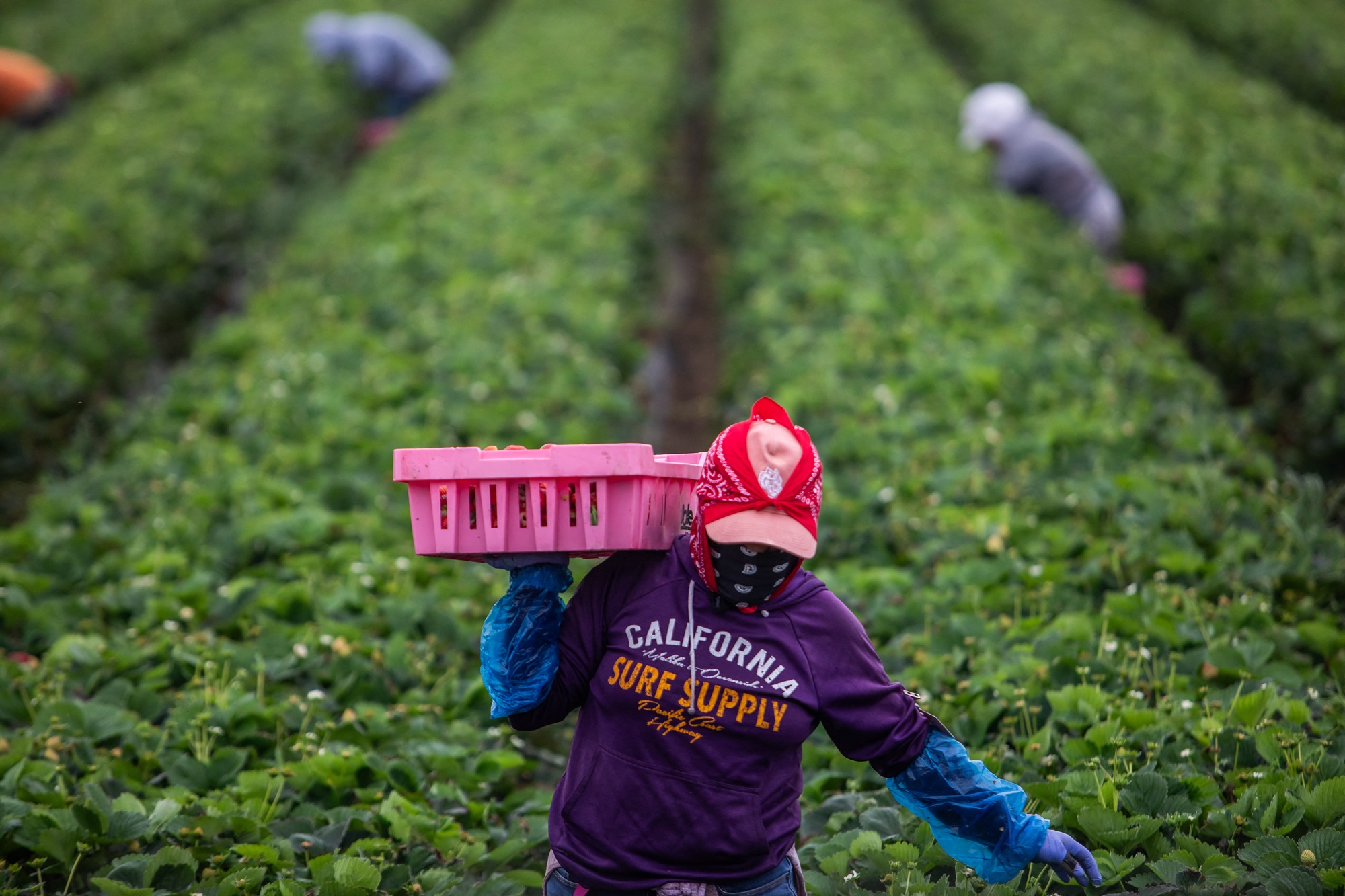
"caption": "A farmworker works in a strawberry field on June 12, 2025 in Oxnard, California. A new study by the Bay Area Council Economic Institute finds that undocumented immigrant workers contribute hundreds of billions of dollars in economic activity.",
"credit": "Apu Gomes/AFP via Getty Images",
"altTag": null,
"description": null,
"imgSizes": {
"thumbnail": {
"file": "https://cdn.kqed.org/wp-content/uploads/sites/10/2025/06/CaliforniaFarmworkersGetty-160x107.jpg",
"width": 160,
"height": 107,
"mimeType": "image/jpeg"
},
"1536x1536": {
"file": "https://cdn.kqed.org/wp-content/uploads/sites/10/2025/06/CaliforniaFarmworkersGetty-1536x1024.jpg",
"width": 1536,
"height": 1024,
"mimeType": "image/jpeg"
},
"post-thumbnail": {
"file": "https://cdn.kqed.org/wp-content/uploads/sites/10/2025/06/CaliforniaFarmworkersGetty-672x372.jpg",
"width": 672,
"height": 372,
"mimeType": "image/jpeg"
},
"twentyfourteen-full-width": {
"file": "https://cdn.kqed.org/wp-content/uploads/sites/10/2025/06/CaliforniaFarmworkersGetty-1038x576.jpg",
"width": 1038,
"height": 576,
"mimeType": "image/jpeg"
},
"kqedFullSize": {
"file": "https://cdn.kqed.org/wp-content/uploads/sites/10/2025/06/CaliforniaFarmworkersGetty.jpg",
"width": 2000,
"height": 1333
}
},
"isLoading": false,
"fetchFailed": false
},
"news_12039445": {
"type": "attachments",
"id": "news_12039445",
"meta": {
"index": "attachments_1716263798",
"site": "news",
"id": "12039445",
"found": true
},
"title": "US-ECONOMY-FARMS-AGRICULTURE",
"publishDate": 1746747442,
"status": "inherit",
"parent": 12039333,
"modified": 1746750539,
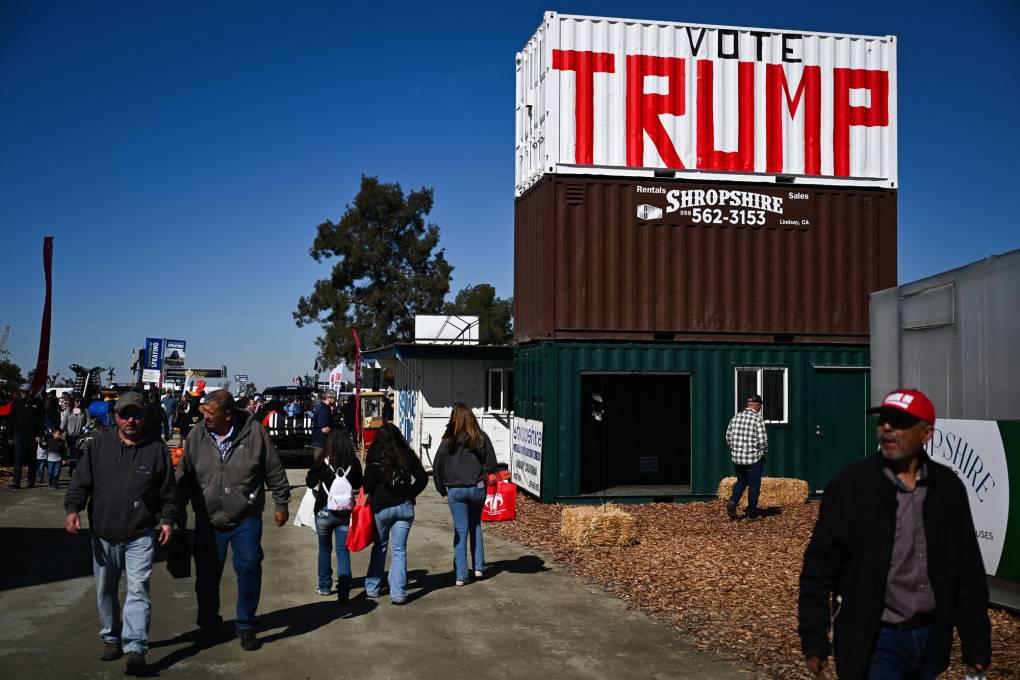
"caption": "A \"Vote Trump\" decorated cargo shipping container is displayed during the World Ag Expo at the International Agri-Center in Tulare, California, on Feb. 11, 2025. U.S. farmers have also been affected by the Trump administration's attempts to shut down the United States Agency for International Development (USAID), with the U.S. government previously spending billions of dollars on food aid from American farmers, while tariffs and trade wars threaten to disrupt business.",
"credit": "Patrick T. Fallon / AFP via Getty Images",
"altTag": null,
"description": null,
"imgSizes": {
"medium": {
"file": "https://cdn.kqed.org/wp-content/uploads/sites/10/2025/05/FarmersTrumpGetty-800x533.jpg",
"width": 800,
"height": 533,
"mimeType": "image/jpeg"
},
"large": {
"file": "https://cdn.kqed.org/wp-content/uploads/sites/10/2025/05/FarmersTrumpGetty-1020x680.jpg",
"width": 1020,
"height": 680,
"mimeType": "image/jpeg"
},
"thumbnail": {
"file": "https://cdn.kqed.org/wp-content/uploads/sites/10/2025/05/FarmersTrumpGetty-160x107.jpg",
"width": 160,
"height": 107,
"mimeType": "image/jpeg"
},
"1536x1536": {
"file": "https://cdn.kqed.org/wp-content/uploads/sites/10/2025/05/FarmersTrumpGetty-1536x1024.jpg",
"width": 1536,
"height": 1024,
"mimeType": "image/jpeg"
},
"post-thumbnail": {
"file": "https://cdn.kqed.org/wp-content/uploads/sites/10/2025/05/FarmersTrumpGetty-672x372.jpg",
"width": 672,
"height": 372,
"mimeType": "image/jpeg"
},
"twentyfourteen-full-width": {
"file": "https://cdn.kqed.org/wp-content/uploads/sites/10/2025/05/FarmersTrumpGetty-1038x576.jpg",
"width": 1038,
"height": 576,
"mimeType": "image/jpeg"
},
"full-width": {
"file": "https://cdn.kqed.org/wp-content/uploads/sites/10/2025/05/FarmersTrumpGetty-1920x1280.jpg",
"width": 1920,
"height": 1280,
"mimeType": "image/jpeg"
},
"kqedFullSize": {
"file": "https://cdn.kqed.org/wp-content/uploads/sites/10/2025/05/FarmersTrumpGetty.jpg",
"width": 2000,
"height": 1333
}
},
"isLoading": false,
"fetchFailed": false
},
"news_12037853": {
"type": "attachments",
"id": "news_12037853",
"meta": {
"index": "attachments_1716263798",
"site": "news",
"id": "12037853",
"found": true
},
"title": "041425-TALLEY-FARMS-JL-30 copy",
"publishDate": 1745696286,
"status": "inherit",
"parent": 12037850,
"modified": 1745696315,
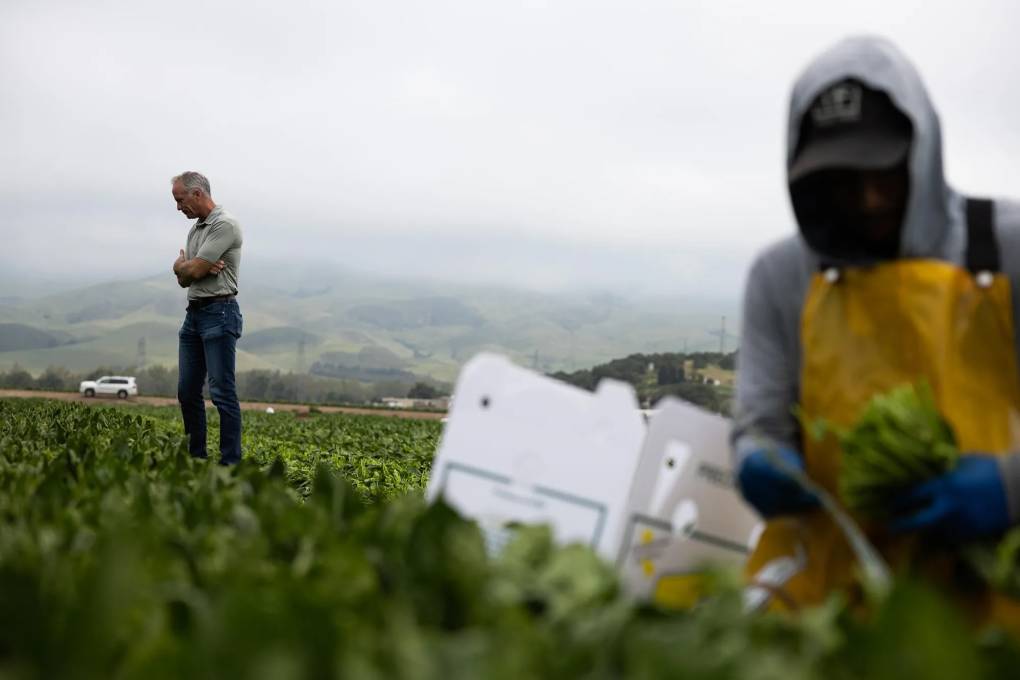
"caption": "Ryan Talley, vice-president and co-owner of Talley Farms, in Arroyo Grande on April 14, 2025. \n",
"credit": "Julie Leopo-Bermudez for CalMatters",
"altTag": null,
"description": null,
"imgSizes": {
"medium": {
"file": "https://cdn.kqed.org/wp-content/uploads/sites/10/2025/04/041425-TALLEY-FARMS-JL-30-copy-800x533.jpg",
"width": 800,
"height": 533,
"mimeType": "image/jpeg"
},
"large": {
"file": "https://cdn.kqed.org/wp-content/uploads/sites/10/2025/04/041425-TALLEY-FARMS-JL-30-copy-1020x680.jpg",
"width": 1020,
"height": 680,
"mimeType": "image/jpeg"
},
"thumbnail": {
"file": "https://cdn.kqed.org/wp-content/uploads/sites/10/2025/04/041425-TALLEY-FARMS-JL-30-copy-160x107.jpg",
"width": 160,
"height": 107,
"mimeType": "image/jpeg"
},
"1536x1536": {
"file": "https://cdn.kqed.org/wp-content/uploads/sites/10/2025/04/041425-TALLEY-FARMS-JL-30-copy-1536x1024.jpg",
"width": 1536,
"height": 1024,
"mimeType": "image/jpeg"
},
"post-thumbnail": {
"file": "https://cdn.kqed.org/wp-content/uploads/sites/10/2025/04/041425-TALLEY-FARMS-JL-30-copy-672x372.jpg",
"width": 672,
"height": 372,
"mimeType": "image/jpeg"
},
"twentyfourteen-full-width": {
"file": "https://cdn.kqed.org/wp-content/uploads/sites/10/2025/04/041425-TALLEY-FARMS-JL-30-copy-1038x576.jpg",
"width": 1038,
"height": 576,
"mimeType": "image/jpeg"
},
"full-width": {
"file": "https://cdn.kqed.org/wp-content/uploads/sites/10/2025/04/041425-TALLEY-FARMS-JL-30-copy-1920x1280.jpg",
"width": 1920,
"height": 1280,
"mimeType": "image/jpeg"
},
"kqedFullSize": {
"file": "https://cdn.kqed.org/wp-content/uploads/sites/10/2025/04/041425-TALLEY-FARMS-JL-30-copy.jpg",
"width": 2000,
"height": 1333
}
},
"isLoading": false,
"fetchFailed": false
},
"news_12036218": {
"type": "attachments",
"id": "news_12036218",
"meta": {
"index": "attachments_1716263798",
"site": "news",
"id": "12036218",
"found": true
},
"title": "Shipping containters at the Port of Oakland on March 6, 2025.",
"publishDate": 1744808974,
"status": "inherit",
"parent": 0,
"modified": 1745617952,
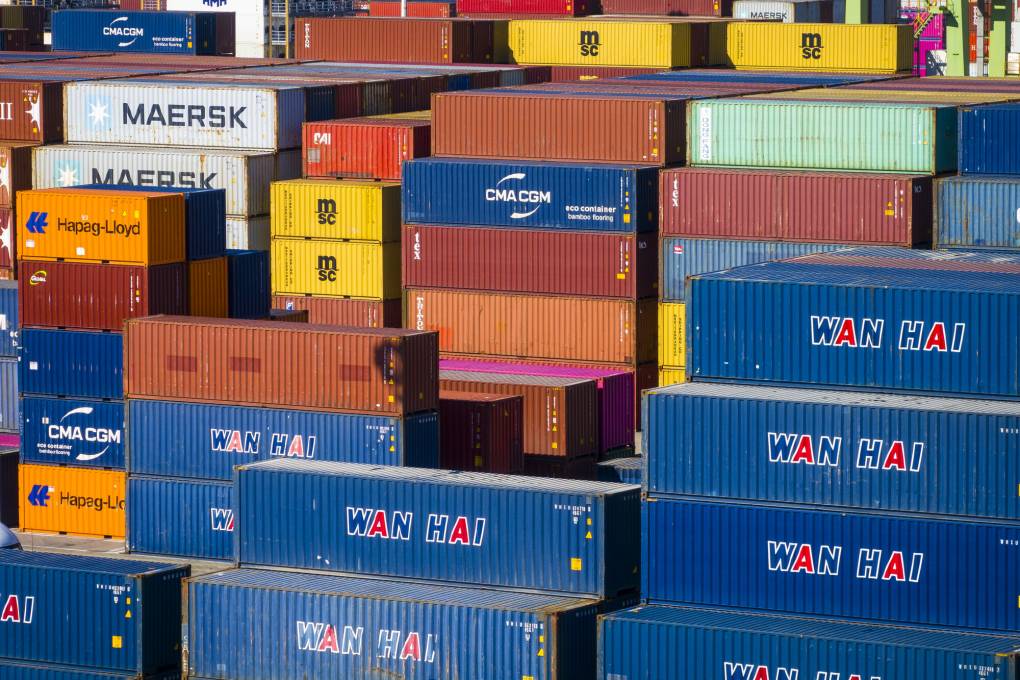
"caption": "Shipping containers at the Port of Oakland on March 6, 2025.",
"credit": "Martin do Nascimento/KQED",
"altTag": null,
"description": null,
"imgSizes": {
"medium": {
"file": "https://cdn.kqed.org/wp-content/uploads/sites/10/2025/04/250306-PORT-OF-OAKLAND-MD-02_qed-800x533.jpg",
"width": 800,
"height": 533,
"mimeType": "image/jpeg"
},
"large": {
"file": "https://cdn.kqed.org/wp-content/uploads/sites/10/2025/04/250306-PORT-OF-OAKLAND-MD-02_qed-1020x680.jpg",
"width": 1020,
"height": 680,
"mimeType": "image/jpeg"
},
"thumbnail": {
"file": "https://cdn.kqed.org/wp-content/uploads/sites/10/2025/04/250306-PORT-OF-OAKLAND-MD-02_qed-160x107.jpg",
"width": 160,
"height": 107,
"mimeType": "image/jpeg"
},
"1536x1536": {
"file": "https://cdn.kqed.org/wp-content/uploads/sites/10/2025/04/250306-PORT-OF-OAKLAND-MD-02_qed-1536x1024.jpg",
"width": 1536,
"height": 1024,
"mimeType": "image/jpeg"
},
"post-thumbnail": {
"file": "https://cdn.kqed.org/wp-content/uploads/sites/10/2025/04/250306-PORT-OF-OAKLAND-MD-02_qed-672x372.jpg",
"width": 672,
"height": 372,
"mimeType": "image/jpeg"
},
"twentyfourteen-full-width": {
"file": "https://cdn.kqed.org/wp-content/uploads/sites/10/2025/04/250306-PORT-OF-OAKLAND-MD-02_qed-1038x576.jpg",
"width": 1038,
"height": 576,
"mimeType": "image/jpeg"
},
"full-width": {
"file": "https://cdn.kqed.org/wp-content/uploads/sites/10/2025/04/250306-PORT-OF-OAKLAND-MD-02_qed-1920x1280.jpg",
"width": 1920,
"height": 1280,
"mimeType": "image/jpeg"
},
"kqedFullSize": {
"file": "https://cdn.kqed.org/wp-content/uploads/sites/10/2025/04/250306-PORT-OF-OAKLAND-MD-02_qed.jpg",
"width": 2000,
"height": 1333
}
},
"isLoading": false,
"fetchFailed": false
},
"news_12036053": {
"type": "attachments",
"id": "news_12036053",
"meta": {
"index": "attachments_1716263798",
"site": "news",
"id": "12036053",
"found": true
},
"title": "Bikes for sale at The New Wheel in San Francisco on April 15, 2025.",
"publishDate": 1744745086,
"status": "inherit",
"parent": 0,
"modified": 1744745235,
"caption": "Bikes for sale at The New Wheel in San Francisco on April 15, 2025.",
"credit": "Gina Castro/KQED",
"altTag": null,
"description": null,
"imgSizes": {
"medium": {
"file": "https://cdn.kqed.org/wp-content/uploads/sites/10/2025/04/20250415_BIKETARIFF_GC-3-KQED-800x533.jpg",
"width": 800,
"height": 533,
"mimeType": "image/jpeg"
},
"large": {
"file": "https://cdn.kqed.org/wp-content/uploads/sites/10/2025/04/20250415_BIKETARIFF_GC-3-KQED-1020x680.jpg",
"width": 1020,
"height": 680,
"mimeType": "image/jpeg"
},
"thumbnail": {
"file": "https://cdn.kqed.org/wp-content/uploads/sites/10/2025/04/20250415_BIKETARIFF_GC-3-KQED-160x107.jpg",
"width": 160,
"height": 107,
"mimeType": "image/jpeg"
},
"1536x1536": {
"file": "https://cdn.kqed.org/wp-content/uploads/sites/10/2025/04/20250415_BIKETARIFF_GC-3-KQED-1536x1024.jpg",
"width": 1536,
"height": 1024,
"mimeType": "image/jpeg"
},
"post-thumbnail": {
"file": "https://cdn.kqed.org/wp-content/uploads/sites/10/2025/04/20250415_BIKETARIFF_GC-3-KQED-672x372.jpg",
"width": 672,
"height": 372,
"mimeType": "image/jpeg"
},
"twentyfourteen-full-width": {
"file": "https://cdn.kqed.org/wp-content/uploads/sites/10/2025/04/20250415_BIKETARIFF_GC-3-KQED-1038x576.jpg",
"width": 1038,
"height": 576,
"mimeType": "image/jpeg"
},
"full-width": {
"file": "https://cdn.kqed.org/wp-content/uploads/sites/10/2025/04/20250415_BIKETARIFF_GC-3-KQED-1920x1280.jpg",
"width": 1920,
"height": 1280,
"mimeType": "image/jpeg"
},
"kqedFullSize": {
"file": "https://cdn.kqed.org/wp-content/uploads/sites/10/2025/04/20250415_BIKETARIFF_GC-3-KQED.jpg",
"width": 2000,
"height": 1333
}
},
"isLoading": false,
"fetchFailed": false
},
"news_12034833": {
"type": "attachments",
"id": "news_12034833",
"meta": {
"index": "attachments_1716263798",
"site": "news",
"id": "12034833",
"found": true
},
"title": "250407-TARIFFSBAYAREASMALLBIZ-05-BL_QED-KQED",
"publishDate": 1744072380,
"status": "inherit",
"parent": 0,
"modified": 1744072447,
"caption": "Taylor Peliska, a bicycle mechanic, stands in the doorway at King Kog Bicycle Shop in Oakland on April 7, 2025.",
"credit": "Beth LaBerge/KQED",
"altTag": null,
"description": null,
"imgSizes": {
"medium": {
"file": "https://cdn.kqed.org/wp-content/uploads/sites/10/2025/04/250407-TARIFFSBAYAREASMALLBIZ-05-BL_QED-KQED-800x533.jpg",
"width": 800,
"height": 533,
"mimeType": "image/jpeg"
},
"large": {
"file": "https://cdn.kqed.org/wp-content/uploads/sites/10/2025/04/250407-TARIFFSBAYAREASMALLBIZ-05-BL_QED-KQED-1020x680.jpg",
"width": 1020,
"height": 680,
"mimeType": "image/jpeg"
},
"thumbnail": {
"file": "https://cdn.kqed.org/wp-content/uploads/sites/10/2025/04/250407-TARIFFSBAYAREASMALLBIZ-05-BL_QED-KQED-160x107.jpg",
"width": 160,
"height": 107,
"mimeType": "image/jpeg"
},
"1536x1536": {
"file": "https://cdn.kqed.org/wp-content/uploads/sites/10/2025/04/250407-TARIFFSBAYAREASMALLBIZ-05-BL_QED-KQED-1536x1024.jpg",
"width": 1536,
"height": 1024,
"mimeType": "image/jpeg"
},
"post-thumbnail": {
"file": "https://cdn.kqed.org/wp-content/uploads/sites/10/2025/04/250407-TARIFFSBAYAREASMALLBIZ-05-BL_QED-KQED-672x372.jpg",
"width": 672,
"height": 372,
"mimeType": "image/jpeg"
},
"twentyfourteen-full-width": {
"file": "https://cdn.kqed.org/wp-content/uploads/sites/10/2025/04/250407-TARIFFSBAYAREASMALLBIZ-05-BL_QED-KQED-1038x576.jpg",
"width": 1038,
"height": 576,
"mimeType": "image/jpeg"
},
"full-width": {
"file": "https://cdn.kqed.org/wp-content/uploads/sites/10/2025/04/250407-TARIFFSBAYAREASMALLBIZ-05-BL_QED-KQED-1920x1280.jpg",
"width": 1920,
"height": 1280,
"mimeType": "image/jpeg"
},
"kqedFullSize": {
"file": "https://cdn.kqed.org/wp-content/uploads/sites/10/2025/04/250407-TARIFFSBAYAREASMALLBIZ-05-BL_QED-KQED.jpg",
"width": 2000,
"height": 1333
}
},
"isLoading": false,
"fetchFailed": false
},
"news_12009337": {
"type": "attachments",
"id": "news_12009337",
"meta": {
"index": "attachments_1716263798",
"site": "news",
"id": "12009337",
"found": true
},
"title": "California Budget",
"publishDate": 1728925641,
"status": "inherit",
"parent": 12009333,
"modified": 1728950262,
"caption": "California Gov. Gavin Newsom answers a reporter's question about his revised 2024–25 state budget during a news conference in Sacramento on May 10, 2024.",
"credit": "Rich Pedroncelli/AP Photo",
"altTag": null,
"description": null,
"imgSizes": {
"medium": {
"file": "https://cdn.kqed.org/wp-content/uploads/sites/10/2024/10/GavinNewsom2024AP-800x533.jpg",
"width": 800,
"height": 533,
"mimeType": "image/jpeg"
},
"large": {
"file": "https://cdn.kqed.org/wp-content/uploads/sites/10/2024/10/GavinNewsom2024AP-1020x680.jpg",
"width": 1020,
"height": 680,
"mimeType": "image/jpeg"
},
"thumbnail": {
"file": "https://cdn.kqed.org/wp-content/uploads/sites/10/2024/10/GavinNewsom2024AP-160x107.jpg",
"width": 160,
"height": 107,
"mimeType": "image/jpeg"
},
"1536x1536": {
"file": "https://cdn.kqed.org/wp-content/uploads/sites/10/2024/10/GavinNewsom2024AP-1536x1024.jpg",
"width": 1536,
"height": 1024,
"mimeType": "image/jpeg"
},
"post-thumbnail": {
"file": "https://cdn.kqed.org/wp-content/uploads/sites/10/2024/10/GavinNewsom2024AP-672x372.jpg",
"width": 672,
"height": 372,
"mimeType": "image/jpeg"
},
"twentyfourteen-full-width": {
"file": "https://cdn.kqed.org/wp-content/uploads/sites/10/2024/10/GavinNewsom2024AP-1038x576.jpg",
"width": 1038,
"height": 576,
"mimeType": "image/jpeg"
},
"full-width": {
"file": "https://cdn.kqed.org/wp-content/uploads/sites/10/2024/10/GavinNewsom2024AP-1920x1280.jpg",
"width": 1920,
"height": 1280,
"mimeType": "image/jpeg"
},
"kqedFullSize": {
"file": "https://cdn.kqed.org/wp-content/uploads/sites/10/2024/10/GavinNewsom2024AP.jpg",
"width": 2000,
"height": 1333
}
},
"isLoading": false,
"fetchFailed": false
},
"news_12007587": {
"type": "attachments",
"id": "news_12007587",
"meta": {
"index": "attachments_1716263798",
"site": "news",
"id": "12007587",
"found": true
},
"title": "100124-NVIDIA-CORPORATE-TAXES-GH-CM copy",
"publishDate": 1727907779,
"status": "inherit",
"parent": 12007585,
"modified": 1727907798,
"caption": null,
"credit": "Illustration by Gabriel Hongsdusit/CalMatters",
"altTag": null,
"description": null,
"imgSizes": {
"medium": {
"file": "https://cdn.kqed.org/wp-content/uploads/sites/10/2024/10/100124-NVIDIA-CORPORATE-TAXES-GH-CM-copy-800x533.jpg",
"width": 800,
"height": 533,
"mimeType": "image/jpeg"
},
"large": {
"file": "https://cdn.kqed.org/wp-content/uploads/sites/10/2024/10/100124-NVIDIA-CORPORATE-TAXES-GH-CM-copy-1020x680.jpg",
"width": 1020,
"height": 680,
"mimeType": "image/jpeg"
},
"thumbnail": {
"file": "https://cdn.kqed.org/wp-content/uploads/sites/10/2024/10/100124-NVIDIA-CORPORATE-TAXES-GH-CM-copy-160x107.jpg",
"width": 160,
"height": 107,
"mimeType": "image/jpeg"
},
"1536x1536": {
"file": "https://cdn.kqed.org/wp-content/uploads/sites/10/2024/10/100124-NVIDIA-CORPORATE-TAXES-GH-CM-copy-1536x1024.jpg",
"width": 1536,
"height": 1024,
"mimeType": "image/jpeg"
},
"post-thumbnail": {
"file": "https://cdn.kqed.org/wp-content/uploads/sites/10/2024/10/100124-NVIDIA-CORPORATE-TAXES-GH-CM-copy-672x372.jpg",
"width": 672,
"height": 372,
"mimeType": "image/jpeg"
},
"twentyfourteen-full-width": {
"file": "https://cdn.kqed.org/wp-content/uploads/sites/10/2024/10/100124-NVIDIA-CORPORATE-TAXES-GH-CM-copy-1038x576.jpg",
"width": 1038,
"height": 576,
"mimeType": "image/jpeg"
},
"full-width": {
"file": "https://cdn.kqed.org/wp-content/uploads/sites/10/2024/10/100124-NVIDIA-CORPORATE-TAXES-GH-CM-copy-1920x1280.jpg",
"width": 1920,
"height": 1280,
"mimeType": "image/jpeg"
},
"kqedFullSize": {
"file": "https://cdn.kqed.org/wp-content/uploads/sites/10/2024/10/100124-NVIDIA-CORPORATE-TAXES-GH-CM-copy.jpg",
"width": 2000,
"height": 1333
}
},
"isLoading": false,
"fetchFailed": false
},
"news_10343263": {
"type": "attachments",
"id": "news_10343263",
"meta": {
"index": "attachments_1716263798",
"site": "news",
"id": "10343263",
"found": true
},
"title": "RS5929_008-lpr",
"publishDate": 1412969141,
"status": "inherit",
"parent": 0,
"modified": 1722618429,
"caption": "The Chevron Oil Refinery in Richmond. ",
"credit": "Deborah Svoboda/KQED",
"altTag": null,
"description": null,
"imgSizes": {
"thumbnail": {
"file": "https://cdn.kqed.org/wp-content/uploads/sites/10/2014/10/RS5929_008-lpr-400x266.jpg",
"width": 400,
"height": 266,
"mimeType": "image/jpeg"
},
"medium": {
"file": "https://cdn.kqed.org/wp-content/uploads/sites/10/2014/10/RS5929_008-lpr-800x533.jpg",
"width": 800,
"height": 533,
"mimeType": "image/jpeg"
},
"large": {
"file": "https://cdn.kqed.org/wp-content/uploads/sites/10/2014/10/RS5929_008-lpr-1440x960.jpg",
"width": 1440,
"height": 960,
"mimeType": "image/jpeg"
},
"post-thumbnail": {
"file": "https://cdn.kqed.org/wp-content/uploads/sites/10/2014/10/RS5929_008-lpr-672x372.jpg",
"width": 672,
"height": 372,
"mimeType": "image/jpeg"
},
"twentyfourteen-full-width": {
"file": "https://cdn.kqed.org/wp-content/uploads/sites/10/2014/10/RS5929_008-lpr-1038x576.jpg",
"width": 1038,
"height": 576,
"mimeType": "image/jpeg"
},
"guest-author-32": {
"file": "https://cdn.kqed.org/wp-content/uploads/sites/10/2014/10/RS5929_008-lpr-32x32.jpg",
"width": 32,
"height": 32,
"mimeType": "image/jpeg"
},
"guest-author-64": {
"file": "https://cdn.kqed.org/wp-content/uploads/sites/10/2014/10/RS5929_008-lpr-64x64.jpg",
"width": 64,
"height": 64,
"mimeType": "image/jpeg"
},
"guest-author-96": {
"file": "https://cdn.kqed.org/wp-content/uploads/sites/10/2014/10/RS5929_008-lpr-96x96.jpg",
"width": 96,
"height": 96,
"mimeType": "image/jpeg"
},
"guest-author-128": {
"file": "https://cdn.kqed.org/wp-content/uploads/sites/10/2014/10/RS5929_008-lpr-128x128.jpg",
"width": 128,
"height": 128,
"mimeType": "image/jpeg"
},
"detail": {
"file": "https://cdn.kqed.org/wp-content/uploads/sites/10/2014/10/RS5929_008-lpr-75x75.jpg",
"width": 75,
"height": 75,
"mimeType": "image/jpeg"
},
"kqedFullSize": {
"file": "https://cdn.kqed.org/wp-content/uploads/sites/10/2014/10/RS5929_008-lpr.jpg",
"width": 2000,
"height": 1334
}
},
"isLoading": false,
"fetchFailed": false
},
"news_11978395": {
"type": "attachments",
"id": "news_11978395",
"meta": {
"index": "attachments_1716263798",
"site": "news",
"id": "11978395",
"found": true
},
"parent": 11978394,
"imgSizes": {
"twentyfourteen-full-width": {
"file": "https://cdn.kqed.org/wp-content/uploads/sites/10/2024/03/CMInflation01-1038x576.jpg",
"width": 1038,
"mimeType": "image/jpeg",
"height": 576
},
"thumbnail": {
"file": "https://cdn.kqed.org/wp-content/uploads/sites/10/2024/03/CMInflation01-160x107.jpg",
"width": 160,
"mimeType": "image/jpeg",
"height": 107
},
"post-thumbnail": {
"file": "https://cdn.kqed.org/wp-content/uploads/sites/10/2024/03/CMInflation01-672x372.jpg",
"width": 672,
"mimeType": "image/jpeg",
"height": 372
},
"kqedFullSize": {
"file": "https://cdn.kqed.org/wp-content/uploads/sites/10/2024/03/CMInflation01.jpg",
"width": 2000,
"height": 1334
},
"large": {
"file": "https://cdn.kqed.org/wp-content/uploads/sites/10/2024/03/CMInflation01-1020x680.jpg",
"width": 1020,
"mimeType": "image/jpeg",
"height": 680
},
"1536x1536": {
"file": "https://cdn.kqed.org/wp-content/uploads/sites/10/2024/03/CMInflation01-1536x1025.jpg",
"width": 1536,
"mimeType": "image/jpeg",
"height": 1025
},
"full-width": {
"file": "https://cdn.kqed.org/wp-content/uploads/sites/10/2024/03/CMInflation01-1920x1281.jpg",
"width": 1920,
"mimeType": "image/jpeg",
"height": 1281
},
"medium": {
"file": "https://cdn.kqed.org/wp-content/uploads/sites/10/2024/03/CMInflation01-800x534.jpg",
"width": 800,
"mimeType": "image/jpeg",
"height": 534
}
},
"publishDate": 1709747889,
"modified": 1709757972,
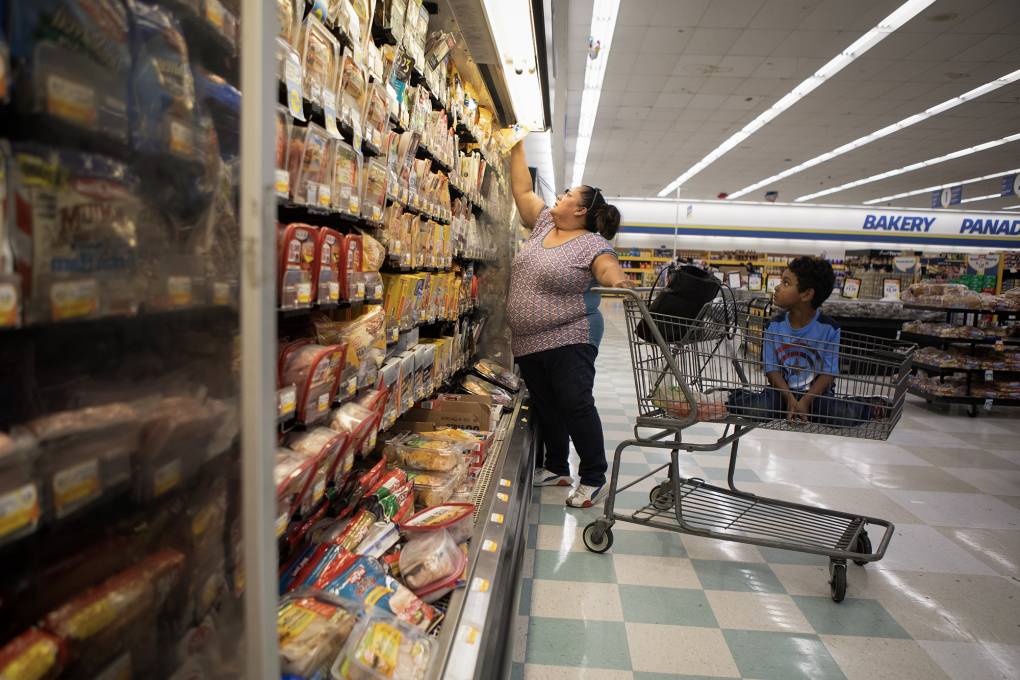
"caption": "Antionette Martinez and her son Caden, 5, do their biweekly grocery shop at FoodMaxx on July 26, 2019.",
"description": null,
"title": "CMInflation01",
"credit": "Anne Wernikoff/CalMatters",
"status": "inherit",
"altTag": "A woman reaches for an item on the top shelf at a grocery store beside a shopping cart with a child sitting in it.",
"isLoading": false,
"fetchFailed": false
},
"news_11972314": {
"type": "attachments",
"id": "news_11972314",
"meta": {
"index": "attachments_1716263798",
"site": "news",
"id": "11972314",
"found": true
},
"parent": 11972309,
"imgSizes": {
"twentyfourteen-full-width": {
"file": "https://cdn.kqed.org/wp-content/uploads/sites/10/2024/01/CMTech01-1038x576.jpg",
"width": 1038,
"mimeType": "image/jpeg",
"height": 576
},
"thumbnail": {
"file": "https://cdn.kqed.org/wp-content/uploads/sites/10/2024/01/CMTech01-160x107.jpg",
"width": 160,
"mimeType": "image/jpeg",
"height": 107
},
"post-thumbnail": {
"file": "https://cdn.kqed.org/wp-content/uploads/sites/10/2024/01/CMTech01-672x372.jpg",
"width": 672,
"mimeType": "image/jpeg",
"height": 372
},
"kqedFullSize": {
"file": "https://cdn.kqed.org/wp-content/uploads/sites/10/2024/01/CMTech01.jpg",
"width": 2000,
"height": 1333
},
"large": {
"file": "https://cdn.kqed.org/wp-content/uploads/sites/10/2024/01/CMTech01-1020x680.jpg",
"width": 1020,
"mimeType": "image/jpeg",
"height": 680
},
"1536x1536": {
"file": "https://cdn.kqed.org/wp-content/uploads/sites/10/2024/01/CMTech01-1536x1024.jpg",
"width": 1536,
"mimeType": "image/jpeg",
"height": 1024
},
"full-width": {
"file": "https://cdn.kqed.org/wp-content/uploads/sites/10/2024/01/CMTech01-1920x1280.jpg",
"width": 1920,
"mimeType": "image/jpeg",
"height": 1280
},
"medium": {
"file": "https://cdn.kqed.org/wp-content/uploads/sites/10/2024/01/CMTech01-800x533.jpg",
"width": 800,
"mimeType": "image/jpeg",
"height": 533
}
},
"publishDate": 1704996061,
"modified": 1704996229,
"caption": null,
"description": null,
"title": "CMTech01",
"credit": "Miguel Gutierrez Jr./CalMatters/iStock",
"status": "inherit",
"altTag": "A graphic illustration of a capitol building with tech company logos floating around it.",
"isLoading": false,
"fetchFailed": false
},
"news_11967054": {
"type": "attachments",
"id": "news_11967054",
"meta": {
"index": "attachments_1716263798",
"site": "news",
"id": "11967054",
"found": true
},
"parent": 11967053,
"imgSizes": {
"twentyfourteen-full-width": {
"file": "https://ww2.kqed.org/app/uploads/sites/10/2023/11/011022_SICK-LEAVE_LN_REUTERS_CM_01-copy-1038x576.jpg",
"width": 1038,
"mimeType": "image/jpeg",
"height": 576
},
"thumbnail": {
"file": "https://ww2.kqed.org/app/uploads/sites/10/2023/11/011022_SICK-LEAVE_LN_REUTERS_CM_01-copy-160x107.jpg",
"width": 160,
"mimeType": "image/jpeg",
"height": 107
},
"post-thumbnail": {
"file": "https://ww2.kqed.org/app/uploads/sites/10/2023/11/011022_SICK-LEAVE_LN_REUTERS_CM_01-copy-672x372.jpg",
"width": 672,
"mimeType": "image/jpeg",
"height": 372
},
"kqedFullSize": {
"file": "https://ww2.kqed.org/app/uploads/sites/10/2023/11/011022_SICK-LEAVE_LN_REUTERS_CM_01-copy.jpg",
"width": 2000,
"height": 1334
},
"large": {
"file": "https://ww2.kqed.org/app/uploads/sites/10/2023/11/011022_SICK-LEAVE_LN_REUTERS_CM_01-copy-1020x680.jpg",
"width": 1020,
"mimeType": "image/jpeg",
"height": 680
},
"1536x1536": {
"file": "https://ww2.kqed.org/app/uploads/sites/10/2023/11/011022_SICK-LEAVE_LN_REUTERS_CM_01-copy-1536x1025.jpg",
"width": 1536,
"mimeType": "image/jpeg",
"height": 1025
},
"full-width": {
"file": "https://ww2.kqed.org/app/uploads/sites/10/2023/11/011022_SICK-LEAVE_LN_REUTERS_CM_01-copy-1920x1281.jpg",
"width": 1920,
"mimeType": "image/jpeg",
"height": 1281
},
"medium": {
"file": "https://ww2.kqed.org/app/uploads/sites/10/2023/11/011022_SICK-LEAVE_LN_REUTERS_CM_01-copy-800x534.jpg",
"width": 800,
"mimeType": "image/jpeg",
"height": 534
}
},
"publishDate": 1699729421,
"modified": 1699729477,
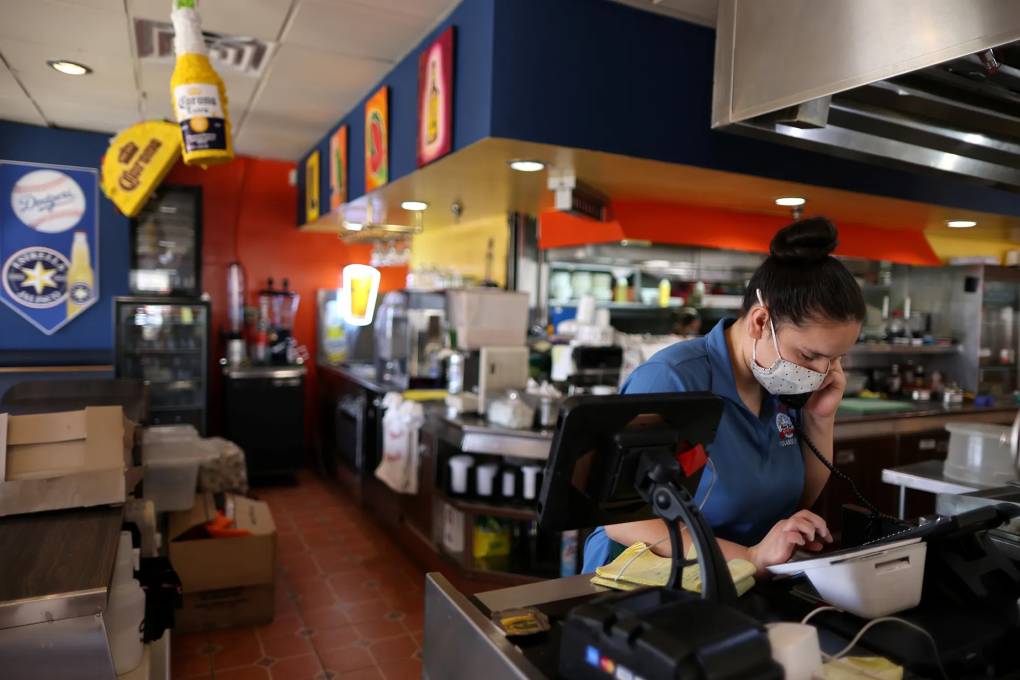
"caption": "Alexis Reyna, 20, works at Chalio Mexican Restaurant in East Los Angeles on May 26, 2021.",
"description": null,
"title": "011022_SICK-LEAVE_LN_REUTERS_CM_01 copy",
"credit": "Lucy Nicholson/Reuters",
"status": "inherit",
"altTag": "A young woman works behind the counter at a restaurant.",
"isLoading": false,
"fetchFailed": false
}
},
"audioPlayerReducer": {
"postId": "stream_live",
"isPaused": true,
"isPlaying": false,
"pfsActive": false,
"pledgeModalIsOpen": true,
"playerDrawerIsOpen": false,
"liveAudioPlayStartedAt": 0,
"liveAudioPlayContext": ""
},
"authorsReducer": {
"byline_news_12037850": {
"type": "authors",
"id": "byline_news_12037850",
"meta": {
"override": true
},
"slug": "byline_news_12037850",
"name": "\u003ca href=\"https://calmatters.org/author/levi-sumagaysay/\">Levi Sumagaysay\u003c/a>, CalMatters",
"isLoading": false
},
"byline_news_12007585": {
"type": "authors",
"id": "byline_news_12007585",
"meta": {
"override": true
},
"slug": "byline_news_12007585",
"name": "\u003ca href=\"https://calmatters.org/author/levi-sumagaysay/\">Levi Sumagaysay\u003c/a>, CalMatters",
"isLoading": false
},
"byline_news_11978394": {
"type": "authors",
"id": "byline_news_11978394",
"meta": {
"override": true
},
"slug": "byline_news_11978394",
"name": "\u003ca href=\"https://calmatters.org/author/levi-sumagaysay/\">Levi Sumagaysay\u003c/a>",
"isLoading": false
},
"byline_news_11972309": {
"type": "authors",
"id": "byline_news_11972309",
"meta": {
"override": true
},
"slug": "byline_news_11972309",
"name": "\u003ca href=\"https://calmatters.org/author/levi-sumagaysay/\">Levi Sumagaysay\u003c/a>",
"isLoading": false
},
"byline_news_11967053": {
"type": "authors",
"id": "byline_news_11967053",
"meta": {
"override": true
},
"slug": "byline_news_11967053",
"name": "\u003ca href=\"https://calmatters.org/author/alejandra-reyesvelarde/\">Alejandra Reyes-Velarde\u003c/a>",
"isLoading": false
},
"agonzalez": {
"type": "authors",
"id": "11724",
"meta": {
"index": "authors_1716337520",
"id": "11724",
"found": true
},
"name": "Alexander Gonzalez",
"firstName": "Alexander",
"lastName": "Gonzalez",
"slug": "agonzalez",
"email": "AlexanderGonzalez@KQED.org",
"display_author_email": false,
"staff_mastheads": [
"news"
],
"title": "KQED Contributor",
"bio": null,
"avatar": "https://secure.gravatar.com/avatar/9e291ed34e154df4c662edf858b641d70b4859939bfe40be478408f9dfd057d2?s=600&d=blank&r=g",
"twitter": null,
"bluesky": null,
"facebook": null,
"instagram": null,
"linkedin": null,
"sites": [
{
"site": "arts",
"roles": [
"editor"
]
},
{
"site": "news",
"roles": [
"editor"
]
},
{
"site": "science",
"roles": [
"editor"
]
}
],
"headData": {
"title": "Alexander Gonzalez | KQED",
"description": "KQED Contributor",
"ogImgSrc": "https://secure.gravatar.com/avatar/9e291ed34e154df4c662edf858b641d70b4859939bfe40be478408f9dfd057d2?s=600&d=blank&r=g",
"twImgSrc": "https://secure.gravatar.com/avatar/9e291ed34e154df4c662edf858b641d70b4859939bfe40be478408f9dfd057d2?s=600&d=blank&r=g"
},
"isLoading": false,
"link": "/author/agonzalez"
},
"jlara": {
"type": "authors",
"id": "11761",
"meta": {
"index": "authors_1716337520",
"id": "11761",
"found": true
},
"name": "Juan Carlos Lara",
"firstName": "Juan Carlos",
"lastName": "Lara",
"slug": "jlara",
"email": "jlara@kqed.org",
"display_author_email": false,
"staff_mastheads": [],
"title": "KQED Contributor",
"bio": null,
"avatar": "https://secure.gravatar.com/avatar/19e2052b9b05657c5ff2af2121846e9c?s=600&d=blank&r=g",
"twitter": null,
"facebook": null,
"instagram": null,
"linkedin": null,
"sites": [
{
"site": "arts",
"roles": [
"editor"
]
},
{
"site": "news",
"roles": [
"editor"
]
},
{
"site": "forum",
"roles": [
"editor"
]
},
{
"site": "liveblog",
"roles": [
"contributor"
]
}
],
"headData": {
"title": "Juan Carlos Lara | KQED",
"description": "KQED Contributor",
"ogImgSrc": "https://secure.gravatar.com/avatar/19e2052b9b05657c5ff2af2121846e9c?s=600&d=blank&r=g",
"twImgSrc": "https://secure.gravatar.com/avatar/19e2052b9b05657c5ff2af2121846e9c?s=600&d=blank&r=g"
},
"isLoading": false,
"link": "/author/jlara"
},
"adahlstromeckman": {
"type": "authors",
"id": "11785",
"meta": {
"index": "authors_1716337520",
"id": "11785",
"found": true
},
"name": "Azul Dahlstrom-Eckman",
"firstName": "Azul",
"lastName": "Dahlstrom-Eckman",
"slug": "adahlstromeckman",
"email": "adahlstrom-eckman@kqed.org",
"display_author_email": true,
"staff_mastheads": [],
"title": "Reporter",
"bio": "Azul is a reporter for KQED focusing on transportation and features. He joined KQED in 2021 as an alumna of KALW's Audio Academy radio journalism training program.",
"avatar": "https://secure.gravatar.com/avatar/9cb750298435add7815a777f55bf1f46845c1386bb8452555c60a7b820b5aba3?s=600&d=blank&r=g",
"twitter": "@zuliemann",
"bluesky": "@azul415.bsky.social",
"facebook": null,
"instagram": null,
"linkedin": null,
"sites": [
{
"site": "arts",
"roles": [
"editor"
]
},
{
"site": "news",
"roles": [
"editor"
]
},
{
"site": "science",
"roles": [
"editor"
]
},
{
"site": "liveblog",
"roles": [
"author"
]
}
],
"headData": {
"title": "Azul Dahlstrom-Eckman | KQED",
"description": "Reporter",
"ogImgSrc": "https://secure.gravatar.com/avatar/9cb750298435add7815a777f55bf1f46845c1386bb8452555c60a7b820b5aba3?s=600&d=blank&r=g",
"twImgSrc": "https://secure.gravatar.com/avatar/9cb750298435add7815a777f55bf1f46845c1386bb8452555c60a7b820b5aba3?s=600&d=blank&r=g"
},
"isLoading": false,
"link": "/author/adahlstromeckman"
},
"kdebenedetti": {
"type": "authors",
"id": "11913",
"meta": {
"index": "authors_1716337520",
"id": "11913",
"found": true
},
"name": "Katie DeBenedetti",
"firstName": "Katie",
"lastName": "DeBenedetti",
"slug": "kdebenedetti",
"email": "kdebenedetti@kqed.org",
"display_author_email": false,
"staff_mastheads": [
"news",
"science"
],
"title": "KQED Contributor",
"bio": "Katie DeBenedetti is a digital reporter covering daily news for the Express Desk. Prior to joining KQED as a culture reporting intern in January 2024, she covered education and city government for the Napa Valley Register.",
"avatar": "https://secure.gravatar.com/avatar/6e31073cb8f7e4214ab03f42771d0f45?s=600&d=blank&r=g",
"twitter": null,
"facebook": null,
"instagram": null,
"linkedin": null,
"sites": [
{
"site": "news",
"roles": [
"author"
]
},
{
"site": "science",
"roles": [
"author"
]
},
{
"site": "liveblog",
"roles": [
"author"
]
}
],
"headData": {
"title": "Katie DeBenedetti | KQED",
"description": "KQED Contributor",
"ogImgSrc": "https://secure.gravatar.com/avatar/6e31073cb8f7e4214ab03f42771d0f45?s=600&d=blank&r=g",
"twImgSrc": "https://secure.gravatar.com/avatar/6e31073cb8f7e4214ab03f42771d0f45?s=600&d=blank&r=g"
},
"isLoading": false,
"link": "/author/kdebenedetti"
},
"slim": {
"type": "authors",
"id": "11920",
"meta": {
"index": "authors_1716337520",
"id": "11920",
"found": true
},
"name": "Samantha Lim",
"firstName": "Samantha",
"lastName": "Lim",
"slug": "slim",
"email": "slim@KQED.org",
"display_author_email": false,
"staff_mastheads": [],
"title": "KQED Contributor",
"bio": null,
"avatar": "https://secure.gravatar.com/avatar/82e592e6c15fe1a04d385e8ad0fb0b4e?s=600&d=blank&r=g",
"twitter": null,
"facebook": null,
"instagram": null,
"linkedin": null,
"sites": [
{
"site": "news",
"roles": []
}
],
"headData": {
"title": "Samantha Lim | KQED",
"description": "KQED Contributor",
"ogImgSrc": "https://secure.gravatar.com/avatar/82e592e6c15fe1a04d385e8ad0fb0b4e?s=600&d=blank&r=g",
"twImgSrc": "https://secure.gravatar.com/avatar/82e592e6c15fe1a04d385e8ad0fb0b4e?s=600&d=blank&r=g"
},
"isLoading": false,
"link": "/author/slim"
}
},
"pagesReducer": {
"news_tag_california-economy": {
"type": "terms",
"id": "news_3651",
"meta": {
"index": "terms_1716263798",
"site": "news",
"id": "3651",
"score": 10.403188
},
"featImg": null,
"name": "California economy",
"description": null,
"taxonomy": "tag",
"headData": {
"twImgId": null,
"twTitle": null,
"ogTitle": null,
"ogImgId": null,
"twDescription": null,
"description": null,
"title": "California economy Archives | KQED News",
"ogDescription": null
},
"ttid": 3669,
"slug": "california-economy",
"isLoading": false,
"title": "California economy",
"pageMeta": {
"site": "news",
"WpPageTemplate": "page-topic-editorial",
"currentPage": 4
},
"blocks": [
{
"blockName": "kqed/post-list",
"attrs": {
"layout": "cardArticle2",
"query": "posts/news?tag=california-economy",
"seeMore": false,
"paginated": true,
"page": 4
}
},
{
"blockName": "kqed/ad"
}
]
}
},
"pfsSessionReducer": {},
"postsReducer": {
"stream_live": {
"type": "live",
"id": "stream_live",
"audioUrl": "https://streams.kqed.org/kqedradio",
"title": "Live Stream",
"excerpt": "Live Stream information currently unavailable.",
"link": "/radio",
"featImg": "",
"label": {
"name": "KQED Live",
"link": "/"
}
},
"stream_kqedNewscast": {
"type": "posts",
"id": "stream_kqedNewscast",
"audioUrl": "https://www.kqed.org/.stream/anon/radio/RDnews/newscast.mp3?_=1",
"title": "KQED Newscast",
"featImg": "",
"label": {
"name": "88.5 FM",
"link": "/"
}
},
"news_12044748": {
"type": "posts",
"id": "news_12044748",
"meta": {
"index": "posts_1716263798",
"site": "news",
"id": "12044748",
"score": null,
"sort": [
1750197090000
]
},
"guestAuthors": [],
"slug": "mass-deportations-would-take-a-major-toll-on-california-economy-report-finds",
"title": "Mass Deportations Would Take a Major Toll on California Economy, Report Finds",
"publishDate": 1750197090,
"format": "standard",
"headTitle": "Mass Deportations Would Take a Major Toll on California Economy, Report Finds | KQED",
"labelTerm": {
"site": "news"
},
"content": "\u003cp>As the federal government continues to crack down on immigration, a new report by the Bay Area Council Economic Institute suggests that \u003ca href=\"https://www.kqed.org/news/tag/mass-deportations\">mass deportations\u003c/a> pose a significant threat to California’s economy.\u003c/p>\n\u003cp>The \u003ca href=\"https://www.bayareaeconomy.org/report/economic-impact-of-mass-deportation-in-california/https:/www.bayareaeconomy.org/report/economic-impact-of-mass-deportation-in-california/\">study\u003c/a> released Tuesday details the degree to which immigrants are critical to the state’s economic health. Undocumented residents make up 8% of the California workforce, according to the report, which found that federal policies focused on deportations could cost the state’s gross domestic product output $275 billion in wages and “other direct and indirect economic activity.”\u003c/p>\n\u003cp>“This pretty astronomical amount really surprised us. We knew it would be big, but I don’t think we realized how far-reaching the role undocumented workers play in sustaining the economy in California would be,” said Abby Raisz, research director at the Economic Institute and an author of the report.\u003c/p>\n\u003cp>[ad fullwidth]\u003c/p>\n\u003cp>The scale of the worst-case deportation scenario is so significant that it would drop California’s global economic ranking two places, putting the state behind the United Kingdom and India, according to the study.\u003c/p>\n\u003cp>The findings point to several industries, such as construction and agriculture, that would suffer greatly from a dramatic drop in immigrant workers. Without undocumented labor, GDP generated by California’s construction industry would shrink by 16%, and agriculture would take a 14% hit.\u003c/p>\n\u003cfigure id=\"attachment_11958488\" class=\"wp-caption aligncenter\" style=\"max-width: 2000px\">\u003cimg loading=\"lazy\" decoding=\"async\" class=\"size-full wp-image-11958488\" src=\"https://cdn.kqed.org/wp-content/uploads/sites/10/2023/08/230817-PETALUMA-VINEYARD-FARMWORKERS-AP-ER-KQED.jpg\" alt=\"Two people wearing long sleeves, hats and face coverings work in a large outdoor field of grape vines on a sunny day.\" width=\"2000\" height=\"1333\" srcset=\"https://cdn.kqed.org/wp-content/uploads/sites/10/2023/08/230817-PETALUMA-VINEYARD-FARMWORKERS-AP-ER-KQED.jpg 2000w, https://cdn.kqed.org/wp-content/uploads/sites/10/2023/08/230817-PETALUMA-VINEYARD-FARMWORKERS-AP-ER-KQED-800x533.jpg 800w, https://cdn.kqed.org/wp-content/uploads/sites/10/2023/08/230817-PETALUMA-VINEYARD-FARMWORKERS-AP-ER-KQED-1020x680.jpg 1020w, https://cdn.kqed.org/wp-content/uploads/sites/10/2023/08/230817-PETALUMA-VINEYARD-FARMWORKERS-AP-ER-KQED-160x107.jpg 160w, https://cdn.kqed.org/wp-content/uploads/sites/10/2023/08/230817-PETALUMA-VINEYARD-FARMWORKERS-AP-ER-KQED-1536x1024.jpg 1536w, https://cdn.kqed.org/wp-content/uploads/sites/10/2023/08/230817-PETALUMA-VINEYARD-FARMWORKERS-AP-ER-KQED-1920x1280.jpg 1920w\" sizes=\"auto, (max-width: 2000px) 100vw, 2000px\">\u003cfigcaption class=\"wp-caption-text\">Workers trim leaves on Pinot Noir vines in Petaluma on May 21, 2018. \u003ccite>(Eric Risberg/AP Photo)\u003c/cite>\u003c/figcaption>\u003c/figure>\n\u003cp>“We’re talking about workers who are essential to our agricultural industry in our country, who have been working in agriculture for decades. This is not the way we need to treat this workforce,” said Teresa Romero, the first Latina and first immigrant woman to serve as president of the national United Farm Workers union. “Without this workforce … small farms are going to go out of business.”\u003c/p>\n\u003cp>The White House has recently taken note of the toll that increased immigration raids and arrests have had on several sectors. President Donald Trump \u003ca href=\"https://www.pbs.org/newshour/show/trump-administration-pauses-immigration-raids-on-farms-hotels-and-restaurants\">signaled\u003c/a> that the federal government would pause raids at hotels, restaurants and farms, acknowledging that the agriculture and hospitality industries rely heavily on immigrant workers.\u003c/p>\n\u003cp>“It’s a welcome move, but just making the exception for farm workers, hotel workers, or folks at restaurants isn’t enough. The reality is immigrants are a central part of California and the United States,” said Masih Fouladi, executive director of the California Immigrant Policy Center, an immigrant rights advocacy organization.[aside postID=news_12044621 hero='https://cdn.kqed.org/wp-content/uploads/sites/10/2025/06/GettyImages-2218796587-2000x1333.jpg']“Let’s be mindful of the folks being targeted who are in the grocery stores that make sure that we can buy those produce from farms,” Fouladi said. “The folks who make sure that we are safe in hospitals and clinics are being targeted.”\u003c/p>\n\u003cp>The Bay Area Council’s report shows that 63% of the state’s agricultural workers are immigrants, and almost 26% are undocumented. In construction, 41% of workers are immigrants and 14% are undocumented.\u003c/p>\n\u003cp>“In the case of the Bay Area, a lot of that would be concentrated in industries that are really already struggling to find workers, especially in a post-COVID environment where we’re seeing sales tax revenue at an all-time low,” Raisz said. “We’re still struggling to recoup the pre-pandemic economic activity and foot traffic that we experienced before COVID hit.”\u003c/p>\n\u003cp>In addition to labor impacts, the study finds that the average undocumented immigrant pays $7,000 in state, local and federal taxes. Loss of tax revenue from mass deportations would cost local, state and federal budgets a combined $23 billion annually.\u003c/p>\n\u003cp>In addition to a variety of data sources, the report drew on direct interviews with dozens of employers, workers, trade groups and elected officials. They urged continued advocacy to oppose mass deportation efforts, increased state protections and eventually federal reforms that would create pathways to citizenship.\u003c/p>\n\u003cp>“There needs to be a lot of comprehensive immigration reform, and right now, we’re in a crisis moment, and how do we make sure that we don’t fall into a total state of disarray and destabilize all of our industries that keep the state, and frankly, the country, running,” Raisz said.\u003c/p>\n\u003cp>\u003c/p>\n",
"blocks": [],
"excerpt": "A new study by the Bay Area Council Economic Institute finds that undocumented immigrant workers contribute hundreds of billions of dollars in economic activity.",
"status": "publish",
"parent": 0,
"modified": 1750266737,
"stats": {
"hasAudio": false,
"hasVideo": false,
"hasChartOrMap": false,
"iframeSrcs": [],
"hasGoogleForm": false,
"hasGallery": false,
"hasHearkenModule": false,
"hasPolis": false,
"paragraphCount": 15,
"wordCount": 744
},
"headData": {
"title": "Mass Deportations Would Take a Major Toll on California Economy, Report Finds | KQED",
"description": "A new study by the Bay Area Council Economic Institute finds that undocumented immigrant workers contribute hundreds of billions of dollars in economic activity.",
"ogTitle": "",
"ogDescription": "",
"ogImgId": "",
"twTitle": "",
"twDescription": "",
"twImgId": "",
"schema": {
"@context": "https://schema.org",
"@type": "NewsArticle",
"headline": "Mass Deportations Would Take a Major Toll on California Economy, Report Finds",
"datePublished": "2025-06-17T14:51:30-07:00",
"dateModified": "2025-06-18T10:12:17-07:00",
"image": "https://cdn.kqed.org/wp-content/uploads/2020/02/KQED-OG-Image@1x.png",
"isAccessibleForFree": "True",
"publisher": {
"@type": "NewsMediaOrganization",
"@id": "https://www.kqed.org/#organization",
"name": "KQED",
"logo": "https://cdn.kqed.org/wp-content/uploads/2020/02/KQED-OG-Image@1x.png",
"url": "https://www.kqed.org",
"sameAs": [
"https://www.facebook.com/KQED",
"https://twitter.com/KQED",
"https://www.instagram.com/kqed/",
"https://www.tiktok.com/@kqedofficial",
"https://www.linkedin.com/company/kqed",
"https://www.youtube.com/channel/UCeC0IOo7i1P_61zVUWbJ4nw"
]
}
}
},
"audioUrl": "https://traffic.omny.fm/d/clips/0af137ef-751e-4b19-a055-aaef00d2d578/ffca7e9f-6831-41c5-bcaf-aaef00f5a073/917aef14-3611-476b-bd9f-b30001029042/audio.mp3",
"sticky": false,
"nprStoryId": "kqed-12044748",
"templateType": "standard",
"featuredImageType": "standard",
"excludeFromSiteSearch": "Include",
"articleAge": "0",
"path": "/news/12044748/mass-deportations-would-take-a-major-toll-on-california-economy-report-finds",
"audioTrackLength": null,
"parsedContent": [
{
"type": "contentString",
"content": "\u003cdiv class=\"post-body\">\u003cp>\u003cp>As the federal government continues to crack down on immigration, a new report by the Bay Area Council Economic Institute suggests that \u003ca href=\"https://www.kqed.org/news/tag/mass-deportations\">mass deportations\u003c/a> pose a significant threat to California’s economy.\u003c/p>\n\u003cp>The \u003ca href=\"https://www.bayareaeconomy.org/report/economic-impact-of-mass-deportation-in-california/https:/www.bayareaeconomy.org/report/economic-impact-of-mass-deportation-in-california/\">study\u003c/a> released Tuesday details the degree to which immigrants are critical to the state’s economic health. Undocumented residents make up 8% of the California workforce, according to the report, which found that federal policies focused on deportations could cost the state’s gross domestic product output $275 billion in wages and “other direct and indirect economic activity.”\u003c/p>\n\u003cp>“This pretty astronomical amount really surprised us. We knew it would be big, but I don’t think we realized how far-reaching the role undocumented workers play in sustaining the economy in California would be,” said Abby Raisz, research director at the Economic Institute and an author of the report.\u003c/p>\n\u003cp>\u003c/p>\u003c/div>",
"attributes": {
"named": {},
"numeric": []
}
},
{
"type": "component",
"content": "",
"name": "ad",
"attributes": {
"named": {
"label": "fullwidth"
},
"numeric": [
"fullwidth"
]
}
},
{
"type": "contentString",
"content": "\u003cdiv class=\"post-body\">\u003cp>\u003c/p>\n\u003cp>The scale of the worst-case deportation scenario is so significant that it would drop California’s global economic ranking two places, putting the state behind the United Kingdom and India, according to the study.\u003c/p>\n\u003cp>The findings point to several industries, such as construction and agriculture, that would suffer greatly from a dramatic drop in immigrant workers. Without undocumented labor, GDP generated by California’s construction industry would shrink by 16%, and agriculture would take a 14% hit.\u003c/p>\n\u003cfigure id=\"attachment_11958488\" class=\"wp-caption aligncenter\" style=\"max-width: 2000px\">\u003cimg loading=\"lazy\" decoding=\"async\" class=\"size-full wp-image-11958488\" src=\"https://cdn.kqed.org/wp-content/uploads/sites/10/2023/08/230817-PETALUMA-VINEYARD-FARMWORKERS-AP-ER-KQED.jpg\" alt=\"Two people wearing long sleeves, hats and face coverings work in a large outdoor field of grape vines on a sunny day.\" width=\"2000\" height=\"1333\" srcset=\"https://cdn.kqed.org/wp-content/uploads/sites/10/2023/08/230817-PETALUMA-VINEYARD-FARMWORKERS-AP-ER-KQED.jpg 2000w, https://cdn.kqed.org/wp-content/uploads/sites/10/2023/08/230817-PETALUMA-VINEYARD-FARMWORKERS-AP-ER-KQED-800x533.jpg 800w, https://cdn.kqed.org/wp-content/uploads/sites/10/2023/08/230817-PETALUMA-VINEYARD-FARMWORKERS-AP-ER-KQED-1020x680.jpg 1020w, https://cdn.kqed.org/wp-content/uploads/sites/10/2023/08/230817-PETALUMA-VINEYARD-FARMWORKERS-AP-ER-KQED-160x107.jpg 160w, https://cdn.kqed.org/wp-content/uploads/sites/10/2023/08/230817-PETALUMA-VINEYARD-FARMWORKERS-AP-ER-KQED-1536x1024.jpg 1536w, https://cdn.kqed.org/wp-content/uploads/sites/10/2023/08/230817-PETALUMA-VINEYARD-FARMWORKERS-AP-ER-KQED-1920x1280.jpg 1920w\" sizes=\"auto, (max-width: 2000px) 100vw, 2000px\">\u003cfigcaption class=\"wp-caption-text\">Workers trim leaves on Pinot Noir vines in Petaluma on May 21, 2018. \u003ccite>(Eric Risberg/AP Photo)\u003c/cite>\u003c/figcaption>\u003c/figure>\n\u003cp>“We’re talking about workers who are essential to our agricultural industry in our country, who have been working in agriculture for decades. This is not the way we need to treat this workforce,” said Teresa Romero, the first Latina and first immigrant woman to serve as president of the national United Farm Workers union. “Without this workforce … small farms are going to go out of business.”\u003c/p>\n\u003cp>The White House has recently taken note of the toll that increased immigration raids and arrests have had on several sectors. President Donald Trump \u003ca href=\"https://www.pbs.org/newshour/show/trump-administration-pauses-immigration-raids-on-farms-hotels-and-restaurants\">signaled\u003c/a> that the federal government would pause raids at hotels, restaurants and farms, acknowledging that the agriculture and hospitality industries rely heavily on immigrant workers.\u003c/p>\n\u003cp>“It’s a welcome move, but just making the exception for farm workers, hotel workers, or folks at restaurants isn’t enough. The reality is immigrants are a central part of California and the United States,” said Masih Fouladi, executive director of the California Immigrant Policy Center, an immigrant rights advocacy organization.\u003c/p>\u003c/div>",
"attributes": {
"named": {},
"numeric": []
}
},
{
"type": "component",
"content": "",
"name": "aside",
"attributes": {
"named": {
"postid": "news_12044621",
"hero": "https://cdn.kqed.org/wp-content/uploads/sites/10/2025/06/GettyImages-2218796587-2000x1333.jpg",
"label": ""
},
"numeric": []
}
},
{
"type": "contentString",
"content": "\u003cdiv class=\"post-body\">\u003cp>“Let’s be mindful of the folks being targeted who are in the grocery stores that make sure that we can buy those produce from farms,” Fouladi said. “The folks who make sure that we are safe in hospitals and clinics are being targeted.”\u003c/p>\n\u003cp>The Bay Area Council’s report shows that 63% of the state’s agricultural workers are immigrants, and almost 26% are undocumented. In construction, 41% of workers are immigrants and 14% are undocumented.\u003c/p>\n\u003cp>“In the case of the Bay Area, a lot of that would be concentrated in industries that are really already struggling to find workers, especially in a post-COVID environment where we’re seeing sales tax revenue at an all-time low,” Raisz said. “We’re still struggling to recoup the pre-pandemic economic activity and foot traffic that we experienced before COVID hit.”\u003c/p>\n\u003cp>In addition to labor impacts, the study finds that the average undocumented immigrant pays $7,000 in state, local and federal taxes. Loss of tax revenue from mass deportations would cost local, state and federal budgets a combined $23 billion annually.\u003c/p>\n\u003cp>In addition to a variety of data sources, the report drew on direct interviews with dozens of employers, workers, trade groups and elected officials. They urged continued advocacy to oppose mass deportation efforts, increased state protections and eventually federal reforms that would create pathways to citizenship.\u003c/p>\n\u003cp>“There needs to be a lot of comprehensive immigration reform, and right now, we’re in a crisis moment, and how do we make sure that we don’t fall into a total state of disarray and destabilize all of our industries that keep the state, and frankly, the country, running,” Raisz said.\u003c/p>\n\u003cp>\u003c/p>\n\u003c/div>\u003c/p>",
"attributes": {
"named": {},
"numeric": []
}
}
],
"link": "/news/12044748/mass-deportations-would-take-a-major-toll-on-california-economy-report-finds",
"authors": [
"11724"
],
"categories": [
"news_1169",
"news_8",
"news_13"
],
"tags": [
"news_1386",
"news_18538",
"news_3651",
"news_20098",
"news_1323",
"news_18545",
"news_18269",
"news_20202",
"news_79",
"news_20529",
"news_244"
],
"featImg": "news_12044791",
"label": "news"
},
"news_12039333": {
"type": "posts",
"id": "news_12039333",
"meta": {
"index": "posts_1716263798",
"site": "news",
"id": "12039333",
"score": null,
"sort": [
1746801020000
]
},
"guestAuthors": [],
"slug": "california-farmers-hit-hard-trumps-trade-war-havent-turned-against-him-yet",
"title": "California Farmers, Hit Hard by Trump’s Trade War, Haven’t Turned Against Him Yet",
"publishDate": 1746801020,
"format": "standard",
"headTitle": "California Farmers, Hit Hard by Trump’s Trade War, Haven’t Turned Against Him Yet | KQED",
"labelTerm": {
"site": "news"
},
"content": "\u003cp>California’s agricultural sector, a small and rare \u003ca href=\"https://www.kqed.org/news/11138262/why-these-central-valley-republicans-stand-by-donald-trump\">base of support for President Trump\u003c/a> in the liberal state, has been flipped on its head in the administration’s first 100 days, but it doesn’t appear that farmers are ready to stop backing him.\u003c/p>\n\u003cp>“He’s hurting the people who voted for him,” Colin Carter, a professor of agricultural and resource economics at UC Davis, told KQED.\u003c/p>\n\u003cp>The industry already struggled to bounce back after the first Trump administration’s trade war with China and the COVID-19 pandemic. Now it is being rocked by what Sen. Alex Padilla called a “triple whammy”: farmworkers rattled by immigration enforcement; exports at risk of dwindling due to tariffs; and risky water use that could leave farmers in short supply this summer.\u003c/p>\n\u003cp>[ad fullwidth]\u003c/p>\n\u003cp>“Their workforce is worried, scared,” Padilla said \u003ca href=\"https://www.kqed.org/news/12038943/democrats-voice-frustration-and-determination-to-win-back-the-house\">on KQED’s Political Breakdown podcast\u003c/a> this week, adding that even before Trump took office, January \u003ca href=\"https://www.kqed.org/news/12021487/an-immigration-raid-in-kern-county-foreshadows-what-awaits-farmworkers-and-the-economy\">immigration raids in Bakersfield\u003c/a> shook Kern County and the wider farmworker community.\u003c/p>\n\u003cp>Meanwhile, Trump’s ping-ponging tariffs, which have spurred a global trade war, are not only making imports more expensive but also affecting “the growers in California who export so much as part of their business,” Padilla said.\u003c/p>\n\u003cp>The levies have the potential to devastate California’s agriculture industry, according to Carter, who studied the fallout from the 2018–2019 trade war with China during Trump’s first term.\u003c/p>\n\u003cfigure id=\"attachment_12034427\" class=\"wp-caption aligncenter\" style=\"max-width: 1600px\">\u003cimg loading=\"lazy\" decoding=\"async\" class=\"size-full wp-image-12034427\" src=\"https://cdn.kqed.org/wp-content/uploads/sites/10/2025/04/npr.brightspotcdn-copy-4.jpg\" alt=\"\" width=\"1600\" height=\"1067\" srcset=\"https://cdn.kqed.org/wp-content/uploads/sites/10/2025/04/npr.brightspotcdn-copy-4.jpg 1600w, https://cdn.kqed.org/wp-content/uploads/sites/10/2025/04/npr.brightspotcdn-copy-4-800x534.jpg 800w, https://cdn.kqed.org/wp-content/uploads/sites/10/2025/04/npr.brightspotcdn-copy-4-1020x680.jpg 1020w, https://cdn.kqed.org/wp-content/uploads/sites/10/2025/04/npr.brightspotcdn-copy-4-160x107.jpg 160w, https://cdn.kqed.org/wp-content/uploads/sites/10/2025/04/npr.brightspotcdn-copy-4-1536x1024.jpg 1536w\" sizes=\"auto, (max-width: 1600px) 100vw, 1600px\">\u003cfigcaption class=\"wp-caption-text\">President Donald Trump holds a chart as he delivers remarks on reciprocal tariffs during an event in the Rose Garden entitled “Make America Wealthy Again” at the White House in Washington, D.C., on April 2, 2025. \u003ccite>(Brendan Smialowski/AFP via Getty Images)\u003c/cite>\u003c/figcaption>\u003c/figure>\n\u003cp>Its long-lasting effects show what is at risk for the industry right now, only “much worse,” Carter said.\u003c/p>\n\u003cp>“Prior to the early Trump trade war, China was the number one market for U.S. agriculture [exports],” he said. “The trade war that was initiated by Trump ruined that relationship, and China is no longer number one. And if we look at California, some California products were highly dependent on China.”\u003c/p>\n\u003cp>Prior to 2018, California’s export of tree nuts — mostly pistachios, walnuts and almonds — was lucrative and growing. Ninety-four percent of China’s tree nut imports came from the state.\u003c/p>\n\u003cp>But after China levied tariffs of up to 25% on some agricultural imports in response to U.S. tariffs, that 94% figure dropped to just 53%. California’s farmers lost about $900 million in revenue in one year as a result, according to Carter.[aside postID=news_12038128 hero='https://cdn.kqed.org/wp-content/uploads/sites/10/2025/04/npr.brightspotcdn-copy-21-1020x680.jpg']“In the case of almonds, China pivoted towards Australia. Australia can produce almonds; they increased their production and they have 0% tariffs,” Carter said. “[China] started increasing its own production of walnuts instead of buying them from California. It was a growing market, [and] California had a big market share that would have continued to grow, but that was all ruined.”\u003c/p>\n\u003cp>In 2019, Trump awarded $16 billion in relief for affected farms. There was some rebound in the years between that trade war and the current one, but California never regained the dominance it once held.\u003c/p>\n\u003cp>Now, on top of a near halt on exports to China under \u003ca href=\"https://www.npr.org/2025/04/11/nx-s1-5361056/china-us-trade-war-tariffs-escalation\">its 125% levies\u003c/a>, trade wars with California’s other primary export partner in Canada, threaten the same lasting impact.\u003c/p>\n\u003cp>“California agriculture ships fruits and vegetables, wine up to Canada, and that’s already impacted,” Carter said. Canada is the state’s number one importer.\u003c/p>\n\u003cp>Canada imposed a 25% retaliatory tariff on U.S. wine. Instead of looking to California, which \u003ca href=\"https://www.cdfa.ca.gov/Statistics/PDFs/2022-2023_california_agricultural_exports.pdf\">sent 34% of its exported wine\u003c/a> to the country in 2022, Canada is relying on Europe.\u003c/p>\n\u003cp>Even if the trade war ebbs, “they may not come back to California,” Carter told KQED. “Trading in agriculture is a relationship that develops over time. And if one trading partner breaks that relationship, it doesn’t snap back overnight. It takes a long time to regain that trust.”\u003c/p>\n\u003ch2>Farmworkers ‘refusing to come out’\u003c/h2>\n\u003cp>The industry’s workforce is also under significant threat.\u003c/p>\n\u003cp>Immigrants made up at least 50% of the state’s farmworker population between 2010 and 2018, \u003ca href=\"https://www.ppic.org/publication/health-care-access-among-californias-farmworkers/\">according to data\u003c/a> from the Public Policy Institute of California.\u003c/p>\n\u003cp>Those farmworkers are increasingly anxious and fearful, according to Belinda Hernandez-Arriaga, the executive director of Ayudando Latinos A Soñar (ALAS), an advocacy nonprofit for farmworkers in Half Moon Bay. Even though Trump’s threat of mass deportations has not yet been widely carried out, the emotional and psychological fear it’s caused is already having effects.\u003c/p>\n\u003cfigure id=\"attachment_11973461\" class=\"wp-caption aligncenter\" style=\"max-width: 1920px\">\u003cimg loading=\"lazy\" decoding=\"async\" class=\"size-full wp-image-11973461\" src=\"https://cdn.kqed.org/wp-content/uploads/sites/10/2024/01/240123-HMBShootingAnniversary-39-BL.jpg\" alt=\"A person with long hair stands in front of a group of people in a room painted bright orange.\" width=\"1920\" height=\"1280\" srcset=\"https://cdn.kqed.org/wp-content/uploads/sites/10/2024/01/240123-HMBShootingAnniversary-39-BL.jpg 1920w, https://cdn.kqed.org/wp-content/uploads/sites/10/2024/01/240123-HMBShootingAnniversary-39-BL-800x533.jpg 800w, https://cdn.kqed.org/wp-content/uploads/sites/10/2024/01/240123-HMBShootingAnniversary-39-BL-1020x680.jpg 1020w, https://cdn.kqed.org/wp-content/uploads/sites/10/2024/01/240123-HMBShootingAnniversary-39-BL-160x107.jpg 160w, https://cdn.kqed.org/wp-content/uploads/sites/10/2024/01/240123-HMBShootingAnniversary-39-BL-1536x1024.jpg 1536w\" sizes=\"auto, (max-width: 1920px) 100vw, 1920px\">\u003cfigcaption class=\"wp-caption-text\">Dr. Belinda Hernandez-Arriaga speaks during a roundtable discussion at the ALAS Sueño Center in Half Moon Bay on Jan. 23, 2024. \u003ccite>(Beth LaBerge/KQED)\u003c/cite>\u003c/figcaption>\u003c/figure>\n\u003cp>“There’s a group of farmworkers … here on the North Coast and they have told our team that they’re refusing to come out beyond just their work duties,” Hernandez-Arriaga said. “They don’t want to leave the farm. They don’t want to come out for other things in the community because they don’t want to be at risk, and they’re scared.”\u003c/p>\n\u003cp>She said that in the days immediately after actions like the raids in Kern County, people have stayed home from work, worried that their farms would be targets for Immigration and Customs Enforcement officials, or that they could be stopped at a gas station on their way home.\u003c/p>\n\u003cp>While many immigrants were already fearful of ICE enforcement under the Biden administration, Hernandez-Arriaga said those she spoke to in Half Moon Bay didn’t feel like a target.\u003c/p>\n\u003cp>The current administration, she said, is “saying that they’re focusing on criminals, but that’s not what we’re seeing happening at all. In many ways, that’s what they’re using to market this increased deportation of immigrants.”\u003c/p>\n\u003ch2>Farmers still on Trump’s side\u003c/h2>\n\u003cp>Amid the threats both to agricultural workers and the industry’s economic stability, Padilla said he has been working with farmers and speaking with Republican colleagues about the impacts of Trump’s policies.\u003c/p>\n\u003cp>Blanket tariffs risk retaliation and could harm the farmers they try to protect, warned Shannon Douglass, president of the California Farm Bureau, which advocates for the state’s farmers and ranchers.\u003c/p>\n\u003cfigure id=\"attachment_127407\" class=\"wp-caption aligncenter\" style=\"max-width: 1636px\">\u003cimg loading=\"lazy\" decoding=\"async\" class=\"wp-image-127407 size-full\" src=\"https://cdn.kqed.org/wp-content/uploads/sites/10/2014/02/4669193811.jpg\" alt=\"\" width=\"1636\" height=\"961\">\u003cfigcaption class=\"wp-caption-text\">California’s agricultural industry could be devastated by dwindling exports due to retaliatory tariffs and the effect of immigration enforcement on farmworkers. \u003ccite>(Frederic J. Brown/AFP-Getty Images)\u003c/cite>\u003c/figcaption>\u003c/figure>\n\u003cp>“A more strategic approach is targeted enforcement, not blanket tariffs,” she said in a statement. “Strengthening and enforcing provisions of trade agreements like USMCA, expanding export markets and ensuring fair competition through diplomatic discussions would likely protect California farmers without triggering unnecessary retaliation.”\u003c/p>\n\u003cp>Still, Carter noted that Trump didn’t lose very much support from California farmers after his 2018–2019 trade war, and there hasn’t been a dramatic outpouring of opposition from them in recent months either.\u003c/p>\n\u003cp>“It is a mystery,” Carter said.[aside postID=news_12038519 hero='https://cdn.kqed.org/wp-content/uploads/sites/10/2025/05/GettyImages-1389555319-1020x681.jpg']He added that it could be because farmers believe they’ll benefit from the long-term effects of the tariff policy.\u003c/p>\n\u003cp>“President Trump and [trade advisor] Peter Navarro and [Secretary of Commerce Howard] Lutnick, I’ve seen them on CNN complaining about how U.S. agriculture’s ripped off in Canada, in Australia, in the European Union,” Carter said. “Actually, that’s just not correct.”\u003c/p>\n\u003cp>He said California exports 40% of its agricultural goods and that the U.S. has done well in recent decades because of lower trade barriers.\u003c/p>\n\u003cp>Other farmers are hoping that high prices will be worth it for less restricted water resources, he said. In January, Trump \u003ca href=\"https://www.kqed.org/news/12023248/trump-again-wades-into-california-water-use-fight-drawing-skepticism-from-experts\">announced a “presidential action”\u003c/a> that directed the Secretary of Commerce and the Secretary of the Interior to develop a plan that would route more water from the Sacramento-San Joaquin Delta to dry parts of the state.\u003c/p>\n\u003cp>But he also \u003ca href=\"https://www.npr.org/2025/02/07/nx-s1-5287016/farmers-are-worried-after-trump-released-billions-of-gallons-of-water-in-california\">flushed 2 billion gallons of water\u003c/a> from dams in the Sierra Nevada foothills in February, claiming that it would help give Los Angeles and California “\u003ca href=\"https://www.npr.org/2025/02/07/nx-s1-5287016/farmers-are-worried-after-trump-released-billions-of-gallons-of-water-in-california\">virtually unlimited water\u003c/a>.” The fires had already been fully contained at the time.\u003c/p>\n\u003cp>Carter isn’t sure whether farmers will start to rethink their support for Trump if tariffs begin to make a bigger dent in their revenue, or if their workforce is decimated — as it would be should he carry out his threat of mass deportations.\u003c/p>\n\u003cp>“[Trump] had a lot of support in the Central Valley, and even though they were harmed during the first trade war,” Carter told KQED. “It does make you wonder how much pain they’re willing to take.”\u003c/p>\n\u003cp>[ad floatright]\u003c/p>\n",
"blocks": [],
"excerpt": "California’s agricultural industry could be devastated by dwindling exports due to retaliatory tariffs and the effect of immigration enforcement on farmworkers.",
"status": "publish",
"parent": 0,
"modified": 1747249889,
"stats": {
"hasAudio": false,
"hasVideo": false,
"hasChartOrMap": false,
"iframeSrcs": [],
"hasGoogleForm": false,
"hasGallery": false,
"hasHearkenModule": false,
"hasPolis": false,
"paragraphCount": 35,
"wordCount": 1564
},
"headData": {
"title": "California Farmers, Hit Hard by Trump’s Trade War, Haven’t Turned Against Him Yet | KQED",
"description": "California’s agricultural industry could be devastated by dwindling exports due to retaliatory tariffs and the effect of immigration enforcement on farmworkers.",
"ogTitle": "",
"ogDescription": "",
"ogImgId": "",
"twTitle": "",
"twDescription": "",
"twImgId": "",
"schema": {
"@context": "https://schema.org",
"@type": "NewsArticle",
"headline": "California Farmers, Hit Hard by Trump’s Trade War, Haven’t Turned Against Him Yet",
"datePublished": "2025-05-09T07:30:20-07:00",
"dateModified": "2025-05-14T12:11:29-07:00",
"image": "https://cdn.kqed.org/wp-content/uploads/2020/02/KQED-OG-Image@1x.png",
"isAccessibleForFree": "True",
"publisher": {
"@type": "NewsMediaOrganization",
"@id": "https://www.kqed.org/#organization",
"name": "KQED",
"logo": "https://cdn.kqed.org/wp-content/uploads/2020/02/KQED-OG-Image@1x.png",
"url": "https://www.kqed.org",
"sameAs": [
"https://www.facebook.com/KQED",
"https://twitter.com/KQED",
"https://www.instagram.com/kqed/",
"https://www.tiktok.com/@kqedofficial",
"https://www.linkedin.com/company/kqed",
"https://www.youtube.com/channel/UCeC0IOo7i1P_61zVUWbJ4nw"
]
}
}
},
"audioUrl": "https://traffic.omny.fm/d/clips/0af137ef-751e-4b19-a055-aaef00d2d578/ffca7e9f-6831-41c5-bcaf-aaef00f5a073/5c0988d4-419c-480f-b07e-b2dc0102d3db/audio.mp3",
"sticky": false,
"nprStoryId": "kqed-12039333",
"templateType": "standard",
"featuredImageType": "standard",
"excludeFromSiteSearch": "Include",
"articleAge": "0",
"path": "/news/12039333/california-farmers-hit-hard-trumps-trade-war-havent-turned-against-him-yet",
"audioTrackLength": null,
"parsedContent": [
{
"type": "contentString",
"content": "\u003cdiv class=\"post-body\">\u003cp>\u003cp>California’s agricultural sector, a small and rare \u003ca href=\"https://www.kqed.org/news/11138262/why-these-central-valley-republicans-stand-by-donald-trump\">base of support for President Trump\u003c/a> in the liberal state, has been flipped on its head in the administration’s first 100 days, but it doesn’t appear that farmers are ready to stop backing him.\u003c/p>\n\u003cp>“He’s hurting the people who voted for him,” Colin Carter, a professor of agricultural and resource economics at UC Davis, told KQED.\u003c/p>\n\u003cp>The industry already struggled to bounce back after the first Trump administration’s trade war with China and the COVID-19 pandemic. Now it is being rocked by what Sen. Alex Padilla called a “triple whammy”: farmworkers rattled by immigration enforcement; exports at risk of dwindling due to tariffs; and risky water use that could leave farmers in short supply this summer.\u003c/p>\n\u003cp>\u003c/p>\u003c/div>",
"attributes": {
"named": {},
"numeric": []
}
},
{
"type": "component",
"content": "",
"name": "ad",
"attributes": {
"named": {
"label": "fullwidth"
},
"numeric": [
"fullwidth"
]
}
},
{
"type": "contentString",
"content": "\u003cdiv class=\"post-body\">\u003cp>\u003c/p>\n\u003cp>“Their workforce is worried, scared,” Padilla said \u003ca href=\"https://www.kqed.org/news/12038943/democrats-voice-frustration-and-determination-to-win-back-the-house\">on KQED’s Political Breakdown podcast\u003c/a> this week, adding that even before Trump took office, January \u003ca href=\"https://www.kqed.org/news/12021487/an-immigration-raid-in-kern-county-foreshadows-what-awaits-farmworkers-and-the-economy\">immigration raids in Bakersfield\u003c/a> shook Kern County and the wider farmworker community.\u003c/p>\n\u003cp>Meanwhile, Trump’s ping-ponging tariffs, which have spurred a global trade war, are not only making imports more expensive but also affecting “the growers in California who export so much as part of their business,” Padilla said.\u003c/p>\n\u003cp>The levies have the potential to devastate California’s agriculture industry, according to Carter, who studied the fallout from the 2018–2019 trade war with China during Trump’s first term.\u003c/p>\n\u003cfigure id=\"attachment_12034427\" class=\"wp-caption aligncenter\" style=\"max-width: 1600px\">\u003cimg loading=\"lazy\" decoding=\"async\" class=\"size-full wp-image-12034427\" src=\"https://cdn.kqed.org/wp-content/uploads/sites/10/2025/04/npr.brightspotcdn-copy-4.jpg\" alt=\"\" width=\"1600\" height=\"1067\" srcset=\"https://cdn.kqed.org/wp-content/uploads/sites/10/2025/04/npr.brightspotcdn-copy-4.jpg 1600w, https://cdn.kqed.org/wp-content/uploads/sites/10/2025/04/npr.brightspotcdn-copy-4-800x534.jpg 800w, https://cdn.kqed.org/wp-content/uploads/sites/10/2025/04/npr.brightspotcdn-copy-4-1020x680.jpg 1020w, https://cdn.kqed.org/wp-content/uploads/sites/10/2025/04/npr.brightspotcdn-copy-4-160x107.jpg 160w, https://cdn.kqed.org/wp-content/uploads/sites/10/2025/04/npr.brightspotcdn-copy-4-1536x1024.jpg 1536w\" sizes=\"auto, (max-width: 1600px) 100vw, 1600px\">\u003cfigcaption class=\"wp-caption-text\">President Donald Trump holds a chart as he delivers remarks on reciprocal tariffs during an event in the Rose Garden entitled “Make America Wealthy Again” at the White House in Washington, D.C., on April 2, 2025. \u003ccite>(Brendan Smialowski/AFP via Getty Images)\u003c/cite>\u003c/figcaption>\u003c/figure>\n\u003cp>Its long-lasting effects show what is at risk for the industry right now, only “much worse,” Carter said.\u003c/p>\n\u003cp>“Prior to the early Trump trade war, China was the number one market for U.S. agriculture [exports],” he said. “The trade war that was initiated by Trump ruined that relationship, and China is no longer number one. And if we look at California, some California products were highly dependent on China.”\u003c/p>\n\u003cp>Prior to 2018, California’s export of tree nuts — mostly pistachios, walnuts and almonds — was lucrative and growing. Ninety-four percent of China’s tree nut imports came from the state.\u003c/p>\n\u003cp>But after China levied tariffs of up to 25% on some agricultural imports in response to U.S. tariffs, that 94% figure dropped to just 53%. California’s farmers lost about $900 million in revenue in one year as a result, according to Carter.\u003c/p>\u003c/div>",
"attributes": {
"named": {},
"numeric": []
}
},
{
"type": "component",
"content": "",
"name": "aside",
"attributes": {
"named": {
"postid": "news_12038128",
"hero": "https://cdn.kqed.org/wp-content/uploads/sites/10/2025/04/npr.brightspotcdn-copy-21-1020x680.jpg",
"label": ""
},
"numeric": []
}
},
{
"type": "contentString",
"content": "\u003cdiv class=\"post-body\">\u003cp>“In the case of almonds, China pivoted towards Australia. Australia can produce almonds; they increased their production and they have 0% tariffs,” Carter said. “[China] started increasing its own production of walnuts instead of buying them from California. It was a growing market, [and] California had a big market share that would have continued to grow, but that was all ruined.”\u003c/p>\n\u003cp>In 2019, Trump awarded $16 billion in relief for affected farms. There was some rebound in the years between that trade war and the current one, but California never regained the dominance it once held.\u003c/p>\n\u003cp>Now, on top of a near halt on exports to China under \u003ca href=\"https://www.npr.org/2025/04/11/nx-s1-5361056/china-us-trade-war-tariffs-escalation\">its 125% levies\u003c/a>, trade wars with California’s other primary export partner in Canada, threaten the same lasting impact.\u003c/p>\n\u003cp>“California agriculture ships fruits and vegetables, wine up to Canada, and that’s already impacted,” Carter said. Canada is the state’s number one importer.\u003c/p>\n\u003cp>Canada imposed a 25% retaliatory tariff on U.S. wine. Instead of looking to California, which \u003ca href=\"https://www.cdfa.ca.gov/Statistics/PDFs/2022-2023_california_agricultural_exports.pdf\">sent 34% of its exported wine\u003c/a> to the country in 2022, Canada is relying on Europe.\u003c/p>\n\u003cp>Even if the trade war ebbs, “they may not come back to California,” Carter told KQED. “Trading in agriculture is a relationship that develops over time. And if one trading partner breaks that relationship, it doesn’t snap back overnight. It takes a long time to regain that trust.”\u003c/p>\n\u003ch2>Farmworkers ‘refusing to come out’\u003c/h2>\n\u003cp>The industry’s workforce is also under significant threat.\u003c/p>\n\u003cp>Immigrants made up at least 50% of the state’s farmworker population between 2010 and 2018, \u003ca href=\"https://www.ppic.org/publication/health-care-access-among-californias-farmworkers/\">according to data\u003c/a> from the Public Policy Institute of California.\u003c/p>\n\u003cp>Those farmworkers are increasingly anxious and fearful, according to Belinda Hernandez-Arriaga, the executive director of Ayudando Latinos A Soñar (ALAS), an advocacy nonprofit for farmworkers in Half Moon Bay. Even though Trump’s threat of mass deportations has not yet been widely carried out, the emotional and psychological fear it’s caused is already having effects.\u003c/p>\n\u003cfigure id=\"attachment_11973461\" class=\"wp-caption aligncenter\" style=\"max-width: 1920px\">\u003cimg loading=\"lazy\" decoding=\"async\" class=\"size-full wp-image-11973461\" src=\"https://cdn.kqed.org/wp-content/uploads/sites/10/2024/01/240123-HMBShootingAnniversary-39-BL.jpg\" alt=\"A person with long hair stands in front of a group of people in a room painted bright orange.\" width=\"1920\" height=\"1280\" srcset=\"https://cdn.kqed.org/wp-content/uploads/sites/10/2024/01/240123-HMBShootingAnniversary-39-BL.jpg 1920w, https://cdn.kqed.org/wp-content/uploads/sites/10/2024/01/240123-HMBShootingAnniversary-39-BL-800x533.jpg 800w, https://cdn.kqed.org/wp-content/uploads/sites/10/2024/01/240123-HMBShootingAnniversary-39-BL-1020x680.jpg 1020w, https://cdn.kqed.org/wp-content/uploads/sites/10/2024/01/240123-HMBShootingAnniversary-39-BL-160x107.jpg 160w, https://cdn.kqed.org/wp-content/uploads/sites/10/2024/01/240123-HMBShootingAnniversary-39-BL-1536x1024.jpg 1536w\" sizes=\"auto, (max-width: 1920px) 100vw, 1920px\">\u003cfigcaption class=\"wp-caption-text\">Dr. Belinda Hernandez-Arriaga speaks during a roundtable discussion at the ALAS Sueño Center in Half Moon Bay on Jan. 23, 2024. \u003ccite>(Beth LaBerge/KQED)\u003c/cite>\u003c/figcaption>\u003c/figure>\n\u003cp>“There’s a group of farmworkers … here on the North Coast and they have told our team that they’re refusing to come out beyond just their work duties,” Hernandez-Arriaga said. “They don’t want to leave the farm. They don’t want to come out for other things in the community because they don’t want to be at risk, and they’re scared.”\u003c/p>\n\u003cp>She said that in the days immediately after actions like the raids in Kern County, people have stayed home from work, worried that their farms would be targets for Immigration and Customs Enforcement officials, or that they could be stopped at a gas station on their way home.\u003c/p>\n\u003cp>While many immigrants were already fearful of ICE enforcement under the Biden administration, Hernandez-Arriaga said those she spoke to in Half Moon Bay didn’t feel like a target.\u003c/p>\n\u003cp>The current administration, she said, is “saying that they’re focusing on criminals, but that’s not what we’re seeing happening at all. In many ways, that’s what they’re using to market this increased deportation of immigrants.”\u003c/p>\n\u003ch2>Farmers still on Trump’s side\u003c/h2>\n\u003cp>Amid the threats both to agricultural workers and the industry’s economic stability, Padilla said he has been working with farmers and speaking with Republican colleagues about the impacts of Trump’s policies.\u003c/p>\n\u003cp>Blanket tariffs risk retaliation and could harm the farmers they try to protect, warned Shannon Douglass, president of the California Farm Bureau, which advocates for the state’s farmers and ranchers.\u003c/p>\n\u003cfigure id=\"attachment_127407\" class=\"wp-caption aligncenter\" style=\"max-width: 1636px\">\u003cimg loading=\"lazy\" decoding=\"async\" class=\"wp-image-127407 size-full\" src=\"https://cdn.kqed.org/wp-content/uploads/sites/10/2014/02/4669193811.jpg\" alt=\"\" width=\"1636\" height=\"961\">\u003cfigcaption class=\"wp-caption-text\">California’s agricultural industry could be devastated by dwindling exports due to retaliatory tariffs and the effect of immigration enforcement on farmworkers. \u003ccite>(Frederic J. Brown/AFP-Getty Images)\u003c/cite>\u003c/figcaption>\u003c/figure>\n\u003cp>“A more strategic approach is targeted enforcement, not blanket tariffs,” she said in a statement. “Strengthening and enforcing provisions of trade agreements like USMCA, expanding export markets and ensuring fair competition through diplomatic discussions would likely protect California farmers without triggering unnecessary retaliation.”\u003c/p>\n\u003cp>Still, Carter noted that Trump didn’t lose very much support from California farmers after his 2018–2019 trade war, and there hasn’t been a dramatic outpouring of opposition from them in recent months either.\u003c/p>\n\u003cp>“It is a mystery,” Carter said.\u003c/p>\u003c/div>",
"attributes": {
"named": {},
"numeric": []
}
},
{
"type": "component",
"content": "",
"name": "aside",
"attributes": {
"named": {
"postid": "news_12038519",
"hero": "https://cdn.kqed.org/wp-content/uploads/sites/10/2025/05/GettyImages-1389555319-1020x681.jpg",
"label": ""
},
"numeric": []
}
},
{
"type": "contentString",
"content": "\u003cdiv class=\"post-body\">\u003cp>He added that it could be because farmers believe they’ll benefit from the long-term effects of the tariff policy.\u003c/p>\n\u003cp>“President Trump and [trade advisor] Peter Navarro and [Secretary of Commerce Howard] Lutnick, I’ve seen them on CNN complaining about how U.S. agriculture’s ripped off in Canada, in Australia, in the European Union,” Carter said. “Actually, that’s just not correct.”\u003c/p>\n\u003cp>He said California exports 40% of its agricultural goods and that the U.S. has done well in recent decades because of lower trade barriers.\u003c/p>\n\u003cp>Other farmers are hoping that high prices will be worth it for less restricted water resources, he said. In January, Trump \u003ca href=\"https://www.kqed.org/news/12023248/trump-again-wades-into-california-water-use-fight-drawing-skepticism-from-experts\">announced a “presidential action”\u003c/a> that directed the Secretary of Commerce and the Secretary of the Interior to develop a plan that would route more water from the Sacramento-San Joaquin Delta to dry parts of the state.\u003c/p>\n\u003cp>But he also \u003ca href=\"https://www.npr.org/2025/02/07/nx-s1-5287016/farmers-are-worried-after-trump-released-billions-of-gallons-of-water-in-california\">flushed 2 billion gallons of water\u003c/a> from dams in the Sierra Nevada foothills in February, claiming that it would help give Los Angeles and California “\u003ca href=\"https://www.npr.org/2025/02/07/nx-s1-5287016/farmers-are-worried-after-trump-released-billions-of-gallons-of-water-in-california\">virtually unlimited water\u003c/a>.” The fires had already been fully contained at the time.\u003c/p>\n\u003cp>Carter isn’t sure whether farmers will start to rethink their support for Trump if tariffs begin to make a bigger dent in their revenue, or if their workforce is decimated — as it would be should he carry out his threat of mass deportations.\u003c/p>\n\u003cp>“[Trump] had a lot of support in the Central Valley, and even though they were harmed during the first trade war,” Carter told KQED. “It does make you wonder how much pain they’re willing to take.”\u003c/p>\n\u003cp>\u003c/p>\u003c/div>",
"attributes": {
"named": {},
"numeric": []
}
},
{
"type": "component",
"content": "",
"name": "ad",
"attributes": {
"named": {
"label": "floatright"
},
"numeric": [
"floatright"
]
}
},
{
"type": "contentString",
"content": "\u003cdiv class=\"post-body\">\u003cp>\u003c/p>\n\u003c/div>\u003c/p>",
"attributes": {
"named": {},
"numeric": []
}
}
],
"link": "/news/12039333/california-farmers-hit-hard-trumps-trade-war-havent-turned-against-him-yet",
"authors": [
"11913"
],
"categories": [
"news_31795",
"news_1758",
"news_8"
],
"tags": [
"news_4092",
"news_19112",
"news_18538",
"news_3651",
"news_1323",
"news_18545",
"news_20466",
"news_18163",
"news_18269",
"news_34377",
"news_35338",
"news_32889",
"news_20202",
"news_17968",
"news_23908",
"news_22934",
"news_35339"
],
"featImg": "news_12039445",
"label": "news"
},
"news_12037850": {
"type": "posts",
"id": "news_12037850",
"meta": {
"index": "posts_1716263798",
"site": "news",
"id": "12037850",
"score": null,
"sort": [
1745762450000
]
},
"guestAuthors": [],
"slug": "how-trump-tariffs-could-upend-california-farms-wine-businesses-and-ports",
"title": "How Trump Tariffs Could Upend California Farms, Wine Businesses and Ports",
"publishDate": 1745762450,
"format": "standard",
"headTitle": "How Trump Tariffs Could Upend California Farms, Wine Businesses and Ports | KQED",
"labelTerm": {
"term": 18481,
"site": "news"
},
"content": "\u003cp>\u003cem>This story was originally published by \u003ca href=\"https://calmatters.org/\">CalMatters\u003c/a>. \u003ca href=\"https://calmatters.org/subscribe-to-calmatters/\">Sign up\u003c/a> for their newsletters.\u003c/em>\u003c/p>\n\u003cp>President Donald Trump’s on-again, off-again tariffs are putting many California businesses, jobs and the \u003ca href=\"https://calmatters.org/newsletter/trump-tariffs-california-budget/\">state budget\u003c/a> at risk. They’re affecting not only long-term relationships with trading partners, but an intricate web of ecosystems and supply chains.\u003c/p>\n\u003cp>The California business owners and groups grappling with the tariffs — wine shop owners, winery founders, farmers — say the precise effects on their industries are unclear so far. They hope there will be an upside.\u003c/p>\n\u003cp>But for those who have a broad view of trade, things look grim.\u003c/p>\n\u003cp>The Port of Los Angeles and the Port of Long Beach, the busiest ports in North America, both saw first-quarter increases in imports, but declines in exports, year over year.\u003c/p>\n\u003cp>[ad fullwidth]\u003c/p>\n\u003cp>Gene Seroka, executive director for the Port of Los Angeles, attributed the higher volume of cargo being moved to “front-loading as a hedge against tariffs” during a recent media briefing. But he said his port saw year-over-year declines in exports for the fourth month in a row, “raising concerns for our (agriculture) and manufacturing partners as counter-tariffs on exports begin to take effect.”\u003c/p>\n\u003cp>Seroka — who said companies have been telling him they are holding back on hiring and capital investments — predicted a slowdown in cargo movement beginning in May, and expects a 10% drop in volume from July until next year. His predictions are already beginning to show up in the port’s import volume.\u003c/p>\n\u003cp>Some of that may be due to a decline in Chinese imports. On April 9, Trump raised his tariff on China to 145%, although he later exempted certain electronics, such as laptops and smartphones. China responded on April 12 with 125% tariffs on U.S. products. Chinese goods represent 40% of the imports that pass through the Port of Los Angeles, Seroka said.\u003c/p>\n\u003cp>A decline in volume will affect port jobs, though he doesn’t anticipate mass layoffs, he said. More than 1.5 million jobs are tied to the two Southern California ports.\u003c/p>\n\u003cp>The effects of decreased trade will vary for different businesses in the state — even within the same industries.\u003c/p>\n\u003ch2>The California wine industry\u003c/h2>\n\u003cp>A wine merchant in Walnut Creek who sells mostly European wines — on which the president \u003ca href=\"https://edition.cnn.com/2025/03/13/business/alcohol-tariffs-eu-trump-trade-war/index.html\">has threatened 200% tariffs\u003c/a> — said he’s going to have to make adjustments, like carrying more California wines, or consider closing up shop.\u003c/p>\n\u003cp>“I’d have to think about whether it’s worthwhile staying in business,” said Igor Ivanov, owner of wine shop Vinous Reverie. He added that the tariff issues are just the latest of the wine industry’s woes, which include the fact that people just \u003ca href=\"https://www.nbcnews.com/data-graphics/data-shows-wine-decline-consumers-spending-less-drinking-less-rcna187628\">aren’t drinking as much alcohol\u003c/a> as they used to.\u003c/p>\n\u003cp>On the other hand, increased tariffs on European wine could help boost California wine.[aside postID=news_12036199 hero='https://cdn.kqed.org/wp-content/uploads/sites/10/2025/04/250306-PORT-OF-OAKLAND-MD-01_qed-1020x680.jpg']Natalie Collins, president of the California Association of Winegrape Growers, said tariffs on competing wines could help local wine growers.\u003c/p>\n\u003cp>Bruce Lundquist, co-founder of Rack & Riddle, which he said is the largest custom producer of sparkling wine in the nation, agreed with Collins: “I wish Americans would look at wines grown in their backyard.”\u003c/p>\n\u003cp>Lundquist said so far Healdsburg-based Rack & Riddle is OK — the company is stocked up on supplies that he orders from different places, both in and out of the country. But he can’t say what his winery and retail clients might be going through. Lundquist worries about tariff uncertainty dragging on, say through next year. “There would have to be a reckoning if this thing were to go on,” he said. “It’s already hard enough to run a winery.”\u003c/p>\n\u003cp>What’s at stake as the U.S. wine industry grapples with tariffs: $86 billion in annual sales, U.S. Census Bureau data said. California exported $1.3 billion worth of wine in 2022, per the California Department of Food and Agriculture.\u003c/p>\n\u003cp>Even if the wine produced in this country stays here, tariffs mean winemakers face higher costs on everything from bottles — glass mostly imported from China — to labels and corks, to metal posts and wooden stakes for the vines. As for U.S. wine exports, 95% of those come from California, says Gino DiCaro, spokesperson for the Wine Institute.\u003c/p>\n\u003cp>And 35% of exports go to Canada, which now has a serious don’t-buy-American, \u003ca href=\"https://calmatters.org/economy/2025/04/california-tourism-canada/\">don’t-go-to-America campaign\u003c/a> in effect because of the president’s threats about tariffs and annexing Canada.\u003c/p>\n\u003cp>“(Canadians) are voting with their feet, and there’s a real sense of betrayal and a sense of shock,” said Rana Sarkar, consul general of Canada in San Francisco. “Economic crisis within Canada will no doubt ensue from this, but it will also be deeply painful in the United States.”\u003c/p>\n\u003cp>California recently became the first state to \u003ca href=\"https://calmatters.org/politics/2025/04/california-trump-tariffs-lawsuit/\">sue the Trump administration over tariffs\u003c/a>. Gov. Gavin Newsom said the tariffs’ trade and geopolitical effects are “outsized,” while Attorney General Rob Bonta said the president bypassed the power of Congress to tax and regulate commerce by declaring a national emergency. California’s lawsuit seeks to pause the tariffs immediately.[aside postID=forum_2010101909512 hero='https://cdn.kqed.org/wp-content/uploads/sites/43/2025/04/GettyImages-2208657779-1-1020x574.jpg']But in some cases, the damage is already done. The office of U.S. Rep. Mike Thompson, a Democrat whose district includes Napa’s Wine Country, shared anonymized anecdotes from winery owners and managers, who the congressman’s staff said are afraid to go on the record. Thompson’s constituents say their Canadian business partners have canceled hundreds of thousands of dollars worth of orders, and that potential sales to Mexico or the European Union are on hold. One medium-size winery in St. Helena told Thompson’s staff that since the tariffs Trump imposed during his first term, it has lost 90% of its business with China and is no longer seeking to sell there: “China has turned to other wine regions across the globe and we believe rebuilding this market will take over 20 years.”\u003c/p>\n\u003cp>In addition, “the uncertainty itself has had damage, even though we (may not) get the tariffs,” said Daniel Sumner, economics professor and director of the University of California Agricultural Issues Center at UC Davis.\u003c/p>\n\u003cp>California and other producers of agricultural products want to be able to tell customers they’re reliable suppliers, Sumner said. “But you can’t do that if prices can go up. That’s a real problem,” he said.\u003c/p>\n\u003cp>Sumner added: “A major concern for any industry is the increased likelihood of a global recession and slower growth in general.” Investment banks and economists \u003ca href=\"https://www.npr.org/2025/04/07/nx-s1-5354927/recession-trump-tariffs\">have said a recession is likely\u003c/a>. Citing Trump’s tariffs, the International Monetary Fund has \u003ca href=\"https://www.theguardian.com/business/2025/apr/22/imf-major-negative-shock-trump-tariffs-uk\">slashed its forecast\u003c/a> for U.S. and global economic growth this year.\u003c/p>\n\u003ch2>Farming: Almonds, dairy and other crops\u003c/h2>\n\u003cp>Ryan Talley is vice president of Talley Farms in Arroyo Grande, in San Luis Obispo County, which was started in the 1940s by his grandfather. Now his children are the fourth generation of his family to work for the farm, which grows a few dozen crops.\u003c/p>\n\u003cp>Talley said his medium-size farm is still able to sell spinach to Canada, but he’s concerned about being able to sell bell peppers to the country, because harvest season for those won’t come until August through November. He hopes the United States-Mexico-Canada Agreement will protect those sales — but Trump has threatened tariffs on Canada and Mexico a few times.\u003c/p>\n\u003cp>Talley Farms’ other crops — including cabbage, kale, lettuce and corn — are distributed domestically but are highly perishable. Talley said that means it’s tough to adjust operations to any tariffs because of changes to fuel, fertilizing or other supply costs.[aside postID=news_12034730 hero='https://cdn.kqed.org/wp-content/uploads/sites/10/2025/04/iPhone16Getty-1020x680.jpg']“We don’t have months to wait something out,” he said. “We have to continue our operations at the intensity that we currently farm.” He added that “we’re going to have to take those rising prices and deal with it the best we can.”\u003c/p>\n\u003cp>In addition, Talley worries that one possible effect of tariffs is a glut of domestically grown crops. “If the majority of U.S. farms weren’t able to export their product, everything would stay here, which would completely flood the market and send prices down,” he said. “It would be great for consumers (in terms of prices) but in the end it would hurt the American farmer.”\u003c/p>\n\u003cp>But Talley’s biggest concern is his farm’s workers, who could be affected by Trump’s stated intent of mass deportations: “I can withstand an increase in fuel prices and fertilizer prices and regulatory burden to an extent. But if you take away my labor overnight, it would be hard for us.”\u003c/p>\n\u003cp>It’s almost impossible to find a part of California agriculture unaffected by Trump’s tariffs.\u003c/p>\n\u003cp>Shawna Morris, executive vice president of trade policy at the National Milk Producers Federation, said she is concerned about California’s dairy exports to Mexico, including cheese. The other really big market for California dairy products is China, which has already “pulled the trigger” on retaliatory tariffs, Morris said. California’s dairy exports totaled $3.2 billion in 2022.\u003c/p>\n\u003cp>California’s biggest export, almonds, had $4.7 billion in foreign sales in 2022. Their longer shelf life is a plus, said almond farmer Jenny Holtermann, in Kern County. “We harvest once a year, then (our processor partners) sell throughout the year,” she said. “The tariffs won’t affect us instantly.”\u003c/p>\n\u003cp>Holtermann has experience from the tariffs the president imposed during his first term. She would not share specific numbers for her own farm — which has also been in her family for four generations — but acknowledged those tariffs hurt the almond industry, which is “just now starting to rebound.”\u003c/p>\n\u003cp>Almond growers saw their prices drop from $2.50 a pound to $1.40 a pound after Trump’s tariffs in 2018, according to \u003ca href=\"https://giannini.ucop.edu/publications/are-update/issues/2020/23/3/impact-of-the-us-china-trade-war-on-california-agr/\">research\u003c/a> from the University of California Giannini Foundation of Agricultural Economics.\u003c/p>\n\u003cp>Holtermann said farmers’ costs have only gone up, so her farm has adjusted by using less fertilizer, buying fewer tractors or letting trucks run a little longer before replacing them.\u003c/p>\n\u003cp>But she said she thinks the president’s tariffs are part of “a long-game approach … to get our country back to the economic powerhouse we’re supposed to be.”\u003c/p>\n\u003cp>Besides, Holtermann is counting on a couple of things. One is California almonds’ dominance: The state produces 80% of the world’s almonds, says the Almond Alliance.\u003c/p>\n\u003cp>The other thing she’s hoping for is another possible federal bailout, which \u003ca href=\"https://www.yahoo.com/news/bailout-farmers-caught-trump-trade-171113348.html\">reportedly\u003c/a> has been discussed by the Trump administration. During the Trump 1.0 trade war, the federal government provided farmers with “market facilitation funds” of $23 billion to try to offset the business they lost as a result of China’s retaliatory tariffs on the United States, the Government Accountability Office said in a 2021 report.\u003c/p>\n\u003cp>The U.S. Department of Agriculture has not responded to CalMatters’ questions.\u003c/p>\n\u003cp>Those funds helped her farm last time, Holtermann said, so she’s hoping for more of the same. “I do know he supports agriculture,” she said of the president. “He’s had a lot of meetings with agriculture organizations.”\u003c/p>\n\u003cp>Still, she expects to take a short-term hit from tariffs this time around, including losing business from certain countries. “I’m not naive,” Holtermann said. “I’m sure we will miss a portion of that market share.”\u003c/p>\n\u003cp>But Shannon Douglass, president of the California Farm Bureau, is concerned about getting global buyers to return once they switch to other sources. “We know the last round, almonds and pistachios saw a 20% drop in exports,” she said. “Once they have moved it can take a long time to get those markets back.”\u003c/p>\n\u003cp>\u003cem>This article was \u003ca href=\"https://calmatters.org/economy/2025/04/tariffs-california-agriculture-wine/\">originally published on CalMatters\u003c/a> and was republished under the \u003ca href=\"https://creativecommons.org/licenses/by-nc-nd/4.0/\">Creative Commons Attribution-NonCommercial-NoDerivatives\u003c/a> license.\u003c/em>\u003c/p>\n\u003cp>[ad floatright]\u003c/p>\n",
"blocks": [],
"excerpt": "From higher costs to export worries, California’s agricultural and wine industries face many possible tariff effects. But some hope for opportunity.",
"status": "publish",
"parent": 0,
"modified": 1745696974,
"stats": {
"hasAudio": false,
"hasVideo": false,
"hasChartOrMap": false,
"iframeSrcs": [],
"hasGoogleForm": false,
"hasGallery": false,
"hasHearkenModule": false,
"hasPolis": false,
"paragraphCount": 44,
"wordCount": 2160
},
"headData": {
"title": "How Trump Tariffs Could Upend California Farms, Wine Businesses and Ports | KQED",
"description": "From higher costs to export worries, California’s agricultural and wine industries face many possible tariff effects. But some hope for opportunity.",
"ogTitle": "",
"ogDescription": "",
"ogImgId": "",
"twTitle": "",
"twDescription": "",
"twImgId": "",
"schema": {
"@context": "https://schema.org",
"@type": "NewsArticle",
"headline": "How Trump Tariffs Could Upend California Farms, Wine Businesses and Ports",
"datePublished": "2025-04-27T07:00:50-07:00",
"dateModified": "2025-04-26T12:49:34-07:00",
"image": "https://cdn.kqed.org/wp-content/uploads/2020/02/KQED-OG-Image@1x.png",
"isAccessibleForFree": "True",
"publisher": {
"@type": "NewsMediaOrganization",
"@id": "https://www.kqed.org/#organization",
"name": "KQED",
"logo": "https://cdn.kqed.org/wp-content/uploads/2020/02/KQED-OG-Image@1x.png",
"url": "https://www.kqed.org",
"sameAs": [
"https://www.facebook.com/KQED",
"https://twitter.com/KQED",
"https://www.instagram.com/kqed/",
"https://www.tiktok.com/@kqedofficial",
"https://www.linkedin.com/company/kqed",
"https://www.youtube.com/channel/UCeC0IOo7i1P_61zVUWbJ4nw"
]
}
}
},
"sticky": false,
"nprByline": "\u003ca href=\"https://calmatters.org/author/levi-sumagaysay/\">Levi Sumagaysay\u003c/a>, CalMatters",
"templateType": "standard",
"featuredImageType": "standard",
"excludeFromSiteSearch": "Include",
"showOnAuthorArchivePages": "No",
"articleAge": "0",
"path": "/news/12037850/how-trump-tariffs-could-upend-california-farms-wine-businesses-and-ports",
"audioTrackLength": null,
"parsedContent": [
{
"type": "contentString",
"content": "\u003cdiv class=\"post-body\">\u003cp>\u003cp>\u003cem>This story was originally published by \u003ca href=\"https://calmatters.org/\">CalMatters\u003c/a>. \u003ca href=\"https://calmatters.org/subscribe-to-calmatters/\">Sign up\u003c/a> for their newsletters.\u003c/em>\u003c/p>\n\u003cp>President Donald Trump’s on-again, off-again tariffs are putting many California businesses, jobs and the \u003ca href=\"https://calmatters.org/newsletter/trump-tariffs-california-budget/\">state budget\u003c/a> at risk. They’re affecting not only long-term relationships with trading partners, but an intricate web of ecosystems and supply chains.\u003c/p>\n\u003cp>The California business owners and groups grappling with the tariffs — wine shop owners, winery founders, farmers — say the precise effects on their industries are unclear so far. They hope there will be an upside.\u003c/p>\n\u003cp>But for those who have a broad view of trade, things look grim.\u003c/p>\n\u003cp>The Port of Los Angeles and the Port of Long Beach, the busiest ports in North America, both saw first-quarter increases in imports, but declines in exports, year over year.\u003c/p>\n\u003cp>\u003c/p>\u003c/div>",
"attributes": {
"named": {},
"numeric": []
}
},
{
"type": "component",
"content": "",
"name": "ad",
"attributes": {
"named": {
"label": "fullwidth"
},
"numeric": [
"fullwidth"
]
}
},
{
"type": "contentString",
"content": "\u003cdiv class=\"post-body\">\u003cp>\u003c/p>\n\u003cp>Gene Seroka, executive director for the Port of Los Angeles, attributed the higher volume of cargo being moved to “front-loading as a hedge against tariffs” during a recent media briefing. But he said his port saw year-over-year declines in exports for the fourth month in a row, “raising concerns for our (agriculture) and manufacturing partners as counter-tariffs on exports begin to take effect.”\u003c/p>\n\u003cp>Seroka — who said companies have been telling him they are holding back on hiring and capital investments — predicted a slowdown in cargo movement beginning in May, and expects a 10% drop in volume from July until next year. His predictions are already beginning to show up in the port’s import volume.\u003c/p>\n\u003cp>Some of that may be due to a decline in Chinese imports. On April 9, Trump raised his tariff on China to 145%, although he later exempted certain electronics, such as laptops and smartphones. China responded on April 12 with 125% tariffs on U.S. products. Chinese goods represent 40% of the imports that pass through the Port of Los Angeles, Seroka said.\u003c/p>\n\u003cp>A decline in volume will affect port jobs, though he doesn’t anticipate mass layoffs, he said. More than 1.5 million jobs are tied to the two Southern California ports.\u003c/p>\n\u003cp>The effects of decreased trade will vary for different businesses in the state — even within the same industries.\u003c/p>\n\u003ch2>The California wine industry\u003c/h2>\n\u003cp>A wine merchant in Walnut Creek who sells mostly European wines — on which the president \u003ca href=\"https://edition.cnn.com/2025/03/13/business/alcohol-tariffs-eu-trump-trade-war/index.html\">has threatened 200% tariffs\u003c/a> — said he’s going to have to make adjustments, like carrying more California wines, or consider closing up shop.\u003c/p>\n\u003cp>“I’d have to think about whether it’s worthwhile staying in business,” said Igor Ivanov, owner of wine shop Vinous Reverie. He added that the tariff issues are just the latest of the wine industry’s woes, which include the fact that people just \u003ca href=\"https://www.nbcnews.com/data-graphics/data-shows-wine-decline-consumers-spending-less-drinking-less-rcna187628\">aren’t drinking as much alcohol\u003c/a> as they used to.\u003c/p>\n\u003cp>On the other hand, increased tariffs on European wine could help boost California wine.\u003c/p>\u003c/div>",
"attributes": {
"named": {},
"numeric": []
}
},
{
"type": "component",
"content": "",
"name": "aside",
"attributes": {
"named": {
"postid": "news_12036199",
"hero": "https://cdn.kqed.org/wp-content/uploads/sites/10/2025/04/250306-PORT-OF-OAKLAND-MD-01_qed-1020x680.jpg",
"label": ""
},
"numeric": []
}
},
{
"type": "contentString",
"content": "\u003cdiv class=\"post-body\">\u003cp>Natalie Collins, president of the California Association of Winegrape Growers, said tariffs on competing wines could help local wine growers.\u003c/p>\n\u003cp>Bruce Lundquist, co-founder of Rack & Riddle, which he said is the largest custom producer of sparkling wine in the nation, agreed with Collins: “I wish Americans would look at wines grown in their backyard.”\u003c/p>\n\u003cp>Lundquist said so far Healdsburg-based Rack & Riddle is OK — the company is stocked up on supplies that he orders from different places, both in and out of the country. But he can’t say what his winery and retail clients might be going through. Lundquist worries about tariff uncertainty dragging on, say through next year. “There would have to be a reckoning if this thing were to go on,” he said. “It’s already hard enough to run a winery.”\u003c/p>\n\u003cp>What’s at stake as the U.S. wine industry grapples with tariffs: $86 billion in annual sales, U.S. Census Bureau data said. California exported $1.3 billion worth of wine in 2022, per the California Department of Food and Agriculture.\u003c/p>\n\u003cp>Even if the wine produced in this country stays here, tariffs mean winemakers face higher costs on everything from bottles — glass mostly imported from China — to labels and corks, to metal posts and wooden stakes for the vines. As for U.S. wine exports, 95% of those come from California, says Gino DiCaro, spokesperson for the Wine Institute.\u003c/p>\n\u003cp>And 35% of exports go to Canada, which now has a serious don’t-buy-American, \u003ca href=\"https://calmatters.org/economy/2025/04/california-tourism-canada/\">don’t-go-to-America campaign\u003c/a> in effect because of the president’s threats about tariffs and annexing Canada.\u003c/p>\n\u003cp>“(Canadians) are voting with their feet, and there’s a real sense of betrayal and a sense of shock,” said Rana Sarkar, consul general of Canada in San Francisco. “Economic crisis within Canada will no doubt ensue from this, but it will also be deeply painful in the United States.”\u003c/p>\n\u003cp>California recently became the first state to \u003ca href=\"https://calmatters.org/politics/2025/04/california-trump-tariffs-lawsuit/\">sue the Trump administration over tariffs\u003c/a>. Gov. Gavin Newsom said the tariffs’ trade and geopolitical effects are “outsized,” while Attorney General Rob Bonta said the president bypassed the power of Congress to tax and regulate commerce by declaring a national emergency. California’s lawsuit seeks to pause the tariffs immediately.\u003c/p>\u003c/div>",
"attributes": {
"named": {},
"numeric": []
}
},
{
"type": "component",
"content": "",
"name": "aside",
"attributes": {
"named": {
"postid": "forum_2010101909512",
"hero": "https://cdn.kqed.org/wp-content/uploads/sites/43/2025/04/GettyImages-2208657779-1-1020x574.jpg",
"label": ""
},
"numeric": []
}
},
{
"type": "contentString",
"content": "\u003cdiv class=\"post-body\">\u003cp>But in some cases, the damage is already done. The office of U.S. Rep. Mike Thompson, a Democrat whose district includes Napa’s Wine Country, shared anonymized anecdotes from winery owners and managers, who the congressman’s staff said are afraid to go on the record. Thompson’s constituents say their Canadian business partners have canceled hundreds of thousands of dollars worth of orders, and that potential sales to Mexico or the European Union are on hold. One medium-size winery in St. Helena told Thompson’s staff that since the tariffs Trump imposed during his first term, it has lost 90% of its business with China and is no longer seeking to sell there: “China has turned to other wine regions across the globe and we believe rebuilding this market will take over 20 years.”\u003c/p>\n\u003cp>In addition, “the uncertainty itself has had damage, even though we (may not) get the tariffs,” said Daniel Sumner, economics professor and director of the University of California Agricultural Issues Center at UC Davis.\u003c/p>\n\u003cp>California and other producers of agricultural products want to be able to tell customers they’re reliable suppliers, Sumner said. “But you can’t do that if prices can go up. That’s a real problem,” he said.\u003c/p>\n\u003cp>Sumner added: “A major concern for any industry is the increased likelihood of a global recession and slower growth in general.” Investment banks and economists \u003ca href=\"https://www.npr.org/2025/04/07/nx-s1-5354927/recession-trump-tariffs\">have said a recession is likely\u003c/a>. Citing Trump’s tariffs, the International Monetary Fund has \u003ca href=\"https://www.theguardian.com/business/2025/apr/22/imf-major-negative-shock-trump-tariffs-uk\">slashed its forecast\u003c/a> for U.S. and global economic growth this year.\u003c/p>\n\u003ch2>Farming: Almonds, dairy and other crops\u003c/h2>\n\u003cp>Ryan Talley is vice president of Talley Farms in Arroyo Grande, in San Luis Obispo County, which was started in the 1940s by his grandfather. Now his children are the fourth generation of his family to work for the farm, which grows a few dozen crops.\u003c/p>\n\u003cp>Talley said his medium-size farm is still able to sell spinach to Canada, but he’s concerned about being able to sell bell peppers to the country, because harvest season for those won’t come until August through November. He hopes the United States-Mexico-Canada Agreement will protect those sales — but Trump has threatened tariffs on Canada and Mexico a few times.\u003c/p>\n\u003cp>Talley Farms’ other crops — including cabbage, kale, lettuce and corn — are distributed domestically but are highly perishable. Talley said that means it’s tough to adjust operations to any tariffs because of changes to fuel, fertilizing or other supply costs.\u003c/p>\u003c/div>",
"attributes": {
"named": {},
"numeric": []
}
},
{
"type": "component",
"content": "",
"name": "aside",
"attributes": {
"named": {
"postid": "news_12034730",
"hero": "https://cdn.kqed.org/wp-content/uploads/sites/10/2025/04/iPhone16Getty-1020x680.jpg",
"label": ""
},
"numeric": []
}
},
{
"type": "contentString",
"content": "\u003cdiv class=\"post-body\">\u003cp>“We don’t have months to wait something out,” he said. “We have to continue our operations at the intensity that we currently farm.” He added that “we’re going to have to take those rising prices and deal with it the best we can.”\u003c/p>\n\u003cp>In addition, Talley worries that one possible effect of tariffs is a glut of domestically grown crops. “If the majority of U.S. farms weren’t able to export their product, everything would stay here, which would completely flood the market and send prices down,” he said. “It would be great for consumers (in terms of prices) but in the end it would hurt the American farmer.”\u003c/p>\n\u003cp>But Talley’s biggest concern is his farm’s workers, who could be affected by Trump’s stated intent of mass deportations: “I can withstand an increase in fuel prices and fertilizer prices and regulatory burden to an extent. But if you take away my labor overnight, it would be hard for us.”\u003c/p>\n\u003cp>It’s almost impossible to find a part of California agriculture unaffected by Trump’s tariffs.\u003c/p>\n\u003cp>Shawna Morris, executive vice president of trade policy at the National Milk Producers Federation, said she is concerned about California’s dairy exports to Mexico, including cheese. The other really big market for California dairy products is China, which has already “pulled the trigger” on retaliatory tariffs, Morris said. California’s dairy exports totaled $3.2 billion in 2022.\u003c/p>\n\u003cp>California’s biggest export, almonds, had $4.7 billion in foreign sales in 2022. Their longer shelf life is a plus, said almond farmer Jenny Holtermann, in Kern County. “We harvest once a year, then (our processor partners) sell throughout the year,” she said. “The tariffs won’t affect us instantly.”\u003c/p>\n\u003cp>Holtermann has experience from the tariffs the president imposed during his first term. She would not share specific numbers for her own farm — which has also been in her family for four generations — but acknowledged those tariffs hurt the almond industry, which is “just now starting to rebound.”\u003c/p>\n\u003cp>Almond growers saw their prices drop from $2.50 a pound to $1.40 a pound after Trump’s tariffs in 2018, according to \u003ca href=\"https://giannini.ucop.edu/publications/are-update/issues/2020/23/3/impact-of-the-us-china-trade-war-on-california-agr/\">research\u003c/a> from the University of California Giannini Foundation of Agricultural Economics.\u003c/p>\n\u003cp>Holtermann said farmers’ costs have only gone up, so her farm has adjusted by using less fertilizer, buying fewer tractors or letting trucks run a little longer before replacing them.\u003c/p>\n\u003cp>But she said she thinks the president’s tariffs are part of “a long-game approach … to get our country back to the economic powerhouse we’re supposed to be.”\u003c/p>\n\u003cp>Besides, Holtermann is counting on a couple of things. One is California almonds’ dominance: The state produces 80% of the world’s almonds, says the Almond Alliance.\u003c/p>\n\u003cp>The other thing she’s hoping for is another possible federal bailout, which \u003ca href=\"https://www.yahoo.com/news/bailout-farmers-caught-trump-trade-171113348.html\">reportedly\u003c/a> has been discussed by the Trump administration. During the Trump 1.0 trade war, the federal government provided farmers with “market facilitation funds” of $23 billion to try to offset the business they lost as a result of China’s retaliatory tariffs on the United States, the Government Accountability Office said in a 2021 report.\u003c/p>\n\u003cp>The U.S. Department of Agriculture has not responded to CalMatters’ questions.\u003c/p>\n\u003cp>Those funds helped her farm last time, Holtermann said, so she’s hoping for more of the same. “I do know he supports agriculture,” she said of the president. “He’s had a lot of meetings with agriculture organizations.”\u003c/p>\n\u003cp>Still, she expects to take a short-term hit from tariffs this time around, including losing business from certain countries. “I’m not naive,” Holtermann said. “I’m sure we will miss a portion of that market share.”\u003c/p>\n\u003cp>But Shannon Douglass, president of the California Farm Bureau, is concerned about getting global buyers to return once they switch to other sources. “We know the last round, almonds and pistachios saw a 20% drop in exports,” she said. “Once they have moved it can take a long time to get those markets back.”\u003c/p>\n\u003cp>\u003cem>This article was \u003ca href=\"https://calmatters.org/economy/2025/04/tariffs-california-agriculture-wine/\">originally published on CalMatters\u003c/a> and was republished under the \u003ca href=\"https://creativecommons.org/licenses/by-nc-nd/4.0/\">Creative Commons Attribution-NonCommercial-NoDerivatives\u003c/a> license.\u003c/em>\u003c/p>\n\u003cp>\u003c/p>\u003c/div>",
"attributes": {
"named": {},
"numeric": []
}
},
{
"type": "component",
"content": "",
"name": "ad",
"attributes": {
"named": {
"label": "floatright"
},
"numeric": [
"floatright"
]
}
},
{
"type": "contentString",
"content": "\u003cdiv class=\"post-body\">\u003cp>\u003c/p>\n\u003c/div>\u003c/p>",
"attributes": {
"named": {},
"numeric": []
}
}
],
"link": "/news/12037850/how-trump-tariffs-could-upend-california-farms-wine-businesses-and-ports",
"authors": [
"byline_news_12037850"
],
"categories": [
"news_31795",
"news_1758",
"news_8",
"news_13"
],
"tags": [
"news_3651",
"news_35332",
"news_1323",
"news_18163",
"news_34683",
"news_17968",
"news_23908"
],
"affiliates": [
"news_18481"
],
"featImg": "news_12037853",
"label": "news_18481"
},
"news_12037649": {
"type": "posts",
"id": "news_12037649",
"meta": {
"index": "posts_1716263798",
"site": "news",
"id": "12037649",
"score": null,
"sort": [
1745618490000
]
},
"guestAuthors": [],
"slug": "trumps-tariffs-are-stifling-shipping-demand-at-port-of-oakland-officials-warn",
"title": "Trump’s Tariffs Will Stifle Shipping Demand at Port of Oakland, Officials Warn",
"publishDate": 1745618490,
"format": "standard",
"headTitle": "Trump’s Tariffs Will Stifle Shipping Demand at Port of Oakland, Officials Warn | KQED",
"labelTerm": {
"site": "news"
},
"content": "\u003cp>Shipping demand is falling at the \u003ca href=\"https://www.kqed.org/news/tag/port-of-oakland\">Port of Oakland\u003c/a> because of the \u003ca href=\"https://www.kqed.org/news/12036199/trumps-tariffs-could-wreck-californias-economy-the-state-is-suing\">Trump administration’s tariffs\u003c/a>, according to local officials.\u003c/p>\n\u003cp>At a roundtable discussion on Thursday, labor leaders, shipping officials and local business representatives warned that a trade war could deal a significant blow to the port.\u003c/p>\n\u003cp>Port officials said container cargo could fall 10% due to U.S. tariffs on foreign goods and the retaliatory tariffs other countries are imposing on American products, but they noted that is a conservative estimate.\u003c/p>\n\u003cp>[ad fullwidth]\u003c/p>\n\u003cp>“This is a crisis,” said Rep. \u003ca href=\"https://www.kqed.org/news/tag/lateefah-simon\">Lateefah Simon\u003c/a>, who represents part of the East Bay, including Oakland. “We want a resolution. Tariffs are not always bad, but a tariff war is a disaster for the United States economy and for the global economy.”\u003c/p>\n\u003cp>Port Executive Director Kristi McKenney, who led the roundtable with Simon, said she is particularly concerned about blank sailings, when ships cancel particular port stops or even entire voyages, often because of lower demand.\u003c/p>\n\u003cp>Those canceled incoming voyages also hinder exporting efforts because incoming shipping containers are often emptied to make room for outgoing goods, McKenney said. That could have a significant effect on American produce, dairy and other goods that flow out of Oakland, which is the country’s largest refrigerated port, she said.\u003c/p>\n\u003cp>[aside postID=news_12035636 hero='https://cdn.kqed.org/wp-content/uploads/sites/10/2025/04/GettyImages-2209401664-1020x718.jpg']\u003c/p>\n\u003cp>Mike Jacob, president of the Pacific Merchant Shipping Association, an organization that represents marine terminal owners and operators along the West Coast, said bookings fell dramatically after President Trump first \u003ca href=\"https://www.kqed.org/news/12034289/trump-launches-liberation-day-tariffs-saying-global-trade-has-plundered-us-economy\">announced sweeping tariffs\u003c/a> on nearly all U.S. trading partners earlier this month, and he’s already seeing canceled voyages from Asia as a result.\u003c/p>\n\u003cp>“It’s almost the exact same thing we saw at the beginning of the pandemic. We had a significant reduction in total throughput,” Jacob said. “We end up having fewer ships that are coming through, we have fewer longshoremen that are working, fewer truckers that are working, fewer warehousemen that are working.”\u003c/p>\n\u003cp>Goods imported from China, a major source of trading for the Oakland port, are now facing a 145% tariff, but the import tax policy has been surrounded by uncertainty. Just days after initially announcing his so-called reciprocal tariffs on dozens of countries, Trump declared a 90-day pause for most countries, with China excluded.\u003c/p>\n\u003cp>Jacob said the pause will likely lead to a short spike in trade, with businesses hoping to sell or buy large quantities of international goods before the tariffs are reimposed, followed by a drop-off once the pause ends.\u003c/p>\n\u003cfigure id=\"attachment_12036220\" class=\"wp-caption aligncenter\" style=\"max-width: 2000px\">\u003cimg loading=\"lazy\" decoding=\"async\" class=\"size-full wp-image-12036220\" src=\"https://cdn.kqed.org/wp-content/uploads/sites/10/2025/04/250306-PORT-OF-OAKLAND-MD-04_qed.jpg\" alt=\"\" width=\"2000\" height=\"1333\" srcset=\"https://cdn.kqed.org/wp-content/uploads/sites/10/2025/04/250306-PORT-OF-OAKLAND-MD-04_qed.jpg 2000w, https://cdn.kqed.org/wp-content/uploads/sites/10/2025/04/250306-PORT-OF-OAKLAND-MD-04_qed-800x533.jpg 800w, https://cdn.kqed.org/wp-content/uploads/sites/10/2025/04/250306-PORT-OF-OAKLAND-MD-04_qed-1020x680.jpg 1020w, https://cdn.kqed.org/wp-content/uploads/sites/10/2025/04/250306-PORT-OF-OAKLAND-MD-04_qed-160x107.jpg 160w, https://cdn.kqed.org/wp-content/uploads/sites/10/2025/04/250306-PORT-OF-OAKLAND-MD-04_qed-1536x1024.jpg 1536w, https://cdn.kqed.org/wp-content/uploads/sites/10/2025/04/250306-PORT-OF-OAKLAND-MD-04_qed-1920x1280.jpg 1920w\" sizes=\"auto, (max-width: 2000px) 100vw, 2000px\">\u003cfigcaption class=\"wp-caption-text\">The Port of Oakland on March 6, 2025. \u003ccite>(Martin do Nascimento/KQED)\u003c/cite>\u003c/figcaption>\u003c/figure>\n\u003cp>And while Trump has said he’s negotiating with China over the tariffs, the Chinese government and U.S. Treasury Secretary Scott Bessent said those talks have not yet started, \u003ca href=\"https://apnews.com/article/trump-tariffs-time-china-switzerland-660aa519e9059de7d81368ec4eef4b38\">the \u003cem>Associated Press\u003c/em> reported\u003c/a> Friday.\u003c/p>\n\u003cp>The far-reaching nature of the tariffs — and the confusion surrounding them — is vastly different from the import taxes Trump imposed during his first term, according to Jacob, who described the earlier tariffs as being levied on specific commodities in specific countries.\u003c/p>\n\u003cp>“That’s not what’s happening now, right? We had these sweeping, across-the-board tariffs that raised a lot of eyebrows, not just about the rates, which were exorbitant, but also about the method and the manner in which they happen,” Jacob said. “No one knows what the ultimate policy goal of those things were.”\u003c/p>\n\u003cp>In Oakland, Simon warned that “there’s a real potentiality of workers losing their jobs.”[aside postID=forum_2010101909222 hero='https://cdn.kqed.org/wp-content/uploads/sites/43/2025/03/Alexis-Madrigal-1020x574.jpg']“Listen, if there were no tariffs, Oakland would be in an emergency,” she said. “Now, we’re in ICU … we have to convince businesses to stay here.”\u003c/p>\n\u003cp>Stephanie Tran, president of the Oakland Chinatown Chamber of Commerce, expressed concern for the \u003ca href=\"https://www.kqed.org/news/12034827/bay-area-business-already-tough-trumps-tariffs-preparing-pain\">effect on small, mom-and-pop businesses, which \u003c/a>will likely have to absorb the additional costs, raise prices or pull certain items from shelves.\u003c/p>\n\u003cp>“It’s very important at this time that the community continues to support small businesses like all the restaurants and grocery stores in Oakland Chinatown,” Tran said.\u003c/p>\n\u003cp>Simon called the president’s tariffs a “no-win situation” and criticized his claim that tariffs will encourage businesses to move manufacturing operations stateside.\u003c/p>\n\u003cp>“We all agree, we want manufacturing jobs here in the United States. Do we have infrastructure to create that? Was there an articulated plan to build infrastructure in the United States to bring back manufacturing jobs? Absolutely not,” Simon said.\u003c/p>\n\u003cp>Other attendees at the roundtable discussion echoed that sentiment.\u003c/p>\n\u003cp>“If tariffs are used in a wise way, in a way that’s tied together with the development of local manufacturing, it can be a good thing,” said Andreas Cluver, vice president of the Oakland Board of Port Commissioners. “But these kind of willy-nilly tariffs that are put in place for political reasons, for patronage reasons, are having a devastating impact on working people.”\u003c/p>\n\u003cp>\u003c/p>\n",
"blocks": [],
"excerpt": "Port officials estimated that container cargo could fall by at least 10% due to U.S. tariffs and retaliation from other countries, raising concerns for port workers, truckers and local businesses.",
"status": "publish",
"parent": 0,
"modified": 1745621307,
"stats": {
"hasAudio": false,
"hasVideo": false,
"hasChartOrMap": false,
"iframeSrcs": [],
"hasGoogleForm": false,
"hasGallery": false,
"hasHearkenModule": false,
"hasPolis": false,
"paragraphCount": 23,
"wordCount": 884
},
"headData": {
"title": "Trump’s Tariffs Will Stifle Shipping Demand at Port of Oakland, Officials Warn | KQED",
"description": "Port officials estimated that container cargo could fall by at least 10% due to U.S. tariffs and retaliation from other countries, raising concerns for port workers, truckers and local businesses.",
"ogTitle": "",
"ogDescription": "",
"ogImgId": "",
"twTitle": "",
"twDescription": "",
"twImgId": "",
"schema": {
"@context": "https://schema.org",
"@type": "NewsArticle",
"headline": "Trump’s Tariffs Will Stifle Shipping Demand at Port of Oakland, Officials Warn",
"datePublished": "2025-04-25T15:01:30-07:00",
"dateModified": "2025-04-25T15:48:27-07:00",
"image": "https://cdn.kqed.org/wp-content/uploads/2020/02/KQED-OG-Image@1x.png",
"isAccessibleForFree": "True",
"publisher": {
"@type": "NewsMediaOrganization",
"@id": "https://www.kqed.org/#organization",
"name": "KQED",
"logo": "https://cdn.kqed.org/wp-content/uploads/2020/02/KQED-OG-Image@1x.png",
"url": "https://www.kqed.org",
"sameAs": [
"https://www.facebook.com/KQED",
"https://twitter.com/KQED",
"https://www.instagram.com/kqed/",
"https://www.tiktok.com/@kqedofficial",
"https://www.linkedin.com/company/kqed",
"https://www.youtube.com/channel/UCeC0IOo7i1P_61zVUWbJ4nw"
]
}
}
},
"sticky": false,
"nprStoryId": "kqed-12037649",
"templateType": "standard",
"featuredImageType": "standard",
"excludeFromSiteSearch": "Include",
"articleAge": "0",
"path": "/news/12037649/trumps-tariffs-are-stifling-shipping-demand-at-port-of-oakland-officials-warn",
"audioTrackLength": null,
"parsedContent": [
{
"type": "contentString",
"content": "\u003cdiv class=\"post-body\">\u003cp>\u003cp>Shipping demand is falling at the \u003ca href=\"https://www.kqed.org/news/tag/port-of-oakland\">Port of Oakland\u003c/a> because of the \u003ca href=\"https://www.kqed.org/news/12036199/trumps-tariffs-could-wreck-californias-economy-the-state-is-suing\">Trump administration’s tariffs\u003c/a>, according to local officials.\u003c/p>\n\u003cp>At a roundtable discussion on Thursday, labor leaders, shipping officials and local business representatives warned that a trade war could deal a significant blow to the port.\u003c/p>\n\u003cp>Port officials said container cargo could fall 10% due to U.S. tariffs on foreign goods and the retaliatory tariffs other countries are imposing on American products, but they noted that is a conservative estimate.\u003c/p>\n\u003cp>\u003c/p>\u003c/div>",
"attributes": {
"named": {},
"numeric": []
}
},
{
"type": "component",
"content": "",
"name": "ad",
"attributes": {
"named": {
"label": "fullwidth"
},
"numeric": [
"fullwidth"
]
}
},
{
"type": "contentString",
"content": "\u003cdiv class=\"post-body\">\u003cp>\u003c/p>\n\u003cp>“This is a crisis,” said Rep. \u003ca href=\"https://www.kqed.org/news/tag/lateefah-simon\">Lateefah Simon\u003c/a>, who represents part of the East Bay, including Oakland. “We want a resolution. Tariffs are not always bad, but a tariff war is a disaster for the United States economy and for the global economy.”\u003c/p>\n\u003cp>Port Executive Director Kristi McKenney, who led the roundtable with Simon, said she is particularly concerned about blank sailings, when ships cancel particular port stops or even entire voyages, often because of lower demand.\u003c/p>\n\u003cp>Those canceled incoming voyages also hinder exporting efforts because incoming shipping containers are often emptied to make room for outgoing goods, McKenney said. That could have a significant effect on American produce, dairy and other goods that flow out of Oakland, which is the country’s largest refrigerated port, she said.\u003c/p>\n\u003cp>\u003c/p>\u003c/div>",
"attributes": {
"named": {},
"numeric": []
}
},
{
"type": "component",
"content": "",
"name": "aside",
"attributes": {
"named": {
"postid": "news_12035636",
"hero": "https://cdn.kqed.org/wp-content/uploads/sites/10/2025/04/GettyImages-2209401664-1020x718.jpg",
"label": ""
},
"numeric": []
}
},
{
"type": "contentString",
"content": "\u003cdiv class=\"post-body\">\u003cp>\u003c/p>\n\u003cp>Mike Jacob, president of the Pacific Merchant Shipping Association, an organization that represents marine terminal owners and operators along the West Coast, said bookings fell dramatically after President Trump first \u003ca href=\"https://www.kqed.org/news/12034289/trump-launches-liberation-day-tariffs-saying-global-trade-has-plundered-us-economy\">announced sweeping tariffs\u003c/a> on nearly all U.S. trading partners earlier this month, and he’s already seeing canceled voyages from Asia as a result.\u003c/p>\n\u003cp>“It’s almost the exact same thing we saw at the beginning of the pandemic. We had a significant reduction in total throughput,” Jacob said. “We end up having fewer ships that are coming through, we have fewer longshoremen that are working, fewer truckers that are working, fewer warehousemen that are working.”\u003c/p>\n\u003cp>Goods imported from China, a major source of trading for the Oakland port, are now facing a 145% tariff, but the import tax policy has been surrounded by uncertainty. Just days after initially announcing his so-called reciprocal tariffs on dozens of countries, Trump declared a 90-day pause for most countries, with China excluded.\u003c/p>\n\u003cp>Jacob said the pause will likely lead to a short spike in trade, with businesses hoping to sell or buy large quantities of international goods before the tariffs are reimposed, followed by a drop-off once the pause ends.\u003c/p>\n\u003cfigure id=\"attachment_12036220\" class=\"wp-caption aligncenter\" style=\"max-width: 2000px\">\u003cimg loading=\"lazy\" decoding=\"async\" class=\"size-full wp-image-12036220\" src=\"https://cdn.kqed.org/wp-content/uploads/sites/10/2025/04/250306-PORT-OF-OAKLAND-MD-04_qed.jpg\" alt=\"\" width=\"2000\" height=\"1333\" srcset=\"https://cdn.kqed.org/wp-content/uploads/sites/10/2025/04/250306-PORT-OF-OAKLAND-MD-04_qed.jpg 2000w, https://cdn.kqed.org/wp-content/uploads/sites/10/2025/04/250306-PORT-OF-OAKLAND-MD-04_qed-800x533.jpg 800w, https://cdn.kqed.org/wp-content/uploads/sites/10/2025/04/250306-PORT-OF-OAKLAND-MD-04_qed-1020x680.jpg 1020w, https://cdn.kqed.org/wp-content/uploads/sites/10/2025/04/250306-PORT-OF-OAKLAND-MD-04_qed-160x107.jpg 160w, https://cdn.kqed.org/wp-content/uploads/sites/10/2025/04/250306-PORT-OF-OAKLAND-MD-04_qed-1536x1024.jpg 1536w, https://cdn.kqed.org/wp-content/uploads/sites/10/2025/04/250306-PORT-OF-OAKLAND-MD-04_qed-1920x1280.jpg 1920w\" sizes=\"auto, (max-width: 2000px) 100vw, 2000px\">\u003cfigcaption class=\"wp-caption-text\">The Port of Oakland on March 6, 2025. \u003ccite>(Martin do Nascimento/KQED)\u003c/cite>\u003c/figcaption>\u003c/figure>\n\u003cp>And while Trump has said he’s negotiating with China over the tariffs, the Chinese government and U.S. Treasury Secretary Scott Bessent said those talks have not yet started, \u003ca href=\"https://apnews.com/article/trump-tariffs-time-china-switzerland-660aa519e9059de7d81368ec4eef4b38\">the \u003cem>Associated Press\u003c/em> reported\u003c/a> Friday.\u003c/p>\n\u003cp>The far-reaching nature of the tariffs — and the confusion surrounding them — is vastly different from the import taxes Trump imposed during his first term, according to Jacob, who described the earlier tariffs as being levied on specific commodities in specific countries.\u003c/p>\n\u003cp>“That’s not what’s happening now, right? We had these sweeping, across-the-board tariffs that raised a lot of eyebrows, not just about the rates, which were exorbitant, but also about the method and the manner in which they happen,” Jacob said. “No one knows what the ultimate policy goal of those things were.”\u003c/p>\n\u003cp>In Oakland, Simon warned that “there’s a real potentiality of workers losing their jobs.”\u003c/p>\u003c/div>",
"attributes": {
"named": {},
"numeric": []
}
},
{
"type": "component",
"content": "",
"name": "aside",
"attributes": {
"named": {
"postid": "forum_2010101909222",
"hero": "https://cdn.kqed.org/wp-content/uploads/sites/43/2025/03/Alexis-Madrigal-1020x574.jpg",
"label": ""
},
"numeric": []
}
},
{
"type": "contentString",
"content": "\u003cdiv class=\"post-body\">\u003cp>“Listen, if there were no tariffs, Oakland would be in an emergency,” she said. “Now, we’re in ICU … we have to convince businesses to stay here.”\u003c/p>\n\u003cp>Stephanie Tran, president of the Oakland Chinatown Chamber of Commerce, expressed concern for the \u003ca href=\"https://www.kqed.org/news/12034827/bay-area-business-already-tough-trumps-tariffs-preparing-pain\">effect on small, mom-and-pop businesses, which \u003c/a>will likely have to absorb the additional costs, raise prices or pull certain items from shelves.\u003c/p>\n\u003cp>“It’s very important at this time that the community continues to support small businesses like all the restaurants and grocery stores in Oakland Chinatown,” Tran said.\u003c/p>\n\u003cp>Simon called the president’s tariffs a “no-win situation” and criticized his claim that tariffs will encourage businesses to move manufacturing operations stateside.\u003c/p>\n\u003cp>“We all agree, we want manufacturing jobs here in the United States. Do we have infrastructure to create that? Was there an articulated plan to build infrastructure in the United States to bring back manufacturing jobs? Absolutely not,” Simon said.\u003c/p>\n\u003cp>Other attendees at the roundtable discussion echoed that sentiment.\u003c/p>\n\u003cp>“If tariffs are used in a wise way, in a way that’s tied together with the development of local manufacturing, it can be a good thing,” said Andreas Cluver, vice president of the Oakland Board of Port Commissioners. “But these kind of willy-nilly tariffs that are put in place for political reasons, for patronage reasons, are having a devastating impact on working people.”\u003c/p>\n\u003cp>\u003c/p>\n\u003c/div>\u003c/p>",
"attributes": {
"named": {},
"numeric": []
}
}
],
"link": "/news/12037649/trumps-tariffs-are-stifling-shipping-demand-at-port-of-oakland-officials-warn",
"authors": [
"11761"
],
"categories": [
"news_1758",
"news_8",
"news_13"
],
"tags": [
"news_1386",
"news_3651",
"news_1323",
"news_18352",
"news_18545",
"news_34377",
"news_35338",
"news_34054",
"news_17968",
"news_23908",
"news_22934"
],
"featImg": "news_12036218",
"label": "news"
},
"news_12035335": {
"type": "posts",
"id": "news_12035335",
"meta": {
"index": "posts_1716263798",
"site": "news",
"id": "12035335",
"score": null,
"sort": [
1744977637000
]
},
"guestAuthors": [],
"slug": "bay-area-bike-shops-raging-trade-war-brings-uncertain-future",
"title": "For Local Bay Area Bike Shops, Raging Trade War Brings an Uncertain Future",
"publishDate": 1744977637,
"format": "standard",
"headTitle": "For Local Bay Area Bike Shops, Raging Trade War Brings an Uncertain Future | KQED",
"labelTerm": {
"site": "news"
},
"content": "\u003cp>For Bay Area bike shops, the recent drama of the Trump administration’s \u003ca href=\"https://www.kqed.org/news/12036199/trumps-tariffs-could-wreck-californias-economy-the-state-is-suing\">on-again, off-again tariffs\u003c/a> has been nothing short of chaos.\u003c/p>\n\u003cp>These small businesses typically see an uptick in sales during spring, when the weather warms and people get outside, but, like many American businesses, they now face fears about a lack of supply, unpredictable prices and a \u003ca href=\"https://www.kqed.org/news/12034827/bay-area-business-already-tough-trumps-tariffs-preparing-pain\">broader economic downturn\u003c/a>.\u003c/p>\n\u003cp>“It’s been a whirlwind,” said Brett Thurber, co-owner of The New Wheel Electric Bikes, which operates three shops in Larkspur, Oakland and San Francisco.\u003c/p>\n\u003cp>[ad fullwidth]\u003c/p>\n\u003cp>On April 2, the Trump administration announced a 10% minimum tariff on \u003ca href=\"https://www.kqed.org/news/12034730/trump-tariffs-shake-world-economy-rattling-silicon-valley\">goods imported from all countries\u003c/a> and sweeping “reciprocal tariffs” against some of the United States’ biggest trading partners, such as China and the European Union. This change basically shut down The New Wheel’s supply chain, Thurber said.\u003c/p>\n\u003cp>“Most of our suppliers stopped shipments to the United States,” said Thurber, whose company sells one bicycle that is made in China and imports most from the EU and Vietnam. “ The lack of product was the biggest concern.”\u003c/p>\n\u003cfigure id=\"attachment_12036052\" class=\"wp-caption aligncenter\" style=\"max-width: 2000px\">\u003cimg loading=\"lazy\" decoding=\"async\" class=\"size-full wp-image-12036052\" src=\"https://cdn.kqed.org/wp-content/uploads/sites/10/2025/04/20250415_BIKETARIFF_GC-1-KQED.jpg\" alt=\"\" width=\"2000\" height=\"1333\" srcset=\"https://cdn.kqed.org/wp-content/uploads/sites/10/2025/04/20250415_BIKETARIFF_GC-1-KQED.jpg 2000w, https://cdn.kqed.org/wp-content/uploads/sites/10/2025/04/20250415_BIKETARIFF_GC-1-KQED-800x533.jpg 800w, https://cdn.kqed.org/wp-content/uploads/sites/10/2025/04/20250415_BIKETARIFF_GC-1-KQED-1020x680.jpg 1020w, https://cdn.kqed.org/wp-content/uploads/sites/10/2025/04/20250415_BIKETARIFF_GC-1-KQED-160x107.jpg 160w, https://cdn.kqed.org/wp-content/uploads/sites/10/2025/04/20250415_BIKETARIFF_GC-1-KQED-1536x1024.jpg 1536w, https://cdn.kqed.org/wp-content/uploads/sites/10/2025/04/20250415_BIKETARIFF_GC-1-KQED-1920x1280.jpg 1920w\" sizes=\"auto, (max-width: 2000px) 100vw, 2000px\">\u003cfigcaption class=\"wp-caption-text\">Brett Thurber, owner of The New Wheel, poses for a photo in the bike shop on April 15, 2025. \u003ccite>(Gina Castro/KQED)\u003c/cite>\u003c/figcaption>\u003c/figure>\n\u003cp>Then, a few days later, the Trump administration announced a \u003ca href=\"https://www.kqed.org/news/12035188/trump-says-he-will-pause-tariffs-for-90-days-but-not-for-china\">90-day pause\u003c/a> on reciprocal tariffs on countries, except for China, but kept the 10% baseline tariff on all imports in place.\u003c/p>\n\u003cp>For now, The New Wheel’s suppliers have resumed shipments, Thurber said.\u003c/p>\n\u003cp>“ The confusion was beyond belief,” he added.\u003c/p>\n\u003cp>The current tariff on \u003ca href=\"https://www.kqed.org/forum/2010101909512/how-tariffs-and-a-trade-war-with-china-could-affect-ca-farmers\">imports from China\u003c/a> is particularly worrisome for bike shops, as more than half of all bicycles imported to the U.S. come from China.[aside postID=news_12036516 hero='https://cdn.kqed.org/wp-content/uploads/sites/10/2025/04/240823-ValenciaTelegraphBikeLanes-33-BL_qed-1020x680.jpg']If the trade war persists, it could pose a serious threat to the viability of many neighborhood bike shops, according to Matt Moore, the policy counsel for People for Bikes, the trade association for the U.S. bicycle industry.\u003c/p>\n\u003cp>Moore said that 60% to 65% of all bicycles imported to the U.S. are made in China, and those bicycles are subject to a tariff as high as 181% because of a blanket 145% tariff on goods from China, plus additional pre-existing tariffs on bicycles.\u003c/p>\n\u003cp>With tariffs that high, many small to midsize shops simply won’t have the money to purchase their inventory, Moore said.\u003c/p>\n\u003cp>“I’m not sure what those companies are going to do,” he added. “They’re not going to have inventory to sell. They won’t be making any money, and that’s not good for business.”\u003c/p>\n\u003cp>For now, The New Wheel can mostly rely on sales of bikes that are already in the country, Thurber said, but once that supply is used up, the company will need to import bikes — and possibly pay more.\u003c/p>\n\u003cp>“Once that inventory is gone, then new prices might come into play,” Thurber said.\u003c/p>\n\u003cfigure id=\"attachment_12036057\" class=\"wp-caption aligncenter\" style=\"max-width: 2000px\">\u003cimg loading=\"lazy\" decoding=\"async\" class=\"size-full wp-image-12036057\" src=\"https://cdn.kqed.org/wp-content/uploads/sites/10/2025/04/20250415_BIKETARIFF_GC-16-KQED.jpg\" alt=\"\" width=\"2000\" height=\"1333\" srcset=\"https://cdn.kqed.org/wp-content/uploads/sites/10/2025/04/20250415_BIKETARIFF_GC-16-KQED.jpg 2000w, https://cdn.kqed.org/wp-content/uploads/sites/10/2025/04/20250415_BIKETARIFF_GC-16-KQED-800x533.jpg 800w, https://cdn.kqed.org/wp-content/uploads/sites/10/2025/04/20250415_BIKETARIFF_GC-16-KQED-1020x680.jpg 1020w, https://cdn.kqed.org/wp-content/uploads/sites/10/2025/04/20250415_BIKETARIFF_GC-16-KQED-160x107.jpg 160w, https://cdn.kqed.org/wp-content/uploads/sites/10/2025/04/20250415_BIKETARIFF_GC-16-KQED-1536x1024.jpg 1536w, https://cdn.kqed.org/wp-content/uploads/sites/10/2025/04/20250415_BIKETARIFF_GC-16-KQED-1920x1280.jpg 1920w\" sizes=\"auto, (max-width: 2000px) 100vw, 2000px\">\u003cfigcaption class=\"wp-caption-text\">An individual walks past The New Wheel in San Francisco on April 15, 2025. \u003ccite>(Gina Castro/KQED)\u003c/cite>\u003c/figcaption>\u003c/figure>\n\u003cp>Still, the tariffs have led shoppers to try to \u003ca href=\"https://www.kqed.org/news/12035438/higher-prices-may-be-slow-to-come-down-even-if-tariffs-go-away-economists-say\">snag pre-tariff prices.\u003c/a> Thurber said business the first weekend after “Liberation Day,” when Trump announced the sweeping reciprocal tariffs, was 175% higher than the same weekend the year before — likely because prices for many of the shops’ bikes haven’t gone up yet.\u003c/p>\n\u003cp>Kalvin Corbett, a San Francisco resident who works at Marin General Hospital, had been on the fence about buying a new e-bike. He wants to commute to work by bike, but news of rising tariffs — and the potential for higher prices — moved up his decision to start shopping.\u003c/p>\n\u003cp>On a recent Thursday, he came to The New Wheel’s shop in Bernal Heights to test-ride e-bikes after the company sent out an email encouraging people to come in.\u003c/p>\n\u003cp>“ They sent an email that was like, ‘Hey, you know, [prices] are probably going to go up, so if you’re going to be thinking about getting one, you should get on board right now,” Corbett said.\u003c/p>\n\u003cfigure id=\"attachment_12036056\" class=\"wp-caption aligncenter\" style=\"max-width: 2000px\">\u003cimg loading=\"lazy\" decoding=\"async\" class=\"size-full wp-image-12036056\" src=\"https://cdn.kqed.org/wp-content/uploads/sites/10/2025/04/20250415_BIKETARIFF_GC-15-KQED.jpg\" alt=\"\" width=\"2000\" height=\"1329\" srcset=\"https://cdn.kqed.org/wp-content/uploads/sites/10/2025/04/20250415_BIKETARIFF_GC-15-KQED.jpg 2000w, https://cdn.kqed.org/wp-content/uploads/sites/10/2025/04/20250415_BIKETARIFF_GC-15-KQED-800x532.jpg 800w, https://cdn.kqed.org/wp-content/uploads/sites/10/2025/04/20250415_BIKETARIFF_GC-15-KQED-1020x678.jpg 1020w, https://cdn.kqed.org/wp-content/uploads/sites/10/2025/04/20250415_BIKETARIFF_GC-15-KQED-160x106.jpg 160w, https://cdn.kqed.org/wp-content/uploads/sites/10/2025/04/20250415_BIKETARIFF_GC-15-KQED-1536x1021.jpg 1536w, https://cdn.kqed.org/wp-content/uploads/sites/10/2025/04/20250415_BIKETARIFF_GC-15-KQED-1920x1276.jpg 1920w\" sizes=\"auto, (max-width: 2000px) 100vw, 2000px\">\u003cfigcaption class=\"wp-caption-text\">A cyclist rides on Cortland Avenue in San Francisco on April 15, 2025. \u003ccite>(Gina Castro/KQED)\u003c/cite>\u003c/figcaption>\u003c/figure>\n\u003cp>He was looking at bikes priced between $5,000 and $10,000.\u003c/p>\n\u003cp>“ So if it goes up 10%, that’s a huge chunk of money,” Corbett said.\u003c/p>\n\u003cp>One of the stated reasons for Trump’s trade war is to return manufacturing to the U.S. — a move that the national bike industry has also called for.\u003c/p>\n\u003cp>Last year, then-Rep. Earl Blumenauer (D-Oregon) introduced the \u003ca href=\"https://www.congress.gov/bill/118th-congress/house-bill/8625/text\">Domestic Bicycle Production Act\u003c/a>, which would have created an initiative “to make loans to support domestic investment in the manufacturing of bicycles and electric bicycles.”\u003c/p>\n\u003cp>Moore said the bill “didn’t quite make it to the finish line” last year, but his group, People for Bikes, is looking to support the reintroduction of the bill this year.\u003c/p>\n\u003cp>“ We can see the handwriting on the wall,” Moore said. “That’s the direction the administration wants to go, and our industry is generally supportive of that.”\u003c/p>\n\u003cp>\u003c/p>\n",
"blocks": [],
"excerpt": "One Bay Area bicycle shop saw a short-term boon from customers seeking to beat President Trump’s tariffs, as shops deal with potential fallout such as supply shortages and price jumps.",
"status": "publish",
"parent": 0,
"modified": 1745010982,
"stats": {
"hasAudio": false,
"hasVideo": false,
"hasChartOrMap": false,
"iframeSrcs": [],
"hasGoogleForm": false,
"hasGallery": false,
"hasHearkenModule": false,
"hasPolis": false,
"paragraphCount": 26,
"wordCount": 910
},
"headData": {
"title": "For Local Bay Area Bike Shops, Raging Trade War Brings an Uncertain Future | KQED",
"description": "One Bay Area bicycle shop saw a short-term boon from customers seeking to beat President Trump’s tariffs, as shops deal with potential fallout such as supply shortages and price jumps.",
"ogTitle": "",
"ogDescription": "",
"ogImgId": "",
"twTitle": "",
"twDescription": "",
"twImgId": "",
"schema": {
"@context": "https://schema.org",
"@type": "NewsArticle",
"headline": "For Local Bay Area Bike Shops, Raging Trade War Brings an Uncertain Future",
"datePublished": "2025-04-18T05:00:37-07:00",
"dateModified": "2025-04-18T14:16:22-07:00",
"image": "https://cdn.kqed.org/wp-content/uploads/2020/02/KQED-OG-Image@1x.png",
"isAccessibleForFree": "True",
"publisher": {
"@type": "NewsMediaOrganization",
"@id": "https://www.kqed.org/#organization",
"name": "KQED",
"logo": "https://cdn.kqed.org/wp-content/uploads/2020/02/KQED-OG-Image@1x.png",
"url": "https://www.kqed.org",
"sameAs": [
"https://www.facebook.com/KQED",
"https://twitter.com/KQED",
"https://www.instagram.com/kqed/",
"https://www.tiktok.com/@kqedofficial",
"https://www.linkedin.com/company/kqed",
"https://www.youtube.com/channel/UCeC0IOo7i1P_61zVUWbJ4nw"
]
}
}
},
"audioUrl": "https://traffic.omny.fm/d/clips/0af137ef-751e-4b19-a055-aaef00d2d578/ffca7e9f-6831-41c5-bcaf-aaef00f5a073/b54214a4-ad8b-444a-b283-b2c0010062ae/audio.mp3",
"sticky": false,
"nprStoryId": "kqed-12035335",
"templateType": "standard",
"featuredImageType": "standard",
"excludeFromSiteSearch": "Include",
"articleAge": "0",
"path": "/news/12035335/bay-area-bike-shops-raging-trade-war-brings-uncertain-future",
"audioTrackLength": null,
"parsedContent": [
{
"type": "contentString",
"content": "\u003cdiv class=\"post-body\">\u003cp>\u003cp>For Bay Area bike shops, the recent drama of the Trump administration’s \u003ca href=\"https://www.kqed.org/news/12036199/trumps-tariffs-could-wreck-californias-economy-the-state-is-suing\">on-again, off-again tariffs\u003c/a> has been nothing short of chaos.\u003c/p>\n\u003cp>These small businesses typically see an uptick in sales during spring, when the weather warms and people get outside, but, like many American businesses, they now face fears about a lack of supply, unpredictable prices and a \u003ca href=\"https://www.kqed.org/news/12034827/bay-area-business-already-tough-trumps-tariffs-preparing-pain\">broader economic downturn\u003c/a>.\u003c/p>\n\u003cp>“It’s been a whirlwind,” said Brett Thurber, co-owner of The New Wheel Electric Bikes, which operates three shops in Larkspur, Oakland and San Francisco.\u003c/p>\n\u003cp>\u003c/p>\u003c/div>",
"attributes": {
"named": {},
"numeric": []
}
},
{
"type": "component",
"content": "",
"name": "ad",
"attributes": {
"named": {
"label": "fullwidth"
},
"numeric": [
"fullwidth"
]
}
},
{
"type": "contentString",
"content": "\u003cdiv class=\"post-body\">\u003cp>\u003c/p>\n\u003cp>On April 2, the Trump administration announced a 10% minimum tariff on \u003ca href=\"https://www.kqed.org/news/12034730/trump-tariffs-shake-world-economy-rattling-silicon-valley\">goods imported from all countries\u003c/a> and sweeping “reciprocal tariffs” against some of the United States’ biggest trading partners, such as China and the European Union. This change basically shut down The New Wheel’s supply chain, Thurber said.\u003c/p>\n\u003cp>“Most of our suppliers stopped shipments to the United States,” said Thurber, whose company sells one bicycle that is made in China and imports most from the EU and Vietnam. “ The lack of product was the biggest concern.”\u003c/p>\n\u003cfigure id=\"attachment_12036052\" class=\"wp-caption aligncenter\" style=\"max-width: 2000px\">\u003cimg loading=\"lazy\" decoding=\"async\" class=\"size-full wp-image-12036052\" src=\"https://cdn.kqed.org/wp-content/uploads/sites/10/2025/04/20250415_BIKETARIFF_GC-1-KQED.jpg\" alt=\"\" width=\"2000\" height=\"1333\" srcset=\"https://cdn.kqed.org/wp-content/uploads/sites/10/2025/04/20250415_BIKETARIFF_GC-1-KQED.jpg 2000w, https://cdn.kqed.org/wp-content/uploads/sites/10/2025/04/20250415_BIKETARIFF_GC-1-KQED-800x533.jpg 800w, https://cdn.kqed.org/wp-content/uploads/sites/10/2025/04/20250415_BIKETARIFF_GC-1-KQED-1020x680.jpg 1020w, https://cdn.kqed.org/wp-content/uploads/sites/10/2025/04/20250415_BIKETARIFF_GC-1-KQED-160x107.jpg 160w, https://cdn.kqed.org/wp-content/uploads/sites/10/2025/04/20250415_BIKETARIFF_GC-1-KQED-1536x1024.jpg 1536w, https://cdn.kqed.org/wp-content/uploads/sites/10/2025/04/20250415_BIKETARIFF_GC-1-KQED-1920x1280.jpg 1920w\" sizes=\"auto, (max-width: 2000px) 100vw, 2000px\">\u003cfigcaption class=\"wp-caption-text\">Brett Thurber, owner of The New Wheel, poses for a photo in the bike shop on April 15, 2025. \u003ccite>(Gina Castro/KQED)\u003c/cite>\u003c/figcaption>\u003c/figure>\n\u003cp>Then, a few days later, the Trump administration announced a \u003ca href=\"https://www.kqed.org/news/12035188/trump-says-he-will-pause-tariffs-for-90-days-but-not-for-china\">90-day pause\u003c/a> on reciprocal tariffs on countries, except for China, but kept the 10% baseline tariff on all imports in place.\u003c/p>\n\u003cp>For now, The New Wheel’s suppliers have resumed shipments, Thurber said.\u003c/p>\n\u003cp>“ The confusion was beyond belief,” he added.\u003c/p>\n\u003cp>The current tariff on \u003ca href=\"https://www.kqed.org/forum/2010101909512/how-tariffs-and-a-trade-war-with-china-could-affect-ca-farmers\">imports from China\u003c/a> is particularly worrisome for bike shops, as more than half of all bicycles imported to the U.S. come from China.\u003c/p>\u003c/div>",
"attributes": {
"named": {},
"numeric": []
}
},
{
"type": "component",
"content": "",
"name": "aside",
"attributes": {
"named": {
"postid": "news_12036516",
"hero": "https://cdn.kqed.org/wp-content/uploads/sites/10/2025/04/240823-ValenciaTelegraphBikeLanes-33-BL_qed-1020x680.jpg",
"label": ""
},
"numeric": []
}
},
{
"type": "contentString",
"content": "\u003cdiv class=\"post-body\">\u003cp>If the trade war persists, it could pose a serious threat to the viability of many neighborhood bike shops, according to Matt Moore, the policy counsel for People for Bikes, the trade association for the U.S. bicycle industry.\u003c/p>\n\u003cp>Moore said that 60% to 65% of all bicycles imported to the U.S. are made in China, and those bicycles are subject to a tariff as high as 181% because of a blanket 145% tariff on goods from China, plus additional pre-existing tariffs on bicycles.\u003c/p>\n\u003cp>With tariffs that high, many small to midsize shops simply won’t have the money to purchase their inventory, Moore said.\u003c/p>\n\u003cp>“I’m not sure what those companies are going to do,” he added. “They’re not going to have inventory to sell. They won’t be making any money, and that’s not good for business.”\u003c/p>\n\u003cp>For now, The New Wheel can mostly rely on sales of bikes that are already in the country, Thurber said, but once that supply is used up, the company will need to import bikes — and possibly pay more.\u003c/p>\n\u003cp>“Once that inventory is gone, then new prices might come into play,” Thurber said.\u003c/p>\n\u003cfigure id=\"attachment_12036057\" class=\"wp-caption aligncenter\" style=\"max-width: 2000px\">\u003cimg loading=\"lazy\" decoding=\"async\" class=\"size-full wp-image-12036057\" src=\"https://cdn.kqed.org/wp-content/uploads/sites/10/2025/04/20250415_BIKETARIFF_GC-16-KQED.jpg\" alt=\"\" width=\"2000\" height=\"1333\" srcset=\"https://cdn.kqed.org/wp-content/uploads/sites/10/2025/04/20250415_BIKETARIFF_GC-16-KQED.jpg 2000w, https://cdn.kqed.org/wp-content/uploads/sites/10/2025/04/20250415_BIKETARIFF_GC-16-KQED-800x533.jpg 800w, https://cdn.kqed.org/wp-content/uploads/sites/10/2025/04/20250415_BIKETARIFF_GC-16-KQED-1020x680.jpg 1020w, https://cdn.kqed.org/wp-content/uploads/sites/10/2025/04/20250415_BIKETARIFF_GC-16-KQED-160x107.jpg 160w, https://cdn.kqed.org/wp-content/uploads/sites/10/2025/04/20250415_BIKETARIFF_GC-16-KQED-1536x1024.jpg 1536w, https://cdn.kqed.org/wp-content/uploads/sites/10/2025/04/20250415_BIKETARIFF_GC-16-KQED-1920x1280.jpg 1920w\" sizes=\"auto, (max-width: 2000px) 100vw, 2000px\">\u003cfigcaption class=\"wp-caption-text\">An individual walks past The New Wheel in San Francisco on April 15, 2025. \u003ccite>(Gina Castro/KQED)\u003c/cite>\u003c/figcaption>\u003c/figure>\n\u003cp>Still, the tariffs have led shoppers to try to \u003ca href=\"https://www.kqed.org/news/12035438/higher-prices-may-be-slow-to-come-down-even-if-tariffs-go-away-economists-say\">snag pre-tariff prices.\u003c/a> Thurber said business the first weekend after “Liberation Day,” when Trump announced the sweeping reciprocal tariffs, was 175% higher than the same weekend the year before — likely because prices for many of the shops’ bikes haven’t gone up yet.\u003c/p>\n\u003cp>Kalvin Corbett, a San Francisco resident who works at Marin General Hospital, had been on the fence about buying a new e-bike. He wants to commute to work by bike, but news of rising tariffs — and the potential for higher prices — moved up his decision to start shopping.\u003c/p>\n\u003cp>On a recent Thursday, he came to The New Wheel’s shop in Bernal Heights to test-ride e-bikes after the company sent out an email encouraging people to come in.\u003c/p>\n\u003cp>“ They sent an email that was like, ‘Hey, you know, [prices] are probably going to go up, so if you’re going to be thinking about getting one, you should get on board right now,” Corbett said.\u003c/p>\n\u003cfigure id=\"attachment_12036056\" class=\"wp-caption aligncenter\" style=\"max-width: 2000px\">\u003cimg loading=\"lazy\" decoding=\"async\" class=\"size-full wp-image-12036056\" src=\"https://cdn.kqed.org/wp-content/uploads/sites/10/2025/04/20250415_BIKETARIFF_GC-15-KQED.jpg\" alt=\"\" width=\"2000\" height=\"1329\" srcset=\"https://cdn.kqed.org/wp-content/uploads/sites/10/2025/04/20250415_BIKETARIFF_GC-15-KQED.jpg 2000w, https://cdn.kqed.org/wp-content/uploads/sites/10/2025/04/20250415_BIKETARIFF_GC-15-KQED-800x532.jpg 800w, https://cdn.kqed.org/wp-content/uploads/sites/10/2025/04/20250415_BIKETARIFF_GC-15-KQED-1020x678.jpg 1020w, https://cdn.kqed.org/wp-content/uploads/sites/10/2025/04/20250415_BIKETARIFF_GC-15-KQED-160x106.jpg 160w, https://cdn.kqed.org/wp-content/uploads/sites/10/2025/04/20250415_BIKETARIFF_GC-15-KQED-1536x1021.jpg 1536w, https://cdn.kqed.org/wp-content/uploads/sites/10/2025/04/20250415_BIKETARIFF_GC-15-KQED-1920x1276.jpg 1920w\" sizes=\"auto, (max-width: 2000px) 100vw, 2000px\">\u003cfigcaption class=\"wp-caption-text\">A cyclist rides on Cortland Avenue in San Francisco on April 15, 2025. \u003ccite>(Gina Castro/KQED)\u003c/cite>\u003c/figcaption>\u003c/figure>\n\u003cp>He was looking at bikes priced between $5,000 and $10,000.\u003c/p>\n\u003cp>“ So if it goes up 10%, that’s a huge chunk of money,” Corbett said.\u003c/p>\n\u003cp>One of the stated reasons for Trump’s trade war is to return manufacturing to the U.S. — a move that the national bike industry has also called for.\u003c/p>\n\u003cp>Last year, then-Rep. Earl Blumenauer (D-Oregon) introduced the \u003ca href=\"https://www.congress.gov/bill/118th-congress/house-bill/8625/text\">Domestic Bicycle Production Act\u003c/a>, which would have created an initiative “to make loans to support domestic investment in the manufacturing of bicycles and electric bicycles.”\u003c/p>\n\u003cp>Moore said the bill “didn’t quite make it to the finish line” last year, but his group, People for Bikes, is looking to support the reintroduction of the bill this year.\u003c/p>\n\u003cp>“ We can see the handwriting on the wall,” Moore said. “That’s the direction the administration wants to go, and our industry is generally supportive of that.”\u003c/p>\n\u003cp>\u003c/p>\n\u003c/div>\u003c/p>",
"attributes": {
"named": {},
"numeric": []
}
}
],
"link": "/news/12035335/bay-area-bike-shops-raging-trade-war-brings-uncertain-future",
"authors": [
"11785"
],
"categories": [
"news_28250",
"news_8",
"news_13"
],
"tags": [
"news_1386",
"news_578",
"news_3651",
"news_1323",
"news_18545",
"news_20466",
"news_27626",
"news_34377",
"news_17968",
"news_38",
"news_27734",
"news_23908"
],
"featImg": "news_12036053",
"label": "news"
},
"news_12034827": {
"type": "posts",
"id": "news_12034827",
"meta": {
"index": "posts_1716263798",
"site": "news",
"id": "12034827",
"score": null,
"sort": [
1744203608000
]
},
"guestAuthors": [],
"slug": "bay-area-business-already-tough-trumps-tariffs-preparing-pain",
"title": "Bay Area Business Is Already Tough. After Trump’s Tariffs, Many Are Preparing for Pain",
"publishDate": 1744203608,
"format": "standard",
"headTitle": "Bay Area Business Is Already Tough. After Trump’s Tariffs, Many Are Preparing for Pain | KQED",
"labelTerm": {
"site": "news"
},
"content": "\u003cp>While President Donald Trump has defended \u003ca href=\"https://www.kqed.org/forum/2010101909473/the-fallout-of-trumps-expansive-tariffs\">his tariffs\u003c/a> as “medicine” for American industry during what he calls an economic emergency, many Bay Area small businesses that rely on imported goods are bracing for major upheaval.\u003c/p>\n\u003cp>Trump’s aggressive trade policy unveiled last week sent shockwaves through the global economy and U.S. markets. In addition to a 10% baseline tax on all imported goods, the U.S. will impose “reciprocal” tariffs affecting dozens of trade partners.\u003c/p>\n\u003cp>Those levies will increase costs for business owners — increases that many expect will be passed on to consumers.\u003c/p>\n\u003cp>[ad fullwidth]\u003c/p>\n\u003cp>Taylor Peliska, an employee at King Kog Bicycle Shop in downtown Oakland, estimated that roughly 90% of the goods in the store are imported. If Trump’s tariffs on goods from China and Taiwan remain, prices will definitely increase, he said.\u003c/p>\n\u003cp>“Almost everything that we make is from overseas,” Peliska said. “I personally don’t think tariffs are bad … but to do it in a sort of blanket way doesn’t really make sense, and to do it without having any domestic infrastructure to replace it also doesn’t make sense.”\u003c/p>\n\u003cp>“Prices are going to go up, but for how long … we don’t know.”\u003c/p>\n\u003cfigure id=\"attachment_12034834\" class=\"wp-caption aligncenter\" style=\"max-width: 2000px\">\u003cimg loading=\"lazy\" decoding=\"async\" class=\"size-full wp-image-12034834\" src=\"https://cdn.kqed.org/wp-content/uploads/sites/10/2025/04/250407-TARIFFSBAYAREASMALLBIZ-10-BL_QED-KQED.jpg\" alt=\"\" width=\"2000\" height=\"1333\" srcset=\"https://cdn.kqed.org/wp-content/uploads/sites/10/2025/04/250407-TARIFFSBAYAREASMALLBIZ-10-BL_QED-KQED.jpg 2000w, https://cdn.kqed.org/wp-content/uploads/sites/10/2025/04/250407-TARIFFSBAYAREASMALLBIZ-10-BL_QED-KQED-800x533.jpg 800w, https://cdn.kqed.org/wp-content/uploads/sites/10/2025/04/250407-TARIFFSBAYAREASMALLBIZ-10-BL_QED-KQED-1020x680.jpg 1020w, https://cdn.kqed.org/wp-content/uploads/sites/10/2025/04/250407-TARIFFSBAYAREASMALLBIZ-10-BL_QED-KQED-160x107.jpg 160w, https://cdn.kqed.org/wp-content/uploads/sites/10/2025/04/250407-TARIFFSBAYAREASMALLBIZ-10-BL_QED-KQED-1536x1024.jpg 1536w, https://cdn.kqed.org/wp-content/uploads/sites/10/2025/04/250407-TARIFFSBAYAREASMALLBIZ-10-BL_QED-KQED-1920x1280.jpg 1920w\" sizes=\"auto, (max-width: 2000px) 100vw, 2000px\">\u003cfigcaption class=\"wp-caption-text\">Taylor Peliska, a bicycle mechanic, works on a bike at King Kog Bicycle Shop in Oakland on April 7, 2025. \u003ccite>(Beth LaBerge/KQED)\u003c/cite>\u003c/figcaption>\u003c/figure>\n\u003cp>Other small businesses face the same uncertainty.\u003c/p>\n\u003cp>China, which exported over \u003ca href=\"https://ustr.gov/countries-regions/china-mongolia-taiwan/peoples-republic-china\">$400 billion\u003c/a> worth of goods to the United States in 2024, faces a 34% tariff, which is set to take effect Wednesday. Trump also threatened this week to impose an \u003ca href=\"https://truthsocial.com/@realDonaldTrump/posts/114297331052690348\">additional 50% tariff \u003c/a>on China after the nation announced plans to issue a 34% import fee on the U.S. in retaliation for Trump’s initial announcement.\u003c/p>\n\u003cp>Erik Bigglestone, who co-owns Games of Berkeley in the East Bay, said the store is already preparing for the worst. Nearly all of the board games and toys sold in the store are imported, and more than 90% of its products come from China, he said.[aside postID=news_12034730 hero='https://cdn.kqed.org/wp-content/uploads/sites/10/2025/04/iPhone16Getty-1020x680.jpg']Many manufacturers and store owners in the games industry are worried that the tariffs could put them out of business, Bigglestone said. Games of Berkeley, which has been in the community for nearly 45 years, is also at risk of going away, he said.\u003c/p>\n\u003cp>Suppliers have warned him that some goods may go up 10% to 25% in price over the next few weeks. As a small business, Games of Berkeley will need to pass some of those additional costs onto consumers, which could deter them from shopping locally when companies such as Amazon will be able to eat more of those import taxes, he added.\u003c/p>\n\u003cp>“It’s already expensive to do business in the Bay Area,” he said. “When you start throwing more and more expenses on top of it, that can really make people think twice about whether they even want to try and weather that storm.”\u003c/p>\n\u003cp>Bigglestone said he and the game store’s other owners have discussed raising prices preemptively so that they’re prepared for increased import costs moving forward. They’re also looking at increasing the store’s used games inventory and eliminating less popular options.\u003c/p>\n\u003cp>“It’s a pain and trauma that is being inflicted without any thought to the actual real-world consequences,” Bigglesone said.\u003c/p>\n\u003cfigure id=\"attachment_12034836\" class=\"wp-caption aligncenter\" style=\"max-width: 2000px\">\u003cimg loading=\"lazy\" decoding=\"async\" class=\"size-full wp-image-12034836\" src=\"https://cdn.kqed.org/wp-content/uploads/sites/10/2025/04/250407-TARIFFSBAYAREASMALLBIZ-13-BL_QED-KQED.jpg\" alt=\"\" width=\"2000\" height=\"1333\" srcset=\"https://cdn.kqed.org/wp-content/uploads/sites/10/2025/04/250407-TARIFFSBAYAREASMALLBIZ-13-BL_QED-KQED.jpg 2000w, https://cdn.kqed.org/wp-content/uploads/sites/10/2025/04/250407-TARIFFSBAYAREASMALLBIZ-13-BL_QED-KQED-800x533.jpg 800w, https://cdn.kqed.org/wp-content/uploads/sites/10/2025/04/250407-TARIFFSBAYAREASMALLBIZ-13-BL_QED-KQED-1020x680.jpg 1020w, https://cdn.kqed.org/wp-content/uploads/sites/10/2025/04/250407-TARIFFSBAYAREASMALLBIZ-13-BL_QED-KQED-160x107.jpg 160w, https://cdn.kqed.org/wp-content/uploads/sites/10/2025/04/250407-TARIFFSBAYAREASMALLBIZ-13-BL_QED-KQED-1536x1024.jpg 1536w, https://cdn.kqed.org/wp-content/uploads/sites/10/2025/04/250407-TARIFFSBAYAREASMALLBIZ-13-BL_QED-KQED-1920x1280.jpg 1920w\" sizes=\"auto, (max-width: 2000px) 100vw, 2000px\">\u003cfigcaption class=\"wp-caption-text\">Bikes and bike frames for sale hang from the ceiling at King Kog Bicycle Shop in Oakland on April 7, 2025. \u003ccite>(Beth LaBerge/KQED)\u003c/cite>\u003c/figcaption>\u003c/figure>\n\u003cp>Neale Mahoney, a professor of economics at Stanford University, said Trump’s tariffs will have sweeping effects across most industries. Businesses that rely on imported goods will be the first to increase their prices, but suppliers that import raw materials will also need to adjust, he said.\u003c/p>\n\u003cp>As those businesses begin increasing the prices of their goods, even companies that don’t rely on imports will be incentivized to follow suit, driving up the expected price for certain items universally, he said.\u003c/p>\n\u003cp>Ryan Cummings, chief of staff at the Stanford Institute for Economic Policy Research, said it’s rare to see financial uncertainty that is so reversible. If Trump announced that the tariffs were canceled, a lot of the fear and anxiety driving the market would decrease, he said, referencing the sudden market downturn that followed Trump’s announcement.\u003c/p>\n\u003cp>“If these tariffs stay where they are, we’re talking about destroying global supply chains and global value chains,” Cummings said. “If the tariffs stay in place, it will not only be a recession but a deep recession. But it’s avoidable. It’s completely avoidable.”\u003c/p>\n\u003cfigure id=\"attachment_12034835\" class=\"wp-caption aligncenter\" style=\"max-width: 2000px\">\u003cimg loading=\"lazy\" decoding=\"async\" class=\"size-full wp-image-12034835\" src=\"https://cdn.kqed.org/wp-content/uploads/sites/10/2025/04/250407-TARIFFSBAYAREASMALLBIZ-12-BL_QED-KQED.jpg\" alt=\"\" width=\"2000\" height=\"1334\" srcset=\"https://cdn.kqed.org/wp-content/uploads/sites/10/2025/04/250407-TARIFFSBAYAREASMALLBIZ-12-BL_QED-KQED.jpg 2000w, https://cdn.kqed.org/wp-content/uploads/sites/10/2025/04/250407-TARIFFSBAYAREASMALLBIZ-12-BL_QED-KQED-800x534.jpg 800w, https://cdn.kqed.org/wp-content/uploads/sites/10/2025/04/250407-TARIFFSBAYAREASMALLBIZ-12-BL_QED-KQED-1020x680.jpg 1020w, https://cdn.kqed.org/wp-content/uploads/sites/10/2025/04/250407-TARIFFSBAYAREASMALLBIZ-12-BL_QED-KQED-160x107.jpg 160w, https://cdn.kqed.org/wp-content/uploads/sites/10/2025/04/250407-TARIFFSBAYAREASMALLBIZ-12-BL_QED-KQED-1536x1025.jpg 1536w, https://cdn.kqed.org/wp-content/uploads/sites/10/2025/04/250407-TARIFFSBAYAREASMALLBIZ-12-BL_QED-KQED-1920x1281.jpg 1920w\" sizes=\"auto, (max-width: 2000px) 100vw, 2000px\">\u003cfigcaption class=\"wp-caption-text\">A bicycle for sale at King Kog Bicycle Shop in Oakland on April 7, 2025, displays a “Made in Cambodia” sticker. \u003ccite>(Beth LaBerge/KQED)\u003c/cite>\u003c/figcaption>\u003c/figure>\n\u003cp>Back in Oakland, a few doors down from King Kog Bicycle Shop is Howden Market, a small corner store that sells artisanal wines, beers and other craft goods. Kanitha Matoury, the store’s owner, said she was drawn to the neighborhood because of the beautiful building and her passion for food, drink and community.\u003c/p>\n\u003cp>While Howden sources many of its products locally, several of its nearly 200 vendors get the raw materials for their cans and bottles from overseas, Matoury said, adding that the United States doesn’t have the infrastructure and the factories to keep up with demand.\u003c/p>\n\u003cp>In recent years, inflation has made it difficult to stay afloat, Matoury said, adding that Trump’s tariffs will make it even harder. In cities such as Oakland, where the small business sector is taking a hit from increased rent and petty crime, store owners can’t take much more, she said.\u003c/p>\n\u003cp>“I believe, like what Barack Obama said, that small business is the backbone of our economy and the cornerstone of our community,” said Matoury, who is running for Oakland City Council. “Small businesses all over America are literally just closing shop.”\u003c/p>\n\u003cp>\u003c/p>\n",
"blocks": [],
"excerpt": "President Trump’s aggressive trade policy has sent shockwaves through the global economy. Now, small businesses are bracing for increased costs that will likely be passed onto consumers.",
"status": "publish",
"parent": 0,
"modified": 1744210836,
"stats": {
"hasAudio": false,
"hasVideo": false,
"hasChartOrMap": false,
"iframeSrcs": [],
"hasGoogleForm": false,
"hasGallery": false,
"hasHearkenModule": false,
"hasPolis": false,
"paragraphCount": 23,
"wordCount": 1048
},
"headData": {
"title": "Bay Area Business Is Already Tough. After Trump’s Tariffs, Many Are Preparing for Pain | KQED",
"description": "President Trump’s aggressive trade policy has sent shockwaves through the global economy. Now, small businesses are bracing for increased costs that will likely be passed onto consumers.",
"ogTitle": "",
"ogDescription": "",
"ogImgId": "",
"twTitle": "",
"twDescription": "",
"twImgId": "",
"schema": {
"@context": "https://schema.org",
"@type": "NewsArticle",
"headline": "Bay Area Business Is Already Tough. After Trump’s Tariffs, Many Are Preparing for Pain",
"datePublished": "2025-04-09T06:00:08-07:00",
"dateModified": "2025-04-09T08:00:36-07:00",
"image": "https://cdn.kqed.org/wp-content/uploads/2020/02/KQED-OG-Image@1x.png",
"isAccessibleForFree": "True",
"publisher": {
"@type": "NewsMediaOrganization",
"@id": "https://www.kqed.org/#organization",
"name": "KQED",
"logo": "https://cdn.kqed.org/wp-content/uploads/2020/02/KQED-OG-Image@1x.png",
"url": "https://www.kqed.org",
"sameAs": [
"https://www.facebook.com/KQED",
"https://twitter.com/KQED",
"https://www.instagram.com/kqed/",
"https://www.tiktok.com/@kqedofficial",
"https://www.linkedin.com/company/kqed",
"https://www.youtube.com/channel/UCeC0IOo7i1P_61zVUWbJ4nw"
]
}
}
},
"sticky": false,
"nprStoryId": "kqed-12034827",
"templateType": "standard",
"featuredImageType": "standard",
"excludeFromSiteSearch": "Include",
"articleAge": "0",
"path": "/news/12034827/bay-area-business-already-tough-trumps-tariffs-preparing-pain",
"audioTrackLength": null,
"parsedContent": [
{
"type": "contentString",
"content": "\u003cdiv class=\"post-body\">\u003cp>\u003cp>While President Donald Trump has defended \u003ca href=\"https://www.kqed.org/forum/2010101909473/the-fallout-of-trumps-expansive-tariffs\">his tariffs\u003c/a> as “medicine” for American industry during what he calls an economic emergency, many Bay Area small businesses that rely on imported goods are bracing for major upheaval.\u003c/p>\n\u003cp>Trump’s aggressive trade policy unveiled last week sent shockwaves through the global economy and U.S. markets. In addition to a 10% baseline tax on all imported goods, the U.S. will impose “reciprocal” tariffs affecting dozens of trade partners.\u003c/p>\n\u003cp>Those levies will increase costs for business owners — increases that many expect will be passed on to consumers.\u003c/p>\n\u003cp>\u003c/p>\u003c/div>",
"attributes": {
"named": {},
"numeric": []
}
},
{
"type": "component",
"content": "",
"name": "ad",
"attributes": {
"named": {
"label": "fullwidth"
},
"numeric": [
"fullwidth"
]
}
},
{
"type": "contentString",
"content": "\u003cdiv class=\"post-body\">\u003cp>\u003c/p>\n\u003cp>Taylor Peliska, an employee at King Kog Bicycle Shop in downtown Oakland, estimated that roughly 90% of the goods in the store are imported. If Trump’s tariffs on goods from China and Taiwan remain, prices will definitely increase, he said.\u003c/p>\n\u003cp>“Almost everything that we make is from overseas,” Peliska said. “I personally don’t think tariffs are bad … but to do it in a sort of blanket way doesn’t really make sense, and to do it without having any domestic infrastructure to replace it also doesn’t make sense.”\u003c/p>\n\u003cp>“Prices are going to go up, but for how long … we don’t know.”\u003c/p>\n\u003cfigure id=\"attachment_12034834\" class=\"wp-caption aligncenter\" style=\"max-width: 2000px\">\u003cimg loading=\"lazy\" decoding=\"async\" class=\"size-full wp-image-12034834\" src=\"https://cdn.kqed.org/wp-content/uploads/sites/10/2025/04/250407-TARIFFSBAYAREASMALLBIZ-10-BL_QED-KQED.jpg\" alt=\"\" width=\"2000\" height=\"1333\" srcset=\"https://cdn.kqed.org/wp-content/uploads/sites/10/2025/04/250407-TARIFFSBAYAREASMALLBIZ-10-BL_QED-KQED.jpg 2000w, https://cdn.kqed.org/wp-content/uploads/sites/10/2025/04/250407-TARIFFSBAYAREASMALLBIZ-10-BL_QED-KQED-800x533.jpg 800w, https://cdn.kqed.org/wp-content/uploads/sites/10/2025/04/250407-TARIFFSBAYAREASMALLBIZ-10-BL_QED-KQED-1020x680.jpg 1020w, https://cdn.kqed.org/wp-content/uploads/sites/10/2025/04/250407-TARIFFSBAYAREASMALLBIZ-10-BL_QED-KQED-160x107.jpg 160w, https://cdn.kqed.org/wp-content/uploads/sites/10/2025/04/250407-TARIFFSBAYAREASMALLBIZ-10-BL_QED-KQED-1536x1024.jpg 1536w, https://cdn.kqed.org/wp-content/uploads/sites/10/2025/04/250407-TARIFFSBAYAREASMALLBIZ-10-BL_QED-KQED-1920x1280.jpg 1920w\" sizes=\"auto, (max-width: 2000px) 100vw, 2000px\">\u003cfigcaption class=\"wp-caption-text\">Taylor Peliska, a bicycle mechanic, works on a bike at King Kog Bicycle Shop in Oakland on April 7, 2025. \u003ccite>(Beth LaBerge/KQED)\u003c/cite>\u003c/figcaption>\u003c/figure>\n\u003cp>Other small businesses face the same uncertainty.\u003c/p>\n\u003cp>China, which exported over \u003ca href=\"https://ustr.gov/countries-regions/china-mongolia-taiwan/peoples-republic-china\">$400 billion\u003c/a> worth of goods to the United States in 2024, faces a 34% tariff, which is set to take effect Wednesday. Trump also threatened this week to impose an \u003ca href=\"https://truthsocial.com/@realDonaldTrump/posts/114297331052690348\">additional 50% tariff \u003c/a>on China after the nation announced plans to issue a 34% import fee on the U.S. in retaliation for Trump’s initial announcement.\u003c/p>\n\u003cp>Erik Bigglestone, who co-owns Games of Berkeley in the East Bay, said the store is already preparing for the worst. Nearly all of the board games and toys sold in the store are imported, and more than 90% of its products come from China, he said.\u003c/p>\u003c/div>",
"attributes": {
"named": {},
"numeric": []
}
},
{
"type": "component",
"content": "",
"name": "aside",
"attributes": {
"named": {
"postid": "news_12034730",
"hero": "https://cdn.kqed.org/wp-content/uploads/sites/10/2025/04/iPhone16Getty-1020x680.jpg",
"label": ""
},
"numeric": []
}
},
{
"type": "contentString",
"content": "\u003cdiv class=\"post-body\">\u003cp>Many manufacturers and store owners in the games industry are worried that the tariffs could put them out of business, Bigglestone said. Games of Berkeley, which has been in the community for nearly 45 years, is also at risk of going away, he said.\u003c/p>\n\u003cp>Suppliers have warned him that some goods may go up 10% to 25% in price over the next few weeks. As a small business, Games of Berkeley will need to pass some of those additional costs onto consumers, which could deter them from shopping locally when companies such as Amazon will be able to eat more of those import taxes, he added.\u003c/p>\n\u003cp>“It’s already expensive to do business in the Bay Area,” he said. “When you start throwing more and more expenses on top of it, that can really make people think twice about whether they even want to try and weather that storm.”\u003c/p>\n\u003cp>Bigglestone said he and the game store’s other owners have discussed raising prices preemptively so that they’re prepared for increased import costs moving forward. They’re also looking at increasing the store’s used games inventory and eliminating less popular options.\u003c/p>\n\u003cp>“It’s a pain and trauma that is being inflicted without any thought to the actual real-world consequences,” Bigglesone said.\u003c/p>\n\u003cfigure id=\"attachment_12034836\" class=\"wp-caption aligncenter\" style=\"max-width: 2000px\">\u003cimg loading=\"lazy\" decoding=\"async\" class=\"size-full wp-image-12034836\" src=\"https://cdn.kqed.org/wp-content/uploads/sites/10/2025/04/250407-TARIFFSBAYAREASMALLBIZ-13-BL_QED-KQED.jpg\" alt=\"\" width=\"2000\" height=\"1333\" srcset=\"https://cdn.kqed.org/wp-content/uploads/sites/10/2025/04/250407-TARIFFSBAYAREASMALLBIZ-13-BL_QED-KQED.jpg 2000w, https://cdn.kqed.org/wp-content/uploads/sites/10/2025/04/250407-TARIFFSBAYAREASMALLBIZ-13-BL_QED-KQED-800x533.jpg 800w, https://cdn.kqed.org/wp-content/uploads/sites/10/2025/04/250407-TARIFFSBAYAREASMALLBIZ-13-BL_QED-KQED-1020x680.jpg 1020w, https://cdn.kqed.org/wp-content/uploads/sites/10/2025/04/250407-TARIFFSBAYAREASMALLBIZ-13-BL_QED-KQED-160x107.jpg 160w, https://cdn.kqed.org/wp-content/uploads/sites/10/2025/04/250407-TARIFFSBAYAREASMALLBIZ-13-BL_QED-KQED-1536x1024.jpg 1536w, https://cdn.kqed.org/wp-content/uploads/sites/10/2025/04/250407-TARIFFSBAYAREASMALLBIZ-13-BL_QED-KQED-1920x1280.jpg 1920w\" sizes=\"auto, (max-width: 2000px) 100vw, 2000px\">\u003cfigcaption class=\"wp-caption-text\">Bikes and bike frames for sale hang from the ceiling at King Kog Bicycle Shop in Oakland on April 7, 2025. \u003ccite>(Beth LaBerge/KQED)\u003c/cite>\u003c/figcaption>\u003c/figure>\n\u003cp>Neale Mahoney, a professor of economics at Stanford University, said Trump’s tariffs will have sweeping effects across most industries. Businesses that rely on imported goods will be the first to increase their prices, but suppliers that import raw materials will also need to adjust, he said.\u003c/p>\n\u003cp>As those businesses begin increasing the prices of their goods, even companies that don’t rely on imports will be incentivized to follow suit, driving up the expected price for certain items universally, he said.\u003c/p>\n\u003cp>Ryan Cummings, chief of staff at the Stanford Institute for Economic Policy Research, said it’s rare to see financial uncertainty that is so reversible. If Trump announced that the tariffs were canceled, a lot of the fear and anxiety driving the market would decrease, he said, referencing the sudden market downturn that followed Trump’s announcement.\u003c/p>\n\u003cp>“If these tariffs stay where they are, we’re talking about destroying global supply chains and global value chains,” Cummings said. “If the tariffs stay in place, it will not only be a recession but a deep recession. But it’s avoidable. It’s completely avoidable.”\u003c/p>\n\u003cfigure id=\"attachment_12034835\" class=\"wp-caption aligncenter\" style=\"max-width: 2000px\">\u003cimg loading=\"lazy\" decoding=\"async\" class=\"size-full wp-image-12034835\" src=\"https://cdn.kqed.org/wp-content/uploads/sites/10/2025/04/250407-TARIFFSBAYAREASMALLBIZ-12-BL_QED-KQED.jpg\" alt=\"\" width=\"2000\" height=\"1334\" srcset=\"https://cdn.kqed.org/wp-content/uploads/sites/10/2025/04/250407-TARIFFSBAYAREASMALLBIZ-12-BL_QED-KQED.jpg 2000w, https://cdn.kqed.org/wp-content/uploads/sites/10/2025/04/250407-TARIFFSBAYAREASMALLBIZ-12-BL_QED-KQED-800x534.jpg 800w, https://cdn.kqed.org/wp-content/uploads/sites/10/2025/04/250407-TARIFFSBAYAREASMALLBIZ-12-BL_QED-KQED-1020x680.jpg 1020w, https://cdn.kqed.org/wp-content/uploads/sites/10/2025/04/250407-TARIFFSBAYAREASMALLBIZ-12-BL_QED-KQED-160x107.jpg 160w, https://cdn.kqed.org/wp-content/uploads/sites/10/2025/04/250407-TARIFFSBAYAREASMALLBIZ-12-BL_QED-KQED-1536x1025.jpg 1536w, https://cdn.kqed.org/wp-content/uploads/sites/10/2025/04/250407-TARIFFSBAYAREASMALLBIZ-12-BL_QED-KQED-1920x1281.jpg 1920w\" sizes=\"auto, (max-width: 2000px) 100vw, 2000px\">\u003cfigcaption class=\"wp-caption-text\">A bicycle for sale at King Kog Bicycle Shop in Oakland on April 7, 2025, displays a “Made in Cambodia” sticker. \u003ccite>(Beth LaBerge/KQED)\u003c/cite>\u003c/figcaption>\u003c/figure>\n\u003cp>Back in Oakland, a few doors down from King Kog Bicycle Shop is Howden Market, a small corner store that sells artisanal wines, beers and other craft goods. Kanitha Matoury, the store’s owner, said she was drawn to the neighborhood because of the beautiful building and her passion for food, drink and community.\u003c/p>\n\u003cp>While Howden sources many of its products locally, several of its nearly 200 vendors get the raw materials for their cans and bottles from overseas, Matoury said, adding that the United States doesn’t have the infrastructure and the factories to keep up with demand.\u003c/p>\n\u003cp>In recent years, inflation has made it difficult to stay afloat, Matoury said, adding that Trump’s tariffs will make it even harder. In cities such as Oakland, where the small business sector is taking a hit from increased rent and petty crime, store owners can’t take much more, she said.\u003c/p>\n\u003cp>“I believe, like what Barack Obama said, that small business is the backbone of our economy and the cornerstone of our community,” said Matoury, who is running for Oakland City Council. “Small businesses all over America are literally just closing shop.”\u003c/p>\n\u003cp>\u003c/p>\n\u003c/div>\u003c/p>",
"attributes": {
"named": {},
"numeric": []
}
}
],
"link": "/news/12034827/bay-area-business-already-tough-trumps-tariffs-preparing-pain",
"authors": [
"11920"
],
"categories": [
"news_1758",
"news_8",
"news_13"
],
"tags": [
"news_1386",
"news_3651",
"news_1323",
"news_18545",
"news_27626",
"news_34377",
"news_34054",
"news_17968",
"news_38",
"news_27734",
"news_23908"
],
"featImg": "news_12034833",
"label": "news"
},
"news_12009333": {
"type": "posts",
"id": "news_12009333",
"meta": {
"index": "posts_1716263798",
"site": "news",
"id": "12009333",
"score": null,
"sort": [
1728945511000
]
},
"guestAuthors": [],
"slug": "california-plan-to-keep-gas-prices-stable-is-signed-into-law-by-newsom",
"title": "California Plan to Keep Gas Prices Stable Is Signed Into Law by Newsom",
"publishDate": 1728945511,
"format": "standard",
"headTitle": "California Plan to Keep Gas Prices Stable Is Signed Into Law by Newsom | KQED",
"labelTerm": {
"site": "news"
},
"content": "\u003cp>Gov. \u003ca href=\"https://www.kqed.org/news/tag/gavin-newsom\">Gavin Newsom\u003c/a> on Monday signed into law his \u003ca href=\"https://www.kqed.org/news/12006862/can-california-really-push-gas-prices-lower\">plan to prevent gas price spikes\u003c/a> after more than a month of a special legislative session.\u003c/p>\n\u003cp>Assembly Bill X2-1 will allow the California Energy Commission to require oil refiners to maintain a certain inventory of fuel to deliver during periods of maintenance that reduce refining capacity.\u003c/p>\n\u003cp>Proponents say it will lessen volatility in prices at the pump, ultimately saving Californians money. However, opposition groups, led by the oil industry, have questioned the need for a special session to address the bill and want to redirect focus to maintaining the state’s dwindling number of oil refiners.\u003c/p>\n\u003cp>Newsom said he was proud that the Assembly was able to get the bill through despite pushback from the oil industry, particularly the Western States Petroleum Association.\u003c/p>\n\u003cp>“Big oil that knowingly continues to lie to the people of this state, our nation, for that matter, around the world,” Newsom said. “They are the polluted heart of this climate crisis. They continue to lie and they continue to manipulate. And they’re taking advantage of you.”\u003c/p>\n\u003cp>[ad fullwidth]\u003c/p>\n\u003cp>Newsom had hoped to pass the bill at the end of this year’s regular session but wasn’t able to get it through. In a statement, he said he had called for a special session this fall to address gas price spikes after identifying the problem as a result of gas-related bills passed during a special session last year.\u003c/p>\n\u003cp>Assemblymember Alex Lee, one of the principal co-authors of ABX2-1, said that working through the bill in a special session has given lawmakers more time to focus on the oil industry.\u003c/p>\n\u003cp>“We are opening up the big oil and oil industry to more scrutiny by our public regulators, enabling us to understand more how they price gouge and set prices,” he told KQED. “The more and more we’ve learned from the sector, there are very few … actors who play a big part in why there are so many shocking price spikes at the pump.”\u003c/p>\n\u003cp>The WSPA criticized the special session as unnecessary. Catherine Reheis-Boyd, the industry association’s CEO, said the state should be focused on retaining its refiners, which have dropped from 30 to nine since the 1990s.\u003c/p>\n\u003cp>“We don’t need a rushed special session to address the needed infrastructure and investment that we should be talking about to keep refineries running and producers producing,” Reheis-Boyd told KQED. “In our opinion, the conversation should be focused on production, on pipelines, on ports and all that impact on refineries.”\u003c/p>\n\u003cp>As time ran out on the regular legislative session, Newsom had found himself \u003ca href=\"https://www.kqed.org/science/1994047/newsom-is-in-a-standoff-with-democrats-on-energy-bills-time-is-running-out\">locked in a stalemate with lawmakers\u003c/a> over his energy agenda and whether to call the special session, which Senate President Pro Tem Mike McGuire (D–Healdsburg) was initially firmly against.\u003c/p>\n\u003cp>Republicans and labor groups also opposed the bill, and it did not receive universal support from Newsom’s own party.\u003c/p>\n\u003cp>Almost a fourth of Senate Democrats did not support the bill — Sen. Melissa Hurtado (D–Sanger) joined Republicans in voting against it, and eight Democrats abstained or were absent. The bill \u003ca href=\"https://www.kqed.org/news/12009203/california-senate-passes-bill-aimed-at-preventing-gas-price-spikes\">passed the Senate\u003c/a> on Friday with a 23–9 majority.\u003c/p>\n\u003cp>In the \u003ca href=\"https://www.kqed.org/news/12007232/california-lawmakers-pass-legislation-prevent-gas-price-spikes\">previous Assembly vote\u003c/a>, Assemblymembers Jasmeet Bains (D–Delano) and Esmeralda Soria (D–Fresno) joined Republican lawmakers opposing the bill, while 44 voted in favor. The other 17 lawmakers abstained.\u003c/p>\n\u003cp>[aside label='Related Coverage' tag='gas-prices']\u003c/p>\n\u003cp>While Newsom has touted the bill as a way to protect consumers from surging gas prices, Reheis-Boyd argued that it could increase prices if refiners are forced to maintain a reserve. She said there should be more focus on the fees and taxes Californians pay on gas.\u003c/p>\n\u003cp>Lee, however, said that those costs don’t add to the volatility ABX2-1 is designed to address.\u003c/p>\n\u003cp>“Conservatives and the oil companies love to blame taxes and fees and regulations, but those things are very constant,” he said. “What isn’t constant is if the consumer goes to the pump one week and it’s one price and then another week, it’s 10% more, and another week it’s 5% less.”\u003c/p>\n\u003cp>Lee \u003ca href=\"https://www.kqed.org/news/12007232/california-lawmakers-pass-legislation-prevent-gas-price-spikes\">previously told KQED\u003c/a> that Assembly hearings throughout the session have shown that these spikes and dips are due to oil availability and that without inventory concerns, “there should be much lower prices” for Californians.\u003c/p>\n\u003cp>Assemblymember Gregg Hart (D–Santa Barbara), who introduced the bill, \u003ca href=\"https://www.kqed.org/news/12007232/california-lawmakers-pass-legislation-prevent-gas-price-spikes\">told KQED earlier this month\u003c/a> that part of the reason the bill is needed is because the number of refiners in California will only continue to decline as the state moves to phase out gas cars.\u003c/p>\n\u003cp>“We will have constraints that occur with fuel supply as these steps in the ladder go down and refineries are closed,” he said. “We have to manage this collaboratively with the oil industry and figure out a way to smooth that out and make it work for consumers.”\u003c/p>\n\u003cp>Newsom said that now, the CEC will meet to assess the oil market and supply demands, look at health and safety concerns raised by refinery workers, and more to ultimately come up with the right standards.\u003c/p>\n\u003cp>\u003c/p>\n\u003cp>“I don’t want to overstate, I don’t want to overpromise, but we now have the tools,” he said.\u003c/p>\n\n",
"blocks": [],
"excerpt": "Gov. Gavin Newsom called a special legislative session to pass the bill, which allowed California to require oil refiners to keep a certain level of fuel reserves.",
"status": "publish",
"parent": 0,
"modified": 1728950653,
"stats": {
"hasAudio": false,
"hasVideo": false,
"hasChartOrMap": false,
"iframeSrcs": [],
"hasGoogleForm": false,
"hasGallery": false,
"hasHearkenModule": false,
"hasPolis": false,
"paragraphCount": 25,
"wordCount": 924
},
"headData": {
"title": "California Plan to Keep Gas Prices Stable Is Signed Into Law by Newsom | KQED",
"description": "Gov. Gavin Newsom called a special legislative session to pass the bill, which allowed California to require oil refiners to keep a certain level of fuel reserves.",
"ogTitle": "",
"ogDescription": "",
"ogImgId": "",
"twTitle": "",
"twDescription": "",
"twImgId": "",
"schema": {
"@context": "https://schema.org",
"@type": "NewsArticle",
"headline": "California Plan to Keep Gas Prices Stable Is Signed Into Law by Newsom",
"datePublished": "2024-10-14T15:38:31-07:00",
"dateModified": "2024-10-14T17:04:13-07:00",
"image": "https://cdn.kqed.org/wp-content/uploads/2020/02/KQED-OG-Image@1x.png",
"isAccessibleForFree": "True",
"publisher": {
"@type": "NewsMediaOrganization",
"@id": "https://www.kqed.org/#organization",
"name": "KQED",
"logo": "https://cdn.kqed.org/wp-content/uploads/2020/02/KQED-OG-Image@1x.png",
"url": "https://www.kqed.org",
"sameAs": [
"https://www.facebook.com/KQED",
"https://twitter.com/KQED",
"https://www.instagram.com/kqed/",
"https://www.tiktok.com/@kqedofficial",
"https://www.linkedin.com/company/kqed",
"https://www.youtube.com/channel/UCeC0IOo7i1P_61zVUWbJ4nw"
]
}
}
},
"sticky": false,
"nprStoryId": "kqed-12009333",
"excludeFromSiteSearch": "Include",
"articleAge": "0",
"path": "/news/12009333/california-plan-to-keep-gas-prices-stable-is-signed-into-law-by-newsom",
"audioTrackLength": null,
"parsedContent": [
{
"type": "contentString",
"content": "\u003cdiv class=\"post-body\">\u003cp>\u003cp>Gov. \u003ca href=\"https://www.kqed.org/news/tag/gavin-newsom\">Gavin Newsom\u003c/a> on Monday signed into law his \u003ca href=\"https://www.kqed.org/news/12006862/can-california-really-push-gas-prices-lower\">plan to prevent gas price spikes\u003c/a> after more than a month of a special legislative session.\u003c/p>\n\u003cp>Assembly Bill X2-1 will allow the California Energy Commission to require oil refiners to maintain a certain inventory of fuel to deliver during periods of maintenance that reduce refining capacity.\u003c/p>\n\u003cp>Proponents say it will lessen volatility in prices at the pump, ultimately saving Californians money. However, opposition groups, led by the oil industry, have questioned the need for a special session to address the bill and want to redirect focus to maintaining the state’s dwindling number of oil refiners.\u003c/p>\n\u003cp>Newsom said he was proud that the Assembly was able to get the bill through despite pushback from the oil industry, particularly the Western States Petroleum Association.\u003c/p>\n\u003cp>“Big oil that knowingly continues to lie to the people of this state, our nation, for that matter, around the world,” Newsom said. “They are the polluted heart of this climate crisis. They continue to lie and they continue to manipulate. And they’re taking advantage of you.”\u003c/p>\n\u003cp>\u003c/p>\u003c/div>",
"attributes": {
"named": {},
"numeric": []
}
},
{
"type": "component",
"content": "",
"name": "ad",
"attributes": {
"named": {
"label": "fullwidth"
},
"numeric": [
"fullwidth"
]
}
},
{
"type": "contentString",
"content": "\u003cdiv class=\"post-body\">\u003cp>\u003c/p>\n\u003cp>Newsom had hoped to pass the bill at the end of this year’s regular session but wasn’t able to get it through. In a statement, he said he had called for a special session this fall to address gas price spikes after identifying the problem as a result of gas-related bills passed during a special session last year.\u003c/p>\n\u003cp>Assemblymember Alex Lee, one of the principal co-authors of ABX2-1, said that working through the bill in a special session has given lawmakers more time to focus on the oil industry.\u003c/p>\n\u003cp>“We are opening up the big oil and oil industry to more scrutiny by our public regulators, enabling us to understand more how they price gouge and set prices,” he told KQED. “The more and more we’ve learned from the sector, there are very few … actors who play a big part in why there are so many shocking price spikes at the pump.”\u003c/p>\n\u003cp>The WSPA criticized the special session as unnecessary. Catherine Reheis-Boyd, the industry association’s CEO, said the state should be focused on retaining its refiners, which have dropped from 30 to nine since the 1990s.\u003c/p>\n\u003cp>“We don’t need a rushed special session to address the needed infrastructure and investment that we should be talking about to keep refineries running and producers producing,” Reheis-Boyd told KQED. “In our opinion, the conversation should be focused on production, on pipelines, on ports and all that impact on refineries.”\u003c/p>\n\u003cp>As time ran out on the regular legislative session, Newsom had found himself \u003ca href=\"https://www.kqed.org/science/1994047/newsom-is-in-a-standoff-with-democrats-on-energy-bills-time-is-running-out\">locked in a stalemate with lawmakers\u003c/a> over his energy agenda and whether to call the special session, which Senate President Pro Tem Mike McGuire (D–Healdsburg) was initially firmly against.\u003c/p>\n\u003cp>Republicans and labor groups also opposed the bill, and it did not receive universal support from Newsom’s own party.\u003c/p>\n\u003cp>Almost a fourth of Senate Democrats did not support the bill — Sen. Melissa Hurtado (D–Sanger) joined Republicans in voting against it, and eight Democrats abstained or were absent. The bill \u003ca href=\"https://www.kqed.org/news/12009203/california-senate-passes-bill-aimed-at-preventing-gas-price-spikes\">passed the Senate\u003c/a> on Friday with a 23–9 majority.\u003c/p>\n\u003cp>In the \u003ca href=\"https://www.kqed.org/news/12007232/california-lawmakers-pass-legislation-prevent-gas-price-spikes\">previous Assembly vote\u003c/a>, Assemblymembers Jasmeet Bains (D–Delano) and Esmeralda Soria (D–Fresno) joined Republican lawmakers opposing the bill, while 44 voted in favor. The other 17 lawmakers abstained.\u003c/p>\n\u003cp>\u003c/p>\u003c/div>",
"attributes": {
"named": {},
"numeric": []
}
},
{
"type": "component",
"content": "",
"name": "aside",
"attributes": {
"named": {
"label": "Related Coverage ",
"tag": "gas-prices"
},
"numeric": []
}
},
{
"type": "contentString",
"content": "\u003cdiv class=\"post-body\">\u003cp>\u003c/p>\n\u003cp>While Newsom has touted the bill as a way to protect consumers from surging gas prices, Reheis-Boyd argued that it could increase prices if refiners are forced to maintain a reserve. She said there should be more focus on the fees and taxes Californians pay on gas.\u003c/p>\n\u003cp>Lee, however, said that those costs don’t add to the volatility ABX2-1 is designed to address.\u003c/p>\n\u003cp>“Conservatives and the oil companies love to blame taxes and fees and regulations, but those things are very constant,” he said. “What isn’t constant is if the consumer goes to the pump one week and it’s one price and then another week, it’s 10% more, and another week it’s 5% less.”\u003c/p>\n\u003cp>Lee \u003ca href=\"https://www.kqed.org/news/12007232/california-lawmakers-pass-legislation-prevent-gas-price-spikes\">previously told KQED\u003c/a> that Assembly hearings throughout the session have shown that these spikes and dips are due to oil availability and that without inventory concerns, “there should be much lower prices” for Californians.\u003c/p>\n\u003cp>Assemblymember Gregg Hart (D–Santa Barbara), who introduced the bill, \u003ca href=\"https://www.kqed.org/news/12007232/california-lawmakers-pass-legislation-prevent-gas-price-spikes\">told KQED earlier this month\u003c/a> that part of the reason the bill is needed is because the number of refiners in California will only continue to decline as the state moves to phase out gas cars.\u003c/p>\n\u003cp>“We will have constraints that occur with fuel supply as these steps in the ladder go down and refineries are closed,” he said. “We have to manage this collaboratively with the oil industry and figure out a way to smooth that out and make it work for consumers.”\u003c/p>\n\u003cp>Newsom said that now, the CEC will meet to assess the oil market and supply demands, look at health and safety concerns raised by refinery workers, and more to ultimately come up with the right standards.\u003c/p>\n\u003cp>\u003c/p>\n\u003cp>“I don’t want to overstate, I don’t want to overpromise, but we now have the tools,” he said.\u003c/p>\n\n\u003c/div>\u003c/p>",
"attributes": {
"named": {},
"numeric": []
}
}
],
"link": "/news/12009333/california-plan-to-keep-gas-prices-stable-is-signed-into-law-by-newsom",
"authors": [
"11913"
],
"categories": [
"news_31795",
"news_8",
"news_13"
],
"tags": [
"news_18538",
"news_3651",
"news_30069",
"news_19204",
"news_255",
"news_27626",
"news_641",
"news_3273",
"news_16"
],
"featImg": "news_12009337",
"label": "news"
},
"news_12007585": {
"type": "posts",
"id": "news_12007585",
"meta": {
"index": "posts_1716263798",
"site": "news",
"id": "12007585",
"score": null,
"sort": [
1727978403000
]
},
"guestAuthors": [],
"slug": "california-saw-a-huge-tax-windfall-this-summer-that-points-to-silicon-valley",
"title": "California Saw a Huge Tax Windfall This Summer That Points to Silicon Valley",
"publishDate": 1727978403,
"format": "standard",
"headTitle": "California Saw a Huge Tax Windfall This Summer That Points to Silicon Valley | KQED",
"labelTerm": {
"term": 18481,
"site": "news"
},
"content": "\u003cp>No sooner had Gov. Gavin Newsom cut billions of dollars in spending to close a budget deficit in June than California received an unexpected tax windfall, one that has people in the Capitol speculating about where the avalanche of money came from.\u003c/p>\n\u003cp>More corporate taxes than expected poured into state coffers this summer, with cash receipts exceeding forecasts by nearly $2 billion since April. An especially big surge came in July, and state officials and accounting experts think the extra receipts came from a small number of companies — most likely one or more Silicon Valley tech firms, with artificial intelligence chipmaker Nvidia a leading candidate.\u003c/p>\n\u003cp>The influx highlights a growing tension in California between its tendency to further regulate tech companies — the governor has signed six bills governing the use of artificial intelligence so far this year — and its \u003ca href=\"https://calmatters.org/economy/2024/01/ca-tech-tax-withholding/\">reliance on them for tax revenue\u003c/a>.\u003c/p>\n\u003cp>[ad fullwidth]\u003c/p>\n\u003cp>On a single day, July 16, the state received more than $800 million than expected in corporate tax payments, “by far its single biggest day of collections” for a July going back at least four decades, state deputy legislative analyst Brian Uhler told CalMatters. (He excluded 2020 because the pandemic delayed tax deadlines.)\u003c/p>\n\u003cp>This July, the Finance Department said it collected about $1.4 billion in corporate taxes, nearly three times the agency’s forecast of $500 million. In June, corporate taxes were $263 million above forecast, and in May, $752 million over. “The July average was likely due to large payments by a small number of companies and may not necessarily be indicative of overall corporation tax revenue trends,” the department \u003ca href=\"https://dof.ca.gov/wp-content/uploads/sites/352/2024/08/Finance-Bulletin-August-2024.pdf\">said in its monthly bulletin (PDF)\u003c/a>.\u003c/p>\n\u003cp>Tax records are confidential, and representatives from both the Finance Department and the Franchise Tax Board stressed that nobody at the state is allowed to discuss details or information from specific tax returns or payments.\u003c/p>\n\u003cp>But the July influx in corporate tax payments was likely related to changes in state tax rules adopted in June, according to state and accounting experts who spoke with CalMatters. The tax changes, intended to help close the deficit, include a suspension of a deduction businesses can claim to offset profit, called the net operating loss deduction, as well as a $5 million limit on how much businesses can claim for research and development and other tax credits.\u003c/p>\n\u003cp>It’s possible that companies expecting to have outsized profit realized they owed more in taxes and needed to make large estimated tax payments immediately after the changes were enacted, accounting experts said. Corporations that expect to owe taxes are required to make quarterly estimated tax payments and can incur penalties if the payments are late. \u003ca href=\"https://www.lao.ca.gov/Publications/Report/4902\">State analysts believe\u003c/a> the new taxes could disproportionately come from “businesses in riskier or more innovative industries — such as the technology, motion picture, and transportation sectors,” as they put it when the changes were proposed.\u003c/p>\n\u003cp>In California, a red-hot tech company fits the bill of outsized profits and risky innovation: Nvidia, which is raking in record amounts of money because of the artificial intelligence boom.\u003c/p>\n\u003cp>As other companies scramble to get ahead in the AI race, they are buying Nvidia’s chips and propelling the company to new heights. On Aug. 28, Nvidia reported second-quarter net income of $16.6 billion, which was more than double its profit from the same period last year — and about the same amount spent by \u003ca href=\"https://www.opensecrets.org/news/2022/11/total-cost-of-2022-state-and-federal-elections-projected-to-exceed-16-7-billion/\">all state and federal campaigns\u003c/a> in the last election.\u003c/p>\n\u003cp>Nvidia’s annual financial report from 2023 shows that it had $1.5 billion in unused California tax credits for research and development. Between the cap on that tax credit and the suspension of the loss deduction the company could have claimed against its rising profit, Nvidia probably realized it would have a larger tax bill, accounting experts told CalMatters. That’s why it may have been the company or one of the companies that made the sizable estimated tax payment to the state.\u003c/p>\n\u003cp>Nvidia’s most recent quarterly filing provides additional clues: The company paid a total of $7.21 billion in income taxes in the second quarter, a whopping 31-fold increase from the $227 million it paid in taxes in the same period last year. For the first six months of its 2024 fiscal year, Nvidia paid $7.45 billion in income taxes, compared with $328 million in the first half of 2023. Those totals included federal and state taxes. California has a flat corporate tax rate of 8.84% of a company’s net income, while the federal tax rate is a flat 21%.\u003c/p>\n\u003cp>If Nvidia was largely responsible for the July tax windfall, due to an estimated tax payment, the company likely expects a lot of taxable income this year, said Francine McKenna, an independent financial journalist who writes the Dig newsletter and has taught financial accounting at the University of Pennsylvania’s Wharton business school. McKenna said if that’s the case, and because there’s a limit on how much the company can claim in terms of other tax credits, Nvidia will likely make another sizable estimated tax payment in the third quarter.\u003c/p>\n\u003cp>An Nvidia spokesperson would not comment. Neither would a spokesperson for Gov. Gavin Newsom.\u003c/p>\n\u003cp>“I’d expect payments from other companies as well, potentially,” said Brett Whitaker, a former tax executive at Ernst & Young, Nike and Mattel who now teaches corporate tax accounting at Indiana University. “They depend on these credits often to avoid paying tax, so suspending them could drive tax for many.”\u003c/p>\n\u003cp>Whitaker said most companies try to take advantage of R&D tax credits: “Big Four (accounting) firms have entire teams dedicated solely to this effort.” But he added that the credits are especially commonly used by tech companies and others whose businesses rely on innovation.\u003c/p>\n\u003cp>It’s hard to tell exactly when those other estimated tax payments will come and how significant they will be, Finance Department spokesperson H.D. Palmer said.\u003c/p>\n\u003cp>Estimated tax payments are due in April, June, September and January, but those payments are not always made on time so can come in at any time, according to the Franchise Tax Board.\u003c/p>\n\u003cp>A CalMatters examination of Silicon Valley’s biggest tech companies’ financial filings with the federal Securities and Exchange Commission suggests that some of them may also be affected by the tax changes. That means the companies could make estimated tax payments that could be similar in size to the ones the state received in July.\u003c/p>\n\u003cp>Apple, Google parent Alphabet and Facebook parent Meta are among the companies whose financial filings show they have past losses, which they could normally deduct, and/or unused research and development tax credits in the state.\u003c/p>\n\u003cp>As of last Dec. 31, Alphabet had $18.6 billion in old losses in California. The tech giant also had $6.3 billion in research and development credits.\u003cstrong> \u003c/strong>As of the same date, Meta had $2.78 billion in past losses in the state, as well as $4.08 billion in unspecified state tax credits from prior periods. And as of Sept. 30, 2023, Apple had $3 billion in research and development credits. All these companies are highly profitable, and whatever deductions and credits they were expecting to use are now either on hold or limited.\u003c/p>\n\u003cp>According to \u003ca href=\"https://digitaldemocracy.calmatters.org/bills/ca_202320240sb167?slug=CA_202320240SB167\">the analysis of the budget bill that included the tax changes\u003c/a>, California’s deduction suspension and tax-credit limits could increase state revenue by $5.95 billion this fiscal year, $5.5 billion the following fiscal year and $3.4 billion the year after that.\u003c/p>\n\u003cp>[aside label=\"Related Stories\" postID=\"news_11972309,news_11992607,forum_2010101906396\"]\u003c/p>\n\u003cp>The tax changes split state lawmakers mostly along party lines when the governor proposed them in his budget earlier this year. Democrats characterized the changes as necessary, while Republicans decried them as a burden on businesses.\u003c/p>\n\u003cp>Democratic state Sen. Scott Wiener from San Francisco, a supporter of the changes, said in an emailed statement to CalMatters: “It is important not to read too much into any single month revenue numbers, but we believe that tough decisions we made this year will strengthen the state’s fiscal health going forward while protecting our core programs and benefiting the overall economy.”\u003c/p>\n\u003cp>Sen. Roger Niello, a Republican from Roseville, an opponent of the changes and a former accountant, told CalMatters he checked with his fiscal staff as well as the Legislative Analyst’s Office about the bigger-than-expected corporate tax payments in July. “It’s reasonable to consider that it’s because of tax changes, but they really don’t know,” he said.”It does appear to be from large deposits from a few companies.”\u003c/p>\n\u003cp>Niello said the state has disallowed the deduction for operating losses in nearly half of the years between 2008 and 2027, citing a finding by the Legislative Analyst’s Office in \u003ca href=\"https://www.lao.ca.gov/Publications/Report/4902\">a May report\u003c/a>. The deductions are supposed to help make taxes roughly even for businesses with similar total profits over the course of multiple years.\u003c/p>\n\u003cp>Suspending that deduction “appears to be a go-to measure by the state for accounting for revenue shortfalls,” Niello said. “It’s something that businesses cannot rely on now.”\u003c/p>\n\u003cp>In addition to the tax changes, California tech firms have navigated various legislative fights and new regulations this year. The biggest battle was over a bill to force them to test powerful artificial intelligence models for their potential to enable cyberattacks, the creation of weapons of mass destruction, and other threats to infrastructure. Several big tech companies opposed the legislation, saying it would hinder innovation, while prominent whistleblowers said it would help mitigate the reckless pursuit of tech profits. The measure, from Wiener, cleared the Legislature \u003ca href=\"https://calmatters.org/economy/2024/09/california-artificial-intelligence-bill-veto/\">only to be vetoed\u003c/a> by Gov. Gavin Newsom this past weekend. The \u003ca href=\"https://calmatters.org/explainers/new-california-laws-2024/\">governor also signed into law bills\u003c/a> that would \u003ca href=\"https://calmatters.org/politics/elections/2024/02/ai-elections-bill-package/\">protect voters from deepfakes\u003c/a> and allow victims of doxxing to \u003ca href=\"https://calmatters.org/politics/capitol/2024/06/doxxing-bill-california/\">sue their attackers in civil court\u003c/a>.\u003c/p>\n\u003cp>[ad floatright]\u003c/p>\n",
"blocks": [],
"excerpt": "California was nearly $2 billion over forecast in corporate tax receipts this summer. A tax change meant to help the budget deficit helped drive the surge.",
"status": "publish",
"parent": 0,
"modified": 1740178960,
"stats": {
"hasAudio": false,
"hasVideo": false,
"hasChartOrMap": false,
"iframeSrcs": [],
"hasGoogleForm": false,
"hasGallery": false,
"hasHearkenModule": false,
"hasPolis": false,
"paragraphCount": 31,
"wordCount": 1716
},
"headData": {
"title": "California Saw a Huge Tax Windfall This Summer That Points to Silicon Valley | KQED",
"description": "California was nearly $2 billion over forecast in corporate tax receipts this summer. A tax change meant to help the budget deficit helped drive the surge.",
"ogTitle": "",
"ogDescription": "",
"ogImgId": "",
"twTitle": "",
"twDescription": "",
"twImgId": "",
"schema": {
"@context": "https://schema.org",
"@type": "NewsArticle",
"headline": "California Saw a Huge Tax Windfall This Summer That Points to Silicon Valley",
"datePublished": "2024-10-03T11:00:03-07:00",
"dateModified": "2025-02-21T15:02:40-08:00",
"image": "https://cdn.kqed.org/wp-content/uploads/2020/02/KQED-OG-Image@1x.png",
"isAccessibleForFree": "True",
"publisher": {
"@type": "NewsMediaOrganization",
"@id": "https://www.kqed.org/#organization",
"name": "KQED",
"logo": "https://cdn.kqed.org/wp-content/uploads/2020/02/KQED-OG-Image@1x.png",
"url": "https://www.kqed.org",
"sameAs": [
"https://www.facebook.com/KQED",
"https://twitter.com/KQED",
"https://www.instagram.com/kqed/",
"https://www.tiktok.com/@kqedofficial",
"https://www.linkedin.com/company/kqed",
"https://www.youtube.com/channel/UCeC0IOo7i1P_61zVUWbJ4nw"
]
}
}
},
"sticky": false,
"nprByline": "\u003ca href=\"https://calmatters.org/author/levi-sumagaysay/\">Levi Sumagaysay\u003c/a>, CalMatters",
"nprStoryId": "kqed-12007585",
"excludeFromSiteSearch": "Include",
"showOnAuthorArchivePages": "No",
"articleAge": "0",
"path": "/news/12007585/california-saw-a-huge-tax-windfall-this-summer-that-points-to-silicon-valley",
"audioTrackLength": null,
"parsedContent": [
{
"type": "contentString",
"content": "\u003cdiv class=\"post-body\">\u003cp>\u003cp>No sooner had Gov. Gavin Newsom cut billions of dollars in spending to close a budget deficit in June than California received an unexpected tax windfall, one that has people in the Capitol speculating about where the avalanche of money came from.\u003c/p>\n\u003cp>More corporate taxes than expected poured into state coffers this summer, with cash receipts exceeding forecasts by nearly $2 billion since April. An especially big surge came in July, and state officials and accounting experts think the extra receipts came from a small number of companies — most likely one or more Silicon Valley tech firms, with artificial intelligence chipmaker Nvidia a leading candidate.\u003c/p>\n\u003cp>The influx highlights a growing tension in California between its tendency to further regulate tech companies — the governor has signed six bills governing the use of artificial intelligence so far this year — and its \u003ca href=\"https://calmatters.org/economy/2024/01/ca-tech-tax-withholding/\">reliance on them for tax revenue\u003c/a>.\u003c/p>\n\u003cp>\u003c/p>\u003c/div>",
"attributes": {
"named": {},
"numeric": []
}
},
{
"type": "component",
"content": "",
"name": "ad",
"attributes": {
"named": {
"label": "fullwidth"
},
"numeric": [
"fullwidth"
]
}
},
{
"type": "contentString",
"content": "\u003cdiv class=\"post-body\">\u003cp>\u003c/p>\n\u003cp>On a single day, July 16, the state received more than $800 million than expected in corporate tax payments, “by far its single biggest day of collections” for a July going back at least four decades, state deputy legislative analyst Brian Uhler told CalMatters. (He excluded 2020 because the pandemic delayed tax deadlines.)\u003c/p>\n\u003cp>This July, the Finance Department said it collected about $1.4 billion in corporate taxes, nearly three times the agency’s forecast of $500 million. In June, corporate taxes were $263 million above forecast, and in May, $752 million over. “The July average was likely due to large payments by a small number of companies and may not necessarily be indicative of overall corporation tax revenue trends,” the department \u003ca href=\"https://dof.ca.gov/wp-content/uploads/sites/352/2024/08/Finance-Bulletin-August-2024.pdf\">said in its monthly bulletin (PDF)\u003c/a>.\u003c/p>\n\u003cp>Tax records are confidential, and representatives from both the Finance Department and the Franchise Tax Board stressed that nobody at the state is allowed to discuss details or information from specific tax returns or payments.\u003c/p>\n\u003cp>But the July influx in corporate tax payments was likely related to changes in state tax rules adopted in June, according to state and accounting experts who spoke with CalMatters. The tax changes, intended to help close the deficit, include a suspension of a deduction businesses can claim to offset profit, called the net operating loss deduction, as well as a $5 million limit on how much businesses can claim for research and development and other tax credits.\u003c/p>\n\u003cp>It’s possible that companies expecting to have outsized profit realized they owed more in taxes and needed to make large estimated tax payments immediately after the changes were enacted, accounting experts said. Corporations that expect to owe taxes are required to make quarterly estimated tax payments and can incur penalties if the payments are late. \u003ca href=\"https://www.lao.ca.gov/Publications/Report/4902\">State analysts believe\u003c/a> the new taxes could disproportionately come from “businesses in riskier or more innovative industries — such as the technology, motion picture, and transportation sectors,” as they put it when the changes were proposed.\u003c/p>\n\u003cp>In California, a red-hot tech company fits the bill of outsized profits and risky innovation: Nvidia, which is raking in record amounts of money because of the artificial intelligence boom.\u003c/p>\n\u003cp>As other companies scramble to get ahead in the AI race, they are buying Nvidia’s chips and propelling the company to new heights. On Aug. 28, Nvidia reported second-quarter net income of $16.6 billion, which was more than double its profit from the same period last year — and about the same amount spent by \u003ca href=\"https://www.opensecrets.org/news/2022/11/total-cost-of-2022-state-and-federal-elections-projected-to-exceed-16-7-billion/\">all state and federal campaigns\u003c/a> in the last election.\u003c/p>\n\u003cp>Nvidia’s annual financial report from 2023 shows that it had $1.5 billion in unused California tax credits for research and development. Between the cap on that tax credit and the suspension of the loss deduction the company could have claimed against its rising profit, Nvidia probably realized it would have a larger tax bill, accounting experts told CalMatters. That’s why it may have been the company or one of the companies that made the sizable estimated tax payment to the state.\u003c/p>\n\u003cp>Nvidia’s most recent quarterly filing provides additional clues: The company paid a total of $7.21 billion in income taxes in the second quarter, a whopping 31-fold increase from the $227 million it paid in taxes in the same period last year. For the first six months of its 2024 fiscal year, Nvidia paid $7.45 billion in income taxes, compared with $328 million in the first half of 2023. Those totals included federal and state taxes. California has a flat corporate tax rate of 8.84% of a company’s net income, while the federal tax rate is a flat 21%.\u003c/p>\n\u003cp>If Nvidia was largely responsible for the July tax windfall, due to an estimated tax payment, the company likely expects a lot of taxable income this year, said Francine McKenna, an independent financial journalist who writes the Dig newsletter and has taught financial accounting at the University of Pennsylvania’s Wharton business school. McKenna said if that’s the case, and because there’s a limit on how much the company can claim in terms of other tax credits, Nvidia will likely make another sizable estimated tax payment in the third quarter.\u003c/p>\n\u003cp>An Nvidia spokesperson would not comment. Neither would a spokesperson for Gov. Gavin Newsom.\u003c/p>\n\u003cp>“I’d expect payments from other companies as well, potentially,” said Brett Whitaker, a former tax executive at Ernst & Young, Nike and Mattel who now teaches corporate tax accounting at Indiana University. “They depend on these credits often to avoid paying tax, so suspending them could drive tax for many.”\u003c/p>\n\u003cp>Whitaker said most companies try to take advantage of R&D tax credits: “Big Four (accounting) firms have entire teams dedicated solely to this effort.” But he added that the credits are especially commonly used by tech companies and others whose businesses rely on innovation.\u003c/p>\n\u003cp>It’s hard to tell exactly when those other estimated tax payments will come and how significant they will be, Finance Department spokesperson H.D. Palmer said.\u003c/p>\n\u003cp>Estimated tax payments are due in April, June, September and January, but those payments are not always made on time so can come in at any time, according to the Franchise Tax Board.\u003c/p>\n\u003cp>A CalMatters examination of Silicon Valley’s biggest tech companies’ financial filings with the federal Securities and Exchange Commission suggests that some of them may also be affected by the tax changes. That means the companies could make estimated tax payments that could be similar in size to the ones the state received in July.\u003c/p>\n\u003cp>Apple, Google parent Alphabet and Facebook parent Meta are among the companies whose financial filings show they have past losses, which they could normally deduct, and/or unused research and development tax credits in the state.\u003c/p>\n\u003cp>As of last Dec. 31, Alphabet had $18.6 billion in old losses in California. The tech giant also had $6.3 billion in research and development credits.\u003cstrong> \u003c/strong>As of the same date, Meta had $2.78 billion in past losses in the state, as well as $4.08 billion in unspecified state tax credits from prior periods. And as of Sept. 30, 2023, Apple had $3 billion in research and development credits. All these companies are highly profitable, and whatever deductions and credits they were expecting to use are now either on hold or limited.\u003c/p>\n\u003cp>According to \u003ca href=\"https://digitaldemocracy.calmatters.org/bills/ca_202320240sb167?slug=CA_202320240SB167\">the analysis of the budget bill that included the tax changes\u003c/a>, California’s deduction suspension and tax-credit limits could increase state revenue by $5.95 billion this fiscal year, $5.5 billion the following fiscal year and $3.4 billion the year after that.\u003c/p>\n\u003cp>\u003c/p>\u003c/div>",
"attributes": {
"named": {},
"numeric": []
}
},
{
"type": "component",
"content": "",
"name": "aside",
"attributes": {
"named": {
"label": "Related Stories ",
"postid": "news_11972309,news_11992607,forum_2010101906396"
},
"numeric": []
}
},
{
"type": "contentString",
"content": "\u003cdiv class=\"post-body\">\u003cp>\u003c/p>\n\u003cp>The tax changes split state lawmakers mostly along party lines when the governor proposed them in his budget earlier this year. Democrats characterized the changes as necessary, while Republicans decried them as a burden on businesses.\u003c/p>\n\u003cp>Democratic state Sen. Scott Wiener from San Francisco, a supporter of the changes, said in an emailed statement to CalMatters: “It is important not to read too much into any single month revenue numbers, but we believe that tough decisions we made this year will strengthen the state’s fiscal health going forward while protecting our core programs and benefiting the overall economy.”\u003c/p>\n\u003cp>Sen. Roger Niello, a Republican from Roseville, an opponent of the changes and a former accountant, told CalMatters he checked with his fiscal staff as well as the Legislative Analyst’s Office about the bigger-than-expected corporate tax payments in July. “It’s reasonable to consider that it’s because of tax changes, but they really don’t know,” he said.”It does appear to be from large deposits from a few companies.”\u003c/p>\n\u003cp>Niello said the state has disallowed the deduction for operating losses in nearly half of the years between 2008 and 2027, citing a finding by the Legislative Analyst’s Office in \u003ca href=\"https://www.lao.ca.gov/Publications/Report/4902\">a May report\u003c/a>. The deductions are supposed to help make taxes roughly even for businesses with similar total profits over the course of multiple years.\u003c/p>\n\u003cp>Suspending that deduction “appears to be a go-to measure by the state for accounting for revenue shortfalls,” Niello said. “It’s something that businesses cannot rely on now.”\u003c/p>\n\u003cp>In addition to the tax changes, California tech firms have navigated various legislative fights and new regulations this year. The biggest battle was over a bill to force them to test powerful artificial intelligence models for their potential to enable cyberattacks, the creation of weapons of mass destruction, and other threats to infrastructure. Several big tech companies opposed the legislation, saying it would hinder innovation, while prominent whistleblowers said it would help mitigate the reckless pursuit of tech profits. The measure, from Wiener, cleared the Legislature \u003ca href=\"https://calmatters.org/economy/2024/09/california-artificial-intelligence-bill-veto/\">only to be vetoed\u003c/a> by Gov. Gavin Newsom this past weekend. The \u003ca href=\"https://calmatters.org/explainers/new-california-laws-2024/\">governor also signed into law bills\u003c/a> that would \u003ca href=\"https://calmatters.org/politics/elections/2024/02/ai-elections-bill-package/\">protect voters from deepfakes\u003c/a> and allow victims of doxxing to \u003ca href=\"https://calmatters.org/politics/capitol/2024/06/doxxing-bill-california/\">sue their attackers in civil court\u003c/a>.\u003c/p>\n\u003cp>\u003c/p>\u003c/div>",
"attributes": {
"named": {},
"numeric": []
}
},
{
"type": "component",
"content": "",
"name": "ad",
"attributes": {
"named": {
"label": "floatright"
},
"numeric": [
"floatright"
]
}
},
{
"type": "contentString",
"content": "\u003cdiv class=\"post-body\">\u003cp>\u003c/p>\n\u003c/div>\u003c/p>",
"attributes": {
"named": {},
"numeric": []
}
}
],
"link": "/news/12007585/california-saw-a-huge-tax-windfall-this-summer-that-points-to-silicon-valley",
"authors": [
"byline_news_12007585"
],
"categories": [
"news_31795",
"news_1758",
"news_8",
"news_248"
],
"tags": [
"news_402",
"news_3651",
"news_34586",
"news_423",
"news_1631"
],
"affiliates": [
"news_18481"
],
"featImg": "news_12007587",
"label": "news_18481"
},
"news_11998605": {
"type": "posts",
"id": "news_11998605",
"meta": {
"index": "posts_1716263798",
"site": "news",
"id": "11998605",
"score": null,
"sort": [
1722618635000
]
},
"guestAuthors": [],
"slug": "chevron-to-move-headquarters-from-bay-area-to-texas-after-years-of-climate-conflict",
"title": "Chevron to Move Headquarters From Bay Area to Texas After Years of Climate Conflict",
"publishDate": 1722618635,
"format": "standard",
"headTitle": "Chevron to Move Headquarters From Bay Area to Texas After Years of Climate Conflict | KQED",
"labelTerm": {
"site": "news"
},
"content": "\u003cp>Chevron will move its headquarters from the Bay Area to Texas, the company announced Friday, finalizing a move that many expected for years as California has sought to crack down on the burning of fossil fuels.\u003c/p>\n\u003cp>The energy giant, which traces its roots to 1870s San Francisco, sold its headquarters complex in San Ramon’s Bishop Ranch two years ago. Now, it reports that more than 7,000 of its workers are in the Houston area, while 2,000 remain in San Ramon.\u003c/p>\n\u003cp>Chevron’s top two executives will be the first to relocate to Texas by the end of the year, and all corporate functions are slated to move there over the next five years, the company said in a press release. It plans to keep employees supporting its California operations — including refineries, oil fields and gas stations — in the East Bay.\u003c/p>\n\u003cp>Environmentalists and other elected leaders have long blamed Chevron as a major contributor to climate change. It is one of several oil companies \u003ca href=\"https://www.kqed.org/news/11961542/it-is-time-they-pay-california-sues-big-oil-over-decades-of-damage-and-deception\">the state sued\u003c/a> last year over climate-related issues, and its \u003ca href=\"https://www.kqed.org/news/11981762/major-richmond-refinery-accidents-settled-as-part-of-chevron-deal\">Richmond refinery\u003c/a> is a continuing target of both official and unofficial air pollution complaints.\u003c/p>\n\u003cp>[ad fullwidth]\u003c/p>\n\u003cp>State Republicans blamed the company’s move on Gov. Gavin Newsom’s fight against the oil industry.\u003c/p>\n\u003cp>“This is an entirely predictable consequence of Gavin Newsom’s constant demonization of the companies California depends on for energy, jobs and tax revenue,” Republican Assembly Leader James Gallagher said in a statement. “As Californians continue to struggle with the highest gas prices and unemployment of any state in the nation, they know they are paying the price for Newsom’s political stunts.”\u003c/p>\n\u003cp>The Bay Area Council, a regional group of business leaders, issued a statement accusing California elected leaders of driving industry away.\u003c/p>\n\u003cp>“Chasing jobs and employers out of California is no way to run the economy,” said Jim Wunderman, the council’s president and CEO. “It’s an embarrassment for California that we’ve lost so many global companies because of misguided policies that make it incredibly difficult to do business here.”\u003c/p>\n\u003cp>\u003c/p>\n",
"blocks": [],
"excerpt": "All of Chevron’s corporate functions are slated to move to the Houston area over the next five years, though workers supporting California refineries and oil fields will stay in the East Bay.",
"status": "publish",
"parent": 0,
"modified": 1722620706,
"stats": {
"hasAudio": false,
"hasVideo": false,
"hasChartOrMap": false,
"iframeSrcs": [],
"hasGoogleForm": false,
"hasGallery": false,
"hasHearkenModule": false,
"hasPolis": false,
"paragraphCount": 10,
"wordCount": 363
},
"headData": {
"title": "Chevron to Move Headquarters From Bay Area to Texas After Years of Climate Conflict | KQED",
"description": "All of Chevron’s corporate functions are slated to move to the Houston area over the next five years, though workers supporting California refineries and oil fields will stay in the East Bay.",
"ogTitle": "",
"ogDescription": "",
"ogImgId": "",
"twTitle": "",
"twDescription": "",
"twImgId": "",
"schema": {
"@context": "https://schema.org",
"@type": "NewsArticle",
"headline": "Chevron to Move Headquarters From Bay Area to Texas After Years of Climate Conflict",
"datePublished": "2024-08-02T10:10:35-07:00",
"dateModified": "2024-08-02T10:45:06-07:00",
"image": "https://cdn.kqed.org/wp-content/uploads/2020/02/KQED-OG-Image@1x.png",
"isAccessibleForFree": "True",
"publisher": {
"@type": "NewsMediaOrganization",
"@id": "https://www.kqed.org/#organization",
"name": "KQED",
"logo": "https://cdn.kqed.org/wp-content/uploads/2020/02/KQED-OG-Image@1x.png",
"url": "https://www.kqed.org",
"sameAs": [
"https://www.facebook.com/KQED",
"https://twitter.com/KQED",
"https://www.instagram.com/kqed/",
"https://www.tiktok.com/@kqedofficial",
"https://www.linkedin.com/company/kqed",
"https://www.youtube.com/channel/UCeC0IOo7i1P_61zVUWbJ4nw"
]
}
}
},
"sticky": false,
"nprStoryId": "kqed-11998605",
"excludeFromSiteSearch": "Include",
"articleAge": "0",
"path": "/news/11998605/chevron-to-move-headquarters-from-bay-area-to-texas-after-years-of-climate-conflict",
"audioTrackLength": null,
"parsedContent": [
{
"type": "contentString",
"content": "\u003cdiv class=\"post-body\">\u003cp>\u003cp>Chevron will move its headquarters from the Bay Area to Texas, the company announced Friday, finalizing a move that many expected for years as California has sought to crack down on the burning of fossil fuels.\u003c/p>\n\u003cp>The energy giant, which traces its roots to 1870s San Francisco, sold its headquarters complex in San Ramon’s Bishop Ranch two years ago. Now, it reports that more than 7,000 of its workers are in the Houston area, while 2,000 remain in San Ramon.\u003c/p>\n\u003cp>Chevron’s top two executives will be the first to relocate to Texas by the end of the year, and all corporate functions are slated to move there over the next five years, the company said in a press release. It plans to keep employees supporting its California operations — including refineries, oil fields and gas stations — in the East Bay.\u003c/p>\n\u003cp>Environmentalists and other elected leaders have long blamed Chevron as a major contributor to climate change. It is one of several oil companies \u003ca href=\"https://www.kqed.org/news/11961542/it-is-time-they-pay-california-sues-big-oil-over-decades-of-damage-and-deception\">the state sued\u003c/a> last year over climate-related issues, and its \u003ca href=\"https://www.kqed.org/news/11981762/major-richmond-refinery-accidents-settled-as-part-of-chevron-deal\">Richmond refinery\u003c/a> is a continuing target of both official and unofficial air pollution complaints.\u003c/p>\n\u003cp>\u003c/p>\u003c/div>",
"attributes": {
"named": {},
"numeric": []
}
},
{
"type": "component",
"content": "",
"name": "ad",
"attributes": {
"named": {
"label": "fullwidth"
},
"numeric": [
"fullwidth"
]
}
},
{
"type": "contentString",
"content": "\u003cdiv class=\"post-body\">\u003cp>\u003c/p>\n\u003cp>State Republicans blamed the company’s move on Gov. Gavin Newsom’s fight against the oil industry.\u003c/p>\n\u003cp>“This is an entirely predictable consequence of Gavin Newsom’s constant demonization of the companies California depends on for energy, jobs and tax revenue,” Republican Assembly Leader James Gallagher said in a statement. “As Californians continue to struggle with the highest gas prices and unemployment of any state in the nation, they know they are paying the price for Newsom’s political stunts.”\u003c/p>\n\u003cp>The Bay Area Council, a regional group of business leaders, issued a statement accusing California elected leaders of driving industry away.\u003c/p>\n\u003cp>“Chasing jobs and employers out of California is no way to run the economy,” said Jim Wunderman, the council’s president and CEO. “It’s an embarrassment for California that we’ve lost so many global companies because of misguided policies that make it incredibly difficult to do business here.”\u003c/p>\n\u003cp>\u003c/p>\n\u003c/div>\u003c/p>",
"attributes": {
"named": {},
"numeric": []
}
}
],
"link": "/news/11998605/chevron-to-move-headquarters-from-bay-area-to-texas-after-years-of-climate-conflict",
"authors": [
"11913"
],
"categories": [
"news_1758",
"news_19906",
"news_8"
],
"tags": [
"news_17611",
"news_3651",
"news_424",
"news_29152",
"news_18545",
"news_579"
],
"featImg": "news_10343263",
"label": "news"
},
"news_11978394": {
"type": "posts",
"id": "news_11978394",
"meta": {
"index": "posts_1716263798",
"site": "news",
"id": "11978394",
"score": null,
"sort": [
1709762424000
]
},
"guestAuthors": [],
"slug": "californians-face-higher-costs-for-goods-and-services-despite-slowing-inflation",
"title": "Californians Face Higher Costs for Goods and Services Despite Slowing Inflation",
"publishDate": 1709762424,
"format": "standard",
"headTitle": "Californians Face Higher Costs for Goods and Services Despite Slowing Inflation | KQED",
"labelTerm": {},
"content": "\u003cp>Pandemic-era inflation has fallen from its peak two years ago, but the costs of many goods and services continue to rise and are still higher than before the onset of COVID-19, a couple of closely watched economic indicators show.\u003c/p>\n\u003cp>Prices have grown about 20% overall since 2020, according to an \u003ca href=\"https://lao.ca.gov/LAOEconTax/Article/Detail/766\">analysis\u003c/a> by the California Legislative Analyst’s Office based on the most recent consumer price index data. Over the past couple of months, prices in California appear to have risen slightly more than the country as a whole, according to data from the Bureau of Labor Statistics.\u003c/p>\n\u003cp>Continued rising prices are why many Californians are struggling in an economy that’s widely considered to be doing OK because the nation has avoided a recession, experts said.[pullquote size=\"medium\" align=\"right\" citation=\"Steven Hamburg, chief scientist, Environmental Defense Fund\"]‘When you go to the grocery store, your total bill is still much higher overall than a few years ago.’[/pullquote]While a slowdown in inflation, or price growth, is “great news, it’s not like those prices are declining,” said Sarah Bohn, economist and director of the Public Policy Institute of California Economic Policy Center. “When you go to the grocery store, your total bill is still much higher overall than a few years ago,” she said.\u003c/p>\n\u003cp>What’s more, Bohn said Californians’ wages have not kept up with inflation: “Wages only grew 15% than before the pandemic. On paper, that looks amazing, like a $5-an-hour increase. But after inflation, it feels like a pay cut — I \u003ca href=\"https://www.ppic.org/blog/whats-in-store-for-californias-economy/\">calculated\u003c/a> that it’s like a $1.25-an-hour cut.”\u003c/p>\n\u003cp>That’s a big concern, especially for low- and middle-income families who “have a lot less flexibility in terms of what they’re spending their resources on,” Bohn said.\u003c/p>\n\u003cp>Nationwide, services are mostly responsible for continued inflation, Bureau of Labor Statistics data shows. The prices of goods such as new vehicles and meat, poultry, eggs and fish were unchanged from December to January, while overall food prices were up almost 0.4%, slightly lower than the previous two months. Consumer costs for services such as electricity, rent, medical care, airfares and health and auto insurance all rose.\u003c/p>\n\u003cp>But in California, high prices for both goods and services persist.\u003c/p>\n\u003cp>[ad fullwidth]\u003c/p>\n\u003cp>Food banks say the cost of buying food hasn’t gone down — and the demand for their services remains high \u003ca href=\"https://calmatters.org/california-divide/2023/12/food-insecurity-california/\">as pandemic aid has expired\u003c/a> and inflation remains.\u003c/p>\n\u003cp>While the San Francisco-Marin Food Bank hasn’t seen “major” price increases for meat, and produce prices have stabilized, it continues to see high prices for some food, spokesperson Keely Hopkins said. The average price the food bank has paid for eggs has risen by $2.27 a dozen over the past eight months, Hopkins said.[aside postID=news_11953447 hero='https://ww2.kqed.org/app/uploads/sites/10/2023/06/RS66300_230613-SFMarinFoodPantry-11-BL-KQED-1020x680.jpg']High food prices have also been a problem for the Los Angeles Regional Food Bank, which buys 10% of its inventory to supplement donated food: The food bank now serves an average of 900,000 people per month, two and a half times the monthly average pre-pandemic.\u003c/p>\n\u003cp>“[That’s] the impact of the end of COVID-era programs such as the SNAP/CalFresh benefit boost and the continued impact of inflation,” said David May, a spokesperson for the food bank.\u003c/p>\n\u003cp>On the services side, some California residents are \u003ca href=\"https://calmatters.org/economy/2023/12/california-car-insurance/\">struggling to get affordable auto insurance\u003c/a>, with premiums rising 17.7% from 2023 to 2024, according to Bankrate.com. Electricity prices have also increased as regulators approve \u003ca href=\"https://calmatters.org/california-divide/2024/02/utility-rate-hikes-california/\">rate hikes\u003c/a> by major utilities such as PG&E.\u003c/p>\n\u003cp>As for rent, “shelter is the major driver of services inflation in the inflation numbers,” said Jerry Nickelsburg, senior economist for the UCLA Anderson Forecast. He added, “We are seeing a slowing in rental rates [negative in some parts of the state], but as leases come due and rent-stabilized units are vacated, average rents increase to today’s market rents.”\u003c/p>\n\u003cp>Rent in California is 38% higher than the national median, according to real-estate listings company Zillow. This month, the median rent of $2,755 in the state rose $5 from the month before but is $195 less than in March 2023, Zillow data shows.[pullquote size=\"medium\" align=\"right\" citation=\"Jerry Nickelsburg, senior economist, UCLA Anderson Forecast\"]‘We are seeing a slowing in rental rates [negative in some parts of the state], but as leases come due and rent-stabilized units are vacated, average rents increase to today’s market rents.’[/pullquote]Meanwhile, the personal consumption expenditures price index, which excludes food and energy costs, rose 0.4% in January from the previous month and 2.8% from the previous year, according to data released by the Commerce Department’s Bureau of Economic Analysis last week.\u003c/p>\n\u003cp>The Federal Reserve \u003ca href=\"https://www.cnbc.com/2024/02/29/pce-inflation-january-2023-.html\">is said to focus more on this index\u003c/a> instead of the consumer price index because it more accurately reflects actual consumer spending. Either way, since the Fed’s target inflation rate is 2%, continued inflation is not likely to slash interest rates anytime soon — meaning possible continued \u003ca href=\"https://www.latimes.com/california/story/2023-09-21/tracking-home-and-rent-prices-in-southern-california\">slowness in home buying, \u003c/a>getting loans to buy big-ticket items such as cars and borrowing by businesses.\u003c/p>\n\u003cp>Nickelsburg said he does not expect the Fed to reduce interest rates in the first half of the year. That’s in line with the expectations of other economists, such as those from Wells Fargo, who said in a report last month that continued inflation means the “road back to 2% inflation likely will have some potholes.”\u003c/p>\n\u003cp>\u003c/p>\n",
"blocks": [],
"excerpt": "In California, despite services being mostly responsible for ongoing inflation, prices for food and various goods remain high, according to the consumer price index.",
"status": "publish",
"parent": 0,
"modified": 1738787247,
"stats": {
"hasAudio": false,
"hasVideo": false,
"hasChartOrMap": false,
"iframeSrcs": [],
"hasGoogleForm": false,
"hasGallery": false,
"hasHearkenModule": false,
"hasPolis": false,
"paragraphCount": 17,
"wordCount": 985
},
"headData": {
"title": "Californians Face Higher Costs for Goods and Services Despite Slowing Inflation | KQED",
"description": "In California, despite services being mostly responsible for ongoing inflation, prices for food and various goods remain high, according to the consumer price index.",
"ogTitle": "",
"ogDescription": "",
"ogImgId": "",
"twTitle": "",
"twDescription": "",
"twImgId": "",
"schema": {
"@context": "https://schema.org",
"@type": "NewsArticle",
"headline": "Californians Face Higher Costs for Goods and Services Despite Slowing Inflation",
"datePublished": "2024-03-06T14:00:24-08:00",
"dateModified": "2025-02-05T12:27:27-08:00",
"image": "https://cdn.kqed.org/wp-content/uploads/2020/02/KQED-OG-Image@1x.png",
"isAccessibleForFree": "True",
"publisher": {
"@type": "NewsMediaOrganization",
"@id": "https://www.kqed.org/#organization",
"name": "KQED",
"logo": "https://cdn.kqed.org/wp-content/uploads/2020/02/KQED-OG-Image@1x.png",
"url": "https://www.kqed.org",
"sameAs": [
"https://www.facebook.com/KQED",
"https://twitter.com/KQED",
"https://www.instagram.com/kqed/",
"https://www.tiktok.com/@kqedofficial",
"https://www.linkedin.com/company/kqed",
"https://www.youtube.com/channel/UCeC0IOo7i1P_61zVUWbJ4nw"
]
}
}
},
"source": "CalMatters",
"sourceUrl": "https://calmatters.org/",
"sticky": false,
"nprByline": "\u003ca href=\"https://calmatters.org/author/levi-sumagaysay/\">Levi Sumagaysay\u003c/a>",
"excludeFromSiteSearch": "Include",
"showOnAuthorArchivePages": "No",
"articleAge": "0",
"path": "/news/11978394/californians-face-higher-costs-for-goods-and-services-despite-slowing-inflation",
"audioTrackLength": null,
"parsedContent": [
{
"type": "contentString",
"content": "\u003cdiv class=\"post-body\">\u003cp>\u003cp>Pandemic-era inflation has fallen from its peak two years ago, but the costs of many goods and services continue to rise and are still higher than before the onset of COVID-19, a couple of closely watched economic indicators show.\u003c/p>\n\u003cp>Prices have grown about 20% overall since 2020, according to an \u003ca href=\"https://lao.ca.gov/LAOEconTax/Article/Detail/766\">analysis\u003c/a> by the California Legislative Analyst’s Office based on the most recent consumer price index data. Over the past couple of months, prices in California appear to have risen slightly more than the country as a whole, according to data from the Bureau of Labor Statistics.\u003c/p>\n\u003cp>Continued rising prices are why many Californians are struggling in an economy that’s widely considered to be doing OK because the nation has avoided a recession, experts said.\u003c/p>\u003c/div>",
"attributes": {
"named": {},
"numeric": []
}
},
{
"type": "component",
"content": "‘When you go to the grocery store, your total bill is still much higher overall than a few years ago.’",
"name": "pullquote",
"attributes": {
"named": {
"size": "medium",
"align": "right",
"citation": "Steven Hamburg, chief scientist, Environmental Defense Fund",
"label": ""
},
"numeric": []
}
},
{
"type": "contentString",
"content": "\u003cdiv class=\"post-body\">\u003cp>While a slowdown in inflation, or price growth, is “great news, it’s not like those prices are declining,” said Sarah Bohn, economist and director of the Public Policy Institute of California Economic Policy Center. “When you go to the grocery store, your total bill is still much higher overall than a few years ago,” she said.\u003c/p>\n\u003cp>What’s more, Bohn said Californians’ wages have not kept up with inflation: “Wages only grew 15% than before the pandemic. On paper, that looks amazing, like a $5-an-hour increase. But after inflation, it feels like a pay cut — I \u003ca href=\"https://www.ppic.org/blog/whats-in-store-for-californias-economy/\">calculated\u003c/a> that it’s like a $1.25-an-hour cut.”\u003c/p>\n\u003cp>That’s a big concern, especially for low- and middle-income families who “have a lot less flexibility in terms of what they’re spending their resources on,” Bohn said.\u003c/p>\n\u003cp>Nationwide, services are mostly responsible for continued inflation, Bureau of Labor Statistics data shows. The prices of goods such as new vehicles and meat, poultry, eggs and fish were unchanged from December to January, while overall food prices were up almost 0.4%, slightly lower than the previous two months. Consumer costs for services such as electricity, rent, medical care, airfares and health and auto insurance all rose.\u003c/p>\n\u003cp>But in California, high prices for both goods and services persist.\u003c/p>\n\u003cp>\u003c/p>\u003c/div>",
"attributes": {
"named": {},
"numeric": []
}
},
{
"type": "component",
"content": "",
"name": "ad",
"attributes": {
"named": {
"label": "fullwidth"
},
"numeric": [
"fullwidth"
]
}
},
{
"type": "contentString",
"content": "\u003cdiv class=\"post-body\">\u003cp>\u003c/p>\n\u003cp>Food banks say the cost of buying food hasn’t gone down — and the demand for their services remains high \u003ca href=\"https://calmatters.org/california-divide/2023/12/food-insecurity-california/\">as pandemic aid has expired\u003c/a> and inflation remains.\u003c/p>\n\u003cp>While the San Francisco-Marin Food Bank hasn’t seen “major” price increases for meat, and produce prices have stabilized, it continues to see high prices for some food, spokesperson Keely Hopkins said. The average price the food bank has paid for eggs has risen by $2.27 a dozen over the past eight months, Hopkins said.\u003c/p>\u003c/div>",
"attributes": {
"named": {},
"numeric": []
}
},
{
"type": "component",
"content": "",
"name": "aside",
"attributes": {
"named": {
"postid": "news_11953447",
"hero": "https://ww2.kqed.org/app/uploads/sites/10/2023/06/RS66300_230613-SFMarinFoodPantry-11-BL-KQED-1020x680.jpg",
"label": ""
},
"numeric": []
}
},
{
"type": "contentString",
"content": "\u003cdiv class=\"post-body\">\u003cp>High food prices have also been a problem for the Los Angeles Regional Food Bank, which buys 10% of its inventory to supplement donated food: The food bank now serves an average of 900,000 people per month, two and a half times the monthly average pre-pandemic.\u003c/p>\n\u003cp>“[That’s] the impact of the end of COVID-era programs such as the SNAP/CalFresh benefit boost and the continued impact of inflation,” said David May, a spokesperson for the food bank.\u003c/p>\n\u003cp>On the services side, some California residents are \u003ca href=\"https://calmatters.org/economy/2023/12/california-car-insurance/\">struggling to get affordable auto insurance\u003c/a>, with premiums rising 17.7% from 2023 to 2024, according to Bankrate.com. Electricity prices have also increased as regulators approve \u003ca href=\"https://calmatters.org/california-divide/2024/02/utility-rate-hikes-california/\">rate hikes\u003c/a> by major utilities such as PG&E.\u003c/p>\n\u003cp>As for rent, “shelter is the major driver of services inflation in the inflation numbers,” said Jerry Nickelsburg, senior economist for the UCLA Anderson Forecast. He added, “We are seeing a slowing in rental rates [negative in some parts of the state], but as leases come due and rent-stabilized units are vacated, average rents increase to today’s market rents.”\u003c/p>\n\u003cp>Rent in California is 38% higher than the national median, according to real-estate listings company Zillow. This month, the median rent of $2,755 in the state rose $5 from the month before but is $195 less than in March 2023, Zillow data shows.\u003c/p>\u003c/div>",
"attributes": {
"named": {},
"numeric": []
}
},
{
"type": "component",
"content": "‘We are seeing a slowing in rental rates [negative in some parts of the state], but as leases come due and rent-stabilized units are vacated, average rents increase to today’s market rents.’",
"name": "pullquote",
"attributes": {
"named": {
"size": "medium",
"align": "right",
"citation": "Jerry Nickelsburg, senior economist, UCLA Anderson Forecast",
"label": ""
},
"numeric": []
}
},
{
"type": "contentString",
"content": "\u003cdiv class=\"post-body\">\u003cp>Meanwhile, the personal consumption expenditures price index, which excludes food and energy costs, rose 0.4% in January from the previous month and 2.8% from the previous year, according to data released by the Commerce Department’s Bureau of Economic Analysis last week.\u003c/p>\n\u003cp>The Federal Reserve \u003ca href=\"https://www.cnbc.com/2024/02/29/pce-inflation-january-2023-.html\">is said to focus more on this index\u003c/a> instead of the consumer price index because it more accurately reflects actual consumer spending. Either way, since the Fed’s target inflation rate is 2%, continued inflation is not likely to slash interest rates anytime soon — meaning possible continued \u003ca href=\"https://www.latimes.com/california/story/2023-09-21/tracking-home-and-rent-prices-in-southern-california\">slowness in home buying, \u003c/a>getting loans to buy big-ticket items such as cars and borrowing by businesses.\u003c/p>\n\u003cp>Nickelsburg said he does not expect the Fed to reduce interest rates in the first half of the year. That’s in line with the expectations of other economists, such as those from Wells Fargo, who said in a report last month that continued inflation means the “road back to 2% inflation likely will have some potholes.”\u003c/p>\n\u003cp>\u003c/p>\n\u003c/div>\u003c/p>",
"attributes": {
"named": {},
"numeric": []
}
}
],
"link": "/news/11978394/californians-face-higher-costs-for-goods-and-services-despite-slowing-inflation",
"authors": [
"byline_news_11978394"
],
"categories": [
"news_8"
],
"tags": [
"news_18538",
"news_3651",
"news_18545",
"news_27626",
"news_20337",
"news_30877",
"news_27660",
"news_20967",
"news_3327"
],
"affiliates": [
"news_18481"
],
"featImg": "news_11978395",
"label": "source_news_11978394"
},
"news_11972309": {
"type": "posts",
"id": "news_11972309",
"meta": {
"index": "posts_1716263798",
"site": "news",
"id": "11972309",
"score": null,
"sort": [
1705003460000
]
},
"guestAuthors": [],
"slug": "why-californias-tech-industry-tax-contributions-are-a-double-edged-sword",
"title": "Why California's Tech Industry Tax Contributions Are a Double-Edged Sword",
"publishDate": 1705003460,
"format": "standard",
"headTitle": "Why California’s Tech Industry Tax Contributions Are a Double-Edged Sword | KQED",
"labelTerm": {},
"content": "\u003cp>If you’re a California resident, you use tax-funded roads, schools and other services, so you’re on the Silicon Valley financial roller coaster whether you know it or not.\u003c/p>\n\u003cp>The tech industry has contributed an increasing amount to the state budget, and even the way tech companies pay their employees has become a growing source of the state’s income tax revenue, a new analysis shows.\u003c/p>\n\u003cp>Many tech companies pay their employees base wages as well as stock options. Vested stock options — options that have matured and are fully owned by employees who can choose to sell them — are treated like ordinary income for tax purposes. Companies must pay withholding taxes on part of that income to state and federal governments. Last year, those taxes paid by the four largest tech companies in the state — Apple, Google, Meta and Nvidia — grew to at least $5 billion, making up more than 6% of all of the state’s income-tax withholding, the Legislative Analyst’s Office \u003ca href=\"https://lao.ca.gov/LAOEconTax/Article/Detail/789\">estimated\u003c/a>.\u003c/p>\n\u003cp>[ad fullwidth]\u003c/p>\n\u003cp>That’s up from 4% to 5% pre-pandemic, has more than doubled since 2016 and quadrupled over the past decade. That increase has come as those companies have grown tremendously in market value — the four of them are now worth more than $7 trillion. Last year, the withholding taxes they paid helped offset the effects of fewer initial public offerings on the state’s revenue.\u003c/p>\n\u003cp>Chas Alamo, the principal fiscal and policy analyst for the office, did the analysis. He said that if he had the resources to do a deeper dive and had tallied the stock-equity withholding from all large tech companies in the state instead of just the biggest four, it might make up as much as 10% of all income-tax withholding. That’s on top of what the tech industry contributes to the state’s income-tax revenue, which makes it even more dependent on tech’s ups and downs.\u003c/p>\n\u003cp>Historically, “withholding has been a stable barometer of how the state’s economy is doing,” Alamo said. “It hasn’t been subject to the volatility of the stock market. But that has changed over the last several years.”\u003c/p>\n\u003cp>\u003c!-- iframe plugin v.4.3 wordpress.org/plugins/iframe/ -->\u003cbr>\n\u003ciframe loading=\"lazy\" title=\"Tax revenue from stock-options withholding at the biggest tech companies has quadrupled in the past decade\" aria-label=\"Column Chart\" id=\"datawrapper-chart-CZPfV\" src=\"https://datawrapper.dwcdn.net/CZPfV/3/\" scrolling=\"no\" frameborder=\"0\" style=\"width: 0; min-width: 100% !important; border: none;\" height=\"400\" data-external=\"1\" width=\"100%\" class=\"iframe-class\">\u003c/iframe>\u003c/p>\n\u003cp>All Californians have a stake in the health of the tech industry because the state relies so heavily on personal income taxes for revenue. In light of a \u003ca href=\"https://calmatters.org/politics/2024/01/newsom-budget-california/\">multibillion-dollar budget deficit\u003c/a> and mixed signals around tech — which, on the one hand, continues to lay off employees but, on the other hand, is seeing an artificial intelligence boom that has translated into gains on Wall Street — income-tax withholding from both tech employee wages, as well as the withholding from their stock options, matter more than ever.\u003c/p>\n\u003cp>Pinpointing exactly how much tech-industry employment contributes to the state’s coffers can be tricky because tech companies have many different types of employees, but consider this: Software developers in the state earned about $48.9 billion, based on average annual earnings of about $190,000, according to data from the Employment Development Department as of the first quarter of last year. That total from just one segment of the industry was more than what the state received in total income-tax revenue from all sectors of the labor force through November: $47.2 billion, according to the \u003ca href=\"https://www.sco.ca.gov/2023Nov_personal_income_tax_tracker.html\">State Controller’s tracker\u003c/a>.\u003c/p>\n\u003cp>As for the rise in stock-equity withholding, it was the result of a great 2023 for the large tech companies whose financial filings Alamo analyzed, especially Meta and Nvidia. Shares in chip company Nvidia, whose graphics processing units dominate the artificial intelligence market, ended last year up about 239% from the previous year. Facebook parent company Meta’s investments in artificial intelligence helped propel its stock 198% higher year over year. Meanwhile, the stocks of Apple and Google ended 2023 up 49% and 59% year over year, respectively. [pullquote size=\"medium\" align=\"right\" citation=\"Ahmad Thomas, chief executive, Silicon Valley Leadership Group\"]‘AI is going to power the next wave of economic growth in the state and nation.’[/pullquote]If artificial intelligence continues to lead to stock-market gains for tech companies, the state will keep reaping the rewards.\u003c/p>\n\u003cp>Some experts and economists are plenty optimistic about artificial intelligence.\u003c/p>\n\u003cp>“AI is going to power the next wave of economic growth in the state and nation,” said Ahmad Thomas, chief executive of Silicon Valley Leadership Group, a tech policy advocacy group whose hundreds of member companies include some of the biggest names in tech and business. Thomas called the Bay Area the “epicenter” of artificial intelligence because most hot startups in the space are based in San Francisco or elsewhere in the Bay Area.\u003c/p>\n\u003cp>Stephen Levy, a longtime economist and director of the Center for Continuing Study of the California Economy, an independent, private research organization, said that despite more than 260,000 layoffs in the tech industry worldwide last year, \u003ca href=\"https://layoffs.fyi/\">according to one count\u003c/a>, the number of tech jobs is now higher than what it was before the coronavirus pandemic.\u003c/p>\n\u003cp>The California Center echoes that for Jobs and the Economy, the information arm of the California Business Roundtable, an advocacy organization made up of top executives of the state’s major employers. The center said there were about 1.4 million jobs it considers part of the tech industry as of November 2023, about 76,000 more than the total tech jobs in the state in February 2020.\u003c/p>\n\u003cp>Levy said there is a “rebalancing” that’s going on in tech after all the hiring companies did during the pandemic, but that electric vehicles, cleantech infrastructure and artificial intelligence are “three areas [where he expects] massive amounts of money over the next five years.”\u003c/p>\n\u003cp>The budget Gov. Gavin Newsom proposed on Wednesday mentioned expectations for continued slower and more moderate job growth, which his staff also attributed to “reverting to historical trends as the labor market is now in the post-pandemic recovery period.”\u003c/p>\n\u003cp>In the past couple of years, fewer initial public offerings for companies in California — 195 in 2021 vs. 30 in 2023, according to \u003ca href=\"https://pitchbook.com/news/reports/q3-2023-pitchbook-nvca-venture-monitor\">data from PitchBook\u003c/a>, which keeps track of capital markets — have meant fewer newly minted multimillionaire tech employees and less state revenue from income-tax withholding and capital gains, which is the profit investors make when they sell stock. [aside label='More on Big Tech' tag='tech']PitchBook’s 2024 venture capital outlook, though, said that if inflation continues to ease and the Federal Reserve does not raise interest rates, IPOs could make a comeback.\u003c/p>\n\u003cp>Yet Alamo, of the Legislative Analyst’s Office, cautioned that just as companies’ stock-price surges can result in a bump in revenue from withholding, “the same could happen on the opposite side.”\u003c/p>\n\u003cp>That’s one reason the Center for Jobs and the Economy has warned against the state’s heavy dependence on one region and has said the state needs to regulate — and spend — less. The tech-heavy Bay Area contributes more than 40% of personal income-tax revenue to the state, according to U.S. Bureau of Economic Analysis figures cited by the group. And, as Newsom’s budget also pointed out this week, the top 1% earners in the state, most of whose income comes from stock-based compensation and capital gains, contributed half of all personal income taxes to the state in 2021.\u003c/p>\n\u003cp>“The problem is it really disguises the true economy of California,” said Brooke Armour, president of the California Center for Jobs and the Economy. “When you have one small part of the economy that carries the state, that papers over the affordability crisis.”\u003c/p>\n\u003cp>[ad floatright]\u003c/p>\n",
"blocks": [],
"excerpt": "California’s top tech companies, such as Apple, Google, Meta and Nvidia, paid at least $5 billion, making up more than 6% of the state’s income-tax withholding, the Legislative Analyst’s Office estimates.",
"status": "publish",
"parent": 0,
"modified": 1740178974,
"stats": {
"hasAudio": false,
"hasVideo": false,
"hasChartOrMap": true,
"iframeSrcs": [
"https://datawrapper.dwcdn.net/CZPfV/3/"
],
"hasGoogleForm": false,
"hasGallery": false,
"hasHearkenModule": false,
"hasPolis": false,
"paragraphCount": 22,
"wordCount": 1325
},
"headData": {
"title": "Why California's Tech Industry Tax Contributions Are a Double-Edged Sword | KQED",
"description": "California’s top tech companies, such as Apple, Google, Meta and Nvidia, paid at least $5 billion, making up more than 6% of the state’s income-tax withholding, the Legislative Analyst’s Office estimates.",
"ogTitle": "",
"ogDescription": "",
"ogImgId": "",
"twTitle": "",
"twDescription": "",
"twImgId": "",
"schema": {
"@context": "https://schema.org",
"@type": "NewsArticle",
"headline": "Why California's Tech Industry Tax Contributions Are a Double-Edged Sword",
"datePublished": "2024-01-11T12:04:20-08:00",
"dateModified": "2025-02-21T15:02:54-08:00",
"image": "https://cdn.kqed.org/wp-content/uploads/2020/02/KQED-OG-Image@1x.png",
"isAccessibleForFree": "True",
"publisher": {
"@type": "NewsMediaOrganization",
"@id": "https://www.kqed.org/#organization",
"name": "KQED",
"logo": "https://cdn.kqed.org/wp-content/uploads/2020/02/KQED-OG-Image@1x.png",
"url": "https://www.kqed.org",
"sameAs": [
"https://www.facebook.com/KQED",
"https://twitter.com/KQED",
"https://www.instagram.com/kqed/",
"https://www.tiktok.com/@kqedofficial",
"https://www.linkedin.com/company/kqed",
"https://www.youtube.com/channel/UCeC0IOo7i1P_61zVUWbJ4nw"
]
}
}
},
"source": "CalMatters",
"sourceUrl": "https://calmatters.org/",
"sticky": false,
"nprByline": "\u003ca href=\"https://calmatters.org/author/levi-sumagaysay/\">Levi Sumagaysay\u003c/a>",
"excludeFromSiteSearch": "Include",
"showOnAuthorArchivePages": "No",
"articleAge": "0",
"path": "/news/11972309/why-californias-tech-industry-tax-contributions-are-a-double-edged-sword",
"audioTrackLength": null,
"parsedContent": [
{
"type": "contentString",
"content": "\u003cdiv class=\"post-body\">\u003cp>\u003cp>If you’re a California resident, you use tax-funded roads, schools and other services, so you’re on the Silicon Valley financial roller coaster whether you know it or not.\u003c/p>\n\u003cp>The tech industry has contributed an increasing amount to the state budget, and even the way tech companies pay their employees has become a growing source of the state’s income tax revenue, a new analysis shows.\u003c/p>\n\u003cp>Many tech companies pay their employees base wages as well as stock options. Vested stock options — options that have matured and are fully owned by employees who can choose to sell them — are treated like ordinary income for tax purposes. Companies must pay withholding taxes on part of that income to state and federal governments. Last year, those taxes paid by the four largest tech companies in the state — Apple, Google, Meta and Nvidia — grew to at least $5 billion, making up more than 6% of all of the state’s income-tax withholding, the Legislative Analyst’s Office \u003ca href=\"https://lao.ca.gov/LAOEconTax/Article/Detail/789\">estimated\u003c/a>.\u003c/p>\n\u003cp>\u003c/p>\u003c/div>",
"attributes": {
"named": {},
"numeric": []
}
},
{
"type": "component",
"content": "",
"name": "ad",
"attributes": {
"named": {
"label": "fullwidth"
},
"numeric": [
"fullwidth"
]
}
},
{
"type": "contentString",
"content": "\u003cdiv class=\"post-body\">\u003cp>\u003c/p>\n\u003cp>That’s up from 4% to 5% pre-pandemic, has more than doubled since 2016 and quadrupled over the past decade. That increase has come as those companies have grown tremendously in market value — the four of them are now worth more than $7 trillion. Last year, the withholding taxes they paid helped offset the effects of fewer initial public offerings on the state’s revenue.\u003c/p>\n\u003cp>Chas Alamo, the principal fiscal and policy analyst for the office, did the analysis. He said that if he had the resources to do a deeper dive and had tallied the stock-equity withholding from all large tech companies in the state instead of just the biggest four, it might make up as much as 10% of all income-tax withholding. That’s on top of what the tech industry contributes to the state’s income-tax revenue, which makes it even more dependent on tech’s ups and downs.\u003c/p>\n\u003cp>Historically, “withholding has been a stable barometer of how the state’s economy is doing,” Alamo said. “It hasn’t been subject to the volatility of the stock market. But that has changed over the last several years.”\u003c/p>\n\u003cp>\u003c!-- iframe plugin v.4.3 wordpress.org/plugins/iframe/ -->\u003cbr>\n\u003ciframe loading=\"lazy\" title=\"Tax revenue from stock-options withholding at the biggest tech companies has quadrupled in the past decade\" aria-label=\"Column Chart\" id=\"datawrapper-chart-CZPfV\" src=\"https://datawrapper.dwcdn.net/CZPfV/3/\" scrolling=\"no\" frameborder=\"0\" style=\"width: 0; min-width: 100% !important; border: none;\" height=\"400\" data-external=\"1\" width=\"100%\" class=\"iframe-class\">\u003c/iframe>\u003c/p>\n\u003cp>All Californians have a stake in the health of the tech industry because the state relies so heavily on personal income taxes for revenue. In light of a \u003ca href=\"https://calmatters.org/politics/2024/01/newsom-budget-california/\">multibillion-dollar budget deficit\u003c/a> and mixed signals around tech — which, on the one hand, continues to lay off employees but, on the other hand, is seeing an artificial intelligence boom that has translated into gains on Wall Street — income-tax withholding from both tech employee wages, as well as the withholding from their stock options, matter more than ever.\u003c/p>\n\u003cp>Pinpointing exactly how much tech-industry employment contributes to the state’s coffers can be tricky because tech companies have many different types of employees, but consider this: Software developers in the state earned about $48.9 billion, based on average annual earnings of about $190,000, according to data from the Employment Development Department as of the first quarter of last year. That total from just one segment of the industry was more than what the state received in total income-tax revenue from all sectors of the labor force through November: $47.2 billion, according to the \u003ca href=\"https://www.sco.ca.gov/2023Nov_personal_income_tax_tracker.html\">State Controller’s tracker\u003c/a>.\u003c/p>\n\u003cp>As for the rise in stock-equity withholding, it was the result of a great 2023 for the large tech companies whose financial filings Alamo analyzed, especially Meta and Nvidia. Shares in chip company Nvidia, whose graphics processing units dominate the artificial intelligence market, ended last year up about 239% from the previous year. Facebook parent company Meta’s investments in artificial intelligence helped propel its stock 198% higher year over year. Meanwhile, the stocks of Apple and Google ended 2023 up 49% and 59% year over year, respectively. \u003c/p>\u003c/div>",
"attributes": {
"named": {},
"numeric": []
}
},
{
"type": "component",
"content": "‘AI is going to power the next wave of economic growth in the state and nation.’",
"name": "pullquote",
"attributes": {
"named": {
"size": "medium",
"align": "right",
"citation": "Ahmad Thomas, chief executive, Silicon Valley Leadership Group",
"label": ""
},
"numeric": []
}
},
{
"type": "contentString",
"content": "\u003cdiv class=\"post-body\">\u003cp>If artificial intelligence continues to lead to stock-market gains for tech companies, the state will keep reaping the rewards.\u003c/p>\n\u003cp>Some experts and economists are plenty optimistic about artificial intelligence.\u003c/p>\n\u003cp>“AI is going to power the next wave of economic growth in the state and nation,” said Ahmad Thomas, chief executive of Silicon Valley Leadership Group, a tech policy advocacy group whose hundreds of member companies include some of the biggest names in tech and business. Thomas called the Bay Area the “epicenter” of artificial intelligence because most hot startups in the space are based in San Francisco or elsewhere in the Bay Area.\u003c/p>\n\u003cp>Stephen Levy, a longtime economist and director of the Center for Continuing Study of the California Economy, an independent, private research organization, said that despite more than 260,000 layoffs in the tech industry worldwide last year, \u003ca href=\"https://layoffs.fyi/\">according to one count\u003c/a>, the number of tech jobs is now higher than what it was before the coronavirus pandemic.\u003c/p>\n\u003cp>The California Center echoes that for Jobs and the Economy, the information arm of the California Business Roundtable, an advocacy organization made up of top executives of the state’s major employers. The center said there were about 1.4 million jobs it considers part of the tech industry as of November 2023, about 76,000 more than the total tech jobs in the state in February 2020.\u003c/p>\n\u003cp>Levy said there is a “rebalancing” that’s going on in tech after all the hiring companies did during the pandemic, but that electric vehicles, cleantech infrastructure and artificial intelligence are “three areas [where he expects] massive amounts of money over the next five years.”\u003c/p>\n\u003cp>The budget Gov. Gavin Newsom proposed on Wednesday mentioned expectations for continued slower and more moderate job growth, which his staff also attributed to “reverting to historical trends as the labor market is now in the post-pandemic recovery period.”\u003c/p>\n\u003cp>In the past couple of years, fewer initial public offerings for companies in California — 195 in 2021 vs. 30 in 2023, according to \u003ca href=\"https://pitchbook.com/news/reports/q3-2023-pitchbook-nvca-venture-monitor\">data from PitchBook\u003c/a>, which keeps track of capital markets — have meant fewer newly minted multimillionaire tech employees and less state revenue from income-tax withholding and capital gains, which is the profit investors make when they sell stock. \u003c/p>\u003c/div>",
"attributes": {
"named": {},
"numeric": []
}
},
{
"type": "component",
"content": "",
"name": "aside",
"attributes": {
"named": {
"label": "More on Big Tech ",
"tag": "tech"
},
"numeric": []
}
},
{
"type": "contentString",
"content": "\u003cdiv class=\"post-body\">\u003cp>PitchBook’s 2024 venture capital outlook, though, said that if inflation continues to ease and the Federal Reserve does not raise interest rates, IPOs could make a comeback.\u003c/p>\n\u003cp>Yet Alamo, of the Legislative Analyst’s Office, cautioned that just as companies’ stock-price surges can result in a bump in revenue from withholding, “the same could happen on the opposite side.”\u003c/p>\n\u003cp>That’s one reason the Center for Jobs and the Economy has warned against the state’s heavy dependence on one region and has said the state needs to regulate — and spend — less. The tech-heavy Bay Area contributes more than 40% of personal income-tax revenue to the state, according to U.S. Bureau of Economic Analysis figures cited by the group. And, as Newsom’s budget also pointed out this week, the top 1% earners in the state, most of whose income comes from stock-based compensation and capital gains, contributed half of all personal income taxes to the state in 2021.\u003c/p>\n\u003cp>“The problem is it really disguises the true economy of California,” said Brooke Armour, president of the California Center for Jobs and the Economy. “When you have one small part of the economy that carries the state, that papers over the affordability crisis.”\u003c/p>\n\u003cp>\u003c/p>\u003c/div>",
"attributes": {
"named": {},
"numeric": []
}
},
{
"type": "component",
"content": "",
"name": "ad",
"attributes": {
"named": {
"label": "floatright"
},
"numeric": [
"floatright"
]
}
},
{
"type": "contentString",
"content": "\u003cdiv class=\"post-body\">\u003cp>\u003c/p>\n\u003c/div>\u003c/p>",
"attributes": {
"named": {},
"numeric": []
}
}
],
"link": "/news/11972309/why-californias-tech-industry-tax-contributions-are-a-double-edged-sword",
"authors": [
"byline_news_11972309"
],
"categories": [
"news_8",
"news_248"
],
"tags": [
"news_18538",
"news_3651",
"news_249",
"news_93",
"news_30214",
"news_423",
"news_1631"
],
"affiliates": [
"news_18481"
],
"featImg": "news_11972314",
"label": "source_news_11972309"
},
"news_11967053": {
"type": "posts",
"id": "news_11967053",
"meta": {
"index": "posts_1716263798",
"site": "news",
"id": "11967053",
"score": null,
"sort": [
1699790452000
]
},
"guestAuthors": [],
"slug": "californias-young-workers-struggle-in-low-wage-work-despite-critical-role-in-economy",
"title": "California's Young Workers Struggle in Low-Wage Work Despite Critical Role in Economy",
"publishDate": 1699790452,
"format": "standard",
"headTitle": "California’s Young Workers Struggle in Low-Wage Work Despite Critical Role in Economy | KQED",
"labelTerm": {
"term": 18481,
"site": "news"
},
"content": "\u003cp>More than 2 million people ages 16 to 24 are working in California — about the same as the population of Houston — making up 12% of the workforce. They comprise a critical portion of the state’s economy, according to a \u003ca href=\"https://www.labor.ucla.edu/publication/california-future-clocked-in-young-workers/\">new report\u003c/a> by the UCLA Labor Center.\u003c/p>\n\u003cp>But many young people earned low wages, worked long hours — often while going to school — and lacked sufficient worker protections and benefits. These hardships may impact their financial future and the state’s economy for years to come, said researchers who examined the years surrounding the COVID-19 pandemic, 2019 to 2021.\u003c/p>\n\u003cp>[pullquote align=\"right\" size=\"medium\" citation=\"UCLA Labor Center\"]‘[Y]oung workers in California find themselves navigating a tumultuous landscape of societal shifts, economic challenges, and the lingering aftermath of a global pandemic.’[/pullquote]“Young people are critical actors in California’s vibrant economy and labor force,” says the study, released Nov. 9. “Yet, young workers in California find themselves navigating a tumultuous landscape of societal shifts, economic challenges, and the lingering aftermath of a global pandemic.”\u003c/p>\n\u003cp>About 64% of California’s young workers earned low wages — defined as about $18 an hour, two-thirds of the median wage — and 60% reported difficulty affording their expenses, researchers wrote.\u003c/p>\n\u003cp>The assumption that young people work at service-oriented, low-wage jobs temporarily before they’re propelled to full-time careers isn’t necessarily true, said UCLA researcher Vivek Ramakrishnan. Many young people stay in low-wage jobs for years.\u003c/p>\n\u003cp>“When we’re looking at the data, we’re seeing young people are really struggling in these kinds of roles,” he said, adding later, “There’s a sense you can get stuck working in the service industry.”\u003c/p>\n\u003cp>The report analyzed data from multiple sources, including the U.S. Census Bureau’s American Community Survey, the COVID-19 Household Pulse Survey — which documented the impact of the pandemic — and the federal Bureau of Labor Statistics.\u003c/p>\n\u003cp>Young workers reflect California’s growing diversity. About three in four are people of color and more than half are Latino. About 15% of high school-aged young people worked full time and half of young people ages 19 to 24 worked full time.\u003c/p>\n\u003ch2>Young workers’ trap\u003c/h2>\n\u003cp>In the service industry, 40% of young workers are employed in bars, restaurants and retail.\u003c/p>\n\u003cp>These young people run the risk of being caught in a “circular labor trap,” the study says, because these low-wage service jobs are structured with little room for growth or skill development.\u003c/p>\n\u003cp>“When you have these skill sets that are hyper-specific toward these industries, and not much room for growth, it’s hard to compete against students who may take an unpaid internship in a very content-specific area of expertise and gain connections in the career they want to go into,” Ramakrishnan said.\u003c/p>\n\u003cp>Because so many service industry jobs were considered frontline jobs, the pandemic was particularly disruptive for young people, who often had to choose between their health and their income. And when grocers and restaurant businesses closed during the pandemic, younger workers, especially young people of color, experienced higher levels of unemployment or underemployment compared to older workers in other industries.\u003c/p>\n\u003cp>[ad fullwidth]\u003c/p>\n\u003cp>In 2020, the unemployment rate for California’s young workers increased to 18% from 9% the year before. That was twice the rate of workers ages 25 to 64.\u003c/p>\n\u003cp>Unemployment among young people has since rebounded to pre-pandemic levels at 8.7% nationally, according to the \u003ca href=\"https://www.bls.gov/news.release/pdf/youth.pdf\">Bureau of Labor Statistics (PDF)\u003c/a>.\u003c/p>\n\u003cp>While many young people are stuck in lower-wage jobs, the research suggests they are contributing significantly to their household income. And about 12% of young workers are heads of households, according to the report.\u003c/p>\n\u003cp>Young workers are overrepresented in households living below the poverty line compared to those over the age of 25. About 14% of young workers lived in poverty compared to 5% of older workers, according to the report. A third lived in households with incomes below 200% the federal poverty line. That number in 2021 was $53,000 for a family of four.\u003c/p>\n\u003ch2>Working through school\u003c/h2>\n\u003cp>Along with responsibility for helping family members cover basic expenses, young people often have to balance work with education, in pursuit of a better future.\u003c/p>\n\u003cp>About half of young workers go to school. and about 40% of them worked 15 to 29 hours a week, the report says. One-fourth of workers in high school, and more than half in college, worked 20 hours or more a week. And about 17% of young workers worked 40 hours or more weekly.\u003c/p>\n\u003cp>Postsecondary education became more essential for a stable career, yet with education costs increasing, it was less accessible for young people, according to the report.\u003c/p>\n\u003cp>From 2018 to 2020, the share of California high school graduates enrolled in postsecondary education within 12 months fell from 65% to 63%, according to the study.\u003c/p>\n\u003cp>While nearly all racial and ethnic groups experienced declines in college matriculation, Black college-going rates plunged from 61% to 55%, and American Indian and Alaska Native rates dropped from 53% to 47%.\u003c/p>\n\u003cp>Nationally postsecondary enrollment began rebounding last fall, though study researchers said they don’t know yet if that’s the case in California.\u003c/p>\n\u003cp>Meanwhile, from 2019 to 2020, young peoples’ average student loan amount increased from $6,847 to $10,000.\u003c/p>\n\u003ch2>On-the-job training?\u003c/h2>\n\u003cp>One in three jobs in California requires some college education, the study notes. Yet as higher education costs and student debt climbed, job earnings haven’t kept up.\u003c/p>\n\u003cp>[aside label=\"Related Stories\" postID=\"news_11928042,news_11962737,news_11954205\"]Aside from education, researchers found other pathways toward higher paying jobs and careers also are not very accessible to young people.\u003c/p>\n\u003cp>For instance, trade apprenticeships are significantly underutilized. In 2022, there were about 80,000 federally registered apprenticeships in California, but only 24,000 were filled, the study said.\u003c/p>\n\u003cp>Latino workers held the majority of apprenticeships, 66%, while Black young people held 4%. Most apprenticeships went to young men, 94%, while young women held 6%.\u003c/p>\n\u003cp>Many apprenticeships are linked to unions. While surveys show young people are more pro-union than ever, they’re underrepresented in unionized jobs. Just 9% of young workers are union members, compared to 19% of older workers.\u003c/p>\n\u003cp>Ramakrishnan said the data paints a “scary” picture of the realities young people face, but it also highlights some areas where policy changes can help.\u003c/p>\n\u003cp>He noted that Gov. Gavin Newsom recently signed a measure by Assemblymember \u003ca href=\"https://calmatters.org/legislator-tracker/liz-ortega-1977/\">Liz Ortega\u003c/a>, a Democrat from Hayward, that \u003ca href=\"https://leginfo.legislature.ca.gov/faces/billTextClient.xhtml?bill_id=202320240AB800\">directs California high schools\u003c/a> to educate students about workers’ rights and the labor movement.\u003c/p>\n\u003cp>There’s a need for other career programs that offer young people training and school credit, Ramakrishnan said.\u003c/p>\n\u003cp>[ad floatright]\u003c/p>\n",
"blocks": [],
"excerpt": "Young people are stuck earning low wages, working long hours — often while going to school — and often without benefits or work protections. Their hardships may hamper the state’s economy for years to come, researchers said.",
"status": "publish",
"parent": 0,
"modified": 1721128156,
"stats": {
"hasAudio": false,
"hasVideo": false,
"hasChartOrMap": false,
"iframeSrcs": [],
"hasGoogleForm": false,
"hasGallery": false,
"hasHearkenModule": false,
"hasPolis": false,
"paragraphCount": 33,
"wordCount": 1169
},
"headData": {
"title": "California's Young Workers Struggle in Low-Wage Work Despite Critical Role in Economy | KQED",
"description": "Young people are stuck earning low wages, working long hours — often while going to school — and often without benefits or work protections. Their hardships may hamper the state’s economy for years to come, researchers said.",
"ogTitle": "",
"ogDescription": "",
"ogImgId": "",
"twTitle": "",
"twDescription": "",
"twImgId": "",
"schema": {
"@context": "https://schema.org",
"@type": "NewsArticle",
"headline": "California's Young Workers Struggle in Low-Wage Work Despite Critical Role in Economy",
"datePublished": "2023-11-12T04:00:52-08:00",
"dateModified": "2024-07-16T04:09:16-07:00",
"image": "https://cdn.kqed.org/wp-content/uploads/2020/02/KQED-OG-Image@1x.png",
"isAccessibleForFree": "True",
"publisher": {
"@type": "NewsMediaOrganization",
"@id": "https://www.kqed.org/#organization",
"name": "KQED",
"logo": "https://cdn.kqed.org/wp-content/uploads/2020/02/KQED-OG-Image@1x.png",
"url": "https://www.kqed.org",
"sameAs": [
"https://www.facebook.com/KQED",
"https://twitter.com/KQED",
"https://www.instagram.com/kqed/",
"https://www.tiktok.com/@kqedofficial",
"https://www.linkedin.com/company/kqed",
"https://www.youtube.com/channel/UCeC0IOo7i1P_61zVUWbJ4nw"
]
}
}
},
"sticky": false,
"nprByline": "\u003ca href=\"https://calmatters.org/author/alejandra-reyesvelarde/\">Alejandra Reyes-Velarde\u003c/a>",
"excludeFromSiteSearch": "Include",
"showOnAuthorArchivePages": "No",
"articleAge": "0",
"path": "/news/11967053/californias-young-workers-struggle-in-low-wage-work-despite-critical-role-in-economy",
"audioTrackLength": null,
"parsedContent": [
{
"type": "contentString",
"content": "\u003cdiv class=\"post-body\">\u003cp>\u003cp>More than 2 million people ages 16 to 24 are working in California — about the same as the population of Houston — making up 12% of the workforce. They comprise a critical portion of the state’s economy, according to a \u003ca href=\"https://www.labor.ucla.edu/publication/california-future-clocked-in-young-workers/\">new report\u003c/a> by the UCLA Labor Center.\u003c/p>\n\u003cp>But many young people earned low wages, worked long hours — often while going to school — and lacked sufficient worker protections and benefits. These hardships may impact their financial future and the state’s economy for years to come, said researchers who examined the years surrounding the COVID-19 pandemic, 2019 to 2021.\u003c/p>\n\u003cp>\u003c/p>\u003c/div>",
"attributes": {
"named": {},
"numeric": []
}
},
{
"type": "component",
"content": "‘[Y]oung workers in California find themselves navigating a tumultuous landscape of societal shifts, economic challenges, and the lingering aftermath of a global pandemic.’",
"name": "pullquote",
"attributes": {
"named": {
"align": "right",
"size": "medium",
"citation": "UCLA Labor Center",
"label": ""
},
"numeric": []
}
},
{
"type": "contentString",
"content": "\u003cdiv class=\"post-body\">\u003cp>“Young people are critical actors in California’s vibrant economy and labor force,” says the study, released Nov. 9. “Yet, young workers in California find themselves navigating a tumultuous landscape of societal shifts, economic challenges, and the lingering aftermath of a global pandemic.”\u003c/p>\n\u003cp>About 64% of California’s young workers earned low wages — defined as about $18 an hour, two-thirds of the median wage — and 60% reported difficulty affording their expenses, researchers wrote.\u003c/p>\n\u003cp>The assumption that young people work at service-oriented, low-wage jobs temporarily before they’re propelled to full-time careers isn’t necessarily true, said UCLA researcher Vivek Ramakrishnan. Many young people stay in low-wage jobs for years.\u003c/p>\n\u003cp>“When we’re looking at the data, we’re seeing young people are really struggling in these kinds of roles,” he said, adding later, “There’s a sense you can get stuck working in the service industry.”\u003c/p>\n\u003cp>The report analyzed data from multiple sources, including the U.S. Census Bureau’s American Community Survey, the COVID-19 Household Pulse Survey — which documented the impact of the pandemic — and the federal Bureau of Labor Statistics.\u003c/p>\n\u003cp>Young workers reflect California’s growing diversity. About three in four are people of color and more than half are Latino. About 15% of high school-aged young people worked full time and half of young people ages 19 to 24 worked full time.\u003c/p>\n\u003ch2>Young workers’ trap\u003c/h2>\n\u003cp>In the service industry, 40% of young workers are employed in bars, restaurants and retail.\u003c/p>\n\u003cp>These young people run the risk of being caught in a “circular labor trap,” the study says, because these low-wage service jobs are structured with little room for growth or skill development.\u003c/p>\n\u003cp>“When you have these skill sets that are hyper-specific toward these industries, and not much room for growth, it’s hard to compete against students who may take an unpaid internship in a very content-specific area of expertise and gain connections in the career they want to go into,” Ramakrishnan said.\u003c/p>\n\u003cp>Because so many service industry jobs were considered frontline jobs, the pandemic was particularly disruptive for young people, who often had to choose between their health and their income. And when grocers and restaurant businesses closed during the pandemic, younger workers, especially young people of color, experienced higher levels of unemployment or underemployment compared to older workers in other industries.\u003c/p>\n\u003cp>\u003c/p>\u003c/div>",
"attributes": {
"named": {},
"numeric": []
}
},
{
"type": "component",
"content": "",
"name": "ad",
"attributes": {
"named": {
"label": "fullwidth"
},
"numeric": [
"fullwidth"
]
}
},
{
"type": "contentString",
"content": "\u003cdiv class=\"post-body\">\u003cp>\u003c/p>\n\u003cp>In 2020, the unemployment rate for California’s young workers increased to 18% from 9% the year before. That was twice the rate of workers ages 25 to 64.\u003c/p>\n\u003cp>Unemployment among young people has since rebounded to pre-pandemic levels at 8.7% nationally, according to the \u003ca href=\"https://www.bls.gov/news.release/pdf/youth.pdf\">Bureau of Labor Statistics (PDF)\u003c/a>.\u003c/p>\n\u003cp>While many young people are stuck in lower-wage jobs, the research suggests they are contributing significantly to their household income. And about 12% of young workers are heads of households, according to the report.\u003c/p>\n\u003cp>Young workers are overrepresented in households living below the poverty line compared to those over the age of 25. About 14% of young workers lived in poverty compared to 5% of older workers, according to the report. A third lived in households with incomes below 200% the federal poverty line. That number in 2021 was $53,000 for a family of four.\u003c/p>\n\u003ch2>Working through school\u003c/h2>\n\u003cp>Along with responsibility for helping family members cover basic expenses, young people often have to balance work with education, in pursuit of a better future.\u003c/p>\n\u003cp>About half of young workers go to school. and about 40% of them worked 15 to 29 hours a week, the report says. One-fourth of workers in high school, and more than half in college, worked 20 hours or more a week. And about 17% of young workers worked 40 hours or more weekly.\u003c/p>\n\u003cp>Postsecondary education became more essential for a stable career, yet with education costs increasing, it was less accessible for young people, according to the report.\u003c/p>\n\u003cp>From 2018 to 2020, the share of California high school graduates enrolled in postsecondary education within 12 months fell from 65% to 63%, according to the study.\u003c/p>\n\u003cp>While nearly all racial and ethnic groups experienced declines in college matriculation, Black college-going rates plunged from 61% to 55%, and American Indian and Alaska Native rates dropped from 53% to 47%.\u003c/p>\n\u003cp>Nationally postsecondary enrollment began rebounding last fall, though study researchers said they don’t know yet if that’s the case in California.\u003c/p>\n\u003cp>Meanwhile, from 2019 to 2020, young peoples’ average student loan amount increased from $6,847 to $10,000.\u003c/p>\n\u003ch2>On-the-job training?\u003c/h2>\n\u003cp>One in three jobs in California requires some college education, the study notes. Yet as higher education costs and student debt climbed, job earnings haven’t kept up.\u003c/p>\n\u003cp>\u003c/p>\u003c/div>",
"attributes": {
"named": {},
"numeric": []
}
},
{
"type": "component",
"content": "",
"name": "aside",
"attributes": {
"named": {
"label": "Related Stories ",
"postid": "news_11928042,news_11962737,news_11954205"
},
"numeric": []
}
},
{
"type": "contentString",
"content": "\u003cdiv class=\"post-body\">\u003cp>Aside from education, researchers found other pathways toward higher paying jobs and careers also are not very accessible to young people.\u003c/p>\n\u003cp>For instance, trade apprenticeships are significantly underutilized. In 2022, there were about 80,000 federally registered apprenticeships in California, but only 24,000 were filled, the study said.\u003c/p>\n\u003cp>Latino workers held the majority of apprenticeships, 66%, while Black young people held 4%. Most apprenticeships went to young men, 94%, while young women held 6%.\u003c/p>\n\u003cp>Many apprenticeships are linked to unions. While surveys show young people are more pro-union than ever, they’re underrepresented in unionized jobs. Just 9% of young workers are union members, compared to 19% of older workers.\u003c/p>\n\u003cp>Ramakrishnan said the data paints a “scary” picture of the realities young people face, but it also highlights some areas where policy changes can help.\u003c/p>\n\u003cp>He noted that Gov. Gavin Newsom recently signed a measure by Assemblymember \u003ca href=\"https://calmatters.org/legislator-tracker/liz-ortega-1977/\">Liz Ortega\u003c/a>, a Democrat from Hayward, that \u003ca href=\"https://leginfo.legislature.ca.gov/faces/billTextClient.xhtml?bill_id=202320240AB800\">directs California high schools\u003c/a> to educate students about workers’ rights and the labor movement.\u003c/p>\n\u003cp>There’s a need for other career programs that offer young people training and school credit, Ramakrishnan said.\u003c/p>\n\u003cp>\u003c/p>\u003c/div>",
"attributes": {
"named": {},
"numeric": []
}
},
{
"type": "component",
"content": "",
"name": "ad",
"attributes": {
"named": {
"label": "floatright"
},
"numeric": [
"floatright"
]
}
},
{
"type": "contentString",
"content": "\u003cdiv class=\"post-body\">\u003cp>\u003c/p>\n\u003c/div>\u003c/p>",
"attributes": {
"named": {},
"numeric": []
}
}
],
"link": "/news/11967053/californias-young-workers-struggle-in-low-wage-work-despite-critical-role-in-economy",
"authors": [
"byline_news_11967053"
],
"categories": [
"news_1758",
"news_8"
],
"tags": [
"news_3651",
"news_19904",
"news_21308"
],
"affiliates": [
"news_18481"
],
"featImg": "news_11967054",
"label": "news_18481"
}
},
"podcastsReducer": {
"isFetching": false,
"fetchFailed": false,
"hasFetched": false,
"podcasts": {}
},
"radioProgramsReducer": {
"isFetching": false,
"fetchFailed": false,
"hasFetched": false,
"radioPrograms": {}
},
"radioSearchSegmentsReducer": {},
"programsReducer": {
"all-things-considered": {
"id": "all-things-considered",
"title": "All Things Considered",
"info": "Every weekday, \u003cem>All Things Considered\u003c/em> hosts Robert Siegel, Audie Cornish, Ari Shapiro, and Kelly McEvers present the program's trademark mix of news, interviews, commentaries, reviews, and offbeat features. Michel Martin hosts on the weekends.",
"airtime": "MON-FRI 1pm-2pm, 4:30pm-6:30pm\u003cbr />SAT-SUN 5pm-6pm",
"imageSrc": "https://cdn.kqed.org/wp-content/uploads/2024/04/All-Things-Considered-Podcast-Tile-360x360-1.jpg",
"officialWebsiteLink": "https://www.npr.org/programs/all-things-considered/",
"meta": {
"site": "news",
"source": "npr"
},
"link": "/radio/program/all-things-considered"
},
"american-suburb-podcast": {
"id": "american-suburb-podcast",
"title": "American Suburb: The Podcast",
"tagline": "The flip side of gentrification, told through one town",
"info": "Gentrification is changing cities across America, forcing people from neighborhoods they have long called home. Call them the displaced. Now those priced out of the Bay Area are looking for a better life in an unlikely place. American Suburb follows this migration to one California town along the Delta, 45 miles from San Francisco. But is this once sleepy suburb ready for them?",
"imageSrc": "https://cdn.kqed.org/wp-content/uploads/2024/04/American-Suburb-Podcast-Tile-703x703-1.jpg",
"officialWebsiteLink": "/news/series/american-suburb-podcast",
"meta": {
"site": "news",
"source": "kqed",
"order": 19
},
"link": "/news/series/american-suburb-podcast/",
"subscribe": {
"npr": "https://rpb3r.app.goo.gl/RBrW",
"apple": "https://itunes.apple.com/WebObjects/MZStore.woa/wa/viewPodcast?mt=2&id=1287748328",
"tuneIn": "https://tunein.com/radio/American-Suburb-p1086805/",
"rss": "https://ww2.kqed.org/news/series/american-suburb-podcast/feed/podcast",
"google": "https://podcasts.google.com/feed/aHR0cHM6Ly9mZWVkcy5tZWdhcGhvbmUuZm0vS1FJTkMzMDExODgxNjA5"
}
},
"baycurious": {
"id": "baycurious",
"title": "Bay Curious",
"tagline": "Exploring the Bay Area, one question at a time",
"info": "KQED’s new podcast, Bay Curious, gets to the bottom of the mysteries — both profound and peculiar — that give the Bay Area its unique identity. And we’ll do it with your help! You ask the questions. You decide what Bay Curious investigates. And you join us on the journey to find the answers.",
"imageSrc": "https://cdn.kqed.org/wp-content/uploads/2024/04/Bay-Curious-Podcast-Tile-703x703-1.jpg",
"imageAlt": "KQED Bay Curious",
"officialWebsiteLink": "/news/series/baycurious",
"meta": {
"site": "news",
"source": "kqed",
"order": 3
},
"link": "/podcasts/baycurious",
"subscribe": {
"apple": "https://podcasts.apple.com/us/podcast/bay-curious/id1172473406",
"npr": "https://www.npr.org/podcasts/500557090/bay-curious",
"rss": "https://ww2.kqed.org/news/category/bay-curious-podcast/feed/podcast",
"amazon": "https://music.amazon.com/podcasts/9a90d476-aa04-455d-9a4c-0871ed6216d4/bay-curious",
"stitcher": "https://www.stitcher.com/podcast/kqed/bay-curious",
"spotify": "https://open.spotify.com/show/6O76IdmhixfijmhTZLIJ8k"
}
},
"bbc-world-service": {
"id": "bbc-world-service",
"title": "BBC World Service",
"info": "The day's top stories from BBC News compiled twice daily in the week, once at weekends.",
"airtime": "MON-FRI 9pm-10pm, TUE-FRI 1am-2am",
"imageSrc": "https://cdn.kqed.org/wp-content/uploads/2024/04/BBC-World-Service-Podcast-Tile-360x360-1.jpg",
"officialWebsiteLink": "https://www.bbc.co.uk/sounds/play/live:bbc_world_service",
"meta": {
"site": "news",
"source": "BBC World Service"
},
"link": "/radio/program/bbc-world-service",
"subscribe": {
"apple": "https://itunes.apple.com/us/podcast/global-news-podcast/id135067274?mt=2",
"tuneIn": "https://tunein.com/radio/BBC-World-Service-p455581/",
"rss": "https://podcasts.files.bbci.co.uk/p02nq0gn.rss"
}
},
"californiareport": {
"id": "californiareport",
"title": "The California Report",
"tagline": "California, day by day",
"info": "KQED’s statewide radio news program providing daily coverage of issues, trends and public policy decisions.",
"imageSrc": "https://cdn.kqed.org/wp-content/uploads/2024/04/The-California-Report-Podcast-Tile-703x703-1.jpg",
"imageAlt": "KQED The California Report",
"officialWebsiteLink": "/californiareport",
"meta": {
"site": "news",
"source": "kqed",
"order": 8
},
"link": "/californiareport",
"subscribe": {
"apple": "https://podcasts.apple.com/us/podcast/kqeds-the-california-report/id79681292",
"amazon": "https://music.amazon.com/podcasts/26099305-72af-4542-9dde-ac1807fe36d5/kqed-s-the-california-report",
"npr": "https://www.npr.org/podcasts/432285393/the-california-report",
"stitcher": "https://www.stitcher.com/podcast/kqedfm-kqeds-the-california-report-podcast-8838",
"rss": "https://ww2.kqed.org/news/tag/tcram/feed/podcast"
}
},
"californiareportmagazine": {
"id": "californiareportmagazine",
"title": "The California Report Magazine",
"tagline": "Your state, your stories",
"info": "Every week, The California Report Magazine takes you on a road trip for the ears: to visit the places and meet the people who make California unique. The in-depth storytelling podcast from the California Report.",
"airtime": "FRI 4:30pm-5pm, 6:30pm-7pm, 11pm-11:30pm",
"imageSrc": "https://cdn.kqed.org/wp-content/uploads/2024/04/The-California-Report-Magazine-Podcast-Tile-703x703-1.jpg",
"imageAlt": "KQED The California Report Magazine",
"officialWebsiteLink": "/californiareportmagazine",
"meta": {
"site": "news",
"source": "kqed",
"order": 10
},
"link": "/californiareportmagazine",
"subscribe": {
"apple": "https://podcasts.apple.com/us/podcast/the-california-report-magazine/id1314750545",
"google": "https://podcasts.google.com/feed/aHR0cHM6Ly9mZWVkcy5tZWdhcGhvbmUuZm0vS1FJTkM3NjkwNjk1OTAz",
"npr": "https://www.npr.org/podcasts/564733126/the-california-report-magazine",
"stitcher": "https://www.stitcher.com/podcast/kqed/the-california-report-magazine",
"rss": "https://ww2.kqed.org/news/tag/tcrmag/feed/podcast"
}
},
"city-arts": {
"id": "city-arts",
"title": "City Arts & Lectures",
"info": "A one-hour radio program to hear celebrated writers, artists and thinkers address contemporary ideas and values, often discussing the creative process. Please note: tapes or transcripts are not available",
"imageSrc": "https://ww2.kqed.org/radio/wp-content/uploads/sites/50/2018/05/cityartsandlecture-300x300.jpg",
"officialWebsiteLink": "https://www.cityarts.net/",
"airtime": "SUN 1pm-2pm, TUE 10pm, WED 1am",
"meta": {
"site": "news",
"source": "City Arts & Lectures"
},
"link": "https://www.cityarts.net",
"subscribe": {
"tuneIn": "https://tunein.com/radio/City-Arts-and-Lectures-p692/",
"rss": "https://www.cityarts.net/feed/"
}
},
"closealltabs": {
"id": "closealltabs",
"title": "Close All Tabs",
"tagline": "Your irreverent guide to the trends redefining our world",
"info": "Close All Tabs breaks down how digital culture shapes our world through thoughtful insights and irreverent humor.",
"imageSrc": "https://cdn.kqed.org/wp-content/uploads/2025/02/CAT_2_Tile-scaled.jpg",
"imageAlt": "KQED Close All Tabs",
"officialWebsiteLink": "/podcasts/closealltabs",
"meta": {
"site": "news",
"source": "kqed",
"order": 1
},
"link": "/podcasts/closealltabs",
"subscribe": {
"apple": "https://podcasts.apple.com/us/podcast/close-all-tabs/id214663465",
"rss": "https://feeds.megaphone.fm/KQINC6993880386",
"amazon": "https://music.amazon.com/podcasts/92d9d4ac-67a3-4eed-b10a-fb45d45b1ef2/close-all-tabs",
"spotify": "https://open.spotify.com/show/6LAJFHnGK1pYXYzv6SIol6?si=deb0cae19813417c"
}
},
"code-switch-life-kit": {
"id": "code-switch-life-kit",
"title": "Code Switch / Life Kit",
"info": "\u003cem>Code Switch\u003c/em>, which listeners will hear in the first part of the hour, has fearless and much-needed conversations about race. Hosted by journalists of color, the show tackles the subject of race head-on, exploring how it impacts every part of society — from politics and pop culture to history, sports and more.\u003cbr />\u003cbr />\u003cem>Life Kit\u003c/em>, which will be in the second part of the hour, guides you through spaces and feelings no one prepares you for — from finances to mental health, from workplace microaggressions to imposter syndrome, from relationships to parenting. The show features experts with real world experience and shares their knowledge. Because everyone needs a little help being human.\u003cbr />\u003cbr />\u003ca href=\"https://www.npr.org/podcasts/510312/codeswitch\">\u003cem>Code Switch\u003c/em> offical site and podcast\u003c/a>\u003cbr />\u003ca href=\"https://www.npr.org/lifekit\">\u003cem>Life Kit\u003c/em> offical site and podcast\u003c/a>\u003cbr />",
"airtime": "SUN 9pm-10pm",
"imageSrc": "https://cdn.kqed.org/wp-content/uploads/2024/04/Code-Switch-Life-Kit-Podcast-Tile-360x360-1.jpg",
"meta": {
"site": "radio",
"source": "npr"
},
"link": "/radio/program/code-switch-life-kit",
"subscribe": {
"apple": "https://podcasts.apple.com/podcast/1112190608?mt=2&at=11l79Y&ct=nprdirectory",
"google": "https://podcasts.google.com/feed/aHR0cHM6Ly93d3cubnByLm9yZy9yc3MvcG9kY2FzdC5waHA_aWQ9NTEwMzEy",
"spotify": "https://open.spotify.com/show/3bExJ9JQpkwNhoHvaIIuyV",
"rss": "https://feeds.npr.org/510312/podcast.xml"
}
},
"commonwealth-club": {
"id": "commonwealth-club",
"title": "Commonwealth Club of California Podcast",
"info": "The Commonwealth Club of California is the nation's oldest and largest public affairs forum. As a non-partisan forum, The Club brings to the public airwaves diverse viewpoints on important topics. The Club's weekly radio broadcast - the oldest in the U.S., dating back to 1924 - is carried across the nation on public radio stations and is now podcasting. Our website archive features audio of our recent programs, as well as selected speeches from our long and distinguished history. This podcast feed is usually updated twice a week and is always un-edited.",
"airtime": "THU 10pm, FRI 1am",
"imageSrc": "https://cdn.kqed.org/wp-content/uploads/2024/04/Commonwealth-Club-Podcast-Tile-360x360-1.jpg",
"officialWebsiteLink": "https://www.commonwealthclub.org/podcasts",
"meta": {
"site": "news",
"source": "Commonwealth Club of California"
},
"link": "/radio/program/commonwealth-club",
"subscribe": {
"apple": "https://itunes.apple.com/us/podcast/commonwealth-club-of-california-podcast/id976334034?mt=2",
"google": "https://podcasts.google.com/feed/aHR0cDovL3d3dy5jb21tb253ZWFsdGhjbHViLm9yZy9hdWRpby9wb2RjYXN0L3dlZWtseS54bWw",
"tuneIn": "https://tunein.com/radio/Commonwealth-Club-of-California-p1060/"
}
},
"forum": {
"id": "forum",
"title": "Forum",
"tagline": "The conversation starts here",
"info": "KQED’s live call-in program discussing local, state, national and international issues, as well as in-depth interviews.",
"airtime": "MON-FRI 9am-11am, 10pm-11pm",
"imageSrc": "https://cdn.kqed.org/wp-content/uploads/2024/04/Forum-Podcast-Tile-703x703-1.jpg",
"imageAlt": "KQED Forum with Mina Kim and Alexis Madrigal",
"officialWebsiteLink": "/forum",
"meta": {
"site": "news",
"source": "kqed",
"order": 9
},
"link": "/forum",
"subscribe": {
"apple": "https://podcasts.apple.com/us/podcast/kqeds-forum/id73329719",
"google": "https://podcasts.google.com/feed/aHR0cHM6Ly9mZWVkcy5tZWdhcGhvbmUuZm0vS1FJTkM5NTU3MzgxNjMz",
"npr": "https://www.npr.org/podcasts/432307980/forum",
"stitcher": "https://www.stitcher.com/podcast/kqedfm-kqeds-forum-podcast",
"rss": "https://feeds.megaphone.fm/KQINC9557381633"
}
},
"freakonomics-radio": {
"id": "freakonomics-radio",
"title": "Freakonomics Radio",
"info": "Freakonomics Radio is a one-hour award-winning podcast and public-radio project hosted by Stephen Dubner, with co-author Steve Levitt as a regular guest. It is produced in partnership with WNYC.",
"imageSrc": "https://ww2.kqed.org/news/wp-content/uploads/sites/10/2018/05/freakonomicsRadio.png",
"officialWebsiteLink": "http://freakonomics.com/",
"airtime": "SUN 1am-2am, SAT 3pm-4pm",
"meta": {
"site": "radio",
"source": "WNYC"
},
"link": "/radio/program/freakonomics-radio",
"subscribe": {
"npr": "https://rpb3r.app.goo.gl/4s8b",
"apple": "https://itunes.apple.com/us/podcast/freakonomics-radio/id354668519",
"tuneIn": "https://tunein.com/podcasts/WNYC-Podcasts/Freakonomics-Radio-p272293/",
"rss": "https://feeds.feedburner.com/freakonomicsradio"
}
},
"fresh-air": {
"id": "fresh-air",
"title": "Fresh Air",
"info": "Hosted by Terry Gross, \u003cem>Fresh Air from WHYY\u003c/em> is the Peabody Award-winning weekday magazine of contemporary arts and issues. One of public radio's most popular programs, Fresh Air features intimate conversations with today's biggest luminaries.",
"airtime": "MON-FRI 7pm-8pm",
"imageSrc": "https://cdn.kqed.org/wp-content/uploads/2024/04/Fresh-Air-Podcast-Tile-360x360-1.jpg",
"officialWebsiteLink": "https://www.npr.org/programs/fresh-air/",
"meta": {
"site": "radio",
"source": "npr"
},
"link": "/radio/program/fresh-air",
"subscribe": {
"npr": "https://rpb3r.app.goo.gl/4s8b",
"apple": "https://itunes.apple.com/WebObjects/MZStore.woa/wa/viewPodcast?s=143441&mt=2&id=214089682&at=11l79Y&ct=nprdirectory",
"tuneIn": "https://tunein.com/radio/Fresh-Air-p17/",
"rss": "https://feeds.npr.org/381444908/podcast.xml"
}
},
"here-and-now": {
"id": "here-and-now",
"title": "Here & Now",
"info": "A live production of NPR and WBUR Boston, in collaboration with stations across the country, Here & Now reflects the fluid world of news as it's happening in the middle of the day, with timely, in-depth news, interviews and conversation. Hosted by Robin Young, Jeremy Hobson and Tonya Mosley.",
"airtime": "MON-THU 11am-12pm",
"imageSrc": "https://cdn.kqed.org/wp-content/uploads/2024/04/Here-And-Now-Podcast-Tile-360x360-1.jpg",
"officialWebsiteLink": "http://www.wbur.org/hereandnow",
"meta": {
"site": "news",
"source": "npr"
},
"link": "/radio/program/here-and-now",
"subsdcribe": {
"apple": "https://itunes.apple.com/WebObjects/MZStore.woa/wa/viewPodcast?mt=2&id=426698661",
"tuneIn": "https://tunein.com/radio/Here--Now-p211/",
"rss": "https://feeds.npr.org/510051/podcast.xml"
}
},
"hidden-brain": {
"id": "hidden-brain",
"title": "Hidden Brain",
"info": "Shankar Vedantam uses science and storytelling to reveal the unconscious patterns that drive human behavior, shape our choices and direct our relationships.",
"imageSrc": "https://ww2.kqed.org/radio/wp-content/uploads/sites/50/2018/05/hiddenbrain.jpg",
"officialWebsiteLink": "https://www.npr.org/series/423302056/hidden-brain",
"airtime": "SUN 7pm-8pm",
"meta": {
"site": "news",
"source": "NPR"
},
"link": "/radio/program/hidden-brain",
"subscribe": {
"apple": "https://itunes.apple.com/us/podcast/hidden-brain/id1028908750?mt=2",
"tuneIn": "https://tunein.com/podcasts/Science-Podcasts/Hidden-Brain-p787503/",
"rss": "https://feeds.npr.org/510308/podcast.xml"
}
},
"how-i-built-this": {
"id": "how-i-built-this",
"title": "How I Built This with Guy Raz",
"info": "Guy Raz dives into the stories behind some of the world's best known companies. How I Built This weaves a narrative journey about innovators, entrepreneurs and idealists—and the movements they built.",
"imageSrc": "https://ww2.kqed.org/news/wp-content/uploads/sites/10/2018/05/howIBuiltThis.png",
"officialWebsiteLink": "https://www.npr.org/podcasts/510313/how-i-built-this",
"airtime": "SUN 7:30pm-8pm",
"meta": {
"site": "news",
"source": "npr"
},
"link": "/radio/program/how-i-built-this",
"subscribe": {
"npr": "https://rpb3r.app.goo.gl/3zxy",
"apple": "https://itunes.apple.com/us/podcast/how-i-built-this-with-guy-raz/id1150510297?mt=2",
"tuneIn": "https://tunein.com/podcasts/Arts--Culture-Podcasts/How-I-Built-This-p910896/",
"rss": "https://feeds.npr.org/510313/podcast.xml"
}
},
"hyphenacion": {
"id": "hyphenacion",
"title": "Hyphenación",
"tagline": "Where conversation and cultura meet",
"info": "What kind of no sabo word is Hyphenación? For us, it’s about living within a hyphenation. Like being a third-gen Mexican-American from the Texas border now living that Bay Area Chicano life. Like Xorje! Each week we bring together a couple of hyphenated Latinos to talk all about personal life choices: family, careers, relationships, belonging … everything is on the table. ",
"imageSrc": "https://cdn.kqed.org/wp-content/uploads/2025/03/Hyphenacion_FinalAssets_PodcastTile.png",
"imageAlt": "KQED Hyphenación",
"officialWebsiteLink": "/podcasts/hyphenacion",
"meta": {
"site": "news",
"source": "kqed",
"order": 15
},
"link": "/podcasts/hyphenacion",
"subscribe": {
"apple": "https://podcasts.apple.com/us/podcast/hyphenaci%C3%B3n/id1191591838",
"spotify": "https://open.spotify.com/show/2p3Fifq96nw9BPcmFdIq0o?si=39209f7b25774f38",
"youtube": "https://www.youtube.com/c/kqedarts",
"amazon": "https://music.amazon.com/podcasts/6c3dd23c-93fb-4aab-97ba-1725fa6315f1/hyphenaci%C3%B3n",
"rss": "https://feeds.megaphone.fm/KQINC2275451163"
}
},
"jerrybrown": {
"id": "jerrybrown",
"title": "The Political Mind of Jerry Brown",
"tagline": "Lessons from a lifetime in politics",
"info": "The Political Mind of Jerry Brown brings listeners the wisdom of the former Governor, Mayor, and presidential candidate. Scott Shafer interviewed Brown for more than 40 hours, covering the former governor's life and half-century in the political game – and Brown has some lessons he'd like to share. ",
"imageSrc": "https://cdn.kqed.org/wp-content/uploads/2024/04/The-Political-Mind-of-Jerry-Brown-Podcast-Tile-703x703-1.jpg",
"imageAlt": "KQED The Political Mind of Jerry Brown",
"officialWebsiteLink": "/podcasts/jerrybrown",
"meta": {
"site": "news",
"source": "kqed",
"order": 18
},
"link": "/podcasts/jerrybrown",
"subscribe": {
"npr": "https://www.npr.org/podcasts/790253322/the-political-mind-of-jerry-brown",
"apple": "https://itunes.apple.com/us/podcast/id1492194549",
"rss": "https://ww2.kqed.org/news/series/jerrybrown/feed/podcast/",
"tuneIn": "http://tun.in/pjGcK",
"stitcher": "https://www.stitcher.com/podcast/kqed/the-political-mind-of-jerry-brown",
"spotify": "https://open.spotify.com/show/54C1dmuyFyKMFttY6X2j6r?si=K8SgRCoISNK6ZbjpXrX5-w",
"amazon": "https://music.amazon.com/podcasts/44420f75-3b0e-4301-ab3b-16da6b09e543/the-political-mind-of-jerry-brown"
}
},
"latino-usa": {
"id": "latino-usa",
"title": "Latino USA",
"airtime": "MON 1am-2am, SUN 6pm-7pm",
"info": "Latino USA, the radio journal of news and culture, is the only national, English-language radio program produced from a Latino perspective.",
"imageSrc": "https://ww2.kqed.org/radio/wp-content/uploads/sites/50/2018/04/latinoUsa.jpg",
"officialWebsiteLink": "http://latinousa.org/",
"meta": {
"site": "news",
"source": "npr"
},
"link": "/radio/program/latino-usa",
"subscribe": {
"npr": "https://rpb3r.app.goo.gl/xtTd",
"apple": "https://itunes.apple.com/WebObjects/MZStore.woa/wa/viewPodcast?s=143441&mt=2&id=79681317&at=11l79Y&ct=nprdirectory",
"tuneIn": "https://tunein.com/radio/Latino-USA-p621/",
"rss": "https://feeds.npr.org/510016/podcast.xml"
}
},
"marketplace": {
"id": "marketplace",
"title": "Marketplace",
"info": "Our flagship program, helmed by Kai Ryssdal, examines what the day in money delivered, through stories, conversations, newsworthy numbers and more. Updated Monday through Friday at about 3:30 p.m. PT.",
"airtime": "MON-FRI 4pm-4:30pm, MON-WED 6:30pm-7pm",
"imageSrc": "https://cdn.kqed.org/wp-content/uploads/2024/04/Marketplace-Podcast-Tile-360x360-1.jpg",
"officialWebsiteLink": "https://www.marketplace.org/",
"meta": {
"site": "news",
"source": "American Public Media"
},
"link": "/radio/program/marketplace",
"subscribe": {
"apple": "https://itunes.apple.com/WebObjects/MZStore.woa/wa/viewPodcast?s=143441&mt=2&id=201853034&at=11l79Y&ct=nprdirectory",
"tuneIn": "https://tunein.com/radio/APM-Marketplace-p88/",
"rss": "https://feeds.publicradio.org/public_feeds/marketplace-pm/rss/rss"
}
},
"masters-of-scale": {
"id": "masters-of-scale",
"title": "Masters of Scale",
"info": "Masters of Scale is an original podcast in which LinkedIn co-founder and Greylock Partner Reid Hoffman sets out to describe and prove theories that explain how great entrepreneurs take their companies from zero to a gazillion in ingenious fashion.",
"airtime": "Every other Wednesday June 12 through October 16 at 8pm (repeats Thursdays at 2am)",
"imageSrc": "https://cdn.kqed.org/wp-content/uploads/2024/04/Masters-of-Scale-Podcast-Tile-360x360-1.jpg",
"officialWebsiteLink": "https://mastersofscale.com/",
"meta": {
"site": "radio",
"source": "WaitWhat"
},
"link": "/radio/program/masters-of-scale",
"subscribe": {
"apple": "http://mastersofscale.app.link/",
"rss": "https://rss.art19.com/masters-of-scale"
}
},
"mindshift": {
"id": "mindshift",
"title": "MindShift",
"tagline": "A podcast about the future of learning and how we raise our kids",
"info": "The MindShift podcast explores the innovations in education that are shaping how kids learn. Hosts Ki Sung and Katrina Schwartz introduce listeners to educators, researchers, parents and students who are developing effective ways to improve how kids learn. We cover topics like how fed-up administrators are developing surprising tactics to deal with classroom disruptions; how listening to podcasts are helping kids develop reading skills; the consequences of overparenting; and why interdisciplinary learning can engage students on all ends of the traditional achievement spectrum. This podcast is part of the MindShift education site, a division of KQED News. KQED is an NPR/PBS member station based in San Francisco. You can also visit the MindShift website for episodes and supplemental blog posts or tweet us \u003ca href=\"https://twitter.com/MindShiftKQED\">@MindShiftKQED\u003c/a> or visit us at \u003ca href=\"/mindshift\">MindShift.KQED.org\u003c/a>",
"imageSrc": "https://cdn.kqed.org/wp-content/uploads/2024/04/Mindshift-Podcast-Tile-703x703-1.jpg",
"imageAlt": "KQED MindShift: How We Will Learn",
"officialWebsiteLink": "/mindshift/",
"meta": {
"site": "news",
"source": "kqed",
"order": 12
},
"link": "/podcasts/mindshift",
"subscribe": {
"apple": "https://podcasts.apple.com/us/podcast/mindshift-podcast/id1078765985",
"google": "https://podcasts.google.com/feed/aHR0cHM6Ly9mZWVkcy5tZWdhcGhvbmUuZm0vS1FJTkM1NzY0NjAwNDI5",
"npr": "https://www.npr.org/podcasts/464615685/mind-shift-podcast",
"stitcher": "https://www.stitcher.com/podcast/kqed/stories-teachers-share",
"spotify": "https://open.spotify.com/show/0MxSpNYZKNprFLCl7eEtyx"
}
},
"morning-edition": {
"id": "morning-edition",
"title": "Morning Edition",
"info": "\u003cem>Morning Edition\u003c/em> takes listeners around the country and the world with multi-faceted stories and commentaries every weekday. Hosts Steve Inskeep, David Greene and Rachel Martin bring you the latest breaking news and features to prepare you for the day.",
"airtime": "MON-FRI 3am-9am",
"imageSrc": "https://cdn.kqed.org/wp-content/uploads/2024/04/Morning-Edition-Podcast-Tile-360x360-1.jpg",
"officialWebsiteLink": "https://www.npr.org/programs/morning-edition/",
"meta": {
"site": "news",
"source": "npr"
},
"link": "/radio/program/morning-edition"
},
"onourwatch": {
"id": "onourwatch",
"title": "On Our Watch",
"tagline": "Deeply-reported investigative journalism",
"info": "For decades, the process for how police police themselves has been inconsistent – if not opaque. In some states, like California, these proceedings were completely hidden. After a new police transparency law unsealed scores of internal affairs files, our reporters set out to examine these cases and the shadow world of police discipline. On Our Watch brings listeners into the rooms where officers are questioned and witnesses are interrogated to find out who this system is really protecting. Is it the officers, or the public they've sworn to serve?",
"imageSrc": "https://cdn.kqed.org/wp-content/uploads/2024/04/On-Our-Watch-Podcast-Tile-703x703-1.jpg",
"imageAlt": "On Our Watch from NPR and KQED",
"officialWebsiteLink": "/podcasts/onourwatch",
"meta": {
"site": "news",
"source": "kqed",
"order": 11
},
"link": "/podcasts/onourwatch",
"subscribe": {
"apple": "https://podcasts.apple.com/podcast/id1567098962",
"google": "https://podcasts.google.com/feed/aHR0cHM6Ly9mZWVkcy5ucHIub3JnLzUxMDM2MC9wb2RjYXN0LnhtbD9zYz1nb29nbGVwb2RjYXN0cw",
"npr": "https://rpb3r.app.goo.gl/onourwatch",
"spotify": "https://open.spotify.com/show/0OLWoyizopu6tY1XiuX70x",
"tuneIn": "https://tunein.com/radio/On-Our-Watch-p1436229/",
"stitcher": "https://www.stitcher.com/show/on-our-watch",
"rss": "https://feeds.npr.org/510360/podcast.xml"
}
},
"on-the-media": {
"id": "on-the-media",
"title": "On The Media",
"info": "Our weekly podcast explores how the media 'sausage' is made, casts an incisive eye on fluctuations in the marketplace of ideas, and examines threats to the freedom of information and expression in America and abroad. For one hour a week, the show tries to lift the veil from the process of \"making media,\" especially news media, because it's through that lens that we see the world and the world sees us",
"airtime": "SUN 2pm-3pm, MON 12am-1am",
"imageSrc": "https://ww2.kqed.org/radio/wp-content/uploads/sites/50/2018/04/onTheMedia.png",
"officialWebsiteLink": "https://www.wnycstudios.org/shows/otm",
"meta": {
"site": "news",
"source": "wnyc"
},
"link": "/radio/program/on-the-media",
"subscribe": {
"apple": "https://itunes.apple.com/us/podcast/on-the-media/id73330715?mt=2",
"tuneIn": "https://tunein.com/radio/On-the-Media-p69/",
"rss": "http://feeds.wnyc.org/onthemedia"
}
},
"pbs-newshour": {
"id": "pbs-newshour",
"title": "PBS NewsHour",
"info": "Analysis, background reports and updates from the PBS NewsHour putting today's news in context.",
"airtime": "MON-FRI 3pm-4pm",
"imageSrc": "https://cdn.kqed.org/wp-content/uploads/2024/04/PBS-News-Hour-Podcast-Tile-360x360-1.jpg",
"officialWebsiteLink": "https://www.pbs.org/newshour/",
"meta": {
"site": "news",
"source": "pbs"
},
"link": "/radio/program/pbs-newshour",
"subscribe": {
"apple": "https://itunes.apple.com/us/podcast/pbs-newshour-full-show/id394432287?mt=2",
"tuneIn": "https://tunein.com/radio/PBS-NewsHour---Full-Show-p425698/",
"rss": "https://www.pbs.org/newshour/feeds/rss/podcasts/show"
}
},
"perspectives": {
"id": "perspectives",
"title": "Perspectives",
"tagline": "KQED's series of daily listener commentaries since 1991",
"info": "KQED's series of daily listener commentaries since 1991.",
"imageSrc": "https://cdn.kqed.org/wp-content/uploads/2025/01/Perspectives_Tile_Final.jpg",
"imageAlt": "KQED Perspectives",
"officialWebsiteLink": "/perspectives/",
"meta": {
"site": "radio",
"source": "kqed",
"order": 14
},
"link": "/perspectives",
"subscribe": {
"apple": "https://podcasts.apple.com/us/podcast/id73801135",
"npr": "https://www.npr.org/podcasts/432309616/perspectives",
"rss": "https://ww2.kqed.org/perspectives/category/perspectives/feed/",
"google": "https://podcasts.google.com/feed/aHR0cHM6Ly93dzIua3FlZC5vcmcvcGVyc3BlY3RpdmVzL2NhdGVnb3J5L3BlcnNwZWN0aXZlcy9mZWVkLw"
}
},
"planet-money": {
"id": "planet-money",
"title": "Planet Money",
"info": "The economy explained. Imagine you could call up a friend and say, Meet me at the bar and tell me what's going on with the economy. Now imagine that's actually a fun evening.",
"airtime": "SUN 3pm-4pm",
"imageSrc": "https://ww2.kqed.org/radio/wp-content/uploads/sites/50/2018/04/planetmoney.jpg",
"officialWebsiteLink": "https://www.npr.org/sections/money/",
"meta": {
"site": "news",
"source": "npr"
},
"link": "/radio/program/planet-money",
"subscribe": {
"npr": "https://rpb3r.app.goo.gl/M4f5",
"apple": "https://itunes.apple.com/us/podcast/planet-money/id290783428?mt=2",
"tuneIn": "https://tunein.com/podcasts/Business--Economics-Podcasts/Planet-Money-p164680/",
"rss": "https://feeds.npr.org/510289/podcast.xml"
}
},
"politicalbreakdown": {
"id": "politicalbreakdown",
"title": "Political Breakdown",
"tagline": "Politics from a personal perspective",
"info": "Political Breakdown is a new series that explores the political intersection of California and the nation. Each week hosts Scott Shafer and Marisa Lagos are joined with a new special guest to unpack politics -- with personality — and offer an insider’s glimpse at how politics happens.",
"airtime": "THU 6:30pm-7pm",
"imageSrc": "https://cdn.kqed.org/wp-content/uploads/2024/04/Political-Breakdown-2024-Podcast-Tile-703x703-1.jpg",
"imageAlt": "KQED Political Breakdown",
"officialWebsiteLink": "/podcasts/politicalbreakdown",
"meta": {
"site": "radio",
"source": "kqed",
"order": 5
},
"link": "/podcasts/politicalbreakdown",
"subscribe": {
"apple": "https://podcasts.apple.com/us/podcast/political-breakdown/id1327641087",
"amazon": "https://music.amazon.com/podcasts/e0c2d153-ad36-4c8d-901d-f1da6a724824/political-breakdown",
"npr": "https://www.npr.org/podcasts/572155894/political-breakdown",
"stitcher": "https://www.stitcher.com/podcast/kqed/political-breakdown",
"spotify": "https://open.spotify.com/show/07RVyIjIdk2WDuVehvBMoN",
"rss": "https://ww2.kqed.org/news/tag/political-breakdown/feed/podcast"
}
},
"possible": {
"id": "possible",
"title": "Possible",
"info": "Possible is hosted by entrepreneur Reid Hoffman and writer Aria Finger. Together in Possible, Hoffman and Finger lead enlightening discussions about building a brighter collective future. The show features interviews with visionary guests like Trevor Noah, Sam Altman and Janette Sadik-Khan. Possible paints an optimistic portrait of the world we can create through science, policy, business, art and our shared humanity. It asks: What if everything goes right for once? How can we get there? Each episode also includes a short fiction story generated by advanced AI GPT-4, serving as a thought-provoking springboard to speculate how humanity could leverage technology for good.",
"airtime": "SUN 2pm",
"imageSrc": "https://cdn.kqed.org/wp-content/uploads/2024/04/Possible-Podcast-Tile-360x360-1.jpg",
"officialWebsiteLink": "https://www.possible.fm/",
"meta": {
"site": "news",
"source": "Possible"
},
"link": "/radio/program/possible",
"subscribe": {
"apple": "https://podcasts.apple.com/us/podcast/possible/id1677184070",
"spotify": "https://open.spotify.com/show/730YpdUSNlMyPQwNnyjp4k"
}
},
"pri-the-world": {
"id": "pri-the-world",
"title": "PRI's The World: Latest Edition",
"info": "Each weekday, host Marco Werman and his team of producers bring you the world's most interesting stories in an hour of radio that reminds us just how small our planet really is.",
"airtime": "MON-FRI 2pm-3pm",
"imageSrc": "https://cdn.kqed.org/wp-content/uploads/2024/04/The-World-Podcast-Tile-360x360-1.jpg",
"officialWebsiteLink": "https://www.pri.org/programs/the-world",
"meta": {
"site": "news",
"source": "PRI"
},
"link": "/radio/program/pri-the-world",
"subscribe": {
"apple": "https://itunes.apple.com/us/podcast/pris-the-world-latest-edition/id278196007?mt=2",
"tuneIn": "https://tunein.com/podcasts/News--Politics-Podcasts/PRIs-The-World-p24/",
"rss": "http://feeds.feedburner.com/pri/theworld"
}
},
"radiolab": {
"id": "radiolab",
"title": "Radiolab",
"info": "A two-time Peabody Award-winner, Radiolab is an investigation told through sounds and stories, and centered around one big idea. In the Radiolab world, information sounds like music and science and culture collide. Hosted by Jad Abumrad and Robert Krulwich, the show is designed for listeners who demand skepticism, but appreciate wonder. WNYC Studios is the producer of other leading podcasts including Freakonomics Radio, Death, Sex & Money, On the Media and many more.",
"airtime": "SUN 12am-1am, SAT 2pm-3pm",
"imageSrc": "https://ww2.kqed.org/radio/wp-content/uploads/sites/50/2018/04/radiolab1400.png",
"officialWebsiteLink": "https://www.wnycstudios.org/shows/radiolab/",
"meta": {
"site": "science",
"source": "WNYC"
},
"link": "/radio/program/radiolab",
"subscribe": {
"apple": "https://itunes.apple.com/us/podcast/radiolab/id152249110?mt=2",
"tuneIn": "https://tunein.com/radio/RadioLab-p68032/",
"rss": "https://feeds.wnyc.org/radiolab"
}
},
"reveal": {
"id": "reveal",
"title": "Reveal",
"info": "Created by The Center for Investigative Reporting and PRX, Reveal is public radios first one-hour weekly radio show and podcast dedicated to investigative reporting. Credible, fact based and without a partisan agenda, Reveal combines the power and artistry of driveway moment storytelling with data-rich reporting on critically important issues. The result is stories that inform and inspire, arming our listeners with information to right injustices, hold the powerful accountable and improve lives.Reveal is hosted by Al Letson and showcases the award-winning work of CIR and newsrooms large and small across the nation. In a radio and podcast market crowded with choices, Reveal focuses on important and often surprising stories that illuminate the world for our listeners.",
"airtime": "SAT 4pm-5pm",
"imageSrc": "https://ww2.kqed.org/radio/wp-content/uploads/sites/50/2018/04/reveal300px.png",
"officialWebsiteLink": "https://www.revealnews.org/episodes/",
"meta": {
"site": "news",
"source": "npr"
},
"link": "/radio/program/reveal",
"subscribe": {
"apple": "https://itunes.apple.com/us/podcast/reveal/id886009669",
"tuneIn": "https://tunein.com/radio/Reveal-p679597/",
"rss": "http://feeds.revealradio.org/revealpodcast"
}
},
"rightnowish": {
"id": "rightnowish",
"title": "Rightnowish",
"tagline": "Art is where you find it",
"info": "Rightnowish digs into life in the Bay Area right now… ish. Journalist Pendarvis Harshaw takes us to galleries painted on the sides of liquor stores in West Oakland. We'll dance in warehouses in the Bayview, make smoothies with kids in South Berkeley, and listen to classical music in a 1984 Cutlass Supreme in Richmond. Every week, Pen talks to movers and shakers about how the Bay Area shapes what they create, and how they shape the place we call home.",
"imageSrc": "https://cdn.kqed.org/wp-content/uploads/2024/04/Rightnowish-Podcast-Tile-500x500-1.jpg",
"imageAlt": "KQED Rightnowish with Pendarvis Harshaw",
"officialWebsiteLink": "/podcasts/rightnowish",
"meta": {
"site": "arts",
"source": "kqed",
"order": 16
},
"link": "/podcasts/rightnowish",
"subscribe": {
"npr": "https://www.npr.org/podcasts/721590300/rightnowish",
"rss": "https://ww2.kqed.org/arts/programs/rightnowish/feed/podcast",
"apple": "https://podcasts.apple.com/us/podcast/rightnowish/id1482187648",
"stitcher": "https://www.stitcher.com/podcast/kqed/rightnowish",
"google": "https://podcasts.google.com/feed/aHR0cHM6Ly9mZWVkcy5tZWdhcGhvbmUuZm0vS1FJTkMxMjU5MTY3NDc4",
"spotify": "https://open.spotify.com/show/7kEJuafTzTVan7B78ttz1I"
}
},
"science-friday": {
"id": "science-friday",
"title": "Science Friday",
"info": "Science Friday is a weekly science talk show, broadcast live over public radio stations nationwide. Each week, the show focuses on science topics that are in the news and tries to bring an educated, balanced discussion to bear on the scientific issues at hand. Panels of expert guests join host Ira Flatow, a veteran science journalist, to discuss science and to take questions from listeners during the call-in portion of the program.",
"airtime": "FRI 11am-1pm",
"imageSrc": "https://cdn.kqed.org/wp-content/uploads/2024/04/Science-Friday-Podcast-Tile-360x360-1.jpg",
"officialWebsiteLink": "https://www.wnycstudios.org/shows/science-friday",
"meta": {
"site": "news",
"source": "npr"
},
"link": "/radio/program/science-friday",
"subscribe": {
"apple": "https://itunes.apple.com/WebObjects/MZStore.woa/wa/viewPodcast?s=143441&mt=2&id=73329284&at=11l79Y&ct=nprdirectory",
"tuneIn": "https://tunein.com/radio/Science-Friday-p394/",
"rss": "http://feeds.wnyc.org/science-friday"
}
},
"snap-judgment": {
"id": "snap-judgment",
"title": "Snap Judgment",
"tagline": "Real stories with killer beats",
"info": "The Snap Judgment radio show and podcast mixes real stories with killer beats to produce cinematic, dramatic radio. Snap's musical brand of storytelling dares listeners to see the world through the eyes of another. This is storytelling... with a BEAT!! Snap first aired on public radio stations nationwide in July 2010. Today, Snap Judgment airs on over 450 public radio stations and is brought to the airwaves by KQED & PRX.",
"airtime": "SAT 1pm-2pm, 9pm-10pm",
"imageSrc": "https://cdn.kqed.org/wp-content/uploads/2024/05/Snap-Judgment-Podcast-Tile-703x703-1.jpg",
"imageAlt": "KQED Snap Judgment",
"officialWebsiteLink": "https://snapjudgment.org",
"meta": {
"site": "arts",
"source": "kqed",
"order": 4
},
"link": "https://snapjudgment.org",
"subscribe": {
"apple": "https://podcasts.apple.com/us/podcast/snap-judgment/id283657561",
"npr": "https://www.npr.org/podcasts/449018144/snap-judgment",
"stitcher": "https://www.pandora.com/podcast/snap-judgment/PC:241?source=stitcher-sunset",
"spotify": "https://open.spotify.com/show/3Cct7ZWmxHNAtLgBTqjC5v",
"rss": "https://snap.feed.snapjudgment.org/"
}
},
"soldout": {
"id": "soldout",
"title": "SOLD OUT: Rethinking Housing in America",
"tagline": "A new future for housing",
"info": "Sold Out: Rethinking Housing in America",
"imageSrc": "https://cdn.kqed.org/wp-content/uploads/2024/04/Sold-Out-Podcast-Tile-703x703-1.jpg",
"imageAlt": "KQED Sold Out: Rethinking Housing in America",
"officialWebsiteLink": "/podcasts/soldout",
"meta": {
"site": "news",
"source": "kqed",
"order": 13
},
"link": "/podcasts/soldout",
"subscribe": {
"npr": "https://www.npr.org/podcasts/911586047/s-o-l-d-o-u-t-a-new-future-for-housing",
"apple": "https://podcasts.apple.com/us/podcast/introducing-sold-out-rethinking-housing-in-america/id1531354937",
"rss": "https://feeds.megaphone.fm/soldout",
"spotify": "https://open.spotify.com/show/38dTBSk2ISFoPiyYNoKn1X",
"stitcher": "https://www.stitcher.com/podcast/kqed/sold-out-rethinking-housing-in-america",
"tunein": "https://tunein.com/radio/SOLD-OUT-Rethinking-Housing-in-America-p1365871/"
}
},
"spooked": {
"id": "spooked",
"title": "Spooked",
"tagline": "True-life supernatural stories",
"info": "",
"imageSrc": "https://cdn.kqed.org/wp-content/uploads/2024/10/Spooked-Podcast-Tile-703x703-1.jpg",
"imageAlt": "KQED Spooked",
"officialWebsiteLink": "https://spookedpodcast.org/",
"meta": {
"site": "news",
"source": "kqed",
"order": 7
},
"link": "https://spookedpodcast.org/",
"subscribe": {
"apple": "https://podcasts.apple.com/us/podcast/spooked/id1279361017",
"npr": "https://www.npr.org/podcasts/549547848/snap-judgment-presents-spooked",
"spotify": "https://open.spotify.com/show/76571Rfl3m7PLJQZKQIGCT",
"rss": "https://feeds.simplecast.com/TBotaapn"
}
},
"tech-nation": {
"id": "tech-nation",
"title": "Tech Nation Radio Podcast",
"info": "Tech Nation is a weekly public radio program, hosted by Dr. Moira Gunn. Founded in 1993, it has grown from a simple interview show to a multi-faceted production, featuring conversations with noted technology and science leaders, and a weekly science and technology-related commentary.",
"airtime": "FRI 10pm",
"imageSrc": "https://cdn.kqed.org/wp-content/uploads/2024/04/Tech-Nation-Radio-Podcast-Tile-360x360-1.jpg",
"officialWebsiteLink": "http://technation.podomatic.com/",
"meta": {
"site": "science",
"source": "Tech Nation Media"
},
"link": "/radio/program/tech-nation",
"subscribe": {
"rss": "https://technation.podomatic.com/rss2.xml"
}
},
"ted-radio-hour": {
"id": "ted-radio-hour",
"title": "TED Radio Hour",
"info": "The TED Radio Hour is a journey through fascinating ideas, astonishing inventions, fresh approaches to old problems, and new ways to think and create.",
"airtime": "SUN 3pm-4pm, SAT 10pm-11pm",
"imageSrc": "https://ww2.kqed.org/radio/wp-content/uploads/sites/50/2018/04/tedRadioHour.jpg",
"officialWebsiteLink": "https://www.npr.org/programs/ted-radio-hour/?showDate=2018-06-22",
"meta": {
"site": "news",
"source": "npr"
},
"link": "/radio/program/ted-radio-hour",
"subscribe": {
"npr": "https://rpb3r.app.goo.gl/8vsS",
"apple": "https://itunes.apple.com/WebObjects/MZStore.woa/wa/viewPodcast?s=143441&mt=2&id=523121474&at=11l79Y&ct=nprdirectory",
"tuneIn": "https://tunein.com/radio/TED-Radio-Hour-p418021/",
"rss": "https://feeds.npr.org/510298/podcast.xml"
}
},
"thebay": {
"id": "thebay",
"title": "The Bay",
"tagline": "Local news to keep you rooted",
"info": "Host Devin Katayama walks you through the biggest story of the day with reporters and newsmakers.",
"imageSrc": "https://cdn.kqed.org/wp-content/uploads/2024/04/The-Bay-Podcast-Tile-703x703-1.jpg",
"imageAlt": "KQED The Bay",
"officialWebsiteLink": "/podcasts/thebay",
"meta": {
"site": "radio",
"source": "kqed",
"order": 2
},
"link": "/podcasts/thebay",
"subscribe": {
"apple": "https://podcasts.apple.com/us/podcast/the-bay/id1350043452",
"amazon": "https://music.amazon.com/podcasts/d800ea4c-7a2c-42f2-b861-edaf78a5db0b/the-bay",
"npr": "https://www.npr.org/podcasts/586725995/the-bay",
"stitcher": "https://www.stitcher.com/podcast/kqed/the-bay",
"spotify": "https://open.spotify.com/show/4BIKBKIujizLHlIlBNaAqQ",
"rss": "https://feeds.megaphone.fm/KQINC8259786327"
}
},
"thelatest": {
"id": "thelatest",
"title": "The Latest",
"tagline": "Trusted local news in real time",
"info": "",
"imageSrc": "https://cdn.kqed.org/wp-content/uploads/2025/05/The-Latest-2025-Podcast-Tile-703x703-1.jpg",
"imageAlt": "KQED The Latest",
"officialWebsiteLink": "/thelatest",
"meta": {
"site": "news",
"source": "kqed",
"order": 6
},
"link": "/thelatest",
"subscribe": {
"apple": "https://podcasts.apple.com/us/podcast/the-latest-from-kqed/id1197721799",
"npr": "https://www.npr.org/podcasts/1257949365/the-latest-from-k-q-e-d",
"spotify": "https://open.spotify.com/show/5KIIXMgM9GTi5AepwOYvIZ?si=bd3053fec7244dba",
"rss": "https://feeds.megaphone.fm/KQINC9137121918"
}
},
"theleap": {
"id": "theleap",
"title": "The Leap",
"tagline": "What if you closed your eyes, and jumped?",
"info": "Stories about people making dramatic, risky changes, told by award-winning public radio reporter Judy Campbell.",
"imageSrc": "https://cdn.kqed.org/wp-content/uploads/2024/04/The-Leap-Podcast-Tile-703x703-1.jpg",
"imageAlt": "KQED The Leap",
"officialWebsiteLink": "/podcasts/theleap",
"meta": {
"site": "news",
"source": "kqed",
"order": 17
},
"link": "/podcasts/theleap",
"subscribe": {
"apple": "https://podcasts.apple.com/us/podcast/the-leap/id1046668171",
"npr": "https://www.npr.org/podcasts/447248267/the-leap",
"stitcher": "https://www.stitcher.com/podcast/kqed/the-leap",
"spotify": "https://open.spotify.com/show/3sSlVHHzU0ytLwuGs1SD1U",
"rss": "https://ww2.kqed.org/news/programs/the-leap/feed/podcast"
}
},
"the-moth-radio-hour": {
"id": "the-moth-radio-hour",
"title": "The Moth Radio Hour",
"info": "Since its launch in 1997, The Moth has presented thousands of true stories, told live and without notes, to standing-room-only crowds worldwide. Moth storytellers stand alone, under a spotlight, with only a microphone and a roomful of strangers. The storyteller and the audience embark on a high-wire act of shared experience which is both terrifying and exhilarating. Since 2008, The Moth podcast has featured many of our favorite stories told live on Moth stages around the country. For information on all of our programs and live events, visit themoth.org.",
"airtime": "SAT 8pm-9pm and SUN 11am-12pm",
"imageSrc": "https://ww2.kqed.org/radio/wp-content/uploads/sites/50/2018/04/theMoth.jpg",
"officialWebsiteLink": "https://themoth.org/",
"meta": {
"site": "arts",
"source": "prx"
},
"link": "/radio/program/the-moth-radio-hour",
"subscribe": {
"apple": "https://itunes.apple.com/us/podcast/the-moth-podcast/id275699983?mt=2",
"tuneIn": "https://tunein.com/radio/The-Moth-p273888/",
"rss": "http://feeds.themoth.org/themothpodcast"
}
},
"the-new-yorker-radio-hour": {
"id": "the-new-yorker-radio-hour",
"title": "The New Yorker Radio Hour",
"info": "The New Yorker Radio Hour is a weekly program presented by the magazine's editor, David Remnick, and produced by WNYC Studios and The New Yorker. Each episode features a diverse mix of interviews, profiles, storytelling, and an occasional burst of humor inspired by the magazine, and shaped by its writers, artists, and editors. This isn't a radio version of a magazine, but something all its own, reflecting the rich possibilities of audio storytelling and conversation. Theme music for the show was composed and performed by Merrill Garbus of tUnE-YArDs.",
"airtime": "SAT 10am-11am",
"imageSrc": "https://cdn.kqed.org/wp-content/uploads/2024/04/The-New-Yorker-Podcast-Tile-360x360-1.jpg",
"officialWebsiteLink": "https://www.wnycstudios.org/shows/tnyradiohour",
"meta": {
"site": "arts",
"source": "WNYC"
},
"link": "/radio/program/the-new-yorker-radio-hour",
"subscribe": {
"apple": "https://itunes.apple.com/us/podcast/id1050430296",
"tuneIn": "https://tunein.com/podcasts/WNYC-Podcasts/New-Yorker-Radio-Hour-p803804/",
"rss": "https://feeds.feedburner.com/newyorkerradiohour"
}
},
"the-sam-sanders-show": {
"id": "the-sam-sanders-show",
"title": "The Sam Sanders Show",
"info": "One of public radio's most dynamic voices, Sam Sanders helped launch The NPR Politics Podcast and hosted NPR's hit show It's Been A Minute. Now, the award-winning host returns with something brand new, The Sam Sanders Show. Every week, Sam Sanders and friends dig into the culture that shapes our lives: what's driving the biggest trends, how artists really think, and even the memes you can't stop scrolling past. Sam is beloved for his way of unpacking the world and bringing you up close to fresh currents and engaging conversations. The Sam Sanders Show is smart, funny and always a good time.",
"airtime": "FRI 12-1pm AND SAT 11am-12pm",
"imageSrc": "https://cdn.kqed.org/wp-content/uploads/2025/11/The-Sam-Sanders-Show-Podcast-Tile-400x400-1.jpg",
"officialWebsiteLink": "https://www.kcrw.com/shows/the-sam-sanders-show/latest",
"meta": {
"site": "arts",
"source": "KCRW"
},
"link": "https://www.kcrw.com/shows/the-sam-sanders-show/latest",
"subscribe": {
"rss": "https://feed.cdnstream1.com/zjb/feed/download/ac/28/59/ac28594c-e1d0-4231-8728-61865cdc80e8.xml"
}
},
"the-splendid-table": {
"id": "the-splendid-table",
"title": "The Splendid Table",
"info": "\u003cem>The Splendid Table\u003c/em> hosts our nation's conversations about cooking, sustainability and food culture.",
"imageSrc": "https://cdn.kqed.org/wp-content/uploads/2024/04/The-Splendid-Table-Podcast-Tile-360x360-1.jpg",
"officialWebsiteLink": "https://www.splendidtable.org/",
"airtime": "SUN 10-11 pm",
"meta": {
"site": "radio",
"source": "npr"
},
"link": "/radio/program/the-splendid-table"
},
"this-american-life": {
"id": "this-american-life",
"title": "This American Life",
"info": "This American Life is a weekly public radio show, heard by 2.2 million people on more than 500 stations. Another 2.5 million people download the weekly podcast. It is hosted by Ira Glass, produced in collaboration with Chicago Public Media, delivered to stations by PRX The Public Radio Exchange, and has won all of the major broadcasting awards.",
"airtime": "SAT 12pm-1pm, 7pm-8pm",
"imageSrc": "https://ww2.kqed.org/radio/wp-content/uploads/sites/50/2018/04/thisAmericanLife.png",
"officialWebsiteLink": "https://www.thisamericanlife.org/",
"meta": {
"site": "news",
"source": "wbez"
},
"link": "/radio/program/this-american-life",
"subscribe": {
"apple": "https://itunes.apple.com/WebObjects/MZStore.woa/wa/viewPodcast?s=143441&mt=2&id=201671138&at=11l79Y&ct=nprdirectory",
"rss": "https://www.thisamericanlife.org/podcast/rss.xml"
}
},
"tinydeskradio": {
"id": "tinydeskradio",
"title": "Tiny Desk Radio",
"info": "We're bringing the best of Tiny Desk to the airwaves, only on public radio.",
"airtime": "SUN 8pm and SAT 9pm",
"imageSrc": "https://cdn.kqed.org/wp-content/uploads/2025/04/300x300-For-Member-Station-Logo-Tiny-Desk-Radio-@2x.png",
"officialWebsiteLink": "https://www.npr.org/series/g-s1-52030/tiny-desk-radio",
"meta": {
"site": "news",
"source": "npr"
},
"link": "/radio/program/tinydeskradio",
"subscribe": {
"rss": "https://feeds.npr.org/g-s1-52030/rss.xml"
}
},
"wait-wait-dont-tell-me": {
"id": "wait-wait-dont-tell-me",
"title": "Wait Wait... Don't Tell Me!",
"info": "Peter Sagal and Bill Kurtis host the weekly NPR News quiz show alongside some of the best and brightest news and entertainment personalities.",
"airtime": "SUN 10am-11am, SAT 11am-12pm, SAT 6pm-7pm",
"imageSrc": "https://cdn.kqed.org/wp-content/uploads/2024/04/Wait-Wait-Podcast-Tile-300x300-1.jpg",
"officialWebsiteLink": "https://www.npr.org/programs/wait-wait-dont-tell-me/",
"meta": {
"site": "news",
"source": "npr"
},
"link": "/radio/program/wait-wait-dont-tell-me",
"subscribe": {
"npr": "https://rpb3r.app.goo.gl/Xogv",
"apple": "https://itunes.apple.com/WebObjects/MZStore.woa/wa/viewPodcast?s=143441&mt=2&id=121493804&at=11l79Y&ct=nprdirectory",
"tuneIn": "https://tunein.com/radio/Wait-Wait-Dont-Tell-Me-p46/",
"rss": "https://feeds.npr.org/344098539/podcast.xml"
}
},
"weekend-edition-saturday": {
"id": "weekend-edition-saturday",
"title": "Weekend Edition Saturday",
"info": "Weekend Edition Saturday wraps up the week's news and offers a mix of analysis and features on a wide range of topics, including arts, sports, entertainment, and human interest stories. The two-hour program is hosted by NPR's Peabody Award-winning Scott Simon.",
"airtime": "SAT 5am-10am",
"imageSrc": "https://cdn.kqed.org/wp-content/uploads/2024/04/Weekend-Edition-Podcast-Tile-360x360-1.jpg",
"officialWebsiteLink": "https://www.npr.org/programs/weekend-edition-saturday/",
"meta": {
"site": "news",
"source": "npr"
},
"link": "/radio/program/weekend-edition-saturday"
},
"weekend-edition-sunday": {
"id": "weekend-edition-sunday",
"title": "Weekend Edition Sunday",
"info": "Weekend Edition Sunday features interviews with newsmakers, artists, scientists, politicians, musicians, writers, theologians and historians. The program has covered news events from Nelson Mandela's 1990 release from a South African prison to the capture of Saddam Hussein.",
"airtime": "SUN 5am-10am",
"imageSrc": "https://cdn.kqed.org/wp-content/uploads/2024/04/Weekend-Edition-Podcast-Tile-360x360-1.jpg",
"officialWebsiteLink": "https://www.npr.org/programs/weekend-edition-sunday/",
"meta": {
"site": "news",
"source": "npr"
},
"link": "/radio/program/weekend-edition-sunday"
}
},
"racesReducer": {},
"racesGenElectionReducer": {},
"racesGenElection2026Reducer": {},
"radioSchedulesReducer": {},
"listsReducer": {
"posts/news?tag=california-economy": {
"isFetching": false,
"latestQuery": {
"from": 36,
"size": 12
},
"vitalsOnly": false,
"totalRequested": 12,
"isLoading": false,
"isLoadingMore": true,
"total": {
"value": 66,
"relation": "eq"
},
"items": [
"news_12044748",
"news_12039333",
"news_12037850",
"news_12037649",
"news_12035335",
"news_12034827",
"news_12009333",
"news_12007585",
"news_11998605",
"news_11978394",
"news_11972309",
"news_11967053"
],
"complete": true
}
},
"recallGuideReducer": {
"intros": {},
"policy": {},
"candidates": {}
},
"savedArticleReducer": {
"articles": [],
"status": {}
},
"newslettersReducer": {
"isFetching": false,
"fetchFailed": false,
"hasFetched": false,
"newsletters": {},
"isSubscribing": false,
"isUnsubscribing": false,
"subscribedNewsletters": {}
},
"termsReducer": {
"about": {
"name": "About",
"type": "terms",
"id": "about",
"slug": "about",
"link": "/about",
"taxonomy": "site"
},
"arts": {
"name": "Arts & Culture",
"grouping": [
"arts",
"pop",
"trulyca"
],
"description": "KQED Arts provides daily in-depth coverage of the Bay Area's music, art, film, performing arts, literature and arts news, as well as cultural commentary and criticism.",
"type": "terms",
"id": "arts",
"slug": "arts",
"link": "/arts",
"taxonomy": "site"
},
"artschool": {
"name": "Art School",
"parent": "arts",
"type": "terms",
"id": "artschool",
"slug": "artschool",
"link": "/artschool",
"taxonomy": "site"
},
"bayareabites": {
"name": "KQED food",
"grouping": [
"food",
"bayareabites",
"checkplease"
],
"parent": "food",
"type": "terms",
"id": "bayareabites",
"slug": "bayareabites",
"link": "/food",
"taxonomy": "site"
},
"bayareahiphop": {
"name": "Bay Area Hiphop",
"type": "terms",
"id": "bayareahiphop",
"slug": "bayareahiphop",
"link": "/bayareahiphop",
"taxonomy": "site"
},
"campaign21": {
"name": "Campaign 21",
"type": "terms",
"id": "campaign21",
"slug": "campaign21",
"link": "/campaign21",
"taxonomy": "site"
},
"careers": {
"name": "Careers",
"type": "terms",
"id": "careers",
"slug": "careers",
"link": "/careers",
"taxonomy": "site"
},
"checkplease": {
"name": "KQED food",
"grouping": [
"food",
"bayareabites",
"checkplease"
],
"parent": "food",
"type": "terms",
"id": "checkplease",
"slug": "checkplease",
"link": "/food",
"taxonomy": "site"
},
"education": {
"name": "Education",
"grouping": [
"education"
],
"type": "terms",
"id": "education",
"slug": "education",
"link": "/education",
"taxonomy": "site"
},
"elections": {
"name": "Elections",
"type": "terms",
"id": "elections",
"slug": "elections",
"link": "/elections",
"taxonomy": "site"
},
"events": {
"name": "Events",
"type": "terms",
"id": "events",
"slug": "events",
"link": "/events",
"taxonomy": "site"
},
"event": {
"name": "Event",
"alias": "events",
"type": "terms",
"id": "event",
"slug": "event",
"link": "/event",
"taxonomy": "site"
},
"filmschoolshorts": {
"name": "Film School Shorts",
"type": "terms",
"id": "filmschoolshorts",
"slug": "filmschoolshorts",
"link": "/filmschoolshorts",
"taxonomy": "site"
},
"food": {
"name": "KQED food",
"grouping": [
"food",
"bayareabites",
"checkplease"
],
"type": "terms",
"id": "food",
"slug": "food",
"link": "/food",
"taxonomy": "site"
},
"forum": {
"name": "Forum",
"relatedContentQuery": "posts/forum?",
"parent": "news",
"type": "terms",
"id": "forum",
"slug": "forum",
"link": "/forum",
"taxonomy": "site"
},
"futureofyou": {
"name": "Future of You",
"grouping": [
"science",
"futureofyou"
],
"parent": "science",
"type": "terms",
"id": "futureofyou",
"slug": "futureofyou",
"link": "/futureofyou",
"taxonomy": "site"
},
"jpepinheart": {
"name": "KQED food",
"relatedContentQuery": "posts/food,bayareabites,checkplease",
"parent": "food",
"type": "terms",
"id": "jpepinheart",
"slug": "jpepinheart",
"link": "/food",
"taxonomy": "site"
},
"liveblog": {
"name": "Live Blog",
"type": "terms",
"id": "liveblog",
"slug": "liveblog",
"link": "/liveblog",
"taxonomy": "site"
},
"livetv": {
"name": "Live TV",
"parent": "tv",
"type": "terms",
"id": "livetv",
"slug": "livetv",
"link": "/livetv",
"taxonomy": "site"
},
"lowdown": {
"name": "The Lowdown",
"relatedContentQuery": "posts/lowdown?",
"parent": "news",
"type": "terms",
"id": "lowdown",
"slug": "lowdown",
"link": "/lowdown",
"taxonomy": "site"
},
"mindshift": {
"name": "Mindshift",
"parent": "news",
"description": "MindShift explores the future of education by highlighting the innovative – and sometimes counterintuitive – ways educators and parents are helping all children succeed.",
"type": "terms",
"id": "mindshift",
"slug": "mindshift",
"link": "/mindshift",
"taxonomy": "site"
},
"news": {
"name": "News",
"grouping": [
"news",
"forum"
],
"type": "terms",
"id": "news",
"slug": "news",
"link": "/news",
"taxonomy": "site"
},
"newsletters": {
"name": "newsletters",
"type": "terms",
"id": "newsletters",
"slug": "newsletters",
"link": "/newsletters",
"taxonomy": "site"
},
"perspectives": {
"name": "Perspectives",
"parent": "radio",
"type": "terms",
"id": "perspectives",
"slug": "perspectives",
"link": "/perspectives",
"taxonomy": "site"
},
"podcasts": {
"name": "Podcasts",
"type": "terms",
"id": "podcasts",
"slug": "podcasts",
"link": "/podcasts",
"taxonomy": "site"
},
"pop": {
"name": "Pop",
"parent": "arts",
"type": "terms",
"id": "pop",
"slug": "pop",
"link": "/pop",
"taxonomy": "site"
},
"pressroom": {
"name": "Pressroom",
"type": "terms",
"id": "pressroom",
"slug": "pressroom",
"link": "/pressroom",
"taxonomy": "site"
},
"quest": {
"name": "Quest",
"parent": "science",
"type": "terms",
"id": "quest",
"slug": "quest",
"link": "/quest",
"taxonomy": "site"
},
"radio": {
"name": "Radio",
"grouping": [
"forum",
"perspectives"
],
"description": "Listen to KQED Public Radio – home of Forum and The California Report – on 88.5 FM in San Francisco, 89.3 FM in Sacramento, 88.3 FM in Santa Rosa and 88.1 FM in Martinez.",
"type": "terms",
"id": "radio",
"slug": "radio",
"link": "/radio",
"taxonomy": "site"
},
"root": {
"name": "KQED",
"image": "https://ww2.kqed.org/app/uploads/2020/02/KQED-OG-Image@1x.png",
"imageWidth": 1200,
"imageHeight": 630,
"headData": {
"title": "KQED | News, Radio, Podcasts, TV | Public Media for Northern California",
"description": "KQED provides public radio, television, and independent reporting on issues that matter to the Bay Area. We’re the NPR and PBS member station for Northern California."
},
"type": "terms",
"id": "root",
"slug": "root",
"link": "/root",
"taxonomy": "site"
},
"science": {
"name": "Science",
"grouping": [
"science",
"futureofyou"
],
"description": "KQED Science brings you award-winning science and environment coverage from the Bay Area and beyond.",
"type": "terms",
"id": "science",
"slug": "science",
"link": "/science",
"taxonomy": "site"
},
"stateofhealth": {
"name": "State of Health",
"parent": "science",
"type": "terms",
"id": "stateofhealth",
"slug": "stateofhealth",
"link": "/stateofhealth",
"taxonomy": "site"
},
"support": {
"name": "Support",
"type": "terms",
"id": "support",
"slug": "support",
"link": "/support",
"taxonomy": "site"
},
"thedolist": {
"name": "The Do List",
"parent": "arts",
"type": "terms",
"id": "thedolist",
"slug": "thedolist",
"link": "/thedolist",
"taxonomy": "site"
},
"trulyca": {
"name": "Truly CA",
"grouping": [
"arts",
"pop",
"trulyca"
],
"parent": "arts",
"type": "terms",
"id": "trulyca",
"slug": "trulyca",
"link": "/trulyca",
"taxonomy": "site"
},
"tv": {
"name": "TV",
"type": "terms",
"id": "tv",
"slug": "tv",
"link": "/tv",
"taxonomy": "site"
},
"voterguide": {
"name": "Voter Guide",
"parent": "elections",
"alias": "elections",
"type": "terms",
"id": "voterguide",
"slug": "voterguide",
"link": "/voterguide",
"taxonomy": "site"
},
"guiaelectoral": {
"name": "Guia Electoral",
"parent": "elections",
"alias": "elections",
"type": "terms",
"id": "guiaelectoral",
"slug": "guiaelectoral",
"link": "/guiaelectoral",
"taxonomy": "site"
},
"news_tag_california-economy": {
"isLoading": true
},
"news_3651": {
"type": "terms",
"id": "news_3651",
"meta": {
"index": "terms_1716263798",
"site": "news",
"id": "3651",
"found": true
},
"relationships": {},
"featImg": null,
"name": "California economy",
"description": null,
"taxonomy": "tag",
"headData": {
"twImgId": null,
"twTitle": null,
"ogTitle": null,
"ogImgId": null,
"twDescription": null,
"description": null,
"title": "California economy Archives | KQED News",
"ogDescription": null
},
"ttid": 3669,
"slug": "california-economy",
"isLoading": false,
"link": "/news/tag/california-economy"
},
"source_news_11978394": {
"type": "terms",
"id": "source_news_11978394",
"meta": {
"override": true
},
"name": "CalMatters",
"link": "https://calmatters.org/",
"isLoading": false
},
"source_news_11972309": {
"type": "terms",
"id": "source_news_11972309",
"meta": {
"override": true
},
"name": "CalMatters",
"link": "https://calmatters.org/",
"isLoading": false
},
"news_1169": {
"type": "terms",
"id": "news_1169",
"meta": {
"index": "terms_1716263798",
"site": "news",
"id": "1169",
"found": true
},
"relationships": {},
"featImg": null,
"name": "Immigration",
"description": null,
"taxonomy": "category",
"headData": {
"twImgId": null,
"twTitle": null,
"ogTitle": null,
"ogImgId": null,
"twDescription": null,
"description": null,
"title": "Immigration Archives | KQED News",
"ogDescription": null
},
"ttid": 1180,
"slug": "immigration",
"isLoading": false,
"link": "/news/category/immigration"
},
"news_8": {
"type": "terms",
"id": "news_8",
"meta": {
"index": "terms_1716263798",
"site": "news",
"id": "8",
"found": true
},
"relationships": {},
"featImg": null,
"name": "News",
"description": null,
"taxonomy": "category",
"headData": {
"twImgId": null,
"twTitle": null,
"ogTitle": null,
"ogImgId": null,
"twDescription": null,
"description": null,
"title": "News Archives | KQED News",
"ogDescription": null
},
"ttid": 8,
"slug": "news",
"isLoading": false,
"link": "/news/category/news"
},
"news_13": {
"type": "terms",
"id": "news_13",
"meta": {
"index": "terms_1716263798",
"site": "news",
"id": "13",
"found": true
},
"relationships": {},
"name": "Politics",
"slug": "politics",
"taxonomy": "category",
"description": null,
"featImg": null,
"headData": {
"title": "Politics | KQED News",
"description": null,
"ogTitle": null,
"ogDescription": null,
"ogImgId": null,
"twTitle": null,
"twDescription": null,
"twImgId": null
},
"ttid": 13,
"isLoading": false,
"link": "/news/category/politics"
},
"news_1386": {
"type": "terms",
"id": "news_1386",
"meta": {
"index": "terms_1716263798",
"site": "news",
"id": "1386",
"found": true
},
"relationships": {},
"featImg": null,
"name": "Bay Area",
"description": null,
"taxonomy": "tag",
"headData": {
"twImgId": null,
"twTitle": null,
"ogTitle": null,
"ogImgId": null,
"twDescription": null,
"description": null,
"title": "Bay Area Archives | KQED News",
"ogDescription": null
},
"ttid": 1398,
"slug": "bay-area",
"isLoading": false,
"link": "/news/tag/bay-area"
},
"news_18538": {
"type": "terms",
"id": "news_18538",
"meta": {
"index": "terms_1716263798",
"site": "news",
"id": "18538",
"found": true
},
"relationships": {},
"featImg": null,
"name": "California",
"description": null,
"taxonomy": "tag",
"headData": {
"twImgId": null,
"twTitle": null,
"ogTitle": null,
"ogImgId": null,
"twDescription": null,
"description": null,
"title": "California Archives | KQED News",
"ogDescription": null
},
"ttid": 31,
"slug": "california",
"isLoading": false,
"link": "/news/tag/california"
},
"news_20098": {
"type": "terms",
"id": "news_20098",
"meta": {
"index": "terms_1716263798",
"site": "news",
"id": "20098",
"found": true
},
"relationships": {},
"featImg": null,
"name": "California National Guard",
"description": null,
"taxonomy": "tag",
"headData": {
"twImgId": null,
"twTitle": null,
"ogTitle": null,
"ogImgId": null,
"twDescription": null,
"description": null,
"title": "California National Guard Archives | KQED News",
"ogDescription": null
},
"ttid": 20115,
"slug": "california-national-guard",
"isLoading": false,
"link": "/news/tag/california-national-guard"
},
"news_1323": {
"type": "terms",
"id": "news_1323",
"meta": {
"index": "terms_1716263798",
"site": "news",
"id": "1323",
"found": true
},
"relationships": {},
"featImg": null,
"name": "Donald Trump",
"description": null,
"taxonomy": "tag",
"headData": {
"twImgId": null,
"twTitle": null,
"ogTitle": null,
"ogImgId": null,
"twDescription": null,
"description": null,
"title": "Donald Trump Archives | KQED News",
"ogDescription": null
},
"ttid": 1335,
"slug": "donald-trump",
"isLoading": false,
"link": "/news/tag/donald-trump"
},
"news_18545": {
"type": "terms",
"id": "news_18545",
"meta": {
"index": "terms_1716263798",
"site": "news",
"id": "18545",
"found": true
},
"relationships": {},
"featImg": null,
"name": "Economy",
"description": null,
"taxonomy": "tag",
"headData": {
"twImgId": null,
"twTitle": null,
"ogTitle": null,
"ogImgId": null,
"twDescription": null,
"description": null,
"title": "Economy Archives | KQED News",
"ogDescription": null
},
"ttid": 1771,
"slug": "economy",
"isLoading": false,
"link": "/news/tag/economy"
},
"news_18269": {
"type": "terms",
"id": "news_18269",
"meta": {
"index": "terms_1716263798",
"site": "news",
"id": "18269",
"found": true
},
"relationships": {},
"featImg": null,
"name": "farmworkers",
"description": null,
"taxonomy": "tag",
"headData": {
"twImgId": null,
"twTitle": null,
"ogTitle": null,
"ogImgId": null,
"twDescription": null,
"description": null,
"title": "farmworkers Archives | KQED News",
"ogDescription": null
},
"ttid": 18303,
"slug": "farmworkers",
"isLoading": false,
"link": "/news/tag/farmworkers"
},
"news_20202": {
"type": "terms",
"id": "news_20202",
"meta": {
"index": "terms_1716263798",
"site": "news",
"id": "20202",
"found": true
},
"relationships": {},
"featImg": null,
"name": "immigration",
"description": null,
"taxonomy": "tag",
"headData": {
"twImgId": null,
"twTitle": null,
"ogTitle": null,
"ogImgId": null,
"twDescription": null,
"description": null,
"title": "immigration Archives | KQED News",
"ogDescription": null
},
"ttid": 20219,
"slug": "immigration",
"isLoading": false,
"link": "/news/tag/immigration"
},
"news_79": {
"type": "terms",
"id": "news_79",
"meta": {
"index": "terms_1716263798",
"site": "news",
"id": "79",
"found": true
},
"relationships": {},
"featImg": null,
"name": "National Guard",
"description": null,
"taxonomy": "tag",
"headData": {
"twImgId": null,
"twTitle": null,
"ogTitle": null,
"ogImgId": null,
"twDescription": null,
"description": null,
"title": "National Guard Archives | KQED News",
"ogDescription": null
},
"ttid": 80,
"slug": "national-guard",
"isLoading": false,
"link": "/news/tag/national-guard"
},
"news_20529": {
"type": "terms",
"id": "news_20529",
"meta": {
"index": "terms_1716263798",
"site": "news",
"id": "20529",
"found": true
},
"relationships": {},
"featImg": null,
"name": "U.S. Immigration and Customs Enforcement",
"description": null,
"taxonomy": "tag",
"headData": {
"twImgId": null,
"twTitle": null,
"ogTitle": null,
"ogImgId": null,
"twDescription": null,
"description": null,
"title": "U.S. Immigration and Customs Enforcement Archives | KQED News",
"ogDescription": null
},
"ttid": 20546,
"slug": "u-s-immigration-and-customs-enforcement",
"isLoading": false,
"link": "/news/tag/u-s-immigration-and-customs-enforcement"
},
"news_244": {
"type": "terms",
"id": "news_244",
"meta": {
"index": "terms_1716263798",
"site": "news",
"id": "244",
"found": true
},
"relationships": {},
"featImg": null,
"name": "undocumented immigrants",
"description": null,
"taxonomy": "tag",
"headData": {
"twImgId": null,
"twTitle": null,
"ogTitle": null,
"ogImgId": null,
"twDescription": null,
"description": null,
"title": "undocumented immigrants Archives | KQED News",
"ogDescription": null
},
"ttid": 252,
"slug": "undocumented-immigrants",
"isLoading": false,
"link": "/news/tag/undocumented-immigrants"
},
"news_33748": {
"type": "terms",
"id": "news_33748",
"meta": {
"index": "terms_1716263798",
"site": "news",
"id": "33748",
"found": true
},
"relationships": {},
"featImg": null,
"name": "Immigration",
"description": null,
"taxonomy": "interest",
"headData": {
"twImgId": null,
"twTitle": null,
"ogTitle": null,
"ogImgId": null,
"twDescription": null,
"description": null,
"title": "Immigration Archives | KQED News",
"ogDescription": null
},
"ttid": 33765,
"slug": "immigration",
"isLoading": false,
"link": "/news/interest/immigration"
},
"news_33734": {
"type": "terms",
"id": "news_33734",
"meta": {
"index": "terms_1716263798",
"site": "news",
"id": "33734",
"found": true
},
"relationships": {},
"featImg": null,
"name": "Local Politics",
"description": null,
"taxonomy": "interest",
"headData": {
"twImgId": null,
"twTitle": null,
"ogTitle": null,
"ogImgId": null,
"twDescription": null,
"description": null,
"title": "Local Politics Archives | KQED News",
"ogDescription": null
},
"ttid": 33751,
"slug": "local-politics",
"isLoading": false,
"link": "/news/interest/local-politics"
},
"news_33733": {
"type": "terms",
"id": "news_33733",
"meta": {
"index": "terms_1716263798",
"site": "news",
"id": "33733",
"found": true
},
"relationships": {},
"featImg": null,
"name": "News",
"description": null,
"taxonomy": "interest",
"headData": {
"twImgId": null,
"twTitle": null,
"ogTitle": null,
"ogImgId": null,
"twDescription": null,
"description": null,
"title": "News Archives | KQED News",
"ogDescription": null
},
"ttid": 33750,
"slug": "news",
"isLoading": false,
"link": "/news/interest/news"
},
"news_31795": {
"type": "terms",
"id": "news_31795",
"meta": {
"index": "terms_1716263798",
"site": "news",
"id": "31795",
"found": true
},
"relationships": {},
"featImg": null,
"name": "California",
"description": null,
"taxonomy": "category",
"headData": {
"twImgId": null,
"twTitle": null,
"ogTitle": null,
"ogImgId": null,
"twDescription": null,
"description": null,
"title": "California Archives | KQED News",
"ogDescription": null
},
"ttid": 31812,
"slug": "california",
"isLoading": false,
"link": "/news/category/california"
},
"news_1758": {
"type": "terms",
"id": "news_1758",
"meta": {
"index": "terms_1716263798",
"site": "news",
"id": "1758",
"found": true
},
"relationships": {},
"featImg": null,
"name": "Economy",
"description": null,
"taxonomy": "category",
"headData": {
"twImgId": null,
"twTitle": null,
"ogTitle": null,
"ogImgId": null,
"twDescription": null,
"description": "Full coverage of the economy",
"title": "Economy Archives | KQED News",
"ogDescription": null
},
"ttid": 2648,
"slug": "economy",
"isLoading": false,
"link": "/news/category/economy"
},
"news_4092": {
"type": "terms",
"id": "news_4092",
"meta": {
"index": "terms_1716263798",
"site": "news",
"id": "4092",
"found": true
},
"relationships": {},
"featImg": null,
"name": "agriculture",
"description": null,
"taxonomy": "tag",
"headData": {
"twImgId": null,
"twTitle": null,
"ogTitle": null,
"ogImgId": null,
"twDescription": null,
"description": null,
"title": "agriculture Archives | KQED News",
"ogDescription": null
},
"ttid": 4111,
"slug": "agriculture-2",
"isLoading": false,
"link": "/news/tag/agriculture-2"
},
"news_19112": {
"type": "terms",
"id": "news_19112",
"meta": {
"index": "terms_1716263798",
"site": "news",
"id": "19112",
"found": true
},
"relationships": {},
"featImg": null,
"name": "Alex Padilla",
"description": null,
"taxonomy": "tag",
"headData": {
"twImgId": null,
"twTitle": null,
"ogTitle": null,
"ogImgId": null,
"twDescription": null,
"description": null,
"title": "Alex Padilla Archives | KQED News",
"ogDescription": null
},
"ttid": 19129,
"slug": "alex-padilla",
"isLoading": false,
"link": "/news/tag/alex-padilla"
},
"news_20466": {
"type": "terms",
"id": "news_20466",
"meta": {
"index": "terms_1716263798",
"site": "news",
"id": "20466",
"found": true
},
"relationships": {},
"featImg": null,
"name": "Executive Order",
"description": null,
"taxonomy": "tag",
"headData": {
"twImgId": null,
"twTitle": null,
"ogTitle": null,
"ogImgId": null,
"twDescription": null,
"description": null,
"title": "Executive Order Archives | KQED News",
"ogDescription": null
},
"ttid": 20483,
"slug": "executive-order",
"isLoading": false,
"link": "/news/tag/executive-order"
},
"news_18163": {
"type": "terms",
"id": "news_18163",
"meta": {
"index": "terms_1716263798",
"site": "news",
"id": "18163",
"found": true
},
"relationships": {},
"featImg": null,
"name": "Farmers",
"description": null,
"taxonomy": "tag",
"headData": {
"twImgId": null,
"twTitle": null,
"ogTitle": null,
"ogImgId": null,
"twDescription": null,
"description": null,
"title": "Farmers Archives | KQED News",
"ogDescription": null
},
"ttid": 18197,
"slug": "farmers",
"isLoading": false,
"link": "/news/tag/farmers"
},
"news_34377": {
"type": "terms",
"id": "news_34377",
"meta": {
"index": "terms_1716263798",
"site": "news",
"id": "34377",
"found": true
},
"relationships": {},
"name": "featured-politics",
"slug": "featured-politics",
"taxonomy": "tag",
"description": null,
"featImg": null,
"headData": {
"title": "featured-politics Archives | KQED News",
"description": null,
"ogTitle": null,
"ogDescription": null,
"ogImgId": null,
"twTitle": null,
"twDescription": null,
"twImgId": null
},
"ttid": 34394,
"isLoading": false,
"link": "/news/tag/featured-politics"
},
"news_35338": {
"type": "terms",
"id": "news_35338",
"meta": {
"index": "terms_1716263798",
"site": "news",
"id": "35338",
"found": true
},
"relationships": {},
"name": "global trade war",
"slug": "global-trade-war",
"taxonomy": "tag",
"description": null,
"featImg": null,
"headData": {
"title": "global trade war | KQED News",
"description": null,
"ogTitle": null,
"ogDescription": null,
"ogImgId": null,
"twTitle": null,
"twDescription": null,
"twImgId": null
},
"ttid": 35355,
"isLoading": false,
"link": "/news/tag/global-trade-war"
},
"news_32889": {
"type": "terms",
"id": "news_32889",
"meta": {
"index": "terms_1716263798",
"site": "news",
"id": "32889",
"found": true
},
"relationships": {},
"featImg": null,
"name": "immigrant farmworkers",
"description": null,
"taxonomy": "tag",
"headData": {
"twImgId": null,
"twTitle": null,
"ogTitle": null,
"ogImgId": null,
"twDescription": null,
"description": null,
"title": "immigrant farmworkers Archives | KQED News",
"ogDescription": null
},
"ttid": 32906,
"slug": "immigrant-farmworkers",
"isLoading": false,
"link": "/news/tag/immigrant-farmworkers"
},
"news_17968": {
"type": "terms",
"id": "news_17968",
"meta": {
"index": "terms_1716263798",
"site": "news",
"id": "17968",
"found": true
},
"relationships": {},
"name": "Politics",
"slug": "politics",
"taxonomy": "tag",
"description": null,
"featImg": null,
"headData": {
"title": "Politics | KQED News",
"description": null,
"ogTitle": null,
"ogDescription": null,
"ogImgId": null,
"twTitle": null,
"twDescription": null,
"twImgId": null
},
"ttid": 18002,
"isLoading": false,
"link": "/news/tag/politics"
},
"news_23908": {
"type": "terms",
"id": "news_23908",
"meta": {
"index": "terms_1716263798",
"site": "news",
"id": "23908",
"found": true
},
"relationships": {},
"featImg": null,
"name": "tariffs",
"description": null,
"taxonomy": "tag",
"headData": {
"twImgId": null,
"twTitle": null,
"ogTitle": null,
"ogImgId": null,
"twDescription": null,
"description": null,
"title": "tariffs Archives | KQED News",
"ogDescription": null
},
"ttid": 23925,
"slug": "tariffs",
"isLoading": false,
"link": "/news/tag/tariffs"
},
"news_22934": {
"type": "terms",
"id": "news_22934",
"meta": {
"index": "terms_1716263798",
"site": "news",
"id": "22934",
"found": true
},
"relationships": {},
"featImg": null,
"name": "trade war",
"description": null,
"taxonomy": "tag",
"headData": {
"twImgId": null,
"twTitle": null,
"ogTitle": null,
"ogImgId": null,
"twDescription": null,
"description": null,
"title": "trade war Archives | KQED News",
"ogDescription": null
},
"ttid": 22951,
"slug": "trade-war",
"isLoading": false,
"link": "/news/tag/trade-war"
},
"news_35339": {
"type": "terms",
"id": "news_35339",
"meta": {
"index": "terms_1716263798",
"site": "news",
"id": "35339",
"found": true
},
"relationships": {},
"name": "Trump trade war",
"slug": "trump-trade-war",
"taxonomy": "tag",
"description": null,
"featImg": null,
"headData": {
"title": "Trump trade war | KQED News",
"description": null,
"ogTitle": null,
"ogDescription": null,
"ogImgId": null,
"twTitle": null,
"twDescription": null,
"twImgId": null
},
"ttid": 35356,
"isLoading": false,
"link": "/news/tag/trump-trade-war"
},
"news_33738": {
"type": "terms",
"id": "news_33738",
"meta": {
"index": "terms_1716263798",
"site": "news",
"id": "33738",
"found": true
},
"relationships": {},
"featImg": null,
"name": "California",
"description": null,
"taxonomy": "interest",
"headData": {
"twImgId": null,
"twTitle": null,
"ogTitle": null,
"ogImgId": null,
"twDescription": null,
"description": null,
"title": "California Archives | KQED News",
"ogDescription": null
},
"ttid": 33755,
"slug": "california",
"isLoading": false,
"link": "/news/interest/california"
},
"news_35332": {
"type": "terms",
"id": "news_35332",
"meta": {
"index": "terms_1716263798",
"site": "news",
"id": "35332",
"found": true
},
"relationships": {},
"name": "California wine industry",
"slug": "california-wine-industry",
"taxonomy": "tag",
"description": null,
"featImg": null,
"headData": {
"title": "California wine industry | KQED News",
"description": null,
"ogTitle": null,
"ogDescription": null,
"ogImgId": null,
"twTitle": null,
"twDescription": null,
"twImgId": null
},
"ttid": 35349,
"isLoading": false,
"link": "/news/tag/california-wine-industry"
},
"news_34683": {
"type": "terms",
"id": "news_34683",
"meta": {
"index": "terms_1716263798",
"site": "news",
"id": "34683",
"found": true
},
"relationships": {},
"name": "farming",
"slug": "farming",
"taxonomy": "tag",
"description": null,
"featImg": null,
"headData": {
"title": "farming | KQED News",
"description": null,
"ogTitle": null,
"ogDescription": null,
"ogImgId": null,
"twTitle": null,
"twDescription": null,
"twImgId": null
},
"ttid": 34700,
"isLoading": false,
"link": "/news/tag/farming"
},
"news_18481": {
"type": "terms",
"id": "news_18481",
"meta": {
"index": "terms_1716263798",
"site": "news",
"id": "18481",
"found": true
},
"relationships": {},
"featImg": null,
"name": "CALmatters",
"description": null,
"taxonomy": "affiliate",
"headData": {
"twImgId": null,
"twTitle": null,
"ogTitle": null,
"ogImgId": null,
"twDescription": null,
"description": null,
"title": "CALmatters Archives | KQED Arts",
"ogDescription": null
},
"ttid": 18515,
"slug": "calmatters",
"isLoading": false,
"link": "/news/affiliate/calmatters"
},
"news_33735": {
"type": "terms",
"id": "news_33735",
"meta": {
"index": "terms_1716263798",
"site": "news",
"id": "33735",
"found": true
},
"relationships": {},
"featImg": null,
"name": "Food and Drink",
"description": null,
"taxonomy": "interest",
"headData": {
"twImgId": null,
"twTitle": null,
"ogTitle": null,
"ogImgId": null,
"twDescription": null,
"description": null,
"title": "Food and Drink Archives | KQED News",
"ogDescription": null
},
"ttid": 33752,
"slug": "food-and-drink",
"isLoading": false,
"link": "/news/interest/food-and-drink"
},
"news_18352": {
"type": "terms",
"id": "news_18352",
"meta": {
"index": "terms_1716263798",
"site": "news",
"id": "18352",
"found": true
},
"relationships": {},
"featImg": null,
"name": "East Bay",
"description": null,
"taxonomy": "tag",
"headData": {
"twImgId": null,
"twTitle": null,
"ogTitle": null,
"ogImgId": null,
"twDescription": null,
"description": null,
"title": "East Bay Archives | KQED News",
"ogDescription": null
},
"ttid": 18386,
"slug": "east-bay",
"isLoading": false,
"link": "/news/tag/east-bay"
},
"news_34054": {
"type": "terms",
"id": "news_34054",
"meta": {
"index": "terms_1716263798",
"site": "news",
"id": "34054",
"found": true
},
"relationships": {},
"featImg": null,
"name": "oakland",
"description": null,
"taxonomy": "tag",
"headData": {
"twImgId": null,
"twTitle": null,
"ogTitle": null,
"ogImgId": null,
"twDescription": null,
"description": null,
"title": "oakland Archives | KQED News",
"ogDescription": null
},
"ttid": 34071,
"slug": "oakland",
"isLoading": false,
"link": "/news/tag/oakland"
},
"news_33730": {
"type": "terms",
"id": "news_33730",
"meta": {
"index": "terms_1716263798",
"site": "news",
"id": "33730",
"found": true
},
"relationships": {},
"featImg": null,
"name": "Oakland",
"description": null,
"taxonomy": "interest",
"headData": {
"twImgId": null,
"twTitle": null,
"ogTitle": null,
"ogImgId": null,
"twDescription": null,
"description": null,
"title": "Oakland Archives | KQED News",
"ogDescription": null
},
"ttid": 33747,
"slug": "oakland",
"isLoading": false,
"link": "/news/interest/oakland"
},
"news_28250": {
"type": "terms",
"id": "news_28250",
"meta": {
"index": "terms_1716263798",
"site": "news",
"id": "28250",
"found": true
},
"relationships": {},
"featImg": null,
"name": "Local",
"description": null,
"taxonomy": "category",
"headData": {
"twImgId": null,
"twTitle": null,
"ogTitle": null,
"ogImgId": null,
"twDescription": null,
"description": null,
"title": "Local Archives | KQED News",
"ogDescription": null
},
"ttid": 28267,
"slug": "local",
"isLoading": false,
"link": "/news/category/local"
},
"news_578": {
"type": "terms",
"id": "news_578",
"meta": {
"index": "terms_1716263798",
"site": "news",
"id": "578",
"found": true
},
"relationships": {},
"featImg": null,
"name": "bicycles",
"description": null,
"taxonomy": "tag",
"headData": {
"twImgId": null,
"twTitle": null,
"ogTitle": null,
"ogImgId": null,
"twDescription": null,
"description": null,
"title": "bicycles Archives | KQED News",
"ogDescription": null
},
"ttid": 587,
"slug": "bicycles",
"isLoading": false,
"link": "/news/tag/bicycles"
},
"news_27626": {
"type": "terms",
"id": "news_27626",
"meta": {
"index": "terms_1716263798",
"site": "news",
"id": "27626",
"found": true
},
"relationships": {},
"featImg": null,
"name": "featured-news",
"description": null,
"taxonomy": "tag",
"headData": {
"twImgId": null,
"twTitle": null,
"ogTitle": null,
"ogImgId": null,
"twDescription": null,
"description": null,
"title": "featured-news Archives | KQED News",
"ogDescription": null
},
"ttid": 27643,
"slug": "featured-news",
"isLoading": false,
"link": "/news/tag/featured-news"
},
"news_38": {
"type": "terms",
"id": "news_38",
"meta": {
"index": "terms_1716263798",
"site": "news",
"id": "38",
"found": true
},
"relationships": {},
"featImg": null,
"name": "San Francisco",
"description": null,
"taxonomy": "tag",
"headData": {
"twImgId": null,
"twTitle": null,
"ogTitle": null,
"ogImgId": null,
"twDescription": null,
"description": null,
"title": "San Francisco Archives | KQED News",
"ogDescription": null
},
"ttid": 58,
"slug": "san-francisco",
"isLoading": false,
"link": "/news/tag/san-francisco"
},
"news_27734": {
"type": "terms",
"id": "news_27734",
"meta": {
"index": "terms_1716263798",
"site": "news",
"id": "27734",
"found": true
},
"relationships": {},
"featImg": null,
"name": "small businesses",
"description": null,
"taxonomy": "tag",
"headData": {
"twImgId": null,
"twTitle": null,
"ogTitle": null,
"ogImgId": null,
"twDescription": null,
"description": null,
"title": "small businesses Archives | KQED News",
"ogDescription": null
},
"ttid": 27751,
"slug": "small-businesses",
"isLoading": false,
"link": "/news/tag/small-businesses"
},
"news_33729": {
"type": "terms",
"id": "news_33729",
"meta": {
"index": "terms_1716263798",
"site": "news",
"id": "33729",
"found": true
},
"relationships": {},
"featImg": null,
"name": "San Francisco",
"description": null,
"taxonomy": "interest",
"headData": {
"twImgId": null,
"twTitle": null,
"ogTitle": null,
"ogImgId": null,
"twDescription": null,
"description": null,
"title": "San Francisco Archives | KQED News",
"ogDescription": null
},
"ttid": 33746,
"slug": "san-francisco",
"isLoading": false,
"link": "/news/interest/san-francisco"
},
"news_30069": {
"type": "terms",
"id": "news_30069",
"meta": {
"index": "terms_1716263798",
"site": "news",
"id": "30069",
"found": true
},
"relationships": {},
"featImg": null,
"name": "california law",
"description": null,
"taxonomy": "tag",
"headData": {
"twImgId": null,
"twTitle": null,
"ogTitle": null,
"ogImgId": null,
"twDescription": null,
"description": null,
"title": "california law Archives | KQED News",
"ogDescription": null
},
"ttid": 30086,
"slug": "california-law",
"isLoading": false,
"link": "/news/tag/california-law"
},
"news_19204": {
"type": "terms",
"id": "news_19204",
"meta": {
"index": "terms_1716263798",
"site": "news",
"id": "19204",
"found": true
},
"relationships": {},
"featImg": null,
"name": "climate",
"description": null,
"taxonomy": "tag",
"headData": {
"twImgId": null,
"twTitle": null,
"ogTitle": null,
"ogImgId": null,
"twDescription": null,
"description": null,
"title": "climate Archives | KQED News",
"ogDescription": null
},
"ttid": 19221,
"slug": "climate",
"isLoading": false,
"link": "/news/tag/climate"
},
"news_255": {
"type": "terms",
"id": "news_255",
"meta": {
"index": "terms_1716263798",
"site": "news",
"id": "255",
"found": true
},
"relationships": {},
"featImg": null,
"name": "climate change",
"description": null,
"taxonomy": "tag",
"headData": {
"twImgId": null,
"twTitle": null,
"ogTitle": null,
"ogImgId": null,
"twDescription": null,
"description": null,
"title": "climate change Archives | KQED News",
"ogDescription": null
},
"ttid": 263,
"slug": "climate-change",
"isLoading": false,
"link": "/news/tag/climate-change"
},
"news_641": {
"type": "terms",
"id": "news_641",
"meta": {
"index": "terms_1716263798",
"site": "news",
"id": "641",
"found": true
},
"relationships": {},
"featImg": null,
"name": "gas prices",
"description": null,
"taxonomy": "tag",
"headData": {
"twImgId": null,
"twTitle": null,
"ogTitle": null,
"ogImgId": null,
"twDescription": null,
"description": null,
"title": "gas prices Archives | KQED News",
"ogDescription": null
},
"ttid": 650,
"slug": "gas-prices",
"isLoading": false,
"link": "/news/tag/gas-prices"
},
"news_3273": {
"type": "terms",
"id": "news_3273",
"meta": {
"index": "terms_1716263798",
"site": "news",
"id": "3273",
"found": true
},
"relationships": {},
"featImg": null,
"name": "gasoline",
"description": null,
"taxonomy": "tag",
"headData": {
"twImgId": null,
"twTitle": null,
"ogTitle": null,
"ogImgId": null,
"twDescription": null,
"description": null,
"title": "gasoline Archives | KQED News",
"ogDescription": null
},
"ttid": 3291,
"slug": "gasoline",
"isLoading": false,
"link": "/news/tag/gasoline"
},
"news_16": {
"type": "terms",
"id": "news_16",
"meta": {
"index": "terms_1716263798",
"site": "news",
"id": "16",
"found": true
},
"relationships": {},
"featImg": null,
"name": "Gavin Newsom",
"description": null,
"taxonomy": "tag",
"headData": {
"twImgId": null,
"twTitle": null,
"ogTitle": null,
"ogImgId": null,
"twDescription": null,
"description": null,
"title": "Gavin Newsom Archives | KQED News",
"ogDescription": null
},
"ttid": 16,
"slug": "gavin-newsom",
"isLoading": false,
"link": "/news/tag/gavin-newsom"
},
"news_248": {
"type": "terms",
"id": "news_248",
"meta": {
"index": "terms_1716263798",
"site": "news",
"id": "248",
"found": true
},
"relationships": {},
"featImg": null,
"name": "Technology",
"description": null,
"taxonomy": "category",
"headData": {
"twImgId": null,
"twTitle": null,
"ogTitle": null,
"ogImgId": null,
"twDescription": null,
"description": null,
"title": "Technology Archives | KQED News",
"ogDescription": null
},
"ttid": 256,
"slug": "technology",
"isLoading": false,
"link": "/news/category/technology"
},
"news_402": {
"type": "terms",
"id": "news_402",
"meta": {
"index": "terms_1716263798",
"site": "news",
"id": "402",
"found": true
},
"relationships": {},
"featImg": null,
"name": "California budget",
"description": null,
"taxonomy": "tag",
"headData": {
"twImgId": null,
"twTitle": null,
"ogTitle": null,
"ogImgId": null,
"twDescription": null,
"description": null,
"title": "California budget Archives | KQED News",
"ogDescription": null
},
"ttid": 410,
"slug": "california-budget",
"isLoading": false,
"link": "/news/tag/california-budget"
},
"news_34586": {
"type": "terms",
"id": "news_34586",
"meta": {
"index": "terms_1716263798",
"site": "news",
"id": "34586",
"found": true
},
"relationships": {},
"name": "Silicon Valley",
"slug": "silicon-valley",
"taxonomy": "tag",
"description": null,
"featImg": null,
"headData": {
"title": "Silicon Valley | KQED News",
"description": null,
"ogTitle": null,
"ogDescription": null,
"ogImgId": null,
"twTitle": null,
"twDescription": null,
"twImgId": null
},
"ttid": 34603,
"isLoading": false,
"link": "/news/tag/silicon-valley"
},
"news_423": {
"type": "terms",
"id": "news_423",
"meta": {
"index": "terms_1716263798",
"site": "news",
"id": "423",
"found": true
},
"relationships": {},
"featImg": null,
"name": "taxes",
"description": null,
"taxonomy": "tag",
"headData": {
"twImgId": null,
"twTitle": null,
"ogTitle": null,
"ogImgId": null,
"twDescription": null,
"description": null,
"title": "taxes Archives | KQED News",
"ogDescription": null
},
"ttid": 432,
"slug": "taxes",
"isLoading": false,
"link": "/news/tag/taxes"
},
"news_1631": {
"type": "terms",
"id": "news_1631",
"meta": {
"index": "terms_1716263798",
"site": "news",
"id": "1631",
"found": true
},
"relationships": {},
"name": "Technology",
"slug": "technology",
"taxonomy": "tag",
"description": null,
"featImg": null,
"headData": {
"title": "Technology | KQED News",
"description": null,
"ogTitle": null,
"ogDescription": null,
"ogImgId": null,
"twTitle": null,
"twDescription": null,
"twImgId": null
},
"ttid": 1643,
"isLoading": false,
"link": "/news/tag/technology"
},
"news_33732": {
"type": "terms",
"id": "news_33732",
"meta": {
"index": "terms_1716263798",
"site": "news",
"id": "33732",
"found": true
},
"relationships": {},
"featImg": null,
"name": "Technology",
"description": null,
"taxonomy": "interest",
"headData": {
"twImgId": null,
"twTitle": null,
"ogTitle": null,
"ogImgId": null,
"twDescription": null,
"description": null,
"title": "Technology Archives | KQED News",
"ogDescription": null
},
"ttid": 33749,
"slug": "technology",
"isLoading": false,
"link": "/news/interest/technology"
},
"news_19906": {
"type": "terms",
"id": "news_19906",
"meta": {
"index": "terms_1716263798",
"site": "news",
"id": "19906",
"found": true
},
"relationships": {},
"featImg": null,
"name": "Environment",
"description": null,
"taxonomy": "category",
"headData": {
"twImgId": null,
"twTitle": null,
"ogTitle": null,
"ogImgId": null,
"twDescription": null,
"description": null,
"title": "Environment Archives | KQED News",
"ogDescription": null
},
"ttid": 19923,
"slug": "environment",
"isLoading": false,
"link": "/news/category/environment"
},
"news_17611": {
"type": "terms",
"id": "news_17611",
"meta": {
"index": "terms_1716263798",
"site": "news",
"id": "17611",
"found": true
},
"relationships": {},
"featImg": null,
"name": "business",
"description": null,
"taxonomy": "tag",
"headData": {
"twImgId": null,
"twTitle": null,
"ogTitle": null,
"ogImgId": null,
"twDescription": null,
"description": null,
"title": "business Archives | KQED News",
"ogDescription": null
},
"ttid": 17645,
"slug": "business",
"isLoading": false,
"link": "/news/tag/business"
},
"news_424": {
"type": "terms",
"id": "news_424",
"meta": {
"index": "terms_1716263798",
"site": "news",
"id": "424",
"found": true
},
"relationships": {},
"featImg": null,
"name": "Chevron",
"description": null,
"taxonomy": "tag",
"headData": {
"twImgId": null,
"twTitle": null,
"ogTitle": null,
"ogImgId": null,
"twDescription": null,
"description": null,
"title": "Chevron Archives | KQED News",
"ogDescription": null
},
"ttid": 433,
"slug": "chevron",
"isLoading": false,
"link": "/news/tag/chevron"
},
"news_29152": {
"type": "terms",
"id": "news_29152",
"meta": {
"index": "terms_1716263798",
"site": "news",
"id": "29152",
"found": true
},
"relationships": {},
"featImg": null,
"name": "Chevron Richmond refinery",
"description": null,
"taxonomy": "tag",
"headData": {
"twImgId": null,
"twTitle": null,
"ogTitle": null,
"ogImgId": null,
"twDescription": null,
"description": null,
"title": "Chevron Richmond refinery Archives | KQED News",
"ogDescription": null
},
"ttid": 29169,
"slug": "chevron-richmond-refinery",
"isLoading": false,
"link": "/news/tag/chevron-richmond-refinery"
},
"news_579": {
"type": "terms",
"id": "news_579",
"meta": {
"index": "terms_1716263798",
"site": "news",
"id": "579",
"found": true
},
"relationships": {},
"featImg": null,
"name": "Richmond",
"description": null,
"taxonomy": "tag",
"headData": {
"twImgId": null,
"twTitle": null,
"ogTitle": null,
"ogImgId": null,
"twDescription": null,
"description": null,
"title": "Richmond Archives | KQED News",
"ogDescription": null
},
"ttid": 2717,
"slug": "richmond",
"isLoading": false,
"link": "/news/tag/richmond"
},
"news_33750": {
"type": "terms",
"id": "news_33750",
"meta": {
"index": "terms_1716263798",
"site": "news",
"id": "33750",
"found": true
},
"relationships": {},
"featImg": null,
"name": "Climate",
"description": null,
"taxonomy": "interest",
"headData": {
"twImgId": null,
"twTitle": null,
"ogTitle": null,
"ogImgId": null,
"twDescription": null,
"description": null,
"title": "Climate Archives | KQED News",
"ogDescription": null
},
"ttid": 33767,
"slug": "climate",
"isLoading": false,
"link": "/news/interest/climate"
},
"news_33741": {
"type": "terms",
"id": "news_33741",
"meta": {
"index": "terms_1716263798",
"site": "news",
"id": "33741",
"found": true
},
"relationships": {},
"featImg": null,
"name": "East Bay",
"description": null,
"taxonomy": "interest",
"headData": {
"twImgId": null,
"twTitle": null,
"ogTitle": null,
"ogImgId": null,
"twDescription": null,
"description": null,
"title": "East Bay Archives | KQED News",
"ogDescription": null
},
"ttid": 33758,
"slug": "east-bay",
"isLoading": false,
"link": "/news/interest/east-bay"
},
"news_20337": {
"type": "terms",
"id": "news_20337",
"meta": {
"index": "terms_1716263798",
"site": "news",
"id": "20337",
"found": true
},
"relationships": {},
"featImg": null,
"name": "food banks",
"description": null,
"taxonomy": "tag",
"headData": {
"twImgId": null,
"twTitle": null,
"ogTitle": null,
"ogImgId": null,
"twDescription": null,
"description": null,
"title": "food banks Archives | KQED News",
"ogDescription": null
},
"ttid": 20354,
"slug": "food-banks",
"isLoading": false,
"link": "/news/tag/food-banks"
},
"news_30877": {
"type": "terms",
"id": "news_30877",
"meta": {
"index": "terms_1716263798",
"site": "news",
"id": "30877",
"found": true
},
"relationships": {},
"featImg": null,
"name": "inflation",
"description": null,
"taxonomy": "tag",
"headData": {
"twImgId": null,
"twTitle": null,
"ogTitle": null,
"ogImgId": null,
"twDescription": null,
"description": null,
"title": "inflation Archives | KQED News",
"ogDescription": null
},
"ttid": 30894,
"slug": "inflation",
"isLoading": false,
"link": "/news/tag/inflation"
},
"news_27660": {
"type": "terms",
"id": "news_27660",
"meta": {
"index": "terms_1716263798",
"site": "news",
"id": "27660",
"found": true
},
"relationships": {},
"featImg": null,
"name": "pandemic",
"description": null,
"taxonomy": "tag",
"headData": {
"twImgId": null,
"twTitle": null,
"ogTitle": null,
"ogImgId": null,
"twDescription": null,
"description": null,
"title": "pandemic Archives | KQED News",
"ogDescription": null
},
"ttid": 27677,
"slug": "pandemic",
"isLoading": false,
"link": "/news/tag/pandemic"
},
"news_20967": {
"type": "terms",
"id": "news_20967",
"meta": {
"index": "terms_1716263798",
"site": "news",
"id": "20967",
"found": true
},
"relationships": {},
"featImg": null,
"name": "Rent",
"description": null,
"taxonomy": "tag",
"headData": {
"twImgId": null,
"twTitle": null,
"ogTitle": null,
"ogImgId": null,
"twDescription": null,
"description": null,
"title": "Rent Archives | KQED News",
"ogDescription": null
},
"ttid": 20984,
"slug": "rent",
"isLoading": false,
"link": "/news/tag/rent"
},
"news_3327": {
"type": "terms",
"id": "news_3327",
"meta": {
"index": "terms_1716263798",
"site": "news",
"id": "3327",
"found": true
},
"relationships": {},
"featImg": null,
"name": "shelter",
"description": null,
"taxonomy": "tag",
"headData": {
"twImgId": null,
"twTitle": null,
"ogTitle": null,
"ogImgId": null,
"twDescription": null,
"description": null,
"title": "shelter Archives | KQED News",
"ogDescription": null
},
"ttid": 3345,
"slug": "shelter",
"isLoading": false,
"link": "/news/tag/shelter"
},
"news_249": {
"type": "terms",
"id": "news_249",
"meta": {
"index": "terms_1716263798",
"site": "news",
"id": "249",
"found": true
},
"relationships": {},
"featImg": null,
"name": "Facebook",
"description": null,
"taxonomy": "tag",
"headData": {
"twImgId": null,
"twTitle": null,
"ogTitle": null,
"ogImgId": null,
"twDescription": null,
"description": null,
"title": "Facebook Archives | KQED News",
"ogDescription": null
},
"ttid": 257,
"slug": "facebook",
"isLoading": false,
"link": "/news/tag/facebook"
},
"news_93": {
"type": "terms",
"id": "news_93",
"meta": {
"index": "terms_1716263798",
"site": "news",
"id": "93",
"found": true
},
"relationships": {},
"featImg": null,
"name": "Google",
"description": null,
"taxonomy": "tag",
"headData": {
"twImgId": null,
"twTitle": null,
"ogTitle": null,
"ogImgId": null,
"twDescription": null,
"description": null,
"title": "Google Archives | KQED News",
"ogDescription": null
},
"ttid": 96,
"slug": "google",
"isLoading": false,
"link": "/news/tag/google"
},
"news_30214": {
"type": "terms",
"id": "news_30214",
"meta": {
"index": "terms_1716263798",
"site": "news",
"id": "30214",
"found": true
},
"relationships": {},
"featImg": null,
"name": "Meta",
"description": null,
"taxonomy": "tag",
"headData": {
"twImgId": null,
"twTitle": null,
"ogTitle": null,
"ogImgId": null,
"twDescription": null,
"description": null,
"title": "Meta Archives | KQED News",
"ogDescription": null
},
"ttid": 30231,
"slug": "meta",
"isLoading": false,
"link": "/news/tag/meta"
},
"news_19904": {
"type": "terms",
"id": "news_19904",
"meta": {
"index": "terms_1716263798",
"site": "news",
"id": "19904",
"found": true
},
"relationships": {},
"name": "Labor",
"slug": "labor",
"taxonomy": "tag",
"description": null,
"featImg": null,
"headData": {
"title": "Labor | KQED News",
"description": null,
"ogTitle": null,
"ogDescription": null,
"ogImgId": null,
"twTitle": null,
"twDescription": null,
"twImgId": null
},
"ttid": 19921,
"isLoading": false,
"link": "/news/tag/labor"
},
"news_21308": {
"type": "terms",
"id": "news_21308",
"meta": {
"index": "terms_1716263798",
"site": "news",
"id": "21308",
"found": true
},
"relationships": {},
"featImg": null,
"name": "low-income",
"description": null,
"taxonomy": "tag",
"headData": {
"twImgId": null,
"twTitle": null,
"ogTitle": null,
"ogImgId": null,
"twDescription": null,
"description": null,
"title": "low-income Archives | KQED News",
"ogDescription": null
},
"ttid": 21325,
"slug": "low-income",
"isLoading": false,
"link": "/news/tag/low-income"
}
},
"userPermissionsReducer": {
"wpLoggedIn": false
},
"eventsReducer": {},
"fssReducer": {},
"tvDailyScheduleReducer": {},
"tvWeeklyScheduleReducer": {},
"tvPrimetimeScheduleReducer": {},
"tvMonthlyScheduleReducer": {},
"userAccountReducer": {
"user": {
"email": null,
"emailStatus": "EMAIL_UNVALIDATED",
"loggedStatus": "LOGGED_OUT",
"loggingChecked": false,
"articles": [],
"firstName": null,
"lastName": null,
"phoneNumber": null,
"fetchingMembership": false,
"membershipError": false,
"memberships": [
{
"id": null,
"startDate": null,
"firstName": null,
"lastName": null,
"familyNumber": null,
"memberNumber": null,
"memberSince": null,
"expirationDate": null,
"pfsEligible": false,
"isSustaining": false,
"membershipLevel": "Prospect",
"membershipStatus": "Non Member",
"lastGiftDate": null,
"renewalDate": null,
"lastDonationAmount": null
}
]
},
"authModal": {
"isOpen": false,
"view": "LANDING_VIEW"
},
"error": null
},
"youthMediaReducer": {},
"checkPleaseReducer": {
"filterData": {
"region": {
"key": "Restaurant Region",
"filters": [
"Any Region"
]
},
"cuisine": {
"key": "Restaurant Cuisine",
"filters": [
"Any Cuisine"
]
}
},
"restaurantDataById": {},
"restaurantIdsSorted": [],
"error": null
},
"userAgentReducer": {
"userAgent": "Mozilla/5.0 AppleWebKit/537.36 (KHTML, like Gecko; compatible; ClaudeBot/1.0; +claudebot@anthropic.com)",
"isBot": true
},
"requestOutcomesReducer": {
"notFound": []
}
}