window.__IS_SSR__=true
window.__INITIAL_STATE__={
"attachmentsReducer": {
"audio_0": {
"type": "attachments",
"id": "audio_0",
"imgSizes": {
"kqedFullSize": {
"file": "https://ww2.kqed.org/news/wp-content/themes/KQED-unified/img/audio_bgs/background0.jpg"
}
}
},
"audio_1": {
"type": "attachments",
"id": "audio_1",
"imgSizes": {
"kqedFullSize": {
"file": "https://ww2.kqed.org/news/wp-content/themes/KQED-unified/img/audio_bgs/background1.jpg"
}
}
},
"audio_2": {
"type": "attachments",
"id": "audio_2",
"imgSizes": {
"kqedFullSize": {
"file": "https://ww2.kqed.org/news/wp-content/themes/KQED-unified/img/audio_bgs/background2.jpg"
}
}
},
"audio_3": {
"type": "attachments",
"id": "audio_3",
"imgSizes": {
"kqedFullSize": {
"file": "https://ww2.kqed.org/news/wp-content/themes/KQED-unified/img/audio_bgs/background3.jpg"
}
}
},
"audio_4": {
"type": "attachments",
"id": "audio_4",
"imgSizes": {
"kqedFullSize": {
"file": "https://ww2.kqed.org/news/wp-content/themes/KQED-unified/img/audio_bgs/background4.jpg"
}
}
},
"placeholder": {
"type": "attachments",
"id": "placeholder",
"imgSizes": {
"thumbnail": {
"file": "https://cdn.kqed.org/wp-content/uploads/2024/12/KQED-Default-Image-816638274-2000x1333-1-160x107.jpg",
"width": 160,
"height": 107,
"mimeType": "image/jpeg"
},
"medium": {
"file": "https://cdn.kqed.org/wp-content/uploads/2024/12/KQED-Default-Image-816638274-2000x1333-1-800x533.jpg",
"width": 800,
"height": 533,
"mimeType": "image/jpeg"
},
"medium_large": {
"file": "https://cdn.kqed.org/wp-content/uploads/2024/12/KQED-Default-Image-816638274-2000x1333-1-768x512.jpg",
"width": 768,
"height": 512,
"mimeType": "image/jpeg"
},
"large": {
"file": "https://cdn.kqed.org/wp-content/uploads/2024/12/KQED-Default-Image-816638274-2000x1333-1-1020x680.jpg",
"width": 1020,
"height": 680,
"mimeType": "image/jpeg"
},
"1536x1536": {
"file": "https://cdn.kqed.org/wp-content/uploads/2024/12/KQED-Default-Image-816638274-2000x1333-1-1536x1024.jpg",
"width": 1536,
"height": 1024,
"mimeType": "image/jpeg"
},
"fd-lrg": {
"file": "https://cdn.kqed.org/wp-content/uploads/2024/12/KQED-Default-Image-816638274-2000x1333-1-1536x1024.jpg",
"width": 1536,
"height": 1024,
"mimeType": "image/jpeg"
},
"fd-med": {
"file": "https://cdn.kqed.org/wp-content/uploads/2024/12/KQED-Default-Image-816638274-2000x1333-1-1020x680.jpg",
"width": 1020,
"height": 680,
"mimeType": "image/jpeg"
},
"fd-sm": {
"file": "https://cdn.kqed.org/wp-content/uploads/2024/12/KQED-Default-Image-816638274-2000x1333-1-800x533.jpg",
"width": 800,
"height": 533,
"mimeType": "image/jpeg"
},
"post-thumbnail": {
"file": "https://cdn.kqed.org/wp-content/uploads/2024/12/KQED-Default-Image-816638274-2000x1333-1-672x372.jpg",
"width": 672,
"height": 372,
"mimeType": "image/jpeg"
},
"twentyfourteen-full-width": {
"file": "https://cdn.kqed.org/wp-content/uploads/2024/12/KQED-Default-Image-816638274-2000x1333-1-1038x576.jpg",
"width": 1038,
"height": 576,
"mimeType": "image/jpeg"
},
"xxsmall": {
"file": "https://cdn.kqed.org/wp-content/uploads/2024/12/KQED-Default-Image-816638274-2000x1333-1-160x107.jpg",
"width": 160,
"height": 107,
"mimeType": "image/jpeg"
},
"xsmall": {
"file": "https://cdn.kqed.org/wp-content/uploads/2024/12/KQED-Default-Image-816638274-2000x1333-1-672x372.jpg",
"width": 672,
"height": 372,
"mimeType": "image/jpeg"
},
"small": {
"file": "https://cdn.kqed.org/wp-content/uploads/2024/12/KQED-Default-Image-816638274-2000x1333-1-672x372.jpg",
"width": 672,
"height": 372,
"mimeType": "image/jpeg"
},
"xlarge": {
"file": "https://cdn.kqed.org/wp-content/uploads/2024/12/KQED-Default-Image-816638274-2000x1333-1-1020x680.jpg",
"width": 1020,
"height": 680,
"mimeType": "image/jpeg"
},
"full-width": {
"file": "https://cdn.kqed.org/wp-content/uploads/2024/12/KQED-Default-Image-816638274-2000x1333-1-1920x1280.jpg",
"width": 1920,
"height": 1280,
"mimeType": "image/jpeg"
},
"guest-author-32": {
"file": "https://cdn.kqed.org/wp-content/uploads/2025/01/KQED-Default-Image-816638274-1333x1333-1-160x160.jpg",
"width": 32,
"height": 32,
"mimeType": "image/jpeg"
},
"guest-author-50": {
"file": "https://cdn.kqed.org/wp-content/uploads/2025/01/KQED-Default-Image-816638274-1333x1333-1-160x160.jpg",
"width": 50,
"height": 50,
"mimeType": "image/jpeg"
},
"guest-author-64": {
"file": "https://cdn.kqed.org/wp-content/uploads/2025/01/KQED-Default-Image-816638274-1333x1333-1-160x160.jpg",
"width": 64,
"height": 64,
"mimeType": "image/jpeg"
},
"guest-author-96": {
"file": "https://cdn.kqed.org/wp-content/uploads/2025/01/KQED-Default-Image-816638274-1333x1333-1-160x160.jpg",
"width": 96,
"height": 96,
"mimeType": "image/jpeg"
},
"guest-author-128": {
"file": "https://cdn.kqed.org/wp-content/uploads/2025/01/KQED-Default-Image-816638274-1333x1333-1-160x160.jpg",
"width": 128,
"height": 128,
"mimeType": "image/jpeg"
},
"detail": {
"file": "https://cdn.kqed.org/wp-content/uploads/2025/01/KQED-Default-Image-816638274-1333x1333-1-160x160.jpg",
"width": 160,
"height": 160,
"mimeType": "image/jpeg"
},
"kqedFullSize": {
"file": "https://cdn.kqed.org/wp-content/uploads/2024/12/KQED-Default-Image-816638274-2000x1333-1.jpg",
"width": 2000,
"height": 1333
}
}
},
"news_11959847": {
"type": "attachments",
"id": "news_11959847",
"meta": {
"index": "attachments_1716263798",
"site": "news",
"id": "11959847",
"found": true
},
"parent": 11959845,
"imgSizes": {
"twentyfourteen-full-width": {
"file": "https://ww2.kqed.org/app/uploads/sites/10/2023/08/GettyImages-1646870514-1024x576.jpg",
"width": 1024,
"mimeType": "image/jpeg",
"height": 576
},
"thumbnail": {
"file": "https://ww2.kqed.org/app/uploads/sites/10/2023/08/GettyImages-1646870514-160x103.jpg",
"width": 160,
"mimeType": "image/jpeg",
"height": 103
},
"post-thumbnail": {
"file": "https://ww2.kqed.org/app/uploads/sites/10/2023/08/GettyImages-1646870514-672x372.jpg",
"width": 672,
"mimeType": "image/jpeg",
"height": 372
},
"kqedFullSize": {
"file": "https://ww2.kqed.org/app/uploads/sites/10/2023/08/GettyImages-1646870514.jpg",
"width": 1024,
"height": 659
},
"large": {
"file": "https://ww2.kqed.org/app/uploads/sites/10/2023/08/GettyImages-1646870514-1020x656.jpg",
"width": 1020,
"mimeType": "image/jpeg",
"height": 656
},
"medium": {
"file": "https://ww2.kqed.org/app/uploads/sites/10/2023/08/GettyImages-1646870514-800x515.jpg",
"width": 800,
"mimeType": "image/jpeg",
"height": 515
}
},
"publishDate": 1693524354,
"modified": 1693524354,
"caption": "RIO VISTA, CALIFORNIA - AUGUST 29: In an aerial view, trucks work on a parcel of land that was recently purchased near Travis Air Force Base on August 29, 2023 near Rio Vista, California. Silicon Valley investors Michael Moritz, Reid Hoffman, Marc Andreessen and Chris Dixon are backing a company called Flannery Associates that has been buying large parcels of land adjacent to Travis Air Force base approximately 60 miles northeast of San Francisco. Flannery Associates has spent more than $800 million to secure thousands of acres of farmland, often paying over the market rate. The company hopes to convert the rural agricultural land into a community with housing and clean energy infrastructure for tens of thousands of residents. (Photo by Justin Sullivan/Getty Images)",
"description": null,
"title": "Silicon Valley Leaders And Investors Behind Company Purchasing Land In Solano County, California",
"credit": null,
"status": "inherit",
"altTag": null,
"isLoading": false,
"fetchFailed": false
},
"news_11959491": {
"type": "attachments",
"id": "news_11959491",
"meta": {
"index": "attachments_1716263798",
"site": "news",
"id": "11959491",
"found": true
},
"parent": 11959490,
"imgSizes": {
"twentyfourteen-full-width": {
"file": "https://ww2.kqed.org/app/uploads/sites/10/2023/08/RS68257_20230822-HomelessLawsuit-15-JY-qut-1-1038x576.jpg",
"width": 1038,
"mimeType": "image/jpeg",
"height": 576
},
"thumbnail": {
"file": "https://ww2.kqed.org/app/uploads/sites/10/2023/08/RS68257_20230822-HomelessLawsuit-15-JY-qut-1-160x107.jpg",
"width": 160,
"mimeType": "image/jpeg",
"height": 107
},
"post-thumbnail": {
"file": "https://ww2.kqed.org/app/uploads/sites/10/2023/08/RS68257_20230822-HomelessLawsuit-15-JY-qut-1-672x372.jpg",
"width": 672,
"mimeType": "image/jpeg",
"height": 372
},
"kqedFullSize": {
"file": "https://ww2.kqed.org/app/uploads/sites/10/2023/08/RS68257_20230822-HomelessLawsuit-15-JY-qut-1.jpg",
"width": 1920,
"height": 1280
},
"large": {
"file": "https://ww2.kqed.org/app/uploads/sites/10/2023/08/RS68257_20230822-HomelessLawsuit-15-JY-qut-1-1020x680.jpg",
"width": 1020,
"mimeType": "image/jpeg",
"height": 680
},
"1536x1536": {
"file": "https://ww2.kqed.org/app/uploads/sites/10/2023/08/RS68257_20230822-HomelessLawsuit-15-JY-qut-1-1536x1024.jpg",
"width": 1536,
"mimeType": "image/jpeg",
"height": 1024
},
"medium": {
"file": "https://ww2.kqed.org/app/uploads/sites/10/2023/08/RS68257_20230822-HomelessLawsuit-15-JY-qut-1-800x533.jpg",
"width": 800,
"mimeType": "image/jpeg",
"height": 533
}
},
"publishDate": 1693342526,
"modified": 1693415083,
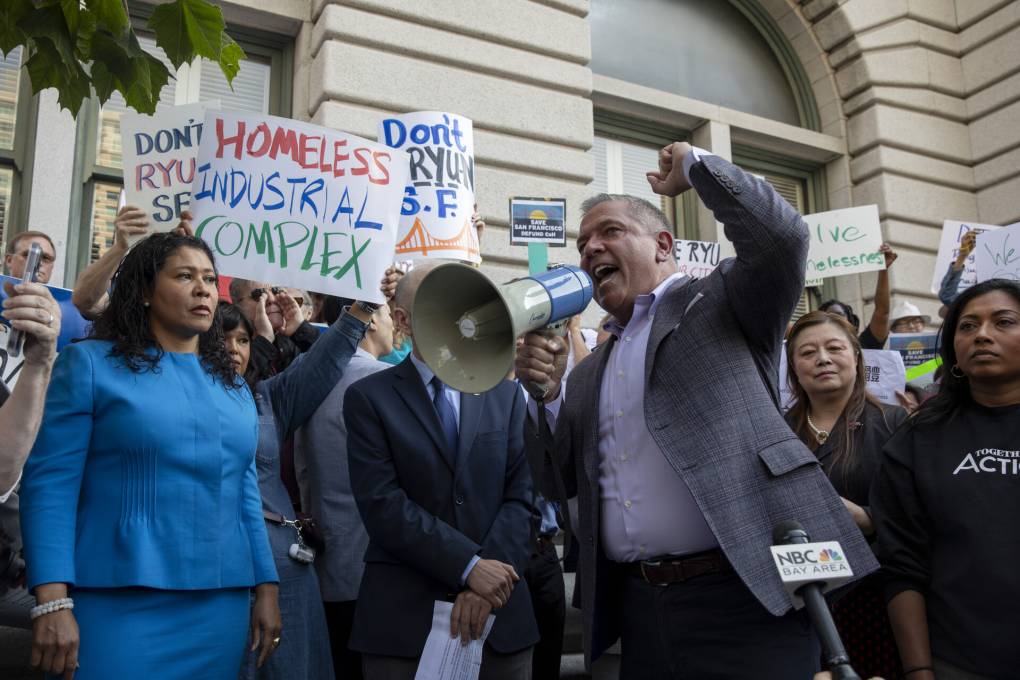
"caption": "District 6 Supervisor Matt Dorsey speaks at a rally in front of the Ninth Circuit Court of Appeals in San Francisco on Aug. 23, 2023. Dorsey voiced his opposition of the injunction filed by the Coalition on Homelessness, which has temporarily kept city workers from removing encampments on the streets.",
"description": null,
"title": "RS68257_20230822-HomelessLawsuit-15-JY-qut",
"credit": "Juliana Yamada/KQED",
"status": "inherit",
"altTag": "An African American woman in a blue suit dress looks on with a crowd of protesters holding signs as a white man in a suit and tie pumps his fist in the air while speaking into a microphone outside of a building.",
"isLoading": false,
"fetchFailed": false
},
"news_11959194": {
"type": "attachments",
"id": "news_11959194",
"meta": {
"index": "attachments_1716263798",
"site": "news",
"id": "11959194",
"found": true
},
"parent": 11959112,
"imgSizes": {
"twentyfourteen-full-width": {
"file": "https://ww2.kqed.org/app/uploads/sites/10/2023/08/IMG_1773-1038x576.jpeg",
"width": 1038,
"mimeType": "image/jpeg",
"height": 576
},
"thumbnail": {
"file": "https://ww2.kqed.org/app/uploads/sites/10/2023/08/IMG_1773-160x168.jpeg",
"width": 160,
"mimeType": "image/jpeg",
"height": 168
},
"post-thumbnail": {
"file": "https://ww2.kqed.org/app/uploads/sites/10/2023/08/IMG_1773-672x372.jpeg",
"width": 672,
"mimeType": "image/jpeg",
"height": 372
},
"kqedFullSize": {
"file": "https://ww2.kqed.org/app/uploads/sites/10/2023/08/IMG_1773.jpeg",
"width": 1300,
"height": 1362
},
"large": {
"file": "https://ww2.kqed.org/app/uploads/sites/10/2023/08/IMG_1773-1020x1069.jpeg",
"width": 1020,
"mimeType": "image/jpeg",
"height": 1069
},
"medium": {
"file": "https://ww2.kqed.org/app/uploads/sites/10/2023/08/IMG_1773-800x838.jpeg",
"width": 800,
"mimeType": "image/jpeg",
"height": 838
}
},
"publishDate": 1692986127,
"modified": 1692986255,
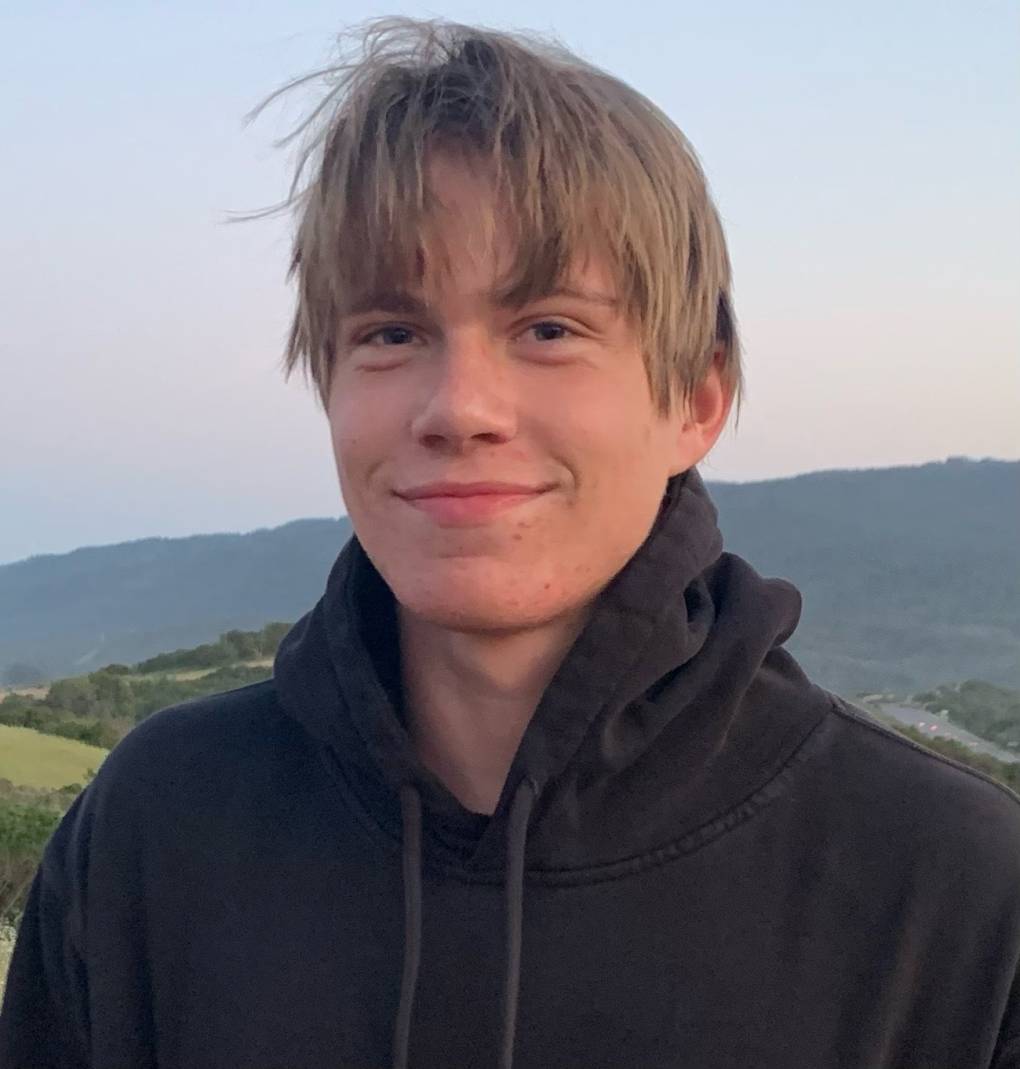
"caption": "Carlmont High School student Colin Walker, pictured here, died from a fentanyl overdose in 2021. ",
"description": null,
"title": "IMG_1773",
"credit": "Elizabeth Walker",
"status": "inherit",
"altTag": null,
"isLoading": false,
"fetchFailed": false
},
"news_11959209": {
"type": "attachments",
"id": "news_11959209",
"meta": {
"index": "attachments_1716263798",
"site": "news",
"id": "11959209",
"found": true
},
"parent": 11959051,
"imgSizes": {
"twentyfourteen-full-width": {
"file": "https://ww2.kqed.org/app/uploads/sites/10/2023/08/TheBay_iTunesTile_01-1020x1020-1-1020x576.jpg",
"width": 1020,
"mimeType": "image/jpeg",
"height": 576
},
"thumbnail": {
"file": "https://ww2.kqed.org/app/uploads/sites/10/2023/08/TheBay_iTunesTile_01-1020x1020-1-160x160.jpg",
"width": 160,
"mimeType": "image/jpeg",
"height": 160
},
"post-thumbnail": {
"file": "https://ww2.kqed.org/app/uploads/sites/10/2023/08/TheBay_iTunesTile_01-1020x1020-1-672x372.jpg",
"width": 672,
"mimeType": "image/jpeg",
"height": 372
},
"kqedFullSize": {
"file": "https://ww2.kqed.org/app/uploads/sites/10/2023/08/TheBay_iTunesTile_01-1020x1020-1.jpg",
"width": 1020,
"height": 1020
},
"medium": {
"file": "https://ww2.kqed.org/app/uploads/sites/10/2023/08/TheBay_iTunesTile_01-1020x1020-1-800x800.jpg",
"width": 800,
"mimeType": "image/jpeg",
"height": 800
}
},
"publishDate": 1692992131,
"modified": 1692992131,
"caption": null,
"description": null,
"title": "TheBay_iTunesTile_01-1020x1020",
"credit": null,
"status": "inherit",
"altTag": null,
"isLoading": false,
"fetchFailed": false
},
"news_11958791": {
"type": "attachments",
"id": "news_11958791",
"meta": {
"index": "attachments_1716263798",
"site": "news",
"id": "11958791",
"found": true
},
"parent": 11958785,
"imgSizes": {
"twentyfourteen-full-width": {
"file": "https://ww2.kqed.org/app/uploads/sites/10/2023/08/GettyImages-1558852156-1038x576.jpg",
"width": 1038,
"mimeType": "image/jpeg",
"height": 576
},
"thumbnail": {
"file": "https://ww2.kqed.org/app/uploads/sites/10/2023/08/GettyImages-1558852156-160x110.jpg",
"width": 160,
"mimeType": "image/jpeg",
"height": 110
},
"post-thumbnail": {
"file": "https://ww2.kqed.org/app/uploads/sites/10/2023/08/GettyImages-1558852156-672x372.jpg",
"width": 672,
"mimeType": "image/jpeg",
"height": 372
},
"kqedFullSize": {
"file": "https://ww2.kqed.org/app/uploads/sites/10/2023/08/GettyImages-1558852156-scaled.jpg",
"width": 2560,
"height": 1754
},
"2048x2048": {
"file": "https://ww2.kqed.org/app/uploads/sites/10/2023/08/GettyImages-1558852156-2048x1403.jpg",
"width": 2048,
"mimeType": "image/jpeg",
"height": 1403
},
"large": {
"file": "https://ww2.kqed.org/app/uploads/sites/10/2023/08/GettyImages-1558852156-1020x699.jpg",
"width": 1020,
"mimeType": "image/jpeg",
"height": 699
},
"1536x1536": {
"file": "https://ww2.kqed.org/app/uploads/sites/10/2023/08/GettyImages-1558852156-1536x1052.jpg",
"width": 1536,
"mimeType": "image/jpeg",
"height": 1052
},
"full-width": {
"file": "https://ww2.kqed.org/app/uploads/sites/10/2023/08/GettyImages-1558852156-1920x1315.jpg",
"width": 1920,
"mimeType": "image/jpeg",
"height": 1315
},
"medium": {
"file": "https://ww2.kqed.org/app/uploads/sites/10/2023/08/GettyImages-1558852156-800x548.jpg",
"width": 800,
"mimeType": "image/jpeg",
"height": 548
}
},
"publishDate": 1692731850,
"modified": 1694699755,
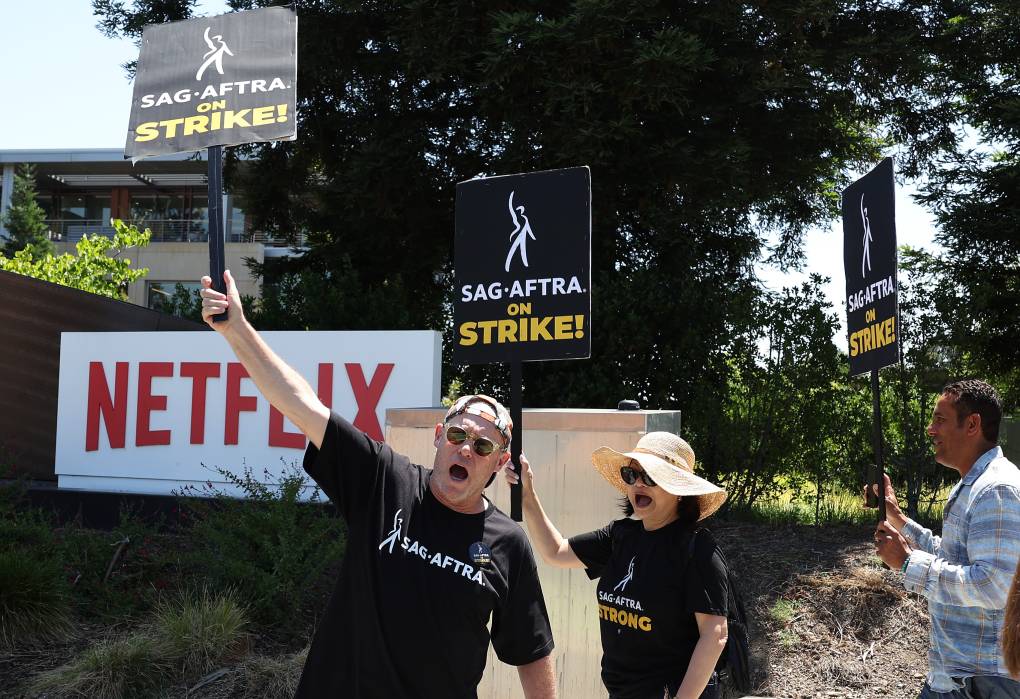
"caption": "Members of SAG-AFTRA hold signs as they picket in front of Netflix headquarters on July 20, 2023 in Los Gatos, California. Hollywood productions have stopped across the country as both writers and actors went on strike after their contracts expired with the Alliance of Motion Picture and Television Producers (AMPTP). This is the first time since 1960 that both unions have gone on strike at the same time. Both unions are fighting for contracts that prevent an A.I. from replacing them at their jobs as well as better pay when working on shows for streaming services.",
"description": null,
"title": "SAG-AFTRA Strikers And Supporters Rally Across The U.S.",
"credit": "Justin Sullivan/Getty Images",
"status": "inherit",
"altTag": "Hollywood Strike",
"isLoading": false,
"fetchFailed": false
},
"news_11716436": {
"type": "attachments",
"id": "news_11716436",
"meta": {
"index": "attachments_1716263798",
"site": "news",
"id": "11716436",
"found": true
},
"parent": 0,
"imgSizes": {
"twentyfourteen-full-width": {
"file": "https://ww2.kqed.org/app/uploads/sites/10/2019/01/RS5947_OaklandPoliceCar-1038x576.jpg",
"width": 1038,
"mimeType": "image/jpeg",
"height": 576
},
"thumbnail": {
"file": "https://ww2.kqed.org/app/uploads/sites/10/2019/01/RS5947_OaklandPoliceCar-160x112.jpg",
"width": 160,
"mimeType": "image/jpeg",
"height": 112
},
"post-thumbnail": {
"file": "https://ww2.kqed.org/app/uploads/sites/10/2019/01/RS5947_OaklandPoliceCar-672x372.jpg",
"width": 672,
"mimeType": "image/jpeg",
"height": 372
},
"kqedFullSize": {
"file": "https://ww2.kqed.org/app/uploads/sites/10/2019/01/RS5947_OaklandPoliceCar.jpg",
"width": 3000,
"height": 2105
},
"large": {
"file": "https://ww2.kqed.org/app/uploads/sites/10/2019/01/RS5947_OaklandPoliceCar-1020x716.jpg",
"width": 1020,
"mimeType": "image/jpeg",
"height": 716
},
"complete_open_graph": {
"file": "https://ww2.kqed.org/app/uploads/sites/10/2019/01/RS5947_OaklandPoliceCar-1200x842.jpg",
"width": 1200,
"mimeType": "image/jpeg",
"height": 842
},
"guest-author-50": {
"file": "https://ww2.kqed.org/app/uploads/sites/10/2019/01/RS5947_OaklandPoliceCar-50x50.jpg",
"width": 50,
"mimeType": "image/jpeg",
"height": 50
},
"guest-author-96": {
"file": "https://ww2.kqed.org/app/uploads/sites/10/2019/01/RS5947_OaklandPoliceCar-96x96.jpg",
"width": 96,
"mimeType": "image/jpeg",
"height": 96
},
"medium": {
"file": "https://ww2.kqed.org/app/uploads/sites/10/2019/01/RS5947_OaklandPoliceCar-800x561.jpg",
"width": 800,
"mimeType": "image/jpeg",
"height": 561
},
"guest-author-64": {
"file": "https://ww2.kqed.org/app/uploads/sites/10/2019/01/RS5947_OaklandPoliceCar-64x64.jpg",
"width": 64,
"mimeType": "image/jpeg",
"height": 64
},
"guest-author-32": {
"file": "https://ww2.kqed.org/app/uploads/sites/10/2019/01/RS5947_OaklandPoliceCar-32x32.jpg",
"width": 32,
"mimeType": "image/jpeg",
"height": 32
},
"full-width": {
"file": "https://ww2.kqed.org/app/uploads/sites/10/2019/01/RS5947_OaklandPoliceCar-1920x1347.jpg",
"width": 1920,
"mimeType": "image/jpeg",
"height": 1347
},
"detail": {
"file": "https://ww2.kqed.org/app/uploads/sites/10/2019/01/RS5947_OaklandPoliceCar-150x150.jpg",
"width": 150,
"mimeType": "image/jpeg",
"height": 150
},
"guest-author-128": {
"file": "https://ww2.kqed.org/app/uploads/sites/10/2019/01/RS5947_OaklandPoliceCar-128x128.jpg",
"width": 128,
"mimeType": "image/jpeg",
"height": 128
}
},
"publishDate": 1546897219,
"modified": 1546897273,
"caption": null,
"description": null,
"title": "After Failing To Reform, Oakland PD To Fall Under Court Appointed Director",
"credit": "Justin Sullivan/Getty Images",
"status": "inherit",
"isLoading": false,
"fetchFailed": false
},
"news_11958498": {
"type": "attachments",
"id": "news_11958498",
"meta": {
"index": "attachments_1716263798",
"site": "news",
"id": "11958498",
"found": true
},
"parent": 11958494,
"imgSizes": {
"twentyfourteen-full-width": {
"file": "https://ww2.kqed.org/app/uploads/sites/10/2023/08/boycottfolgers2_001-1038x576.jpg",
"width": 1038,
"mimeType": "image/jpeg",
"height": 576
},
"thumbnail": {
"file": "https://ww2.kqed.org/app/uploads/sites/10/2023/08/boycottfolgers2_001-160x120.jpg",
"width": 160,
"mimeType": "image/jpeg",
"height": 120
},
"post-thumbnail": {
"file": "https://ww2.kqed.org/app/uploads/sites/10/2023/08/boycottfolgers2_001-672x372.jpg",
"width": 672,
"mimeType": "image/jpeg",
"height": 372
},
"kqedFullSize": {
"file": "https://ww2.kqed.org/app/uploads/sites/10/2023/08/boycottfolgers2_001.jpg",
"width": 1920,
"height": 1443
},
"large": {
"file": "https://ww2.kqed.org/app/uploads/sites/10/2023/08/boycottfolgers2_001-1020x767.jpg",
"width": 1020,
"mimeType": "image/jpeg",
"height": 767
},
"1536x1536": {
"file": "https://ww2.kqed.org/app/uploads/sites/10/2023/08/boycottfolgers2_001-1536x1154.jpg",
"width": 1536,
"mimeType": "image/jpeg",
"height": 1154
},
"medium": {
"file": "https://ww2.kqed.org/app/uploads/sites/10/2023/08/boycottfolgers2_001-800x601.jpg",
"width": 800,
"mimeType": "image/jpeg",
"height": 601
}
},
"publishDate": 1692305607,
"modified": 1692305716,
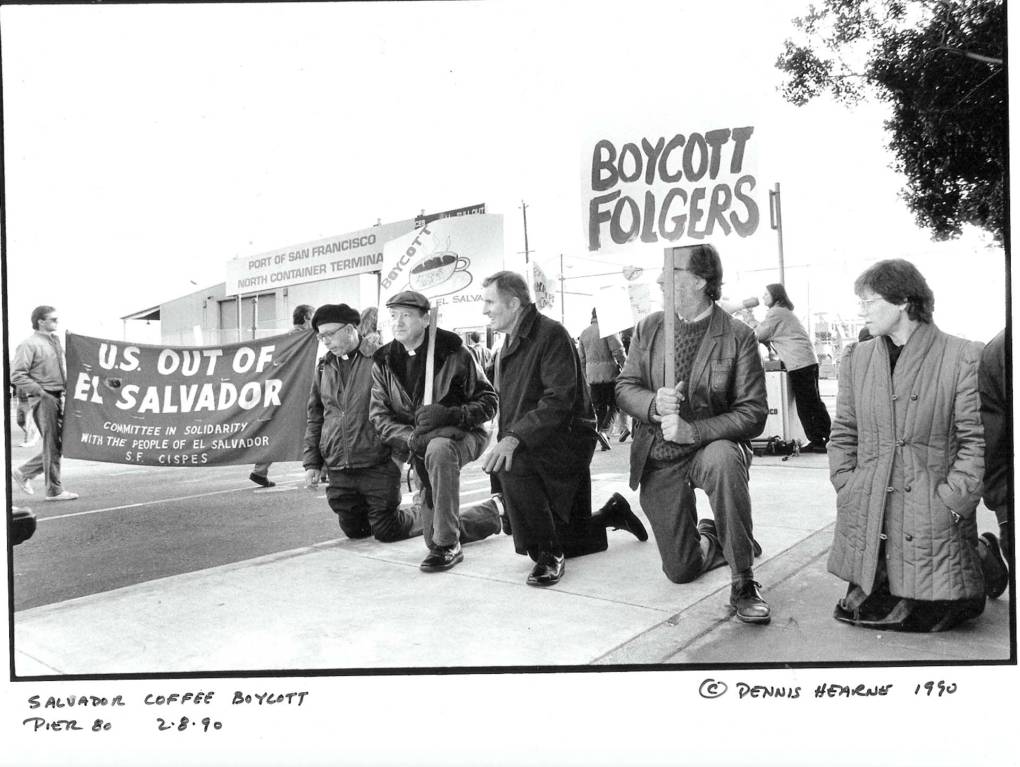
"caption": "Supporters of the Salvadoran coffee boycott form a picket line at Pier 80 in San Francisco in February 1990. (Courtesy of Dennis Hearne / The Fred Ross Project)",
"description": null,
"title": "boycottfolgers2_001",
"credit": null,
"status": "inherit",
"altTag": null,
"isLoading": false,
"fetchFailed": false
},
"news_11958272": {
"type": "attachments",
"id": "news_11958272",
"meta": {
"index": "attachments_1716263798",
"site": "news",
"id": "11958272",
"found": true
},
"parent": 11958271,
"imgSizes": {
"twentyfourteen-full-width": {
"file": "https://ww2.kqed.org/app/uploads/sites/10/2023/08/GettyImages-1556779348-1038x576.jpg",
"width": 1038,
"mimeType": "image/jpeg",
"height": 576
},
"thumbnail": {
"file": "https://ww2.kqed.org/app/uploads/sites/10/2023/08/GettyImages-1556779348-160x107.jpg",
"width": 160,
"mimeType": "image/jpeg",
"height": 107
},
"post-thumbnail": {
"file": "https://ww2.kqed.org/app/uploads/sites/10/2023/08/GettyImages-1556779348-672x372.jpg",
"width": 672,
"mimeType": "image/jpeg",
"height": 372
},
"kqedFullSize": {
"file": "https://ww2.kqed.org/app/uploads/sites/10/2023/08/GettyImages-1556779348-scaled.jpg",
"width": 2560,
"height": 1707
},
"2048x2048": {
"file": "https://ww2.kqed.org/app/uploads/sites/10/2023/08/GettyImages-1556779348-2048x1365.jpg",
"width": 2048,
"mimeType": "image/jpeg",
"height": 1365
},
"large": {
"file": "https://ww2.kqed.org/app/uploads/sites/10/2023/08/GettyImages-1556779348-1020x680.jpg",
"width": 1020,
"mimeType": "image/jpeg",
"height": 680
},
"1536x1536": {
"file": "https://ww2.kqed.org/app/uploads/sites/10/2023/08/GettyImages-1556779348-1536x1024.jpg",
"width": 1536,
"mimeType": "image/jpeg",
"height": 1024
},
"full-width": {
"file": "https://ww2.kqed.org/app/uploads/sites/10/2023/08/GettyImages-1556779348-1920x1280.jpg",
"width": 1920,
"mimeType": "image/jpeg",
"height": 1280
},
"medium": {
"file": "https://ww2.kqed.org/app/uploads/sites/10/2023/08/GettyImages-1556779348-800x533.jpg",
"width": 800,
"mimeType": "image/jpeg",
"height": 533
}
},
"publishDate": 1692134905,
"modified": 1692134982,
"caption": "A driverless robot taxi seen during operation in San Francisco, California, USA on July 24, 2023.",
"description": null,
"title": "Cruise: A driverless robot taxi in San Francisco",
"credit": "Tayfun Coskun/Anadolu Agency via Getty Images",
"status": "inherit",
"altTag": null,
"isLoading": false,
"fetchFailed": false
},
"news_11958062": {
"type": "attachments",
"id": "news_11958062",
"meta": {
"index": "attachments_1716263798",
"site": "news",
"id": "11958062",
"found": true
},
"parent": 11958058,
"imgSizes": {
"twentyfourteen-full-width": {
"file": "https://ww2.kqed.org/app/uploads/sites/10/2023/08/SS-13-Ilaysia-and-Arin-bandage-1038x576.jpg",
"width": 1038,
"mimeType": "image/jpeg",
"height": 576
},
"thumbnail": {
"file": "https://ww2.kqed.org/app/uploads/sites/10/2023/08/SS-13-Ilaysia-and-Arin-bandage-160x120.jpg",
"width": 160,
"mimeType": "image/jpeg",
"height": 120
},
"post-thumbnail": {
"file": "https://ww2.kqed.org/app/uploads/sites/10/2023/08/SS-13-Ilaysia-and-Arin-bandage-672x372.jpg",
"width": 672,
"mimeType": "image/jpeg",
"height": 372
},
"kqedFullSize": {
"file": "https://ww2.kqed.org/app/uploads/sites/10/2023/08/SS-13-Ilaysia-and-Arin-bandage-scaled.jpg",
"width": 2560,
"height": 1920
},
"2048x2048": {
"file": "https://ww2.kqed.org/app/uploads/sites/10/2023/08/SS-13-Ilaysia-and-Arin-bandage-2048x1536.jpg",
"width": 2048,
"mimeType": "image/jpeg",
"height": 1536
},
"large": {
"file": "https://ww2.kqed.org/app/uploads/sites/10/2023/08/SS-13-Ilaysia-and-Arin-bandage-1020x765.jpg",
"width": 1020,
"mimeType": "image/jpeg",
"height": 765
},
"1536x1536": {
"file": "https://ww2.kqed.org/app/uploads/sites/10/2023/08/SS-13-Ilaysia-and-Arin-bandage-1536x1152.jpg",
"width": 1536,
"mimeType": "image/jpeg",
"height": 1152
},
"full-width": {
"file": "https://ww2.kqed.org/app/uploads/sites/10/2023/08/SS-13-Ilaysia-and-Arin-bandage-1920x1440.jpg",
"width": 1920,
"mimeType": "image/jpeg",
"height": 1440
},
"medium": {
"file": "https://ww2.kqed.org/app/uploads/sites/10/2023/08/SS-13-Ilaysia-and-Arin-bandage-800x600.jpg",
"width": 800,
"mimeType": "image/jpeg",
"height": 600
}
},
"publishDate": 1691789881,
"modified": 1692032004,
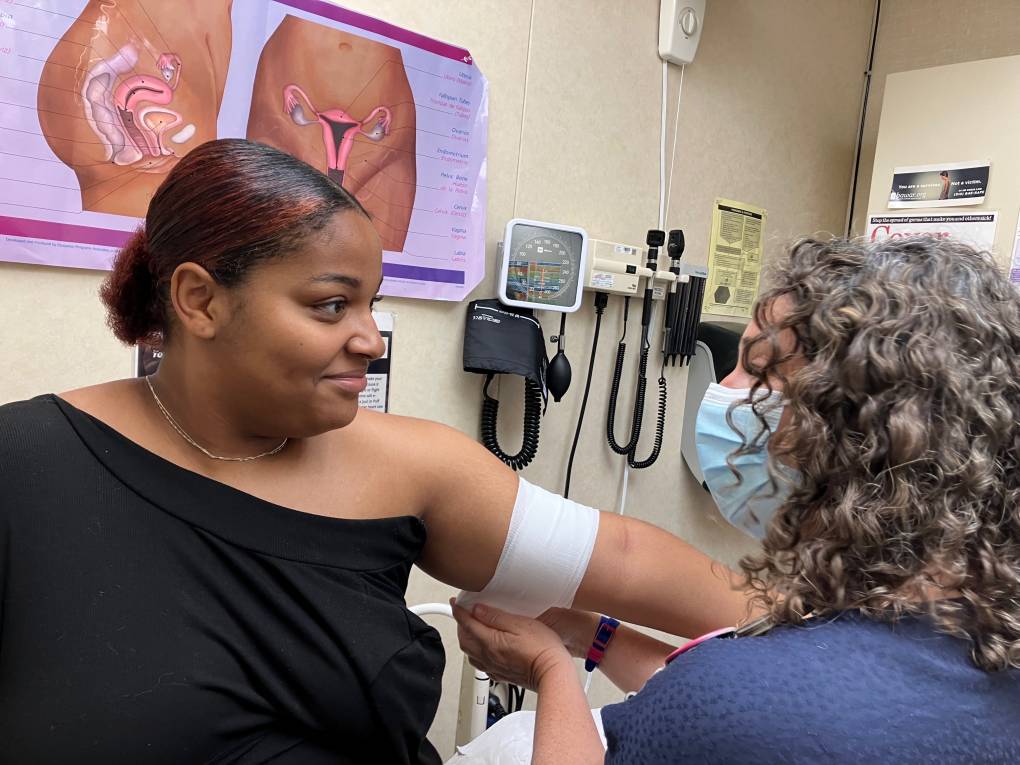
"caption": "Nurse practitioner Arin Kramer (right) prepares to place a contraceptive implant in I'laysia Vital’s upper arm (left).",
"description": null,
"title": "SS 13 - Ilaysia and Arin bandage",
"credit": "April Dembosky/KQED",
"status": "inherit",
"altTag": null,
"isLoading": false,
"fetchFailed": false
},
"news_11958032": {
"type": "attachments",
"id": "news_11958032",
"meta": {
"index": "attachments_1716263798",
"site": "news",
"id": "11958032",
"found": true
},
"parent": 11957970,
"imgSizes": {
"twentyfourteen-full-width": {
"file": "https://ww2.kqed.org/app/uploads/sites/10/2023/08/e-40.web_-1020x770-1-1020x576.jpg",
"width": 1020,
"mimeType": "image/jpeg",
"height": 576
},
"thumbnail": {
"file": "https://ww2.kqed.org/app/uploads/sites/10/2023/08/e-40.web_-1020x770-1-160x121.jpg",
"width": 160,
"mimeType": "image/jpeg",
"height": 121
},
"post-thumbnail": {
"file": "https://ww2.kqed.org/app/uploads/sites/10/2023/08/e-40.web_-1020x770-1-672x372.jpg",
"width": 672,
"mimeType": "image/jpeg",
"height": 372
},
"kqedFullSize": {
"file": "https://ww2.kqed.org/app/uploads/sites/10/2023/08/e-40.web_-1020x770-1.jpg",
"width": 1020,
"height": 770
},
"medium": {
"file": "https://ww2.kqed.org/app/uploads/sites/10/2023/08/e-40.web_-1020x770-1-800x604.jpg",
"width": 800,
"mimeType": "image/jpeg",
"height": 604
}
},
"publishDate": 1691778082,
"modified": 1691778105,
"caption": "'That's My Word' drops new stories each week throughout 2023.",
"description": null,
"title": "e-40.web_-1020x770",
"credit": "Illustration by Shomari Smith",
"status": "inherit",
"altTag": null,
"isLoading": false,
"fetchFailed": false
},
"news_11955262": {
"type": "attachments",
"id": "news_11955262",
"meta": {
"index": "attachments_1716263798",
"site": "news",
"id": "11955262",
"found": true
},
"parent": 0,
"imgSizes": {
"twentyfourteen-full-width": {
"file": "https://ww2.kqed.org/app/uploads/sites/10/2023/07/SJC-Rally-1-1038x576.png",
"width": 1038,
"mimeType": "image/png",
"height": 576
},
"thumbnail": {
"file": "https://ww2.kqed.org/app/uploads/sites/10/2023/07/SJC-Rally-1-160x96.png",
"width": 160,
"mimeType": "image/png",
"height": 96
},
"post-thumbnail": {
"file": "https://ww2.kqed.org/app/uploads/sites/10/2023/07/SJC-Rally-1-672x372.png",
"width": 672,
"mimeType": "image/png",
"height": 372
},
"kqedFullSize": {
"file": "https://ww2.kqed.org/app/uploads/sites/10/2023/07/SJC-Rally-1.png",
"width": 1796,
"height": 1076
},
"large": {
"file": "https://ww2.kqed.org/app/uploads/sites/10/2023/07/SJC-Rally-1-1020x611.png",
"width": 1020,
"mimeType": "image/png",
"height": 611
},
"1536x1536": {
"file": "https://ww2.kqed.org/app/uploads/sites/10/2023/07/SJC-Rally-1-1536x920.png",
"width": 1536,
"mimeType": "image/png",
"height": 920
},
"medium": {
"file": "https://ww2.kqed.org/app/uploads/sites/10/2023/07/SJC-Rally-1-800x479.png",
"width": 800,
"mimeType": "image/png",
"height": 479
}
},
"publishDate": 1688845733,
"modified": 1689015392,
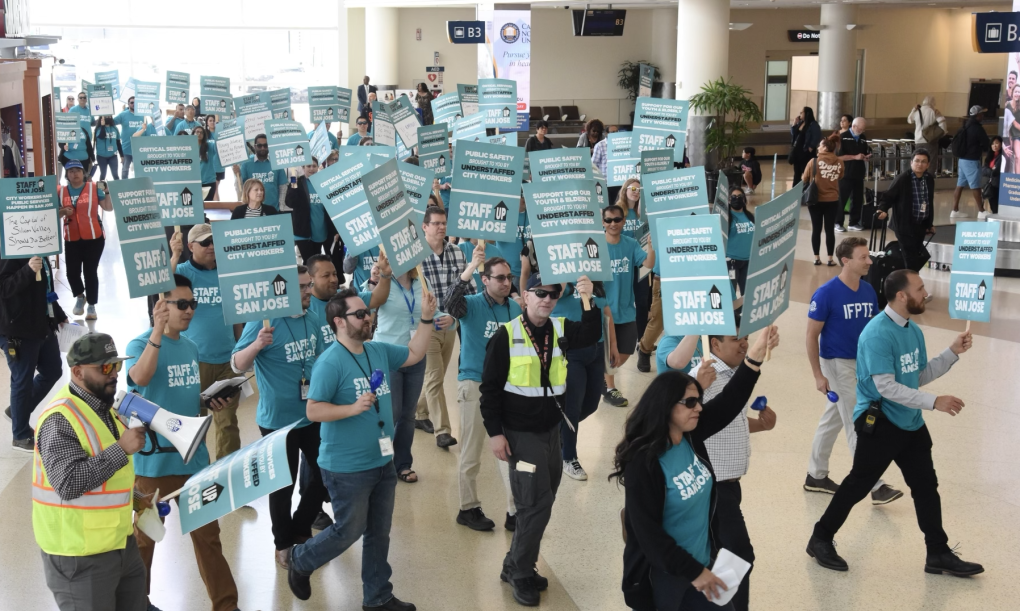
"caption": "Workers rallied at major city worksites including City Hall, San José Mineta International Airport, Happy Hollow Park and Zoo and other locations during actions in June. Image from rally on June 13, 2023.",
"description": null,
"title": "SJC Rally 1",
"credit": "Courtesy of Staff Up San Jose Union Coalition",
"status": "inherit",
"altTag": "Protestors holding signs and chanting inside City Hall in San José.",
"isLoading": false,
"fetchFailed": false
},
"news_11754056": {
"type": "attachments",
"id": "news_11754056",
"meta": {
"index": "attachments_1716263798",
"site": "news",
"id": "11754056",
"found": true
},
"parent": 11754005,
"imgSizes": {
"apple_news_ca_landscape_5_5": {
"file": "https://ww2.kqed.org/app/uploads/sites/10/2019/06/Shell-Oil-Refinery-Martinez-1044x783.jpg",
"width": 1044,
"mimeType": "image/jpeg",
"height": 783
},
"apple_news_ca_square_4_0": {
"file": "https://ww2.kqed.org/app/uploads/sites/10/2019/06/Shell-Oil-Refinery-Martinez-470x470.jpg",
"width": 470,
"mimeType": "image/jpeg",
"height": 470
},
"twentyfourteen-full-width": {
"file": "https://ww2.kqed.org/app/uploads/sites/10/2019/06/Shell-Oil-Refinery-Martinez-1038x576.jpg",
"width": 1038,
"mimeType": "image/jpeg",
"height": 576
},
"thumbnail": {
"file": "https://ww2.kqed.org/app/uploads/sites/10/2019/06/Shell-Oil-Refinery-Martinez-160x107.jpg",
"width": 160,
"mimeType": "image/jpeg",
"height": 107
},
"post-thumbnail": {
"file": "https://ww2.kqed.org/app/uploads/sites/10/2019/06/Shell-Oil-Refinery-Martinez-672x372.jpg",
"width": 672,
"mimeType": "image/jpeg",
"height": 372
},
"kqedFullSize": {
"file": "https://ww2.kqed.org/app/uploads/sites/10/2019/06/Shell-Oil-Refinery-Martinez.jpg",
"width": 1920,
"height": 1280
},
"apple_news_ca_landscape_4_7": {
"file": "https://ww2.kqed.org/app/uploads/sites/10/2019/06/Shell-Oil-Refinery-Martinez-632x474.jpg",
"width": 632,
"mimeType": "image/jpeg",
"height": 474
},
"large": {
"file": "https://ww2.kqed.org/app/uploads/sites/10/2019/06/Shell-Oil-Refinery-Martinez-1020x680.jpg",
"width": 1020,
"mimeType": "image/jpeg",
"height": 680
},
"complete_open_graph": {
"file": "https://ww2.kqed.org/app/uploads/sites/10/2019/06/Shell-Oil-Refinery-Martinez-1200x800.jpg",
"width": 1200,
"mimeType": "image/jpeg",
"height": 800
},
"apple_news_ca_landscape_4_0": {
"file": "https://ww2.kqed.org/app/uploads/sites/10/2019/06/Shell-Oil-Refinery-Martinez-536x402.jpg",
"width": 536,
"mimeType": "image/jpeg",
"height": 402
},
"apple_news_ca_portrait_12_9": {
"file": "https://ww2.kqed.org/app/uploads/sites/10/2019/06/Shell-Oil-Refinery-Martinez-1122x1280.jpg",
"width": 1122,
"mimeType": "image/jpeg",
"height": 1280
},
"medium": {
"file": "https://ww2.kqed.org/app/uploads/sites/10/2019/06/Shell-Oil-Refinery-Martinez-800x533.jpg",
"width": 800,
"mimeType": "image/jpeg",
"height": 533
},
"apple_news_ca_portrait_4_0": {
"file": "https://ww2.kqed.org/app/uploads/sites/10/2019/06/Shell-Oil-Refinery-Martinez-354x472.jpg",
"width": 354,
"mimeType": "image/jpeg",
"height": 472
},
"apple_news_ca_portrait_9_7": {
"file": "https://ww2.kqed.org/app/uploads/sites/10/2019/06/Shell-Oil-Refinery-Martinez-840x1120.jpg",
"width": 840,
"mimeType": "image/jpeg",
"height": 1120
},
"apple_news_ca_landscape_12_9": {
"file": "https://ww2.kqed.org/app/uploads/sites/10/2019/06/Shell-Oil-Refinery-Martinez-1832x1280.jpg",
"width": 1832,
"mimeType": "image/jpeg",
"height": 1280
},
"apple_news_ca_square_9_7": {
"file": "https://ww2.kqed.org/app/uploads/sites/10/2019/06/Shell-Oil-Refinery-Martinez-1104x1104.jpg",
"width": 1104,
"mimeType": "image/jpeg",
"height": 1104
},
"apple_news_ca_portrait_4_7": {
"file": "https://ww2.kqed.org/app/uploads/sites/10/2019/06/Shell-Oil-Refinery-Martinez-414x552.jpg",
"width": 414,
"mimeType": "image/jpeg",
"height": 552
},
"apple_news_ca_square_12_9": {
"file": "https://ww2.kqed.org/app/uploads/sites/10/2019/06/Shell-Oil-Refinery-Martinez-1472x1280.jpg",
"width": 1472,
"mimeType": "image/jpeg",
"height": 1280
},
"apple_news_ca_portrait_5_5": {
"file": "https://ww2.kqed.org/app/uploads/sites/10/2019/06/Shell-Oil-Refinery-Martinez-687x916.jpg",
"width": 687,
"mimeType": "image/jpeg",
"height": 916
},
"full-width": {
"file": "https://ww2.kqed.org/app/uploads/sites/10/2019/06/Shell-Oil-Refinery-Martinez-1920x1280.jpg",
"width": 1920,
"mimeType": "image/jpeg",
"height": 1280
},
"apple_news_ca_square_4_7": {
"file": "https://ww2.kqed.org/app/uploads/sites/10/2019/06/Shell-Oil-Refinery-Martinez-550x550.jpg",
"width": 550,
"mimeType": "image/jpeg",
"height": 550
},
"apple_news_ca_landscape_9_7": {
"file": "https://ww2.kqed.org/app/uploads/sites/10/2019/06/Shell-Oil-Refinery-Martinez-1376x1032.jpg",
"width": 1376,
"mimeType": "image/jpeg",
"height": 1032
},
"apple_news_ca_square_5_5": {
"file": "https://ww2.kqed.org/app/uploads/sites/10/2019/06/Shell-Oil-Refinery-Martinez-912x912.jpg",
"width": 912,
"mimeType": "image/jpeg",
"height": 912
}
},
"publishDate": 1560297519,
"modified": 1587605233,
"caption": "The former Shell Oil refinery in Martinez, now owned and operated by New Jersey-based PBF Energy. ",
"description": "The Shell Oil refinery in Martinez.",
"title": "PBF Energy Refinery-Martinez",
"credit": "Justin Sullivan/Getty Images",
"status": "inherit",
"isLoading": false,
"fetchFailed": false
}
},
"audioPlayerReducer": {
"postId": "stream_live",
"isPaused": true,
"isPlaying": false,
"pfsActive": false,
"pledgeModalIsOpen": true,
"playerDrawerIsOpen": false,
"liveAudioPlayStartedAt": 0,
"liveAudioPlayContext": ""
},
"authorsReducer": {
"gmarzorati": {
"type": "authors",
"id": "227",
"meta": {
"index": "authors_1716337520",
"id": "227",
"found": true
},
"name": "Guy Marzorati",
"firstName": "Guy",
"lastName": "Marzorati",
"slug": "gmarzorati",
"email": "gmarzorati@KQED.org",
"display_author_email": true,
"staff_mastheads": [
"news"
],
"title": "Correspondent",
"bio": "Guy Marzorati is a correspondent on KQED's California Politics and Government Desk, based in San Jose. A graduate of Santa Clara University, Guy joined KQED in 2013. He reports on state and local politics and produces KQED's digital voter guide.",
"avatar": "https://secure.gravatar.com/avatar/e7038b8dbfd55b104369b76b1cd0b9de?s=600&d=blank&r=g",
"twitter": "guymarzorati",
"facebook": null,
"instagram": null,
"linkedin": null,
"sites": [
{
"site": "",
"roles": [
"editor"
]
},
{
"site": "news",
"roles": [
"editor"
]
},
{
"site": "science",
"roles": [
"editor"
]
},
{
"site": "forum",
"roles": [
"editor"
]
},
{
"site": "elections",
"roles": [
"editor"
]
},
{
"site": "liveblog",
"roles": [
"editor"
]
}
],
"headData": {
"title": "Guy Marzorati | KQED",
"description": "Correspondent",
"ogImgSrc": "https://secure.gravatar.com/avatar/e7038b8dbfd55b104369b76b1cd0b9de?s=600&d=blank&r=g",
"twImgSrc": "https://secure.gravatar.com/avatar/e7038b8dbfd55b104369b76b1cd0b9de?s=600&d=blank&r=g"
},
"isLoading": false,
"link": "/author/gmarzorati"
},
"rachael-myrow": {
"type": "authors",
"id": "251",
"meta": {
"index": "authors_1716337520",
"id": "251",
"found": true
},
"name": "Rachael Myrow",
"firstName": "Rachael",
"lastName": "Myrow",
"slug": "rachael-myrow",
"email": "rmyrow@kqed.org",
"display_author_email": true,
"staff_mastheads": [
"news"
],
"title": "Senior Editor of KQED's Silicon Valley News Desk",
"bio": "• I write and edit stories about how Silicon Valley power and policies shape everyday life in California. I’m also passionate about making Bay Area history and culture more accessible to a broad public. • I’ve been a journalist for most of my life, starting in high school with The Franklin Press in Los Angeles, where I grew up. While earning my first degree in English at UC Berkeley, I got my start in public radio at KALX-FM. After completing a second degree in journalism at Cal, I landed my first professional job at Marketplace, then moved on to KPCC (now LAist), and then KQED, where I hosted The California Report for more than seven years. • My reporting has appeared on NPR, The World, WBUR’s \u003ci>Here & Now\u003c/i>, and the BBC. I also guest host for KQED’s \u003ci>Forum\u003c/i>, as well as the Commonwealth Club in San Francisco. • I speak periodically on media, democracy and technology issues, and do voiceover work for documentaries and educational video projects. • Outside of the studio, you'll find me hiking Bay Area trails and whipping up Insta-ready meals in my kitchen. • I do not accept gifts, money, or favors from anyone connected to my reporting, I don't pay people for information, and I do not support or donate to political causes. • I strive to treat the people I report on with fairness, honesty, and respect. I also recognize there are often multiple sides to a story and work to verify information through multiple sources and documentation. If I get something wrong, I correct it.",
"avatar": "https://secure.gravatar.com/avatar/3ed8a3c5f26025e4a805ba634cda8cd764906b97438a6d9ce216b044e340da4e?s=600&d=blank&r=g",
"twitter": "rachaelmyrow",
"bluesky": null,
"facebook": null,
"instagram": null,
"linkedin": "https://www.linkedin.com/in/rachaelmyrow/",
"sites": [
{
"site": "arts",
"roles": [
"administrator"
]
},
{
"site": "news",
"roles": [
"edit_others_posts",
"editor"
]
},
{
"site": "futureofyou",
"roles": [
"editor"
]
},
{
"site": "bayareabites",
"roles": [
"editor"
]
},
{
"site": "stateofhealth",
"roles": [
"editor"
]
},
{
"site": "science",
"roles": [
"editor"
]
},
{
"site": "food",
"roles": [
"editor"
]
},
{
"site": "forum",
"roles": [
"editor"
]
},
{
"site": "liveblog",
"roles": [
"author"
]
}
],
"headData": {
"title": "Rachael Myrow | KQED",
"description": "Senior Editor of KQED's Silicon Valley News Desk",
"ogImgSrc": "https://secure.gravatar.com/avatar/3ed8a3c5f26025e4a805ba634cda8cd764906b97438a6d9ce216b044e340da4e?s=600&d=blank&r=g",
"twImgSrc": "https://secure.gravatar.com/avatar/3ed8a3c5f26025e4a805ba634cda8cd764906b97438a6d9ce216b044e340da4e?s=600&d=blank&r=g"
},
"isLoading": false,
"link": "/author/rachael-myrow"
},
"adembosky": {
"type": "authors",
"id": "3205",
"meta": {
"index": "authors_1716337520",
"id": "3205",
"found": true
},
"name": "April Dembosky",
"firstName": "April",
"lastName": "Dembosky",
"slug": "adembosky",
"email": "adembosky@kqed.org",
"display_author_email": false,
"staff_mastheads": [
"news",
"science"
],
"title": "KQED Health Correspondent",
"bio": "April Dembosky is the health correspondent for KQED News and a regular contributor to NPR. She specializes in covering altered states of mind, from postpartum depression to methamphetamine-induced psychosis to the insanity defense. Her investigative series on insurance companies sidestepping mental health laws won multiple awards, including first place in beat reporting from the national Association of Health Care Journalists. She is the recipient of numerous other prizes and fellowships, including a national Edward R. Murrow award for investigative reporting, a Society of Professional Journalists award for long-form storytelling, and a Carter Center Fellowship for Mental Health Journalism.\r\n\r\nDembosky reported and produced \u003cem>Soundtrack of Silence\u003c/em>, an audio documentary about music and memory that is currently being made into a feature film by Paramount Pictures.\r\n\r\nBefore joining KQED in 2013, Dembosky covered technology and Silicon Valley for \u003cem>The Financial Times of London,\u003c/em> and contributed business and arts stories to \u003cem>Marketplace \u003c/em>and \u003cem>The New York Times.\u003c/em> She got her undergraduate degree in philosophy from Smith College and her master's in journalism from the University of California, Berkeley. She is a classically trained violinist and proud alum of the first symphony orchestra at Burning Man.",
"avatar": "https://secure.gravatar.com/avatar/d6593cd737b732102fe0b6250b5351c2d3bc9b2987566514aa3c9a106494d684?s=600&d=blank&r=g",
"twitter": "adembosky",
"bluesky": null,
"facebook": null,
"instagram": null,
"linkedin": null,
"sites": [
{
"site": "arts",
"roles": [
"author"
]
},
{
"site": "news",
"roles": [
"editor"
]
},
{
"site": "futureofyou",
"roles": [
"author"
]
},
{
"site": "stateofhealth",
"roles": [
"editor"
]
},
{
"site": "science",
"roles": [
"editor"
]
},
{
"site": "forum",
"roles": [
"editor"
]
}
],
"headData": {
"title": "April Dembosky | KQED",
"description": "KQED Health Correspondent",
"ogImgSrc": "https://secure.gravatar.com/avatar/d6593cd737b732102fe0b6250b5351c2d3bc9b2987566514aa3c9a106494d684?s=600&d=blank&r=g",
"twImgSrc": "https://secure.gravatar.com/avatar/d6593cd737b732102fe0b6250b5351c2d3bc9b2987566514aa3c9a106494d684?s=600&d=blank&r=g"
},
"isLoading": false,
"link": "/author/adembosky"
},
"ecruzguevarra": {
"type": "authors",
"id": "8654",
"meta": {
"index": "authors_1716337520",
"id": "8654",
"found": true
},
"name": "Ericka Cruz Guevarra",
"firstName": "Ericka",
"lastName": "Cruz Guevarra",
"slug": "ecruzguevarra",
"email": "ecruzguevarra@kqed.org",
"display_author_email": true,
"staff_mastheads": [
"news"
],
"title": "Producer, The Bay Podcast",
"bio": "Ericka Cruz Guevarra is host of \u003ca href=\"https://www.kqed.org/podcasts/thebay\">\u003cem>The Bay\u003c/em>\u003c/a> podcast at KQED. Before host, she was the show’s producer. Her work in that capacity includes a three-part reported series on policing in Vallejo, which won a 2020 excellence in journalism award from the Society of Professional Journalists. Ericka has worked as a breaking news reporter at Oregon Public Broadcasting, helped produce the Code Switch podcast, and was KQED’s inaugural Raul Ramirez Diversity Fund intern. She’s also an alumna of NPR’s Next Generation Radio program. Send her an email if you have strong feelings about whether Fairfield and Suisun City are the Bay. Ericka is represented by SAG-AFTRA.",
"avatar": "https://secure.gravatar.com/avatar/accefc1de4bafc7e234b69bcb9b6f6536c130fd84709bc3069ef11a78787e1bb?s=600&d=blank&r=g",
"twitter": "NotoriousECG",
"bluesky": null,
"facebook": null,
"instagram": null,
"linkedin": null,
"sites": [
{
"site": "arts",
"roles": [
"subscriber"
]
},
{
"site": "news",
"roles": [
"editor",
"manage_categories"
]
},
{
"site": "futureofyou",
"roles": [
"subscriber"
]
},
{
"site": "stateofhealth",
"roles": [
"subscriber"
]
},
{
"site": "science",
"roles": [
"editor"
]
},
{
"site": "forum",
"roles": [
"subscriber"
]
}
],
"headData": {
"title": "Ericka Cruz Guevarra | KQED",
"description": "Producer, The Bay Podcast",
"ogImgSrc": "https://secure.gravatar.com/avatar/accefc1de4bafc7e234b69bcb9b6f6536c130fd84709bc3069ef11a78787e1bb?s=600&d=blank&r=g",
"twImgSrc": "https://secure.gravatar.com/avatar/accefc1de4bafc7e234b69bcb9b6f6536c130fd84709bc3069ef11a78787e1bb?s=600&d=blank&r=g"
},
"isLoading": false,
"link": "/author/ecruzguevarra"
},
"nvoynovskaya": {
"type": "authors",
"id": "11387",
"meta": {
"index": "authors_1716337520",
"id": "11387",
"found": true
},
"name": "Nastia Voynovskaya",
"firstName": "Nastia",
"lastName": "Voynovskaya",
"slug": "nvoynovskaya",
"email": "nvoynovskaya@kqed.org",
"display_author_email": false,
"staff_mastheads": [
"arts"
],
"title": "Editor and reporter",
"bio": "Nastia Voynovskaya is a reporter, editor and host at KQED Arts & Culture. She's been covering the arts in the Bay Area for over a decade, with a focus on music, queer culture, labor issues and grassroots organizing. She has edited KQED story series such as Trans Bay: A History of San Francisco's Gender-Diverse Community, and co-created KQED's Bay Area hip-hop history project, That's My Word. Nastia's work has been recognized by the Society of Professional Journalists and San Francisco Press Club. She regularly appears on podcasts and radio programs, including NPR's All Songs Considered, and hosts live events where music, culture and conversation meet.",
"avatar": "https://secure.gravatar.com/avatar/5025ee460e5a85d69ca20ea6c6f2f80d7e17795c828f61ea3aecfcd924e9042e?s=600&d=blank&r=g",
"twitter": null,
"bluesky": null,
"facebook": null,
"instagram": "https://www.instagram.com/nananastia/",
"linkedin": null,
"sites": [
{
"site": "",
"roles": [
"editor"
]
},
{
"site": "arts",
"roles": [
"administrator"
]
},
{
"site": "news",
"roles": [
"editor"
]
},
{
"site": "pop",
"roles": [
"administrator"
]
},
{
"site": "bayareabites",
"roles": [
"editor"
]
},
{
"site": "podcasts",
"roles": [
"editor"
]
},
{
"site": "hiphop",
"roles": [
"editor"
]
}
],
"headData": {
"title": "Nastia Voynovskaya | KQED",
"description": "Editor and reporter",
"ogImgSrc": "https://secure.gravatar.com/avatar/5025ee460e5a85d69ca20ea6c6f2f80d7e17795c828f61ea3aecfcd924e9042e?s=600&d=blank&r=g",
"twImgSrc": "https://secure.gravatar.com/avatar/5025ee460e5a85d69ca20ea6c6f2f80d7e17795c828f61ea3aecfcd924e9042e?s=600&d=blank&r=g"
},
"isLoading": false,
"link": "/author/nvoynovskaya"
},
"amontecillo": {
"type": "authors",
"id": "11649",
"meta": {
"index": "authors_1716337520",
"id": "11649",
"found": true
},
"name": "Alan Montecillo",
"firstName": "Alan",
"lastName": "Montecillo",
"slug": "amontecillo",
"email": "amontecillo@kqed.org",
"display_author_email": false,
"staff_mastheads": [
"news"
],
"title": "KQED Contributor",
"bio": "Alan Montecillo is the senior editor of \u003cem>\u003ca href=\"http://kqed.org/thebay\">The Bay\u003c/a>, \u003c/em> KQED's local news podcast. Before moving to the Bay Area, he worked as a senior talk show producer for WILL in Champaign-Urbana, Illinois and at Oregon Public Broadcasting in Portland, Oregon. He has won journalism awards from the Society of Professional Journalists Northern California, the Public Media Journalists Association, The Signal Awards, and has also received a regional Edward R. Murrow award. Alan is a Filipino American from Hong Kong and a graduate of Reed College.",
"avatar": "https://secure.gravatar.com/avatar/268f53a2066899ea9efdd8a5900218b17c822d9862cbc9326cccec53ef41d349?s=600&d=blank&r=g",
"twitter": "alanmontecillo",
"bluesky": null,
"facebook": null,
"instagram": null,
"linkedin": null,
"sites": [
{
"site": "",
"roles": [
"editor"
]
},
{
"site": "news",
"roles": [
"editor",
"manage_categories"
]
}
],
"headData": {
"title": "Alan Montecillo | KQED",
"description": "KQED Contributor",
"ogImgSrc": "https://secure.gravatar.com/avatar/268f53a2066899ea9efdd8a5900218b17c822d9862cbc9326cccec53ef41d349?s=600&d=blank&r=g",
"twImgSrc": "https://secure.gravatar.com/avatar/268f53a2066899ea9efdd8a5900218b17c822d9862cbc9326cccec53ef41d349?s=600&d=blank&r=g"
},
"isLoading": false,
"link": "/author/amontecillo"
},
"sminobucheli": {
"type": "authors",
"id": "11764",
"meta": {
"index": "authors_1716337520",
"id": "11764",
"found": true
},
"name": "Sebastian Miño-Bucheli",
"firstName": "Sebastian",
"lastName": "Miño-Bucheli",
"slug": "sminobucheli",
"email": "sminobucheli@kqed.org",
"display_author_email": false,
"staff_mastheads": [],
"title": "KQED Contributor",
"bio": "Sebastian Miño-Bucheli is a bilingual multimedia reporter and contributor to KQED Digital News. His reporting has been featured for Bay Curious, the California Report Magazine and KQED Arts. ",
"avatar": "https://secure.gravatar.com/avatar/4d433e33876cb631fbbe1ab7b9ddf7a1616f5e270c709b89ee147c0489875612?s=600&d=blank&r=g",
"twitter": "@BucheliMino",
"bluesky": null,
"facebook": null,
"instagram": null,
"linkedin": null,
"sites": [
{
"site": "arts",
"roles": [
"subscriber"
]
},
{
"site": "news",
"roles": [
"subscriber"
]
}
],
"headData": {
"title": "Sebastian Miño-Bucheli | KQED",
"description": "KQED Contributor",
"ogImgSrc": "https://secure.gravatar.com/avatar/4d433e33876cb631fbbe1ab7b9ddf7a1616f5e270c709b89ee147c0489875612?s=600&d=blank&r=g",
"twImgSrc": "https://secure.gravatar.com/avatar/4d433e33876cb631fbbe1ab7b9ddf7a1616f5e270c709b89ee147c0489875612?s=600&d=blank&r=g"
},
"isLoading": false,
"link": "/author/sminobucheli"
},
"mesquinca": {
"type": "authors",
"id": "11802",
"meta": {
"index": "authors_1716337520",
"id": "11802",
"found": true
},
"name": "Maria Esquinca",
"firstName": "Maria",
"lastName": "Esquinca",
"slug": "mesquinca",
"email": "mesquinca@kqed.org",
"display_author_email": false,
"staff_mastheads": [],
"title": "Producer, The Bay",
"bio": "María Esquinca is a producer of The Bay. Before that, she was a New York Women’s Foundation IGNITE Fellow at Latino USA. She worked at Radio Bilingue where she covered the San Joaquin Valley. Maria has interned at WLRN, News 21, The New York Times Student Journalism Institute and at Crain’s Detroit Business as a Dow Jones News Fund Business Reporting Intern. She is an MFA graduate from the University of Miami. In 2017, she graduated from the Walter Cronkite School of Journalism and Mass Communication with a Master of Mass Communication. A fronteriza, she was born in Ciudad Juárez, Chihuahua, Mexico and grew up in El Paso, Texas.",
"avatar": "https://secure.gravatar.com/avatar/77cedba18aae91da775038ba06dcd8d0?s=600&d=blank&r=g",
"twitter": "@m_esquinca",
"facebook": null,
"instagram": null,
"linkedin": null,
"sites": [
{
"site": "news",
"roles": []
}
],
"headData": {
"title": "Maria Esquinca | KQED",
"description": "Producer, The Bay",
"ogImgSrc": "https://secure.gravatar.com/avatar/77cedba18aae91da775038ba06dcd8d0?s=600&d=blank&r=g",
"twImgSrc": "https://secure.gravatar.com/avatar/77cedba18aae91da775038ba06dcd8d0?s=600&d=blank&r=g"
},
"isLoading": false,
"link": "/author/mesquinca"
},
"earnold": {
"type": "authors",
"id": "11839",
"meta": {
"index": "authors_1716337520",
"id": "11839",
"found": true
},
"name": "Eric Arnold",
"firstName": "Eric",
"lastName": "Arnold",
"slug": "earnold",
"email": "earnold@kqed.org",
"display_author_email": false,
"staff_mastheads": [],
"title": "Contributing Editor, 'That's My Word'",
"bio": "Eric Arnold has covered hip-hop locally and nationally for over 30 years. Formerly the managing editor of \u003cem>4080\u003c/em> and columnist for \u003cem>The Source\u003c/em>, he chronicled hyphy’s rise and fall, co-curated the Oakland Museum of California’s first hip-hop exhibit in 2018 and won a 2022 Northern California Emmy Award for a mini-documentary on Oakland’s Boogaloo dance culture. He is a contributing editor for \u003cem>That’s My Word\u003c/em>, KQED's series on the history of Bay Area hip-hop.",
"avatar": "https://secure.gravatar.com/avatar/ede45b04898456ad0893a2811e78b0a2?s=600&d=blank&r=g",
"twitter": null,
"facebook": null,
"instagram": null,
"linkedin": null,
"sites": [
{
"site": "arts",
"roles": [
"contributor"
]
},
{
"site": "news",
"roles": [
"contributor"
]
},
{
"site": "hiphop",
"roles": [
"contributor"
]
}
],
"headData": {
"title": "Eric Arnold | KQED",
"description": "Contributing Editor, 'That's My Word'",
"ogImgSrc": "https://secure.gravatar.com/avatar/ede45b04898456ad0893a2811e78b0a2?s=600&d=blank&r=g",
"twImgSrc": "https://secure.gravatar.com/avatar/ede45b04898456ad0893a2811e78b0a2?s=600&d=blank&r=g"
},
"isLoading": false,
"link": "/author/earnold"
},
"sjohnson": {
"type": "authors",
"id": "11840",
"meta": {
"index": "authors_1716337520",
"id": "11840",
"found": true
},
"name": "Sydney Johnson",
"firstName": "Sydney",
"lastName": "Johnson",
"slug": "sjohnson",
"email": "sjohnson@kqed.org",
"display_author_email": false,
"staff_mastheads": [
"news"
],
"title": "KQED Reporter",
"bio": "Sydney Johnson is a general assignment reporter at KQED. She previously reported on public health and city government at the San Francisco Examiner, and before that, she covered statewide education policy for EdSource. Her reporting has won multiple local, state and national awards. Sydney is a graduate of the University of California, Berkeley and lives in San Francisco.",
"avatar": "https://secure.gravatar.com/avatar/97855f2719b72ad6190b7c535fe642c8?s=600&d=blank&r=g",
"twitter": "sydneyfjohnson",
"facebook": null,
"instagram": null,
"linkedin": null,
"sites": [
{
"site": "news",
"roles": [
"editor"
]
}
],
"headData": {
"title": "Sydney Johnson | KQED",
"description": "KQED Reporter",
"ogImgSrc": "https://secure.gravatar.com/avatar/97855f2719b72ad6190b7c535fe642c8?s=600&d=blank&r=g",
"twImgSrc": "https://secure.gravatar.com/avatar/97855f2719b72ad6190b7c535fe642c8?s=600&d=blank&r=g"
},
"isLoading": false,
"link": "/author/sjohnson"
}
},
"pagesReducer": {
"news_program_the-bay": {
"type": "terms",
"id": "news_28779",
"meta": {
"index": "terms_1716263798",
"site": "news",
"id": "28779",
"score": 15.530214
},
"featImg": null,
"name": "The Bay",
"description": null,
"taxonomy": "program",
"headData": {
"twImgId": null,
"twTitle": null,
"ogTitle": null,
"ogImgId": null,
"twDescription": null,
"description": "The Bay is a daily news and culture program from KQED that covers the latest headlines, trends, and stories that matter to the Bay Area.",
"title": "The Bay Area Archives | KQED",
"ogDescription": null
},
"ttid": 28796,
"slug": "the-bay",
"isLoading": false,
"title": "The Bay",
"pageMeta": {
"site": "news",
"WpPageTemplate": "page-topic-editorial",
"currentPage": 11
},
"blocks": [
{
"blockName": "kqed/post-list",
"attrs": {
"layout": "cardArticle2",
"query": "posts/news?program=the-bay",
"seeMore": false,
"paginated": true,
"page": 11
}
},
{
"blockName": "kqed/ad"
}
]
}
},
"pfsSessionReducer": {},
"postsReducer": {
"stream_live": {
"type": "live",
"id": "stream_live",
"audioUrl": "https://streams.kqed.org/kqedradio",
"title": "Live Stream",
"excerpt": "Live Stream information currently unavailable.",
"link": "/radio",
"featImg": "",
"label": {
"name": "KQED Live",
"link": "/"
}
},
"stream_kqedNewscast": {
"type": "posts",
"id": "stream_kqedNewscast",
"audioUrl": "https://www.kqed.org/.stream/anon/radio/RDnews/newscast.mp3?_=1",
"title": "KQED Newscast",
"featImg": "",
"label": {
"name": "88.5 FM",
"link": "/"
}
},
"news_11959845": {
"type": "posts",
"id": "news_11959845",
"meta": {
"index": "posts_1716263798",
"site": "news",
"id": "11959845",
"score": null,
"sort": [
1693562450000
]
},
"guestAuthors": [],
"slug": "the-silicon-valley-giants-who-want-to-build-a-new-city-in-solano-county",
"title": "The Silicon Valley Giants Who Want to Build a New City in Solano County",
"publishDate": 1693562450,
"format": "audio",
"headTitle": "The Silicon Valley Giants Who Want to Build a New City in Solano County | KQED",
"labelTerm": {},
"content": "\u003cdiv class=\"c-message_kit__blocks c-message_kit__blocks--rich_text\">\n\u003cdiv class=\"c-message__message_blocks c-message__message_blocks--rich_text\" data-qa=\"message-text\">\n\u003cdiv class=\"p-block_kit_renderer\" data-qa=\"block-kit-renderer\">\n\u003cdiv class=\"p-block_kit_renderer__block_wrapper p-block_kit_renderer__block_wrapper--first\">\n\u003cdiv class=\"p-rich_text_block\" dir=\"auto\">\u003c/div>\n\u003c/div>\n\u003c/div>\n\u003c/div>\n\u003c/div>\n\u003cp>\u003cspan style=\"font-weight: 400\">\u003ca href=\"#episode-transcript\">\u003ci>View the full episode transcript.\u003c/i>\u003c/a>\u003c/span>\u003c/p>\n\u003cp>\u003cspan style=\"font-weight: 400\">Some of the richest, most outspoken investors in the tech world are behind a company that has bought nearly 60,000 acres of mostly farmland in Solano County. They say they want to build a new city from scratch. \u003c/span>\u003c/p>\n\u003cp>\u003cspan style=\"font-weight: 400\">But who are they? And why do they want to do this? Erin Griffith with The New York Times explains.\u003c/span>\u003c/p>\n\u003cdiv class=\"card card--enclosed grey\">\n\u003cp id=\"embed-code\" class=\"inconsolata\">\n\u003c!-- iframe plugin v.4.3 wordpress.org/plugins/iframe/ -->\u003cbr>\n\u003ciframe loading=\"lazy\" frameborder=\"0\" height=\"200\" scrolling=\"no\" src=\"https://playlist.megaphone.fm/?e=KQINC4817131855&light=true\" width=\"100%\" class=\"iframe-class\">\u003c/iframe>\n\u003c/p>\n\u003c/div>\n\u003cp>\u003cstrong>Links: \u003c/strong>\u003c/p>\n\u003cp> \u003c/p>\n\u003cdiv class=\"css-1vkm6nb ehdk2mb0\">\n\u003cul>\n\u003cli id=\"link-1d6b8ab\" class=\"css-1l8buln e1h9rw200\" data-testid=\"headline\">\u003ca href=\"https://www.nytimes.com/2023/08/25/business/land-purchases-solano-county.html\">The Silicon Valley Elite Who Want to Build a City From Scratch\u003c/a>\u003c/li>\n\u003cli data-testid=\"headline\">\u003ca href=\"https://www.kqed.org/news/11959390/elected-officials-to-meet-with-silicon-valley-investors-behind-800-million-solano-county-land-grab\">Elected Officials to Meet with Silicon Valley Investors Behind $800 Million Solano County Land Grab\u003c/a>\u003c/li>\n\u003c/ul>\n\u003ch2 id=\"episode-transcript\">Episode Transcript\u003c/h2>\n\u003cp>\u003ci>\u003cspan style=\"font-weight: 400\">This is a computer-generated transcript. While our team has reviewed it, there may be errors.\u003c/span>\u003c/i>\u003c/p>\n\u003c/div>\n\u003cp style=\"font-weight: 400\">\u003cstrong>Ericka Cruz Guevarra: \u003c/strong>I’m Ericka Cruz Guevarra, and welcome to The Bay. Local news to keep you rooted. I can’t think of another county in the Bay area that feels farther away from Silicon Valley than Solano County. I’m talking literally, but also culturally, economically and dare I say, spiritually. But Silicon Valley and Solano County are beginning to collide now that a who’s who of tech billionaires under the name Flannery Associates have bought up nearly 60,000 acres of agricultural land near Fairfield and Rio Vista with plans to build a new city. For years, their identities were a mystery, even to local leaders.\u003c/p>\n\u003cp>[ad fullwidth]\u003c/p>\n\u003cp style=\"font-weight: 400\">\u003cstrong>Ron Kott: \u003c/strong>This big plan kind of all of a sudden drops on everyone’s doorstep. We were all wondering who these people are. Now we know what they are, and now we’re wondering now what, you know?\u003c/p>\n\u003cp style=\"font-weight: 400\">\u003cstrong>Ericka Cruz Guevarra: \u003c/strong>But last Friday, the public finally learned who they were, and now they’re going to have to win over the hearts and minds of residents and lawmakers who are feeling a little skeptical.\u003c/p>\n\u003cp style=\"font-weight: 400\">\u003cstrong>John Garamendi: \u003c/strong>They need to know that they have thoroughly, thoroughly soured the entire Solano County by their eyes towards bullying of landowners, by their unwillingness to talk to anybody for more than four years now and then to come out with a pie in the sky development program that will have enormous impact.\u003c/p>\n\u003cp style=\"font-weight: 400\">\u003cstrong>Ericka Cruz Guevarra: \u003c/strong>So today we’re talking with Erin Griffith, one of the New York Times reporters who broke this news about the billionaires behind Flannery Associates and what we know about them. Stay with us.\u003c/p>\n\u003cp style=\"font-weight: 400\">\u003cstrong>Ericka Cruz Guevarra: \u003c/strong>Erin, can you take me back to 2017 when this idea of a new city was first planted? Who was behind this idea?\u003c/p>\n\u003cp style=\"font-weight: 400\">\u003cstrong>Erin Griffith: \u003c/strong>What we reported last week was that Michael Moritz, who was a longtime venture capital investor at Sequoia Capital, the top VC firm in Silicon Valley, was sending emails out to potential investors asking about this project. And that’s sort of the first thing that we have seen about this kind of seed of this idea. He is raising money on behalf of a different person, an entrepreneur named Jan Sramek, who is kind of this interesting figure. He was born in the Czech Republic. He came to the U.S. He’s a hotshot trader at Goldman Sachs, a rising star on Wall Street. But sometime in the mid 20 tens, he comes out to Silicon Valley to try to make it as a startup founder. He had a couple of startups that didn’t really take off, but at some point he connects with Michael Moritz and pitches him this idea on building a new city from scratch. And from there, Michael Moritz starts, you know, tapping his network of powerful, wealthy investor types to see if they’d be interested. The gist of the pitch that my colleague Connor Doherty and I saw and reported on is that this is going to be a brand new city.\u003c/p>\n\u003cp style=\"font-weight: 400\">\u003cstrong>Ericka Cruz Guevarra: \u003c/strong>And I know it’s sort of like has this utopian vibe. Can you describe a little bit of what we know about, I guess, the sort of vision for what kind of city this was going to be?\u003c/p>\n\u003cp style=\"font-weight: 400\">\u003cstrong>Erin Griffith: \u003c/strong>In this pitch, it’s a walkable city like, you know, comparable to Paris. And it’s this idea of we’re going to perhaps rethink everything from governance to building and construction. We’re going to start with a blank slate. We’re not going to have any of the sort of entrenched, intractable problems that many cities, but particularly in California, have had. And that has kind of held them back from being able to build the housing that we need and that has contributed to this terrible housing and homelessness crisis that the state has been dealing with for a long time now.\u003c/p>\n\u003cp style=\"font-weight: 400\">\u003cstrong>Ericka Cruz Guevarra: \u003c/strong>Since then, this idea really has taken flight. And I know a company called Flannery Associates has been very busy in Solano County. Can you remind us, what have they been up to? Exactly.\u003c/p>\n\u003cp style=\"font-weight: 400\">\u003cstrong>Erin Griffith: \u003c/strong>Yeah. So the company that he was pitching at, he didn’t name it in his pitch, but eventually it turned out to be a company called Flannery Associates, which has been aggressively snapping up mostly farmland in Solano County. They started out buying land at just like $5 an acre. But as the locals have caught on to like this, this is the same company that’s buying land from everyone. And they’re making offers and it has the price has gone up and to to $20,000 an acre. So they’re wildly overpaying, but they have bought a lot of land. It has caused a lot of confusion because they have remained a mystery. You know, up until last week, we didn’t know who Flannery Associates was or what they were planning to do. So lots of rumors and speculation and investigations into who is actually behind this.\u003c/p>\n\u003cp style=\"font-weight: 400\">\u003cstrong>Ericka Cruz Guevarra: \u003c/strong>You and your colleague have since broke the story about who is behind Flannery. How would you, I guess, characterize this group of people behind Flannery Associates, these people buying up all this land in Solano County?\u003c/p>\n\u003cp style=\"font-weight: 400\">\u003cstrong>Erin Griffith: \u003c/strong>It was a group of very powerful and very wealthy Silicon Valley investors. We have Michael Moritz, who I mentioned earlier, who was a journalist who became a venture capitalist as one of the most successful venture capitalists. He’s, you know, early investor in companies that, you know, like Google or PayPal.\u003c/p>\n\u003cp style=\"font-weight: 400\">\u003cstrong>Michael Moritz: \u003c/strong>You absolutely have to have as the guiding force of an abiding, enduring technology company, a person or people at the helm who have products in their DNA.\u003c/p>\n\u003cp style=\"font-weight: 400\">\u003cstrong>Erin Griffith: \u003c/strong>Reid Hoffman, who co-founded LinkedIn. He’s been a venture capitalist now for a while. Marc Andreessen and Chris Dixon, who are two investors at the end and Horowitz firm. They’re both also entrepreneurs who became venture capitalists. Patrick and John Collison, the co-founders of Stripe, which is one of the most valuable startups in Silicon Valley. It’s a payments company. Laurene Powell Jobs, who is the widow of Steve Jobs and who runs this nonprofit called Emerson Collective. She’s also very active in Democratic politics. And then now Friedman and Daniel GROSS, who are two entrepreneurs who are now angel investors. Now, Friedman is notable because he also is the co-founder of California Yimby, which is a political group that has been pushing for a lot of effort for California to build more housing.\u003c/p>\n\u003cp style=\"font-weight: 400\">\u003cstrong>Ericka Cruz Guevarra: \u003c/strong>I know you tweeted these are sort of the boldface names of Silicon Valley. Can you explain what you mean by that?\u003c/p>\n\u003cp style=\"font-weight: 400\">\u003cstrong>Erin Griffith: \u003c/strong>Yeah, I mean, there’s just some of the most famous, partly because they’re among the most successful, but also because they are kind of thought leaders. You know, Marc Andreessen, he tweets, he blogs, he goes on podcasts. He has very strong and bold opinions.\u003c/p>\n\u003cp style=\"font-weight: 400\">\u003cstrong>Marc Andreessen: \u003c/strong>What you need is if you want to replace the elite that you have today, what you need to do is you need to have a better elite. And there’s only one way out if you don’t like the current oligarchic elite. That doesn’t result in just mass deaths. The only way out is a superior elite.\u003c/p>\n\u003cp style=\"font-weight: 400\">\u003cstrong>Erin Griffith: \u003c/strong>You know, Reid Hoffman is very well known.\u003c/p>\n\u003cp style=\"font-weight: 400\">\u003cstrong>Reid Hoffman: \u003c/strong>If you look at a lot of these companies that ten years ago were were ideas back on napkins in tiny and now are global transformational companies. This is the set of techniques that we’ve learned in Silicon Valley. In order to do that, and we would like to spread those techniques to as many places as possible.\u003c/p>\n\u003cp style=\"font-weight: 400\">\u003cstrong>Erin Griffith: \u003c/strong>I mean, he’s a big, big donor to presidential campaigns as well as a local Democratic. These are just like if you were going to name the most famous venture capitalist, these are the ones that everyone kind of in the industry holds up as the most well known ones, the most successful ones and the wealthiest ones.\u003c/p>\n\u003cp style=\"font-weight: 400\">\u003cstrong>Ericka Cruz Guevarra: \u003c/strong>I want to understand their motivation a little bit more here. Do we know anything about why an idea like this is something that would be of interest to this group of people?\u003c/p>\n\u003cp style=\"font-weight: 400\">\u003cstrong>Erin Griffith: \u003c/strong>These investors all have differing politics, but I think they all agree on the Silicon Valley idea of taking big swings. They’re like, why can’t we, you know, take the ambition and outside the box thinking that we apply to our businesses and use it to solve this problem that’s right in front of our eyes. I think there’s a little bit of that. There’s also just this perennial attraction to this idea of building a new city from scratch. It’s not a new idea. Y Combinator, which is a startup accelerator that’s here, had this whole program to the idea of building a new cities in the mid 20 tens. There’s another 100 millionaire in New York who’s trying to build a new city somewhere in the Nevada desert. There is some kind of strange attraction to just starting over with a clean slate and not having to solve some of the hard problems that are really deeply entrenched today in our existing cities.\u003c/p>\n\u003cp style=\"font-weight: 400\">\u003cstrong>Ericka Cruz Guevarra: \u003c/strong>I know Michael Moritz is actually also someone who has written some op eds about San Francisco’s plight in particular that I know got a lot of big responses for how he sort of painted problems in the city. And yeah, I imagine for these folks, it’s maybe more appealing to build a city in your image than it is to try and fix these problems that you see in cities like San Francisco that it almost feels like no one is able to fix.\u003c/p>\n\u003cp style=\"font-weight: 400\">\u003cstrong>Erin Griffith: \u003c/strong>Yeah, I think that that’s a part of it.\u003c/p>\n\u003cp style=\"font-weight: 400\">\u003cstrong>Ericka Cruz Guevarra: \u003c/strong>One question that I have been thinking about is, you know, if if this is an idea that they really believe in, that they think can help solve some of the these intractable problems that we see in California, why keep it a secret for so long?\u003c/p>\n\u003cp style=\"font-weight: 400\">\u003cstrong>Erin Griffith: \u003c/strong>Yeah, I think that’s a question a lot of people have had because that, I think, fostered a lot of skepticism or distrust because of all these years of not knowing. My understanding is that I don’t think they thought they would have been able to buy the land that they have. And it wouldn’t have it wouldn’t have worked if they had said who they are. I mean, they already have escalated the price they’re paying from very expensive $5 an acre to $20,000 an acre. So I think they believe that was part of the only way that this could happen. But again, I think we’re going to have to wait and hear from them. And now. Obviously flipping. The charm offensive mode.\u003c/p>\n\u003cp style=\"font-weight: 400\">\u003cstrong>Ericka Cruz Guevarra: \u003c/strong>That made my, I don’t know, my antennas tingle a little bit because I do imagine they have to be at least somewhat aware of the perception of them may be and what it might look like to to be billionaires coming into these like smaller communities. And I mean, I have to admit, I feel really protective of this place. As someone who is from Solano County, I mean, what reactions have you seen so far from locals?\u003c/p>\n\u003cp style=\"font-weight: 400\">\u003cstrong>Erin Griffith: \u003c/strong>I think people are, you know, naturally skeptical as you would be in such an unusual situation like this. I think maybe a little baffled. And, you know, I think there’s a little bit of fear. They wanted to live there for a reason, you know, because they don’t want to live in a city. And so I think people are worried about maybe being priced out. And if you can imagine putting yourself in the position of these local officials who for years have been trying to figure out who this group is and had no idea, you know, it’s it’s a little awkward.\u003c/p>\n\u003cp style=\"font-weight: 400\">\u003cstrong>Ericka Cruz Guevarra: \u003c/strong>Local officials have mentioned several barriers to this idea. Fairfield Mayor Catherine Moyer told KQED that resources are going to be a huge deal. Like water and transportation, Moy says the single two lane highway in the area, Highway 12, just isn’t going to cut it for a new city. It’s notoriously deadly and would be difficult to expand because of existing protective species laws. Then there’s Congressman John Garamendi, who says Flanary is going to have to earn the trust of people in the area, especially farmers, some of whom are being sued by Flanary on accusations of colluding to jack up the price of their land, not to mention his concerns about what this is going to mean for Travis Air Force Base, which is now surrounded by Flanary owned land on three sides. So the people behind Flanary have got a lot of work to do if they want to win the hearts and minds of Solano County residents. But Erin says in the tech world, people have had a much more positive reaction to this news.\u003c/p>\n\u003cp style=\"font-weight: 400\">\u003cstrong>Erin Griffith: \u003c/strong>It’s very interesting. Silicon Valley is a place where you can essentially go to a party and say, I’m going to build a new city from scratch and people will take you seriously and maybe even give you $1,000,000,000 to do it, you know? So I think people admire the ambition and are like, yes, it seems like a huge long shot, but. Good for them for trying. And I and I hope I hope they succeed. I think people are very curious about it. And there’s a lot of people who are interested in urbanism and new ways of doing things and, you know, bringing innovation to our cities. So I’ve heard, you know, from tech people who are are very curious and and interested and even want to work on it, which is, I think, different than the broader skepticism that I’ve that I’ve seen from non-tech people.\u003c/p>\n\u003cp style=\"font-weight: 400\">\u003cstrong>Ericka Cruz Guevarra: \u003c/strong>You report on venture capital. You’re familiar with the people behind Flannery, which most people who maybe aren’t in the tech world aren’t as familiar with. So how do you, I guess, foresee this group of people exercising their money and also their power to build the city in this place where honestly, I think a lot of people aren’t used to. I mean, one, the attention and then two big billionaires rolling through with big ideas like this.\u003c/p>\n\u003cp style=\"font-weight: 400\">\u003cstrong>Erin Griffith: \u003c/strong>These are tech titans of industry who all have very strong opinions. Oh, that is a very, very different world than politics. And, you know, dealing with people’s livelihoods in business, everything comes down to the bottom line. And things are a lot more emotional when it comes to your town and your life in the way and the way that you live. So yeah, they’re going to have to like really embrace some of that, like politics and soft skills kind of things. And they’ve already, you know, they’ve hired people in Sacramento to help do that. They’re going to dangle things like local jobs, you know, infrastructure, parks, other kinds of amenities, and hope that that will be enough to convince people that this is a good idea. It could work or it could backfire spectacularly. And maybe they’ll sell the land. I think that they believe that they will succeed where others have failed. But yeah, it’s it’s a wild one.\u003c/p>\n\u003cp style=\"font-weight: 400\">\u003cstrong>Ericka Cruz Guevarra: \u003c/strong>Well, Erin, thank you so much for for joining us and sharing your reporting with us. I really appreciate it.\u003c/p>\n\u003cp style=\"font-weight: 400\">\u003cstrong>Erin Griffith: \u003c/strong>Yeah, thanks for having me.\u003c/p>\n\u003cp style=\"font-weight: 400\">\u003cstrong>Ericka Cruz Guevarra: \u003c/strong>A representative with Flanary, told KQED that the company plans to launch a ballot initiative in Solano County to help speed up development. There are going to be many, many more political fights about this in the months and maybe even years to come. That was Erin Griffith, a reporter with The New York Times, covering startups and venture capital. At the top of this episode, you heard from Rio Vista Mayor Ron Kott and Congressman John Garamendi. Thanks to KQED and Alex Phinney and Billy Cruz for that tape. The interview you heard with Michael Moritz was from PBS. The interview you heard with Reid Hoffman was from CBS This Morning, and the clip of Mark Andreasen was from the Upstream podcast with Eric Kornberg. This 30-minute conversation with Erin was cut down and edited by senior editor Alan Montecillo. It was produced by Maria Esquinca to shout out to the rest of the podcast team here at KQED. That’s Jen Chien, our director of podcasts, Katie Sprenger, our podcast operations manager. We get audience engagement support from César Saldaña. And Holly Kernan is our chief content officer. If you liked this episode, consider sharing it with your homies. Word of mouth is the best way to help us grow. The Bay is a production of KQED in San Francisco. I’m Ericka Cruz Guevarra. Peace.\u003c/p>\n\u003cp>[ad floatright]\u003c/p>\n\u003cp style=\"font-weight: 400\">\n\u003c/p>\n",
"blocks": [],
"excerpt": null,
"status": "publish",
"parent": 0,
"modified": 1726868391,
"stats": {
"hasAudio": true,
"hasVideo": false,
"hasChartOrMap": false,
"iframeSrcs": [],
"hasGoogleForm": false,
"hasGallery": false,
"hasHearkenModule": false,
"hasPolis": false,
"paragraphCount": 7,
"wordCount": 3158
},
"headData": {
"title": "The Silicon Valley Giants Who Want to Build a New City in Solano County | KQED",
"description": "View the full episode transcript. Some of the richest, most outspoken investors in the tech world are behind a company that has bought nearly 60,000 acres of mostly farmland in Solano County. They say they want to build a new city from scratch. But who are they? And why do they want to do this? Erin Griffith with The New York Times explains. Links: The Silicon Valley Elite Who Want to Build a City From Scratch Elected Officials to Meet with Silicon Valley Investors Behind $800 Million Solano County Land Grab Episode Transcript This is a computer-generated transcript. While",
"ogTitle": "",
"ogDescription": "",
"ogImgId": "",
"twTitle": "",
"twDescription": "",
"twImgId": "",
"schema": {
"@context": "https://schema.org",
"@type": "NewsArticle",
"headline": "The Silicon Valley Giants Who Want to Build a New City in Solano County",
"datePublished": "2023-09-01T03:00:50-07:00",
"dateModified": "2024-09-20T14:39:51-07:00",
"image": "https://cdn.kqed.org/wp-content/uploads/2020/02/KQED-OG-Image@1x.png",
"isAccessibleForFree": "True",
"publisher": {
"@type": "NewsMediaOrganization",
"@id": "https://www.kqed.org/#organization",
"name": "KQED",
"logo": "https://cdn.kqed.org/wp-content/uploads/2020/02/KQED-OG-Image@1x.png",
"url": "https://www.kqed.org",
"sameAs": [
"https://www.facebook.com/KQED",
"https://twitter.com/KQED",
"https://www.instagram.com/kqed/",
"https://www.tiktok.com/@kqedofficial",
"https://www.linkedin.com/company/kqed",
"https://www.youtube.com/channel/UCeC0IOo7i1P_61zVUWbJ4nw"
]
}
}
},
"source": "The Bay",
"sourceUrl": "https://www.kqed.org/podcasts/thebay",
"audioUrl": "https://www.podtrac.com/pts/redirect.mp3/chrt.fm/track/G6C7C3/traffic.megaphone.fm/KQINC4817131855.mp3?updated=1693524946",
"sticky": false,
"excludeFromSiteSearch": "Include",
"articleAge": "0",
"path": "/news/11959845/the-silicon-valley-giants-who-want-to-build-a-new-city-in-solano-county",
"audioTrackLength": null,
"parsedContent": [
{
"type": "contentString",
"content": "\u003cdiv class=\"post-body\">\u003cp>\u003cdiv class=\"c-message_kit__blocks c-message_kit__blocks--rich_text\">\n\u003cdiv class=\"c-message__message_blocks c-message__message_blocks--rich_text\" data-qa=\"message-text\">\n\u003cdiv class=\"p-block_kit_renderer\" data-qa=\"block-kit-renderer\">\n\u003cdiv class=\"p-block_kit_renderer__block_wrapper p-block_kit_renderer__block_wrapper--first\">\n\u003cdiv class=\"p-rich_text_block\" dir=\"auto\">\u003c/div>\n\u003c/div>\n\u003c/div>\n\u003c/div>\n\u003c/div>\n\u003cp>\u003cspan style=\"font-weight: 400\">\u003ca href=\"#episode-transcript\">\u003ci>View the full episode transcript.\u003c/i>\u003c/a>\u003c/span>\u003c/p>\n\u003cp>\u003cspan style=\"font-weight: 400\">Some of the richest, most outspoken investors in the tech world are behind a company that has bought nearly 60,000 acres of mostly farmland in Solano County. They say they want to build a new city from scratch. \u003c/span>\u003c/p>\n\u003cp>\u003cspan style=\"font-weight: 400\">But who are they? And why do they want to do this? Erin Griffith with The New York Times explains.\u003c/span>\u003c/p>\n\u003cdiv class=\"card card--enclosed grey\">\n\u003cp id=\"embed-code\" class=\"inconsolata\">\n\u003c!-- iframe plugin v.4.3 wordpress.org/plugins/iframe/ -->\u003cbr>\n\u003ciframe loading=\"lazy\" frameborder=\"0\" height=\"200\" scrolling=\"no\" src=\"https://playlist.megaphone.fm/?e=KQINC4817131855&light=true\" width=\"100%\" class=\"iframe-class\">\u003c/iframe>\n\u003c/p>\n\u003c/div>\n\u003cp>\u003cstrong>Links: \u003c/strong>\u003c/p>\n\u003cp> \u003c/p>\n\u003cdiv class=\"css-1vkm6nb ehdk2mb0\">\n\u003cul>\n\u003cli id=\"link-1d6b8ab\" class=\"css-1l8buln e1h9rw200\" data-testid=\"headline\">\u003ca href=\"https://www.nytimes.com/2023/08/25/business/land-purchases-solano-county.html\">The Silicon Valley Elite Who Want to Build a City From Scratch\u003c/a>\u003c/li>\n\u003cli data-testid=\"headline\">\u003ca href=\"https://www.kqed.org/news/11959390/elected-officials-to-meet-with-silicon-valley-investors-behind-800-million-solano-county-land-grab\">Elected Officials to Meet with Silicon Valley Investors Behind $800 Million Solano County Land Grab\u003c/a>\u003c/li>\n\u003c/ul>\u003c/div>",
"attributes": {
"named": {},
"numeric": []
}
},
{
"type": "contentString",
"content": "\u003cdiv class=\"post-content post-body\">\u003ch2 id=\"episode-transcript\">Episode Transcript\u003c/h2>\n\u003cp>\u003ci>\u003cspan style=\"font-weight: 400\">This is a computer-generated transcript. While our team has reviewed it, there may be errors.\u003c/span>\u003c/i>\u003c/p>\n\u003c/div>\n\u003cp style=\"font-weight: 400\">\u003cstrong>Ericka Cruz Guevarra: \u003c/strong>I’m Ericka Cruz Guevarra, and welcome to The Bay. Local news to keep you rooted. I can’t think of another county in the Bay area that feels farther away from Silicon Valley than Solano County. I’m talking literally, but also culturally, economically and dare I say, spiritually. But Silicon Valley and Solano County are beginning to collide now that a who’s who of tech billionaires under the name Flannery Associates have bought up nearly 60,000 acres of agricultural land near Fairfield and Rio Vista with plans to build a new city. For years, their identities were a mystery, even to local leaders.\u003c/p>\n\u003cp>\u003c/p>\n\u003cp style=\"font-weight: 400\">\u003cstrong>Ron Kott: \u003c/strong>This big plan kind of all of a sudden drops on everyone’s doorstep. We were all wondering who these people are. Now we know what they are, and now we’re wondering now what, you know?\u003c/p>\n\u003cp style=\"font-weight: 400\">\u003cstrong>Ericka Cruz Guevarra: \u003c/strong>But last Friday, the public finally learned who they were, and now they’re going to have to win over the hearts and minds of residents and lawmakers who are feeling a little skeptical.\u003c/p>\n\u003cp style=\"font-weight: 400\">\u003cstrong>John Garamendi: \u003c/strong>They need to know that they have thoroughly, thoroughly soured the entire Solano County by their eyes towards bullying of landowners, by their unwillingness to talk to anybody for more than four years now and then to come out with a pie in the sky development program that will have enormous impact.\u003c/p>\n\u003cp style=\"font-weight: 400\">\u003cstrong>Ericka Cruz Guevarra: \u003c/strong>So today we’re talking with Erin Griffith, one of the New York Times reporters who broke this news about the billionaires behind Flannery Associates and what we know about them. Stay with us.\u003c/p>\n\u003cp style=\"font-weight: 400\">\u003cstrong>Ericka Cruz Guevarra: \u003c/strong>Erin, can you take me back to 2017 when this idea of a new city was first planted? Who was behind this idea?\u003c/p>\n\u003cp style=\"font-weight: 400\">\u003cstrong>Erin Griffith: \u003c/strong>What we reported last week was that Michael Moritz, who was a longtime venture capital investor at Sequoia Capital, the top VC firm in Silicon Valley, was sending emails out to potential investors asking about this project. And that’s sort of the first thing that we have seen about this kind of seed of this idea. He is raising money on behalf of a different person, an entrepreneur named Jan Sramek, who is kind of this interesting figure. He was born in the Czech Republic. He came to the U.S. He’s a hotshot trader at Goldman Sachs, a rising star on Wall Street. But sometime in the mid 20 tens, he comes out to Silicon Valley to try to make it as a startup founder. He had a couple of startups that didn’t really take off, but at some point he connects with Michael Moritz and pitches him this idea on building a new city from scratch. And from there, Michael Moritz starts, you know, tapping his network of powerful, wealthy investor types to see if they’d be interested. The gist of the pitch that my colleague Connor Doherty and I saw and reported on is that this is going to be a brand new city.\u003c/p>\n\u003cp style=\"font-weight: 400\">\u003cstrong>Ericka Cruz Guevarra: \u003c/strong>And I know it’s sort of like has this utopian vibe. Can you describe a little bit of what we know about, I guess, the sort of vision for what kind of city this was going to be?\u003c/p>\n\u003cp style=\"font-weight: 400\">\u003cstrong>Erin Griffith: \u003c/strong>In this pitch, it’s a walkable city like, you know, comparable to Paris. And it’s this idea of we’re going to perhaps rethink everything from governance to building and construction. We’re going to start with a blank slate. We’re not going to have any of the sort of entrenched, intractable problems that many cities, but particularly in California, have had. And that has kind of held them back from being able to build the housing that we need and that has contributed to this terrible housing and homelessness crisis that the state has been dealing with for a long time now.\u003c/p>\n\u003cp style=\"font-weight: 400\">\u003cstrong>Ericka Cruz Guevarra: \u003c/strong>Since then, this idea really has taken flight. And I know a company called Flannery Associates has been very busy in Solano County. Can you remind us, what have they been up to? Exactly.\u003c/p>\n\u003cp style=\"font-weight: 400\">\u003cstrong>Erin Griffith: \u003c/strong>Yeah. So the company that he was pitching at, he didn’t name it in his pitch, but eventually it turned out to be a company called Flannery Associates, which has been aggressively snapping up mostly farmland in Solano County. They started out buying land at just like $5 an acre. But as the locals have caught on to like this, this is the same company that’s buying land from everyone. And they’re making offers and it has the price has gone up and to to $20,000 an acre. So they’re wildly overpaying, but they have bought a lot of land. It has caused a lot of confusion because they have remained a mystery. You know, up until last week, we didn’t know who Flannery Associates was or what they were planning to do. So lots of rumors and speculation and investigations into who is actually behind this.\u003c/p>\n\u003cp style=\"font-weight: 400\">\u003cstrong>Ericka Cruz Guevarra: \u003c/strong>You and your colleague have since broke the story about who is behind Flannery. How would you, I guess, characterize this group of people behind Flannery Associates, these people buying up all this land in Solano County?\u003c/p>\n\u003cp style=\"font-weight: 400\">\u003cstrong>Erin Griffith: \u003c/strong>It was a group of very powerful and very wealthy Silicon Valley investors. We have Michael Moritz, who I mentioned earlier, who was a journalist who became a venture capitalist as one of the most successful venture capitalists. He’s, you know, early investor in companies that, you know, like Google or PayPal.\u003c/p>\n\u003cp style=\"font-weight: 400\">\u003cstrong>Michael Moritz: \u003c/strong>You absolutely have to have as the guiding force of an abiding, enduring technology company, a person or people at the helm who have products in their DNA.\u003c/p>\n\u003cp style=\"font-weight: 400\">\u003cstrong>Erin Griffith: \u003c/strong>Reid Hoffman, who co-founded LinkedIn. He’s been a venture capitalist now for a while. Marc Andreessen and Chris Dixon, who are two investors at the end and Horowitz firm. They’re both also entrepreneurs who became venture capitalists. Patrick and John Collison, the co-founders of Stripe, which is one of the most valuable startups in Silicon Valley. It’s a payments company. Laurene Powell Jobs, who is the widow of Steve Jobs and who runs this nonprofit called Emerson Collective. She’s also very active in Democratic politics. And then now Friedman and Daniel GROSS, who are two entrepreneurs who are now angel investors. Now, Friedman is notable because he also is the co-founder of California Yimby, which is a political group that has been pushing for a lot of effort for California to build more housing.\u003c/p>\n\u003cp style=\"font-weight: 400\">\u003cstrong>Ericka Cruz Guevarra: \u003c/strong>I know you tweeted these are sort of the boldface names of Silicon Valley. Can you explain what you mean by that?\u003c/p>\n\u003cp style=\"font-weight: 400\">\u003cstrong>Erin Griffith: \u003c/strong>Yeah, I mean, there’s just some of the most famous, partly because they’re among the most successful, but also because they are kind of thought leaders. You know, Marc Andreessen, he tweets, he blogs, he goes on podcasts. He has very strong and bold opinions.\u003c/p>\n\u003cp style=\"font-weight: 400\">\u003cstrong>Marc Andreessen: \u003c/strong>What you need is if you want to replace the elite that you have today, what you need to do is you need to have a better elite. And there’s only one way out if you don’t like the current oligarchic elite. That doesn’t result in just mass deaths. The only way out is a superior elite.\u003c/p>\n\u003cp style=\"font-weight: 400\">\u003cstrong>Erin Griffith: \u003c/strong>You know, Reid Hoffman is very well known.\u003c/p>\n\u003cp style=\"font-weight: 400\">\u003cstrong>Reid Hoffman: \u003c/strong>If you look at a lot of these companies that ten years ago were were ideas back on napkins in tiny and now are global transformational companies. This is the set of techniques that we’ve learned in Silicon Valley. In order to do that, and we would like to spread those techniques to as many places as possible.\u003c/p>\n\u003cp style=\"font-weight: 400\">\u003cstrong>Erin Griffith: \u003c/strong>I mean, he’s a big, big donor to presidential campaigns as well as a local Democratic. These are just like if you were going to name the most famous venture capitalist, these are the ones that everyone kind of in the industry holds up as the most well known ones, the most successful ones and the wealthiest ones.\u003c/p>\n\u003cp style=\"font-weight: 400\">\u003cstrong>Ericka Cruz Guevarra: \u003c/strong>I want to understand their motivation a little bit more here. Do we know anything about why an idea like this is something that would be of interest to this group of people?\u003c/p>\n\u003cp style=\"font-weight: 400\">\u003cstrong>Erin Griffith: \u003c/strong>These investors all have differing politics, but I think they all agree on the Silicon Valley idea of taking big swings. They’re like, why can’t we, you know, take the ambition and outside the box thinking that we apply to our businesses and use it to solve this problem that’s right in front of our eyes. I think there’s a little bit of that. There’s also just this perennial attraction to this idea of building a new city from scratch. It’s not a new idea. Y Combinator, which is a startup accelerator that’s here, had this whole program to the idea of building a new cities in the mid 20 tens. There’s another 100 millionaire in New York who’s trying to build a new city somewhere in the Nevada desert. There is some kind of strange attraction to just starting over with a clean slate and not having to solve some of the hard problems that are really deeply entrenched today in our existing cities.\u003c/p>\n\u003cp style=\"font-weight: 400\">\u003cstrong>Ericka Cruz Guevarra: \u003c/strong>I know Michael Moritz is actually also someone who has written some op eds about San Francisco’s plight in particular that I know got a lot of big responses for how he sort of painted problems in the city. And yeah, I imagine for these folks, it’s maybe more appealing to build a city in your image than it is to try and fix these problems that you see in cities like San Francisco that it almost feels like no one is able to fix.\u003c/p>\n\u003cp style=\"font-weight: 400\">\u003cstrong>Erin Griffith: \u003c/strong>Yeah, I think that that’s a part of it.\u003c/p>\n\u003cp style=\"font-weight: 400\">\u003cstrong>Ericka Cruz Guevarra: \u003c/strong>One question that I have been thinking about is, you know, if if this is an idea that they really believe in, that they think can help solve some of the these intractable problems that we see in California, why keep it a secret for so long?\u003c/p>\n\u003cp style=\"font-weight: 400\">\u003cstrong>Erin Griffith: \u003c/strong>Yeah, I think that’s a question a lot of people have had because that, I think, fostered a lot of skepticism or distrust because of all these years of not knowing. My understanding is that I don’t think they thought they would have been able to buy the land that they have. And it wouldn’t have it wouldn’t have worked if they had said who they are. I mean, they already have escalated the price they’re paying from very expensive $5 an acre to $20,000 an acre. So I think they believe that was part of the only way that this could happen. But again, I think we’re going to have to wait and hear from them. And now. Obviously flipping. The charm offensive mode.\u003c/p>\n\u003cp style=\"font-weight: 400\">\u003cstrong>Ericka Cruz Guevarra: \u003c/strong>That made my, I don’t know, my antennas tingle a little bit because I do imagine they have to be at least somewhat aware of the perception of them may be and what it might look like to to be billionaires coming into these like smaller communities. And I mean, I have to admit, I feel really protective of this place. As someone who is from Solano County, I mean, what reactions have you seen so far from locals?\u003c/p>\n\u003cp style=\"font-weight: 400\">\u003cstrong>Erin Griffith: \u003c/strong>I think people are, you know, naturally skeptical as you would be in such an unusual situation like this. I think maybe a little baffled. And, you know, I think there’s a little bit of fear. They wanted to live there for a reason, you know, because they don’t want to live in a city. And so I think people are worried about maybe being priced out. And if you can imagine putting yourself in the position of these local officials who for years have been trying to figure out who this group is and had no idea, you know, it’s it’s a little awkward.\u003c/p>\n\u003cp style=\"font-weight: 400\">\u003cstrong>Ericka Cruz Guevarra: \u003c/strong>Local officials have mentioned several barriers to this idea. Fairfield Mayor Catherine Moyer told KQED that resources are going to be a huge deal. Like water and transportation, Moy says the single two lane highway in the area, Highway 12, just isn’t going to cut it for a new city. It’s notoriously deadly and would be difficult to expand because of existing protective species laws. Then there’s Congressman John Garamendi, who says Flanary is going to have to earn the trust of people in the area, especially farmers, some of whom are being sued by Flanary on accusations of colluding to jack up the price of their land, not to mention his concerns about what this is going to mean for Travis Air Force Base, which is now surrounded by Flanary owned land on three sides. So the people behind Flanary have got a lot of work to do if they want to win the hearts and minds of Solano County residents. But Erin says in the tech world, people have had a much more positive reaction to this news.\u003c/p>\n\u003cp style=\"font-weight: 400\">\u003cstrong>Erin Griffith: \u003c/strong>It’s very interesting. Silicon Valley is a place where you can essentially go to a party and say, I’m going to build a new city from scratch and people will take you seriously and maybe even give you $1,000,000,000 to do it, you know? So I think people admire the ambition and are like, yes, it seems like a huge long shot, but. Good for them for trying. And I and I hope I hope they succeed. I think people are very curious about it. And there’s a lot of people who are interested in urbanism and new ways of doing things and, you know, bringing innovation to our cities. So I’ve heard, you know, from tech people who are are very curious and and interested and even want to work on it, which is, I think, different than the broader skepticism that I’ve that I’ve seen from non-tech people.\u003c/p>\n\u003cp style=\"font-weight: 400\">\u003cstrong>Ericka Cruz Guevarra: \u003c/strong>You report on venture capital. You’re familiar with the people behind Flannery, which most people who maybe aren’t in the tech world aren’t as familiar with. So how do you, I guess, foresee this group of people exercising their money and also their power to build the city in this place where honestly, I think a lot of people aren’t used to. I mean, one, the attention and then two big billionaires rolling through with big ideas like this.\u003c/p>\n\u003cp style=\"font-weight: 400\">\u003cstrong>Erin Griffith: \u003c/strong>These are tech titans of industry who all have very strong opinions. Oh, that is a very, very different world than politics. And, you know, dealing with people’s livelihoods in business, everything comes down to the bottom line. And things are a lot more emotional when it comes to your town and your life in the way and the way that you live. So yeah, they’re going to have to like really embrace some of that, like politics and soft skills kind of things. And they’ve already, you know, they’ve hired people in Sacramento to help do that. They’re going to dangle things like local jobs, you know, infrastructure, parks, other kinds of amenities, and hope that that will be enough to convince people that this is a good idea. It could work or it could backfire spectacularly. And maybe they’ll sell the land. I think that they believe that they will succeed where others have failed. But yeah, it’s it’s a wild one.\u003c/p>\n\u003cp style=\"font-weight: 400\">\u003cstrong>Ericka Cruz Guevarra: \u003c/strong>Well, Erin, thank you so much for for joining us and sharing your reporting with us. I really appreciate it.\u003c/p>\n\u003cp style=\"font-weight: 400\">\u003cstrong>Erin Griffith: \u003c/strong>Yeah, thanks for having me.\u003c/p>\n\u003cp style=\"font-weight: 400\">\u003cstrong>Ericka Cruz Guevarra: \u003c/strong>A representative with Flanary, told KQED that the company plans to launch a ballot initiative in Solano County to help speed up development. There are going to be many, many more political fights about this in the months and maybe even years to come. That was Erin Griffith, a reporter with The New York Times, covering startups and venture capital. At the top of this episode, you heard from Rio Vista Mayor Ron Kott and Congressman John Garamendi. Thanks to KQED and Alex Phinney and Billy Cruz for that tape. The interview you heard with Michael Moritz was from PBS. The interview you heard with Reid Hoffman was from CBS This Morning, and the clip of Mark Andreasen was from the Upstream podcast with Eric Kornberg. This 30-minute conversation with Erin was cut down and edited by senior editor Alan Montecillo. It was produced by Maria Esquinca to shout out to the rest of the podcast team here at KQED. That’s Jen Chien, our director of podcasts, Katie Sprenger, our podcast operations manager. We get audience engagement support from César Saldaña. And Holly Kernan is our chief content officer. If you liked this episode, consider sharing it with your homies. Word of mouth is the best way to help us grow. The Bay is a production of KQED in San Francisco. I’m Ericka Cruz Guevarra. Peace.\u003c/p>\n\u003cp>\u003c/p>\n\u003cp style=\"font-weight: 400\">\n\u003c/p>\n\u003c/div>"
}
],
"link": "/news/11959845/the-silicon-valley-giants-who-want-to-build-a-new-city-in-solano-county",
"authors": [
"8654",
"11802",
"11649"
],
"programs": [
"news_28779"
],
"categories": [
"news_8",
"news_33520",
"news_34166"
],
"tags": [
"news_23938",
"news_1631",
"news_22598"
],
"featImg": "news_11959847",
"label": "source_news_11959845"
},
"news_11959490": {
"type": "posts",
"id": "news_11959490",
"meta": {
"index": "posts_1716263798",
"site": "news",
"id": "11959490",
"score": null,
"sort": [
1693389617000
]
},
"guestAuthors": [],
"slug": "s-f-s-encampment-sweep-debate",
"title": "SF's Encampment Sweep Debate",
"publishDate": 1693389617,
"format": "audio",
"headTitle": "SF’s Encampment Sweep Debate | KQED",
"labelTerm": {},
"content": "\u003cp>\u003cspan style=\"font-weight: 400\">\u003ca href=\"#episode-transcript\">\u003ci>View the full episode transcript.\u003c/i>\u003c/a>\u003c/span>\u003c/p>\n\u003cp>Under what circumstances should San Francisco be able to clear homeless encampments? Last week, protesters and counter-protesters went head-to-head outside the Ninth Circuit Court of Appeals over an injunction that limits the city’s ability to do that. KQED’s Sydney Johnson unpacks this legal battle, and explains why it has sparked such strong feelings.\u003c/p>\n\u003cp>\u003c!-- iframe plugin v.4.3 wordpress.org/plugins/iframe/ -->\u003cbr>\n\u003ciframe loading=\"lazy\" frameborder=\"0\" height=\"200\" scrolling=\"no\" src=\"https://playlist.megaphone.fm/?e=KQINC7775726450\" width=\"100%\" class=\"iframe-class\">\u003c/iframe>\u003c/p>\n\u003ch2 id=\"episode-transcript\">Episode Transcript\u003c/h2>\n\u003cp>\u003ci>\u003cspan style=\"font-weight: 400\">This is a computer-generated transcript. While our team has reviewed it, there may be errors.\u003c/span>\u003c/i>\u003c/p>\n\u003cp style=\"font-weight: 400\">\u003cstrong>Ericka Cruz Guevarra: \u003c/strong>I’m Ericka Cruz Guevarra, and welcome to The Bay. Local news to keep you rooted.\u003c/p>\n\u003cp>[ad fullwidth]\u003c/p>\n\u003cp style=\"font-weight: 400\">\u003cstrong>London Breed: \u003c/strong>We are compassionate, we are supportive. We continue to help people. But this is not the way anything goes in San Francisco. It’s not the way.\u003c/p>\n\u003cp style=\"font-weight: 400\">\u003cstrong>Ericka Cruz Guevarra: \u003c/strong>It was a pretty tense scene outside a courthouse in San Francisco last week where Mayor London Breed and city leaders were protesting over one big question How much should the city be able to clear homeless encampments and move the people living there? The city has been under a court order that puts limits on encampment sweeps. And people in San Francisco have strong feelings about it.\u003c/p>\n\u003cp style=\"font-weight: 400\">\u003cstrong>Fred Winograd: \u003c/strong>Outside of my door, someone can camp and stay there and not be moved because of this injunction. But that’s harmed the residents and the businesses of this city.\u003c/p>\n\u003cp style=\"font-weight: 400\">\u003cstrong>Terri Beswick: \u003c/strong>I love that the court took a stand on this and I hope that they stick to it and say, you know, you if you want people off the streets, you have to give them somewhere to stay.\u003c/p>\n\u003cp style=\"font-weight: 400\">\u003cstrong>Ericka Cruz Guevarra: \u003c/strong>Today, what this legal battle means for encampment sweeps in San Francisco and beyond.\u003c/p>\n\u003cp style=\"font-weight: 400\">\u003cstrong>Sydney Johnson: \u003c/strong>So essentially you have the Coalition on Homelessness, which is representing a group of individuals who are or were recently experiencing homelessness, who sued the city of San Francisco for essentially not following its own laws as it relates to clearing homeless encampments.\u003c/p>\n\u003cp style=\"font-weight: 400\">\u003cstrong>Ericka Cruz Guevarra: \u003c/strong>Sydney Johnson is a reporter for KQED.\u003c/p>\n\u003cp style=\"font-weight: 400\">\u003cstrong>Sydney Johnson: \u003c/strong>People representing different city agencies are meant to approach the people or person who lives there and ask them, you know, would you like shelter or some sort of housing option that has to happen in these sweeps. If there isn’t someone, you know, at the their belongings, but it’s clear that someone probably is staying there. The city also has a process that is called bag and tag, where they’re supposed to actually label the items and bring them to a place in the city where individuals can actually go and retrieve them. So all of those policies that we talked about offering shelter, bagging and tagging personal items, you know, these steps that are supposed to happen before an encampment is cleared. The plaintiffs in this case argued that the city had not been doing. Now, the city argues that it does lead with services, that it does do this, it understands and it does not deny that there is a huge additional need for more housing and for more temporary shelter. But the city says, you know, we do make these offers, we do follow our policies. But it’s arguing that the lawsuit has made it even more difficult for the city to respond to those calls that it gets from residents saying, hey, I’m concerned about this, you know, encampment.\u003c/p>\n\u003cp style=\"font-weight: 400\">\u003cstrong>Ericka Cruz Guevarra: \u003c/strong>The news last week was about this injunction. Can you explain to me what is it and what did it do exactly?\u003c/p>\n\u003cp style=\"font-weight: 400\">\u003cstrong>Sydney Johnson: \u003c/strong>Last September and 2022, that was when the lawsuit was first filed. That was when the coalition on homelessness sued the city of San Francisco just before Christmas Eve, also of last year. The judge granted a temporary injunction, which basically was a temporary order that said, hey, San Francisco, you cannot keep doing these encampment sweeps in the way that you’ve been doing it until you know this next step in the case. And that temporary injunction is still active right now. That doesn’t always mean that the city just can’t do anything right. If someone is breaking other laws while they’re sitting or lying. You know, that is a way that the city can still enforce its laws. The lawsuit came a bit to a head because there were two hearings. The city had tried to get the judge to release them from this injunction, and that was heard in a court. There were rallies happening outside on both ends, and it got pretty intense.\u003c/p>\n\u003cp style=\"font-weight: 400\">\u003cstrong>Protesters: \u003c/strong>[Chanting] Save our streets!\u003c/p>\n\u003cp style=\"font-weight: 400\">\u003cstrong>News Anchor: \u003c/strong>Even before the hearing before the Ninth Circuit Court of Appeals got underway. Both sides were arguing…\u003c/p>\n\u003cp style=\"font-weight: 400\">\u003cstrong>Sydney Johnson: \u003c/strong>There were some videos of people shouting directly at each other. However, you know, it did, I think, speak to just some of the frustration and also passion that people in San Francisco and across California right now really are feeling about this issue.\u003c/p>\n\u003cp style=\"font-weight: 400\">\u003cstrong>Ericka Cruz Guevarra: \u003c/strong>Well, let’s dig into that a little bit more. Sydney, I want to start with the people who came out for this injunction, which to be clear means that they oppose the city doing sweeps more aggressively. Who came out last week on this side? Like, who is at the courthouse?\u003c/p>\n\u003cp style=\"font-weight: 400\">\u003cstrong>Sydney Johnson: \u003c/strong>So definitely lawyers from the ACLU and other attorneys who are representing the Coalition on homelessness were there. So all of those policies that we talked about just a minute ago, you know, these steps that are supposed to happen before an encampment is cleared. The plaintiffs in this case argued that the city had not been doing. In some circumstances, they said that city agencies would maybe just sort of wave a hand at shelter, not really genuinely offer it. In addition, they also had a lot of evidence showing that that bagging and tagging process was not being followed as well.\u003c/p>\n\u003cp style=\"font-weight: 400\">\u003cstrong>Zal Shroff \u003c/strong>Unhoused folks have a constitutional right against being policed out of sight just because they have no housing to go to.\u003c/p>\n\u003cp style=\"font-weight: 400\">\u003cstrong>Sydney Johnson: \u003c/strong>Zal Shroff is the interim legal director with the Lawyers Committee for Civil Rights of the San Francisco Bay Area. He’s been really involved in this case and essentially argues that San Francisco has not been following its own laws that are on the books and its own policies around what it can and can’t do to clear homeless encampments.\u003c/p>\n\u003cp style=\"font-weight: 400\">\u003cstrong>Zal Shroff \u003c/strong>So you can’t go around seizing and destroying people’s tents. You have to safeguard their property. You have to store it. You have to give an opportunity to recover it.\u003c/p>\n\u003cp style=\"font-weight: 400\">\u003cstrong>Sydney Johnson: \u003c/strong>It’s all essentially walked me through some examples where the city has, you know, flagrantly just disregarded some of those bag and tag policies. You know, told me some pretty heartbreaking stories of people who had lost really important medications, devices that they use to contact family members or even sign up for shelter, since that’s an online system now and that they had lost these items without much recourse.\u003c/p>\n\u003cp style=\"font-weight: 400\">\u003cstrong>Zal Shroff \u003c/strong>The injunction goal was to have a disciplining effect to make sure the city’s goals were actually aligned with its actions, to make sure that when we actually approach an encampment, we have enough shelter. Folks, we are successful in getting them off the streets and into shelter and housing and the actually improving street homelessness conditions. That has not been the experience since the injunction because it’s very unclear whether or not they’re following it.\u003c/p>\n\u003cp style=\"font-weight: 400\">\u003cstrong>Sydney Johnson: \u003c/strong>He is is really trying to underscore. Or that this lawsuit is not about just allowing the streets to delve into chaos. I don’t think anyone wants that. But, you know, he and others who are supporting this case say that the city needs to come up with actual solutions if it’s going to force people to move. And also just acknowledging the harm that is caused by forcing people to move.\u003c/p>\n\u003cp style=\"font-weight: 400\">\u003cstrong>Zal Shroff \u003c/strong>You know, I think we are, in a way talking past each other about the root causes of the homelessness crisis and also what causes street homelessness, because, of course, we know that a lack of access to shelter and a lack of access to affordable housing is the cause of the street homelessness crisis. And yet we have a huge gap in terms of what the city has been able to offer to actually mitigate that issue. And we see a real scapegoating about how people who are a problem that is really decades in the making.\u003c/p>\n\u003cp style=\"font-weight: 400\">\u003cstrong>Ericka Cruz Guevarra: \u003c/strong>Well, let’s talk about the other side of this debate. Who was at the courthouse on that side.\u003c/p>\n\u003cp style=\"font-weight: 400\">\u003cstrong>Sydney Johnson: \u003c/strong>The opposing rally that was there last week was really arguing for being able to clear encampments under most circumstances.\u003c/p>\n\u003cp style=\"font-weight: 400\">\u003cstrong>London Breed: \u003c/strong>We are compassionate. We are supportive.\u003c/p>\n\u003cp style=\"font-weight: 400\">\u003cstrong>Sydney Johnson: \u003c/strong>Outside the courthouse, we saw signs that said, you know, streets are not homes. We had a very fiery mayor London breed against the injunction, saying that the city should be able to clear encampments.\u003c/p>\n\u003cp style=\"font-weight: 400\">\u003cstrong>London Breed: \u003c/strong>We had prepared through our city attorney to do whatever it takes to make sure we are able to do our jobs.\u003c/p>\n\u003cp style=\"font-weight: 400\">\u003cstrong>Sydney Johnson: \u003c/strong>She brought up some pretty hard examples that are really, I think, get to the emotion at the core of this issue.\u003c/p>\n\u003cp style=\"font-weight: 400\">\u003cstrong>London Breed: \u003c/strong>It is not humane to let people live on our streets in tents, use drugs. We have found dead bodies. We have found a dead baby in these tents. We have seen people in really awful conditions and we are not standing for it anymore. I am sick and tired of being sick and tired.\u003c/p>\n\u003cp style=\"font-weight: 400\">\u003cstrong>Sydney Johnson: \u003c/strong>You know, some pretty horrific and heartbreaking stories. You know, she did really rally a lot of that anger that people are having with seeing the poverty that they do see on the streets of San Francisco.\u003c/p>\n\u003cp style=\"font-weight: 400\">\u003cstrong>David Chiu \u003c/strong>Today, the city presented our case on why this injunction has been so difficult for San Francisco.\u003c/p>\n\u003cp style=\"font-weight: 400\">\u003cstrong>Sydney Johnson: \u003c/strong>City attorney David Chiu was also there. He has been leading the case against this lawsuit and also the appeal against the injunction. You know, similarly, he said that the city’s hands have been tied when it comes to resolving these encampments that many people are complaining about.\u003c/p>\n\u003cp style=\"font-weight: 400\">\u003cstrong>David Chiu \u003c/strong>I think everyone understands how incredibly challenging the situation is on the streets, how frustrating it has been. You only have to look out of the windows of the Ninth Circuit Courthouse building to see what’s happening in our streets. What the city’s hoping to do is balance the compassionate care and services that we want to provide to unhoused individuals with addressing the significant street conditions that we have throughout the city.\u003c/p>\n\u003cp style=\"font-weight: 400\">\u003cstrong>Sydney Johnson: \u003c/strong>We also saw three of the city’s more moderate supervisors, their supervisor, Mandelman, Engardio, and Dorsey. They were also there supporting David Chiu and supporting Mayor Breed, essentially arguing for the city to have more flexibility to carry out these sweeps.\u003c/p>\n\u003cp style=\"font-weight: 400\">\u003cstrong>Ericka Cruz Guevarra: \u003c/strong>And I know the city says that it should have the right to sweep people out of an encampment, especially if they refuse offers of shelter or housing. Do we know how often that happens?\u003c/p>\n\u003cp style=\"font-weight: 400\">\u003cstrong>Sydney Johnson: \u003c/strong>That’s a hard question to answer. There are, of course, some individuals who may reject a shelter option for them. I think that that’s a reality that shouldn’t be denied. However, I think that more often there is just not shelter available or offered, or if there is shelter that’s offered, it’s not always appropriate if it’s a congregate group home where someone had stayed out previously and maybe had a really horrible experience that might not be an appropriate shelter for them. If someone is transgender and offered a shelter for a home that they do not identify with, if it’s separated by gender, that can be really harmful as well. Not to mention families or people with pets or, you know, certain disabilities that may prevent them from getting on a top bunk or something like that. This question of like what is genuine shelter and what is a real shelter offer, I think is a really important one because we know that shelter in general and housing in general is so scarce.\u003c/p>\n\u003cp style=\"font-weight: 400\">\u003cstrong>Ericka Cruz Guevarra: \u003c/strong>Well, it sounds like the city very much believes its hands are sort of tied under this injunction and also that a lot of the anger on this side comes from this sense that, like the city is being too lenient or too compassionate by having this injunction in place. Is that a good way, maybe to summarize?\u003c/p>\n\u003cp style=\"font-weight: 400\">\u003cstrong>Sydney Johnson: \u003c/strong>Yeah, I think so. I’d say that that side is is really arguing for basically putting cleaning the streets before the rights of people who are homeless and are forced to live on those streets.\u003c/p>\n\u003cp style=\"font-weight: 400\">\u003cstrong>Ericka Cruz Guevarra: \u003c/strong>What’s next, Sydney?\u003c/p>\n\u003cp style=\"font-weight: 400\">\u003cstrong>Sydney Johnson: \u003c/strong>There’s still a long way to go for this case. The judge is now considering the arguments over whether to appeal the injunction, but we probably won’t have an answer on that for a couple of weeks, maybe even a couple of months. And again, that is just for the injunction. So this temporary rule that the city cannot carry out sweeps in the way that it has been doing the full lawsuit and litigating, that is going to take even longer.\u003c/p>\n\u003cp style=\"font-weight: 400\">\u003cstrong>Ericka Cruz Guevarra: \u003c/strong>I mean, do we know certainly whether there are implications beyond San Francisco here? Could this maybe escalate or even spread to other parts of the state that are dealing with, I mean, really the same problems that we’re seeing in San Francisco?\u003c/p>\n\u003cp style=\"font-weight: 400\">\u003cstrong>Sydney Johnson: \u003c/strong>Yeah, I think that this has big implications for the West Coast in general. I think, you know, whether you are a lawyer trying to think about civil rights in this space, whether you are a resident trying to be compassionate or better, understand homelessness in your area and looking for solutions. I think that there is a lot of interest and certainly a lot of feelings associated with this. And I think that that has also been part of why this has gripped so many people.\u003c/p>\n\u003cp style=\"font-weight: 400\">\u003cstrong>Ericka Cruz Guevarra: \u003c/strong>Sydney, thanks so much.\u003c/p>\n\u003cp style=\"font-weight: 400\">\u003cstrong>Sydney Johnson: \u003c/strong>Thanks, Ericka.\u003c/p>\n\u003cp style=\"font-weight: 400\">\u003cstrong>Ericka Cruz Guevarra: \u003c/strong>That was Sydney Johnson, a reporter for KQED. This 38-minute conversation with Sydney was cut down and edited by Maria Esquinca. It was produced and scored by senior editor Alan Montecillo. Thanks as well to Billy Cruz and KTVU for some of the tape that you heard in this episode. If you’re new to The Bay, what’s up? Make sure to hit subscribe wherever you are listening so you don’t miss a beat. I’m Ericka Cruz Guevarra. Thank you so much for listening. Talk to you next time.\u003c/p>\n\u003cp>[ad floatright]\u003c/p>\n\u003cp style=\"font-weight: 400\">\n\u003c/p>\n",
"blocks": [],
"excerpt": "How much should San Francisco be able to clear homeless encampments?",
"status": "publish",
"parent": 0,
"modified": 1740527482,
"stats": {
"hasAudio": true,
"hasVideo": false,
"hasChartOrMap": false,
"iframeSrcs": [],
"hasGoogleForm": false,
"hasGallery": false,
"hasHearkenModule": false,
"hasPolis": false,
"paragraphCount": 6,
"wordCount": 2588
},
"headData": {
"title": "SF's Encampment Sweep Debate | KQED",
"description": "How much should San Francisco be able to clear homeless encampments?",
"ogTitle": "",
"ogDescription": "",
"ogImgId": "",
"twTitle": "",
"twDescription": "",
"twImgId": "",
"schema": {
"@context": "https://schema.org",
"@type": "NewsArticle",
"headline": "SF's Encampment Sweep Debate",
"datePublished": "2023-08-30T03:00:17-07:00",
"dateModified": "2025-02-25T15:51:22-08:00",
"image": "https://cdn.kqed.org/wp-content/uploads/2020/02/KQED-OG-Image@1x.png",
"isAccessibleForFree": "True",
"publisher": {
"@type": "NewsMediaOrganization",
"@id": "https://www.kqed.org/#organization",
"name": "KQED",
"logo": "https://cdn.kqed.org/wp-content/uploads/2020/02/KQED-OG-Image@1x.png",
"url": "https://www.kqed.org",
"sameAs": [
"https://www.facebook.com/KQED",
"https://twitter.com/KQED",
"https://www.instagram.com/kqed/",
"https://www.tiktok.com/@kqedofficial",
"https://www.linkedin.com/company/kqed",
"https://www.youtube.com/channel/UCeC0IOo7i1P_61zVUWbJ4nw"
]
}
}
},
"source": "The Bay",
"sourceUrl": "https://www.kqed.org/podcasts/thebay",
"audioUrl": "https://www.podtrac.com/pts/redirect.mp3/chrt.fm/track/G6C7C3/traffic.megaphone.fm/KQINC7775726450.mp3?updated=1693342951",
"sticky": false,
"excludeFromSiteSearch": "Include",
"articleAge": "0",
"path": "/news/11959490/s-f-s-encampment-sweep-debate",
"audioTrackLength": null,
"parsedContent": [
{
"type": "contentString",
"content": "\u003cdiv class=\"post-body\">\u003cp>\u003cp>\u003cspan style=\"font-weight: 400\">\u003ca href=\"#episode-transcript\">\u003ci>View the full episode transcript.\u003c/i>\u003c/a>\u003c/span>\u003c/p>\n\u003cp>Under what circumstances should San Francisco be able to clear homeless encampments? Last week, protesters and counter-protesters went head-to-head outside the Ninth Circuit Court of Appeals over an injunction that limits the city’s ability to do that. KQED’s Sydney Johnson unpacks this legal battle, and explains why it has sparked such strong feelings.\u003c/p>\n\u003cp>\u003c!-- iframe plugin v.4.3 wordpress.org/plugins/iframe/ -->\u003cbr>\n\u003ciframe loading=\"lazy\" frameborder=\"0\" height=\"200\" scrolling=\"no\" src=\"https://playlist.megaphone.fm/?e=KQINC7775726450\" width=\"100%\" class=\"iframe-class\">\u003c/iframe>\u003c/div>",
"attributes": {
"named": {},
"numeric": []
}
},
{
"type": "contentString",
"content": "\u003cdiv class=\"post-content post-body\">\u003ch2 id=\"episode-transcript\">Episode Transcript\u003c/h2>\n\u003cp>\u003ci>\u003cspan style=\"font-weight: 400\">This is a computer-generated transcript. While our team has reviewed it, there may be errors.\u003c/span>\u003c/i>\u003c/p>\n\u003cp style=\"font-weight: 400\">\u003cstrong>Ericka Cruz Guevarra: \u003c/strong>I’m Ericka Cruz Guevarra, and welcome to The Bay. Local news to keep you rooted.\u003c/p>\n\u003cp>\u003c/p>\n\u003cp style=\"font-weight: 400\">\u003cstrong>London Breed: \u003c/strong>We are compassionate, we are supportive. We continue to help people. But this is not the way anything goes in San Francisco. It’s not the way.\u003c/p>\n\u003cp style=\"font-weight: 400\">\u003cstrong>Ericka Cruz Guevarra: \u003c/strong>It was a pretty tense scene outside a courthouse in San Francisco last week where Mayor London Breed and city leaders were protesting over one big question How much should the city be able to clear homeless encampments and move the people living there? The city has been under a court order that puts limits on encampment sweeps. And people in San Francisco have strong feelings about it.\u003c/p>\n\u003cp style=\"font-weight: 400\">\u003cstrong>Fred Winograd: \u003c/strong>Outside of my door, someone can camp and stay there and not be moved because of this injunction. But that’s harmed the residents and the businesses of this city.\u003c/p>\n\u003cp style=\"font-weight: 400\">\u003cstrong>Terri Beswick: \u003c/strong>I love that the court took a stand on this and I hope that they stick to it and say, you know, you if you want people off the streets, you have to give them somewhere to stay.\u003c/p>\n\u003cp style=\"font-weight: 400\">\u003cstrong>Ericka Cruz Guevarra: \u003c/strong>Today, what this legal battle means for encampment sweeps in San Francisco and beyond.\u003c/p>\n\u003cp style=\"font-weight: 400\">\u003cstrong>Sydney Johnson: \u003c/strong>So essentially you have the Coalition on Homelessness, which is representing a group of individuals who are or were recently experiencing homelessness, who sued the city of San Francisco for essentially not following its own laws as it relates to clearing homeless encampments.\u003c/p>\n\u003cp style=\"font-weight: 400\">\u003cstrong>Ericka Cruz Guevarra: \u003c/strong>Sydney Johnson is a reporter for KQED.\u003c/p>\n\u003cp style=\"font-weight: 400\">\u003cstrong>Sydney Johnson: \u003c/strong>People representing different city agencies are meant to approach the people or person who lives there and ask them, you know, would you like shelter or some sort of housing option that has to happen in these sweeps. If there isn’t someone, you know, at the their belongings, but it’s clear that someone probably is staying there. The city also has a process that is called bag and tag, where they’re supposed to actually label the items and bring them to a place in the city where individuals can actually go and retrieve them. So all of those policies that we talked about offering shelter, bagging and tagging personal items, you know, these steps that are supposed to happen before an encampment is cleared. The plaintiffs in this case argued that the city had not been doing. Now, the city argues that it does lead with services, that it does do this, it understands and it does not deny that there is a huge additional need for more housing and for more temporary shelter. But the city says, you know, we do make these offers, we do follow our policies. But it’s arguing that the lawsuit has made it even more difficult for the city to respond to those calls that it gets from residents saying, hey, I’m concerned about this, you know, encampment.\u003c/p>\n\u003cp style=\"font-weight: 400\">\u003cstrong>Ericka Cruz Guevarra: \u003c/strong>The news last week was about this injunction. Can you explain to me what is it and what did it do exactly?\u003c/p>\n\u003cp style=\"font-weight: 400\">\u003cstrong>Sydney Johnson: \u003c/strong>Last September and 2022, that was when the lawsuit was first filed. That was when the coalition on homelessness sued the city of San Francisco just before Christmas Eve, also of last year. The judge granted a temporary injunction, which basically was a temporary order that said, hey, San Francisco, you cannot keep doing these encampment sweeps in the way that you’ve been doing it until you know this next step in the case. And that temporary injunction is still active right now. That doesn’t always mean that the city just can’t do anything right. If someone is breaking other laws while they’re sitting or lying. You know, that is a way that the city can still enforce its laws. The lawsuit came a bit to a head because there were two hearings. The city had tried to get the judge to release them from this injunction, and that was heard in a court. There were rallies happening outside on both ends, and it got pretty intense.\u003c/p>\n\u003cp style=\"font-weight: 400\">\u003cstrong>Protesters: \u003c/strong>[Chanting] Save our streets!\u003c/p>\n\u003cp style=\"font-weight: 400\">\u003cstrong>News Anchor: \u003c/strong>Even before the hearing before the Ninth Circuit Court of Appeals got underway. Both sides were arguing…\u003c/p>\n\u003cp style=\"font-weight: 400\">\u003cstrong>Sydney Johnson: \u003c/strong>There were some videos of people shouting directly at each other. However, you know, it did, I think, speak to just some of the frustration and also passion that people in San Francisco and across California right now really are feeling about this issue.\u003c/p>\n\u003cp style=\"font-weight: 400\">\u003cstrong>Ericka Cruz Guevarra: \u003c/strong>Well, let’s dig into that a little bit more. Sydney, I want to start with the people who came out for this injunction, which to be clear means that they oppose the city doing sweeps more aggressively. Who came out last week on this side? Like, who is at the courthouse?\u003c/p>\n\u003cp style=\"font-weight: 400\">\u003cstrong>Sydney Johnson: \u003c/strong>So definitely lawyers from the ACLU and other attorneys who are representing the Coalition on homelessness were there. So all of those policies that we talked about just a minute ago, you know, these steps that are supposed to happen before an encampment is cleared. The plaintiffs in this case argued that the city had not been doing. In some circumstances, they said that city agencies would maybe just sort of wave a hand at shelter, not really genuinely offer it. In addition, they also had a lot of evidence showing that that bagging and tagging process was not being followed as well.\u003c/p>\n\u003cp style=\"font-weight: 400\">\u003cstrong>Zal Shroff \u003c/strong>Unhoused folks have a constitutional right against being policed out of sight just because they have no housing to go to.\u003c/p>\n\u003cp style=\"font-weight: 400\">\u003cstrong>Sydney Johnson: \u003c/strong>Zal Shroff is the interim legal director with the Lawyers Committee for Civil Rights of the San Francisco Bay Area. He’s been really involved in this case and essentially argues that San Francisco has not been following its own laws that are on the books and its own policies around what it can and can’t do to clear homeless encampments.\u003c/p>\n\u003cp style=\"font-weight: 400\">\u003cstrong>Zal Shroff \u003c/strong>So you can’t go around seizing and destroying people’s tents. You have to safeguard their property. You have to store it. You have to give an opportunity to recover it.\u003c/p>\n\u003cp style=\"font-weight: 400\">\u003cstrong>Sydney Johnson: \u003c/strong>It’s all essentially walked me through some examples where the city has, you know, flagrantly just disregarded some of those bag and tag policies. You know, told me some pretty heartbreaking stories of people who had lost really important medications, devices that they use to contact family members or even sign up for shelter, since that’s an online system now and that they had lost these items without much recourse.\u003c/p>\n\u003cp style=\"font-weight: 400\">\u003cstrong>Zal Shroff \u003c/strong>The injunction goal was to have a disciplining effect to make sure the city’s goals were actually aligned with its actions, to make sure that when we actually approach an encampment, we have enough shelter. Folks, we are successful in getting them off the streets and into shelter and housing and the actually improving street homelessness conditions. That has not been the experience since the injunction because it’s very unclear whether or not they’re following it.\u003c/p>\n\u003cp style=\"font-weight: 400\">\u003cstrong>Sydney Johnson: \u003c/strong>He is is really trying to underscore. Or that this lawsuit is not about just allowing the streets to delve into chaos. I don’t think anyone wants that. But, you know, he and others who are supporting this case say that the city needs to come up with actual solutions if it’s going to force people to move. And also just acknowledging the harm that is caused by forcing people to move.\u003c/p>\n\u003cp style=\"font-weight: 400\">\u003cstrong>Zal Shroff \u003c/strong>You know, I think we are, in a way talking past each other about the root causes of the homelessness crisis and also what causes street homelessness, because, of course, we know that a lack of access to shelter and a lack of access to affordable housing is the cause of the street homelessness crisis. And yet we have a huge gap in terms of what the city has been able to offer to actually mitigate that issue. And we see a real scapegoating about how people who are a problem that is really decades in the making.\u003c/p>\n\u003cp style=\"font-weight: 400\">\u003cstrong>Ericka Cruz Guevarra: \u003c/strong>Well, let’s talk about the other side of this debate. Who was at the courthouse on that side.\u003c/p>\n\u003cp style=\"font-weight: 400\">\u003cstrong>Sydney Johnson: \u003c/strong>The opposing rally that was there last week was really arguing for being able to clear encampments under most circumstances.\u003c/p>\n\u003cp style=\"font-weight: 400\">\u003cstrong>London Breed: \u003c/strong>We are compassionate. We are supportive.\u003c/p>\n\u003cp style=\"font-weight: 400\">\u003cstrong>Sydney Johnson: \u003c/strong>Outside the courthouse, we saw signs that said, you know, streets are not homes. We had a very fiery mayor London breed against the injunction, saying that the city should be able to clear encampments.\u003c/p>\n\u003cp style=\"font-weight: 400\">\u003cstrong>London Breed: \u003c/strong>We had prepared through our city attorney to do whatever it takes to make sure we are able to do our jobs.\u003c/p>\n\u003cp style=\"font-weight: 400\">\u003cstrong>Sydney Johnson: \u003c/strong>She brought up some pretty hard examples that are really, I think, get to the emotion at the core of this issue.\u003c/p>\n\u003cp style=\"font-weight: 400\">\u003cstrong>London Breed: \u003c/strong>It is not humane to let people live on our streets in tents, use drugs. We have found dead bodies. We have found a dead baby in these tents. We have seen people in really awful conditions and we are not standing for it anymore. I am sick and tired of being sick and tired.\u003c/p>\n\u003cp style=\"font-weight: 400\">\u003cstrong>Sydney Johnson: \u003c/strong>You know, some pretty horrific and heartbreaking stories. You know, she did really rally a lot of that anger that people are having with seeing the poverty that they do see on the streets of San Francisco.\u003c/p>\n\u003cp style=\"font-weight: 400\">\u003cstrong>David Chiu \u003c/strong>Today, the city presented our case on why this injunction has been so difficult for San Francisco.\u003c/p>\n\u003cp style=\"font-weight: 400\">\u003cstrong>Sydney Johnson: \u003c/strong>City attorney David Chiu was also there. He has been leading the case against this lawsuit and also the appeal against the injunction. You know, similarly, he said that the city’s hands have been tied when it comes to resolving these encampments that many people are complaining about.\u003c/p>\n\u003cp style=\"font-weight: 400\">\u003cstrong>David Chiu \u003c/strong>I think everyone understands how incredibly challenging the situation is on the streets, how frustrating it has been. You only have to look out of the windows of the Ninth Circuit Courthouse building to see what’s happening in our streets. What the city’s hoping to do is balance the compassionate care and services that we want to provide to unhoused individuals with addressing the significant street conditions that we have throughout the city.\u003c/p>\n\u003cp style=\"font-weight: 400\">\u003cstrong>Sydney Johnson: \u003c/strong>We also saw three of the city’s more moderate supervisors, their supervisor, Mandelman, Engardio, and Dorsey. They were also there supporting David Chiu and supporting Mayor Breed, essentially arguing for the city to have more flexibility to carry out these sweeps.\u003c/p>\n\u003cp style=\"font-weight: 400\">\u003cstrong>Ericka Cruz Guevarra: \u003c/strong>And I know the city says that it should have the right to sweep people out of an encampment, especially if they refuse offers of shelter or housing. Do we know how often that happens?\u003c/p>\n\u003cp style=\"font-weight: 400\">\u003cstrong>Sydney Johnson: \u003c/strong>That’s a hard question to answer. There are, of course, some individuals who may reject a shelter option for them. I think that that’s a reality that shouldn’t be denied. However, I think that more often there is just not shelter available or offered, or if there is shelter that’s offered, it’s not always appropriate if it’s a congregate group home where someone had stayed out previously and maybe had a really horrible experience that might not be an appropriate shelter for them. If someone is transgender and offered a shelter for a home that they do not identify with, if it’s separated by gender, that can be really harmful as well. Not to mention families or people with pets or, you know, certain disabilities that may prevent them from getting on a top bunk or something like that. This question of like what is genuine shelter and what is a real shelter offer, I think is a really important one because we know that shelter in general and housing in general is so scarce.\u003c/p>\n\u003cp style=\"font-weight: 400\">\u003cstrong>Ericka Cruz Guevarra: \u003c/strong>Well, it sounds like the city very much believes its hands are sort of tied under this injunction and also that a lot of the anger on this side comes from this sense that, like the city is being too lenient or too compassionate by having this injunction in place. Is that a good way, maybe to summarize?\u003c/p>\n\u003cp style=\"font-weight: 400\">\u003cstrong>Sydney Johnson: \u003c/strong>Yeah, I think so. I’d say that that side is is really arguing for basically putting cleaning the streets before the rights of people who are homeless and are forced to live on those streets.\u003c/p>\n\u003cp style=\"font-weight: 400\">\u003cstrong>Ericka Cruz Guevarra: \u003c/strong>What’s next, Sydney?\u003c/p>\n\u003cp style=\"font-weight: 400\">\u003cstrong>Sydney Johnson: \u003c/strong>There’s still a long way to go for this case. The judge is now considering the arguments over whether to appeal the injunction, but we probably won’t have an answer on that for a couple of weeks, maybe even a couple of months. And again, that is just for the injunction. So this temporary rule that the city cannot carry out sweeps in the way that it has been doing the full lawsuit and litigating, that is going to take even longer.\u003c/p>\n\u003cp style=\"font-weight: 400\">\u003cstrong>Ericka Cruz Guevarra: \u003c/strong>I mean, do we know certainly whether there are implications beyond San Francisco here? Could this maybe escalate or even spread to other parts of the state that are dealing with, I mean, really the same problems that we’re seeing in San Francisco?\u003c/p>\n\u003cp style=\"font-weight: 400\">\u003cstrong>Sydney Johnson: \u003c/strong>Yeah, I think that this has big implications for the West Coast in general. I think, you know, whether you are a lawyer trying to think about civil rights in this space, whether you are a resident trying to be compassionate or better, understand homelessness in your area and looking for solutions. I think that there is a lot of interest and certainly a lot of feelings associated with this. And I think that that has also been part of why this has gripped so many people.\u003c/p>\n\u003cp style=\"font-weight: 400\">\u003cstrong>Ericka Cruz Guevarra: \u003c/strong>Sydney, thanks so much.\u003c/p>\n\u003cp style=\"font-weight: 400\">\u003cstrong>Sydney Johnson: \u003c/strong>Thanks, Ericka.\u003c/p>\n\u003cp style=\"font-weight: 400\">\u003cstrong>Ericka Cruz Guevarra: \u003c/strong>That was Sydney Johnson, a reporter for KQED. This 38-minute conversation with Sydney was cut down and edited by Maria Esquinca. It was produced and scored by senior editor Alan Montecillo. Thanks as well to Billy Cruz and KTVU for some of the tape that you heard in this episode. If you’re new to The Bay, what’s up? Make sure to hit subscribe wherever you are listening so you don’t miss a beat. I’m Ericka Cruz Guevarra. Thank you so much for listening. Talk to you next time.\u003c/p>\n\u003cp>\u003c/p>\n\u003cp style=\"font-weight: 400\">\n\u003c/p>\n\u003c/div>"
}
],
"link": "/news/11959490/s-f-s-encampment-sweep-debate",
"authors": [
"8654",
"11840",
"11649",
"11802"
],
"programs": [
"news_28779"
],
"categories": [
"news_6266",
"news_8",
"news_33520"
],
"tags": [
"news_24805",
"news_21214",
"news_4020",
"news_6931",
"news_22598"
],
"featImg": "news_11959491",
"label": "source_news_11959490"
},
"news_11959112": {
"type": "posts",
"id": "news_11959112",
"meta": {
"index": "posts_1716263798",
"site": "news",
"id": "11959112",
"score": null,
"sort": [
1693216850000
]
},
"guestAuthors": [],
"slug": "belmont-students-honor-classmates-life-after-fentanyl-overdose",
"title": "Belmont Students Honor Classmate’s Life After Fentanyl Overdose",
"publishDate": 1693216850,
"format": "audio",
"headTitle": "Belmont Students Honor Classmate’s Life After Fentanyl Overdose | KQED",
"labelTerm": {},
"content": "\u003cdiv class=\"c-message_kit__blocks c-message_kit__blocks--rich_text\">\n\u003cdiv class=\"c-message__message_blocks c-message__message_blocks--rich_text\" data-qa=\"message-text\">\n\u003cdiv class=\"p-block_kit_renderer\" data-qa=\"block-kit-renderer\">\n\u003cdiv class=\"p-block_kit_renderer__block_wrapper p-block_kit_renderer__block_wrapper--first\">\n\u003cdiv class=\"p-rich_text_block\" dir=\"auto\">\u003c/div>\n\u003c/div>\n\u003c/div>\n\u003c/div>\n\u003c/div>\n\u003cp>\u003cspan style=\"font-weight: 400\">\u003ca href=\"#episode-transcript\">\u003ci>View the full episode transcript.\u003c/i>\u003c/a>\u003c/span>\u003c/p>\n\u003cp>\u003cspan style=\"font-weight: 400\">In 2021, students at Carlmont High School in Belmont were shocked when 17-year-old senior Colin Walker died of a fentanyl overdose. In this episode of \u003ca href=\"https://www.kalw.org/podcast/tbh-made-by-about-and-for-teenagers\" target=\"_blank\" rel=\"noopener\">TBH, \u003c/a>a podcast from KALW made by, for, and about teenagers, one of his classmates tells the story of how students honored Colin’s life after his death, and educated each other about the dangers of fentanyl.\u003c/span>\u003c/p>\n\u003cp>\u003ci>\u003cspan style=\"font-weight: 400\">Subscribe to TBH \u003c/span>\u003c/i>\u003ci>\u003cspan style=\"font-weight: 400\">at \u003c/span>\u003c/i>\u003ca href=\"https://podcasts.apple.com/us/podcast/tbh/id1495120612\">\u003ci>\u003cspan style=\"font-weight: 400\">Apple Podcasts\u003c/span>\u003c/i>\u003c/a>\u003ci>\u003cspan style=\"font-weight: 400\">, \u003c/span>\u003c/i>\u003ca href=\"https://open.spotify.com/show/4TK5q90Jjh8ZzUeblTKo5W?si=8OJ-njINRQicTPoDD4eRgA\">\u003ci>\u003cspan style=\"font-weight: 400\">Spotify\u003c/span>\u003c/i>\u003c/a>\u003ci>\u003cspan style=\"font-weight: 400\">, \u003c/span>\u003c/i>\u003ca href=\"https://www.stitcher.com/podcast/tbh-3\">\u003ci>\u003cspan style=\"font-weight: 400\">Stitcher\u003c/span>\u003c/i>\u003c/a>\u003ci>\u003cspan style=\"font-weight: 400\">, or \u003c/span>\u003c/i>\u003ca href=\"https://radiopublic.com/tbh-WR3rxO\">\u003ci>\u003cspan style=\"font-weight: 400\">Radio Public\u003c/span>\u003c/i>\u003c/a>\u003ci>\u003cspan style=\"font-weight: 400\">.\u003c/span>\u003c/i>\u003c/p>\n\u003cp id=\"embed-code\" class=\"inconsolata\">\n\u003c!-- iframe plugin v.4.3 wordpress.org/plugins/iframe/ -->\u003cbr>\n\u003ciframe loading=\"lazy\" frameborder=\"0\" height=\"200\" scrolling=\"no\" src=\"https://playlist.megaphone.fm/?e=KQINC2510188224&light=true\" width=\"100%\" class=\"iframe-class\">\u003c/iframe>\n\u003c/p>\n\u003ch2 id=\"episode-transcript\">Episode Transcript\u003c/h2>\n\u003cp>\u003ci>\u003cspan style=\"font-weight: 400\">This is a computer-generated transcript. While our team has reviewed it, there may be errors.\u003c/span>\u003c/i>\u003c/p>\n\u003cp>[ad fullwidth]\u003c/p>\n\u003cp style=\"font-weight: 400\">\u003cstrong>Ericka Cruz Guevarra: \u003c/strong>I’m Ericka Cruz Guevarra, and welcome to The Bay. Local news to keep you rooted in 2021. Tragedy hit Carlmont High School in San Mateo County after a 17-year-old senior named Colin Walker died of a fentanyl overdose. It left students, the community and all those who knew him shocked. But deaths like these are not uncommon. In 2021, fentanyl was behind one in five deaths among young people, ages 15 to 24 in California. So how do students process tragedies like this at their schools? And how are young people looking for solutions to the crisis of drug overdoses? Those are questions The students behind the TBH podcast from CA LW tried to answer. TBH is made by about and for teenagers and anyone who wants to hear what’s on the minds of young people. So today we’re going to hear them out and we’ll bring you the story of how students sought to honor Colin’s life and spread awareness about fentanyl. Stay with us.\u003c/p>\n\u003cp style=\"font-weight: 400\">\u003cstrong>Miriam Reichenberg: \u003c/strong>This is TBH. I’m Miriam Reichenberg, and I’m a junior at Berkeley High School. This podcast is made by about and for teenagers and for anybody else who wants to hear what’s on our minds. Today’s episode is about how fentanyl overdoses are impacting teenagers.\u003c/p>\n\u003cp style=\"font-weight: 400\">\u003cstrong>Unknown: \u003c/strong>It’s easy to distance ourselves from the issue, and it’s easy to believe, Oh, this could never happen to me or somebody in my family or my community, and that it does.\u003c/p>\n\u003cp style=\"font-weight: 400\">\u003cstrong>Miriam Reichenberg: \u003c/strong>California is seeing a rise in overdose deaths among young people, and that spike is driven by fentanyl, a drug 50 times stronger than heroin and 100 times more powerful than morphine.\u003c/p>\n\u003cp style=\"font-weight: 400\">\u003cstrong>Excerpt from “Fentanyl High”: \u003c/strong>I don’t want to have to tell any other parents that their child has died because of fentanyl.\u003c/p>\n\u003cp style=\"font-weight: 400\">\u003cstrong>Miriam Reichenberg: \u003c/strong>That’s from a documentary called “Fentanyl High”, directed by Kyle Santoro, a senior at Los Gatos High School. He made the film because he wanted to explore how fentanyl kills and how teens are dealing with emotional pain of Fentanyl deaths. In 2020, two students at his high school fatally overdosed on fentanyl.\u003c/p>\n\u003cp style=\"font-weight: 400\">\u003cstrong>Kyle Santoro: \u003c/strong>Our principal held a kid dying in his arms before paramedics able to revive him.\u003c/p>\n\u003cp style=\"font-weight: 400\">\u003cstrong>Miriam Reichenberg: \u003c/strong>In today’s episode, we’ll hear about a school community and a family doing as much as they can to prevent overdose deaths. One of our producers at TBH. Clearly, Carolina Cuadros didn’t know much about fentanyl until a classmate fatally overdosed. She recently graduated from Karma High School in Belmont, a city in San Mateo County. Here’s Carolina’s story on spreading awareness in the aftermath of tragedy.\u003c/p>\n\u003cp style=\"font-weight: 400\">\u003cstrong>Carolina Cuadros: \u003c/strong>From my perspective, trends are the downfall of our modern society. They fade away just as fast as they emerge. I’ve seen it happen so many times at my school, Carlmont High School. This pattern can seem harmless when it comes to how we dress or what we eat. But simply moving on from one social or political cause to the next can have consequences. And so can failing to address tragedies in a meaningful way. I observed an outlier my junior year of high school when my classmates refused to move on. This was in 2021 after a high school senior named Colin Walker, lost his life after fatally overdosing on a drug laced with fentanyl.\u003c/p>\n\u003cp style=\"font-weight: 400\">\u003cstrong>Liz Walker: \u003c/strong>But we don’t want it to be the only thing that we remember about Colin, you know…how he died.\u003c/p>\n\u003cp style=\"font-weight: 400\">\u003cstrong>Carolina Cuadros: \u003c/strong>Elizabeth Walker is Colin’s mom…she goes by Liz, and says she and her family is still trying to put one foot in front of the other. Liz says Colin loved nature, going on adventures, and making everyone laugh.\u003c/p>\n\u003cp style=\"font-weight: 400\">\u003cstrong>Liz Walker: \u003c/strong>Colin was just a go, go, go active, sporty, funny kid from the beginning. He was, I mean, he was huge. He was a good kid, seeming to go in the right direction.\u003c/p>\n\u003cp style=\"font-weight: 400\">\u003cstrong>Carolina Cuadros: \u003c/strong>But she said something inside him changed during his sophomore year of high school. Colin struggled with anxiety and depression, a battle that worsened during quarantine. To cope, Liz said, he brought drugs sold on Snapchat.\u003c/p>\n\u003cp style=\"font-weight: 400\">\u003cstrong>Liz Walker: \u003c/strong>Colin wasn’t taking the drugs because he was just this happy kid who wanted to party. He was really struggling with being alone and COVID didn’t make it easy and feeling completely just desperate.\u003c/p>\n\u003cp style=\"font-weight: 400\">\u003cstrong>Carolina Cuadros: \u003c/strong>The last time he bought cocaine, it was laced with fentanyl. Liz says Snapchat has made it possible to order drugs as easily as ordering pizza. COVID, the opioid crisis, and easy access to drugs were all coming together at once…and her son was in the middle of it.\u003c/p>\n\u003cp style=\"font-weight: 400\">\u003cstrong>Liz Walker: \u003c/strong>Early on. I mean, like as if the day he died, I knew that we weren’t going to just tell people he died of a mysterious illness or passed away suddenly in his sleep. There was no doubt with me and my husband that, you know, we knew right away fentanyl was involved.\u003c/p>\n\u003cp style=\"font-weight: 400\">\u003cstrong>Carolina Cuadros: \u003c/strong>One in five deaths in California among young people…ages 15 to 24… were caused by fentanyl in 2021. That’s according to analysis of data from the San Jose Mercury News. Fentanyl overdose is not limited to those who knowingly consume the drug. College students taking cocaine to study late at night. Teenagers experimenting with weed for the first time with their friends. The reality is that overdose deaths are impacting everyone.\u003c/p>\n\u003cp style=\"font-weight: 400\">\u003cstrong>Liz Walker: \u003c/strong>The kids that are dying right now. Are getting like the equivalent of two grains of salt. And they’re dying and that they’re not intentionally taking it. They’re buying something on Snapchat. It’s not what they thought. And it’s killing them.\u003c/p>\n\u003cp style=\"font-weight: 400\">\u003cstrong>Carolina Cuadros: \u003c/strong>Colin’s death was the first time most of the students at Carlmont high school lost a classmate. My friend, Chesney Evert, was part of the journalism program at the school.\u003c/p>\n\u003cp style=\"font-weight: 400\">\u003cstrong>Chesney Evert: \u003c/strong>I remember sitting in class and our teachers put this like statement on the board about Colin, Colin’s passing and. Like there were just such a range of emotions from both me and all of my friends. Anger one that this had happened to a person so young and a person our age who is just about to graduate high school.\u003c/p>\n\u003cp style=\"font-weight: 400\">\u003cstrong>Carolina Cuadros: \u003c/strong>I was there too. I remember grieving his life with all my classmates, especially with my peers in the school’s journalism program. I also grieved the loss of innocence at our school. The mindset of “ we are untouchable!” disappeared.\u003c/p>\n\u003cp style=\"font-weight: 400\">\u003cstrong>Chesney Evert: \u003c/strong>This issue was becoming so prevalent that even our bubble of the Bay Area couldn’t protect us. Grief and sadness on behalf of him and his family, who, you know, lost a really incredible person. And at the same time, I remember seeing the opportunity for this story to really change the way that we in our community thought about drug use and the dangers of drug use.\u003c/p>\n\u003cp style=\"font-weight: 400\">\u003cstrong>Carolina Cuadros: \u003c/strong>Every other month, tragic events occur around the world, and Scot Scoop Carlmont High School’s nationally recognized journalism publication covers them. California wildfires, the Ukraine crisis, the Turkey- Syria earthquakes. These have been the main topics of conversation for the student body – for about a week each time.\u003c/p>\n\u003cp style=\"font-weight: 400\">\u003cstrong>Chesney Evert: \u003c/strong>The way our news cycle functions in the present day, we almost become immune to these tragedies that are so impactful and raw and real.\u003c/p>\n\u003cp style=\"font-weight: 400\">\u003cstrong>Carolina Cuadros: \u003c/strong>After that, I’d see the topic disappear from the public’s attention. We would move on, forget, and stop actively caring. This was exactly what Scot Scoop set itself to break with Colin Walker.\u003c/p>\n\u003cp style=\"font-weight: 400\">\u003cstrong>Chesney Evert: \u003c/strong>And I think I wanted to make sure that this issue was not met with that same immunity because it shouldn’t be the loss of a young person to something as prevalent and dangerous as fentanyl is something that should be highlighted and remembered.\u003c/p>\n\u003cp style=\"font-weight: 400\">\u003cstrong>Carolina Cuadros: \u003c/strong>And she would do just that. But it would take time. She and her classmates waited to report on this, until Colin’s family was ready.\u003c/p>\n\u003cp style=\"font-weight: 400\">\u003cstrong>Chesney Evert: \u003c/strong>So we at Carmont Journalism had a death policy in place. I believe that we’d never had to use it or we just wrote it following his passing. There was something along those lines, but we wanted to give the family and community enough time to grieve. Right. We weren’t. We don’t want to jump in on this coverage because obviously, it doesn’t serve anybody.\u003c/p>\n\u003cp style=\"font-weight: 400\">\u003cstrong>Carolina Cuadros: \u003c/strong>Eventually, Colin’s family did reach out at the beginning of 2022. They wanted the school publication to report on Colin’s story and the broader issue of fentanyl lacing. And so the team got to work on what became a massive multimedia project. Chesney led a group of six journalists who worked on multiple platforms…podcast production, video production, news features, and data visuals. Chesney worked closely with the family to make sure the story was delivered accurately, and that the family was comfortable with what they planned to publish. She says writing the story actually pushed her to almost rewrite her own code of journalism ethics. For example, she allowed Liz to read the story before publication.\u003c/p>\n\u003cp style=\"font-weight: 400\">\u003cstrong>Chesney Evert: \u003c/strong>So what I remember is Colin’s mom, Liz, made some she’s she’s very funny. She has a great sense of humor, and she made some quip about Panda Express or something, and we put it being Colin’s favorite food.\u003c/p>\n\u003cp style=\"font-weight: 400\">\u003cstrong>Carolina Cuadros: \u003c/strong>In one of the drafts, Liz left a note about wanting to leave out the details about Panda Express.\u003c/p>\n\u003cp style=\"font-weight: 400\">\u003cstrong>Chesney Evert: \u003c/strong>When you think of “professional journalism”, those aren’t always the moments that you see highlighted in stories. But we as a team decided that, no, that was the exact, the very human, very real and relatable evidence of a mother son relationship that we really wanted to keep in this piece.\u003cem> \u003c/em>\u003c/p>\n\u003cp style=\"font-weight: 400\">\u003cstrong>Carolina Cuadros: \u003c/strong>The package, titled “They Didn’t ask for Fentanyl” was published in March of 2022. The pieces educated the school community on fentanyl lacing described who Colin was and what led to his death. The stories also explained potential solutions…like the widespread use of naloxone.\u003c/p>\n\u003cp style=\"font-weight: 400\">\u003cstrong>Anoushka Amekerira: \u003c/strong>Users often don’t know that drugs contain fentanyl. It’s not just the Walker family that was impacted by this devastation. The teen death epidemic from fentanyl poisoning is increasing each year.\u003c/p>\n\u003cp style=\"font-weight: 400\">\u003cstrong>Carolina Cuadros: \u003c/strong>Anoushka Amekerira, my friend and co managing editor, worked on the audio aspect of the project. It featured an interview with the co-founder of songs for charlie, an organization Liz and her family worked with to raise awareness about fentanyl lacing. Anoushka says this all provided students with an education they weren’t finding anywhere else.\u003c/p>\n\u003cp style=\"font-weight: 400\">\u003cstrong>Anoushka Amekerira: \u003c/strong>There were definitely, like students reaching out to me who I’d never talked to before, and they were like, Hey, I learned a lot from your audio package. Like, I think it was really beneficial that you put that out there.\u003c/p>\n\u003cp style=\"font-weight: 400\">\u003cstrong>Carolina Cuadros: \u003c/strong>The student population was eager to learn and hear from other students about an issue that hit so close to home. The students who worked on the journalism project — were invited to participate in a discussion about the fentanyl crisis – during a presentation in the school’s auditorium.\u003c/p>\n\u003cp style=\"font-weight: 400\">\u003cstrong>Anoushka Amekerira: \u003c/strong>We got to hear more stories and like how our project kind of sparked more conversations in the community.\u003c/p>\n\u003cp style=\"font-weight: 400\">\u003cstrong>Carolina Cuadros: \u003c/strong>Colin’s mom, Liz Walker, has continued to work with the high school to spread awareness. She spoke to the freshman during an assembly this past year about fentanyl lacing. She’s planning to do the same this year to keep everyone informed, especially those who did not attend Carlmont during the time of Colin’s death.\u003c/p>\n\u003cp style=\"font-weight: 400\">\u003cstrong>Liz Walker: \u003c/strong>if you’re personally going to school and someone dies in your high school from drunk driving or from a drug overdose or suicide, there is going to be more awareness. Is that, you know, is that going to prevent? All future deaths? No, but maybe some.\u003c/p>\n\u003cp style=\"font-weight: 400\">\u003cstrong>Carolina Cuadros: \u003c/strong>Looking back, I didn’t even know what the word fentanyl meant before Colin’s death. Thanks to the journalism team and his family, my peers and I learned enough about fentanyl to teach others about it…continue educating ourselves…and hopefully, prevent more deaths.\u003c/p>\n\u003cp style=\"font-weight: 400\">\u003cstrong>Miriam Reichenberg: \u003c/strong>Thanks, Carolina. That story came from Carolina Cuadros, a recent graduate of Carlmont High School, who’s now a freshman at UC Berkeley. The story Carolina brought us is sadly not one we haven’t heard before. When a tragic death like Colin’s happens, instead of focusing on the stigma of using drugs, we should focus on preventative measures, educating our communities and processing collective grief. Just as the Carlmont Journalism program did. At Berkeley High, there have been four student deaths in the time I’ve been a student there. This is not insignificant. Each death was very sad and hit the school community hard. I know that I appreciated how my school community came together to memorialize these kids. In one such instance, my sophomore history teacher took the class to meet and talk with the student’s parents. While not a drug-related death, meeting the student’s family members was a meaningful and personal part of the grieving process for many. Thanks for listening to these stories on TBH Podcast from KALW Public Radio. This podcast relies on you to help spread the word. So, please take a minute to give us a rating or take two and give us a review. Help us get our voices to others so they can hear what we have to say. Holly J. McDede, edited and taught along with Sarah Lai Stirland. Lauren Tran-Muchowski is our production assistant. Our artwork was created by [unknown]. [Unkown] Johnson and James Rowlands are our engineers. [unknown] is our supervising editor. Ben Trefny is our executive director. This project was made possible with support from the Association for Continuing Education, the California Arts Council and the Silicon Valley Community Foundation. Next time on tbe Age will take on anxiety and action in the face of the climate apocalypse.\u003c/p>\n\u003cp style=\"font-weight: 400\">\u003cstrong>Unknown: \u003c/strong>So I think we should do our part in day to day and do whatever we can to help the environment so that we don’t die.\u003c/p>\n\u003cp style=\"font-weight: 400\">\u003cstrong>Miriam Reichenberg: \u003c/strong>Talk to you next time. I’m your host, Miriam Reichenberg.\u003c/p>\n\u003cp>[ad floatright]\u003c/p>\n\u003cp style=\"font-weight: 400\">\n\u003c/p>\n",
"blocks": [],
"excerpt": "A classmate tells the story of how students honored Colin Walker life after his death, and educated each other about the dangers of fentanyl.",
"status": "publish",
"parent": 0,
"modified": 1740613326,
"stats": {
"hasAudio": true,
"hasVideo": false,
"hasChartOrMap": false,
"iframeSrcs": [],
"hasGoogleForm": false,
"hasGallery": false,
"hasHearkenModule": false,
"hasPolis": false,
"paragraphCount": 6,
"wordCount": 2663
},
"headData": {
"title": "Belmont Students Honor Classmate’s Life After Fentanyl Overdose | KQED",
"description": "A classmate tells the story of how students honored Colin Walker life after his death, and educated each other about the dangers of fentanyl.",
"ogTitle": "",
"ogDescription": "",
"ogImgId": "",
"twTitle": "",
"twDescription": "",
"twImgId": "",
"schema": {
"@context": "https://schema.org",
"@type": "NewsArticle",
"headline": "Belmont Students Honor Classmate’s Life After Fentanyl Overdose",
"datePublished": "2023-08-28T03:00:50-07:00",
"dateModified": "2025-02-26T15:42:06-08:00",
"image": "https://cdn.kqed.org/wp-content/uploads/2020/02/KQED-OG-Image@1x.png",
"isAccessibleForFree": "True",
"publisher": {
"@type": "NewsMediaOrganization",
"@id": "https://www.kqed.org/#organization",
"name": "KQED",
"logo": "https://cdn.kqed.org/wp-content/uploads/2020/02/KQED-OG-Image@1x.png",
"url": "https://www.kqed.org",
"sameAs": [
"https://www.facebook.com/KQED",
"https://twitter.com/KQED",
"https://www.instagram.com/kqed/",
"https://www.tiktok.com/@kqedofficial",
"https://www.linkedin.com/company/kqed",
"https://www.youtube.com/channel/UCeC0IOo7i1P_61zVUWbJ4nw"
]
}
}
},
"source": "The Bay",
"sourceUrl": "https://www.kqed.org/podcasts/thebay",
"audioUrl": "https://www.podtrac.com/pts/redirect.mp3/chrt.fm/track/G6C7C3/traffic.megaphone.fm/KQINC2510188224.mp3?updated=1692921994",
"sticky": false,
"excludeFromSiteSearch": "Include",
"articleAge": "0",
"path": "/news/11959112/belmont-students-honor-classmates-life-after-fentanyl-overdose",
"audioTrackLength": null,
"parsedContent": [
{
"type": "contentString",
"content": "\u003cdiv class=\"post-body\">\u003cp>\u003cdiv class=\"c-message_kit__blocks c-message_kit__blocks--rich_text\">\n\u003cdiv class=\"c-message__message_blocks c-message__message_blocks--rich_text\" data-qa=\"message-text\">\n\u003cdiv class=\"p-block_kit_renderer\" data-qa=\"block-kit-renderer\">\n\u003cdiv class=\"p-block_kit_renderer__block_wrapper p-block_kit_renderer__block_wrapper--first\">\n\u003cdiv class=\"p-rich_text_block\" dir=\"auto\">\u003c/div>\n\u003c/div>\n\u003c/div>\n\u003c/div>\n\u003c/div>\n\u003cp>\u003cspan style=\"font-weight: 400\">\u003ca href=\"#episode-transcript\">\u003ci>View the full episode transcript.\u003c/i>\u003c/a>\u003c/span>\u003c/p>\n\u003cp>\u003cspan style=\"font-weight: 400\">In 2021, students at Carlmont High School in Belmont were shocked when 17-year-old senior Colin Walker died of a fentanyl overdose. In this episode of \u003ca href=\"https://www.kalw.org/podcast/tbh-made-by-about-and-for-teenagers\" target=\"_blank\" rel=\"noopener\">TBH, \u003c/a>a podcast from KALW made by, for, and about teenagers, one of his classmates tells the story of how students honored Colin’s life after his death, and educated each other about the dangers of fentanyl.\u003c/span>\u003c/p>\n\u003cp>\u003ci>\u003cspan style=\"font-weight: 400\">Subscribe to TBH \u003c/span>\u003c/i>\u003ci>\u003cspan style=\"font-weight: 400\">at \u003c/span>\u003c/i>\u003ca href=\"https://podcasts.apple.com/us/podcast/tbh/id1495120612\">\u003ci>\u003cspan style=\"font-weight: 400\">Apple Podcasts\u003c/span>\u003c/i>\u003c/a>\u003ci>\u003cspan style=\"font-weight: 400\">, \u003c/span>\u003c/i>\u003ca href=\"https://open.spotify.com/show/4TK5q90Jjh8ZzUeblTKo5W?si=8OJ-njINRQicTPoDD4eRgA\">\u003ci>\u003cspan style=\"font-weight: 400\">Spotify\u003c/span>\u003c/i>\u003c/a>\u003ci>\u003cspan style=\"font-weight: 400\">, \u003c/span>\u003c/i>\u003ca href=\"https://www.stitcher.com/podcast/tbh-3\">\u003ci>\u003cspan style=\"font-weight: 400\">Stitcher\u003c/span>\u003c/i>\u003c/a>\u003ci>\u003cspan style=\"font-weight: 400\">, or \u003c/span>\u003c/i>\u003ca href=\"https://radiopublic.com/tbh-WR3rxO\">\u003ci>\u003cspan style=\"font-weight: 400\">Radio Public\u003c/span>\u003c/i>\u003c/a>\u003ci>\u003cspan style=\"font-weight: 400\">.\u003c/span>\u003c/i>\u003c/p>\n\u003cp id=\"embed-code\" class=\"inconsolata\">\n\u003c!-- iframe plugin v.4.3 wordpress.org/plugins/iframe/ -->\u003cbr>\n\u003ciframe loading=\"lazy\" frameborder=\"0\" height=\"200\" scrolling=\"no\" src=\"https://playlist.megaphone.fm/?e=KQINC2510188224&light=true\" width=\"100%\" class=\"iframe-class\">\u003c/iframe>\u003c/div>",
"attributes": {
"named": {},
"numeric": []
}
},
{
"type": "contentString",
"content": "\u003cdiv class=\"post-content post-body\">\u003ch2 id=\"episode-transcript\">Episode Transcript\u003c/h2>\n\u003cp>\u003ci>\u003cspan style=\"font-weight: 400\">This is a computer-generated transcript. While our team has reviewed it, there may be errors.\u003c/span>\u003c/i>\u003c/p>\n\u003cp>\u003c/p>\n\u003cp style=\"font-weight: 400\">\u003cstrong>Ericka Cruz Guevarra: \u003c/strong>I’m Ericka Cruz Guevarra, and welcome to The Bay. Local news to keep you rooted in 2021. Tragedy hit Carlmont High School in San Mateo County after a 17-year-old senior named Colin Walker died of a fentanyl overdose. It left students, the community and all those who knew him shocked. But deaths like these are not uncommon. In 2021, fentanyl was behind one in five deaths among young people, ages 15 to 24 in California. So how do students process tragedies like this at their schools? And how are young people looking for solutions to the crisis of drug overdoses? Those are questions The students behind the TBH podcast from CA LW tried to answer. TBH is made by about and for teenagers and anyone who wants to hear what’s on the minds of young people. So today we’re going to hear them out and we’ll bring you the story of how students sought to honor Colin’s life and spread awareness about fentanyl. Stay with us.\u003c/p>\n\u003cp style=\"font-weight: 400\">\u003cstrong>Miriam Reichenberg: \u003c/strong>This is TBH. I’m Miriam Reichenberg, and I’m a junior at Berkeley High School. This podcast is made by about and for teenagers and for anybody else who wants to hear what’s on our minds. Today’s episode is about how fentanyl overdoses are impacting teenagers.\u003c/p>\n\u003cp style=\"font-weight: 400\">\u003cstrong>Unknown: \u003c/strong>It’s easy to distance ourselves from the issue, and it’s easy to believe, Oh, this could never happen to me or somebody in my family or my community, and that it does.\u003c/p>\n\u003cp style=\"font-weight: 400\">\u003cstrong>Miriam Reichenberg: \u003c/strong>California is seeing a rise in overdose deaths among young people, and that spike is driven by fentanyl, a drug 50 times stronger than heroin and 100 times more powerful than morphine.\u003c/p>\n\u003cp style=\"font-weight: 400\">\u003cstrong>Excerpt from “Fentanyl High”: \u003c/strong>I don’t want to have to tell any other parents that their child has died because of fentanyl.\u003c/p>\n\u003cp style=\"font-weight: 400\">\u003cstrong>Miriam Reichenberg: \u003c/strong>That’s from a documentary called “Fentanyl High”, directed by Kyle Santoro, a senior at Los Gatos High School. He made the film because he wanted to explore how fentanyl kills and how teens are dealing with emotional pain of Fentanyl deaths. In 2020, two students at his high school fatally overdosed on fentanyl.\u003c/p>\n\u003cp style=\"font-weight: 400\">\u003cstrong>Kyle Santoro: \u003c/strong>Our principal held a kid dying in his arms before paramedics able to revive him.\u003c/p>\n\u003cp style=\"font-weight: 400\">\u003cstrong>Miriam Reichenberg: \u003c/strong>In today’s episode, we’ll hear about a school community and a family doing as much as they can to prevent overdose deaths. One of our producers at TBH. Clearly, Carolina Cuadros didn’t know much about fentanyl until a classmate fatally overdosed. She recently graduated from Karma High School in Belmont, a city in San Mateo County. Here’s Carolina’s story on spreading awareness in the aftermath of tragedy.\u003c/p>\n\u003cp style=\"font-weight: 400\">\u003cstrong>Carolina Cuadros: \u003c/strong>From my perspective, trends are the downfall of our modern society. They fade away just as fast as they emerge. I’ve seen it happen so many times at my school, Carlmont High School. This pattern can seem harmless when it comes to how we dress or what we eat. But simply moving on from one social or political cause to the next can have consequences. And so can failing to address tragedies in a meaningful way. I observed an outlier my junior year of high school when my classmates refused to move on. This was in 2021 after a high school senior named Colin Walker, lost his life after fatally overdosing on a drug laced with fentanyl.\u003c/p>\n\u003cp style=\"font-weight: 400\">\u003cstrong>Liz Walker: \u003c/strong>But we don’t want it to be the only thing that we remember about Colin, you know…how he died.\u003c/p>\n\u003cp style=\"font-weight: 400\">\u003cstrong>Carolina Cuadros: \u003c/strong>Elizabeth Walker is Colin’s mom…she goes by Liz, and says she and her family is still trying to put one foot in front of the other. Liz says Colin loved nature, going on adventures, and making everyone laugh.\u003c/p>\n\u003cp style=\"font-weight: 400\">\u003cstrong>Liz Walker: \u003c/strong>Colin was just a go, go, go active, sporty, funny kid from the beginning. He was, I mean, he was huge. He was a good kid, seeming to go in the right direction.\u003c/p>\n\u003cp style=\"font-weight: 400\">\u003cstrong>Carolina Cuadros: \u003c/strong>But she said something inside him changed during his sophomore year of high school. Colin struggled with anxiety and depression, a battle that worsened during quarantine. To cope, Liz said, he brought drugs sold on Snapchat.\u003c/p>\n\u003cp style=\"font-weight: 400\">\u003cstrong>Liz Walker: \u003c/strong>Colin wasn’t taking the drugs because he was just this happy kid who wanted to party. He was really struggling with being alone and COVID didn’t make it easy and feeling completely just desperate.\u003c/p>\n\u003cp style=\"font-weight: 400\">\u003cstrong>Carolina Cuadros: \u003c/strong>The last time he bought cocaine, it was laced with fentanyl. Liz says Snapchat has made it possible to order drugs as easily as ordering pizza. COVID, the opioid crisis, and easy access to drugs were all coming together at once…and her son was in the middle of it.\u003c/p>\n\u003cp style=\"font-weight: 400\">\u003cstrong>Liz Walker: \u003c/strong>Early on. I mean, like as if the day he died, I knew that we weren’t going to just tell people he died of a mysterious illness or passed away suddenly in his sleep. There was no doubt with me and my husband that, you know, we knew right away fentanyl was involved.\u003c/p>\n\u003cp style=\"font-weight: 400\">\u003cstrong>Carolina Cuadros: \u003c/strong>One in five deaths in California among young people…ages 15 to 24… were caused by fentanyl in 2021. That’s according to analysis of data from the San Jose Mercury News. Fentanyl overdose is not limited to those who knowingly consume the drug. College students taking cocaine to study late at night. Teenagers experimenting with weed for the first time with their friends. The reality is that overdose deaths are impacting everyone.\u003c/p>\n\u003cp style=\"font-weight: 400\">\u003cstrong>Liz Walker: \u003c/strong>The kids that are dying right now. Are getting like the equivalent of two grains of salt. And they’re dying and that they’re not intentionally taking it. They’re buying something on Snapchat. It’s not what they thought. And it’s killing them.\u003c/p>\n\u003cp style=\"font-weight: 400\">\u003cstrong>Carolina Cuadros: \u003c/strong>Colin’s death was the first time most of the students at Carlmont high school lost a classmate. My friend, Chesney Evert, was part of the journalism program at the school.\u003c/p>\n\u003cp style=\"font-weight: 400\">\u003cstrong>Chesney Evert: \u003c/strong>I remember sitting in class and our teachers put this like statement on the board about Colin, Colin’s passing and. Like there were just such a range of emotions from both me and all of my friends. Anger one that this had happened to a person so young and a person our age who is just about to graduate high school.\u003c/p>\n\u003cp style=\"font-weight: 400\">\u003cstrong>Carolina Cuadros: \u003c/strong>I was there too. I remember grieving his life with all my classmates, especially with my peers in the school’s journalism program. I also grieved the loss of innocence at our school. The mindset of “ we are untouchable!” disappeared.\u003c/p>\n\u003cp style=\"font-weight: 400\">\u003cstrong>Chesney Evert: \u003c/strong>This issue was becoming so prevalent that even our bubble of the Bay Area couldn’t protect us. Grief and sadness on behalf of him and his family, who, you know, lost a really incredible person. And at the same time, I remember seeing the opportunity for this story to really change the way that we in our community thought about drug use and the dangers of drug use.\u003c/p>\n\u003cp style=\"font-weight: 400\">\u003cstrong>Carolina Cuadros: \u003c/strong>Every other month, tragic events occur around the world, and Scot Scoop Carlmont High School’s nationally recognized journalism publication covers them. California wildfires, the Ukraine crisis, the Turkey- Syria earthquakes. These have been the main topics of conversation for the student body – for about a week each time.\u003c/p>\n\u003cp style=\"font-weight: 400\">\u003cstrong>Chesney Evert: \u003c/strong>The way our news cycle functions in the present day, we almost become immune to these tragedies that are so impactful and raw and real.\u003c/p>\n\u003cp style=\"font-weight: 400\">\u003cstrong>Carolina Cuadros: \u003c/strong>After that, I’d see the topic disappear from the public’s attention. We would move on, forget, and stop actively caring. This was exactly what Scot Scoop set itself to break with Colin Walker.\u003c/p>\n\u003cp style=\"font-weight: 400\">\u003cstrong>Chesney Evert: \u003c/strong>And I think I wanted to make sure that this issue was not met with that same immunity because it shouldn’t be the loss of a young person to something as prevalent and dangerous as fentanyl is something that should be highlighted and remembered.\u003c/p>\n\u003cp style=\"font-weight: 400\">\u003cstrong>Carolina Cuadros: \u003c/strong>And she would do just that. But it would take time. She and her classmates waited to report on this, until Colin’s family was ready.\u003c/p>\n\u003cp style=\"font-weight: 400\">\u003cstrong>Chesney Evert: \u003c/strong>So we at Carmont Journalism had a death policy in place. I believe that we’d never had to use it or we just wrote it following his passing. There was something along those lines, but we wanted to give the family and community enough time to grieve. Right. We weren’t. We don’t want to jump in on this coverage because obviously, it doesn’t serve anybody.\u003c/p>\n\u003cp style=\"font-weight: 400\">\u003cstrong>Carolina Cuadros: \u003c/strong>Eventually, Colin’s family did reach out at the beginning of 2022. They wanted the school publication to report on Colin’s story and the broader issue of fentanyl lacing. And so the team got to work on what became a massive multimedia project. Chesney led a group of six journalists who worked on multiple platforms…podcast production, video production, news features, and data visuals. Chesney worked closely with the family to make sure the story was delivered accurately, and that the family was comfortable with what they planned to publish. She says writing the story actually pushed her to almost rewrite her own code of journalism ethics. For example, she allowed Liz to read the story before publication.\u003c/p>\n\u003cp style=\"font-weight: 400\">\u003cstrong>Chesney Evert: \u003c/strong>So what I remember is Colin’s mom, Liz, made some she’s she’s very funny. She has a great sense of humor, and she made some quip about Panda Express or something, and we put it being Colin’s favorite food.\u003c/p>\n\u003cp style=\"font-weight: 400\">\u003cstrong>Carolina Cuadros: \u003c/strong>In one of the drafts, Liz left a note about wanting to leave out the details about Panda Express.\u003c/p>\n\u003cp style=\"font-weight: 400\">\u003cstrong>Chesney Evert: \u003c/strong>When you think of “professional journalism”, those aren’t always the moments that you see highlighted in stories. But we as a team decided that, no, that was the exact, the very human, very real and relatable evidence of a mother son relationship that we really wanted to keep in this piece.\u003cem> \u003c/em>\u003c/p>\n\u003cp style=\"font-weight: 400\">\u003cstrong>Carolina Cuadros: \u003c/strong>The package, titled “They Didn’t ask for Fentanyl” was published in March of 2022. The pieces educated the school community on fentanyl lacing described who Colin was and what led to his death. The stories also explained potential solutions…like the widespread use of naloxone.\u003c/p>\n\u003cp style=\"font-weight: 400\">\u003cstrong>Anoushka Amekerira: \u003c/strong>Users often don’t know that drugs contain fentanyl. It’s not just the Walker family that was impacted by this devastation. The teen death epidemic from fentanyl poisoning is increasing each year.\u003c/p>\n\u003cp style=\"font-weight: 400\">\u003cstrong>Carolina Cuadros: \u003c/strong>Anoushka Amekerira, my friend and co managing editor, worked on the audio aspect of the project. It featured an interview with the co-founder of songs for charlie, an organization Liz and her family worked with to raise awareness about fentanyl lacing. Anoushka says this all provided students with an education they weren’t finding anywhere else.\u003c/p>\n\u003cp style=\"font-weight: 400\">\u003cstrong>Anoushka Amekerira: \u003c/strong>There were definitely, like students reaching out to me who I’d never talked to before, and they were like, Hey, I learned a lot from your audio package. Like, I think it was really beneficial that you put that out there.\u003c/p>\n\u003cp style=\"font-weight: 400\">\u003cstrong>Carolina Cuadros: \u003c/strong>The student population was eager to learn and hear from other students about an issue that hit so close to home. The students who worked on the journalism project — were invited to participate in a discussion about the fentanyl crisis – during a presentation in the school’s auditorium.\u003c/p>\n\u003cp style=\"font-weight: 400\">\u003cstrong>Anoushka Amekerira: \u003c/strong>We got to hear more stories and like how our project kind of sparked more conversations in the community.\u003c/p>\n\u003cp style=\"font-weight: 400\">\u003cstrong>Carolina Cuadros: \u003c/strong>Colin’s mom, Liz Walker, has continued to work with the high school to spread awareness. She spoke to the freshman during an assembly this past year about fentanyl lacing. She’s planning to do the same this year to keep everyone informed, especially those who did not attend Carlmont during the time of Colin’s death.\u003c/p>\n\u003cp style=\"font-weight: 400\">\u003cstrong>Liz Walker: \u003c/strong>if you’re personally going to school and someone dies in your high school from drunk driving or from a drug overdose or suicide, there is going to be more awareness. Is that, you know, is that going to prevent? All future deaths? No, but maybe some.\u003c/p>\n\u003cp style=\"font-weight: 400\">\u003cstrong>Carolina Cuadros: \u003c/strong>Looking back, I didn’t even know what the word fentanyl meant before Colin’s death. Thanks to the journalism team and his family, my peers and I learned enough about fentanyl to teach others about it…continue educating ourselves…and hopefully, prevent more deaths.\u003c/p>\n\u003cp style=\"font-weight: 400\">\u003cstrong>Miriam Reichenberg: \u003c/strong>Thanks, Carolina. That story came from Carolina Cuadros, a recent graduate of Carlmont High School, who’s now a freshman at UC Berkeley. The story Carolina brought us is sadly not one we haven’t heard before. When a tragic death like Colin’s happens, instead of focusing on the stigma of using drugs, we should focus on preventative measures, educating our communities and processing collective grief. Just as the Carlmont Journalism program did. At Berkeley High, there have been four student deaths in the time I’ve been a student there. This is not insignificant. Each death was very sad and hit the school community hard. I know that I appreciated how my school community came together to memorialize these kids. In one such instance, my sophomore history teacher took the class to meet and talk with the student’s parents. While not a drug-related death, meeting the student’s family members was a meaningful and personal part of the grieving process for many. Thanks for listening to these stories on TBH Podcast from KALW Public Radio. This podcast relies on you to help spread the word. So, please take a minute to give us a rating or take two and give us a review. Help us get our voices to others so they can hear what we have to say. Holly J. McDede, edited and taught along with Sarah Lai Stirland. Lauren Tran-Muchowski is our production assistant. Our artwork was created by [unknown]. [Unkown] Johnson and James Rowlands are our engineers. [unknown] is our supervising editor. Ben Trefny is our executive director. This project was made possible with support from the Association for Continuing Education, the California Arts Council and the Silicon Valley Community Foundation. Next time on tbe Age will take on anxiety and action in the face of the climate apocalypse.\u003c/p>\n\u003cp style=\"font-weight: 400\">\u003cstrong>Unknown: \u003c/strong>So I think we should do our part in day to day and do whatever we can to help the environment so that we don’t die.\u003c/p>\n\u003cp style=\"font-weight: 400\">\u003cstrong>Miriam Reichenberg: \u003c/strong>Talk to you next time. I’m your host, Miriam Reichenberg.\u003c/p>\n\u003cp>\u003c/p>\n\u003cp style=\"font-weight: 400\">\n\u003c/p>\n\u003c/div>"
}
],
"link": "/news/11959112/belmont-students-honor-classmates-life-after-fentanyl-overdose",
"authors": [
"8654",
"11802",
"11649"
],
"programs": [
"news_28779"
],
"categories": [
"news_8",
"news_33520"
],
"tags": [
"news_983",
"news_23051",
"news_3457",
"news_22598"
],
"featImg": "news_11959194",
"label": "source_news_11959112"
},
"news_11959051": {
"type": "posts",
"id": "news_11959051",
"meta": {
"index": "posts_1716263798",
"site": "news",
"id": "11959051",
"score": null,
"sort": [
1692957635000
]
},
"parent": 0,
"labelTerm": {},
"blocks": [],
"publishDate": 1692957635,
"format": "audio",
"title": "The Bay's August News Roundup: San José Strike Averted, Henrietta Lacks’ Family Sues, and A Mysterious Land Purchase in Solano County",
"headTitle": "The Bay’s August News Roundup: San José Strike Averted, Henrietta Lacks’ Family Sues, and A Mysterious Land Purchase in Solano County | KQED",
"content": "\u003cp dir=\"ltr\">\u003ca href=\"#episode-transcript\">\u003ci>\u003cspan style=\"font-weight: 400\">View the full episode transcript.\u003c/span>\u003c/i>\u003c/a>\u003c/p>\n\u003cp dir=\"ltr\">We bring you 3 stories a week, but there’s so much more that’s happening in the Bay Area than we can get to. Today, Ericka, Maria and Alan each bring a story they’ve been following in a new monthly news roundup segment.\u003c/p>\n\u003cdiv class=\"card card--enclosed grey\">\n\u003cp id=\"embed-code\" class=\"inconsolata\">\n\u003c!-- iframe plugin v.4.3 wordpress.org/plugins/iframe/ -->\u003cbr>\n\u003ciframe loading=\"lazy\" frameborder=\"0\" height=\"200\" scrolling=\"no\" src=\"https://playlist.megaphone.fm/?e=KQINC6539131865&light=true\" width=\"100%\" class=\"iframe-class\">\u003c/iframe>\n\u003c/p>\n\u003c/div>\n\u003cp dir=\"ltr\">\u003cstrong>Links:\u003c/strong>\u003c/p>\n\u003cul>\n\u003cli dir=\"ltr\">\n\u003cp dir=\"ltr\" role=\"presentation\">\u003ca href=\"https://www.kqed.org/news/11957208/near-1-billion-land-purchase-around-california-air-base-under-investigation\">Near $1 Billion Land Purchase Around California Air Base Under Investigation\u003c/a>\u003c/p>\n\u003c/li>\n\u003cli dir=\"ltr\">\n\u003cp dir=\"ltr\" role=\"presentation\">\u003ca href=\"https://www.kqed.org/news/11958290/san-jose-city-council-approves-agreements-with-unions-to-avoid-strike\">San Jose City Council Approves Agreements With Unions to Avoid Strike\u003c/a>\u003c/p>\n\u003c/li>\n\u003cli dir=\"ltr\">\n\u003cp dir=\"ltr\" role=\"presentation\">\u003ca href=\"https://www.sfchronicle.com/politics/article/henrietta-lacks-lawsuit-18290615.php\">Henrietta Lacks’ Family Sues Bay Area Company Over Use of Stolen Cells\u003c/a>\u003c/p>\n\u003c/li>\n\u003c/ul>\n\u003ch2 id=\"episode-transcript\">Episode Transcript\u003c/h2>\n\u003cp>\u003ci>\u003cspan style=\"font-weight: 400\">This is a computer-generated transcript. While our team has reviewed it, there may be errors.\u003c/span>\u003c/i>\u003c/p>\n\u003cp style=\"font-weight: 400\">\u003cstrong>Ericka Cruz Guevarra: \u003c/strong>I’m Ericka Cruz Guevarra. And welcome to The Bay. Local news to keep you rooted. Today I’ve got senior editor Alan Montecillo in the studio with me. Hey, Alan.\u003c/p>\n\u003cp>[ad fullwidth]\u003c/p>\n\u003cp style=\"font-weight: 400\">\u003cstrong>Alan Montecillo: \u003c/strong>Hi.\u003c/p>\n\u003cp style=\"font-weight: 400\">\u003cstrong>Ericka Cruz Guevarra: \u003c/strong>And I also have our producer, Maria Esquinca. What’s up, Maria?\u003c/p>\n\u003cp style=\"font-weight: 400\">\u003cstrong>Maria Esquinca: \u003c/strong>Hello.\u003c/p>\n\u003cp style=\"font-weight: 400\">\u003cstrong>Ericka Cruz Guevarra: \u003c/strong>And here’s the deal. We’re kind of doing something a little different today. We only get three slots a week to bring you a story. And there’s so much happening in the Bay Area that we definitely cannot get into. Can you talk a little bit more about that, Maria?\u003c/p>\n\u003cp style=\"font-weight: 400\">\u003cstrong>Maria Esquinca: \u003c/strong>Yeah, so I think three slots sounds like a lot, but there’s a lot going on in the Bay Area, so we don’t always really get to talk about things that we’re really interested about. And so yeah, I think we are all news people and we all have other things that we want to talk about and we thought this would be like a cool idea to bring something a little bit different.\u003c/p>\n\u003cp style=\"font-weight: 400\">\u003cstrong>Ericka Cruz Guevarra: \u003c/strong>Right. So, today we’re bringing you a little peek into what we call the white board. Alan, can you explain what the white board is or was, I guess?\u003c/p>\n\u003cp style=\"font-weight: 400\">\u003cstrong>Alan Montecillo: \u003c/strong>Well, until March of 2020, I was a literal white board, and I hold office, which included everything from our plans for the week, you know, meetings that we had to go to and stuff, but really story ideas. The white board is now a Google doc.\u003c/p>\n\u003cp style=\"font-weight: 400\">\u003cstrong>Ericka Cruz Guevarra: \u003c/strong>Thanks to the pandemic.\u003c/p>\n\u003cp style=\"font-weight: 400\">\u003cstrong>Alan Montecillo: \u003c/strong>Yeah. And so we wanted to just give listeners a peek into some of the other things that each of us individually has been following beyond the sort of three-day-a-week deep-dive kind of storytelling that folks are used to hearing.\u003c/p>\n\u003cp style=\"font-weight: 400\">\u003cstrong>Ericka Cruz Guevarra: \u003c/strong>All right. So today, me, Maria and Alan, the Bay team are going to talk about three stories that were on our radars this month. Alan, I will start with you. What story did you pick?\u003c/p>\n\u003cp style=\"font-weight: 400\">\u003cstrong>Alan Montecillo: \u003c/strong>Well, my story is more of an update to an episode we did earlier this month, and that’s the San Jose City workers strike, or lack thereof. Actually, there was going to be a strike with about 4500 city workers beginning Tuesday the 15th. But at the last minute, the city council and the two unions representing those workers reached a tentative deal and the strike was called off.\u003c/p>\n\u003cp style=\"font-weight: 400\">\u003cstrong>Ericka Cruz Guevarra: \u003c/strong>And it was actually going to be one of the biggest strikes in the city’s history, right?\u003c/p>\n\u003cp style=\"font-weight: 400\">\u003cstrong>Alan Montecillo: \u003c/strong>Yeah, By some estimates, it would have been the largest strike of that size in San Jose since the 1980s. I mean, it would have been enormous. You’re talking about workers from the airport to the zoo to the libraries, not fire and police and not garbage. But there’s no doubt this strike would have had a huge impact.\u003c/p>\n\u003cp style=\"font-weight: 400\">\u003cstrong>Ericka Cruz Guevarra: \u003c/strong>So, what happened? How did they what was the deal that they came to?\u003c/p>\n\u003cp style=\"font-weight: 400\">\u003cstrong>Alan Montecillo: \u003c/strong>So, there are a number of things in the tentative agreement. I mean, these negotiations are always very complex with pay and benefits. But really the sticking point has always been about wage increases. And so initially the two unions wanted pay increases over three fiscal years of 7%, 6% and 5%. And then the city’s offer was 5%, 4%, 3% over that same period. So seven, six five versus five, four, three. In a literal sense, the two sides really did meet in the middle on this because the agreement that was reached was for 6% the first fiscal year, 5% the second fiscal year, and 4% the next fiscal year.\u003c/p>\n\u003cp style=\"font-weight: 400\">\u003cstrong>Maria Esquinca: \u003c/strong>So, back when we did our episode on this with Guy Marzorati, I remember that the mayor wasn’t exactly too enthused about potentially reaching a deal. I think his concern was reopening the budget. And I think since the deal, he kind of came out with similar sentiments. But I’m curious, where does he stand now and where does the rest of the city council stand in there as well?\u003c/p>\n\u003cp style=\"font-weight: 400\">\u003cstrong>Alan Montecillo: \u003c/strong>Yeah, I mean, I think Mayor Matt Mahan would have been happy if they did reach a deal and the deal stuck at 5% because that’s the number that he really wanted. Now, it’s important to note that the mayor is not the chief decider on this. It’s the city council. And actually that they’re the ones who empower the city manager to negotiate with the unions, I should say, voted to approve this sort of six, five, four compromise. And Mahan came out again and said he wasn’t happy with this deal.\u003c/p>\n\u003cp style=\"font-weight: 400\">\u003cstrong>Matt Mahan: \u003c/strong>But our council did not do its job. Our leaders were elected to represent the people and the needs of the people took a backseat.\u003c/p>\n\u003cp style=\"font-weight: 400\">\u003cstrong>Alan Montecillo: \u003c/strong>He felt like the city couldn’t afford it. He had said in the past that if you go too high, the council would have to go back into the budget that they already approved to try and find the money to reach to go up from that 5% that they budgeted for up to 6%, and that that would mean cuts in important services. But in the end, I mean, Mahan was outvoted. You know, he is the mayor. He’s the most public face of the city. But he was only one vote on the city council. Another council member who was really pushing to bring the council back and negotiate over this was Pam Foley. She said, look, you know, this compromise was necessary to keep city services running.\u003c/p>\n\u003cp style=\"font-weight: 400\">\u003cstrong>Pam Foley: \u003c/strong>We really depend on public works, Department of Transportation, Parks and Rec, all of those staff to help make life easier for our residents.\u003c/p>\n\u003cp style=\"font-weight: 400\">\u003cstrong>Maria Esquinca: \u003c/strong>So I’m kind of curious, like what happens next, Alan?\u003c/p>\n\u003cp style=\"font-weight: 400\">\u003cstrong>Alan Montecillo: \u003c/strong>Well, actually, as we’re taping on this, the union is voting on it right now. They’re widely expected to approve the deal. I mean, workers, that guy kind of circled back with from his original reporting said that they are pleased to see this increase. Assuming the union approves it and the council will have to go back into the budget that they passed and find ways to get up to that 6% pay increase. And we’ll see if what Mayor Mahan says is true, you know, whether or not the council really will need to make cuts in other areas that will harm residents in other ways, or maybe that won’t be the case. Maybe there will be money elsewhere and areas that residents won’t notice. We’ll just have to see how it goes. I mean, you know, budget stuff is is not the most exciting thing, but in the end, it’s about providing services to residents. So we’ll see what happens.\u003c/p>\n\u003cp style=\"font-weight: 400\">\u003cstrong>Ericka Cruz Guevarra: \u003c/strong>Okay. Now it’s actually my turn. And I’ve got this really interesting story out of Fairfield of Solano County, the 707 say it backwards. Basically, what’s happening is that there is a new land owner in Solano County. Actually, they’re now the biggest land owners in the entire county, and no one knows who they are. So this is a story that was actually first reported by The Wall Street Journal, and it’s about this investment firm called Flannery Associates. And this firm purchased 50,000 acres of land in Solano County for nearly $1,000,000,000, an amount that the investment firm itself has acknowledged is actually way over market value. So they spent a lot of a lot of money on this land. And what’s interesting about this story is that it’s. Not just any land. It’s actually this sort of dry, agricultural, grazing land that now surrounds the Travis Air Force Base on three sides.\u003c/p>\n\u003cp style=\"font-weight: 400\">\u003cstrong>Maria Esquinca: \u003c/strong>I’m curious, like, what are people saying or talking about?\u003c/p>\n\u003cp style=\"font-weight: 400\">\u003cstrong>Ericka Cruz Guevarra: \u003c/strong>It’s actually raising a lot of red flags, especially among lawmakers who represent this area for them, like what’s happening here and the fact that there is so much that we don’t know about who is buying this land is raising a lot of actually national security concerns because of just the significance of Travis Air Force Base. So I have this clip from John Garamendi, who is a Democrat who represents this part of Solano County, just kind of talking about how important Travis Air Force Base is.\u003c/p>\n\u003cp style=\"font-weight: 400\">\u003cstrong>John Garamendi \u003c/strong>Travis Air Force Base is absolutely a critical national defense. The munitions for Ukraine. A lot of that flights out of Travis Air Force Base all the way to Poland. And it is also the gateway to the Pacific. So what’s happening here? We don’t know.\u003c/p>\n\u003cp style=\"font-weight: 400\">\u003cstrong>Alan Montecillo: \u003c/strong>Are there any theories as to who might be behind Flannery? Because that clip you played from Congressman Garamendi suggests that he – I mean, he specifically is suggesting that this is some sort of national security risk.\u003c/p>\n\u003cp style=\"font-weight: 400\">\u003cstrong>Ericka Cruz Guevarra: \u003c/strong>Right. The Wall Street Journal reported that Flannery had previously told the county that the entity is basically just a bunch of American and European families looking to diversify their portfolio. And The Hill reported that the firm is registered as an agricultural company. We also know from The Wall Street Journal that Flannery is registered actually in Delaware, where I didn’t know this, but L.L.C.’s don’t have to publicly disclose the identity of their owners in Delaware. So, that sort of adds to the like difficulty around figuring out who these people actually are. But yeah, it’s just sort of a weird story.\u003c/p>\n\u003cp style=\"font-weight: 400\">\u003cstrong>Maria Esquinca: \u003c/strong>It’s spooky.\u003c/p>\n\u003cp style=\"font-weight: 400\">\u003cstrong>Ericka Cruz Guevarra: \u003c/strong>Actually, the FBI and the Treasury Department and the Department of Defense are all now investigating Flannery and its investments. And the reason why is because there is sort of context to this story, which is that there was a previous attempt by a Chinese owned firm to buy up land in North Dakota. And this was a purchase that the Air Force base there had opposed, citing national security risk. So, there is this fear that being so close to an an Air Force base like Travis kind of sort of opened the door for spying. But KQED has reported that there is no evidence so far to suggest that Flannery has ties with China.\u003c/p>\n\u003cp style=\"font-weight: 400\">\u003cstrong>Alan Montecillo: \u003c/strong>Do we have any idea what these folks want to do with this land?\u003c/p>\n\u003cp style=\"font-weight: 400\">\u003cstrong>Ericka Cruz Guevarra: \u003c/strong>The most we know is that earlier this week, the mayor of Fairfield, Catherine Moy, actually posted something on Facebook about how she’s been hearing from Solano County residents about this, a supposed poll that has been sent out by Flannery to Solano County residents that kind of outlines a sort of proposal for what they want to do with the land. And it includes a plan to build tens of thousands of new homes, a large solar energy farm, orchards with over a million new trees and over 10,000 acres of new parks and open space. I mean, I think it’s still kind of unclear what exactly is going to happen with this land. But I think at the end of the day, we still have no idea who is behind Flannery.\u003c/p>\n\u003cp style=\"font-weight: 400\">\u003cstrong>Alan Montecillo: \u003c/strong>It’s also a little strange that the most info we know is coming from a poll that the mayor is finding out secondhand.\u003c/p>\n\u003cp style=\"font-weight: 400\">\u003cstrong>Ericka Cruz Guevarra: \u003c/strong>Yeah, definitely. And also it’s kind of strange that this kind of came out on Facebook when there’s also like an FBI and federal investigations into this group. So, yeah, I guess it remains to be seen who exactly is behind Flannery and why are they so interested in Fairfield. So that is my story. Last but not least, Maria. What story is on your radar this month?\u003c/p>\n\u003cp style=\"font-weight: 400\">\u003cstrong>Maria Esquinca: \u003c/strong>So, a story that stood out to me was the story about the family of Henrietta Lacks. They’re suing a Bay Area company called Ultragenyx Pharmaceutical based in Novato.\u003c/p>\n\u003cp style=\"font-weight: 400\">\u003cstrong>Alan Montecillo: \u003c/strong>Henrietta Lacks is a pretty, I’d say pretty famous name, but I don’t know if everyone remembers her story. So can you remind us about that?\u003c/p>\n\u003cp style=\"font-weight: 400\">\u003cstrong>Maria Esquinca: \u003c/strong>We have to go back to 1951 Henrietta Lacks. She was a black woman at the time that had cervical cancer, and she was being treated for Johns Hopkins. And basically doctors took her cells from her womb without her consent or without her knowledge. And the reason they they did that was because at the time, they were kind of trying to see if cells could survive out of the body. They had not been able to do this with anyone. But Henrietta’s cells were different. She she’s actually described as miraculous. Some people have called her cells an immortal cell line because once they were outside of her body, they didn’t instantly die and they were actually able to reproduce every 24 to 48 hours. Her cells have contributed, I think, to all of our lives. Her cells have been used to create the polio vaccine. They helped create the COVID vaccine. They’ve helped with genetic mapping, cancer care, HIV treatment. But this all happened without her consent. It was a very clear case of medical racism. And her family has obviously very strong feelings about this. One of her granddaughters, Kimberly Lux, spoke about just her grandmother just sitting there not knowing what was going on with her.\u003c/p>\n\u003cp style=\"font-weight: 400\">\u003cstrong>Kimberley Lacks: \u003c/strong>I think about my grandmother, as I said before, laying and then hospital room and how they came in there when she had radiation going through her body in horrific pain. But all they were concerned about was taken cell tissues from her body.\u003c/p>\n\u003cp style=\"font-weight: 400\">\u003cstrong>Ericka Cruz Guevarra: \u003c/strong>So you mentioned that this actually happened to Henrietta at Johns Hopkins, but what connection does the story have to the Bay Area?\u003c/p>\n\u003cp style=\"font-weight: 400\">\u003cstrong>Maria Esquinca: \u003c/strong>So, the connection to the Bay Area is that the family is suing this Bay Area pharmaceutical company that does gene therapy because they argue that they’ve benefited from her cells and they – this is like a multibillion dollar company and they have been successful with a similar case. In 2021, they sued another pharmaceutical company. And this year, actually the beginning of this month, they reached a settlement with that company.\u003c/p>\n\u003cp style=\"font-weight: 400\">\u003cstrong>Ericka Cruz Guevarra: \u003c/strong>So, basically they’re suing this Bay Area company for profiting off of these cells.\u003c/p>\n\u003cp style=\"font-weight: 400\">\u003cstrong>Maria Esquinca: \u003c/strong>Exactly.\u003c/p>\n\u003cp style=\"font-weight: 400\">\u003cstrong>Kimberley Lacks: \u003c/strong>Has the family or their attorney said anything about this case specifically against Ultragenyx in Novato?\u003c/p>\n\u003cp style=\"font-weight: 400\">\u003cstrong>Maria Esquinca: \u003c/strong>No, specifically about ultragenyx. The family attorney ben crump actually was on democracy now! And he does talk about how the lawsuit is based on this idea of genetic justice and this belief that justice should flow from like one family to the next.\u003c/p>\n\u003cp style=\"font-weight: 400\">\u003cstrong>Attorney for Henrietta Lacks’ Family: \u003c/strong>If you are unjustly rich from the wrong doing, then you should not be allowed to continue to benefit the pearl of the victim, which is Henrietta Lacks.\u003c/p>\n\u003cp style=\"font-weight: 400\">\u003cstrong>Maria Esquinca: \u003c/strong>At the time they were specifically talking about this other settlement that just happened, but he did mention that they are that they plan to sue other other pharmaceutical companies.\u003c/p>\n\u003cp style=\"font-weight: 400\">\u003cstrong>Ericka Cruz Guevarra: \u003c/strong>Well, that is it for the day’s first ever August news roundup. There’s still so much more on our whiteboard that we did not get to, but at least we got to do three more.\u003c/p>\n\u003cp style=\"font-weight: 400\">\u003cstrong>Alan Montecillo: \u003c/strong>We be here a long time.\u003c/p>\n\u003cp style=\"font-weight: 400\">\u003cstrong>Ericka Cruz Guevarra: \u003c/strong>We be here a real long time. Maria and Alan, thank you all so much.\u003c/p>\n\u003cp style=\"font-weight: 400\">\u003cstrong>Alan Montecillo: \u003c/strong>Thank you.\u003c/p>\n\u003cp style=\"font-weight: 400\">\u003cstrong>Maria Esquinca: \u003c/strong>Thank you.\u003c/p>\n\u003cp>[ad floatright]\u003c/p>\n\u003cp style=\"font-weight: 400\">\u003cstrong>Ericka Cruz Guevarra: \u003c/strong>Before we go, just a little fact check. In this episode, Alan said that the agreement between the city of San Jose and its workers would provide a 4% raise in the fiscal year beginning July 2025. It’s actually 3.5%. Unless the city has a surplus of $10 million or more. If that happens, workers will get 4%. If you’re interested in reading more about the stories that we talked about today, peep the links in our show notes. The Bay is made by senior editor Alan Montecillo, producer Maria Esquinca, and me. Shout out as well to the rest of the podcast squad here at KQED. That’s Jen Chien, the director of podcasts; Katie Sprenger, our podcast operations manager. We also get audience engagement support from César Saldaña. And Holly Kernan is our chief content officer. We’re a production of member-supported, people-powered KQED in San Francisco. Thanks for listening. Peace.\u003c/p>\n\n",
"stats": {
"hasVideo": false,
"hasChartOrMap": false,
"hasAudio": true,
"hasPolis": false,
"wordCount": 3058,
"hasGoogleForm": false,
"hasGallery": false,
"hasHearkenModule": false,
"iframeSrcs": [],
"paragraphCount": 3
},
"modified": 1700689166,
"excerpt": "Today, Ericka, Maria and Alan each bring a story they’ve been following in a new monthly news roundup segment.",
"headData": {
"twImgId": "",
"twTitle": "",
"ogTitle": "",
"ogImgId": "",
"twDescription": "",
"description": "Today, Ericka, Maria and Alan each bring a story they’ve been following in a new monthly news roundup segment.",
"title": "The Bay's August News Roundup: San José Strike Averted, Henrietta Lacks’ Family Sues, and A Mysterious Land Purchase in Solano County | KQED",
"ogDescription": "",
"schema": {
"@context": "https://schema.org",
"@type": "NewsArticle",
"headline": "The Bay's August News Roundup: San José Strike Averted, Henrietta Lacks’ Family Sues, and A Mysterious Land Purchase in Solano County",
"datePublished": "2023-08-25T03:00:35-07:00",
"dateModified": "2023-11-22T13:39:26-08:00",
"image": "https://cdn.kqed.org/wp-content/uploads/2020/02/KQED-OG-Image@1x.png",
"isAccessibleForFree": "True",
"publisher": {
"@type": "NewsMediaOrganization",
"@id": "https://www.kqed.org/#organization",
"name": "KQED",
"logo": "https://cdn.kqed.org/wp-content/uploads/2020/02/KQED-OG-Image@1x.png",
"url": "https://www.kqed.org",
"sameAs": [
"https://www.facebook.com/KQED",
"https://twitter.com/KQED",
"https://www.instagram.com/kqed/",
"https://www.tiktok.com/@kqedofficial",
"https://www.linkedin.com/company/kqed",
"https://www.youtube.com/channel/UCeC0IOo7i1P_61zVUWbJ4nw"
]
}
}
},
"guestAuthors": [],
"slug": "the-bays-august-news-roundup-san-jose-strike-averted-henrietta-lacks-family-sues-and-a-mysterious-land-purchase-in-solano-county",
"status": "publish",
"sourceUrl": "https://www.kqed.org/podcasts/thebay",
"audioUrl": "https://www.podtrac.com/pts/redirect.mp3/chrt.fm/track/G6C7C3/traffic.megaphone.fm/KQINC6539131865.mp3?updated=1692920795",
"excludeFromSiteSearch": "Include",
"source": "The Bay",
"articleAge": "0",
"path": "/news/11959051/the-bays-august-news-roundup-san-jose-strike-averted-henrietta-lacks-family-sues-and-a-mysterious-land-purchase-in-solano-county",
"audioTrackLength": null,
"parsedContent": [
{
"type": "contentString",
"content": "\u003cdiv class=\"post-body\">\u003cp>\u003cp dir=\"ltr\">\u003ca href=\"#episode-transcript\">\u003ci>\u003cspan style=\"font-weight: 400\">View the full episode transcript.\u003c/span>\u003c/i>\u003c/a>\u003c/p>\n\u003cp dir=\"ltr\">We bring you 3 stories a week, but there’s so much more that’s happening in the Bay Area than we can get to. Today, Ericka, Maria and Alan each bring a story they’ve been following in a new monthly news roundup segment.\u003c/p>\n\u003cdiv class=\"card card--enclosed grey\">\n\u003cp id=\"embed-code\" class=\"inconsolata\">\n\u003c!-- iframe plugin v.4.3 wordpress.org/plugins/iframe/ -->\u003cbr>\n\u003ciframe loading=\"lazy\" frameborder=\"0\" height=\"200\" scrolling=\"no\" src=\"https://playlist.megaphone.fm/?e=KQINC6539131865&light=true\" width=\"100%\" class=\"iframe-class\">\u003c/iframe>\n\u003c/p>\n\u003c/div>\n\u003cp dir=\"ltr\">\u003cstrong>Links:\u003c/strong>\u003c/p>\n\u003cul>\n\u003cli dir=\"ltr\">\n\u003cp dir=\"ltr\" role=\"presentation\">\u003ca href=\"https://www.kqed.org/news/11957208/near-1-billion-land-purchase-around-california-air-base-under-investigation\">Near $1 Billion Land Purchase Around California Air Base Under Investigation\u003c/a>\u003c/p>\n\u003c/li>\n\u003cli dir=\"ltr\">\n\u003cp dir=\"ltr\" role=\"presentation\">\u003ca href=\"https://www.kqed.org/news/11958290/san-jose-city-council-approves-agreements-with-unions-to-avoid-strike\">San Jose City Council Approves Agreements With Unions to Avoid Strike\u003c/a>\u003c/p>\n\u003c/li>\n\u003cli dir=\"ltr\">\n\u003cp dir=\"ltr\" role=\"presentation\">\u003ca href=\"https://www.sfchronicle.com/politics/article/henrietta-lacks-lawsuit-18290615.php\">Henrietta Lacks’ Family Sues Bay Area Company Over Use of Stolen Cells\u003c/a>\u003c/p>\n\u003c/li>\n\u003c/ul>\u003c/div>",
"attributes": {
"named": {},
"numeric": []
}
},
{
"type": "contentString",
"content": "\u003cdiv class=\"post-content post-body\">\u003ch2 id=\"episode-transcript\">Episode Transcript\u003c/h2>\n\u003cp>\u003ci>\u003cspan style=\"font-weight: 400\">This is a computer-generated transcript. While our team has reviewed it, there may be errors.\u003c/span>\u003c/i>\u003c/p>\n\u003cp style=\"font-weight: 400\">\u003cstrong>Ericka Cruz Guevarra: \u003c/strong>I’m Ericka Cruz Guevarra. And welcome to The Bay. Local news to keep you rooted. Today I’ve got senior editor Alan Montecillo in the studio with me. Hey, Alan.\u003c/p>\n\u003cp>\u003c/p>\n\u003cp style=\"font-weight: 400\">\u003cstrong>Alan Montecillo: \u003c/strong>Hi.\u003c/p>\n\u003cp style=\"font-weight: 400\">\u003cstrong>Ericka Cruz Guevarra: \u003c/strong>And I also have our producer, Maria Esquinca. What’s up, Maria?\u003c/p>\n\u003cp style=\"font-weight: 400\">\u003cstrong>Maria Esquinca: \u003c/strong>Hello.\u003c/p>\n\u003cp style=\"font-weight: 400\">\u003cstrong>Ericka Cruz Guevarra: \u003c/strong>And here’s the deal. We’re kind of doing something a little different today. We only get three slots a week to bring you a story. And there’s so much happening in the Bay Area that we definitely cannot get into. Can you talk a little bit more about that, Maria?\u003c/p>\n\u003cp style=\"font-weight: 400\">\u003cstrong>Maria Esquinca: \u003c/strong>Yeah, so I think three slots sounds like a lot, but there’s a lot going on in the Bay Area, so we don’t always really get to talk about things that we’re really interested about. And so yeah, I think we are all news people and we all have other things that we want to talk about and we thought this would be like a cool idea to bring something a little bit different.\u003c/p>\n\u003cp style=\"font-weight: 400\">\u003cstrong>Ericka Cruz Guevarra: \u003c/strong>Right. So, today we’re bringing you a little peek into what we call the white board. Alan, can you explain what the white board is or was, I guess?\u003c/p>\n\u003cp style=\"font-weight: 400\">\u003cstrong>Alan Montecillo: \u003c/strong>Well, until March of 2020, I was a literal white board, and I hold office, which included everything from our plans for the week, you know, meetings that we had to go to and stuff, but really story ideas. The white board is now a Google doc.\u003c/p>\n\u003cp style=\"font-weight: 400\">\u003cstrong>Ericka Cruz Guevarra: \u003c/strong>Thanks to the pandemic.\u003c/p>\n\u003cp style=\"font-weight: 400\">\u003cstrong>Alan Montecillo: \u003c/strong>Yeah. And so we wanted to just give listeners a peek into some of the other things that each of us individually has been following beyond the sort of three-day-a-week deep-dive kind of storytelling that folks are used to hearing.\u003c/p>\n\u003cp style=\"font-weight: 400\">\u003cstrong>Ericka Cruz Guevarra: \u003c/strong>All right. So today, me, Maria and Alan, the Bay team are going to talk about three stories that were on our radars this month. Alan, I will start with you. What story did you pick?\u003c/p>\n\u003cp style=\"font-weight: 400\">\u003cstrong>Alan Montecillo: \u003c/strong>Well, my story is more of an update to an episode we did earlier this month, and that’s the San Jose City workers strike, or lack thereof. Actually, there was going to be a strike with about 4500 city workers beginning Tuesday the 15th. But at the last minute, the city council and the two unions representing those workers reached a tentative deal and the strike was called off.\u003c/p>\n\u003cp style=\"font-weight: 400\">\u003cstrong>Ericka Cruz Guevarra: \u003c/strong>And it was actually going to be one of the biggest strikes in the city’s history, right?\u003c/p>\n\u003cp style=\"font-weight: 400\">\u003cstrong>Alan Montecillo: \u003c/strong>Yeah, By some estimates, it would have been the largest strike of that size in San Jose since the 1980s. I mean, it would have been enormous. You’re talking about workers from the airport to the zoo to the libraries, not fire and police and not garbage. But there’s no doubt this strike would have had a huge impact.\u003c/p>\n\u003cp style=\"font-weight: 400\">\u003cstrong>Ericka Cruz Guevarra: \u003c/strong>So, what happened? How did they what was the deal that they came to?\u003c/p>\n\u003cp style=\"font-weight: 400\">\u003cstrong>Alan Montecillo: \u003c/strong>So, there are a number of things in the tentative agreement. I mean, these negotiations are always very complex with pay and benefits. But really the sticking point has always been about wage increases. And so initially the two unions wanted pay increases over three fiscal years of 7%, 6% and 5%. And then the city’s offer was 5%, 4%, 3% over that same period. So seven, six five versus five, four, three. In a literal sense, the two sides really did meet in the middle on this because the agreement that was reached was for 6% the first fiscal year, 5% the second fiscal year, and 4% the next fiscal year.\u003c/p>\n\u003cp style=\"font-weight: 400\">\u003cstrong>Maria Esquinca: \u003c/strong>So, back when we did our episode on this with Guy Marzorati, I remember that the mayor wasn’t exactly too enthused about potentially reaching a deal. I think his concern was reopening the budget. And I think since the deal, he kind of came out with similar sentiments. But I’m curious, where does he stand now and where does the rest of the city council stand in there as well?\u003c/p>\n\u003cp style=\"font-weight: 400\">\u003cstrong>Alan Montecillo: \u003c/strong>Yeah, I mean, I think Mayor Matt Mahan would have been happy if they did reach a deal and the deal stuck at 5% because that’s the number that he really wanted. Now, it’s important to note that the mayor is not the chief decider on this. It’s the city council. And actually that they’re the ones who empower the city manager to negotiate with the unions, I should say, voted to approve this sort of six, five, four compromise. And Mahan came out again and said he wasn’t happy with this deal.\u003c/p>\n\u003cp style=\"font-weight: 400\">\u003cstrong>Matt Mahan: \u003c/strong>But our council did not do its job. Our leaders were elected to represent the people and the needs of the people took a backseat.\u003c/p>\n\u003cp style=\"font-weight: 400\">\u003cstrong>Alan Montecillo: \u003c/strong>He felt like the city couldn’t afford it. He had said in the past that if you go too high, the council would have to go back into the budget that they already approved to try and find the money to reach to go up from that 5% that they budgeted for up to 6%, and that that would mean cuts in important services. But in the end, I mean, Mahan was outvoted. You know, he is the mayor. He’s the most public face of the city. But he was only one vote on the city council. Another council member who was really pushing to bring the council back and negotiate over this was Pam Foley. She said, look, you know, this compromise was necessary to keep city services running.\u003c/p>\n\u003cp style=\"font-weight: 400\">\u003cstrong>Pam Foley: \u003c/strong>We really depend on public works, Department of Transportation, Parks and Rec, all of those staff to help make life easier for our residents.\u003c/p>\n\u003cp style=\"font-weight: 400\">\u003cstrong>Maria Esquinca: \u003c/strong>So I’m kind of curious, like what happens next, Alan?\u003c/p>\n\u003cp style=\"font-weight: 400\">\u003cstrong>Alan Montecillo: \u003c/strong>Well, actually, as we’re taping on this, the union is voting on it right now. They’re widely expected to approve the deal. I mean, workers, that guy kind of circled back with from his original reporting said that they are pleased to see this increase. Assuming the union approves it and the council will have to go back into the budget that they passed and find ways to get up to that 6% pay increase. And we’ll see if what Mayor Mahan says is true, you know, whether or not the council really will need to make cuts in other areas that will harm residents in other ways, or maybe that won’t be the case. Maybe there will be money elsewhere and areas that residents won’t notice. We’ll just have to see how it goes. I mean, you know, budget stuff is is not the most exciting thing, but in the end, it’s about providing services to residents. So we’ll see what happens.\u003c/p>\n\u003cp style=\"font-weight: 400\">\u003cstrong>Ericka Cruz Guevarra: \u003c/strong>Okay. Now it’s actually my turn. And I’ve got this really interesting story out of Fairfield of Solano County, the 707 say it backwards. Basically, what’s happening is that there is a new land owner in Solano County. Actually, they’re now the biggest land owners in the entire county, and no one knows who they are. So this is a story that was actually first reported by The Wall Street Journal, and it’s about this investment firm called Flannery Associates. And this firm purchased 50,000 acres of land in Solano County for nearly $1,000,000,000, an amount that the investment firm itself has acknowledged is actually way over market value. So they spent a lot of a lot of money on this land. And what’s interesting about this story is that it’s. Not just any land. It’s actually this sort of dry, agricultural, grazing land that now surrounds the Travis Air Force Base on three sides.\u003c/p>\n\u003cp style=\"font-weight: 400\">\u003cstrong>Maria Esquinca: \u003c/strong>I’m curious, like, what are people saying or talking about?\u003c/p>\n\u003cp style=\"font-weight: 400\">\u003cstrong>Ericka Cruz Guevarra: \u003c/strong>It’s actually raising a lot of red flags, especially among lawmakers who represent this area for them, like what’s happening here and the fact that there is so much that we don’t know about who is buying this land is raising a lot of actually national security concerns because of just the significance of Travis Air Force Base. So I have this clip from John Garamendi, who is a Democrat who represents this part of Solano County, just kind of talking about how important Travis Air Force Base is.\u003c/p>\n\u003cp style=\"font-weight: 400\">\u003cstrong>John Garamendi \u003c/strong>Travis Air Force Base is absolutely a critical national defense. The munitions for Ukraine. A lot of that flights out of Travis Air Force Base all the way to Poland. And it is also the gateway to the Pacific. So what’s happening here? We don’t know.\u003c/p>\n\u003cp style=\"font-weight: 400\">\u003cstrong>Alan Montecillo: \u003c/strong>Are there any theories as to who might be behind Flannery? Because that clip you played from Congressman Garamendi suggests that he – I mean, he specifically is suggesting that this is some sort of national security risk.\u003c/p>\n\u003cp style=\"font-weight: 400\">\u003cstrong>Ericka Cruz Guevarra: \u003c/strong>Right. The Wall Street Journal reported that Flannery had previously told the county that the entity is basically just a bunch of American and European families looking to diversify their portfolio. And The Hill reported that the firm is registered as an agricultural company. We also know from The Wall Street Journal that Flannery is registered actually in Delaware, where I didn’t know this, but L.L.C.’s don’t have to publicly disclose the identity of their owners in Delaware. So, that sort of adds to the like difficulty around figuring out who these people actually are. But yeah, it’s just sort of a weird story.\u003c/p>\n\u003cp style=\"font-weight: 400\">\u003cstrong>Maria Esquinca: \u003c/strong>It’s spooky.\u003c/p>\n\u003cp style=\"font-weight: 400\">\u003cstrong>Ericka Cruz Guevarra: \u003c/strong>Actually, the FBI and the Treasury Department and the Department of Defense are all now investigating Flannery and its investments. And the reason why is because there is sort of context to this story, which is that there was a previous attempt by a Chinese owned firm to buy up land in North Dakota. And this was a purchase that the Air Force base there had opposed, citing national security risk. So, there is this fear that being so close to an an Air Force base like Travis kind of sort of opened the door for spying. But KQED has reported that there is no evidence so far to suggest that Flannery has ties with China.\u003c/p>\n\u003cp style=\"font-weight: 400\">\u003cstrong>Alan Montecillo: \u003c/strong>Do we have any idea what these folks want to do with this land?\u003c/p>\n\u003cp style=\"font-weight: 400\">\u003cstrong>Ericka Cruz Guevarra: \u003c/strong>The most we know is that earlier this week, the mayor of Fairfield, Catherine Moy, actually posted something on Facebook about how she’s been hearing from Solano County residents about this, a supposed poll that has been sent out by Flannery to Solano County residents that kind of outlines a sort of proposal for what they want to do with the land. And it includes a plan to build tens of thousands of new homes, a large solar energy farm, orchards with over a million new trees and over 10,000 acres of new parks and open space. I mean, I think it’s still kind of unclear what exactly is going to happen with this land. But I think at the end of the day, we still have no idea who is behind Flannery.\u003c/p>\n\u003cp style=\"font-weight: 400\">\u003cstrong>Alan Montecillo: \u003c/strong>It’s also a little strange that the most info we know is coming from a poll that the mayor is finding out secondhand.\u003c/p>\n\u003cp style=\"font-weight: 400\">\u003cstrong>Ericka Cruz Guevarra: \u003c/strong>Yeah, definitely. And also it’s kind of strange that this kind of came out on Facebook when there’s also like an FBI and federal investigations into this group. So, yeah, I guess it remains to be seen who exactly is behind Flannery and why are they so interested in Fairfield. So that is my story. Last but not least, Maria. What story is on your radar this month?\u003c/p>\n\u003cp style=\"font-weight: 400\">\u003cstrong>Maria Esquinca: \u003c/strong>So, a story that stood out to me was the story about the family of Henrietta Lacks. They’re suing a Bay Area company called Ultragenyx Pharmaceutical based in Novato.\u003c/p>\n\u003cp style=\"font-weight: 400\">\u003cstrong>Alan Montecillo: \u003c/strong>Henrietta Lacks is a pretty, I’d say pretty famous name, but I don’t know if everyone remembers her story. So can you remind us about that?\u003c/p>\n\u003cp style=\"font-weight: 400\">\u003cstrong>Maria Esquinca: \u003c/strong>We have to go back to 1951 Henrietta Lacks. She was a black woman at the time that had cervical cancer, and she was being treated for Johns Hopkins. And basically doctors took her cells from her womb without her consent or without her knowledge. And the reason they they did that was because at the time, they were kind of trying to see if cells could survive out of the body. They had not been able to do this with anyone. But Henrietta’s cells were different. She she’s actually described as miraculous. Some people have called her cells an immortal cell line because once they were outside of her body, they didn’t instantly die and they were actually able to reproduce every 24 to 48 hours. Her cells have contributed, I think, to all of our lives. Her cells have been used to create the polio vaccine. They helped create the COVID vaccine. They’ve helped with genetic mapping, cancer care, HIV treatment. But this all happened without her consent. It was a very clear case of medical racism. And her family has obviously very strong feelings about this. One of her granddaughters, Kimberly Lux, spoke about just her grandmother just sitting there not knowing what was going on with her.\u003c/p>\n\u003cp style=\"font-weight: 400\">\u003cstrong>Kimberley Lacks: \u003c/strong>I think about my grandmother, as I said before, laying and then hospital room and how they came in there when she had radiation going through her body in horrific pain. But all they were concerned about was taken cell tissues from her body.\u003c/p>\n\u003cp style=\"font-weight: 400\">\u003cstrong>Ericka Cruz Guevarra: \u003c/strong>So you mentioned that this actually happened to Henrietta at Johns Hopkins, but what connection does the story have to the Bay Area?\u003c/p>\n\u003cp style=\"font-weight: 400\">\u003cstrong>Maria Esquinca: \u003c/strong>So, the connection to the Bay Area is that the family is suing this Bay Area pharmaceutical company that does gene therapy because they argue that they’ve benefited from her cells and they – this is like a multibillion dollar company and they have been successful with a similar case. In 2021, they sued another pharmaceutical company. And this year, actually the beginning of this month, they reached a settlement with that company.\u003c/p>\n\u003cp style=\"font-weight: 400\">\u003cstrong>Ericka Cruz Guevarra: \u003c/strong>So, basically they’re suing this Bay Area company for profiting off of these cells.\u003c/p>\n\u003cp style=\"font-weight: 400\">\u003cstrong>Maria Esquinca: \u003c/strong>Exactly.\u003c/p>\n\u003cp style=\"font-weight: 400\">\u003cstrong>Kimberley Lacks: \u003c/strong>Has the family or their attorney said anything about this case specifically against Ultragenyx in Novato?\u003c/p>\n\u003cp style=\"font-weight: 400\">\u003cstrong>Maria Esquinca: \u003c/strong>No, specifically about ultragenyx. The family attorney ben crump actually was on democracy now! And he does talk about how the lawsuit is based on this idea of genetic justice and this belief that justice should flow from like one family to the next.\u003c/p>\n\u003cp style=\"font-weight: 400\">\u003cstrong>Attorney for Henrietta Lacks’ Family: \u003c/strong>If you are unjustly rich from the wrong doing, then you should not be allowed to continue to benefit the pearl of the victim, which is Henrietta Lacks.\u003c/p>\n\u003cp style=\"font-weight: 400\">\u003cstrong>Maria Esquinca: \u003c/strong>At the time they were specifically talking about this other settlement that just happened, but he did mention that they are that they plan to sue other other pharmaceutical companies.\u003c/p>\n\u003cp style=\"font-weight: 400\">\u003cstrong>Ericka Cruz Guevarra: \u003c/strong>Well, that is it for the day’s first ever August news roundup. There’s still so much more on our whiteboard that we did not get to, but at least we got to do three more.\u003c/p>\n\u003cp style=\"font-weight: 400\">\u003cstrong>Alan Montecillo: \u003c/strong>We be here a long time.\u003c/p>\n\u003cp style=\"font-weight: 400\">\u003cstrong>Ericka Cruz Guevarra: \u003c/strong>We be here a real long time. Maria and Alan, thank you all so much.\u003c/p>\n\u003cp style=\"font-weight: 400\">\u003cstrong>Alan Montecillo: \u003c/strong>Thank you.\u003c/p>\n\u003cp style=\"font-weight: 400\">\u003cstrong>Maria Esquinca: \u003c/strong>Thank you.\u003c/p>\n\u003cp>\u003c/p>\n\u003cp style=\"font-weight: 400\">\u003cstrong>Ericka Cruz Guevarra: \u003c/strong>Before we go, just a little fact check. In this episode, Alan said that the agreement between the city of San Jose and its workers would provide a 4% raise in the fiscal year beginning July 2025. It’s actually 3.5%. Unless the city has a surplus of $10 million or more. If that happens, workers will get 4%. If you’re interested in reading more about the stories that we talked about today, peep the links in our show notes. The Bay is made by senior editor Alan Montecillo, producer Maria Esquinca, and me. Shout out as well to the rest of the podcast squad here at KQED. That’s Jen Chien, the director of podcasts; Katie Sprenger, our podcast operations manager. We also get audience engagement support from César Saldaña. And Holly Kernan is our chief content officer. We’re a production of member-supported, people-powered KQED in San Francisco. Thanks for listening. Peace.\u003c/p>\n\n\u003c/div>"
}
],
"link": "/news/11959051/the-bays-august-news-roundup-san-jose-strike-averted-henrietta-lacks-family-sues-and-a-mysterious-land-purchase-in-solano-county",
"authors": [
"8654",
"11802",
"11649"
],
"programs": [
"news_28779"
],
"categories": [
"news_8",
"news_33520"
],
"tags": [
"news_33082",
"news_33081",
"news_20199",
"news_18541",
"news_23938",
"news_2759",
"news_22598"
],
"featImg": "news_11959209",
"label": "source_news_11959051"
},
"news_11958785": {
"type": "posts",
"id": "news_11958785",
"meta": {
"index": "posts_1716263798",
"site": "news",
"id": "11958785",
"score": null,
"sort": [
1692784837000
]
},
"guestAuthors": [],
"slug": "how-silicon-valley-ate-hollywood",
"title": "How Silicon Valley Ate Hollywood",
"publishDate": 1692784837,
"format": "audio",
"headTitle": "How Silicon Valley Ate Hollywood | KQED",
"labelTerm": {},
"content": "\u003cp>\u003ca href=\"#episode-transcript\">\u003ci>\u003cspan style=\"font-weight: 400\">View the full episode transcript.\u003c/span>\u003c/i>\u003c/a>\u003c/p>\n\u003cp>\u003cspan style=\"font-weight: 400\">Hollywood is no stranger to changes brought on by technology. But KQED’s Rachael Myrow says that for writers and actors currently on strike, this moment is existential — thanks in no small part to Silicon Valley.\u003c/span>\u003c/p>\n\u003cp>\u003ci>\u003cspan style=\"font-weight: 400\">Many KQED staffers are also members of SAG-AFTRA, but journalists have a different contract from Hollywood actors.\u003c/span>\u003c/i>\u003c/p>\n\u003cp>\u003c!-- iframe plugin v.4.3 wordpress.org/plugins/iframe/ -->\u003cbr>\n\u003ciframe loading=\"lazy\" frameborder=\"0\" height=\"200\" scrolling=\"no\" src=\"https://playlist.megaphone.fm/?e=KQINC9846389333\" width=\"100%\" class=\"iframe-class\">\u003c/iframe>\u003c/p>\n\u003ch2 id=\"episode-transcript\">Episode Transcript\u003c/h2>\n\u003cp>\u003ci>\u003cspan style=\"font-weight: 400\">This is a computer-generated transcript. While our team has reviewed it, there may be errors.\u003c/span>\u003c/i>\u003c/p>\n\u003cp>[ad fullwidth]\u003c/p>\n\u003cp style=\"font-weight: 400\">\u003cstrong>Ericka Cruz Guevarra: \u003c/strong>I’m Ericka Cruz Guevarra, and welcome to The Bay. Local news to keep you r ooted. Writers in Hollywood have been on strike since May, demanding better wages and working conditions. And last month, thousands of actors joined them. This standoff between the Writers Guild of America, the Screen Actors Guild and the Alliance of Motion Picture and Television Producers is likely to drag on for a while. And behind these calls for improved working conditions is an entire business model changed in large part by none other than Silicon Valley.\u003c/p>\n\u003cp style=\"font-weight: 400\">\u003cstrong>Ericka Cruz Guevarra: \u003c/strong>The entire business model has been changed by streaming digital air. This is a moment of history. That is a moment of truth. If we don’t stand tall right now, we are all going to be in trouble.\u003c/p>\n\u003cp style=\"font-weight: 400\">\u003cstrong>Ericka Cruz Guevarra: \u003c/strong>Hollywood is no stranger to big changes brought on by technology. But for writers and actors on strike right now, this moment is existential. Today, how Silicon Valley changed Hollywood and why this strike has everything to do with big tech.\u003c/p>\n\u003cp style=\"font-weight: 400\">\u003cstrong>Ericka Cruz Guevarra: \u003c/strong>Well, my first question, Rachel, I understand you actually come from a Hollywood family. So am I in the presence of Hollywood royalty right now?\u003c/p>\n\u003cp style=\"font-weight: 400\">\u003cstrong>Rachael Myrow: \u003c/strong>I wouldn’t call it royalty, but I come from a long line of composers.\u003c/p>\n\u003cp style=\"font-weight: 400\">\u003cstrong>Ericka Cruz Guevarra: \u003c/strong>Rachael Myrow is senior editor of KQED’s Silicon Valley Desk.\u003c/p>\n\u003cp style=\"font-weight: 400\">\u003cstrong>MUSIC: \u003c/strong>[“You Make Me Feel So Young” by Frank Sinatra]\u003c/p>\n\u003cp style=\"font-weight: 400\">\u003cstrong>Rachael Myrow: \u003c/strong>Both my father and grandfather worked in Hollywood. My grandfather worked for 20th Century Fox in the studio system during the 1940s and fifties. He’s probably best known today for two songs. “You Make Me Feel So Young” and “Autumn Nocturne.”\u003c/p>\n\u003cp style=\"font-weight: 400\">\u003cstrong>MUSIC: \u003c/strong>[continues]\u003c/p>\n\u003cp style=\"font-weight: 400\">\u003cstrong>Rachael Myrow: \u003c/strong>You know, you make me feel so young was was part of a sort of a boiler plate musical of the kind that Hollywood used to churn out back then and would probably have been buried in that movie, except for the fact that a number of years later, Frank Sinatra decided to do a cover. Oh, my gosh. I don’t know. That’s that sounds like royalty to me.\u003c/p>\n\u003cp style=\"font-weight: 400\">\u003cstrong>MUSIC: \u003c/strong>[continues]\u003c/p>\n\u003cp style=\"font-weight: 400\">\u003cstrong>Ericka Cruz Guevarra:: \u003c/strong>Well, I guess what did you come to learn about how Hollywood works from like this point of view or this perspective?\u003c/p>\n\u003cp style=\"font-weight: 400\">\u003cstrong>Rachael Myrow: \u003c/strong>There’s always been this war dance, if you will, between labor and the production companies. New technologies always been new technologies, disrupting things. And there’s always been this sort of gap between the experimental phase of a new technology being rolled out and that moment when the unions catch on and demand a piece of the action for their members in the next contract talks. So whether you’re talking about the shift to television or videotape rentals, remember those or foreign residuals? You know, there’s a little lag and then the unions catch up.\u003c/p>\n\u003cp style=\"font-weight: 400\">\u003cstrong>Ericka Cruz Guevarra: \u003c/strong>You know, we’re talking about the strike. All these actors, producers, writers demanding higher wages and better protections. But what is that? What does any of that have to do with big tech and Silicon Valley?\u003c/p>\n\u003cp style=\"font-weight: 400\">\u003cstrong>Rachael Myrow: \u003c/strong>This wouldn’t be the first time Big Tech has essentially gone up against Big Labor in California, Right? These are very well-established unions. The Writers Guild of America, SAG-AFTRA. The gig economy has disrupted all sorts of labor markets. Right. And in really stark terms, because the shift to part time work with minimal employer provided benefits has taken money out of the pockets of rank and file workers and shifted it to the pockets of executives and investors. And again, in Hollywood, you know, the executives have always looked out for themselves, for sure. But what’s happening now is that these companies don’t mind sharing the wealth with the top 1%, the superstars, the the showrunners. But everybody else appears to be treated as expendable in much the same way that you see very carefully delineated stratification of the labor market in Silicon Valley. So, you know, Hollywood was already gig ified by the time Silicon Valley arrived. But Silicon Valley has perfected the business model in a very kind of dark and foreboding way.\u003c/p>\n\u003cp style=\"font-weight: 400\">\u003cstrong>Ericka Cruz Guevarra: \u003c/strong>And that is in big part because of the fact that streaming has really sort of changed the game. Right. You talk about the role of streaming in all this and Netflix sort of changing the landscape for many of these these folks.\u003c/p>\n\u003cp style=\"font-weight: 400\">\u003cstrong>Rachael Myrow: \u003c/strong>Netflix introduced the concept of streaming. Netflix has also changed the name of the game in terms of transparency or lack thereof. You know, it was always hard to know exactly what was happening under the hood, financially speaking, with a show that you’re involved in producing. But Netflix tells you nothing. Even if you were the one making this the show and people who have been very successful on these programs report that they’re not making the kind of money you would think you would make if you were involved with a hit. My God, I’m going to be so rich.\u003c/p>\n\u003cp style=\"font-weight: 400\">\u003cstrong>News Anchor \u003c/strong>That was Kimiko Glenn, who played Brooks Soso on Netflix’s Orange is the New Black. She earned just $27 on that residual check. You saw it there. Her frustration being echoed by many of her costars.\u003c/p>\n\u003cp style=\"font-weight: 400\">\u003cstrong>Rachael Myrow: \u003c/strong>Which makes you ask the question, who knows how much Orange is the New Black is actually making, and who stands in for the actors inside Netflix arguing for them to get a fair amount of money?\u003c/p>\n\u003cp style=\"font-weight: 400\">\u003cstrong>News Anchor \u003c/strong>Leah DeLaria telling The New Yorker, I got $20. I would love to know how much money did Ted Sarandos make last year? Well, here’s the answer. Sarandos, who’s the CEO of Netflix. According to the company’s financial statements last year, he received $20 million in base salary, more than $50 million, if you include the stock and the options…\u003c/p>\n\u003cp style=\"font-weight: 400\">\u003cstrong>Protesters \u003c/strong>[chanting]\u003c/p>\n\u003cp style=\"font-weight: 400\">\u003cstrong>Rachael Myrow: \u003c/strong>The people I talked to on the picket lines outside of Netflix headquarters in Los Gatos. These people, Ericka, they can connect the dots. They watched what happened to gig workers in other industries. They saw what happened to musicians. My grandfather made a comfortable living on contract with 20th Century Fox, now owned by Disney. My father, on the other hand, died young, in large part from the stress of the ups and downs of working as an independent, a creative gig worker before we knew what that meant. But then you get to someone like Rajiv Shah, right? He’s from Los Gatos. He’s a member of SAG-AFTRA, the Screen Actors Guild slash American Federation of Television and Radio Artists for more than 20 years.\u003c/p>\n\u003cp style=\"font-weight: 400\">\u003cstrong>Rajiv Shah: \u003c/strong>This is full time for me. So, I mean, I do a lot of work in L.A. and here I’m also a writer, so I do a lot of work with that. And we actually have a production company that does a lot of work for, you know, small businesses and things like that. So it’s all creative. You know, what I’ve been doing.\u003c/p>\n\u003cp style=\"font-weight: 400\">\u003cstrong>Rachael Myrow: \u003c/strong>And like many creatives, he’s a hyphenate. He’s working a diversified portfolio of gigs. And I think I mentioned he’s from Los Gatos, right? He gets the tech has eaten Hollywood.\u003c/p>\n\u003cp style=\"font-weight: 400\">\u003cstrong>Rajiv Shah: \u003c/strong>But I think what everybody understands is this is setting a precedent for what’s going to come in the future because, you know, tech is only going to grow. You know, streaming is only going to grow. So all we’re asking is that we grow with it.\u003c/p>\n\u003cp style=\"font-weight: 400\">\u003cstrong>Rachael Myrow: \u003c/strong>You know, But this is Labor’s moment, right? Maybe the last opportunity it has to fight for a share of the pie that allows people like Shah to survive economically.\u003c/p>\n\u003cp style=\"font-weight: 400\">\u003cstrong>Ericka Cruz Guevarra: \u003c/strong>I mean, Rachael, big tech has also been notoriously anti-union, right? I mean, just sort of thinking about how Uber and Lyft, for example, have been some of the biggest champions of gig work as opposed to full time work with benefits. How does that play into this? Like has. Have you seen this sort of anti-union, I guess, energy trickling down into Hollywood?\u003c/p>\n\u003cp style=\"font-weight: 400\">\u003cstrong>Rachael Myrow: \u003c/strong>The companies coming from tech. They don’t have this history of hashing things out every few years with the writers, the directors and the actors. Many of them are not union in the slightest, not even a portion of their employee base. It’s a different ballgame. We’ve seen Hollywood executives say some pretty dark things about willing to watch the writers and the actors bleed. You lose their homes. And, you know, it’s not that the companies aren’t at risk of losing a lot of money, but a lot of their entertainment services are are kind of loss leaders, to borrow a phrase from retail. If you’re Amazon, it doesn’t matter if prime, you know, at least the entertainment part of prime makes money. The whole point is to give people a reason to sign up for prime. Right. To to have the diapers delivered to your doorstep and to keep you engaged with Prime to continue re-upping every year. So that’s what Prime video is there for if you’re Apple. You don’t need to make money from Apple TV, right? This it’s just one unit. And in truth, you could say, well, yeah, those other media behemoths, they’re also made up of multiple units, many of which they talk about selling to each other. So so there’s some of that. But the big media companies, they have to succeed in entertainment versus for tech companies. I don’t think they have to.\u003c/p>\n\u003cp style=\"font-weight: 400\">\u003cstrong>Ericka Cruz Guevarra: \u003c/strong>There’s so much talk now about A.I. in big tech. How do you think that might further reshape the landscape of Hollywood?\u003c/p>\n\u003cp style=\"font-weight: 400\">\u003cstrong>Rachael Myrow: \u003c/strong>This is the question on everybody’s lips, and there’s a lot that really nobody really knows yet. You’ve probably noticed the companies are busy hiring specialists just to figure out what’s possible. Right. And what kind of intellectual property rights are protectable because nobody owns as much creative content as these companies. Right. But already it doesn’t take a software engineer to see that visual special effects people are in big trouble and actors are in big trouble. I don’t know if you saw the latest Indiana Jones movie. There’s a big chunk at the beginning, which is starring a fairly believable younger version of Harrison Ford, but that’s Harrison Ford. So he gets to make bank off that project, right? $25 million. Now, imagine that you’re an extra or the kind of actor who makes a little money here and there for big roles. People might recognize your face or the kind of character you usually play. There are legions of people like this in Hollywood and really all over the world, because there are all sorts of film sets all over the world. Right, including the Bay Area today. Nothing protects these actors from having their likeness recorded on the one or two days. They’re brought on to a set and then used for perpetuity. They’re never going to get called back.\u003c/p>\n\u003cp style=\"font-weight: 400\">\u003cstrong>Harley Ford: \u003c/strong>There’s places for A.I., but let us do the work.\u003c/p>\n\u003cp style=\"font-weight: 400\">\u003cstrong>Rachael Myrow: \u003c/strong>So actors like. One woman I met outside of Netflix in Los Gatos, Harley Ford, she can see the writing on the wall. She knows where this is going.\u003c/p>\n\u003cp style=\"font-weight: 400\">\u003cstrong>Harley Ford: \u003c/strong>We’re the ones that, you know, have felt those emotions. And how can a robot put a tear behind something that doesn’t know what a real feeling is? It doesn’t know love. It doesn’t know respect or kindness. It doesn’t know fear.\u003c/p>\n\u003cp style=\"font-weight: 400\">\u003cstrong>Rachael Myrow: \u003c/strong>Harley understands something that I think if you can appreciate that spark of creativity, the way that that only a human can speak to the emotions within us, like some some computer driven retread just can’t. Get to that. Looking ahead here, where does the, I guess, strike stand now? Are the actors and writers any closer to reaching a deal? At this moment, it’s just the writers back at the bargaining table. But I. I can’t read the tea leaves on this one because for one thing, we’re not getting a lot of public information about what they’re talking about. But also, I think that all three core issues for the writers especially are existential, right? Who gets paid and how? Who works and how much and who gets a say in how generative AI is used. And I should say it’s existential for the actors, too. I just think this is this is a moment, perhaps the last moment when when these two unions have the strategic capacity to drive the conversation. I go back to the idea, Erica, that Silicon Valley has eaten Hollywood, eaten the production model, eaten the economic model, and, you know, seems to be well on its way to eating the creative model. We might not see so many picket lines up here in the San Francisco Bay Area. But I’ll tell you, when you see those actors and writers yelling into the cameras on social media, they are yelling at us.\u003c/p>\n\u003cp style=\"font-weight: 400\">\u003cstrong>Ericka Cruz Guevarra: \u003c/strong>Rachel, thank you so much.\u003c/p>\n\u003cp style=\"font-weight: 400\">\u003cstrong>Rachael Myrow: \u003c/strong>Thank you.\u003c/p>\n\u003cp style=\"font-weight: 400\">\u003cstrong>Ericka Cruz Guevarra: \u003c/strong>That was Rachael Myrow, senior editor of the Silicon Valley desk for KQED. Many KQED staffers are members of SAG-AFTRA. But broadcast journalists have a different contract than the Hollywood actors. This 40-minute conversation with Rachel was cut down and edited by senior editor Alan Montecillo. Producer Maria Esquinca scored this episode and added all the tape. If you liked this episode or learn something, tell someone about it. I’m Ericka Cruz Guevarra, thanks for listening to The Bay. Talk to you next time.\u003c/p>\n\u003cp>[ad floatright]\u003c/p>\n\u003cp style=\"font-weight: 400\">\n\u003c/p>\n",
"blocks": [],
"excerpt": null,
"status": "publish",
"parent": 0,
"modified": 1740178481,
"stats": {
"hasAudio": true,
"hasVideo": false,
"hasChartOrMap": false,
"iframeSrcs": [],
"hasGoogleForm": false,
"hasGallery": false,
"hasHearkenModule": false,
"hasPolis": false,
"paragraphCount": 7,
"wordCount": 2547
},
"headData": {
"title": "How Silicon Valley Ate Hollywood | KQED",
"description": "View the full episode transcript. Hollywood is no stranger to changes brought on by technology. But KQED’s Rachael Myrow says that for writers and actors currently on strike, this moment is existential — thanks in no small part to Silicon Valley. Many KQED staffers are also members of SAG-AFTRA, but journalists have a different contract from Hollywood actors. Episode Transcript This is a computer-generated transcript. While our team has reviewed it, there may be errors. Ericka Cruz Guevarra: I'm Ericka Cruz Guevarra, and welcome to The Bay. Local news to keep you r ooted. Writers in Hollywood have been on",
"ogTitle": "",
"ogDescription": "",
"ogImgId": "",
"twTitle": "",
"twDescription": "",
"twImgId": "",
"schema": {
"@context": "https://schema.org",
"@type": "NewsArticle",
"headline": "How Silicon Valley Ate Hollywood",
"datePublished": "2023-08-23T03:00:37-07:00",
"dateModified": "2025-02-21T14:54:41-08:00",
"image": "https://cdn.kqed.org/wp-content/uploads/2020/02/KQED-OG-Image@1x.png",
"isAccessibleForFree": "True",
"publisher": {
"@type": "NewsMediaOrganization",
"@id": "https://www.kqed.org/#organization",
"name": "KQED",
"logo": "https://cdn.kqed.org/wp-content/uploads/2020/02/KQED-OG-Image@1x.png",
"url": "https://www.kqed.org",
"sameAs": [
"https://www.facebook.com/KQED",
"https://twitter.com/KQED",
"https://www.instagram.com/kqed/",
"https://www.tiktok.com/@kqedofficial",
"https://www.linkedin.com/company/kqed",
"https://www.youtube.com/channel/UCeC0IOo7i1P_61zVUWbJ4nw"
]
}
}
},
"source": "The Bay",
"sourceUrl": "https://www.kqed.org/podcasts/thebay",
"audioUrl": "https://www.podtrac.com/pts/redirect.mp3/chrt.fm/track/G6C7C3/traffic.megaphone.fm/KQINC9846389333.mp3?updated=1692732229",
"sticky": false,
"excludeFromSiteSearch": "Include",
"articleAge": "0",
"path": "/news/11958785/how-silicon-valley-ate-hollywood",
"audioTrackLength": null,
"parsedContent": [
{
"type": "contentString",
"content": "\u003cdiv class=\"post-body\">\u003cp>\u003cp>\u003ca href=\"#episode-transcript\">\u003ci>\u003cspan style=\"font-weight: 400\">View the full episode transcript.\u003c/span>\u003c/i>\u003c/a>\u003c/p>\n\u003cp>\u003cspan style=\"font-weight: 400\">Hollywood is no stranger to changes brought on by technology. But KQED’s Rachael Myrow says that for writers and actors currently on strike, this moment is existential — thanks in no small part to Silicon Valley.\u003c/span>\u003c/p>\n\u003cp>\u003ci>\u003cspan style=\"font-weight: 400\">Many KQED staffers are also members of SAG-AFTRA, but journalists have a different contract from Hollywood actors.\u003c/span>\u003c/i>\u003c/p>\n\u003cp>\u003c!-- iframe plugin v.4.3 wordpress.org/plugins/iframe/ -->\u003cbr>\n\u003ciframe loading=\"lazy\" frameborder=\"0\" height=\"200\" scrolling=\"no\" src=\"https://playlist.megaphone.fm/?e=KQINC9846389333\" width=\"100%\" class=\"iframe-class\">\u003c/iframe>\u003c/div>",
"attributes": {
"named": {},
"numeric": []
}
},
{
"type": "contentString",
"content": "\u003cdiv class=\"post-content post-body\">\u003ch2 id=\"episode-transcript\">Episode Transcript\u003c/h2>\n\u003cp>\u003ci>\u003cspan style=\"font-weight: 400\">This is a computer-generated transcript. While our team has reviewed it, there may be errors.\u003c/span>\u003c/i>\u003c/p>\n\u003cp>\u003c/p>\n\u003cp style=\"font-weight: 400\">\u003cstrong>Ericka Cruz Guevarra: \u003c/strong>I’m Ericka Cruz Guevarra, and welcome to The Bay. Local news to keep you r ooted. Writers in Hollywood have been on strike since May, demanding better wages and working conditions. And last month, thousands of actors joined them. This standoff between the Writers Guild of America, the Screen Actors Guild and the Alliance of Motion Picture and Television Producers is likely to drag on for a while. And behind these calls for improved working conditions is an entire business model changed in large part by none other than Silicon Valley.\u003c/p>\n\u003cp style=\"font-weight: 400\">\u003cstrong>Ericka Cruz Guevarra: \u003c/strong>The entire business model has been changed by streaming digital air. This is a moment of history. That is a moment of truth. If we don’t stand tall right now, we are all going to be in trouble.\u003c/p>\n\u003cp style=\"font-weight: 400\">\u003cstrong>Ericka Cruz Guevarra: \u003c/strong>Hollywood is no stranger to big changes brought on by technology. But for writers and actors on strike right now, this moment is existential. Today, how Silicon Valley changed Hollywood and why this strike has everything to do with big tech.\u003c/p>\n\u003cp style=\"font-weight: 400\">\u003cstrong>Ericka Cruz Guevarra: \u003c/strong>Well, my first question, Rachel, I understand you actually come from a Hollywood family. So am I in the presence of Hollywood royalty right now?\u003c/p>\n\u003cp style=\"font-weight: 400\">\u003cstrong>Rachael Myrow: \u003c/strong>I wouldn’t call it royalty, but I come from a long line of composers.\u003c/p>\n\u003cp style=\"font-weight: 400\">\u003cstrong>Ericka Cruz Guevarra: \u003c/strong>Rachael Myrow is senior editor of KQED’s Silicon Valley Desk.\u003c/p>\n\u003cp style=\"font-weight: 400\">\u003cstrong>MUSIC: \u003c/strong>[“You Make Me Feel So Young” by Frank Sinatra]\u003c/p>\n\u003cp style=\"font-weight: 400\">\u003cstrong>Rachael Myrow: \u003c/strong>Both my father and grandfather worked in Hollywood. My grandfather worked for 20th Century Fox in the studio system during the 1940s and fifties. He’s probably best known today for two songs. “You Make Me Feel So Young” and “Autumn Nocturne.”\u003c/p>\n\u003cp style=\"font-weight: 400\">\u003cstrong>MUSIC: \u003c/strong>[continues]\u003c/p>\n\u003cp style=\"font-weight: 400\">\u003cstrong>Rachael Myrow: \u003c/strong>You know, you make me feel so young was was part of a sort of a boiler plate musical of the kind that Hollywood used to churn out back then and would probably have been buried in that movie, except for the fact that a number of years later, Frank Sinatra decided to do a cover. Oh, my gosh. I don’t know. That’s that sounds like royalty to me.\u003c/p>\n\u003cp style=\"font-weight: 400\">\u003cstrong>MUSIC: \u003c/strong>[continues]\u003c/p>\n\u003cp style=\"font-weight: 400\">\u003cstrong>Ericka Cruz Guevarra:: \u003c/strong>Well, I guess what did you come to learn about how Hollywood works from like this point of view or this perspective?\u003c/p>\n\u003cp style=\"font-weight: 400\">\u003cstrong>Rachael Myrow: \u003c/strong>There’s always been this war dance, if you will, between labor and the production companies. New technologies always been new technologies, disrupting things. And there’s always been this sort of gap between the experimental phase of a new technology being rolled out and that moment when the unions catch on and demand a piece of the action for their members in the next contract talks. So whether you’re talking about the shift to television or videotape rentals, remember those or foreign residuals? You know, there’s a little lag and then the unions catch up.\u003c/p>\n\u003cp style=\"font-weight: 400\">\u003cstrong>Ericka Cruz Guevarra: \u003c/strong>You know, we’re talking about the strike. All these actors, producers, writers demanding higher wages and better protections. But what is that? What does any of that have to do with big tech and Silicon Valley?\u003c/p>\n\u003cp style=\"font-weight: 400\">\u003cstrong>Rachael Myrow: \u003c/strong>This wouldn’t be the first time Big Tech has essentially gone up against Big Labor in California, Right? These are very well-established unions. The Writers Guild of America, SAG-AFTRA. The gig economy has disrupted all sorts of labor markets. Right. And in really stark terms, because the shift to part time work with minimal employer provided benefits has taken money out of the pockets of rank and file workers and shifted it to the pockets of executives and investors. And again, in Hollywood, you know, the executives have always looked out for themselves, for sure. But what’s happening now is that these companies don’t mind sharing the wealth with the top 1%, the superstars, the the showrunners. But everybody else appears to be treated as expendable in much the same way that you see very carefully delineated stratification of the labor market in Silicon Valley. So, you know, Hollywood was already gig ified by the time Silicon Valley arrived. But Silicon Valley has perfected the business model in a very kind of dark and foreboding way.\u003c/p>\n\u003cp style=\"font-weight: 400\">\u003cstrong>Ericka Cruz Guevarra: \u003c/strong>And that is in big part because of the fact that streaming has really sort of changed the game. Right. You talk about the role of streaming in all this and Netflix sort of changing the landscape for many of these these folks.\u003c/p>\n\u003cp style=\"font-weight: 400\">\u003cstrong>Rachael Myrow: \u003c/strong>Netflix introduced the concept of streaming. Netflix has also changed the name of the game in terms of transparency or lack thereof. You know, it was always hard to know exactly what was happening under the hood, financially speaking, with a show that you’re involved in producing. But Netflix tells you nothing. Even if you were the one making this the show and people who have been very successful on these programs report that they’re not making the kind of money you would think you would make if you were involved with a hit. My God, I’m going to be so rich.\u003c/p>\n\u003cp style=\"font-weight: 400\">\u003cstrong>News Anchor \u003c/strong>That was Kimiko Glenn, who played Brooks Soso on Netflix’s Orange is the New Black. She earned just $27 on that residual check. You saw it there. Her frustration being echoed by many of her costars.\u003c/p>\n\u003cp style=\"font-weight: 400\">\u003cstrong>Rachael Myrow: \u003c/strong>Which makes you ask the question, who knows how much Orange is the New Black is actually making, and who stands in for the actors inside Netflix arguing for them to get a fair amount of money?\u003c/p>\n\u003cp style=\"font-weight: 400\">\u003cstrong>News Anchor \u003c/strong>Leah DeLaria telling The New Yorker, I got $20. I would love to know how much money did Ted Sarandos make last year? Well, here’s the answer. Sarandos, who’s the CEO of Netflix. According to the company’s financial statements last year, he received $20 million in base salary, more than $50 million, if you include the stock and the options…\u003c/p>\n\u003cp style=\"font-weight: 400\">\u003cstrong>Protesters \u003c/strong>[chanting]\u003c/p>\n\u003cp style=\"font-weight: 400\">\u003cstrong>Rachael Myrow: \u003c/strong>The people I talked to on the picket lines outside of Netflix headquarters in Los Gatos. These people, Ericka, they can connect the dots. They watched what happened to gig workers in other industries. They saw what happened to musicians. My grandfather made a comfortable living on contract with 20th Century Fox, now owned by Disney. My father, on the other hand, died young, in large part from the stress of the ups and downs of working as an independent, a creative gig worker before we knew what that meant. But then you get to someone like Rajiv Shah, right? He’s from Los Gatos. He’s a member of SAG-AFTRA, the Screen Actors Guild slash American Federation of Television and Radio Artists for more than 20 years.\u003c/p>\n\u003cp style=\"font-weight: 400\">\u003cstrong>Rajiv Shah: \u003c/strong>This is full time for me. So, I mean, I do a lot of work in L.A. and here I’m also a writer, so I do a lot of work with that. And we actually have a production company that does a lot of work for, you know, small businesses and things like that. So it’s all creative. You know, what I’ve been doing.\u003c/p>\n\u003cp style=\"font-weight: 400\">\u003cstrong>Rachael Myrow: \u003c/strong>And like many creatives, he’s a hyphenate. He’s working a diversified portfolio of gigs. And I think I mentioned he’s from Los Gatos, right? He gets the tech has eaten Hollywood.\u003c/p>\n\u003cp style=\"font-weight: 400\">\u003cstrong>Rajiv Shah: \u003c/strong>But I think what everybody understands is this is setting a precedent for what’s going to come in the future because, you know, tech is only going to grow. You know, streaming is only going to grow. So all we’re asking is that we grow with it.\u003c/p>\n\u003cp style=\"font-weight: 400\">\u003cstrong>Rachael Myrow: \u003c/strong>You know, But this is Labor’s moment, right? Maybe the last opportunity it has to fight for a share of the pie that allows people like Shah to survive economically.\u003c/p>\n\u003cp style=\"font-weight: 400\">\u003cstrong>Ericka Cruz Guevarra: \u003c/strong>I mean, Rachael, big tech has also been notoriously anti-union, right? I mean, just sort of thinking about how Uber and Lyft, for example, have been some of the biggest champions of gig work as opposed to full time work with benefits. How does that play into this? Like has. Have you seen this sort of anti-union, I guess, energy trickling down into Hollywood?\u003c/p>\n\u003cp style=\"font-weight: 400\">\u003cstrong>Rachael Myrow: \u003c/strong>The companies coming from tech. They don’t have this history of hashing things out every few years with the writers, the directors and the actors. Many of them are not union in the slightest, not even a portion of their employee base. It’s a different ballgame. We’ve seen Hollywood executives say some pretty dark things about willing to watch the writers and the actors bleed. You lose their homes. And, you know, it’s not that the companies aren’t at risk of losing a lot of money, but a lot of their entertainment services are are kind of loss leaders, to borrow a phrase from retail. If you’re Amazon, it doesn’t matter if prime, you know, at least the entertainment part of prime makes money. The whole point is to give people a reason to sign up for prime. Right. To to have the diapers delivered to your doorstep and to keep you engaged with Prime to continue re-upping every year. So that’s what Prime video is there for if you’re Apple. You don’t need to make money from Apple TV, right? This it’s just one unit. And in truth, you could say, well, yeah, those other media behemoths, they’re also made up of multiple units, many of which they talk about selling to each other. So so there’s some of that. But the big media companies, they have to succeed in entertainment versus for tech companies. I don’t think they have to.\u003c/p>\n\u003cp style=\"font-weight: 400\">\u003cstrong>Ericka Cruz Guevarra: \u003c/strong>There’s so much talk now about A.I. in big tech. How do you think that might further reshape the landscape of Hollywood?\u003c/p>\n\u003cp style=\"font-weight: 400\">\u003cstrong>Rachael Myrow: \u003c/strong>This is the question on everybody’s lips, and there’s a lot that really nobody really knows yet. You’ve probably noticed the companies are busy hiring specialists just to figure out what’s possible. Right. And what kind of intellectual property rights are protectable because nobody owns as much creative content as these companies. Right. But already it doesn’t take a software engineer to see that visual special effects people are in big trouble and actors are in big trouble. I don’t know if you saw the latest Indiana Jones movie. There’s a big chunk at the beginning, which is starring a fairly believable younger version of Harrison Ford, but that’s Harrison Ford. So he gets to make bank off that project, right? $25 million. Now, imagine that you’re an extra or the kind of actor who makes a little money here and there for big roles. People might recognize your face or the kind of character you usually play. There are legions of people like this in Hollywood and really all over the world, because there are all sorts of film sets all over the world. Right, including the Bay Area today. Nothing protects these actors from having their likeness recorded on the one or two days. They’re brought on to a set and then used for perpetuity. They’re never going to get called back.\u003c/p>\n\u003cp style=\"font-weight: 400\">\u003cstrong>Harley Ford: \u003c/strong>There’s places for A.I., but let us do the work.\u003c/p>\n\u003cp style=\"font-weight: 400\">\u003cstrong>Rachael Myrow: \u003c/strong>So actors like. One woman I met outside of Netflix in Los Gatos, Harley Ford, she can see the writing on the wall. She knows where this is going.\u003c/p>\n\u003cp style=\"font-weight: 400\">\u003cstrong>Harley Ford: \u003c/strong>We’re the ones that, you know, have felt those emotions. And how can a robot put a tear behind something that doesn’t know what a real feeling is? It doesn’t know love. It doesn’t know respect or kindness. It doesn’t know fear.\u003c/p>\n\u003cp style=\"font-weight: 400\">\u003cstrong>Rachael Myrow: \u003c/strong>Harley understands something that I think if you can appreciate that spark of creativity, the way that that only a human can speak to the emotions within us, like some some computer driven retread just can’t. Get to that. Looking ahead here, where does the, I guess, strike stand now? Are the actors and writers any closer to reaching a deal? At this moment, it’s just the writers back at the bargaining table. But I. I can’t read the tea leaves on this one because for one thing, we’re not getting a lot of public information about what they’re talking about. But also, I think that all three core issues for the writers especially are existential, right? Who gets paid and how? Who works and how much and who gets a say in how generative AI is used. And I should say it’s existential for the actors, too. I just think this is this is a moment, perhaps the last moment when when these two unions have the strategic capacity to drive the conversation. I go back to the idea, Erica, that Silicon Valley has eaten Hollywood, eaten the production model, eaten the economic model, and, you know, seems to be well on its way to eating the creative model. We might not see so many picket lines up here in the San Francisco Bay Area. But I’ll tell you, when you see those actors and writers yelling into the cameras on social media, they are yelling at us.\u003c/p>\n\u003cp style=\"font-weight: 400\">\u003cstrong>Ericka Cruz Guevarra: \u003c/strong>Rachel, thank you so much.\u003c/p>\n\u003cp style=\"font-weight: 400\">\u003cstrong>Rachael Myrow: \u003c/strong>Thank you.\u003c/p>\n\u003cp style=\"font-weight: 400\">\u003cstrong>Ericka Cruz Guevarra: \u003c/strong>That was Rachael Myrow, senior editor of the Silicon Valley desk for KQED. Many KQED staffers are members of SAG-AFTRA. But broadcast journalists have a different contract than the Hollywood actors. This 40-minute conversation with Rachel was cut down and edited by senior editor Alan Montecillo. Producer Maria Esquinca scored this episode and added all the tape. If you liked this episode or learn something, tell someone about it. I’m Ericka Cruz Guevarra, thanks for listening to The Bay. Talk to you next time.\u003c/p>\n\u003cp>\u003c/p>\n\u003cp style=\"font-weight: 400\">\n\u003c/p>\n\u003c/div>"
}
],
"link": "/news/11958785/how-silicon-valley-ate-hollywood",
"authors": [
"8654",
"251",
"11802",
"11649"
],
"programs": [
"news_28779"
],
"categories": [
"news_8",
"news_33520",
"news_248"
],
"tags": [
"news_5396",
"news_26182",
"news_727",
"news_1631",
"news_22598"
],
"featImg": "news_11958791",
"label": "source_news_11958785"
},
"news_11958563": {
"type": "posts",
"id": "news_11958563",
"meta": {
"index": "posts_1716263798",
"site": "news",
"id": "11958563",
"score": null,
"sort": [
1692612029000
]
},
"parent": 0,
"labelTerm": {},
"blocks": [],
"publishDate": 1692612029,
"format": "audio",
"title": "‘All That’s Old is New Again’: OPD’s Long Road to Reform",
"headTitle": "‘All That’s Old is New Again’: OPD’s Long Road to Reform | KQED",
"content": "\u003cp>\u003ca href=\"#episode-transcript\">\u003ci>\u003cspan style=\"font-weight: 400\">View the full episode transcript.\u003c/span>\u003c/i>\u003c/a>\u003c/p>\n\u003cp>\u003cspan style=\"font-weight: 400\">Oakland is looking for a new police chief after Mayor Sheng Thao fired LeRonne Armstrong back in mid-February. Whoever takes the job next will inherit a department that has been under federal oversight for 20 years. \u003c/span>\u003c/p>\n\u003cp>\u003cspan style=\"font-weight: 400\">Today, we revisit a conversation with Ali Winston about the events that led to Armstrong’s downfall, and why OPD’s challenges run far deeper than who the chief is.\u003c/span>\u003c/p>\n\u003cp>\u003ci>\u003cspan style=\"font-weight: 400\">This episode originally published on Feb. 8, 2023.\u003c/span>\u003c/i>\u003c/p>\n\u003cdiv class=\"card card--enclosed grey\">\n\u003cp id=\"embed-code\" class=\"inconsolata\">\n\u003c!-- iframe plugin v.4.3 wordpress.org/plugins/iframe/ -->\u003cbr>\n\u003ciframe loading=\"lazy\" frameborder=\"0\" height=\"200\" scrolling=\"no\" src=\"https://playlist.megaphone.fm/?e=KQINC7285576043&light=true\" width=\"100%\" class=\"iframe-class\">\u003c/iframe>\n\u003c/p>\n\u003c/div>\n\u003ch2 id=\"episode-transcript\">Episode Transcript\u003c/h2>\n\u003cp>\u003ci>\u003cspan style=\"font-weight: 400\">This is a computer-generated transcript. While our team has reviewed it, there may be errors.\u003c/span>\u003c/i>\u003c/p>\n\u003cp>[ad fullwidth]\u003c/p>\n\u003cp style=\"font-weight: 400\">\u003cstrong>Ericka Cruz Guevarra: \u003c/strong>I’m Ericka Cruz Guevarra, and welcome to The Bay. Local news to keep you rooted. No other law enforcement agency has been undergoing the process of police reform longer than the Oakland Police Department. For the last two decades, OPD has been trying to get in line with a consent decree, a binding set of reforms laid out by the federal government. But officials say a new scandal that’s led its police chief, LeRonne Armstrong, to be put on administrative leave is a sign that OPD still has a long way to go.\u003c/p>\n\u003cp style=\"font-weight: 400\">\u003cstrong>Ali Winston: \u003c/strong>In the city’s desire to kind of clear the decks and get out from under the court oversight, they treat it as a box to be checked rather than lasting reforms that are meant to reshape the way that policing is done in Oakland.\u003c/p>\n\u003cp style=\"font-weight: 400\">\u003cstrong>Ericka Cruz Guevarra: \u003c/strong>Whether or not Chief Armstrong will keep his job is still up in the air after investigators say he failed to hold officers accountable for misconduct. Today: what this latest scandal reveals about what’s changed, what remains the same at the Oakland Police Department.\u003c/p>\n\u003cp style=\"font-weight: 400\">\u003cstrong>Ericka Cruz Guevarra: \u003c/strong>What was your initial reaction when you heard the news that Chief LeRonne Armstrong has been placed on administrative leave?\u003c/p>\n\u003cp style=\"font-weight: 400\">\u003cstrong>Ali Winston: \u003c/strong>All that’s old is new again.\u003c/p>\n\u003cp style=\"font-weight: 400\">\u003cstrong>Ericka Cruz Guevarra: \u003c/strong>Ali Winston is an independent journalist and coauthor of The Riders Come Out at Night, a book about corruption and brutality within the Oakland Police Department and its two-decades-long attempt at police reform.\u003c/p>\n\u003cp style=\"font-weight: 400\">\u003cstrong>Ali Winston: \u003c/strong>This is not a new situation, and sadly, it’s the kind of feature of the Oakland Police Department’s 20-year saga to come into compliance with modern practices of policing. They’ve been under a consent decree, a binding reform program, since the year 2003 as a result of an egregious civil rights scandal and abuses by a group of officers known as the “Riders.”\u003c/p>\n\u003cp style=\"font-weight: 400\">\u003cstrong>Ericka Cruz Guevarra: \u003c/strong>What prompted Chief LeRonne Armstrong to be put on leave last month?\u003c/p>\n\u003cp style=\"font-weight: 400\">\u003cstrong>Ali Winston: \u003c/strong>Exactly two years ago, roughly a sergeant named Michael Chung was driving in an OPD takeover vehicle, a police issued car in the parking garage of his luxury high-rise apartment building in downtown Oakland. His passenger was a another Oakland cop, I believe, his partner or girlfriend at the time. Sergeant Chung clipped another car while in the parking garage. We don’t know why he did not report this accident. And the Oakland Police Department learned about it only when the department received an insurance claim from the driver of the damaged vehicle. So, the Internal Affairs Division opened up a case to look into the accident and the lack of reporting, which is a matter that could rise to the level of discipline. And during the course of this investigation, the officer assigned to the case found that Sergeant Chung had left the scene of a crime, had not reported the accident, and had engaged in a relationship with a subordinate officer and had not reported it. Sergeant Chung was found to have committed these incidents of misconduct by the investigator who then presented his findings to the Captain of Internal Affairs. Wilson Lau. And Captain Lau overruled the investigator’s findings and reduced discipline down from potential termination to instructions which are basically a talking to by a superior officer. And he removed the partner, the female officer, from being a subject of the investigation, who also didn’t report the crime, to being a witness. Sergeant Chung is a very popular individual in the police department. He’s the current head of the Oakland Asian Police Officers Association. And the captain in this incident Wilson Lau was his immediate, past predecessor as president of the Asian POA.\u003c/p>\n\u003cp style=\"font-weight: 400\">\u003cstrong>Ericka Cruz Guevarra: \u003c/strong>So, there’s this hit and run that Sergeant Chung does not report – what happened after that?\u003c/p>\n\u003cp style=\"font-weight: 400\">\u003cstrong>Ali Winston: \u003c/strong>This case made its way up to Chief Armstrong’s desk, and he signed off on the final discipline, the verbal instructions in the file. There was the discrepancy between the initial recommendation and Captain Lau’s justification of the downgrade of discipline. This went unnoticed for about a year – until Sergeant Chung is riding in a freight elevator in OPD, I want to say in early 2022. He’s in headquarters and for whatever reason, fires a round from a service-issue pistol which creates a strike mark in the elevator. He doesn’t report this. He picks up his casing – the brass casing that ejects from the pistol – takes it with him, and on his way back from San Francisco while he’s driving, he rolls down his window and tosses it off the Bay Bridge. Another cop notices the strike mark in the elevator, reports it, and there’s a very serious investigation to find out what exactly happened in this elevator. Somebody fired a round in police headquarters and didn’t report it. Couple weeks go by and Sergeant Chung eventually comes forward and says, Hey, it was me. I did this.\u003c/p>\n\u003cp style=\"font-weight: 400\">\u003cstrong>Ericka Cruz Guevarra: \u003c/strong>After Michael Chung came forward, he was placed on administrative leave. But word about these incidents got back to the Federal Monitor, Robert Warshaw. He’s the court-appointed official who oversees Oakland’s police reforms. And Warshaw decided that OPD wasn’t capable of handling this investigation into Michael Chung. So, the city hired an outside law firm to do its own report, and on January 18, Judge William Orrick ordered that report to be made public. This is the moment when Oakland’s new mayor, Sheng Thao and the city administrator decided to place Chief LeRonne Armstrong on administrative leave. Where does the chief sort of fit into this? What exactly is he accused of?\u003c/p>\n\u003cp style=\"font-weight: 400\">\u003cstrong>Ali Winston: \u003c/strong>Chief Armstrong is on leave because he signed off on Mike Chung’s reduction of discipline in the vehicular accident without properly reviewing the report and noticing the disparity in discipline. So, as the chief of the Oakland Police Department, one of his main responsibilities is ensuring that the Oakland Police Department is in compliance with the reforms of the consent decree. And by failing to review and discern the issue in that case, the offense is on its own, not reporting the accident. The fact that he did not notice that disposition and that he signed off on Captain Wilson Lau’s decision to reduce that – that was, in a way, a dereliction of duty. The second incident, the discharging a firearm in police headquarters: that posed an immediate threat to someone’s life, and unfortunately, you know, the current back-and-forth over the police chief should be reinstated [or] he shouldn’t be reinstated. Well, the bottom line is that the failing happened at a level kind of below him. He failed to do his job and make certain that that failure didn’t happen. And the real issue here is that the same problems – the same type of problem keeps repeating itself in OPD every two, three, five years. Failing to ensure the integrity of the internal affairs process in the Oakland Police Department is the reason for the departure of LeRonne Armstrong’s immediate predecessors, Anne Kirkpatrick and Sean Whent. If we go back, it’s also the grounds for the dismissal of Howard Jordan, who is the last police chief with a significant term before Whent in, I believe, 2013. There are even some periods where there have been two or three police chiefs in a week just because of the sheer amount of tumult in the Oakland Police Department as a result of several past scandals. You know, history will come back to bite you.\u003c/p>\n\u003cp style=\"font-weight: 400\">\u003cstrong>Ericka Cruz Guevarra: \u003c/strong>I feel like Chief Armstrong has sort of become the principle person, as you’ve just been talking about, who’s really taken center stage in this scandal. But it seems like the problem is, in fact, deeper than him. So, what are the issues within OPD that this latest scandal has revealed?\u003c/p>\n\u003cp style=\"font-weight: 400\">\u003cstrong>Ali Winston: \u003c/strong>There are many issues that come up here. Consistency of discipline and the integrity of the internal affairs investigation is critical and at the center of all this. But there are bigger issues with the quality of people who OPD have brought in, their screening process for recruits, how they determine who should be promoted to a supervisory position or not, and then potentially whether or not there is outside influence in terms of Sergeant Chung being in his position. And if there was interference with – like, hey, look, this guy is…he’s our boy, don’t mess with him. Give him a slap on the wrist. Sergeant Chung made Sergeant within six years of joining the police department. He joined in 2013. There’s questions as to how someone rose that fast, but there are many, many issues here that deal with broader, not just cultural problems, in the department, but what the federal judge overseeing OPD’s consent decree called “rot” in his remarks a couple of weeks ago.\u003c/p>\n\u003cp style=\"font-weight: 400\">\u003cstrong>Ericka Cruz Guevarra: \u003c/strong>Do you think that there’s just too much attention being given to just Chief Armstrong as sort of the main character in this new story about OPD?\u003c/p>\n\u003cp style=\"font-weight: 400\">\u003cstrong>Ali Winston: \u003c/strong>Yes, I do. It’s unfortunate. It’s quite typical because the shiny dime kind of leads the news. What actually happened, the true incident at question here and the real problems are at a level below the chief. And in some ways, police chiefs are actually – this is going to sound funny, but they’re not really that important in some respects because they come and go within five years at the longest. And a lot of them kind of are keepers of the flame. They don’t really change much around their subject to political shifts as well. Mayors like to bring in their own chiefs, their own people. But what really happens, kind of [at] the captain- and deputy chief- and lieutenant-level is really more important for the day-to-day functions of the department. So, I do think that as time goes on and more information comes out about the incidents at the heart of this, the narrative will start to shift. But right now, there is way too much attention being focused on kind of the top-line issue.\u003c/p>\n\u003cp style=\"font-weight: 400\">\u003cstrong>Ericka Cruz Guevarra: \u003c/strong>One thing you’re also sort of alluding to is the idea that some of these problems are problems that should have ideally been fixed as a result of federal oversight, right, which has been going on for decades? And that is supposed to lead to reform and changes within the police department. So, has anything actually improved within the department?\u003c/p>\n\u003cp style=\"font-weight: 400\">\u003cstrong>Ali Winston: \u003c/strong>Yes, the Oakland Police Department is not the same police department it was in the 2000s. The police department no longer shoots 12 to 14 people a year. That was the case when I first started covering Oakland in 2008. Now, because of a huge modification in the chase policy, as a result, now we’re down to maybe one to four, which is still too many. But that in and of itself is a massive change. The department also engaged and overhauled its policy of strip-searching people in public. At one point that was very common. They’d engage in cavity searches in public streets of people for narcotics. The department also engaged in a massive study of racial profiling efforts. They studied the traffic stops and the walking stops that the Oakland Police Department engaged in. And in conjunction with Jennifer Eberhardt, a professor at Stanford, [they] were able to discern a pattern of vastly overpolicing African-Americans. And they’ve tried to readjust, readdress that racial balance. So, there have been big changes in the Oakland Police Department’s policies in their composition. The problem with the internal affairs process is that in the city’s eagerness to get out from under the consent decree, in the city’s desire to kind of clear the decks, they treat it as a box to be checked and something to be dealt with and filed away rather than lasting reforms that are meant to reshape the institution and reshape the way that policing is done in Oakland. I think that LeRonne Armstrong may have fallen into the same trap. I know that when he assumes his role as the head of the police department, he basically said, we’re going to get this consent decree done and we’re going to do away with it, and we need to make certain that nothing goes wrong. But again, we have to wait for the full shape of the alleged incident and the way in which it was disposed of to come to light.\u003c/p>\n\u003cp style=\"font-weight: 400\">\u003cstrong>Ericka Cruz Guevarra: \u003c/strong>Where do things stand right now for the police chief, and how has he responded to being put on leave?\u003c/p>\n\u003cp style=\"font-weight: 400\">\u003cstrong>Ali Winston: \u003c/strong>Well, LeRonne Armstrong hired a high profile PR consultant named Sam Singer, who’s worked for some of the more colorful characters in the Bay Area when they come under fire, including Chevron. And they’ve gone on the offensive.\u003c/p>\n\u003cp style=\"font-weight: 400\">\u003cstrong>Cable news anchor: \u003c/strong>Now at eight, embattled Oakland Police Chief LeRonne Armstrong continues to push for his reinstatement.\u003c/p>\n\u003cp style=\"font-weight: 400\">\u003cstrong>Ali Winston: \u003c/strong>And mounted a number of press conferences.\u003c/p>\n\u003cp style=\"font-weight: 400\">\u003cstrong>Unknown: \u003c/strong>LeRonne is a man of integrity. He is a man of honesty, of commitment, and most of all.\u003c/p>\n\u003cp style=\"font-weight: 400\">\u003cstrong>Ali Winston: \u003c/strong>To put pressure on Mayor Sheng Thao to reinstate LeRonne Armstrong as police chief and blames Robert Warshaw, the current federal monitor of OPD.\u003c/p>\n\u003cp style=\"font-weight: 400\">\u003cstrong>Unknown: \u003c/strong>I’m from West Oakland. I won’t pick a fight, but I ain’t running from none. I’m not running from none.\u003c/p>\n\u003cp style=\"font-weight: 400\">\u003cstrong>Ali Winston: \u003c/strong>There have also been a number of really nasty racial tensions that have evolved from this, especially if you look at some of the message boards and the comments that have been made on social media about his suspension. There are tensions growing now between some elements of the African-American and the Asian community in Oakland. So, that’s where we stand. Right now, he’s still on administrative leave. Darren Allison, the assistant police chief, is now in temporary charge of the police department. And it remains to be seen what the federal court will do with regard to LeRonne Armstrong’s position, because in the end, they have the ability to determine whether or not he should or should not be in charge of the Oakland Police Department.\u003c/p>\n\u003cp style=\"font-weight: 400\">\u003cstrong>Ericka Cruz Guevarra: \u003c/strong>So, if you could shake someone’s shoulders and tell them what this story is really about, what would you say?\u003c/p>\n\u003cp style=\"font-weight: 400\">\u003cstrong>Ali Winston: \u003c/strong>It’s about police culture and the kind of reactionary nature of it. You know, the inability of that culture to change itself from the inside. And frankly, one thing that my colleague and I, in our book, really – one of our bigger conclusions is that change and reform for police departments only comes with relentless outside pressure. Be that through protest movements, court monitors, independent oversight bodies, politicians who actually pay attention to what’s happening in the city rather than going along with what a lobbying group wants or what a particular institution wants. That’s really where change comes from. This is a problem generations of Oaklanders have been dealing with for a long time. It’s grave, and I want to reemphasize that these seemingly episodic problems, they have a much longer tale and they echo out.\u003c/p>\n\u003cp style=\"font-weight: 400\">\u003cstrong>Ericka Cruz Guevarra: \u003c/strong>Oakland city officials say there are still more details of the investigation that have not been made public, including confidential interviews with OPD officers. Meanwhile, yesterday, Armstrong and his supporters held another public event, this time outside OPD headquarters to demand that he get his job back. That was Ali Winston, an independent journalist and coauthor of “The Riders Come Out at Night,” which was co-written by him and Darwin BondGraham of the Oaklandside. This 45-minute conversation with Ali was cut down and edited by senior editor Alan Montecillo. Producer Maria Esquinca scored this one and added all the tape. And our intern is Jehlen Herdman. And that’s it for The Bay. I’m Ericka Cruz Guevarra. Thank you so much for listening. Talk to you next time.\u003c/p>\n\u003cp>[ad floatright]\u003c/p>\n\u003cp style=\"font-weight: 400\">\n\u003c/p>\n",
"stats": {
"hasVideo": false,
"hasChartOrMap": false,
"hasAudio": true,
"hasPolis": false,
"wordCount": 2945,
"hasGoogleForm": false,
"hasGallery": false,
"hasHearkenModule": false,
"iframeSrcs": [],
"paragraphCount": 7
},
"modified": 1700689179,
"excerpt": "Today, we revisit a conversation with Ali Winston about the events that led to Armstrong’s downfall, and why OPD’s challenges run far deeper than who the chief is.",
"headData": {
"twImgId": "",
"twTitle": "",
"ogTitle": "",
"ogImgId": "",
"twDescription": "",
"description": "Today, we revisit a conversation with Ali Winston about the events that led to Armstrong’s downfall, and why OPD’s challenges run far deeper than who the chief is.",
"title": "‘All That’s Old is New Again’: OPD’s Long Road to Reform | KQED",
"ogDescription": "",
"schema": {
"@context": "https://schema.org",
"@type": "NewsArticle",
"headline": "‘All That’s Old is New Again’: OPD’s Long Road to Reform",
"datePublished": "2023-08-21T03:00:29-07:00",
"dateModified": "2023-11-22T13:39:39-08:00",
"image": "https://cdn.kqed.org/wp-content/uploads/2020/02/KQED-OG-Image@1x.png",
"isAccessibleForFree": "True",
"publisher": {
"@type": "NewsMediaOrganization",
"@id": "https://www.kqed.org/#organization",
"name": "KQED",
"logo": "https://cdn.kqed.org/wp-content/uploads/2020/02/KQED-OG-Image@1x.png",
"url": "https://www.kqed.org",
"sameAs": [
"https://www.facebook.com/KQED",
"https://twitter.com/KQED",
"https://www.instagram.com/kqed/",
"https://www.tiktok.com/@kqedofficial",
"https://www.linkedin.com/company/kqed",
"https://www.youtube.com/channel/UCeC0IOo7i1P_61zVUWbJ4nw"
]
}
}
},
"guestAuthors": [],
"slug": "all-thats-old-is-new-again-opds-long-road-to-reform",
"status": "publish",
"sourceUrl": "https://www.kqed.org/podcasts/thebay",
"audioUrl": "https://www.podtrac.com/pts/redirect.mp3/chrt.fm/track/G6C7C3/traffic.megaphone.fm/KQINC7285576043.mp3?updated=1692394458",
"excludeFromSiteSearch": "Include",
"source": "The Bay",
"articleAge": "0",
"path": "/news/11958563/all-thats-old-is-new-again-opds-long-road-to-reform",
"audioTrackLength": null,
"parsedContent": [
{
"type": "contentString",
"content": "\u003cdiv class=\"post-body\">\u003cp>\u003cp>\u003ca href=\"#episode-transcript\">\u003ci>\u003cspan style=\"font-weight: 400\">View the full episode transcript.\u003c/span>\u003c/i>\u003c/a>\u003c/p>\n\u003cp>\u003cspan style=\"font-weight: 400\">Oakland is looking for a new police chief after Mayor Sheng Thao fired LeRonne Armstrong back in mid-February. Whoever takes the job next will inherit a department that has been under federal oversight for 20 years. \u003c/span>\u003c/p>\n\u003cp>\u003cspan style=\"font-weight: 400\">Today, we revisit a conversation with Ali Winston about the events that led to Armstrong’s downfall, and why OPD’s challenges run far deeper than who the chief is.\u003c/span>\u003c/p>\n\u003cp>\u003ci>\u003cspan style=\"font-weight: 400\">This episode originally published on Feb. 8, 2023.\u003c/span>\u003c/i>\u003c/p>\n\u003cdiv class=\"card card--enclosed grey\">\n\u003cp id=\"embed-code\" class=\"inconsolata\">\n\u003c!-- iframe plugin v.4.3 wordpress.org/plugins/iframe/ -->\u003cbr>\n\u003ciframe loading=\"lazy\" frameborder=\"0\" height=\"200\" scrolling=\"no\" src=\"https://playlist.megaphone.fm/?e=KQINC7285576043&light=true\" width=\"100%\" class=\"iframe-class\">\u003c/iframe>\n\u003c/p>\n\u003c/div>\u003c/div>",
"attributes": {
"named": {},
"numeric": []
}
},
{
"type": "contentString",
"content": "\u003cdiv class=\"post-content post-body\">\u003ch2 id=\"episode-transcript\">Episode Transcript\u003c/h2>\n\u003cp>\u003ci>\u003cspan style=\"font-weight: 400\">This is a computer-generated transcript. While our team has reviewed it, there may be errors.\u003c/span>\u003c/i>\u003c/p>\n\u003cp>\u003c/p>\n\u003cp style=\"font-weight: 400\">\u003cstrong>Ericka Cruz Guevarra: \u003c/strong>I’m Ericka Cruz Guevarra, and welcome to The Bay. Local news to keep you rooted. No other law enforcement agency has been undergoing the process of police reform longer than the Oakland Police Department. For the last two decades, OPD has been trying to get in line with a consent decree, a binding set of reforms laid out by the federal government. But officials say a new scandal that’s led its police chief, LeRonne Armstrong, to be put on administrative leave is a sign that OPD still has a long way to go.\u003c/p>\n\u003cp style=\"font-weight: 400\">\u003cstrong>Ali Winston: \u003c/strong>In the city’s desire to kind of clear the decks and get out from under the court oversight, they treat it as a box to be checked rather than lasting reforms that are meant to reshape the way that policing is done in Oakland.\u003c/p>\n\u003cp style=\"font-weight: 400\">\u003cstrong>Ericka Cruz Guevarra: \u003c/strong>Whether or not Chief Armstrong will keep his job is still up in the air after investigators say he failed to hold officers accountable for misconduct. Today: what this latest scandal reveals about what’s changed, what remains the same at the Oakland Police Department.\u003c/p>\n\u003cp style=\"font-weight: 400\">\u003cstrong>Ericka Cruz Guevarra: \u003c/strong>What was your initial reaction when you heard the news that Chief LeRonne Armstrong has been placed on administrative leave?\u003c/p>\n\u003cp style=\"font-weight: 400\">\u003cstrong>Ali Winston: \u003c/strong>All that’s old is new again.\u003c/p>\n\u003cp style=\"font-weight: 400\">\u003cstrong>Ericka Cruz Guevarra: \u003c/strong>Ali Winston is an independent journalist and coauthor of The Riders Come Out at Night, a book about corruption and brutality within the Oakland Police Department and its two-decades-long attempt at police reform.\u003c/p>\n\u003cp style=\"font-weight: 400\">\u003cstrong>Ali Winston: \u003c/strong>This is not a new situation, and sadly, it’s the kind of feature of the Oakland Police Department’s 20-year saga to come into compliance with modern practices of policing. They’ve been under a consent decree, a binding reform program, since the year 2003 as a result of an egregious civil rights scandal and abuses by a group of officers known as the “Riders.”\u003c/p>\n\u003cp style=\"font-weight: 400\">\u003cstrong>Ericka Cruz Guevarra: \u003c/strong>What prompted Chief LeRonne Armstrong to be put on leave last month?\u003c/p>\n\u003cp style=\"font-weight: 400\">\u003cstrong>Ali Winston: \u003c/strong>Exactly two years ago, roughly a sergeant named Michael Chung was driving in an OPD takeover vehicle, a police issued car in the parking garage of his luxury high-rise apartment building in downtown Oakland. His passenger was a another Oakland cop, I believe, his partner or girlfriend at the time. Sergeant Chung clipped another car while in the parking garage. We don’t know why he did not report this accident. And the Oakland Police Department learned about it only when the department received an insurance claim from the driver of the damaged vehicle. So, the Internal Affairs Division opened up a case to look into the accident and the lack of reporting, which is a matter that could rise to the level of discipline. And during the course of this investigation, the officer assigned to the case found that Sergeant Chung had left the scene of a crime, had not reported the accident, and had engaged in a relationship with a subordinate officer and had not reported it. Sergeant Chung was found to have committed these incidents of misconduct by the investigator who then presented his findings to the Captain of Internal Affairs. Wilson Lau. And Captain Lau overruled the investigator’s findings and reduced discipline down from potential termination to instructions which are basically a talking to by a superior officer. And he removed the partner, the female officer, from being a subject of the investigation, who also didn’t report the crime, to being a witness. Sergeant Chung is a very popular individual in the police department. He’s the current head of the Oakland Asian Police Officers Association. And the captain in this incident Wilson Lau was his immediate, past predecessor as president of the Asian POA.\u003c/p>\n\u003cp style=\"font-weight: 400\">\u003cstrong>Ericka Cruz Guevarra: \u003c/strong>So, there’s this hit and run that Sergeant Chung does not report – what happened after that?\u003c/p>\n\u003cp style=\"font-weight: 400\">\u003cstrong>Ali Winston: \u003c/strong>This case made its way up to Chief Armstrong’s desk, and he signed off on the final discipline, the verbal instructions in the file. There was the discrepancy between the initial recommendation and Captain Lau’s justification of the downgrade of discipline. This went unnoticed for about a year – until Sergeant Chung is riding in a freight elevator in OPD, I want to say in early 2022. He’s in headquarters and for whatever reason, fires a round from a service-issue pistol which creates a strike mark in the elevator. He doesn’t report this. He picks up his casing – the brass casing that ejects from the pistol – takes it with him, and on his way back from San Francisco while he’s driving, he rolls down his window and tosses it off the Bay Bridge. Another cop notices the strike mark in the elevator, reports it, and there’s a very serious investigation to find out what exactly happened in this elevator. Somebody fired a round in police headquarters and didn’t report it. Couple weeks go by and Sergeant Chung eventually comes forward and says, Hey, it was me. I did this.\u003c/p>\n\u003cp style=\"font-weight: 400\">\u003cstrong>Ericka Cruz Guevarra: \u003c/strong>After Michael Chung came forward, he was placed on administrative leave. But word about these incidents got back to the Federal Monitor, Robert Warshaw. He’s the court-appointed official who oversees Oakland’s police reforms. And Warshaw decided that OPD wasn’t capable of handling this investigation into Michael Chung. So, the city hired an outside law firm to do its own report, and on January 18, Judge William Orrick ordered that report to be made public. This is the moment when Oakland’s new mayor, Sheng Thao and the city administrator decided to place Chief LeRonne Armstrong on administrative leave. Where does the chief sort of fit into this? What exactly is he accused of?\u003c/p>\n\u003cp style=\"font-weight: 400\">\u003cstrong>Ali Winston: \u003c/strong>Chief Armstrong is on leave because he signed off on Mike Chung’s reduction of discipline in the vehicular accident without properly reviewing the report and noticing the disparity in discipline. So, as the chief of the Oakland Police Department, one of his main responsibilities is ensuring that the Oakland Police Department is in compliance with the reforms of the consent decree. And by failing to review and discern the issue in that case, the offense is on its own, not reporting the accident. The fact that he did not notice that disposition and that he signed off on Captain Wilson Lau’s decision to reduce that – that was, in a way, a dereliction of duty. The second incident, the discharging a firearm in police headquarters: that posed an immediate threat to someone’s life, and unfortunately, you know, the current back-and-forth over the police chief should be reinstated [or] he shouldn’t be reinstated. Well, the bottom line is that the failing happened at a level kind of below him. He failed to do his job and make certain that that failure didn’t happen. And the real issue here is that the same problems – the same type of problem keeps repeating itself in OPD every two, three, five years. Failing to ensure the integrity of the internal affairs process in the Oakland Police Department is the reason for the departure of LeRonne Armstrong’s immediate predecessors, Anne Kirkpatrick and Sean Whent. If we go back, it’s also the grounds for the dismissal of Howard Jordan, who is the last police chief with a significant term before Whent in, I believe, 2013. There are even some periods where there have been two or three police chiefs in a week just because of the sheer amount of tumult in the Oakland Police Department as a result of several past scandals. You know, history will come back to bite you.\u003c/p>\n\u003cp style=\"font-weight: 400\">\u003cstrong>Ericka Cruz Guevarra: \u003c/strong>I feel like Chief Armstrong has sort of become the principle person, as you’ve just been talking about, who’s really taken center stage in this scandal. But it seems like the problem is, in fact, deeper than him. So, what are the issues within OPD that this latest scandal has revealed?\u003c/p>\n\u003cp style=\"font-weight: 400\">\u003cstrong>Ali Winston: \u003c/strong>There are many issues that come up here. Consistency of discipline and the integrity of the internal affairs investigation is critical and at the center of all this. But there are bigger issues with the quality of people who OPD have brought in, their screening process for recruits, how they determine who should be promoted to a supervisory position or not, and then potentially whether or not there is outside influence in terms of Sergeant Chung being in his position. And if there was interference with – like, hey, look, this guy is…he’s our boy, don’t mess with him. Give him a slap on the wrist. Sergeant Chung made Sergeant within six years of joining the police department. He joined in 2013. There’s questions as to how someone rose that fast, but there are many, many issues here that deal with broader, not just cultural problems, in the department, but what the federal judge overseeing OPD’s consent decree called “rot” in his remarks a couple of weeks ago.\u003c/p>\n\u003cp style=\"font-weight: 400\">\u003cstrong>Ericka Cruz Guevarra: \u003c/strong>Do you think that there’s just too much attention being given to just Chief Armstrong as sort of the main character in this new story about OPD?\u003c/p>\n\u003cp style=\"font-weight: 400\">\u003cstrong>Ali Winston: \u003c/strong>Yes, I do. It’s unfortunate. It’s quite typical because the shiny dime kind of leads the news. What actually happened, the true incident at question here and the real problems are at a level below the chief. And in some ways, police chiefs are actually – this is going to sound funny, but they’re not really that important in some respects because they come and go within five years at the longest. And a lot of them kind of are keepers of the flame. They don’t really change much around their subject to political shifts as well. Mayors like to bring in their own chiefs, their own people. But what really happens, kind of [at] the captain- and deputy chief- and lieutenant-level is really more important for the day-to-day functions of the department. So, I do think that as time goes on and more information comes out about the incidents at the heart of this, the narrative will start to shift. But right now, there is way too much attention being focused on kind of the top-line issue.\u003c/p>\n\u003cp style=\"font-weight: 400\">\u003cstrong>Ericka Cruz Guevarra: \u003c/strong>One thing you’re also sort of alluding to is the idea that some of these problems are problems that should have ideally been fixed as a result of federal oversight, right, which has been going on for decades? And that is supposed to lead to reform and changes within the police department. So, has anything actually improved within the department?\u003c/p>\n\u003cp style=\"font-weight: 400\">\u003cstrong>Ali Winston: \u003c/strong>Yes, the Oakland Police Department is not the same police department it was in the 2000s. The police department no longer shoots 12 to 14 people a year. That was the case when I first started covering Oakland in 2008. Now, because of a huge modification in the chase policy, as a result, now we’re down to maybe one to four, which is still too many. But that in and of itself is a massive change. The department also engaged and overhauled its policy of strip-searching people in public. At one point that was very common. They’d engage in cavity searches in public streets of people for narcotics. The department also engaged in a massive study of racial profiling efforts. They studied the traffic stops and the walking stops that the Oakland Police Department engaged in. And in conjunction with Jennifer Eberhardt, a professor at Stanford, [they] were able to discern a pattern of vastly overpolicing African-Americans. And they’ve tried to readjust, readdress that racial balance. So, there have been big changes in the Oakland Police Department’s policies in their composition. The problem with the internal affairs process is that in the city’s eagerness to get out from under the consent decree, in the city’s desire to kind of clear the decks, they treat it as a box to be checked and something to be dealt with and filed away rather than lasting reforms that are meant to reshape the institution and reshape the way that policing is done in Oakland. I think that LeRonne Armstrong may have fallen into the same trap. I know that when he assumes his role as the head of the police department, he basically said, we’re going to get this consent decree done and we’re going to do away with it, and we need to make certain that nothing goes wrong. But again, we have to wait for the full shape of the alleged incident and the way in which it was disposed of to come to light.\u003c/p>\n\u003cp style=\"font-weight: 400\">\u003cstrong>Ericka Cruz Guevarra: \u003c/strong>Where do things stand right now for the police chief, and how has he responded to being put on leave?\u003c/p>\n\u003cp style=\"font-weight: 400\">\u003cstrong>Ali Winston: \u003c/strong>Well, LeRonne Armstrong hired a high profile PR consultant named Sam Singer, who’s worked for some of the more colorful characters in the Bay Area when they come under fire, including Chevron. And they’ve gone on the offensive.\u003c/p>\n\u003cp style=\"font-weight: 400\">\u003cstrong>Cable news anchor: \u003c/strong>Now at eight, embattled Oakland Police Chief LeRonne Armstrong continues to push for his reinstatement.\u003c/p>\n\u003cp style=\"font-weight: 400\">\u003cstrong>Ali Winston: \u003c/strong>And mounted a number of press conferences.\u003c/p>\n\u003cp style=\"font-weight: 400\">\u003cstrong>Unknown: \u003c/strong>LeRonne is a man of integrity. He is a man of honesty, of commitment, and most of all.\u003c/p>\n\u003cp style=\"font-weight: 400\">\u003cstrong>Ali Winston: \u003c/strong>To put pressure on Mayor Sheng Thao to reinstate LeRonne Armstrong as police chief and blames Robert Warshaw, the current federal monitor of OPD.\u003c/p>\n\u003cp style=\"font-weight: 400\">\u003cstrong>Unknown: \u003c/strong>I’m from West Oakland. I won’t pick a fight, but I ain’t running from none. I’m not running from none.\u003c/p>\n\u003cp style=\"font-weight: 400\">\u003cstrong>Ali Winston: \u003c/strong>There have also been a number of really nasty racial tensions that have evolved from this, especially if you look at some of the message boards and the comments that have been made on social media about his suspension. There are tensions growing now between some elements of the African-American and the Asian community in Oakland. So, that’s where we stand. Right now, he’s still on administrative leave. Darren Allison, the assistant police chief, is now in temporary charge of the police department. And it remains to be seen what the federal court will do with regard to LeRonne Armstrong’s position, because in the end, they have the ability to determine whether or not he should or should not be in charge of the Oakland Police Department.\u003c/p>\n\u003cp style=\"font-weight: 400\">\u003cstrong>Ericka Cruz Guevarra: \u003c/strong>So, if you could shake someone’s shoulders and tell them what this story is really about, what would you say?\u003c/p>\n\u003cp style=\"font-weight: 400\">\u003cstrong>Ali Winston: \u003c/strong>It’s about police culture and the kind of reactionary nature of it. You know, the inability of that culture to change itself from the inside. And frankly, one thing that my colleague and I, in our book, really – one of our bigger conclusions is that change and reform for police departments only comes with relentless outside pressure. Be that through protest movements, court monitors, independent oversight bodies, politicians who actually pay attention to what’s happening in the city rather than going along with what a lobbying group wants or what a particular institution wants. That’s really where change comes from. This is a problem generations of Oaklanders have been dealing with for a long time. It’s grave, and I want to reemphasize that these seemingly episodic problems, they have a much longer tale and they echo out.\u003c/p>\n\u003cp style=\"font-weight: 400\">\u003cstrong>Ericka Cruz Guevarra: \u003c/strong>Oakland city officials say there are still more details of the investigation that have not been made public, including confidential interviews with OPD officers. Meanwhile, yesterday, Armstrong and his supporters held another public event, this time outside OPD headquarters to demand that he get his job back. That was Ali Winston, an independent journalist and coauthor of “The Riders Come Out at Night,” which was co-written by him and Darwin BondGraham of the Oaklandside. This 45-minute conversation with Ali was cut down and edited by senior editor Alan Montecillo. Producer Maria Esquinca scored this one and added all the tape. And our intern is Jehlen Herdman. And that’s it for The Bay. I’m Ericka Cruz Guevarra. Thank you so much for listening. Talk to you next time.\u003c/p>\n\u003cp>\u003c/p>\n\u003cp style=\"font-weight: 400\">\n\u003c/p>\n\u003c/div>"
}
],
"link": "/news/11958563/all-thats-old-is-new-again-opds-long-road-to-reform",
"authors": [
"8654",
"11802",
"11649"
],
"programs": [
"news_28779"
],
"categories": [
"news_8",
"news_33520"
],
"tags": [
"news_18",
"news_116",
"news_22598"
],
"featImg": "news_11716436",
"label": "source_news_11958563"
},
"news_11958494": {
"type": "posts",
"id": "news_11958494",
"meta": {
"index": "posts_1716263798",
"site": "news",
"id": "11958494",
"score": null,
"sort": [
1692352832000
]
},
"guestAuthors": [],
"slug": "how-a-coffee-boycott-helped-end-a-civil-war",
"title": "How a Coffee Boycott Helped End a Civil War",
"publishDate": 1692352832,
"format": "audio",
"headTitle": "How a Coffee Boycott Helped End a Civil War | KQED",
"labelTerm": {},
"content": "\u003cp>\u003ca href=\"#episode-transcript\">\u003ci>\u003cspan style=\"font-weight: 400\">View the full episode transcript.\u003c/span>\u003c/i>\u003c/a>\u003c/p>\n\u003cp>\u003cspan style=\"font-weight: 400\">An often-overlooked moment in Bay Area activism took place in the 1980s and 90s, when a broad coalition of activists targeted San Francisco’s coffee industry to protest the civil war in El Salvador. KQED’s \u003c/span>\u003ca href=\"https://www.kqed.org/author/sminobucheli\">\u003cspan style=\"font-weight: 400\">Sebastian Miño-Bucheli\u003c/span>\u003c/a>\u003cspan style=\"font-weight: 400\"> joins us to talk about how it happened.\u003c/span>\u003c/p>\n\u003cdiv class=\"card card--enclosed grey\">\n\u003cp id=\"embed-code\" class=\"inconsolata\">\n\u003c!-- iframe plugin v.4.3 wordpress.org/plugins/iframe/ -->\u003cbr>\n\u003ciframe loading=\"lazy\" frameborder=\"0\" height=\"200\" scrolling=\"no\" src=\"https://playlist.megaphone.fm/?e=KQINC3318445824&light=true\" width=\"100%\" class=\"iframe-class\">\u003c/iframe>\n\u003c/p>\n\u003c/div>\n\u003cp>\u003cstrong>Links: \u003c/strong>\u003c/p>\n\u003cul>\n\u003cli style=\"font-weight: 400\">\u003ca href=\"https://www.kqed.org/arts/13928571/salvadoran-coffee-boycott-folgers-fred-ross-san-francisco\">\u003cspan style=\"font-weight: 400\">The Time a Bay Area Coffee Boycott Helped Stop a Civil War\u003c/span>\u003c/a>\u003c/li>\n\u003cli style=\"font-weight: 400\">\u003ca href=\"https://www.fredrossproject.org/fred-ross-jr-timeline\">\u003cspan style=\"font-weight: 400\">A timeline of Fred Ross Jr., executive director of Neighbor to Neighbor \u003c/span>\u003c/a>\u003c/li>\n\u003c/ul>\n\u003ch2 id=\"episode-transcript\">Episode Transcript\u003c/h2>\n\u003cp>\u003ci>\u003cspan style=\"font-weight: 400\">This is a computer-generated transcript. While our team has reviewed it, there may be errors.\u003c/span>\u003c/i>\u003c/p>\n\u003cp style=\"font-weight: 400\">\n\u003c/p>\u003cp>[ad fullwidth]\u003c/p>\n\u003cp style=\"font-weight: 400\">\u003cstrong>Ericka Cruz Guevarra: \u003c/strong>I’m Ericka Cruz Guevarra, and Welcome to the Bay. Local News to Keep You Rooted. One day in February of 1990, about 100 protesters gathered at Pier 96 in San Francisco’s Bayview neighborhood. They came to stop precious cargo from moving for the San Francisco ports, coffee beans from El Salvador. For the activists, those coffee beans were the moneymaking engine behind a brutal civil war going on in El Salvador. And if San Francisco’s big coffee companies were buying up those beans, they thought they were effectively funding a civil war, too.\u003c/p>\n\u003cp style=\"font-weight: 400\">\u003cstrong>Monika Trobits: \u003c/strong>They argue that El Salvador $400 million worth of annual coffee exports mainly benefited a handful of families in El Salvador, which was in turn financing the military atrocities against the local civilians there.\u003c/p>\n\u003cp style=\"font-weight: 400\">\u003cstrong>Ericka Cruz Guevarra: \u003c/strong>Despite the Bay Area’s iconic history of activism, the history of Salvadorians and port workers throughout the eighties and nineties is a lesser known story. So today we’re going to talk with reporter Sebastian Miño-Bucheli about how these efforts by Bay Area activists would eventually help end a war. Stay with us.\u003c/p>\n\u003cp style=\"font-weight: 400\">\u003cstrong>Sebastian Miño-Bucheli: \u003c/strong>So I spoke with Felix.\u003c/p>\n\u003cp style=\"font-weight: 400\">\u003cstrong>Felix Kury: \u003c/strong>Felix Kury.\u003c/p>\n\u003cp style=\"font-weight: 400\">\u003cstrong>Sebastian Miño-Bucheli: \u003c/strong>He’s a retired lecturer who taught mental health classes at State for 30 years in Latino Latino Studies Department. He was born in San Francisco but went back to El Salvador. And it was in that time that there was this repression going on because of a military dictatorship that had been ongoing since the 1930s in 1932.\u003c/p>\n\u003cp style=\"font-weight: 400\">\u003cstrong>Felix Kury: \u003c/strong>Right. There were about 30,000 people that were killed.\u003c/p>\n\u003cp style=\"font-weight: 400\">\u003cstrong>Sebastian Miño-Bucheli: \u003c/strong>He tells me that, you know, the repression is so bad that if you were from a different class, you couldn’t walk on a certain street without getting harassed by the military or the police.\u003c/p>\n\u003cp style=\"font-weight: 400\">\u003cstrong>Felix Kury: \u003c/strong>We understood and we knew that the military controlled the state. And behind them they were pure in their right to the oligarchs. They controlled absolutely everything.\u003c/p>\n\u003cp style=\"font-weight: 400\">\u003cstrong>Sebastian Miño-Bucheli: \u003c/strong>He went through all of this basically, and came to a time where he went back to the United States.\u003c/p>\n\u003cp style=\"font-weight: 400\">\u003cstrong>Ericka Cruz Guevarra: \u003c/strong>So he was here in the United States as a student. He was going to school in San Francisco. But he was also very much aware of what was happening in El Salvador. How did he describe what it was like to be a student during that time? And what were some of the things that were like on his mind?\u003c/p>\n\u003cp style=\"font-weight: 400\">\u003cstrong>Sebastian Miño-Bucheli: \u003c/strong>So he and other Salvadorans were following the news back home. They were constantly checking to see if something had happened, if their family members were okay. This is a time period where, you know, if you spoke out against the government, you disappeared.\u003c/p>\n\u003cp style=\"font-weight: 400\">\u003cstrong>Felix Kury: \u003c/strong>What it was really important for many of us of my generation, is the massacre of 1975 in El Salvador of university student. And that’s how we began to organize. And we met, you know, with oil companeros and and also Salvadorians, and decided that we needed to do that.\u003c/p>\n\u003cp style=\"font-weight: 400\">\u003cstrong>Sebastian Miño-Bucheli: \u003c/strong>Even got to the point where they even occupied the Salvadoran consulate here in San Francisco just to raise awareness about what was going on.\u003c/p>\n\u003cp style=\"font-weight: 400\">\u003cstrong>Felix Kury: \u003c/strong>To stop the war, to stop doing the repression.\u003c/p>\n\u003cp style=\"font-weight: 400\">\u003cstrong>Ericka Cruz Guevarra: \u003c/strong>And was there a moment in particular where he was like, Whoa, this is really, really bad?\u003c/p>\n\u003cp style=\"font-weight: 400\">\u003cstrong>Sebastian Miño-Bucheli: \u003c/strong>That was really the assassination of Monsignor Oscar Romero. He was an archbishop in El Salvador.\u003c/p>\n\u003cp style=\"font-weight: 400\">\u003cstrong>Felix Kury: \u003c/strong>And he was the spiritual advisor of my school. And I will see him all the time when I was in Selma, Ala. And so I will go to confession to him and all of that.\u003c/p>\n\u003cp style=\"font-weight: 400\">\u003cstrong>Sebastian Miño-Bucheli: \u003c/strong>He was telling me all of this in his living room where there was a a portrait of Archbishop Romero.\u003c/p>\n\u003cp style=\"font-weight: 400\">\u003cstrong>Felix Kury: \u003c/strong>You know, Archbishop Romero began to talk about what was happening until now, what didn’t matter, the unknown. They were they probably said later, we all share this and no matter.\u003c/p>\n\u003cp style=\"font-weight: 400\">\u003cstrong>Sebastian Miño-Bucheli: \u003c/strong>The archbishop was assassinated tearing homily. He’s denouncing the government and the repression that someone went up and assassinated the archbishop.\u003c/p>\n\u003cp style=\"font-weight: 400\">\u003cstrong>Felix Kury: \u003c/strong>The murderer of the of the bishop gave a signal for many of us that no one would be safe.\u003c/p>\n\u003cp style=\"font-weight: 400\">\u003cstrong>Sebastian Miño-Bucheli: \u003c/strong>I spoke to him on the day that the anniversary had happened where he was assassinated. And so it was this like heavy moment for both of us. We’re like, I’m sorry, we’re living through this trauma. Other Salvadorans can tell you this, that it was very detrimental to to them.\u003c/p>\n\u003cp style=\"font-weight: 400\">\u003cstrong>Ericka Cruz Guevarra: \u003c/strong>And it also was a moment that sort of began to kick off what would become a civil war in El Salvador, right?\u003c/p>\n\u003cp style=\"font-weight: 400\">\u003cstrong>Sebastian Miño-Bucheli: \u003c/strong>Yeah.\u003c/p>\n\u003cp style=\"font-weight: 400\">\u003cstrong>Felix Kury: \u003c/strong>And then all of us began to say, what do we do? You know, what do we do? We have to go beyond working with Salvadorians to develop a movement.\u003c/p>\n\u003cp style=\"font-weight: 400\">\u003cstrong>Ericka Cruz Guevarra: \u003c/strong>Felix Khoury joined other like minded people to form the Eastbay Interfaith Task Force on El Salvador in November of 1980. This group teamed up with port workers to stop the U.S. government from shipping weapons and tanks from the Port of Oakland. This action spread up and down the West Coast. This blockade also set the stage for another protest action that tried to hit the Salvadoran government where it would hurt the most. Its coffee industry, which at the time was really important to San Francisco to.\u003c/p>\n\u003cp style=\"font-weight: 400\">\u003cstrong>Sebastian Miño-Bucheli: \u003c/strong>Here in San Francisco, you have the big three coffee companies along with Hill’s brothers and MJB, which was founded in San Francisco in the late 19th century. A lot of coffee that was coming from Latin America was being offloaded in San Francisco or, you know, in the Bay Area. From here. I would just go on to the East Coast, to Southwest, etc..\u003c/p>\n\u003cp style=\"font-weight: 400\">\u003cstrong>Ericka Cruz Guevarra: \u003c/strong>So it was a big deal in San Francisco. But how big of a deal was coffee for a country like El Salvador at the time? Like what was the connection that people were making between coffee and the war?\u003c/p>\n\u003cp style=\"font-weight: 400\">\u003cstrong>Sebastian Miño-Bucheli: \u003c/strong>So like the way that El Salvador was able to generate income around this time was that the country itself became a monoculture of coffee, that people who are benefiting from this, they were called the 14th families. They were these rich landowners, but they also had their hand in politics and also the military. So we can also say that they’re oligarchs. By just funding coffee, you are also helping the Salvadoran government and military regime. So that’s like one thing to keep in mind. Like when people were trying to target Salvadorian coffee, it was because they wanted to hurt the pockets of the 14 families.\u003c/p>\n\u003cp style=\"font-weight: 400\">\u003cstrong>Ericka Cruz Guevarra: \u003c/strong>One of the most important groups that led these coffee protests was called Neighbor to Neighbor, and it was led by a labor organizer from San Francisco named Fred Ross Jr. Their goal was to stop U.S. aid to Nicaragua and El Salvador, and they had members all over the country. How do these activists begin to impact the coffee industry? Like, what did that look like exactly for these activists in the Bay Area?\u003c/p>\n\u003cp style=\"font-weight: 400\">\u003cstrong>Sebastian Miño-Bucheli: \u003c/strong>So it really began with like TV spots.\u003c/p>\n\u003cp style=\"font-weight: 400\">\u003cstrong>Commercial \u003c/strong>Your tax dollars are putting America into the red, the red of El Salvador. $4 billion in ten years.\u003c/p>\n\u003cp style=\"font-weight: 400\">\u003cstrong>Sebastian Miño-Bucheli: \u003c/strong>Where they were just trying to raise awareness that as Americans, we should stop drinking coffee that comes from El Salvador. Those ads never really got to air because they were considered too violent.\u003c/p>\n\u003cp style=\"font-weight: 400\">\u003cstrong>News Anchor: \u003c/strong>With four w mtw is not alone. No network affiliate in the Portland area will run the ad for.\u003c/p>\n\u003cp style=\"font-weight: 400\">\u003cstrong>Sebastian Miño-Bucheli: \u003c/strong>They show just brutal images from the war. They show like a coffee cup that has blood spilling out of it. And so that was one of the ways that they were trying to do this.\u003c/p>\n\u003cp style=\"font-weight: 400\">\u003cstrong>Ericka Cruz Guevarra: \u003c/strong>So neighbor to neighbor began organizing. But things I know really picked up in 1990. Can you tell me about what happened in 1990?\u003c/p>\n\u003cp style=\"font-weight: 400\">\u003cstrong>Sebastian Miño-Bucheli: \u003c/strong>Around 60% of Salvadoran coffee harvests were being shipped to United States. And it was at that time it was like the biggest buyer, the market.\u003c/p>\n\u003cp style=\"font-weight: 400\">\u003cstrong>Monika Trobits: \u003c/strong>And what happened was you had a little war going on down there.\u003c/p>\n\u003cp style=\"font-weight: 400\">\u003cstrong>Sebastian Miño-Bucheli: \u003c/strong>Monika Trobits is a historian and author Bay Area Coffee.\u003c/p>\n\u003cp style=\"font-weight: 400\">\u003cstrong>Monika Trobits: \u003c/strong>And what they wanted the dockworkers to do was not unload any ship, any freighter coming in from El Salvador carrying all these coffee beans, just flat out, don’t do it. And one fine day in February of 1990, one of those freighter sales it with 34 tons of Salvadorian coffee beans. That is a lot of coffee beans.\u003c/p>\n\u003cp style=\"font-weight: 400\">\u003cstrong>Sebastian Miño-Bucheli: \u003c/strong>They set up picket lines to stop Salvadorian coffee.\u003c/p>\n\u003cp style=\"font-weight: 400\">\u003cstrong>Monika Trobits: \u003c/strong>And it is met by neighbor to neighbor protesters, about 100 of them marching back and forth along the dock and longshoreman.\u003c/p>\n\u003cp style=\"font-weight: 400\">\u003cstrong>Sebastian Miño-Bucheli: \u003c/strong>They did not want to cross the picket line. So they also joined in on the effort to stop the offloading of Salvadorian coffee.\u003c/p>\n\u003cp style=\"font-weight: 400\">\u003cstrong>Monika Trobits: \u003c/strong>The freighter was now being unloaded. So the captain decided to move on.\u003c/p>\n\u003cp style=\"font-weight: 400\">\u003cstrong>Sebastian Miño-Bucheli: \u003c/strong>They were able to stop this cargo ship from undocking all over the West Coast.\u003c/p>\n\u003cp style=\"font-weight: 400\">\u003cstrong>Monika Trobits: \u003c/strong>Sailed up to Vancouver near Canada, met the same kind of resistance, went down to Seattle, same thing happened. Headed down to Long Beach. Exact same thing happened.\u003c/p>\n\u003cp style=\"font-weight: 400\">\u003cstrong>Sebastian Miño-Bucheli: \u003c/strong>The captain of the ship that went over into the said, We’re going to have to just go back home. We can’t dock anywhere and offload our coffee.\u003c/p>\n\u003cp style=\"font-weight: 400\">\u003cstrong>Monika Trobits: \u003c/strong>So in the end, this freighter had every one of those beans, ended up going back to El Salvador.\u003c/p>\n\u003cp style=\"font-weight: 400\">\u003cstrong>Ericka Cruz Guevarra: \u003c/strong>So I know this protest spread from San Francisco up and down the West Coast. How long did it ultimately last?\u003c/p>\n\u003cp style=\"font-weight: 400\">\u003cstrong>Sebastian Miño-Bucheli: \u003c/strong>This boycott lasted two years while it was going on. The San Francisco Board of Supervisors voted to boycott Salvadoran coffee beans. The California state legislature formally protested human rights violations against civilians by the Salvadoran military. They were neighbor, really did their job.\u003c/p>\n\u003cp style=\"font-weight: 400\">\u003cstrong>Ericka Cruz Guevarra: \u003c/strong>And how about El Salvador? I mean, what impact did these protests end up having there?\u003c/p>\n\u003cp style=\"font-weight: 400\">\u003cstrong>Sebastian Miño-Bucheli: \u003c/strong>A series of events where you had a grandson from The Gamble family, from Procter and Gamble.\u003c/p>\n\u003cp style=\"font-weight: 400\">\u003cstrong>Monika Trobits: \u003c/strong>Folgers by this point was owned by Procter and Gamble.\u003c/p>\n\u003cp style=\"font-weight: 400\">\u003cstrong>Sebastian Miño-Bucheli: \u003c/strong>They were trying to raise awareness that, you know, we got to stop buying coffee from El Salvador. We got to do something. We can’t continue on with this boycott. The fear of a boycott happening to a company, in essence, is enough to scare the company, to just follow through with the message that people want. Procter Gamble, Nestlé and Kraft took out ads in the Salvadoran newspaper urging the government to negotiate a peace settlement.\u003c/p>\n\u003cp style=\"font-weight: 400\">\u003cstrong>Ericka Cruz Guevarra: \u003c/strong>And so when did a peace settlement ultimately happen?\u003c/p>\n\u003cp style=\"font-weight: 400\">\u003cstrong>Sebastian Miño-Bucheli: \u003c/strong>So it happened between that like New Year’s Eve of 1991, 1992, when it was formally signed. Two months later, they were neighbors saw that this was a win and they just stopped the boycott.\u003c/p>\n\u003cp style=\"font-weight: 400\">\u003cstrong>Ericka Cruz Guevarra: \u003c/strong>The story is really cool and like amazing to see just such a cross-section of people coming together in this effort that really originated here in the Bay Area and then had such a big impact in another country.\u003c/p>\n\u003cp style=\"font-weight: 400\">\u003cstrong>Sebastian Miño-Bucheli: \u003c/strong>I initially read this book on Bay Area History and Coffee, and one thing I really loved about it was like this, this solidarity to come together. You have, you know, people who are being displaced from the country because of war. They’re coming together to help others in their time of need. You have a collaboration between two unions. They want to help each other. And then you also hearing from the people and what they’re going through. Like, these are real people telling me what they were feeling back in the eighties and the early nineties, and I really wanted to tell their story. So it’s more reflected in the history that we know today.\u003c/p>\n\u003cp style=\"font-weight: 400\">\u003cstrong>Ericka Cruz Guevarra: \u003c/strong>Yeah. And I was just thinking, too. I mean, I grew up here in the Bay Area and we are known for like these really cool and amazing just moments in our history of activism. But this is like, not quite a story that I was actually aware of. And I wonder if, like, it was like an overlooked sort of part of our history of activism here.\u003c/p>\n\u003cp style=\"font-weight: 400\">\u003cstrong>Sebastian Miño-Bucheli: \u003c/strong>I didn’t grow up here in the Bay, and I’ve heard about these, like you said, like grand stories of of activism. I really wish that this was a part of that, too, now.\u003c/p>\n\u003cp style=\"font-weight: 400\">\u003cstrong>Ericka Cruz Guevarra: \u003c/strong>And I guess it is. Yeah, reporting on it. Well, Sebastian, thank you so much for sharing your reporting with us. It was really fun talking with you.\u003c/p>\n\u003cp style=\"font-weight: 400\">\u003cstrong>Sebastian Miño-Bucheli: \u003c/strong>Thanks for having me on the day. It was great. Speak with you.\u003c/p>\n\u003cp style=\"font-weight: 400\">\u003cstrong>Ericka Cruz Guevarra: \u003c/strong>That was Sebastian Miño-Bucheli, a reporter for KQED. This conversation with Sebastian was cut down and edited by our senior editor, Alan Montecillo. Producer Maria Esquinca pitched this episode, scored it and added all the tape. Extra production support from me. Shout out to the rest of the podcast squad here at KQED. That’s Jen Chien, director of Podcasts. Katie Sprenger, Podcast Operations Manager, Audience Engagement Support from César Saldaña, and Holly Kernan is our chief content officer. The Bay is a production of member supported people powered KQED. I’m Ericka Cruz Guevarra. Talk to you next week.\u003c/p>\n\u003cp>[ad floatright]\u003c/p>\n\u003cp style=\"font-weight: 400\">\n\u003c/p>\n",
"blocks": [],
"excerpt": "An often-overlooked moment in Bay Area activism took place in the 1980s and 90s, when a broad coalition of activists targeted San Francisco’s coffee industry to protest the civil war in El Salvador.",
"status": "publish",
"parent": 0,
"modified": 1721114337,
"stats": {
"hasAudio": true,
"hasVideo": false,
"hasChartOrMap": false,
"iframeSrcs": [],
"hasGoogleForm": false,
"hasGallery": false,
"hasHearkenModule": false,
"hasPolis": false,
"paragraphCount": 6,
"wordCount": 2616
},
"headData": {
"title": "How a Coffee Boycott Helped End a Civil War | KQED",
"description": "An often-overlooked moment in Bay Area activism took place in the 1980s and 90s, when a broad coalition of activists targeted San Francisco’s coffee industry to protest the civil war in El Salvador.",
"ogTitle": "",
"ogDescription": "",
"ogImgId": "",
"twTitle": "",
"twDescription": "",
"twImgId": "",
"schema": {
"@context": "https://schema.org",
"@type": "NewsArticle",
"headline": "How a Coffee Boycott Helped End a Civil War",
"datePublished": "2023-08-18T03:00:32-07:00",
"dateModified": "2024-07-16T00:18:57-07:00",
"image": "https://cdn.kqed.org/wp-content/uploads/2020/02/KQED-OG-Image@1x.png",
"isAccessibleForFree": "True",
"publisher": {
"@type": "NewsMediaOrganization",
"@id": "https://www.kqed.org/#organization",
"name": "KQED",
"logo": "https://cdn.kqed.org/wp-content/uploads/2020/02/KQED-OG-Image@1x.png",
"url": "https://www.kqed.org",
"sameAs": [
"https://www.facebook.com/KQED",
"https://twitter.com/KQED",
"https://www.instagram.com/kqed/",
"https://www.tiktok.com/@kqedofficial",
"https://www.linkedin.com/company/kqed",
"https://www.youtube.com/channel/UCeC0IOo7i1P_61zVUWbJ4nw"
]
}
}
},
"source": "The Bay",
"sourceUrl": "https://www.kqed.org/podcasts/thebay",
"audioUrl": "https://www.podtrac.com/pts/redirect.mp3/chrt.fm/track/G6C7C3/traffic.megaphone.fm/KQINC3318445824.mp3?updated=1692306055",
"sticky": false,
"excludeFromSiteSearch": "Include",
"articleAge": "0",
"path": "/news/11958494/how-a-coffee-boycott-helped-end-a-civil-war",
"audioTrackLength": null,
"parsedContent": [
{
"type": "contentString",
"content": "\u003cdiv class=\"post-body\">\u003cp>\u003cp>\u003ca href=\"#episode-transcript\">\u003ci>\u003cspan style=\"font-weight: 400\">View the full episode transcript.\u003c/span>\u003c/i>\u003c/a>\u003c/p>\n\u003cp>\u003cspan style=\"font-weight: 400\">An often-overlooked moment in Bay Area activism took place in the 1980s and 90s, when a broad coalition of activists targeted San Francisco’s coffee industry to protest the civil war in El Salvador. KQED’s \u003c/span>\u003ca href=\"https://www.kqed.org/author/sminobucheli\">\u003cspan style=\"font-weight: 400\">Sebastian Miño-Bucheli\u003c/span>\u003c/a>\u003cspan style=\"font-weight: 400\"> joins us to talk about how it happened.\u003c/span>\u003c/p>\n\u003cdiv class=\"card card--enclosed grey\">\n\u003cp id=\"embed-code\" class=\"inconsolata\">\n\u003c!-- iframe plugin v.4.3 wordpress.org/plugins/iframe/ -->\u003cbr>\n\u003ciframe loading=\"lazy\" frameborder=\"0\" height=\"200\" scrolling=\"no\" src=\"https://playlist.megaphone.fm/?e=KQINC3318445824&light=true\" width=\"100%\" class=\"iframe-class\">\u003c/iframe>\n\u003c/p>\n\u003c/div>\n\u003cp>\u003cstrong>Links: \u003c/strong>\u003c/p>\n\u003cul>\n\u003cli style=\"font-weight: 400\">\u003ca href=\"https://www.kqed.org/arts/13928571/salvadoran-coffee-boycott-folgers-fred-ross-san-francisco\">\u003cspan style=\"font-weight: 400\">The Time a Bay Area Coffee Boycott Helped Stop a Civil War\u003c/span>\u003c/a>\u003c/li>\n\u003cli style=\"font-weight: 400\">\u003ca href=\"https://www.fredrossproject.org/fred-ross-jr-timeline\">\u003cspan style=\"font-weight: 400\">A timeline of Fred Ross Jr., executive director of Neighbor to Neighbor \u003c/span>\u003c/a>\u003c/li>\n\u003c/ul>\u003c/div>",
"attributes": {
"named": {},
"numeric": []
}
},
{
"type": "contentString",
"content": "\u003cdiv class=\"post-content post-body\">\u003ch2 id=\"episode-transcript\">Episode Transcript\u003c/h2>\n\u003cp>\u003ci>\u003cspan style=\"font-weight: 400\">This is a computer-generated transcript. While our team has reviewed it, there may be errors.\u003c/span>\u003c/i>\u003c/p>\n\u003cp style=\"font-weight: 400\">\n\u003c/p>\u003cp>\u003c/p>\n\u003cp style=\"font-weight: 400\">\u003cstrong>Ericka Cruz Guevarra: \u003c/strong>I’m Ericka Cruz Guevarra, and Welcome to the Bay. Local News to Keep You Rooted. One day in February of 1990, about 100 protesters gathered at Pier 96 in San Francisco’s Bayview neighborhood. They came to stop precious cargo from moving for the San Francisco ports, coffee beans from El Salvador. For the activists, those coffee beans were the moneymaking engine behind a brutal civil war going on in El Salvador. And if San Francisco’s big coffee companies were buying up those beans, they thought they were effectively funding a civil war, too.\u003c/p>\n\u003cp style=\"font-weight: 400\">\u003cstrong>Monika Trobits: \u003c/strong>They argue that El Salvador $400 million worth of annual coffee exports mainly benefited a handful of families in El Salvador, which was in turn financing the military atrocities against the local civilians there.\u003c/p>\n\u003cp style=\"font-weight: 400\">\u003cstrong>Ericka Cruz Guevarra: \u003c/strong>Despite the Bay Area’s iconic history of activism, the history of Salvadorians and port workers throughout the eighties and nineties is a lesser known story. So today we’re going to talk with reporter Sebastian Miño-Bucheli about how these efforts by Bay Area activists would eventually help end a war. Stay with us.\u003c/p>\n\u003cp style=\"font-weight: 400\">\u003cstrong>Sebastian Miño-Bucheli: \u003c/strong>So I spoke with Felix.\u003c/p>\n\u003cp style=\"font-weight: 400\">\u003cstrong>Felix Kury: \u003c/strong>Felix Kury.\u003c/p>\n\u003cp style=\"font-weight: 400\">\u003cstrong>Sebastian Miño-Bucheli: \u003c/strong>He’s a retired lecturer who taught mental health classes at State for 30 years in Latino Latino Studies Department. He was born in San Francisco but went back to El Salvador. And it was in that time that there was this repression going on because of a military dictatorship that had been ongoing since the 1930s in 1932.\u003c/p>\n\u003cp style=\"font-weight: 400\">\u003cstrong>Felix Kury: \u003c/strong>Right. There were about 30,000 people that were killed.\u003c/p>\n\u003cp style=\"font-weight: 400\">\u003cstrong>Sebastian Miño-Bucheli: \u003c/strong>He tells me that, you know, the repression is so bad that if you were from a different class, you couldn’t walk on a certain street without getting harassed by the military or the police.\u003c/p>\n\u003cp style=\"font-weight: 400\">\u003cstrong>Felix Kury: \u003c/strong>We understood and we knew that the military controlled the state. And behind them they were pure in their right to the oligarchs. They controlled absolutely everything.\u003c/p>\n\u003cp style=\"font-weight: 400\">\u003cstrong>Sebastian Miño-Bucheli: \u003c/strong>He went through all of this basically, and came to a time where he went back to the United States.\u003c/p>\n\u003cp style=\"font-weight: 400\">\u003cstrong>Ericka Cruz Guevarra: \u003c/strong>So he was here in the United States as a student. He was going to school in San Francisco. But he was also very much aware of what was happening in El Salvador. How did he describe what it was like to be a student during that time? And what were some of the things that were like on his mind?\u003c/p>\n\u003cp style=\"font-weight: 400\">\u003cstrong>Sebastian Miño-Bucheli: \u003c/strong>So he and other Salvadorans were following the news back home. They were constantly checking to see if something had happened, if their family members were okay. This is a time period where, you know, if you spoke out against the government, you disappeared.\u003c/p>\n\u003cp style=\"font-weight: 400\">\u003cstrong>Felix Kury: \u003c/strong>What it was really important for many of us of my generation, is the massacre of 1975 in El Salvador of university student. And that’s how we began to organize. And we met, you know, with oil companeros and and also Salvadorians, and decided that we needed to do that.\u003c/p>\n\u003cp style=\"font-weight: 400\">\u003cstrong>Sebastian Miño-Bucheli: \u003c/strong>Even got to the point where they even occupied the Salvadoran consulate here in San Francisco just to raise awareness about what was going on.\u003c/p>\n\u003cp style=\"font-weight: 400\">\u003cstrong>Felix Kury: \u003c/strong>To stop the war, to stop doing the repression.\u003c/p>\n\u003cp style=\"font-weight: 400\">\u003cstrong>Ericka Cruz Guevarra: \u003c/strong>And was there a moment in particular where he was like, Whoa, this is really, really bad?\u003c/p>\n\u003cp style=\"font-weight: 400\">\u003cstrong>Sebastian Miño-Bucheli: \u003c/strong>That was really the assassination of Monsignor Oscar Romero. He was an archbishop in El Salvador.\u003c/p>\n\u003cp style=\"font-weight: 400\">\u003cstrong>Felix Kury: \u003c/strong>And he was the spiritual advisor of my school. And I will see him all the time when I was in Selma, Ala. And so I will go to confession to him and all of that.\u003c/p>\n\u003cp style=\"font-weight: 400\">\u003cstrong>Sebastian Miño-Bucheli: \u003c/strong>He was telling me all of this in his living room where there was a a portrait of Archbishop Romero.\u003c/p>\n\u003cp style=\"font-weight: 400\">\u003cstrong>Felix Kury: \u003c/strong>You know, Archbishop Romero began to talk about what was happening until now, what didn’t matter, the unknown. They were they probably said later, we all share this and no matter.\u003c/p>\n\u003cp style=\"font-weight: 400\">\u003cstrong>Sebastian Miño-Bucheli: \u003c/strong>The archbishop was assassinated tearing homily. He’s denouncing the government and the repression that someone went up and assassinated the archbishop.\u003c/p>\n\u003cp style=\"font-weight: 400\">\u003cstrong>Felix Kury: \u003c/strong>The murderer of the of the bishop gave a signal for many of us that no one would be safe.\u003c/p>\n\u003cp style=\"font-weight: 400\">\u003cstrong>Sebastian Miño-Bucheli: \u003c/strong>I spoke to him on the day that the anniversary had happened where he was assassinated. And so it was this like heavy moment for both of us. We’re like, I’m sorry, we’re living through this trauma. Other Salvadorans can tell you this, that it was very detrimental to to them.\u003c/p>\n\u003cp style=\"font-weight: 400\">\u003cstrong>Ericka Cruz Guevarra: \u003c/strong>And it also was a moment that sort of began to kick off what would become a civil war in El Salvador, right?\u003c/p>\n\u003cp style=\"font-weight: 400\">\u003cstrong>Sebastian Miño-Bucheli: \u003c/strong>Yeah.\u003c/p>\n\u003cp style=\"font-weight: 400\">\u003cstrong>Felix Kury: \u003c/strong>And then all of us began to say, what do we do? You know, what do we do? We have to go beyond working with Salvadorians to develop a movement.\u003c/p>\n\u003cp style=\"font-weight: 400\">\u003cstrong>Ericka Cruz Guevarra: \u003c/strong>Felix Khoury joined other like minded people to form the Eastbay Interfaith Task Force on El Salvador in November of 1980. This group teamed up with port workers to stop the U.S. government from shipping weapons and tanks from the Port of Oakland. This action spread up and down the West Coast. This blockade also set the stage for another protest action that tried to hit the Salvadoran government where it would hurt the most. Its coffee industry, which at the time was really important to San Francisco to.\u003c/p>\n\u003cp style=\"font-weight: 400\">\u003cstrong>Sebastian Miño-Bucheli: \u003c/strong>Here in San Francisco, you have the big three coffee companies along with Hill’s brothers and MJB, which was founded in San Francisco in the late 19th century. A lot of coffee that was coming from Latin America was being offloaded in San Francisco or, you know, in the Bay Area. From here. I would just go on to the East Coast, to Southwest, etc..\u003c/p>\n\u003cp style=\"font-weight: 400\">\u003cstrong>Ericka Cruz Guevarra: \u003c/strong>So it was a big deal in San Francisco. But how big of a deal was coffee for a country like El Salvador at the time? Like what was the connection that people were making between coffee and the war?\u003c/p>\n\u003cp style=\"font-weight: 400\">\u003cstrong>Sebastian Miño-Bucheli: \u003c/strong>So like the way that El Salvador was able to generate income around this time was that the country itself became a monoculture of coffee, that people who are benefiting from this, they were called the 14th families. They were these rich landowners, but they also had their hand in politics and also the military. So we can also say that they’re oligarchs. By just funding coffee, you are also helping the Salvadoran government and military regime. So that’s like one thing to keep in mind. Like when people were trying to target Salvadorian coffee, it was because they wanted to hurt the pockets of the 14 families.\u003c/p>\n\u003cp style=\"font-weight: 400\">\u003cstrong>Ericka Cruz Guevarra: \u003c/strong>One of the most important groups that led these coffee protests was called Neighbor to Neighbor, and it was led by a labor organizer from San Francisco named Fred Ross Jr. Their goal was to stop U.S. aid to Nicaragua and El Salvador, and they had members all over the country. How do these activists begin to impact the coffee industry? Like, what did that look like exactly for these activists in the Bay Area?\u003c/p>\n\u003cp style=\"font-weight: 400\">\u003cstrong>Sebastian Miño-Bucheli: \u003c/strong>So it really began with like TV spots.\u003c/p>\n\u003cp style=\"font-weight: 400\">\u003cstrong>Commercial \u003c/strong>Your tax dollars are putting America into the red, the red of El Salvador. $4 billion in ten years.\u003c/p>\n\u003cp style=\"font-weight: 400\">\u003cstrong>Sebastian Miño-Bucheli: \u003c/strong>Where they were just trying to raise awareness that as Americans, we should stop drinking coffee that comes from El Salvador. Those ads never really got to air because they were considered too violent.\u003c/p>\n\u003cp style=\"font-weight: 400\">\u003cstrong>News Anchor: \u003c/strong>With four w mtw is not alone. No network affiliate in the Portland area will run the ad for.\u003c/p>\n\u003cp style=\"font-weight: 400\">\u003cstrong>Sebastian Miño-Bucheli: \u003c/strong>They show just brutal images from the war. They show like a coffee cup that has blood spilling out of it. And so that was one of the ways that they were trying to do this.\u003c/p>\n\u003cp style=\"font-weight: 400\">\u003cstrong>Ericka Cruz Guevarra: \u003c/strong>So neighbor to neighbor began organizing. But things I know really picked up in 1990. Can you tell me about what happened in 1990?\u003c/p>\n\u003cp style=\"font-weight: 400\">\u003cstrong>Sebastian Miño-Bucheli: \u003c/strong>Around 60% of Salvadoran coffee harvests were being shipped to United States. And it was at that time it was like the biggest buyer, the market.\u003c/p>\n\u003cp style=\"font-weight: 400\">\u003cstrong>Monika Trobits: \u003c/strong>And what happened was you had a little war going on down there.\u003c/p>\n\u003cp style=\"font-weight: 400\">\u003cstrong>Sebastian Miño-Bucheli: \u003c/strong>Monika Trobits is a historian and author Bay Area Coffee.\u003c/p>\n\u003cp style=\"font-weight: 400\">\u003cstrong>Monika Trobits: \u003c/strong>And what they wanted the dockworkers to do was not unload any ship, any freighter coming in from El Salvador carrying all these coffee beans, just flat out, don’t do it. And one fine day in February of 1990, one of those freighter sales it with 34 tons of Salvadorian coffee beans. That is a lot of coffee beans.\u003c/p>\n\u003cp style=\"font-weight: 400\">\u003cstrong>Sebastian Miño-Bucheli: \u003c/strong>They set up picket lines to stop Salvadorian coffee.\u003c/p>\n\u003cp style=\"font-weight: 400\">\u003cstrong>Monika Trobits: \u003c/strong>And it is met by neighbor to neighbor protesters, about 100 of them marching back and forth along the dock and longshoreman.\u003c/p>\n\u003cp style=\"font-weight: 400\">\u003cstrong>Sebastian Miño-Bucheli: \u003c/strong>They did not want to cross the picket line. So they also joined in on the effort to stop the offloading of Salvadorian coffee.\u003c/p>\n\u003cp style=\"font-weight: 400\">\u003cstrong>Monika Trobits: \u003c/strong>The freighter was now being unloaded. So the captain decided to move on.\u003c/p>\n\u003cp style=\"font-weight: 400\">\u003cstrong>Sebastian Miño-Bucheli: \u003c/strong>They were able to stop this cargo ship from undocking all over the West Coast.\u003c/p>\n\u003cp style=\"font-weight: 400\">\u003cstrong>Monika Trobits: \u003c/strong>Sailed up to Vancouver near Canada, met the same kind of resistance, went down to Seattle, same thing happened. Headed down to Long Beach. Exact same thing happened.\u003c/p>\n\u003cp style=\"font-weight: 400\">\u003cstrong>Sebastian Miño-Bucheli: \u003c/strong>The captain of the ship that went over into the said, We’re going to have to just go back home. We can’t dock anywhere and offload our coffee.\u003c/p>\n\u003cp style=\"font-weight: 400\">\u003cstrong>Monika Trobits: \u003c/strong>So in the end, this freighter had every one of those beans, ended up going back to El Salvador.\u003c/p>\n\u003cp style=\"font-weight: 400\">\u003cstrong>Ericka Cruz Guevarra: \u003c/strong>So I know this protest spread from San Francisco up and down the West Coast. How long did it ultimately last?\u003c/p>\n\u003cp style=\"font-weight: 400\">\u003cstrong>Sebastian Miño-Bucheli: \u003c/strong>This boycott lasted two years while it was going on. The San Francisco Board of Supervisors voted to boycott Salvadoran coffee beans. The California state legislature formally protested human rights violations against civilians by the Salvadoran military. They were neighbor, really did their job.\u003c/p>\n\u003cp style=\"font-weight: 400\">\u003cstrong>Ericka Cruz Guevarra: \u003c/strong>And how about El Salvador? I mean, what impact did these protests end up having there?\u003c/p>\n\u003cp style=\"font-weight: 400\">\u003cstrong>Sebastian Miño-Bucheli: \u003c/strong>A series of events where you had a grandson from The Gamble family, from Procter and Gamble.\u003c/p>\n\u003cp style=\"font-weight: 400\">\u003cstrong>Monika Trobits: \u003c/strong>Folgers by this point was owned by Procter and Gamble.\u003c/p>\n\u003cp style=\"font-weight: 400\">\u003cstrong>Sebastian Miño-Bucheli: \u003c/strong>They were trying to raise awareness that, you know, we got to stop buying coffee from El Salvador. We got to do something. We can’t continue on with this boycott. The fear of a boycott happening to a company, in essence, is enough to scare the company, to just follow through with the message that people want. Procter Gamble, Nestlé and Kraft took out ads in the Salvadoran newspaper urging the government to negotiate a peace settlement.\u003c/p>\n\u003cp style=\"font-weight: 400\">\u003cstrong>Ericka Cruz Guevarra: \u003c/strong>And so when did a peace settlement ultimately happen?\u003c/p>\n\u003cp style=\"font-weight: 400\">\u003cstrong>Sebastian Miño-Bucheli: \u003c/strong>So it happened between that like New Year’s Eve of 1991, 1992, when it was formally signed. Two months later, they were neighbors saw that this was a win and they just stopped the boycott.\u003c/p>\n\u003cp style=\"font-weight: 400\">\u003cstrong>Ericka Cruz Guevarra: \u003c/strong>The story is really cool and like amazing to see just such a cross-section of people coming together in this effort that really originated here in the Bay Area and then had such a big impact in another country.\u003c/p>\n\u003cp style=\"font-weight: 400\">\u003cstrong>Sebastian Miño-Bucheli: \u003c/strong>I initially read this book on Bay Area History and Coffee, and one thing I really loved about it was like this, this solidarity to come together. You have, you know, people who are being displaced from the country because of war. They’re coming together to help others in their time of need. You have a collaboration between two unions. They want to help each other. And then you also hearing from the people and what they’re going through. Like, these are real people telling me what they were feeling back in the eighties and the early nineties, and I really wanted to tell their story. So it’s more reflected in the history that we know today.\u003c/p>\n\u003cp style=\"font-weight: 400\">\u003cstrong>Ericka Cruz Guevarra: \u003c/strong>Yeah. And I was just thinking, too. I mean, I grew up here in the Bay Area and we are known for like these really cool and amazing just moments in our history of activism. But this is like, not quite a story that I was actually aware of. And I wonder if, like, it was like an overlooked sort of part of our history of activism here.\u003c/p>\n\u003cp style=\"font-weight: 400\">\u003cstrong>Sebastian Miño-Bucheli: \u003c/strong>I didn’t grow up here in the Bay, and I’ve heard about these, like you said, like grand stories of of activism. I really wish that this was a part of that, too, now.\u003c/p>\n\u003cp style=\"font-weight: 400\">\u003cstrong>Ericka Cruz Guevarra: \u003c/strong>And I guess it is. Yeah, reporting on it. Well, Sebastian, thank you so much for sharing your reporting with us. It was really fun talking with you.\u003c/p>\n\u003cp style=\"font-weight: 400\">\u003cstrong>Sebastian Miño-Bucheli: \u003c/strong>Thanks for having me on the day. It was great. Speak with you.\u003c/p>\n\u003cp style=\"font-weight: 400\">\u003cstrong>Ericka Cruz Guevarra: \u003c/strong>That was Sebastian Miño-Bucheli, a reporter for KQED. This conversation with Sebastian was cut down and edited by our senior editor, Alan Montecillo. Producer Maria Esquinca pitched this episode, scored it and added all the tape. Extra production support from me. Shout out to the rest of the podcast squad here at KQED. That’s Jen Chien, director of Podcasts. Katie Sprenger, Podcast Operations Manager, Audience Engagement Support from César Saldaña, and Holly Kernan is our chief content officer. The Bay is a production of member supported people powered KQED. I’m Ericka Cruz Guevarra. Talk to you next week.\u003c/p>\n\u003cp>\u003c/p>\n\u003cp style=\"font-weight: 400\">\n\u003c/p>\n\u003c/div>"
}
],
"link": "/news/11958494/how-a-coffee-boycott-helped-end-a-civil-war",
"authors": [
"8654",
"11764",
"11802",
"11649"
],
"programs": [
"news_28779"
],
"categories": [
"news_8",
"news_33520"
],
"tags": [
"news_21077",
"news_22334",
"news_333",
"news_22598"
],
"featImg": "news_11958498",
"label": "source_news_11958494"
},
"news_11958271": {
"type": "posts",
"id": "news_11958271",
"meta": {
"index": "posts_1716263798",
"site": "news",
"id": "11958271",
"score": null,
"sort": [
1692180005000
]
},
"parent": 0,
"labelTerm": {},
"blocks": [],
"publishDate": 1692180005,
"format": "audio",
"title": "Get Ready For More Robotaxis in S.F.",
"headTitle": "Get Ready For More Robotaxis in S.F. | KQED",
"content": "\u003cp>\u003ca href=\"#episode-transcript\">\u003ci>\u003cspan style=\"font-weight: 400\">View the full episode transcript.\u003c/span>\u003c/i>\u003c/a>\u003c/p>\n\u003cp>\u003cem>This episode contains explicit language.\u003c/em>\u003c/p>\n\u003cp>San Franciscans can expect to see more driverless cars on the road after California regulators approved a permit to allow Waymo and Cruise to charge fares.\u003c/p>\n\u003cp>Once again, the city is the testing ground for new technology. And people on both sides have strong feelings about it. Ida Mojadad from the San Francisco Standard breaks it all down for us.\u003c/p>\n\u003cp>\u003c!-- iframe plugin v.4.3 wordpress.org/plugins/iframe/ -->\u003cbr>\n\u003ciframe loading=\"lazy\" frameborder=\"0\" height=\"200\" scrolling=\"no\" src=\"https://playlist.megaphone.fm/?e=KQINC7090345903\" width=\"100%\" class=\"iframe-class\">\u003c/iframe>\u003c/p>\n\u003ch2 id=\"episode-transcript\">Episode Transcript\u003c/h2>\n\u003cp>\u003ci>\u003cspan style=\"font-weight: 400\">This is a computer-generated transcript. While our team has reviewed it, there may be errors.\u003c/span>\u003c/i>\u003c/p>\n\u003cp>[ad fullwidth]\u003c/p>\n\u003cp style=\"font-weight: 400\">\u003cstrong>Ericka Cruz Guevarra: \u003c/strong>I’m Ericka Cruz Guevarra, And welcome to The Bay. Local news to keep you rooted. Over the weekend, some self-driving cars, a.k.a. autonomous vehicles, a.k.a. robo taxis, got themselves into another little pickle in San Francisco’s North Beach neighborhood.\u003c/p>\n\u003cp style=\"font-weight: 400\">\u003cstrong>Unidentified: \u003c/strong>What the f•ck They’re–\u003c/p>\n\u003cp style=\"font-weight: 400\">\u003cstrong>Ericka Cruz Guevarra: \u003c/strong>Several of these self-driving cars were just chillin in the middle of the road. Blinkers on blocking all kinds of traffic, apparently because of connectivity issues caused by the Outside Lands Music Festival. And the thing is, people have feelings about whether these self-driving cars are safer than human drivers. And whatever happens, there’s no doubt that we’re going to continue hearing about these things because California regulators just gave the go ahead for companies to put an unlimited number of these robo taxis on the roads in San Francisco. Today, the debate over self-driving cars.\u003c/p>\n\u003cp style=\"font-weight: 400\">\u003cstrong>Ida Mojadad: \u003c/strong> So, I pass by a cruise fleet every single day.\u003c/p>\n\u003cp style=\"font-weight: 400\">\u003cstrong>Ericka Cruz Guevarra: \u003c/strong>Ida Mojadad: is a reporter for the San Francisco Standard.\u003c/p>\n\u003cp style=\"font-weight: 400\">\u003cstrong>Ida Mojadad: \u003c/strong>I see it on my way home. On the way to work. Everywhere in between. They’re everywhere, really. But it’s still just a very weird sight, even though they’ve been pretty dominant on the streets this whole year. It’s still new and weird.\u003c/p>\n\u003cp style=\"font-weight: 400\">\u003cstrong>Ericka Cruz Guevarra: \u003c/strong>I think I probably fall in that weirded out bucket. But I mean, how long have people been talking about these robo taxis? How long have they been like, I guess, driving around San Francisco at this point?\u003c/p>\n\u003cp style=\"font-weight: 400\">\u003cstrong>Ida Mojadad: \u003c/strong>So the two that are in San Francisco, Cruise and Waymo have been able to operate and test driverless in the city since about last summer, but they have been really noticeable this whole year, especially in the spring. As you know, certain conflicts have emerged and more people have been able to take them. They have a waitlist for them, but they have tested trusted passengers. So as more people have been able to take them and and there’s just been more run ins with them, they’ve been really noticeable this whole year.\u003c/p>\n\u003cp style=\"font-weight: 400\">\u003cstrong>Ericka Cruz Guevarra: \u003c/strong>And you mentioned Cruise and Waymo, these two big companies behind these driverless vehicles. Can you tell me about those companies? I know I know this idea has been a techie dream for a while.\u003c/p>\n\u003cp style=\"font-weight: 400\">\u003cstrong>Ida Mojadad: \u003c/strong>Sure. So Cruise is owned by General Motors and Waymo is run by Google’s parent company known as Alphabet. A lot of companies have invested in this technology. Billions have been poured into it, but these are the two that are currently in San Francisco and now able to carry people without a driver.\u003c/p>\n\u003cp style=\"font-weight: 400\">\u003cstrong>Ericka Cruz Guevarra: \u003c/strong>I mean, what is with these companies obsession with driverless cars? Like why are they putting so much effort into expanding these fleets?\u003c/p>\n\u003cp style=\"font-weight: 400\">\u003cstrong>Ida Mojadad: \u003c/strong>I think essentially they see it’s the way of the future. They are very enthusiastic about how transformative it can be for people. Their frequent, you know, arguments for it is that it can provide safer streets because they they say that they drive safer than humans and that they have an electric fleet. So it will help reduce emissions. But essentially, they see it as being the future.\u003c/p>\n\u003cp style=\"font-weight: 400\">\u003cstrong>News anchor: \u003c/strong>We see San Francisco as a litmus test for the commercialization of Robotaxis.\u003c/p>\n\u003cp style=\"font-weight: 400\">\u003cstrong>Ida Mojadad: \u003c/strong>News anchor: is the CEO of Cruise and he’s been pretty vocal and active about his company and shared excitement to to expand not just in San Francisco but cities across the country and to do a quick and aggressively.\u003c/p>\n\u003cp style=\"font-weight: 400\">\u003cstrong>News anchor: \u003c/strong>You know, the rate of expansion has been pretty impressive. And this is not because we’re going just just going wild here. It’s actually because the system itself is improving so quickly. And so even just a couple of weeks ago on the GM earnings call, I said we were at about 10,000 rides per week. This last week it was 15,000.\u003c/p>\n\u003cp style=\"font-weight: 400\">\u003cstrong>Ericka Cruz Guevarra: \u003c/strong>A lot of people have been talking about these driverless cars. They’ve been on the roads in San Francisco. What have they been allowed to do up until now?\u003c/p>\n\u003cp style=\"font-weight: 400\">\u003cstrong>Ida Mojadad: \u003c/strong>So Waymo has been able to drive around with these cars for all hours of the day. And Cruise has been able to do during certain hours, mostly at night. But both of them essentially have not been able to charge people without a safety driver present. And that was the biggest hurdle to, you know, expanding their their business operations, essentially. Prior to the vote, Waymo had 250 vehicles in the city with about 100 in operation. Crews has about 400 with 300 operating at night as of last week.\u003c/p>\n\u003cp style=\"font-weight: 400\">\u003cstrong>Ericka Cruz Guevarra: \u003c/strong>Well, I know a really important commission just made a huge decision about expanding these fleets in San Francisco. Can you remind us what the you see is and what was that meeting about exactly?\u003c/p>\n\u003cp style=\"font-weight: 400\">\u003cstrong>Ida Mojadad: \u003c/strong>The California Public Utilities Commission is, in this case tasked with weighing passenger safety in these autonomous vehicles known as robo taxis. And they already approved these, you know, initial permits that allow them to operate on the streets. And now they have just made a big decision to let them operate and charge people, saying that they met the requirements that were asked of them in the first place.\u003c/p>\n\u003cp style=\"font-weight: 400\">\u003cstrong>Ericka Cruz Guevarra: \u003c/strong>I know that there were people who are both for and against these robotaxis at this California Public Utilities Commission meeting. I know these companies, of course, are huge proponents of these, but who else was coming out in favor of robo taxis?\u003c/p>\n\u003cp style=\"font-weight: 400\">\u003cstrong>Ida Mojadad: \u003c/strong>So some big supporters are some street safety advocates, but also a lot of groups that advocate for blind people.\u003c/p>\n\u003cp style=\"font-weight: 400\">\u003cstrong>Activist: \u003c/strong>As a blind woman, I am here fully to support autonomous technology.\u003c/p>\n\u003cp style=\"font-weight: 400\">\u003cstrong>Ida Mojadad: \u003c/strong>They seem to be very enthusiastic about it. They have already been, you know, in talks with these companies.\u003c/p>\n\u003cp style=\"font-weight: 400\">\u003cstrong>Activist: \u003c/strong>Not only has being a Waymo tested rider provided me with a level of independence that I have never been able to experience before. It has provided me with a feeling of safety that I’ve never had before.\u003c/p>\n\u003cp style=\"font-weight: 400\">\u003cstrong>Ida Mojadad: \u003c/strong>Not all disability advocates agree, but they seem to be the most enthusiastic about this. And then there’s also a union, SEIU, that was also in favor of this, because they have been assured by one of the companies that they will be union jobs and their members need jobs right now.\u003c/p>\n\u003cp style=\"font-weight: 400\">\u003cstrong>SEIU Spokesperson \u003c/strong>We already represent workers within cruise spaces. Cruise is one of the few tech companies in San Francisco that is celebrating the fact that they want to stay in San Francisco and operate in San Francisco. And right now, we need to be able to celebrate those opportunities.\u003c/p>\n\u003cp style=\"font-weight: 400\">\u003cstrong>Ericka Cruz Guevarra: \u003c/strong>There’s also this group Safer Roads for All, which is actually affiliated with the companies. What? What’s their deal? Who are they?\u003c/p>\n\u003cp style=\"font-weight: 400\">\u003cstrong>Ida Mojadad: \u003c/strong>They are more of a campaign that brings together tech industry groups. But Waymo is a the only actual company behind that. So these tech industry groups are advocating to let this technology move on. And, you know, the groups behind these have, you know, been advocating for anything from just general tech industry things to specifically autonomous vehicles. But essentially, they are tech groups.\u003c/p>\n\u003cp style=\"font-weight: 400\">\u003cstrong>Ericka Cruz Guevarra: \u003c/strong>How would you maybe summarize what it is that people like about these robo taxis?\u003c/p>\n\u003cp style=\"font-weight: 400\">\u003cstrong>Ida Mojadad: \u003c/strong>In essence, I think it’s the convenience of being able to get from point A to point B.\u003c/p>\n\u003cp style=\"font-weight: 400\">\u003cstrong>News anchor: \u003c/strong>Autonomous vehicles represent a route to safer roads.\u003c/p>\n\u003cp style=\"font-weight: 400\">\u003cstrong>Ida Mojadad: \u003c/strong>Without driving themselves, without dealing with parking and without having a person in the vehicle. Maybe there’s more privacy.\u003c/p>\n\u003cp style=\"font-weight: 400\">\u003cstrong>Advocate: \u003c/strong>As a woman who frequently needs to take rideshare or public transportation on a regular basis, and especially during evening hours, I feel much safer knowing that I’m writing, in a judgment free discrimination, free beer free vehicle rather than one that you nervously navigate.\u003c/p>\n\u003cp style=\"font-weight: 400\">\u003cstrong>Ida Mojadad: \u003c/strong>There’s a novelty. And until last week, they had to be free when there was no driver.\u003c/p>\n\u003cp style=\"font-weight: 400\">\u003cstrong>News anchor: \u003c/strong>I encourage the panel to please embrace this technology that our city and region have long been renowned for. Thank you for your time.\u003c/p>\n\u003cp style=\"font-weight: 400\">\u003cstrong>Ericka Cruz Guevarra: \u003c/strong>So, I mean, there’s been a lot of excitement I know, around these, but there have also been some really strong feelings about them, too. Who is coming out against these robo taxis?\u003c/p>\n\u003cp style=\"font-weight: 400\">\u003cstrong>Ida Mojadad: \u003c/strong>The most vocal opponents of a large expansion of these vehicles are essentially human drivers, those who drive Uber and Lyft and taxi cabs.\u003c/p>\n\u003cp style=\"font-weight: 400\">\u003cstrong>Driver: \u003c/strong>[SPANISH]\u003c/p>\n\u003cp style=\"font-weight: 400\">\u003cstrong>Translator: \u003c/strong>I’m raising five children, if the driverless cars expand, they’re going to take away the work from us. And I have.\u003c/p>\n\u003cp style=\"font-weight: 400\">\u003cstrong>Ida Mojadad: \u003c/strong>As well as some disability advocates who feel like this really just isn’t ready for them. People with more like physical disabilities, they’re in a wheelchair.\u003c/p>\n\u003cp style=\"font-weight: 400\">\u003cstrong>Activist: \u003c/strong>It’s an issue that we we don’t yet have an agreement on what accessibility looks like. How do folks like myself who are full time wheelchair users enter and use and exit these vehicles safely?\u003c/p>\n\u003cp style=\"font-weight: 400\">\u003cstrong>Ida Mojadad: \u003c/strong>City officials from departments of for first responders, transportation agencies and you know Mayor London breed the Board of supervisors President Aaron Peskin are really not for an immediate big expansion. They’re urging more of an incremental approach, but there’s also not a lot that they can do to to stop that.\u003c/p>\n\u003cp style=\"font-weight: 400\">\u003cstrong>Ericka Cruz Guevarra: \u003c/strong>And I know there’s also a lot of safety concerns from firefighters and also police and also first responders. Can you describe some of those incidents for us?\u003c/p>\n\u003cp style=\"font-weight: 400\">\u003cstrong>News anchor: \u003c/strong>Now to an autonomous car that got stuck for hours today on San Francisco Street. This is the latest.\u003c/p>\n\u003cp style=\"font-weight: 400\">\u003cstrong>Ida Mojadad: \u003c/strong>So the fire department has tallied over 50 incidents this year where they have been blocked from doing their job because one of these vehicles, you know, stopped, maybe has overreacted and just didn’t want to run into anything. It’s hard to say exactly.\u003c/p>\n\u003cp style=\"font-weight: 400\">\u003cstrong>News anchor: : \u003c/strong>Firefighters describe driverless cars rolling into fire scenes, running over hoses, even having to break windshields to stop a vehicle.\u003c/p>\n\u003cp style=\"font-weight: 400\">\u003cstrong>Ida Mojadad: \u003c/strong>It’s meant that sometimes these firefighters, while they’re, you know, trying to respond to a fire, are stuck babysitting a robotaxi for a roughly half an hour, which is not what the robotaxi companies themselves say happens. But it’s it’s been noticeable enough to interfere with their jobs.\u003c/p>\n\u003cp style=\"font-weight: 400\">\u003cstrong>Jeanine Nicholson: \u003c/strong>I’m not it’s high technology. What I am is part of safety.\u003c/p>\n\u003cp style=\"font-weight: 400\">\u003cstrong>Ida Mojadad: \u003c/strong>The San Francisco Fire Department chief is Jeanine Nicholson, and she has been pretty vocal that it’s not their job to babysit these cars.\u003c/p>\n\u003cp style=\"font-weight: 400\">\u003cstrong>Jeanine Nicholson: \u003c/strong>Every second can make the difference if you are blocked by an autonomous vehicle. A fire will double in size. And even if that could lead to more and to the people in that.\u003c/p>\n\u003cp style=\"font-weight: 400\">\u003cstrong>Ida Mojadad: \u003c/strong>It is the job of these companies to stay out of their way and train their cars to stay out of their way, and that the training that first responders have received so far from the companies they say doesn’t match what’s actually happening on the ground.\u003c/p>\n\u003cp style=\"font-weight: 400\">\u003cstrong>Jeanine Nicholson: \u003c/strong>But what would have really helped would have been a two way conversation seven years ago. It’s been a one way conversation up until very recently.\u003c/p>\n\u003cp style=\"font-weight: 400\">\u003cstrong>Ida Mojadad: \u003c/strong>And ultimately, she feels that the transparency has been lacking, the collaboration has been lacking, and that it just overall needs to stop interfering with doing the business of saving lives and people’s homes.\u003c/p>\n\u003cp style=\"font-weight: 400\">\u003cstrong>Jeanine Nicholson: \u003c/strong>It’s the unpredictability, the obstructions and the lack of working with us is really that it is really a problem. They are still not ready for prime time because of how they have impacted our operations. And and, you know.\u003c/p>\n\u003cp style=\"font-weight: 400\">\u003cstrong>Ericka Cruz Guevarra: \u003c/strong>And I feel like I also have to ask you about the cones that are being put on these robo taxis sort of as a form of protest. What are those about?\u003c/p>\n\u003cp style=\"font-weight: 400\">\u003cstrong>Ida Mojadad: \u003c/strong>So over the summer, it was another noticeable aspect of these cars is that it has been that there’s been some activists who were placing cones on them.\u003c/p>\n\u003cp style=\"font-weight: 400\">\u003cstrong>News anchor: : \u003c/strong>Marking autonomous vehicles as traffic hazards. The group Safe Street Rebels is placing cones on cruise and Waymo cars as a way to temporarily stop that.\u003c/p>\n\u003cp style=\"font-weight: 400\">\u003cstrong>Ida Mojadad: \u003c/strong>You know, would basically make them not go anywhere and have to be retrieved by the companies. You know, there’s even been some like reports that a firefighter has done that to to to prevent them from interfering further. But the city does not condone it. And it’s it’s just the most visible sign of resistance to this technology and some of the havoc that people say it’s been bringing.\u003c/p>\n\u003cp style=\"font-weight: 400\">\u003cstrong>Ericka Cruz Guevarra: \u003c/strong>In terms of what’s next. I do want to ask you about the commission vote. I know they ultimately approved this new permit for robo taxis. Can you explain how they came to that vote?\u003c/p>\n\u003cp style=\"font-weight: 400\">\u003cstrong>Ida Mojadad: \u003c/strong>So Commissioner Genevieve Sharma was one of the four commissioners who was urging caution, saying they’re not ready for prime time as well, and that they just need more time to really understand the data to from these companies and from the city.\u003c/p>\n\u003cp style=\"font-weight: 400\">\u003cstrong>Unidentified: \u003c/strong>Because of this insufficient record. I believe it is premature to vote to approve these resolutions today. Instead, the resolution should be held or withdrawn so that crews and Waymo have the additional time.\u003c/p>\n\u003cp style=\"font-weight: 400\">\u003cstrong>Ida Mojadad: \u003c/strong>The other three commissioners voted in favor for saying that they met the requirements that were asked of them, that they can always add more restrictions later. And one of the commissioners, Commissioner John Reynolds, was a little bit more enthusiastic about them.\u003c/p>\n\u003cp style=\"font-weight: 400\">\u003cstrong>John Reynolds \u003c/strong>Today is the first of many steps in bringing transportation services to Californians and setting a successful and transparent model for other states to follow.\u003c/p>\n\u003cp style=\"font-weight: 400\">\u003cstrong>Ida Mojadad: \u003c/strong>He actually used to be general counsel for Cruise, but didn’t have to recuse himself because enough time had passed. Commissioner Reynolds said that, you know, he’s able to advocate for both, you know, the people of California and can see what this technology does, essentially.\u003c/p>\n\u003cp style=\"font-weight: 400\">\u003cstrong>Unidentified: \u003c/strong>Commissioner John Reynolds. Yes. Mr. Houck? Yes. Commissioner Sherman. No as. Alice Reynolds.\u003c/p>\n\u003cp style=\"font-weight: 400\">\u003cstrong>Advocate: \u003c/strong>Yes.\u003c/p>\n\u003cp style=\"font-weight: 400\">\u003cstrong>Unknown: \u003c/strong>The vote is three one, tthe item passes. All right.\u003c/p>\n\u003cp style=\"font-weight: 400\">\u003cstrong>Ericka Cruz Guevarra: \u003c/strong>I will now. Well, you mentioned this means there’s going to be a huge expansion of these fleets in San Francisco. But I mean, I definitely have not seen one of these robot taxis where I live in Vallejo. But, I mean, with this vote, does that mean that we could see them possibly expand to other cities?\u003c/p>\n\u003cp style=\"font-weight: 400\">\u003cstrong>Ida Mojadad: \u003c/strong>This vote is specific to San Francisco, but there are many other companies that are doing testing in the Bay Area, both on the peninsula and other places. So people in Nevada Bay Area will probably see these around as more companies continue to test and seek more approvals. Waymo and Cruise are going to be more dominant in the city itself, but everyone’s going to be seeing them more in the future, that’s for sure.\u003c/p>\n\u003cp style=\"font-weight: 400\">\u003cstrong>Ericka Cruz Guevarra: \u003c/strong>Well, I mean, I that this for some reason feels like such a San Francisco story. What do you think this debate says about where San Francisco is at right now?\u003c/p>\n\u003cp style=\"font-weight: 400\">\u003cstrong>Ida Mojadad: \u003c/strong>Well, San Francisco is kind of once again the testing ground for a lot of this emerging technology. We saw with Uber and Lyft. That was our biggest example. And this time, city officials are really not wanting to be the guinea pigs. But for other people, it’s really exciting to be the first ones to do this and to see this, you know, get the first access to a glimpse into the future, a little bit of the Jetsons people compared to. So there’s kind of this split and excitement and trepidation about where this leaves the city. But once again, the city is seeing it before many others.\u003c/p>\n\u003cp style=\"font-weight: 400\">\u003cstrong>Ericka Cruz Guevarra: \u003c/strong>Well, Ida, thank you so much for joining us on the show.\u003c/p>\n\u003cp style=\"font-weight: 400\">\u003cstrong>Ida Mojadad: \u003c/strong>Thank you.\u003c/p>\n\u003cp>[ad floatright]\u003c/p>\n\u003cp style=\"font-weight: 400\">\u003cstrong>Ericka Cruz Guevarra: \u003c/strong>That was Ida Mojadad, a reporter for the San Francisco Standard. This 28 minute conversation with Ida was cut down and edited by producer Maria Esquinca. It was pitched by senior editor Alan Motecillo, who added all the tape. This episode was scored by me. I’m Ericka Cruz Guevara. The Bay is a production of member supported KQED in San Francisco. Thank you so much for listening to next time.\u003c/p>\n\n",
"stats": {
"hasVideo": false,
"hasChartOrMap": false,
"hasAudio": true,
"hasPolis": false,
"wordCount": 3049,
"hasGoogleForm": false,
"hasGallery": false,
"hasHearkenModule": false,
"iframeSrcs": [],
"paragraphCount": 8
},
"modified": 1700689191,
"excerpt": "San Franciscans can expect to see more driverless cars on the road.",
"headData": {
"twImgId": "",
"twTitle": "",
"ogTitle": "",
"ogImgId": "",
"twDescription": "",
"description": "San Franciscans can expect to see more driverless cars on the road.",
"title": "Get Ready For More Robotaxis in S.F. | KQED",
"ogDescription": "",
"schema": {
"@context": "https://schema.org",
"@type": "NewsArticle",
"headline": "Get Ready For More Robotaxis in S.F.",
"datePublished": "2023-08-16T03:00:05-07:00",
"dateModified": "2023-11-22T13:39:51-08:00",
"image": "https://cdn.kqed.org/wp-content/uploads/2020/02/KQED-OG-Image@1x.png",
"isAccessibleForFree": "True",
"publisher": {
"@type": "NewsMediaOrganization",
"@id": "https://www.kqed.org/#organization",
"name": "KQED",
"logo": "https://cdn.kqed.org/wp-content/uploads/2020/02/KQED-OG-Image@1x.png",
"url": "https://www.kqed.org",
"sameAs": [
"https://www.facebook.com/KQED",
"https://twitter.com/KQED",
"https://www.instagram.com/kqed/",
"https://www.tiktok.com/@kqedofficial",
"https://www.linkedin.com/company/kqed",
"https://www.youtube.com/channel/UCeC0IOo7i1P_61zVUWbJ4nw"
]
}
}
},
"guestAuthors": [],
"slug": "san-franciscos-robo-taxi-revolution",
"status": "publish",
"sourceUrl": "https://www.kqed.org/podcasts/thebay",
"audioUrl": "https://www.podtrac.com/pts/redirect.mp3/chrt.fm/track/G6C7C3/traffic.megaphone.fm/KQINC7090345903.mp3?updated=1692135433",
"excludeFromSiteSearch": "Include",
"source": "The Bay",
"articleAge": "0",
"path": "/news/11958271/san-franciscos-robo-taxi-revolution",
"audioTrackLength": null,
"parsedContent": [
{
"type": "contentString",
"content": "\u003cdiv class=\"post-body\">\u003cp>\u003cp>\u003ca href=\"#episode-transcript\">\u003ci>\u003cspan style=\"font-weight: 400\">View the full episode transcript.\u003c/span>\u003c/i>\u003c/a>\u003c/p>\n\u003cp>\u003cem>This episode contains explicit language.\u003c/em>\u003c/p>\n\u003cp>San Franciscans can expect to see more driverless cars on the road after California regulators approved a permit to allow Waymo and Cruise to charge fares.\u003c/p>\n\u003cp>Once again, the city is the testing ground for new technology. And people on both sides have strong feelings about it. Ida Mojadad from the San Francisco Standard breaks it all down for us.\u003c/p>\n\u003cp>\u003c!-- iframe plugin v.4.3 wordpress.org/plugins/iframe/ -->\u003cbr>\n\u003ciframe loading=\"lazy\" frameborder=\"0\" height=\"200\" scrolling=\"no\" src=\"https://playlist.megaphone.fm/?e=KQINC7090345903\" width=\"100%\" class=\"iframe-class\">\u003c/iframe>\u003c/div>",
"attributes": {
"named": {},
"numeric": []
}
},
{
"type": "contentString",
"content": "\u003cdiv class=\"post-content post-body\">\u003ch2 id=\"episode-transcript\">Episode Transcript\u003c/h2>\n\u003cp>\u003ci>\u003cspan style=\"font-weight: 400\">This is a computer-generated transcript. While our team has reviewed it, there may be errors.\u003c/span>\u003c/i>\u003c/p>\n\u003cp>\u003c/p>\n\u003cp style=\"font-weight: 400\">\u003cstrong>Ericka Cruz Guevarra: \u003c/strong>I’m Ericka Cruz Guevarra, And welcome to The Bay. Local news to keep you rooted. Over the weekend, some self-driving cars, a.k.a. autonomous vehicles, a.k.a. robo taxis, got themselves into another little pickle in San Francisco’s North Beach neighborhood.\u003c/p>\n\u003cp style=\"font-weight: 400\">\u003cstrong>Unidentified: \u003c/strong>What the f•ck They’re–\u003c/p>\n\u003cp style=\"font-weight: 400\">\u003cstrong>Ericka Cruz Guevarra: \u003c/strong>Several of these self-driving cars were just chillin in the middle of the road. Blinkers on blocking all kinds of traffic, apparently because of connectivity issues caused by the Outside Lands Music Festival. And the thing is, people have feelings about whether these self-driving cars are safer than human drivers. And whatever happens, there’s no doubt that we’re going to continue hearing about these things because California regulators just gave the go ahead for companies to put an unlimited number of these robo taxis on the roads in San Francisco. Today, the debate over self-driving cars.\u003c/p>\n\u003cp style=\"font-weight: 400\">\u003cstrong>Ida Mojadad: \u003c/strong> So, I pass by a cruise fleet every single day.\u003c/p>\n\u003cp style=\"font-weight: 400\">\u003cstrong>Ericka Cruz Guevarra: \u003c/strong>Ida Mojadad: is a reporter for the San Francisco Standard.\u003c/p>\n\u003cp style=\"font-weight: 400\">\u003cstrong>Ida Mojadad: \u003c/strong>I see it on my way home. On the way to work. Everywhere in between. They’re everywhere, really. But it’s still just a very weird sight, even though they’ve been pretty dominant on the streets this whole year. It’s still new and weird.\u003c/p>\n\u003cp style=\"font-weight: 400\">\u003cstrong>Ericka Cruz Guevarra: \u003c/strong>I think I probably fall in that weirded out bucket. But I mean, how long have people been talking about these robo taxis? How long have they been like, I guess, driving around San Francisco at this point?\u003c/p>\n\u003cp style=\"font-weight: 400\">\u003cstrong>Ida Mojadad: \u003c/strong>So the two that are in San Francisco, Cruise and Waymo have been able to operate and test driverless in the city since about last summer, but they have been really noticeable this whole year, especially in the spring. As you know, certain conflicts have emerged and more people have been able to take them. They have a waitlist for them, but they have tested trusted passengers. So as more people have been able to take them and and there’s just been more run ins with them, they’ve been really noticeable this whole year.\u003c/p>\n\u003cp style=\"font-weight: 400\">\u003cstrong>Ericka Cruz Guevarra: \u003c/strong>And you mentioned Cruise and Waymo, these two big companies behind these driverless vehicles. Can you tell me about those companies? I know I know this idea has been a techie dream for a while.\u003c/p>\n\u003cp style=\"font-weight: 400\">\u003cstrong>Ida Mojadad: \u003c/strong>Sure. So Cruise is owned by General Motors and Waymo is run by Google’s parent company known as Alphabet. A lot of companies have invested in this technology. Billions have been poured into it, but these are the two that are currently in San Francisco and now able to carry people without a driver.\u003c/p>\n\u003cp style=\"font-weight: 400\">\u003cstrong>Ericka Cruz Guevarra: \u003c/strong>I mean, what is with these companies obsession with driverless cars? Like why are they putting so much effort into expanding these fleets?\u003c/p>\n\u003cp style=\"font-weight: 400\">\u003cstrong>Ida Mojadad: \u003c/strong>I think essentially they see it’s the way of the future. They are very enthusiastic about how transformative it can be for people. Their frequent, you know, arguments for it is that it can provide safer streets because they they say that they drive safer than humans and that they have an electric fleet. So it will help reduce emissions. But essentially, they see it as being the future.\u003c/p>\n\u003cp style=\"font-weight: 400\">\u003cstrong>News anchor: \u003c/strong>We see San Francisco as a litmus test for the commercialization of Robotaxis.\u003c/p>\n\u003cp style=\"font-weight: 400\">\u003cstrong>Ida Mojadad: \u003c/strong>News anchor: is the CEO of Cruise and he’s been pretty vocal and active about his company and shared excitement to to expand not just in San Francisco but cities across the country and to do a quick and aggressively.\u003c/p>\n\u003cp style=\"font-weight: 400\">\u003cstrong>News anchor: \u003c/strong>You know, the rate of expansion has been pretty impressive. And this is not because we’re going just just going wild here. It’s actually because the system itself is improving so quickly. And so even just a couple of weeks ago on the GM earnings call, I said we were at about 10,000 rides per week. This last week it was 15,000.\u003c/p>\n\u003cp style=\"font-weight: 400\">\u003cstrong>Ericka Cruz Guevarra: \u003c/strong>A lot of people have been talking about these driverless cars. They’ve been on the roads in San Francisco. What have they been allowed to do up until now?\u003c/p>\n\u003cp style=\"font-weight: 400\">\u003cstrong>Ida Mojadad: \u003c/strong>So Waymo has been able to drive around with these cars for all hours of the day. And Cruise has been able to do during certain hours, mostly at night. But both of them essentially have not been able to charge people without a safety driver present. And that was the biggest hurdle to, you know, expanding their their business operations, essentially. Prior to the vote, Waymo had 250 vehicles in the city with about 100 in operation. Crews has about 400 with 300 operating at night as of last week.\u003c/p>\n\u003cp style=\"font-weight: 400\">\u003cstrong>Ericka Cruz Guevarra: \u003c/strong>Well, I know a really important commission just made a huge decision about expanding these fleets in San Francisco. Can you remind us what the you see is and what was that meeting about exactly?\u003c/p>\n\u003cp style=\"font-weight: 400\">\u003cstrong>Ida Mojadad: \u003c/strong>The California Public Utilities Commission is, in this case tasked with weighing passenger safety in these autonomous vehicles known as robo taxis. And they already approved these, you know, initial permits that allow them to operate on the streets. And now they have just made a big decision to let them operate and charge people, saying that they met the requirements that were asked of them in the first place.\u003c/p>\n\u003cp style=\"font-weight: 400\">\u003cstrong>Ericka Cruz Guevarra: \u003c/strong>I know that there were people who are both for and against these robotaxis at this California Public Utilities Commission meeting. I know these companies, of course, are huge proponents of these, but who else was coming out in favor of robo taxis?\u003c/p>\n\u003cp style=\"font-weight: 400\">\u003cstrong>Ida Mojadad: \u003c/strong>So some big supporters are some street safety advocates, but also a lot of groups that advocate for blind people.\u003c/p>\n\u003cp style=\"font-weight: 400\">\u003cstrong>Activist: \u003c/strong>As a blind woman, I am here fully to support autonomous technology.\u003c/p>\n\u003cp style=\"font-weight: 400\">\u003cstrong>Ida Mojadad: \u003c/strong>They seem to be very enthusiastic about it. They have already been, you know, in talks with these companies.\u003c/p>\n\u003cp style=\"font-weight: 400\">\u003cstrong>Activist: \u003c/strong>Not only has being a Waymo tested rider provided me with a level of independence that I have never been able to experience before. It has provided me with a feeling of safety that I’ve never had before.\u003c/p>\n\u003cp style=\"font-weight: 400\">\u003cstrong>Ida Mojadad: \u003c/strong>Not all disability advocates agree, but they seem to be the most enthusiastic about this. And then there’s also a union, SEIU, that was also in favor of this, because they have been assured by one of the companies that they will be union jobs and their members need jobs right now.\u003c/p>\n\u003cp style=\"font-weight: 400\">\u003cstrong>SEIU Spokesperson \u003c/strong>We already represent workers within cruise spaces. Cruise is one of the few tech companies in San Francisco that is celebrating the fact that they want to stay in San Francisco and operate in San Francisco. And right now, we need to be able to celebrate those opportunities.\u003c/p>\n\u003cp style=\"font-weight: 400\">\u003cstrong>Ericka Cruz Guevarra: \u003c/strong>There’s also this group Safer Roads for All, which is actually affiliated with the companies. What? What’s their deal? Who are they?\u003c/p>\n\u003cp style=\"font-weight: 400\">\u003cstrong>Ida Mojadad: \u003c/strong>They are more of a campaign that brings together tech industry groups. But Waymo is a the only actual company behind that. So these tech industry groups are advocating to let this technology move on. And, you know, the groups behind these have, you know, been advocating for anything from just general tech industry things to specifically autonomous vehicles. But essentially, they are tech groups.\u003c/p>\n\u003cp style=\"font-weight: 400\">\u003cstrong>Ericka Cruz Guevarra: \u003c/strong>How would you maybe summarize what it is that people like about these robo taxis?\u003c/p>\n\u003cp style=\"font-weight: 400\">\u003cstrong>Ida Mojadad: \u003c/strong>In essence, I think it’s the convenience of being able to get from point A to point B.\u003c/p>\n\u003cp style=\"font-weight: 400\">\u003cstrong>News anchor: \u003c/strong>Autonomous vehicles represent a route to safer roads.\u003c/p>\n\u003cp style=\"font-weight: 400\">\u003cstrong>Ida Mojadad: \u003c/strong>Without driving themselves, without dealing with parking and without having a person in the vehicle. Maybe there’s more privacy.\u003c/p>\n\u003cp style=\"font-weight: 400\">\u003cstrong>Advocate: \u003c/strong>As a woman who frequently needs to take rideshare or public transportation on a regular basis, and especially during evening hours, I feel much safer knowing that I’m writing, in a judgment free discrimination, free beer free vehicle rather than one that you nervously navigate.\u003c/p>\n\u003cp style=\"font-weight: 400\">\u003cstrong>Ida Mojadad: \u003c/strong>There’s a novelty. And until last week, they had to be free when there was no driver.\u003c/p>\n\u003cp style=\"font-weight: 400\">\u003cstrong>News anchor: \u003c/strong>I encourage the panel to please embrace this technology that our city and region have long been renowned for. Thank you for your time.\u003c/p>\n\u003cp style=\"font-weight: 400\">\u003cstrong>Ericka Cruz Guevarra: \u003c/strong>So, I mean, there’s been a lot of excitement I know, around these, but there have also been some really strong feelings about them, too. Who is coming out against these robo taxis?\u003c/p>\n\u003cp style=\"font-weight: 400\">\u003cstrong>Ida Mojadad: \u003c/strong>The most vocal opponents of a large expansion of these vehicles are essentially human drivers, those who drive Uber and Lyft and taxi cabs.\u003c/p>\n\u003cp style=\"font-weight: 400\">\u003cstrong>Driver: \u003c/strong>[SPANISH]\u003c/p>\n\u003cp style=\"font-weight: 400\">\u003cstrong>Translator: \u003c/strong>I’m raising five children, if the driverless cars expand, they’re going to take away the work from us. And I have.\u003c/p>\n\u003cp style=\"font-weight: 400\">\u003cstrong>Ida Mojadad: \u003c/strong>As well as some disability advocates who feel like this really just isn’t ready for them. People with more like physical disabilities, they’re in a wheelchair.\u003c/p>\n\u003cp style=\"font-weight: 400\">\u003cstrong>Activist: \u003c/strong>It’s an issue that we we don’t yet have an agreement on what accessibility looks like. How do folks like myself who are full time wheelchair users enter and use and exit these vehicles safely?\u003c/p>\n\u003cp style=\"font-weight: 400\">\u003cstrong>Ida Mojadad: \u003c/strong>City officials from departments of for first responders, transportation agencies and you know Mayor London breed the Board of supervisors President Aaron Peskin are really not for an immediate big expansion. They’re urging more of an incremental approach, but there’s also not a lot that they can do to to stop that.\u003c/p>\n\u003cp style=\"font-weight: 400\">\u003cstrong>Ericka Cruz Guevarra: \u003c/strong>And I know there’s also a lot of safety concerns from firefighters and also police and also first responders. Can you describe some of those incidents for us?\u003c/p>\n\u003cp style=\"font-weight: 400\">\u003cstrong>News anchor: \u003c/strong>Now to an autonomous car that got stuck for hours today on San Francisco Street. This is the latest.\u003c/p>\n\u003cp style=\"font-weight: 400\">\u003cstrong>Ida Mojadad: \u003c/strong>So the fire department has tallied over 50 incidents this year where they have been blocked from doing their job because one of these vehicles, you know, stopped, maybe has overreacted and just didn’t want to run into anything. It’s hard to say exactly.\u003c/p>\n\u003cp style=\"font-weight: 400\">\u003cstrong>News anchor: : \u003c/strong>Firefighters describe driverless cars rolling into fire scenes, running over hoses, even having to break windshields to stop a vehicle.\u003c/p>\n\u003cp style=\"font-weight: 400\">\u003cstrong>Ida Mojadad: \u003c/strong>It’s meant that sometimes these firefighters, while they’re, you know, trying to respond to a fire, are stuck babysitting a robotaxi for a roughly half an hour, which is not what the robotaxi companies themselves say happens. But it’s it’s been noticeable enough to interfere with their jobs.\u003c/p>\n\u003cp style=\"font-weight: 400\">\u003cstrong>Jeanine Nicholson: \u003c/strong>I’m not it’s high technology. What I am is part of safety.\u003c/p>\n\u003cp style=\"font-weight: 400\">\u003cstrong>Ida Mojadad: \u003c/strong>The San Francisco Fire Department chief is Jeanine Nicholson, and she has been pretty vocal that it’s not their job to babysit these cars.\u003c/p>\n\u003cp style=\"font-weight: 400\">\u003cstrong>Jeanine Nicholson: \u003c/strong>Every second can make the difference if you are blocked by an autonomous vehicle. A fire will double in size. And even if that could lead to more and to the people in that.\u003c/p>\n\u003cp style=\"font-weight: 400\">\u003cstrong>Ida Mojadad: \u003c/strong>It is the job of these companies to stay out of their way and train their cars to stay out of their way, and that the training that first responders have received so far from the companies they say doesn’t match what’s actually happening on the ground.\u003c/p>\n\u003cp style=\"font-weight: 400\">\u003cstrong>Jeanine Nicholson: \u003c/strong>But what would have really helped would have been a two way conversation seven years ago. It’s been a one way conversation up until very recently.\u003c/p>\n\u003cp style=\"font-weight: 400\">\u003cstrong>Ida Mojadad: \u003c/strong>And ultimately, she feels that the transparency has been lacking, the collaboration has been lacking, and that it just overall needs to stop interfering with doing the business of saving lives and people’s homes.\u003c/p>\n\u003cp style=\"font-weight: 400\">\u003cstrong>Jeanine Nicholson: \u003c/strong>It’s the unpredictability, the obstructions and the lack of working with us is really that it is really a problem. They are still not ready for prime time because of how they have impacted our operations. And and, you know.\u003c/p>\n\u003cp style=\"font-weight: 400\">\u003cstrong>Ericka Cruz Guevarra: \u003c/strong>And I feel like I also have to ask you about the cones that are being put on these robo taxis sort of as a form of protest. What are those about?\u003c/p>\n\u003cp style=\"font-weight: 400\">\u003cstrong>Ida Mojadad: \u003c/strong>So over the summer, it was another noticeable aspect of these cars is that it has been that there’s been some activists who were placing cones on them.\u003c/p>\n\u003cp style=\"font-weight: 400\">\u003cstrong>News anchor: : \u003c/strong>Marking autonomous vehicles as traffic hazards. The group Safe Street Rebels is placing cones on cruise and Waymo cars as a way to temporarily stop that.\u003c/p>\n\u003cp style=\"font-weight: 400\">\u003cstrong>Ida Mojadad: \u003c/strong>You know, would basically make them not go anywhere and have to be retrieved by the companies. You know, there’s even been some like reports that a firefighter has done that to to to prevent them from interfering further. But the city does not condone it. And it’s it’s just the most visible sign of resistance to this technology and some of the havoc that people say it’s been bringing.\u003c/p>\n\u003cp style=\"font-weight: 400\">\u003cstrong>Ericka Cruz Guevarra: \u003c/strong>In terms of what’s next. I do want to ask you about the commission vote. I know they ultimately approved this new permit for robo taxis. Can you explain how they came to that vote?\u003c/p>\n\u003cp style=\"font-weight: 400\">\u003cstrong>Ida Mojadad: \u003c/strong>So Commissioner Genevieve Sharma was one of the four commissioners who was urging caution, saying they’re not ready for prime time as well, and that they just need more time to really understand the data to from these companies and from the city.\u003c/p>\n\u003cp style=\"font-weight: 400\">\u003cstrong>Unidentified: \u003c/strong>Because of this insufficient record. I believe it is premature to vote to approve these resolutions today. Instead, the resolution should be held or withdrawn so that crews and Waymo have the additional time.\u003c/p>\n\u003cp style=\"font-weight: 400\">\u003cstrong>Ida Mojadad: \u003c/strong>The other three commissioners voted in favor for saying that they met the requirements that were asked of them, that they can always add more restrictions later. And one of the commissioners, Commissioner John Reynolds, was a little bit more enthusiastic about them.\u003c/p>\n\u003cp style=\"font-weight: 400\">\u003cstrong>John Reynolds \u003c/strong>Today is the first of many steps in bringing transportation services to Californians and setting a successful and transparent model for other states to follow.\u003c/p>\n\u003cp style=\"font-weight: 400\">\u003cstrong>Ida Mojadad: \u003c/strong>He actually used to be general counsel for Cruise, but didn’t have to recuse himself because enough time had passed. Commissioner Reynolds said that, you know, he’s able to advocate for both, you know, the people of California and can see what this technology does, essentially.\u003c/p>\n\u003cp style=\"font-weight: 400\">\u003cstrong>Unidentified: \u003c/strong>Commissioner John Reynolds. Yes. Mr. Houck? Yes. Commissioner Sherman. No as. Alice Reynolds.\u003c/p>\n\u003cp style=\"font-weight: 400\">\u003cstrong>Advocate: \u003c/strong>Yes.\u003c/p>\n\u003cp style=\"font-weight: 400\">\u003cstrong>Unknown: \u003c/strong>The vote is three one, tthe item passes. All right.\u003c/p>\n\u003cp style=\"font-weight: 400\">\u003cstrong>Ericka Cruz Guevarra: \u003c/strong>I will now. Well, you mentioned this means there’s going to be a huge expansion of these fleets in San Francisco. But I mean, I definitely have not seen one of these robot taxis where I live in Vallejo. But, I mean, with this vote, does that mean that we could see them possibly expand to other cities?\u003c/p>\n\u003cp style=\"font-weight: 400\">\u003cstrong>Ida Mojadad: \u003c/strong>This vote is specific to San Francisco, but there are many other companies that are doing testing in the Bay Area, both on the peninsula and other places. So people in Nevada Bay Area will probably see these around as more companies continue to test and seek more approvals. Waymo and Cruise are going to be more dominant in the city itself, but everyone’s going to be seeing them more in the future, that’s for sure.\u003c/p>\n\u003cp style=\"font-weight: 400\">\u003cstrong>Ericka Cruz Guevarra: \u003c/strong>Well, I mean, I that this for some reason feels like such a San Francisco story. What do you think this debate says about where San Francisco is at right now?\u003c/p>\n\u003cp style=\"font-weight: 400\">\u003cstrong>Ida Mojadad: \u003c/strong>Well, San Francisco is kind of once again the testing ground for a lot of this emerging technology. We saw with Uber and Lyft. That was our biggest example. And this time, city officials are really not wanting to be the guinea pigs. But for other people, it’s really exciting to be the first ones to do this and to see this, you know, get the first access to a glimpse into the future, a little bit of the Jetsons people compared to. So there’s kind of this split and excitement and trepidation about where this leaves the city. But once again, the city is seeing it before many others.\u003c/p>\n\u003cp style=\"font-weight: 400\">\u003cstrong>Ericka Cruz Guevarra: \u003c/strong>Well, Ida, thank you so much for joining us on the show.\u003c/p>\n\u003cp style=\"font-weight: 400\">\u003cstrong>Ida Mojadad: \u003c/strong>Thank you.\u003c/p>\n\u003cp>\u003c/p>\n\u003cp style=\"font-weight: 400\">\u003cstrong>Ericka Cruz Guevarra: \u003c/strong>That was Ida Mojadad, a reporter for the San Francisco Standard. This 28 minute conversation with Ida was cut down and edited by producer Maria Esquinca. It was pitched by senior editor Alan Motecillo, who added all the tape. This episode was scored by me. I’m Ericka Cruz Guevara. The Bay is a production of member supported KQED in San Francisco. Thank you so much for listening to next time.\u003c/p>\n\n\u003c/div>"
}
],
"link": "/news/11958271/san-franciscos-robo-taxi-revolution",
"authors": [
"8654",
"11802",
"11649"
],
"programs": [
"news_28779"
],
"categories": [
"news_8",
"news_33520"
],
"tags": [
"news_25184",
"news_24027",
"news_20291",
"news_93",
"news_22598",
"news_20576"
],
"featImg": "news_11958272",
"label": "source_news_11958271"
},
"news_11958058": {
"type": "posts",
"id": "news_11958058",
"meta": {
"index": "posts_1716263798",
"site": "news",
"id": "11958058",
"score": null,
"sort": [
1692007211000
]
},
"guestAuthors": [],
"slug": "college-bound-californians-prepare-to-encounter-abortion-bans",
"title": "College-Bound Californians Prepare For Abortion Bans Out of State",
"publishDate": 1692007211,
"format": "audio",
"headTitle": "College-Bound Californians Prepare For Abortion Bans Out of State | KQED",
"labelTerm": {},
"content": "\u003cp>\u003ca href=\"#episode-transcript\">\u003ci>\u003cspan style=\"font-weight: 400\">View the full episode transcript.\u003c/span>\u003c/i>\u003c/a>\u003c/p>\n\u003cp>I’laysia Vital is about to leave Oakland to start college in Texas, where she’s excited to attend a historically Black university. But Texas is also one of more than a dozen states that has banned abortion.\u003c/p>\n\u003cp>KQED’s April Dembosky takes us inside a health clinic at Oakland Technical High School, where staff are helping college-bound students prepare for the barriers to reproductive health that await them in other states.\u003c/p>\n\u003cp id=\"embed-code\" class=\"inconsolata\">\n\u003c!-- iframe plugin v.4.3 wordpress.org/plugins/iframe/ -->\u003cbr>\n\u003ciframe loading=\"lazy\" frameborder=\"0\" height=\"200\" scrolling=\"no\" src=\"https://playlist.megaphone.fm/?e=KQINC3124767673&light=true\" width=\"100%\" class=\"iframe-class\">\u003c/iframe>\n\u003c/p>\n\u003cp>\u003cstrong>Links:\u003c/strong>\u003c/p>\n\u003cul>\n\u003cli>\u003ca href=\"https://www.kqed.org/science/1983772/college-bound-californians-prepare-for-rocky-reproductive-health-landscape-away-from-home\" target=\"_blank\" rel=\"noopener\">\u003cspan style=\"font-weight: 400\">College-Bound Californians Navigate Abortion Bans Away From Home\u003c/span>\u003c/a>\u003c/li>\n\u003c/ul>\n\u003ch2 id=\"episode-transcript\">Episode Transcript\u003c/h2>\n\u003cp>\u003ci>\u003cspan style=\"font-weight: 400\">This is a computer-generated transcript. While our team has reviewed it, there may be errors.\u003c/span>\u003c/i>\u003c/p>\n\u003cp>[ad fullwidth]\u003c/p>\n\u003cp style=\"font-weight: 400\">\u003cstrong>Ericka Cruz Guevarra: \u003c/strong>I’m Ericka Cruz Guevara, and welcome to The Bay. Local News to Keep You Rooted. Okay, So if you’ve lived in California your whole life, you’re probably used to having a lot of rights when it comes to reproductive health. So moving to another state can be a shock, especially if you’re an incoming college student, especially if it’s to one of the dozen or so states that have banned abortion.\u003c/p>\n\u003cp style=\"font-weight: 400\">\u003cstrong>April Dembosky: \u003c/strong>They’re very focused on what they want to study and the environment they want to study in. And reproductive health care is not always the first thing they’re thinking of.\u003c/p>\n\u003cp style=\"font-weight: 400\">\u003cstrong>Ericka Cruz Guevarra: \u003c/strong>Today, we’re going inside a health clinic at Oakland Technical High School, and we’re going to meet a student preparing to navigate abortion bans away from home. Stay with us.\u003c/p>\n\u003cp style=\"font-weight: 400\">\u003cstrong>April Dembosky: \u003c/strong>I met I’laysia Vital in June, right after she graduated from Oakland Technical High School.\u003c/p>\n\u003cp style=\"font-weight: 400\">\u003cstrong>Ericka Cruz Guevarra: \u003c/strong>April Dembosky is a health correspondent for KQED.\u003c/p>\n\u003cp style=\"font-weight: 400\">\u003cstrong>April Dembosky: \u003c/strong>She had taken classes in computer science there. Then she switched over to health, became very interested in that.\u003c/p>\n\u003cp style=\"font-weight: 400\">\u003cstrong>I’laysia Vital: \u003c/strong>I really like school. I like learning. I feel like my favorite hobby to do is learning something new and especially learning about the body. So I feel like.\u003c/p>\n\u003cp style=\"font-weight: 400\">\u003cstrong>April Dembosky: \u003c/strong>She wants to study kinesiology in college. She’s really into sports and wants to become an athletic trainer.\u003c/p>\n\u003cp style=\"font-weight: 400\">\u003cstrong>I’laysia Vital: \u003c/strong>I plan on starting to like go from high school level sports and then doing like the high school and like the private schools, then working my way up to like minor league. And then hopefully in the future I would be working for the big like NFL. That’s where I really want to go. Is the NFL all the way to the tippy top within like, like ten years?\u003c/p>\n\u003cp style=\"font-weight: 400\">\u003cstrong>Ericka Cruz Guevarra: \u003c/strong>When she was looking at colleges, what what was she looking for?\u003c/p>\n\u003cp style=\"font-weight: 400\">\u003cstrong>April Dembosky: \u003c/strong>Well, last fall, her school organized a tour of historically black colleges and universities in the South. And she loved.\u003c/p>\n\u003cp style=\"font-weight: 400\">\u003cstrong>I’laysia Vital: \u003c/strong>It. I’ve always wanted to go to a colleges HBCU. I feel like it’s really just motivation and stuff to go see, like all black people thriving there.\u003c/p>\n\u003cp style=\"font-weight: 400\">\u003cstrong>April Dembosky: \u003c/strong>So when she visited TSU, in particular at Texas Southern University, she really fell in love with it.\u003c/p>\n\u003cp style=\"font-weight: 400\">\u003cstrong>I’laysia Vital: \u003c/strong>Toward Grambling I toward Southern Eye, toward Dillard. And I feel like TCU really spoke out because I liked how modern it was was a really big school. I like Houston just period I just like the city. So I feel like that was connected to me more.\u003c/p>\n\u003cp style=\"font-weight: 400\">\u003cstrong>April Dembosky: \u003c/strong>Plus, her grandparents live in Texas and she loved the idea of living near them.\u003c/p>\n\u003cp style=\"font-weight: 400\">\u003cstrong>I’laysia Vital: \u003c/strong>I wanted to go back there and like meet all my cousins and even see my grandma, my grandpa all the time because I’m like really close with them, but they live really far.\u003c/p>\n\u003cp style=\"font-weight: 400\">\u003cstrong>April Dembosky: \u003c/strong>So she applied to TSU and she got accepted and she’s about to move there this month.\u003c/p>\n\u003cp style=\"font-weight: 400\">\u003cstrong>I’laysia Vital: \u003c/strong>It’s like I’m excited for like my first day, really, and me moving all the way and then I get to decorate my dorm and decorate my stuff. So yeah, I’m excited about that.\u003c/p>\n\u003cp style=\"font-weight: 400\">\u003cstrong>Ericka Cruz Guevarra: \u003c/strong>Yeah. I mean, I feel like when you’re thinking about going to college, you are thinking about those practical things, like, do I have family nearby if I’m going to move far away or can I afford this? What major do I want to I see myself here. But when did I Leisa first start to realize that moving from California to Texas would mean going somewhere with actually fewer reproductive rights?\u003c/p>\n\u003cp style=\"font-weight: 400\">\n\u003c/p>\u003cp style=\"font-weight: 400\">\u003cstrong>April Dembosky: \u003c/strong>Last summer, the Supreme Court overturned Roe v Wade, and that got rid of the constitutional right to abortion that had been in place for 50 years. It left the decision to states. And after that happened, Ilesha started hearing about protests either here in the Bay Area locally or on social media.\u003c/p>\n\u003cp style=\"font-weight: 400\">\u003cstrong>I’laysia Vital: \u003c/strong>And I’ve seen people going to like the Planned Parenthood or to the clinics and being shut out or being like there’s protesters in front.\u003c/p>\n\u003cp style=\"font-weight: 400\">\u003cstrong>Protester \u003c/strong>Of and anybody that tells you your idea to have an abortion. It’s a stand against God.\u003c/p>\n\u003cp style=\"font-weight: 400\">\u003cstrong>I’laysia Vital: \u003c/strong>And they’re honking or like, pushing stuff like pushing people. And there was like, fights and stuff in the streets. I feel like it really brought to my attention that that was happening in a lot of states, like in the South. And that’s where I want to go anyway. So I think I kind of like did more research.\u003c/p>\n\u003cp style=\"font-weight: 400\">\u003cstrong>April Dembosky: \u003c/strong>A lot of us when we are looking for college, sometimes we’re looking for something really different from what we’ve known. I think I leisure was really attracted to those things and then didn’t realize that she was going to have to make some trade offs. Texas is one of the first states to ban abortion after the Supreme Court decision. There are more than a dozen states that ban the procedure now and more that restrict access. And so that’s what got Ilesha thinking. Maybe I need to prepare for this.\u003c/p>\n\u003cp style=\"font-weight: 400\">\u003cstrong>I’laysia Vital: \u003c/strong>Even like I said, I’ll take type before. When I’ve seen that grown ticked up. I feel like it really like show like it was a reality check that I really need to like get on top of it before I go because I know I’m going there first and I already have a lot of resources here in my high school.\u003c/p>\n\u003cp style=\"font-weight: 400\">\u003cstrong>April Dembosky: \u003c/strong>So she went to the clinic at her school for something they’re doing there this year called the senior sendoff appointment.\u003c/p>\n\u003cp style=\"font-weight: 400\">\u003cstrong>Ericka Cruz Guevarra: \u003c/strong>When I’laysia and other Oakland Tech students need medical help, they often go to a place called the Technique Clinic. It’s this small purple building right on campus run by a nonprofit called La Clinica de La Raza. Students can go to the clinic between classes for everything from AI appointments to STD tests, and they don’t have to tell their parents or use their insurance plan either. There are about 300 school based clinics like this one all over the state. And April was able to shadow the staff there for a day to see how they helped the students. Can you introduce me to Aaron Cramer and tell me a little bit about what she does?\u003c/p>\n\u003cp style=\"font-weight: 400\">\u003cstrong>April Dembosky: \u003c/strong>Arin Kramer is a nurse practitioner at the tech clinic.\u003c/p>\n\u003cp style=\"font-weight: 400\">\u003cstrong>Arin Kramer: \u003c/strong>And I’ve been working in adolescent medicine and school based health for about 15 years. And at the clinic.\u003c/p>\n\u003cp style=\"font-weight: 400\">\u003cstrong>April Dembosky: \u003c/strong>You know, when she is doing her job, she’s not just thinking about the medical care she gives or solving the health mysteries that are in front of her. But she’s thinking really holistically about her patients.\u003c/p>\n\u003cp style=\"font-weight: 400\">\u003cstrong>Arin Kramer: \u003c/strong>These are kids that are like on the precipice of the rest of like of a whole new world. They’re about to become adults. They’re learning how they’re learning about their own bodies. They want to be autonomous. They want to be empowered.\u003c/p>\n\u003cp style=\"font-weight: 400\">\u003cstrong>April Dembosky: \u003c/strong>I followed her around for a day and, you know, a couple of patients that she was supposed to see that day canceled in the morning. And so she called them up.\u003c/p>\n\u003cp style=\"font-weight: 400\">\u003cstrong>Arin Kramer: \u003c/strong>This is Arin, the nurse practitioner from the tech clinic. Just came in your call this morning. Sorry to call you so early.\u003c/p>\n\u003cp style=\"font-weight: 400\">\u003cstrong>April Dembosky: \u003c/strong>And it turns out the student really did want to come in for her appointment, that she just couldn’t get a ride. And then she sends an Uber to pick the student up and bring her to the clinic if you want.\u003c/p>\n\u003cp style=\"font-weight: 400\">\u003cstrong>Arin Kramer: \u003c/strong>The other option is we do have a service that like an Uber service that can help you get to clinic if they have insurance. \u003cstrong>April Dembosky: \u003c/strong>So you can see all of these ways in which Nurse Kramer is trying to meet students where they’re at.\u003c/p>\n\u003cp style=\"font-weight: 400\">\u003cstrong>Arin Kramer: \u003c/strong>All right, All right. Talk soon. Bye bye.\u003c/p>\n\u003cp style=\"font-weight: 400\">\u003cstrong>April Dembosky: \u003c/strong>But it seems pretty common for late people to canceled. But then does the follow up actually kind of…is that a helpful nudge?\u003c/p>\n\u003cp style=\"font-weight: 400\">\u003cstrong>Arin Kramer: \u003c/strong> Yes.\u003c/p>\n\u003cp style=\"font-weight: 400\">\u003cstrong>Ericka Cruz Guevarra: \u003c/strong>Well, I mean it sounds like Arin has a pretty close eye and ear towards like what students need. So I’m curious how she has started to sort of see the needs of her students shifting since the end of Roe v Wade.\u003c/p>\n\u003cp style=\"font-weight: 400\">\u003cstrong>April Dembosky: \u003c/strong>They have become a lot more proactive. So if you remember Roe v Wade, the decision to overturn it was at the end of June last year. And so, you know, students that year had already graduated. Most had already been moving on. And then, of course, in the wake is when we saw states starting to pass their own state laws banning or restricting access to the procedure.\u003c/p>\n\u003cp style=\"font-weight: 400\">\u003cstrong>Arin Kramer: \u003c/strong>We’ve seen new changes in Georgia and other other states. So a lot of a lot of these things are just changing really dynamically.\u003c/p>\n\u003cp style=\"font-weight: 400\">\u003cstrong>April Dembosky: \u003c/strong>So this is really the first year that the nurses have really been incorporating this new legal landscape into the medical care that they provide.\u003c/p>\n\u003cp style=\"font-weight: 400\">\u003cstrong>Arin Kramer: \u003c/strong>I had a patient recently who moved to Texas and did still it felt really worried about her access to getting prescriptions for the patch. So she we were able to dispense a year’s supply of the patch and she brought that with her to Texas.\u003c/p>\n\u003cp style=\"font-weight: 400\">\u003cstrong>Ericka Cruz Guevarra: \u003c/strong>And I know I’laysia is one of these patients, someone who is feeling nervous about going to Texas and, you know, realizing sort of the roadblocks ahead in terms of reproductive health for her. I’m curious, April, if we have a sense of how common that is. This experience is like are there a lot of students going to conservative states for college and then sort of realizing that there will be these serious roadblocks when they get there?\u003c/p>\n\u003cp style=\"font-weight: 400\">\u003cstrong>April Dembosky: \u003c/strong>The nurses and the staff at the clinic have seen enough students who are headed to southern states that they have set up this senior sendoff appointment.\u003c/p>\n\u003cp style=\"font-weight: 400\">\u003cstrong>Arin Kramer: \u003c/strong>A lot of the students, some of the students we talked to today really want to go to historically black colleges and universities and and have that incredible community experience. And to be in a state where they’re not supported with their reproductive health feels scary.\u003c/p>\n\u003cp style=\"font-weight: 400\">\u003cstrong>April Dembosky: \u003c/strong>They formalized this appointment where they want to talk to patients and make sure that they’re aware of the legal landscapes that they’re moving into. So they are proactively reaching out to seniors who are graduating, finding out where they’re going to college, where you’re thinking of going to college, and then taking the appropriate steps from there.\u003c/p>\n\u003cp style=\"font-weight: 400\">\u003cstrong>Ericka Cruz Guevarra: \u003c/strong>Let’s talk more about these senior sendoff appointments at the Technic Clinic. I know Erin and I’laysia were actually kind enough to let you sit in on Iglesias appointment. What did they talk about?\u003c/p>\n\u003cp style=\"font-weight: 400\">\u003cstrong>April Dembosky: \u003c/strong>They talked about life.\u003c/p>\n\u003cp style=\"font-weight: 400\">\u003cstrong>I’laysia Vital: \u003c/strong>So yeah. And I recently got accepted into TSU in Texas. So, yeah, I’m glad we have this one because I’m going straight to Texas. You are? Yeah. I think we start August 27.\u003c/p>\n\u003cp style=\"font-weight: 400\">\u003cstrong>April Dembosky: \u003c/strong>I’laysia Vital had just had a birthday.\u003c/p>\n\u003cp style=\"font-weight: 400\">\u003cstrong>I’laysia Vital: \u003c/strong>Me and my friends, we went to, like, party, like at Airbnb, and then we had, like, food there and they had a hot tub and, like, ping pong tables and stuff. So that’s all we did was. Yeah.\u003c/p>\n\u003cp style=\"font-weight: 400\">\u003cstrong>Arin Kramer: \u003c/strong>Who planned to that thing?\u003c/p>\n\u003cp style=\"font-weight: 400\">\u003cstrong>I’laysia Vital: \u003c/strong>My mom.\u003c/p>\n\u003cp style=\"font-weight: 400\">\u003cstrong>Arin Kramer: \u003c/strong>Oh, my God. You do have the best mom.\u003c/p>\n\u003cp style=\"font-weight: 400\">\u003cstrong>I’laysia Vital: \u003c/strong>Yeah.\u003c/p>\n\u003cp style=\"font-weight: 400\">\u003cstrong>April Dembosky: \u003c/strong>She asked her about her general health.\u003c/p>\n\u003cp style=\"font-weight: 400\">\u003cstrong>Arin Kramer: \u003c/strong>Um, sleeping okay at night?\u003c/p>\n\u003cp style=\"font-weight: 400\">\u003cstrong>I’laysia Vital: \u003c/strong>Yeah.\u003c/p>\n\u003cp style=\"font-weight: 400\">\u003cstrong>Arin Kramer: \u003c/strong>Okay.\u003c/p>\n\u003cp style=\"font-weight: 400\">\u003cstrong>April Dembosky: \u003c/strong>But then when it came time to talk about their birth control options, Nurse Kramer asked Alicia, So who are you talking to these days? And that is adolescent speak for who are you having sex with?\u003c/p>\n\u003cp style=\"font-weight: 400\">\u003cstrong>Arin Kramer: \u003c/strong>All right. And tell me, who are you talking to these days?\u003c/p>\n\u003cp style=\"font-weight: 400\">\u003cstrong>I’laysia Vital: \u003c/strong>Uh, same person. Yeah.\u003c/p>\n\u003cp style=\"font-weight: 400\">\u003cstrong>Arin Kramer: \u003c/strong>Off and on forever and ever. Can you remind me his name?\u003c/p>\n\u003cp style=\"font-weight: 400\">\u003cstrong>April Dembosky: \u003c/strong>And Nurse Kramer knows that this is how teenagers talk to each other about this kind of thing. And so for her, it’s a way of building trust and meeting students where they’re at and hopefully having an open, honest conversation. And then they talked a lot about different birth control options.\u003c/p>\n\u003cp style=\"font-weight: 400\">\u003cstrong>Arin Kramer: \u003c/strong>And tell me a little bit about what you’re thinking in terms of birth control.\u003c/p>\n\u003cp style=\"font-weight: 400\">\u003cstrong>I’laysia Vital: \u003c/strong>I was looking at the the multiple choices and I’ve seen the the parent guard, the IUD one. Yeah. And I was like talking about that. I think the other.\u003c/p>\n\u003cp style=\"font-weight: 400\">\u003cstrong>April Dembosky: \u003c/strong>Kramer has a poster on the wall of the exam room that has, you know, little pictures or images of all the different birth control methods. And she would point to them and explain how each one worked. So Alecia was pretty clear that she didn’t want to rely on birth control pills or patches.\u003c/p>\n\u003cp style=\"font-weight: 400\">\u003cstrong>I’laysia Vital: \u003c/strong>Because I’m very forgetful. Even if I set my alarm or write it down, it’s still slipped my mind. So I think that.\u003c/p>\n\u003cp style=\"font-weight: 400\">\u003cstrong>April Dembosky: \u003c/strong>They talked about other long acting options. So they talked a lot about IUDs. These are tiny devices that get inserted into the uterus and they are very effective at preventing pregnancy. I. Liza wasn’t quite down with that. She didn’t quite like the sound of that. But she had had a hormonal implant before. And this is a tiny rod that gets inserted into the upper arm. And she was thinking about getting that again.\u003c/p>\n\u003cp style=\"font-weight: 400\">\u003cstrong>I’laysia Vital: \u003c/strong>I think I want to go back to the implant, the next implant, because it’s more it fits in my age range, I think, and I feel like it’s not like like a drastic change, but I just feel like I’d rather have something like it’s permanent but might not all the way permanent.\u003c/p>\n\u003cp style=\"font-weight: 400\">\u003cstrong>April Dembosky: \u003c/strong>She ultimately decided to go with the implant again, which is good for up to five years, that she would never have to think about it.\u003c/p>\n\u003cp style=\"font-weight: 400\">\u003cstrong>Arin Kramer: \u003c/strong>And after you sign this than I might have, you just step out of the room for a second. We’ll set up the room, and then we’ll do it. Okay. 5 minutes. Okay. Other questions?\u003c/p>\n\u003cp style=\"font-weight: 400\">\u003cstrong>I’laysia Vital: \u003c/strong>No, I think you covered everything.\u003c/p>\n\u003cp style=\"font-weight: 400\">\u003cstrong>Arin Kramer: \u003c/strong>Awesome.\u003c/p>\n\u003cp style=\"font-weight: 400\">\u003cstrong>Ericka Cruz Guevarra: \u003c/strong>Well, April, how much can this clinic help students once they’ve actually left the state? Like, would Alysha, for example, be able to, like, call Erin up while she’s in Texas?\u003c/p>\n\u003cp style=\"font-weight: 400\">\u003cstrong>April Dembosky: \u003c/strong>I’laysia can certainly call Arin up and Arin is very proactive about explaining to students we’re still here. They’re allowed to see their patients up until they’re 21. So any time that I Leisa came back home to visit her parents, for example, if she was there for break or over the summer, she’s more than welcome to come in to the technical clinic and get all the range of services for free. Nurse Cramer can write prescriptions, and if I Leisa comes back and says, you know, I don’t really like the implant, I want something else. Aaron will work with her to come up with something else. What’s less clear is we’re in this very strange time right now with each state codifying different laws. People, as we now know, are not just going to stay in one place. And so how these laws interact with each other when people cross state borders. There’s just so many questions around that. So Nurse Cramer herself wasn’t totally clear on whether she would be allowed to say write a prescription for a birth control method for Aleisha to pick up in Texas. There are just different kinds of rules around health care providers and what they’re allowed to do for people in other states when it comes to abortion services, that’s also unclear. There’s lots of talk right now about someone who’s a resident of Texas coming to a place like California for abortion care. The state of Texas says they have the right to sue the doctor in California who provided care to the Texas resident. California says, no, we have laws that protect doctors. So I think some of these things are it’s going to take time to see how they’re all going to play out.\u003c/p>\n\u003cp style=\"font-weight: 400\">\u003cstrong>Ericka Cruz Guevarra: \u003c/strong>In the end, April, I mean, going to college is supposed to be a really exciting time. What is I Leisa looking forward to the most about leaving the nest and also going to her dream school Texas southern.\u003c/p>\n\u003cp style=\"font-weight: 400\">\u003cstrong>April Dembosky: \u003c/strong>Yeah. Like a lot of college bound teenagers, she’s thinking a lot about how she’s going to decorate her dorm room. Her twin sister is coming with her. They plan to bunk together, so they’re working out what kind of color scheme they’re going to go with. But Alisha is also really excited about college things, being independent, you know, moving on her own steam, going to classes, being on her own.\u003c/p>\n\u003cp style=\"font-weight: 400\">\u003cstrong>I’laysia Vital: \u003c/strong>It’s more adult than high school, like high schools like adult. But college is really, though, you’re not with your peers, especially if you like, leave and go to a different school, not in your hometown. So I’m really excited for the growing up part of it.\u003c/p>\n\u003cp style=\"font-weight: 400\">\u003cstrong>Ericka Cruz Guevarra: \u003c/strong>April, thank you so much for sharing your reporting with us and joining us on the show. I appreciate it.\u003c/p>\n\u003cp style=\"font-weight: 400\">\u003cstrong>April Dembosky: \u003c/strong>Happy to do it.\u003c/p>\n\u003cp style=\"font-weight: 400\">\u003cstrong>Ericka Cruz Guevarra: \u003c/strong>That was April Dembosy, a health correspondent for KQED. This 30 minute conversation with April was cut down and edited by producer Maria Esquinca. Allen Montecillo is our senior editor. He scored this episode and added all the tape. If you liked this episode, consider sharing it with a friend. Word of mouth is one of the best ways to help our show. I’m Ericka Cruz Guevara. Thank you for listening to the bay. Talk to you next time.\u003c/p>\n\u003cp>[ad floatright]\u003c/p>\n\u003cp style=\"font-weight: 400\">\n\u003c/p>\n",
"blocks": [],
"excerpt": "KQED’s April Dembosky takes us inside a health clinic at Oakland Technical High School, where staff are helping college-bound students prepare for the barriers to reproductive health. ",
"status": "publish",
"parent": 0,
"modified": 1726004889,
"stats": {
"hasAudio": true,
"hasVideo": false,
"hasChartOrMap": false,
"iframeSrcs": [],
"hasGoogleForm": false,
"hasGallery": false,
"hasHearkenModule": false,
"hasPolis": false,
"paragraphCount": 7,
"wordCount": 3454
},
"headData": {
"title": "College-Bound Californians Prepare For Abortion Bans Out of State | KQED",
"description": "KQED’s April Dembosky takes us inside a health clinic at Oakland Technical High School, where staff are helping college-bound students prepare for the barriers to reproductive health. ",
"ogTitle": "",
"ogDescription": "",
"ogImgId": "",
"twTitle": "",
"twDescription": "",
"twImgId": "",
"schema": {
"@context": "https://schema.org",
"@type": "NewsArticle",
"headline": "College-Bound Californians Prepare For Abortion Bans Out of State",
"datePublished": "2023-08-14T03:00:11-07:00",
"dateModified": "2024-09-10T14:48:09-07:00",
"image": "https://cdn.kqed.org/wp-content/uploads/2020/02/KQED-OG-Image@1x.png",
"isAccessibleForFree": "True",
"publisher": {
"@type": "NewsMediaOrganization",
"@id": "https://www.kqed.org/#organization",
"name": "KQED",
"logo": "https://cdn.kqed.org/wp-content/uploads/2020/02/KQED-OG-Image@1x.png",
"url": "https://www.kqed.org",
"sameAs": [
"https://www.facebook.com/KQED",
"https://twitter.com/KQED",
"https://www.instagram.com/kqed/",
"https://www.tiktok.com/@kqedofficial",
"https://www.linkedin.com/company/kqed",
"https://www.youtube.com/channel/UCeC0IOo7i1P_61zVUWbJ4nw"
]
}
}
},
"source": "The Bay",
"sourceUrl": "https://www.kqed.org/podcasts/thebay",
"audioUrl": "https://www.podtrac.com/pts/redirect.mp3/chrt.fm/track/G6C7C3/traffic.megaphone.fm/KQINC3124767673.mp3?updated=1691789466",
"sticky": false,
"excludeFromSiteSearch": "Include",
"articleAge": "0",
"path": "/news/11958058/college-bound-californians-prepare-to-encounter-abortion-bans",
"audioTrackLength": null,
"parsedContent": [
{
"type": "contentString",
"content": "\u003cdiv class=\"post-body\">\u003cp>\u003cp>\u003ca href=\"#episode-transcript\">\u003ci>\u003cspan style=\"font-weight: 400\">View the full episode transcript.\u003c/span>\u003c/i>\u003c/a>\u003c/p>\n\u003cp>I’laysia Vital is about to leave Oakland to start college in Texas, where she’s excited to attend a historically Black university. But Texas is also one of more than a dozen states that has banned abortion.\u003c/p>\n\u003cp>KQED’s April Dembosky takes us inside a health clinic at Oakland Technical High School, where staff are helping college-bound students prepare for the barriers to reproductive health that await them in other states.\u003c/p>\n\u003cp id=\"embed-code\" class=\"inconsolata\">\n\u003c!-- iframe plugin v.4.3 wordpress.org/plugins/iframe/ -->\u003cbr>\n\u003ciframe loading=\"lazy\" frameborder=\"0\" height=\"200\" scrolling=\"no\" src=\"https://playlist.megaphone.fm/?e=KQINC3124767673&light=true\" width=\"100%\" class=\"iframe-class\">\u003c/iframe>\n\u003c/p>\n\u003cp>\u003cstrong>Links:\u003c/strong>\u003c/p>\n\u003cul>\n\u003cli>\u003ca href=\"https://www.kqed.org/science/1983772/college-bound-californians-prepare-for-rocky-reproductive-health-landscape-away-from-home\" target=\"_blank\" rel=\"noopener\">\u003cspan style=\"font-weight: 400\">College-Bound Californians Navigate Abortion Bans Away From Home\u003c/span>\u003c/a>\u003c/li>\n\u003c/ul>\u003c/div>",
"attributes": {
"named": {},
"numeric": []
}
},
{
"type": "contentString",
"content": "\u003cdiv class=\"post-content post-body\">\u003ch2 id=\"episode-transcript\">Episode Transcript\u003c/h2>\n\u003cp>\u003ci>\u003cspan style=\"font-weight: 400\">This is a computer-generated transcript. While our team has reviewed it, there may be errors.\u003c/span>\u003c/i>\u003c/p>\n\u003cp>\u003c/p>\n\u003cp style=\"font-weight: 400\">\u003cstrong>Ericka Cruz Guevarra: \u003c/strong>I’m Ericka Cruz Guevara, and welcome to The Bay. Local News to Keep You Rooted. Okay, So if you’ve lived in California your whole life, you’re probably used to having a lot of rights when it comes to reproductive health. So moving to another state can be a shock, especially if you’re an incoming college student, especially if it’s to one of the dozen or so states that have banned abortion.\u003c/p>\n\u003cp style=\"font-weight: 400\">\u003cstrong>April Dembosky: \u003c/strong>They’re very focused on what they want to study and the environment they want to study in. And reproductive health care is not always the first thing they’re thinking of.\u003c/p>\n\u003cp style=\"font-weight: 400\">\u003cstrong>Ericka Cruz Guevarra: \u003c/strong>Today, we’re going inside a health clinic at Oakland Technical High School, and we’re going to meet a student preparing to navigate abortion bans away from home. Stay with us.\u003c/p>\n\u003cp style=\"font-weight: 400\">\u003cstrong>April Dembosky: \u003c/strong>I met I’laysia Vital in June, right after she graduated from Oakland Technical High School.\u003c/p>\n\u003cp style=\"font-weight: 400\">\u003cstrong>Ericka Cruz Guevarra: \u003c/strong>April Dembosky is a health correspondent for KQED.\u003c/p>\n\u003cp style=\"font-weight: 400\">\u003cstrong>April Dembosky: \u003c/strong>She had taken classes in computer science there. Then she switched over to health, became very interested in that.\u003c/p>\n\u003cp style=\"font-weight: 400\">\u003cstrong>I’laysia Vital: \u003c/strong>I really like school. I like learning. I feel like my favorite hobby to do is learning something new and especially learning about the body. So I feel like.\u003c/p>\n\u003cp style=\"font-weight: 400\">\u003cstrong>April Dembosky: \u003c/strong>She wants to study kinesiology in college. She’s really into sports and wants to become an athletic trainer.\u003c/p>\n\u003cp style=\"font-weight: 400\">\u003cstrong>I’laysia Vital: \u003c/strong>I plan on starting to like go from high school level sports and then doing like the high school and like the private schools, then working my way up to like minor league. And then hopefully in the future I would be working for the big like NFL. That’s where I really want to go. Is the NFL all the way to the tippy top within like, like ten years?\u003c/p>\n\u003cp style=\"font-weight: 400\">\u003cstrong>Ericka Cruz Guevarra: \u003c/strong>When she was looking at colleges, what what was she looking for?\u003c/p>\n\u003cp style=\"font-weight: 400\">\u003cstrong>April Dembosky: \u003c/strong>Well, last fall, her school organized a tour of historically black colleges and universities in the South. And she loved.\u003c/p>\n\u003cp style=\"font-weight: 400\">\u003cstrong>I’laysia Vital: \u003c/strong>It. I’ve always wanted to go to a colleges HBCU. I feel like it’s really just motivation and stuff to go see, like all black people thriving there.\u003c/p>\n\u003cp style=\"font-weight: 400\">\u003cstrong>April Dembosky: \u003c/strong>So when she visited TSU, in particular at Texas Southern University, she really fell in love with it.\u003c/p>\n\u003cp style=\"font-weight: 400\">\u003cstrong>I’laysia Vital: \u003c/strong>Toward Grambling I toward Southern Eye, toward Dillard. And I feel like TCU really spoke out because I liked how modern it was was a really big school. I like Houston just period I just like the city. So I feel like that was connected to me more.\u003c/p>\n\u003cp style=\"font-weight: 400\">\u003cstrong>April Dembosky: \u003c/strong>Plus, her grandparents live in Texas and she loved the idea of living near them.\u003c/p>\n\u003cp style=\"font-weight: 400\">\u003cstrong>I’laysia Vital: \u003c/strong>I wanted to go back there and like meet all my cousins and even see my grandma, my grandpa all the time because I’m like really close with them, but they live really far.\u003c/p>\n\u003cp style=\"font-weight: 400\">\u003cstrong>April Dembosky: \u003c/strong>So she applied to TSU and she got accepted and she’s about to move there this month.\u003c/p>\n\u003cp style=\"font-weight: 400\">\u003cstrong>I’laysia Vital: \u003c/strong>It’s like I’m excited for like my first day, really, and me moving all the way and then I get to decorate my dorm and decorate my stuff. So yeah, I’m excited about that.\u003c/p>\n\u003cp style=\"font-weight: 400\">\u003cstrong>Ericka Cruz Guevarra: \u003c/strong>Yeah. I mean, I feel like when you’re thinking about going to college, you are thinking about those practical things, like, do I have family nearby if I’m going to move far away or can I afford this? What major do I want to I see myself here. But when did I Leisa first start to realize that moving from California to Texas would mean going somewhere with actually fewer reproductive rights?\u003c/p>\n\u003cp style=\"font-weight: 400\">\n\u003c/p>\u003cp style=\"font-weight: 400\">\u003cstrong>April Dembosky: \u003c/strong>Last summer, the Supreme Court overturned Roe v Wade, and that got rid of the constitutional right to abortion that had been in place for 50 years. It left the decision to states. And after that happened, Ilesha started hearing about protests either here in the Bay Area locally or on social media.\u003c/p>\n\u003cp style=\"font-weight: 400\">\u003cstrong>I’laysia Vital: \u003c/strong>And I’ve seen people going to like the Planned Parenthood or to the clinics and being shut out or being like there’s protesters in front.\u003c/p>\n\u003cp style=\"font-weight: 400\">\u003cstrong>Protester \u003c/strong>Of and anybody that tells you your idea to have an abortion. It’s a stand against God.\u003c/p>\n\u003cp style=\"font-weight: 400\">\u003cstrong>I’laysia Vital: \u003c/strong>And they’re honking or like, pushing stuff like pushing people. And there was like, fights and stuff in the streets. I feel like it really brought to my attention that that was happening in a lot of states, like in the South. And that’s where I want to go anyway. So I think I kind of like did more research.\u003c/p>\n\u003cp style=\"font-weight: 400\">\u003cstrong>April Dembosky: \u003c/strong>A lot of us when we are looking for college, sometimes we’re looking for something really different from what we’ve known. I think I leisure was really attracted to those things and then didn’t realize that she was going to have to make some trade offs. Texas is one of the first states to ban abortion after the Supreme Court decision. There are more than a dozen states that ban the procedure now and more that restrict access. And so that’s what got Ilesha thinking. Maybe I need to prepare for this.\u003c/p>\n\u003cp style=\"font-weight: 400\">\u003cstrong>I’laysia Vital: \u003c/strong>Even like I said, I’ll take type before. When I’ve seen that grown ticked up. I feel like it really like show like it was a reality check that I really need to like get on top of it before I go because I know I’m going there first and I already have a lot of resources here in my high school.\u003c/p>\n\u003cp style=\"font-weight: 400\">\u003cstrong>April Dembosky: \u003c/strong>So she went to the clinic at her school for something they’re doing there this year called the senior sendoff appointment.\u003c/p>\n\u003cp style=\"font-weight: 400\">\u003cstrong>Ericka Cruz Guevarra: \u003c/strong>When I’laysia and other Oakland Tech students need medical help, they often go to a place called the Technique Clinic. It’s this small purple building right on campus run by a nonprofit called La Clinica de La Raza. Students can go to the clinic between classes for everything from AI appointments to STD tests, and they don’t have to tell their parents or use their insurance plan either. There are about 300 school based clinics like this one all over the state. And April was able to shadow the staff there for a day to see how they helped the students. Can you introduce me to Aaron Cramer and tell me a little bit about what she does?\u003c/p>\n\u003cp style=\"font-weight: 400\">\u003cstrong>April Dembosky: \u003c/strong>Arin Kramer is a nurse practitioner at the tech clinic.\u003c/p>\n\u003cp style=\"font-weight: 400\">\u003cstrong>Arin Kramer: \u003c/strong>And I’ve been working in adolescent medicine and school based health for about 15 years. And at the clinic.\u003c/p>\n\u003cp style=\"font-weight: 400\">\u003cstrong>April Dembosky: \u003c/strong>You know, when she is doing her job, she’s not just thinking about the medical care she gives or solving the health mysteries that are in front of her. But she’s thinking really holistically about her patients.\u003c/p>\n\u003cp style=\"font-weight: 400\">\u003cstrong>Arin Kramer: \u003c/strong>These are kids that are like on the precipice of the rest of like of a whole new world. They’re about to become adults. They’re learning how they’re learning about their own bodies. They want to be autonomous. They want to be empowered.\u003c/p>\n\u003cp style=\"font-weight: 400\">\u003cstrong>April Dembosky: \u003c/strong>I followed her around for a day and, you know, a couple of patients that she was supposed to see that day canceled in the morning. And so she called them up.\u003c/p>\n\u003cp style=\"font-weight: 400\">\u003cstrong>Arin Kramer: \u003c/strong>This is Arin, the nurse practitioner from the tech clinic. Just came in your call this morning. Sorry to call you so early.\u003c/p>\n\u003cp style=\"font-weight: 400\">\u003cstrong>April Dembosky: \u003c/strong>And it turns out the student really did want to come in for her appointment, that she just couldn’t get a ride. And then she sends an Uber to pick the student up and bring her to the clinic if you want.\u003c/p>\n\u003cp style=\"font-weight: 400\">\u003cstrong>Arin Kramer: \u003c/strong>The other option is we do have a service that like an Uber service that can help you get to clinic if they have insurance. \u003cstrong>April Dembosky: \u003c/strong>So you can see all of these ways in which Nurse Kramer is trying to meet students where they’re at.\u003c/p>\n\u003cp style=\"font-weight: 400\">\u003cstrong>Arin Kramer: \u003c/strong>All right, All right. Talk soon. Bye bye.\u003c/p>\n\u003cp style=\"font-weight: 400\">\u003cstrong>April Dembosky: \u003c/strong>But it seems pretty common for late people to canceled. But then does the follow up actually kind of…is that a helpful nudge?\u003c/p>\n\u003cp style=\"font-weight: 400\">\u003cstrong>Arin Kramer: \u003c/strong> Yes.\u003c/p>\n\u003cp style=\"font-weight: 400\">\u003cstrong>Ericka Cruz Guevarra: \u003c/strong>Well, I mean it sounds like Arin has a pretty close eye and ear towards like what students need. So I’m curious how she has started to sort of see the needs of her students shifting since the end of Roe v Wade.\u003c/p>\n\u003cp style=\"font-weight: 400\">\u003cstrong>April Dembosky: \u003c/strong>They have become a lot more proactive. So if you remember Roe v Wade, the decision to overturn it was at the end of June last year. And so, you know, students that year had already graduated. Most had already been moving on. And then, of course, in the wake is when we saw states starting to pass their own state laws banning or restricting access to the procedure.\u003c/p>\n\u003cp style=\"font-weight: 400\">\u003cstrong>Arin Kramer: \u003c/strong>We’ve seen new changes in Georgia and other other states. So a lot of a lot of these things are just changing really dynamically.\u003c/p>\n\u003cp style=\"font-weight: 400\">\u003cstrong>April Dembosky: \u003c/strong>So this is really the first year that the nurses have really been incorporating this new legal landscape into the medical care that they provide.\u003c/p>\n\u003cp style=\"font-weight: 400\">\u003cstrong>Arin Kramer: \u003c/strong>I had a patient recently who moved to Texas and did still it felt really worried about her access to getting prescriptions for the patch. So she we were able to dispense a year’s supply of the patch and she brought that with her to Texas.\u003c/p>\n\u003cp style=\"font-weight: 400\">\u003cstrong>Ericka Cruz Guevarra: \u003c/strong>And I know I’laysia is one of these patients, someone who is feeling nervous about going to Texas and, you know, realizing sort of the roadblocks ahead in terms of reproductive health for her. I’m curious, April, if we have a sense of how common that is. This experience is like are there a lot of students going to conservative states for college and then sort of realizing that there will be these serious roadblocks when they get there?\u003c/p>\n\u003cp style=\"font-weight: 400\">\u003cstrong>April Dembosky: \u003c/strong>The nurses and the staff at the clinic have seen enough students who are headed to southern states that they have set up this senior sendoff appointment.\u003c/p>\n\u003cp style=\"font-weight: 400\">\u003cstrong>Arin Kramer: \u003c/strong>A lot of the students, some of the students we talked to today really want to go to historically black colleges and universities and and have that incredible community experience. And to be in a state where they’re not supported with their reproductive health feels scary.\u003c/p>\n\u003cp style=\"font-weight: 400\">\u003cstrong>April Dembosky: \u003c/strong>They formalized this appointment where they want to talk to patients and make sure that they’re aware of the legal landscapes that they’re moving into. So they are proactively reaching out to seniors who are graduating, finding out where they’re going to college, where you’re thinking of going to college, and then taking the appropriate steps from there.\u003c/p>\n\u003cp style=\"font-weight: 400\">\u003cstrong>Ericka Cruz Guevarra: \u003c/strong>Let’s talk more about these senior sendoff appointments at the Technic Clinic. I know Erin and I’laysia were actually kind enough to let you sit in on Iglesias appointment. What did they talk about?\u003c/p>\n\u003cp style=\"font-weight: 400\">\u003cstrong>April Dembosky: \u003c/strong>They talked about life.\u003c/p>\n\u003cp style=\"font-weight: 400\">\u003cstrong>I’laysia Vital: \u003c/strong>So yeah. And I recently got accepted into TSU in Texas. So, yeah, I’m glad we have this one because I’m going straight to Texas. You are? Yeah. I think we start August 27.\u003c/p>\n\u003cp style=\"font-weight: 400\">\u003cstrong>April Dembosky: \u003c/strong>I’laysia Vital had just had a birthday.\u003c/p>\n\u003cp style=\"font-weight: 400\">\u003cstrong>I’laysia Vital: \u003c/strong>Me and my friends, we went to, like, party, like at Airbnb, and then we had, like, food there and they had a hot tub and, like, ping pong tables and stuff. So that’s all we did was. Yeah.\u003c/p>\n\u003cp style=\"font-weight: 400\">\u003cstrong>Arin Kramer: \u003c/strong>Who planned to that thing?\u003c/p>\n\u003cp style=\"font-weight: 400\">\u003cstrong>I’laysia Vital: \u003c/strong>My mom.\u003c/p>\n\u003cp style=\"font-weight: 400\">\u003cstrong>Arin Kramer: \u003c/strong>Oh, my God. You do have the best mom.\u003c/p>\n\u003cp style=\"font-weight: 400\">\u003cstrong>I’laysia Vital: \u003c/strong>Yeah.\u003c/p>\n\u003cp style=\"font-weight: 400\">\u003cstrong>April Dembosky: \u003c/strong>She asked her about her general health.\u003c/p>\n\u003cp style=\"font-weight: 400\">\u003cstrong>Arin Kramer: \u003c/strong>Um, sleeping okay at night?\u003c/p>\n\u003cp style=\"font-weight: 400\">\u003cstrong>I’laysia Vital: \u003c/strong>Yeah.\u003c/p>\n\u003cp style=\"font-weight: 400\">\u003cstrong>Arin Kramer: \u003c/strong>Okay.\u003c/p>\n\u003cp style=\"font-weight: 400\">\u003cstrong>April Dembosky: \u003c/strong>But then when it came time to talk about their birth control options, Nurse Kramer asked Alicia, So who are you talking to these days? And that is adolescent speak for who are you having sex with?\u003c/p>\n\u003cp style=\"font-weight: 400\">\u003cstrong>Arin Kramer: \u003c/strong>All right. And tell me, who are you talking to these days?\u003c/p>\n\u003cp style=\"font-weight: 400\">\u003cstrong>I’laysia Vital: \u003c/strong>Uh, same person. Yeah.\u003c/p>\n\u003cp style=\"font-weight: 400\">\u003cstrong>Arin Kramer: \u003c/strong>Off and on forever and ever. Can you remind me his name?\u003c/p>\n\u003cp style=\"font-weight: 400\">\u003cstrong>April Dembosky: \u003c/strong>And Nurse Kramer knows that this is how teenagers talk to each other about this kind of thing. And so for her, it’s a way of building trust and meeting students where they’re at and hopefully having an open, honest conversation. And then they talked a lot about different birth control options.\u003c/p>\n\u003cp style=\"font-weight: 400\">\u003cstrong>Arin Kramer: \u003c/strong>And tell me a little bit about what you’re thinking in terms of birth control.\u003c/p>\n\u003cp style=\"font-weight: 400\">\u003cstrong>I’laysia Vital: \u003c/strong>I was looking at the the multiple choices and I’ve seen the the parent guard, the IUD one. Yeah. And I was like talking about that. I think the other.\u003c/p>\n\u003cp style=\"font-weight: 400\">\u003cstrong>April Dembosky: \u003c/strong>Kramer has a poster on the wall of the exam room that has, you know, little pictures or images of all the different birth control methods. And she would point to them and explain how each one worked. So Alecia was pretty clear that she didn’t want to rely on birth control pills or patches.\u003c/p>\n\u003cp style=\"font-weight: 400\">\u003cstrong>I’laysia Vital: \u003c/strong>Because I’m very forgetful. Even if I set my alarm or write it down, it’s still slipped my mind. So I think that.\u003c/p>\n\u003cp style=\"font-weight: 400\">\u003cstrong>April Dembosky: \u003c/strong>They talked about other long acting options. So they talked a lot about IUDs. These are tiny devices that get inserted into the uterus and they are very effective at preventing pregnancy. I. Liza wasn’t quite down with that. She didn’t quite like the sound of that. But she had had a hormonal implant before. And this is a tiny rod that gets inserted into the upper arm. And she was thinking about getting that again.\u003c/p>\n\u003cp style=\"font-weight: 400\">\u003cstrong>I’laysia Vital: \u003c/strong>I think I want to go back to the implant, the next implant, because it’s more it fits in my age range, I think, and I feel like it’s not like like a drastic change, but I just feel like I’d rather have something like it’s permanent but might not all the way permanent.\u003c/p>\n\u003cp style=\"font-weight: 400\">\u003cstrong>April Dembosky: \u003c/strong>She ultimately decided to go with the implant again, which is good for up to five years, that she would never have to think about it.\u003c/p>\n\u003cp style=\"font-weight: 400\">\u003cstrong>Arin Kramer: \u003c/strong>And after you sign this than I might have, you just step out of the room for a second. We’ll set up the room, and then we’ll do it. Okay. 5 minutes. Okay. Other questions?\u003c/p>\n\u003cp style=\"font-weight: 400\">\u003cstrong>I’laysia Vital: \u003c/strong>No, I think you covered everything.\u003c/p>\n\u003cp style=\"font-weight: 400\">\u003cstrong>Arin Kramer: \u003c/strong>Awesome.\u003c/p>\n\u003cp style=\"font-weight: 400\">\u003cstrong>Ericka Cruz Guevarra: \u003c/strong>Well, April, how much can this clinic help students once they’ve actually left the state? Like, would Alysha, for example, be able to, like, call Erin up while she’s in Texas?\u003c/p>\n\u003cp style=\"font-weight: 400\">\u003cstrong>April Dembosky: \u003c/strong>I’laysia can certainly call Arin up and Arin is very proactive about explaining to students we’re still here. They’re allowed to see their patients up until they’re 21. So any time that I Leisa came back home to visit her parents, for example, if she was there for break or over the summer, she’s more than welcome to come in to the technical clinic and get all the range of services for free. Nurse Cramer can write prescriptions, and if I Leisa comes back and says, you know, I don’t really like the implant, I want something else. Aaron will work with her to come up with something else. What’s less clear is we’re in this very strange time right now with each state codifying different laws. People, as we now know, are not just going to stay in one place. And so how these laws interact with each other when people cross state borders. There’s just so many questions around that. So Nurse Cramer herself wasn’t totally clear on whether she would be allowed to say write a prescription for a birth control method for Aleisha to pick up in Texas. There are just different kinds of rules around health care providers and what they’re allowed to do for people in other states when it comes to abortion services, that’s also unclear. There’s lots of talk right now about someone who’s a resident of Texas coming to a place like California for abortion care. The state of Texas says they have the right to sue the doctor in California who provided care to the Texas resident. California says, no, we have laws that protect doctors. So I think some of these things are it’s going to take time to see how they’re all going to play out.\u003c/p>\n\u003cp style=\"font-weight: 400\">\u003cstrong>Ericka Cruz Guevarra: \u003c/strong>In the end, April, I mean, going to college is supposed to be a really exciting time. What is I Leisa looking forward to the most about leaving the nest and also going to her dream school Texas southern.\u003c/p>\n\u003cp style=\"font-weight: 400\">\u003cstrong>April Dembosky: \u003c/strong>Yeah. Like a lot of college bound teenagers, she’s thinking a lot about how she’s going to decorate her dorm room. Her twin sister is coming with her. They plan to bunk together, so they’re working out what kind of color scheme they’re going to go with. But Alisha is also really excited about college things, being independent, you know, moving on her own steam, going to classes, being on her own.\u003c/p>\n\u003cp style=\"font-weight: 400\">\u003cstrong>I’laysia Vital: \u003c/strong>It’s more adult than high school, like high schools like adult. But college is really, though, you’re not with your peers, especially if you like, leave and go to a different school, not in your hometown. So I’m really excited for the growing up part of it.\u003c/p>\n\u003cp style=\"font-weight: 400\">\u003cstrong>Ericka Cruz Guevarra: \u003c/strong>April, thank you so much for sharing your reporting with us and joining us on the show. I appreciate it.\u003c/p>\n\u003cp style=\"font-weight: 400\">\u003cstrong>April Dembosky: \u003c/strong>Happy to do it.\u003c/p>\n\u003cp style=\"font-weight: 400\">\u003cstrong>Ericka Cruz Guevarra: \u003c/strong>That was April Dembosy, a health correspondent for KQED. This 30 minute conversation with April was cut down and edited by producer Maria Esquinca. Allen Montecillo is our senior editor. He scored this episode and added all the tape. If you liked this episode, consider sharing it with a friend. Word of mouth is one of the best ways to help our show. I’m Ericka Cruz Guevara. Thank you for listening to the bay. Talk to you next time.\u003c/p>\n\u003cp>\u003c/p>\n\u003cp style=\"font-weight: 400\">\n\u003c/p>\n\u003c/div>"
}
],
"link": "/news/11958058/college-bound-californians-prepare-to-encounter-abortion-bans",
"authors": [
"8654",
"3205",
"11649",
"11802"
],
"programs": [
"news_28779"
],
"categories": [
"news_457",
"news_8",
"news_33520"
],
"tags": [
"news_866",
"news_30251",
"news_19985",
"news_20013",
"news_18543",
"news_22598"
],
"featImg": "news_11958062",
"label": "source_news_11958058"
},
"news_11957970": {
"type": "posts",
"id": "news_11957970",
"meta": {
"index": "posts_1716263798",
"site": "news",
"id": "11957970",
"score": null,
"sort": [
1691748015000
]
},
"guestAuthors": [],
"slug": "the-bays-overlooked-contributions-to-hip-hop",
"title": "The Bay’s (Overlooked) Contributions to Hip-Hop",
"publishDate": 1691748015,
"format": "standard",
"headTitle": "The Bay’s (Overlooked) Contributions to Hip-Hop | KQED",
"labelTerm": {},
"content": "\u003cp dir=\"ltr\">\u003ca href=\"#episode-transcript\">\u003ci>\u003cspan style=\"font-weight: 400\">View the full episode transcript.\u003c/span>\u003c/i>\u003c/a>\u003c/p>\n\u003cp dir=\"ltr\">\u003cem>This episode contains explicit language.\u003c/em>\u003c/p>\n\u003cp dir=\"ltr\">Hip-hop turns 50 years old today, and it’s no secret that the Bay Area gets overlooked.\u003c/p>\n\u003cp dir=\"ltr\">Today, Eric Arnold and Nastia Voynovskaya join us to talk about KQED’s yearlong series exploring the history of Bay Area hip-hop — and how our region has shaped hip-hop through the years.\u003c/p>\n\u003cdiv class=\"card card--enclosed grey\">\n\u003cp id=\"embed-code\" class=\"inconsolata\">\n\u003c!-- iframe plugin v.4.3 wordpress.org/plugins/iframe/ -->\u003cbr>\n\u003ciframe loading=\"lazy\" frameborder=\"0\" height=\"200\" scrolling=\"no\" src=\"https://playlist.megaphone.fm/?e=KQINC4288213762&light=true\" width=\"100%\" class=\"iframe-class\">\u003c/iframe>\n\u003c/p>\n\u003c/div>\n\u003cp>\u003cstrong>Links:\u003c/strong>\u003c/p>\n\u003cul>\n\u003cli dir=\"ltr\">\u003ca href=\"https://www.kqed.org/bayareahiphop/about\">That’s My Word\u003c/a>\u003c/li>\n\u003cli dir=\"ltr\">\u003ca href=\"https://www.kqed.org/arts/13924126/the-bay-area-was-hip-hop-before-there-was-hip-hop\">The Bay Area Was Hip-Hop Before There Was Hip-Hop\u003c/a>\u003c/li>\n\u003cli dir=\"ltr\">\u003ca href=\"https://www.kqed.org/arts/13932076/bay-area-hip-hop-50th-anniversary-celebrations?fbclid=PAAaZcaqjnWQAiiryVrSIk6Al7RPtcyhHWfzhiKwZI3F7M0rBUYGFqBmyZtNs_aem_AUZ0PtDPz3MWlew-JR0jIwgFa-ybrWmHEhDnZ8FYJ6bn3tV7IFtSGjM-Yz8hrtQuNMU\">Hip-Hop’s 50th Anniversary: Where to Celebrate in the Bay Area\u003c/a>\u003c/li>\n\u003cli dir=\"ltr\">\u003ca href=\"https://open.spotify.com/playlist/0qR8qB6JbTVhK2HDodBv4b?si=297f92cb403f4300\">That’s My Word, Spotify Playlists celebrating 50 years of Bay Area Hip Hop \u003c/a>\u003c/li>\n\u003cli dir=\"ltr\">\u003ca href=\"https://www.kqed.org/arts/13930867/whats-pimpin-culture-hip-hop-rap-sexism-misogynoir-black-women\">It’s Time to Unpack Pimp Culture in Bay Area Hip-Hop\u003c/a>\u003c/li>\n\u003c/ul>\n\u003ch2 id=\"episode-transcript\">Episode Transcript\u003c/h2>\n\u003cp>\u003ci>\u003cspan style=\"font-weight: 400\">This is a computer-generated transcript. While our team has reviewed it, there may be errors.\u003c/span>\u003c/i>\u003c/p>\n\u003cp>[ad fullwidth]\u003c/p>\n\u003cp style=\"font-weight: 400\">\u003cstrong>Ericka Cruz Guevarra: \u003c/strong>I’m Ericka Cruz Guevarra and Welcome to the Bay. Local News to Keep You Rooted. Today marks 50 years of hip hop. This anniversary traces back to August 11th, 1973, when a teenage deejay Kool Herc, mixed records at a back to school party in the Bronx. But before that, long before hip hop even had a name, the Bay Area was laying the foundations of hip hop culture. Even if the region doesn’t get the credit.\u003c/p>\n\u003cp style=\"font-weight: 400\">\u003cstrong>Eric Arnold: \u003c/strong>When I started digging into this, I noticed that there were all these things, all these really kind of foundational elements of hip hop that were not only identified with the Bay Area but originated with the Bay Area.\u003c/p>\n\u003cp style=\"font-weight: 400\">\u003cstrong>Ericka Cruz Guevarra: \u003c/strong>So today we’re talking about KQED’s That’s My Word series, a yearlong exploration of the Bay Area’s contributions to hip hop culture. We’ll talk about how the Bay has shaped some of the most important elements of the genre and how the Bay Area was hip hop before there even was hip hop. Stay with us.\u003c/p>\n\u003cp style=\"font-weight: 400\">\u003cstrong>Nastia Voynovskaya: \u003c/strong>Bay Area hip hop is so diverse. We’re really talking about it in a geographic sense.\u003c/p>\n\u003cp style=\"font-weight: 400\">\u003cstrong>Ericka Cruz Guevarra: \u003c/strong>This is Nastia Voynovskaya, associate editor of KQED Arts and Culture. She co-edited KQED’s That’s My Word series, exploring the Bay’s contributions to hip hop with veteran hip hop journalist Eric Arnold.\u003c/p>\n\u003cp style=\"font-weight: 400\">\u003cstrong>Nastia Voynovskaya: \u003c/strong>We’re talking about five decades of evolution and this region that has so many distinct cities with their own scenes. You know, we have Oakland. Vallejo. Richmond. San Francisco. San Jose is Palo Alto, Pittsburgh. Fairfield. All different corners of the bay. And the artists from those scenes cross-pollinate and collaborate and influence one another. Even when you go back to the eighties, when the Bay Area scene really started taking off. In Oakland alone, you have two short making mob music and rapping about the underworld of the streets.\u003c/p>\n\u003cp style=\"font-weight: 400\">\u003cstrong>MUSIC: \u003c/strong>Just like we had to work for my eight years on the mark and I’m not joking. So to start coming straight from Oakland.\u003c/p>\n\u003cp style=\"font-weight: 400\">\u003cstrong>Nastia Voynovskaya: \u003c/strong>You have Digital Underground making fun, funky, silly and expressive music that tells people it’s okay to be different and weird. My name is.\u003c/p>\n\u003cp style=\"font-weight: 400\">\u003cstrong>MUSIC: \u003c/strong>[MUSIC]\u003c/p>\n\u003cp style=\"font-weight: 400\">\u003cstrong>Nastia Voynovskaya: \u003c/strong>And you have M.C.Hammer making pop rap and dancing and entertaining.\u003c/p>\n\u003cp style=\"font-weight: 400\">\u003cstrong>MUSIC: \u003c/strong>[MUSIC]\u003c/p>\n\u003cp style=\"font-weight: 400\">\u003cstrong>Nastia Voynovskaya: \u003c/strong>And in San Francisco, there is Paris, who is known as the Black Panther of hip hop’s wisdom.\u003c/p>\n\u003cp style=\"font-weight: 400\">\u003cstrong>MUSIC: \u003c/strong>[MUSIC]\u003c/p>\n\u003cp style=\"font-weight: 400\">\u003cstrong>Nastia Voynovskaya: \u003c/strong>So all of these elements, the street, the revolutionary, experimental and commercial aspects are mixing together and influencing each other, and they continue to do so. So there’s not one sound or one style of Bay Area hip hop, and it’s all of these things.\u003c/p>\n\u003cp style=\"font-weight: 400\">\u003cstrong>Ericka Cruz Guevarra: \u003c/strong>Eric Arnold, you’ve covered hip hop in the Bay Area for many years. Have you felt that Bay Area hip hop has been overlooked.\u003c/p>\n\u003cp style=\"font-weight: 400\">\u003cstrong>Eric Arnold: \u003c/strong>Almost every single day? I mean, it has it’s almost a defining characteristic of the bay, you know, And it it’s sort of the underground underdog mentality, the chip on the shoulder type thing, though we’re different where, you know, we’re not L.A., we’re not New York. But we made hella contributions to hip hop’s culture at its esthetic over the decades. You know, of course, we’ve created all these phrases like pushes that have gone on to become part of rap’s lexicon.\u003c/p>\n\u003cp style=\"font-weight: 400\">\u003cstrong>Ericka Cruz Guevarra: \u003c/strong>You wrote a piece for that’s My Word, titled The Bay Area was hip hop before there was hip hop. So I want to stick with you for a little bit. First of all, why go back to before hip hop was even a word?\u003c/p>\n\u003cp style=\"font-weight: 400\">\u003cstrong>Eric Arnold: \u003c/strong>Hip hop was created or invented in 1973, but it wasn’t even named until 1981. So that means that that it was a culture of flops. And in development that entire time, it was still evolving. It was still emerging. So when I started digging into this, I noticed that there were all of these things, all these really kind of foundational elements of hip hop that were not only identified with the Bay Area, but originated with the Bay Area prior to 1973 or, you know, concurrent with, you know, 1973 to 1981. Whatever time period, you you know, you want to put on that.\u003c/p>\n\u003cp style=\"font-weight: 400\">\u003cstrong>Ericka Cruz Guevarra: \u003c/strong>In one of Eric’s pieces for that’s my word. He lays out three key ways that the Bay Area shaped hip hop that you can still see and hear today. The first is Boogaloo, a street dance movement pioneered by black youth in East Oakland. The second is Bay Area Funk. And third, the political movements that influenced a social consciousness in Bay Funk that we would later find in hip hop. Well, let me dig into Boogaloo with you. You describe it as sort of the ancestor of pop locking years before hip hop had a name and that it’s really this like whole culture with its own rituals and esthetic to it also, right?\u003c/p>\n\u003cp style=\"font-weight: 400\">\u003cstrong>Eric Arnold: \u003c/strong>It is. Back in like 1964. It was youth driven. It came from the inner city. It was this inventive dance that kind of started with James Brown. But then people in East Oakland just started adding moves and developing this dance vocabulary and having competitive battles. As you do that, you actually create a cultural esthetic. So it becomes like this whole movement that spreads from East Oakland to West Oakland to North Oakland to Berkeley, to Emeryville, to Richmond, to San Francisco. When it gets to San Francisco, it’s called strutting. When it gets to Richmond, it’s called robotic. So it was very, very foundational and it occupied a place in sort of like the cultural milieu of the times that hip hop occupies now.\u003c/p>\n\u003cp style=\"font-weight: 400\">\u003cstrong>Ericka Cruz Guevarra: \u003c/strong>And then it eventually reaches L.A., Right. How does it sort of transform into some of the dances that we now associate with hip hop.\u003c/p>\n\u003cp style=\"font-weight: 400\">\u003cstrong>Eric Arnold: \u003c/strong>With Boogaloo? There were certain techniques or groups that became foundational to that, get it taking where you kind of move your hand like a clock, like the like the second hand of a clock on double tripping, which is like kind of like a side to side motion where you’re kind of you’re going forward, but moving kind of side to side, kind of sideways, getting down. And the opening hit, which is like, you’re dancing, then all of a sudden you stop on the beat, we’re gonna die. Well, that got integrated into what L.A. was doing, which was locking The Oakland hit became the pop. So that added the pop to the lot. And then you get pop locking. And then when breakdancing becomes integrated with pop locking in L.A. in the early eighties, the Oakland hit or the pop becomes part of that esthetic.\u003c/p>\n\u003cp style=\"font-weight: 400\">\u003cstrong>Ericka Cruz Guevarra: \u003c/strong>I know. Aside from Boogaloo, another foundational element that you talk about in your piece is Bay Area Funk. How is Bay Area Funk in particular important to hip hop’s early sound and also esthetic and ideology?\u003c/p>\n\u003cp style=\"font-weight: 400\">\u003cstrong>Eric Arnold: \u003c/strong>So you had funk invented by James Brown, and James Brown was an established artist. Right. So he already had a sound. But when Sly Stone came up, he has, like, this entirely different approach. He was this musical prodigy raised in the church in Vallejo. He had produced psychedelic records. And he starts to emphasize the interplay between the bass and the drum a little bit more and also creates space in the music.\u003c/p>\n\u003cp style=\"font-weight: 400\">\u003cstrong>MUSIC: \u003c/strong>[MUSIC]\u003c/p>\n\u003cp style=\"font-weight: 400\">\u003cstrong>Eric Arnold: \u003c/strong>And his bass player, Larry Graham, created the slap bass sound of the Pet Express, which then becomes the ubiquitous sound of Bach. Every fan group picks up that sound.\u003c/p>\n\u003cp style=\"font-weight: 400\">\u003cstrong>MUSIC: \u003c/strong>And all that stuff.\u003c/p>\n\u003cp style=\"font-weight: 400\">\u003cstrong>Eric Arnold: \u003c/strong>But Sly Stone also crosses over to this mainstream multiethnic audience, and he’s able to do that while retaining a black identity so that every single black artist starts trying to get that sly Stone sound and do the same thing. And if you look at hip hop, hip hop has sort of embodied all of those characteristics.\u003c/p>\n\u003cp style=\"font-weight: 400\">\u003cstrong>Ericka Cruz Guevarra: \u003c/strong>And another, I think, characteristic of Bay Funk and in particular Sly Stone’s sort of version of Funk, is this sort of social consciousness that he brings to the music. Right? And I know you also sort of point to this social consciousness as really central to Bay Area hip hop. As we, of course, know, this region has this really long legacy of progressive politics and multicultural social justice movements. So how do these social movements in the Bay Area in particular also become foundational to hip hop everywhere?\u003c/p>\n\u003cp style=\"font-weight: 400\">\u003cstrong>Eric Arnold: \u003c/strong>So Bay Area, fuck it. You know, you mentioned that it was very progressive. I mean, it also censured women such as Sugar, Pride, as Tanto, the Pointer Sisters, and the Bride of Frankenstein.\u003c/p>\n\u003cp style=\"font-weight: 400\">\u003cstrong>MUSIC: \u003c/strong>[MUSIC]\u003c/p>\n\u003cp style=\"font-weight: 400\">\u003cstrong>Eric Arnold: \u003c/strong>And there was a time when all of a sudden, like Funk said, Well, we need to be relevant to these times. And people are talking about liberation movements. And that all started with the Bay Area.\u003c/p>\n\u003cp style=\"font-weight: 400\">\u003cstrong>MUSIC: \u003c/strong>[MUSIC]\u003c/p>\n\u003cp style=\"font-weight: 400\">\u003cstrong>Eric Arnold: \u003c/strong>And that that sort of because that’s a foundational element it sort of gets transposed into hip hop.\u003c/p>\n\u003cp style=\"font-weight: 400\">\u003cstrong>MUSIC: \u003c/strong>[MUSIC]\u003c/p>\n\u003cp style=\"font-weight: 400\">\u003cstrong>Eric Arnold: \u003c/strong>So the Black Panthers were happening at the same time that the funk movement was happening and the boogaloo movement was happening. But they went national very early on in like the late sixties. They had more than 30 national chapters at one point. And the Black Panthers actually had a punk band called the Lumpen that addressed political topics back in the day. They also had a newsletter that had a circulation of between 350 to 400000. So when you think about Chuck D’s quote, that rap is at CNN of Black America for the Panther newsletter was a CNN of Black America before there was CNN or even before there was rap.\u003c/p>\n\u003cp style=\"font-weight: 400\">\u003cstrong>MUSIC: \u003c/strong>[MUSIC]\u003c/p>\n\u003cp style=\"font-weight: 400\">\u003cstrong>Eric Arnold: \u003c/strong>In 1968, the Black Panthers opened up a field office in Bronx River. Now, Bronx River is the birthplace of hip hop. And at that field office, they did outreach to the exact same. You became the first generation of New York hip hop. So literally, the Black Panther ideology is embedded in hip hop’s DNA, afros, the leather jackets, the sort of militant radical self-expression that they had. That’s all part of the esthetic.\u003c/p>\n\u003cp style=\"font-weight: 400\">\u003cstrong>MUSIC: \u003c/strong>[MUSIC]\u003c/p>\n\u003cp style=\"font-weight: 400\">\u003cstrong>Eric Arnold: \u003c/strong>Then you think about people like Tupac, whose parents were Panthers. He was a Panther cub. And Tupac sort of embodies this idea of the next generation and their expression. You know, not being Foxx, but being hip hop.\u003c/p>\n\u003cp style=\"font-weight: 400\">\u003cstrong>MUSIC: \u003c/strong>[MUSIC]\u003c/p>\n\u003cp style=\"font-weight: 400\">\u003cstrong>Ericka Cruz Guevarra: \u003c/strong>Nastia, I want to bring you in here and kind of come back to the present day as well. What are some of the ways that you see some of this history that Eric is talking about in hip hop today?\u003c/p>\n\u003cp style=\"font-weight: 400\">\u003cstrong>Nastia Voynovskaya: \u003c/strong>Yeah, I mean, Eric mentioned the nineties generation being Panther cubs. Now you have and the millennial and Gen Z generations, Panther, Grand Cub’s.\u003c/p>\n\u003cp style=\"font-weight: 400\">\u003cstrong>MUSIC: \u003c/strong>[MUSIC]\u003c/p>\n\u003cp style=\"font-weight: 400\">\u003cstrong>Nastia Voynovskaya: \u003c/strong>League, one of the more popular Bay Area rappers out. You know Rex Fries has his dad kind of grew up around the Black Panthers and he infuses his music with that political consciousness even though he’s not a purely political artist. We are about.\u003c/p>\n\u003cp style=\"font-weight: 400\">\u003cstrong>MUSIC: \u003c/strong>[MUSIC]\u003c/p>\n\u003cp style=\"font-weight: 400\">\u003cstrong>Nastia Voynovskaya: \u003c/strong>He and other rappers that are gaining prominence right now, like Le Russell and Samba, also talk about community healing and their own personal healing, which is I feel like that’s the way that our generation’s kind of evolving that conversation with more consciousness around mental health and things like that.\u003c/p>\n\u003cp style=\"font-weight: 400\">\u003cstrong>MUSIC: \u003c/strong>[MUSIC]\u003c/p>\n\u003cp style=\"font-weight: 400\">\u003cstrong>Nastia Voynovskaya: \u003c/strong>And then, you know, the other elements of Bay Area hip hop we’ve been talking about. And those conversation are still present and evolving in different ways.\u003c/p>\n\u003cp style=\"font-weight: 400\">\u003cstrong>MUSIC: \u003c/strong>[MUSIC]\u003c/p>\n\u003cp style=\"font-weight: 400\">\u003cstrong>Nastia Voynovskaya: \u003c/strong>And Larry June, who has a hit record out right now he’s kind of carrying over that funky sound but in a more modernized where he kind of has that old school player element that’s been foundational to Bay Area hip hop since the two short days.\u003c/p>\n\u003cp style=\"font-weight: 400\">\u003cstrong>MUSIC: \u003c/strong>[MUSIC]\u003c/p>\n\u003cp style=\"font-weight: 400\">\u003cstrong>Nastia Voynovskaya: \u003c/strong>You’re out. Also have artists like PUA sweetie drawing from behavior move man making that sort of uptempo party music but in a current way and you know their music is gaining mainstream traction.\u003c/p>\n\u003cp style=\"font-weight: 400\">\u003cstrong>MUSIC: \u003c/strong>[MUSIC]\u003c/p>\n\u003cp style=\"font-weight: 400\">\u003cstrong>Ericka Cruz Guevarra: \u003c/strong>Yeah, I feel like something that I’ve also noticed about Bay Area Music is this almost sort of DIY, entrepreneurial, independent spirit that I think Eric was describing earlier is very sort of underdog. How is that sort of a characteristic of Bay Area hip hop? And and does that also to you have roots in some of the history that we were talking about?\u003c/p>\n\u003cp style=\"font-weight: 400\">\u003cstrong>Eric Arnold: \u003c/strong>I mean, when you go back to. You know, artists selling tapes on consignment and selling out the trunk and outselling national artists. So the Bay Area was doing equal or better independently without radio play, without distribution. So I think that kind of typifies the independent mentality, having this mentality where you don’t feel like you have to conform to commercialism. But I also think that that connects to Afrofuturism and Afrofuturism as part of the Black Arts movement, which is also rooted in the Bay and rooted in Sun Ra and his type of expression. And then we see that in, you know, Bay Area rappers like Dell and Black Alicia’s and the Mystic Journeymen and how they’ve just come completely from left field and said, Okay. We’ve got this piano player stuff on one hand, but then we’ve got the super abstract backpack, stuff like that, and it’s all hip hop.\u003c/p>\n\u003cp style=\"font-weight: 400\">\u003cstrong>Nastia Voynovskaya: \u003c/strong>He talks about artists like to for any 40 selling tapes out the trunk. You know that continued with CD is one those became available and then Bay area artists also really ran with the early social media like the pack and Little B really exploded on MySpace. So so did the hyphy movement, actually. And then, you know, artists like really embraced YouTube in its early days and people say that Mag Dres trill tbh predated blogging because he made these crazy DIY. A party documentary is about just all of his after hours escapades and kind of showing off like the sideshow culture and party culture of the bay. So Bay Area artists have always found a way, even if we don’t have the infrastructure of the mainstream music industry behind us. And I think, yeah, that underdog mentality still really defines the Bay.\u003c/p>\n\u003cp style=\"font-weight: 400\">\u003cstrong>MUSIC: \u003c/strong>[MUSIC]\u003c/p>\n\u003cp style=\"font-weight: 400\">\u003cstrong>Nastia Voynovskaya: \u003c/strong> Pilo on his song put me on some says last year they even like the bay You know that’s something that people sing along to Any time that plays in the club and just wear it as a badge of pride.\u003c/p>\n\u003cp style=\"font-weight: 400\">\u003cstrong>MUSIC: \u003c/strong>[MUSIC]\u003c/p>\n\u003cp style=\"font-weight: 400\">\u003cstrong>Ericka Cruz Guevarra: \u003c/strong>I want to look ahead here with the two of you. Nazia We’re celebrating 50 years of hip hop, but how are you thinking about where hip hop is heading, particularly here in the Bay Area?\u003c/p>\n\u003cp style=\"font-weight: 400\">\u003cstrong>Nastia Voynovskaya: \u003c/strong>Well, one really exciting thing we’ve been able to do with this project is include a lot of women’s voices and also kind of critically examine Bay Area hip hop with love and as fans and practitioners of the culture. The Bay Area hip hop scene is revolutionary and progressive in all these ways, but we’ve really seen misogyny get a huge pass because of that underdog mentality in the Bay Area. People have been hesitant to, you know, also criticize some aspects of the culture. But the scene is also evolving to include a lot more women’s voices. So now you have artists like Kinky Will Kill a stony alien marketeer.\u003c/p>\n\u003cp style=\"font-weight: 400\">\u003cstrong>MUSIC: \u003c/strong>[MUSIC]\u003c/p>\n\u003cp style=\"font-weight: 400\">\u003cstrong>Nastia Voynovskaya: \u003c/strong>Now I’m really excited to see how those conversations continue to develop, especially around women and queer and trans folks. These are all artists who are just super bold, expressive and captivating on stage, and I’m so excited to see how they’re going to evolve.\u003c/p>\n\u003cp style=\"font-weight: 400\">\u003cstrong>MUSIC: \u003c/strong>[MUSIC]\u003c/p>\n\u003cp style=\"font-weight: 400\">\u003cstrong>Eric Arnold: \u003c/strong>Well, I see it as a progression and I see it as a continuum and I see it as evolution. All of those things have continued to happen with hip hop in terms of it being a space where multiculturalism can flourish and come together. And we saw that with Sly Stone in, you know, everyday people, but we also saw it with to shore added lipids to shore it and you know, all the great Bay Area anthems, right? All of these things that brought people together and were really continuations of these social movements, these cultural movements, these political movements, these pushes for economic equity that began decades ago. And so history really is cyclical. When you look at the 16th Street train station in Oakland, it’s such a historic location. And knowing that it has all this history with with the Pullman porters. And then it was the place where they choreographed the turf dancers and tell me when to go really makes it seem like, you know, all that history is connected. Just one just one housekeeping thing. So we did mention Mac Dre R.I.P., but we also have to say R.I.P. to Dream. Gift of Gab. Zombie shot. Gee, all of our OG’s that we’ve lost along with Oscar Grant, all of our OGs that we’ve lost along the way who are still with us and we carry their memory to this day.\u003c/p>\n\u003cp style=\"font-weight: 400\">\u003cstrong>Nastia Voynovskaya: \u003c/strong>Yeah, The Jacka, too.\u003c/p>\n\u003cp style=\"font-weight: 400\">\u003cstrong>Eric Arnold: \u003c/strong>The Jacka.\u003c/p>\n\u003cp style=\"font-weight: 400\">\u003cstrong>Ericka Cruz Guevarra: \u003c/strong>Traxamillion.\u003c/p>\n\u003cp style=\"font-weight: 400\">\u003cstrong>Eric Arnold: \u003c/strong>Traxamillion. Mr. C from RBL. I mean, the list goes on.\u003c/p>\n\u003cp style=\"font-weight: 400\">\u003cstrong>Nastia Voynovskaya: \u003c/strong>Yeah, but that’s a big reason for why we really want to thoroughly document and preserve this history, because unfortunately, we’re losing some of our hip hop legends.\u003c/p>\n\u003cp style=\"font-weight: 400\">\u003cstrong>Ericka Cruz Guevarra: \u003c/strong>Well, Eric and Nastia, I feel like I could talk to you all for so much longer than this. But thank you so much for coming on the show.\u003c/p>\n\u003cp style=\"font-weight: 400\">\u003cstrong>Nastia Voynovskaya: \u003c/strong>Thanks so much for having us.\u003c/p>\n\u003cp style=\"font-weight: 400\">\u003cstrong>Eric Arnold: \u003c/strong>Yeah, thank you. I can’t I can’t wait for this to come out.\u003c/p>\n\u003cp style=\"font-weight: 400\">\u003cstrong>Ericka Cruz Guevarra: \u003c/strong>That was Nastia Voynovskaya, associate editor of arts and culture for KQED, and Eric Arnold, a veteran hip hop journalist and co contributing editor of KQED’s That’s My Word. Nastia, Eric and the whole team are going to continue their coverage of Bay Area hip hop throughout the year. The series is also led by KQED’s Pendarvis Harshaw and Gabe Meline. Check out all the amazing work that they’re doing on this project at Bay Area Hip hop dot com. We’ve also got a bunch of other links in our show notes, including where to celebrate 50 years of hip hop right here in the Bay.\u003c/p>\n\u003cp style=\"font-weight: 400\">\u003cstrong>MUSIC: \u003c/strong>[MUSIC].\u003c/p>\n\u003cp style=\"font-weight: 400\">\u003cstrong>Ericka Cruz Guevarra: \u003c/strong>This conversation was cut down and edited by producer Maria Esquinca. It was produced and scored by me. Alan Montecillo is our senior editor. The rest of our team here at KQED includes Jen Chien, the director of podcasts. Katie Sprenger, our podcast operations manager. We also get audience engagement support from César Saldaña. Holly Kernan is our chief content officer. I’m Ericka Cruz Guevarra. Thanks for listening. Peace\u003c/p>\n\u003cp>[ad floatright]\u003c/p>\n\u003cp style=\"font-weight: 400\">\n\u003c/p>\n",
"blocks": [],
"excerpt": "Today, Eric Arnold and Nastia Voynovskaya join us to talk about KQED’s yearlong series exploring the history of Bay Area hip-hop.",
"status": "publish",
"parent": 0,
"modified": 1721159084,
"stats": {
"hasAudio": true,
"hasVideo": false,
"hasChartOrMap": false,
"iframeSrcs": [],
"hasGoogleForm": false,
"hasGallery": false,
"hasHearkenModule": false,
"hasPolis": false,
"paragraphCount": 4,
"wordCount": 3590
},
"headData": {
"title": "The Bay’s (Overlooked) Contributions to Hip-Hop | KQED",
"description": "Today, Eric Arnold and Nastia Voynovskaya join us to talk about KQED’s yearlong series exploring the history of Bay Area hip-hop.",
"ogTitle": "",
"ogDescription": "",
"ogImgId": "",
"twTitle": "",
"twDescription": "",
"twImgId": "",
"schema": {
"@context": "https://schema.org",
"@type": "NewsArticle",
"headline": "The Bay’s (Overlooked) Contributions to Hip-Hop",
"datePublished": "2023-08-11T03:00:15-07:00",
"dateModified": "2024-07-16T12:44:44-07:00",
"image": "https://cdn.kqed.org/wp-content/uploads/2020/02/KQED-OG-Image@1x.png",
"isAccessibleForFree": "True",
"publisher": {
"@type": "NewsMediaOrganization",
"@id": "https://www.kqed.org/#organization",
"name": "KQED",
"logo": "https://cdn.kqed.org/wp-content/uploads/2020/02/KQED-OG-Image@1x.png",
"url": "https://www.kqed.org",
"sameAs": [
"https://www.facebook.com/KQED",
"https://twitter.com/KQED",
"https://www.instagram.com/kqed/",
"https://www.tiktok.com/@kqedofficial",
"https://www.linkedin.com/company/kqed",
"https://www.youtube.com/channel/UCeC0IOo7i1P_61zVUWbJ4nw"
]
}
}
},
"source": "The Bay",
"sourceUrl": "https://www.kqed.org/podcasts/thebay",
"audioUrl": "https://www.podtrac.com/pts/redirect.mp3/chrt.fm/track/G6C7C3/traffic.megaphone.fm/KQINC4288213762.mp3?updated=1691731712",
"sticky": false,
"templateType": "standard",
"featuredImageType": "standard",
"excludeFromSiteSearch": "Include",
"articleAge": "0",
"path": "/news/11957970/the-bays-overlooked-contributions-to-hip-hop",
"audioTrackLength": null,
"parsedContent": [
{
"type": "contentString",
"content": "\u003cdiv class=\"post-body\">\u003cp>\u003cp dir=\"ltr\">\u003ca href=\"#episode-transcript\">\u003ci>\u003cspan style=\"font-weight: 400\">View the full episode transcript.\u003c/span>\u003c/i>\u003c/a>\u003c/p>\n\u003cp dir=\"ltr\">\u003cem>This episode contains explicit language.\u003c/em>\u003c/p>\n\u003cp dir=\"ltr\">Hip-hop turns 50 years old today, and it’s no secret that the Bay Area gets overlooked.\u003c/p>\n\u003cp dir=\"ltr\">Today, Eric Arnold and Nastia Voynovskaya join us to talk about KQED’s yearlong series exploring the history of Bay Area hip-hop — and how our region has shaped hip-hop through the years.\u003c/p>\n\u003cdiv class=\"card card--enclosed grey\">\n\u003cp id=\"embed-code\" class=\"inconsolata\">\n\u003c!-- iframe plugin v.4.3 wordpress.org/plugins/iframe/ -->\u003cbr>\n\u003ciframe loading=\"lazy\" frameborder=\"0\" height=\"200\" scrolling=\"no\" src=\"https://playlist.megaphone.fm/?e=KQINC4288213762&light=true\" width=\"100%\" class=\"iframe-class\">\u003c/iframe>\n\u003c/p>\n\u003c/div>\n\u003cp>\u003cstrong>Links:\u003c/strong>\u003c/p>\n\u003cul>\n\u003cli dir=\"ltr\">\u003ca href=\"https://www.kqed.org/bayareahiphop/about\">That’s My Word\u003c/a>\u003c/li>\n\u003cli dir=\"ltr\">\u003ca href=\"https://www.kqed.org/arts/13924126/the-bay-area-was-hip-hop-before-there-was-hip-hop\">The Bay Area Was Hip-Hop Before There Was Hip-Hop\u003c/a>\u003c/li>\n\u003cli dir=\"ltr\">\u003ca href=\"https://www.kqed.org/arts/13932076/bay-area-hip-hop-50th-anniversary-celebrations?fbclid=PAAaZcaqjnWQAiiryVrSIk6Al7RPtcyhHWfzhiKwZI3F7M0rBUYGFqBmyZtNs_aem_AUZ0PtDPz3MWlew-JR0jIwgFa-ybrWmHEhDnZ8FYJ6bn3tV7IFtSGjM-Yz8hrtQuNMU\">Hip-Hop’s 50th Anniversary: Where to Celebrate in the Bay Area\u003c/a>\u003c/li>\n\u003cli dir=\"ltr\">\u003ca href=\"https://open.spotify.com/playlist/0qR8qB6JbTVhK2HDodBv4b?si=297f92cb403f4300\">That’s My Word, Spotify Playlists celebrating 50 years of Bay Area Hip Hop \u003c/a>\u003c/li>\n\u003cli dir=\"ltr\">\u003ca href=\"https://www.kqed.org/arts/13930867/whats-pimpin-culture-hip-hop-rap-sexism-misogynoir-black-women\">It’s Time to Unpack Pimp Culture in Bay Area Hip-Hop\u003c/a>\u003c/li>\n\u003c/ul>\u003c/div>",
"attributes": {
"named": {},
"numeric": []
}
},
{
"type": "contentString",
"content": "\u003cdiv class=\"post-content post-body\">\u003ch2 id=\"episode-transcript\">Episode Transcript\u003c/h2>\n\u003cp>\u003ci>\u003cspan style=\"font-weight: 400\">This is a computer-generated transcript. While our team has reviewed it, there may be errors.\u003c/span>\u003c/i>\u003c/p>\n\u003cp>\u003c/p>\n\u003cp style=\"font-weight: 400\">\u003cstrong>Ericka Cruz Guevarra: \u003c/strong>I’m Ericka Cruz Guevarra and Welcome to the Bay. Local News to Keep You Rooted. Today marks 50 years of hip hop. This anniversary traces back to August 11th, 1973, when a teenage deejay Kool Herc, mixed records at a back to school party in the Bronx. But before that, long before hip hop even had a name, the Bay Area was laying the foundations of hip hop culture. Even if the region doesn’t get the credit.\u003c/p>\n\u003cp style=\"font-weight: 400\">\u003cstrong>Eric Arnold: \u003c/strong>When I started digging into this, I noticed that there were all these things, all these really kind of foundational elements of hip hop that were not only identified with the Bay Area but originated with the Bay Area.\u003c/p>\n\u003cp style=\"font-weight: 400\">\u003cstrong>Ericka Cruz Guevarra: \u003c/strong>So today we’re talking about KQED’s That’s My Word series, a yearlong exploration of the Bay Area’s contributions to hip hop culture. We’ll talk about how the Bay has shaped some of the most important elements of the genre and how the Bay Area was hip hop before there even was hip hop. Stay with us.\u003c/p>\n\u003cp style=\"font-weight: 400\">\u003cstrong>Nastia Voynovskaya: \u003c/strong>Bay Area hip hop is so diverse. We’re really talking about it in a geographic sense.\u003c/p>\n\u003cp style=\"font-weight: 400\">\u003cstrong>Ericka Cruz Guevarra: \u003c/strong>This is Nastia Voynovskaya, associate editor of KQED Arts and Culture. She co-edited KQED’s That’s My Word series, exploring the Bay’s contributions to hip hop with veteran hip hop journalist Eric Arnold.\u003c/p>\n\u003cp style=\"font-weight: 400\">\u003cstrong>Nastia Voynovskaya: \u003c/strong>We’re talking about five decades of evolution and this region that has so many distinct cities with their own scenes. You know, we have Oakland. Vallejo. Richmond. San Francisco. San Jose is Palo Alto, Pittsburgh. Fairfield. All different corners of the bay. And the artists from those scenes cross-pollinate and collaborate and influence one another. Even when you go back to the eighties, when the Bay Area scene really started taking off. In Oakland alone, you have two short making mob music and rapping about the underworld of the streets.\u003c/p>\n\u003cp style=\"font-weight: 400\">\u003cstrong>MUSIC: \u003c/strong>Just like we had to work for my eight years on the mark and I’m not joking. So to start coming straight from Oakland.\u003c/p>\n\u003cp style=\"font-weight: 400\">\u003cstrong>Nastia Voynovskaya: \u003c/strong>You have Digital Underground making fun, funky, silly and expressive music that tells people it’s okay to be different and weird. My name is.\u003c/p>\n\u003cp style=\"font-weight: 400\">\u003cstrong>MUSIC: \u003c/strong>[MUSIC]\u003c/p>\n\u003cp style=\"font-weight: 400\">\u003cstrong>Nastia Voynovskaya: \u003c/strong>And you have M.C.Hammer making pop rap and dancing and entertaining.\u003c/p>\n\u003cp style=\"font-weight: 400\">\u003cstrong>MUSIC: \u003c/strong>[MUSIC]\u003c/p>\n\u003cp style=\"font-weight: 400\">\u003cstrong>Nastia Voynovskaya: \u003c/strong>And in San Francisco, there is Paris, who is known as the Black Panther of hip hop’s wisdom.\u003c/p>\n\u003cp style=\"font-weight: 400\">\u003cstrong>MUSIC: \u003c/strong>[MUSIC]\u003c/p>\n\u003cp style=\"font-weight: 400\">\u003cstrong>Nastia Voynovskaya: \u003c/strong>So all of these elements, the street, the revolutionary, experimental and commercial aspects are mixing together and influencing each other, and they continue to do so. So there’s not one sound or one style of Bay Area hip hop, and it’s all of these things.\u003c/p>\n\u003cp style=\"font-weight: 400\">\u003cstrong>Ericka Cruz Guevarra: \u003c/strong>Eric Arnold, you’ve covered hip hop in the Bay Area for many years. Have you felt that Bay Area hip hop has been overlooked.\u003c/p>\n\u003cp style=\"font-weight: 400\">\u003cstrong>Eric Arnold: \u003c/strong>Almost every single day? I mean, it has it’s almost a defining characteristic of the bay, you know, And it it’s sort of the underground underdog mentality, the chip on the shoulder type thing, though we’re different where, you know, we’re not L.A., we’re not New York. But we made hella contributions to hip hop’s culture at its esthetic over the decades. You know, of course, we’ve created all these phrases like pushes that have gone on to become part of rap’s lexicon.\u003c/p>\n\u003cp style=\"font-weight: 400\">\u003cstrong>Ericka Cruz Guevarra: \u003c/strong>You wrote a piece for that’s My Word, titled The Bay Area was hip hop before there was hip hop. So I want to stick with you for a little bit. First of all, why go back to before hip hop was even a word?\u003c/p>\n\u003cp style=\"font-weight: 400\">\u003cstrong>Eric Arnold: \u003c/strong>Hip hop was created or invented in 1973, but it wasn’t even named until 1981. So that means that that it was a culture of flops. And in development that entire time, it was still evolving. It was still emerging. So when I started digging into this, I noticed that there were all of these things, all these really kind of foundational elements of hip hop that were not only identified with the Bay Area, but originated with the Bay Area prior to 1973 or, you know, concurrent with, you know, 1973 to 1981. Whatever time period, you you know, you want to put on that.\u003c/p>\n\u003cp style=\"font-weight: 400\">\u003cstrong>Ericka Cruz Guevarra: \u003c/strong>In one of Eric’s pieces for that’s my word. He lays out three key ways that the Bay Area shaped hip hop that you can still see and hear today. The first is Boogaloo, a street dance movement pioneered by black youth in East Oakland. The second is Bay Area Funk. And third, the political movements that influenced a social consciousness in Bay Funk that we would later find in hip hop. Well, let me dig into Boogaloo with you. You describe it as sort of the ancestor of pop locking years before hip hop had a name and that it’s really this like whole culture with its own rituals and esthetic to it also, right?\u003c/p>\n\u003cp style=\"font-weight: 400\">\u003cstrong>Eric Arnold: \u003c/strong>It is. Back in like 1964. It was youth driven. It came from the inner city. It was this inventive dance that kind of started with James Brown. But then people in East Oakland just started adding moves and developing this dance vocabulary and having competitive battles. As you do that, you actually create a cultural esthetic. So it becomes like this whole movement that spreads from East Oakland to West Oakland to North Oakland to Berkeley, to Emeryville, to Richmond, to San Francisco. When it gets to San Francisco, it’s called strutting. When it gets to Richmond, it’s called robotic. So it was very, very foundational and it occupied a place in sort of like the cultural milieu of the times that hip hop occupies now.\u003c/p>\n\u003cp style=\"font-weight: 400\">\u003cstrong>Ericka Cruz Guevarra: \u003c/strong>And then it eventually reaches L.A., Right. How does it sort of transform into some of the dances that we now associate with hip hop.\u003c/p>\n\u003cp style=\"font-weight: 400\">\u003cstrong>Eric Arnold: \u003c/strong>With Boogaloo? There were certain techniques or groups that became foundational to that, get it taking where you kind of move your hand like a clock, like the like the second hand of a clock on double tripping, which is like kind of like a side to side motion where you’re kind of you’re going forward, but moving kind of side to side, kind of sideways, getting down. And the opening hit, which is like, you’re dancing, then all of a sudden you stop on the beat, we’re gonna die. Well, that got integrated into what L.A. was doing, which was locking The Oakland hit became the pop. So that added the pop to the lot. And then you get pop locking. And then when breakdancing becomes integrated with pop locking in L.A. in the early eighties, the Oakland hit or the pop becomes part of that esthetic.\u003c/p>\n\u003cp style=\"font-weight: 400\">\u003cstrong>Ericka Cruz Guevarra: \u003c/strong>I know. Aside from Boogaloo, another foundational element that you talk about in your piece is Bay Area Funk. How is Bay Area Funk in particular important to hip hop’s early sound and also esthetic and ideology?\u003c/p>\n\u003cp style=\"font-weight: 400\">\u003cstrong>Eric Arnold: \u003c/strong>So you had funk invented by James Brown, and James Brown was an established artist. Right. So he already had a sound. But when Sly Stone came up, he has, like, this entirely different approach. He was this musical prodigy raised in the church in Vallejo. He had produced psychedelic records. And he starts to emphasize the interplay between the bass and the drum a little bit more and also creates space in the music.\u003c/p>\n\u003cp style=\"font-weight: 400\">\u003cstrong>MUSIC: \u003c/strong>[MUSIC]\u003c/p>\n\u003cp style=\"font-weight: 400\">\u003cstrong>Eric Arnold: \u003c/strong>And his bass player, Larry Graham, created the slap bass sound of the Pet Express, which then becomes the ubiquitous sound of Bach. Every fan group picks up that sound.\u003c/p>\n\u003cp style=\"font-weight: 400\">\u003cstrong>MUSIC: \u003c/strong>And all that stuff.\u003c/p>\n\u003cp style=\"font-weight: 400\">\u003cstrong>Eric Arnold: \u003c/strong>But Sly Stone also crosses over to this mainstream multiethnic audience, and he’s able to do that while retaining a black identity so that every single black artist starts trying to get that sly Stone sound and do the same thing. And if you look at hip hop, hip hop has sort of embodied all of those characteristics.\u003c/p>\n\u003cp style=\"font-weight: 400\">\u003cstrong>Ericka Cruz Guevarra: \u003c/strong>And another, I think, characteristic of Bay Funk and in particular Sly Stone’s sort of version of Funk, is this sort of social consciousness that he brings to the music. Right? And I know you also sort of point to this social consciousness as really central to Bay Area hip hop. As we, of course, know, this region has this really long legacy of progressive politics and multicultural social justice movements. So how do these social movements in the Bay Area in particular also become foundational to hip hop everywhere?\u003c/p>\n\u003cp style=\"font-weight: 400\">\u003cstrong>Eric Arnold: \u003c/strong>So Bay Area, fuck it. You know, you mentioned that it was very progressive. I mean, it also censured women such as Sugar, Pride, as Tanto, the Pointer Sisters, and the Bride of Frankenstein.\u003c/p>\n\u003cp style=\"font-weight: 400\">\u003cstrong>MUSIC: \u003c/strong>[MUSIC]\u003c/p>\n\u003cp style=\"font-weight: 400\">\u003cstrong>Eric Arnold: \u003c/strong>And there was a time when all of a sudden, like Funk said, Well, we need to be relevant to these times. And people are talking about liberation movements. And that all started with the Bay Area.\u003c/p>\n\u003cp style=\"font-weight: 400\">\u003cstrong>MUSIC: \u003c/strong>[MUSIC]\u003c/p>\n\u003cp style=\"font-weight: 400\">\u003cstrong>Eric Arnold: \u003c/strong>And that that sort of because that’s a foundational element it sort of gets transposed into hip hop.\u003c/p>\n\u003cp style=\"font-weight: 400\">\u003cstrong>MUSIC: \u003c/strong>[MUSIC]\u003c/p>\n\u003cp style=\"font-weight: 400\">\u003cstrong>Eric Arnold: \u003c/strong>So the Black Panthers were happening at the same time that the funk movement was happening and the boogaloo movement was happening. But they went national very early on in like the late sixties. They had more than 30 national chapters at one point. And the Black Panthers actually had a punk band called the Lumpen that addressed political topics back in the day. They also had a newsletter that had a circulation of between 350 to 400000. So when you think about Chuck D’s quote, that rap is at CNN of Black America for the Panther newsletter was a CNN of Black America before there was CNN or even before there was rap.\u003c/p>\n\u003cp style=\"font-weight: 400\">\u003cstrong>MUSIC: \u003c/strong>[MUSIC]\u003c/p>\n\u003cp style=\"font-weight: 400\">\u003cstrong>Eric Arnold: \u003c/strong>In 1968, the Black Panthers opened up a field office in Bronx River. Now, Bronx River is the birthplace of hip hop. And at that field office, they did outreach to the exact same. You became the first generation of New York hip hop. So literally, the Black Panther ideology is embedded in hip hop’s DNA, afros, the leather jackets, the sort of militant radical self-expression that they had. That’s all part of the esthetic.\u003c/p>\n\u003cp style=\"font-weight: 400\">\u003cstrong>MUSIC: \u003c/strong>[MUSIC]\u003c/p>\n\u003cp style=\"font-weight: 400\">\u003cstrong>Eric Arnold: \u003c/strong>Then you think about people like Tupac, whose parents were Panthers. He was a Panther cub. And Tupac sort of embodies this idea of the next generation and their expression. You know, not being Foxx, but being hip hop.\u003c/p>\n\u003cp style=\"font-weight: 400\">\u003cstrong>MUSIC: \u003c/strong>[MUSIC]\u003c/p>\n\u003cp style=\"font-weight: 400\">\u003cstrong>Ericka Cruz Guevarra: \u003c/strong>Nastia, I want to bring you in here and kind of come back to the present day as well. What are some of the ways that you see some of this history that Eric is talking about in hip hop today?\u003c/p>\n\u003cp style=\"font-weight: 400\">\u003cstrong>Nastia Voynovskaya: \u003c/strong>Yeah, I mean, Eric mentioned the nineties generation being Panther cubs. Now you have and the millennial and Gen Z generations, Panther, Grand Cub’s.\u003c/p>\n\u003cp style=\"font-weight: 400\">\u003cstrong>MUSIC: \u003c/strong>[MUSIC]\u003c/p>\n\u003cp style=\"font-weight: 400\">\u003cstrong>Nastia Voynovskaya: \u003c/strong>League, one of the more popular Bay Area rappers out. You know Rex Fries has his dad kind of grew up around the Black Panthers and he infuses his music with that political consciousness even though he’s not a purely political artist. We are about.\u003c/p>\n\u003cp style=\"font-weight: 400\">\u003cstrong>MUSIC: \u003c/strong>[MUSIC]\u003c/p>\n\u003cp style=\"font-weight: 400\">\u003cstrong>Nastia Voynovskaya: \u003c/strong>He and other rappers that are gaining prominence right now, like Le Russell and Samba, also talk about community healing and their own personal healing, which is I feel like that’s the way that our generation’s kind of evolving that conversation with more consciousness around mental health and things like that.\u003c/p>\n\u003cp style=\"font-weight: 400\">\u003cstrong>MUSIC: \u003c/strong>[MUSIC]\u003c/p>\n\u003cp style=\"font-weight: 400\">\u003cstrong>Nastia Voynovskaya: \u003c/strong>And then, you know, the other elements of Bay Area hip hop we’ve been talking about. And those conversation are still present and evolving in different ways.\u003c/p>\n\u003cp style=\"font-weight: 400\">\u003cstrong>MUSIC: \u003c/strong>[MUSIC]\u003c/p>\n\u003cp style=\"font-weight: 400\">\u003cstrong>Nastia Voynovskaya: \u003c/strong>And Larry June, who has a hit record out right now he’s kind of carrying over that funky sound but in a more modernized where he kind of has that old school player element that’s been foundational to Bay Area hip hop since the two short days.\u003c/p>\n\u003cp style=\"font-weight: 400\">\u003cstrong>MUSIC: \u003c/strong>[MUSIC]\u003c/p>\n\u003cp style=\"font-weight: 400\">\u003cstrong>Nastia Voynovskaya: \u003c/strong>You’re out. Also have artists like PUA sweetie drawing from behavior move man making that sort of uptempo party music but in a current way and you know their music is gaining mainstream traction.\u003c/p>\n\u003cp style=\"font-weight: 400\">\u003cstrong>MUSIC: \u003c/strong>[MUSIC]\u003c/p>\n\u003cp style=\"font-weight: 400\">\u003cstrong>Ericka Cruz Guevarra: \u003c/strong>Yeah, I feel like something that I’ve also noticed about Bay Area Music is this almost sort of DIY, entrepreneurial, independent spirit that I think Eric was describing earlier is very sort of underdog. How is that sort of a characteristic of Bay Area hip hop? And and does that also to you have roots in some of the history that we were talking about?\u003c/p>\n\u003cp style=\"font-weight: 400\">\u003cstrong>Eric Arnold: \u003c/strong>I mean, when you go back to. You know, artists selling tapes on consignment and selling out the trunk and outselling national artists. So the Bay Area was doing equal or better independently without radio play, without distribution. So I think that kind of typifies the independent mentality, having this mentality where you don’t feel like you have to conform to commercialism. But I also think that that connects to Afrofuturism and Afrofuturism as part of the Black Arts movement, which is also rooted in the Bay and rooted in Sun Ra and his type of expression. And then we see that in, you know, Bay Area rappers like Dell and Black Alicia’s and the Mystic Journeymen and how they’ve just come completely from left field and said, Okay. We’ve got this piano player stuff on one hand, but then we’ve got the super abstract backpack, stuff like that, and it’s all hip hop.\u003c/p>\n\u003cp style=\"font-weight: 400\">\u003cstrong>Nastia Voynovskaya: \u003c/strong>He talks about artists like to for any 40 selling tapes out the trunk. You know that continued with CD is one those became available and then Bay area artists also really ran with the early social media like the pack and Little B really exploded on MySpace. So so did the hyphy movement, actually. And then, you know, artists like really embraced YouTube in its early days and people say that Mag Dres trill tbh predated blogging because he made these crazy DIY. A party documentary is about just all of his after hours escapades and kind of showing off like the sideshow culture and party culture of the bay. So Bay Area artists have always found a way, even if we don’t have the infrastructure of the mainstream music industry behind us. And I think, yeah, that underdog mentality still really defines the Bay.\u003c/p>\n\u003cp style=\"font-weight: 400\">\u003cstrong>MUSIC: \u003c/strong>[MUSIC]\u003c/p>\n\u003cp style=\"font-weight: 400\">\u003cstrong>Nastia Voynovskaya: \u003c/strong> Pilo on his song put me on some says last year they even like the bay You know that’s something that people sing along to Any time that plays in the club and just wear it as a badge of pride.\u003c/p>\n\u003cp style=\"font-weight: 400\">\u003cstrong>MUSIC: \u003c/strong>[MUSIC]\u003c/p>\n\u003cp style=\"font-weight: 400\">\u003cstrong>Ericka Cruz Guevarra: \u003c/strong>I want to look ahead here with the two of you. Nazia We’re celebrating 50 years of hip hop, but how are you thinking about where hip hop is heading, particularly here in the Bay Area?\u003c/p>\n\u003cp style=\"font-weight: 400\">\u003cstrong>Nastia Voynovskaya: \u003c/strong>Well, one really exciting thing we’ve been able to do with this project is include a lot of women’s voices and also kind of critically examine Bay Area hip hop with love and as fans and practitioners of the culture. The Bay Area hip hop scene is revolutionary and progressive in all these ways, but we’ve really seen misogyny get a huge pass because of that underdog mentality in the Bay Area. People have been hesitant to, you know, also criticize some aspects of the culture. But the scene is also evolving to include a lot more women’s voices. So now you have artists like Kinky Will Kill a stony alien marketeer.\u003c/p>\n\u003cp style=\"font-weight: 400\">\u003cstrong>MUSIC: \u003c/strong>[MUSIC]\u003c/p>\n\u003cp style=\"font-weight: 400\">\u003cstrong>Nastia Voynovskaya: \u003c/strong>Now I’m really excited to see how those conversations continue to develop, especially around women and queer and trans folks. These are all artists who are just super bold, expressive and captivating on stage, and I’m so excited to see how they’re going to evolve.\u003c/p>\n\u003cp style=\"font-weight: 400\">\u003cstrong>MUSIC: \u003c/strong>[MUSIC]\u003c/p>\n\u003cp style=\"font-weight: 400\">\u003cstrong>Eric Arnold: \u003c/strong>Well, I see it as a progression and I see it as a continuum and I see it as evolution. All of those things have continued to happen with hip hop in terms of it being a space where multiculturalism can flourish and come together. And we saw that with Sly Stone in, you know, everyday people, but we also saw it with to shore added lipids to shore it and you know, all the great Bay Area anthems, right? All of these things that brought people together and were really continuations of these social movements, these cultural movements, these political movements, these pushes for economic equity that began decades ago. And so history really is cyclical. When you look at the 16th Street train station in Oakland, it’s such a historic location. And knowing that it has all this history with with the Pullman porters. And then it was the place where they choreographed the turf dancers and tell me when to go really makes it seem like, you know, all that history is connected. Just one just one housekeeping thing. So we did mention Mac Dre R.I.P., but we also have to say R.I.P. to Dream. Gift of Gab. Zombie shot. Gee, all of our OG’s that we’ve lost along with Oscar Grant, all of our OGs that we’ve lost along the way who are still with us and we carry their memory to this day.\u003c/p>\n\u003cp style=\"font-weight: 400\">\u003cstrong>Nastia Voynovskaya: \u003c/strong>Yeah, The Jacka, too.\u003c/p>\n\u003cp style=\"font-weight: 400\">\u003cstrong>Eric Arnold: \u003c/strong>The Jacka.\u003c/p>\n\u003cp style=\"font-weight: 400\">\u003cstrong>Ericka Cruz Guevarra: \u003c/strong>Traxamillion.\u003c/p>\n\u003cp style=\"font-weight: 400\">\u003cstrong>Eric Arnold: \u003c/strong>Traxamillion. Mr. C from RBL. I mean, the list goes on.\u003c/p>\n\u003cp style=\"font-weight: 400\">\u003cstrong>Nastia Voynovskaya: \u003c/strong>Yeah, but that’s a big reason for why we really want to thoroughly document and preserve this history, because unfortunately, we’re losing some of our hip hop legends.\u003c/p>\n\u003cp style=\"font-weight: 400\">\u003cstrong>Ericka Cruz Guevarra: \u003c/strong>Well, Eric and Nastia, I feel like I could talk to you all for so much longer than this. But thank you so much for coming on the show.\u003c/p>\n\u003cp style=\"font-weight: 400\">\u003cstrong>Nastia Voynovskaya: \u003c/strong>Thanks so much for having us.\u003c/p>\n\u003cp style=\"font-weight: 400\">\u003cstrong>Eric Arnold: \u003c/strong>Yeah, thank you. I can’t I can’t wait for this to come out.\u003c/p>\n\u003cp style=\"font-weight: 400\">\u003cstrong>Ericka Cruz Guevarra: \u003c/strong>That was Nastia Voynovskaya, associate editor of arts and culture for KQED, and Eric Arnold, a veteran hip hop journalist and co contributing editor of KQED’s That’s My Word. Nastia, Eric and the whole team are going to continue their coverage of Bay Area hip hop throughout the year. The series is also led by KQED’s Pendarvis Harshaw and Gabe Meline. Check out all the amazing work that they’re doing on this project at Bay Area Hip hop dot com. We’ve also got a bunch of other links in our show notes, including where to celebrate 50 years of hip hop right here in the Bay.\u003c/p>\n\u003cp style=\"font-weight: 400\">\u003cstrong>MUSIC: \u003c/strong>[MUSIC].\u003c/p>\n\u003cp style=\"font-weight: 400\">\u003cstrong>Ericka Cruz Guevarra: \u003c/strong>This conversation was cut down and edited by producer Maria Esquinca. It was produced and scored by me. Alan Montecillo is our senior editor. The rest of our team here at KQED includes Jen Chien, the director of podcasts. Katie Sprenger, our podcast operations manager. We also get audience engagement support from César Saldaña. Holly Kernan is our chief content officer. I’m Ericka Cruz Guevarra. Thanks for listening. Peace\u003c/p>\n\u003cp>\u003c/p>\n\u003cp style=\"font-weight: 400\">\n\u003c/p>\n\u003c/div>"
}
],
"link": "/news/11957970/the-bays-overlooked-contributions-to-hip-hop",
"authors": [
"8654",
"11387",
"11802",
"11649",
"11839"
],
"programs": [
"news_28779"
],
"categories": [
"news_8",
"news_33520"
],
"tags": [
"news_18477",
"news_22598"
],
"featImg": "news_11958032",
"label": "source_news_11957970"
},
"news_11957679": {
"type": "posts",
"id": "news_11957679",
"meta": {
"index": "posts_1716263798",
"site": "news",
"id": "11957679",
"score": null,
"sort": [
1691575206000
]
},
"parent": 0,
"labelTerm": {},
"blocks": [],
"publishDate": 1691575206,
"format": "audio",
"title": "San José City Workers Are About to Go on Strike",
"headTitle": "San José City Workers Are About to Go on Strike | KQED",
"content": "\u003cp>\u003ca href=\"#episode-transcript\">\u003ci>\u003cspan style=\"font-weight: 400\">View the full episode transcript.\u003c/span>\u003c/i>\u003c/a>\u003c/p>\n\u003cp>\u003cspan style=\"font-weight: 400\">Next Tuesday, nearly 4,500 San José city workers are planning to walk off the job for three days. Garbage, fire, and police won’t be affected, but many critical services like the airport, libraries, and housing construction will be. KQED’s Guy Marzorati explains how we got here, and what could happen next. \u003c/span>\u003c/p>\n\u003cp id=\"embed-code\" class=\"inconsolata\">\n\u003c!-- iframe plugin v.4.3 wordpress.org/plugins/iframe/ -->\u003cbr>\n\u003ciframe loading=\"lazy\" frameborder=\"0\" height=\"200\" scrolling=\"no\" src=\"https://playlist.megaphone.fm/?e=KQINC4929729158&light=true\" width=\"100%\" class=\"iframe-class\">\u003c/iframe>\n\u003c/p>\n\u003ch2 id=\"episode-transcript\">Episode Transcript\u003c/h2>\n\u003cp>\u003ci>\u003cspan style=\"font-weight: 400\">This is a computer-generated transcript. While our team has reviewed it, there may be errors.\u003c/span>\u003c/i>\u003c/p>\n\u003cp style=\"font-weight: 400\">\u003cstrong>Ericka Cruz Guevarra: \u003c/strong>I’m Ericka Cruz Guevarra. And welcome to The Bay. Local news to Keep You Rooted. Nearly 4500 employees with the city of San Jose are about to go on a three day strike starting next week after contract negotiations over higher pay fell through. Workers from the housing department to the zoo say they plan to walk off the job until the city agrees to pay up.\u003c/p>\n\u003cp>[ad fullwidth]\u003c/p>\n\u003cp style=\"font-weight: 400\">\u003cstrong>David Nerhood: \u003c/strong>I’m in a little bit of a daze. I’m happy it’s where we need to go. But I’m thinking it’s a shame it had to come to this. I would really prefer not to strike. I had a lot of nervous nights around it. I was on the negotiating team, but there’s this aura here. There’s this aura about good things are going to happen.\u003c/p>\n\u003cp style=\"font-weight: 400\">\u003cstrong>Ericka Cruz Guevarra: \u003c/strong>But 4500 people whose literal job is to keep the city running, there’s a lot of people. So what do all these employees say they want from the city that they aren’t getting? And what’s a strike going to mean for all the crucial services they provide? That’s coming up right after this.\u003c/p>\n\u003cp style=\"font-weight: 400\">\u003cstrong>Guy Marzorati: \u003c/strong>We’re talking about a lot of workers. I mean, this is nearly 4500 employees in jobs all across the city.\u003c/p>\n\u003cp style=\"font-weight: 400\">\u003cstrong>Ericka Cruz Guevarra: \u003c/strong>Guy Marzorati is a politics and government correspondent for KQED, who’s based in San Jose.\u003c/p>\n\u003cp style=\"font-weight: 400\">\u003cstrong>Guy Marzorati: \u003c/strong>Literally from A to Z, you have airport employees at San Jose Mineta. You have the zoo workers at Happy Hollow. In between that, you have, you know, code inspectors, people managing city parks, librarians, city planners, all of these employees had their contract expire on June 30th and are now, you know, potentially going to be striking next week. And the plan is a work stoppage that’s set to begin six in the morning on Tuesday, August 15th, and last until six in the morning on Friday, August 18th. That does not include, however, police and fire. They’re not allowed to strike in California. And besides that, they are separate unions that have their own existing contracts with the city.\u003c/p>\n\u003cp style=\"font-weight: 400\">\u003cstrong>Ericka Cruz Guevarra: \u003c/strong>Why is this happening? Like, how did we get here?\u003c/p>\n\u003cp style=\"font-weight: 400\">\u003cstrong>Guy Marzorati: \u003c/strong>Yeah, well, one huge piece of this is San Jose’s tax base. I mean, historically, it’s been the only major city in the U.S. that has a smaller daytime population than a nighttime population. And what that basically means is there’s not a lot of jobs here. Historically, people live in this city, but go to work for companies that are located elsewhere in the bay. And that’s led to a lot of challenges with the tax base. So on a per capita basis, San Jose is getting, you know, lower property tax revenue, lower sales tax revenue than its neighbors. And then what that translates to is a lack of funding for city services.\u003c/p>\n\u003cp style=\"font-weight: 400\">\u003cstrong>Michael Jun: \u003c/strong>I think it’s kind of well understood that we are underpaid compared to other municipalities.\u003c/p>\n\u003cp style=\"font-weight: 400\">\u003cstrong>Guy Marzorati: \u003c/strong>So Michael Jun:works on residential development in the city’s housing department. He talks a lot about making up the gap between what he’s paid and kind of what he thinks he deserves.\u003c/p>\n\u003cp style=\"font-weight: 400\">\u003cstrong>Michael Jun: \u003c/strong>What we’re hoping for is a little bit of kind of just trying to make up the gap between what we feel we deserve and what we feel is required to provide the level of services our residents deserve and what the city right now is willing to give.\u003c/p>\n\u003cp style=\"font-weight: 400\">\u003cstrong>Guy Marzorati: \u003c/strong>He mentioned anecdotally at least he sees colleagues leaving.\u003c/p>\n\u003cp style=\"font-weight: 400\">\u003cstrong>Michael Jun: \u003c/strong>I don’t know. Just like last month, we had several closings and new construction groundbreaking. But if we had more people, we could have built more affordable housing and quicker.\u003c/p>\n\u003cp style=\"font-weight: 400\">\u003cstrong>Guy Marzorati: \u003c/strong>So I also talked to a city employee named David Nerhood.\u003c/p>\n\u003cp style=\"font-weight: 400\">\u003cstrong>David Nerhood: \u003c/strong>I’m a 22-year veteran of the city of San Jose. I work the first.\u003c/p>\n\u003cp style=\"font-weight: 400\">\u003cstrong>Guy Marzorati: \u003c/strong>He’s a financial analyst with the Department of Transportation. Before that, he worked with the Department of Public Works.\u003c/p>\n\u003cp style=\"font-weight: 400\">\u003cstrong>David Nerhood: \u003c/strong>I’m in a little bit of a daze. I’m happy It’s where we need to go. But I’m thinking it’s a shame it had to come to this. I would really prefer not to strike. I had a lot of nervous nights around it. I was on the negotiating team. So I know that we weren’t where we needed to be. So I’m fully in favor of it. And I think the nervousness.\u003c/p>\n\u003cp style=\"font-weight: 400\">\u003cstrong>Guy Marzorati: \u003c/strong>He used this word. Training ground. He that’s how he described San Jose.\u003c/p>\n\u003cp style=\"font-weight: 400\">\u003cstrong>David Nerhood: \u003c/strong>So you get these kids coming out of college, and I’ve worked with so many of them, and they’re some of the most capable young kids that I meet. And I’m getting excited.\u003c/p>\n\u003cp style=\"font-weight: 400\">\u003cstrong>Guy Marzorati: \u003c/strong>You talked about all these experiences he’s had with young planners or young engineers that he’s helped train in his department who have then, you know, in a year or maybe two years, they call him, say, you know, David, thanks for everything, but I’ve got a better job offer in Fremont, in Santa Clara, somewhere else. And he loses that kind of budding talent.\u003c/p>\n\u003cp style=\"font-weight: 400\">\u003cstrong>David Nerhood: \u003c/strong>They’ll get paid better with probably a less complicated workload. I don’t know the word to use for doing the same exact work at that other place.\u003c/p>\n\u003cp style=\"font-weight: 400\">\u003cstrong>Ericka Cruz Guevarra: \u003c/strong>The unions want a pay increase over the next three fiscal years. In their most recent offer. Workers would get a 7% increase this year, 6% the following, and 5% after that. The city is offered a 5%, 4% and 3% raise over that same period. And the city says that’s because they can’t really afford to go any higher. I know you talked with Mayor Matt Mehan. How has he responded to these demands to pay workers more?\u003c/p>\n\u003cp style=\"font-weight: 400\">\u003cstrong>Guy Marzorati: \u003c/strong>Yes. I’ll start by noting that the unions are actually negotiating with officials in the city manager’s office, not the mayor’s office. So in this setup, may hands just one vote on the council. The council can meet with the city manager and give direction on what can be offered. But all that said, Mahen has been kind of the de facto spokesperson for the city side of bargaining.\u003c/p>\n\u003cp style=\"font-weight: 400\">\u003cstrong>Matt Mahan: \u003c/strong>So we have limited resources. We’re always trying to strike a fair balance for both residents and city workers.\u003c/p>\n\u003cp style=\"font-weight: 400\">\u003cstrong>Guy Marzorati: \u003c/strong>He’s basically made the argument that the fiscal year already started. The council, if they offer more than 5%, they’re going to go back into the budget that they approved in June and find cuts.\u003c/p>\n\u003cp style=\"font-weight: 400\">\u003cstrong>Matt Mahan: \u003c/strong>The math is very clear, and I certainly don’t want to see and won’t support cuts to police or fire staffing, library hours, any other essential services. At the margins, there may be ways to be creative, but we have to find ongoing funding for wage increases.\u003c/p>\n\u003cp style=\"font-weight: 400\">\u003cstrong>Guy Marzorati: \u003c/strong>So far, Macon’s kind of stuck to that argument. That being said, he hasn’t really gone on the offensive against the unions, and that’s something I’m going to be watching in the days to come. Now that we’re edging towards this massive work stoppage, does he like kind of heat up his rhetoric and even go as far as like attacking the unions, attacking city workers?\u003c/p>\n\u003cp style=\"font-weight: 400\">\u003cstrong>Ericka Cruz Guevarra: \u003c/strong>I mean, what do we make of that idea guy that, like there isn’t enough money to raise wages by the amount that the union wants? I mean, they feel like that’s sort of something we hear often. Like what do we make of that idea that it would require cuts to other things that people probably won’t be happy about?\u003c/p>\n\u003cp style=\"font-weight: 400\">\u003cstrong>Guy Marzorati: \u003c/strong>Yeah. So I think, you know, that all of that remains to be seen. Like it’s impossible to know until the council would be pressed in that situation if they had to go above whatever they allocated for raises in this fiscal year to go back and amend the budget. And, you know, you often do get into kind of accounting tricks where you budget something based on excess funds that you think you might have at the end of the year. Mehan wants to avoid that. Union leaders have made the argument that the city often ends up with this kind of excess funds and that that might be a place to look in the unions opinions for ways to get the existing city employees higher wages in the short term.\u003c/p>\n\u003cp style=\"font-weight: 400\">\u003cstrong>Ericka Cruz Guevarra: \u003c/strong>Well, I mean, 4500 city workers going on strike. That’s pretty significant. Is the city prepared?\u003c/p>\n\u003cp style=\"font-weight: 400\">\u003cstrong>Guy Marzorati: \u003c/strong>No. I mean, you can prepare, but there is no way you can completely mitigate the effects. I mean, San Jose has about 7000 employees. We’re talking about unions representing 4500 people. Now, it would be a huge impact. And the city acknowledges that.\u003c/p>\n\u003cp style=\"font-weight: 400\">\u003cstrong>Guy Marzorati:\u003c/strong>Well, there are likely to be disruptions and a lot of that will depend on how many people adhere to the strike itself.\u003c/p>\n\u003cp style=\"font-weight: 400\">\u003cstrong>Guy Marzorati: \u003c/strong>But I talked with Kip Harkness. He’s a deputy city manager. He said with the caveat that, you know, it’s impossible to know the full effect of a strike until we see how many people wake up that morning and hit the picket lines. But he expects libraries, community centers to be among the places that residents would really notice a drop off in service.\u003c/p>\n\u003cp style=\"font-weight: 400\">\u003cstrong>Guy Marzorati:\u003c/strong>Where there would be service difficulties. We have plans for workers, contractors to continue the work.\u003c/p>\n\u003cp style=\"font-weight: 400\">\u003cstrong>Guy Marzorati: \u003c/strong>Got it. So it’d be bringing in contractors to maybe fill some of those positions.\u003c/p>\n\u003cp style=\"font-weight: 400\">\u003cstrong>Guy Marzorati: \u003c/strong>Perhaps contractors to fill some of those positions, as well as for certain positions that are critical to public health and safety. Those can be prohibited from striking garbage.\u003c/p>\n\u003cp style=\"font-weight: 400\">\u003cstrong>Guy Marzorati: \u003c/strong>Recycling services are contracted out, so they’re not going to be affected by a strike. But outside of that, union officials have warned of really broad impacts. I mentioned the airport. They say there could be flight delays, youth summer camps getting canceled. So starting next week, over the course of those three days, residents could notice, you know, a lot of changes.\u003c/p>\n\u003cp style=\"font-weight: 400\">\u003cstrong>Ericka Cruz Guevarra: \u003c/strong>There is still time between now and the start of the strike, right, guys? So does that mean that things could take a turn before the strike even happens?\u003c/p>\n\u003cp style=\"font-weight: 400\">\u003cstrong>Guy Marzorati: \u003c/strong>Yeah, there’s still definitely the possibility that a deal gets reached. The city council met Tuesday with the city manager in closed session. Again, they could kind of give direction to raise the offer. There’s also this possibility that Megan floated when I talked with him about the second and third years of the contract. So maybe there’s ways to increase those raises based on how much tax revenue comes in.\u003c/p>\n\u003cp style=\"font-weight: 400\">\u003cstrong>Matt Mahan: \u003c/strong>If our revenue comes in higher than expected, I think it would be appropriate for us to have a modest increase that’s automatically triggered if there’s more money. If we have the money there, I would be perfectly happy with increasing wages.\u003c/p>\n\u003cp style=\"font-weight: 400\">\u003cstrong>Guy Marzorati: \u003c/strong>Or even just build those raises in. And then you go into the next budget process knowing that you have to account for those. I think what the what Mehan and like minded city officials are really concerned about is this current fiscal year where they’ve already passed the budget. That process is done. They’re worried about having to go revisit those numbers.\u003c/p>\n\u003cp style=\"font-weight: 400\">\u003cstrong>Ericka Cruz Guevarra: \u003c/strong>How would you maybe sum up this moment in San Jose? Like, why do you think this is happening now?\u003c/p>\n\u003cp style=\"font-weight: 400\">\u003cstrong>Guy Marzorati: \u003c/strong>Well, I’d say the mood is probably, you know, a bit uncertain. There hasn’t been a major strike in the city like this since 1981. So this whole experience is going to be new for a lot of residents, even a lot of city officials. I mean, they’ve never experienced something like that. As to why this is happening now, I mean, we are in the hot Labor Summer, I guess, and we’re seeing this kind of extend to the municipal sector, not just in San Jose, L.A., too. There was a one day strike on Tuesday by thousands of city employees there. And it’s the same story you hear in the private sector, right? The cost of living has skyrocketed with inflation. And again, when you’re only able to bargain or negotiate these wages on a set timetable over the span of this contract that expired on June 30th, that’s when we’ve seen this major inflation occur in the country. So there hasn’t been an opportunity for a lot of workers to go to the table and in their mind, kind of catch up to all the rising prices that have been baked in over the last few years. You may only get this one chance every few years to secure a boost like this. The stakes are magnified by inflation, and I think that’s why you’re seeing this standoff.\u003c/p>\n\u003cp style=\"font-weight: 400\">\u003cstrong>Ericka Cruz Guevarra: \u003c/strong>Guy, thanks.\u003c/p>\n\u003cp style=\"font-weight: 400\">\u003cstrong>Guy Marzorati: \u003c/strong>Thank you.\u003c/p>\n\u003cp style=\"font-weight: 400\">\u003cstrong>Ericka Cruz Guevarra: \u003c/strong>That was Guy Marzorati, a politics and government correspondent for KQED, who’s based in San Jose. Guy’s also the producer of the Political Breakdown podcast, which you can find wherever you found the Bay. This episode was cut down and edited by senior editor Alan Montecillo. Maria Esquinca is our producer. She scored this episode and added of the tape extra production support from me. If you like this episode, consider sharing it with a friend. And I’m Ericka Cruz Guevarra. Thanks so much for listening. Talk to you next time.\u003c/p>\n\u003cp style=\"font-weight: 400\">\u003cstrong>Ericka Cruz Guevarra: \u003c/strong>Hot Labor Summer. Did you make that up?\u003c/p>\n\u003cp style=\"font-weight: 400\">\u003cstrong>Guy Marzorati: \u003c/strong>No, I did not. Okay. But on top of hot Labor Summer, it’s also just a hot summer. Can I say that, too? This is all, you know, taking place in just a hot South Bay summer as well.\u003c/p>\n\u003cp>[ad floatright]\u003c/p>\n\u003cp style=\"font-weight: 400\">\n\u003c/p>\n",
"stats": {
"hasVideo": false,
"hasChartOrMap": false,
"hasAudio": true,
"hasPolis": false,
"wordCount": 2610,
"hasGoogleForm": false,
"hasGallery": false,
"hasHearkenModule": false,
"iframeSrcs": [],
"paragraphCount": 5
},
"modified": 1700689210,
"excerpt": "Next Tuesday, nearly 4,500 San Jose city workers are planning to walk off the job for 3 days. ",
"headData": {
"twImgId": "",
"twTitle": "",
"ogTitle": "",
"ogImgId": "",
"twDescription": "",
"description": "Next Tuesday, nearly 4,500 San Jose city workers are planning to walk off the job for 3 days. ",
"title": "San José City Workers Are About to Go on Strike | KQED",
"ogDescription": "",
"schema": {
"@context": "https://schema.org",
"@type": "NewsArticle",
"headline": "San José City Workers Are About to Go on Strike",
"datePublished": "2023-08-09T03:00:06-07:00",
"dateModified": "2023-11-22T13:40:10-08:00",
"image": "https://cdn.kqed.org/wp-content/uploads/2020/02/KQED-OG-Image@1x.png",
"isAccessibleForFree": "True",
"publisher": {
"@type": "NewsMediaOrganization",
"@id": "https://www.kqed.org/#organization",
"name": "KQED",
"logo": "https://cdn.kqed.org/wp-content/uploads/2020/02/KQED-OG-Image@1x.png",
"url": "https://www.kqed.org",
"sameAs": [
"https://www.facebook.com/KQED",
"https://twitter.com/KQED",
"https://www.instagram.com/kqed/",
"https://www.tiktok.com/@kqedofficial",
"https://www.linkedin.com/company/kqed",
"https://www.youtube.com/channel/UCeC0IOo7i1P_61zVUWbJ4nw"
]
}
}
},
"guestAuthors": [],
"slug": "4500-san-jose-city-workers-are-about-to-go-on-strike",
"status": "publish",
"sourceUrl": "https://www.kqed.org/podcasts/thebay",
"audioUrl": "https://www.podtrac.com/pts/redirect.mp3/chrt.fm/track/G6C7C3/traffic.megaphone.fm/KQINC4929729158.mp3?updated=1691533787",
"excludeFromSiteSearch": "Include",
"source": "The Bay",
"articleAge": "0",
"path": "/news/11957679/4500-san-jose-city-workers-are-about-to-go-on-strike",
"audioTrackLength": null,
"parsedContent": [
{
"type": "contentString",
"content": "\u003cdiv class=\"post-body\">\u003cp>\u003cp>\u003ca href=\"#episode-transcript\">\u003ci>\u003cspan style=\"font-weight: 400\">View the full episode transcript.\u003c/span>\u003c/i>\u003c/a>\u003c/p>\n\u003cp>\u003cspan style=\"font-weight: 400\">Next Tuesday, nearly 4,500 San José city workers are planning to walk off the job for three days. Garbage, fire, and police won’t be affected, but many critical services like the airport, libraries, and housing construction will be. KQED’s Guy Marzorati explains how we got here, and what could happen next. \u003c/span>\u003c/p>\n\u003cp id=\"embed-code\" class=\"inconsolata\">\n\u003c!-- iframe plugin v.4.3 wordpress.org/plugins/iframe/ -->\u003cbr>\n\u003ciframe loading=\"lazy\" frameborder=\"0\" height=\"200\" scrolling=\"no\" src=\"https://playlist.megaphone.fm/?e=KQINC4929729158&light=true\" width=\"100%\" class=\"iframe-class\">\u003c/iframe>\u003c/div>",
"attributes": {
"named": {},
"numeric": []
}
},
{
"type": "contentString",
"content": "\u003cdiv class=\"post-content post-body\">\u003ch2 id=\"episode-transcript\">Episode Transcript\u003c/h2>\n\u003cp>\u003ci>\u003cspan style=\"font-weight: 400\">This is a computer-generated transcript. While our team has reviewed it, there may be errors.\u003c/span>\u003c/i>\u003c/p>\n\u003cp style=\"font-weight: 400\">\u003cstrong>Ericka Cruz Guevarra: \u003c/strong>I’m Ericka Cruz Guevarra. And welcome to The Bay. Local news to Keep You Rooted. Nearly 4500 employees with the city of San Jose are about to go on a three day strike starting next week after contract negotiations over higher pay fell through. Workers from the housing department to the zoo say they plan to walk off the job until the city agrees to pay up.\u003c/p>\n\u003cp>\u003c/p>\n\u003cp style=\"font-weight: 400\">\u003cstrong>David Nerhood: \u003c/strong>I’m in a little bit of a daze. I’m happy it’s where we need to go. But I’m thinking it’s a shame it had to come to this. I would really prefer not to strike. I had a lot of nervous nights around it. I was on the negotiating team, but there’s this aura here. There’s this aura about good things are going to happen.\u003c/p>\n\u003cp style=\"font-weight: 400\">\u003cstrong>Ericka Cruz Guevarra: \u003c/strong>But 4500 people whose literal job is to keep the city running, there’s a lot of people. So what do all these employees say they want from the city that they aren’t getting? And what’s a strike going to mean for all the crucial services they provide? That’s coming up right after this.\u003c/p>\n\u003cp style=\"font-weight: 400\">\u003cstrong>Guy Marzorati: \u003c/strong>We’re talking about a lot of workers. I mean, this is nearly 4500 employees in jobs all across the city.\u003c/p>\n\u003cp style=\"font-weight: 400\">\u003cstrong>Ericka Cruz Guevarra: \u003c/strong>Guy Marzorati is a politics and government correspondent for KQED, who’s based in San Jose.\u003c/p>\n\u003cp style=\"font-weight: 400\">\u003cstrong>Guy Marzorati: \u003c/strong>Literally from A to Z, you have airport employees at San Jose Mineta. You have the zoo workers at Happy Hollow. In between that, you have, you know, code inspectors, people managing city parks, librarians, city planners, all of these employees had their contract expire on June 30th and are now, you know, potentially going to be striking next week. And the plan is a work stoppage that’s set to begin six in the morning on Tuesday, August 15th, and last until six in the morning on Friday, August 18th. That does not include, however, police and fire. They’re not allowed to strike in California. And besides that, they are separate unions that have their own existing contracts with the city.\u003c/p>\n\u003cp style=\"font-weight: 400\">\u003cstrong>Ericka Cruz Guevarra: \u003c/strong>Why is this happening? Like, how did we get here?\u003c/p>\n\u003cp style=\"font-weight: 400\">\u003cstrong>Guy Marzorati: \u003c/strong>Yeah, well, one huge piece of this is San Jose’s tax base. I mean, historically, it’s been the only major city in the U.S. that has a smaller daytime population than a nighttime population. And what that basically means is there’s not a lot of jobs here. Historically, people live in this city, but go to work for companies that are located elsewhere in the bay. And that’s led to a lot of challenges with the tax base. So on a per capita basis, San Jose is getting, you know, lower property tax revenue, lower sales tax revenue than its neighbors. And then what that translates to is a lack of funding for city services.\u003c/p>\n\u003cp style=\"font-weight: 400\">\u003cstrong>Michael Jun: \u003c/strong>I think it’s kind of well understood that we are underpaid compared to other municipalities.\u003c/p>\n\u003cp style=\"font-weight: 400\">\u003cstrong>Guy Marzorati: \u003c/strong>So Michael Jun:works on residential development in the city’s housing department. He talks a lot about making up the gap between what he’s paid and kind of what he thinks he deserves.\u003c/p>\n\u003cp style=\"font-weight: 400\">\u003cstrong>Michael Jun: \u003c/strong>What we’re hoping for is a little bit of kind of just trying to make up the gap between what we feel we deserve and what we feel is required to provide the level of services our residents deserve and what the city right now is willing to give.\u003c/p>\n\u003cp style=\"font-weight: 400\">\u003cstrong>Guy Marzorati: \u003c/strong>He mentioned anecdotally at least he sees colleagues leaving.\u003c/p>\n\u003cp style=\"font-weight: 400\">\u003cstrong>Michael Jun: \u003c/strong>I don’t know. Just like last month, we had several closings and new construction groundbreaking. But if we had more people, we could have built more affordable housing and quicker.\u003c/p>\n\u003cp style=\"font-weight: 400\">\u003cstrong>Guy Marzorati: \u003c/strong>So I also talked to a city employee named David Nerhood.\u003c/p>\n\u003cp style=\"font-weight: 400\">\u003cstrong>David Nerhood: \u003c/strong>I’m a 22-year veteran of the city of San Jose. I work the first.\u003c/p>\n\u003cp style=\"font-weight: 400\">\u003cstrong>Guy Marzorati: \u003c/strong>He’s a financial analyst with the Department of Transportation. Before that, he worked with the Department of Public Works.\u003c/p>\n\u003cp style=\"font-weight: 400\">\u003cstrong>David Nerhood: \u003c/strong>I’m in a little bit of a daze. I’m happy It’s where we need to go. But I’m thinking it’s a shame it had to come to this. I would really prefer not to strike. I had a lot of nervous nights around it. I was on the negotiating team. So I know that we weren’t where we needed to be. So I’m fully in favor of it. And I think the nervousness.\u003c/p>\n\u003cp style=\"font-weight: 400\">\u003cstrong>Guy Marzorati: \u003c/strong>He used this word. Training ground. He that’s how he described San Jose.\u003c/p>\n\u003cp style=\"font-weight: 400\">\u003cstrong>David Nerhood: \u003c/strong>So you get these kids coming out of college, and I’ve worked with so many of them, and they’re some of the most capable young kids that I meet. And I’m getting excited.\u003c/p>\n\u003cp style=\"font-weight: 400\">\u003cstrong>Guy Marzorati: \u003c/strong>You talked about all these experiences he’s had with young planners or young engineers that he’s helped train in his department who have then, you know, in a year or maybe two years, they call him, say, you know, David, thanks for everything, but I’ve got a better job offer in Fremont, in Santa Clara, somewhere else. And he loses that kind of budding talent.\u003c/p>\n\u003cp style=\"font-weight: 400\">\u003cstrong>David Nerhood: \u003c/strong>They’ll get paid better with probably a less complicated workload. I don’t know the word to use for doing the same exact work at that other place.\u003c/p>\n\u003cp style=\"font-weight: 400\">\u003cstrong>Ericka Cruz Guevarra: \u003c/strong>The unions want a pay increase over the next three fiscal years. In their most recent offer. Workers would get a 7% increase this year, 6% the following, and 5% after that. The city is offered a 5%, 4% and 3% raise over that same period. And the city says that’s because they can’t really afford to go any higher. I know you talked with Mayor Matt Mehan. How has he responded to these demands to pay workers more?\u003c/p>\n\u003cp style=\"font-weight: 400\">\u003cstrong>Guy Marzorati: \u003c/strong>Yes. I’ll start by noting that the unions are actually negotiating with officials in the city manager’s office, not the mayor’s office. So in this setup, may hands just one vote on the council. The council can meet with the city manager and give direction on what can be offered. But all that said, Mahen has been kind of the de facto spokesperson for the city side of bargaining.\u003c/p>\n\u003cp style=\"font-weight: 400\">\u003cstrong>Matt Mahan: \u003c/strong>So we have limited resources. We’re always trying to strike a fair balance for both residents and city workers.\u003c/p>\n\u003cp style=\"font-weight: 400\">\u003cstrong>Guy Marzorati: \u003c/strong>He’s basically made the argument that the fiscal year already started. The council, if they offer more than 5%, they’re going to go back into the budget that they approved in June and find cuts.\u003c/p>\n\u003cp style=\"font-weight: 400\">\u003cstrong>Matt Mahan: \u003c/strong>The math is very clear, and I certainly don’t want to see and won’t support cuts to police or fire staffing, library hours, any other essential services. At the margins, there may be ways to be creative, but we have to find ongoing funding for wage increases.\u003c/p>\n\u003cp style=\"font-weight: 400\">\u003cstrong>Guy Marzorati: \u003c/strong>So far, Macon’s kind of stuck to that argument. That being said, he hasn’t really gone on the offensive against the unions, and that’s something I’m going to be watching in the days to come. Now that we’re edging towards this massive work stoppage, does he like kind of heat up his rhetoric and even go as far as like attacking the unions, attacking city workers?\u003c/p>\n\u003cp style=\"font-weight: 400\">\u003cstrong>Ericka Cruz Guevarra: \u003c/strong>I mean, what do we make of that idea guy that, like there isn’t enough money to raise wages by the amount that the union wants? I mean, they feel like that’s sort of something we hear often. Like what do we make of that idea that it would require cuts to other things that people probably won’t be happy about?\u003c/p>\n\u003cp style=\"font-weight: 400\">\u003cstrong>Guy Marzorati: \u003c/strong>Yeah. So I think, you know, that all of that remains to be seen. Like it’s impossible to know until the council would be pressed in that situation if they had to go above whatever they allocated for raises in this fiscal year to go back and amend the budget. And, you know, you often do get into kind of accounting tricks where you budget something based on excess funds that you think you might have at the end of the year. Mehan wants to avoid that. Union leaders have made the argument that the city often ends up with this kind of excess funds and that that might be a place to look in the unions opinions for ways to get the existing city employees higher wages in the short term.\u003c/p>\n\u003cp style=\"font-weight: 400\">\u003cstrong>Ericka Cruz Guevarra: \u003c/strong>Well, I mean, 4500 city workers going on strike. That’s pretty significant. Is the city prepared?\u003c/p>\n\u003cp style=\"font-weight: 400\">\u003cstrong>Guy Marzorati: \u003c/strong>No. I mean, you can prepare, but there is no way you can completely mitigate the effects. I mean, San Jose has about 7000 employees. We’re talking about unions representing 4500 people. Now, it would be a huge impact. And the city acknowledges that.\u003c/p>\n\u003cp style=\"font-weight: 400\">\u003cstrong>Guy Marzorati:\u003c/strong>Well, there are likely to be disruptions and a lot of that will depend on how many people adhere to the strike itself.\u003c/p>\n\u003cp style=\"font-weight: 400\">\u003cstrong>Guy Marzorati: \u003c/strong>But I talked with Kip Harkness. He’s a deputy city manager. He said with the caveat that, you know, it’s impossible to know the full effect of a strike until we see how many people wake up that morning and hit the picket lines. But he expects libraries, community centers to be among the places that residents would really notice a drop off in service.\u003c/p>\n\u003cp style=\"font-weight: 400\">\u003cstrong>Guy Marzorati:\u003c/strong>Where there would be service difficulties. We have plans for workers, contractors to continue the work.\u003c/p>\n\u003cp style=\"font-weight: 400\">\u003cstrong>Guy Marzorati: \u003c/strong>Got it. So it’d be bringing in contractors to maybe fill some of those positions.\u003c/p>\n\u003cp style=\"font-weight: 400\">\u003cstrong>Guy Marzorati: \u003c/strong>Perhaps contractors to fill some of those positions, as well as for certain positions that are critical to public health and safety. Those can be prohibited from striking garbage.\u003c/p>\n\u003cp style=\"font-weight: 400\">\u003cstrong>Guy Marzorati: \u003c/strong>Recycling services are contracted out, so they’re not going to be affected by a strike. But outside of that, union officials have warned of really broad impacts. I mentioned the airport. They say there could be flight delays, youth summer camps getting canceled. So starting next week, over the course of those three days, residents could notice, you know, a lot of changes.\u003c/p>\n\u003cp style=\"font-weight: 400\">\u003cstrong>Ericka Cruz Guevarra: \u003c/strong>There is still time between now and the start of the strike, right, guys? So does that mean that things could take a turn before the strike even happens?\u003c/p>\n\u003cp style=\"font-weight: 400\">\u003cstrong>Guy Marzorati: \u003c/strong>Yeah, there’s still definitely the possibility that a deal gets reached. The city council met Tuesday with the city manager in closed session. Again, they could kind of give direction to raise the offer. There’s also this possibility that Megan floated when I talked with him about the second and third years of the contract. So maybe there’s ways to increase those raises based on how much tax revenue comes in.\u003c/p>\n\u003cp style=\"font-weight: 400\">\u003cstrong>Matt Mahan: \u003c/strong>If our revenue comes in higher than expected, I think it would be appropriate for us to have a modest increase that’s automatically triggered if there’s more money. If we have the money there, I would be perfectly happy with increasing wages.\u003c/p>\n\u003cp style=\"font-weight: 400\">\u003cstrong>Guy Marzorati: \u003c/strong>Or even just build those raises in. And then you go into the next budget process knowing that you have to account for those. I think what the what Mehan and like minded city officials are really concerned about is this current fiscal year where they’ve already passed the budget. That process is done. They’re worried about having to go revisit those numbers.\u003c/p>\n\u003cp style=\"font-weight: 400\">\u003cstrong>Ericka Cruz Guevarra: \u003c/strong>How would you maybe sum up this moment in San Jose? Like, why do you think this is happening now?\u003c/p>\n\u003cp style=\"font-weight: 400\">\u003cstrong>Guy Marzorati: \u003c/strong>Well, I’d say the mood is probably, you know, a bit uncertain. There hasn’t been a major strike in the city like this since 1981. So this whole experience is going to be new for a lot of residents, even a lot of city officials. I mean, they’ve never experienced something like that. As to why this is happening now, I mean, we are in the hot Labor Summer, I guess, and we’re seeing this kind of extend to the municipal sector, not just in San Jose, L.A., too. There was a one day strike on Tuesday by thousands of city employees there. And it’s the same story you hear in the private sector, right? The cost of living has skyrocketed with inflation. And again, when you’re only able to bargain or negotiate these wages on a set timetable over the span of this contract that expired on June 30th, that’s when we’ve seen this major inflation occur in the country. So there hasn’t been an opportunity for a lot of workers to go to the table and in their mind, kind of catch up to all the rising prices that have been baked in over the last few years. You may only get this one chance every few years to secure a boost like this. The stakes are magnified by inflation, and I think that’s why you’re seeing this standoff.\u003c/p>\n\u003cp style=\"font-weight: 400\">\u003cstrong>Ericka Cruz Guevarra: \u003c/strong>Guy, thanks.\u003c/p>\n\u003cp style=\"font-weight: 400\">\u003cstrong>Guy Marzorati: \u003c/strong>Thank you.\u003c/p>\n\u003cp style=\"font-weight: 400\">\u003cstrong>Ericka Cruz Guevarra: \u003c/strong>That was Guy Marzorati, a politics and government correspondent for KQED, who’s based in San Jose. Guy’s also the producer of the Political Breakdown podcast, which you can find wherever you found the Bay. This episode was cut down and edited by senior editor Alan Montecillo. Maria Esquinca is our producer. She scored this episode and added of the tape extra production support from me. If you like this episode, consider sharing it with a friend. And I’m Ericka Cruz Guevarra. Thanks so much for listening. Talk to you next time.\u003c/p>\n\u003cp style=\"font-weight: 400\">\u003cstrong>Ericka Cruz Guevarra: \u003c/strong>Hot Labor Summer. Did you make that up?\u003c/p>\n\u003cp style=\"font-weight: 400\">\u003cstrong>Guy Marzorati: \u003c/strong>No, I did not. Okay. But on top of hot Labor Summer, it’s also just a hot summer. Can I say that, too? This is all, you know, taking place in just a hot South Bay summer as well.\u003c/p>\n\u003cp>\u003c/p>\n\u003cp style=\"font-weight: 400\">\n\u003c/p>\n\u003c/div>"
}
],
"link": "/news/11957679/4500-san-jose-city-workers-are-about-to-go-on-strike",
"authors": [
"8654",
"227",
"11649",
"11802"
],
"programs": [
"news_28779"
],
"categories": [
"news_8",
"news_33520"
],
"tags": [
"news_24590",
"news_18541",
"news_22598"
],
"featImg": "news_11955262",
"label": "source_news_11957679"
},
"news_11957461": {
"type": "posts",
"id": "news_11957461",
"meta": {
"index": "posts_1716263798",
"site": "news",
"id": "11957461",
"score": null,
"sort": [
1691402410000
]
},
"parent": 0,
"labelTerm": {},
"blocks": [],
"publishDate": 1691402410,
"format": "audio",
"title": "In Martinez, More Residents Want to Hold the Refinery Accountable",
"headTitle": "In Martinez, More Residents Want to Hold the Refinery Accountable | KQED",
"content": "\u003cp>\u003ca href=\"#episode-transcript\">\u003ci>\u003cspan style=\"font-weight: 400\">View the full episode transcript.\u003c/span>\u003c/i>\u003c/a>\u003c/p>\n\u003cp>\u003cspan style=\"font-weight: 400\">On the morning after Thanksgiving last year, Martinez residents woke up and found a strange, white powder coating their neighborhoods. It came from the nearby refinery. \u003c/span>\u003c/p>\n\u003cp>\u003cspan style=\"font-weight: 400\">Will McCarthy from \u003cem>The Mercury News\u003c/em> tells us what happened next, and how this incident spurred angry neighbors into action for the first time.\u003c/span>\u003c/p>\n\u003cdiv class=\"card card--enclosed grey\">\n\u003cp id=\"embed-code\" class=\"inconsolata\">\n\u003c!-- iframe plugin v.4.3 wordpress.org/plugins/iframe/ -->\u003cbr>\n\u003ciframe loading=\"lazy\" frameborder=\"0\" height=\"200\" scrolling=\"no\" src=\"https://playlist.megaphone.fm/?e=KQINC8681595507&light=true\" width=\"100%\" class=\"iframe-class\">\u003c/iframe>\n\u003c/p>\n\u003ch2 id=\"episode-transcript\">Episode Transcript\u003c/h2>\n\u003cp>\u003ci>\u003cspan style=\"font-weight: 400\">This is a computer-generated transcript. While our team has reviewed it, there may be errors.\u003c/span>\u003c/i>\u003c/p>\n\u003c/div>\n\u003cp>\u003cb>Ericka Cruz Guevarra: \u003c/b>\u003cspan style=\"font-weight: 400\">I’m Ericka Cruz Guevarra and welcome to the Bay. Local News to Keep You Rooted. Martinez is just one of a few cities in the Bay Area that you could call a refinery town. The Martinez Refining Company, owned by PBF Energy, is a huge facility, just a little bigger than Central Park in New York, and it’s been around for over a hundred years.\u003c/span>\u003c/p>\n\u003cp>\u003cb>Will McCarthy: \u003c/b>\u003cspan style=\"font-weight: 400\">Now today, it employs between 600 to 700 hundred people. \u003c/span>\u003c/p>\n\u003cp>[ad fullwidth]\u003c/p>\n\u003cp>\u003cb>Ericka Cruz Guevarra: \u003c/b>\u003cspan style=\"font-weight: 400\">That’s Will McCarthy, a reporter for the Mercury News. \u003c/span>\u003c/p>\n\u003cp>\u003cb>Will McCarthy: \u003c/b>\u003cspan style=\"font-weight: 400\">Many of those people live in Martinez and the surrounding communities. So it’s been a part of this community for literally generations. \u003c/span>\u003c/p>\n\u003cp>\u003cb>Ericka Cruz Guevarra: \u003c/b>\u003cspan style=\"font-weight: 400\">And it’s not just jobs. The refinery sends money to the city’s Chamber of Commerce. You’ll see signs of their brand around town at community events like this annual fun run that the refinery hosts. \u003c/span>\u003c/p>\n\u003cp>\u003cb>Will McCarthy: \u003c/b>\u003cspan style=\"font-weight: 400\">So they’re definitely a presence in the community beyond just being an employer. \u003c/span>\u003c/p>\n\u003cp>\u003cb>Ericka Cruz Guevarra: \u003c/b>\u003cspan style=\"font-weight: 400\">But that presence is being met with more and more skepticism these days. Residents are raising the alarm after several instances of ash and dust coming out of the refinery and raining down on the city. And they’re starting to push for some change. So today we’re going to talk with Will about a shift that’s happening in Martinez and why more residents want to hold the refinery accountable. Stay with us. \u003c/span>\u003c/p>\n\u003cp>\u003cb>Will McCarthy: \u003c/b>\u003cspan style=\"font-weight: 400\">It’s kind of amazing that it all started on Thanksgiving night. It feels really sort of like poignant in that way. \u003c/span>\u003c/p>\n\u003cp>\u003cb>Heidi Taylor: \u003c/b>\u003cspan style=\"font-weight: 400\">And we were super excited to host all of our friends and family for Thanksgiving dinner. \u003c/span>\u003c/p>\n\u003cp>\u003cb>Will McCarthy: \u003c/b>\u003cspan style=\"font-weight: 400\"> Heidi Taylor moved to Martinez about a year ago. \u003c/span>\u003c/p>\n\u003cp>\u003cb>Heidi Taylor: \u003c/b>\u003cspan style=\"font-weight: 400\">And unbeknownst to us, as they were leaving, they were being showered with heavy toxic metals. \u003c/span>\u003c/p>\n\u003cp>\u003cb>Will McCarthy: \u003c/b>\u003cspan style=\"font-weight: 400\">After people sort of went to bed after a pair of Thanksgiving dinners. The refinery emitted about 28 tons of metal laden dust called Spent Catalyst, which is a material that’s created during the refining process. It’s this white dust that people woke up to this sort of fine white layer of white sand blanketing their cars and porches and windowsills. You know, people were sort of confused as to what this was, obviously. And some folks started reaching out to the refinery and asking about it. The day after Thanksgiving, the refinery posted on Facebook and said they’d received calls about the dust, but that it was okay. And at least for some people, it just didn’t really think about it again for a while. \u003c/span>\u003c/p>\n\u003cp>\u003cb>Ericka Cruz Guevarra: \u003c/b>\u003cspan style=\"font-weight: 400\">Okay, so there’s this ash that was raining down from the sky. Residents are told that everything is okay. But then what happens next? \u003c/span>\u003c/p>\n\u003cp>\u003cb>Will McCarthy: \u003c/b>\u003cspan style=\"font-weight: 400\">So within a week after that release, the county health department learned about it, actually not from the refinery, but from social media reports and from resident concern. And they alert residents within a week of the spent catalyst being released that it’s actually contains metals. \u003c/span>\u003c/p>\n\u003cp>\u003cb>Heidi Taylor: \u003c/b>\u003cspan style=\"font-weight: 400\">Honestly, I didn’t even know what these metals were. And then you start Googling things and you’re like, Oh my God, this is serious. \u003c/span>\u003c/p>\n\u003cp>\u003cb>Will McCarthy: \u003c/b>\u003cspan style=\"font-weight: 400\">Aluminum, barium, chromium, exposure to heavy metals like this has been linked to nausea, vomiting, respiratory issues, immune system concern, dysfunction, cancer. \u003c/span>\u003c/p>\n\u003cp>\u003cb>Heidi Taylor: \u003c/b>\u003cspan style=\"font-weight: 400\">The next morning after Thanksgiving, there was an antique dresser in my front yard that I asked my husband and son to move over to the neighbor, and my son swiped his hand across the top and aerosolized all that dust. And I just had this recurring flashback of that that him doing that. And it just freaked me out that he breathed that in, that my husband breathed it in and that I was touching and disturbing that dust without ever knowing that it was there. \u003c/span>\u003c/p>\n\u003cp>\u003cb>Will McCarthy: \u003c/b>\u003cspan style=\"font-weight: 400\">And it was also a concern because nobody knew exactly what the extent of the release was still or whether the soil was affected. In March, the Contra Costa County Health Department told residents living near the refinery that they shouldn’t eat any food grown in their gardens just until they were able to determine that the soil was not unsafe. \u003c/span>\u003c/p>\n\u003cp>\u003cb>Ericka Cruz Guevarra: \u003c/b>\u003cspan style=\"font-weight: 400\">Geez, March. They mean that’s like months later. I would be pissed if I lived in Martinez, to be honest. \u003c/span>\u003c/p>\n\u003cp>\u003cb>Will McCarthy: \u003c/b>\u003cspan style=\"font-weight: 400\">Yeah, I think people were pissed because I think that they felt like they had maybe already been failed by the refinery. Now they’re like, Wait, what? How are we hearing about this potential soil problem this much later? It definitely, I think, was like a tenuous time. \u003c/span>\u003c/p>\n\u003cp>\u003cb>Ericka Cruz Guevarra: \u003c/b>\u003cspan style=\"font-weight: 400\">You talked about how this refinery has always just kind of been like in Martinez. Like, no one really questioned it. How exactly does that start to change after all this? \u003c/span>\u003c/p>\n\u003cp>\u003cb>Will McCarthy: \u003c/b>\u003cspan style=\"font-weight: 400\">I think that there had been over, you know, this 100 year history. There had been times that people were concerned about the safety conditions working in the refinery or where, you know, people spoke up. But I think there was also a sense that the refinery was a responsible partner. And I think that’s sort of been one thing that’s really changing in the immediate aftermath of this bank catalyst release, a group of, you know, really just five, five or six friends who were just trying to figure out what was going on. And this is something that Heidi Taylor talks about. \u003c/span>\u003c/p>\n\u003cp>\u003cb>Heidi Taylor: \u003c/b>\u003cspan style=\"font-weight: 400\">There was a city council meeting after the event in early December, and there were a number of us who went in person and spoke. And outside of that meeting, I approached many people and just thanked them for speaking as they did to me. And a small group formed. And then we kind of found each other online. \u003c/span>\u003c/p>\n\u003cp>\u003cb>Will McCarthy: \u003c/b>\u003cspan style=\"font-weight: 400\">People messaging back and forth, some who knew each other and some who, you know, just sort of knew each other through social media, asking what they could do and what the next steps were, but also asking how can we feel safe moving forward? How can we feel safe, you know, with our families? I think as that group has sort of grown and gained momentum and as people have become increasingly aware of the ways in which the refinery failed to notify them and sort of this safety record that they feel like is getting worse and worse, that has led to the group growing to now roughly, you know, roughly 100 people. It’s also changed, I think, the way that a lot of residents are interacting with the city and interacting with the refinery. \u003c/span>\u003c/p>\n\u003cp>\u003cb>Heidi Taylor: \u003c/b>\u003cspan style=\"font-weight: 400\">We show up at city council meetings, we show up at the Board of Supervisors, Industrial Safety ordinance meetings. We show up at the Bay Area Air Quality Management District meetings. We are there to speak up and fight for Martinez. \u003c/span>\u003c/p>\n\u003cp>\u003cb>Ericka Cruz Guevarra: \u003c/b>\u003cspan style=\"font-weight: 400\">I mean, well, what do the people at Healthy Martinez want? \u003c/span>\u003c/p>\n\u003cp>\u003cb>Will McCarthy: \u003c/b>\u003cspan style=\"font-weight: 400\">They have a list of demands that include that Martinez are finding company, installs a wet gas scrubber and make any other necessary improvements in order to reduce daily emissions. Another one is to pay for the installation and maintenance of state of the art independent air monitoring systems within the community. \u003c/span>\u003c/p>\n\u003cp>\u003cb>Heidi Taylor: \u003c/b>\u003cspan style=\"font-weight: 400\">So that we can access that data and know what we’re breathing. \u003c/span>\u003c/p>\n\u003cp>\u003cb>Will McCarthy: \u003c/b>\u003cspan style=\"font-weight: 400\">Another big one is improved public communication and transparency from the refinery and then also for the refining company to reimburse residents, the city and the county for all expenses related to this bank that was released in November. \u003c/span>\u003c/p>\n\u003cp>\u003cb>Heidi Taylor: \u003c/b>\u003cspan style=\"font-weight: 400\">That shouldn’t fall on us taxpayers. That should fall on the Marcy Martinez refining Company. \u003c/span>\u003c/p>\n\u003cp>\u003cb>Ericka Cruz Guevarra: \u003c/b>\u003cspan style=\"font-weight: 400\">Going back to the release in November. I mean, are residents safe? Is everything okay now with that incident? Like, have we closed the book on that? \u003c/span>\u003c/p>\n\u003cp>\u003cb>Will McCarthy: \u003c/b>\u003cspan style=\"font-weight: 400\">I don’t think that they’ll ever completely know, you know, what the effect was in the moment. I’ve talked to residents who said that they have developed asthma after this exposure, but the soil was proven safe. And I think they announced that and do so, at least in that regard. It feels like this episode has, you know, a lid put on it. I think now it’s really more concerns about continuing the releases. \u003c/span>\u003c/p>\n\u003cp>\u003cspan style=\"font-weight: 400\">Just a few weeks after the county health department declared the soil safe, the refinery released Coke dust into the surrounding neighborhoods, which is this black dust, which is sort of chemically similar to charcoal. They ultimately said, you know, this is not a concern. The chemical composition of that Coke dust is not such that people will have any long term health effects. But there are still questions that remained about, you know, at the time the amount of time it took for the refinery to to report those had happened. They still took a few hours before the county health department heard about it. And so the whole story almost started again where people were like, wait, how is this still happening? \u003c/span>\u003c/p>\n\u003cp>\u003cb>Heidi Taylor: \u003c/b>\u003cspan style=\"font-weight: 400\">Is this like normal? I’m just supposed to accept being dumped on every single day. I will never allow that to be normal. \u003c/span>\u003c/p>\n\u003cp>\u003cb>Ericka Cruz Guevarra: \u003c/b>\u003cspan style=\"font-weight: 400\">Well, I want to talk about what now? There are these five demands from healthy Martinez. Have any of them been met at this point? \u003c/span>\u003c/p>\n\u003cp>\u003cb>Will McCarthy: \u003c/b>\u003cspan style=\"font-weight: 400\">As of now, no. That man’s have not been met. And these investigations are still ongoing. So about, you know, a couple of weeks after that original release, I know the health department recommended the DEA conduct independent investigation of the refinery. I’m not sure exactly what the what the status of that now is. If the DEA is expected to file charges soon or not at all. In May, the FBI and the EPA announced that they were investigating these hazardous chemical releases as well. Those investigations are still ongoing to, you know, overall that the refinery, I do think, has taken a more proactive approach in communicating with the community. They’re definitely not combative. You know, I think that there is this real olive branch that’s being extended, but those words have to be backed up with the actions. \u003c/span>\u003c/p>\n\u003cp>\u003cb>Ericka Cruz Guevarra: \u003c/b>\u003cspan style=\"font-weight: 400\">And what about this city, Will? Has this city done anything to help address residents’ concerns? \u003c/span>\u003c/p>\n\u003cp>\u003cb>Will McCarthy: \u003c/b>\u003cspan style=\"font-weight: 400\">Definitely. I think that Mayor Brianne Zorn, the relatively new mayor of Martinez, our sort of entire tenure has been marked in part by this release because she was sworn in not long after it happened. \u003c/span>\u003c/p>\n\u003cp>\u003cb>Mayor Brianna Zorn: \u003c/b>\u003cspan style=\"font-weight: 400\">From my perspective, the county is holding them accountable for these actions. I think everyone has to understand that being held accountable under our legal system takes a little bit of time. \u003c/span>\u003c/p>\n\u003cp>\u003cb>Will McCarthy: \u003c/b>\u003cspan style=\"font-weight: 400\">And I do think that she’s represented a change in perspective from the city as well in terms of what their expectations from the refinery are. She said that we’re essentially having to reestablish our relationship with the refinery. \u003c/span>\u003c/p>\n\u003cp>\u003cb>Mayor Brianna Zorn: \u003c/b>\u003cspan style=\"font-weight: 400\">We’re all aware, as we, you know, get off the freeway and go to our homes that we live in a refinery town and we’re very aware of how much a shell previously and now MRC has contributed to our community with donations and sponsorships and all of that. And I think that’s why members of the public are so frustrated because of this event. \u003c/span>\u003c/p>\n\u003cp>\u003cb>Will McCarthy: \u003c/b>\u003cspan style=\"font-weight: 400\">The city is sort of taking matters into their own hands and just saying we want to know what’s going on there. Regardless of whether the county thinks it’s dangerous or not. We’re the ones who are actually living here. \u003c/span>\u003c/p>\n\u003cp>\u003cb>Mayor Brianna Zorn: \u003c/b>\u003cspan style=\"font-weight: 400\">And I walked out the next morning and I saw a thin film of dust on my car. And my Cammy is expecting to be notified when things like this happen. \u003c/span>\u003c/p>\n\u003cp>\u003cb>Ericka Cruz Guevarra: \u003c/b>\u003cspan style=\"font-weight: 400\">Well, looking forward. Well, what questions are you going to be kind of asking and looking out for as you continue to watch what happens in Martinez? \u003c/span>\u003c/p>\n\u003cp>\u003cb>Will McCarthy: \u003c/b>\u003cspan style=\"font-weight: 400\">The biggest things are what are what are the results of these sort of swirling investigations? Are there going to be real penalties or is it going to be a slap on the wrist? And I think that will sort of launch this next phase of the relationship between the town and Martinez Refining Company. \u003c/span>\u003c/p>\n\u003cp>\u003cb>Ericka Cruz Guevarra: \u003c/b>\u003cspan style=\"font-weight: 400\">We talk about the shift that you see happening in Martinez between the community and its relationship with the refinery. From your reporting, what’s your sense of why that shift is happening? Why now? \u003c/span>\u003c/p>\n\u003cp>\u003cb>Will McCarthy: \u003c/b>\u003cspan style=\"font-weight: 400\">There definitely is still an old guard who has lived there for a really long time and sort of has used the refinery. And now I think that they’re also new people who have moved to Martinez in part due to its relative relative affordability, because as this beautiful historic downtown and there’s a lot about Martinez that is really wonderful and has this really rich history and community. This is something that Heidi Taylor talks about. \u003c/span>\u003c/p>\n\u003cp>\u003cb>Heidi Taylor: \u003c/b>\u003cspan style=\"font-weight: 400\">I spoke to a young woman who was pregnant when they just moved here from Berkeley, and she was lamenting that decision. And I said, no, no, no, don’t lament that decision. Join us and help us make this a healthier, safer community. \u003c/span>\u003c/p>\n\u003cp>\u003cb>Will McCarthy: \u003c/b>\u003cspan style=\"font-weight: 400\">People coming there are, you know, not willing to necessarily make that compromise that other people have made long ago and are asking for changes. \u003c/span>\u003c/p>\n\u003cp>\u003cb>Heidi Taylor: \u003c/b>\u003cspan style=\"font-weight: 400\">I think we are attracting people who want to stay here, who want to make it better and to hold the refinery accountable and make them do better. \u003c/span>\u003c/p>\n\u003cp>\u003cb>Ericka Cruz Guevarra: \u003c/b>\u003cspan style=\"font-weight: 400\">Yeah, there are things about Martinez, it sounds like that they feel are worth fighting for. \u003c/span>\u003c/p>\n\u003cp>\u003cb>Will McCarthy: \u003c/b>\u003cspan style=\"font-weight: 400\">Yeah, definitely. I think that’s a good way to put it. \u003c/span>\u003c/p>\n\u003cp>\u003cb>Ericka Cruz Guevarra: \u003c/b>\u003cspan style=\"font-weight: 400\">Well, Will. Thank you so much for joining us. \u003c/span>\u003c/p>\n\u003cp>\u003cb>Will McCarthy: \u003c/b>\u003cspan style=\"font-weight: 400\">Yeah, thank you for having me. \u003c/span>\u003c/p>\n\u003cp>[ad floatright]\u003c/p>\n\u003cp>\u003cb>Ericka Cruz Guevarra: \u003c/b>\u003cspan style=\"font-weight: 400\">That was Will McCarthy, a reporter for the Mercury News. This 40 minute conversation with Will was cut down and edited by producer Maria Esquinca. I pitched and produced this episode and interviewed Heidi Taylor. Allen Montecillo is our senior editor. Thanks also to KQED’s Forum for the tape you heard from Mayor Brianne Zorn. The Bay is a production of member supported KQED in San Francisco. I’m Ericka Cruz Guevarra. Talk to you next time. \u003c/span>\u003c/p>\n\n",
"stats": {
"hasVideo": false,
"hasChartOrMap": false,
"hasAudio": true,
"hasPolis": false,
"wordCount": 2692,
"hasGoogleForm": false,
"hasGallery": false,
"hasHearkenModule": false,
"iframeSrcs": [],
"paragraphCount": 61
},
"modified": 1700689217,
"excerpt": "On the morning after Thanksgiving last year, Martinez residents woke up and found a strange, white powder coating their neighborhoods. It came from the nearby refinery. ",
"headData": {
"twImgId": "",
"twTitle": "",
"ogTitle": "",
"ogImgId": "",
"twDescription": "",
"description": "On the morning after Thanksgiving last year, Martinez residents woke up and found a strange, white powder coating their neighborhoods. It came from the nearby refinery. ",
"title": "In Martinez, More Residents Want to Hold the Refinery Accountable | KQED",
"ogDescription": "",
"schema": {
"@context": "https://schema.org",
"@type": "NewsArticle",
"headline": "In Martinez, More Residents Want to Hold the Refinery Accountable",
"datePublished": "2023-08-07T03:00:10-07:00",
"dateModified": "2023-11-22T13:40:17-08:00",
"image": "https://cdn.kqed.org/wp-content/uploads/2020/02/KQED-OG-Image@1x.png",
"isAccessibleForFree": "True",
"publisher": {
"@type": "NewsMediaOrganization",
"@id": "https://www.kqed.org/#organization",
"name": "KQED",
"logo": "https://cdn.kqed.org/wp-content/uploads/2020/02/KQED-OG-Image@1x.png",
"url": "https://www.kqed.org",
"sameAs": [
"https://www.facebook.com/KQED",
"https://twitter.com/KQED",
"https://www.instagram.com/kqed/",
"https://www.tiktok.com/@kqedofficial",
"https://www.linkedin.com/company/kqed",
"https://www.youtube.com/channel/UCeC0IOo7i1P_61zVUWbJ4nw"
]
}
}
},
"guestAuthors": [],
"slug": "in-martinez-more-residents-want-to-hold-the-refinery-accountable",
"status": "publish",
"sourceUrl": "https://www.kqed.org/podcasts/thebay",
"audioUrl": "https://www.podtrac.com/pts/redirect.mp3/chrt.fm/track/G6C7C3/traffic.megaphone.fm/KQINC8681595507.mp3?updated=1691184191",
"excludeFromSiteSearch": "Include",
"source": "The Bay",
"articleAge": "0",
"path": "/news/11957461/in-martinez-more-residents-want-to-hold-the-refinery-accountable",
"audioTrackLength": null,
"parsedContent": [
{
"type": "contentString",
"content": "\u003cdiv class=\"post-body\">\u003cp>\u003cp>\u003ca href=\"#episode-transcript\">\u003ci>\u003cspan style=\"font-weight: 400\">View the full episode transcript.\u003c/span>\u003c/i>\u003c/a>\u003c/p>\n\u003cp>\u003cspan style=\"font-weight: 400\">On the morning after Thanksgiving last year, Martinez residents woke up and found a strange, white powder coating their neighborhoods. It came from the nearby refinery. \u003c/span>\u003c/p>\n\u003cp>\u003cspan style=\"font-weight: 400\">Will McCarthy from \u003cem>The Mercury News\u003c/em> tells us what happened next, and how this incident spurred angry neighbors into action for the first time.\u003c/span>\u003c/p>\n\u003cdiv class=\"card card--enclosed grey\">\n\u003cp id=\"embed-code\" class=\"inconsolata\">\n\u003c!-- iframe plugin v.4.3 wordpress.org/plugins/iframe/ -->\u003cbr>\n\u003ciframe loading=\"lazy\" frameborder=\"0\" height=\"200\" scrolling=\"no\" src=\"https://playlist.megaphone.fm/?e=KQINC8681595507&light=true\" width=\"100%\" class=\"iframe-class\">\u003c/iframe>\u003c/div>",
"attributes": {
"named": {},
"numeric": []
}
},
{
"type": "contentString",
"content": "\u003cdiv class=\"post-content post-body\">\u003ch2 id=\"episode-transcript\">Episode Transcript\u003c/h2>\n\u003cp>\u003ci>\u003cspan style=\"font-weight: 400\">This is a computer-generated transcript. While our team has reviewed it, there may be errors.\u003c/span>\u003c/i>\u003c/p>\n\u003c/div>\n\u003cp>\u003cb>Ericka Cruz Guevarra: \u003c/b>\u003cspan style=\"font-weight: 400\">I’m Ericka Cruz Guevarra and welcome to the Bay. Local News to Keep You Rooted. Martinez is just one of a few cities in the Bay Area that you could call a refinery town. The Martinez Refining Company, owned by PBF Energy, is a huge facility, just a little bigger than Central Park in New York, and it’s been around for over a hundred years.\u003c/span>\u003c/p>\n\u003cp>\u003cb>Will McCarthy: \u003c/b>\u003cspan style=\"font-weight: 400\">Now today, it employs between 600 to 700 hundred people. \u003c/span>\u003c/p>\n\u003cp>\u003c/p>\n\u003cp>\u003cb>Ericka Cruz Guevarra: \u003c/b>\u003cspan style=\"font-weight: 400\">That’s Will McCarthy, a reporter for the Mercury News. \u003c/span>\u003c/p>\n\u003cp>\u003cb>Will McCarthy: \u003c/b>\u003cspan style=\"font-weight: 400\">Many of those people live in Martinez and the surrounding communities. So it’s been a part of this community for literally generations. \u003c/span>\u003c/p>\n\u003cp>\u003cb>Ericka Cruz Guevarra: \u003c/b>\u003cspan style=\"font-weight: 400\">And it’s not just jobs. The refinery sends money to the city’s Chamber of Commerce. You’ll see signs of their brand around town at community events like this annual fun run that the refinery hosts. \u003c/span>\u003c/p>\n\u003cp>\u003cb>Will McCarthy: \u003c/b>\u003cspan style=\"font-weight: 400\">So they’re definitely a presence in the community beyond just being an employer. \u003c/span>\u003c/p>\n\u003cp>\u003cb>Ericka Cruz Guevarra: \u003c/b>\u003cspan style=\"font-weight: 400\">But that presence is being met with more and more skepticism these days. Residents are raising the alarm after several instances of ash and dust coming out of the refinery and raining down on the city. And they’re starting to push for some change. So today we’re going to talk with Will about a shift that’s happening in Martinez and why more residents want to hold the refinery accountable. Stay with us. \u003c/span>\u003c/p>\n\u003cp>\u003cb>Will McCarthy: \u003c/b>\u003cspan style=\"font-weight: 400\">It’s kind of amazing that it all started on Thanksgiving night. It feels really sort of like poignant in that way. \u003c/span>\u003c/p>\n\u003cp>\u003cb>Heidi Taylor: \u003c/b>\u003cspan style=\"font-weight: 400\">And we were super excited to host all of our friends and family for Thanksgiving dinner. \u003c/span>\u003c/p>\n\u003cp>\u003cb>Will McCarthy: \u003c/b>\u003cspan style=\"font-weight: 400\"> Heidi Taylor moved to Martinez about a year ago. \u003c/span>\u003c/p>\n\u003cp>\u003cb>Heidi Taylor: \u003c/b>\u003cspan style=\"font-weight: 400\">And unbeknownst to us, as they were leaving, they were being showered with heavy toxic metals. \u003c/span>\u003c/p>\n\u003cp>\u003cb>Will McCarthy: \u003c/b>\u003cspan style=\"font-weight: 400\">After people sort of went to bed after a pair of Thanksgiving dinners. The refinery emitted about 28 tons of metal laden dust called Spent Catalyst, which is a material that’s created during the refining process. It’s this white dust that people woke up to this sort of fine white layer of white sand blanketing their cars and porches and windowsills. You know, people were sort of confused as to what this was, obviously. And some folks started reaching out to the refinery and asking about it. The day after Thanksgiving, the refinery posted on Facebook and said they’d received calls about the dust, but that it was okay. And at least for some people, it just didn’t really think about it again for a while. \u003c/span>\u003c/p>\n\u003cp>\u003cb>Ericka Cruz Guevarra: \u003c/b>\u003cspan style=\"font-weight: 400\">Okay, so there’s this ash that was raining down from the sky. Residents are told that everything is okay. But then what happens next? \u003c/span>\u003c/p>\n\u003cp>\u003cb>Will McCarthy: \u003c/b>\u003cspan style=\"font-weight: 400\">So within a week after that release, the county health department learned about it, actually not from the refinery, but from social media reports and from resident concern. And they alert residents within a week of the spent catalyst being released that it’s actually contains metals. \u003c/span>\u003c/p>\n\u003cp>\u003cb>Heidi Taylor: \u003c/b>\u003cspan style=\"font-weight: 400\">Honestly, I didn’t even know what these metals were. And then you start Googling things and you’re like, Oh my God, this is serious. \u003c/span>\u003c/p>\n\u003cp>\u003cb>Will McCarthy: \u003c/b>\u003cspan style=\"font-weight: 400\">Aluminum, barium, chromium, exposure to heavy metals like this has been linked to nausea, vomiting, respiratory issues, immune system concern, dysfunction, cancer. \u003c/span>\u003c/p>\n\u003cp>\u003cb>Heidi Taylor: \u003c/b>\u003cspan style=\"font-weight: 400\">The next morning after Thanksgiving, there was an antique dresser in my front yard that I asked my husband and son to move over to the neighbor, and my son swiped his hand across the top and aerosolized all that dust. And I just had this recurring flashback of that that him doing that. And it just freaked me out that he breathed that in, that my husband breathed it in and that I was touching and disturbing that dust without ever knowing that it was there. \u003c/span>\u003c/p>\n\u003cp>\u003cb>Will McCarthy: \u003c/b>\u003cspan style=\"font-weight: 400\">And it was also a concern because nobody knew exactly what the extent of the release was still or whether the soil was affected. In March, the Contra Costa County Health Department told residents living near the refinery that they shouldn’t eat any food grown in their gardens just until they were able to determine that the soil was not unsafe. \u003c/span>\u003c/p>\n\u003cp>\u003cb>Ericka Cruz Guevarra: \u003c/b>\u003cspan style=\"font-weight: 400\">Geez, March. They mean that’s like months later. I would be pissed if I lived in Martinez, to be honest. \u003c/span>\u003c/p>\n\u003cp>\u003cb>Will McCarthy: \u003c/b>\u003cspan style=\"font-weight: 400\">Yeah, I think people were pissed because I think that they felt like they had maybe already been failed by the refinery. Now they’re like, Wait, what? How are we hearing about this potential soil problem this much later? It definitely, I think, was like a tenuous time. \u003c/span>\u003c/p>\n\u003cp>\u003cb>Ericka Cruz Guevarra: \u003c/b>\u003cspan style=\"font-weight: 400\">You talked about how this refinery has always just kind of been like in Martinez. Like, no one really questioned it. How exactly does that start to change after all this? \u003c/span>\u003c/p>\n\u003cp>\u003cb>Will McCarthy: \u003c/b>\u003cspan style=\"font-weight: 400\">I think that there had been over, you know, this 100 year history. There had been times that people were concerned about the safety conditions working in the refinery or where, you know, people spoke up. But I think there was also a sense that the refinery was a responsible partner. And I think that’s sort of been one thing that’s really changing in the immediate aftermath of this bank catalyst release, a group of, you know, really just five, five or six friends who were just trying to figure out what was going on. And this is something that Heidi Taylor talks about. \u003c/span>\u003c/p>\n\u003cp>\u003cb>Heidi Taylor: \u003c/b>\u003cspan style=\"font-weight: 400\">There was a city council meeting after the event in early December, and there were a number of us who went in person and spoke. And outside of that meeting, I approached many people and just thanked them for speaking as they did to me. And a small group formed. And then we kind of found each other online. \u003c/span>\u003c/p>\n\u003cp>\u003cb>Will McCarthy: \u003c/b>\u003cspan style=\"font-weight: 400\">People messaging back and forth, some who knew each other and some who, you know, just sort of knew each other through social media, asking what they could do and what the next steps were, but also asking how can we feel safe moving forward? How can we feel safe, you know, with our families? I think as that group has sort of grown and gained momentum and as people have become increasingly aware of the ways in which the refinery failed to notify them and sort of this safety record that they feel like is getting worse and worse, that has led to the group growing to now roughly, you know, roughly 100 people. It’s also changed, I think, the way that a lot of residents are interacting with the city and interacting with the refinery. \u003c/span>\u003c/p>\n\u003cp>\u003cb>Heidi Taylor: \u003c/b>\u003cspan style=\"font-weight: 400\">We show up at city council meetings, we show up at the Board of Supervisors, Industrial Safety ordinance meetings. We show up at the Bay Area Air Quality Management District meetings. We are there to speak up and fight for Martinez. \u003c/span>\u003c/p>\n\u003cp>\u003cb>Ericka Cruz Guevarra: \u003c/b>\u003cspan style=\"font-weight: 400\">I mean, well, what do the people at Healthy Martinez want? \u003c/span>\u003c/p>\n\u003cp>\u003cb>Will McCarthy: \u003c/b>\u003cspan style=\"font-weight: 400\">They have a list of demands that include that Martinez are finding company, installs a wet gas scrubber and make any other necessary improvements in order to reduce daily emissions. Another one is to pay for the installation and maintenance of state of the art independent air monitoring systems within the community. \u003c/span>\u003c/p>\n\u003cp>\u003cb>Heidi Taylor: \u003c/b>\u003cspan style=\"font-weight: 400\">So that we can access that data and know what we’re breathing. \u003c/span>\u003c/p>\n\u003cp>\u003cb>Will McCarthy: \u003c/b>\u003cspan style=\"font-weight: 400\">Another big one is improved public communication and transparency from the refinery and then also for the refining company to reimburse residents, the city and the county for all expenses related to this bank that was released in November. \u003c/span>\u003c/p>\n\u003cp>\u003cb>Heidi Taylor: \u003c/b>\u003cspan style=\"font-weight: 400\">That shouldn’t fall on us taxpayers. That should fall on the Marcy Martinez refining Company. \u003c/span>\u003c/p>\n\u003cp>\u003cb>Ericka Cruz Guevarra: \u003c/b>\u003cspan style=\"font-weight: 400\">Going back to the release in November. I mean, are residents safe? Is everything okay now with that incident? Like, have we closed the book on that? \u003c/span>\u003c/p>\n\u003cp>\u003cb>Will McCarthy: \u003c/b>\u003cspan style=\"font-weight: 400\">I don’t think that they’ll ever completely know, you know, what the effect was in the moment. I’ve talked to residents who said that they have developed asthma after this exposure, but the soil was proven safe. And I think they announced that and do so, at least in that regard. It feels like this episode has, you know, a lid put on it. I think now it’s really more concerns about continuing the releases. \u003c/span>\u003c/p>\n\u003cp>\u003cspan style=\"font-weight: 400\">Just a few weeks after the county health department declared the soil safe, the refinery released Coke dust into the surrounding neighborhoods, which is this black dust, which is sort of chemically similar to charcoal. They ultimately said, you know, this is not a concern. The chemical composition of that Coke dust is not such that people will have any long term health effects. But there are still questions that remained about, you know, at the time the amount of time it took for the refinery to to report those had happened. They still took a few hours before the county health department heard about it. And so the whole story almost started again where people were like, wait, how is this still happening? \u003c/span>\u003c/p>\n\u003cp>\u003cb>Heidi Taylor: \u003c/b>\u003cspan style=\"font-weight: 400\">Is this like normal? I’m just supposed to accept being dumped on every single day. I will never allow that to be normal. \u003c/span>\u003c/p>\n\u003cp>\u003cb>Ericka Cruz Guevarra: \u003c/b>\u003cspan style=\"font-weight: 400\">Well, I want to talk about what now? There are these five demands from healthy Martinez. Have any of them been met at this point? \u003c/span>\u003c/p>\n\u003cp>\u003cb>Will McCarthy: \u003c/b>\u003cspan style=\"font-weight: 400\">As of now, no. That man’s have not been met. And these investigations are still ongoing. So about, you know, a couple of weeks after that original release, I know the health department recommended the DEA conduct independent investigation of the refinery. I’m not sure exactly what the what the status of that now is. If the DEA is expected to file charges soon or not at all. In May, the FBI and the EPA announced that they were investigating these hazardous chemical releases as well. Those investigations are still ongoing to, you know, overall that the refinery, I do think, has taken a more proactive approach in communicating with the community. They’re definitely not combative. You know, I think that there is this real olive branch that’s being extended, but those words have to be backed up with the actions. \u003c/span>\u003c/p>\n\u003cp>\u003cb>Ericka Cruz Guevarra: \u003c/b>\u003cspan style=\"font-weight: 400\">And what about this city, Will? Has this city done anything to help address residents’ concerns? \u003c/span>\u003c/p>\n\u003cp>\u003cb>Will McCarthy: \u003c/b>\u003cspan style=\"font-weight: 400\">Definitely. I think that Mayor Brianne Zorn, the relatively new mayor of Martinez, our sort of entire tenure has been marked in part by this release because she was sworn in not long after it happened. \u003c/span>\u003c/p>\n\u003cp>\u003cb>Mayor Brianna Zorn: \u003c/b>\u003cspan style=\"font-weight: 400\">From my perspective, the county is holding them accountable for these actions. I think everyone has to understand that being held accountable under our legal system takes a little bit of time. \u003c/span>\u003c/p>\n\u003cp>\u003cb>Will McCarthy: \u003c/b>\u003cspan style=\"font-weight: 400\">And I do think that she’s represented a change in perspective from the city as well in terms of what their expectations from the refinery are. She said that we’re essentially having to reestablish our relationship with the refinery. \u003c/span>\u003c/p>\n\u003cp>\u003cb>Mayor Brianna Zorn: \u003c/b>\u003cspan style=\"font-weight: 400\">We’re all aware, as we, you know, get off the freeway and go to our homes that we live in a refinery town and we’re very aware of how much a shell previously and now MRC has contributed to our community with donations and sponsorships and all of that. And I think that’s why members of the public are so frustrated because of this event. \u003c/span>\u003c/p>\n\u003cp>\u003cb>Will McCarthy: \u003c/b>\u003cspan style=\"font-weight: 400\">The city is sort of taking matters into their own hands and just saying we want to know what’s going on there. Regardless of whether the county thinks it’s dangerous or not. We’re the ones who are actually living here. \u003c/span>\u003c/p>\n\u003cp>\u003cb>Mayor Brianna Zorn: \u003c/b>\u003cspan style=\"font-weight: 400\">And I walked out the next morning and I saw a thin film of dust on my car. And my Cammy is expecting to be notified when things like this happen. \u003c/span>\u003c/p>\n\u003cp>\u003cb>Ericka Cruz Guevarra: \u003c/b>\u003cspan style=\"font-weight: 400\">Well, looking forward. Well, what questions are you going to be kind of asking and looking out for as you continue to watch what happens in Martinez? \u003c/span>\u003c/p>\n\u003cp>\u003cb>Will McCarthy: \u003c/b>\u003cspan style=\"font-weight: 400\">The biggest things are what are what are the results of these sort of swirling investigations? Are there going to be real penalties or is it going to be a slap on the wrist? And I think that will sort of launch this next phase of the relationship between the town and Martinez Refining Company. \u003c/span>\u003c/p>\n\u003cp>\u003cb>Ericka Cruz Guevarra: \u003c/b>\u003cspan style=\"font-weight: 400\">We talk about the shift that you see happening in Martinez between the community and its relationship with the refinery. From your reporting, what’s your sense of why that shift is happening? Why now? \u003c/span>\u003c/p>\n\u003cp>\u003cb>Will McCarthy: \u003c/b>\u003cspan style=\"font-weight: 400\">There definitely is still an old guard who has lived there for a really long time and sort of has used the refinery. And now I think that they’re also new people who have moved to Martinez in part due to its relative relative affordability, because as this beautiful historic downtown and there’s a lot about Martinez that is really wonderful and has this really rich history and community. This is something that Heidi Taylor talks about. \u003c/span>\u003c/p>\n\u003cp>\u003cb>Heidi Taylor: \u003c/b>\u003cspan style=\"font-weight: 400\">I spoke to a young woman who was pregnant when they just moved here from Berkeley, and she was lamenting that decision. And I said, no, no, no, don’t lament that decision. Join us and help us make this a healthier, safer community. \u003c/span>\u003c/p>\n\u003cp>\u003cb>Will McCarthy: \u003c/b>\u003cspan style=\"font-weight: 400\">People coming there are, you know, not willing to necessarily make that compromise that other people have made long ago and are asking for changes. \u003c/span>\u003c/p>\n\u003cp>\u003cb>Heidi Taylor: \u003c/b>\u003cspan style=\"font-weight: 400\">I think we are attracting people who want to stay here, who want to make it better and to hold the refinery accountable and make them do better. \u003c/span>\u003c/p>\n\u003cp>\u003cb>Ericka Cruz Guevarra: \u003c/b>\u003cspan style=\"font-weight: 400\">Yeah, there are things about Martinez, it sounds like that they feel are worth fighting for. \u003c/span>\u003c/p>\n\u003cp>\u003cb>Will McCarthy: \u003c/b>\u003cspan style=\"font-weight: 400\">Yeah, definitely. I think that’s a good way to put it. \u003c/span>\u003c/p>\n\u003cp>\u003cb>Ericka Cruz Guevarra: \u003c/b>\u003cspan style=\"font-weight: 400\">Well, Will. Thank you so much for joining us. \u003c/span>\u003c/p>\n\u003cp>\u003cb>Will McCarthy: \u003c/b>\u003cspan style=\"font-weight: 400\">Yeah, thank you for having me. \u003c/span>\u003c/p>\n\u003cp>\u003c/p>\n\u003cp>\u003cb>Ericka Cruz Guevarra: \u003c/b>\u003cspan style=\"font-weight: 400\">That was Will McCarthy, a reporter for the Mercury News. This 40 minute conversation with Will was cut down and edited by producer Maria Esquinca. I pitched and produced this episode and interviewed Heidi Taylor. Allen Montecillo is our senior editor. Thanks also to KQED’s Forum for the tape you heard from Mayor Brianne Zorn. The Bay is a production of member supported KQED in San Francisco. I’m Ericka Cruz Guevarra. Talk to you next time. \u003c/span>\u003c/p>\n\n\u003c/div>"
}
],
"link": "/news/11957461/in-martinez-more-residents-want-to-hold-the-refinery-accountable",
"authors": [
"8654",
"11802",
"11649"
],
"programs": [
"news_28779"
],
"categories": [
"news_8",
"news_33520"
],
"tags": [
"news_227",
"news_3111",
"news_2919",
"news_22598"
],
"featImg": "news_11754056",
"label": "source_news_11957461"
}
},
"podcastsReducer": {
"isFetching": false,
"fetchFailed": false,
"hasFetched": false,
"podcasts": {}
},
"radioProgramsReducer": {
"isFetching": false,
"fetchFailed": false,
"hasFetched": false,
"radioPrograms": {}
},
"radioSearchSegmentsReducer": {},
"programsReducer": {
"all-things-considered": {
"id": "all-things-considered",
"title": "All Things Considered",
"info": "Every weekday, \u003cem>All Things Considered\u003c/em> hosts Robert Siegel, Audie Cornish, Ari Shapiro, and Kelly McEvers present the program's trademark mix of news, interviews, commentaries, reviews, and offbeat features. Michel Martin hosts on the weekends.",
"airtime": "MON-FRI 1pm-2pm, 4:30pm-6:30pm\u003cbr />SAT-SUN 5pm-6pm",
"imageSrc": "https://cdn.kqed.org/wp-content/uploads/2024/04/All-Things-Considered-Podcast-Tile-360x360-1.jpg",
"officialWebsiteLink": "https://www.npr.org/programs/all-things-considered/",
"meta": {
"site": "news",
"source": "npr"
},
"link": "/radio/program/all-things-considered"
},
"american-suburb-podcast": {
"id": "american-suburb-podcast",
"title": "American Suburb: The Podcast",
"tagline": "The flip side of gentrification, told through one town",
"info": "Gentrification is changing cities across America, forcing people from neighborhoods they have long called home. Call them the displaced. Now those priced out of the Bay Area are looking for a better life in an unlikely place. American Suburb follows this migration to one California town along the Delta, 45 miles from San Francisco. But is this once sleepy suburb ready for them?",
"imageSrc": "https://cdn.kqed.org/wp-content/uploads/2024/04/American-Suburb-Podcast-Tile-703x703-1.jpg",
"officialWebsiteLink": "/news/series/american-suburb-podcast",
"meta": {
"site": "news",
"source": "kqed",
"order": 19
},
"link": "/news/series/american-suburb-podcast/",
"subscribe": {
"npr": "https://rpb3r.app.goo.gl/RBrW",
"apple": "https://itunes.apple.com/WebObjects/MZStore.woa/wa/viewPodcast?mt=2&id=1287748328",
"tuneIn": "https://tunein.com/radio/American-Suburb-p1086805/",
"rss": "https://ww2.kqed.org/news/series/american-suburb-podcast/feed/podcast",
"google": "https://podcasts.google.com/feed/aHR0cHM6Ly9mZWVkcy5tZWdhcGhvbmUuZm0vS1FJTkMzMDExODgxNjA5"
}
},
"baycurious": {
"id": "baycurious",
"title": "Bay Curious",
"tagline": "Exploring the Bay Area, one question at a time",
"info": "KQED’s new podcast, Bay Curious, gets to the bottom of the mysteries — both profound and peculiar — that give the Bay Area its unique identity. And we’ll do it with your help! You ask the questions. You decide what Bay Curious investigates. And you join us on the journey to find the answers.",
"imageSrc": "https://cdn.kqed.org/wp-content/uploads/2024/04/Bay-Curious-Podcast-Tile-703x703-1.jpg",
"imageAlt": "KQED Bay Curious",
"officialWebsiteLink": "/news/series/baycurious",
"meta": {
"site": "news",
"source": "kqed",
"order": 3
},
"link": "/podcasts/baycurious",
"subscribe": {
"apple": "https://podcasts.apple.com/us/podcast/bay-curious/id1172473406",
"npr": "https://www.npr.org/podcasts/500557090/bay-curious",
"rss": "https://ww2.kqed.org/news/category/bay-curious-podcast/feed/podcast",
"amazon": "https://music.amazon.com/podcasts/9a90d476-aa04-455d-9a4c-0871ed6216d4/bay-curious",
"stitcher": "https://www.stitcher.com/podcast/kqed/bay-curious",
"spotify": "https://open.spotify.com/show/6O76IdmhixfijmhTZLIJ8k"
}
},
"bbc-world-service": {
"id": "bbc-world-service",
"title": "BBC World Service",
"info": "The day's top stories from BBC News compiled twice daily in the week, once at weekends.",
"airtime": "MON-FRI 9pm-10pm, TUE-FRI 1am-2am",
"imageSrc": "https://cdn.kqed.org/wp-content/uploads/2024/04/BBC-World-Service-Podcast-Tile-360x360-1.jpg",
"officialWebsiteLink": "https://www.bbc.co.uk/sounds/play/live:bbc_world_service",
"meta": {
"site": "news",
"source": "BBC World Service"
},
"link": "/radio/program/bbc-world-service",
"subscribe": {
"apple": "https://itunes.apple.com/us/podcast/global-news-podcast/id135067274?mt=2",
"tuneIn": "https://tunein.com/radio/BBC-World-Service-p455581/",
"rss": "https://podcasts.files.bbci.co.uk/p02nq0gn.rss"
}
},
"californiareport": {
"id": "californiareport",
"title": "The California Report",
"tagline": "California, day by day",
"info": "KQED’s statewide radio news program providing daily coverage of issues, trends and public policy decisions.",
"imageSrc": "https://cdn.kqed.org/wp-content/uploads/2024/04/The-California-Report-Podcast-Tile-703x703-1.jpg",
"imageAlt": "KQED The California Report",
"officialWebsiteLink": "/californiareport",
"meta": {
"site": "news",
"source": "kqed",
"order": 8
},
"link": "/californiareport",
"subscribe": {
"apple": "https://podcasts.apple.com/us/podcast/kqeds-the-california-report/id79681292",
"amazon": "https://music.amazon.com/podcasts/26099305-72af-4542-9dde-ac1807fe36d5/kqed-s-the-california-report",
"npr": "https://www.npr.org/podcasts/432285393/the-california-report",
"stitcher": "https://www.stitcher.com/podcast/kqedfm-kqeds-the-california-report-podcast-8838",
"rss": "https://ww2.kqed.org/news/tag/tcram/feed/podcast"
}
},
"californiareportmagazine": {
"id": "californiareportmagazine",
"title": "The California Report Magazine",
"tagline": "Your state, your stories",
"info": "Every week, The California Report Magazine takes you on a road trip for the ears: to visit the places and meet the people who make California unique. The in-depth storytelling podcast from the California Report.",
"airtime": "FRI 4:30pm-5pm, 6:30pm-7pm, 11pm-11:30pm",
"imageSrc": "https://cdn.kqed.org/wp-content/uploads/2024/04/The-California-Report-Magazine-Podcast-Tile-703x703-1.jpg",
"imageAlt": "KQED The California Report Magazine",
"officialWebsiteLink": "/californiareportmagazine",
"meta": {
"site": "news",
"source": "kqed",
"order": 10
},
"link": "/californiareportmagazine",
"subscribe": {
"apple": "https://podcasts.apple.com/us/podcast/the-california-report-magazine/id1314750545",
"google": "https://podcasts.google.com/feed/aHR0cHM6Ly9mZWVkcy5tZWdhcGhvbmUuZm0vS1FJTkM3NjkwNjk1OTAz",
"npr": "https://www.npr.org/podcasts/564733126/the-california-report-magazine",
"stitcher": "https://www.stitcher.com/podcast/kqed/the-california-report-magazine",
"rss": "https://ww2.kqed.org/news/tag/tcrmag/feed/podcast"
}
},
"city-arts": {
"id": "city-arts",
"title": "City Arts & Lectures",
"info": "A one-hour radio program to hear celebrated writers, artists and thinkers address contemporary ideas and values, often discussing the creative process. Please note: tapes or transcripts are not available",
"imageSrc": "https://ww2.kqed.org/radio/wp-content/uploads/sites/50/2018/05/cityartsandlecture-300x300.jpg",
"officialWebsiteLink": "https://www.cityarts.net/",
"airtime": "SUN 1pm-2pm, TUE 10pm, WED 1am",
"meta": {
"site": "news",
"source": "City Arts & Lectures"
},
"link": "https://www.cityarts.net",
"subscribe": {
"tuneIn": "https://tunein.com/radio/City-Arts-and-Lectures-p692/",
"rss": "https://www.cityarts.net/feed/"
}
},
"closealltabs": {
"id": "closealltabs",
"title": "Close All Tabs",
"tagline": "Your irreverent guide to the trends redefining our world",
"info": "Close All Tabs breaks down how digital culture shapes our world through thoughtful insights and irreverent humor.",
"imageSrc": "https://cdn.kqed.org/wp-content/uploads/2025/02/CAT_2_Tile-scaled.jpg",
"imageAlt": "KQED Close All Tabs",
"officialWebsiteLink": "/podcasts/closealltabs",
"meta": {
"site": "news",
"source": "kqed",
"order": 1
},
"link": "/podcasts/closealltabs",
"subscribe": {
"apple": "https://podcasts.apple.com/us/podcast/close-all-tabs/id214663465",
"rss": "https://feeds.megaphone.fm/KQINC6993880386",
"amazon": "https://music.amazon.com/podcasts/92d9d4ac-67a3-4eed-b10a-fb45d45b1ef2/close-all-tabs",
"spotify": "https://open.spotify.com/show/6LAJFHnGK1pYXYzv6SIol6?si=deb0cae19813417c"
}
},
"code-switch-life-kit": {
"id": "code-switch-life-kit",
"title": "Code Switch / Life Kit",
"info": "\u003cem>Code Switch\u003c/em>, which listeners will hear in the first part of the hour, has fearless and much-needed conversations about race. Hosted by journalists of color, the show tackles the subject of race head-on, exploring how it impacts every part of society — from politics and pop culture to history, sports and more.\u003cbr />\u003cbr />\u003cem>Life Kit\u003c/em>, which will be in the second part of the hour, guides you through spaces and feelings no one prepares you for — from finances to mental health, from workplace microaggressions to imposter syndrome, from relationships to parenting. The show features experts with real world experience and shares their knowledge. Because everyone needs a little help being human.\u003cbr />\u003cbr />\u003ca href=\"https://www.npr.org/podcasts/510312/codeswitch\">\u003cem>Code Switch\u003c/em> offical site and podcast\u003c/a>\u003cbr />\u003ca href=\"https://www.npr.org/lifekit\">\u003cem>Life Kit\u003c/em> offical site and podcast\u003c/a>\u003cbr />",
"airtime": "SUN 9pm-10pm",
"imageSrc": "https://cdn.kqed.org/wp-content/uploads/2024/04/Code-Switch-Life-Kit-Podcast-Tile-360x360-1.jpg",
"meta": {
"site": "radio",
"source": "npr"
},
"link": "/radio/program/code-switch-life-kit",
"subscribe": {
"apple": "https://podcasts.apple.com/podcast/1112190608?mt=2&at=11l79Y&ct=nprdirectory",
"google": "https://podcasts.google.com/feed/aHR0cHM6Ly93d3cubnByLm9yZy9yc3MvcG9kY2FzdC5waHA_aWQ9NTEwMzEy",
"spotify": "https://open.spotify.com/show/3bExJ9JQpkwNhoHvaIIuyV",
"rss": "https://feeds.npr.org/510312/podcast.xml"
}
},
"commonwealth-club": {
"id": "commonwealth-club",
"title": "Commonwealth Club of California Podcast",
"info": "The Commonwealth Club of California is the nation's oldest and largest public affairs forum. As a non-partisan forum, The Club brings to the public airwaves diverse viewpoints on important topics. The Club's weekly radio broadcast - the oldest in the U.S., dating back to 1924 - is carried across the nation on public radio stations and is now podcasting. Our website archive features audio of our recent programs, as well as selected speeches from our long and distinguished history. This podcast feed is usually updated twice a week and is always un-edited.",
"airtime": "THU 10pm, FRI 1am",
"imageSrc": "https://cdn.kqed.org/wp-content/uploads/2024/04/Commonwealth-Club-Podcast-Tile-360x360-1.jpg",
"officialWebsiteLink": "https://www.commonwealthclub.org/podcasts",
"meta": {
"site": "news",
"source": "Commonwealth Club of California"
},
"link": "/radio/program/commonwealth-club",
"subscribe": {
"apple": "https://itunes.apple.com/us/podcast/commonwealth-club-of-california-podcast/id976334034?mt=2",
"google": "https://podcasts.google.com/feed/aHR0cDovL3d3dy5jb21tb253ZWFsdGhjbHViLm9yZy9hdWRpby9wb2RjYXN0L3dlZWtseS54bWw",
"tuneIn": "https://tunein.com/radio/Commonwealth-Club-of-California-p1060/"
}
},
"forum": {
"id": "forum",
"title": "Forum",
"tagline": "The conversation starts here",
"info": "KQED’s live call-in program discussing local, state, national and international issues, as well as in-depth interviews.",
"airtime": "MON-FRI 9am-11am, 10pm-11pm",
"imageSrc": "https://cdn.kqed.org/wp-content/uploads/2024/04/Forum-Podcast-Tile-703x703-1.jpg",
"imageAlt": "KQED Forum with Mina Kim and Alexis Madrigal",
"officialWebsiteLink": "/forum",
"meta": {
"site": "news",
"source": "kqed",
"order": 9
},
"link": "/forum",
"subscribe": {
"apple": "https://podcasts.apple.com/us/podcast/kqeds-forum/id73329719",
"google": "https://podcasts.google.com/feed/aHR0cHM6Ly9mZWVkcy5tZWdhcGhvbmUuZm0vS1FJTkM5NTU3MzgxNjMz",
"npr": "https://www.npr.org/podcasts/432307980/forum",
"stitcher": "https://www.stitcher.com/podcast/kqedfm-kqeds-forum-podcast",
"rss": "https://feeds.megaphone.fm/KQINC9557381633"
}
},
"freakonomics-radio": {
"id": "freakonomics-radio",
"title": "Freakonomics Radio",
"info": "Freakonomics Radio is a one-hour award-winning podcast and public-radio project hosted by Stephen Dubner, with co-author Steve Levitt as a regular guest. It is produced in partnership with WNYC.",
"imageSrc": "https://ww2.kqed.org/news/wp-content/uploads/sites/10/2018/05/freakonomicsRadio.png",
"officialWebsiteLink": "http://freakonomics.com/",
"airtime": "SUN 1am-2am, SAT 3pm-4pm",
"meta": {
"site": "radio",
"source": "WNYC"
},
"link": "/radio/program/freakonomics-radio",
"subscribe": {
"npr": "https://rpb3r.app.goo.gl/4s8b",
"apple": "https://itunes.apple.com/us/podcast/freakonomics-radio/id354668519",
"tuneIn": "https://tunein.com/podcasts/WNYC-Podcasts/Freakonomics-Radio-p272293/",
"rss": "https://feeds.feedburner.com/freakonomicsradio"
}
},
"fresh-air": {
"id": "fresh-air",
"title": "Fresh Air",
"info": "Hosted by Terry Gross, \u003cem>Fresh Air from WHYY\u003c/em> is the Peabody Award-winning weekday magazine of contemporary arts and issues. One of public radio's most popular programs, Fresh Air features intimate conversations with today's biggest luminaries.",
"airtime": "MON-FRI 7pm-8pm",
"imageSrc": "https://cdn.kqed.org/wp-content/uploads/2024/04/Fresh-Air-Podcast-Tile-360x360-1.jpg",
"officialWebsiteLink": "https://www.npr.org/programs/fresh-air/",
"meta": {
"site": "radio",
"source": "npr"
},
"link": "/radio/program/fresh-air",
"subscribe": {
"npr": "https://rpb3r.app.goo.gl/4s8b",
"apple": "https://itunes.apple.com/WebObjects/MZStore.woa/wa/viewPodcast?s=143441&mt=2&id=214089682&at=11l79Y&ct=nprdirectory",
"tuneIn": "https://tunein.com/radio/Fresh-Air-p17/",
"rss": "https://feeds.npr.org/381444908/podcast.xml"
}
},
"here-and-now": {
"id": "here-and-now",
"title": "Here & Now",
"info": "A live production of NPR and WBUR Boston, in collaboration with stations across the country, Here & Now reflects the fluid world of news as it's happening in the middle of the day, with timely, in-depth news, interviews and conversation. Hosted by Robin Young, Jeremy Hobson and Tonya Mosley.",
"airtime": "MON-THU 11am-12pm",
"imageSrc": "https://cdn.kqed.org/wp-content/uploads/2024/04/Here-And-Now-Podcast-Tile-360x360-1.jpg",
"officialWebsiteLink": "http://www.wbur.org/hereandnow",
"meta": {
"site": "news",
"source": "npr"
},
"link": "/radio/program/here-and-now",
"subsdcribe": {
"apple": "https://itunes.apple.com/WebObjects/MZStore.woa/wa/viewPodcast?mt=2&id=426698661",
"tuneIn": "https://tunein.com/radio/Here--Now-p211/",
"rss": "https://feeds.npr.org/510051/podcast.xml"
}
},
"hidden-brain": {
"id": "hidden-brain",
"title": "Hidden Brain",
"info": "Shankar Vedantam uses science and storytelling to reveal the unconscious patterns that drive human behavior, shape our choices and direct our relationships.",
"imageSrc": "https://ww2.kqed.org/radio/wp-content/uploads/sites/50/2018/05/hiddenbrain.jpg",
"officialWebsiteLink": "https://www.npr.org/series/423302056/hidden-brain",
"airtime": "SUN 7pm-8pm",
"meta": {
"site": "news",
"source": "NPR"
},
"link": "/radio/program/hidden-brain",
"subscribe": {
"apple": "https://itunes.apple.com/us/podcast/hidden-brain/id1028908750?mt=2",
"tuneIn": "https://tunein.com/podcasts/Science-Podcasts/Hidden-Brain-p787503/",
"rss": "https://feeds.npr.org/510308/podcast.xml"
}
},
"how-i-built-this": {
"id": "how-i-built-this",
"title": "How I Built This with Guy Raz",
"info": "Guy Raz dives into the stories behind some of the world's best known companies. How I Built This weaves a narrative journey about innovators, entrepreneurs and idealists—and the movements they built.",
"imageSrc": "https://ww2.kqed.org/news/wp-content/uploads/sites/10/2018/05/howIBuiltThis.png",
"officialWebsiteLink": "https://www.npr.org/podcasts/510313/how-i-built-this",
"airtime": "SUN 7:30pm-8pm",
"meta": {
"site": "news",
"source": "npr"
},
"link": "/radio/program/how-i-built-this",
"subscribe": {
"npr": "https://rpb3r.app.goo.gl/3zxy",
"apple": "https://itunes.apple.com/us/podcast/how-i-built-this-with-guy-raz/id1150510297?mt=2",
"tuneIn": "https://tunein.com/podcasts/Arts--Culture-Podcasts/How-I-Built-This-p910896/",
"rss": "https://feeds.npr.org/510313/podcast.xml"
}
},
"hyphenacion": {
"id": "hyphenacion",
"title": "Hyphenación",
"tagline": "Where conversation and cultura meet",
"info": "What kind of no sabo word is Hyphenación? For us, it’s about living within a hyphenation. Like being a third-gen Mexican-American from the Texas border now living that Bay Area Chicano life. Like Xorje! Each week we bring together a couple of hyphenated Latinos to talk all about personal life choices: family, careers, relationships, belonging … everything is on the table. ",
"imageSrc": "https://cdn.kqed.org/wp-content/uploads/2025/03/Hyphenacion_FinalAssets_PodcastTile.png",
"imageAlt": "KQED Hyphenación",
"officialWebsiteLink": "/podcasts/hyphenacion",
"meta": {
"site": "news",
"source": "kqed",
"order": 15
},
"link": "/podcasts/hyphenacion",
"subscribe": {
"apple": "https://podcasts.apple.com/us/podcast/hyphenaci%C3%B3n/id1191591838",
"spotify": "https://open.spotify.com/show/2p3Fifq96nw9BPcmFdIq0o?si=39209f7b25774f38",
"youtube": "https://www.youtube.com/c/kqedarts",
"amazon": "https://music.amazon.com/podcasts/6c3dd23c-93fb-4aab-97ba-1725fa6315f1/hyphenaci%C3%B3n",
"rss": "https://feeds.megaphone.fm/KQINC2275451163"
}
},
"jerrybrown": {
"id": "jerrybrown",
"title": "The Political Mind of Jerry Brown",
"tagline": "Lessons from a lifetime in politics",
"info": "The Political Mind of Jerry Brown brings listeners the wisdom of the former Governor, Mayor, and presidential candidate. Scott Shafer interviewed Brown for more than 40 hours, covering the former governor's life and half-century in the political game – and Brown has some lessons he'd like to share. ",
"imageSrc": "https://cdn.kqed.org/wp-content/uploads/2024/04/The-Political-Mind-of-Jerry-Brown-Podcast-Tile-703x703-1.jpg",
"imageAlt": "KQED The Political Mind of Jerry Brown",
"officialWebsiteLink": "/podcasts/jerrybrown",
"meta": {
"site": "news",
"source": "kqed",
"order": 18
},
"link": "/podcasts/jerrybrown",
"subscribe": {
"npr": "https://www.npr.org/podcasts/790253322/the-political-mind-of-jerry-brown",
"apple": "https://itunes.apple.com/us/podcast/id1492194549",
"rss": "https://ww2.kqed.org/news/series/jerrybrown/feed/podcast/",
"tuneIn": "http://tun.in/pjGcK",
"stitcher": "https://www.stitcher.com/podcast/kqed/the-political-mind-of-jerry-brown",
"spotify": "https://open.spotify.com/show/54C1dmuyFyKMFttY6X2j6r?si=K8SgRCoISNK6ZbjpXrX5-w",
"amazon": "https://music.amazon.com/podcasts/44420f75-3b0e-4301-ab3b-16da6b09e543/the-political-mind-of-jerry-brown"
}
},
"latino-usa": {
"id": "latino-usa",
"title": "Latino USA",
"airtime": "MON 1am-2am, SUN 6pm-7pm",
"info": "Latino USA, the radio journal of news and culture, is the only national, English-language radio program produced from a Latino perspective.",
"imageSrc": "https://ww2.kqed.org/radio/wp-content/uploads/sites/50/2018/04/latinoUsa.jpg",
"officialWebsiteLink": "http://latinousa.org/",
"meta": {
"site": "news",
"source": "npr"
},
"link": "/radio/program/latino-usa",
"subscribe": {
"npr": "https://rpb3r.app.goo.gl/xtTd",
"apple": "https://itunes.apple.com/WebObjects/MZStore.woa/wa/viewPodcast?s=143441&mt=2&id=79681317&at=11l79Y&ct=nprdirectory",
"tuneIn": "https://tunein.com/radio/Latino-USA-p621/",
"rss": "https://feeds.npr.org/510016/podcast.xml"
}
},
"marketplace": {
"id": "marketplace",
"title": "Marketplace",
"info": "Our flagship program, helmed by Kai Ryssdal, examines what the day in money delivered, through stories, conversations, newsworthy numbers and more. Updated Monday through Friday at about 3:30 p.m. PT.",
"airtime": "MON-FRI 4pm-4:30pm, MON-WED 6:30pm-7pm",
"imageSrc": "https://cdn.kqed.org/wp-content/uploads/2024/04/Marketplace-Podcast-Tile-360x360-1.jpg",
"officialWebsiteLink": "https://www.marketplace.org/",
"meta": {
"site": "news",
"source": "American Public Media"
},
"link": "/radio/program/marketplace",
"subscribe": {
"apple": "https://itunes.apple.com/WebObjects/MZStore.woa/wa/viewPodcast?s=143441&mt=2&id=201853034&at=11l79Y&ct=nprdirectory",
"tuneIn": "https://tunein.com/radio/APM-Marketplace-p88/",
"rss": "https://feeds.publicradio.org/public_feeds/marketplace-pm/rss/rss"
}
},
"masters-of-scale": {
"id": "masters-of-scale",
"title": "Masters of Scale",
"info": "Masters of Scale is an original podcast in which LinkedIn co-founder and Greylock Partner Reid Hoffman sets out to describe and prove theories that explain how great entrepreneurs take their companies from zero to a gazillion in ingenious fashion.",
"airtime": "Every other Wednesday June 12 through October 16 at 8pm (repeats Thursdays at 2am)",
"imageSrc": "https://cdn.kqed.org/wp-content/uploads/2024/04/Masters-of-Scale-Podcast-Tile-360x360-1.jpg",
"officialWebsiteLink": "https://mastersofscale.com/",
"meta": {
"site": "radio",
"source": "WaitWhat"
},
"link": "/radio/program/masters-of-scale",
"subscribe": {
"apple": "http://mastersofscale.app.link/",
"rss": "https://rss.art19.com/masters-of-scale"
}
},
"mindshift": {
"id": "mindshift",
"title": "MindShift",
"tagline": "A podcast about the future of learning and how we raise our kids",
"info": "The MindShift podcast explores the innovations in education that are shaping how kids learn. Hosts Ki Sung and Katrina Schwartz introduce listeners to educators, researchers, parents and students who are developing effective ways to improve how kids learn. We cover topics like how fed-up administrators are developing surprising tactics to deal with classroom disruptions; how listening to podcasts are helping kids develop reading skills; the consequences of overparenting; and why interdisciplinary learning can engage students on all ends of the traditional achievement spectrum. This podcast is part of the MindShift education site, a division of KQED News. KQED is an NPR/PBS member station based in San Francisco. You can also visit the MindShift website for episodes and supplemental blog posts or tweet us \u003ca href=\"https://twitter.com/MindShiftKQED\">@MindShiftKQED\u003c/a> or visit us at \u003ca href=\"/mindshift\">MindShift.KQED.org\u003c/a>",
"imageSrc": "https://cdn.kqed.org/wp-content/uploads/2024/04/Mindshift-Podcast-Tile-703x703-1.jpg",
"imageAlt": "KQED MindShift: How We Will Learn",
"officialWebsiteLink": "/mindshift/",
"meta": {
"site": "news",
"source": "kqed",
"order": 12
},
"link": "/podcasts/mindshift",
"subscribe": {
"apple": "https://podcasts.apple.com/us/podcast/mindshift-podcast/id1078765985",
"google": "https://podcasts.google.com/feed/aHR0cHM6Ly9mZWVkcy5tZWdhcGhvbmUuZm0vS1FJTkM1NzY0NjAwNDI5",
"npr": "https://www.npr.org/podcasts/464615685/mind-shift-podcast",
"stitcher": "https://www.stitcher.com/podcast/kqed/stories-teachers-share",
"spotify": "https://open.spotify.com/show/0MxSpNYZKNprFLCl7eEtyx"
}
},
"morning-edition": {
"id": "morning-edition",
"title": "Morning Edition",
"info": "\u003cem>Morning Edition\u003c/em> takes listeners around the country and the world with multi-faceted stories and commentaries every weekday. Hosts Steve Inskeep, David Greene and Rachel Martin bring you the latest breaking news and features to prepare you for the day.",
"airtime": "MON-FRI 3am-9am",
"imageSrc": "https://cdn.kqed.org/wp-content/uploads/2024/04/Morning-Edition-Podcast-Tile-360x360-1.jpg",
"officialWebsiteLink": "https://www.npr.org/programs/morning-edition/",
"meta": {
"site": "news",
"source": "npr"
},
"link": "/radio/program/morning-edition"
},
"onourwatch": {
"id": "onourwatch",
"title": "On Our Watch",
"tagline": "Deeply-reported investigative journalism",
"info": "For decades, the process for how police police themselves has been inconsistent – if not opaque. In some states, like California, these proceedings were completely hidden. After a new police transparency law unsealed scores of internal affairs files, our reporters set out to examine these cases and the shadow world of police discipline. On Our Watch brings listeners into the rooms where officers are questioned and witnesses are interrogated to find out who this system is really protecting. Is it the officers, or the public they've sworn to serve?",
"imageSrc": "https://cdn.kqed.org/wp-content/uploads/2024/04/On-Our-Watch-Podcast-Tile-703x703-1.jpg",
"imageAlt": "On Our Watch from NPR and KQED",
"officialWebsiteLink": "/podcasts/onourwatch",
"meta": {
"site": "news",
"source": "kqed",
"order": 11
},
"link": "/podcasts/onourwatch",
"subscribe": {
"apple": "https://podcasts.apple.com/podcast/id1567098962",
"google": "https://podcasts.google.com/feed/aHR0cHM6Ly9mZWVkcy5ucHIub3JnLzUxMDM2MC9wb2RjYXN0LnhtbD9zYz1nb29nbGVwb2RjYXN0cw",
"npr": "https://rpb3r.app.goo.gl/onourwatch",
"spotify": "https://open.spotify.com/show/0OLWoyizopu6tY1XiuX70x",
"tuneIn": "https://tunein.com/radio/On-Our-Watch-p1436229/",
"stitcher": "https://www.stitcher.com/show/on-our-watch",
"rss": "https://feeds.npr.org/510360/podcast.xml"
}
},
"on-the-media": {
"id": "on-the-media",
"title": "On The Media",
"info": "Our weekly podcast explores how the media 'sausage' is made, casts an incisive eye on fluctuations in the marketplace of ideas, and examines threats to the freedom of information and expression in America and abroad. For one hour a week, the show tries to lift the veil from the process of \"making media,\" especially news media, because it's through that lens that we see the world and the world sees us",
"airtime": "SUN 2pm-3pm, MON 12am-1am",
"imageSrc": "https://ww2.kqed.org/radio/wp-content/uploads/sites/50/2018/04/onTheMedia.png",
"officialWebsiteLink": "https://www.wnycstudios.org/shows/otm",
"meta": {
"site": "news",
"source": "wnyc"
},
"link": "/radio/program/on-the-media",
"subscribe": {
"apple": "https://itunes.apple.com/us/podcast/on-the-media/id73330715?mt=2",
"tuneIn": "https://tunein.com/radio/On-the-Media-p69/",
"rss": "http://feeds.wnyc.org/onthemedia"
}
},
"pbs-newshour": {
"id": "pbs-newshour",
"title": "PBS NewsHour",
"info": "Analysis, background reports and updates from the PBS NewsHour putting today's news in context.",
"airtime": "MON-FRI 3pm-4pm",
"imageSrc": "https://cdn.kqed.org/wp-content/uploads/2024/04/PBS-News-Hour-Podcast-Tile-360x360-1.jpg",
"officialWebsiteLink": "https://www.pbs.org/newshour/",
"meta": {
"site": "news",
"source": "pbs"
},
"link": "/radio/program/pbs-newshour",
"subscribe": {
"apple": "https://itunes.apple.com/us/podcast/pbs-newshour-full-show/id394432287?mt=2",
"tuneIn": "https://tunein.com/radio/PBS-NewsHour---Full-Show-p425698/",
"rss": "https://www.pbs.org/newshour/feeds/rss/podcasts/show"
}
},
"perspectives": {
"id": "perspectives",
"title": "Perspectives",
"tagline": "KQED's series of daily listener commentaries since 1991",
"info": "KQED's series of daily listener commentaries since 1991.",
"imageSrc": "https://cdn.kqed.org/wp-content/uploads/2025/01/Perspectives_Tile_Final.jpg",
"imageAlt": "KQED Perspectives",
"officialWebsiteLink": "/perspectives/",
"meta": {
"site": "radio",
"source": "kqed",
"order": 14
},
"link": "/perspectives",
"subscribe": {
"apple": "https://podcasts.apple.com/us/podcast/id73801135",
"npr": "https://www.npr.org/podcasts/432309616/perspectives",
"rss": "https://ww2.kqed.org/perspectives/category/perspectives/feed/",
"google": "https://podcasts.google.com/feed/aHR0cHM6Ly93dzIua3FlZC5vcmcvcGVyc3BlY3RpdmVzL2NhdGVnb3J5L3BlcnNwZWN0aXZlcy9mZWVkLw"
}
},
"planet-money": {
"id": "planet-money",
"title": "Planet Money",
"info": "The economy explained. Imagine you could call up a friend and say, Meet me at the bar and tell me what's going on with the economy. Now imagine that's actually a fun evening.",
"airtime": "SUN 3pm-4pm",
"imageSrc": "https://ww2.kqed.org/radio/wp-content/uploads/sites/50/2018/04/planetmoney.jpg",
"officialWebsiteLink": "https://www.npr.org/sections/money/",
"meta": {
"site": "news",
"source": "npr"
},
"link": "/radio/program/planet-money",
"subscribe": {
"npr": "https://rpb3r.app.goo.gl/M4f5",
"apple": "https://itunes.apple.com/us/podcast/planet-money/id290783428?mt=2",
"tuneIn": "https://tunein.com/podcasts/Business--Economics-Podcasts/Planet-Money-p164680/",
"rss": "https://feeds.npr.org/510289/podcast.xml"
}
},
"politicalbreakdown": {
"id": "politicalbreakdown",
"title": "Political Breakdown",
"tagline": "Politics from a personal perspective",
"info": "Political Breakdown is a new series that explores the political intersection of California and the nation. Each week hosts Scott Shafer and Marisa Lagos are joined with a new special guest to unpack politics -- with personality — and offer an insider’s glimpse at how politics happens.",
"airtime": "THU 6:30pm-7pm",
"imageSrc": "https://cdn.kqed.org/wp-content/uploads/2024/04/Political-Breakdown-2024-Podcast-Tile-703x703-1.jpg",
"imageAlt": "KQED Political Breakdown",
"officialWebsiteLink": "/podcasts/politicalbreakdown",
"meta": {
"site": "radio",
"source": "kqed",
"order": 5
},
"link": "/podcasts/politicalbreakdown",
"subscribe": {
"apple": "https://podcasts.apple.com/us/podcast/political-breakdown/id1327641087",
"amazon": "https://music.amazon.com/podcasts/e0c2d153-ad36-4c8d-901d-f1da6a724824/political-breakdown",
"npr": "https://www.npr.org/podcasts/572155894/political-breakdown",
"stitcher": "https://www.stitcher.com/podcast/kqed/political-breakdown",
"spotify": "https://open.spotify.com/show/07RVyIjIdk2WDuVehvBMoN",
"rss": "https://ww2.kqed.org/news/tag/political-breakdown/feed/podcast"
}
},
"possible": {
"id": "possible",
"title": "Possible",
"info": "Possible is hosted by entrepreneur Reid Hoffman and writer Aria Finger. Together in Possible, Hoffman and Finger lead enlightening discussions about building a brighter collective future. The show features interviews with visionary guests like Trevor Noah, Sam Altman and Janette Sadik-Khan. Possible paints an optimistic portrait of the world we can create through science, policy, business, art and our shared humanity. It asks: What if everything goes right for once? How can we get there? Each episode also includes a short fiction story generated by advanced AI GPT-4, serving as a thought-provoking springboard to speculate how humanity could leverage technology for good.",
"airtime": "SUN 2pm",
"imageSrc": "https://cdn.kqed.org/wp-content/uploads/2024/04/Possible-Podcast-Tile-360x360-1.jpg",
"officialWebsiteLink": "https://www.possible.fm/",
"meta": {
"site": "news",
"source": "Possible"
},
"link": "/radio/program/possible",
"subscribe": {
"apple": "https://podcasts.apple.com/us/podcast/possible/id1677184070",
"spotify": "https://open.spotify.com/show/730YpdUSNlMyPQwNnyjp4k"
}
},
"pri-the-world": {
"id": "pri-the-world",
"title": "PRI's The World: Latest Edition",
"info": "Each weekday, host Marco Werman and his team of producers bring you the world's most interesting stories in an hour of radio that reminds us just how small our planet really is.",
"airtime": "MON-FRI 2pm-3pm",
"imageSrc": "https://cdn.kqed.org/wp-content/uploads/2024/04/The-World-Podcast-Tile-360x360-1.jpg",
"officialWebsiteLink": "https://www.pri.org/programs/the-world",
"meta": {
"site": "news",
"source": "PRI"
},
"link": "/radio/program/pri-the-world",
"subscribe": {
"apple": "https://itunes.apple.com/us/podcast/pris-the-world-latest-edition/id278196007?mt=2",
"tuneIn": "https://tunein.com/podcasts/News--Politics-Podcasts/PRIs-The-World-p24/",
"rss": "http://feeds.feedburner.com/pri/theworld"
}
},
"radiolab": {
"id": "radiolab",
"title": "Radiolab",
"info": "A two-time Peabody Award-winner, Radiolab is an investigation told through sounds and stories, and centered around one big idea. In the Radiolab world, information sounds like music and science and culture collide. Hosted by Jad Abumrad and Robert Krulwich, the show is designed for listeners who demand skepticism, but appreciate wonder. WNYC Studios is the producer of other leading podcasts including Freakonomics Radio, Death, Sex & Money, On the Media and many more.",
"airtime": "SUN 12am-1am, SAT 2pm-3pm",
"imageSrc": "https://ww2.kqed.org/radio/wp-content/uploads/sites/50/2018/04/radiolab1400.png",
"officialWebsiteLink": "https://www.wnycstudios.org/shows/radiolab/",
"meta": {
"site": "science",
"source": "WNYC"
},
"link": "/radio/program/radiolab",
"subscribe": {
"apple": "https://itunes.apple.com/us/podcast/radiolab/id152249110?mt=2",
"tuneIn": "https://tunein.com/radio/RadioLab-p68032/",
"rss": "https://feeds.wnyc.org/radiolab"
}
},
"reveal": {
"id": "reveal",
"title": "Reveal",
"info": "Created by The Center for Investigative Reporting and PRX, Reveal is public radios first one-hour weekly radio show and podcast dedicated to investigative reporting. Credible, fact based and without a partisan agenda, Reveal combines the power and artistry of driveway moment storytelling with data-rich reporting on critically important issues. The result is stories that inform and inspire, arming our listeners with information to right injustices, hold the powerful accountable and improve lives.Reveal is hosted by Al Letson and showcases the award-winning work of CIR and newsrooms large and small across the nation. In a radio and podcast market crowded with choices, Reveal focuses on important and often surprising stories that illuminate the world for our listeners.",
"airtime": "SAT 4pm-5pm",
"imageSrc": "https://ww2.kqed.org/radio/wp-content/uploads/sites/50/2018/04/reveal300px.png",
"officialWebsiteLink": "https://www.revealnews.org/episodes/",
"meta": {
"site": "news",
"source": "npr"
},
"link": "/radio/program/reveal",
"subscribe": {
"apple": "https://itunes.apple.com/us/podcast/reveal/id886009669",
"tuneIn": "https://tunein.com/radio/Reveal-p679597/",
"rss": "http://feeds.revealradio.org/revealpodcast"
}
},
"rightnowish": {
"id": "rightnowish",
"title": "Rightnowish",
"tagline": "Art is where you find it",
"info": "Rightnowish digs into life in the Bay Area right now… ish. Journalist Pendarvis Harshaw takes us to galleries painted on the sides of liquor stores in West Oakland. We'll dance in warehouses in the Bayview, make smoothies with kids in South Berkeley, and listen to classical music in a 1984 Cutlass Supreme in Richmond. Every week, Pen talks to movers and shakers about how the Bay Area shapes what they create, and how they shape the place we call home.",
"imageSrc": "https://cdn.kqed.org/wp-content/uploads/2024/04/Rightnowish-Podcast-Tile-500x500-1.jpg",
"imageAlt": "KQED Rightnowish with Pendarvis Harshaw",
"officialWebsiteLink": "/podcasts/rightnowish",
"meta": {
"site": "arts",
"source": "kqed",
"order": 16
},
"link": "/podcasts/rightnowish",
"subscribe": {
"npr": "https://www.npr.org/podcasts/721590300/rightnowish",
"rss": "https://ww2.kqed.org/arts/programs/rightnowish/feed/podcast",
"apple": "https://podcasts.apple.com/us/podcast/rightnowish/id1482187648",
"stitcher": "https://www.stitcher.com/podcast/kqed/rightnowish",
"google": "https://podcasts.google.com/feed/aHR0cHM6Ly9mZWVkcy5tZWdhcGhvbmUuZm0vS1FJTkMxMjU5MTY3NDc4",
"spotify": "https://open.spotify.com/show/7kEJuafTzTVan7B78ttz1I"
}
},
"science-friday": {
"id": "science-friday",
"title": "Science Friday",
"info": "Science Friday is a weekly science talk show, broadcast live over public radio stations nationwide. Each week, the show focuses on science topics that are in the news and tries to bring an educated, balanced discussion to bear on the scientific issues at hand. Panels of expert guests join host Ira Flatow, a veteran science journalist, to discuss science and to take questions from listeners during the call-in portion of the program.",
"airtime": "FRI 11am-1pm",
"imageSrc": "https://cdn.kqed.org/wp-content/uploads/2024/04/Science-Friday-Podcast-Tile-360x360-1.jpg",
"officialWebsiteLink": "https://www.wnycstudios.org/shows/science-friday",
"meta": {
"site": "news",
"source": "npr"
},
"link": "/radio/program/science-friday",
"subscribe": {
"apple": "https://itunes.apple.com/WebObjects/MZStore.woa/wa/viewPodcast?s=143441&mt=2&id=73329284&at=11l79Y&ct=nprdirectory",
"tuneIn": "https://tunein.com/radio/Science-Friday-p394/",
"rss": "http://feeds.wnyc.org/science-friday"
}
},
"snap-judgment": {
"id": "snap-judgment",
"title": "Snap Judgment",
"tagline": "Real stories with killer beats",
"info": "The Snap Judgment radio show and podcast mixes real stories with killer beats to produce cinematic, dramatic radio. Snap's musical brand of storytelling dares listeners to see the world through the eyes of another. This is storytelling... with a BEAT!! Snap first aired on public radio stations nationwide in July 2010. Today, Snap Judgment airs on over 450 public radio stations and is brought to the airwaves by KQED & PRX.",
"airtime": "SAT 1pm-2pm, 9pm-10pm",
"imageSrc": "https://cdn.kqed.org/wp-content/uploads/2024/05/Snap-Judgment-Podcast-Tile-703x703-1.jpg",
"imageAlt": "KQED Snap Judgment",
"officialWebsiteLink": "https://snapjudgment.org",
"meta": {
"site": "arts",
"source": "kqed",
"order": 4
},
"link": "https://snapjudgment.org",
"subscribe": {
"apple": "https://podcasts.apple.com/us/podcast/snap-judgment/id283657561",
"npr": "https://www.npr.org/podcasts/449018144/snap-judgment",
"stitcher": "https://www.pandora.com/podcast/snap-judgment/PC:241?source=stitcher-sunset",
"spotify": "https://open.spotify.com/show/3Cct7ZWmxHNAtLgBTqjC5v",
"rss": "https://snap.feed.snapjudgment.org/"
}
},
"soldout": {
"id": "soldout",
"title": "SOLD OUT: Rethinking Housing in America",
"tagline": "A new future for housing",
"info": "Sold Out: Rethinking Housing in America",
"imageSrc": "https://cdn.kqed.org/wp-content/uploads/2024/04/Sold-Out-Podcast-Tile-703x703-1.jpg",
"imageAlt": "KQED Sold Out: Rethinking Housing in America",
"officialWebsiteLink": "/podcasts/soldout",
"meta": {
"site": "news",
"source": "kqed",
"order": 13
},
"link": "/podcasts/soldout",
"subscribe": {
"npr": "https://www.npr.org/podcasts/911586047/s-o-l-d-o-u-t-a-new-future-for-housing",
"apple": "https://podcasts.apple.com/us/podcast/introducing-sold-out-rethinking-housing-in-america/id1531354937",
"rss": "https://feeds.megaphone.fm/soldout",
"spotify": "https://open.spotify.com/show/38dTBSk2ISFoPiyYNoKn1X",
"stitcher": "https://www.stitcher.com/podcast/kqed/sold-out-rethinking-housing-in-america",
"tunein": "https://tunein.com/radio/SOLD-OUT-Rethinking-Housing-in-America-p1365871/"
}
},
"spooked": {
"id": "spooked",
"title": "Spooked",
"tagline": "True-life supernatural stories",
"info": "",
"imageSrc": "https://cdn.kqed.org/wp-content/uploads/2024/10/Spooked-Podcast-Tile-703x703-1.jpg",
"imageAlt": "KQED Spooked",
"officialWebsiteLink": "https://spookedpodcast.org/",
"meta": {
"site": "news",
"source": "kqed",
"order": 7
},
"link": "https://spookedpodcast.org/",
"subscribe": {
"apple": "https://podcasts.apple.com/us/podcast/spooked/id1279361017",
"npr": "https://www.npr.org/podcasts/549547848/snap-judgment-presents-spooked",
"spotify": "https://open.spotify.com/show/76571Rfl3m7PLJQZKQIGCT",
"rss": "https://feeds.simplecast.com/TBotaapn"
}
},
"tech-nation": {
"id": "tech-nation",
"title": "Tech Nation Radio Podcast",
"info": "Tech Nation is a weekly public radio program, hosted by Dr. Moira Gunn. Founded in 1993, it has grown from a simple interview show to a multi-faceted production, featuring conversations with noted technology and science leaders, and a weekly science and technology-related commentary.",
"airtime": "FRI 10pm",
"imageSrc": "https://cdn.kqed.org/wp-content/uploads/2024/04/Tech-Nation-Radio-Podcast-Tile-360x360-1.jpg",
"officialWebsiteLink": "http://technation.podomatic.com/",
"meta": {
"site": "science",
"source": "Tech Nation Media"
},
"link": "/radio/program/tech-nation",
"subscribe": {
"rss": "https://technation.podomatic.com/rss2.xml"
}
},
"ted-radio-hour": {
"id": "ted-radio-hour",
"title": "TED Radio Hour",
"info": "The TED Radio Hour is a journey through fascinating ideas, astonishing inventions, fresh approaches to old problems, and new ways to think and create.",
"airtime": "SUN 3pm-4pm, SAT 10pm-11pm",
"imageSrc": "https://ww2.kqed.org/radio/wp-content/uploads/sites/50/2018/04/tedRadioHour.jpg",
"officialWebsiteLink": "https://www.npr.org/programs/ted-radio-hour/?showDate=2018-06-22",
"meta": {
"site": "news",
"source": "npr"
},
"link": "/radio/program/ted-radio-hour",
"subscribe": {
"npr": "https://rpb3r.app.goo.gl/8vsS",
"apple": "https://itunes.apple.com/WebObjects/MZStore.woa/wa/viewPodcast?s=143441&mt=2&id=523121474&at=11l79Y&ct=nprdirectory",
"tuneIn": "https://tunein.com/radio/TED-Radio-Hour-p418021/",
"rss": "https://feeds.npr.org/510298/podcast.xml"
}
},
"thebay": {
"id": "thebay",
"title": "The Bay",
"tagline": "Local news to keep you rooted",
"info": "Host Devin Katayama walks you through the biggest story of the day with reporters and newsmakers.",
"imageSrc": "https://cdn.kqed.org/wp-content/uploads/2024/04/The-Bay-Podcast-Tile-703x703-1.jpg",
"imageAlt": "KQED The Bay",
"officialWebsiteLink": "/podcasts/thebay",
"meta": {
"site": "radio",
"source": "kqed",
"order": 2
},
"link": "/podcasts/thebay",
"subscribe": {
"apple": "https://podcasts.apple.com/us/podcast/the-bay/id1350043452",
"amazon": "https://music.amazon.com/podcasts/d800ea4c-7a2c-42f2-b861-edaf78a5db0b/the-bay",
"npr": "https://www.npr.org/podcasts/586725995/the-bay",
"stitcher": "https://www.stitcher.com/podcast/kqed/the-bay",
"spotify": "https://open.spotify.com/show/4BIKBKIujizLHlIlBNaAqQ",
"rss": "https://feeds.megaphone.fm/KQINC8259786327"
}
},
"thelatest": {
"id": "thelatest",
"title": "The Latest",
"tagline": "Trusted local news in real time",
"info": "",
"imageSrc": "https://cdn.kqed.org/wp-content/uploads/2025/05/The-Latest-2025-Podcast-Tile-703x703-1.jpg",
"imageAlt": "KQED The Latest",
"officialWebsiteLink": "/thelatest",
"meta": {
"site": "news",
"source": "kqed",
"order": 6
},
"link": "/thelatest",
"subscribe": {
"apple": "https://podcasts.apple.com/us/podcast/the-latest-from-kqed/id1197721799",
"npr": "https://www.npr.org/podcasts/1257949365/the-latest-from-k-q-e-d",
"spotify": "https://open.spotify.com/show/5KIIXMgM9GTi5AepwOYvIZ?si=bd3053fec7244dba",
"rss": "https://feeds.megaphone.fm/KQINC9137121918"
}
},
"theleap": {
"id": "theleap",
"title": "The Leap",
"tagline": "What if you closed your eyes, and jumped?",
"info": "Stories about people making dramatic, risky changes, told by award-winning public radio reporter Judy Campbell.",
"imageSrc": "https://cdn.kqed.org/wp-content/uploads/2024/04/The-Leap-Podcast-Tile-703x703-1.jpg",
"imageAlt": "KQED The Leap",
"officialWebsiteLink": "/podcasts/theleap",
"meta": {
"site": "news",
"source": "kqed",
"order": 17
},
"link": "/podcasts/theleap",
"subscribe": {
"apple": "https://podcasts.apple.com/us/podcast/the-leap/id1046668171",
"npr": "https://www.npr.org/podcasts/447248267/the-leap",
"stitcher": "https://www.stitcher.com/podcast/kqed/the-leap",
"spotify": "https://open.spotify.com/show/3sSlVHHzU0ytLwuGs1SD1U",
"rss": "https://ww2.kqed.org/news/programs/the-leap/feed/podcast"
}
},
"the-moth-radio-hour": {
"id": "the-moth-radio-hour",
"title": "The Moth Radio Hour",
"info": "Since its launch in 1997, The Moth has presented thousands of true stories, told live and without notes, to standing-room-only crowds worldwide. Moth storytellers stand alone, under a spotlight, with only a microphone and a roomful of strangers. The storyteller and the audience embark on a high-wire act of shared experience which is both terrifying and exhilarating. Since 2008, The Moth podcast has featured many of our favorite stories told live on Moth stages around the country. For information on all of our programs and live events, visit themoth.org.",
"airtime": "SAT 8pm-9pm and SUN 11am-12pm",
"imageSrc": "https://ww2.kqed.org/radio/wp-content/uploads/sites/50/2018/04/theMoth.jpg",
"officialWebsiteLink": "https://themoth.org/",
"meta": {
"site": "arts",
"source": "prx"
},
"link": "/radio/program/the-moth-radio-hour",
"subscribe": {
"apple": "https://itunes.apple.com/us/podcast/the-moth-podcast/id275699983?mt=2",
"tuneIn": "https://tunein.com/radio/The-Moth-p273888/",
"rss": "http://feeds.themoth.org/themothpodcast"
}
},
"the-new-yorker-radio-hour": {
"id": "the-new-yorker-radio-hour",
"title": "The New Yorker Radio Hour",
"info": "The New Yorker Radio Hour is a weekly program presented by the magazine's editor, David Remnick, and produced by WNYC Studios and The New Yorker. Each episode features a diverse mix of interviews, profiles, storytelling, and an occasional burst of humor inspired by the magazine, and shaped by its writers, artists, and editors. This isn't a radio version of a magazine, but something all its own, reflecting the rich possibilities of audio storytelling and conversation. Theme music for the show was composed and performed by Merrill Garbus of tUnE-YArDs.",
"airtime": "SAT 10am-11am",
"imageSrc": "https://cdn.kqed.org/wp-content/uploads/2024/04/The-New-Yorker-Podcast-Tile-360x360-1.jpg",
"officialWebsiteLink": "https://www.wnycstudios.org/shows/tnyradiohour",
"meta": {
"site": "arts",
"source": "WNYC"
},
"link": "/radio/program/the-new-yorker-radio-hour",
"subscribe": {
"apple": "https://itunes.apple.com/us/podcast/id1050430296",
"tuneIn": "https://tunein.com/podcasts/WNYC-Podcasts/New-Yorker-Radio-Hour-p803804/",
"rss": "https://feeds.feedburner.com/newyorkerradiohour"
}
},
"the-sam-sanders-show": {
"id": "the-sam-sanders-show",
"title": "The Sam Sanders Show",
"info": "One of public radio's most dynamic voices, Sam Sanders helped launch The NPR Politics Podcast and hosted NPR's hit show It's Been A Minute. Now, the award-winning host returns with something brand new, The Sam Sanders Show. Every week, Sam Sanders and friends dig into the culture that shapes our lives: what's driving the biggest trends, how artists really think, and even the memes you can't stop scrolling past. Sam is beloved for his way of unpacking the world and bringing you up close to fresh currents and engaging conversations. The Sam Sanders Show is smart, funny and always a good time.",
"airtime": "FRI 12-1pm AND SAT 11am-12pm",
"imageSrc": "https://cdn.kqed.org/wp-content/uploads/2025/11/The-Sam-Sanders-Show-Podcast-Tile-400x400-1.jpg",
"officialWebsiteLink": "https://www.kcrw.com/shows/the-sam-sanders-show/latest",
"meta": {
"site": "arts",
"source": "KCRW"
},
"link": "https://www.kcrw.com/shows/the-sam-sanders-show/latest",
"subscribe": {
"rss": "https://feed.cdnstream1.com/zjb/feed/download/ac/28/59/ac28594c-e1d0-4231-8728-61865cdc80e8.xml"
}
},
"the-splendid-table": {
"id": "the-splendid-table",
"title": "The Splendid Table",
"info": "\u003cem>The Splendid Table\u003c/em> hosts our nation's conversations about cooking, sustainability and food culture.",
"imageSrc": "https://cdn.kqed.org/wp-content/uploads/2024/04/The-Splendid-Table-Podcast-Tile-360x360-1.jpg",
"officialWebsiteLink": "https://www.splendidtable.org/",
"airtime": "SUN 10-11 pm",
"meta": {
"site": "radio",
"source": "npr"
},
"link": "/radio/program/the-splendid-table"
},
"this-american-life": {
"id": "this-american-life",
"title": "This American Life",
"info": "This American Life is a weekly public radio show, heard by 2.2 million people on more than 500 stations. Another 2.5 million people download the weekly podcast. It is hosted by Ira Glass, produced in collaboration with Chicago Public Media, delivered to stations by PRX The Public Radio Exchange, and has won all of the major broadcasting awards.",
"airtime": "SAT 12pm-1pm, 7pm-8pm",
"imageSrc": "https://ww2.kqed.org/radio/wp-content/uploads/sites/50/2018/04/thisAmericanLife.png",
"officialWebsiteLink": "https://www.thisamericanlife.org/",
"meta": {
"site": "news",
"source": "wbez"
},
"link": "/radio/program/this-american-life",
"subscribe": {
"apple": "https://itunes.apple.com/WebObjects/MZStore.woa/wa/viewPodcast?s=143441&mt=2&id=201671138&at=11l79Y&ct=nprdirectory",
"rss": "https://www.thisamericanlife.org/podcast/rss.xml"
}
},
"tinydeskradio": {
"id": "tinydeskradio",
"title": "Tiny Desk Radio",
"info": "We're bringing the best of Tiny Desk to the airwaves, only on public radio.",
"airtime": "SUN 8pm and SAT 9pm",
"imageSrc": "https://cdn.kqed.org/wp-content/uploads/2025/04/300x300-For-Member-Station-Logo-Tiny-Desk-Radio-@2x.png",
"officialWebsiteLink": "https://www.npr.org/series/g-s1-52030/tiny-desk-radio",
"meta": {
"site": "news",
"source": "npr"
},
"link": "/radio/program/tinydeskradio",
"subscribe": {
"rss": "https://feeds.npr.org/g-s1-52030/rss.xml"
}
},
"wait-wait-dont-tell-me": {
"id": "wait-wait-dont-tell-me",
"title": "Wait Wait... Don't Tell Me!",
"info": "Peter Sagal and Bill Kurtis host the weekly NPR News quiz show alongside some of the best and brightest news and entertainment personalities.",
"airtime": "SUN 10am-11am, SAT 11am-12pm, SAT 6pm-7pm",
"imageSrc": "https://cdn.kqed.org/wp-content/uploads/2024/04/Wait-Wait-Podcast-Tile-300x300-1.jpg",
"officialWebsiteLink": "https://www.npr.org/programs/wait-wait-dont-tell-me/",
"meta": {
"site": "news",
"source": "npr"
},
"link": "/radio/program/wait-wait-dont-tell-me",
"subscribe": {
"npr": "https://rpb3r.app.goo.gl/Xogv",
"apple": "https://itunes.apple.com/WebObjects/MZStore.woa/wa/viewPodcast?s=143441&mt=2&id=121493804&at=11l79Y&ct=nprdirectory",
"tuneIn": "https://tunein.com/radio/Wait-Wait-Dont-Tell-Me-p46/",
"rss": "https://feeds.npr.org/344098539/podcast.xml"
}
},
"weekend-edition-saturday": {
"id": "weekend-edition-saturday",
"title": "Weekend Edition Saturday",
"info": "Weekend Edition Saturday wraps up the week's news and offers a mix of analysis and features on a wide range of topics, including arts, sports, entertainment, and human interest stories. The two-hour program is hosted by NPR's Peabody Award-winning Scott Simon.",
"airtime": "SAT 5am-10am",
"imageSrc": "https://cdn.kqed.org/wp-content/uploads/2024/04/Weekend-Edition-Podcast-Tile-360x360-1.jpg",
"officialWebsiteLink": "https://www.npr.org/programs/weekend-edition-saturday/",
"meta": {
"site": "news",
"source": "npr"
},
"link": "/radio/program/weekend-edition-saturday"
},
"weekend-edition-sunday": {
"id": "weekend-edition-sunday",
"title": "Weekend Edition Sunday",
"info": "Weekend Edition Sunday features interviews with newsmakers, artists, scientists, politicians, musicians, writers, theologians and historians. The program has covered news events from Nelson Mandela's 1990 release from a South African prison to the capture of Saddam Hussein.",
"airtime": "SUN 5am-10am",
"imageSrc": "https://cdn.kqed.org/wp-content/uploads/2024/04/Weekend-Edition-Podcast-Tile-360x360-1.jpg",
"officialWebsiteLink": "https://www.npr.org/programs/weekend-edition-sunday/",
"meta": {
"site": "news",
"source": "npr"
},
"link": "/radio/program/weekend-edition-sunday"
}
},
"racesReducer": {},
"racesGenElectionReducer": {},
"racesGenElection2026Reducer": {},
"racesGenElection2026PresidentialReducer": {},
"radioSchedulesReducer": {},
"listsReducer": {
"posts/news?program=the-bay": {
"isFetching": false,
"latestQuery": {
"from": 120,
"size": 12
},
"vitalsOnly": false,
"totalRequested": 12,
"isLoading": false,
"isLoadingMore": true,
"total": {
"value": 932,
"relation": "eq"
},
"items": [
"news_11959845",
"news_11959490",
"news_11959112",
"news_11959051",
"news_11958785",
"news_11958563",
"news_11958494",
"news_11958271",
"news_11958058",
"news_11957970",
"news_11957679",
"news_11957461"
],
"complete": true
}
},
"recallGuideReducer": {
"intros": {},
"policy": {},
"candidates": {}
},
"savedArticleReducer": {
"articles": [],
"status": {}
},
"newslettersReducer": {
"isFetching": false,
"fetchFailed": false,
"hasFetched": false,
"newsletters": {},
"isSubscribing": false,
"isUnsubscribing": false,
"subscribedNewsletters": {}
},
"termsReducer": {
"about": {
"name": "About",
"type": "terms",
"id": "about",
"slug": "about",
"link": "/about",
"taxonomy": "site"
},
"arts": {
"name": "Arts & Culture",
"grouping": [
"arts",
"pop",
"trulyca"
],
"description": "KQED Arts provides daily in-depth coverage of the Bay Area's music, art, film, performing arts, literature and arts news, as well as cultural commentary and criticism.",
"type": "terms",
"id": "arts",
"slug": "arts",
"link": "/arts",
"taxonomy": "site"
},
"artschool": {
"name": "Art School",
"parent": "arts",
"type": "terms",
"id": "artschool",
"slug": "artschool",
"link": "/artschool",
"taxonomy": "site"
},
"bayareabites": {
"name": "KQED food",
"grouping": [
"food",
"bayareabites",
"checkplease"
],
"parent": "food",
"type": "terms",
"id": "bayareabites",
"slug": "bayareabites",
"link": "/food",
"taxonomy": "site"
},
"bayareahiphop": {
"name": "Bay Area Hiphop",
"type": "terms",
"id": "bayareahiphop",
"slug": "bayareahiphop",
"link": "/bayareahiphop",
"taxonomy": "site"
},
"campaign21": {
"name": "Campaign 21",
"type": "terms",
"id": "campaign21",
"slug": "campaign21",
"link": "/campaign21",
"taxonomy": "site"
},
"careers": {
"name": "Careers",
"type": "terms",
"id": "careers",
"slug": "careers",
"link": "/careers",
"taxonomy": "site"
},
"checkplease": {
"name": "KQED food",
"grouping": [
"food",
"bayareabites",
"checkplease"
],
"parent": "food",
"type": "terms",
"id": "checkplease",
"slug": "checkplease",
"link": "/food",
"taxonomy": "site"
},
"education": {
"name": "Education",
"grouping": [
"education"
],
"type": "terms",
"id": "education",
"slug": "education",
"link": "/education",
"taxonomy": "site"
},
"elections": {
"name": "Elections",
"type": "terms",
"id": "elections",
"slug": "elections",
"link": "/elections",
"taxonomy": "site"
},
"events": {
"name": "Events",
"type": "terms",
"id": "events",
"slug": "events",
"link": "/events",
"taxonomy": "site"
},
"event": {
"name": "Event",
"alias": "events",
"type": "terms",
"id": "event",
"slug": "event",
"link": "/event",
"taxonomy": "site"
},
"filmschoolshorts": {
"name": "Film School Shorts",
"type": "terms",
"id": "filmschoolshorts",
"slug": "filmschoolshorts",
"link": "/filmschoolshorts",
"taxonomy": "site"
},
"food": {
"name": "KQED food",
"grouping": [
"food",
"bayareabites",
"checkplease"
],
"type": "terms",
"id": "food",
"slug": "food",
"link": "/food",
"taxonomy": "site"
},
"forum": {
"name": "Forum",
"relatedContentQuery": "posts/forum?",
"parent": "news",
"type": "terms",
"id": "forum",
"slug": "forum",
"link": "/forum",
"taxonomy": "site"
},
"futureofyou": {
"name": "Future of You",
"grouping": [
"science",
"futureofyou"
],
"parent": "science",
"type": "terms",
"id": "futureofyou",
"slug": "futureofyou",
"link": "/futureofyou",
"taxonomy": "site"
},
"jpepinheart": {
"name": "KQED food",
"relatedContentQuery": "posts/food,bayareabites,checkplease",
"parent": "food",
"type": "terms",
"id": "jpepinheart",
"slug": "jpepinheart",
"link": "/food",
"taxonomy": "site"
},
"liveblog": {
"name": "Live Blog",
"type": "terms",
"id": "liveblog",
"slug": "liveblog",
"link": "/liveblog",
"taxonomy": "site"
},
"livetv": {
"name": "Live TV",
"parent": "tv",
"type": "terms",
"id": "livetv",
"slug": "livetv",
"link": "/livetv",
"taxonomy": "site"
},
"lowdown": {
"name": "The Lowdown",
"relatedContentQuery": "posts/lowdown?",
"parent": "news",
"type": "terms",
"id": "lowdown",
"slug": "lowdown",
"link": "/lowdown",
"taxonomy": "site"
},
"mindshift": {
"name": "Mindshift",
"parent": "news",
"description": "MindShift explores the future of education by highlighting the innovative – and sometimes counterintuitive – ways educators and parents are helping all children succeed.",
"type": "terms",
"id": "mindshift",
"slug": "mindshift",
"link": "/mindshift",
"taxonomy": "site"
},
"news": {
"name": "News",
"grouping": [
"news",
"forum"
],
"type": "terms",
"id": "news",
"slug": "news",
"link": "/news",
"taxonomy": "site"
},
"newsletters": {
"name": "newsletters",
"type": "terms",
"id": "newsletters",
"slug": "newsletters",
"link": "/newsletters",
"taxonomy": "site"
},
"perspectives": {
"name": "Perspectives",
"parent": "radio",
"type": "terms",
"id": "perspectives",
"slug": "perspectives",
"link": "/perspectives",
"taxonomy": "site"
},
"podcasts": {
"name": "Podcasts",
"type": "terms",
"id": "podcasts",
"slug": "podcasts",
"link": "/podcasts",
"taxonomy": "site"
},
"pop": {
"name": "Pop",
"parent": "arts",
"type": "terms",
"id": "pop",
"slug": "pop",
"link": "/pop",
"taxonomy": "site"
},
"pressroom": {
"name": "Pressroom",
"type": "terms",
"id": "pressroom",
"slug": "pressroom",
"link": "/pressroom",
"taxonomy": "site"
},
"quest": {
"name": "Quest",
"parent": "science",
"type": "terms",
"id": "quest",
"slug": "quest",
"link": "/quest",
"taxonomy": "site"
},
"radio": {
"name": "Radio",
"grouping": [
"forum",
"perspectives"
],
"description": "Listen to KQED Public Radio – home of Forum and The California Report – on 88.5 FM in San Francisco, 89.3 FM in Sacramento, 88.3 FM in Santa Rosa and 88.1 FM in Martinez.",
"type": "terms",
"id": "radio",
"slug": "radio",
"link": "/radio",
"taxonomy": "site"
},
"root": {
"name": "KQED",
"image": "https://ww2.kqed.org/app/uploads/2020/02/KQED-OG-Image@1x.png",
"imageWidth": 1200,
"imageHeight": 630,
"headData": {
"title": "KQED | News, Radio, Podcasts, TV | Public Media for Northern California",
"description": "KQED provides public radio, television, and independent reporting on issues that matter to the Bay Area. We’re the NPR and PBS member station for Northern California."
},
"type": "terms",
"id": "root",
"slug": "root",
"link": "/root",
"taxonomy": "site"
},
"science": {
"name": "Science",
"grouping": [
"science",
"futureofyou"
],
"description": "KQED Science brings you award-winning science and environment coverage from the Bay Area and beyond.",
"type": "terms",
"id": "science",
"slug": "science",
"link": "/science",
"taxonomy": "site"
},
"stateofhealth": {
"name": "State of Health",
"parent": "science",
"type": "terms",
"id": "stateofhealth",
"slug": "stateofhealth",
"link": "/stateofhealth",
"taxonomy": "site"
},
"support": {
"name": "Support",
"type": "terms",
"id": "support",
"slug": "support",
"link": "/support",
"taxonomy": "site"
},
"thedolist": {
"name": "The Do List",
"parent": "arts",
"type": "terms",
"id": "thedolist",
"slug": "thedolist",
"link": "/thedolist",
"taxonomy": "site"
},
"trulyca": {
"name": "Truly CA",
"grouping": [
"arts",
"pop",
"trulyca"
],
"parent": "arts",
"type": "terms",
"id": "trulyca",
"slug": "trulyca",
"link": "/trulyca",
"taxonomy": "site"
},
"tv": {
"name": "TV",
"type": "terms",
"id": "tv",
"slug": "tv",
"link": "/tv",
"taxonomy": "site"
},
"voterguide": {
"name": "Voter Guide",
"parent": "elections",
"alias": "elections",
"type": "terms",
"id": "voterguide",
"slug": "voterguide",
"link": "/voterguide",
"taxonomy": "site"
},
"guiaelectoral": {
"name": "Guia Electoral",
"parent": "elections",
"alias": "elections",
"type": "terms",
"id": "guiaelectoral",
"slug": "guiaelectoral",
"link": "/guiaelectoral",
"taxonomy": "site"
},
"news_program_the-bay": {
"isLoading": true
},
"news_28779": {
"type": "terms",
"id": "news_28779",
"meta": {
"index": "terms_1716263798",
"site": "news",
"id": "28779",
"found": true
},
"relationships": {},
"featImg": null,
"name": "The Bay",
"description": null,
"taxonomy": "program",
"headData": {
"twImgId": null,
"twTitle": null,
"ogTitle": null,
"ogImgId": null,
"twDescription": null,
"description": "The Bay is a daily news and culture program from KQED that covers the latest headlines, trends, and stories that matter to the Bay Area.",
"title": "The Bay Area Archives | KQED",
"ogDescription": null
},
"ttid": 28796,
"slug": "the-bay",
"isLoading": false,
"link": "/news/program/the-bay"
},
"source_news_11959845": {
"type": "terms",
"id": "source_news_11959845",
"meta": {
"override": true
},
"name": "The Bay",
"link": "https://www.kqed.org/podcasts/thebay",
"isLoading": false
},
"source_news_11959490": {
"type": "terms",
"id": "source_news_11959490",
"meta": {
"override": true
},
"name": "The Bay",
"link": "https://www.kqed.org/podcasts/thebay",
"isLoading": false
},
"source_news_11959112": {
"type": "terms",
"id": "source_news_11959112",
"meta": {
"override": true
},
"name": "The Bay",
"link": "https://www.kqed.org/podcasts/thebay",
"isLoading": false
},
"source_news_11959051": {
"type": "terms",
"id": "source_news_11959051",
"meta": {
"override": true
},
"name": "The Bay",
"link": "https://www.kqed.org/podcasts/thebay",
"isLoading": false
},
"source_news_11958785": {
"type": "terms",
"id": "source_news_11958785",
"meta": {
"override": true
},
"name": "The Bay",
"link": "https://www.kqed.org/podcasts/thebay",
"isLoading": false
},
"source_news_11958563": {
"type": "terms",
"id": "source_news_11958563",
"meta": {
"override": true
},
"name": "The Bay",
"link": "https://www.kqed.org/podcasts/thebay",
"isLoading": false
},
"source_news_11958494": {
"type": "terms",
"id": "source_news_11958494",
"meta": {
"override": true
},
"name": "The Bay",
"link": "https://www.kqed.org/podcasts/thebay",
"isLoading": false
},
"source_news_11958271": {
"type": "terms",
"id": "source_news_11958271",
"meta": {
"override": true
},
"name": "The Bay",
"link": "https://www.kqed.org/podcasts/thebay",
"isLoading": false
},
"source_news_11958058": {
"type": "terms",
"id": "source_news_11958058",
"meta": {
"override": true
},
"name": "The Bay",
"link": "https://www.kqed.org/podcasts/thebay",
"isLoading": false
},
"source_news_11957970": {
"type": "terms",
"id": "source_news_11957970",
"meta": {
"override": true
},
"name": "The Bay",
"link": "https://www.kqed.org/podcasts/thebay",
"isLoading": false
},
"source_news_11957679": {
"type": "terms",
"id": "source_news_11957679",
"meta": {
"override": true
},
"name": "The Bay",
"link": "https://www.kqed.org/podcasts/thebay",
"isLoading": false
},
"source_news_11957461": {
"type": "terms",
"id": "source_news_11957461",
"meta": {
"override": true
},
"name": "The Bay",
"link": "https://www.kqed.org/podcasts/thebay",
"isLoading": false
},
"news_8": {
"type": "terms",
"id": "news_8",
"meta": {
"index": "terms_1716263798",
"site": "news",
"id": "8",
"found": true
},
"relationships": {},
"featImg": null,
"name": "News",
"description": null,
"taxonomy": "category",
"headData": {
"twImgId": null,
"twTitle": null,
"ogTitle": null,
"ogImgId": null,
"twDescription": null,
"description": null,
"title": "News Archives | KQED News",
"ogDescription": null
},
"ttid": 8,
"slug": "news",
"isLoading": false,
"link": "/news/category/news"
},
"news_33520": {
"type": "terms",
"id": "news_33520",
"meta": {
"index": "terms_1716263798",
"site": "news",
"id": "33520",
"found": true
},
"relationships": {},
"featImg": null,
"name": "Podcast",
"description": null,
"taxonomy": "category",
"headData": {
"twImgId": null,
"twTitle": null,
"ogTitle": null,
"ogImgId": null,
"twDescription": null,
"description": null,
"title": "Podcast Archives | KQED News",
"ogDescription": null
},
"ttid": 33537,
"slug": "podcast",
"isLoading": false,
"link": "/news/category/podcast"
},
"news_23938": {
"type": "terms",
"id": "news_23938",
"meta": {
"index": "terms_1716263798",
"site": "news",
"id": "23938",
"found": true
},
"relationships": {},
"featImg": null,
"name": "Solano County",
"description": null,
"taxonomy": "tag",
"headData": {
"twImgId": null,
"twTitle": null,
"ogTitle": null,
"ogImgId": null,
"twDescription": null,
"description": null,
"title": "Solano County Archives | KQED News",
"ogDescription": null
},
"ttid": 23955,
"slug": "solano-county",
"isLoading": false,
"link": "/news/tag/solano-county"
},
"news_1631": {
"type": "terms",
"id": "news_1631",
"meta": {
"index": "terms_1716263798",
"site": "news",
"id": "1631",
"found": true
},
"relationships": {},
"name": "Technology",
"slug": "technology",
"taxonomy": "tag",
"description": null,
"featImg": null,
"headData": {
"title": "Technology | KQED News",
"description": null,
"ogTitle": null,
"ogDescription": null,
"ogImgId": null,
"twTitle": null,
"twDescription": null,
"twImgId": null
},
"ttid": 1643,
"isLoading": false,
"link": "/news/tag/technology"
},
"news_22598": {
"type": "terms",
"id": "news_22598",
"meta": {
"index": "terms_1716263798",
"site": "news",
"id": "22598",
"found": true
},
"relationships": {},
"featImg": null,
"name": "The Bay",
"description": "\u003cimg class=\"alignnone size-medium wp-image-11638190\" src=\"https://ww2.kqed.org/news/wp-content/uploads/sites/10/2018/02/TheBay_1200x6301.png\" alt=\"\" />\r\n\u003cbr/>\r\n\r\nEvery good story starts local. So that’s where we start. \u003ci>The Bay\u003c/i> is storytelling for daily news. KQED host Devin Katayama talks with reporters to help us make sense of what’s happening in the Bay Area. One story. One conversation. One idea.\r\n\r\n\u003cstrong>Subscribe to The Bay:\u003c/strong>\r\n\r\n\u003ca href=\"https://itunes.apple.com/us/podcast/the-bay/id1350043452?mt=2\">\u003cimg src=\"https://ww2.kqed.org/news/wp-content/uploads/sites/10/2018/01/Listen_on_Apple_Podcasts_sRGB_US-e1515635079510.png\" />\u003c/a>",
"taxonomy": "tag",
"headData": {
"twImgId": null,
"twTitle": null,
"ogTitle": null,
"ogImgId": null,
"twDescription": null,
"description": "Every good story starts local. So that’s where we start. The Bay is storytelling for daily news. KQED host Devin Katayama talks with reporters to help us make sense of what’s happening in the Bay Area. One story. One conversation. One idea. Subscribe to The Bay:",
"title": "The Bay Archives | KQED News",
"ogDescription": null
},
"ttid": 22615,
"slug": "the-bay",
"isLoading": false,
"link": "/news/tag/the-bay"
},
"news_6266": {
"type": "terms",
"id": "news_6266",
"meta": {
"index": "terms_1716263798",
"site": "news",
"id": "6266",
"found": true
},
"relationships": {},
"featImg": null,
"name": "Housing",
"description": null,
"taxonomy": "category",
"headData": {
"twImgId": null,
"twTitle": null,
"ogTitle": null,
"ogImgId": null,
"twDescription": null,
"description": null,
"title": "Housing Archives | KQED News",
"ogDescription": null
},
"ttid": 6290,
"slug": "housing",
"isLoading": false,
"link": "/news/category/housing"
},
"news_24805": {
"type": "terms",
"id": "news_24805",
"meta": {
"index": "terms_1716263798",
"site": "news",
"id": "24805",
"found": true
},
"relationships": {},
"featImg": null,
"name": "affordable housing crisis",
"description": null,
"taxonomy": "tag",
"headData": {
"twImgId": null,
"twTitle": null,
"ogTitle": null,
"ogImgId": null,
"twDescription": null,
"description": null,
"title": "affordable housing crisis Archives | KQED News",
"ogDescription": null
},
"ttid": 24822,
"slug": "affordable-housing-crisis",
"isLoading": false,
"link": "/news/tag/affordable-housing-crisis"
},
"news_21214": {
"type": "terms",
"id": "news_21214",
"meta": {
"index": "terms_1716263798",
"site": "news",
"id": "21214",
"found": true
},
"relationships": {},
"featImg": null,
"name": "homeless encampments",
"description": null,
"taxonomy": "tag",
"headData": {
"twImgId": null,
"twTitle": null,
"ogTitle": null,
"ogImgId": null,
"twDescription": null,
"description": null,
"title": "homeless encampments Archives | KQED News",
"ogDescription": null
},
"ttid": 21231,
"slug": "homeless-encampments",
"isLoading": false,
"link": "/news/tag/homeless-encampments"
},
"news_4020": {
"type": "terms",
"id": "news_4020",
"meta": {
"index": "terms_1716263798",
"site": "news",
"id": "4020",
"found": true
},
"relationships": {},
"name": "Homelessness",
"slug": "homelessness",
"taxonomy": "tag",
"description": null,
"featImg": null,
"headData": {
"title": "Homelessness | KQED News",
"description": null,
"ogTitle": null,
"ogDescription": null,
"ogImgId": null,
"twTitle": null,
"twDescription": null,
"twImgId": null,
"metaRobotsNoIndex": "index"
},
"ttid": 4039,
"isLoading": false,
"link": "/news/tag/homelessness"
},
"news_6931": {
"type": "terms",
"id": "news_6931",
"meta": {
"index": "terms_1716263798",
"site": "news",
"id": "6931",
"found": true
},
"relationships": {},
"featImg": null,
"name": "London Breed",
"description": null,
"taxonomy": "tag",
"headData": {
"twImgId": null,
"twTitle": null,
"ogTitle": null,
"ogImgId": null,
"twDescription": null,
"description": null,
"title": "London Breed Archives | KQED News",
"ogDescription": null
},
"ttid": 6955,
"slug": "london-breed",
"isLoading": false,
"link": "/news/tag/london-breed"
},
"news_983": {
"type": "terms",
"id": "news_983",
"meta": {
"index": "terms_1716263798",
"site": "news",
"id": "983",
"found": true
},
"relationships": {},
"featImg": null,
"name": "Belmont",
"description": null,
"taxonomy": "tag",
"headData": {
"twImgId": null,
"twTitle": null,
"ogTitle": null,
"ogImgId": null,
"twDescription": null,
"description": null,
"title": "Belmont Archives | KQED News",
"ogDescription": null
},
"ttid": 993,
"slug": "belmont",
"isLoading": false,
"link": "/news/tag/belmont"
},
"news_23051": {
"type": "terms",
"id": "news_23051",
"meta": {
"index": "terms_1716263798",
"site": "news",
"id": "23051",
"found": true
},
"relationships": {},
"featImg": null,
"name": "fentanyl",
"description": null,
"taxonomy": "tag",
"headData": {
"twImgId": null,
"twTitle": null,
"ogTitle": null,
"ogImgId": null,
"twDescription": null,
"description": null,
"title": "fentanyl Archives | KQED News",
"ogDescription": null
},
"ttid": 23068,
"slug": "fentanyl",
"isLoading": false,
"link": "/news/tag/fentanyl"
},
"news_3457": {
"type": "terms",
"id": "news_3457",
"meta": {
"index": "terms_1716263798",
"site": "news",
"id": "3457",
"found": true
},
"relationships": {},
"name": "Students",
"slug": "students",
"taxonomy": "tag",
"description": null,
"featImg": null,
"headData": {
"title": "Students | KQED News",
"description": null,
"ogTitle": null,
"ogDescription": null,
"ogImgId": null,
"twTitle": null,
"twDescription": null,
"twImgId": null
},
"ttid": 3475,
"isLoading": false,
"link": "/news/tag/students"
},
"news_20199": {
"type": "terms",
"id": "news_20199",
"meta": {
"index": "terms_1716263798",
"site": "news",
"id": "20199",
"found": true
},
"relationships": {},
"featImg": null,
"name": "lawsuit",
"description": null,
"taxonomy": "tag",
"headData": {
"twImgId": null,
"twTitle": null,
"ogTitle": null,
"ogImgId": null,
"twDescription": null,
"description": null,
"title": "lawsuit Archives | KQED News",
"ogDescription": null
},
"ttid": 20216,
"slug": "lawsuit",
"isLoading": false,
"link": "/news/tag/lawsuit"
},
"news_18541": {
"type": "terms",
"id": "news_18541",
"meta": {
"index": "terms_1716263798",
"site": "news",
"id": "18541",
"found": true
},
"relationships": {},
"featImg": null,
"name": "San Jose",
"description": null,
"taxonomy": "tag",
"headData": {
"twImgId": null,
"twTitle": null,
"ogTitle": null,
"ogImgId": null,
"twDescription": null,
"description": null,
"title": "San Jose Archives | KQED News",
"ogDescription": null
},
"ttid": 91,
"slug": "san-jose",
"isLoading": false,
"link": "/news/tag/san-jose"
},
"news_2759": {
"type": "terms",
"id": "news_2759",
"meta": {
"index": "terms_1716263798",
"site": "news",
"id": "2759",
"found": true
},
"relationships": {},
"featImg": null,
"name": "Strike",
"description": null,
"taxonomy": "tag",
"headData": {
"twImgId": null,
"twTitle": null,
"ogTitle": null,
"ogImgId": null,
"twDescription": null,
"description": null,
"title": "Strike Archives | KQED News",
"ogDescription": null
},
"ttid": 2777,
"slug": "strike",
"isLoading": false,
"link": "/news/tag/strike"
},
"news_248": {
"type": "terms",
"id": "news_248",
"meta": {
"index": "terms_1716263798",
"site": "news",
"id": "248",
"found": true
},
"relationships": {},
"featImg": null,
"name": "Technology",
"description": null,
"taxonomy": "category",
"headData": {
"twImgId": null,
"twTitle": null,
"ogTitle": null,
"ogImgId": null,
"twDescription": null,
"description": null,
"title": "Technology Archives | KQED News",
"ogDescription": null
},
"ttid": 256,
"slug": "technology",
"isLoading": false,
"link": "/news/category/technology"
},
"news_5396": {
"type": "terms",
"id": "news_5396",
"meta": {
"index": "terms_1716263798",
"site": "news",
"id": "5396",
"found": true
},
"relationships": {},
"featImg": null,
"name": "hollywood",
"description": null,
"taxonomy": "tag",
"headData": {
"twImgId": null,
"twTitle": null,
"ogTitle": null,
"ogImgId": null,
"twDescription": null,
"description": null,
"title": "hollywood Archives | KQED News",
"ogDescription": null
},
"ttid": 5419,
"slug": "hollywood",
"isLoading": false,
"link": "/news/tag/hollywood"
},
"news_26182": {
"type": "terms",
"id": "news_26182",
"meta": {
"index": "terms_1716263798",
"site": "news",
"id": "26182",
"found": true
},
"relationships": {},
"featImg": null,
"name": "Los Gatos",
"description": null,
"taxonomy": "tag",
"headData": {
"twImgId": null,
"twTitle": null,
"ogTitle": null,
"ogImgId": null,
"twDescription": null,
"description": null,
"title": "Los Gatos Archives | KQED News",
"ogDescription": null
},
"ttid": 26199,
"slug": "los-gatos",
"isLoading": false,
"link": "/news/tag/los-gatos"
},
"news_727": {
"type": "terms",
"id": "news_727",
"meta": {
"index": "terms_1716263798",
"site": "news",
"id": "727",
"found": true
},
"relationships": {},
"featImg": null,
"name": "Netflix",
"description": null,
"taxonomy": "tag",
"headData": {
"twImgId": null,
"twTitle": null,
"ogTitle": null,
"ogImgId": null,
"twDescription": null,
"description": null,
"title": "Netflix Archives | KQED News",
"ogDescription": null
},
"ttid": 736,
"slug": "netflix",
"isLoading": false,
"link": "/news/tag/netflix"
},
"news_116": {
"type": "terms",
"id": "news_116",
"meta": {
"index": "terms_1716263798",
"site": "news",
"id": "116",
"found": true
},
"relationships": {},
"featImg": null,
"name": "police",
"description": null,
"taxonomy": "tag",
"headData": {
"twImgId": null,
"twTitle": null,
"ogTitle": null,
"ogImgId": null,
"twDescription": null,
"description": null,
"title": "police Archives | KQED News",
"ogDescription": null
},
"ttid": 120,
"slug": "police",
"isLoading": false,
"link": "/news/tag/police"
},
"news_21077": {
"type": "terms",
"id": "news_21077",
"meta": {
"index": "terms_1716263798",
"site": "news",
"id": "21077",
"found": true
},
"relationships": {},
"featImg": null,
"name": "activism",
"description": null,
"taxonomy": "tag",
"headData": {
"twImgId": null,
"twTitle": null,
"ogTitle": null,
"ogImgId": null,
"twDescription": null,
"description": null,
"title": "activism Archives | KQED News",
"ogDescription": null
},
"ttid": 21094,
"slug": "activism",
"isLoading": false,
"link": "/news/tag/activism"
},
"news_22334": {
"type": "terms",
"id": "news_22334",
"meta": {
"index": "terms_1716263798",
"site": "news",
"id": "22334",
"found": true
},
"relationships": {},
"featImg": null,
"name": "El Salvador",
"description": null,
"taxonomy": "tag",
"headData": {
"twImgId": null,
"twTitle": null,
"ogTitle": null,
"ogImgId": null,
"twDescription": null,
"description": null,
"title": "El Salvador Archives | KQED News",
"ogDescription": null
},
"ttid": 22351,
"slug": "el-salvador",
"isLoading": false,
"link": "/news/tag/el-salvador"
},
"news_333": {
"type": "terms",
"id": "news_333",
"meta": {
"index": "terms_1716263798",
"site": "news",
"id": "333",
"found": true
},
"relationships": {},
"featImg": null,
"name": "Food",
"description": null,
"taxonomy": "tag",
"headData": {
"twImgId": null,
"twTitle": null,
"ogTitle": null,
"ogImgId": null,
"twDescription": null,
"description": null,
"title": "Food Archives | KQED News",
"ogDescription": null
},
"ttid": 341,
"slug": "food",
"isLoading": false,
"link": "/news/tag/food"
},
"news_25184": {
"type": "terms",
"id": "news_25184",
"meta": {
"index": "terms_1716263798",
"site": "news",
"id": "25184",
"found": true
},
"relationships": {},
"featImg": null,
"name": "AI",
"description": null,
"taxonomy": "tag",
"headData": {
"twImgId": null,
"twTitle": null,
"ogTitle": null,
"ogImgId": null,
"twDescription": null,
"description": null,
"title": "AI Archives | KQED News",
"ogDescription": null
},
"ttid": 25201,
"slug": "ai",
"isLoading": false,
"link": "/news/tag/ai"
},
"news_24027": {
"type": "terms",
"id": "news_24027",
"meta": {
"index": "terms_1716263798",
"site": "news",
"id": "24027",
"found": true
},
"relationships": {},
"featImg": null,
"name": "Alphabet",
"description": null,
"taxonomy": "tag",
"headData": {
"twImgId": null,
"twTitle": null,
"ogTitle": null,
"ogImgId": null,
"twDescription": null,
"description": null,
"title": "Alphabet Archives | KQED News",
"ogDescription": null
},
"ttid": 24044,
"slug": "alphabet",
"isLoading": false,
"link": "/news/tag/alphabet"
},
"news_93": {
"type": "terms",
"id": "news_93",
"meta": {
"index": "terms_1716263798",
"site": "news",
"id": "93",
"found": true
},
"relationships": {},
"featImg": null,
"name": "Google",
"description": null,
"taxonomy": "tag",
"headData": {
"twImgId": null,
"twTitle": null,
"ogTitle": null,
"ogImgId": null,
"twDescription": null,
"description": null,
"title": "Google Archives | KQED News",
"ogDescription": null
},
"ttid": 96,
"slug": "google",
"isLoading": false,
"link": "/news/tag/google"
},
"news_20576": {
"type": "terms",
"id": "news_20576",
"meta": {
"index": "terms_1716263798",
"site": "news",
"id": "20576",
"found": true
},
"relationships": {},
"featImg": null,
"name": "Waymo",
"description": null,
"taxonomy": "tag",
"headData": {
"twImgId": null,
"twTitle": null,
"ogTitle": null,
"ogImgId": null,
"twDescription": null,
"description": null,
"title": "Waymo Archives | KQED News",
"ogDescription": null
},
"ttid": 20593,
"slug": "waymo",
"isLoading": false,
"link": "/news/tag/waymo"
},
"news_457": {
"type": "terms",
"id": "news_457",
"meta": {
"index": "terms_1716263798",
"site": "news",
"id": "457",
"found": true
},
"relationships": {},
"featImg": null,
"name": "Health",
"description": null,
"taxonomy": "category",
"headData": {
"twImgId": null,
"twTitle": null,
"ogTitle": null,
"ogImgId": null,
"twDescription": null,
"description": null,
"title": "Health Archives | KQED News",
"ogDescription": null
},
"ttid": 16998,
"slug": "health",
"isLoading": false,
"link": "/news/category/health"
},
"news_866": {
"type": "terms",
"id": "news_866",
"meta": {
"index": "terms_1716263798",
"site": "news",
"id": "866",
"found": true
},
"relationships": {},
"featImg": null,
"name": "abortion",
"description": null,
"taxonomy": "tag",
"headData": {
"twImgId": null,
"twTitle": null,
"ogTitle": null,
"ogImgId": null,
"twDescription": null,
"description": null,
"title": "abortion Archives | KQED News",
"ogDescription": null
},
"ttid": 876,
"slug": "abortion",
"isLoading": false,
"link": "/news/tag/abortion"
},
"news_30251": {
"type": "terms",
"id": "news_30251",
"meta": {
"index": "terms_1716263798",
"site": "news",
"id": "30251",
"found": true
},
"relationships": {},
"featImg": null,
"name": "abortion access",
"description": null,
"taxonomy": "tag",
"headData": {
"twImgId": null,
"twTitle": null,
"ogTitle": null,
"ogImgId": null,
"twDescription": null,
"description": null,
"title": "abortion access Archives | KQED News",
"ogDescription": null
},
"ttid": 30268,
"slug": "abortion-access",
"isLoading": false,
"link": "/news/tag/abortion-access"
},
"news_19985": {
"type": "terms",
"id": "news_19985",
"meta": {
"index": "terms_1716263798",
"site": "news",
"id": "19985",
"found": true
},
"relationships": {},
"featImg": null,
"name": "birth control",
"description": null,
"taxonomy": "tag",
"headData": {
"twImgId": null,
"twTitle": null,
"ogTitle": null,
"ogImgId": null,
"twDescription": null,
"description": null,
"title": "birth control Archives | KQED News",
"ogDescription": null
},
"ttid": 20002,
"slug": "birth-control",
"isLoading": false,
"link": "/news/tag/birth-control"
},
"news_20013": {
"type": "terms",
"id": "news_20013",
"meta": {
"index": "terms_1716263798",
"site": "news",
"id": "20013",
"found": true
},
"relationships": {},
"featImg": null,
"name": "education",
"description": null,
"taxonomy": "tag",
"headData": {
"twImgId": null,
"twTitle": null,
"ogTitle": null,
"ogImgId": null,
"twDescription": null,
"description": null,
"title": "education Archives | KQED News",
"ogDescription": null
},
"ttid": 20030,
"slug": "education",
"isLoading": false,
"link": "/news/tag/education"
},
"news_18543": {
"type": "terms",
"id": "news_18543",
"meta": {
"index": "terms_1716263798",
"site": "news",
"id": "18543",
"found": true
},
"relationships": {},
"featImg": null,
"name": "Health",
"description": null,
"taxonomy": "tag",
"headData": {
"twImgId": null,
"twTitle": null,
"ogTitle": null,
"ogImgId": null,
"twDescription": null,
"description": null,
"title": "Health Archives | KQED News",
"ogDescription": null
},
"ttid": 466,
"slug": "health",
"isLoading": false,
"link": "/news/tag/health"
},
"news_18477": {
"type": "terms",
"id": "news_18477",
"meta": {
"index": "terms_1716263798",
"site": "news",
"id": "18477",
"found": true
},
"relationships": {},
"featImg": null,
"name": "hip-hop",
"description": null,
"taxonomy": "tag",
"headData": {
"twImgId": null,
"twTitle": null,
"ogTitle": null,
"ogImgId": null,
"twDescription": null,
"description": null,
"title": "hip-hop Archives | KQED News",
"ogDescription": null
},
"ttid": 18511,
"slug": "hip-hop",
"isLoading": false,
"link": "/news/tag/hip-hop"
},
"news_24590": {
"type": "terms",
"id": "news_24590",
"meta": {
"index": "terms_1716263798",
"site": "news",
"id": "24590",
"found": true
},
"relationships": {},
"featImg": null,
"name": "labor strikes",
"description": null,
"taxonomy": "tag",
"headData": {
"twImgId": null,
"twTitle": null,
"ogTitle": null,
"ogImgId": null,
"twDescription": null,
"description": null,
"title": "labor strikes Archives | KQED News",
"ogDescription": null
},
"ttid": 24607,
"slug": "labor-strikes",
"isLoading": false,
"link": "/news/tag/labor-strikes"
},
"news_227": {
"type": "terms",
"id": "news_227",
"meta": {
"index": "terms_1716263798",
"site": "news",
"id": "227",
"found": true
},
"relationships": {},
"featImg": null,
"name": "Martinez",
"description": null,
"taxonomy": "tag",
"headData": {
"twImgId": null,
"twTitle": null,
"ogTitle": null,
"ogImgId": null,
"twDescription": null,
"description": null,
"title": "Martinez Archives | KQED News",
"ogDescription": null
},
"ttid": 235,
"slug": "martinez",
"isLoading": false,
"link": "/news/tag/martinez"
},
"news_3111": {
"type": "terms",
"id": "news_3111",
"meta": {
"index": "terms_1716263798",
"site": "news",
"id": "3111",
"found": true
},
"relationships": {},
"featImg": null,
"name": "oil",
"description": null,
"taxonomy": "tag",
"headData": {
"twImgId": null,
"twTitle": null,
"ogTitle": null,
"ogImgId": null,
"twDescription": null,
"description": null,
"title": "oil Archives | KQED News",
"ogDescription": null
},
"ttid": 3129,
"slug": "oil",
"isLoading": false,
"link": "/news/tag/oil"
},
"news_2919": {
"type": "terms",
"id": "news_2919",
"meta": {
"index": "terms_1716263798",
"site": "news",
"id": "2919",
"found": true
},
"relationships": {},
"featImg": null,
"name": "refinery",
"description": null,
"taxonomy": "tag",
"headData": {
"twImgId": null,
"twTitle": null,
"ogTitle": null,
"ogImgId": null,
"twDescription": null,
"description": null,
"title": "refinery Archives | KQED News",
"ogDescription": null
},
"ttid": 2937,
"slug": "refinery",
"isLoading": false,
"link": "/news/tag/refinery"
}
},
"userPermissionsReducer": {
"wpLoggedIn": false
},
"eventsReducer": {},
"fssReducer": {},
"tvDailyScheduleReducer": {},
"tvWeeklyScheduleReducer": {},
"tvPrimetimeScheduleReducer": {},
"tvMonthlyScheduleReducer": {},
"userAccountReducer": {
"user": {
"email": null,
"emailStatus": "EMAIL_UNVALIDATED",
"loggedStatus": "LOGGED_OUT",
"loggingChecked": false,
"articles": [],
"firstName": null,
"lastName": null,
"phoneNumber": null,
"fetchingMembership": false,
"membershipError": false,
"memberships": [
{
"id": null,
"startDate": null,
"firstName": null,
"lastName": null,
"familyNumber": null,
"memberNumber": null,
"memberSince": null,
"expirationDate": null,
"pfsEligible": false,
"isSustaining": false,
"membershipLevel": "Prospect",
"membershipStatus": "Non Member",
"lastGiftDate": null,
"renewalDate": null,
"lastDonationAmount": null
}
]
},
"authModal": {
"isOpen": false,
"view": "LANDING_VIEW"
},
"error": null
},
"youthMediaReducer": {},
"checkPleaseReducer": {
"filterData": {
"region": {
"key": "Restaurant Region",
"filters": [
"Any Region"
]
},
"cuisine": {
"key": "Restaurant Cuisine",
"filters": [
"Any Cuisine"
]
}
},
"restaurantDataById": {},
"restaurantIdsSorted": [],
"error": null
},
"userAgentReducer": {
"userAgent": "Mozilla/5.0 AppleWebKit/537.36 (KHTML, like Gecko; compatible; ClaudeBot/1.0; +claudebot@anthropic.com)",
"isBot": true
},
"requestOutcomesReducer": {
"notFound": []
}
}