window.__IS_SSR__=true
window.__INITIAL_STATE__={
"attachmentsReducer": {
"audio_0": {
"type": "attachments",
"id": "audio_0",
"imgSizes": {
"kqedFullSize": {
"file": "https://ww2.kqed.org/news/wp-content/themes/KQED-unified/img/audio_bgs/background0.jpg"
}
}
},
"audio_1": {
"type": "attachments",
"id": "audio_1",
"imgSizes": {
"kqedFullSize": {
"file": "https://ww2.kqed.org/news/wp-content/themes/KQED-unified/img/audio_bgs/background1.jpg"
}
}
},
"audio_2": {
"type": "attachments",
"id": "audio_2",
"imgSizes": {
"kqedFullSize": {
"file": "https://ww2.kqed.org/news/wp-content/themes/KQED-unified/img/audio_bgs/background2.jpg"
}
}
},
"audio_3": {
"type": "attachments",
"id": "audio_3",
"imgSizes": {
"kqedFullSize": {
"file": "https://ww2.kqed.org/news/wp-content/themes/KQED-unified/img/audio_bgs/background3.jpg"
}
}
},
"audio_4": {
"type": "attachments",
"id": "audio_4",
"imgSizes": {
"kqedFullSize": {
"file": "https://ww2.kqed.org/news/wp-content/themes/KQED-unified/img/audio_bgs/background4.jpg"
}
}
},
"placeholder": {
"type": "attachments",
"id": "placeholder",
"imgSizes": {
"thumbnail": {
"file": "https://cdn.kqed.org/wp-content/uploads/2024/12/KQED-Default-Image-816638274-2000x1333-1-160x107.jpg",
"width": 160,
"height": 107,
"mimeType": "image/jpeg"
},
"medium": {
"file": "https://cdn.kqed.org/wp-content/uploads/2024/12/KQED-Default-Image-816638274-2000x1333-1-800x533.jpg",
"width": 800,
"height": 533,
"mimeType": "image/jpeg"
},
"medium_large": {
"file": "https://cdn.kqed.org/wp-content/uploads/2024/12/KQED-Default-Image-816638274-2000x1333-1-768x512.jpg",
"width": 768,
"height": 512,
"mimeType": "image/jpeg"
},
"large": {
"file": "https://cdn.kqed.org/wp-content/uploads/2024/12/KQED-Default-Image-816638274-2000x1333-1-1020x680.jpg",
"width": 1020,
"height": 680,
"mimeType": "image/jpeg"
},
"1536x1536": {
"file": "https://cdn.kqed.org/wp-content/uploads/2024/12/KQED-Default-Image-816638274-2000x1333-1-1536x1024.jpg",
"width": 1536,
"height": 1024,
"mimeType": "image/jpeg"
},
"fd-lrg": {
"file": "https://cdn.kqed.org/wp-content/uploads/2024/12/KQED-Default-Image-816638274-2000x1333-1-1536x1024.jpg",
"width": 1536,
"height": 1024,
"mimeType": "image/jpeg"
},
"fd-med": {
"file": "https://cdn.kqed.org/wp-content/uploads/2024/12/KQED-Default-Image-816638274-2000x1333-1-1020x680.jpg",
"width": 1020,
"height": 680,
"mimeType": "image/jpeg"
},
"fd-sm": {
"file": "https://cdn.kqed.org/wp-content/uploads/2024/12/KQED-Default-Image-816638274-2000x1333-1-800x533.jpg",
"width": 800,
"height": 533,
"mimeType": "image/jpeg"
},
"post-thumbnail": {
"file": "https://cdn.kqed.org/wp-content/uploads/2024/12/KQED-Default-Image-816638274-2000x1333-1-672x372.jpg",
"width": 672,
"height": 372,
"mimeType": "image/jpeg"
},
"twentyfourteen-full-width": {
"file": "https://cdn.kqed.org/wp-content/uploads/2024/12/KQED-Default-Image-816638274-2000x1333-1-1038x576.jpg",
"width": 1038,
"height": 576,
"mimeType": "image/jpeg"
},
"xxsmall": {
"file": "https://cdn.kqed.org/wp-content/uploads/2024/12/KQED-Default-Image-816638274-2000x1333-1-160x107.jpg",
"width": 160,
"height": 107,
"mimeType": "image/jpeg"
},
"xsmall": {
"file": "https://cdn.kqed.org/wp-content/uploads/2024/12/KQED-Default-Image-816638274-2000x1333-1-672x372.jpg",
"width": 672,
"height": 372,
"mimeType": "image/jpeg"
},
"small": {
"file": "https://cdn.kqed.org/wp-content/uploads/2024/12/KQED-Default-Image-816638274-2000x1333-1-672x372.jpg",
"width": 672,
"height": 372,
"mimeType": "image/jpeg"
},
"xlarge": {
"file": "https://cdn.kqed.org/wp-content/uploads/2024/12/KQED-Default-Image-816638274-2000x1333-1-1020x680.jpg",
"width": 1020,
"height": 680,
"mimeType": "image/jpeg"
},
"full-width": {
"file": "https://cdn.kqed.org/wp-content/uploads/2024/12/KQED-Default-Image-816638274-2000x1333-1-1920x1280.jpg",
"width": 1920,
"height": 1280,
"mimeType": "image/jpeg"
},
"guest-author-32": {
"file": "https://cdn.kqed.org/wp-content/uploads/2025/01/KQED-Default-Image-816638274-1333x1333-1-160x160.jpg",
"width": 32,
"height": 32,
"mimeType": "image/jpeg"
},
"guest-author-50": {
"file": "https://cdn.kqed.org/wp-content/uploads/2025/01/KQED-Default-Image-816638274-1333x1333-1-160x160.jpg",
"width": 50,
"height": 50,
"mimeType": "image/jpeg"
},
"guest-author-64": {
"file": "https://cdn.kqed.org/wp-content/uploads/2025/01/KQED-Default-Image-816638274-1333x1333-1-160x160.jpg",
"width": 64,
"height": 64,
"mimeType": "image/jpeg"
},
"guest-author-96": {
"file": "https://cdn.kqed.org/wp-content/uploads/2025/01/KQED-Default-Image-816638274-1333x1333-1-160x160.jpg",
"width": 96,
"height": 96,
"mimeType": "image/jpeg"
},
"guest-author-128": {
"file": "https://cdn.kqed.org/wp-content/uploads/2025/01/KQED-Default-Image-816638274-1333x1333-1-160x160.jpg",
"width": 128,
"height": 128,
"mimeType": "image/jpeg"
},
"detail": {
"file": "https://cdn.kqed.org/wp-content/uploads/2025/01/KQED-Default-Image-816638274-1333x1333-1-160x160.jpg",
"width": 160,
"height": 160,
"mimeType": "image/jpeg"
},
"kqedFullSize": {
"file": "https://cdn.kqed.org/wp-content/uploads/2024/12/KQED-Default-Image-816638274-2000x1333-1.jpg",
"width": 2000,
"height": 1333
}
}
},
"news_11880536": {
"type": "attachments",
"id": "news_11880536",
"meta": {
"index": "attachments_1716263798",
"site": "news",
"id": "11880536",
"found": true
},
"parent": 11880526,
"imgSizes": {
"twentyfourteen-full-width": {
"file": "https://ww2.kqed.org/app/uploads/sites/10/2021/07/tule-reed-hut-1038x576.jpg",
"width": 1038,
"mimeType": "image/jpeg",
"height": 576
},
"thumbnail": {
"file": "https://ww2.kqed.org/app/uploads/sites/10/2021/07/tule-reed-hut-160x120.jpg",
"width": 160,
"mimeType": "image/jpeg",
"height": 120
},
"post-thumbnail": {
"file": "https://ww2.kqed.org/app/uploads/sites/10/2021/07/tule-reed-hut-672x372.jpg",
"width": 672,
"mimeType": "image/jpeg",
"height": 372
},
"kqedFullSize": {
"file": "https://ww2.kqed.org/app/uploads/sites/10/2021/07/tule-reed-hut.jpg",
"width": 2000,
"height": 1500
},
"large": {
"file": "https://ww2.kqed.org/app/uploads/sites/10/2021/07/tule-reed-hut-1020x765.jpg",
"width": 1020,
"mimeType": "image/jpeg",
"height": 765
},
"1536x1536": {
"file": "https://ww2.kqed.org/app/uploads/sites/10/2021/07/tule-reed-hut-1536x1152.jpg",
"width": 1536,
"mimeType": "image/jpeg",
"height": 1152
},
"full-width": {
"file": "https://ww2.kqed.org/app/uploads/sites/10/2021/07/tule-reed-hut-1920x1440.jpg",
"width": 1920,
"mimeType": "image/jpeg",
"height": 1440
},
"medium": {
"file": "https://ww2.kqed.org/app/uploads/sites/10/2021/07/tule-reed-hut-800x600.jpg",
"width": 800,
"mimeType": "image/jpeg",
"height": 600
}
},
"publishDate": 1625689969,
"modified": 1626209416,
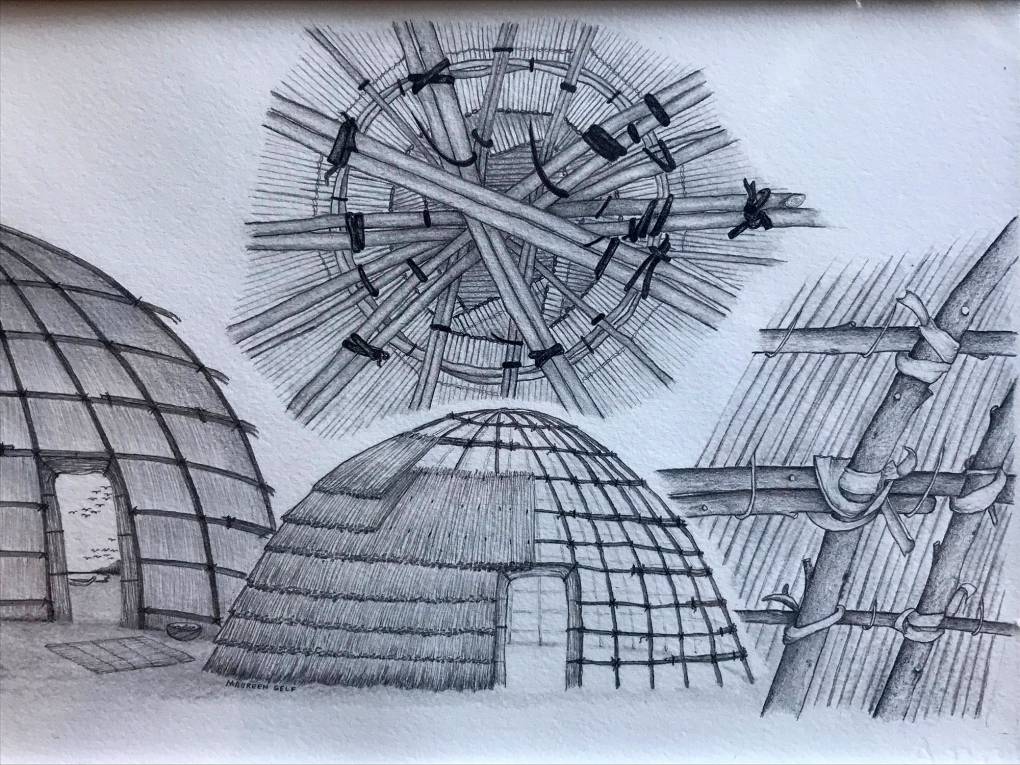
"caption": "Archaeologists believe some of the Bay Area's first inhabitants lived in houses that were framed with wood, perhaps willow, and thatched with tule or other plant materials. ",
"description": "illustrations are by Maureen Self. Courtesy of the California Institute for Community, Art & Nature,\" where Malcolm is the executive director and founder.\n",
"title": "tule-reed-hut",
"credit": "Maureen Self/Courtesy of the California Institute for Community, Art & Nature",
"status": "inherit",
"altTag": "Archaeologists believe some of the Bay Area's first inhabitants lived in houses were framed with wood, perhaps willow, and thatched with tule or other plant materials.",
"isLoading": false,
"fetchFailed": false
},
"news_11880226": {
"type": "attachments",
"id": "news_11880226",
"meta": {
"index": "attachments_1716263798",
"site": "news",
"id": "11880226",
"found": true
},
"parent": 11879641,
"imgSizes": {
"twentyfourteen-full-width": {
"file": "https://ww2.kqed.org/app/uploads/sites/10/2021/07/trucks-1038x576.jpg",
"width": 1038,
"mimeType": "image/jpeg",
"height": 576
},
"thumbnail": {
"file": "https://ww2.kqed.org/app/uploads/sites/10/2021/07/trucks-160x90.jpg",
"width": 160,
"mimeType": "image/jpeg",
"height": 90
},
"post-thumbnail": {
"file": "https://ww2.kqed.org/app/uploads/sites/10/2021/07/trucks-672x372.jpg",
"width": 672,
"mimeType": "image/jpeg",
"height": 372
},
"kqedFullSize": {
"file": "https://ww2.kqed.org/app/uploads/sites/10/2021/07/trucks.jpg",
"width": 1920,
"height": 1080
},
"large": {
"file": "https://ww2.kqed.org/app/uploads/sites/10/2021/07/trucks-1020x574.jpg",
"width": 1020,
"mimeType": "image/jpeg",
"height": 574
},
"1536x1536": {
"file": "https://ww2.kqed.org/app/uploads/sites/10/2021/07/trucks-1536x864.jpg",
"width": 1536,
"mimeType": "image/jpeg",
"height": 864
},
"medium": {
"file": "https://ww2.kqed.org/app/uploads/sites/10/2021/07/trucks-800x450.jpg",
"width": 800,
"mimeType": "image/jpeg",
"height": 450
}
},
"publishDate": 1625194429,
"modified": 1625194540,
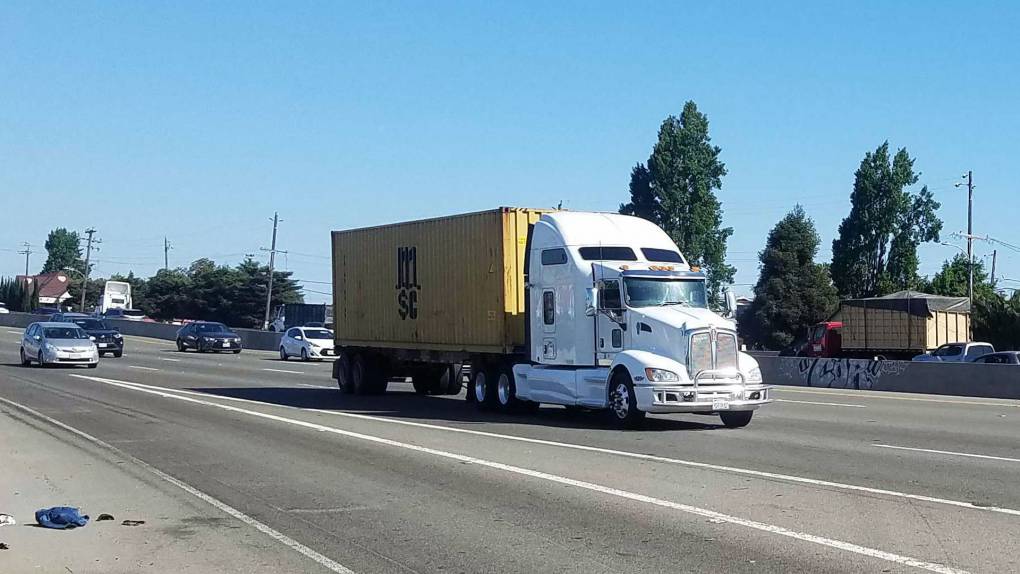
"caption": "A big rig truck on the 880 freeway. Big trucks like this one are banned on the I-580 freeway.",
"description": null,
"title": "trucks",
"credit": "Teodros Hailye/KQED",
"status": "inherit",
"altTag": null,
"isLoading": false,
"fetchFailed": false
},
"news_11879070": {
"type": "attachments",
"id": "news_11879070",
"meta": {
"index": "attachments_1716263798",
"site": "news",
"id": "11879070",
"found": true
},
"parent": 11879038,
"imgSizes": {
"twentyfourteen-full-width": {
"file": "https://ww2.kqed.org/app/uploads/sites/10/2021/06/Berkeley-Rep-exterior-1038x576.jpg",
"width": 1038,
"mimeType": "image/jpeg",
"height": 576
},
"thumbnail": {
"file": "https://ww2.kqed.org/app/uploads/sites/10/2021/06/Berkeley-Rep-exterior-160x125.jpg",
"width": 160,
"mimeType": "image/jpeg",
"height": 125
},
"post-thumbnail": {
"file": "https://ww2.kqed.org/app/uploads/sites/10/2021/06/Berkeley-Rep-exterior-672x372.jpg",
"width": 672,
"mimeType": "image/jpeg",
"height": 372
},
"kqedFullSize": {
"file": "https://ww2.kqed.org/app/uploads/sites/10/2021/06/Berkeley-Rep-exterior.jpg",
"width": 1920,
"height": 1497
},
"large": {
"file": "https://ww2.kqed.org/app/uploads/sites/10/2021/06/Berkeley-Rep-exterior-1020x795.jpg",
"width": 1020,
"mimeType": "image/jpeg",
"height": 795
},
"1536x1536": {
"file": "https://ww2.kqed.org/app/uploads/sites/10/2021/06/Berkeley-Rep-exterior-1536x1198.jpg",
"width": 1536,
"mimeType": "image/jpeg",
"height": 1198
},
"medium": {
"file": "https://ww2.kqed.org/app/uploads/sites/10/2021/06/Berkeley-Rep-exterior-800x624.jpg",
"width": 800,
"mimeType": "image/jpeg",
"height": 624
}
},
"publishDate": 1624477585,
"modified": 1624484962,
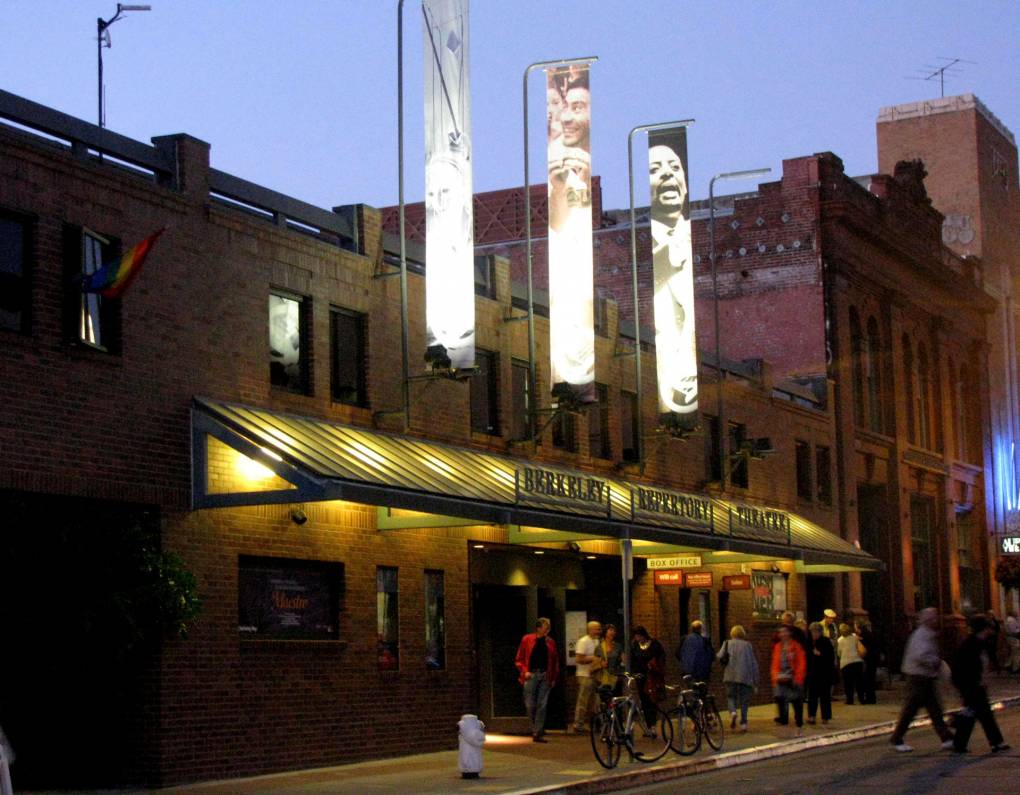
"caption": "Exterior of Berkeley Repertory Theatre",
"description": null,
"title": "Berkeley-Rep-exterior",
"credit": "\u003ca href=\"https://www.flickr.com/photos/rocor/14353591619/in/photolist-nSnUHz-fLJA46-bUX1ss-4f4jRL-6Vn8WN-agWBft-xbSGF-6cUS88-TQCKo7-U1qAmU-6cUS7D-6cZ1Aj-6cZ1zU-91cTSM-dNYdw-4tdgKM-6ZatRX-QM1yde-6Zev5w-p1X4N-D5Vv9t-dNYcQ-5EpH41-bDRCZi-5Y7Pox-6ZazUT-dNYdg-buQYeA-U5xL94-TSYwP6-nSnU8M-TuzTZj-U3KVQx-4BHUbG-U1qxum-Srvjo8-5Ekq2e-5EpGYo-5Ekq4H-5Ekq6n-5EkqcM-5EkqaB-5EpH25-5EpGYU-xyAfT4-5EpH1m-bDRCJe-5ZtoN7-x3uc1V-5EkpX8\">rocor\u003c/a>/Flickr",
"status": "inherit",
"altTag": "Exterior of Berkeley Rep theater",
"isLoading": false,
"fetchFailed": false
},
"news_11879049": {
"type": "attachments",
"id": "news_11879049",
"meta": {
"index": "attachments_1716263798",
"site": "news",
"id": "11879049",
"found": true
},
"parent": 11879024,
"imgSizes": {
"twentyfourteen-full-width": {
"file": "https://ww2.kqed.org/app/uploads/sites/10/2021/06/RS48246_008_Oakland_MillsCollege_03242021-qut-1038x576.jpg",
"width": 1038,
"mimeType": "image/jpeg",
"height": 576
},
"thumbnail": {
"file": "https://ww2.kqed.org/app/uploads/sites/10/2021/06/RS48246_008_Oakland_MillsCollege_03242021-qut-160x107.jpg",
"width": 160,
"mimeType": "image/jpeg",
"height": 107
},
"post-thumbnail": {
"file": "https://ww2.kqed.org/app/uploads/sites/10/2021/06/RS48246_008_Oakland_MillsCollege_03242021-qut-672x372.jpg",
"width": 672,
"mimeType": "image/jpeg",
"height": 372
},
"kqedFullSize": {
"file": "https://ww2.kqed.org/app/uploads/sites/10/2021/06/RS48246_008_Oakland_MillsCollege_03242021-qut.jpg",
"width": 1920,
"height": 1280
},
"large": {
"file": "https://ww2.kqed.org/app/uploads/sites/10/2021/06/RS48246_008_Oakland_MillsCollege_03242021-qut-1020x680.jpg",
"width": 1020,
"mimeType": "image/jpeg",
"height": 680
},
"1536x1536": {
"file": "https://ww2.kqed.org/app/uploads/sites/10/2021/06/RS48246_008_Oakland_MillsCollege_03242021-qut-1536x1024.jpg",
"width": 1536,
"mimeType": "image/jpeg",
"height": 1024
},
"medium": {
"file": "https://ww2.kqed.org/app/uploads/sites/10/2021/06/RS48246_008_Oakland_MillsCollege_03242021-qut-800x533.jpg",
"width": 800,
"mimeType": "image/jpeg",
"height": 533
}
},
"publishDate": 1624475412,
"modified": 1624475434,
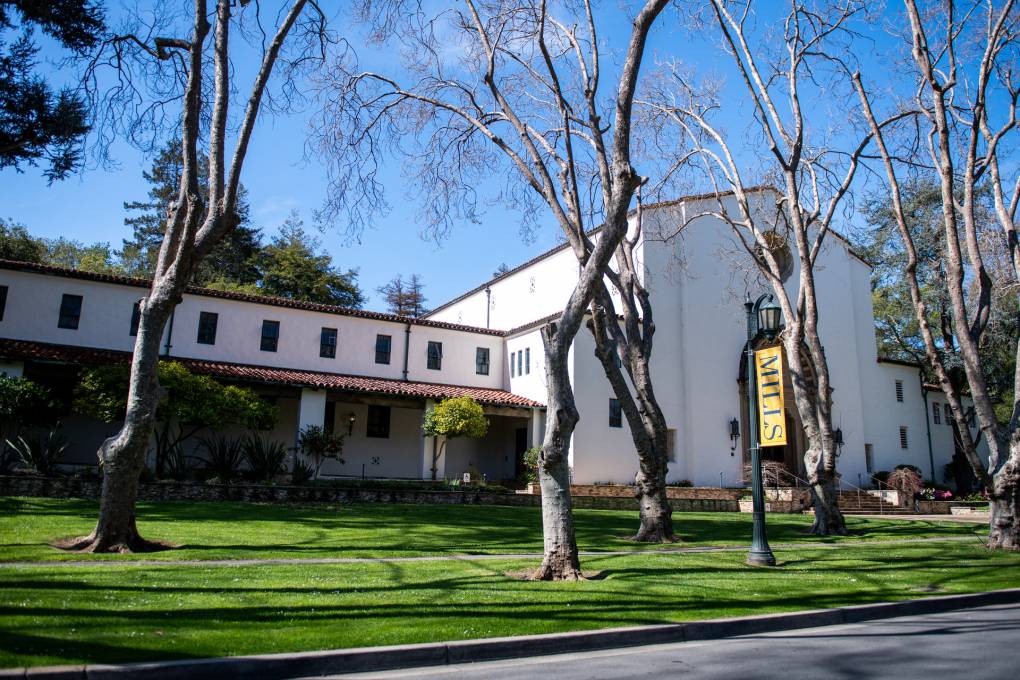
"caption": "The Littlefield Concert Hall at Mills College in Oakland on March 24, 2021.",
"description": null,
"title": "The Littlefield Concert Hall at Mills College in Oakland on March 24, 2021.",
"credit": "Beth LaBerge/KQED",
"status": "inherit",
"altTag": null,
"isLoading": false,
"fetchFailed": false
},
"news_11879009": {
"type": "attachments",
"id": "news_11879009",
"meta": {
"index": "attachments_1716263798",
"site": "news",
"id": "11879009",
"found": true
},
"parent": 11878995,
"imgSizes": {
"twentyfourteen-full-width": {
"file": "https://ww2.kqed.org/app/uploads/sites/10/2021/06/Beach-Blanket-BabylongSan-Francisco-Skyline-Hat-cropped-1038x576.jpg",
"width": 1038,
"mimeType": "image/jpeg",
"height": 576
},
"thumbnail": {
"file": "https://ww2.kqed.org/app/uploads/sites/10/2021/06/Beach-Blanket-BabylongSan-Francisco-Skyline-Hat-cropped-160x114.jpg",
"width": 160,
"mimeType": "image/jpeg",
"height": 114
},
"post-thumbnail": {
"file": "https://ww2.kqed.org/app/uploads/sites/10/2021/06/Beach-Blanket-BabylongSan-Francisco-Skyline-Hat-cropped-672x372.jpg",
"width": 672,
"mimeType": "image/jpeg",
"height": 372
},
"kqedFullSize": {
"file": "https://ww2.kqed.org/app/uploads/sites/10/2021/06/Beach-Blanket-BabylongSan-Francisco-Skyline-Hat-cropped-scaled.jpg",
"width": 2560,
"height": 1829
},
"2048x2048": {
"file": "https://ww2.kqed.org/app/uploads/sites/10/2021/06/Beach-Blanket-BabylongSan-Francisco-Skyline-Hat-cropped-2048x1464.jpg",
"width": 2048,
"mimeType": "image/jpeg",
"height": 1464
},
"large": {
"file": "https://ww2.kqed.org/app/uploads/sites/10/2021/06/Beach-Blanket-BabylongSan-Francisco-Skyline-Hat-cropped-1020x729.jpg",
"width": 1020,
"mimeType": "image/jpeg",
"height": 729
},
"1536x1536": {
"file": "https://ww2.kqed.org/app/uploads/sites/10/2021/06/Beach-Blanket-BabylongSan-Francisco-Skyline-Hat-cropped-1536x1098.jpg",
"width": 1536,
"mimeType": "image/jpeg",
"height": 1098
},
"full-width": {
"file": "https://ww2.kqed.org/app/uploads/sites/10/2021/06/Beach-Blanket-BabylongSan-Francisco-Skyline-Hat-cropped-1920x1372.jpg",
"width": 1920,
"mimeType": "image/jpeg",
"height": 1372
},
"medium": {
"file": "https://ww2.kqed.org/app/uploads/sites/10/2021/06/Beach-Blanket-BabylongSan-Francisco-Skyline-Hat-cropped-800x572.jpg",
"width": 800,
"mimeType": "image/jpeg",
"height": 572
}
},
"publishDate": 1624468333,
"modified": 1624468431,
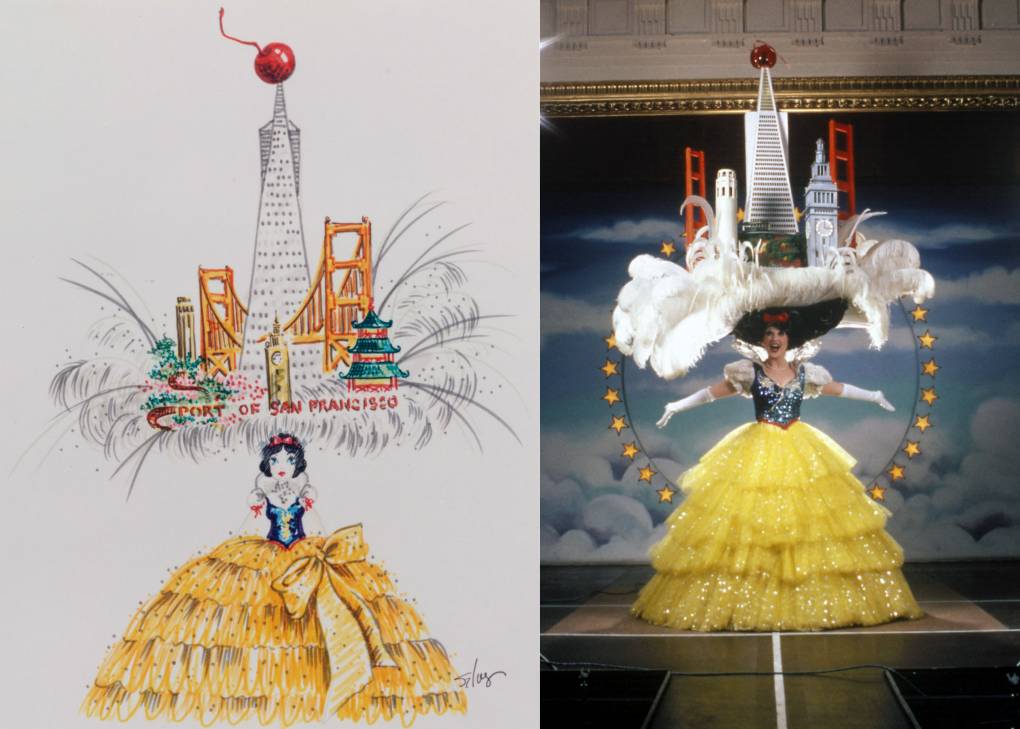
"caption": "Steve Silver's sketch of a San Francisco skyline hat from Beach Blanket Babylon next to the on-stage character.",
"description": null,
"title": "Beach-Blanket-BabylongSan-Francisco-Skyline-Hat-cropped",
"credit": "Courtesy Beach Blanket Babylon",
"status": "inherit",
"altTag": "Sketch of Beach Blanket Babylon's San Francisco hat next to on-stage character",
"isLoading": false,
"fetchFailed": false
},
"news_11878189": {
"type": "attachments",
"id": "news_11878189",
"meta": {
"index": "attachments_1716263798",
"site": "news",
"id": "11878189",
"found": true
},
"parent": 11877801,
"imgSizes": {
"twentyfourteen-full-width": {
"file": "https://ww2.kqed.org/app/uploads/sites/10/2021/06/1997-300-1119-1038x576.jpg",
"width": 1038,
"mimeType": "image/jpeg",
"height": 576
},
"thumbnail": {
"file": "https://ww2.kqed.org/app/uploads/sites/10/2021/06/1997-300-1119-160x124.jpg",
"width": 160,
"mimeType": "image/jpeg",
"height": 124
},
"post-thumbnail": {
"file": "https://ww2.kqed.org/app/uploads/sites/10/2021/06/1997-300-1119-672x372.jpg",
"width": 672,
"mimeType": "image/jpeg",
"height": 372
},
"kqedFullSize": {
"file": "https://ww2.kqed.org/app/uploads/sites/10/2021/06/1997-300-1119-scaled.jpg",
"width": 2560,
"height": 1987
},
"2048x2048": {
"file": "https://ww2.kqed.org/app/uploads/sites/10/2021/06/1997-300-1119-2048x1589.jpg",
"width": 2048,
"mimeType": "image/jpeg",
"height": 1589
},
"large": {
"file": "https://ww2.kqed.org/app/uploads/sites/10/2021/06/1997-300-1119-1020x792.jpg",
"width": 1020,
"mimeType": "image/jpeg",
"height": 792
},
"1536x1536": {
"file": "https://ww2.kqed.org/app/uploads/sites/10/2021/06/1997-300-1119-1536x1192.jpg",
"width": 1536,
"mimeType": "image/jpeg",
"height": 1192
},
"full-width": {
"file": "https://ww2.kqed.org/app/uploads/sites/10/2021/06/1997-300-1119-1920x1490.jpg",
"width": 1920,
"mimeType": "image/jpeg",
"height": 1490
},
"medium": {
"file": "https://ww2.kqed.org/app/uploads/sites/10/2021/06/1997-300-1119-800x621.jpg",
"width": 800,
"mimeType": "image/jpeg",
"height": 621
}
},
"publishDate": 1623807648,
"modified": 1623807713,
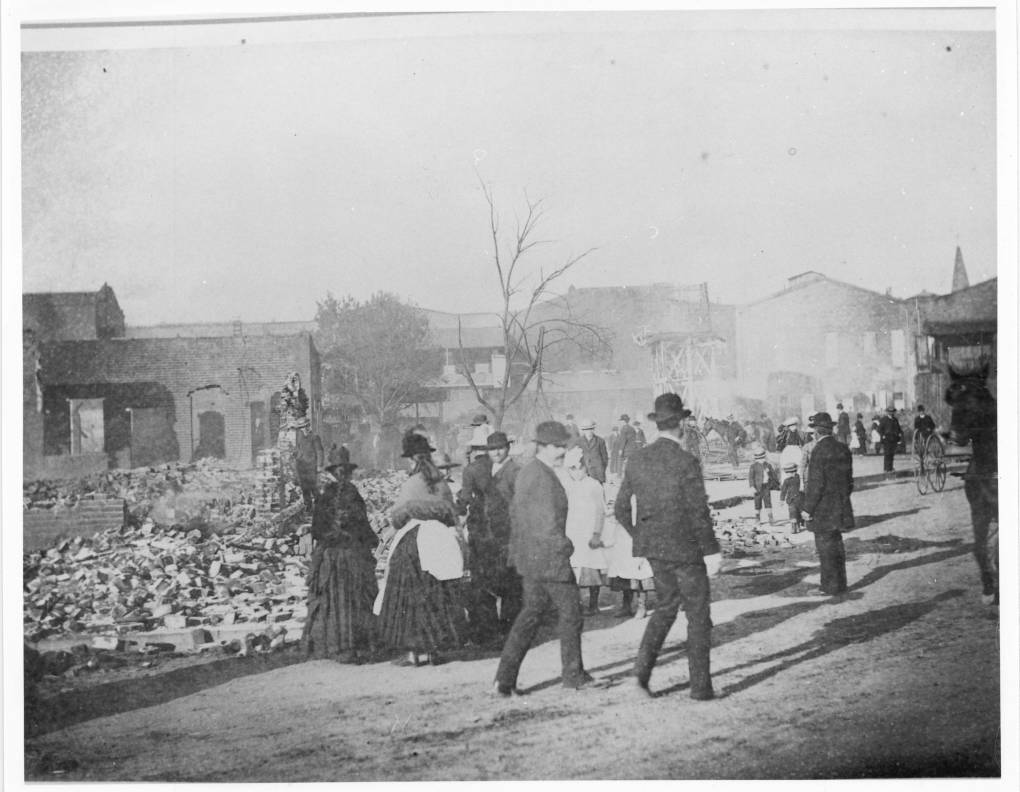
"caption": "Onlookers watch as a fire tears through the Second Market Street Chinatown. Most of the Chinatowns in San Jose were victims to arson.",
"description": null,
"title": "1997-300-1119",
"credit": "Courtesy of History San Jose",
"status": "inherit",
"altTag": null,
"isLoading": false,
"fetchFailed": false
},
"news_11644119": {
"type": "attachments",
"id": "news_11644119",
"meta": {
"index": "attachments_1716263798",
"site": "news",
"id": "11644119",
"found": true
},
"parent": 11642644,
"imgSizes": {
"small": {
"file": "https://ww2.kqed.org/app/uploads/sites/10/2018/01/bridgemodel-520x293.jpg",
"width": 520,
"mimeType": "image/jpeg",
"height": 293
},
"thumbnail": {
"file": "https://ww2.kqed.org/app/uploads/sites/10/2018/01/bridgemodel-160x90.jpg",
"width": 160,
"mimeType": "image/jpeg",
"height": 90
},
"post-thumbnail": {
"file": "https://ww2.kqed.org/app/uploads/sites/10/2018/01/bridgemodel-672x372.jpg",
"width": 672,
"mimeType": "image/jpeg",
"height": 372
},
"xsmall": {
"file": "https://ww2.kqed.org/app/uploads/sites/10/2018/01/bridgemodel-375x211.jpg",
"width": 375,
"mimeType": "image/jpeg",
"height": 211
},
"kqedFullSize": {
"file": "https://ww2.kqed.org/app/uploads/sites/10/2018/01/bridgemodel.jpg",
"width": 800,
"height": 450
},
"guest-author-50": {
"file": "https://ww2.kqed.org/app/uploads/sites/10/2018/01/bridgemodel-50x50.jpg",
"width": 50,
"mimeType": "image/jpeg",
"height": 50
},
"guest-author-96": {
"file": "https://ww2.kqed.org/app/uploads/sites/10/2018/01/bridgemodel-96x96.jpg",
"width": 96,
"mimeType": "image/jpeg",
"height": 96
},
"medium": {
"file": "https://ww2.kqed.org/app/uploads/sites/10/2018/01/bridgemodel-800x450.jpg",
"width": 800,
"mimeType": "image/jpeg",
"height": 450
},
"guest-author-64": {
"file": "https://ww2.kqed.org/app/uploads/sites/10/2018/01/bridgemodel-64x64.jpg",
"width": 64,
"mimeType": "image/jpeg",
"height": 64
},
"guest-author-32": {
"file": "https://ww2.kqed.org/app/uploads/sites/10/2018/01/bridgemodel-32x32.jpg",
"width": 32,
"mimeType": "image/jpeg",
"height": 32
},
"detail": {
"file": "https://ww2.kqed.org/app/uploads/sites/10/2018/01/bridgemodel-150x150.jpg",
"width": 150,
"mimeType": "image/jpeg",
"height": 150
},
"guest-author-128": {
"file": "https://ww2.kqed.org/app/uploads/sites/10/2018/01/bridgemodel-128x128.jpg",
"width": 128,
"mimeType": "image/jpeg",
"height": 128
},
"xxsmall": {
"file": "https://ww2.kqed.org/app/uploads/sites/10/2018/01/bridgemodel-240x135.jpg",
"width": 240,
"mimeType": "image/jpeg",
"height": 135
}
},
"publishDate": 1516840686,
"modified": 1516843057,
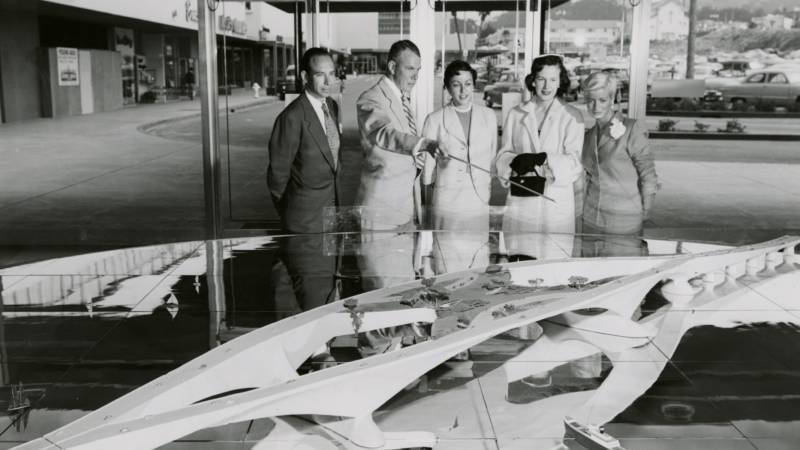
"caption": "Model of the Butterfly Bridge at Stonestown Shopping Center, San Francisco, 1953. L to R: Aaron Green, Arthur Haggard, Mrs. Donald Magnin, Mary Lee Futernick and Carol Weingarten. ",
"description": "Model of the Butterfly Bridge at Stonestown Shopping Center, San Francisco, 1953. L to R: Aaron Green, Arthur Haggard, Mrs. Donald Magnin, Mary Lee Futernick, and Carol Weingarten. ",
"title": "bridgemodel",
"credit": "Courtesy of Robot Skelton, San Francisco Call-Bulletin",
"status": "inherit",
"isLoading": false,
"fetchFailed": false
},
"news_11876401": {
"type": "attachments",
"id": "news_11876401",
"meta": {
"index": "attachments_1716263798",
"site": "news",
"id": "11876401",
"found": true
},
"parent": 11876393,
"imgSizes": {
"twentyfourteen-full-width": {
"file": "https://ww2.kqed.org/app/uploads/sites/10/2021/06/Sibley-view-1038x576.jpg",
"width": 1038,
"mimeType": "image/jpeg",
"height": 576
},
"thumbnail": {
"file": "https://ww2.kqed.org/app/uploads/sites/10/2021/06/Sibley-view-160x90.jpg",
"width": 160,
"mimeType": "image/jpeg",
"height": 90
},
"post-thumbnail": {
"file": "https://ww2.kqed.org/app/uploads/sites/10/2021/06/Sibley-view-672x372.jpg",
"width": 672,
"mimeType": "image/jpeg",
"height": 372
},
"kqedFullSize": {
"file": "https://ww2.kqed.org/app/uploads/sites/10/2021/06/Sibley-view.jpg",
"width": 1920,
"height": 1080
},
"large": {
"file": "https://ww2.kqed.org/app/uploads/sites/10/2021/06/Sibley-view-1020x574.jpg",
"width": 1020,
"mimeType": "image/jpeg",
"height": 574
},
"1536x1536": {
"file": "https://ww2.kqed.org/app/uploads/sites/10/2021/06/Sibley-view-1536x864.jpg",
"width": 1536,
"mimeType": "image/jpeg",
"height": 864
},
"medium": {
"file": "https://ww2.kqed.org/app/uploads/sites/10/2021/06/Sibley-view-800x450.jpg",
"width": 800,
"mimeType": "image/jpeg",
"height": 450
}
},
"publishDate": 1622674276,
"modified": 1622674377,
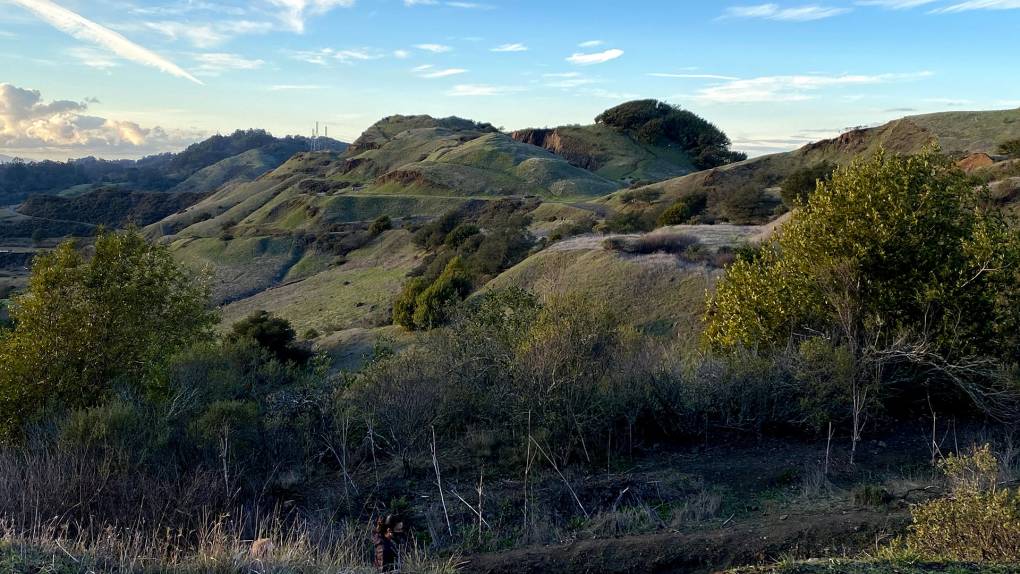
"caption": "View from the hiking trails at Sibley Volcanic Regional Preserve.",
"description": null,
"title": "Sibley-view",
"credit": "Bourke MacDonald",
"status": "inherit",
"altTag": "View from the hiking trails at Sibley Volcanic Regional Preserve.",
"isLoading": false,
"fetchFailed": false
},
"news_11871566": {
"type": "attachments",
"id": "news_11871566",
"meta": {
"index": "attachments_1716263798",
"site": "news",
"id": "11871566",
"found": true
},
"parent": 11871565,
"imgSizes": {
"twentyfourteen-full-width": {
"file": "https://ww2.kqed.org/app/uploads/sites/10/2021/04/16994899290_64a91947fa_b-1023x576.jpg",
"width": 1023,
"mimeType": "image/jpeg",
"height": 576
},
"thumbnail": {
"file": "https://ww2.kqed.org/app/uploads/sites/10/2021/04/16994899290_64a91947fa_b-160x101.jpg",
"width": 160,
"mimeType": "image/jpeg",
"height": 101
},
"post-thumbnail": {
"file": "https://ww2.kqed.org/app/uploads/sites/10/2021/04/16994899290_64a91947fa_b-672x372.jpg",
"width": 672,
"mimeType": "image/jpeg",
"height": 372
},
"kqedFullSize": {
"file": "https://ww2.kqed.org/app/uploads/sites/10/2021/04/16994899290_64a91947fa_b.jpg",
"width": 1023,
"height": 645
},
"large": {
"file": "https://ww2.kqed.org/app/uploads/sites/10/2021/04/16994899290_64a91947fa_b-1020x643.jpg",
"width": 1020,
"mimeType": "image/jpeg",
"height": 643
},
"medium": {
"file": "https://ww2.kqed.org/app/uploads/sites/10/2021/04/16994899290_64a91947fa_b-800x504.jpg",
"width": 800,
"mimeType": "image/jpeg",
"height": 504
}
},
"publishDate": 1619652499,
"modified": 1621474833,
"caption": "For half a century, Searsville Lake functioned as a man-made playground that drew thousands of people from all over the Bay Area for water sports, summer camps, picnics and more. ",
"description": "For half a century, Searsville Lake functioned as a man-made playground that drew thousands of people from all over the Bay Area for water sports, summer camps, picnics and more.",
"title": "16994899290_64a91947fa_b",
"credit": "Courtesy Stanford University Archives",
"status": "inherit",
"altTag": "For half a century, Searsville Lake functioned as a man-made playground that drew thousands of people from all over the Bay Area for water sports, summer camps, picnics and more when the weather was good.",
"isLoading": false,
"fetchFailed": false
},
"news_11872731": {
"type": "attachments",
"id": "news_11872731",
"meta": {
"index": "attachments_1716263798",
"site": "news",
"id": "11872731",
"found": true
},
"parent": 11872730,
"imgSizes": {
"twentyfourteen-full-width": {
"file": "https://ww2.kqed.org/app/uploads/sites/10/2016/08/egger2_enl-6caea5207a48def8f2179382777a1e494376ff38-1038x576.jpg",
"width": 1038,
"mimeType": "image/jpeg",
"height": 576
},
"thumbnail": {
"file": "https://ww2.kqed.org/app/uploads/sites/10/2016/08/egger2_enl-6caea5207a48def8f2179382777a1e494376ff38-160x129.jpg",
"width": 160,
"mimeType": "image/jpeg",
"height": 129
},
"post-thumbnail": {
"file": "https://ww2.kqed.org/app/uploads/sites/10/2016/08/egger2_enl-6caea5207a48def8f2179382777a1e494376ff38-672x372.jpg",
"width": 672,
"mimeType": "image/jpeg",
"height": 372
},
"kqedFullSize": {
"file": "https://ww2.kqed.org/app/uploads/sites/10/2016/08/egger2_enl-6caea5207a48def8f2179382777a1e494376ff38.jpg",
"width": 2000,
"height": 1616
},
"large": {
"file": "https://ww2.kqed.org/app/uploads/sites/10/2016/08/egger2_enl-6caea5207a48def8f2179382777a1e494376ff38-1020x824.jpg",
"width": 1020,
"mimeType": "image/jpeg",
"height": 824
},
"1536x1536": {
"file": "https://ww2.kqed.org/app/uploads/sites/10/2016/08/egger2_enl-6caea5207a48def8f2179382777a1e494376ff38-1536x1241.jpg",
"width": 1536,
"mimeType": "image/jpeg",
"height": 1241
},
"full-width": {
"file": "https://ww2.kqed.org/app/uploads/sites/10/2016/08/egger2_enl-6caea5207a48def8f2179382777a1e494376ff38-1920x1551.jpg",
"width": 1920,
"mimeType": "image/jpeg",
"height": 1551
},
"medium": {
"file": "https://ww2.kqed.org/app/uploads/sites/10/2016/08/egger2_enl-6caea5207a48def8f2179382777a1e494376ff38-800x646.jpg",
"width": 800,
"mimeType": "image/jpeg",
"height": 646
}
},
"publishDate": 1620412443,
"modified": 1620415239,
"caption": "A group of men clean a week's haul of seabird eggs.",
"description": "A group of men clean a week's haul of seabird eggs.",
"title": "A group of men clean a week's haul of seabird eggs.",
"credit": "Arthur Bolton/California Academy of Sciences ",
"status": "inherit",
"altTag": "A group of men clean a week's haul of seabird eggs.",
"isLoading": false,
"fetchFailed": false
},
"news_11871925": {
"type": "attachments",
"id": "news_11871925",
"meta": {
"index": "attachments_1716263798",
"site": "news",
"id": "11871925",
"found": true
},
"parent": 11871915,
"imgSizes": {
"twentyfourteen-full-width": {
"file": "https://ww2.kqed.org/app/uploads/sites/10/2021/04/Chinese-and-donuts1-1038x576.jpg",
"width": 1038,
"mimeType": "image/jpeg",
"height": 576
},
"thumbnail": {
"file": "https://ww2.kqed.org/app/uploads/sites/10/2021/04/Chinese-and-donuts1-160x107.jpg",
"width": 160,
"mimeType": "image/jpeg",
"height": 107
},
"post-thumbnail": {
"file": "https://ww2.kqed.org/app/uploads/sites/10/2021/04/Chinese-and-donuts1-672x372.jpg",
"width": 672,
"mimeType": "image/jpeg",
"height": 372
},
"kqedFullSize": {
"file": "https://ww2.kqed.org/app/uploads/sites/10/2021/04/Chinese-and-donuts1.jpg",
"width": 1920,
"height": 1280
},
"large": {
"file": "https://ww2.kqed.org/app/uploads/sites/10/2021/04/Chinese-and-donuts1-1020x680.jpg",
"width": 1020,
"mimeType": "image/jpeg",
"height": 680
},
"1536x1536": {
"file": "https://ww2.kqed.org/app/uploads/sites/10/2021/04/Chinese-and-donuts1-1536x1024.jpg",
"width": 1536,
"mimeType": "image/jpeg",
"height": 1024
},
"medium": {
"file": "https://ww2.kqed.org/app/uploads/sites/10/2021/04/Chinese-and-donuts1-800x533.jpg",
"width": 800,
"mimeType": "image/jpeg",
"height": 533
}
},
"publishDate": 1619824939,
"modified": 1619825059,
"caption": "An employee at China Express, a restaurant serving chinese food and doughnuts, on 24th and Mission Streets in San Francisco on March 19, 2021.",
"description": null,
"title": "Chinese-and-donuts1",
"credit": "Beth LaBerge/KQED",
"status": "inherit",
"altTag": "An employee at China Express on 24th and Mission Streets.",
"isLoading": false,
"fetchFailed": false
},
"news_11753253": {
"type": "attachments",
"id": "news_11753253",
"meta": {
"index": "attachments_1716263798",
"site": "news",
"id": "11753253",
"found": true
},
"parent": 11753198,
"imgSizes": {
"apple_news_ca_landscape_5_5": {
"file": "https://ww2.kqed.org/app/uploads/sites/10/2019/06/IMG_2008-1044x783.jpeg",
"width": 1044,
"mimeType": "image/jpeg",
"height": 783
},
"apple_news_ca_square_4_0": {
"file": "https://ww2.kqed.org/app/uploads/sites/10/2019/06/IMG_2008-470x470.jpeg",
"width": 470,
"mimeType": "image/jpeg",
"height": 470
},
"twentyfourteen-full-width": {
"file": "https://ww2.kqed.org/app/uploads/sites/10/2019/06/IMG_2008-1038x576.jpeg",
"width": 1038,
"mimeType": "image/jpeg",
"height": 576
},
"thumbnail": {
"file": "https://ww2.kqed.org/app/uploads/sites/10/2019/06/IMG_2008-160x120.jpeg",
"width": 160,
"mimeType": "image/jpeg",
"height": 120
},
"post-thumbnail": {
"file": "https://ww2.kqed.org/app/uploads/sites/10/2019/06/IMG_2008-672x372.jpeg",
"width": 672,
"mimeType": "image/jpeg",
"height": 372
},
"kqedFullSize": {
"file": "https://ww2.kqed.org/app/uploads/sites/10/2019/06/IMG_2008.jpeg",
"width": 1950,
"height": 1463
},
"apple_news_ca_landscape_4_7": {
"file": "https://ww2.kqed.org/app/uploads/sites/10/2019/06/IMG_2008-632x474.jpeg",
"width": 632,
"mimeType": "image/jpeg",
"height": 474
},
"large": {
"file": "https://ww2.kqed.org/app/uploads/sites/10/2019/06/IMG_2008-1020x765.jpeg",
"width": 1020,
"mimeType": "image/jpeg",
"height": 765
},
"complete_open_graph": {
"file": "https://ww2.kqed.org/app/uploads/sites/10/2019/06/IMG_2008-1200x900.jpeg",
"width": 1200,
"mimeType": "image/jpeg",
"height": 900
},
"apple_news_ca_landscape_4_0": {
"file": "https://ww2.kqed.org/app/uploads/sites/10/2019/06/IMG_2008-536x402.jpeg",
"width": 536,
"mimeType": "image/jpeg",
"height": 402
},
"apple_news_ca_portrait_12_9": {
"file": "https://ww2.kqed.org/app/uploads/sites/10/2019/06/IMG_2008-1122x1463.jpeg",
"width": 1122,
"mimeType": "image/jpeg",
"height": 1463
},
"medium": {
"file": "https://ww2.kqed.org/app/uploads/sites/10/2019/06/IMG_2008-800x600.jpeg",
"width": 800,
"mimeType": "image/jpeg",
"height": 600
},
"apple_news_ca_portrait_4_0": {
"file": "https://ww2.kqed.org/app/uploads/sites/10/2019/06/IMG_2008-354x472.jpeg",
"width": 354,
"mimeType": "image/jpeg",
"height": 472
},
"apple_news_ca_portrait_9_7": {
"file": "https://ww2.kqed.org/app/uploads/sites/10/2019/06/IMG_2008-840x1120.jpeg",
"width": 840,
"mimeType": "image/jpeg",
"height": 1120
},
"apple_news_ca_landscape_12_9": {
"file": "https://ww2.kqed.org/app/uploads/sites/10/2019/06/IMG_2008-1832x1374.jpeg",
"width": 1832,
"mimeType": "image/jpeg",
"height": 1374
},
"apple_news_ca_square_9_7": {
"file": "https://ww2.kqed.org/app/uploads/sites/10/2019/06/IMG_2008-1104x1104.jpeg",
"width": 1104,
"mimeType": "image/jpeg",
"height": 1104
},
"apple_news_ca_portrait_4_7": {
"file": "https://ww2.kqed.org/app/uploads/sites/10/2019/06/IMG_2008-414x552.jpeg",
"width": 414,
"mimeType": "image/jpeg",
"height": 552
},
"apple_news_ca_square_12_9": {
"file": "https://ww2.kqed.org/app/uploads/sites/10/2019/06/IMG_2008-1472x1463.jpeg",
"width": 1472,
"mimeType": "image/jpeg",
"height": 1463
},
"apple_news_ca_portrait_5_5": {
"file": "https://ww2.kqed.org/app/uploads/sites/10/2019/06/IMG_2008-687x916.jpeg",
"width": 687,
"mimeType": "image/jpeg",
"height": 916
},
"full-width": {
"file": "https://ww2.kqed.org/app/uploads/sites/10/2019/06/IMG_2008-1920x1440.jpeg",
"width": 1920,
"mimeType": "image/jpeg",
"height": 1440
},
"apple_news_ca_square_4_7": {
"file": "https://ww2.kqed.org/app/uploads/sites/10/2019/06/IMG_2008-550x550.jpeg",
"width": 550,
"mimeType": "image/jpeg",
"height": 550
},
"apple_news_ca_landscape_9_7": {
"file": "https://ww2.kqed.org/app/uploads/sites/10/2019/06/IMG_2008-1376x1032.jpeg",
"width": 1376,
"mimeType": "image/jpeg",
"height": 1032
},
"apple_news_ca_square_5_5": {
"file": "https://ww2.kqed.org/app/uploads/sites/10/2019/06/IMG_2008-912x912.jpeg",
"width": 912,
"mimeType": "image/jpeg",
"height": 912
}
},
"publishDate": 1559945991,
"modified": 1559946192,
"caption": "A Nike Hercules missile at the Marin Headlands site rises from its underground bunker on a huge elevator, to be raised into launch position. The Nikes were decommissioned in 1974.",
"description": "A Nike Hercules missile at the Marin Headlands site rises from its underground bunker on a huge elevator, to be raised into launch position. The Nikes were decommissioned in 1974.",
"title": "IMG_2008",
"credit": "Craig Miller/KQED",
"status": "inherit",
"isLoading": false,
"fetchFailed": false
}
},
"audioPlayerReducer": {
"postId": "stream_live",
"isPaused": true,
"isPlaying": false,
"pfsActive": false,
"pledgeModalIsOpen": true,
"playerDrawerIsOpen": false,
"liveAudioPlayStartedAt": 0,
"liveAudioPlayContext": ""
},
"authorsReducer": {
"byline_news_11880526": {
"type": "authors",
"id": "byline_news_11880526",
"meta": {
"override": true
},
"slug": "byline_news_11880526",
"name": "Daniel Potter",
"isLoading": false
},
"byline_news_11872730": {
"type": "authors",
"id": "byline_news_11872730",
"meta": {
"override": true
},
"slug": "byline_news_11872730",
"name": "The Kitchen Sisters, Nikki Silva and Davia Nelson",
"isLoading": false
},
"cmiller": {
"type": "authors",
"id": "221",
"meta": {
"index": "authors_1716337520",
"id": "221",
"found": true
},
"name": "Craig Miller",
"firstName": "Craig",
"lastName": "Miller",
"slug": "cmiller",
"email": "craig@voxterra.net",
"display_author_email": false,
"staff_mastheads": [
"science"
],
"title": "Editor Emeritus, Science",
"bio": "Craig is a former KQED Science editor, specializing in weather, climate, water & energy issues, with a little seismology thrown in just to shake things up. Prior to that, he launched and led the station's award-winning multimedia project, Climate Watch. Craig is also an accomplished writer/producer of television documentaries, with a focus on natural resource issues.",
"avatar": "https://secure.gravatar.com/avatar/b91661df645e001a9cafe0861fa685f9?s=600&d=blank&r=g",
"twitter": "voxterra",
"facebook": null,
"instagram": null,
"linkedin": null,
"sites": [
{
"site": "news",
"roles": [
"author"
]
},
{
"site": "futureofyou",
"roles": [
"editor"
]
},
{
"site": "stateofhealth",
"roles": [
"author"
]
},
{
"site": "science",
"roles": [
"editor"
]
},
{
"site": "quest",
"roles": [
"editor"
]
}
],
"headData": {
"title": "Craig Miller | KQED",
"description": "Editor Emeritus, Science",
"ogImgSrc": "https://secure.gravatar.com/avatar/b91661df645e001a9cafe0861fa685f9?s=600&d=blank&r=g",
"twImgSrc": "https://secure.gravatar.com/avatar/b91661df645e001a9cafe0861fa685f9?s=600&d=blank&r=g"
},
"isLoading": false,
"link": "/author/cmiller"
},
"katrinaschwartz": {
"type": "authors",
"id": "234",
"meta": {
"index": "authors_1716337520",
"id": "234",
"found": true
},
"name": "Katrina Schwartz",
"firstName": "Katrina",
"lastName": "Schwartz",
"slug": "katrinaschwartz",
"email": "kschwartz@kqed.org",
"display_author_email": false,
"staff_mastheads": [
"news"
],
"title": "Producer",
"bio": "Katrina Schwartz is a journalist based in San Francisco. She's worked at KPCC public radio in LA and has reported on air and online for KQED since 2010. She covered how teaching and learning is changing for MindShift between 2012 and 2020. She is the co-host of the MindShift podcast and now produces KQED's Bay Curious podcast.",
"avatar": "https://secure.gravatar.com/avatar/edb4ee79070447a018538c9aae6eeecf28786515b8a0c30e43b6b7dce5aa44c8?s=600&d=blank&r=g",
"twitter": "kschwart",
"bluesky": null,
"facebook": null,
"instagram": null,
"linkedin": null,
"sites": [
{
"site": "",
"roles": [
"editor"
]
},
{
"site": "news",
"roles": [
"editor"
]
},
{
"site": "mindshift",
"roles": [
"administrator"
]
},
{
"site": "stateofhealth",
"roles": [
"author"
]
},
{
"site": "science",
"roles": [
"editor"
]
}
],
"headData": {
"title": "Katrina Schwartz | KQED",
"description": "Producer",
"ogImgSrc": "https://secure.gravatar.com/avatar/edb4ee79070447a018538c9aae6eeecf28786515b8a0c30e43b6b7dce5aa44c8?s=600&d=blank&r=g",
"twImgSrc": "https://secure.gravatar.com/avatar/edb4ee79070447a018538c9aae6eeecf28786515b8a0c30e43b6b7dce5aa44c8?s=600&d=blank&r=g"
},
"isLoading": false,
"link": "/author/katrinaschwartz"
},
"rachael-myrow": {
"type": "authors",
"id": "251",
"meta": {
"index": "authors_1716337520",
"id": "251",
"found": true
},
"name": "Rachael Myrow",
"firstName": "Rachael",
"lastName": "Myrow",
"slug": "rachael-myrow",
"email": "rmyrow@kqed.org",
"display_author_email": true,
"staff_mastheads": [
"news"
],
"title": "Senior Editor of KQED's Silicon Valley News Desk",
"bio": "• I write and edit stories about how Silicon Valley power and policies shape everyday life in California. I’m also passionate about making Bay Area history and culture more accessible to a broad public. • I’ve been a journalist for most of my life, starting in high school with The Franklin Press in Los Angeles, where I grew up. While earning my first degree in English at UC Berkeley, I got my start in public radio at KALX-FM. After completing a second degree in journalism at Cal, I landed my first professional job at Marketplace, then moved on to KPCC (now LAist), and then KQED, where I hosted The California Report for more than seven years. • My reporting has appeared on NPR, The World, WBUR’s \u003ci>Here & Now\u003c/i>, and the BBC. I also guest host for KQED’s \u003ci>Forum\u003c/i>, as well as the Commonwealth Club in San Francisco. • I speak periodically on media, democracy and technology issues, and do voiceover work for documentaries and educational video projects. • Outside of the studio, you'll find me hiking Bay Area trails and whipping up Insta-ready meals in my kitchen. • I do not accept gifts, money, or favors from anyone connected to my reporting, I don't pay people for information, and I do not support or donate to political causes. • I strive to treat the people I report on with fairness, honesty, and respect. I also recognize there are often multiple sides to a story and work to verify information through multiple sources and documentation. If I get something wrong, I correct it.",
"avatar": "https://secure.gravatar.com/avatar/3ed8a3c5f26025e4a805ba634cda8cd764906b97438a6d9ce216b044e340da4e?s=600&d=blank&r=g",
"twitter": "rachaelmyrow",
"bluesky": null,
"facebook": null,
"instagram": null,
"linkedin": "https://www.linkedin.com/in/rachaelmyrow/",
"sites": [
{
"site": "arts",
"roles": [
"administrator"
]
},
{
"site": "news",
"roles": [
"edit_others_posts",
"editor"
]
},
{
"site": "futureofyou",
"roles": [
"editor"
]
},
{
"site": "bayareabites",
"roles": [
"editor"
]
},
{
"site": "stateofhealth",
"roles": [
"editor"
]
},
{
"site": "science",
"roles": [
"editor"
]
},
{
"site": "food",
"roles": [
"editor"
]
},
{
"site": "forum",
"roles": [
"editor"
]
},
{
"site": "liveblog",
"roles": [
"author"
]
}
],
"headData": {
"title": "Rachael Myrow | KQED",
"description": "Senior Editor of KQED's Silicon Valley News Desk",
"ogImgSrc": "https://secure.gravatar.com/avatar/3ed8a3c5f26025e4a805ba634cda8cd764906b97438a6d9ce216b044e340da4e?s=600&d=blank&r=g",
"twImgSrc": "https://secure.gravatar.com/avatar/3ed8a3c5f26025e4a805ba634cda8cd764906b97438a6d9ce216b044e340da4e?s=600&d=blank&r=g"
},
"isLoading": false,
"link": "/author/rachael-myrow"
},
"lklivans": {
"type": "authors",
"id": "8648",
"meta": {
"index": "authors_1716337520",
"id": "8648",
"found": true
},
"name": "Laura Klivans",
"firstName": "Laura",
"lastName": "Klivans",
"slug": "lklivans",
"email": "lklivans@kqed.org",
"display_author_email": true,
"staff_mastheads": [
"news",
"science"
],
"title": "Reporter",
"bio": "Laura Klivans is an award-winning science reporter for KQED News, where she covers climate change with an eye on both groundbreaking progress and gaps in action. She is the former host of KQED's blockbuster video series about tiny, amazing animals, \u003cem>Deep Look\u003c/em>. Her work reaches national audiences through NPR, \u003cem>Here & Now, \u003c/em>PRI, and other major outlets. \r\n\r\nLaura’s won five Northern California Area Emmy Awards for Deep Look and First Place in the Greater Bay Area Journalism Awards for a podcast exploring how one Oakland neighborhood teamed up to reduce planet-heating pollution.\r\n\r\nBeyond her reporting, she hosts and moderates events. In the past, she taught audio storytelling at the UC Berkeley Graduate School of Journalism, led international education programs, worked with immigrants and refugees along the Thai-Burmese border, taught high schoolers sex ed, and was an actress. \r\n\r\nShe's a former UC Berkeley Human Rights Fellow, USC Center for Health Journalism's California Fellow and Coro Fellow in Public Affairs. Laura has a master’s in journalism from UC Berkeley, a master’s in education from Harvard, and an undergraduate degree from Northwestern University.\r\n\r\nShe loves trying to riddle the meaning out of vanity license plates.",
"avatar": "https://secure.gravatar.com/avatar/2d2ecd1550a494cc10ad4a503406965585902124739e775a9b3817eebf1d88be?s=600&d=blank&r=g",
"twitter": "lauraklivans",
"bluesky": null,
"facebook": null,
"instagram": null,
"linkedin": null,
"sites": [
{
"site": "news",
"roles": [
"editor"
]
},
{
"site": "stateofhealth",
"roles": [
"contributor",
"editor"
]
},
{
"site": "science",
"roles": [
"editor"
]
},
{
"site": "forum",
"roles": [
"editor"
]
}
],
"headData": {
"title": "Laura Klivans | KQED",
"description": "Reporter",
"ogImgSrc": "https://secure.gravatar.com/avatar/2d2ecd1550a494cc10ad4a503406965585902124739e775a9b3817eebf1d88be?s=600&d=blank&r=g",
"twImgSrc": "https://secure.gravatar.com/avatar/2d2ecd1550a494cc10ad4a503406965585902124739e775a9b3817eebf1d88be?s=600&d=blank&r=g"
},
"isLoading": false,
"link": "/author/lklivans"
},
"aehsanipour": {
"type": "authors",
"id": "11580",
"meta": {
"index": "authors_1716337520",
"id": "11580",
"found": true
},
"name": "Asal Ehsanipour",
"firstName": "Asal",
"lastName": "Ehsanipour",
"slug": "aehsanipour",
"email": "aehsanipour@kqed.org",
"display_author_email": false,
"staff_mastheads": [],
"title": "Reporter and Producer",
"bio": "Asal Ehsanipour is a producer and reporter for Rightnowish, Bay Curious and The California Report Magazine. She is also a producer for \u003ca href=\"https://www.thedoubleshift.com/\">The Double Shift\u003c/a>, a podcast about a new generation of working mothers. In 2018, Asal was named an Emerging Journalist Fellow by the Journalism and Women’s Symposium. Her work has appeared on KQED, KALW, PRI’s The World, and in several food and travel publications.",
"avatar": "https://secure.gravatar.com/avatar/c0e210438f5dca1b76921ff9f0eada52?s=600&d=blank&r=g",
"twitter": null,
"facebook": null,
"instagram": null,
"linkedin": null,
"sites": [
{
"site": "arts",
"roles": []
},
{
"site": "news",
"roles": [
"author",
"edit_others_posts"
]
}
],
"headData": {
"title": "Asal Ehsanipour | KQED",
"description": "Reporter and Producer",
"ogImgSrc": "https://secure.gravatar.com/avatar/c0e210438f5dca1b76921ff9f0eada52?s=600&d=blank&r=g",
"twImgSrc": "https://secure.gravatar.com/avatar/c0e210438f5dca1b76921ff9f0eada52?s=600&d=blank&r=g"
},
"isLoading": false,
"link": "/author/aehsanipour"
},
"abandlamudi": {
"type": "authors",
"id": "11672",
"meta": {
"index": "authors_1716337520",
"id": "11672",
"found": true
},
"name": "Adhiti Bandlamudi",
"firstName": "Adhiti",
"lastName": "Bandlamudi",
"slug": "abandlamudi",
"email": "abandlamudi@kqed.org",
"display_author_email": false,
"staff_mastheads": [
"news"
],
"title": "KQED Housing Reporter",
"bio": "Adhiti Bandlamudi reports for KQED's Housing desk. She focuses on how housing gets built across the Bay Area. Before joining KQED in 2020, she reported for WUNC in Durham, North Carolina, WABE in Atlanta, Georgia and Capital Public Radio in Sacramento. In 2017, she was awarded a Kroc Fellowship at NPR where she reported on everything from sprinkles to the Golden State Killer's arrest. When she's not reporting, she's baking new recipes in her kitchen or watching movies with friends and family. She's originally from Georgia and has strong opinions about Great British Bake Off.",
"avatar": "https://secure.gravatar.com/avatar/868129c8b257bb99a3500e2c86a65400?s=600&d=mm&r=g",
"twitter": "oddity_adhiti",
"facebook": null,
"instagram": null,
"linkedin": null,
"sites": [
{
"site": "arts",
"roles": [
"author"
]
},
{
"site": "news",
"roles": [
"editor"
]
},
{
"site": "liveblog",
"roles": [
"author"
]
}
],
"headData": {
"title": "Adhiti Bandlamudi | KQED",
"description": "KQED Housing Reporter",
"ogImgSrc": "https://secure.gravatar.com/avatar/868129c8b257bb99a3500e2c86a65400?s=600&d=mm&r=g",
"twImgSrc": "https://secure.gravatar.com/avatar/868129c8b257bb99a3500e2c86a65400?s=600&d=mm&r=g"
},
"isLoading": false,
"link": "/author/abandlamudi"
}
},
"pagesReducer": {
"news_program_bay-curious": {
"type": "terms",
"id": "news_33523",
"meta": {
"index": "terms_1716263798",
"site": "news",
"id": "33523",
"score": 15.085743
},
"featImg": null,
"name": "Bay Curious",
"description": null,
"taxonomy": "program",
"headData": {
"twImgId": null,
"twTitle": null,
"ogTitle": null,
"ogImgId": null,
"twDescription": null,
"description": null,
"title": "Bay Curious Archives | KQED News",
"ogDescription": null
},
"ttid": 33540,
"slug": "bay-curious",
"isLoading": false,
"title": "Bay Curious",
"pageMeta": {
"site": "news",
"WpPageTemplate": "page-topic-editorial",
"currentPage": 23
},
"blocks": [
{
"blockName": "kqed/post-list",
"attrs": {
"layout": "cardArticle2",
"query": "posts/news?program=bay-curious",
"seeMore": false,
"paginated": true,
"page": 23
}
},
{
"blockName": "kqed/ad"
}
]
}
},
"pfsSessionReducer": {},
"postsReducer": {
"stream_live": {
"type": "live",
"id": "stream_live",
"audioUrl": "https://streams.kqed.org/kqedradio",
"title": "Live Stream",
"excerpt": "Live Stream information currently unavailable.",
"link": "/radio",
"featImg": "",
"label": {
"name": "KQED Live",
"link": "/"
}
},
"stream_kqedNewscast": {
"type": "posts",
"id": "stream_kqedNewscast",
"audioUrl": "https://www.kqed.org/.stream/anon/radio/RDnews/newscast.mp3?_=1",
"title": "KQED Newscast",
"featImg": "",
"label": {
"name": "88.5 FM",
"link": "/"
}
},
"news_11880526": {
"type": "posts",
"id": "news_11880526",
"meta": {
"index": "posts_1716263798",
"site": "news",
"id": "11880526",
"score": null,
"sort": [
1626343240000
]
},
"guestAuthors": [],
"slug": "who-were-the-first-people-to-live-in-the-bay-area",
"title": "Who Were the First People to Live in the Bay Area?",
"publishDate": 1626343240,
"format": "standard",
"headTitle": "Who Were the First People to Live in the Bay Area? | KQED",
"labelTerm": {},
"content": "\u003cp>Ever since he was a kid, Héctor Pérez has wondered about the first inhabitants of the Bay Area.\u003c/p>\n\u003cp>“It’s been like a tickle in the back of my mind since a teacher of mine in middle school taught us about the Bering Strait,” Pérez says, referring to the land bridge that let people journey from Asia into Alaska \u003ca href=\"https://www.kqed.org/news/11839198/the-bay-area-during-the-ice-age-think-saber-tooth-cats-and-mammoths\">during the ice age\u003c/a>, when sea levels were lower.\u003c/p>\n\u003cp>[baycuriouspodcastinfo]\u003c/p>\n\u003cp>“I have a clear memory of the old social studies books with pictures of people with animal furs fighting the wind,” says Pérez, now an English teacher at Mountain View High School. He wants to know: “Who were the first inhabitants of this region? And what was it like for them? What happened to them? Are there any descendants left?”\u003c/p>\n\u003cp>The answer to the last question is yes, although not everyone likes the term “descendants.” “Descendants is something that puts us to be a fragment of what we once were,” says Vincent Medina, an Ohlone activist and chef living in the East Bay. “We prefer to call ourselves the Ohlone people of today, and there’s many Ohlone people that are alive today.”\u003c/p>\n\u003cp>[ad fullwidth]\u003c/p>\n\u003cp>Most of what we now know as the Bay Area was Ohlone territory, from Vallejo down to Monterey, including San Francisco and the Peninsula. “Now within that, there’s at least 54 independent nations,” Medina says. While these groups share some things in common, they speak many different languages; Medina speaks one called Chochenyo.\u003c/p>\n\u003cp>Other groups around the Bay Area include the Miwok — Coast Miwok people along the shoreline of Marin County, and Bay and Plains Miwok further up the Delta — as well as Patwin and Wappo.\u003c/p>\n\u003cp>As for where the term Ohlone comes from, Medina says there are a few explanations:\u003c/p>\n\u003cp>“Sometimes people will say that it comes from the name of one of those smaller nations I was describing on the San Francisco Peninsula, but we have another explanation for that in our family here in the East Bay. We believe it comes from the Miwok term which means ‘people of the west.’ ”\u003c/p>\n\u003ch3>How long have people lived in the Bay Area, and what was life like then?\u003c/h3>\n\u003cp>The record is spotty, but humans were definitely here before the last ice age ended around 11,700 years ago — and back then the place was not a windswept tundra. The weather was mild, and the low sea level meant the coast was miles further west than today. \u003ca href=\"https://www.kqed.org/news/11839198/the-bay-area-during-the-ice-age-think-saber-tooth-cats-and-mammoths\">What’s now the bay was more like a lush river valley\u003c/a>.\u003c/p>\n\u003cp>The first people we know of living here probably enjoyed abundant seafood, says Kent Lightfoot, an anthropology professor at UC Berkeley with expertise in California archaeology.\u003c/p>\n\u003cp>“The earliest people we have really good archaeological records of,” Lightfoot says, “were maritime peoples, seafaring peoples who had boats and who had come down the coast.”\u003c/p>\n\u003cfigure id=\"attachment_11880538\" class=\"wp-caption aligncenter\" style=\"max-width: 1920px\">\u003cimg loading=\"lazy\" decoding=\"async\" class=\"size-full wp-image-11880538\" src=\"https://ww2.kqed.org/app/uploads/sites/10/2021/07/Projectile-point-sized.jpg\" alt=\"A projectile point likely made of obsidian. It could have been a spear point or arrowhead.\" width=\"1920\" height=\"1080\" srcset=\"https://cdn.kqed.org/wp-content/uploads/sites/10/2021/07/Projectile-point-sized.jpg 1920w, https://cdn.kqed.org/wp-content/uploads/sites/10/2021/07/Projectile-point-sized-800x450.jpg 800w, https://cdn.kqed.org/wp-content/uploads/sites/10/2021/07/Projectile-point-sized-1020x574.jpg 1020w, https://cdn.kqed.org/wp-content/uploads/sites/10/2021/07/Projectile-point-sized-160x90.jpg 160w, https://cdn.kqed.org/wp-content/uploads/sites/10/2021/07/Projectile-point-sized-1536x864.jpg 1536w\" sizes=\"(max-width: 1920px) 100vw, 1920px\">\u003cfigcaption class=\"wp-caption-text\">A projectile point likely made of obsidian. It could have been a spear point or arrowhead. \u003ccite>(Dana Davis Photoraphy/Phoebe Apperson Museum of Anthropology/Courtesy California Institute for Community, Art & Nature)\u003c/cite>\u003c/figcaption>\u003c/figure>\n\u003cp>It’s possible another wave of migrants came in to hunt the mammoths and mastodons that roamed the Bay Area around this time. While Lightfoot says there’s not great evidence of this, it wouldn’t surprise him.\u003c/p>\n\u003cp>Over the next several thousand years, sea levels rose. The ice age megafauna vanished, but a tremendous array of wildlife remained — including the now-extinct California grizzly bear.\u003c/p>\n\u003cp>During this period, the people here came to use bows and arrows rather than spears to hunt animals like elk. And they learned to process acorns into a kind of porridge. They also used grass-like tule reeds for everything from building structures and boats to crafting baskets and nets for fish.\u003c/p>\n\u003cfigure id=\"attachment_11881059\" class=\"wp-caption aligncenter\" style=\"max-width: 1920px\">\u003cimg loading=\"lazy\" decoding=\"async\" class=\"size-full wp-image-11881059\" src=\"https://ww2.kqed.org/app/uploads/sites/10/2021/07/Abalone-artifact-cropped.jpg\" alt=\"Abalone artifact\" width=\"1920\" height=\"1080\" srcset=\"https://cdn.kqed.org/wp-content/uploads/sites/10/2021/07/Abalone-artifact-cropped.jpg 1920w, https://cdn.kqed.org/wp-content/uploads/sites/10/2021/07/Abalone-artifact-cropped-800x450.jpg 800w, https://cdn.kqed.org/wp-content/uploads/sites/10/2021/07/Abalone-artifact-cropped-1020x574.jpg 1020w, https://cdn.kqed.org/wp-content/uploads/sites/10/2021/07/Abalone-artifact-cropped-160x90.jpg 160w, https://cdn.kqed.org/wp-content/uploads/sites/10/2021/07/Abalone-artifact-cropped-1536x864.jpg 1536w\" sizes=\"(max-width: 1920px) 100vw, 1920px\">\u003cfigcaption class=\"wp-caption-text\">An abalone artifact likely used as an ornament. \u003ccite>(Dana Davis Photography/Phoebe Apperson Museum of Anthropology/Couresty California Institute for Community, Art & Nature)\u003c/cite>\u003c/figcaption>\u003c/figure>\n\u003cp>Malcolm Margolin, an \u003ca href=\"https://heydaybooks.com/authors/malcolm-margolin/\">author and publisher\u003c/a> who has written extensively about the native peoples of California, says the \u003ca href=\"https://www.kqed.org/news/11704679/there-were-once-more-than-425-shellmounds-in-the-bay-area-where-did-they-go\">shellmounds that can still be found in the region\u003c/a> are a hallmark from this age.\u003c/p>\n\u003cp>“By the time the first Europeans came, the bay had about 400 shellmounds around it. These shellmounds were accumulations of earth, of shells, of ashes from fires, of refuse and burials,” Margolin says. Some were around 300 feet in diameter and three stories high and would’ve taken generations to build up — long enough for their use to gradually shift with time. Perhaps some generations used them as ritual places, others for dwelling, he says.\u003c/p>\n\u003cp>Today, many shellmounds have become the sites of shopping centers and parking lots. And there are \u003ca href=\"https://www.berkeleyside.org/2021/03/22/ohlones-lisjan-protest-berkeley-ca-fence-around-ancestral-land\">ongoing legal disputes and protests\u003c/a> over this type of development. Perhaps the best surviving example of a shellmound is in Coyote Hills Regional Park, but that one is only open to the public on certain occasions.\u003c/p>\n\u003ch3>What happened to the people here?\u003c/h3>\n\u003cp>It’s a sad but familiar story: Waves of colonizers came to the Bay Area and killed nearly all the native people living here. Survivors had to give up their land and their way of life.\u003c/p>\n\u003cp>Margolin calls the genocide “an attempt to erase people,” saying, “I think Europeans had no use for Indians. I think they had a sense of them as inferior beings. What they saw were people that didn’t have the right clothes, that didn’t have the right manners. They didn’t have the right religion.”\u003c/p>\n\u003cp>[baycuriouspodcastinfo]\u003c/p>\n\u003cp>The devastation came in three waves, starting about 250 years ago with the Spanish.\u003c/p>\n\u003cp>“The conquest was as cruel as it could be. Indians were drawn into the missions and many of them died either from disease or were killed outright,” Margolin says.\u003c/p>\n\u003cp>Then, during the era of Mexican control that followed, native people were cut loose from the missions. With nowhere to return to, many were forced to work on ranches.\u003c/p>\n\u003cp>Mexico gave up rights to California at the end of the Mexican-American War. A few months after California became a state in 1850, the first governor, Peter Hardeman Burnett, \u003ca href=\"https://www.csus.edu/college/education/engagement/_internal/_documents/indian_early_california_laws_and_policies_related_to_california_indians.pdf\">said to expect a “war of extermination” against native people.\u003c/a>\u003c/p>\n\u003cp>“Our family experienced a lot of hardships that came with colonization — too many hardships to ever really list,” Vincent Medina says.\u003c/p>\n\u003cp>Through it all, Indigenous people like Medina’s great-grandmother quietly preserved and passed on the traditions of their ancestors.\u003c/p>\n\u003cfigure id=\"attachment_11880541\" class=\"wp-caption aligncenter\" style=\"max-width: 962px\">\u003cimg loading=\"lazy\" decoding=\"async\" class=\"size-full wp-image-11880541\" src=\"https://ww2.kqed.org/app/uploads/sites/10/2021/07/8-Vincent.png\" alt=\"A young Vincent Medina with his great-grandmother, Mary Archuleta.\" width=\"962\" height=\"960\" srcset=\"https://cdn.kqed.org/wp-content/uploads/sites/10/2021/07/8-Vincent.png 962w, https://cdn.kqed.org/wp-content/uploads/sites/10/2021/07/8-Vincent-800x798.png 800w, https://cdn.kqed.org/wp-content/uploads/sites/10/2021/07/8-Vincent-160x160.png 160w\" sizes=\"(max-width: 962px) 100vw, 962px\">\u003cfigcaption class=\"wp-caption-text\">A young Vincent Medina with his great-grandmother, Mary Archuleta. \u003ccite>(Courtesy of Vincent Medina)\u003c/cite>\u003c/figcaption>\u003c/figure>\n\u003cp>“When not everything could be carried on, one way that our family found to keep these things alive was through documenting them,” Medina said. His great-grandmother and other elders wrote thousands of pages on history, language, religion and foods.\u003c/p>\n\u003cp>“My great-grandmother survived that time,” Medina said. She got through it, and she still kept our culture close, passing on as much as she could to everybody in our family around her. And through those efforts that’s how so many of us, including myself, grew up empowered with our culture.”\u003c/p>\n\u003cp>Medina says at one point not a single person he knew spoke Chochenyo. But over the past several years, he and others have worked to resuscitate the language, using the documentation their elders left behind as a guide. Now a whole community is conversant.\u003c/p>\n\u003cp>“That shows healing right there in action,” Medina says. “That shows how we can be able to have things back again that we might have not had a short time ago, but that we were always meant to have.”\u003c/p>\n\u003cp>Medina works to make Indigenous culture more visible in other ways, too. He runs \u003ca href=\"https://www.makamham.com/cafeohlone\">Cafe Ohlone\u003c/a> — \u003ca href=\"https://www.kqed.org/arts/13899524/cafe-ohlone-restaurant-hearst-museum-berkeley-opening\">recently relocated to UC Berkeley’s Hearst Museum of Anthropology\u003c/a> — where the menu features shellfish, acorn soup and even acorn-flour brownies — a hit with kids.\u003c/p>\n\u003cp>He’s one person among many working to revive traditional dance, basketry and even making boats of tule reeds. He sees this as carrying forward a story that began a very, very long time ago.\u003c/p>\n\u003cp>“Knowing that we’re Indigenous here, that we were created here, it gives us that responsibility and that obligation to keep these teachings close with a lot of integrity and a lot of deep care and love,” Medina says.\u003c/p>\n\u003cp>[ad floatright]\u003c/p>\n\u003cp>[baycuriousquestion]\u003c/p>\n\n",
"blocks": [],
"excerpt": "Most of what we now know as the Bay Area was Ohlone territory, from Vallejo down to Monterey, including San Francisco and the Peninsula. Within that, there's at least 54 independent nations, speaking many languages.",
"status": "publish",
"parent": 0,
"modified": 1721156700,
"stats": {
"hasAudio": false,
"hasVideo": false,
"hasChartOrMap": false,
"iframeSrcs": [],
"hasGoogleForm": false,
"hasGallery": false,
"hasHearkenModule": true,
"hasPolis": false,
"paragraphCount": 37,
"wordCount": 1449
},
"headData": {
"title": "Who Were the First People to Live in the Bay Area? | KQED",
"description": "Most of what we now know as the Bay Area was Ohlone territory, from Vallejo down to Monterey, including San Francisco and the Peninsula. Within that, there's at least 54 independent nations, speaking many languages.",
"ogTitle": "",
"ogDescription": "",
"ogImgId": "",
"twTitle": "",
"twDescription": "",
"twImgId": "",
"schema": {
"@context": "https://schema.org",
"@type": "NewsArticle",
"headline": "Who Were the First People to Live in the Bay Area?",
"datePublished": "2021-07-15T03:00:40-07:00",
"dateModified": "2024-07-16T12:05:00-07:00",
"image": "https://cdn.kqed.org/wp-content/uploads/2020/02/KQED-OG-Image@1x.png",
"isAccessibleForFree": "True",
"publisher": {
"@type": "NewsMediaOrganization",
"@id": "https://www.kqed.org/#organization",
"name": "KQED",
"logo": "https://cdn.kqed.org/wp-content/uploads/2020/02/KQED-OG-Image@1x.png",
"url": "https://www.kqed.org",
"sameAs": [
"https://www.facebook.com/KQED",
"https://twitter.com/KQED",
"https://www.instagram.com/kqed/",
"https://www.tiktok.com/@kqedofficial",
"https://www.linkedin.com/company/kqed",
"https://www.youtube.com/channel/UCeC0IOo7i1P_61zVUWbJ4nw"
]
}
}
},
"source": "Bay Curious",
"sourceUrl": "https://www.kqed.org/podcasts/baycurious",
"audioUrl": "https://www.podtrac.com/pts/redirect.mp3/traffic.megaphone.fm/KQINC6508559411.mp3?updated=1626243997",
"sticky": false,
"nprByline": "Daniel Potter",
"subhead": "What was it like for the Bay Area's first inhabitants thousands of years ago?",
"path": "/news/11880526/who-were-the-first-people-to-live-in-the-bay-area",
"audioTrackLength": null,
"parsedContent": [
{
"type": "contentString",
"content": "\u003cdiv class=\"post-body\">\u003cp>\u003cp>Ever since he was a kid, Héctor Pérez has wondered about the first inhabitants of the Bay Area.\u003c/p>\n\u003cp>“It’s been like a tickle in the back of my mind since a teacher of mine in middle school taught us about the Bering Strait,” Pérez says, referring to the land bridge that let people journey from Asia into Alaska \u003ca href=\"https://www.kqed.org/news/11839198/the-bay-area-during-the-ice-age-think-saber-tooth-cats-and-mammoths\">during the ice age\u003c/a>, when sea levels were lower.\u003c/p>\n\u003cp>\u003c/p>\u003cp>\u003caside class=\"alignleft utils-parseShortcode-shortcodes-__bayCuriousPodcastShortcode__bayCurious\">\u003cimg src=https://cdn.kqed.org/wp-content/uploads/2023/02/bayCuriousLogo.png alt=\"Bay Curious Podcast\" loading=\"lazy\" />\n \u003ca href=\"/news/series/baycurious\">Bay Curious\u003c/a> is a podcast that answers your questions about the Bay Area.\n Subscribe on \u003ca href=\"https://itunes.apple.com/us/podcast/bay-curious/id1172473406\" target=\"_blank\" rel=\"noopener noreferrer\">Apple Podcasts\u003c/a>,\n \u003ca href=\"http://www.npr.org/podcasts/500557090/bay-curious\" target=\"_blank\" rel=\"noopener noreferrer\">NPR One\u003c/a> or your favorite podcast platform.\u003c/aside>\u003c/p>\u003cp>\u003c/p>\n\u003cp>“I have a clear memory of the old social studies books with pictures of people with animal furs fighting the wind,” says Pérez, now an English teacher at Mountain View High School. He wants to know: “Who were the first inhabitants of this region? And what was it like for them? What happened to them? Are there any descendants left?”\u003c/p>\n\u003cp>The answer to the last question is yes, although not everyone likes the term “descendants.” “Descendants is something that puts us to be a fragment of what we once were,” says Vincent Medina, an Ohlone activist and chef living in the East Bay. “We prefer to call ourselves the Ohlone people of today, and there’s many Ohlone people that are alive today.”\u003c/p>\n\u003cp>\u003c/p>\u003c/div>",
"attributes": {
"named": {},
"numeric": []
}
},
{
"type": "component",
"content": "",
"name": "ad",
"attributes": {
"named": {
"label": "fullwidth"
},
"numeric": [
"fullwidth"
]
}
},
{
"type": "contentString",
"content": "\u003cdiv class=\"post-body\">\u003cp>\u003c/p>\n\u003cp>Most of what we now know as the Bay Area was Ohlone territory, from Vallejo down to Monterey, including San Francisco and the Peninsula. “Now within that, there’s at least 54 independent nations,” Medina says. While these groups share some things in common, they speak many different languages; Medina speaks one called Chochenyo.\u003c/p>\n\u003cp>Other groups around the Bay Area include the Miwok — Coast Miwok people along the shoreline of Marin County, and Bay and Plains Miwok further up the Delta — as well as Patwin and Wappo.\u003c/p>\n\u003cp>As for where the term Ohlone comes from, Medina says there are a few explanations:\u003c/p>\n\u003cp>“Sometimes people will say that it comes from the name of one of those smaller nations I was describing on the San Francisco Peninsula, but we have another explanation for that in our family here in the East Bay. We believe it comes from the Miwok term which means ‘people of the west.’ ”\u003c/p>\n\u003ch3>How long have people lived in the Bay Area, and what was life like then?\u003c/h3>\n\u003cp>The record is spotty, but humans were definitely here before the last ice age ended around 11,700 years ago — and back then the place was not a windswept tundra. The weather was mild, and the low sea level meant the coast was miles further west than today. \u003ca href=\"https://www.kqed.org/news/11839198/the-bay-area-during-the-ice-age-think-saber-tooth-cats-and-mammoths\">What’s now the bay was more like a lush river valley\u003c/a>.\u003c/p>\n\u003cp>The first people we know of living here probably enjoyed abundant seafood, says Kent Lightfoot, an anthropology professor at UC Berkeley with expertise in California archaeology.\u003c/p>\n\u003cp>“The earliest people we have really good archaeological records of,” Lightfoot says, “were maritime peoples, seafaring peoples who had boats and who had come down the coast.”\u003c/p>\n\u003cfigure id=\"attachment_11880538\" class=\"wp-caption aligncenter\" style=\"max-width: 1920px\">\u003cimg loading=\"lazy\" decoding=\"async\" class=\"size-full wp-image-11880538\" src=\"https://ww2.kqed.org/app/uploads/sites/10/2021/07/Projectile-point-sized.jpg\" alt=\"A projectile point likely made of obsidian. It could have been a spear point or arrowhead.\" width=\"1920\" height=\"1080\" srcset=\"https://cdn.kqed.org/wp-content/uploads/sites/10/2021/07/Projectile-point-sized.jpg 1920w, https://cdn.kqed.org/wp-content/uploads/sites/10/2021/07/Projectile-point-sized-800x450.jpg 800w, https://cdn.kqed.org/wp-content/uploads/sites/10/2021/07/Projectile-point-sized-1020x574.jpg 1020w, https://cdn.kqed.org/wp-content/uploads/sites/10/2021/07/Projectile-point-sized-160x90.jpg 160w, https://cdn.kqed.org/wp-content/uploads/sites/10/2021/07/Projectile-point-sized-1536x864.jpg 1536w\" sizes=\"(max-width: 1920px) 100vw, 1920px\">\u003cfigcaption class=\"wp-caption-text\">A projectile point likely made of obsidian. It could have been a spear point or arrowhead. \u003ccite>(Dana Davis Photoraphy/Phoebe Apperson Museum of Anthropology/Courtesy California Institute for Community, Art & Nature)\u003c/cite>\u003c/figcaption>\u003c/figure>\n\u003cp>It’s possible another wave of migrants came in to hunt the mammoths and mastodons that roamed the Bay Area around this time. While Lightfoot says there’s not great evidence of this, it wouldn’t surprise him.\u003c/p>\n\u003cp>Over the next several thousand years, sea levels rose. The ice age megafauna vanished, but a tremendous array of wildlife remained — including the now-extinct California grizzly bear.\u003c/p>\n\u003cp>During this period, the people here came to use bows and arrows rather than spears to hunt animals like elk. And they learned to process acorns into a kind of porridge. They also used grass-like tule reeds for everything from building structures and boats to crafting baskets and nets for fish.\u003c/p>\n\u003cfigure id=\"attachment_11881059\" class=\"wp-caption aligncenter\" style=\"max-width: 1920px\">\u003cimg loading=\"lazy\" decoding=\"async\" class=\"size-full wp-image-11881059\" src=\"https://ww2.kqed.org/app/uploads/sites/10/2021/07/Abalone-artifact-cropped.jpg\" alt=\"Abalone artifact\" width=\"1920\" height=\"1080\" srcset=\"https://cdn.kqed.org/wp-content/uploads/sites/10/2021/07/Abalone-artifact-cropped.jpg 1920w, https://cdn.kqed.org/wp-content/uploads/sites/10/2021/07/Abalone-artifact-cropped-800x450.jpg 800w, https://cdn.kqed.org/wp-content/uploads/sites/10/2021/07/Abalone-artifact-cropped-1020x574.jpg 1020w, https://cdn.kqed.org/wp-content/uploads/sites/10/2021/07/Abalone-artifact-cropped-160x90.jpg 160w, https://cdn.kqed.org/wp-content/uploads/sites/10/2021/07/Abalone-artifact-cropped-1536x864.jpg 1536w\" sizes=\"(max-width: 1920px) 100vw, 1920px\">\u003cfigcaption class=\"wp-caption-text\">An abalone artifact likely used as an ornament. \u003ccite>(Dana Davis Photography/Phoebe Apperson Museum of Anthropology/Couresty California Institute for Community, Art & Nature)\u003c/cite>\u003c/figcaption>\u003c/figure>\n\u003cp>Malcolm Margolin, an \u003ca href=\"https://heydaybooks.com/authors/malcolm-margolin/\">author and publisher\u003c/a> who has written extensively about the native peoples of California, says the \u003ca href=\"https://www.kqed.org/news/11704679/there-were-once-more-than-425-shellmounds-in-the-bay-area-where-did-they-go\">shellmounds that can still be found in the region\u003c/a> are a hallmark from this age.\u003c/p>\n\u003cp>“By the time the first Europeans came, the bay had about 400 shellmounds around it. These shellmounds were accumulations of earth, of shells, of ashes from fires, of refuse and burials,” Margolin says. Some were around 300 feet in diameter and three stories high and would’ve taken generations to build up — long enough for their use to gradually shift with time. Perhaps some generations used them as ritual places, others for dwelling, he says.\u003c/p>\n\u003cp>Today, many shellmounds have become the sites of shopping centers and parking lots. And there are \u003ca href=\"https://www.berkeleyside.org/2021/03/22/ohlones-lisjan-protest-berkeley-ca-fence-around-ancestral-land\">ongoing legal disputes and protests\u003c/a> over this type of development. Perhaps the best surviving example of a shellmound is in Coyote Hills Regional Park, but that one is only open to the public on certain occasions.\u003c/p>\n\u003ch3>What happened to the people here?\u003c/h3>\n\u003cp>It’s a sad but familiar story: Waves of colonizers came to the Bay Area and killed nearly all the native people living here. Survivors had to give up their land and their way of life.\u003c/p>\n\u003cp>Margolin calls the genocide “an attempt to erase people,” saying, “I think Europeans had no use for Indians. I think they had a sense of them as inferior beings. What they saw were people that didn’t have the right clothes, that didn’t have the right manners. They didn’t have the right religion.”\u003c/p>\n\u003cp>\u003c/p>\u003cp>\u003caside class=\"alignleft utils-parseShortcode-shortcodes-__bayCuriousPodcastShortcode__bayCurious\">\u003cimg src=https://cdn.kqed.org/wp-content/uploads/2023/02/bayCuriousLogo.png alt=\"Bay Curious Podcast\" loading=\"lazy\" />\n \u003ca href=\"/news/series/baycurious\">Bay Curious\u003c/a> is a podcast that answers your questions about the Bay Area.\n Subscribe on \u003ca href=\"https://itunes.apple.com/us/podcast/bay-curious/id1172473406\" target=\"_blank\" rel=\"noopener noreferrer\">Apple Podcasts\u003c/a>,\n \u003ca href=\"http://www.npr.org/podcasts/500557090/bay-curious\" target=\"_blank\" rel=\"noopener noreferrer\">NPR One\u003c/a> or your favorite podcast platform.\u003c/aside>\u003c/p>\u003cp>\u003c/p>\n\u003cp>The devastation came in three waves, starting about 250 years ago with the Spanish.\u003c/p>\n\u003cp>“The conquest was as cruel as it could be. Indians were drawn into the missions and many of them died either from disease or were killed outright,” Margolin says.\u003c/p>\n\u003cp>Then, during the era of Mexican control that followed, native people were cut loose from the missions. With nowhere to return to, many were forced to work on ranches.\u003c/p>\n\u003cp>Mexico gave up rights to California at the end of the Mexican-American War. A few months after California became a state in 1850, the first governor, Peter Hardeman Burnett, \u003ca href=\"https://www.csus.edu/college/education/engagement/_internal/_documents/indian_early_california_laws_and_policies_related_to_california_indians.pdf\">said to expect a “war of extermination” against native people.\u003c/a>\u003c/p>\n\u003cp>“Our family experienced a lot of hardships that came with colonization — too many hardships to ever really list,” Vincent Medina says.\u003c/p>\n\u003cp>Through it all, Indigenous people like Medina’s great-grandmother quietly preserved and passed on the traditions of their ancestors.\u003c/p>\n\u003cfigure id=\"attachment_11880541\" class=\"wp-caption aligncenter\" style=\"max-width: 962px\">\u003cimg loading=\"lazy\" decoding=\"async\" class=\"size-full wp-image-11880541\" src=\"https://ww2.kqed.org/app/uploads/sites/10/2021/07/8-Vincent.png\" alt=\"A young Vincent Medina with his great-grandmother, Mary Archuleta.\" width=\"962\" height=\"960\" srcset=\"https://cdn.kqed.org/wp-content/uploads/sites/10/2021/07/8-Vincent.png 962w, https://cdn.kqed.org/wp-content/uploads/sites/10/2021/07/8-Vincent-800x798.png 800w, https://cdn.kqed.org/wp-content/uploads/sites/10/2021/07/8-Vincent-160x160.png 160w\" sizes=\"(max-width: 962px) 100vw, 962px\">\u003cfigcaption class=\"wp-caption-text\">A young Vincent Medina with his great-grandmother, Mary Archuleta. \u003ccite>(Courtesy of Vincent Medina)\u003c/cite>\u003c/figcaption>\u003c/figure>\n\u003cp>“When not everything could be carried on, one way that our family found to keep these things alive was through documenting them,” Medina said. His great-grandmother and other elders wrote thousands of pages on history, language, religion and foods.\u003c/p>\n\u003cp>“My great-grandmother survived that time,” Medina said. She got through it, and she still kept our culture close, passing on as much as she could to everybody in our family around her. And through those efforts that’s how so many of us, including myself, grew up empowered with our culture.”\u003c/p>\n\u003cp>Medina says at one point not a single person he knew spoke Chochenyo. But over the past several years, he and others have worked to resuscitate the language, using the documentation their elders left behind as a guide. Now a whole community is conversant.\u003c/p>\n\u003cp>“That shows healing right there in action,” Medina says. “That shows how we can be able to have things back again that we might have not had a short time ago, but that we were always meant to have.”\u003c/p>\n\u003cp>Medina works to make Indigenous culture more visible in other ways, too. He runs \u003ca href=\"https://www.makamham.com/cafeohlone\">Cafe Ohlone\u003c/a> — \u003ca href=\"https://www.kqed.org/arts/13899524/cafe-ohlone-restaurant-hearst-museum-berkeley-opening\">recently relocated to UC Berkeley’s Hearst Museum of Anthropology\u003c/a> — where the menu features shellfish, acorn soup and even acorn-flour brownies — a hit with kids.\u003c/p>\n\u003cp>He’s one person among many working to revive traditional dance, basketry and even making boats of tule reeds. He sees this as carrying forward a story that began a very, very long time ago.\u003c/p>\n\u003cp>“Knowing that we’re Indigenous here, that we were created here, it gives us that responsibility and that obligation to keep these teachings close with a lot of integrity and a lot of deep care and love,” Medina says.\u003c/p>\n\u003cp>\u003c/p>\u003c/div>",
"attributes": {
"named": {},
"numeric": []
}
},
{
"type": "component",
"content": "",
"name": "ad",
"attributes": {
"named": {
"label": "floatright"
},
"numeric": [
"floatright"
]
}
},
{
"type": "contentString",
"content": "\u003cdiv class=\"post-body\">\u003cp>\u003c/p>\n\u003cp>\u003c/p>\u003c/div>",
"attributes": {
"named": {},
"numeric": []
}
},
{
"type": "component",
"content": "",
"name": "baycuriousquestion",
"attributes": {
"named": {
"label": ""
},
"numeric": []
}
},
{
"type": "contentString",
"content": "\u003cdiv class=\"post-body\">\u003cp>\u003c/p>\n\n\u003c/div>\u003c/p>",
"attributes": {
"named": {},
"numeric": []
}
}
],
"link": "/news/11880526/who-were-the-first-people-to-live-in-the-bay-area",
"authors": [
"byline_news_11880526"
],
"programs": [
"news_33523"
],
"series": [
"news_17986"
],
"categories": [
"news_28250",
"news_8",
"news_33520"
],
"tags": [
"news_3631",
"news_21733",
"news_3187"
],
"featImg": "news_11880536",
"label": "source_news_11880526"
},
"news_11879641": {
"type": "posts",
"id": "news_11879641",
"meta": {
"index": "posts_1716263798",
"site": "news",
"id": "11879641",
"score": null,
"sort": [
1625133640000
]
},
"guestAuthors": [],
"slug": "trucks-are-banned-on-oaklands-i-580-these-sixth-graders-wondered-why",
"title": "Trucks are Banned on Oakland's I-580. These Sixth Graders Wondered Why",
"publishDate": 1625133640,
"format": "standard",
"headTitle": "Trucks are Banned on Oakland’s I-580. These Sixth Graders Wondered Why | KQED",
"labelTerm": {},
"content": "\u003cp>A handful of kids sit in teacher Patrick Messac’s sixth grade classroom at \u003ca href=\"https://lifeacademyoak.org/\" target=\"_blank\" rel=\"noopener noreferrer\">Life Academy of Health and Bioscience\u003c/a> in East Oakland. They’re surrounded by colorful wall displays of human anatomy, moon cycles, and books categorized by scientific topics. Then there are the signs of the pandemic: one kid at each table, each distanced from their neighbors, air filters and stacks of unused chairs.\u003c/p>\n\u003cp>[baycuriouspodcastinfo]\u003c/p>\n\u003cp>The chairs are for the rest of the class, who are at home, zooming into the discussion instead. While this makes the conversation stop-and-go, the students are focused. They’re talking about air pollution, and it’s personal.\u003c/p>\n\u003cp>“It just hurts to know that our community is slowly dying because of this air pollution,” says student Jasmine Orejudos.\u003c/p>\n\u003cp>Orejudos and her classmates live in East Oakland, a region traversed by the Interstate 880 highway. The freeway is heavily used by large trucks, bringing goods from the Port of Oakland to the rest of California and the country. The majority of those trucks are powered by diesel.\u003c/p>\n\u003cfigure id=\"attachment_11879651\" class=\"wp-caption aligncenter\" style=\"max-width: 1920px\">\u003cimg loading=\"lazy\" decoding=\"async\" class=\"size-full wp-image-11879651\" src=\"https://ww2.kqed.org/app/uploads/sites/10/2021/06/Messac-class-1920.jpg\" alt=\"Sixth grade teacher Patrick Messac teaches a science class at Life Academy of Health and Bioscience in East Oakland. Students are studying the health impacts of air pollution and asking questions about their own exposure.\" width=\"1920\" height=\"1080\" srcset=\"https://cdn.kqed.org/wp-content/uploads/sites/10/2021/06/Messac-class-1920.jpg 1920w, https://cdn.kqed.org/wp-content/uploads/sites/10/2021/06/Messac-class-1920-800x450.jpg 800w, https://cdn.kqed.org/wp-content/uploads/sites/10/2021/06/Messac-class-1920-1020x574.jpg 1020w, https://cdn.kqed.org/wp-content/uploads/sites/10/2021/06/Messac-class-1920-160x90.jpg 160w, https://cdn.kqed.org/wp-content/uploads/sites/10/2021/06/Messac-class-1920-1536x864.jpg 1536w\" sizes=\"(max-width: 1920px) 100vw, 1920px\">\u003cfigcaption class=\"wp-caption-text\">Sixth grade teacher Patrick Messac teaches a science class at Life Academy of Health and Bioscience in East Oakland. Students are studying the health impacts of air pollution and asking questions about their own exposure. \u003ccite>(Laura Klivans/KQED)\u003c/cite>\u003c/figcaption>\u003c/figure>\n\u003cp>Most of students at Life Academy are Latino, and studies show communities where Black and Latino people live are overburdened with pollution. Students have been making connections between the dirty air they breathe and some of the poor health they experience.\u003cstrong>\u003cbr>\n\u003c/strong>\u003c/p>\n\u003cp>[ad fullwidth]\u003c/p>\n\u003cp>“Me and my granny both have asthma and sometimes we can’t even go outside to enjoy ourselves because of the diesel-burning trucks,” said student Rodney Moten.\u003c/p>\n\u003cp>While many factors \u003ca href=\"https://www.aafa.org/asthma-triggers-causes/\" target=\"_blank\" rel=\"noopener noreferrer\">can cause and exacerbate asthma\u003c/a>, diesel exhaust is one of them. Residents of East and West Oakland have the \u003ca href=\"https://acphd-web-media.s3-us-west-2.amazonaws.com/media/data-reports/city-county-regional/docs/maps2016.pdf\" target=\"_blank\" rel=\"noopener noreferrer\">highest asthma hospitalization rates in Alameda County,\u003c/a> which health experts say is worsened by breathing diesel pollution wafting down from the highway and over from the nearby Port of Oakland.\u003c/p>\n\u003cp>As the class studied air quality issues, they came across a state law that seemed odd to them. For 70 years, large trucks have been banned on a stretch of the Interstate 580 freeway that runs along the base of the East Bay Hills in Oakland and San Leandro. As a result, large trucks nearly exclusively drive through — and pollute — neighborhoods in Oakland’s flatlands.\u003c/p>\n\u003cfigure id=\"attachment_11879652\" class=\"wp-caption aligncenter\" style=\"max-width: 1920px\">\u003cimg loading=\"lazy\" decoding=\"async\" class=\"size-full wp-image-11879652\" src=\"https://ww2.kqed.org/app/uploads/sites/10/2021/06/Messac-w-student-1920.jpg\" alt=\"Sixth grade science teacher Patrick Messac helps a student with his microscope.\" width=\"1920\" height=\"1080\" srcset=\"https://cdn.kqed.org/wp-content/uploads/sites/10/2021/06/Messac-w-student-1920.jpg 1920w, https://cdn.kqed.org/wp-content/uploads/sites/10/2021/06/Messac-w-student-1920-800x450.jpg 800w, https://cdn.kqed.org/wp-content/uploads/sites/10/2021/06/Messac-w-student-1920-1020x574.jpg 1020w, https://cdn.kqed.org/wp-content/uploads/sites/10/2021/06/Messac-w-student-1920-160x90.jpg 160w, https://cdn.kqed.org/wp-content/uploads/sites/10/2021/06/Messac-w-student-1920-1536x864.jpg 1536w\" sizes=\"(max-width: 1920px) 100vw, 1920px\">\u003cfigcaption class=\"wp-caption-text\">Sixth grade science teacher Patrick Messac helps a student with his microscope at Life Academy of Health and Bioscience in East Oakland. \u003ccite>(Laura Klivans/KQED)\u003c/cite>\u003c/figcaption>\u003c/figure>\n\u003cp>This realization got students like Belinda Castro wondering: “Why are large polluting trucks banned on I-580, the highway that runs through the Oakland hills, but not the 880, the highway that runs through my neighborhood?”\u003c/p>\n\u003cp>The students aren’t the only ones questioning this decades-old ban. Alameda County Supervisor Nate Miley, who supported the ban in 1999 when he was on the Oakland City Council, said he’s changed his thinking.\u003c/p>\n\u003cp>“Knowing what I know now, I would make a different decision to try to phase it out,” Miley said. “We need to take steps to phase that ban out.”\u003c/p>\n\u003cp>Miley was quick to add that he wants to improve air quality along I-880, but not at the expense of reducing air quality along I-580.\u003c/p>\n\u003cp>Oakland City Councilmember Rebecca Kaplan called the ban “a troubling example of environmental racism.” Kaplan said the state law “should be reconsidered.”\u003c/p>\n\u003cp>San Leandro City Councilmember Fred Simon supports lifting the ban as well. He plans to reach out to local elected leaders and agencies “to build a coalition to overturn the 580 truck ban through state legislative efforts.”\u003c/p>\n\u003cp>But changing the law will take more than statements to the press. Others have tried, and failed, to lift the ban in its 70-year history. To actually get it done would require support from Oakland, San Leandro and state government.\u003c/p>\n\u003ch3>The Ban Goes All the Way Back to the 1950s\u003c/h3>\n\u003cp>Oakland is sandwiched between hills to the east and the San Francisco Bay to the west.\u003c/p>\n\u003cp>“I-880 traverses the flatlands and I-580 largely hugs the hills,” said \u003ca href=\"https://www.brown.edu/academics/history/people/robert-self\" target=\"_blank\" rel=\"noopener noreferrer\">Robert Self\u003c/a>, a history professor at Brown University. His book \u003ca href=\"https://press.princeton.edu/books/paperback/9780691124865/american-babylon\" target=\"_blank\" rel=\"noopener noreferrer\">\u003cem>American Babylon: Race and the Struggle for Postwar Oakland\u003c/em>\u003c/a> is about the fight for civil rights after World War II. “This has been historically a representation of the class and to some extent racial divide in the East Bay,” he said.\u003c/p>\n\u003cp>[baycuriouspodcastinfo]\u003c/p>\n\u003cp>The hills were middle and upper middle class, and the flatlands were working class.\u003c/p>\n\u003cp>The truck ban on 580 \u003ca href=\"https://www.newspapers.com/clip/80150442/\" target=\"_blank\" rel=\"noopener noreferrer\">dates back to 1951\u003c/a>, before the road was even a highway. Then it was called MacArthur Boulevard and Oakland’s City Council wanted to keep it free from truck traffic.\u003c/p>\n\u003cp>“MacArthur Boulevard was what you might call the heart of middle class white Oakland in those years,” Self said. “It was a neighborhood whose opinions about the world had the ear of city hall.”\u003c/p>\n\u003cp>And a neighborhood that didn’t have heavy industry like the flatlands. The trucks were re-routed onto the already-constructed 880 highway (then State Route 17).\u003c/p>\n\u003cp>“The city, at the time, certainly did not believe that [flatland] neighborhoods mattered in the same way that the hill neighborhoods mattered,” Self said.\u003c/p>\n\u003ch3>The Road Evolves, But the Ban Remains\u003c/h3>\n\u003cp>When MacArthur Boulevard became a highway in the early 1960s, the City of Oakland \u003ca href=\"https://s3.documentcloud.org/documents/20972147/6789-cms-1.pdf\" target=\"_blank\" rel=\"noopener noreferrer\">continued the ban\u003c/a> on a roughly nine mile stretch of highway without significant debate. It applied to vehicles weighing more than 9,000 pounds, like big rigs, but not smaller trucks like those delivering packages on residential streets. The ban also excluded buses.\u003c/p>\n\u003cfigure id=\"attachment_11879658\" class=\"wp-caption aligncenter\" style=\"max-width: 1484px\">\u003ca href=\"https://www.newspapers.com/clip/80173555/oakland-tribune/\">\u003cimg loading=\"lazy\" decoding=\"async\" class=\"size-full wp-image-11879658\" src=\"https://ww2.kqed.org/app/uploads/sites/10/2021/06/Truck-ban-clipping.png\" alt=\"Oakland Tribune article from November 14, 1967\" width=\"1484\" height=\"1298\" srcset=\"https://cdn.kqed.org/wp-content/uploads/sites/10/2021/06/Truck-ban-clipping.png 1484w, https://cdn.kqed.org/wp-content/uploads/sites/10/2021/06/Truck-ban-clipping-800x700.png 800w, https://cdn.kqed.org/wp-content/uploads/sites/10/2021/06/Truck-ban-clipping-1020x892.png 1020w, https://cdn.kqed.org/wp-content/uploads/sites/10/2021/06/Truck-ban-clipping-160x140.png 160w\" sizes=\"(max-width: 1484px) 100vw, 1484px\">\u003c/a>\u003cfigcaption class=\"wp-caption-text\">Oakland Tribune article from November 14, 1967 on the truck ban controversy. \u003ccite>(Newspapers.com)\u003c/cite>\u003c/figcaption>\u003c/figure>\n\u003cp>In 1967, the ban was up for renewal, this time sparking a more intense deliberation. The possibility that trucks could barrel down both East Bay highways made people irate.\u003c/p>\n\u003cp>Several \u003ca href=\"https://www.newspapers.com/clip/80173555/\" target=\"_blank\" rel=\"noopener noreferrer\">news articles\u003c/a> in the Oakland Tribune outlined the \u003ca href=\"https://www.newspapers.com/clip/80175750/\" target=\"_blank\" rel=\"noopener noreferrer\">controversy\u003c/a>. Those wanting to continue the ban to keep heavy-duty trucks off 580 were led by Oakland’s then-mayor John Reading, and known as “Citizens Against Trucks on MacArthur Freeway.” They argued the area around the highway was far more residential, had more schools and hospitals, and that the road itself was curvier and hillier than 880.\u003c/p>\n\u003cp>One of the loudest voices on the other side was Richard Zeller of the California Trucking Association. He argued that taxes on trucks partially funded the freeway. He also brought up equity, saying the ban was “discriminatory against the people who live near the Nimitz Freeway [ I-880 ] or must use it.”\u003c/p>\n\u003cfigure id=\"attachment_11879659\" class=\"wp-caption alignright\" style=\"max-width: 800px\">\u003ca href=\"https://www.newspapers.com/clip/80175750/oakland-tribune/#\">\u003cimg loading=\"lazy\" decoding=\"async\" class=\"size-full wp-image-11879659\" src=\"https://ww2.kqed.org/app/uploads/sites/10/2021/06/MacArthur-clip.jpg\" alt=\"Oakland tribune article from July 4, 1967\" width=\"800\" height=\"1821\" srcset=\"https://cdn.kqed.org/wp-content/uploads/sites/10/2021/06/MacArthur-clip.jpg 800w, https://cdn.kqed.org/wp-content/uploads/sites/10/2021/06/MacArthur-clip-160x364.jpg 160w, https://cdn.kqed.org/wp-content/uploads/sites/10/2021/06/MacArthur-clip-675x1536.jpg 675w\" sizes=\"(max-width: 800px) 100vw, 800px\">\u003c/a>\u003cfigcaption class=\"wp-caption-text\">Oakland tribune article from July 4, 1967 discussing the truck ban on 580. \u003ccite>(Newspapers.com)\u003c/cite>\u003c/figcaption>\u003c/figure>\n\u003cp>He continued, “Are the senses of those living along the MacArthur Freeway more acute than those living along all the other freeways in the state? Are the schools and hospitals more valuable?”\u003c/p>\n\u003cp>The California Department of Transportation, Caltrans, \u003ca href=\"https://dot.ca.gov/programs/traffic-operations/legal-truck-access/restrict-route-580\" target=\"_blank\" rel=\"noopener noreferrer\">studied the issue\u003c/a> in 1967 to verify that trucks could travel an alternate route instead of 580. The study looked at traffic, not impacts on health or quality of life. According to their website, the department concluded that “there was no strong evidence either to retain or to terminate the truck ban.” Caltrans recommended the ban be extended indefinitely, but with periodic reviews of “operations of the alternate routes, 238 and 880.”\u003c/p>\n\u003cp>Those reviews happened just a few times, with none occurring after 1972.\u003c/p>\n\u003ch3>The 1990s: Asking ‘A Simple Question’\u003c/h3>\n\u003cp>In 1999, Robert Ramorino, head of Roadstar Trucking, asked what he called “a simple question.”\u003c/p>\n\u003cp>“How come my trucks are banned on this stretch of 580?” he said.\u003c/p>\n\u003cp>Ramorino would later go on to become the president of the California Trucking Association. Like his predecessor, he found the ban insulting. He was paying federal highway use taxes for his trucks, which were not allowed to go on the highway running near his business. If heavy trucks were allowed on 580 it would be convenient for both his company and freight movement in general, he said.\u003c/p>\n\u003cp>Ramorino said he and the California Trucking Association asked Caltrans to study lifting the ban on trucks on the 580 freeway. And according to their website, Caltrans officials said if they found good reasons to lift the ban — and the City of Oakland was onboard — they would recommend opening the freeway to trucks.\u003c/p>\n\u003cp>That study never happened though. Residents living along 580 worried studying the issue would open the door to lifting the ban, so they put pressure on their representatives to stop the study before it started. And the Oakland City Council passed a resolution affirming they wanted to continue the ban.\u003c/p>\n\u003cp>“We thought keeping trucks off of 580 was a good thing based on traffic safety. I don’t think we were really thinking a lot about air quality at the time,” said Miley, the Alameda County supervisor, who was on the Oakland City Council in 1999.\u003c/p>\n\u003cp>State legislators also wanted to stop the study and continue the ban.\u003c/p>\n\u003cp>“I was getting dozens and dozens of calls from angry neighbors who wanted to know why this was happening,” said former Assemblymember Ellen Corbett, whose district included Alameda, San Leandro and much of Oakland.\u003c/p>\n\u003cp>Corbett was a newly-elected state assemblymember at the time. She held a meeting for constituents and Caltrans representatives.\u003c/p>\n\u003cp>“We ended up with hundreds of people. In fact, there were so many people that came to the meeting, there was overflow out into the parking lot,” Corbett said.\u003c/p>\n\u003cp>She said residents were worried about noise and road safety. Corbett said her research about the I-580 showed it wasn’t made for trucks, which Caltrans refuted: “the freeway was designed to be safe for all vehicular traffic.”\u003c/p>\n\u003cp>Beyond this, however, Corbett says her constituents felt that if Oakland and San Leandro lifted the ban, they would be breaking a promise made to residents decades ago.\u003c/p>\n\u003cp>“People were actually displaced and homes were taken from people,” she said. “There was a commitment made that trucks would not be on that freeway because these neighborhoods had been destroyed.”\u003c/p>\n\u003cp>Building freeways through established neighborhoods was \u003ca href=\"https://papers.ssrn.com/sol3/papers.cfm?abstract_id=3539889\" target=\"_blank\" rel=\"noopener noreferrer\">commonplace by that time\u003c/a>. It often happened to communities of color, who didn’t have the political clout to extract promises like a ban on trucks.\u003c/p>\n\u003cp>Corbett said she did not hear from any of her constituents who lived or worked along the I-880 freeway. She wrote a bill to make the ban permanent. It was signed into law in 2000 by California Governor Gray Davis.\u003c/p>\n\u003cp>A large truck ban on an interstate is exceedingly rare, and the I-580 highway ban is the only one of its kind meant to assuage the concerns of local residents. According to the Federal Highway Authority, there are only nine such bans nationwide. Seven of those bans are due to construction or structural engineering constraints. One ban — on the Theodore Roosevelt Memorial Bridge in D.C. — was \u003ca href=\"https://www.fhwa.dot.gov/highwayhistory/dcrevolt/part01.pdf\">ordered by President Eisenhower to keep trucks away from the Lincoln Memorial\u003c/a>.\u003c/p>\n\u003ch3>Considering the Truck Ban from a Health Perspective\u003c/h3>\n\u003cp>Residents living along the I-880 corridor in East Oakland experience some of the \u003ca href=\"https://acphd-web-media.s3-us-west-2.amazonaws.com/media/data-reports/city-county-regional/docs/maps2016.pdf\">highest rates of asthma hospitalizations in Alameda County\u003c/a>, according to the Alameda County Public Health Department.\u003c/p>\n\u003cp>The Life Academy sixth graders learned one of the factors contributing to asthma is polluted air: The tiny particles in diesel exhaust are some of the most dangerous.\u003c/p>\n\u003cp>“We may not see this bad air, but we can breathe it,” said student Abrianna Meza. “These diesel trucks burn fuel that causes \u003ca href=\"https://www.epa.gov/sites/production/files/2013-12/documents/black-carbon-fact-sheet_0.pdf\">black carbon\u003c/a>.”\u003c/p>\n\u003cp>[baycuriouspodcastinfo]\u003c/p>\n\u003cp>Phil Martien, of the Bay Area Air Quality Management District, agreed. “Those particles are small enough to get deep into lungs and in some cases even pass through the lung barrier to get into the bloodstream.” In Martien’s role as director of the Assessment, Inventory, & Modeling Division, he reviews how air pollution is distributed in the Bay Area.\u003c/p>\n\u003cp>He said diesel particles, and the chemicals attached to them, can lead to heart attacks, lung cancer and chronic obstructive pulmonary disease (COPD), a group of diseases that make it hard to breathe.\u003c/p>\n\u003cp>“Young people are particularly vulnerable because their lungs are still developing,” Martien said. “There’s actually been \u003ca href=\"https://www.thelancet.com/journals/lancet/article/PIIS0140-6736(07)60037-3/fulltext\" target=\"_blank\" rel=\"noopener noreferrer\">studies\u003c/a> where they’ve looked at young lungs of children who live near freeways and their lungs don’t ever fully develop,” as compared to kids living farther from busy freeways. Martien says living by freeways can also \u003ca href=\"https://ehp.niehs.nih.gov/doi/full/10.1289/ehp.0901232\" target=\"_blank\" rel=\"noopener noreferrer\">cause asthma\u003c/a>.\u003c/p>\n\u003cfigure id=\"attachment_11879605\" class=\"wp-caption aligncenter\" style=\"max-width: 1772px\">\u003ca href=\"https://pubs.acs.org/doi/abs/10.1021/acs.est.7b00891\">\u003cimg loading=\"lazy\" decoding=\"async\" class=\"wp-image-11879605 size-full\" src=\"https://ww2.kqed.org/app/uploads/sites/10/2021/06/Screen-Shot-2021-06-24-at-3.32.37-PM-1.png\" alt=\"Levels of black carbon (BC), nitric oxide (NO), and nitrogen dioxide (NO2) in neighborhoods along Interstate 580 (purple) and Interstate 880 (red). Large trucks are not permitted on a section of I-580.\" width=\"1772\" height=\"1296\" srcset=\"https://cdn.kqed.org/wp-content/uploads/sites/10/2021/06/Screen-Shot-2021-06-24-at-3.32.37-PM-1.png 1772w, https://cdn.kqed.org/wp-content/uploads/sites/10/2021/06/Screen-Shot-2021-06-24-at-3.32.37-PM-1-800x585.png 800w, https://cdn.kqed.org/wp-content/uploads/sites/10/2021/06/Screen-Shot-2021-06-24-at-3.32.37-PM-1-1020x746.png 1020w, https://cdn.kqed.org/wp-content/uploads/sites/10/2021/06/Screen-Shot-2021-06-24-at-3.32.37-PM-1-160x117.png 160w, https://cdn.kqed.org/wp-content/uploads/sites/10/2021/06/Screen-Shot-2021-06-24-at-3.32.37-PM-1-1536x1123.png 1536w\" sizes=\"(max-width: 1772px) 100vw, 1772px\">\u003c/a>\u003cfigcaption class=\"wp-caption-text\">Levels of black carbon (BC), nitric oxide (NO), and nitrogen dioxide (NO2) in neighborhoods along Interstate 580 (purple) and Interstate 880 (red). Large trucks are not permitted on a section of I-580. \u003ccite>(Image Courtesy Environmental Defense Fund)\u003c/cite>\u003c/figcaption>\u003c/figure>\n\u003cp>A \u003ca href=\"https://pubs.acs.org/doi/abs/10.1021/acs.est.7b00891\" target=\"_blank\" rel=\"noopener noreferrer\">collaborative project\u003c/a> by the \u003ca href=\"https://www.edf.org/airqualitymaps/oakland/tale-two-freeways\" target=\"_blank\" rel=\"noopener noreferrer\">Environmental Defense Fund,\u003c/a> a technology company \u003ca href=\"https://www.aclima.io/\" target=\"_blank\" rel=\"noopener noreferrer\">Aclima\u003c/a>, Google Street View and The University of Texas at Austin found that concentrations of harmful pollutants from diesel exhaust were significantly higher in neighborhoods along 880 than those along 580. Black carbon concentrations were roughly 80% higher, nitrogen dioxide concentrations were 60% higher, and nitric oxide were more than double.\u003c/p>\n\u003ch3>What a Truck Ban Means for Equity\u003c/h3>\n\u003cp>Historian Robert Self said what’s happened with the 580 truck ban is the definition of structural racism.\u003c/p>\n\u003cp>“People can make decisions that don’t on their face, seem as if they’re motivated by racial animosity but have profound downstream racial effects,” Self said. “Any individual person can make a decision within that system that appears entirely neutral, and yet it’s got massive racial impacts and effects.”\u003c/p>\n\u003cp>Angela Scott, an East Oakland community organizer with the environmental justice group \u003ca href=\"https://www.cbecal.org/\">Communities for a Better Environment\u003c/a>, agreed. She said she’s talked with people across East Oakland about whether they’d want to push back on the 580 truck ban.\u003c/p>\n\u003cp>“Folks said, ‘We don’t want to put that on anybody else because it’s horrible,'” Scott said.\u003c/p>\n\u003cp>But Scott thinks if East Oakland residents don’t push back against policies like this one it hides the problem. Truck emissions are just one example of the outsized pollution burden her community bears, she said. She thinks it’s time for change.\u003c/p>\n\u003cp>“We have to go beyond, ‘Oh, that was maybe a bad decision,'” Scott said. “How do we undo all those bad decisions with all the things that we know now? How do we fix it so that people are sharing burdens? That’s solidarity.”\u003c/p>\n\u003cblockquote class=\"tiktok-embed\" style=\"max-width: 605px; min-width: 325px;\" cite=\"https://www.tiktok.com/@kqedofficial/video/6987554195729583365\" data-video-id=\"6987554195729583365\">\n\u003csection>\u003ca title=\"@kqedofficial\" href=\"https://www.tiktok.com/@kqedofficial\" target=\"_blank\" rel=\"noopener noreferrer\">@kqedofficial\u003c/a>We explain how a truck policy affects POC in East and West parts of Oakland. \u003ca title=\"racismawareness\" href=\"https://www.tiktok.com/tag/racismawareness\" target=\"_blank\" rel=\"noopener noreferrer\">#racismawareness\u003c/a> \u003ca title=\"oaklandca\" href=\"https://www.tiktok.com/tag/oaklandca\" target=\"_blank\" rel=\"noopener noreferrer\">#oaklandca\u003c/a> \u003ca title=\"socialjustice\" href=\"https://www.tiktok.com/tag/socialjustice\" target=\"_blank\" rel=\"noopener noreferrer\">#socialjustice\u003c/a> \u003ca title=\"environmental\" href=\"https://www.tiktok.com/tag/environmental\" target=\"_blank\" rel=\"noopener noreferrer\">#environmental\u003c/a> \u003ca title=\"fyp\" href=\"https://www.tiktok.com/tag/fyp\" target=\"_blank\" rel=\"noopener noreferrer\">#fyp\u003c/a> \u003ca title=\"bayarea\" href=\"https://www.tiktok.com/tag/bayarea\" target=\"_blank\" rel=\"noopener noreferrer\">#bayarea\u003c/a>\u003ca title=\"♬ original sound - kqed\" href=\"https://www.tiktok.com/music/original-sound-6987558479233846022\" target=\"_blank\" rel=\"noopener noreferrer\">♬ original sound – kqed\u003c/a>\n\u003c/section>\n\u003c/blockquote>\n\u003cp>[tiktok]\u003c/p>\n\u003ch3>What Happens Now\u003c/h3>\n\u003cp>The sixth grade students at Life Academy have plenty of ideas to improve air quality along their highway, from electrifying trucks to planting more trees in the community, to distributing free air purifiers to people living in heavily polluted areas.\u003c/p>\n\u003cp>State officials have some of the same ideas. Last summer, the California Air Resources Board announced a rule \u003ca href=\"https://ww2.arb.ca.gov/news/california-takes-bold-step-reduce-truck-pollution#:~:text=SACRAMENTO%20%E2%80%93%20Today%2C%20the%20California%20Air,California%20will%20be%20zero%2Demission.\" target=\"_blank\" rel=\"noopener noreferrer\">requiring truck manufacturers to transition from diesel to electric\u003c/a> starting in 2024. These regulations say by 2045 every new truck sold in California will be zero-emission.\u003c/p>\n\u003cp>Angela Scott, of Communities for a Better Environment, wants to take things further.\u003c/p>\n\u003cp>“Lift that ban,” she said. “I know people are not going to like it, but it’s such a racist policy. Lift the ban!”\u003c/p>\n\u003cp>Students are pushing for one more thing, something community advocates have been demanding for decades: a study of the ban’s health effects. And there has been some movement on that front. Bay Area air district officials said in an email to KQED they are committed to studying health impacts of the 580 truck ban, “probably in the 2022-2023 time frame.”\u003c/p>\n\u003cp>[ad floatright]\u003c/p>\n\u003cp>[baycuriousquestion]\u003c/p>\n\n",
"blocks": [],
"excerpt": "A 70-year-old ban on large trucks on Interstate 580 pushes diesel-burning vehicles, and their pollution, to Interstate 880. Students living along the 880 corridor want their elected officials to do something about it.\r\n",
"status": "publish",
"parent": 0,
"modified": 1726006295,
"stats": {
"hasAudio": false,
"hasVideo": false,
"hasChartOrMap": false,
"iframeSrcs": [],
"hasGoogleForm": false,
"hasGallery": false,
"hasHearkenModule": true,
"hasPolis": false,
"paragraphCount": 70,
"wordCount": 2742
},
"headData": {
"title": "Trucks are Banned on Oakland's I-580. These Sixth Graders Wondered Why | KQED",
"description": "A 70-year-old ban on large trucks on Interstate 580 pushes diesel-burning vehicles, and their pollution, to Interstate 880. Students living along the 880 corridor want their elected officials to do something about it.\r\n",
"ogTitle": "",
"ogDescription": "",
"ogImgId": "",
"twTitle": "",
"twDescription": "",
"twImgId": "",
"schema": {
"@context": "https://schema.org",
"@type": "NewsArticle",
"headline": "Trucks are Banned on Oakland's I-580. These Sixth Graders Wondered Why",
"datePublished": "2021-07-01T03:00:40-07:00",
"dateModified": "2024-09-10T15:11:35-07:00",
"image": "https://cdn.kqed.org/wp-content/uploads/2020/02/KQED-OG-Image@1x.png",
"isAccessibleForFree": "True",
"publisher": {
"@type": "NewsMediaOrganization",
"@id": "https://www.kqed.org/#organization",
"name": "KQED",
"logo": "https://cdn.kqed.org/wp-content/uploads/2020/02/KQED-OG-Image@1x.png",
"url": "https://www.kqed.org",
"sameAs": [
"https://www.facebook.com/KQED",
"https://twitter.com/KQED",
"https://www.instagram.com/kqed/",
"https://www.tiktok.com/@kqedofficial",
"https://www.linkedin.com/company/kqed",
"https://www.youtube.com/channel/UCeC0IOo7i1P_61zVUWbJ4nw"
]
}
}
},
"source": "Bay Curious",
"sourceUrl": "https://www.kqed.org/podcasts/baycurious",
"audioUrl": "https://www.podtrac.com/pts/redirect.mp3/traffic.megaphone.fm/KQINC2073319975.mp3?updated=1625087259",
"sticky": false,
"subhead": "A Ban Pushes Large Trucks through East Bay Flatlands, Causing Harmful Air Pollution",
"excludeFromSiteSearch": "Include",
"path": "/news/11879641/trucks-are-banned-on-oaklands-i-580-these-sixth-graders-wondered-why",
"audioTrackLength": null,
"parsedContent": [
{
"type": "contentString",
"content": "\u003cdiv class=\"post-body\">\u003cp>\u003cp>A handful of kids sit in teacher Patrick Messac’s sixth grade classroom at \u003ca href=\"https://lifeacademyoak.org/\" target=\"_blank\" rel=\"noopener noreferrer\">Life Academy of Health and Bioscience\u003c/a> in East Oakland. They’re surrounded by colorful wall displays of human anatomy, moon cycles, and books categorized by scientific topics. Then there are the signs of the pandemic: one kid at each table, each distanced from their neighbors, air filters and stacks of unused chairs.\u003c/p>\n\u003cp>\u003c/p>\u003cp>\u003caside class=\"alignleft utils-parseShortcode-shortcodes-__bayCuriousPodcastShortcode__bayCurious\">\u003cimg src=https://cdn.kqed.org/wp-content/uploads/2023/02/bayCuriousLogo.png alt=\"Bay Curious Podcast\" loading=\"lazy\" />\n \u003ca href=\"/news/series/baycurious\">Bay Curious\u003c/a> is a podcast that answers your questions about the Bay Area.\n Subscribe on \u003ca href=\"https://itunes.apple.com/us/podcast/bay-curious/id1172473406\" target=\"_blank\" rel=\"noopener noreferrer\">Apple Podcasts\u003c/a>,\n \u003ca href=\"http://www.npr.org/podcasts/500557090/bay-curious\" target=\"_blank\" rel=\"noopener noreferrer\">NPR One\u003c/a> or your favorite podcast platform.\u003c/aside>\u003c/p>\u003cp>\u003c/p>\n\u003cp>The chairs are for the rest of the class, who are at home, zooming into the discussion instead. While this makes the conversation stop-and-go, the students are focused. They’re talking about air pollution, and it’s personal.\u003c/p>\n\u003cp>“It just hurts to know that our community is slowly dying because of this air pollution,” says student Jasmine Orejudos.\u003c/p>\n\u003cp>Orejudos and her classmates live in East Oakland, a region traversed by the Interstate 880 highway. The freeway is heavily used by large trucks, bringing goods from the Port of Oakland to the rest of California and the country. The majority of those trucks are powered by diesel.\u003c/p>\n\u003cfigure id=\"attachment_11879651\" class=\"wp-caption aligncenter\" style=\"max-width: 1920px\">\u003cimg loading=\"lazy\" decoding=\"async\" class=\"size-full wp-image-11879651\" src=\"https://ww2.kqed.org/app/uploads/sites/10/2021/06/Messac-class-1920.jpg\" alt=\"Sixth grade teacher Patrick Messac teaches a science class at Life Academy of Health and Bioscience in East Oakland. Students are studying the health impacts of air pollution and asking questions about their own exposure.\" width=\"1920\" height=\"1080\" srcset=\"https://cdn.kqed.org/wp-content/uploads/sites/10/2021/06/Messac-class-1920.jpg 1920w, https://cdn.kqed.org/wp-content/uploads/sites/10/2021/06/Messac-class-1920-800x450.jpg 800w, https://cdn.kqed.org/wp-content/uploads/sites/10/2021/06/Messac-class-1920-1020x574.jpg 1020w, https://cdn.kqed.org/wp-content/uploads/sites/10/2021/06/Messac-class-1920-160x90.jpg 160w, https://cdn.kqed.org/wp-content/uploads/sites/10/2021/06/Messac-class-1920-1536x864.jpg 1536w\" sizes=\"(max-width: 1920px) 100vw, 1920px\">\u003cfigcaption class=\"wp-caption-text\">Sixth grade teacher Patrick Messac teaches a science class at Life Academy of Health and Bioscience in East Oakland. Students are studying the health impacts of air pollution and asking questions about their own exposure. \u003ccite>(Laura Klivans/KQED)\u003c/cite>\u003c/figcaption>\u003c/figure>\n\u003cp>Most of students at Life Academy are Latino, and studies show communities where Black and Latino people live are overburdened with pollution. Students have been making connections between the dirty air they breathe and some of the poor health they experience.\u003cstrong>\u003cbr>\n\u003c/strong>\u003c/p>\n\u003cp>\u003c/p>\u003c/div>",
"attributes": {
"named": {},
"numeric": []
}
},
{
"type": "component",
"content": "",
"name": "ad",
"attributes": {
"named": {
"label": "fullwidth"
},
"numeric": [
"fullwidth"
]
}
},
{
"type": "contentString",
"content": "\u003cdiv class=\"post-body\">\u003cp>\u003c/p>\n\u003cp>“Me and my granny both have asthma and sometimes we can’t even go outside to enjoy ourselves because of the diesel-burning trucks,” said student Rodney Moten.\u003c/p>\n\u003cp>While many factors \u003ca href=\"https://www.aafa.org/asthma-triggers-causes/\" target=\"_blank\" rel=\"noopener noreferrer\">can cause and exacerbate asthma\u003c/a>, diesel exhaust is one of them. Residents of East and West Oakland have the \u003ca href=\"https://acphd-web-media.s3-us-west-2.amazonaws.com/media/data-reports/city-county-regional/docs/maps2016.pdf\" target=\"_blank\" rel=\"noopener noreferrer\">highest asthma hospitalization rates in Alameda County,\u003c/a> which health experts say is worsened by breathing diesel pollution wafting down from the highway and over from the nearby Port of Oakland.\u003c/p>\n\u003cp>As the class studied air quality issues, they came across a state law that seemed odd to them. For 70 years, large trucks have been banned on a stretch of the Interstate 580 freeway that runs along the base of the East Bay Hills in Oakland and San Leandro. As a result, large trucks nearly exclusively drive through — and pollute — neighborhoods in Oakland’s flatlands.\u003c/p>\n\u003cfigure id=\"attachment_11879652\" class=\"wp-caption aligncenter\" style=\"max-width: 1920px\">\u003cimg loading=\"lazy\" decoding=\"async\" class=\"size-full wp-image-11879652\" src=\"https://ww2.kqed.org/app/uploads/sites/10/2021/06/Messac-w-student-1920.jpg\" alt=\"Sixth grade science teacher Patrick Messac helps a student with his microscope.\" width=\"1920\" height=\"1080\" srcset=\"https://cdn.kqed.org/wp-content/uploads/sites/10/2021/06/Messac-w-student-1920.jpg 1920w, https://cdn.kqed.org/wp-content/uploads/sites/10/2021/06/Messac-w-student-1920-800x450.jpg 800w, https://cdn.kqed.org/wp-content/uploads/sites/10/2021/06/Messac-w-student-1920-1020x574.jpg 1020w, https://cdn.kqed.org/wp-content/uploads/sites/10/2021/06/Messac-w-student-1920-160x90.jpg 160w, https://cdn.kqed.org/wp-content/uploads/sites/10/2021/06/Messac-w-student-1920-1536x864.jpg 1536w\" sizes=\"(max-width: 1920px) 100vw, 1920px\">\u003cfigcaption class=\"wp-caption-text\">Sixth grade science teacher Patrick Messac helps a student with his microscope at Life Academy of Health and Bioscience in East Oakland. \u003ccite>(Laura Klivans/KQED)\u003c/cite>\u003c/figcaption>\u003c/figure>\n\u003cp>This realization got students like Belinda Castro wondering: “Why are large polluting trucks banned on I-580, the highway that runs through the Oakland hills, but not the 880, the highway that runs through my neighborhood?”\u003c/p>\n\u003cp>The students aren’t the only ones questioning this decades-old ban. Alameda County Supervisor Nate Miley, who supported the ban in 1999 when he was on the Oakland City Council, said he’s changed his thinking.\u003c/p>\n\u003cp>“Knowing what I know now, I would make a different decision to try to phase it out,” Miley said. “We need to take steps to phase that ban out.”\u003c/p>\n\u003cp>Miley was quick to add that he wants to improve air quality along I-880, but not at the expense of reducing air quality along I-580.\u003c/p>\n\u003cp>Oakland City Councilmember Rebecca Kaplan called the ban “a troubling example of environmental racism.” Kaplan said the state law “should be reconsidered.”\u003c/p>\n\u003cp>San Leandro City Councilmember Fred Simon supports lifting the ban as well. He plans to reach out to local elected leaders and agencies “to build a coalition to overturn the 580 truck ban through state legislative efforts.”\u003c/p>\n\u003cp>But changing the law will take more than statements to the press. Others have tried, and failed, to lift the ban in its 70-year history. To actually get it done would require support from Oakland, San Leandro and state government.\u003c/p>\n\u003ch3>The Ban Goes All the Way Back to the 1950s\u003c/h3>\n\u003cp>Oakland is sandwiched between hills to the east and the San Francisco Bay to the west.\u003c/p>\n\u003cp>“I-880 traverses the flatlands and I-580 largely hugs the hills,” said \u003ca href=\"https://www.brown.edu/academics/history/people/robert-self\" target=\"_blank\" rel=\"noopener noreferrer\">Robert Self\u003c/a>, a history professor at Brown University. His book \u003ca href=\"https://press.princeton.edu/books/paperback/9780691124865/american-babylon\" target=\"_blank\" rel=\"noopener noreferrer\">\u003cem>American Babylon: Race and the Struggle for Postwar Oakland\u003c/em>\u003c/a> is about the fight for civil rights after World War II. “This has been historically a representation of the class and to some extent racial divide in the East Bay,” he said.\u003c/p>\n\u003cp>\u003c/p>\u003cp>\u003caside class=\"alignleft utils-parseShortcode-shortcodes-__bayCuriousPodcastShortcode__bayCurious\">\u003cimg src=https://cdn.kqed.org/wp-content/uploads/2023/02/bayCuriousLogo.png alt=\"Bay Curious Podcast\" loading=\"lazy\" />\n \u003ca href=\"/news/series/baycurious\">Bay Curious\u003c/a> is a podcast that answers your questions about the Bay Area.\n Subscribe on \u003ca href=\"https://itunes.apple.com/us/podcast/bay-curious/id1172473406\" target=\"_blank\" rel=\"noopener noreferrer\">Apple Podcasts\u003c/a>,\n \u003ca href=\"http://www.npr.org/podcasts/500557090/bay-curious\" target=\"_blank\" rel=\"noopener noreferrer\">NPR One\u003c/a> or your favorite podcast platform.\u003c/aside>\u003c/p>\u003cp>\u003c/p>\n\u003cp>The hills were middle and upper middle class, and the flatlands were working class.\u003c/p>\n\u003cp>The truck ban on 580 \u003ca href=\"https://www.newspapers.com/clip/80150442/\" target=\"_blank\" rel=\"noopener noreferrer\">dates back to 1951\u003c/a>, before the road was even a highway. Then it was called MacArthur Boulevard and Oakland’s City Council wanted to keep it free from truck traffic.\u003c/p>\n\u003cp>“MacArthur Boulevard was what you might call the heart of middle class white Oakland in those years,” Self said. “It was a neighborhood whose opinions about the world had the ear of city hall.”\u003c/p>\n\u003cp>And a neighborhood that didn’t have heavy industry like the flatlands. The trucks were re-routed onto the already-constructed 880 highway (then State Route 17).\u003c/p>\n\u003cp>“The city, at the time, certainly did not believe that [flatland] neighborhoods mattered in the same way that the hill neighborhoods mattered,” Self said.\u003c/p>\n\u003ch3>The Road Evolves, But the Ban Remains\u003c/h3>\n\u003cp>When MacArthur Boulevard became a highway in the early 1960s, the City of Oakland \u003ca href=\"https://s3.documentcloud.org/documents/20972147/6789-cms-1.pdf\" target=\"_blank\" rel=\"noopener noreferrer\">continued the ban\u003c/a> on a roughly nine mile stretch of highway without significant debate. It applied to vehicles weighing more than 9,000 pounds, like big rigs, but not smaller trucks like those delivering packages on residential streets. The ban also excluded buses.\u003c/p>\n\u003cfigure id=\"attachment_11879658\" class=\"wp-caption aligncenter\" style=\"max-width: 1484px\">\u003ca href=\"https://www.newspapers.com/clip/80173555/oakland-tribune/\">\u003cimg loading=\"lazy\" decoding=\"async\" class=\"size-full wp-image-11879658\" src=\"https://ww2.kqed.org/app/uploads/sites/10/2021/06/Truck-ban-clipping.png\" alt=\"Oakland Tribune article from November 14, 1967\" width=\"1484\" height=\"1298\" srcset=\"https://cdn.kqed.org/wp-content/uploads/sites/10/2021/06/Truck-ban-clipping.png 1484w, https://cdn.kqed.org/wp-content/uploads/sites/10/2021/06/Truck-ban-clipping-800x700.png 800w, https://cdn.kqed.org/wp-content/uploads/sites/10/2021/06/Truck-ban-clipping-1020x892.png 1020w, https://cdn.kqed.org/wp-content/uploads/sites/10/2021/06/Truck-ban-clipping-160x140.png 160w\" sizes=\"(max-width: 1484px) 100vw, 1484px\">\u003c/a>\u003cfigcaption class=\"wp-caption-text\">Oakland Tribune article from November 14, 1967 on the truck ban controversy. \u003ccite>(Newspapers.com)\u003c/cite>\u003c/figcaption>\u003c/figure>\n\u003cp>In 1967, the ban was up for renewal, this time sparking a more intense deliberation. The possibility that trucks could barrel down both East Bay highways made people irate.\u003c/p>\n\u003cp>Several \u003ca href=\"https://www.newspapers.com/clip/80173555/\" target=\"_blank\" rel=\"noopener noreferrer\">news articles\u003c/a> in the Oakland Tribune outlined the \u003ca href=\"https://www.newspapers.com/clip/80175750/\" target=\"_blank\" rel=\"noopener noreferrer\">controversy\u003c/a>. Those wanting to continue the ban to keep heavy-duty trucks off 580 were led by Oakland’s then-mayor John Reading, and known as “Citizens Against Trucks on MacArthur Freeway.” They argued the area around the highway was far more residential, had more schools and hospitals, and that the road itself was curvier and hillier than 880.\u003c/p>\n\u003cp>One of the loudest voices on the other side was Richard Zeller of the California Trucking Association. He argued that taxes on trucks partially funded the freeway. He also brought up equity, saying the ban was “discriminatory against the people who live near the Nimitz Freeway [ I-880 ] or must use it.”\u003c/p>\n\u003cfigure id=\"attachment_11879659\" class=\"wp-caption alignright\" style=\"max-width: 800px\">\u003ca href=\"https://www.newspapers.com/clip/80175750/oakland-tribune/#\">\u003cimg loading=\"lazy\" decoding=\"async\" class=\"size-full wp-image-11879659\" src=\"https://ww2.kqed.org/app/uploads/sites/10/2021/06/MacArthur-clip.jpg\" alt=\"Oakland tribune article from July 4, 1967\" width=\"800\" height=\"1821\" srcset=\"https://cdn.kqed.org/wp-content/uploads/sites/10/2021/06/MacArthur-clip.jpg 800w, https://cdn.kqed.org/wp-content/uploads/sites/10/2021/06/MacArthur-clip-160x364.jpg 160w, https://cdn.kqed.org/wp-content/uploads/sites/10/2021/06/MacArthur-clip-675x1536.jpg 675w\" sizes=\"(max-width: 800px) 100vw, 800px\">\u003c/a>\u003cfigcaption class=\"wp-caption-text\">Oakland tribune article from July 4, 1967 discussing the truck ban on 580. \u003ccite>(Newspapers.com)\u003c/cite>\u003c/figcaption>\u003c/figure>\n\u003cp>He continued, “Are the senses of those living along the MacArthur Freeway more acute than those living along all the other freeways in the state? Are the schools and hospitals more valuable?”\u003c/p>\n\u003cp>The California Department of Transportation, Caltrans, \u003ca href=\"https://dot.ca.gov/programs/traffic-operations/legal-truck-access/restrict-route-580\" target=\"_blank\" rel=\"noopener noreferrer\">studied the issue\u003c/a> in 1967 to verify that trucks could travel an alternate route instead of 580. The study looked at traffic, not impacts on health or quality of life. According to their website, the department concluded that “there was no strong evidence either to retain or to terminate the truck ban.” Caltrans recommended the ban be extended indefinitely, but with periodic reviews of “operations of the alternate routes, 238 and 880.”\u003c/p>\n\u003cp>Those reviews happened just a few times, with none occurring after 1972.\u003c/p>\n\u003ch3>The 1990s: Asking ‘A Simple Question’\u003c/h3>\n\u003cp>In 1999, Robert Ramorino, head of Roadstar Trucking, asked what he called “a simple question.”\u003c/p>\n\u003cp>“How come my trucks are banned on this stretch of 580?” he said.\u003c/p>\n\u003cp>Ramorino would later go on to become the president of the California Trucking Association. Like his predecessor, he found the ban insulting. He was paying federal highway use taxes for his trucks, which were not allowed to go on the highway running near his business. If heavy trucks were allowed on 580 it would be convenient for both his company and freight movement in general, he said.\u003c/p>\n\u003cp>Ramorino said he and the California Trucking Association asked Caltrans to study lifting the ban on trucks on the 580 freeway. And according to their website, Caltrans officials said if they found good reasons to lift the ban — and the City of Oakland was onboard — they would recommend opening the freeway to trucks.\u003c/p>\n\u003cp>That study never happened though. Residents living along 580 worried studying the issue would open the door to lifting the ban, so they put pressure on their representatives to stop the study before it started. And the Oakland City Council passed a resolution affirming they wanted to continue the ban.\u003c/p>\n\u003cp>“We thought keeping trucks off of 580 was a good thing based on traffic safety. I don’t think we were really thinking a lot about air quality at the time,” said Miley, the Alameda County supervisor, who was on the Oakland City Council in 1999.\u003c/p>\n\u003cp>State legislators also wanted to stop the study and continue the ban.\u003c/p>\n\u003cp>“I was getting dozens and dozens of calls from angry neighbors who wanted to know why this was happening,” said former Assemblymember Ellen Corbett, whose district included Alameda, San Leandro and much of Oakland.\u003c/p>\n\u003cp>Corbett was a newly-elected state assemblymember at the time. She held a meeting for constituents and Caltrans representatives.\u003c/p>\n\u003cp>“We ended up with hundreds of people. In fact, there were so many people that came to the meeting, there was overflow out into the parking lot,” Corbett said.\u003c/p>\n\u003cp>She said residents were worried about noise and road safety. Corbett said her research about the I-580 showed it wasn’t made for trucks, which Caltrans refuted: “the freeway was designed to be safe for all vehicular traffic.”\u003c/p>\n\u003cp>Beyond this, however, Corbett says her constituents felt that if Oakland and San Leandro lifted the ban, they would be breaking a promise made to residents decades ago.\u003c/p>\n\u003cp>“People were actually displaced and homes were taken from people,” she said. “There was a commitment made that trucks would not be on that freeway because these neighborhoods had been destroyed.”\u003c/p>\n\u003cp>Building freeways through established neighborhoods was \u003ca href=\"https://papers.ssrn.com/sol3/papers.cfm?abstract_id=3539889\" target=\"_blank\" rel=\"noopener noreferrer\">commonplace by that time\u003c/a>. It often happened to communities of color, who didn’t have the political clout to extract promises like a ban on trucks.\u003c/p>\n\u003cp>Corbett said she did not hear from any of her constituents who lived or worked along the I-880 freeway. She wrote a bill to make the ban permanent. It was signed into law in 2000 by California Governor Gray Davis.\u003c/p>\n\u003cp>A large truck ban on an interstate is exceedingly rare, and the I-580 highway ban is the only one of its kind meant to assuage the concerns of local residents. According to the Federal Highway Authority, there are only nine such bans nationwide. Seven of those bans are due to construction or structural engineering constraints. One ban — on the Theodore Roosevelt Memorial Bridge in D.C. — was \u003ca href=\"https://www.fhwa.dot.gov/highwayhistory/dcrevolt/part01.pdf\">ordered by President Eisenhower to keep trucks away from the Lincoln Memorial\u003c/a>.\u003c/p>\n\u003ch3>Considering the Truck Ban from a Health Perspective\u003c/h3>\n\u003cp>Residents living along the I-880 corridor in East Oakland experience some of the \u003ca href=\"https://acphd-web-media.s3-us-west-2.amazonaws.com/media/data-reports/city-county-regional/docs/maps2016.pdf\">highest rates of asthma hospitalizations in Alameda County\u003c/a>, according to the Alameda County Public Health Department.\u003c/p>\n\u003cp>The Life Academy sixth graders learned one of the factors contributing to asthma is polluted air: The tiny particles in diesel exhaust are some of the most dangerous.\u003c/p>\n\u003cp>“We may not see this bad air, but we can breathe it,” said student Abrianna Meza. “These diesel trucks burn fuel that causes \u003ca href=\"https://www.epa.gov/sites/production/files/2013-12/documents/black-carbon-fact-sheet_0.pdf\">black carbon\u003c/a>.”\u003c/p>\n\u003cp>\u003c/p>\u003cp>\u003caside class=\"alignleft utils-parseShortcode-shortcodes-__bayCuriousPodcastShortcode__bayCurious\">\u003cimg src=https://cdn.kqed.org/wp-content/uploads/2023/02/bayCuriousLogo.png alt=\"Bay Curious Podcast\" loading=\"lazy\" />\n \u003ca href=\"/news/series/baycurious\">Bay Curious\u003c/a> is a podcast that answers your questions about the Bay Area.\n Subscribe on \u003ca href=\"https://itunes.apple.com/us/podcast/bay-curious/id1172473406\" target=\"_blank\" rel=\"noopener noreferrer\">Apple Podcasts\u003c/a>,\n \u003ca href=\"http://www.npr.org/podcasts/500557090/bay-curious\" target=\"_blank\" rel=\"noopener noreferrer\">NPR One\u003c/a> or your favorite podcast platform.\u003c/aside>\u003c/p>\u003cp>\u003c/p>\n\u003cp>Phil Martien, of the Bay Area Air Quality Management District, agreed. “Those particles are small enough to get deep into lungs and in some cases even pass through the lung barrier to get into the bloodstream.” In Martien’s role as director of the Assessment, Inventory, & Modeling Division, he reviews how air pollution is distributed in the Bay Area.\u003c/p>\n\u003cp>He said diesel particles, and the chemicals attached to them, can lead to heart attacks, lung cancer and chronic obstructive pulmonary disease (COPD), a group of diseases that make it hard to breathe.\u003c/p>\n\u003cp>“Young people are particularly vulnerable because their lungs are still developing,” Martien said. “There’s actually been \u003ca href=\"https://www.thelancet.com/journals/lancet/article/PIIS0140-6736(07)60037-3/fulltext\" target=\"_blank\" rel=\"noopener noreferrer\">studies\u003c/a> where they’ve looked at young lungs of children who live near freeways and their lungs don’t ever fully develop,” as compared to kids living farther from busy freeways. Martien says living by freeways can also \u003ca href=\"https://ehp.niehs.nih.gov/doi/full/10.1289/ehp.0901232\" target=\"_blank\" rel=\"noopener noreferrer\">cause asthma\u003c/a>.\u003c/p>\n\u003cfigure id=\"attachment_11879605\" class=\"wp-caption aligncenter\" style=\"max-width: 1772px\">\u003ca href=\"https://pubs.acs.org/doi/abs/10.1021/acs.est.7b00891\">\u003cimg loading=\"lazy\" decoding=\"async\" class=\"wp-image-11879605 size-full\" src=\"https://ww2.kqed.org/app/uploads/sites/10/2021/06/Screen-Shot-2021-06-24-at-3.32.37-PM-1.png\" alt=\"Levels of black carbon (BC), nitric oxide (NO), and nitrogen dioxide (NO2) in neighborhoods along Interstate 580 (purple) and Interstate 880 (red). Large trucks are not permitted on a section of I-580.\" width=\"1772\" height=\"1296\" srcset=\"https://cdn.kqed.org/wp-content/uploads/sites/10/2021/06/Screen-Shot-2021-06-24-at-3.32.37-PM-1.png 1772w, https://cdn.kqed.org/wp-content/uploads/sites/10/2021/06/Screen-Shot-2021-06-24-at-3.32.37-PM-1-800x585.png 800w, https://cdn.kqed.org/wp-content/uploads/sites/10/2021/06/Screen-Shot-2021-06-24-at-3.32.37-PM-1-1020x746.png 1020w, https://cdn.kqed.org/wp-content/uploads/sites/10/2021/06/Screen-Shot-2021-06-24-at-3.32.37-PM-1-160x117.png 160w, https://cdn.kqed.org/wp-content/uploads/sites/10/2021/06/Screen-Shot-2021-06-24-at-3.32.37-PM-1-1536x1123.png 1536w\" sizes=\"(max-width: 1772px) 100vw, 1772px\">\u003c/a>\u003cfigcaption class=\"wp-caption-text\">Levels of black carbon (BC), nitric oxide (NO), and nitrogen dioxide (NO2) in neighborhoods along Interstate 580 (purple) and Interstate 880 (red). Large trucks are not permitted on a section of I-580. \u003ccite>(Image Courtesy Environmental Defense Fund)\u003c/cite>\u003c/figcaption>\u003c/figure>\n\u003cp>A \u003ca href=\"https://pubs.acs.org/doi/abs/10.1021/acs.est.7b00891\" target=\"_blank\" rel=\"noopener noreferrer\">collaborative project\u003c/a> by the \u003ca href=\"https://www.edf.org/airqualitymaps/oakland/tale-two-freeways\" target=\"_blank\" rel=\"noopener noreferrer\">Environmental Defense Fund,\u003c/a> a technology company \u003ca href=\"https://www.aclima.io/\" target=\"_blank\" rel=\"noopener noreferrer\">Aclima\u003c/a>, Google Street View and The University of Texas at Austin found that concentrations of harmful pollutants from diesel exhaust were significantly higher in neighborhoods along 880 than those along 580. Black carbon concentrations were roughly 80% higher, nitrogen dioxide concentrations were 60% higher, and nitric oxide were more than double.\u003c/p>\n\u003ch3>What a Truck Ban Means for Equity\u003c/h3>\n\u003cp>Historian Robert Self said what’s happened with the 580 truck ban is the definition of structural racism.\u003c/p>\n\u003cp>“People can make decisions that don’t on their face, seem as if they’re motivated by racial animosity but have profound downstream racial effects,” Self said. “Any individual person can make a decision within that system that appears entirely neutral, and yet it’s got massive racial impacts and effects.”\u003c/p>\n\u003cp>Angela Scott, an East Oakland community organizer with the environmental justice group \u003ca href=\"https://www.cbecal.org/\">Communities for a Better Environment\u003c/a>, agreed. She said she’s talked with people across East Oakland about whether they’d want to push back on the 580 truck ban.\u003c/p>\n\u003cp>“Folks said, ‘We don’t want to put that on anybody else because it’s horrible,'” Scott said.\u003c/p>\n\u003cp>But Scott thinks if East Oakland residents don’t push back against policies like this one it hides the problem. Truck emissions are just one example of the outsized pollution burden her community bears, she said. She thinks it’s time for change.\u003c/p>\n\u003cp>“We have to go beyond, ‘Oh, that was maybe a bad decision,'” Scott said. “How do we undo all those bad decisions with all the things that we know now? How do we fix it so that people are sharing burdens? That’s solidarity.”\u003c/p>\n\u003cblockquote class=\"tiktok-embed\" style=\"max-width: 605px; min-width: 325px;\" cite=\"https://www.tiktok.com/@kqedofficial/video/6987554195729583365\" data-video-id=\"6987554195729583365\">\n\u003csection>\u003ca title=\"@kqedofficial\" href=\"https://www.tiktok.com/@kqedofficial\" target=\"_blank\" rel=\"noopener noreferrer\">@kqedofficial\u003c/a>We explain how a truck policy affects POC in East and West parts of Oakland. \u003ca title=\"racismawareness\" href=\"https://www.tiktok.com/tag/racismawareness\" target=\"_blank\" rel=\"noopener noreferrer\">#racismawareness\u003c/a> \u003ca title=\"oaklandca\" href=\"https://www.tiktok.com/tag/oaklandca\" target=\"_blank\" rel=\"noopener noreferrer\">#oaklandca\u003c/a> \u003ca title=\"socialjustice\" href=\"https://www.tiktok.com/tag/socialjustice\" target=\"_blank\" rel=\"noopener noreferrer\">#socialjustice\u003c/a> \u003ca title=\"environmental\" href=\"https://www.tiktok.com/tag/environmental\" target=\"_blank\" rel=\"noopener noreferrer\">#environmental\u003c/a> \u003ca title=\"fyp\" href=\"https://www.tiktok.com/tag/fyp\" target=\"_blank\" rel=\"noopener noreferrer\">#fyp\u003c/a> \u003ca title=\"bayarea\" href=\"https://www.tiktok.com/tag/bayarea\" target=\"_blank\" rel=\"noopener noreferrer\">#bayarea\u003c/a>\u003ca title=\"♬ original sound - kqed\" href=\"https://www.tiktok.com/music/original-sound-6987558479233846022\" target=\"_blank\" rel=\"noopener noreferrer\">♬ original sound – kqed\u003c/a>\n\u003c/section>\n\u003c/blockquote>\n\u003cp>\u003c/p>\u003c/div>",
"attributes": {
"named": {},
"numeric": []
}
},
{
"type": "component",
"content": "",
"name": "tiktok",
"attributes": {
"named": {
"label": ""
},
"numeric": []
}
},
{
"type": "contentString",
"content": "\u003cdiv class=\"post-body\">\u003cp>\u003c/p>\n\u003ch3>What Happens Now\u003c/h3>\n\u003cp>The sixth grade students at Life Academy have plenty of ideas to improve air quality along their highway, from electrifying trucks to planting more trees in the community, to distributing free air purifiers to people living in heavily polluted areas.\u003c/p>\n\u003cp>State officials have some of the same ideas. Last summer, the California Air Resources Board announced a rule \u003ca href=\"https://ww2.arb.ca.gov/news/california-takes-bold-step-reduce-truck-pollution#:~:text=SACRAMENTO%20%E2%80%93%20Today%2C%20the%20California%20Air,California%20will%20be%20zero%2Demission.\" target=\"_blank\" rel=\"noopener noreferrer\">requiring truck manufacturers to transition from diesel to electric\u003c/a> starting in 2024. These regulations say by 2045 every new truck sold in California will be zero-emission.\u003c/p>\n\u003cp>Angela Scott, of Communities for a Better Environment, wants to take things further.\u003c/p>\n\u003cp>“Lift that ban,” she said. “I know people are not going to like it, but it’s such a racist policy. Lift the ban!”\u003c/p>\n\u003cp>Students are pushing for one more thing, something community advocates have been demanding for decades: a study of the ban’s health effects. And there has been some movement on that front. Bay Area air district officials said in an email to KQED they are committed to studying health impacts of the 580 truck ban, “probably in the 2022-2023 time frame.”\u003c/p>\n\u003cp>\u003c/p>\u003c/div>",
"attributes": {
"named": {},
"numeric": []
}
},
{
"type": "component",
"content": "",
"name": "ad",
"attributes": {
"named": {
"label": "floatright"
},
"numeric": [
"floatright"
]
}
},
{
"type": "contentString",
"content": "\u003cdiv class=\"post-body\">\u003cp>\u003c/p>\n\u003cp>\u003c/p>\u003c/div>",
"attributes": {
"named": {},
"numeric": []
}
},
{
"type": "component",
"content": "",
"name": "baycuriousquestion",
"attributes": {
"named": {
"label": ""
},
"numeric": []
}
},
{
"type": "contentString",
"content": "\u003cdiv class=\"post-body\">\u003cp>\u003c/p>\n\n\u003c/div>\u003c/p>",
"attributes": {
"named": {},
"numeric": []
}
}
],
"link": "/news/11879641/trucks-are-banned-on-oaklands-i-580-these-sixth-graders-wondered-why",
"authors": [
"8648"
],
"programs": [
"news_33523"
],
"series": [
"news_17986",
"news_34369"
],
"categories": [
"news_19906",
"news_457",
"news_28250",
"news_8",
"news_33520",
"news_356"
],
"tags": [
"news_2036",
"news_18145",
"news_30652",
"news_18299",
"news_28199",
"news_18543",
"news_20517"
],
"featImg": "news_11880226",
"label": "source_news_11879641"
},
"news_11879038": {
"type": "posts",
"id": "news_11879038",
"meta": {
"index": "posts_1716263798",
"site": "news",
"id": "11879038",
"score": null,
"sort": [
1624529289000
]
},
"guestAuthors": [],
"slug": "is-the-bay-area-known-for-its-theater-scene-depends-on-who-you-ask",
"title": "Is the Bay Area Known for Its Theater Scene? Depends on Who You Ask",
"publishDate": 1624529289,
"format": "standard",
"headTitle": "Is the Bay Area Known for Its Theater Scene? Depends on Who You Ask | KQED",
"labelTerm": {},
"content": "\u003cp>Bay Curious listener Alan Kline loves theater. He grew up in Richmond and would often go to shows at the Berkeley Repertory Theatre with his family. Kline was a theater major and now works as a national arts consultant.\u003c/p>\n\u003cp>Before the pandemic he’d go see a show about once a week, favoring smaller theater companies like \u003ca href=\"https://shotgunplayers.org/Online/default.asp\">Shotgun Players\u003c/a>, \u003ca href=\"https://goldenthread.org/\">Golden Thread\u003c/a>, \u003ca href=\"http://www.crowdedfire.org/\">Crowded Fire\u003c/a> and \u003ca href=\"http://www.theatreofyugen.org/\">Theatre of Yugen\u003c/a>.\u003c/p>\n\u003cp>[baycuriouspodcastinfo]\u003c/p>\n\u003cp>“You start to see the same faces at everything,” he said. “So I think there definitely is some insularness to audiences in the Bay Area.”\u003c/p>\n\u003cp>He can’t understand why Bay Area residents and tourists aren’t more excited about live theater here. The Bay Area has four Tony Award-winning companies (\u003ca href=\"https://www.act-sf.org/\">The American Conservatory Theater\u003c/a> in 1979, \u003ca href=\"https://www.sfmt.org/\">the San Francisco Mime Troupe\u003c/a> in 1987, \u003ca href=\"https://www.berkeleyrep.org/\">Berkeley Repertory Theatre\u003c/a> in 1997 and \u003ca href=\"https://theatreworks.org/\">TheatreWorks\u003c/a> in Palo Alto \u003ca href=\"https://datebook.sfchronicle.com/theater/theatreworks-wins-regional-theatre-tony-award\">in 2019\u003c/a>), so he’s curious why more people don’t think of San Francisco, and the whole area, as a theater destination. It’s a question that has nagged him for years.\u003c/p>\n\u003cp>[ad fullwidth]\u003c/p>\n\u003cp>“The Bay Area is getting notice, but you have to be in the industry. And I don’t understand why that hasn’t permeated more,” Kline said.\u003c/p>\n\u003cp>I ran the question — and its premise — by the San Francisco Chronicle’s theater critic, \u003ca href=\"https://twitter.com/LilyJaniak?ref_src=twsrc%5Egoogle%7Ctwcamp%5Eserp%7Ctwgr%5Eauthor\">Lily Janiak\u003c/a>.\u003c/p>\n\u003cfigure id=\"attachment_11879132\" class=\"wp-caption aligncenter\" style=\"max-width: 1920px\">\u003cimg loading=\"lazy\" decoding=\"async\" class=\"size-full wp-image-11879132\" src=\"https://ww2.kqed.org/app/uploads/sites/10/2021/06/Bay-Area-Theater.jpg\" alt=\"The Orpheum Theater in San Francisco at night\" width=\"1920\" height=\"1280\" srcset=\"https://cdn.kqed.org/wp-content/uploads/sites/10/2021/06/Bay-Area-Theater.jpg 1920w, https://cdn.kqed.org/wp-content/uploads/sites/10/2021/06/Bay-Area-Theater-800x533.jpg 800w, https://cdn.kqed.org/wp-content/uploads/sites/10/2021/06/Bay-Area-Theater-1020x680.jpg 1020w, https://cdn.kqed.org/wp-content/uploads/sites/10/2021/06/Bay-Area-Theater-160x107.jpg 160w, https://cdn.kqed.org/wp-content/uploads/sites/10/2021/06/Bay-Area-Theater-1536x1024.jpg 1536w\" sizes=\"(max-width: 1920px) 100vw, 1920px\">\u003cfigcaption class=\"wp-caption-text\">The Orpheum Theater on Market Street in San Francisco. \u003ccite>(Beth LaBerge/KQED)\u003c/cite>\u003c/figcaption>\u003c/figure>\n\u003cp>“I think there is some validity to that question,” Janiak said. “And I came up with a few hypotheses as to why that might be the case.”\u003c/p>\n\u003col>\n\u003cli>\u003cstrong>Competition for tourist interest.\u003c/strong> Janiak points out that San Francisco has beautiful scenery, some of the best food and wine in the world, tons of festivals and great natural areas to explore, not to mention interesting neighborhoods. It offers a lot to tourists, which means going to a show might not be at the top priority like in other cities. Janiak says as a Midwesterner, she knows the value of fun inside activities during the long, cold winter nights. San Francisco doesn’t really have that problem.\u003c/li>\n\u003cli>\u003cstrong>Competition for headlines. \u003c/strong>“We have Big Tech, so they kind of dominate how many headlines can be about the Bay Area in other media outlets around the country and around the world,” Janiak said. Companies like Facebook, Google and Salesforce are changing the ways we interact, work and do business, so they dominate the headlines. That means visitors aren’t necessarily aware of the theater scene here when they visit.\u003c/li>\n\u003cli>\u003cstrong>Redefining terms of success.\u003c/strong> “We as a local art scene need to redefine the terms of our success,” Janiak said. “If a show that originates here is only truly a big deal if it shifts to, and then succeeds financially, in New York, then New York will remain the center of theater.” Janiak recognizes the role her journalism plays in this dynamic. The musical “Ain’t Too Proud: The Life and Times of the Temptations” premiered at Berkeley Rep, got picked up by a New York theater company and was nominated for a Tony award in 2019. “You’d better believe that I’m going to report that news,” Janiak said. “But at the same time, I recognize that by doing so, I’m feeding into the same cycle I just described to you.”\u003c/li>\n\u003cli>\u003cstrong>The financial model.\u003c/strong> Janiak points out that most theater companies depend on loyal subscribers and donors who tend to be older and white. “They are reliable supports,” she said, and “we just don’t give the arts the kind of government support that could truly make theater of, by and for the entire population.Theater jobs also pay notoriously poorly and real estate costs are high. It’s hard for artists to afford the area, even with multiple acting gigs and side jobs. That can be a barrier to entry for new talent that might speak to the entire community, but it also means talent moves away. And theater companies often struggle to find performance spaces they can afford.\u003c/li>\n\u003cli>\u003cstrong>Funding for arts education.\u003c/strong> Janiak says when Proposition 13 passed and tax revenue fell, the state gutted funding for public education in California. “If we funded arts education in our public schools in proportion to how wealthy we are as a state, that would be training not only for future artists but future audiences,” she said. “You’re teaching a whole new generation of folks that theater is fun and thrilling and something for them.”\u003c/li>\n\u003c/ol>\n\u003ch3>Bay Area Artists Chart Their Own Course\u003c/h3>\n\u003cp>I turned to Sean San José, \u003ca href=\"https://www.kqed.org/arts/13898099/two-distinctly-san-francisco-theater-companies-announce-bold-leadership-changes\">the new creative director\u003c/a> for San Francisco’s \u003ca href=\"http://magictheatre.org/\">Magic Theatre\u003c/a> for his take on the question. San José grew up in San Francisco and co-founded Campo Santo in 1996. He’s spent his creative life as an actor, producer, director and playwright here in the Bay Area. He thinks answering Alan’s question depends on perspective and who’s defining “success.”\u003c/p>\n\u003cfigure id=\"attachment_11879135\" class=\"wp-caption aligncenter\" style=\"max-width: 1536px\">\u003ca href=\"https://www.kqed.org/arts/13898099/two-distinctly-san-francisco-theater-companies-announce-bold-leadership-changes\">\u003cimg loading=\"lazy\" decoding=\"async\" class=\"size-full wp-image-11879135\" src=\"https://ww2.kqed.org/app/uploads/sites/10/2021/06/BRUJA_SeanSanJose%CC%81_SabinaZunigaVarela_courtesy_MagicTheatre-1536x1024-1.jpeg\" alt=\"Sean San José and Sabina Zuniga Varela in Luis Alfaro's Bruja at Magic Theatre. \" width=\"1536\" height=\"1024\" srcset=\"https://cdn.kqed.org/wp-content/uploads/sites/10/2021/06/BRUJA_SeanSanJosé_SabinaZunigaVarela_courtesy_MagicTheatre-1536x1024-1.jpeg 1536w, https://cdn.kqed.org/wp-content/uploads/sites/10/2021/06/BRUJA_SeanSanJosé_SabinaZunigaVarela_courtesy_MagicTheatre-1536x1024-1-800x533.jpeg 800w, https://cdn.kqed.org/wp-content/uploads/sites/10/2021/06/BRUJA_SeanSanJosé_SabinaZunigaVarela_courtesy_MagicTheatre-1536x1024-1-1020x680.jpeg 1020w, https://cdn.kqed.org/wp-content/uploads/sites/10/2021/06/BRUJA_SeanSanJosé_SabinaZunigaVarela_courtesy_MagicTheatre-1536x1024-1-160x107.jpeg 160w\" sizes=\"(max-width: 1536px) 100vw, 1536px\">\u003c/a>\u003cfigcaption class=\"wp-caption-text\">Sean San José and Sabina Zuniga Varela in Luis Alfaro’s Bruja at Magic Theatre. \u003ccite>((Courtesy of Magic Theatre))\u003c/cite>\u003c/figcaption>\u003c/figure>\n\u003cp>“It’s all elitist, classist, white supremacist-rooted thinking about what is classic, what is good, what is recognized,” San José said. “And clearly a place like the bay that is historically, culturally, aesthetically, so mixed, culturally, so rooted in ‘the other,’ we’re much more interested in plotting our own piece of land rather than sort of creating something so it fits into something to be accepted.”\u003c/p>\n\u003cp>San José says artists come to the Bay Area to push the limits. They’re interested in blurring the lines between types of performance to tell stories that speak to this particular community.\u003c/p>\n\u003cp>“Someone like me or our group, Campo Santo, we’re talking about a thing that responded to, hopefully neighbors and residents,” San José said.\u003c/p>\n\u003cp>He rejects the idea that “good theater” flows from New York or London to the Bay Area. He says that attitude is just more gatekeeping.\u003c/p>\n\u003cp>“The real thing that they’re saying is, ‘I don’t think we’re interested in your Chicano body. I don’t think we’re interested in your gay neighborhood. I don’t think we’re interested in your mixed population,’ ” San José said. “Well, that’s who we are; and those are the stories we’re going to tell.”\u003c/p>\n\u003cp>He says all artists want their work to be seen and appreciated. He’d love for audiences in other cities to see his plays, but that’s not the goal. He’s creating for his community and if the rest of the world doesn’t see the value, oh well. “I think we’re interested in something new and next and that should be celebrated, as opposed to crushed down into an old definition.”\u003c/p>\n\u003cp>And, he says, the creative freedom that happens here radiates out into the world, calling to artists everywhere. It’s impossible to know the impact that has on creators, the inspiration it brings, the haven it provides.\u003c/p>\n\u003cp>https://www.youtube.com/watch?v=Fxe60GVW034\u003c/p>\n\u003ch3>Where Can You Find Out About Bay Area Performances?\u003c/h3>\n\u003cp>One reason Bay Area residents may not express pride in the theater scene here is simply that they don’t know what’s happening any given night. Many local newspapers have cut their arts coverage, making it even more difficult to find out what’s on stage. The big Broadway shows often grab headlines, but there’s tons going on at smaller independent theaters all over the Bay Area.\u003c/p>\n\u003cp>Here are some resources to stay informed as theaters start opening up again.\u003c/p>\n\u003cul>\n\u003cli>\u003ca href=\"https://www.kqed.org/arts/category/theater\">KQED’s theater coverage\u003c/a>\u003c/li>\n\u003cli>Follow Lily Janiak’s \u003ca href=\"https://www.sfchronicle.com/author/lily-janiak/\">coverage\u003c/a> and \u003ca href=\"https://twitter.com/LilyJaniak?ref_src=twsrc%5Egoogle%7Ctwcamp%5Eserp%7Ctwgr%5Eauthor\">Twitter\u003c/a>\u003c/li>\n\u003cli>\u003ca href=\"https://sf.funcheap.com/\">FunCheapSF\u003c/a> has listings of events\u003c/li>\n\u003cli>\u003ca href=\"https://www.theatrebayarea.org/page/retakingthestage\">Theatre Bay Area\u003c/a>\u003c/li>\n\u003cli>\u003ca href=\"https://www.sfarts.org/\">SF/Arts\u003c/a>\u003c/li>\n\u003cli>\u003ca href=\"https://www.sfstation.com/theater-performance-arts/calendar/bay-area\">SF Station\u003c/a>\u003c/li>\n\u003cli>\u003ca href=\"https://dothebay.com/\">Do The Bay\u003c/a>\u003c/li>\n\u003c/ul>\n\u003cp>If you want to support theater and actors as we emerge from the coronavirus pandemic into an uncertain world, Lily Janiak suggests that you pick one local theater company or actor or director that moves you and actively support their work. Go see their plays, donate money, maybe even write a fan letter.\u003c/p>\n\u003cp>“Those small acts of appreciation and devotion are what bolster our art scene,” Janiak said. “And they matter. Artists don’t get them as much as you might think. It will not only make their day, but help feed their next creation.”\u003c/p>\n\u003cp>[ad floatright]\u003c/p>\n\u003cp>[baycuriousquestion]\u003c/p>\n\n",
"blocks": [],
"excerpt": "Is the Bay Area recognized for its contribution to the performing arts? Depends on who you ask.",
"status": "publish",
"parent": 0,
"modified": 1721129863,
"stats": {
"hasAudio": false,
"hasVideo": true,
"hasChartOrMap": false,
"iframeSrcs": [],
"hasGoogleForm": false,
"hasGallery": false,
"hasHearkenModule": true,
"hasPolis": false,
"paragraphCount": 23,
"wordCount": 1494
},
"headData": {
"title": "Is the Bay Area Known for Its Theater Scene? Depends on Who You Ask | KQED",
"description": "Is the Bay Area recognized for its contribution to the performing arts? Depends on who you ask.",
"ogTitle": "",
"ogDescription": "",
"ogImgId": "",
"twTitle": "",
"twDescription": "",
"twImgId": "",
"schema": {
"@context": "https://schema.org",
"@type": "NewsArticle",
"headline": "Is the Bay Area Known for Its Theater Scene? Depends on Who You Ask",
"datePublished": "2021-06-24T03:08:09-07:00",
"dateModified": "2024-07-16T04:37:43-07:00",
"image": "https://cdn.kqed.org/wp-content/uploads/2020/02/KQED-OG-Image@1x.png",
"isAccessibleForFree": "True",
"publisher": {
"@type": "NewsMediaOrganization",
"@id": "https://www.kqed.org/#organization",
"name": "KQED",
"logo": "https://cdn.kqed.org/wp-content/uploads/2020/02/KQED-OG-Image@1x.png",
"url": "https://www.kqed.org",
"sameAs": [
"https://www.facebook.com/KQED",
"https://twitter.com/KQED",
"https://www.instagram.com/kqed/",
"https://www.tiktok.com/@kqedofficial",
"https://www.linkedin.com/company/kqed",
"https://www.youtube.com/channel/UCeC0IOo7i1P_61zVUWbJ4nw"
]
}
}
},
"source": "Bay Curious",
"sourceUrl": "https://www.kqed.org/podcasts/baycurious",
"audioUrl": "https://www.podtrac.com/pts/redirect.mp3/traffic.megaphone.fm/KQINC7395407184.mp3?updated=1624467917",
"sticky": false,
"path": "/news/11879038/is-the-bay-area-known-for-its-theater-scene-depends-on-who-you-ask",
"audioTrackLength": null,
"parsedContent": [
{
"type": "contentString",
"content": "\u003cdiv class=\"post-body\">\u003cp>\u003cp>Bay Curious listener Alan Kline loves theater. He grew up in Richmond and would often go to shows at the Berkeley Repertory Theatre with his family. Kline was a theater major and now works as a national arts consultant.\u003c/p>\n\u003cp>Before the pandemic he’d go see a show about once a week, favoring smaller theater companies like \u003ca href=\"https://shotgunplayers.org/Online/default.asp\">Shotgun Players\u003c/a>, \u003ca href=\"https://goldenthread.org/\">Golden Thread\u003c/a>, \u003ca href=\"http://www.crowdedfire.org/\">Crowded Fire\u003c/a> and \u003ca href=\"http://www.theatreofyugen.org/\">Theatre of Yugen\u003c/a>.\u003c/p>\n\u003cp>\u003c/p>\u003cp>\u003caside class=\"alignleft utils-parseShortcode-shortcodes-__bayCuriousPodcastShortcode__bayCurious\">\u003cimg src=https://cdn.kqed.org/wp-content/uploads/2023/02/bayCuriousLogo.png alt=\"Bay Curious Podcast\" loading=\"lazy\" />\n \u003ca href=\"/news/series/baycurious\">Bay Curious\u003c/a> is a podcast that answers your questions about the Bay Area.\n Subscribe on \u003ca href=\"https://itunes.apple.com/us/podcast/bay-curious/id1172473406\" target=\"_blank\" rel=\"noopener noreferrer\">Apple Podcasts\u003c/a>,\n \u003ca href=\"http://www.npr.org/podcasts/500557090/bay-curious\" target=\"_blank\" rel=\"noopener noreferrer\">NPR One\u003c/a> or your favorite podcast platform.\u003c/aside>\u003c/p>\u003cp>\u003c/p>\n\u003cp>“You start to see the same faces at everything,” he said. “So I think there definitely is some insularness to audiences in the Bay Area.”\u003c/p>\n\u003cp>He can’t understand why Bay Area residents and tourists aren’t more excited about live theater here. The Bay Area has four Tony Award-winning companies (\u003ca href=\"https://www.act-sf.org/\">The American Conservatory Theater\u003c/a> in 1979, \u003ca href=\"https://www.sfmt.org/\">the San Francisco Mime Troupe\u003c/a> in 1987, \u003ca href=\"https://www.berkeleyrep.org/\">Berkeley Repertory Theatre\u003c/a> in 1997 and \u003ca href=\"https://theatreworks.org/\">TheatreWorks\u003c/a> in Palo Alto \u003ca href=\"https://datebook.sfchronicle.com/theater/theatreworks-wins-regional-theatre-tony-award\">in 2019\u003c/a>), so he’s curious why more people don’t think of San Francisco, and the whole area, as a theater destination. It’s a question that has nagged him for years.\u003c/p>\n\u003cp>\u003c/p>\u003c/div>",
"attributes": {
"named": {},
"numeric": []
}
},
{
"type": "component",
"content": "",
"name": "ad",
"attributes": {
"named": {
"label": "fullwidth"
},
"numeric": [
"fullwidth"
]
}
},
{
"type": "contentString",
"content": "\u003cdiv class=\"post-body\">\u003cp>\u003c/p>\n\u003cp>“The Bay Area is getting notice, but you have to be in the industry. And I don’t understand why that hasn’t permeated more,” Kline said.\u003c/p>\n\u003cp>I ran the question — and its premise — by the San Francisco Chronicle’s theater critic, \u003ca href=\"https://twitter.com/LilyJaniak?ref_src=twsrc%5Egoogle%7Ctwcamp%5Eserp%7Ctwgr%5Eauthor\">Lily Janiak\u003c/a>.\u003c/p>\n\u003cfigure id=\"attachment_11879132\" class=\"wp-caption aligncenter\" style=\"max-width: 1920px\">\u003cimg loading=\"lazy\" decoding=\"async\" class=\"size-full wp-image-11879132\" src=\"https://ww2.kqed.org/app/uploads/sites/10/2021/06/Bay-Area-Theater.jpg\" alt=\"The Orpheum Theater in San Francisco at night\" width=\"1920\" height=\"1280\" srcset=\"https://cdn.kqed.org/wp-content/uploads/sites/10/2021/06/Bay-Area-Theater.jpg 1920w, https://cdn.kqed.org/wp-content/uploads/sites/10/2021/06/Bay-Area-Theater-800x533.jpg 800w, https://cdn.kqed.org/wp-content/uploads/sites/10/2021/06/Bay-Area-Theater-1020x680.jpg 1020w, https://cdn.kqed.org/wp-content/uploads/sites/10/2021/06/Bay-Area-Theater-160x107.jpg 160w, https://cdn.kqed.org/wp-content/uploads/sites/10/2021/06/Bay-Area-Theater-1536x1024.jpg 1536w\" sizes=\"(max-width: 1920px) 100vw, 1920px\">\u003cfigcaption class=\"wp-caption-text\">The Orpheum Theater on Market Street in San Francisco. \u003ccite>(Beth LaBerge/KQED)\u003c/cite>\u003c/figcaption>\u003c/figure>\n\u003cp>“I think there is some validity to that question,” Janiak said. “And I came up with a few hypotheses as to why that might be the case.”\u003c/p>\n\u003col>\n\u003cli>\u003cstrong>Competition for tourist interest.\u003c/strong> Janiak points out that San Francisco has beautiful scenery, some of the best food and wine in the world, tons of festivals and great natural areas to explore, not to mention interesting neighborhoods. It offers a lot to tourists, which means going to a show might not be at the top priority like in other cities. Janiak says as a Midwesterner, she knows the value of fun inside activities during the long, cold winter nights. San Francisco doesn’t really have that problem.\u003c/li>\n\u003cli>\u003cstrong>Competition for headlines. \u003c/strong>“We have Big Tech, so they kind of dominate how many headlines can be about the Bay Area in other media outlets around the country and around the world,” Janiak said. Companies like Facebook, Google and Salesforce are changing the ways we interact, work and do business, so they dominate the headlines. That means visitors aren’t necessarily aware of the theater scene here when they visit.\u003c/li>\n\u003cli>\u003cstrong>Redefining terms of success.\u003c/strong> “We as a local art scene need to redefine the terms of our success,” Janiak said. “If a show that originates here is only truly a big deal if it shifts to, and then succeeds financially, in New York, then New York will remain the center of theater.” Janiak recognizes the role her journalism plays in this dynamic. The musical “Ain’t Too Proud: The Life and Times of the Temptations” premiered at Berkeley Rep, got picked up by a New York theater company and was nominated for a Tony award in 2019. “You’d better believe that I’m going to report that news,” Janiak said. “But at the same time, I recognize that by doing so, I’m feeding into the same cycle I just described to you.”\u003c/li>\n\u003cli>\u003cstrong>The financial model.\u003c/strong> Janiak points out that most theater companies depend on loyal subscribers and donors who tend to be older and white. “They are reliable supports,” she said, and “we just don’t give the arts the kind of government support that could truly make theater of, by and for the entire population.Theater jobs also pay notoriously poorly and real estate costs are high. It’s hard for artists to afford the area, even with multiple acting gigs and side jobs. That can be a barrier to entry for new talent that might speak to the entire community, but it also means talent moves away. And theater companies often struggle to find performance spaces they can afford.\u003c/li>\n\u003cli>\u003cstrong>Funding for arts education.\u003c/strong> Janiak says when Proposition 13 passed and tax revenue fell, the state gutted funding for public education in California. “If we funded arts education in our public schools in proportion to how wealthy we are as a state, that would be training not only for future artists but future audiences,” she said. “You’re teaching a whole new generation of folks that theater is fun and thrilling and something for them.”\u003c/li>\n\u003c/ol>\n\u003ch3>Bay Area Artists Chart Their Own Course\u003c/h3>\n\u003cp>I turned to Sean San José, \u003ca href=\"https://www.kqed.org/arts/13898099/two-distinctly-san-francisco-theater-companies-announce-bold-leadership-changes\">the new creative director\u003c/a> for San Francisco’s \u003ca href=\"http://magictheatre.org/\">Magic Theatre\u003c/a> for his take on the question. San José grew up in San Francisco and co-founded Campo Santo in 1996. He’s spent his creative life as an actor, producer, director and playwright here in the Bay Area. He thinks answering Alan’s question depends on perspective and who’s defining “success.”\u003c/p>\n\u003cfigure id=\"attachment_11879135\" class=\"wp-caption aligncenter\" style=\"max-width: 1536px\">\u003ca href=\"https://www.kqed.org/arts/13898099/two-distinctly-san-francisco-theater-companies-announce-bold-leadership-changes\">\u003cimg loading=\"lazy\" decoding=\"async\" class=\"size-full wp-image-11879135\" src=\"https://ww2.kqed.org/app/uploads/sites/10/2021/06/BRUJA_SeanSanJose%CC%81_SabinaZunigaVarela_courtesy_MagicTheatre-1536x1024-1.jpeg\" alt=\"Sean San José and Sabina Zuniga Varela in Luis Alfaro's Bruja at Magic Theatre. \" width=\"1536\" height=\"1024\" srcset=\"https://cdn.kqed.org/wp-content/uploads/sites/10/2021/06/BRUJA_SeanSanJosé_SabinaZunigaVarela_courtesy_MagicTheatre-1536x1024-1.jpeg 1536w, https://cdn.kqed.org/wp-content/uploads/sites/10/2021/06/BRUJA_SeanSanJosé_SabinaZunigaVarela_courtesy_MagicTheatre-1536x1024-1-800x533.jpeg 800w, https://cdn.kqed.org/wp-content/uploads/sites/10/2021/06/BRUJA_SeanSanJosé_SabinaZunigaVarela_courtesy_MagicTheatre-1536x1024-1-1020x680.jpeg 1020w, https://cdn.kqed.org/wp-content/uploads/sites/10/2021/06/BRUJA_SeanSanJosé_SabinaZunigaVarela_courtesy_MagicTheatre-1536x1024-1-160x107.jpeg 160w\" sizes=\"(max-width: 1536px) 100vw, 1536px\">\u003c/a>\u003cfigcaption class=\"wp-caption-text\">Sean San José and Sabina Zuniga Varela in Luis Alfaro’s Bruja at Magic Theatre. \u003ccite>((Courtesy of Magic Theatre))\u003c/cite>\u003c/figcaption>\u003c/figure>\n\u003cp>“It’s all elitist, classist, white supremacist-rooted thinking about what is classic, what is good, what is recognized,” San José said. “And clearly a place like the bay that is historically, culturally, aesthetically, so mixed, culturally, so rooted in ‘the other,’ we’re much more interested in plotting our own piece of land rather than sort of creating something so it fits into something to be accepted.”\u003c/p>\n\u003cp>San José says artists come to the Bay Area to push the limits. They’re interested in blurring the lines between types of performance to tell stories that speak to this particular community.\u003c/p>\n\u003cp>“Someone like me or our group, Campo Santo, we’re talking about a thing that responded to, hopefully neighbors and residents,” San José said.\u003c/p>\n\u003cp>He rejects the idea that “good theater” flows from New York or London to the Bay Area. He says that attitude is just more gatekeeping.\u003c/p>\n\u003cp>“The real thing that they’re saying is, ‘I don’t think we’re interested in your Chicano body. I don’t think we’re interested in your gay neighborhood. I don’t think we’re interested in your mixed population,’ ” San José said. “Well, that’s who we are; and those are the stories we’re going to tell.”\u003c/p>\n\u003cp>He says all artists want their work to be seen and appreciated. He’d love for audiences in other cities to see his plays, but that’s not the goal. He’s creating for his community and if the rest of the world doesn’t see the value, oh well. “I think we’re interested in something new and next and that should be celebrated, as opposed to crushed down into an old definition.”\u003c/p>\n\u003cp>And, he says, the creative freedom that happens here radiates out into the world, calling to artists everywhere. It’s impossible to know the impact that has on creators, the inspiration it brings, the haven it provides.\u003c/p>\u003c/p>\u003cp>\u003cspan class='utils-parseShortcode-shortcodes-__youtubeShortcode__embedYoutube'>\n \u003cspan class='utils-parseShortcode-shortcodes-__youtubeShortcode__embedYoutubeInside'>\n \u003ciframe\n loading='lazy'\n class='utils-parseShortcode-shortcodes-__youtubeShortcode__youtubePlayer'\n type='text/html'\n src='//www.youtube.com/embed/Fxe60GVW034'\n title='//www.youtube.com/embed/Fxe60GVW034'\n allowfullscreen='true'\n style='border:0;'>\u003c/iframe>\n \u003c/span>\n \u003c/span>\u003c/p>\u003cp>\u003ch3>Where Can You Find Out About Bay Area Performances?\u003c/h3>\n\u003cp>One reason Bay Area residents may not express pride in the theater scene here is simply that they don’t know what’s happening any given night. Many local newspapers have cut their arts coverage, making it even more difficult to find out what’s on stage. The big Broadway shows often grab headlines, but there’s tons going on at smaller independent theaters all over the Bay Area.\u003c/p>\n\u003cp>Here are some resources to stay informed as theaters start opening up again.\u003c/p>\n\u003cul>\n\u003cli>\u003ca href=\"https://www.kqed.org/arts/category/theater\">KQED’s theater coverage\u003c/a>\u003c/li>\n\u003cli>Follow Lily Janiak’s \u003ca href=\"https://www.sfchronicle.com/author/lily-janiak/\">coverage\u003c/a> and \u003ca href=\"https://twitter.com/LilyJaniak?ref_src=twsrc%5Egoogle%7Ctwcamp%5Eserp%7Ctwgr%5Eauthor\">Twitter\u003c/a>\u003c/li>\n\u003cli>\u003ca href=\"https://sf.funcheap.com/\">FunCheapSF\u003c/a> has listings of events\u003c/li>\n\u003cli>\u003ca href=\"https://www.theatrebayarea.org/page/retakingthestage\">Theatre Bay Area\u003c/a>\u003c/li>\n\u003cli>\u003ca href=\"https://www.sfarts.org/\">SF/Arts\u003c/a>\u003c/li>\n\u003cli>\u003ca href=\"https://www.sfstation.com/theater-performance-arts/calendar/bay-area\">SF Station\u003c/a>\u003c/li>\n\u003cli>\u003ca href=\"https://dothebay.com/\">Do The Bay\u003c/a>\u003c/li>\n\u003c/ul>\n\u003cp>If you want to support theater and actors as we emerge from the coronavirus pandemic into an uncertain world, Lily Janiak suggests that you pick one local theater company or actor or director that moves you and actively support their work. Go see their plays, donate money, maybe even write a fan letter.\u003c/p>\n\u003cp>“Those small acts of appreciation and devotion are what bolster our art scene,” Janiak said. “And they matter. Artists don’t get them as much as you might think. It will not only make their day, but help feed their next creation.”\u003c/p>\n\u003cp>\u003c/p>\u003c/div>",
"attributes": {
"named": {},
"numeric": []
}
},
{
"type": "component",
"content": "",
"name": "ad",
"attributes": {
"named": {
"label": "floatright"
},
"numeric": [
"floatright"
]
}
},
{
"type": "contentString",
"content": "\u003cdiv class=\"post-body\">\u003cp>\u003c/p>\n\u003cp>\u003c/p>\u003c/div>",
"attributes": {
"named": {},
"numeric": []
}
},
{
"type": "component",
"content": "",
"name": "baycuriousquestion",
"attributes": {
"named": {
"label": ""
},
"numeric": []
}
},
{
"type": "contentString",
"content": "\u003cdiv class=\"post-body\">\u003cp>\u003c/p>\n\n\u003c/div>\u003c/p>",
"attributes": {
"named": {},
"numeric": []
}
}
],
"link": "/news/11879038/is-the-bay-area-known-for-its-theater-scene-depends-on-who-you-ask",
"authors": [
"234"
],
"programs": [
"news_33523"
],
"series": [
"news_17986"
],
"categories": [
"news_223",
"news_28250",
"news_8",
"news_33520"
],
"tags": [
"news_19133",
"news_4731"
],
"featImg": "news_11879070",
"label": "source_news_11879038"
},
"news_11879024": {
"type": "posts",
"id": "news_11879024",
"meta": {
"index": "posts_1716263798",
"site": "news",
"id": "11879024",
"score": null,
"sort": [
1624529131000
]
},
"parent": 0,
"labelTerm": {},
"blocks": [],
"publishDate": 1624529131,
"format": "standard",
"title": "You've Heard Experimental Sounds From Mills College (Even If You Don't Realize It)",
"headTitle": "You’ve Heard Experimental Sounds From Mills College (Even If You Don’t Realize It) | KQED",
"content": "\u003cp>Right in the middle of Oakland, a densely populated large urban city, sits Mills College. Originally a finishing school, the oldest women’s college on the West Coast moved to its current location in 1875. It sports architecture from notables like Bernard Maybeck and Julia Morgan and over time has grown into an identity rooted in inclusivity, social activism and female leadership. But many people don’t even know it’s there.\u003c/p>\n\u003cp>[baycuriouspodcastinfo]\u003c/p>\n\u003cp>Bay Curious listener Sara Russell describes Mills as “an oasis of nature, architecture, art, history, activism, social impact and education.” She wants to know more about the school’s music program, which has produced dozens of famous musicians, including jazz legend Dave Brubeck and singer-songwriter Joanna Newsom.\u003c/p>\n\u003ch3>A Music Program of Possibility\u003c/h3>\n\u003cp>“The music program at Mills is \u003ca href=\"https://daily.bandcamp.com/features/mills-college-list\">legendary,” \u003c/a>says \u003ca href=\"https://www.kqed.org/author/gmeline\">Gabe Meline\u003c/a>, KQED’s Arts senior editor. “Some big names came out of there.”\u003c/p>\n\u003cp>People like Dave Brubeck, Roscoe Mitchell, Anthony Braxton, Steve Reich, Lou Harrison and Terry Riley all graduated from or taught at Mills. Meline says for most people these aren’t household names, but in certain circles they are revered for pushing the definition of jazz and for pioneering minimalism.\u003c/p>\n\u003cp>[ad fullwidth]\u003c/p>\n\u003cp>https://www.youtube.com/watch?v=Gcl6dS4_HnU\u003c/p>\n\u003cp>“I mean, I think the best word to sum up Mills’ approach to teaching music is possibility,” Meline said. “Students were just encouraged to do whatever to explore their imaginations.”\u003c/p>\n\u003cp>\u003ca href=\"https://www.mills.edu/academics/graduate-programs/music/center-contemporary-music/index.php\">Mills’ Center for Contemporary Music\u003c/a> is particularly famous for electronic music. Graduates include composers like \u003ca href=\"https://paulineoliveros.us/\">Pauline Oliveros\u003c/a>, \u003ca href=\"https://www.hollyherndon.com/\">Holly Herndon\u003c/a> and \u003ca href=\"https://sites.google.com/site/maggipayne/\">Maggi Payne\u003c/a> — a co-director of the center for 26 years.\u003c/p>\n\u003cp>“They developed modern electronic composition in a way that is revered in serious music circles all around the world,” Meline said.\u003c/p>\n\u003ch3>The Experimental Makes Its Way Into the Mainstream\u003c/h3>\n\u003cp>Decades later, as music production has migrated onto laptops, Meline hears echoes of the work done by Mills graduates in artists like Radiohead, Wilco, Tame Impala, Playboi Carti, Kanye West and even Justin Bieber.\u003c/p>\n\u003cp>https://www.youtube.com/watch?v=nntGTK2Fhb0\u003c/p>\n\u003cp>“There was a big hit song a few years ago by Justin Bieber, “Where Are You Now?,” that had this squeaky little kind of dolphin sound,” Meline said. “And that sound could be traced back absolutely to people pushing and pulling tape through old tape players at Mills.”\u003c/p>\n\u003cp>Mills composers were a little too experimental for many mainstream listeners of their time, but music has progressed since they were first experimenting in the ’50s. Each generation builds on the work of the one before, and over time sounds that seemed completely new have become commonplace.\u003c/p>\n\u003cp>https://www.youtube.com/watch?v=svwJTnZOaco\u003c/p>\n\u003ch3>An Uncertain Future\u003c/h3>\n\u003cp>Now the Mills music program is in jeopardy along with the rest of the college. Like many niche liberal arts schools, Mills has been struggling financially for years.\u003c/p>\n\u003cp>“We were shocked in 2019 when we learned that \u003ca href=\"https://www.kqed.org/arts/13871311/mills-college-to-sell-shakespeare-first-folio-mozart-manuscript-amid-budget-woes\">Mills was selling a Shakespeare “First Folio\u003c/a>,” which is essentially the first collected edition of Shakespeare’s plays,” Meline said. “It’s from 1623. They sold one at Christie’s for $10 million, which was a big sign that something was seriously amiss financially and that Mills needed money.”\u003c/p>\n\u003cp>Mills College President Elizabeth Hillman announced in \u003ca href=\"https://www.kqed.org/news/11865408/mills-college-to-stop-offering-degrees-cites-low-enrollment-financial-woes\">March 2021\u003c/a> that Mills College would stop admitting new students after the fall semester, and would likely stop granting degrees in 2023. Then, in June, she announced that the college is \u003ca href=\"https://www.mills.edu/announcement/index.php\">in negotiations with Northeastern University\u003c/a> to become a satellite campus.\u003c/p>\n\u003cfigure id=\"attachment_11879052\" class=\"wp-caption aligncenter\" style=\"max-width: 1920px\">\u003cimg decoding=\"async\" loading=\"lazy\" class=\"size-full wp-image-11879052\" src=\"https://ww2.kqed.org/app/uploads/sites/10/2021/06/RS48239_001_Oakland_MillsCollege_03242021-qut.jpg\" alt=\"\" width=\"1920\" height=\"1280\" srcset=\"https://ww2.kqed.org/app/uploads/sites/10/2021/06/RS48239_001_Oakland_MillsCollege_03242021-qut.jpg 1920w, https://ww2.kqed.org/app/uploads/sites/10/2021/06/RS48239_001_Oakland_MillsCollege_03242021-qut-800x533.jpg 800w, https://ww2.kqed.org/app/uploads/sites/10/2021/06/RS48239_001_Oakland_MillsCollege_03242021-qut-1020x680.jpg 1020w, https://ww2.kqed.org/app/uploads/sites/10/2021/06/RS48239_001_Oakland_MillsCollege_03242021-qut-160x107.jpg 160w, https://ww2.kqed.org/app/uploads/sites/10/2021/06/RS48239_001_Oakland_MillsCollege_03242021-qut-1536x1024.jpg 1536w\" sizes=\"(max-width: 1920px) 100vw, 1920px\">\u003cfigcaption class=\"wp-caption-text\">Mills College President Elizabeth Hillman at the campus in Oakland on March 24, 2021. \u003ccite>(Beth LaBerge/KQED)\u003c/cite>\u003c/figcaption>\u003c/figure>\n\u003cp>“We realized that all of this stuff is going on behind the scenes and the key core constituencies are not being consulted,” said David Bernstein, faculty chair of the music department after the original closure announcement. He and other faculty members have been fighting to be included in conversations about the college’s future.\u003c/p>\n\u003cp>Much of the \u003ca href=\"https://www.nytimes.com/2021/03/30/arts/music/mills-college-music.html\">press coverage about the music department\u003c/a> has focused on its archive, which he says includes an incredible collection of artifacts documenting the pioneering musical history of Mills students and famous composers who have come together to play on campus.\u003c/p>\n\u003cp>“It’s a documentation of the experimental music tradition at Mills College,” Bernstein said. “All kinds of incredible treasures. It’s a documentation of artistic activity at an institution that was a cauldron for all of these innovative ideas and different people working with one another.”\u003c/p>\n\u003cp>Bernstein understands how impressive the archive is — he’s used it in his research. But he’s more concerned about preserving the future of the program.\u003c/p>\n\u003cp>“There’s so much more institutionally that towers above the importance of the archive,” he said. “Yes, it has cultural significance, but actually the department itself is much more important than the archives. I don’t know that there are many places in the world that do what we do.”\u003c/p>\n\u003cp>He has been working to marshal the music program’s illustrious alumni to defend the Center for Contemporary Music and the department as a whole. He hopes that with more of the stakeholders involved, the Mills community can find a solution that allows the historic college to continue to exist in some form.\u003c/p>\n\u003cp>\u003c/p>\n\u003cp>[baycuriousquestion]\u003c/p>\n\n",
"stats": {
"hasVideo": true,
"hasChartOrMap": false,
"hasAudio": false,
"hasPolis": false,
"wordCount": 921,
"hasGoogleForm": false,
"hasGallery": false,
"hasHearkenModule": true,
"iframeSrcs": [],
"paragraphCount": 23
},
"modified": 1700588239,
"excerpt": "While the fate of Mills College in Oakland is up in the air, many wonder what will happen its music program, which has produced many influential musicians.",
"headData": {
"twImgId": "",
"twTitle": "",
"ogTitle": "",
"ogImgId": "",
"twDescription": "",
"description": "While the fate of Mills College in Oakland is up in the air, many wonder what will happen its music program, which has produced many influential musicians.",
"title": "You've Heard Experimental Sounds From Mills College (Even If You Don't Realize It) | KQED",
"ogDescription": "",
"schema": {
"@context": "https://schema.org",
"@type": "NewsArticle",
"headline": "You've Heard Experimental Sounds From Mills College (Even If You Don't Realize It)",
"datePublished": "2021-06-24T03:05:31-07:00",
"dateModified": "2023-11-21T09:37:19-08:00",
"image": "https://cdn.kqed.org/wp-content/uploads/2020/02/KQED-OG-Image@1x.png",
"isAccessibleForFree": "True",
"publisher": {
"@type": "NewsMediaOrganization",
"@id": "https://www.kqed.org/#organization",
"name": "KQED",
"logo": "https://cdn.kqed.org/wp-content/uploads/2020/02/KQED-OG-Image@1x.png",
"url": "https://www.kqed.org",
"sameAs": [
"https://www.facebook.com/KQED",
"https://twitter.com/KQED",
"https://www.instagram.com/kqed/",
"https://www.tiktok.com/@kqedofficial",
"https://www.linkedin.com/company/kqed",
"https://www.youtube.com/channel/UCeC0IOo7i1P_61zVUWbJ4nw"
]
}
}
},
"guestAuthors": [],
"slug": "youve-heard-experimental-sounds-from-mills-college-even-if-you-dont-realize-it",
"status": "publish",
"sourceUrl": "https://www.kqed.org/podcasts/baycurious",
"audioUrl": "https://www.podtrac.com/pts/redirect.mp3/traffic.megaphone.fm/KQINC7395407184.mp3?updated=1624467917",
"source": "Bay Curious",
"path": "/news/11879024/youve-heard-experimental-sounds-from-mills-college-even-if-you-dont-realize-it",
"audioTrackLength": null,
"parsedContent": [
{
"type": "contentString",
"content": "\u003cdiv class=\"post-body\">\u003cp>\u003cp>Right in the middle of Oakland, a densely populated large urban city, sits Mills College. Originally a finishing school, the oldest women’s college on the West Coast moved to its current location in 1875. It sports architecture from notables like Bernard Maybeck and Julia Morgan and over time has grown into an identity rooted in inclusivity, social activism and female leadership. But many people don’t even know it’s there.\u003c/p>\n\u003cp>\u003c/p>\u003cp>\u003caside class=\"alignleft utils-parseShortcode-shortcodes-__bayCuriousPodcastShortcode__bayCurious\">\u003cimg src=https://cdn.kqed.org/wp-content/uploads/2023/02/bayCuriousLogo.png alt=\"Bay Curious Podcast\" loading=\"lazy\" />\n \u003ca href=\"/news/series/baycurious\">Bay Curious\u003c/a> is a podcast that answers your questions about the Bay Area.\n Subscribe on \u003ca href=\"https://itunes.apple.com/us/podcast/bay-curious/id1172473406\" target=\"_blank\" rel=\"noopener noreferrer\">Apple Podcasts\u003c/a>,\n \u003ca href=\"http://www.npr.org/podcasts/500557090/bay-curious\" target=\"_blank\" rel=\"noopener noreferrer\">NPR One\u003c/a> or your favorite podcast platform.\u003c/aside>\u003c/p>\u003cp>\u003c/p>\n\u003cp>Bay Curious listener Sara Russell describes Mills as “an oasis of nature, architecture, art, history, activism, social impact and education.” She wants to know more about the school’s music program, which has produced dozens of famous musicians, including jazz legend Dave Brubeck and singer-songwriter Joanna Newsom.\u003c/p>\n\u003ch3>A Music Program of Possibility\u003c/h3>\n\u003cp>“The music program at Mills is \u003ca href=\"https://daily.bandcamp.com/features/mills-college-list\">legendary,” \u003c/a>says \u003ca href=\"https://www.kqed.org/author/gmeline\">Gabe Meline\u003c/a>, KQED’s Arts senior editor. “Some big names came out of there.”\u003c/p>\n\u003cp>People like Dave Brubeck, Roscoe Mitchell, Anthony Braxton, Steve Reich, Lou Harrison and Terry Riley all graduated from or taught at Mills. Meline says for most people these aren’t household names, but in certain circles they are revered for pushing the definition of jazz and for pioneering minimalism.\u003c/p>\n\u003cp>\u003c/p>\u003c/div>",
"attributes": {
"named": {},
"numeric": []
}
},
{
"type": "component",
"content": "",
"name": "ad",
"attributes": {
"named": {
"label": "fullwidth"
},
"numeric": [
"fullwidth"
]
}
},
{
"type": "contentString",
"content": "\u003cdiv class=\"post-body\">\u003cp>\u003c/p>\u003c/p>\u003cp>\u003cspan class='utils-parseShortcode-shortcodes-__youtubeShortcode__embedYoutube'>\n \u003cspan class='utils-parseShortcode-shortcodes-__youtubeShortcode__embedYoutubeInside'>\n \u003ciframe\n loading='lazy'\n class='utils-parseShortcode-shortcodes-__youtubeShortcode__youtubePlayer'\n type='text/html'\n src='//www.youtube.com/embed/Gcl6dS4_HnU'\n title='//www.youtube.com/embed/Gcl6dS4_HnU'\n allowfullscreen='true'\n style='border:0;'>\u003c/iframe>\n \u003c/span>\n \u003c/span>\u003c/p>\u003cp>\u003cp>“I mean, I think the best word to sum up Mills’ approach to teaching music is possibility,” Meline said. “Students were just encouraged to do whatever to explore their imaginations.”\u003c/p>\n\u003cp>\u003ca href=\"https://www.mills.edu/academics/graduate-programs/music/center-contemporary-music/index.php\">Mills’ Center for Contemporary Music\u003c/a> is particularly famous for electronic music. Graduates include composers like \u003ca href=\"https://paulineoliveros.us/\">Pauline Oliveros\u003c/a>, \u003ca href=\"https://www.hollyherndon.com/\">Holly Herndon\u003c/a> and \u003ca href=\"https://sites.google.com/site/maggipayne/\">Maggi Payne\u003c/a> — a co-director of the center for 26 years.\u003c/p>\n\u003cp>“They developed modern electronic composition in a way that is revered in serious music circles all around the world,” Meline said.\u003c/p>\n\u003ch3>The Experimental Makes Its Way Into the Mainstream\u003c/h3>\n\u003cp>Decades later, as music production has migrated onto laptops, Meline hears echoes of the work done by Mills graduates in artists like Radiohead, Wilco, Tame Impala, Playboi Carti, Kanye West and even Justin Bieber.\u003c/p>\u003c/p>\u003cp>\u003cspan class='utils-parseShortcode-shortcodes-__youtubeShortcode__embedYoutube'>\n \u003cspan class='utils-parseShortcode-shortcodes-__youtubeShortcode__embedYoutubeInside'>\n \u003ciframe\n loading='lazy'\n class='utils-parseShortcode-shortcodes-__youtubeShortcode__youtubePlayer'\n type='text/html'\n src='//www.youtube.com/embed/nntGTK2Fhb0'\n title='//www.youtube.com/embed/nntGTK2Fhb0'\n allowfullscreen='true'\n style='border:0;'>\u003c/iframe>\n \u003c/span>\n \u003c/span>\u003c/p>\u003cp>\u003cp>“There was a big hit song a few years ago by Justin Bieber, “Where Are You Now?,” that had this squeaky little kind of dolphin sound,” Meline said. “And that sound could be traced back absolutely to people pushing and pulling tape through old tape players at Mills.”\u003c/p>\n\u003cp>Mills composers were a little too experimental for many mainstream listeners of their time, but music has progressed since they were first experimenting in the ’50s. Each generation builds on the work of the one before, and over time sounds that seemed completely new have become commonplace.\u003c/p>\u003c/p>\u003cp>\u003cspan class='utils-parseShortcode-shortcodes-__youtubeShortcode__embedYoutube'>\n \u003cspan class='utils-parseShortcode-shortcodes-__youtubeShortcode__embedYoutubeInside'>\n \u003ciframe\n loading='lazy'\n class='utils-parseShortcode-shortcodes-__youtubeShortcode__youtubePlayer'\n type='text/html'\n src='//www.youtube.com/embed/svwJTnZOaco'\n title='//www.youtube.com/embed/svwJTnZOaco'\n allowfullscreen='true'\n style='border:0;'>\u003c/iframe>\n \u003c/span>\n \u003c/span>\u003c/p>\u003cp>\u003ch3>An Uncertain Future\u003c/h3>\n\u003cp>Now the Mills music program is in jeopardy along with the rest of the college. Like many niche liberal arts schools, Mills has been struggling financially for years.\u003c/p>\n\u003cp>“We were shocked in 2019 when we learned that \u003ca href=\"https://www.kqed.org/arts/13871311/mills-college-to-sell-shakespeare-first-folio-mozart-manuscript-amid-budget-woes\">Mills was selling a Shakespeare “First Folio\u003c/a>,” which is essentially the first collected edition of Shakespeare’s plays,” Meline said. “It’s from 1623. They sold one at Christie’s for $10 million, which was a big sign that something was seriously amiss financially and that Mills needed money.”\u003c/p>\n\u003cp>Mills College President Elizabeth Hillman announced in \u003ca href=\"https://www.kqed.org/news/11865408/mills-college-to-stop-offering-degrees-cites-low-enrollment-financial-woes\">March 2021\u003c/a> that Mills College would stop admitting new students after the fall semester, and would likely stop granting degrees in 2023. Then, in June, she announced that the college is \u003ca href=\"https://www.mills.edu/announcement/index.php\">in negotiations with Northeastern University\u003c/a> to become a satellite campus.\u003c/p>\n\u003cfigure id=\"attachment_11879052\" class=\"wp-caption aligncenter\" style=\"max-width: 1920px\">\u003cimg decoding=\"async\" loading=\"lazy\" class=\"size-full wp-image-11879052\" src=\"https://ww2.kqed.org/app/uploads/sites/10/2021/06/RS48239_001_Oakland_MillsCollege_03242021-qut.jpg\" alt=\"\" width=\"1920\" height=\"1280\" srcset=\"https://ww2.kqed.org/app/uploads/sites/10/2021/06/RS48239_001_Oakland_MillsCollege_03242021-qut.jpg 1920w, https://ww2.kqed.org/app/uploads/sites/10/2021/06/RS48239_001_Oakland_MillsCollege_03242021-qut-800x533.jpg 800w, https://ww2.kqed.org/app/uploads/sites/10/2021/06/RS48239_001_Oakland_MillsCollege_03242021-qut-1020x680.jpg 1020w, https://ww2.kqed.org/app/uploads/sites/10/2021/06/RS48239_001_Oakland_MillsCollege_03242021-qut-160x107.jpg 160w, https://ww2.kqed.org/app/uploads/sites/10/2021/06/RS48239_001_Oakland_MillsCollege_03242021-qut-1536x1024.jpg 1536w\" sizes=\"(max-width: 1920px) 100vw, 1920px\">\u003cfigcaption class=\"wp-caption-text\">Mills College President Elizabeth Hillman at the campus in Oakland on March 24, 2021. \u003ccite>(Beth LaBerge/KQED)\u003c/cite>\u003c/figcaption>\u003c/figure>\n\u003cp>“We realized that all of this stuff is going on behind the scenes and the key core constituencies are not being consulted,” said David Bernstein, faculty chair of the music department after the original closure announcement. He and other faculty members have been fighting to be included in conversations about the college’s future.\u003c/p>\n\u003cp>Much of the \u003ca href=\"https://www.nytimes.com/2021/03/30/arts/music/mills-college-music.html\">press coverage about the music department\u003c/a> has focused on its archive, which he says includes an incredible collection of artifacts documenting the pioneering musical history of Mills students and famous composers who have come together to play on campus.\u003c/p>\n\u003cp>“It’s a documentation of the experimental music tradition at Mills College,” Bernstein said. “All kinds of incredible treasures. It’s a documentation of artistic activity at an institution that was a cauldron for all of these innovative ideas and different people working with one another.”\u003c/p>\n\u003cp>Bernstein understands how impressive the archive is — he’s used it in his research. But he’s more concerned about preserving the future of the program.\u003c/p>\n\u003cp>“There’s so much more institutionally that towers above the importance of the archive,” he said. “Yes, it has cultural significance, but actually the department itself is much more important than the archives. I don’t know that there are many places in the world that do what we do.”\u003c/p>\n\u003cp>He has been working to marshal the music program’s illustrious alumni to defend the Center for Contemporary Music and the department as a whole. He hopes that with more of the stakeholders involved, the Mills community can find a solution that allows the historic college to continue to exist in some form.\u003c/p>\n\u003cp>\u003c/p>\n\u003cp>\u003c/p>\u003c/div>",
"attributes": {
"named": {},
"numeric": []
}
},
{
"type": "component",
"content": "",
"name": "baycuriousquestion",
"attributes": {
"named": {
"label": ""
},
"numeric": []
}
},
{
"type": "contentString",
"content": "\u003cdiv class=\"post-body\">\u003cp>\u003c/p>\n\n\u003c/div>\u003c/p>",
"attributes": {
"named": {},
"numeric": []
}
}
],
"link": "/news/11879024/youve-heard-experimental-sounds-from-mills-college-even-if-you-dont-realize-it",
"authors": [
"234"
],
"programs": [
"news_33523"
],
"series": [
"news_17986"
],
"categories": [
"news_223",
"news_28250",
"news_8",
"news_33520"
],
"tags": [
"news_6200",
"news_4142"
],
"featImg": "news_11879049",
"label": "source_news_11879024"
},
"news_11878995": {
"type": "posts",
"id": "news_11878995",
"meta": {
"index": "posts_1716263798",
"site": "news",
"id": "11878995",
"score": null,
"sort": [
1624528827000
]
},
"guestAuthors": [],
"slug": "preserving-the-legacy-of-beach-blanket-babylon-one-hat-at-a-time",
"title": "Preserving the Legacy of 'Beach Blanket Babylon' One Hat at a Time",
"publishDate": 1624528827,
"format": "standard",
"headTitle": "Preserving the Legacy of ‘Beach Blanket Babylon’ One Hat at a Time | KQED",
"labelTerm": {},
"content": "\u003cp>San Francisco is a town that prides itself on its quirkiness, sense of humor and colorful characters. Nothing captures that spirit quite like “Beach Blanket Babylon.” Created by Steve Silver in 1974, the musical revue tour de force featured parodies of celebrities and current events, poking fun at political figures on both sides of the spectrum and sparing no one. Tourists and locals alike loved the campy show that seemed to encapsulate some of San Francisco’s zany energy. Over its 45-year run, it became synonymous with the city.\u003c/p>\n\u003cp>[baycuriouspodcastinfo]\u003c/p>\n\u003cp>“The locals would come and see it about 10 times and bring people, because it was never the same show twice,” said Jo Schuman Silver, owner and producer of “Beach Blanket Babylon.” Schuman Silver was married to the show’s creator, Steve Silver, who \u003ca href=\"https://www.nytimes.com/1995/06/14/obituaries/steve-silver-51-creator-of-revue-that-captivated-san-francisco.html\">died of AIDS in 1995\u003c/a>. Before he passed, Steve asked Jo to run the show and made her promise to keep it intact and true to his vision.\u003c/p>\n\u003cp>Schuman Silver said the audience was two-thirds local, one-third tourist, even though most people thought it was the other way around. When the British royal family visited San Francisco, they went to “Beach Blanket Babylon.” And numerous San Francisco figures, like former Mayors Willie Brown and Ed Lee, have made appearances in the show.\u003c/p>\n\u003cp>The musical revue’s first home was the \u003ca href=\"https://brokeassstuart.com/sf/2014/09/25/the-city-that-was-the-savoy-tivoli/\">Savoy Tivoli\u003c/a>, a North Beach club.\u003c/p>\n\u003cp>[ad fullwidth]\u003c/p>\n\u003cp>“It was narrow, but very high,” said Schuman Silver. “And in order to fill the space [Steve] started building hats. Very small at first and they kept getting bigger and bigger and bigger.”\u003c/p>\n\u003cfigure id=\"attachment_11879015\" class=\"wp-caption aligncenter\" style=\"max-width: 2560px\">\u003cimg loading=\"lazy\" decoding=\"async\" class=\"size-full wp-image-11879015\" src=\"https://ww2.kqed.org/app/uploads/sites/10/2021/06/Beach-Blanket-Babylon-Waitress-Hat-scaled.jpg\" alt=\"Sketch of Beach Blanket Babylon waitress hat next to the character on stage.\" width=\"2560\" height=\"1966\" srcset=\"https://cdn.kqed.org/wp-content/uploads/sites/10/2021/06/Beach-Blanket-Babylon-Waitress-Hat-scaled.jpg 2560w, https://cdn.kqed.org/wp-content/uploads/sites/10/2021/06/Beach-Blanket-Babylon-Waitress-Hat-800x614.jpg 800w, https://cdn.kqed.org/wp-content/uploads/sites/10/2021/06/Beach-Blanket-Babylon-Waitress-Hat-1020x783.jpg 1020w, https://cdn.kqed.org/wp-content/uploads/sites/10/2021/06/Beach-Blanket-Babylon-Waitress-Hat-160x123.jpg 160w, https://cdn.kqed.org/wp-content/uploads/sites/10/2021/06/Beach-Blanket-Babylon-Waitress-Hat-1536x1180.jpg 1536w, https://cdn.kqed.org/wp-content/uploads/sites/10/2021/06/Beach-Blanket-Babylon-Waitress-Hat-2048x1573.jpg 2048w, https://cdn.kqed.org/wp-content/uploads/sites/10/2021/06/Beach-Blanket-Babylon-Waitress-Hat-1920x1475.jpg 1920w\" sizes=\"(max-width: 2560px) 100vw, 2560px\">\u003cfigcaption class=\"wp-caption-text\">Steve Silver sketch of ‘Beach Blanket Babylon’ waitress costume next to the character on stage. \u003ccite>(Courtesy Beach Blanket Babylon)\u003c/cite>\u003c/figcaption>\u003c/figure>\n\u003cp>When the show moved to \u003ca href=\"https://datebook.sfchronicle.com/theater/new-circus-show-to-take-the-stage-in-club-fugazi-former-venue-of-beach-blanket-babylon\">Club Fugazi\u003c/a>, its home for decades, it had already become known for the \u003ca href=\"https://www.sfchronicle.com/chronicle_vault/article/Beach-Blanket-Babylon-Behind-the-scenes-14927676.php#photo-18765215\">fabulous costumes\u003c/a>, sense of humor and humongous hats. Steve Silver changed the musical numbers continuously, aided by a 6,000-foot San Francisco warehouse full of costumes that could be repurposed to create fresh-feeling content in record time.\u003c/p>\n\u003cp>“We were very, very current,” Schuman Silver said. “If something happened in the morning that we thought was relevant and our audience would care, we would get in the show by that night.”\u003c/p>\n\u003cp>When Jo Schuman Silver took over producing the show, she tried to run it the way Silver would have wanted. But she admits, the show became \u003ca href=\"https://www.kqed.org/arts/10137317/naughty-and-nice-forty-years-of-beach-blanket-babylon\">a bit more political during her time\u003c/a>. One of her most memorable skits was from 2003 when Arnold Schwarzenegger announced his run for governor of California. Schuman Silver happened to see him make the announcement on Jay Leno, “which was really unusual for me. I hardly ever saw that show,” she said.\u003c/p>\n\u003cp>She called a team member and told them to dig up the “Terminator” costume from the warehouse for a skit the next night. When Donald Trump got into politics, the “Beach Blanket Babylon” team already had the wigs and costumes to \u003ca href=\"https://www.kqed.org/news/11780183/from-schwarzenegger-to-trump-beach-blanket-babylon-has-stayed-on-top-of-headlines-for-45-years\">make him a central character of the show\u003c/a> almost every night, sometimes more than once.\u003c/p>\n\u003cfigure id=\"attachment_11879016\" class=\"wp-caption aligncenter\" style=\"max-width: 1920px\">\u003cimg loading=\"lazy\" decoding=\"async\" class=\"size-full wp-image-11879016\" src=\"https://ww2.kqed.org/app/uploads/sites/10/2021/06/Beach-Blanket-Babylon-Hollywood-Hat-cropped.jpg\" alt=\"Steve Silver sketch of the Hollywood hat next to the on stage charcter.\" width=\"1920\" height=\"1485\" srcset=\"https://cdn.kqed.org/wp-content/uploads/sites/10/2021/06/Beach-Blanket-Babylon-Hollywood-Hat-cropped.jpg 1920w, https://cdn.kqed.org/wp-content/uploads/sites/10/2021/06/Beach-Blanket-Babylon-Hollywood-Hat-cropped-800x619.jpg 800w, https://cdn.kqed.org/wp-content/uploads/sites/10/2021/06/Beach-Blanket-Babylon-Hollywood-Hat-cropped-1020x789.jpg 1020w, https://cdn.kqed.org/wp-content/uploads/sites/10/2021/06/Beach-Blanket-Babylon-Hollywood-Hat-cropped-160x124.jpg 160w, https://cdn.kqed.org/wp-content/uploads/sites/10/2021/06/Beach-Blanket-Babylon-Hollywood-Hat-cropped-1536x1188.jpg 1536w\" sizes=\"(max-width: 1920px) 100vw, 1920px\">\u003cfigcaption class=\"wp-caption-text\">Steve Silver sketch of the Hollywood hat next to the on stage character. \u003ccite>(Courtesy of Beach Blanket Babylon)\u003c/cite>\u003c/figcaption>\u003c/figure>\n\u003cp>Schuman Silver announced that “Beach Blanket Babylon” would \u003ca href=\"https://datebook.sfchronicle.com/theater/sf-treasure-beach-blanket-babylon-to-close-after-45-years\">close at the end of 2019\u003c/a>, not because it was in financial trouble, but because she felt it was time. Little did she know the coronavirus pandemic would hit just a few months later, completely changing the theater landscape for the next year and a half.\u003c/p>\n\u003cp>“How lucky were we that I closed the show a month before COVID came? I cannot believe how fortunate we were,” she said.\u003c/p>\n\u003cp>Since the show closed, Schuman Silver and her team have been organizing their warehouse and fielding requests to either preserve “Beach Blanket” memorabilia or lend it out. Much of that work stopped when San Francisco shut down to prevent the spread of coronavirus, but now she is picking it back up again.\u003c/p>\n\u003cp>Looking back at all the props, crazy wigs, 300-pound hats and other ridiculous costumes, she says it’s like looking at a history of the later part of the 20th century into the 21st century. Preserving it is her “labor of love.”\u003c/p>\n\u003cp>The Smithsonian in Washington, D.C., wants a few pieces. The last time Schuman Silver spoke with them it seemed like they’d get a dancing Christmas tree, a Mr. Peanut dressed as Santa Claus and probably some royals stuff from when the show went on tour to London. They’re still finalizing the list. Other treasures will go to local museums, including the de Young.\u003c/p>\n\u003cp>“The thing about ‘Beach Blanket’ that made it so visually beautiful is that Steve Silver is an artist, so everything was drawn so beautifully,” Schuman Silver said. “He sketched everything; how he saw his show; how he saw numbers going in the show; and then we would give it to our makeup or costume designer and they would create what Steve had in mind.”\u003c/p>\n\u003cp>The famous \u003ca href=\"https://illustrationchronicles.com/al-hirschfeld-broadway-s-king-of-caricature\">sketch artist Al Hirschfeld\u003c/a> made several drawings of “Beach Blanket” characters. Those, Schuman Silver said, will go to the de Young Museum among other things.\u003c/p>\n\u003cp>https://www.youtube.com/watch?v=9mronRVvdmw\u003c/p>\n\u003cp>“We’re really careful where everything goes,” Schuman Silver said. She gets requests from all over the country, including local schools and theaters. She’s happy to help out by lending a hat or costume to a local group, but said when it comes to preserving the show’s legacy — and by extension Steve Silver’s legacy — she’s particular.\u003c/p>\n\u003cp>“It has to have a connection to the show, a connection to Steve Silver, a connection to the city. Everything in ‘Beach Blanket’ always had a reason why we did it. It looked like it didn’t have a reason, but everything has a meaning. So we have to decide where everything will go,” she said.\u003c/p>\n\u003cp>Young actors have approached her about reviving the show in some way, but she said no. She does, however, sometimes take requests for special performances at private events. Part of the reason “Beach Blanket Babylon” became so synonymous with the city was its inclusion of local celebrities and politicians. Steve Silver would often get requests for special musical numbers to commemorate an anniversary or wedding. Schuman Silver said if the cast who still live nearby want to do those types of events, she’s up for it.\u003c/p>\n\u003cp>“Steve always wanted the show intact. And that’s how we’re keeping it,” she said. “I don’t think the idea of ‘Beach Blanket’ will ever die. It will be in different incarnations. That’s how I figure it.”\u003c/p>\n\u003cp>[ad floatright]\u003c/p>\n\u003cp>[baycuriousquestion]\u003c/p>\n\n",
"blocks": [],
"excerpt": "Beach Blanket Babylon fans have been wondering what will happen to the show's signature costumes and hats. Jo Schuman Silver says some will go to the Smithsonian and other local museums.",
"status": "publish",
"parent": 0,
"modified": 1721154642,
"stats": {
"hasAudio": false,
"hasVideo": true,
"hasChartOrMap": false,
"iframeSrcs": [],
"hasGoogleForm": false,
"hasGallery": false,
"hasHearkenModule": true,
"hasPolis": false,
"paragraphCount": 24,
"wordCount": 1184
},
"headData": {
"title": "Preserving the Legacy of 'Beach Blanket Babylon' One Hat at a Time | KQED",
"description": "Beach Blanket Babylon fans have been wondering what will happen to the show's signature costumes and hats. Jo Schuman Silver says some will go to the Smithsonian and other local museums.",
"ogTitle": "",
"ogDescription": "",
"ogImgId": "",
"twTitle": "",
"twDescription": "",
"twImgId": "",
"schema": {
"@context": "https://schema.org",
"@type": "NewsArticle",
"headline": "Preserving the Legacy of 'Beach Blanket Babylon' One Hat at a Time",
"datePublished": "2021-06-24T03:00:27-07:00",
"dateModified": "2024-07-16T11:30:42-07:00",
"image": "https://cdn.kqed.org/wp-content/uploads/2020/02/KQED-OG-Image@1x.png",
"isAccessibleForFree": "True",
"publisher": {
"@type": "NewsMediaOrganization",
"@id": "https://www.kqed.org/#organization",
"name": "KQED",
"logo": "https://cdn.kqed.org/wp-content/uploads/2020/02/KQED-OG-Image@1x.png",
"url": "https://www.kqed.org",
"sameAs": [
"https://www.facebook.com/KQED",
"https://twitter.com/KQED",
"https://www.instagram.com/kqed/",
"https://www.tiktok.com/@kqedofficial",
"https://www.linkedin.com/company/kqed",
"https://www.youtube.com/channel/UCeC0IOo7i1P_61zVUWbJ4nw"
]
}
}
},
"source": "Bay Curious",
"sourceUrl": "https://www.kqed.org/podcasts/baycurious",
"audioUrl": "https://www.podtrac.com/pts/redirect.mp3/traffic.megaphone.fm/KQINC7395407184.mp3?updated=1624467917",
"sticky": false,
"subhead": "Pieces From Beach Blanket Babylon Will Be Preserved At The Smithsonian",
"path": "/news/11878995/preserving-the-legacy-of-beach-blanket-babylon-one-hat-at-a-time",
"audioTrackLength": null,
"parsedContent": [
{
"type": "contentString",
"content": "\u003cdiv class=\"post-body\">\u003cp>\u003cp>San Francisco is a town that prides itself on its quirkiness, sense of humor and colorful characters. Nothing captures that spirit quite like “Beach Blanket Babylon.” Created by Steve Silver in 1974, the musical revue tour de force featured parodies of celebrities and current events, poking fun at political figures on both sides of the spectrum and sparing no one. Tourists and locals alike loved the campy show that seemed to encapsulate some of San Francisco’s zany energy. Over its 45-year run, it became synonymous with the city.\u003c/p>\n\u003cp>\u003c/p>\u003cp>\u003caside class=\"alignleft utils-parseShortcode-shortcodes-__bayCuriousPodcastShortcode__bayCurious\">\u003cimg src=https://cdn.kqed.org/wp-content/uploads/2023/02/bayCuriousLogo.png alt=\"Bay Curious Podcast\" loading=\"lazy\" />\n \u003ca href=\"/news/series/baycurious\">Bay Curious\u003c/a> is a podcast that answers your questions about the Bay Area.\n Subscribe on \u003ca href=\"https://itunes.apple.com/us/podcast/bay-curious/id1172473406\" target=\"_blank\" rel=\"noopener noreferrer\">Apple Podcasts\u003c/a>,\n \u003ca href=\"http://www.npr.org/podcasts/500557090/bay-curious\" target=\"_blank\" rel=\"noopener noreferrer\">NPR One\u003c/a> or your favorite podcast platform.\u003c/aside>\u003c/p>\u003cp>\u003c/p>\n\u003cp>“The locals would come and see it about 10 times and bring people, because it was never the same show twice,” said Jo Schuman Silver, owner and producer of “Beach Blanket Babylon.” Schuman Silver was married to the show’s creator, Steve Silver, who \u003ca href=\"https://www.nytimes.com/1995/06/14/obituaries/steve-silver-51-creator-of-revue-that-captivated-san-francisco.html\">died of AIDS in 1995\u003c/a>. Before he passed, Steve asked Jo to run the show and made her promise to keep it intact and true to his vision.\u003c/p>\n\u003cp>Schuman Silver said the audience was two-thirds local, one-third tourist, even though most people thought it was the other way around. When the British royal family visited San Francisco, they went to “Beach Blanket Babylon.” And numerous San Francisco figures, like former Mayors Willie Brown and Ed Lee, have made appearances in the show.\u003c/p>\n\u003cp>The musical revue’s first home was the \u003ca href=\"https://brokeassstuart.com/sf/2014/09/25/the-city-that-was-the-savoy-tivoli/\">Savoy Tivoli\u003c/a>, a North Beach club.\u003c/p>\n\u003cp>\u003c/p>\u003c/div>",
"attributes": {
"named": {},
"numeric": []
}
},
{
"type": "component",
"content": "",
"name": "ad",
"attributes": {
"named": {
"label": "fullwidth"
},
"numeric": [
"fullwidth"
]
}
},
{
"type": "contentString",
"content": "\u003cdiv class=\"post-body\">\u003cp>\u003c/p>\n\u003cp>“It was narrow, but very high,” said Schuman Silver. “And in order to fill the space [Steve] started building hats. Very small at first and they kept getting bigger and bigger and bigger.”\u003c/p>\n\u003cfigure id=\"attachment_11879015\" class=\"wp-caption aligncenter\" style=\"max-width: 2560px\">\u003cimg loading=\"lazy\" decoding=\"async\" class=\"size-full wp-image-11879015\" src=\"https://ww2.kqed.org/app/uploads/sites/10/2021/06/Beach-Blanket-Babylon-Waitress-Hat-scaled.jpg\" alt=\"Sketch of Beach Blanket Babylon waitress hat next to the character on stage.\" width=\"2560\" height=\"1966\" srcset=\"https://cdn.kqed.org/wp-content/uploads/sites/10/2021/06/Beach-Blanket-Babylon-Waitress-Hat-scaled.jpg 2560w, https://cdn.kqed.org/wp-content/uploads/sites/10/2021/06/Beach-Blanket-Babylon-Waitress-Hat-800x614.jpg 800w, https://cdn.kqed.org/wp-content/uploads/sites/10/2021/06/Beach-Blanket-Babylon-Waitress-Hat-1020x783.jpg 1020w, https://cdn.kqed.org/wp-content/uploads/sites/10/2021/06/Beach-Blanket-Babylon-Waitress-Hat-160x123.jpg 160w, https://cdn.kqed.org/wp-content/uploads/sites/10/2021/06/Beach-Blanket-Babylon-Waitress-Hat-1536x1180.jpg 1536w, https://cdn.kqed.org/wp-content/uploads/sites/10/2021/06/Beach-Blanket-Babylon-Waitress-Hat-2048x1573.jpg 2048w, https://cdn.kqed.org/wp-content/uploads/sites/10/2021/06/Beach-Blanket-Babylon-Waitress-Hat-1920x1475.jpg 1920w\" sizes=\"(max-width: 2560px) 100vw, 2560px\">\u003cfigcaption class=\"wp-caption-text\">Steve Silver sketch of ‘Beach Blanket Babylon’ waitress costume next to the character on stage. \u003ccite>(Courtesy Beach Blanket Babylon)\u003c/cite>\u003c/figcaption>\u003c/figure>\n\u003cp>When the show moved to \u003ca href=\"https://datebook.sfchronicle.com/theater/new-circus-show-to-take-the-stage-in-club-fugazi-former-venue-of-beach-blanket-babylon\">Club Fugazi\u003c/a>, its home for decades, it had already become known for the \u003ca href=\"https://www.sfchronicle.com/chronicle_vault/article/Beach-Blanket-Babylon-Behind-the-scenes-14927676.php#photo-18765215\">fabulous costumes\u003c/a>, sense of humor and humongous hats. Steve Silver changed the musical numbers continuously, aided by a 6,000-foot San Francisco warehouse full of costumes that could be repurposed to create fresh-feeling content in record time.\u003c/p>\n\u003cp>“We were very, very current,” Schuman Silver said. “If something happened in the morning that we thought was relevant and our audience would care, we would get in the show by that night.”\u003c/p>\n\u003cp>When Jo Schuman Silver took over producing the show, she tried to run it the way Silver would have wanted. But she admits, the show became \u003ca href=\"https://www.kqed.org/arts/10137317/naughty-and-nice-forty-years-of-beach-blanket-babylon\">a bit more political during her time\u003c/a>. One of her most memorable skits was from 2003 when Arnold Schwarzenegger announced his run for governor of California. Schuman Silver happened to see him make the announcement on Jay Leno, “which was really unusual for me. I hardly ever saw that show,” she said.\u003c/p>\n\u003cp>She called a team member and told them to dig up the “Terminator” costume from the warehouse for a skit the next night. When Donald Trump got into politics, the “Beach Blanket Babylon” team already had the wigs and costumes to \u003ca href=\"https://www.kqed.org/news/11780183/from-schwarzenegger-to-trump-beach-blanket-babylon-has-stayed-on-top-of-headlines-for-45-years\">make him a central character of the show\u003c/a> almost every night, sometimes more than once.\u003c/p>\n\u003cfigure id=\"attachment_11879016\" class=\"wp-caption aligncenter\" style=\"max-width: 1920px\">\u003cimg loading=\"lazy\" decoding=\"async\" class=\"size-full wp-image-11879016\" src=\"https://ww2.kqed.org/app/uploads/sites/10/2021/06/Beach-Blanket-Babylon-Hollywood-Hat-cropped.jpg\" alt=\"Steve Silver sketch of the Hollywood hat next to the on stage charcter.\" width=\"1920\" height=\"1485\" srcset=\"https://cdn.kqed.org/wp-content/uploads/sites/10/2021/06/Beach-Blanket-Babylon-Hollywood-Hat-cropped.jpg 1920w, https://cdn.kqed.org/wp-content/uploads/sites/10/2021/06/Beach-Blanket-Babylon-Hollywood-Hat-cropped-800x619.jpg 800w, https://cdn.kqed.org/wp-content/uploads/sites/10/2021/06/Beach-Blanket-Babylon-Hollywood-Hat-cropped-1020x789.jpg 1020w, https://cdn.kqed.org/wp-content/uploads/sites/10/2021/06/Beach-Blanket-Babylon-Hollywood-Hat-cropped-160x124.jpg 160w, https://cdn.kqed.org/wp-content/uploads/sites/10/2021/06/Beach-Blanket-Babylon-Hollywood-Hat-cropped-1536x1188.jpg 1536w\" sizes=\"(max-width: 1920px) 100vw, 1920px\">\u003cfigcaption class=\"wp-caption-text\">Steve Silver sketch of the Hollywood hat next to the on stage character. \u003ccite>(Courtesy of Beach Blanket Babylon)\u003c/cite>\u003c/figcaption>\u003c/figure>\n\u003cp>Schuman Silver announced that “Beach Blanket Babylon” would \u003ca href=\"https://datebook.sfchronicle.com/theater/sf-treasure-beach-blanket-babylon-to-close-after-45-years\">close at the end of 2019\u003c/a>, not because it was in financial trouble, but because she felt it was time. Little did she know the coronavirus pandemic would hit just a few months later, completely changing the theater landscape for the next year and a half.\u003c/p>\n\u003cp>“How lucky were we that I closed the show a month before COVID came? I cannot believe how fortunate we were,” she said.\u003c/p>\n\u003cp>Since the show closed, Schuman Silver and her team have been organizing their warehouse and fielding requests to either preserve “Beach Blanket” memorabilia or lend it out. Much of that work stopped when San Francisco shut down to prevent the spread of coronavirus, but now she is picking it back up again.\u003c/p>\n\u003cp>Looking back at all the props, crazy wigs, 300-pound hats and other ridiculous costumes, she says it’s like looking at a history of the later part of the 20th century into the 21st century. Preserving it is her “labor of love.”\u003c/p>\n\u003cp>The Smithsonian in Washington, D.C., wants a few pieces. The last time Schuman Silver spoke with them it seemed like they’d get a dancing Christmas tree, a Mr. Peanut dressed as Santa Claus and probably some royals stuff from when the show went on tour to London. They’re still finalizing the list. Other treasures will go to local museums, including the de Young.\u003c/p>\n\u003cp>“The thing about ‘Beach Blanket’ that made it so visually beautiful is that Steve Silver is an artist, so everything was drawn so beautifully,” Schuman Silver said. “He sketched everything; how he saw his show; how he saw numbers going in the show; and then we would give it to our makeup or costume designer and they would create what Steve had in mind.”\u003c/p>\n\u003cp>The famous \u003ca href=\"https://illustrationchronicles.com/al-hirschfeld-broadway-s-king-of-caricature\">sketch artist Al Hirschfeld\u003c/a> made several drawings of “Beach Blanket” characters. Those, Schuman Silver said, will go to the de Young Museum among other things.\u003c/p>\u003c/p>\u003cp>\u003cspan class='utils-parseShortcode-shortcodes-__youtubeShortcode__embedYoutube'>\n \u003cspan class='utils-parseShortcode-shortcodes-__youtubeShortcode__embedYoutubeInside'>\n \u003ciframe\n loading='lazy'\n class='utils-parseShortcode-shortcodes-__youtubeShortcode__youtubePlayer'\n type='text/html'\n src='//www.youtube.com/embed/9mronRVvdmw'\n title='//www.youtube.com/embed/9mronRVvdmw'\n allowfullscreen='true'\n style='border:0;'>\u003c/iframe>\n \u003c/span>\n \u003c/span>\u003c/p>\u003cp>\u003cp>“We’re really careful where everything goes,” Schuman Silver said. She gets requests from all over the country, including local schools and theaters. She’s happy to help out by lending a hat or costume to a local group, but said when it comes to preserving the show’s legacy — and by extension Steve Silver’s legacy — she’s particular.\u003c/p>\n\u003cp>“It has to have a connection to the show, a connection to Steve Silver, a connection to the city. Everything in ‘Beach Blanket’ always had a reason why we did it. It looked like it didn’t have a reason, but everything has a meaning. So we have to decide where everything will go,” she said.\u003c/p>\n\u003cp>Young actors have approached her about reviving the show in some way, but she said no. She does, however, sometimes take requests for special performances at private events. Part of the reason “Beach Blanket Babylon” became so synonymous with the city was its inclusion of local celebrities and politicians. Steve Silver would often get requests for special musical numbers to commemorate an anniversary or wedding. Schuman Silver said if the cast who still live nearby want to do those types of events, she’s up for it.\u003c/p>\n\u003cp>“Steve always wanted the show intact. And that’s how we’re keeping it,” she said. “I don’t think the idea of ‘Beach Blanket’ will ever die. It will be in different incarnations. That’s how I figure it.”\u003c/p>\n\u003cp>\u003c/p>\u003c/div>",
"attributes": {
"named": {},
"numeric": []
}
},
{
"type": "component",
"content": "",
"name": "ad",
"attributes": {
"named": {
"label": "floatright"
},
"numeric": [
"floatright"
]
}
},
{
"type": "contentString",
"content": "\u003cdiv class=\"post-body\">\u003cp>\u003c/p>\n\u003cp>\u003c/p>\u003c/div>",
"attributes": {
"named": {},
"numeric": []
}
},
{
"type": "component",
"content": "",
"name": "baycuriousquestion",
"attributes": {
"named": {
"label": ""
},
"numeric": []
}
},
{
"type": "contentString",
"content": "\u003cdiv class=\"post-body\">\u003cp>\u003c/p>\n\n\u003c/div>\u003c/p>",
"attributes": {
"named": {},
"numeric": []
}
}
],
"link": "/news/11878995/preserving-the-legacy-of-beach-blanket-babylon-one-hat-at-a-time",
"authors": [
"234"
],
"programs": [
"news_33523"
],
"series": [
"news_17986"
],
"categories": [
"news_223",
"news_28250",
"news_8",
"news_33520"
],
"tags": [
"news_19133",
"news_4731"
],
"featImg": "news_11879009",
"label": "source_news_11878995"
},
"news_11877801": {
"type": "posts",
"id": "news_11877801",
"meta": {
"index": "posts_1716263798",
"site": "news",
"id": "11877801",
"score": null,
"sort": [
1623924022000
]
},
"parent": 0,
"labelTerm": {},
"blocks": [],
"publishDate": 1623924022,
"format": "standard",
"title": "San Jose Had 5 Chinatowns. What Happened To Them?",
"headTitle": "San Jose Had 5 Chinatowns. What Happened To Them? | KQED",
"content": "\u003cp>On the West Coast, you can find Chinatowns from Seattle to San Diego. The Bay Area is home to two of the oldest Chinatowns, in San Francisco and Oakland.\u003c/p>\n\u003cp>San Jose also has a rich history of Chinatowns — there have been \u003cem>five\u003c/em> Chinatowns in its history. So, why doesn’t San Jose have a Chinatown today?\u003c/p>\n\u003cp>[baycuriouspodcastinfo]\u003c/p>\n\u003cp>The story starts in the 1850s, when the Gold Rush drew thousands of people to California, including Chinese immigrants.\u003c/p>\n\u003cp>“So many of those Chinese immigrants who came were working class,” said \u003ca href=\"https://www.scu.edu/cas/ethnic-studies/faculty--staff/james-s-lai/\">James Lai\u003c/a>, a professor of ethnic studies at Santa Clara University. “They came for the same reason why they still come this very day: for economic opportunity.”\u003c/p>\n\u003cp>[ad fullwidth]\u003c/p>\n\u003cp>When they arrived in California, the immigrants realized it was far from the dream of “Gold Mountain.” Some attempted mining for gold, but many others found work building the transcontinental railroad. Companies would pay for room, board and transportation, but the contracts for these jobs were short-term. When they ended, many of those men were left to fend for themselves.\u003c/p>\n\u003cp>“They had to continue on,” Lai said. “They had to find work in different ways.”\u003c/p>\n\u003cp>Some went to San Francisco and \u003ca href=\"https://www.google.com/url?q=https://immigrationtounitedstates.org/426-chinese-laundries.html&sa=D&source=editors&ust=1623801500851000&usg=AOvVaw1TmGNgd_eDe4NC3K-7Ep0B\">opened laundromats\u003c/a> and other businesses, while others built levees throughout the\u003ca href=\"https://www.google.com/url?q=https://www.jstor.org/stable/25154414?seq%3D1&sa=D&source=editors&ust=1623801500851000&usg=AOvVaw2ewXH_hfMFQjboyWdEBfmJ\"> Sacramento-San Joaquin Delta\u003c/a> and\u003ca href=\"https://www.google.com/url?q=https://books.google.com/books?id%3DQ3LT1Exiv2YC%26pg%3DPP43%26lpg%3DPP43%26dq%3DChinese%2Bimmigrants%2Bpicking%2Borchards%2Bsanta%2Bclara%2Bvalley%26source%3Dbl%26ots%3DmE1gJBaRRG%26sig%3DACfU3U3QhADwH3bvD5wIkKIatKHM6ueACw%26hl%3Den%26sa%3DX%26ved%3D2ahUKEwjmxpHNm6LwAhXMJDQIHWHzD50Q6AEwCXoECA0QAw%23v%3Donepage%26q%3DChinese%2520immigrants%2520picking%2520orchards%2520santa%2520clara%2520valley%26f%3Dfalse&sa=D&source=editors&ust=1623801500853000&usg=AOvVaw3GAPGVWoz63O4kmfFhF4lF\"> picked orchards in the Santa Clara Valley\u003c/a>.\u003c/p>\n\u003cp>When Chinese immigrants first arrived, they expected to do hard labor, make their earnings and return home to their families. A lot of Chinese men came over, leaving women and children behind.\u003c/p>\n\u003cp>“The ratio was roughly 26-to-1 Chinese American men to women, at this point,” Lai said. “They never achieved the wealth that they hoped they would achieve to be able to return back to their village and retire or help their families. So they stayed and they endured.”\u003c/p>\n\u003ch3>The First Chinatowns in San Jose\u003c/h3>\n\u003cp>\u003ca href=\"https://encyclopedia.densho.org/Alien_land_laws/\">Racist policies\u003c/a> kept Chinese immigrants from owning property and white people didn’t want them in their neighborhoods. So, they built their own communities. In San Jose, it began with the \u003ca href=\"https://www.google.com/url?q=https://www.google.com/books/edition/Chinese_in_San_Jose_and_the_Santa_Clara/Q1iXsBTZTPYC?hl%3Den%26gbpv%3D1%26dq%3Dfirst%2Bmarket%2Bstreet%2Bchinatown%2Bsan%2Bjose%26pg%3DPA10%26printsec%3Dfrontcover&sa=D&source=editors&ust=1623801500849000&usg=AOvVaw2cs3gxlaMLOeoNemjY7cB9\">First Market Street Chinatown\u003c/a>, which was built in 1866, but burned down a few years later in 1870. The community rebuilt a few blocks away and became known as \u003ca href=\"https://www.google.com/url?q=https://www.google.com/books/edition/Chinese_in_San_Jose_and_the_Santa_Clara/Q1iXsBTZTPYC?hl%3Den%26gbpv%3D1%26dq%3Dfirst%2Bmarket%2Bstreet%2Bchinatown%2Bsan%2Bjose%26pg%3DPA10%26printsec%3Dfrontcover&sa=D&source=editors&ust=1623801500850000&usg=AOvVaw08mjb_Uf57Oo197CxGFX73\">Vine Street Chinatown. \u003c/a>It too burned down in 1872.\u003c/p>\n\u003cfigure id=\"attachment_11878185\" class=\"wp-caption aligncenter\" style=\"max-width: 800px\">\u003cimg decoding=\"async\" loading=\"lazy\" class=\"size-medium wp-image-11878185\" src=\"https://ww2.kqed.org/app/uploads/sites/10/2021/06/1997-300-82-800x524.jpg\" alt=\"The First Market Street Chinatown in San Jose was built in 1866. In this photo, the towers of McKenzie Iron Foundry, the San Jose Brewery and San Jose waterworks is visible in the background.\" width=\"800\" height=\"524\" srcset=\"https://ww2.kqed.org/app/uploads/sites/10/2021/06/1997-300-82-800x524.jpg 800w, https://ww2.kqed.org/app/uploads/sites/10/2021/06/1997-300-82-1020x668.jpg 1020w, https://ww2.kqed.org/app/uploads/sites/10/2021/06/1997-300-82-160x105.jpg 160w, https://ww2.kqed.org/app/uploads/sites/10/2021/06/1997-300-82.jpg 1500w\" sizes=\"(max-width: 800px) 100vw, 800px\">\u003cfigcaption class=\"wp-caption-text\">The First Market Street Chinatown in San Jose was built in 1866. In this photo, the towers of McKenzie Iron Foundry, the San Jose Brewery and San Jose waterworks are visible in the background. \u003ccite>(Courtesy of History San Jose)\u003c/cite>\u003c/figcaption>\u003c/figure>\n\u003cp>From the moment Chinese immigrants started coming to America, they faced racism and violence. White residents wanted to send a message that they weren’t welcome and used arson to terrorize and destroy Chinese communities.\u003c/p>\n\u003cp>But Chinese immigrants kept rebuilding. Lai explains there wasn’t another option. “It was just simply to continue to try to plant your roots and the only way you could do it was through these kinds of Chinatowns,” he said.\u003c/p>\n\u003cp>And the community was growing fast. In 1872, the Second Market Street Chinatown was built in downtown San Jose, where the \u003ca href=\"https://www.sfgate.com/travel/article/Bay-Area-San-Jose-Chinatown-history-arson-16194117.php\">Fairmont Hotel is located today\u003c/a>. More than 1,400 people lived there, a far bigger population than the previous Chinatowns. There were shops, three restaurants, a theater and a temple. The people who lived in this Chinatown worked in factories, which manufactured cigars, shoes, clothing and furniture.\u003c/p>\n\u003ch3>The Second Market Street Chinatown\u003c/h3>\n\u003cp>\u003ca href=\"https://hiddenhistoriesjtown.org/personnel/connie-young-yu/\">Connie Young Yu\u003c/a> is a local South Bay historian whose ancestry traces back to this Chinatown. Her grandfather’s uncle was already living in San Jose and would travel back to China and tell family about the wonders of America.\u003c/p>\n\u003cfigure id=\"attachment_11878186\" class=\"wp-caption aligncenter\" style=\"max-width: 800px\">\u003cimg decoding=\"async\" loading=\"lazy\" class=\"size-medium wp-image-11878186\" src=\"https://ww2.kqed.org/app/uploads/sites/10/2021/06/1997-300-670-800x604.jpg\" alt=\"A rooftop view of San Jose's Second Market Street Chinatown. This Chinatown was much larger than any other Chinatown which came before it.\" width=\"800\" height=\"604\" srcset=\"https://ww2.kqed.org/app/uploads/sites/10/2021/06/1997-300-670-800x604.jpg 800w, https://ww2.kqed.org/app/uploads/sites/10/2021/06/1997-300-670-1020x770.jpg 1020w, https://ww2.kqed.org/app/uploads/sites/10/2021/06/1997-300-670-160x121.jpg 160w, https://ww2.kqed.org/app/uploads/sites/10/2021/06/1997-300-670.jpg 1500w\" sizes=\"(max-width: 800px) 100vw, 800px\">\u003cfigcaption class=\"wp-caption-text\">A rooftop view of San Jose’s Second Market Street Chinatown. This Chinatown was much larger than any other Chinatown which came before it. \u003ccite>(Courtesy of History San Jose)\u003c/cite>\u003c/figcaption>\u003c/figure>\n\u003cp>“[My grandfather’s] uncle was telling him about this beautiful area where you can work hard and there were good wages in Gum San,” Yu said. “America was called Gum San: Gold Mountain.”\u003c/p>\n\u003cp>Yu’s grandfather, Young Soong Quong, arrived in 1881 to the Second Market Street Chinatown when he was 11 years old. He stocked shelves and cleaned floors in his uncle’s shop, where many laborers came to eat, play cards and send money back home.\u003c/p>\n\u003cp>Eventually, a white family hired him as a houseboy, a job which required him to leave Chinatown. It was there where he experienced racial violence for the first time.\u003c/p>\n\u003cp>“When he would go back to the Market Street Chinatown, he’d have to run really fast because white kids would be throwing rocks at him,” Yu said. “This was a vivid memory he passed down to us kids.”\u003c/p>\n\u003ch3>The Anti-Chinese Movement in San Jose\u003c/h3>\n\u003cp>\u003ca href=\"https://anthropology.stanford.edu/people/barbara-voss\">Barbara Voss\u003c/a>, a historical archeologist at Stanford, is not surprised Young faced racial violence in San Jose.\u003c/p>\n\u003cp>“The anti-Chinese movement had been building throughout the western United States for about 20 years at this point,” Voss said.\u003c/p>\n\u003cp>In the late 1880s, an angry mob burned San Jose’s \u003ca href=\"https://www.mercurynews.com/2013/10/15/san-jose-pastor-helps-first-united-methodist-rise-from-the-ashes/\">First Methodist Episcopal Church\u003c/a> down when they learned the church did missionary work for Chinese immigrants and held a Sunday school service for Chinese children.\u003c/p>\n\u003cp>California had already enacted legislation that targeted Chinese immigrants, including the \u003ca href=\"https://shec.ashp.cuny.edu/items/show/1714#:~:text=In%201850%2C%20the%20California%20legislature,not%20forced%20to%20pay%20it.\">Foreign Miner’s License of 1848\u003c/a> which required miners who were not citizens to pay $20 a month for the right to mine in California. Congress passed the \u003ca href=\"https://immigrationhistory.org/item/page-act/\">Page Act of 1875\u003c/a>, which prohibited women, particularly Chinese women from immigrating to the country for “immoral purposes.”\u003c/p>\n\u003cp>In 1882, Congress passed the nation’s most restrictive immigration bill: \u003ca href=\"https://www.history.com/topics/immigration/chinese-exclusion-act-1882\">The Chinese Exclusion Act\u003c/a>. It prohibited all Chinese laborers from immigrating to the United States and prevented those that were here from becoming citizens.\u003c/p>\n\u003cp>These anti-Chinese laws passed at the federal and state level set the stage for San Jose to host the first statewide \u003ca href=\"https://www.google.com/url?q=https://cdnc.ucr.edu/?a%3Dd%26d%3DDAC18860205.2.86%26e%3D-------en--20--1--txt-txIN--------1&sa=D&source=editors&ust=1623801500843000&usg=AOvVaw0ji7eOUGpKp43IKpKoAD8d\">Anti-Chinese Convention in 1886\u003c/a>.\u003c/p>\n\u003cp>“There were motivational speakers who were arguing racist slogans; arguing that the Chinese must go; making arguments about why white people are superior to Chinese people; making arguments about what they perceived to be the negative impact of Chinese immigrants and Chinese Americans on the economy of San Jose,” Voss said.\u003c/p>\n\u003cp>Voss finds it eerie how similar some of the arguments made back then are to the anti-immigration arguments of today. The rally was well attended and was held just a few blocks away from the Second Market Street Chinatown.\u003c/p>\n\u003cp>“The Anti-Chinese movement in San Jose was as much about local boosterism as it was about racism,” Voss explained. “The leaders of this movement found that they could not promote San Jose as a place for business development and settlement if the Chinatown remained in downtown.”\u003c/p>\n\u003ch3>“Chinatown Must Go”\u003c/h3>\n\u003cp>A year after the convention, the San Jose Mercury News featured \u003ca href=\"https://www.google.com/url?q=https://cdnc.ucr.edu/?a%3Dd%26d%3DSJMN18861207.2.22%26srpos%3D53%26e%3D-------en--20-SJMN-41--txt-txIN-chinatown%252c%2BCharles%2BBreyfogle-------1&sa=D&source=editors&ust=1623801500844000&usg=AOvVaw3pVhMLKpkDQd7Gm6lhZCS3\">front page testimony\u003c/a> from city leaders including the fire and police chiefs, the street commissioner and the mayor with one message: Chinatown must go.\u003c/p>\n\u003cp>“It was of their opinion that the general condition of the locality in a sanitary point of view could not be worse and in an aesthetic or moral sense, it was revolting,” the testimony read.\u003c/p>\n\u003cp>Mayor Charles Breyfogle and the City Council voted unanimously to get rid of the Second Market Street Chinatown. But before any official action was taken, the Chinatown was burned down. That made it the third Chinatown in San Jose to succumb to arson.\u003c/p>\n\u003cfigure id=\"attachment_11878183\" class=\"wp-caption aligncenter\" style=\"max-width: 800px\">\u003cimg decoding=\"async\" loading=\"lazy\" class=\"size-medium wp-image-11878183\" src=\"https://ww2.kqed.org/app/uploads/sites/10/2021/06/1997-300-1683-800x591.jpg\" alt=\"The Second Market Street Chinatown burned down in an arson fire in 1887. There were no recorded casualties, but the entire Chinese community in San Jose was displaced.\" width=\"800\" height=\"591\" srcset=\"https://ww2.kqed.org/app/uploads/sites/10/2021/06/1997-300-1683-800x591.jpg 800w, https://ww2.kqed.org/app/uploads/sites/10/2021/06/1997-300-1683-1020x754.jpg 1020w, https://ww2.kqed.org/app/uploads/sites/10/2021/06/1997-300-1683-160x118.jpg 160w, https://ww2.kqed.org/app/uploads/sites/10/2021/06/1997-300-1683.jpg 1500w\" sizes=\"(max-width: 800px) 100vw, 800px\">\u003cfigcaption class=\"wp-caption-text\">The Second Market Street Chinatown burned down in an arson fire in 1887. There were no recorded casualties, but the entire Chinese community in San Jose was displaced. \u003ccite>(Courtesy of History San Jose)\u003c/cite>\u003c/figcaption>\u003c/figure>\n\u003cp>There were no recorded casualties, but homes and businesses were destroyed and the community was displaced again. There was another small Chinatown in San Jose called the Woolen Mills Chinatown around the same time. The property was owned by the San Jose Woolen Manufacturing Company and provided to workers as a living accommodation. But that Chinatown was too small to accommodate the much larger population of the Second Market Street Chinatown.\u003c/p>\n\u003cp>Before the fire, Chinese residents had already started moving out of San Jose. After the fire, even more left. “There are anecdotal accounts from descendants that people started considering whether or not to move back to China,” Voss said. “Some folks moved to more rural areas where they were out of the public eye.”\u003c/p>\n\u003cp>Connie Young Yu’s grandfather was among the immigrants who left for San Francisco. He didn’t return for a decade.\u003c/p>\n\u003ch3>The Rise of Heinlenville\u003c/h3>\n\u003cp>The community would rebuild with the help of another immigrant named John Heinlen. He moved with his wife and children from Ohio to farm in California. Yu said \u003ca href=\"https://web.stanford.edu/group/marketstreet/cgi-bin/wordpress/wp-content/uploads/2011/06/SJ_Chinatown_Heritagefair.pdf\">Heinlen’s family faced anti-German discrimination in the Midwest\u003c/a> and when he came to California, he saw Chinese immigrants facing discrimination and sympathized with them.\u003c/p>\n\u003cp>“He was a friend to the Chinese,” she said. “He had hired Chinese before [and] leased land to the Chinese in his other holdings in Fresno.”\u003c/p>\n\u003cp>A few months after the fire, news broke that Heinlen had leased some of his land to Chinese residents who lost their homes and land. He was going to build a new Chinatown.\u003c/p>\n\u003cp>“There was such an uproar among the citizens,” Yu said. “They said ‘Down with John Heinlen, he’s a traitor to his people\u003cstrong>.'”\u003c/strong>\u003c/p>\n\u003cp>Despite death threats, Heinlen finished construction of the new Chinatown in 1887, just months after the fire that destroyed the last Chinatown. Angry locals called the new Chinatown “Heinlenville,” and the name stuck.\u003c/p>\n\u003cp>“They couldn’t drive out Chinatown,” Yu said. “Chinatown was there to stay and John Heinlen, to protect the Chinese, he built an eight-foot-high fence.”\u003c/p>\n\u003cfigure id=\"attachment_11878188\" class=\"wp-caption aligncenter\" style=\"max-width: 800px\">\u003cimg decoding=\"async\" loading=\"lazy\" class=\"size-medium wp-image-11878188\" src=\"https://ww2.kqed.org/app/uploads/sites/10/2021/06/2005-32-4-800x507.jpg\" alt='A flag bearing the Chinese words \"Ng Shing Gung\" Temple of Five Gods, leads a procession outside the gates of Heinlenville. Residents of the Chinatown celebrated festivals with firecrackers and sparklers.' width=\"800\" height=\"507\" srcset=\"https://ww2.kqed.org/app/uploads/sites/10/2021/06/2005-32-4-800x507.jpg 800w, https://ww2.kqed.org/app/uploads/sites/10/2021/06/2005-32-4-1020x647.jpg 1020w, https://ww2.kqed.org/app/uploads/sites/10/2021/06/2005-32-4-160x101.jpg 160w, https://ww2.kqed.org/app/uploads/sites/10/2021/06/2005-32-4.jpg 1500w\" sizes=\"(max-width: 800px) 100vw, 800px\">\u003cfigcaption class=\"wp-caption-text\">A flag bearing the Chinese words “Ng Shing Gung” Temple of Five Gods, leads a procession outside the gates of Heinlenville. Residents of the Chinatown celebrated festivals with firecrackers and sparklers. \u003ccite>(Courtesy of History of San Jose)\u003c/cite>\u003c/figcaption>\u003c/figure>\n\u003cp>The fence had a gate which was locked every night, while foot patrols provided security. Eventually, Young Soong Quong, Connie Young Yu’s grandfather, became a partner at one of the shops in Heinlenville and was able to settle in San Jose.\u003c/p>\n\u003cp>“Heinlen gave him a chance for a new life in San Jose. He was a merchant and he was able to send for his wife in China,” she said.\u003c/p>\n\u003cp>They had been separated for 14 years. Yu’s grandmother arrived in California in 1910 and they had their first son, Ming Young. Two years later, Yu’s father, John, was born.\u003c/p>\n\u003cp>Heinlenville became a thriving community with 2,000 residents. Newspaper accounts said the\u003ca href=\"https://content.scu.edu/digital/collection/svhocdm/id/293/\"> Ng Shing Gung Temple\u003c/a>, a two story structure, was the center of the community. The upper floor housed an intricately carved and gilded altar with five deities. The lower floor was used as a town hall and as a Chinese school for the children who grew up in Heinlenville.\u003c/p>\n\u003ch3>San Jose’s Last Chinatown\u003c/h3>\n\u003cp>Heinlenville was San Jose’s longest established Chinatown,\u003ca href=\"https://www.google.com/url?q=https://books.google.com/books?id%3DQ1iXsBTZTPYC%26pg%3DPA10%26lpg%3DPA10%26dq%3Dheinlenville%2Bsan%2Bjose%2Blongest%2Bestablished%2Bchinatown%26source%3Dbl%26ots%3DIsm4WsmPWC%26sig%3DACfU3U15sWrVzpU4f4fX92YJ76wXULY88A%26hl%3Den%26sa%3DX%26ved%3D2ahUKEwi5ipuBt6LwAhW2CTQIHUuiAjwQ6AEwDHoECBIQAw%23v%3Donepage%26q%3Dheinlenville%2520san%2520jose%2520longest%2520established%2520chinatown%26f%3Dfalse&sa=D&source=editors&ust=1623801500848000&usg=AOvVaw3K2QL4it8fVfFJBq6zxuf1\"> lasting for 44 years\u003c/a>, until 1931.\u003c/p>\n\u003cp>Because the Chinese Exclusion Act was in place for many years, \u003ca href=\"https://www.google.com/url?q=http://chcp.org/heinlenville-chinatown/&sa=D&source=editors&ust=1623801500855000&usg=AOvVaw2g2_VaK7gzwnF7-g8QP3N3\">immigration from China slowly dwindled\u003c/a>. And many men weren’t as fortunate as Young Soong Quong, who could bring his wife to join him in America. Their families were still in China.\u003c/p>\n\u003cp>“The workers were getting kind of old and there were no new laborers coming in to work in the fields,” Yu said. Soon, there weren’t enough people left in Chinatown \u003ca href=\"https://chcp.org/Heinlenville-Chinatown/\">to keep it alive\u003c/a>.\u003c/p>\n\u003cp>The Great Depression took a toll on the Heinlen estate, which owned the land the Chinatown stood on. In 1931, the estate went bankrupt and Heinlenville became city property. All the buildings were eventually demolished.\u003c/p>\n\u003cp>Connie Young Yu has been working with the city to build a park where the last Chinatown once stood, not far from San Jose’s Japantown. The park will commemorate John Heinlen’s contributions to the city and highlight the history of San Jose’s Chinese community. It will be called Heinlenville Park.\u003c/p>\n\u003cp>[ad floatright]\u003c/p>\n\u003cp>[baycuriousquestion]\u003c/p>\n\n",
"stats": {
"hasVideo": false,
"hasChartOrMap": false,
"hasAudio": false,
"hasPolis": false,
"wordCount": 2096,
"hasGoogleForm": false,
"hasGallery": false,
"hasHearkenModule": true,
"iframeSrcs": [],
"paragraphCount": 52
},
"modified": 1700588262,
"excerpt": "San Jose has been home to five Chinatowns throughout its history, so why doesn't it have a Chinatown today? The answer lies in the city's dark and racist past. ",
"headData": {
"twImgId": "",
"twTitle": "",
"ogTitle": "",
"ogImgId": "",
"twDescription": "",
"description": "San Jose has been home to five Chinatowns throughout its history, so why doesn't it have a Chinatown today? The answer lies in the city's dark and racist past. ",
"title": "San Jose Had 5 Chinatowns. What Happened To Them? | KQED",
"ogDescription": "",
"schema": {
"@context": "https://schema.org",
"@type": "NewsArticle",
"headline": "San Jose Had 5 Chinatowns. What Happened To Them?",
"datePublished": "2021-06-17T03:00:22-07:00",
"dateModified": "2023-11-21T09:37:42-08:00",
"image": "https://cdn.kqed.org/wp-content/uploads/2020/02/KQED-OG-Image@1x.png",
"isAccessibleForFree": "True",
"publisher": {
"@type": "NewsMediaOrganization",
"@id": "https://www.kqed.org/#organization",
"name": "KQED",
"logo": "https://cdn.kqed.org/wp-content/uploads/2020/02/KQED-OG-Image@1x.png",
"url": "https://www.kqed.org",
"sameAs": [
"https://www.facebook.com/KQED",
"https://twitter.com/KQED",
"https://www.instagram.com/kqed/",
"https://www.tiktok.com/@kqedofficial",
"https://www.linkedin.com/company/kqed",
"https://www.youtube.com/channel/UCeC0IOo7i1P_61zVUWbJ4nw"
]
}
}
},
"guestAuthors": [],
"slug": "san-jose-had-5-chinatowns-why-did-they-vanish",
"status": "publish",
"sourceUrl": "https://www.kqed.org/podcasts/baycurious",
"audioUrl": "https://www.podtrac.com/pts/redirect.mp3/traffic.megaphone.fm/KQINC1046768796.mp3?updated=1623889996",
"source": "Bay Curious",
"path": "/news/11877801/san-jose-had-5-chinatowns-why-did-they-vanish",
"audioTrackLength": null,
"parsedContent": [
{
"type": "contentString",
"content": "\u003cdiv class=\"post-body\">\u003cp>\u003cp>On the West Coast, you can find Chinatowns from Seattle to San Diego. The Bay Area is home to two of the oldest Chinatowns, in San Francisco and Oakland.\u003c/p>\n\u003cp>San Jose also has a rich history of Chinatowns — there have been \u003cem>five\u003c/em> Chinatowns in its history. So, why doesn’t San Jose have a Chinatown today?\u003c/p>\n\u003cp>\u003c/p>\u003cp>\u003caside class=\"alignleft utils-parseShortcode-shortcodes-__bayCuriousPodcastShortcode__bayCurious\">\u003cimg src=https://cdn.kqed.org/wp-content/uploads/2023/02/bayCuriousLogo.png alt=\"Bay Curious Podcast\" loading=\"lazy\" />\n \u003ca href=\"/news/series/baycurious\">Bay Curious\u003c/a> is a podcast that answers your questions about the Bay Area.\n Subscribe on \u003ca href=\"https://itunes.apple.com/us/podcast/bay-curious/id1172473406\" target=\"_blank\" rel=\"noopener noreferrer\">Apple Podcasts\u003c/a>,\n \u003ca href=\"http://www.npr.org/podcasts/500557090/bay-curious\" target=\"_blank\" rel=\"noopener noreferrer\">NPR One\u003c/a> or your favorite podcast platform.\u003c/aside>\u003c/p>\u003cp>\u003c/p>\n\u003cp>The story starts in the 1850s, when the Gold Rush drew thousands of people to California, including Chinese immigrants.\u003c/p>\n\u003cp>“So many of those Chinese immigrants who came were working class,” said \u003ca href=\"https://www.scu.edu/cas/ethnic-studies/faculty--staff/james-s-lai/\">James Lai\u003c/a>, a professor of ethnic studies at Santa Clara University. “They came for the same reason why they still come this very day: for economic opportunity.”\u003c/p>\n\u003cp>\u003c/p>\u003c/div>",
"attributes": {
"named": {},
"numeric": []
}
},
{
"type": "component",
"content": "",
"name": "ad",
"attributes": {
"named": {
"label": "fullwidth"
},
"numeric": [
"fullwidth"
]
}
},
{
"type": "contentString",
"content": "\u003cdiv class=\"post-body\">\u003cp>\u003c/p>\n\u003cp>When they arrived in California, the immigrants realized it was far from the dream of “Gold Mountain.” Some attempted mining for gold, but many others found work building the transcontinental railroad. Companies would pay for room, board and transportation, but the contracts for these jobs were short-term. When they ended, many of those men were left to fend for themselves.\u003c/p>\n\u003cp>“They had to continue on,” Lai said. “They had to find work in different ways.”\u003c/p>\n\u003cp>Some went to San Francisco and \u003ca href=\"https://www.google.com/url?q=https://immigrationtounitedstates.org/426-chinese-laundries.html&sa=D&source=editors&ust=1623801500851000&usg=AOvVaw1TmGNgd_eDe4NC3K-7Ep0B\">opened laundromats\u003c/a> and other businesses, while others built levees throughout the\u003ca href=\"https://www.google.com/url?q=https://www.jstor.org/stable/25154414?seq%3D1&sa=D&source=editors&ust=1623801500851000&usg=AOvVaw2ewXH_hfMFQjboyWdEBfmJ\"> Sacramento-San Joaquin Delta\u003c/a> and\u003ca href=\"https://www.google.com/url?q=https://books.google.com/books?id%3DQ3LT1Exiv2YC%26pg%3DPP43%26lpg%3DPP43%26dq%3DChinese%2Bimmigrants%2Bpicking%2Borchards%2Bsanta%2Bclara%2Bvalley%26source%3Dbl%26ots%3DmE1gJBaRRG%26sig%3DACfU3U3QhADwH3bvD5wIkKIatKHM6ueACw%26hl%3Den%26sa%3DX%26ved%3D2ahUKEwjmxpHNm6LwAhXMJDQIHWHzD50Q6AEwCXoECA0QAw%23v%3Donepage%26q%3DChinese%2520immigrants%2520picking%2520orchards%2520santa%2520clara%2520valley%26f%3Dfalse&sa=D&source=editors&ust=1623801500853000&usg=AOvVaw3GAPGVWoz63O4kmfFhF4lF\"> picked orchards in the Santa Clara Valley\u003c/a>.\u003c/p>\n\u003cp>When Chinese immigrants first arrived, they expected to do hard labor, make their earnings and return home to their families. A lot of Chinese men came over, leaving women and children behind.\u003c/p>\n\u003cp>“The ratio was roughly 26-to-1 Chinese American men to women, at this point,” Lai said. “They never achieved the wealth that they hoped they would achieve to be able to return back to their village and retire or help their families. So they stayed and they endured.”\u003c/p>\n\u003ch3>The First Chinatowns in San Jose\u003c/h3>\n\u003cp>\u003ca href=\"https://encyclopedia.densho.org/Alien_land_laws/\">Racist policies\u003c/a> kept Chinese immigrants from owning property and white people didn’t want them in their neighborhoods. So, they built their own communities. In San Jose, it began with the \u003ca href=\"https://www.google.com/url?q=https://www.google.com/books/edition/Chinese_in_San_Jose_and_the_Santa_Clara/Q1iXsBTZTPYC?hl%3Den%26gbpv%3D1%26dq%3Dfirst%2Bmarket%2Bstreet%2Bchinatown%2Bsan%2Bjose%26pg%3DPA10%26printsec%3Dfrontcover&sa=D&source=editors&ust=1623801500849000&usg=AOvVaw2cs3gxlaMLOeoNemjY7cB9\">First Market Street Chinatown\u003c/a>, which was built in 1866, but burned down a few years later in 1870. The community rebuilt a few blocks away and became known as \u003ca href=\"https://www.google.com/url?q=https://www.google.com/books/edition/Chinese_in_San_Jose_and_the_Santa_Clara/Q1iXsBTZTPYC?hl%3Den%26gbpv%3D1%26dq%3Dfirst%2Bmarket%2Bstreet%2Bchinatown%2Bsan%2Bjose%26pg%3DPA10%26printsec%3Dfrontcover&sa=D&source=editors&ust=1623801500850000&usg=AOvVaw08mjb_Uf57Oo197CxGFX73\">Vine Street Chinatown. \u003c/a>It too burned down in 1872.\u003c/p>\n\u003cfigure id=\"attachment_11878185\" class=\"wp-caption aligncenter\" style=\"max-width: 800px\">\u003cimg decoding=\"async\" loading=\"lazy\" class=\"size-medium wp-image-11878185\" src=\"https://ww2.kqed.org/app/uploads/sites/10/2021/06/1997-300-82-800x524.jpg\" alt=\"The First Market Street Chinatown in San Jose was built in 1866. In this photo, the towers of McKenzie Iron Foundry, the San Jose Brewery and San Jose waterworks is visible in the background.\" width=\"800\" height=\"524\" srcset=\"https://ww2.kqed.org/app/uploads/sites/10/2021/06/1997-300-82-800x524.jpg 800w, https://ww2.kqed.org/app/uploads/sites/10/2021/06/1997-300-82-1020x668.jpg 1020w, https://ww2.kqed.org/app/uploads/sites/10/2021/06/1997-300-82-160x105.jpg 160w, https://ww2.kqed.org/app/uploads/sites/10/2021/06/1997-300-82.jpg 1500w\" sizes=\"(max-width: 800px) 100vw, 800px\">\u003cfigcaption class=\"wp-caption-text\">The First Market Street Chinatown in San Jose was built in 1866. In this photo, the towers of McKenzie Iron Foundry, the San Jose Brewery and San Jose waterworks are visible in the background. \u003ccite>(Courtesy of History San Jose)\u003c/cite>\u003c/figcaption>\u003c/figure>\n\u003cp>From the moment Chinese immigrants started coming to America, they faced racism and violence. White residents wanted to send a message that they weren’t welcome and used arson to terrorize and destroy Chinese communities.\u003c/p>\n\u003cp>But Chinese immigrants kept rebuilding. Lai explains there wasn’t another option. “It was just simply to continue to try to plant your roots and the only way you could do it was through these kinds of Chinatowns,” he said.\u003c/p>\n\u003cp>And the community was growing fast. In 1872, the Second Market Street Chinatown was built in downtown San Jose, where the \u003ca href=\"https://www.sfgate.com/travel/article/Bay-Area-San-Jose-Chinatown-history-arson-16194117.php\">Fairmont Hotel is located today\u003c/a>. More than 1,400 people lived there, a far bigger population than the previous Chinatowns. There were shops, three restaurants, a theater and a temple. The people who lived in this Chinatown worked in factories, which manufactured cigars, shoes, clothing and furniture.\u003c/p>\n\u003ch3>The Second Market Street Chinatown\u003c/h3>\n\u003cp>\u003ca href=\"https://hiddenhistoriesjtown.org/personnel/connie-young-yu/\">Connie Young Yu\u003c/a> is a local South Bay historian whose ancestry traces back to this Chinatown. Her grandfather’s uncle was already living in San Jose and would travel back to China and tell family about the wonders of America.\u003c/p>\n\u003cfigure id=\"attachment_11878186\" class=\"wp-caption aligncenter\" style=\"max-width: 800px\">\u003cimg decoding=\"async\" loading=\"lazy\" class=\"size-medium wp-image-11878186\" src=\"https://ww2.kqed.org/app/uploads/sites/10/2021/06/1997-300-670-800x604.jpg\" alt=\"A rooftop view of San Jose's Second Market Street Chinatown. This Chinatown was much larger than any other Chinatown which came before it.\" width=\"800\" height=\"604\" srcset=\"https://ww2.kqed.org/app/uploads/sites/10/2021/06/1997-300-670-800x604.jpg 800w, https://ww2.kqed.org/app/uploads/sites/10/2021/06/1997-300-670-1020x770.jpg 1020w, https://ww2.kqed.org/app/uploads/sites/10/2021/06/1997-300-670-160x121.jpg 160w, https://ww2.kqed.org/app/uploads/sites/10/2021/06/1997-300-670.jpg 1500w\" sizes=\"(max-width: 800px) 100vw, 800px\">\u003cfigcaption class=\"wp-caption-text\">A rooftop view of San Jose’s Second Market Street Chinatown. This Chinatown was much larger than any other Chinatown which came before it. \u003ccite>(Courtesy of History San Jose)\u003c/cite>\u003c/figcaption>\u003c/figure>\n\u003cp>“[My grandfather’s] uncle was telling him about this beautiful area where you can work hard and there were good wages in Gum San,” Yu said. “America was called Gum San: Gold Mountain.”\u003c/p>\n\u003cp>Yu’s grandfather, Young Soong Quong, arrived in 1881 to the Second Market Street Chinatown when he was 11 years old. He stocked shelves and cleaned floors in his uncle’s shop, where many laborers came to eat, play cards and send money back home.\u003c/p>\n\u003cp>Eventually, a white family hired him as a houseboy, a job which required him to leave Chinatown. It was there where he experienced racial violence for the first time.\u003c/p>\n\u003cp>“When he would go back to the Market Street Chinatown, he’d have to run really fast because white kids would be throwing rocks at him,” Yu said. “This was a vivid memory he passed down to us kids.”\u003c/p>\n\u003ch3>The Anti-Chinese Movement in San Jose\u003c/h3>\n\u003cp>\u003ca href=\"https://anthropology.stanford.edu/people/barbara-voss\">Barbara Voss\u003c/a>, a historical archeologist at Stanford, is not surprised Young faced racial violence in San Jose.\u003c/p>\n\u003cp>“The anti-Chinese movement had been building throughout the western United States for about 20 years at this point,” Voss said.\u003c/p>\n\u003cp>In the late 1880s, an angry mob burned San Jose’s \u003ca href=\"https://www.mercurynews.com/2013/10/15/san-jose-pastor-helps-first-united-methodist-rise-from-the-ashes/\">First Methodist Episcopal Church\u003c/a> down when they learned the church did missionary work for Chinese immigrants and held a Sunday school service for Chinese children.\u003c/p>\n\u003cp>California had already enacted legislation that targeted Chinese immigrants, including the \u003ca href=\"https://shec.ashp.cuny.edu/items/show/1714#:~:text=In%201850%2C%20the%20California%20legislature,not%20forced%20to%20pay%20it.\">Foreign Miner’s License of 1848\u003c/a> which required miners who were not citizens to pay $20 a month for the right to mine in California. Congress passed the \u003ca href=\"https://immigrationhistory.org/item/page-act/\">Page Act of 1875\u003c/a>, which prohibited women, particularly Chinese women from immigrating to the country for “immoral purposes.”\u003c/p>\n\u003cp>In 1882, Congress passed the nation’s most restrictive immigration bill: \u003ca href=\"https://www.history.com/topics/immigration/chinese-exclusion-act-1882\">The Chinese Exclusion Act\u003c/a>. It prohibited all Chinese laborers from immigrating to the United States and prevented those that were here from becoming citizens.\u003c/p>\n\u003cp>These anti-Chinese laws passed at the federal and state level set the stage for San Jose to host the first statewide \u003ca href=\"https://www.google.com/url?q=https://cdnc.ucr.edu/?a%3Dd%26d%3DDAC18860205.2.86%26e%3D-------en--20--1--txt-txIN--------1&sa=D&source=editors&ust=1623801500843000&usg=AOvVaw0ji7eOUGpKp43IKpKoAD8d\">Anti-Chinese Convention in 1886\u003c/a>.\u003c/p>\n\u003cp>“There were motivational speakers who were arguing racist slogans; arguing that the Chinese must go; making arguments about why white people are superior to Chinese people; making arguments about what they perceived to be the negative impact of Chinese immigrants and Chinese Americans on the economy of San Jose,” Voss said.\u003c/p>\n\u003cp>Voss finds it eerie how similar some of the arguments made back then are to the anti-immigration arguments of today. The rally was well attended and was held just a few blocks away from the Second Market Street Chinatown.\u003c/p>\n\u003cp>“The Anti-Chinese movement in San Jose was as much about local boosterism as it was about racism,” Voss explained. “The leaders of this movement found that they could not promote San Jose as a place for business development and settlement if the Chinatown remained in downtown.”\u003c/p>\n\u003ch3>“Chinatown Must Go”\u003c/h3>\n\u003cp>A year after the convention, the San Jose Mercury News featured \u003ca href=\"https://www.google.com/url?q=https://cdnc.ucr.edu/?a%3Dd%26d%3DSJMN18861207.2.22%26srpos%3D53%26e%3D-------en--20-SJMN-41--txt-txIN-chinatown%252c%2BCharles%2BBreyfogle-------1&sa=D&source=editors&ust=1623801500844000&usg=AOvVaw3pVhMLKpkDQd7Gm6lhZCS3\">front page testimony\u003c/a> from city leaders including the fire and police chiefs, the street commissioner and the mayor with one message: Chinatown must go.\u003c/p>\n\u003cp>“It was of their opinion that the general condition of the locality in a sanitary point of view could not be worse and in an aesthetic or moral sense, it was revolting,” the testimony read.\u003c/p>\n\u003cp>Mayor Charles Breyfogle and the City Council voted unanimously to get rid of the Second Market Street Chinatown. But before any official action was taken, the Chinatown was burned down. That made it the third Chinatown in San Jose to succumb to arson.\u003c/p>\n\u003cfigure id=\"attachment_11878183\" class=\"wp-caption aligncenter\" style=\"max-width: 800px\">\u003cimg decoding=\"async\" loading=\"lazy\" class=\"size-medium wp-image-11878183\" src=\"https://ww2.kqed.org/app/uploads/sites/10/2021/06/1997-300-1683-800x591.jpg\" alt=\"The Second Market Street Chinatown burned down in an arson fire in 1887. There were no recorded casualties, but the entire Chinese community in San Jose was displaced.\" width=\"800\" height=\"591\" srcset=\"https://ww2.kqed.org/app/uploads/sites/10/2021/06/1997-300-1683-800x591.jpg 800w, https://ww2.kqed.org/app/uploads/sites/10/2021/06/1997-300-1683-1020x754.jpg 1020w, https://ww2.kqed.org/app/uploads/sites/10/2021/06/1997-300-1683-160x118.jpg 160w, https://ww2.kqed.org/app/uploads/sites/10/2021/06/1997-300-1683.jpg 1500w\" sizes=\"(max-width: 800px) 100vw, 800px\">\u003cfigcaption class=\"wp-caption-text\">The Second Market Street Chinatown burned down in an arson fire in 1887. There were no recorded casualties, but the entire Chinese community in San Jose was displaced. \u003ccite>(Courtesy of History San Jose)\u003c/cite>\u003c/figcaption>\u003c/figure>\n\u003cp>There were no recorded casualties, but homes and businesses were destroyed and the community was displaced again. There was another small Chinatown in San Jose called the Woolen Mills Chinatown around the same time. The property was owned by the San Jose Woolen Manufacturing Company and provided to workers as a living accommodation. But that Chinatown was too small to accommodate the much larger population of the Second Market Street Chinatown.\u003c/p>\n\u003cp>Before the fire, Chinese residents had already started moving out of San Jose. After the fire, even more left. “There are anecdotal accounts from descendants that people started considering whether or not to move back to China,” Voss said. “Some folks moved to more rural areas where they were out of the public eye.”\u003c/p>\n\u003cp>Connie Young Yu’s grandfather was among the immigrants who left for San Francisco. He didn’t return for a decade.\u003c/p>\n\u003ch3>The Rise of Heinlenville\u003c/h3>\n\u003cp>The community would rebuild with the help of another immigrant named John Heinlen. He moved with his wife and children from Ohio to farm in California. Yu said \u003ca href=\"https://web.stanford.edu/group/marketstreet/cgi-bin/wordpress/wp-content/uploads/2011/06/SJ_Chinatown_Heritagefair.pdf\">Heinlen’s family faced anti-German discrimination in the Midwest\u003c/a> and when he came to California, he saw Chinese immigrants facing discrimination and sympathized with them.\u003c/p>\n\u003cp>“He was a friend to the Chinese,” she said. “He had hired Chinese before [and] leased land to the Chinese in his other holdings in Fresno.”\u003c/p>\n\u003cp>A few months after the fire, news broke that Heinlen had leased some of his land to Chinese residents who lost their homes and land. He was going to build a new Chinatown.\u003c/p>\n\u003cp>“There was such an uproar among the citizens,” Yu said. “They said ‘Down with John Heinlen, he’s a traitor to his people\u003cstrong>.'”\u003c/strong>\u003c/p>\n\u003cp>Despite death threats, Heinlen finished construction of the new Chinatown in 1887, just months after the fire that destroyed the last Chinatown. Angry locals called the new Chinatown “Heinlenville,” and the name stuck.\u003c/p>\n\u003cp>“They couldn’t drive out Chinatown,” Yu said. “Chinatown was there to stay and John Heinlen, to protect the Chinese, he built an eight-foot-high fence.”\u003c/p>\n\u003cfigure id=\"attachment_11878188\" class=\"wp-caption aligncenter\" style=\"max-width: 800px\">\u003cimg decoding=\"async\" loading=\"lazy\" class=\"size-medium wp-image-11878188\" src=\"https://ww2.kqed.org/app/uploads/sites/10/2021/06/2005-32-4-800x507.jpg\" alt='A flag bearing the Chinese words \"Ng Shing Gung\" Temple of Five Gods, leads a procession outside the gates of Heinlenville. Residents of the Chinatown celebrated festivals with firecrackers and sparklers.' width=\"800\" height=\"507\" srcset=\"https://ww2.kqed.org/app/uploads/sites/10/2021/06/2005-32-4-800x507.jpg 800w, https://ww2.kqed.org/app/uploads/sites/10/2021/06/2005-32-4-1020x647.jpg 1020w, https://ww2.kqed.org/app/uploads/sites/10/2021/06/2005-32-4-160x101.jpg 160w, https://ww2.kqed.org/app/uploads/sites/10/2021/06/2005-32-4.jpg 1500w\" sizes=\"(max-width: 800px) 100vw, 800px\">\u003cfigcaption class=\"wp-caption-text\">A flag bearing the Chinese words “Ng Shing Gung” Temple of Five Gods, leads a procession outside the gates of Heinlenville. Residents of the Chinatown celebrated festivals with firecrackers and sparklers. \u003ccite>(Courtesy of History of San Jose)\u003c/cite>\u003c/figcaption>\u003c/figure>\n\u003cp>The fence had a gate which was locked every night, while foot patrols provided security. Eventually, Young Soong Quong, Connie Young Yu’s grandfather, became a partner at one of the shops in Heinlenville and was able to settle in San Jose.\u003c/p>\n\u003cp>“Heinlen gave him a chance for a new life in San Jose. He was a merchant and he was able to send for his wife in China,” she said.\u003c/p>\n\u003cp>They had been separated for 14 years. Yu’s grandmother arrived in California in 1910 and they had their first son, Ming Young. Two years later, Yu’s father, John, was born.\u003c/p>\n\u003cp>Heinlenville became a thriving community with 2,000 residents. Newspaper accounts said the\u003ca href=\"https://content.scu.edu/digital/collection/svhocdm/id/293/\"> Ng Shing Gung Temple\u003c/a>, a two story structure, was the center of the community. The upper floor housed an intricately carved and gilded altar with five deities. The lower floor was used as a town hall and as a Chinese school for the children who grew up in Heinlenville.\u003c/p>\n\u003ch3>San Jose’s Last Chinatown\u003c/h3>\n\u003cp>Heinlenville was San Jose’s longest established Chinatown,\u003ca href=\"https://www.google.com/url?q=https://books.google.com/books?id%3DQ1iXsBTZTPYC%26pg%3DPA10%26lpg%3DPA10%26dq%3Dheinlenville%2Bsan%2Bjose%2Blongest%2Bestablished%2Bchinatown%26source%3Dbl%26ots%3DIsm4WsmPWC%26sig%3DACfU3U15sWrVzpU4f4fX92YJ76wXULY88A%26hl%3Den%26sa%3DX%26ved%3D2ahUKEwi5ipuBt6LwAhW2CTQIHUuiAjwQ6AEwDHoECBIQAw%23v%3Donepage%26q%3Dheinlenville%2520san%2520jose%2520longest%2520established%2520chinatown%26f%3Dfalse&sa=D&source=editors&ust=1623801500848000&usg=AOvVaw3K2QL4it8fVfFJBq6zxuf1\"> lasting for 44 years\u003c/a>, until 1931.\u003c/p>\n\u003cp>Because the Chinese Exclusion Act was in place for many years, \u003ca href=\"https://www.google.com/url?q=http://chcp.org/heinlenville-chinatown/&sa=D&source=editors&ust=1623801500855000&usg=AOvVaw2g2_VaK7gzwnF7-g8QP3N3\">immigration from China slowly dwindled\u003c/a>. And many men weren’t as fortunate as Young Soong Quong, who could bring his wife to join him in America. Their families were still in China.\u003c/p>\n\u003cp>“The workers were getting kind of old and there were no new laborers coming in to work in the fields,” Yu said. Soon, there weren’t enough people left in Chinatown \u003ca href=\"https://chcp.org/Heinlenville-Chinatown/\">to keep it alive\u003c/a>.\u003c/p>\n\u003cp>The Great Depression took a toll on the Heinlen estate, which owned the land the Chinatown stood on. In 1931, the estate went bankrupt and Heinlenville became city property. All the buildings were eventually demolished.\u003c/p>\n\u003cp>Connie Young Yu has been working with the city to build a park where the last Chinatown once stood, not far from San Jose’s Japantown. The park will commemorate John Heinlen’s contributions to the city and highlight the history of San Jose’s Chinese community. It will be called Heinlenville Park.\u003c/p>\n\u003cp>\u003c/p>\u003c/div>",
"attributes": {
"named": {},
"numeric": []
}
},
{
"type": "component",
"content": "",
"name": "ad",
"attributes": {
"named": {
"label": "floatright"
},
"numeric": [
"floatright"
]
}
},
{
"type": "contentString",
"content": "\u003cdiv class=\"post-body\">\u003cp>\u003c/p>\n\u003cp>\u003c/p>\u003c/div>",
"attributes": {
"named": {},
"numeric": []
}
},
{
"type": "component",
"content": "",
"name": "baycuriousquestion",
"attributes": {
"named": {
"label": ""
},
"numeric": []
}
},
{
"type": "contentString",
"content": "\u003cdiv class=\"post-body\">\u003cp>\u003c/p>\n\n\u003c/div>\u003c/p>",
"attributes": {
"named": {},
"numeric": []
}
}
],
"link": "/news/11877801/san-jose-had-5-chinatowns-why-did-they-vanish",
"authors": [
"11672"
],
"programs": [
"news_33523"
],
"series": [
"news_17986"
],
"categories": [
"news_28250",
"news_8",
"news_33520"
],
"tags": [
"news_29182",
"news_3631",
"news_393",
"news_23078",
"news_27626",
"news_19216",
"news_18541"
],
"featImg": "news_11878189",
"label": "source_news_11877801"
},
"news_11642644": {
"type": "posts",
"id": "news_11642644",
"meta": {
"index": "posts_1716263798",
"site": "news",
"id": "11642644",
"score": null,
"sort": [
1623319255000
]
},
"parent": 0,
"labelTerm": {},
"blocks": [],
"publishDate": 1623319255,
"format": "standard",
"title": "The Beautiful Bay Bridge Frank Lloyd Wright Never Got to Build",
"headTitle": "The Beautiful Bay Bridge Frank Lloyd Wright Never Got to Build | KQED",
"content": "\u003cp>\u003cem>This article was first published on Jan. 25, 2018. \u003c/em>\u003c/p>\n\u003cp>Did you know the great American architect Frank Lloyd Wright wanted to build a bridge across the San Francisco Bay?\u003c/p>\n\u003cp>Bay Curious question-asker Duncan Keefe of San Jose did. He studied architecture in school.\u003c/p>\n\u003cp>[baycuriouspodcastinfo]\u003c/p>\n\u003cp>“It would have been brilliant, and I think it would have been very influential — and possibly changed the course of how other bridges subsequent to it would have been designed,” he says.\u003c/p>\n\u003cp>[ad fullwidth]\u003c/p>\n\u003cp>Frank Lloyd Wright loved the San Francisco Bay Area. But you wouldn’t know it, because there just aren’t a lot of his buildings around here.\u003c/p>\n\u003cp>“Seven or eight, depending on how you count them, including the houses,” says \u003ca href=\"https://art.stanford.edu/people/paul-v-turner\" target=\"_blank\" rel=\"noopener noreferrer\">Paul Turner\u003c/a>, a professor emeritus in architectural history at Stanford. He’s the author of “Frank Lloyd Wright and San Francisco,” a book that’s as much about the projects that \u003ci>didn’t\u003c/i> get built as the ones that did.\u003c/p>\n\u003cp>“Frank Lloyd Wright actually designed close to 30 projects for the Bay Area, and they include some of his most unusual and really amazing buildings,” Turner says.\u003c/p>\n\u003cfigure id=\"attachment_11642709\" class=\"wp-caption aligncenter\" style=\"max-width: 800px\">\u003cimg decoding=\"async\" loading=\"lazy\" class=\"wp-image-11642709 size-medium\" src=\"https://ww2.kqed.org/news/wp-content/uploads/sites/10/2018/01/RS28908_wright-qut-800x992.jpg\" alt=\"Master architect Frank Lloyd Wright in 1956, looking over his drawing of the Butterfly Bridge.\" width=\"800\" height=\"992\" srcset=\"https://ww2.kqed.org/app/uploads/sites/10/2018/01/RS28908_wright-qut-800x992.jpg 800w, https://ww2.kqed.org/app/uploads/sites/10/2018/01/RS28908_wright-qut-160x198.jpg 160w, https://ww2.kqed.org/app/uploads/sites/10/2018/01/RS28908_wright-qut-1020x1265.jpg 1020w, https://ww2.kqed.org/app/uploads/sites/10/2018/01/RS28908_wright-qut.jpg 1920w, https://ww2.kqed.org/app/uploads/sites/10/2018/01/RS28908_wright-qut-1180x1463.jpg 1180w, https://ww2.kqed.org/app/uploads/sites/10/2018/01/RS28908_wright-qut-960x1191.jpg 960w, https://ww2.kqed.org/app/uploads/sites/10/2018/01/RS28908_wright-qut-240x298.jpg 240w, https://ww2.kqed.org/app/uploads/sites/10/2018/01/RS28908_wright-qut-375x465.jpg 375w, https://ww2.kqed.org/app/uploads/sites/10/2018/01/RS28908_wright-qut-520x645.jpg 520w\" sizes=\"(max-width: 800px) 100vw, 800px\">\u003cfigcaption class=\"wp-caption-text\">Master architect Frank Lloyd Wright in 1956, looking over his drawing of the ‘Butterfly Bridge’. \u003ccite>(Photo: Courtesy of Gordon Peters/San Francisco Chronicle)\u003c/cite>\u003c/figcaption>\u003c/figure>\n\u003cp>Why did Wright’s proposals fail to get the go-ahead? A lot of times he was just dreaming too big (read: expensive) for the client. But that didn’t stop him from dreaming big.\u003c/p>\n\u003cp>“For example, his first skyscraper was designed for Market Street in San Francisco,” Turner says. “If there were some project that he found interesting, he would do the design and just hope that it would get built.”\u003c/p>\n\u003cp>Wright never got the commission for a San Francisco skyscraper. Just as he never got a commission to design another Bay Bridge.\u003c/p>\n\u003cp>There was talk of a second span \u003ca href=\"http://www.sfgate.com/thetake/article/Another-Bay-Bridge-70-years-of-absurd-crazy-and-12420536.php?t=8ed45000dc#photo-14668490\">almost as soon as the Bay Bridge was completed\u003c/a> in the 1930s. That’s right: Traffic was that bad, that early.\u003c/p>\n\u003cp>In the late 1940s, Wright was competing for projects all across the country. Jaroslav Joseph Polivka, a San Francisco Bay Area engineer and fan of Wright’s, suggested he throw his hat in the ring for the proposed second Bay Bridge.\u003c/p>\n\u003cfigure id=\"attachment_11642654\" class=\"wp-caption aligncenter\" style=\"max-width: 800px\">\u003cimg decoding=\"async\" loading=\"lazy\" class=\"wp-image-11642654 size-medium\" src=\"https://ww2.kqed.org/news/wp-content/uploads/sites/10/2018/01/Butterfly20Bridge20drawing-800x337.jpg\" alt=\"Frank Lloyd Wright's proposed "Butterfly Bridge." It would have stretched between San Francisco and Oakland, somewhere south of the Bay Bridge.\" width=\"800\" height=\"337\" srcset=\"https://ww2.kqed.org/app/uploads/sites/10/2018/01/Butterfly20Bridge20drawing-800x337.jpg 800w, https://ww2.kqed.org/app/uploads/sites/10/2018/01/Butterfly20Bridge20drawing-160x67.jpg 160w, https://ww2.kqed.org/app/uploads/sites/10/2018/01/Butterfly20Bridge20drawing-1020x430.jpg 1020w, https://ww2.kqed.org/app/uploads/sites/10/2018/01/Butterfly20Bridge20drawing-1920x810.jpg 1920w, https://ww2.kqed.org/app/uploads/sites/10/2018/01/Butterfly20Bridge20drawing-1180x498.jpg 1180w, https://ww2.kqed.org/app/uploads/sites/10/2018/01/Butterfly20Bridge20drawing-960x405.jpg 960w, https://ww2.kqed.org/app/uploads/sites/10/2018/01/Butterfly20Bridge20drawing-240x101.jpg 240w, https://ww2.kqed.org/app/uploads/sites/10/2018/01/Butterfly20Bridge20drawing-375x158.jpg 375w, https://ww2.kqed.org/app/uploads/sites/10/2018/01/Butterfly20Bridge20drawing-520x219.jpg 520w\" sizes=\"(max-width: 800px) 100vw, 800px\">\u003cfigcaption class=\"wp-caption-text\">Frank Lloyd Wright’s proposed ‘Butterfly Bridge.’ It would have stretched between San Francisco and Oakland, somewhere south of the Bay Bridge. \u003ccite>(Photo: Courtesy of the Frank Lloyd Wright Foundation)\u003c/cite>\u003c/figcaption>\u003c/figure>\n\u003cp>That was in 1949, and Wright would spend the last decade of his life trying to win over decision-makers in California. Essentially, he fell in love with his own proposal, which he called the “Butterfly Bridge.”\u003c/p>\n\u003cp>“The structure had the form of a thorax and wings of a butterfly in reinforced concrete. It’s a beautiful sculptural form when you look at the drawings that he did of it,” Turner says.\u003c/p>\n\u003cp>The Butterfly Bridge would have started on the San Francisco end of the bridge, at the terminus of Army Street, now Cesar Chavez. Long, curved, concrete arms stretch across the water toward Oakland, carrying six lanes of traffic and two pedestrian walkways.\u003c/p>\n\u003cp>The literal centerpiece of the bridge: a hanging garden.\u003c/p>\n\u003cp>“People driving across the bridge could pull off into this landscape park and enjoy the views from high above over the bay. It’s kind of a crazy idea that traffic going across the bay could stop and there would be enough room for parking and everything, but that was the idea,” Turner says.\u003c/p>\n\u003cp>[youtube https://www.youtube.com/watch?v=ZpPZVKMODqs]\u003c/p>\n\u003cp>The idea doesn’t sound too crazy to me. After all, the Golden Gate Bridge is a tourist destination as well as a throughput for traffic. The proposal for the Butterfly Bridge was received enthusiastically by the San Francisco press. But the state Assembly committee rejected the plan, influenced by consulting engineers dubious about the details.\u003c/p>\n\u003cp>“The engineers in Sacramento were able to say, ‘Well, it’s just not worked out in enough detail. We don’t think it’s going to work. It’s too radical,’ ” Turner says.\u003c/p>\n\u003cp>To be fair to the pencil pushers in the state Capitol, Turner adds we have to imagine how things looked back in the mid-20th century.\u003c/p>\n\u003cp>[baycuriousbug]\u003c/p>\n\u003cp>“The idea was so unusual, was so radical, it was unlike any earlier bridge that had been designed,” he says. “And because Wright had not gotten a commission to do it, wasn’t being paid anything, they weren’t able to design the bridge in the kind of detail that would really be required, with all of the structural analysis and everything. That would have to come later.”\u003c/p>\n\u003cp>Ultimately, they decided it wasn’t necessary, because a few years later people started talking about BART under the bay, and so that became the solution to this traffic problem.\u003c/p>\n\u003cp>Wright called that idea “suicidal,” which turns out to be an overstatement as the Transbay Tube is still going strong after nearly 50 years.\u003c/p>\n\u003cp>In the end, Wright died, and with it, serious thoughts of doing something with his plans. Especially after the new, expanded San Mateo Bridge opened in 1967.\u003c/p>\n\u003cfigure id=\"attachment_11642655\" class=\"wp-caption aligncenter\" style=\"max-width: 800px\">\u003cimg decoding=\"async\" loading=\"lazy\" class=\"size-medium wp-image-11642655\" src=\"https://ww2.kqed.org/news/wp-content/uploads/sites/10/2018/01/Bazett-FLW20drwg2c20red27d-800x448.jpg\" alt=\"The Bazett House in Hillsborough, drawing by Wright, 1939. This was one of the few Wright commissions that got built in the San Francisco Bay Area.\" width=\"800\" height=\"448\" srcset=\"https://ww2.kqed.org/app/uploads/sites/10/2018/01/Bazett-FLW20drwg2c20red27d-800x448.jpg 800w, https://ww2.kqed.org/app/uploads/sites/10/2018/01/Bazett-FLW20drwg2c20red27d-160x90.jpg 160w, https://ww2.kqed.org/app/uploads/sites/10/2018/01/Bazett-FLW20drwg2c20red27d-1020x571.jpg 1020w, https://ww2.kqed.org/app/uploads/sites/10/2018/01/Bazett-FLW20drwg2c20red27d-1920x1075.jpg 1920w, https://ww2.kqed.org/app/uploads/sites/10/2018/01/Bazett-FLW20drwg2c20red27d-1180x661.jpg 1180w, https://ww2.kqed.org/app/uploads/sites/10/2018/01/Bazett-FLW20drwg2c20red27d-960x538.jpg 960w, https://ww2.kqed.org/app/uploads/sites/10/2018/01/Bazett-FLW20drwg2c20red27d-240x134.jpg 240w, https://ww2.kqed.org/app/uploads/sites/10/2018/01/Bazett-FLW20drwg2c20red27d-375x210.jpg 375w, https://ww2.kqed.org/app/uploads/sites/10/2018/01/Bazett-FLW20drwg2c20red27d-520x291.jpg 520w\" sizes=\"(max-width: 800px) 100vw, 800px\">\u003cfigcaption class=\"wp-caption-text\">The Bazett House in Hillsborough, drawing by Wright, 1939. This was one of the few Wright commissions that got built in the San Francisco Bay Area. \u003ccite>(Photo: Courtesy of the Frank Lloyd Wright Foundation)\u003c/cite>\u003c/figcaption>\u003c/figure>\n\u003cp>People still talk of building another bridge to span the bay. Just a few years ago, Sen. Dianne Feinstein and East Bay Rep. Mark DeSaulnier \u003ca href=\"https://ww2.kqed.org/news/2017/12/18/you-say-you-want-a-new-bridge-or-2nd-bart-tube-heres-how-you-might-pay-for-it/\" target=\"_blank\" rel=\"noopener noreferrer\">called for another bay bridge\u003c/a>, a so-called Southern Crossing south of the Bay Bridge.\u003c/p>\n\u003cp>“Every now and then, people talk about an extra possible bridge and there’ll be stories in the newspapers. So it still captivates the imagination of the public because it is so beautiful,” Turner says, sighing.\u003c/p>\n\u003cp>So what does Duncan Keefe of San Jose think? Should we resurrect Frank Lloyd Wright’s Butterfly Bridge?\u003c/p>\n\u003cp>“As much as I would have liked to see this bridge have been built, it was for a different time. These days, if we’re going to make any investment, it ought to be in getting trains across the bay, not cars. We have enough cars already, and you know, throwing more cars across the bay is only going to make the traffic situation on the Peninsula and in San Francisco even worse,” Keefe says.\u003c/p>\n\u003cp>[ad floatright]\u003c/p>\n\u003cp>[baycuriousquestion]\u003c/p>\n\n",
"stats": {
"hasVideo": true,
"hasChartOrMap": false,
"hasAudio": false,
"hasPolis": false,
"wordCount": 1123,
"hasGoogleForm": false,
"hasGallery": false,
"hasHearkenModule": true,
"iframeSrcs": [],
"paragraphCount": 34
},
"modified": 1700588273,
"excerpt": "What would San Francisco Bay look like if Frank Lloyd Wright got to build the bridge he proposed in 1949?",
"headData": {
"twImgId": "",
"twTitle": "",
"ogTitle": "",
"ogImgId": "",
"twDescription": "",
"description": "What would San Francisco Bay look like if Frank Lloyd Wright got to build the bridge he proposed in 1949?",
"title": "The Beautiful Bay Bridge Frank Lloyd Wright Never Got to Build | KQED",
"ogDescription": "",
"schema": {
"@context": "https://schema.org",
"@type": "NewsArticle",
"headline": "The Beautiful Bay Bridge Frank Lloyd Wright Never Got to Build",
"datePublished": "2021-06-10T03:00:55-07:00",
"dateModified": "2023-11-21T09:37:53-08:00",
"image": "https://cdn.kqed.org/wp-content/uploads/2020/02/KQED-OG-Image@1x.png",
"isAccessibleForFree": "True",
"publisher": {
"@type": "NewsMediaOrganization",
"@id": "https://www.kqed.org/#organization",
"name": "KQED",
"logo": "https://cdn.kqed.org/wp-content/uploads/2020/02/KQED-OG-Image@1x.png",
"url": "https://www.kqed.org",
"sameAs": [
"https://www.facebook.com/KQED",
"https://twitter.com/KQED",
"https://www.instagram.com/kqed/",
"https://www.tiktok.com/@kqedofficial",
"https://www.linkedin.com/company/kqed",
"https://www.youtube.com/channel/UCeC0IOo7i1P_61zVUWbJ4nw"
]
}
}
},
"guestAuthors": [],
"slug": "the-beautiful-bay-bridge-frank-lloyd-wright-never-got-to-build",
"status": "publish",
"sourceUrl": "https://www.kqed.org/podcasts/baycurious",
"audioUrl": "https://www.kqed.org/.stream/anon/radio/bay-curious/2018/01/BayCuriousButterflyBridge.mp3",
"source": "Bay Curious",
"path": "/news/11642644/the-beautiful-bay-bridge-frank-lloyd-wright-never-got-to-build",
"audioDuration": 464000,
"audioTrackLength": null,
"parsedContent": [
{
"type": "contentString",
"content": "\u003cdiv class=\"post-body\">\u003cp>\u003cp>\u003cem>This article was first published on Jan. 25, 2018. \u003c/em>\u003c/p>\n\u003cp>Did you know the great American architect Frank Lloyd Wright wanted to build a bridge across the San Francisco Bay?\u003c/p>\n\u003cp>Bay Curious question-asker Duncan Keefe of San Jose did. He studied architecture in school.\u003c/p>\n\u003cp>\u003c/p>\u003cp>\u003caside class=\"alignleft utils-parseShortcode-shortcodes-__bayCuriousPodcastShortcode__bayCurious\">\u003cimg src=https://cdn.kqed.org/wp-content/uploads/2023/02/bayCuriousLogo.png alt=\"Bay Curious Podcast\" loading=\"lazy\" />\n \u003ca href=\"/news/series/baycurious\">Bay Curious\u003c/a> is a podcast that answers your questions about the Bay Area.\n Subscribe on \u003ca href=\"https://itunes.apple.com/us/podcast/bay-curious/id1172473406\" target=\"_blank\" rel=\"noopener noreferrer\">Apple Podcasts\u003c/a>,\n \u003ca href=\"http://www.npr.org/podcasts/500557090/bay-curious\" target=\"_blank\" rel=\"noopener noreferrer\">NPR One\u003c/a> or your favorite podcast platform.\u003c/aside>\u003c/p>\u003cp>\u003c/p>\n\u003cp>“It would have been brilliant, and I think it would have been very influential — and possibly changed the course of how other bridges subsequent to it would have been designed,” he says.\u003c/p>\n\u003cp>\u003c/p>\u003c/div>",
"attributes": {
"named": {},
"numeric": []
}
},
{
"type": "component",
"content": "",
"name": "ad",
"attributes": {
"named": {
"label": "fullwidth"
},
"numeric": [
"fullwidth"
]
}
},
{
"type": "contentString",
"content": "\u003cdiv class=\"post-body\">\u003cp>\u003c/p>\n\u003cp>Frank Lloyd Wright loved the San Francisco Bay Area. But you wouldn’t know it, because there just aren’t a lot of his buildings around here.\u003c/p>\n\u003cp>“Seven or eight, depending on how you count them, including the houses,” says \u003ca href=\"https://art.stanford.edu/people/paul-v-turner\" target=\"_blank\" rel=\"noopener noreferrer\">Paul Turner\u003c/a>, a professor emeritus in architectural history at Stanford. He’s the author of “Frank Lloyd Wright and San Francisco,” a book that’s as much about the projects that \u003ci>didn’t\u003c/i> get built as the ones that did.\u003c/p>\n\u003cp>“Frank Lloyd Wright actually designed close to 30 projects for the Bay Area, and they include some of his most unusual and really amazing buildings,” Turner says.\u003c/p>\n\u003cfigure id=\"attachment_11642709\" class=\"wp-caption aligncenter\" style=\"max-width: 800px\">\u003cimg decoding=\"async\" loading=\"lazy\" class=\"wp-image-11642709 size-medium\" src=\"https://ww2.kqed.org/news/wp-content/uploads/sites/10/2018/01/RS28908_wright-qut-800x992.jpg\" alt=\"Master architect Frank Lloyd Wright in 1956, looking over his drawing of the Butterfly Bridge.\" width=\"800\" height=\"992\" srcset=\"https://ww2.kqed.org/app/uploads/sites/10/2018/01/RS28908_wright-qut-800x992.jpg 800w, https://ww2.kqed.org/app/uploads/sites/10/2018/01/RS28908_wright-qut-160x198.jpg 160w, https://ww2.kqed.org/app/uploads/sites/10/2018/01/RS28908_wright-qut-1020x1265.jpg 1020w, https://ww2.kqed.org/app/uploads/sites/10/2018/01/RS28908_wright-qut.jpg 1920w, https://ww2.kqed.org/app/uploads/sites/10/2018/01/RS28908_wright-qut-1180x1463.jpg 1180w, https://ww2.kqed.org/app/uploads/sites/10/2018/01/RS28908_wright-qut-960x1191.jpg 960w, https://ww2.kqed.org/app/uploads/sites/10/2018/01/RS28908_wright-qut-240x298.jpg 240w, https://ww2.kqed.org/app/uploads/sites/10/2018/01/RS28908_wright-qut-375x465.jpg 375w, https://ww2.kqed.org/app/uploads/sites/10/2018/01/RS28908_wright-qut-520x645.jpg 520w\" sizes=\"(max-width: 800px) 100vw, 800px\">\u003cfigcaption class=\"wp-caption-text\">Master architect Frank Lloyd Wright in 1956, looking over his drawing of the ‘Butterfly Bridge’. \u003ccite>(Photo: Courtesy of Gordon Peters/San Francisco Chronicle)\u003c/cite>\u003c/figcaption>\u003c/figure>\n\u003cp>Why did Wright’s proposals fail to get the go-ahead? A lot of times he was just dreaming too big (read: expensive) for the client. But that didn’t stop him from dreaming big.\u003c/p>\n\u003cp>“For example, his first skyscraper was designed for Market Street in San Francisco,” Turner says. “If there were some project that he found interesting, he would do the design and just hope that it would get built.”\u003c/p>\n\u003cp>Wright never got the commission for a San Francisco skyscraper. Just as he never got a commission to design another Bay Bridge.\u003c/p>\n\u003cp>There was talk of a second span \u003ca href=\"http://www.sfgate.com/thetake/article/Another-Bay-Bridge-70-years-of-absurd-crazy-and-12420536.php?t=8ed45000dc#photo-14668490\">almost as soon as the Bay Bridge was completed\u003c/a> in the 1930s. That’s right: Traffic was that bad, that early.\u003c/p>\n\u003cp>In the late 1940s, Wright was competing for projects all across the country. Jaroslav Joseph Polivka, a San Francisco Bay Area engineer and fan of Wright’s, suggested he throw his hat in the ring for the proposed second Bay Bridge.\u003c/p>\n\u003cfigure id=\"attachment_11642654\" class=\"wp-caption aligncenter\" style=\"max-width: 800px\">\u003cimg decoding=\"async\" loading=\"lazy\" class=\"wp-image-11642654 size-medium\" src=\"https://ww2.kqed.org/news/wp-content/uploads/sites/10/2018/01/Butterfly20Bridge20drawing-800x337.jpg\" alt=\"Frank Lloyd Wright's proposed "Butterfly Bridge." It would have stretched between San Francisco and Oakland, somewhere south of the Bay Bridge.\" width=\"800\" height=\"337\" srcset=\"https://ww2.kqed.org/app/uploads/sites/10/2018/01/Butterfly20Bridge20drawing-800x337.jpg 800w, https://ww2.kqed.org/app/uploads/sites/10/2018/01/Butterfly20Bridge20drawing-160x67.jpg 160w, https://ww2.kqed.org/app/uploads/sites/10/2018/01/Butterfly20Bridge20drawing-1020x430.jpg 1020w, https://ww2.kqed.org/app/uploads/sites/10/2018/01/Butterfly20Bridge20drawing-1920x810.jpg 1920w, https://ww2.kqed.org/app/uploads/sites/10/2018/01/Butterfly20Bridge20drawing-1180x498.jpg 1180w, https://ww2.kqed.org/app/uploads/sites/10/2018/01/Butterfly20Bridge20drawing-960x405.jpg 960w, https://ww2.kqed.org/app/uploads/sites/10/2018/01/Butterfly20Bridge20drawing-240x101.jpg 240w, https://ww2.kqed.org/app/uploads/sites/10/2018/01/Butterfly20Bridge20drawing-375x158.jpg 375w, https://ww2.kqed.org/app/uploads/sites/10/2018/01/Butterfly20Bridge20drawing-520x219.jpg 520w\" sizes=\"(max-width: 800px) 100vw, 800px\">\u003cfigcaption class=\"wp-caption-text\">Frank Lloyd Wright’s proposed ‘Butterfly Bridge.’ It would have stretched between San Francisco and Oakland, somewhere south of the Bay Bridge. \u003ccite>(Photo: Courtesy of the Frank Lloyd Wright Foundation)\u003c/cite>\u003c/figcaption>\u003c/figure>\n\u003cp>That was in 1949, and Wright would spend the last decade of his life trying to win over decision-makers in California. Essentially, he fell in love with his own proposal, which he called the “Butterfly Bridge.”\u003c/p>\n\u003cp>“The structure had the form of a thorax and wings of a butterfly in reinforced concrete. It’s a beautiful sculptural form when you look at the drawings that he did of it,” Turner says.\u003c/p>\n\u003cp>The Butterfly Bridge would have started on the San Francisco end of the bridge, at the terminus of Army Street, now Cesar Chavez. Long, curved, concrete arms stretch across the water toward Oakland, carrying six lanes of traffic and two pedestrian walkways.\u003c/p>\n\u003cp>The literal centerpiece of the bridge: a hanging garden.\u003c/p>\n\u003cp>“People driving across the bridge could pull off into this landscape park and enjoy the views from high above over the bay. It’s kind of a crazy idea that traffic going across the bay could stop and there would be enough room for parking and everything, but that was the idea,” Turner says.\u003c/p>\n\u003cp>\u003c/p>\u003cp>\u003cspan class='utils-parseShortcode-shortcodes-__youtubeShortcode__embedYoutube'>\n \u003cspan class='utils-parseShortcode-shortcodes-__youtubeShortcode__embedYoutubeInside'>\n \u003ciframe\n loading='lazy'\n class='utils-parseShortcode-shortcodes-__youtubeShortcode__youtubePlayer'\n type='text/html'\n src='//www.youtube.com/embed/ZpPZVKMODqs'\n title='//www.youtube.com/embed/ZpPZVKMODqs'\n allowfullscreen='true'\n style='border:0;'>\u003c/iframe>\n \u003c/span>\n \u003c/span>\u003c/p>\u003cp>\u003c/p>\n\u003cp>The idea doesn’t sound too crazy to me. After all, the Golden Gate Bridge is a tourist destination as well as a throughput for traffic. The proposal for the Butterfly Bridge was received enthusiastically by the San Francisco press. But the state Assembly committee rejected the plan, influenced by consulting engineers dubious about the details.\u003c/p>\n\u003cp>“The engineers in Sacramento were able to say, ‘Well, it’s just not worked out in enough detail. We don’t think it’s going to work. It’s too radical,’ ” Turner says.\u003c/p>\n\u003cp>To be fair to the pencil pushers in the state Capitol, Turner adds we have to imagine how things looked back in the mid-20th century.\u003c/p>\n\u003cp>\u003c/p>\u003cp>\u003caside class=\"alignleft utils-parseShortcode-shortcodes-__bayCuriousPodcastShortcode__bayCurious\">\u003cimg src=https://cdn.kqed.org/wp-content/uploads/2023/02/bayCuriousLogo.png alt=\"Bay Curious Podcast\" loading=\"lazy\" />\n What do you wonder about the Bay Area, its culture or people that you want KQED to investigate?\n \u003ca href=\"/news/series/baycurious\">Ask Bay Curious.\u003c/a>\u003c/aside>\u003c/p>\u003cp>\u003c/p>\n\u003cp>“The idea was so unusual, was so radical, it was unlike any earlier bridge that had been designed,” he says. “And because Wright had not gotten a commission to do it, wasn’t being paid anything, they weren’t able to design the bridge in the kind of detail that would really be required, with all of the structural analysis and everything. That would have to come later.”\u003c/p>\n\u003cp>Ultimately, they decided it wasn’t necessary, because a few years later people started talking about BART under the bay, and so that became the solution to this traffic problem.\u003c/p>\n\u003cp>Wright called that idea “suicidal,” which turns out to be an overstatement as the Transbay Tube is still going strong after nearly 50 years.\u003c/p>\n\u003cp>In the end, Wright died, and with it, serious thoughts of doing something with his plans. Especially after the new, expanded San Mateo Bridge opened in 1967.\u003c/p>\n\u003cfigure id=\"attachment_11642655\" class=\"wp-caption aligncenter\" style=\"max-width: 800px\">\u003cimg decoding=\"async\" loading=\"lazy\" class=\"size-medium wp-image-11642655\" src=\"https://ww2.kqed.org/news/wp-content/uploads/sites/10/2018/01/Bazett-FLW20drwg2c20red27d-800x448.jpg\" alt=\"The Bazett House in Hillsborough, drawing by Wright, 1939. This was one of the few Wright commissions that got built in the San Francisco Bay Area.\" width=\"800\" height=\"448\" srcset=\"https://ww2.kqed.org/app/uploads/sites/10/2018/01/Bazett-FLW20drwg2c20red27d-800x448.jpg 800w, https://ww2.kqed.org/app/uploads/sites/10/2018/01/Bazett-FLW20drwg2c20red27d-160x90.jpg 160w, https://ww2.kqed.org/app/uploads/sites/10/2018/01/Bazett-FLW20drwg2c20red27d-1020x571.jpg 1020w, https://ww2.kqed.org/app/uploads/sites/10/2018/01/Bazett-FLW20drwg2c20red27d-1920x1075.jpg 1920w, https://ww2.kqed.org/app/uploads/sites/10/2018/01/Bazett-FLW20drwg2c20red27d-1180x661.jpg 1180w, https://ww2.kqed.org/app/uploads/sites/10/2018/01/Bazett-FLW20drwg2c20red27d-960x538.jpg 960w, https://ww2.kqed.org/app/uploads/sites/10/2018/01/Bazett-FLW20drwg2c20red27d-240x134.jpg 240w, https://ww2.kqed.org/app/uploads/sites/10/2018/01/Bazett-FLW20drwg2c20red27d-375x210.jpg 375w, https://ww2.kqed.org/app/uploads/sites/10/2018/01/Bazett-FLW20drwg2c20red27d-520x291.jpg 520w\" sizes=\"(max-width: 800px) 100vw, 800px\">\u003cfigcaption class=\"wp-caption-text\">The Bazett House in Hillsborough, drawing by Wright, 1939. This was one of the few Wright commissions that got built in the San Francisco Bay Area. \u003ccite>(Photo: Courtesy of the Frank Lloyd Wright Foundation)\u003c/cite>\u003c/figcaption>\u003c/figure>\n\u003cp>People still talk of building another bridge to span the bay. Just a few years ago, Sen. Dianne Feinstein and East Bay Rep. Mark DeSaulnier \u003ca href=\"https://ww2.kqed.org/news/2017/12/18/you-say-you-want-a-new-bridge-or-2nd-bart-tube-heres-how-you-might-pay-for-it/\" target=\"_blank\" rel=\"noopener noreferrer\">called for another bay bridge\u003c/a>, a so-called Southern Crossing south of the Bay Bridge.\u003c/p>\n\u003cp>“Every now and then, people talk about an extra possible bridge and there’ll be stories in the newspapers. So it still captivates the imagination of the public because it is so beautiful,” Turner says, sighing.\u003c/p>\n\u003cp>So what does Duncan Keefe of San Jose think? Should we resurrect Frank Lloyd Wright’s Butterfly Bridge?\u003c/p>\n\u003cp>“As much as I would have liked to see this bridge have been built, it was for a different time. These days, if we’re going to make any investment, it ought to be in getting trains across the bay, not cars. We have enough cars already, and you know, throwing more cars across the bay is only going to make the traffic situation on the Peninsula and in San Francisco even worse,” Keefe says.\u003c/p>\n\u003cp>\u003c/p>\u003c/div>",
"attributes": {
"named": {},
"numeric": []
}
},
{
"type": "component",
"content": "",
"name": "ad",
"attributes": {
"named": {
"label": "floatright"
},
"numeric": [
"floatright"
]
}
},
{
"type": "contentString",
"content": "\u003cdiv class=\"post-body\">\u003cp>\u003c/p>\n\u003cp>\u003c/p>\u003c/div>",
"attributes": {
"named": {},
"numeric": []
}
},
{
"type": "component",
"content": "",
"name": "baycuriousquestion",
"attributes": {
"named": {
"label": ""
},
"numeric": []
}
},
{
"type": "contentString",
"content": "\u003cdiv class=\"post-body\">\u003cp>\u003c/p>\n\n\u003c/div>\u003c/p>",
"attributes": {
"named": {},
"numeric": []
}
}
],
"link": "/news/11642644/the-beautiful-bay-bridge-frank-lloyd-wright-never-got-to-build",
"authors": [
"251"
],
"programs": [
"news_33523"
],
"series": [
"news_17986"
],
"categories": [
"news_223",
"news_28250",
"news_8",
"news_33520",
"news_1397"
],
"tags": [
"news_17657",
"news_4090",
"news_231",
"news_18426",
"news_22148"
],
"featImg": "news_11644119",
"label": "source_news_11642644"
},
"news_11876393": {
"type": "posts",
"id": "news_11876393",
"meta": {
"index": "posts_1716263798",
"site": "news",
"id": "11876393",
"score": null,
"sort": [
1622714489000
]
},
"guestAuthors": [],
"slug": "wait-there-was-a-volcano-in-the-east-bay-hills",
"title": "Wait, There Was A Volcano in the East Bay Hills?",
"publishDate": 1622714489,
"format": "image",
"headTitle": "Wait, There Was A Volcano in the East Bay Hills? | KQED",
"labelTerm": {},
"content": "\u003cp>Bourke MacDonald has spent much of the last year exploring local parks. During the coronavirus pandemic, when outdoor activities were some of the only outlets for fun, Bourke and his fiancée did a lot of hiking. And that’s how Bourke discovered \u003ca href=\"https://www.ebparks.org/parks/sibley/\">Sibley Volcanic Regional Preserve.\u003c/a>\u003c/p>\n\u003cp>“I said, ‘Volcanic!? What do you mean? I gotta check this out. There’s a volcano?'” Bourke said.\u003c/p>\n\u003cp>[baycuriouspodcastinfo]\u003c/p>\n\u003cp>Even after investigating the \u003ca href=\"https://ebrpd.maps.arcgis.com/apps/MapTour/index.html?appid=0fb2f053dc1e4dfea896085e798821c6\">self-guided tour\u003c/a> offered by the park, Bourke wanted to know more about how a volcano in the East Bay hills came to be and why it went extinct.\u003c/p>\n\u003cp>On a beautiful, clear day I met up with Bourke and \u003ca href=\"https://www.ebparks.org/activities/naturalists/crabcove.htm\">Michael Charnofsky\u003c/a>, a naturalist with the East Bay Regional Park District. We set off on a hike up the mountain to discover the history and geology of this volcanic relic.\u003c/p>\n\u003cfigure id=\"attachment_11876406\" class=\"wp-caption aligncenter\" style=\"max-width: 1920px\">\u003cimg loading=\"lazy\" decoding=\"async\" class=\"size-full wp-image-11876406\" src=\"https://ww2.kqed.org/app/uploads/sites/10/2021/06/Sibley-Bourke-Michael.jpg\" alt=\"Bourke MacDonald and Michael Charnofsky at Sibley Volcanic Regional Preserve.\" width=\"1920\" height=\"1920\" srcset=\"https://cdn.kqed.org/wp-content/uploads/sites/10/2021/06/Sibley-Bourke-Michael.jpg 1920w, https://cdn.kqed.org/wp-content/uploads/sites/10/2021/06/Sibley-Bourke-Michael-800x800.jpg 800w, https://cdn.kqed.org/wp-content/uploads/sites/10/2021/06/Sibley-Bourke-Michael-1020x1020.jpg 1020w, https://cdn.kqed.org/wp-content/uploads/sites/10/2021/06/Sibley-Bourke-Michael-160x160.jpg 160w, https://cdn.kqed.org/wp-content/uploads/sites/10/2021/06/Sibley-Bourke-Michael-1536x1536.jpg 1536w\" sizes=\"(max-width: 1920px) 100vw, 1920px\">\u003cfigcaption class=\"wp-caption-text\">Bourke MacDonald and Michael Charnofsky at Sibley Volcanic Regional Preserve. \u003ccite>(Katrina Schwartz/KQED)\u003c/cite>\u003c/figcaption>\u003c/figure>\n\u003cp>After several miles, we reached a spot in the trail with a steep drop off into a crater. I thought we were looking into the pit of the volcano, but Michael told me this is not the volcano.\u003c/p>\n\u003cp>[ad fullwidth]\u003c/p>\n\u003cp>“People come here and say, ‘there’s a big deep pit, that was a caldera,'” Michael said. “No. That was a mountain that was taken away.”\u003c/p>\n\u003cp>He explained that the pit is actually a quarry, where mining companies removed rock to build Bay Area roads and other infrastructure. Behind us stands Roundtop Mountain, which also looks like a volcano, but isn’t.\u003c/p>\n\u003cp>“Roundtop is being eroded away more slowly than the other mountains and that’s why it looks kind of like it stands on its own,” Michael explained. “And that’s why people think it is the volcano.”\u003c/p>\n\u003cfigure id=\"attachment_11876397\" class=\"wp-caption aligncenter\" style=\"max-width: 2560px\">\u003cimg loading=\"lazy\" decoding=\"async\" class=\"size-full wp-image-11876397\" src=\"https://ww2.kqed.org/app/uploads/sites/10/2021/06/Sibley-pano-scaled.jpg\" alt=\"Panoramic of the quarry pit at Sibley.\" width=\"2560\" height=\"451\" srcset=\"https://cdn.kqed.org/wp-content/uploads/sites/10/2021/06/Sibley-pano-scaled.jpg 2560w, https://cdn.kqed.org/wp-content/uploads/sites/10/2021/06/Sibley-pano-800x141.jpg 800w, https://cdn.kqed.org/wp-content/uploads/sites/10/2021/06/Sibley-pano-1020x180.jpg 1020w, https://cdn.kqed.org/wp-content/uploads/sites/10/2021/06/Sibley-pano-160x28.jpg 160w, https://cdn.kqed.org/wp-content/uploads/sites/10/2021/06/Sibley-pano-1536x271.jpg 1536w, https://cdn.kqed.org/wp-content/uploads/sites/10/2021/06/Sibley-pano-2048x361.jpg 2048w, https://cdn.kqed.org/wp-content/uploads/sites/10/2021/06/Sibley-pano-1920x339.jpg 1920w\" sizes=\"(max-width: 2560px) 100vw, 2560px\">\u003cfigcaption class=\"wp-caption-text\">Panoramic view lookiing out over the quarry pit at Sibley. From here, you are standing in what have been the middle of the volcano 10 million years ago! \u003ccite>(Bourke MacDonald)\u003c/cite>\u003c/figcaption>\u003c/figure>\n\u003cp>It’s hard for me to wrap my head around the fact that the volcano we are investigating is so old that the only visible remnants of it are some very cool rocks scattered about the park. In fact, when we’re standing at the overlook of the quarry, with Roundtop at our backs, Michael says we’re standing at what would have been the middle of the volcano 10 million years ago.\u003c/p>\n\u003cp>The geology here is fascinating and explains a lot about our Bay Area landscape.\u003c/p>\n\u003cp>“There’s something called the Mendocino Triple Junction,” explained \u003ca href=\"https://www.sjsu.edu/geology/people/faculty/blisniuk/\">Dr. Kimberly Blisniuk\u003c/a>, a geology professor at San Jose State University. Scientists call it that because currently the triple junction is off the coast of Mendocino, but 10 million years ago, that junction used to be down in the area where Sibley is now.\u003c/p>\n\u003cp>As the name suggests, the \u003ca href=\"https://seismo.berkeley.edu/blog/2008/10/27/where-the-san-andreas-fault-ends.html\">Mendocino Triple Junction\u003c/a> is a place where three tectonic plate boundaries come together. The three plates are colliding, sliding past one another and overlapping. The place where they meet is like a T-junction and there’s a little hole that allows magma under the earth to bubble up.\u003c/p>\n\u003cfigure id=\"attachment_11876409\" class=\"wp-caption aligncenter\" style=\"max-width: 511px\">\u003cimg loading=\"lazy\" decoding=\"async\" class=\"size-full wp-image-11876409\" src=\"https://ww2.kqed.org/app/uploads/sites/10/2021/06/Plateboundary-figure.png\" alt=\"Figure showing how the three plates that make upt he Mendocino Triple Junction come together.\" width=\"511\" height=\"591\" srcset=\"https://cdn.kqed.org/wp-content/uploads/sites/10/2021/06/Plateboundary-figure.png 511w, https://cdn.kqed.org/wp-content/uploads/sites/10/2021/06/Plateboundary-figure-160x185.png 160w\" sizes=\"(max-width: 511px) 100vw, 511px\">\u003cfigcaption class=\"wp-caption-text\">The North American, Pacific, and Gorda-Juan De Fuca Plates come together at the Mendocino Triple Junction. The arrows show which direction the plates are moving. The junction is now near Mendocino, but millions of years ago it was down in the East Bay. \u003ccite>(Kimberly Blisniuk (SJSU) and Katherine Guns (UCSD))\u003c/cite>\u003c/figcaption>\u003c/figure>\n\u003cp>“It’s called a slab window,” Blisniuk said.\u003c/p>\n\u003cp>It’s this slab window where magma burst up through the Earth’s crust and formed a volcano in what are now the East Bay hills, above Oakland.\u003c/p>\n\u003cp>And it gets crazier. Over millions of years, after lots of earthquakes, moving tectonic plates and shifting pressure, the land began to fold, turning the volcano onto its side.\u003c/p>\n\u003cp>“The best way to think about it is if you take pages of a book and you squeeze them together,” Blisniuk said.\u003c/p>\n\u003cfigure id=\"attachment_11876412\" class=\"wp-caption aligncenter\" style=\"max-width: 640px\">\u003cimg loading=\"lazy\" decoding=\"async\" class=\"wp-image-11876412 size-large\" src=\"https://ww2.kqed.org/app/uploads/sites/10/2021/06/NSAFCrustalblocks-1020x1165.png\" alt=\"A figure showing the major plate boundaries in the Bay Area.\" width=\"640\" height=\"731\" srcset=\"https://cdn.kqed.org/wp-content/uploads/sites/10/2021/06/NSAFCrustalblocks-1020x1165.png 1020w, https://cdn.kqed.org/wp-content/uploads/sites/10/2021/06/NSAFCrustalblocks-800x914.png 800w, https://cdn.kqed.org/wp-content/uploads/sites/10/2021/06/NSAFCrustalblocks-160x183.png 160w, https://cdn.kqed.org/wp-content/uploads/sites/10/2021/06/NSAFCrustalblocks-1345x1536.png 1345w, https://cdn.kqed.org/wp-content/uploads/sites/10/2021/06/NSAFCrustalblocks-1793x2048.png 1793w, https://cdn.kqed.org/wp-content/uploads/sites/10/2021/06/NSAFCrustalblocks-1920x2193.png 1920w\" sizes=\"(max-width: 640px) 100vw, 640px\">\u003cfigcaption class=\"wp-caption-text\">A figure showing the major faults in the Bay Area. The faults divide the crust into blocks. Each block moves at a different rate, something \u003ca href=\"https://www.mercurynews.com/2021/05/17/new-san-andreas-fault-research-might-change-how-damage-shakes-out/\">geologists study to determine fault risk.\u003c/a> \u003ccite>(Kimberly Blisniuk (SJSU) and Katherine Guns (UCSD))\u003c/cite>\u003c/figcaption>\u003c/figure>\n\u003cp>Imagine a paperback book. Put one hand on the spine of the book and the other hand on the opposite pages. Now squeeze. As your hands apply pressure, one side of the once-flat book will arc up, while the other side will dip down. It looks a little like a sin wave. In this analogy, the book is the land, and the pressure comes from faults under the earth.\u003c/p>\n\u003cp>“We get something called compressional deformation,” Blisniuk said. “We squeeze the earth because there’s a lot of stress that’s being transferred from, say, the Calaveras to the Hayward Fault as these \u003ca href=\"https://www.youtube.com/watch?v=YpIbbul0eQ0<https://www.youtube.com/watch?v=YpIbbul0eQ0\">faults are evolving and producing earthquakes\u003c/a>. When you squeeze the land between these faults, they start to fold and tilt.”\u003c/p>\n\u003cfigure id=\"attachment_11876398\" class=\"wp-caption aligncenter\" style=\"max-width: 1920px\">\u003cimg loading=\"lazy\" decoding=\"async\" class=\"size-full wp-image-11876398\" src=\"https://ww2.kqed.org/app/uploads/sites/10/2021/06/sibley-rock-explanation.jpg\" alt=\"Katrina records Michael as he explains specific volcanic features of rocks in the park.\" width=\"1920\" height=\"1080\" srcset=\"https://cdn.kqed.org/wp-content/uploads/sites/10/2021/06/sibley-rock-explanation.jpg 1920w, https://cdn.kqed.org/wp-content/uploads/sites/10/2021/06/sibley-rock-explanation-800x450.jpg 800w, https://cdn.kqed.org/wp-content/uploads/sites/10/2021/06/sibley-rock-explanation-1020x574.jpg 1020w, https://cdn.kqed.org/wp-content/uploads/sites/10/2021/06/sibley-rock-explanation-160x90.jpg 160w, https://cdn.kqed.org/wp-content/uploads/sites/10/2021/06/sibley-rock-explanation-1536x864.jpg 1536w\" sizes=\"(max-width: 1920px) 100vw, 1920px\">\u003cfigcaption class=\"wp-caption-text\">Katrina Schwartz records Michael Charnofsky as he explains specific volcanic features of rocks in the park. \u003ccite>(Bourke MacDonald)\u003c/cite>\u003c/figcaption>\u003c/figure>\n\u003cp>The pressure pushed some portions of land up and others settled down. In the process, the volcano folded over. And to make it even harder to imagine what the volcano would have looked like, millions of years have eroded much of the rock away, altering the landscape from what it would have looked like when the volcano was active.\u003c/p>\n\u003cp>“I have heard this is the best example of the inside of a volcano anywhere in California,” Michael said, because of the quarrying that was done here. Miners dug into the mountain, which was really the side of the old volcano, allowing scientists an unusually good view of the geological history. “People who love volcanoes love to come study this one,” Michael said.\u003c/p>\n\u003cp>Even though it’s difficult to conceptualize the volcano and the \u003ca href=\"https://www.latimes.com/science/story/2021-03-24/los-angeles-biggest-earthquake-threat-san-andreas-big-one\">changes that earthquakes and time have wrought\u003c/a>, Sibley has a special feel to it. And in addition to the beauty of green hills, bay views, wildflowers, birds and cool rocks, there’s one other unique feature here: A labyrinth at the bottom of the quarry pit.\u003c/p>\n\u003cfigure id=\"attachment_11876396\" class=\"wp-caption aligncenter\" style=\"max-width: 1920px\">\u003cimg loading=\"lazy\" decoding=\"async\" class=\"size-full wp-image-11876396\" src=\"https://ww2.kqed.org/app/uploads/sites/10/2021/06/Sibley-labyrinth.jpg\" alt=\"A labyrinth made of grass and stones sits at the bottom of a quarry in Sibley Volcanic Regional Preserve.\" width=\"1920\" height=\"1080\" srcset=\"https://cdn.kqed.org/wp-content/uploads/sites/10/2021/06/Sibley-labyrinth.jpg 1920w, https://cdn.kqed.org/wp-content/uploads/sites/10/2021/06/Sibley-labyrinth-800x450.jpg 800w, https://cdn.kqed.org/wp-content/uploads/sites/10/2021/06/Sibley-labyrinth-1020x574.jpg 1020w, https://cdn.kqed.org/wp-content/uploads/sites/10/2021/06/Sibley-labyrinth-160x90.jpg 160w, https://cdn.kqed.org/wp-content/uploads/sites/10/2021/06/Sibley-labyrinth-1536x864.jpg 1536w\" sizes=\"(max-width: 1920px) 100vw, 1920px\">\u003cfigcaption class=\"wp-caption-text\">A labyrinth made of grass and stones sits at the bottom of a quarry in Sibley Volcanic Regional Preserve. \u003ccite>(PunkToad/\u003ca href=\"https://www.flickr.com/photos/punktoad/6633820003/\">Flickr\u003c/a>)\u003c/cite>\u003c/figcaption>\u003c/figure>\n\u003cp>“It was a beautiful round spot already,” said Helena Mazzariello, the woman who built the labyrinth over 30 years ago. “It already felt sacred. It already felt so good there.”\u003c/p>\n\u003cp>Helena is a \u003ca href=\"http://www.spiritinjoy.com\">shamanic practitioner\u003c/a> and used to live near Sibley. She would often hike there with her pet goat. Together they’d wander down to the bottom of the quarry. One day she decided to build a labyrinth out of mud.\u003c/p>\n\u003cp>“A labyrinth is one of the oldest contemplative transformational tools that mankind used for centuries,” she explained. It’s not the same as a maze — that’s something you get lost in. A labyrinth is a type of walking meditation.\u003c/p>\n\u003cp>“This is a labyrinth; it is unicursal,” she said, “so there’s one way in and one way out.”\u003c/p>\n\u003cp>Helena didn’t expect the labyrinth to last. In fact, when the rains came that year, she headed over to Sibley to see what had happened to her creation. When she got there, she found other visitors had laid rocks on the mud lines she’d drawn, keeping the labyrinth’s shape. Over the next three decades, Helena and other \u003ca href=\"http://mazzariellolabyrinth.orgfree.com/\">Friends of the Labyrinth\u003c/a>, have worked to maintain the pattern. It has become one of the most famous labyrinths in the Bay Area, with Helena’s name appearing on some maps.\u003c/p>\n\u003cp>The East Bay Regional Park District doesn’t condone rogue labyrinth builders, but this one has been there so long, and is tended with such care, that they look the other way. It even brings visitors to the park.\u003c/p>\n\u003cfigure id=\"attachment_11876400\" class=\"wp-caption aligncenter\" style=\"max-width: 1920px\">\u003cimg loading=\"lazy\" decoding=\"async\" class=\"size-full wp-image-11876400\" src=\"https://ww2.kqed.org/app/uploads/sites/10/2021/06/Sibley-sunset.jpg\" alt=\"View of the sun setting over the bay from Sibley's hilltops.\" width=\"1920\" height=\"1080\" srcset=\"https://cdn.kqed.org/wp-content/uploads/sites/10/2021/06/Sibley-sunset.jpg 1920w, https://cdn.kqed.org/wp-content/uploads/sites/10/2021/06/Sibley-sunset-800x450.jpg 800w, https://cdn.kqed.org/wp-content/uploads/sites/10/2021/06/Sibley-sunset-1020x574.jpg 1020w, https://cdn.kqed.org/wp-content/uploads/sites/10/2021/06/Sibley-sunset-160x90.jpg 160w, https://cdn.kqed.org/wp-content/uploads/sites/10/2021/06/Sibley-sunset-1536x864.jpg 1536w\" sizes=\"(max-width: 1920px) 100vw, 1920px\">\u003cfigcaption class=\"wp-caption-text\">View of the sun setting over the bay from Sibley’s hilltops. \u003ccite>(Bourke MacDonald)\u003c/cite>\u003c/figcaption>\u003c/figure>\n\u003cp>As the sun started to set, turning the distant bay a glassy blue-gray, Bourke, Michael and I headed down the mountain. It would be easy to hike in this park oblivious to its volcanic history. In many ways its wide trails, rolling green hills, and epic views look like other parks that dot the East Bay hills. But when you hike in Sibley, remember — you’re in the middle of a volcano.\u003c/p>\n\u003cp>As Michael likes to say, “It’s all over the place and it’s almost nowhere.”\u003c/p>\n\u003cp>Explore a lot more about the geology of various parts of Sibley Volcanic Regional Preserve in this \u003ca href=\"https://www.kqed.org/quest/17427/web-extra-sibley-volcanic-regional-preserve\">video tour\u003c/a> with Steve Edwards.\u003c/p>\n\u003cp>[ad floatright]\u003c/p>\n\u003cp>[baycuriousquestion]\u003c/p>\n\n",
"blocks": [],
"excerpt": "Learn about the history of our very own Bay Area volcano: The remnants of it are in Sibley Volcanic Regional Preserve in the East Bay hills.",
"status": "publish",
"parent": 0,
"modified": 1721111033,
"stats": {
"hasAudio": false,
"hasVideo": false,
"hasChartOrMap": false,
"iframeSrcs": [],
"hasGoogleForm": false,
"hasGallery": false,
"hasHearkenModule": true,
"hasPolis": false,
"paragraphCount": 34,
"wordCount": 1496
},
"headData": {
"title": "Wait, There Was A Volcano in the East Bay Hills? | KQED",
"description": "Learn about the history of our very own Bay Area volcano: The remnants of it are in Sibley Volcanic Regional Preserve in the East Bay hills.",
"ogTitle": "",
"ogDescription": "",
"ogImgId": "",
"twTitle": "",
"twDescription": "",
"twImgId": "",
"schema": {
"@context": "https://schema.org",
"@type": "NewsArticle",
"headline": "Wait, There Was A Volcano in the East Bay Hills?",
"datePublished": "2021-06-03T03:01:29-07:00",
"dateModified": "2024-07-15T23:23:53-07:00",
"image": "https://cdn.kqed.org/wp-content/uploads/2020/02/KQED-OG-Image@1x.png",
"isAccessibleForFree": "True",
"publisher": {
"@type": "NewsMediaOrganization",
"@id": "https://www.kqed.org/#organization",
"name": "KQED",
"logo": "https://cdn.kqed.org/wp-content/uploads/2020/02/KQED-OG-Image@1x.png",
"url": "https://www.kqed.org",
"sameAs": [
"https://www.facebook.com/KQED",
"https://twitter.com/KQED",
"https://www.instagram.com/kqed/",
"https://www.tiktok.com/@kqedofficial",
"https://www.linkedin.com/company/kqed",
"https://www.youtube.com/channel/UCeC0IOo7i1P_61zVUWbJ4nw"
]
}
}
},
"source": "Bay Curious",
"sourceUrl": "https://www.kqed.org/podcasts/baycurious",
"audioUrl": "https://www.podtrac.com/pts/redirect.mp3/traffic.megaphone.fm/KQINC9996816009.mp3?updated=1622677176",
"sticky": false,
"subhead": "The history of the Bay Area's very own volcano.",
"path": "/news/11876393/wait-there-was-a-volcano-in-the-east-bay-hills",
"audioTrackLength": null,
"parsedContent": [
{
"type": "contentString",
"content": "\u003cdiv class=\"post-body\">\u003cp>\u003cp>Bourke MacDonald has spent much of the last year exploring local parks. During the coronavirus pandemic, when outdoor activities were some of the only outlets for fun, Bourke and his fiancée did a lot of hiking. And that’s how Bourke discovered \u003ca href=\"https://www.ebparks.org/parks/sibley/\">Sibley Volcanic Regional Preserve.\u003c/a>\u003c/p>\n\u003cp>“I said, ‘Volcanic!? What do you mean? I gotta check this out. There’s a volcano?'” Bourke said.\u003c/p>\n\u003cp>\u003c/p>\u003cp>\u003caside class=\"alignleft utils-parseShortcode-shortcodes-__bayCuriousPodcastShortcode__bayCurious\">\u003cimg src=https://cdn.kqed.org/wp-content/uploads/2023/02/bayCuriousLogo.png alt=\"Bay Curious Podcast\" loading=\"lazy\" />\n \u003ca href=\"/news/series/baycurious\">Bay Curious\u003c/a> is a podcast that answers your questions about the Bay Area.\n Subscribe on \u003ca href=\"https://itunes.apple.com/us/podcast/bay-curious/id1172473406\" target=\"_blank\" rel=\"noopener noreferrer\">Apple Podcasts\u003c/a>,\n \u003ca href=\"http://www.npr.org/podcasts/500557090/bay-curious\" target=\"_blank\" rel=\"noopener noreferrer\">NPR One\u003c/a> or your favorite podcast platform.\u003c/aside>\u003c/p>\u003cp>\u003c/p>\n\u003cp>Even after investigating the \u003ca href=\"https://ebrpd.maps.arcgis.com/apps/MapTour/index.html?appid=0fb2f053dc1e4dfea896085e798821c6\">self-guided tour\u003c/a> offered by the park, Bourke wanted to know more about how a volcano in the East Bay hills came to be and why it went extinct.\u003c/p>\n\u003cp>On a beautiful, clear day I met up with Bourke and \u003ca href=\"https://www.ebparks.org/activities/naturalists/crabcove.htm\">Michael Charnofsky\u003c/a>, a naturalist with the East Bay Regional Park District. We set off on a hike up the mountain to discover the history and geology of this volcanic relic.\u003c/p>\n\u003cfigure id=\"attachment_11876406\" class=\"wp-caption aligncenter\" style=\"max-width: 1920px\">\u003cimg loading=\"lazy\" decoding=\"async\" class=\"size-full wp-image-11876406\" src=\"https://ww2.kqed.org/app/uploads/sites/10/2021/06/Sibley-Bourke-Michael.jpg\" alt=\"Bourke MacDonald and Michael Charnofsky at Sibley Volcanic Regional Preserve.\" width=\"1920\" height=\"1920\" srcset=\"https://cdn.kqed.org/wp-content/uploads/sites/10/2021/06/Sibley-Bourke-Michael.jpg 1920w, https://cdn.kqed.org/wp-content/uploads/sites/10/2021/06/Sibley-Bourke-Michael-800x800.jpg 800w, https://cdn.kqed.org/wp-content/uploads/sites/10/2021/06/Sibley-Bourke-Michael-1020x1020.jpg 1020w, https://cdn.kqed.org/wp-content/uploads/sites/10/2021/06/Sibley-Bourke-Michael-160x160.jpg 160w, https://cdn.kqed.org/wp-content/uploads/sites/10/2021/06/Sibley-Bourke-Michael-1536x1536.jpg 1536w\" sizes=\"(max-width: 1920px) 100vw, 1920px\">\u003cfigcaption class=\"wp-caption-text\">Bourke MacDonald and Michael Charnofsky at Sibley Volcanic Regional Preserve. \u003ccite>(Katrina Schwartz/KQED)\u003c/cite>\u003c/figcaption>\u003c/figure>\n\u003cp>After several miles, we reached a spot in the trail with a steep drop off into a crater. I thought we were looking into the pit of the volcano, but Michael told me this is not the volcano.\u003c/p>\n\u003cp>\u003c/p>\u003c/div>",
"attributes": {
"named": {},
"numeric": []
}
},
{
"type": "component",
"content": "",
"name": "ad",
"attributes": {
"named": {
"label": "fullwidth"
},
"numeric": [
"fullwidth"
]
}
},
{
"type": "contentString",
"content": "\u003cdiv class=\"post-body\">\u003cp>\u003c/p>\n\u003cp>“People come here and say, ‘there’s a big deep pit, that was a caldera,'” Michael said. “No. That was a mountain that was taken away.”\u003c/p>\n\u003cp>He explained that the pit is actually a quarry, where mining companies removed rock to build Bay Area roads and other infrastructure. Behind us stands Roundtop Mountain, which also looks like a volcano, but isn’t.\u003c/p>\n\u003cp>“Roundtop is being eroded away more slowly than the other mountains and that’s why it looks kind of like it stands on its own,” Michael explained. “And that’s why people think it is the volcano.”\u003c/p>\n\u003cfigure id=\"attachment_11876397\" class=\"wp-caption aligncenter\" style=\"max-width: 2560px\">\u003cimg loading=\"lazy\" decoding=\"async\" class=\"size-full wp-image-11876397\" src=\"https://ww2.kqed.org/app/uploads/sites/10/2021/06/Sibley-pano-scaled.jpg\" alt=\"Panoramic of the quarry pit at Sibley.\" width=\"2560\" height=\"451\" srcset=\"https://cdn.kqed.org/wp-content/uploads/sites/10/2021/06/Sibley-pano-scaled.jpg 2560w, https://cdn.kqed.org/wp-content/uploads/sites/10/2021/06/Sibley-pano-800x141.jpg 800w, https://cdn.kqed.org/wp-content/uploads/sites/10/2021/06/Sibley-pano-1020x180.jpg 1020w, https://cdn.kqed.org/wp-content/uploads/sites/10/2021/06/Sibley-pano-160x28.jpg 160w, https://cdn.kqed.org/wp-content/uploads/sites/10/2021/06/Sibley-pano-1536x271.jpg 1536w, https://cdn.kqed.org/wp-content/uploads/sites/10/2021/06/Sibley-pano-2048x361.jpg 2048w, https://cdn.kqed.org/wp-content/uploads/sites/10/2021/06/Sibley-pano-1920x339.jpg 1920w\" sizes=\"(max-width: 2560px) 100vw, 2560px\">\u003cfigcaption class=\"wp-caption-text\">Panoramic view lookiing out over the quarry pit at Sibley. From here, you are standing in what have been the middle of the volcano 10 million years ago! \u003ccite>(Bourke MacDonald)\u003c/cite>\u003c/figcaption>\u003c/figure>\n\u003cp>It’s hard for me to wrap my head around the fact that the volcano we are investigating is so old that the only visible remnants of it are some very cool rocks scattered about the park. In fact, when we’re standing at the overlook of the quarry, with Roundtop at our backs, Michael says we’re standing at what would have been the middle of the volcano 10 million years ago.\u003c/p>\n\u003cp>The geology here is fascinating and explains a lot about our Bay Area landscape.\u003c/p>\n\u003cp>“There’s something called the Mendocino Triple Junction,” explained \u003ca href=\"https://www.sjsu.edu/geology/people/faculty/blisniuk/\">Dr. Kimberly Blisniuk\u003c/a>, a geology professor at San Jose State University. Scientists call it that because currently the triple junction is off the coast of Mendocino, but 10 million years ago, that junction used to be down in the area where Sibley is now.\u003c/p>\n\u003cp>As the name suggests, the \u003ca href=\"https://seismo.berkeley.edu/blog/2008/10/27/where-the-san-andreas-fault-ends.html\">Mendocino Triple Junction\u003c/a> is a place where three tectonic plate boundaries come together. The three plates are colliding, sliding past one another and overlapping. The place where they meet is like a T-junction and there’s a little hole that allows magma under the earth to bubble up.\u003c/p>\n\u003cfigure id=\"attachment_11876409\" class=\"wp-caption aligncenter\" style=\"max-width: 511px\">\u003cimg loading=\"lazy\" decoding=\"async\" class=\"size-full wp-image-11876409\" src=\"https://ww2.kqed.org/app/uploads/sites/10/2021/06/Plateboundary-figure.png\" alt=\"Figure showing how the three plates that make upt he Mendocino Triple Junction come together.\" width=\"511\" height=\"591\" srcset=\"https://cdn.kqed.org/wp-content/uploads/sites/10/2021/06/Plateboundary-figure.png 511w, https://cdn.kqed.org/wp-content/uploads/sites/10/2021/06/Plateboundary-figure-160x185.png 160w\" sizes=\"(max-width: 511px) 100vw, 511px\">\u003cfigcaption class=\"wp-caption-text\">The North American, Pacific, and Gorda-Juan De Fuca Plates come together at the Mendocino Triple Junction. The arrows show which direction the plates are moving. The junction is now near Mendocino, but millions of years ago it was down in the East Bay. \u003ccite>(Kimberly Blisniuk (SJSU) and Katherine Guns (UCSD))\u003c/cite>\u003c/figcaption>\u003c/figure>\n\u003cp>“It’s called a slab window,” Blisniuk said.\u003c/p>\n\u003cp>It’s this slab window where magma burst up through the Earth’s crust and formed a volcano in what are now the East Bay hills, above Oakland.\u003c/p>\n\u003cp>And it gets crazier. Over millions of years, after lots of earthquakes, moving tectonic plates and shifting pressure, the land began to fold, turning the volcano onto its side.\u003c/p>\n\u003cp>“The best way to think about it is if you take pages of a book and you squeeze them together,” Blisniuk said.\u003c/p>\n\u003cfigure id=\"attachment_11876412\" class=\"wp-caption aligncenter\" style=\"max-width: 640px\">\u003cimg loading=\"lazy\" decoding=\"async\" class=\"wp-image-11876412 size-large\" src=\"https://ww2.kqed.org/app/uploads/sites/10/2021/06/NSAFCrustalblocks-1020x1165.png\" alt=\"A figure showing the major plate boundaries in the Bay Area.\" width=\"640\" height=\"731\" srcset=\"https://cdn.kqed.org/wp-content/uploads/sites/10/2021/06/NSAFCrustalblocks-1020x1165.png 1020w, https://cdn.kqed.org/wp-content/uploads/sites/10/2021/06/NSAFCrustalblocks-800x914.png 800w, https://cdn.kqed.org/wp-content/uploads/sites/10/2021/06/NSAFCrustalblocks-160x183.png 160w, https://cdn.kqed.org/wp-content/uploads/sites/10/2021/06/NSAFCrustalblocks-1345x1536.png 1345w, https://cdn.kqed.org/wp-content/uploads/sites/10/2021/06/NSAFCrustalblocks-1793x2048.png 1793w, https://cdn.kqed.org/wp-content/uploads/sites/10/2021/06/NSAFCrustalblocks-1920x2193.png 1920w\" sizes=\"(max-width: 640px) 100vw, 640px\">\u003cfigcaption class=\"wp-caption-text\">A figure showing the major faults in the Bay Area. The faults divide the crust into blocks. Each block moves at a different rate, something \u003ca href=\"https://www.mercurynews.com/2021/05/17/new-san-andreas-fault-research-might-change-how-damage-shakes-out/\">geologists study to determine fault risk.\u003c/a> \u003ccite>(Kimberly Blisniuk (SJSU) and Katherine Guns (UCSD))\u003c/cite>\u003c/figcaption>\u003c/figure>\n\u003cp>Imagine a paperback book. Put one hand on the spine of the book and the other hand on the opposite pages. Now squeeze. As your hands apply pressure, one side of the once-flat book will arc up, while the other side will dip down. It looks a little like a sin wave. In this analogy, the book is the land, and the pressure comes from faults under the earth.\u003c/p>\n\u003cp>“We get something called compressional deformation,” Blisniuk said. “We squeeze the earth because there’s a lot of stress that’s being transferred from, say, the Calaveras to the Hayward Fault as these \u003ca href=\"https://www.youtube.com/watch?v=YpIbbul0eQ0<https://www.youtube.com/watch?v=YpIbbul0eQ0\">faults are evolving and producing earthquakes\u003c/a>. When you squeeze the land between these faults, they start to fold and tilt.”\u003c/p>\n\u003cfigure id=\"attachment_11876398\" class=\"wp-caption aligncenter\" style=\"max-width: 1920px\">\u003cimg loading=\"lazy\" decoding=\"async\" class=\"size-full wp-image-11876398\" src=\"https://ww2.kqed.org/app/uploads/sites/10/2021/06/sibley-rock-explanation.jpg\" alt=\"Katrina records Michael as he explains specific volcanic features of rocks in the park.\" width=\"1920\" height=\"1080\" srcset=\"https://cdn.kqed.org/wp-content/uploads/sites/10/2021/06/sibley-rock-explanation.jpg 1920w, https://cdn.kqed.org/wp-content/uploads/sites/10/2021/06/sibley-rock-explanation-800x450.jpg 800w, https://cdn.kqed.org/wp-content/uploads/sites/10/2021/06/sibley-rock-explanation-1020x574.jpg 1020w, https://cdn.kqed.org/wp-content/uploads/sites/10/2021/06/sibley-rock-explanation-160x90.jpg 160w, https://cdn.kqed.org/wp-content/uploads/sites/10/2021/06/sibley-rock-explanation-1536x864.jpg 1536w\" sizes=\"(max-width: 1920px) 100vw, 1920px\">\u003cfigcaption class=\"wp-caption-text\">Katrina Schwartz records Michael Charnofsky as he explains specific volcanic features of rocks in the park. \u003ccite>(Bourke MacDonald)\u003c/cite>\u003c/figcaption>\u003c/figure>\n\u003cp>The pressure pushed some portions of land up and others settled down. In the process, the volcano folded over. And to make it even harder to imagine what the volcano would have looked like, millions of years have eroded much of the rock away, altering the landscape from what it would have looked like when the volcano was active.\u003c/p>\n\u003cp>“I have heard this is the best example of the inside of a volcano anywhere in California,” Michael said, because of the quarrying that was done here. Miners dug into the mountain, which was really the side of the old volcano, allowing scientists an unusually good view of the geological history. “People who love volcanoes love to come study this one,” Michael said.\u003c/p>\n\u003cp>Even though it’s difficult to conceptualize the volcano and the \u003ca href=\"https://www.latimes.com/science/story/2021-03-24/los-angeles-biggest-earthquake-threat-san-andreas-big-one\">changes that earthquakes and time have wrought\u003c/a>, Sibley has a special feel to it. And in addition to the beauty of green hills, bay views, wildflowers, birds and cool rocks, there’s one other unique feature here: A labyrinth at the bottom of the quarry pit.\u003c/p>\n\u003cfigure id=\"attachment_11876396\" class=\"wp-caption aligncenter\" style=\"max-width: 1920px\">\u003cimg loading=\"lazy\" decoding=\"async\" class=\"size-full wp-image-11876396\" src=\"https://ww2.kqed.org/app/uploads/sites/10/2021/06/Sibley-labyrinth.jpg\" alt=\"A labyrinth made of grass and stones sits at the bottom of a quarry in Sibley Volcanic Regional Preserve.\" width=\"1920\" height=\"1080\" srcset=\"https://cdn.kqed.org/wp-content/uploads/sites/10/2021/06/Sibley-labyrinth.jpg 1920w, https://cdn.kqed.org/wp-content/uploads/sites/10/2021/06/Sibley-labyrinth-800x450.jpg 800w, https://cdn.kqed.org/wp-content/uploads/sites/10/2021/06/Sibley-labyrinth-1020x574.jpg 1020w, https://cdn.kqed.org/wp-content/uploads/sites/10/2021/06/Sibley-labyrinth-160x90.jpg 160w, https://cdn.kqed.org/wp-content/uploads/sites/10/2021/06/Sibley-labyrinth-1536x864.jpg 1536w\" sizes=\"(max-width: 1920px) 100vw, 1920px\">\u003cfigcaption class=\"wp-caption-text\">A labyrinth made of grass and stones sits at the bottom of a quarry in Sibley Volcanic Regional Preserve. \u003ccite>(PunkToad/\u003ca href=\"https://www.flickr.com/photos/punktoad/6633820003/\">Flickr\u003c/a>)\u003c/cite>\u003c/figcaption>\u003c/figure>\n\u003cp>“It was a beautiful round spot already,” said Helena Mazzariello, the woman who built the labyrinth over 30 years ago. “It already felt sacred. It already felt so good there.”\u003c/p>\n\u003cp>Helena is a \u003ca href=\"http://www.spiritinjoy.com\">shamanic practitioner\u003c/a> and used to live near Sibley. She would often hike there with her pet goat. Together they’d wander down to the bottom of the quarry. One day she decided to build a labyrinth out of mud.\u003c/p>\n\u003cp>“A labyrinth is one of the oldest contemplative transformational tools that mankind used for centuries,” she explained. It’s not the same as a maze — that’s something you get lost in. A labyrinth is a type of walking meditation.\u003c/p>\n\u003cp>“This is a labyrinth; it is unicursal,” she said, “so there’s one way in and one way out.”\u003c/p>\n\u003cp>Helena didn’t expect the labyrinth to last. In fact, when the rains came that year, she headed over to Sibley to see what had happened to her creation. When she got there, she found other visitors had laid rocks on the mud lines she’d drawn, keeping the labyrinth’s shape. Over the next three decades, Helena and other \u003ca href=\"http://mazzariellolabyrinth.orgfree.com/\">Friends of the Labyrinth\u003c/a>, have worked to maintain the pattern. It has become one of the most famous labyrinths in the Bay Area, with Helena’s name appearing on some maps.\u003c/p>\n\u003cp>The East Bay Regional Park District doesn’t condone rogue labyrinth builders, but this one has been there so long, and is tended with such care, that they look the other way. It even brings visitors to the park.\u003c/p>\n\u003cfigure id=\"attachment_11876400\" class=\"wp-caption aligncenter\" style=\"max-width: 1920px\">\u003cimg loading=\"lazy\" decoding=\"async\" class=\"size-full wp-image-11876400\" src=\"https://ww2.kqed.org/app/uploads/sites/10/2021/06/Sibley-sunset.jpg\" alt=\"View of the sun setting over the bay from Sibley's hilltops.\" width=\"1920\" height=\"1080\" srcset=\"https://cdn.kqed.org/wp-content/uploads/sites/10/2021/06/Sibley-sunset.jpg 1920w, https://cdn.kqed.org/wp-content/uploads/sites/10/2021/06/Sibley-sunset-800x450.jpg 800w, https://cdn.kqed.org/wp-content/uploads/sites/10/2021/06/Sibley-sunset-1020x574.jpg 1020w, https://cdn.kqed.org/wp-content/uploads/sites/10/2021/06/Sibley-sunset-160x90.jpg 160w, https://cdn.kqed.org/wp-content/uploads/sites/10/2021/06/Sibley-sunset-1536x864.jpg 1536w\" sizes=\"(max-width: 1920px) 100vw, 1920px\">\u003cfigcaption class=\"wp-caption-text\">View of the sun setting over the bay from Sibley’s hilltops. \u003ccite>(Bourke MacDonald)\u003c/cite>\u003c/figcaption>\u003c/figure>\n\u003cp>As the sun started to set, turning the distant bay a glassy blue-gray, Bourke, Michael and I headed down the mountain. It would be easy to hike in this park oblivious to its volcanic history. In many ways its wide trails, rolling green hills, and epic views look like other parks that dot the East Bay hills. But when you hike in Sibley, remember — you’re in the middle of a volcano.\u003c/p>\n\u003cp>As Michael likes to say, “It’s all over the place and it’s almost nowhere.”\u003c/p>\n\u003cp>Explore a lot more about the geology of various parts of Sibley Volcanic Regional Preserve in this \u003ca href=\"https://www.kqed.org/quest/17427/web-extra-sibley-volcanic-regional-preserve\">video tour\u003c/a> with Steve Edwards.\u003c/p>\n\u003cp>\u003c/p>\u003c/div>",
"attributes": {
"named": {},
"numeric": []
}
},
{
"type": "component",
"content": "",
"name": "ad",
"attributes": {
"named": {
"label": "floatright"
},
"numeric": [
"floatright"
]
}
},
{
"type": "contentString",
"content": "\u003cdiv class=\"post-body\">\u003cp>\u003c/p>\n\u003cp>\u003c/p>\u003c/div>",
"attributes": {
"named": {},
"numeric": []
}
},
{
"type": "component",
"content": "",
"name": "baycuriousquestion",
"attributes": {
"named": {
"label": ""
},
"numeric": []
}
},
{
"type": "contentString",
"content": "\u003cdiv class=\"post-body\">\u003cp>\u003c/p>\n\n\u003c/div>\u003c/p>",
"attributes": {
"named": {},
"numeric": []
}
}
],
"link": "/news/11876393/wait-there-was-a-volcano-in-the-east-bay-hills",
"authors": [
"234"
],
"programs": [
"news_33523"
],
"series": [
"news_17986"
],
"categories": [
"news_19906",
"news_28250",
"news_8",
"news_33520",
"news_356"
],
"tags": [
"news_17826",
"news_6938",
"news_20023",
"news_27626"
],
"featImg": "news_11876401",
"label": "source_news_11876393"
},
"news_11871565": {
"type": "posts",
"id": "news_11871565",
"meta": {
"index": "posts_1716263798",
"site": "news",
"id": "11871565",
"score": null,
"sort": [
1621504820000
]
},
"guestAuthors": [],
"slug": "the-real-history-behind-the-myths-and-mystery-of-stanfords-searsville-lake",
"title": "The Real History Behind the Myths and Mystery of Stanford's Searsville Lake",
"publishDate": 1621504820,
"format": "standard",
"headTitle": "The Real History Behind the Myths and Mystery of Stanford’s Searsville Lake | KQED",
"labelTerm": {},
"content": "\u003cp>Rohnert Park resident David Mattea remembers fondly when he was a boy in the 1970s, how his family would drive half an hour south to escape foggy Daly City. They would head to a place called Searsville Lake for some fun in the sun. When the weather was good, the man-made playground would regularly draw thousands of people from all over the Bay Area for water sports, summer camps, picnics and more.\u003c/p>\n\u003cp>[baycuriouspodcastinfo]\u003c/p>\n\u003cp>“Whatever became of Searsville Lake on the Peninsula?” Mattea wants to know.\u003c/p>\n\u003ch2>The Great Water Grab of the 19th Century\u003c/h2>\n\u003cp>In the years following the Gold Rush, San Francisco’s growing population was thirsty for drinking water. The Spring Valley Water Company bought up a lot of the farmland on the Peninsula south of the city to take advantage of all the creek water pouring off the Santa Cruz Mountains. They built dams to collect the water in reservoirs like \u003ca href=\"https://www.kqed.org/news/11747125/the-not-so-crystal-clean-history-of-san-franciscos-drinking-water-2\">Crystal Springs \u003c/a>and directed it to San Francisco.\u003c/p>\n\u003cp>Now, around this time, the railroad baron Leland Stanford was building a brand new university. He bought a small reservoir from the Spring Valley Water Company for use on his \u003ca href=\"https://www.kqed.org/news/11781771/how-stanford-became-the-largest-landowner-in-silicon-valley\" target=\"_blank\" rel=\"noopener noreferrer\">sprawling, 8,200-acre campus\u003c/a>.\u003c/p>\n\u003cfigure id=\"attachment_11871596\" class=\"wp-caption aligncenter\" style=\"max-width: 1024px\">\u003cimg loading=\"lazy\" decoding=\"async\" class=\"size-full wp-image-11871596\" src=\"https://ww2.kqed.org/app/uploads/sites/10/2021/05/16562202803_c583eefd4c_b.jpg\" alt=\"The dam was built in 1892 by the Spring Valley Water Company, but the reservoir never proved to be a reliable source of palatable drinking water and was acquired by Stanford University in 1919. \" width=\"1024\" height=\"612\" srcset=\"https://cdn.kqed.org/wp-content/uploads/sites/10/2021/05/16562202803_c583eefd4c_b.jpg 1024w, https://cdn.kqed.org/wp-content/uploads/sites/10/2021/05/16562202803_c583eefd4c_b-800x478.jpg 800w, https://cdn.kqed.org/wp-content/uploads/sites/10/2021/05/16562202803_c583eefd4c_b-1020x610.jpg 1020w, https://cdn.kqed.org/wp-content/uploads/sites/10/2021/05/16562202803_c583eefd4c_b-160x96.jpg 160w\" sizes=\"(max-width: 1024px) 100vw, 1024px\">\u003cfigcaption class=\"wp-caption-text\">The dam was built in 1892 by the Spring Valley Water Company, but the reservoir never proved to be a reliable source of palatable drinking water and was acquired by Stanford University in 1919. \u003ccite>(Courtesy of Stanford University Archives)\u003c/cite>\u003c/figcaption>\u003c/figure>\n\u003cp>A handful of creeks feed the little reservoir on the campus, according to Tom Zigterman, director of water resources and civil infrastructure at Stanford.\u003c/p>\n\u003cp>[ad fullwidth]\u003c/p>\n\u003cp>“There’s four or five, depends on where you’re doing the counting, but it’s a number of creeks that merge right there at that canyon,” he says.\u003c/p>\n\u003cp>However, this reservoir proved to be a major disappointment as a drinking water source because one of the creeks that fed into it, Corte Madera Creek, also carried tons of silt and sediment down from the mountains.\u003c/p>\n\u003cp>“The water smelled awful,” says Julie Cain, a historian for Stanford Heritage Services, which is responsible for the campus archaeology program. Cain is co-writing a book with another local historian, Nancy Lund, about Searsville Dam. “The water tasted awful. All of the porcelain sinks and bathtubs had yellow or brownish stains that could not be removed.”\u003c/p>\n\u003cp>Cain says Stanford’s early campus manager “figured out relatively quickly that this water was really going to only be good for irrigation and fire protection.”\u003c/p>\n\u003cp>Even though the reservoir couldn’t deliver potable water, it was still a pretty sweet place to hang out.\u003c/p>\n\u003cp>“There were about 200 families living in the area, roughly, and the lake became an immediate unofficial recreational spot with people that lived nearby,” Cain says.\u003c/p>\n\u003cfigure id=\"attachment_11871597\" class=\"wp-caption aligncenter\" style=\"max-width: 1024px\">\u003cimg loading=\"lazy\" decoding=\"async\" class=\"size-full wp-image-11871597\" src=\"https://ww2.kqed.org/app/uploads/sites/10/2021/05/17180724472_97b8ec665b_b.jpg\" alt=\"Searsville Dam may be man-made, but it's still pretty and fascinating to natural scientists. The dam is surrounded by grasslands, chaparral, oak woodland, mixed evergreen forest, and even freshwater wetlands. \" width=\"1024\" height=\"665\" srcset=\"https://cdn.kqed.org/wp-content/uploads/sites/10/2021/05/17180724472_97b8ec665b_b.jpg 1024w, https://cdn.kqed.org/wp-content/uploads/sites/10/2021/05/17180724472_97b8ec665b_b-800x520.jpg 800w, https://cdn.kqed.org/wp-content/uploads/sites/10/2021/05/17180724472_97b8ec665b_b-1020x662.jpg 1020w, https://cdn.kqed.org/wp-content/uploads/sites/10/2021/05/17180724472_97b8ec665b_b-160x104.jpg 160w\" sizes=\"(max-width: 1024px) 100vw, 1024px\">\u003cfigcaption class=\"wp-caption-text\">Searsville Dam may be man-made, but it’s still pretty to many and fascinating to natural scientists. The dam is surrounded by grasslands, chaparral, oak woodland, mixed evergreen forest, and even freshwater wetlands. \u003ccite>(Courtesy of Dan Quinn)\u003c/cite>\u003c/figcaption>\u003c/figure>\n\u003cp>In 1922, a Stanford couple leased the property so they could teach water sports and run a summer camp. Ernst and Greta Brandsten were both Swedish immigrants and Olympic divers. They called it Camp Searsville.\u003c/p>\n\u003cp>“Greta was the first woman ever to win an Olympic gold medal for \u003ca href=\"https://en.wikipedia.org/wiki/Greta_Johansson\" target=\"_blank\" rel=\"noopener noreferrer\">high diving in 1912\u003c/a>!” Cain notes.\u003c/p>\n\u003cp>Girl Scouts and Boy Scouts camped on the property. Tons of sand was brought in to create a man-made beach. 1,500 people might show up on a Sunday, 2,500 people on a holiday weekend. It was a scene, “for not just the local community, but really anybody within the Bay Area. I have photos of, I think Memorial Day, and it looks like \u003ca href=\"http://www.pdxhistory.com/html/coney_island.html\" target=\"_blank\" rel=\"noopener noreferrer\">Coney Island\u003c/a>,” Cain says.\u003c/p>\n\u003ch2>Debunking Urban Myths\u003c/h2>\n\u003cp>Near the lake, there was a tiny town called Searsville that doesn’t exist anymore. It’s a myth, however, that the town was flooded by the construction of the reservoir. That was a rumor started by Ernst Brandsten, who loved to scare his diving students by telling them they could hit their heads on an old Searsville rooftop if they weren’t careful.\u003c/p>\n\u003cp>Also untrue: a legendary concert in 1968 that baby boomers who spent summer days at Searsville Lake as children and teenagers recall. They remember hearing \u003cem>about\u003c/em> \u003cem>it\u003c/em>, but nobody could have \u003cem>attended\u003c/em> \u003cem>it\u003c/em>, because as historian Julie Cain explains, the university got wind of it while it was being organized and shut the concert down.\u003c/p>\n\u003cp>(A legendary concert that DID happen in 1963 featured the famous folk singer Pete Seeger. But Searsville – again, contrary to rumor – did not become a rock concert venue.)\u003c/p>\n\u003cfigure id=\"attachment_11871599\" class=\"wp-caption aligncenter\" style=\"max-width: 1024px\">\u003cimg loading=\"lazy\" decoding=\"async\" class=\"size-full wp-image-11871599\" src=\"https://ww2.kqed.org/app/uploads/sites/10/2021/05/16559944954_0ba30159ea_b.jpg\" alt=\"Searsville Dam is a concrete gravity structure made of interlocking concrete blocks. \" width=\"1024\" height=\"681\" srcset=\"https://cdn.kqed.org/wp-content/uploads/sites/10/2021/05/16559944954_0ba30159ea_b.jpg 1024w, https://cdn.kqed.org/wp-content/uploads/sites/10/2021/05/16559944954_0ba30159ea_b-800x532.jpg 800w, https://cdn.kqed.org/wp-content/uploads/sites/10/2021/05/16559944954_0ba30159ea_b-1020x678.jpg 1020w, https://cdn.kqed.org/wp-content/uploads/sites/10/2021/05/16559944954_0ba30159ea_b-160x106.jpg 160w\" sizes=\"(max-width: 1024px) 100vw, 1024px\">\u003cfigcaption class=\"wp-caption-text\">Searsville Dam is a concrete gravity structure made of interlocking concrete blocks. \u003ccite>(Courtesy of Philippe Cohen)\u003c/cite>\u003c/figcaption>\u003c/figure>\n\u003cp>“They would have had great people, though,” Cain says. “Country Joe and the Fish, Joan Baez, everybody and their dog that was anybody in San Francisco was on that list.”\u003c/p>\n\u003ch2>What happened to the Coney Island of Stanford University, Then?\u003c/h2>\n\u003cp>As decades passed, the university’s biology department grew tired of having to share its 1,200-acre biological preserve with the swimming, boating, picnicking party animals of the Bay Area.\u003c/p>\n\u003cp>Stanford researchers use the land to study everything from Bay \u003ca href=\"https://news.stanford.edu/news/2002/may15/butterfly-515.html\" target=\"_blank\" rel=\"noopener noreferrer\">checkerspot butterflies\u003c/a> to climate change and invasive plants. A lot of this didn’t mean much to Searsville Lake visitors, who unwittingly trampled on a lot of science projects.\u003c/p>\n\u003cp>“Which really, has continued to this day with local kids who got nothing better to do,” Cain says.\u003c/p>\n\u003cp>In 1976, the university bought out the camp’s lease and closed the beloved swimming spot down. You can still take docent-led tours of what’s now called the Jasper Ridge Biological Preserve, but mostly, the party is over.\u003c/p>\n\u003cp>After more decades passed, the dam caught the eye of a different group of locals for very different reasons. In 2013, two environmental groups brought a \u003ca href=\"https://www.kqed.org/news/7035/environmentalists-sue-stanford-over-dam\" target=\"_blank\" rel=\"noopener noreferrer\">lawsuit\u003c/a> against Stanford, arguing Searsville Dam, particularly its diversion of water from the San Francisquito Creek Watershed, damaged the habitat and threatened local fauna.\u003c/p>\n\u003cfigure id=\"attachment_11871600\" class=\"wp-caption aligncenter\" style=\"max-width: 613px\">\u003cimg loading=\"lazy\" decoding=\"async\" class=\"size-full wp-image-11871600\" src=\"https://ww2.kqed.org/app/uploads/sites/10/2021/05/17156443456_8de7bb384f_z.jpg\" alt=\"The Searsville Dam is located within the San Francisquito Creek watershed, which encompasses about 50 square miles and more than 20 creeks. Over thousands of years, the creek has carried sediment downstream from the Santa Cruz Mountains to create the alluvial fan upon which Atherton, Menlo Park, Palo Alto, East Palo Alto and Stanford were developed.\" width=\"613\" height=\"640\" srcset=\"https://cdn.kqed.org/wp-content/uploads/sites/10/2021/05/17156443456_8de7bb384f_z.jpg 613w, https://cdn.kqed.org/wp-content/uploads/sites/10/2021/05/17156443456_8de7bb384f_z-160x167.jpg 160w\" sizes=\"(max-width: 613px) 100vw, 613px\">\u003cfigcaption class=\"wp-caption-text\">The Searsville Dam is located within the San Francisquito Creek Watershed, which encompasses about 50 square miles and more than 20 creeks. Over thousands of years, the creek has carried sediment downstream from the Santa Cruz Mountains to create the alluvial fan upon which Atherton, Menlo Park, Palo Alto, East Palo Alto and Stanford were developed. \u003ccite>(Courtesy Oakland Museum)\u003c/cite>\u003c/figcaption>\u003c/figure>\n\u003cp>Fish biologist Matt Stoecker grew up in Portola Valley, one of several Peninsula cities that popped up near Stanford. His parents swam in Searsville Lake. He remembers playing in the creeks that fed the reservoir when he was a boy.\u003c/p>\n\u003cp>“There was a steelhead run that used to run from the Bay all the way up to Windy Hill and Portola Valley, where I lived,” Stoecker says.\u003c/p>\n\u003cp>He remembers one brave little steelhead trout in particular.\u003c/p>\n\u003cp>“This was actually a steelhead that had come from the ocean and may have swum from as far away as, you know, off the coast of Japan, all the way back to the stream it was born in and this useless dam that’s not serving a function anymore is preventing it from swimming back to its home,” Stoecker says.\u003c/p>\n\u003cp>As a grown-up, Stoecker started a group called \u003ca href=\"http://www.beyondsearsvilledam.org/Beyond_Searsville_Dam/Home.html\" target=\"_blank\" rel=\"noopener noreferrer\">Beyond Searsville Dam\u003c/a>, which has spent 20 years trying to get Stanford to restore the local watershed to something like its original glory.\u003c/p>\n\u003cp>The university did budge, kind of. It’s come up with a \u003ca href=\"https://news.stanford.edu/news/2015/may/searsville-preferred-plan-050115.html\" target=\"_blank\" rel=\"noopener noreferrer\">plan\u003c/a> — not to get rid of Searsville Dam altogether, which is what Stoecker wants — but to open a hole in the bottom of the dam.\u003c/p>\n\u003cfigure id=\"attachment_11871593\" class=\"wp-caption aligncenter\" style=\"max-width: 1024px\">\u003cimg loading=\"lazy\" decoding=\"async\" class=\"size-full wp-image-11871593\" src=\"https://ww2.kqed.org/app/uploads/sites/10/2013/01/16562202473_dbbd4e6bbd_b.jpg\" alt=\"Two environmental groups filed a federal lawsuit against Stanford University, claiming Searsville Dam harms threatened steelhead trout.\" width=\"1024\" height=\"638\" srcset=\"https://cdn.kqed.org/wp-content/uploads/sites/10/2013/01/16562202473_dbbd4e6bbd_b.jpg 1024w, https://cdn.kqed.org/wp-content/uploads/sites/10/2013/01/16562202473_dbbd4e6bbd_b-800x498.jpg 800w, https://cdn.kqed.org/wp-content/uploads/sites/10/2013/01/16562202473_dbbd4e6bbd_b-1020x636.jpg 1020w, https://cdn.kqed.org/wp-content/uploads/sites/10/2013/01/16562202473_dbbd4e6bbd_b-160x100.jpg 160w\" sizes=\"(max-width: 1024px) 100vw, 1024px\">\u003cfigcaption class=\"wp-caption-text\">Two environmental groups filed a federal lawsuit against Stanford University, claiming Searsville Dam harms threatened steelhead trout. \u003ccite>(Courtesy of Philippe Cohen)\u003c/cite>\u003c/figcaption>\u003c/figure>\n\u003cp>That would let the \u003ca href=\"https://www.fisheries.noaa.gov/west-coast/endangered-species-conservation/central-california-coast-steelhead\" target=\"_blank\" rel=\"noopener noreferrer\">steelhead trout\u003c/a> returning from the bay go upstream, and it would let the water go downstream.\u003c/p>\n\u003cp>Even so, you can anticipate Stanford will engage in a lot of meetings in the years to come with the public and various agencies before anything finally happens on the ground.\u003c/p>\n\u003cp>“So it’s not a total success story, but it’s a partial success story,” writes plaintiff’s attorney Chris Sproul, who notes the lawsuit has been resolved. “The environment organizations I represent are happy with the progress so far and hopeful that the big prize will be attained (steelhead being able to freely utilize the entire Corte Madera Creek watershed — there is some absolutely beautiful habitat up above Searsville) in the not-too-distant future.”\u003c/p>\n\u003cp>“We’ve been meeting with the resource agencies at the state and federal level: (Army) Corps of Engineers, National Marine Fisheries (Service), the California Department of Fish and Wildlife, (San Francisco Bay) Regional Water Quality Control Board. They’re all involved,” says Zigterman, director of water resources and civil infrastructure for Stanford.\u003c/p>\n\u003cp>So, I gotta give the last word to historian Julie Cain.\u003c/p>\n\u003cp>“I’m probably going to put words in somebody’s mouth,” she says, “but I’m sure somebody at Stanford is shaking his or her head, going, ‘What in the hell did we buy that place for?'”\u003c/p>\n\u003cp>[ad floatright]\u003c/p>\n\u003cp>[baycuriousquestion]\u003c/p>\n\n",
"blocks": [],
"excerpt": "Some of the shoreline along Searsville Dam used to be a man-made, beach-like playground open to the public on the Stanford campus. Over the years rumors and myths about the place have taken root.",
"status": "publish",
"parent": 0,
"modified": 1729027889,
"stats": {
"hasAudio": false,
"hasVideo": false,
"hasChartOrMap": false,
"iframeSrcs": [],
"hasGoogleForm": false,
"hasGallery": false,
"hasHearkenModule": true,
"hasPolis": false,
"paragraphCount": 39,
"wordCount": 1584
},
"headData": {
"title": "The Real History Behind the Myths and Mystery of Stanford's Searsville Lake | KQED",
"description": "Some of the shoreline along Searsville Dam used to be a man-made, beach-like playground open to the public on the Stanford campus. Over the years rumors and myths about the place have taken root.",
"ogTitle": "",
"ogDescription": "",
"ogImgId": "",
"twTitle": "",
"twDescription": "",
"twImgId": "",
"schema": {
"@context": "https://schema.org",
"@type": "NewsArticle",
"headline": "The Real History Behind the Myths and Mystery of Stanford's Searsville Lake",
"datePublished": "2021-05-20T03:00:20-07:00",
"dateModified": "2024-10-15T14:31:29-07:00",
"image": "https://cdn.kqed.org/wp-content/uploads/2020/02/KQED-OG-Image@1x.png",
"isAccessibleForFree": "True",
"publisher": {
"@type": "NewsMediaOrganization",
"@id": "https://www.kqed.org/#organization",
"name": "KQED",
"logo": "https://cdn.kqed.org/wp-content/uploads/2020/02/KQED-OG-Image@1x.png",
"url": "https://www.kqed.org",
"sameAs": [
"https://www.facebook.com/KQED",
"https://twitter.com/KQED",
"https://www.instagram.com/kqed/",
"https://www.tiktok.com/@kqedofficial",
"https://www.linkedin.com/company/kqed",
"https://www.youtube.com/channel/UCeC0IOo7i1P_61zVUWbJ4nw"
]
}
}
},
"source": "Bay Curious",
"sourceUrl": "https://www.kqed.org/podcasts/baycurious",
"audioUrl": "https://www.podtrac.com/pts/redirect.mp3/traffic.megaphone.fm/KQINC5318402244.mp3?updated=1621448971",
"sticky": false,
"templateType": "standard",
"featuredImageType": "standard",
"subhead": "Did Leland Stanford really flood a town? What about that legendary concert in 1968?",
"path": "/news/11871565/the-real-history-behind-the-myths-and-mystery-of-stanfords-searsville-lake",
"audioTrackLength": null,
"parsedContent": [
{
"type": "contentString",
"content": "\u003cdiv class=\"post-body\">\u003cp>\u003cp>Rohnert Park resident David Mattea remembers fondly when he was a boy in the 1970s, how his family would drive half an hour south to escape foggy Daly City. They would head to a place called Searsville Lake for some fun in the sun. When the weather was good, the man-made playground would regularly draw thousands of people from all over the Bay Area for water sports, summer camps, picnics and more.\u003c/p>\n\u003cp>\u003c/p>\u003cp>\u003caside class=\"alignleft utils-parseShortcode-shortcodes-__bayCuriousPodcastShortcode__bayCurious\">\u003cimg src=https://cdn.kqed.org/wp-content/uploads/2023/02/bayCuriousLogo.png alt=\"Bay Curious Podcast\" loading=\"lazy\" />\n \u003ca href=\"/news/series/baycurious\">Bay Curious\u003c/a> is a podcast that answers your questions about the Bay Area.\n Subscribe on \u003ca href=\"https://itunes.apple.com/us/podcast/bay-curious/id1172473406\" target=\"_blank\" rel=\"noopener noreferrer\">Apple Podcasts\u003c/a>,\n \u003ca href=\"http://www.npr.org/podcasts/500557090/bay-curious\" target=\"_blank\" rel=\"noopener noreferrer\">NPR One\u003c/a> or your favorite podcast platform.\u003c/aside>\u003c/p>\u003cp>\u003c/p>\n\u003cp>“Whatever became of Searsville Lake on the Peninsula?” Mattea wants to know.\u003c/p>\n\u003ch2>The Great Water Grab of the 19th Century\u003c/h2>\n\u003cp>In the years following the Gold Rush, San Francisco’s growing population was thirsty for drinking water. The Spring Valley Water Company bought up a lot of the farmland on the Peninsula south of the city to take advantage of all the creek water pouring off the Santa Cruz Mountains. They built dams to collect the water in reservoirs like \u003ca href=\"https://www.kqed.org/news/11747125/the-not-so-crystal-clean-history-of-san-franciscos-drinking-water-2\">Crystal Springs \u003c/a>and directed it to San Francisco.\u003c/p>\n\u003cp>Now, around this time, the railroad baron Leland Stanford was building a brand new university. He bought a small reservoir from the Spring Valley Water Company for use on his \u003ca href=\"https://www.kqed.org/news/11781771/how-stanford-became-the-largest-landowner-in-silicon-valley\" target=\"_blank\" rel=\"noopener noreferrer\">sprawling, 8,200-acre campus\u003c/a>.\u003c/p>\n\u003cfigure id=\"attachment_11871596\" class=\"wp-caption aligncenter\" style=\"max-width: 1024px\">\u003cimg loading=\"lazy\" decoding=\"async\" class=\"size-full wp-image-11871596\" src=\"https://ww2.kqed.org/app/uploads/sites/10/2021/05/16562202803_c583eefd4c_b.jpg\" alt=\"The dam was built in 1892 by the Spring Valley Water Company, but the reservoir never proved to be a reliable source of palatable drinking water and was acquired by Stanford University in 1919. \" width=\"1024\" height=\"612\" srcset=\"https://cdn.kqed.org/wp-content/uploads/sites/10/2021/05/16562202803_c583eefd4c_b.jpg 1024w, https://cdn.kqed.org/wp-content/uploads/sites/10/2021/05/16562202803_c583eefd4c_b-800x478.jpg 800w, https://cdn.kqed.org/wp-content/uploads/sites/10/2021/05/16562202803_c583eefd4c_b-1020x610.jpg 1020w, https://cdn.kqed.org/wp-content/uploads/sites/10/2021/05/16562202803_c583eefd4c_b-160x96.jpg 160w\" sizes=\"(max-width: 1024px) 100vw, 1024px\">\u003cfigcaption class=\"wp-caption-text\">The dam was built in 1892 by the Spring Valley Water Company, but the reservoir never proved to be a reliable source of palatable drinking water and was acquired by Stanford University in 1919. \u003ccite>(Courtesy of Stanford University Archives)\u003c/cite>\u003c/figcaption>\u003c/figure>\n\u003cp>A handful of creeks feed the little reservoir on the campus, according to Tom Zigterman, director of water resources and civil infrastructure at Stanford.\u003c/p>\n\u003cp>\u003c/p>\u003c/div>",
"attributes": {
"named": {},
"numeric": []
}
},
{
"type": "component",
"content": "",
"name": "ad",
"attributes": {
"named": {
"label": "fullwidth"
},
"numeric": [
"fullwidth"
]
}
},
{
"type": "contentString",
"content": "\u003cdiv class=\"post-body\">\u003cp>\u003c/p>\n\u003cp>“There’s four or five, depends on where you’re doing the counting, but it’s a number of creeks that merge right there at that canyon,” he says.\u003c/p>\n\u003cp>However, this reservoir proved to be a major disappointment as a drinking water source because one of the creeks that fed into it, Corte Madera Creek, also carried tons of silt and sediment down from the mountains.\u003c/p>\n\u003cp>“The water smelled awful,” says Julie Cain, a historian for Stanford Heritage Services, which is responsible for the campus archaeology program. Cain is co-writing a book with another local historian, Nancy Lund, about Searsville Dam. “The water tasted awful. All of the porcelain sinks and bathtubs had yellow or brownish stains that could not be removed.”\u003c/p>\n\u003cp>Cain says Stanford’s early campus manager “figured out relatively quickly that this water was really going to only be good for irrigation and fire protection.”\u003c/p>\n\u003cp>Even though the reservoir couldn’t deliver potable water, it was still a pretty sweet place to hang out.\u003c/p>\n\u003cp>“There were about 200 families living in the area, roughly, and the lake became an immediate unofficial recreational spot with people that lived nearby,” Cain says.\u003c/p>\n\u003cfigure id=\"attachment_11871597\" class=\"wp-caption aligncenter\" style=\"max-width: 1024px\">\u003cimg loading=\"lazy\" decoding=\"async\" class=\"size-full wp-image-11871597\" src=\"https://ww2.kqed.org/app/uploads/sites/10/2021/05/17180724472_97b8ec665b_b.jpg\" alt=\"Searsville Dam may be man-made, but it's still pretty and fascinating to natural scientists. The dam is surrounded by grasslands, chaparral, oak woodland, mixed evergreen forest, and even freshwater wetlands. \" width=\"1024\" height=\"665\" srcset=\"https://cdn.kqed.org/wp-content/uploads/sites/10/2021/05/17180724472_97b8ec665b_b.jpg 1024w, https://cdn.kqed.org/wp-content/uploads/sites/10/2021/05/17180724472_97b8ec665b_b-800x520.jpg 800w, https://cdn.kqed.org/wp-content/uploads/sites/10/2021/05/17180724472_97b8ec665b_b-1020x662.jpg 1020w, https://cdn.kqed.org/wp-content/uploads/sites/10/2021/05/17180724472_97b8ec665b_b-160x104.jpg 160w\" sizes=\"(max-width: 1024px) 100vw, 1024px\">\u003cfigcaption class=\"wp-caption-text\">Searsville Dam may be man-made, but it’s still pretty to many and fascinating to natural scientists. The dam is surrounded by grasslands, chaparral, oak woodland, mixed evergreen forest, and even freshwater wetlands. \u003ccite>(Courtesy of Dan Quinn)\u003c/cite>\u003c/figcaption>\u003c/figure>\n\u003cp>In 1922, a Stanford couple leased the property so they could teach water sports and run a summer camp. Ernst and Greta Brandsten were both Swedish immigrants and Olympic divers. They called it Camp Searsville.\u003c/p>\n\u003cp>“Greta was the first woman ever to win an Olympic gold medal for \u003ca href=\"https://en.wikipedia.org/wiki/Greta_Johansson\" target=\"_blank\" rel=\"noopener noreferrer\">high diving in 1912\u003c/a>!” Cain notes.\u003c/p>\n\u003cp>Girl Scouts and Boy Scouts camped on the property. Tons of sand was brought in to create a man-made beach. 1,500 people might show up on a Sunday, 2,500 people on a holiday weekend. It was a scene, “for not just the local community, but really anybody within the Bay Area. I have photos of, I think Memorial Day, and it looks like \u003ca href=\"http://www.pdxhistory.com/html/coney_island.html\" target=\"_blank\" rel=\"noopener noreferrer\">Coney Island\u003c/a>,” Cain says.\u003c/p>\n\u003ch2>Debunking Urban Myths\u003c/h2>\n\u003cp>Near the lake, there was a tiny town called Searsville that doesn’t exist anymore. It’s a myth, however, that the town was flooded by the construction of the reservoir. That was a rumor started by Ernst Brandsten, who loved to scare his diving students by telling them they could hit their heads on an old Searsville rooftop if they weren’t careful.\u003c/p>\n\u003cp>Also untrue: a legendary concert in 1968 that baby boomers who spent summer days at Searsville Lake as children and teenagers recall. They remember hearing \u003cem>about\u003c/em> \u003cem>it\u003c/em>, but nobody could have \u003cem>attended\u003c/em> \u003cem>it\u003c/em>, because as historian Julie Cain explains, the university got wind of it while it was being organized and shut the concert down.\u003c/p>\n\u003cp>(A legendary concert that DID happen in 1963 featured the famous folk singer Pete Seeger. But Searsville – again, contrary to rumor – did not become a rock concert venue.)\u003c/p>\n\u003cfigure id=\"attachment_11871599\" class=\"wp-caption aligncenter\" style=\"max-width: 1024px\">\u003cimg loading=\"lazy\" decoding=\"async\" class=\"size-full wp-image-11871599\" src=\"https://ww2.kqed.org/app/uploads/sites/10/2021/05/16559944954_0ba30159ea_b.jpg\" alt=\"Searsville Dam is a concrete gravity structure made of interlocking concrete blocks. \" width=\"1024\" height=\"681\" srcset=\"https://cdn.kqed.org/wp-content/uploads/sites/10/2021/05/16559944954_0ba30159ea_b.jpg 1024w, https://cdn.kqed.org/wp-content/uploads/sites/10/2021/05/16559944954_0ba30159ea_b-800x532.jpg 800w, https://cdn.kqed.org/wp-content/uploads/sites/10/2021/05/16559944954_0ba30159ea_b-1020x678.jpg 1020w, https://cdn.kqed.org/wp-content/uploads/sites/10/2021/05/16559944954_0ba30159ea_b-160x106.jpg 160w\" sizes=\"(max-width: 1024px) 100vw, 1024px\">\u003cfigcaption class=\"wp-caption-text\">Searsville Dam is a concrete gravity structure made of interlocking concrete blocks. \u003ccite>(Courtesy of Philippe Cohen)\u003c/cite>\u003c/figcaption>\u003c/figure>\n\u003cp>“They would have had great people, though,” Cain says. “Country Joe and the Fish, Joan Baez, everybody and their dog that was anybody in San Francisco was on that list.”\u003c/p>\n\u003ch2>What happened to the Coney Island of Stanford University, Then?\u003c/h2>\n\u003cp>As decades passed, the university’s biology department grew tired of having to share its 1,200-acre biological preserve with the swimming, boating, picnicking party animals of the Bay Area.\u003c/p>\n\u003cp>Stanford researchers use the land to study everything from Bay \u003ca href=\"https://news.stanford.edu/news/2002/may15/butterfly-515.html\" target=\"_blank\" rel=\"noopener noreferrer\">checkerspot butterflies\u003c/a> to climate change and invasive plants. A lot of this didn’t mean much to Searsville Lake visitors, who unwittingly trampled on a lot of science projects.\u003c/p>\n\u003cp>“Which really, has continued to this day with local kids who got nothing better to do,” Cain says.\u003c/p>\n\u003cp>In 1976, the university bought out the camp’s lease and closed the beloved swimming spot down. You can still take docent-led tours of what’s now called the Jasper Ridge Biological Preserve, but mostly, the party is over.\u003c/p>\n\u003cp>After more decades passed, the dam caught the eye of a different group of locals for very different reasons. In 2013, two environmental groups brought a \u003ca href=\"https://www.kqed.org/news/7035/environmentalists-sue-stanford-over-dam\" target=\"_blank\" rel=\"noopener noreferrer\">lawsuit\u003c/a> against Stanford, arguing Searsville Dam, particularly its diversion of water from the San Francisquito Creek Watershed, damaged the habitat and threatened local fauna.\u003c/p>\n\u003cfigure id=\"attachment_11871600\" class=\"wp-caption aligncenter\" style=\"max-width: 613px\">\u003cimg loading=\"lazy\" decoding=\"async\" class=\"size-full wp-image-11871600\" src=\"https://ww2.kqed.org/app/uploads/sites/10/2021/05/17156443456_8de7bb384f_z.jpg\" alt=\"The Searsville Dam is located within the San Francisquito Creek watershed, which encompasses about 50 square miles and more than 20 creeks. Over thousands of years, the creek has carried sediment downstream from the Santa Cruz Mountains to create the alluvial fan upon which Atherton, Menlo Park, Palo Alto, East Palo Alto and Stanford were developed.\" width=\"613\" height=\"640\" srcset=\"https://cdn.kqed.org/wp-content/uploads/sites/10/2021/05/17156443456_8de7bb384f_z.jpg 613w, https://cdn.kqed.org/wp-content/uploads/sites/10/2021/05/17156443456_8de7bb384f_z-160x167.jpg 160w\" sizes=\"(max-width: 613px) 100vw, 613px\">\u003cfigcaption class=\"wp-caption-text\">The Searsville Dam is located within the San Francisquito Creek Watershed, which encompasses about 50 square miles and more than 20 creeks. Over thousands of years, the creek has carried sediment downstream from the Santa Cruz Mountains to create the alluvial fan upon which Atherton, Menlo Park, Palo Alto, East Palo Alto and Stanford were developed. \u003ccite>(Courtesy Oakland Museum)\u003c/cite>\u003c/figcaption>\u003c/figure>\n\u003cp>Fish biologist Matt Stoecker grew up in Portola Valley, one of several Peninsula cities that popped up near Stanford. His parents swam in Searsville Lake. He remembers playing in the creeks that fed the reservoir when he was a boy.\u003c/p>\n\u003cp>“There was a steelhead run that used to run from the Bay all the way up to Windy Hill and Portola Valley, where I lived,” Stoecker says.\u003c/p>\n\u003cp>He remembers one brave little steelhead trout in particular.\u003c/p>\n\u003cp>“This was actually a steelhead that had come from the ocean and may have swum from as far away as, you know, off the coast of Japan, all the way back to the stream it was born in and this useless dam that’s not serving a function anymore is preventing it from swimming back to its home,” Stoecker says.\u003c/p>\n\u003cp>As a grown-up, Stoecker started a group called \u003ca href=\"http://www.beyondsearsvilledam.org/Beyond_Searsville_Dam/Home.html\" target=\"_blank\" rel=\"noopener noreferrer\">Beyond Searsville Dam\u003c/a>, which has spent 20 years trying to get Stanford to restore the local watershed to something like its original glory.\u003c/p>\n\u003cp>The university did budge, kind of. It’s come up with a \u003ca href=\"https://news.stanford.edu/news/2015/may/searsville-preferred-plan-050115.html\" target=\"_blank\" rel=\"noopener noreferrer\">plan\u003c/a> — not to get rid of Searsville Dam altogether, which is what Stoecker wants — but to open a hole in the bottom of the dam.\u003c/p>\n\u003cfigure id=\"attachment_11871593\" class=\"wp-caption aligncenter\" style=\"max-width: 1024px\">\u003cimg loading=\"lazy\" decoding=\"async\" class=\"size-full wp-image-11871593\" src=\"https://ww2.kqed.org/app/uploads/sites/10/2013/01/16562202473_dbbd4e6bbd_b.jpg\" alt=\"Two environmental groups filed a federal lawsuit against Stanford University, claiming Searsville Dam harms threatened steelhead trout.\" width=\"1024\" height=\"638\" srcset=\"https://cdn.kqed.org/wp-content/uploads/sites/10/2013/01/16562202473_dbbd4e6bbd_b.jpg 1024w, https://cdn.kqed.org/wp-content/uploads/sites/10/2013/01/16562202473_dbbd4e6bbd_b-800x498.jpg 800w, https://cdn.kqed.org/wp-content/uploads/sites/10/2013/01/16562202473_dbbd4e6bbd_b-1020x636.jpg 1020w, https://cdn.kqed.org/wp-content/uploads/sites/10/2013/01/16562202473_dbbd4e6bbd_b-160x100.jpg 160w\" sizes=\"(max-width: 1024px) 100vw, 1024px\">\u003cfigcaption class=\"wp-caption-text\">Two environmental groups filed a federal lawsuit against Stanford University, claiming Searsville Dam harms threatened steelhead trout. \u003ccite>(Courtesy of Philippe Cohen)\u003c/cite>\u003c/figcaption>\u003c/figure>\n\u003cp>That would let the \u003ca href=\"https://www.fisheries.noaa.gov/west-coast/endangered-species-conservation/central-california-coast-steelhead\" target=\"_blank\" rel=\"noopener noreferrer\">steelhead trout\u003c/a> returning from the bay go upstream, and it would let the water go downstream.\u003c/p>\n\u003cp>Even so, you can anticipate Stanford will engage in a lot of meetings in the years to come with the public and various agencies before anything finally happens on the ground.\u003c/p>\n\u003cp>“So it’s not a total success story, but it’s a partial success story,” writes plaintiff’s attorney Chris Sproul, who notes the lawsuit has been resolved. “The environment organizations I represent are happy with the progress so far and hopeful that the big prize will be attained (steelhead being able to freely utilize the entire Corte Madera Creek watershed — there is some absolutely beautiful habitat up above Searsville) in the not-too-distant future.”\u003c/p>\n\u003cp>“We’ve been meeting with the resource agencies at the state and federal level: (Army) Corps of Engineers, National Marine Fisheries (Service), the California Department of Fish and Wildlife, (San Francisco Bay) Regional Water Quality Control Board. They’re all involved,” says Zigterman, director of water resources and civil infrastructure for Stanford.\u003c/p>\n\u003cp>So, I gotta give the last word to historian Julie Cain.\u003c/p>\n\u003cp>“I’m probably going to put words in somebody’s mouth,” she says, “but I’m sure somebody at Stanford is shaking his or her head, going, ‘What in the hell did we buy that place for?'”\u003c/p>\n\u003cp>\u003c/p>\u003c/div>",
"attributes": {
"named": {},
"numeric": []
}
},
{
"type": "component",
"content": "",
"name": "ad",
"attributes": {
"named": {
"label": "floatright"
},
"numeric": [
"floatright"
]
}
},
{
"type": "contentString",
"content": "\u003cdiv class=\"post-body\">\u003cp>\u003c/p>\n\u003cp>\u003c/p>\u003c/div>",
"attributes": {
"named": {},
"numeric": []
}
},
{
"type": "component",
"content": "",
"name": "baycuriousquestion",
"attributes": {
"named": {
"label": ""
},
"numeric": []
}
},
{
"type": "contentString",
"content": "\u003cdiv class=\"post-body\">\u003cp>\u003c/p>\n\n\u003c/div>\u003c/p>",
"attributes": {
"named": {},
"numeric": []
}
}
],
"link": "/news/11871565/the-real-history-behind-the-myths-and-mystery-of-stanfords-searsville-lake",
"authors": [
"251"
],
"programs": [
"news_28779",
"news_34552",
"news_33523"
],
"series": [
"news_17986"
],
"categories": [
"news_19906",
"news_28250",
"news_8",
"news_33520",
"news_248"
],
"tags": [
"news_27626",
"news_178",
"news_1631",
"news_22761"
],
"featImg": "news_11871566",
"label": "source_news_11871565"
},
"news_11872730": {
"type": "posts",
"id": "news_11872730",
"meta": {
"index": "posts_1716263798",
"site": "news",
"id": "11872730",
"score": null,
"sort": [
1620900100000
]
},
"parent": 0,
"labelTerm": {},
"blocks": [],
"publishDate": 1620900100,
"format": "standard",
"title": "The Gold Rush Delicacy That Started a War: Eggs",
"headTitle": "The Gold Rush Delicacy That Started a War: Eggs | KQED",
"content": "\u003cp>You’ve heard of the California Gold Rush. But that rush spurred another, lesser-known event: the egg rush. The legions of miners who swept into San Francisco in the 1850s hoping to strike gold all had to be fed. And they needed protein to stay strong. But when food shortages hit, wily entrepreneurs looked for eggs in an unlikely source: the Farallon Islands.\u003c/p>\n\u003cp>Completely isolated and surrounded by great white sharks and sea lions, “the Farallon Islands are the most forbidding piece of real estate to be found within the city limits of San Francisco,” says \u003ca href=\"https://www.garykamiya.com/\">Gary Kamiya\u003c/a>, a journalist and author of “Cool Gray City of Love: 49 Views of San Francisco.” “The islands are 28 miles outside the Golden Gate in extremely turbulent, dangerous seas.”\u003c/p>\n\u003cp>[baycuriouspodcastinfo]\u003c/p>\n\u003cp>But these rocky, skeletal islands did have one attractive quality for gold miners: They harbored the largest seabird rookery in the contiguous United States, and therefore were rife with plenty of protein-rich eggs.\u003c/p>\n\u003cp>Getting these eggs wasn’t easy. The islands “look like a piece of the moon that fell into the sea,” says Mary Jane Schramm of the \u003ca href=\"https://farallones.noaa.gov/\">Gulf of the Farallones National Marine Sanctuary\u003c/a>. “There are really no shores where you can land a small boat except with great perils.”\u003c/p>\n\u003cp>[ad fullwidth]\u003c/p>\n\u003cp>Between 1849 and 1854, thousands of fortune hunters flooded into San Francisco from all over the world. Kamiya describes the city as a combination of casinos, campgrounds and brothels.\u003c/p>\n\u003cfigure id=\"attachment_11872770\" class=\"wp-caption aligncenter\" style=\"max-width: 1600px\">\u003ca href=\"https://www.flickr.com/photos/britishlibrary/11105699446/\">\u003cimg decoding=\"async\" loading=\"lazy\" src=\"https://ww2.kqed.org/app/uploads/sites/10/2021/05/SouthFarallonIslands.jpg\" alt=\"Etching of The South Farallon Island\" width=\"1600\" height=\"998\" class=\"size-full wp-image-11872770\" srcset=\"https://ww2.kqed.org/app/uploads/sites/10/2021/05/SouthFarallonIslands.jpg 1600w, https://ww2.kqed.org/app/uploads/sites/10/2021/05/SouthFarallonIslands-800x499.jpg 800w, https://ww2.kqed.org/app/uploads/sites/10/2021/05/SouthFarallonIslands-1020x636.jpg 1020w, https://ww2.kqed.org/app/uploads/sites/10/2021/05/SouthFarallonIslands-160x100.jpg 160w, https://ww2.kqed.org/app/uploads/sites/10/2021/05/SouthFarallonIslands-1536x958.jpg 1536w\" sizes=\"(max-width: 1600px) 100vw, 1600px\">\u003c/a>\u003cfigcaption class=\"wp-caption-text\">The South Farallon Island \u003ccite>(\u003ca href=\"https://www.flickr.com/photos/britishlibrary/11105699446/\">The British Library/Flickr\u003c/a>)\u003c/cite>\u003c/figcaption>\u003c/figure>\n\u003cp>“Early on, some shrewd forty-niners began to realize that there was more money to be made mining the miners than there was in mining the gold fields,” Kamiya says. Dozens of crude eating joints sprang up around the city, and hundreds of voracious miners would crowd into tents, eating in shifts. “The egg was one of the foodstuffs that was in such short supply.”\u003c/p>\n\u003cp>Eva Chrysanthe, an artist and chronicler of the history of the Farallones, describes San Francisco at this time as a “protein-hungry town.” What few chickens there were had been devoured, she says, and people were foraging. “After you wipe out all the bird nests on shore, then you go out to the Farallones.”\u003c/p>\n\u003cp>The first egg entrepreneur was Doc Robinson, a pharmacist. He and his brother-in-law, Orin, would sail out to the Farallon Islands and haul back dozens of murre eggs, which they would then sell to restaurants and grocery stores.\u003c/p>\n\u003cp>The work was “tough, dirty and dangerous,” says Kamiya. “The murres lay their eggs up on these towering, steep cliffs — higher than Nob Hill.”\u003c/p>\n\u003cp>And though Robinson and his brother-in-law were able to poach $3,000 worth of eggs, they had “no interest in going back. It was a hellish experience,” says Chrysanthe.\u003c/p>\n\u003cp>But the idea took hold: Robinson’s egg business kicked off the “egg rush.”\u003c/p>\n\u003cfigure id=\"attachment_11872766\" class=\"wp-caption aligncenter\" style=\"max-width: 1600px\">\u003cimg decoding=\"async\" loading=\"lazy\" src=\"https://ww2.kqed.org/app/uploads/sites/10/2021/05/CommonMurre.jpg\" alt=\"The common murre (Uria aalge), which was a source of eggs for San Francisco's egg rush. Engraving by John Gould, William Hart, H. C. Richter.\" width=\"1600\" height=\"1120\" class=\"size-full wp-image-11872766\" srcset=\"https://ww2.kqed.org/app/uploads/sites/10/2021/05/CommonMurre.jpg 1600w, https://ww2.kqed.org/app/uploads/sites/10/2021/05/CommonMurre-800x560.jpg 800w, https://ww2.kqed.org/app/uploads/sites/10/2021/05/CommonMurre-1020x714.jpg 1020w, https://ww2.kqed.org/app/uploads/sites/10/2021/05/CommonMurre-160x112.jpg 160w, https://ww2.kqed.org/app/uploads/sites/10/2021/05/CommonMurre-1536x1075.jpg 1536w\" sizes=\"(max-width: 1600px) 100vw, 1600px\">\u003cfigcaption class=\"wp-caption-text\">The common murre (Uria aalge), which was a source of eggs for San Francisco’s egg rush. Engraving by John Gould, William Hart, H. C. Richter. \u003ccite>(Dea/G. Dagli Orti/Agostini/Getty Images )\u003c/cite>\u003c/figcaption>\u003c/figure>\n\u003cp>The eggs of the common murre — a penguin-like bird — were the most sought-after, most delectable on the Farallones. Strange, beautiful, blue-speckled and pointy-tipped, they are about twice the size of chicken eggs.\u003c/p>\n\u003cp>When fried, “the white of the murre egg stays clear and gelatinous. The yolk is deep reddish, and very unappetizing to look at,” says \u003ca href=\"https://www.keithhansen.com/\">Keith Hansen\u003c/a>, a bird illustrator.\u003c/p>\n\u003cp>In 1851, six men formed the Pacific Egg Co., which claimed exclusive rights to the islands, says Peter White, author of “The Farallon Islands: Sentinels of the Golden Gate.” In May, when the birds first began to lay, the company would land 10 to 30 men, mostly Italian and Greek, on the Farallones’ talus-filled shores. They came in little rowboats — in itself a test of stamina.\u003c/p>\n\u003cp>Kamiya is amazed at the derring-do of these men: “They’d send the men up to these sheer guano-stinking cliffs, being attacked by swirling gulls. These were rough-necked guys, waterfront types, climbing up and pushing eggs into their special egg pockets in their egg shirts.”\u003c/p>\n\u003cfigure id=\"attachment_11872767\" class=\"wp-caption aligncenter\" style=\"max-width: 600px\">\u003cimg decoding=\"async\" loading=\"lazy\" src=\"https://ww2.kqed.org/app/uploads/sites/10/2021/05/egger.jpg\" alt='\"Scottie the egger\" wearing a shirt typical of egg hunters. The shirts had built-in pouches to make egg collecting easier. ' width=\"600\" height=\"754\" class=\"size-full wp-image-11872767\" srcset=\"https://ww2.kqed.org/app/uploads/sites/10/2021/05/egger.jpg 600w, https://ww2.kqed.org/app/uploads/sites/10/2021/05/egger-160x201.jpg 160w\" sizes=\"(max-width: 600px) 100vw, 600px\">\u003cfigcaption class=\"wp-caption-text\">‘Scottie the egger’ wearing a shirt typical of egg hunters. The shirts had built-in pouches to make egg collecting easier. \u003ccite>(Arthur Bolton/California Academy of Sciences )\u003c/cite>\u003c/figcaption>\u003c/figure>\n\u003cp>When the egg pickers went in for the first time, they would smash every egg. “That way they could be assured that the next day, when they returned, every egg gathered would be fresh,” White says.\u003c/p>\n\u003cp>The eggers starting coming out at about the same time \u003ca href=\"https://www.lighthousefriends.com/light.asp?ID=100\">the lighthouse\u003c/a> was being built on the Farallones, says biologist Peter Pyle. “They’ve got hundreds of these ships coming in response to the gold rush, and a lot of them crashed on the Farallones.”\u003c/p>\n\u003cp>\u003ca href=\"https://www.nps.gov/safr/learn/education/upload/Lighthouse_intercept.pdf\">Being a lighthouse keeper\u003c/a> on the Farallones was a severe, lonely and harsh duty, says Kamiya. “And then they had to contend with these raucous, aggressive eggers.”\u003c/p>\n\u003cp>Rival eggers would sail out to challenge them. “One man in particular, David Batchelder, just kept showing up with his own bands of roughnecks,” Kamiya says. “The Great Egg Wars of the Farallones took place just a few weeks before the Battle of Gettysburg.”\u003c/p>\n\u003cp>On June 3, 1863, three boatloads of heavily armed men came to the islands. They even had a cannon with them.\u003c/p>\n\u003cp>“The guys at the egg company yelled out to them, ‘Land at your peril!’ ” Kamiya says. “Batchelder said, ‘I’ll land! I’ll go through hell!’ Then he and his men spent the night drinking. They got themselves into an aggressive, alcohol-fueled state.”\u003c/p>\n\u003cp>When the egg company warned them, they opened fire. The first casualty was one of the egg company employees, Edwin Perkins, who died after being shot through the stomach. Five of the boatmen were shot and eventually driven off.\u003c/p>\n\u003cp>Finally, the federal government ruled all commercial eggers off of the islands. Any egging after that was done by the lighthouse keepers. “But it was black-market trading, trying to line their pockets with eggs,” says Kamiya.\u003c/p>\n\u003cp>The plundering of eggs had caused the murre population to decline year after year, dropping from nearly 400,000 down to 6,000. In the early 1850s, about a half-million eggs were gathered per year.\u003c/p>\n\u003cfigure id=\"attachment_11872768\" class=\"wp-caption aligncenter\" style=\"max-width: 1584px\">\u003cimg decoding=\"async\" loading=\"lazy\" src=\"https://ww2.kqed.org/app/uploads/sites/10/2021/05/Pileofeggs.jpg\" alt=\"Eggs of the common murre collected from the Farallon Islands in the 1880s.\" width=\"1584\" height=\"1178\" class=\"size-full wp-image-11872768\" srcset=\"https://ww2.kqed.org/app/uploads/sites/10/2021/05/Pileofeggs.jpg 1584w, https://ww2.kqed.org/app/uploads/sites/10/2021/05/Pileofeggs-800x595.jpg 800w, https://ww2.kqed.org/app/uploads/sites/10/2021/05/Pileofeggs-1020x759.jpg 1020w, https://ww2.kqed.org/app/uploads/sites/10/2021/05/Pileofeggs-160x119.jpg 160w, https://ww2.kqed.org/app/uploads/sites/10/2021/05/Pileofeggs-1536x1142.jpg 1536w\" sizes=\"(max-width: 1584px) 100vw, 1584px\">\u003cfigcaption class=\"wp-caption-text\">Eggs of the common murre collected from the Farallon Islands in the 1880s. \u003ccite>(\u003ca href=\"https://www.flickr.com/photos/internetarchivebookimages/14728487176/\">Smithsonian Libraries/Flickr\u003c/a> )\u003c/cite>\u003c/figcaption>\u003c/figure>\n\u003cp>“For decades, it was said that if you ate any baked goods in San Francisco, you were probably eating murre eggs,” Kamiya says.\u003c/p>\n\u003cp>But when chickens finally got established in Petaluma, it ended up doing in the murre egg industry. The Farallones are now used by scientists to observe bird and animal life, and to track the recovery of species on the islands.\u003c/p>\n\u003cp>“It’s a robust population now, despite the best efforts of the Farallon eggers,” Kamiya says. \u003c/p>\n\u003cdiv class=\"fullattribution\">Copyright 2021 NPR. To see more, visit https://www.npr.org.\u003cimg decoding=\"async\" src=\"https://www.google-analytics.com/__utm.gif?utmac=UA-5828686-4&utmdt=The+Gold-Hungry+Forty-Niners+Also+Plundered+Something+Else%3A+Eggs&utme=8(APIKey)9(MDAxOTAwOTE4MDEyMTkxMDAzNjczZDljZA004)\">\u003c/div>\n\u003cp>[ad floatright]\u003c/p>\n\u003cp>[baycuriousquestion]\u003c/p>\n\n",
"stats": {
"hasVideo": false,
"hasChartOrMap": false,
"hasAudio": false,
"hasPolis": false,
"wordCount": 1229,
"hasGoogleForm": false,
"hasGallery": false,
"hasHearkenModule": true,
"iframeSrcs": [],
"paragraphCount": 31
},
"modified": 1700588685,
"excerpt": "When food shortages struck San Francisco, wily entrepreneurs raided the dangerous Farallon Islands for protein-rich eggs from seabirds. In the process, they destroyed both wildlife and each other.",
"headData": {
"twImgId": "",
"twTitle": "",
"ogTitle": "",
"ogImgId": "",
"twDescription": "",
"description": "When food shortages struck San Francisco, wily entrepreneurs raided the dangerous Farallon Islands for protein-rich eggs from seabirds. In the process, they destroyed both wildlife and each other.",
"title": "The Gold Rush Delicacy That Started a War: Eggs | KQED",
"ogDescription": "",
"schema": {
"@context": "https://schema.org",
"@type": "NewsArticle",
"headline": "The Gold Rush Delicacy That Started a War: Eggs",
"datePublished": "2021-05-13T03:01:40-07:00",
"dateModified": "2023-11-21T09:44:45-08:00",
"image": "https://cdn.kqed.org/wp-content/uploads/2020/02/KQED-OG-Image@1x.png",
"isAccessibleForFree": "True",
"publisher": {
"@type": "NewsMediaOrganization",
"@id": "https://www.kqed.org/#organization",
"name": "KQED",
"logo": "https://cdn.kqed.org/wp-content/uploads/2020/02/KQED-OG-Image@1x.png",
"url": "https://www.kqed.org",
"sameAs": [
"https://www.facebook.com/KQED",
"https://twitter.com/KQED",
"https://www.instagram.com/kqed/",
"https://www.tiktok.com/@kqedofficial",
"https://www.linkedin.com/company/kqed",
"https://www.youtube.com/channel/UCeC0IOo7i1P_61zVUWbJ4nw"
]
}
}
},
"guestAuthors": [],
"slug": "the-gold-rush-delicacy-that-started-a-war-eggs",
"status": "publish",
"nprApiLink": "http://api.npr.org/query?id=487644637&apiKey=MDAxOTAwOTE4MDEyMTkxMDAzNjczZDljZA004",
"nprStoryDate": "Mon, 15 Aug 2016 04:35:00 -0400",
"nprLastModifiedDate": "Wed, 07 Jun 2017 13:04:46 -0400",
"nprHtmlLink": "https://www.npr.org/sections/thesalt/2016/08/15/487644637/the-gold-hungry-forty-niners-also-plundered-something-else-eggs?ft=nprml&f=487644637",
"nprAudio": "https://ondemand.npr.org/anon.npr-mp3/npr/me/2016/08/20160815_me_the_gold-hungry_forty-niners_also_plundered_something_else_eggs.mp3?orgId=1&topicId=1053&aggIds=91851784&d=422&p=3&story=487644637&ft=nprml&f=487644637",
"nprImageAgency": "California Academy of Sciences",
"subhead": "The Farallon Islands were the site of an egg war during the Gold Rush.",
"source": "Bay Curious",
"nprAudioM3u": "http://api.npr.org/m3u/1490037649-d89d67.m3u?orgId=1&topicId=1053&aggIds=91851784&d=422&p=3&story=487644637&ft=nprml&f=487644637",
"nprStoryId": "487644637",
"sourceUrl": "https://www.kqed.org/podcasts/baycurious",
"audioUrl": "https://www.podtrac.com/pts/redirect.mp3/traffic.megaphone.fm/KQINC5783215240.mp3?updated=1620325696",
"nprByline": "The Kitchen Sisters, Nikki Silva and Davia Nelson",
"nprImageCredit": "Arthur Bolton",
"nprRetrievedStory": "1",
"nprPubDate": "Mon, 15 Aug 2016 15:18:00 -0400",
"path": "/news/11872730/the-gold-rush-delicacy-that-started-a-war-eggs",
"audioTrackLength": null,
"parsedContent": [
{
"type": "contentString",
"content": "\u003cdiv class=\"post-body\">\u003cp>\u003cp>You’ve heard of the California Gold Rush. But that rush spurred another, lesser-known event: the egg rush. The legions of miners who swept into San Francisco in the 1850s hoping to strike gold all had to be fed. And they needed protein to stay strong. But when food shortages hit, wily entrepreneurs looked for eggs in an unlikely source: the Farallon Islands.\u003c/p>\n\u003cp>Completely isolated and surrounded by great white sharks and sea lions, “the Farallon Islands are the most forbidding piece of real estate to be found within the city limits of San Francisco,” says \u003ca href=\"https://www.garykamiya.com/\">Gary Kamiya\u003c/a>, a journalist and author of “Cool Gray City of Love: 49 Views of San Francisco.” “The islands are 28 miles outside the Golden Gate in extremely turbulent, dangerous seas.”\u003c/p>\n\u003cp>\u003c/p>\u003cp>\u003caside class=\"alignleft utils-parseShortcode-shortcodes-__bayCuriousPodcastShortcode__bayCurious\">\u003cimg src=https://cdn.kqed.org/wp-content/uploads/2023/02/bayCuriousLogo.png alt=\"Bay Curious Podcast\" loading=\"lazy\" />\n \u003ca href=\"/news/series/baycurious\">Bay Curious\u003c/a> is a podcast that answers your questions about the Bay Area.\n Subscribe on \u003ca href=\"https://itunes.apple.com/us/podcast/bay-curious/id1172473406\" target=\"_blank\" rel=\"noopener noreferrer\">Apple Podcasts\u003c/a>,\n \u003ca href=\"http://www.npr.org/podcasts/500557090/bay-curious\" target=\"_blank\" rel=\"noopener noreferrer\">NPR One\u003c/a> or your favorite podcast platform.\u003c/aside>\u003c/p>\u003cp>\u003c/p>\n\u003cp>But these rocky, skeletal islands did have one attractive quality for gold miners: They harbored the largest seabird rookery in the contiguous United States, and therefore were rife with plenty of protein-rich eggs.\u003c/p>\n\u003cp>Getting these eggs wasn’t easy. The islands “look like a piece of the moon that fell into the sea,” says Mary Jane Schramm of the \u003ca href=\"https://farallones.noaa.gov/\">Gulf of the Farallones National Marine Sanctuary\u003c/a>. “There are really no shores where you can land a small boat except with great perils.”\u003c/p>\n\u003cp>\u003c/p>\u003c/div>",
"attributes": {
"named": {},
"numeric": []
}
},
{
"type": "component",
"content": "",
"name": "ad",
"attributes": {
"named": {
"label": "fullwidth"
},
"numeric": [
"fullwidth"
]
}
},
{
"type": "contentString",
"content": "\u003cdiv class=\"post-body\">\u003cp>\u003c/p>\n\u003cp>Between 1849 and 1854, thousands of fortune hunters flooded into San Francisco from all over the world. Kamiya describes the city as a combination of casinos, campgrounds and brothels.\u003c/p>\n\u003cfigure id=\"attachment_11872770\" class=\"wp-caption aligncenter\" style=\"max-width: 1600px\">\u003ca href=\"https://www.flickr.com/photos/britishlibrary/11105699446/\">\u003cimg decoding=\"async\" loading=\"lazy\" src=\"https://ww2.kqed.org/app/uploads/sites/10/2021/05/SouthFarallonIslands.jpg\" alt=\"Etching of The South Farallon Island\" width=\"1600\" height=\"998\" class=\"size-full wp-image-11872770\" srcset=\"https://ww2.kqed.org/app/uploads/sites/10/2021/05/SouthFarallonIslands.jpg 1600w, https://ww2.kqed.org/app/uploads/sites/10/2021/05/SouthFarallonIslands-800x499.jpg 800w, https://ww2.kqed.org/app/uploads/sites/10/2021/05/SouthFarallonIslands-1020x636.jpg 1020w, https://ww2.kqed.org/app/uploads/sites/10/2021/05/SouthFarallonIslands-160x100.jpg 160w, https://ww2.kqed.org/app/uploads/sites/10/2021/05/SouthFarallonIslands-1536x958.jpg 1536w\" sizes=\"(max-width: 1600px) 100vw, 1600px\">\u003c/a>\u003cfigcaption class=\"wp-caption-text\">The South Farallon Island \u003ccite>(\u003ca href=\"https://www.flickr.com/photos/britishlibrary/11105699446/\">The British Library/Flickr\u003c/a>)\u003c/cite>\u003c/figcaption>\u003c/figure>\n\u003cp>“Early on, some shrewd forty-niners began to realize that there was more money to be made mining the miners than there was in mining the gold fields,” Kamiya says. Dozens of crude eating joints sprang up around the city, and hundreds of voracious miners would crowd into tents, eating in shifts. “The egg was one of the foodstuffs that was in such short supply.”\u003c/p>\n\u003cp>Eva Chrysanthe, an artist and chronicler of the history of the Farallones, describes San Francisco at this time as a “protein-hungry town.” What few chickens there were had been devoured, she says, and people were foraging. “After you wipe out all the bird nests on shore, then you go out to the Farallones.”\u003c/p>\n\u003cp>The first egg entrepreneur was Doc Robinson, a pharmacist. He and his brother-in-law, Orin, would sail out to the Farallon Islands and haul back dozens of murre eggs, which they would then sell to restaurants and grocery stores.\u003c/p>\n\u003cp>The work was “tough, dirty and dangerous,” says Kamiya. “The murres lay their eggs up on these towering, steep cliffs — higher than Nob Hill.”\u003c/p>\n\u003cp>And though Robinson and his brother-in-law were able to poach $3,000 worth of eggs, they had “no interest in going back. It was a hellish experience,” says Chrysanthe.\u003c/p>\n\u003cp>But the idea took hold: Robinson’s egg business kicked off the “egg rush.”\u003c/p>\n\u003cfigure id=\"attachment_11872766\" class=\"wp-caption aligncenter\" style=\"max-width: 1600px\">\u003cimg decoding=\"async\" loading=\"lazy\" src=\"https://ww2.kqed.org/app/uploads/sites/10/2021/05/CommonMurre.jpg\" alt=\"The common murre (Uria aalge), which was a source of eggs for San Francisco's egg rush. Engraving by John Gould, William Hart, H. C. Richter.\" width=\"1600\" height=\"1120\" class=\"size-full wp-image-11872766\" srcset=\"https://ww2.kqed.org/app/uploads/sites/10/2021/05/CommonMurre.jpg 1600w, https://ww2.kqed.org/app/uploads/sites/10/2021/05/CommonMurre-800x560.jpg 800w, https://ww2.kqed.org/app/uploads/sites/10/2021/05/CommonMurre-1020x714.jpg 1020w, https://ww2.kqed.org/app/uploads/sites/10/2021/05/CommonMurre-160x112.jpg 160w, https://ww2.kqed.org/app/uploads/sites/10/2021/05/CommonMurre-1536x1075.jpg 1536w\" sizes=\"(max-width: 1600px) 100vw, 1600px\">\u003cfigcaption class=\"wp-caption-text\">The common murre (Uria aalge), which was a source of eggs for San Francisco’s egg rush. Engraving by John Gould, William Hart, H. C. Richter. \u003ccite>(Dea/G. Dagli Orti/Agostini/Getty Images )\u003c/cite>\u003c/figcaption>\u003c/figure>\n\u003cp>The eggs of the common murre — a penguin-like bird — were the most sought-after, most delectable on the Farallones. Strange, beautiful, blue-speckled and pointy-tipped, they are about twice the size of chicken eggs.\u003c/p>\n\u003cp>When fried, “the white of the murre egg stays clear and gelatinous. The yolk is deep reddish, and very unappetizing to look at,” says \u003ca href=\"https://www.keithhansen.com/\">Keith Hansen\u003c/a>, a bird illustrator.\u003c/p>\n\u003cp>In 1851, six men formed the Pacific Egg Co., which claimed exclusive rights to the islands, says Peter White, author of “The Farallon Islands: Sentinels of the Golden Gate.” In May, when the birds first began to lay, the company would land 10 to 30 men, mostly Italian and Greek, on the Farallones’ talus-filled shores. They came in little rowboats — in itself a test of stamina.\u003c/p>\n\u003cp>Kamiya is amazed at the derring-do of these men: “They’d send the men up to these sheer guano-stinking cliffs, being attacked by swirling gulls. These were rough-necked guys, waterfront types, climbing up and pushing eggs into their special egg pockets in their egg shirts.”\u003c/p>\n\u003cfigure id=\"attachment_11872767\" class=\"wp-caption aligncenter\" style=\"max-width: 600px\">\u003cimg decoding=\"async\" loading=\"lazy\" src=\"https://ww2.kqed.org/app/uploads/sites/10/2021/05/egger.jpg\" alt='\"Scottie the egger\" wearing a shirt typical of egg hunters. The shirts had built-in pouches to make egg collecting easier. ' width=\"600\" height=\"754\" class=\"size-full wp-image-11872767\" srcset=\"https://ww2.kqed.org/app/uploads/sites/10/2021/05/egger.jpg 600w, https://ww2.kqed.org/app/uploads/sites/10/2021/05/egger-160x201.jpg 160w\" sizes=\"(max-width: 600px) 100vw, 600px\">\u003cfigcaption class=\"wp-caption-text\">‘Scottie the egger’ wearing a shirt typical of egg hunters. The shirts had built-in pouches to make egg collecting easier. \u003ccite>(Arthur Bolton/California Academy of Sciences )\u003c/cite>\u003c/figcaption>\u003c/figure>\n\u003cp>When the egg pickers went in for the first time, they would smash every egg. “That way they could be assured that the next day, when they returned, every egg gathered would be fresh,” White says.\u003c/p>\n\u003cp>The eggers starting coming out at about the same time \u003ca href=\"https://www.lighthousefriends.com/light.asp?ID=100\">the lighthouse\u003c/a> was being built on the Farallones, says biologist Peter Pyle. “They’ve got hundreds of these ships coming in response to the gold rush, and a lot of them crashed on the Farallones.”\u003c/p>\n\u003cp>\u003ca href=\"https://www.nps.gov/safr/learn/education/upload/Lighthouse_intercept.pdf\">Being a lighthouse keeper\u003c/a> on the Farallones was a severe, lonely and harsh duty, says Kamiya. “And then they had to contend with these raucous, aggressive eggers.”\u003c/p>\n\u003cp>Rival eggers would sail out to challenge them. “One man in particular, David Batchelder, just kept showing up with his own bands of roughnecks,” Kamiya says. “The Great Egg Wars of the Farallones took place just a few weeks before the Battle of Gettysburg.”\u003c/p>\n\u003cp>On June 3, 1863, three boatloads of heavily armed men came to the islands. They even had a cannon with them.\u003c/p>\n\u003cp>“The guys at the egg company yelled out to them, ‘Land at your peril!’ ” Kamiya says. “Batchelder said, ‘I’ll land! I’ll go through hell!’ Then he and his men spent the night drinking. They got themselves into an aggressive, alcohol-fueled state.”\u003c/p>\n\u003cp>When the egg company warned them, they opened fire. The first casualty was one of the egg company employees, Edwin Perkins, who died after being shot through the stomach. Five of the boatmen were shot and eventually driven off.\u003c/p>\n\u003cp>Finally, the federal government ruled all commercial eggers off of the islands. Any egging after that was done by the lighthouse keepers. “But it was black-market trading, trying to line their pockets with eggs,” says Kamiya.\u003c/p>\n\u003cp>The plundering of eggs had caused the murre population to decline year after year, dropping from nearly 400,000 down to 6,000. In the early 1850s, about a half-million eggs were gathered per year.\u003c/p>\n\u003cfigure id=\"attachment_11872768\" class=\"wp-caption aligncenter\" style=\"max-width: 1584px\">\u003cimg decoding=\"async\" loading=\"lazy\" src=\"https://ww2.kqed.org/app/uploads/sites/10/2021/05/Pileofeggs.jpg\" alt=\"Eggs of the common murre collected from the Farallon Islands in the 1880s.\" width=\"1584\" height=\"1178\" class=\"size-full wp-image-11872768\" srcset=\"https://ww2.kqed.org/app/uploads/sites/10/2021/05/Pileofeggs.jpg 1584w, https://ww2.kqed.org/app/uploads/sites/10/2021/05/Pileofeggs-800x595.jpg 800w, https://ww2.kqed.org/app/uploads/sites/10/2021/05/Pileofeggs-1020x759.jpg 1020w, https://ww2.kqed.org/app/uploads/sites/10/2021/05/Pileofeggs-160x119.jpg 160w, https://ww2.kqed.org/app/uploads/sites/10/2021/05/Pileofeggs-1536x1142.jpg 1536w\" sizes=\"(max-width: 1584px) 100vw, 1584px\">\u003cfigcaption class=\"wp-caption-text\">Eggs of the common murre collected from the Farallon Islands in the 1880s. \u003ccite>(\u003ca href=\"https://www.flickr.com/photos/internetarchivebookimages/14728487176/\">Smithsonian Libraries/Flickr\u003c/a> )\u003c/cite>\u003c/figcaption>\u003c/figure>\n\u003cp>“For decades, it was said that if you ate any baked goods in San Francisco, you were probably eating murre eggs,” Kamiya says.\u003c/p>\n\u003cp>But when chickens finally got established in Petaluma, it ended up doing in the murre egg industry. The Farallones are now used by scientists to observe bird and animal life, and to track the recovery of species on the islands.\u003c/p>\n\u003cp>“It’s a robust population now, despite the best efforts of the Farallon eggers,” Kamiya says. \u003c/p>\n\u003cdiv class=\"fullattribution\">Copyright 2021 NPR. To see more, visit https://www.npr.org.\u003cimg decoding=\"async\" src=\"https://www.google-analytics.com/__utm.gif?utmac=UA-5828686-4&utmdt=The+Gold-Hungry+Forty-Niners+Also+Plundered+Something+Else%3A+Eggs&utme=8(APIKey)9(MDAxOTAwOTE4MDEyMTkxMDAzNjczZDljZA004)\">\u003c/div>\n\u003cp>\u003c/p>\u003c/div>",
"attributes": {
"named": {},
"numeric": []
}
},
{
"type": "component",
"content": "",
"name": "ad",
"attributes": {
"named": {
"label": "floatright"
},
"numeric": [
"floatright"
]
}
},
{
"type": "contentString",
"content": "\u003cdiv class=\"post-body\">\u003cp>\u003c/p>\n\u003cp>\u003c/p>\u003c/div>",
"attributes": {
"named": {},
"numeric": []
}
},
{
"type": "component",
"content": "",
"name": "baycuriousquestion",
"attributes": {
"named": {
"label": ""
},
"numeric": []
}
},
{
"type": "contentString",
"content": "\u003cdiv class=\"post-body\">\u003cp>\u003c/p>\n\n\u003c/div>\u003c/p>",
"attributes": {
"named": {},
"numeric": []
}
}
],
"link": "/news/11872730/the-gold-rush-delicacy-that-started-a-war-eggs",
"authors": [
"byline_news_11872730"
],
"programs": [
"news_33523"
],
"series": [
"news_17986"
],
"categories": [
"news_24114",
"news_8",
"news_33520"
],
"tags": [
"news_3631",
"news_24878",
"news_24881",
"news_22761"
],
"featImg": "news_11872731",
"label": "source_news_11872730"
},
"news_11871915": {
"type": "posts",
"id": "news_11871915",
"meta": {
"index": "posts_1716263798",
"site": "news",
"id": "11871915",
"score": null,
"sort": [
1620295292000
]
},
"guestAuthors": [],
"slug": "why-donuts-chinese-food-a-very-californian-combination",
"title": "Why Donuts + Chinese Food = A Very Californian Combination",
"publishDate": 1620295292,
"format": "standard",
"headTitle": "Why Donuts + Chinese Food = A Very Californian Combination | KQED",
"labelTerm": {},
"content": "\u003cp> \u003ca href=\"#episode-transcript\">\u003ci>View the full episode transcript.\u003c/i>\u003c/a>\u003c/p>\n\u003cp>[dropcap]B[/dropcap]ay Curious listener Jaimie Cohen wants to learn more about the \u003ca href=\"https://time.com/2837756/donut-or-doughnut/\">doughnut\u003c/a> and Chinese food shops she’s seen around the Bay Area:\u003c/p>\n\u003cp>“Why are there restaurants that serve Chinese food, doughnuts and burgers all in one location? And why are there so many of them specifically in the Bay Area? What is the history of it happening here?”\u003c/p>\n\u003cp>[baycuriouspodcastinfo]\u003c/p>\n\u003cp>Doughnuts have long been a favorite \u003ca href=\"https://www.smithsonianmag.com/history/the-history-of-the-doughnut-150405177/\">American treat\u003c/a>. But what if you could get some lo mein or fried rice while grabbing a dozen of your favorite crullers? It’s a uniquely Californian combination with an unexpected history.\u003c/p>\n\u003ch3>Inside the Mission District’s ‘China Express and Donut’\u003c/h3>\n\u003cp>Those passing through the 24th Street / Mission BART station may have seen the doughnut shop that first piqued Jaimie Cohen’s curiosity. It sits right on the corner: “Chinese Food and Donuts” in bold red lettering.\u003c/p>\n\u003cp>[ad fullwidth]\u003c/p>\n\u003cp>The shop’s owner, Jolly Chan, immigrated from Cambodia in 1981. He started off in Los Angeles, where he lived until 1985 when he moved up to San Francisco and started China Express and Donut in 1993. “I continue until now,” Chan says.\u003c/p>\n\u003cp>The walls of Chan’s shop flash with neon signs spotlighting the two wildly different foods he serves. He points to his daily array of doughnuts: glazed, sugar and sprinkles. A few feet away, he also offers a buffet of Chinese food classics, including chicken fried rice, pot stickers and sweet and sour pork.\u003c/p>\n\u003cfigure id=\"attachment_11871927\" class=\"wp-caption aligncenter\" style=\"max-width: 1920px\">\u003cimg loading=\"lazy\" decoding=\"async\" class=\"wp-image-11871927 size-full\" src=\"https://ww2.kqed.org/app/uploads/sites/10/2021/04/Chinese-and-donuts3.jpg\" alt=\"People wait for the bus across the street from China Express, a restaurant serving chinese food and donuts, on 24th and Mission Streets in San Francisco\" width=\"1920\" height=\"1280\" srcset=\"https://cdn.kqed.org/wp-content/uploads/sites/10/2021/04/Chinese-and-donuts3.jpg 1920w, https://cdn.kqed.org/wp-content/uploads/sites/10/2021/04/Chinese-and-donuts3-800x533.jpg 800w, https://cdn.kqed.org/wp-content/uploads/sites/10/2021/04/Chinese-and-donuts3-1020x680.jpg 1020w, https://cdn.kqed.org/wp-content/uploads/sites/10/2021/04/Chinese-and-donuts3-160x107.jpg 160w, https://cdn.kqed.org/wp-content/uploads/sites/10/2021/04/Chinese-and-donuts3-1536x1024.jpg 1536w\" sizes=\"auto, (max-width: 1920px) 100vw, 1920px\">\u003cfigcaption class=\"wp-caption-text\">People wait for the bus across the street from China Express, a restaurant serving Chinese food and doughnuts, on 24th and Mission Streets in San Francisco on March 19, 2021. \u003ccite>(Beth LaBerge/KQED)\u003c/cite>\u003c/figcaption>\u003c/figure>\n\u003cp>“A little spicy, a little sweet,” he laughs.\u003c/p>\n\u003cp>The beauty of his operation is that regulars can grab their coffee and a doughnut in the morning and a plate of orange chicken in the afternoon — all for under $10, he says.\u003c/p>\n\u003cp>Chan learned the ins and outs of this deep fried duo when he first immigrated to Los Angeles. While working at a Chinese restaurant, he learned to make doughnuts from friends who had also recently immigrated from Cambodia.\u003c/p>\n\u003cp>Those friends, he said, learned from one very unlikely entrepreneur: “Ted Ngoy, the king of doughnut.”\u003c/p>\n\u003ch3>Ted Ngoy, the Donut King, Sweeps California\u003c/h3>\n\u003cp>[dropcap]T[/dropcap]he Donut King is largely responsible for building a doughnut dynasty across California.\u003c/p>\n\u003cp>Ted Ngoy fled Cambodia after the \u003ca href=\"https://www.ushmm.org/genocide-prevention/countries/cambodia/case-study/background/origins-of-the-khmer-rouge\">Khmer Rouge\u003c/a> rose to power during the country’s civil war. In 1975, he arrived at Camp Pendleton, a refugee camp in San Diego County, without a penny to his name. Ngoy was working at a gas station in Tustin, California to support his wife and three children when he smelled a sweet aroma from a nearby doughnut shop.\u003c/p>\n\u003cp>“I remember it was a slow night, about midnight, and there was no traffic,” says Ngoy in \u003ca href=\"https://www.imdb.com/title/tt10214496/\">\u003cem>The Donut King\u003c/em>\u003c/a>, a recent documentary about his life by filmmaker Alice Gu (premiering on KQED Channel 9, May 24, 2021 at 10pm). “I ran real fast to come to this window right here. I say, ‘Lady, I would like to buy some doughnut.’ She said, ‘Okay, I’ll sell you a dozen doughnut.'”\u003c/p>\n\u003cp>\u003c!-- iframe plugin v.4.3 wordpress.org/plugins/iframe/ -->\u003cbr>\n\u003ciframe loading=\"lazy\" width=\"1920\" height=\"480\" src=\"https://www.youtube.com/embed/sY2jXx0OP88\" title=\"YouTube video player\" frameborder=\"0\" allow=\"accelerometer; autoplay; clipboard-write; encrypted-media; gyroscope; picture-in-picture\" scrolling=\"yes\" class=\"iframe-class\">\u003c/iframe>\u003c/p>\n\u003cp>It was love at first bite. Ngoy set out to learn how to make doughnuts himself.\u003c/p>\n\u003cp>He applied and got accepted to a training program with \u003ca href=\"https://en.wikipedia.org/wiki/Winchell%27s_Donuts\">Winchell’s Donut House\u003c/a>, then the leading doughnut chain in California. The company gave him a store to manage, and before long, Ngoy scraped together the money to buy his own shop. Then he bought another and another. Within a decade, he owned 70 doughnut shops across California.\u003c/p>\n\u003cp>Those iconic pink doughnut boxes were his idea. Before Ngoy came along, doughnuts in the U.S were typically sold in a white box.\u003c/p>\n\u003cp>“One day I asked the salesman, ‘How about we create some kind of pink box?'” Ngoy says in The Donut King. “The pink box costs a lot less. Even a dime or two dimes. We can save a lot of money.”\u003c/p>\n\u003cp>Ngoy was a shrewd businessman who shared his fortune with other immigrants. He sponsored over 100 Cambodian families to immigrate to the United States and even welcomed them to stay in his mansion when they first arrived.\u003c/p>\n\u003cp>Ngoy also taught dozens of Cambodian immigrants to make doughnuts. At one point, there were \u003ca href=\"https://www.latimes.com/entertainment-arts/movies/story/2020-10-29/review-the-donut-king-documentary\">reportedly over 5,000\u003c/a> independent doughnut shops sprinkled across the state — roughly 90 percent of them owned by Cambodians. Initially, most of these immigrant-owned, mom and pop shops were concentrated in Southern California, but it was only a matter of time before they began migrating up to the Bay Area.\u003c/p>\n\u003ch3>Supporting One Another to Get Ahead\u003c/h3>\n\u003cp>Decades after Ngoy took California’s doughnut scene by storm, these fried sweet treats still represent the promise of a better life. Dorothy Chow of B & H Bakery Distributors, a Cambodian-American-owned company, supplies doughnut ingredients throughout Northern California.\u003c/p>\n\u003cfigure id=\"attachment_11871926\" class=\"wp-caption aligncenter\" style=\"max-width: 1920px\">\u003cimg loading=\"lazy\" decoding=\"async\" class=\"wp-image-11871926 size-full\" src=\"https://ww2.kqed.org/app/uploads/sites/10/2021/04/Chinese-and-donuts2.jpg\" alt=\"The donut case at China Express and Donuts on Mission Street in San Francisco\" width=\"1920\" height=\"1280\" srcset=\"https://cdn.kqed.org/wp-content/uploads/sites/10/2021/04/Chinese-and-donuts2.jpg 1920w, https://cdn.kqed.org/wp-content/uploads/sites/10/2021/04/Chinese-and-donuts2-800x533.jpg 800w, https://cdn.kqed.org/wp-content/uploads/sites/10/2021/04/Chinese-and-donuts2-1020x680.jpg 1020w, https://cdn.kqed.org/wp-content/uploads/sites/10/2021/04/Chinese-and-donuts2-160x107.jpg 160w, https://cdn.kqed.org/wp-content/uploads/sites/10/2021/04/Chinese-and-donuts2-1536x1024.jpg 1536w\" sizes=\"auto, (max-width: 1920px) 100vw, 1920px\">\u003cfigcaption class=\"wp-caption-text\">The doughnut case at China Express and Donut on Mission Street in San Francisco on April 16, 2021. \u003ccite>(Beth LaBerge/KQED)\u003c/cite>\u003c/figcaption>\u003c/figure>\n\u003cp>“Basically [B&H] started to try and create another option to help our own people,” says Chow.\u003c/p>\n\u003cp>Chow’s dad started running the business decades ago as an alternative to the giant companies that held a monopoly on doughnut supplies, Chow says. As a survivor of the \u003ca href=\"https://en.wikipedia.org/wiki/Cambodian_Civil_War\">Cambodian Civil War\u003c/a> and resulting \u003ca href=\"https://en.wikipedia.org/wiki/Cambodian_genocide\">genocide\u003c/a>, his singular motivation was to support refugees like himself.\u003c/p>\n\u003cp>“My dad is actually one of the first groups that escaped out of Cambodia,” says Chow. “He was caught into the labor camps that were happening at the time. He’s seen really horrific things. And I’m sure a lot of these doughnut shop owners have their own experiences.”\u003c/p>\n\u003cp>Going to her dad’s warehouse and selling doughnuts in the summer, Chow spent a lot of time with people who had just come from Cambodia. They worked hard to get a better life for their kids. And took advantage of the resources and knowledge around them in their community, learning to cook new cuisines and how to run businesses in America.\u003c/p>\n\u003cp>“If you’ve gone through war and you’ve been able to escape,” says Chow. “If you’ve lost your family and you’ve seen terrible things, owning a doughnut shop is a piece of cake.”\u003c/p>\n\u003ch3>Adapting to Survive and Thrive\u003c/h3>\n\u003cp>[dropcap]M[/dropcap]ost Cambodian-owned doughnut shops focus on the dessert. However, others have the space, skills and equipment to make high-profit fast foods that cater to American tastes, like hot dogs and hamburgers. Chow says a majority of these doughnut crossover shops are in urban spaces, including San Francisco and Oakland.\u003c/p>\n\u003cp>For China Express and Donut owner Jolly Chan, the combination of the two tasty treats came out of necessity. Everything in the Bay Area is so expensive, he says, “We have to sell more stuff to make up the rent and the expense.”\u003c/p>\n\u003cp>Doughnut shops in less expensive areas can afford to close when they’ve sold out, but that’s not an option for Chan. He decided to incorporate another food option to appeal to the lunch crowd. He says he considered burgers, but that would mean competing with the McDonald’s across the street. He thought Chinese food would help his shop stand out on a crowded corner.\u003c/p>\n\u003cfigure id=\"attachment_11871932\" class=\"wp-caption aligncenter\" style=\"max-width: 1920px\">\u003cimg loading=\"lazy\" decoding=\"async\" class=\"size-full wp-image-11871932\" src=\"https://ww2.kqed.org/app/uploads/sites/10/2021/04/Chinese-and-donuts5.jpg\" alt=\"\" width=\"1920\" height=\"1280\" srcset=\"https://cdn.kqed.org/wp-content/uploads/sites/10/2021/04/Chinese-and-donuts5.jpg 1920w, https://cdn.kqed.org/wp-content/uploads/sites/10/2021/04/Chinese-and-donuts5-800x533.jpg 800w, https://cdn.kqed.org/wp-content/uploads/sites/10/2021/04/Chinese-and-donuts5-1020x680.jpg 1020w, https://cdn.kqed.org/wp-content/uploads/sites/10/2021/04/Chinese-and-donuts5-160x107.jpg 160w, https://cdn.kqed.org/wp-content/uploads/sites/10/2021/04/Chinese-and-donuts5-1536x1024.jpg 1536w\" sizes=\"auto, (max-width: 1920px) 100vw, 1920px\">\u003cfigcaption class=\"wp-caption-text\">China Express employee Kyi Sin Hnin Htet helps a customer at the restaurant on 24th and Mission Streets in San Francisco on March 19, 2021. \u003ccite>(Beth LaBerge/KQED)\u003c/cite>\u003c/figcaption>\u003c/figure>\n\u003cp>Chan says the majority of his customers are locals and commuters — 80 percent are Latino.\u003c/p>\n\u003cp>“They love it,” he said. However, he has noticed a drop in business since the Mission District started gentrifying.\u003c/p>\n\u003cp>Chan says once Valencia Street started changing, younger people moved to the area. And they have different tastes.\u003c/p>\n\u003cp>“They don’t like the food that we sell, the doughnuts that we sell. They eat different food,” he says.\u003c/p>\n\u003cp>Chan’s shop specializes in old fashioned treats, like gooey raspberry jelly doughnuts or cake doughnuts with rainbow sprinkles.\u003c/p>\n\u003cp>“What doughnuts used to be,” he says. “The traditional doughnut.”\u003c/p>\n\u003cp>Neighboring independent doughnut shops like \u003ca href=\"https://dynamodonut.com/\">Dynamo Donut\u003c/a> that sell artisanal, seasonal and organic doughnuts at a much higher price point than Chan’s doughnuts are the new trend. And Chan says during the coronavirus shutdowns, his sales dropped more than 50 percent.\u003c/p>\n\u003cp>His business used to be a 50-50 split between customers who would do takeaway and those who would eat inside. During the pandemic, the takeaway orders didn’t make up for the loss of indoor dining.\u003c/p>\n\u003cp>As a Cambodian entrepreneur, Chan is no stranger to thriving under difficult circumstances. But, he says that if things don’t look up soon he’s not sure he can continue to adapt. He worries his shop won’t survive the next year.\u003c/p>\n\u003cp>“We cannot make it,” he says.\u003c/p>\n\u003cp>[baycuriousquestion]\u003c/p>\n\u003ch2 id=\"episode-transcript\">Episode Transcript\u003c/h2>\n\u003cp>\u003cspan style=\"font-weight: 400;\">\u003cbr>\n\u003c/span>\u003cb>Olivia Allen-Price:\u003c/b> \u003cspan style=\"font-weight: 400;\">This is Bay Curious, the show that answers listener questions about the San Francisco Bay Area. I’m Olivia Allen-Price.\u003c/span>\u003c/p>\n\u003cp>\u003cspan style=\"font-weight: 400;\">You know how most offices have a “food table?” Some communal spot where you might find extra lemons from someone’s tree … or a bag of leftover Halloween candy … or, on a lucky day, the fresh scones your baking-obsessed colleague whipped together that morning. At KQED, I can’t walk by our food table without taking a glance. You know, just in case something delicious is on offer. Nothing gets me quite as excited as when I spot a \u003c/span>\u003ci>\u003cspan style=\"font-weight: 400;\">little pink cardboard box. \u003c/span>\u003c/i>\u003cspan style=\"font-weight: 400;\">Under the flap await a dozen golden doughnuts – just waiting to become my second breakfast.\u003c/span>\u003c/p>\n\u003cp>\u003cspan style=\"font-weight: 400;\">This particular pink box is from a shop just a few blocks away in San Francisco’s Mission District that’s grabbed the attention of our question asker today, Jaime Cohen. Because they have more than donuts for sale…\u003c/span>\u003cspan style=\"font-weight: 400;\">\u003cbr>\n\u003c/span>\u003cspan style=\"font-weight: 400;\">\u003cbr>\n\u003c/span>\u003cb>Jamie Cohen: \u003c/b>\u003cspan style=\"font-weight: 400;\">So my question is, why are there restaurants that serve Chinese food, doughnuts, and burgers all in one location?\u003c/span>\u003cb>\u003cbr>\n\u003c/b>\u003cb>\u003cbr>\n\u003c/b>\u003cb>Olivia Allen-Price:\u003c/b>\u003cspan style=\"font-weight: 400;\">This is a winning combination Jamie has only seen in California and she wants to know why. Today on the show, we’re exploring the fascinating history and the \u003c/span>\u003ci>\u003cspan style=\"font-weight: 400;\">donut king\u003c/span>\u003c/i>\u003cspan style=\"font-weight: 400;\"> behind it all. This story first aired in 2021, but its one that still makes my mouth water. Stick around. \u003c/span>\u003c/p>\n\u003cp>\u003cspan style=\"font-weight: 400;\">[[SPONSOR MESSAGE]]\u003cbr>\n\u003c/span>\u003c/p>\n\u003cp>\u003cb>Olivia Allen-Price: \u003c/b>\u003cspan style=\"font-weight: 400;\">Reporter Asal Ehsanipour called Jamie Cohen to find out more about her obsession with donut places that \u003c/span>\u003ci>\u003cspan style=\"font-weight: 400;\">also \u003c/span>\u003c/i>\u003cspan style=\"font-weight: 400;\">serve Chinese food.\u003c/span>\u003c/p>\n\u003cp>\u003cb>Asal Ehsanipour: \u003c/b>\u003cspan style=\"font-weight: 400;\">Paint me a picture. Can you remember the first time that you saw a sign that said Chinese food and doughnuts, or doughnuts and hamburgers or whatever the combination is? What were you thinking? \u003c/span>\u003c/p>\n\u003cp>\u003cb>Jamie Cohen:\u003c/b> \u003cspan style=\"font-weight: 400;\">So the very first time we ever–I ever noticed it, it was my husband and I. We pointed it out to each other and it said doughnuts and Chinese food and hamburgers. Why are there so many of them? And specifically in the Bay Area– what is the history of it happening here?\u003c/span>\u003c/p>\n\u003cp>\u003cb>Asal Ehsanipour:\u003c/b>\u003cspan style=\"font-weight: 400;\"> I’ll see if I can find out. \u003c/span>\u003c/p>\n\u003cp>\u003cb>Jamie Cohen: \u003c/b>\u003cspan style=\"font-weight: 400;\">I want to know the history. What’s the history? \u003c/span>\u003c/p>\n\u003cp>\u003cb>Asal Ehsanipour: \u003c/b>\u003cspan style=\"font-weight: 400;\">OK, you got it.\u003c/span>\u003c/p>\n\u003cp>\u003cb>Jamie Cohen: \u003c/b>\u003cspan style=\"font-weight: 400;\">Okay, cool.\u003c/span>\u003c/p>\n\u003cp>\u003ci>\u003cspan style=\"font-weight: 400;\">[STREET NOISE]\u003c/span>\u003c/i>\u003c/p>\n\u003cp>\u003cb>Asal Ehsanipour: \u003c/b>\u003cspan style=\"font-weight: 400;\">If you’ve ever gotten off at the 24th Street / Mission BART station, you’ve probably seen the doughnut shop that first piqued Jaime’s curiosity. It’s right on the corner: “Chinese Food and Donuts” in bold red lettering. \u003c/span>\u003c/p>\n\u003cp>\u003cb>Asal Ehsanipour: \u003c/b>\u003cspan style=\"font-weight: 400;\">Did you eat breakfast today?\u003c/span>\u003c/p>\n\u003cp>\u003cb>Jolly Chan:\u003c/b>\u003cspan style=\"font-weight: 400;\"> Yes. Early mornings, sometimes I feel hungry. I just grab a doughnut. \u003c/span>\u003ci>\u003cspan style=\"font-weight: 400;\">[laugh]\u003c/span>\u003c/i>\u003c/p>\n\u003cp>\u003cb>Asal Ehsanipour: \u003c/b>\u003cspan style=\"font-weight: 400;\">This is Jolly Chan, the owner of China Express and Donut.\u003c/span>\u003c/p>\n\u003cp>\u003cb>Jolly Chan:\u003c/b>\u003cspan style=\"font-weight: 400;\"> I’m an immigrant from Cambodia. I came to United States in 1981 and I have my small business started in 1985 in Los Angeles. And I move up to San Francisco and have this corner store in early 1993. And continue until now.\u003c/span>\u003c/p>\n\u003cp>\u003cb>Asal Ehsanipour: \u003c/b>\u003cspan style=\"font-weight: 400;\">Jolly’s shop is understated. On the wall there are neon signs flashing the two wildly different foods he serves. \u003c/span>\u003c/p>\n\u003cp>\u003cb>Jolly Chan:\u003c/b>\u003cspan style=\"font-weight: 400;\"> The doughnut that we have every day – have glaze, have sugar.\u003c/span>\u003c/p>\n\u003cp>\u003cb>Asal Ehsanipour: \u003c/b>\u003cspan style=\"font-weight: 400;\">Doughnut holes, sprinkles, there’s chocolate. A few feet away — there’s a buffet style array of Chinese food classics. Like chicken fried rice, pot stickers, and sweet and sour pork. \u003c/span>\u003c/p>\n\u003cp>\u003cb>Jolly Chan: \u003c/b>\u003cspan style=\"font-weight: 400;\">The most popular item for the Chinese food is the hot chicken wings, the teriyaki chicken and the broccoli beef. \u003c/span>\u003c/p>\n\u003cp>\u003cb>Asal Ehsanipour: \u003c/b>\u003cspan style=\"font-weight: 400;\">What’s your favorite?\u003c/span>\u003c/p>\n\u003cp>\u003cb>Jolly Chan: \u003c/b>\u003cspan style=\"font-weight: 400;\">The hot wings and the broccoli. \u003c/span>\u003c/p>\n\u003cp>\u003cb>Asal Ehsanipour: \u003c/b>\u003cspan style=\"font-weight: 400;\">Jolly says the beauty of this operation is that people can buy lunch and dinner for under 10 bucks. \u003c/span>\u003c/p>\n\u003cp>\u003cb>Jolly Chan: \u003c/b>\u003cspan style=\"font-weight: 400;\">Yeah because it’s a local customer. Yeah. it’s not a tourist spot. It’s a local. \u003c/span>\u003c/p>\n\u003cp>\u003cb>Asal Ehsanipour: \u003c/b>\u003cspan style=\"font-weight: 400;\">Regulars can grab their coffee and a doughnut in the morning… And a plate of orange chicken in the afternoon. \u003c/span>\u003c/p>\n\u003cp>\u003cb>Jolly Chan: \u003c/b>\u003cspan style=\"font-weight: 400;\">A little spicy, a little sweet.\u003c/span>\u003c/p>\n\u003cp>\u003cb>Asal Ehsanipour: \u003c/b>\u003cspan style=\"font-weight: 400;\">To some, it may seem like an unconventional pairing. But for \u003c/span>\u003cspan style=\"font-weight: 400;\">Jolly, this deep fried duo makes perfect sense. \u003c/span>\u003c/p>\n\u003cp>\u003cb>Jolly Chan: \u003c/b>\u003cspan style=\"font-weight: 400;\">Yeah, because I know both. Donut and Chinese food. I used to cook Chinese food in Los Angeles.\u003c/span>\u003c/p>\n\u003cp>\u003cb>Asal Ehsanipour: \u003c/b>\u003cspan style=\"font-weight: 400;\">…Which is also where he learned how to make doughnuts. \u003c/span>\u003c/p>\n\u003cp>\u003cb>Jolly Chan: \u003c/b>\u003cspan style=\"font-weight: 400;\">Yeah I learned it from my friend and the friend learned, yeah, it from each other. \u003c/span>\u003c/p>\n\u003cp>\u003cb>Asal Ehsanipour: \u003c/b>\u003cspan style=\"font-weight: 400;\">And those friends learned from one very unlikely entrepreneur: \u003c/span>\u003c/p>\n\u003cp>\u003cb>Jolly Chan: \u003c/b>\u003cspan style=\"font-weight: 400;\">Ted Ngoy, the king of donut. \u003c/span>\u003ci>\u003cspan style=\"font-weight: 400;\">[laugh]\u003c/span>\u003c/i>\u003c/p>\n\u003cp>\u003cb>Asal Ehsanipour: \u003c/b>\u003cspan style=\"font-weight: 400;\">Ted Ngoy. The Donut \u003c/span>\u003ci>\u003cspan style=\"font-weight: 400;\">King\u003c/span>\u003c/i>\u003cspan style=\"font-weight: 400;\">.\u003c/span>\u003c/p>\n\u003cp>\u003cb>Donut King: \u003c/b>\u003cspan style=\"font-weight: 400;\">Donut time!\u003c/span>\u003c/p>\n\u003cp>\u003cb>Asal Ehsanipour: \u003c/b>\u003cspan style=\"font-weight: 400;\">The Donut King is pretty much single-handedly responsible for building a doughnut dynasty across California. Ted was a refugee who fled Cambodia after the Khmer Rouge rose to power during the country’s civil war. In 1975, he arrived in California without a penny to his name. One day, he was working at a gas station when he smelled a sweet aroma from a nearby doughnut shop. Here he is in a recent documentary made by Alice Gu, aptly called “The Donut King.\u003c/span>\u003c/p>\n\u003cp>\u003cb>Ted Ngoy:\u003c/b>\u003cspan style=\"font-weight: 400;\"> I remember it was a slow night, about midnight and there’s no traffic. I ran real fast to come to this window right here. I say, ‘Lady, I would like to buy some doughnut.’ She said, ‘Okay, I’ll sell you a dozen doughnut.’ I fell in love with doughnuts from that moment that I had a bite. Doughnuts remind me of a cake called nom-ko in Cambodia. \u003c/span>\u003c/p>\n\u003cp>\u003cb>Asal Ehsanipour: \u003c/b>\u003cspan style=\"font-weight: 400;\">It was love at first bite. Ted applied and got accepted to a training program with Winchell’s Donut House. Before long he’d scraped together the money to buy his own shop. And then another. And then another. Within a decade, he owned 70 doughnut shops across California. And, get this… Those iconic pink boxes? That was Ted. \u003c/span>\u003c/p>\n\u003cp>\u003cb>Ted Ngoy: \u003c/b>\u003cspan style=\"font-weight: 400;\">Before we come to the picture, American people always use a white box. One day I asked the salesman, say ‘How about we create some kind of pink box? The pink box costs a lot less. Even a dime or two dime. We can save a lot of money.\u003c/span>\u003c/p>\n\u003cp>\u003cb>Asal Ehsanipour: \u003c/b>\u003cspan style=\"font-weight: 400;\">Ted had a knack for business and he shared his fortune with other immigrants. He sponsored over 100 Cambodian families to immigrate to the US and when they arrived he would literally open up his mansion to them. And he taught them how to make donuts. At one point, there were reportedly over 5,000 independent doughnut shops sprinkled around the state. Roughly 90 percent were owned by Cambodians. Most were concentrated in Southern California but pretty soon these immigrant-owned mom and pop shops started opening up in the Bay Area. \u003c/span>\u003c/p>\n\u003cp>\u003cb>Dorothy Chow: \u003c/b>\u003cspan style=\"font-weight: 400;\">We distribute currently all throughout Northern California. \u003c/span>\u003c/p>\n\u003cp>\u003cb>Asal Ehsanipour: \u003c/b>\u003cspan style=\"font-weight: 400;\">This is Dorothy Chow of B and H Bakery Distributors, a Cambodian American-owned company that supplies doughnut ingredients\u003c/span>\u003cb>. \u003c/b>\u003c/p>\n\u003cp>\u003cb>Dorothy Chow: \u003c/b>\u003cspan style=\"font-weight: 400;\">Basically the whole purpose is it started to just try and create another option to help our own people. \u003c/span>\u003c/p>\n\u003cp>\u003cb>Asal Ehsanipour: \u003c/b>\u003cspan style=\"font-weight: 400;\">Dorothy’s dad started running the business decades ago as an alternative to the giant companies that held a monopoly on doughnut supplies. His singular motivation was to support Cambodian refugees like himself. \u003c/span>\u003c/p>\n\u003cp>\u003cb>Dorothy Chow: \u003c/b>\u003cspan style=\"font-weight: 400;\">My dad is actually one of the first groups that escaped out of Cambodia. And on top of that he was caught into the labor camps that were happening at the time. He’s seen really, really horrific things and I’m sure a lot of these doughnut shop owners have their own experiences. \u003c/span>\u003c/p>\n\u003cp>\u003cb>Asal Ehsanipour: \u003c/b>\u003cspan style=\"font-weight: 400;\">Going to her dad’s warehouse and selling donuts in the summer, Dorothy spent a lot of time with people who had just come from Cambodia. They worked hard to get a better life for their kids. And took advantage of the resources and knowledge around them in their community, learning to cook new cuisines and run businesses. \u003c/span>\u003c/p>\n\u003cp>\u003cb>Dorothy Chow: \u003c/b>\u003cspan style=\"font-weight: 400;\">I mean if you’ve gone through war and you’ve been able to escape. You’ve lost your family and you’ve seen terrible things, you know, owning a doughnuts shop is a piece of cake. \u003c/span>\u003ci>\u003cspan style=\"font-weight: 400;\">[laughs]\u003c/span>\u003c/i>\u003c/p>\n\u003cp>\u003cb>Asal Ehsanipour: \u003c/b>\u003cspan style=\"font-weight: 400;\">Of course, most of these shops deal strictly in doughnuts. But others have the space, skills, and equipment to make high profit fast foods that cater to Americans tastes, like hot dogs and hamburgers. \u003c/span>\u003c/p>\n\u003cp>\u003cb>Dorothy Chow:\u003c/b>\u003cspan style=\"font-weight: 400;\"> Why not make something that can make more money? You know, doughnuts are fast food that you can get. And they’re trying to do the same thing with that lunch category. \u003c/span>\u003c/p>\n\u003cp>\u003cb>Asal Ehsanipour: \u003c/b>\u003cspan style=\"font-weight: 400;\">Dorothy says there are more donut-Chinese crossover shops in urban areas – like San Francisco and Oakland. \u003c/span>\u003cspan style=\"font-weight: 400;\">The reason why? It’s back at Jolly Chan’s restaurant near the 24th Street Bart station. Hi, can I get a veggie deluxe please? And I’ll get a \u003c/span>\u003cspan style=\"font-weight: 400;\">doughnut\u003c/span>\u003cspan style=\"font-weight: 400;\">, too.\u003c/span>\u003c/p>\n\u003cp>\u003cb>Asal Ehsanipour: \u003c/b>\u003cspan style=\"font-weight: 400;\">Jolly Chan says, for him – the combination of doughnuts and Chinese food came out of necessity. \u003c/span>\u003c/p>\n\u003cp>\u003cb>Jolly Chan:\u003c/b>\u003cspan style=\"font-weight: 400;\"> The rent, the cost of employee, the cost of everything in Bay Area is higher than other places. We have to sell more stuff to make up the rent and the expense. \u003c/span>\u003c/p>\n\u003cp>\u003cb>Asal Ehsanipour: \u003c/b>\u003cspan style=\"font-weight: 400;\">Doughnut shops in less expensive areas can \u003c/span>\u003ci>\u003cspan style=\"font-weight: 400;\">afford\u003c/span>\u003c/i>\u003cspan style=\"font-weight: 400;\"> to close when they’ve sold out. But closing at noon is impossible in urban areas where the rents are higher. So Jolly had to incorporate another food option to appeal to the lunch crowd. He considered burgers, but that would mean competing with the McDonalds across the street. He already knew how to make Chinese food from his early days in the US, and it helped his shop stand out on a crowded corner. Jolly says his customers are local to the Mission District. \u003c/span>\u003c/p>\n\u003cp>\u003cb>Jolly Chan: \u003c/b>\u003cspan style=\"font-weight: 400;\">80 percent Latino. 80 percent Latino. They love it. \u003c/span>\u003c/p>\n\u003cp>\u003cb>Asal Ehsanipour: \u003c/b>\u003cspan style=\"font-weight: 400;\">Or, the folks that used to be local. That’s all changing now.\u003c/span>\u003c/p>\n\u003cp>\u003cb>Jolly Chan: \u003c/b>\u003cspan style=\"font-weight: 400;\">In the 90s a lot of Latino, a lot of live in this Mission District. But now after they develop the Valencia, yeah a lot of younger people. They are coming and they don’t like the way that we sell. The food that we sell. The donuts that we sell. They eat different food.\u003c/span>\u003c/p>\n\u003cp>\u003cb>Asal Ehsanipour: \u003c/b>\u003cspan style=\"font-weight: 400;\">Jolly says he’s struggled to keep up with the changes in the Mission. He specializes in the good old fashioned stuff. Like – those gooey raspberry jelly donuts, or cake donuts with rainbow sprinkles. \u003c/span>\u003c/p>\n\u003cp>\u003cb>Jolly Chan: \u003c/b>\u003cspan style=\"font-weight: 400;\">What donut used to be.\u003c/span>\u003cb>\u003cbr>\n\u003c/b>\u003c/p>\n\u003cp>\u003cb>Asal Ehsanipour: \u003c/b>\u003cspan style=\"font-weight: 400;\">What did donuts used to be?\u003c/span>\u003c/p>\n\u003cp>\u003cb>Jolly Chan: \u003c/b>\u003cspan style=\"font-weight: 400;\">The traditional donut. Not the one that they make up like a cake like a decoration that cost more than the regular one, yeah.\u003c/span>\u003c/p>\n\u003cp>\u003cb>Asal Ehsanipour: \u003c/b>\u003cspan style=\"font-weight: 400;\">He’s talking about shops like Dynamo Donuts on 24th Street just a few blocks over. They sell donuts that are local, artisanal, seasonal, organic – you get it. And that competition has been hard for Jolly. Cambodian entrepreneurs like Jolly Chan are survivors. They left their homeland. And through sheer grit, they were able to thrive here in California. But, according to Jolly, everything is changing so fast. And after all this time, he’s not sure he has the energy to keep up.\u003c/span>\u003c/p>\n\u003cp>\u003cb>Olivia Allen-Price: \u003c/b>\u003cspan style=\"font-weight: 400;\">That was reporter Asal Ehsanipour. We do have an update since this story aired. China Express and Donut DID survive the challenges of the pandemic. Jolly Chan still owns the shop, though he is looking for his next step. Retirement perhaps. The business is for sale. So if you’re interested, give him a call.\u003c/span>\u003c/p>\n\u003cp>\u003cspan style=\"font-weight: 400;\">We’ve got a brand new voting round to kick off the new year – Here’s what’s up for consideration: \u003c/span>\u003c/p>\n\u003cp>\u003cspan style=\"font-weight: 400;\">Who is “Stevens” and why is Stevens Creek in San Jose and Cupertino named after him or her?\u003c/span>\u003c/p>\n\u003cp>\u003cspan style=\"font-weight: 400;\">Why does San Jose have such a high concentration of Vietnamese people?\u003c/span>\u003c/p>\n\u003cp>I see peacocks sometimes in the East Foothills of San Jose. They certainly are not native to California. How did they get here?\u003c/p>\n\u003cp>\u003cspan style=\"font-weight: 400;\">Head to BayCuriuos.org to vote for which question you’d like to hear on the program. It only takes a few seconds! \u003c/span>\u003c/p>\n\u003cp>[ad floatright]\u003c/p>\n\u003cp>\u003cspan style=\"font-weight: 400;\">This episode of Bay Curious was made in 2021 by Katie McMurran, Suzie Racho and Katrina Schwartz. It was updated this week by Christopher Beale, Olivia Allen-Price, Amanda Font and Ana De Almeida Amaral. Our show is a production of member-supported KQED in San Francisco. I’m Olivia Allen-Price. Have a great week!\u003c/span>\u003c/p>\n\n",
"blocks": [],
"excerpt": "Small businesses that sell doughnuts and Chinese food are a common sight in California. Many of their owners are Cambodian immigrants who escaped the Khamer Rouge.",
"status": "publish",
"parent": 0,
"modified": 1735778093,
"stats": {
"hasAudio": false,
"hasVideo": true,
"hasChartOrMap": false,
"iframeSrcs": [],
"hasGoogleForm": false,
"hasGallery": false,
"hasHearkenModule": true,
"hasPolis": false,
"paragraphCount": 112,
"wordCount": 3805
},
"headData": {
"title": "Why Donuts + Chinese Food = A Very Californian Combination | KQED",
"description": "Small businesses that sell doughnuts and Chinese food are a common sight in California. Many of their owners are Cambodian immigrants who escaped the Khamer Rouge.",
"ogTitle": "",
"ogDescription": "",
"ogImgId": "",
"twTitle": "",
"twDescription": "",
"twImgId": "",
"schema": {
"@context": "https://schema.org",
"@type": "NewsArticle",
"headline": "Why Donuts + Chinese Food = A Very Californian Combination",
"datePublished": "2021-05-06T03:01:32-07:00",
"dateModified": "2025-01-01T16:34:53-08:00",
"image": "https://cdn.kqed.org/wp-content/uploads/2020/02/KQED-OG-Image@1x.png",
"isAccessibleForFree": "True",
"publisher": {
"@type": "NewsMediaOrganization",
"@id": "https://www.kqed.org/#organization",
"name": "KQED",
"logo": "https://cdn.kqed.org/wp-content/uploads/2020/02/KQED-OG-Image@1x.png",
"url": "https://www.kqed.org",
"sameAs": [
"https://www.facebook.com/KQED",
"https://twitter.com/KQED",
"https://www.instagram.com/kqed/",
"https://www.tiktok.com/@kqedofficial",
"https://www.linkedin.com/company/kqed",
"https://www.youtube.com/channel/UCeC0IOo7i1P_61zVUWbJ4nw"
]
}
}
},
"source": "Food",
"sourceUrl": "https://www.kqed.org/food",
"audioUrl": "https://www.podtrac.com/pts/redirect.mp3/traffic.megaphone.fm/KQINC7113675020.mp3?updated=1620241348",
"sticky": false,
"excludeFromSiteSearch": "Include",
"articleAge": "0",
"path": "/news/11871915/why-donuts-chinese-food-a-very-californian-combination",
"audioTrackLength": null,
"parsedContent": [
{
"type": "contentString",
"content": "\u003cdiv class=\"post-body\">\u003cp>\u003cp> \u003ca href=\"#episode-transcript\">\u003ci>View the full episode transcript.\u003c/i>\u003c/a>\u003c/p>\n\u003cp>\u003c/p>\u003cp>\u003cspan class=\"utils-parseShortcode-shortcodes-__dropcapShortcode__dropcap\">B\u003c/span>\u003c/p>\u003cp>ay Curious listener Jaimie Cohen wants to learn more about the \u003ca href=\"https://time.com/2837756/donut-or-doughnut/\">doughnut\u003c/a> and Chinese food shops she’s seen around the Bay Area:\u003c/p>\n\u003cp>“Why are there restaurants that serve Chinese food, doughnuts and burgers all in one location? And why are there so many of them specifically in the Bay Area? What is the history of it happening here?”\u003c/p>\n\u003cp>\u003c/p>\u003cp>\u003caside class=\"alignleft utils-parseShortcode-shortcodes-__bayCuriousPodcastShortcode__bayCurious\">\u003cimg src=https://cdn.kqed.org/wp-content/uploads/2023/02/bayCuriousLogo.png alt=\"Bay Curious Podcast\" loading=\"lazy\" />\n \u003ca href=\"/news/series/baycurious\">Bay Curious\u003c/a> is a podcast that answers your questions about the Bay Area.\n Subscribe on \u003ca href=\"https://itunes.apple.com/us/podcast/bay-curious/id1172473406\" target=\"_blank\" rel=\"noopener noreferrer\">Apple Podcasts\u003c/a>,\n \u003ca href=\"http://www.npr.org/podcasts/500557090/bay-curious\" target=\"_blank\" rel=\"noopener noreferrer\">NPR One\u003c/a> or your favorite podcast platform.\u003c/aside>\u003c/p>\u003cp>\u003c/p>\n\u003cp>Doughnuts have long been a favorite \u003ca href=\"https://www.smithsonianmag.com/history/the-history-of-the-doughnut-150405177/\">American treat\u003c/a>. But what if you could get some lo mein or fried rice while grabbing a dozen of your favorite crullers? It’s a uniquely Californian combination with an unexpected history.\u003c/p>\n\u003ch3>Inside the Mission District’s ‘China Express and Donut’\u003c/h3>\n\u003cp>Those passing through the 24th Street / Mission BART station may have seen the doughnut shop that first piqued Jaimie Cohen’s curiosity. It sits right on the corner: “Chinese Food and Donuts” in bold red lettering.\u003c/p>\n\u003cp>\u003c/p>\u003c/div>",
"attributes": {
"named": {},
"numeric": []
}
},
{
"type": "component",
"content": "",
"name": "ad",
"attributes": {
"named": {
"label": "fullwidth"
},
"numeric": [
"fullwidth"
]
}
},
{
"type": "contentString",
"content": "\u003cdiv class=\"post-body\">\u003cp>\u003c/p>\n\u003cp>The shop’s owner, Jolly Chan, immigrated from Cambodia in 1981. He started off in Los Angeles, where he lived until 1985 when he moved up to San Francisco and started China Express and Donut in 1993. “I continue until now,” Chan says.\u003c/p>\n\u003cp>The walls of Chan’s shop flash with neon signs spotlighting the two wildly different foods he serves. He points to his daily array of doughnuts: glazed, sugar and sprinkles. A few feet away, he also offers a buffet of Chinese food classics, including chicken fried rice, pot stickers and sweet and sour pork.\u003c/p>\n\u003cfigure id=\"attachment_11871927\" class=\"wp-caption aligncenter\" style=\"max-width: 1920px\">\u003cimg loading=\"lazy\" decoding=\"async\" class=\"wp-image-11871927 size-full\" src=\"https://ww2.kqed.org/app/uploads/sites/10/2021/04/Chinese-and-donuts3.jpg\" alt=\"People wait for the bus across the street from China Express, a restaurant serving chinese food and donuts, on 24th and Mission Streets in San Francisco\" width=\"1920\" height=\"1280\" srcset=\"https://cdn.kqed.org/wp-content/uploads/sites/10/2021/04/Chinese-and-donuts3.jpg 1920w, https://cdn.kqed.org/wp-content/uploads/sites/10/2021/04/Chinese-and-donuts3-800x533.jpg 800w, https://cdn.kqed.org/wp-content/uploads/sites/10/2021/04/Chinese-and-donuts3-1020x680.jpg 1020w, https://cdn.kqed.org/wp-content/uploads/sites/10/2021/04/Chinese-and-donuts3-160x107.jpg 160w, https://cdn.kqed.org/wp-content/uploads/sites/10/2021/04/Chinese-and-donuts3-1536x1024.jpg 1536w\" sizes=\"auto, (max-width: 1920px) 100vw, 1920px\">\u003cfigcaption class=\"wp-caption-text\">People wait for the bus across the street from China Express, a restaurant serving Chinese food and doughnuts, on 24th and Mission Streets in San Francisco on March 19, 2021. \u003ccite>(Beth LaBerge/KQED)\u003c/cite>\u003c/figcaption>\u003c/figure>\n\u003cp>“A little spicy, a little sweet,” he laughs.\u003c/p>\n\u003cp>The beauty of his operation is that regulars can grab their coffee and a doughnut in the morning and a plate of orange chicken in the afternoon — all for under $10, he says.\u003c/p>\n\u003cp>Chan learned the ins and outs of this deep fried duo when he first immigrated to Los Angeles. While working at a Chinese restaurant, he learned to make doughnuts from friends who had also recently immigrated from Cambodia.\u003c/p>\n\u003cp>Those friends, he said, learned from one very unlikely entrepreneur: “Ted Ngoy, the king of doughnut.”\u003c/p>\n\u003ch3>Ted Ngoy, the Donut King, Sweeps California\u003c/h3>\n\u003cp>\u003c/p>\u003cp>\u003cspan class=\"utils-parseShortcode-shortcodes-__dropcapShortcode__dropcap\">T\u003c/span>\u003c/p>\u003cp>he Donut King is largely responsible for building a doughnut dynasty across California.\u003c/p>\n\u003cp>Ted Ngoy fled Cambodia after the \u003ca href=\"https://www.ushmm.org/genocide-prevention/countries/cambodia/case-study/background/origins-of-the-khmer-rouge\">Khmer Rouge\u003c/a> rose to power during the country’s civil war. In 1975, he arrived at Camp Pendleton, a refugee camp in San Diego County, without a penny to his name. Ngoy was working at a gas station in Tustin, California to support his wife and three children when he smelled a sweet aroma from a nearby doughnut shop.\u003c/p>\n\u003cp>“I remember it was a slow night, about midnight, and there was no traffic,” says Ngoy in \u003ca href=\"https://www.imdb.com/title/tt10214496/\">\u003cem>The Donut King\u003c/em>\u003c/a>, a recent documentary about his life by filmmaker Alice Gu (premiering on KQED Channel 9, May 24, 2021 at 10pm). “I ran real fast to come to this window right here. I say, ‘Lady, I would like to buy some doughnut.’ She said, ‘Okay, I’ll sell you a dozen doughnut.'”\u003c/p>\n\u003cp>\u003c!-- iframe plugin v.4.3 wordpress.org/plugins/iframe/ -->\u003cbr>\n\u003ciframe loading=\"lazy\" width=\"1920\" height=\"480\" src=\"https://www.youtube.com/embed/sY2jXx0OP88\" title=\"YouTube video player\" frameborder=\"0\" allow=\"accelerometer; autoplay; clipboard-write; encrypted-media; gyroscope; picture-in-picture\" scrolling=\"yes\" class=\"iframe-class\">\u003c/iframe>\u003c/p>\n\u003cp>It was love at first bite. Ngoy set out to learn how to make doughnuts himself.\u003c/p>\n\u003cp>He applied and got accepted to a training program with \u003ca href=\"https://en.wikipedia.org/wiki/Winchell%27s_Donuts\">Winchell’s Donut House\u003c/a>, then the leading doughnut chain in California. The company gave him a store to manage, and before long, Ngoy scraped together the money to buy his own shop. Then he bought another and another. Within a decade, he owned 70 doughnut shops across California.\u003c/p>\n\u003cp>Those iconic pink doughnut boxes were his idea. Before Ngoy came along, doughnuts in the U.S were typically sold in a white box.\u003c/p>\n\u003cp>“One day I asked the salesman, ‘How about we create some kind of pink box?'” Ngoy says in The Donut King. “The pink box costs a lot less. Even a dime or two dimes. We can save a lot of money.”\u003c/p>\n\u003cp>Ngoy was a shrewd businessman who shared his fortune with other immigrants. He sponsored over 100 Cambodian families to immigrate to the United States and even welcomed them to stay in his mansion when they first arrived.\u003c/p>\n\u003cp>Ngoy also taught dozens of Cambodian immigrants to make doughnuts. At one point, there were \u003ca href=\"https://www.latimes.com/entertainment-arts/movies/story/2020-10-29/review-the-donut-king-documentary\">reportedly over 5,000\u003c/a> independent doughnut shops sprinkled across the state — roughly 90 percent of them owned by Cambodians. Initially, most of these immigrant-owned, mom and pop shops were concentrated in Southern California, but it was only a matter of time before they began migrating up to the Bay Area.\u003c/p>\n\u003ch3>Supporting One Another to Get Ahead\u003c/h3>\n\u003cp>Decades after Ngoy took California’s doughnut scene by storm, these fried sweet treats still represent the promise of a better life. Dorothy Chow of B & H Bakery Distributors, a Cambodian-American-owned company, supplies doughnut ingredients throughout Northern California.\u003c/p>\n\u003cfigure id=\"attachment_11871926\" class=\"wp-caption aligncenter\" style=\"max-width: 1920px\">\u003cimg loading=\"lazy\" decoding=\"async\" class=\"wp-image-11871926 size-full\" src=\"https://ww2.kqed.org/app/uploads/sites/10/2021/04/Chinese-and-donuts2.jpg\" alt=\"The donut case at China Express and Donuts on Mission Street in San Francisco\" width=\"1920\" height=\"1280\" srcset=\"https://cdn.kqed.org/wp-content/uploads/sites/10/2021/04/Chinese-and-donuts2.jpg 1920w, https://cdn.kqed.org/wp-content/uploads/sites/10/2021/04/Chinese-and-donuts2-800x533.jpg 800w, https://cdn.kqed.org/wp-content/uploads/sites/10/2021/04/Chinese-and-donuts2-1020x680.jpg 1020w, https://cdn.kqed.org/wp-content/uploads/sites/10/2021/04/Chinese-and-donuts2-160x107.jpg 160w, https://cdn.kqed.org/wp-content/uploads/sites/10/2021/04/Chinese-and-donuts2-1536x1024.jpg 1536w\" sizes=\"auto, (max-width: 1920px) 100vw, 1920px\">\u003cfigcaption class=\"wp-caption-text\">The doughnut case at China Express and Donut on Mission Street in San Francisco on April 16, 2021. \u003ccite>(Beth LaBerge/KQED)\u003c/cite>\u003c/figcaption>\u003c/figure>\n\u003cp>“Basically [B&H] started to try and create another option to help our own people,” says Chow.\u003c/p>\n\u003cp>Chow’s dad started running the business decades ago as an alternative to the giant companies that held a monopoly on doughnut supplies, Chow says. As a survivor of the \u003ca href=\"https://en.wikipedia.org/wiki/Cambodian_Civil_War\">Cambodian Civil War\u003c/a> and resulting \u003ca href=\"https://en.wikipedia.org/wiki/Cambodian_genocide\">genocide\u003c/a>, his singular motivation was to support refugees like himself.\u003c/p>\n\u003cp>“My dad is actually one of the first groups that escaped out of Cambodia,” says Chow. “He was caught into the labor camps that were happening at the time. He’s seen really horrific things. And I’m sure a lot of these doughnut shop owners have their own experiences.”\u003c/p>\n\u003cp>Going to her dad’s warehouse and selling doughnuts in the summer, Chow spent a lot of time with people who had just come from Cambodia. They worked hard to get a better life for their kids. And took advantage of the resources and knowledge around them in their community, learning to cook new cuisines and how to run businesses in America.\u003c/p>\n\u003cp>“If you’ve gone through war and you’ve been able to escape,” says Chow. “If you’ve lost your family and you’ve seen terrible things, owning a doughnut shop is a piece of cake.”\u003c/p>\n\u003ch3>Adapting to Survive and Thrive\u003c/h3>\n\u003cp>\u003c/p>\u003cp>\u003cspan class=\"utils-parseShortcode-shortcodes-__dropcapShortcode__dropcap\">M\u003c/span>\u003c/p>\u003cp>ost Cambodian-owned doughnut shops focus on the dessert. However, others have the space, skills and equipment to make high-profit fast foods that cater to American tastes, like hot dogs and hamburgers. Chow says a majority of these doughnut crossover shops are in urban spaces, including San Francisco and Oakland.\u003c/p>\n\u003cp>For China Express and Donut owner Jolly Chan, the combination of the two tasty treats came out of necessity. Everything in the Bay Area is so expensive, he says, “We have to sell more stuff to make up the rent and the expense.”\u003c/p>\n\u003cp>Doughnut shops in less expensive areas can afford to close when they’ve sold out, but that’s not an option for Chan. He decided to incorporate another food option to appeal to the lunch crowd. He says he considered burgers, but that would mean competing with the McDonald’s across the street. He thought Chinese food would help his shop stand out on a crowded corner.\u003c/p>\n\u003cfigure id=\"attachment_11871932\" class=\"wp-caption aligncenter\" style=\"max-width: 1920px\">\u003cimg loading=\"lazy\" decoding=\"async\" class=\"size-full wp-image-11871932\" src=\"https://ww2.kqed.org/app/uploads/sites/10/2021/04/Chinese-and-donuts5.jpg\" alt=\"\" width=\"1920\" height=\"1280\" srcset=\"https://cdn.kqed.org/wp-content/uploads/sites/10/2021/04/Chinese-and-donuts5.jpg 1920w, https://cdn.kqed.org/wp-content/uploads/sites/10/2021/04/Chinese-and-donuts5-800x533.jpg 800w, https://cdn.kqed.org/wp-content/uploads/sites/10/2021/04/Chinese-and-donuts5-1020x680.jpg 1020w, https://cdn.kqed.org/wp-content/uploads/sites/10/2021/04/Chinese-and-donuts5-160x107.jpg 160w, https://cdn.kqed.org/wp-content/uploads/sites/10/2021/04/Chinese-and-donuts5-1536x1024.jpg 1536w\" sizes=\"auto, (max-width: 1920px) 100vw, 1920px\">\u003cfigcaption class=\"wp-caption-text\">China Express employee Kyi Sin Hnin Htet helps a customer at the restaurant on 24th and Mission Streets in San Francisco on March 19, 2021. \u003ccite>(Beth LaBerge/KQED)\u003c/cite>\u003c/figcaption>\u003c/figure>\n\u003cp>Chan says the majority of his customers are locals and commuters — 80 percent are Latino.\u003c/p>\n\u003cp>“They love it,” he said. However, he has noticed a drop in business since the Mission District started gentrifying.\u003c/p>\n\u003cp>Chan says once Valencia Street started changing, younger people moved to the area. And they have different tastes.\u003c/p>\n\u003cp>“They don’t like the food that we sell, the doughnuts that we sell. They eat different food,” he says.\u003c/p>\n\u003cp>Chan’s shop specializes in old fashioned treats, like gooey raspberry jelly doughnuts or cake doughnuts with rainbow sprinkles.\u003c/p>\n\u003cp>“What doughnuts used to be,” he says. “The traditional doughnut.”\u003c/p>\n\u003cp>Neighboring independent doughnut shops like \u003ca href=\"https://dynamodonut.com/\">Dynamo Donut\u003c/a> that sell artisanal, seasonal and organic doughnuts at a much higher price point than Chan’s doughnuts are the new trend. And Chan says during the coronavirus shutdowns, his sales dropped more than 50 percent.\u003c/p>\n\u003cp>His business used to be a 50-50 split between customers who would do takeaway and those who would eat inside. During the pandemic, the takeaway orders didn’t make up for the loss of indoor dining.\u003c/p>\n\u003cp>As a Cambodian entrepreneur, Chan is no stranger to thriving under difficult circumstances. But, he says that if things don’t look up soon he’s not sure he can continue to adapt. He worries his shop won’t survive the next year.\u003c/p>\n\u003cp>“We cannot make it,” he says.\u003c/p>\n\u003cp>\u003c/p>\u003c/div>",
"attributes": {
"named": {},
"numeric": []
}
},
{
"type": "component",
"content": "",
"name": "baycuriousquestion",
"attributes": {
"named": {
"label": ""
},
"numeric": []
}
},
{
"type": "contentString",
"content": "\u003cdiv class=\"post-body\">\u003c/div>",
"attributes": {
"named": {},
"numeric": []
}
},
{
"type": "contentString",
"content": "\u003cdiv class=\"post-content post-body\">\u003ch2 id=\"episode-transcript\">Episode Transcript\u003c/h2>\n\u003cp>\u003cspan style=\"font-weight: 400;\">\u003cbr>\n\u003c/span>\u003cb>Olivia Allen-Price:\u003c/b> \u003cspan style=\"font-weight: 400;\">This is Bay Curious, the show that answers listener questions about the San Francisco Bay Area. I’m Olivia Allen-Price.\u003c/span>\u003c/p>\n\u003cp>\u003cspan style=\"font-weight: 400;\">You know how most offices have a “food table?” Some communal spot where you might find extra lemons from someone’s tree … or a bag of leftover Halloween candy … or, on a lucky day, the fresh scones your baking-obsessed colleague whipped together that morning. At KQED, I can’t walk by our food table without taking a glance. You know, just in case something delicious is on offer. Nothing gets me quite as excited as when I spot a \u003c/span>\u003ci>\u003cspan style=\"font-weight: 400;\">little pink cardboard box. \u003c/span>\u003c/i>\u003cspan style=\"font-weight: 400;\">Under the flap await a dozen golden doughnuts – just waiting to become my second breakfast.\u003c/span>\u003c/p>\n\u003cp>\u003cspan style=\"font-weight: 400;\">This particular pink box is from a shop just a few blocks away in San Francisco’s Mission District that’s grabbed the attention of our question asker today, Jaime Cohen. Because they have more than donuts for sale…\u003c/span>\u003cspan style=\"font-weight: 400;\">\u003cbr>\n\u003c/span>\u003cspan style=\"font-weight: 400;\">\u003cbr>\n\u003c/span>\u003cb>Jamie Cohen: \u003c/b>\u003cspan style=\"font-weight: 400;\">So my question is, why are there restaurants that serve Chinese food, doughnuts, and burgers all in one location?\u003c/span>\u003cb>\u003cbr>\n\u003c/b>\u003cb>\u003cbr>\n\u003c/b>\u003cb>Olivia Allen-Price:\u003c/b>\u003cspan style=\"font-weight: 400;\">This is a winning combination Jamie has only seen in California and she wants to know why. Today on the show, we’re exploring the fascinating history and the \u003c/span>\u003ci>\u003cspan style=\"font-weight: 400;\">donut king\u003c/span>\u003c/i>\u003cspan style=\"font-weight: 400;\"> behind it all. This story first aired in 2021, but its one that still makes my mouth water. Stick around. \u003c/span>\u003c/p>\n\u003cp>\u003cspan style=\"font-weight: 400;\">[[SPONSOR MESSAGE]]\u003cbr>\n\u003c/span>\u003c/p>\n\u003cp>\u003cb>Olivia Allen-Price: \u003c/b>\u003cspan style=\"font-weight: 400;\">Reporter Asal Ehsanipour called Jamie Cohen to find out more about her obsession with donut places that \u003c/span>\u003ci>\u003cspan style=\"font-weight: 400;\">also \u003c/span>\u003c/i>\u003cspan style=\"font-weight: 400;\">serve Chinese food.\u003c/span>\u003c/p>\n\u003cp>\u003cb>Asal Ehsanipour: \u003c/b>\u003cspan style=\"font-weight: 400;\">Paint me a picture. Can you remember the first time that you saw a sign that said Chinese food and doughnuts, or doughnuts and hamburgers or whatever the combination is? What were you thinking? \u003c/span>\u003c/p>\n\u003cp>\u003cb>Jamie Cohen:\u003c/b> \u003cspan style=\"font-weight: 400;\">So the very first time we ever–I ever noticed it, it was my husband and I. We pointed it out to each other and it said doughnuts and Chinese food and hamburgers. Why are there so many of them? And specifically in the Bay Area– what is the history of it happening here?\u003c/span>\u003c/p>\n\u003cp>\u003cb>Asal Ehsanipour:\u003c/b>\u003cspan style=\"font-weight: 400;\"> I’ll see if I can find out. \u003c/span>\u003c/p>\n\u003cp>\u003cb>Jamie Cohen: \u003c/b>\u003cspan style=\"font-weight: 400;\">I want to know the history. What’s the history? \u003c/span>\u003c/p>\n\u003cp>\u003cb>Asal Ehsanipour: \u003c/b>\u003cspan style=\"font-weight: 400;\">OK, you got it.\u003c/span>\u003c/p>\n\u003cp>\u003cb>Jamie Cohen: \u003c/b>\u003cspan style=\"font-weight: 400;\">Okay, cool.\u003c/span>\u003c/p>\n\u003cp>\u003ci>\u003cspan style=\"font-weight: 400;\">[STREET NOISE]\u003c/span>\u003c/i>\u003c/p>\n\u003cp>\u003cb>Asal Ehsanipour: \u003c/b>\u003cspan style=\"font-weight: 400;\">If you’ve ever gotten off at the 24th Street / Mission BART station, you’ve probably seen the doughnut shop that first piqued Jaime’s curiosity. It’s right on the corner: “Chinese Food and Donuts” in bold red lettering. \u003c/span>\u003c/p>\n\u003cp>\u003cb>Asal Ehsanipour: \u003c/b>\u003cspan style=\"font-weight: 400;\">Did you eat breakfast today?\u003c/span>\u003c/p>\n\u003cp>\u003cb>Jolly Chan:\u003c/b>\u003cspan style=\"font-weight: 400;\"> Yes. Early mornings, sometimes I feel hungry. I just grab a doughnut. \u003c/span>\u003ci>\u003cspan style=\"font-weight: 400;\">[laugh]\u003c/span>\u003c/i>\u003c/p>\n\u003cp>\u003cb>Asal Ehsanipour: \u003c/b>\u003cspan style=\"font-weight: 400;\">This is Jolly Chan, the owner of China Express and Donut.\u003c/span>\u003c/p>\n\u003cp>\u003cb>Jolly Chan:\u003c/b>\u003cspan style=\"font-weight: 400;\"> I’m an immigrant from Cambodia. I came to United States in 1981 and I have my small business started in 1985 in Los Angeles. And I move up to San Francisco and have this corner store in early 1993. And continue until now.\u003c/span>\u003c/p>\n\u003cp>\u003cb>Asal Ehsanipour: \u003c/b>\u003cspan style=\"font-weight: 400;\">Jolly’s shop is understated. On the wall there are neon signs flashing the two wildly different foods he serves. \u003c/span>\u003c/p>\n\u003cp>\u003cb>Jolly Chan:\u003c/b>\u003cspan style=\"font-weight: 400;\"> The doughnut that we have every day – have glaze, have sugar.\u003c/span>\u003c/p>\n\u003cp>\u003cb>Asal Ehsanipour: \u003c/b>\u003cspan style=\"font-weight: 400;\">Doughnut holes, sprinkles, there’s chocolate. A few feet away — there’s a buffet style array of Chinese food classics. Like chicken fried rice, pot stickers, and sweet and sour pork. \u003c/span>\u003c/p>\n\u003cp>\u003cb>Jolly Chan: \u003c/b>\u003cspan style=\"font-weight: 400;\">The most popular item for the Chinese food is the hot chicken wings, the teriyaki chicken and the broccoli beef. \u003c/span>\u003c/p>\n\u003cp>\u003cb>Asal Ehsanipour: \u003c/b>\u003cspan style=\"font-weight: 400;\">What’s your favorite?\u003c/span>\u003c/p>\n\u003cp>\u003cb>Jolly Chan: \u003c/b>\u003cspan style=\"font-weight: 400;\">The hot wings and the broccoli. \u003c/span>\u003c/p>\n\u003cp>\u003cb>Asal Ehsanipour: \u003c/b>\u003cspan style=\"font-weight: 400;\">Jolly says the beauty of this operation is that people can buy lunch and dinner for under 10 bucks. \u003c/span>\u003c/p>\n\u003cp>\u003cb>Jolly Chan: \u003c/b>\u003cspan style=\"font-weight: 400;\">Yeah because it’s a local customer. Yeah. it’s not a tourist spot. It’s a local. \u003c/span>\u003c/p>\n\u003cp>\u003cb>Asal Ehsanipour: \u003c/b>\u003cspan style=\"font-weight: 400;\">Regulars can grab their coffee and a doughnut in the morning… And a plate of orange chicken in the afternoon. \u003c/span>\u003c/p>\n\u003cp>\u003cb>Jolly Chan: \u003c/b>\u003cspan style=\"font-weight: 400;\">A little spicy, a little sweet.\u003c/span>\u003c/p>\n\u003cp>\u003cb>Asal Ehsanipour: \u003c/b>\u003cspan style=\"font-weight: 400;\">To some, it may seem like an unconventional pairing. But for \u003c/span>\u003cspan style=\"font-weight: 400;\">Jolly, this deep fried duo makes perfect sense. \u003c/span>\u003c/p>\n\u003cp>\u003cb>Jolly Chan: \u003c/b>\u003cspan style=\"font-weight: 400;\">Yeah, because I know both. Donut and Chinese food. I used to cook Chinese food in Los Angeles.\u003c/span>\u003c/p>\n\u003cp>\u003cb>Asal Ehsanipour: \u003c/b>\u003cspan style=\"font-weight: 400;\">…Which is also where he learned how to make doughnuts. \u003c/span>\u003c/p>\n\u003cp>\u003cb>Jolly Chan: \u003c/b>\u003cspan style=\"font-weight: 400;\">Yeah I learned it from my friend and the friend learned, yeah, it from each other. \u003c/span>\u003c/p>\n\u003cp>\u003cb>Asal Ehsanipour: \u003c/b>\u003cspan style=\"font-weight: 400;\">And those friends learned from one very unlikely entrepreneur: \u003c/span>\u003c/p>\n\u003cp>\u003cb>Jolly Chan: \u003c/b>\u003cspan style=\"font-weight: 400;\">Ted Ngoy, the king of donut. \u003c/span>\u003ci>\u003cspan style=\"font-weight: 400;\">[laugh]\u003c/span>\u003c/i>\u003c/p>\n\u003cp>\u003cb>Asal Ehsanipour: \u003c/b>\u003cspan style=\"font-weight: 400;\">Ted Ngoy. The Donut \u003c/span>\u003ci>\u003cspan style=\"font-weight: 400;\">King\u003c/span>\u003c/i>\u003cspan style=\"font-weight: 400;\">.\u003c/span>\u003c/p>\n\u003cp>\u003cb>Donut King: \u003c/b>\u003cspan style=\"font-weight: 400;\">Donut time!\u003c/span>\u003c/p>\n\u003cp>\u003cb>Asal Ehsanipour: \u003c/b>\u003cspan style=\"font-weight: 400;\">The Donut King is pretty much single-handedly responsible for building a doughnut dynasty across California. Ted was a refugee who fled Cambodia after the Khmer Rouge rose to power during the country’s civil war. In 1975, he arrived in California without a penny to his name. One day, he was working at a gas station when he smelled a sweet aroma from a nearby doughnut shop. Here he is in a recent documentary made by Alice Gu, aptly called “The Donut King.\u003c/span>\u003c/p>\n\u003cp>\u003cb>Ted Ngoy:\u003c/b>\u003cspan style=\"font-weight: 400;\"> I remember it was a slow night, about midnight and there’s no traffic. I ran real fast to come to this window right here. I say, ‘Lady, I would like to buy some doughnut.’ She said, ‘Okay, I’ll sell you a dozen doughnut.’ I fell in love with doughnuts from that moment that I had a bite. Doughnuts remind me of a cake called nom-ko in Cambodia. \u003c/span>\u003c/p>\n\u003cp>\u003cb>Asal Ehsanipour: \u003c/b>\u003cspan style=\"font-weight: 400;\">It was love at first bite. Ted applied and got accepted to a training program with Winchell’s Donut House. Before long he’d scraped together the money to buy his own shop. And then another. And then another. Within a decade, he owned 70 doughnut shops across California. And, get this… Those iconic pink boxes? That was Ted. \u003c/span>\u003c/p>\n\u003cp>\u003cb>Ted Ngoy: \u003c/b>\u003cspan style=\"font-weight: 400;\">Before we come to the picture, American people always use a white box. One day I asked the salesman, say ‘How about we create some kind of pink box? The pink box costs a lot less. Even a dime or two dime. We can save a lot of money.\u003c/span>\u003c/p>\n\u003cp>\u003cb>Asal Ehsanipour: \u003c/b>\u003cspan style=\"font-weight: 400;\">Ted had a knack for business and he shared his fortune with other immigrants. He sponsored over 100 Cambodian families to immigrate to the US and when they arrived he would literally open up his mansion to them. And he taught them how to make donuts. At one point, there were reportedly over 5,000 independent doughnut shops sprinkled around the state. Roughly 90 percent were owned by Cambodians. Most were concentrated in Southern California but pretty soon these immigrant-owned mom and pop shops started opening up in the Bay Area. \u003c/span>\u003c/p>\n\u003cp>\u003cb>Dorothy Chow: \u003c/b>\u003cspan style=\"font-weight: 400;\">We distribute currently all throughout Northern California. \u003c/span>\u003c/p>\n\u003cp>\u003cb>Asal Ehsanipour: \u003c/b>\u003cspan style=\"font-weight: 400;\">This is Dorothy Chow of B and H Bakery Distributors, a Cambodian American-owned company that supplies doughnut ingredients\u003c/span>\u003cb>. \u003c/b>\u003c/p>\n\u003cp>\u003cb>Dorothy Chow: \u003c/b>\u003cspan style=\"font-weight: 400;\">Basically the whole purpose is it started to just try and create another option to help our own people. \u003c/span>\u003c/p>\n\u003cp>\u003cb>Asal Ehsanipour: \u003c/b>\u003cspan style=\"font-weight: 400;\">Dorothy’s dad started running the business decades ago as an alternative to the giant companies that held a monopoly on doughnut supplies. His singular motivation was to support Cambodian refugees like himself. \u003c/span>\u003c/p>\n\u003cp>\u003cb>Dorothy Chow: \u003c/b>\u003cspan style=\"font-weight: 400;\">My dad is actually one of the first groups that escaped out of Cambodia. And on top of that he was caught into the labor camps that were happening at the time. He’s seen really, really horrific things and I’m sure a lot of these doughnut shop owners have their own experiences. \u003c/span>\u003c/p>\n\u003cp>\u003cb>Asal Ehsanipour: \u003c/b>\u003cspan style=\"font-weight: 400;\">Going to her dad’s warehouse and selling donuts in the summer, Dorothy spent a lot of time with people who had just come from Cambodia. They worked hard to get a better life for their kids. And took advantage of the resources and knowledge around them in their community, learning to cook new cuisines and run businesses. \u003c/span>\u003c/p>\n\u003cp>\u003cb>Dorothy Chow: \u003c/b>\u003cspan style=\"font-weight: 400;\">I mean if you’ve gone through war and you’ve been able to escape. You’ve lost your family and you’ve seen terrible things, you know, owning a doughnuts shop is a piece of cake. \u003c/span>\u003ci>\u003cspan style=\"font-weight: 400;\">[laughs]\u003c/span>\u003c/i>\u003c/p>\n\u003cp>\u003cb>Asal Ehsanipour: \u003c/b>\u003cspan style=\"font-weight: 400;\">Of course, most of these shops deal strictly in doughnuts. But others have the space, skills, and equipment to make high profit fast foods that cater to Americans tastes, like hot dogs and hamburgers. \u003c/span>\u003c/p>\n\u003cp>\u003cb>Dorothy Chow:\u003c/b>\u003cspan style=\"font-weight: 400;\"> Why not make something that can make more money? You know, doughnuts are fast food that you can get. And they’re trying to do the same thing with that lunch category. \u003c/span>\u003c/p>\n\u003cp>\u003cb>Asal Ehsanipour: \u003c/b>\u003cspan style=\"font-weight: 400;\">Dorothy says there are more donut-Chinese crossover shops in urban areas – like San Francisco and Oakland. \u003c/span>\u003cspan style=\"font-weight: 400;\">The reason why? It’s back at Jolly Chan’s restaurant near the 24th Street Bart station. Hi, can I get a veggie deluxe please? And I’ll get a \u003c/span>\u003cspan style=\"font-weight: 400;\">doughnut\u003c/span>\u003cspan style=\"font-weight: 400;\">, too.\u003c/span>\u003c/p>\n\u003cp>\u003cb>Asal Ehsanipour: \u003c/b>\u003cspan style=\"font-weight: 400;\">Jolly Chan says, for him – the combination of doughnuts and Chinese food came out of necessity. \u003c/span>\u003c/p>\n\u003cp>\u003cb>Jolly Chan:\u003c/b>\u003cspan style=\"font-weight: 400;\"> The rent, the cost of employee, the cost of everything in Bay Area is higher than other places. We have to sell more stuff to make up the rent and the expense. \u003c/span>\u003c/p>\n\u003cp>\u003cb>Asal Ehsanipour: \u003c/b>\u003cspan style=\"font-weight: 400;\">Doughnut shops in less expensive areas can \u003c/span>\u003ci>\u003cspan style=\"font-weight: 400;\">afford\u003c/span>\u003c/i>\u003cspan style=\"font-weight: 400;\"> to close when they’ve sold out. But closing at noon is impossible in urban areas where the rents are higher. So Jolly had to incorporate another food option to appeal to the lunch crowd. He considered burgers, but that would mean competing with the McDonalds across the street. He already knew how to make Chinese food from his early days in the US, and it helped his shop stand out on a crowded corner. Jolly says his customers are local to the Mission District. \u003c/span>\u003c/p>\n\u003cp>\u003cb>Jolly Chan: \u003c/b>\u003cspan style=\"font-weight: 400;\">80 percent Latino. 80 percent Latino. They love it. \u003c/span>\u003c/p>\n\u003cp>\u003cb>Asal Ehsanipour: \u003c/b>\u003cspan style=\"font-weight: 400;\">Or, the folks that used to be local. That’s all changing now.\u003c/span>\u003c/p>\n\u003cp>\u003cb>Jolly Chan: \u003c/b>\u003cspan style=\"font-weight: 400;\">In the 90s a lot of Latino, a lot of live in this Mission District. But now after they develop the Valencia, yeah a lot of younger people. They are coming and they don’t like the way that we sell. The food that we sell. The donuts that we sell. They eat different food.\u003c/span>\u003c/p>\n\u003cp>\u003cb>Asal Ehsanipour: \u003c/b>\u003cspan style=\"font-weight: 400;\">Jolly says he’s struggled to keep up with the changes in the Mission. He specializes in the good old fashioned stuff. Like – those gooey raspberry jelly donuts, or cake donuts with rainbow sprinkles. \u003c/span>\u003c/p>\n\u003cp>\u003cb>Jolly Chan: \u003c/b>\u003cspan style=\"font-weight: 400;\">What donut used to be.\u003c/span>\u003cb>\u003cbr>\n\u003c/b>\u003c/p>\n\u003cp>\u003cb>Asal Ehsanipour: \u003c/b>\u003cspan style=\"font-weight: 400;\">What did donuts used to be?\u003c/span>\u003c/p>\n\u003cp>\u003cb>Jolly Chan: \u003c/b>\u003cspan style=\"font-weight: 400;\">The traditional donut. Not the one that they make up like a cake like a decoration that cost more than the regular one, yeah.\u003c/span>\u003c/p>\n\u003cp>\u003cb>Asal Ehsanipour: \u003c/b>\u003cspan style=\"font-weight: 400;\">He’s talking about shops like Dynamo Donuts on 24th Street just a few blocks over. They sell donuts that are local, artisanal, seasonal, organic – you get it. And that competition has been hard for Jolly. Cambodian entrepreneurs like Jolly Chan are survivors. They left their homeland. And through sheer grit, they were able to thrive here in California. But, according to Jolly, everything is changing so fast. And after all this time, he’s not sure he has the energy to keep up.\u003c/span>\u003c/p>\n\u003cp>\u003cb>Olivia Allen-Price: \u003c/b>\u003cspan style=\"font-weight: 400;\">That was reporter Asal Ehsanipour. We do have an update since this story aired. China Express and Donut DID survive the challenges of the pandemic. Jolly Chan still owns the shop, though he is looking for his next step. Retirement perhaps. The business is for sale. So if you’re interested, give him a call.\u003c/span>\u003c/p>\n\u003cp>\u003cspan style=\"font-weight: 400;\">We’ve got a brand new voting round to kick off the new year – Here’s what’s up for consideration: \u003c/span>\u003c/p>\n\u003cp>\u003cspan style=\"font-weight: 400;\">Who is “Stevens” and why is Stevens Creek in San Jose and Cupertino named after him or her?\u003c/span>\u003c/p>\n\u003cp>\u003cspan style=\"font-weight: 400;\">Why does San Jose have such a high concentration of Vietnamese people?\u003c/span>\u003c/p>\n\u003cp>I see peacocks sometimes in the East Foothills of San Jose. They certainly are not native to California. How did they get here?\u003c/p>\n\u003cp>\u003cspan style=\"font-weight: 400;\">Head to BayCuriuos.org to vote for which question you’d like to hear on the program. It only takes a few seconds! \u003c/span>\u003c/p>\n\u003cp>\u003c/p>\n\u003cp>\u003cspan style=\"font-weight: 400;\">This episode of Bay Curious was made in 2021 by Katie McMurran, Suzie Racho and Katrina Schwartz. It was updated this week by Christopher Beale, Olivia Allen-Price, Amanda Font and Ana De Almeida Amaral. Our show is a production of member-supported KQED in San Francisco. I’m Olivia Allen-Price. Have a great week!\u003c/span>\u003c/p>\n\n\u003c/div>"
}
],
"link": "/news/11871915/why-donuts-chinese-food-a-very-californian-combination",
"authors": [
"11580"
],
"programs": [
"news_33523",
"news_34552",
"news_28779"
],
"series": [
"news_17986"
],
"categories": [
"news_223",
"news_1758",
"news_24114",
"news_28250",
"news_8",
"news_33520"
],
"tags": [
"news_333",
"news_20920",
"news_519"
],
"featImg": "news_11871925",
"label": "source_news_11871915"
},
"news_11753198": {
"type": "posts",
"id": "news_11753198",
"meta": {
"index": "posts_1716263798",
"site": "news",
"id": "11753198",
"score": null,
"sort": [
1619690484000
]
},
"guestAuthors": [],
"slug": "nuclear-missiles-in-marin-oh-yeah-in-fact-all-around-the-bay-at-one-time-2",
"title": "Marin Was Once Armed With Nuclear Missiles. Thankfully, They Were Never Launched",
"publishDate": 1619690484,
"format": "standard",
"headTitle": "Marin Was Once Armed With Nuclear Missiles. Thankfully, They Were Never Launched | KQED",
"labelTerm": {},
"content": "\u003cp>\u003cem>This article originally published on June 13, 2019.\u003c/em>\u003c/p>\n\u003cp>Throughout its history, the Bay Area has been a hotbed of military activity, from the original Army prison on \u003ca href=\"https://www.nps.gov/alca/learn/historyculture/alcatraz-military-timeline.htm\" target=\"_blank\" rel=\"noopener noreferrer\">Alcatraz Island\u003c/a>, to the building of nuclear submarines in Vallejo.\u003c/p>\n\u003cp>(One of the \u003ca href=\"http://www.mareislandmuseum.org/about_x404/lcs-mariano-vallejo/mariano-g-vallejo/\" target=\"_blank\" rel=\"noopener noreferrer\">nuclear subs\u003c/a> built there was named after Mariano Vallejo, one of California’s early statesmen. You can see the vertical “sail” of that sub on Mare Island today.)\u003c/p>\n\u003cp>It’s a mere shadow of what it was during World War II or even up until the mid-1990s, when you could still catch sight of subs slinking to and from the Mare Island shipyard or aircraft carriers putting in at Alameda Naval Air Station.\u003c/p>\n\u003cp>But did you know we also had missiles?\u003c/p>\n\u003cp>[ad fullwidth]\u003c/p>\n\u003cp>Bay Curious listener Chris Johanson has done a little bit of reading about the old Nike missile base in the Marin Headlands, which is \u003ca href=\"https://www.nps.gov/goga/nike-missile-site.htm\" target=\"_blank\" rel=\"noopener noreferrer\">now a museum\u003c/a> run by the National Park Service, and he knew that it had the ability to be equipped with nuclear missiles.\u003c/p>\n\u003cp>“But I wasn’t sure if they ever actually had nuclear missiles in the Headlands themselves,” Chris said.\u003c/p>\n\u003cp>Oh, yeah there were nuclear missiles.\u003c/p>\n\u003ch3>Last Line of Defense\u003c/h3>\n\u003cp>In the 1950s and ’60s, there were Nike Ajax and \u003ca href=\"http://nikemissile.org/IFC/nike_hercules.shtml\" target=\"_blank\" rel=\"noopener noreferrer\">Hercules missiles\u003c/a> based all over the Bay Area, not just in the Marin Headlands. There were batteries in Pacifica, Fremont, San Rafael and on Angel Island. They were built to be a last line of defense against air attack during the Cold War.\u003cbr>\n[youtube https://www.youtube.com/watch?v=D_tSIlMdZok&w=560&h=315]\u003c/p>\n\u003cp>They weren’t standing in vertical silos, as we think of land-based missiles today, but rather laid out horizontally in underground magazines, known as “the pit.” Each one was about the length of a school bus but much more sleek, like a set of lawn darts on steroids.\u003c/p>\n\u003cp>The missiles are essentially shells now, but until the 1970s they carried nuclear warheads with a maximum yield of 40 to 60 kilotons. One kiloton is equivalent to the energy force of 1,000 tons of dynamite.\u003c/p>\n\u003cp>“A lot of people think we exaggerate destruction,” said Jerry Feight, a former Air Force missileman who now leads tours of the site, “but it was not an exaggeration.”\u003c/p>\n\u003cp>[baycuriouspodcastinfo]\u003c/p>\n\u003cp>The \u003ca href=\"https://www.globalsecurity.org/wmd/systems/w31.htm\" target=\"_blank\" rel=\"noopener noreferrer\">W31 nuclear warheads\u003c/a> on the Nike were “variable yield;” crews could literally dial up the size of the detonation. At 40 kilotons, the young soldiers stationed at the Marin Headlands battery, designated SF-88, could with a single missile unleash an atomic force greater than the bombs dropped on Hiroshima and Nagasaki combined.\u003c/p>\n\u003cp>“Some people think that’s kind of a bit of overkill,” Feight recently told a tour group, “but if we had to fire, effectively you’re already at World War III because the target had been identified, the Navy and Air Force hadn’t been able to bring him down, and we’re goin’ to war.”\u003c/p>\n\u003ch3>‘If It Flies, It Dies’\u003c/h3>\n\u003cp>“You had this responsibility at a very young age,” said Dave Kreutzinger. He was stationed at SF-88 from 1967 to 1969.\u003c/p>\n\u003cp>“I came here when I was 18,” he remembered.\u003c/p>\n\u003cfigure id=\"attachment_11753257\" class=\"wp-caption alignleft\" style=\"max-width: 1806px\">\u003ca href=\"https://ww2.kqed.org/news/wp-content/uploads/sites/10/2019/06/IMG_2003.jpeg\">\u003cimg loading=\"lazy\" decoding=\"async\" class=\"size-full wp-image-11753257\" src=\"https://ww2.kqed.org/news/wp-content/uploads/sites/10/2019/06/IMG_2003.jpeg\" alt=\"Photo: Dave Kreutzinger in the missile magazine at SF-88\" width=\"1806\" height=\"1263\" srcset=\"https://cdn.kqed.org/wp-content/uploads/sites/10/2019/06/IMG_2003.jpeg 1806w, https://cdn.kqed.org/wp-content/uploads/sites/10/2019/06/IMG_2003-160x112.jpeg 160w, https://cdn.kqed.org/wp-content/uploads/sites/10/2019/06/IMG_2003-800x559.jpeg 800w, https://cdn.kqed.org/wp-content/uploads/sites/10/2019/06/IMG_2003-1020x713.jpeg 1020w, https://cdn.kqed.org/wp-content/uploads/sites/10/2019/06/IMG_2003-1200x839.jpeg 1200w\" sizes=\"(max-width: 1806px) 100vw, 1806px\">\u003c/a>\u003cfigcaption class=\"wp-caption-text\">Retired car dealer Dave Kreutzinger was among the young GIs who manned Marin’s Nike missile batteries in the 1960s. \u003ccite>(Craig Miller/KQED)\u003c/cite>\u003c/figcaption>\u003c/figure>\n\u003cp>By the time he was 19, he was the launch officer, though as a specialist 4, he held the rank equivalent of a corporal.\u003c/p>\n\u003cp>“The oldest guy out here was 28,” he said matter-of-factly. “Most of us were 19.”\u003c/p>\n\u003cp>Their job was to shoot down incoming Soviet bombers — most likely whole squadrons carrying atomic bombs in the 20-megaton range. That was the perceived threat when the Nikes were rolled out in 1954, less than a decade after the first atomic bombs were dropped on Japan to force surrender and end World War II.\u003c/p>\n\u003cp>The Army cohort of 120 or so crewing the Nike battery had one primary mission: to try to save the Bay Area from the same fate by launching a single missile that would vaporize anything in the air for a radius of 30 miles around the intercept — a statistic that gave rise to the unit’s charming motto: “If it flies, it dies.”\u003c/p>\n\u003cfigure id=\"attachment_11753261\" class=\"wp-caption aligncenter\" style=\"max-width: 1950px\">\u003ca href=\"https://ww2.kqed.org/news/wp-content/uploads/sites/10/2019/06/IMG_2011.jpeg\">\u003cimg loading=\"lazy\" decoding=\"async\" class=\"size-full wp-image-11753261\" src=\"https://ww2.kqed.org/news/wp-content/uploads/sites/10/2019/06/IMG_2011.jpeg\" alt=\"Photo: warhead housing\" width=\"1950\" height=\"1463\" srcset=\"https://cdn.kqed.org/wp-content/uploads/sites/10/2019/06/IMG_2011.jpeg 1950w, https://cdn.kqed.org/wp-content/uploads/sites/10/2019/06/IMG_2011-160x120.jpeg 160w, https://cdn.kqed.org/wp-content/uploads/sites/10/2019/06/IMG_2011-800x600.jpeg 800w, https://cdn.kqed.org/wp-content/uploads/sites/10/2019/06/IMG_2011-1020x765.jpeg 1020w, https://cdn.kqed.org/wp-content/uploads/sites/10/2019/06/IMG_2011-1200x900.jpeg 1200w, https://cdn.kqed.org/wp-content/uploads/sites/10/2019/06/IMG_2011-1920x1440.jpeg 1920w, https://cdn.kqed.org/wp-content/uploads/sites/10/2019/06/IMG_2011-1832x1374.jpeg 1832w, https://cdn.kqed.org/wp-content/uploads/sites/10/2019/06/IMG_2011-1376x1032.jpeg 1376w, https://cdn.kqed.org/wp-content/uploads/sites/10/2019/06/IMG_2011-1044x783.jpeg 1044w, https://cdn.kqed.org/wp-content/uploads/sites/10/2019/06/IMG_2011-632x474.jpeg 632w, https://cdn.kqed.org/wp-content/uploads/sites/10/2019/06/IMG_2011-536x402.jpeg 536w\" sizes=\"(max-width: 1950px) 100vw, 1950px\">\u003c/a>\u003cfigcaption class=\"wp-caption-text\">Housing for the W-31 nuclear warhead carried by the Nike Hercules missiles. These were “enhanced fission” devices that could release more than twice the energy of the bomb that devastated Nagasaki, Japan, at the end of World War II. \u003ccite>(Craig Miller/KQED)\u003c/cite>\u003c/figcaption>\u003c/figure>\n\u003cp>By the time Dave Kreutzinger was there, the primary threat had shifted to intercontinental ballistic missiles (ICBMs). But for years after the whole setup was obsolete, radar at SF-88 still swept the skies for 150 miles out, looking for Russian “Bear” bombers carrying nuclear weapons, something that Kreutzinger and his crew kind of took for granted.\u003c/p>\n\u003cp>“Actually, you didn’t think about it very much,” he said. “There was so much training, a lot of education went into being here. We knew the responsibility of it, but you practiced and practiced and practiced, and there’s a lot of testing involved to be sure that you have the mental ability to launch this weapon.”\u003c/p>\n\u003cp>By the time that would ever happen, of course, the U.S. would already be facing a nuclear attack from those incoming planes and/or missiles. It was taken for granted that a nuclear exchange with the Soviet Union would be the end of the world as we know it, a concept \u003ca href=\"http://www.nuclearfiles.org/menu/key-issues/nuclear-weapons/history/cold-war/strategy/strategy-mutual-assured-destruction.htm\" target=\"_blank\" rel=\"noopener noreferrer\">known as MAD\u003c/a> for “mutual assured destruction.” So, launching one of these Nike Hercules missiles would essentially mean that the apocalypse was already underway.\u003c/p>\n\u003cp>“We kind of knew,” Kreutzinger said, “but it wasn’t on the top of our minds that this was pretty much the end. It wasn’t something you thought about all the time.”\u003c/p>\n\u003cp>But the Nike crews also knew that launching one of their supersonic spears in anger would likely be their last living act. The Army didn’t mince around this fact. They told Kreutzinger and his fellow GIs flat-out what their life expectancy would be after an actual launch.\u003c/p>\n\u003cp>“Thirty minutes,” said Kreutzinger. “That was the thing that every crewman knew.”\u003c/p>\n\u003ch3>Prepared but Never Put Into Action\u003c/h3>\n\u003cp>Since Kreutzinger was still around to talk to us, that pretty well answers another question that Bay Curious listener Chris Johanson had: Were any of these missiles ever launched?\u003c/p>\n\u003cp>Thankfully, no — except for training flights in New Mexico — though the crews were called to battle stations with regularity when worrisome “bogeys” appeared on the radar.\u003c/p>\n\u003cp>The site was finally decommissioned in 1974 and the Park Service took it over. Since then, a small cadre of Cold War missile veterans has spent years cobbling parts together, often catching them just before they were scrapped, so that visitors can watch an actual Nike Hercules missile raised ominously on a giant elevator and hoisted into launch position at SF-88. Few visitors leave unimpressed.\u003c/p>\n\u003cp>Even more eerie was the feeling it gave Chris when Jerry Feight handed him the actual launch keys from 50 years ago.\u003c/p>\n\u003cp>“If you had those in your hand and it was of that era,” Feight calmly explained, “you could be part of sending the world to destruction.”\u003c/p>\n\u003cp>So, no pressure.\u003c/p>\n\u003cp>“No pressure,” agreed Chris, laughing nervously, “no pressure whatsoever.”\u003c/p>\n\u003cp>\u003cem>You can see veteran docents walk you through a mock launch sequence and answer all of your nuclear annihilation questions at the SF-88 site in the Marin Headlands on \u003ca href=\"https://www.nps.gov/goga/nike-missile-site.htm\" rel=\"noopener noreferrer\" target=\"_blank\">Saturday afternoons\u003c/a> from 12:30 p.m. to 3:30 p.m. During the COVID-19 pandemic, there are no tours.\u003c/em>\u003c/p>\n\u003cp>[ad floatright]\u003c/p>\n\u003cp>[baycuriousquestion]\u003c/p>\n\n",
"blocks": [],
"excerpt": "Veterans say the Cold War missile batteries that ringed the Bay Area packed nuclear warheads with a punch that more than equaled the Hiroshima and Nagasaki bombs combined.",
"status": "publish",
"parent": 0,
"modified": 1721154129,
"stats": {
"hasAudio": false,
"hasVideo": true,
"hasChartOrMap": false,
"iframeSrcs": [],
"hasGoogleForm": false,
"hasGallery": false,
"hasHearkenModule": true,
"hasPolis": false,
"paragraphCount": 38,
"wordCount": 1357
},
"headData": {
"title": "Marin Was Once Armed With Nuclear Missiles. Thankfully, They Were Never Launched | KQED",
"description": "Veterans say the Cold War missile batteries that ringed the Bay Area packed nuclear warheads with a punch that more than equaled the Hiroshima and Nagasaki bombs combined.",
"ogTitle": "",
"ogDescription": "",
"ogImgId": "",
"twTitle": "",
"twDescription": "",
"twImgId": "",
"schema": {
"@context": "https://schema.org",
"@type": "NewsArticle",
"headline": "Marin Was Once Armed With Nuclear Missiles. Thankfully, They Were Never Launched",
"datePublished": "2021-04-29T03:01:24-07:00",
"dateModified": "2024-07-16T11:22:09-07:00",
"image": "https://cdn.kqed.org/wp-content/uploads/2020/02/KQED-OG-Image@1x.png",
"isAccessibleForFree": "True",
"publisher": {
"@type": "NewsMediaOrganization",
"@id": "https://www.kqed.org/#organization",
"name": "KQED",
"logo": "https://cdn.kqed.org/wp-content/uploads/2020/02/KQED-OG-Image@1x.png",
"url": "https://www.kqed.org",
"sameAs": [
"https://www.facebook.com/KQED",
"https://twitter.com/KQED",
"https://www.instagram.com/kqed/",
"https://www.tiktok.com/@kqedofficial",
"https://www.linkedin.com/company/kqed",
"https://www.youtube.com/channel/UCeC0IOo7i1P_61zVUWbJ4nw"
]
}
}
},
"source": "Food",
"sourceUrl": "/food/",
"audioUrl": "https://www.podtrac.com/pts/redirect.mp3/traffic.megaphone.fm/KQINC4239887450.mp3?updated=1619131391",
"sticky": false,
"audioTrackLength": 544,
"path": "/news/11753198/nuclear-missiles-in-marin-oh-yeah-in-fact-all-around-the-bay-at-one-time-2",
"parsedContent": [
{
"type": "contentString",
"content": "\u003cdiv class=\"post-body\">\u003cp>\u003cp>\u003cem>This article originally published on June 13, 2019.\u003c/em>\u003c/p>\n\u003cp>Throughout its history, the Bay Area has been a hotbed of military activity, from the original Army prison on \u003ca href=\"https://www.nps.gov/alca/learn/historyculture/alcatraz-military-timeline.htm\" target=\"_blank\" rel=\"noopener noreferrer\">Alcatraz Island\u003c/a>, to the building of nuclear submarines in Vallejo.\u003c/p>\n\u003cp>(One of the \u003ca href=\"http://www.mareislandmuseum.org/about_x404/lcs-mariano-vallejo/mariano-g-vallejo/\" target=\"_blank\" rel=\"noopener noreferrer\">nuclear subs\u003c/a> built there was named after Mariano Vallejo, one of California’s early statesmen. You can see the vertical “sail” of that sub on Mare Island today.)\u003c/p>\n\u003cp>It’s a mere shadow of what it was during World War II or even up until the mid-1990s, when you could still catch sight of subs slinking to and from the Mare Island shipyard or aircraft carriers putting in at Alameda Naval Air Station.\u003c/p>\n\u003cp>But did you know we also had missiles?\u003c/p>\n\u003cp>\u003c/p>\u003c/div>",
"attributes": {
"named": {},
"numeric": []
}
},
{
"type": "component",
"content": "",
"name": "ad",
"attributes": {
"named": {
"label": "fullwidth"
},
"numeric": [
"fullwidth"
]
}
},
{
"type": "contentString",
"content": "\u003cdiv class=\"post-body\">\u003cp>\u003c/p>\n\u003cp>Bay Curious listener Chris Johanson has done a little bit of reading about the old Nike missile base in the Marin Headlands, which is \u003ca href=\"https://www.nps.gov/goga/nike-missile-site.htm\" target=\"_blank\" rel=\"noopener noreferrer\">now a museum\u003c/a> run by the National Park Service, and he knew that it had the ability to be equipped with nuclear missiles.\u003c/p>\n\u003cp>“But I wasn’t sure if they ever actually had nuclear missiles in the Headlands themselves,” Chris said.\u003c/p>\n\u003cp>Oh, yeah there were nuclear missiles.\u003c/p>\n\u003ch3>Last Line of Defense\u003c/h3>\n\u003cp>In the 1950s and ’60s, there were Nike Ajax and \u003ca href=\"http://nikemissile.org/IFC/nike_hercules.shtml\" target=\"_blank\" rel=\"noopener noreferrer\">Hercules missiles\u003c/a> based all over the Bay Area, not just in the Marin Headlands. There were batteries in Pacifica, Fremont, San Rafael and on Angel Island. They were built to be a last line of defense against air attack during the Cold War.\u003cbr>\n\u003c/p>\u003cp>\u003cspan class='utils-parseShortcode-shortcodes-__youtubeShortcode__embedYoutube'>\n \u003cspan class='utils-parseShortcode-shortcodes-__youtubeShortcode__embedYoutubeInside'>\n \u003ciframe\n loading='lazy'\n class='utils-parseShortcode-shortcodes-__youtubeShortcode__youtubePlayer'\n type='text/html'\n src='//www.youtube.com/embed/D_tSIlMdZok'\n title='//www.youtube.com/embed/D_tSIlMdZok'\n allowfullscreen='true'\n style='border:0;'>\u003c/iframe>\n \u003c/span>\n \u003c/span>\u003c/p>\u003cp>\u003c/p>\n\u003cp>They weren’t standing in vertical silos, as we think of land-based missiles today, but rather laid out horizontally in underground magazines, known as “the pit.” Each one was about the length of a school bus but much more sleek, like a set of lawn darts on steroids.\u003c/p>\n\u003cp>The missiles are essentially shells now, but until the 1970s they carried nuclear warheads with a maximum yield of 40 to 60 kilotons. One kiloton is equivalent to the energy force of 1,000 tons of dynamite.\u003c/p>\n\u003cp>“A lot of people think we exaggerate destruction,” said Jerry Feight, a former Air Force missileman who now leads tours of the site, “but it was not an exaggeration.”\u003c/p>\n\u003cp>\u003c/p>\u003cp>\u003caside class=\"alignleft utils-parseShortcode-shortcodes-__bayCuriousPodcastShortcode__bayCurious\">\u003cimg src=https://cdn.kqed.org/wp-content/uploads/2023/02/bayCuriousLogo.png alt=\"Bay Curious Podcast\" loading=\"lazy\" />\n \u003ca href=\"/news/series/baycurious\">Bay Curious\u003c/a> is a podcast that answers your questions about the Bay Area.\n Subscribe on \u003ca href=\"https://itunes.apple.com/us/podcast/bay-curious/id1172473406\" target=\"_blank\" rel=\"noopener noreferrer\">Apple Podcasts\u003c/a>,\n \u003ca href=\"http://www.npr.org/podcasts/500557090/bay-curious\" target=\"_blank\" rel=\"noopener noreferrer\">NPR One\u003c/a> or your favorite podcast platform.\u003c/aside>\u003c/p>\u003cp>\u003c/p>\n\u003cp>The \u003ca href=\"https://www.globalsecurity.org/wmd/systems/w31.htm\" target=\"_blank\" rel=\"noopener noreferrer\">W31 nuclear warheads\u003c/a> on the Nike were “variable yield;” crews could literally dial up the size of the detonation. At 40 kilotons, the young soldiers stationed at the Marin Headlands battery, designated SF-88, could with a single missile unleash an atomic force greater than the bombs dropped on Hiroshima and Nagasaki combined.\u003c/p>\n\u003cp>“Some people think that’s kind of a bit of overkill,” Feight recently told a tour group, “but if we had to fire, effectively you’re already at World War III because the target had been identified, the Navy and Air Force hadn’t been able to bring him down, and we’re goin’ to war.”\u003c/p>\n\u003ch3>‘If It Flies, It Dies’\u003c/h3>\n\u003cp>“You had this responsibility at a very young age,” said Dave Kreutzinger. He was stationed at SF-88 from 1967 to 1969.\u003c/p>\n\u003cp>“I came here when I was 18,” he remembered.\u003c/p>\n\u003cfigure id=\"attachment_11753257\" class=\"wp-caption alignleft\" style=\"max-width: 1806px\">\u003ca href=\"https://ww2.kqed.org/news/wp-content/uploads/sites/10/2019/06/IMG_2003.jpeg\">\u003cimg loading=\"lazy\" decoding=\"async\" class=\"size-full wp-image-11753257\" src=\"https://ww2.kqed.org/news/wp-content/uploads/sites/10/2019/06/IMG_2003.jpeg\" alt=\"Photo: Dave Kreutzinger in the missile magazine at SF-88\" width=\"1806\" height=\"1263\" srcset=\"https://cdn.kqed.org/wp-content/uploads/sites/10/2019/06/IMG_2003.jpeg 1806w, https://cdn.kqed.org/wp-content/uploads/sites/10/2019/06/IMG_2003-160x112.jpeg 160w, https://cdn.kqed.org/wp-content/uploads/sites/10/2019/06/IMG_2003-800x559.jpeg 800w, https://cdn.kqed.org/wp-content/uploads/sites/10/2019/06/IMG_2003-1020x713.jpeg 1020w, https://cdn.kqed.org/wp-content/uploads/sites/10/2019/06/IMG_2003-1200x839.jpeg 1200w\" sizes=\"(max-width: 1806px) 100vw, 1806px\">\u003c/a>\u003cfigcaption class=\"wp-caption-text\">Retired car dealer Dave Kreutzinger was among the young GIs who manned Marin’s Nike missile batteries in the 1960s. \u003ccite>(Craig Miller/KQED)\u003c/cite>\u003c/figcaption>\u003c/figure>\n\u003cp>By the time he was 19, he was the launch officer, though as a specialist 4, he held the rank equivalent of a corporal.\u003c/p>\n\u003cp>“The oldest guy out here was 28,” he said matter-of-factly. “Most of us were 19.”\u003c/p>\n\u003cp>Their job was to shoot down incoming Soviet bombers — most likely whole squadrons carrying atomic bombs in the 20-megaton range. That was the perceived threat when the Nikes were rolled out in 1954, less than a decade after the first atomic bombs were dropped on Japan to force surrender and end World War II.\u003c/p>\n\u003cp>The Army cohort of 120 or so crewing the Nike battery had one primary mission: to try to save the Bay Area from the same fate by launching a single missile that would vaporize anything in the air for a radius of 30 miles around the intercept — a statistic that gave rise to the unit’s charming motto: “If it flies, it dies.”\u003c/p>\n\u003cfigure id=\"attachment_11753261\" class=\"wp-caption aligncenter\" style=\"max-width: 1950px\">\u003ca href=\"https://ww2.kqed.org/news/wp-content/uploads/sites/10/2019/06/IMG_2011.jpeg\">\u003cimg loading=\"lazy\" decoding=\"async\" class=\"size-full wp-image-11753261\" src=\"https://ww2.kqed.org/news/wp-content/uploads/sites/10/2019/06/IMG_2011.jpeg\" alt=\"Photo: warhead housing\" width=\"1950\" height=\"1463\" srcset=\"https://cdn.kqed.org/wp-content/uploads/sites/10/2019/06/IMG_2011.jpeg 1950w, https://cdn.kqed.org/wp-content/uploads/sites/10/2019/06/IMG_2011-160x120.jpeg 160w, https://cdn.kqed.org/wp-content/uploads/sites/10/2019/06/IMG_2011-800x600.jpeg 800w, https://cdn.kqed.org/wp-content/uploads/sites/10/2019/06/IMG_2011-1020x765.jpeg 1020w, https://cdn.kqed.org/wp-content/uploads/sites/10/2019/06/IMG_2011-1200x900.jpeg 1200w, https://cdn.kqed.org/wp-content/uploads/sites/10/2019/06/IMG_2011-1920x1440.jpeg 1920w, https://cdn.kqed.org/wp-content/uploads/sites/10/2019/06/IMG_2011-1832x1374.jpeg 1832w, https://cdn.kqed.org/wp-content/uploads/sites/10/2019/06/IMG_2011-1376x1032.jpeg 1376w, https://cdn.kqed.org/wp-content/uploads/sites/10/2019/06/IMG_2011-1044x783.jpeg 1044w, https://cdn.kqed.org/wp-content/uploads/sites/10/2019/06/IMG_2011-632x474.jpeg 632w, https://cdn.kqed.org/wp-content/uploads/sites/10/2019/06/IMG_2011-536x402.jpeg 536w\" sizes=\"(max-width: 1950px) 100vw, 1950px\">\u003c/a>\u003cfigcaption class=\"wp-caption-text\">Housing for the W-31 nuclear warhead carried by the Nike Hercules missiles. These were “enhanced fission” devices that could release more than twice the energy of the bomb that devastated Nagasaki, Japan, at the end of World War II. \u003ccite>(Craig Miller/KQED)\u003c/cite>\u003c/figcaption>\u003c/figure>\n\u003cp>By the time Dave Kreutzinger was there, the primary threat had shifted to intercontinental ballistic missiles (ICBMs). But for years after the whole setup was obsolete, radar at SF-88 still swept the skies for 150 miles out, looking for Russian “Bear” bombers carrying nuclear weapons, something that Kreutzinger and his crew kind of took for granted.\u003c/p>\n\u003cp>“Actually, you didn’t think about it very much,” he said. “There was so much training, a lot of education went into being here. We knew the responsibility of it, but you practiced and practiced and practiced, and there’s a lot of testing involved to be sure that you have the mental ability to launch this weapon.”\u003c/p>\n\u003cp>By the time that would ever happen, of course, the U.S. would already be facing a nuclear attack from those incoming planes and/or missiles. It was taken for granted that a nuclear exchange with the Soviet Union would be the end of the world as we know it, a concept \u003ca href=\"http://www.nuclearfiles.org/menu/key-issues/nuclear-weapons/history/cold-war/strategy/strategy-mutual-assured-destruction.htm\" target=\"_blank\" rel=\"noopener noreferrer\">known as MAD\u003c/a> for “mutual assured destruction.” So, launching one of these Nike Hercules missiles would essentially mean that the apocalypse was already underway.\u003c/p>\n\u003cp>“We kind of knew,” Kreutzinger said, “but it wasn’t on the top of our minds that this was pretty much the end. It wasn’t something you thought about all the time.”\u003c/p>\n\u003cp>But the Nike crews also knew that launching one of their supersonic spears in anger would likely be their last living act. The Army didn’t mince around this fact. They told Kreutzinger and his fellow GIs flat-out what their life expectancy would be after an actual launch.\u003c/p>\n\u003cp>“Thirty minutes,” said Kreutzinger. “That was the thing that every crewman knew.”\u003c/p>\n\u003ch3>Prepared but Never Put Into Action\u003c/h3>\n\u003cp>Since Kreutzinger was still around to talk to us, that pretty well answers another question that Bay Curious listener Chris Johanson had: Were any of these missiles ever launched?\u003c/p>\n\u003cp>Thankfully, no — except for training flights in New Mexico — though the crews were called to battle stations with regularity when worrisome “bogeys” appeared on the radar.\u003c/p>\n\u003cp>The site was finally decommissioned in 1974 and the Park Service took it over. Since then, a small cadre of Cold War missile veterans has spent years cobbling parts together, often catching them just before they were scrapped, so that visitors can watch an actual Nike Hercules missile raised ominously on a giant elevator and hoisted into launch position at SF-88. Few visitors leave unimpressed.\u003c/p>\n\u003cp>Even more eerie was the feeling it gave Chris when Jerry Feight handed him the actual launch keys from 50 years ago.\u003c/p>\n\u003cp>“If you had those in your hand and it was of that era,” Feight calmly explained, “you could be part of sending the world to destruction.”\u003c/p>\n\u003cp>So, no pressure.\u003c/p>\n\u003cp>“No pressure,” agreed Chris, laughing nervously, “no pressure whatsoever.”\u003c/p>\n\u003cp>\u003cem>You can see veteran docents walk you through a mock launch sequence and answer all of your nuclear annihilation questions at the SF-88 site in the Marin Headlands on \u003ca href=\"https://www.nps.gov/goga/nike-missile-site.htm\" rel=\"noopener noreferrer\" target=\"_blank\">Saturday afternoons\u003c/a> from 12:30 p.m. to 3:30 p.m. During the COVID-19 pandemic, there are no tours.\u003c/em>\u003c/p>\n\u003cp>\u003c/p>\u003c/div>",
"attributes": {
"named": {},
"numeric": []
}
},
{
"type": "component",
"content": "",
"name": "ad",
"attributes": {
"named": {
"label": "floatright"
},
"numeric": [
"floatright"
]
}
},
{
"type": "contentString",
"content": "\u003cdiv class=\"post-body\">\u003cp>\u003c/p>\n\u003cp>\u003c/p>\u003c/div>",
"attributes": {
"named": {},
"numeric": []
}
},
{
"type": "component",
"content": "",
"name": "baycuriousquestion",
"attributes": {
"named": {
"label": ""
},
"numeric": []
}
},
{
"type": "contentString",
"content": "\u003cdiv class=\"post-body\">\u003cp>\u003c/p>\n\n\u003c/div>\u003c/p>",
"attributes": {
"named": {},
"numeric": []
}
}
],
"link": "/news/11753198/nuclear-missiles-in-marin-oh-yeah-in-fact-all-around-the-bay-at-one-time-2",
"authors": [
"221"
],
"programs": [
"news_33523"
],
"series": [
"news_17986"
],
"categories": [
"news_8",
"news_33520",
"news_356",
"news_248"
],
"tags": [
"news_6505",
"news_80"
],
"featImg": "news_11753253",
"label": "source_news_11753198"
}
},
"podcastsReducer": {
"isFetching": false,
"fetchFailed": false,
"hasFetched": false,
"podcasts": {}
},
"radioProgramsReducer": {
"isFetching": false,
"fetchFailed": false,
"hasFetched": false,
"radioPrograms": {}
},
"radioSearchSegmentsReducer": {},
"programsReducer": {
"all-things-considered": {
"id": "all-things-considered",
"title": "All Things Considered",
"info": "Every weekday, \u003cem>All Things Considered\u003c/em> hosts Robert Siegel, Audie Cornish, Ari Shapiro, and Kelly McEvers present the program's trademark mix of news, interviews, commentaries, reviews, and offbeat features. Michel Martin hosts on the weekends.",
"airtime": "MON-FRI 1pm-2pm, 4:30pm-6:30pm\u003cbr />SAT-SUN 5pm-6pm",
"imageSrc": "https://cdn.kqed.org/wp-content/uploads/2024/04/All-Things-Considered-Podcast-Tile-360x360-1.jpg",
"officialWebsiteLink": "https://www.npr.org/programs/all-things-considered/",
"meta": {
"site": "news",
"source": "npr"
},
"link": "/radio/program/all-things-considered"
},
"american-suburb-podcast": {
"id": "american-suburb-podcast",
"title": "American Suburb: The Podcast",
"tagline": "The flip side of gentrification, told through one town",
"info": "Gentrification is changing cities across America, forcing people from neighborhoods they have long called home. Call them the displaced. Now those priced out of the Bay Area are looking for a better life in an unlikely place. American Suburb follows this migration to one California town along the Delta, 45 miles from San Francisco. But is this once sleepy suburb ready for them?",
"imageSrc": "https://cdn.kqed.org/wp-content/uploads/2024/04/American-Suburb-Podcast-Tile-703x703-1.jpg",
"officialWebsiteLink": "/news/series/american-suburb-podcast",
"meta": {
"site": "news",
"source": "kqed",
"order": 19
},
"link": "/news/series/american-suburb-podcast/",
"subscribe": {
"npr": "https://rpb3r.app.goo.gl/RBrW",
"apple": "https://itunes.apple.com/WebObjects/MZStore.woa/wa/viewPodcast?mt=2&id=1287748328",
"tuneIn": "https://tunein.com/radio/American-Suburb-p1086805/",
"rss": "https://ww2.kqed.org/news/series/american-suburb-podcast/feed/podcast",
"google": "https://podcasts.google.com/feed/aHR0cHM6Ly9mZWVkcy5tZWdhcGhvbmUuZm0vS1FJTkMzMDExODgxNjA5"
}
},
"baycurious": {
"id": "baycurious",
"title": "Bay Curious",
"tagline": "Exploring the Bay Area, one question at a time",
"info": "KQED’s new podcast, Bay Curious, gets to the bottom of the mysteries — both profound and peculiar — that give the Bay Area its unique identity. And we’ll do it with your help! You ask the questions. You decide what Bay Curious investigates. And you join us on the journey to find the answers.",
"imageSrc": "https://cdn.kqed.org/wp-content/uploads/2024/04/Bay-Curious-Podcast-Tile-703x703-1.jpg",
"imageAlt": "KQED Bay Curious",
"officialWebsiteLink": "/news/series/baycurious",
"meta": {
"site": "news",
"source": "kqed",
"order": 3
},
"link": "/podcasts/baycurious",
"subscribe": {
"apple": "https://podcasts.apple.com/us/podcast/bay-curious/id1172473406",
"npr": "https://www.npr.org/podcasts/500557090/bay-curious",
"rss": "https://ww2.kqed.org/news/category/bay-curious-podcast/feed/podcast",
"amazon": "https://music.amazon.com/podcasts/9a90d476-aa04-455d-9a4c-0871ed6216d4/bay-curious",
"stitcher": "https://www.stitcher.com/podcast/kqed/bay-curious",
"spotify": "https://open.spotify.com/show/6O76IdmhixfijmhTZLIJ8k"
}
},
"bbc-world-service": {
"id": "bbc-world-service",
"title": "BBC World Service",
"info": "The day's top stories from BBC News compiled twice daily in the week, once at weekends.",
"airtime": "MON-FRI 9pm-10pm, TUE-FRI 1am-2am",
"imageSrc": "https://cdn.kqed.org/wp-content/uploads/2024/04/BBC-World-Service-Podcast-Tile-360x360-1.jpg",
"officialWebsiteLink": "https://www.bbc.co.uk/sounds/play/live:bbc_world_service",
"meta": {
"site": "news",
"source": "BBC World Service"
},
"link": "/radio/program/bbc-world-service",
"subscribe": {
"apple": "https://itunes.apple.com/us/podcast/global-news-podcast/id135067274?mt=2",
"tuneIn": "https://tunein.com/radio/BBC-World-Service-p455581/",
"rss": "https://podcasts.files.bbci.co.uk/p02nq0gn.rss"
}
},
"californiareport": {
"id": "californiareport",
"title": "The California Report",
"tagline": "California, day by day",
"info": "KQED’s statewide radio news program providing daily coverage of issues, trends and public policy decisions.",
"imageSrc": "https://cdn.kqed.org/wp-content/uploads/2024/04/The-California-Report-Podcast-Tile-703x703-1.jpg",
"imageAlt": "KQED The California Report",
"officialWebsiteLink": "/californiareport",
"meta": {
"site": "news",
"source": "kqed",
"order": 8
},
"link": "/californiareport",
"subscribe": {
"apple": "https://podcasts.apple.com/us/podcast/kqeds-the-california-report/id79681292",
"amazon": "https://music.amazon.com/podcasts/26099305-72af-4542-9dde-ac1807fe36d5/kqed-s-the-california-report",
"npr": "https://www.npr.org/podcasts/432285393/the-california-report",
"stitcher": "https://www.stitcher.com/podcast/kqedfm-kqeds-the-california-report-podcast-8838",
"rss": "https://ww2.kqed.org/news/tag/tcram/feed/podcast"
}
},
"californiareportmagazine": {
"id": "californiareportmagazine",
"title": "The California Report Magazine",
"tagline": "Your state, your stories",
"info": "Every week, The California Report Magazine takes you on a road trip for the ears: to visit the places and meet the people who make California unique. The in-depth storytelling podcast from the California Report.",
"airtime": "FRI 4:30pm-5pm, 6:30pm-7pm, 11pm-11:30pm",
"imageSrc": "https://cdn.kqed.org/wp-content/uploads/2024/04/The-California-Report-Magazine-Podcast-Tile-703x703-1.jpg",
"imageAlt": "KQED The California Report Magazine",
"officialWebsiteLink": "/californiareportmagazine",
"meta": {
"site": "news",
"source": "kqed",
"order": 10
},
"link": "/californiareportmagazine",
"subscribe": {
"apple": "https://podcasts.apple.com/us/podcast/the-california-report-magazine/id1314750545",
"google": "https://podcasts.google.com/feed/aHR0cHM6Ly9mZWVkcy5tZWdhcGhvbmUuZm0vS1FJTkM3NjkwNjk1OTAz",
"npr": "https://www.npr.org/podcasts/564733126/the-california-report-magazine",
"stitcher": "https://www.stitcher.com/podcast/kqed/the-california-report-magazine",
"rss": "https://ww2.kqed.org/news/tag/tcrmag/feed/podcast"
}
},
"city-arts": {
"id": "city-arts",
"title": "City Arts & Lectures",
"info": "A one-hour radio program to hear celebrated writers, artists and thinkers address contemporary ideas and values, often discussing the creative process. Please note: tapes or transcripts are not available",
"imageSrc": "https://ww2.kqed.org/radio/wp-content/uploads/sites/50/2018/05/cityartsandlecture-300x300.jpg",
"officialWebsiteLink": "https://www.cityarts.net/",
"airtime": "SUN 1pm-2pm, TUE 10pm, WED 1am",
"meta": {
"site": "news",
"source": "City Arts & Lectures"
},
"link": "https://www.cityarts.net",
"subscribe": {
"tuneIn": "https://tunein.com/radio/City-Arts-and-Lectures-p692/",
"rss": "https://www.cityarts.net/feed/"
}
},
"closealltabs": {
"id": "closealltabs",
"title": "Close All Tabs",
"tagline": "Your irreverent guide to the trends redefining our world",
"info": "Close All Tabs breaks down how digital culture shapes our world through thoughtful insights and irreverent humor.",
"imageSrc": "https://cdn.kqed.org/wp-content/uploads/2025/02/CAT_2_Tile-scaled.jpg",
"imageAlt": "KQED Close All Tabs",
"officialWebsiteLink": "/podcasts/closealltabs",
"meta": {
"site": "news",
"source": "kqed",
"order": 1
},
"link": "/podcasts/closealltabs",
"subscribe": {
"apple": "https://podcasts.apple.com/us/podcast/close-all-tabs/id214663465",
"rss": "https://feeds.megaphone.fm/KQINC6993880386",
"amazon": "https://music.amazon.com/podcasts/92d9d4ac-67a3-4eed-b10a-fb45d45b1ef2/close-all-tabs",
"spotify": "https://open.spotify.com/show/6LAJFHnGK1pYXYzv6SIol6?si=deb0cae19813417c"
}
},
"code-switch-life-kit": {
"id": "code-switch-life-kit",
"title": "Code Switch / Life Kit",
"info": "\u003cem>Code Switch\u003c/em>, which listeners will hear in the first part of the hour, has fearless and much-needed conversations about race. Hosted by journalists of color, the show tackles the subject of race head-on, exploring how it impacts every part of society — from politics and pop culture to history, sports and more.\u003cbr />\u003cbr />\u003cem>Life Kit\u003c/em>, which will be in the second part of the hour, guides you through spaces and feelings no one prepares you for — from finances to mental health, from workplace microaggressions to imposter syndrome, from relationships to parenting. The show features experts with real world experience and shares their knowledge. Because everyone needs a little help being human.\u003cbr />\u003cbr />\u003ca href=\"https://www.npr.org/podcasts/510312/codeswitch\">\u003cem>Code Switch\u003c/em> offical site and podcast\u003c/a>\u003cbr />\u003ca href=\"https://www.npr.org/lifekit\">\u003cem>Life Kit\u003c/em> offical site and podcast\u003c/a>\u003cbr />",
"airtime": "SUN 9pm-10pm",
"imageSrc": "https://cdn.kqed.org/wp-content/uploads/2024/04/Code-Switch-Life-Kit-Podcast-Tile-360x360-1.jpg",
"meta": {
"site": "radio",
"source": "npr"
},
"link": "/radio/program/code-switch-life-kit",
"subscribe": {
"apple": "https://podcasts.apple.com/podcast/1112190608?mt=2&at=11l79Y&ct=nprdirectory",
"google": "https://podcasts.google.com/feed/aHR0cHM6Ly93d3cubnByLm9yZy9yc3MvcG9kY2FzdC5waHA_aWQ9NTEwMzEy",
"spotify": "https://open.spotify.com/show/3bExJ9JQpkwNhoHvaIIuyV",
"rss": "https://feeds.npr.org/510312/podcast.xml"
}
},
"commonwealth-club": {
"id": "commonwealth-club",
"title": "Commonwealth Club of California Podcast",
"info": "The Commonwealth Club of California is the nation's oldest and largest public affairs forum. As a non-partisan forum, The Club brings to the public airwaves diverse viewpoints on important topics. The Club's weekly radio broadcast - the oldest in the U.S., dating back to 1924 - is carried across the nation on public radio stations and is now podcasting. Our website archive features audio of our recent programs, as well as selected speeches from our long and distinguished history. This podcast feed is usually updated twice a week and is always un-edited.",
"airtime": "THU 10pm, FRI 1am",
"imageSrc": "https://cdn.kqed.org/wp-content/uploads/2024/04/Commonwealth-Club-Podcast-Tile-360x360-1.jpg",
"officialWebsiteLink": "https://www.commonwealthclub.org/podcasts",
"meta": {
"site": "news",
"source": "Commonwealth Club of California"
},
"link": "/radio/program/commonwealth-club",
"subscribe": {
"apple": "https://itunes.apple.com/us/podcast/commonwealth-club-of-california-podcast/id976334034?mt=2",
"google": "https://podcasts.google.com/feed/aHR0cDovL3d3dy5jb21tb253ZWFsdGhjbHViLm9yZy9hdWRpby9wb2RjYXN0L3dlZWtseS54bWw",
"tuneIn": "https://tunein.com/radio/Commonwealth-Club-of-California-p1060/"
}
},
"forum": {
"id": "forum",
"title": "Forum",
"tagline": "The conversation starts here",
"info": "KQED’s live call-in program discussing local, state, national and international issues, as well as in-depth interviews.",
"airtime": "MON-FRI 9am-11am, 10pm-11pm",
"imageSrc": "https://cdn.kqed.org/wp-content/uploads/2024/04/Forum-Podcast-Tile-703x703-1.jpg",
"imageAlt": "KQED Forum with Mina Kim and Alexis Madrigal",
"officialWebsiteLink": "/forum",
"meta": {
"site": "news",
"source": "kqed",
"order": 9
},
"link": "/forum",
"subscribe": {
"apple": "https://podcasts.apple.com/us/podcast/kqeds-forum/id73329719",
"google": "https://podcasts.google.com/feed/aHR0cHM6Ly9mZWVkcy5tZWdhcGhvbmUuZm0vS1FJTkM5NTU3MzgxNjMz",
"npr": "https://www.npr.org/podcasts/432307980/forum",
"stitcher": "https://www.stitcher.com/podcast/kqedfm-kqeds-forum-podcast",
"rss": "https://feeds.megaphone.fm/KQINC9557381633"
}
},
"freakonomics-radio": {
"id": "freakonomics-radio",
"title": "Freakonomics Radio",
"info": "Freakonomics Radio is a one-hour award-winning podcast and public-radio project hosted by Stephen Dubner, with co-author Steve Levitt as a regular guest. It is produced in partnership with WNYC.",
"imageSrc": "https://ww2.kqed.org/news/wp-content/uploads/sites/10/2018/05/freakonomicsRadio.png",
"officialWebsiteLink": "http://freakonomics.com/",
"airtime": "SUN 1am-2am, SAT 3pm-4pm",
"meta": {
"site": "radio",
"source": "WNYC"
},
"link": "/radio/program/freakonomics-radio",
"subscribe": {
"npr": "https://rpb3r.app.goo.gl/4s8b",
"apple": "https://itunes.apple.com/us/podcast/freakonomics-radio/id354668519",
"tuneIn": "https://tunein.com/podcasts/WNYC-Podcasts/Freakonomics-Radio-p272293/",
"rss": "https://feeds.feedburner.com/freakonomicsradio"
}
},
"fresh-air": {
"id": "fresh-air",
"title": "Fresh Air",
"info": "Hosted by Terry Gross, \u003cem>Fresh Air from WHYY\u003c/em> is the Peabody Award-winning weekday magazine of contemporary arts and issues. One of public radio's most popular programs, Fresh Air features intimate conversations with today's biggest luminaries.",
"airtime": "MON-FRI 7pm-8pm",
"imageSrc": "https://cdn.kqed.org/wp-content/uploads/2024/04/Fresh-Air-Podcast-Tile-360x360-1.jpg",
"officialWebsiteLink": "https://www.npr.org/programs/fresh-air/",
"meta": {
"site": "radio",
"source": "npr"
},
"link": "/radio/program/fresh-air",
"subscribe": {
"npr": "https://rpb3r.app.goo.gl/4s8b",
"apple": "https://itunes.apple.com/WebObjects/MZStore.woa/wa/viewPodcast?s=143441&mt=2&id=214089682&at=11l79Y&ct=nprdirectory",
"tuneIn": "https://tunein.com/radio/Fresh-Air-p17/",
"rss": "https://feeds.npr.org/381444908/podcast.xml"
}
},
"here-and-now": {
"id": "here-and-now",
"title": "Here & Now",
"info": "A live production of NPR and WBUR Boston, in collaboration with stations across the country, Here & Now reflects the fluid world of news as it's happening in the middle of the day, with timely, in-depth news, interviews and conversation. Hosted by Robin Young, Jeremy Hobson and Tonya Mosley.",
"airtime": "MON-THU 11am-12pm",
"imageSrc": "https://cdn.kqed.org/wp-content/uploads/2024/04/Here-And-Now-Podcast-Tile-360x360-1.jpg",
"officialWebsiteLink": "http://www.wbur.org/hereandnow",
"meta": {
"site": "news",
"source": "npr"
},
"link": "/radio/program/here-and-now",
"subsdcribe": {
"apple": "https://itunes.apple.com/WebObjects/MZStore.woa/wa/viewPodcast?mt=2&id=426698661",
"tuneIn": "https://tunein.com/radio/Here--Now-p211/",
"rss": "https://feeds.npr.org/510051/podcast.xml"
}
},
"hidden-brain": {
"id": "hidden-brain",
"title": "Hidden Brain",
"info": "Shankar Vedantam uses science and storytelling to reveal the unconscious patterns that drive human behavior, shape our choices and direct our relationships.",
"imageSrc": "https://ww2.kqed.org/radio/wp-content/uploads/sites/50/2018/05/hiddenbrain.jpg",
"officialWebsiteLink": "https://www.npr.org/series/423302056/hidden-brain",
"airtime": "SUN 7pm-8pm",
"meta": {
"site": "news",
"source": "NPR"
},
"link": "/radio/program/hidden-brain",
"subscribe": {
"apple": "https://itunes.apple.com/us/podcast/hidden-brain/id1028908750?mt=2",
"tuneIn": "https://tunein.com/podcasts/Science-Podcasts/Hidden-Brain-p787503/",
"rss": "https://feeds.npr.org/510308/podcast.xml"
}
},
"how-i-built-this": {
"id": "how-i-built-this",
"title": "How I Built This with Guy Raz",
"info": "Guy Raz dives into the stories behind some of the world's best known companies. How I Built This weaves a narrative journey about innovators, entrepreneurs and idealists—and the movements they built.",
"imageSrc": "https://ww2.kqed.org/news/wp-content/uploads/sites/10/2018/05/howIBuiltThis.png",
"officialWebsiteLink": "https://www.npr.org/podcasts/510313/how-i-built-this",
"airtime": "SUN 7:30pm-8pm",
"meta": {
"site": "news",
"source": "npr"
},
"link": "/radio/program/how-i-built-this",
"subscribe": {
"npr": "https://rpb3r.app.goo.gl/3zxy",
"apple": "https://itunes.apple.com/us/podcast/how-i-built-this-with-guy-raz/id1150510297?mt=2",
"tuneIn": "https://tunein.com/podcasts/Arts--Culture-Podcasts/How-I-Built-This-p910896/",
"rss": "https://feeds.npr.org/510313/podcast.xml"
}
},
"hyphenacion": {
"id": "hyphenacion",
"title": "Hyphenación",
"tagline": "Where conversation and cultura meet",
"info": "What kind of no sabo word is Hyphenación? For us, it’s about living within a hyphenation. Like being a third-gen Mexican-American from the Texas border now living that Bay Area Chicano life. Like Xorje! Each week we bring together a couple of hyphenated Latinos to talk all about personal life choices: family, careers, relationships, belonging … everything is on the table. ",
"imageSrc": "https://cdn.kqed.org/wp-content/uploads/2025/03/Hyphenacion_FinalAssets_PodcastTile.png",
"imageAlt": "KQED Hyphenación",
"officialWebsiteLink": "/podcasts/hyphenacion",
"meta": {
"site": "news",
"source": "kqed",
"order": 15
},
"link": "/podcasts/hyphenacion",
"subscribe": {
"apple": "https://podcasts.apple.com/us/podcast/hyphenaci%C3%B3n/id1191591838",
"spotify": "https://open.spotify.com/show/2p3Fifq96nw9BPcmFdIq0o?si=39209f7b25774f38",
"youtube": "https://www.youtube.com/c/kqedarts",
"amazon": "https://music.amazon.com/podcasts/6c3dd23c-93fb-4aab-97ba-1725fa6315f1/hyphenaci%C3%B3n",
"rss": "https://feeds.megaphone.fm/KQINC2275451163"
}
},
"jerrybrown": {
"id": "jerrybrown",
"title": "The Political Mind of Jerry Brown",
"tagline": "Lessons from a lifetime in politics",
"info": "The Political Mind of Jerry Brown brings listeners the wisdom of the former Governor, Mayor, and presidential candidate. Scott Shafer interviewed Brown for more than 40 hours, covering the former governor's life and half-century in the political game – and Brown has some lessons he'd like to share. ",
"imageSrc": "https://cdn.kqed.org/wp-content/uploads/2024/04/The-Political-Mind-of-Jerry-Brown-Podcast-Tile-703x703-1.jpg",
"imageAlt": "KQED The Political Mind of Jerry Brown",
"officialWebsiteLink": "/podcasts/jerrybrown",
"meta": {
"site": "news",
"source": "kqed",
"order": 18
},
"link": "/podcasts/jerrybrown",
"subscribe": {
"npr": "https://www.npr.org/podcasts/790253322/the-political-mind-of-jerry-brown",
"apple": "https://itunes.apple.com/us/podcast/id1492194549",
"rss": "https://ww2.kqed.org/news/series/jerrybrown/feed/podcast/",
"tuneIn": "http://tun.in/pjGcK",
"stitcher": "https://www.stitcher.com/podcast/kqed/the-political-mind-of-jerry-brown",
"spotify": "https://open.spotify.com/show/54C1dmuyFyKMFttY6X2j6r?si=K8SgRCoISNK6ZbjpXrX5-w",
"amazon": "https://music.amazon.com/podcasts/44420f75-3b0e-4301-ab3b-16da6b09e543/the-political-mind-of-jerry-brown"
}
},
"latino-usa": {
"id": "latino-usa",
"title": "Latino USA",
"airtime": "MON 1am-2am, SUN 6pm-7pm",
"info": "Latino USA, the radio journal of news and culture, is the only national, English-language radio program produced from a Latino perspective.",
"imageSrc": "https://ww2.kqed.org/radio/wp-content/uploads/sites/50/2018/04/latinoUsa.jpg",
"officialWebsiteLink": "http://latinousa.org/",
"meta": {
"site": "news",
"source": "npr"
},
"link": "/radio/program/latino-usa",
"subscribe": {
"npr": "https://rpb3r.app.goo.gl/xtTd",
"apple": "https://itunes.apple.com/WebObjects/MZStore.woa/wa/viewPodcast?s=143441&mt=2&id=79681317&at=11l79Y&ct=nprdirectory",
"tuneIn": "https://tunein.com/radio/Latino-USA-p621/",
"rss": "https://feeds.npr.org/510016/podcast.xml"
}
},
"marketplace": {
"id": "marketplace",
"title": "Marketplace",
"info": "Our flagship program, helmed by Kai Ryssdal, examines what the day in money delivered, through stories, conversations, newsworthy numbers and more. Updated Monday through Friday at about 3:30 p.m. PT.",
"airtime": "MON-FRI 4pm-4:30pm, MON-WED 6:30pm-7pm",
"imageSrc": "https://cdn.kqed.org/wp-content/uploads/2024/04/Marketplace-Podcast-Tile-360x360-1.jpg",
"officialWebsiteLink": "https://www.marketplace.org/",
"meta": {
"site": "news",
"source": "American Public Media"
},
"link": "/radio/program/marketplace",
"subscribe": {
"apple": "https://itunes.apple.com/WebObjects/MZStore.woa/wa/viewPodcast?s=143441&mt=2&id=201853034&at=11l79Y&ct=nprdirectory",
"tuneIn": "https://tunein.com/radio/APM-Marketplace-p88/",
"rss": "https://feeds.publicradio.org/public_feeds/marketplace-pm/rss/rss"
}
},
"masters-of-scale": {
"id": "masters-of-scale",
"title": "Masters of Scale",
"info": "Masters of Scale is an original podcast in which LinkedIn co-founder and Greylock Partner Reid Hoffman sets out to describe and prove theories that explain how great entrepreneurs take their companies from zero to a gazillion in ingenious fashion.",
"airtime": "Every other Wednesday June 12 through October 16 at 8pm (repeats Thursdays at 2am)",
"imageSrc": "https://cdn.kqed.org/wp-content/uploads/2024/04/Masters-of-Scale-Podcast-Tile-360x360-1.jpg",
"officialWebsiteLink": "https://mastersofscale.com/",
"meta": {
"site": "radio",
"source": "WaitWhat"
},
"link": "/radio/program/masters-of-scale",
"subscribe": {
"apple": "http://mastersofscale.app.link/",
"rss": "https://rss.art19.com/masters-of-scale"
}
},
"mindshift": {
"id": "mindshift",
"title": "MindShift",
"tagline": "A podcast about the future of learning and how we raise our kids",
"info": "The MindShift podcast explores the innovations in education that are shaping how kids learn. Hosts Ki Sung and Katrina Schwartz introduce listeners to educators, researchers, parents and students who are developing effective ways to improve how kids learn. We cover topics like how fed-up administrators are developing surprising tactics to deal with classroom disruptions; how listening to podcasts are helping kids develop reading skills; the consequences of overparenting; and why interdisciplinary learning can engage students on all ends of the traditional achievement spectrum. This podcast is part of the MindShift education site, a division of KQED News. KQED is an NPR/PBS member station based in San Francisco. You can also visit the MindShift website for episodes and supplemental blog posts or tweet us \u003ca href=\"https://twitter.com/MindShiftKQED\">@MindShiftKQED\u003c/a> or visit us at \u003ca href=\"/mindshift\">MindShift.KQED.org\u003c/a>",
"imageSrc": "https://cdn.kqed.org/wp-content/uploads/2024/04/Mindshift-Podcast-Tile-703x703-1.jpg",
"imageAlt": "KQED MindShift: How We Will Learn",
"officialWebsiteLink": "/mindshift/",
"meta": {
"site": "news",
"source": "kqed",
"order": 12
},
"link": "/podcasts/mindshift",
"subscribe": {
"apple": "https://podcasts.apple.com/us/podcast/mindshift-podcast/id1078765985",
"google": "https://podcasts.google.com/feed/aHR0cHM6Ly9mZWVkcy5tZWdhcGhvbmUuZm0vS1FJTkM1NzY0NjAwNDI5",
"npr": "https://www.npr.org/podcasts/464615685/mind-shift-podcast",
"stitcher": "https://www.stitcher.com/podcast/kqed/stories-teachers-share",
"spotify": "https://open.spotify.com/show/0MxSpNYZKNprFLCl7eEtyx"
}
},
"morning-edition": {
"id": "morning-edition",
"title": "Morning Edition",
"info": "\u003cem>Morning Edition\u003c/em> takes listeners around the country and the world with multi-faceted stories and commentaries every weekday. Hosts Steve Inskeep, David Greene and Rachel Martin bring you the latest breaking news and features to prepare you for the day.",
"airtime": "MON-FRI 3am-9am",
"imageSrc": "https://cdn.kqed.org/wp-content/uploads/2024/04/Morning-Edition-Podcast-Tile-360x360-1.jpg",
"officialWebsiteLink": "https://www.npr.org/programs/morning-edition/",
"meta": {
"site": "news",
"source": "npr"
},
"link": "/radio/program/morning-edition"
},
"onourwatch": {
"id": "onourwatch",
"title": "On Our Watch",
"tagline": "Deeply-reported investigative journalism",
"info": "For decades, the process for how police police themselves has been inconsistent – if not opaque. In some states, like California, these proceedings were completely hidden. After a new police transparency law unsealed scores of internal affairs files, our reporters set out to examine these cases and the shadow world of police discipline. On Our Watch brings listeners into the rooms where officers are questioned and witnesses are interrogated to find out who this system is really protecting. Is it the officers, or the public they've sworn to serve?",
"imageSrc": "https://cdn.kqed.org/wp-content/uploads/2024/04/On-Our-Watch-Podcast-Tile-703x703-1.jpg",
"imageAlt": "On Our Watch from NPR and KQED",
"officialWebsiteLink": "/podcasts/onourwatch",
"meta": {
"site": "news",
"source": "kqed",
"order": 11
},
"link": "/podcasts/onourwatch",
"subscribe": {
"apple": "https://podcasts.apple.com/podcast/id1567098962",
"google": "https://podcasts.google.com/feed/aHR0cHM6Ly9mZWVkcy5ucHIub3JnLzUxMDM2MC9wb2RjYXN0LnhtbD9zYz1nb29nbGVwb2RjYXN0cw",
"npr": "https://rpb3r.app.goo.gl/onourwatch",
"spotify": "https://open.spotify.com/show/0OLWoyizopu6tY1XiuX70x",
"tuneIn": "https://tunein.com/radio/On-Our-Watch-p1436229/",
"stitcher": "https://www.stitcher.com/show/on-our-watch",
"rss": "https://feeds.npr.org/510360/podcast.xml"
}
},
"on-the-media": {
"id": "on-the-media",
"title": "On The Media",
"info": "Our weekly podcast explores how the media 'sausage' is made, casts an incisive eye on fluctuations in the marketplace of ideas, and examines threats to the freedom of information and expression in America and abroad. For one hour a week, the show tries to lift the veil from the process of \"making media,\" especially news media, because it's through that lens that we see the world and the world sees us",
"airtime": "SUN 2pm-3pm, MON 12am-1am",
"imageSrc": "https://ww2.kqed.org/radio/wp-content/uploads/sites/50/2018/04/onTheMedia.png",
"officialWebsiteLink": "https://www.wnycstudios.org/shows/otm",
"meta": {
"site": "news",
"source": "wnyc"
},
"link": "/radio/program/on-the-media",
"subscribe": {
"apple": "https://itunes.apple.com/us/podcast/on-the-media/id73330715?mt=2",
"tuneIn": "https://tunein.com/radio/On-the-Media-p69/",
"rss": "http://feeds.wnyc.org/onthemedia"
}
},
"pbs-newshour": {
"id": "pbs-newshour",
"title": "PBS NewsHour",
"info": "Analysis, background reports and updates from the PBS NewsHour putting today's news in context.",
"airtime": "MON-FRI 3pm-4pm",
"imageSrc": "https://cdn.kqed.org/wp-content/uploads/2024/04/PBS-News-Hour-Podcast-Tile-360x360-1.jpg",
"officialWebsiteLink": "https://www.pbs.org/newshour/",
"meta": {
"site": "news",
"source": "pbs"
},
"link": "/radio/program/pbs-newshour",
"subscribe": {
"apple": "https://itunes.apple.com/us/podcast/pbs-newshour-full-show/id394432287?mt=2",
"tuneIn": "https://tunein.com/radio/PBS-NewsHour---Full-Show-p425698/",
"rss": "https://www.pbs.org/newshour/feeds/rss/podcasts/show"
}
},
"perspectives": {
"id": "perspectives",
"title": "Perspectives",
"tagline": "KQED's series of daily listener commentaries since 1991",
"info": "KQED's series of daily listener commentaries since 1991.",
"imageSrc": "https://cdn.kqed.org/wp-content/uploads/2025/01/Perspectives_Tile_Final.jpg",
"imageAlt": "KQED Perspectives",
"officialWebsiteLink": "/perspectives/",
"meta": {
"site": "radio",
"source": "kqed",
"order": 14
},
"link": "/perspectives",
"subscribe": {
"apple": "https://podcasts.apple.com/us/podcast/id73801135",
"npr": "https://www.npr.org/podcasts/432309616/perspectives",
"rss": "https://ww2.kqed.org/perspectives/category/perspectives/feed/",
"google": "https://podcasts.google.com/feed/aHR0cHM6Ly93dzIua3FlZC5vcmcvcGVyc3BlY3RpdmVzL2NhdGVnb3J5L3BlcnNwZWN0aXZlcy9mZWVkLw"
}
},
"planet-money": {
"id": "planet-money",
"title": "Planet Money",
"info": "The economy explained. Imagine you could call up a friend and say, Meet me at the bar and tell me what's going on with the economy. Now imagine that's actually a fun evening.",
"airtime": "SUN 3pm-4pm",
"imageSrc": "https://ww2.kqed.org/radio/wp-content/uploads/sites/50/2018/04/planetmoney.jpg",
"officialWebsiteLink": "https://www.npr.org/sections/money/",
"meta": {
"site": "news",
"source": "npr"
},
"link": "/radio/program/planet-money",
"subscribe": {
"npr": "https://rpb3r.app.goo.gl/M4f5",
"apple": "https://itunes.apple.com/us/podcast/planet-money/id290783428?mt=2",
"tuneIn": "https://tunein.com/podcasts/Business--Economics-Podcasts/Planet-Money-p164680/",
"rss": "https://feeds.npr.org/510289/podcast.xml"
}
},
"politicalbreakdown": {
"id": "politicalbreakdown",
"title": "Political Breakdown",
"tagline": "Politics from a personal perspective",
"info": "Political Breakdown is a new series that explores the political intersection of California and the nation. Each week hosts Scott Shafer and Marisa Lagos are joined with a new special guest to unpack politics -- with personality — and offer an insider’s glimpse at how politics happens.",
"airtime": "THU 6:30pm-7pm",
"imageSrc": "https://cdn.kqed.org/wp-content/uploads/2024/04/Political-Breakdown-2024-Podcast-Tile-703x703-1.jpg",
"imageAlt": "KQED Political Breakdown",
"officialWebsiteLink": "/podcasts/politicalbreakdown",
"meta": {
"site": "radio",
"source": "kqed",
"order": 5
},
"link": "/podcasts/politicalbreakdown",
"subscribe": {
"apple": "https://podcasts.apple.com/us/podcast/political-breakdown/id1327641087",
"amazon": "https://music.amazon.com/podcasts/e0c2d153-ad36-4c8d-901d-f1da6a724824/political-breakdown",
"npr": "https://www.npr.org/podcasts/572155894/political-breakdown",
"stitcher": "https://www.stitcher.com/podcast/kqed/political-breakdown",
"spotify": "https://open.spotify.com/show/07RVyIjIdk2WDuVehvBMoN",
"rss": "https://ww2.kqed.org/news/tag/political-breakdown/feed/podcast"
}
},
"possible": {
"id": "possible",
"title": "Possible",
"info": "Possible is hosted by entrepreneur Reid Hoffman and writer Aria Finger. Together in Possible, Hoffman and Finger lead enlightening discussions about building a brighter collective future. The show features interviews with visionary guests like Trevor Noah, Sam Altman and Janette Sadik-Khan. Possible paints an optimistic portrait of the world we can create through science, policy, business, art and our shared humanity. It asks: What if everything goes right for once? How can we get there? Each episode also includes a short fiction story generated by advanced AI GPT-4, serving as a thought-provoking springboard to speculate how humanity could leverage technology for good.",
"airtime": "SUN 2pm",
"imageSrc": "https://cdn.kqed.org/wp-content/uploads/2024/04/Possible-Podcast-Tile-360x360-1.jpg",
"officialWebsiteLink": "https://www.possible.fm/",
"meta": {
"site": "news",
"source": "Possible"
},
"link": "/radio/program/possible",
"subscribe": {
"apple": "https://podcasts.apple.com/us/podcast/possible/id1677184070",
"spotify": "https://open.spotify.com/show/730YpdUSNlMyPQwNnyjp4k"
}
},
"pri-the-world": {
"id": "pri-the-world",
"title": "PRI's The World: Latest Edition",
"info": "Each weekday, host Marco Werman and his team of producers bring you the world's most interesting stories in an hour of radio that reminds us just how small our planet really is.",
"airtime": "MON-FRI 2pm-3pm",
"imageSrc": "https://cdn.kqed.org/wp-content/uploads/2024/04/The-World-Podcast-Tile-360x360-1.jpg",
"officialWebsiteLink": "https://www.pri.org/programs/the-world",
"meta": {
"site": "news",
"source": "PRI"
},
"link": "/radio/program/pri-the-world",
"subscribe": {
"apple": "https://itunes.apple.com/us/podcast/pris-the-world-latest-edition/id278196007?mt=2",
"tuneIn": "https://tunein.com/podcasts/News--Politics-Podcasts/PRIs-The-World-p24/",
"rss": "http://feeds.feedburner.com/pri/theworld"
}
},
"radiolab": {
"id": "radiolab",
"title": "Radiolab",
"info": "A two-time Peabody Award-winner, Radiolab is an investigation told through sounds and stories, and centered around one big idea. In the Radiolab world, information sounds like music and science and culture collide. Hosted by Jad Abumrad and Robert Krulwich, the show is designed for listeners who demand skepticism, but appreciate wonder. WNYC Studios is the producer of other leading podcasts including Freakonomics Radio, Death, Sex & Money, On the Media and many more.",
"airtime": "SUN 12am-1am, SAT 2pm-3pm",
"imageSrc": "https://ww2.kqed.org/radio/wp-content/uploads/sites/50/2018/04/radiolab1400.png",
"officialWebsiteLink": "https://www.wnycstudios.org/shows/radiolab/",
"meta": {
"site": "science",
"source": "WNYC"
},
"link": "/radio/program/radiolab",
"subscribe": {
"apple": "https://itunes.apple.com/us/podcast/radiolab/id152249110?mt=2",
"tuneIn": "https://tunein.com/radio/RadioLab-p68032/",
"rss": "https://feeds.wnyc.org/radiolab"
}
},
"reveal": {
"id": "reveal",
"title": "Reveal",
"info": "Created by The Center for Investigative Reporting and PRX, Reveal is public radios first one-hour weekly radio show and podcast dedicated to investigative reporting. Credible, fact based and without a partisan agenda, Reveal combines the power and artistry of driveway moment storytelling with data-rich reporting on critically important issues. The result is stories that inform and inspire, arming our listeners with information to right injustices, hold the powerful accountable and improve lives.Reveal is hosted by Al Letson and showcases the award-winning work of CIR and newsrooms large and small across the nation. In a radio and podcast market crowded with choices, Reveal focuses on important and often surprising stories that illuminate the world for our listeners.",
"airtime": "SAT 4pm-5pm",
"imageSrc": "https://ww2.kqed.org/radio/wp-content/uploads/sites/50/2018/04/reveal300px.png",
"officialWebsiteLink": "https://www.revealnews.org/episodes/",
"meta": {
"site": "news",
"source": "npr"
},
"link": "/radio/program/reveal",
"subscribe": {
"apple": "https://itunes.apple.com/us/podcast/reveal/id886009669",
"tuneIn": "https://tunein.com/radio/Reveal-p679597/",
"rss": "http://feeds.revealradio.org/revealpodcast"
}
},
"rightnowish": {
"id": "rightnowish",
"title": "Rightnowish",
"tagline": "Art is where you find it",
"info": "Rightnowish digs into life in the Bay Area right now… ish. Journalist Pendarvis Harshaw takes us to galleries painted on the sides of liquor stores in West Oakland. We'll dance in warehouses in the Bayview, make smoothies with kids in South Berkeley, and listen to classical music in a 1984 Cutlass Supreme in Richmond. Every week, Pen talks to movers and shakers about how the Bay Area shapes what they create, and how they shape the place we call home.",
"imageSrc": "https://cdn.kqed.org/wp-content/uploads/2024/04/Rightnowish-Podcast-Tile-500x500-1.jpg",
"imageAlt": "KQED Rightnowish with Pendarvis Harshaw",
"officialWebsiteLink": "/podcasts/rightnowish",
"meta": {
"site": "arts",
"source": "kqed",
"order": 16
},
"link": "/podcasts/rightnowish",
"subscribe": {
"npr": "https://www.npr.org/podcasts/721590300/rightnowish",
"rss": "https://ww2.kqed.org/arts/programs/rightnowish/feed/podcast",
"apple": "https://podcasts.apple.com/us/podcast/rightnowish/id1482187648",
"stitcher": "https://www.stitcher.com/podcast/kqed/rightnowish",
"google": "https://podcasts.google.com/feed/aHR0cHM6Ly9mZWVkcy5tZWdhcGhvbmUuZm0vS1FJTkMxMjU5MTY3NDc4",
"spotify": "https://open.spotify.com/show/7kEJuafTzTVan7B78ttz1I"
}
},
"science-friday": {
"id": "science-friday",
"title": "Science Friday",
"info": "Science Friday is a weekly science talk show, broadcast live over public radio stations nationwide. Each week, the show focuses on science topics that are in the news and tries to bring an educated, balanced discussion to bear on the scientific issues at hand. Panels of expert guests join host Ira Flatow, a veteran science journalist, to discuss science and to take questions from listeners during the call-in portion of the program.",
"airtime": "FRI 11am-1pm",
"imageSrc": "https://cdn.kqed.org/wp-content/uploads/2024/04/Science-Friday-Podcast-Tile-360x360-1.jpg",
"officialWebsiteLink": "https://www.wnycstudios.org/shows/science-friday",
"meta": {
"site": "news",
"source": "npr"
},
"link": "/radio/program/science-friday",
"subscribe": {
"apple": "https://itunes.apple.com/WebObjects/MZStore.woa/wa/viewPodcast?s=143441&mt=2&id=73329284&at=11l79Y&ct=nprdirectory",
"tuneIn": "https://tunein.com/radio/Science-Friday-p394/",
"rss": "http://feeds.wnyc.org/science-friday"
}
},
"snap-judgment": {
"id": "snap-judgment",
"title": "Snap Judgment",
"tagline": "Real stories with killer beats",
"info": "The Snap Judgment radio show and podcast mixes real stories with killer beats to produce cinematic, dramatic radio. Snap's musical brand of storytelling dares listeners to see the world through the eyes of another. This is storytelling... with a BEAT!! Snap first aired on public radio stations nationwide in July 2010. Today, Snap Judgment airs on over 450 public radio stations and is brought to the airwaves by KQED & PRX.",
"airtime": "SAT 1pm-2pm, 9pm-10pm",
"imageSrc": "https://cdn.kqed.org/wp-content/uploads/2024/05/Snap-Judgment-Podcast-Tile-703x703-1.jpg",
"imageAlt": "KQED Snap Judgment",
"officialWebsiteLink": "https://snapjudgment.org",
"meta": {
"site": "arts",
"source": "kqed",
"order": 4
},
"link": "https://snapjudgment.org",
"subscribe": {
"apple": "https://podcasts.apple.com/us/podcast/snap-judgment/id283657561",
"npr": "https://www.npr.org/podcasts/449018144/snap-judgment",
"stitcher": "https://www.pandora.com/podcast/snap-judgment/PC:241?source=stitcher-sunset",
"spotify": "https://open.spotify.com/show/3Cct7ZWmxHNAtLgBTqjC5v",
"rss": "https://snap.feed.snapjudgment.org/"
}
},
"soldout": {
"id": "soldout",
"title": "SOLD OUT: Rethinking Housing in America",
"tagline": "A new future for housing",
"info": "Sold Out: Rethinking Housing in America",
"imageSrc": "https://cdn.kqed.org/wp-content/uploads/2024/04/Sold-Out-Podcast-Tile-703x703-1.jpg",
"imageAlt": "KQED Sold Out: Rethinking Housing in America",
"officialWebsiteLink": "/podcasts/soldout",
"meta": {
"site": "news",
"source": "kqed",
"order": 13
},
"link": "/podcasts/soldout",
"subscribe": {
"npr": "https://www.npr.org/podcasts/911586047/s-o-l-d-o-u-t-a-new-future-for-housing",
"apple": "https://podcasts.apple.com/us/podcast/introducing-sold-out-rethinking-housing-in-america/id1531354937",
"rss": "https://feeds.megaphone.fm/soldout",
"spotify": "https://open.spotify.com/show/38dTBSk2ISFoPiyYNoKn1X",
"stitcher": "https://www.stitcher.com/podcast/kqed/sold-out-rethinking-housing-in-america",
"tunein": "https://tunein.com/radio/SOLD-OUT-Rethinking-Housing-in-America-p1365871/"
}
},
"spooked": {
"id": "spooked",
"title": "Spooked",
"tagline": "True-life supernatural stories",
"info": "",
"imageSrc": "https://cdn.kqed.org/wp-content/uploads/2024/10/Spooked-Podcast-Tile-703x703-1.jpg",
"imageAlt": "KQED Spooked",
"officialWebsiteLink": "https://spookedpodcast.org/",
"meta": {
"site": "news",
"source": "kqed",
"order": 7
},
"link": "https://spookedpodcast.org/",
"subscribe": {
"apple": "https://podcasts.apple.com/us/podcast/spooked/id1279361017",
"npr": "https://www.npr.org/podcasts/549547848/snap-judgment-presents-spooked",
"spotify": "https://open.spotify.com/show/76571Rfl3m7PLJQZKQIGCT",
"rss": "https://feeds.simplecast.com/TBotaapn"
}
},
"tech-nation": {
"id": "tech-nation",
"title": "Tech Nation Radio Podcast",
"info": "Tech Nation is a weekly public radio program, hosted by Dr. Moira Gunn. Founded in 1993, it has grown from a simple interview show to a multi-faceted production, featuring conversations with noted technology and science leaders, and a weekly science and technology-related commentary.",
"airtime": "FRI 10pm",
"imageSrc": "https://cdn.kqed.org/wp-content/uploads/2024/04/Tech-Nation-Radio-Podcast-Tile-360x360-1.jpg",
"officialWebsiteLink": "http://technation.podomatic.com/",
"meta": {
"site": "science",
"source": "Tech Nation Media"
},
"link": "/radio/program/tech-nation",
"subscribe": {
"rss": "https://technation.podomatic.com/rss2.xml"
}
},
"ted-radio-hour": {
"id": "ted-radio-hour",
"title": "TED Radio Hour",
"info": "The TED Radio Hour is a journey through fascinating ideas, astonishing inventions, fresh approaches to old problems, and new ways to think and create.",
"airtime": "SUN 3pm-4pm, SAT 10pm-11pm",
"imageSrc": "https://ww2.kqed.org/radio/wp-content/uploads/sites/50/2018/04/tedRadioHour.jpg",
"officialWebsiteLink": "https://www.npr.org/programs/ted-radio-hour/?showDate=2018-06-22",
"meta": {
"site": "news",
"source": "npr"
},
"link": "/radio/program/ted-radio-hour",
"subscribe": {
"npr": "https://rpb3r.app.goo.gl/8vsS",
"apple": "https://itunes.apple.com/WebObjects/MZStore.woa/wa/viewPodcast?s=143441&mt=2&id=523121474&at=11l79Y&ct=nprdirectory",
"tuneIn": "https://tunein.com/radio/TED-Radio-Hour-p418021/",
"rss": "https://feeds.npr.org/510298/podcast.xml"
}
},
"thebay": {
"id": "thebay",
"title": "The Bay",
"tagline": "Local news to keep you rooted",
"info": "Host Devin Katayama walks you through the biggest story of the day with reporters and newsmakers.",
"imageSrc": "https://cdn.kqed.org/wp-content/uploads/2024/04/The-Bay-Podcast-Tile-703x703-1.jpg",
"imageAlt": "KQED The Bay",
"officialWebsiteLink": "/podcasts/thebay",
"meta": {
"site": "radio",
"source": "kqed",
"order": 2
},
"link": "/podcasts/thebay",
"subscribe": {
"apple": "https://podcasts.apple.com/us/podcast/the-bay/id1350043452",
"amazon": "https://music.amazon.com/podcasts/d800ea4c-7a2c-42f2-b861-edaf78a5db0b/the-bay",
"npr": "https://www.npr.org/podcasts/586725995/the-bay",
"stitcher": "https://www.stitcher.com/podcast/kqed/the-bay",
"spotify": "https://open.spotify.com/show/4BIKBKIujizLHlIlBNaAqQ",
"rss": "https://feeds.megaphone.fm/KQINC8259786327"
}
},
"thelatest": {
"id": "thelatest",
"title": "The Latest",
"tagline": "Trusted local news in real time",
"info": "",
"imageSrc": "https://cdn.kqed.org/wp-content/uploads/2025/05/The-Latest-2025-Podcast-Tile-703x703-1.jpg",
"imageAlt": "KQED The Latest",
"officialWebsiteLink": "/thelatest",
"meta": {
"site": "news",
"source": "kqed",
"order": 6
},
"link": "/thelatest",
"subscribe": {
"apple": "https://podcasts.apple.com/us/podcast/the-latest-from-kqed/id1197721799",
"npr": "https://www.npr.org/podcasts/1257949365/the-latest-from-k-q-e-d",
"spotify": "https://open.spotify.com/show/5KIIXMgM9GTi5AepwOYvIZ?si=bd3053fec7244dba",
"rss": "https://feeds.megaphone.fm/KQINC9137121918"
}
},
"theleap": {
"id": "theleap",
"title": "The Leap",
"tagline": "What if you closed your eyes, and jumped?",
"info": "Stories about people making dramatic, risky changes, told by award-winning public radio reporter Judy Campbell.",
"imageSrc": "https://cdn.kqed.org/wp-content/uploads/2024/04/The-Leap-Podcast-Tile-703x703-1.jpg",
"imageAlt": "KQED The Leap",
"officialWebsiteLink": "/podcasts/theleap",
"meta": {
"site": "news",
"source": "kqed",
"order": 17
},
"link": "/podcasts/theleap",
"subscribe": {
"apple": "https://podcasts.apple.com/us/podcast/the-leap/id1046668171",
"npr": "https://www.npr.org/podcasts/447248267/the-leap",
"stitcher": "https://www.stitcher.com/podcast/kqed/the-leap",
"spotify": "https://open.spotify.com/show/3sSlVHHzU0ytLwuGs1SD1U",
"rss": "https://ww2.kqed.org/news/programs/the-leap/feed/podcast"
}
},
"the-moth-radio-hour": {
"id": "the-moth-radio-hour",
"title": "The Moth Radio Hour",
"info": "Since its launch in 1997, The Moth has presented thousands of true stories, told live and without notes, to standing-room-only crowds worldwide. Moth storytellers stand alone, under a spotlight, with only a microphone and a roomful of strangers. The storyteller and the audience embark on a high-wire act of shared experience which is both terrifying and exhilarating. Since 2008, The Moth podcast has featured many of our favorite stories told live on Moth stages around the country. For information on all of our programs and live events, visit themoth.org.",
"airtime": "SAT 8pm-9pm and SUN 11am-12pm",
"imageSrc": "https://ww2.kqed.org/radio/wp-content/uploads/sites/50/2018/04/theMoth.jpg",
"officialWebsiteLink": "https://themoth.org/",
"meta": {
"site": "arts",
"source": "prx"
},
"link": "/radio/program/the-moth-radio-hour",
"subscribe": {
"apple": "https://itunes.apple.com/us/podcast/the-moth-podcast/id275699983?mt=2",
"tuneIn": "https://tunein.com/radio/The-Moth-p273888/",
"rss": "http://feeds.themoth.org/themothpodcast"
}
},
"the-new-yorker-radio-hour": {
"id": "the-new-yorker-radio-hour",
"title": "The New Yorker Radio Hour",
"info": "The New Yorker Radio Hour is a weekly program presented by the magazine's editor, David Remnick, and produced by WNYC Studios and The New Yorker. Each episode features a diverse mix of interviews, profiles, storytelling, and an occasional burst of humor inspired by the magazine, and shaped by its writers, artists, and editors. This isn't a radio version of a magazine, but something all its own, reflecting the rich possibilities of audio storytelling and conversation. Theme music for the show was composed and performed by Merrill Garbus of tUnE-YArDs.",
"airtime": "SAT 10am-11am",
"imageSrc": "https://cdn.kqed.org/wp-content/uploads/2024/04/The-New-Yorker-Podcast-Tile-360x360-1.jpg",
"officialWebsiteLink": "https://www.wnycstudios.org/shows/tnyradiohour",
"meta": {
"site": "arts",
"source": "WNYC"
},
"link": "/radio/program/the-new-yorker-radio-hour",
"subscribe": {
"apple": "https://itunes.apple.com/us/podcast/id1050430296",
"tuneIn": "https://tunein.com/podcasts/WNYC-Podcasts/New-Yorker-Radio-Hour-p803804/",
"rss": "https://feeds.feedburner.com/newyorkerradiohour"
}
},
"the-sam-sanders-show": {
"id": "the-sam-sanders-show",
"title": "The Sam Sanders Show",
"info": "One of public radio's most dynamic voices, Sam Sanders helped launch The NPR Politics Podcast and hosted NPR's hit show It's Been A Minute. Now, the award-winning host returns with something brand new, The Sam Sanders Show. Every week, Sam Sanders and friends dig into the culture that shapes our lives: what's driving the biggest trends, how artists really think, and even the memes you can't stop scrolling past. Sam is beloved for his way of unpacking the world and bringing you up close to fresh currents and engaging conversations. The Sam Sanders Show is smart, funny and always a good time.",
"airtime": "FRI 12-1pm AND SAT 11am-12pm",
"imageSrc": "https://cdn.kqed.org/wp-content/uploads/2025/11/The-Sam-Sanders-Show-Podcast-Tile-400x400-1.jpg",
"officialWebsiteLink": "https://www.kcrw.com/shows/the-sam-sanders-show/latest",
"meta": {
"site": "arts",
"source": "KCRW"
},
"link": "https://www.kcrw.com/shows/the-sam-sanders-show/latest",
"subscribe": {
"rss": "https://feed.cdnstream1.com/zjb/feed/download/ac/28/59/ac28594c-e1d0-4231-8728-61865cdc80e8.xml"
}
},
"the-splendid-table": {
"id": "the-splendid-table",
"title": "The Splendid Table",
"info": "\u003cem>The Splendid Table\u003c/em> hosts our nation's conversations about cooking, sustainability and food culture.",
"imageSrc": "https://cdn.kqed.org/wp-content/uploads/2024/04/The-Splendid-Table-Podcast-Tile-360x360-1.jpg",
"officialWebsiteLink": "https://www.splendidtable.org/",
"airtime": "SUN 10-11 pm",
"meta": {
"site": "radio",
"source": "npr"
},
"link": "/radio/program/the-splendid-table"
},
"this-american-life": {
"id": "this-american-life",
"title": "This American Life",
"info": "This American Life is a weekly public radio show, heard by 2.2 million people on more than 500 stations. Another 2.5 million people download the weekly podcast. It is hosted by Ira Glass, produced in collaboration with Chicago Public Media, delivered to stations by PRX The Public Radio Exchange, and has won all of the major broadcasting awards.",
"airtime": "SAT 12pm-1pm, 7pm-8pm",
"imageSrc": "https://ww2.kqed.org/radio/wp-content/uploads/sites/50/2018/04/thisAmericanLife.png",
"officialWebsiteLink": "https://www.thisamericanlife.org/",
"meta": {
"site": "news",
"source": "wbez"
},
"link": "/radio/program/this-american-life",
"subscribe": {
"apple": "https://itunes.apple.com/WebObjects/MZStore.woa/wa/viewPodcast?s=143441&mt=2&id=201671138&at=11l79Y&ct=nprdirectory",
"rss": "https://www.thisamericanlife.org/podcast/rss.xml"
}
},
"tinydeskradio": {
"id": "tinydeskradio",
"title": "Tiny Desk Radio",
"info": "We're bringing the best of Tiny Desk to the airwaves, only on public radio.",
"airtime": "SUN 8pm and SAT 9pm",
"imageSrc": "https://cdn.kqed.org/wp-content/uploads/2025/04/300x300-For-Member-Station-Logo-Tiny-Desk-Radio-@2x.png",
"officialWebsiteLink": "https://www.npr.org/series/g-s1-52030/tiny-desk-radio",
"meta": {
"site": "news",
"source": "npr"
},
"link": "/radio/program/tinydeskradio",
"subscribe": {
"rss": "https://feeds.npr.org/g-s1-52030/rss.xml"
}
},
"wait-wait-dont-tell-me": {
"id": "wait-wait-dont-tell-me",
"title": "Wait Wait... Don't Tell Me!",
"info": "Peter Sagal and Bill Kurtis host the weekly NPR News quiz show alongside some of the best and brightest news and entertainment personalities.",
"airtime": "SUN 10am-11am, SAT 11am-12pm, SAT 6pm-7pm",
"imageSrc": "https://cdn.kqed.org/wp-content/uploads/2024/04/Wait-Wait-Podcast-Tile-300x300-1.jpg",
"officialWebsiteLink": "https://www.npr.org/programs/wait-wait-dont-tell-me/",
"meta": {
"site": "news",
"source": "npr"
},
"link": "/radio/program/wait-wait-dont-tell-me",
"subscribe": {
"npr": "https://rpb3r.app.goo.gl/Xogv",
"apple": "https://itunes.apple.com/WebObjects/MZStore.woa/wa/viewPodcast?s=143441&mt=2&id=121493804&at=11l79Y&ct=nprdirectory",
"tuneIn": "https://tunein.com/radio/Wait-Wait-Dont-Tell-Me-p46/",
"rss": "https://feeds.npr.org/344098539/podcast.xml"
}
},
"weekend-edition-saturday": {
"id": "weekend-edition-saturday",
"title": "Weekend Edition Saturday",
"info": "Weekend Edition Saturday wraps up the week's news and offers a mix of analysis and features on a wide range of topics, including arts, sports, entertainment, and human interest stories. The two-hour program is hosted by NPR's Peabody Award-winning Scott Simon.",
"airtime": "SAT 5am-10am",
"imageSrc": "https://cdn.kqed.org/wp-content/uploads/2024/04/Weekend-Edition-Podcast-Tile-360x360-1.jpg",
"officialWebsiteLink": "https://www.npr.org/programs/weekend-edition-saturday/",
"meta": {
"site": "news",
"source": "npr"
},
"link": "/radio/program/weekend-edition-saturday"
},
"weekend-edition-sunday": {
"id": "weekend-edition-sunday",
"title": "Weekend Edition Sunday",
"info": "Weekend Edition Sunday features interviews with newsmakers, artists, scientists, politicians, musicians, writers, theologians and historians. The program has covered news events from Nelson Mandela's 1990 release from a South African prison to the capture of Saddam Hussein.",
"airtime": "SUN 5am-10am",
"imageSrc": "https://cdn.kqed.org/wp-content/uploads/2024/04/Weekend-Edition-Podcast-Tile-360x360-1.jpg",
"officialWebsiteLink": "https://www.npr.org/programs/weekend-edition-sunday/",
"meta": {
"site": "news",
"source": "npr"
},
"link": "/radio/program/weekend-edition-sunday"
}
},
"racesReducer": {},
"racesGenElectionReducer": {},
"racesGenElection2026Reducer": {},
"radioSchedulesReducer": {},
"listsReducer": {
"posts/news?program=bay-curious": {
"isFetching": false,
"latestQuery": {
"from": 264,
"size": 12
},
"vitalsOnly": false,
"totalRequested": 12,
"isLoading": false,
"isLoadingMore": true,
"total": {
"value": 497,
"relation": "eq"
},
"items": [
"news_11880526",
"news_11879641",
"news_11879038",
"news_11879024",
"news_11878995",
"news_11877801",
"news_11642644",
"news_11876393",
"news_11871565",
"news_11872730",
"news_11871915",
"news_11753198"
],
"complete": true
}
},
"recallGuideReducer": {
"intros": {},
"policy": {},
"candidates": {}
},
"savedArticleReducer": {
"articles": [],
"status": {}
},
"newslettersReducer": {
"isFetching": false,
"fetchFailed": false,
"hasFetched": false,
"newsletters": {},
"isSubscribing": false,
"isUnsubscribing": false,
"subscribedNewsletters": {}
},
"termsReducer": {
"about": {
"name": "About",
"type": "terms",
"id": "about",
"slug": "about",
"link": "/about",
"taxonomy": "site"
},
"arts": {
"name": "Arts & Culture",
"grouping": [
"arts",
"pop",
"trulyca"
],
"description": "KQED Arts provides daily in-depth coverage of the Bay Area's music, art, film, performing arts, literature and arts news, as well as cultural commentary and criticism.",
"type": "terms",
"id": "arts",
"slug": "arts",
"link": "/arts",
"taxonomy": "site"
},
"artschool": {
"name": "Art School",
"parent": "arts",
"type": "terms",
"id": "artschool",
"slug": "artschool",
"link": "/artschool",
"taxonomy": "site"
},
"bayareabites": {
"name": "KQED food",
"grouping": [
"food",
"bayareabites",
"checkplease"
],
"parent": "food",
"type": "terms",
"id": "bayareabites",
"slug": "bayareabites",
"link": "/food",
"taxonomy": "site"
},
"bayareahiphop": {
"name": "Bay Area Hiphop",
"type": "terms",
"id": "bayareahiphop",
"slug": "bayareahiphop",
"link": "/bayareahiphop",
"taxonomy": "site"
},
"campaign21": {
"name": "Campaign 21",
"type": "terms",
"id": "campaign21",
"slug": "campaign21",
"link": "/campaign21",
"taxonomy": "site"
},
"careers": {
"name": "Careers",
"type": "terms",
"id": "careers",
"slug": "careers",
"link": "/careers",
"taxonomy": "site"
},
"checkplease": {
"name": "KQED food",
"grouping": [
"food",
"bayareabites",
"checkplease"
],
"parent": "food",
"type": "terms",
"id": "checkplease",
"slug": "checkplease",
"link": "/food",
"taxonomy": "site"
},
"education": {
"name": "Education",
"grouping": [
"education"
],
"type": "terms",
"id": "education",
"slug": "education",
"link": "/education",
"taxonomy": "site"
},
"elections": {
"name": "Elections",
"type": "terms",
"id": "elections",
"slug": "elections",
"link": "/elections",
"taxonomy": "site"
},
"events": {
"name": "Events",
"type": "terms",
"id": "events",
"slug": "events",
"link": "/events",
"taxonomy": "site"
},
"event": {
"name": "Event",
"alias": "events",
"type": "terms",
"id": "event",
"slug": "event",
"link": "/event",
"taxonomy": "site"
},
"filmschoolshorts": {
"name": "Film School Shorts",
"type": "terms",
"id": "filmschoolshorts",
"slug": "filmschoolshorts",
"link": "/filmschoolshorts",
"taxonomy": "site"
},
"food": {
"name": "KQED food",
"grouping": [
"food",
"bayareabites",
"checkplease"
],
"type": "terms",
"id": "food",
"slug": "food",
"link": "/food",
"taxonomy": "site"
},
"forum": {
"name": "Forum",
"relatedContentQuery": "posts/forum?",
"parent": "news",
"type": "terms",
"id": "forum",
"slug": "forum",
"link": "/forum",
"taxonomy": "site"
},
"futureofyou": {
"name": "Future of You",
"grouping": [
"science",
"futureofyou"
],
"parent": "science",
"type": "terms",
"id": "futureofyou",
"slug": "futureofyou",
"link": "/futureofyou",
"taxonomy": "site"
},
"jpepinheart": {
"name": "KQED food",
"relatedContentQuery": "posts/food,bayareabites,checkplease",
"parent": "food",
"type": "terms",
"id": "jpepinheart",
"slug": "jpepinheart",
"link": "/food",
"taxonomy": "site"
},
"liveblog": {
"name": "Live Blog",
"type": "terms",
"id": "liveblog",
"slug": "liveblog",
"link": "/liveblog",
"taxonomy": "site"
},
"livetv": {
"name": "Live TV",
"parent": "tv",
"type": "terms",
"id": "livetv",
"slug": "livetv",
"link": "/livetv",
"taxonomy": "site"
},
"lowdown": {
"name": "The Lowdown",
"relatedContentQuery": "posts/lowdown?",
"parent": "news",
"type": "terms",
"id": "lowdown",
"slug": "lowdown",
"link": "/lowdown",
"taxonomy": "site"
},
"mindshift": {
"name": "Mindshift",
"parent": "news",
"description": "MindShift explores the future of education by highlighting the innovative – and sometimes counterintuitive – ways educators and parents are helping all children succeed.",
"type": "terms",
"id": "mindshift",
"slug": "mindshift",
"link": "/mindshift",
"taxonomy": "site"
},
"news": {
"name": "News",
"grouping": [
"news",
"forum"
],
"type": "terms",
"id": "news",
"slug": "news",
"link": "/news",
"taxonomy": "site"
},
"newsletters": {
"name": "newsletters",
"type": "terms",
"id": "newsletters",
"slug": "newsletters",
"link": "/newsletters",
"taxonomy": "site"
},
"perspectives": {
"name": "Perspectives",
"parent": "radio",
"type": "terms",
"id": "perspectives",
"slug": "perspectives",
"link": "/perspectives",
"taxonomy": "site"
},
"podcasts": {
"name": "Podcasts",
"type": "terms",
"id": "podcasts",
"slug": "podcasts",
"link": "/podcasts",
"taxonomy": "site"
},
"pop": {
"name": "Pop",
"parent": "arts",
"type": "terms",
"id": "pop",
"slug": "pop",
"link": "/pop",
"taxonomy": "site"
},
"pressroom": {
"name": "Pressroom",
"type": "terms",
"id": "pressroom",
"slug": "pressroom",
"link": "/pressroom",
"taxonomy": "site"
},
"quest": {
"name": "Quest",
"parent": "science",
"type": "terms",
"id": "quest",
"slug": "quest",
"link": "/quest",
"taxonomy": "site"
},
"radio": {
"name": "Radio",
"grouping": [
"forum",
"perspectives"
],
"description": "Listen to KQED Public Radio – home of Forum and The California Report – on 88.5 FM in San Francisco, 89.3 FM in Sacramento, 88.3 FM in Santa Rosa and 88.1 FM in Martinez.",
"type": "terms",
"id": "radio",
"slug": "radio",
"link": "/radio",
"taxonomy": "site"
},
"root": {
"name": "KQED",
"image": "https://ww2.kqed.org/app/uploads/2020/02/KQED-OG-Image@1x.png",
"imageWidth": 1200,
"imageHeight": 630,
"headData": {
"title": "KQED | News, Radio, Podcasts, TV | Public Media for Northern California",
"description": "KQED provides public radio, television, and independent reporting on issues that matter to the Bay Area. We’re the NPR and PBS member station for Northern California."
},
"type": "terms",
"id": "root",
"slug": "root",
"link": "/root",
"taxonomy": "site"
},
"science": {
"name": "Science",
"grouping": [
"science",
"futureofyou"
],
"description": "KQED Science brings you award-winning science and environment coverage from the Bay Area and beyond.",
"type": "terms",
"id": "science",
"slug": "science",
"link": "/science",
"taxonomy": "site"
},
"stateofhealth": {
"name": "State of Health",
"parent": "science",
"type": "terms",
"id": "stateofhealth",
"slug": "stateofhealth",
"link": "/stateofhealth",
"taxonomy": "site"
},
"support": {
"name": "Support",
"type": "terms",
"id": "support",
"slug": "support",
"link": "/support",
"taxonomy": "site"
},
"thedolist": {
"name": "The Do List",
"parent": "arts",
"type": "terms",
"id": "thedolist",
"slug": "thedolist",
"link": "/thedolist",
"taxonomy": "site"
},
"trulyca": {
"name": "Truly CA",
"grouping": [
"arts",
"pop",
"trulyca"
],
"parent": "arts",
"type": "terms",
"id": "trulyca",
"slug": "trulyca",
"link": "/trulyca",
"taxonomy": "site"
},
"tv": {
"name": "TV",
"type": "terms",
"id": "tv",
"slug": "tv",
"link": "/tv",
"taxonomy": "site"
},
"voterguide": {
"name": "Voter Guide",
"parent": "elections",
"alias": "elections",
"type": "terms",
"id": "voterguide",
"slug": "voterguide",
"link": "/voterguide",
"taxonomy": "site"
},
"guiaelectoral": {
"name": "Guia Electoral",
"parent": "elections",
"alias": "elections",
"type": "terms",
"id": "guiaelectoral",
"slug": "guiaelectoral",
"link": "/guiaelectoral",
"taxonomy": "site"
},
"news_program_bay-curious": {
"isLoading": true
},
"news_33523": {
"type": "terms",
"id": "news_33523",
"meta": {
"index": "terms_1716263798",
"site": "news",
"id": "33523",
"found": true
},
"relationships": {},
"featImg": null,
"name": "Bay Curious",
"description": null,
"taxonomy": "program",
"headData": {
"twImgId": null,
"twTitle": null,
"ogTitle": null,
"ogImgId": null,
"twDescription": null,
"description": null,
"title": "Bay Curious Archives | KQED News",
"ogDescription": null
},
"ttid": 33540,
"slug": "bay-curious",
"isLoading": false,
"link": "/news/program/bay-curious"
},
"source_news_11880526": {
"type": "terms",
"id": "source_news_11880526",
"meta": {
"override": true
},
"name": "Bay Curious",
"link": "https://www.kqed.org/podcasts/baycurious",
"isLoading": false
},
"source_news_11879641": {
"type": "terms",
"id": "source_news_11879641",
"meta": {
"override": true
},
"name": "Bay Curious",
"link": "https://www.kqed.org/podcasts/baycurious",
"isLoading": false
},
"source_news_11879038": {
"type": "terms",
"id": "source_news_11879038",
"meta": {
"override": true
},
"name": "Bay Curious",
"link": "https://www.kqed.org/podcasts/baycurious",
"isLoading": false
},
"source_news_11879024": {
"type": "terms",
"id": "source_news_11879024",
"meta": {
"override": true
},
"name": "Bay Curious",
"link": "https://www.kqed.org/podcasts/baycurious",
"isLoading": false
},
"source_news_11878995": {
"type": "terms",
"id": "source_news_11878995",
"meta": {
"override": true
},
"name": "Bay Curious",
"link": "https://www.kqed.org/podcasts/baycurious",
"isLoading": false
},
"source_news_11877801": {
"type": "terms",
"id": "source_news_11877801",
"meta": {
"override": true
},
"name": "Bay Curious",
"link": "https://www.kqed.org/podcasts/baycurious",
"isLoading": false
},
"source_news_11642644": {
"type": "terms",
"id": "source_news_11642644",
"meta": {
"override": true
},
"name": "Bay Curious",
"link": "https://www.kqed.org/podcasts/baycurious",
"isLoading": false
},
"source_news_11876393": {
"type": "terms",
"id": "source_news_11876393",
"meta": {
"override": true
},
"name": "Bay Curious",
"link": "https://www.kqed.org/podcasts/baycurious",
"isLoading": false
},
"source_news_11871565": {
"type": "terms",
"id": "source_news_11871565",
"meta": {
"override": true
},
"name": "Bay Curious",
"link": "https://www.kqed.org/podcasts/baycurious",
"isLoading": false
},
"source_news_11872730": {
"type": "terms",
"id": "source_news_11872730",
"meta": {
"override": true
},
"name": "Bay Curious",
"link": "https://www.kqed.org/podcasts/baycurious",
"isLoading": false
},
"source_news_11871915": {
"type": "terms",
"id": "source_news_11871915",
"meta": {
"override": true
},
"name": "Food",
"link": "https://www.kqed.org/food",
"isLoading": false
},
"source_news_11753198": {
"type": "terms",
"id": "source_news_11753198",
"meta": {
"override": true
},
"name": "Food",
"link": "/food/",
"isLoading": false
},
"news_17986": {
"type": "terms",
"id": "news_17986",
"meta": {
"index": "terms_1716263798",
"site": "news",
"id": "17986",
"found": true
},
"relationships": {},
"featImg": "https://ww2.kqed.org/app/uploads/sites/10/2016/11/BayCuriousLogoFinal01-e1493662037229.png",
"name": "Bay Curious",
"description": "\u003ch2>A podcast exploring the Bay Area one question at a time\u003c/h2>\r\n\r\n\u003caside>\r\n\u003cdiv style=\"width: 100%; padding-right: 20px;\">\r\n\r\nKQED’s \u003cstrong>Bay Curious\u003c/strong> gets to the bottom of the mysteries — both profound and peculiar — that give the Bay Area its unique identity. And we’ll do it with your help! You ask the questions. You decide what Bay Curious investigates. And you join us on the journey to find the answers.\r\n\u003cbr />\r\n\u003cspan class=\"alignleft\">\u003ca href=\"https://itunes.apple.com/us/podcast/id1172473406\">\u003cimg width=\"75px\" src=\"https://ww2.kqed.org/news/wp-content/uploads/sites/10/2016/11/DownloadOniTunes_100x100.png\">\u003c/a> \u003ca href=\"https://goo.gl/app/playmusic?ibi=com.google.PlayMusic&isi=691797987&ius=googleplaymusic&link=https://play.google.com/music/m/Ipi2mc5aqfen4nr2daayiziiyuy?t%3DBay_Curious\">\u003cimg width=\"75px\" src=\"https://ww2.kqed.org/news/wp-content/uploads/sites/10/2016/11/Google_Play_100x100.png\">\u003c/a>\u003c/span>\u003c/div>\r\n\u003c/aside> \r\n\u003ch2>What's your question?\u003c/h2>\r\n\u003cdiv id=\"huxq6\" class=\"curiosity-module\" data-pym-src=\"//modules.wearehearken.com/kqed/curiosity_modules/133\">\u003c/div>\r\n\u003cscript src=\"//assets.wearehearken.com/production/thirdparty/p.m.js\">\u003c/script>\r\n\u003ch2>Bay Curious monthly newsletter\u003c/h2>\r\nWe're launching it soon! \u003ca href=\"https://docs.google.com/forms/d/e/1FAIpQLSdEtzbyNbSQkRHCCAkKhoGiAl3Bd0zWxhk0ZseJ1KH_o_ZDjQ/viewform\" target=\"_blank\">Sign up\u003c/a> so you don't miss it when it drops.\r\n",
"taxonomy": "series",
"headData": {
"twImgId": null,
"twTitle": null,
"ogTitle": null,
"ogImgId": null,
"twDescription": null,
"description": "A podcast exploring the Bay Area one question at a time KQED’s Bay Curious gets to the bottom of the mysteries — both profound and peculiar — that give the Bay Area its unique identity. And we’ll do it with your help! You ask the questions. You decide what Bay Curious investigates. And you join us on the journey to find the answers. What's your question? Bay Curious monthly newsletter We're launching it soon! Sign up so you don't miss it when it drops.",
"title": "Bay Curious Archives | KQED News",
"ogDescription": null
},
"ttid": 18020,
"slug": "baycurious",
"isLoading": false,
"link": "/news/series/baycurious"
},
"news_28250": {
"type": "terms",
"id": "news_28250",
"meta": {
"index": "terms_1716263798",
"site": "news",
"id": "28250",
"found": true
},
"relationships": {},
"featImg": null,
"name": "Local",
"description": null,
"taxonomy": "category",
"headData": {
"twImgId": null,
"twTitle": null,
"ogTitle": null,
"ogImgId": null,
"twDescription": null,
"description": null,
"title": "Local Archives | KQED News",
"ogDescription": null
},
"ttid": 28267,
"slug": "local",
"isLoading": false,
"link": "/news/category/local"
},
"news_8": {
"type": "terms",
"id": "news_8",
"meta": {
"index": "terms_1716263798",
"site": "news",
"id": "8",
"found": true
},
"relationships": {},
"featImg": null,
"name": "News",
"description": null,
"taxonomy": "category",
"headData": {
"twImgId": null,
"twTitle": null,
"ogTitle": null,
"ogImgId": null,
"twDescription": null,
"description": null,
"title": "News Archives | KQED News",
"ogDescription": null
},
"ttid": 8,
"slug": "news",
"isLoading": false,
"link": "/news/category/news"
},
"news_33520": {
"type": "terms",
"id": "news_33520",
"meta": {
"index": "terms_1716263798",
"site": "news",
"id": "33520",
"found": true
},
"relationships": {},
"featImg": null,
"name": "Podcast",
"description": null,
"taxonomy": "category",
"headData": {
"twImgId": null,
"twTitle": null,
"ogTitle": null,
"ogImgId": null,
"twDescription": null,
"description": null,
"title": "Podcast Archives | KQED News",
"ogDescription": null
},
"ttid": 33537,
"slug": "podcast",
"isLoading": false,
"link": "/news/category/podcast"
},
"news_3631": {
"type": "terms",
"id": "news_3631",
"meta": {
"index": "terms_1716263798",
"site": "news",
"id": "3631",
"found": true
},
"relationships": {},
"featImg": null,
"name": "Bay Area History",
"description": null,
"taxonomy": "tag",
"headData": {
"twImgId": null,
"twTitle": null,
"ogTitle": null,
"ogImgId": null,
"twDescription": null,
"description": null,
"title": "Bay Area History Archives | KQED News",
"ogDescription": null
},
"ttid": 3649,
"slug": "bay-area-history",
"isLoading": false,
"link": "/news/tag/bay-area-history"
},
"news_21733": {
"type": "terms",
"id": "news_21733",
"meta": {
"index": "terms_1716263798",
"site": "news",
"id": "21733",
"found": true
},
"relationships": {},
"featImg": null,
"name": "Ohlone",
"description": null,
"taxonomy": "tag",
"headData": {
"twImgId": null,
"twTitle": null,
"ogTitle": null,
"ogImgId": null,
"twDescription": null,
"description": null,
"title": "Ohlone Archives | KQED News",
"ogDescription": null
},
"ttid": 21750,
"slug": "ohlone",
"isLoading": false,
"link": "/news/tag/ohlone"
},
"news_3187": {
"type": "terms",
"id": "news_3187",
"meta": {
"index": "terms_1716263798",
"site": "news",
"id": "3187",
"found": true
},
"relationships": {},
"featImg": null,
"name": "science",
"description": null,
"taxonomy": "tag",
"headData": {
"twImgId": null,
"twTitle": null,
"ogTitle": null,
"ogImgId": null,
"twDescription": null,
"description": null,
"title": "science Archives | KQED News",
"ogDescription": null
},
"ttid": 3205,
"slug": "science-2",
"isLoading": false,
"link": "/news/tag/science-2"
},
"news_34369": {
"type": "terms",
"id": "news_34369",
"meta": {
"index": "terms_1716263798",
"site": "news",
"id": "34369",
"found": true
},
"relationships": {},
"name": "Reparations",
"slug": "reparations",
"taxonomy": "series",
"description": null,
"featImg": null,
"headData": {
"title": "Reparations Archives | KQED News",
"description": null,
"ogTitle": null,
"ogDescription": null,
"ogImgId": null,
"twTitle": null,
"twDescription": null,
"twImgId": null
},
"ttid": 34386,
"isLoading": false,
"link": "/news/series/reparations"
},
"news_19906": {
"type": "terms",
"id": "news_19906",
"meta": {
"index": "terms_1716263798",
"site": "news",
"id": "19906",
"found": true
},
"relationships": {},
"featImg": null,
"name": "Environment",
"description": null,
"taxonomy": "category",
"headData": {
"twImgId": null,
"twTitle": null,
"ogTitle": null,
"ogImgId": null,
"twDescription": null,
"description": null,
"title": "Environment Archives | KQED News",
"ogDescription": null
},
"ttid": 19923,
"slug": "environment",
"isLoading": false,
"link": "/news/category/environment"
},
"news_457": {
"type": "terms",
"id": "news_457",
"meta": {
"index": "terms_1716263798",
"site": "news",
"id": "457",
"found": true
},
"relationships": {},
"featImg": null,
"name": "Health",
"description": null,
"taxonomy": "category",
"headData": {
"twImgId": null,
"twTitle": null,
"ogTitle": null,
"ogImgId": null,
"twDescription": null,
"description": null,
"title": "Health Archives | KQED News",
"ogDescription": null
},
"ttid": 16998,
"slug": "health",
"isLoading": false,
"link": "/news/category/health"
},
"news_356": {
"type": "terms",
"id": "news_356",
"meta": {
"index": "terms_1716263798",
"site": "news",
"id": "356",
"found": true
},
"relationships": {},
"featImg": null,
"name": "Science",
"description": null,
"taxonomy": "category",
"headData": {
"twImgId": null,
"twTitle": null,
"ogTitle": null,
"ogImgId": null,
"twDescription": null,
"description": null,
"title": "Science Archives | KQED News",
"ogDescription": null
},
"ttid": 364,
"slug": "science",
"isLoading": false,
"link": "/news/category/science"
},
"news_2036": {
"type": "terms",
"id": "news_2036",
"meta": {
"index": "terms_1716263798",
"site": "news",
"id": "2036",
"found": true
},
"relationships": {},
"featImg": null,
"name": "air pollution",
"description": null,
"taxonomy": "tag",
"headData": {
"twImgId": null,
"twTitle": null,
"ogTitle": null,
"ogImgId": null,
"twDescription": null,
"description": null,
"title": "air pollution Archives | KQED News",
"ogDescription": null
},
"ttid": 2051,
"slug": "air-pollution",
"isLoading": false,
"link": "/news/tag/air-pollution"
},
"news_18145": {
"type": "terms",
"id": "news_18145",
"meta": {
"index": "terms_1716263798",
"site": "news",
"id": "18145",
"found": true
},
"relationships": {},
"featImg": null,
"name": "asthma",
"description": null,
"taxonomy": "tag",
"headData": {
"twImgId": null,
"twTitle": null,
"ogTitle": null,
"ogImgId": null,
"twDescription": null,
"description": null,
"title": "asthma Archives | KQED News",
"ogDescription": null
},
"ttid": 18179,
"slug": "asthma",
"isLoading": false,
"link": "/news/tag/asthma"
},
"news_30652": {
"type": "terms",
"id": "news_30652",
"meta": {
"index": "terms_1716263798",
"site": "news",
"id": "30652",
"found": true
},
"relationships": {},
"featImg": null,
"name": "california-reparations",
"description": null,
"taxonomy": "tag",
"headData": {
"twImgId": null,
"twTitle": null,
"ogTitle": null,
"ogImgId": null,
"twDescription": null,
"description": null,
"title": "california-reparations Archives | KQED News",
"ogDescription": null
},
"ttid": 30669,
"slug": "california-reparations",
"isLoading": false,
"link": "/news/tag/california-reparations"
},
"news_18299": {
"type": "terms",
"id": "news_18299",
"meta": {
"index": "terms_1716263798",
"site": "news",
"id": "18299",
"found": true
},
"relationships": {},
"featImg": null,
"name": "environmental justice",
"description": null,
"taxonomy": "tag",
"headData": {
"twImgId": null,
"twTitle": null,
"ogTitle": null,
"ogImgId": null,
"twDescription": null,
"description": null,
"title": "environmental justice Archives | KQED News",
"ogDescription": null
},
"ttid": 18333,
"slug": "environmental-justice",
"isLoading": false,
"link": "/news/tag/environmental-justice"
},
"news_28199": {
"type": "terms",
"id": "news_28199",
"meta": {
"index": "terms_1716263798",
"site": "news",
"id": "28199",
"found": true
},
"relationships": {},
"featImg": null,
"name": "featured-science",
"description": null,
"taxonomy": "tag",
"headData": {
"twImgId": null,
"twTitle": null,
"ogTitle": null,
"ogImgId": null,
"twDescription": null,
"description": null,
"title": "featured-science Archives | KQED News",
"ogDescription": null
},
"ttid": 28216,
"slug": "featured-science",
"isLoading": false,
"link": "/news/tag/featured-science"
},
"news_18543": {
"type": "terms",
"id": "news_18543",
"meta": {
"index": "terms_1716263798",
"site": "news",
"id": "18543",
"found": true
},
"relationships": {},
"featImg": null,
"name": "Health",
"description": null,
"taxonomy": "tag",
"headData": {
"twImgId": null,
"twTitle": null,
"ogTitle": null,
"ogImgId": null,
"twDescription": null,
"description": null,
"title": "Health Archives | KQED News",
"ogDescription": null
},
"ttid": 466,
"slug": "health",
"isLoading": false,
"link": "/news/tag/health"
},
"news_20517": {
"type": "terms",
"id": "news_20517",
"meta": {
"index": "terms_1716263798",
"site": "news",
"id": "20517",
"found": true
},
"relationships": {},
"featImg": null,
"name": "transportation",
"description": null,
"taxonomy": "tag",
"headData": {
"twImgId": null,
"twTitle": null,
"ogTitle": null,
"ogImgId": null,
"twDescription": null,
"description": null,
"title": "transportation Archives | KQED News",
"ogDescription": null
},
"ttid": 20534,
"slug": "transportation",
"isLoading": false,
"link": "/news/tag/transportation"
},
"news_223": {
"type": "terms",
"id": "news_223",
"meta": {
"index": "terms_1716263798",
"site": "news",
"id": "223",
"found": true
},
"relationships": {},
"featImg": null,
"name": "Arts and Culture",
"description": null,
"taxonomy": "category",
"headData": {
"twImgId": null,
"twTitle": null,
"ogTitle": null,
"ogImgId": null,
"twDescription": null,
"description": null,
"title": "Arts and Culture Archives | KQED News",
"ogDescription": null
},
"ttid": 231,
"slug": "arts-and-culture",
"isLoading": false,
"link": "/news/category/arts-and-culture"
},
"news_19133": {
"type": "terms",
"id": "news_19133",
"meta": {
"index": "terms_1716263798",
"site": "news",
"id": "19133",
"found": true
},
"relationships": {},
"featImg": null,
"name": "Arts",
"description": null,
"taxonomy": "tag",
"headData": {
"twImgId": null,
"twTitle": null,
"ogTitle": null,
"ogImgId": null,
"twDescription": null,
"description": null,
"title": "Arts Archives | KQED News",
"ogDescription": null
},
"ttid": 19150,
"slug": "arts",
"isLoading": false,
"link": "/news/tag/arts"
},
"news_4731": {
"type": "terms",
"id": "news_4731",
"meta": {
"index": "terms_1716263798",
"site": "news",
"id": "4731",
"found": true
},
"relationships": {},
"featImg": null,
"name": "Theater",
"description": null,
"taxonomy": "tag",
"headData": {
"twImgId": null,
"twTitle": null,
"ogTitle": null,
"ogImgId": null,
"twDescription": null,
"description": null,
"title": "Theater Archives | KQED News",
"ogDescription": null
},
"ttid": 4750,
"slug": "theater",
"isLoading": false,
"link": "/news/tag/theater"
},
"news_6200": {
"type": "terms",
"id": "news_6200",
"meta": {
"index": "terms_1716263798",
"site": "news",
"id": "6200",
"found": true
},
"relationships": {},
"featImg": null,
"name": "Mills College",
"description": null,
"taxonomy": "tag",
"headData": {
"twImgId": null,
"twTitle": null,
"ogTitle": null,
"ogImgId": null,
"twDescription": null,
"description": null,
"title": "Mills College Archives | KQED News",
"ogDescription": null
},
"ttid": 6224,
"slug": "mills-college",
"isLoading": false,
"link": "/news/tag/mills-college"
},
"news_4142": {
"type": "terms",
"id": "news_4142",
"meta": {
"index": "terms_1716263798",
"site": "news",
"id": "4142",
"found": true
},
"relationships": {},
"featImg": null,
"name": "musicians",
"description": null,
"taxonomy": "tag",
"headData": {
"twImgId": null,
"twTitle": null,
"ogTitle": null,
"ogImgId": null,
"twDescription": null,
"description": null,
"title": "musicians Archives | KQED News",
"ogDescription": null
},
"ttid": 4161,
"slug": "musicians",
"isLoading": false,
"link": "/news/tag/musicians"
},
"news_29182": {
"type": "terms",
"id": "news_29182",
"meta": {
"index": "terms_1716263798",
"site": "news",
"id": "29182",
"found": true
},
"relationships": {},
"featImg": null,
"name": "AAPI",
"description": null,
"taxonomy": "tag",
"headData": {
"twImgId": null,
"twTitle": null,
"ogTitle": null,
"ogImgId": null,
"twDescription": null,
"description": null,
"title": "AAPI Archives | KQED News",
"ogDescription": null
},
"ttid": 29199,
"slug": "aapi",
"isLoading": false,
"link": "/news/tag/aapi"
},
"news_393": {
"type": "terms",
"id": "news_393",
"meta": {
"index": "terms_1716263798",
"site": "news",
"id": "393",
"found": true
},
"relationships": {},
"featImg": null,
"name": "Chinatown",
"description": null,
"taxonomy": "tag",
"headData": {
"twImgId": null,
"twTitle": null,
"ogTitle": null,
"ogImgId": null,
"twDescription": null,
"description": null,
"title": "Chinatown Archives | KQED News",
"ogDescription": null
},
"ttid": 401,
"slug": "chinatown",
"isLoading": false,
"link": "/news/tag/chinatown"
},
"news_23078": {
"type": "terms",
"id": "news_23078",
"meta": {
"index": "terms_1716263798",
"site": "news",
"id": "23078",
"found": true
},
"relationships": {},
"featImg": null,
"name": "Chinese Americans",
"description": null,
"taxonomy": "tag",
"headData": {
"twImgId": null,
"twTitle": null,
"ogTitle": null,
"ogImgId": null,
"twDescription": null,
"description": null,
"title": "Chinese Americans Archives | KQED News",
"ogDescription": null
},
"ttid": 23095,
"slug": "chinese-americans",
"isLoading": false,
"link": "/news/tag/chinese-americans"
},
"news_27626": {
"type": "terms",
"id": "news_27626",
"meta": {
"index": "terms_1716263798",
"site": "news",
"id": "27626",
"found": true
},
"relationships": {},
"featImg": null,
"name": "featured-news",
"description": null,
"taxonomy": "tag",
"headData": {
"twImgId": null,
"twTitle": null,
"ogTitle": null,
"ogImgId": null,
"twDescription": null,
"description": null,
"title": "featured-news Archives | KQED News",
"ogDescription": null
},
"ttid": 27643,
"slug": "featured-news",
"isLoading": false,
"link": "/news/tag/featured-news"
},
"news_19216": {
"type": "terms",
"id": "news_19216",
"meta": {
"index": "terms_1716263798",
"site": "news",
"id": "19216",
"found": true
},
"relationships": {},
"featImg": null,
"name": "racism",
"description": null,
"taxonomy": "tag",
"headData": {
"twImgId": null,
"twTitle": null,
"ogTitle": null,
"ogImgId": null,
"twDescription": null,
"description": null,
"title": "racism Archives | KQED News",
"ogDescription": null
},
"ttid": 19233,
"slug": "racism",
"isLoading": false,
"link": "/news/tag/racism"
},
"news_18541": {
"type": "terms",
"id": "news_18541",
"meta": {
"index": "terms_1716263798",
"site": "news",
"id": "18541",
"found": true
},
"relationships": {},
"featImg": null,
"name": "San Jose",
"description": null,
"taxonomy": "tag",
"headData": {
"twImgId": null,
"twTitle": null,
"ogTitle": null,
"ogImgId": null,
"twDescription": null,
"description": null,
"title": "San Jose Archives | KQED News",
"ogDescription": null
},
"ttid": 91,
"slug": "san-jose",
"isLoading": false,
"link": "/news/tag/san-jose"
},
"news_1397": {
"type": "terms",
"id": "news_1397",
"meta": {
"index": "terms_1716263798",
"site": "news",
"id": "1397",
"found": true
},
"relationships": {},
"featImg": null,
"name": "Transportation",
"description": null,
"taxonomy": "category",
"headData": {
"twImgId": null,
"twTitle": null,
"ogTitle": null,
"ogImgId": null,
"twDescription": null,
"description": null,
"title": "Transportation Archives | KQED News",
"ogDescription": null
},
"ttid": 1409,
"slug": "transportation",
"isLoading": false,
"link": "/news/category/transportation"
},
"news_17657": {
"type": "terms",
"id": "news_17657",
"meta": {
"index": "terms_1716263798",
"site": "news",
"id": "17657",
"found": true
},
"relationships": {},
"featImg": null,
"name": "architecture",
"description": null,
"taxonomy": "tag",
"headData": {
"twImgId": null,
"twTitle": null,
"ogTitle": null,
"ogImgId": null,
"twDescription": null,
"description": null,
"title": "architecture Archives | KQED News",
"ogDescription": null
},
"ttid": 17691,
"slug": "architecture",
"isLoading": false,
"link": "/news/tag/architecture"
},
"news_4090": {
"type": "terms",
"id": "news_4090",
"meta": {
"index": "terms_1716263798",
"site": "news",
"id": "4090",
"found": true
},
"relationships": {},
"featImg": null,
"name": "Bay Area Traffic",
"description": null,
"taxonomy": "tag",
"headData": {
"twImgId": null,
"twTitle": null,
"ogTitle": null,
"ogImgId": null,
"twDescription": null,
"description": "KQED's Bay Area Traffic is your go-to source for the latest updates on traffic conditions. We share real-time traffic reports to help commuters stay informed.",
"title": "Bay Area Traffic Archives | KQED News",
"ogDescription": null
},
"ttid": 4109,
"slug": "bay-area-traffic",
"isLoading": false,
"link": "/news/tag/bay-area-traffic"
},
"news_231": {
"type": "terms",
"id": "news_231",
"meta": {
"index": "terms_1716263798",
"site": "news",
"id": "231",
"found": true
},
"relationships": {},
"featImg": null,
"name": "Bay Bridge",
"description": null,
"taxonomy": "tag",
"headData": {
"twImgId": null,
"twTitle": null,
"ogTitle": null,
"ogImgId": null,
"twDescription": null,
"description": null,
"title": "Bay Bridge Archives | KQED News",
"ogDescription": null
},
"ttid": 239,
"slug": "bay-bridge",
"isLoading": false,
"link": "/news/tag/bay-bridge"
},
"news_18426": {
"type": "terms",
"id": "news_18426",
"meta": {
"index": "terms_1716263798",
"site": "news",
"id": "18426",
"found": true
},
"relationships": {},
"featImg": null,
"name": "Bay Curious",
"description": null,
"taxonomy": "tag",
"headData": {
"twImgId": null,
"twTitle": null,
"ogTitle": null,
"ogImgId": null,
"twDescription": null,
"description": null,
"title": "Bay Curious Archives | KQED News",
"ogDescription": null
},
"ttid": 18460,
"slug": "bay-curious",
"isLoading": false,
"link": "/news/tag/bay-curious"
},
"news_22148": {
"type": "terms",
"id": "news_22148",
"meta": {
"index": "terms_1716263798",
"site": "news",
"id": "22148",
"found": true
},
"relationships": {},
"name": "Frank Lloyd Wright",
"slug": "frank-lloyd-wright",
"taxonomy": "tag",
"description": null,
"featImg": null,
"headData": {
"title": "Frank Lloyd Wright | KQED News",
"description": null,
"ogTitle": null,
"ogDescription": null,
"ogImgId": null,
"twTitle": null,
"twDescription": null,
"twImgId": null,
"metaRobotsNoIndex": "noindex"
},
"ttid": 22165,
"isLoading": false,
"link": "/news/tag/frank-lloyd-wright"
},
"news_17826": {
"type": "terms",
"id": "news_17826",
"meta": {
"index": "terms_1716263798",
"site": "news",
"id": "17826",
"found": true
},
"relationships": {},
"featImg": null,
"name": "earthquakes",
"description": null,
"taxonomy": "tag",
"headData": {
"twImgId": null,
"twTitle": null,
"ogTitle": null,
"ogImgId": null,
"twDescription": null,
"description": null,
"title": "earthquakes Archives | KQED News",
"ogDescription": null
},
"ttid": 17860,
"slug": "earthquakes",
"isLoading": false,
"link": "/news/tag/earthquakes"
},
"news_6938": {
"type": "terms",
"id": "news_6938",
"meta": {
"index": "terms_1716263798",
"site": "news",
"id": "6938",
"found": true
},
"relationships": {},
"featImg": null,
"name": "East Bay Regional Park District",
"description": null,
"taxonomy": "tag",
"headData": {
"twImgId": null,
"twTitle": null,
"ogTitle": null,
"ogImgId": null,
"twDescription": null,
"description": null,
"title": "East Bay Regional Park District Archives | KQED News",
"ogDescription": null
},
"ttid": 6962,
"slug": "east-bay-regional-park-district",
"isLoading": false,
"link": "/news/tag/east-bay-regional-park-district"
},
"news_20023": {
"type": "terms",
"id": "news_20023",
"meta": {
"index": "terms_1716263798",
"site": "news",
"id": "20023",
"found": true
},
"relationships": {},
"featImg": null,
"name": "environment",
"description": null,
"taxonomy": "tag",
"headData": {
"twImgId": null,
"twTitle": null,
"ogTitle": null,
"ogImgId": null,
"twDescription": null,
"description": null,
"title": "environment Archives | KQED News",
"ogDescription": null
},
"ttid": 20040,
"slug": "environment",
"isLoading": false,
"link": "/news/tag/environment"
},
"news_28779": {
"type": "terms",
"id": "news_28779",
"meta": {
"index": "terms_1716263798",
"site": "news",
"id": "28779",
"found": true
},
"relationships": {},
"featImg": null,
"name": "The Bay",
"description": null,
"taxonomy": "program",
"headData": {
"twImgId": null,
"twTitle": null,
"ogTitle": null,
"ogImgId": null,
"twDescription": null,
"description": "The Bay is a daily news and culture program from KQED that covers the latest headlines, trends, and stories that matter to the Bay Area.",
"title": "The Bay Area Archives | KQED",
"ogDescription": null
},
"ttid": 28796,
"slug": "the-bay",
"isLoading": false,
"link": "/news/program/the-bay"
},
"news_34552": {
"type": "terms",
"id": "news_34552",
"meta": {
"index": "terms_1716263798",
"site": "news",
"id": "34552",
"found": true
},
"relationships": {},
"name": "baycurious",
"slug": "baycurious",
"taxonomy": "program",
"description": null,
"featImg": null,
"headData": {
"title": "baycurious | KQED News",
"description": null,
"ogTitle": null,
"ogDescription": null,
"ogImgId": null,
"twTitle": null,
"twDescription": null,
"twImgId": null
},
"ttid": 34569,
"isLoading": false,
"link": "/news/program/baycurious"
},
"news_248": {
"type": "terms",
"id": "news_248",
"meta": {
"index": "terms_1716263798",
"site": "news",
"id": "248",
"found": true
},
"relationships": {},
"featImg": null,
"name": "Technology",
"description": null,
"taxonomy": "category",
"headData": {
"twImgId": null,
"twTitle": null,
"ogTitle": null,
"ogImgId": null,
"twDescription": null,
"description": null,
"title": "Technology Archives | KQED News",
"ogDescription": null
},
"ttid": 256,
"slug": "technology",
"isLoading": false,
"link": "/news/category/technology"
},
"news_178": {
"type": "terms",
"id": "news_178",
"meta": {
"index": "terms_1716263798",
"site": "news",
"id": "178",
"found": true
},
"relationships": {},
"featImg": null,
"name": "Stanford",
"description": null,
"taxonomy": "tag",
"headData": {
"twImgId": null,
"twTitle": null,
"ogTitle": null,
"ogImgId": null,
"twDescription": null,
"description": null,
"title": "Stanford Archives | KQED News",
"ogDescription": null
},
"ttid": 185,
"slug": "stanford",
"isLoading": false,
"link": "/news/tag/stanford"
},
"news_1631": {
"type": "terms",
"id": "news_1631",
"meta": {
"index": "terms_1716263798",
"site": "news",
"id": "1631",
"found": true
},
"relationships": {},
"name": "Technology",
"slug": "technology",
"taxonomy": "tag",
"description": null,
"featImg": null,
"headData": {
"title": "Technology | KQED News",
"description": null,
"ogTitle": null,
"ogDescription": null,
"ogImgId": null,
"twTitle": null,
"twDescription": null,
"twImgId": null
},
"ttid": 1643,
"isLoading": false,
"link": "/news/tag/technology"
},
"news_22761": {
"type": "terms",
"id": "news_22761",
"meta": {
"index": "terms_1716263798",
"site": "news",
"id": "22761",
"found": true
},
"relationships": {},
"featImg": null,
"name": "The Gold Rush",
"description": null,
"taxonomy": "tag",
"headData": {
"twImgId": null,
"twTitle": null,
"ogTitle": null,
"ogImgId": null,
"twDescription": null,
"description": null,
"title": "The Gold Rush Archives | KQED News",
"ogDescription": null
},
"ttid": 22778,
"slug": "the-gold-rush",
"isLoading": false,
"link": "/news/tag/the-gold-rush"
},
"news_24114": {
"type": "terms",
"id": "news_24114",
"meta": {
"index": "terms_1716263798",
"site": "news",
"id": "24114",
"found": true
},
"relationships": {},
"featImg": null,
"name": "Food",
"description": null,
"taxonomy": "category",
"headData": {
"twImgId": null,
"twTitle": null,
"ogTitle": null,
"ogImgId": null,
"twDescription": null,
"description": null,
"title": "Food Archives | KQED News",
"ogDescription": null
},
"ttid": 24131,
"slug": "food",
"isLoading": false,
"link": "/news/category/food"
},
"news_24878": {
"type": "terms",
"id": "news_24878",
"meta": {
"index": "terms_1716263798",
"site": "news",
"id": "24878",
"found": true
},
"relationships": {},
"featImg": null,
"name": "Farallon Islands",
"description": null,
"taxonomy": "tag",
"headData": {
"twImgId": null,
"twTitle": null,
"ogTitle": null,
"ogImgId": null,
"twDescription": null,
"description": null,
"title": "Farallon Islands Archives | KQED News",
"ogDescription": null
},
"ttid": 24895,
"slug": "farallon-islands",
"isLoading": false,
"link": "/news/tag/farallon-islands"
},
"news_24881": {
"type": "terms",
"id": "news_24881",
"meta": {
"index": "terms_1716263798",
"site": "news",
"id": "24881",
"found": true
},
"relationships": {},
"featImg": null,
"name": "Farallon Islands National Wildlife Refuge",
"description": null,
"taxonomy": "tag",
"headData": {
"twImgId": null,
"twTitle": null,
"ogTitle": null,
"ogImgId": null,
"twDescription": null,
"description": null,
"title": "Farallon Islands National Wildlife Refuge Archives | KQED News",
"ogDescription": null
},
"ttid": 24898,
"slug": "farallon-islands-national-wildlife-refuge",
"isLoading": false,
"link": "/news/tag/farallon-islands-national-wildlife-refuge"
},
"news_1758": {
"type": "terms",
"id": "news_1758",
"meta": {
"index": "terms_1716263798",
"site": "news",
"id": "1758",
"found": true
},
"relationships": {},
"featImg": null,
"name": "Economy",
"description": null,
"taxonomy": "category",
"headData": {
"twImgId": null,
"twTitle": null,
"ogTitle": null,
"ogImgId": null,
"twDescription": null,
"description": "Full coverage of the economy",
"title": "Economy Archives | KQED News",
"ogDescription": null
},
"ttid": 2648,
"slug": "economy",
"isLoading": false,
"link": "/news/category/economy"
},
"news_333": {
"type": "terms",
"id": "news_333",
"meta": {
"index": "terms_1716263798",
"site": "news",
"id": "333",
"found": true
},
"relationships": {},
"featImg": null,
"name": "Food",
"description": null,
"taxonomy": "tag",
"headData": {
"twImgId": null,
"twTitle": null,
"ogTitle": null,
"ogImgId": null,
"twDescription": null,
"description": null,
"title": "Food Archives | KQED News",
"ogDescription": null
},
"ttid": 341,
"slug": "food",
"isLoading": false,
"link": "/news/tag/food"
},
"news_20920": {
"type": "terms",
"id": "news_20920",
"meta": {
"index": "terms_1716263798",
"site": "news",
"id": "20920",
"found": true
},
"relationships": {},
"featImg": null,
"name": "small business",
"description": null,
"taxonomy": "tag",
"headData": {
"twImgId": null,
"twTitle": null,
"ogTitle": null,
"ogImgId": null,
"twDescription": null,
"description": null,
"title": "small business Archives | KQED News",
"ogDescription": null
},
"ttid": 20937,
"slug": "small-business",
"isLoading": false,
"link": "/news/tag/small-business"
},
"news_519": {
"type": "terms",
"id": "news_519",
"meta": {
"index": "terms_1716263798",
"site": "news",
"id": "519",
"found": true
},
"relationships": {},
"featImg": null,
"name": "the Mission",
"description": null,
"taxonomy": "tag",
"headData": {
"twImgId": null,
"twTitle": null,
"ogTitle": null,
"ogImgId": null,
"twDescription": null,
"description": null,
"title": "the Mission Archives | KQED News",
"ogDescription": null
},
"ttid": 528,
"slug": "the-mission",
"isLoading": false,
"link": "/news/tag/the-mission"
},
"news_6505": {
"type": "terms",
"id": "news_6505",
"meta": {
"index": "terms_1716263798",
"site": "news",
"id": "6505",
"found": true
},
"relationships": {},
"featImg": null,
"name": "Marin",
"description": null,
"taxonomy": "tag",
"headData": {
"twImgId": null,
"twTitle": null,
"ogTitle": null,
"ogImgId": null,
"twDescription": null,
"description": null,
"title": "Marin Archives | KQED News",
"ogDescription": null
},
"ttid": 6529,
"slug": "marin",
"isLoading": false,
"link": "/news/tag/marin"
},
"news_80": {
"type": "terms",
"id": "news_80",
"meta": {
"index": "terms_1716263798",
"site": "news",
"id": "80",
"found": true
},
"relationships": {},
"featImg": null,
"name": "Military",
"description": null,
"taxonomy": "tag",
"headData": {
"twImgId": null,
"twTitle": null,
"ogTitle": null,
"ogImgId": null,
"twDescription": null,
"description": null,
"title": "Military Archives | KQED News",
"ogDescription": null
},
"ttid": 81,
"slug": "military",
"isLoading": false,
"link": "/news/tag/military"
}
},
"userPermissionsReducer": {
"wpLoggedIn": false
},
"eventsReducer": {},
"fssReducer": {},
"tvDailyScheduleReducer": {},
"tvWeeklyScheduleReducer": {},
"tvPrimetimeScheduleReducer": {},
"tvMonthlyScheduleReducer": {},
"userAccountReducer": {
"user": {
"email": null,
"emailStatus": "EMAIL_UNVALIDATED",
"loggedStatus": "LOGGED_OUT",
"loggingChecked": false,
"articles": [],
"firstName": null,
"lastName": null,
"phoneNumber": null,
"fetchingMembership": false,
"membershipError": false,
"memberships": [
{
"id": null,
"startDate": null,
"firstName": null,
"lastName": null,
"familyNumber": null,
"memberNumber": null,
"memberSince": null,
"expirationDate": null,
"pfsEligible": false,
"isSustaining": false,
"membershipLevel": "Prospect",
"membershipStatus": "Non Member",
"lastGiftDate": null,
"renewalDate": null,
"lastDonationAmount": null
}
]
},
"authModal": {
"isOpen": false,
"view": "LANDING_VIEW"
},
"error": null
},
"youthMediaReducer": {},
"checkPleaseReducer": {
"filterData": {
"region": {
"key": "Restaurant Region",
"filters": [
"Any Region"
]
},
"cuisine": {
"key": "Restaurant Cuisine",
"filters": [
"Any Cuisine"
]
}
},
"restaurantDataById": {},
"restaurantIdsSorted": [],
"error": null
},
"userAgentReducer": {
"userAgent": "Mozilla/5.0 AppleWebKit/537.36 (KHTML, like Gecko; compatible; ClaudeBot/1.0; +claudebot@anthropic.com)",
"isBot": true
},
"requestOutcomesReducer": {
"notFound": []
}
}