window.__IS_SSR__=true
window.__INITIAL_STATE__={
"attachmentsReducer": {
"audio_0": {
"type": "attachments",
"id": "audio_0",
"imgSizes": {
"kqedFullSize": {
"file": "https://ww2.kqed.org/news/wp-content/themes/KQED-unified/img/audio_bgs/background0.jpg"
}
}
},
"audio_1": {
"type": "attachments",
"id": "audio_1",
"imgSizes": {
"kqedFullSize": {
"file": "https://ww2.kqed.org/news/wp-content/themes/KQED-unified/img/audio_bgs/background1.jpg"
}
}
},
"audio_2": {
"type": "attachments",
"id": "audio_2",
"imgSizes": {
"kqedFullSize": {
"file": "https://ww2.kqed.org/news/wp-content/themes/KQED-unified/img/audio_bgs/background2.jpg"
}
}
},
"audio_3": {
"type": "attachments",
"id": "audio_3",
"imgSizes": {
"kqedFullSize": {
"file": "https://ww2.kqed.org/news/wp-content/themes/KQED-unified/img/audio_bgs/background3.jpg"
}
}
},
"audio_4": {
"type": "attachments",
"id": "audio_4",
"imgSizes": {
"kqedFullSize": {
"file": "https://ww2.kqed.org/news/wp-content/themes/KQED-unified/img/audio_bgs/background4.jpg"
}
}
},
"placeholder": {
"type": "attachments",
"id": "placeholder",
"imgSizes": {
"thumbnail": {
"file": "https://cdn.kqed.org/wp-content/uploads/2024/12/KQED-Default-Image-816638274-2000x1333-1-160x107.jpg",
"width": 160,
"height": 107,
"mimeType": "image/jpeg"
},
"medium": {
"file": "https://cdn.kqed.org/wp-content/uploads/2024/12/KQED-Default-Image-816638274-2000x1333-1-800x533.jpg",
"width": 800,
"height": 533,
"mimeType": "image/jpeg"
},
"medium_large": {
"file": "https://cdn.kqed.org/wp-content/uploads/2024/12/KQED-Default-Image-816638274-2000x1333-1-768x512.jpg",
"width": 768,
"height": 512,
"mimeType": "image/jpeg"
},
"large": {
"file": "https://cdn.kqed.org/wp-content/uploads/2024/12/KQED-Default-Image-816638274-2000x1333-1-1020x680.jpg",
"width": 1020,
"height": 680,
"mimeType": "image/jpeg"
},
"1536x1536": {
"file": "https://cdn.kqed.org/wp-content/uploads/2024/12/KQED-Default-Image-816638274-2000x1333-1-1536x1024.jpg",
"width": 1536,
"height": 1024,
"mimeType": "image/jpeg"
},
"fd-lrg": {
"file": "https://cdn.kqed.org/wp-content/uploads/2024/12/KQED-Default-Image-816638274-2000x1333-1-1536x1024.jpg",
"width": 1536,
"height": 1024,
"mimeType": "image/jpeg"
},
"fd-med": {
"file": "https://cdn.kqed.org/wp-content/uploads/2024/12/KQED-Default-Image-816638274-2000x1333-1-1020x680.jpg",
"width": 1020,
"height": 680,
"mimeType": "image/jpeg"
},
"fd-sm": {
"file": "https://cdn.kqed.org/wp-content/uploads/2024/12/KQED-Default-Image-816638274-2000x1333-1-800x533.jpg",
"width": 800,
"height": 533,
"mimeType": "image/jpeg"
},
"post-thumbnail": {
"file": "https://cdn.kqed.org/wp-content/uploads/2024/12/KQED-Default-Image-816638274-2000x1333-1-672x372.jpg",
"width": 672,
"height": 372,
"mimeType": "image/jpeg"
},
"twentyfourteen-full-width": {
"file": "https://cdn.kqed.org/wp-content/uploads/2024/12/KQED-Default-Image-816638274-2000x1333-1-1038x576.jpg",
"width": 1038,
"height": 576,
"mimeType": "image/jpeg"
},
"xxsmall": {
"file": "https://cdn.kqed.org/wp-content/uploads/2024/12/KQED-Default-Image-816638274-2000x1333-1-160x107.jpg",
"width": 160,
"height": 107,
"mimeType": "image/jpeg"
},
"xsmall": {
"file": "https://cdn.kqed.org/wp-content/uploads/2024/12/KQED-Default-Image-816638274-2000x1333-1-672x372.jpg",
"width": 672,
"height": 372,
"mimeType": "image/jpeg"
},
"small": {
"file": "https://cdn.kqed.org/wp-content/uploads/2024/12/KQED-Default-Image-816638274-2000x1333-1-672x372.jpg",
"width": 672,
"height": 372,
"mimeType": "image/jpeg"
},
"xlarge": {
"file": "https://cdn.kqed.org/wp-content/uploads/2024/12/KQED-Default-Image-816638274-2000x1333-1-1020x680.jpg",
"width": 1020,
"height": 680,
"mimeType": "image/jpeg"
},
"full-width": {
"file": "https://cdn.kqed.org/wp-content/uploads/2024/12/KQED-Default-Image-816638274-2000x1333-1-1920x1280.jpg",
"width": 1920,
"height": 1280,
"mimeType": "image/jpeg"
},
"guest-author-32": {
"file": "https://cdn.kqed.org/wp-content/uploads/2025/01/KQED-Default-Image-816638274-1333x1333-1-160x160.jpg",
"width": 32,
"height": 32,
"mimeType": "image/jpeg"
},
"guest-author-50": {
"file": "https://cdn.kqed.org/wp-content/uploads/2025/01/KQED-Default-Image-816638274-1333x1333-1-160x160.jpg",
"width": 50,
"height": 50,
"mimeType": "image/jpeg"
},
"guest-author-64": {
"file": "https://cdn.kqed.org/wp-content/uploads/2025/01/KQED-Default-Image-816638274-1333x1333-1-160x160.jpg",
"width": 64,
"height": 64,
"mimeType": "image/jpeg"
},
"guest-author-96": {
"file": "https://cdn.kqed.org/wp-content/uploads/2025/01/KQED-Default-Image-816638274-1333x1333-1-160x160.jpg",
"width": 96,
"height": 96,
"mimeType": "image/jpeg"
},
"guest-author-128": {
"file": "https://cdn.kqed.org/wp-content/uploads/2025/01/KQED-Default-Image-816638274-1333x1333-1-160x160.jpg",
"width": 128,
"height": 128,
"mimeType": "image/jpeg"
},
"detail": {
"file": "https://cdn.kqed.org/wp-content/uploads/2025/01/KQED-Default-Image-816638274-1333x1333-1-160x160.jpg",
"width": 160,
"height": 160,
"mimeType": "image/jpeg"
},
"kqedFullSize": {
"file": "https://cdn.kqed.org/wp-content/uploads/2024/12/KQED-Default-Image-816638274-2000x1333-1.jpg",
"width": 2000,
"height": 1333
}
}
},
"news_11963557": {
"type": "attachments",
"id": "news_11963557",
"meta": {
"index": "attachments_1716263798",
"site": "news",
"id": "11963557",
"found": true
},
"parent": 11963547,
"imgSizes": {
"twentyfourteen-full-width": {
"file": "https://ww2.kqed.org/app/uploads/sites/10/2023/10/AP23278672001299-qut-1038x576.jpg",
"width": 1038,
"mimeType": "image/jpeg",
"height": 576
},
"thumbnail": {
"file": "https://ww2.kqed.org/app/uploads/sites/10/2023/10/AP23278672001299-qut-160x107.jpg",
"width": 160,
"mimeType": "image/jpeg",
"height": 107
},
"post-thumbnail": {
"file": "https://ww2.kqed.org/app/uploads/sites/10/2023/10/AP23278672001299-qut-672x372.jpg",
"width": 672,
"mimeType": "image/jpeg",
"height": 372
},
"kqedFullSize": {
"file": "https://ww2.kqed.org/app/uploads/sites/10/2023/10/AP23278672001299-qut.jpg",
"width": 1920,
"height": 1280
},
"large": {
"file": "https://ww2.kqed.org/app/uploads/sites/10/2023/10/AP23278672001299-qut-1020x680.jpg",
"width": 1020,
"mimeType": "image/jpeg",
"height": 680
},
"1536x1536": {
"file": "https://ww2.kqed.org/app/uploads/sites/10/2023/10/AP23278672001299-qut-1536x1024.jpg",
"width": 1536,
"mimeType": "image/jpeg",
"height": 1024
},
"medium": {
"file": "https://ww2.kqed.org/app/uploads/sites/10/2023/10/AP23278672001299-qut-800x533.jpg",
"width": 800,
"mimeType": "image/jpeg",
"height": 533
}
},
"publishDate": 1696533882,
"modified": 1696536000,
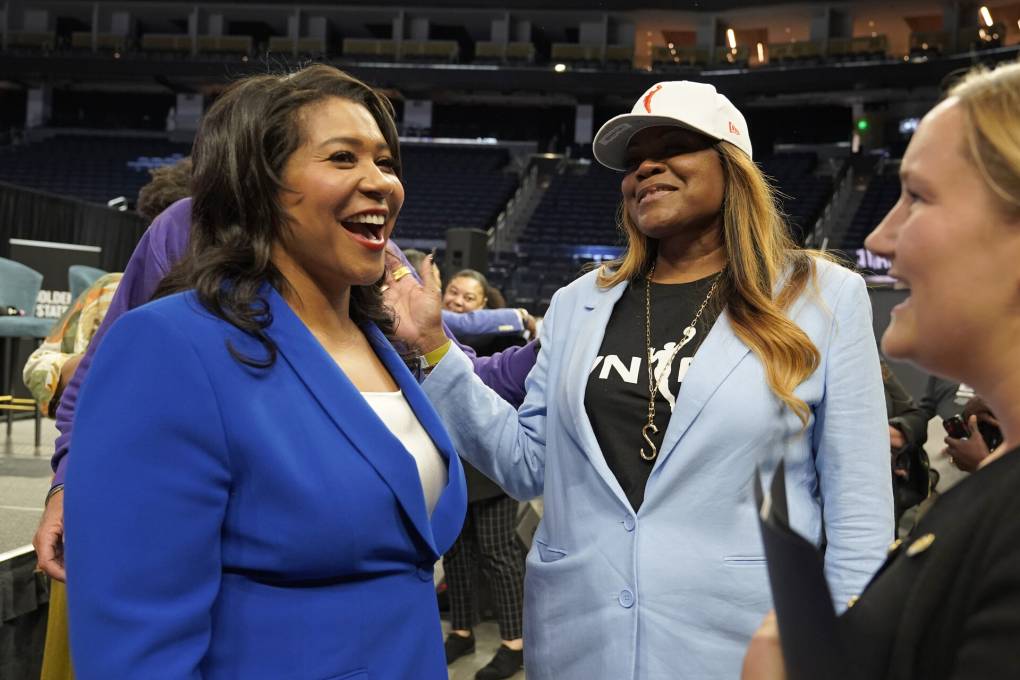
"caption": "San Francisco Mayor London Breed (left) visits with former basketball player Sheryl Swoopes after an WNBA expansion franchise for the San Francisco Bay Area was announced at Chase Center in San Francisco, Thursday, Oct. 5, 2023. The team will begin play in the 2025 season.",
"description": null,
"title": "London Breed, Cheryl Swoopes",
"credit": "Eric Risberg/AP Photo",
"status": "inherit",
"altTag": "Two women stand in a stadium smiling.",
"isLoading": false,
"fetchFailed": false
},
"news_11963365": {
"type": "attachments",
"id": "news_11963365",
"meta": {
"index": "attachments_1716263798",
"site": "news",
"id": "11963365",
"found": true
},
"parent": 11963306,
"imgSizes": {
"twentyfourteen-full-width": {
"file": "https://ww2.kqed.org/app/uploads/sites/10/2023/10/231004-KAISER-STRIKE-MD-01-KQED-e1696434104828-1038x576.jpg",
"width": 1038,
"mimeType": "image/jpeg",
"height": 576
},
"thumbnail": {
"file": "https://ww2.kqed.org/app/uploads/sites/10/2023/10/231004-KAISER-STRIKE-MD-01-KQED-e1696434104828-160x107.jpg",
"width": 160,
"mimeType": "image/jpeg",
"height": 107
},
"post-thumbnail": {
"file": "https://ww2.kqed.org/app/uploads/sites/10/2023/10/231004-KAISER-STRIKE-MD-01-KQED-e1696434104828-672x372.jpg",
"width": 672,
"mimeType": "image/jpeg",
"height": 372
},
"kqedFullSize": {
"file": "https://ww2.kqed.org/app/uploads/sites/10/2023/10/231004-KAISER-STRIKE-MD-01-KQED-e1696434104828.jpg?ver=1696444889",
"width": 2000,
"height": 1333
},
"large": {
"file": "https://ww2.kqed.org/app/uploads/sites/10/2023/10/231004-KAISER-STRIKE-MD-01-KQED-e1696434104828-1020x680.jpg",
"width": 1020,
"mimeType": "image/jpeg",
"height": 680
},
"1536x1536": {
"file": "https://ww2.kqed.org/app/uploads/sites/10/2023/10/231004-KAISER-STRIKE-MD-01-KQED-e1696434104828-1536x1024.jpg",
"width": 1536,
"mimeType": "image/jpeg",
"height": 1024
},
"full-width": {
"file": "https://ww2.kqed.org/app/uploads/sites/10/2023/10/231004-KAISER-STRIKE-MD-01-KQED-e1696434104828-1920x1280.jpg",
"width": 1920,
"mimeType": "image/jpeg",
"height": 1280
},
"medium": {
"file": "https://ww2.kqed.org/app/uploads/sites/10/2023/10/231004-KAISER-STRIKE-MD-01-KQED-e1696434104828-800x533.jpg",
"width": 800,
"mimeType": "image/jpeg",
"height": 533
}
},
"publishDate": 1696433929,
"modified": 1696444906,
"caption": "Janehild Williams (left), a licensed vocational nurse, strikes in front of the Kaiser Permanente Oakland Medical Center in Oakland on Oct. 4, 2023.",
"description": null,
"title": "231004-KAISER STRIKE-MD-01-KQED",
"credit": "Martin do Nascimento/KQED",
"status": "inherit",
"altTag": "Striking workers with bullhorn and tambourines protest in front of a building",
"isLoading": false,
"fetchFailed": false
},
"news_11963163": {
"type": "attachments",
"id": "news_11963163",
"meta": {
"index": "attachments_1716263798",
"site": "news",
"id": "11963163",
"found": true
},
"title": "Kaiser Mental Health Patients Kill Themselves While Waiting for Care",
"publishDate": 1696283004,
"status": "inherit",
"parent": 12070263,
"modified": 1768608911,
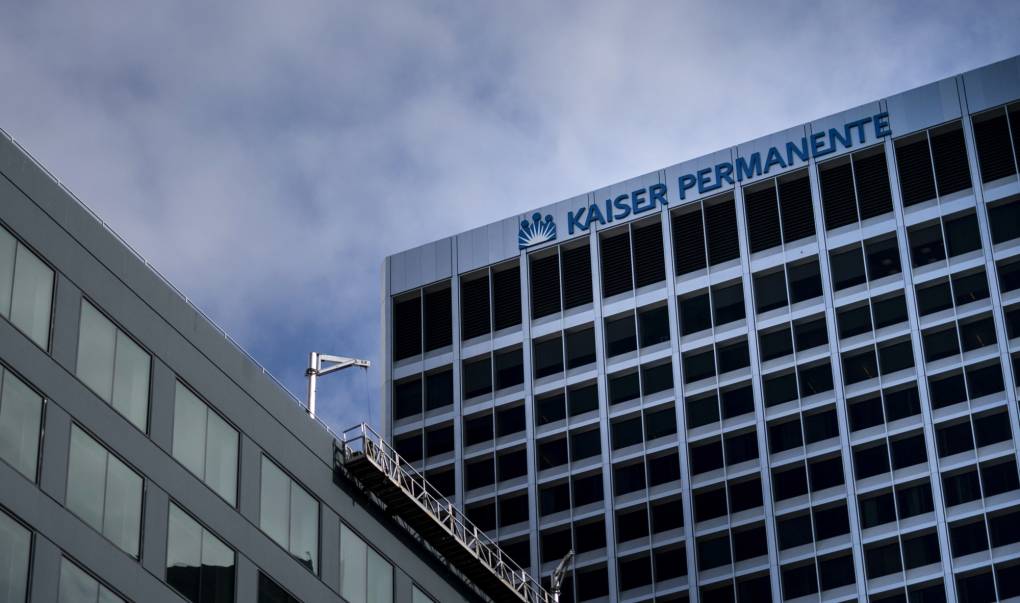
"caption": "Kaiser Permanente headquarters in downtown Oakland on Jan. 5, 2020.",
"credit": "Melina Mara/The Washington Post via Getty Images",
"altTag": "A large office building with the words \"Kaiser Permanente\" written on it.",
"description": null,
"imgSizes": {
"medium": {
"file": "https://cdn.kqed.org/wp-content/uploads/sites/10/2023/10/231002-KAISER-PERMANENTE-Getty-KQED-800x473.jpg",
"width": 800,
"height": 473,
"mimeType": "image/jpeg"
},
"large": {
"file": "https://cdn.kqed.org/wp-content/uploads/sites/10/2023/10/231002-KAISER-PERMANENTE-Getty-KQED-1020x603.jpg",
"width": 1020,
"height": 603,
"mimeType": "image/jpeg"
},
"thumbnail": {
"file": "https://cdn.kqed.org/wp-content/uploads/sites/10/2023/10/231002-KAISER-PERMANENTE-Getty-KQED-160x95.jpg",
"width": 160,
"height": 95,
"mimeType": "image/jpeg"
},
"1536x1536": {
"file": "https://cdn.kqed.org/wp-content/uploads/sites/10/2023/10/231002-KAISER-PERMANENTE-Getty-KQED-1536x908.jpg",
"width": 1536,
"height": 908,
"mimeType": "image/jpeg"
},
"post-thumbnail": {
"file": "https://cdn.kqed.org/wp-content/uploads/sites/10/2023/10/231002-KAISER-PERMANENTE-Getty-KQED-672x372.jpg",
"width": 672,
"height": 372,
"mimeType": "image/jpeg"
},
"twentyfourteen-full-width": {
"file": "https://cdn.kqed.org/wp-content/uploads/sites/10/2023/10/231002-KAISER-PERMANENTE-Getty-KQED-1038x576.jpg",
"width": 1038,
"height": 576,
"mimeType": "image/jpeg"
},
"full-width": {
"file": "https://cdn.kqed.org/wp-content/uploads/sites/10/2023/10/231002-KAISER-PERMANENTE-Getty-KQED-1920x1135.jpg",
"width": 1920,
"height": 1135,
"mimeType": "image/jpeg"
},
"kqedFullSize": {
"file": "https://cdn.kqed.org/wp-content/uploads/sites/10/2023/10/231002-KAISER-PERMANENTE-Getty-KQED.jpg",
"width": 2000,
"height": 1182
}
},
"isLoading": false,
"fetchFailed": false
},
"news_11962926": {
"type": "attachments",
"id": "news_11962926",
"meta": {
"index": "attachments_1716263798",
"site": "news",
"id": "11962926",
"found": true
},
"parent": 0,
"imgSizes": {
"twentyfourteen-full-width": {
"file": "https://ww2.kqed.org/app/uploads/sites/10/2023/09/230929-DIANNE-FEINSTEIN-MENTORSHIP-02-KQED-1038x576.jpg",
"width": 1038,
"mimeType": "image/jpeg",
"height": 576
},
"thumbnail": {
"file": "https://ww2.kqed.org/app/uploads/sites/10/2023/09/230929-DIANNE-FEINSTEIN-MENTORSHIP-02-KQED-160x120.jpg",
"width": 160,
"mimeType": "image/jpeg",
"height": 120
},
"post-thumbnail": {
"file": "https://ww2.kqed.org/app/uploads/sites/10/2023/09/230929-DIANNE-FEINSTEIN-MENTORSHIP-02-KQED-672x372.jpg",
"width": 672,
"mimeType": "image/jpeg",
"height": 372
},
"kqedFullSize": {
"file": "https://ww2.kqed.org/app/uploads/sites/10/2023/09/230929-DIANNE-FEINSTEIN-MENTORSHIP-02-KQED.jpg",
"width": 2000,
"height": 1500
},
"large": {
"file": "https://ww2.kqed.org/app/uploads/sites/10/2023/09/230929-DIANNE-FEINSTEIN-MENTORSHIP-02-KQED-1020x765.jpg",
"width": 1020,
"mimeType": "image/jpeg",
"height": 765
},
"1536x1536": {
"file": "https://ww2.kqed.org/app/uploads/sites/10/2023/09/230929-DIANNE-FEINSTEIN-MENTORSHIP-02-KQED-1536x1152.jpg",
"width": 1536,
"mimeType": "image/jpeg",
"height": 1152
},
"full-width": {
"file": "https://ww2.kqed.org/app/uploads/sites/10/2023/09/230929-DIANNE-FEINSTEIN-MENTORSHIP-02-KQED-1920x1440.jpg",
"width": 1920,
"mimeType": "image/jpeg",
"height": 1440
},
"medium": {
"file": "https://ww2.kqed.org/app/uploads/sites/10/2023/09/230929-DIANNE-FEINSTEIN-MENTORSHIP-02-KQED-800x600.jpg",
"width": 800,
"mimeType": "image/jpeg",
"height": 600
}
},
"publishDate": 1696028428,
"modified": 1696029398,
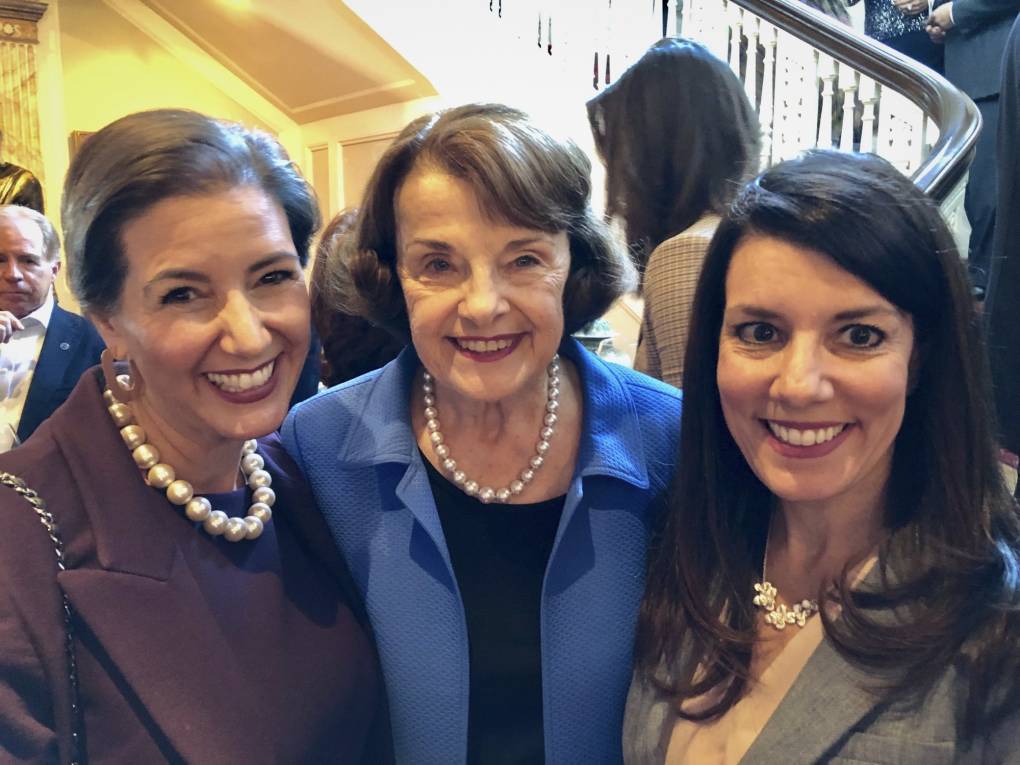
"caption": "From left, former Oakland Mayor Libby Schaaf, Sen. Dianne Feinstein and San Francisco Supervisor Catherine Stefani at Feinstein's San Francisco home in 2019.",
"description": null,
"title": "230929-DIANNE FEINSTEIN MENTORSHIP-02-KQED",
"credit": "Courtesy of Libby Schaaf",
"status": "inherit",
"altTag": "Three people smile and pose for a photo together.",
"isLoading": false,
"fetchFailed": false
},
"news_11963032": {
"type": "attachments",
"id": "news_11963032",
"meta": {
"index": "attachments_1716263798",
"site": "news",
"id": "11963032",
"found": true
},
"parent": 11963027,
"imgSizes": {
"twentyfourteen-full-width": {
"file": "https://ww2.kqed.org/app/uploads/sites/10/2023/10/GettyImages-1697762110-qut-1038x576.jpg",
"width": 1038,
"mimeType": "image/jpeg",
"height": 576
},
"thumbnail": {
"file": "https://ww2.kqed.org/app/uploads/sites/10/2023/10/GettyImages-1697762110-qut-160x107.jpg",
"width": 160,
"mimeType": "image/jpeg",
"height": 107
},
"post-thumbnail": {
"file": "https://ww2.kqed.org/app/uploads/sites/10/2023/10/GettyImages-1697762110-qut-672x372.jpg",
"width": 672,
"mimeType": "image/jpeg",
"height": 372
},
"kqedFullSize": {
"file": "https://ww2.kqed.org/app/uploads/sites/10/2023/10/GettyImages-1697762110-qut.jpg",
"width": 1920,
"height": 1281
},
"large": {
"file": "https://ww2.kqed.org/app/uploads/sites/10/2023/10/GettyImages-1697762110-qut-1020x681.jpg",
"width": 1020,
"mimeType": "image/jpeg",
"height": 681
},
"1536x1536": {
"file": "https://ww2.kqed.org/app/uploads/sites/10/2023/10/GettyImages-1697762110-qut-1536x1025.jpg",
"width": 1536,
"mimeType": "image/jpeg",
"height": 1025
},
"medium": {
"file": "https://ww2.kqed.org/app/uploads/sites/10/2023/10/GettyImages-1697762110-qut-800x534.jpg",
"width": 800,
"mimeType": "image/jpeg",
"height": 534
}
},
"publishDate": 1696186657,
"modified": 1696186721,
"caption": "Former U.S. President Donald Trump speaks at the California GOP convention on September 29, 2023. The event took place from September 29 through October 1. ",
"description": null,
"title": "Republican Presidential Candidates Speak At California's GOP Fall Convention",
"credit": "David McNew/Getty Images",
"status": "inherit",
"altTag": null,
"isLoading": false,
"fetchFailed": false
},
"news_11961770": {
"type": "attachments",
"id": "news_11961770",
"meta": {
"index": "attachments_1716263798",
"site": "news",
"id": "11961770",
"found": true
},
"parent": 0,
"imgSizes": {
"twentyfourteen-full-width": {
"file": "https://ww2.kqed.org/app/uploads/sites/10/2023/09/004_KQED_BerkeleyYMCAEricaDavis_11162022-KQED-1038x576.jpg",
"width": 1038,
"mimeType": "image/jpeg",
"height": 576
},
"thumbnail": {
"file": "https://ww2.kqed.org/app/uploads/sites/10/2023/09/004_KQED_BerkeleyYMCAEricaDavis_11162022-KQED-160x107.jpg",
"width": 160,
"mimeType": "image/jpeg",
"height": 107
},
"post-thumbnail": {
"file": "https://ww2.kqed.org/app/uploads/sites/10/2023/09/004_KQED_BerkeleyYMCAEricaDavis_11162022-KQED-672x372.jpg",
"width": 672,
"mimeType": "image/jpeg",
"height": 372
},
"kqedFullSize": {
"file": "https://ww2.kqed.org/app/uploads/sites/10/2023/09/004_KQED_BerkeleyYMCAEricaDavis_11162022-KQED.jpg",
"width": 2000,
"height": 1333
},
"large": {
"file": "https://ww2.kqed.org/app/uploads/sites/10/2023/09/004_KQED_BerkeleyYMCAEricaDavis_11162022-KQED-1020x680.jpg",
"width": 1020,
"mimeType": "image/jpeg",
"height": 680
},
"1536x1536": {
"file": "https://ww2.kqed.org/app/uploads/sites/10/2023/09/004_KQED_BerkeleyYMCAEricaDavis_11162022-KQED-1536x1024.jpg",
"width": 1536,
"mimeType": "image/jpeg",
"height": 1024
},
"full-width": {
"file": "https://ww2.kqed.org/app/uploads/sites/10/2023/09/004_KQED_BerkeleyYMCAEricaDavis_11162022-KQED-1920x1280.jpg",
"width": 1920,
"mimeType": "image/jpeg",
"height": 1280
},
"medium": {
"file": "https://ww2.kqed.org/app/uploads/sites/10/2023/09/004_KQED_BerkeleyYMCAEricaDavis_11162022-KQED-800x533.jpg",
"width": 800,
"mimeType": "image/jpeg",
"height": 533
}
},
"publishDate": 1695151800,
"modified": 1695151846,
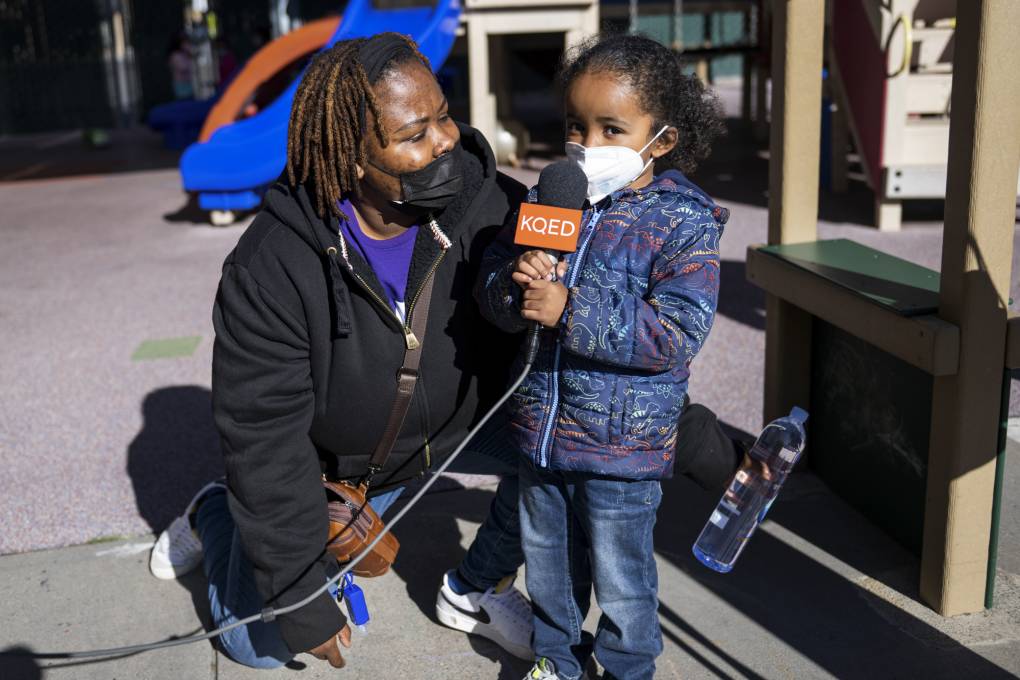
"caption": "Erica Davis, a YMCA East Bay apprenticeship program member, talks with a child using KQED reporter Daisy Nguyen's microphone during recess in Berkeley on Nov. 16, 2022.",
"description": null,
"title": "004_KQED_BerkeleyYMCAEricaDavis_11162022-KQED",
"credit": "Beth LaBerge/KQED",
"status": "inherit",
"altTag": "A young person wearing a face mask holds a microphone with KQED branding on it as an adult kneels next to them and looks on.",
"isLoading": false,
"fetchFailed": false
},
"news_11961569": {
"type": "attachments",
"id": "news_11961569",
"meta": {
"index": "attachments_1716263798",
"site": "news",
"id": "11961569",
"found": true
},
"parent": 11961565,
"imgSizes": {
"twentyfourteen-full-width": {
"file": "https://ww2.kqed.org/app/uploads/sites/10/2023/09/230916-MAHSA-DAY-CIVIC-CENTER-15-AC-KQED-1-1038x576.jpg",
"width": 1038,
"mimeType": "image/jpeg",
"height": 576
},
"thumbnail": {
"file": "https://ww2.kqed.org/app/uploads/sites/10/2023/09/230916-MAHSA-DAY-CIVIC-CENTER-15-AC-KQED-1-160x107.jpg",
"width": 160,
"mimeType": "image/jpeg",
"height": 107
},
"post-thumbnail": {
"file": "https://ww2.kqed.org/app/uploads/sites/10/2023/09/230916-MAHSA-DAY-CIVIC-CENTER-15-AC-KQED-1-672x372.jpg",
"width": 672,
"mimeType": "image/jpeg",
"height": 372
},
"kqedFullSize": {
"file": "https://ww2.kqed.org/app/uploads/sites/10/2023/09/230916-MAHSA-DAY-CIVIC-CENTER-15-AC-KQED-1.jpg",
"width": 2000,
"height": 1333
},
"large": {
"file": "https://ww2.kqed.org/app/uploads/sites/10/2023/09/230916-MAHSA-DAY-CIVIC-CENTER-15-AC-KQED-1-1020x680.jpg",
"width": 1020,
"mimeType": "image/jpeg",
"height": 680
},
"1536x1536": {
"file": "https://ww2.kqed.org/app/uploads/sites/10/2023/09/230916-MAHSA-DAY-CIVIC-CENTER-15-AC-KQED-1-1536x1024.jpg",
"width": 1536,
"mimeType": "image/jpeg",
"height": 1024
},
"full-width": {
"file": "https://ww2.kqed.org/app/uploads/sites/10/2023/09/230916-MAHSA-DAY-CIVIC-CENTER-15-AC-KQED-1-1920x1280.jpg",
"width": 1920,
"mimeType": "image/jpeg",
"height": 1280
},
"medium": {
"file": "https://ww2.kqed.org/app/uploads/sites/10/2023/09/230916-MAHSA-DAY-CIVIC-CENTER-15-AC-KQED-1-800x533.jpg",
"width": 800,
"mimeType": "image/jpeg",
"height": 533
}
},
"publishDate": 1694911498,
"modified": 1694911573,
"caption": "Rose I. (left) and Lila K. chant in unison with the crowd during a gathering of thousands in front of City Hall to protest the Iranian regime's treatment of its citizens in San Francisco on Saturday, Sept. 16, 2023.",
"description": null,
"title": "230916-MAHSA-DAY-CIVIC-CENTER-15-AC-KQED",
"credit": "Aryk Copley/KQED",
"status": "inherit",
"altTag": "Protestors hold signs and march in their hundreds.",
"isLoading": false,
"fetchFailed": false
},
"news_11961508": {
"type": "attachments",
"id": "news_11961508",
"meta": {
"index": "attachments_1716263798",
"site": "news",
"id": "11961508",
"found": true
},
"parent": 0,
"imgSizes": {
"twentyfourteen-full-width": {
"file": "https://ww2.kqed.org/app/uploads/sites/10/2023/09/20230915-SunsetNightMarket-45-JY-KQED-1038x576.jpg",
"width": 1038,
"mimeType": "image/jpeg",
"height": 576
},
"thumbnail": {
"file": "https://ww2.kqed.org/app/uploads/sites/10/2023/09/20230915-SunsetNightMarket-45-JY-KQED-160x107.jpg",
"width": 160,
"mimeType": "image/jpeg",
"height": 107
},
"post-thumbnail": {
"file": "https://ww2.kqed.org/app/uploads/sites/10/2023/09/20230915-SunsetNightMarket-45-JY-KQED-672x372.jpg",
"width": 672,
"mimeType": "image/jpeg",
"height": 372
},
"kqedFullSize": {
"file": "https://ww2.kqed.org/app/uploads/sites/10/2023/09/20230915-SunsetNightMarket-45-JY-KQED.jpg",
"width": 2000,
"height": 1333
},
"large": {
"file": "https://ww2.kqed.org/app/uploads/sites/10/2023/09/20230915-SunsetNightMarket-45-JY-KQED-1020x680.jpg",
"width": 1020,
"mimeType": "image/jpeg",
"height": 680
},
"1536x1536": {
"file": "https://ww2.kqed.org/app/uploads/sites/10/2023/09/20230915-SunsetNightMarket-45-JY-KQED-1536x1024.jpg",
"width": 1536,
"mimeType": "image/jpeg",
"height": 1024
},
"full-width": {
"file": "https://ww2.kqed.org/app/uploads/sites/10/2023/09/20230915-SunsetNightMarket-45-JY-KQED-1920x1280.jpg",
"width": 1920,
"mimeType": "image/jpeg",
"height": 1280
},
"medium": {
"file": "https://ww2.kqed.org/app/uploads/sites/10/2023/09/20230915-SunsetNightMarket-45-JY-KQED-800x533.jpg",
"width": 800,
"mimeType": "image/jpeg",
"height": 533
}
},
"publishDate": 1694874086,
"modified": 1694891488,
"caption": "People wait in line for food on Irving Street during the Sunset Night Market in San Francisco on Friday, Sept. 15, 2023. Thousands of attendees enjoyed shops, food, games and live performances at the market’s inaugural night.",
"description": null,
"title": "20230915-SunsetNightMarket-45-JY-KQED",
"credit": "Juliana Yamada/KQED",
"status": "inherit",
"altTag": "A bright orange tent is illuminated in the middle of a large crowd in an outdoor setting.",
"isLoading": false,
"fetchFailed": false
},
"news_11960719": {
"type": "attachments",
"id": "news_11960719",
"meta": {
"index": "attachments_1716263798",
"site": "news",
"id": "11960719",
"found": true
},
"parent": 0,
"imgSizes": {
"twentyfourteen-full-width": {
"file": "https://ww2.kqed.org/app/uploads/sites/10/2023/09/230911-MARTINEZ-REFINERY-Getty-MM-KQED-1038x576.jpg",
"width": 1038,
"mimeType": "image/jpeg",
"height": 576
},
"thumbnail": {
"file": "https://ww2.kqed.org/app/uploads/sites/10/2023/09/230911-MARTINEZ-REFINERY-Getty-MM-KQED-160x107.jpg",
"width": 160,
"mimeType": "image/jpeg",
"height": 107
},
"post-thumbnail": {
"file": "https://ww2.kqed.org/app/uploads/sites/10/2023/09/230911-MARTINEZ-REFINERY-Getty-MM-KQED-672x372.jpg",
"width": 672,
"mimeType": "image/jpeg",
"height": 372
},
"kqedFullSize": {
"file": "https://ww2.kqed.org/app/uploads/sites/10/2023/09/230911-MARTINEZ-REFINERY-Getty-MM-KQED.jpg",
"width": 2000,
"height": 1333
},
"large": {
"file": "https://ww2.kqed.org/app/uploads/sites/10/2023/09/230911-MARTINEZ-REFINERY-Getty-MM-KQED-1020x680.jpg",
"width": 1020,
"mimeType": "image/jpeg",
"height": 680
},
"1536x1536": {
"file": "https://ww2.kqed.org/app/uploads/sites/10/2023/09/230911-MARTINEZ-REFINERY-Getty-MM-KQED-1536x1024.jpg",
"width": 1536,
"mimeType": "image/jpeg",
"height": 1024
},
"full-width": {
"file": "https://ww2.kqed.org/app/uploads/sites/10/2023/09/230911-MARTINEZ-REFINERY-Getty-MM-KQED-1920x1280.jpg",
"width": 1920,
"mimeType": "image/jpeg",
"height": 1280
},
"medium": {
"file": "https://ww2.kqed.org/app/uploads/sites/10/2023/09/230911-MARTINEZ-REFINERY-Getty-MM-KQED-800x533.jpg",
"width": 800,
"mimeType": "image/jpeg",
"height": 533
}
},
"publishDate": 1694475541,
"modified": 1694475819,
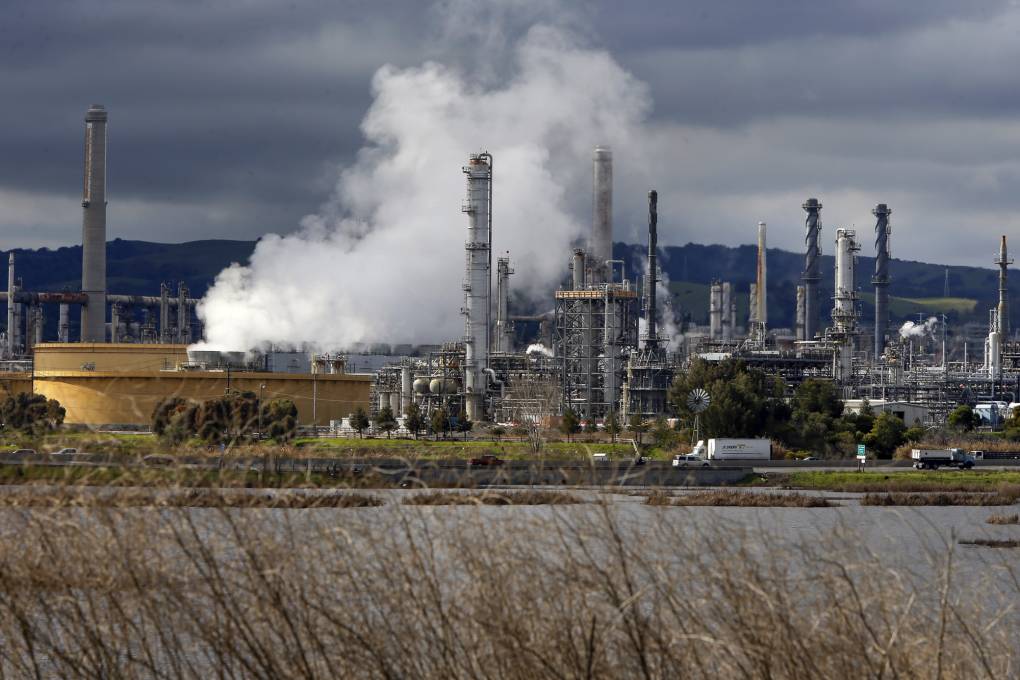
"caption": "The PBF Energy refinery in Martinez on Jan. 24, 2017.",
"description": null,
"title": "The Shell refinery in seen on Tuesday Jan. 24, 2017, in Martinez, Ca.",
"credit": "Michael Macor/The San Francisco Chronicle via Getty Images",
"status": "inherit",
"altTag": "A large industrial facility set alongside a body of water with emissions emanating from it.",
"isLoading": false,
"fetchFailed": false
},
"news_11960016": {
"type": "attachments",
"id": "news_11960016",
"meta": {
"index": "attachments_1716263798",
"site": "news",
"id": "11960016",
"found": true
},
"parent": 11960015,
"imgSizes": {
"twentyfourteen-full-width": {
"file": "https://ww2.kqed.org/app/uploads/sites/10/2023/09/PHOTO-2023-09-03-10-28-09-1038x576.jpg",
"width": 1038,
"mimeType": "image/jpeg",
"height": 576
},
"thumbnail": {
"file": "https://ww2.kqed.org/app/uploads/sites/10/2023/09/PHOTO-2023-09-03-10-28-09-160x120.jpg",
"width": 160,
"mimeType": "image/jpeg",
"height": 120
},
"post-thumbnail": {
"file": "https://ww2.kqed.org/app/uploads/sites/10/2023/09/PHOTO-2023-09-03-10-28-09-672x372.jpg",
"width": 672,
"mimeType": "image/jpeg",
"height": 372
},
"kqedFullSize": {
"file": "https://ww2.kqed.org/app/uploads/sites/10/2023/09/PHOTO-2023-09-03-10-28-09.jpg",
"width": 2040,
"height": 1536
},
"large": {
"file": "https://ww2.kqed.org/app/uploads/sites/10/2023/09/PHOTO-2023-09-03-10-28-09-1020x768.jpg",
"width": 1020,
"mimeType": "image/jpeg",
"height": 768
},
"1536x1536": {
"file": "https://ww2.kqed.org/app/uploads/sites/10/2023/09/PHOTO-2023-09-03-10-28-09-1536x1157.jpg",
"width": 1536,
"mimeType": "image/jpeg",
"height": 1157
},
"full-width": {
"file": "https://ww2.kqed.org/app/uploads/sites/10/2023/09/PHOTO-2023-09-03-10-28-09-1920x1446.jpg",
"width": 1920,
"mimeType": "image/jpeg",
"height": 1446
},
"medium": {
"file": "https://ww2.kqed.org/app/uploads/sites/10/2023/09/PHOTO-2023-09-03-10-28-09-800x602.jpg",
"width": 800,
"mimeType": "image/jpeg",
"height": 602
}
},
"publishDate": 1693764969,
"modified": 1693846793,
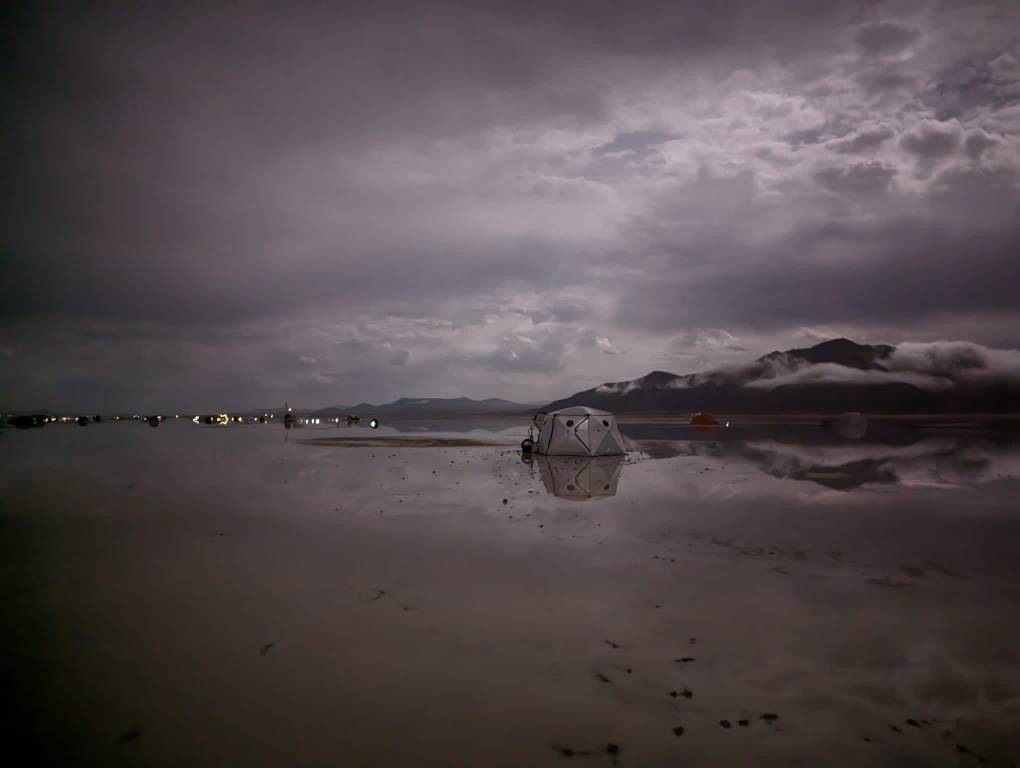
"caption": "'We’re safe and happy but may be stuck for a while if it continues to rain,' said Burning Man attendee Sheel Mohnot on Sept. 2, 2023.",
"description": null,
"title": "PHOTO-2023-09-03-10-28-09",
"credit": "Courtesy of Sheel Mohnot",
"status": "inherit",
"altTag": "A watery muddy play at Burning Man",
"isLoading": false,
"fetchFailed": false
},
"news_11959581": {
"type": "attachments",
"id": "news_11959581",
"meta": {
"index": "attachments_1716263798",
"site": "news",
"id": "11959581",
"found": true
},
"parent": 0,
"imgSizes": {
"twentyfourteen-full-width": {
"file": "https://ww2.kqed.org/app/uploads/sites/10/2023/08/230830-HEAT-WAVE-AM-KQED-1038x576.jpg",
"width": 1038,
"mimeType": "image/jpeg",
"height": 576
},
"thumbnail": {
"file": "https://ww2.kqed.org/app/uploads/sites/10/2023/08/230830-HEAT-WAVE-AM-KQED-160x107.jpg",
"width": 160,
"mimeType": "image/jpeg",
"height": 107
},
"post-thumbnail": {
"file": "https://ww2.kqed.org/app/uploads/sites/10/2023/08/230830-HEAT-WAVE-AM-KQED-672x372.jpg",
"width": 672,
"mimeType": "image/jpeg",
"height": 372
},
"kqedFullSize": {
"file": "https://ww2.kqed.org/app/uploads/sites/10/2023/08/230830-HEAT-WAVE-AM-KQED.jpg",
"width": 2000,
"height": 1333
},
"large": {
"file": "https://ww2.kqed.org/app/uploads/sites/10/2023/08/230830-HEAT-WAVE-AM-KQED-1020x680.jpg",
"width": 1020,
"mimeType": "image/jpeg",
"height": 680
},
"1536x1536": {
"file": "https://ww2.kqed.org/app/uploads/sites/10/2023/08/230830-HEAT-WAVE-AM-KQED-1536x1024.jpg",
"width": 1536,
"mimeType": "image/jpeg",
"height": 1024
},
"full-width": {
"file": "https://ww2.kqed.org/app/uploads/sites/10/2023/08/230830-HEAT-WAVE-AM-KQED-1920x1280.jpg",
"width": 1920,
"mimeType": "image/jpeg",
"height": 1280
},
"medium": {
"file": "https://ww2.kqed.org/app/uploads/sites/10/2023/08/230830-HEAT-WAVE-AM-KQED-800x533.jpg",
"width": 800,
"mimeType": "image/jpeg",
"height": 533
}
},
"publishDate": 1693416718,
"modified": 1693416809,
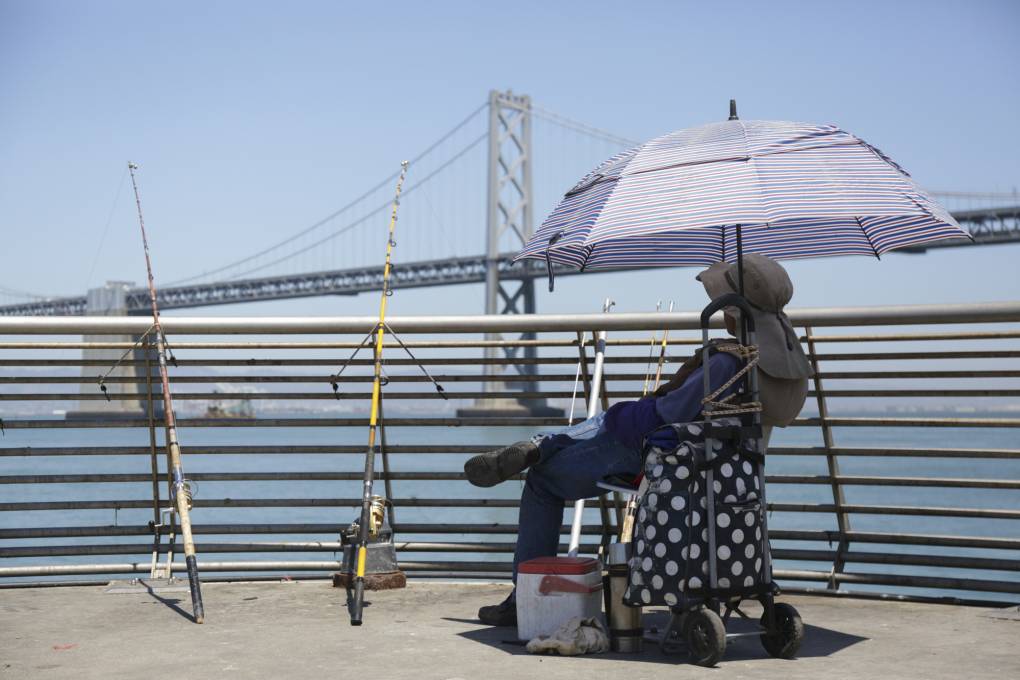
"caption": "A fisherman waits under the shade of his umbrella in front of the Bay Bridge on June 17, 2020.",
"description": null,
"title": "230830-HEAT WAVE-AM-KQED",
"credit": "Arash Malekzadeh/KQED",
"status": "inherit",
"altTag": "A fisherman waits under the shade of his umbrella in front of the Bay Bridge.",
"isLoading": false,
"fetchFailed": false
},
"news_11958998": {
"type": "attachments",
"id": "news_11958998",
"meta": {
"index": "attachments_1716263798",
"site": "news",
"id": "11958998",
"found": true
},
"parent": 11958992,
"imgSizes": {
"twentyfourteen-full-width": {
"file": "https://ww2.kqed.org/app/uploads/sites/10/2023/08/MBARI_OctopusGarden_octopus_nests_D1427_01_logo-1-1-1038x576.jpg",
"width": 1038,
"mimeType": "image/jpeg",
"height": 576
},
"thumbnail": {
"file": "https://ww2.kqed.org/app/uploads/sites/10/2023/08/MBARI_OctopusGarden_octopus_nests_D1427_01_logo-1-1-160x106.jpg",
"width": 160,
"mimeType": "image/jpeg",
"height": 106
},
"post-thumbnail": {
"file": "https://ww2.kqed.org/app/uploads/sites/10/2023/08/MBARI_OctopusGarden_octopus_nests_D1427_01_logo-1-1-672x372.jpg",
"width": 672,
"mimeType": "image/jpeg",
"height": 372
},
"kqedFullSize": {
"file": "https://ww2.kqed.org/app/uploads/sites/10/2023/08/MBARI_OctopusGarden_octopus_nests_D1427_01_logo-1-1.jpg",
"width": 1551,
"height": 1031
},
"large": {
"file": "https://ww2.kqed.org/app/uploads/sites/10/2023/08/MBARI_OctopusGarden_octopus_nests_D1427_01_logo-1-1-1020x678.jpg",
"width": 1020,
"mimeType": "image/jpeg",
"height": 678
},
"1536x1536": {
"file": "https://ww2.kqed.org/app/uploads/sites/10/2023/08/MBARI_OctopusGarden_octopus_nests_D1427_01_logo-1-1-1536x1021.jpg",
"width": 1536,
"mimeType": "image/jpeg",
"height": 1021
},
"medium": {
"file": "https://ww2.kqed.org/app/uploads/sites/10/2023/08/MBARI_OctopusGarden_octopus_nests_D1427_01_logo-1-1-800x532.jpg",
"width": 800,
"mimeType": "image/jpeg",
"height": 532
}
},
"publishDate": 1692833810,
"modified": 1692896557,
"caption": "This 2019 image from video provided by Monterey Bay Aquarium Research Institute shows an aggregation of female pearl octopuses (Muusoctopus robustus) nesting at the 'octopus garden,' near the Davidson Seamount off the California coast at a depth of approximately 10,500 feet. Most octopuses lead solitary lives. So scientists were startled to find thousands of them huddled together, protecting their eggs at the bottom of the ocean.",
"description": null,
"title": "MBARI_OctopusGarden_octopus_nests_D1427_01_logo (1) (1)",
"credit": "MBARI via AP",
"status": "inherit",
"altTag": "Small purple eggs on the bottom of the sea floor.",
"isLoading": false,
"fetchFailed": false
}
},
"audioPlayerReducer": {
"postId": "stream_live",
"isPaused": true,
"isPlaying": false,
"pfsActive": false,
"pledgeModalIsOpen": true,
"playerDrawerIsOpen": false,
"liveAudioPlayStartedAt": 0,
"liveAudioPlayContext": ""
},
"authorsReducer": {
"tgoldberg": {
"type": "authors",
"id": "258",
"meta": {
"index": "authors_1716337520",
"id": "258",
"found": true
},
"name": "Ted Goldberg",
"firstName": "Ted",
"lastName": "Goldberg",
"slug": "tgoldberg",
"email": "tgoldberg@kqed.org",
"display_author_email": true,
"staff_mastheads": [
"news"
],
"title": "KQED Managing Editor, News and Newscasts",
"bio": "Ted Goldberg is Managing Editor of News and Newscasts at KQED. His main reporting beat is the Bay Area's oil refining industry.\r\n\r\nPrior to joining KQED in 2014, Ted worked at CBS News and WCBS AM in New York and Bay City News and KCBS Radio in San Francisco. He graduated from Oberlin College in Ohio in 1998.",
"avatar": "https://secure.gravatar.com/avatar/30ce2e4fe89135e104f89be2394d16225b9d36c121b5b3cb7651ce642978b96f?s=600&d=blank&r=g",
"twitter": "TedrickG",
"bluesky": null,
"facebook": null,
"instagram": null,
"linkedin": null,
"sites": [
{
"site": "news",
"roles": [
"editor"
]
},
{
"site": "science",
"roles": [
"editor"
]
}
],
"headData": {
"title": "Ted Goldberg | KQED",
"description": "KQED Managing Editor, News and Newscasts",
"ogImgSrc": "https://secure.gravatar.com/avatar/30ce2e4fe89135e104f89be2394d16225b9d36c121b5b3cb7651ce642978b96f?s=600&d=blank&r=g",
"twImgSrc": "https://secure.gravatar.com/avatar/30ce2e4fe89135e104f89be2394d16225b9d36c121b5b3cb7651ce642978b96f?s=600&d=blank&r=g"
},
"isLoading": false,
"link": "/author/tgoldberg"
},
"mlagos": {
"type": "authors",
"id": "3239",
"meta": {
"index": "authors_1716337520",
"id": "3239",
"found": true
},
"name": "Marisa Lagos",
"firstName": "Marisa",
"lastName": "Lagos",
"slug": "mlagos",
"email": "mlagos@kqed.org",
"display_author_email": false,
"staff_mastheads": [
"news"
],
"title": "KQED Contributor",
"bio": "Marisa Lagos is a correspondent for KQED’s California Politics and Government Desk and co-hosts the award-winning show and podcast, Political Breakdown. At KQED, Lagos also conducts reporting, analysis and investigations into state, local and national politics for radio, TV, online and onstage. In 2022, she and co-host, Scott Shafer, moderated the only gubernatorial debate in California. In 2020, the \u003ci>Washington Post\u003c/i> named her one of the top political journalists in California; she was nominated for a Peabody and won several other awards for her work investigating the 2017 California wildfires. She has worked at the \u003ci>San Francisco Chronicle\u003c/i>, \u003ci>San Francisco Examiner\u003c/i> and \u003ci>Los Angeles Times\u003c/i>. A UC Santa Barbara graduate, she lives in San Francisco with her two sons and husband.",
"avatar": "https://secure.gravatar.com/avatar/a261a0d3696fc066871ef96b85b5e7d2?s=600&d=blank&r=g",
"twitter": "@mlagos",
"facebook": null,
"instagram": null,
"linkedin": null,
"sites": [
{
"site": "arts",
"roles": [
"author"
]
},
{
"site": "news",
"roles": [
"editor"
]
},
{
"site": "science",
"roles": [
"editor"
]
},
{
"site": "forum",
"roles": [
"author"
]
},
{
"site": "liveblog",
"roles": [
"author"
]
}
],
"headData": {
"title": "Marisa Lagos | KQED",
"description": "KQED Contributor",
"ogImgSrc": "https://secure.gravatar.com/avatar/a261a0d3696fc066871ef96b85b5e7d2?s=600&d=blank&r=g",
"twImgSrc": "https://secure.gravatar.com/avatar/a261a0d3696fc066871ef96b85b5e7d2?s=600&d=blank&r=g"
},
"isLoading": false,
"link": "/author/mlagos"
},
"fjhabvala": {
"type": "authors",
"id": "8659",
"meta": {
"index": "authors_1716337520",
"id": "8659",
"found": true
},
"name": "Farida Jhabvala Romero",
"firstName": "Farida",
"lastName": "Jhabvala Romero",
"slug": "fjhabvala",
"email": "fjhabvala@kqed.org",
"display_author_email": true,
"staff_mastheads": [
"news"
],
"title": "KQED Contributor",
"bio": "Farida Jhabvala Romero is a Labor Correspondent for KQED. She previously covered immigration. Farida was \u003ca href=\"https://www.ccnma.org/2022-most-influential-latina-journalists\">named\u003c/a> one of the 10 Most Influential Latina Journalists in California in 2022 by the California Chicano News Media Association. Her work has won awards from the Society of Professional Journalists (Northern California), as well as a national and regional Edward M. Murrow Award for the collaborative reporting projects “Dangerous Air” and “Graying California.” Before joining KQED, Farida worked as a producer at Radio Bilingüe, a national public radio network. Farida earned her master’s degree in journalism from Stanford University.",
"avatar": "https://secure.gravatar.com/avatar/f9f022d4e2609741874222a1e9d41f48fea74011aa7c615eef91d9a50c944ebe?s=600&d=blank&r=g",
"twitter": "FaridaJhabvala",
"bluesky": null,
"facebook": null,
"instagram": null,
"linkedin": "https://www.linkedin.com/in/faridajhabvala/",
"sites": [
{
"site": "news",
"roles": [
"editor"
]
},
{
"site": "stateofhealth",
"roles": [
"author"
]
},
{
"site": "liveblog",
"roles": [
"author"
]
}
],
"headData": {
"title": "Farida Jhabvala Romero | KQED",
"description": "KQED Contributor",
"ogImgSrc": "https://secure.gravatar.com/avatar/f9f022d4e2609741874222a1e9d41f48fea74011aa7c615eef91d9a50c944ebe?s=600&d=blank&r=g",
"twImgSrc": "https://secure.gravatar.com/avatar/f9f022d4e2609741874222a1e9d41f48fea74011aa7c615eef91d9a50c944ebe?s=600&d=blank&r=g"
},
"isLoading": false,
"link": "/author/fjhabvala"
},
"bwatt": {
"type": "authors",
"id": "11238",
"meta": {
"index": "authors_1716337520",
"id": "11238",
"found": true
},
"name": "Brian Watt",
"firstName": "Brian",
"lastName": "Watt",
"slug": "bwatt",
"email": "bwatt@KQED.org",
"display_author_email": false,
"staff_mastheads": [
"news"
],
"title": "Morning News Anchor",
"bio": "Brian Watt is KQED's morning radio news anchor. He joined the KQED News team in April of 2016. Prior to that, he worked as a Reporter for KPCC in Los Angeles and a producer at \u003cem>Marketplace.\u003c/em>\r\n\r\nDuring eight years at KPCC, Brian covered business and economics, and his work won several awards. In 2008, he won the Los Angeles Press Club’s first-place award for Business and Financial Reporting, Broadcast. He’s also received honorable mention and been first runner up for the Press Club’s Radio Journalist of the Year. He won two Golden Mike awards from the Radio and TV News Association of Southern California.\r\n\r\nBrian holds degrees in theater from Yale University and the Sorbonne, and has worked as an actor in France, Italy, Brazil, Hungary and . . . Hollywood. He appeared in a few television shows, including \u003cem>The West Wing, Judging Amy\u003c/em> and \u003cem>The District.\u003c/em>\r\n\r\nEmail: bwatt@KQED.org Twitter: @RadioBWatt",
"avatar": "https://secure.gravatar.com/avatar/55393ff57ed34e2be773ba4789dd6a19?s=600&d=blank&r=g",
"twitter": "@RadioBWatt",
"facebook": null,
"instagram": null,
"linkedin": null,
"sites": [
{
"site": "arts",
"roles": [
"contributor"
]
},
{
"site": "news",
"roles": [
"editor"
]
}
],
"headData": {
"title": "Brian Watt | KQED",
"description": "Morning News Anchor",
"ogImgSrc": "https://secure.gravatar.com/avatar/55393ff57ed34e2be773ba4789dd6a19?s=600&d=blank&r=g",
"twImgSrc": "https://secure.gravatar.com/avatar/55393ff57ed34e2be773ba4789dd6a19?s=600&d=blank&r=g"
},
"isLoading": false,
"link": "/author/bwatt"
},
"lsarah": {
"type": "authors",
"id": "11626",
"meta": {
"index": "authors_1716337520",
"id": "11626",
"found": true
},
"name": "Lakshmi Sarah",
"firstName": "Lakshmi",
"lastName": "Sarah",
"slug": "lsarah",
"email": "lsarah@kqed.org",
"display_author_email": false,
"staff_mastheads": [],
"title": "Digital Producer",
"bio": "Lakshmi Sarah is an educator, author and journalist with a focus on innovative storytelling. She has worked with newspapers, radio and magazines from Ahmedabad, India to Los Angeles, California. She has written and produced for Die Zeit, Global Voices, AJ+, KQED, Fusion Media Group and the New York Times.",
"avatar": "https://secure.gravatar.com/avatar/652dcaecd8b28826fc17a8b2d6bb4e93?s=600&d=blank&r=g",
"twitter": "lakitalki",
"facebook": null,
"instagram": "https://www.instagram.com/laki.talki/",
"linkedin": "https://www.linkedin.com/in/lakisarah/",
"sites": [
{
"site": "arts",
"roles": []
},
{
"site": "news",
"roles": []
},
{
"site": "bayareabites",
"roles": []
},
{
"site": "science",
"roles": []
}
],
"headData": {
"title": "Lakshmi Sarah | KQED",
"description": "Digital Producer",
"ogImgSrc": "https://secure.gravatar.com/avatar/652dcaecd8b28826fc17a8b2d6bb4e93?s=600&d=blank&r=g",
"twImgSrc": "https://secure.gravatar.com/avatar/652dcaecd8b28826fc17a8b2d6bb4e93?s=600&d=blank&r=g"
},
"isLoading": false,
"link": "/author/lsarah"
},
"ccabreralomeli": {
"type": "authors",
"id": "11708",
"meta": {
"index": "authors_1716337520",
"id": "11708",
"found": true
},
"name": "Carlos Cabrera-Lomelí",
"firstName": "Carlos",
"lastName": "Cabrera-Lomelí",
"slug": "ccabreralomeli",
"email": "ccabreralomeli@KQED.org",
"display_author_email": true,
"staff_mastheads": [
"news"
],
"title": "Community Reporter",
"bio": "Carlos Cabrera-Lomelí is a community reporter with KQED's digital engagement team. He also reports and co-produces for KQED's bilingual news hub KQED en Español. He grew up in San Francisco's Mission District and has previously worked with Univision, 48 Hills and REFORMA in Mexico City.",
"avatar": "https://secure.gravatar.com/avatar/c309be9665e484f887b818c89e273ecc673004f426f36b24d00a4d813a2e0518?s=600&d=blank&r=g",
"twitter": "@LomeliCabrera",
"bluesky": null,
"facebook": null,
"instagram": null,
"linkedin": null,
"sites": [
{
"site": "arts",
"roles": [
"editor"
]
},
{
"site": "news",
"roles": [
"editor"
]
},
{
"site": "about",
"roles": [
"editor"
]
},
{
"site": "science",
"roles": [
"editor"
]
},
{
"site": "perspectives",
"roles": [
"editor"
]
},
{
"site": "elections",
"roles": [
"editor"
]
},
{
"site": "liveblog",
"roles": [
"contributor"
]
}
],
"headData": {
"title": "Carlos Cabrera-Lomelí | KQED",
"description": "Community Reporter",
"ogImgSrc": "https://secure.gravatar.com/avatar/c309be9665e484f887b818c89e273ecc673004f426f36b24d00a4d813a2e0518?s=600&d=blank&r=g",
"twImgSrc": "https://secure.gravatar.com/avatar/c309be9665e484f887b818c89e273ecc673004f426f36b24d00a4d813a2e0518?s=600&d=blank&r=g"
},
"isLoading": false,
"link": "/author/ccabreralomeli"
},
"agonzalez": {
"type": "authors",
"id": "11724",
"meta": {
"index": "authors_1716337520",
"id": "11724",
"found": true
},
"name": "Alexander Gonzalez",
"firstName": "Alexander",
"lastName": "Gonzalez",
"slug": "agonzalez",
"email": "AlexanderGonzalez@KQED.org",
"display_author_email": false,
"staff_mastheads": [
"news"
],
"title": "KQED Contributor",
"bio": null,
"avatar": "https://secure.gravatar.com/avatar/9e291ed34e154df4c662edf858b641d70b4859939bfe40be478408f9dfd057d2?s=600&d=blank&r=g",
"twitter": null,
"bluesky": null,
"facebook": null,
"instagram": null,
"linkedin": null,
"sites": [
{
"site": "arts",
"roles": [
"editor"
]
},
{
"site": "news",
"roles": [
"editor"
]
},
{
"site": "science",
"roles": [
"editor"
]
}
],
"headData": {
"title": "Alexander Gonzalez | KQED",
"description": "KQED Contributor",
"ogImgSrc": "https://secure.gravatar.com/avatar/9e291ed34e154df4c662edf858b641d70b4859939bfe40be478408f9dfd057d2?s=600&d=blank&r=g",
"twImgSrc": "https://secure.gravatar.com/avatar/9e291ed34e154df4c662edf858b641d70b4859939bfe40be478408f9dfd057d2?s=600&d=blank&r=g"
},
"isLoading": false,
"link": "/author/agonzalez"
},
"otaylor": {
"type": "authors",
"id": "11770",
"meta": {
"index": "authors_1716337520",
"id": "11770",
"found": true
},
"name": "Otis R. Taylor Jr.",
"firstName": "Otis R.",
"lastName": "Taylor Jr.",
"slug": "otaylor",
"email": "otaylor@kqed.org",
"display_author_email": false,
"staff_mastheads": [
"news"
],
"title": "KQED Editor",
"bio": null,
"avatar": "https://secure.gravatar.com/avatar/fe73e14d4842ac8e1c03d57def2530f57f1c5b0ca7d4a987ccc5bd90956cb7c6?s=600&d=blank&r=g",
"twitter": "otisrtaylorjr",
"bluesky": null,
"facebook": null,
"instagram": null,
"linkedin": null,
"sites": [
{
"site": "arts",
"roles": [
"subscriber"
]
},
{
"site": "news",
"roles": [
"subscriber"
]
},
{
"site": "science",
"roles": [
"subscriber"
]
},
{
"site": "liveblog",
"roles": [
"subscriber"
]
}
],
"headData": {
"title": "Otis R. Taylor Jr. | KQED",
"description": "KQED Editor",
"ogImgSrc": "https://secure.gravatar.com/avatar/fe73e14d4842ac8e1c03d57def2530f57f1c5b0ca7d4a987ccc5bd90956cb7c6?s=600&d=blank&r=g",
"twImgSrc": "https://secure.gravatar.com/avatar/fe73e14d4842ac8e1c03d57def2530f57f1c5b0ca7d4a987ccc5bd90956cb7c6?s=600&d=blank&r=g"
},
"isLoading": false,
"link": "/author/otaylor"
},
"afinney": {
"type": "authors",
"id": "11772",
"meta": {
"index": "authors_1716337520",
"id": "11772",
"found": true
},
"name": "Annelise Finney",
"firstName": "Annelise",
"lastName": "Finney",
"slug": "afinney",
"email": "afinney@kqed.org",
"display_author_email": false,
"staff_mastheads": [],
"title": "Reporter",
"bio": "Annelise reports on reparations in California and East Bay politics. She co-produced the Sunday Music Drop, a limited-term radio series featuring Bay Area musicians that aired between Sept 2022 and Oct 2024. She joined KQED in 2021 as a general assignment reporter and is an alumna of KALW's Audio Academy. She was born and raised in the East Bay. She is currently away from KQED completing a year-long reporting project in Berlin, Germany as a Alexander Von Humboldt German Chancellor Fellow.",
"avatar": "https://secure.gravatar.com/avatar/b439010ea6540bec1060ee74b3c94314480991106a4a84e774fe5a0fd6605878?s=600&d=mm&r=g",
"twitter": null,
"bluesky": null,
"facebook": null,
"instagram": null,
"linkedin": null,
"sites": [
{
"site": "news",
"roles": [
"subscriber"
]
},
{
"site": "liveblog",
"roles": [
"subscriber"
]
}
],
"headData": {
"title": "Annelise Finney | KQED",
"description": "Reporter",
"ogImgSrc": "https://secure.gravatar.com/avatar/b439010ea6540bec1060ee74b3c94314480991106a4a84e774fe5a0fd6605878?s=600&d=mm&r=g",
"twImgSrc": "https://secure.gravatar.com/avatar/b439010ea6540bec1060ee74b3c94314480991106a4a84e774fe5a0fd6605878?s=600&d=mm&r=g"
},
"isLoading": false,
"link": "/author/afinney"
},
"sjohnson": {
"type": "authors",
"id": "11840",
"meta": {
"index": "authors_1716337520",
"id": "11840",
"found": true
},
"name": "Sydney Johnson",
"firstName": "Sydney",
"lastName": "Johnson",
"slug": "sjohnson",
"email": "sjohnson@kqed.org",
"display_author_email": false,
"staff_mastheads": [
"news"
],
"title": "KQED Reporter",
"bio": "Sydney Johnson is a general assignment reporter at KQED. She previously reported on public health and city government at the San Francisco Examiner, and before that, she covered statewide education policy for EdSource. Her reporting has won multiple local, state and national awards. Sydney is a graduate of the University of California, Berkeley and lives in San Francisco.",
"avatar": "https://secure.gravatar.com/avatar/97855f2719b72ad6190b7c535fe642c8?s=600&d=blank&r=g",
"twitter": "sydneyfjohnson",
"facebook": null,
"instagram": null,
"linkedin": null,
"sites": [
{
"site": "news",
"roles": [
"editor"
]
}
],
"headData": {
"title": "Sydney Johnson | KQED",
"description": "KQED Reporter",
"ogImgSrc": "https://secure.gravatar.com/avatar/97855f2719b72ad6190b7c535fe642c8?s=600&d=blank&r=g",
"twImgSrc": "https://secure.gravatar.com/avatar/97855f2719b72ad6190b7c535fe642c8?s=600&d=blank&r=g"
},
"isLoading": false,
"link": "/author/sjohnson"
}
},
"pagesReducer": {
"news_category_local": {
"type": "terms",
"id": "news_28250",
"meta": {
"index": "terms_1716263798",
"site": "news",
"id": "28250",
"score": 12.940829
},
"featImg": null,
"name": "Local",
"description": null,
"taxonomy": "category",
"headData": {
"twImgId": null,
"twTitle": null,
"ogTitle": null,
"ogImgId": null,
"twDescription": null,
"description": null,
"title": "Local Archives | KQED News",
"ogDescription": null
},
"ttid": 28267,
"slug": "local",
"isLoading": false,
"title": "Local",
"pageMeta": {
"site": "news",
"WpPageTemplate": "page-topic-editorial",
"currentPage": 144
},
"blocks": [
{
"blockName": "kqed/post-list",
"attrs": {
"layout": "cardArticle2",
"query": "posts/news?category=local",
"seeMore": false,
"paginated": true,
"page": 144
}
},
{
"blockName": "kqed/ad"
}
]
}
},
"pfsSessionReducer": {},
"postsReducer": {
"stream_live": {
"type": "live",
"id": "stream_live",
"audioUrl": "https://streams.kqed.org/kqedradio",
"title": "Live Stream",
"excerpt": "Live Stream information currently unavailable.",
"link": "/radio",
"featImg": "",
"label": {
"name": "KQED Live",
"link": "/"
}
},
"stream_kqedNewscast": {
"type": "posts",
"id": "stream_kqedNewscast",
"audioUrl": "https://www.kqed.org/.stream/anon/radio/RDnews/newscast.mp3?_=1",
"title": "KQED Newscast",
"featImg": "",
"label": {
"name": "88.5 FM",
"link": "/"
}
},
"news_11963547": {
"type": "posts",
"id": "news_11963547",
"meta": {
"index": "posts_1716263798",
"site": "news",
"id": "11963547",
"score": null,
"sort": [
1696536140000
]
},
"guestAuthors": [],
"slug": "wnba-team-in-the-bay-a-slam-dunk-for-bay-area-basketball",
"title": "WNBA Team in the Bay: A Slam Dunk for Bay Area Basketball",
"publishDate": 1696536140,
"format": "standard",
"headTitle": "WNBA Team in the Bay: A Slam Dunk for Bay Area Basketball | KQED",
"labelTerm": {
"site": "news"
},
"content": "\u003cp>The Bay Area will soon be home to the \u003ca href=\"https://www.kqed.org/news/11962612/its-time-bay-area-sports-fans-buzzing-over-possibility-of-warriors-adding-wnba-team\">WNBA’s first new team in over a decade\u003c/a>, officials from the league announced Thursday.\u003c/p>\n\u003cp>The new professional women’s basketball team is set to begin playing games at Chase Center beginning in 2025. It will be part of the Golden State Warriors franchise, but the team’s official name and brand has yet to be confirmed.\u003c/p>\n\u003cp>[pullquote size=\"medium\" align=\"right\" citation=\"Joe Lacob, co-executive chairman and CEO, Golden State Warriors\"]‘Women’s basketball and women’s sports in general have had a big upswing that’s different than it was five or 10 years ago.’[/pullquote]“We have been interested in a WNBA franchise for several years, due in part to the rich history of women’s basketball in the Bay Area, and believe now is the ideal time to execute that vision and build upon the legacy,” said Warriors Co-Executive Chairman and CEO Joe Lacob in a press announcement on Thursday.\u003c/p>\n\u003cp>While the team will play its games at the San Francisco Warriors facility, their practice venue and business operations headquarters will be at the Warriors’ Oakland facility, where the men’s team practiced from 1997–2019.\u003c/p>\n\u003cp>\u003ca href=\"http://wnba.com/goldenstate\">Season tickets\u003c/a> for the new WNBA team’s 2025 season are already available.\u003c/p>\n\u003cp>But it will still be many months before the team fills its 12 roster spots and nails down a timeline for practices. After the WNBA finals, which kick off this weekend, the league will have a draft lottery followed by an expansion draft to pull in more players to the league.\u003c/p>\n\u003cp>Speaking to reporters on Thursday, WNBA Commissioner Cathy Engelbert called the Bay Area a “hub for women’s sports,” citing successful collegiate programs at Stanford, UC Berkeley and the University of San Francisco.\u003c/p>\n\u003cp>“This is partially to give new opportunities to that next generation coming out of the NCAA,” Engelbert said at Thursday’s press conference. “The depth of the talent in this league has never been better. This is a very good problem to have.”\u003c/p>\n\u003cp>[ad fullwidth]\u003c/p>\n\u003cp>The commissioner confirmed rumors that the WNBA is looking to add a 14th team by 2025, and that she has had conversations with leaders in Denver, Portland, Toronto, Sacramento and Philadelphia.\u003c/p>\n\u003cp>San Francisco Mayor London Breed celebrated the new team alongside the commissioner and Warriors executives.\u003c/p>\n\u003cp>“This is just one step further to making sure that the public understands and realizes the value of San Francisco,” Breed told reporters. “It’s a beacon of hope for the next generation and a big step forward for women.”\u003c/p>\n\u003cp>Basketball fans and local government leaders have long been pushing for the WNBA team. In September 2022, Oakland’s Vice Mayor Rebecca Kaplan introduced a resolution urging the league to make Oakland the home for its newest team.\u003c/p>\n\u003cp>Oakland Mayor Sheng Thao was invited but could not attend Thursday’s press conference, according to Brandon Schneider, chief operating officer for the Warriors.\u003c/p>\n\u003cp>The WNBA team joins a growing list of women’s sports teams in the Bay Area, including the recently-launched second-tier women’s soccer team, the \u003ca href=\"https://www.oaklandsoulsc.com/\">Oakland Soul\u003c/a>, and a professional women’s soccer team, \u003ca href=\"https://bayfc.com/\">Bay FC\u003c/a>, which will begin playing in 2024.\u003c/p>\n\u003cp>Meanwhile, the NFL Raiders left Oakland in 2019 and the city’s baseball team, the A’s, have expressed intentions to leave as well.\u003c/p>\n\u003cp>[aside tag=\"wnba, sports\" label=\"More Related Stories\"]“We’re the Bay’s team,” Schneider said Thursday at the press briefing when pressed about the organization’s presence in Oakland. “We will have one of the best practice facilities in the WNBA,” in Oakland, he said.\u003c/p>\n\u003cp>The Bay Area expansion will be the WNBA’s 13th team and marks the league’s first expansion since 2008 with the Atlanta Dream. The Bay Area has never had a professional women’s basketball team, and Sacramento’s WNBA team, the Monarchs, folded in 2009.\u003c/p>\n\u003cp>Officials did not disclose exactly how much the franchise expansion cost to secure, but Engelbert said more than any deal in the league’s nearly 26-year history.\u003c/p>\n\u003cp>“Women’s basketball and women’s sports in general have had a big upswing that’s different than it was five or 10 years ago,” Lacob told reporters at a press conference. “It’s a very different time. The league is poised to take off in a different way. We are ready, they are ready.”\u003c/p>\n\u003cp>Women’s basketball saw record-breaking viewership in the 2023 regular season. The WNBA finals are taking place this weekend, when the New York Liberty will play off against the 2022 champions, the Las Vegas Aces.\u003c/p>\n\u003cp>Warriors point guard Steph Curry posted a video to social media saying he’s thrilled for the new women’s team. “Can’t wait to see y’all thrive at the highest level,” Curry said. “Let’s get it!”\u003c/p>\n\u003cp>\u003c/p>\n",
"blocks": [],
"excerpt": "The new team is set to begin playing games at Chase Center beginning in 2025.\r\n",
"status": "publish",
"parent": 0,
"modified": 1721101888,
"stats": {
"hasAudio": false,
"hasVideo": false,
"hasChartOrMap": false,
"iframeSrcs": [],
"hasGoogleForm": false,
"hasGallery": false,
"hasHearkenModule": false,
"hasPolis": false,
"paragraphCount": 23,
"wordCount": 874
},
"headData": {
"title": "WNBA Team in the Bay: A Slam Dunk for Bay Area Basketball | KQED",
"description": "The new team is set to begin playing games at Chase Center beginning in 2025.\r\n",
"ogTitle": "",
"ogDescription": "",
"ogImgId": "",
"twTitle": "",
"twDescription": "",
"twImgId": "",
"schema": {
"@context": "https://schema.org",
"@type": "NewsArticle",
"headline": "WNBA Team in the Bay: A Slam Dunk for Bay Area Basketball",
"datePublished": "2023-10-05T13:02:20-07:00",
"dateModified": "2024-07-15T20:51:28-07:00",
"image": "https://cdn.kqed.org/wp-content/uploads/2020/02/KQED-OG-Image@1x.png",
"isAccessibleForFree": "True",
"publisher": {
"@type": "NewsMediaOrganization",
"@id": "https://www.kqed.org/#organization",
"name": "KQED",
"logo": "https://cdn.kqed.org/wp-content/uploads/2020/02/KQED-OG-Image@1x.png",
"url": "https://www.kqed.org",
"sameAs": [
"https://www.facebook.com/KQED",
"https://twitter.com/KQED",
"https://www.instagram.com/kqed/",
"https://www.tiktok.com/@kqedofficial",
"https://www.linkedin.com/company/kqed",
"https://www.youtube.com/channel/UCeC0IOo7i1P_61zVUWbJ4nw"
]
}
}
},
"sticky": false,
"excludeFromSiteSearch": "Include",
"articleAge": "0",
"path": "/news/11963547/wnba-team-in-the-bay-a-slam-dunk-for-bay-area-basketball",
"audioTrackLength": null,
"parsedContent": [
{
"type": "contentString",
"content": "\u003cdiv class=\"post-body\">\u003cp>\u003cp>The Bay Area will soon be home to the \u003ca href=\"https://www.kqed.org/news/11962612/its-time-bay-area-sports-fans-buzzing-over-possibility-of-warriors-adding-wnba-team\">WNBA’s first new team in over a decade\u003c/a>, officials from the league announced Thursday.\u003c/p>\n\u003cp>The new professional women’s basketball team is set to begin playing games at Chase Center beginning in 2025. It will be part of the Golden State Warriors franchise, but the team’s official name and brand has yet to be confirmed.\u003c/p>\n\u003cp>\u003c/p>\u003c/div>",
"attributes": {
"named": {},
"numeric": []
}
},
{
"type": "component",
"content": "‘Women’s basketball and women’s sports in general have had a big upswing that’s different than it was five or 10 years ago.’",
"name": "pullquote",
"attributes": {
"named": {
"size": "medium",
"align": "right",
"citation": "Joe Lacob, co-executive chairman and CEO, Golden State Warriors",
"label": ""
},
"numeric": []
}
},
{
"type": "contentString",
"content": "\u003cdiv class=\"post-body\">\u003cp>“We have been interested in a WNBA franchise for several years, due in part to the rich history of women’s basketball in the Bay Area, and believe now is the ideal time to execute that vision and build upon the legacy,” said Warriors Co-Executive Chairman and CEO Joe Lacob in a press announcement on Thursday.\u003c/p>\n\u003cp>While the team will play its games at the San Francisco Warriors facility, their practice venue and business operations headquarters will be at the Warriors’ Oakland facility, where the men’s team practiced from 1997–2019.\u003c/p>\n\u003cp>\u003ca href=\"http://wnba.com/goldenstate\">Season tickets\u003c/a> for the new WNBA team’s 2025 season are already available.\u003c/p>\n\u003cp>But it will still be many months before the team fills its 12 roster spots and nails down a timeline for practices. After the WNBA finals, which kick off this weekend, the league will have a draft lottery followed by an expansion draft to pull in more players to the league.\u003c/p>\n\u003cp>Speaking to reporters on Thursday, WNBA Commissioner Cathy Engelbert called the Bay Area a “hub for women’s sports,” citing successful collegiate programs at Stanford, UC Berkeley and the University of San Francisco.\u003c/p>\n\u003cp>“This is partially to give new opportunities to that next generation coming out of the NCAA,” Engelbert said at Thursday’s press conference. “The depth of the talent in this league has never been better. This is a very good problem to have.”\u003c/p>\n\u003cp>\u003c/p>\u003c/div>",
"attributes": {
"named": {},
"numeric": []
}
},
{
"type": "component",
"content": "",
"name": "ad",
"attributes": {
"named": {
"label": "fullwidth"
},
"numeric": [
"fullwidth"
]
}
},
{
"type": "contentString",
"content": "\u003cdiv class=\"post-body\">\u003cp>\u003c/p>\n\u003cp>The commissioner confirmed rumors that the WNBA is looking to add a 14th team by 2025, and that she has had conversations with leaders in Denver, Portland, Toronto, Sacramento and Philadelphia.\u003c/p>\n\u003cp>San Francisco Mayor London Breed celebrated the new team alongside the commissioner and Warriors executives.\u003c/p>\n\u003cp>“This is just one step further to making sure that the public understands and realizes the value of San Francisco,” Breed told reporters. “It’s a beacon of hope for the next generation and a big step forward for women.”\u003c/p>\n\u003cp>Basketball fans and local government leaders have long been pushing for the WNBA team. In September 2022, Oakland’s Vice Mayor Rebecca Kaplan introduced a resolution urging the league to make Oakland the home for its newest team.\u003c/p>\n\u003cp>Oakland Mayor Sheng Thao was invited but could not attend Thursday’s press conference, according to Brandon Schneider, chief operating officer for the Warriors.\u003c/p>\n\u003cp>The WNBA team joins a growing list of women’s sports teams in the Bay Area, including the recently-launched second-tier women’s soccer team, the \u003ca href=\"https://www.oaklandsoulsc.com/\">Oakland Soul\u003c/a>, and a professional women’s soccer team, \u003ca href=\"https://bayfc.com/\">Bay FC\u003c/a>, which will begin playing in 2024.\u003c/p>\n\u003cp>Meanwhile, the NFL Raiders left Oakland in 2019 and the city’s baseball team, the A’s, have expressed intentions to leave as well.\u003c/p>\n\u003cp>\u003c/p>\u003c/div>",
"attributes": {
"named": {},
"numeric": []
}
},
{
"type": "component",
"content": "",
"name": "aside",
"attributes": {
"named": {
"tag": "wnba, sports",
"label": "More Related Stories "
},
"numeric": []
}
},
{
"type": "contentString",
"content": "\u003cdiv class=\"post-body\">\u003cp>“We’re the Bay’s team,” Schneider said Thursday at the press briefing when pressed about the organization’s presence in Oakland. “We will have one of the best practice facilities in the WNBA,” in Oakland, he said.\u003c/p>\n\u003cp>The Bay Area expansion will be the WNBA’s 13th team and marks the league’s first expansion since 2008 with the Atlanta Dream. The Bay Area has never had a professional women’s basketball team, and Sacramento’s WNBA team, the Monarchs, folded in 2009.\u003c/p>\n\u003cp>Officials did not disclose exactly how much the franchise expansion cost to secure, but Engelbert said more than any deal in the league’s nearly 26-year history.\u003c/p>\n\u003cp>“Women’s basketball and women’s sports in general have had a big upswing that’s different than it was five or 10 years ago,” Lacob told reporters at a press conference. “It’s a very different time. The league is poised to take off in a different way. We are ready, they are ready.”\u003c/p>\n\u003cp>Women’s basketball saw record-breaking viewership in the 2023 regular season. The WNBA finals are taking place this weekend, when the New York Liberty will play off against the 2022 champions, the Las Vegas Aces.\u003c/p>\n\u003cp>Warriors point guard Steph Curry posted a video to social media saying he’s thrilled for the new women’s team. “Can’t wait to see y’all thrive at the highest level,” Curry said. “Let’s get it!”\u003c/p>\n\u003cp>\u003c/p>\n\u003c/div>\u003c/p>",
"attributes": {
"named": {},
"numeric": []
}
}
],
"link": "/news/11963547/wnba-team-in-the-bay-a-slam-dunk-for-bay-area-basketball",
"authors": [
"11840"
],
"categories": [
"news_31795",
"news_28250",
"news_8",
"news_10"
],
"tags": [
"news_18058",
"news_20013",
"news_27626",
"news_34078",
"news_33257",
"news_1131"
],
"featImg": "news_11963557",
"label": "news"
},
"news_11963306": {
"type": "posts",
"id": "news_11963306",
"meta": {
"index": "posts_1716263798",
"site": "news",
"id": "11963306",
"score": null,
"sort": [
1696429340000
]
},
"guestAuthors": [],
"slug": "kaiser-strike-furthers-delays-in-covid-19-vaccines-some-surgeries-in-the-bay-area",
"title": "Bay Area Kaiser Workers Strike for Higher Wages, Increased Staffing",
"publishDate": 1696429340,
"format": "standard",
"headTitle": "Bay Area Kaiser Workers Strike for Higher Wages, Increased Staffing | KQED",
"labelTerm": {
"site": "news"
},
"content": "\u003cp>Nearly 23,000 \u003ca href=\"https://www.kqed.org/news/11963308/kaiser-strike-if-youre-a-patient-what-medical-services-would-be-affected\">Kaiser Permanente\u003c/a> X-ray operators, surgical technicians, nursing assistants and other health care workers in the Bay Area began striking Wednesday morning as contract negotiations continue.\u003c/p>\n\u003cp>“We have committed to a three-day strike,” said Timothy Regan, a Kaiser health educator of 25 years who was picketing outside the San Francisco Medical Center before dawn.\u003c/p>\n\u003cp>Employees will be striking across the Bay Area from Wednesday until 6 a.m. on Saturday, including at Kaiser hospitals in Oakland, Antioch, Fremont, Manteca, Redwood City, Richmond, San Francisco, South San Francisco, San José, Santa Clara, Santa Rosa, Vallejo and Walnut Creek.\u003c/p>\n\u003cdiv class=\"mceTemp\">\u003c/div>\n\u003cp>Kaiser workers are pushing for increased staffing and pay increases to prevent burnout after millions of health care workers left their jobs during the pandemic.\u003c/p>\n\u003cfigure id=\"attachment_11963407\" class=\"wp-caption alignnone\" style=\"max-width: 2000px\">\u003cimg loading=\"lazy\" decoding=\"async\" class=\"wp-image-11963407 size-full\" src=\"https://ww2.kqed.org/app/uploads/sites/10/2023/10/231004-KAISER-STRIKE-MD-06-KQED.jpg\" alt=\"A group of people hold signs in front of a large modern looking building.\" width=\"2000\" height=\"1333\" srcset=\"https://cdn.kqed.org/wp-content/uploads/sites/10/2023/10/231004-KAISER-STRIKE-MD-06-KQED.jpg 2000w, https://cdn.kqed.org/wp-content/uploads/sites/10/2023/10/231004-KAISER-STRIKE-MD-06-KQED-800x533.jpg 800w, https://cdn.kqed.org/wp-content/uploads/sites/10/2023/10/231004-KAISER-STRIKE-MD-06-KQED-1020x680.jpg 1020w, https://cdn.kqed.org/wp-content/uploads/sites/10/2023/10/231004-KAISER-STRIKE-MD-06-KQED-160x107.jpg 160w, https://cdn.kqed.org/wp-content/uploads/sites/10/2023/10/231004-KAISER-STRIKE-MD-06-KQED-1536x1024.jpg 1536w, https://cdn.kqed.org/wp-content/uploads/sites/10/2023/10/231004-KAISER-STRIKE-MD-06-KQED-1920x1280.jpg 1920w\" sizes=\"(max-width: 2000px) 100vw, 2000px\">\u003cfigcaption class=\"wp-caption-text\">Kaiser workers strike in front of the Kaiser Permanente Oakland Medical Center in Oakland on Oct. 4, 2023 \u003ccite>(Martin do Nascimento/KQED)\u003c/cite>\u003c/figcaption>\u003c/figure>\n\u003cp>[pullquote size=\"medium\" align=\"right\" citation=\"Lily Young, Kaiser member\"]‘I support the workers and their right to unionize, the right to get fair wages and get compensation, most certainly. But the reality is that it does have an impact on patients.’[/pullquote]“Short staffing is the biggest thing that affects patient care and quality of care,” Edith Hurtado, a medical assistant at Kaiser, told KQED while picketing outside the San Francisco facility on Wednesday. “Patients have a long wait period or [are] not getting the care they need and have to wait for a medication or injection. The quality of patient care does diminish when we don’t have a full staff.”\u003c/p>\n\u003cp>But the three-day strike is expected to \u003ca href=\"https://www.kqed.org/news/11963152/looming-kaiser-strike-could-delay-covid-flu-shots\">exacerbate vaccine wait times\u003c/a> for many patients at Kaiser, which serves more than 9.4 million people across California and is one of the largest private employers in the state. Non-emergency health services including elective surgeries have been rescheduled at some locations as well.\u003c/p>\n\u003cp>Some laboratory, radiology and optical locations may be closed or operating at reduced hours during the strike, a spokesperson for Kaiser told KQED in an email.\u003c/p>\n\u003ch2>Getting vaccines\u003c/h2>\n\u003cp>Lily Young has been struggling to find a booster shot for her two young children at her local Kaiser facilities in Sacramento. The strike has made her feel “very nervous” about their ability to get vaccinated before a scheduled trip.\u003c/p>\n\u003cp>“About half of my friends are Kaiser members and we are all just scrambling and trying to get these COVID shots,” said Young. “I support the workers and their right to unionize, the right to get fair wages and get compensation, most certainly. But the reality is that it does have an impact on patients.”\u003c/p>\n\u003cfigure id=\"attachment_11963445\" class=\"wp-caption alignnone\" style=\"max-width: 2000px\">\u003cimg loading=\"lazy\" decoding=\"async\" class=\"wp-image-11963445 size-full\" src=\"https://ww2.kqed.org/app/uploads/sites/10/2023/10/231004-KAISER-STRIKE-OAKLAND-MD-14-KQED.jpg\" alt=\"\" width=\"2000\" height=\"1333\" srcset=\"https://cdn.kqed.org/wp-content/uploads/sites/10/2023/10/231004-KAISER-STRIKE-OAKLAND-MD-14-KQED.jpg 2000w, https://cdn.kqed.org/wp-content/uploads/sites/10/2023/10/231004-KAISER-STRIKE-OAKLAND-MD-14-KQED-800x533.jpg 800w, https://cdn.kqed.org/wp-content/uploads/sites/10/2023/10/231004-KAISER-STRIKE-OAKLAND-MD-14-KQED-1020x680.jpg 1020w, https://cdn.kqed.org/wp-content/uploads/sites/10/2023/10/231004-KAISER-STRIKE-OAKLAND-MD-14-KQED-160x107.jpg 160w, https://cdn.kqed.org/wp-content/uploads/sites/10/2023/10/231004-KAISER-STRIKE-OAKLAND-MD-14-KQED-1536x1024.jpg 1536w, https://cdn.kqed.org/wp-content/uploads/sites/10/2023/10/231004-KAISER-STRIKE-OAKLAND-MD-14-KQED-1920x1280.jpg 1920w\" sizes=\"(max-width: 2000px) 100vw, 2000px\">\u003cfigcaption class=\"wp-caption-text\">Kaiser workers strike in front of the Kaiser Permanente Oakland Medical Center in Oakland on Oct. 4, 2023 \u003ccite>(Martin do Nascimento/KQED)\u003c/cite>\u003c/figcaption>\u003c/figure>\n\u003cp>Employees like Hurtado, who is also a Kaiser patient, said they hope the strike will put pressure on executives to improve conditions for workers, and by extension, patients.\u003c/p>\n\u003cp>“I’m a patient here. My family are patients here. We want better quality care and full staffing,” she said. “We’re here to fight not only for us as health care workers, but for our patients as well.”\u003c/p>\n\u003cp>[ad fullwidth]\u003c/p>\n\u003cp>In California, Kaiser received its supply of COVID-19 doses in the last two weeks and currently is only accepting walk-ins. But for kids 11 and younger, an immunization appointment must be scheduled online, according to \u003ca href=\"https://mydoctor.kaiserpermanente.org/ncal/covid-19-vaccine-locations/\">the health care provider’s website\u003c/a>.\u003c/p>\n\u003cp>Other retail pharmacies are gearing up to provide additional shots while the strike is ongoing.\u003c/p>\n\u003cp>Places like Walgreens will accept Kaiser insurance for vaccines and offer free shots to people who are uninsured. But some clinics charge a steep fee, and not all accept Kaiser insurance.\u003c/p>\n\u003cp>When Young tried to get a COVID-19 vaccine at her local Rite Aid, she was told that Kaiser was no longer reimbursing shots there. The pharmacy said the out-of-pocket cost for the shot was $190. She decided to wait it out.\u003c/p>\n\u003cp>“I did try to make an online appointment, and there’s just nothing available,” Young told KQED. “Now I’m just at the mercy of Kaiser to hopefully get myself, my husband, my 4-year-old and my 9-month-old vaccinated and they have been historically really slow with vaccinations.”\u003c/p>\n\u003cp>A recent union survey of employees showed nearly \u003ca href=\"https://www.unioncoalition.org/wp-content/uploads/2023/04/2022-04_Report_Staffing-Survey-10.1_DIGITAL.pdf?emci=11db37e0-b5df-ed11-8e8b-00224832eb73&emdi=ea000000-0000-0000-0000-000000000001&ceid=%7B%7BContactsEmailID%7D%7D\">65% of respondents have seen patients’ care delayed or denied (PDF)\u003c/a> due to recent staffing shortages.\u003c/p>\n\u003cfigure id=\"attachment_11963406\" class=\"wp-caption alignnone\" style=\"max-width: 2000px\">\u003cimg loading=\"lazy\" decoding=\"async\" class=\"wp-image-11963406 size-full\" src=\"https://ww2.kqed.org/app/uploads/sites/10/2023/10/231004-KAISER-STRIKE-MD-02-KQED-1.jpg\" alt='A person holds up a sign that reads \"Kaiser Workers on ULP Strike.\"' width=\"2000\" height=\"1333\" srcset=\"https://cdn.kqed.org/wp-content/uploads/sites/10/2023/10/231004-KAISER-STRIKE-MD-02-KQED-1.jpg 2000w, https://cdn.kqed.org/wp-content/uploads/sites/10/2023/10/231004-KAISER-STRIKE-MD-02-KQED-1-800x533.jpg 800w, https://cdn.kqed.org/wp-content/uploads/sites/10/2023/10/231004-KAISER-STRIKE-MD-02-KQED-1-1020x680.jpg 1020w, https://cdn.kqed.org/wp-content/uploads/sites/10/2023/10/231004-KAISER-STRIKE-MD-02-KQED-1-160x107.jpg 160w, https://cdn.kqed.org/wp-content/uploads/sites/10/2023/10/231004-KAISER-STRIKE-MD-02-KQED-1-1536x1024.jpg 1536w, https://cdn.kqed.org/wp-content/uploads/sites/10/2023/10/231004-KAISER-STRIKE-MD-02-KQED-1-1920x1280.jpg 1920w\" sizes=\"(max-width: 2000px) 100vw, 2000px\">\u003cfigcaption class=\"wp-caption-text\">Michael Jones strikes at the Kaiser Permanente Oakland Medical Center in Oakland on Oct. 4, 2023. \u003ccite>(Martin do Nascimento/KQED)\u003c/cite>\u003c/figcaption>\u003c/figure>\n\u003cp>“I’ve caught COVID twice and I still work for Kaiser. I put my life to risk coming to work,” Michael Jones, a Kaiser medical assistant who works with autistic children, told KQED outside Oakland Medical Center on Wednesday. “For Kaiser to say they can find other workers who don’t care, that they’ll find other workers who are better and cheaper, that’s a slap in the face.”\u003c/p>\n\u003ch2>Wage increases for staff\u003c/h2>\n\u003cp>Close to 75,000 Kaiser workers in California — as well as in Oregon, Washington, Colorado, Virginia and Washington, D.C. — are now demanding their employer to increase staffing and are pushing for a 6.5% wage increase in the first two years of this next contract, and a 5.75% increase the following two years.\u003c/p>\n\u003cp>Employees are also seeking to raise the minimum wage across the board to $26 by 2026.\u003c/p>\n\u003cp>Grover Woods, who works in the operating room at Kaiser in Oakland, said workers like him “are overworked and underpaid.”\u003c/p>\n\u003cp>“Inflation is going all the way up, everything is high. Groceries, insurance, everything,” Woods told KQED at the Oakland picket line on Wednesday. “Everything is going up except our paycheck.”\u003c/p>\n\u003cp>https://twitter.com/SaulGonzalezCA/status/1709604858700222560\u003c/p>\n\u003cp>In a recent proposal, Kaiser offered California workers across-the-board wage increases of 4% for the next two years, and 3% for the following two years, as well as a minimum performance bonus aimed to prevent any employees from receiving no payout.\u003c/p>\n\u003cp>Kaiser also \u003ca href=\"https://mykp.kp.org/content/dam/kp/mykp/documents/infographics-pdf/new-offer-infographic_100123_5pm.pdf\">recently offered (PDF)\u003c/a> a $23-per-hour minimum wage for its employees in California starting in 2024.\u003c/p>\n\u003cp>[aside tag=\"kaiser, health\" label=\"More Related Stories\"]“We lead total compensation in every market where we operate, and our proposals in bargaining would ensure we keep that position,” a spokesperson for Kaiser said in an email. “In some places, like in Southern California, a Kaiser Permanente employee leaving for a similar job at another organization would on average face a 20-plus percent pay cut and lower benefits.”\u003c/p>\n\u003cp>Employees represented by Kaiser’s coalition of labor unions voted to authorize the strike last month if a deal was not reached by Sept. 30.\u003c/p>\n\u003cp>“We gave a 10-day notice for that and we’re waiting moment by moment for Kaiser executives to respond and say, ‘Ok, let’s actually start creating solutions that work for everybody,’” said Regan from the picket line.\u003c/p>\n\u003cp>\u003cem>KQED reporter Billy Cruz contributed to this report.\u003c/em>\u003c/p>\n\u003cp>[ad floatright]\u003c/p>\n",
"blocks": [],
"excerpt": "The strike is impacting COVID-19 vaccines and some 'non-emergency' surgeries for Kaiser patients. ",
"status": "publish",
"parent": 0,
"modified": 1721134251,
"stats": {
"hasAudio": false,
"hasVideo": false,
"hasChartOrMap": false,
"iframeSrcs": [],
"hasGoogleForm": false,
"hasGallery": false,
"hasHearkenModule": false,
"hasPolis": false,
"paragraphCount": 30,
"wordCount": 1220
},
"headData": {
"title": "Bay Area Kaiser Workers Strike for Higher Wages, Increased Staffing | KQED",
"description": "The strike is impacting COVID-19 vaccines and some 'non-emergency' surgeries for Kaiser patients. ",
"ogTitle": "",
"ogDescription": "",
"ogImgId": "",
"twTitle": "",
"twDescription": "",
"twImgId": "",
"schema": {
"@context": "https://schema.org",
"@type": "NewsArticle",
"headline": "Bay Area Kaiser Workers Strike for Higher Wages, Increased Staffing",
"datePublished": "2023-10-04T07:22:20-07:00",
"dateModified": "2024-07-16T05:50:51-07:00",
"image": "https://cdn.kqed.org/wp-content/uploads/2020/02/KQED-OG-Image@1x.png",
"isAccessibleForFree": "True",
"publisher": {
"@type": "NewsMediaOrganization",
"@id": "https://www.kqed.org/#organization",
"name": "KQED",
"logo": "https://cdn.kqed.org/wp-content/uploads/2020/02/KQED-OG-Image@1x.png",
"url": "https://www.kqed.org",
"sameAs": [
"https://www.facebook.com/KQED",
"https://twitter.com/KQED",
"https://www.instagram.com/kqed/",
"https://www.tiktok.com/@kqedofficial",
"https://www.linkedin.com/company/kqed",
"https://www.youtube.com/channel/UCeC0IOo7i1P_61zVUWbJ4nw"
]
}
}
},
"audioUrl": "https://traffic.omny.fm/d/clips/0af137ef-751e-4b19-a055-aaef00d2d578/ffca7e9f-6831-41c5-bcaf-aaef00f5a073/76951f9f-ee8b-4eba-97a2-b09200ead554/audio.mp3",
"sticky": false,
"excludeFromSiteSearch": "Include",
"articleAge": "0",
"path": "/news/11963306/kaiser-strike-furthers-delays-in-covid-19-vaccines-some-surgeries-in-the-bay-area",
"audioTrackLength": null,
"parsedContent": [
{
"type": "contentString",
"content": "\u003cdiv class=\"post-body\">\u003cp>\u003cp>Nearly 23,000 \u003ca href=\"https://www.kqed.org/news/11963308/kaiser-strike-if-youre-a-patient-what-medical-services-would-be-affected\">Kaiser Permanente\u003c/a> X-ray operators, surgical technicians, nursing assistants and other health care workers in the Bay Area began striking Wednesday morning as contract negotiations continue.\u003c/p>\n\u003cp>“We have committed to a three-day strike,” said Timothy Regan, a Kaiser health educator of 25 years who was picketing outside the San Francisco Medical Center before dawn.\u003c/p>\n\u003cp>Employees will be striking across the Bay Area from Wednesday until 6 a.m. on Saturday, including at Kaiser hospitals in Oakland, Antioch, Fremont, Manteca, Redwood City, Richmond, San Francisco, South San Francisco, San José, Santa Clara, Santa Rosa, Vallejo and Walnut Creek.\u003c/p>\n\u003cdiv class=\"mceTemp\">\u003c/div>\n\u003cp>Kaiser workers are pushing for increased staffing and pay increases to prevent burnout after millions of health care workers left their jobs during the pandemic.\u003c/p>\n\u003cfigure id=\"attachment_11963407\" class=\"wp-caption alignnone\" style=\"max-width: 2000px\">\u003cimg loading=\"lazy\" decoding=\"async\" class=\"wp-image-11963407 size-full\" src=\"https://ww2.kqed.org/app/uploads/sites/10/2023/10/231004-KAISER-STRIKE-MD-06-KQED.jpg\" alt=\"A group of people hold signs in front of a large modern looking building.\" width=\"2000\" height=\"1333\" srcset=\"https://cdn.kqed.org/wp-content/uploads/sites/10/2023/10/231004-KAISER-STRIKE-MD-06-KQED.jpg 2000w, https://cdn.kqed.org/wp-content/uploads/sites/10/2023/10/231004-KAISER-STRIKE-MD-06-KQED-800x533.jpg 800w, https://cdn.kqed.org/wp-content/uploads/sites/10/2023/10/231004-KAISER-STRIKE-MD-06-KQED-1020x680.jpg 1020w, https://cdn.kqed.org/wp-content/uploads/sites/10/2023/10/231004-KAISER-STRIKE-MD-06-KQED-160x107.jpg 160w, https://cdn.kqed.org/wp-content/uploads/sites/10/2023/10/231004-KAISER-STRIKE-MD-06-KQED-1536x1024.jpg 1536w, https://cdn.kqed.org/wp-content/uploads/sites/10/2023/10/231004-KAISER-STRIKE-MD-06-KQED-1920x1280.jpg 1920w\" sizes=\"(max-width: 2000px) 100vw, 2000px\">\u003cfigcaption class=\"wp-caption-text\">Kaiser workers strike in front of the Kaiser Permanente Oakland Medical Center in Oakland on Oct. 4, 2023 \u003ccite>(Martin do Nascimento/KQED)\u003c/cite>\u003c/figcaption>\u003c/figure>\n\u003cp>\u003c/p>\u003c/div>",
"attributes": {
"named": {},
"numeric": []
}
},
{
"type": "component",
"content": "‘I support the workers and their right to unionize, the right to get fair wages and get compensation, most certainly. But the reality is that it does have an impact on patients.’",
"name": "pullquote",
"attributes": {
"named": {
"size": "medium",
"align": "right",
"citation": "Lily Young, Kaiser member",
"label": ""
},
"numeric": []
}
},
{
"type": "contentString",
"content": "\u003cdiv class=\"post-body\">\u003cp>“Short staffing is the biggest thing that affects patient care and quality of care,” Edith Hurtado, a medical assistant at Kaiser, told KQED while picketing outside the San Francisco facility on Wednesday. “Patients have a long wait period or [are] not getting the care they need and have to wait for a medication or injection. The quality of patient care does diminish when we don’t have a full staff.”\u003c/p>\n\u003cp>But the three-day strike is expected to \u003ca href=\"https://www.kqed.org/news/11963152/looming-kaiser-strike-could-delay-covid-flu-shots\">exacerbate vaccine wait times\u003c/a> for many patients at Kaiser, which serves more than 9.4 million people across California and is one of the largest private employers in the state. Non-emergency health services including elective surgeries have been rescheduled at some locations as well.\u003c/p>\n\u003cp>Some laboratory, radiology and optical locations may be closed or operating at reduced hours during the strike, a spokesperson for Kaiser told KQED in an email.\u003c/p>\n\u003ch2>Getting vaccines\u003c/h2>\n\u003cp>Lily Young has been struggling to find a booster shot for her two young children at her local Kaiser facilities in Sacramento. The strike has made her feel “very nervous” about their ability to get vaccinated before a scheduled trip.\u003c/p>\n\u003cp>“About half of my friends are Kaiser members and we are all just scrambling and trying to get these COVID shots,” said Young. “I support the workers and their right to unionize, the right to get fair wages and get compensation, most certainly. But the reality is that it does have an impact on patients.”\u003c/p>\n\u003cfigure id=\"attachment_11963445\" class=\"wp-caption alignnone\" style=\"max-width: 2000px\">\u003cimg loading=\"lazy\" decoding=\"async\" class=\"wp-image-11963445 size-full\" src=\"https://ww2.kqed.org/app/uploads/sites/10/2023/10/231004-KAISER-STRIKE-OAKLAND-MD-14-KQED.jpg\" alt=\"\" width=\"2000\" height=\"1333\" srcset=\"https://cdn.kqed.org/wp-content/uploads/sites/10/2023/10/231004-KAISER-STRIKE-OAKLAND-MD-14-KQED.jpg 2000w, https://cdn.kqed.org/wp-content/uploads/sites/10/2023/10/231004-KAISER-STRIKE-OAKLAND-MD-14-KQED-800x533.jpg 800w, https://cdn.kqed.org/wp-content/uploads/sites/10/2023/10/231004-KAISER-STRIKE-OAKLAND-MD-14-KQED-1020x680.jpg 1020w, https://cdn.kqed.org/wp-content/uploads/sites/10/2023/10/231004-KAISER-STRIKE-OAKLAND-MD-14-KQED-160x107.jpg 160w, https://cdn.kqed.org/wp-content/uploads/sites/10/2023/10/231004-KAISER-STRIKE-OAKLAND-MD-14-KQED-1536x1024.jpg 1536w, https://cdn.kqed.org/wp-content/uploads/sites/10/2023/10/231004-KAISER-STRIKE-OAKLAND-MD-14-KQED-1920x1280.jpg 1920w\" sizes=\"(max-width: 2000px) 100vw, 2000px\">\u003cfigcaption class=\"wp-caption-text\">Kaiser workers strike in front of the Kaiser Permanente Oakland Medical Center in Oakland on Oct. 4, 2023 \u003ccite>(Martin do Nascimento/KQED)\u003c/cite>\u003c/figcaption>\u003c/figure>\n\u003cp>Employees like Hurtado, who is also a Kaiser patient, said they hope the strike will put pressure on executives to improve conditions for workers, and by extension, patients.\u003c/p>\n\u003cp>“I’m a patient here. My family are patients here. We want better quality care and full staffing,” she said. “We’re here to fight not only for us as health care workers, but for our patients as well.”\u003c/p>\n\u003cp>\u003c/p>\u003c/div>",
"attributes": {
"named": {},
"numeric": []
}
},
{
"type": "component",
"content": "",
"name": "ad",
"attributes": {
"named": {
"label": "fullwidth"
},
"numeric": [
"fullwidth"
]
}
},
{
"type": "contentString",
"content": "\u003cdiv class=\"post-body\">\u003cp>\u003c/p>\n\u003cp>In California, Kaiser received its supply of COVID-19 doses in the last two weeks and currently is only accepting walk-ins. But for kids 11 and younger, an immunization appointment must be scheduled online, according to \u003ca href=\"https://mydoctor.kaiserpermanente.org/ncal/covid-19-vaccine-locations/\">the health care provider’s website\u003c/a>.\u003c/p>\n\u003cp>Other retail pharmacies are gearing up to provide additional shots while the strike is ongoing.\u003c/p>\n\u003cp>Places like Walgreens will accept Kaiser insurance for vaccines and offer free shots to people who are uninsured. But some clinics charge a steep fee, and not all accept Kaiser insurance.\u003c/p>\n\u003cp>When Young tried to get a COVID-19 vaccine at her local Rite Aid, she was told that Kaiser was no longer reimbursing shots there. The pharmacy said the out-of-pocket cost for the shot was $190. She decided to wait it out.\u003c/p>\n\u003cp>“I did try to make an online appointment, and there’s just nothing available,” Young told KQED. “Now I’m just at the mercy of Kaiser to hopefully get myself, my husband, my 4-year-old and my 9-month-old vaccinated and they have been historically really slow with vaccinations.”\u003c/p>\n\u003cp>A recent union survey of employees showed nearly \u003ca href=\"https://www.unioncoalition.org/wp-content/uploads/2023/04/2022-04_Report_Staffing-Survey-10.1_DIGITAL.pdf?emci=11db37e0-b5df-ed11-8e8b-00224832eb73&emdi=ea000000-0000-0000-0000-000000000001&ceid=%7B%7BContactsEmailID%7D%7D\">65% of respondents have seen patients’ care delayed or denied (PDF)\u003c/a> due to recent staffing shortages.\u003c/p>\n\u003cfigure id=\"attachment_11963406\" class=\"wp-caption alignnone\" style=\"max-width: 2000px\">\u003cimg loading=\"lazy\" decoding=\"async\" class=\"wp-image-11963406 size-full\" src=\"https://ww2.kqed.org/app/uploads/sites/10/2023/10/231004-KAISER-STRIKE-MD-02-KQED-1.jpg\" alt='A person holds up a sign that reads \"Kaiser Workers on ULP Strike.\"' width=\"2000\" height=\"1333\" srcset=\"https://cdn.kqed.org/wp-content/uploads/sites/10/2023/10/231004-KAISER-STRIKE-MD-02-KQED-1.jpg 2000w, https://cdn.kqed.org/wp-content/uploads/sites/10/2023/10/231004-KAISER-STRIKE-MD-02-KQED-1-800x533.jpg 800w, https://cdn.kqed.org/wp-content/uploads/sites/10/2023/10/231004-KAISER-STRIKE-MD-02-KQED-1-1020x680.jpg 1020w, https://cdn.kqed.org/wp-content/uploads/sites/10/2023/10/231004-KAISER-STRIKE-MD-02-KQED-1-160x107.jpg 160w, https://cdn.kqed.org/wp-content/uploads/sites/10/2023/10/231004-KAISER-STRIKE-MD-02-KQED-1-1536x1024.jpg 1536w, https://cdn.kqed.org/wp-content/uploads/sites/10/2023/10/231004-KAISER-STRIKE-MD-02-KQED-1-1920x1280.jpg 1920w\" sizes=\"(max-width: 2000px) 100vw, 2000px\">\u003cfigcaption class=\"wp-caption-text\">Michael Jones strikes at the Kaiser Permanente Oakland Medical Center in Oakland on Oct. 4, 2023. \u003ccite>(Martin do Nascimento/KQED)\u003c/cite>\u003c/figcaption>\u003c/figure>\n\u003cp>“I’ve caught COVID twice and I still work for Kaiser. I put my life to risk coming to work,” Michael Jones, a Kaiser medical assistant who works with autistic children, told KQED outside Oakland Medical Center on Wednesday. “For Kaiser to say they can find other workers who don’t care, that they’ll find other workers who are better and cheaper, that’s a slap in the face.”\u003c/p>\n\u003ch2>Wage increases for staff\u003c/h2>\n\u003cp>Close to 75,000 Kaiser workers in California — as well as in Oregon, Washington, Colorado, Virginia and Washington, D.C. — are now demanding their employer to increase staffing and are pushing for a 6.5% wage increase in the first two years of this next contract, and a 5.75% increase the following two years.\u003c/p>\n\u003cp>Employees are also seeking to raise the minimum wage across the board to $26 by 2026.\u003c/p>\n\u003cp>Grover Woods, who works in the operating room at Kaiser in Oakland, said workers like him “are overworked and underpaid.”\u003c/p>\n\u003cp>“Inflation is going all the way up, everything is high. Groceries, insurance, everything,” Woods told KQED at the Oakland picket line on Wednesday. “Everything is going up except our paycheck.”\u003c/p>\u003c/p>\u003c/div>",
"attributes": {
"named": {},
"numeric": []
}
},
{
"type": "component",
"content": "",
"name": "singleTwitterStatus",
"attributes": {
"named": {
"id": "1709604858700222560"
},
"numeric": []
}
},
{
"type": "contentString",
"content": "\u003cdiv class=\"post-body\">\u003cp>\n\u003cp>In a recent proposal, Kaiser offered California workers across-the-board wage increases of 4% for the next two years, and 3% for the following two years, as well as a minimum performance bonus aimed to prevent any employees from receiving no payout.\u003c/p>\n\u003cp>Kaiser also \u003ca href=\"https://mykp.kp.org/content/dam/kp/mykp/documents/infographics-pdf/new-offer-infographic_100123_5pm.pdf\">recently offered (PDF)\u003c/a> a $23-per-hour minimum wage for its employees in California starting in 2024.\u003c/p>\n\u003cp>\u003c/p>\u003c/div>",
"attributes": {
"named": {},
"numeric": []
}
},
{
"type": "component",
"content": "",
"name": "aside",
"attributes": {
"named": {
"tag": "kaiser, health",
"label": "More Related Stories "
},
"numeric": []
}
},
{
"type": "contentString",
"content": "\u003cdiv class=\"post-body\">\u003cp>“We lead total compensation in every market where we operate, and our proposals in bargaining would ensure we keep that position,” a spokesperson for Kaiser said in an email. “In some places, like in Southern California, a Kaiser Permanente employee leaving for a similar job at another organization would on average face a 20-plus percent pay cut and lower benefits.”\u003c/p>\n\u003cp>Employees represented by Kaiser’s coalition of labor unions voted to authorize the strike last month if a deal was not reached by Sept. 30.\u003c/p>\n\u003cp>“We gave a 10-day notice for that and we’re waiting moment by moment for Kaiser executives to respond and say, ‘Ok, let’s actually start creating solutions that work for everybody,’” said Regan from the picket line.\u003c/p>\n\u003cp>\u003cem>KQED reporter Billy Cruz contributed to this report.\u003c/em>\u003c/p>\n\u003cp>\u003c/p>\u003c/div>",
"attributes": {
"named": {},
"numeric": []
}
},
{
"type": "component",
"content": "",
"name": "ad",
"attributes": {
"named": {
"label": "floatright"
},
"numeric": [
"floatright"
]
}
},
{
"type": "contentString",
"content": "\u003cdiv class=\"post-body\">\u003cp>\u003c/p>\n\u003c/div>\u003c/p>",
"attributes": {
"named": {},
"numeric": []
}
}
],
"link": "/news/11963306/kaiser-strike-furthers-delays-in-covid-19-vaccines-some-surgeries-in-the-bay-area",
"authors": [
"11840",
"8659"
],
"categories": [
"news_31795",
"news_457",
"news_28250",
"news_8"
],
"tags": [
"news_27626",
"news_21790",
"news_421",
"news_19904"
],
"featImg": "news_11963365",
"label": "news"
},
"news_11963152": {
"type": "posts",
"id": "news_11963152",
"meta": {
"index": "posts_1716263798",
"site": "news",
"id": "11963152",
"score": null,
"sort": [
1696286937000
]
},
"guestAuthors": [],
"slug": "looming-kaiser-strike-could-delay-covid-flu-shots",
"title": "Looming Kaiser Strike Could Delay COVID, Flu Shots",
"publishDate": 1696286937,
"format": "standard",
"headTitle": "Looming Kaiser Strike Could Delay COVID, Flu Shots | KQED",
"labelTerm": {
"site": "news"
},
"content": "\u003cp>Nearly 75,000 Kaiser Permanente health care workers across six states, including California, plan to strike beginning Oct. 4 if ongoing \u003ca href=\"https://www.kqed.org/news/11961243/california-kaiser-workers-authorize-strike-as-contract-negotiations-continue\">contract negotiations\u003c/a> don’t result in an agreement very soon.\u003c/p>\n\u003cp>The impending strike, which could be the largest health care strike in U.S. history, would impact nearly 68,000 employees in California — ranging from optometrists to emergency room technicians and housekeeping workers — for at least three days. While Kaiser is prepared to continue most health services, a strike could impact some care needs, including COVID vaccines and flu shots, Kaiser representatives told KQED in an email.\u003c/p>\n\u003cp>“There’s going to be some disruption to care that’s not urgent,” Janet Coffman, professor at the Healthforce Center at UCSF, told KQED. “The bigger issue is how long the strike will be. If it goes beyond three days, then I think we are looking at more disruptions and more difficulties for people to get the COVID-19 vaccine and other care services they need.”\u003c/p>\n\u003cp>Last month, employees represented by Kaiser’s coalition of labor unions \u003ca href=\"https://www.kqed.org/news/11961243/california-kaiser-workers-authorize-strike-as-contract-negotiations-continue\">overwhelmingly voted to authorize a strike\u003c/a> if a deal was not reached by Sept. 30, when their contract expired.\u003c/p>\n\u003cp>[pullquote size=\"medium\" align=\"right\" citation=\"Savonnda Blaylock, Kaiser pharmacy technician\"]‘We are suffering. We have had a lot of people leave during and after the pandemic. Unfortunately, those physicians have not been replaced and we don’t know if they will ever be replaced.’[/pullquote]The Coalition began bargaining in April. As of Oct. 2, a new contract had not yet been reached and negotiations are ongoing.\u003c/p>\n\u003cp>Starting Wednesday, Kaiser employees plan to picket outside facilities across the Bay Area, including in Antioch, Fremont, Oakland, Richmond, Redwood City, San Francisco, South San Francisco, San José, San Leandro, Santa Clara, Walnut Creek, Vacaville, Manteca, Roseville, Santa Rosa and Vallejo.\u003c/p>\n\u003cp>Understaffing and wages are two issues Kaiser workers say they are most concerned about as negotiations continue.\u003c/p>\n\u003cp>Savonnda Blaylock, a pharmacy technician at Kaiser in Tracy, helps order flu and COVID vaccines for her facility. But due to staffing shortages, she said patients already face delays in order to receive shots that they need.\u003c/p>\n\u003cp>“We are suffering. We have had a lot of people leave during and after the pandemic. Unfortunately, those physicians have not been replaced and we don’t know if they will ever be replaced,” Blaylock told KQED.\u003c/p>\n\u003cp>“Patients are having very long delays in care where they can’t get the vaccines they need, they can’t come in to see their physicians, because we don’t have physicians for them to be seen. That’s where the lapse in care comes, and where we are not able to accommodate patients,” said Blaylock.\u003c/p>\n\u003cp>[ad fullwidth]\u003c/p>\n\u003cp>Another factor impacting vaccine availability, however, is the fact that Kaiser in California just recently received its supply of doses in the last two weeks.\u003c/p>\n\u003cp>“Since the FDA authorized the updated COVID-19 vaccine, large-scale distribution has been a challenge for vaccine providers nationwide, including Kaiser Permanente,” a spokesperson for Kaiser said in an email. “However, we have now received our supply and expect a consistent supply of the vaccine going forward.”\u003c/p>\n\u003cp>Currently, the COVID-19 vaccine is available by walk-in at some Kaiser locations.\u003c/p>\n\u003cp>Regardless of the looming strike, the slow rollout for the COVID-19 vaccine this year has had many people clamoring to secure vaccine appointments.\u003c/p>\n\u003cp>Now, other pharmacies are gearing up to take on additional patients who are seeking vaccines if they can’t get them through Kaiser.\u003c/p>\n\u003cp>“We are committed to ensuring no patient pays and everyone who is eligible and wants a vaccine receives one,” a spokesperson for Walgreens told KQED in an email statement. “We encourage everyone to bring insurance information to their appointment if available but will not turn away those whose insurance does not cover it.”\u003c/p>\n\u003cp>[aside tag=\"kaiser, healthcare, health\" label=\"Related Stories\"]Kaiser is the largest private, nonprofit, health care organization in the U.S., serving more than nine million people in California.\u003c/p>\n\u003cp>Based on similar labor disputes and strikes at Kaiser and other health care giants, Coffman of UCSF said it’s possible that elective surgeries like knee and hip replacements and other non-emergency health care services could be impacted if a strike goes beyond this week.\u003c/p>\n\u003cp>“We call them elective, but often for the people who are getting them, they’ve been in pain for quite some time and further delay just exacerbates that,” Coffman said.\u003c/p>\n\u003cp>Kaiser workers in California — as well as in Oregon, Washington, Colorado, Virginia and Washington, D.C. — are demanding their employer increase staffing. Workers are pushing for a 7% wage increase in the first two years of a new contract, and a 6.25% increase the following two years.\u003c/p>\n\u003cp>Employees are also seeking to raise the minimum wage across the board to $26 by 2026.\u003c/p>\n\u003cp>In a recent proposal, Kaiser offered across-the-board wage increases of between 10%–14% over four years, as well as a minimum performance bonus aimed to prevent any employees from receiving no payout.\u003c/p>\n\u003cp>Kaiser also recently offered a $23 per hour minimum wage for its employees in California starting in 2024.\u003c/p>\n\u003cp>“We lead total compensation in every market where we operate, and our proposals in bargaining would ensure we keep that position,” a spokesperson for Kaiser said in an email. “In some places, a Kaiser Permanente employee leaving for a similar job at another organization would face a 20-plus percent pay cut, and lower benefits.”\u003c/p>\n\u003cp>Meanwhile, the California Legislature recently passed \u003ca href=\"https://leginfo.legislature.ca.gov/faces/billStatusClient.xhtml?bill_id=202320240SB525\">a state bill\u003c/a> that would boost all California health care workers’ minimum wages to $25 per hour. The bill is now awaiting Gov. Gavin Newsom’s signature.\u003c/p>\n\u003cp>The Legislature also recently approved a bill providing unemployment insurance benefits to workers on strike — \u003ca href=\"https://www.kqed.org/news/11963061/newsom-rejects-bill-to-give-unemployment-checks-to-striking-workers\">but Newsom vetoed that bill on Saturday\u003c/a>.\u003c/p>\n\u003cp>The most recent Kaiser strike comes a year after nearly \u003ca href=\"https://www.kqed.org/news/11929713/kaiser-mental-health-workers-appove-new-contract-ending-10-week-strike\">2,000 Kaiser mental health care workers in Northern California went on strike last year for 10 weeks\u003c/a> over many of the same staffing and pay issues that workers today are protesting.\u003c/p>\n\u003cp>“We just want Kaiser to end the short staffing crisis,” said Blaylock, the Kaiser pharmacy technician. “It can happen at the click of the fingers.”\u003c/p>\n\u003cp>[ad floatright]\u003c/p>\n",
"blocks": [],
"excerpt": "Kaiser workers demanding better pay and more robust staffing are preparing to walk off the job starting Wednesday at facilities across the Bay Area.",
"status": "publish",
"parent": 0,
"modified": 1726004842,
"stats": {
"hasAudio": false,
"hasVideo": false,
"hasChartOrMap": false,
"iframeSrcs": [],
"hasGoogleForm": false,
"hasGallery": false,
"hasHearkenModule": false,
"hasPolis": false,
"paragraphCount": 30,
"wordCount": 1089
},
"headData": {
"title": "Looming Kaiser Strike Could Delay COVID, Flu Shots | KQED",
"description": "Kaiser workers demanding better pay and more robust staffing are preparing to walk off the job starting Wednesday at facilities across the Bay Area.",
"ogTitle": "",
"ogDescription": "",
"ogImgId": "",
"twTitle": "",
"twDescription": "",
"twImgId": "",
"schema": {
"@context": "https://schema.org",
"@type": "NewsArticle",
"headline": "Looming Kaiser Strike Could Delay COVID, Flu Shots",
"datePublished": "2023-10-02T15:48:57-07:00",
"dateModified": "2024-09-10T14:47:22-07:00",
"image": "https://cdn.kqed.org/wp-content/uploads/2020/02/KQED-OG-Image@1x.png",
"isAccessibleForFree": "True",
"publisher": {
"@type": "NewsMediaOrganization",
"@id": "https://www.kqed.org/#organization",
"name": "KQED",
"logo": "https://cdn.kqed.org/wp-content/uploads/2020/02/KQED-OG-Image@1x.png",
"url": "https://www.kqed.org",
"sameAs": [
"https://www.facebook.com/KQED",
"https://twitter.com/KQED",
"https://www.instagram.com/kqed/",
"https://www.tiktok.com/@kqedofficial",
"https://www.linkedin.com/company/kqed",
"https://www.youtube.com/channel/UCeC0IOo7i1P_61zVUWbJ4nw"
]
}
}
},
"audioUrl": "https://traffic.omny.fm/d/clips/0af137ef-751e-4b19-a055-aaef00d2d578/ffca7e9f-6831-41c5-bcaf-aaef00f5a073/235b4b6e-d043-4d1e-9ccd-b090016e14ce/audio.mp3",
"sticky": false,
"excludeFromSiteSearch": "Include",
"articleAge": "0",
"path": "/news/11963152/looming-kaiser-strike-could-delay-covid-flu-shots",
"audioTrackLength": null,
"parsedContent": [
{
"type": "contentString",
"content": "\u003cdiv class=\"post-body\">\u003cp>\u003cp>Nearly 75,000 Kaiser Permanente health care workers across six states, including California, plan to strike beginning Oct. 4 if ongoing \u003ca href=\"https://www.kqed.org/news/11961243/california-kaiser-workers-authorize-strike-as-contract-negotiations-continue\">contract negotiations\u003c/a> don’t result in an agreement very soon.\u003c/p>\n\u003cp>The impending strike, which could be the largest health care strike in U.S. history, would impact nearly 68,000 employees in California — ranging from optometrists to emergency room technicians and housekeeping workers — for at least three days. While Kaiser is prepared to continue most health services, a strike could impact some care needs, including COVID vaccines and flu shots, Kaiser representatives told KQED in an email.\u003c/p>\n\u003cp>“There’s going to be some disruption to care that’s not urgent,” Janet Coffman, professor at the Healthforce Center at UCSF, told KQED. “The bigger issue is how long the strike will be. If it goes beyond three days, then I think we are looking at more disruptions and more difficulties for people to get the COVID-19 vaccine and other care services they need.”\u003c/p>\n\u003cp>Last month, employees represented by Kaiser’s coalition of labor unions \u003ca href=\"https://www.kqed.org/news/11961243/california-kaiser-workers-authorize-strike-as-contract-negotiations-continue\">overwhelmingly voted to authorize a strike\u003c/a> if a deal was not reached by Sept. 30, when their contract expired.\u003c/p>\n\u003cp>\u003c/p>\u003c/div>",
"attributes": {
"named": {},
"numeric": []
}
},
{
"type": "component",
"content": "‘We are suffering. We have had a lot of people leave during and after the pandemic. Unfortunately, those physicians have not been replaced and we don’t know if they will ever be replaced.’",
"name": "pullquote",
"attributes": {
"named": {
"size": "medium",
"align": "right",
"citation": "Savonnda Blaylock, Kaiser pharmacy technician",
"label": ""
},
"numeric": []
}
},
{
"type": "contentString",
"content": "\u003cdiv class=\"post-body\">\u003cp>The Coalition began bargaining in April. As of Oct. 2, a new contract had not yet been reached and negotiations are ongoing.\u003c/p>\n\u003cp>Starting Wednesday, Kaiser employees plan to picket outside facilities across the Bay Area, including in Antioch, Fremont, Oakland, Richmond, Redwood City, San Francisco, South San Francisco, San José, San Leandro, Santa Clara, Walnut Creek, Vacaville, Manteca, Roseville, Santa Rosa and Vallejo.\u003c/p>\n\u003cp>Understaffing and wages are two issues Kaiser workers say they are most concerned about as negotiations continue.\u003c/p>\n\u003cp>Savonnda Blaylock, a pharmacy technician at Kaiser in Tracy, helps order flu and COVID vaccines for her facility. But due to staffing shortages, she said patients already face delays in order to receive shots that they need.\u003c/p>\n\u003cp>“We are suffering. We have had a lot of people leave during and after the pandemic. Unfortunately, those physicians have not been replaced and we don’t know if they will ever be replaced,” Blaylock told KQED.\u003c/p>\n\u003cp>“Patients are having very long delays in care where they can’t get the vaccines they need, they can’t come in to see their physicians, because we don’t have physicians for them to be seen. That’s where the lapse in care comes, and where we are not able to accommodate patients,” said Blaylock.\u003c/p>\n\u003cp>\u003c/p>\u003c/div>",
"attributes": {
"named": {},
"numeric": []
}
},
{
"type": "component",
"content": "",
"name": "ad",
"attributes": {
"named": {
"label": "fullwidth"
},
"numeric": [
"fullwidth"
]
}
},
{
"type": "contentString",
"content": "\u003cdiv class=\"post-body\">\u003cp>\u003c/p>\n\u003cp>Another factor impacting vaccine availability, however, is the fact that Kaiser in California just recently received its supply of doses in the last two weeks.\u003c/p>\n\u003cp>“Since the FDA authorized the updated COVID-19 vaccine, large-scale distribution has been a challenge for vaccine providers nationwide, including Kaiser Permanente,” a spokesperson for Kaiser said in an email. “However, we have now received our supply and expect a consistent supply of the vaccine going forward.”\u003c/p>\n\u003cp>Currently, the COVID-19 vaccine is available by walk-in at some Kaiser locations.\u003c/p>\n\u003cp>Regardless of the looming strike, the slow rollout for the COVID-19 vaccine this year has had many people clamoring to secure vaccine appointments.\u003c/p>\n\u003cp>Now, other pharmacies are gearing up to take on additional patients who are seeking vaccines if they can’t get them through Kaiser.\u003c/p>\n\u003cp>“We are committed to ensuring no patient pays and everyone who is eligible and wants a vaccine receives one,” a spokesperson for Walgreens told KQED in an email statement. “We encourage everyone to bring insurance information to their appointment if available but will not turn away those whose insurance does not cover it.”\u003c/p>\n\u003cp>\u003c/p>\u003c/div>",
"attributes": {
"named": {},
"numeric": []
}
},
{
"type": "component",
"content": "",
"name": "aside",
"attributes": {
"named": {
"tag": "kaiser, healthcare, health",
"label": "Related Stories "
},
"numeric": []
}
},
{
"type": "contentString",
"content": "\u003cdiv class=\"post-body\">\u003cp>Kaiser is the largest private, nonprofit, health care organization in the U.S., serving more than nine million people in California.\u003c/p>\n\u003cp>Based on similar labor disputes and strikes at Kaiser and other health care giants, Coffman of UCSF said it’s possible that elective surgeries like knee and hip replacements and other non-emergency health care services could be impacted if a strike goes beyond this week.\u003c/p>\n\u003cp>“We call them elective, but often for the people who are getting them, they’ve been in pain for quite some time and further delay just exacerbates that,” Coffman said.\u003c/p>\n\u003cp>Kaiser workers in California — as well as in Oregon, Washington, Colorado, Virginia and Washington, D.C. — are demanding their employer increase staffing. Workers are pushing for a 7% wage increase in the first two years of a new contract, and a 6.25% increase the following two years.\u003c/p>\n\u003cp>Employees are also seeking to raise the minimum wage across the board to $26 by 2026.\u003c/p>\n\u003cp>In a recent proposal, Kaiser offered across-the-board wage increases of between 10%–14% over four years, as well as a minimum performance bonus aimed to prevent any employees from receiving no payout.\u003c/p>\n\u003cp>Kaiser also recently offered a $23 per hour minimum wage for its employees in California starting in 2024.\u003c/p>\n\u003cp>“We lead total compensation in every market where we operate, and our proposals in bargaining would ensure we keep that position,” a spokesperson for Kaiser said in an email. “In some places, a Kaiser Permanente employee leaving for a similar job at another organization would face a 20-plus percent pay cut, and lower benefits.”\u003c/p>\n\u003cp>Meanwhile, the California Legislature recently passed \u003ca href=\"https://leginfo.legislature.ca.gov/faces/billStatusClient.xhtml?bill_id=202320240SB525\">a state bill\u003c/a> that would boost all California health care workers’ minimum wages to $25 per hour. The bill is now awaiting Gov. Gavin Newsom’s signature.\u003c/p>\n\u003cp>The Legislature also recently approved a bill providing unemployment insurance benefits to workers on strike — \u003ca href=\"https://www.kqed.org/news/11963061/newsom-rejects-bill-to-give-unemployment-checks-to-striking-workers\">but Newsom vetoed that bill on Saturday\u003c/a>.\u003c/p>\n\u003cp>The most recent Kaiser strike comes a year after nearly \u003ca href=\"https://www.kqed.org/news/11929713/kaiser-mental-health-workers-appove-new-contract-ending-10-week-strike\">2,000 Kaiser mental health care workers in Northern California went on strike last year for 10 weeks\u003c/a> over many of the same staffing and pay issues that workers today are protesting.\u003c/p>\n\u003cp>“We just want Kaiser to end the short staffing crisis,” said Blaylock, the Kaiser pharmacy technician. “It can happen at the click of the fingers.”\u003c/p>\n\u003cp>\u003c/p>\u003c/div>",
"attributes": {
"named": {},
"numeric": []
}
},
{
"type": "component",
"content": "",
"name": "ad",
"attributes": {
"named": {
"label": "floatright"
},
"numeric": [
"floatright"
]
}
},
{
"type": "contentString",
"content": "\u003cdiv class=\"post-body\">\u003cp>\u003c/p>\n\u003c/div>\u003c/p>",
"attributes": {
"named": {},
"numeric": []
}
}
],
"link": "/news/11963152/looming-kaiser-strike-could-delay-covid-flu-shots",
"authors": [
"11840",
"8659"
],
"categories": [
"news_31795",
"news_457",
"news_28250",
"news_8",
"news_356"
],
"tags": [
"news_27626",
"news_28199",
"news_18543",
"news_21790",
"news_421",
"news_19904",
"news_2759"
],
"featImg": "news_11963163",
"label": "news"
},
"news_11963044": {
"type": "posts",
"id": "news_11963044",
"meta": {
"index": "posts_1716263798",
"site": "news",
"id": "11963044",
"score": null,
"sort": [
1696244452000
]
},
"parent": 0,
"labelTerm": {},
"blocks": [],
"publishDate": 1696244452,
"format": "standard",
"title": "Feinstein Mentored a Generation of California's Women Leaders",
"headTitle": "Feinstein Mentored a Generation of California’s Women Leaders | KQED",
"content": "\u003cp>Twenty five years before she was sworn in as the mayor of Oakland, Libby Schaaf drove with a friend to Los Angeles for the state Democratic Party convention.\u003c/p>\n\u003cp>It was April 1990 and Schaaf, who was about to enroll in law school, was on her way to the first convention where eligible delegates could endorse candidates.\u003c/p>\n\u003cp>“I was so excited to go to that Democratic convention and cast my ballot to endorse Dianne Feinstein for governor,” Schaaf told me. “I wanted us to see the first woman governor of California, something I still haven’t seen.”\u003c/p>\n\u003cp>For Schaaf, an Oakland native, some of her earliest memories seeing a powerful, female leader were of Feinstein.\u003c/p>\n\u003cp>“When I became the mayor, she immediately reached out to me,” recalled Schaaf, who served two terms. “She was incredibly generous with access and she was always generous with advice.”\u003c/p>\n\u003cp>Sen. Feinstein, who served in the upper chamber of Congress for 30 years, died Thursday. She was 90.\u003c/p>\n\u003cp>Feinstein is a legend in California politics, and her death elicited an outpouring of comments and commentary that revealed how deeply respected she was. Women in both state and local politics, including Schaaf, joined the chorus to thank Feinstein for mentoring them. Feinstein paved the road for so many women leaders. That part of her legacy is unimpeachable.\u003c/p>\n\u003cp>Elected to the San Francisco Board of Supervisors in 1969, Feinstein became the board’s first female president in 1970, and after the assassination of Mayor George Moscone and Supervisor Harvey Milk, she became acting mayor. The next year, she became the first woman elected mayor. It was the beginning of a career of historic firsts.\u003c/p>\n\u003cp>She was the first woman elected to represent California in the U.S. Senate.\u003c/p>\n\u003cp>She was the first woman to serve as chair of the Senate Judiciary Committee.\u003c/p>\n\u003cp>She was the first woman to serve as chair of the Senate’s Intelligence Committee.\u003c/p>\n\u003cp>As she ascended to the highest peaks of the federal government, she reserved time to dole out advice to women leaders, especially those elected to leadership positions for the first time.\u003c/p>\n\u003cfigure id=\"attachment_11962925\" class=\"wp-caption alignnone\" style=\"max-width: 800px\">\u003cimg decoding=\"async\" loading=\"lazy\" class=\"size-medium wp-image-11962925\" src=\"https://ww2.kqed.org/app/uploads/sites/10/2023/09/230929-DIANNE-FEINSTEIN-MENTORSHIP-01-KQED-800x600.jpg\" alt=\"Three people smile and pose for a photo together.\" width=\"800\" height=\"600\" srcset=\"https://ww2.kqed.org/app/uploads/sites/10/2023/09/230929-DIANNE-FEINSTEIN-MENTORSHIP-01-KQED-800x600.jpg 800w, https://ww2.kqed.org/app/uploads/sites/10/2023/09/230929-DIANNE-FEINSTEIN-MENTORSHIP-01-KQED-1020x765.jpg 1020w, https://ww2.kqed.org/app/uploads/sites/10/2023/09/230929-DIANNE-FEINSTEIN-MENTORSHIP-01-KQED-160x120.jpg 160w, https://ww2.kqed.org/app/uploads/sites/10/2023/09/230929-DIANNE-FEINSTEIN-MENTORSHIP-01-KQED.jpg 1026w\" sizes=\"(max-width: 800px) 100vw, 800px\">\u003cfigcaption class=\"wp-caption-text\">From left, former Oakland Mayor Libby Schaaf, Sen. Dianne Feinstein and former Alameda County District Attorney Nancy O’Malley in 2015. \u003ccite>(Courtesy of Libby Schaaf)\u003c/cite>\u003c/figcaption>\u003c/figure>\n\u003cp>At a Friday press conference, Mayor London Breed, the second woman to serve as San Francisco mayor, who became acting mayor following the death of Mayor Ed Lee in 2017, said one of the first calls she received was from Feinstein.\u003c/p>\n\u003cp>“We had a very long discussion about just what she went through, how she made decisions, how difficult it was,” Breed said. “And she provided that support and that mentorship to make sure that I was prepared to step up at a difficult time for our city.”\u003c/p>\n\u003cp>In 1990, Feinstein was locked in a tight battle for the Democratic nomination with John Van de Kamp, then the state attorney general. He opposed capital punishment, but Feinstein, a moderate Democrat, stunned the liberal delegates with her position.\u003c/p>\n\u003cp>“Yes, I support the death penalty,” she said drawing boos, according to the\u003cem> Los Angeles Times\u003c/em>.\u003c/p>\n\u003cp>Still, Feinstein easily won the nomination. She lost the election to Republican candidate Sen. Pete Wilson, but she won the 1992 special election to complete Wilson’s term. In 2018, she reversed her support of capital punishment.\u003c/p>\n\u003cp>Feinstein frequently hosted luncheons so women leaders in the Bay Area and the state could have a space to connect. Schaaf received her first invitation in 2015.\u003c/p>\n\u003cp>“I tried to emulate what I considered the Feinstein Formula for crisis response — project calm competence and have your five-point plan ready for how you’ll prevent it from ever happening again,” said Schaaf, who dealt with the Oakland Police Department’s sexual misconduct in 2016 when the city went through three police chiefs in nine days.\u003c/p>\n\u003cp>“I am here to run a Police Department, not a frat house,” Schaaf said at a press conference, displaying a Feinstein-like go-your-own-way feistiness.\u003c/p>\n\u003cfigure id=\"attachment_11962931\" class=\"wp-caption alignnone\" style=\"max-width: 800px\">\u003cimg decoding=\"async\" loading=\"lazy\" class=\"size-medium wp-image-11962931\" src=\"https://ww2.kqed.org/app/uploads/sites/10/2023/09/230929-DIANNE-FEINSTEIN-MENTORSHIP-03-KQED-800x1045.jpg\" alt=\"Two people smile and pose for a photo together.\" width=\"800\" height=\"1045\" srcset=\"https://ww2.kqed.org/app/uploads/sites/10/2023/09/230929-DIANNE-FEINSTEIN-MENTORSHIP-03-KQED-800x1045.jpg 800w, https://ww2.kqed.org/app/uploads/sites/10/2023/09/230929-DIANNE-FEINSTEIN-MENTORSHIP-03-KQED-160x209.jpg 160w, https://ww2.kqed.org/app/uploads/sites/10/2023/09/230929-DIANNE-FEINSTEIN-MENTORSHIP-03-KQED.jpg 980w\" sizes=\"(max-width: 800px) 100vw, 800px\">\u003cfigcaption class=\"wp-caption-text\">Former Oakland Mayor Libby Schaaf (left) and Sen. Dianne Feinstein in Feinstein’s Senate office in Washington, DC, in 2021. \u003ccite>(Courtesy of Libby Schaaf)\u003c/cite>\u003c/figcaption>\u003c/figure>\n\u003cp>In 2018, Schaaf, who is participating in a one-year fellowship at Harvard University while teaching at the UC Berkeley Goldman School of Public Policy, tipped off the public to a federal immigration sweep. At the time, I wrote in the \u003cem>San Francisco Chronicle\u003c/em>, “We’re at an immigration code red, and Schaaf was right to sound the alarm.”\u003c/p>\n\u003cp>Schaaf recalled Feinstein inviting her and Nancy O’Malley, the first woman elected as district attorney in Alameda County, to travel with her to a meeting about teenage sex trafficking in Los Angeles. Schaaf barely made it on time, putting Feinstein in a bad mood.\u003c/p>\n\u003cp>“Her staff warned me: You don’t show up on time for the Senator, you come early,” Schaaf said.\u003c/p>\n\u003cp>“She is one feisty, tough cookie with a razor sharp mind for policy details,” Schaaf continued. “Meeting with her, you had to come prepared. She’d be hugging you and the next second she’d be drilling you like the worst law school professor giving you a pop quiz on whatever the policy issue was of the moment.”\u003c/p>\n\u003cp>San Francisco Supervisor Catherine Stefani was a student at Saint Mary’s College of California in Moraga in 1990 when she volunteered for Feinstein’s gubernatorial campaign.\u003c/p>\n\u003cp>“I’ve just always looked up to her as this strong woman who’s paved the way for women in politics, and has been unapologetically passionate about gun violence prevention and things that a lot of people were too scared to take on,” she told me.\u003c/p>\n\u003cp>In March 2018, Stefani was at March for Our Lives, a rally held in San Francisco and other cities for gun control legislation in the wake of the mass shooting at Marjory Stoneman Douglas High School in Parkland, Fla., where 17 people were killed. Stefani approached Feinstein, thanking her for the 1994 federal assault weapons ban. Feinstein told Stefani she was going to endorse her campaign for supervisor.\u003c/p>\n\u003cp>“It was just so validating, and a special moment for me,” said Stefani, who was elected in 2018. “Since that moment, she’s mentored me in my career here in San Francisco and has always been someone that I can go to.\u003c/p>\n\u003cp>“I feel so blessed and so grateful that someone who I admired for so long since college — that somehow my path led me to actually be in her presence. I just can’t begin to tell you how grateful I am for that.”\u003c/p>\n\u003cp>Stefani, a staunch gun control advocate, said Feinstein showed her and others that women have a place in politics — and to never give up on issues that seem almost impossible to solve, like gun violence in America.\u003c/p>\n\u003cfigure id=\"attachment_11962930\" class=\"wp-caption alignnone\" style=\"max-width: 800px\">\u003cimg decoding=\"async\" loading=\"lazy\" class=\"size-medium wp-image-11962930\" src=\"https://ww2.kqed.org/app/uploads/sites/10/2023/09/015_KQED_WomensEqualityDayCityHall_08252022-KQED-800x533.jpg\" alt=\"A person in a purple dress speaks at a podium in front of a group of people assembled in front of an ornate building.\" width=\"800\" height=\"533\" srcset=\"https://ww2.kqed.org/app/uploads/sites/10/2023/09/015_KQED_WomensEqualityDayCityHall_08252022-KQED-800x533.jpg 800w, https://ww2.kqed.org/app/uploads/sites/10/2023/09/015_KQED_WomensEqualityDayCityHall_08252022-KQED-1020x680.jpg 1020w, https://ww2.kqed.org/app/uploads/sites/10/2023/09/015_KQED_WomensEqualityDayCityHall_08252022-KQED-160x107.jpg 160w, https://ww2.kqed.org/app/uploads/sites/10/2023/09/015_KQED_WomensEqualityDayCityHall_08252022-KQED-1536x1024.jpg 1536w, https://ww2.kqed.org/app/uploads/sites/10/2023/09/015_KQED_WomensEqualityDayCityHall_08252022-KQED-1920x1280.jpg 1920w, https://ww2.kqed.org/app/uploads/sites/10/2023/09/015_KQED_WomensEqualityDayCityHall_08252022-KQED.jpg 2000w\" sizes=\"(max-width: 800px) 100vw, 800px\">\u003cfigcaption class=\"wp-caption-text\">Malia Cohen speaks at a Women’s Equality Day event encouraging more women to vote, on the steps of City Hall in San Francisco on Aug. 25, 2022.\u003c/figcaption>\u003c/figure>\n\u003cp>“I will forever work on this issue for all the reasons I have been, but to continue her legacy and her determination to not let the gun lobby own this issue,” she said. “And to not let the gun lobby continue to destroy the lives of so many people in our country.”\u003c/p>\n\u003cp>Malia Cohen, the California State Controller who served two terms on the San Francisco Board of Supervisors, was on an almost six-hour flight from Toronto to San Francisco when news of Feinstein’s death began circulating Friday.\u003c/p>\n\u003cp>“I can’t believe that she’s gone,” she wrote in response to my text. “I just landed [and] my phone is flooded with text messages.”\u003c/p>\n\u003cp>In \u003ca href=\"https://www.kqed.org/news/11946670/dianne-feinstein-californias-longest-serving-us-senator-dies-at-age-90\">KQED’s Feinstein obituary\u003c/a> written by my colleague Scott Shafer, he noted that Cohen recalled meeting Feinstein on an elementary school field trip to City Hall. It was the mid-1980s, and Feinstein told Cohen’s class one of them could be mayor one day.\u003c/p>\n\u003cp>“There are always pivotal moments in your life, particularly as a child, that really do shape you and that moment shaped me,” Cohen told me in a phone interview. “There are very few women that you can look at from San Francisco that can say, ‘Hey, I ran for office, and you can do it too.’”\u003c/p>\n\u003cp>Cohen was sworn in as a supervisor by Katherine Feinstein, Feinstein’s daughter, who is a retired judge.\u003c/p>\n\u003cp>“Whenever my path crossed with the senator, she gave unsolicited advice on any and everything,” said Cohen who, like Feinstein, was a fellow with the Coro Foundation, an organization that provides young people with political experience.\u003c/p>\n\u003cfigure id=\"attachment_11962944\" class=\"wp-caption alignnone\" style=\"max-width: 800px\">\u003cimg decoding=\"async\" loading=\"lazy\" class=\"size-medium wp-image-11962944\" src=\"https://ww2.kqed.org/app/uploads/sites/10/2023/09/230929-DIANNE-FEINSTEIN-MENTORSHIP-04-KQED-800x800.jpg\" alt=\"Two people smile and pose for a photo together.\" width=\"800\" height=\"800\" srcset=\"https://ww2.kqed.org/app/uploads/sites/10/2023/09/230929-DIANNE-FEINSTEIN-MENTORSHIP-04-KQED-800x800.jpg 800w, https://ww2.kqed.org/app/uploads/sites/10/2023/09/230929-DIANNE-FEINSTEIN-MENTORSHIP-04-KQED-1020x1020.jpg 1020w, https://ww2.kqed.org/app/uploads/sites/10/2023/09/230929-DIANNE-FEINSTEIN-MENTORSHIP-04-KQED-160x160.jpg 160w, https://ww2.kqed.org/app/uploads/sites/10/2023/09/230929-DIANNE-FEINSTEIN-MENTORSHIP-04-KQED.jpg 1440w\" sizes=\"(max-width: 800px) 100vw, 800px\">\u003cfigcaption class=\"wp-caption-text\">Anaheim Mayor Ashleigh E. Aitken (left) and Sen. Dianne Feinstein. \u003ccite>(Courtesy of Mayor Ashleigh E. Aitken)\u003c/cite>\u003c/figcaption>\u003c/figure>\n\u003cp>When Ashleigh Aitken was elected as the mayor of Anaheim in November 2022, she became the first woman mayor in the city’s 166-year history and she inherited a mess. In August, Harish “Harry” Singh Sidhu, the former mayor, pleaded guilty to obstructing an FBI corruption investigation into the $150 million sale of Angel Stadium to the owner of the Major League Baseball team.\u003c/p>\n\u003cp>Aitken, who interned for Feinstein on Capitol Hill in 1996 when she was a college sophomore, was ready for the daunting task of restoring trust in the mayor’s office. She learned from Feinstein.\u003c/p>\n\u003cp>“I like to not compare what I walked into on day one with the tragedy that she had to embrace in the loss of a personal friend,” Aitken told me. “I think what I really learned from her is that in times of crisis, it’s the most important time to be consistent and true to your values and your ethics.”\u003c/p>\n\u003cp>Aitken told me that she met Feinstein when she was a young girl, probably 12. She said when Feinstein was running for Senate she became close friends with Aitken’s parents.\u003c/p>\n\u003cp>“Meeting someone of that stature, when you’re young, really shows you that all doors are open,” Aitken said. “I mean, you can always be taught in school that women can do anything, but when you actually see somebody out there as an example in public service not afraid to tangle in all male arenas, it has an impact.”\u003c/p>\n\u003cp>Feinstein’s work ethic was revered, but it is how she chose to work that should be a lesson to politicians.\u003c/p>\n\u003cp>“I hope her death serves as a reminder to all of us that are in public service that there is real, true strength and courage in being collaborative, and I think that’s the one thing that she really stood for that we have in some ways lost,” she said.\u003c/p>\n\u003cp>\u003cem>Correction: An earlier version of the column incorrectly stated when Dianne Feinstein became first female president of the San Francisco Board of Supervisors. It was in 1970.\u003c/em>\u003c/p>\n\u003cp>[ad fullwidth]\u003c/p>\n\u003cp>[ad floatright]\u003c/p>\n",
"stats": {
"hasVideo": false,
"hasChartOrMap": false,
"hasAudio": false,
"hasPolis": false,
"wordCount": 1900,
"hasGoogleForm": false,
"hasGallery": false,
"hasHearkenModule": false,
"iframeSrcs": [],
"paragraphCount": 47
},
"modified": 1696471730,
"excerpt": "'I hope her death serves as a reminder to all of us that are in public service that there is real, true strength and courage in being collaborative,' said Ashleigh Aitken who was elected as the mayor of Anaheim in November 2022.",
"headData": {
"twImgId": "",
"twTitle": "",
"ogTitle": "",
"ogImgId": "",
"twDescription": "",
"description": "'I hope her death serves as a reminder to all of us that are in public service that there is real, true strength and courage in being collaborative,' said Ashleigh Aitken who was elected as the mayor of Anaheim in November 2022.",
"title": "Feinstein Mentored a Generation of California's Women Leaders | KQED",
"ogDescription": "",
"schema": {
"@context": "https://schema.org",
"@type": "NewsArticle",
"headline": "Feinstein Mentored a Generation of California's Women Leaders",
"datePublished": "2023-10-02T04:00:52-07:00",
"dateModified": "2023-10-04T19:08:50-07:00",
"image": "https://cdn.kqed.org/wp-content/uploads/2020/02/KQED-OG-Image@1x.png",
"isAccessibleForFree": "True",
"publisher": {
"@type": "NewsMediaOrganization",
"@id": "https://www.kqed.org/#organization",
"name": "KQED",
"logo": "https://cdn.kqed.org/wp-content/uploads/2020/02/KQED-OG-Image@1x.png",
"url": "https://www.kqed.org",
"sameAs": [
"https://www.facebook.com/KQED",
"https://twitter.com/KQED",
"https://www.instagram.com/kqed/",
"https://www.tiktok.com/@kqedofficial",
"https://www.linkedin.com/company/kqed",
"https://www.youtube.com/channel/UCeC0IOo7i1P_61zVUWbJ4nw"
]
}
}
},
"guestAuthors": [],
"slug": "feinstein-remembered-for-mentoring-californias-women-leaders",
"status": "publish",
"excludeFromSiteSearch": "Include",
"source": "Commentary",
"articleAge": "0",
"path": "/news/11963044/feinstein-remembered-for-mentoring-californias-women-leaders",
"audioTrackLength": null,
"parsedContent": [
{
"type": "contentString",
"content": "\u003cdiv class=\"post-body\">\u003cp>\u003cp>Twenty five years before she was sworn in as the mayor of Oakland, Libby Schaaf drove with a friend to Los Angeles for the state Democratic Party convention.\u003c/p>\n\u003cp>It was April 1990 and Schaaf, who was about to enroll in law school, was on her way to the first convention where eligible delegates could endorse candidates.\u003c/p>\n\u003cp>“I was so excited to go to that Democratic convention and cast my ballot to endorse Dianne Feinstein for governor,” Schaaf told me. “I wanted us to see the first woman governor of California, something I still haven’t seen.”\u003c/p>\n\u003cp>For Schaaf, an Oakland native, some of her earliest memories seeing a powerful, female leader were of Feinstein.\u003c/p>\n\u003cp>“When I became the mayor, she immediately reached out to me,” recalled Schaaf, who served two terms. “She was incredibly generous with access and she was always generous with advice.”\u003c/p>\n\u003cp>Sen. Feinstein, who served in the upper chamber of Congress for 30 years, died Thursday. She was 90.\u003c/p>\n\u003cp>Feinstein is a legend in California politics, and her death elicited an outpouring of comments and commentary that revealed how deeply respected she was. Women in both state and local politics, including Schaaf, joined the chorus to thank Feinstein for mentoring them. Feinstein paved the road for so many women leaders. That part of her legacy is unimpeachable.\u003c/p>\n\u003cp>Elected to the San Francisco Board of Supervisors in 1969, Feinstein became the board’s first female president in 1970, and after the assassination of Mayor George Moscone and Supervisor Harvey Milk, she became acting mayor. The next year, she became the first woman elected mayor. It was the beginning of a career of historic firsts.\u003c/p>\n\u003cp>She was the first woman elected to represent California in the U.S. Senate.\u003c/p>\n\u003cp>She was the first woman to serve as chair of the Senate Judiciary Committee.\u003c/p>\n\u003cp>She was the first woman to serve as chair of the Senate’s Intelligence Committee.\u003c/p>\n\u003cp>As she ascended to the highest peaks of the federal government, she reserved time to dole out advice to women leaders, especially those elected to leadership positions for the first time.\u003c/p>\n\u003cfigure id=\"attachment_11962925\" class=\"wp-caption alignnone\" style=\"max-width: 800px\">\u003cimg decoding=\"async\" loading=\"lazy\" class=\"size-medium wp-image-11962925\" src=\"https://ww2.kqed.org/app/uploads/sites/10/2023/09/230929-DIANNE-FEINSTEIN-MENTORSHIP-01-KQED-800x600.jpg\" alt=\"Three people smile and pose for a photo together.\" width=\"800\" height=\"600\" srcset=\"https://ww2.kqed.org/app/uploads/sites/10/2023/09/230929-DIANNE-FEINSTEIN-MENTORSHIP-01-KQED-800x600.jpg 800w, https://ww2.kqed.org/app/uploads/sites/10/2023/09/230929-DIANNE-FEINSTEIN-MENTORSHIP-01-KQED-1020x765.jpg 1020w, https://ww2.kqed.org/app/uploads/sites/10/2023/09/230929-DIANNE-FEINSTEIN-MENTORSHIP-01-KQED-160x120.jpg 160w, https://ww2.kqed.org/app/uploads/sites/10/2023/09/230929-DIANNE-FEINSTEIN-MENTORSHIP-01-KQED.jpg 1026w\" sizes=\"(max-width: 800px) 100vw, 800px\">\u003cfigcaption class=\"wp-caption-text\">From left, former Oakland Mayor Libby Schaaf, Sen. Dianne Feinstein and former Alameda County District Attorney Nancy O’Malley in 2015. \u003ccite>(Courtesy of Libby Schaaf)\u003c/cite>\u003c/figcaption>\u003c/figure>\n\u003cp>At a Friday press conference, Mayor London Breed, the second woman to serve as San Francisco mayor, who became acting mayor following the death of Mayor Ed Lee in 2017, said one of the first calls she received was from Feinstein.\u003c/p>\n\u003cp>“We had a very long discussion about just what she went through, how she made decisions, how difficult it was,” Breed said. “And she provided that support and that mentorship to make sure that I was prepared to step up at a difficult time for our city.”\u003c/p>\n\u003cp>In 1990, Feinstein was locked in a tight battle for the Democratic nomination with John Van de Kamp, then the state attorney general. He opposed capital punishment, but Feinstein, a moderate Democrat, stunned the liberal delegates with her position.\u003c/p>\n\u003cp>“Yes, I support the death penalty,” she said drawing boos, according to the\u003cem> Los Angeles Times\u003c/em>.\u003c/p>\n\u003cp>Still, Feinstein easily won the nomination. She lost the election to Republican candidate Sen. Pete Wilson, but she won the 1992 special election to complete Wilson’s term. In 2018, she reversed her support of capital punishment.\u003c/p>\n\u003cp>Feinstein frequently hosted luncheons so women leaders in the Bay Area and the state could have a space to connect. Schaaf received her first invitation in 2015.\u003c/p>\n\u003cp>“I tried to emulate what I considered the Feinstein Formula for crisis response — project calm competence and have your five-point plan ready for how you’ll prevent it from ever happening again,” said Schaaf, who dealt with the Oakland Police Department’s sexual misconduct in 2016 when the city went through three police chiefs in nine days.\u003c/p>\n\u003cp>“I am here to run a Police Department, not a frat house,” Schaaf said at a press conference, displaying a Feinstein-like go-your-own-way feistiness.\u003c/p>\n\u003cfigure id=\"attachment_11962931\" class=\"wp-caption alignnone\" style=\"max-width: 800px\">\u003cimg decoding=\"async\" loading=\"lazy\" class=\"size-medium wp-image-11962931\" src=\"https://ww2.kqed.org/app/uploads/sites/10/2023/09/230929-DIANNE-FEINSTEIN-MENTORSHIP-03-KQED-800x1045.jpg\" alt=\"Two people smile and pose for a photo together.\" width=\"800\" height=\"1045\" srcset=\"https://ww2.kqed.org/app/uploads/sites/10/2023/09/230929-DIANNE-FEINSTEIN-MENTORSHIP-03-KQED-800x1045.jpg 800w, https://ww2.kqed.org/app/uploads/sites/10/2023/09/230929-DIANNE-FEINSTEIN-MENTORSHIP-03-KQED-160x209.jpg 160w, https://ww2.kqed.org/app/uploads/sites/10/2023/09/230929-DIANNE-FEINSTEIN-MENTORSHIP-03-KQED.jpg 980w\" sizes=\"(max-width: 800px) 100vw, 800px\">\u003cfigcaption class=\"wp-caption-text\">Former Oakland Mayor Libby Schaaf (left) and Sen. Dianne Feinstein in Feinstein’s Senate office in Washington, DC, in 2021. \u003ccite>(Courtesy of Libby Schaaf)\u003c/cite>\u003c/figcaption>\u003c/figure>\n\u003cp>In 2018, Schaaf, who is participating in a one-year fellowship at Harvard University while teaching at the UC Berkeley Goldman School of Public Policy, tipped off the public to a federal immigration sweep. At the time, I wrote in the \u003cem>San Francisco Chronicle\u003c/em>, “We’re at an immigration code red, and Schaaf was right to sound the alarm.”\u003c/p>\n\u003cp>Schaaf recalled Feinstein inviting her and Nancy O’Malley, the first woman elected as district attorney in Alameda County, to travel with her to a meeting about teenage sex trafficking in Los Angeles. Schaaf barely made it on time, putting Feinstein in a bad mood.\u003c/p>\n\u003cp>“Her staff warned me: You don’t show up on time for the Senator, you come early,” Schaaf said.\u003c/p>\n\u003cp>“She is one feisty, tough cookie with a razor sharp mind for policy details,” Schaaf continued. “Meeting with her, you had to come prepared. She’d be hugging you and the next second she’d be drilling you like the worst law school professor giving you a pop quiz on whatever the policy issue was of the moment.”\u003c/p>\n\u003cp>San Francisco Supervisor Catherine Stefani was a student at Saint Mary’s College of California in Moraga in 1990 when she volunteered for Feinstein’s gubernatorial campaign.\u003c/p>\n\u003cp>“I’ve just always looked up to her as this strong woman who’s paved the way for women in politics, and has been unapologetically passionate about gun violence prevention and things that a lot of people were too scared to take on,” she told me.\u003c/p>\n\u003cp>In March 2018, Stefani was at March for Our Lives, a rally held in San Francisco and other cities for gun control legislation in the wake of the mass shooting at Marjory Stoneman Douglas High School in Parkland, Fla., where 17 people were killed. Stefani approached Feinstein, thanking her for the 1994 federal assault weapons ban. Feinstein told Stefani she was going to endorse her campaign for supervisor.\u003c/p>\n\u003cp>“It was just so validating, and a special moment for me,” said Stefani, who was elected in 2018. “Since that moment, she’s mentored me in my career here in San Francisco and has always been someone that I can go to.\u003c/p>\n\u003cp>“I feel so blessed and so grateful that someone who I admired for so long since college — that somehow my path led me to actually be in her presence. I just can’t begin to tell you how grateful I am for that.”\u003c/p>\n\u003cp>Stefani, a staunch gun control advocate, said Feinstein showed her and others that women have a place in politics — and to never give up on issues that seem almost impossible to solve, like gun violence in America.\u003c/p>\n\u003cfigure id=\"attachment_11962930\" class=\"wp-caption alignnone\" style=\"max-width: 800px\">\u003cimg decoding=\"async\" loading=\"lazy\" class=\"size-medium wp-image-11962930\" src=\"https://ww2.kqed.org/app/uploads/sites/10/2023/09/015_KQED_WomensEqualityDayCityHall_08252022-KQED-800x533.jpg\" alt=\"A person in a purple dress speaks at a podium in front of a group of people assembled in front of an ornate building.\" width=\"800\" height=\"533\" srcset=\"https://ww2.kqed.org/app/uploads/sites/10/2023/09/015_KQED_WomensEqualityDayCityHall_08252022-KQED-800x533.jpg 800w, https://ww2.kqed.org/app/uploads/sites/10/2023/09/015_KQED_WomensEqualityDayCityHall_08252022-KQED-1020x680.jpg 1020w, https://ww2.kqed.org/app/uploads/sites/10/2023/09/015_KQED_WomensEqualityDayCityHall_08252022-KQED-160x107.jpg 160w, https://ww2.kqed.org/app/uploads/sites/10/2023/09/015_KQED_WomensEqualityDayCityHall_08252022-KQED-1536x1024.jpg 1536w, https://ww2.kqed.org/app/uploads/sites/10/2023/09/015_KQED_WomensEqualityDayCityHall_08252022-KQED-1920x1280.jpg 1920w, https://ww2.kqed.org/app/uploads/sites/10/2023/09/015_KQED_WomensEqualityDayCityHall_08252022-KQED.jpg 2000w\" sizes=\"(max-width: 800px) 100vw, 800px\">\u003cfigcaption class=\"wp-caption-text\">Malia Cohen speaks at a Women’s Equality Day event encouraging more women to vote, on the steps of City Hall in San Francisco on Aug. 25, 2022.\u003c/figcaption>\u003c/figure>\n\u003cp>“I will forever work on this issue for all the reasons I have been, but to continue her legacy and her determination to not let the gun lobby own this issue,” she said. “And to not let the gun lobby continue to destroy the lives of so many people in our country.”\u003c/p>\n\u003cp>Malia Cohen, the California State Controller who served two terms on the San Francisco Board of Supervisors, was on an almost six-hour flight from Toronto to San Francisco when news of Feinstein’s death began circulating Friday.\u003c/p>\n\u003cp>“I can’t believe that she’s gone,” she wrote in response to my text. “I just landed [and] my phone is flooded with text messages.”\u003c/p>\n\u003cp>In \u003ca href=\"https://www.kqed.org/news/11946670/dianne-feinstein-californias-longest-serving-us-senator-dies-at-age-90\">KQED’s Feinstein obituary\u003c/a> written by my colleague Scott Shafer, he noted that Cohen recalled meeting Feinstein on an elementary school field trip to City Hall. It was the mid-1980s, and Feinstein told Cohen’s class one of them could be mayor one day.\u003c/p>\n\u003cp>“There are always pivotal moments in your life, particularly as a child, that really do shape you and that moment shaped me,” Cohen told me in a phone interview. “There are very few women that you can look at from San Francisco that can say, ‘Hey, I ran for office, and you can do it too.’”\u003c/p>\n\u003cp>Cohen was sworn in as a supervisor by Katherine Feinstein, Feinstein’s daughter, who is a retired judge.\u003c/p>\n\u003cp>“Whenever my path crossed with the senator, she gave unsolicited advice on any and everything,” said Cohen who, like Feinstein, was a fellow with the Coro Foundation, an organization that provides young people with political experience.\u003c/p>\n\u003cfigure id=\"attachment_11962944\" class=\"wp-caption alignnone\" style=\"max-width: 800px\">\u003cimg decoding=\"async\" loading=\"lazy\" class=\"size-medium wp-image-11962944\" src=\"https://ww2.kqed.org/app/uploads/sites/10/2023/09/230929-DIANNE-FEINSTEIN-MENTORSHIP-04-KQED-800x800.jpg\" alt=\"Two people smile and pose for a photo together.\" width=\"800\" height=\"800\" srcset=\"https://ww2.kqed.org/app/uploads/sites/10/2023/09/230929-DIANNE-FEINSTEIN-MENTORSHIP-04-KQED-800x800.jpg 800w, https://ww2.kqed.org/app/uploads/sites/10/2023/09/230929-DIANNE-FEINSTEIN-MENTORSHIP-04-KQED-1020x1020.jpg 1020w, https://ww2.kqed.org/app/uploads/sites/10/2023/09/230929-DIANNE-FEINSTEIN-MENTORSHIP-04-KQED-160x160.jpg 160w, https://ww2.kqed.org/app/uploads/sites/10/2023/09/230929-DIANNE-FEINSTEIN-MENTORSHIP-04-KQED.jpg 1440w\" sizes=\"(max-width: 800px) 100vw, 800px\">\u003cfigcaption class=\"wp-caption-text\">Anaheim Mayor Ashleigh E. Aitken (left) and Sen. Dianne Feinstein. \u003ccite>(Courtesy of Mayor Ashleigh E. Aitken)\u003c/cite>\u003c/figcaption>\u003c/figure>\n\u003cp>When Ashleigh Aitken was elected as the mayor of Anaheim in November 2022, she became the first woman mayor in the city’s 166-year history and she inherited a mess. In August, Harish “Harry” Singh Sidhu, the former mayor, pleaded guilty to obstructing an FBI corruption investigation into the $150 million sale of Angel Stadium to the owner of the Major League Baseball team.\u003c/p>\n\u003cp>Aitken, who interned for Feinstein on Capitol Hill in 1996 when she was a college sophomore, was ready for the daunting task of restoring trust in the mayor’s office. She learned from Feinstein.\u003c/p>\n\u003cp>“I like to not compare what I walked into on day one with the tragedy that she had to embrace in the loss of a personal friend,” Aitken told me. “I think what I really learned from her is that in times of crisis, it’s the most important time to be consistent and true to your values and your ethics.”\u003c/p>\n\u003cp>Aitken told me that she met Feinstein when she was a young girl, probably 12. She said when Feinstein was running for Senate she became close friends with Aitken’s parents.\u003c/p>\n\u003cp>“Meeting someone of that stature, when you’re young, really shows you that all doors are open,” Aitken said. “I mean, you can always be taught in school that women can do anything, but when you actually see somebody out there as an example in public service not afraid to tangle in all male arenas, it has an impact.”\u003c/p>\n\u003cp>Feinstein’s work ethic was revered, but it is how she chose to work that should be a lesson to politicians.\u003c/p>\n\u003cp>“I hope her death serves as a reminder to all of us that are in public service that there is real, true strength and courage in being collaborative, and I think that’s the one thing that she really stood for that we have in some ways lost,” she said.\u003c/p>\n\u003cp>\u003cem>Correction: An earlier version of the column incorrectly stated when Dianne Feinstein became first female president of the San Francisco Board of Supervisors. It was in 1970.\u003c/em>\u003c/p>\n\u003cp>\u003c/p>\u003c/div>",
"attributes": {
"named": {},
"numeric": []
}
},
{
"type": "component",
"content": "",
"name": "ad",
"attributes": {
"named": {
"label": "fullwidth"
},
"numeric": [
"fullwidth"
]
}
},
{
"type": "contentString",
"content": "\u003cdiv class=\"post-body\">\u003cp>\u003c/p>\n\u003cp>\u003c/p>\u003c/div>",
"attributes": {
"named": {},
"numeric": []
}
},
{
"type": "component",
"content": "",
"name": "ad",
"attributes": {
"named": {
"label": "floatright"
},
"numeric": [
"floatright"
]
}
},
{
"type": "contentString",
"content": "\u003cdiv class=\"post-body\">\u003cp>\u003c/p>\n\u003c/div>\u003c/p>",
"attributes": {
"named": {},
"numeric": []
}
}
],
"link": "/news/11963044/feinstein-remembered-for-mentoring-californias-women-leaders",
"authors": [
"11770"
],
"categories": [
"news_28250",
"news_8",
"news_13"
],
"tags": [
"news_274",
"news_27626"
],
"featImg": "news_11962926",
"label": "source_news_11963044"
},
"news_11963027": {
"type": "posts",
"id": "news_11963027",
"meta": {
"index": "posts_1716263798",
"site": "news",
"id": "11963027",
"score": null,
"sort": [
1696189527000
]
},
"guestAuthors": [],
"slug": "republicans-love-to-hate-on-california-at-gop-convention",
"title": "Republicans Love to Hate on California at GOP Convention",
"publishDate": 1696189527,
"format": "standard",
"headTitle": "Republicans Love to Hate on California at GOP Convention | KQED",
"labelTerm": {
"site": "news"
},
"content": "\u003cp>When presidential candidates travel to places like Iowa and New Hampshire, they usually spend time praising the state they’re in. [pullquote size=\"medium\" align=\"right\" citation=\"Vivek Ramaswamy, entrepreneur and presidential candidate\"]‘I think California’s policies have been a disaster, just as I think the Biden administration has been a disaster. But I mentioned neither Biden nor California in that speech because, as I said, I am leading us to something.’[/pullquote]But Republicans making the pilgrimage to California for the state party convention in Anaheim took a very different tack.\u003c/p>\n\u003cp>Former President Donald Trump spent much of his Friday speech trashing California, painting it as a dystopian hellscape full of “roving bands of looters, criminals and thugs.”\u003c/p>\n\u003cp>The crowd of Californians ate it up.\u003c/p>\n\u003cp>“Together we will reverse the decline of America and we will end the desecration of your once great state, California,” he said to roaring cheers. “This is not a great state anymore. This is a dumping ground. You’re a dumping ground. The world is being dumped into California: Prisoners, terrorists, mental patients.”\u003c/p>\n\u003cp>Later that evening in a ballroom across the hallway, Florida Governor Ron DeSantis continued the California castigation, calling the state a Petri dish for American liberalism.\u003c/p>\n\u003cp>“Our country’s in a state of decline, economic decline, cultural decline, military decline,” he said. “The California model represents more American decline. The Florida model represents a way for us to reverse American decline. It represents a way to have an American revival.”\u003c/p>\n\u003cp>But California Republicans didn’t seem offended — rather, many of them agreed with the presidential candidates’ assessments, saying it’s what they’ve been arguing for years.\u003c/p>\n\u003cp>https://twitter.com/mlagos/status/1707831062989254968\u003c/p>\n\u003cp>“We’ve had a lot of problems in California, and California leads the nation,” said Board of Equalization Member Ted Gaines. “If we’re setting policy in place that in many cases is not working and that’s spreading across the country, we’ve got a problem… I don’t think there’s anything wrong with citing what those problems are.”\u003c/p>\n\u003cp>Denice Gary-Pandol, who is running for U.S. Senate, rejected the notion altogether. “I didn’t hear the president speak about California in dark terms,” she said. “What I heard him say was, we need water infrastructure.”\u003c/p>\n\u003cp>“That shows to me a love and a concern for the people of our state and our country,” added Gary-Pandol.\u003c/p>\n\u003cp>Trump did talk about water but spent most of his time railing against what he called a “man-made drought,” claiming that rich people in Beverly Hills smell bad because they have to take short showers and saying that if California leaders simply “dampen” forest floors there won’t be wildfires anymore.\u003c/p>\n\u003cp>He also spent much of his speech talking about crime, joking at one point, to laughter, about Former House Speaker Nancy Pelosi’s husband Paul, \u003ca href=\"https://www.kqed.org/news/11939421/sf-court-releases-911-call-and-sfpd-body-cam-recordings-of-paul-pelosi-attack\">who was attacked in their San Francisco home last year by an intruder\u003c/a>. He pledged to shoot robbers as they leave stores if he becomes president.\u003c/p>\n\u003cp>“The word that ‘they shoot you’ will get out within minutes and our nation in one day will be an entirely different place. There must be retribution for theft and destruction and the ruination of our country,” he said.\u003c/p>\n\u003cp>Reflecting the loyalty of Trump’s base here, Gary-Pandol said she wasn’t offended by the former president’s blunt and sometimes violent rhetoric — though she did acknowledge she disagrees with Trump that robbers should be shot immediately.\u003c/p>\n\u003cp>“I don’t want to say that I agree with that, but I do agree that crime needs to be illegal again and we need to enforce our laws. And I don’t want to shoot somebody in the back for stealing a purse from a store, but I immediately want them to be held accountable for robbing from somebody else,” she said.[aside tag=\"politics, GOP\" label=\"More Related Stories\"]The only candidate who didn’t frame California as an apocalyptic disaster was entrepreneur Vivek Ramaswamy. When pressed about his view of the state after the speech, Ramaswamy said he disagrees with how state Democratic leaders have governed but didn’t want to focus on the past.\u003c/p>\n\u003cp>“I think California’s policies have been a disaster, just as I think the Biden administration has been a disaster,” he said. “But I mentioned neither Biden nor California in that speech because, as I said, I am leading us to something.”\u003c/p>\n\u003cp>Politically, though, Trump’s message is the one that seems to resonate with his base. Recent polls show him lapping his political opponents, leading the field by 40 points.\u003c/p>\n\u003cp>But the general election will likely be another story: Trump lost to President Joe Biden in 2020 by more than 30 points, and Republicans remain a minority, \u003ca href=\"https://www.ppic.org/publication/california-voter-and-party-profiles/\">accounting for less than one-quarter of registered voters in California\u003c/a>.\u003c/p>\n\u003cp>[ad fullwidth]\u003c/p>\n\u003cp>\u003c/p>\n",
"blocks": [],
"excerpt": "Former President Donald Trump spent much of his Friday speech trashing California, painting it as a dystopian hellscape full of 'roving bands of looters, criminals and thugs.'",
"status": "publish",
"parent": 0,
"modified": 1738109865,
"stats": {
"hasAudio": false,
"hasVideo": false,
"hasChartOrMap": false,
"iframeSrcs": [],
"hasGoogleForm": false,
"hasGallery": false,
"hasHearkenModule": false,
"hasPolis": false,
"paragraphCount": 20,
"wordCount": 878
},
"headData": {
"title": "Republicans Love to Hate on California at GOP Convention | KQED",
"description": "Former President Donald Trump spent much of his Friday speech trashing California, painting it as a dystopian hellscape full of 'roving bands of looters, criminals and thugs.'",
"ogTitle": "",
"ogDescription": "",
"ogImgId": "",
"twTitle": "",
"twDescription": "",
"twImgId": "",
"schema": {
"@context": "https://schema.org",
"@type": "NewsArticle",
"headline": "Republicans Love to Hate on California at GOP Convention",
"datePublished": "2023-10-01T12:45:27-07:00",
"dateModified": "2025-01-28T16:17:45-08:00",
"image": "https://cdn.kqed.org/wp-content/uploads/2020/02/KQED-OG-Image@1x.png",
"isAccessibleForFree": "True",
"publisher": {
"@type": "NewsMediaOrganization",
"@id": "https://www.kqed.org/#organization",
"name": "KQED",
"logo": "https://cdn.kqed.org/wp-content/uploads/2020/02/KQED-OG-Image@1x.png",
"url": "https://www.kqed.org",
"sameAs": [
"https://www.facebook.com/KQED",
"https://twitter.com/KQED",
"https://www.instagram.com/kqed/",
"https://www.tiktok.com/@kqedofficial",
"https://www.linkedin.com/company/kqed",
"https://www.youtube.com/channel/UCeC0IOo7i1P_61zVUWbJ4nw"
]
}
}
},
"audioUrl": "https://traffic.omny.fm/d/clips/0af137ef-751e-4b19-a055-aaef00d2d578/ffca7e9f-6831-41c5-bcaf-aaef00f5a073/41fdf195-589e-4fd3-b81b-b08f00fea87e/audio.mp3",
"sticky": false,
"excludeFromSiteSearch": "Include",
"articleAge": "0",
"path": "/news/11963027/republicans-love-to-hate-on-california-at-gop-convention",
"audioTrackLength": null,
"parsedContent": [
{
"type": "contentString",
"content": "\u003cdiv class=\"post-body\">\u003cp>\u003cp>When presidential candidates travel to places like Iowa and New Hampshire, they usually spend time praising the state they’re in. \u003c/p>\u003c/div>",
"attributes": {
"named": {},
"numeric": []
}
},
{
"type": "component",
"content": "‘I think California’s policies have been a disaster, just as I think the Biden administration has been a disaster. But I mentioned neither Biden nor California in that speech because, as I said, I am leading us to something.’",
"name": "pullquote",
"attributes": {
"named": {
"size": "medium",
"align": "right",
"citation": "Vivek Ramaswamy, entrepreneur and presidential candidate",
"label": ""
},
"numeric": []
}
},
{
"type": "contentString",
"content": "\u003cdiv class=\"post-body\">\u003cp>But Republicans making the pilgrimage to California for the state party convention in Anaheim took a very different tack.\u003c/p>\n\u003cp>Former President Donald Trump spent much of his Friday speech trashing California, painting it as a dystopian hellscape full of “roving bands of looters, criminals and thugs.”\u003c/p>\n\u003cp>The crowd of Californians ate it up.\u003c/p>\n\u003cp>“Together we will reverse the decline of America and we will end the desecration of your once great state, California,” he said to roaring cheers. “This is not a great state anymore. This is a dumping ground. You’re a dumping ground. The world is being dumped into California: Prisoners, terrorists, mental patients.”\u003c/p>\n\u003cp>Later that evening in a ballroom across the hallway, Florida Governor Ron DeSantis continued the California castigation, calling the state a Petri dish for American liberalism.\u003c/p>\n\u003cp>“Our country’s in a state of decline, economic decline, cultural decline, military decline,” he said. “The California model represents more American decline. The Florida model represents a way for us to reverse American decline. It represents a way to have an American revival.”\u003c/p>\n\u003cp>But California Republicans didn’t seem offended — rather, many of them agreed with the presidential candidates’ assessments, saying it’s what they’ve been arguing for years.\u003c/p>\u003c/p>\u003c/div>",
"attributes": {
"named": {},
"numeric": []
}
},
{
"type": "component",
"content": "",
"name": "singleTwitterStatus",
"attributes": {
"named": {
"id": "1707831062989254968"
},
"numeric": []
}
},
{
"type": "contentString",
"content": "\u003cdiv class=\"post-body\">\u003cp>\n\u003cp>“We’ve had a lot of problems in California, and California leads the nation,” said Board of Equalization Member Ted Gaines. “If we’re setting policy in place that in many cases is not working and that’s spreading across the country, we’ve got a problem… I don’t think there’s anything wrong with citing what those problems are.”\u003c/p>\n\u003cp>Denice Gary-Pandol, who is running for U.S. Senate, rejected the notion altogether. “I didn’t hear the president speak about California in dark terms,” she said. “What I heard him say was, we need water infrastructure.”\u003c/p>\n\u003cp>“That shows to me a love and a concern for the people of our state and our country,” added Gary-Pandol.\u003c/p>\n\u003cp>Trump did talk about water but spent most of his time railing against what he called a “man-made drought,” claiming that rich people in Beverly Hills smell bad because they have to take short showers and saying that if California leaders simply “dampen” forest floors there won’t be wildfires anymore.\u003c/p>\n\u003cp>He also spent much of his speech talking about crime, joking at one point, to laughter, about Former House Speaker Nancy Pelosi’s husband Paul, \u003ca href=\"https://www.kqed.org/news/11939421/sf-court-releases-911-call-and-sfpd-body-cam-recordings-of-paul-pelosi-attack\">who was attacked in their San Francisco home last year by an intruder\u003c/a>. He pledged to shoot robbers as they leave stores if he becomes president.\u003c/p>\n\u003cp>“The word that ‘they shoot you’ will get out within minutes and our nation in one day will be an entirely different place. There must be retribution for theft and destruction and the ruination of our country,” he said.\u003c/p>\n\u003cp>Reflecting the loyalty of Trump’s base here, Gary-Pandol said she wasn’t offended by the former president’s blunt and sometimes violent rhetoric — though she did acknowledge she disagrees with Trump that robbers should be shot immediately.\u003c/p>\n\u003cp>“I don’t want to say that I agree with that, but I do agree that crime needs to be illegal again and we need to enforce our laws. And I don’t want to shoot somebody in the back for stealing a purse from a store, but I immediately want them to be held accountable for robbing from somebody else,” she said.\u003c/p>\u003c/div>",
"attributes": {
"named": {},
"numeric": []
}
},
{
"type": "component",
"content": "",
"name": "aside",
"attributes": {
"named": {
"tag": "politics, GOP",
"label": "More Related Stories "
},
"numeric": []
}
},
{
"type": "contentString",
"content": "\u003cdiv class=\"post-body\">\u003cp>The only candidate who didn’t frame California as an apocalyptic disaster was entrepreneur Vivek Ramaswamy. When pressed about his view of the state after the speech, Ramaswamy said he disagrees with how state Democratic leaders have governed but didn’t want to focus on the past.\u003c/p>\n\u003cp>“I think California’s policies have been a disaster, just as I think the Biden administration has been a disaster,” he said. “But I mentioned neither Biden nor California in that speech because, as I said, I am leading us to something.”\u003c/p>\n\u003cp>Politically, though, Trump’s message is the one that seems to resonate with his base. Recent polls show him lapping his political opponents, leading the field by 40 points.\u003c/p>\n\u003cp>But the general election will likely be another story: Trump lost to President Joe Biden in 2020 by more than 30 points, and Republicans remain a minority, \u003ca href=\"https://www.ppic.org/publication/california-voter-and-party-profiles/\">accounting for less than one-quarter of registered voters in California\u003c/a>.\u003c/p>\n\u003cp>\u003c/p>\u003c/div>",
"attributes": {
"named": {},
"numeric": []
}
},
{
"type": "component",
"content": "",
"name": "ad",
"attributes": {
"named": {
"label": "fullwidth"
},
"numeric": [
"fullwidth"
]
}
},
{
"type": "contentString",
"content": "\u003cdiv class=\"post-body\">\u003cp>\u003c/p>\n\u003cp>\u003c/p>\n\u003c/div>\u003c/p>",
"attributes": {
"named": {},
"numeric": []
}
}
],
"link": "/news/11963027/republicans-love-to-hate-on-california-at-gop-convention",
"authors": [
"3239"
],
"categories": [
"news_31795",
"news_28250",
"news_8",
"news_13"
],
"tags": [
"news_1323",
"news_27626",
"news_3037",
"news_17968"
],
"featImg": "news_11963032",
"label": "news"
},
"news_11960940": {
"type": "posts",
"id": "news_11960940",
"meta": {
"index": "posts_1716263798",
"site": "news",
"id": "11960940",
"score": null,
"sort": [
1695157254000
]
},
"guestAuthors": [],
"slug": "the-bay-areas-your-home-whats-the-real-story-of-living-here",
"title": "Living in the Bay Area: The Real Story Behind the Headlines",
"publishDate": 1695157254,
"format": "standard",
"headTitle": "Living in the Bay Area: The Real Story Behind the Headlines | KQED",
"labelTerm": {
"site": "news"
},
"content": "\u003cp>Perhaps Jimmie Fails said it best in the 2019 film, \u003ca href=\"https://www.kqed.org/pop/112325/the-last-black-man-in-san-francisco-is-about-who-belongs-in-the-city\">\u003cem>The Last Black Man in San Francisco\u003c/em>\u003c/a>.\u003c/p>\n\u003cp>As he rides Muni, Fails — an actor who himself is a born-and-raised San Franciscan — overhears a conversation between two other passengers who are listing off their complaints about moving to and living in the city. One of them suggests that they move to Southern California. “The city is dead,” she says.\u003c/p>\n\u003cp>Fails interrupts their conversation. \u003ca href=\"https://www.youtube.com/watch?v=pAFI7NYLI5Y\">“You don’t get to hate San Francisco,” he says. “You don’t get to hate it unless you love it.”\u003c/a>\u003c/p>\n\u003cp>Living in the Bay Area is definitely \u003cem>not\u003c/em> always straightforward or easy. Ask anyone working two or even three jobs to afford their rent. Or someone who no longer feels safe parking their car to get groceries after being \u003ca href=\"https://www.kqed.org/news/11959799/how-to-avoid-a-car-break-in-bay-area\">robbed in a car break-in\u003c/a>.\u003c/p>\n\u003cp>But despite how complicated it is to live here, the Bay Area still inspires love and community for so many of us who call this place home — and don’t necessarily want the Bay’s story to always be told by national news outlets or online commentators who’ve never lived here.\u003c/p>\n\u003cp>So we want to know: What stories are not being told about the Bay Area? How do \u003cem>you\u003c/em> think the place we call home is misunderstood?\u003c/p>\n\u003ch2>\u003ca id=\"tellus\">\u003c/a>Tell us: What does the Bay mean to you?\u003c/h2>\n\u003cp>You could share:\u003c/p>\n\u003cul>\n\u003cli>Your favorite place in the Bay and what it means to you.\u003c/li>\n\u003cli>An aspect of living here that makes it worth it for you.\u003c/li>\n\u003cli>How you define your feelings for this place (even if they’re complex).\u003c/li>\n\u003cli>What you think the rest of the country should know about this place — that they haven’t already heard before.\u003c/li>\n\u003c/ul>\n\u003cp>You could see your answer featured on KQED.org, KQED’s social media or on KQED Public Radio. We’ll only use your email address to get back in touch with you if we have follow-up questions about what you tell us, or to sign you up for our News Daily email \u003cem>if\u003c/em> you check that box below.\u003c/p>\n\u003cp>[hearken id=\"11073\" src=\"https://modules.wearehearken.com/kqed/embed/11073.js\"]\u003c/p>\n\u003ch2>Why we’re asking\u003c/h2>\n\u003cp>\u003cstrong>The “doom loop” narrative\u003c/strong>\u003c/p>\n\u003cp>San Francisco, along with the rest of the Bay Area, has received significant coverage the past few years from national news outlets. And the focus is usually on crime, substance abuse and homelessness in the region.\u003c/p>\n\u003cp>On Fox News, \u003ca href=\"https://www.foxnews.com/video/6337046185112\">conservative commentators bash San Francisco as a “hellhole”\u003c/a> on the regular. And even Florida Gov. Ron DeSantis — an aspiring Republican presidential candidate — \u003ca href=\"https://abc7news.com/florida-governor-ron-desantis-san-francisco-gavin-newsom-2024-presidential-election/13408706/\">came to the city to film a campaign ad\u003c/a>, pointing to one littered street corner in the Tenderloin as proof that “the city … really collapsed.”\u003c/p>\n\u003cp>Even here at home, some folks have developed a pessimistic view of the Bay. Last month, \u003ca href=\"https://www.theguardian.com/us-news/2023/aug/29/san-francisco-doom-loop-tour-flop\">a San Francisco city commissioner organized a “doom loop” tour\u003c/a> that would show attendees the “squalor” of the city’s downtown. The event quickly attracted controversy, and less than 24 hours before it was due to take place, the tour was cancelled. The commissioner later resigned. For many residents, this was a sign that even some city leaders have adopted the narrative that San Francisco, and the Bay Area more generally, are on some sort of downward social and economic spiral — \u003ca href=\"https://www.sfgate.com/local/article/san-francisco-doom-loop-imprecise-thinkpieces-18106896.php\">the infamous, much-discussed “doom loop.”\u003c/a>\u003c/p>\n\u003cp>And yes, there \u003cem>are\u003c/em> tough realities we cannot gloss over. Cities across the Bay Area have seen a spike in certain types of crime since 2020, including retail theft and \u003ca href=\"https://www.kqed.org/news/11959477/car-break-ins-bay-area-glass-repair-what-to-do\">car break-ins, popularly known as “bipping.”\u003c/a>\u003c/p>\n\u003cp>Building affordable housing in the region — necessary to house working- and middle-class families — is still something that eludes political leaders, and many Bay Area cities are struggling to meet \u003ca href=\"https://www.gov.ca.gov/2022/11/04/governor-newsoms-newly-created-housing-accountability-unit-marks-first-year/#:~:text=Under%20Governor%20Newsom%2C%20for%20the,of%20which%20must%20be%20affordable\">the state’s housing goals\u003c/a>. And the continuation of the fentanyl epidemic is straining the capacity of public health officials \u003ca href=\"https://www.kqed.org/news/11894981/how-san-franciscos-street-overdose-response-team-is-trying-to-bring-clinical-care-to-the-streets\">to respond to the needs of those struggling with substance abuse\u003c/a>.\u003c/p>\n\u003cp>But it would be inaccurate to say that these very real problems are the only things that define the Bay Area.\u003c/p>\n\u003cp>[ad fullwidth]\u003c/p>\n\u003cp>\u003cstrong>Resilience in community\u003c/strong>\u003c/p>\n\u003cp>As COVID-19 cases were quickly spiking in March 2020, the Bay Area set an example for the rest of the country by being the first metropolitan area to order residents to stay home. Across the region, \u003ca href=\"https://www.kqed.org/news/11909218/in-2020-mutual-aid-was-in-the-spotlight-how-are-organizers-holding-up-in-2022\">neighbors quickly came together to organize mutual aid efforts\u003c/a> to safely distribute groceries to the elderly and immunocompromised residents. In San Francisco, Oakland and San José, \u003ca href=\"https://www.kqed.org/news/11860883/trusted-leaders-are-fighting-covid-19-vaccine-fears-in-black-and-latino-communities\">public health officials partnered up with community organizers to design testing and vaccination programs\u003c/a> that would effectively serve the Bay Area’s diverse communities.\u003c/p>\n\u003cp>When the ownership of the Oakland A’s announced in April that the team would be moving to Las Vegas, fans processed the loss by quickly mobilizing a campaign to push the team owners to sell the team so it stays in Oakland. When the A’s played the San Francisco Giants at Oracle Park on July 25, \u003ca href=\"https://twitter.com/NBCSAuthentic/status/1684032890026467330\">the stadium erupted in “Sell the Team” chants taken up by both A’s and Giants fans alike\u003c/a>. And just last week, Oakland’s USL Championship soccer club, the Oakland Roots, announced that they raised $1 million in six hours \u003ca href=\"https://wefunder.com/oakland\">through a community investment campaign \u003c/a>that invites residents and fans to invest in the team.\u003c/p>\n\u003cp>Love for the Bay Area may be a hard-fought love.\u003c/p>\n\u003cp>And it’s one that’s complicated to explain to folks that have never lived here. That’s why we want to better understand the relationship you, as a Bay Area resident, have with your home — that mix of joy, frustration, affection and all. \u003ca href=\"#tellus\">Tell us: What does the Bay mean to you? \u003c/a>\u003c/p>\n\u003cp>\u003c/p>\n",
"blocks": [],
"excerpt": "Headlines about the so-called 'doom loop' decline of cities like San Francisco might make you feel sometimes like you're reading about another world to the one you inhabit. That's why we want to pass the mic to you.",
"status": "publish",
"parent": 0,
"modified": 1747672586,
"stats": {
"hasAudio": false,
"hasVideo": false,
"hasChartOrMap": false,
"iframeSrcs": [],
"hasGoogleForm": false,
"hasGallery": false,
"hasHearkenModule": true,
"hasPolis": false,
"paragraphCount": 23,
"wordCount": 998
},
"headData": {
"title": "Living in the Bay Area: Residents Share Their Stories | KQED",
"description": "Uncover the real Bay Area through local voices. Residents reveal the complexities, culture, and everyday triumphs of life in this vibrant region.",
"ogTitle": "",
"ogDescription": "",
"ogImgId": "",
"twTitle": "",
"twDescription": "",
"twImgId": "",
"socialTitle": "Living in the Bay Area: Residents Share Their Stories | KQED",
"socialDescription": "Uncover the real Bay Area through local voices. Residents reveal the complexities, culture, and everyday triumphs of life in this vibrant region.",
"schema": {
"@context": "https://schema.org",
"@type": "NewsArticle",
"headline": "Living in the Bay Area: The Real Story Behind the Headlines",
"datePublished": "2023-09-19T14:00:54-07:00",
"dateModified": "2025-05-19T09:36:26-07:00",
"image": "https://cdn.kqed.org/wp-content/uploads/2020/02/KQED-OG-Image@1x.png",
"isAccessibleForFree": "True",
"publisher": {
"@type": "NewsMediaOrganization",
"@id": "https://www.kqed.org/#organization",
"name": "KQED",
"logo": "https://cdn.kqed.org/wp-content/uploads/2020/02/KQED-OG-Image@1x.png",
"url": "https://www.kqed.org",
"sameAs": [
"https://www.facebook.com/KQED",
"https://twitter.com/KQED",
"https://www.instagram.com/kqed/",
"https://www.tiktok.com/@kqedofficial",
"https://www.linkedin.com/company/kqed",
"https://www.youtube.com/channel/UCeC0IOo7i1P_61zVUWbJ4nw"
]
}
}
},
"sticky": false,
"templateType": "standard",
"featuredImageType": "standard",
"excludeFromSiteSearch": "Include",
"articleAge": "0",
"path": "/news/11960940/the-bay-areas-your-home-whats-the-real-story-of-living-here",
"audioTrackLength": null,
"parsedContent": [
{
"type": "contentString",
"content": "\u003cdiv class=\"post-body\">\u003cp>\u003cp>Perhaps Jimmie Fails said it best in the 2019 film, \u003ca href=\"https://www.kqed.org/pop/112325/the-last-black-man-in-san-francisco-is-about-who-belongs-in-the-city\">\u003cem>The Last Black Man in San Francisco\u003c/em>\u003c/a>.\u003c/p>\n\u003cp>As he rides Muni, Fails — an actor who himself is a born-and-raised San Franciscan — overhears a conversation between two other passengers who are listing off their complaints about moving to and living in the city. One of them suggests that they move to Southern California. “The city is dead,” she says.\u003c/p>\n\u003cp>Fails interrupts their conversation. \u003ca href=\"https://www.youtube.com/watch?v=pAFI7NYLI5Y\">“You don’t get to hate San Francisco,” he says. “You don’t get to hate it unless you love it.”\u003c/a>\u003c/p>\n\u003cp>Living in the Bay Area is definitely \u003cem>not\u003c/em> always straightforward or easy. Ask anyone working two or even three jobs to afford their rent. Or someone who no longer feels safe parking their car to get groceries after being \u003ca href=\"https://www.kqed.org/news/11959799/how-to-avoid-a-car-break-in-bay-area\">robbed in a car break-in\u003c/a>.\u003c/p>\n\u003cp>But despite how complicated it is to live here, the Bay Area still inspires love and community for so many of us who call this place home — and don’t necessarily want the Bay’s story to always be told by national news outlets or online commentators who’ve never lived here.\u003c/p>\n\u003cp>So we want to know: What stories are not being told about the Bay Area? How do \u003cem>you\u003c/em> think the place we call home is misunderstood?\u003c/p>\n\u003ch2>\u003ca id=\"tellus\">\u003c/a>Tell us: What does the Bay mean to you?\u003c/h2>\n\u003cp>You could share:\u003c/p>\n\u003cul>\n\u003cli>Your favorite place in the Bay and what it means to you.\u003c/li>\n\u003cli>An aspect of living here that makes it worth it for you.\u003c/li>\n\u003cli>How you define your feelings for this place (even if they’re complex).\u003c/li>\n\u003cli>What you think the rest of the country should know about this place — that they haven’t already heard before.\u003c/li>\n\u003c/ul>\n\u003cp>You could see your answer featured on KQED.org, KQED’s social media or on KQED Public Radio. We’ll only use your email address to get back in touch with you if we have follow-up questions about what you tell us, or to sign you up for our News Daily email \u003cem>if\u003c/em> you check that box below.\u003c/p>\n\u003cp>\u003c/p>\u003c/div>",
"attributes": {
"named": {},
"numeric": []
}
},
{
"type": "component",
"content": "",
"name": "hearken",
"attributes": {
"named": {
"id": "11073",
"src": "https://modules.wearehearken.com/kqed/embed/11073.js",
"label": ""
},
"numeric": []
}
},
{
"type": "contentString",
"content": "\u003cdiv class=\"post-body\">\u003cp>\u003c/p>\n\u003ch2>Why we’re asking\u003c/h2>\n\u003cp>\u003cstrong>The “doom loop” narrative\u003c/strong>\u003c/p>\n\u003cp>San Francisco, along with the rest of the Bay Area, has received significant coverage the past few years from national news outlets. And the focus is usually on crime, substance abuse and homelessness in the region.\u003c/p>\n\u003cp>On Fox News, \u003ca href=\"https://www.foxnews.com/video/6337046185112\">conservative commentators bash San Francisco as a “hellhole”\u003c/a> on the regular. And even Florida Gov. Ron DeSantis — an aspiring Republican presidential candidate — \u003ca href=\"https://abc7news.com/florida-governor-ron-desantis-san-francisco-gavin-newsom-2024-presidential-election/13408706/\">came to the city to film a campaign ad\u003c/a>, pointing to one littered street corner in the Tenderloin as proof that “the city … really collapsed.”\u003c/p>\n\u003cp>Even here at home, some folks have developed a pessimistic view of the Bay. Last month, \u003ca href=\"https://www.theguardian.com/us-news/2023/aug/29/san-francisco-doom-loop-tour-flop\">a San Francisco city commissioner organized a “doom loop” tour\u003c/a> that would show attendees the “squalor” of the city’s downtown. The event quickly attracted controversy, and less than 24 hours before it was due to take place, the tour was cancelled. The commissioner later resigned. For many residents, this was a sign that even some city leaders have adopted the narrative that San Francisco, and the Bay Area more generally, are on some sort of downward social and economic spiral — \u003ca href=\"https://www.sfgate.com/local/article/san-francisco-doom-loop-imprecise-thinkpieces-18106896.php\">the infamous, much-discussed “doom loop.”\u003c/a>\u003c/p>\n\u003cp>And yes, there \u003cem>are\u003c/em> tough realities we cannot gloss over. Cities across the Bay Area have seen a spike in certain types of crime since 2020, including retail theft and \u003ca href=\"https://www.kqed.org/news/11959477/car-break-ins-bay-area-glass-repair-what-to-do\">car break-ins, popularly known as “bipping.”\u003c/a>\u003c/p>\n\u003cp>Building affordable housing in the region — necessary to house working- and middle-class families — is still something that eludes political leaders, and many Bay Area cities are struggling to meet \u003ca href=\"https://www.gov.ca.gov/2022/11/04/governor-newsoms-newly-created-housing-accountability-unit-marks-first-year/#:~:text=Under%20Governor%20Newsom%2C%20for%20the,of%20which%20must%20be%20affordable\">the state’s housing goals\u003c/a>. And the continuation of the fentanyl epidemic is straining the capacity of public health officials \u003ca href=\"https://www.kqed.org/news/11894981/how-san-franciscos-street-overdose-response-team-is-trying-to-bring-clinical-care-to-the-streets\">to respond to the needs of those struggling with substance abuse\u003c/a>.\u003c/p>\n\u003cp>But it would be inaccurate to say that these very real problems are the only things that define the Bay Area.\u003c/p>\n\u003cp>\u003c/p>\u003c/div>",
"attributes": {
"named": {},
"numeric": []
}
},
{
"type": "component",
"content": "",
"name": "ad",
"attributes": {
"named": {
"label": "fullwidth"
},
"numeric": [
"fullwidth"
]
}
},
{
"type": "contentString",
"content": "\u003cdiv class=\"post-body\">\u003cp>\u003c/p>\n\u003cp>\u003cstrong>Resilience in community\u003c/strong>\u003c/p>\n\u003cp>As COVID-19 cases were quickly spiking in March 2020, the Bay Area set an example for the rest of the country by being the first metropolitan area to order residents to stay home. Across the region, \u003ca href=\"https://www.kqed.org/news/11909218/in-2020-mutual-aid-was-in-the-spotlight-how-are-organizers-holding-up-in-2022\">neighbors quickly came together to organize mutual aid efforts\u003c/a> to safely distribute groceries to the elderly and immunocompromised residents. In San Francisco, Oakland and San José, \u003ca href=\"https://www.kqed.org/news/11860883/trusted-leaders-are-fighting-covid-19-vaccine-fears-in-black-and-latino-communities\">public health officials partnered up with community organizers to design testing and vaccination programs\u003c/a> that would effectively serve the Bay Area’s diverse communities.\u003c/p>\n\u003cp>When the ownership of the Oakland A’s announced in April that the team would be moving to Las Vegas, fans processed the loss by quickly mobilizing a campaign to push the team owners to sell the team so it stays in Oakland. When the A’s played the San Francisco Giants at Oracle Park on July 25, \u003ca href=\"https://twitter.com/NBCSAuthentic/status/1684032890026467330\">the stadium erupted in “Sell the Team” chants taken up by both A’s and Giants fans alike\u003c/a>. And just last week, Oakland’s USL Championship soccer club, the Oakland Roots, announced that they raised $1 million in six hours \u003ca href=\"https://wefunder.com/oakland\">through a community investment campaign \u003c/a>that invites residents and fans to invest in the team.\u003c/p>\n\u003cp>Love for the Bay Area may be a hard-fought love.\u003c/p>\n\u003cp>And it’s one that’s complicated to explain to folks that have never lived here. That’s why we want to better understand the relationship you, as a Bay Area resident, have with your home — that mix of joy, frustration, affection and all. \u003ca href=\"#tellus\">Tell us: What does the Bay mean to you? \u003c/a>\u003c/p>\n\u003cp>\u003c/p>\n\u003c/div>\u003c/p>",
"attributes": {
"named": {},
"numeric": []
}
}
],
"link": "/news/11960940/the-bay-areas-your-home-whats-the-real-story-of-living-here",
"authors": [
"11708"
],
"categories": [
"news_31795",
"news_28250",
"news_8"
],
"tags": [
"news_32707",
"news_1386",
"news_18538",
"news_32848",
"news_27626",
"news_5605"
],
"featImg": "news_11961770",
"label": "news"
},
"news_11961565": {
"type": "posts",
"id": "news_11961565",
"meta": {
"index": "posts_1716263798",
"site": "news",
"id": "11961565",
"score": null,
"sort": [
1694912842000
]
},
"parent": 0,
"labelTerm": {
"site": "news"
},
"blocks": [],
"publishDate": 1694912842,
"format": "audio",
"title": "'How Many More Years Are We Going to Be Here?' SF Rally Commemorates 1 Year Since Mahsa Amini's Death",
"headTitle": "‘How Many More Years Are We Going to Be Here?’ SF Rally Commemorates 1 Year Since Mahsa Amini’s Death | KQED",
"content": "\u003cp>Chants of “Women! Life! Freedom!” echoed through the crowd as hundreds of Iranian Americans and allies gathered at San Francisco’s UN Plaza on Saturday to mark one year since 22-year-old Mahsa Amini died after being arrested by Iranian morality police for not properly wearing her hijab.\u003c/p>\n\u003cp>“This just kind of hits home for me,” said Roya Oreo, who has family in Iran. “I’m here just to support the women in Iran, to support my family in Iran, to support Iran and advocate for freedom.”\u003c/p>\n\u003cfigure id=\"attachment_11961571\" class=\"wp-caption alignnone\" style=\"max-width: 1920px\">\u003cimg decoding=\"async\" loading=\"lazy\" class=\"size-full wp-image-11961571\" src=\"https://ww2.kqed.org/app/uploads/sites/10/2023/09/230916-MAHSA-DAY-CIVIC-CENTER-20-AC-qut.jpg\" alt=\"Demonstrators holding signs and flags.\" width=\"1920\" height=\"1280\" srcset=\"https://ww2.kqed.org/app/uploads/sites/10/2023/09/230916-MAHSA-DAY-CIVIC-CENTER-20-AC-qut.jpg 1920w, https://ww2.kqed.org/app/uploads/sites/10/2023/09/230916-MAHSA-DAY-CIVIC-CENTER-20-AC-qut-800x533.jpg 800w, https://ww2.kqed.org/app/uploads/sites/10/2023/09/230916-MAHSA-DAY-CIVIC-CENTER-20-AC-qut-1020x680.jpg 1020w, https://ww2.kqed.org/app/uploads/sites/10/2023/09/230916-MAHSA-DAY-CIVIC-CENTER-20-AC-qut-160x107.jpg 160w, https://ww2.kqed.org/app/uploads/sites/10/2023/09/230916-MAHSA-DAY-CIVIC-CENTER-20-AC-qut-1536x1024.jpg 1536w\" sizes=\"(max-width: 1920px) 100vw, 1920px\">\u003cfigcaption class=\"wp-caption-text\">A gathering of thousands of Iranian Americans and supporters prepare to march down Polk St. to celebrate Mahsa Day in San Francisco on Saturday. \u003ccite>(Aryk Copley/KQED)\u003c/cite>\u003c/figcaption>\u003c/figure>\n\u003cp>Oreo said she initially felt helpless, and noted that many activists in Iran are her own age.\u003c/p>\n\u003cp>“Everything that’s happening there could potentially wipe out this whole generation that is trying to make this change,” she said. “They’re losing their lives — but they’re fighting for their freedom.”\u003c/p>\n\u003cfigure id=\"attachment_11961559\" class=\"wp-caption alignnone\" style=\"max-width: 2000px\">\u003cimg decoding=\"async\" loading=\"lazy\" class=\"size-full wp-image-11961559\" src=\"https://ww2.kqed.org/app/uploads/sites/10/2023/09/230916-MAHSA-DAY-CIVIC-CENTER-03-AC-KQED.jpg\" alt='A person holds a sign reading \"Woman Life Freedom\" in a group of people.' width=\"2000\" height=\"1333\" srcset=\"https://ww2.kqed.org/app/uploads/sites/10/2023/09/230916-MAHSA-DAY-CIVIC-CENTER-03-AC-KQED.jpg 2000w, https://ww2.kqed.org/app/uploads/sites/10/2023/09/230916-MAHSA-DAY-CIVIC-CENTER-03-AC-KQED-800x533.jpg 800w, https://ww2.kqed.org/app/uploads/sites/10/2023/09/230916-MAHSA-DAY-CIVIC-CENTER-03-AC-KQED-1020x680.jpg 1020w, https://ww2.kqed.org/app/uploads/sites/10/2023/09/230916-MAHSA-DAY-CIVIC-CENTER-03-AC-KQED-160x107.jpg 160w, https://ww2.kqed.org/app/uploads/sites/10/2023/09/230916-MAHSA-DAY-CIVIC-CENTER-03-AC-KQED-1536x1024.jpg 1536w, https://ww2.kqed.org/app/uploads/sites/10/2023/09/230916-MAHSA-DAY-CIVIC-CENTER-03-AC-KQED-1920x1280.jpg 1920w\" sizes=\"(max-width: 2000px) 100vw, 2000px\">\u003cfigcaption class=\"wp-caption-text\">A rallier holds a sign that reads ‘woman, life, freedom,’ during a gathering in celebration of Mahsa Day in San Francisco. \u003ccite>(Aryk Copley/KQED)\u003c/cite>\u003c/figcaption>\u003c/figure>\n\u003cp>The rally brought together local and international activists and featured speeches by East Bay pediatrician Jaleh Niazi, London-based comedian Chelsea Hart and music by Bay Area artists Parisa Vaaleh, \u003ca href=\"https://www.amirschoolofmusic.com/\">Amir Etemadzadeh\u003c/a> and Alex Estrada.\u003c/p>\n\u003cp>San Francisco Supervisor Ahsha Safaí declared Sept. 16 “Mahsa Amini Day” for San Francisco and added that City Hall will be lit with the tricolors of green, red and white to mark the day.\u003c/p>\n\u003cfigure id=\"attachment_11961560\" class=\"wp-caption alignnone\" style=\"max-width: 2000px\">\u003cimg decoding=\"async\" loading=\"lazy\" class=\"size-full wp-image-11961560\" src=\"https://ww2.kqed.org/app/uploads/sites/10/2023/09/230916-MAHSA-DAY-CIVIC-CENTER-06-AC-KQED.jpg\" alt=\"A large group of people with signs and red, white and green flags stand outside of a large ornate building.\" width=\"2000\" height=\"1333\" srcset=\"https://ww2.kqed.org/app/uploads/sites/10/2023/09/230916-MAHSA-DAY-CIVIC-CENTER-06-AC-KQED.jpg 2000w, https://ww2.kqed.org/app/uploads/sites/10/2023/09/230916-MAHSA-DAY-CIVIC-CENTER-06-AC-KQED-800x533.jpg 800w, https://ww2.kqed.org/app/uploads/sites/10/2023/09/230916-MAHSA-DAY-CIVIC-CENTER-06-AC-KQED-1020x680.jpg 1020w, https://ww2.kqed.org/app/uploads/sites/10/2023/09/230916-MAHSA-DAY-CIVIC-CENTER-06-AC-KQED-160x107.jpg 160w, https://ww2.kqed.org/app/uploads/sites/10/2023/09/230916-MAHSA-DAY-CIVIC-CENTER-06-AC-KQED-1536x1024.jpg 1536w, https://ww2.kqed.org/app/uploads/sites/10/2023/09/230916-MAHSA-DAY-CIVIC-CENTER-06-AC-KQED-1920x1280.jpg 1920w\" sizes=\"(max-width: 2000px) 100vw, 2000px\">\u003cfigcaption class=\"wp-caption-text\">A crowd gathers at SF City Hall to protest human rights violations by the Iranian regime. \u003ccite>(Aryk Copley/KQED)\u003c/cite>\u003c/figcaption>\u003c/figure>\n\u003cp>San Francisco’s rally is just one of many \u003ca href=\"https://apnews.com/article/mahsa-amini-death-anniversary-iran-europe-commemorations-5f1bb4b8dba061ade7845414bca6591d\">happening around the world\u003c/a>. In Iran, efforts to quell unrest led to \u003ca href=\"https://apnews.com/article/iran-protests-mahsa-amini-crackdown-f26a5f687d87785841241d266ca3e872\">checkpoints and internet disruptions according to The Associated Press\u003c/a>.\u003c/p>\n\u003cp>“Women in Iran have dazzled the world,” Niazi told a crowd of people waving Iranian flags and holding protest signs. “Tens of thousands of women in Iran risk their lives daily by not wearing the hijab.”\u003c/p>\n\u003cfigure id=\"attachment_11961558\" class=\"wp-caption alignnone\" style=\"max-width: 2000px\">\u003cimg decoding=\"async\" loading=\"lazy\" class=\"size-full wp-image-11961558\" src=\"https://ww2.kqed.org/app/uploads/sites/10/2023/09/230916-MAHSA-DAY-CIVIC-CENTER-01-AC-KQED.jpg\" alt=\"A person speaks emphatically into a microphone in an outdoor setting.\" width=\"2000\" height=\"1333\" srcset=\"https://ww2.kqed.org/app/uploads/sites/10/2023/09/230916-MAHSA-DAY-CIVIC-CENTER-01-AC-KQED.jpg 2000w, https://ww2.kqed.org/app/uploads/sites/10/2023/09/230916-MAHSA-DAY-CIVIC-CENTER-01-AC-KQED-800x533.jpg 800w, https://ww2.kqed.org/app/uploads/sites/10/2023/09/230916-MAHSA-DAY-CIVIC-CENTER-01-AC-KQED-1020x680.jpg 1020w, https://ww2.kqed.org/app/uploads/sites/10/2023/09/230916-MAHSA-DAY-CIVIC-CENTER-01-AC-KQED-160x107.jpg 160w, https://ww2.kqed.org/app/uploads/sites/10/2023/09/230916-MAHSA-DAY-CIVIC-CENTER-01-AC-KQED-1536x1024.jpg 1536w, https://ww2.kqed.org/app/uploads/sites/10/2023/09/230916-MAHSA-DAY-CIVIC-CENTER-01-AC-KQED-1920x1280.jpg 1920w\" sizes=\"(max-width: 2000px) 100vw, 2000px\">\u003cfigcaption class=\"wp-caption-text\">Maryam Taba delivers a speech to a crowd of hundreds during a gathering in solidarity with victims of the Iranian regime outside SF City Hall. \u003ccite>(Aryk Copley/KQED)\u003c/cite>\u003c/figcaption>\u003c/figure>\n\u003cp>Niazi is a member of \u003ca href=\"https://www.mahsamedical.com/?lang=en#about-us\">Mahsa Medical\u003c/a> (Medical Alliance for Health Services Abroad), a group of over 200 volunteer medical professionals offering their services to Iranians in need. “We are seeing and hearing about atrocities that are unimaginable, committed by the government against its own people,” Niazi said.\u003c/p>\n\u003cp>Since protests began last year \u003ca href=\"https://newsroom.ap.org/detail/ActivistsinEuropemarktheanniversaryofMahsaAminisdeathinpolicecustodyinIran/5f1bb4b8dba061ade7845414bca6591d/text?Query=mahsa%20amini%20&mediaType=text&sortBy=arrivaldatetime:desc&dateRange=Anytime&totalCount=12¤tItemNo=0\">The Associated Press reports\u003c/a> more than 500 people have been killed and more than 22,000 people detained.\u003c/p>\n\u003cfigure id=\"attachment_11961562\" class=\"wp-caption alignnone\" style=\"max-width: 2000px\">\u003cimg decoding=\"async\" loading=\"lazy\" class=\"size-full wp-image-11961562\" src=\"https://ww2.kqed.org/app/uploads/sites/10/2023/09/230916-MAHSA-DAY-CIVIC-CENTER-18-AC-KQED.jpg\" alt=\"A large group of people with red, white and green flags wave them above their heads.\" width=\"2000\" height=\"1333\" srcset=\"https://ww2.kqed.org/app/uploads/sites/10/2023/09/230916-MAHSA-DAY-CIVIC-CENTER-18-AC-KQED.jpg 2000w, https://ww2.kqed.org/app/uploads/sites/10/2023/09/230916-MAHSA-DAY-CIVIC-CENTER-18-AC-KQED-800x533.jpg 800w, https://ww2.kqed.org/app/uploads/sites/10/2023/09/230916-MAHSA-DAY-CIVIC-CENTER-18-AC-KQED-1020x680.jpg 1020w, https://ww2.kqed.org/app/uploads/sites/10/2023/09/230916-MAHSA-DAY-CIVIC-CENTER-18-AC-KQED-160x107.jpg 160w, https://ww2.kqed.org/app/uploads/sites/10/2023/09/230916-MAHSA-DAY-CIVIC-CENTER-18-AC-KQED-1536x1024.jpg 1536w, https://ww2.kqed.org/app/uploads/sites/10/2023/09/230916-MAHSA-DAY-CIVIC-CENTER-18-AC-KQED-1920x1280.jpg 1920w\" sizes=\"(max-width: 2000px) 100vw, 2000px\">\u003cfigcaption class=\"wp-caption-text\">Soheila Zahedpour (left) and another rallier wave flags reading, ‘women, life, freedom, Mahsa Amini’ and chant along with the crowd during a gathering of thousands in support of the victims of the Iranian regime’s abuses of power. \u003ccite>(Aryk Copley/KQED)\u003c/cite>\u003c/figcaption>\u003c/figure>\n\u003cp>House Resolution 589, also called the MAHSA Act, \u003ca href=\"https://apnews.com/article/iran-protests-mahsa-amini-crackdown-congress-18b1e6804e27e166f6abbf5d0d0b888a\">passed the U.S. House of Representatives on Tuesday\u003c/a>.\u003c/p>\n\u003cp>“It’s the best piece of legislation — U.S. wise — to come out to support sanctions and standing up against the regime’s brutality,” said Arman Mahmoudi, an activist and member of \u003ca href=\"https://www.bayareaforiran.org/about-us\">BayArea4Iran\u003c/a>. “It’s asking to hold the regime officials accountable [and] asking for religious freedom.”\u003c/p>\n\u003cp>The legislation must pass the Senate and be signed by President Biden before becoming law.\u003c/p>\n\u003cfigure id=\"attachment_11961563\" class=\"wp-caption alignnone\" style=\"max-width: 2000px\">\u003cimg decoding=\"async\" loading=\"lazy\" class=\"size-full wp-image-11961563\" src=\"https://ww2.kqed.org/app/uploads/sites/10/2023/09/230916-MAHSA-DAY-CIVIC-CENTER-21-AC-KQED.jpg\" alt=\"A large group of people with red, white and green flags stand outside of a large ornate building.\" width=\"2000\" height=\"1333\" srcset=\"https://ww2.kqed.org/app/uploads/sites/10/2023/09/230916-MAHSA-DAY-CIVIC-CENTER-21-AC-KQED.jpg 2000w, https://ww2.kqed.org/app/uploads/sites/10/2023/09/230916-MAHSA-DAY-CIVIC-CENTER-21-AC-KQED-800x533.jpg 800w, https://ww2.kqed.org/app/uploads/sites/10/2023/09/230916-MAHSA-DAY-CIVIC-CENTER-21-AC-KQED-1020x680.jpg 1020w, https://ww2.kqed.org/app/uploads/sites/10/2023/09/230916-MAHSA-DAY-CIVIC-CENTER-21-AC-KQED-160x107.jpg 160w, https://ww2.kqed.org/app/uploads/sites/10/2023/09/230916-MAHSA-DAY-CIVIC-CENTER-21-AC-KQED-1536x1024.jpg 1536w, https://ww2.kqed.org/app/uploads/sites/10/2023/09/230916-MAHSA-DAY-CIVIC-CENTER-21-AC-KQED-1920x1280.jpg 1920w\" sizes=\"(max-width: 2000px) 100vw, 2000px\">\u003cfigcaption class=\"wp-caption-text\">A gathering of hundreds of Iranian Americans and supporters prepare to march down Polk St. to celebrate Mahsa Day. \u003ccite>(Aryk Copley/KQED)\u003c/cite>\u003c/figcaption>\u003c/figure>\n\u003cp>BayArea4Iran has organized 18 rallies, traveled to Washington, D.C. to advocate for the MAHSA Act and mailed more than 6,000 letters to Bay Area congressional representatives, according to the group’s website.\u003c/p>\n\u003cp>“It’s very minuscule compared to the people risking their lives in Iran,” Mahmoudi said. “The least we can do is take time out of our life to organize and peacefully demonstrate our opposition to the Islamic regime.”\u003c/p>\n\u003cfigure id=\"attachment_11961572\" class=\"wp-caption alignnone\" style=\"max-width: 1920px\">\u003cimg decoding=\"async\" loading=\"lazy\" class=\"size-full wp-image-11961572\" src=\"https://ww2.kqed.org/app/uploads/sites/10/2023/09/230916-MAHSA-DAY-CIVIC-CENTER-19-AC-qut-1.jpg\" alt=\"\" width=\"1920\" height=\"1280\" srcset=\"https://ww2.kqed.org/app/uploads/sites/10/2023/09/230916-MAHSA-DAY-CIVIC-CENTER-19-AC-qut-1.jpg 1920w, https://ww2.kqed.org/app/uploads/sites/10/2023/09/230916-MAHSA-DAY-CIVIC-CENTER-19-AC-qut-1-800x533.jpg 800w, https://ww2.kqed.org/app/uploads/sites/10/2023/09/230916-MAHSA-DAY-CIVIC-CENTER-19-AC-qut-1-1020x680.jpg 1020w, https://ww2.kqed.org/app/uploads/sites/10/2023/09/230916-MAHSA-DAY-CIVIC-CENTER-19-AC-qut-1-160x107.jpg 160w, https://ww2.kqed.org/app/uploads/sites/10/2023/09/230916-MAHSA-DAY-CIVIC-CENTER-19-AC-qut-1-1536x1024.jpg 1536w\" sizes=\"(max-width: 1920px) 100vw, 1920px\">\u003cfigcaption class=\"wp-caption-text\">Arya, who used to run an art gallery in Iran before it was taken over by the Islamic Republic, waves an Iranian flag during a protest against the Iranian regime in San Francisco. \u003ccite>(Aryk Copley/KQED)\u003c/cite>\u003c/figcaption>\u003c/figure>\n\u003cp>Though Oreo said she still feels “a little hopeless” marking a year since Amini’s death, she’s also proud to see people working to support the people of Iran. Still, she wondered: “How much longer do we have to do this? How many more years are we going to be here?”\u003c/p>\n\u003cp>When asked if she would be here next year, she said “yes.”\u003c/p>\n\u003cp>Mahmoudi echoes her sentiment. “I’ll be here as long as this goes on — until we get rid of the government.”\u003c/p>\n\u003cp>\u003cem>KQED’s Billy Cruz contributed to this report. \u003c/em>\u003c/p>\n\u003cp>[ad fullwidth]\u003c/p>\n\u003cp>\u003c/p>\n",
"stats": {
"hasVideo": false,
"hasChartOrMap": false,
"hasAudio": false,
"hasPolis": false,
"wordCount": 847,
"hasGoogleForm": false,
"hasGallery": false,
"hasHearkenModule": false,
"iframeSrcs": [],
"paragraphCount": 21
},
"modified": 1696005325,
"excerpt": "Iranian Americans in the Bay Area rallied in San Francisco on Saturday to mark the anniversary of Mahsa Amini’s death.",
"headData": {
"twImgId": "",
"twTitle": "",
"ogTitle": "",
"ogImgId": "",
"twDescription": "",
"description": "Iranian Americans in the Bay Area rallied in San Francisco on Saturday to mark the anniversary of Mahsa Amini’s death.",
"title": "'How Many More Years Are We Going to Be Here?' SF Rally Commemorates 1 Year Since Mahsa Amini's Death | KQED",
"ogDescription": "",
"schema": {
"@context": "https://schema.org",
"@type": "NewsArticle",
"headline": "'How Many More Years Are We Going to Be Here?' SF Rally Commemorates 1 Year Since Mahsa Amini's Death",
"datePublished": "2023-09-16T18:07:22-07:00",
"dateModified": "2023-09-29T09:35:25-07:00",
"image": "https://cdn.kqed.org/wp-content/uploads/2020/02/KQED-OG-Image@1x.png",
"isAccessibleForFree": "True",
"publisher": {
"@type": "NewsMediaOrganization",
"@id": "https://www.kqed.org/#organization",
"name": "KQED",
"logo": "https://cdn.kqed.org/wp-content/uploads/2020/02/KQED-OG-Image@1x.png",
"url": "https://www.kqed.org",
"sameAs": [
"https://www.facebook.com/KQED",
"https://twitter.com/KQED",
"https://www.instagram.com/kqed/",
"https://www.tiktok.com/@kqedofficial",
"https://www.linkedin.com/company/kqed",
"https://www.youtube.com/channel/UCeC0IOo7i1P_61zVUWbJ4nw"
]
}
}
},
"guestAuthors": [],
"slug": "how-many-more-years-are-we-going-to-be-here-sf-rally-commemorates-1-year-since-mahsa-aminis-death",
"status": "publish",
"audioUrl": "https://traffic.omny.fm/d/clips/0af137ef-751e-4b19-a055-aaef00d2d578/ffca7e9f-6831-41c5-bcaf-aaef00f5a073/2e1cfd34-5b5c-4e07-a34f-b08101057c8a/audio.mp3",
"excludeFromSiteSearch": "Include",
"articleAge": "0",
"path": "/news/11961565/how-many-more-years-are-we-going-to-be-here-sf-rally-commemorates-1-year-since-mahsa-aminis-death",
"audioTrackLength": null,
"parsedContent": [
{
"type": "contentString",
"content": "\u003cdiv class=\"post-body\">\u003cp>\u003cp>Chants of “Women! Life! Freedom!” echoed through the crowd as hundreds of Iranian Americans and allies gathered at San Francisco’s UN Plaza on Saturday to mark one year since 22-year-old Mahsa Amini died after being arrested by Iranian morality police for not properly wearing her hijab.\u003c/p>\n\u003cp>“This just kind of hits home for me,” said Roya Oreo, who has family in Iran. “I’m here just to support the women in Iran, to support my family in Iran, to support Iran and advocate for freedom.”\u003c/p>\n\u003cfigure id=\"attachment_11961571\" class=\"wp-caption alignnone\" style=\"max-width: 1920px\">\u003cimg decoding=\"async\" loading=\"lazy\" class=\"size-full wp-image-11961571\" src=\"https://ww2.kqed.org/app/uploads/sites/10/2023/09/230916-MAHSA-DAY-CIVIC-CENTER-20-AC-qut.jpg\" alt=\"Demonstrators holding signs and flags.\" width=\"1920\" height=\"1280\" srcset=\"https://ww2.kqed.org/app/uploads/sites/10/2023/09/230916-MAHSA-DAY-CIVIC-CENTER-20-AC-qut.jpg 1920w, https://ww2.kqed.org/app/uploads/sites/10/2023/09/230916-MAHSA-DAY-CIVIC-CENTER-20-AC-qut-800x533.jpg 800w, https://ww2.kqed.org/app/uploads/sites/10/2023/09/230916-MAHSA-DAY-CIVIC-CENTER-20-AC-qut-1020x680.jpg 1020w, https://ww2.kqed.org/app/uploads/sites/10/2023/09/230916-MAHSA-DAY-CIVIC-CENTER-20-AC-qut-160x107.jpg 160w, https://ww2.kqed.org/app/uploads/sites/10/2023/09/230916-MAHSA-DAY-CIVIC-CENTER-20-AC-qut-1536x1024.jpg 1536w\" sizes=\"(max-width: 1920px) 100vw, 1920px\">\u003cfigcaption class=\"wp-caption-text\">A gathering of thousands of Iranian Americans and supporters prepare to march down Polk St. to celebrate Mahsa Day in San Francisco on Saturday. \u003ccite>(Aryk Copley/KQED)\u003c/cite>\u003c/figcaption>\u003c/figure>\n\u003cp>Oreo said she initially felt helpless, and noted that many activists in Iran are her own age.\u003c/p>\n\u003cp>“Everything that’s happening there could potentially wipe out this whole generation that is trying to make this change,” she said. “They’re losing their lives — but they’re fighting for their freedom.”\u003c/p>\n\u003cfigure id=\"attachment_11961559\" class=\"wp-caption alignnone\" style=\"max-width: 2000px\">\u003cimg decoding=\"async\" loading=\"lazy\" class=\"size-full wp-image-11961559\" src=\"https://ww2.kqed.org/app/uploads/sites/10/2023/09/230916-MAHSA-DAY-CIVIC-CENTER-03-AC-KQED.jpg\" alt='A person holds a sign reading \"Woman Life Freedom\" in a group of people.' width=\"2000\" height=\"1333\" srcset=\"https://ww2.kqed.org/app/uploads/sites/10/2023/09/230916-MAHSA-DAY-CIVIC-CENTER-03-AC-KQED.jpg 2000w, https://ww2.kqed.org/app/uploads/sites/10/2023/09/230916-MAHSA-DAY-CIVIC-CENTER-03-AC-KQED-800x533.jpg 800w, https://ww2.kqed.org/app/uploads/sites/10/2023/09/230916-MAHSA-DAY-CIVIC-CENTER-03-AC-KQED-1020x680.jpg 1020w, https://ww2.kqed.org/app/uploads/sites/10/2023/09/230916-MAHSA-DAY-CIVIC-CENTER-03-AC-KQED-160x107.jpg 160w, https://ww2.kqed.org/app/uploads/sites/10/2023/09/230916-MAHSA-DAY-CIVIC-CENTER-03-AC-KQED-1536x1024.jpg 1536w, https://ww2.kqed.org/app/uploads/sites/10/2023/09/230916-MAHSA-DAY-CIVIC-CENTER-03-AC-KQED-1920x1280.jpg 1920w\" sizes=\"(max-width: 2000px) 100vw, 2000px\">\u003cfigcaption class=\"wp-caption-text\">A rallier holds a sign that reads ‘woman, life, freedom,’ during a gathering in celebration of Mahsa Day in San Francisco. \u003ccite>(Aryk Copley/KQED)\u003c/cite>\u003c/figcaption>\u003c/figure>\n\u003cp>The rally brought together local and international activists and featured speeches by East Bay pediatrician Jaleh Niazi, London-based comedian Chelsea Hart and music by Bay Area artists Parisa Vaaleh, \u003ca href=\"https://www.amirschoolofmusic.com/\">Amir Etemadzadeh\u003c/a> and Alex Estrada.\u003c/p>\n\u003cp>San Francisco Supervisor Ahsha Safaí declared Sept. 16 “Mahsa Amini Day” for San Francisco and added that City Hall will be lit with the tricolors of green, red and white to mark the day.\u003c/p>\n\u003cfigure id=\"attachment_11961560\" class=\"wp-caption alignnone\" style=\"max-width: 2000px\">\u003cimg decoding=\"async\" loading=\"lazy\" class=\"size-full wp-image-11961560\" src=\"https://ww2.kqed.org/app/uploads/sites/10/2023/09/230916-MAHSA-DAY-CIVIC-CENTER-06-AC-KQED.jpg\" alt=\"A large group of people with signs and red, white and green flags stand outside of a large ornate building.\" width=\"2000\" height=\"1333\" srcset=\"https://ww2.kqed.org/app/uploads/sites/10/2023/09/230916-MAHSA-DAY-CIVIC-CENTER-06-AC-KQED.jpg 2000w, https://ww2.kqed.org/app/uploads/sites/10/2023/09/230916-MAHSA-DAY-CIVIC-CENTER-06-AC-KQED-800x533.jpg 800w, https://ww2.kqed.org/app/uploads/sites/10/2023/09/230916-MAHSA-DAY-CIVIC-CENTER-06-AC-KQED-1020x680.jpg 1020w, https://ww2.kqed.org/app/uploads/sites/10/2023/09/230916-MAHSA-DAY-CIVIC-CENTER-06-AC-KQED-160x107.jpg 160w, https://ww2.kqed.org/app/uploads/sites/10/2023/09/230916-MAHSA-DAY-CIVIC-CENTER-06-AC-KQED-1536x1024.jpg 1536w, https://ww2.kqed.org/app/uploads/sites/10/2023/09/230916-MAHSA-DAY-CIVIC-CENTER-06-AC-KQED-1920x1280.jpg 1920w\" sizes=\"(max-width: 2000px) 100vw, 2000px\">\u003cfigcaption class=\"wp-caption-text\">A crowd gathers at SF City Hall to protest human rights violations by the Iranian regime. \u003ccite>(Aryk Copley/KQED)\u003c/cite>\u003c/figcaption>\u003c/figure>\n\u003cp>San Francisco’s rally is just one of many \u003ca href=\"https://apnews.com/article/mahsa-amini-death-anniversary-iran-europe-commemorations-5f1bb4b8dba061ade7845414bca6591d\">happening around the world\u003c/a>. In Iran, efforts to quell unrest led to \u003ca href=\"https://apnews.com/article/iran-protests-mahsa-amini-crackdown-f26a5f687d87785841241d266ca3e872\">checkpoints and internet disruptions according to The Associated Press\u003c/a>.\u003c/p>\n\u003cp>“Women in Iran have dazzled the world,” Niazi told a crowd of people waving Iranian flags and holding protest signs. “Tens of thousands of women in Iran risk their lives daily by not wearing the hijab.”\u003c/p>\n\u003cfigure id=\"attachment_11961558\" class=\"wp-caption alignnone\" style=\"max-width: 2000px\">\u003cimg decoding=\"async\" loading=\"lazy\" class=\"size-full wp-image-11961558\" src=\"https://ww2.kqed.org/app/uploads/sites/10/2023/09/230916-MAHSA-DAY-CIVIC-CENTER-01-AC-KQED.jpg\" alt=\"A person speaks emphatically into a microphone in an outdoor setting.\" width=\"2000\" height=\"1333\" srcset=\"https://ww2.kqed.org/app/uploads/sites/10/2023/09/230916-MAHSA-DAY-CIVIC-CENTER-01-AC-KQED.jpg 2000w, https://ww2.kqed.org/app/uploads/sites/10/2023/09/230916-MAHSA-DAY-CIVIC-CENTER-01-AC-KQED-800x533.jpg 800w, https://ww2.kqed.org/app/uploads/sites/10/2023/09/230916-MAHSA-DAY-CIVIC-CENTER-01-AC-KQED-1020x680.jpg 1020w, https://ww2.kqed.org/app/uploads/sites/10/2023/09/230916-MAHSA-DAY-CIVIC-CENTER-01-AC-KQED-160x107.jpg 160w, https://ww2.kqed.org/app/uploads/sites/10/2023/09/230916-MAHSA-DAY-CIVIC-CENTER-01-AC-KQED-1536x1024.jpg 1536w, https://ww2.kqed.org/app/uploads/sites/10/2023/09/230916-MAHSA-DAY-CIVIC-CENTER-01-AC-KQED-1920x1280.jpg 1920w\" sizes=\"(max-width: 2000px) 100vw, 2000px\">\u003cfigcaption class=\"wp-caption-text\">Maryam Taba delivers a speech to a crowd of hundreds during a gathering in solidarity with victims of the Iranian regime outside SF City Hall. \u003ccite>(Aryk Copley/KQED)\u003c/cite>\u003c/figcaption>\u003c/figure>\n\u003cp>Niazi is a member of \u003ca href=\"https://www.mahsamedical.com/?lang=en#about-us\">Mahsa Medical\u003c/a> (Medical Alliance for Health Services Abroad), a group of over 200 volunteer medical professionals offering their services to Iranians in need. “We are seeing and hearing about atrocities that are unimaginable, committed by the government against its own people,” Niazi said.\u003c/p>\n\u003cp>Since protests began last year \u003ca href=\"https://newsroom.ap.org/detail/ActivistsinEuropemarktheanniversaryofMahsaAminisdeathinpolicecustodyinIran/5f1bb4b8dba061ade7845414bca6591d/text?Query=mahsa%20amini%20&mediaType=text&sortBy=arrivaldatetime:desc&dateRange=Anytime&totalCount=12¤tItemNo=0\">The Associated Press reports\u003c/a> more than 500 people have been killed and more than 22,000 people detained.\u003c/p>\n\u003cfigure id=\"attachment_11961562\" class=\"wp-caption alignnone\" style=\"max-width: 2000px\">\u003cimg decoding=\"async\" loading=\"lazy\" class=\"size-full wp-image-11961562\" src=\"https://ww2.kqed.org/app/uploads/sites/10/2023/09/230916-MAHSA-DAY-CIVIC-CENTER-18-AC-KQED.jpg\" alt=\"A large group of people with red, white and green flags wave them above their heads.\" width=\"2000\" height=\"1333\" srcset=\"https://ww2.kqed.org/app/uploads/sites/10/2023/09/230916-MAHSA-DAY-CIVIC-CENTER-18-AC-KQED.jpg 2000w, https://ww2.kqed.org/app/uploads/sites/10/2023/09/230916-MAHSA-DAY-CIVIC-CENTER-18-AC-KQED-800x533.jpg 800w, https://ww2.kqed.org/app/uploads/sites/10/2023/09/230916-MAHSA-DAY-CIVIC-CENTER-18-AC-KQED-1020x680.jpg 1020w, https://ww2.kqed.org/app/uploads/sites/10/2023/09/230916-MAHSA-DAY-CIVIC-CENTER-18-AC-KQED-160x107.jpg 160w, https://ww2.kqed.org/app/uploads/sites/10/2023/09/230916-MAHSA-DAY-CIVIC-CENTER-18-AC-KQED-1536x1024.jpg 1536w, https://ww2.kqed.org/app/uploads/sites/10/2023/09/230916-MAHSA-DAY-CIVIC-CENTER-18-AC-KQED-1920x1280.jpg 1920w\" sizes=\"(max-width: 2000px) 100vw, 2000px\">\u003cfigcaption class=\"wp-caption-text\">Soheila Zahedpour (left) and another rallier wave flags reading, ‘women, life, freedom, Mahsa Amini’ and chant along with the crowd during a gathering of thousands in support of the victims of the Iranian regime’s abuses of power. \u003ccite>(Aryk Copley/KQED)\u003c/cite>\u003c/figcaption>\u003c/figure>\n\u003cp>House Resolution 589, also called the MAHSA Act, \u003ca href=\"https://apnews.com/article/iran-protests-mahsa-amini-crackdown-congress-18b1e6804e27e166f6abbf5d0d0b888a\">passed the U.S. House of Representatives on Tuesday\u003c/a>.\u003c/p>\n\u003cp>“It’s the best piece of legislation — U.S. wise — to come out to support sanctions and standing up against the regime’s brutality,” said Arman Mahmoudi, an activist and member of \u003ca href=\"https://www.bayareaforiran.org/about-us\">BayArea4Iran\u003c/a>. “It’s asking to hold the regime officials accountable [and] asking for religious freedom.”\u003c/p>\n\u003cp>The legislation must pass the Senate and be signed by President Biden before becoming law.\u003c/p>\n\u003cfigure id=\"attachment_11961563\" class=\"wp-caption alignnone\" style=\"max-width: 2000px\">\u003cimg decoding=\"async\" loading=\"lazy\" class=\"size-full wp-image-11961563\" src=\"https://ww2.kqed.org/app/uploads/sites/10/2023/09/230916-MAHSA-DAY-CIVIC-CENTER-21-AC-KQED.jpg\" alt=\"A large group of people with red, white and green flags stand outside of a large ornate building.\" width=\"2000\" height=\"1333\" srcset=\"https://ww2.kqed.org/app/uploads/sites/10/2023/09/230916-MAHSA-DAY-CIVIC-CENTER-21-AC-KQED.jpg 2000w, https://ww2.kqed.org/app/uploads/sites/10/2023/09/230916-MAHSA-DAY-CIVIC-CENTER-21-AC-KQED-800x533.jpg 800w, https://ww2.kqed.org/app/uploads/sites/10/2023/09/230916-MAHSA-DAY-CIVIC-CENTER-21-AC-KQED-1020x680.jpg 1020w, https://ww2.kqed.org/app/uploads/sites/10/2023/09/230916-MAHSA-DAY-CIVIC-CENTER-21-AC-KQED-160x107.jpg 160w, https://ww2.kqed.org/app/uploads/sites/10/2023/09/230916-MAHSA-DAY-CIVIC-CENTER-21-AC-KQED-1536x1024.jpg 1536w, https://ww2.kqed.org/app/uploads/sites/10/2023/09/230916-MAHSA-DAY-CIVIC-CENTER-21-AC-KQED-1920x1280.jpg 1920w\" sizes=\"(max-width: 2000px) 100vw, 2000px\">\u003cfigcaption class=\"wp-caption-text\">A gathering of hundreds of Iranian Americans and supporters prepare to march down Polk St. to celebrate Mahsa Day. \u003ccite>(Aryk Copley/KQED)\u003c/cite>\u003c/figcaption>\u003c/figure>\n\u003cp>BayArea4Iran has organized 18 rallies, traveled to Washington, D.C. to advocate for the MAHSA Act and mailed more than 6,000 letters to Bay Area congressional representatives, according to the group’s website.\u003c/p>\n\u003cp>“It’s very minuscule compared to the people risking their lives in Iran,” Mahmoudi said. “The least we can do is take time out of our life to organize and peacefully demonstrate our opposition to the Islamic regime.”\u003c/p>\n\u003cfigure id=\"attachment_11961572\" class=\"wp-caption alignnone\" style=\"max-width: 1920px\">\u003cimg decoding=\"async\" loading=\"lazy\" class=\"size-full wp-image-11961572\" src=\"https://ww2.kqed.org/app/uploads/sites/10/2023/09/230916-MAHSA-DAY-CIVIC-CENTER-19-AC-qut-1.jpg\" alt=\"\" width=\"1920\" height=\"1280\" srcset=\"https://ww2.kqed.org/app/uploads/sites/10/2023/09/230916-MAHSA-DAY-CIVIC-CENTER-19-AC-qut-1.jpg 1920w, https://ww2.kqed.org/app/uploads/sites/10/2023/09/230916-MAHSA-DAY-CIVIC-CENTER-19-AC-qut-1-800x533.jpg 800w, https://ww2.kqed.org/app/uploads/sites/10/2023/09/230916-MAHSA-DAY-CIVIC-CENTER-19-AC-qut-1-1020x680.jpg 1020w, https://ww2.kqed.org/app/uploads/sites/10/2023/09/230916-MAHSA-DAY-CIVIC-CENTER-19-AC-qut-1-160x107.jpg 160w, https://ww2.kqed.org/app/uploads/sites/10/2023/09/230916-MAHSA-DAY-CIVIC-CENTER-19-AC-qut-1-1536x1024.jpg 1536w\" sizes=\"(max-width: 1920px) 100vw, 1920px\">\u003cfigcaption class=\"wp-caption-text\">Arya, who used to run an art gallery in Iran before it was taken over by the Islamic Republic, waves an Iranian flag during a protest against the Iranian regime in San Francisco. \u003ccite>(Aryk Copley/KQED)\u003c/cite>\u003c/figcaption>\u003c/figure>\n\u003cp>Though Oreo said she still feels “a little hopeless” marking a year since Amini’s death, she’s also proud to see people working to support the people of Iran. Still, she wondered: “How much longer do we have to do this? How many more years are we going to be here?”\u003c/p>\n\u003cp>When asked if she would be here next year, she said “yes.”\u003c/p>\n\u003cp>Mahmoudi echoes her sentiment. “I’ll be here as long as this goes on — until we get rid of the government.”\u003c/p>\n\u003cp>\u003cem>KQED’s Billy Cruz contributed to this report. \u003c/em>\u003c/p>\n\u003cp>\u003c/p>\u003c/div>",
"attributes": {
"named": {},
"numeric": []
}
},
{
"type": "component",
"content": "",
"name": "ad",
"attributes": {
"named": {
"label": "fullwidth"
},
"numeric": [
"fullwidth"
]
}
},
{
"type": "contentString",
"content": "\u003cdiv class=\"post-body\">\u003cp>\u003c/p>\n\u003cp>\u003c/p>\n\u003c/div>\u003c/p>",
"attributes": {
"named": {},
"numeric": []
}
}
],
"link": "/news/11961565/how-many-more-years-are-we-going-to-be-here-sf-rally-commemorates-1-year-since-mahsa-aminis-death",
"authors": [
"11626"
],
"categories": [
"news_28250",
"news_8",
"news_13"
],
"tags": [
"news_33213",
"news_27626",
"news_26833",
"news_33214",
"news_31688",
"news_33216",
"news_33215"
],
"featImg": "news_11961569",
"label": "news"
},
"news_11961526": {
"type": "posts",
"id": "news_11961526",
"meta": {
"index": "posts_1716263798",
"site": "news",
"id": "11961526",
"score": null,
"sort": [
1694895958000
]
},
"parent": 0,
"labelTerm": {},
"blocks": [],
"publishDate": 1694895958,
"format": "standard",
"title": "Smiles and Slurps: San Francisco's Sunset Neighborhood Night Market Kicks Off",
"headTitle": "Smiles and Slurps: San Francisco’s Sunset Neighborhood Night Market Kicks Off | KQED",
"content": "\u003cp>Organizers of \u003ca href=\"https://www.kqed.org/news/11955737/bay-area-night-markets-new-california-bill\">San Francisco’s newest night market \u003c/a>say they want the evening street festival to become a monthly event.\u003c/p>\n\u003cp>That’s after the inaugural night market on Friday drew thousands of revelers to the more than 70 vendors pumping delicious smells and sounds through the Sunset neighborhood, on Irving Street between 20th and 23rd avenues.\u003c/p>\n\u003cfigure id=\"attachment_11961502\" class=\"wp-caption alignnone\" style=\"max-width: 2000px\">\u003cimg decoding=\"async\" loading=\"lazy\" class=\"size-full wp-image-11961502\" src=\"https://ww2.kqed.org/app/uploads/sites/10/2023/09/20230915-SunsetNightMarket-30-JY-KQED.jpg\" alt=\"Lots of people reach for colorful donuts.\" width=\"2000\" height=\"1333\" srcset=\"https://ww2.kqed.org/app/uploads/sites/10/2023/09/20230915-SunsetNightMarket-30-JY-KQED.jpg 2000w, https://ww2.kqed.org/app/uploads/sites/10/2023/09/20230915-SunsetNightMarket-30-JY-KQED-800x533.jpg 800w, https://ww2.kqed.org/app/uploads/sites/10/2023/09/20230915-SunsetNightMarket-30-JY-KQED-1020x680.jpg 1020w, https://ww2.kqed.org/app/uploads/sites/10/2023/09/20230915-SunsetNightMarket-30-JY-KQED-160x107.jpg 160w, https://ww2.kqed.org/app/uploads/sites/10/2023/09/20230915-SunsetNightMarket-30-JY-KQED-1536x1024.jpg 1536w, https://ww2.kqed.org/app/uploads/sites/10/2023/09/20230915-SunsetNightMarket-30-JY-KQED-1920x1280.jpg 1920w\" sizes=\"(max-width: 2000px) 100vw, 2000px\">\u003cfigcaption class=\"wp-caption-text\">People grab mochi donuts during Dear Community’s food tour at the Sunset Night Market on Friday. \u003ccite>(Juliana Yamada/KQED)\u003c/cite>\u003c/figcaption>\u003c/figure>\n\u003cp>Sunset resident Jones Wong went to the market after work with his wife for dinner. \u003c/p>\n\u003cp>“I think it’s a great concept,” he said. “It’s amazing to see how many people are out here!”\u003c/p>\n\u003cp>[ad fullwidth]\u003c/p>\n\u003cp>Beef noodle soup, mochi donuts, handcrafted kombucha and boba tea were just a few of the bites and bubbly beverages available. The event hosted more than 20 different food sellers including Smokin D’ BBQ SF, SF Hole in the Wall Pizza, Ube Bee Pies and Nadine’s Sweet Treats.\u003c/p>\n\u003cfigure id=\"attachment_11961507\" class=\"wp-caption alignnone\" style=\"max-width: 2000px\">\u003cimg decoding=\"async\" loading=\"lazy\" class=\"size-full wp-image-11961507\" src=\"https://ww2.kqed.org/app/uploads/sites/10/2023/09/20230915-SunsetNightMarket-43-JY-KQED.jpg\" alt=\"A crowd of people passes behind someone preparing something under bright red lights.\" width=\"2000\" height=\"1333\" srcset=\"https://ww2.kqed.org/app/uploads/sites/10/2023/09/20230915-SunsetNightMarket-43-JY-KQED.jpg 2000w, https://ww2.kqed.org/app/uploads/sites/10/2023/09/20230915-SunsetNightMarket-43-JY-KQED-800x533.jpg 800w, https://ww2.kqed.org/app/uploads/sites/10/2023/09/20230915-SunsetNightMarket-43-JY-KQED-1020x680.jpg 1020w, https://ww2.kqed.org/app/uploads/sites/10/2023/09/20230915-SunsetNightMarket-43-JY-KQED-160x107.jpg 160w, https://ww2.kqed.org/app/uploads/sites/10/2023/09/20230915-SunsetNightMarket-43-JY-KQED-1536x1024.jpg 1536w, https://ww2.kqed.org/app/uploads/sites/10/2023/09/20230915-SunsetNightMarket-43-JY-KQED-1920x1280.jpg 1920w\" sizes=\"(max-width: 2000px) 100vw, 2000px\">\u003cfigcaption class=\"wp-caption-text\">Dozens of people wait in line at the Wooly Pig both at the Sunset Night Market. \u003ccite>(Juliana Yamada/KQED)\u003c/cite>\u003c/figcaption>\u003c/figure>\n\u003cp>Justin Lam, co-owner of the Asian-inspired sandwich shop the Wooly Pig, ran a booth which had a line trailing down the block. \u003c/p>\n\u003cp>“I think it’s a great way to bring people together and to this neighborhood because we typically don’t have these types of gatherings over in the Sunset,” said Lam, a Sunset native. “It’s been fantastic so far.”\u003c/p>\n\u003cfigure id=\"attachment_11961501\" class=\"wp-caption alignnone\" style=\"max-width: 2000px\">\u003cimg decoding=\"async\" loading=\"lazy\" class=\"size-full wp-image-11961501\" src=\"https://ww2.kqed.org/app/uploads/sites/10/2023/09/20230915-SunsetNightMarket-28-JY-KQED.jpg\" alt=\"A child and an adult scoop a fish out of a tank.\" width=\"2000\" height=\"1333\" srcset=\"https://ww2.kqed.org/app/uploads/sites/10/2023/09/20230915-SunsetNightMarket-28-JY-KQED.jpg 2000w, https://ww2.kqed.org/app/uploads/sites/10/2023/09/20230915-SunsetNightMarket-28-JY-KQED-800x533.jpg 800w, https://ww2.kqed.org/app/uploads/sites/10/2023/09/20230915-SunsetNightMarket-28-JY-KQED-1020x680.jpg 1020w, https://ww2.kqed.org/app/uploads/sites/10/2023/09/20230915-SunsetNightMarket-28-JY-KQED-160x107.jpg 160w, https://ww2.kqed.org/app/uploads/sites/10/2023/09/20230915-SunsetNightMarket-28-JY-KQED-1536x1024.jpg 1536w, https://ww2.kqed.org/app/uploads/sites/10/2023/09/20230915-SunsetNightMarket-28-JY-KQED-1920x1280.jpg 1920w\" sizes=\"(max-width: 2000px) 100vw, 2000px\">\u003cfigcaption class=\"wp-caption-text\">Seven-year-old Hunter Robert (left) scoops a goldfish out of a tank while Lisa Gee watches at Skipping Stone Academy’s booth at the Sunset Night Market. \u003ccite>(Juliana Yamada/KQED)\u003c/cite>\u003c/figcaption>\u003c/figure>\n\u003cp>Celebrity chef Martin Yan was prominently featured at the event, dazzling visitors with food demos.\u003c/p>\n\u003cp>Local artisans and boutiques also setting up shop included Thrift Dealer, Taiwan Tourism Bureau, Double Down Zine, West Flowers and Pipeline Cannabis.\u003c/p>\n\u003cfigure id=\"attachment_11961503\" class=\"wp-caption alignnone\" style=\"max-width: 2000px\">\u003cimg decoding=\"async\" loading=\"lazy\" class=\"size-full wp-image-11961503\" src=\"https://ww2.kqed.org/app/uploads/sites/10/2023/09/20230915-SunsetNightMarket-32-JY-KQED.jpg\" alt=\"A child eats from a takeout container while sitting on their parent's shoulders.\" width=\"2000\" height=\"1333\" srcset=\"https://ww2.kqed.org/app/uploads/sites/10/2023/09/20230915-SunsetNightMarket-32-JY-KQED.jpg 2000w, https://ww2.kqed.org/app/uploads/sites/10/2023/09/20230915-SunsetNightMarket-32-JY-KQED-800x533.jpg 800w, https://ww2.kqed.org/app/uploads/sites/10/2023/09/20230915-SunsetNightMarket-32-JY-KQED-1020x680.jpg 1020w, https://ww2.kqed.org/app/uploads/sites/10/2023/09/20230915-SunsetNightMarket-32-JY-KQED-160x107.jpg 160w, https://ww2.kqed.org/app/uploads/sites/10/2023/09/20230915-SunsetNightMarket-32-JY-KQED-1536x1024.jpg 1536w, https://ww2.kqed.org/app/uploads/sites/10/2023/09/20230915-SunsetNightMarket-32-JY-KQED-1920x1280.jpg 1920w\" sizes=\"(max-width: 2000px) 100vw, 2000px\">\u003cfigcaption class=\"wp-caption-text\">Three-year-old Maise Lee eats rice while sitting on her dad Edward Young Lee’s shoulders at the Sunset Night Market. \u003ccite>(Juliana Yamada/KQED)\u003c/cite>\u003c/figcaption>\u003c/figure>\n\u003cp>Between food and shopping stalls, musical performances and dance demonstrations kept the energy high all night, from 5 p.m. through 10 p.m.\u003c/p>\n\u003cp>City Supervisor Joel Engardio, whose district includes the Sunset, began championing the night market idea last year \u003ca href=\"https://twitter.com/JoelEngardio/status/1608872844183900160\">after visiting one in Taiwan with his husband\u003c/a>.\u003c/p>\n\u003cfigure id=\"attachment_11961532\" class=\"wp-caption alignnone\" style=\"max-width: 1920px\">\u003cimg decoding=\"async\" loading=\"lazy\" class=\"size-full wp-image-11961532\" src=\"https://ww2.kqed.org/app/uploads/sites/10/2030/09/20230915-SunsetNightMarket-17-JY-qut.jpg\" alt=\"\" width=\"1920\" height=\"1280\" srcset=\"https://ww2.kqed.org/app/uploads/sites/10/2030/09/20230915-SunsetNightMarket-17-JY-qut.jpg 1920w, https://ww2.kqed.org/app/uploads/sites/10/2030/09/20230915-SunsetNightMarket-17-JY-qut-800x533.jpg 800w, https://ww2.kqed.org/app/uploads/sites/10/2030/09/20230915-SunsetNightMarket-17-JY-qut-1020x680.jpg 1020w, https://ww2.kqed.org/app/uploads/sites/10/2030/09/20230915-SunsetNightMarket-17-JY-qut-160x107.jpg 160w, https://ww2.kqed.org/app/uploads/sites/10/2030/09/20230915-SunsetNightMarket-17-JY-qut-1536x1024.jpg 1536w\" sizes=\"(max-width: 1920px) 100vw, 1920px\">\u003cfigcaption class=\"wp-caption-text\">Supervisor Joel Engardio (left) District Attorney Brooke Jenkins (center) and Engardio’s husband Lionel Hsu (right) at the Sunset Night Market. \u003ccite>(Juliana Yamada/KQED)\u003c/cite>\u003c/figcaption>\u003c/figure>\n\u003cfigure id=\"attachment_11961497\" class=\"wp-caption alignnone\" style=\"max-width: 2000px\">\u003cimg decoding=\"async\" loading=\"lazy\" class=\"size-full wp-image-11961497\" src=\"https://ww2.kqed.org/app/uploads/sites/10/2023/09/20230915-SunsetNightMarket-18-JY-KQED.jpg\" alt=\"People interact with a vendor selling plants in an outdoor market.\" width=\"2000\" height=\"1333\" srcset=\"https://ww2.kqed.org/app/uploads/sites/10/2023/09/20230915-SunsetNightMarket-18-JY-KQED.jpg 2000w, https://ww2.kqed.org/app/uploads/sites/10/2023/09/20230915-SunsetNightMarket-18-JY-KQED-800x533.jpg 800w, https://ww2.kqed.org/app/uploads/sites/10/2023/09/20230915-SunsetNightMarket-18-JY-KQED-1020x680.jpg 1020w, https://ww2.kqed.org/app/uploads/sites/10/2023/09/20230915-SunsetNightMarket-18-JY-KQED-160x107.jpg 160w, https://ww2.kqed.org/app/uploads/sites/10/2023/09/20230915-SunsetNightMarket-18-JY-KQED-1536x1024.jpg 1536w, https://ww2.kqed.org/app/uploads/sites/10/2023/09/20230915-SunsetNightMarket-18-JY-KQED-1920x1280.jpg 1920w\" sizes=\"(max-width: 2000px) 100vw, 2000px\">\u003cfigcaption class=\"wp-caption-text\">Roy Zheng (left) of Savage Gardeners sells carnivorous plants at the Sunset Night Market. \u003ccite>(Juliana Yamada/KQED)\u003c/cite>\u003c/figcaption>\u003c/figure>\n\u003cp>“The Sunset Night Market is about creating joy,” said Engardio. “We are not destined to the ‘doom loop’ that we hear about on the news. We can overcome it and it starts tonight on Irving Street.”\u003c/p>\n\u003cp>The initial event is funded through a $50,000 grant from the San Francisco nonprofit \u003ca href=\"https://www.avenuegreenlightsf.org/\">Avenue Greenlight\u003c/a>. Other groups such as the San Francisco Parks Alliance also signed on to kick-start the market.\u003c/p>\n\u003cfigure id=\"attachment_11961504\" class=\"wp-caption alignnone\" style=\"max-width: 2000px\">\u003cimg decoding=\"async\" loading=\"lazy\" class=\"size-full wp-image-11961504\" src=\"https://ww2.kqed.org/app/uploads/sites/10/2023/09/20230915-SunsetNightMarket-33-JY-KQED.jpg\" alt=\"Lines of people along a city street.\" width=\"2000\" height=\"1333\" srcset=\"https://ww2.kqed.org/app/uploads/sites/10/2023/09/20230915-SunsetNightMarket-33-JY-KQED.jpg 2000w, https://ww2.kqed.org/app/uploads/sites/10/2023/09/20230915-SunsetNightMarket-33-JY-KQED-800x533.jpg 800w, https://ww2.kqed.org/app/uploads/sites/10/2023/09/20230915-SunsetNightMarket-33-JY-KQED-1020x680.jpg 1020w, https://ww2.kqed.org/app/uploads/sites/10/2023/09/20230915-SunsetNightMarket-33-JY-KQED-160x107.jpg 160w, https://ww2.kqed.org/app/uploads/sites/10/2023/09/20230915-SunsetNightMarket-33-JY-KQED-1536x1024.jpg 1536w, https://ww2.kqed.org/app/uploads/sites/10/2023/09/20230915-SunsetNightMarket-33-JY-KQED-1920x1280.jpg 1920w\" sizes=\"(max-width: 2000px) 100vw, 2000px\">\u003cfigcaption class=\"wp-caption-text\">People walk through Irving Street at the Sunset Night Market. \u003ccite>(Juliana Yamada/KQED)\u003c/cite>\u003c/figcaption>\u003c/figure>\n\u003cp>With many local businesses struggling to recover from pandemic-related economic hardship, market organizer and head of Sunset Mercantile Angie Petitt-Taylor previously told KQED that the timing felt right to bring the community out for a fun time and to reconnect with some of their favorite shops and restaurants in a new way.\u003c/p>\n\u003cfigure id=\"attachment_11961499\" class=\"wp-caption alignnone\" style=\"max-width: 2000px\">\u003cimg decoding=\"async\" loading=\"lazy\" class=\"size-full wp-image-11961499\" src=\"https://ww2.kqed.org/app/uploads/sites/10/2023/09/20230915-SunsetNightMarket-26-JY-KQED.jpg\" alt=\"Young people in tutus perform for an audience outdoors.\" width=\"2000\" height=\"1333\" srcset=\"https://ww2.kqed.org/app/uploads/sites/10/2023/09/20230915-SunsetNightMarket-26-JY-KQED.jpg 2000w, https://ww2.kqed.org/app/uploads/sites/10/2023/09/20230915-SunsetNightMarket-26-JY-KQED-800x533.jpg 800w, https://ww2.kqed.org/app/uploads/sites/10/2023/09/20230915-SunsetNightMarket-26-JY-KQED-1020x680.jpg 1020w, https://ww2.kqed.org/app/uploads/sites/10/2023/09/20230915-SunsetNightMarket-26-JY-KQED-160x107.jpg 160w, https://ww2.kqed.org/app/uploads/sites/10/2023/09/20230915-SunsetNightMarket-26-JY-KQED-1536x1024.jpg 1536w, https://ww2.kqed.org/app/uploads/sites/10/2023/09/20230915-SunsetNightMarket-26-JY-KQED-1920x1280.jpg 1920w\" sizes=\"(max-width: 2000px) 100vw, 2000px\">\u003cfigcaption class=\"wp-caption-text\">San Francisco Youth Ballet Academy members perform at the Sunset Night Market. \u003ccite>(Juliana Yamada/KQED)\u003c/cite>\u003c/figcaption>\u003c/figure>\n\u003cp>Friday’s event was a “pilot” market, and Supervisor Engardio’s office is asking for feedback from the public about the event. \u003c/p>\n\u003cp>“Our goal is to see what works, what doesn’t before expanding the event or making it a regular occurrence,” he said.\u003c/p>\n\u003cp>Local enthusiasm was clear in the size of the crowd and the long lines at food booths. \u003c/p>\n\u003cp>“I’m really surprised that it’s so packed,” said Sunset resident Mikaela Bognot Verador. “I smell some good food. It’s just so crowded that I can’t really see what’s really going on.”\u003c/p>\n\u003cfigure id=\"attachment_11961505\" class=\"wp-caption alignnone\" style=\"max-width: 2000px\">\u003cimg decoding=\"async\" loading=\"lazy\" class=\"size-full wp-image-11961505\" src=\"https://ww2.kqed.org/app/uploads/sites/10/2023/09/20230915-SunsetNightMarket-36-JY-KQED.jpg\" alt=\"People walk by outdoor tents.\" width=\"2000\" height=\"1333\" srcset=\"https://ww2.kqed.org/app/uploads/sites/10/2023/09/20230915-SunsetNightMarket-36-JY-KQED.jpg 2000w, https://ww2.kqed.org/app/uploads/sites/10/2023/09/20230915-SunsetNightMarket-36-JY-KQED-800x533.jpg 800w, https://ww2.kqed.org/app/uploads/sites/10/2023/09/20230915-SunsetNightMarket-36-JY-KQED-1020x680.jpg 1020w, https://ww2.kqed.org/app/uploads/sites/10/2023/09/20230915-SunsetNightMarket-36-JY-KQED-160x107.jpg 160w, https://ww2.kqed.org/app/uploads/sites/10/2023/09/20230915-SunsetNightMarket-36-JY-KQED-1536x1024.jpg 1536w, https://ww2.kqed.org/app/uploads/sites/10/2023/09/20230915-SunsetNightMarket-36-JY-KQED-1920x1280.jpg 1920w\" sizes=\"(max-width: 2000px) 100vw, 2000px\">\u003cfigcaption class=\"wp-caption-text\">People walk through Irving Street at the Sunset Night Market. \u003ccite>(Juliana Yamada/KQED)\u003c/cite>\u003c/figcaption>\u003c/figure>\n\u003cp>If it continues, the Sunset night market would add to the city’s existing farmers markets and food-truck events, like the food-truck fair \u003ca href=\"https://offthegrid.com/\">Off the Grid\u003c/a> and \u003ca href=\"https://www.bhangraandbeats.com/\">Bhangra & Beats\u003c/a>, a night market celebrating Punjabi food, dance and music. There’s also \u003ca href=\"https://www.undiscoveredsf.com/\">Undiscovered Block Party\u003c/a>, a recurring night market focused on Filipino culture in the SoMa neighborhood.\u003c/p>\n\u003cfigure id=\"attachment_11961533\" class=\"wp-caption alignnone\" style=\"max-width: 1920px\">\u003cimg decoding=\"async\" loading=\"lazy\" class=\"size-full wp-image-11961533\" src=\"https://ww2.kqed.org/app/uploads/sites/10/2030/09/20230915-SunsetNightMarket-12-JY-qut-1.jpg\" alt=\"\" width=\"1920\" height=\"1280\" srcset=\"https://ww2.kqed.org/app/uploads/sites/10/2030/09/20230915-SunsetNightMarket-12-JY-qut-1.jpg 1920w, https://ww2.kqed.org/app/uploads/sites/10/2030/09/20230915-SunsetNightMarket-12-JY-qut-1-800x533.jpg 800w, https://ww2.kqed.org/app/uploads/sites/10/2030/09/20230915-SunsetNightMarket-12-JY-qut-1-1020x680.jpg 1020w, https://ww2.kqed.org/app/uploads/sites/10/2030/09/20230915-SunsetNightMarket-12-JY-qut-1-160x107.jpg 160w, https://ww2.kqed.org/app/uploads/sites/10/2030/09/20230915-SunsetNightMarket-12-JY-qut-1-1536x1024.jpg 1536w\" sizes=\"(max-width: 1920px) 100vw, 1920px\">\u003cfigcaption class=\"wp-caption-text\">Mayor London Breed (center) speaks on stage with celebrity chef Martin Yan (left) and Supervisor Joel Engardio (right) at the Sunset Night Market. \u003ccite>(Juliana Yamada/KQED)\u003c/cite>\u003c/figcaption>\u003c/figure>\n\u003cp>Vibrant night markets could become even more common in San Francisco and other parts of the state under \u003ca href=\"https://www.kqed.org/news/11955737/bay-area-night-markets-new-california-bill\">a state bill\u003c/a> proposed by Assemblymember Matt Haney (D-San Francisco), AB 441, which attempts to streamline the permitting process for farmers markets and night markets.\u003c/p>\n\u003cfigure id=\"attachment_11961506\" class=\"wp-caption alignnone\" style=\"max-width: 2000px\">\u003cimg decoding=\"async\" loading=\"lazy\" class=\"size-full wp-image-11961506\" src=\"https://ww2.kqed.org/app/uploads/sites/10/2023/09/20230915-SunsetNightMarket-42-JY-KQED.jpg\" alt=\"Two people lean on a wall eating while a crowd walks by.\" width=\"2000\" height=\"1333\" srcset=\"https://ww2.kqed.org/app/uploads/sites/10/2023/09/20230915-SunsetNightMarket-42-JY-KQED.jpg 2000w, https://ww2.kqed.org/app/uploads/sites/10/2023/09/20230915-SunsetNightMarket-42-JY-KQED-800x533.jpg 800w, https://ww2.kqed.org/app/uploads/sites/10/2023/09/20230915-SunsetNightMarket-42-JY-KQED-1020x680.jpg 1020w, https://ww2.kqed.org/app/uploads/sites/10/2023/09/20230915-SunsetNightMarket-42-JY-KQED-160x107.jpg 160w, https://ww2.kqed.org/app/uploads/sites/10/2023/09/20230915-SunsetNightMarket-42-JY-KQED-1536x1024.jpg 1536w, https://ww2.kqed.org/app/uploads/sites/10/2023/09/20230915-SunsetNightMarket-42-JY-KQED-1920x1280.jpg 1920w\" sizes=\"(max-width: 2000px) 100vw, 2000px\">\u003cfigcaption class=\"wp-caption-text\">Forrest Rosenblum (left) and Molly Tobin (right) eat some food around the corner from the Sunset Night Market. \u003ccite>(Juliana Yamada/KQED)\u003c/cite>\u003c/figcaption>\u003c/figure>\n\u003cp>\u003c/p>\n",
"stats": {
"hasVideo": false,
"hasChartOrMap": false,
"hasAudio": false,
"hasPolis": false,
"wordCount": 886,
"hasGoogleForm": false,
"hasGallery": false,
"hasHearkenModule": false,
"iframeSrcs": [],
"paragraphCount": 22
},
"modified": 1695067756,
"excerpt": "Friday's event — which spread over 3 blocks and was attended by thousands — was a 'pilot' market that organizers say they hope to continue with even larger monthly gatherings.",
"headData": {
"twImgId": "",
"twTitle": "",
"ogTitle": "",
"ogImgId": "",
"twDescription": "",
"description": "Friday's event — which spread over 3 blocks and was attended by thousands — was a 'pilot' market that organizers say they hope to continue with even larger monthly gatherings.",
"title": "Smiles and Slurps: San Francisco's Sunset Neighborhood Night Market Kicks Off | KQED",
"ogDescription": "",
"schema": {
"@context": "https://schema.org",
"@type": "NewsArticle",
"headline": "Smiles and Slurps: San Francisco's Sunset Neighborhood Night Market Kicks Off",
"datePublished": "2023-09-16T13:25:58-07:00",
"dateModified": "2023-09-18T13:09:16-07:00",
"image": "https://cdn.kqed.org/wp-content/uploads/2020/02/KQED-OG-Image@1x.png",
"isAccessibleForFree": "True",
"publisher": {
"@type": "NewsMediaOrganization",
"@id": "https://www.kqed.org/#organization",
"name": "KQED",
"logo": "https://cdn.kqed.org/wp-content/uploads/2020/02/KQED-OG-Image@1x.png",
"url": "https://www.kqed.org",
"sameAs": [
"https://www.facebook.com/KQED",
"https://twitter.com/KQED",
"https://www.instagram.com/kqed/",
"https://www.tiktok.com/@kqedofficial",
"https://www.linkedin.com/company/kqed",
"https://www.youtube.com/channel/UCeC0IOo7i1P_61zVUWbJ4nw"
]
}
}
},
"guestAuthors": [],
"slug": "smiles-and-slurps-san-franciscos-sunset-neighborhood-night-market-kicks-off",
"status": "publish",
"sourceUrl": "/food/",
"audioUrl": "https://ww2.kqed.org/app/uploads/sites/10/2023/09/Night-Market-Superspot.mp3",
"excludeFromSiteSearch": "Include",
"source": "Food",
"articleAge": "0",
"path": "/news/11961526/smiles-and-slurps-san-franciscos-sunset-neighborhood-night-market-kicks-off",
"audioTrackLength": null,
"parsedContent": [
{
"type": "contentString",
"content": "\u003cdiv class=\"post-body\">\u003cp>\u003cp>Organizers of \u003ca href=\"https://www.kqed.org/news/11955737/bay-area-night-markets-new-california-bill\">San Francisco’s newest night market \u003c/a>say they want the evening street festival to become a monthly event.\u003c/p>\n\u003cp>That’s after the inaugural night market on Friday drew thousands of revelers to the more than 70 vendors pumping delicious smells and sounds through the Sunset neighborhood, on Irving Street between 20th and 23rd avenues.\u003c/p>\n\u003cfigure id=\"attachment_11961502\" class=\"wp-caption alignnone\" style=\"max-width: 2000px\">\u003cimg decoding=\"async\" loading=\"lazy\" class=\"size-full wp-image-11961502\" src=\"https://ww2.kqed.org/app/uploads/sites/10/2023/09/20230915-SunsetNightMarket-30-JY-KQED.jpg\" alt=\"Lots of people reach for colorful donuts.\" width=\"2000\" height=\"1333\" srcset=\"https://ww2.kqed.org/app/uploads/sites/10/2023/09/20230915-SunsetNightMarket-30-JY-KQED.jpg 2000w, https://ww2.kqed.org/app/uploads/sites/10/2023/09/20230915-SunsetNightMarket-30-JY-KQED-800x533.jpg 800w, https://ww2.kqed.org/app/uploads/sites/10/2023/09/20230915-SunsetNightMarket-30-JY-KQED-1020x680.jpg 1020w, https://ww2.kqed.org/app/uploads/sites/10/2023/09/20230915-SunsetNightMarket-30-JY-KQED-160x107.jpg 160w, https://ww2.kqed.org/app/uploads/sites/10/2023/09/20230915-SunsetNightMarket-30-JY-KQED-1536x1024.jpg 1536w, https://ww2.kqed.org/app/uploads/sites/10/2023/09/20230915-SunsetNightMarket-30-JY-KQED-1920x1280.jpg 1920w\" sizes=\"(max-width: 2000px) 100vw, 2000px\">\u003cfigcaption class=\"wp-caption-text\">People grab mochi donuts during Dear Community’s food tour at the Sunset Night Market on Friday. \u003ccite>(Juliana Yamada/KQED)\u003c/cite>\u003c/figcaption>\u003c/figure>\n\u003cp>Sunset resident Jones Wong went to the market after work with his wife for dinner. \u003c/p>\n\u003cp>“I think it’s a great concept,” he said. “It’s amazing to see how many people are out here!”\u003c/p>\n\u003cp>\u003c/p>\u003c/div>",
"attributes": {
"named": {},
"numeric": []
}
},
{
"type": "component",
"content": "",
"name": "ad",
"attributes": {
"named": {
"label": "fullwidth"
},
"numeric": [
"fullwidth"
]
}
},
{
"type": "contentString",
"content": "\u003cdiv class=\"post-body\">\u003cp>\u003c/p>\n\u003cp>Beef noodle soup, mochi donuts, handcrafted kombucha and boba tea were just a few of the bites and bubbly beverages available. The event hosted more than 20 different food sellers including Smokin D’ BBQ SF, SF Hole in the Wall Pizza, Ube Bee Pies and Nadine’s Sweet Treats.\u003c/p>\n\u003cfigure id=\"attachment_11961507\" class=\"wp-caption alignnone\" style=\"max-width: 2000px\">\u003cimg decoding=\"async\" loading=\"lazy\" class=\"size-full wp-image-11961507\" src=\"https://ww2.kqed.org/app/uploads/sites/10/2023/09/20230915-SunsetNightMarket-43-JY-KQED.jpg\" alt=\"A crowd of people passes behind someone preparing something under bright red lights.\" width=\"2000\" height=\"1333\" srcset=\"https://ww2.kqed.org/app/uploads/sites/10/2023/09/20230915-SunsetNightMarket-43-JY-KQED.jpg 2000w, https://ww2.kqed.org/app/uploads/sites/10/2023/09/20230915-SunsetNightMarket-43-JY-KQED-800x533.jpg 800w, https://ww2.kqed.org/app/uploads/sites/10/2023/09/20230915-SunsetNightMarket-43-JY-KQED-1020x680.jpg 1020w, https://ww2.kqed.org/app/uploads/sites/10/2023/09/20230915-SunsetNightMarket-43-JY-KQED-160x107.jpg 160w, https://ww2.kqed.org/app/uploads/sites/10/2023/09/20230915-SunsetNightMarket-43-JY-KQED-1536x1024.jpg 1536w, https://ww2.kqed.org/app/uploads/sites/10/2023/09/20230915-SunsetNightMarket-43-JY-KQED-1920x1280.jpg 1920w\" sizes=\"(max-width: 2000px) 100vw, 2000px\">\u003cfigcaption class=\"wp-caption-text\">Dozens of people wait in line at the Wooly Pig both at the Sunset Night Market. \u003ccite>(Juliana Yamada/KQED)\u003c/cite>\u003c/figcaption>\u003c/figure>\n\u003cp>Justin Lam, co-owner of the Asian-inspired sandwich shop the Wooly Pig, ran a booth which had a line trailing down the block. \u003c/p>\n\u003cp>“I think it’s a great way to bring people together and to this neighborhood because we typically don’t have these types of gatherings over in the Sunset,” said Lam, a Sunset native. “It’s been fantastic so far.”\u003c/p>\n\u003cfigure id=\"attachment_11961501\" class=\"wp-caption alignnone\" style=\"max-width: 2000px\">\u003cimg decoding=\"async\" loading=\"lazy\" class=\"size-full wp-image-11961501\" src=\"https://ww2.kqed.org/app/uploads/sites/10/2023/09/20230915-SunsetNightMarket-28-JY-KQED.jpg\" alt=\"A child and an adult scoop a fish out of a tank.\" width=\"2000\" height=\"1333\" srcset=\"https://ww2.kqed.org/app/uploads/sites/10/2023/09/20230915-SunsetNightMarket-28-JY-KQED.jpg 2000w, https://ww2.kqed.org/app/uploads/sites/10/2023/09/20230915-SunsetNightMarket-28-JY-KQED-800x533.jpg 800w, https://ww2.kqed.org/app/uploads/sites/10/2023/09/20230915-SunsetNightMarket-28-JY-KQED-1020x680.jpg 1020w, https://ww2.kqed.org/app/uploads/sites/10/2023/09/20230915-SunsetNightMarket-28-JY-KQED-160x107.jpg 160w, https://ww2.kqed.org/app/uploads/sites/10/2023/09/20230915-SunsetNightMarket-28-JY-KQED-1536x1024.jpg 1536w, https://ww2.kqed.org/app/uploads/sites/10/2023/09/20230915-SunsetNightMarket-28-JY-KQED-1920x1280.jpg 1920w\" sizes=\"(max-width: 2000px) 100vw, 2000px\">\u003cfigcaption class=\"wp-caption-text\">Seven-year-old Hunter Robert (left) scoops a goldfish out of a tank while Lisa Gee watches at Skipping Stone Academy’s booth at the Sunset Night Market. \u003ccite>(Juliana Yamada/KQED)\u003c/cite>\u003c/figcaption>\u003c/figure>\n\u003cp>Celebrity chef Martin Yan was prominently featured at the event, dazzling visitors with food demos.\u003c/p>\n\u003cp>Local artisans and boutiques also setting up shop included Thrift Dealer, Taiwan Tourism Bureau, Double Down Zine, West Flowers and Pipeline Cannabis.\u003c/p>\n\u003cfigure id=\"attachment_11961503\" class=\"wp-caption alignnone\" style=\"max-width: 2000px\">\u003cimg decoding=\"async\" loading=\"lazy\" class=\"size-full wp-image-11961503\" src=\"https://ww2.kqed.org/app/uploads/sites/10/2023/09/20230915-SunsetNightMarket-32-JY-KQED.jpg\" alt=\"A child eats from a takeout container while sitting on their parent's shoulders.\" width=\"2000\" height=\"1333\" srcset=\"https://ww2.kqed.org/app/uploads/sites/10/2023/09/20230915-SunsetNightMarket-32-JY-KQED.jpg 2000w, https://ww2.kqed.org/app/uploads/sites/10/2023/09/20230915-SunsetNightMarket-32-JY-KQED-800x533.jpg 800w, https://ww2.kqed.org/app/uploads/sites/10/2023/09/20230915-SunsetNightMarket-32-JY-KQED-1020x680.jpg 1020w, https://ww2.kqed.org/app/uploads/sites/10/2023/09/20230915-SunsetNightMarket-32-JY-KQED-160x107.jpg 160w, https://ww2.kqed.org/app/uploads/sites/10/2023/09/20230915-SunsetNightMarket-32-JY-KQED-1536x1024.jpg 1536w, https://ww2.kqed.org/app/uploads/sites/10/2023/09/20230915-SunsetNightMarket-32-JY-KQED-1920x1280.jpg 1920w\" sizes=\"(max-width: 2000px) 100vw, 2000px\">\u003cfigcaption class=\"wp-caption-text\">Three-year-old Maise Lee eats rice while sitting on her dad Edward Young Lee’s shoulders at the Sunset Night Market. \u003ccite>(Juliana Yamada/KQED)\u003c/cite>\u003c/figcaption>\u003c/figure>\n\u003cp>Between food and shopping stalls, musical performances and dance demonstrations kept the energy high all night, from 5 p.m. through 10 p.m.\u003c/p>\n\u003cp>City Supervisor Joel Engardio, whose district includes the Sunset, began championing the night market idea last year \u003ca href=\"https://twitter.com/JoelEngardio/status/1608872844183900160\">after visiting one in Taiwan with his husband\u003c/a>.\u003c/p>\n\u003cfigure id=\"attachment_11961532\" class=\"wp-caption alignnone\" style=\"max-width: 1920px\">\u003cimg decoding=\"async\" loading=\"lazy\" class=\"size-full wp-image-11961532\" src=\"https://ww2.kqed.org/app/uploads/sites/10/2030/09/20230915-SunsetNightMarket-17-JY-qut.jpg\" alt=\"\" width=\"1920\" height=\"1280\" srcset=\"https://ww2.kqed.org/app/uploads/sites/10/2030/09/20230915-SunsetNightMarket-17-JY-qut.jpg 1920w, https://ww2.kqed.org/app/uploads/sites/10/2030/09/20230915-SunsetNightMarket-17-JY-qut-800x533.jpg 800w, https://ww2.kqed.org/app/uploads/sites/10/2030/09/20230915-SunsetNightMarket-17-JY-qut-1020x680.jpg 1020w, https://ww2.kqed.org/app/uploads/sites/10/2030/09/20230915-SunsetNightMarket-17-JY-qut-160x107.jpg 160w, https://ww2.kqed.org/app/uploads/sites/10/2030/09/20230915-SunsetNightMarket-17-JY-qut-1536x1024.jpg 1536w\" sizes=\"(max-width: 1920px) 100vw, 1920px\">\u003cfigcaption class=\"wp-caption-text\">Supervisor Joel Engardio (left) District Attorney Brooke Jenkins (center) and Engardio’s husband Lionel Hsu (right) at the Sunset Night Market. \u003ccite>(Juliana Yamada/KQED)\u003c/cite>\u003c/figcaption>\u003c/figure>\n\u003cfigure id=\"attachment_11961497\" class=\"wp-caption alignnone\" style=\"max-width: 2000px\">\u003cimg decoding=\"async\" loading=\"lazy\" class=\"size-full wp-image-11961497\" src=\"https://ww2.kqed.org/app/uploads/sites/10/2023/09/20230915-SunsetNightMarket-18-JY-KQED.jpg\" alt=\"People interact with a vendor selling plants in an outdoor market.\" width=\"2000\" height=\"1333\" srcset=\"https://ww2.kqed.org/app/uploads/sites/10/2023/09/20230915-SunsetNightMarket-18-JY-KQED.jpg 2000w, https://ww2.kqed.org/app/uploads/sites/10/2023/09/20230915-SunsetNightMarket-18-JY-KQED-800x533.jpg 800w, https://ww2.kqed.org/app/uploads/sites/10/2023/09/20230915-SunsetNightMarket-18-JY-KQED-1020x680.jpg 1020w, https://ww2.kqed.org/app/uploads/sites/10/2023/09/20230915-SunsetNightMarket-18-JY-KQED-160x107.jpg 160w, https://ww2.kqed.org/app/uploads/sites/10/2023/09/20230915-SunsetNightMarket-18-JY-KQED-1536x1024.jpg 1536w, https://ww2.kqed.org/app/uploads/sites/10/2023/09/20230915-SunsetNightMarket-18-JY-KQED-1920x1280.jpg 1920w\" sizes=\"(max-width: 2000px) 100vw, 2000px\">\u003cfigcaption class=\"wp-caption-text\">Roy Zheng (left) of Savage Gardeners sells carnivorous plants at the Sunset Night Market. \u003ccite>(Juliana Yamada/KQED)\u003c/cite>\u003c/figcaption>\u003c/figure>\n\u003cp>“The Sunset Night Market is about creating joy,” said Engardio. “We are not destined to the ‘doom loop’ that we hear about on the news. We can overcome it and it starts tonight on Irving Street.”\u003c/p>\n\u003cp>The initial event is funded through a $50,000 grant from the San Francisco nonprofit \u003ca href=\"https://www.avenuegreenlightsf.org/\">Avenue Greenlight\u003c/a>. Other groups such as the San Francisco Parks Alliance also signed on to kick-start the market.\u003c/p>\n\u003cfigure id=\"attachment_11961504\" class=\"wp-caption alignnone\" style=\"max-width: 2000px\">\u003cimg decoding=\"async\" loading=\"lazy\" class=\"size-full wp-image-11961504\" src=\"https://ww2.kqed.org/app/uploads/sites/10/2023/09/20230915-SunsetNightMarket-33-JY-KQED.jpg\" alt=\"Lines of people along a city street.\" width=\"2000\" height=\"1333\" srcset=\"https://ww2.kqed.org/app/uploads/sites/10/2023/09/20230915-SunsetNightMarket-33-JY-KQED.jpg 2000w, https://ww2.kqed.org/app/uploads/sites/10/2023/09/20230915-SunsetNightMarket-33-JY-KQED-800x533.jpg 800w, https://ww2.kqed.org/app/uploads/sites/10/2023/09/20230915-SunsetNightMarket-33-JY-KQED-1020x680.jpg 1020w, https://ww2.kqed.org/app/uploads/sites/10/2023/09/20230915-SunsetNightMarket-33-JY-KQED-160x107.jpg 160w, https://ww2.kqed.org/app/uploads/sites/10/2023/09/20230915-SunsetNightMarket-33-JY-KQED-1536x1024.jpg 1536w, https://ww2.kqed.org/app/uploads/sites/10/2023/09/20230915-SunsetNightMarket-33-JY-KQED-1920x1280.jpg 1920w\" sizes=\"(max-width: 2000px) 100vw, 2000px\">\u003cfigcaption class=\"wp-caption-text\">People walk through Irving Street at the Sunset Night Market. \u003ccite>(Juliana Yamada/KQED)\u003c/cite>\u003c/figcaption>\u003c/figure>\n\u003cp>With many local businesses struggling to recover from pandemic-related economic hardship, market organizer and head of Sunset Mercantile Angie Petitt-Taylor previously told KQED that the timing felt right to bring the community out for a fun time and to reconnect with some of their favorite shops and restaurants in a new way.\u003c/p>\n\u003cfigure id=\"attachment_11961499\" class=\"wp-caption alignnone\" style=\"max-width: 2000px\">\u003cimg decoding=\"async\" loading=\"lazy\" class=\"size-full wp-image-11961499\" src=\"https://ww2.kqed.org/app/uploads/sites/10/2023/09/20230915-SunsetNightMarket-26-JY-KQED.jpg\" alt=\"Young people in tutus perform for an audience outdoors.\" width=\"2000\" height=\"1333\" srcset=\"https://ww2.kqed.org/app/uploads/sites/10/2023/09/20230915-SunsetNightMarket-26-JY-KQED.jpg 2000w, https://ww2.kqed.org/app/uploads/sites/10/2023/09/20230915-SunsetNightMarket-26-JY-KQED-800x533.jpg 800w, https://ww2.kqed.org/app/uploads/sites/10/2023/09/20230915-SunsetNightMarket-26-JY-KQED-1020x680.jpg 1020w, https://ww2.kqed.org/app/uploads/sites/10/2023/09/20230915-SunsetNightMarket-26-JY-KQED-160x107.jpg 160w, https://ww2.kqed.org/app/uploads/sites/10/2023/09/20230915-SunsetNightMarket-26-JY-KQED-1536x1024.jpg 1536w, https://ww2.kqed.org/app/uploads/sites/10/2023/09/20230915-SunsetNightMarket-26-JY-KQED-1920x1280.jpg 1920w\" sizes=\"(max-width: 2000px) 100vw, 2000px\">\u003cfigcaption class=\"wp-caption-text\">San Francisco Youth Ballet Academy members perform at the Sunset Night Market. \u003ccite>(Juliana Yamada/KQED)\u003c/cite>\u003c/figcaption>\u003c/figure>\n\u003cp>Friday’s event was a “pilot” market, and Supervisor Engardio’s office is asking for feedback from the public about the event. \u003c/p>\n\u003cp>“Our goal is to see what works, what doesn’t before expanding the event or making it a regular occurrence,” he said.\u003c/p>\n\u003cp>Local enthusiasm was clear in the size of the crowd and the long lines at food booths. \u003c/p>\n\u003cp>“I’m really surprised that it’s so packed,” said Sunset resident Mikaela Bognot Verador. “I smell some good food. It’s just so crowded that I can’t really see what’s really going on.”\u003c/p>\n\u003cfigure id=\"attachment_11961505\" class=\"wp-caption alignnone\" style=\"max-width: 2000px\">\u003cimg decoding=\"async\" loading=\"lazy\" class=\"size-full wp-image-11961505\" src=\"https://ww2.kqed.org/app/uploads/sites/10/2023/09/20230915-SunsetNightMarket-36-JY-KQED.jpg\" alt=\"People walk by outdoor tents.\" width=\"2000\" height=\"1333\" srcset=\"https://ww2.kqed.org/app/uploads/sites/10/2023/09/20230915-SunsetNightMarket-36-JY-KQED.jpg 2000w, https://ww2.kqed.org/app/uploads/sites/10/2023/09/20230915-SunsetNightMarket-36-JY-KQED-800x533.jpg 800w, https://ww2.kqed.org/app/uploads/sites/10/2023/09/20230915-SunsetNightMarket-36-JY-KQED-1020x680.jpg 1020w, https://ww2.kqed.org/app/uploads/sites/10/2023/09/20230915-SunsetNightMarket-36-JY-KQED-160x107.jpg 160w, https://ww2.kqed.org/app/uploads/sites/10/2023/09/20230915-SunsetNightMarket-36-JY-KQED-1536x1024.jpg 1536w, https://ww2.kqed.org/app/uploads/sites/10/2023/09/20230915-SunsetNightMarket-36-JY-KQED-1920x1280.jpg 1920w\" sizes=\"(max-width: 2000px) 100vw, 2000px\">\u003cfigcaption class=\"wp-caption-text\">People walk through Irving Street at the Sunset Night Market. \u003ccite>(Juliana Yamada/KQED)\u003c/cite>\u003c/figcaption>\u003c/figure>\n\u003cp>If it continues, the Sunset night market would add to the city’s existing farmers markets and food-truck events, like the food-truck fair \u003ca href=\"https://offthegrid.com/\">Off the Grid\u003c/a> and \u003ca href=\"https://www.bhangraandbeats.com/\">Bhangra & Beats\u003c/a>, a night market celebrating Punjabi food, dance and music. There’s also \u003ca href=\"https://www.undiscoveredsf.com/\">Undiscovered Block Party\u003c/a>, a recurring night market focused on Filipino culture in the SoMa neighborhood.\u003c/p>\n\u003cfigure id=\"attachment_11961533\" class=\"wp-caption alignnone\" style=\"max-width: 1920px\">\u003cimg decoding=\"async\" loading=\"lazy\" class=\"size-full wp-image-11961533\" src=\"https://ww2.kqed.org/app/uploads/sites/10/2030/09/20230915-SunsetNightMarket-12-JY-qut-1.jpg\" alt=\"\" width=\"1920\" height=\"1280\" srcset=\"https://ww2.kqed.org/app/uploads/sites/10/2030/09/20230915-SunsetNightMarket-12-JY-qut-1.jpg 1920w, https://ww2.kqed.org/app/uploads/sites/10/2030/09/20230915-SunsetNightMarket-12-JY-qut-1-800x533.jpg 800w, https://ww2.kqed.org/app/uploads/sites/10/2030/09/20230915-SunsetNightMarket-12-JY-qut-1-1020x680.jpg 1020w, https://ww2.kqed.org/app/uploads/sites/10/2030/09/20230915-SunsetNightMarket-12-JY-qut-1-160x107.jpg 160w, https://ww2.kqed.org/app/uploads/sites/10/2030/09/20230915-SunsetNightMarket-12-JY-qut-1-1536x1024.jpg 1536w\" sizes=\"(max-width: 1920px) 100vw, 1920px\">\u003cfigcaption class=\"wp-caption-text\">Mayor London Breed (center) speaks on stage with celebrity chef Martin Yan (left) and Supervisor Joel Engardio (right) at the Sunset Night Market. \u003ccite>(Juliana Yamada/KQED)\u003c/cite>\u003c/figcaption>\u003c/figure>\n\u003cp>Vibrant night markets could become even more common in San Francisco and other parts of the state under \u003ca href=\"https://www.kqed.org/news/11955737/bay-area-night-markets-new-california-bill\">a state bill\u003c/a> proposed by Assemblymember Matt Haney (D-San Francisco), AB 441, which attempts to streamline the permitting process for farmers markets and night markets.\u003c/p>\n\u003cfigure id=\"attachment_11961506\" class=\"wp-caption alignnone\" style=\"max-width: 2000px\">\u003cimg decoding=\"async\" loading=\"lazy\" class=\"size-full wp-image-11961506\" src=\"https://ww2.kqed.org/app/uploads/sites/10/2023/09/20230915-SunsetNightMarket-42-JY-KQED.jpg\" alt=\"Two people lean on a wall eating while a crowd walks by.\" width=\"2000\" height=\"1333\" srcset=\"https://ww2.kqed.org/app/uploads/sites/10/2023/09/20230915-SunsetNightMarket-42-JY-KQED.jpg 2000w, https://ww2.kqed.org/app/uploads/sites/10/2023/09/20230915-SunsetNightMarket-42-JY-KQED-800x533.jpg 800w, https://ww2.kqed.org/app/uploads/sites/10/2023/09/20230915-SunsetNightMarket-42-JY-KQED-1020x680.jpg 1020w, https://ww2.kqed.org/app/uploads/sites/10/2023/09/20230915-SunsetNightMarket-42-JY-KQED-160x107.jpg 160w, https://ww2.kqed.org/app/uploads/sites/10/2023/09/20230915-SunsetNightMarket-42-JY-KQED-1536x1024.jpg 1536w, https://ww2.kqed.org/app/uploads/sites/10/2023/09/20230915-SunsetNightMarket-42-JY-KQED-1920x1280.jpg 1920w\" sizes=\"(max-width: 2000px) 100vw, 2000px\">\u003cfigcaption class=\"wp-caption-text\">Forrest Rosenblum (left) and Molly Tobin (right) eat some food around the corner from the Sunset Night Market. \u003ccite>(Juliana Yamada/KQED)\u003c/cite>\u003c/figcaption>\u003c/figure>\n\u003cp>\u003c/p>\n\u003c/div>\u003c/p>",
"attributes": {
"named": {},
"numeric": []
}
}
],
"link": "/news/11961526/smiles-and-slurps-san-franciscos-sunset-neighborhood-night-market-kicks-off",
"authors": [
"11840",
"11772"
],
"categories": [
"news_223",
"news_24114",
"news_28250",
"news_8"
],
"tags": [
"news_33207",
"news_27626",
"news_32915",
"news_33208",
"news_33206"
],
"featImg": "news_11961508",
"label": "source_news_11961526"
},
"news_11960699": {
"type": "posts",
"id": "news_11960699",
"meta": {
"index": "posts_1716263798",
"site": "news",
"id": "11960699",
"score": null,
"sort": [
1694516429000
]
},
"guestAuthors": [],
"slug": "oil-industry-sets-back-efforts-to-increase-fines-against-polluting-california-refineries-yet-again",
"title": "Oil Industry Blocks Effort to Increase Fines Against Polluting California Refineries … Again",
"publishDate": 1694516429,
"format": "standard",
"headTitle": "Oil Industry Blocks Effort to Increase Fines Against Polluting California Refineries … Again | KQED",
"labelTerm": {
"site": "news"
},
"content": "\u003cp>California’s oil industry has once again quashed an attempt in the state Capitol to increase penalties on refineries that violate air quality laws.\u003c/p>\n\u003cp>It’s the fourth time in a decade that the industry has successfully killed or delayed such an endeavor.\u003c/p>\n\u003cp>The latest proposal was put on hold last week, just days before the Legislature finishes its work for the year on Sept. 14. Assemblymember Buffy Wicks (D-Oakland), who authored the \u003ca href=\"https://legiscan.com/CA/bill/AB1465/2023\">bill\u003c/a>, said the move was prompted by concerns some lawmakers would vote against it because it wasn’t weakened enough to satisfy California’s main oil industry group, the Western States Petroleum Association (WSPA).\u003c/p>\n\u003cp>“It became apparent that we were going to need more time to work on AB 1465 with our sponsor, the Bay Area Air Quality Management District, and with opposition groups who engaged us on the possibility of additional amendments,” Wicks said in an email on Friday.\u003c/p>\n\u003cp>WSPA represents the oil companies that own all of the Bay Area’s petroleum refineries. The region’s Chevron, Valero, PBF, Marathon and Phillips 66 plants have for decades produced gasoline and jet fuels that have powered major components of the region’s transportation sector. But they have also received \u003ca href=\"https://www.baaqmd.gov/rules-and-compliance/compliance-assistance/notices-of-violations/novs-issued\">hundreds of notices of violations\u003c/a> from local air regulators in recent years, stemming from minor flaring incidents to severe accidents that forced nearby residents to stay indoors.\u003c/p>\n\u003cp>Those incidents prompted Wicks to propose tripling the maximum penalty amounts oil companies would pay when their refineries violate air quality regulations.\u003c/p>\n\u003cp>[pullquote size=\"medium\" align=\"right\" citation=\"Asm. Buffy Wicks at a July 11 hearing\"]‘This morning in Martinez, which I drive through on my way here, there was a toxic dust release. This is happening in our communities all the time.’[/pullquote]There are a variety of fine amounts refineries can face, but the general limit on those fines is currently $10,000. Environmentalists and some Bay Area elected leaders have described those penalties as part of the mere cost of doing business for companies like \u003ca href=\"https://chevroncorp.gcs-web.com/static-files/359d5f9b-5519-476e-976c-8ace50143c49\">Chevron, which earned $6 billion in the second quarter of this year\u003c/a>.\u003c/p>\n\u003cp>Wicks’ bill would increase the ceiling on fines to $30,000 per violation.\u003c/p>\n\u003cp>But WSPA has opposed any attempts to crack down on air quality violations.\u003c/p>\n\u003cp>And even before Wicks sidelined the bill last week, the industry group had already convinced legislators to significantly change the proposal several months ago by expanding its scope. Under the changes, the fines would also apply to dozens of industrial facilities that release chemicals into the air, including refineries, that are covered by Title V of the federal Clean Air Act. In the Bay Area there are \u003ca href=\"https://www.baaqmd.gov/permits/major-facility-review-title-v/title-v-permits\">dozens of such sites\u003c/a>.\u003c/p>\n\u003cp>“There is no public policy rationale for singling out refineries,” wrote Shant Apekian, vice president of California policy and strategic affairs at WSPA, in a letter to Wicks in April.\u003c/p>\n\u003cp>[ad fullwidth]\u003c/p>\n\u003cp>While that complaint arose this spring, lawmakers did not amend the bill until June — and not everyone was happy with the change. Several industry and public agency associations, including the California Association of Sanitation Agencies, urged legislators to vote “no” on the bill.\u003c/p>\n\u003cp>“Unlike refineries, which are privately held for-profit corporations, public wastewater agencies provide an essential public service and all costs to the agency, including penalties, are borne by the rate-paying public,” the group wrote to legislators.\u003c/p>\n\u003cp>But even though lawmakers in the Senate approved the change, WSPA continued to fight against the bill. It’s a debate that has taken place behind closed doors — not in public committees.\u003c/p>\n\u003cp>In fact, the bill has \u003ca href=\"https://leginfo.legislature.ca.gov/faces/billVotesClient.xhtml?bill_id=202320240AB1465\">sailed through all of its legislative votes\u003c/a> and was headed for a full vote in the state Senate when, last week, Wicks abruptly asked that the proposal be moved to the “inactive file,” essentially scuttling any debate or votes until next year.\u003c/p>\n\u003cp>Those involved in conversations with Wicks and WSPA say that decision was driven by a push by the petroleum association to make the proposal effective only in rare cases — in WSPA’s words, only when “discharge results in a significant increase in hospitalizations, residential displacement, shelter in place, evacuation or destruction of property.”\u003c/p>\n\u003cp>But air district officials say that definition is too narrow, because refineries often violate air regulations in less extreme incidents that are still dangerous to human health. They argue the standard the industry is arguing for won’t actually provide a deterrent or change how refineries do business.\u003c/p>\n\u003cp>[aside label='Related Stories' tag='refineries']For example, last November the PBF refinery in Martinez \u003ca href=\"https://www.kqed.org/news/11952517/martinez-refinery-chemical-release-poses-no-long-term-hazard-tests-find\">released nearly 50,000 pounds of powdered, industrial chemicals, much of it landing on residential neighborhoods\u003c/a>. The accident led to investigations by the EPA, FBI, Contra Costa County regulators and the air district.\u003c/p>\n\u003cp>Under the changes the oil industry wants to make, that release would not be covered by the proposed fine increases, local air regulators said.\u003c/p>\n\u003cp>“In our view, the purpose of the bill is to strengthen penalties for those types of events, not to protect them,” said air district spokeswoman Kristine Roselius, adding that the changes proposed by WSPA “would have provided an economic incentive to large facilities such as refineries, to downplay events as they were happening if they felt they could avoid higher penalties.”\u003c/p>\n\u003cp>If this kind of successful pushback sounds similar, that’s because it has happened every time a refinery fine increase proposal has emerged in Sacramento over the last decade.\u003c/p>\n\u003cp>Last year, just as another Wicks bill to do something similar was about to get a vote in the state Senate, \u003ca href=\"https://www.kqed.org/news/11923242/watered-down-state-bill-to-punish-refinery-pollution-gets-scrapped-after-oil-industry-pushback\">she killed it because it was watered down so much\u003c/a> that even the industry dropped its opposition.\u003c/p>\n\u003cp>In 2018, Sen. Bill Dodd (D-Napa) proposed tripling some of the most serious penalties for refineries. Amid opposition from the oil industry — and, on the other side, pushback from environmentalists and the mayors of Richmond and Benicia, who said the proposal wasn’t strong enough — \u003ca href=\"https://www.kqed.org/news/11660005/facing-widespread-opposition-lawmaker-ends-effort-to-increase-refinery-penalties\">that bill never even got a hearing\u003c/a>.\u003c/p>\n\u003cp>In 2013, then state Sen. Loni Hancock (D-Berkeley) introduced legislation to raise such penalties on the heels of a major fire at Richmond’s Chevron refinery, the worst refinery accident in the Bay Area in the last few decades. That bill died on the Assembly floor, also after opposition from oil companies.\u003c/p>\n\u003cp>But even as the debate rages on in Sacramento, the problem for communities around these refineries persists. The day Wicks presented this year’s bill — at its final hearing before a Senate committee — the Contra Costa County refinery owned by PBF Energy released petroleum coke dust. Some residents described the dust as a “flaky ash.” The pollution came eight months after a \u003ca href=\"https://www.kqed.org/news/11952517/martinez-refinery-chemical-release-poses-no-long-term-hazard-tests-find\">much more severe chemical release from the same facility\u003c/a>.\u003c/p>\n\u003cp>“This morning in Martinez, which I drive through on my way here, there was a toxic dust release,” Wicks said at the July 11 hearing. “This is happening in our communities all the time.”\u003c/p>\n\u003cp>[ad floatright]\u003c/p>\n",
"blocks": [],
"excerpt": "It’s the 4th time in a decade that the industry has successfully killed or delayed an attempt in the state Capitol to increase penalties on refineries that violate air quality laws.",
"status": "publish",
"parent": 0,
"modified": 1726004866,
"stats": {
"hasAudio": false,
"hasVideo": false,
"hasChartOrMap": false,
"iframeSrcs": [],
"hasGoogleForm": false,
"hasGallery": false,
"hasHearkenModule": false,
"hasPolis": false,
"paragraphCount": 28,
"wordCount": 1199
},
"headData": {
"title": "Oil Industry Blocks Effort to Increase Fines Against Polluting California Refineries … Again | KQED",
"description": "It’s the 4th time in a decade that the industry has successfully killed or delayed an attempt in the state Capitol to increase penalties on refineries that violate air quality laws.",
"ogTitle": "",
"ogDescription": "",
"ogImgId": "",
"twTitle": "",
"twDescription": "",
"twImgId": "",
"schema": {
"@context": "https://schema.org",
"@type": "NewsArticle",
"headline": "Oil Industry Blocks Effort to Increase Fines Against Polluting California Refineries … Again",
"datePublished": "2023-09-12T04:00:29-07:00",
"dateModified": "2024-09-10T14:47:46-07:00",
"image": "https://cdn.kqed.org/wp-content/uploads/2020/02/KQED-OG-Image@1x.png",
"isAccessibleForFree": "True",
"publisher": {
"@type": "NewsMediaOrganization",
"@id": "https://www.kqed.org/#organization",
"name": "KQED",
"logo": "https://cdn.kqed.org/wp-content/uploads/2020/02/KQED-OG-Image@1x.png",
"url": "https://www.kqed.org",
"sameAs": [
"https://www.facebook.com/KQED",
"https://twitter.com/KQED",
"https://www.instagram.com/kqed/",
"https://www.tiktok.com/@kqedofficial",
"https://www.linkedin.com/company/kqed",
"https://www.youtube.com/channel/UCeC0IOo7i1P_61zVUWbJ4nw"
]
}
}
},
"sticky": false,
"excludeFromSiteSearch": "Include",
"articleAge": "0",
"path": "/news/11960699/oil-industry-sets-back-efforts-to-increase-fines-against-polluting-california-refineries-yet-again",
"audioTrackLength": null,
"parsedContent": [
{
"type": "contentString",
"content": "\u003cdiv class=\"post-body\">\u003cp>\u003cp>California’s oil industry has once again quashed an attempt in the state Capitol to increase penalties on refineries that violate air quality laws.\u003c/p>\n\u003cp>It’s the fourth time in a decade that the industry has successfully killed or delayed such an endeavor.\u003c/p>\n\u003cp>The latest proposal was put on hold last week, just days before the Legislature finishes its work for the year on Sept. 14. Assemblymember Buffy Wicks (D-Oakland), who authored the \u003ca href=\"https://legiscan.com/CA/bill/AB1465/2023\">bill\u003c/a>, said the move was prompted by concerns some lawmakers would vote against it because it wasn’t weakened enough to satisfy California’s main oil industry group, the Western States Petroleum Association (WSPA).\u003c/p>\n\u003cp>“It became apparent that we were going to need more time to work on AB 1465 with our sponsor, the Bay Area Air Quality Management District, and with opposition groups who engaged us on the possibility of additional amendments,” Wicks said in an email on Friday.\u003c/p>\n\u003cp>WSPA represents the oil companies that own all of the Bay Area’s petroleum refineries. The region’s Chevron, Valero, PBF, Marathon and Phillips 66 plants have for decades produced gasoline and jet fuels that have powered major components of the region’s transportation sector. But they have also received \u003ca href=\"https://www.baaqmd.gov/rules-and-compliance/compliance-assistance/notices-of-violations/novs-issued\">hundreds of notices of violations\u003c/a> from local air regulators in recent years, stemming from minor flaring incidents to severe accidents that forced nearby residents to stay indoors.\u003c/p>\n\u003cp>Those incidents prompted Wicks to propose tripling the maximum penalty amounts oil companies would pay when their refineries violate air quality regulations.\u003c/p>\n\u003cp>\u003c/p>\u003c/div>",
"attributes": {
"named": {},
"numeric": []
}
},
{
"type": "component",
"content": "‘This morning in Martinez, which I drive through on my way here, there was a toxic dust release. This is happening in our communities all the time.’",
"name": "pullquote",
"attributes": {
"named": {
"size": "medium",
"align": "right",
"citation": "Asm. Buffy Wicks at a July 11 hearing",
"label": ""
},
"numeric": []
}
},
{
"type": "contentString",
"content": "\u003cdiv class=\"post-body\">\u003cp>There are a variety of fine amounts refineries can face, but the general limit on those fines is currently $10,000. Environmentalists and some Bay Area elected leaders have described those penalties as part of the mere cost of doing business for companies like \u003ca href=\"https://chevroncorp.gcs-web.com/static-files/359d5f9b-5519-476e-976c-8ace50143c49\">Chevron, which earned $6 billion in the second quarter of this year\u003c/a>.\u003c/p>\n\u003cp>Wicks’ bill would increase the ceiling on fines to $30,000 per violation.\u003c/p>\n\u003cp>But WSPA has opposed any attempts to crack down on air quality violations.\u003c/p>\n\u003cp>And even before Wicks sidelined the bill last week, the industry group had already convinced legislators to significantly change the proposal several months ago by expanding its scope. Under the changes, the fines would also apply to dozens of industrial facilities that release chemicals into the air, including refineries, that are covered by Title V of the federal Clean Air Act. In the Bay Area there are \u003ca href=\"https://www.baaqmd.gov/permits/major-facility-review-title-v/title-v-permits\">dozens of such sites\u003c/a>.\u003c/p>\n\u003cp>“There is no public policy rationale for singling out refineries,” wrote Shant Apekian, vice president of California policy and strategic affairs at WSPA, in a letter to Wicks in April.\u003c/p>\n\u003cp>\u003c/p>\u003c/div>",
"attributes": {
"named": {},
"numeric": []
}
},
{
"type": "component",
"content": "",
"name": "ad",
"attributes": {
"named": {
"label": "fullwidth"
},
"numeric": [
"fullwidth"
]
}
},
{
"type": "contentString",
"content": "\u003cdiv class=\"post-body\">\u003cp>\u003c/p>\n\u003cp>While that complaint arose this spring, lawmakers did not amend the bill until June — and not everyone was happy with the change. Several industry and public agency associations, including the California Association of Sanitation Agencies, urged legislators to vote “no” on the bill.\u003c/p>\n\u003cp>“Unlike refineries, which are privately held for-profit corporations, public wastewater agencies provide an essential public service and all costs to the agency, including penalties, are borne by the rate-paying public,” the group wrote to legislators.\u003c/p>\n\u003cp>But even though lawmakers in the Senate approved the change, WSPA continued to fight against the bill. It’s a debate that has taken place behind closed doors — not in public committees.\u003c/p>\n\u003cp>In fact, the bill has \u003ca href=\"https://leginfo.legislature.ca.gov/faces/billVotesClient.xhtml?bill_id=202320240AB1465\">sailed through all of its legislative votes\u003c/a> and was headed for a full vote in the state Senate when, last week, Wicks abruptly asked that the proposal be moved to the “inactive file,” essentially scuttling any debate or votes until next year.\u003c/p>\n\u003cp>Those involved in conversations with Wicks and WSPA say that decision was driven by a push by the petroleum association to make the proposal effective only in rare cases — in WSPA’s words, only when “discharge results in a significant increase in hospitalizations, residential displacement, shelter in place, evacuation or destruction of property.”\u003c/p>\n\u003cp>But air district officials say that definition is too narrow, because refineries often violate air regulations in less extreme incidents that are still dangerous to human health. They argue the standard the industry is arguing for won’t actually provide a deterrent or change how refineries do business.\u003c/p>\n\u003cp>\u003c/p>\u003c/div>",
"attributes": {
"named": {},
"numeric": []
}
},
{
"type": "component",
"content": "",
"name": "aside",
"attributes": {
"named": {
"label": "Related Stories ",
"tag": "refineries"
},
"numeric": []
}
},
{
"type": "contentString",
"content": "\u003cdiv class=\"post-body\">\u003cp>For example, last November the PBF refinery in Martinez \u003ca href=\"https://www.kqed.org/news/11952517/martinez-refinery-chemical-release-poses-no-long-term-hazard-tests-find\">released nearly 50,000 pounds of powdered, industrial chemicals, much of it landing on residential neighborhoods\u003c/a>. The accident led to investigations by the EPA, FBI, Contra Costa County regulators and the air district.\u003c/p>\n\u003cp>Under the changes the oil industry wants to make, that release would not be covered by the proposed fine increases, local air regulators said.\u003c/p>\n\u003cp>“In our view, the purpose of the bill is to strengthen penalties for those types of events, not to protect them,” said air district spokeswoman Kristine Roselius, adding that the changes proposed by WSPA “would have provided an economic incentive to large facilities such as refineries, to downplay events as they were happening if they felt they could avoid higher penalties.”\u003c/p>\n\u003cp>If this kind of successful pushback sounds similar, that’s because it has happened every time a refinery fine increase proposal has emerged in Sacramento over the last decade.\u003c/p>\n\u003cp>Last year, just as another Wicks bill to do something similar was about to get a vote in the state Senate, \u003ca href=\"https://www.kqed.org/news/11923242/watered-down-state-bill-to-punish-refinery-pollution-gets-scrapped-after-oil-industry-pushback\">she killed it because it was watered down so much\u003c/a> that even the industry dropped its opposition.\u003c/p>\n\u003cp>In 2018, Sen. Bill Dodd (D-Napa) proposed tripling some of the most serious penalties for refineries. Amid opposition from the oil industry — and, on the other side, pushback from environmentalists and the mayors of Richmond and Benicia, who said the proposal wasn’t strong enough — \u003ca href=\"https://www.kqed.org/news/11660005/facing-widespread-opposition-lawmaker-ends-effort-to-increase-refinery-penalties\">that bill never even got a hearing\u003c/a>.\u003c/p>\n\u003cp>In 2013, then state Sen. Loni Hancock (D-Berkeley) introduced legislation to raise such penalties on the heels of a major fire at Richmond’s Chevron refinery, the worst refinery accident in the Bay Area in the last few decades. That bill died on the Assembly floor, also after opposition from oil companies.\u003c/p>\n\u003cp>But even as the debate rages on in Sacramento, the problem for communities around these refineries persists. The day Wicks presented this year’s bill — at its final hearing before a Senate committee — the Contra Costa County refinery owned by PBF Energy released petroleum coke dust. Some residents described the dust as a “flaky ash.” The pollution came eight months after a \u003ca href=\"https://www.kqed.org/news/11952517/martinez-refinery-chemical-release-poses-no-long-term-hazard-tests-find\">much more severe chemical release from the same facility\u003c/a>.\u003c/p>\n\u003cp>“This morning in Martinez, which I drive through on my way here, there was a toxic dust release,” Wicks said at the July 11 hearing. “This is happening in our communities all the time.”\u003c/p>\n\u003cp>\u003c/p>\u003c/div>",
"attributes": {
"named": {},
"numeric": []
}
},
{
"type": "component",
"content": "",
"name": "ad",
"attributes": {
"named": {
"label": "floatright"
},
"numeric": [
"floatright"
]
}
},
{
"type": "contentString",
"content": "\u003cdiv class=\"post-body\">\u003cp>\u003c/p>\n\u003c/div>\u003c/p>",
"attributes": {
"named": {},
"numeric": []
}
}
],
"link": "/news/11960699/oil-industry-sets-back-efforts-to-increase-fines-against-polluting-california-refineries-yet-again",
"authors": [
"258"
],
"categories": [
"news_19906",
"news_457",
"news_28250",
"news_8",
"news_13"
],
"tags": [
"news_2928",
"news_20628",
"news_20389",
"news_20179",
"news_20962",
"news_27626",
"news_18543",
"news_3111",
"news_21107",
"news_26179",
"news_579"
],
"featImg": "news_11960719",
"label": "news"
},
"news_11960015": {
"type": "posts",
"id": "news_11960015",
"meta": {
"index": "posts_1716263798",
"site": "news",
"id": "11960015",
"score": null,
"sort": [
1693775426000
]
},
"parent": 0,
"labelTerm": {
"site": "news"
},
"blocks": [],
"publishDate": 1693775426,
"format": "standard",
"title": "Burning Man 2023: 'Radically Self-Reliant' Festival Is Stuck in the Mud",
"headTitle": "Burning Man 2023: ‘Radically Self-Reliant’ Festival Is Stuck in the Mud | KQED",
"content": "\u003cp>For many in the Bay Area, Labor Day weekend also means Burning Man weekend. This year however, more than 70,000 festival goers are caught in the mud and sheltering in place after rains made the playa and roads too wet to open for people to leave.\u003c/p>\n\u003cp>“As of 9am Sunday 9/3, the roads remain too wet and muddy to officially open them for Exodus,” according to the Burning Man traffic account on X, formerly known as Twitter. “There is also an uncertain weather front approaching Black Rock City.”\u003c/p>\n\u003cp>https://twitter.com/bmantraffic/status/1698387626288632252\u003c/p>\n\u003cp>As a result, friends, family and coworkers may be returning home to the Bay Area later than expected due to weather. Festival organizers shut down the gate and airport Friday night, preventing access to the playa and cancelled all the scheduled burns for the evening as well. The gate and airport are still closed as of Sunday morning.\u003c/p>\n\u003cp>Burning Man’s official weather forecast for Black Rock City can be found \u003ca href=\"https://docs.google.com/spreadsheets/d/1AfpmyriBHIFQ_Jymw3wHn9dtAGTgLcAjbnogNPsLvEA/htmlview#gid=0\">here (DOC)\u003c/a>. There’s a 70% chance of precipitation today. [pullquote size=\"medium\" align=\"right\" citation=\"Sheel Mohnot, San Francisco-based venture capitalist at Burning Man\"]‘You share your food, you share your drinks, and it’s been pretty lovely so far.’[/pullquote]A press release from the Pershing County Sheriff’s Office on Saturday, stated that most festival operations have been halted or significantly delayed after a meeting with \u003ca href=\"https://burningman.org/\">Burning Man\u003c/a>, Bureau of Land Management, and the Pershing County Sheriff’s Office due to “unusual weather conditions on the playa.”\u003c/p>\n\u003cp>Burning Man has asked people to shelter in place until the ground has dried sufficiently to move safely. However, not everyone is heeding the shelter in place recommendation.\u003c/p>\n\u003cfigure id=\"attachment_11960022\" class=\"wp-caption alignnone\" style=\"max-width: 800px\">\u003cimg decoding=\"async\" loading=\"lazy\" class=\"size-medium wp-image-11960022\" src=\"https://ww2.kqed.org/app/uploads/sites/10/2023/09/PHOTO-2023-09-03-10-29-27-800x1067.jpg\" alt=\"A middle finger made out of mud sits in a muddy scene with clouds in the background. \" width=\"800\" height=\"1067\" srcset=\"https://ww2.kqed.org/app/uploads/sites/10/2023/09/PHOTO-2023-09-03-10-29-27-800x1067.jpg 800w, https://ww2.kqed.org/app/uploads/sites/10/2023/09/PHOTO-2023-09-03-10-29-27-1020x1360.jpg 1020w, https://ww2.kqed.org/app/uploads/sites/10/2023/09/PHOTO-2023-09-03-10-29-27-160x213.jpg 160w, https://ww2.kqed.org/app/uploads/sites/10/2023/09/PHOTO-2023-09-03-10-29-27-1152x1536.jpg 1152w, https://ww2.kqed.org/app/uploads/sites/10/2023/09/PHOTO-2023-09-03-10-29-27.jpg 1536w\" sizes=\"(max-width: 800px) 100vw, 800px\">\u003cfigcaption class=\"wp-caption-text\">A muddy art piece at Burning Man after the rains, on Sept. 3, 2023. \u003ccite>(Image Courtesy of Sheel Mohnot)\u003c/cite>\u003c/figcaption>\u003c/figure>\n\u003cp>“Right in front of me right now, I can see an RV that’s stuck in the road because they tried to go and they couldn’t,” said San Francisco-based venture capitalist Sheel Mohnot on Sunday morning. He described another car that got stuck, and started a fire. “The woman accelerated and the engine melted,” he added. “Luckily, there were eight fire extinguishers in the nearby cars and they got it out.”\u003c/p>\n\u003cp>https://twitter.com/bmantraffic/status/1698365772291281170\u003c/p>\n\u003cp>“We are truly, literally and seriously stuck in the mud,” Eric P. Jansen said via email on Saturday. Jansen works for KQED, and said he would not be able to make it in for the next few days. “Access roads have to dry at least a day before anyone can drive on them,” he said. “[It’s a] huge logistics challenge to get so many people out on a two-mile dirt two-lane road with heavy thick alkali mud that even big trucks can’t drive on yet, as it sticks to tires in globs so big that wheels just can’t turn.”\u003c/p>\n\u003cp>Burning Man, the week-long festival in the Nevada desert, \u003ca href=\"https://burningman.org/about/about-us/\">describes itself\u003c/a> as “a network of people inspired by the values reflected in the Ten Principles and united in the pursuit of a more creative and connected existence in the world.”\u003c/p>\n\u003cp>While social media might make it seem like a disaster, Mohnot said yesterday was one of the most fun days he’s had since he began attending the festival in 2010.\u003c/p>\n\u003cp>“You can’t bike because the roads are not really passable, and because of that you end up talking to a lot more people than you normally do,” he said.\u003c/p>\n\u003cp>Mohnot, who also held his wedding at Burning Man this year, said some of the Burning Man principles — like radical self-reliance and gifting — are relevant to the current situation. “You share your food, you share your drinks, and it’s been pretty lovely so far.”\u003c/p>\n\u003cfigure id=\"attachment_11960019\" class=\"wp-caption alignnone\" style=\"max-width: 800px\">\u003cimg decoding=\"async\" loading=\"lazy\" class=\"size-medium wp-image-11960019\" src=\"https://ww2.kqed.org/app/uploads/sites/10/2023/09/PHOTO-2023-09-03-10-27-49-800x533.jpg\" alt=\"Two people stand dressed in Indian clothes with sand in the background.\" width=\"800\" height=\"533\" srcset=\"https://ww2.kqed.org/app/uploads/sites/10/2023/09/PHOTO-2023-09-03-10-27-49-800x533.jpg 800w, https://ww2.kqed.org/app/uploads/sites/10/2023/09/PHOTO-2023-09-03-10-27-49-1020x680.jpg 1020w, https://ww2.kqed.org/app/uploads/sites/10/2023/09/PHOTO-2023-09-03-10-27-49-160x107.jpg 160w, https://ww2.kqed.org/app/uploads/sites/10/2023/09/PHOTO-2023-09-03-10-27-49-1536x1024.jpg 1536w, https://ww2.kqed.org/app/uploads/sites/10/2023/09/PHOTO-2023-09-03-10-27-49.jpg 1620w\" sizes=\"(max-width: 800px) 100vw, 800px\">\u003cfigcaption class=\"wp-caption-text\">Sheel Mohnot and Amruta Godbole at their wedding on the Playa at Burning Man on Thursday Aug. 31, 2023.\u003c/figcaption>\u003c/figure>\n\u003cp>Water and portable toilets are the obvious concerns with a self-created community of more than 70,000 people. However, Mohnot said he’s seen a lot of people sharing. Around the corner from his camp is another camp with a sign saying “take as much water as you need.”\u003c/p>\n\u003cp>So far, the porta-potties have been fine, but “a few more days and it will be messy.”\u003c/p>\n\u003cp>Mohnot said he’s also seen that people are engineering-minded and able to figure things out — even in the mud there is creative problem-solving happening: “People have done things like, put your shoes on, then a plastic bag, then socks outside your shoes, because socks give you a little bit more traction in this mud,” he said.\u003c/p>\n\u003cp>https://twitter.com/WashoeSheriff/status/1698102892610400677\u003c/p>\n\u003cp>While the shelter in place remains in effect, the Pershing County Sheriff’s Office is also investigating a death which occurred during the rain event. According to a press release, the family has been notified and it is under investigation.[aside tag=\"burning-man\" label=\"More Related Stories\"]Extra resources have been collected from around northern Nevada to help provide people with medical needs and the Pershing County Sheriff’s Office and Bureau of Land Management are attempting to provide additional cell phone services, “so participants can call their loved ones or make travel arrangements if needed.”\u003c/p>\n\u003cp>Mohnot said he’s seen a lot of concern asking: “‘Is it a Lord of the Flies situation?’ And it absolutely is not,” he said. “Everyone’s collaborating so far.”\u003c/p>\n\u003cp>He’s cognizant of the fact that it’s still only Sunday and there could be several more days to go, but he said “So far, so good.”\u003c/p>\n\u003cp>[ad fullwidth]\u003c/p>\n\u003cp>\u003c/p>\n",
"stats": {
"hasVideo": false,
"hasChartOrMap": false,
"hasAudio": false,
"hasPolis": false,
"wordCount": 1011,
"hasGoogleForm": false,
"hasGallery": false,
"hasHearkenModule": false,
"iframeSrcs": [],
"paragraphCount": 19
},
"modified": 1693942030,
"excerpt": "For many in the Bay Area, Labor Day weekend also means Burning Man weekend. This year, the Burners are caught in the mud.",
"headData": {
"twImgId": "",
"twTitle": "",
"ogTitle": "",
"ogImgId": "",
"twDescription": "",
"description": "For many in the Bay Area, Labor Day weekend also means Burning Man weekend. This year, the Burners are caught in the mud.",
"title": "Burning Man 2023: 'Radically Self-Reliant' Festival Is Stuck in the Mud | KQED",
"ogDescription": "",
"schema": {
"@context": "https://schema.org",
"@type": "NewsArticle",
"headline": "Burning Man 2023: 'Radically Self-Reliant' Festival Is Stuck in the Mud",
"datePublished": "2023-09-03T14:10:26-07:00",
"dateModified": "2023-09-05T12:27:10-07:00",
"image": "https://cdn.kqed.org/wp-content/uploads/2020/02/KQED-OG-Image@1x.png",
"isAccessibleForFree": "True",
"publisher": {
"@type": "NewsMediaOrganization",
"@id": "https://www.kqed.org/#organization",
"name": "KQED",
"logo": "https://cdn.kqed.org/wp-content/uploads/2020/02/KQED-OG-Image@1x.png",
"url": "https://www.kqed.org",
"sameAs": [
"https://www.facebook.com/KQED",
"https://twitter.com/KQED",
"https://www.instagram.com/kqed/",
"https://www.tiktok.com/@kqedofficial",
"https://www.linkedin.com/company/kqed",
"https://www.youtube.com/channel/UCeC0IOo7i1P_61zVUWbJ4nw"
]
}
}
},
"guestAuthors": [],
"slug": "burning-man-2023-radically-self-reliant-festival-is-stuck-in-the-mud",
"status": "publish",
"excludeFromSiteSearch": "Include",
"articleAge": "0",
"path": "/news/11960015/burning-man-2023-radically-self-reliant-festival-is-stuck-in-the-mud",
"audioTrackLength": null,
"parsedContent": [
{
"type": "contentString",
"content": "\u003cdiv class=\"post-body\">\u003cp>\u003cp>For many in the Bay Area, Labor Day weekend also means Burning Man weekend. This year however, more than 70,000 festival goers are caught in the mud and sheltering in place after rains made the playa and roads too wet to open for people to leave.\u003c/p>\n\u003cp>“As of 9am Sunday 9/3, the roads remain too wet and muddy to officially open them for Exodus,” according to the Burning Man traffic account on X, formerly known as Twitter. “There is also an uncertain weather front approaching Black Rock City.”\u003c/p>\u003c/p>\u003c/div>",
"attributes": {
"named": {},
"numeric": []
}
},
{
"type": "component",
"content": "",
"name": "singleTwitterStatus",
"attributes": {
"named": {
"id": "1698387626288632252"
},
"numeric": []
}
},
{
"type": "contentString",
"content": "\u003cdiv class=\"post-body\">\u003cp>\n\u003cp>As a result, friends, family and coworkers may be returning home to the Bay Area later than expected due to weather. Festival organizers shut down the gate and airport Friday night, preventing access to the playa and cancelled all the scheduled burns for the evening as well. The gate and airport are still closed as of Sunday morning.\u003c/p>\n\u003cp>Burning Man’s official weather forecast for Black Rock City can be found \u003ca href=\"https://docs.google.com/spreadsheets/d/1AfpmyriBHIFQ_Jymw3wHn9dtAGTgLcAjbnogNPsLvEA/htmlview#gid=0\">here (DOC)\u003c/a>. There’s a 70% chance of precipitation today. \u003c/p>\u003c/div>",
"attributes": {
"named": {},
"numeric": []
}
},
{
"type": "component",
"content": "‘You share your food, you share your drinks, and it’s been pretty lovely so far.’",
"name": "pullquote",
"attributes": {
"named": {
"size": "medium",
"align": "right",
"citation": "Sheel Mohnot, San Francisco-based venture capitalist at Burning Man",
"label": ""
},
"numeric": []
}
},
{
"type": "contentString",
"content": "\u003cdiv class=\"post-body\">\u003cp>A press release from the Pershing County Sheriff’s Office on Saturday, stated that most festival operations have been halted or significantly delayed after a meeting with \u003ca href=\"https://burningman.org/\">Burning Man\u003c/a>, Bureau of Land Management, and the Pershing County Sheriff’s Office due to “unusual weather conditions on the playa.”\u003c/p>\n\u003cp>Burning Man has asked people to shelter in place until the ground has dried sufficiently to move safely. However, not everyone is heeding the shelter in place recommendation.\u003c/p>\n\u003cfigure id=\"attachment_11960022\" class=\"wp-caption alignnone\" style=\"max-width: 800px\">\u003cimg decoding=\"async\" loading=\"lazy\" class=\"size-medium wp-image-11960022\" src=\"https://ww2.kqed.org/app/uploads/sites/10/2023/09/PHOTO-2023-09-03-10-29-27-800x1067.jpg\" alt=\"A middle finger made out of mud sits in a muddy scene with clouds in the background. \" width=\"800\" height=\"1067\" srcset=\"https://ww2.kqed.org/app/uploads/sites/10/2023/09/PHOTO-2023-09-03-10-29-27-800x1067.jpg 800w, https://ww2.kqed.org/app/uploads/sites/10/2023/09/PHOTO-2023-09-03-10-29-27-1020x1360.jpg 1020w, https://ww2.kqed.org/app/uploads/sites/10/2023/09/PHOTO-2023-09-03-10-29-27-160x213.jpg 160w, https://ww2.kqed.org/app/uploads/sites/10/2023/09/PHOTO-2023-09-03-10-29-27-1152x1536.jpg 1152w, https://ww2.kqed.org/app/uploads/sites/10/2023/09/PHOTO-2023-09-03-10-29-27.jpg 1536w\" sizes=\"(max-width: 800px) 100vw, 800px\">\u003cfigcaption class=\"wp-caption-text\">A muddy art piece at Burning Man after the rains, on Sept. 3, 2023. \u003ccite>(Image Courtesy of Sheel Mohnot)\u003c/cite>\u003c/figcaption>\u003c/figure>\n\u003cp>“Right in front of me right now, I can see an RV that’s stuck in the road because they tried to go and they couldn’t,” said San Francisco-based venture capitalist Sheel Mohnot on Sunday morning. He described another car that got stuck, and started a fire. “The woman accelerated and the engine melted,” he added. “Luckily, there were eight fire extinguishers in the nearby cars and they got it out.”\u003c/p>\u003c/p>\u003c/div>",
"attributes": {
"named": {},
"numeric": []
}
},
{
"type": "component",
"content": "",
"name": "singleTwitterStatus",
"attributes": {
"named": {
"id": "1698365772291281170"
},
"numeric": []
}
},
{
"type": "contentString",
"content": "\u003cdiv class=\"post-body\">\u003cp>\n\u003cp>“We are truly, literally and seriously stuck in the mud,” Eric P. Jansen said via email on Saturday. Jansen works for KQED, and said he would not be able to make it in for the next few days. “Access roads have to dry at least a day before anyone can drive on them,” he said. “[It’s a] huge logistics challenge to get so many people out on a two-mile dirt two-lane road with heavy thick alkali mud that even big trucks can’t drive on yet, as it sticks to tires in globs so big that wheels just can’t turn.”\u003c/p>\n\u003cp>Burning Man, the week-long festival in the Nevada desert, \u003ca href=\"https://burningman.org/about/about-us/\">describes itself\u003c/a> as “a network of people inspired by the values reflected in the Ten Principles and united in the pursuit of a more creative and connected existence in the world.”\u003c/p>\n\u003cp>While social media might make it seem like a disaster, Mohnot said yesterday was one of the most fun days he’s had since he began attending the festival in 2010.\u003c/p>\n\u003cp>“You can’t bike because the roads are not really passable, and because of that you end up talking to a lot more people than you normally do,” he said.\u003c/p>\n\u003cp>Mohnot, who also held his wedding at Burning Man this year, said some of the Burning Man principles — like radical self-reliance and gifting — are relevant to the current situation. “You share your food, you share your drinks, and it’s been pretty lovely so far.”\u003c/p>\n\u003cfigure id=\"attachment_11960019\" class=\"wp-caption alignnone\" style=\"max-width: 800px\">\u003cimg decoding=\"async\" loading=\"lazy\" class=\"size-medium wp-image-11960019\" src=\"https://ww2.kqed.org/app/uploads/sites/10/2023/09/PHOTO-2023-09-03-10-27-49-800x533.jpg\" alt=\"Two people stand dressed in Indian clothes with sand in the background.\" width=\"800\" height=\"533\" srcset=\"https://ww2.kqed.org/app/uploads/sites/10/2023/09/PHOTO-2023-09-03-10-27-49-800x533.jpg 800w, https://ww2.kqed.org/app/uploads/sites/10/2023/09/PHOTO-2023-09-03-10-27-49-1020x680.jpg 1020w, https://ww2.kqed.org/app/uploads/sites/10/2023/09/PHOTO-2023-09-03-10-27-49-160x107.jpg 160w, https://ww2.kqed.org/app/uploads/sites/10/2023/09/PHOTO-2023-09-03-10-27-49-1536x1024.jpg 1536w, https://ww2.kqed.org/app/uploads/sites/10/2023/09/PHOTO-2023-09-03-10-27-49.jpg 1620w\" sizes=\"(max-width: 800px) 100vw, 800px\">\u003cfigcaption class=\"wp-caption-text\">Sheel Mohnot and Amruta Godbole at their wedding on the Playa at Burning Man on Thursday Aug. 31, 2023.\u003c/figcaption>\u003c/figure>\n\u003cp>Water and portable toilets are the obvious concerns with a self-created community of more than 70,000 people. However, Mohnot said he’s seen a lot of people sharing. Around the corner from his camp is another camp with a sign saying “take as much water as you need.”\u003c/p>\n\u003cp>So far, the porta-potties have been fine, but “a few more days and it will be messy.”\u003c/p>\n\u003cp>Mohnot said he’s also seen that people are engineering-minded and able to figure things out — even in the mud there is creative problem-solving happening: “People have done things like, put your shoes on, then a plastic bag, then socks outside your shoes, because socks give you a little bit more traction in this mud,” he said.\u003c/p>\u003c/p>\u003c/div>",
"attributes": {
"named": {},
"numeric": []
}
},
{
"type": "component",
"content": "",
"name": "singleTwitterStatus",
"attributes": {
"named": {
"id": "1698102892610400677"
},
"numeric": []
}
},
{
"type": "contentString",
"content": "\u003cdiv class=\"post-body\">\u003cp>\n\u003cp>While the shelter in place remains in effect, the Pershing County Sheriff’s Office is also investigating a death which occurred during the rain event. According to a press release, the family has been notified and it is under investigation.\u003c/p>\u003c/div>",
"attributes": {
"named": {},
"numeric": []
}
},
{
"type": "component",
"content": "",
"name": "aside",
"attributes": {
"named": {
"tag": "burning-man",
"label": "More Related Stories "
},
"numeric": []
}
},
{
"type": "contentString",
"content": "\u003cdiv class=\"post-body\">\u003cp>Extra resources have been collected from around northern Nevada to help provide people with medical needs and the Pershing County Sheriff’s Office and Bureau of Land Management are attempting to provide additional cell phone services, “so participants can call their loved ones or make travel arrangements if needed.”\u003c/p>\n\u003cp>Mohnot said he’s seen a lot of concern asking: “‘Is it a Lord of the Flies situation?’ And it absolutely is not,” he said. “Everyone’s collaborating so far.”\u003c/p>\n\u003cp>He’s cognizant of the fact that it’s still only Sunday and there could be several more days to go, but he said “So far, so good.”\u003c/p>\n\u003cp>\u003c/p>\u003c/div>",
"attributes": {
"named": {},
"numeric": []
}
},
{
"type": "component",
"content": "",
"name": "ad",
"attributes": {
"named": {
"label": "fullwidth"
},
"numeric": [
"fullwidth"
]
}
},
{
"type": "contentString",
"content": "\u003cdiv class=\"post-body\">\u003cp>\u003c/p>\n\u003cp>\u003c/p>\n\u003c/div>\u003c/p>",
"attributes": {
"named": {},
"numeric": []
}
}
],
"link": "/news/11960015/burning-man-2023-radically-self-reliant-festival-is-stuck-in-the-mud",
"authors": [
"11626"
],
"categories": [
"news_223",
"news_31795",
"news_28250",
"news_8"
],
"tags": [
"news_680",
"news_27626",
"news_33134"
],
"featImg": "news_11960016",
"label": "news"
},
"news_11959651": {
"type": "posts",
"id": "news_11959651",
"meta": {
"index": "posts_1716263798",
"site": "news",
"id": "11959651",
"score": null,
"sort": [
1693479603000
]
},
"guestAuthors": [],
"slug": "this-free-app-created-by-a-bay-area-teen-calculates-skin-health-risk-as-california-faces-heat-waves-and-wildfire-smoke",
"title": "San Francisco Teen Creates a Free App to Calculate Skin Risk Based on Location",
"publishDate": 1693479603,
"format": "audio",
"headTitle": "San Francisco Teen Creates a Free App to Calculate Skin Risk Based on Location | KQED",
"labelTerm": {
"site": "news"
},
"content": "\u003cp>India Poetzscher has quantified the environmental risks to the largest organ in the human body. That’s no small feat for a senior attending University High School in San Francisco.\u003c/p>\n\u003cp>The 17-year-old created the \u003ca href=\"https://apps.apple.com/us/app/skinchem/id6447789991\">Skin Chem app\u003c/a>, which gives users a risk score based on their location. This number helps show how environmental conditions, such as sun exposure and air pollution, threaten skin health.\u003c/p>\n\u003cp>“A lot of people are becoming more aware about UV and how that affects your skin, but there are all these other chemicals that I don’t think they’re as aware of,” she said.\u003c/p>\n\u003cp>Beyond the UV index, Poetzscher wanted to highlight air pollution and other factors that affect skin health. The app includes a calculator feature that takes into account cigarette smoking, car traffic and daily sunscreen use.\u003c/p>\n\u003cp>“I decided to make an app because I feel like it’s very accessible in today’s society,” Poetzscher said.\u003c/p>\n\u003cp>She has long been interested in skin care. As she learned about chemistry, she noticed certain beauty products have toxic compounds. She then began doing her own research, leading her to pursue an independent study class at school. Thus, the Skin Chem app was born. It won the 2022 Congressional App Challenge for California’s 12th District.\u003c/p>\n\u003cp>https://twitter.com/SpeakerPelosi/status/1649174665816932352\u003c/p>\n\u003cp>Dr. Divya Seth, a procedural dermatology fellow at UCSF’s Dermatologic Surgery and Laser Center, said Skin Chem is promising in how it draws on environmental data to give people a snapshot of their risk on a particular day. During her medical training, she studied how the environment affects our skin, and in doing that work, she looked for similar tools. Nothing came close to Skin Chem, she said.\u003c/p>\n\u003cp>“Although there are some different tools out there related to other types of environmental exposures, they don’t really come together in a way that directly allows you to figure out how they impact your skin specifically,” Seth said. “I think this app is unique in that it brings together that environmental data.”\u003c/p>\n\u003cp>When asked about potential improvements to the app, Seth said while she sees the app as a great first step, she would like to see the technology give people actionable prompts. Right now, users get a risk score and are asked to take precautions — but the app doesn’t tell people to wear sunscreen or put on a hat. “As we think about how UV exposure leads to skin cancer, or how the particulate matter index can lead to different inflammatory skin conditions, I think having those next steps could be really important,” she said.\u003c/p>\n\u003cp>While Poetzscher’s project initially began from an interest in personal skin care, the stakes for skin health could be getting higher as the climate crisis intensifies. A \u003ca href=\"https://www.ametsoc.org/index.cfm/ams/publications/bulletin-of-the-american-meteorological-society-bams/explaining-extreme-events-from-a-climate-perspective/\">report by the American Meteorological Society\u003c/a> found that climate change drove unprecedented heat waves, floods and droughts in recent years.\u003c/p>\n\u003cp>This summer, extreme heat has been making headlines in places like \u003ca href=\"https://www.npr.org/2023/08/01/1191238086/phoenix-ends-31-day-streak-of-highs-at-or-above-110-degrees-by-reaching-108#:~:text=Phoenix%20ends%2031%2Dday%20streak,degrees%20%E2%80%94%20by%20reaching%20108%20%3A%20NPR&text=Hourly%20News-,Phoenix%20ends%2031%2Dday%20streak%20of%20highs%20at%20or%20above,Arizona%20and%20into%20California's%20desert.\">Phoenix\u003c/a>, where record-breaking temperatures of more than 110 degrees lasted over a month. The hot weather spread into California, as well, with triple-digit temperatures seen in parts of the Bay and in the Central Valley.[aside tag=\"wildfire, technology\" label=\"More Related Stories\"]Institutions like UCSF are exploring the relationship between skin health and the climate. According to a 2021 \u003ca href=\"https://jamanetwork.com/journals/jamadermatology/fullarticle/2778632?guestAccessKey=8ae10d43-5a47-49a9-871f-333058452007\">UCSF study\u003c/a>, during the 2018 Camp Fire, which choked the Bay Area in wildfire smoke, health clinics in San Francisco saw an increase in the number of patient visits for eczema. The findings suggest that short-term exposure to hazardous air can be damaging to skin health.\u003c/p>\n\u003cp>According to Seth, other U.S. research has shown that as pollutants or exposure to different factories in your area increases, there’s an increased risk of different inflammatory skin conditions. Lately, she has been looking into neighborhood disparities. Where you live may determine your propensity to certain skin conditions.\u003c/p>\n\u003cp>“One thing that I think is powerful about this app is looking at those hyperlocal conditions and understanding how those can change just based on built environment factors,” said Sadie Wilson, senior resilience manager at Greenbelt Alliance, a Bay Area nonprofit climate advocacy organization.\u003c/p>\n\u003cp>This hyperlocal attention — seen in the location-based approach of the Skin Chem app — is key to combating the larger threats emerging from the climate crisis.\u003c/p>\n\u003cp>“While we think about climate change, usually in global emissions, all of them are adding up to have these huge shifts in our climate, we don’t often talk about how that results in really local conditions,” Wilson said.\u003c/p>\n\u003cp>[ad fullwidth]\u003c/p>\n\u003cp>This local focus is showing up in the Greenbelt Alliance’s work with the summer launch of its \u003ca href=\"https://www.greenbelt.org/hotspots/\">Resilience Hotspots Initiative\u003c/a>, which identifies several climate-vulnerable communities — North Richmond shoreline, Suisun City, Newark, southwest Santa Rosa and Gilroy — and how they could benefit from nature-based solutions, or using the natural environment as resilience solutions.\u003c/p>\n\u003cp>“Not just understanding a tree for its aesthetic purposes, but really understanding how that plays a role in stormwater capture and heat reduction in air purification,” Wilson said.\u003c/p>\n\u003cp>The initiative’s work in Gilroy and Santa Rosa is geared toward partnerships with local organizations to help respond to heat and wildfire risks while keeping equity in mind. In parts of Santa Rosa and other agriculture-based communities, predominantly Latino farmworker communities face the brunt of working outside in extreme heat.\u003c/p>\n\u003cp>Wilson said education is a big part of the gap that needs to be filled to help communities of color especially become resilient to climate impacts.\u003c/p>\n\u003cp>“Organizing and getting involved locally are some of the best ways to make change,” she said.\u003c/p>\n\u003cp>For Poetzscher, who is part of a new climate-conscious generation, it’s the spirit of outreach that could promote hope in the face of our planet’s biggest crisis.\u003c/p>\n\u003cp>“I learned so much during this project,” she said. “There’s still a lot of work to be done in terms of spreading awareness about this issue. But I think it’s better than before and it’s improving.”\u003c/p>\n\u003cp>\u003cem>KQED’s Brian Watt interviewed India Poetzscher. Listen to the audio \u003ca href=\"https://traffic.omny.fm/d/clips/0af137ef-751e-4b19-a055-aaef00d2d578/ffca7e9f-6831-41c5-bcaf-aaef00f5a073/a717d537-56e0-46c2-842c-b06d0111e106/audio.mp3\">here\u003c/a>.\u003c/em>\u003c/p>\n\u003cp>[ad fullwidth]\u003c/p>\n\u003cp>[ad floatright]\u003c/p>\n",
"blocks": [],
"excerpt": "The Skin Chem app, winner of the 2022 Congressional App Challenge in San Francisco County, aims to raise skin health awareness. ",
"status": "publish",
"parent": 0,
"modified": 1721134487,
"stats": {
"hasAudio": false,
"hasVideo": false,
"hasChartOrMap": false,
"iframeSrcs": [],
"hasGoogleForm": false,
"hasGallery": false,
"hasHearkenModule": false,
"hasPolis": false,
"paragraphCount": 26,
"wordCount": 1074
},
"headData": {
"title": "San Francisco Teen Creates a Free App to Calculate Skin Risk Based on Location | KQED",
"description": "The Skin Chem app, winner of the 2022 Congressional App Challenge in San Francisco County, aims to raise skin health awareness. ",
"ogTitle": "",
"ogDescription": "",
"ogImgId": "",
"twTitle": "",
"twDescription": "",
"twImgId": "",
"schema": {
"@context": "https://schema.org",
"@type": "NewsArticle",
"headline": "San Francisco Teen Creates a Free App to Calculate Skin Risk Based on Location",
"datePublished": "2023-08-31T04:00:03-07:00",
"dateModified": "2024-07-16T05:54:47-07:00",
"image": "https://cdn.kqed.org/wp-content/uploads/2020/02/KQED-OG-Image@1x.png",
"isAccessibleForFree": "True",
"publisher": {
"@type": "NewsMediaOrganization",
"@id": "https://www.kqed.org/#organization",
"name": "KQED",
"logo": "https://cdn.kqed.org/wp-content/uploads/2020/02/KQED-OG-Image@1x.png",
"url": "https://www.kqed.org",
"sameAs": [
"https://www.facebook.com/KQED",
"https://twitter.com/KQED",
"https://www.instagram.com/kqed/",
"https://www.tiktok.com/@kqedofficial",
"https://www.linkedin.com/company/kqed",
"https://www.youtube.com/channel/UCeC0IOo7i1P_61zVUWbJ4nw"
]
}
}
},
"audioUrl": "https://traffic.omny.fm/d/clips/0af137ef-751e-4b19-a055-aaef00d2d578/ffca7e9f-6831-41c5-bcaf-aaef00f5a073/a717d537-56e0-46c2-842c-b06d0111e106/audio.mp3",
"sticky": false,
"excludeFromSiteSearch": "Include",
"articleAge": "0",
"path": "/news/11959651/this-free-app-created-by-a-bay-area-teen-calculates-skin-health-risk-as-california-faces-heat-waves-and-wildfire-smoke",
"audioTrackLength": null,
"parsedContent": [
{
"type": "contentString",
"content": "\u003cdiv class=\"post-body\">\u003cp>\u003cp>India Poetzscher has quantified the environmental risks to the largest organ in the human body. That’s no small feat for a senior attending University High School in San Francisco.\u003c/p>\n\u003cp>The 17-year-old created the \u003ca href=\"https://apps.apple.com/us/app/skinchem/id6447789991\">Skin Chem app\u003c/a>, which gives users a risk score based on their location. This number helps show how environmental conditions, such as sun exposure and air pollution, threaten skin health.\u003c/p>\n\u003cp>“A lot of people are becoming more aware about UV and how that affects your skin, but there are all these other chemicals that I don’t think they’re as aware of,” she said.\u003c/p>\n\u003cp>Beyond the UV index, Poetzscher wanted to highlight air pollution and other factors that affect skin health. The app includes a calculator feature that takes into account cigarette smoking, car traffic and daily sunscreen use.\u003c/p>\n\u003cp>“I decided to make an app because I feel like it’s very accessible in today’s society,” Poetzscher said.\u003c/p>\n\u003cp>She has long been interested in skin care. As she learned about chemistry, she noticed certain beauty products have toxic compounds. She then began doing her own research, leading her to pursue an independent study class at school. Thus, the Skin Chem app was born. It won the 2022 Congressional App Challenge for California’s 12th District.\u003c/p>\u003c/p>\u003c/div>",
"attributes": {
"named": {},
"numeric": []
}
},
{
"type": "component",
"content": "",
"name": "singleTwitterStatus",
"attributes": {
"named": {
"id": "1649174665816932352"
},
"numeric": []
}
},
{
"type": "contentString",
"content": "\u003cdiv class=\"post-body\">\u003cp>\n\u003cp>Dr. Divya Seth, a procedural dermatology fellow at UCSF’s Dermatologic Surgery and Laser Center, said Skin Chem is promising in how it draws on environmental data to give people a snapshot of their risk on a particular day. During her medical training, she studied how the environment affects our skin, and in doing that work, she looked for similar tools. Nothing came close to Skin Chem, she said.\u003c/p>\n\u003cp>“Although there are some different tools out there related to other types of environmental exposures, they don’t really come together in a way that directly allows you to figure out how they impact your skin specifically,” Seth said. “I think this app is unique in that it brings together that environmental data.”\u003c/p>\n\u003cp>When asked about potential improvements to the app, Seth said while she sees the app as a great first step, she would like to see the technology give people actionable prompts. Right now, users get a risk score and are asked to take precautions — but the app doesn’t tell people to wear sunscreen or put on a hat. “As we think about how UV exposure leads to skin cancer, or how the particulate matter index can lead to different inflammatory skin conditions, I think having those next steps could be really important,” she said.\u003c/p>\n\u003cp>While Poetzscher’s project initially began from an interest in personal skin care, the stakes for skin health could be getting higher as the climate crisis intensifies. A \u003ca href=\"https://www.ametsoc.org/index.cfm/ams/publications/bulletin-of-the-american-meteorological-society-bams/explaining-extreme-events-from-a-climate-perspective/\">report by the American Meteorological Society\u003c/a> found that climate change drove unprecedented heat waves, floods and droughts in recent years.\u003c/p>\n\u003cp>This summer, extreme heat has been making headlines in places like \u003ca href=\"https://www.npr.org/2023/08/01/1191238086/phoenix-ends-31-day-streak-of-highs-at-or-above-110-degrees-by-reaching-108#:~:text=Phoenix%20ends%2031%2Dday%20streak,degrees%20%E2%80%94%20by%20reaching%20108%20%3A%20NPR&text=Hourly%20News-,Phoenix%20ends%2031%2Dday%20streak%20of%20highs%20at%20or%20above,Arizona%20and%20into%20California's%20desert.\">Phoenix\u003c/a>, where record-breaking temperatures of more than 110 degrees lasted over a month. The hot weather spread into California, as well, with triple-digit temperatures seen in parts of the Bay and in the Central Valley.\u003c/p>\u003c/div>",
"attributes": {
"named": {},
"numeric": []
}
},
{
"type": "component",
"content": "",
"name": "aside",
"attributes": {
"named": {
"tag": "wildfire, technology",
"label": "More Related Stories "
},
"numeric": []
}
},
{
"type": "contentString",
"content": "\u003cdiv class=\"post-body\">\u003cp>Institutions like UCSF are exploring the relationship between skin health and the climate. According to a 2021 \u003ca href=\"https://jamanetwork.com/journals/jamadermatology/fullarticle/2778632?guestAccessKey=8ae10d43-5a47-49a9-871f-333058452007\">UCSF study\u003c/a>, during the 2018 Camp Fire, which choked the Bay Area in wildfire smoke, health clinics in San Francisco saw an increase in the number of patient visits for eczema. The findings suggest that short-term exposure to hazardous air can be damaging to skin health.\u003c/p>\n\u003cp>According to Seth, other U.S. research has shown that as pollutants or exposure to different factories in your area increases, there’s an increased risk of different inflammatory skin conditions. Lately, she has been looking into neighborhood disparities. Where you live may determine your propensity to certain skin conditions.\u003c/p>\n\u003cp>“One thing that I think is powerful about this app is looking at those hyperlocal conditions and understanding how those can change just based on built environment factors,” said Sadie Wilson, senior resilience manager at Greenbelt Alliance, a Bay Area nonprofit climate advocacy organization.\u003c/p>\n\u003cp>This hyperlocal attention — seen in the location-based approach of the Skin Chem app — is key to combating the larger threats emerging from the climate crisis.\u003c/p>\n\u003cp>“While we think about climate change, usually in global emissions, all of them are adding up to have these huge shifts in our climate, we don’t often talk about how that results in really local conditions,” Wilson said.\u003c/p>\n\u003cp>\u003c/p>\u003c/div>",
"attributes": {
"named": {},
"numeric": []
}
},
{
"type": "component",
"content": "",
"name": "ad",
"attributes": {
"named": {
"label": "fullwidth"
},
"numeric": [
"fullwidth"
]
}
},
{
"type": "contentString",
"content": "\u003cdiv class=\"post-body\">\u003cp>\u003c/p>\n\u003cp>This local focus is showing up in the Greenbelt Alliance’s work with the summer launch of its \u003ca href=\"https://www.greenbelt.org/hotspots/\">Resilience Hotspots Initiative\u003c/a>, which identifies several climate-vulnerable communities — North Richmond shoreline, Suisun City, Newark, southwest Santa Rosa and Gilroy — and how they could benefit from nature-based solutions, or using the natural environment as resilience solutions.\u003c/p>\n\u003cp>“Not just understanding a tree for its aesthetic purposes, but really understanding how that plays a role in stormwater capture and heat reduction in air purification,” Wilson said.\u003c/p>\n\u003cp>The initiative’s work in Gilroy and Santa Rosa is geared toward partnerships with local organizations to help respond to heat and wildfire risks while keeping equity in mind. In parts of Santa Rosa and other agriculture-based communities, predominantly Latino farmworker communities face the brunt of working outside in extreme heat.\u003c/p>\n\u003cp>Wilson said education is a big part of the gap that needs to be filled to help communities of color especially become resilient to climate impacts.\u003c/p>\n\u003cp>“Organizing and getting involved locally are some of the best ways to make change,” she said.\u003c/p>\n\u003cp>For Poetzscher, who is part of a new climate-conscious generation, it’s the spirit of outreach that could promote hope in the face of our planet’s biggest crisis.\u003c/p>\n\u003cp>“I learned so much during this project,” she said. “There’s still a lot of work to be done in terms of spreading awareness about this issue. But I think it’s better than before and it’s improving.”\u003c/p>\n\u003cp>\u003cem>KQED’s Brian Watt interviewed India Poetzscher. Listen to the audio \u003ca href=\"https://traffic.omny.fm/d/clips/0af137ef-751e-4b19-a055-aaef00d2d578/ffca7e9f-6831-41c5-bcaf-aaef00f5a073/a717d537-56e0-46c2-842c-b06d0111e106/audio.mp3\">here\u003c/a>.\u003c/em>\u003c/p>\n\u003cp>\u003c/p>\u003c/div>",
"attributes": {
"named": {},
"numeric": []
}
},
{
"type": "component",
"content": "",
"name": "ad",
"attributes": {
"named": {
"label": "fullwidth"
},
"numeric": [
"fullwidth"
]
}
},
{
"type": "contentString",
"content": "\u003cdiv class=\"post-body\">\u003cp>\u003c/p>\n\u003cp>\u003c/p>\u003c/div>",
"attributes": {
"named": {},
"numeric": []
}
},
{
"type": "component",
"content": "",
"name": "ad",
"attributes": {
"named": {
"label": "floatright"
},
"numeric": [
"floatright"
]
}
},
{
"type": "contentString",
"content": "\u003cdiv class=\"post-body\">\u003cp>\u003c/p>\n\u003c/div>\u003c/p>",
"attributes": {
"named": {},
"numeric": []
}
}
],
"link": "/news/11959651/this-free-app-created-by-a-bay-area-teen-calculates-skin-health-risk-as-california-faces-heat-waves-and-wildfire-smoke",
"authors": [
"11724"
],
"categories": [
"news_19906",
"news_28250",
"news_8",
"news_356",
"news_248"
],
"tags": [
"news_2036",
"news_2929",
"news_29851"
],
"featImg": "news_11959581",
"label": "news"
},
"news_11958992": {
"type": "posts",
"id": "news_11958992",
"meta": {
"index": "posts_1716263798",
"site": "news",
"id": "11958992",
"score": null,
"sort": [
1692896961000
]
},
"parent": 0,
"labelTerm": {
"site": "news"
},
"blocks": [],
"publishDate": 1692896961,
"format": "standard",
"title": "'Warm Below the Storm': World's Largest Known Octopus Garden Discovered Off California Coast",
"headTitle": "‘Warm Below the Storm’: World’s Largest Known Octopus Garden Discovered Off California Coast | KQED",
"content": "\u003cp>California researchers are part of a team that has identified the largest known octopus garden in the world — just 80 miles south of Monterey.\u003c/p>\n\u003cp>Octopuses are generally considered solitary creatures, so it came as a surprise when the team found thousands of them congregating some 10,500 feet underwater, where heat seeping up from the base of an extinct underwater volcano helps their eggs hatch faster.\u003c/p>\n\u003cp>“Its location is really crucial. We didn’t know this when we first discovered it,” said Amanda Kahn, an invertebrate ecologist with San José State’s Moss Landing Marine Laboratories, who co-authored a study out Wednesday in the peer-reviewed journal \u003cem>\u003ca href=\"https://www.science.org/doi/10.1126/sciadv.adg3247\">Science Advances\u003c/a>\u003c/em>.\u003c/p>\n\u003cp>The findings, driven by the Monterey Bay Aquarium Research Institute, whose senior scientist Jim Barry is the lead author of the new study, build off 2018 research. At the time, scientists discovered thousands of octopuses on the seafloor near the base of an extinct volcano, the Davidson Seamount.\u003c/p>\n\u003cp>The latest study now confirms these deep-sea octopuses migrate to the area to reproduce — which is part of what makes this octopus gathering so special, Kahn said.\u003c/p>\n\u003cp>She spoke more about the findings, their significance and, of course, the connection to a Beatles song with KQED’s Brian Watt.\u003c/p>\n\u003cp>\u003cem>This interview has been edited for brevity and clarity.\u003c/em>\u003c/p>\n\u003cp>https://www.youtube.com/watch?v=zEXUOPkQPo8\u003c/p>\n\u003cp> \u003c/p>\n\u003cp>\u003cstrong>Brian Watt: First off, what does an octopus garden look like?\u003c/strong>\u003c/p>\n\u003cp>\u003cstrong>Amanda Kahn:\u003c/strong> If you looked out over the octopus garden, you would see tens to hundreds of octopuses flipped upside down. Their beaks are pointed up and their arms wrapped around their bodies in crevices and cracks and seams along the seafloor. And if you looked closer, under those octopus arms, there would be clusters of eggs cemented to the rock. The mothers would fan water to move new water past the eggs, and they would protect those eggs as scavengers like shrimp or snails would migrate in trying to catch an egg.\u003c/p>\n\u003cp>\u003cstrong>So the takeaway of this study is that mating is happening here?\u003c/strong>\u003c/p>\n\u003cp>Correct. But not only is mating happening here at Davidson Seamount and the octopus garden, but the reason they’re coming to that particular spot is the warm water that’s seeping from the cracks and crevices. So that warmth is speeding up the development rate of the embryos. And that in turn means that they’re in that very vulnerable egg stage for a shorter period that protects them from infection or injury or predators that may come in. That warm water is really crucial for the development of the eggs and the octopus embryos.\u003c/p>\n\u003cp>These are called hydrothermal warm springs, and they don’t form everywhere. They form along a geological feature called a ridge-flank system, and these ridge-flank systems are places where that warm water can seep out. There are only a handful of areas where these warm hydrothermal springs have been found, and where they were found is because octopuses were identified there. So it’s a neat connection between this key geological feature and biology.\u003c/p>\n\u003cfigure id=\"attachment_11958997\" class=\"wp-caption alignnone\" style=\"max-width: 800px\">\u003cimg decoding=\"async\" loading=\"lazy\" class=\"size-medium wp-image-11958997\" src=\"https://ww2.kqed.org/app/uploads/sites/10/2023/08/octopus-800x450.jpg\" alt=\"A screengrab from video of a purple octopus.\" width=\"800\" height=\"450\" srcset=\"https://ww2.kqed.org/app/uploads/sites/10/2023/08/octopus-800x450.jpg 800w, https://ww2.kqed.org/app/uploads/sites/10/2023/08/octopus-1020x574.jpg 1020w, https://ww2.kqed.org/app/uploads/sites/10/2023/08/octopus-160x90.jpg 160w, https://ww2.kqed.org/app/uploads/sites/10/2023/08/octopus.jpg 1440w\" sizes=\"(max-width: 800px) 100vw, 800px\">\u003cfigcaption class=\"wp-caption-text\">This 2019 image from video provided by MBARI shows a male pearl octopus at the ‘octopus garden,’ near the Davidson Seamount off the California coast at a depth of approximately 10,500 feet. \u003ccite>(MBARI via AP)\u003c/cite>\u003c/figcaption>\u003c/figure>\n\u003cp>\u003cstrong>Can this study help us understand ecological habitats with respect to climate change?\u003c/strong>\u003c/p>\n\u003cp>The relationship between the octopus nursery and temperature is really important because warmer water is important for speeding up the development of the embryos. We estimated that in cold water it would take five-to-eight years or even longer for those eggs to develop, but instead it took just under two. So that’s really beneficial for this species, but it comes with risks. So if that water gets to be too warm or if, say, that fluid shifts and exposes the eggs to slightly warmer temperatures, then those eggs could become unviable and not hatch.[pullquote size=\"medium\" align=\"right\" citation=\"Amanda Kahn, invertebrate ecologist, San José State’s Moss Landing Marine Laboratories\"]‘We estimated that in cold water it would take five-to-eight years or even longer for those eggs to develop, but instead it took just under two.’[/pullquote]The other connection is the embryos developed fast because their metabolic rates speed up in the warmer water, but the metabolic rates of the mothers do, as well. Octopus mothers brood their young for two years and they don’t eat during that time. So they have to subsist just on the energy reserves that they have in their bodies. And if their metabolic rate speeds up to be too much, there’s a risk that they could burn through those reserves before their eggs hatch and without the mothers protecting their eggs. We’ve seen broods that have been invaded by scavengers and predators, and they quickly get taken away.\u003c/p>\n\u003cp>\u003cstrong>That is so interesting, and you know that I have to ask this, given the Beatles song …\u003c/strong>\u003c/p>\n\u003cp>I will say that song absolutely came up, and we were definitely singing it on the ship when we were out exploring this area. You just can’t avoid it.\u003c/p>\n\u003cp>\u003cstrong>So does an octopus garden create a lot of shade by ocean standards?\u003c/strong>\u003c/p>\n\u003cp>Well, this nursery is about 2 miles deep, and so we could safely say that light does not penetrate that far into the ocean. So they’re absolutely in the shade in the inky blackness of the ocean.\u003c/p>\n\u003cp>\u003cem>Editor’s note: In an email Thursday, Kahn gave a clarification to the above question about climate change, writing, “This research didn’t directly study a link between climate change and the octopus, and that what the study reported was a discussion of the relationship between temperature and brood period.”\u003c/em>\u003c/p>\n\u003cp>[ad fullwidth]\u003c/p>\n\u003cp>\u003c/p>\n",
"stats": {
"hasVideo": true,
"hasChartOrMap": false,
"hasAudio": false,
"hasPolis": false,
"wordCount": 997,
"hasGoogleForm": false,
"hasGallery": false,
"hasHearkenModule": false,
"iframeSrcs": [],
"paragraphCount": 21
},
"modified": 1692989498,
"excerpt": "A team of researchers recently discovered thousands of octopuses — generally considered solitary creatures — congregating some 10,500 feet underwater, where heat seeping up from the base of an extinct underwater volcano helps their eggs hatch faster.",
"headData": {
"twImgId": "",
"twTitle": "",
"ogTitle": "",
"ogImgId": "",
"twDescription": "",
"description": "A team of researchers recently discovered thousands of octopuses — generally considered solitary creatures — congregating some 10,500 feet underwater, where heat seeping up from the base of an extinct underwater volcano helps their eggs hatch faster.",
"title": "'Warm Below the Storm': World's Largest Known Octopus Garden Discovered Off California Coast | KQED",
"ogDescription": "",
"schema": {
"@context": "https://schema.org",
"@type": "NewsArticle",
"headline": "'Warm Below the Storm': World's Largest Known Octopus Garden Discovered Off California Coast",
"datePublished": "2023-08-24T10:09:21-07:00",
"dateModified": "2023-08-25T11:51:38-07:00",
"image": "https://cdn.kqed.org/wp-content/uploads/2020/02/KQED-OG-Image@1x.png",
"isAccessibleForFree": "True",
"publisher": {
"@type": "NewsMediaOrganization",
"@id": "https://www.kqed.org/#organization",
"name": "KQED",
"logo": "https://cdn.kqed.org/wp-content/uploads/2020/02/KQED-OG-Image@1x.png",
"url": "https://www.kqed.org",
"sameAs": [
"https://www.facebook.com/KQED",
"https://twitter.com/KQED",
"https://www.instagram.com/kqed/",
"https://www.tiktok.com/@kqedofficial",
"https://www.linkedin.com/company/kqed",
"https://www.youtube.com/channel/UCeC0IOo7i1P_61zVUWbJ4nw"
]
}
}
},
"guestAuthors": [],
"slug": "warm-below-the-storm-worlds-largest-known-octopus-garden-discovered-off-california-coast",
"status": "publish",
"templateType": "standard",
"audioUrl": "https://traffic.omny.fm/d/clips/0af137ef-751e-4b19-a055-aaef00d2d578/ffca7e9f-6831-41c5-bcaf-aaef00f5a073/e813a7a2-4185-4d54-81ff-b06900f5c8b9/audio.mp3",
"excludeFromSiteSearch": "Include",
"featuredImageType": "standard",
"articleAge": "0",
"path": "/news/11958992/warm-below-the-storm-worlds-largest-known-octopus-garden-discovered-off-california-coast",
"audioTrackLength": null,
"parsedContent": [
{
"type": "contentString",
"content": "\u003cdiv class=\"post-body\">\u003cp>\u003cp>California researchers are part of a team that has identified the largest known octopus garden in the world — just 80 miles south of Monterey.\u003c/p>\n\u003cp>Octopuses are generally considered solitary creatures, so it came as a surprise when the team found thousands of them congregating some 10,500 feet underwater, where heat seeping up from the base of an extinct underwater volcano helps their eggs hatch faster.\u003c/p>\n\u003cp>“Its location is really crucial. We didn’t know this when we first discovered it,” said Amanda Kahn, an invertebrate ecologist with San José State’s Moss Landing Marine Laboratories, who co-authored a study out Wednesday in the peer-reviewed journal \u003cem>\u003ca href=\"https://www.science.org/doi/10.1126/sciadv.adg3247\">Science Advances\u003c/a>\u003c/em>.\u003c/p>\n\u003cp>The findings, driven by the Monterey Bay Aquarium Research Institute, whose senior scientist Jim Barry is the lead author of the new study, build off 2018 research. At the time, scientists discovered thousands of octopuses on the seafloor near the base of an extinct volcano, the Davidson Seamount.\u003c/p>\n\u003cp>The latest study now confirms these deep-sea octopuses migrate to the area to reproduce — which is part of what makes this octopus gathering so special, Kahn said.\u003c/p>\n\u003cp>She spoke more about the findings, their significance and, of course, the connection to a Beatles song with KQED’s Brian Watt.\u003c/p>\n\u003cp>\u003cem>This interview has been edited for brevity and clarity.\u003c/em>\u003c/p>\u003c/p>\u003cp>\u003cspan class='utils-parseShortcode-shortcodes-__youtubeShortcode__embedYoutube'>\n \u003cspan class='utils-parseShortcode-shortcodes-__youtubeShortcode__embedYoutubeInside'>\n \u003ciframe\n loading='lazy'\n class='utils-parseShortcode-shortcodes-__youtubeShortcode__youtubePlayer'\n type='text/html'\n src='//www.youtube.com/embed/zEXUOPkQPo8'\n title='//www.youtube.com/embed/zEXUOPkQPo8'\n allowfullscreen='true'\n style='border:0;'>\u003c/iframe>\n \u003c/span>\n \u003c/span>\u003c/p>\u003cp>\u003cp> \u003c/p>\n\u003cp>\u003cstrong>Brian Watt: First off, what does an octopus garden look like?\u003c/strong>\u003c/p>\n\u003cp>\u003cstrong>Amanda Kahn:\u003c/strong> If you looked out over the octopus garden, you would see tens to hundreds of octopuses flipped upside down. Their beaks are pointed up and their arms wrapped around their bodies in crevices and cracks and seams along the seafloor. And if you looked closer, under those octopus arms, there would be clusters of eggs cemented to the rock. The mothers would fan water to move new water past the eggs, and they would protect those eggs as scavengers like shrimp or snails would migrate in trying to catch an egg.\u003c/p>\n\u003cp>\u003cstrong>So the takeaway of this study is that mating is happening here?\u003c/strong>\u003c/p>\n\u003cp>Correct. But not only is mating happening here at Davidson Seamount and the octopus garden, but the reason they’re coming to that particular spot is the warm water that’s seeping from the cracks and crevices. So that warmth is speeding up the development rate of the embryos. And that in turn means that they’re in that very vulnerable egg stage for a shorter period that protects them from infection or injury or predators that may come in. That warm water is really crucial for the development of the eggs and the octopus embryos.\u003c/p>\n\u003cp>These are called hydrothermal warm springs, and they don’t form everywhere. They form along a geological feature called a ridge-flank system, and these ridge-flank systems are places where that warm water can seep out. There are only a handful of areas where these warm hydrothermal springs have been found, and where they were found is because octopuses were identified there. So it’s a neat connection between this key geological feature and biology.\u003c/p>\n\u003cfigure id=\"attachment_11958997\" class=\"wp-caption alignnone\" style=\"max-width: 800px\">\u003cimg decoding=\"async\" loading=\"lazy\" class=\"size-medium wp-image-11958997\" src=\"https://ww2.kqed.org/app/uploads/sites/10/2023/08/octopus-800x450.jpg\" alt=\"A screengrab from video of a purple octopus.\" width=\"800\" height=\"450\" srcset=\"https://ww2.kqed.org/app/uploads/sites/10/2023/08/octopus-800x450.jpg 800w, https://ww2.kqed.org/app/uploads/sites/10/2023/08/octopus-1020x574.jpg 1020w, https://ww2.kqed.org/app/uploads/sites/10/2023/08/octopus-160x90.jpg 160w, https://ww2.kqed.org/app/uploads/sites/10/2023/08/octopus.jpg 1440w\" sizes=\"(max-width: 800px) 100vw, 800px\">\u003cfigcaption class=\"wp-caption-text\">This 2019 image from video provided by MBARI shows a male pearl octopus at the ‘octopus garden,’ near the Davidson Seamount off the California coast at a depth of approximately 10,500 feet. \u003ccite>(MBARI via AP)\u003c/cite>\u003c/figcaption>\u003c/figure>\n\u003cp>\u003cstrong>Can this study help us understand ecological habitats with respect to climate change?\u003c/strong>\u003c/p>\n\u003cp>The relationship between the octopus nursery and temperature is really important because warmer water is important for speeding up the development of the embryos. We estimated that in cold water it would take five-to-eight years or even longer for those eggs to develop, but instead it took just under two. So that’s really beneficial for this species, but it comes with risks. So if that water gets to be too warm or if, say, that fluid shifts and exposes the eggs to slightly warmer temperatures, then those eggs could become unviable and not hatch.\u003c/p>\u003c/div>",
"attributes": {
"named": {},
"numeric": []
}
},
{
"type": "component",
"content": "‘We estimated that in cold water it would take five-to-eight years or even longer for those eggs to develop, but instead it took just under two.’",
"name": "pullquote",
"attributes": {
"named": {
"size": "medium",
"align": "right",
"citation": "Amanda Kahn, invertebrate ecologist, San José State’s Moss Landing Marine Laboratories",
"label": ""
},
"numeric": []
}
},
{
"type": "contentString",
"content": "\u003cdiv class=\"post-body\">\u003cp>The other connection is the embryos developed fast because their metabolic rates speed up in the warmer water, but the metabolic rates of the mothers do, as well. Octopus mothers brood their young for two years and they don’t eat during that time. So they have to subsist just on the energy reserves that they have in their bodies. And if their metabolic rate speeds up to be too much, there’s a risk that they could burn through those reserves before their eggs hatch and without the mothers protecting their eggs. We’ve seen broods that have been invaded by scavengers and predators, and they quickly get taken away.\u003c/p>\n\u003cp>\u003cstrong>That is so interesting, and you know that I have to ask this, given the Beatles song …\u003c/strong>\u003c/p>\n\u003cp>I will say that song absolutely came up, and we were definitely singing it on the ship when we were out exploring this area. You just can’t avoid it.\u003c/p>\n\u003cp>\u003cstrong>So does an octopus garden create a lot of shade by ocean standards?\u003c/strong>\u003c/p>\n\u003cp>Well, this nursery is about 2 miles deep, and so we could safely say that light does not penetrate that far into the ocean. So they’re absolutely in the shade in the inky blackness of the ocean.\u003c/p>\n\u003cp>\u003cem>Editor’s note: In an email Thursday, Kahn gave a clarification to the above question about climate change, writing, “This research didn’t directly study a link between climate change and the octopus, and that what the study reported was a discussion of the relationship between temperature and brood period.”\u003c/em>\u003c/p>\n\u003cp>\u003c/p>\u003c/div>",
"attributes": {
"named": {},
"numeric": []
}
},
{
"type": "component",
"content": "",
"name": "ad",
"attributes": {
"named": {
"label": "fullwidth"
},
"numeric": [
"fullwidth"
]
}
},
{
"type": "contentString",
"content": "\u003cdiv class=\"post-body\">\u003cp>\u003c/p>\n\u003cp>\u003c/p>\n\u003c/div>\u003c/p>",
"attributes": {
"named": {},
"numeric": []
}
}
],
"link": "/news/11958992/warm-below-the-storm-worlds-largest-known-octopus-garden-discovered-off-california-coast",
"authors": [
"11724",
"11238"
],
"categories": [
"news_19906",
"news_28250",
"news_8",
"news_356"
],
"tags": [
"news_33079",
"news_33080",
"news_3187"
],
"featImg": "news_11958998",
"label": "news"
}
},
"podcastsReducer": {
"isFetching": false,
"fetchFailed": false,
"hasFetched": false,
"podcasts": {}
},
"radioProgramsReducer": {
"isFetching": false,
"fetchFailed": false,
"hasFetched": false,
"radioPrograms": {}
},
"radioSearchSegmentsReducer": {},
"programsReducer": {
"all-things-considered": {
"id": "all-things-considered",
"title": "All Things Considered",
"info": "Every weekday, \u003cem>All Things Considered\u003c/em> hosts Robert Siegel, Audie Cornish, Ari Shapiro, and Kelly McEvers present the program's trademark mix of news, interviews, commentaries, reviews, and offbeat features. Michel Martin hosts on the weekends.",
"airtime": "MON-FRI 1pm-2pm, 4:30pm-6:30pm\u003cbr />SAT-SUN 5pm-6pm",
"imageSrc": "https://cdn.kqed.org/wp-content/uploads/2024/04/All-Things-Considered-Podcast-Tile-360x360-1.jpg",
"officialWebsiteLink": "https://www.npr.org/programs/all-things-considered/",
"meta": {
"site": "news",
"source": "npr"
},
"link": "/radio/program/all-things-considered"
},
"american-suburb-podcast": {
"id": "american-suburb-podcast",
"title": "American Suburb: The Podcast",
"tagline": "The flip side of gentrification, told through one town",
"info": "Gentrification is changing cities across America, forcing people from neighborhoods they have long called home. Call them the displaced. Now those priced out of the Bay Area are looking for a better life in an unlikely place. American Suburb follows this migration to one California town along the Delta, 45 miles from San Francisco. But is this once sleepy suburb ready for them?",
"imageSrc": "https://cdn.kqed.org/wp-content/uploads/2024/04/American-Suburb-Podcast-Tile-703x703-1.jpg",
"officialWebsiteLink": "/news/series/american-suburb-podcast",
"meta": {
"site": "news",
"source": "kqed",
"order": 19
},
"link": "/news/series/american-suburb-podcast/",
"subscribe": {
"npr": "https://rpb3r.app.goo.gl/RBrW",
"apple": "https://itunes.apple.com/WebObjects/MZStore.woa/wa/viewPodcast?mt=2&id=1287748328",
"tuneIn": "https://tunein.com/radio/American-Suburb-p1086805/",
"rss": "https://ww2.kqed.org/news/series/american-suburb-podcast/feed/podcast",
"google": "https://podcasts.google.com/feed/aHR0cHM6Ly9mZWVkcy5tZWdhcGhvbmUuZm0vS1FJTkMzMDExODgxNjA5"
}
},
"baycurious": {
"id": "baycurious",
"title": "Bay Curious",
"tagline": "Exploring the Bay Area, one question at a time",
"info": "KQED’s new podcast, Bay Curious, gets to the bottom of the mysteries — both profound and peculiar — that give the Bay Area its unique identity. And we’ll do it with your help! You ask the questions. You decide what Bay Curious investigates. And you join us on the journey to find the answers.",
"imageSrc": "https://cdn.kqed.org/wp-content/uploads/2024/04/Bay-Curious-Podcast-Tile-703x703-1.jpg",
"imageAlt": "KQED Bay Curious",
"officialWebsiteLink": "/news/series/baycurious",
"meta": {
"site": "news",
"source": "kqed",
"order": 3
},
"link": "/podcasts/baycurious",
"subscribe": {
"apple": "https://podcasts.apple.com/us/podcast/bay-curious/id1172473406",
"npr": "https://www.npr.org/podcasts/500557090/bay-curious",
"rss": "https://ww2.kqed.org/news/category/bay-curious-podcast/feed/podcast",
"amazon": "https://music.amazon.com/podcasts/9a90d476-aa04-455d-9a4c-0871ed6216d4/bay-curious",
"stitcher": "https://www.stitcher.com/podcast/kqed/bay-curious",
"spotify": "https://open.spotify.com/show/6O76IdmhixfijmhTZLIJ8k"
}
},
"bbc-world-service": {
"id": "bbc-world-service",
"title": "BBC World Service",
"info": "The day's top stories from BBC News compiled twice daily in the week, once at weekends.",
"airtime": "MON-FRI 9pm-10pm, TUE-FRI 1am-2am",
"imageSrc": "https://cdn.kqed.org/wp-content/uploads/2024/04/BBC-World-Service-Podcast-Tile-360x360-1.jpg",
"officialWebsiteLink": "https://www.bbc.co.uk/sounds/play/live:bbc_world_service",
"meta": {
"site": "news",
"source": "BBC World Service"
},
"link": "/radio/program/bbc-world-service",
"subscribe": {
"apple": "https://itunes.apple.com/us/podcast/global-news-podcast/id135067274?mt=2",
"tuneIn": "https://tunein.com/radio/BBC-World-Service-p455581/",
"rss": "https://podcasts.files.bbci.co.uk/p02nq0gn.rss"
}
},
"californiareport": {
"id": "californiareport",
"title": "The California Report",
"tagline": "California, day by day",
"info": "KQED’s statewide radio news program providing daily coverage of issues, trends and public policy decisions.",
"imageSrc": "https://cdn.kqed.org/wp-content/uploads/2024/04/The-California-Report-Podcast-Tile-703x703-1.jpg",
"imageAlt": "KQED The California Report",
"officialWebsiteLink": "/californiareport",
"meta": {
"site": "news",
"source": "kqed",
"order": 8
},
"link": "/californiareport",
"subscribe": {
"apple": "https://podcasts.apple.com/us/podcast/kqeds-the-california-report/id79681292",
"amazon": "https://music.amazon.com/podcasts/26099305-72af-4542-9dde-ac1807fe36d5/kqed-s-the-california-report",
"npr": "https://www.npr.org/podcasts/432285393/the-california-report",
"stitcher": "https://www.stitcher.com/podcast/kqedfm-kqeds-the-california-report-podcast-8838",
"rss": "https://ww2.kqed.org/news/tag/tcram/feed/podcast"
}
},
"californiareportmagazine": {
"id": "californiareportmagazine",
"title": "The California Report Magazine",
"tagline": "Your state, your stories",
"info": "Every week, The California Report Magazine takes you on a road trip for the ears: to visit the places and meet the people who make California unique. The in-depth storytelling podcast from the California Report.",
"airtime": "FRI 4:30pm-5pm, 6:30pm-7pm, 11pm-11:30pm",
"imageSrc": "https://cdn.kqed.org/wp-content/uploads/2024/04/The-California-Report-Magazine-Podcast-Tile-703x703-1.jpg",
"imageAlt": "KQED The California Report Magazine",
"officialWebsiteLink": "/californiareportmagazine",
"meta": {
"site": "news",
"source": "kqed",
"order": 10
},
"link": "/californiareportmagazine",
"subscribe": {
"apple": "https://podcasts.apple.com/us/podcast/the-california-report-magazine/id1314750545",
"google": "https://podcasts.google.com/feed/aHR0cHM6Ly9mZWVkcy5tZWdhcGhvbmUuZm0vS1FJTkM3NjkwNjk1OTAz",
"npr": "https://www.npr.org/podcasts/564733126/the-california-report-magazine",
"stitcher": "https://www.stitcher.com/podcast/kqed/the-california-report-magazine",
"rss": "https://ww2.kqed.org/news/tag/tcrmag/feed/podcast"
}
},
"city-arts": {
"id": "city-arts",
"title": "City Arts & Lectures",
"info": "A one-hour radio program to hear celebrated writers, artists and thinkers address contemporary ideas and values, often discussing the creative process. Please note: tapes or transcripts are not available",
"imageSrc": "https://ww2.kqed.org/radio/wp-content/uploads/sites/50/2018/05/cityartsandlecture-300x300.jpg",
"officialWebsiteLink": "https://www.cityarts.net/",
"airtime": "SUN 1pm-2pm, TUE 10pm, WED 1am",
"meta": {
"site": "news",
"source": "City Arts & Lectures"
},
"link": "https://www.cityarts.net",
"subscribe": {
"tuneIn": "https://tunein.com/radio/City-Arts-and-Lectures-p692/",
"rss": "https://www.cityarts.net/feed/"
}
},
"closealltabs": {
"id": "closealltabs",
"title": "Close All Tabs",
"tagline": "Your irreverent guide to the trends redefining our world",
"info": "Close All Tabs breaks down how digital culture shapes our world through thoughtful insights and irreverent humor.",
"imageSrc": "https://cdn.kqed.org/wp-content/uploads/2025/02/CAT_2_Tile-scaled.jpg",
"imageAlt": "KQED Close All Tabs",
"officialWebsiteLink": "/podcasts/closealltabs",
"meta": {
"site": "news",
"source": "kqed",
"order": 1
},
"link": "/podcasts/closealltabs",
"subscribe": {
"apple": "https://podcasts.apple.com/us/podcast/close-all-tabs/id214663465",
"rss": "https://feeds.megaphone.fm/KQINC6993880386",
"amazon": "https://music.amazon.com/podcasts/92d9d4ac-67a3-4eed-b10a-fb45d45b1ef2/close-all-tabs",
"spotify": "https://open.spotify.com/show/6LAJFHnGK1pYXYzv6SIol6?si=deb0cae19813417c"
}
},
"code-switch-life-kit": {
"id": "code-switch-life-kit",
"title": "Code Switch / Life Kit",
"info": "\u003cem>Code Switch\u003c/em>, which listeners will hear in the first part of the hour, has fearless and much-needed conversations about race. Hosted by journalists of color, the show tackles the subject of race head-on, exploring how it impacts every part of society — from politics and pop culture to history, sports and more.\u003cbr />\u003cbr />\u003cem>Life Kit\u003c/em>, which will be in the second part of the hour, guides you through spaces and feelings no one prepares you for — from finances to mental health, from workplace microaggressions to imposter syndrome, from relationships to parenting. The show features experts with real world experience and shares their knowledge. Because everyone needs a little help being human.\u003cbr />\u003cbr />\u003ca href=\"https://www.npr.org/podcasts/510312/codeswitch\">\u003cem>Code Switch\u003c/em> offical site and podcast\u003c/a>\u003cbr />\u003ca href=\"https://www.npr.org/lifekit\">\u003cem>Life Kit\u003c/em> offical site and podcast\u003c/a>\u003cbr />",
"airtime": "SUN 9pm-10pm",
"imageSrc": "https://cdn.kqed.org/wp-content/uploads/2024/04/Code-Switch-Life-Kit-Podcast-Tile-360x360-1.jpg",
"meta": {
"site": "radio",
"source": "npr"
},
"link": "/radio/program/code-switch-life-kit",
"subscribe": {
"apple": "https://podcasts.apple.com/podcast/1112190608?mt=2&at=11l79Y&ct=nprdirectory",
"google": "https://podcasts.google.com/feed/aHR0cHM6Ly93d3cubnByLm9yZy9yc3MvcG9kY2FzdC5waHA_aWQ9NTEwMzEy",
"spotify": "https://open.spotify.com/show/3bExJ9JQpkwNhoHvaIIuyV",
"rss": "https://feeds.npr.org/510312/podcast.xml"
}
},
"commonwealth-club": {
"id": "commonwealth-club",
"title": "Commonwealth Club of California Podcast",
"info": "The Commonwealth Club of California is the nation's oldest and largest public affairs forum. As a non-partisan forum, The Club brings to the public airwaves diverse viewpoints on important topics. The Club's weekly radio broadcast - the oldest in the U.S., dating back to 1924 - is carried across the nation on public radio stations and is now podcasting. Our website archive features audio of our recent programs, as well as selected speeches from our long and distinguished history. This podcast feed is usually updated twice a week and is always un-edited.",
"airtime": "THU 10pm, FRI 1am",
"imageSrc": "https://cdn.kqed.org/wp-content/uploads/2024/04/Commonwealth-Club-Podcast-Tile-360x360-1.jpg",
"officialWebsiteLink": "https://www.commonwealthclub.org/podcasts",
"meta": {
"site": "news",
"source": "Commonwealth Club of California"
},
"link": "/radio/program/commonwealth-club",
"subscribe": {
"apple": "https://itunes.apple.com/us/podcast/commonwealth-club-of-california-podcast/id976334034?mt=2",
"google": "https://podcasts.google.com/feed/aHR0cDovL3d3dy5jb21tb253ZWFsdGhjbHViLm9yZy9hdWRpby9wb2RjYXN0L3dlZWtseS54bWw",
"tuneIn": "https://tunein.com/radio/Commonwealth-Club-of-California-p1060/"
}
},
"forum": {
"id": "forum",
"title": "Forum",
"tagline": "The conversation starts here",
"info": "KQED’s live call-in program discussing local, state, national and international issues, as well as in-depth interviews.",
"airtime": "MON-FRI 9am-11am, 10pm-11pm",
"imageSrc": "https://cdn.kqed.org/wp-content/uploads/2024/04/Forum-Podcast-Tile-703x703-1.jpg",
"imageAlt": "KQED Forum with Mina Kim and Alexis Madrigal",
"officialWebsiteLink": "/forum",
"meta": {
"site": "news",
"source": "kqed",
"order": 9
},
"link": "/forum",
"subscribe": {
"apple": "https://podcasts.apple.com/us/podcast/kqeds-forum/id73329719",
"google": "https://podcasts.google.com/feed/aHR0cHM6Ly9mZWVkcy5tZWdhcGhvbmUuZm0vS1FJTkM5NTU3MzgxNjMz",
"npr": "https://www.npr.org/podcasts/432307980/forum",
"stitcher": "https://www.stitcher.com/podcast/kqedfm-kqeds-forum-podcast",
"rss": "https://feeds.megaphone.fm/KQINC9557381633"
}
},
"freakonomics-radio": {
"id": "freakonomics-radio",
"title": "Freakonomics Radio",
"info": "Freakonomics Radio is a one-hour award-winning podcast and public-radio project hosted by Stephen Dubner, with co-author Steve Levitt as a regular guest. It is produced in partnership with WNYC.",
"imageSrc": "https://ww2.kqed.org/news/wp-content/uploads/sites/10/2018/05/freakonomicsRadio.png",
"officialWebsiteLink": "http://freakonomics.com/",
"airtime": "SUN 1am-2am, SAT 3pm-4pm",
"meta": {
"site": "radio",
"source": "WNYC"
},
"link": "/radio/program/freakonomics-radio",
"subscribe": {
"npr": "https://rpb3r.app.goo.gl/4s8b",
"apple": "https://itunes.apple.com/us/podcast/freakonomics-radio/id354668519",
"tuneIn": "https://tunein.com/podcasts/WNYC-Podcasts/Freakonomics-Radio-p272293/",
"rss": "https://feeds.feedburner.com/freakonomicsradio"
}
},
"fresh-air": {
"id": "fresh-air",
"title": "Fresh Air",
"info": "Hosted by Terry Gross, \u003cem>Fresh Air from WHYY\u003c/em> is the Peabody Award-winning weekday magazine of contemporary arts and issues. One of public radio's most popular programs, Fresh Air features intimate conversations with today's biggest luminaries.",
"airtime": "MON-FRI 7pm-8pm",
"imageSrc": "https://cdn.kqed.org/wp-content/uploads/2024/04/Fresh-Air-Podcast-Tile-360x360-1.jpg",
"officialWebsiteLink": "https://www.npr.org/programs/fresh-air/",
"meta": {
"site": "radio",
"source": "npr"
},
"link": "/radio/program/fresh-air",
"subscribe": {
"npr": "https://rpb3r.app.goo.gl/4s8b",
"apple": "https://itunes.apple.com/WebObjects/MZStore.woa/wa/viewPodcast?s=143441&mt=2&id=214089682&at=11l79Y&ct=nprdirectory",
"tuneIn": "https://tunein.com/radio/Fresh-Air-p17/",
"rss": "https://feeds.npr.org/381444908/podcast.xml"
}
},
"here-and-now": {
"id": "here-and-now",
"title": "Here & Now",
"info": "A live production of NPR and WBUR Boston, in collaboration with stations across the country, Here & Now reflects the fluid world of news as it's happening in the middle of the day, with timely, in-depth news, interviews and conversation. Hosted by Robin Young, Jeremy Hobson and Tonya Mosley.",
"airtime": "MON-THU 11am-12pm",
"imageSrc": "https://cdn.kqed.org/wp-content/uploads/2024/04/Here-And-Now-Podcast-Tile-360x360-1.jpg",
"officialWebsiteLink": "http://www.wbur.org/hereandnow",
"meta": {
"site": "news",
"source": "npr"
},
"link": "/radio/program/here-and-now",
"subsdcribe": {
"apple": "https://itunes.apple.com/WebObjects/MZStore.woa/wa/viewPodcast?mt=2&id=426698661",
"tuneIn": "https://tunein.com/radio/Here--Now-p211/",
"rss": "https://feeds.npr.org/510051/podcast.xml"
}
},
"hidden-brain": {
"id": "hidden-brain",
"title": "Hidden Brain",
"info": "Shankar Vedantam uses science and storytelling to reveal the unconscious patterns that drive human behavior, shape our choices and direct our relationships.",
"imageSrc": "https://ww2.kqed.org/radio/wp-content/uploads/sites/50/2018/05/hiddenbrain.jpg",
"officialWebsiteLink": "https://www.npr.org/series/423302056/hidden-brain",
"airtime": "SUN 7pm-8pm",
"meta": {
"site": "news",
"source": "NPR"
},
"link": "/radio/program/hidden-brain",
"subscribe": {
"apple": "https://itunes.apple.com/us/podcast/hidden-brain/id1028908750?mt=2",
"tuneIn": "https://tunein.com/podcasts/Science-Podcasts/Hidden-Brain-p787503/",
"rss": "https://feeds.npr.org/510308/podcast.xml"
}
},
"how-i-built-this": {
"id": "how-i-built-this",
"title": "How I Built This with Guy Raz",
"info": "Guy Raz dives into the stories behind some of the world's best known companies. How I Built This weaves a narrative journey about innovators, entrepreneurs and idealists—and the movements they built.",
"imageSrc": "https://ww2.kqed.org/news/wp-content/uploads/sites/10/2018/05/howIBuiltThis.png",
"officialWebsiteLink": "https://www.npr.org/podcasts/510313/how-i-built-this",
"airtime": "SUN 7:30pm-8pm",
"meta": {
"site": "news",
"source": "npr"
},
"link": "/radio/program/how-i-built-this",
"subscribe": {
"npr": "https://rpb3r.app.goo.gl/3zxy",
"apple": "https://itunes.apple.com/us/podcast/how-i-built-this-with-guy-raz/id1150510297?mt=2",
"tuneIn": "https://tunein.com/podcasts/Arts--Culture-Podcasts/How-I-Built-This-p910896/",
"rss": "https://feeds.npr.org/510313/podcast.xml"
}
},
"hyphenacion": {
"id": "hyphenacion",
"title": "Hyphenación",
"tagline": "Where conversation and cultura meet",
"info": "What kind of no sabo word is Hyphenación? For us, it’s about living within a hyphenation. Like being a third-gen Mexican-American from the Texas border now living that Bay Area Chicano life. Like Xorje! Each week we bring together a couple of hyphenated Latinos to talk all about personal life choices: family, careers, relationships, belonging … everything is on the table. ",
"imageSrc": "https://cdn.kqed.org/wp-content/uploads/2025/03/Hyphenacion_FinalAssets_PodcastTile.png",
"imageAlt": "KQED Hyphenación",
"officialWebsiteLink": "/podcasts/hyphenacion",
"meta": {
"site": "news",
"source": "kqed",
"order": 15
},
"link": "/podcasts/hyphenacion",
"subscribe": {
"apple": "https://podcasts.apple.com/us/podcast/hyphenaci%C3%B3n/id1191591838",
"spotify": "https://open.spotify.com/show/2p3Fifq96nw9BPcmFdIq0o?si=39209f7b25774f38",
"youtube": "https://www.youtube.com/c/kqedarts",
"amazon": "https://music.amazon.com/podcasts/6c3dd23c-93fb-4aab-97ba-1725fa6315f1/hyphenaci%C3%B3n",
"rss": "https://feeds.megaphone.fm/KQINC2275451163"
}
},
"jerrybrown": {
"id": "jerrybrown",
"title": "The Political Mind of Jerry Brown",
"tagline": "Lessons from a lifetime in politics",
"info": "The Political Mind of Jerry Brown brings listeners the wisdom of the former Governor, Mayor, and presidential candidate. Scott Shafer interviewed Brown for more than 40 hours, covering the former governor's life and half-century in the political game – and Brown has some lessons he'd like to share. ",
"imageSrc": "https://cdn.kqed.org/wp-content/uploads/2024/04/The-Political-Mind-of-Jerry-Brown-Podcast-Tile-703x703-1.jpg",
"imageAlt": "KQED The Political Mind of Jerry Brown",
"officialWebsiteLink": "/podcasts/jerrybrown",
"meta": {
"site": "news",
"source": "kqed",
"order": 18
},
"link": "/podcasts/jerrybrown",
"subscribe": {
"npr": "https://www.npr.org/podcasts/790253322/the-political-mind-of-jerry-brown",
"apple": "https://itunes.apple.com/us/podcast/id1492194549",
"rss": "https://ww2.kqed.org/news/series/jerrybrown/feed/podcast/",
"tuneIn": "http://tun.in/pjGcK",
"stitcher": "https://www.stitcher.com/podcast/kqed/the-political-mind-of-jerry-brown",
"spotify": "https://open.spotify.com/show/54C1dmuyFyKMFttY6X2j6r?si=K8SgRCoISNK6ZbjpXrX5-w",
"amazon": "https://music.amazon.com/podcasts/44420f75-3b0e-4301-ab3b-16da6b09e543/the-political-mind-of-jerry-brown"
}
},
"latino-usa": {
"id": "latino-usa",
"title": "Latino USA",
"airtime": "MON 1am-2am, SUN 6pm-7pm",
"info": "Latino USA, the radio journal of news and culture, is the only national, English-language radio program produced from a Latino perspective.",
"imageSrc": "https://ww2.kqed.org/radio/wp-content/uploads/sites/50/2018/04/latinoUsa.jpg",
"officialWebsiteLink": "http://latinousa.org/",
"meta": {
"site": "news",
"source": "npr"
},
"link": "/radio/program/latino-usa",
"subscribe": {
"npr": "https://rpb3r.app.goo.gl/xtTd",
"apple": "https://itunes.apple.com/WebObjects/MZStore.woa/wa/viewPodcast?s=143441&mt=2&id=79681317&at=11l79Y&ct=nprdirectory",
"tuneIn": "https://tunein.com/radio/Latino-USA-p621/",
"rss": "https://feeds.npr.org/510016/podcast.xml"
}
},
"marketplace": {
"id": "marketplace",
"title": "Marketplace",
"info": "Our flagship program, helmed by Kai Ryssdal, examines what the day in money delivered, through stories, conversations, newsworthy numbers and more. Updated Monday through Friday at about 3:30 p.m. PT.",
"airtime": "MON-FRI 4pm-4:30pm, MON-WED 6:30pm-7pm",
"imageSrc": "https://cdn.kqed.org/wp-content/uploads/2024/04/Marketplace-Podcast-Tile-360x360-1.jpg",
"officialWebsiteLink": "https://www.marketplace.org/",
"meta": {
"site": "news",
"source": "American Public Media"
},
"link": "/radio/program/marketplace",
"subscribe": {
"apple": "https://itunes.apple.com/WebObjects/MZStore.woa/wa/viewPodcast?s=143441&mt=2&id=201853034&at=11l79Y&ct=nprdirectory",
"tuneIn": "https://tunein.com/radio/APM-Marketplace-p88/",
"rss": "https://feeds.publicradio.org/public_feeds/marketplace-pm/rss/rss"
}
},
"masters-of-scale": {
"id": "masters-of-scale",
"title": "Masters of Scale",
"info": "Masters of Scale is an original podcast in which LinkedIn co-founder and Greylock Partner Reid Hoffman sets out to describe and prove theories that explain how great entrepreneurs take their companies from zero to a gazillion in ingenious fashion.",
"airtime": "Every other Wednesday June 12 through October 16 at 8pm (repeats Thursdays at 2am)",
"imageSrc": "https://cdn.kqed.org/wp-content/uploads/2024/04/Masters-of-Scale-Podcast-Tile-360x360-1.jpg",
"officialWebsiteLink": "https://mastersofscale.com/",
"meta": {
"site": "radio",
"source": "WaitWhat"
},
"link": "/radio/program/masters-of-scale",
"subscribe": {
"apple": "http://mastersofscale.app.link/",
"rss": "https://rss.art19.com/masters-of-scale"
}
},
"mindshift": {
"id": "mindshift",
"title": "MindShift",
"tagline": "A podcast about the future of learning and how we raise our kids",
"info": "The MindShift podcast explores the innovations in education that are shaping how kids learn. Hosts Ki Sung and Katrina Schwartz introduce listeners to educators, researchers, parents and students who are developing effective ways to improve how kids learn. We cover topics like how fed-up administrators are developing surprising tactics to deal with classroom disruptions; how listening to podcasts are helping kids develop reading skills; the consequences of overparenting; and why interdisciplinary learning can engage students on all ends of the traditional achievement spectrum. This podcast is part of the MindShift education site, a division of KQED News. KQED is an NPR/PBS member station based in San Francisco. You can also visit the MindShift website for episodes and supplemental blog posts or tweet us \u003ca href=\"https://twitter.com/MindShiftKQED\">@MindShiftKQED\u003c/a> or visit us at \u003ca href=\"/mindshift\">MindShift.KQED.org\u003c/a>",
"imageSrc": "https://cdn.kqed.org/wp-content/uploads/2024/04/Mindshift-Podcast-Tile-703x703-1.jpg",
"imageAlt": "KQED MindShift: How We Will Learn",
"officialWebsiteLink": "/mindshift/",
"meta": {
"site": "news",
"source": "kqed",
"order": 12
},
"link": "/podcasts/mindshift",
"subscribe": {
"apple": "https://podcasts.apple.com/us/podcast/mindshift-podcast/id1078765985",
"google": "https://podcasts.google.com/feed/aHR0cHM6Ly9mZWVkcy5tZWdhcGhvbmUuZm0vS1FJTkM1NzY0NjAwNDI5",
"npr": "https://www.npr.org/podcasts/464615685/mind-shift-podcast",
"stitcher": "https://www.stitcher.com/podcast/kqed/stories-teachers-share",
"spotify": "https://open.spotify.com/show/0MxSpNYZKNprFLCl7eEtyx"
}
},
"morning-edition": {
"id": "morning-edition",
"title": "Morning Edition",
"info": "\u003cem>Morning Edition\u003c/em> takes listeners around the country and the world with multi-faceted stories and commentaries every weekday. Hosts Steve Inskeep, David Greene and Rachel Martin bring you the latest breaking news and features to prepare you for the day.",
"airtime": "MON-FRI 3am-9am",
"imageSrc": "https://cdn.kqed.org/wp-content/uploads/2024/04/Morning-Edition-Podcast-Tile-360x360-1.jpg",
"officialWebsiteLink": "https://www.npr.org/programs/morning-edition/",
"meta": {
"site": "news",
"source": "npr"
},
"link": "/radio/program/morning-edition"
},
"onourwatch": {
"id": "onourwatch",
"title": "On Our Watch",
"tagline": "Deeply-reported investigative journalism",
"info": "For decades, the process for how police police themselves has been inconsistent – if not opaque. In some states, like California, these proceedings were completely hidden. After a new police transparency law unsealed scores of internal affairs files, our reporters set out to examine these cases and the shadow world of police discipline. On Our Watch brings listeners into the rooms where officers are questioned and witnesses are interrogated to find out who this system is really protecting. Is it the officers, or the public they've sworn to serve?",
"imageSrc": "https://cdn.kqed.org/wp-content/uploads/2024/04/On-Our-Watch-Podcast-Tile-703x703-1.jpg",
"imageAlt": "On Our Watch from NPR and KQED",
"officialWebsiteLink": "/podcasts/onourwatch",
"meta": {
"site": "news",
"source": "kqed",
"order": 11
},
"link": "/podcasts/onourwatch",
"subscribe": {
"apple": "https://podcasts.apple.com/podcast/id1567098962",
"google": "https://podcasts.google.com/feed/aHR0cHM6Ly9mZWVkcy5ucHIub3JnLzUxMDM2MC9wb2RjYXN0LnhtbD9zYz1nb29nbGVwb2RjYXN0cw",
"npr": "https://rpb3r.app.goo.gl/onourwatch",
"spotify": "https://open.spotify.com/show/0OLWoyizopu6tY1XiuX70x",
"tuneIn": "https://tunein.com/radio/On-Our-Watch-p1436229/",
"stitcher": "https://www.stitcher.com/show/on-our-watch",
"rss": "https://feeds.npr.org/510360/podcast.xml"
}
},
"on-the-media": {
"id": "on-the-media",
"title": "On The Media",
"info": "Our weekly podcast explores how the media 'sausage' is made, casts an incisive eye on fluctuations in the marketplace of ideas, and examines threats to the freedom of information and expression in America and abroad. For one hour a week, the show tries to lift the veil from the process of \"making media,\" especially news media, because it's through that lens that we see the world and the world sees us",
"airtime": "SUN 2pm-3pm, MON 12am-1am",
"imageSrc": "https://ww2.kqed.org/radio/wp-content/uploads/sites/50/2018/04/onTheMedia.png",
"officialWebsiteLink": "https://www.wnycstudios.org/shows/otm",
"meta": {
"site": "news",
"source": "wnyc"
},
"link": "/radio/program/on-the-media",
"subscribe": {
"apple": "https://itunes.apple.com/us/podcast/on-the-media/id73330715?mt=2",
"tuneIn": "https://tunein.com/radio/On-the-Media-p69/",
"rss": "http://feeds.wnyc.org/onthemedia"
}
},
"pbs-newshour": {
"id": "pbs-newshour",
"title": "PBS NewsHour",
"info": "Analysis, background reports and updates from the PBS NewsHour putting today's news in context.",
"airtime": "MON-FRI 3pm-4pm",
"imageSrc": "https://cdn.kqed.org/wp-content/uploads/2024/04/PBS-News-Hour-Podcast-Tile-360x360-1.jpg",
"officialWebsiteLink": "https://www.pbs.org/newshour/",
"meta": {
"site": "news",
"source": "pbs"
},
"link": "/radio/program/pbs-newshour",
"subscribe": {
"apple": "https://itunes.apple.com/us/podcast/pbs-newshour-full-show/id394432287?mt=2",
"tuneIn": "https://tunein.com/radio/PBS-NewsHour---Full-Show-p425698/",
"rss": "https://www.pbs.org/newshour/feeds/rss/podcasts/show"
}
},
"perspectives": {
"id": "perspectives",
"title": "Perspectives",
"tagline": "KQED's series of daily listener commentaries since 1991",
"info": "KQED's series of daily listener commentaries since 1991.",
"imageSrc": "https://cdn.kqed.org/wp-content/uploads/2025/01/Perspectives_Tile_Final.jpg",
"imageAlt": "KQED Perspectives",
"officialWebsiteLink": "/perspectives/",
"meta": {
"site": "radio",
"source": "kqed",
"order": 14
},
"link": "/perspectives",
"subscribe": {
"apple": "https://podcasts.apple.com/us/podcast/id73801135",
"npr": "https://www.npr.org/podcasts/432309616/perspectives",
"rss": "https://ww2.kqed.org/perspectives/category/perspectives/feed/",
"google": "https://podcasts.google.com/feed/aHR0cHM6Ly93dzIua3FlZC5vcmcvcGVyc3BlY3RpdmVzL2NhdGVnb3J5L3BlcnNwZWN0aXZlcy9mZWVkLw"
}
},
"planet-money": {
"id": "planet-money",
"title": "Planet Money",
"info": "The economy explained. Imagine you could call up a friend and say, Meet me at the bar and tell me what's going on with the economy. Now imagine that's actually a fun evening.",
"airtime": "SUN 3pm-4pm",
"imageSrc": "https://ww2.kqed.org/radio/wp-content/uploads/sites/50/2018/04/planetmoney.jpg",
"officialWebsiteLink": "https://www.npr.org/sections/money/",
"meta": {
"site": "news",
"source": "npr"
},
"link": "/radio/program/planet-money",
"subscribe": {
"npr": "https://rpb3r.app.goo.gl/M4f5",
"apple": "https://itunes.apple.com/us/podcast/planet-money/id290783428?mt=2",
"tuneIn": "https://tunein.com/podcasts/Business--Economics-Podcasts/Planet-Money-p164680/",
"rss": "https://feeds.npr.org/510289/podcast.xml"
}
},
"politicalbreakdown": {
"id": "politicalbreakdown",
"title": "Political Breakdown",
"tagline": "Politics from a personal perspective",
"info": "Political Breakdown is a new series that explores the political intersection of California and the nation. Each week hosts Scott Shafer and Marisa Lagos are joined with a new special guest to unpack politics -- with personality — and offer an insider’s glimpse at how politics happens.",
"airtime": "THU 6:30pm-7pm",
"imageSrc": "https://cdn.kqed.org/wp-content/uploads/2024/04/Political-Breakdown-2024-Podcast-Tile-703x703-1.jpg",
"imageAlt": "KQED Political Breakdown",
"officialWebsiteLink": "/podcasts/politicalbreakdown",
"meta": {
"site": "radio",
"source": "kqed",
"order": 5
},
"link": "/podcasts/politicalbreakdown",
"subscribe": {
"apple": "https://podcasts.apple.com/us/podcast/political-breakdown/id1327641087",
"amazon": "https://music.amazon.com/podcasts/e0c2d153-ad36-4c8d-901d-f1da6a724824/political-breakdown",
"npr": "https://www.npr.org/podcasts/572155894/political-breakdown",
"stitcher": "https://www.stitcher.com/podcast/kqed/political-breakdown",
"spotify": "https://open.spotify.com/show/07RVyIjIdk2WDuVehvBMoN",
"rss": "https://ww2.kqed.org/news/tag/political-breakdown/feed/podcast"
}
},
"possible": {
"id": "possible",
"title": "Possible",
"info": "Possible is hosted by entrepreneur Reid Hoffman and writer Aria Finger. Together in Possible, Hoffman and Finger lead enlightening discussions about building a brighter collective future. The show features interviews with visionary guests like Trevor Noah, Sam Altman and Janette Sadik-Khan. Possible paints an optimistic portrait of the world we can create through science, policy, business, art and our shared humanity. It asks: What if everything goes right for once? How can we get there? Each episode also includes a short fiction story generated by advanced AI GPT-4, serving as a thought-provoking springboard to speculate how humanity could leverage technology for good.",
"airtime": "SUN 2pm",
"imageSrc": "https://cdn.kqed.org/wp-content/uploads/2024/04/Possible-Podcast-Tile-360x360-1.jpg",
"officialWebsiteLink": "https://www.possible.fm/",
"meta": {
"site": "news",
"source": "Possible"
},
"link": "/radio/program/possible",
"subscribe": {
"apple": "https://podcasts.apple.com/us/podcast/possible/id1677184070",
"spotify": "https://open.spotify.com/show/730YpdUSNlMyPQwNnyjp4k"
}
},
"pri-the-world": {
"id": "pri-the-world",
"title": "PRI's The World: Latest Edition",
"info": "Each weekday, host Marco Werman and his team of producers bring you the world's most interesting stories in an hour of radio that reminds us just how small our planet really is.",
"airtime": "MON-FRI 2pm-3pm",
"imageSrc": "https://cdn.kqed.org/wp-content/uploads/2024/04/The-World-Podcast-Tile-360x360-1.jpg",
"officialWebsiteLink": "https://www.pri.org/programs/the-world",
"meta": {
"site": "news",
"source": "PRI"
},
"link": "/radio/program/pri-the-world",
"subscribe": {
"apple": "https://itunes.apple.com/us/podcast/pris-the-world-latest-edition/id278196007?mt=2",
"tuneIn": "https://tunein.com/podcasts/News--Politics-Podcasts/PRIs-The-World-p24/",
"rss": "http://feeds.feedburner.com/pri/theworld"
}
},
"radiolab": {
"id": "radiolab",
"title": "Radiolab",
"info": "A two-time Peabody Award-winner, Radiolab is an investigation told through sounds and stories, and centered around one big idea. In the Radiolab world, information sounds like music and science and culture collide. Hosted by Jad Abumrad and Robert Krulwich, the show is designed for listeners who demand skepticism, but appreciate wonder. WNYC Studios is the producer of other leading podcasts including Freakonomics Radio, Death, Sex & Money, On the Media and many more.",
"airtime": "SUN 12am-1am, SAT 2pm-3pm",
"imageSrc": "https://ww2.kqed.org/radio/wp-content/uploads/sites/50/2018/04/radiolab1400.png",
"officialWebsiteLink": "https://www.wnycstudios.org/shows/radiolab/",
"meta": {
"site": "science",
"source": "WNYC"
},
"link": "/radio/program/radiolab",
"subscribe": {
"apple": "https://itunes.apple.com/us/podcast/radiolab/id152249110?mt=2",
"tuneIn": "https://tunein.com/radio/RadioLab-p68032/",
"rss": "https://feeds.wnyc.org/radiolab"
}
},
"reveal": {
"id": "reveal",
"title": "Reveal",
"info": "Created by The Center for Investigative Reporting and PRX, Reveal is public radios first one-hour weekly radio show and podcast dedicated to investigative reporting. Credible, fact based and without a partisan agenda, Reveal combines the power and artistry of driveway moment storytelling with data-rich reporting on critically important issues. The result is stories that inform and inspire, arming our listeners with information to right injustices, hold the powerful accountable and improve lives.Reveal is hosted by Al Letson and showcases the award-winning work of CIR and newsrooms large and small across the nation. In a radio and podcast market crowded with choices, Reveal focuses on important and often surprising stories that illuminate the world for our listeners.",
"airtime": "SAT 4pm-5pm",
"imageSrc": "https://ww2.kqed.org/radio/wp-content/uploads/sites/50/2018/04/reveal300px.png",
"officialWebsiteLink": "https://www.revealnews.org/episodes/",
"meta": {
"site": "news",
"source": "npr"
},
"link": "/radio/program/reveal",
"subscribe": {
"apple": "https://itunes.apple.com/us/podcast/reveal/id886009669",
"tuneIn": "https://tunein.com/radio/Reveal-p679597/",
"rss": "http://feeds.revealradio.org/revealpodcast"
}
},
"rightnowish": {
"id": "rightnowish",
"title": "Rightnowish",
"tagline": "Art is where you find it",
"info": "Rightnowish digs into life in the Bay Area right now… ish. Journalist Pendarvis Harshaw takes us to galleries painted on the sides of liquor stores in West Oakland. We'll dance in warehouses in the Bayview, make smoothies with kids in South Berkeley, and listen to classical music in a 1984 Cutlass Supreme in Richmond. Every week, Pen talks to movers and shakers about how the Bay Area shapes what they create, and how they shape the place we call home.",
"imageSrc": "https://cdn.kqed.org/wp-content/uploads/2024/04/Rightnowish-Podcast-Tile-500x500-1.jpg",
"imageAlt": "KQED Rightnowish with Pendarvis Harshaw",
"officialWebsiteLink": "/podcasts/rightnowish",
"meta": {
"site": "arts",
"source": "kqed",
"order": 16
},
"link": "/podcasts/rightnowish",
"subscribe": {
"npr": "https://www.npr.org/podcasts/721590300/rightnowish",
"rss": "https://ww2.kqed.org/arts/programs/rightnowish/feed/podcast",
"apple": "https://podcasts.apple.com/us/podcast/rightnowish/id1482187648",
"stitcher": "https://www.stitcher.com/podcast/kqed/rightnowish",
"google": "https://podcasts.google.com/feed/aHR0cHM6Ly9mZWVkcy5tZWdhcGhvbmUuZm0vS1FJTkMxMjU5MTY3NDc4",
"spotify": "https://open.spotify.com/show/7kEJuafTzTVan7B78ttz1I"
}
},
"science-friday": {
"id": "science-friday",
"title": "Science Friday",
"info": "Science Friday is a weekly science talk show, broadcast live over public radio stations nationwide. Each week, the show focuses on science topics that are in the news and tries to bring an educated, balanced discussion to bear on the scientific issues at hand. Panels of expert guests join host Ira Flatow, a veteran science journalist, to discuss science and to take questions from listeners during the call-in portion of the program.",
"airtime": "FRI 11am-1pm",
"imageSrc": "https://cdn.kqed.org/wp-content/uploads/2024/04/Science-Friday-Podcast-Tile-360x360-1.jpg",
"officialWebsiteLink": "https://www.wnycstudios.org/shows/science-friday",
"meta": {
"site": "news",
"source": "npr"
},
"link": "/radio/program/science-friday",
"subscribe": {
"apple": "https://itunes.apple.com/WebObjects/MZStore.woa/wa/viewPodcast?s=143441&mt=2&id=73329284&at=11l79Y&ct=nprdirectory",
"tuneIn": "https://tunein.com/radio/Science-Friday-p394/",
"rss": "http://feeds.wnyc.org/science-friday"
}
},
"snap-judgment": {
"id": "snap-judgment",
"title": "Snap Judgment",
"tagline": "Real stories with killer beats",
"info": "The Snap Judgment radio show and podcast mixes real stories with killer beats to produce cinematic, dramatic radio. Snap's musical brand of storytelling dares listeners to see the world through the eyes of another. This is storytelling... with a BEAT!! Snap first aired on public radio stations nationwide in July 2010. Today, Snap Judgment airs on over 450 public radio stations and is brought to the airwaves by KQED & PRX.",
"airtime": "SAT 1pm-2pm, 9pm-10pm",
"imageSrc": "https://cdn.kqed.org/wp-content/uploads/2024/05/Snap-Judgment-Podcast-Tile-703x703-1.jpg",
"imageAlt": "KQED Snap Judgment",
"officialWebsiteLink": "https://snapjudgment.org",
"meta": {
"site": "arts",
"source": "kqed",
"order": 4
},
"link": "https://snapjudgment.org",
"subscribe": {
"apple": "https://podcasts.apple.com/us/podcast/snap-judgment/id283657561",
"npr": "https://www.npr.org/podcasts/449018144/snap-judgment",
"stitcher": "https://www.pandora.com/podcast/snap-judgment/PC:241?source=stitcher-sunset",
"spotify": "https://open.spotify.com/show/3Cct7ZWmxHNAtLgBTqjC5v",
"rss": "https://snap.feed.snapjudgment.org/"
}
},
"soldout": {
"id": "soldout",
"title": "SOLD OUT: Rethinking Housing in America",
"tagline": "A new future for housing",
"info": "Sold Out: Rethinking Housing in America",
"imageSrc": "https://cdn.kqed.org/wp-content/uploads/2024/04/Sold-Out-Podcast-Tile-703x703-1.jpg",
"imageAlt": "KQED Sold Out: Rethinking Housing in America",
"officialWebsiteLink": "/podcasts/soldout",
"meta": {
"site": "news",
"source": "kqed",
"order": 13
},
"link": "/podcasts/soldout",
"subscribe": {
"npr": "https://www.npr.org/podcasts/911586047/s-o-l-d-o-u-t-a-new-future-for-housing",
"apple": "https://podcasts.apple.com/us/podcast/introducing-sold-out-rethinking-housing-in-america/id1531354937",
"rss": "https://feeds.megaphone.fm/soldout",
"spotify": "https://open.spotify.com/show/38dTBSk2ISFoPiyYNoKn1X",
"stitcher": "https://www.stitcher.com/podcast/kqed/sold-out-rethinking-housing-in-america",
"tunein": "https://tunein.com/radio/SOLD-OUT-Rethinking-Housing-in-America-p1365871/"
}
},
"spooked": {
"id": "spooked",
"title": "Spooked",
"tagline": "True-life supernatural stories",
"info": "",
"imageSrc": "https://cdn.kqed.org/wp-content/uploads/2024/10/Spooked-Podcast-Tile-703x703-1.jpg",
"imageAlt": "KQED Spooked",
"officialWebsiteLink": "https://spookedpodcast.org/",
"meta": {
"site": "news",
"source": "kqed",
"order": 7
},
"link": "https://spookedpodcast.org/",
"subscribe": {
"apple": "https://podcasts.apple.com/us/podcast/spooked/id1279361017",
"npr": "https://www.npr.org/podcasts/549547848/snap-judgment-presents-spooked",
"spotify": "https://open.spotify.com/show/76571Rfl3m7PLJQZKQIGCT",
"rss": "https://feeds.simplecast.com/TBotaapn"
}
},
"tech-nation": {
"id": "tech-nation",
"title": "Tech Nation Radio Podcast",
"info": "Tech Nation is a weekly public radio program, hosted by Dr. Moira Gunn. Founded in 1993, it has grown from a simple interview show to a multi-faceted production, featuring conversations with noted technology and science leaders, and a weekly science and technology-related commentary.",
"airtime": "FRI 10pm",
"imageSrc": "https://cdn.kqed.org/wp-content/uploads/2024/04/Tech-Nation-Radio-Podcast-Tile-360x360-1.jpg",
"officialWebsiteLink": "http://technation.podomatic.com/",
"meta": {
"site": "science",
"source": "Tech Nation Media"
},
"link": "/radio/program/tech-nation",
"subscribe": {
"rss": "https://technation.podomatic.com/rss2.xml"
}
},
"ted-radio-hour": {
"id": "ted-radio-hour",
"title": "TED Radio Hour",
"info": "The TED Radio Hour is a journey through fascinating ideas, astonishing inventions, fresh approaches to old problems, and new ways to think and create.",
"airtime": "SUN 3pm-4pm, SAT 10pm-11pm",
"imageSrc": "https://ww2.kqed.org/radio/wp-content/uploads/sites/50/2018/04/tedRadioHour.jpg",
"officialWebsiteLink": "https://www.npr.org/programs/ted-radio-hour/?showDate=2018-06-22",
"meta": {
"site": "news",
"source": "npr"
},
"link": "/radio/program/ted-radio-hour",
"subscribe": {
"npr": "https://rpb3r.app.goo.gl/8vsS",
"apple": "https://itunes.apple.com/WebObjects/MZStore.woa/wa/viewPodcast?s=143441&mt=2&id=523121474&at=11l79Y&ct=nprdirectory",
"tuneIn": "https://tunein.com/radio/TED-Radio-Hour-p418021/",
"rss": "https://feeds.npr.org/510298/podcast.xml"
}
},
"thebay": {
"id": "thebay",
"title": "The Bay",
"tagline": "Local news to keep you rooted",
"info": "Host Devin Katayama walks you through the biggest story of the day with reporters and newsmakers.",
"imageSrc": "https://cdn.kqed.org/wp-content/uploads/2024/04/The-Bay-Podcast-Tile-703x703-1.jpg",
"imageAlt": "KQED The Bay",
"officialWebsiteLink": "/podcasts/thebay",
"meta": {
"site": "radio",
"source": "kqed",
"order": 2
},
"link": "/podcasts/thebay",
"subscribe": {
"apple": "https://podcasts.apple.com/us/podcast/the-bay/id1350043452",
"amazon": "https://music.amazon.com/podcasts/d800ea4c-7a2c-42f2-b861-edaf78a5db0b/the-bay",
"npr": "https://www.npr.org/podcasts/586725995/the-bay",
"stitcher": "https://www.stitcher.com/podcast/kqed/the-bay",
"spotify": "https://open.spotify.com/show/4BIKBKIujizLHlIlBNaAqQ",
"rss": "https://feeds.megaphone.fm/KQINC8259786327"
}
},
"thelatest": {
"id": "thelatest",
"title": "The Latest",
"tagline": "Trusted local news in real time",
"info": "",
"imageSrc": "https://cdn.kqed.org/wp-content/uploads/2025/05/The-Latest-2025-Podcast-Tile-703x703-1.jpg",
"imageAlt": "KQED The Latest",
"officialWebsiteLink": "/thelatest",
"meta": {
"site": "news",
"source": "kqed",
"order": 6
},
"link": "/thelatest",
"subscribe": {
"apple": "https://podcasts.apple.com/us/podcast/the-latest-from-kqed/id1197721799",
"npr": "https://www.npr.org/podcasts/1257949365/the-latest-from-k-q-e-d",
"spotify": "https://open.spotify.com/show/5KIIXMgM9GTi5AepwOYvIZ?si=bd3053fec7244dba",
"rss": "https://feeds.megaphone.fm/KQINC9137121918"
}
},
"theleap": {
"id": "theleap",
"title": "The Leap",
"tagline": "What if you closed your eyes, and jumped?",
"info": "Stories about people making dramatic, risky changes, told by award-winning public radio reporter Judy Campbell.",
"imageSrc": "https://cdn.kqed.org/wp-content/uploads/2024/04/The-Leap-Podcast-Tile-703x703-1.jpg",
"imageAlt": "KQED The Leap",
"officialWebsiteLink": "/podcasts/theleap",
"meta": {
"site": "news",
"source": "kqed",
"order": 17
},
"link": "/podcasts/theleap",
"subscribe": {
"apple": "https://podcasts.apple.com/us/podcast/the-leap/id1046668171",
"npr": "https://www.npr.org/podcasts/447248267/the-leap",
"stitcher": "https://www.stitcher.com/podcast/kqed/the-leap",
"spotify": "https://open.spotify.com/show/3sSlVHHzU0ytLwuGs1SD1U",
"rss": "https://ww2.kqed.org/news/programs/the-leap/feed/podcast"
}
},
"the-moth-radio-hour": {
"id": "the-moth-radio-hour",
"title": "The Moth Radio Hour",
"info": "Since its launch in 1997, The Moth has presented thousands of true stories, told live and without notes, to standing-room-only crowds worldwide. Moth storytellers stand alone, under a spotlight, with only a microphone and a roomful of strangers. The storyteller and the audience embark on a high-wire act of shared experience which is both terrifying and exhilarating. Since 2008, The Moth podcast has featured many of our favorite stories told live on Moth stages around the country. For information on all of our programs and live events, visit themoth.org.",
"airtime": "SAT 8pm-9pm and SUN 11am-12pm",
"imageSrc": "https://ww2.kqed.org/radio/wp-content/uploads/sites/50/2018/04/theMoth.jpg",
"officialWebsiteLink": "https://themoth.org/",
"meta": {
"site": "arts",
"source": "prx"
},
"link": "/radio/program/the-moth-radio-hour",
"subscribe": {
"apple": "https://itunes.apple.com/us/podcast/the-moth-podcast/id275699983?mt=2",
"tuneIn": "https://tunein.com/radio/The-Moth-p273888/",
"rss": "http://feeds.themoth.org/themothpodcast"
}
},
"the-new-yorker-radio-hour": {
"id": "the-new-yorker-radio-hour",
"title": "The New Yorker Radio Hour",
"info": "The New Yorker Radio Hour is a weekly program presented by the magazine's editor, David Remnick, and produced by WNYC Studios and The New Yorker. Each episode features a diverse mix of interviews, profiles, storytelling, and an occasional burst of humor inspired by the magazine, and shaped by its writers, artists, and editors. This isn't a radio version of a magazine, but something all its own, reflecting the rich possibilities of audio storytelling and conversation. Theme music for the show was composed and performed by Merrill Garbus of tUnE-YArDs.",
"airtime": "SAT 10am-11am",
"imageSrc": "https://cdn.kqed.org/wp-content/uploads/2024/04/The-New-Yorker-Podcast-Tile-360x360-1.jpg",
"officialWebsiteLink": "https://www.wnycstudios.org/shows/tnyradiohour",
"meta": {
"site": "arts",
"source": "WNYC"
},
"link": "/radio/program/the-new-yorker-radio-hour",
"subscribe": {
"apple": "https://itunes.apple.com/us/podcast/id1050430296",
"tuneIn": "https://tunein.com/podcasts/WNYC-Podcasts/New-Yorker-Radio-Hour-p803804/",
"rss": "https://feeds.feedburner.com/newyorkerradiohour"
}
},
"the-sam-sanders-show": {
"id": "the-sam-sanders-show",
"title": "The Sam Sanders Show",
"info": "One of public radio's most dynamic voices, Sam Sanders helped launch The NPR Politics Podcast and hosted NPR's hit show It's Been A Minute. Now, the award-winning host returns with something brand new, The Sam Sanders Show. Every week, Sam Sanders and friends dig into the culture that shapes our lives: what's driving the biggest trends, how artists really think, and even the memes you can't stop scrolling past. Sam is beloved for his way of unpacking the world and bringing you up close to fresh currents and engaging conversations. The Sam Sanders Show is smart, funny and always a good time.",
"airtime": "FRI 12-1pm AND SAT 11am-12pm",
"imageSrc": "https://cdn.kqed.org/wp-content/uploads/2025/11/The-Sam-Sanders-Show-Podcast-Tile-400x400-1.jpg",
"officialWebsiteLink": "https://www.kcrw.com/shows/the-sam-sanders-show/latest",
"meta": {
"site": "arts",
"source": "KCRW"
},
"link": "https://www.kcrw.com/shows/the-sam-sanders-show/latest",
"subscribe": {
"rss": "https://feed.cdnstream1.com/zjb/feed/download/ac/28/59/ac28594c-e1d0-4231-8728-61865cdc80e8.xml"
}
},
"the-splendid-table": {
"id": "the-splendid-table",
"title": "The Splendid Table",
"info": "\u003cem>The Splendid Table\u003c/em> hosts our nation's conversations about cooking, sustainability and food culture.",
"imageSrc": "https://cdn.kqed.org/wp-content/uploads/2024/04/The-Splendid-Table-Podcast-Tile-360x360-1.jpg",
"officialWebsiteLink": "https://www.splendidtable.org/",
"airtime": "SUN 10-11 pm",
"meta": {
"site": "radio",
"source": "npr"
},
"link": "/radio/program/the-splendid-table"
},
"this-american-life": {
"id": "this-american-life",
"title": "This American Life",
"info": "This American Life is a weekly public radio show, heard by 2.2 million people on more than 500 stations. Another 2.5 million people download the weekly podcast. It is hosted by Ira Glass, produced in collaboration with Chicago Public Media, delivered to stations by PRX The Public Radio Exchange, and has won all of the major broadcasting awards.",
"airtime": "SAT 12pm-1pm, 7pm-8pm",
"imageSrc": "https://ww2.kqed.org/radio/wp-content/uploads/sites/50/2018/04/thisAmericanLife.png",
"officialWebsiteLink": "https://www.thisamericanlife.org/",
"meta": {
"site": "news",
"source": "wbez"
},
"link": "/radio/program/this-american-life",
"subscribe": {
"apple": "https://itunes.apple.com/WebObjects/MZStore.woa/wa/viewPodcast?s=143441&mt=2&id=201671138&at=11l79Y&ct=nprdirectory",
"rss": "https://www.thisamericanlife.org/podcast/rss.xml"
}
},
"tinydeskradio": {
"id": "tinydeskradio",
"title": "Tiny Desk Radio",
"info": "We're bringing the best of Tiny Desk to the airwaves, only on public radio.",
"airtime": "SUN 8pm and SAT 9pm",
"imageSrc": "https://cdn.kqed.org/wp-content/uploads/2025/04/300x300-For-Member-Station-Logo-Tiny-Desk-Radio-@2x.png",
"officialWebsiteLink": "https://www.npr.org/series/g-s1-52030/tiny-desk-radio",
"meta": {
"site": "news",
"source": "npr"
},
"link": "/radio/program/tinydeskradio",
"subscribe": {
"rss": "https://feeds.npr.org/g-s1-52030/rss.xml"
}
},
"wait-wait-dont-tell-me": {
"id": "wait-wait-dont-tell-me",
"title": "Wait Wait... Don't Tell Me!",
"info": "Peter Sagal and Bill Kurtis host the weekly NPR News quiz show alongside some of the best and brightest news and entertainment personalities.",
"airtime": "SUN 10am-11am, SAT 11am-12pm, SAT 6pm-7pm",
"imageSrc": "https://cdn.kqed.org/wp-content/uploads/2024/04/Wait-Wait-Podcast-Tile-300x300-1.jpg",
"officialWebsiteLink": "https://www.npr.org/programs/wait-wait-dont-tell-me/",
"meta": {
"site": "news",
"source": "npr"
},
"link": "/radio/program/wait-wait-dont-tell-me",
"subscribe": {
"npr": "https://rpb3r.app.goo.gl/Xogv",
"apple": "https://itunes.apple.com/WebObjects/MZStore.woa/wa/viewPodcast?s=143441&mt=2&id=121493804&at=11l79Y&ct=nprdirectory",
"tuneIn": "https://tunein.com/radio/Wait-Wait-Dont-Tell-Me-p46/",
"rss": "https://feeds.npr.org/344098539/podcast.xml"
}
},
"weekend-edition-saturday": {
"id": "weekend-edition-saturday",
"title": "Weekend Edition Saturday",
"info": "Weekend Edition Saturday wraps up the week's news and offers a mix of analysis and features on a wide range of topics, including arts, sports, entertainment, and human interest stories. The two-hour program is hosted by NPR's Peabody Award-winning Scott Simon.",
"airtime": "SAT 5am-10am",
"imageSrc": "https://cdn.kqed.org/wp-content/uploads/2024/04/Weekend-Edition-Podcast-Tile-360x360-1.jpg",
"officialWebsiteLink": "https://www.npr.org/programs/weekend-edition-saturday/",
"meta": {
"site": "news",
"source": "npr"
},
"link": "/radio/program/weekend-edition-saturday"
},
"weekend-edition-sunday": {
"id": "weekend-edition-sunday",
"title": "Weekend Edition Sunday",
"info": "Weekend Edition Sunday features interviews with newsmakers, artists, scientists, politicians, musicians, writers, theologians and historians. The program has covered news events from Nelson Mandela's 1990 release from a South African prison to the capture of Saddam Hussein.",
"airtime": "SUN 5am-10am",
"imageSrc": "https://cdn.kqed.org/wp-content/uploads/2024/04/Weekend-Edition-Podcast-Tile-360x360-1.jpg",
"officialWebsiteLink": "https://www.npr.org/programs/weekend-edition-sunday/",
"meta": {
"site": "news",
"source": "npr"
},
"link": "/radio/program/weekend-edition-sunday"
}
},
"racesReducer": {},
"racesGenElectionReducer": {},
"racesGenElection2026Reducer": {},
"racesGenElection2026PresidentialReducer": {},
"radioSchedulesReducer": {},
"listsReducer": {
"posts/news?category=local": {
"isFetching": false,
"latestQuery": {
"from": 1716,
"size": 12
},
"vitalsOnly": false,
"totalRequested": 12,
"isLoading": false,
"isLoadingMore": true,
"total": {
"value": 1998,
"relation": "eq"
},
"items": [
"news_11963547",
"news_11963306",
"news_11963152",
"news_11963044",
"news_11963027",
"news_11960940",
"news_11961565",
"news_11961526",
"news_11960699",
"news_11960015",
"news_11959651",
"news_11958992"
],
"complete": true
}
},
"recallGuideReducer": {
"intros": {},
"policy": {},
"candidates": {}
},
"savedArticleReducer": {
"articles": [],
"status": {}
},
"newslettersReducer": {
"isFetching": false,
"fetchFailed": false,
"hasFetched": false,
"newsletters": {},
"isSubscribing": false,
"isUnsubscribing": false,
"subscribedNewsletters": {}
},
"termsReducer": {
"about": {
"name": "About",
"type": "terms",
"id": "about",
"slug": "about",
"link": "/about",
"taxonomy": "site"
},
"arts": {
"name": "Arts & Culture",
"grouping": [
"arts",
"pop",
"trulyca"
],
"description": "KQED Arts provides daily in-depth coverage of the Bay Area's music, art, film, performing arts, literature and arts news, as well as cultural commentary and criticism.",
"type": "terms",
"id": "arts",
"slug": "arts",
"link": "/arts",
"taxonomy": "site"
},
"artschool": {
"name": "Art School",
"parent": "arts",
"type": "terms",
"id": "artschool",
"slug": "artschool",
"link": "/artschool",
"taxonomy": "site"
},
"bayareabites": {
"name": "KQED food",
"grouping": [
"food",
"bayareabites",
"checkplease"
],
"parent": "food",
"type": "terms",
"id": "bayareabites",
"slug": "bayareabites",
"link": "/food",
"taxonomy": "site"
},
"bayareahiphop": {
"name": "Bay Area Hiphop",
"type": "terms",
"id": "bayareahiphop",
"slug": "bayareahiphop",
"link": "/bayareahiphop",
"taxonomy": "site"
},
"campaign21": {
"name": "Campaign 21",
"type": "terms",
"id": "campaign21",
"slug": "campaign21",
"link": "/campaign21",
"taxonomy": "site"
},
"careers": {
"name": "Careers",
"type": "terms",
"id": "careers",
"slug": "careers",
"link": "/careers",
"taxonomy": "site"
},
"checkplease": {
"name": "KQED food",
"grouping": [
"food",
"bayareabites",
"checkplease"
],
"parent": "food",
"type": "terms",
"id": "checkplease",
"slug": "checkplease",
"link": "/food",
"taxonomy": "site"
},
"education": {
"name": "Education",
"grouping": [
"education"
],
"type": "terms",
"id": "education",
"slug": "education",
"link": "/education",
"taxonomy": "site"
},
"elections": {
"name": "Elections",
"type": "terms",
"id": "elections",
"slug": "elections",
"link": "/elections",
"taxonomy": "site"
},
"events": {
"name": "Events",
"type": "terms",
"id": "events",
"slug": "events",
"link": "/events",
"taxonomy": "site"
},
"event": {
"name": "Event",
"alias": "events",
"type": "terms",
"id": "event",
"slug": "event",
"link": "/event",
"taxonomy": "site"
},
"filmschoolshorts": {
"name": "Film School Shorts",
"type": "terms",
"id": "filmschoolshorts",
"slug": "filmschoolshorts",
"link": "/filmschoolshorts",
"taxonomy": "site"
},
"food": {
"name": "KQED food",
"grouping": [
"food",
"bayareabites",
"checkplease"
],
"type": "terms",
"id": "food",
"slug": "food",
"link": "/food",
"taxonomy": "site"
},
"forum": {
"name": "Forum",
"relatedContentQuery": "posts/forum?",
"parent": "news",
"type": "terms",
"id": "forum",
"slug": "forum",
"link": "/forum",
"taxonomy": "site"
},
"futureofyou": {
"name": "Future of You",
"grouping": [
"science",
"futureofyou"
],
"parent": "science",
"type": "terms",
"id": "futureofyou",
"slug": "futureofyou",
"link": "/futureofyou",
"taxonomy": "site"
},
"jpepinheart": {
"name": "KQED food",
"relatedContentQuery": "posts/food,bayareabites,checkplease",
"parent": "food",
"type": "terms",
"id": "jpepinheart",
"slug": "jpepinheart",
"link": "/food",
"taxonomy": "site"
},
"liveblog": {
"name": "Live Blog",
"type": "terms",
"id": "liveblog",
"slug": "liveblog",
"link": "/liveblog",
"taxonomy": "site"
},
"livetv": {
"name": "Live TV",
"parent": "tv",
"type": "terms",
"id": "livetv",
"slug": "livetv",
"link": "/livetv",
"taxonomy": "site"
},
"lowdown": {
"name": "The Lowdown",
"relatedContentQuery": "posts/lowdown?",
"parent": "news",
"type": "terms",
"id": "lowdown",
"slug": "lowdown",
"link": "/lowdown",
"taxonomy": "site"
},
"mindshift": {
"name": "Mindshift",
"parent": "news",
"description": "MindShift explores the future of education by highlighting the innovative – and sometimes counterintuitive – ways educators and parents are helping all children succeed.",
"type": "terms",
"id": "mindshift",
"slug": "mindshift",
"link": "/mindshift",
"taxonomy": "site"
},
"news": {
"name": "News",
"grouping": [
"news",
"forum"
],
"type": "terms",
"id": "news",
"slug": "news",
"link": "/news",
"taxonomy": "site"
},
"newsletters": {
"name": "newsletters",
"type": "terms",
"id": "newsletters",
"slug": "newsletters",
"link": "/newsletters",
"taxonomy": "site"
},
"perspectives": {
"name": "Perspectives",
"parent": "radio",
"type": "terms",
"id": "perspectives",
"slug": "perspectives",
"link": "/perspectives",
"taxonomy": "site"
},
"podcasts": {
"name": "Podcasts",
"type": "terms",
"id": "podcasts",
"slug": "podcasts",
"link": "/podcasts",
"taxonomy": "site"
},
"pop": {
"name": "Pop",
"parent": "arts",
"type": "terms",
"id": "pop",
"slug": "pop",
"link": "/pop",
"taxonomy": "site"
},
"pressroom": {
"name": "Pressroom",
"type": "terms",
"id": "pressroom",
"slug": "pressroom",
"link": "/pressroom",
"taxonomy": "site"
},
"quest": {
"name": "Quest",
"parent": "science",
"type": "terms",
"id": "quest",
"slug": "quest",
"link": "/quest",
"taxonomy": "site"
},
"radio": {
"name": "Radio",
"grouping": [
"forum",
"perspectives"
],
"description": "Listen to KQED Public Radio – home of Forum and The California Report – on 88.5 FM in San Francisco, 89.3 FM in Sacramento, 88.3 FM in Santa Rosa and 88.1 FM in Martinez.",
"type": "terms",
"id": "radio",
"slug": "radio",
"link": "/radio",
"taxonomy": "site"
},
"root": {
"name": "KQED",
"image": "https://ww2.kqed.org/app/uploads/2020/02/KQED-OG-Image@1x.png",
"imageWidth": 1200,
"imageHeight": 630,
"headData": {
"title": "KQED | News, Radio, Podcasts, TV | Public Media for Northern California",
"description": "KQED provides public radio, television, and independent reporting on issues that matter to the Bay Area. We’re the NPR and PBS member station for Northern California."
},
"type": "terms",
"id": "root",
"slug": "root",
"link": "/root",
"taxonomy": "site"
},
"science": {
"name": "Science",
"grouping": [
"science",
"futureofyou"
],
"description": "KQED Science brings you award-winning science and environment coverage from the Bay Area and beyond.",
"type": "terms",
"id": "science",
"slug": "science",
"link": "/science",
"taxonomy": "site"
},
"stateofhealth": {
"name": "State of Health",
"parent": "science",
"type": "terms",
"id": "stateofhealth",
"slug": "stateofhealth",
"link": "/stateofhealth",
"taxonomy": "site"
},
"support": {
"name": "Support",
"type": "terms",
"id": "support",
"slug": "support",
"link": "/support",
"taxonomy": "site"
},
"thedolist": {
"name": "The Do List",
"parent": "arts",
"type": "terms",
"id": "thedolist",
"slug": "thedolist",
"link": "/thedolist",
"taxonomy": "site"
},
"trulyca": {
"name": "Truly CA",
"grouping": [
"arts",
"pop",
"trulyca"
],
"parent": "arts",
"type": "terms",
"id": "trulyca",
"slug": "trulyca",
"link": "/trulyca",
"taxonomy": "site"
},
"tv": {
"name": "TV",
"type": "terms",
"id": "tv",
"slug": "tv",
"link": "/tv",
"taxonomy": "site"
},
"voterguide": {
"name": "Voter Guide",
"parent": "elections",
"alias": "elections",
"type": "terms",
"id": "voterguide",
"slug": "voterguide",
"link": "/voterguide",
"taxonomy": "site"
},
"guiaelectoral": {
"name": "Guia Electoral",
"parent": "elections",
"alias": "elections",
"type": "terms",
"id": "guiaelectoral",
"slug": "guiaelectoral",
"link": "/guiaelectoral",
"taxonomy": "site"
},
"news_category_local": {
"isLoading": true
},
"news_28250": {
"type": "terms",
"id": "news_28250",
"meta": {
"index": "terms_1716263798",
"site": "news",
"id": "28250",
"found": true
},
"relationships": {},
"featImg": null,
"name": "Local",
"description": null,
"taxonomy": "category",
"headData": {
"twImgId": null,
"twTitle": null,
"ogTitle": null,
"ogImgId": null,
"twDescription": null,
"description": null,
"title": "Local Archives | KQED News",
"ogDescription": null
},
"ttid": 28267,
"slug": "local",
"isLoading": false,
"link": "/news/category/local"
},
"source_news_11963044": {
"type": "terms",
"id": "source_news_11963044",
"meta": {
"override": true
},
"name": "Commentary",
"isLoading": false
},
"source_news_11961526": {
"type": "terms",
"id": "source_news_11961526",
"meta": {
"override": true
},
"name": "Food",
"link": "/food/",
"isLoading": false
},
"news_31795": {
"type": "terms",
"id": "news_31795",
"meta": {
"index": "terms_1716263798",
"site": "news",
"id": "31795",
"found": true
},
"relationships": {},
"featImg": null,
"name": "California",
"description": null,
"taxonomy": "category",
"headData": {
"twImgId": null,
"twTitle": null,
"ogTitle": null,
"ogImgId": null,
"twDescription": null,
"description": null,
"title": "California Archives | KQED News",
"ogDescription": null
},
"ttid": 31812,
"slug": "california",
"isLoading": false,
"link": "/news/category/california"
},
"news_8": {
"type": "terms",
"id": "news_8",
"meta": {
"index": "terms_1716263798",
"site": "news",
"id": "8",
"found": true
},
"relationships": {},
"featImg": null,
"name": "News",
"description": null,
"taxonomy": "category",
"headData": {
"twImgId": null,
"twTitle": null,
"ogTitle": null,
"ogImgId": null,
"twDescription": null,
"description": null,
"title": "News Archives | KQED News",
"ogDescription": null
},
"ttid": 8,
"slug": "news",
"isLoading": false,
"link": "/news/category/news"
},
"news_10": {
"type": "terms",
"id": "news_10",
"meta": {
"index": "terms_1716263798",
"site": "news",
"id": "10",
"found": true
},
"relationships": {},
"featImg": null,
"name": "Sports",
"description": null,
"taxonomy": "category",
"headData": {
"twImgId": null,
"twTitle": null,
"ogTitle": null,
"ogImgId": null,
"twDescription": null,
"description": null,
"title": "Sports Archives | KQED News",
"ogDescription": null
},
"ttid": 10,
"slug": "sports",
"isLoading": false,
"link": "/news/category/sports"
},
"news_18058": {
"type": "terms",
"id": "news_18058",
"meta": {
"index": "terms_1716263798",
"site": "news",
"id": "18058",
"found": true
},
"relationships": {},
"featImg": null,
"name": "basketball",
"description": null,
"taxonomy": "tag",
"headData": {
"twImgId": null,
"twTitle": null,
"ogTitle": null,
"ogImgId": null,
"twDescription": null,
"description": null,
"title": "basketball Archives | KQED News",
"ogDescription": null
},
"ttid": 18092,
"slug": "basketball",
"isLoading": false,
"link": "/news/tag/basketball"
},
"news_20013": {
"type": "terms",
"id": "news_20013",
"meta": {
"index": "terms_1716263798",
"site": "news",
"id": "20013",
"found": true
},
"relationships": {},
"featImg": null,
"name": "education",
"description": null,
"taxonomy": "tag",
"headData": {
"twImgId": null,
"twTitle": null,
"ogTitle": null,
"ogImgId": null,
"twDescription": null,
"description": null,
"title": "education Archives | KQED News",
"ogDescription": null
},
"ttid": 20030,
"slug": "education",
"isLoading": false,
"link": "/news/tag/education"
},
"news_27626": {
"type": "terms",
"id": "news_27626",
"meta": {
"index": "terms_1716263798",
"site": "news",
"id": "27626",
"found": true
},
"relationships": {},
"featImg": null,
"name": "featured-news",
"description": null,
"taxonomy": "tag",
"headData": {
"twImgId": null,
"twTitle": null,
"ogTitle": null,
"ogImgId": null,
"twDescription": null,
"description": null,
"title": "featured-news Archives | KQED News",
"ogDescription": null
},
"ttid": 27643,
"slug": "featured-news",
"isLoading": false,
"link": "/news/tag/featured-news"
},
"news_34078": {
"type": "terms",
"id": "news_34078",
"meta": {
"index": "terms_1716263798",
"site": "news",
"id": "34078",
"found": true
},
"relationships": {},
"featImg": null,
"name": "sports",
"description": null,
"taxonomy": "tag",
"headData": {
"twImgId": null,
"twTitle": null,
"ogTitle": null,
"ogImgId": null,
"twDescription": null,
"description": null,
"title": "sports Archives | KQED News",
"ogDescription": null
},
"ttid": 34095,
"slug": "sports",
"isLoading": false,
"link": "/news/tag/sports"
},
"news_33257": {
"type": "terms",
"id": "news_33257",
"meta": {
"index": "terms_1716263798",
"site": "news",
"id": "33257",
"found": true
},
"relationships": {},
"featImg": null,
"name": "WNBA",
"description": null,
"taxonomy": "tag",
"headData": {
"twImgId": null,
"twTitle": null,
"ogTitle": null,
"ogImgId": null,
"twDescription": null,
"description": null,
"title": "WNBA Archives | KQED News",
"ogDescription": null
},
"ttid": 33274,
"slug": "wnba",
"isLoading": false,
"link": "/news/tag/wnba"
},
"news_1131": {
"type": "terms",
"id": "news_1131",
"meta": {
"index": "terms_1716263798",
"site": "news",
"id": "1131",
"found": true
},
"relationships": {},
"featImg": null,
"name": "women's basketball",
"description": null,
"taxonomy": "tag",
"headData": {
"twImgId": null,
"twTitle": null,
"ogTitle": null,
"ogImgId": null,
"twDescription": null,
"description": null,
"title": "women's basketball Archives | KQED News",
"ogDescription": null
},
"ttid": 1142,
"slug": "womens-basketball",
"isLoading": false,
"link": "/news/tag/womens-basketball"
},
"news_457": {
"type": "terms",
"id": "news_457",
"meta": {
"index": "terms_1716263798",
"site": "news",
"id": "457",
"found": true
},
"relationships": {},
"featImg": null,
"name": "Health",
"description": null,
"taxonomy": "category",
"headData": {
"twImgId": null,
"twTitle": null,
"ogTitle": null,
"ogImgId": null,
"twDescription": null,
"description": null,
"title": "Health Archives | KQED News",
"ogDescription": null
},
"ttid": 16998,
"slug": "health",
"isLoading": false,
"link": "/news/category/health"
},
"news_21790": {
"type": "terms",
"id": "news_21790",
"meta": {
"index": "terms_1716263798",
"site": "news",
"id": "21790",
"found": true
},
"relationships": {},
"featImg": null,
"name": "Kaiser",
"description": null,
"taxonomy": "tag",
"headData": {
"twImgId": null,
"twTitle": null,
"ogTitle": null,
"ogImgId": null,
"twDescription": null,
"description": null,
"title": "Kaiser Archives | KQED News",
"ogDescription": null
},
"ttid": 21807,
"slug": "kaiser",
"isLoading": false,
"link": "/news/tag/kaiser"
},
"news_421": {
"type": "terms",
"id": "news_421",
"meta": {
"index": "terms_1716263798",
"site": "news",
"id": "421",
"found": true
},
"relationships": {},
"featImg": null,
"name": "Kaiser Permanente",
"description": null,
"taxonomy": "tag",
"headData": {
"twImgId": null,
"twTitle": null,
"ogTitle": null,
"ogImgId": null,
"twDescription": null,
"description": null,
"title": "Kaiser Permanente Archives | KQED News",
"ogDescription": null
},
"ttid": 430,
"slug": "kaiser-permanente",
"isLoading": false,
"link": "/news/tag/kaiser-permanente"
},
"news_19904": {
"type": "terms",
"id": "news_19904",
"meta": {
"index": "terms_1716263798",
"site": "news",
"id": "19904",
"found": true
},
"relationships": {},
"name": "Labor",
"slug": "labor",
"taxonomy": "tag",
"description": null,
"featImg": null,
"headData": {
"title": "Labor | KQED News",
"description": null,
"ogTitle": null,
"ogDescription": null,
"ogImgId": null,
"twTitle": null,
"twDescription": null,
"twImgId": null
},
"ttid": 19921,
"isLoading": false,
"link": "/news/tag/labor"
},
"news_356": {
"type": "terms",
"id": "news_356",
"meta": {
"index": "terms_1716263798",
"site": "news",
"id": "356",
"found": true
},
"relationships": {},
"featImg": null,
"name": "Science",
"description": null,
"taxonomy": "category",
"headData": {
"twImgId": null,
"twTitle": null,
"ogTitle": null,
"ogImgId": null,
"twDescription": null,
"description": null,
"title": "Science Archives | KQED News",
"ogDescription": null
},
"ttid": 364,
"slug": "science",
"isLoading": false,
"link": "/news/category/science"
},
"news_28199": {
"type": "terms",
"id": "news_28199",
"meta": {
"index": "terms_1716263798",
"site": "news",
"id": "28199",
"found": true
},
"relationships": {},
"featImg": null,
"name": "featured-science",
"description": null,
"taxonomy": "tag",
"headData": {
"twImgId": null,
"twTitle": null,
"ogTitle": null,
"ogImgId": null,
"twDescription": null,
"description": null,
"title": "featured-science Archives | KQED News",
"ogDescription": null
},
"ttid": 28216,
"slug": "featured-science",
"isLoading": false,
"link": "/news/tag/featured-science"
},
"news_18543": {
"type": "terms",
"id": "news_18543",
"meta": {
"index": "terms_1716263798",
"site": "news",
"id": "18543",
"found": true
},
"relationships": {},
"featImg": null,
"name": "Health",
"description": null,
"taxonomy": "tag",
"headData": {
"twImgId": null,
"twTitle": null,
"ogTitle": null,
"ogImgId": null,
"twDescription": null,
"description": null,
"title": "Health Archives | KQED News",
"ogDescription": null
},
"ttid": 466,
"slug": "health",
"isLoading": false,
"link": "/news/tag/health"
},
"news_2759": {
"type": "terms",
"id": "news_2759",
"meta": {
"index": "terms_1716263798",
"site": "news",
"id": "2759",
"found": true
},
"relationships": {},
"featImg": null,
"name": "Strike",
"description": null,
"taxonomy": "tag",
"headData": {
"twImgId": null,
"twTitle": null,
"ogTitle": null,
"ogImgId": null,
"twDescription": null,
"description": null,
"title": "Strike Archives | KQED News",
"ogDescription": null
},
"ttid": 2777,
"slug": "strike",
"isLoading": false,
"link": "/news/tag/strike"
},
"news_13": {
"type": "terms",
"id": "news_13",
"meta": {
"index": "terms_1716263798",
"site": "news",
"id": "13",
"found": true
},
"relationships": {},
"name": "Politics",
"slug": "politics",
"taxonomy": "category",
"description": null,
"featImg": null,
"headData": {
"title": "Politics | KQED News",
"description": null,
"ogTitle": null,
"ogDescription": null,
"ogImgId": null,
"twTitle": null,
"twDescription": null,
"twImgId": null
},
"ttid": 13,
"isLoading": false,
"link": "/news/category/politics"
},
"news_274": {
"type": "terms",
"id": "news_274",
"meta": {
"index": "terms_1716263798",
"site": "news",
"id": "274",
"found": true
},
"relationships": {},
"featImg": null,
"name": "Dianne Feinstein",
"description": null,
"taxonomy": "tag",
"headData": {
"twImgId": null,
"twTitle": null,
"ogTitle": null,
"ogImgId": null,
"twDescription": null,
"description": null,
"title": "Dianne Feinstein Archives | KQED News",
"ogDescription": null
},
"ttid": 282,
"slug": "dianne-feinstein",
"isLoading": false,
"link": "/news/tag/dianne-feinstein"
},
"news_1323": {
"type": "terms",
"id": "news_1323",
"meta": {
"index": "terms_1716263798",
"site": "news",
"id": "1323",
"found": true
},
"relationships": {},
"featImg": null,
"name": "Donald Trump",
"description": null,
"taxonomy": "tag",
"headData": {
"twImgId": null,
"twTitle": null,
"ogTitle": null,
"ogImgId": null,
"twDescription": null,
"description": null,
"title": "Donald Trump Archives | KQED News",
"ogDescription": null
},
"ttid": 1335,
"slug": "donald-trump",
"isLoading": false,
"link": "/news/tag/donald-trump"
},
"news_3037": {
"type": "terms",
"id": "news_3037",
"meta": {
"index": "terms_1716263798",
"site": "news",
"id": "3037",
"found": true
},
"relationships": {},
"featImg": null,
"name": "GOP",
"description": null,
"taxonomy": "tag",
"headData": {
"twImgId": null,
"twTitle": null,
"ogTitle": null,
"ogImgId": null,
"twDescription": null,
"description": null,
"title": "GOP Archives | KQED News",
"ogDescription": null
},
"ttid": 3055,
"slug": "gop",
"isLoading": false,
"link": "/news/tag/gop"
},
"news_17968": {
"type": "terms",
"id": "news_17968",
"meta": {
"index": "terms_1716263798",
"site": "news",
"id": "17968",
"found": true
},
"relationships": {},
"name": "Politics",
"slug": "politics",
"taxonomy": "tag",
"description": null,
"featImg": null,
"headData": {
"title": "Politics | KQED News",
"description": null,
"ogTitle": null,
"ogDescription": null,
"ogImgId": null,
"twTitle": null,
"twDescription": null,
"twImgId": null
},
"ttid": 18002,
"isLoading": false,
"link": "/news/tag/politics"
},
"news_32707": {
"type": "terms",
"id": "news_32707",
"meta": {
"index": "terms_1716263798",
"site": "news",
"id": "32707",
"found": true
},
"relationships": {},
"featImg": null,
"name": "audience-news",
"description": null,
"taxonomy": "tag",
"headData": {
"twImgId": null,
"twTitle": null,
"ogTitle": null,
"ogImgId": null,
"twDescription": null,
"description": null,
"title": "audience-news Archives | KQED News",
"ogDescription": null
},
"ttid": 32724,
"slug": "audience-news",
"isLoading": false,
"link": "/news/tag/audience-news"
},
"news_1386": {
"type": "terms",
"id": "news_1386",
"meta": {
"index": "terms_1716263798",
"site": "news",
"id": "1386",
"found": true
},
"relationships": {},
"featImg": null,
"name": "Bay Area",
"description": null,
"taxonomy": "tag",
"headData": {
"twImgId": null,
"twTitle": null,
"ogTitle": null,
"ogImgId": null,
"twDescription": null,
"description": null,
"title": "Bay Area Archives | KQED News",
"ogDescription": null
},
"ttid": 1398,
"slug": "bay-area",
"isLoading": false,
"link": "/news/tag/bay-area"
},
"news_18538": {
"type": "terms",
"id": "news_18538",
"meta": {
"index": "terms_1716263798",
"site": "news",
"id": "18538",
"found": true
},
"relationships": {},
"featImg": null,
"name": "California",
"description": null,
"taxonomy": "tag",
"headData": {
"twImgId": null,
"twTitle": null,
"ogTitle": null,
"ogImgId": null,
"twDescription": null,
"description": null,
"title": "California Archives | KQED News",
"ogDescription": null
},
"ttid": 31,
"slug": "california",
"isLoading": false,
"link": "/news/tag/california"
},
"news_32848": {
"type": "terms",
"id": "news_32848",
"meta": {
"index": "terms_1716263798",
"site": "news",
"id": "32848",
"found": true
},
"relationships": {},
"name": "doom loop",
"slug": "doom-loop",
"taxonomy": "tag",
"description": null,
"featImg": null,
"headData": {
"title": "doom loop | KQED News",
"description": null,
"ogTitle": null,
"ogDescription": null,
"ogImgId": null,
"twTitle": null,
"twDescription": null,
"twImgId": null,
"metaRobotsNoIndex": "noindex"
},
"ttid": 32865,
"isLoading": false,
"link": "/news/tag/doom-loop"
},
"news_5605": {
"type": "terms",
"id": "news_5605",
"meta": {
"index": "terms_1716263798",
"site": "news",
"id": "5605",
"found": true
},
"relationships": {},
"featImg": null,
"name": "inequality",
"description": null,
"taxonomy": "tag",
"headData": {
"twImgId": null,
"twTitle": null,
"ogTitle": null,
"ogImgId": null,
"twDescription": null,
"description": null,
"title": "inequality Archives | KQED News",
"ogDescription": null
},
"ttid": 5629,
"slug": "inequality",
"isLoading": false,
"link": "/news/tag/inequality"
},
"news_26833": {
"type": "terms",
"id": "news_26833",
"meta": {
"index": "terms_1716263798",
"site": "news",
"id": "26833",
"found": true
},
"relationships": {},
"featImg": null,
"name": "Iranian Americans",
"description": null,
"taxonomy": "tag",
"headData": {
"twImgId": null,
"twTitle": null,
"ogTitle": null,
"ogImgId": null,
"twDescription": null,
"description": null,
"title": "Iranian Americans Archives | KQED News",
"ogDescription": null
},
"ttid": 26850,
"slug": "iranian-americans",
"isLoading": false,
"link": "/news/tag/iranian-americans"
},
"news_31688": {
"type": "terms",
"id": "news_31688",
"meta": {
"index": "terms_1716263798",
"site": "news",
"id": "31688",
"found": true
},
"relationships": {},
"name": "Mahsa Amini",
"slug": "mahsa-amini",
"taxonomy": "tag",
"description": null,
"featImg": null,
"headData": {
"title": "Mahsa Amini | KQED News",
"description": null,
"ogTitle": null,
"ogDescription": null,
"ogImgId": null,
"twTitle": null,
"twDescription": null,
"twImgId": null,
"metaRobotsNoIndex": "noindex"
},
"ttid": 31705,
"isLoading": false,
"link": "/news/tag/mahsa-amini"
},
"news_223": {
"type": "terms",
"id": "news_223",
"meta": {
"index": "terms_1716263798",
"site": "news",
"id": "223",
"found": true
},
"relationships": {},
"featImg": null,
"name": "Arts and Culture",
"description": null,
"taxonomy": "category",
"headData": {
"twImgId": null,
"twTitle": null,
"ogTitle": null,
"ogImgId": null,
"twDescription": null,
"description": null,
"title": "Arts and Culture Archives | KQED News",
"ogDescription": null
},
"ttid": 231,
"slug": "arts-and-culture",
"isLoading": false,
"link": "/news/category/arts-and-culture"
},
"news_24114": {
"type": "terms",
"id": "news_24114",
"meta": {
"index": "terms_1716263798",
"site": "news",
"id": "24114",
"found": true
},
"relationships": {},
"featImg": null,
"name": "Food",
"description": null,
"taxonomy": "category",
"headData": {
"twImgId": null,
"twTitle": null,
"ogTitle": null,
"ogImgId": null,
"twDescription": null,
"description": null,
"title": "Food Archives | KQED News",
"ogDescription": null
},
"ttid": 24131,
"slug": "food",
"isLoading": false,
"link": "/news/category/food"
},
"news_32915": {
"type": "terms",
"id": "news_32915",
"meta": {
"index": "terms_1716263798",
"site": "news",
"id": "32915",
"found": true
},
"relationships": {},
"featImg": null,
"name": "night market",
"description": null,
"taxonomy": "tag",
"headData": {
"twImgId": null,
"twTitle": null,
"ogTitle": null,
"ogImgId": null,
"twDescription": null,
"description": null,
"title": "night market Archives | KQED News",
"ogDescription": null
},
"ttid": 32932,
"slug": "night-market",
"isLoading": false,
"link": "/news/tag/night-market"
},
"news_33206": {
"type": "terms",
"id": "news_33206",
"meta": {
"index": "terms_1716263798",
"site": "news",
"id": "33206",
"found": true
},
"relationships": {},
"featImg": null,
"name": "Sunset Night Market",
"description": null,
"taxonomy": "tag",
"headData": {
"twImgId": null,
"twTitle": null,
"ogTitle": null,
"ogImgId": null,
"twDescription": null,
"description": null,
"title": "Sunset Night Market Archives | KQED News",
"ogDescription": null
},
"ttid": 33223,
"slug": "sunset-night-market",
"isLoading": false,
"link": "/news/tag/sunset-night-market"
},
"news_19906": {
"type": "terms",
"id": "news_19906",
"meta": {
"index": "terms_1716263798",
"site": "news",
"id": "19906",
"found": true
},
"relationships": {},
"featImg": null,
"name": "Environment",
"description": null,
"taxonomy": "category",
"headData": {
"twImgId": null,
"twTitle": null,
"ogTitle": null,
"ogImgId": null,
"twDescription": null,
"description": null,
"title": "Environment Archives | KQED News",
"ogDescription": null
},
"ttid": 19923,
"slug": "environment",
"isLoading": false,
"link": "/news/category/environment"
},
"news_2928": {
"type": "terms",
"id": "news_2928",
"meta": {
"index": "terms_1716263798",
"site": "news",
"id": "2928",
"found": true
},
"relationships": {},
"featImg": null,
"name": "air quality",
"description": null,
"taxonomy": "tag",
"headData": {
"twImgId": null,
"twTitle": null,
"ogTitle": null,
"ogImgId": null,
"twDescription": null,
"description": null,
"title": "air quality Archives | KQED News",
"ogDescription": null
},
"ttid": 2946,
"slug": "air-quality",
"isLoading": false,
"link": "/news/tag/air-quality"
},
"news_20628": {
"type": "terms",
"id": "news_20628",
"meta": {
"index": "terms_1716263798",
"site": "news",
"id": "20628",
"found": true
},
"relationships": {},
"featImg": null,
"name": "Bay Area Air Quality Management District",
"description": null,
"taxonomy": "tag",
"headData": {
"twImgId": null,
"twTitle": null,
"ogTitle": null,
"ogImgId": null,
"twDescription": null,
"description": null,
"title": "Bay Area Air Quality Management District Archives | KQED News",
"ogDescription": null
},
"ttid": 20645,
"slug": "bay-area-air-quality-management-district",
"isLoading": false,
"link": "/news/tag/bay-area-air-quality-management-district"
},
"news_20389": {
"type": "terms",
"id": "news_20389",
"meta": {
"index": "terms_1716263798",
"site": "news",
"id": "20389",
"found": true
},
"relationships": {},
"featImg": null,
"name": "Bay Area refineries",
"description": null,
"taxonomy": "tag",
"headData": {
"twImgId": null,
"twTitle": null,
"ogTitle": null,
"ogImgId": null,
"twDescription": null,
"description": null,
"title": "Bay Area refineries Archives | KQED News",
"ogDescription": null
},
"ttid": 20406,
"slug": "bay-area-refineries",
"isLoading": false,
"link": "/news/tag/bay-area-refineries"
},
"news_20179": {
"type": "terms",
"id": "news_20179",
"meta": {
"index": "terms_1716263798",
"site": "news",
"id": "20179",
"found": true
},
"relationships": {},
"featImg": null,
"name": "Buffy Wicks",
"description": null,
"taxonomy": "tag",
"headData": {
"twImgId": null,
"twTitle": null,
"ogTitle": null,
"ogImgId": null,
"twDescription": null,
"description": null,
"title": "Buffy Wicks Archives | KQED News",
"ogDescription": null
},
"ttid": 20196,
"slug": "buffy-wicks",
"isLoading": false,
"link": "/news/tag/buffy-wicks"
},
"news_20962": {
"type": "terms",
"id": "news_20962",
"meta": {
"index": "terms_1716263798",
"site": "news",
"id": "20962",
"found": true
},
"relationships": {},
"featImg": null,
"name": "Clean Air Act",
"description": null,
"taxonomy": "tag",
"headData": {
"twImgId": null,
"twTitle": null,
"ogTitle": null,
"ogImgId": null,
"twDescription": null,
"description": null,
"title": "Clean Air Act Archives | KQED News",
"ogDescription": null
},
"ttid": 20979,
"slug": "clean-air-act",
"isLoading": false,
"link": "/news/tag/clean-air-act"
},
"news_3111": {
"type": "terms",
"id": "news_3111",
"meta": {
"index": "terms_1716263798",
"site": "news",
"id": "3111",
"found": true
},
"relationships": {},
"featImg": null,
"name": "oil",
"description": null,
"taxonomy": "tag",
"headData": {
"twImgId": null,
"twTitle": null,
"ogTitle": null,
"ogImgId": null,
"twDescription": null,
"description": null,
"title": "oil Archives | KQED News",
"ogDescription": null
},
"ttid": 3129,
"slug": "oil",
"isLoading": false,
"link": "/news/tag/oil"
},
"news_21107": {
"type": "terms",
"id": "news_21107",
"meta": {
"index": "terms_1716263798",
"site": "news",
"id": "21107",
"found": true
},
"relationships": {},
"featImg": null,
"name": "oil refineries",
"description": null,
"taxonomy": "tag",
"headData": {
"twImgId": null,
"twTitle": null,
"ogTitle": null,
"ogImgId": null,
"twDescription": null,
"description": null,
"title": "oil refineries Archives | KQED News",
"ogDescription": null
},
"ttid": 21124,
"slug": "oil-refineries",
"isLoading": false,
"link": "/news/tag/oil-refineries"
},
"news_26179": {
"type": "terms",
"id": "news_26179",
"meta": {
"index": "terms_1716263798",
"site": "news",
"id": "26179",
"found": true
},
"relationships": {},
"featImg": null,
"name": "refineries",
"description": null,
"taxonomy": "tag",
"headData": {
"twImgId": null,
"twTitle": null,
"ogTitle": null,
"ogImgId": null,
"twDescription": null,
"description": null,
"title": "refineries Archives | KQED News",
"ogDescription": null
},
"ttid": 26196,
"slug": "refineries",
"isLoading": false,
"link": "/news/tag/refineries"
},
"news_579": {
"type": "terms",
"id": "news_579",
"meta": {
"index": "terms_1716263798",
"site": "news",
"id": "579",
"found": true
},
"relationships": {},
"featImg": null,
"name": "Richmond",
"description": null,
"taxonomy": "tag",
"headData": {
"twImgId": null,
"twTitle": null,
"ogTitle": null,
"ogImgId": null,
"twDescription": null,
"description": null,
"title": "Richmond Archives | KQED News",
"ogDescription": null
},
"ttid": 2717,
"slug": "richmond",
"isLoading": false,
"link": "/news/tag/richmond"
},
"news_680": {
"type": "terms",
"id": "news_680",
"meta": {
"index": "terms_1716263798",
"site": "news",
"id": "680",
"found": true
},
"relationships": {},
"featImg": null,
"name": "Burning Man",
"description": null,
"taxonomy": "tag",
"headData": {
"twImgId": null,
"twTitle": null,
"ogTitle": null,
"ogImgId": null,
"twDescription": null,
"description": null,
"title": "Burning Man Archives | KQED News",
"ogDescription": null
},
"ttid": 689,
"slug": "burning-man",
"isLoading": false,
"link": "/news/tag/burning-man"
},
"news_248": {
"type": "terms",
"id": "news_248",
"meta": {
"index": "terms_1716263798",
"site": "news",
"id": "248",
"found": true
},
"relationships": {},
"featImg": null,
"name": "Technology",
"description": null,
"taxonomy": "category",
"headData": {
"twImgId": null,
"twTitle": null,
"ogTitle": null,
"ogImgId": null,
"twDescription": null,
"description": null,
"title": "Technology Archives | KQED News",
"ogDescription": null
},
"ttid": 256,
"slug": "technology",
"isLoading": false,
"link": "/news/category/technology"
},
"news_2036": {
"type": "terms",
"id": "news_2036",
"meta": {
"index": "terms_1716263798",
"site": "news",
"id": "2036",
"found": true
},
"relationships": {},
"featImg": null,
"name": "air pollution",
"description": null,
"taxonomy": "tag",
"headData": {
"twImgId": null,
"twTitle": null,
"ogTitle": null,
"ogImgId": null,
"twDescription": null,
"description": null,
"title": "air pollution Archives | KQED News",
"ogDescription": null
},
"ttid": 2051,
"slug": "air-pollution",
"isLoading": false,
"link": "/news/tag/air-pollution"
},
"news_2929": {
"type": "terms",
"id": "news_2929",
"meta": {
"index": "terms_1716263798",
"site": "news",
"id": "2929",
"found": true
},
"relationships": {},
"featImg": null,
"name": "heat",
"description": null,
"taxonomy": "tag",
"headData": {
"twImgId": null,
"twTitle": null,
"ogTitle": null,
"ogImgId": null,
"twDescription": null,
"description": null,
"title": "heat Archives | KQED News",
"ogDescription": null
},
"ttid": 2947,
"slug": "heat",
"isLoading": false,
"link": "/news/tag/heat"
},
"news_29851": {
"type": "terms",
"id": "news_29851",
"meta": {
"index": "terms_1716263798",
"site": "news",
"id": "29851",
"found": true
},
"relationships": {},
"featImg": null,
"name": "wildfire smoke",
"description": null,
"taxonomy": "tag",
"headData": {
"twImgId": null,
"twTitle": null,
"ogTitle": null,
"ogImgId": null,
"twDescription": null,
"description": null,
"title": "wildfire smoke Archives | KQED News",
"ogDescription": null
},
"ttid": 29868,
"slug": "wildfire-smoke",
"isLoading": false,
"link": "/news/tag/wildfire-smoke"
},
"news_33079": {
"type": "terms",
"id": "news_33079",
"meta": {
"index": "terms_1716263798",
"site": "news",
"id": "33079",
"found": true
},
"relationships": {},
"name": "octopus",
"slug": "octopus",
"taxonomy": "tag",
"description": null,
"featImg": null,
"headData": {
"title": "octopus | KQED News",
"description": null,
"ogTitle": null,
"ogDescription": null,
"ogImgId": null,
"twTitle": null,
"twDescription": null,
"twImgId": null,
"metaRobotsNoIndex": "noindex"
},
"ttid": 33096,
"isLoading": false,
"link": "/news/tag/octopus"
},
"news_33080": {
"type": "terms",
"id": "news_33080",
"meta": {
"index": "terms_1716263798",
"site": "news",
"id": "33080",
"found": true
},
"relationships": {},
"name": "octopus garden",
"slug": "octopus-garden",
"taxonomy": "tag",
"description": null,
"featImg": null,
"headData": {
"title": "octopus garden | KQED News",
"description": null,
"ogTitle": null,
"ogDescription": null,
"ogImgId": null,
"twTitle": null,
"twDescription": null,
"twImgId": null,
"metaRobotsNoIndex": "noindex"
},
"ttid": 33097,
"isLoading": false,
"link": "/news/tag/octopus-garden"
},
"news_3187": {
"type": "terms",
"id": "news_3187",
"meta": {
"index": "terms_1716263798",
"site": "news",
"id": "3187",
"found": true
},
"relationships": {},
"featImg": null,
"name": "science",
"description": null,
"taxonomy": "tag",
"headData": {
"twImgId": null,
"twTitle": null,
"ogTitle": null,
"ogImgId": null,
"twDescription": null,
"description": null,
"title": "science Archives | KQED News",
"ogDescription": null
},
"ttid": 3205,
"slug": "science-2",
"isLoading": false,
"link": "/news/tag/science-2"
}
},
"userPermissionsReducer": {
"wpLoggedIn": false
},
"eventsReducer": {},
"fssReducer": {},
"tvDailyScheduleReducer": {},
"tvWeeklyScheduleReducer": {},
"tvPrimetimeScheduleReducer": {},
"tvMonthlyScheduleReducer": {},
"userAccountReducer": {
"user": {
"email": null,
"emailStatus": "EMAIL_UNVALIDATED",
"loggedStatus": "LOGGED_OUT",
"loggingChecked": false,
"articles": [],
"firstName": null,
"lastName": null,
"phoneNumber": null,
"fetchingMembership": false,
"membershipError": false,
"memberships": [
{
"id": null,
"startDate": null,
"firstName": null,
"lastName": null,
"familyNumber": null,
"memberNumber": null,
"memberSince": null,
"expirationDate": null,
"pfsEligible": false,
"isSustaining": false,
"membershipLevel": "Prospect",
"membershipStatus": "Non Member",
"lastGiftDate": null,
"renewalDate": null,
"lastDonationAmount": null
}
]
},
"authModal": {
"isOpen": false,
"view": "LANDING_VIEW"
},
"error": null
},
"youthMediaReducer": {},
"checkPleaseReducer": {
"filterData": {
"region": {
"key": "Restaurant Region",
"filters": [
"Any Region"
]
},
"cuisine": {
"key": "Restaurant Cuisine",
"filters": [
"Any Cuisine"
]
}
},
"restaurantDataById": {},
"restaurantIdsSorted": [],
"error": null
},
"userAgentReducer": {
"userAgent": "Mozilla/5.0 AppleWebKit/537.36 (KHTML, like Gecko; compatible; ClaudeBot/1.0; +claudebot@anthropic.com)",
"isBot": true
},
"requestOutcomesReducer": {
"notFound": []
}
}