window.__IS_SSR__=true
window.__INITIAL_STATE__={
"attachmentsReducer": {
"audio_0": {
"type": "attachments",
"id": "audio_0",
"imgSizes": {
"kqedFullSize": {
"file": "https://ww2.kqed.org/news/wp-content/themes/KQED-unified/img/audio_bgs/background0.jpg"
}
}
},
"audio_1": {
"type": "attachments",
"id": "audio_1",
"imgSizes": {
"kqedFullSize": {
"file": "https://ww2.kqed.org/news/wp-content/themes/KQED-unified/img/audio_bgs/background1.jpg"
}
}
},
"audio_2": {
"type": "attachments",
"id": "audio_2",
"imgSizes": {
"kqedFullSize": {
"file": "https://ww2.kqed.org/news/wp-content/themes/KQED-unified/img/audio_bgs/background2.jpg"
}
}
},
"audio_3": {
"type": "attachments",
"id": "audio_3",
"imgSizes": {
"kqedFullSize": {
"file": "https://ww2.kqed.org/news/wp-content/themes/KQED-unified/img/audio_bgs/background3.jpg"
}
}
},
"audio_4": {
"type": "attachments",
"id": "audio_4",
"imgSizes": {
"kqedFullSize": {
"file": "https://ww2.kqed.org/news/wp-content/themes/KQED-unified/img/audio_bgs/background4.jpg"
}
}
},
"placeholder": {
"type": "attachments",
"id": "placeholder",
"imgSizes": {
"thumbnail": {
"file": "https://cdn.kqed.org/wp-content/uploads/2024/12/KQED-Default-Image-816638274-2000x1333-1-160x107.jpg",
"width": 160,
"height": 107,
"mimeType": "image/jpeg"
},
"medium": {
"file": "https://cdn.kqed.org/wp-content/uploads/2024/12/KQED-Default-Image-816638274-2000x1333-1-800x533.jpg",
"width": 800,
"height": 533,
"mimeType": "image/jpeg"
},
"medium_large": {
"file": "https://cdn.kqed.org/wp-content/uploads/2024/12/KQED-Default-Image-816638274-2000x1333-1-768x512.jpg",
"width": 768,
"height": 512,
"mimeType": "image/jpeg"
},
"large": {
"file": "https://cdn.kqed.org/wp-content/uploads/2024/12/KQED-Default-Image-816638274-2000x1333-1-1020x680.jpg",
"width": 1020,
"height": 680,
"mimeType": "image/jpeg"
},
"1536x1536": {
"file": "https://cdn.kqed.org/wp-content/uploads/2024/12/KQED-Default-Image-816638274-2000x1333-1-1536x1024.jpg",
"width": 1536,
"height": 1024,
"mimeType": "image/jpeg"
},
"fd-lrg": {
"file": "https://cdn.kqed.org/wp-content/uploads/2024/12/KQED-Default-Image-816638274-2000x1333-1-1536x1024.jpg",
"width": 1536,
"height": 1024,
"mimeType": "image/jpeg"
},
"fd-med": {
"file": "https://cdn.kqed.org/wp-content/uploads/2024/12/KQED-Default-Image-816638274-2000x1333-1-1020x680.jpg",
"width": 1020,
"height": 680,
"mimeType": "image/jpeg"
},
"fd-sm": {
"file": "https://cdn.kqed.org/wp-content/uploads/2024/12/KQED-Default-Image-816638274-2000x1333-1-800x533.jpg",
"width": 800,
"height": 533,
"mimeType": "image/jpeg"
},
"post-thumbnail": {
"file": "https://cdn.kqed.org/wp-content/uploads/2024/12/KQED-Default-Image-816638274-2000x1333-1-672x372.jpg",
"width": 672,
"height": 372,
"mimeType": "image/jpeg"
},
"twentyfourteen-full-width": {
"file": "https://cdn.kqed.org/wp-content/uploads/2024/12/KQED-Default-Image-816638274-2000x1333-1-1038x576.jpg",
"width": 1038,
"height": 576,
"mimeType": "image/jpeg"
},
"xxsmall": {
"file": "https://cdn.kqed.org/wp-content/uploads/2024/12/KQED-Default-Image-816638274-2000x1333-1-160x107.jpg",
"width": 160,
"height": 107,
"mimeType": "image/jpeg"
},
"xsmall": {
"file": "https://cdn.kqed.org/wp-content/uploads/2024/12/KQED-Default-Image-816638274-2000x1333-1-672x372.jpg",
"width": 672,
"height": 372,
"mimeType": "image/jpeg"
},
"small": {
"file": "https://cdn.kqed.org/wp-content/uploads/2024/12/KQED-Default-Image-816638274-2000x1333-1-672x372.jpg",
"width": 672,
"height": 372,
"mimeType": "image/jpeg"
},
"xlarge": {
"file": "https://cdn.kqed.org/wp-content/uploads/2024/12/KQED-Default-Image-816638274-2000x1333-1-1020x680.jpg",
"width": 1020,
"height": 680,
"mimeType": "image/jpeg"
},
"full-width": {
"file": "https://cdn.kqed.org/wp-content/uploads/2024/12/KQED-Default-Image-816638274-2000x1333-1-1920x1280.jpg",
"width": 1920,
"height": 1280,
"mimeType": "image/jpeg"
},
"guest-author-32": {
"file": "https://cdn.kqed.org/wp-content/uploads/2025/01/KQED-Default-Image-816638274-1333x1333-1-160x160.jpg",
"width": 32,
"height": 32,
"mimeType": "image/jpeg"
},
"guest-author-50": {
"file": "https://cdn.kqed.org/wp-content/uploads/2025/01/KQED-Default-Image-816638274-1333x1333-1-160x160.jpg",
"width": 50,
"height": 50,
"mimeType": "image/jpeg"
},
"guest-author-64": {
"file": "https://cdn.kqed.org/wp-content/uploads/2025/01/KQED-Default-Image-816638274-1333x1333-1-160x160.jpg",
"width": 64,
"height": 64,
"mimeType": "image/jpeg"
},
"guest-author-96": {
"file": "https://cdn.kqed.org/wp-content/uploads/2025/01/KQED-Default-Image-816638274-1333x1333-1-160x160.jpg",
"width": 96,
"height": 96,
"mimeType": "image/jpeg"
},
"guest-author-128": {
"file": "https://cdn.kqed.org/wp-content/uploads/2025/01/KQED-Default-Image-816638274-1333x1333-1-160x160.jpg",
"width": 128,
"height": 128,
"mimeType": "image/jpeg"
},
"detail": {
"file": "https://cdn.kqed.org/wp-content/uploads/2025/01/KQED-Default-Image-816638274-1333x1333-1-160x160.jpg",
"width": 160,
"height": 160,
"mimeType": "image/jpeg"
},
"kqedFullSize": {
"file": "https://cdn.kqed.org/wp-content/uploads/2024/12/KQED-Default-Image-816638274-2000x1333-1.jpg",
"width": 2000,
"height": 1333
}
}
},
"news_10614854": {
"type": "attachments",
"id": "news_10614854",
"meta": {
"index": "attachments_1716263798",
"site": "news",
"id": "10614854",
"found": true
},
"parent": 10613203,
"imgSizes": {
"twentyfourteen-full-width": {
"file": "https://ww2.kqed.org/app/uploads/sites/10/2015/07/Manzanar-1038x576.jpg",
"width": 1038,
"mimeType": "image/jpeg",
"height": 576
},
"thumbnail": {
"file": "https://ww2.kqed.org/app/uploads/sites/10/2015/07/Manzanar-400x278.jpg",
"width": 400,
"mimeType": "image/jpeg",
"height": 278
},
"fd-sm": {
"file": "https://ww2.kqed.org/app/uploads/sites/10/2015/07/Manzanar-960x668.jpg",
"width": 960,
"mimeType": "image/jpeg",
"height": 668
},
"post-thumbnail": {
"file": "https://ww2.kqed.org/app/uploads/sites/10/2015/07/Manzanar-672x372.jpg",
"width": 672,
"mimeType": "image/jpeg",
"height": 372
},
"kqedFullSize": {
"file": "https://ww2.kqed.org/app/uploads/sites/10/2015/07/Manzanar.jpg",
"width": 1920,
"height": 1336
},
"large": {
"file": "https://ww2.kqed.org/app/uploads/sites/10/2015/07/Manzanar-1440x1002.jpg",
"width": 1440,
"mimeType": "image/jpeg",
"height": 1002
},
"guest-author-96": {
"file": "https://ww2.kqed.org/app/uploads/sites/10/2015/07/Manzanar-96x96.jpg",
"width": 96,
"mimeType": "image/jpeg",
"height": 96
},
"medium": {
"file": "https://ww2.kqed.org/app/uploads/sites/10/2015/07/Manzanar-800x557.jpg",
"width": 800,
"mimeType": "image/jpeg",
"height": 557
},
"guest-author-64": {
"file": "https://ww2.kqed.org/app/uploads/sites/10/2015/07/Manzanar-64x64.jpg",
"width": 64,
"mimeType": "image/jpeg",
"height": 64
},
"guest-author-32": {
"file": "https://ww2.kqed.org/app/uploads/sites/10/2015/07/Manzanar-32x32.jpg",
"width": 32,
"mimeType": "image/jpeg",
"height": 32
},
"jmtc-small-thumb": {
"file": "https://ww2.kqed.org/app/uploads/sites/10/2015/07/Manzanar-280x150.jpg",
"width": 280,
"mimeType": "image/jpeg",
"height": 150
},
"fd-lrg": {
"file": "https://ww2.kqed.org/app/uploads/sites/10/2015/07/Manzanar-1400x974.jpg",
"width": 1400,
"mimeType": "image/jpeg",
"height": 974
},
"fd-med": {
"file": "https://ww2.kqed.org/app/uploads/sites/10/2015/07/Manzanar-1180x821.jpg",
"width": 1180,
"mimeType": "image/jpeg",
"height": 821
},
"detail": {
"file": "https://ww2.kqed.org/app/uploads/sites/10/2015/07/Manzanar-75x75.jpg",
"width": 75,
"mimeType": "image/jpeg",
"height": 75
},
"guest-author-128": {
"file": "https://ww2.kqed.org/app/uploads/sites/10/2015/07/Manzanar-128x128.jpg",
"width": 128,
"mimeType": "image/jpeg",
"height": 128
}
},
"publishDate": 1437791579,
"modified": 1437791601,
"caption": "Volunteers dig and sift through the remains of a hand-dug basement, underneath a barrack, at the Manzanar National Historic Site in July. Most of the archaeological sites uncovered at the park have been dug by volunteers.",
"description": "Volunteers dig and sift through the remains of a hand-dug basement, underneath a barrack, at the Manzanar National Historic Site in July. Most of the archaeological sites uncovered at the park have been dug by volunteers.",
"title": "Manzanar",
"credit": "Susan Valot/KQED",
"status": "inherit",
"isLoading": false,
"fetchFailed": false
},
"news_10612954": {
"type": "attachments",
"id": "news_10612954",
"meta": {
"index": "attachments_1716263798",
"site": "news",
"id": "10612954",
"found": true
},
"parent": 10612951,
"imgSizes": {
"twentyfourteen-full-width": {
"file": "https://ww2.kqed.org/app/uploads/sites/10/2015/07/KitchenWorker-1400x8831-1038x576.jpg",
"width": 1038,
"mimeType": "image/jpeg",
"height": 576
},
"thumbnail": {
"file": "https://ww2.kqed.org/app/uploads/sites/10/2015/07/KitchenWorker-1400x8831-400x252.jpg",
"width": 400,
"mimeType": "image/jpeg",
"height": 252
},
"fd-sm": {
"file": "https://ww2.kqed.org/app/uploads/sites/10/2015/07/KitchenWorker-1400x8831-960x605.jpg",
"width": 960,
"mimeType": "image/jpeg",
"height": 605
},
"post-thumbnail": {
"file": "https://ww2.kqed.org/app/uploads/sites/10/2015/07/KitchenWorker-1400x8831-672x372.jpg",
"width": 672,
"mimeType": "image/jpeg",
"height": 372
},
"kqedFullSize": {
"file": "https://ww2.kqed.org/app/uploads/sites/10/2015/07/KitchenWorker-1400x8831.jpg",
"width": 1400,
"height": 883
},
"guest-author-96": {
"file": "https://ww2.kqed.org/app/uploads/sites/10/2015/07/KitchenWorker-1400x8831-96x96.jpg",
"width": 96,
"mimeType": "image/jpeg",
"height": 96
},
"medium": {
"file": "https://ww2.kqed.org/app/uploads/sites/10/2015/07/KitchenWorker-1400x8831-800x505.jpg",
"width": 800,
"mimeType": "image/jpeg",
"height": 505
},
"guest-author-64": {
"file": "https://ww2.kqed.org/app/uploads/sites/10/2015/07/KitchenWorker-1400x8831-64x64.jpg",
"width": 64,
"mimeType": "image/jpeg",
"height": 64
},
"guest-author-32": {
"file": "https://ww2.kqed.org/app/uploads/sites/10/2015/07/KitchenWorker-1400x8831-32x32.jpg",
"width": 32,
"mimeType": "image/jpeg",
"height": 32
},
"jmtc-small-thumb": {
"file": "https://ww2.kqed.org/app/uploads/sites/10/2015/07/KitchenWorker-1400x8831-280x150.jpg",
"width": 280,
"mimeType": "image/jpeg",
"height": 150
},
"fd-lrg": {
"file": "https://ww2.kqed.org/app/uploads/sites/10/2015/07/KitchenWorker-1400x8831-1400x883.jpg",
"width": 1400,
"mimeType": "image/jpeg",
"height": 883
},
"fd-med": {
"file": "https://ww2.kqed.org/app/uploads/sites/10/2015/07/KitchenWorker-1400x8831-1180x744.jpg",
"width": 1180,
"mimeType": "image/jpeg",
"height": 744
},
"detail": {
"file": "https://ww2.kqed.org/app/uploads/sites/10/2015/07/KitchenWorker-1400x8831-75x75.jpg",
"width": 75,
"mimeType": "image/jpeg",
"height": 75
},
"guest-author-128": {
"file": "https://ww2.kqed.org/app/uploads/sites/10/2015/07/KitchenWorker-1400x8831-128x128.jpg",
"width": 128,
"mimeType": "image/jpeg",
"height": 128
}
},
"publishDate": 1437683904,
"modified": 1437683979,
"caption": "Cocineros de preparación en la cocina del restaurante de dim sum Yank Sing, en el distrito financiero de San Francisco. Los trabajadores allí ganaron una compensación de $4 millones por robo salarial en el 2014.",
"description": "Cocineros de preparación en la cocina del restaurante de dim sum Yank Sing, en el distrito financiero de San Francisco. Los trabajadores allí ganaron una compensación de $4 millones por robo salarial en el 2014.",
"title": "KitchenWorker-1400x883",
"credit": "Vinnee Tong/KQED",
"status": "inherit",
"isLoading": false,
"fetchFailed": false
},
"news_10611787": {
"type": "attachments",
"id": "news_10611787",
"meta": {
"index": "attachments_1716263798",
"site": "news",
"id": "10611787",
"found": true
},
"parent": 10559232,
"imgSizes": {
"twentyfourteen-full-width": {
"file": "https://ww2.kqed.org/app/uploads/sites/10/2015/07/KitchenWorker-1038x576.jpg",
"width": 1038,
"mimeType": "image/jpeg",
"height": 576
},
"thumbnail": {
"file": "https://ww2.kqed.org/app/uploads/sites/10/2015/07/KitchenWorker-400x252.jpg",
"width": 400,
"mimeType": "image/jpeg",
"height": 252
},
"fd-sm": {
"file": "https://ww2.kqed.org/app/uploads/sites/10/2015/07/KitchenWorker-960x606.jpg",
"width": 960,
"mimeType": "image/jpeg",
"height": 606
},
"post-thumbnail": {
"file": "https://ww2.kqed.org/app/uploads/sites/10/2015/07/KitchenWorker-672x372.jpg",
"width": 672,
"mimeType": "image/jpeg",
"height": 372
},
"kqedFullSize": {
"file": "https://ww2.kqed.org/app/uploads/sites/10/2015/07/KitchenWorker.jpg",
"width": 1920,
"height": 1211
},
"large": {
"file": "https://ww2.kqed.org/app/uploads/sites/10/2015/07/KitchenWorker-1440x908.jpg",
"width": 1440,
"mimeType": "image/jpeg",
"height": 908
},
"guest-author-96": {
"file": "https://ww2.kqed.org/app/uploads/sites/10/2015/07/KitchenWorker-96x96.jpg",
"width": 96,
"mimeType": "image/jpeg",
"height": 96
},
"medium": {
"file": "https://ww2.kqed.org/app/uploads/sites/10/2015/07/KitchenWorker-800x505.jpg",
"width": 800,
"mimeType": "image/jpeg",
"height": 505
},
"guest-author-64": {
"file": "https://ww2.kqed.org/app/uploads/sites/10/2015/07/KitchenWorker-64x64.jpg",
"width": 64,
"mimeType": "image/jpeg",
"height": 64
},
"guest-author-32": {
"file": "https://ww2.kqed.org/app/uploads/sites/10/2015/07/KitchenWorker-32x32.jpg",
"width": 32,
"mimeType": "image/jpeg",
"height": 32
},
"jmtc-small-thumb": {
"file": "https://ww2.kqed.org/app/uploads/sites/10/2015/07/KitchenWorker-280x150.jpg",
"width": 280,
"mimeType": "image/jpeg",
"height": 150
},
"fd-lrg": {
"file": "https://ww2.kqed.org/app/uploads/sites/10/2015/07/KitchenWorker-1400x883.jpg",
"width": 1400,
"mimeType": "image/jpeg",
"height": 883
},
"fd-med": {
"file": "https://ww2.kqed.org/app/uploads/sites/10/2015/07/KitchenWorker-1180x744.jpg",
"width": 1180,
"mimeType": "image/jpeg",
"height": 744
},
"detail": {
"file": "https://ww2.kqed.org/app/uploads/sites/10/2015/07/KitchenWorker-75x75.jpg",
"width": 75,
"mimeType": "image/jpeg",
"height": 75
},
"guest-author-128": {
"file": "https://ww2.kqed.org/app/uploads/sites/10/2015/07/KitchenWorker-128x128.jpg",
"width": 128,
"mimeType": "image/jpeg",
"height": 128
}
},
"publishDate": 1437613700,
"modified": 1437613724,
"caption": "Prep chefs work in the kitchen at Yank Sing dim sum restaurant in San Francisco. Workers there won a $4 million wage theft settlement in 2014.",
"description": "Prep chefs work in the kitchen at Yank Sing dim sum restaurant in San Francisco. Workers there won a $4 million wage theft settlement in 2014.",
"title": "KitchenWorker",
"credit": "Vinnee Tong/KQED",
"status": "inherit",
"isLoading": false,
"fetchFailed": false
},
"news_10611553": {
"type": "attachments",
"id": "news_10611553",
"meta": {
"index": "attachments_1716263798",
"site": "news",
"id": "10611553",
"found": true
},
"parent": 10611468,
"imgSizes": {
"twentyfourteen-full-width": {
"file": "https://ww2.kqed.org/app/uploads/sites/10/2015/07/CarWashWorkers1-1038x576.jpg",
"width": 1038,
"mimeType": "image/jpeg",
"height": 576
},
"thumbnail": {
"file": "https://ww2.kqed.org/app/uploads/sites/10/2015/07/CarWashWorkers1-400x225.jpg",
"width": 400,
"mimeType": "image/jpeg",
"height": 225
},
"fd-sm": {
"file": "https://ww2.kqed.org/app/uploads/sites/10/2015/07/CarWashWorkers1-960x540.jpg",
"width": 960,
"mimeType": "image/jpeg",
"height": 540
},
"post-thumbnail": {
"file": "https://ww2.kqed.org/app/uploads/sites/10/2015/07/CarWashWorkers1-672x372.jpg",
"width": 672,
"mimeType": "image/jpeg",
"height": 372
},
"kqedFullSize": {
"file": "https://ww2.kqed.org/app/uploads/sites/10/2015/07/CarWashWorkers1.jpg",
"width": 1920,
"height": 1080
},
"large": {
"file": "https://ww2.kqed.org/app/uploads/sites/10/2015/07/CarWashWorkers1-1440x810.jpg",
"width": 1440,
"mimeType": "image/jpeg",
"height": 810
},
"guest-author-96": {
"file": "https://ww2.kqed.org/app/uploads/sites/10/2015/07/CarWashWorkers1-96x96.jpg",
"width": 96,
"mimeType": "image/jpeg",
"height": 96
},
"medium": {
"file": "https://ww2.kqed.org/app/uploads/sites/10/2015/07/CarWashWorkers1-800x450.jpg",
"width": 800,
"mimeType": "image/jpeg",
"height": 450
},
"guest-author-64": {
"file": "https://ww2.kqed.org/app/uploads/sites/10/2015/07/CarWashWorkers1-64x64.jpg",
"width": 64,
"mimeType": "image/jpeg",
"height": 64
},
"guest-author-32": {
"file": "https://ww2.kqed.org/app/uploads/sites/10/2015/07/CarWashWorkers1-32x32.jpg",
"width": 32,
"mimeType": "image/jpeg",
"height": 32
},
"jmtc-small-thumb": {
"file": "https://ww2.kqed.org/app/uploads/sites/10/2015/07/CarWashWorkers1-280x150.jpg",
"width": 280,
"mimeType": "image/jpeg",
"height": 150
},
"fd-lrg": {
"file": "https://ww2.kqed.org/app/uploads/sites/10/2015/07/CarWashWorkers1-1400x788.jpg",
"width": 1400,
"mimeType": "image/jpeg",
"height": 788
},
"fd-med": {
"file": "https://ww2.kqed.org/app/uploads/sites/10/2015/07/CarWashWorkers1-1180x664.jpg",
"width": 1180,
"mimeType": "image/jpeg",
"height": 664
},
"detail": {
"file": "https://ww2.kqed.org/app/uploads/sites/10/2015/07/CarWashWorkers1-75x75.jpg",
"width": 75,
"mimeType": "image/jpeg",
"height": 75
},
"guest-author-128": {
"file": "https://ww2.kqed.org/app/uploads/sites/10/2015/07/CarWashWorkers1-128x128.jpg",
"width": 128,
"mimeType": "image/jpeg",
"height": 128
}
},
"publishDate": 1437601637,
"modified": 1437601680,
"caption": "Empleados de lavado de autos y sus defensores están entre los que exigen aplicación estricta de la nueva ley de salario mínimo en Los Ángeles.",
"description": "Empleados de lavado de autos y sus defensores están entre los que exigen aplicación estricta de la nueva ley de salario mínimo en Los Ángeles.",
"title": "CarWashWorkers",
"credit": "Steven Cuevas/KQED",
"status": "inherit",
"isLoading": false,
"fetchFailed": false
},
"news_10611551": {
"type": "attachments",
"id": "news_10611551",
"meta": {
"index": "attachments_1716263798",
"site": "news",
"id": "10611551",
"found": true
},
"parent": 10603295,
"imgSizes": {
"twentyfourteen-full-width": {
"file": "https://ww2.kqed.org/app/uploads/sites/10/2015/07/CarWashWorkers-1038x576.jpg",
"width": 1038,
"mimeType": "image/jpeg",
"height": 576
},
"thumbnail": {
"file": "https://ww2.kqed.org/app/uploads/sites/10/2015/07/CarWashWorkers-400x225.jpg",
"width": 400,
"mimeType": "image/jpeg",
"height": 225
},
"fd-sm": {
"file": "https://ww2.kqed.org/app/uploads/sites/10/2015/07/CarWashWorkers-960x540.jpg",
"width": 960,
"mimeType": "image/jpeg",
"height": 540
},
"post-thumbnail": {
"file": "https://ww2.kqed.org/app/uploads/sites/10/2015/07/CarWashWorkers-672x372.jpg",
"width": 672,
"mimeType": "image/jpeg",
"height": 372
},
"kqedFullSize": {
"file": "https://ww2.kqed.org/app/uploads/sites/10/2015/07/CarWashWorkers.jpg",
"width": 1920,
"height": 1080
},
"large": {
"file": "https://ww2.kqed.org/app/uploads/sites/10/2015/07/CarWashWorkers-1440x810.jpg",
"width": 1440,
"mimeType": "image/jpeg",
"height": 810
},
"guest-author-96": {
"file": "https://ww2.kqed.org/app/uploads/sites/10/2015/07/CarWashWorkers-96x96.jpg",
"width": 96,
"mimeType": "image/jpeg",
"height": 96
},
"medium": {
"file": "https://ww2.kqed.org/app/uploads/sites/10/2015/07/CarWashWorkers-800x450.jpg",
"width": 800,
"mimeType": "image/jpeg",
"height": 450
},
"guest-author-64": {
"file": "https://ww2.kqed.org/app/uploads/sites/10/2015/07/CarWashWorkers-64x64.jpg",
"width": 64,
"mimeType": "image/jpeg",
"height": 64
},
"guest-author-32": {
"file": "https://ww2.kqed.org/app/uploads/sites/10/2015/07/CarWashWorkers-32x32.jpg",
"width": 32,
"mimeType": "image/jpeg",
"height": 32
},
"jmtc-small-thumb": {
"file": "https://ww2.kqed.org/app/uploads/sites/10/2015/07/CarWashWorkers-280x150.jpg",
"width": 280,
"mimeType": "image/jpeg",
"height": 150
},
"fd-lrg": {
"file": "https://ww2.kqed.org/app/uploads/sites/10/2015/07/CarWashWorkers-1400x788.jpg",
"width": 1400,
"mimeType": "image/jpeg",
"height": 788
},
"fd-med": {
"file": "https://ww2.kqed.org/app/uploads/sites/10/2015/07/CarWashWorkers-1180x664.jpg",
"width": 1180,
"mimeType": "image/jpeg",
"height": 664
},
"detail": {
"file": "https://ww2.kqed.org/app/uploads/sites/10/2015/07/CarWashWorkers-75x75.jpg",
"width": 75,
"mimeType": "image/jpeg",
"height": 75
},
"guest-author-128": {
"file": "https://ww2.kqed.org/app/uploads/sites/10/2015/07/CarWashWorkers-128x128.jpg",
"width": 128,
"mimeType": "image/jpeg",
"height": 128
}
},
"publishDate": 1437601499,
"modified": 1437601538,
"caption": "Immigrant carwash workers and their advocates are among those calling for strict enforcement of L.A.’s new minimum wage law.",
"description": "Immigrant carwash workers and their advocates are among those calling for strict enforcement of L.A.’s new minimum wage law.",
"title": "CarWashWorkers",
"credit": "Steven Cuevas/KQED",
"status": "inherit",
"isLoading": false,
"fetchFailed": false
},
"news_10609866": {
"type": "attachments",
"id": "news_10609866",
"meta": {
"index": "attachments_1716263798",
"site": "news",
"id": "10609866",
"found": true
},
"parent": 10609863,
"imgSizes": {
"twentyfourteen-full-width": {
"file": "https://ww2.kqed.org/app/uploads/sites/10/2015/07/Solorio1-1038x576.jpg",
"width": 1038,
"mimeType": "image/jpeg",
"height": 576
},
"thumbnail": {
"file": "https://ww2.kqed.org/app/uploads/sites/10/2015/07/Solorio1-400x265.jpg",
"width": 400,
"mimeType": "image/jpeg",
"height": 265
},
"fd-sm": {
"file": "https://ww2.kqed.org/app/uploads/sites/10/2015/07/Solorio1-960x637.jpg",
"width": 960,
"mimeType": "image/jpeg",
"height": 637
},
"post-thumbnail": {
"file": "https://ww2.kqed.org/app/uploads/sites/10/2015/07/Solorio1-672x372.jpg",
"width": 672,
"mimeType": "image/jpeg",
"height": 372
},
"kqedFullSize": {
"file": "https://ww2.kqed.org/app/uploads/sites/10/2015/07/Solorio1.jpg",
"width": 1920,
"height": 1274
},
"large": {
"file": "https://ww2.kqed.org/app/uploads/sites/10/2015/07/Solorio1-1440x956.jpg",
"width": 1440,
"mimeType": "image/jpeg",
"height": 956
},
"guest-author-96": {
"file": "https://ww2.kqed.org/app/uploads/sites/10/2015/07/Solorio1-96x96.jpg",
"width": 96,
"mimeType": "image/jpeg",
"height": 96
},
"medium": {
"file": "https://ww2.kqed.org/app/uploads/sites/10/2015/07/Solorio1-800x531.jpg",
"width": 800,
"mimeType": "image/jpeg",
"height": 531
},
"guest-author-64": {
"file": "https://ww2.kqed.org/app/uploads/sites/10/2015/07/Solorio1-64x64.jpg",
"width": 64,
"mimeType": "image/jpeg",
"height": 64
},
"guest-author-32": {
"file": "https://ww2.kqed.org/app/uploads/sites/10/2015/07/Solorio1-32x32.jpg",
"width": 32,
"mimeType": "image/jpeg",
"height": 32
},
"jmtc-small-thumb": {
"file": "https://ww2.kqed.org/app/uploads/sites/10/2015/07/Solorio1-280x150.jpg",
"width": 280,
"mimeType": "image/jpeg",
"height": 150
},
"fd-lrg": {
"file": "https://ww2.kqed.org/app/uploads/sites/10/2015/07/Solorio1-1400x929.jpg",
"width": 1400,
"mimeType": "image/jpeg",
"height": 929
},
"fd-med": {
"file": "https://ww2.kqed.org/app/uploads/sites/10/2015/07/Solorio1-1180x783.jpg",
"width": 1180,
"mimeType": "image/jpeg",
"height": 783
},
"detail": {
"file": "https://ww2.kqed.org/app/uploads/sites/10/2015/07/Solorio1-75x75.jpg",
"width": 75,
"mimeType": "image/jpeg",
"height": 75
},
"guest-author-128": {
"file": "https://ww2.kqed.org/app/uploads/sites/10/2015/07/Solorio1-128x128.jpg",
"width": 128,
"mimeType": "image/jpeg",
"height": 128
}
},
"publishDate": 1437501952,
"modified": 1437501990,
"caption": "Con renovado sentido de determinación, conserje Jesús Solorio se dirige a los trabajadores del sector de servicios en la Iglesia de Nuestra Señora de Guadalupe.",
"description": "Con renovado sentido de determinación, conserje Jesús Solorio se dirige a los trabajadores del sector de servicios en la Iglesia de Nuestra Señora de Guadalupe.",
"title": "Solorio",
"credit": "Beth Willon/KQED",
"status": "inherit",
"isLoading": false,
"fetchFailed": false
},
"news_10609858": {
"type": "attachments",
"id": "news_10609858",
"meta": {
"index": "attachments_1716263798",
"site": "news",
"id": "10609858",
"found": true
},
"parent": 10609856,
"imgSizes": {
"jmtc-small-thumb": {
"file": "https://ww2.kqed.org/app/uploads/sites/10/2015/07/Screenshot-2015-07-21-10.33.03-280x150.png",
"width": 280,
"mimeType": "image/png",
"height": 150
},
"thumbnail": {
"file": "https://ww2.kqed.org/app/uploads/sites/10/2015/07/Screenshot-2015-07-21-10.33.03-400x224.png",
"width": 400,
"mimeType": "image/png",
"height": 224
},
"fd-sm": {
"file": "https://ww2.kqed.org/app/uploads/sites/10/2015/07/Screenshot-2015-07-21-10.33.03-960x537.png",
"width": 960,
"mimeType": "image/png",
"height": 537
},
"post-thumbnail": {
"file": "https://ww2.kqed.org/app/uploads/sites/10/2015/07/Screenshot-2015-07-21-10.33.03-672x372.png",
"width": 672,
"mimeType": "image/png",
"height": 372
},
"kqedFullSize": {
"file": "https://ww2.kqed.org/app/uploads/sites/10/2015/07/Screenshot-2015-07-21-10.33.03.png",
"width": 1017,
"height": 569
},
"guest-author-96": {
"file": "https://ww2.kqed.org/app/uploads/sites/10/2015/07/Screenshot-2015-07-21-10.33.03-96x96.png",
"width": 96,
"mimeType": "image/png",
"height": 96
},
"medium": {
"file": "https://ww2.kqed.org/app/uploads/sites/10/2015/07/Screenshot-2015-07-21-10.33.03-800x448.png",
"width": 800,
"mimeType": "image/png",
"height": 448
},
"guest-author-64": {
"file": "https://ww2.kqed.org/app/uploads/sites/10/2015/07/Screenshot-2015-07-21-10.33.03-64x64.png",
"width": 64,
"mimeType": "image/png",
"height": 64
},
"detail": {
"file": "https://ww2.kqed.org/app/uploads/sites/10/2015/07/Screenshot-2015-07-21-10.33.03-75x75.png",
"width": 75,
"mimeType": "image/png",
"height": 75
},
"guest-author-32": {
"file": "https://ww2.kqed.org/app/uploads/sites/10/2015/07/Screenshot-2015-07-21-10.33.03-32x32.png",
"width": 32,
"mimeType": "image/png",
"height": 32
},
"guest-author-128": {
"file": "https://ww2.kqed.org/app/uploads/sites/10/2015/07/Screenshot-2015-07-21-10.33.03-128x128.png",
"width": 128,
"mimeType": "image/png",
"height": 128
}
},
"publishDate": 1437500019,
"modified": 1437500139,
"caption": "Jim Steinle appears before the Senate Judiciary Committee to testify about the death of his daughter, Kate Steinle, allegedly by an undocumented immigrant with a felony criminal record. ",
"description": null,
"title": "JIm Steinle-Judiciary Committee",
"credit": "C-SPAN",
"status": "inherit",
"isLoading": false,
"fetchFailed": false
},
"news_10609864": {
"type": "attachments",
"id": "news_10609864",
"meta": {
"index": "attachments_1716263798",
"site": "news",
"id": "10609864",
"found": true
},
"parent": 10602154,
"imgSizes": {
"twentyfourteen-full-width": {
"file": "https://ww2.kqed.org/app/uploads/sites/10/2015/07/Solorio-1038x576.jpg",
"width": 1038,
"mimeType": "image/jpeg",
"height": 576
},
"thumbnail": {
"file": "https://ww2.kqed.org/app/uploads/sites/10/2015/07/Solorio-400x265.jpg",
"width": 400,
"mimeType": "image/jpeg",
"height": 265
},
"fd-sm": {
"file": "https://ww2.kqed.org/app/uploads/sites/10/2015/07/Solorio-960x637.jpg",
"width": 960,
"mimeType": "image/jpeg",
"height": 637
},
"post-thumbnail": {
"file": "https://ww2.kqed.org/app/uploads/sites/10/2015/07/Solorio-672x372.jpg",
"width": 672,
"mimeType": "image/jpeg",
"height": 372
},
"kqedFullSize": {
"file": "https://ww2.kqed.org/app/uploads/sites/10/2015/07/Solorio.jpg",
"width": 1920,
"height": 1274
},
"large": {
"file": "https://ww2.kqed.org/app/uploads/sites/10/2015/07/Solorio-1440x956.jpg",
"width": 1440,
"mimeType": "image/jpeg",
"height": 956
},
"guest-author-96": {
"file": "https://ww2.kqed.org/app/uploads/sites/10/2015/07/Solorio-96x96.jpg",
"width": 96,
"mimeType": "image/jpeg",
"height": 96
},
"medium": {
"file": "https://ww2.kqed.org/app/uploads/sites/10/2015/07/Solorio-800x531.jpg",
"width": 800,
"mimeType": "image/jpeg",
"height": 531
},
"guest-author-64": {
"file": "https://ww2.kqed.org/app/uploads/sites/10/2015/07/Solorio-64x64.jpg",
"width": 64,
"mimeType": "image/jpeg",
"height": 64
},
"guest-author-32": {
"file": "https://ww2.kqed.org/app/uploads/sites/10/2015/07/Solorio-32x32.jpg",
"width": 32,
"mimeType": "image/jpeg",
"height": 32
},
"jmtc-small-thumb": {
"file": "https://ww2.kqed.org/app/uploads/sites/10/2015/07/Solorio-280x150.jpg",
"width": 280,
"mimeType": "image/jpeg",
"height": 150
},
"fd-lrg": {
"file": "https://ww2.kqed.org/app/uploads/sites/10/2015/07/Solorio-1400x929.jpg",
"width": 1400,
"mimeType": "image/jpeg",
"height": 929
},
"fd-med": {
"file": "https://ww2.kqed.org/app/uploads/sites/10/2015/07/Solorio-1180x783.jpg",
"width": 1180,
"mimeType": "image/jpeg",
"height": 783
},
"detail": {
"file": "https://ww2.kqed.org/app/uploads/sites/10/2015/07/Solorio-75x75.jpg",
"width": 75,
"mimeType": "image/jpeg",
"height": 75
},
"guest-author-128": {
"file": "https://ww2.kqed.org/app/uploads/sites/10/2015/07/Solorio-128x128.jpg",
"width": 128,
"mimeType": "image/jpeg",
"height": 128
}
},
"publishDate": 1437501852,
"modified": 1437501874,
"caption": "With a new sense of purpose, janitor Jesus Solorio addresses service workers at Our Lady of Guadalupe Church.",
"description": "With a new sense of purpose, janitor Jesus Solorio addresses service workers at Our Lady of Guadalupe Church.",
"title": "Solorio",
"credit": "Beth Willon/KQED",
"status": "inherit",
"isLoading": false,
"fetchFailed": false
},
"news_10599045": {
"type": "attachments",
"id": "news_10599045",
"meta": {
"index": "attachments_1716263798",
"site": "news",
"id": "10599045",
"found": true
},
"parent": 10599043,
"imgSizes": {
"twentyfourteen-full-width": {
"file": "https://ww2.kqed.org/app/uploads/sites/10/2015/07/RS16003_IMG_1441-qut-1038x576.jpg",
"width": 1038,
"mimeType": "image/jpeg",
"height": 576
},
"thumbnail": {
"file": "https://ww2.kqed.org/app/uploads/sites/10/2015/07/RS16003_IMG_1441-qut-400x300.jpg",
"width": 400,
"mimeType": "image/jpeg",
"height": 300
},
"fd-sm": {
"file": "https://ww2.kqed.org/app/uploads/sites/10/2015/07/RS16003_IMG_1441-qut-960x720.jpg",
"width": 960,
"mimeType": "image/jpeg",
"height": 720
},
"post-thumbnail": {
"file": "https://ww2.kqed.org/app/uploads/sites/10/2015/07/RS16003_IMG_1441-qut-672x372.jpg",
"width": 672,
"mimeType": "image/jpeg",
"height": 372
},
"kqedFullSize": {
"file": "https://ww2.kqed.org/app/uploads/sites/10/2015/07/RS16003_IMG_1441-qut.jpg",
"width": 1920,
"height": 1440
},
"large": {
"file": "https://ww2.kqed.org/app/uploads/sites/10/2015/07/RS16003_IMG_1441-qut-1440x1080.jpg",
"width": 1440,
"mimeType": "image/jpeg",
"height": 1080
},
"guest-author-96": {
"file": "https://ww2.kqed.org/app/uploads/sites/10/2015/07/RS16003_IMG_1441-qut-96x96.jpg",
"width": 96,
"mimeType": "image/jpeg",
"height": 96
},
"medium": {
"file": "https://ww2.kqed.org/app/uploads/sites/10/2015/07/RS16003_IMG_1441-qut-800x600.jpg",
"width": 800,
"mimeType": "image/jpeg",
"height": 600
},
"guest-author-64": {
"file": "https://ww2.kqed.org/app/uploads/sites/10/2015/07/RS16003_IMG_1441-qut-64x64.jpg",
"width": 64,
"mimeType": "image/jpeg",
"height": 64
},
"guest-author-32": {
"file": "https://ww2.kqed.org/app/uploads/sites/10/2015/07/RS16003_IMG_1441-qut-32x32.jpg",
"width": 32,
"mimeType": "image/jpeg",
"height": 32
},
"jmtc-small-thumb": {
"file": "https://ww2.kqed.org/app/uploads/sites/10/2015/07/RS16003_IMG_1441-qut-280x150.jpg",
"width": 280,
"mimeType": "image/jpeg",
"height": 150
},
"fd-med": {
"file": "https://ww2.kqed.org/app/uploads/sites/10/2015/07/RS16003_IMG_1441-qut-1180x885.jpg",
"width": 1180,
"mimeType": "image/jpeg",
"height": 885
},
"detail": {
"file": "https://ww2.kqed.org/app/uploads/sites/10/2015/07/RS16003_IMG_1441-qut-75x75.jpg",
"width": 75,
"mimeType": "image/jpeg",
"height": 75
},
"guest-author-128": {
"file": "https://ww2.kqed.org/app/uploads/sites/10/2015/07/RS16003_IMG_1441-qut-128x128.jpg",
"width": 128,
"mimeType": "image/jpeg",
"height": 128
}
},
"publishDate": 1436792227,
"modified": 1436994876,
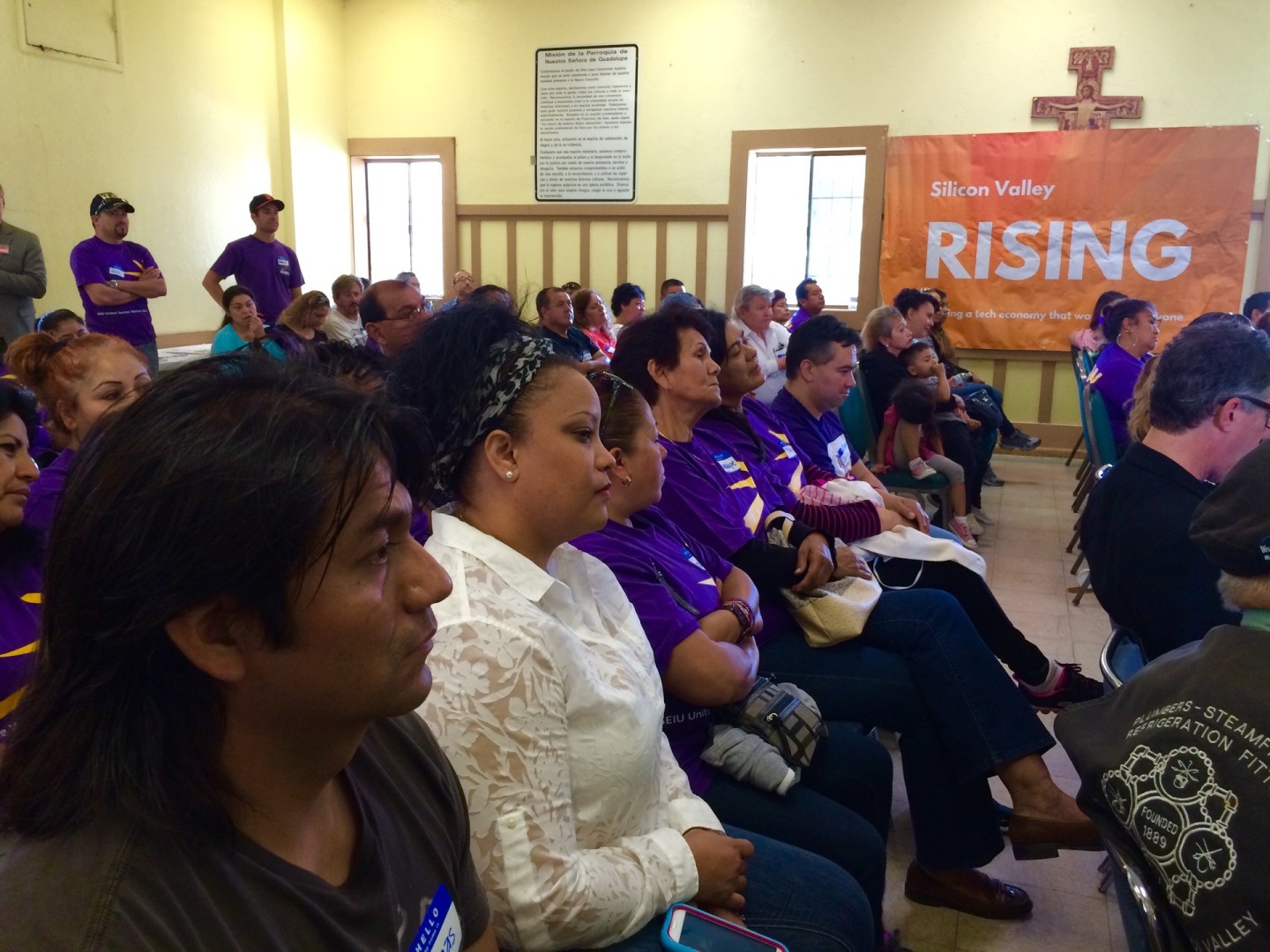
"caption": "In June, labor activists demonstrated in front of a vendor’s office in San Jose. They’re part of a campaign called Silicon Valley Rising which is pushing for better wages and benefits for service workers in high-tech companies.",
"description": "In June, Silicon Valley Rising activists demonstrating in front of a contractor's office in San Jose. ",
"title": "Silicon Valley-Unions",
"credit": "Beth Willon/KQED",
"status": "inherit",
"isLoading": false,
"fetchFailed": false
},
"news_10598764": {
"type": "attachments",
"id": "news_10598764",
"meta": {
"index": "attachments_1716263798",
"site": "news",
"id": "10598764",
"found": true
},
"parent": 10598627,
"imgSizes": {
"twentyfourteen-full-width": {
"file": "https://ww2.kqed.org/app/uploads/sites/10/2015/07/RS15998_FullSizeRender-qut-1038x576.jpg",
"width": 1038,
"mimeType": "image/jpeg",
"height": 576
},
"thumbnail": {
"file": "https://ww2.kqed.org/app/uploads/sites/10/2015/07/RS15998_FullSizeRender-qut-400x300.jpg",
"width": 400,
"mimeType": "image/jpeg",
"height": 300
},
"fd-sm": {
"file": "https://ww2.kqed.org/app/uploads/sites/10/2015/07/RS15998_FullSizeRender-qut-960x720.jpg",
"width": 960,
"mimeType": "image/jpeg",
"height": 720
},
"post-thumbnail": {
"file": "https://ww2.kqed.org/app/uploads/sites/10/2015/07/RS15998_FullSizeRender-qut-672x372.jpg",
"width": 672,
"mimeType": "image/jpeg",
"height": 372
},
"kqedFullSize": {
"file": "https://ww2.kqed.org/app/uploads/sites/10/2015/07/RS15998_FullSizeRender-qut.jpg",
"width": 1920,
"height": 1440
},
"large": {
"file": "https://ww2.kqed.org/app/uploads/sites/10/2015/07/RS15998_FullSizeRender-qut-1440x1080.jpg",
"width": 1440,
"mimeType": "image/jpeg",
"height": 1080
},
"guest-author-96": {
"file": "https://ww2.kqed.org/app/uploads/sites/10/2015/07/RS15998_FullSizeRender-qut-96x96.jpg",
"width": 96,
"mimeType": "image/jpeg",
"height": 96
},
"medium": {
"file": "https://ww2.kqed.org/app/uploads/sites/10/2015/07/RS15998_FullSizeRender-qut-800x600.jpg",
"width": 800,
"mimeType": "image/jpeg",
"height": 600
},
"guest-author-64": {
"file": "https://ww2.kqed.org/app/uploads/sites/10/2015/07/RS15998_FullSizeRender-qut-64x64.jpg",
"width": 64,
"mimeType": "image/jpeg",
"height": 64
},
"guest-author-32": {
"file": "https://ww2.kqed.org/app/uploads/sites/10/2015/07/RS15998_FullSizeRender-qut-32x32.jpg",
"width": 32,
"mimeType": "image/jpeg",
"height": 32
},
"jmtc-small-thumb": {
"file": "https://ww2.kqed.org/app/uploads/sites/10/2015/07/RS15998_FullSizeRender-qut-280x150.jpg",
"width": 280,
"mimeType": "image/jpeg",
"height": 150
},
"fd-med": {
"file": "https://ww2.kqed.org/app/uploads/sites/10/2015/07/RS15998_FullSizeRender-qut-1180x885.jpg",
"width": 1180,
"mimeType": "image/jpeg",
"height": 885
},
"detail": {
"file": "https://ww2.kqed.org/app/uploads/sites/10/2015/07/RS15998_FullSizeRender-qut-75x75.jpg",
"width": 75,
"mimeType": "image/jpeg",
"height": 75
},
"guest-author-128": {
"file": "https://ww2.kqed.org/app/uploads/sites/10/2015/07/RS15998_FullSizeRender-qut-128x128.jpg",
"width": 128,
"mimeType": "image/jpeg",
"height": 128
}
},
"publishDate": 1436768397,
"modified": 1436768508,
"caption": "Low-wage service workers mobilize at Our Lady of Guadalupe Church in San Jose.",
"description": "Low-wage service workers mobilize at Our Lady of Guadalupe Church in San Jose.",
"title": "RS15998_FullSizeRender-qut",
"credit": "Beth Willon/KQED",
"status": "inherit",
"isLoading": false,
"fetchFailed": false
},
"news_10592166": {
"type": "attachments",
"id": "news_10592166",
"meta": {
"index": "attachments_1716263798",
"site": "news",
"id": "10592166",
"found": true
},
"parent": 10592164,
"imgSizes": {
"twentyfourteen-full-width": {
"file": "https://ww2.kqed.org/app/uploads/sites/10/2015/07/steinle-1038x576.jpg",
"width": 1038,
"mimeType": "image/jpeg",
"height": 576
},
"thumbnail": {
"file": "https://ww2.kqed.org/app/uploads/sites/10/2015/07/steinle-400x279.jpg",
"width": 400,
"mimeType": "image/jpeg",
"height": 279
},
"fd-sm": {
"file": "https://ww2.kqed.org/app/uploads/sites/10/2015/07/steinle-960x669.jpg",
"width": 960,
"mimeType": "image/jpeg",
"height": 669
},
"post-thumbnail": {
"file": "https://ww2.kqed.org/app/uploads/sites/10/2015/07/steinle-672x372.jpg",
"width": 672,
"mimeType": "image/jpeg",
"height": 372
},
"kqedFullSize": {
"file": "https://ww2.kqed.org/app/uploads/sites/10/2015/07/steinle.jpg",
"width": 1920,
"height": 1338
},
"large": {
"file": "https://ww2.kqed.org/app/uploads/sites/10/2015/07/steinle-1440x1004.jpg",
"width": 1440,
"mimeType": "image/jpeg",
"height": 1004
},
"guest-author-96": {
"file": "https://ww2.kqed.org/app/uploads/sites/10/2015/07/steinle-96x96.jpg",
"width": 96,
"mimeType": "image/jpeg",
"height": 96
},
"medium": {
"file": "https://ww2.kqed.org/app/uploads/sites/10/2015/07/steinle-800x558.jpg",
"width": 800,
"mimeType": "image/jpeg",
"height": 558
},
"guest-author-64": {
"file": "https://ww2.kqed.org/app/uploads/sites/10/2015/07/steinle-64x64.jpg",
"width": 64,
"mimeType": "image/jpeg",
"height": 64
},
"guest-author-32": {
"file": "https://ww2.kqed.org/app/uploads/sites/10/2015/07/steinle-32x32.jpg",
"width": 32,
"mimeType": "image/jpeg",
"height": 32
},
"jmtc-small-thumb": {
"file": "https://ww2.kqed.org/app/uploads/sites/10/2015/07/steinle-280x150.jpg",
"width": 280,
"mimeType": "image/jpeg",
"height": 150
},
"fd-med": {
"file": "https://ww2.kqed.org/app/uploads/sites/10/2015/07/steinle-1180x822.jpg",
"width": 1180,
"mimeType": "image/jpeg",
"height": 822
},
"detail": {
"file": "https://ww2.kqed.org/app/uploads/sites/10/2015/07/steinle-75x75.jpg",
"width": 75,
"mimeType": "image/jpeg",
"height": 75
},
"guest-author-128": {
"file": "https://ww2.kqed.org/app/uploads/sites/10/2015/07/steinle-128x128.jpg",
"width": 128,
"mimeType": "image/jpeg",
"height": 128
}
},
"publishDate": 1436310518,
"modified": 1500682827,
"caption": "A well-wisher drops off flowers at the site where 32-year-old Kate Steinle was killed earlier this month on San Francisco's bay front. ",
"description": null,
"title": "Kate Steinle",
"credit": "Justin Sullivan/Getty Images",
"status": "inherit",
"isLoading": false,
"fetchFailed": false
},
"news_10368574": {
"type": "attachments",
"id": "news_10368574",
"meta": {
"index": "attachments_1716263798",
"site": "news",
"id": "10368574",
"found": true
},
"parent": 10367712,
"imgSizes": {
"twentyfourteen-full-width": {
"file": "https://ww2.kqed.org/app/uploads/sites/10/2014/12/ICEDeportation-1038x576.jpg",
"width": 1038,
"mimeType": "image/jpeg",
"height": 576
},
"thumbnail": {
"file": "https://ww2.kqed.org/app/uploads/sites/10/2014/12/ICEDeportation-400x233.jpg",
"width": 400,
"mimeType": "image/jpeg",
"height": 233
},
"post-thumbnail": {
"file": "https://ww2.kqed.org/app/uploads/sites/10/2014/12/ICEDeportation-672x372.jpg",
"width": 672,
"mimeType": "image/jpeg",
"height": 372
},
"kqedFullSize": {
"file": "https://ww2.kqed.org/app/uploads/sites/10/2014/12/ICEDeportation.jpg",
"width": 1440,
"height": 842
},
"guest-author-96": {
"file": "https://ww2.kqed.org/app/uploads/sites/10/2014/12/ICEDeportation-96x96.jpg",
"width": 96,
"mimeType": "image/jpeg",
"height": 96
},
"medium": {
"file": "https://ww2.kqed.org/app/uploads/sites/10/2014/12/ICEDeportation-800x467.jpg",
"width": 800,
"mimeType": "image/jpeg",
"height": 467
},
"guest-author-64": {
"file": "https://ww2.kqed.org/app/uploads/sites/10/2014/12/ICEDeportation-64x64.jpg",
"width": 64,
"mimeType": "image/jpeg",
"height": 64
},
"detail": {
"file": "https://ww2.kqed.org/app/uploads/sites/10/2014/12/ICEDeportation-75x75.jpg",
"width": 75,
"mimeType": "image/jpeg",
"height": 75
},
"guest-author-32": {
"file": "https://ww2.kqed.org/app/uploads/sites/10/2014/12/ICEDeportation-32x32.jpg",
"width": 32,
"mimeType": "image/jpeg",
"height": 32
},
"guest-author-128": {
"file": "https://ww2.kqed.org/app/uploads/sites/10/2014/12/ICEDeportation-128x128.jpg",
"width": 128,
"mimeType": "image/jpeg",
"height": 128
}
},
"publishDate": 1417806906,
"modified": 1436805860,
"caption": "A group of undocumented immigrants awaiting deportation. ",
"description": "An Immigration and Customs Enforcement (ICE) officer guards a group of 116 Salvadoran immigrants waiting to be deported.",
"title": "ICE Deportation",
"credit": "Jose Cabezas/AFP-Getty Images",
"status": "inherit",
"isLoading": false,
"fetchFailed": false
}
},
"audioPlayerReducer": {
"postId": "stream_live",
"isPaused": true,
"isPlaying": false,
"pfsActive": false,
"pledgeModalIsOpen": true,
"playerDrawerIsOpen": false,
"liveAudioPlayStartedAt": 0,
"liveAudioPlayContext": ""
},
"authorsReducer": {
"byline_news_10613203": {
"type": "authors",
"id": "byline_news_10613203",
"meta": {
"override": true
},
"slug": "byline_news_10613203",
"name": "Susan Valot",
"isLoading": false
},
"byline_news_10609856": {
"type": "authors",
"id": "byline_news_10609856",
"meta": {
"override": true
},
"slug": "byline_news_10609856",
"name": "\u003cstrong>\u003ca href=\"https://twitter.com/ericawerner\" target=\"_blank>Erica Werner\u003c/a>\u003c/strong> and \u003cstrong>\u003ca href=\"https://twitter.com/acaldwellap\" target=\"_blank\">Alicia A. Caldwell\u003c/a>\u003cbr />Associated Press\u003c/strong>",
"isLoading": false
},
"byline_news_10600394": {
"type": "authors",
"id": "byline_news_10600394",
"meta": {
"override": true
},
"slug": "byline_news_10600394",
"name": "\u003cstrong>\u003ca href=\"https://twitter.com/byjaniehar\" target=\"_blank\">Janie Har\u003c/a>\u003cbr />Associated Press\u003c/strong>",
"isLoading": false
},
"byline_news_10599255": {
"type": "authors",
"id": "byline_news_10599255",
"meta": {
"override": true
},
"slug": "byline_news_10599255",
"name": "\u003cstrong>Amy Taxin\u003cbr />Associated Press\u003c/strong>",
"isLoading": false
},
"vinneetong": {
"type": "authors",
"id": "260",
"meta": {
"index": "authors_1716337520",
"id": "260",
"found": true
},
"name": "Vinnee Tong",
"firstName": "Vinnee",
"lastName": "Tong",
"slug": "vinneetong",
"email": "vtong@kqed.org",
"display_author_email": false,
"staff_mastheads": [
"news"
],
"title": "KQED Contributor",
"bio": "\u003cspan style=\"font-weight: 400;\">Vinnee Tong is the managing editor of news at KQED. She oversees editorial standards \u003cspan class=\"s2\">and works to highlight underrepresented voices and perspectives\u003c/span>\u003cspan class=\"s3\">.\u003c/span>\u003cspan class=\"s2\"> She was founding editor\u003c/span>\u003c/span>\u003cspan style=\"font-weight: 400;\"> of \u003ca href=\"http://bit.ly/thebaykqed\">\u003cem>The Bay,\u003c/em>\u003c/a> a storytelling news podcast from KQED\u003c/span>\u003cspan style=\"font-weight: 400;\">. Previously, she was a producer on the \u003ca href=\"http://baycurious.org\">\u003cem>Bay Curious\u003c/em> podcast\u003c/a> and the lead producer of \u003c/span>\u003cspan style=\"font-weight: 400;\">\u003cem>Truth Be Told,\u003c/em> an award-winning KQED series on race and identity distributed nationally by Public Radio International. \u003c/span>\u003cspan style=\"font-weight: 400;\">Before KQED, Vinnee was a print reporter at the Associated Press and newspapers. \u003cspan class=\"s4\">She covered local news from city hall and planning commission hearings as well as business news from New York, like the financial meltdown of 2008. \u003c/span>She has won a\u003c/span>\u003cspan style=\"font-weight: 400;\">wards for her reporting including an RTNDA Edward R. Murrow Award, as well as awards from the New York Press Club and the Society of American Business Editors and Writers. She is a graduate of the Columbia University Graduate School of Journalism and the University of California at Berkeley, \u003cspan class=\"s4\">where she was editor-in-chief of \u003ci>The Daily Californian\u003c/i>.\u003c/span>\u003c/span>",
"avatar": "https://secure.gravatar.com/avatar/02245596ef0333bf29265e2fd547f108?s=600&d=blank&r=g",
"twitter": "vinneetong",
"facebook": null,
"instagram": null,
"linkedin": null,
"sites": [
{
"site": "news",
"roles": [
"editor",
"edit_others_pages",
"edit_others_posts"
]
},
{
"site": "stateofhealth",
"roles": [
"author"
]
}
],
"headData": {
"title": "Vinnee Tong | KQED",
"description": "KQED Contributor",
"ogImgSrc": "https://secure.gravatar.com/avatar/02245596ef0333bf29265e2fd547f108?s=600&d=blank&r=g",
"twImgSrc": "https://secure.gravatar.com/avatar/02245596ef0333bf29265e2fd547f108?s=600&d=blank&r=g"
},
"isLoading": false,
"link": "/author/vinneetong"
},
"scuevas": {
"type": "authors",
"id": "2600",
"meta": {
"index": "authors_1716337520",
"id": "2600",
"found": true
},
"name": "Steven Cuevas",
"firstName": "Steven",
"lastName": "Cuevas",
"slug": "scuevas",
"email": "scuevas@kqed.org",
"display_author_email": false,
"staff_mastheads": [],
"title": "KQED Contributor",
"bio": "Steven is a former Los Angeles bureau chief for The California Report.\r\n\r\nHe reports on an array of issues across the Southland, from immigration and regional politics to religion, the performing arts and pop culture.\r\n\r\nPrior to joining KQED in 2012, Steven covered Inland southern California for KPCC in Pasadena. He also helped establish the first newsroom at \u003ca href=\"http://kut.org/\">KUT\u003c/a> in Austin, Texas where he was a general assignment reporter.\r\n\r\nSteven has received numerous awards for his reporting including an RTNDA Edward R. Murrow Award for investigative reporting in addition to awards from the LA Press Club, the Associated Press and the Society for Professional Journalists.\r\n\r\nSteven grew up in and around San Francisco and now lives in Pasadena just a short jog from the foot of the San Gabriel Mountains.",
"avatar": "https://secure.gravatar.com/avatar/2d253580794f8e026100fae05cfabbbd4889b4fe15146146cacb82a01974c538?s=600&d=blank&r=g",
"twitter": null,
"bluesky": null,
"facebook": null,
"instagram": null,
"linkedin": null,
"sites": [
{
"site": "news",
"roles": [
"subscriber"
]
}
],
"headData": {
"title": "Steven Cuevas | KQED",
"description": "KQED Contributor",
"ogImgSrc": "https://secure.gravatar.com/avatar/2d253580794f8e026100fae05cfabbbd4889b4fe15146146cacb82a01974c538?s=600&d=blank&r=g",
"twImgSrc": "https://secure.gravatar.com/avatar/2d253580794f8e026100fae05cfabbbd4889b4fe15146146cacb82a01974c538?s=600&d=blank&r=g"
},
"isLoading": false,
"link": "/author/scuevas"
},
"bwillon": {
"type": "authors",
"id": "3207",
"meta": {
"index": "authors_1716337520",
"id": "3207",
"found": true
},
"name": "Beth Willon",
"firstName": "Beth",
"lastName": "Willon",
"slug": "bwillon",
"email": "bwillon@kqed.org",
"display_author_email": false,
"staff_mastheads": [],
"title": "KQED Contributor",
"bio": "Beth Willon is a former senior reporter for KQED's Silicon Valley News Desk in San Jose. (@KQEDNews )\r\n\r\n@BethWillon",
"avatar": "https://secure.gravatar.com/avatar/3533b741c785d6a97e8b283e7f65606d?s=600&d=blank&r=g",
"twitter": null,
"facebook": null,
"instagram": null,
"linkedin": null,
"sites": [
{
"site": "news",
"roles": [
"subscriber"
]
}
],
"headData": {
"title": "Beth Willon | KQED",
"description": "KQED Contributor",
"ogImgSrc": "https://secure.gravatar.com/avatar/3533b741c785d6a97e8b283e7f65606d?s=600&d=blank&r=g",
"twImgSrc": "https://secure.gravatar.com/avatar/3533b741c785d6a97e8b283e7f65606d?s=600&d=blank&r=g"
},
"isLoading": false,
"link": "/author/bwillon"
}
},
"pagesReducer": {
"news_category_immigration": {
"type": "terms",
"id": "news_1169",
"meta": {
"index": "terms_1716263798",
"site": "news",
"id": "1169",
"score": 10.909731
},
"featImg": null,
"name": "Immigration",
"description": null,
"taxonomy": "category",
"headData": {
"twImgId": null,
"twTitle": null,
"ogTitle": null,
"ogImgId": null,
"twDescription": null,
"description": null,
"title": "Immigration Archives | KQED News",
"ogDescription": null
},
"ttid": 1180,
"slug": "immigration",
"isLoading": false,
"title": "Immigration",
"pageMeta": {
"site": "news",
"WpPageTemplate": "page-topic-editorial",
"currentPage": 183
},
"blocks": [
{
"blockName": "kqed/post-list",
"attrs": {
"layout": "cardArticle2",
"query": "posts/news?category=immigration",
"seeMore": false,
"paginated": true,
"page": 183
}
},
{
"blockName": "kqed/ad"
}
]
}
},
"pfsSessionReducer": {},
"postsReducer": {
"stream_live": {
"type": "live",
"id": "stream_live",
"audioUrl": "https://streams.kqed.org/kqedradio",
"title": "Live Stream",
"excerpt": "Live Stream information currently unavailable.",
"link": "/radio",
"featImg": "",
"label": {
"name": "KQED Live",
"link": "/"
}
},
"stream_kqedNewscast": {
"type": "posts",
"id": "stream_kqedNewscast",
"audioUrl": "https://www.kqed.org/.stream/anon/radio/RDnews/newscast.mp3?_=1",
"title": "KQED Newscast",
"featImg": "",
"label": {
"name": "88.5 FM",
"link": "/"
}
},
"news_10613203": {
"type": "posts",
"id": "news_10613203",
"meta": {
"index": "posts_1716263798",
"site": "news",
"id": "10613203",
"score": null,
"sort": [
1437915642000
]
},
"parent": 0,
"labelTerm": {
"site": "news",
"term": 72
},
"blocks": [],
"publishDate": 1437915642,
"format": "standard",
"disqusTitle": "Uncovering the Buried History of a Japanese-American Internment Camp",
"title": "Uncovering the Buried History of a Japanese-American Internment Camp",
"headTitle": "The California Report | KQED News",
"content": "\u003cp>Dust plasters the sweaty arms and legs of an army of volunteers, dressed mostly in pants and big floppy hats for the desert heat.\u003c/p>\n\u003cp>About four dozen volunteer excavators have descended upon the \u003ca href=\"http://www.nps.gov/manz/index.htm\" target=\"_blank\">Manzanar National Historic Site\u003c/a>, west of Death Valley, for a few days in July. The desolate site was the forced home of about 10,000 Americans of Japanese descent during World War II.\u003c/p>\n\u003cp>Volunteers have spent several days braving triple-digit temperatures and dusty winds, trying to unearth history from a dark period in America's past.\u003c/p>\n\u003cp>[soundcloud url=\"https://api.soundcloud.com/tracks/216225994\" params=\"color=ff5500&auto_play=false&hide_related=false&show_comments=true&show_user=true&show_reposts=false\" width=\"100%\" height=\"166\" iframe=\"true\" /]\u003c/p>\n\u003cp>One man stands in a 5-foot-deep trench, shoveling the walls and floor into buckets.\u003c/p>\n\u003cp>[ad fullwidth]\u003c/p>\n\u003cp>\"(In) this dig, we're excavating a couple basement barracks,\" explains Manzanar archaeologist Jeff Burton. \"So there's a variety of ways people could make their life better in Manzanar. And so one way is, like, building Japanese gardens. A lot of people built Japanese gardens. And then a lot of people built basements. And we're hoping to learn more what is left in the basement.\"\u003c/p>\n\u003cp>The barracks above those basements, except for two replicas, are long gone -- removed, razed and burned after people left the camp. But the volunteers hope to find clues to life here during the war.\u003c/p>\n\u003cfigure id=\"attachment_10614860\" class=\"wp-caption alignright\" style=\"max-width: 800px\">\u003cimg class=\"size-medium wp-image-10614860\" src=\"http://ww2.kqed.org/news/wp-content/uploads/sites/10/2015/07/ManzanarMonument-800x542.jpg\" alt=\"A monument built in 1943 in the Manzanar cemetery is a reminder of those who died here during their World War II detainment. Originally, 15 people were buried here, but only six remain.\" width=\"800\" height=\"542\" srcset=\"https://ww2.kqed.org/app/uploads/sites/10/2015/07/ManzanarMonument-800x542.jpg 800w, https://ww2.kqed.org/app/uploads/sites/10/2015/07/ManzanarMonument-400x271.jpg 400w, https://ww2.kqed.org/app/uploads/sites/10/2015/07/ManzanarMonument-1440x975.jpg 1440w, https://ww2.kqed.org/app/uploads/sites/10/2015/07/ManzanarMonument-1400x948.jpg 1400w, https://ww2.kqed.org/app/uploads/sites/10/2015/07/ManzanarMonument-1180x799.jpg 1180w, https://ww2.kqed.org/app/uploads/sites/10/2015/07/ManzanarMonument-960x650.jpg 960w, https://ww2.kqed.org/app/uploads/sites/10/2015/07/ManzanarMonument.jpg 1920w\" sizes=\"(max-width: 800px) 100vw, 800px\">\u003cfigcaption class=\"wp-caption-text\">A monument built in 1943 in the Manzanar cemetery is a reminder of those who died here during their World War II detainment. Originally, 15 people were buried here, but only six remain. \u003ccite>(Susan Valot/KQED)\u003c/cite>\u003c/figcaption>\u003c/figure>\n\u003cp>\"When they first came, it was pretty miserable. This was dry, this was dusty. It was hot when they showed up. The Army didn't really know how to deal with families,\" Burton said. \"They had communal bathrooms with no stalls between the toilets because that's how a military camp would be. A lot of women were shocked at the conditions they would have to use the restrooms in. \"\u003c/p>\n\u003cp>Burton helps organize these volunteer excavations of different parts of the park at least a couple of times a year. Most of the stops on the park's driving tour are there only because they were unearthed and restored by volunteers, who are drawn to the park for different reasons.\u003c/p>\n\u003cp>\"How often when you're an adult do you get to play in the dirt?\" asked Cathy Erickson, who comes from the Portland area every year to help out, along with her adult daughter. \"That brings me back -- the marbles, the nails, the toys. One year, we found a baby shoe. We found a fancy comb set another year. So it's just the thrill of discovery, of opening up new areas.\"\u003c/p>\n\u003cp>The diggers on this day find a few surprises: a couple of buttons, fishbones and even labeled sake bottles. They also find a bit of an old comic book, which could have belonged to the 13-year-old boy who originally dug this basement.\u003c/p>\n\u003cp>More than 70 years later, his son is here, helping with the dig. Mitch Higa's dad created the cellar under his family's barracks so he and his friends could escape the extreme summer heat and play cards.\u003c/p>\n\u003cp>\"I think it really shaped how he perceived the government,\" Higa said. \"He was a U.S. citizen, yet he was in this concentration camp.\"\u003c/p>\n\u003cfigure id=\"attachment_10614863\" class=\"wp-caption aligncenter\" style=\"max-width: 800px\">\u003cimg class=\"wp-image-10614863 size-medium\" src=\"http://ww2.kqed.org/news/wp-content/uploads/sites/10/2015/07/Higa-800x575.jpg\" alt=\"Mitch Higa stands in the remnants of the basement dug by his father more than 70 years ago. Higa's father was taken to Manzanar when he was 13 years old. The family eventually ended up at another camp in northern California.\" width=\"800\" height=\"575\" srcset=\"https://ww2.kqed.org/app/uploads/sites/10/2015/07/Higa-800x575.jpg 800w, https://ww2.kqed.org/app/uploads/sites/10/2015/07/Higa-400x287.jpg 400w, https://ww2.kqed.org/app/uploads/sites/10/2015/07/Higa-1440x1034.jpg 1440w, https://ww2.kqed.org/app/uploads/sites/10/2015/07/Higa-1400x1006.jpg 1400w, https://ww2.kqed.org/app/uploads/sites/10/2015/07/Higa-1180x848.jpg 1180w, https://ww2.kqed.org/app/uploads/sites/10/2015/07/Higa-960x690.jpg 960w, https://ww2.kqed.org/app/uploads/sites/10/2015/07/Higa.jpg 1920w\" sizes=\"(max-width: 800px) 100vw, 800px\">\u003cfigcaption class=\"wp-caption-text\">Mitch Higa stands in the remnants of the basement dug by his father more than 70 years ago. Higa's father was taken to Manzanar when he was 13 years old. The family eventually ended up at another camp in northern California. \u003ccite>(Susan Valot/KQED)\u003c/cite>\u003c/figcaption>\u003c/figure>\n\u003cp>\"As I'm digging ... and sifting and sorting through the basement,\" Higa said, \"my mind starts to think about what it was like to live here as a 13-year-old boy and hang out in that basement that he dug.\"\u003c/p>\n\u003cp>Higa said his dad really did not talk much about living in Manzanar, and Higa didn't even know about the basement until someone from the National Park Service asked his dad about it.\u003c/p>\n\u003cp>\"In a way, it's kind of moving that so many different people have such an interest in this. I'm not finding out a lot about my father,\" Higa said. \"But it's still learning about my father in terms of how he lived in camp, (his) lifestyle. It puts me more in context and gives me more a sense of it.\"\u003c/p>\n\u003cp>Higa's dad, who is now in his 80s, could not make the trip to the dig.\u003c/p>\n\u003cp>Tony Salome of Los Osos has been coming to Manzanar since before it officially became a park in 1992. He first came to the area to scout locations for the movie, \"Tremors.\" The place was deserted.\u003c/p>\n\u003cfigure id=\"attachment_10614867\" class=\"wp-caption alignright\" style=\"max-width: 800px\">\u003cimg class=\"wp-image-10614867 size-medium\" src=\"http://ww2.kqed.org/news/wp-content/uploads/sites/10/2015/07/Barracks-800x483.jpg\" alt=\"A reconstructed barrack at the Manzanar National Historic Site, west of Death Valley.\" width=\"800\" height=\"483\" srcset=\"https://ww2.kqed.org/app/uploads/sites/10/2015/07/Barracks-800x483.jpg 800w, https://ww2.kqed.org/app/uploads/sites/10/2015/07/Barracks-400x241.jpg 400w, https://ww2.kqed.org/app/uploads/sites/10/2015/07/Barracks-1440x869.jpg 1440w, https://ww2.kqed.org/app/uploads/sites/10/2015/07/Barracks-1400x844.jpg 1400w, https://ww2.kqed.org/app/uploads/sites/10/2015/07/Barracks-1180x712.jpg 1180w, https://ww2.kqed.org/app/uploads/sites/10/2015/07/Barracks-960x579.jpg 960w, https://ww2.kqed.org/app/uploads/sites/10/2015/07/Barracks.jpg 1920w\" sizes=\"(max-width: 800px) 100vw, 800px\">\u003cfigcaption class=\"wp-caption-text\">A reconstructed barrack at the Manzanar National Historic Site, west of Death Valley. \u003ccite>(Susan Valot)\u003c/cite>\u003c/figcaption>\u003c/figure>\n\u003cp>\"When I came in, I remember very distinctly, I drove up to the gate and then I just kind of walked in through the property and, you know, you could sense this energy that something important happened here,\" Salome said.\u003c/p>\n\u003cp>That's when he went home to find out what exactly happened here and learned it was a World War II relocation center. Salome and his wife, Randon Pool, returned to the park and eventually started volunteering for excavations like these.\u003c/p>\n\u003cp>\"You can feel that something happened here. It's like you go to Gettysburg and you can feel something, you know?\" Pool said. \"It's beautiful here, and it just kind of breaks my heart that this is what it was, that this was an internment camp.\"\u003c/p>\n\u003cp>Pool said one of the best parts of volunteering to dig and find out more about Manzanar is the interaction with people who have roots here.\u003c/p>\n\u003cp>\"The Japanese people we've met through coming here and the people that were actually interned here, there's no anger in them. There's no visible anger. And that fascinates me,\" Pool said, as she talked about excavating Japanese gardens during a previous outing. \u003c/p>\n\u003cfigure id=\"attachment_10614858\" class=\"wp-caption alignleft\" style=\"max-width: 800px\">\u003cimg class=\"size-medium wp-image-10614858\" src=\"http://ww2.kqed.org/news/wp-content/uploads/sites/10/2015/07/ManzGarden-800x516.jpg\" alt=\"In previous years, volunteers unearthed this Japanese garden next to a mess hall at Manzanar. Japanese-Americans held at the camp during World War II built basements and gardens to make the remote, dusty barracks more livable.\" width=\"800\" height=\"516\" srcset=\"https://ww2.kqed.org/app/uploads/sites/10/2015/07/ManzGarden-800x516.jpg 800w, https://ww2.kqed.org/app/uploads/sites/10/2015/07/ManzGarden-400x258.jpg 400w, https://ww2.kqed.org/app/uploads/sites/10/2015/07/ManzGarden-1440x929.jpg 1440w, https://ww2.kqed.org/app/uploads/sites/10/2015/07/ManzGarden-1400x903.jpg 1400w, https://ww2.kqed.org/app/uploads/sites/10/2015/07/ManzGarden-1180x761.jpg 1180w, https://ww2.kqed.org/app/uploads/sites/10/2015/07/ManzGarden-960x619.jpg 960w, https://ww2.kqed.org/app/uploads/sites/10/2015/07/ManzGarden.jpg 1920w\" sizes=\"(max-width: 800px) 100vw, 800px\">\u003cfigcaption class=\"wp-caption-text\">In previous years, volunteers unearthed this Japanese garden next to a mess hall at Manzanar. Japanese-Americans held at the camp during World War II built basements and gardens to make the remote, dusty barracks more livable. \u003ccite>(Susan Valot/KQED)\u003c/cite>\u003c/figcaption>\u003c/figure>\n\u003cp>\"And they just did beautiful things under horrible conditions. I think that says a lot about the human spirit. I just think it's important to preserve as much of it as we can.\"\u003c/p>\n\u003cp>In the heat of July, Salome uses a shovel to heave dirt from the trench into buckets, which a volunteer grabs and dumps into sifters, one of which is manned by Pool. After finding a lot of nails and broken glass shards, they finally find two totally intact mugs.\u003c/p>\n\u003cp>\"Whenever you find things, that's the best part because, you know, for the most part, we're just digging holes and throwing dirt and that is very laborious,\" Salome said. \"But when you find something, and then you find an artifact that's actually intact, that is just amazing!\"\u003c/p>\n\u003cp>Salome said it's fascinating to learn what might have been and to uncover potential answers for the next generation.\u003c/p>\n\u003cp>\"It's a part of history that should be remembered,\" Salome said. \"And I think, like everybody else that comes, we're contributing to making sure that that memory doesn't die because there's so many people that really have no idea, even today, what Manzanar is or what it was.\"\u003c/p>\n\u003cp>Ranger Jeff Burton hopes with time -- and volunteer manpower -- that will change.\u003c/p>\n\u003cp>[ad floatright]\u003c/p>\n\u003cp>\"Maybe it'll stop us from creating the same mistakes. Like after 9/11, they wanted to intern Arab-Americans, but the Japanese-American community kind of stood up and said, 'No, it's not going to happen because it happened to us,' \" Burton said. \"The same story happens over and over, (but) hopefully we can learn from it.\"\u003c/p>\n\n",
"disqusIdentifier": "10613203 http://ww2.kqed.org/news/?p=10613203",
"disqusUrl": "https://ww2.kqed.org/news/2015/07/26/uncovering-the-buried-history-of-a-japanese-american-internment-camp/",
"stats": {
"hasVideo": false,
"hasChartOrMap": false,
"hasAudio": false,
"hasPolis": false,
"wordCount": 1346,
"hasGoogleForm": false,
"hasGallery": false,
"hasHearkenModule": false,
"iframeSrcs": [],
"paragraphCount": 32
},
"modified": 1437793065,
"excerpt": "The desolate site was the forced home of about 10,000 Americans of Japanese descent during World War II.",
"headData": {
"twImgId": "",
"twTitle": "",
"ogTitle": "",
"ogImgId": "",
"twDescription": "",
"description": "The desolate site was the forced home of about 10,000 Americans of Japanese descent during World War II.",
"title": "Uncovering the Buried History of a Japanese-American Internment Camp | KQED",
"ogDescription": "",
"schema": {
"@context": "https://schema.org",
"@type": "NewsArticle",
"headline": "Uncovering the Buried History of a Japanese-American Internment Camp",
"datePublished": "2015-07-26T06:00:42-07:00",
"dateModified": "2015-07-24T19:57:45-07:00",
"image": "https://cdn.kqed.org/wp-content/uploads/2020/02/KQED-OG-Image@1x.png",
"isAccessibleForFree": "True",
"publisher": {
"@type": "NewsMediaOrganization",
"@id": "https://www.kqed.org/#organization",
"name": "KQED",
"logo": "https://cdn.kqed.org/wp-content/uploads/2020/02/KQED-OG-Image@1x.png",
"url": "https://www.kqed.org",
"sameAs": [
"https://www.facebook.com/KQED",
"https://twitter.com/KQED",
"https://www.instagram.com/kqed/",
"https://www.tiktok.com/@kqedofficial",
"https://www.linkedin.com/company/kqed",
"https://www.youtube.com/channel/UCeC0IOo7i1P_61zVUWbJ4nw"
]
}
}
},
"guestAuthors": [],
"slug": "uncovering-the-buried-history-of-a-japanese-american-internment-camp",
"status": "publish",
"nprByline": "Susan Valot",
"path": "/news/10613203/uncovering-the-buried-history-of-a-japanese-american-internment-camp",
"audioTrackLength": null,
"parsedContent": [
{
"type": "contentString",
"content": "\u003cdiv class=\"post-body\">\u003cp>\u003cp>Dust plasters the sweaty arms and legs of an army of volunteers, dressed mostly in pants and big floppy hats for the desert heat.\u003c/p>\n\u003cp>About four dozen volunteer excavators have descended upon the \u003ca href=\"http://www.nps.gov/manz/index.htm\" target=\"_blank\">Manzanar National Historic Site\u003c/a>, west of Death Valley, for a few days in July. The desolate site was the forced home of about 10,000 Americans of Japanese descent during World War II.\u003c/p>\n\u003cp>Volunteers have spent several days braving triple-digit temperatures and dusty winds, trying to unearth history from a dark period in America's past.\u003c/p>\n\u003cp>\u003c/p>\u003cp>\u003cdiv class='utils-parseShortcode-shortcodes-__shortcodes__shortcodeWrapper'>\n \u003ciframe width='100%' height='166'\n scrolling='no' frameborder='no'\n src='https://w.soundcloud.com/player/?url=https://api.soundcloud.com/tracks/216225994&visual=true&color=ff5500&auto_play=false&hide_related=false&show_comments=true&show_user=true&show_reposts=false'\n title='https://api.soundcloud.com/tracks/216225994'>\n \u003c/iframe>\n \u003c/div>\u003c/p>\u003cp>\u003c/p>\n\u003cp>One man stands in a 5-foot-deep trench, shoveling the walls and floor into buckets.\u003c/p>\n\u003cp>\u003c/p>\u003c/div>",
"attributes": {
"named": {},
"numeric": []
}
},
{
"type": "component",
"content": "",
"name": "ad",
"attributes": {
"named": {
"label": "fullwidth"
},
"numeric": [
"fullwidth"
]
}
},
{
"type": "contentString",
"content": "\u003cdiv class=\"post-body\">\u003cp>\u003c/p>\n\u003cp>\"(In) this dig, we're excavating a couple basement barracks,\" explains Manzanar archaeologist Jeff Burton. \"So there's a variety of ways people could make their life better in Manzanar. And so one way is, like, building Japanese gardens. A lot of people built Japanese gardens. And then a lot of people built basements. And we're hoping to learn more what is left in the basement.\"\u003c/p>\n\u003cp>The barracks above those basements, except for two replicas, are long gone -- removed, razed and burned after people left the camp. But the volunteers hope to find clues to life here during the war.\u003c/p>\n\u003cfigure id=\"attachment_10614860\" class=\"wp-caption alignright\" style=\"max-width: 800px\">\u003cimg class=\"size-medium wp-image-10614860\" src=\"http://ww2.kqed.org/news/wp-content/uploads/sites/10/2015/07/ManzanarMonument-800x542.jpg\" alt=\"A monument built in 1943 in the Manzanar cemetery is a reminder of those who died here during their World War II detainment. Originally, 15 people were buried here, but only six remain.\" width=\"800\" height=\"542\" srcset=\"https://ww2.kqed.org/app/uploads/sites/10/2015/07/ManzanarMonument-800x542.jpg 800w, https://ww2.kqed.org/app/uploads/sites/10/2015/07/ManzanarMonument-400x271.jpg 400w, https://ww2.kqed.org/app/uploads/sites/10/2015/07/ManzanarMonument-1440x975.jpg 1440w, https://ww2.kqed.org/app/uploads/sites/10/2015/07/ManzanarMonument-1400x948.jpg 1400w, https://ww2.kqed.org/app/uploads/sites/10/2015/07/ManzanarMonument-1180x799.jpg 1180w, https://ww2.kqed.org/app/uploads/sites/10/2015/07/ManzanarMonument-960x650.jpg 960w, https://ww2.kqed.org/app/uploads/sites/10/2015/07/ManzanarMonument.jpg 1920w\" sizes=\"(max-width: 800px) 100vw, 800px\">\u003cfigcaption class=\"wp-caption-text\">A monument built in 1943 in the Manzanar cemetery is a reminder of those who died here during their World War II detainment. Originally, 15 people were buried here, but only six remain. \u003ccite>(Susan Valot/KQED)\u003c/cite>\u003c/figcaption>\u003c/figure>\n\u003cp>\"When they first came, it was pretty miserable. This was dry, this was dusty. It was hot when they showed up. The Army didn't really know how to deal with families,\" Burton said. \"They had communal bathrooms with no stalls between the toilets because that's how a military camp would be. A lot of women were shocked at the conditions they would have to use the restrooms in. \"\u003c/p>\n\u003cp>Burton helps organize these volunteer excavations of different parts of the park at least a couple of times a year. Most of the stops on the park's driving tour are there only because they were unearthed and restored by volunteers, who are drawn to the park for different reasons.\u003c/p>\n\u003cp>\"How often when you're an adult do you get to play in the dirt?\" asked Cathy Erickson, who comes from the Portland area every year to help out, along with her adult daughter. \"That brings me back -- the marbles, the nails, the toys. One year, we found a baby shoe. We found a fancy comb set another year. So it's just the thrill of discovery, of opening up new areas.\"\u003c/p>\n\u003cp>The diggers on this day find a few surprises: a couple of buttons, fishbones and even labeled sake bottles. They also find a bit of an old comic book, which could have belonged to the 13-year-old boy who originally dug this basement.\u003c/p>\n\u003cp>More than 70 years later, his son is here, helping with the dig. Mitch Higa's dad created the cellar under his family's barracks so he and his friends could escape the extreme summer heat and play cards.\u003c/p>\n\u003cp>\"I think it really shaped how he perceived the government,\" Higa said. \"He was a U.S. citizen, yet he was in this concentration camp.\"\u003c/p>\n\u003cfigure id=\"attachment_10614863\" class=\"wp-caption aligncenter\" style=\"max-width: 800px\">\u003cimg class=\"wp-image-10614863 size-medium\" src=\"http://ww2.kqed.org/news/wp-content/uploads/sites/10/2015/07/Higa-800x575.jpg\" alt=\"Mitch Higa stands in the remnants of the basement dug by his father more than 70 years ago. Higa's father was taken to Manzanar when he was 13 years old. The family eventually ended up at another camp in northern California.\" width=\"800\" height=\"575\" srcset=\"https://ww2.kqed.org/app/uploads/sites/10/2015/07/Higa-800x575.jpg 800w, https://ww2.kqed.org/app/uploads/sites/10/2015/07/Higa-400x287.jpg 400w, https://ww2.kqed.org/app/uploads/sites/10/2015/07/Higa-1440x1034.jpg 1440w, https://ww2.kqed.org/app/uploads/sites/10/2015/07/Higa-1400x1006.jpg 1400w, https://ww2.kqed.org/app/uploads/sites/10/2015/07/Higa-1180x848.jpg 1180w, https://ww2.kqed.org/app/uploads/sites/10/2015/07/Higa-960x690.jpg 960w, https://ww2.kqed.org/app/uploads/sites/10/2015/07/Higa.jpg 1920w\" sizes=\"(max-width: 800px) 100vw, 800px\">\u003cfigcaption class=\"wp-caption-text\">Mitch Higa stands in the remnants of the basement dug by his father more than 70 years ago. Higa's father was taken to Manzanar when he was 13 years old. The family eventually ended up at another camp in northern California. \u003ccite>(Susan Valot/KQED)\u003c/cite>\u003c/figcaption>\u003c/figure>\n\u003cp>\"As I'm digging ... and sifting and sorting through the basement,\" Higa said, \"my mind starts to think about what it was like to live here as a 13-year-old boy and hang out in that basement that he dug.\"\u003c/p>\n\u003cp>Higa said his dad really did not talk much about living in Manzanar, and Higa didn't even know about the basement until someone from the National Park Service asked his dad about it.\u003c/p>\n\u003cp>\"In a way, it's kind of moving that so many different people have such an interest in this. I'm not finding out a lot about my father,\" Higa said. \"But it's still learning about my father in terms of how he lived in camp, (his) lifestyle. It puts me more in context and gives me more a sense of it.\"\u003c/p>\n\u003cp>Higa's dad, who is now in his 80s, could not make the trip to the dig.\u003c/p>\n\u003cp>Tony Salome of Los Osos has been coming to Manzanar since before it officially became a park in 1992. He first came to the area to scout locations for the movie, \"Tremors.\" The place was deserted.\u003c/p>\n\u003cfigure id=\"attachment_10614867\" class=\"wp-caption alignright\" style=\"max-width: 800px\">\u003cimg class=\"wp-image-10614867 size-medium\" src=\"http://ww2.kqed.org/news/wp-content/uploads/sites/10/2015/07/Barracks-800x483.jpg\" alt=\"A reconstructed barrack at the Manzanar National Historic Site, west of Death Valley.\" width=\"800\" height=\"483\" srcset=\"https://ww2.kqed.org/app/uploads/sites/10/2015/07/Barracks-800x483.jpg 800w, https://ww2.kqed.org/app/uploads/sites/10/2015/07/Barracks-400x241.jpg 400w, https://ww2.kqed.org/app/uploads/sites/10/2015/07/Barracks-1440x869.jpg 1440w, https://ww2.kqed.org/app/uploads/sites/10/2015/07/Barracks-1400x844.jpg 1400w, https://ww2.kqed.org/app/uploads/sites/10/2015/07/Barracks-1180x712.jpg 1180w, https://ww2.kqed.org/app/uploads/sites/10/2015/07/Barracks-960x579.jpg 960w, https://ww2.kqed.org/app/uploads/sites/10/2015/07/Barracks.jpg 1920w\" sizes=\"(max-width: 800px) 100vw, 800px\">\u003cfigcaption class=\"wp-caption-text\">A reconstructed barrack at the Manzanar National Historic Site, west of Death Valley. \u003ccite>(Susan Valot)\u003c/cite>\u003c/figcaption>\u003c/figure>\n\u003cp>\"When I came in, I remember very distinctly, I drove up to the gate and then I just kind of walked in through the property and, you know, you could sense this energy that something important happened here,\" Salome said.\u003c/p>\n\u003cp>That's when he went home to find out what exactly happened here and learned it was a World War II relocation center. Salome and his wife, Randon Pool, returned to the park and eventually started volunteering for excavations like these.\u003c/p>\n\u003cp>\"You can feel that something happened here. It's like you go to Gettysburg and you can feel something, you know?\" Pool said. \"It's beautiful here, and it just kind of breaks my heart that this is what it was, that this was an internment camp.\"\u003c/p>\n\u003cp>Pool said one of the best parts of volunteering to dig and find out more about Manzanar is the interaction with people who have roots here.\u003c/p>\n\u003cp>\"The Japanese people we've met through coming here and the people that were actually interned here, there's no anger in them. There's no visible anger. And that fascinates me,\" Pool said, as she talked about excavating Japanese gardens during a previous outing. \u003c/p>\n\u003cfigure id=\"attachment_10614858\" class=\"wp-caption alignleft\" style=\"max-width: 800px\">\u003cimg class=\"size-medium wp-image-10614858\" src=\"http://ww2.kqed.org/news/wp-content/uploads/sites/10/2015/07/ManzGarden-800x516.jpg\" alt=\"In previous years, volunteers unearthed this Japanese garden next to a mess hall at Manzanar. Japanese-Americans held at the camp during World War II built basements and gardens to make the remote, dusty barracks more livable.\" width=\"800\" height=\"516\" srcset=\"https://ww2.kqed.org/app/uploads/sites/10/2015/07/ManzGarden-800x516.jpg 800w, https://ww2.kqed.org/app/uploads/sites/10/2015/07/ManzGarden-400x258.jpg 400w, https://ww2.kqed.org/app/uploads/sites/10/2015/07/ManzGarden-1440x929.jpg 1440w, https://ww2.kqed.org/app/uploads/sites/10/2015/07/ManzGarden-1400x903.jpg 1400w, https://ww2.kqed.org/app/uploads/sites/10/2015/07/ManzGarden-1180x761.jpg 1180w, https://ww2.kqed.org/app/uploads/sites/10/2015/07/ManzGarden-960x619.jpg 960w, https://ww2.kqed.org/app/uploads/sites/10/2015/07/ManzGarden.jpg 1920w\" sizes=\"(max-width: 800px) 100vw, 800px\">\u003cfigcaption class=\"wp-caption-text\">In previous years, volunteers unearthed this Japanese garden next to a mess hall at Manzanar. Japanese-Americans held at the camp during World War II built basements and gardens to make the remote, dusty barracks more livable. \u003ccite>(Susan Valot/KQED)\u003c/cite>\u003c/figcaption>\u003c/figure>\n\u003cp>\"And they just did beautiful things under horrible conditions. I think that says a lot about the human spirit. I just think it's important to preserve as much of it as we can.\"\u003c/p>\n\u003cp>In the heat of July, Salome uses a shovel to heave dirt from the trench into buckets, which a volunteer grabs and dumps into sifters, one of which is manned by Pool. After finding a lot of nails and broken glass shards, they finally find two totally intact mugs.\u003c/p>\n\u003cp>\"Whenever you find things, that's the best part because, you know, for the most part, we're just digging holes and throwing dirt and that is very laborious,\" Salome said. \"But when you find something, and then you find an artifact that's actually intact, that is just amazing!\"\u003c/p>\n\u003cp>Salome said it's fascinating to learn what might have been and to uncover potential answers for the next generation.\u003c/p>\n\u003cp>\"It's a part of history that should be remembered,\" Salome said. \"And I think, like everybody else that comes, we're contributing to making sure that that memory doesn't die because there's so many people that really have no idea, even today, what Manzanar is or what it was.\"\u003c/p>\n\u003cp>Ranger Jeff Burton hopes with time -- and volunteer manpower -- that will change.\u003c/p>\n\u003cp>\u003c/p>\u003c/div>",
"attributes": {
"named": {},
"numeric": []
}
},
{
"type": "component",
"content": "",
"name": "ad",
"attributes": {
"named": {
"label": "floatright"
},
"numeric": [
"floatright"
]
}
},
{
"type": "contentString",
"content": "\u003cdiv class=\"post-body\">\u003cp>\u003c/p>\n\u003cp>\"Maybe it'll stop us from creating the same mistakes. Like after 9/11, they wanted to intern Arab-Americans, but the Japanese-American community kind of stood up and said, 'No, it's not going to happen because it happened to us,' \" Burton said. \"The same story happens over and over, (but) hopefully we can learn from it.\"\u003c/p>\n\n\u003c/div>\u003c/p>",
"attributes": {
"named": {},
"numeric": []
}
}
],
"link": "/news/10613203/uncovering-the-buried-history-of-a-japanese-american-internment-camp",
"authors": [
"byline_news_10613203"
],
"programs": [
"news_6944",
"news_72"
],
"categories": [
"news_1169",
"news_6188",
"news_8"
],
"tags": [
"news_160",
"news_6431",
"news_17286",
"news_17041"
],
"featImg": "news_10614854",
"label": "news_72"
},
"news_10612951": {
"type": "posts",
"id": "news_10612951",
"meta": {
"index": "posts_1716263798",
"site": "news",
"id": "10612951",
"score": null,
"sort": [
1437684892000
]
},
"parent": 0,
"labelTerm": {
"site": "news",
"term": 72
},
"blocks": [],
"publishDate": 1437684892,
"format": "standard",
"disqusTitle": "Cómo Un Grupo de Preparadores de Dim Sum Ganó $4 Millones por Salarios Atrasados",
"title": "Cómo Un Grupo de Preparadores de Dim Sum Ganó $4 Millones por Salarios Atrasados",
"headTitle": "Immigrant Shift: The Changing California Workforce | The California Report | KQED News",
"content": "\u003cp>\u003cem>\u003ca href=\"http://ww2.kqed.org/news/2015/07/23/how-a-group-of-dim-sum-makers-won-4-million-in-back-pay\">Leer en Inglés\u003c/a>\u003c/em>\u003c/p>\n\u003cp>El restaurante Yank Sing, en un brillante rascacielos en el centro de San Francisco, con un dramático chorro de agua que va del piso al techo y almidonados manteles blancos, destacaba entre los demás restaurantes chinos.\u003c/p>\n\u003cp>Ésta es una de las razones por las que este otoño causó consternación entre los comensales y el público el anuncio que los trabajadores por hora de Yank Sing habían sido víctimas por muchos años del robo salarial.\u003c/p>\n\u003cp>[soundcloud url=\"https://api.soundcloud.com/tracks/216015518\" params=\"color=ff5500&auto_play=false&hide_related=false&show_comments=true&show_user=true&show_reposts=false\" width=\"100%\" height=\"166\" iframe=\"true\" /]\u003c/p>\n\u003cp>El robo salarial es cuando los empleadores obligan a sus empleados a trabajar sin cobrar o no les pagan las horas extra. Los defensores de trabajadores dicen que el robo de salarios es un problema enorme y que no se reporta con frecuencia. Esto es parte de lo que hizo tan excepcional el caso de Yank Sing.\u003c/p>\n\u003cp>[ad fullwidth]\u003c/p>\n\u003cp>En conjunto, los gerentes y los empleados anunciaron en noviembre que unos 100 [[ó 280 actuales y antiguos? TK]] trabajadores de Yank Sing habían ganado una compensación de $4 millones, la mayor compensación de su clase. Desde la perspectiva de los defensores de trabajadores, el caso terminó bien. Pero llegar a esta solución no fue nada fácil.\u003c/p>\n\u003cp>[contextly_sidebar id=\"ZMZLDjMGjL9OSzbM07tcLXOC6t6SEAUP\"]\u003c/p>\n\u003cp>Detrás del telón, un núcleo fundamental de trabajadores inmigrantes de sueldo reducido y poco inglés, libró una campaña tenaz que duró casi año y medio. Corrían peligro que su activismo llevara a que los despidieran, y de a pocos organizaron a sus colegas, quienes a su vez tenían muchas razones por las que no participar.\u003c/p>\n\u003cp>Li Xiu Zhen era una de los líderes de la campaña de trabajadores.\u003c/p>\n\u003cp>Li es un inmigrante de 61 años, del sur de la China, cuna del dim sum. Sus días laborales los pasa friendo bolitas de ajonjolí, envolviendo los won ton y pelando camarones. Ha estado preparando dim sum en el Yank Sing durante seis años, y gana un poco más que el salario mínimo. Durante la mayor parte de estos años, típicamente trabajaba de 11 a 12 horas al día. Y hasta hace poco, su sueldo indicaba que había trabajado sólo ocho horas.\u003c/p>\n\u003cp>Ésta es una de las infracciones laborales que la Comisión Laboral de California encontró en su investigación de Yank Sing. Abogado David Balter explica que la Comisión encontró que los gerentes se quedaban con las propinas y que se estaba obligando a las personas a trabajar horas extra sin cobrar.\u003c/p>\n\u003cfigure id=\"attachment_10612959\" class=\"wp-caption alignleft\" style=\"max-width: 800px\">\u003cimg class=\"size-medium wp-image-10612959\" src=\"http://ww2.kqed.org/news/wp-content/uploads/sites/10/2015/07/YankSingWorker-800x600.jpg\" alt=\"Li Xiu Zhen, cocinera de frituras en el Yank Sing, es una de los líderes organizadores de una campaña en defensa de los derechos laborales en el restaurante.\" width=\"800\" height=\"600\" srcset=\"https://ww2.kqed.org/app/uploads/sites/10/2015/07/YankSingWorker.jpg 800w, https://ww2.kqed.org/app/uploads/sites/10/2015/07/YankSingWorker-400x300.jpg 400w\" sizes=\"(max-width: 800px) 100vw, 800px\">\u003cfigcaption class=\"wp-caption-text\">Li Xiu Zhen, cocinera de frituras en el Yank Sing, es una de los líderes organizadores de una campaña en defensa de los derechos laborales en el restaurante. \u003ccite>(Vinnee Tong/KQED)\u003c/cite>\u003c/figcaption>\u003c/figure>\n\u003cp>“Hay que pagar a las personas”, dijo Balter. “Eso es bastante obvio. Hay que pagar a las personas por las horas que trabajan”.\u003c/p>\n\u003cp>Los defensores de la fuerza laboral comentan que cunde el robo salarial y que ocurre en muchas industrias. Haeyoung Yoon, con el National Employment Law Project, indica que tres de cada cuatro trabajadores de sueldo reducido en los EE.UU. no recibieron el pago correcto para las horas extra en el 2008. Dice que el problema es epidémico.\u003c/p>\n\u003cp>“Nosotros decimos que es una de las tendencias definitivas del mercado laboral del siglo XXI”, explica Yoon.\u003c/p>\n\u003caside class=\"pullquote alignleft\">Los defensores dicen que los trabajadores que se encuentran en esta situación con frecuencia se mantienen con la cabeza gacha.\u003c/aside>\n\u003cp>No todos creen que el robo salarial es un gran problema. Janna Haynes es la vocera de la California Restaurant Association, la cual representa a propietarios de restaurantes.\u003c/p>\n\u003cp>“No me parece que se dé ampliamente el robo de salarios”, dijo Haynes. “Me parece que hay algunos incidentes aislados. No me gusta. A la California Restaurant Association no le gusta, y no toleramos ese comportamiento de los empleadores”.\u003c/p>\n\u003cp>No obstante, en San Francisco, la mitad de los trabajadores de restaurantes en Chinatown dijo que se le paga menos del salario mínimo en el 2010, según una encuesta realizada por la Chinese Progressive Association.\u003c/p>\n\u003cp>Los defensores dicen que los trabajadores que se encuentran en esta situación con frecuencia se mantienen con la cabeza gacha.\u003c/p>\n\u003cp>Al principio, a Li le preocupaba que le despidieran si se quejaba. Pero sintió la frustración de sus colegas. Ella no habla nada de inglés, pero decidió que era hora de levantar la voz.\u003c/p>\n\u003cp>En un empleo anterior, Li había ganado salario atrasado del restaurante. Pensó que también se podría lograr en Yank Sing. Sus colegas estaban nerviosos y Li se convirtió en una de los organizadores para darles la confianza necesaria para unirse a la campaña.\u003c/p>\n\u003cfigure id=\"attachment_10612965\" class=\"wp-caption alignright\" style=\"max-width: 800px\">\u003cimg class=\"size-medium wp-image-10612965\" src=\"http://ww2.kqed.org/news/wp-content/uploads/sites/10/2015/07/YankSingMeat-800x600.jpg\" alt=\"Cocineros de preparación trabajan en la cocina del Yank Sing.\" width=\"800\" height=\"600\" srcset=\"https://ww2.kqed.org/app/uploads/sites/10/2015/07/YankSingMeat.jpg 800w, https://ww2.kqed.org/app/uploads/sites/10/2015/07/YankSingMeat-400x300.jpg 400w\" sizes=\"(max-width: 800px) 100vw, 800px\">\u003cfigcaption class=\"wp-caption-text\">Cocineros de preparación trabajan en la cocina del Yank Sing. \u003ccite>(Vinnee Tong/KQED)\u003c/cite>\u003c/figcaption>\u003c/figure>\n\u003cp>“Después del trabajo, íbamos a sus casas, para hablar abiertamente, cara a cara”, cuenta Li. “A veces nos quedábamos hasta las 11 o la medianoche”.\u003c/p>\n\u003cp>Iban generando impulso con las reuniones de noche.\u003c/p>\n\u003cp>Y, notablemente, la gerencia de Yank Sing estaba dispuesta a escuchar cuando se presentaron los trabajadores con su queja. El restaurante es un negocio familiar cuyos propietarios son Henry y Judy Chan.\u003c/p>\n\u003cp>“Yo creo que a nuestros propietarios les chocó sinceramente cuando supieron y fueron concientes de lo que ocurría”, dijo el director de operaciones del restaurante, Jonathan Glick. Glick se unió al equipo gerencial una vez que los propietarios aprendieron del problema. Explica que los propietarios han reemplazado a tres cuartas partes del equipo gerencial.\u003c/p>\n\u003cp>Después de una serie de negociaciones durante año y medio, los Chan concordaron en pagar cuatro años de sueldo atrasado.\u003c/p>\n\u003cp>Los trabajadores ahora tienen refrigerios rutinarios, y utilizan hojas para llevar la cuenta de las horas que trabajan. Y tienen seguro médico, todo pagado. Li dice que ahora sí puede salir del trabajo con tiempo para disfrutar de cosas sencillas, como hacer la compra para cocinar la comida de la tarde para su familia. Dice que la diferencia es tremenda.\u003c/p>\n\u003cp>“Claro que las cosas están mucho más relajadas, mucho más alegres, ahora”, comentó Li.\u003c/p>\n\u003cp>Yoon, del National Employment Law Project, dice que la victoria en el restaurante Yank Sing es parte de un movimiento que ha estado creciendo a nivel nacional durante los últimos dos años.\u003c/p>\n\u003cp>“Los trabajadores de la comida al paso, de comercios minoristas, de restaurantes, trabajadores domésticos se están presentando para exigir mejor salario, mejores condiciones laborales”, explica Yoon.\u003c/p>\n\u003cfigure id=\"attachment_10612968\" class=\"wp-caption alignright\" style=\"max-width: 800px\">\u003cimg class=\"size-medium wp-image-10612968\" src=\"http://ww2.kqed.org/news/wp-content/uploads/sites/10/2015/07/Protest-800x600.jpg\" alt=\"Trabajadores y defensores laborales marchan por salarios más altos y mejores condiciones laborales en la estación de BART de la 16 con Mission, el 21 de enero del 2015.\" width=\"800\" height=\"600\" srcset=\"https://ww2.kqed.org/app/uploads/sites/10/2015/07/Protest.jpg 800w, https://ww2.kqed.org/app/uploads/sites/10/2015/07/Protest-400x300.jpg 400w\" sizes=\"(max-width: 800px) 100vw, 800px\">\u003cfigcaption class=\"wp-caption-text\">Trabajadores y defensores laborales marchan por salarios más altos y mejores condiciones laborales en la estación de BART de la 16 con Mission, el 21 de enero del 2015. \u003ccite>(Vinnee Tong/KQED)\u003c/cite>\u003c/figcaption>\u003c/figure>\n\u003cp>Shaw San Liu trabaja en la Chinese Progressive Association, con sede en San Francisco. Durante la campaña, su organización y la Asian Law Caucus ayudaron a los trabajadores de Yank Sing con explicarles sus derechos, con organizarse como grupo y para presentar sus peticiones a la gerencia.\u003c/p>\n\u003cp>Liu dice que le da orgullo ver los beneficios que han ganado estos trabajadores inmigrantes.\u003c/p>\n\u003cp>“Todas estas cosas, casi no se oyen, casi no ocurren en esta industria”, dice Liu. “Nos parece que hemos sentado un precedente para otros restaurantes”.\u003c/p>\n\u003cp>Ahora Li, la que prepara el dim sum, espera que Yank Sing se convierta en ejemplo para otros que quieran emprender la batalla contra el robo de salarios.\u003c/p>\n\u003cp>“Esperemos que todos organicen a más personas, que estén mejor informados para poder recibir el pago que nosotros recibimos y tener mejores vidas”, comenta Li.\u003c/p>\n\u003cp>Ella dice que la campaña la transformó. Ella aprendió que podía sentarse en la mesa de negociaciones con los gerentes, cuando antes le daba nervios sólo hablar con ellos.\u003c/p>\n\u003cp>Y se mantiene activa abogando por los derechos de los trabajadores, con ayudar a organizar a trabajadores en otros restaurantes para que levanten la voz contra el abuso.\u003c/p>\n\u003cp>[ad floatright]\u003c/p>\n\u003cp>\u003cem>California tiene la séptima economía más grande del mundo, y a lo largo de la historia del estado, los inmigrantes han contribuido mucho al desarrollo de esta prosperidad. Hoy, una de cada tres personas trabajadoras en California es inmigrante – proporción que ha crecido en las últimas décadas. Nuestro estado está conformado por estos trabajadores y emprendedores – 6 millones de personas que han encontrado empleo en el Estado Dorado. En nuestra serie “\u003ca href=\"http://ww2.kqed.org/news/series/california-immigrants-at-work\">Transformación migrante,\u003c/a>” KQED y The California Report exploran el impacto que surten los inmigrantes, los retos que enfrentan y las políticas que les afectan.\u003c/em>\u003c/p>\n\n",
"disqusIdentifier": "10612951 http://ww2.kqed.org/news/?p=10612951",
"disqusUrl": "https://ww2.kqed.org/news/2015/07/23/como-un-grupo-de-preparadores-de-dim-sum-gano-4-millones-por-salarios-atrasados/",
"stats": {
"hasVideo": false,
"hasChartOrMap": false,
"hasAudio": false,
"hasPolis": false,
"wordCount": 1600,
"hasGoogleForm": false,
"hasGallery": false,
"hasHearkenModule": false,
"iframeSrcs": [],
"paragraphCount": 39
},
"modified": 1437684892,
"excerpt": "Trabajadores inmigrantes en un restaurante chino en San Francisco denunciaron a su empleador por robo salarial.",
"headData": {
"twImgId": "",
"twTitle": "",
"ogTitle": "",
"ogImgId": "",
"twDescription": "",
"description": "Trabajadores inmigrantes en un restaurante chino en San Francisco denunciaron a su empleador por robo salarial.",
"title": "Cómo Un Grupo de Preparadores de Dim Sum Ganó $4 Millones por Salarios Atrasados | KQED",
"ogDescription": "",
"schema": {
"@context": "https://schema.org",
"@type": "NewsArticle",
"headline": "Cómo Un Grupo de Preparadores de Dim Sum Ganó $4 Millones por Salarios Atrasados",
"datePublished": "2015-07-23T13:54:52-07:00",
"dateModified": "2015-07-23T13:54:52-07:00",
"image": "https://cdn.kqed.org/wp-content/uploads/2020/02/KQED-OG-Image@1x.png",
"isAccessibleForFree": "True",
"publisher": {
"@type": "NewsMediaOrganization",
"@id": "https://www.kqed.org/#organization",
"name": "KQED",
"logo": "https://cdn.kqed.org/wp-content/uploads/2020/02/KQED-OG-Image@1x.png",
"url": "https://www.kqed.org",
"sameAs": [
"https://www.facebook.com/KQED",
"https://twitter.com/KQED",
"https://www.instagram.com/kqed/",
"https://www.tiktok.com/@kqedofficial",
"https://www.linkedin.com/company/kqed",
"https://www.youtube.com/channel/UCeC0IOo7i1P_61zVUWbJ4nw"
]
}
}
},
"guestAuthors": [],
"slug": "como-un-grupo-de-preparadores-de-dim-sum-gano-4-millones-por-salarios-atrasados",
"status": "publish",
"path": "/news/10612951/como-un-grupo-de-preparadores-de-dim-sum-gano-4-millones-por-salarios-atrasados",
"audioTrackLength": null,
"parsedContent": [
{
"type": "contentString",
"content": "\u003cdiv class=\"post-body\">\u003cp>\u003cp>\u003cem>\u003ca href=\"http://ww2.kqed.org/news/2015/07/23/how-a-group-of-dim-sum-makers-won-4-million-in-back-pay\">Leer en Inglés\u003c/a>\u003c/em>\u003c/p>\n\u003cp>El restaurante Yank Sing, en un brillante rascacielos en el centro de San Francisco, con un dramático chorro de agua que va del piso al techo y almidonados manteles blancos, destacaba entre los demás restaurantes chinos.\u003c/p>\n\u003cp>Ésta es una de las razones por las que este otoño causó consternación entre los comensales y el público el anuncio que los trabajadores por hora de Yank Sing habían sido víctimas por muchos años del robo salarial.\u003c/p>\n\u003cp>\u003c/p>\u003cp>\u003cdiv class='utils-parseShortcode-shortcodes-__shortcodes__shortcodeWrapper'>\n \u003ciframe width='100%' height='166'\n scrolling='no' frameborder='no'\n src='https://w.soundcloud.com/player/?url=https://api.soundcloud.com/tracks/216015518&visual=true&color=ff5500&auto_play=false&hide_related=false&show_comments=true&show_user=true&show_reposts=false'\n title='https://api.soundcloud.com/tracks/216015518'>\n \u003c/iframe>\n \u003c/div>\u003c/p>\u003cp>\u003c/p>\n\u003cp>El robo salarial es cuando los empleadores obligan a sus empleados a trabajar sin cobrar o no les pagan las horas extra. Los defensores de trabajadores dicen que el robo de salarios es un problema enorme y que no se reporta con frecuencia. Esto es parte de lo que hizo tan excepcional el caso de Yank Sing.\u003c/p>\n\u003cp>\u003c/p>\u003c/div>",
"attributes": {
"named": {},
"numeric": []
}
},
{
"type": "component",
"content": "",
"name": "ad",
"attributes": {
"named": {
"label": "fullwidth"
},
"numeric": [
"fullwidth"
]
}
},
{
"type": "contentString",
"content": "\u003cdiv class=\"post-body\">\u003cp>\u003c/p>\n\u003cp>En conjunto, los gerentes y los empleados anunciaron en noviembre que unos 100 [[ó 280 actuales y antiguos? TK]] trabajadores de Yank Sing habían ganado una compensación de $4 millones, la mayor compensación de su clase. Desde la perspectiva de los defensores de trabajadores, el caso terminó bien. Pero llegar a esta solución no fue nada fácil.\u003c/p>\n\u003cp>\u003c/p>\u003cp>\u003c/p>\u003cp>\u003c/p>\n\u003cp>Detrás del telón, un núcleo fundamental de trabajadores inmigrantes de sueldo reducido y poco inglés, libró una campaña tenaz que duró casi año y medio. Corrían peligro que su activismo llevara a que los despidieran, y de a pocos organizaron a sus colegas, quienes a su vez tenían muchas razones por las que no participar.\u003c/p>\n\u003cp>Li Xiu Zhen era una de los líderes de la campaña de trabajadores.\u003c/p>\n\u003cp>Li es un inmigrante de 61 años, del sur de la China, cuna del dim sum. Sus días laborales los pasa friendo bolitas de ajonjolí, envolviendo los won ton y pelando camarones. Ha estado preparando dim sum en el Yank Sing durante seis años, y gana un poco más que el salario mínimo. Durante la mayor parte de estos años, típicamente trabajaba de 11 a 12 horas al día. Y hasta hace poco, su sueldo indicaba que había trabajado sólo ocho horas.\u003c/p>\n\u003cp>Ésta es una de las infracciones laborales que la Comisión Laboral de California encontró en su investigación de Yank Sing. Abogado David Balter explica que la Comisión encontró que los gerentes se quedaban con las propinas y que se estaba obligando a las personas a trabajar horas extra sin cobrar.\u003c/p>\n\u003cfigure id=\"attachment_10612959\" class=\"wp-caption alignleft\" style=\"max-width: 800px\">\u003cimg class=\"size-medium wp-image-10612959\" src=\"http://ww2.kqed.org/news/wp-content/uploads/sites/10/2015/07/YankSingWorker-800x600.jpg\" alt=\"Li Xiu Zhen, cocinera de frituras en el Yank Sing, es una de los líderes organizadores de una campaña en defensa de los derechos laborales en el restaurante.\" width=\"800\" height=\"600\" srcset=\"https://ww2.kqed.org/app/uploads/sites/10/2015/07/YankSingWorker.jpg 800w, https://ww2.kqed.org/app/uploads/sites/10/2015/07/YankSingWorker-400x300.jpg 400w\" sizes=\"(max-width: 800px) 100vw, 800px\">\u003cfigcaption class=\"wp-caption-text\">Li Xiu Zhen, cocinera de frituras en el Yank Sing, es una de los líderes organizadores de una campaña en defensa de los derechos laborales en el restaurante. \u003ccite>(Vinnee Tong/KQED)\u003c/cite>\u003c/figcaption>\u003c/figure>\n\u003cp>“Hay que pagar a las personas”, dijo Balter. “Eso es bastante obvio. Hay que pagar a las personas por las horas que trabajan”.\u003c/p>\n\u003cp>Los defensores de la fuerza laboral comentan que cunde el robo salarial y que ocurre en muchas industrias. Haeyoung Yoon, con el National Employment Law Project, indica que tres de cada cuatro trabajadores de sueldo reducido en los EE.UU. no recibieron el pago correcto para las horas extra en el 2008. Dice que el problema es epidémico.\u003c/p>\n\u003cp>“Nosotros decimos que es una de las tendencias definitivas del mercado laboral del siglo XXI”, explica Yoon.\u003c/p>\n\u003caside class=\"pullquote alignleft\">Los defensores dicen que los trabajadores que se encuentran en esta situación con frecuencia se mantienen con la cabeza gacha.\u003c/aside>\n\u003cp>No todos creen que el robo salarial es un gran problema. Janna Haynes es la vocera de la California Restaurant Association, la cual representa a propietarios de restaurantes.\u003c/p>\n\u003cp>“No me parece que se dé ampliamente el robo de salarios”, dijo Haynes. “Me parece que hay algunos incidentes aislados. No me gusta. A la California Restaurant Association no le gusta, y no toleramos ese comportamiento de los empleadores”.\u003c/p>\n\u003cp>No obstante, en San Francisco, la mitad de los trabajadores de restaurantes en Chinatown dijo que se le paga menos del salario mínimo en el 2010, según una encuesta realizada por la Chinese Progressive Association.\u003c/p>\n\u003cp>Los defensores dicen que los trabajadores que se encuentran en esta situación con frecuencia se mantienen con la cabeza gacha.\u003c/p>\n\u003cp>Al principio, a Li le preocupaba que le despidieran si se quejaba. Pero sintió la frustración de sus colegas. Ella no habla nada de inglés, pero decidió que era hora de levantar la voz.\u003c/p>\n\u003cp>En un empleo anterior, Li había ganado salario atrasado del restaurante. Pensó que también se podría lograr en Yank Sing. Sus colegas estaban nerviosos y Li se convirtió en una de los organizadores para darles la confianza necesaria para unirse a la campaña.\u003c/p>\n\u003cfigure id=\"attachment_10612965\" class=\"wp-caption alignright\" style=\"max-width: 800px\">\u003cimg class=\"size-medium wp-image-10612965\" src=\"http://ww2.kqed.org/news/wp-content/uploads/sites/10/2015/07/YankSingMeat-800x600.jpg\" alt=\"Cocineros de preparación trabajan en la cocina del Yank Sing.\" width=\"800\" height=\"600\" srcset=\"https://ww2.kqed.org/app/uploads/sites/10/2015/07/YankSingMeat.jpg 800w, https://ww2.kqed.org/app/uploads/sites/10/2015/07/YankSingMeat-400x300.jpg 400w\" sizes=\"(max-width: 800px) 100vw, 800px\">\u003cfigcaption class=\"wp-caption-text\">Cocineros de preparación trabajan en la cocina del Yank Sing. \u003ccite>(Vinnee Tong/KQED)\u003c/cite>\u003c/figcaption>\u003c/figure>\n\u003cp>“Después del trabajo, íbamos a sus casas, para hablar abiertamente, cara a cara”, cuenta Li. “A veces nos quedábamos hasta las 11 o la medianoche”.\u003c/p>\n\u003cp>Iban generando impulso con las reuniones de noche.\u003c/p>\n\u003cp>Y, notablemente, la gerencia de Yank Sing estaba dispuesta a escuchar cuando se presentaron los trabajadores con su queja. El restaurante es un negocio familiar cuyos propietarios son Henry y Judy Chan.\u003c/p>\n\u003cp>“Yo creo que a nuestros propietarios les chocó sinceramente cuando supieron y fueron concientes de lo que ocurría”, dijo el director de operaciones del restaurante, Jonathan Glick. Glick se unió al equipo gerencial una vez que los propietarios aprendieron del problema. Explica que los propietarios han reemplazado a tres cuartas partes del equipo gerencial.\u003c/p>\n\u003cp>Después de una serie de negociaciones durante año y medio, los Chan concordaron en pagar cuatro años de sueldo atrasado.\u003c/p>\n\u003cp>Los trabajadores ahora tienen refrigerios rutinarios, y utilizan hojas para llevar la cuenta de las horas que trabajan. Y tienen seguro médico, todo pagado. Li dice que ahora sí puede salir del trabajo con tiempo para disfrutar de cosas sencillas, como hacer la compra para cocinar la comida de la tarde para su familia. Dice que la diferencia es tremenda.\u003c/p>\n\u003cp>“Claro que las cosas están mucho más relajadas, mucho más alegres, ahora”, comentó Li.\u003c/p>\n\u003cp>Yoon, del National Employment Law Project, dice que la victoria en el restaurante Yank Sing es parte de un movimiento que ha estado creciendo a nivel nacional durante los últimos dos años.\u003c/p>\n\u003cp>“Los trabajadores de la comida al paso, de comercios minoristas, de restaurantes, trabajadores domésticos se están presentando para exigir mejor salario, mejores condiciones laborales”, explica Yoon.\u003c/p>\n\u003cfigure id=\"attachment_10612968\" class=\"wp-caption alignright\" style=\"max-width: 800px\">\u003cimg class=\"size-medium wp-image-10612968\" src=\"http://ww2.kqed.org/news/wp-content/uploads/sites/10/2015/07/Protest-800x600.jpg\" alt=\"Trabajadores y defensores laborales marchan por salarios más altos y mejores condiciones laborales en la estación de BART de la 16 con Mission, el 21 de enero del 2015.\" width=\"800\" height=\"600\" srcset=\"https://ww2.kqed.org/app/uploads/sites/10/2015/07/Protest.jpg 800w, https://ww2.kqed.org/app/uploads/sites/10/2015/07/Protest-400x300.jpg 400w\" sizes=\"(max-width: 800px) 100vw, 800px\">\u003cfigcaption class=\"wp-caption-text\">Trabajadores y defensores laborales marchan por salarios más altos y mejores condiciones laborales en la estación de BART de la 16 con Mission, el 21 de enero del 2015. \u003ccite>(Vinnee Tong/KQED)\u003c/cite>\u003c/figcaption>\u003c/figure>\n\u003cp>Shaw San Liu trabaja en la Chinese Progressive Association, con sede en San Francisco. Durante la campaña, su organización y la Asian Law Caucus ayudaron a los trabajadores de Yank Sing con explicarles sus derechos, con organizarse como grupo y para presentar sus peticiones a la gerencia.\u003c/p>\n\u003cp>Liu dice que le da orgullo ver los beneficios que han ganado estos trabajadores inmigrantes.\u003c/p>\n\u003cp>“Todas estas cosas, casi no se oyen, casi no ocurren en esta industria”, dice Liu. “Nos parece que hemos sentado un precedente para otros restaurantes”.\u003c/p>\n\u003cp>Ahora Li, la que prepara el dim sum, espera que Yank Sing se convierta en ejemplo para otros que quieran emprender la batalla contra el robo de salarios.\u003c/p>\n\u003cp>“Esperemos que todos organicen a más personas, que estén mejor informados para poder recibir el pago que nosotros recibimos y tener mejores vidas”, comenta Li.\u003c/p>\n\u003cp>Ella dice que la campaña la transformó. Ella aprendió que podía sentarse en la mesa de negociaciones con los gerentes, cuando antes le daba nervios sólo hablar con ellos.\u003c/p>\n\u003cp>Y se mantiene activa abogando por los derechos de los trabajadores, con ayudar a organizar a trabajadores en otros restaurantes para que levanten la voz contra el abuso.\u003c/p>\n\u003cp>\u003c/p>\u003c/div>",
"attributes": {
"named": {},
"numeric": []
}
},
{
"type": "component",
"content": "",
"name": "ad",
"attributes": {
"named": {
"label": "floatright"
},
"numeric": [
"floatright"
]
}
},
{
"type": "contentString",
"content": "\u003cdiv class=\"post-body\">\u003cp>\u003c/p>\n\u003cp>\u003cem>California tiene la séptima economía más grande del mundo, y a lo largo de la historia del estado, los inmigrantes han contribuido mucho al desarrollo de esta prosperidad. Hoy, una de cada tres personas trabajadoras en California es inmigrante – proporción que ha crecido en las últimas décadas. Nuestro estado está conformado por estos trabajadores y emprendedores – 6 millones de personas que han encontrado empleo en el Estado Dorado. En nuestra serie “\u003ca href=\"http://ww2.kqed.org/news/series/california-immigrants-at-work\">Transformación migrante,\u003c/a>” KQED y The California Report exploran el impacto que surten los inmigrantes, los retos que enfrentan y las políticas que les afectan.\u003c/em>\u003c/p>\n\n\u003c/div>\u003c/p>",
"attributes": {
"named": {},
"numeric": []
}
}
],
"link": "/news/10612951/como-un-grupo-de-preparadores-de-dim-sum-gano-4-millones-por-salarios-atrasados",
"authors": [
"260"
],
"programs": [
"news_72"
],
"series": [
"news_18211"
],
"categories": [
"news_1758",
"news_1169",
"news_6188",
"news_8"
],
"tags": [
"news_333",
"news_19904",
"news_17286",
"news_18208"
],
"featImg": "news_10612954",
"label": "news_72"
},
"news_10559232": {
"type": "posts",
"id": "news_10559232",
"meta": {
"index": "posts_1716263798",
"site": "news",
"id": "10559232",
"score": null,
"sort": [
1437634872000
]
},
"parent": 0,
"labelTerm": {
"site": "news",
"term": 72
},
"blocks": [],
"publishDate": 1437634872,
"format": "standard",
"disqusTitle": "How a Group of Dim Sum Makers Won $4 Million in Back Pay",
"title": "How a Group of Dim Sum Makers Won $4 Million in Back Pay",
"headTitle": "Immigrant Shift: The Changing California Workforce | The California Report | KQED News",
"content": "\u003cp>\u003cem>\u003ca href=\"http://ww2.kqed.org/news/2015/07/23/como-un-grupo-de-preparadores-de-dim-sum-gano-4-millones-por-salarios-atrasados\">Read this piece in Spanish\u003c/a>\u003c/em>\u003c/p>\n\u003cp>Yank Sing’s location in a shiny downtown San Francisco high-rise, its dramatic ceiling-to-floor water fountain and its crisp white tablecloths set it apart from other Chinese restaurants.\u003c/p>\n\u003cp>That’s one reason the announcement last fall seemed so jarring to patrons and the public: hourly workers at \u003ca href=\"http://www.yanksing.com/home.php\" target=\"_blank\">Yank Sing\u003c/a> were longtime victims of wage theft.\u003c/p>\n\u003cp>[soundcloud url=\"https://api.soundcloud.com/tracks/216015518\" params=\"color=ff5500&auto_play=false&hide_related=false&show_comments=true&show_user=true&show_reposts=false\" width=\"100%\" height=\"166\" iframe=\"true\" /]\u003c/p>\n\u003cp>Wage theft occurs when employers force employees to work off the clock or don’t pay them for overtime. Labor advocates say wage theft is a huge problem and it goes underreported. That’s part of what made the \u003ca href=\"http://www.latimes.com/business/la-fi-restaurant-wage-theft-20141119-story.html#page=1\" target=\"_blank\">Yank Sing case\u003c/a> so exceptional.\u003c/p>\n\u003cp>[ad fullwidth]\u003c/p>\n\u003cp>Managers and employees announced together in November that roughly 280 current and former Yank Sing workers had won a $4 million settlement. It was one of the biggest of its kind. The way labor advocates see it, the case ended well. But it wasn’t easy to get there.\u003c/p>\n\u003cp>[contextly_sidebar id=\"ezEIVfpakEUm0GPwb8fjg2blXqXm3SiG\"]\u003c/p>\n\u003cp>Behind the scenes, a core group of low-wage immigrant workers who speak little English waged a dogged campaign for almost a year and a half. They feared that their activism might get them fired, but gradually they organized fellow workers who had plenty of reasons to back down.\u003c/p>\n\u003cp>Li Xiu Zhen was one of the leaders of the worker campaign.\u003c/p>\n\u003cp>Li is a 61-year-old immigrant from southern China, the birthplace of dim sum. Her workdays are spent frying sesame balls, wrapping wontons and peeling shrimp. She’s been making dim sum at Yank Sing for six years, and she earns a little more than minimum wage. For most of those years, she typically put in 11- or 12-hour days. But until recently, her paycheck would show that she’d worked only eight hours.\u003c/p>\n\u003cp>That is one of the labor violations that the \u003ca href=\"http://www.dir.ca.gov/dlse/\">California Labor Commissioner's office\u003c/a> found in its investigation of Yank Sing. Attorney David Balter said the agency found that tips were being taken by managers and people were being forced to work off the clock.\u003c/p>\n\u003cfigure id=\"attachment_10608902\" class=\"wp-caption alignleft\" style=\"max-width: 800px\">\u003ca href=\"http://ww2.kqed.org/news/wp-content/uploads/sites/10/2015/07/RS14860_IMG_0348.JPG-qut.jpg\">\u003cimg class=\"wp-image-10608902 size-medium\" src=\"http://ww2.kqed.org/news/wp-content/uploads/sites/10/2015/07/RS14860_IMG_0348.JPG-qut-800x600.jpg\" alt=\"Yank Sing fry cook Li Xiu Zhen is one of the lead organizers of a workers rights campaign at the restaurant.\" width=\"800\" height=\"600\" srcset=\"https://ww2.kqed.org/app/uploads/sites/10/2015/07/RS14860_IMG_0348.JPG-qut-800x600.jpg 800w, https://ww2.kqed.org/app/uploads/sites/10/2015/07/RS14860_IMG_0348.JPG-qut-400x300.jpg 400w, https://ww2.kqed.org/app/uploads/sites/10/2015/07/RS14860_IMG_0348.JPG-qut-1440x1080.jpg 1440w, https://ww2.kqed.org/app/uploads/sites/10/2015/07/RS14860_IMG_0348.JPG-qut-1400x1050.jpg 1400w, https://ww2.kqed.org/app/uploads/sites/10/2015/07/RS14860_IMG_0348.JPG-qut-1180x885.jpg 1180w, https://ww2.kqed.org/app/uploads/sites/10/2015/07/RS14860_IMG_0348.JPG-qut-960x720.jpg 960w, https://ww2.kqed.org/app/uploads/sites/10/2015/07/RS14860_IMG_0348.JPG-qut.jpg 1920w\" sizes=\"(max-width: 800px) 100vw, 800px\">\u003c/a>\u003cfigcaption class=\"wp-caption-text\">Yank Sing fry cook Li Xiu Zhen was one of the lead organizers of a workers rights campaign at the restaurant. \u003ccite>(Vinnee Tong/KQED)\u003c/cite>\u003c/figcaption>\u003c/figure>\n\u003cp>“People need to be paid,” Balter said. “That’s pretty obvious. People need to be paid for hours they’re working.”\u003c/p>\n\u003cp>Labor advocates say wage theft is rampant and cuts across many industries. Haeyoung Yoon, with the \u003ca href=\"http://www.nelp.org/\" target=\"_blank\">National Employment Law Project\u003c/a>, said three out of four low-wage workers in the U.S. weren’t properly paid for overtime in 2008. She called the problem epidemic.\u003c/p>\n\u003cp>“We say this is one of the defining trends of the 21st century labor market,” Yoon said.\u003c/p>\n\u003cp>Not everyone agrees that wage theft is a huge problem. Janna Haynes is a spokeswoman for the \u003ca href=\"http://www.calrest.org/\" target=\"_blank\">California Restaurant Association\u003c/a>, which represents restaurant owners.\u003c/p>\n\u003caside class=\"pullquote alignleft\">Advocates say workers in this situation often just keep their heads down.\u003c/aside>\n\u003cp>“I do not think that wage theft is widespread,” Haynes said. “I think there are some isolated incidents of it. I don’t like it. The California Restaurant Association doesn’t like it, and we don’t have any tolerance for that behavior from employers.”\u003c/p>\n\u003cp>Yet in San Francisco, half of restaurant workers in Chinatown said they were being paid less than the minimum wage in 2010, according to a \u003ca href=\"http://www.cpasf.org/content/check-please-1-out-2-workers-making-below-minimum-wage\" target=\"_blank\">survey by the Chinese Progressive Association\u003c/a>.\u003c/p>\n\u003cp>Advocates say workers in this situation often just keep their heads down.\u003c/p>\n\u003cp>At first, Li had worried she might be fired if she complained. But she knew her co-workers were increasingly frustrated over how they were treated at Yank Sing. She doesn’t speak any English, but she decided it was time to speak up.\u003c/p>\n\u003cp>In an earlier restaurant job, she had won back pay. She thought it could also be done at Yank Sing. Her co-workers were nervous. So Li became one of the organizers who gave them the confidence to join the campaign.\u003c/p>\n\u003cfigure id=\"attachment_10608900\" class=\"wp-caption alignright\" style=\"max-width: 800px\">\u003ca href=\"http://ww2.kqed.org/news/wp-content/uploads/sites/10/2015/07/RS14857_IMG_0439.JPG-qut.jpg\">\u003cimg class=\"wp-image-10608900 size-medium\" src=\"http://ww2.kqed.org/news/wp-content/uploads/sites/10/2015/07/RS14857_IMG_0439.JPG-qut-800x600.jpg\" alt=\"Prep chefs work in the kitchen at Yank Sing.\" width=\"800\" height=\"600\" srcset=\"https://ww2.kqed.org/app/uploads/sites/10/2015/07/RS14857_IMG_0439.JPG-qut-800x600.jpg 800w, https://ww2.kqed.org/app/uploads/sites/10/2015/07/RS14857_IMG_0439.JPG-qut-400x300.jpg 400w, https://ww2.kqed.org/app/uploads/sites/10/2015/07/RS14857_IMG_0439.JPG-qut-1440x1080.jpg 1440w, https://ww2.kqed.org/app/uploads/sites/10/2015/07/RS14857_IMG_0439.JPG-qut-1400x1050.jpg 1400w, https://ww2.kqed.org/app/uploads/sites/10/2015/07/RS14857_IMG_0439.JPG-qut-1180x885.jpg 1180w, https://ww2.kqed.org/app/uploads/sites/10/2015/07/RS14857_IMG_0439.JPG-qut-960x720.jpg 960w, https://ww2.kqed.org/app/uploads/sites/10/2015/07/RS14857_IMG_0439.JPG-qut.jpg 1920w\" sizes=\"(max-width: 800px) 100vw, 800px\">\u003c/a>\u003cfigcaption class=\"wp-caption-text\">Prep chefs work in the kitchen at Yank Sing. \u003ccite>(Vinnee Tong/KQED)\u003c/cite>\u003c/figcaption>\u003c/figure>\n\u003cp>“After work, we would go to their homes, and talk openly one on one,” Li said. “Sometimes we’d be there until 11 or 12 at night.”\u003c/p>\n\u003cp>Those late-night meetings built momentum.\u003c/p>\n\u003cp>And remarkably, Yank Sing’s management was willing to listen when the workers came forward with their complaint. The restaurant is a family business owned by Henry and Judy Chan.\u003c/p>\n\u003cp>“I think our ownership was genuinely shocked when they found out and were made aware of these issues,” said the restaurant’s director of operations, Jonathan Glick. He joined the management team after the owners learned of the problem. He said the Chans have replaced three-fourths of the old management team.\u003c/p>\n\u003cp>After negotiations over a year and a half, the Chans \u003ca href=\"http://www.cpasf.org/press/settlement-yanksing\" target=\"_blank\">agreed to pay four years worth of back wages\u003c/a>.\u003c/p>\n\u003cp>Workers now get proper breaks, and use timesheets to track their hours. And they have fully paid health insurance. Li says she can now leave work in time to enjoy simple things, like buying groceries to cook her family’s evening meal. She says it’s made a huge difference.\u003c/p>\n\u003cp>“Of course, things are much more relaxed, much happier now,” said Li.\u003c/p>\n\u003cp>Yoon at the National Employment Law Project says the Yank Sing victory is part of a movement that’s been growing nationally over the past couple of years.\u003c/p>\n\u003cp>“Fast-food workers, retail workers, restaurant workers, domestic workers (are) really coming forward to demand better wages, better working conditions,” Yoon said.\u003c/p>\n\u003cfigure id=\"attachment_10559244\" class=\"wp-caption alignright\" style=\"max-width: 800px\">\u003ca href=\"http://ww2.kqed.org/news/wp-content/uploads/sites/10/2015/06/RS14863_IMG_0143.JPG-qut.jpg\">\u003cimg class=\"wp-image-10559244 size-medium\" src=\"http://ww2.kqed.org/news/wp-content/uploads/sites/10/2015/06/RS14863_IMG_0143.JPG-qut-800x600.jpg\" alt=\"Workers and labor advocates rally for higher pay and better working conditions at the 16th and Mission BART station, Jan. 21, 2015.\" width=\"800\" height=\"600\" srcset=\"https://ww2.kqed.org/app/uploads/sites/10/2015/06/RS14863_IMG_0143.JPG-qut-800x600.jpg 800w, https://ww2.kqed.org/app/uploads/sites/10/2015/06/RS14863_IMG_0143.JPG-qut-400x300.jpg 400w, https://ww2.kqed.org/app/uploads/sites/10/2015/06/RS14863_IMG_0143.JPG-qut-1440x1080.jpg 1440w, https://ww2.kqed.org/app/uploads/sites/10/2015/06/RS14863_IMG_0143.JPG-qut-1180x885.jpg 1180w, https://ww2.kqed.org/app/uploads/sites/10/2015/06/RS14863_IMG_0143.JPG-qut-960x720.jpg 960w, https://ww2.kqed.org/app/uploads/sites/10/2015/06/RS14863_IMG_0143.JPG-qut.jpg 1920w\" sizes=\"(max-width: 800px) 100vw, 800px\">\u003c/a>\u003cfigcaption class=\"wp-caption-text\">Workers and labor advocates rally for higher pay and better working conditions at the 16th and Mission BART Station on Jan. 21, 2015. \u003ccite>(Vinnee Tong/KQED)\u003c/cite>\u003c/figcaption>\u003c/figure>\n\u003cp>Shaw San Liu is with the San Francisco-based \u003ca href=\"http://www.cpasf.org/about\" target=\"_blank\">Chinese Progressive Association\u003c/a>. Throughout the campaign, her organization and the \u003ca href=\"http://www.asianlawcaucus.org/\" target=\"_blank\">Asian Law Caucus\u003c/a> helped the Yank Sing workers understand their rights, organize as a group and take their requests to management.\u003c/p>\n\u003cp>Liu said she’s proud to see what benefits these immigrant workers have won.\u003c/p>\n\u003cp>“All of these things, they’re pretty unheard of, to happen in this industry,\" Liu said. \"We think it sets a precedent for other restaurants.”\u003c/p>\n\u003cp>Now Li, the dim sum cook, hopes Yank Sing will be an example to others to take up the fight against wage theft.\u003c/p>\n\u003cp>“Hopefully everyone will organize more people, and be better informed so they can get our kind of pay and have better lives,” Li said.\u003c/p>\n\u003cp>She said the campaign changed her. She learned she could sit at a negotiating table with managers who she was once nervous just to talk to.\u003c/p>\n\u003cp>And she’s keeping up her fight for workers rights, by helping organize workers at other restaurants to speak up against abuse.\u003c/p>\n\u003cp class=\"p1\">\u003cem>\u003cspan class=\"s1\">Note: This article has been changed to reflect the fact that the state agency that enforces labor laws is the Division of Labor Standards Enforcement, which is part of the Department of Industrial Relations. We regret the error.\u003c/span>\u003c/em>\u003c/p>\n\u003cp>[ad floatright]\u003c/p>\n\u003cp>\u003ci>California has the seventh-largest economy in the world, and immigrants have a long history in building that prosperity. Today one out of every three working people in California is an immigrant — a share that has grown in recent decades. Our state is shaped by these workers and entrepreneurs — 6 million people who’ve found a job in the Golden State. In our series “\u003ca href=\"http://ww2.kqed.org/news/series/california-immigrants-at-work\">Immigrant Shift\u003c/a>,” KQED and The California Report explore the impact they have, the challenges they face and the policies that affect them.\u003c/i>\u003c/p>\n\n",
"disqusIdentifier": "10559232 http://ww2.kqed.org/news/?p=10559232",
"disqusUrl": "https://ww2.kqed.org/news/2015/07/23/how-a-group-of-dim-sum-makers-won-4-million-in-back-pay/",
"stats": {
"hasVideo": false,
"hasChartOrMap": false,
"hasAudio": false,
"hasPolis": false,
"wordCount": 1335,
"hasGoogleForm": false,
"hasGallery": false,
"hasHearkenModule": false,
"iframeSrcs": [],
"paragraphCount": 39
},
"modified": 1438375392,
"excerpt": "Immigrant workers at one Chinese restaurant in San Francisco fought successfully against wage theft. ",
"headData": {
"twImgId": "",
"twTitle": "",
"ogTitle": "",
"ogImgId": "",
"twDescription": "",
"description": "Immigrant workers at one Chinese restaurant in San Francisco fought successfully against wage theft. ",
"title": "How a Group of Dim Sum Makers Won $4 Million in Back Pay | KQED",
"ogDescription": "",
"schema": {
"@context": "https://schema.org",
"@type": "NewsArticle",
"headline": "How a Group of Dim Sum Makers Won $4 Million in Back Pay",
"datePublished": "2015-07-23T00:01:12-07:00",
"dateModified": "2015-07-31T13:43:12-07:00",
"image": "https://cdn.kqed.org/wp-content/uploads/2020/02/KQED-OG-Image@1x.png",
"isAccessibleForFree": "True",
"publisher": {
"@type": "NewsMediaOrganization",
"@id": "https://www.kqed.org/#organization",
"name": "KQED",
"logo": "https://cdn.kqed.org/wp-content/uploads/2020/02/KQED-OG-Image@1x.png",
"url": "https://www.kqed.org",
"sameAs": [
"https://www.facebook.com/KQED",
"https://twitter.com/KQED",
"https://www.instagram.com/kqed/",
"https://www.tiktok.com/@kqedofficial",
"https://www.linkedin.com/company/kqed",
"https://www.youtube.com/channel/UCeC0IOo7i1P_61zVUWbJ4nw"
]
}
}
},
"guestAuthors": [],
"slug": "how-a-group-of-dim-sum-makers-won-4-million-in-back-pay",
"status": "publish",
"path": "/news/10559232/how-a-group-of-dim-sum-makers-won-4-million-in-back-pay",
"audioTrackLength": null,
"parsedContent": [
{
"type": "contentString",
"content": "\u003cdiv class=\"post-body\">\u003cp>\u003cp>\u003cem>\u003ca href=\"http://ww2.kqed.org/news/2015/07/23/como-un-grupo-de-preparadores-de-dim-sum-gano-4-millones-por-salarios-atrasados\">Read this piece in Spanish\u003c/a>\u003c/em>\u003c/p>\n\u003cp>Yank Sing’s location in a shiny downtown San Francisco high-rise, its dramatic ceiling-to-floor water fountain and its crisp white tablecloths set it apart from other Chinese restaurants.\u003c/p>\n\u003cp>That’s one reason the announcement last fall seemed so jarring to patrons and the public: hourly workers at \u003ca href=\"http://www.yanksing.com/home.php\" target=\"_blank\">Yank Sing\u003c/a> were longtime victims of wage theft.\u003c/p>\n\u003cp>\u003c/p>\u003cp>\u003cdiv class='utils-parseShortcode-shortcodes-__shortcodes__shortcodeWrapper'>\n \u003ciframe width='100%' height='166'\n scrolling='no' frameborder='no'\n src='https://w.soundcloud.com/player/?url=https://api.soundcloud.com/tracks/216015518&visual=true&color=ff5500&auto_play=false&hide_related=false&show_comments=true&show_user=true&show_reposts=false'\n title='https://api.soundcloud.com/tracks/216015518'>\n \u003c/iframe>\n \u003c/div>\u003c/p>\u003cp>\u003c/p>\n\u003cp>Wage theft occurs when employers force employees to work off the clock or don’t pay them for overtime. Labor advocates say wage theft is a huge problem and it goes underreported. That’s part of what made the \u003ca href=\"http://www.latimes.com/business/la-fi-restaurant-wage-theft-20141119-story.html#page=1\" target=\"_blank\">Yank Sing case\u003c/a> so exceptional.\u003c/p>\n\u003cp>\u003c/p>\u003c/div>",
"attributes": {
"named": {},
"numeric": []
}
},
{
"type": "component",
"content": "",
"name": "ad",
"attributes": {
"named": {
"label": "fullwidth"
},
"numeric": [
"fullwidth"
]
}
},
{
"type": "contentString",
"content": "\u003cdiv class=\"post-body\">\u003cp>\u003c/p>\n\u003cp>Managers and employees announced together in November that roughly 280 current and former Yank Sing workers had won a $4 million settlement. It was one of the biggest of its kind. The way labor advocates see it, the case ended well. But it wasn’t easy to get there.\u003c/p>\n\u003cp>\u003c/p>\u003cp>\u003c/p>\u003cp>\u003c/p>\n\u003cp>Behind the scenes, a core group of low-wage immigrant workers who speak little English waged a dogged campaign for almost a year and a half. They feared that their activism might get them fired, but gradually they organized fellow workers who had plenty of reasons to back down.\u003c/p>\n\u003cp>Li Xiu Zhen was one of the leaders of the worker campaign.\u003c/p>\n\u003cp>Li is a 61-year-old immigrant from southern China, the birthplace of dim sum. Her workdays are spent frying sesame balls, wrapping wontons and peeling shrimp. She’s been making dim sum at Yank Sing for six years, and she earns a little more than minimum wage. For most of those years, she typically put in 11- or 12-hour days. But until recently, her paycheck would show that she’d worked only eight hours.\u003c/p>\n\u003cp>That is one of the labor violations that the \u003ca href=\"http://www.dir.ca.gov/dlse/\">California Labor Commissioner's office\u003c/a> found in its investigation of Yank Sing. Attorney David Balter said the agency found that tips were being taken by managers and people were being forced to work off the clock.\u003c/p>\n\u003cfigure id=\"attachment_10608902\" class=\"wp-caption alignleft\" style=\"max-width: 800px\">\u003ca href=\"http://ww2.kqed.org/news/wp-content/uploads/sites/10/2015/07/RS14860_IMG_0348.JPG-qut.jpg\">\u003cimg class=\"wp-image-10608902 size-medium\" src=\"http://ww2.kqed.org/news/wp-content/uploads/sites/10/2015/07/RS14860_IMG_0348.JPG-qut-800x600.jpg\" alt=\"Yank Sing fry cook Li Xiu Zhen is one of the lead organizers of a workers rights campaign at the restaurant.\" width=\"800\" height=\"600\" srcset=\"https://ww2.kqed.org/app/uploads/sites/10/2015/07/RS14860_IMG_0348.JPG-qut-800x600.jpg 800w, https://ww2.kqed.org/app/uploads/sites/10/2015/07/RS14860_IMG_0348.JPG-qut-400x300.jpg 400w, https://ww2.kqed.org/app/uploads/sites/10/2015/07/RS14860_IMG_0348.JPG-qut-1440x1080.jpg 1440w, https://ww2.kqed.org/app/uploads/sites/10/2015/07/RS14860_IMG_0348.JPG-qut-1400x1050.jpg 1400w, https://ww2.kqed.org/app/uploads/sites/10/2015/07/RS14860_IMG_0348.JPG-qut-1180x885.jpg 1180w, https://ww2.kqed.org/app/uploads/sites/10/2015/07/RS14860_IMG_0348.JPG-qut-960x720.jpg 960w, https://ww2.kqed.org/app/uploads/sites/10/2015/07/RS14860_IMG_0348.JPG-qut.jpg 1920w\" sizes=\"(max-width: 800px) 100vw, 800px\">\u003c/a>\u003cfigcaption class=\"wp-caption-text\">Yank Sing fry cook Li Xiu Zhen was one of the lead organizers of a workers rights campaign at the restaurant. \u003ccite>(Vinnee Tong/KQED)\u003c/cite>\u003c/figcaption>\u003c/figure>\n\u003cp>“People need to be paid,” Balter said. “That’s pretty obvious. People need to be paid for hours they’re working.”\u003c/p>\n\u003cp>Labor advocates say wage theft is rampant and cuts across many industries. Haeyoung Yoon, with the \u003ca href=\"http://www.nelp.org/\" target=\"_blank\">National Employment Law Project\u003c/a>, said three out of four low-wage workers in the U.S. weren’t properly paid for overtime in 2008. She called the problem epidemic.\u003c/p>\n\u003cp>“We say this is one of the defining trends of the 21st century labor market,” Yoon said.\u003c/p>\n\u003cp>Not everyone agrees that wage theft is a huge problem. Janna Haynes is a spokeswoman for the \u003ca href=\"http://www.calrest.org/\" target=\"_blank\">California Restaurant Association\u003c/a>, which represents restaurant owners.\u003c/p>\n\u003caside class=\"pullquote alignleft\">Advocates say workers in this situation often just keep their heads down.\u003c/aside>\n\u003cp>“I do not think that wage theft is widespread,” Haynes said. “I think there are some isolated incidents of it. I don’t like it. The California Restaurant Association doesn’t like it, and we don’t have any tolerance for that behavior from employers.”\u003c/p>\n\u003cp>Yet in San Francisco, half of restaurant workers in Chinatown said they were being paid less than the minimum wage in 2010, according to a \u003ca href=\"http://www.cpasf.org/content/check-please-1-out-2-workers-making-below-minimum-wage\" target=\"_blank\">survey by the Chinese Progressive Association\u003c/a>.\u003c/p>\n\u003cp>Advocates say workers in this situation often just keep their heads down.\u003c/p>\n\u003cp>At first, Li had worried she might be fired if she complained. But she knew her co-workers were increasingly frustrated over how they were treated at Yank Sing. She doesn’t speak any English, but she decided it was time to speak up.\u003c/p>\n\u003cp>In an earlier restaurant job, she had won back pay. She thought it could also be done at Yank Sing. Her co-workers were nervous. So Li became one of the organizers who gave them the confidence to join the campaign.\u003c/p>\n\u003cfigure id=\"attachment_10608900\" class=\"wp-caption alignright\" style=\"max-width: 800px\">\u003ca href=\"http://ww2.kqed.org/news/wp-content/uploads/sites/10/2015/07/RS14857_IMG_0439.JPG-qut.jpg\">\u003cimg class=\"wp-image-10608900 size-medium\" src=\"http://ww2.kqed.org/news/wp-content/uploads/sites/10/2015/07/RS14857_IMG_0439.JPG-qut-800x600.jpg\" alt=\"Prep chefs work in the kitchen at Yank Sing.\" width=\"800\" height=\"600\" srcset=\"https://ww2.kqed.org/app/uploads/sites/10/2015/07/RS14857_IMG_0439.JPG-qut-800x600.jpg 800w, https://ww2.kqed.org/app/uploads/sites/10/2015/07/RS14857_IMG_0439.JPG-qut-400x300.jpg 400w, https://ww2.kqed.org/app/uploads/sites/10/2015/07/RS14857_IMG_0439.JPG-qut-1440x1080.jpg 1440w, https://ww2.kqed.org/app/uploads/sites/10/2015/07/RS14857_IMG_0439.JPG-qut-1400x1050.jpg 1400w, https://ww2.kqed.org/app/uploads/sites/10/2015/07/RS14857_IMG_0439.JPG-qut-1180x885.jpg 1180w, https://ww2.kqed.org/app/uploads/sites/10/2015/07/RS14857_IMG_0439.JPG-qut-960x720.jpg 960w, https://ww2.kqed.org/app/uploads/sites/10/2015/07/RS14857_IMG_0439.JPG-qut.jpg 1920w\" sizes=\"(max-width: 800px) 100vw, 800px\">\u003c/a>\u003cfigcaption class=\"wp-caption-text\">Prep chefs work in the kitchen at Yank Sing. \u003ccite>(Vinnee Tong/KQED)\u003c/cite>\u003c/figcaption>\u003c/figure>\n\u003cp>“After work, we would go to their homes, and talk openly one on one,” Li said. “Sometimes we’d be there until 11 or 12 at night.”\u003c/p>\n\u003cp>Those late-night meetings built momentum.\u003c/p>\n\u003cp>And remarkably, Yank Sing’s management was willing to listen when the workers came forward with their complaint. The restaurant is a family business owned by Henry and Judy Chan.\u003c/p>\n\u003cp>“I think our ownership was genuinely shocked when they found out and were made aware of these issues,” said the restaurant’s director of operations, Jonathan Glick. He joined the management team after the owners learned of the problem. He said the Chans have replaced three-fourths of the old management team.\u003c/p>\n\u003cp>After negotiations over a year and a half, the Chans \u003ca href=\"http://www.cpasf.org/press/settlement-yanksing\" target=\"_blank\">agreed to pay four years worth of back wages\u003c/a>.\u003c/p>\n\u003cp>Workers now get proper breaks, and use timesheets to track their hours. And they have fully paid health insurance. Li says she can now leave work in time to enjoy simple things, like buying groceries to cook her family’s evening meal. She says it’s made a huge difference.\u003c/p>\n\u003cp>“Of course, things are much more relaxed, much happier now,” said Li.\u003c/p>\n\u003cp>Yoon at the National Employment Law Project says the Yank Sing victory is part of a movement that’s been growing nationally over the past couple of years.\u003c/p>\n\u003cp>“Fast-food workers, retail workers, restaurant workers, domestic workers (are) really coming forward to demand better wages, better working conditions,” Yoon said.\u003c/p>\n\u003cfigure id=\"attachment_10559244\" class=\"wp-caption alignright\" style=\"max-width: 800px\">\u003ca href=\"http://ww2.kqed.org/news/wp-content/uploads/sites/10/2015/06/RS14863_IMG_0143.JPG-qut.jpg\">\u003cimg class=\"wp-image-10559244 size-medium\" src=\"http://ww2.kqed.org/news/wp-content/uploads/sites/10/2015/06/RS14863_IMG_0143.JPG-qut-800x600.jpg\" alt=\"Workers and labor advocates rally for higher pay and better working conditions at the 16th and Mission BART station, Jan. 21, 2015.\" width=\"800\" height=\"600\" srcset=\"https://ww2.kqed.org/app/uploads/sites/10/2015/06/RS14863_IMG_0143.JPG-qut-800x600.jpg 800w, https://ww2.kqed.org/app/uploads/sites/10/2015/06/RS14863_IMG_0143.JPG-qut-400x300.jpg 400w, https://ww2.kqed.org/app/uploads/sites/10/2015/06/RS14863_IMG_0143.JPG-qut-1440x1080.jpg 1440w, https://ww2.kqed.org/app/uploads/sites/10/2015/06/RS14863_IMG_0143.JPG-qut-1180x885.jpg 1180w, https://ww2.kqed.org/app/uploads/sites/10/2015/06/RS14863_IMG_0143.JPG-qut-960x720.jpg 960w, https://ww2.kqed.org/app/uploads/sites/10/2015/06/RS14863_IMG_0143.JPG-qut.jpg 1920w\" sizes=\"(max-width: 800px) 100vw, 800px\">\u003c/a>\u003cfigcaption class=\"wp-caption-text\">Workers and labor advocates rally for higher pay and better working conditions at the 16th and Mission BART Station on Jan. 21, 2015. \u003ccite>(Vinnee Tong/KQED)\u003c/cite>\u003c/figcaption>\u003c/figure>\n\u003cp>Shaw San Liu is with the San Francisco-based \u003ca href=\"http://www.cpasf.org/about\" target=\"_blank\">Chinese Progressive Association\u003c/a>. Throughout the campaign, her organization and the \u003ca href=\"http://www.asianlawcaucus.org/\" target=\"_blank\">Asian Law Caucus\u003c/a> helped the Yank Sing workers understand their rights, organize as a group and take their requests to management.\u003c/p>\n\u003cp>Liu said she’s proud to see what benefits these immigrant workers have won.\u003c/p>\n\u003cp>“All of these things, they’re pretty unheard of, to happen in this industry,\" Liu said. \"We think it sets a precedent for other restaurants.”\u003c/p>\n\u003cp>Now Li, the dim sum cook, hopes Yank Sing will be an example to others to take up the fight against wage theft.\u003c/p>\n\u003cp>“Hopefully everyone will organize more people, and be better informed so they can get our kind of pay and have better lives,” Li said.\u003c/p>\n\u003cp>She said the campaign changed her. She learned she could sit at a negotiating table with managers who she was once nervous just to talk to.\u003c/p>\n\u003cp>And she’s keeping up her fight for workers rights, by helping organize workers at other restaurants to speak up against abuse.\u003c/p>\n\u003cp class=\"p1\">\u003cem>\u003cspan class=\"s1\">Note: This article has been changed to reflect the fact that the state agency that enforces labor laws is the Division of Labor Standards Enforcement, which is part of the Department of Industrial Relations. We regret the error.\u003c/span>\u003c/em>\u003c/p>\n\u003cp>\u003c/p>\u003c/div>",
"attributes": {
"named": {},
"numeric": []
}
},
{
"type": "component",
"content": "",
"name": "ad",
"attributes": {
"named": {
"label": "floatright"
},
"numeric": [
"floatright"
]
}
},
{
"type": "contentString",
"content": "\u003cdiv class=\"post-body\">\u003cp>\u003c/p>\n\u003cp>\u003ci>California has the seventh-largest economy in the world, and immigrants have a long history in building that prosperity. Today one out of every three working people in California is an immigrant — a share that has grown in recent decades. Our state is shaped by these workers and entrepreneurs — 6 million people who’ve found a job in the Golden State. In our series “\u003ca href=\"http://ww2.kqed.org/news/series/california-immigrants-at-work\">Immigrant Shift\u003c/a>,” KQED and The California Report explore the impact they have, the challenges they face and the policies that affect them.\u003c/i>\u003c/p>\n\n\u003c/div>\u003c/p>",
"attributes": {
"named": {},
"numeric": []
}
}
],
"link": "/news/10559232/how-a-group-of-dim-sum-makers-won-4-million-in-back-pay",
"authors": [
"260"
],
"programs": [
"news_6944",
"news_72"
],
"series": [
"news_18211"
],
"categories": [
"news_1758",
"news_1169",
"news_6188",
"news_8"
],
"tags": [
"news_333",
"news_19904",
"news_17286",
"news_17041",
"news_18208"
],
"featImg": "news_10611787",
"label": "news_72"
},
"news_10611468": {
"type": "posts",
"id": "news_10611468",
"meta": {
"index": "posts_1716263798",
"site": "news",
"id": "10611468",
"score": null,
"sort": [
1437600189000
]
},
"parent": 0,
"labelTerm": {
"site": "news",
"term": 72
},
"blocks": [],
"publishDate": 1437600189,
"format": "standard",
"disqusTitle": "La Implementación de la Nueva Ley del Salario Mínimo en Los Ángeles Será un Reto",
"title": "La Implementación de la Nueva Ley del Salario Mínimo en Los Ángeles Será un Reto",
"headTitle": "Immigrant Shift: The Changing California Workforce | The California Report | KQED News",
"content": "\u003cp>\u003ca href=\"http://ww2.kqed.org/news/2015/07/22/enforcement-of-new-l-a-minimum-wage-law-will-be-challenging\">Leer en Inglés\u003c/a>\u003c/p>\n\u003cp>Cundían los vítores el mes pasado cuando las autoridades de la ciudad de Los Ángeles aprobaron una ordenanza que impelerá el salario mínimo en la ciudad a los $15 la hora para el año 2020.\u003c/p>\n\u003cp>Con el entusiasmo también llega la preocupación – en particular entre los inmigrantes, quienes comprenden la mayoría de los trabajadores de bajos ingresos – referente a precisamente cómo intenta la ciudad hacer cumplir el aumento de sueldo.\u003c/p>\n\u003cp>[soundcloud url=\"https://api.soundcloud.com/tracks/215847318\" params=\"color=ff5500&auto_play=false&hide_related=false&show_comments=true&show_user=true&show_reposts=false\" width=\"100%\" height=\"166\" iframe=\"true\" /]\u003c/p>\n\u003cp>Durante los meses de audiencias públicas que llevaron a la aprobación final del aumento de sueldo, abundaron las historias de presunto robo salarial. Muchas historias partieron de los inmigrantes, quienes describían a dueños de restaurantes que se quedaban con sus propinas, instalaciones de lavado de autos que pagaban menos de lo acordado y represalias contra los que levantaban la voz.\u003c/p>\n\u003cp>[ad fullwidth]\u003c/p>\n\u003cp>“Nadie quiere un aumento en el costo de la mano de obra salvo que alguien les ponga mano al fuego y se lo obliguen”, dice Tia Koonse, del UCLA Labor Center, co-autora del informe sobre el impacto que surte el robo de salarios en Los Ángeles.\u003c/p>\n\u003cp>[contextly_sidebar id=\"8dPpR296TLreRoLLNJ196tyYbkRzATj9\"]\u003c/p>\n\u003cp>De los aproximadamente 700 mil trabajadores que bajo la nueva ordenanza del salario mínimo podrían ver un aumento en su paga, unos 6 de cada 10 no nacieron en los Estados Unidos, según Daniel Fleming, director de la Economic Roundtable, un grupo de investigación de políticas gubernamentales en Los Ángeles.\u003c/p>\n\u003cp>Los trabajadores inmigrantes con manejo limitado del inglés o que no conocen las leyes laborales pueden estar en peligro de ser explotados, dicen los defensores, pero los más vulnerables suelen ser los indocumentados.\u003c/p>\n\u003cp>“Es en realidad ilegal pagar menos del salario mínimo”, dice Koonse. “Y hay que pagar a los trabajadores indocumentados, quienes califican para recibir todos y cada uno de los derechos al salario y el horario de los que gozan sus contrapartes documentados”.\u003c/p>\n\u003cp>La Oficina del Fiscal de la Ciudad de Los Ángeles lleva algunos de los temas de quejas salariales y laborales, pero sólo una fracción de ellas. La mayor parte – más del 80 por ciento – los lleva un pequeño equipo de investigadores y abogados de la Division of Labor Standards Enforcement (DLSE por sus siglas en inglés: División de Implementación de Normas Laborales) del Comisionado Laboral de California.\u003c/p>\n\u003cfigure id=\"attachment_10611475\" class=\"wp-caption alignright\" style=\"max-width: 800px\">\u003cimg class=\"size-medium wp-image-10611475\" src=\"http://ww2.kqed.org/news/wp-content/uploads/sites/10/2015/07/CityCouncil-800x5071-800x507.jpg\" alt=\"Defensores – en su mayoría – de una propuesta por aumentar el salario mínimo en Los Ángeles a $15 la hora para el 2020 de manera rutinaria atiborran la cámara del Consejo de la Ciudad para presenciar un voto importante.\" width=\"800\" height=\"507\" srcset=\"https://ww2.kqed.org/app/uploads/sites/10/2015/07/CityCouncil-800x5071.jpg 800w, https://ww2.kqed.org/app/uploads/sites/10/2015/07/CityCouncil-800x5071-400x254.jpg 400w\" sizes=\"(max-width: 800px) 100vw, 800px\">\u003cfigcaption class=\"wp-caption-text\">Defensores – en su mayoría – de una propuesta por aumentar el salario mínimo en Los Ángeles a $15 la hora para el 2020 de manera rutinaria atiborran la cámara del Consejo de la Ciudad para presenciar un voto importante. \u003ccite>(Brian Watt/KPCC)\u003c/cite>\u003c/figcaption>\u003c/figure>\n\u003cp>“Los Ángeles es la capital de robo salarial del país”, dice abogada de DLSE, Julia Figueira-McDonough.\u003c/p>\n\u003cp>La oficina de Figueira-McDonough atiende unas 5.000 quejas por robo salarial al año, en particular derivadas de las industrias que emplean altos números de trabajadores inmigrantes, pero que con frecuencia les pagan menos del salario mínimo actual.\u003c/p>\n\u003cp>“Sencillamente, Los Ángeles es una ciudad mucho más grande con una mayor variedad de industrias de poca remuneración: la confección, la conserjería, la construcción”, explica Figueira-McDonough. “Muchas industrias que dependen de lo que tendría que ser mano de obra pagada al salario mínimo, pero no pagan ni el mínimo”.\u003c/p>\n\u003cp>Cuando entra en vigor el aumento salarial en Los Ángeles en junio, también se abrirá una nueva División de Implementación de Salarios de la ciudad. Seguirá el modelo de la división de implementación de salarios de San Francisco, donde trabajan unos seis investigadores de robo salarial a tiempo completo.\u003c/p>\n\u003cp>Los Ángeles comenzará con cinco investigadores. Koonse replica que esto no es suficiente. Pero que no es un mal comienzo.\u003c/p>\n\u003cp>“Nosotros tenemos como nueve veces el número de trabajadores de bajos ingresos que San Francisco, entonces claramente, con contratar a cinco investigadores no se va a lograr el nivel de implementación al que llega San Francisco”, explica Koonse. “No obstante, es mejor que lo que ocurre a nivel estatal”.\u003c/p>\n\u003cp>El objetivo de Los Ángeles es de ampliar el personal de la oficina de implementación de las leyes salariales y laborales a unos 40 empleados para el año 2020, cuando entra en vigor el salario de $15 la hora. Los negocios que no cumplen con la ley podrán verse con multas de miles de dólares y perder sus licencias de operación.\u003c/p>\n\u003caside class=\"pullquote alignleft\">'L.A. es la capital de robo salarial del país'\u003ccite>Julia Figueira-McDonough\u003c/cite>\u003c/aside>\n\u003cp>Pero son muchos los empleadores que temen que estas reglas estrictas podrían ser explotados por las personas que presentan reclamos falsos de robo de salarios.\u003c/p>\n\u003cp>“Se van a ver abogados y defensores que utilizarán esta estructura de implementación que en este momento se ve muy apto para el abuso”, dice Rubén González, de la Cámara de Comercio de Los Ángeles Metropolitana.\u003c/p>\n\u003cp>“Le garantizo que en aquellas empresas donde quieren entrar los sindicatos, van a surgir de repente numerosas quejas salariales que podrán ser reclamos falsos”, asevera.\u003c/p>\n\u003cp>Anthony Vallecillo dice que sus reclamos son de verdad.\u003c/p>\n\u003cp>Vallecillo se encuentra entre un grupo de trabajadores en una empresa de almacenamiento cerca de los puertos de Los Ángeles que le han entablado juicio contra su empleador por presunto robo de salarios. Explica Vallecillo que varios de los trabajadores inmigrantes del grupo no tienen documentos.\u003c/p>\n\u003cp>“Algunos de nuestros trabajadores indocumentados han estado trabajando allí 10, 15 años, y tenían miedo de unirse al grupo por la represalia de ser despedidos”, dice Vallecillo. “Además, siguen con miedo hasta el día de hoy.\"\u003c/p>\n\u003cfigure id=\"attachment_10611470\" class=\"wp-caption aligncenter\" style=\"max-width: 800px\">\u003cimg src=\"http://ww2.kqed.org/news/wp-content/uploads/sites/10/2015/07/RaiseWageLA-1400x7881-800x450.jpg\" alt=\"Activistas laborales celebran el 13 de junio del 2015 en lo que el alcalde de Los Ángeles, Eric Garcetti, firma legislación a partir de una ordenanza que eleva el salario mínimo a $15 para el 2020.\" width=\"800\" height=\"450\" class=\"size-medium wp-image-10611470\" srcset=\"https://ww2.kqed.org/app/uploads/sites/10/2015/07/RaiseWageLA-1400x7881-800x450.jpg 800w, https://ww2.kqed.org/app/uploads/sites/10/2015/07/RaiseWageLA-1400x7881-400x225.jpg 400w, https://ww2.kqed.org/app/uploads/sites/10/2015/07/RaiseWageLA-1400x7881.jpg 1400w, https://ww2.kqed.org/app/uploads/sites/10/2015/07/RaiseWageLA-1400x7881-1180x664.jpg 1180w, https://ww2.kqed.org/app/uploads/sites/10/2015/07/RaiseWageLA-1400x7881-960x540.jpg 960w\" sizes=\"(max-width: 800px) 100vw, 800px\">\u003cfigcaption class=\"wp-caption-text\">Activistas laborales celebran el 13 de junio del 2015 en lo que el alcalde de Los Ángeles, Eric Garcetti, firma legislación a partir de una ordenanza que eleva el salario mínimo a $15 para el 2020. \u003ccite>(MARK RALSTON/AFP/Getty Images)\u003c/cite>\u003c/figcaption>\u003c/figure>\n\u003cp>Si la ciudad ya contara con una oficina de implementación de la ley salarial operante, explica, tal vez él y sus colegas no tendrían que haber entablado juicio contra su empleador.\u003c/p>\n\u003cp>Con todo, el ganar un juicio contra un empleador que no paga el salario legal no es garantía que los trabajadores reciban el dinero que se les debe.\u003c/p>\n\u003cp>Según un informe del comisionado estatal de trabajo, sólo un 15 por ciento de las víctimas del robo de salarios que ganan sus casos reciben recompensa. Los juicios pueden demorarse por la presentación de apelaciones. Un negocio podría cerrarse y volver a abrir con otro nombre.\u003c/p>\n\u003cp>“Hoy podría llamarse Magic Carwash y mañana llamarse Magic Carwash Inc.,” explica Flor Rodríguez de la organización sin fines de lucro, Clean Carwash Campaign.\u003c/p>\n\u003cp>Rodríguez cuenta que esto es lo que le ocurrió hace unos años a un grupo de trabajadores de lavado de autos en Los Ángeles. La organización ayudó a estos trabajadores, todos inmigrantes, y con el tiempo llegaron a ganar un juicio de varios miles de dólares por pérdida salarial contra su antiguo empleador.\u003c/p>\n\u003cp>“Elaboramos un caso ante el departamento de trabajo, pero no hemos recibido dinero del caso”, comenta Rodríguez. “A los trabajadores que participaron en el caso, el dueño comenzó a darles cada vez menos horas de trabajo. Entonces, la represalia se dio rápidamente”.\u003c/p>\n\u003cp>Legislación propuesta por el Presidente pro Tem del Senado Estatal, Kevin de León (demócrata por Los Ángeles), podría invertir esta tendencia.\u003c/p>\n\u003cp>Si la legislación se aprueba, los empleadores renegados tendrían que pagar un bono para garantizar el pago de salarios robados o arriesgar que se les imponga embargos a las propiedades y otras sanciones.\u003c/p>\n\u003cp>[ad floatright]\u003c/p>\n\u003cp>\u003cem>California tiene la séptima economía más grande del mundo, y a lo largo de la historia del estado, los inmigrantes han contribuido mucho al desarrollo de esta prosperidad. Hoy, una de cada tres personas trabajadoras en California es inmigrante – proporción que ha crecido en las últimas décadas. Nuestro estado está conformado por estos trabajadores y emprendedores – 6 millones de personas que han encontrado empleo en el Estado Dorado. En nuestra serie “\u003ca href=\"http://ww2.kqed.org/news/series/california-immigrants-at-work\">Transformación migrante,\u003c/a>” KQED y The California Report exploran el impacto que surten los inmigrantes, los retos que enfrentan y las políticas que les afectan.\u003c/em>\u003c/p>\n\n",
"disqusIdentifier": "10611468 http://ww2.kqed.org/news/?p=10611468",
"disqusUrl": "https://ww2.kqed.org/news/2015/07/22/la-implementacion-de-la-nueva-ley-del-salario-minimo-en-los-angeles-sera-un-reto/",
"stats": {
"hasVideo": false,
"hasChartOrMap": false,
"hasAudio": false,
"hasPolis": false,
"wordCount": 1610,
"hasGoogleForm": false,
"hasGallery": false,
"hasHearkenModule": false,
"iframeSrcs": [],
"paragraphCount": 35
},
"modified": 1437601705,
"excerpt": "Trabajadores inmigrantes recurren a nueva oficina de implementación de la ciudad en busca de ayuda en la ‘capital del país del robo salarial.'",
"headData": {
"twImgId": "",
"twTitle": "",
"ogTitle": "",
"ogImgId": "",
"twDescription": "",
"description": "Trabajadores inmigrantes recurren a nueva oficina de implementación de la ciudad en busca de ayuda en la ‘capital del país del robo salarial.'",
"title": "La Implementación de la Nueva Ley del Salario Mínimo en Los Ángeles Será un Reto | KQED",
"ogDescription": "",
"schema": {
"@context": "https://schema.org",
"@type": "NewsArticle",
"headline": "La Implementación de la Nueva Ley del Salario Mínimo en Los Ángeles Será un Reto",
"datePublished": "2015-07-22T14:23:09-07:00",
"dateModified": "2015-07-22T14:48:25-07:00",
"image": "https://cdn.kqed.org/wp-content/uploads/2020/02/KQED-OG-Image@1x.png",
"isAccessibleForFree": "True",
"publisher": {
"@type": "NewsMediaOrganization",
"@id": "https://www.kqed.org/#organization",
"name": "KQED",
"logo": "https://cdn.kqed.org/wp-content/uploads/2020/02/KQED-OG-Image@1x.png",
"url": "https://www.kqed.org",
"sameAs": [
"https://www.facebook.com/KQED",
"https://twitter.com/KQED",
"https://www.instagram.com/kqed/",
"https://www.tiktok.com/@kqedofficial",
"https://www.linkedin.com/company/kqed",
"https://www.youtube.com/channel/UCeC0IOo7i1P_61zVUWbJ4nw"
]
}
}
},
"guestAuthors": [],
"slug": "la-implementacion-de-la-nueva-ley-del-salario-minimo-en-los-angeles-sera-un-reto",
"status": "publish",
"path": "/news/10611468/la-implementacion-de-la-nueva-ley-del-salario-minimo-en-los-angeles-sera-un-reto",
"audioTrackLength": null,
"parsedContent": [
{
"type": "contentString",
"content": "\u003cdiv class=\"post-body\">\u003cp>\u003cp>\u003ca href=\"http://ww2.kqed.org/news/2015/07/22/enforcement-of-new-l-a-minimum-wage-law-will-be-challenging\">Leer en Inglés\u003c/a>\u003c/p>\n\u003cp>Cundían los vítores el mes pasado cuando las autoridades de la ciudad de Los Ángeles aprobaron una ordenanza que impelerá el salario mínimo en la ciudad a los $15 la hora para el año 2020.\u003c/p>\n\u003cp>Con el entusiasmo también llega la preocupación – en particular entre los inmigrantes, quienes comprenden la mayoría de los trabajadores de bajos ingresos – referente a precisamente cómo intenta la ciudad hacer cumplir el aumento de sueldo.\u003c/p>\n\u003cp>\u003c/p>\u003cp>\u003cdiv class='utils-parseShortcode-shortcodes-__shortcodes__shortcodeWrapper'>\n \u003ciframe width='100%' height='166'\n scrolling='no' frameborder='no'\n src='https://w.soundcloud.com/player/?url=https://api.soundcloud.com/tracks/215847318&visual=true&color=ff5500&auto_play=false&hide_related=false&show_comments=true&show_user=true&show_reposts=false'\n title='https://api.soundcloud.com/tracks/215847318'>\n \u003c/iframe>\n \u003c/div>\u003c/p>\u003cp>\u003c/p>\n\u003cp>Durante los meses de audiencias públicas que llevaron a la aprobación final del aumento de sueldo, abundaron las historias de presunto robo salarial. Muchas historias partieron de los inmigrantes, quienes describían a dueños de restaurantes que se quedaban con sus propinas, instalaciones de lavado de autos que pagaban menos de lo acordado y represalias contra los que levantaban la voz.\u003c/p>\n\u003cp>\u003c/p>\u003c/div>",
"attributes": {
"named": {},
"numeric": []
}
},
{
"type": "component",
"content": "",
"name": "ad",
"attributes": {
"named": {
"label": "fullwidth"
},
"numeric": [
"fullwidth"
]
}
},
{
"type": "contentString",
"content": "\u003cdiv class=\"post-body\">\u003cp>\u003c/p>\n\u003cp>“Nadie quiere un aumento en el costo de la mano de obra salvo que alguien les ponga mano al fuego y se lo obliguen”, dice Tia Koonse, del UCLA Labor Center, co-autora del informe sobre el impacto que surte el robo de salarios en Los Ángeles.\u003c/p>\n\u003cp>\u003c/p>\u003cp>\u003c/p>\u003cp>\u003c/p>\n\u003cp>De los aproximadamente 700 mil trabajadores que bajo la nueva ordenanza del salario mínimo podrían ver un aumento en su paga, unos 6 de cada 10 no nacieron en los Estados Unidos, según Daniel Fleming, director de la Economic Roundtable, un grupo de investigación de políticas gubernamentales en Los Ángeles.\u003c/p>\n\u003cp>Los trabajadores inmigrantes con manejo limitado del inglés o que no conocen las leyes laborales pueden estar en peligro de ser explotados, dicen los defensores, pero los más vulnerables suelen ser los indocumentados.\u003c/p>\n\u003cp>“Es en realidad ilegal pagar menos del salario mínimo”, dice Koonse. “Y hay que pagar a los trabajadores indocumentados, quienes califican para recibir todos y cada uno de los derechos al salario y el horario de los que gozan sus contrapartes documentados”.\u003c/p>\n\u003cp>La Oficina del Fiscal de la Ciudad de Los Ángeles lleva algunos de los temas de quejas salariales y laborales, pero sólo una fracción de ellas. La mayor parte – más del 80 por ciento – los lleva un pequeño equipo de investigadores y abogados de la Division of Labor Standards Enforcement (DLSE por sus siglas en inglés: División de Implementación de Normas Laborales) del Comisionado Laboral de California.\u003c/p>\n\u003cfigure id=\"attachment_10611475\" class=\"wp-caption alignright\" style=\"max-width: 800px\">\u003cimg class=\"size-medium wp-image-10611475\" src=\"http://ww2.kqed.org/news/wp-content/uploads/sites/10/2015/07/CityCouncil-800x5071-800x507.jpg\" alt=\"Defensores – en su mayoría – de una propuesta por aumentar el salario mínimo en Los Ángeles a $15 la hora para el 2020 de manera rutinaria atiborran la cámara del Consejo de la Ciudad para presenciar un voto importante.\" width=\"800\" height=\"507\" srcset=\"https://ww2.kqed.org/app/uploads/sites/10/2015/07/CityCouncil-800x5071.jpg 800w, https://ww2.kqed.org/app/uploads/sites/10/2015/07/CityCouncil-800x5071-400x254.jpg 400w\" sizes=\"(max-width: 800px) 100vw, 800px\">\u003cfigcaption class=\"wp-caption-text\">Defensores – en su mayoría – de una propuesta por aumentar el salario mínimo en Los Ángeles a $15 la hora para el 2020 de manera rutinaria atiborran la cámara del Consejo de la Ciudad para presenciar un voto importante. \u003ccite>(Brian Watt/KPCC)\u003c/cite>\u003c/figcaption>\u003c/figure>\n\u003cp>“Los Ángeles es la capital de robo salarial del país”, dice abogada de DLSE, Julia Figueira-McDonough.\u003c/p>\n\u003cp>La oficina de Figueira-McDonough atiende unas 5.000 quejas por robo salarial al año, en particular derivadas de las industrias que emplean altos números de trabajadores inmigrantes, pero que con frecuencia les pagan menos del salario mínimo actual.\u003c/p>\n\u003cp>“Sencillamente, Los Ángeles es una ciudad mucho más grande con una mayor variedad de industrias de poca remuneración: la confección, la conserjería, la construcción”, explica Figueira-McDonough. “Muchas industrias que dependen de lo que tendría que ser mano de obra pagada al salario mínimo, pero no pagan ni el mínimo”.\u003c/p>\n\u003cp>Cuando entra en vigor el aumento salarial en Los Ángeles en junio, también se abrirá una nueva División de Implementación de Salarios de la ciudad. Seguirá el modelo de la división de implementación de salarios de San Francisco, donde trabajan unos seis investigadores de robo salarial a tiempo completo.\u003c/p>\n\u003cp>Los Ángeles comenzará con cinco investigadores. Koonse replica que esto no es suficiente. Pero que no es un mal comienzo.\u003c/p>\n\u003cp>“Nosotros tenemos como nueve veces el número de trabajadores de bajos ingresos que San Francisco, entonces claramente, con contratar a cinco investigadores no se va a lograr el nivel de implementación al que llega San Francisco”, explica Koonse. “No obstante, es mejor que lo que ocurre a nivel estatal”.\u003c/p>\n\u003cp>El objetivo de Los Ángeles es de ampliar el personal de la oficina de implementación de las leyes salariales y laborales a unos 40 empleados para el año 2020, cuando entra en vigor el salario de $15 la hora. Los negocios que no cumplen con la ley podrán verse con multas de miles de dólares y perder sus licencias de operación.\u003c/p>\n\u003caside class=\"pullquote alignleft\">'L.A. es la capital de robo salarial del país'\u003ccite>Julia Figueira-McDonough\u003c/cite>\u003c/aside>\n\u003cp>Pero son muchos los empleadores que temen que estas reglas estrictas podrían ser explotados por las personas que presentan reclamos falsos de robo de salarios.\u003c/p>\n\u003cp>“Se van a ver abogados y defensores que utilizarán esta estructura de implementación que en este momento se ve muy apto para el abuso”, dice Rubén González, de la Cámara de Comercio de Los Ángeles Metropolitana.\u003c/p>\n\u003cp>“Le garantizo que en aquellas empresas donde quieren entrar los sindicatos, van a surgir de repente numerosas quejas salariales que podrán ser reclamos falsos”, asevera.\u003c/p>\n\u003cp>Anthony Vallecillo dice que sus reclamos son de verdad.\u003c/p>\n\u003cp>Vallecillo se encuentra entre un grupo de trabajadores en una empresa de almacenamiento cerca de los puertos de Los Ángeles que le han entablado juicio contra su empleador por presunto robo de salarios. Explica Vallecillo que varios de los trabajadores inmigrantes del grupo no tienen documentos.\u003c/p>\n\u003cp>“Algunos de nuestros trabajadores indocumentados han estado trabajando allí 10, 15 años, y tenían miedo de unirse al grupo por la represalia de ser despedidos”, dice Vallecillo. “Además, siguen con miedo hasta el día de hoy.\"\u003c/p>\n\u003cfigure id=\"attachment_10611470\" class=\"wp-caption aligncenter\" style=\"max-width: 800px\">\u003cimg src=\"http://ww2.kqed.org/news/wp-content/uploads/sites/10/2015/07/RaiseWageLA-1400x7881-800x450.jpg\" alt=\"Activistas laborales celebran el 13 de junio del 2015 en lo que el alcalde de Los Ángeles, Eric Garcetti, firma legislación a partir de una ordenanza que eleva el salario mínimo a $15 para el 2020.\" width=\"800\" height=\"450\" class=\"size-medium wp-image-10611470\" srcset=\"https://ww2.kqed.org/app/uploads/sites/10/2015/07/RaiseWageLA-1400x7881-800x450.jpg 800w, https://ww2.kqed.org/app/uploads/sites/10/2015/07/RaiseWageLA-1400x7881-400x225.jpg 400w, https://ww2.kqed.org/app/uploads/sites/10/2015/07/RaiseWageLA-1400x7881.jpg 1400w, https://ww2.kqed.org/app/uploads/sites/10/2015/07/RaiseWageLA-1400x7881-1180x664.jpg 1180w, https://ww2.kqed.org/app/uploads/sites/10/2015/07/RaiseWageLA-1400x7881-960x540.jpg 960w\" sizes=\"(max-width: 800px) 100vw, 800px\">\u003cfigcaption class=\"wp-caption-text\">Activistas laborales celebran el 13 de junio del 2015 en lo que el alcalde de Los Ángeles, Eric Garcetti, firma legislación a partir de una ordenanza que eleva el salario mínimo a $15 para el 2020. \u003ccite>(MARK RALSTON/AFP/Getty Images)\u003c/cite>\u003c/figcaption>\u003c/figure>\n\u003cp>Si la ciudad ya contara con una oficina de implementación de la ley salarial operante, explica, tal vez él y sus colegas no tendrían que haber entablado juicio contra su empleador.\u003c/p>\n\u003cp>Con todo, el ganar un juicio contra un empleador que no paga el salario legal no es garantía que los trabajadores reciban el dinero que se les debe.\u003c/p>\n\u003cp>Según un informe del comisionado estatal de trabajo, sólo un 15 por ciento de las víctimas del robo de salarios que ganan sus casos reciben recompensa. Los juicios pueden demorarse por la presentación de apelaciones. Un negocio podría cerrarse y volver a abrir con otro nombre.\u003c/p>\n\u003cp>“Hoy podría llamarse Magic Carwash y mañana llamarse Magic Carwash Inc.,” explica Flor Rodríguez de la organización sin fines de lucro, Clean Carwash Campaign.\u003c/p>\n\u003cp>Rodríguez cuenta que esto es lo que le ocurrió hace unos años a un grupo de trabajadores de lavado de autos en Los Ángeles. La organización ayudó a estos trabajadores, todos inmigrantes, y con el tiempo llegaron a ganar un juicio de varios miles de dólares por pérdida salarial contra su antiguo empleador.\u003c/p>\n\u003cp>“Elaboramos un caso ante el departamento de trabajo, pero no hemos recibido dinero del caso”, comenta Rodríguez. “A los trabajadores que participaron en el caso, el dueño comenzó a darles cada vez menos horas de trabajo. Entonces, la represalia se dio rápidamente”.\u003c/p>\n\u003cp>Legislación propuesta por el Presidente pro Tem del Senado Estatal, Kevin de León (demócrata por Los Ángeles), podría invertir esta tendencia.\u003c/p>\n\u003cp>Si la legislación se aprueba, los empleadores renegados tendrían que pagar un bono para garantizar el pago de salarios robados o arriesgar que se les imponga embargos a las propiedades y otras sanciones.\u003c/p>\n\u003cp>\u003c/p>\u003c/div>",
"attributes": {
"named": {},
"numeric": []
}
},
{
"type": "component",
"content": "",
"name": "ad",
"attributes": {
"named": {
"label": "floatright"
},
"numeric": [
"floatright"
]
}
},
{
"type": "contentString",
"content": "\u003cdiv class=\"post-body\">\u003cp>\u003c/p>\n\u003cp>\u003cem>California tiene la séptima economía más grande del mundo, y a lo largo de la historia del estado, los inmigrantes han contribuido mucho al desarrollo de esta prosperidad. Hoy, una de cada tres personas trabajadoras en California es inmigrante – proporción que ha crecido en las últimas décadas. Nuestro estado está conformado por estos trabajadores y emprendedores – 6 millones de personas que han encontrado empleo en el Estado Dorado. En nuestra serie “\u003ca href=\"http://ww2.kqed.org/news/series/california-immigrants-at-work\">Transformación migrante,\u003c/a>” KQED y The California Report exploran el impacto que surten los inmigrantes, los retos que enfrentan y las políticas que les afectan.\u003c/em>\u003c/p>\n\n\u003c/div>\u003c/p>",
"attributes": {
"named": {},
"numeric": []
}
}
],
"link": "/news/10611468/la-implementacion-de-la-nueva-ley-del-salario-minimo-en-los-angeles-sera-un-reto",
"authors": [
"2600"
],
"programs": [
"news_72"
],
"series": [
"news_18211"
],
"categories": [
"news_1758",
"news_1169",
"news_8"
],
"tags": [
"news_19904",
"news_4",
"news_2141",
"news_17286",
"news_18208"
],
"featImg": "news_10611553",
"label": "news_72"
},
"news_10603295": {
"type": "posts",
"id": "news_10603295",
"meta": {
"index": "posts_1716263798",
"site": "news",
"id": "10603295",
"score": null,
"sort": [
1437548460000
]
},
"parent": 0,
"labelTerm": {
"site": "news",
"term": 72
},
"blocks": [],
"publishDate": 1437548460,
"format": "standard",
"disqusTitle": "Enforcement of New L.A. Minimum Wage Law Will Be Challenging",
"title": "Enforcement of New L.A. Minimum Wage Law Will Be Challenging",
"headTitle": "Immigrant Shift: The Changing California Workforce | The California Report | KQED News",
"content": "\u003cp>\u003cem>\u003ca href=\"http://ww2.kqed.org/news/2015/07/22/la-implementacion-de-la-nueva-ley-del-salario-minimo-en-los-angeles-sera-un-reto\">Read this piece in Spanish\u003c/a>\u003c/em>\u003c/p>\n\u003cp>There was plenty of cheering last month when Los Angeles leaders signed off on an ordinance that will kick the city’s minimum wage to $15 an hour by the year 2020.\u003c/p>\n\u003cp>With the enthusiasm also comes concern -- especially among immigrants, who are the majority of low-wage workers -- over just how the city aims to enforce the pay hike.\u003c/p>\n\u003cp>[soundcloud url=\"https://api.soundcloud.com/tracks/215847318\" params=\"color=ff5500&auto_play=false&hide_related=false&show_comments=true&show_user=true&show_reposts=false\" width=\"100%\" height=\"166\" iframe=\"true\" /]\u003c/p>\n\u003cp>The months of public hearings that led to the final passage of the pay increase were rife with stories of alleged wage theft. A lot of them came from immigrants who described restaurateurs pocketing their tips, carwashes that routinely shorted their paychecks and retaliation against those who spoke out.\u003c/p>\n\u003cp>[ad fullwidth]\u003c/p>\n\u003cp>\u003cem>“\u003c/em>Nobody wants to increase their labor costs unless someone actually holds them to account for that,” says Tia Koonse of the \u003ca href=\"http://www.labor.ucla.edu/\">UCLA Labor Center\u003c/a>, who co-authored a report on the impact of wage theft in L.A.\u003c/p>\n\u003cp>[contextly_sidebar id=\"rvwoe2LcMGQgou0jdZsDa0UFMnWvxN8k\"]\u003c/p>\n\u003cp>Of the estimated 700,000 workers who could eventually see their pay increase under the new minimum wage, about six in 10 are foreign born, according to Daniel Flaming, director of the Economic Roundtable, an L.A. policy research group.\u003c/p>\n\u003cp>Immigrant workers with limited English or unfamiliar with labor laws can be at risk for exploitation, advocates say, but the undocumented tend to be the most vulnerable.\u003c/p>\n\u003cp>“It’s actually unlawful to pay anybody less than minimum wage,” says Koonse. “And undocumented workers must be paid, and are eligible for every single wage-and-hour right that their documented counterparts are.”\u003c/p>\n\u003cp>Koonse says the current system of wage enforcement, which relies primarily on state oversight, is broken.\u003c/p>\n\u003cp>The Los Angeles City Attorney’s Office handles some wage and labor complaints, but just a fraction of them. Most -- more than 80 percent -- are fielded by a small team of investigators and attorneys with the \u003ca href=\"http://www.dir.ca.gov/dlse/\">California Labor Commissioner’s Division of Labor Standards Enforcement\u003c/a>.\u003c/p>\n\u003cfigure id=\"attachment_10610405\" class=\"wp-caption alignright\" style=\"max-width: 800px\">\u003cimg class=\"size-medium wp-image-10610405\" src=\"http://ww2.kqed.org/news/wp-content/uploads/sites/10/2015/07/CityCouncil-800x507.jpg\" alt=\"Supporters — mostly — of a proposal to raise the minimum wage in Los Angeles to $15 an hour by 2020 regularly packed City Council chambers for a big vote.\" width=\"800\" height=\"507\" srcset=\"https://ww2.kqed.org/app/uploads/sites/10/2015/07/CityCouncil-800x507.jpg 800w, https://ww2.kqed.org/app/uploads/sites/10/2015/07/CityCouncil-400x253.jpg 400w, https://ww2.kqed.org/app/uploads/sites/10/2015/07/CityCouncil-1440x912.jpg 1440w, https://ww2.kqed.org/app/uploads/sites/10/2015/07/CityCouncil-1400x887.jpg 1400w, https://ww2.kqed.org/app/uploads/sites/10/2015/07/CityCouncil-1180x747.jpg 1180w, https://ww2.kqed.org/app/uploads/sites/10/2015/07/CityCouncil-960x608.jpg 960w, https://ww2.kqed.org/app/uploads/sites/10/2015/07/CityCouncil.jpg 1920w\" sizes=\"(max-width: 800px) 100vw, 800px\">\u003cfigcaption class=\"wp-caption-text\">Supporters — mostly — of a proposal to raise the minimum wage in Los Angeles to $15 an hour by 2020 regularly packed City Council chambers for a big vote. \u003ccite>(Brian Watt/KPCC)\u003c/cite>\u003c/figcaption>\u003c/figure>\n\u003cp>“L.A. is the wage-theft capital of the country,” says DLSE attorney Julia Figueira-McDonough.\u003c/p>\n\u003cp>Her office handles about 5,000 L.A. wage-theft complaints a year, especially in industries that employ high rates of immigrant workers, but often pay those workers below the current minimum wage.\u003c/p>\n\u003cp>“Los Angeles is just a much bigger city with a greater variety of low-wage industries: garment, janitorial, construction,” says Figueira-McDonough. “A lot of industries that rely on what should be minimum-wage labor but aren’t.”\u003c/p>\n\u003cp>When L.A.’s wage hike goes into effect next June, so, too, will a newly created city Division of Wage Enforcement. It will be modeled after San Francisco’s wage enforcement division, where there are a half-dozen full-time wage-theft investigators.\u003c/p>\n\u003cp>Los Angeles will start with five. Koonse says that’s not enough. But it’s not a bad start.\u003c/p>\n\u003cp>“We have like nine times more low-wage workers than San Francisco does, so clearly hiring five investigators is not going to achieve the scale that San Francisco is able to achieve,” says Koonse. “But it’s still better than what’s going on at the state.”\u003c/p>\n\u003cp>L.A. aims to build out its wage and labor enforcement staff to nearly 40 employees by the year 2020, when the city’s minimum wage reaches $15 an hour. Businesses that fail to comply could face thousands of dollars in fines and lose their operating permits.\u003c/p>\n\u003caside class=\"pullquote alignleft\">'L.A. is the wage-theft capital of the country.'\u003ccite>Julia Figueira-McDonough\u003c/cite>\u003c/aside>\n\u003cp>But many employers worry the tough rules could be exploited by people filing frivolous wage-theft claims.\u003c/p>\n\u003cp>“You’re going to see attorneys and advocates who are going to use this enforcement structure that right now looks very ripe for abuse,” says Ruben Gonzalez of the \u003ca href=\"http://www.lachamber.com/\">Greater Los Angeles Chamber of Commerce\u003c/a>.\u003c/p>\n\u003cp>“I guarantee you that businesses which labor wants to organize are all of a sudden going to have a whole slew of wage complaints that may be specious claims,” he says.\u003c/p>\n\u003cp>Anthony Vallecillo says his claims are the real deal.\u003c/p>\n\u003cp>He’s among a group of workers at a big warehousing firm near the Port of Los Angeles suing their employer over alleged wage theft. Vallecillo says several workers in the complaint are undocumented immigrants.\u003c/p>\n\u003cp>“Some of our undocumented workers, they’ve been working there for 10, 15 years, and they were afraid to become part of the group because of retaliation of them firing them,” says Vallecillo. “And they’re still scared to this day.”\u003c/p>\n\u003cfigure id=\"attachment_10610274\" class=\"wp-caption aligncenter\" style=\"max-width: 800px\">\u003cimg class=\"size-medium wp-image-10610274\" src=\"http://ww2.kqed.org/news/wp-content/uploads/sites/10/2015/07/RaiseWageLA-800x450.jpg\" alt=\"Labor activists celebrate as Los Angeles Mayor Eric Garcetti signs into law an ordinance raising the minimum wage to $15 by 2020 on June 13, 2015.\" width=\"800\" height=\"450\" srcset=\"https://ww2.kqed.org/app/uploads/sites/10/2015/07/RaiseWageLA-800x450.jpg 800w, https://ww2.kqed.org/app/uploads/sites/10/2015/07/RaiseWageLA-400x225.jpg 400w, https://ww2.kqed.org/app/uploads/sites/10/2015/07/RaiseWageLA-1440x810.jpg 1440w, https://ww2.kqed.org/app/uploads/sites/10/2015/07/RaiseWageLA-1400x788.jpg 1400w, https://ww2.kqed.org/app/uploads/sites/10/2015/07/RaiseWageLA-1180x664.jpg 1180w, https://ww2.kqed.org/app/uploads/sites/10/2015/07/RaiseWageLA-960x540.jpg 960w, https://ww2.kqed.org/app/uploads/sites/10/2015/07/RaiseWageLA.jpg 1920w\" sizes=\"(max-width: 800px) 100vw, 800px\">\u003cfigcaption class=\"wp-caption-text\">Labor activists celebrate as Los Angeles Mayor Eric Garcetti signs into law an ordinance raising the minimum wage to $15 by 2020 on June 13, 2015. \u003ccite>(MARK RALSTON/AFP/Getty Images)\u003c/cite>\u003c/figcaption>\u003c/figure>\n\u003cp>If the city already had a wage enforcement office up and running, he says, maybe he and his co-workers wouldn't have had to sue.\u003c/p>\n\u003cp>But winning a judgment against an employer who fails to pay the legal wage doesn’t guarantee workers will get the money they are owed.\u003c/p>\n\u003cp>According to a report from the state labor commissioner, only about 15 percent of wage-theft victims who win their cases actually collect. Judgments can get tied up with appeals. A business could shut down and reopen under a different name.\u003c/p>\n\u003cp>“Today it could be Magic Carwash, but tomorrow it could be Magic Carwash Inc.,” says Flor Rodriguez from the nonprofit \u003ca href=\"http://www.cleancarwashcampaign.org/\">Clean Carwash Campaign\u003c/a>.\u003c/p>\n\u003cp>Rodriguez says that is what happened to a group of Los Angeles carwash workers a few years ago. The campaign helped those workers, all of them immigrants, eventually win a judgment for several thousand dollars in lost wages from their former employer.\u003c/p>\n\u003cp>“We did build up a case with the Labor Department, but we have not received money from that,” says Rodriguez. “The workers that did this, the owner started giving them less hours and less hours. So the retaliation started happening really fast.”\u003c/p>\n\u003cp>\u003ca href=\"http://sd24.senate.ca.gov/sites/sd24.senate.ca.gov/files/SB%20588%20Wage%20Theft%20Prevention%20Background%20Sheet_0.pdf\">Proposed legislation\u003c/a> from state Senate President pro Tem Kevin de León (D-Los Angeles) could reverse that trend.\u003c/p>\n\u003cp>If signed into law, renegade employers would have to pay a bond to ensure payment of stolen wages or risk property liens and other penalties.\u003c/p>\n\u003cp>[ad floatright]\u003c/p>\n\u003cp>\u003ci>California has the seventh-largest economy in the world, and immigrants have a long history in building that prosperity. Today one out of every three working people in California is an immigrant — a share that has grown in recent decades. Our state is shaped by these workers and entrepreneurs — 6 million people who’ve found a job in the Golden State. In our series “\u003ca href=\"http://ww2.kqed.org/news/series/california-immigrants-at-work\">Immigrant Shift\u003c/a>,” KQED and The California Report explore the impact they have, the challenges they face and the policies that affect them.\u003c/i>\u003c/p>\n\n",
"disqusIdentifier": "10603295 http://ww2.kqed.org/news/?p=10603295",
"disqusUrl": "https://ww2.kqed.org/news/2015/07/22/enforcement-of-new-l-a-minimum-wage-law-will-be-challenging/",
"stats": {
"hasVideo": false,
"hasChartOrMap": false,
"hasAudio": false,
"hasPolis": false,
"wordCount": 1247,
"hasGoogleForm": false,
"hasGallery": false,
"hasHearkenModule": false,
"iframeSrcs": [],
"paragraphCount": 36
},
"modified": 1437601772,
"excerpt": "Immigrant workers look to new city enforcement office for help in 'wage-theft capital of the country.' ",
"headData": {
"twImgId": "",
"twTitle": "",
"ogTitle": "",
"ogImgId": "",
"twDescription": "",
"description": "Immigrant workers look to new city enforcement office for help in 'wage-theft capital of the country.' ",
"title": "Enforcement of New L.A. Minimum Wage Law Will Be Challenging | KQED",
"ogDescription": "",
"schema": {
"@context": "https://schema.org",
"@type": "NewsArticle",
"headline": "Enforcement of New L.A. Minimum Wage Law Will Be Challenging",
"datePublished": "2015-07-22T00:01:00-07:00",
"dateModified": "2015-07-22T14:49:32-07:00",
"image": "https://cdn.kqed.org/wp-content/uploads/2020/02/KQED-OG-Image@1x.png",
"isAccessibleForFree": "True",
"publisher": {
"@type": "NewsMediaOrganization",
"@id": "https://www.kqed.org/#organization",
"name": "KQED",
"logo": "https://cdn.kqed.org/wp-content/uploads/2020/02/KQED-OG-Image@1x.png",
"url": "https://www.kqed.org",
"sameAs": [
"https://www.facebook.com/KQED",
"https://twitter.com/KQED",
"https://www.instagram.com/kqed/",
"https://www.tiktok.com/@kqedofficial",
"https://www.linkedin.com/company/kqed",
"https://www.youtube.com/channel/UCeC0IOo7i1P_61zVUWbJ4nw"
]
}
}
},
"guestAuthors": [],
"slug": "enforcement-of-new-l-a-minimum-wage-law-will-be-challenging",
"status": "publish",
"path": "/news/10603295/enforcement-of-new-l-a-minimum-wage-law-will-be-challenging",
"audioTrackLength": null,
"parsedContent": [
{
"type": "contentString",
"content": "\u003cdiv class=\"post-body\">\u003cp>\u003cp>\u003cem>\u003ca href=\"http://ww2.kqed.org/news/2015/07/22/la-implementacion-de-la-nueva-ley-del-salario-minimo-en-los-angeles-sera-un-reto\">Read this piece in Spanish\u003c/a>\u003c/em>\u003c/p>\n\u003cp>There was plenty of cheering last month when Los Angeles leaders signed off on an ordinance that will kick the city’s minimum wage to $15 an hour by the year 2020.\u003c/p>\n\u003cp>With the enthusiasm also comes concern -- especially among immigrants, who are the majority of low-wage workers -- over just how the city aims to enforce the pay hike.\u003c/p>\n\u003cp>\u003c/p>\u003cp>\u003cdiv class='utils-parseShortcode-shortcodes-__shortcodes__shortcodeWrapper'>\n \u003ciframe width='100%' height='166'\n scrolling='no' frameborder='no'\n src='https://w.soundcloud.com/player/?url=https://api.soundcloud.com/tracks/215847318&visual=true&color=ff5500&auto_play=false&hide_related=false&show_comments=true&show_user=true&show_reposts=false'\n title='https://api.soundcloud.com/tracks/215847318'>\n \u003c/iframe>\n \u003c/div>\u003c/p>\u003cp>\u003c/p>\n\u003cp>The months of public hearings that led to the final passage of the pay increase were rife with stories of alleged wage theft. A lot of them came from immigrants who described restaurateurs pocketing their tips, carwashes that routinely shorted their paychecks and retaliation against those who spoke out.\u003c/p>\n\u003cp>\u003c/p>\u003c/div>",
"attributes": {
"named": {},
"numeric": []
}
},
{
"type": "component",
"content": "",
"name": "ad",
"attributes": {
"named": {
"label": "fullwidth"
},
"numeric": [
"fullwidth"
]
}
},
{
"type": "contentString",
"content": "\u003cdiv class=\"post-body\">\u003cp>\u003c/p>\n\u003cp>\u003cem>“\u003c/em>Nobody wants to increase their labor costs unless someone actually holds them to account for that,” says Tia Koonse of the \u003ca href=\"http://www.labor.ucla.edu/\">UCLA Labor Center\u003c/a>, who co-authored a report on the impact of wage theft in L.A.\u003c/p>\n\u003cp>\u003c/p>\u003cp>\u003c/p>\u003cp>\u003c/p>\n\u003cp>Of the estimated 700,000 workers who could eventually see their pay increase under the new minimum wage, about six in 10 are foreign born, according to Daniel Flaming, director of the Economic Roundtable, an L.A. policy research group.\u003c/p>\n\u003cp>Immigrant workers with limited English or unfamiliar with labor laws can be at risk for exploitation, advocates say, but the undocumented tend to be the most vulnerable.\u003c/p>\n\u003cp>“It’s actually unlawful to pay anybody less than minimum wage,” says Koonse. “And undocumented workers must be paid, and are eligible for every single wage-and-hour right that their documented counterparts are.”\u003c/p>\n\u003cp>Koonse says the current system of wage enforcement, which relies primarily on state oversight, is broken.\u003c/p>\n\u003cp>The Los Angeles City Attorney’s Office handles some wage and labor complaints, but just a fraction of them. Most -- more than 80 percent -- are fielded by a small team of investigators and attorneys with the \u003ca href=\"http://www.dir.ca.gov/dlse/\">California Labor Commissioner’s Division of Labor Standards Enforcement\u003c/a>.\u003c/p>\n\u003cfigure id=\"attachment_10610405\" class=\"wp-caption alignright\" style=\"max-width: 800px\">\u003cimg class=\"size-medium wp-image-10610405\" src=\"http://ww2.kqed.org/news/wp-content/uploads/sites/10/2015/07/CityCouncil-800x507.jpg\" alt=\"Supporters — mostly — of a proposal to raise the minimum wage in Los Angeles to $15 an hour by 2020 regularly packed City Council chambers for a big vote.\" width=\"800\" height=\"507\" srcset=\"https://ww2.kqed.org/app/uploads/sites/10/2015/07/CityCouncil-800x507.jpg 800w, https://ww2.kqed.org/app/uploads/sites/10/2015/07/CityCouncil-400x253.jpg 400w, https://ww2.kqed.org/app/uploads/sites/10/2015/07/CityCouncil-1440x912.jpg 1440w, https://ww2.kqed.org/app/uploads/sites/10/2015/07/CityCouncil-1400x887.jpg 1400w, https://ww2.kqed.org/app/uploads/sites/10/2015/07/CityCouncil-1180x747.jpg 1180w, https://ww2.kqed.org/app/uploads/sites/10/2015/07/CityCouncil-960x608.jpg 960w, https://ww2.kqed.org/app/uploads/sites/10/2015/07/CityCouncil.jpg 1920w\" sizes=\"(max-width: 800px) 100vw, 800px\">\u003cfigcaption class=\"wp-caption-text\">Supporters — mostly — of a proposal to raise the minimum wage in Los Angeles to $15 an hour by 2020 regularly packed City Council chambers for a big vote. \u003ccite>(Brian Watt/KPCC)\u003c/cite>\u003c/figcaption>\u003c/figure>\n\u003cp>“L.A. is the wage-theft capital of the country,” says DLSE attorney Julia Figueira-McDonough.\u003c/p>\n\u003cp>Her office handles about 5,000 L.A. wage-theft complaints a year, especially in industries that employ high rates of immigrant workers, but often pay those workers below the current minimum wage.\u003c/p>\n\u003cp>“Los Angeles is just a much bigger city with a greater variety of low-wage industries: garment, janitorial, construction,” says Figueira-McDonough. “A lot of industries that rely on what should be minimum-wage labor but aren’t.”\u003c/p>\n\u003cp>When L.A.’s wage hike goes into effect next June, so, too, will a newly created city Division of Wage Enforcement. It will be modeled after San Francisco’s wage enforcement division, where there are a half-dozen full-time wage-theft investigators.\u003c/p>\n\u003cp>Los Angeles will start with five. Koonse says that’s not enough. But it’s not a bad start.\u003c/p>\n\u003cp>“We have like nine times more low-wage workers than San Francisco does, so clearly hiring five investigators is not going to achieve the scale that San Francisco is able to achieve,” says Koonse. “But it’s still better than what’s going on at the state.”\u003c/p>\n\u003cp>L.A. aims to build out its wage and labor enforcement staff to nearly 40 employees by the year 2020, when the city’s minimum wage reaches $15 an hour. Businesses that fail to comply could face thousands of dollars in fines and lose their operating permits.\u003c/p>\n\u003caside class=\"pullquote alignleft\">'L.A. is the wage-theft capital of the country.'\u003ccite>Julia Figueira-McDonough\u003c/cite>\u003c/aside>\n\u003cp>But many employers worry the tough rules could be exploited by people filing frivolous wage-theft claims.\u003c/p>\n\u003cp>“You’re going to see attorneys and advocates who are going to use this enforcement structure that right now looks very ripe for abuse,” says Ruben Gonzalez of the \u003ca href=\"http://www.lachamber.com/\">Greater Los Angeles Chamber of Commerce\u003c/a>.\u003c/p>\n\u003cp>“I guarantee you that businesses which labor wants to organize are all of a sudden going to have a whole slew of wage complaints that may be specious claims,” he says.\u003c/p>\n\u003cp>Anthony Vallecillo says his claims are the real deal.\u003c/p>\n\u003cp>He’s among a group of workers at a big warehousing firm near the Port of Los Angeles suing their employer over alleged wage theft. Vallecillo says several workers in the complaint are undocumented immigrants.\u003c/p>\n\u003cp>“Some of our undocumented workers, they’ve been working there for 10, 15 years, and they were afraid to become part of the group because of retaliation of them firing them,” says Vallecillo. “And they’re still scared to this day.”\u003c/p>\n\u003cfigure id=\"attachment_10610274\" class=\"wp-caption aligncenter\" style=\"max-width: 800px\">\u003cimg class=\"size-medium wp-image-10610274\" src=\"http://ww2.kqed.org/news/wp-content/uploads/sites/10/2015/07/RaiseWageLA-800x450.jpg\" alt=\"Labor activists celebrate as Los Angeles Mayor Eric Garcetti signs into law an ordinance raising the minimum wage to $15 by 2020 on June 13, 2015.\" width=\"800\" height=\"450\" srcset=\"https://ww2.kqed.org/app/uploads/sites/10/2015/07/RaiseWageLA-800x450.jpg 800w, https://ww2.kqed.org/app/uploads/sites/10/2015/07/RaiseWageLA-400x225.jpg 400w, https://ww2.kqed.org/app/uploads/sites/10/2015/07/RaiseWageLA-1440x810.jpg 1440w, https://ww2.kqed.org/app/uploads/sites/10/2015/07/RaiseWageLA-1400x788.jpg 1400w, https://ww2.kqed.org/app/uploads/sites/10/2015/07/RaiseWageLA-1180x664.jpg 1180w, https://ww2.kqed.org/app/uploads/sites/10/2015/07/RaiseWageLA-960x540.jpg 960w, https://ww2.kqed.org/app/uploads/sites/10/2015/07/RaiseWageLA.jpg 1920w\" sizes=\"(max-width: 800px) 100vw, 800px\">\u003cfigcaption class=\"wp-caption-text\">Labor activists celebrate as Los Angeles Mayor Eric Garcetti signs into law an ordinance raising the minimum wage to $15 by 2020 on June 13, 2015. \u003ccite>(MARK RALSTON/AFP/Getty Images)\u003c/cite>\u003c/figcaption>\u003c/figure>\n\u003cp>If the city already had a wage enforcement office up and running, he says, maybe he and his co-workers wouldn't have had to sue.\u003c/p>\n\u003cp>But winning a judgment against an employer who fails to pay the legal wage doesn’t guarantee workers will get the money they are owed.\u003c/p>\n\u003cp>According to a report from the state labor commissioner, only about 15 percent of wage-theft victims who win their cases actually collect. Judgments can get tied up with appeals. A business could shut down and reopen under a different name.\u003c/p>\n\u003cp>“Today it could be Magic Carwash, but tomorrow it could be Magic Carwash Inc.,” says Flor Rodriguez from the nonprofit \u003ca href=\"http://www.cleancarwashcampaign.org/\">Clean Carwash Campaign\u003c/a>.\u003c/p>\n\u003cp>Rodriguez says that is what happened to a group of Los Angeles carwash workers a few years ago. The campaign helped those workers, all of them immigrants, eventually win a judgment for several thousand dollars in lost wages from their former employer.\u003c/p>\n\u003cp>“We did build up a case with the Labor Department, but we have not received money from that,” says Rodriguez. “The workers that did this, the owner started giving them less hours and less hours. So the retaliation started happening really fast.”\u003c/p>\n\u003cp>\u003ca href=\"http://sd24.senate.ca.gov/sites/sd24.senate.ca.gov/files/SB%20588%20Wage%20Theft%20Prevention%20Background%20Sheet_0.pdf\">Proposed legislation\u003c/a> from state Senate President pro Tem Kevin de León (D-Los Angeles) could reverse that trend.\u003c/p>\n\u003cp>If signed into law, renegade employers would have to pay a bond to ensure payment of stolen wages or risk property liens and other penalties.\u003c/p>\n\u003cp>\u003c/p>\u003c/div>",
"attributes": {
"named": {},
"numeric": []
}
},
{
"type": "component",
"content": "",
"name": "ad",
"attributes": {
"named": {
"label": "floatright"
},
"numeric": [
"floatright"
]
}
},
{
"type": "contentString",
"content": "\u003cdiv class=\"post-body\">\u003cp>\u003c/p>\n\u003cp>\u003ci>California has the seventh-largest economy in the world, and immigrants have a long history in building that prosperity. Today one out of every three working people in California is an immigrant — a share that has grown in recent decades. Our state is shaped by these workers and entrepreneurs — 6 million people who’ve found a job in the Golden State. In our series “\u003ca href=\"http://ww2.kqed.org/news/series/california-immigrants-at-work\">Immigrant Shift\u003c/a>,” KQED and The California Report explore the impact they have, the challenges they face and the policies that affect them.\u003c/i>\u003c/p>\n\n\u003c/div>\u003c/p>",
"attributes": {
"named": {},
"numeric": []
}
}
],
"link": "/news/10603295/enforcement-of-new-l-a-minimum-wage-law-will-be-challenging",
"authors": [
"2600"
],
"programs": [
"news_72"
],
"series": [
"news_18211"
],
"categories": [
"news_1758",
"news_1169",
"news_8"
],
"tags": [
"news_19904",
"news_4",
"news_2141",
"news_17286",
"news_17041"
],
"featImg": "news_10611551",
"label": "news_72"
},
"news_10609863": {
"type": "posts",
"id": "news_10609863",
"meta": {
"index": "posts_1716263798",
"site": "news",
"id": "10609863",
"score": null,
"sort": [
1437513137000
]
},
"guestAuthors": [],
"slug": "contribucion-inmigrante-al-movimiento-laboral-en-silicon-valley",
"title": "Contribución Inmigrante al Movimiento Laboral en Silicon Valley",
"publishDate": 1437513137,
"format": "standard",
"headTitle": "Contribución Inmigrante al Movimiento Laboral en Silicon Valley | KQED",
"labelTerm": {
"term": 72,
"site": "news"
},
"content": "\u003cp>\u003cem>\u003ca href=\"http://ww2.kqed.org/news/2015/07/21/immigrants-help-lead-a-new-silicon-valley-labor-movement\">Leer en Inglés\u003c/a>\u003c/em>\u003c/p>\n\u003cp>Jesús Solorio es obstinado, y esta característica le sirve muy bien. En vez de sentirse víctima de la \u003ca href=\"http://siliconvalleyindicators.org/special-reports/\">creciente desigualdad de ingresos\u003c/a> en el Silicon Valley – se ha convertido en un activista laboral incansable, negándose a abandonar el Sueño Americano.\u003c/p>\n\u003cp>“Me gusta ser campeón a favor del aumento del salario mínimo”, dijo Solorio. “Me gusta estar con otras personas, ayudándolas para que tengan mejores salarios y una mejor vida.”\u003c/p>\n\u003cp>[soundcloud url=”https://api.soundcloud.com/tracks/215705645″ params=”color=ff5500&auto_play=false&hide_related=false&show_comments=true&show_user=true&show_reposts=false” width=”100%” height=”166″ iframe=”true” /]\u003c/p>\n\u003cp>Solorio, de 30 años, era empleado de limpieza en la empresa eBay Technology, con sede en San José. Salió de México de adolescente, y ahora es padre soltero, criando a su hija, de 7 años, en un barrio aguerrido a 13 millas del brillante recinto de eBay.\u003c/p>\n\u003cp>[ad fullwidth]\u003c/p>\n\u003cp>En febrero, Solorio entró alma y cuerpo al nuevo movimiento laboral, llamado en inglés, Silicon Valley Rising, uniéndose a cientos de otros empleados de limpieza, de cocina, de mantenimiento, recepcionistas y guardias de seguridad. Estos empleados de servicios se están enfrentando con las empresas de alta tecnología por las que trabajan, exigiendo que paguen un salario digno.\u003c/p>\n\u003cp>[contextly_sidebar id=”M0R4P25njzBVRk9Havju55461jUUG4ij”]\u003c/p>\n\u003cp>Están poniendo de manifiesto la desigualdad de ingresos. En la región conocida como Bay Area, la brecha entre el 20 por ciento de hogares de mayores ingresos y el 20 por ciento de menores ingresos, ha alcanzado los $263.000 – un nuevo récord.\u003c/p>\n\u003cp>La nueva campaña la impulsa en su mayoría personas inmigrantes, quienes comprenden el 46 por ciento de la fuerza laboral de Silicon Valley y un número importante – incluyendo a Solorio – está entre los que menos ingresos perciben.\u003c/p>\n\u003cp>“Un alto porcentaje de los trabajadores de bajos ingresos del sector de servicios – en particular en la industria de la tecnología – es inmigrante”, dijo Ben Field, ejecutivo del South Bay Labor Council. “Por esta razón, representan un componente muy importante del movimiento Silicon Valley Rising”.\u003c/p>\n\u003cp>Una mañana reciente, Solorio lleva a pie a su hija Evelyn a la cercana escuela primaria de San José – donde tiene derecho a recibir refrigerios a precio reducido. Por el camino, habló de lo difícil que le resulta llegar al mes con su modesta paga mensual. Solorio siente que tiene suerte por ser miembro de un sindicato, SEIU USWW. Bajo los términos de su contrato, él gana $15.50 la hora, más beneficios. Esta paga es mejor que la de muchos empleados de servicios en el Silicon Valley que no pertenecen a ningún sindicato y que ganan $12 la hora, como promedio. Pero aún así, el dinero no alcanza.\u003c/p>\n\u003cp>“Con una persona sola, no está tan mal, pero cuando tienes familia y otras personas por quienes velar, se vuelve muy difícil”, dijo Solorio.\u003c/p>\n\u003cfigure id=\"attachment_10610039\" class=\"wp-caption alignright\" style=\"max-width: 800px\">\u003cimg loading=\"lazy\" decoding=\"async\" class=\"wp-image-10610039 size-medium\" src=\"http://ww2.kqed.org/news/wp-content/uploads/sites/10/2015/07/SolorioMarch-800x512.jpg\" alt=\"Conserje para la empresa eBay, Jesús Solorio, es una presencia constante en las manifestaciones y marchas. \" width=\"800\" height=\"512\" srcset=\"https://cdn.kqed.org/wp-content/uploads/sites/10/2015/07/SolorioMarch-800x512.jpg 800w, https://cdn.kqed.org/wp-content/uploads/sites/10/2015/07/SolorioMarch-400x256.jpg 400w, https://cdn.kqed.org/wp-content/uploads/sites/10/2015/07/SolorioMarch-1440x922.jpg 1440w, https://cdn.kqed.org/wp-content/uploads/sites/10/2015/07/SolorioMarch-1400x896.jpg 1400w, https://cdn.kqed.org/wp-content/uploads/sites/10/2015/07/SolorioMarch-1180x755.jpg 1180w, https://cdn.kqed.org/wp-content/uploads/sites/10/2015/07/SolorioMarch-960x615.jpg 960w, https://cdn.kqed.org/wp-content/uploads/sites/10/2015/07/SolorioMarch.jpg 1920w\" sizes=\"(max-width: 800px) 100vw, 800px\">\u003cfigcaption class=\"wp-caption-text\">Conserje para la empresa eBay, Jesús Solorio, es una presencia constante en las manifestaciones y marchas. \u003ccite>(Beth Willon/KQED)\u003c/cite>\u003c/figcaption>\u003c/figure>\n\u003cp>\u003ca href=\"https://www.siliconvalleycf.org/sites/default/files/publications/2014-silicon-valley-index.pdf\">Los costos de la vivienda en el Silicon Valley\u003c/a> están entre los más altos en el país, lo cual agudiza aún más la brecha entre los ingresos. Solorio y su hija comparten un apartamento de dos recámaras muy pequeño con su hermano y su familia de cuatro. Es \u003ca href=\"http://www.mercurynews.com/breaking-news/ci_28437124/silicon-valley-housing-high-powered-new-advocacy-group\">la única manera que pueden pagar el alquiler mensual de mil quinientos dólares\u003c/a>.\u003c/p>\n\u003cp>Las mañanas son un reto para Solorio después de trabajar el turno de noche, pero se sacude el sueño cada día para llevar a Evelyn, de pie o en auto, a su escuela.\u003c/p>\n\u003cp>Es claro que éste es su momento para conversar a solas. De la mano de su papá durante el trecho de 20 minutos, Evelyn trota en sus zapatillas de luces parpadeantes estilo Princesa Anna de la película “Frozen”. Hoy le cuenta a su papá lo que ella quiere de regalo por su cumpleaños.\u003c/p>\n\u003cp>“Vamos a hacer un paseo a Chucky Cheese”, dice Evelyn.\u003c/p>\n\u003cp>Papá e hija se detienen en una tienda de donuts por el camino para darse el gusto de un desayuno a un dólar. Solorio dice que es su hija la que le da ánimos, que por darle una vida mejor, él hará cualquier cosa.\u003c/p>\n\u003cp>Al igual que Solorio, aproximadamente la mitad de la fuerza laboral de Silicon Valley proviene de otro país – el 46 por ciento, según el consorcio Joint Venture Silicon Valley, compuesto de dirigentes empresariales y cívicos. Algunos inmigrantes han establecido exitosas empresas de tecnología y se encuentran entre los que más ingresos perciben. Pero un gran porcentaje está del lado opuesto de esa escala salarial.\u003c/p>\n\u003cp>https://www.youtube.com/watch?v=_F5X64bXde0\u003c/p>\n\u003cp>“Son el motor de esta economía pero se han estancado sus ingresos”, dijo Russell Hancock, presidente de Joint Venture Silicon Valley. “No ha habido crecimiento en sus salarios durante décadas”.\u003c/p>\n\u003cp>¿Cómo es que siguen estancados sus ingresos, con lo próspera que es la economía de Silicon Valley? Solorio – como muchos empleados del sector servicio en las empresas de tecnología – en realidad es empleado de una de las compañías contratadas por las grandes empresas tecnológicas. Estas compañías contratistas compiten entre sí. Field, el que dirige el South Bay Labor Council, indica que es una receta apta para la explotación.\u003c/p>\n\u003cp>“Las empresas de alta tecnología están utilizado a contratistas quienes con frecuencia son operadores de pocos escrúpulos”, dijo Field. “No pagan bien a sus empleados y no les ofrecen beneficios”.\u003c/p>\n\u003cfigure id=\"attachment_10610044\" class=\"wp-caption alignleft\" style=\"max-width: 440px\">\u003cimg loading=\"lazy\" decoding=\"async\" class=\" wp-image-10610044\" src=\"http://ww2.kqed.org/news/wp-content/uploads/sites/10/2015/07/JesusAndDaugher-800x745.jpg\" alt=\"Conserje Jesús Solorio dice que hará cualquier cosa por darle una mejor vida a su hija.\" width=\"440\" height=\"409\" srcset=\"https://cdn.kqed.org/wp-content/uploads/sites/10/2015/07/JesusAndDaugher-800x745.jpg 800w, https://cdn.kqed.org/wp-content/uploads/sites/10/2015/07/JesusAndDaugher-400x372.jpg 400w, https://cdn.kqed.org/wp-content/uploads/sites/10/2015/07/JesusAndDaugher-1440x1340.jpg 1440w, https://cdn.kqed.org/wp-content/uploads/sites/10/2015/07/JesusAndDaugher-1400x1303.jpg 1400w, https://cdn.kqed.org/wp-content/uploads/sites/10/2015/07/JesusAndDaugher-1180x1098.jpg 1180w, https://cdn.kqed.org/wp-content/uploads/sites/10/2015/07/JesusAndDaugher-960x894.jpg 960w, https://cdn.kqed.org/wp-content/uploads/sites/10/2015/07/JesusAndDaugher.jpg 1920w\" sizes=\"(max-width: 440px) 100vw, 440px\">\u003cfigcaption class=\"wp-caption-text\">Conserje Jesús Solorio dice que hará cualquier cosa por darle una mejor vida a su hija. \u003ccite>(Beth Willon/KQED)\u003c/cite>\u003c/figcaption>\u003c/figure>\n\u003cp>El empleador de Solorio, contratista de servicios de limpieza GCA Services Group, no devolvió llamadas hechas a sus oficinas en Ohio y en Alviso. Un vocero de eBay dijo que su empresa no quiere comentar sobre las crecientes disparidades en los ingresos.\u003c/p>\n\u003cp>Activistas del movimiento Silicon Valley Rising han estado manifestándose frente a las oficinas de los contratistas así como de las grandes empresas tecnológicas. Están obrando por lograr que se únan los empleados del sector de servicios a los sindicatos. Y el movimiento – una coalición de sindicatos laborales, grupos de fe religiosa, defensores de inmigrantes y organizaciones de base – también aboga por viviendas más económicas en la región.\u003c/p>\n\u003cp>Se lanzó el movimiento de Silicon Valley Rising en la Iglesia de Nuestra Señora de Guadalupe en el vecindario de Mayfair, al este de la ciudad de San José. En los años 50, gran parte de la zona se conocía como Sal Si Puedes. Es la misma iglesia en la que César Chávez lanzó su movimiento como activista y dirigente laboral agrícola, inspirado y animado por el párroco. Hoy la iglesia sirve a una comunidad predominantemente latina, con la misa y servicios comunitarios en español.\u003c/p>\n\u003cp>Salvador Bustamante, otrora trabajador agrícola también, es director ejecutivo de Latinos Unidos por una Nueva América y uno de los dirigentes del movimiento laboral. El cree que el grupo Silicon Valley Rising debe ir más allá de la antigua manera de organizar a trabajadores.\u003c/p>\n\u003cp>“La gente necesita avanzar otro nivel más”, dijo Bustamante. “No es suficiente ser miembro de un sindicato. También hay que participar en el proceso político”.\u003c/p>\n\u003cp>Solorio se ha tomado a pecho esta sugerencia. Intenta ayudar a otros trabajadores del sector de servicios con unirse a un sindicato. También hace acto de presencia en casi toda manifestación. Ha viajado varias veces a Sacramento para protestar frente al Capitolio a favor de un proyecto de ley que haría responsables a las empresas que no compensan a los trabajadores por ingresos atrasados. Quiere mejorar su propia situación y se siente obligado a hablar por otros trabajadores del sector de servicios quienes no tienen la protección de un sindicato.\u003c/p>\n\u003cp>“Hay muchas personas con miedo a participar porque siempre ocurre donde les dan de alta”, dijo.\u003c/p>\n\u003cp>Solorio indica que la única manera que los trabajadores inmigrantes van a ganar esta batalla por salarios más altos y mejores beneficios es con arriesgarse. En este momento, dijo, no hay donde ir sino arriba.\u003c/p>\n\u003cp>[ad floatright]\u003c/p>\n\u003cp>\u003cem>California tiene la séptima economía más grande del mundo, y a lo largo de la historia del estado, los inmigrantes han contribuido mucho al desarrollo de esta prosperidad. Hoy, una de cada tres personas trabajadoras en California es inmigrante – proporción que ha crecido en las últimas décadas. Nuestro estado está conformado por estos trabajadores y emprendedores – 6 millones de personas que han encontrado empleo en el Estado Dorado. En nuestra serie “\u003ca href=\"http://ww2.kqed.org/news/series/california-immigrants-at-work\">Transformación migrante\u003c/a>”, KQED y The California Report exploran el impacto que surten los inmigrantes, los retos que enfrentan y las políticas que les afectan.\u003c/em>\u003c/p>\n\n",
"blocks": [],
"excerpt": "En busca de una mejor vida, los trabajadores del sector de servicios se enfrentan con las empresas de alta tecnología por las trabajan.",
"status": "publish",
"parent": 0,
"modified": 1729029710,
"stats": {
"hasAudio": false,
"hasVideo": true,
"hasChartOrMap": false,
"iframeSrcs": [],
"hasGoogleForm": false,
"hasGallery": false,
"hasHearkenModule": false,
"hasPolis": false,
"paragraphCount": 32,
"wordCount": 1703
},
"headData": {
"title": "Contribución Inmigrante al Movimiento Laboral en Silicon Valley | KQED",
"description": "En busca de una mejor vida, los trabajadores del sector de servicios se enfrentan con las empresas de alta tecnología por las trabajan.",
"ogTitle": "",
"ogDescription": "",
"ogImgId": "",
"twTitle": "",
"twDescription": "",
"twImgId": "",
"schema": {
"@context": "https://schema.org",
"@type": "NewsArticle",
"headline": "Contribución Inmigrante al Movimiento Laboral en Silicon Valley",
"datePublished": "2015-07-21T14:12:17-07:00",
"dateModified": "2024-10-15T15:01:50-07:00",
"image": "https://cdn.kqed.org/wp-content/uploads/2020/02/KQED-OG-Image@1x.png",
"isAccessibleForFree": "True",
"publisher": {
"@type": "NewsMediaOrganization",
"@id": "https://www.kqed.org/#organization",
"name": "KQED",
"logo": "https://cdn.kqed.org/wp-content/uploads/2020/02/KQED-OG-Image@1x.png",
"url": "https://www.kqed.org",
"sameAs": [
"https://www.facebook.com/KQED",
"https://twitter.com/KQED",
"https://www.instagram.com/kqed/",
"https://www.tiktok.com/@kqedofficial",
"https://www.linkedin.com/company/kqed",
"https://www.youtube.com/channel/UCeC0IOo7i1P_61zVUWbJ4nw"
]
}
}
},
"sticky": false,
"path": "/news/10609863/contribucion-inmigrante-al-movimiento-laboral-en-silicon-valley",
"audioTrackLength": null,
"parsedContent": [
{
"type": "contentString",
"content": "\u003cdiv class=\"post-body\">\u003cp>\u003cp>\u003cem>\u003ca href=\"http://ww2.kqed.org/news/2015/07/21/immigrants-help-lead-a-new-silicon-valley-labor-movement\">Leer en Inglés\u003c/a>\u003c/em>\u003c/p>\n\u003cp>Jesús Solorio es obstinado, y esta característica le sirve muy bien. En vez de sentirse víctima de la \u003ca href=\"http://siliconvalleyindicators.org/special-reports/\">creciente desigualdad de ingresos\u003c/a> en el Silicon Valley – se ha convertido en un activista laboral incansable, negándose a abandonar el Sueño Americano.\u003c/p>\n\u003cp>“Me gusta ser campeón a favor del aumento del salario mínimo”, dijo Solorio. “Me gusta estar con otras personas, ayudándolas para que tengan mejores salarios y una mejor vida.”\u003c/p>\n\u003cp>\u003c/p>\u003cp>\u003cdiv class='utils-parseShortcode-shortcodes-__shortcodes__shortcodeWrapper'>\n \u003ciframe width='”100%”' height='”166″'\n scrolling='no' frameborder='no'\n src='https://w.soundcloud.com/player/?url=”https://api.soundcloud.com/tracks/215705645″&visual=true&”color=ff5500&auto_play=false&hide_related=false&show_comments=true&show_user=true&show_reposts=false”'\n title='”https://api.soundcloud.com/tracks/215705645″'>\n \u003c/iframe>\n \u003c/div>\u003c/p>\u003cp>\u003c/p>\n\u003cp>Solorio, de 30 años, era empleado de limpieza en la empresa eBay Technology, con sede en San José. Salió de México de adolescente, y ahora es padre soltero, criando a su hija, de 7 años, en un barrio aguerrido a 13 millas del brillante recinto de eBay.\u003c/p>\n\u003cp>\u003c/p>\u003c/div>",
"attributes": {
"named": {},
"numeric": []
}
},
{
"type": "component",
"content": "",
"name": "ad",
"attributes": {
"named": {
"label": "fullwidth"
},
"numeric": [
"fullwidth"
]
}
},
{
"type": "contentString",
"content": "\u003cdiv class=\"post-body\">\u003cp>\u003c/p>\n\u003cp>En febrero, Solorio entró alma y cuerpo al nuevo movimiento laboral, llamado en inglés, Silicon Valley Rising, uniéndose a cientos de otros empleados de limpieza, de cocina, de mantenimiento, recepcionistas y guardias de seguridad. Estos empleados de servicios se están enfrentando con las empresas de alta tecnología por las que trabajan, exigiendo que paguen un salario digno.\u003c/p>\n\u003cp>\u003c/p>\u003cp>\u003c/p>\u003cp>\u003c/p>\n\u003cp>Están poniendo de manifiesto la desigualdad de ingresos. En la región conocida como Bay Area, la brecha entre el 20 por ciento de hogares de mayores ingresos y el 20 por ciento de menores ingresos, ha alcanzado los $263.000 – un nuevo récord.\u003c/p>\n\u003cp>La nueva campaña la impulsa en su mayoría personas inmigrantes, quienes comprenden el 46 por ciento de la fuerza laboral de Silicon Valley y un número importante – incluyendo a Solorio – está entre los que menos ingresos perciben.\u003c/p>\n\u003cp>“Un alto porcentaje de los trabajadores de bajos ingresos del sector de servicios – en particular en la industria de la tecnología – es inmigrante”, dijo Ben Field, ejecutivo del South Bay Labor Council. “Por esta razón, representan un componente muy importante del movimiento Silicon Valley Rising”.\u003c/p>\n\u003cp>Una mañana reciente, Solorio lleva a pie a su hija Evelyn a la cercana escuela primaria de San José – donde tiene derecho a recibir refrigerios a precio reducido. Por el camino, habló de lo difícil que le resulta llegar al mes con su modesta paga mensual. Solorio siente que tiene suerte por ser miembro de un sindicato, SEIU USWW. Bajo los términos de su contrato, él gana $15.50 la hora, más beneficios. Esta paga es mejor que la de muchos empleados de servicios en el Silicon Valley que no pertenecen a ningún sindicato y que ganan $12 la hora, como promedio. Pero aún así, el dinero no alcanza.\u003c/p>\n\u003cp>“Con una persona sola, no está tan mal, pero cuando tienes familia y otras personas por quienes velar, se vuelve muy difícil”, dijo Solorio.\u003c/p>\n\u003cfigure id=\"attachment_10610039\" class=\"wp-caption alignright\" style=\"max-width: 800px\">\u003cimg loading=\"lazy\" decoding=\"async\" class=\"wp-image-10610039 size-medium\" src=\"http://ww2.kqed.org/news/wp-content/uploads/sites/10/2015/07/SolorioMarch-800x512.jpg\" alt=\"Conserje para la empresa eBay, Jesús Solorio, es una presencia constante en las manifestaciones y marchas. \" width=\"800\" height=\"512\" srcset=\"https://cdn.kqed.org/wp-content/uploads/sites/10/2015/07/SolorioMarch-800x512.jpg 800w, https://cdn.kqed.org/wp-content/uploads/sites/10/2015/07/SolorioMarch-400x256.jpg 400w, https://cdn.kqed.org/wp-content/uploads/sites/10/2015/07/SolorioMarch-1440x922.jpg 1440w, https://cdn.kqed.org/wp-content/uploads/sites/10/2015/07/SolorioMarch-1400x896.jpg 1400w, https://cdn.kqed.org/wp-content/uploads/sites/10/2015/07/SolorioMarch-1180x755.jpg 1180w, https://cdn.kqed.org/wp-content/uploads/sites/10/2015/07/SolorioMarch-960x615.jpg 960w, https://cdn.kqed.org/wp-content/uploads/sites/10/2015/07/SolorioMarch.jpg 1920w\" sizes=\"(max-width: 800px) 100vw, 800px\">\u003cfigcaption class=\"wp-caption-text\">Conserje para la empresa eBay, Jesús Solorio, es una presencia constante en las manifestaciones y marchas. \u003ccite>(Beth Willon/KQED)\u003c/cite>\u003c/figcaption>\u003c/figure>\n\u003cp>\u003ca href=\"https://www.siliconvalleycf.org/sites/default/files/publications/2014-silicon-valley-index.pdf\">Los costos de la vivienda en el Silicon Valley\u003c/a> están entre los más altos en el país, lo cual agudiza aún más la brecha entre los ingresos. Solorio y su hija comparten un apartamento de dos recámaras muy pequeño con su hermano y su familia de cuatro. Es \u003ca href=\"http://www.mercurynews.com/breaking-news/ci_28437124/silicon-valley-housing-high-powered-new-advocacy-group\">la única manera que pueden pagar el alquiler mensual de mil quinientos dólares\u003c/a>.\u003c/p>\n\u003cp>Las mañanas son un reto para Solorio después de trabajar el turno de noche, pero se sacude el sueño cada día para llevar a Evelyn, de pie o en auto, a su escuela.\u003c/p>\n\u003cp>Es claro que éste es su momento para conversar a solas. De la mano de su papá durante el trecho de 20 minutos, Evelyn trota en sus zapatillas de luces parpadeantes estilo Princesa Anna de la película “Frozen”. Hoy le cuenta a su papá lo que ella quiere de regalo por su cumpleaños.\u003c/p>\n\u003cp>“Vamos a hacer un paseo a Chucky Cheese”, dice Evelyn.\u003c/p>\n\u003cp>Papá e hija se detienen en una tienda de donuts por el camino para darse el gusto de un desayuno a un dólar. Solorio dice que es su hija la que le da ánimos, que por darle una vida mejor, él hará cualquier cosa.\u003c/p>\n\u003cp>Al igual que Solorio, aproximadamente la mitad de la fuerza laboral de Silicon Valley proviene de otro país – el 46 por ciento, según el consorcio Joint Venture Silicon Valley, compuesto de dirigentes empresariales y cívicos. Algunos inmigrantes han establecido exitosas empresas de tecnología y se encuentran entre los que más ingresos perciben. Pero un gran porcentaje está del lado opuesto de esa escala salarial.\u003c/p>\u003c/p>\u003cp>\u003cspan class='utils-parseShortcode-shortcodes-__youtubeShortcode__embedYoutube'>\n \u003cspan class='utils-parseShortcode-shortcodes-__youtubeShortcode__embedYoutubeInside'>\n \u003ciframe\n loading='lazy'\n class='utils-parseShortcode-shortcodes-__youtubeShortcode__youtubePlayer'\n type='text/html'\n src='//www.youtube.com/embed/_F5X64bXde0'\n title='//www.youtube.com/embed/_F5X64bXde0'\n allowfullscreen='true'\n style='border:0;'>\u003c/iframe>\n \u003c/span>\n \u003c/span>\u003c/p>\u003cp>\u003cp>“Son el motor de esta economía pero se han estancado sus ingresos”, dijo Russell Hancock, presidente de Joint Venture Silicon Valley. “No ha habido crecimiento en sus salarios durante décadas”.\u003c/p>\n\u003cp>¿Cómo es que siguen estancados sus ingresos, con lo próspera que es la economía de Silicon Valley? Solorio – como muchos empleados del sector servicio en las empresas de tecnología – en realidad es empleado de una de las compañías contratadas por las grandes empresas tecnológicas. Estas compañías contratistas compiten entre sí. Field, el que dirige el South Bay Labor Council, indica que es una receta apta para la explotación.\u003c/p>\n\u003cp>“Las empresas de alta tecnología están utilizado a contratistas quienes con frecuencia son operadores de pocos escrúpulos”, dijo Field. “No pagan bien a sus empleados y no les ofrecen beneficios”.\u003c/p>\n\u003cfigure id=\"attachment_10610044\" class=\"wp-caption alignleft\" style=\"max-width: 440px\">\u003cimg loading=\"lazy\" decoding=\"async\" class=\" wp-image-10610044\" src=\"http://ww2.kqed.org/news/wp-content/uploads/sites/10/2015/07/JesusAndDaugher-800x745.jpg\" alt=\"Conserje Jesús Solorio dice que hará cualquier cosa por darle una mejor vida a su hija.\" width=\"440\" height=\"409\" srcset=\"https://cdn.kqed.org/wp-content/uploads/sites/10/2015/07/JesusAndDaugher-800x745.jpg 800w, https://cdn.kqed.org/wp-content/uploads/sites/10/2015/07/JesusAndDaugher-400x372.jpg 400w, https://cdn.kqed.org/wp-content/uploads/sites/10/2015/07/JesusAndDaugher-1440x1340.jpg 1440w, https://cdn.kqed.org/wp-content/uploads/sites/10/2015/07/JesusAndDaugher-1400x1303.jpg 1400w, https://cdn.kqed.org/wp-content/uploads/sites/10/2015/07/JesusAndDaugher-1180x1098.jpg 1180w, https://cdn.kqed.org/wp-content/uploads/sites/10/2015/07/JesusAndDaugher-960x894.jpg 960w, https://cdn.kqed.org/wp-content/uploads/sites/10/2015/07/JesusAndDaugher.jpg 1920w\" sizes=\"(max-width: 440px) 100vw, 440px\">\u003cfigcaption class=\"wp-caption-text\">Conserje Jesús Solorio dice que hará cualquier cosa por darle una mejor vida a su hija. \u003ccite>(Beth Willon/KQED)\u003c/cite>\u003c/figcaption>\u003c/figure>\n\u003cp>El empleador de Solorio, contratista de servicios de limpieza GCA Services Group, no devolvió llamadas hechas a sus oficinas en Ohio y en Alviso. Un vocero de eBay dijo que su empresa no quiere comentar sobre las crecientes disparidades en los ingresos.\u003c/p>\n\u003cp>Activistas del movimiento Silicon Valley Rising han estado manifestándose frente a las oficinas de los contratistas así como de las grandes empresas tecnológicas. Están obrando por lograr que se únan los empleados del sector de servicios a los sindicatos. Y el movimiento – una coalición de sindicatos laborales, grupos de fe religiosa, defensores de inmigrantes y organizaciones de base – también aboga por viviendas más económicas en la región.\u003c/p>\n\u003cp>Se lanzó el movimiento de Silicon Valley Rising en la Iglesia de Nuestra Señora de Guadalupe en el vecindario de Mayfair, al este de la ciudad de San José. En los años 50, gran parte de la zona se conocía como Sal Si Puedes. Es la misma iglesia en la que César Chávez lanzó su movimiento como activista y dirigente laboral agrícola, inspirado y animado por el párroco. Hoy la iglesia sirve a una comunidad predominantemente latina, con la misa y servicios comunitarios en español.\u003c/p>\n\u003cp>Salvador Bustamante, otrora trabajador agrícola también, es director ejecutivo de Latinos Unidos por una Nueva América y uno de los dirigentes del movimiento laboral. El cree que el grupo Silicon Valley Rising debe ir más allá de la antigua manera de organizar a trabajadores.\u003c/p>\n\u003cp>“La gente necesita avanzar otro nivel más”, dijo Bustamante. “No es suficiente ser miembro de un sindicato. También hay que participar en el proceso político”.\u003c/p>\n\u003cp>Solorio se ha tomado a pecho esta sugerencia. Intenta ayudar a otros trabajadores del sector de servicios con unirse a un sindicato. También hace acto de presencia en casi toda manifestación. Ha viajado varias veces a Sacramento para protestar frente al Capitolio a favor de un proyecto de ley que haría responsables a las empresas que no compensan a los trabajadores por ingresos atrasados. Quiere mejorar su propia situación y se siente obligado a hablar por otros trabajadores del sector de servicios quienes no tienen la protección de un sindicato.\u003c/p>\n\u003cp>“Hay muchas personas con miedo a participar porque siempre ocurre donde les dan de alta”, dijo.\u003c/p>\n\u003cp>Solorio indica que la única manera que los trabajadores inmigrantes van a ganar esta batalla por salarios más altos y mejores beneficios es con arriesgarse. En este momento, dijo, no hay donde ir sino arriba.\u003c/p>\n\u003cp>\u003c/p>\u003c/div>",
"attributes": {
"named": {},
"numeric": []
}
},
{
"type": "component",
"content": "",
"name": "ad",
"attributes": {
"named": {
"label": "floatright"
},
"numeric": [
"floatright"
]
}
},
{
"type": "contentString",
"content": "\u003cdiv class=\"post-body\">\u003cp>\u003c/p>\n\u003cp>\u003cem>California tiene la séptima economía más grande del mundo, y a lo largo de la historia del estado, los inmigrantes han contribuido mucho al desarrollo de esta prosperidad. Hoy, una de cada tres personas trabajadoras en California es inmigrante – proporción que ha crecido en las últimas décadas. Nuestro estado está conformado por estos trabajadores y emprendedores – 6 millones de personas que han encontrado empleo en el Estado Dorado. En nuestra serie “\u003ca href=\"http://ww2.kqed.org/news/series/california-immigrants-at-work\">Transformación migrante\u003c/a>”, KQED y The California Report exploran el impacto que surten los inmigrantes, los retos que enfrentan y las políticas que les afectan.\u003c/em>\u003c/p>\n\n\u003c/div>\u003c/p>",
"attributes": {
"named": {},
"numeric": []
}
}
],
"link": "/news/10609863/contribucion-inmigrante-al-movimiento-laboral-en-silicon-valley",
"authors": [
"3207"
],
"programs": [
"news_72"
],
"series": [
"news_18211"
],
"categories": [
"news_1758",
"news_1169",
"news_34551",
"news_8",
"news_33520",
"news_248"
],
"tags": [
"news_19904",
"news_18142",
"news_17286",
"news_1631"
],
"featImg": "news_10609866",
"label": "news_72"
},
"news_10609856": {
"type": "posts",
"id": "news_10609856",
"meta": {
"index": "posts_1716263798",
"site": "news",
"id": "10609856",
"score": null,
"sort": [
1437500533000
]
},
"parent": 0,
"labelTerm": {
"site": "news",
"term": 6944
},
"blocks": [],
"publishDate": 1437500533,
"format": "aside",
"disqusTitle": "Kate Steinle Killing: Father Appeals to Senate Panel for Changes in Law",
"title": "Kate Steinle Killing: Father Appeals to Senate Panel for Changes in Law",
"headTitle": "News Fix | KQED News",
"content": "\u003cp>\u003c!-- iframe plugin v.4.3 wordpress.org/plugins/iframe/ -->\u003cbr>\n\u003ciframe frameborder=\"0\" width=\"640\" height=\"423\" scrollable=\"no\" src=\"http://www.c-span.org/video/standalone/?c4545344\" scrolling=\"yes\" class=\"iframe-class\">\u003c/iframe>\u003c/p>\n\u003cp>WASHINGTON — Urged on by testimony from the father of Kate Steinle, Congress plunged into a heated debate over immigration on Tuesday as GOP lawmakers vowed to shut down funding for so-called sanctuary cities like San Francisco that shield immigrants from deportation by federal authorities.\u003c/p>\n\u003cp>\"We feel strongly that some legislation should be discussed, enacted or changed to take these undocumented immigrant felons off our streets for good,\" said Jim Steinle, who was with his daughter when she was killed while strolling on Pier 14 on San Francisco's waterfront earlier this month. \"We feel if 'Kate's Law' saves one daughter, one son, a mother, a father, Kate's death won't be in vain.\"\u003c/p>\n\u003cp>Testifying before a somber Senate Judiciary Committee, Jim Steinle described his daughter as friendly, happy, adventurous and full of laughter and love. Shot at random before his eyes as they walked arm in arm, she had time only to utter the words \"Help me, Dad.\"\u003c/p>\n\u003cp>\"Those are the last words I will ever hear from my daughter,\" Steinle said. \"We'd be proud to see Kate's name associated with some of this new legislation.\"\u003c/p>\n\u003cp>[ad fullwidth]\u003c/p>\n\u003cp>The suspect, Juan Francisco Lopez-Sanchez, had multiple felony convictions and had been deported five times. San Francisco authorities released him in April, adhering to a policy of rejecting detainer requests from U.S. Customs and Immigration Enforcement to hold undocumented immigrants unless they face serious criminal charges.\u003c/p>\n\u003cp>San Francisco is among hundreds of jurisdictions nationally that decline to honor ICE detainers, which have been successfully challenged in court and which advocates say can unfairly target immigrants who have done nothing wrong or committed only minor crimes.\u003c/p>\n\u003cp>The House will vote on legislation by Rep. Duncan Hunter, R-El Cajon, this week that would shut down two different types of local law enforcement grants to cities that don't cooperate with federal immigration authorities and cut off their reimbursements for the costs of jailing immigrants in the country illegally who commit crimes.\u003c/p>\n\u003cp>Senate Judiciary Committee Chairman Charles Grassley, R-Iowa, announced Tuesday that he, too, was offering a bill to cut off certain federal funding to sanctuary cities, as well as require a mandatory minimum five-year prison sentence for immigrants who illegally re-enter this country after having been deported. The latter provision has been championed by Fox News host Bill O'Reilly, who has dubbed it \"Kate's Law,\" and has been embraced by a number of conservative lawmakers.\u003c/p>\n\u003cp>\"Enforcing the immigration laws of the United States is not a voluntary or trivial matter. Real lives are at stake. Things cannot continue this way,\" Grassley said. \"No more people should die at the hands of those who break our laws just by being here.\"\u003c/p>\n\u003cp>But the GOP proposals infuriated advocates who accused Republicans of targeting immigrant communities after repeatedly blocking comprehensive immigration overhaul legislation on Capitol Hill. The debate also comes as Trump has inflamed Latinos by describing Mexican immigrants as \"criminals\" and \"rapists.\"\u003c/p>\n\u003cp>\"Republicans, rather than look at the problem, which in essence is a need to revamp our entire immigration system, take a tragedy like this, which is a horrible tragedy, and politicize it,\" said David Leopold, past president of the American Immigration Lawyers Association. \"It's no different than what Donald Trump has been running around the country doing, and that's demonizing immigrants.\"\u003c/p>\n\u003cp>\u003c/p>\n\u003cp>Hunter's bill was also encountering some opposition from the right. NumbersUSA, a group that advocates lower immigration levels, announced its opposition. The group said the bill was too weak because it does nothing to address the federal government's release of tens of thousands of immigrants annually who have committed crimes.\u003c/p>\n\n",
"disqusIdentifier": "10609856 http://ww2.kqed.org/news/?p=10609856",
"disqusUrl": "https://ww2.kqed.org/news/2015/07/21/kate-steinle-killing-father-appeals-to-senate-panel-for-changes-in-law/",
"stats": {
"hasVideo": false,
"hasChartOrMap": false,
"hasAudio": false,
"hasPolis": false,
"wordCount": 615,
"hasGoogleForm": false,
"hasGallery": false,
"hasHearkenModule": false,
"iframeSrcs": [],
"paragraphCount": 15
},
"modified": 1437514257,
"excerpt": "Father says law should be rewritten 'to take ... undocumented immigrant felons off our streets for good.'",
"headData": {
"twImgId": "",
"twTitle": "",
"ogTitle": "",
"ogImgId": "",
"twDescription": "",
"description": "Father says law should be rewritten 'to take ... undocumented immigrant felons off our streets for good.'",
"title": "Kate Steinle Killing: Father Appeals to Senate Panel for Changes in Law | KQED",
"ogDescription": "",
"schema": {
"@context": "https://schema.org",
"@type": "NewsArticle",
"headline": "Kate Steinle Killing: Father Appeals to Senate Panel for Changes in Law",
"datePublished": "2015-07-21T10:42:13-07:00",
"dateModified": "2015-07-21T14:30:57-07:00",
"image": "https://cdn.kqed.org/wp-content/uploads/2020/02/KQED-OG-Image@1x.png",
"isAccessibleForFree": "True",
"publisher": {
"@type": "NewsMediaOrganization",
"@id": "https://www.kqed.org/#organization",
"name": "KQED",
"logo": "https://cdn.kqed.org/wp-content/uploads/2020/02/KQED-OG-Image@1x.png",
"url": "https://www.kqed.org",
"sameAs": [
"https://www.facebook.com/KQED",
"https://twitter.com/KQED",
"https://www.instagram.com/kqed/",
"https://www.tiktok.com/@kqedofficial",
"https://www.linkedin.com/company/kqed",
"https://www.youtube.com/channel/UCeC0IOo7i1P_61zVUWbJ4nw"
]
}
}
},
"guestAuthors": [],
"slug": "kate-steinle-killing-father-appeals-to-senate-panel-for-changes-in-law",
"status": "publish",
"nprByline": "\u003cstrong>\u003ca href=\"https://twitter.com/ericawerner\" target=\"_blank>Erica Werner\u003c/a>\u003c/strong> and \u003cstrong>\u003ca href=\"https://twitter.com/acaldwellap\" target=\"_blank\">Alicia A. Caldwell\u003c/a>\u003cbr />Associated Press\u003c/strong>",
"path": "/news/10609856/kate-steinle-killing-father-appeals-to-senate-panel-for-changes-in-law",
"audioTrackLength": null,
"parsedContent": [
{
"type": "contentString",
"content": "\u003cdiv class=\"post-body\">\u003cp>\u003cp>\u003c!-- iframe plugin v.4.3 wordpress.org/plugins/iframe/ -->\u003cbr>\n\u003ciframe frameborder=\"0\" width=\"640\" height=\"423\" scrollable=\"no\" src=\"http://www.c-span.org/video/standalone/?c4545344\" scrolling=\"yes\" class=\"iframe-class\">\u003c/iframe>\u003c/p>\n\u003cp>WASHINGTON — Urged on by testimony from the father of Kate Steinle, Congress plunged into a heated debate over immigration on Tuesday as GOP lawmakers vowed to shut down funding for so-called sanctuary cities like San Francisco that shield immigrants from deportation by federal authorities.\u003c/p>\n\u003cp>\"We feel strongly that some legislation should be discussed, enacted or changed to take these undocumented immigrant felons off our streets for good,\" said Jim Steinle, who was with his daughter when she was killed while strolling on Pier 14 on San Francisco's waterfront earlier this month. \"We feel if 'Kate's Law' saves one daughter, one son, a mother, a father, Kate's death won't be in vain.\"\u003c/p>\n\u003cp>Testifying before a somber Senate Judiciary Committee, Jim Steinle described his daughter as friendly, happy, adventurous and full of laughter and love. Shot at random before his eyes as they walked arm in arm, she had time only to utter the words \"Help me, Dad.\"\u003c/p>\n\u003cp>\"Those are the last words I will ever hear from my daughter,\" Steinle said. \"We'd be proud to see Kate's name associated with some of this new legislation.\"\u003c/p>\n\u003cp>\u003c/p>\u003c/div>",
"attributes": {
"named": {},
"numeric": []
}
},
{
"type": "component",
"content": "",
"name": "ad",
"attributes": {
"named": {
"label": "fullwidth"
},
"numeric": [
"fullwidth"
]
}
},
{
"type": "contentString",
"content": "\u003cdiv class=\"post-body\">\u003cp>\u003c/p>\n\u003cp>The suspect, Juan Francisco Lopez-Sanchez, had multiple felony convictions and had been deported five times. San Francisco authorities released him in April, adhering to a policy of rejecting detainer requests from U.S. Customs and Immigration Enforcement to hold undocumented immigrants unless they face serious criminal charges.\u003c/p>\n\u003cp>San Francisco is among hundreds of jurisdictions nationally that decline to honor ICE detainers, which have been successfully challenged in court and which advocates say can unfairly target immigrants who have done nothing wrong or committed only minor crimes.\u003c/p>\n\u003cp>The House will vote on legislation by Rep. Duncan Hunter, R-El Cajon, this week that would shut down two different types of local law enforcement grants to cities that don't cooperate with federal immigration authorities and cut off their reimbursements for the costs of jailing immigrants in the country illegally who commit crimes.\u003c/p>\n\u003cp>Senate Judiciary Committee Chairman Charles Grassley, R-Iowa, announced Tuesday that he, too, was offering a bill to cut off certain federal funding to sanctuary cities, as well as require a mandatory minimum five-year prison sentence for immigrants who illegally re-enter this country after having been deported. The latter provision has been championed by Fox News host Bill O'Reilly, who has dubbed it \"Kate's Law,\" and has been embraced by a number of conservative lawmakers.\u003c/p>\n\u003cp>\"Enforcing the immigration laws of the United States is not a voluntary or trivial matter. Real lives are at stake. Things cannot continue this way,\" Grassley said. \"No more people should die at the hands of those who break our laws just by being here.\"\u003c/p>\n\u003cp>But the GOP proposals infuriated advocates who accused Republicans of targeting immigrant communities after repeatedly blocking comprehensive immigration overhaul legislation on Capitol Hill. The debate also comes as Trump has inflamed Latinos by describing Mexican immigrants as \"criminals\" and \"rapists.\"\u003c/p>\n\u003cp>\"Republicans, rather than look at the problem, which in essence is a need to revamp our entire immigration system, take a tragedy like this, which is a horrible tragedy, and politicize it,\" said David Leopold, past president of the American Immigration Lawyers Association. \"It's no different than what Donald Trump has been running around the country doing, and that's demonizing immigrants.\"\u003c/p>\n\u003cp>\u003c/p>\n\u003cp>Hunter's bill was also encountering some opposition from the right. NumbersUSA, a group that advocates lower immigration levels, announced its opposition. The group said the bill was too weak because it does nothing to address the federal government's release of tens of thousands of immigrants annually who have committed crimes.\u003c/p>\n\n\u003c/div>\u003c/p>",
"attributes": {
"named": {},
"numeric": []
}
}
],
"link": "/news/10609856/kate-steinle-killing-father-appeals-to-senate-panel-for-changes-in-law",
"authors": [
"byline_news_10609856"
],
"programs": [
"news_6944"
],
"categories": [
"news_1169",
"news_6188",
"news_13"
],
"tags": [
"news_18325"
],
"featImg": "news_10609858",
"label": "news_6944"
},
"news_10602154": {
"type": "posts",
"id": "news_10602154",
"meta": {
"index": "posts_1716263798",
"site": "news",
"id": "10602154",
"score": null,
"sort": [
1437462077000
]
},
"guestAuthors": [],
"slug": "immigrants-help-lead-a-new-silicon-valley-labor-movement",
"title": "Immigrants Help Lead a New Silicon Valley Labor Movement",
"publishDate": 1437462077,
"format": "standard",
"headTitle": "Immigrants Help Lead a New Silicon Valley Labor Movement | KQED",
"labelTerm": {
"term": 72,
"site": "news"
},
"content": "\u003cp>\u003cem>\u003ca href=\"http://ww2.kqed.org/news/2015/07/21/contribucion-inmigrante-al-movimiento-laboral-en-silicon-valley\">Read this piece in Spanish\u003c/a>\u003c/em>\u003c/p>\n\u003cp>Jesus Solorio’s stubbornness serves him well. Instead of winding up a victim of the \u003ca href=\"http://siliconvalleyindicators.org/special-reports/\">surging income \u003c/a>inequality in Silicon Valley, he has become a tireless labor activist, refusing to let go of the American Dream.\u003c/p>\n\u003cp>“I like being a champion of raising the minimum wage,” said Solorio in Spanish. “I like being around other people, helping them so they can have better salaries and live a better life.”\u003c/p>\n\u003cp>[soundcloud url=”https://api.soundcloud.com/tracks/215705645″ params=”color=ff5500&auto_play=false&hide_related=false&show_comments=true&show_user=true&show_reposts=false” width=”100%” height=”166″ iframe=”true” /]\u003c/p>\n\u003cp>Solorio, 30, is a janitor at San Jose-based eBay. He left Mexico when he was a teenager and he’s now a single father, raising his 7-year-old daughter in a hard-scrabble neighborhood 13 miles from the sparkling eBay campus.\u003c/p>\n\u003cp>[ad fullwidth]\u003c/p>\n\u003cp>In February, Solorio threw himself into a new labor movement called Silicon Valley Rising, joining hundreds of other janitors, cooks, maintenance workers, receptionists and security guards. These service workers are taking on the high-tech companies they work for, challenging them to pay a living wage.\u003c/p>\n\u003cp>[contextly_sidebar id=”D8f7nm6X5oSSPg0YgkFPiTHvfRFz3Ir8″]\u003c/p>\n\u003cp>The income gap between the highest-earning 20 percent of households in the Bay Area and the lowest-paid 20 percent has reached $263,000 — a new record.\u003c/p>\n\u003cp>The new labor campaign is largely powered by immigrants, and a substantial number of those, including Solorio, are at the bottom of the wage scale.\u003c/p>\n\u003cp>“A large percentage of the low-wage service sector workers — particularly in tech — are immigrants,” said Ben Field, executive officer of the South Bay Labor Council. “So they are a very important component of Silicon Valley Rising.”\u003c/p>\n\u003cp>On a recent morning, Solorio walked his daughter, Evelyn, to her San Jose elementary school, where she qualifies for reduced priced lunches. Along the way, he talked about how difficult it is to make ends meet on his modest paycheck. Solorio feels lucky to belong to a union, SEIU USWW. Under the terms of his contract, he makes $15.50 an hour plus benefits. That’s better than most Silicon Valley service workers who are not unionized and make $12 an hour, on average. But money is still terribly tight.\u003c/p>\n\u003cfigure id=\"attachment_10610111\" class=\"wp-caption alignright\" style=\"max-width: 800px\">\u003cimg loading=\"lazy\" decoding=\"async\" src=\"http://ww2.kqed.org/news/wp-content/uploads/sites/10/2015/07/SolorioMarch1-800x512.jpg\" alt=\"eBay janitor Jesus Solorio is a constant presence at demonstrations and rallies.\" width=\"800\" height=\"512\" class=\"size-medium wp-image-10610111\" srcset=\"https://cdn.kqed.org/wp-content/uploads/sites/10/2015/07/SolorioMarch1-800x512.jpg 800w, https://cdn.kqed.org/wp-content/uploads/sites/10/2015/07/SolorioMarch1-400x256.jpg 400w, https://cdn.kqed.org/wp-content/uploads/sites/10/2015/07/SolorioMarch1-1440x922.jpg 1440w, https://cdn.kqed.org/wp-content/uploads/sites/10/2015/07/SolorioMarch1-1400x896.jpg 1400w, https://cdn.kqed.org/wp-content/uploads/sites/10/2015/07/SolorioMarch1-1180x755.jpg 1180w, https://cdn.kqed.org/wp-content/uploads/sites/10/2015/07/SolorioMarch1-960x615.jpg 960w, https://cdn.kqed.org/wp-content/uploads/sites/10/2015/07/SolorioMarch1.jpg 1920w\" sizes=\"auto, (max-width: 800px) 100vw, 800px\">\u003cfigcaption class=\"wp-caption-text\">eBay janitor Jesus Solorio is a constant presence at demonstrations and rallies. \u003ccite>(Beth Willon/KQED)\u003c/cite>\u003c/figcaption>\u003c/figure>\n\u003cp>“If it’s just one person, it isn’t so bad,” Solorio said. “But when you have family and other people to care for, it becomes really difficult.”\u003c/p>\n\u003cp>\u003ca href=\"https://www.siliconvalleycf.org/sites/default/files/publications/2014-silicon-valley-index.pdf\">The cost of housing in Silicon Valley\u003c/a> is among the highest in the country, according to the U.S. Census Bureau. The 2015 Silicon Valley Index shows rental rates rose 11 percent (to $2,333 per month). The median home price is $360,000 higher than the rest of the state. And that makes \u003ca href=\"http://www.cnn.com/interactive/2015/03/opinion/ctl-child-poverty/#0\">the wage gap even tougher\u003c/a>. Solorio and his daughter share a tiny two-bedroom apartment with his brother’s family of four. It’s \u003ca href=\"http://www.mercurynews.com/breaking-news/ci_28437124/silicon-valley-housing-high-powered-new-advocacy-group\">the only way they can afford the $1,500-a-month rent.\u003c/a>\u003c/p>\n\u003cp>Early mornings are tough after working the swing shift, but Solorio shakes off sleep each day to walk or drive Evelyn to school.\u003c/p>\n\u003cp>This is clearly their time to connect. Holding her dad’s hand on the 20-minute trek, Evelyn trots along in her blinking sneakers depicting Princess Ana from the movie “Frozen.” This day she tells her dad what she wants for her seventh birthday party.\u003c/p>\n\u003cp>“We’re going to take a trip to Chuck E. Cheese,” said Evelyn in Spanish.\u003c/p>\n\u003cp>The pair stops at a doughnut shop along the way for a $1 breakfast treat. Solorio says his daughter keeps him going. He will do anything to make her life better.\u003c/p>\n\u003cp>https://www.youtube.com/watch?v=_F5X64bXde0\u003c/p>\n\u003cp>Like Solorio, almost half of Silicon Valley’s workforce comes from another country – 46 percent, according to Joint Venture Silicon Valley, a consortium of business and civic leaders. Some immigrants have started successful tech companies and are in the highest income bracket. But a large percentage is at the bottom of the wage scale.\u003c/p>\n\u003cp>“They make this economy hum and their wages have been stagnant,” said Russell Hancock, president of Joint Venture Silicon Valley. “There’s been no growth in their wages over a period of decades.”\u003c/p>\n\u003cp>Why are their wages stuck, given Silicon Valley’s prosperous economy? Solorio — like many service workers at tech campuses — is actually employed by companies contracted by the big-name tech firms. Those contractors are competing with each other. Field, the head of the South Bay Labor Council, said that’s a recipe for exploitation.\u003c/p>\n\u003cp>“High-tech companies are using contractors who are often low-road operators,” said Field. “They don’t pay their employees well and they don’t provide benefits.”\u003c/p>\n\u003cfigure id=\"attachment_10610108\" class=\"wp-caption alignleft\" style=\"max-width: 800px\">\u003cimg loading=\"lazy\" decoding=\"async\" src=\"http://ww2.kqed.org/news/wp-content/uploads/sites/10/2015/07/JesusAndDaugher1-800x745.jpg\" alt=\"Janitor Jesus Solorio says he will do anything to make a better life for his daughter.\" width=\"800\" height=\"745\" class=\"size-medium wp-image-10610108\" srcset=\"https://cdn.kqed.org/wp-content/uploads/sites/10/2015/07/JesusAndDaugher1-800x745.jpg 800w, https://cdn.kqed.org/wp-content/uploads/sites/10/2015/07/JesusAndDaugher1-400x372.jpg 400w, https://cdn.kqed.org/wp-content/uploads/sites/10/2015/07/JesusAndDaugher1-1440x1340.jpg 1440w, https://cdn.kqed.org/wp-content/uploads/sites/10/2015/07/JesusAndDaugher1-1400x1303.jpg 1400w, https://cdn.kqed.org/wp-content/uploads/sites/10/2015/07/JesusAndDaugher1-1180x1098.jpg 1180w, https://cdn.kqed.org/wp-content/uploads/sites/10/2015/07/JesusAndDaugher1-960x894.jpg 960w, https://cdn.kqed.org/wp-content/uploads/sites/10/2015/07/JesusAndDaugher1.jpg 1920w\" sizes=\"auto, (max-width: 800px) 100vw, 800px\">\u003cfigcaption class=\"wp-caption-text\">Janitor Jesus Solorio says he will do anything to make a better life for his daughter. \u003ccite>(Beth Willon/KQED)\u003c/cite>\u003c/figcaption>\u003c/figure>\n\u003cp>Solorio’s employer, the janitorial contractor GCA Services Group, did not return phone calls to its offices in Ohio and Alviso. A spokesman for eBay said his company did not want to comment on the growing wage disparities.\u003c/p>\n\u003cp>Activists with Silicon Valley Rising have been demonstrating outside the offices of contractors as well as at the big tech companies. They are working to unionize service workers. And the movement — a coalition of labor unions, faith groups, immigrant advocates and community-based organizations — is also pushing for more affordable housing in the region.\u003c/p>\n\u003cp>Silicon Valley Rising was launched at Our Lady of Guadalupe Church in East San Jose’s Mayfair neighborhood. Back in the 1950s, much of the area was known as Sal Si Puedes, or “Get out if you can.” It’s the same church where Cesar Chavez began his crusade as an activist and farm labor organizer, inspired and encouraged by the parish priest. Today the church still serves a primarily Latino immigrant community, with Mass and community services in Spanish.\u003c/p>\n\u003cp>Salvador Bustamante — once a farmworker himself — is executive director of Latinos United for a New America and one of the leaders of the new labor movement. He believes Silicon Valley Rising must go beyond old-fashioned labor organizing.\u003c/p>\n\u003cp>“People need to go to the next level,” said Bustamante. “Being a union member is not enough. We also need to participate in the political process.”\u003c/p>\n\u003cp>Solorio has taken that on. He is trying to help other service workers unionize. But he is also a stalwart presence at nearly every rally. He has made several trips to Sacramento to protest outside the Capitol for a bill to hold companies accountable if they don’t pay back wages. He wants to improve his own situation and he’s compelled to speak up for other service workers not protected by unions.\u003c/p>\n\u003cp>“There are a lot of people who are scared to get involved because it always happens where they are let go,” he said.\u003c/p>\n\u003cp>Solorio says the only way for immigrant workers to win this fight for higher wages and better benefits is to take chances. Right now, he said, there is nowhere to go but up.\u003c/p>\n\u003cp>[ad floatright]\u003c/p>\n\u003cp>\u003ci>California has the seventh-largest economy in the world, and immigrants have a long history in building that prosperity. Today one out of every three working people in California is an immigrant — a share that has grown in recent decades. Our state is shaped by these workers and entrepreneurs — 6 million people who’ve found a job in the Golden State. In our series “\u003ca href=\"http://ww2.kqed.org/news/series/california-immigrants-at-work\">Immigrant Shift\u003c/a>,” KQED and The California Report explore the impact they have, the challenges they face and the policies that affect them.\u003c/i>\u003c/p>\n\n",
"blocks": [],
"excerpt": "Service workers are taking on the high-tech companies they work for in quest for a better life.",
"status": "publish",
"parent": 0,
"modified": 1740179182,
"stats": {
"hasAudio": false,
"hasVideo": true,
"hasChartOrMap": false,
"iframeSrcs": [],
"hasGoogleForm": false,
"hasGallery": false,
"hasHearkenModule": false,
"hasPolis": false,
"paragraphCount": 32,
"wordCount": 1364
},
"headData": {
"title": "Immigrants Help Lead a New Silicon Valley Labor Movement | KQED",
"description": "Service workers are taking on the high-tech companies they work for in quest for a better life.",
"ogTitle": "",
"ogDescription": "",
"ogImgId": "",
"twTitle": "",
"twDescription": "",
"twImgId": "",
"schema": {
"@context": "https://schema.org",
"@type": "NewsArticle",
"headline": "Immigrants Help Lead a New Silicon Valley Labor Movement",
"datePublished": "2015-07-21T00:01:17-07:00",
"dateModified": "2025-02-21T15:06:22-08:00",
"image": "https://cdn.kqed.org/wp-content/uploads/2020/02/KQED-OG-Image@1x.png",
"isAccessibleForFree": "True",
"publisher": {
"@type": "NewsMediaOrganization",
"@id": "https://www.kqed.org/#organization",
"name": "KQED",
"logo": "https://cdn.kqed.org/wp-content/uploads/2020/02/KQED-OG-Image@1x.png",
"url": "https://www.kqed.org",
"sameAs": [
"https://www.facebook.com/KQED",
"https://twitter.com/KQED",
"https://www.instagram.com/kqed/",
"https://www.tiktok.com/@kqedofficial",
"https://www.linkedin.com/company/kqed",
"https://www.youtube.com/channel/UCeC0IOo7i1P_61zVUWbJ4nw"
]
}
}
},
"sticky": false,
"path": "/news/10602154/immigrants-help-lead-a-new-silicon-valley-labor-movement",
"audioTrackLength": null,
"parsedContent": [
{
"type": "contentString",
"content": "\u003cdiv class=\"post-body\">\u003cp>\u003cp>\u003cem>\u003ca href=\"http://ww2.kqed.org/news/2015/07/21/contribucion-inmigrante-al-movimiento-laboral-en-silicon-valley\">Read this piece in Spanish\u003c/a>\u003c/em>\u003c/p>\n\u003cp>Jesus Solorio’s stubbornness serves him well. Instead of winding up a victim of the \u003ca href=\"http://siliconvalleyindicators.org/special-reports/\">surging income \u003c/a>inequality in Silicon Valley, he has become a tireless labor activist, refusing to let go of the American Dream.\u003c/p>\n\u003cp>“I like being a champion of raising the minimum wage,” said Solorio in Spanish. “I like being around other people, helping them so they can have better salaries and live a better life.”\u003c/p>\n\u003cp>\u003c/p>\u003cp>\u003cdiv class='utils-parseShortcode-shortcodes-__shortcodes__shortcodeWrapper'>\n \u003ciframe width='”100%”' height='”166″'\n scrolling='no' frameborder='no'\n src='https://w.soundcloud.com/player/?url=”https://api.soundcloud.com/tracks/215705645″&visual=true&”color=ff5500&auto_play=false&hide_related=false&show_comments=true&show_user=true&show_reposts=false”'\n title='”https://api.soundcloud.com/tracks/215705645″'>\n \u003c/iframe>\n \u003c/div>\u003c/p>\u003cp>\u003c/p>\n\u003cp>Solorio, 30, is a janitor at San Jose-based eBay. He left Mexico when he was a teenager and he’s now a single father, raising his 7-year-old daughter in a hard-scrabble neighborhood 13 miles from the sparkling eBay campus.\u003c/p>\n\u003cp>\u003c/p>\u003c/div>",
"attributes": {
"named": {},
"numeric": []
}
},
{
"type": "component",
"content": "",
"name": "ad",
"attributes": {
"named": {
"label": "fullwidth"
},
"numeric": [
"fullwidth"
]
}
},
{
"type": "contentString",
"content": "\u003cdiv class=\"post-body\">\u003cp>\u003c/p>\n\u003cp>In February, Solorio threw himself into a new labor movement called Silicon Valley Rising, joining hundreds of other janitors, cooks, maintenance workers, receptionists and security guards. These service workers are taking on the high-tech companies they work for, challenging them to pay a living wage.\u003c/p>\n\u003cp>\u003c/p>\u003cp>\u003c/p>\u003cp>\u003c/p>\n\u003cp>The income gap between the highest-earning 20 percent of households in the Bay Area and the lowest-paid 20 percent has reached $263,000 — a new record.\u003c/p>\n\u003cp>The new labor campaign is largely powered by immigrants, and a substantial number of those, including Solorio, are at the bottom of the wage scale.\u003c/p>\n\u003cp>“A large percentage of the low-wage service sector workers — particularly in tech — are immigrants,” said Ben Field, executive officer of the South Bay Labor Council. “So they are a very important component of Silicon Valley Rising.”\u003c/p>\n\u003cp>On a recent morning, Solorio walked his daughter, Evelyn, to her San Jose elementary school, where she qualifies for reduced priced lunches. Along the way, he talked about how difficult it is to make ends meet on his modest paycheck. Solorio feels lucky to belong to a union, SEIU USWW. Under the terms of his contract, he makes $15.50 an hour plus benefits. That’s better than most Silicon Valley service workers who are not unionized and make $12 an hour, on average. But money is still terribly tight.\u003c/p>\n\u003cfigure id=\"attachment_10610111\" class=\"wp-caption alignright\" style=\"max-width: 800px\">\u003cimg loading=\"lazy\" decoding=\"async\" src=\"http://ww2.kqed.org/news/wp-content/uploads/sites/10/2015/07/SolorioMarch1-800x512.jpg\" alt=\"eBay janitor Jesus Solorio is a constant presence at demonstrations and rallies.\" width=\"800\" height=\"512\" class=\"size-medium wp-image-10610111\" srcset=\"https://cdn.kqed.org/wp-content/uploads/sites/10/2015/07/SolorioMarch1-800x512.jpg 800w, https://cdn.kqed.org/wp-content/uploads/sites/10/2015/07/SolorioMarch1-400x256.jpg 400w, https://cdn.kqed.org/wp-content/uploads/sites/10/2015/07/SolorioMarch1-1440x922.jpg 1440w, https://cdn.kqed.org/wp-content/uploads/sites/10/2015/07/SolorioMarch1-1400x896.jpg 1400w, https://cdn.kqed.org/wp-content/uploads/sites/10/2015/07/SolorioMarch1-1180x755.jpg 1180w, https://cdn.kqed.org/wp-content/uploads/sites/10/2015/07/SolorioMarch1-960x615.jpg 960w, https://cdn.kqed.org/wp-content/uploads/sites/10/2015/07/SolorioMarch1.jpg 1920w\" sizes=\"auto, (max-width: 800px) 100vw, 800px\">\u003cfigcaption class=\"wp-caption-text\">eBay janitor Jesus Solorio is a constant presence at demonstrations and rallies. \u003ccite>(Beth Willon/KQED)\u003c/cite>\u003c/figcaption>\u003c/figure>\n\u003cp>“If it’s just one person, it isn’t so bad,” Solorio said. “But when you have family and other people to care for, it becomes really difficult.”\u003c/p>\n\u003cp>\u003ca href=\"https://www.siliconvalleycf.org/sites/default/files/publications/2014-silicon-valley-index.pdf\">The cost of housing in Silicon Valley\u003c/a> is among the highest in the country, according to the U.S. Census Bureau. The 2015 Silicon Valley Index shows rental rates rose 11 percent (to $2,333 per month). The median home price is $360,000 higher than the rest of the state. And that makes \u003ca href=\"http://www.cnn.com/interactive/2015/03/opinion/ctl-child-poverty/#0\">the wage gap even tougher\u003c/a>. Solorio and his daughter share a tiny two-bedroom apartment with his brother’s family of four. It’s \u003ca href=\"http://www.mercurynews.com/breaking-news/ci_28437124/silicon-valley-housing-high-powered-new-advocacy-group\">the only way they can afford the $1,500-a-month rent.\u003c/a>\u003c/p>\n\u003cp>Early mornings are tough after working the swing shift, but Solorio shakes off sleep each day to walk or drive Evelyn to school.\u003c/p>\n\u003cp>This is clearly their time to connect. Holding her dad’s hand on the 20-minute trek, Evelyn trots along in her blinking sneakers depicting Princess Ana from the movie “Frozen.” This day she tells her dad what she wants for her seventh birthday party.\u003c/p>\n\u003cp>“We’re going to take a trip to Chuck E. Cheese,” said Evelyn in Spanish.\u003c/p>\n\u003cp>The pair stops at a doughnut shop along the way for a $1 breakfast treat. Solorio says his daughter keeps him going. He will do anything to make her life better.\u003c/p>\u003c/p>\u003cp>\u003cspan class='utils-parseShortcode-shortcodes-__youtubeShortcode__embedYoutube'>\n \u003cspan class='utils-parseShortcode-shortcodes-__youtubeShortcode__embedYoutubeInside'>\n \u003ciframe\n loading='lazy'\n class='utils-parseShortcode-shortcodes-__youtubeShortcode__youtubePlayer'\n type='text/html'\n src='//www.youtube.com/embed/_F5X64bXde0'\n title='//www.youtube.com/embed/_F5X64bXde0'\n allowfullscreen='true'\n style='border:0;'>\u003c/iframe>\n \u003c/span>\n \u003c/span>\u003c/p>\u003cp>\u003cp>Like Solorio, almost half of Silicon Valley’s workforce comes from another country – 46 percent, according to Joint Venture Silicon Valley, a consortium of business and civic leaders. Some immigrants have started successful tech companies and are in the highest income bracket. But a large percentage is at the bottom of the wage scale.\u003c/p>\n\u003cp>“They make this economy hum and their wages have been stagnant,” said Russell Hancock, president of Joint Venture Silicon Valley. “There’s been no growth in their wages over a period of decades.”\u003c/p>\n\u003cp>Why are their wages stuck, given Silicon Valley’s prosperous economy? Solorio — like many service workers at tech campuses — is actually employed by companies contracted by the big-name tech firms. Those contractors are competing with each other. Field, the head of the South Bay Labor Council, said that’s a recipe for exploitation.\u003c/p>\n\u003cp>“High-tech companies are using contractors who are often low-road operators,” said Field. “They don’t pay their employees well and they don’t provide benefits.”\u003c/p>\n\u003cfigure id=\"attachment_10610108\" class=\"wp-caption alignleft\" style=\"max-width: 800px\">\u003cimg loading=\"lazy\" decoding=\"async\" src=\"http://ww2.kqed.org/news/wp-content/uploads/sites/10/2015/07/JesusAndDaugher1-800x745.jpg\" alt=\"Janitor Jesus Solorio says he will do anything to make a better life for his daughter.\" width=\"800\" height=\"745\" class=\"size-medium wp-image-10610108\" srcset=\"https://cdn.kqed.org/wp-content/uploads/sites/10/2015/07/JesusAndDaugher1-800x745.jpg 800w, https://cdn.kqed.org/wp-content/uploads/sites/10/2015/07/JesusAndDaugher1-400x372.jpg 400w, https://cdn.kqed.org/wp-content/uploads/sites/10/2015/07/JesusAndDaugher1-1440x1340.jpg 1440w, https://cdn.kqed.org/wp-content/uploads/sites/10/2015/07/JesusAndDaugher1-1400x1303.jpg 1400w, https://cdn.kqed.org/wp-content/uploads/sites/10/2015/07/JesusAndDaugher1-1180x1098.jpg 1180w, https://cdn.kqed.org/wp-content/uploads/sites/10/2015/07/JesusAndDaugher1-960x894.jpg 960w, https://cdn.kqed.org/wp-content/uploads/sites/10/2015/07/JesusAndDaugher1.jpg 1920w\" sizes=\"auto, (max-width: 800px) 100vw, 800px\">\u003cfigcaption class=\"wp-caption-text\">Janitor Jesus Solorio says he will do anything to make a better life for his daughter. \u003ccite>(Beth Willon/KQED)\u003c/cite>\u003c/figcaption>\u003c/figure>\n\u003cp>Solorio’s employer, the janitorial contractor GCA Services Group, did not return phone calls to its offices in Ohio and Alviso. A spokesman for eBay said his company did not want to comment on the growing wage disparities.\u003c/p>\n\u003cp>Activists with Silicon Valley Rising have been demonstrating outside the offices of contractors as well as at the big tech companies. They are working to unionize service workers. And the movement — a coalition of labor unions, faith groups, immigrant advocates and community-based organizations — is also pushing for more affordable housing in the region.\u003c/p>\n\u003cp>Silicon Valley Rising was launched at Our Lady of Guadalupe Church in East San Jose’s Mayfair neighborhood. Back in the 1950s, much of the area was known as Sal Si Puedes, or “Get out if you can.” It’s the same church where Cesar Chavez began his crusade as an activist and farm labor organizer, inspired and encouraged by the parish priest. Today the church still serves a primarily Latino immigrant community, with Mass and community services in Spanish.\u003c/p>\n\u003cp>Salvador Bustamante — once a farmworker himself — is executive director of Latinos United for a New America and one of the leaders of the new labor movement. He believes Silicon Valley Rising must go beyond old-fashioned labor organizing.\u003c/p>\n\u003cp>“People need to go to the next level,” said Bustamante. “Being a union member is not enough. We also need to participate in the political process.”\u003c/p>\n\u003cp>Solorio has taken that on. He is trying to help other service workers unionize. But he is also a stalwart presence at nearly every rally. He has made several trips to Sacramento to protest outside the Capitol for a bill to hold companies accountable if they don’t pay back wages. He wants to improve his own situation and he’s compelled to speak up for other service workers not protected by unions.\u003c/p>\n\u003cp>“There are a lot of people who are scared to get involved because it always happens where they are let go,” he said.\u003c/p>\n\u003cp>Solorio says the only way for immigrant workers to win this fight for higher wages and better benefits is to take chances. Right now, he said, there is nowhere to go but up.\u003c/p>\n\u003cp>\u003c/p>\u003c/div>",
"attributes": {
"named": {},
"numeric": []
}
},
{
"type": "component",
"content": "",
"name": "ad",
"attributes": {
"named": {
"label": "floatright"
},
"numeric": [
"floatright"
]
}
},
{
"type": "contentString",
"content": "\u003cdiv class=\"post-body\">\u003cp>\u003c/p>\n\u003cp>\u003ci>California has the seventh-largest economy in the world, and immigrants have a long history in building that prosperity. Today one out of every three working people in California is an immigrant — a share that has grown in recent decades. Our state is shaped by these workers and entrepreneurs — 6 million people who’ve found a job in the Golden State. In our series “\u003ca href=\"http://ww2.kqed.org/news/series/california-immigrants-at-work\">Immigrant Shift\u003c/a>,” KQED and The California Report explore the impact they have, the challenges they face and the policies that affect them.\u003c/i>\u003c/p>\n\n\u003c/div>\u003c/p>",
"attributes": {
"named": {},
"numeric": []
}
}
],
"link": "/news/10602154/immigrants-help-lead-a-new-silicon-valley-labor-movement",
"authors": [
"3207"
],
"programs": [
"news_6944",
"news_72"
],
"series": [
"news_18211"
],
"categories": [
"news_1758",
"news_1169",
"news_34551",
"news_8",
"news_33520",
"news_248"
],
"tags": [
"news_19904",
"news_18142",
"news_17286",
"news_1631",
"news_17041"
],
"featImg": "news_10609864",
"label": "news_72"
},
"news_10599043": {
"type": "posts",
"id": "news_10599043",
"meta": {
"index": "posts_1716263798",
"site": "news",
"id": "10599043",
"score": null,
"sort": [
1437030060000
]
},
"guestAuthors": [],
"slug": "silicon-valley-firms-beginning-to-make-labor-concessions",
"title": "Silicon Valley Firms Beginning to Make Labor Concessions",
"publishDate": 1437030060,
"format": "standard",
"headTitle": "Silicon Valley Firms Beginning to Make Labor Concessions | KQED",
"labelTerm": {
"term": 6944,
"site": "news"
},
"content": "\u003cp>\u003cstrong>Update, Monday July 21\u003c/strong>: Laszlo Bock, head of Google’s “people operations” (aka human resources), appeared on KQED’s \u003cem>Forum\u003c/em> on Friday to discuss his book, “Work Rules! Insights from Inside Google That Will Transform How You Live and Lead.” Some listeners called in or emailed questions regarding unions and benefits for social workers. You can \u003ca href=\"http://ww2.kqed.org/news/2015/07/17/google-exec-addresses-diversity-unions-and-benefits-for-service-workers\" target=\"_blank\" rel=\"noopener\">read excerpts\u003c/a> on his answers here or \u003ca href=\"http://www.kqed.org/a/forum/R201507171000\" target=\"_blank\" rel=\"noopener\">listen to the program\u003c/a> here.\u003c/p>\n\u003cp>\u003cem>This is Part 2 of a two-part series on the growing labor movement in Silicon Valley over wages for service workers. \u003ca href=\"http://ww2.kqed.org/news/2015/07/14/growing-labor-movement-shakes-up-silicon-valley\" target=\"_blank\" rel=\"noopener\">Read Part 1 here\u003c/a>.\u003c/em>\u003c/p>\n\u003cp>Silicon Valley’s tech giants are used to bottom-line pressures from their shareholders. Now they’re facing new pressures from the other side of the economic divide: low-wage service workers.\u003c/p>\n\u003cp>Since February, \u003ca href=\"http://www.thenation.com/article/new-silicon-valley-movement-taking-tech-giants/\">a new labor campaign\u003c/a> called Silicon Valley Rising has been choreographing a movement to raise families out of poverty by pushing for livable wages, affordable housing and corporate responsibility.\u003c/p>\n\u003cp>Hundreds of mostly immigrant shuttle drivers, janitors, cooks and maintenance workers have been regularly demonstrating for higher wages and benefits in front of tech companies and contractors’ offices.\u003c/p>\n\u003cp>[ad fullwidth]\u003c/p>\n\u003cp>At the same time, some big-name companies are beginning to improve the wages and benefits of service workers who keep their sprawling campuses running.\u003c/p>\n\u003cp>Two months ago, for example, Menlo Park-based Facebook announced that service contractors with more than 25 employees must provide them with improved wages and benefits if they work a substantial number of hours.\u003c/p>\n\u003cp>“The minimum wage is $15 an hour, 15 days of paid time off a year and a new $4,000 new-child benefit for both men and women,” said Lori Goler, a Facebook spokeswoman.\u003c/p>\n\u003cp>\u003c!-- iframe plugin v.4.3 wordpress.org/plugins/iframe/ -->\u003cbr>\n\u003ciframe loading=\"lazy\" width=\"100%\" height=\"166\" scrolling=\"no\" frameborder=\"no\" src=\"https://w.soundcloud.com/player/?url=https%3A//api.soundcloud.com/tracks/214840429&color=ff5500&auto_play=false&hide_related=false&show_comments=true&show_user=true&show_reposts=false\" class=\"iframe-class\">\u003c/iframe>\u003c/p>\n\u003cp>On Facebook’s website, Chief Operating Officer \u003ca href=\"http://www.forbes.com/sites/susanadams/2013/03/04/10-things-sheryl-sandberg-gets-exactly-right-in-lean-in/\" target=\"_blank\" rel=\"noopener\">Sheryl Sandberg \u003c/a>posted, “This will give both women and men the flexibility to take paid parental leave, an important step for stronger families and healthier children.”\u003c/p>\n\u003cp>Was Facebook’s pay increase prompted by labor activism?\u003c/p>\n\u003cp>“We’ve really been working on it awhile, and it sort of came from us and within,” said Goler.\u003c/p>\n\u003cp>Last fall, Google let go of its security guard contractor and hired the contractor’s employees directly. In March, Cupertino-based Apple made the same move. Bringing workers in-house generally means better wages and benefits.\u003c/p>\n\u003cp>Also in March, Google, which is based in Mountain View, gave its shuttle drivers wage increases.\u003c/p>\n\u003cfigure id=\"attachment_10600953\" class=\"wp-caption alignleft\" style=\"max-width: 400px\">\u003ca href=\"http://ww2.kqed.org/news/wp-content/uploads/sites/10/2015/07/RS16019_IMG_1565-qut.jpg\">\u003cimg loading=\"lazy\" decoding=\"async\" class=\"size-thumbnail wp-image-10600953\" src=\"http://ww2.kqed.org/news/wp-content/uploads/sites/10/2015/07/RS16019_IMG_1565-qut-400x400.jpg\" alt=\"A Google shuttle bus at the company's Menlo Park campus.\" width=\"400\" height=\"400\" srcset=\"https://cdn.kqed.org/wp-content/uploads/sites/10/2015/07/RS16019_IMG_1565-qut-400x400.jpg 400w, https://cdn.kqed.org/wp-content/uploads/sites/10/2015/07/RS16019_IMG_1565-qut-800x800.jpg 800w, https://cdn.kqed.org/wp-content/uploads/sites/10/2015/07/RS16019_IMG_1565-qut-1440x1440.jpg 1440w, https://cdn.kqed.org/wp-content/uploads/sites/10/2015/07/RS16019_IMG_1565-qut-1180x1180.jpg 1180w, https://cdn.kqed.org/wp-content/uploads/sites/10/2015/07/RS16019_IMG_1565-qut-960x960.jpg 960w, https://cdn.kqed.org/wp-content/uploads/sites/10/2015/07/RS16019_IMG_1565-qut-32x32.jpg 32w, https://cdn.kqed.org/wp-content/uploads/sites/10/2015/07/RS16019_IMG_1565-qut-64x64.jpg 64w, https://cdn.kqed.org/wp-content/uploads/sites/10/2015/07/RS16019_IMG_1565-qut-96x96.jpg 96w, https://cdn.kqed.org/wp-content/uploads/sites/10/2015/07/RS16019_IMG_1565-qut-128x128.jpg 128w, https://cdn.kqed.org/wp-content/uploads/sites/10/2015/07/RS16019_IMG_1565-qut-75x75.jpg 75w, https://cdn.kqed.org/wp-content/uploads/sites/10/2015/07/RS16019_IMG_1565-qut.jpg 1920w\" sizes=\"(max-width: 400px) 100vw, 400px\">\u003c/a>\u003cfigcaption class=\"wp-caption-text\">A Google shuttle bus at the company’s Menlo Park campus. \u003ccite>(Beth Willon/KQED)\u003c/cite>\u003c/figcaption>\u003c/figure>\n\u003cp>Corporations won’t talk about their wage policies and the current labor campaign in Silicon Valley. But observers say that Silicon Valley companies know they can’t ignore the organizing activity and public opinion.\u003c/p>\n\u003cp>“They are being bludgeoned on these issues, and I don’t think anyone enjoys that,” said Russell Hancock, president of \u003ca href=\"http://www.jointventure.org/\" target=\"_blank\" rel=\"noopener\">Joint Venture Silicon Valley,\u003c/a> a consortium of business and civic leaders. “I think they generally want to be a positive force, a societal force. We’re seeing the leading-edge companies looking creatively at these questions.”\u003c/p>\n\u003cp>San Jose City Councilman \u003ca href=\"http://www.sjdistrict2.com/index.php?option=com_content&view=article&id=171&Itemid=214\" target=\"_blank\" rel=\"noopener\">Ash Kalra\u003c/a> said he sees a trend in tech companies directly hiring service workers or being more conscious of which contractors they hire, opting for more “responsible” ones.\u003c/p>\n\u003cp>“There’s no excuse in this valley to contract with companies that aren’t treating their employees well. No excuse,” said Kalra.\u003c/p>\n\u003cp>Sara McDermott of Unite Here Local 19, which represents cafeteria workers, said unions want companies to work in unison with their contractors.\u003c/p>\n\u003cp>“I don’t think we’re trying to get rid of the contracted companies,” said McDermott. “It’s more we need to show the companies that are paying for their services that they have to have a joint responsibility in making sure those employees of the contractors are treated fairly.”\u003c/p>\n\u003cp>But many companies are still under fire for the treatment of the service workers on their campuses.\u003c/p>\n\u003cp>Case in point: \u003ca href=\"http://blogs.wsj.com/digits/2014/11/25/food-service-switch-at-intel-exposes-divisions-in-silicon-valley/\">Intel changed cafeteria vendors\u003c/a> last November. The new contractor didn’t retain the 70 employees who worked under the old manager. McDermott said Intel is responsible because it could legally have protected those workers.\u003c/p>\n\u003cp>“When you have a company changing contractors, Intel has the power to say, ‘Yes, we will give you the contract but we want you to hire the current workforce,’ ” said McDermott. “It was very disheartening to see a company that is in the midst of trying to talk about diversity at their own company have a group of primarily Spanish-speaking people of color who have good jobs just be fired.”\u003c/p>\n\u003cp>An Intel spokesman declined comment, citing the company’s policy not to discuss issues related to its suppliers.\u003c/p>\n\u003cp>South Bay Labor Council Executive Director Ben Field said competition among vendors bidding for jobs is the culprit for these kinds of worker dismissals.\u003c/p>\n\u003cp>“Part of the problem is there’s a race to the bottom among contractors for service-sector work in high tech,” said Field. “And high-tech companies can stop that from happening.”\u003c/p>\n\u003cp>Not surprisingly, labor groups are pushing unionization.\u003c/p>\n\u003cp>In February, shuttle bus drivers for Yahoo, Apple, Genentech, eBay and Zynga voted to join the Teamsters union. Drivers for Google did not, but the very next month the company gave drivers pay raises and better benefits.\u003c/p>\n\u003cp>Was that a tactic to keep the drivers from unionizing? Google spokeswoman Wendy Pauli said no, because workers have a right to organize.\u003c/p>\n\u003cp>\u003c/p>\n\u003cp>“In this case we were being competitive with the other wages and benefits being offered at other companies in the Bay Area,” said Pauli.\u003c/p>\n\n",
"blocks": [],
"excerpt": "As unions try to organize, companies grant better pay and benefits for some lower-wage workers.",
"status": "publish",
"parent": 0,
"modified": 1729029717,
"stats": {
"hasAudio": true,
"hasVideo": false,
"hasChartOrMap": false,
"iframeSrcs": [],
"hasGoogleForm": false,
"hasGallery": false,
"hasHearkenModule": false,
"hasPolis": false,
"paragraphCount": 32,
"wordCount": 978
},
"headData": {
"title": "Silicon Valley Firms Beginning to Make Labor Concessions | KQED",
"description": "As unions try to organize, companies grant better pay and benefits for some lower-wage workers.",
"ogTitle": "",
"ogDescription": "",
"ogImgId": "",
"twTitle": "",
"twDescription": "",
"twImgId": "",
"schema": {
"@context": "https://schema.org",
"@type": "NewsArticle",
"headline": "Silicon Valley Firms Beginning to Make Labor Concessions",
"datePublished": "2015-07-16T00:01:00-07:00",
"dateModified": "2024-10-15T15:01:57-07:00",
"image": "https://cdn.kqed.org/wp-content/uploads/2020/02/KQED-OG-Image@1x.png",
"isAccessibleForFree": "True",
"publisher": {
"@type": "NewsMediaOrganization",
"@id": "https://www.kqed.org/#organization",
"name": "KQED",
"logo": "https://cdn.kqed.org/wp-content/uploads/2020/02/KQED-OG-Image@1x.png",
"url": "https://www.kqed.org",
"sameAs": [
"https://www.facebook.com/KQED",
"https://twitter.com/KQED",
"https://www.instagram.com/kqed/",
"https://www.tiktok.com/@kqedofficial",
"https://www.linkedin.com/company/kqed",
"https://www.youtube.com/channel/UCeC0IOo7i1P_61zVUWbJ4nw"
]
}
}
},
"sticky": false,
"path": "/news/10599043/silicon-valley-firms-beginning-to-make-labor-concessions",
"audioTrackLength": null,
"parsedContent": [
{
"type": "contentString",
"content": "\u003cdiv class=\"post-body\">\u003cp>\u003cp>\u003cstrong>Update, Monday July 21\u003c/strong>: Laszlo Bock, head of Google’s “people operations” (aka human resources), appeared on KQED’s \u003cem>Forum\u003c/em> on Friday to discuss his book, “Work Rules! Insights from Inside Google That Will Transform How You Live and Lead.” Some listeners called in or emailed questions regarding unions and benefits for social workers. You can \u003ca href=\"http://ww2.kqed.org/news/2015/07/17/google-exec-addresses-diversity-unions-and-benefits-for-service-workers\" target=\"_blank\" rel=\"noopener\">read excerpts\u003c/a> on his answers here or \u003ca href=\"http://www.kqed.org/a/forum/R201507171000\" target=\"_blank\" rel=\"noopener\">listen to the program\u003c/a> here.\u003c/p>\n\u003cp>\u003cem>This is Part 2 of a two-part series on the growing labor movement in Silicon Valley over wages for service workers. \u003ca href=\"http://ww2.kqed.org/news/2015/07/14/growing-labor-movement-shakes-up-silicon-valley\" target=\"_blank\" rel=\"noopener\">Read Part 1 here\u003c/a>.\u003c/em>\u003c/p>\n\u003cp>Silicon Valley’s tech giants are used to bottom-line pressures from their shareholders. Now they’re facing new pressures from the other side of the economic divide: low-wage service workers.\u003c/p>\n\u003cp>Since February, \u003ca href=\"http://www.thenation.com/article/new-silicon-valley-movement-taking-tech-giants/\">a new labor campaign\u003c/a> called Silicon Valley Rising has been choreographing a movement to raise families out of poverty by pushing for livable wages, affordable housing and corporate responsibility.\u003c/p>\n\u003cp>Hundreds of mostly immigrant shuttle drivers, janitors, cooks and maintenance workers have been regularly demonstrating for higher wages and benefits in front of tech companies and contractors’ offices.\u003c/p>\n\u003cp>\u003c/p>\u003c/div>",
"attributes": {
"named": {},
"numeric": []
}
},
{
"type": "component",
"content": "",
"name": "ad",
"attributes": {
"named": {
"label": "fullwidth"
},
"numeric": [
"fullwidth"
]
}
},
{
"type": "contentString",
"content": "\u003cdiv class=\"post-body\">\u003cp>\u003c/p>\n\u003cp>At the same time, some big-name companies are beginning to improve the wages and benefits of service workers who keep their sprawling campuses running.\u003c/p>\n\u003cp>Two months ago, for example, Menlo Park-based Facebook announced that service contractors with more than 25 employees must provide them with improved wages and benefits if they work a substantial number of hours.\u003c/p>\n\u003cp>“The minimum wage is $15 an hour, 15 days of paid time off a year and a new $4,000 new-child benefit for both men and women,” said Lori Goler, a Facebook spokeswoman.\u003c/p>\n\u003cp>\u003c!-- iframe plugin v.4.3 wordpress.org/plugins/iframe/ -->\u003cbr>\n\u003ciframe loading=\"lazy\" width=\"100%\" height=\"166\" scrolling=\"no\" frameborder=\"no\" src=\"https://w.soundcloud.com/player/?url=https%3A//api.soundcloud.com/tracks/214840429&color=ff5500&auto_play=false&hide_related=false&show_comments=true&show_user=true&show_reposts=false\" class=\"iframe-class\">\u003c/iframe>\u003c/p>\n\u003cp>On Facebook’s website, Chief Operating Officer \u003ca href=\"http://www.forbes.com/sites/susanadams/2013/03/04/10-things-sheryl-sandberg-gets-exactly-right-in-lean-in/\" target=\"_blank\" rel=\"noopener\">Sheryl Sandberg \u003c/a>posted, “This will give both women and men the flexibility to take paid parental leave, an important step for stronger families and healthier children.”\u003c/p>\n\u003cp>Was Facebook’s pay increase prompted by labor activism?\u003c/p>\n\u003cp>“We’ve really been working on it awhile, and it sort of came from us and within,” said Goler.\u003c/p>\n\u003cp>Last fall, Google let go of its security guard contractor and hired the contractor’s employees directly. In March, Cupertino-based Apple made the same move. Bringing workers in-house generally means better wages and benefits.\u003c/p>\n\u003cp>Also in March, Google, which is based in Mountain View, gave its shuttle drivers wage increases.\u003c/p>\n\u003cfigure id=\"attachment_10600953\" class=\"wp-caption alignleft\" style=\"max-width: 400px\">\u003ca href=\"http://ww2.kqed.org/news/wp-content/uploads/sites/10/2015/07/RS16019_IMG_1565-qut.jpg\">\u003cimg loading=\"lazy\" decoding=\"async\" class=\"size-thumbnail wp-image-10600953\" src=\"http://ww2.kqed.org/news/wp-content/uploads/sites/10/2015/07/RS16019_IMG_1565-qut-400x400.jpg\" alt=\"A Google shuttle bus at the company's Menlo Park campus.\" width=\"400\" height=\"400\" srcset=\"https://cdn.kqed.org/wp-content/uploads/sites/10/2015/07/RS16019_IMG_1565-qut-400x400.jpg 400w, https://cdn.kqed.org/wp-content/uploads/sites/10/2015/07/RS16019_IMG_1565-qut-800x800.jpg 800w, https://cdn.kqed.org/wp-content/uploads/sites/10/2015/07/RS16019_IMG_1565-qut-1440x1440.jpg 1440w, https://cdn.kqed.org/wp-content/uploads/sites/10/2015/07/RS16019_IMG_1565-qut-1180x1180.jpg 1180w, https://cdn.kqed.org/wp-content/uploads/sites/10/2015/07/RS16019_IMG_1565-qut-960x960.jpg 960w, https://cdn.kqed.org/wp-content/uploads/sites/10/2015/07/RS16019_IMG_1565-qut-32x32.jpg 32w, https://cdn.kqed.org/wp-content/uploads/sites/10/2015/07/RS16019_IMG_1565-qut-64x64.jpg 64w, https://cdn.kqed.org/wp-content/uploads/sites/10/2015/07/RS16019_IMG_1565-qut-96x96.jpg 96w, https://cdn.kqed.org/wp-content/uploads/sites/10/2015/07/RS16019_IMG_1565-qut-128x128.jpg 128w, https://cdn.kqed.org/wp-content/uploads/sites/10/2015/07/RS16019_IMG_1565-qut-75x75.jpg 75w, https://cdn.kqed.org/wp-content/uploads/sites/10/2015/07/RS16019_IMG_1565-qut.jpg 1920w\" sizes=\"(max-width: 400px) 100vw, 400px\">\u003c/a>\u003cfigcaption class=\"wp-caption-text\">A Google shuttle bus at the company’s Menlo Park campus. \u003ccite>(Beth Willon/KQED)\u003c/cite>\u003c/figcaption>\u003c/figure>\n\u003cp>Corporations won’t talk about their wage policies and the current labor campaign in Silicon Valley. But observers say that Silicon Valley companies know they can’t ignore the organizing activity and public opinion.\u003c/p>\n\u003cp>“They are being bludgeoned on these issues, and I don’t think anyone enjoys that,” said Russell Hancock, president of \u003ca href=\"http://www.jointventure.org/\" target=\"_blank\" rel=\"noopener\">Joint Venture Silicon Valley,\u003c/a> a consortium of business and civic leaders. “I think they generally want to be a positive force, a societal force. We’re seeing the leading-edge companies looking creatively at these questions.”\u003c/p>\n\u003cp>San Jose City Councilman \u003ca href=\"http://www.sjdistrict2.com/index.php?option=com_content&view=article&id=171&Itemid=214\" target=\"_blank\" rel=\"noopener\">Ash Kalra\u003c/a> said he sees a trend in tech companies directly hiring service workers or being more conscious of which contractors they hire, opting for more “responsible” ones.\u003c/p>\n\u003cp>“There’s no excuse in this valley to contract with companies that aren’t treating their employees well. No excuse,” said Kalra.\u003c/p>\n\u003cp>Sara McDermott of Unite Here Local 19, which represents cafeteria workers, said unions want companies to work in unison with their contractors.\u003c/p>\n\u003cp>“I don’t think we’re trying to get rid of the contracted companies,” said McDermott. “It’s more we need to show the companies that are paying for their services that they have to have a joint responsibility in making sure those employees of the contractors are treated fairly.”\u003c/p>\n\u003cp>But many companies are still under fire for the treatment of the service workers on their campuses.\u003c/p>\n\u003cp>Case in point: \u003ca href=\"http://blogs.wsj.com/digits/2014/11/25/food-service-switch-at-intel-exposes-divisions-in-silicon-valley/\">Intel changed cafeteria vendors\u003c/a> last November. The new contractor didn’t retain the 70 employees who worked under the old manager. McDermott said Intel is responsible because it could legally have protected those workers.\u003c/p>\n\u003cp>“When you have a company changing contractors, Intel has the power to say, ‘Yes, we will give you the contract but we want you to hire the current workforce,’ ” said McDermott. “It was very disheartening to see a company that is in the midst of trying to talk about diversity at their own company have a group of primarily Spanish-speaking people of color who have good jobs just be fired.”\u003c/p>\n\u003cp>An Intel spokesman declined comment, citing the company’s policy not to discuss issues related to its suppliers.\u003c/p>\n\u003cp>South Bay Labor Council Executive Director Ben Field said competition among vendors bidding for jobs is the culprit for these kinds of worker dismissals.\u003c/p>\n\u003cp>“Part of the problem is there’s a race to the bottom among contractors for service-sector work in high tech,” said Field. “And high-tech companies can stop that from happening.”\u003c/p>\n\u003cp>Not surprisingly, labor groups are pushing unionization.\u003c/p>\n\u003cp>In February, shuttle bus drivers for Yahoo, Apple, Genentech, eBay and Zynga voted to join the Teamsters union. Drivers for Google did not, but the very next month the company gave drivers pay raises and better benefits.\u003c/p>\n\u003cp>Was that a tactic to keep the drivers from unionizing? Google spokeswoman Wendy Pauli said no, because workers have a right to organize.\u003c/p>\n\u003cp>\u003c/p>\n\u003cp>“In this case we were being competitive with the other wages and benefits being offered at other companies in the Bay Area,” said Pauli.\u003c/p>\n\n\u003c/div>\u003c/p>",
"attributes": {
"named": {},
"numeric": []
}
}
],
"link": "/news/10599043/silicon-valley-firms-beginning-to-make-labor-concessions",
"authors": [
"3207"
],
"programs": [
"news_6944"
],
"series": [
"news_17411",
"news_18211"
],
"categories": [
"news_1758",
"news_1169",
"news_248"
],
"tags": [
"news_1631",
"news_794"
],
"featImg": "news_10599045",
"label": "news_6944"
},
"news_10598627": {
"type": "posts",
"id": "news_10598627",
"meta": {
"index": "posts_1716263798",
"site": "news",
"id": "10598627",
"score": null,
"sort": [
1436913638000
]
},
"guestAuthors": [],
"slug": "growing-labor-movement-shakes-up-silicon-valley",
"title": "Growing Labor Movement Shakes Up Silicon Valley",
"publishDate": 1436913638,
"format": "standard",
"headTitle": "Growing Labor Movement Shakes Up Silicon Valley | KQED",
"labelTerm": {
"term": 6944,
"site": "news"
},
"content": "\u003cp>In East San Jose’s Mayfair Neighborhood, a young Cesar Chavez first started mobilizing farmworkers to get them better wages and working conditions. The area was then known as \u003cem>Sal Si Puedes, \u003c/em>meaning “get out if you can.”\u003c/p>\n\u003cp>It was the 1950s, and Chavez often drove a bus to the fields in Santa Clara County and brought back the fruit pickers to Mayfair’s Our Lady of Guadalupe Church to talk about labor organizing and voting.\u003c/p>\n\u003cp>It was no coincidence that \u003ca href=\"https://www.google.com/?gws_rd=ssl#q=the+nation+on+silicon+valley+rising\">a new labor campaign\u003c/a> was launched at the same church in February. This time the issue is the low wages of service workers who clean, cook and stand guard at the sprawling campuses of Silicon Valley’s tech giants.\u003c/p>\n\u003cp>Called \u003ca href=\"http://siliconvalleyrising.org/\" target=\"_blank\" rel=\"noopener\">Silicon Valley Rising\u003c/a>, this coalition of labor unions, faith leaders and community-based organizations is orchestrating a campaign to raise families out of poverty by pushing for a livable wage, affordable housing and corporate responsibility. They are now highlighting the plight of service workers, the majority of which are immigrants.\u003c/p>\n\u003cp>https://youtu.be/ftUeX6f_wzs\u003c/p>\n\u003cp>[ad fullwidth]\u003c/p>\n\u003cp>Longtime South Bay labor activist Bob Brownstein says Silicon Valley Rising has symbolic parallels to the farmworkers movement.\u003c/p>\n\u003cp>“The grape strike wasn’t just about grapes,” he says, referring to the 1965 Delano Grape Strike, when workers walked off farms demanding wages equal to the federal minimum wage. “It was about the plight of the agricultural workers.”\u003c/p>\n\u003cp>Today “the struggles of security guards and cafeteria workers and shuttle drivers — it’s not just about them. It’s about a much larger low-wage sector that’s trapped in Silicon Valley,” he says.\u003c/p>\n\u003cp>The campaign has resulted in hundreds of cooks, shuttle drivers, groundskeepers and maintenance workers staging nearly monthly demonstrations for higher wages and better benefits in front of high-profile tech companies and contractors’ offices.\u003c/p>\n\u003cp>In June, \u003ca href=\"http://www.latimes.com/business/la-fi-wage-theft-legislation-20150421-story.html\" target=\"_blank\" rel=\"noopener\">dozens of workers rallied\u003c/a> outside the Capitol in Sacramento in support of wage and labor bills.\u003c/p>\n\u003cp>“We want corporations to hire responsible contractors,” says Rebeca Armendariz, a spokeswoman for SEIU United Service Workers West. “We want them held accountable for following labor law. For not ripping off their workers, for paying them honest and fair wages.”\u003c/p>\n\u003cp>\u003c!-- iframe plugin v.4.3 wordpress.org/plugins/iframe/ -->\u003cbr>\n\u003ciframe loading=\"lazy\" width=\"100%\" height=\"166\" scrolling=\"no\" frameborder=\"no\" src=\"https://w.soundcloud.com/player/?url=https%3A//api.soundcloud.com/tracks/214697196&color=ff5500&auto_play=false&hide_related=false&show_comments=true&show_user=true&show_reposts=false\" class=\"iframe-class\">\u003c/iframe>\u003c/p>\n\u003cp>Wage demands for service workers isn’t a new issue. Twenty-five years ago, janitors in Santa Clara County mobilized for better wages and benefits in the “Justice for Janitors Campaign.” San Jose’s Cisco Systems Inc. was a major target, and the company eventually agreed to a union contract providing descent pay and benefits.\u003c/p>\n\u003cp>But today’s organizers feel this labor movement is more broadly based, and that the volatile debate about growing \u003ca href=\"http://www.businessinsider.com/inequality-in-red-vs-blue-states-2015-7\">income inequality\u003c/a> is helping its cause. This campaign “is being viewed as a much larger problem because the level of inequality in the Silicon Valley — actually, the country — has gone rogue,” says Brownstein. “It’s no longer sustainable.”\u003c/p>\n\u003cfigure id=\"attachment_10600580\" class=\"wp-caption alignright\" style=\"max-width: 640px\">\u003ca href=\"http://ww2.kqed.org/news/wp-content/uploads/sites/10/2015/07/RS16001_FullSizeRender-qut1.jpg\">\u003cimg loading=\"lazy\" decoding=\"async\" class=\"wp-image-10600580 size-large\" src=\"http://ww2.kqed.org/news/wp-content/uploads/sites/10/2015/07/RS16001_FullSizeRender-qut1-1440x1080.jpg\" alt=\"\" width=\"640\" height=\"480\" srcset=\"https://cdn.kqed.org/wp-content/uploads/sites/10/2015/07/RS16001_FullSizeRender-qut1-1440x1080.jpg 1440w, https://cdn.kqed.org/wp-content/uploads/sites/10/2015/07/RS16001_FullSizeRender-qut1-400x300.jpg 400w, https://cdn.kqed.org/wp-content/uploads/sites/10/2015/07/RS16001_FullSizeRender-qut1-800x600.jpg 800w, https://cdn.kqed.org/wp-content/uploads/sites/10/2015/07/RS16001_FullSizeRender-qut1-1180x885.jpg 1180w, https://cdn.kqed.org/wp-content/uploads/sites/10/2015/07/RS16001_FullSizeRender-qut1-960x720.jpg 960w, https://cdn.kqed.org/wp-content/uploads/sites/10/2015/07/RS16001_FullSizeRender-qut1.jpg 1920w\" sizes=\"(max-width: 640px) 100vw, 640px\">\u003c/a>\u003cfigcaption class=\"wp-caption-text\">The Rev. Jon Pedigo of Our Lady of Guadalupe Church talks with service workers. \u003ccite>(Beth Willon/KQED)\u003c/cite>\u003c/figcaption>\u003c/figure>\n\u003cp>Last month, a new study calculated \u003ca href=\"http://ww2.kqed.org/news/2015/06/29/bay-area-income-gap-now-more-than-250000-between-top-and-bottom\" target=\"_blank\" rel=\"noopener\">the income gap\u003c/a> between the top and bottom Bay Area households at more than a quarter-million dollars, 50 percent higher than the gap nationwide.\u003c/p>\n\u003cp>Russell Hancock, president of Joint Venture Silicon Valley, a research think tank that did \u003ca href=\"http://siliconvalleyindicators.org/special-reports/\" target=\"_blank\" rel=\"noopener\">the report\u003c/a>, says the wage gap in this region is a stark situation for workers in the service sector.\u003c/p>\n\u003cp>“They make this economy hum and their wages have been stagnant,” he says. “There’s no growth in their wages over a period of decades.”\u003c/p>\n\u003cp>Silicon Valley Rising took two years to get organized. Father Jon Pedigo, the pastor of Our Lady of Guadalupe Church, is one of the leaders who worked to hammer out a shared strategy for the campaign. He says extensive groundwork had to be laid down.\u003c/p>\n\u003cp>“It wasn’t like, ‘Let’s all get on board and do this together.’ It was really through some meetings of getting people to listen, to talk to each other and kind of trust each other,” he says.\u003c/p>\n\u003cp>The campaign is intended to focus attention on workers such as 33-year-old Maria, a cafeteria worker at Sunnyvale-based Yahoo. She doesn’t want to use her real name for fear of losing her job with Bon Appetit, the Palo Alto-based company Yahoo contracts with for food services. A single mother, she lives in a tiny trailer not far from Our Lady of Guadalupe Church.\u003c/p>\n\u003cp>“I get paid $12 an hour, and it is hard work for $12,” she says.\u003c/p>\n\u003cp>After she pays for her trailer space — $700 a month — and other bills, she says she has barely $400 for food and to support her 15-year-old and 10-year-old daughters\u003cstrong>.\u003c/strong>\u003c/p>\n\u003cfigure id=\"attachment_10600521\" class=\"wp-caption alignright\" style=\"max-width: 400px\">\u003ca href=\"http://ww2.kqed.org/news/wp-content/uploads/sites/10/2015/07/RS16015_image1-qut1.jpg\">\u003cimg loading=\"lazy\" decoding=\"async\" class=\"wp-image-10600521 size-thumbnail\" src=\"http://ww2.kqed.org/news/wp-content/uploads/sites/10/2015/07/RS16015_image1-qut1-400x300.jpg\" alt=\"https://youtu.be/ftUeX6f_wzs\" width=\"400\" height=\"300\" srcset=\"https://cdn.kqed.org/wp-content/uploads/sites/10/2015/07/RS16015_image1-qut1-400x300.jpg 400w, https://cdn.kqed.org/wp-content/uploads/sites/10/2015/07/RS16015_image1-qut1-800x600.jpg 800w, https://cdn.kqed.org/wp-content/uploads/sites/10/2015/07/RS16015_image1-qut1-960x720.jpg 960w, https://cdn.kqed.org/wp-content/uploads/sites/10/2015/07/RS16015_image1-qut1.jpg 1024w\" sizes=\"(max-width: 400px) 100vw, 400px\">\u003c/a>\u003cfigcaption class=\"wp-caption-text\">A Yahoo cafeteria worker says she has little money left after paying $700 a month for her trailer space and her bills. \u003ccite>(Beth Willon/KQED)\u003c/cite>\u003c/figcaption>\u003c/figure>\n\u003cp>Her older daughter says her mother doesn’t have the time to participate in Rising Silicon Valley activities, but hopes the organizing will pay off in her workplace.\u003c/p>\n\u003cp>“She feels if she keeps working there, she’ll get paid more so she does have hope,” she says.\u003c/p>\n\u003cp>Asked for comment on this story, both Yahoo and Bon Appetit emailed identical statements that said their contractors’ wages and benefits compare favorably with those across the food service industry.\u003c/p>\n\u003cp>\u003cstrong>After the radio story aired on KQED and this blog post was published, a Yahoo spokeswoman emailed another statement that said there was a misunderstanding in sending the same statement as Bon Appetit. The spokeswoman said “fairness is a guiding principle at Yahoo and we are looking into this matter with Bon Appetit.”\u003cbr>\n\u003c/strong>\u003c/p>\n\u003cp>Silicon Valley companies are reluctant to discuss the issue of wages and their relationships with their service workers. And they refuse to discuss the recent labor agitation and organizing.\u003c/p>\n\u003cp>But they have to be aware of the increased activism. In February, for example, shuttle bus drivers for Yahoo, Apple, Genentech, eBay and Zynga voted to joined the Teamsters union.\u003c/p>\n\u003cp>And tech corporations have made a number of policy changes impacting service workers.\u003c/p>\n\u003cp>In March, Mountain View-based Google gave pay raises to its shuttle drivers, who did not join the Teamsters. Also in March, Cupertino-based Apple brought contract security workers onto its payroll.\u003c/p>\n\u003cp>Menlo Park-based Facebook in May said its contractors with more than 25 employees must pay them at least $15 an hour and provide sick leave and vacation.\u003c/p>\n\u003cp>Lori Goler of Facebook says the social media company increased wages and benefits because it was the right thing to do.\u003c/p>\n\u003cp>“We’ve really been working on it awhile, and it sort of came from us and our thinking about what’s important to us and our business and our community,” she says.\u003c/p>\n\u003cp>[ad floatright]\u003c/p>\n\u003cp>\u003cem>This is Part 1 of two-part series on activists taking on tech companies over the wages of service workers. \u003ca href=\"http://ww2.kqed.org/news/2015/07/16/silicon-valley-firms-beginning-to-make-labor-concessions\" target=\"_blank\" rel=\"noopener\">Part 2\u003c/a> looks at how Silicon Valley corporations are responding.\u003c/em>\u003c/p>\n\n",
"blocks": [],
"excerpt": "A new labor campaign, Silicon Valley Rising, advocates for higher wages for service workers.",
"status": "publish",
"parent": 0,
"modified": 1721150652,
"stats": {
"hasAudio": true,
"hasVideo": false,
"hasChartOrMap": false,
"iframeSrcs": [],
"hasGoogleForm": false,
"hasGallery": false,
"hasHearkenModule": false,
"hasPolis": false,
"paragraphCount": 35,
"wordCount": 1220
},
"headData": {
"title": "Growing Labor Movement Shakes Up Silicon Valley | KQED",
"description": "A new labor campaign, Silicon Valley Rising, advocates for higher wages for service workers.",
"ogTitle": "",
"ogDescription": "",
"ogImgId": "",
"twTitle": "",
"twDescription": "",
"twImgId": "",
"schema": {
"@context": "https://schema.org",
"@type": "NewsArticle",
"headline": "Growing Labor Movement Shakes Up Silicon Valley",
"datePublished": "2015-07-14T15:40:38-07:00",
"dateModified": "2024-07-16T10:24:12-07:00",
"image": "https://cdn.kqed.org/wp-content/uploads/2020/02/KQED-OG-Image@1x.png",
"isAccessibleForFree": "True",
"publisher": {
"@type": "NewsMediaOrganization",
"@id": "https://www.kqed.org/#organization",
"name": "KQED",
"logo": "https://cdn.kqed.org/wp-content/uploads/2020/02/KQED-OG-Image@1x.png",
"url": "https://www.kqed.org",
"sameAs": [
"https://www.facebook.com/KQED",
"https://twitter.com/KQED",
"https://www.instagram.com/kqed/",
"https://www.tiktok.com/@kqedofficial",
"https://www.linkedin.com/company/kqed",
"https://www.youtube.com/channel/UCeC0IOo7i1P_61zVUWbJ4nw"
]
}
}
},
"sticky": false,
"path": "/news/10598627/growing-labor-movement-shakes-up-silicon-valley",
"audioTrackLength": null,
"parsedContent": [
{
"type": "contentString",
"content": "\u003cdiv class=\"post-body\">\u003cp>\u003cp>In East San Jose’s Mayfair Neighborhood, a young Cesar Chavez first started mobilizing farmworkers to get them better wages and working conditions. The area was then known as \u003cem>Sal Si Puedes, \u003c/em>meaning “get out if you can.”\u003c/p>\n\u003cp>It was the 1950s, and Chavez often drove a bus to the fields in Santa Clara County and brought back the fruit pickers to Mayfair’s Our Lady of Guadalupe Church to talk about labor organizing and voting.\u003c/p>\n\u003cp>It was no coincidence that \u003ca href=\"https://www.google.com/?gws_rd=ssl#q=the+nation+on+silicon+valley+rising\">a new labor campaign\u003c/a> was launched at the same church in February. This time the issue is the low wages of service workers who clean, cook and stand guard at the sprawling campuses of Silicon Valley’s tech giants.\u003c/p>\n\u003cp>Called \u003ca href=\"http://siliconvalleyrising.org/\" target=\"_blank\" rel=\"noopener\">Silicon Valley Rising\u003c/a>, this coalition of labor unions, faith leaders and community-based organizations is orchestrating a campaign to raise families out of poverty by pushing for a livable wage, affordable housing and corporate responsibility. They are now highlighting the plight of service workers, the majority of which are immigrants.\u003c/p>\u003c/p>\u003cp>\u003cspan class='utils-parseShortcode-shortcodes-__youtubeShortcode__embedYoutube'>\n \u003cspan class='utils-parseShortcode-shortcodes-__youtubeShortcode__embedYoutubeInside'>\n \u003ciframe\n loading='lazy'\n class='utils-parseShortcode-shortcodes-__youtubeShortcode__youtubePlayer'\n type='text/html'\n src='//www.youtube.com/embed/ftUeX6f_wzs'\n title='//www.youtube.com/embed/ftUeX6f_wzs'\n allowfullscreen='true'\n style='border:0;'>\u003c/iframe>\n \u003c/span>\n \u003c/span>\u003c/p>\u003cp>\u003cp>\u003c/p>\u003c/div>",
"attributes": {
"named": {},
"numeric": []
}
},
{
"type": "component",
"content": "",
"name": "ad",
"attributes": {
"named": {
"label": "fullwidth"
},
"numeric": [
"fullwidth"
]
}
},
{
"type": "contentString",
"content": "\u003cdiv class=\"post-body\">\u003cp>\u003c/p>\n\u003cp>Longtime South Bay labor activist Bob Brownstein says Silicon Valley Rising has symbolic parallels to the farmworkers movement.\u003c/p>\n\u003cp>“The grape strike wasn’t just about grapes,” he says, referring to the 1965 Delano Grape Strike, when workers walked off farms demanding wages equal to the federal minimum wage. “It was about the plight of the agricultural workers.”\u003c/p>\n\u003cp>Today “the struggles of security guards and cafeteria workers and shuttle drivers — it’s not just about them. It’s about a much larger low-wage sector that’s trapped in Silicon Valley,” he says.\u003c/p>\n\u003cp>The campaign has resulted in hundreds of cooks, shuttle drivers, groundskeepers and maintenance workers staging nearly monthly demonstrations for higher wages and better benefits in front of high-profile tech companies and contractors’ offices.\u003c/p>\n\u003cp>In June, \u003ca href=\"http://www.latimes.com/business/la-fi-wage-theft-legislation-20150421-story.html\" target=\"_blank\" rel=\"noopener\">dozens of workers rallied\u003c/a> outside the Capitol in Sacramento in support of wage and labor bills.\u003c/p>\n\u003cp>“We want corporations to hire responsible contractors,” says Rebeca Armendariz, a spokeswoman for SEIU United Service Workers West. “We want them held accountable for following labor law. For not ripping off their workers, for paying them honest and fair wages.”\u003c/p>\n\u003cp>\u003c!-- iframe plugin v.4.3 wordpress.org/plugins/iframe/ -->\u003cbr>\n\u003ciframe loading=\"lazy\" width=\"100%\" height=\"166\" scrolling=\"no\" frameborder=\"no\" src=\"https://w.soundcloud.com/player/?url=https%3A//api.soundcloud.com/tracks/214697196&color=ff5500&auto_play=false&hide_related=false&show_comments=true&show_user=true&show_reposts=false\" class=\"iframe-class\">\u003c/iframe>\u003c/p>\n\u003cp>Wage demands for service workers isn’t a new issue. Twenty-five years ago, janitors in Santa Clara County mobilized for better wages and benefits in the “Justice for Janitors Campaign.” San Jose’s Cisco Systems Inc. was a major target, and the company eventually agreed to a union contract providing descent pay and benefits.\u003c/p>\n\u003cp>But today’s organizers feel this labor movement is more broadly based, and that the volatile debate about growing \u003ca href=\"http://www.businessinsider.com/inequality-in-red-vs-blue-states-2015-7\">income inequality\u003c/a> is helping its cause. This campaign “is being viewed as a much larger problem because the level of inequality in the Silicon Valley — actually, the country — has gone rogue,” says Brownstein. “It’s no longer sustainable.”\u003c/p>\n\u003cfigure id=\"attachment_10600580\" class=\"wp-caption alignright\" style=\"max-width: 640px\">\u003ca href=\"http://ww2.kqed.org/news/wp-content/uploads/sites/10/2015/07/RS16001_FullSizeRender-qut1.jpg\">\u003cimg loading=\"lazy\" decoding=\"async\" class=\"wp-image-10600580 size-large\" src=\"http://ww2.kqed.org/news/wp-content/uploads/sites/10/2015/07/RS16001_FullSizeRender-qut1-1440x1080.jpg\" alt=\"\" width=\"640\" height=\"480\" srcset=\"https://cdn.kqed.org/wp-content/uploads/sites/10/2015/07/RS16001_FullSizeRender-qut1-1440x1080.jpg 1440w, https://cdn.kqed.org/wp-content/uploads/sites/10/2015/07/RS16001_FullSizeRender-qut1-400x300.jpg 400w, https://cdn.kqed.org/wp-content/uploads/sites/10/2015/07/RS16001_FullSizeRender-qut1-800x600.jpg 800w, https://cdn.kqed.org/wp-content/uploads/sites/10/2015/07/RS16001_FullSizeRender-qut1-1180x885.jpg 1180w, https://cdn.kqed.org/wp-content/uploads/sites/10/2015/07/RS16001_FullSizeRender-qut1-960x720.jpg 960w, https://cdn.kqed.org/wp-content/uploads/sites/10/2015/07/RS16001_FullSizeRender-qut1.jpg 1920w\" sizes=\"(max-width: 640px) 100vw, 640px\">\u003c/a>\u003cfigcaption class=\"wp-caption-text\">The Rev. Jon Pedigo of Our Lady of Guadalupe Church talks with service workers. \u003ccite>(Beth Willon/KQED)\u003c/cite>\u003c/figcaption>\u003c/figure>\n\u003cp>Last month, a new study calculated \u003ca href=\"http://ww2.kqed.org/news/2015/06/29/bay-area-income-gap-now-more-than-250000-between-top-and-bottom\" target=\"_blank\" rel=\"noopener\">the income gap\u003c/a> between the top and bottom Bay Area households at more than a quarter-million dollars, 50 percent higher than the gap nationwide.\u003c/p>\n\u003cp>Russell Hancock, president of Joint Venture Silicon Valley, a research think tank that did \u003ca href=\"http://siliconvalleyindicators.org/special-reports/\" target=\"_blank\" rel=\"noopener\">the report\u003c/a>, says the wage gap in this region is a stark situation for workers in the service sector.\u003c/p>\n\u003cp>“They make this economy hum and their wages have been stagnant,” he says. “There’s no growth in their wages over a period of decades.”\u003c/p>\n\u003cp>Silicon Valley Rising took two years to get organized. Father Jon Pedigo, the pastor of Our Lady of Guadalupe Church, is one of the leaders who worked to hammer out a shared strategy for the campaign. He says extensive groundwork had to be laid down.\u003c/p>\n\u003cp>“It wasn’t like, ‘Let’s all get on board and do this together.’ It was really through some meetings of getting people to listen, to talk to each other and kind of trust each other,” he says.\u003c/p>\n\u003cp>The campaign is intended to focus attention on workers such as 33-year-old Maria, a cafeteria worker at Sunnyvale-based Yahoo. She doesn’t want to use her real name for fear of losing her job with Bon Appetit, the Palo Alto-based company Yahoo contracts with for food services. A single mother, she lives in a tiny trailer not far from Our Lady of Guadalupe Church.\u003c/p>\n\u003cp>“I get paid $12 an hour, and it is hard work for $12,” she says.\u003c/p>\n\u003cp>After she pays for her trailer space — $700 a month — and other bills, she says she has barely $400 for food and to support her 15-year-old and 10-year-old daughters\u003cstrong>.\u003c/strong>\u003c/p>\n\u003cfigure id=\"attachment_10600521\" class=\"wp-caption alignright\" style=\"max-width: 400px\">\u003ca href=\"http://ww2.kqed.org/news/wp-content/uploads/sites/10/2015/07/RS16015_image1-qut1.jpg\">\u003cimg loading=\"lazy\" decoding=\"async\" class=\"wp-image-10600521 size-thumbnail\" src=\"http://ww2.kqed.org/news/wp-content/uploads/sites/10/2015/07/RS16015_image1-qut1-400x300.jpg\" alt=\"https://youtu.be/ftUeX6f_wzs\" width=\"400\" height=\"300\" srcset=\"https://cdn.kqed.org/wp-content/uploads/sites/10/2015/07/RS16015_image1-qut1-400x300.jpg 400w, https://cdn.kqed.org/wp-content/uploads/sites/10/2015/07/RS16015_image1-qut1-800x600.jpg 800w, https://cdn.kqed.org/wp-content/uploads/sites/10/2015/07/RS16015_image1-qut1-960x720.jpg 960w, https://cdn.kqed.org/wp-content/uploads/sites/10/2015/07/RS16015_image1-qut1.jpg 1024w\" sizes=\"(max-width: 400px) 100vw, 400px\">\u003c/a>\u003cfigcaption class=\"wp-caption-text\">A Yahoo cafeteria worker says she has little money left after paying $700 a month for her trailer space and her bills. \u003ccite>(Beth Willon/KQED)\u003c/cite>\u003c/figcaption>\u003c/figure>\n\u003cp>Her older daughter says her mother doesn’t have the time to participate in Rising Silicon Valley activities, but hopes the organizing will pay off in her workplace.\u003c/p>\n\u003cp>“She feels if she keeps working there, she’ll get paid more so she does have hope,” she says.\u003c/p>\n\u003cp>Asked for comment on this story, both Yahoo and Bon Appetit emailed identical statements that said their contractors’ wages and benefits compare favorably with those across the food service industry.\u003c/p>\n\u003cp>\u003cstrong>After the radio story aired on KQED and this blog post was published, a Yahoo spokeswoman emailed another statement that said there was a misunderstanding in sending the same statement as Bon Appetit. The spokeswoman said “fairness is a guiding principle at Yahoo and we are looking into this matter with Bon Appetit.”\u003cbr>\n\u003c/strong>\u003c/p>\n\u003cp>Silicon Valley companies are reluctant to discuss the issue of wages and their relationships with their service workers. And they refuse to discuss the recent labor agitation and organizing.\u003c/p>\n\u003cp>But they have to be aware of the increased activism. In February, for example, shuttle bus drivers for Yahoo, Apple, Genentech, eBay and Zynga voted to joined the Teamsters union.\u003c/p>\n\u003cp>And tech corporations have made a number of policy changes impacting service workers.\u003c/p>\n\u003cp>In March, Mountain View-based Google gave pay raises to its shuttle drivers, who did not join the Teamsters. Also in March, Cupertino-based Apple brought contract security workers onto its payroll.\u003c/p>\n\u003cp>Menlo Park-based Facebook in May said its contractors with more than 25 employees must pay them at least $15 an hour and provide sick leave and vacation.\u003c/p>\n\u003cp>Lori Goler of Facebook says the social media company increased wages and benefits because it was the right thing to do.\u003c/p>\n\u003cp>“We’ve really been working on it awhile, and it sort of came from us and our thinking about what’s important to us and our business and our community,” she says.\u003c/p>\n\u003cp>\u003c/p>\u003c/div>",
"attributes": {
"named": {},
"numeric": []
}
},
{
"type": "component",
"content": "",
"name": "ad",
"attributes": {
"named": {
"label": "floatright"
},
"numeric": [
"floatright"
]
}
},
{
"type": "contentString",
"content": "\u003cdiv class=\"post-body\">\u003cp>\u003c/p>\n\u003cp>\u003cem>This is Part 1 of two-part series on activists taking on tech companies over the wages of service workers. \u003ca href=\"http://ww2.kqed.org/news/2015/07/16/silicon-valley-firms-beginning-to-make-labor-concessions\" target=\"_blank\" rel=\"noopener\">Part 2\u003c/a> looks at how Silicon Valley corporations are responding.\u003c/em>\u003c/p>\n\n\u003c/div>\u003c/p>",
"attributes": {
"named": {},
"numeric": []
}
}
],
"link": "/news/10598627/growing-labor-movement-shakes-up-silicon-valley",
"authors": [
"3207"
],
"programs": [
"news_6944"
],
"series": [
"news_17411",
"news_18211"
],
"categories": [
"news_1758",
"news_1169"
],
"tags": [
"news_885",
"news_2141",
"news_18541"
],
"featImg": "news_10598764",
"label": "news_6944"
},
"news_10600394": {
"type": "posts",
"id": "news_10600394",
"meta": {
"index": "posts_1716263798",
"site": "news",
"id": "10600394",
"score": null,
"sort": [
1436887666000
]
},
"parent": 0,
"labelTerm": {
"site": "news",
"term": 6944
},
"blocks": [],
"publishDate": 1436887666,
"format": "aside",
"disqusTitle": "Steinle's Parents Tell Bill O'Reilly They Back Proposed 'Kate's Law'",
"title": "Steinle's Parents Tell Bill O'Reilly They Back Proposed 'Kate's Law'",
"headTitle": "News Fix | KQED News",
"content": "\u003cp>\u003c!-- iframe plugin v.4.3 wordpress.org/plugins/iframe/ -->\u003cbr>\n\u003ciframe width=\"800\" height=\"450\" src=\"https://www.youtube.com/embed/J7ZcmKNH9xw\" frameborder=\"0\" scrolling=\"yes\" class=\"iframe-class\">\u003c/iframe>\u003c/p>\n\u003cp>The parents of Kate Steinle, the woman shot to death on a San Francisco pier earlier this month, say they support a proposal to give mandatory prison time to deported people who return to the United States illegally.\u003c/p>\n\u003cp>Steinle, 32, was walking on Pier 14 with family members on the evening of July 1 when she was fatally wounded by a shot allegedly fired by Juan Francisco Lopez-Sanchez, a Mexican national who had been deported several times and was in the country illegally.\u003c/p>\n\u003cp>Lopez-Sanchez, 45, had been released from jail 2½ months before the shooting, despite a federal immigration order asking local authorities to hold him. He has pleaded not guilty to a charge of murder.\u003c/p>\n\u003cp>Steinle's parents, Jim Steinle and Liz Sullivan of Pleasanton, appeared Monday on the Fox News show \"The O'Reilly Factor\" and endorsed a proposed \"Kate's Law.\"\u003c/p>\n\u003cp>[ad fullwidth]\u003c/p>\n\u003cp>Steinle and his wife told host Bill O'Reilly the measure would be a good way to keep their daughter's memory alive. O'Reilly is collecting signatures for a petition supporting the proposal, which would impose a mandatory five years in federal prison for people who are deported and return, and 10 years for people caught a second time.\u003c/p>\n\u003cp>\"We feel the federal, state and cities, their laws are here to protect us,\" Jim Steinle said. \"But we feel that this particular set of circumstances and the people involved, the different agencies let us down.\"\u003c/p>\n\u003cp>Liz Sullivan said she hopes some good might come out of her daughter's death.\u003c/p>\n\u003cp>\"You want to make it so much better for everybody in the United States that this, as you say, would never happen again,\" she said.\u003c/p>\n\u003cp>Supporters of sanctuary protections have jumped on O'Reilly and others, saying they have politicized the death. They say public safety is improved when immigrants can work with local police without fear of deportation.\u003c/p>\n\u003cp>To that, Jim Steinle said, \"We're getting a little tired of the finger-pointing, and we want to see some action.\"\u003c/p>\n\u003cp>Steinle's death has fueled a national debate on immigration, with advocates of stricter border control denouncing San Francisco as a city whose immigrant \"sanctuary\" protections harbor people who are in the country illegally. Even some prominent Bay Area Democrats say Lopez-Sanchez should have been turned over to Immigration and Customs Enforcement.\u003c/p>\n\u003cp>Federal records show Lopez-Sanchez had been deported three times before being sentenced to about five years in federal prison in 1998. He had finished his third stint in prison for re-entering the country illegally when he was sent to San Francisco March 26 to face a 1995 drug charge.\u003c/p>\n\u003cp>The San Francisco District Attorney's Office declined to prosecute, given the age of the case and the small amount of marijuana involved.\u003c/p>\n\u003cp>The San Francisco Sheriff's Department released Lopez-Sanchez on April 15, declining to honor a request by federal immigration authorities to keep Lopez-Sanchez in custody for 48 hours until they could pick him up for deportation proceedings.\u003c/p>\n\u003cp>\u003c/p>\n\u003cp>San Francisco Sheriff Ross Mirkarimi has defended his decision, saying he was following city law, including a broader 1989 city \"sanctuary\" law and a more specific 2013 ordinance that applies specifically to federal immigration detainers.\u003c/p>\n\n",
"disqusIdentifier": "10600394 http://ww2.kqed.org/news/?p=10600394",
"disqusUrl": "https://ww2.kqed.org/news/2015/07/14/steinles-parents-tell-bill-oreilly-they-back-proposed-kates-law/",
"stats": {
"hasVideo": true,
"hasChartOrMap": false,
"hasAudio": false,
"hasPolis": false,
"wordCount": 542,
"hasGoogleForm": false,
"hasGallery": false,
"hasHearkenModule": false,
"iframeSrcs": [],
"paragraphCount": 18
},
"modified": 1436919318,
"excerpt": "Measure promoted by Fox host would mandate long sentences for those who return after deportation. ",
"headData": {
"twImgId": "",
"twTitle": "",
"ogTitle": "",
"ogImgId": "",
"twDescription": "",
"description": "Measure promoted by Fox host would mandate long sentences for those who return after deportation. ",
"title": "Steinle's Parents Tell Bill O'Reilly They Back Proposed 'Kate's Law' | KQED",
"ogDescription": "",
"schema": {
"@context": "https://schema.org",
"@type": "NewsArticle",
"headline": "Steinle's Parents Tell Bill O'Reilly They Back Proposed 'Kate's Law'",
"datePublished": "2015-07-14T08:27:46-07:00",
"dateModified": "2015-07-14T17:15:18-07:00",
"image": "https://cdn.kqed.org/wp-content/uploads/2020/02/KQED-OG-Image@1x.png",
"isAccessibleForFree": "True",
"publisher": {
"@type": "NewsMediaOrganization",
"@id": "https://www.kqed.org/#organization",
"name": "KQED",
"logo": "https://cdn.kqed.org/wp-content/uploads/2020/02/KQED-OG-Image@1x.png",
"url": "https://www.kqed.org",
"sameAs": [
"https://www.facebook.com/KQED",
"https://twitter.com/KQED",
"https://www.instagram.com/kqed/",
"https://www.tiktok.com/@kqedofficial",
"https://www.linkedin.com/company/kqed",
"https://www.youtube.com/channel/UCeC0IOo7i1P_61zVUWbJ4nw"
]
}
}
},
"guestAuthors": [],
"slug": "steinles-parents-tell-bill-oreilly-they-back-proposed-kates-law",
"status": "publish",
"nprByline": "\u003cstrong>\u003ca href=\"https://twitter.com/byjaniehar\" target=\"_blank\">Janie Har\u003c/a>\u003cbr />Associated Press\u003c/strong>",
"path": "/news/10600394/steinles-parents-tell-bill-oreilly-they-back-proposed-kates-law",
"audioTrackLength": null,
"parsedContent": [
{
"type": "contentString",
"content": "\u003cdiv class=\"post-body\">\u003cp>\u003cp>\u003c!-- iframe plugin v.4.3 wordpress.org/plugins/iframe/ -->\u003cbr>\n\u003ciframe width=\"800\" height=\"450\" src=\"https://www.youtube.com/embed/J7ZcmKNH9xw\" frameborder=\"0\" scrolling=\"yes\" class=\"iframe-class\">\u003c/iframe>\u003c/p>\n\u003cp>The parents of Kate Steinle, the woman shot to death on a San Francisco pier earlier this month, say they support a proposal to give mandatory prison time to deported people who return to the United States illegally.\u003c/p>\n\u003cp>Steinle, 32, was walking on Pier 14 with family members on the evening of July 1 when she was fatally wounded by a shot allegedly fired by Juan Francisco Lopez-Sanchez, a Mexican national who had been deported several times and was in the country illegally.\u003c/p>\n\u003cp>Lopez-Sanchez, 45, had been released from jail 2½ months before the shooting, despite a federal immigration order asking local authorities to hold him. He has pleaded not guilty to a charge of murder.\u003c/p>\n\u003cp>Steinle's parents, Jim Steinle and Liz Sullivan of Pleasanton, appeared Monday on the Fox News show \"The O'Reilly Factor\" and endorsed a proposed \"Kate's Law.\"\u003c/p>\n\u003cp>\u003c/p>\u003c/div>",
"attributes": {
"named": {},
"numeric": []
}
},
{
"type": "component",
"content": "",
"name": "ad",
"attributes": {
"named": {
"label": "fullwidth"
},
"numeric": [
"fullwidth"
]
}
},
{
"type": "contentString",
"content": "\u003cdiv class=\"post-body\">\u003cp>\u003c/p>\n\u003cp>Steinle and his wife told host Bill O'Reilly the measure would be a good way to keep their daughter's memory alive. O'Reilly is collecting signatures for a petition supporting the proposal, which would impose a mandatory five years in federal prison for people who are deported and return, and 10 years for people caught a second time.\u003c/p>\n\u003cp>\"We feel the federal, state and cities, their laws are here to protect us,\" Jim Steinle said. \"But we feel that this particular set of circumstances and the people involved, the different agencies let us down.\"\u003c/p>\n\u003cp>Liz Sullivan said she hopes some good might come out of her daughter's death.\u003c/p>\n\u003cp>\"You want to make it so much better for everybody in the United States that this, as you say, would never happen again,\" she said.\u003c/p>\n\u003cp>Supporters of sanctuary protections have jumped on O'Reilly and others, saying they have politicized the death. They say public safety is improved when immigrants can work with local police without fear of deportation.\u003c/p>\n\u003cp>To that, Jim Steinle said, \"We're getting a little tired of the finger-pointing, and we want to see some action.\"\u003c/p>\n\u003cp>Steinle's death has fueled a national debate on immigration, with advocates of stricter border control denouncing San Francisco as a city whose immigrant \"sanctuary\" protections harbor people who are in the country illegally. Even some prominent Bay Area Democrats say Lopez-Sanchez should have been turned over to Immigration and Customs Enforcement.\u003c/p>\n\u003cp>Federal records show Lopez-Sanchez had been deported three times before being sentenced to about five years in federal prison in 1998. He had finished his third stint in prison for re-entering the country illegally when he was sent to San Francisco March 26 to face a 1995 drug charge.\u003c/p>\n\u003cp>The San Francisco District Attorney's Office declined to prosecute, given the age of the case and the small amount of marijuana involved.\u003c/p>\n\u003cp>The San Francisco Sheriff's Department released Lopez-Sanchez on April 15, declining to honor a request by federal immigration authorities to keep Lopez-Sanchez in custody for 48 hours until they could pick him up for deportation proceedings.\u003c/p>\n\u003cp>\u003c/p>\n\u003cp>San Francisco Sheriff Ross Mirkarimi has defended his decision, saying he was following city law, including a broader 1989 city \"sanctuary\" law and a more specific 2013 ordinance that applies specifically to federal immigration detainers.\u003c/p>\n\n\u003c/div>\u003c/p>",
"attributes": {
"named": {},
"numeric": []
}
}
],
"link": "/news/10600394/steinles-parents-tell-bill-oreilly-they-back-proposed-kates-law",
"authors": [
"byline_news_10600394"
],
"programs": [
"news_6944"
],
"categories": [
"news_1169",
"news_6188",
"news_13"
],
"tags": [
"news_18325",
"news_38"
],
"featImg": "news_10592166",
"label": "news_6944"
},
"news_10599255": {
"type": "posts",
"id": "news_10599255",
"meta": {
"index": "posts_1716263798",
"site": "news",
"id": "10599255",
"score": null,
"sort": [
1436806226000
]
},
"parent": 0,
"labelTerm": {
"site": "news",
"term": 6944
},
"blocks": [],
"publishDate": 1436806226,
"format": "standard",
"disqusTitle": "ICE Report Offers Details on Immigrant Releases, Re-arrests",
"title": "ICE Report Offers Details on Immigrant Releases, Re-arrests",
"headTitle": "News Fix | KQED News",
"content": "\u003cp>LOS ANGELES — More than 1,800 immigrants that the federal government wanted to deport were nevertheless released from local jails and later re-arrested for various crimes, according to a government report released Monday.\u003c/p>\n\u003cp>The Immigration and Customs Enforcement report -- obtained by an organization that actively opposes illegal immigration -- said the re-arrested immigrants were among 8,145 people who were freed between January and August 2014, despite requests from federal agents that they be held for deportation.\u003c/p>\n\u003cp>The report provided by the Washington-based Center for Immigration Studies says about 23 percent were eventually taken into custody again on a variety of charges.\u003c/p>\n\u003cp>Many jurisdictions have stopped honoring so-called immigration detainers, saying they can't hold arrestees without probable cause.\u003c/p>\n\u003cp>In a case drawing national attention to the issue, authorities say a woman was shot to death in San Francisco July 1 by a suspect who was released from jail despite an immigration detainer.\u003c/p>\n\u003cp>[ad fullwidth]\u003c/p>\n\u003cp>In the report, the top crimes for which immigrants were re-arrested were drug violations and drunken driving.\u003c/p>\n\u003cp>The report also cited six examples involving more serious offenses, including a San Mateo County case where an individual was arrested for investigation of five felony sex crimes involving a child under 14 after a detainer had been declined.\u003c/p>\n\u003cp>\"This is a genuine safety problem, and also a crisis for immigration enforcement,\" said Jessica Vaughan, the center's director of policy studies. She added that the victims of what may appear to others to be less serious crimes still want to see the perpetrators held accountable.\u003c/p>\n\u003cp>More than 250 jurisdictions across the country have stopped fully honoring so-called immigration detainers, saying they can't hold arrestees beyond their scheduled release dates without probable cause. California and Connecticut have passed state laws to limit the use of immigration detainers and jails in states from Oregon to Iowa also refuse to honor the requests.\u003c/p>\n\u003cp>The controversy surrounding immigration detainers has re-entered the national spotlight since the shooting death of 32-year-old Kate Steinle on Pier 14 on San Francisco's waterfront. Suspect Juan Francisco Lopez-Sanchez was released from jail in April, even though immigration officials had lodged a detainer to try to deport him from the country for a sixth time.\u003c/p>\n\u003cp>In the last two weeks, a number of politicians and lawmakers have questioned the limits on the use of detainers. San Francisco Sheriff Ross Mirkarimi has argued he was upholding local law, and that detainers are not a legal way to keep someone in custody and have been proven to erode police relations with immigrant communities.\u003c/p>\n\u003cp>Immigrant advocates said federal immigration agents already have information about who is in local jails, and they can make the arrests on their own.\u003c/p>\n\u003cp>\"It is not correct to point to the detainers as the reason why people are getting re-arrested,\" said Jennie Pasquarella, a staff attorney at the American Civil Liberties Union of Southern California. \"ICE has had, and continues to have and develop its tools to be able to prioritize people who it believes are priority for removal, and to pick up those people.\"\u003c/p>\n\u003cp>Following the pushback on detainers, ICE has said it will focus on more serious criminals and ask law enforcement agencies to notify them when they're releasing immigrants from custody, if not actually hold them.\u003c/p>\n\u003cp>\u003c/p>\n\u003cp>ICE officials did not immediately comment on the report.\u003c/p>\n\n",
"disqusIdentifier": "10599255 http://ww2.kqed.org/news/?p=10599255",
"disqusUrl": "https://ww2.kqed.org/news/2015/07/13/ice-report-offers-details-on-immigrant-releases-re-arrests/",
"stats": {
"hasVideo": false,
"hasChartOrMap": false,
"hasAudio": false,
"hasPolis": false,
"wordCount": 567,
"hasGoogleForm": false,
"hasGallery": false,
"hasHearkenModule": false,
"iframeSrcs": [],
"paragraphCount": 17
},
"modified": 1436822741,
"excerpt": "Study says about 1,800 of roughly 8,000 undocumented detainees released last year wound up in jail again.",
"headData": {
"twImgId": "",
"twTitle": "",
"ogTitle": "",
"ogImgId": "",
"twDescription": "",
"description": "Study says about 1,800 of roughly 8,000 undocumented detainees released last year wound up in jail again.",
"title": "ICE Report Offers Details on Immigrant Releases, Re-arrests | KQED",
"ogDescription": "",
"schema": {
"@context": "https://schema.org",
"@type": "NewsArticle",
"headline": "ICE Report Offers Details on Immigrant Releases, Re-arrests",
"datePublished": "2015-07-13T09:50:26-07:00",
"dateModified": "2015-07-13T14:25:41-07:00",
"image": "https://cdn.kqed.org/wp-content/uploads/2020/02/KQED-OG-Image@1x.png",
"isAccessibleForFree": "True",
"publisher": {
"@type": "NewsMediaOrganization",
"@id": "https://www.kqed.org/#organization",
"name": "KQED",
"logo": "https://cdn.kqed.org/wp-content/uploads/2020/02/KQED-OG-Image@1x.png",
"url": "https://www.kqed.org",
"sameAs": [
"https://www.facebook.com/KQED",
"https://twitter.com/KQED",
"https://www.instagram.com/kqed/",
"https://www.tiktok.com/@kqedofficial",
"https://www.linkedin.com/company/kqed",
"https://www.youtube.com/channel/UCeC0IOo7i1P_61zVUWbJ4nw"
]
}
}
},
"guestAuthors": [],
"slug": "ice-report-offers-details-on-immigrant-releases-re-arrests",
"status": "publish",
"nprByline": "\u003cstrong>Amy Taxin\u003cbr />Associated Press\u003c/strong>",
"path": "/news/10599255/ice-report-offers-details-on-immigrant-releases-re-arrests",
"audioTrackLength": null,
"parsedContent": [
{
"type": "contentString",
"content": "\u003cdiv class=\"post-body\">\u003cp>\u003cp>LOS ANGELES — More than 1,800 immigrants that the federal government wanted to deport were nevertheless released from local jails and later re-arrested for various crimes, according to a government report released Monday.\u003c/p>\n\u003cp>The Immigration and Customs Enforcement report -- obtained by an organization that actively opposes illegal immigration -- said the re-arrested immigrants were among 8,145 people who were freed between January and August 2014, despite requests from federal agents that they be held for deportation.\u003c/p>\n\u003cp>The report provided by the Washington-based Center for Immigration Studies says about 23 percent were eventually taken into custody again on a variety of charges.\u003c/p>\n\u003cp>Many jurisdictions have stopped honoring so-called immigration detainers, saying they can't hold arrestees without probable cause.\u003c/p>\n\u003cp>In a case drawing national attention to the issue, authorities say a woman was shot to death in San Francisco July 1 by a suspect who was released from jail despite an immigration detainer.\u003c/p>\n\u003cp>\u003c/p>\u003c/div>",
"attributes": {
"named": {},
"numeric": []
}
},
{
"type": "component",
"content": "",
"name": "ad",
"attributes": {
"named": {
"label": "fullwidth"
},
"numeric": [
"fullwidth"
]
}
},
{
"type": "contentString",
"content": "\u003cdiv class=\"post-body\">\u003cp>\u003c/p>\n\u003cp>In the report, the top crimes for which immigrants were re-arrested were drug violations and drunken driving.\u003c/p>\n\u003cp>The report also cited six examples involving more serious offenses, including a San Mateo County case where an individual was arrested for investigation of five felony sex crimes involving a child under 14 after a detainer had been declined.\u003c/p>\n\u003cp>\"This is a genuine safety problem, and also a crisis for immigration enforcement,\" said Jessica Vaughan, the center's director of policy studies. She added that the victims of what may appear to others to be less serious crimes still want to see the perpetrators held accountable.\u003c/p>\n\u003cp>More than 250 jurisdictions across the country have stopped fully honoring so-called immigration detainers, saying they can't hold arrestees beyond their scheduled release dates without probable cause. California and Connecticut have passed state laws to limit the use of immigration detainers and jails in states from Oregon to Iowa also refuse to honor the requests.\u003c/p>\n\u003cp>The controversy surrounding immigration detainers has re-entered the national spotlight since the shooting death of 32-year-old Kate Steinle on Pier 14 on San Francisco's waterfront. Suspect Juan Francisco Lopez-Sanchez was released from jail in April, even though immigration officials had lodged a detainer to try to deport him from the country for a sixth time.\u003c/p>\n\u003cp>In the last two weeks, a number of politicians and lawmakers have questioned the limits on the use of detainers. San Francisco Sheriff Ross Mirkarimi has argued he was upholding local law, and that detainers are not a legal way to keep someone in custody and have been proven to erode police relations with immigrant communities.\u003c/p>\n\u003cp>Immigrant advocates said federal immigration agents already have information about who is in local jails, and they can make the arrests on their own.\u003c/p>\n\u003cp>\"It is not correct to point to the detainers as the reason why people are getting re-arrested,\" said Jennie Pasquarella, a staff attorney at the American Civil Liberties Union of Southern California. \"ICE has had, and continues to have and develop its tools to be able to prioritize people who it believes are priority for removal, and to pick up those people.\"\u003c/p>\n\u003cp>Following the pushback on detainers, ICE has said it will focus on more serious criminals and ask law enforcement agencies to notify them when they're releasing immigrants from custody, if not actually hold them.\u003c/p>\n\u003cp>\u003c/p>\n\u003cp>ICE officials did not immediately comment on the report.\u003c/p>\n\n\u003c/div>\u003c/p>",
"attributes": {
"named": {},
"numeric": []
}
}
],
"link": "/news/10599255/ice-report-offers-details-on-immigrant-releases-re-arrests",
"authors": [
"byline_news_10599255"
],
"programs": [
"news_6944"
],
"categories": [
"news_1169",
"news_6188"
],
"tags": [
"news_18310",
"news_18325"
],
"featImg": "news_10368574",
"label": "news_6944"
}
},
"podcastsReducer": {
"isFetching": false,
"fetchFailed": false,
"hasFetched": false,
"podcasts": {}
},
"radioProgramsReducer": {
"isFetching": false,
"fetchFailed": false,
"hasFetched": false,
"radioPrograms": {}
},
"radioSearchSegmentsReducer": {},
"programsReducer": {
"all-things-considered": {
"id": "all-things-considered",
"title": "All Things Considered",
"info": "Every weekday, \u003cem>All Things Considered\u003c/em> hosts Robert Siegel, Audie Cornish, Ari Shapiro, and Kelly McEvers present the program's trademark mix of news, interviews, commentaries, reviews, and offbeat features. Michel Martin hosts on the weekends.",
"airtime": "MON-FRI 1pm-2pm, 4:30pm-6:30pm\u003cbr />SAT-SUN 5pm-6pm",
"imageSrc": "https://cdn.kqed.org/wp-content/uploads/2024/04/All-Things-Considered-Podcast-Tile-360x360-1.jpg",
"officialWebsiteLink": "https://www.npr.org/programs/all-things-considered/",
"meta": {
"site": "news",
"source": "npr"
},
"link": "/radio/program/all-things-considered"
},
"american-suburb-podcast": {
"id": "american-suburb-podcast",
"title": "American Suburb: The Podcast",
"tagline": "The flip side of gentrification, told through one town",
"info": "Gentrification is changing cities across America, forcing people from neighborhoods they have long called home. Call them the displaced. Now those priced out of the Bay Area are looking for a better life in an unlikely place. American Suburb follows this migration to one California town along the Delta, 45 miles from San Francisco. But is this once sleepy suburb ready for them?",
"imageSrc": "https://cdn.kqed.org/wp-content/uploads/2024/04/American-Suburb-Podcast-Tile-703x703-1.jpg",
"officialWebsiteLink": "/news/series/american-suburb-podcast",
"meta": {
"site": "news",
"source": "kqed",
"order": 19
},
"link": "/news/series/american-suburb-podcast/",
"subscribe": {
"npr": "https://rpb3r.app.goo.gl/RBrW",
"apple": "https://itunes.apple.com/WebObjects/MZStore.woa/wa/viewPodcast?mt=2&id=1287748328",
"tuneIn": "https://tunein.com/radio/American-Suburb-p1086805/",
"rss": "https://ww2.kqed.org/news/series/american-suburb-podcast/feed/podcast",
"google": "https://podcasts.google.com/feed/aHR0cHM6Ly9mZWVkcy5tZWdhcGhvbmUuZm0vS1FJTkMzMDExODgxNjA5"
}
},
"baycurious": {
"id": "baycurious",
"title": "Bay Curious",
"tagline": "Exploring the Bay Area, one question at a time",
"info": "KQED’s new podcast, Bay Curious, gets to the bottom of the mysteries — both profound and peculiar — that give the Bay Area its unique identity. And we’ll do it with your help! You ask the questions. You decide what Bay Curious investigates. And you join us on the journey to find the answers.",
"imageSrc": "https://cdn.kqed.org/wp-content/uploads/2024/04/Bay-Curious-Podcast-Tile-703x703-1.jpg",
"imageAlt": "KQED Bay Curious",
"officialWebsiteLink": "/news/series/baycurious",
"meta": {
"site": "news",
"source": "kqed",
"order": 3
},
"link": "/podcasts/baycurious",
"subscribe": {
"apple": "https://podcasts.apple.com/us/podcast/bay-curious/id1172473406",
"npr": "https://www.npr.org/podcasts/500557090/bay-curious",
"rss": "https://ww2.kqed.org/news/category/bay-curious-podcast/feed/podcast",
"amazon": "https://music.amazon.com/podcasts/9a90d476-aa04-455d-9a4c-0871ed6216d4/bay-curious",
"stitcher": "https://www.stitcher.com/podcast/kqed/bay-curious",
"spotify": "https://open.spotify.com/show/6O76IdmhixfijmhTZLIJ8k"
}
},
"bbc-world-service": {
"id": "bbc-world-service",
"title": "BBC World Service",
"info": "The day's top stories from BBC News compiled twice daily in the week, once at weekends.",
"airtime": "MON-FRI 9pm-10pm, TUE-FRI 1am-2am",
"imageSrc": "https://cdn.kqed.org/wp-content/uploads/2024/04/BBC-World-Service-Podcast-Tile-360x360-1.jpg",
"officialWebsiteLink": "https://www.bbc.co.uk/sounds/play/live:bbc_world_service",
"meta": {
"site": "news",
"source": "BBC World Service"
},
"link": "/radio/program/bbc-world-service",
"subscribe": {
"apple": "https://itunes.apple.com/us/podcast/global-news-podcast/id135067274?mt=2",
"tuneIn": "https://tunein.com/radio/BBC-World-Service-p455581/",
"rss": "https://podcasts.files.bbci.co.uk/p02nq0gn.rss"
}
},
"californiareport": {
"id": "californiareport",
"title": "The California Report",
"tagline": "California, day by day",
"info": "KQED’s statewide radio news program providing daily coverage of issues, trends and public policy decisions.",
"imageSrc": "https://cdn.kqed.org/wp-content/uploads/2024/04/The-California-Report-Podcast-Tile-703x703-1.jpg",
"imageAlt": "KQED The California Report",
"officialWebsiteLink": "/californiareport",
"meta": {
"site": "news",
"source": "kqed",
"order": 8
},
"link": "/californiareport",
"subscribe": {
"apple": "https://podcasts.apple.com/us/podcast/kqeds-the-california-report/id79681292",
"amazon": "https://music.amazon.com/podcasts/26099305-72af-4542-9dde-ac1807fe36d5/kqed-s-the-california-report",
"npr": "https://www.npr.org/podcasts/432285393/the-california-report",
"stitcher": "https://www.stitcher.com/podcast/kqedfm-kqeds-the-california-report-podcast-8838",
"rss": "https://ww2.kqed.org/news/tag/tcram/feed/podcast"
}
},
"californiareportmagazine": {
"id": "californiareportmagazine",
"title": "The California Report Magazine",
"tagline": "Your state, your stories",
"info": "Every week, The California Report Magazine takes you on a road trip for the ears: to visit the places and meet the people who make California unique. The in-depth storytelling podcast from the California Report.",
"airtime": "FRI 4:30pm-5pm, 6:30pm-7pm, 11pm-11:30pm",
"imageSrc": "https://cdn.kqed.org/wp-content/uploads/2024/04/The-California-Report-Magazine-Podcast-Tile-703x703-1.jpg",
"imageAlt": "KQED The California Report Magazine",
"officialWebsiteLink": "/californiareportmagazine",
"meta": {
"site": "news",
"source": "kqed",
"order": 10
},
"link": "/californiareportmagazine",
"subscribe": {
"apple": "https://podcasts.apple.com/us/podcast/the-california-report-magazine/id1314750545",
"google": "https://podcasts.google.com/feed/aHR0cHM6Ly9mZWVkcy5tZWdhcGhvbmUuZm0vS1FJTkM3NjkwNjk1OTAz",
"npr": "https://www.npr.org/podcasts/564733126/the-california-report-magazine",
"stitcher": "https://www.stitcher.com/podcast/kqed/the-california-report-magazine",
"rss": "https://ww2.kqed.org/news/tag/tcrmag/feed/podcast"
}
},
"city-arts": {
"id": "city-arts",
"title": "City Arts & Lectures",
"info": "A one-hour radio program to hear celebrated writers, artists and thinkers address contemporary ideas and values, often discussing the creative process. Please note: tapes or transcripts are not available",
"imageSrc": "https://ww2.kqed.org/radio/wp-content/uploads/sites/50/2018/05/cityartsandlecture-300x300.jpg",
"officialWebsiteLink": "https://www.cityarts.net/",
"airtime": "SUN 1pm-2pm, TUE 10pm, WED 1am",
"meta": {
"site": "news",
"source": "City Arts & Lectures"
},
"link": "https://www.cityarts.net",
"subscribe": {
"tuneIn": "https://tunein.com/radio/City-Arts-and-Lectures-p692/",
"rss": "https://www.cityarts.net/feed/"
}
},
"closealltabs": {
"id": "closealltabs",
"title": "Close All Tabs",
"tagline": "Your irreverent guide to the trends redefining our world",
"info": "Close All Tabs breaks down how digital culture shapes our world through thoughtful insights and irreverent humor.",
"imageSrc": "https://cdn.kqed.org/wp-content/uploads/2025/02/CAT_2_Tile-scaled.jpg",
"imageAlt": "KQED Close All Tabs",
"officialWebsiteLink": "/podcasts/closealltabs",
"meta": {
"site": "news",
"source": "kqed",
"order": 1
},
"link": "/podcasts/closealltabs",
"subscribe": {
"apple": "https://podcasts.apple.com/us/podcast/close-all-tabs/id214663465",
"rss": "https://feeds.megaphone.fm/KQINC6993880386",
"amazon": "https://music.amazon.com/podcasts/92d9d4ac-67a3-4eed-b10a-fb45d45b1ef2/close-all-tabs",
"spotify": "https://open.spotify.com/show/6LAJFHnGK1pYXYzv6SIol6?si=deb0cae19813417c"
}
},
"code-switch-life-kit": {
"id": "code-switch-life-kit",
"title": "Code Switch / Life Kit",
"info": "\u003cem>Code Switch\u003c/em>, which listeners will hear in the first part of the hour, has fearless and much-needed conversations about race. Hosted by journalists of color, the show tackles the subject of race head-on, exploring how it impacts every part of society — from politics and pop culture to history, sports and more.\u003cbr />\u003cbr />\u003cem>Life Kit\u003c/em>, which will be in the second part of the hour, guides you through spaces and feelings no one prepares you for — from finances to mental health, from workplace microaggressions to imposter syndrome, from relationships to parenting. The show features experts with real world experience and shares their knowledge. Because everyone needs a little help being human.\u003cbr />\u003cbr />\u003ca href=\"https://www.npr.org/podcasts/510312/codeswitch\">\u003cem>Code Switch\u003c/em> offical site and podcast\u003c/a>\u003cbr />\u003ca href=\"https://www.npr.org/lifekit\">\u003cem>Life Kit\u003c/em> offical site and podcast\u003c/a>\u003cbr />",
"airtime": "SUN 9pm-10pm",
"imageSrc": "https://cdn.kqed.org/wp-content/uploads/2024/04/Code-Switch-Life-Kit-Podcast-Tile-360x360-1.jpg",
"meta": {
"site": "radio",
"source": "npr"
},
"link": "/radio/program/code-switch-life-kit",
"subscribe": {
"apple": "https://podcasts.apple.com/podcast/1112190608?mt=2&at=11l79Y&ct=nprdirectory",
"google": "https://podcasts.google.com/feed/aHR0cHM6Ly93d3cubnByLm9yZy9yc3MvcG9kY2FzdC5waHA_aWQ9NTEwMzEy",
"spotify": "https://open.spotify.com/show/3bExJ9JQpkwNhoHvaIIuyV",
"rss": "https://feeds.npr.org/510312/podcast.xml"
}
},
"commonwealth-club": {
"id": "commonwealth-club",
"title": "Commonwealth Club of California Podcast",
"info": "The Commonwealth Club of California is the nation's oldest and largest public affairs forum. As a non-partisan forum, The Club brings to the public airwaves diverse viewpoints on important topics. The Club's weekly radio broadcast - the oldest in the U.S., dating back to 1924 - is carried across the nation on public radio stations and is now podcasting. Our website archive features audio of our recent programs, as well as selected speeches from our long and distinguished history. This podcast feed is usually updated twice a week and is always un-edited.",
"airtime": "THU 10pm, FRI 1am",
"imageSrc": "https://cdn.kqed.org/wp-content/uploads/2024/04/Commonwealth-Club-Podcast-Tile-360x360-1.jpg",
"officialWebsiteLink": "https://www.commonwealthclub.org/podcasts",
"meta": {
"site": "news",
"source": "Commonwealth Club of California"
},
"link": "/radio/program/commonwealth-club",
"subscribe": {
"apple": "https://itunes.apple.com/us/podcast/commonwealth-club-of-california-podcast/id976334034?mt=2",
"google": "https://podcasts.google.com/feed/aHR0cDovL3d3dy5jb21tb253ZWFsdGhjbHViLm9yZy9hdWRpby9wb2RjYXN0L3dlZWtseS54bWw",
"tuneIn": "https://tunein.com/radio/Commonwealth-Club-of-California-p1060/"
}
},
"forum": {
"id": "forum",
"title": "Forum",
"tagline": "The conversation starts here",
"info": "KQED’s live call-in program discussing local, state, national and international issues, as well as in-depth interviews.",
"airtime": "MON-FRI 9am-11am, 10pm-11pm",
"imageSrc": "https://cdn.kqed.org/wp-content/uploads/2024/04/Forum-Podcast-Tile-703x703-1.jpg",
"imageAlt": "KQED Forum with Mina Kim and Alexis Madrigal",
"officialWebsiteLink": "/forum",
"meta": {
"site": "news",
"source": "kqed",
"order": 9
},
"link": "/forum",
"subscribe": {
"apple": "https://podcasts.apple.com/us/podcast/kqeds-forum/id73329719",
"google": "https://podcasts.google.com/feed/aHR0cHM6Ly9mZWVkcy5tZWdhcGhvbmUuZm0vS1FJTkM5NTU3MzgxNjMz",
"npr": "https://www.npr.org/podcasts/432307980/forum",
"stitcher": "https://www.stitcher.com/podcast/kqedfm-kqeds-forum-podcast",
"rss": "https://feeds.megaphone.fm/KQINC9557381633"
}
},
"freakonomics-radio": {
"id": "freakonomics-radio",
"title": "Freakonomics Radio",
"info": "Freakonomics Radio is a one-hour award-winning podcast and public-radio project hosted by Stephen Dubner, with co-author Steve Levitt as a regular guest. It is produced in partnership with WNYC.",
"imageSrc": "https://ww2.kqed.org/news/wp-content/uploads/sites/10/2018/05/freakonomicsRadio.png",
"officialWebsiteLink": "http://freakonomics.com/",
"airtime": "SUN 1am-2am, SAT 3pm-4pm",
"meta": {
"site": "radio",
"source": "WNYC"
},
"link": "/radio/program/freakonomics-radio",
"subscribe": {
"npr": "https://rpb3r.app.goo.gl/4s8b",
"apple": "https://itunes.apple.com/us/podcast/freakonomics-radio/id354668519",
"tuneIn": "https://tunein.com/podcasts/WNYC-Podcasts/Freakonomics-Radio-p272293/",
"rss": "https://feeds.feedburner.com/freakonomicsradio"
}
},
"fresh-air": {
"id": "fresh-air",
"title": "Fresh Air",
"info": "Hosted by Terry Gross, \u003cem>Fresh Air from WHYY\u003c/em> is the Peabody Award-winning weekday magazine of contemporary arts and issues. One of public radio's most popular programs, Fresh Air features intimate conversations with today's biggest luminaries.",
"airtime": "MON-FRI 7pm-8pm",
"imageSrc": "https://cdn.kqed.org/wp-content/uploads/2024/04/Fresh-Air-Podcast-Tile-360x360-1.jpg",
"officialWebsiteLink": "https://www.npr.org/programs/fresh-air/",
"meta": {
"site": "radio",
"source": "npr"
},
"link": "/radio/program/fresh-air",
"subscribe": {
"npr": "https://rpb3r.app.goo.gl/4s8b",
"apple": "https://itunes.apple.com/WebObjects/MZStore.woa/wa/viewPodcast?s=143441&mt=2&id=214089682&at=11l79Y&ct=nprdirectory",
"tuneIn": "https://tunein.com/radio/Fresh-Air-p17/",
"rss": "https://feeds.npr.org/381444908/podcast.xml"
}
},
"here-and-now": {
"id": "here-and-now",
"title": "Here & Now",
"info": "A live production of NPR and WBUR Boston, in collaboration with stations across the country, Here & Now reflects the fluid world of news as it's happening in the middle of the day, with timely, in-depth news, interviews and conversation. Hosted by Robin Young, Jeremy Hobson and Tonya Mosley.",
"airtime": "MON-THU 11am-12pm",
"imageSrc": "https://cdn.kqed.org/wp-content/uploads/2024/04/Here-And-Now-Podcast-Tile-360x360-1.jpg",
"officialWebsiteLink": "http://www.wbur.org/hereandnow",
"meta": {
"site": "news",
"source": "npr"
},
"link": "/radio/program/here-and-now",
"subsdcribe": {
"apple": "https://itunes.apple.com/WebObjects/MZStore.woa/wa/viewPodcast?mt=2&id=426698661",
"tuneIn": "https://tunein.com/radio/Here--Now-p211/",
"rss": "https://feeds.npr.org/510051/podcast.xml"
}
},
"hidden-brain": {
"id": "hidden-brain",
"title": "Hidden Brain",
"info": "Shankar Vedantam uses science and storytelling to reveal the unconscious patterns that drive human behavior, shape our choices and direct our relationships.",
"imageSrc": "https://ww2.kqed.org/radio/wp-content/uploads/sites/50/2018/05/hiddenbrain.jpg",
"officialWebsiteLink": "https://www.npr.org/series/423302056/hidden-brain",
"airtime": "SUN 7pm-8pm",
"meta": {
"site": "news",
"source": "NPR"
},
"link": "/radio/program/hidden-brain",
"subscribe": {
"apple": "https://itunes.apple.com/us/podcast/hidden-brain/id1028908750?mt=2",
"tuneIn": "https://tunein.com/podcasts/Science-Podcasts/Hidden-Brain-p787503/",
"rss": "https://feeds.npr.org/510308/podcast.xml"
}
},
"how-i-built-this": {
"id": "how-i-built-this",
"title": "How I Built This with Guy Raz",
"info": "Guy Raz dives into the stories behind some of the world's best known companies. How I Built This weaves a narrative journey about innovators, entrepreneurs and idealists—and the movements they built.",
"imageSrc": "https://ww2.kqed.org/news/wp-content/uploads/sites/10/2018/05/howIBuiltThis.png",
"officialWebsiteLink": "https://www.npr.org/podcasts/510313/how-i-built-this",
"airtime": "SUN 7:30pm-8pm",
"meta": {
"site": "news",
"source": "npr"
},
"link": "/radio/program/how-i-built-this",
"subscribe": {
"npr": "https://rpb3r.app.goo.gl/3zxy",
"apple": "https://itunes.apple.com/us/podcast/how-i-built-this-with-guy-raz/id1150510297?mt=2",
"tuneIn": "https://tunein.com/podcasts/Arts--Culture-Podcasts/How-I-Built-This-p910896/",
"rss": "https://feeds.npr.org/510313/podcast.xml"
}
},
"hyphenacion": {
"id": "hyphenacion",
"title": "Hyphenación",
"tagline": "Where conversation and cultura meet",
"info": "What kind of no sabo word is Hyphenación? For us, it’s about living within a hyphenation. Like being a third-gen Mexican-American from the Texas border now living that Bay Area Chicano life. Like Xorje! Each week we bring together a couple of hyphenated Latinos to talk all about personal life choices: family, careers, relationships, belonging … everything is on the table. ",
"imageSrc": "https://cdn.kqed.org/wp-content/uploads/2025/03/Hyphenacion_FinalAssets_PodcastTile.png",
"imageAlt": "KQED Hyphenación",
"officialWebsiteLink": "/podcasts/hyphenacion",
"meta": {
"site": "news",
"source": "kqed",
"order": 15
},
"link": "/podcasts/hyphenacion",
"subscribe": {
"apple": "https://podcasts.apple.com/us/podcast/hyphenaci%C3%B3n/id1191591838",
"spotify": "https://open.spotify.com/show/2p3Fifq96nw9BPcmFdIq0o?si=39209f7b25774f38",
"youtube": "https://www.youtube.com/c/kqedarts",
"amazon": "https://music.amazon.com/podcasts/6c3dd23c-93fb-4aab-97ba-1725fa6315f1/hyphenaci%C3%B3n",
"rss": "https://feeds.megaphone.fm/KQINC2275451163"
}
},
"jerrybrown": {
"id": "jerrybrown",
"title": "The Political Mind of Jerry Brown",
"tagline": "Lessons from a lifetime in politics",
"info": "The Political Mind of Jerry Brown brings listeners the wisdom of the former Governor, Mayor, and presidential candidate. Scott Shafer interviewed Brown for more than 40 hours, covering the former governor's life and half-century in the political game – and Brown has some lessons he'd like to share. ",
"imageSrc": "https://cdn.kqed.org/wp-content/uploads/2024/04/The-Political-Mind-of-Jerry-Brown-Podcast-Tile-703x703-1.jpg",
"imageAlt": "KQED The Political Mind of Jerry Brown",
"officialWebsiteLink": "/podcasts/jerrybrown",
"meta": {
"site": "news",
"source": "kqed",
"order": 18
},
"link": "/podcasts/jerrybrown",
"subscribe": {
"npr": "https://www.npr.org/podcasts/790253322/the-political-mind-of-jerry-brown",
"apple": "https://itunes.apple.com/us/podcast/id1492194549",
"rss": "https://ww2.kqed.org/news/series/jerrybrown/feed/podcast/",
"tuneIn": "http://tun.in/pjGcK",
"stitcher": "https://www.stitcher.com/podcast/kqed/the-political-mind-of-jerry-brown",
"spotify": "https://open.spotify.com/show/54C1dmuyFyKMFttY6X2j6r?si=K8SgRCoISNK6ZbjpXrX5-w",
"amazon": "https://music.amazon.com/podcasts/44420f75-3b0e-4301-ab3b-16da6b09e543/the-political-mind-of-jerry-brown"
}
},
"latino-usa": {
"id": "latino-usa",
"title": "Latino USA",
"airtime": "MON 1am-2am, SUN 6pm-7pm",
"info": "Latino USA, the radio journal of news and culture, is the only national, English-language radio program produced from a Latino perspective.",
"imageSrc": "https://ww2.kqed.org/radio/wp-content/uploads/sites/50/2018/04/latinoUsa.jpg",
"officialWebsiteLink": "http://latinousa.org/",
"meta": {
"site": "news",
"source": "npr"
},
"link": "/radio/program/latino-usa",
"subscribe": {
"npr": "https://rpb3r.app.goo.gl/xtTd",
"apple": "https://itunes.apple.com/WebObjects/MZStore.woa/wa/viewPodcast?s=143441&mt=2&id=79681317&at=11l79Y&ct=nprdirectory",
"tuneIn": "https://tunein.com/radio/Latino-USA-p621/",
"rss": "https://feeds.npr.org/510016/podcast.xml"
}
},
"marketplace": {
"id": "marketplace",
"title": "Marketplace",
"info": "Our flagship program, helmed by Kai Ryssdal, examines what the day in money delivered, through stories, conversations, newsworthy numbers and more. Updated Monday through Friday at about 3:30 p.m. PT.",
"airtime": "MON-FRI 4pm-4:30pm, MON-WED 6:30pm-7pm",
"imageSrc": "https://cdn.kqed.org/wp-content/uploads/2024/04/Marketplace-Podcast-Tile-360x360-1.jpg",
"officialWebsiteLink": "https://www.marketplace.org/",
"meta": {
"site": "news",
"source": "American Public Media"
},
"link": "/radio/program/marketplace",
"subscribe": {
"apple": "https://itunes.apple.com/WebObjects/MZStore.woa/wa/viewPodcast?s=143441&mt=2&id=201853034&at=11l79Y&ct=nprdirectory",
"tuneIn": "https://tunein.com/radio/APM-Marketplace-p88/",
"rss": "https://feeds.publicradio.org/public_feeds/marketplace-pm/rss/rss"
}
},
"masters-of-scale": {
"id": "masters-of-scale",
"title": "Masters of Scale",
"info": "Masters of Scale is an original podcast in which LinkedIn co-founder and Greylock Partner Reid Hoffman sets out to describe and prove theories that explain how great entrepreneurs take their companies from zero to a gazillion in ingenious fashion.",
"airtime": "Every other Wednesday June 12 through October 16 at 8pm (repeats Thursdays at 2am)",
"imageSrc": "https://cdn.kqed.org/wp-content/uploads/2024/04/Masters-of-Scale-Podcast-Tile-360x360-1.jpg",
"officialWebsiteLink": "https://mastersofscale.com/",
"meta": {
"site": "radio",
"source": "WaitWhat"
},
"link": "/radio/program/masters-of-scale",
"subscribe": {
"apple": "http://mastersofscale.app.link/",
"rss": "https://rss.art19.com/masters-of-scale"
}
},
"mindshift": {
"id": "mindshift",
"title": "MindShift",
"tagline": "A podcast about the future of learning and how we raise our kids",
"info": "The MindShift podcast explores the innovations in education that are shaping how kids learn. Hosts Ki Sung and Katrina Schwartz introduce listeners to educators, researchers, parents and students who are developing effective ways to improve how kids learn. We cover topics like how fed-up administrators are developing surprising tactics to deal with classroom disruptions; how listening to podcasts are helping kids develop reading skills; the consequences of overparenting; and why interdisciplinary learning can engage students on all ends of the traditional achievement spectrum. This podcast is part of the MindShift education site, a division of KQED News. KQED is an NPR/PBS member station based in San Francisco. You can also visit the MindShift website for episodes and supplemental blog posts or tweet us \u003ca href=\"https://twitter.com/MindShiftKQED\">@MindShiftKQED\u003c/a> or visit us at \u003ca href=\"/mindshift\">MindShift.KQED.org\u003c/a>",
"imageSrc": "https://cdn.kqed.org/wp-content/uploads/2024/04/Mindshift-Podcast-Tile-703x703-1.jpg",
"imageAlt": "KQED MindShift: How We Will Learn",
"officialWebsiteLink": "/mindshift/",
"meta": {
"site": "news",
"source": "kqed",
"order": 12
},
"link": "/podcasts/mindshift",
"subscribe": {
"apple": "https://podcasts.apple.com/us/podcast/mindshift-podcast/id1078765985",
"google": "https://podcasts.google.com/feed/aHR0cHM6Ly9mZWVkcy5tZWdhcGhvbmUuZm0vS1FJTkM1NzY0NjAwNDI5",
"npr": "https://www.npr.org/podcasts/464615685/mind-shift-podcast",
"stitcher": "https://www.stitcher.com/podcast/kqed/stories-teachers-share",
"spotify": "https://open.spotify.com/show/0MxSpNYZKNprFLCl7eEtyx"
}
},
"morning-edition": {
"id": "morning-edition",
"title": "Morning Edition",
"info": "\u003cem>Morning Edition\u003c/em> takes listeners around the country and the world with multi-faceted stories and commentaries every weekday. Hosts Steve Inskeep, David Greene and Rachel Martin bring you the latest breaking news and features to prepare you for the day.",
"airtime": "MON-FRI 3am-9am",
"imageSrc": "https://cdn.kqed.org/wp-content/uploads/2024/04/Morning-Edition-Podcast-Tile-360x360-1.jpg",
"officialWebsiteLink": "https://www.npr.org/programs/morning-edition/",
"meta": {
"site": "news",
"source": "npr"
},
"link": "/radio/program/morning-edition"
},
"onourwatch": {
"id": "onourwatch",
"title": "On Our Watch",
"tagline": "Deeply-reported investigative journalism",
"info": "For decades, the process for how police police themselves has been inconsistent – if not opaque. In some states, like California, these proceedings were completely hidden. After a new police transparency law unsealed scores of internal affairs files, our reporters set out to examine these cases and the shadow world of police discipline. On Our Watch brings listeners into the rooms where officers are questioned and witnesses are interrogated to find out who this system is really protecting. Is it the officers, or the public they've sworn to serve?",
"imageSrc": "https://cdn.kqed.org/wp-content/uploads/2024/04/On-Our-Watch-Podcast-Tile-703x703-1.jpg",
"imageAlt": "On Our Watch from NPR and KQED",
"officialWebsiteLink": "/podcasts/onourwatch",
"meta": {
"site": "news",
"source": "kqed",
"order": 11
},
"link": "/podcasts/onourwatch",
"subscribe": {
"apple": "https://podcasts.apple.com/podcast/id1567098962",
"google": "https://podcasts.google.com/feed/aHR0cHM6Ly9mZWVkcy5ucHIub3JnLzUxMDM2MC9wb2RjYXN0LnhtbD9zYz1nb29nbGVwb2RjYXN0cw",
"npr": "https://rpb3r.app.goo.gl/onourwatch",
"spotify": "https://open.spotify.com/show/0OLWoyizopu6tY1XiuX70x",
"tuneIn": "https://tunein.com/radio/On-Our-Watch-p1436229/",
"stitcher": "https://www.stitcher.com/show/on-our-watch",
"rss": "https://feeds.npr.org/510360/podcast.xml"
}
},
"on-the-media": {
"id": "on-the-media",
"title": "On The Media",
"info": "Our weekly podcast explores how the media 'sausage' is made, casts an incisive eye on fluctuations in the marketplace of ideas, and examines threats to the freedom of information and expression in America and abroad. For one hour a week, the show tries to lift the veil from the process of \"making media,\" especially news media, because it's through that lens that we see the world and the world sees us",
"airtime": "SUN 2pm-3pm, MON 12am-1am",
"imageSrc": "https://ww2.kqed.org/radio/wp-content/uploads/sites/50/2018/04/onTheMedia.png",
"officialWebsiteLink": "https://www.wnycstudios.org/shows/otm",
"meta": {
"site": "news",
"source": "wnyc"
},
"link": "/radio/program/on-the-media",
"subscribe": {
"apple": "https://itunes.apple.com/us/podcast/on-the-media/id73330715?mt=2",
"tuneIn": "https://tunein.com/radio/On-the-Media-p69/",
"rss": "http://feeds.wnyc.org/onthemedia"
}
},
"pbs-newshour": {
"id": "pbs-newshour",
"title": "PBS NewsHour",
"info": "Analysis, background reports and updates from the PBS NewsHour putting today's news in context.",
"airtime": "MON-FRI 3pm-4pm",
"imageSrc": "https://cdn.kqed.org/wp-content/uploads/2024/04/PBS-News-Hour-Podcast-Tile-360x360-1.jpg",
"officialWebsiteLink": "https://www.pbs.org/newshour/",
"meta": {
"site": "news",
"source": "pbs"
},
"link": "/radio/program/pbs-newshour",
"subscribe": {
"apple": "https://itunes.apple.com/us/podcast/pbs-newshour-full-show/id394432287?mt=2",
"tuneIn": "https://tunein.com/radio/PBS-NewsHour---Full-Show-p425698/",
"rss": "https://www.pbs.org/newshour/feeds/rss/podcasts/show"
}
},
"perspectives": {
"id": "perspectives",
"title": "Perspectives",
"tagline": "KQED's series of daily listener commentaries since 1991",
"info": "KQED's series of daily listener commentaries since 1991.",
"imageSrc": "https://cdn.kqed.org/wp-content/uploads/2025/01/Perspectives_Tile_Final.jpg",
"imageAlt": "KQED Perspectives",
"officialWebsiteLink": "/perspectives/",
"meta": {
"site": "radio",
"source": "kqed",
"order": 14
},
"link": "/perspectives",
"subscribe": {
"apple": "https://podcasts.apple.com/us/podcast/id73801135",
"npr": "https://www.npr.org/podcasts/432309616/perspectives",
"rss": "https://ww2.kqed.org/perspectives/category/perspectives/feed/",
"google": "https://podcasts.google.com/feed/aHR0cHM6Ly93dzIua3FlZC5vcmcvcGVyc3BlY3RpdmVzL2NhdGVnb3J5L3BlcnNwZWN0aXZlcy9mZWVkLw"
}
},
"planet-money": {
"id": "planet-money",
"title": "Planet Money",
"info": "The economy explained. Imagine you could call up a friend and say, Meet me at the bar and tell me what's going on with the economy. Now imagine that's actually a fun evening.",
"airtime": "SUN 3pm-4pm",
"imageSrc": "https://ww2.kqed.org/radio/wp-content/uploads/sites/50/2018/04/planetmoney.jpg",
"officialWebsiteLink": "https://www.npr.org/sections/money/",
"meta": {
"site": "news",
"source": "npr"
},
"link": "/radio/program/planet-money",
"subscribe": {
"npr": "https://rpb3r.app.goo.gl/M4f5",
"apple": "https://itunes.apple.com/us/podcast/planet-money/id290783428?mt=2",
"tuneIn": "https://tunein.com/podcasts/Business--Economics-Podcasts/Planet-Money-p164680/",
"rss": "https://feeds.npr.org/510289/podcast.xml"
}
},
"politicalbreakdown": {
"id": "politicalbreakdown",
"title": "Political Breakdown",
"tagline": "Politics from a personal perspective",
"info": "Political Breakdown is a new series that explores the political intersection of California and the nation. Each week hosts Scott Shafer and Marisa Lagos are joined with a new special guest to unpack politics -- with personality — and offer an insider’s glimpse at how politics happens.",
"airtime": "THU 6:30pm-7pm",
"imageSrc": "https://cdn.kqed.org/wp-content/uploads/2024/04/Political-Breakdown-2024-Podcast-Tile-703x703-1.jpg",
"imageAlt": "KQED Political Breakdown",
"officialWebsiteLink": "/podcasts/politicalbreakdown",
"meta": {
"site": "radio",
"source": "kqed",
"order": 5
},
"link": "/podcasts/politicalbreakdown",
"subscribe": {
"apple": "https://podcasts.apple.com/us/podcast/political-breakdown/id1327641087",
"amazon": "https://music.amazon.com/podcasts/e0c2d153-ad36-4c8d-901d-f1da6a724824/political-breakdown",
"npr": "https://www.npr.org/podcasts/572155894/political-breakdown",
"stitcher": "https://www.stitcher.com/podcast/kqed/political-breakdown",
"spotify": "https://open.spotify.com/show/07RVyIjIdk2WDuVehvBMoN",
"rss": "https://ww2.kqed.org/news/tag/political-breakdown/feed/podcast"
}
},
"possible": {
"id": "possible",
"title": "Possible",
"info": "Possible is hosted by entrepreneur Reid Hoffman and writer Aria Finger. Together in Possible, Hoffman and Finger lead enlightening discussions about building a brighter collective future. The show features interviews with visionary guests like Trevor Noah, Sam Altman and Janette Sadik-Khan. Possible paints an optimistic portrait of the world we can create through science, policy, business, art and our shared humanity. It asks: What if everything goes right for once? How can we get there? Each episode also includes a short fiction story generated by advanced AI GPT-4, serving as a thought-provoking springboard to speculate how humanity could leverage technology for good.",
"airtime": "SUN 2pm",
"imageSrc": "https://cdn.kqed.org/wp-content/uploads/2024/04/Possible-Podcast-Tile-360x360-1.jpg",
"officialWebsiteLink": "https://www.possible.fm/",
"meta": {
"site": "news",
"source": "Possible"
},
"link": "/radio/program/possible",
"subscribe": {
"apple": "https://podcasts.apple.com/us/podcast/possible/id1677184070",
"spotify": "https://open.spotify.com/show/730YpdUSNlMyPQwNnyjp4k"
}
},
"pri-the-world": {
"id": "pri-the-world",
"title": "PRI's The World: Latest Edition",
"info": "Each weekday, host Marco Werman and his team of producers bring you the world's most interesting stories in an hour of radio that reminds us just how small our planet really is.",
"airtime": "MON-FRI 2pm-3pm",
"imageSrc": "https://cdn.kqed.org/wp-content/uploads/2024/04/The-World-Podcast-Tile-360x360-1.jpg",
"officialWebsiteLink": "https://www.pri.org/programs/the-world",
"meta": {
"site": "news",
"source": "PRI"
},
"link": "/radio/program/pri-the-world",
"subscribe": {
"apple": "https://itunes.apple.com/us/podcast/pris-the-world-latest-edition/id278196007?mt=2",
"tuneIn": "https://tunein.com/podcasts/News--Politics-Podcasts/PRIs-The-World-p24/",
"rss": "http://feeds.feedburner.com/pri/theworld"
}
},
"radiolab": {
"id": "radiolab",
"title": "Radiolab",
"info": "A two-time Peabody Award-winner, Radiolab is an investigation told through sounds and stories, and centered around one big idea. In the Radiolab world, information sounds like music and science and culture collide. Hosted by Jad Abumrad and Robert Krulwich, the show is designed for listeners who demand skepticism, but appreciate wonder. WNYC Studios is the producer of other leading podcasts including Freakonomics Radio, Death, Sex & Money, On the Media and many more.",
"airtime": "SUN 12am-1am, SAT 2pm-3pm",
"imageSrc": "https://ww2.kqed.org/radio/wp-content/uploads/sites/50/2018/04/radiolab1400.png",
"officialWebsiteLink": "https://www.wnycstudios.org/shows/radiolab/",
"meta": {
"site": "science",
"source": "WNYC"
},
"link": "/radio/program/radiolab",
"subscribe": {
"apple": "https://itunes.apple.com/us/podcast/radiolab/id152249110?mt=2",
"tuneIn": "https://tunein.com/radio/RadioLab-p68032/",
"rss": "https://feeds.wnyc.org/radiolab"
}
},
"reveal": {
"id": "reveal",
"title": "Reveal",
"info": "Created by The Center for Investigative Reporting and PRX, Reveal is public radios first one-hour weekly radio show and podcast dedicated to investigative reporting. Credible, fact based and without a partisan agenda, Reveal combines the power and artistry of driveway moment storytelling with data-rich reporting on critically important issues. The result is stories that inform and inspire, arming our listeners with information to right injustices, hold the powerful accountable and improve lives.Reveal is hosted by Al Letson and showcases the award-winning work of CIR and newsrooms large and small across the nation. In a radio and podcast market crowded with choices, Reveal focuses on important and often surprising stories that illuminate the world for our listeners.",
"airtime": "SAT 4pm-5pm",
"imageSrc": "https://ww2.kqed.org/radio/wp-content/uploads/sites/50/2018/04/reveal300px.png",
"officialWebsiteLink": "https://www.revealnews.org/episodes/",
"meta": {
"site": "news",
"source": "npr"
},
"link": "/radio/program/reveal",
"subscribe": {
"apple": "https://itunes.apple.com/us/podcast/reveal/id886009669",
"tuneIn": "https://tunein.com/radio/Reveal-p679597/",
"rss": "http://feeds.revealradio.org/revealpodcast"
}
},
"rightnowish": {
"id": "rightnowish",
"title": "Rightnowish",
"tagline": "Art is where you find it",
"info": "Rightnowish digs into life in the Bay Area right now… ish. Journalist Pendarvis Harshaw takes us to galleries painted on the sides of liquor stores in West Oakland. We'll dance in warehouses in the Bayview, make smoothies with kids in South Berkeley, and listen to classical music in a 1984 Cutlass Supreme in Richmond. Every week, Pen talks to movers and shakers about how the Bay Area shapes what they create, and how they shape the place we call home.",
"imageSrc": "https://cdn.kqed.org/wp-content/uploads/2024/04/Rightnowish-Podcast-Tile-500x500-1.jpg",
"imageAlt": "KQED Rightnowish with Pendarvis Harshaw",
"officialWebsiteLink": "/podcasts/rightnowish",
"meta": {
"site": "arts",
"source": "kqed",
"order": 16
},
"link": "/podcasts/rightnowish",
"subscribe": {
"npr": "https://www.npr.org/podcasts/721590300/rightnowish",
"rss": "https://ww2.kqed.org/arts/programs/rightnowish/feed/podcast",
"apple": "https://podcasts.apple.com/us/podcast/rightnowish/id1482187648",
"stitcher": "https://www.stitcher.com/podcast/kqed/rightnowish",
"google": "https://podcasts.google.com/feed/aHR0cHM6Ly9mZWVkcy5tZWdhcGhvbmUuZm0vS1FJTkMxMjU5MTY3NDc4",
"spotify": "https://open.spotify.com/show/7kEJuafTzTVan7B78ttz1I"
}
},
"science-friday": {
"id": "science-friday",
"title": "Science Friday",
"info": "Science Friday is a weekly science talk show, broadcast live over public radio stations nationwide. Each week, the show focuses on science topics that are in the news and tries to bring an educated, balanced discussion to bear on the scientific issues at hand. Panels of expert guests join host Ira Flatow, a veteran science journalist, to discuss science and to take questions from listeners during the call-in portion of the program.",
"airtime": "FRI 11am-1pm",
"imageSrc": "https://cdn.kqed.org/wp-content/uploads/2024/04/Science-Friday-Podcast-Tile-360x360-1.jpg",
"officialWebsiteLink": "https://www.wnycstudios.org/shows/science-friday",
"meta": {
"site": "news",
"source": "npr"
},
"link": "/radio/program/science-friday",
"subscribe": {
"apple": "https://itunes.apple.com/WebObjects/MZStore.woa/wa/viewPodcast?s=143441&mt=2&id=73329284&at=11l79Y&ct=nprdirectory",
"tuneIn": "https://tunein.com/radio/Science-Friday-p394/",
"rss": "http://feeds.wnyc.org/science-friday"
}
},
"snap-judgment": {
"id": "snap-judgment",
"title": "Snap Judgment",
"tagline": "Real stories with killer beats",
"info": "The Snap Judgment radio show and podcast mixes real stories with killer beats to produce cinematic, dramatic radio. Snap's musical brand of storytelling dares listeners to see the world through the eyes of another. This is storytelling... with a BEAT!! Snap first aired on public radio stations nationwide in July 2010. Today, Snap Judgment airs on over 450 public radio stations and is brought to the airwaves by KQED & PRX.",
"airtime": "SAT 1pm-2pm, 9pm-10pm",
"imageSrc": "https://cdn.kqed.org/wp-content/uploads/2024/05/Snap-Judgment-Podcast-Tile-703x703-1.jpg",
"imageAlt": "KQED Snap Judgment",
"officialWebsiteLink": "https://snapjudgment.org",
"meta": {
"site": "arts",
"source": "kqed",
"order": 4
},
"link": "https://snapjudgment.org",
"subscribe": {
"apple": "https://podcasts.apple.com/us/podcast/snap-judgment/id283657561",
"npr": "https://www.npr.org/podcasts/449018144/snap-judgment",
"stitcher": "https://www.pandora.com/podcast/snap-judgment/PC:241?source=stitcher-sunset",
"spotify": "https://open.spotify.com/show/3Cct7ZWmxHNAtLgBTqjC5v",
"rss": "https://snap.feed.snapjudgment.org/"
}
},
"soldout": {
"id": "soldout",
"title": "SOLD OUT: Rethinking Housing in America",
"tagline": "A new future for housing",
"info": "Sold Out: Rethinking Housing in America",
"imageSrc": "https://cdn.kqed.org/wp-content/uploads/2024/04/Sold-Out-Podcast-Tile-703x703-1.jpg",
"imageAlt": "KQED Sold Out: Rethinking Housing in America",
"officialWebsiteLink": "/podcasts/soldout",
"meta": {
"site": "news",
"source": "kqed",
"order": 13
},
"link": "/podcasts/soldout",
"subscribe": {
"npr": "https://www.npr.org/podcasts/911586047/s-o-l-d-o-u-t-a-new-future-for-housing",
"apple": "https://podcasts.apple.com/us/podcast/introducing-sold-out-rethinking-housing-in-america/id1531354937",
"rss": "https://feeds.megaphone.fm/soldout",
"spotify": "https://open.spotify.com/show/38dTBSk2ISFoPiyYNoKn1X",
"stitcher": "https://www.stitcher.com/podcast/kqed/sold-out-rethinking-housing-in-america",
"tunein": "https://tunein.com/radio/SOLD-OUT-Rethinking-Housing-in-America-p1365871/"
}
},
"spooked": {
"id": "spooked",
"title": "Spooked",
"tagline": "True-life supernatural stories",
"info": "",
"imageSrc": "https://cdn.kqed.org/wp-content/uploads/2024/10/Spooked-Podcast-Tile-703x703-1.jpg",
"imageAlt": "KQED Spooked",
"officialWebsiteLink": "https://spookedpodcast.org/",
"meta": {
"site": "news",
"source": "kqed",
"order": 7
},
"link": "https://spookedpodcast.org/",
"subscribe": {
"apple": "https://podcasts.apple.com/us/podcast/spooked/id1279361017",
"npr": "https://www.npr.org/podcasts/549547848/snap-judgment-presents-spooked",
"spotify": "https://open.spotify.com/show/76571Rfl3m7PLJQZKQIGCT",
"rss": "https://feeds.simplecast.com/TBotaapn"
}
},
"tech-nation": {
"id": "tech-nation",
"title": "Tech Nation Radio Podcast",
"info": "Tech Nation is a weekly public radio program, hosted by Dr. Moira Gunn. Founded in 1993, it has grown from a simple interview show to a multi-faceted production, featuring conversations with noted technology and science leaders, and a weekly science and technology-related commentary.",
"airtime": "FRI 10pm",
"imageSrc": "https://cdn.kqed.org/wp-content/uploads/2024/04/Tech-Nation-Radio-Podcast-Tile-360x360-1.jpg",
"officialWebsiteLink": "http://technation.podomatic.com/",
"meta": {
"site": "science",
"source": "Tech Nation Media"
},
"link": "/radio/program/tech-nation",
"subscribe": {
"rss": "https://technation.podomatic.com/rss2.xml"
}
},
"ted-radio-hour": {
"id": "ted-radio-hour",
"title": "TED Radio Hour",
"info": "The TED Radio Hour is a journey through fascinating ideas, astonishing inventions, fresh approaches to old problems, and new ways to think and create.",
"airtime": "SUN 3pm-4pm, SAT 10pm-11pm",
"imageSrc": "https://ww2.kqed.org/radio/wp-content/uploads/sites/50/2018/04/tedRadioHour.jpg",
"officialWebsiteLink": "https://www.npr.org/programs/ted-radio-hour/?showDate=2018-06-22",
"meta": {
"site": "news",
"source": "npr"
},
"link": "/radio/program/ted-radio-hour",
"subscribe": {
"npr": "https://rpb3r.app.goo.gl/8vsS",
"apple": "https://itunes.apple.com/WebObjects/MZStore.woa/wa/viewPodcast?s=143441&mt=2&id=523121474&at=11l79Y&ct=nprdirectory",
"tuneIn": "https://tunein.com/radio/TED-Radio-Hour-p418021/",
"rss": "https://feeds.npr.org/510298/podcast.xml"
}
},
"thebay": {
"id": "thebay",
"title": "The Bay",
"tagline": "Local news to keep you rooted",
"info": "Host Devin Katayama walks you through the biggest story of the day with reporters and newsmakers.",
"imageSrc": "https://cdn.kqed.org/wp-content/uploads/2024/04/The-Bay-Podcast-Tile-703x703-1.jpg",
"imageAlt": "KQED The Bay",
"officialWebsiteLink": "/podcasts/thebay",
"meta": {
"site": "radio",
"source": "kqed",
"order": 2
},
"link": "/podcasts/thebay",
"subscribe": {
"apple": "https://podcasts.apple.com/us/podcast/the-bay/id1350043452",
"amazon": "https://music.amazon.com/podcasts/d800ea4c-7a2c-42f2-b861-edaf78a5db0b/the-bay",
"npr": "https://www.npr.org/podcasts/586725995/the-bay",
"stitcher": "https://www.stitcher.com/podcast/kqed/the-bay",
"spotify": "https://open.spotify.com/show/4BIKBKIujizLHlIlBNaAqQ",
"rss": "https://feeds.megaphone.fm/KQINC8259786327"
}
},
"thelatest": {
"id": "thelatest",
"title": "The Latest",
"tagline": "Trusted local news in real time",
"info": "",
"imageSrc": "https://cdn.kqed.org/wp-content/uploads/2025/05/The-Latest-2025-Podcast-Tile-703x703-1.jpg",
"imageAlt": "KQED The Latest",
"officialWebsiteLink": "/thelatest",
"meta": {
"site": "news",
"source": "kqed",
"order": 6
},
"link": "/thelatest",
"subscribe": {
"apple": "https://podcasts.apple.com/us/podcast/the-latest-from-kqed/id1197721799",
"npr": "https://www.npr.org/podcasts/1257949365/the-latest-from-k-q-e-d",
"spotify": "https://open.spotify.com/show/5KIIXMgM9GTi5AepwOYvIZ?si=bd3053fec7244dba",
"rss": "https://feeds.megaphone.fm/KQINC9137121918"
}
},
"theleap": {
"id": "theleap",
"title": "The Leap",
"tagline": "What if you closed your eyes, and jumped?",
"info": "Stories about people making dramatic, risky changes, told by award-winning public radio reporter Judy Campbell.",
"imageSrc": "https://cdn.kqed.org/wp-content/uploads/2024/04/The-Leap-Podcast-Tile-703x703-1.jpg",
"imageAlt": "KQED The Leap",
"officialWebsiteLink": "/podcasts/theleap",
"meta": {
"site": "news",
"source": "kqed",
"order": 17
},
"link": "/podcasts/theleap",
"subscribe": {
"apple": "https://podcasts.apple.com/us/podcast/the-leap/id1046668171",
"npr": "https://www.npr.org/podcasts/447248267/the-leap",
"stitcher": "https://www.stitcher.com/podcast/kqed/the-leap",
"spotify": "https://open.spotify.com/show/3sSlVHHzU0ytLwuGs1SD1U",
"rss": "https://ww2.kqed.org/news/programs/the-leap/feed/podcast"
}
},
"the-moth-radio-hour": {
"id": "the-moth-radio-hour",
"title": "The Moth Radio Hour",
"info": "Since its launch in 1997, The Moth has presented thousands of true stories, told live and without notes, to standing-room-only crowds worldwide. Moth storytellers stand alone, under a spotlight, with only a microphone and a roomful of strangers. The storyteller and the audience embark on a high-wire act of shared experience which is both terrifying and exhilarating. Since 2008, The Moth podcast has featured many of our favorite stories told live on Moth stages around the country. For information on all of our programs and live events, visit themoth.org.",
"airtime": "SAT 8pm-9pm and SUN 11am-12pm",
"imageSrc": "https://ww2.kqed.org/radio/wp-content/uploads/sites/50/2018/04/theMoth.jpg",
"officialWebsiteLink": "https://themoth.org/",
"meta": {
"site": "arts",
"source": "prx"
},
"link": "/radio/program/the-moth-radio-hour",
"subscribe": {
"apple": "https://itunes.apple.com/us/podcast/the-moth-podcast/id275699983?mt=2",
"tuneIn": "https://tunein.com/radio/The-Moth-p273888/",
"rss": "http://feeds.themoth.org/themothpodcast"
}
},
"the-new-yorker-radio-hour": {
"id": "the-new-yorker-radio-hour",
"title": "The New Yorker Radio Hour",
"info": "The New Yorker Radio Hour is a weekly program presented by the magazine's editor, David Remnick, and produced by WNYC Studios and The New Yorker. Each episode features a diverse mix of interviews, profiles, storytelling, and an occasional burst of humor inspired by the magazine, and shaped by its writers, artists, and editors. This isn't a radio version of a magazine, but something all its own, reflecting the rich possibilities of audio storytelling and conversation. Theme music for the show was composed and performed by Merrill Garbus of tUnE-YArDs.",
"airtime": "SAT 10am-11am",
"imageSrc": "https://cdn.kqed.org/wp-content/uploads/2024/04/The-New-Yorker-Podcast-Tile-360x360-1.jpg",
"officialWebsiteLink": "https://www.wnycstudios.org/shows/tnyradiohour",
"meta": {
"site": "arts",
"source": "WNYC"
},
"link": "/radio/program/the-new-yorker-radio-hour",
"subscribe": {
"apple": "https://itunes.apple.com/us/podcast/id1050430296",
"tuneIn": "https://tunein.com/podcasts/WNYC-Podcasts/New-Yorker-Radio-Hour-p803804/",
"rss": "https://feeds.feedburner.com/newyorkerradiohour"
}
},
"the-sam-sanders-show": {
"id": "the-sam-sanders-show",
"title": "The Sam Sanders Show",
"info": "One of public radio's most dynamic voices, Sam Sanders helped launch The NPR Politics Podcast and hosted NPR's hit show It's Been A Minute. Now, the award-winning host returns with something brand new, The Sam Sanders Show. Every week, Sam Sanders and friends dig into the culture that shapes our lives: what's driving the biggest trends, how artists really think, and even the memes you can't stop scrolling past. Sam is beloved for his way of unpacking the world and bringing you up close to fresh currents and engaging conversations. The Sam Sanders Show is smart, funny and always a good time.",
"airtime": "FRI 12-1pm AND SAT 11am-12pm",
"imageSrc": "https://cdn.kqed.org/wp-content/uploads/2025/11/The-Sam-Sanders-Show-Podcast-Tile-400x400-1.jpg",
"officialWebsiteLink": "https://www.kcrw.com/shows/the-sam-sanders-show/latest",
"meta": {
"site": "arts",
"source": "KCRW"
},
"link": "https://www.kcrw.com/shows/the-sam-sanders-show/latest",
"subscribe": {
"rss": "https://feed.cdnstream1.com/zjb/feed/download/ac/28/59/ac28594c-e1d0-4231-8728-61865cdc80e8.xml"
}
},
"the-splendid-table": {
"id": "the-splendid-table",
"title": "The Splendid Table",
"info": "\u003cem>The Splendid Table\u003c/em> hosts our nation's conversations about cooking, sustainability and food culture.",
"imageSrc": "https://cdn.kqed.org/wp-content/uploads/2024/04/The-Splendid-Table-Podcast-Tile-360x360-1.jpg",
"officialWebsiteLink": "https://www.splendidtable.org/",
"airtime": "SUN 10-11 pm",
"meta": {
"site": "radio",
"source": "npr"
},
"link": "/radio/program/the-splendid-table"
},
"this-american-life": {
"id": "this-american-life",
"title": "This American Life",
"info": "This American Life is a weekly public radio show, heard by 2.2 million people on more than 500 stations. Another 2.5 million people download the weekly podcast. It is hosted by Ira Glass, produced in collaboration with Chicago Public Media, delivered to stations by PRX The Public Radio Exchange, and has won all of the major broadcasting awards.",
"airtime": "SAT 12pm-1pm, 7pm-8pm",
"imageSrc": "https://ww2.kqed.org/radio/wp-content/uploads/sites/50/2018/04/thisAmericanLife.png",
"officialWebsiteLink": "https://www.thisamericanlife.org/",
"meta": {
"site": "news",
"source": "wbez"
},
"link": "/radio/program/this-american-life",
"subscribe": {
"apple": "https://itunes.apple.com/WebObjects/MZStore.woa/wa/viewPodcast?s=143441&mt=2&id=201671138&at=11l79Y&ct=nprdirectory",
"rss": "https://www.thisamericanlife.org/podcast/rss.xml"
}
},
"tinydeskradio": {
"id": "tinydeskradio",
"title": "Tiny Desk Radio",
"info": "We're bringing the best of Tiny Desk to the airwaves, only on public radio.",
"airtime": "SUN 8pm and SAT 9pm",
"imageSrc": "https://cdn.kqed.org/wp-content/uploads/2025/04/300x300-For-Member-Station-Logo-Tiny-Desk-Radio-@2x.png",
"officialWebsiteLink": "https://www.npr.org/series/g-s1-52030/tiny-desk-radio",
"meta": {
"site": "news",
"source": "npr"
},
"link": "/radio/program/tinydeskradio",
"subscribe": {
"rss": "https://feeds.npr.org/g-s1-52030/rss.xml"
}
},
"wait-wait-dont-tell-me": {
"id": "wait-wait-dont-tell-me",
"title": "Wait Wait... Don't Tell Me!",
"info": "Peter Sagal and Bill Kurtis host the weekly NPR News quiz show alongside some of the best and brightest news and entertainment personalities.",
"airtime": "SUN 10am-11am, SAT 11am-12pm, SAT 6pm-7pm",
"imageSrc": "https://cdn.kqed.org/wp-content/uploads/2024/04/Wait-Wait-Podcast-Tile-300x300-1.jpg",
"officialWebsiteLink": "https://www.npr.org/programs/wait-wait-dont-tell-me/",
"meta": {
"site": "news",
"source": "npr"
},
"link": "/radio/program/wait-wait-dont-tell-me",
"subscribe": {
"npr": "https://rpb3r.app.goo.gl/Xogv",
"apple": "https://itunes.apple.com/WebObjects/MZStore.woa/wa/viewPodcast?s=143441&mt=2&id=121493804&at=11l79Y&ct=nprdirectory",
"tuneIn": "https://tunein.com/radio/Wait-Wait-Dont-Tell-Me-p46/",
"rss": "https://feeds.npr.org/344098539/podcast.xml"
}
},
"weekend-edition-saturday": {
"id": "weekend-edition-saturday",
"title": "Weekend Edition Saturday",
"info": "Weekend Edition Saturday wraps up the week's news and offers a mix of analysis and features on a wide range of topics, including arts, sports, entertainment, and human interest stories. The two-hour program is hosted by NPR's Peabody Award-winning Scott Simon.",
"airtime": "SAT 5am-10am",
"imageSrc": "https://cdn.kqed.org/wp-content/uploads/2024/04/Weekend-Edition-Podcast-Tile-360x360-1.jpg",
"officialWebsiteLink": "https://www.npr.org/programs/weekend-edition-saturday/",
"meta": {
"site": "news",
"source": "npr"
},
"link": "/radio/program/weekend-edition-saturday"
},
"weekend-edition-sunday": {
"id": "weekend-edition-sunday",
"title": "Weekend Edition Sunday",
"info": "Weekend Edition Sunday features interviews with newsmakers, artists, scientists, politicians, musicians, writers, theologians and historians. The program has covered news events from Nelson Mandela's 1990 release from a South African prison to the capture of Saddam Hussein.",
"airtime": "SUN 5am-10am",
"imageSrc": "https://cdn.kqed.org/wp-content/uploads/2024/04/Weekend-Edition-Podcast-Tile-360x360-1.jpg",
"officialWebsiteLink": "https://www.npr.org/programs/weekend-edition-sunday/",
"meta": {
"site": "news",
"source": "npr"
},
"link": "/radio/program/weekend-edition-sunday"
}
},
"racesReducer": {},
"racesGenElectionReducer": {},
"racesGenElection2026Reducer": {},
"racesGenElection2026PresidentialReducer": {},
"radioSchedulesReducer": {},
"listsReducer": {
"posts/news?category=immigration": {
"isFetching": false,
"latestQuery": {
"from": 2184,
"size": 12
},
"vitalsOnly": false,
"totalRequested": 12,
"isLoading": false,
"isLoadingMore": true,
"total": {
"value": 2387,
"relation": "eq"
},
"items": [
"news_10613203",
"news_10612951",
"news_10559232",
"news_10611468",
"news_10603295",
"news_10609863",
"news_10609856",
"news_10602154",
"news_10599043",
"news_10598627",
"news_10600394",
"news_10599255"
],
"complete": true
}
},
"recallGuideReducer": {
"intros": {},
"policy": {},
"candidates": {}
},
"savedArticleReducer": {
"articles": [],
"status": {}
},
"newslettersReducer": {
"isFetching": false,
"fetchFailed": false,
"hasFetched": false,
"newsletters": {},
"isSubscribing": false,
"isUnsubscribing": false,
"subscribedNewsletters": {}
},
"termsReducer": {
"about": {
"name": "About",
"type": "terms",
"id": "about",
"slug": "about",
"link": "/about",
"taxonomy": "site"
},
"arts": {
"name": "Arts & Culture",
"grouping": [
"arts",
"pop",
"trulyca"
],
"description": "KQED Arts provides daily in-depth coverage of the Bay Area's music, art, film, performing arts, literature and arts news, as well as cultural commentary and criticism.",
"type": "terms",
"id": "arts",
"slug": "arts",
"link": "/arts",
"taxonomy": "site"
},
"artschool": {
"name": "Art School",
"parent": "arts",
"type": "terms",
"id": "artschool",
"slug": "artschool",
"link": "/artschool",
"taxonomy": "site"
},
"bayareabites": {
"name": "KQED food",
"grouping": [
"food",
"bayareabites",
"checkplease"
],
"parent": "food",
"type": "terms",
"id": "bayareabites",
"slug": "bayareabites",
"link": "/food",
"taxonomy": "site"
},
"bayareahiphop": {
"name": "Bay Area Hiphop",
"type": "terms",
"id": "bayareahiphop",
"slug": "bayareahiphop",
"link": "/bayareahiphop",
"taxonomy": "site"
},
"campaign21": {
"name": "Campaign 21",
"type": "terms",
"id": "campaign21",
"slug": "campaign21",
"link": "/campaign21",
"taxonomy": "site"
},
"careers": {
"name": "Careers",
"type": "terms",
"id": "careers",
"slug": "careers",
"link": "/careers",
"taxonomy": "site"
},
"checkplease": {
"name": "KQED food",
"grouping": [
"food",
"bayareabites",
"checkplease"
],
"parent": "food",
"type": "terms",
"id": "checkplease",
"slug": "checkplease",
"link": "/food",
"taxonomy": "site"
},
"education": {
"name": "Education",
"grouping": [
"education"
],
"type": "terms",
"id": "education",
"slug": "education",
"link": "/education",
"taxonomy": "site"
},
"elections": {
"name": "Elections",
"type": "terms",
"id": "elections",
"slug": "elections",
"link": "/elections",
"taxonomy": "site"
},
"events": {
"name": "Events",
"type": "terms",
"id": "events",
"slug": "events",
"link": "/events",
"taxonomy": "site"
},
"event": {
"name": "Event",
"alias": "events",
"type": "terms",
"id": "event",
"slug": "event",
"link": "/event",
"taxonomy": "site"
},
"filmschoolshorts": {
"name": "Film School Shorts",
"type": "terms",
"id": "filmschoolshorts",
"slug": "filmschoolshorts",
"link": "/filmschoolshorts",
"taxonomy": "site"
},
"food": {
"name": "KQED food",
"grouping": [
"food",
"bayareabites",
"checkplease"
],
"type": "terms",
"id": "food",
"slug": "food",
"link": "/food",
"taxonomy": "site"
},
"forum": {
"name": "Forum",
"relatedContentQuery": "posts/forum?",
"parent": "news",
"type": "terms",
"id": "forum",
"slug": "forum",
"link": "/forum",
"taxonomy": "site"
},
"futureofyou": {
"name": "Future of You",
"grouping": [
"science",
"futureofyou"
],
"parent": "science",
"type": "terms",
"id": "futureofyou",
"slug": "futureofyou",
"link": "/futureofyou",
"taxonomy": "site"
},
"jpepinheart": {
"name": "KQED food",
"relatedContentQuery": "posts/food,bayareabites,checkplease",
"parent": "food",
"type": "terms",
"id": "jpepinheart",
"slug": "jpepinheart",
"link": "/food",
"taxonomy": "site"
},
"liveblog": {
"name": "Live Blog",
"type": "terms",
"id": "liveblog",
"slug": "liveblog",
"link": "/liveblog",
"taxonomy": "site"
},
"livetv": {
"name": "Live TV",
"parent": "tv",
"type": "terms",
"id": "livetv",
"slug": "livetv",
"link": "/livetv",
"taxonomy": "site"
},
"lowdown": {
"name": "The Lowdown",
"relatedContentQuery": "posts/lowdown?",
"parent": "news",
"type": "terms",
"id": "lowdown",
"slug": "lowdown",
"link": "/lowdown",
"taxonomy": "site"
},
"mindshift": {
"name": "Mindshift",
"parent": "news",
"description": "MindShift explores the future of education by highlighting the innovative – and sometimes counterintuitive – ways educators and parents are helping all children succeed.",
"type": "terms",
"id": "mindshift",
"slug": "mindshift",
"link": "/mindshift",
"taxonomy": "site"
},
"news": {
"name": "News",
"grouping": [
"news",
"forum"
],
"type": "terms",
"id": "news",
"slug": "news",
"link": "/news",
"taxonomy": "site"
},
"newsletters": {
"name": "newsletters",
"type": "terms",
"id": "newsletters",
"slug": "newsletters",
"link": "/newsletters",
"taxonomy": "site"
},
"perspectives": {
"name": "Perspectives",
"parent": "radio",
"type": "terms",
"id": "perspectives",
"slug": "perspectives",
"link": "/perspectives",
"taxonomy": "site"
},
"podcasts": {
"name": "Podcasts",
"type": "terms",
"id": "podcasts",
"slug": "podcasts",
"link": "/podcasts",
"taxonomy": "site"
},
"pop": {
"name": "Pop",
"parent": "arts",
"type": "terms",
"id": "pop",
"slug": "pop",
"link": "/pop",
"taxonomy": "site"
},
"pressroom": {
"name": "Pressroom",
"type": "terms",
"id": "pressroom",
"slug": "pressroom",
"link": "/pressroom",
"taxonomy": "site"
},
"quest": {
"name": "Quest",
"parent": "science",
"type": "terms",
"id": "quest",
"slug": "quest",
"link": "/quest",
"taxonomy": "site"
},
"radio": {
"name": "Radio",
"grouping": [
"forum",
"perspectives"
],
"description": "Listen to KQED Public Radio – home of Forum and The California Report – on 88.5 FM in San Francisco, 89.3 FM in Sacramento, 88.3 FM in Santa Rosa and 88.1 FM in Martinez.",
"type": "terms",
"id": "radio",
"slug": "radio",
"link": "/radio",
"taxonomy": "site"
},
"root": {
"name": "KQED",
"image": "https://ww2.kqed.org/app/uploads/2020/02/KQED-OG-Image@1x.png",
"imageWidth": 1200,
"imageHeight": 630,
"headData": {
"title": "KQED | News, Radio, Podcasts, TV | Public Media for Northern California",
"description": "KQED provides public radio, television, and independent reporting on issues that matter to the Bay Area. We’re the NPR and PBS member station for Northern California."
},
"type": "terms",
"id": "root",
"slug": "root",
"link": "/root",
"taxonomy": "site"
},
"science": {
"name": "Science",
"grouping": [
"science",
"futureofyou"
],
"description": "KQED Science brings you award-winning science and environment coverage from the Bay Area and beyond.",
"type": "terms",
"id": "science",
"slug": "science",
"link": "/science",
"taxonomy": "site"
},
"stateofhealth": {
"name": "State of Health",
"parent": "science",
"type": "terms",
"id": "stateofhealth",
"slug": "stateofhealth",
"link": "/stateofhealth",
"taxonomy": "site"
},
"support": {
"name": "Support",
"type": "terms",
"id": "support",
"slug": "support",
"link": "/support",
"taxonomy": "site"
},
"thedolist": {
"name": "The Do List",
"parent": "arts",
"type": "terms",
"id": "thedolist",
"slug": "thedolist",
"link": "/thedolist",
"taxonomy": "site"
},
"trulyca": {
"name": "Truly CA",
"grouping": [
"arts",
"pop",
"trulyca"
],
"parent": "arts",
"type": "terms",
"id": "trulyca",
"slug": "trulyca",
"link": "/trulyca",
"taxonomy": "site"
},
"tv": {
"name": "TV",
"type": "terms",
"id": "tv",
"slug": "tv",
"link": "/tv",
"taxonomy": "site"
},
"voterguide": {
"name": "Voter Guide",
"parent": "elections",
"alias": "elections",
"type": "terms",
"id": "voterguide",
"slug": "voterguide",
"link": "/voterguide",
"taxonomy": "site"
},
"guiaelectoral": {
"name": "Guia Electoral",
"parent": "elections",
"alias": "elections",
"type": "terms",
"id": "guiaelectoral",
"slug": "guiaelectoral",
"link": "/guiaelectoral",
"taxonomy": "site"
},
"news_category_immigration": {
"isLoading": true
},
"news_1169": {
"type": "terms",
"id": "news_1169",
"meta": {
"index": "terms_1716263798",
"site": "news",
"id": "1169",
"found": true
},
"relationships": {},
"featImg": null,
"name": "Immigration",
"description": null,
"taxonomy": "category",
"headData": {
"twImgId": null,
"twTitle": null,
"ogTitle": null,
"ogImgId": null,
"twDescription": null,
"description": null,
"title": "Immigration Archives | KQED News",
"ogDescription": null
},
"ttid": 1180,
"slug": "immigration",
"isLoading": false,
"link": "/news/category/immigration"
},
"news_6944": {
"type": "terms",
"id": "news_6944",
"meta": {
"index": "terms_1716263798",
"site": "news",
"id": "6944",
"found": true
},
"relationships": {},
"featImg": "https://ww2.kqed.org/app/uploads/sites/10/2014/10/News-Fix-Logo-Web-Banners-04.png",
"name": "News Fix",
"description": null,
"taxonomy": "program",
"headData": {
"twImgId": null,
"twTitle": null,
"ogTitle": null,
"ogImgId": null,
"twDescription": null,
"description": "The News Fix is a daily news podcast from KQED that breaks down the latest headlines and provides in-depth analysis of the stories that matter to the Bay Area.",
"title": "News Fix - Daily Dose of Bay Area News | KQED",
"ogDescription": null
},
"ttid": 6968,
"slug": "news-fix",
"isLoading": false,
"link": "/news/program/news-fix"
},
"news_72": {
"type": "terms",
"id": "news_72",
"meta": {
"index": "terms_1716263798",
"site": "news",
"id": "72",
"found": true
},
"relationships": {},
"featImg": "https://ww2.kqed.org/app/uploads/sites/10/2014/10/TCR-2-Logo-Web-Banners-03.png",
"name": "The California Report",
"description": null,
"taxonomy": "program",
"headData": {
"twImgId": null,
"twTitle": null,
"ogTitle": null,
"ogImgId": null,
"twDescription": null,
"description": null,
"title": "The California Report Archives | KQED News",
"ogDescription": null
},
"ttid": 6969,
"slug": "the-california-report",
"isLoading": false,
"link": "/news/program/the-california-report"
},
"news_6188": {
"type": "terms",
"id": "news_6188",
"meta": {
"index": "terms_1716263798",
"site": "news",
"id": "6188",
"found": true
},
"relationships": {},
"featImg": null,
"name": "Law and Justice",
"description": null,
"taxonomy": "category",
"headData": {
"twImgId": null,
"twTitle": null,
"ogTitle": null,
"ogImgId": null,
"twDescription": null,
"description": null,
"title": "Law and Justice Archives | KQED News",
"ogDescription": null
},
"ttid": 6212,
"slug": "law-and-justice",
"isLoading": false,
"link": "/news/category/law-and-justice"
},
"news_8": {
"type": "terms",
"id": "news_8",
"meta": {
"index": "terms_1716263798",
"site": "news",
"id": "8",
"found": true
},
"relationships": {},
"featImg": null,
"name": "News",
"description": null,
"taxonomy": "category",
"headData": {
"twImgId": null,
"twTitle": null,
"ogTitle": null,
"ogImgId": null,
"twDescription": null,
"description": null,
"title": "News Archives | KQED News",
"ogDescription": null
},
"ttid": 8,
"slug": "news",
"isLoading": false,
"link": "/news/category/news"
},
"news_160": {
"type": "terms",
"id": "news_160",
"meta": {
"index": "terms_1716263798",
"site": "news",
"id": "160",
"found": true
},
"relationships": {},
"featImg": null,
"name": "history",
"description": null,
"taxonomy": "tag",
"headData": {
"twImgId": null,
"twTitle": null,
"ogTitle": null,
"ogImgId": null,
"twDescription": null,
"description": null,
"title": "history Archives | KQED News",
"ogDescription": null
},
"ttid": 167,
"slug": "history",
"isLoading": false,
"link": "/news/tag/history"
},
"news_6431": {
"type": "terms",
"id": "news_6431",
"meta": {
"index": "terms_1716263798",
"site": "news",
"id": "6431",
"found": true
},
"relationships": {},
"featImg": null,
"name": "Japanese American internment",
"description": null,
"taxonomy": "tag",
"headData": {
"twImgId": null,
"twTitle": null,
"ogTitle": null,
"ogImgId": null,
"twDescription": null,
"description": null,
"title": "Japanese American internment Archives | KQED News",
"ogDescription": null
},
"ttid": 6455,
"slug": "japanese-american-internment",
"isLoading": false,
"link": "/news/tag/japanese-american-internment"
},
"news_17286": {
"type": "terms",
"id": "news_17286",
"meta": {
"index": "terms_1716263798",
"site": "news",
"id": "17286",
"found": true
},
"relationships": {},
"featImg": null,
"name": "tcr",
"description": null,
"taxonomy": "tag",
"headData": {
"twImgId": null,
"twTitle": null,
"ogTitle": null,
"ogImgId": null,
"twDescription": null,
"description": null,
"title": "tcr Archives | KQED News",
"ogDescription": null
},
"ttid": 17318,
"slug": "tcr",
"isLoading": false,
"link": "/news/tag/tcr"
},
"news_17041": {
"type": "terms",
"id": "news_17041",
"meta": {
"index": "terms_1716263798",
"site": "news",
"id": "17041",
"found": true
},
"relationships": {},
"featImg": null,
"name": "the-california-report-featured",
"description": null,
"taxonomy": "tag",
"headData": {
"twImgId": null,
"twTitle": null,
"ogTitle": null,
"ogImgId": null,
"twDescription": null,
"description": null,
"title": "the-california-report-featured Archives | KQED News",
"ogDescription": null
},
"ttid": 17067,
"slug": "the-california-report-featured",
"isLoading": false,
"link": "/news/tag/the-california-report-featured"
},
"news_18211": {
"type": "terms",
"id": "news_18211",
"meta": {
"index": "terms_1716263798",
"site": "news",
"id": "18211",
"found": true
},
"relationships": {},
"featImg": "https://ww2.kqed.org/app/uploads/sites/10/2015/07/ImmShiftFeat1.jpg",
"name": "Immigrant Shift: The Changing California Workforce",
"description": "\u003ch1>\u003cstrong>Immigrant Shift\u003c/strong>\u003c/h1>\r\n\u003ch2>The Changing California Workforce\u003c/h2>\r\n\r\nCalifornia has the seventh-largest economy in the world, and immigrants have a long history in building that prosperity. Today, one out of every three working people in California is an immigrant – and their share has grown in recent decades. Our economy is shaped by these workers and entrepreneurs – 6 million people who’ve found a job in the Golden State.\r\n\r\nIn our series “Immigrant Shift,” KQED and The California Report will explore the work they do, the challenges they face and the policies that affect them. How California's immigrant workers actually fare will mean a lot for the state's future.",
"taxonomy": "series",
"headData": {
"twImgId": null,
"twTitle": null,
"ogTitle": null,
"ogImgId": null,
"twDescription": null,
"description": "Immigrant Shift The Changing California Workforce California has the seventh-largest economy in the world, and immigrants have a long history in building that prosperity. Today, one out of every three working people in California is an immigrant – and their share has grown in recent decades. Our economy is shaped by these workers and entrepreneurs – 6 million people who’ve found a job in the Golden State. In our series “Immigrant Shift,” KQED and The California Report will explore the work they do, the challenges they face and the policies that affect them. How California's immigrant workers actually fare will mean a lot for the state's future.",
"title": "Immigrant Shift: The Changing California Workforce Archives | KQED News",
"ogDescription": null
},
"ttid": 18245,
"slug": "california-immigrants-at-work",
"isLoading": false,
"link": "/news/series/california-immigrants-at-work"
},
"news_1758": {
"type": "terms",
"id": "news_1758",
"meta": {
"index": "terms_1716263798",
"site": "news",
"id": "1758",
"found": true
},
"relationships": {},
"featImg": null,
"name": "Economy",
"description": null,
"taxonomy": "category",
"headData": {
"twImgId": null,
"twTitle": null,
"ogTitle": null,
"ogImgId": null,
"twDescription": null,
"description": "Full coverage of the economy",
"title": "Economy Archives | KQED News",
"ogDescription": null
},
"ttid": 2648,
"slug": "economy",
"isLoading": false,
"link": "/news/category/economy"
},
"news_333": {
"type": "terms",
"id": "news_333",
"meta": {
"index": "terms_1716263798",
"site": "news",
"id": "333",
"found": true
},
"relationships": {},
"featImg": null,
"name": "Food",
"description": null,
"taxonomy": "tag",
"headData": {
"twImgId": null,
"twTitle": null,
"ogTitle": null,
"ogImgId": null,
"twDescription": null,
"description": null,
"title": "Food Archives | KQED News",
"ogDescription": null
},
"ttid": 341,
"slug": "food",
"isLoading": false,
"link": "/news/tag/food"
},
"news_19904": {
"type": "terms",
"id": "news_19904",
"meta": {
"index": "terms_1716263798",
"site": "news",
"id": "19904",
"found": true
},
"relationships": {},
"name": "Labor",
"slug": "labor",
"taxonomy": "tag",
"description": null,
"featImg": null,
"headData": {
"title": "Labor | KQED News",
"description": null,
"ogTitle": null,
"ogDescription": null,
"ogImgId": null,
"twTitle": null,
"twDescription": null,
"twImgId": null
},
"ttid": 19921,
"isLoading": false,
"link": "/news/tag/labor"
},
"news_18208": {
"type": "terms",
"id": "news_18208",
"meta": {
"index": "terms_1716263798",
"site": "news",
"id": "18208",
"found": true
},
"relationships": {},
"featImg": null,
"name": "wage theft",
"description": null,
"taxonomy": "tag",
"headData": {
"twImgId": null,
"twTitle": null,
"ogTitle": null,
"ogImgId": null,
"twDescription": null,
"description": null,
"title": "wage theft Archives | KQED News",
"ogDescription": null
},
"ttid": 18242,
"slug": "wage-theft",
"isLoading": false,
"link": "/news/tag/wage-theft"
},
"news_4": {
"type": "terms",
"id": "news_4",
"meta": {
"index": "terms_1716263798",
"site": "news",
"id": "4",
"found": true
},
"relationships": {},
"featImg": null,
"name": "los angeles",
"description": null,
"taxonomy": "tag",
"headData": {
"twImgId": null,
"twTitle": null,
"ogTitle": null,
"ogImgId": null,
"twDescription": null,
"description": null,
"title": "los angeles Archives | KQED News",
"ogDescription": null
},
"ttid": 4,
"slug": "los-angeles",
"isLoading": false,
"link": "/news/tag/los-angeles"
},
"news_2141": {
"type": "terms",
"id": "news_2141",
"meta": {
"index": "terms_1716263798",
"site": "news",
"id": "2141",
"found": true
},
"relationships": {},
"featImg": null,
"name": "minimum wage",
"description": null,
"taxonomy": "tag",
"headData": {
"twImgId": null,
"twTitle": null,
"ogTitle": null,
"ogImgId": null,
"twDescription": null,
"description": null,
"title": "minimum wage Archives | KQED News",
"ogDescription": null
},
"ttid": 2156,
"slug": "minimum-wage",
"isLoading": false,
"link": "/news/tag/minimum-wage"
},
"news_34551": {
"type": "terms",
"id": "news_34551",
"meta": {
"index": "terms_1716263798",
"site": "news",
"id": "34551",
"found": true
},
"relationships": {},
"name": "Labor",
"slug": "labor",
"taxonomy": "category",
"description": "We examine worker safety, workplace regulation, employment trends and union organizing.",
"featImg": null,
"headData": {
"title": "Labor | KQED News",
"description": "We examine worker safety, workplace regulation, employment trends and union organizing.",
"ogTitle": null,
"ogDescription": null,
"ogImgId": null,
"twTitle": null,
"twDescription": null,
"twImgId": null
},
"ttid": 34568,
"isLoading": false,
"link": "/news/category/labor"
},
"news_33520": {
"type": "terms",
"id": "news_33520",
"meta": {
"index": "terms_1716263798",
"site": "news",
"id": "33520",
"found": true
},
"relationships": {},
"featImg": null,
"name": "Podcast",
"description": null,
"taxonomy": "category",
"headData": {
"twImgId": null,
"twTitle": null,
"ogTitle": null,
"ogImgId": null,
"twDescription": null,
"description": null,
"title": "Podcast Archives | KQED News",
"ogDescription": null
},
"ttid": 33537,
"slug": "podcast",
"isLoading": false,
"link": "/news/category/podcast"
},
"news_248": {
"type": "terms",
"id": "news_248",
"meta": {
"index": "terms_1716263798",
"site": "news",
"id": "248",
"found": true
},
"relationships": {},
"featImg": null,
"name": "Technology",
"description": null,
"taxonomy": "category",
"headData": {
"twImgId": null,
"twTitle": null,
"ogTitle": null,
"ogImgId": null,
"twDescription": null,
"description": null,
"title": "Technology Archives | KQED News",
"ogDescription": null
},
"ttid": 256,
"slug": "technology",
"isLoading": false,
"link": "/news/category/technology"
},
"news_18142": {
"type": "terms",
"id": "news_18142",
"meta": {
"index": "terms_1716263798",
"site": "news",
"id": "18142",
"found": true
},
"relationships": {},
"featImg": null,
"name": "Latinos",
"description": null,
"taxonomy": "tag",
"headData": {
"twImgId": null,
"twTitle": null,
"ogTitle": null,
"ogImgId": null,
"twDescription": null,
"description": null,
"title": "Latinos Archives | KQED News",
"ogDescription": null
},
"ttid": 18176,
"slug": "latinos",
"isLoading": false,
"link": "/news/tag/latinos"
},
"news_1631": {
"type": "terms",
"id": "news_1631",
"meta": {
"index": "terms_1716263798",
"site": "news",
"id": "1631",
"found": true
},
"relationships": {},
"name": "Technology",
"slug": "technology",
"taxonomy": "tag",
"description": null,
"featImg": null,
"headData": {
"title": "Technology | KQED News",
"description": null,
"ogTitle": null,
"ogDescription": null,
"ogImgId": null,
"twTitle": null,
"twDescription": null,
"twImgId": null
},
"ttid": 1643,
"isLoading": false,
"link": "/news/tag/technology"
},
"news_13": {
"type": "terms",
"id": "news_13",
"meta": {
"index": "terms_1716263798",
"site": "news",
"id": "13",
"found": true
},
"relationships": {},
"name": "Politics",
"slug": "politics",
"taxonomy": "category",
"description": null,
"featImg": null,
"headData": {
"title": "Politics | KQED News",
"description": null,
"ogTitle": null,
"ogDescription": null,
"ogImgId": null,
"twTitle": null,
"twDescription": null,
"twImgId": null
},
"ttid": 13,
"isLoading": false,
"link": "/news/category/politics"
},
"news_18325": {
"type": "terms",
"id": "news_18325",
"meta": {
"index": "terms_1716263798",
"site": "news",
"id": "18325",
"found": true
},
"relationships": {},
"featImg": null,
"name": "Kate Steinle",
"description": null,
"taxonomy": "tag",
"headData": {
"twImgId": null,
"twTitle": null,
"ogTitle": null,
"ogImgId": null,
"twDescription": null,
"description": null,
"title": "Kate Steinle Archives | KQED News",
"ogDescription": null
},
"ttid": 18359,
"slug": "kate-steinle",
"isLoading": false,
"link": "/news/tag/kate-steinle"
},
"news_17411": {
"type": "terms",
"id": "news_17411",
"meta": {
"index": "terms_1716263798",
"site": "news",
"id": "17411",
"found": true
},
"relationships": {},
"featImg": "https://ww2.kqed.org/app/uploads/sites/10/2014/12/boomtown-logo-series.jpg",
"name": "Boomtown",
"description": "Boom-bust. Starting with the Gold Rush in 1849, the Bay Area has experienced dramatic up-and-down cycles that generate tremendous new wealth for some and trouble for others. Exhibit A is the current tech boom.\r\n\r\nKQED’s “Boomtown” series seeks to identify not only what is happening in real time in this boom but drawing out the causes and possible solutions to the conflicts and pressures between the old and the new.",
"taxonomy": "series",
"headData": {
"twImgId": null,
"twTitle": null,
"ogTitle": null,
"ogImgId": null,
"twDescription": null,
"description": "Boom-bust. Starting with the Gold Rush in 1849, the Bay Area has experienced dramatic up-and-down cycles that generate tremendous new wealth for some and trouble for others. Exhibit A is the current tech boom. KQED’s “Boomtown” series seeks to identify not only what is happening in real time in this boom but drawing out the causes and possible solutions to the conflicts and pressures between the old and the new.",
"title": "Boomtown Archives | KQED News",
"ogDescription": null
},
"ttid": 17444,
"slug": "boomtown",
"isLoading": false,
"link": "/news/series/boomtown"
},
"news_794": {
"type": "terms",
"id": "news_794",
"meta": {
"index": "terms_1716263798",
"site": "news",
"id": "794",
"found": true
},
"relationships": {},
"name": "Unions",
"slug": "unions",
"taxonomy": "tag",
"description": null,
"featImg": null,
"headData": {
"title": "Unions | KQED News",
"description": null,
"ogTitle": null,
"ogDescription": null,
"ogImgId": null,
"twTitle": null,
"twDescription": null,
"twImgId": null
},
"ttid": 804,
"isLoading": false,
"link": "/news/tag/unions"
},
"news_885": {
"type": "terms",
"id": "news_885",
"meta": {
"index": "terms_1716263798",
"site": "news",
"id": "885",
"found": true
},
"relationships": {},
"featImg": null,
"name": "Cesar Chavez",
"description": null,
"taxonomy": "tag",
"headData": {
"twImgId": null,
"twTitle": null,
"ogTitle": null,
"ogImgId": null,
"twDescription": null,
"description": null,
"title": "Cesar Chavez Archives | KQED News",
"ogDescription": null
},
"ttid": 895,
"slug": "cesar-chavez",
"isLoading": false,
"link": "/news/tag/cesar-chavez"
},
"news_18541": {
"type": "terms",
"id": "news_18541",
"meta": {
"index": "terms_1716263798",
"site": "news",
"id": "18541",
"found": true
},
"relationships": {},
"featImg": null,
"name": "San Jose",
"description": null,
"taxonomy": "tag",
"headData": {
"twImgId": null,
"twTitle": null,
"ogTitle": null,
"ogImgId": null,
"twDescription": null,
"description": null,
"title": "San Jose Archives | KQED News",
"ogDescription": null
},
"ttid": 91,
"slug": "san-jose",
"isLoading": false,
"link": "/news/tag/san-jose"
},
"news_38": {
"type": "terms",
"id": "news_38",
"meta": {
"index": "terms_1716263798",
"site": "news",
"id": "38",
"found": true
},
"relationships": {},
"featImg": null,
"name": "San Francisco",
"description": null,
"taxonomy": "tag",
"headData": {
"twImgId": null,
"twTitle": null,
"ogTitle": null,
"ogImgId": null,
"twDescription": null,
"description": null,
"title": "San Francisco Archives | KQED News",
"ogDescription": null
},
"ttid": 58,
"slug": "san-francisco",
"isLoading": false,
"link": "/news/tag/san-francisco"
},
"news_18310": {
"type": "terms",
"id": "news_18310",
"meta": {
"index": "terms_1716263798",
"site": "news",
"id": "18310",
"found": true
},
"relationships": {},
"featImg": null,
"name": "Juan Francisco Lopez-Sanchez",
"description": null,
"taxonomy": "tag",
"headData": {
"twImgId": null,
"twTitle": null,
"ogTitle": null,
"ogImgId": null,
"twDescription": null,
"description": null,
"title": "Juan Francisco Lopez-Sanchez Archives | KQED News",
"ogDescription": null
},
"ttid": 18344,
"slug": "juan-francisco-lopez-sanchez",
"isLoading": false,
"link": "/news/tag/juan-francisco-lopez-sanchez"
}
},
"userPermissionsReducer": {
"wpLoggedIn": false
},
"eventsReducer": {},
"fssReducer": {},
"tvDailyScheduleReducer": {},
"tvWeeklyScheduleReducer": {},
"tvPrimetimeScheduleReducer": {},
"tvMonthlyScheduleReducer": {},
"userAccountReducer": {
"user": {
"email": null,
"emailStatus": "EMAIL_UNVALIDATED",
"loggedStatus": "LOGGED_OUT",
"loggingChecked": false,
"articles": [],
"firstName": null,
"lastName": null,
"phoneNumber": null,
"fetchingMembership": false,
"membershipError": false,
"memberships": [
{
"id": null,
"startDate": null,
"firstName": null,
"lastName": null,
"familyNumber": null,
"memberNumber": null,
"memberSince": null,
"expirationDate": null,
"pfsEligible": false,
"isSustaining": false,
"membershipLevel": "Prospect",
"membershipStatus": "Non Member",
"lastGiftDate": null,
"renewalDate": null,
"lastDonationAmount": null
}
]
},
"authModal": {
"isOpen": false,
"view": "LANDING_VIEW"
},
"error": null
},
"youthMediaReducer": {},
"checkPleaseReducer": {
"filterData": {
"region": {
"key": "Restaurant Region",
"filters": [
"Any Region"
]
},
"cuisine": {
"key": "Restaurant Cuisine",
"filters": [
"Any Cuisine"
]
}
},
"restaurantDataById": {},
"restaurantIdsSorted": [],
"error": null
},
"userAgentReducer": {
"userAgent": "Mozilla/5.0 AppleWebKit/537.36 (KHTML, like Gecko; compatible; ClaudeBot/1.0; +claudebot@anthropic.com)",
"isBot": true
},
"requestOutcomesReducer": {
"notFound": []
}
}