window.__IS_SSR__=true
window.__INITIAL_STATE__={
"attachmentsReducer": {
"audio_0": {
"type": "attachments",
"id": "audio_0",
"imgSizes": {
"kqedFullSize": {
"file": "https://ww2.kqed.org/news/wp-content/themes/KQED-unified/img/audio_bgs/background0.jpg"
}
}
},
"audio_1": {
"type": "attachments",
"id": "audio_1",
"imgSizes": {
"kqedFullSize": {
"file": "https://ww2.kqed.org/news/wp-content/themes/KQED-unified/img/audio_bgs/background1.jpg"
}
}
},
"audio_2": {
"type": "attachments",
"id": "audio_2",
"imgSizes": {
"kqedFullSize": {
"file": "https://ww2.kqed.org/news/wp-content/themes/KQED-unified/img/audio_bgs/background2.jpg"
}
}
},
"audio_3": {
"type": "attachments",
"id": "audio_3",
"imgSizes": {
"kqedFullSize": {
"file": "https://ww2.kqed.org/news/wp-content/themes/KQED-unified/img/audio_bgs/background3.jpg"
}
}
},
"audio_4": {
"type": "attachments",
"id": "audio_4",
"imgSizes": {
"kqedFullSize": {
"file": "https://ww2.kqed.org/news/wp-content/themes/KQED-unified/img/audio_bgs/background4.jpg"
}
}
},
"placeholder": {
"type": "attachments",
"id": "placeholder",
"imgSizes": {
"thumbnail": {
"file": "https://cdn.kqed.org/wp-content/uploads/2024/12/KQED-Default-Image-816638274-2000x1333-1-160x107.jpg",
"width": 160,
"height": 107,
"mimeType": "image/jpeg"
},
"medium": {
"file": "https://cdn.kqed.org/wp-content/uploads/2024/12/KQED-Default-Image-816638274-2000x1333-1-800x533.jpg",
"width": 800,
"height": 533,
"mimeType": "image/jpeg"
},
"medium_large": {
"file": "https://cdn.kqed.org/wp-content/uploads/2024/12/KQED-Default-Image-816638274-2000x1333-1-768x512.jpg",
"width": 768,
"height": 512,
"mimeType": "image/jpeg"
},
"large": {
"file": "https://cdn.kqed.org/wp-content/uploads/2024/12/KQED-Default-Image-816638274-2000x1333-1-1020x680.jpg",
"width": 1020,
"height": 680,
"mimeType": "image/jpeg"
},
"1536x1536": {
"file": "https://cdn.kqed.org/wp-content/uploads/2024/12/KQED-Default-Image-816638274-2000x1333-1-1536x1024.jpg",
"width": 1536,
"height": 1024,
"mimeType": "image/jpeg"
},
"fd-lrg": {
"file": "https://cdn.kqed.org/wp-content/uploads/2024/12/KQED-Default-Image-816638274-2000x1333-1-1536x1024.jpg",
"width": 1536,
"height": 1024,
"mimeType": "image/jpeg"
},
"fd-med": {
"file": "https://cdn.kqed.org/wp-content/uploads/2024/12/KQED-Default-Image-816638274-2000x1333-1-1020x680.jpg",
"width": 1020,
"height": 680,
"mimeType": "image/jpeg"
},
"fd-sm": {
"file": "https://cdn.kqed.org/wp-content/uploads/2024/12/KQED-Default-Image-816638274-2000x1333-1-800x533.jpg",
"width": 800,
"height": 533,
"mimeType": "image/jpeg"
},
"post-thumbnail": {
"file": "https://cdn.kqed.org/wp-content/uploads/2024/12/KQED-Default-Image-816638274-2000x1333-1-672x372.jpg",
"width": 672,
"height": 372,
"mimeType": "image/jpeg"
},
"twentyfourteen-full-width": {
"file": "https://cdn.kqed.org/wp-content/uploads/2024/12/KQED-Default-Image-816638274-2000x1333-1-1038x576.jpg",
"width": 1038,
"height": 576,
"mimeType": "image/jpeg"
},
"xxsmall": {
"file": "https://cdn.kqed.org/wp-content/uploads/2024/12/KQED-Default-Image-816638274-2000x1333-1-160x107.jpg",
"width": 160,
"height": 107,
"mimeType": "image/jpeg"
},
"xsmall": {
"file": "https://cdn.kqed.org/wp-content/uploads/2024/12/KQED-Default-Image-816638274-2000x1333-1-672x372.jpg",
"width": 672,
"height": 372,
"mimeType": "image/jpeg"
},
"small": {
"file": "https://cdn.kqed.org/wp-content/uploads/2024/12/KQED-Default-Image-816638274-2000x1333-1-672x372.jpg",
"width": 672,
"height": 372,
"mimeType": "image/jpeg"
},
"xlarge": {
"file": "https://cdn.kqed.org/wp-content/uploads/2024/12/KQED-Default-Image-816638274-2000x1333-1-1020x680.jpg",
"width": 1020,
"height": 680,
"mimeType": "image/jpeg"
},
"full-width": {
"file": "https://cdn.kqed.org/wp-content/uploads/2024/12/KQED-Default-Image-816638274-2000x1333-1-1920x1280.jpg",
"width": 1920,
"height": 1280,
"mimeType": "image/jpeg"
},
"guest-author-32": {
"file": "https://cdn.kqed.org/wp-content/uploads/2025/01/KQED-Default-Image-816638274-1333x1333-1-160x160.jpg",
"width": 32,
"height": 32,
"mimeType": "image/jpeg"
},
"guest-author-50": {
"file": "https://cdn.kqed.org/wp-content/uploads/2025/01/KQED-Default-Image-816638274-1333x1333-1-160x160.jpg",
"width": 50,
"height": 50,
"mimeType": "image/jpeg"
},
"guest-author-64": {
"file": "https://cdn.kqed.org/wp-content/uploads/2025/01/KQED-Default-Image-816638274-1333x1333-1-160x160.jpg",
"width": 64,
"height": 64,
"mimeType": "image/jpeg"
},
"guest-author-96": {
"file": "https://cdn.kqed.org/wp-content/uploads/2025/01/KQED-Default-Image-816638274-1333x1333-1-160x160.jpg",
"width": 96,
"height": 96,
"mimeType": "image/jpeg"
},
"guest-author-128": {
"file": "https://cdn.kqed.org/wp-content/uploads/2025/01/KQED-Default-Image-816638274-1333x1333-1-160x160.jpg",
"width": 128,
"height": 128,
"mimeType": "image/jpeg"
},
"detail": {
"file": "https://cdn.kqed.org/wp-content/uploads/2025/01/KQED-Default-Image-816638274-1333x1333-1-160x160.jpg",
"width": 160,
"height": 160,
"mimeType": "image/jpeg"
},
"kqedFullSize": {
"file": "https://cdn.kqed.org/wp-content/uploads/2024/12/KQED-Default-Image-816638274-2000x1333-1.jpg",
"width": 2000,
"height": 1333
}
}
},
"news_11298463": {
"type": "attachments",
"id": "news_11298463",
"meta": {
"index": "attachments_1716263798",
"site": "news",
"id": "11298463",
"found": true
},
"parent": 11298456,
"imgSizes": {
"small": {
"file": "https://ww2.kqed.org/app/uploads/sites/10/2017/02/AliReturns-520x346.jpg",
"width": 520,
"mimeType": "image/jpeg",
"height": 346
},
"twentyfourteen-full-width": {
"file": "https://ww2.kqed.org/app/uploads/sites/10/2017/02/AliReturns-1038x576.jpg",
"width": 1038,
"mimeType": "image/jpeg",
"height": 576
},
"thumbnail": {
"file": "https://ww2.kqed.org/app/uploads/sites/10/2017/02/AliReturns-160x106.jpg",
"width": 160,
"mimeType": "image/jpeg",
"height": 106
},
"fd-sm": {
"file": "https://ww2.kqed.org/app/uploads/sites/10/2017/02/AliReturns-960x639.jpg",
"width": 960,
"mimeType": "image/jpeg",
"height": 639
},
"post-thumbnail": {
"file": "https://ww2.kqed.org/app/uploads/sites/10/2017/02/AliReturns-672x372.jpg",
"width": 672,
"mimeType": "image/jpeg",
"height": 372
},
"xsmall": {
"file": "https://ww2.kqed.org/app/uploads/sites/10/2017/02/AliReturns-375x249.jpg",
"width": 375,
"mimeType": "image/jpeg",
"height": 249
},
"kqedFullSize": {
"file": "https://ww2.kqed.org/app/uploads/sites/10/2017/02/AliReturns.jpg",
"width": 1920,
"height": 1277
},
"large": {
"file": "https://ww2.kqed.org/app/uploads/sites/10/2017/02/AliReturns-1020x678.jpg",
"width": 1020,
"mimeType": "image/jpeg",
"height": 678
},
"xlarge": {
"file": "https://ww2.kqed.org/app/uploads/sites/10/2017/02/AliReturns-1180x785.jpg",
"width": 1180,
"mimeType": "image/jpeg",
"height": 785
},
"guest-author-50": {
"file": "https://ww2.kqed.org/app/uploads/sites/10/2017/02/AliReturns-50x50.jpg",
"width": 50,
"mimeType": "image/jpeg",
"height": 50
},
"guest-author-96": {
"file": "https://ww2.kqed.org/app/uploads/sites/10/2017/02/AliReturns-96x96.jpg",
"width": 96,
"mimeType": "image/jpeg",
"height": 96
},
"medium": {
"file": "https://ww2.kqed.org/app/uploads/sites/10/2017/02/AliReturns-800x532.jpg",
"width": 800,
"mimeType": "image/jpeg",
"height": 532
},
"guest-author-64": {
"file": "https://ww2.kqed.org/app/uploads/sites/10/2017/02/AliReturns-64x64.jpg",
"width": 64,
"mimeType": "image/jpeg",
"height": 64
},
"guest-author-32": {
"file": "https://ww2.kqed.org/app/uploads/sites/10/2017/02/AliReturns-32x32.jpg",
"width": 32,
"mimeType": "image/jpeg",
"height": 32
},
"jmtc-small-thumb": {
"file": "https://ww2.kqed.org/app/uploads/sites/10/2017/02/AliReturns-280x150.jpg",
"width": 280,
"mimeType": "image/jpeg",
"height": 150
},
"fd-lrg": {
"file": "https://ww2.kqed.org/app/uploads/sites/10/2017/02/AliReturns-1920x1277.jpg",
"width": 1920,
"mimeType": "image/jpeg",
"height": 1277
},
"fd-med": {
"file": "https://ww2.kqed.org/app/uploads/sites/10/2017/02/AliReturns-1180x785.jpg",
"width": 1180,
"mimeType": "image/jpeg",
"height": 785
},
"full-width": {
"file": "https://ww2.kqed.org/app/uploads/sites/10/2017/02/AliReturns-1920x1277.jpg",
"width": 1920,
"mimeType": "image/jpeg",
"height": 1277
},
"detail": {
"file": "https://ww2.kqed.org/app/uploads/sites/10/2017/02/AliReturns-150x150.jpg",
"width": 150,
"mimeType": "image/jpeg",
"height": 150
},
"guest-author-128": {
"file": "https://ww2.kqed.org/app/uploads/sites/10/2017/02/AliReturns-128x128.jpg",
"width": 128,
"mimeType": "image/jpeg",
"height": 128
},
"xxsmall": {
"file": "https://ww2.kqed.org/app/uploads/sites/10/2017/02/AliReturns-240x160.jpg",
"width": 240,
"mimeType": "image/jpeg",
"height": 160
}
},
"publishDate": 1486078231,
"modified": 1486078291,
"caption": "Ali Vayeghan, an Iranian citizen who holds a valid visa, is the only traveler so far under Trump’s order who has been allowed to return to the U.S. after being sent away, the ACLU says. He was greeted Thursday by family, Mayor Garcetti (R) and a crowd.",
"description": "Ali Vayeghan, an Iranian citizen who holds a valid visa, is the only traveler so far under Trump’s order who has been allowed to return to the U.S. after being sent away, the ACLU says. He was greeted Thursday by family, Mayor Garcetti (R) and a crowd.",
"title": "AliReturns",
"credit": "Justin Sullivan/Getty Images",
"status": "inherit",
"isLoading": false,
"fetchFailed": false
},
"news_11297025": {
"type": "attachments",
"id": "news_11297025",
"meta": {
"index": "attachments_1716263798",
"site": "news",
"id": "11297025",
"found": true
},
"parent": 11297021,
"imgSizes": {
"small": {
"file": "https://ww2.kqed.org/app/uploads/sites/10/2017/02/LAXDemonstrators-520x342.jpg",
"width": 520,
"mimeType": "image/jpeg",
"height": 342
},
"twentyfourteen-full-width": {
"file": "https://ww2.kqed.org/app/uploads/sites/10/2017/02/LAXDemonstrators-1038x576.jpg",
"width": 1038,
"mimeType": "image/jpeg",
"height": 576
},
"thumbnail": {
"file": "https://ww2.kqed.org/app/uploads/sites/10/2017/02/LAXDemonstrators-160x105.jpg",
"width": 160,
"mimeType": "image/jpeg",
"height": 105
},
"fd-sm": {
"file": "https://ww2.kqed.org/app/uploads/sites/10/2017/02/LAXDemonstrators-960x632.jpg",
"width": 960,
"mimeType": "image/jpeg",
"height": 632
},
"post-thumbnail": {
"file": "https://ww2.kqed.org/app/uploads/sites/10/2017/02/LAXDemonstrators-672x372.jpg",
"width": 672,
"mimeType": "image/jpeg",
"height": 372
},
"xsmall": {
"file": "https://ww2.kqed.org/app/uploads/sites/10/2017/02/LAXDemonstrators-375x247.jpg",
"width": 375,
"mimeType": "image/jpeg",
"height": 247
},
"kqedFullSize": {
"file": "https://ww2.kqed.org/app/uploads/sites/10/2017/02/LAXDemonstrators.jpg",
"width": 1920,
"height": 1264
},
"large": {
"file": "https://ww2.kqed.org/app/uploads/sites/10/2017/02/LAXDemonstrators-1020x672.jpg",
"width": 1020,
"mimeType": "image/jpeg",
"height": 672
},
"xlarge": {
"file": "https://ww2.kqed.org/app/uploads/sites/10/2017/02/LAXDemonstrators-1180x777.jpg",
"width": 1180,
"mimeType": "image/jpeg",
"height": 777
},
"guest-author-50": {
"file": "https://ww2.kqed.org/app/uploads/sites/10/2017/02/LAXDemonstrators-50x50.jpg",
"width": 50,
"mimeType": "image/jpeg",
"height": 50
},
"guest-author-96": {
"file": "https://ww2.kqed.org/app/uploads/sites/10/2017/02/LAXDemonstrators-96x96.jpg",
"width": 96,
"mimeType": "image/jpeg",
"height": 96
},
"medium": {
"file": "https://ww2.kqed.org/app/uploads/sites/10/2017/02/LAXDemonstrators-800x527.jpg",
"width": 800,
"mimeType": "image/jpeg",
"height": 527
},
"guest-author-64": {
"file": "https://ww2.kqed.org/app/uploads/sites/10/2017/02/LAXDemonstrators-64x64.jpg",
"width": 64,
"mimeType": "image/jpeg",
"height": 64
},
"guest-author-32": {
"file": "https://ww2.kqed.org/app/uploads/sites/10/2017/02/LAXDemonstrators-32x32.jpg",
"width": 32,
"mimeType": "image/jpeg",
"height": 32
},
"jmtc-small-thumb": {
"file": "https://ww2.kqed.org/app/uploads/sites/10/2017/02/LAXDemonstrators-280x150.jpg",
"width": 280,
"mimeType": "image/jpeg",
"height": 150
},
"fd-lrg": {
"file": "https://ww2.kqed.org/app/uploads/sites/10/2017/02/LAXDemonstrators-1920x1264.jpg",
"width": 1920,
"mimeType": "image/jpeg",
"height": 1264
},
"fd-med": {
"file": "https://ww2.kqed.org/app/uploads/sites/10/2017/02/LAXDemonstrators-1180x777.jpg",
"width": 1180,
"mimeType": "image/jpeg",
"height": 777
},
"full-width": {
"file": "https://ww2.kqed.org/app/uploads/sites/10/2017/02/LAXDemonstrators-1920x1264.jpg",
"width": 1920,
"mimeType": "image/jpeg",
"height": 1264
},
"detail": {
"file": "https://ww2.kqed.org/app/uploads/sites/10/2017/02/LAXDemonstrators-150x150.jpg",
"width": 150,
"mimeType": "image/jpeg",
"height": 150
},
"guest-author-128": {
"file": "https://ww2.kqed.org/app/uploads/sites/10/2017/02/LAXDemonstrators-128x128.jpg",
"width": 128,
"mimeType": "image/jpeg",
"height": 128
},
"xxsmall": {
"file": "https://ww2.kqed.org/app/uploads/sites/10/2017/02/LAXDemonstrators-240x158.jpg",
"width": 240,
"mimeType": "image/jpeg",
"height": 158
}
},
"publishDate": 1485999975,
"modified": 1486079180,
"caption": "International travelers are welcomed on Jan. 29, 2017, by protesters at LAX holding signs during a demonstration against the immigration ban that was imposed by President Donald Trump.",
"description": "International travelers are welcomed by protesters holding signs during a demonstration against the immigration ban that was imposed by President Donald Trump at Los Angeles International Airport on January 29, 2017.",
"title": "LAXDemonstrators",
"credit": "Justin Sullivan/Getty Images",
"status": "inherit",
"isLoading": false,
"fetchFailed": false
},
"news_11296590": {
"type": "attachments",
"id": "news_11296590",
"meta": {
"index": "attachments_1716263798",
"site": "news",
"id": "11296590",
"found": true
},
"parent": 11296571,
"imgSizes": {
"small": {
"file": "https://ww2.kqed.org/app/uploads/sites/10/2017/02/RS23923_GettyImages-633030772-qut-520x326.jpg",
"width": 520,
"mimeType": "image/jpeg",
"height": 326
},
"twentyfourteen-full-width": {
"file": "https://ww2.kqed.org/app/uploads/sites/10/2017/02/RS23923_GettyImages-633030772-qut-1038x576.jpg",
"width": 1038,
"mimeType": "image/jpeg",
"height": 576
},
"thumbnail": {
"file": "https://ww2.kqed.org/app/uploads/sites/10/2017/02/RS23923_GettyImages-633030772-qut-160x100.jpg",
"width": 160,
"mimeType": "image/jpeg",
"height": 100
},
"fd-sm": {
"file": "https://ww2.kqed.org/app/uploads/sites/10/2017/02/RS23923_GettyImages-633030772-qut-960x602.jpg",
"width": 960,
"mimeType": "image/jpeg",
"height": 602
},
"post-thumbnail": {
"file": "https://ww2.kqed.org/app/uploads/sites/10/2017/02/RS23923_GettyImages-633030772-qut-672x372.jpg",
"width": 672,
"mimeType": "image/jpeg",
"height": 372
},
"xsmall": {
"file": "https://ww2.kqed.org/app/uploads/sites/10/2017/02/RS23923_GettyImages-633030772-qut-375x235.jpg",
"width": 375,
"mimeType": "image/jpeg",
"height": 235
},
"kqedFullSize": {
"file": "https://ww2.kqed.org/app/uploads/sites/10/2017/02/RS23923_GettyImages-633030772-qut.jpg",
"width": 1920,
"height": 1203
},
"large": {
"file": "https://ww2.kqed.org/app/uploads/sites/10/2017/02/RS23923_GettyImages-633030772-qut-1020x639.jpg",
"width": 1020,
"mimeType": "image/jpeg",
"height": 639
},
"xlarge": {
"file": "https://ww2.kqed.org/app/uploads/sites/10/2017/02/RS23923_GettyImages-633030772-qut-1180x739.jpg",
"width": 1180,
"mimeType": "image/jpeg",
"height": 739
},
"guest-author-50": {
"file": "https://ww2.kqed.org/app/uploads/sites/10/2017/02/RS23923_GettyImages-633030772-qut-50x50.jpg",
"width": 50,
"mimeType": "image/jpeg",
"height": 50
},
"guest-author-96": {
"file": "https://ww2.kqed.org/app/uploads/sites/10/2017/02/RS23923_GettyImages-633030772-qut-96x96.jpg",
"width": 96,
"mimeType": "image/jpeg",
"height": 96
},
"medium": {
"file": "https://ww2.kqed.org/app/uploads/sites/10/2017/02/RS23923_GettyImages-633030772-qut-800x501.jpg",
"width": 800,
"mimeType": "image/jpeg",
"height": 501
},
"guest-author-64": {
"file": "https://ww2.kqed.org/app/uploads/sites/10/2017/02/RS23923_GettyImages-633030772-qut-64x64.jpg",
"width": 64,
"mimeType": "image/jpeg",
"height": 64
},
"guest-author-32": {
"file": "https://ww2.kqed.org/app/uploads/sites/10/2017/02/RS23923_GettyImages-633030772-qut-32x32.jpg",
"width": 32,
"mimeType": "image/jpeg",
"height": 32
},
"jmtc-small-thumb": {
"file": "https://ww2.kqed.org/app/uploads/sites/10/2017/02/RS23923_GettyImages-633030772-qut-280x150.jpg",
"width": 280,
"mimeType": "image/jpeg",
"height": 150
},
"fd-lrg": {
"file": "https://ww2.kqed.org/app/uploads/sites/10/2017/02/RS23923_GettyImages-633030772-qut-1920x1203.jpg",
"width": 1920,
"mimeType": "image/jpeg",
"height": 1203
},
"fd-med": {
"file": "https://ww2.kqed.org/app/uploads/sites/10/2017/02/RS23923_GettyImages-633030772-qut-1180x739.jpg",
"width": 1180,
"mimeType": "image/jpeg",
"height": 739
},
"full-width": {
"file": "https://ww2.kqed.org/app/uploads/sites/10/2017/02/RS23923_GettyImages-633030772-qut-1920x1203.jpg",
"width": 1920,
"mimeType": "image/jpeg",
"height": 1203
},
"detail": {
"file": "https://ww2.kqed.org/app/uploads/sites/10/2017/02/RS23923_GettyImages-633030772-qut-150x150.jpg",
"width": 150,
"mimeType": "image/jpeg",
"height": 150
},
"guest-author-128": {
"file": "https://ww2.kqed.org/app/uploads/sites/10/2017/02/RS23923_GettyImages-633030772-qut-128x128.jpg",
"width": 128,
"mimeType": "image/jpeg",
"height": 128
},
"xxsmall": {
"file": "https://ww2.kqed.org/app/uploads/sites/10/2017/02/RS23923_GettyImages-633030772-qut-240x150.jpg",
"width": 240,
"mimeType": "image/jpeg",
"height": 150
}
},
"publishDate": 1485982366,
"modified": 1498748798,
"caption": "Protesters shout and hold up signs at San Francisco International Airport in San Francisco on Jan. 29, 2017, after U.S. President Donald Trump first executive order on travel took effect.",
"description": null,
"title": "RS23923_GettyImages-633030772-qut",
"credit": "Josh Edelson/AFP/Getty Images)",
"status": "inherit",
"isLoading": false,
"fetchFailed": false
},
"news_11296577": {
"type": "attachments",
"id": "news_11296577",
"meta": {
"index": "attachments_1716263798",
"site": "news",
"id": "11296577",
"found": true
},
"parent": 11296576,
"imgSizes": {
"small": {
"file": "https://ww2.kqed.org/app/uploads/sites/10/2017/02/gettyimages-57231038-fe0837c66095c87d62f3fb30316f8eabe7a275fd-520x389.jpg",
"width": 520,
"mimeType": "image/jpeg",
"height": 389
},
"twentyfourteen-full-width": {
"file": "https://ww2.kqed.org/app/uploads/sites/10/2017/02/gettyimages-57231038-fe0837c66095c87d62f3fb30316f8eabe7a275fd-1038x576.jpg",
"width": 1038,
"mimeType": "image/jpeg",
"height": 576
},
"thumbnail": {
"file": "https://ww2.kqed.org/app/uploads/sites/10/2017/02/gettyimages-57231038-fe0837c66095c87d62f3fb30316f8eabe7a275fd-160x120.jpg",
"width": 160,
"mimeType": "image/jpeg",
"height": 120
},
"fd-sm": {
"file": "https://ww2.kqed.org/app/uploads/sites/10/2017/02/gettyimages-57231038-fe0837c66095c87d62f3fb30316f8eabe7a275fd-960x719.jpg",
"width": 960,
"mimeType": "image/jpeg",
"height": 719
},
"post-thumbnail": {
"file": "https://ww2.kqed.org/app/uploads/sites/10/2017/02/gettyimages-57231038-fe0837c66095c87d62f3fb30316f8eabe7a275fd-672x372.jpg",
"width": 672,
"mimeType": "image/jpeg",
"height": 372
},
"xsmall": {
"file": "https://ww2.kqed.org/app/uploads/sites/10/2017/02/gettyimages-57231038-fe0837c66095c87d62f3fb30316f8eabe7a275fd-375x281.jpg",
"width": 375,
"mimeType": "image/jpeg",
"height": 281
},
"kqedFullSize": {
"file": "https://ww2.kqed.org/app/uploads/sites/10/2017/02/gettyimages-57231038-fe0837c66095c87d62f3fb30316f8eabe7a275fd.jpg",
"width": 2664,
"height": 1995
},
"large": {
"file": "https://ww2.kqed.org/app/uploads/sites/10/2017/02/gettyimages-57231038-fe0837c66095c87d62f3fb30316f8eabe7a275fd-1020x764.jpg",
"width": 1020,
"mimeType": "image/jpeg",
"height": 764
},
"xlarge": {
"file": "https://ww2.kqed.org/app/uploads/sites/10/2017/02/gettyimages-57231038-fe0837c66095c87d62f3fb30316f8eabe7a275fd-1180x884.jpg",
"width": 1180,
"mimeType": "image/jpeg",
"height": 884
},
"guest-author-50": {
"file": "https://ww2.kqed.org/app/uploads/sites/10/2017/02/gettyimages-57231038-fe0837c66095c87d62f3fb30316f8eabe7a275fd-50x50.jpg",
"width": 50,
"mimeType": "image/jpeg",
"height": 50
},
"guest-author-96": {
"file": "https://ww2.kqed.org/app/uploads/sites/10/2017/02/gettyimages-57231038-fe0837c66095c87d62f3fb30316f8eabe7a275fd-96x96.jpg",
"width": 96,
"mimeType": "image/jpeg",
"height": 96
},
"medium": {
"file": "https://ww2.kqed.org/app/uploads/sites/10/2017/02/gettyimages-57231038-fe0837c66095c87d62f3fb30316f8eabe7a275fd-800x599.jpg",
"width": 800,
"mimeType": "image/jpeg",
"height": 599
},
"guest-author-64": {
"file": "https://ww2.kqed.org/app/uploads/sites/10/2017/02/gettyimages-57231038-fe0837c66095c87d62f3fb30316f8eabe7a275fd-64x64.jpg",
"width": 64,
"mimeType": "image/jpeg",
"height": 64
},
"guest-author-32": {
"file": "https://ww2.kqed.org/app/uploads/sites/10/2017/02/gettyimages-57231038-fe0837c66095c87d62f3fb30316f8eabe7a275fd-32x32.jpg",
"width": 32,
"mimeType": "image/jpeg",
"height": 32
},
"jmtc-small-thumb": {
"file": "https://ww2.kqed.org/app/uploads/sites/10/2017/02/gettyimages-57231038-fe0837c66095c87d62f3fb30316f8eabe7a275fd-280x150.jpg",
"width": 280,
"mimeType": "image/jpeg",
"height": 150
},
"fd-lrg": {
"file": "https://ww2.kqed.org/app/uploads/sites/10/2017/02/gettyimages-57231038-fe0837c66095c87d62f3fb30316f8eabe7a275fd-1920x1438.jpg",
"width": 1920,
"mimeType": "image/jpeg",
"height": 1438
},
"fd-med": {
"file": "https://ww2.kqed.org/app/uploads/sites/10/2017/02/gettyimages-57231038-fe0837c66095c87d62f3fb30316f8eabe7a275fd-1180x884.jpg",
"width": 1180,
"mimeType": "image/jpeg",
"height": 884
},
"full-width": {
"file": "https://ww2.kqed.org/app/uploads/sites/10/2017/02/gettyimages-57231038-fe0837c66095c87d62f3fb30316f8eabe7a275fd-1920x1438.jpg",
"width": 1920,
"mimeType": "image/jpeg",
"height": 1438
},
"detail": {
"file": "https://ww2.kqed.org/app/uploads/sites/10/2017/02/gettyimages-57231038-fe0837c66095c87d62f3fb30316f8eabe7a275fd-150x150.jpg",
"width": 150,
"mimeType": "image/jpeg",
"height": 150
},
"guest-author-128": {
"file": "https://ww2.kqed.org/app/uploads/sites/10/2017/02/gettyimages-57231038-fe0837c66095c87d62f3fb30316f8eabe7a275fd-128x128.jpg",
"width": 128,
"mimeType": "image/jpeg",
"height": 128
},
"xxsmall": {
"file": "https://ww2.kqed.org/app/uploads/sites/10/2017/02/gettyimages-57231038-fe0837c66095c87d62f3fb30316f8eabe7a275fd-240x180.jpg",
"width": 240,
"mimeType": "image/jpeg",
"height": 180
}
},
"publishDate": 1485980676,
"modified": 1485980981,
"caption": "California has the largest Latino population in the United States. According to a new study, that population seems to be prospering.",
"description": "California has the largest Latino population in the United States. According to a new study, that population seems to be prospering.",
"title": "California has the largest Latino population in the United States. According to a new study, that population seems to be prospering.",
"credit": "David McNew/Getty Images",
"status": "inherit",
"isLoading": false,
"fetchFailed": false
},
"news_11296427": {
"type": "attachments",
"id": "news_11296427",
"meta": {
"index": "attachments_1716263798",
"site": "news",
"id": "11296427",
"found": true
},
"parent": 11296426,
"imgSizes": {
"small": {
"file": "https://ww2.kqed.org/app/uploads/sites/10/2017/02/trumpinauguration21_custom-eddbf9365f701e092c94b7c3db49b2c9d100742f-520x330.jpg",
"width": 520,
"mimeType": "image/jpeg",
"height": 330
},
"twentyfourteen-full-width": {
"file": "https://ww2.kqed.org/app/uploads/sites/10/2017/02/trumpinauguration21_custom-eddbf9365f701e092c94b7c3db49b2c9d100742f-1038x576.jpg",
"width": 1038,
"mimeType": "image/jpeg",
"height": 576
},
"thumbnail": {
"file": "https://ww2.kqed.org/app/uploads/sites/10/2017/02/trumpinauguration21_custom-eddbf9365f701e092c94b7c3db49b2c9d100742f-160x102.jpg",
"width": 160,
"mimeType": "image/jpeg",
"height": 102
},
"fd-sm": {
"file": "https://ww2.kqed.org/app/uploads/sites/10/2017/02/trumpinauguration21_custom-eddbf9365f701e092c94b7c3db49b2c9d100742f-960x609.jpg",
"width": 960,
"mimeType": "image/jpeg",
"height": 609
},
"post-thumbnail": {
"file": "https://ww2.kqed.org/app/uploads/sites/10/2017/02/trumpinauguration21_custom-eddbf9365f701e092c94b7c3db49b2c9d100742f-672x372.jpg",
"width": 672,
"mimeType": "image/jpeg",
"height": 372
},
"xsmall": {
"file": "https://ww2.kqed.org/app/uploads/sites/10/2017/02/trumpinauguration21_custom-eddbf9365f701e092c94b7c3db49b2c9d100742f-375x238.jpg",
"width": 375,
"mimeType": "image/jpeg",
"height": 238
},
"kqedFullSize": {
"file": "https://ww2.kqed.org/app/uploads/sites/10/2017/02/trumpinauguration21_custom-eddbf9365f701e092c94b7c3db49b2c9d100742f.jpg",
"width": 5858,
"height": 3719
},
"large": {
"file": "https://ww2.kqed.org/app/uploads/sites/10/2017/02/trumpinauguration21_custom-eddbf9365f701e092c94b7c3db49b2c9d100742f-1020x648.jpg",
"width": 1020,
"mimeType": "image/jpeg",
"height": 648
},
"xlarge": {
"file": "https://ww2.kqed.org/app/uploads/sites/10/2017/02/trumpinauguration21_custom-eddbf9365f701e092c94b7c3db49b2c9d100742f-1180x749.jpg",
"width": 1180,
"mimeType": "image/jpeg",
"height": 749
},
"guest-author-50": {
"file": "https://ww2.kqed.org/app/uploads/sites/10/2017/02/trumpinauguration21_custom-eddbf9365f701e092c94b7c3db49b2c9d100742f-50x50.jpg",
"width": 50,
"mimeType": "image/jpeg",
"height": 50
},
"guest-author-96": {
"file": "https://ww2.kqed.org/app/uploads/sites/10/2017/02/trumpinauguration21_custom-eddbf9365f701e092c94b7c3db49b2c9d100742f-96x96.jpg",
"width": 96,
"mimeType": "image/jpeg",
"height": 96
},
"medium": {
"file": "https://ww2.kqed.org/app/uploads/sites/10/2017/02/trumpinauguration21_custom-eddbf9365f701e092c94b7c3db49b2c9d100742f-800x508.jpg",
"width": 800,
"mimeType": "image/jpeg",
"height": 508
},
"guest-author-64": {
"file": "https://ww2.kqed.org/app/uploads/sites/10/2017/02/trumpinauguration21_custom-eddbf9365f701e092c94b7c3db49b2c9d100742f-64x64.jpg",
"width": 64,
"mimeType": "image/jpeg",
"height": 64
},
"guest-author-32": {
"file": "https://ww2.kqed.org/app/uploads/sites/10/2017/02/trumpinauguration21_custom-eddbf9365f701e092c94b7c3db49b2c9d100742f-32x32.jpg",
"width": 32,
"mimeType": "image/jpeg",
"height": 32
},
"jmtc-small-thumb": {
"file": "https://ww2.kqed.org/app/uploads/sites/10/2017/02/trumpinauguration21_custom-eddbf9365f701e092c94b7c3db49b2c9d100742f-280x150.jpg",
"width": 280,
"mimeType": "image/jpeg",
"height": 150
},
"fd-lrg": {
"file": "https://ww2.kqed.org/app/uploads/sites/10/2017/02/trumpinauguration21_custom-eddbf9365f701e092c94b7c3db49b2c9d100742f-1920x1219.jpg",
"width": 1920,
"mimeType": "image/jpeg",
"height": 1219
},
"fd-med": {
"file": "https://ww2.kqed.org/app/uploads/sites/10/2017/02/trumpinauguration21_custom-eddbf9365f701e092c94b7c3db49b2c9d100742f-1180x749.jpg",
"width": 1180,
"mimeType": "image/jpeg",
"height": 749
},
"full-width": {
"file": "https://ww2.kqed.org/app/uploads/sites/10/2017/02/trumpinauguration21_custom-eddbf9365f701e092c94b7c3db49b2c9d100742f-1920x1219.jpg",
"width": 1920,
"mimeType": "image/jpeg",
"height": 1219
},
"detail": {
"file": "https://ww2.kqed.org/app/uploads/sites/10/2017/02/trumpinauguration21_custom-eddbf9365f701e092c94b7c3db49b2c9d100742f-150x150.jpg",
"width": 150,
"mimeType": "image/jpeg",
"height": 150
},
"guest-author-128": {
"file": "https://ww2.kqed.org/app/uploads/sites/10/2017/02/trumpinauguration21_custom-eddbf9365f701e092c94b7c3db49b2c9d100742f-128x128.jpg",
"width": 128,
"mimeType": "image/jpeg",
"height": 128
},
"xxsmall": {
"file": "https://ww2.kqed.org/app/uploads/sites/10/2017/02/trumpinauguration21_custom-eddbf9365f701e092c94b7c3db49b2c9d100742f-240x152.jpg",
"width": 240,
"mimeType": "image/jpeg",
"height": 152
}
},
"publishDate": 1485974801,
"modified": 1485989962,
"caption": "The rotunda of the Capitol during the inauguration of Donald Trump in January.",
"description": "The rotunda of the Capitol during the inauguration of Donald Trump in January",
"title": "The rotunda of the Capitol during the inauguration of Donald Trump in January.",
"credit": "Gabriella Demczuk for NPR",
"status": "inherit",
"isLoading": false,
"fetchFailed": false
},
"news_11294915": {
"type": "attachments",
"id": "news_11294915",
"meta": {
"index": "attachments_1716263798",
"site": "news",
"id": "11294915",
"found": true
},
"parent": 11294776,
"imgSizes": {
"small": {
"file": "https://ww2.kqed.org/app/uploads/sites/10/2017/01/google-protest-in-quad-520x390.jpg",
"width": 520,
"mimeType": "image/jpeg",
"height": 390
},
"twentyfourteen-full-width": {
"file": "https://ww2.kqed.org/app/uploads/sites/10/2017/01/google-protest-in-quad-1038x576.jpg",
"width": 1038,
"mimeType": "image/jpeg",
"height": 576
},
"thumbnail": {
"file": "https://ww2.kqed.org/app/uploads/sites/10/2017/01/google-protest-in-quad-160x120.jpg",
"width": 160,
"mimeType": "image/jpeg",
"height": 120
},
"fd-sm": {
"file": "https://ww2.kqed.org/app/uploads/sites/10/2017/01/google-protest-in-quad-960x720.jpg",
"width": 960,
"mimeType": "image/jpeg",
"height": 720
},
"post-thumbnail": {
"file": "https://ww2.kqed.org/app/uploads/sites/10/2017/01/google-protest-in-quad-672x372.jpg",
"width": 672,
"mimeType": "image/jpeg",
"height": 372
},
"xsmall": {
"file": "https://ww2.kqed.org/app/uploads/sites/10/2017/01/google-protest-in-quad-375x281.jpg",
"width": 375,
"mimeType": "image/jpeg",
"height": 281
},
"kqedFullSize": {
"file": "https://ww2.kqed.org/app/uploads/sites/10/2017/01/google-protest-in-quad.jpg",
"width": 3264,
"height": 2448
},
"large": {
"file": "https://ww2.kqed.org/app/uploads/sites/10/2017/01/google-protest-in-quad-1020x765.jpg",
"width": 1020,
"mimeType": "image/jpeg",
"height": 765
},
"xlarge": {
"file": "https://ww2.kqed.org/app/uploads/sites/10/2017/01/google-protest-in-quad-1180x885.jpg",
"width": 1180,
"mimeType": "image/jpeg",
"height": 885
},
"guest-author-50": {
"file": "https://ww2.kqed.org/app/uploads/sites/10/2017/01/google-protest-in-quad-50x50.jpg",
"width": 50,
"mimeType": "image/jpeg",
"height": 50
},
"guest-author-96": {
"file": "https://ww2.kqed.org/app/uploads/sites/10/2017/01/google-protest-in-quad-96x96.jpg",
"width": 96,
"mimeType": "image/jpeg",
"height": 96
},
"medium": {
"file": "https://ww2.kqed.org/app/uploads/sites/10/2017/01/google-protest-in-quad-800x600.jpg",
"width": 800,
"mimeType": "image/jpeg",
"height": 600
},
"guest-author-64": {
"file": "https://ww2.kqed.org/app/uploads/sites/10/2017/01/google-protest-in-quad-64x64.jpg",
"width": 64,
"mimeType": "image/jpeg",
"height": 64
},
"guest-author-32": {
"file": "https://ww2.kqed.org/app/uploads/sites/10/2017/01/google-protest-in-quad-32x32.jpg",
"width": 32,
"mimeType": "image/jpeg",
"height": 32
},
"jmtc-small-thumb": {
"file": "https://ww2.kqed.org/app/uploads/sites/10/2017/01/google-protest-in-quad-280x150.jpg",
"width": 280,
"mimeType": "image/jpeg",
"height": 150
},
"fd-lrg": {
"file": "https://ww2.kqed.org/app/uploads/sites/10/2017/01/google-protest-in-quad-1920x1440.jpg",
"width": 1920,
"mimeType": "image/jpeg",
"height": 1440
},
"fd-med": {
"file": "https://ww2.kqed.org/app/uploads/sites/10/2017/01/google-protest-in-quad-1180x885.jpg",
"width": 1180,
"mimeType": "image/jpeg",
"height": 885
},
"full-width": {
"file": "https://ww2.kqed.org/app/uploads/sites/10/2017/01/google-protest-in-quad-1920x1440.jpg",
"width": 1920,
"mimeType": "image/jpeg",
"height": 1440
},
"detail": {
"file": "https://ww2.kqed.org/app/uploads/sites/10/2017/01/google-protest-in-quad-150x150.jpg",
"width": 150,
"mimeType": "image/jpeg",
"height": 150
},
"guest-author-128": {
"file": "https://ww2.kqed.org/app/uploads/sites/10/2017/01/google-protest-in-quad-128x128.jpg",
"width": 128,
"mimeType": "image/jpeg",
"height": 128
},
"xxsmall": {
"file": "https://ww2.kqed.org/app/uploads/sites/10/2017/01/google-protest-in-quad-240x180.jpg",
"width": 240,
"mimeType": "image/jpeg",
"height": 180
}
},
"publishDate": 1485889519,
"modified": 1485889557,
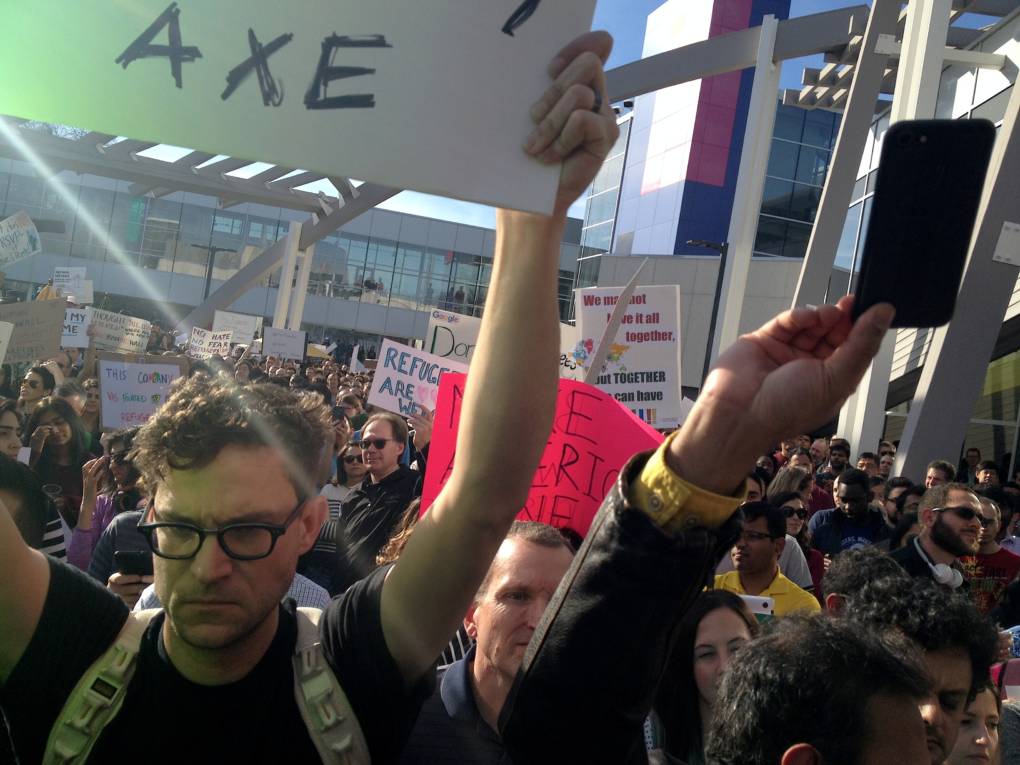
"caption": "Googlers packed the campus quad at the company's headquarters in Mountain View. They were protesting President Trump's executive order to ban people from seven majority Muslim states from entering the U.S.",
"description": null,
"title": "google protest in quad",
"credit": "Queena Sook Kim",
"status": "inherit",
"isLoading": false,
"fetchFailed": false
},
"news_11295151": {
"type": "attachments",
"id": "news_11295151",
"meta": {
"index": "attachments_1716263798",
"site": "news",
"id": "11295151",
"found": true
},
"parent": 11295142,
"imgSizes": {
"small": {
"file": "https://ww2.kqed.org/app/uploads/sites/10/2017/01/ExclusionWall-1-520x520.jpg",
"width": 520,
"mimeType": "image/jpeg",
"height": 520
},
"twentyfourteen-full-width": {
"file": "https://ww2.kqed.org/app/uploads/sites/10/2017/01/ExclusionWall-1-1038x576.jpg",
"width": 1038,
"mimeType": "image/jpeg",
"height": 576
},
"thumbnail": {
"file": "https://ww2.kqed.org/app/uploads/sites/10/2017/01/ExclusionWall-1-160x160.jpg",
"width": 160,
"mimeType": "image/jpeg",
"height": 160
},
"fd-sm": {
"file": "https://ww2.kqed.org/app/uploads/sites/10/2017/01/ExclusionWall-1-960x960.jpg",
"width": 960,
"mimeType": "image/jpeg",
"height": 960
},
"post-thumbnail": {
"file": "https://ww2.kqed.org/app/uploads/sites/10/2017/01/ExclusionWall-1-672x372.jpg",
"width": 672,
"mimeType": "image/jpeg",
"height": 372
},
"xsmall": {
"file": "https://ww2.kqed.org/app/uploads/sites/10/2017/01/ExclusionWall-1-375x375.jpg",
"width": 375,
"mimeType": "image/jpeg",
"height": 375
},
"kqedFullSize": {
"file": "https://ww2.kqed.org/app/uploads/sites/10/2017/01/ExclusionWall-1.jpg",
"width": 1920,
"height": 1920
},
"large": {
"file": "https://ww2.kqed.org/app/uploads/sites/10/2017/01/ExclusionWall-1-1020x1020.jpg",
"width": 1020,
"mimeType": "image/jpeg",
"height": 1020
},
"xlarge": {
"file": "https://ww2.kqed.org/app/uploads/sites/10/2017/01/ExclusionWall-1-1180x1180.jpg",
"width": 1180,
"mimeType": "image/jpeg",
"height": 1180
},
"guest-author-50": {
"file": "https://ww2.kqed.org/app/uploads/sites/10/2017/01/ExclusionWall-1-50x50.jpg",
"width": 50,
"mimeType": "image/jpeg",
"height": 50
},
"guest-author-96": {
"file": "https://ww2.kqed.org/app/uploads/sites/10/2017/01/ExclusionWall-1-96x96.jpg",
"width": 96,
"mimeType": "image/jpeg",
"height": 96
},
"medium": {
"file": "https://ww2.kqed.org/app/uploads/sites/10/2017/01/ExclusionWall-1-800x800.jpg",
"width": 800,
"mimeType": "image/jpeg",
"height": 800
},
"guest-author-64": {
"file": "https://ww2.kqed.org/app/uploads/sites/10/2017/01/ExclusionWall-1-64x64.jpg",
"width": 64,
"mimeType": "image/jpeg",
"height": 64
},
"guest-author-32": {
"file": "https://ww2.kqed.org/app/uploads/sites/10/2017/01/ExclusionWall-1-32x32.jpg",
"width": 32,
"mimeType": "image/jpeg",
"height": 32
},
"jmtc-small-thumb": {
"file": "https://ww2.kqed.org/app/uploads/sites/10/2017/01/ExclusionWall-1-280x150.jpg",
"width": 280,
"mimeType": "image/jpeg",
"height": 150
},
"fd-lrg": {
"file": "https://ww2.kqed.org/app/uploads/sites/10/2017/01/ExclusionWall-1-1920x1920.jpg",
"width": 1920,
"mimeType": "image/jpeg",
"height": 1920
},
"fd-med": {
"file": "https://ww2.kqed.org/app/uploads/sites/10/2017/01/ExclusionWall-1-1180x1180.jpg",
"width": 1180,
"mimeType": "image/jpeg",
"height": 1180
},
"full-width": {
"file": "https://ww2.kqed.org/app/uploads/sites/10/2017/01/ExclusionWall-1-1920x1920.jpg",
"width": 1920,
"mimeType": "image/jpeg",
"height": 1920
},
"detail": {
"file": "https://ww2.kqed.org/app/uploads/sites/10/2017/01/ExclusionWall-1-150x150.jpg",
"width": 150,
"mimeType": "image/jpeg",
"height": 150
},
"guest-author-128": {
"file": "https://ww2.kqed.org/app/uploads/sites/10/2017/01/ExclusionWall-1-128x128.jpg",
"width": 128,
"mimeType": "image/jpeg",
"height": 128
},
"xxsmall": {
"file": "https://ww2.kqed.org/app/uploads/sites/10/2017/01/ExclusionWall-1-240x240.jpg",
"width": 240,
"mimeType": "image/jpeg",
"height": 240
}
},
"publishDate": 1485902338,
"modified": 1485902485,
"caption": "Thomas Nast's cartoon from 1870 shows European immigrants, already in the United States, pulling up the ladder to stop Chinese immigration.",
"description": "Thomas Nast's cartoon from 1870 shows European immigrants, already in the United States, pulling up the ladder to stop Chinese immigration.",
"title": "ExclusionWall",
"credit": "Mark Fiore/KQED",
"status": "inherit",
"isLoading": false,
"fetchFailed": false
},
"news_11286494": {
"type": "attachments",
"id": "news_11286494",
"meta": {
"index": "attachments_1716263798",
"site": "news",
"id": "11286494",
"found": true
},
"parent": 11286488,
"imgSizes": {
"small": {
"file": "https://ww2.kqed.org/app/uploads/sites/10/2017/01/RS23854_GettyImages-632685470-qut-520x347.jpg",
"width": 520,
"mimeType": "image/jpeg",
"height": 347
},
"twentyfourteen-full-width": {
"file": "https://ww2.kqed.org/app/uploads/sites/10/2017/01/RS23854_GettyImages-632685470-qut-1038x576.jpg",
"width": 1038,
"mimeType": "image/jpeg",
"height": 576
},
"thumbnail": {
"file": "https://ww2.kqed.org/app/uploads/sites/10/2017/01/RS23854_GettyImages-632685470-qut-160x107.jpg",
"width": 160,
"mimeType": "image/jpeg",
"height": 107
},
"fd-sm": {
"file": "https://ww2.kqed.org/app/uploads/sites/10/2017/01/RS23854_GettyImages-632685470-qut-960x640.jpg",
"width": 960,
"mimeType": "image/jpeg",
"height": 640
},
"post-thumbnail": {
"file": "https://ww2.kqed.org/app/uploads/sites/10/2017/01/RS23854_GettyImages-632685470-qut-672x372.jpg",
"width": 672,
"mimeType": "image/jpeg",
"height": 372
},
"xsmall": {
"file": "https://ww2.kqed.org/app/uploads/sites/10/2017/01/RS23854_GettyImages-632685470-qut-375x250.jpg",
"width": 375,
"mimeType": "image/jpeg",
"height": 250
},
"kqedFullSize": {
"file": "https://ww2.kqed.org/app/uploads/sites/10/2017/01/RS23854_GettyImages-632685470-qut.jpg",
"width": 1920,
"height": 1280
},
"large": {
"file": "https://ww2.kqed.org/app/uploads/sites/10/2017/01/RS23854_GettyImages-632685470-qut-1020x680.jpg",
"width": 1020,
"mimeType": "image/jpeg",
"height": 680
},
"xlarge": {
"file": "https://ww2.kqed.org/app/uploads/sites/10/2017/01/RS23854_GettyImages-632685470-qut-1180x787.jpg",
"width": 1180,
"mimeType": "image/jpeg",
"height": 787
},
"guest-author-50": {
"file": "https://ww2.kqed.org/app/uploads/sites/10/2017/01/RS23854_GettyImages-632685470-qut-50x50.jpg",
"width": 50,
"mimeType": "image/jpeg",
"height": 50
},
"guest-author-96": {
"file": "https://ww2.kqed.org/app/uploads/sites/10/2017/01/RS23854_GettyImages-632685470-qut-96x96.jpg",
"width": 96,
"mimeType": "image/jpeg",
"height": 96
},
"medium": {
"file": "https://ww2.kqed.org/app/uploads/sites/10/2017/01/RS23854_GettyImages-632685470-qut-800x533.jpg",
"width": 800,
"mimeType": "image/jpeg",
"height": 533
},
"guest-author-64": {
"file": "https://ww2.kqed.org/app/uploads/sites/10/2017/01/RS23854_GettyImages-632685470-qut-64x64.jpg",
"width": 64,
"mimeType": "image/jpeg",
"height": 64
},
"guest-author-32": {
"file": "https://ww2.kqed.org/app/uploads/sites/10/2017/01/RS23854_GettyImages-632685470-qut-32x32.jpg",
"width": 32,
"mimeType": "image/jpeg",
"height": 32
},
"jmtc-small-thumb": {
"file": "https://ww2.kqed.org/app/uploads/sites/10/2017/01/RS23854_GettyImages-632685470-qut-280x150.jpg",
"width": 280,
"mimeType": "image/jpeg",
"height": 150
},
"fd-lrg": {
"file": "https://ww2.kqed.org/app/uploads/sites/10/2017/01/RS23854_GettyImages-632685470-qut-1920x1280.jpg",
"width": 1920,
"mimeType": "image/jpeg",
"height": 1280
},
"fd-med": {
"file": "https://ww2.kqed.org/app/uploads/sites/10/2017/01/RS23854_GettyImages-632685470-qut-1180x787.jpg",
"width": 1180,
"mimeType": "image/jpeg",
"height": 787
},
"full-width": {
"file": "https://ww2.kqed.org/app/uploads/sites/10/2017/01/RS23854_GettyImages-632685470-qut-1920x1280.jpg",
"width": 1920,
"mimeType": "image/jpeg",
"height": 1280
},
"detail": {
"file": "https://ww2.kqed.org/app/uploads/sites/10/2017/01/RS23854_GettyImages-632685470-qut-150x150.jpg",
"width": 150,
"mimeType": "image/jpeg",
"height": 150
},
"guest-author-128": {
"file": "https://ww2.kqed.org/app/uploads/sites/10/2017/01/RS23854_GettyImages-632685470-qut-128x128.jpg",
"width": 128,
"mimeType": "image/jpeg",
"height": 128
},
"xxsmall": {
"file": "https://ww2.kqed.org/app/uploads/sites/10/2017/01/RS23854_GettyImages-632685470-qut-240x160.jpg",
"width": 240,
"mimeType": "image/jpeg",
"height": 160
}
},
"publishDate": 1485387460,
"modified": 1511309574,
"caption": "U.S. President Trump displays one of the two executive orders on immigration he signed during a visit to the Department of Homeland Security in January. ",
"description": " U.S. President Donald Trump displays one of the two executive orders on immigration he signed during a visit to the Department of Homeland Security Jan. 25, 2017 in Washington.",
"title": "Donald Trump-Executive Orders",
"credit": " Chip Somodevilla/Getty Images",
"status": "inherit",
"isLoading": false,
"fetchFailed": false
},
"news_11292300": {
"type": "attachments",
"id": "news_11292300",
"meta": {
"index": "attachments_1716263798",
"site": "news",
"id": "11292300",
"found": true
},
"parent": 11292235,
"imgSizes": {
"small": {
"file": "https://ww2.kqed.org/app/uploads/sites/10/2017/01/RS23928_GettyImages-633034344-qut-520x347.jpg",
"width": 520,
"mimeType": "image/jpeg",
"height": 347
},
"twentyfourteen-full-width": {
"file": "https://ww2.kqed.org/app/uploads/sites/10/2017/01/RS23928_GettyImages-633034344-qut-1038x576.jpg",
"width": 1038,
"mimeType": "image/jpeg",
"height": 576
},
"thumbnail": {
"file": "https://ww2.kqed.org/app/uploads/sites/10/2017/01/RS23928_GettyImages-633034344-qut-160x107.jpg",
"width": 160,
"mimeType": "image/jpeg",
"height": 107
},
"fd-sm": {
"file": "https://ww2.kqed.org/app/uploads/sites/10/2017/01/RS23928_GettyImages-633034344-qut-960x640.jpg",
"width": 960,
"mimeType": "image/jpeg",
"height": 640
},
"post-thumbnail": {
"file": "https://ww2.kqed.org/app/uploads/sites/10/2017/01/RS23928_GettyImages-633034344-qut-672x372.jpg",
"width": 672,
"mimeType": "image/jpeg",
"height": 372
},
"xsmall": {
"file": "https://ww2.kqed.org/app/uploads/sites/10/2017/01/RS23928_GettyImages-633034344-qut-375x250.jpg",
"width": 375,
"mimeType": "image/jpeg",
"height": 250
},
"kqedFullSize": {
"file": "https://ww2.kqed.org/app/uploads/sites/10/2017/01/RS23928_GettyImages-633034344-qut.jpg",
"width": 1920,
"height": 1280
},
"large": {
"file": "https://ww2.kqed.org/app/uploads/sites/10/2017/01/RS23928_GettyImages-633034344-qut-1020x680.jpg",
"width": 1020,
"mimeType": "image/jpeg",
"height": 680
},
"xlarge": {
"file": "https://ww2.kqed.org/app/uploads/sites/10/2017/01/RS23928_GettyImages-633034344-qut-1180x787.jpg",
"width": 1180,
"mimeType": "image/jpeg",
"height": 787
},
"guest-author-50": {
"file": "https://ww2.kqed.org/app/uploads/sites/10/2017/01/RS23928_GettyImages-633034344-qut-50x50.jpg",
"width": 50,
"mimeType": "image/jpeg",
"height": 50
},
"guest-author-96": {
"file": "https://ww2.kqed.org/app/uploads/sites/10/2017/01/RS23928_GettyImages-633034344-qut-96x96.jpg",
"width": 96,
"mimeType": "image/jpeg",
"height": 96
},
"medium": {
"file": "https://ww2.kqed.org/app/uploads/sites/10/2017/01/RS23928_GettyImages-633034344-qut-800x533.jpg",
"width": 800,
"mimeType": "image/jpeg",
"height": 533
},
"guest-author-64": {
"file": "https://ww2.kqed.org/app/uploads/sites/10/2017/01/RS23928_GettyImages-633034344-qut-64x64.jpg",
"width": 64,
"mimeType": "image/jpeg",
"height": 64
},
"guest-author-32": {
"file": "https://ww2.kqed.org/app/uploads/sites/10/2017/01/RS23928_GettyImages-633034344-qut-32x32.jpg",
"width": 32,
"mimeType": "image/jpeg",
"height": 32
},
"jmtc-small-thumb": {
"file": "https://ww2.kqed.org/app/uploads/sites/10/2017/01/RS23928_GettyImages-633034344-qut-280x150.jpg",
"width": 280,
"mimeType": "image/jpeg",
"height": 150
},
"fd-lrg": {
"file": "https://ww2.kqed.org/app/uploads/sites/10/2017/01/RS23928_GettyImages-633034344-qut-1920x1280.jpg",
"width": 1920,
"mimeType": "image/jpeg",
"height": 1280
},
"fd-med": {
"file": "https://ww2.kqed.org/app/uploads/sites/10/2017/01/RS23928_GettyImages-633034344-qut-1180x787.jpg",
"width": 1180,
"mimeType": "image/jpeg",
"height": 787
},
"full-width": {
"file": "https://ww2.kqed.org/app/uploads/sites/10/2017/01/RS23928_GettyImages-633034344-qut-1920x1280.jpg",
"width": 1920,
"mimeType": "image/jpeg",
"height": 1280
},
"detail": {
"file": "https://ww2.kqed.org/app/uploads/sites/10/2017/01/RS23928_GettyImages-633034344-qut-150x150.jpg",
"width": 150,
"mimeType": "image/jpeg",
"height": 150
},
"guest-author-128": {
"file": "https://ww2.kqed.org/app/uploads/sites/10/2017/01/RS23928_GettyImages-633034344-qut-128x128.jpg",
"width": 128,
"mimeType": "image/jpeg",
"height": 128
},
"xxsmall": {
"file": "https://ww2.kqed.org/app/uploads/sites/10/2017/01/RS23928_GettyImages-633034344-qut-240x160.jpg",
"width": 240,
"mimeType": "image/jpeg",
"height": 160
}
},
"publishDate": 1485734633,
"modified": 1485903699,
"caption": "Protesters at Los Angeles International Airport on Jan. 29, 2017, hold signs during a rally against the immigration ban imposed by U.S. President Donald Trump. ",
"description": "Protesters hold signs during a rally against the immigration ban imposed by U.S. President Donald Trump on Jan. 29, 2017 at Los Angeles International Airport. ",
"title": "RS23928_GettyImages-633034344-qut",
"credit": "Justin Sullivan/Getty Images",
"status": "inherit",
"isLoading": false,
"fetchFailed": false
},
"news_11293488": {
"type": "attachments",
"id": "news_11293488",
"meta": {
"index": "attachments_1716263798",
"site": "news",
"id": "11293488",
"found": true
},
"parent": 11293479,
"imgSizes": {
"small": {
"file": "https://ww2.kqed.org/app/uploads/sites/10/2017/01/150473-full-520x390.jpg",
"width": 520,
"mimeType": "image/jpeg",
"height": 390
},
"thumbnail": {
"file": "https://ww2.kqed.org/app/uploads/sites/10/2017/01/150473-full-160x120.jpg",
"width": 160,
"mimeType": "image/jpeg",
"height": 120
},
"post-thumbnail": {
"file": "https://ww2.kqed.org/app/uploads/sites/10/2017/01/150473-full-640x372.jpg",
"width": 640,
"mimeType": "image/jpeg",
"height": 372
},
"xsmall": {
"file": "https://ww2.kqed.org/app/uploads/sites/10/2017/01/150473-full-375x281.jpg",
"width": 375,
"mimeType": "image/jpeg",
"height": 281
},
"kqedFullSize": {
"file": "https://ww2.kqed.org/app/uploads/sites/10/2017/01/150473-full.jpg",
"width": 640,
"height": 480
},
"guest-author-50": {
"file": "https://ww2.kqed.org/app/uploads/sites/10/2017/01/150473-full-50x50.jpg",
"width": 50,
"mimeType": "image/jpeg",
"height": 50
},
"guest-author-96": {
"file": "https://ww2.kqed.org/app/uploads/sites/10/2017/01/150473-full-96x96.jpg",
"width": 96,
"mimeType": "image/jpeg",
"height": 96
},
"guest-author-64": {
"file": "https://ww2.kqed.org/app/uploads/sites/10/2017/01/150473-full-64x64.jpg",
"width": 64,
"mimeType": "image/jpeg",
"height": 64
},
"guest-author-32": {
"file": "https://ww2.kqed.org/app/uploads/sites/10/2017/01/150473-full-32x32.jpg",
"width": 32,
"mimeType": "image/jpeg",
"height": 32
},
"jmtc-small-thumb": {
"file": "https://ww2.kqed.org/app/uploads/sites/10/2017/01/150473-full-280x150.jpg",
"width": 280,
"mimeType": "image/jpeg",
"height": 150
},
"detail": {
"file": "https://ww2.kqed.org/app/uploads/sites/10/2017/01/150473-full-150x150.jpg",
"width": 150,
"mimeType": "image/jpeg",
"height": 150
},
"guest-author-128": {
"file": "https://ww2.kqed.org/app/uploads/sites/10/2017/01/150473-full-128x128.jpg",
"width": 128,
"mimeType": "image/jpeg",
"height": 128
},
"xxsmall": {
"file": "https://ww2.kqed.org/app/uploads/sites/10/2017/01/150473-full-240x180.jpg",
"width": 240,
"mimeType": "image/jpeg",
"height": 180
}
},
"publishDate": 1485807902,
"modified": 1485807937,
"caption": "Protesters have gathered at LAX in the arrivals level of Bradley International Terminal.",
"description": null,
"title": "150473-full",
"credit": "Josie Huang/KPCC",
"status": "inherit",
"isLoading": false,
"fetchFailed": false
},
"news_11293485": {
"type": "attachments",
"id": "news_11293485",
"meta": {
"index": "attachments_1716263798",
"site": "news",
"id": "11293485",
"found": true
},
"parent": 11293482,
"imgSizes": {
"small": {
"file": "https://ww2.kqed.org/app/uploads/sites/10/2017/01/RS3792_sunsetbridge20120515-520x338.jpg",
"width": 520,
"mimeType": "image/jpeg",
"height": 338
},
"twentyfourteen-full-width": {
"file": "https://ww2.kqed.org/app/uploads/sites/10/2017/01/RS3792_sunsetbridge20120515-1038x576.jpg",
"width": 1038,
"mimeType": "image/jpeg",
"height": 576
},
"thumbnail": {
"file": "https://ww2.kqed.org/app/uploads/sites/10/2017/01/RS3792_sunsetbridge20120515-160x104.jpg",
"width": 160,
"mimeType": "image/jpeg",
"height": 104
},
"fd-sm": {
"file": "https://ww2.kqed.org/app/uploads/sites/10/2017/01/RS3792_sunsetbridge20120515-960x624.jpg",
"width": 960,
"mimeType": "image/jpeg",
"height": 624
},
"post-thumbnail": {
"file": "https://ww2.kqed.org/app/uploads/sites/10/2017/01/RS3792_sunsetbridge20120515-672x372.jpg",
"width": 672,
"mimeType": "image/jpeg",
"height": 372
},
"xsmall": {
"file": "https://ww2.kqed.org/app/uploads/sites/10/2017/01/RS3792_sunsetbridge20120515-375x244.jpg",
"width": 375,
"mimeType": "image/jpeg",
"height": 244
},
"kqedFullSize": {
"file": "https://ww2.kqed.org/app/uploads/sites/10/2017/01/RS3792_sunsetbridge20120515-e1485807765365.jpg",
"width": 1920,
"height": 1248
},
"large": {
"file": "https://ww2.kqed.org/app/uploads/sites/10/2017/01/RS3792_sunsetbridge20120515-1020x663.jpg",
"width": 1020,
"mimeType": "image/jpeg",
"height": 663
},
"xlarge": {
"file": "https://ww2.kqed.org/app/uploads/sites/10/2017/01/RS3792_sunsetbridge20120515-1180x767.jpg",
"width": 1180,
"mimeType": "image/jpeg",
"height": 767
},
"guest-author-50": {
"file": "https://ww2.kqed.org/app/uploads/sites/10/2017/01/RS3792_sunsetbridge20120515-50x50.jpg",
"width": 50,
"mimeType": "image/jpeg",
"height": 50
},
"guest-author-96": {
"file": "https://ww2.kqed.org/app/uploads/sites/10/2017/01/RS3792_sunsetbridge20120515-96x96.jpg",
"width": 96,
"mimeType": "image/jpeg",
"height": 96
},
"medium": {
"file": "https://ww2.kqed.org/app/uploads/sites/10/2017/01/RS3792_sunsetbridge20120515-800x520.jpg",
"width": 800,
"mimeType": "image/jpeg",
"height": 520
},
"guest-author-64": {
"file": "https://ww2.kqed.org/app/uploads/sites/10/2017/01/RS3792_sunsetbridge20120515-64x64.jpg",
"width": 64,
"mimeType": "image/jpeg",
"height": 64
},
"guest-author-32": {
"file": "https://ww2.kqed.org/app/uploads/sites/10/2017/01/RS3792_sunsetbridge20120515-32x32.jpg",
"width": 32,
"mimeType": "image/jpeg",
"height": 32
},
"jmtc-small-thumb": {
"file": "https://ww2.kqed.org/app/uploads/sites/10/2017/01/RS3792_sunsetbridge20120515-280x150.jpg",
"width": 280,
"mimeType": "image/jpeg",
"height": 150
},
"fd-lrg": {
"file": "https://ww2.kqed.org/app/uploads/sites/10/2017/01/RS3792_sunsetbridge20120515-1920x1248.jpg",
"width": 1920,
"mimeType": "image/jpeg",
"height": 1248
},
"fd-med": {
"file": "https://ww2.kqed.org/app/uploads/sites/10/2017/01/RS3792_sunsetbridge20120515-1180x767.jpg",
"width": 1180,
"mimeType": "image/jpeg",
"height": 767
},
"full-width": {
"file": "https://ww2.kqed.org/app/uploads/sites/10/2017/01/RS3792_sunsetbridge20120515-1920x1248.jpg",
"width": 1920,
"mimeType": "image/jpeg",
"height": 1248
},
"detail": {
"file": "https://ww2.kqed.org/app/uploads/sites/10/2017/01/RS3792_sunsetbridge20120515-150x150.jpg",
"width": 150,
"mimeType": "image/jpeg",
"height": 150
},
"guest-author-128": {
"file": "https://ww2.kqed.org/app/uploads/sites/10/2017/01/RS3792_sunsetbridge20120515-128x128.jpg",
"width": 128,
"mimeType": "image/jpeg",
"height": 128
},
"xxsmall": {
"file": "https://ww2.kqed.org/app/uploads/sites/10/2017/01/RS3792_sunsetbridge20120515-240x156.jpg",
"width": 240,
"mimeType": "image/jpeg",
"height": 156
}
},
"publishDate": 1485807701,
"modified": 1485807782,
"caption": "Golden Gate Bridge",
"description": "Golden Gate Bridge",
"title": "Golden Gate Bridge",
"credit": "Justin Sullivan/Getty Images",
"status": "inherit",
"isLoading": false,
"fetchFailed": false
},
"news_11293475": {
"type": "attachments",
"id": "news_11293475",
"meta": {
"index": "attachments_1716263798",
"site": "news",
"id": "11293475",
"found": true
},
"parent": 11293417,
"imgSizes": {
"small": {
"file": "https://ww2.kqed.org/app/uploads/sites/10/2017/01/GettyImages-632955482-520x347.jpg",
"width": 520,
"mimeType": "image/jpeg",
"height": 347
},
"twentyfourteen-full-width": {
"file": "https://ww2.kqed.org/app/uploads/sites/10/2017/01/GettyImages-632955482-1038x576.jpg",
"width": 1038,
"mimeType": "image/jpeg",
"height": 576
},
"thumbnail": {
"file": "https://ww2.kqed.org/app/uploads/sites/10/2017/01/GettyImages-632955482-160x107.jpg",
"width": 160,
"mimeType": "image/jpeg",
"height": 107
},
"fd-sm": {
"file": "https://ww2.kqed.org/app/uploads/sites/10/2017/01/GettyImages-632955482-960x641.jpg",
"width": 960,
"mimeType": "image/jpeg",
"height": 641
},
"post-thumbnail": {
"file": "https://ww2.kqed.org/app/uploads/sites/10/2017/01/GettyImages-632955482-672x372.jpg",
"width": 672,
"mimeType": "image/jpeg",
"height": 372
},
"xsmall": {
"file": "https://ww2.kqed.org/app/uploads/sites/10/2017/01/GettyImages-632955482-375x250.jpg",
"width": 375,
"mimeType": "image/jpeg",
"height": 250
},
"kqedFullSize": {
"file": "https://ww2.kqed.org/app/uploads/sites/10/2017/01/GettyImages-632955482-e1485806772216.jpg",
"width": 1920,
"height": 1281
},
"large": {
"file": "https://ww2.kqed.org/app/uploads/sites/10/2017/01/GettyImages-632955482-1020x681.jpg",
"width": 1020,
"mimeType": "image/jpeg",
"height": 681
},
"xlarge": {
"file": "https://ww2.kqed.org/app/uploads/sites/10/2017/01/GettyImages-632955482-1180x787.jpg",
"width": 1180,
"mimeType": "image/jpeg",
"height": 787
},
"guest-author-50": {
"file": "https://ww2.kqed.org/app/uploads/sites/10/2017/01/GettyImages-632955482-50x50.jpg",
"width": 50,
"mimeType": "image/jpeg",
"height": 50
},
"guest-author-96": {
"file": "https://ww2.kqed.org/app/uploads/sites/10/2017/01/GettyImages-632955482-96x96.jpg",
"width": 96,
"mimeType": "image/jpeg",
"height": 96
},
"medium": {
"file": "https://ww2.kqed.org/app/uploads/sites/10/2017/01/GettyImages-632955482-800x534.jpg",
"width": 800,
"mimeType": "image/jpeg",
"height": 534
},
"guest-author-64": {
"file": "https://ww2.kqed.org/app/uploads/sites/10/2017/01/GettyImages-632955482-64x64.jpg",
"width": 64,
"mimeType": "image/jpeg",
"height": 64
},
"guest-author-32": {
"file": "https://ww2.kqed.org/app/uploads/sites/10/2017/01/GettyImages-632955482-32x32.jpg",
"width": 32,
"mimeType": "image/jpeg",
"height": 32
},
"jmtc-small-thumb": {
"file": "https://ww2.kqed.org/app/uploads/sites/10/2017/01/GettyImages-632955482-280x150.jpg",
"width": 280,
"mimeType": "image/jpeg",
"height": 150
},
"fd-lrg": {
"file": "https://ww2.kqed.org/app/uploads/sites/10/2017/01/GettyImages-632955482-1920x1281.jpg",
"width": 1920,
"mimeType": "image/jpeg",
"height": 1281
},
"fd-med": {
"file": "https://ww2.kqed.org/app/uploads/sites/10/2017/01/GettyImages-632955482-1180x787.jpg",
"width": 1180,
"mimeType": "image/jpeg",
"height": 787
},
"full-width": {
"file": "https://ww2.kqed.org/app/uploads/sites/10/2017/01/GettyImages-632955482-1920x1281.jpg",
"width": 1920,
"mimeType": "image/jpeg",
"height": 1281
},
"detail": {
"file": "https://ww2.kqed.org/app/uploads/sites/10/2017/01/GettyImages-632955482-150x150.jpg",
"width": 150,
"mimeType": "image/jpeg",
"height": 150
},
"guest-author-128": {
"file": "https://ww2.kqed.org/app/uploads/sites/10/2017/01/GettyImages-632955482-128x128.jpg",
"width": 128,
"mimeType": "image/jpeg",
"height": 128
},
"xxsmall": {
"file": "https://ww2.kqed.org/app/uploads/sites/10/2017/01/GettyImages-632955482-240x160.jpg",
"width": 240,
"mimeType": "image/jpeg",
"height": 160
}
},
"publishDate": 1485806694,
"modified": 1485815468,
"caption": "Protesters rally during a demonstration against the new immigration ban issued by President Donald Trump at John F. Kennedy International Airport on Jan. 28, 2017 in New York City. President Trump signed the controversial executive order that halted refugees and residents from predominantly Muslim countries from entering the United States. ",
"description": "Protestors rally during a demonstration against the new immigration ban issued by President Donald Trump at John F. Kennedy International Airport on January 28, 2017 in New York City. President Trump signed the controversial executive order that halted refugees and residents from predominantly Muslim countries from entering the United States.",
"title": "Protestors Rally At JFK Airport Against Muslim Immigration Ban",
"credit": "Stephanie Keith/Getty Images",
"status": "inherit",
"isLoading": false,
"fetchFailed": false
}
},
"audioPlayerReducer": {
"postId": "stream_live",
"isPaused": true,
"isPlaying": false,
"pfsActive": false,
"pledgeModalIsOpen": true,
"playerDrawerIsOpen": false,
"liveAudioPlayStartedAt": 0,
"liveAudioPlayContext": ""
},
"authorsReducer": {
"byline_news_11298456": {
"type": "authors",
"id": "byline_news_11298456",
"meta": {
"override": true
},
"slug": "byline_news_11298456",
"name": "KPCC staff",
"isLoading": false
},
"byline_news_11297021": {
"type": "authors",
"id": "byline_news_11297021",
"meta": {
"override": true
},
"slug": "byline_news_11297021",
"name": "\u003cstrong>\u003ca href=\"http://www.scpr.org/about/people/staff/leslie-berestein-rojas\">Leslie Berestein Rojas\u003c/a>\u003c/strong>",
"isLoading": false
},
"byline_news_11296576": {
"type": "authors",
"id": "byline_news_11296576",
"meta": {
"override": true
},
"slug": "byline_news_11296576",
"name": "Karen Grigsby Bates",
"isLoading": false
},
"byline_news_11296426": {
"type": "authors",
"id": "byline_news_11296426",
"meta": {
"override": true
},
"slug": "byline_news_11296426",
"name": "\u003cstrong>Laurel Wamsley and Brett Neely\u003cbr />NPR\u003c/strong>",
"isLoading": false
},
"byline_news_11295142": {
"type": "authors",
"id": "byline_news_11295142",
"meta": {
"override": true
},
"slug": "byline_news_11295142",
"name": "\u003cstrong>\u003ca href=\"http://www.markfiore.com/\">Mark Fiore\u003c/a>\u003c/strong>",
"isLoading": false
},
"byline_news_11293479": {
"type": "authors",
"id": "byline_news_11293479",
"meta": {
"override": true
},
"slug": "byline_news_11293479",
"name": "\u003cstrong>Sara Fay, Sandra Oshiro with Josie Huang and Brianna Flores\u003c/strong>",
"isLoading": false
},
"byline_news_11293482": {
"type": "authors",
"id": "byline_news_11293482",
"meta": {
"override": true
},
"slug": "byline_news_11293482",
"name": "\u003cb> Gene Demby \u003cbr> NPR \u003c/b>",
"isLoading": false
},
"byline_news_11293417": {
"type": "authors",
"id": "byline_news_11293417",
"meta": {
"override": true
},
"slug": "byline_news_11293417",
"name": "\u003cb>Rachel Zoll \u003cbr>Associated Press\u003c/b>",
"isLoading": false
},
"mlagos": {
"type": "authors",
"id": "3239",
"meta": {
"index": "authors_1716337520",
"id": "3239",
"found": true
},
"name": "Marisa Lagos",
"firstName": "Marisa",
"lastName": "Lagos",
"slug": "mlagos",
"email": "mlagos@kqed.org",
"display_author_email": false,
"staff_mastheads": [
"news"
],
"title": "KQED Contributor",
"bio": "Marisa Lagos is a correspondent for KQED’s California Politics and Government Desk and co-hosts the award-winning show and podcast, Political Breakdown. At KQED, Lagos also conducts reporting, analysis and investigations into state, local and national politics for radio, TV, online and onstage. In 2022, she and co-host, Scott Shafer, moderated the only gubernatorial debate in California. In 2020, the \u003ci>Washington Post\u003c/i> named her one of the top political journalists in California; she was nominated for a Peabody and won several other awards for her work investigating the 2017 California wildfires. She has worked at the \u003ci>San Francisco Chronicle\u003c/i>, \u003ci>San Francisco Examiner\u003c/i> and \u003ci>Los Angeles Times\u003c/i>. A UC Santa Barbara graduate, she lives in San Francisco with her two sons and husband.",
"avatar": "https://secure.gravatar.com/avatar/a261a0d3696fc066871ef96b85b5e7d2?s=600&d=blank&r=g",
"twitter": "@mlagos",
"facebook": null,
"instagram": null,
"linkedin": null,
"sites": [
{
"site": "arts",
"roles": [
"author"
]
},
{
"site": "news",
"roles": [
"editor"
]
},
{
"site": "science",
"roles": [
"editor"
]
},
{
"site": "forum",
"roles": [
"author"
]
},
{
"site": "liveblog",
"roles": [
"author"
]
}
],
"headData": {
"title": "Marisa Lagos | KQED",
"description": "KQED Contributor",
"ogImgSrc": "https://secure.gravatar.com/avatar/a261a0d3696fc066871ef96b85b5e7d2?s=600&d=blank&r=g",
"twImgSrc": "https://secure.gravatar.com/avatar/a261a0d3696fc066871ef96b85b5e7d2?s=600&d=blank&r=g"
},
"isLoading": false,
"link": "/author/mlagos"
},
"qkim": {
"type": "authors",
"id": "11099",
"meta": {
"index": "authors_1716337520",
"id": "11099",
"found": true
},
"name": "Queena Sook Kim",
"firstName": "Queena",
"lastName": "Kim",
"slug": "qkim",
"email": "qkim@kqed.org",
"display_author_email": false,
"staff_mastheads": [
"news"
],
"title": "Senior Editor",
"bio": "\u003cspan style=\"font-weight: 400;\">Queena Sook Kim is a former senior editor of the weekend desk at KQED. Before taking on that post, she was the Senior Editor of the Silicon Valley Desk and was the \u003c/span>\u003cspan style=\"font-weight: 400;\">host of The California Report. The daily morning show airs on KQED in San Francisco, one of the nation’s largest NPR affiliates, and on 30 stations across the state. In that role, she produces and reports on news, politics and life in the Golden State. Queena likes to take sideways look at the larger trends changing the state. One of her favorite stories asked\u003c/span>\u003ca href=\"https://ww2.kqed.org/news/2015/02/15/why-the-heck-do-mexican-reporters-on-public-radio-say-their-names-that-way\"> \u003cspan style=\"font-weight: 400;\">why Latino journalists “over’pronounce” their Spanish surnames\u003c/span>\u003c/a>\u003cspan style=\"font-weight: 400;\"> as a way of looking at how immigration is creating a culture shift in California.\u003c/span>\r\n\r\n\u003cspan style=\"font-weight: 400;\">Before joining The California Report, Queena was a \u003ca href=\"http://www.marketplace.org/people/queena-kim\">Senior Reporter covering technology for Marketplace\u003c/a>, the daily business show that airs on public radio. Queena covered daily tech business stories and reported on larger technology trends. She did a series of stories looking at role of social engineering in hacking and on a start-up in Silicon Valley that’s trying to use technology, instead of animals, to make meat that bleeds.\u003c/span>\r\n\r\n\u003cspan style=\"font-weight: 400;\">Queena started her career as a business journalist at the Wall Street Journal, where she spent four years covering the paper, home building and toy industries. She wrote A1 stories about the unusually aggressive tactics KB Home took against its home buyers. and the resurgence of “Cracker” architecture in Florida. She also wrote section front stories on marketing trends and\u003c/span>\r\n\r\n\u003cspan style=\"font-weight: 400;\">As a journalist, Queena has spent much of her career helping start-up editorial products. She was on the founding editorial team of The Bay Citizen, an experimental, online news site in San Francisco that was funded by the late hillbilly billionaire Warren Hellman. In 2009, Queena received a grant from the Corporation of Public Broadcasting to start-up a podcast called \u003ca href=\"https://soundcloud.com/cyberfrequencies\">CyberFrequencies\u003c/a>, which reported on the culture of technology. She also helped start-up two radio shows - Off-Ramp and Pacific Drift - for KPCC, the NPR-affiliate in Los Angeles. Off-Ramp was awarded 1st Place for news and Public Affairs programming by the PRINDI and the L.A. Press club. \u003ca href=\"https://soundcloud.com/queena-sook-kim\">Queena’s stories have appeared \u003c/a>on NPR’s Day to Day, Hearing Voices, WNYC’s Studio 360, WBUR’s Here and Now, BBC’s Global Perspectives and New York Times’ multimedia page.\u003c/span>\r\n\r\n\u003cspan style=\"font-weight: 400;\">In 1994, Queena won a Fulbright Grant to teach and study in Seoul, South Korea. She was also selected to be a Teach For America Corps Member in 1991 and taught elementary school in the Inglewood Unified School District in Southern California.\u003c/span>\r\n\r\n\u003cspan style=\"font-weight: 400;\">Queena is a frequent public speaker and has given talks at UC Berkeley, Stanford University, San Francisco State University, PRINDI conference and the Craigslist Foundation Boot Camp. Queena went to UC Berkeley’s Graduate School of Journalism and graduated cum laude from New York University with a B.A. in Politics. She grew up in Southern California and lives in Berkeley, Ca in a big fixer on which she spends most weekends, well, fixing.\u003c/span>",
"avatar": "https://secure.gravatar.com/avatar/b72382fd0db351b99f8a31939f4853fc?s=600&d=blank&r=g",
"twitter": "queenasookkim",
"facebook": null,
"instagram": null,
"linkedin": null,
"sites": [
{
"site": "news",
"roles": [
"subscriber"
]
},
{
"site": "forum",
"roles": [
"author"
]
},
{
"site": "breakingnews",
"roles": [
"editor"
]
}
],
"headData": {
"title": "Queena Sook Kim | KQED",
"description": "Senior Editor",
"ogImgSrc": "https://secure.gravatar.com/avatar/b72382fd0db351b99f8a31939f4853fc?s=600&d=blank&r=g",
"twImgSrc": "https://secure.gravatar.com/avatar/b72382fd0db351b99f8a31939f4853fc?s=600&d=blank&r=g"
},
"isLoading": false,
"link": "/author/qkim"
},
"jsepulvado": {
"type": "authors",
"id": "11298",
"meta": {
"index": "authors_1716337520",
"id": "11298",
"found": true
},
"name": "John Sepulvado",
"firstName": "John",
"lastName": "Sepulvado",
"slug": "jsepulvado",
"email": "jsepulvado@KQED.org",
"display_author_email": false,
"staff_mastheads": [],
"title": null,
"bio": "John Sepulvado is a former morning host of \u003cem>The California Report\u003c/em>. Prior to joining KQED in September 2016, John was the local host of NPR’s \u003cem>Weekend Edition\u003c/em> at Oregon Public Broadcasting (OPB). He has also served as a producer for America Public Media’s \u003cem>Marketplace Weekend\u003c/em> and worked as a national correspondent for CNN and as news director at WUSF in Tampa, Florida. John has earned prestigious RTDNA Murrow and PRNDI awards for investigative reporting, and helped CNN take home a Peabody Award for coverage of the 2010 Gulf oil spill. John attended Florida A&M in Tallahassee and is also a member of Phi Theta Kappa. He left KQED in 2019.",
"avatar": "https://secure.gravatar.com/avatar/b976d3c4cf11750a793b670e5acb7a1c?s=600&d=blank&r=g",
"twitter": null,
"facebook": null,
"instagram": null,
"linkedin": null,
"sites": [
{
"site": "news",
"roles": [
"author",
"edit_others_posts"
]
}
],
"headData": {
"title": "John Sepulvado | KQED",
"description": null,
"ogImgSrc": "https://secure.gravatar.com/avatar/b976d3c4cf11750a793b670e5acb7a1c?s=600&d=blank&r=g",
"twImgSrc": "https://secure.gravatar.com/avatar/b976d3c4cf11750a793b670e5acb7a1c?s=600&d=blank&r=g"
},
"isLoading": false,
"link": "/author/jsepulvado"
}
},
"pagesReducer": {
"news_category_immigration": {
"type": "terms",
"id": "news_1169",
"meta": {
"index": "terms_1716263798",
"site": "news",
"id": "1169",
"score": 10.9100685
},
"featImg": null,
"name": "Immigration",
"description": null,
"taxonomy": "category",
"headData": {
"twImgId": null,
"twTitle": null,
"ogTitle": null,
"ogImgId": null,
"twDescription": null,
"description": null,
"title": "Immigration Archives | KQED News",
"ogDescription": null
},
"ttid": 1180,
"slug": "immigration",
"isLoading": false,
"title": "Immigration",
"pageMeta": {
"site": "news",
"WpPageTemplate": "page-topic-editorial",
"currentPage": 172
},
"blocks": [
{
"blockName": "kqed/post-list",
"attrs": {
"layout": "cardArticle2",
"query": "posts/news?category=immigration",
"seeMore": false,
"paginated": true,
"page": 172
}
},
{
"blockName": "kqed/ad"
}
]
}
},
"pfsSessionReducer": {},
"postsReducer": {
"stream_live": {
"type": "live",
"id": "stream_live",
"audioUrl": "https://streams.kqed.org/kqedradio",
"title": "Live Stream",
"excerpt": "Live Stream information currently unavailable.",
"link": "/radio",
"featImg": "",
"label": {
"name": "KQED Live",
"link": "/"
}
},
"stream_kqedNewscast": {
"type": "posts",
"id": "stream_kqedNewscast",
"audioUrl": "https://www.kqed.org/.stream/anon/radio/RDnews/newscast.mp3?_=1",
"title": "KQED Newscast",
"featImg": "",
"label": {
"name": "88.5 FM",
"link": "/"
}
},
"news_11298456": {
"type": "posts",
"id": "news_11298456",
"meta": {
"index": "posts_1716263798",
"site": "news",
"id": "11298456",
"score": null,
"sort": [
1486078901000
]
},
"parent": 0,
"labelTerm": {},
"blocks": [],
"publishDate": 1486078901,
"format": "standard",
"disqusTitle": "Iranian Man Returns to LAX After Being Sent to Dubai Under Trump Order",
"title": "Iranian Man Returns to LAX After Being Sent to Dubai Under Trump Order",
"headTitle": "The California Report | KQED News",
"content": "\u003cp>Four days after a federal judge in Los Angeles issued an order for the return of an Iranian man who was denied entry at LAX and sent to Dubai as a result of President Donald Trump’s executive order on immigration, the man is back in Los Angeles.\u003c/p>\n\u003cp>Ali Khoshbakhti Vayeghan, an Iranian citizen with a valid visa, is the only traveler so far under Trump’s order who has been allowed to return to the U.S. after being sent away, according to the American Civil Liberties Union of Southern California.\u003c/p>\n\u003cp>[contextly_sidebar id=\"kOdOOsUBh02YG5WhZrZa4kLbZj3BPkx9\"]\u003c/p>\n\u003cp>Vayeghan arrived early Thursday afternoon at L.A. International Airport, where he was greeted by family members, Mayor Eric Garcetti and a crowd singing \"This Land Is Your Land.\"\u003c/p>\n\u003cp>Vayeghan was one of an unknown number of foreign travelers detained at LAX starting Friday as a result of the executive order temporarily banning people from seven Muslim-majority countries, including Iran, from entering the United States. Officials have not responded to requests to disclose how many people have been held.\u003c/p>\n\u003cp>[ad fullwidth]\u003c/p>\n\u003cp>\u003c!-- iframe plugin v.4.3 wordpress.org/plugins/iframe/ -->\u003cbr>\n\u003ciframe src=\"https://www.facebook.com/plugins/video.php?href=https%3A%2F%2Fwww.facebook.com%2FACLU.SoCal%2Fvideos%2F10154907350008286%2F&show_text=0&width=560\" width=\"800\" height=\"400\" style=\"border:none;overflow:hidden\" scrolling=\"no\" frameborder=\"0\" allowtransparency=\"true\" allowfullscreen=\"true\" class=\"iframe-class\">\u003c/iframe>\u003c/p>\n\u003cp>A New York judge blocked the ban Saturday, after 52-year-old Vayeghan had already been put on a plane to Dubai after Vayeghan signed a form withdrawing his application to enter the country. In Dubai, he was held in custody awaiting a possible return to Iran.\u003c/p>\n\u003cp>As the drama unfolded, hundreds of \u003ca href=\"http://www.scpr.org/news/2017/01/30/68559/aclu-attorneys-in-california-win-release-of-lax-de/\">protesters descended on LAX and other airports across the country over the weekend\u003c/a>.\u003c/p>\n\u003cp>On Sunday, U.S. District Judge Dolly Gee granted a request from the ACLU and ordered Vayeghan returned to the U.S. But \u003ca href=\"https://www.scpr.org/news/2017/02/01/68647/la-immigration-attorneys-hit-wall-of-silence-with/\">immigration attorneys told KPCC\u003c/a> that customs officials refused to accept official service of the order and U.S. marshals, who customarily serve federal court orders, also refused to deliver it. According to a source, it was because the order did not specifically require it.\u003c/p>\n\u003cp>\u003c/p>\n\u003cp>Vayeghan’s brother, Hossein Vayeghan, and his niece, Marjan Vayeghan, were among those descending on the airport to welcome him, according to the ACLU.\u003c/p>\n\n",
"disqusIdentifier": "11298456 https://ww2.kqed.org/news/?p=11298456",
"disqusUrl": "https://ww2.kqed.org/news/2017/02/02/iranian-man-returns-to-lax-after-being-sent-to-dubai-under-trump-order/",
"stats": {
"hasVideo": false,
"hasChartOrMap": false,
"hasAudio": false,
"hasPolis": false,
"wordCount": 338,
"hasGoogleForm": false,
"hasGallery": false,
"hasHearkenModule": false,
"iframeSrcs": [],
"paragraphCount": 12
},
"modified": 1486085478,
"excerpt": "Ali Vayeghan, an Iranian citizen with a valid visa, is the only traveler so far under Trump’s order who has been allowed to return to the U.S. after being sent away.",
"headData": {
"twImgId": "",
"twTitle": "",
"ogTitle": "",
"ogImgId": "",
"twDescription": "",
"description": "Ali Vayeghan, an Iranian citizen with a valid visa, is the only traveler so far under Trump’s order who has been allowed to return to the U.S. after being sent away.",
"title": "Iranian Man Returns to LAX After Being Sent to Dubai Under Trump Order | KQED",
"ogDescription": "",
"schema": {
"@context": "https://schema.org",
"@type": "NewsArticle",
"headline": "Iranian Man Returns to LAX After Being Sent to Dubai Under Trump Order",
"datePublished": "2017-02-02T15:41:41-08:00",
"dateModified": "2017-02-02T17:31:18-08:00",
"image": "https://cdn.kqed.org/wp-content/uploads/2020/02/KQED-OG-Image@1x.png",
"isAccessibleForFree": "True",
"publisher": {
"@type": "NewsMediaOrganization",
"@id": "https://www.kqed.org/#organization",
"name": "KQED",
"logo": "https://cdn.kqed.org/wp-content/uploads/2020/02/KQED-OG-Image@1x.png",
"url": "https://www.kqed.org",
"sameAs": [
"https://www.facebook.com/KQED",
"https://twitter.com/KQED",
"https://www.instagram.com/kqed/",
"https://www.tiktok.com/@kqedofficial",
"https://www.linkedin.com/company/kqed",
"https://www.youtube.com/channel/UCeC0IOo7i1P_61zVUWbJ4nw"
]
}
}
},
"guestAuthors": [],
"slug": "iranian-man-returns-to-lax-after-being-sent-to-dubai-under-trump-order",
"status": "publish",
"sourceUrl": "http://www.scpr.org/",
"nprByline": "KPCC staff",
"source": "KPCC",
"path": "/news/11298456/iranian-man-returns-to-lax-after-being-sent-to-dubai-under-trump-order",
"audioTrackLength": null,
"parsedContent": [
{
"type": "contentString",
"content": "\u003cdiv class=\"post-body\">\u003cp>\u003cp>Four days after a federal judge in Los Angeles issued an order for the return of an Iranian man who was denied entry at LAX and sent to Dubai as a result of President Donald Trump’s executive order on immigration, the man is back in Los Angeles.\u003c/p>\n\u003cp>Ali Khoshbakhti Vayeghan, an Iranian citizen with a valid visa, is the only traveler so far under Trump’s order who has been allowed to return to the U.S. after being sent away, according to the American Civil Liberties Union of Southern California.\u003c/p>\n\u003cp>\u003c/p>\u003cp>\u003c/p>\u003cp>\u003c/p>\n\u003cp>Vayeghan arrived early Thursday afternoon at L.A. International Airport, where he was greeted by family members, Mayor Eric Garcetti and a crowd singing \"This Land Is Your Land.\"\u003c/p>\n\u003cp>Vayeghan was one of an unknown number of foreign travelers detained at LAX starting Friday as a result of the executive order temporarily banning people from seven Muslim-majority countries, including Iran, from entering the United States. Officials have not responded to requests to disclose how many people have been held.\u003c/p>\n\u003cp>\u003c/p>\u003c/div>",
"attributes": {
"named": {},
"numeric": []
}
},
{
"type": "component",
"content": "",
"name": "ad",
"attributes": {
"named": {
"label": "fullwidth"
},
"numeric": [
"fullwidth"
]
}
},
{
"type": "contentString",
"content": "\u003cdiv class=\"post-body\">\u003cp>\u003c/p>\n\u003cp>\u003c!-- iframe plugin v.4.3 wordpress.org/plugins/iframe/ -->\u003cbr>\n\u003ciframe src=\"https://www.facebook.com/plugins/video.php?href=https%3A%2F%2Fwww.facebook.com%2FACLU.SoCal%2Fvideos%2F10154907350008286%2F&show_text=0&width=560\" width=\"800\" height=\"400\" style=\"border:none;overflow:hidden\" scrolling=\"no\" frameborder=\"0\" allowtransparency=\"true\" allowfullscreen=\"true\" class=\"iframe-class\">\u003c/iframe>\u003c/p>\n\u003cp>A New York judge blocked the ban Saturday, after 52-year-old Vayeghan had already been put on a plane to Dubai after Vayeghan signed a form withdrawing his application to enter the country. In Dubai, he was held in custody awaiting a possible return to Iran.\u003c/p>\n\u003cp>As the drama unfolded, hundreds of \u003ca href=\"http://www.scpr.org/news/2017/01/30/68559/aclu-attorneys-in-california-win-release-of-lax-de/\">protesters descended on LAX and other airports across the country over the weekend\u003c/a>.\u003c/p>\n\u003cp>On Sunday, U.S. District Judge Dolly Gee granted a request from the ACLU and ordered Vayeghan returned to the U.S. But \u003ca href=\"https://www.scpr.org/news/2017/02/01/68647/la-immigration-attorneys-hit-wall-of-silence-with/\">immigration attorneys told KPCC\u003c/a> that customs officials refused to accept official service of the order and U.S. marshals, who customarily serve federal court orders, also refused to deliver it. According to a source, it was because the order did not specifically require it.\u003c/p>\n\u003cp>\u003c/p>\n\u003cp>Vayeghan’s brother, Hossein Vayeghan, and his niece, Marjan Vayeghan, were among those descending on the airport to welcome him, according to the ACLU.\u003c/p>\n\n\u003c/div>\u003c/p>",
"attributes": {
"named": {},
"numeric": []
}
}
],
"link": "/news/11298456/iranian-man-returns-to-lax-after-being-sent-to-dubai-under-trump-order",
"authors": [
"byline_news_11298456"
],
"programs": [
"news_72"
],
"categories": [
"news_1169",
"news_8",
"news_13"
],
"tags": [
"news_1323",
"news_4",
"news_17286"
],
"affiliates": [
"news_7055"
],
"featImg": "news_11298463",
"label": "source_news_11298456"
},
"news_11297021": {
"type": "posts",
"id": "news_11297021",
"meta": {
"index": "posts_1716263798",
"site": "news",
"id": "11297021",
"score": null,
"sort": [
1486000928000
]
},
"parent": 0,
"labelTerm": {},
"blocks": [],
"publishDate": 1486000928,
"format": "image",
"disqusTitle": "L.A. Judge Orders Temporary Halt to Trump's Travel Ban for Immigrant Visas",
"title": "L.A. Judge Orders Temporary Halt to Trump's Travel Ban for Immigrant Visas",
"headTitle": "The California Report | KQED News",
"content": "\u003cp>A federal judge has granted a temporary restraining order that would stop enforcement of President Donald Trump's temporary ban on travel from seven Muslim-majority countries for those coming on immigrant visas.\u003c/p>\n\u003cp>Such visas are different from those held by students, business travelers, visitors and others. But the court order would apply to legal permanent residents with green cards, and those with valid immigrant visas that have already been issued, attorney Julie Ann Goldberg told KPCC.\u003c/p>\n\u003cp>Her firm brought a class-action suit Tuesday involving more than two dozen people from Yemen who are unable to travel to Los Angeles under the president's executive order, which bars travel from countries that the administration views as harboring terrorists.\u003c/p>\n\u003cp>The plaintiffs had been waiting to travel to the United States from Djibouti, a country in the Horn of Africa. The Yemenis had left their country because of a civil war.\u003c/p>\n\u003cp>[contextly_sidebar id=\"wkWXssKnFa1uI0wxDDAY8ifDuMNLpkLM\"]\u003c/p>\n\u003cp>Goldberg, speaking by phone from Djibouti, said many of the Yemenis have U.S. citizen relatives thanks to previous migration, and have been sponsored by them to come to the U.S. She said the executive order issued Friday left people with valid visas unable to travel.\u003c/p>\n\u003cp>[ad fullwidth]\u003c/p>\n\u003cp>\"These 28 people were not allowed to pick up their passports (from the U.S. Embassy). I have some families that are pretty devastated. I have a father who had his visa issued, and he got his passport, but his 4-year-old child is still at the embassy. It has created this separation among families,\" she said.\u003c/p>\n\u003cp>The order issued by U.S. District Judge André Birotte Jr. in Los Angeles Tuesday night directs federal agencies to stop \"removing, detaining, or blocking the entry of Plaintiffs, or any other person from Iran, Iraq, Libya, Somalia, Sudan, Syria and Yemen with a valid immigrant visa ...\" under the Trump travel ban.\u003c/p>\n\u003cp>Goldberg said the current court action affects U.S. citizens and their spouses and children who hold immigrant visas. She said she plans to add additional plaintiffs to the original complaint, including more than 200 others who were bound for the U.S. and are stuck in transit.\u003c/p>\n\u003cp>Among those to be reunited with family members in the U.S. but who are waiting in Djibouti are two young children, 3 and 6, who have been left waiting there with relatives, Goldberg said.\u003c/p>\n\u003cp>[contextly_sidebar id=\"dx704EFZFnwgvOhrsc0KyREvxo3PVg3n\"]\u003c/p>\n\u003cp>The judge also ordered the government to return plaintiffs' passports to them, and to immediately inform authorities at Los Angeles International Airport and International Airport in Djibouti to allow them to travel.\u003c/p>\n\u003cp>Los Angeles-based attorney Daniel Covarrubias-Klein, who works with Goldberg, told KPCC that some of the Yemenis affected have waited months or longer in Djibouti as they await permission to travel to the U.S.\u003c/p>\n\u003cp>\"What the order is saying is, 'Look, on a temporary basis, don't cancel their visas,' \" Covarrubias-Klein said.\u003c/p>\n\u003cp>It is not clear if officials will follow the court order.\u003c/p>\n\u003cp>The Associated Press reported the State Department declined to comment on Judge Birotte's order because it said it does not comment on pending lawsuits.\u003c/p>\n\u003cp>[contextly_sidebar id=\"cUHlfrcKzfLzR0BAermCsP4t6V2GdoDs\"]\u003c/p>\n\u003cp>But according to AP, the State Department ordered all visas from the seven countries revoked on Friday, and the government has maintained that orders similar to Birotte's do not apply because the visas are no longer valid.\u003c/p>\n\u003cp>The court order is among the latest in a flurry of legal actions taken by judges across the country since U.S. immigration officials began enforcing the president's travel ban.\u003c/p>\n\u003cp>Dozens of people traveling from the seven countries were detained at LAX over the weekend, some held for up to 12 hours or more while they were questioned before they were released. The detentions prompted mass protests at the airport and elsewhere in the country.\u003c/p>\n\u003cp>Goldberg said this judge's order is different from others issued so far in that it reaches those overseas who had valid immigrant visas to travel, and demands that the U.S. government allow them to continue. She said the order has been served and that a federal judge has entered an appearance on the docket. But so far, she said, she has not seen authorities comply with it.\u003c/p>\n\u003cp>\u003c/p>\n\u003cp>\"No one is responding,\" she said, \"but my clients are still not getting clearance to get on an airline.\"\u003c/p>\n\n",
"disqusIdentifier": "11297021 https://ww2.kqed.org/news/?p=11297021",
"disqusUrl": "https://ww2.kqed.org/news/2017/02/01/l-a-judge-orders-temporary-halt-to-trumps-travel-ban-for-immigrant-visas/",
"stats": {
"hasVideo": false,
"hasChartOrMap": false,
"hasAudio": false,
"hasPolis": false,
"wordCount": 727,
"hasGoogleForm": false,
"hasGallery": false,
"hasHearkenModule": false,
"iframeSrcs": [],
"paragraphCount": 24
},
"modified": 1486079674,
"excerpt": "The order directs federal agencies to stop 'removing, detaining, or blocking the entry of ... any person from Iran, Iraq, Libya, Somalia, Sudan, Syria and Yemen with a valid immigrant visa.'",
"headData": {
"twImgId": "",
"twTitle": "",
"ogTitle": "",
"ogImgId": "",
"twDescription": "",
"description": "The order directs federal agencies to stop 'removing, detaining, or blocking the entry of ... any person from Iran, Iraq, Libya, Somalia, Sudan, Syria and Yemen with a valid immigrant visa.'",
"title": "L.A. Judge Orders Temporary Halt to Trump's Travel Ban for Immigrant Visas | KQED",
"ogDescription": "",
"schema": {
"@context": "https://schema.org",
"@type": "NewsArticle",
"headline": "L.A. Judge Orders Temporary Halt to Trump's Travel Ban for Immigrant Visas",
"datePublished": "2017-02-01T18:02:08-08:00",
"dateModified": "2017-02-02T15:54:34-08:00",
"image": "https://cdn.kqed.org/wp-content/uploads/2020/02/KQED-OG-Image@1x.png",
"isAccessibleForFree": "True",
"publisher": {
"@type": "NewsMediaOrganization",
"@id": "https://www.kqed.org/#organization",
"name": "KQED",
"logo": "https://cdn.kqed.org/wp-content/uploads/2020/02/KQED-OG-Image@1x.png",
"url": "https://www.kqed.org",
"sameAs": [
"https://www.facebook.com/KQED",
"https://twitter.com/KQED",
"https://www.instagram.com/kqed/",
"https://www.tiktok.com/@kqedofficial",
"https://www.linkedin.com/company/kqed",
"https://www.youtube.com/channel/UCeC0IOo7i1P_61zVUWbJ4nw"
]
}
}
},
"guestAuthors": [],
"slug": "l-a-judge-orders-temporary-halt-to-trumps-travel-ban-for-immigrant-visas",
"status": "publish",
"sourceUrl": "http://www.scpr.org/",
"nprByline": "\u003cstrong>\u003ca href=\"http://www.scpr.org/about/people/staff/leslie-berestein-rojas\">Leslie Berestein Rojas\u003c/a>\u003c/strong>",
"source": "KPCC",
"path": "/news/11297021/l-a-judge-orders-temporary-halt-to-trumps-travel-ban-for-immigrant-visas",
"audioTrackLength": null,
"parsedContent": [
{
"type": "contentString",
"content": "\u003cdiv class=\"post-body\">\u003cp>\u003cp>A federal judge has granted a temporary restraining order that would stop enforcement of President Donald Trump's temporary ban on travel from seven Muslim-majority countries for those coming on immigrant visas.\u003c/p>\n\u003cp>Such visas are different from those held by students, business travelers, visitors and others. But the court order would apply to legal permanent residents with green cards, and those with valid immigrant visas that have already been issued, attorney Julie Ann Goldberg told KPCC.\u003c/p>\n\u003cp>Her firm brought a class-action suit Tuesday involving more than two dozen people from Yemen who are unable to travel to Los Angeles under the president's executive order, which bars travel from countries that the administration views as harboring terrorists.\u003c/p>\n\u003cp>The plaintiffs had been waiting to travel to the United States from Djibouti, a country in the Horn of Africa. The Yemenis had left their country because of a civil war.\u003c/p>\n\u003cp>\u003c/p>\u003cp>\u003c/p>\u003cp>\u003c/p>\n\u003cp>Goldberg, speaking by phone from Djibouti, said many of the Yemenis have U.S. citizen relatives thanks to previous migration, and have been sponsored by them to come to the U.S. She said the executive order issued Friday left people with valid visas unable to travel.\u003c/p>\n\u003cp>\u003c/p>\u003c/div>",
"attributes": {
"named": {},
"numeric": []
}
},
{
"type": "component",
"content": "",
"name": "ad",
"attributes": {
"named": {
"label": "fullwidth"
},
"numeric": [
"fullwidth"
]
}
},
{
"type": "contentString",
"content": "\u003cdiv class=\"post-body\">\u003cp>\u003c/p>\n\u003cp>\"These 28 people were not allowed to pick up their passports (from the U.S. Embassy). I have some families that are pretty devastated. I have a father who had his visa issued, and he got his passport, but his 4-year-old child is still at the embassy. It has created this separation among families,\" she said.\u003c/p>\n\u003cp>The order issued by U.S. District Judge André Birotte Jr. in Los Angeles Tuesday night directs federal agencies to stop \"removing, detaining, or blocking the entry of Plaintiffs, or any other person from Iran, Iraq, Libya, Somalia, Sudan, Syria and Yemen with a valid immigrant visa ...\" under the Trump travel ban.\u003c/p>\n\u003cp>Goldberg said the current court action affects U.S. citizens and their spouses and children who hold immigrant visas. She said she plans to add additional plaintiffs to the original complaint, including more than 200 others who were bound for the U.S. and are stuck in transit.\u003c/p>\n\u003cp>Among those to be reunited with family members in the U.S. but who are waiting in Djibouti are two young children, 3 and 6, who have been left waiting there with relatives, Goldberg said.\u003c/p>\n\u003cp>\u003c/p>\u003cp>\u003c/p>\u003cp>\u003c/p>\n\u003cp>The judge also ordered the government to return plaintiffs' passports to them, and to immediately inform authorities at Los Angeles International Airport and International Airport in Djibouti to allow them to travel.\u003c/p>\n\u003cp>Los Angeles-based attorney Daniel Covarrubias-Klein, who works with Goldberg, told KPCC that some of the Yemenis affected have waited months or longer in Djibouti as they await permission to travel to the U.S.\u003c/p>\n\u003cp>\"What the order is saying is, 'Look, on a temporary basis, don't cancel their visas,' \" Covarrubias-Klein said.\u003c/p>\n\u003cp>It is not clear if officials will follow the court order.\u003c/p>\n\u003cp>The Associated Press reported the State Department declined to comment on Judge Birotte's order because it said it does not comment on pending lawsuits.\u003c/p>\n\u003cp>\u003c/p>\u003cp>\u003c/p>\u003cp>\u003c/p>\n\u003cp>But according to AP, the State Department ordered all visas from the seven countries revoked on Friday, and the government has maintained that orders similar to Birotte's do not apply because the visas are no longer valid.\u003c/p>\n\u003cp>The court order is among the latest in a flurry of legal actions taken by judges across the country since U.S. immigration officials began enforcing the president's travel ban.\u003c/p>\n\u003cp>Dozens of people traveling from the seven countries were detained at LAX over the weekend, some held for up to 12 hours or more while they were questioned before they were released. The detentions prompted mass protests at the airport and elsewhere in the country.\u003c/p>\n\u003cp>Goldberg said this judge's order is different from others issued so far in that it reaches those overseas who had valid immigrant visas to travel, and demands that the U.S. government allow them to continue. She said the order has been served and that a federal judge has entered an appearance on the docket. But so far, she said, she has not seen authorities comply with it.\u003c/p>\n\u003cp>\u003c/p>\n\u003cp>\"No one is responding,\" she said, \"but my clients are still not getting clearance to get on an airline.\"\u003c/p>\n\n\u003c/div>\u003c/p>",
"attributes": {
"named": {},
"numeric": []
}
}
],
"link": "/news/11297021/l-a-judge-orders-temporary-halt-to-trumps-travel-ban-for-immigrant-visas",
"authors": [
"byline_news_11297021"
],
"programs": [
"news_6944",
"news_72"
],
"categories": [
"news_1169",
"news_6188",
"news_8",
"news_13"
],
"tags": [
"news_1323",
"news_17286",
"news_17041"
],
"affiliates": [
"news_7055"
],
"featImg": "news_11297025",
"label": "source_news_11297021"
},
"news_11296571": {
"type": "posts",
"id": "news_11296571",
"meta": {
"index": "posts_1716263798",
"site": "news",
"id": "11296571",
"score": null,
"sort": [
1485997423000
]
},
"parent": 0,
"labelTerm": {
"site": "news",
"term": 72
},
"blocks": [],
"publishDate": 1485997423,
"format": "standard",
"disqusTitle": "Resistance to Trump's Sanctuary Policies Spreads in Bay Area",
"title": "Resistance to Trump's Sanctuary Policies Spreads in Bay Area",
"headTitle": "The California Report | KQED News",
"content": "\u003cp>San Francisco officials aren't the only Bay Area leaders taking\u003ca href=\"https://ww2.kqed.org/news/2017/01/25/questions-resistance-greet-trumps-immigration-orders-in-california/\"> a strong stand against President Donald Trump's move\u003c/a> to cut federal funding from sanctuary jurisdictions.\u003c/p>\n\u003cp>On Tuesday — a day after \u003ca href=\"https://ww2.kqed.org/news/2017/01/31/s-f-files-suit-against-trump-saying-punishing-sanctuary-cities-is-illegal/\">San Francisco announced a lawsuit against the Trump administration —\u003c/a> elected officials in Santa Rosa, Oakland and Santa Clara County cast votes showing their commitment to protecting undocumented residents and pushing back against Trump's anti-immigrant policies. The moves comes a week after Trump signed an executive order directing federal agencies to cut grants to local governments that refuse to use local police or resources to enforce U.S. immigration law.\u003c/p>\n\u003cp>Here's a rundown of the action each jurisdiction took:\u003c/p>\n\u003cul>\n\u003cli>Santa Clara County supervisors \u003ca href=\"http://www.nbcbayarea.com/news/local/Santa-Clara-County-Considers-Suing-President-Trump-412355773.html\">voted unanimously to move forward\u003c/a> with a lawsuit, similar to San Francisco's, challenging Trump's order to strip sanctuary cities and counties of federal funds.\u003c/li>\n\u003cli>Oakland \u003ca href=\"https://ww2.kqed.org/news/2016/12/21/la-county-approves-3m-defense-fund-for-immigrants-facing-deportation/\">joined Los Angeles\u003c/a> and other cities that are putting public funds into deportation defense funds. The City Council \u003ca href=\"http://www.sfchronicle.com/bayarea/article/Oakland-sets-up-300-000-fund-to-fight-10899021.php\">voted to put $300,000 \u003c/a>over the next 18 months \u003ca href=\"///Users/johnmyers/Downloads/View%20Report.pdf\">into a \"rapid response network\" made up of 12 \u003c/a>groups that will help local families facing deportations.\u003c/li>\n\u003cli>Santa Rosa's City Council voted to explore protecting their immigration population, possibly by becoming a sanctuary city. The vote came after people in favor of expanding immigration protections \u003ca href=\"http://www.pressdemocrat.com/news/6610224-181/santa-rosa-to-consider-sanctuary?artslide=0\">packed the City Council chambers wearing red shirts\u003c/a>. Councilman Ernesto Olivares said he was touched seeing the group, noting he was an immigrant who arrived in the U.S. as a child: \"These people are telling me I am welcome here. Nobody has ever told me that. I mean, it's assumed, but to see it and to see it in the faces of the audience -- the majority of them did not look like me, but yet they cared enough to come to the council to speak for everybody,\" he said. \"And that's what we need to be doing, (asking), 'How do I speak for everyone and not just my own special interests or needs?' \"\u003c/li>\n\u003c/ul>\n\u003cp>Local officials said they aren't trying to pick a fight with Trump but are acting to keep their communities safe. Oakland officials, for example, noted in a \u003ca href=\"///Users/johnmyers/Downloads/View%20Report.pdf\">report\u003c/a> that more than 25 percent of its residents are immigrants.\u003c/p>\n\u003cp>Many such residents won't feel comfortable sending their kids to school, seeking medical care or reporting crimes if they know that local officials are going to ask about their immigration status or turn them over to federal officials, San Francisco City Attorney Dennis Herrera said.\u003c/p>\n\u003cp>[ad fullwidth]\u003c/p>\n\u003cp>In his executive order, Trump stated that sanctuary jurisdictions \"willfully violate federal law in an attempt to shield aliens from removal of the United States,” and \"have caused immeasurable harm to the American people and to the very fabric of our republic.”\u003c/p>\n\u003cp>But in the lawsuit he filed, Herrera questioned who was violating federal law.\u003c/p>\n\u003cp>\u003cspan style=\"font-weight: 400\">“Obey the rule of law. Abide by the constitution. We are a nation of laws, not of men, right?\" he said. \"You're not an emperor who rules by fiat. We all have to abide by the rule of law and we are going to make that clear.\"\u003c/span>\u003c/p>\n\u003cp>Olivares said Santa Rosa intends to defend other classes of citizens — such as LGBT individuals — who could face attack under a Trump presidency.\u003c/p>\n\u003cp>\u003c/p>\n\u003cp>\u003cspan style=\"font-weight: 400\">\"The issue is, how are people, residents in our community feeling?\" he asked. \"Are they going to feel safe?\"\u003cbr>\n\u003c/span>\u003c/p>\n\n",
"disqusIdentifier": "11296571 https://ww2.kqed.org/news/?p=11296571",
"disqusUrl": "https://ww2.kqed.org/news/2017/02/01/bay-area-sanctuary-cities-defy-trump-immigration-policies/",
"stats": {
"hasVideo": false,
"hasChartOrMap": false,
"hasAudio": false,
"hasPolis": false,
"wordCount": 598,
"hasGoogleForm": false,
"hasGallery": false,
"hasHearkenModule": false,
"iframeSrcs": [],
"paragraphCount": 12
},
"modified": 1485998249,
"excerpt": "Other sanctuary jurisdictions in the region are following San Francisco's lead in taking steps to protect their immigrant communities.",
"headData": {
"twImgId": "",
"twTitle": "",
"ogTitle": "",
"ogImgId": "",
"twDescription": "",
"description": "Other sanctuary jurisdictions in the region are following San Francisco's lead in taking steps to protect their immigrant communities.",
"title": "Resistance to Trump's Sanctuary Policies Spreads in Bay Area | KQED",
"ogDescription": "",
"schema": {
"@context": "https://schema.org",
"@type": "NewsArticle",
"headline": "Resistance to Trump's Sanctuary Policies Spreads in Bay Area",
"datePublished": "2017-02-01T17:03:43-08:00",
"dateModified": "2017-02-01T17:17:29-08:00",
"image": "https://cdn.kqed.org/wp-content/uploads/2020/02/KQED-OG-Image@1x.png",
"isAccessibleForFree": "True",
"publisher": {
"@type": "NewsMediaOrganization",
"@id": "https://www.kqed.org/#organization",
"name": "KQED",
"logo": "https://cdn.kqed.org/wp-content/uploads/2020/02/KQED-OG-Image@1x.png",
"url": "https://www.kqed.org",
"sameAs": [
"https://www.facebook.com/KQED",
"https://twitter.com/KQED",
"https://www.instagram.com/kqed/",
"https://www.tiktok.com/@kqedofficial",
"https://www.linkedin.com/company/kqed",
"https://www.youtube.com/channel/UCeC0IOo7i1P_61zVUWbJ4nw"
]
}
}
},
"guestAuthors": [],
"slug": "bay-area-sanctuary-cities-defy-trump-immigration-policies",
"status": "publish",
"path": "/news/11296571/bay-area-sanctuary-cities-defy-trump-immigration-policies",
"audioTrackLength": null,
"parsedContent": [
{
"type": "contentString",
"content": "\u003cdiv class=\"post-body\">\u003cp>\u003cp>San Francisco officials aren't the only Bay Area leaders taking\u003ca href=\"https://ww2.kqed.org/news/2017/01/25/questions-resistance-greet-trumps-immigration-orders-in-california/\"> a strong stand against President Donald Trump's move\u003c/a> to cut federal funding from sanctuary jurisdictions.\u003c/p>\n\u003cp>On Tuesday — a day after \u003ca href=\"https://ww2.kqed.org/news/2017/01/31/s-f-files-suit-against-trump-saying-punishing-sanctuary-cities-is-illegal/\">San Francisco announced a lawsuit against the Trump administration —\u003c/a> elected officials in Santa Rosa, Oakland and Santa Clara County cast votes showing their commitment to protecting undocumented residents and pushing back against Trump's anti-immigrant policies. The moves comes a week after Trump signed an executive order directing federal agencies to cut grants to local governments that refuse to use local police or resources to enforce U.S. immigration law.\u003c/p>\n\u003cp>Here's a rundown of the action each jurisdiction took:\u003c/p>\n\u003cul>\n\u003cli>Santa Clara County supervisors \u003ca href=\"http://www.nbcbayarea.com/news/local/Santa-Clara-County-Considers-Suing-President-Trump-412355773.html\">voted unanimously to move forward\u003c/a> with a lawsuit, similar to San Francisco's, challenging Trump's order to strip sanctuary cities and counties of federal funds.\u003c/li>\n\u003cli>Oakland \u003ca href=\"https://ww2.kqed.org/news/2016/12/21/la-county-approves-3m-defense-fund-for-immigrants-facing-deportation/\">joined Los Angeles\u003c/a> and other cities that are putting public funds into deportation defense funds. The City Council \u003ca href=\"http://www.sfchronicle.com/bayarea/article/Oakland-sets-up-300-000-fund-to-fight-10899021.php\">voted to put $300,000 \u003c/a>over the next 18 months \u003ca href=\"///Users/johnmyers/Downloads/View%20Report.pdf\">into a \"rapid response network\" made up of 12 \u003c/a>groups that will help local families facing deportations.\u003c/li>\n\u003cli>Santa Rosa's City Council voted to explore protecting their immigration population, possibly by becoming a sanctuary city. The vote came after people in favor of expanding immigration protections \u003ca href=\"http://www.pressdemocrat.com/news/6610224-181/santa-rosa-to-consider-sanctuary?artslide=0\">packed the City Council chambers wearing red shirts\u003c/a>. Councilman Ernesto Olivares said he was touched seeing the group, noting he was an immigrant who arrived in the U.S. as a child: \"These people are telling me I am welcome here. Nobody has ever told me that. I mean, it's assumed, but to see it and to see it in the faces of the audience -- the majority of them did not look like me, but yet they cared enough to come to the council to speak for everybody,\" he said. \"And that's what we need to be doing, (asking), 'How do I speak for everyone and not just my own special interests or needs?' \"\u003c/li>\n\u003c/ul>\n\u003cp>Local officials said they aren't trying to pick a fight with Trump but are acting to keep their communities safe. Oakland officials, for example, noted in a \u003ca href=\"///Users/johnmyers/Downloads/View%20Report.pdf\">report\u003c/a> that more than 25 percent of its residents are immigrants.\u003c/p>\n\u003cp>Many such residents won't feel comfortable sending their kids to school, seeking medical care or reporting crimes if they know that local officials are going to ask about their immigration status or turn them over to federal officials, San Francisco City Attorney Dennis Herrera said.\u003c/p>\n\u003cp>\u003c/p>\u003c/div>",
"attributes": {
"named": {},
"numeric": []
}
},
{
"type": "component",
"content": "",
"name": "ad",
"attributes": {
"named": {
"label": "fullwidth"
},
"numeric": [
"fullwidth"
]
}
},
{
"type": "contentString",
"content": "\u003cdiv class=\"post-body\">\u003cp>\u003c/p>\n\u003cp>In his executive order, Trump stated that sanctuary jurisdictions \"willfully violate federal law in an attempt to shield aliens from removal of the United States,” and \"have caused immeasurable harm to the American people and to the very fabric of our republic.”\u003c/p>\n\u003cp>But in the lawsuit he filed, Herrera questioned who was violating federal law.\u003c/p>\n\u003cp>\u003cspan style=\"font-weight: 400\">“Obey the rule of law. Abide by the constitution. We are a nation of laws, not of men, right?\" he said. \"You're not an emperor who rules by fiat. We all have to abide by the rule of law and we are going to make that clear.\"\u003c/span>\u003c/p>\n\u003cp>Olivares said Santa Rosa intends to defend other classes of citizens — such as LGBT individuals — who could face attack under a Trump presidency.\u003c/p>\n\u003cp>\u003c/p>\n\u003cp>\u003cspan style=\"font-weight: 400\">\"The issue is, how are people, residents in our community feeling?\" he asked. \"Are they going to feel safe?\"\u003cbr>\n\u003c/span>\u003c/p>\n\n\u003c/div>\u003c/p>",
"attributes": {
"named": {},
"numeric": []
}
}
],
"link": "/news/11296571/bay-area-sanctuary-cities-defy-trump-immigration-policies",
"authors": [
"3239"
],
"programs": [
"news_6944",
"news_72"
],
"categories": [
"news_1169",
"news_6188",
"news_8",
"news_13"
],
"tags": [
"news_1323",
"news_20202",
"news_20445"
],
"featImg": "news_11296590",
"label": "news_72"
},
"news_11296576": {
"type": "posts",
"id": "news_11296576",
"meta": {
"index": "posts_1716263798",
"site": "news",
"id": "11296576",
"score": null,
"sort": [
1485986257000
]
},
"parent": 0,
"labelTerm": {},
"blocks": [],
"publishDate": 1485986257,
"format": "standard",
"disqusTitle": "Despite Turmoil, Latinos in California Are Prospering",
"title": "Despite Turmoil, Latinos in California Are Prospering",
"headTitle": "The California Report | KQED News",
"content": "\u003cp>It's been a tense week for immigrants and people of color throughout the country, but there was some good news in California: a \u003ca href=\"http://publications.nclr.org/handle/123456789/1678\">new study\u003c/a> by the advocacy group National Council of La Raza points out that the state's Latinos, as a group, are doing much better in many areas.\u003c/p>\n\u003cp>\"Latinos in the Golden State: An Analysis of Economic and Demographic Trends\" reveals an increase in the median household income for the state's Latinos, and a decrease in their poverty rate. Median incomes for California Latinos rose more than $5,000 annually, and the poverty level dropped 2.4 percentage points (a larger dip than for the state's non-Hispanic white households). And more Latino children now have health insurance: between 2013 and 2014, California \"had the largest decrease in the number of uninsured Latino children,\" according to the study.\u003c/p>\n\u003cp>The state's drop in those numbers accounted for a 44 percent drop in uninsured Latino children nationwide, although the report points out \"the Latino child uninsurance rate (4 percent) is still double that of non-Hispanic white children (2 percent).\" Further, children who have access to health care are an indicator that covered children \"are more likely to surpass the economic status of their parents than those who lack coverage.\"\u003c/p>\n\u003cp>Latino-owned enterprises are also on the rise: \"The number of businesses owned by Latinos in California increased by 43.9 percent between 2005 and 2011.\" They generated $98.9 million in gross receipts in 2012, a 23 percent increase from $80 million in 2007. Since 1990, Latino purchasing power rose by 367 percent to $320 billion.\u003c/p>\n\u003cp>[contextly_sidebar id=\"91jWfu7eVw1Yz9jSBEjnlbKou9iRo6LQ\"]\u003c/p>\n\u003cp>Part of the increased prosperity may be attributable to more Latinos earning college degrees, a figure that increased by 25 percent from 2011 to 2015, nearly three times the increase for non-Hispanic white Californians (8.8 percent). There was a similar bump for associate's degrees earned in the same period.\u003c/p>\n\u003cp>[ad fullwidth]\u003c/p>\n\u003cp>News for pre-collegiate Latinos is more sobering. While almost half of all students in California classrooms are Latino, less than half of Latino fourth-graders were reading at grade level in 2015. (In comparison, over three-quarters of white fourth-graders had grade-level proficiency.) The math gap is even greater, with 17 percent of Latino fourth-graders on or above math proficiency in 2015.\u003c/p>\n\u003cp>Latinas also fall behind in key indicators. They have the highest poverty rates in the state, with just about 22 percent of those 18 and over living in poverty, according to La Raza's report. The rate of Latina poverty is twice as high as non-Latina white women. Many are single mothers facing the high costs of rental housing and child care -- two things which sometimes add up to 74 percent of their monthly income.\u003c/p>\n\u003cp>In general, California has some of the highest housing costs in the country, which might be a contributing factor to Latino homeownership stalling since 2012, as the report points out. (And according to the Center for Responsible Lending, the subprime mortgages offered to many minority families meant from 2005-2008 the collapse of the state's superheated housing market in 2008 left many homeowners underwater — especially Latinos and African-Americans. )\u003c/p>\n\u003cp>Because the state is 39 percent Latino, a group that skews younger than the general population, they represent a large and growing portion of the state's economy and tax base. Arguably, the economic health and prosperity of California -- and other states with similarly large Latino populations -- will be intrinsically tied to its Latino contingent for the foreseeable future.\u003c/p>\n\u003cp>\u003c/p>\n\u003cp>Copyright 2017 NPR. To see more, visit \u003ca href=\"http://www.npr.org/\" target=\"_blank\">NPR.org\u003c/a>.\u003c/p>\n\n",
"disqusIdentifier": "11296576 https://ww2.kqed.org/news/?p=11296576",
"disqusUrl": "https://ww2.kqed.org/news/2017/02/01/despite-turmoil-latinos-in-california-are-prospering/",
"stats": {
"hasVideo": false,
"hasChartOrMap": false,
"hasAudio": false,
"hasPolis": false,
"wordCount": 610,
"hasGoogleForm": false,
"hasGallery": false,
"hasHearkenModule": false,
"iframeSrcs": [],
"paragraphCount": 13
},
"modified": 1485987363,
"excerpt": "California has the country's largest Latino population. And they are tied to the state's economic prosperity. A new study analyzes how they're doing.",
"headData": {
"twImgId": "",
"twTitle": "",
"ogTitle": "",
"ogImgId": "",
"twDescription": "",
"description": "California has the country's largest Latino population. And they are tied to the state's economic prosperity. A new study analyzes how they're doing.",
"title": "Despite Turmoil, Latinos in California Are Prospering | KQED",
"ogDescription": "",
"schema": {
"@context": "https://schema.org",
"@type": "NewsArticle",
"headline": "Despite Turmoil, Latinos in California Are Prospering",
"datePublished": "2017-02-01T13:57:37-08:00",
"dateModified": "2017-02-01T14:16:03-08:00",
"image": "https://cdn.kqed.org/wp-content/uploads/2020/02/KQED-OG-Image@1x.png",
"isAccessibleForFree": "True",
"publisher": {
"@type": "NewsMediaOrganization",
"@id": "https://www.kqed.org/#organization",
"name": "KQED",
"logo": "https://cdn.kqed.org/wp-content/uploads/2020/02/KQED-OG-Image@1x.png",
"url": "https://www.kqed.org",
"sameAs": [
"https://www.facebook.com/KQED",
"https://twitter.com/KQED",
"https://www.instagram.com/kqed/",
"https://www.tiktok.com/@kqedofficial",
"https://www.linkedin.com/company/kqed",
"https://www.youtube.com/channel/UCeC0IOo7i1P_61zVUWbJ4nw"
]
}
}
},
"guestAuthors": [],
"slug": "despite-turmoil-latinos-in-california-are-prospering",
"status": "publish",
"sourceUrl": "http://www.npr.org/",
"nprApiLink": "http://api.npr.org/query?id=512522209&apiKey=MDAxOTAwOTE4MDEyMTkxMDAzNjczZDljZA004",
"nprByline": "Karen Grigsby Bates",
"nprStoryDate": "Wed, 01 Feb 2017 10:36:00 -0500",
"nprLastModifiedDate": "Wed, 01 Feb 2017 10:57:16 -0500",
"nprHtmlLink": "http://www.npr.org/sections/codeswitch/2017/02/01/512522209/despite-turmoil-latinos-in-california-are-prospering?ft=nprml&f=512522209",
"nprImageAgency": "Getty Images",
"nprImageCredit": "David McNew",
"source": "NPR",
"nprStoryId": "512522209",
"nprRetrievedStory": "1",
"nprPubDate": "Wed, 01 Feb 2017 10:57:00 -0500",
"path": "/news/11296576/despite-turmoil-latinos-in-california-are-prospering",
"audioTrackLength": null,
"parsedContent": [
{
"type": "contentString",
"content": "\u003cdiv class=\"post-body\">\u003cp>\u003cp>It's been a tense week for immigrants and people of color throughout the country, but there was some good news in California: a \u003ca href=\"http://publications.nclr.org/handle/123456789/1678\">new study\u003c/a> by the advocacy group National Council of La Raza points out that the state's Latinos, as a group, are doing much better in many areas.\u003c/p>\n\u003cp>\"Latinos in the Golden State: An Analysis of Economic and Demographic Trends\" reveals an increase in the median household income for the state's Latinos, and a decrease in their poverty rate. Median incomes for California Latinos rose more than $5,000 annually, and the poverty level dropped 2.4 percentage points (a larger dip than for the state's non-Hispanic white households). And more Latino children now have health insurance: between 2013 and 2014, California \"had the largest decrease in the number of uninsured Latino children,\" according to the study.\u003c/p>\n\u003cp>The state's drop in those numbers accounted for a 44 percent drop in uninsured Latino children nationwide, although the report points out \"the Latino child uninsurance rate (4 percent) is still double that of non-Hispanic white children (2 percent).\" Further, children who have access to health care are an indicator that covered children \"are more likely to surpass the economic status of their parents than those who lack coverage.\"\u003c/p>\n\u003cp>Latino-owned enterprises are also on the rise: \"The number of businesses owned by Latinos in California increased by 43.9 percent between 2005 and 2011.\" They generated $98.9 million in gross receipts in 2012, a 23 percent increase from $80 million in 2007. Since 1990, Latino purchasing power rose by 367 percent to $320 billion.\u003c/p>\n\u003cp>\u003c/p>\u003cp>\u003c/p>\u003cp>\u003c/p>\n\u003cp>Part of the increased prosperity may be attributable to more Latinos earning college degrees, a figure that increased by 25 percent from 2011 to 2015, nearly three times the increase for non-Hispanic white Californians (8.8 percent). There was a similar bump for associate's degrees earned in the same period.\u003c/p>\n\u003cp>\u003c/p>\u003c/div>",
"attributes": {
"named": {},
"numeric": []
}
},
{
"type": "component",
"content": "",
"name": "ad",
"attributes": {
"named": {
"label": "fullwidth"
},
"numeric": [
"fullwidth"
]
}
},
{
"type": "contentString",
"content": "\u003cdiv class=\"post-body\">\u003cp>\u003c/p>\n\u003cp>News for pre-collegiate Latinos is more sobering. While almost half of all students in California classrooms are Latino, less than half of Latino fourth-graders were reading at grade level in 2015. (In comparison, over three-quarters of white fourth-graders had grade-level proficiency.) The math gap is even greater, with 17 percent of Latino fourth-graders on or above math proficiency in 2015.\u003c/p>\n\u003cp>Latinas also fall behind in key indicators. They have the highest poverty rates in the state, with just about 22 percent of those 18 and over living in poverty, according to La Raza's report. The rate of Latina poverty is twice as high as non-Latina white women. Many are single mothers facing the high costs of rental housing and child care -- two things which sometimes add up to 74 percent of their monthly income.\u003c/p>\n\u003cp>In general, California has some of the highest housing costs in the country, which might be a contributing factor to Latino homeownership stalling since 2012, as the report points out. (And according to the Center for Responsible Lending, the subprime mortgages offered to many minority families meant from 2005-2008 the collapse of the state's superheated housing market in 2008 left many homeowners underwater — especially Latinos and African-Americans. )\u003c/p>\n\u003cp>Because the state is 39 percent Latino, a group that skews younger than the general population, they represent a large and growing portion of the state's economy and tax base. Arguably, the economic health and prosperity of California -- and other states with similarly large Latino populations -- will be intrinsically tied to its Latino contingent for the foreseeable future.\u003c/p>\n\u003cp>\u003c/p>\n\u003cp>Copyright 2017 NPR. To see more, visit \u003ca href=\"http://www.npr.org/\" target=\"_blank\">NPR.org\u003c/a>.\u003c/p>\n\n\u003c/div>\u003c/p>",
"attributes": {
"named": {},
"numeric": []
}
}
],
"link": "/news/11296576/despite-turmoil-latinos-in-california-are-prospering",
"authors": [
"byline_news_11296576"
],
"programs": [
"news_6944",
"news_72"
],
"categories": [
"news_1758",
"news_1169",
"news_8",
"news_13"
],
"tags": [
"news_18142",
"news_17286"
],
"affiliates": [
"news_253"
],
"featImg": "news_11296577",
"label": "source_news_11296576"
},
"news_11296426": {
"type": "posts",
"id": "news_11296426",
"meta": {
"index": "posts_1716263798",
"site": "news",
"id": "11296426",
"score": null,
"sort": [
1485975497000
]
},
"parent": 0,
"labelTerm": {
"site": "news",
"term": 72
},
"blocks": [],
"publishDate": 1485975497,
"format": "standard",
"disqusTitle": "Congress Tracker: Trump's Refugee and Immigration Executive Orders",
"title": "Congress Tracker: Trump's Refugee and Immigration Executive Orders",
"headTitle": "The California Report | KQED News",
"content": "\u003cp>Last week, President Donald Trump signed\u003ca href=\"http://www.npr.org/2017/01/31/512439121/trumps-executive-order-on-immigration-annotated\"> an executive order\u003c/a> suspending new-refugee admissions for 120 days and blocking travelers from seven Muslim-majority countries — Iraq, Iran, Syria, Yemen, Sudan, Libya and Somalia — for 90 days. Syrian refugees are banned indefinitely.\u003c/p>\n\u003cp>The move caused immediate controversy,\u003ca href=\"http://www.npr.org/sections/thetwo-way/2017/01/29/512304697/dispatches-of-discontent-protesters-of-immigration-ban-take-to-the-streets\"> sparking protests\u003c/a> in cities and airports around the U.S. as federal authorities began enforcing the ban, preventing\u003ca href=\"https://www.washingtonpost.com/news/fact-checker/wp/2017/01/30/the-number-of-people-affected-by-trumps-travel-ban-about-90000/\"> hundreds of travelers\u003c/a> from boarding planes over the weekend. Other travelers and refugees landing in the U.S. have been detained or sent back. Federal judges quickly weighed in to issue temporary stays, and the future of the executive order will likely to be determined in court. The Trump administration has also come under criticism from scores of countries, including close allies.\u003c/p>\n\u003cp>At the same time, a \u003ca href=\"http://www.reuters.com/article/us-usa-trump-immigration-poll-exclusive-idUSKBN15F2MG\">recent poll by Reuters/Ipsos\u003c/a> shows public opinion narrowly backs Trump's action, with 49 percent of Americans agreeing with the order while 41 percent disagree.\u003c/p>\n\u003cp>NPR and dozens of member stations wanted to help the public understand where their lawmakers stand on the issue. Collectively, we searched for public statements on Twitter and Facebook, on lawmakers' websites and in interviews with us in public media or other news organizations. We did this for each of the 536 members of Congress — 100 senators, 435 voting members of the House, and the District of Columbia's non-voting House delegate.\u003c/p>\n\u003cp>Overall, strong partisan lines are clear on the issue, with Democrats in Congress overwhelmingly opposed to the new travel restrictions; many of them joined in the airport protests and some called it a \"Muslim ban.\" On the Republican side, members generally support the order, although significant numbers did not make public statements. A few Republicans, especially in the Senate, stated their opposition or offered mixed messages, with some critical of how the order was carried out.\u003c/p>\n\u003cp>[ad fullwidth]\u003c/p>\n\u003cp>A few observations and notes on how we undertook this project:\u003c/p>\n\u003cul>\n\u003cul>\n\u003cli>We created four categories to represent each member's position: In Favor, Oppose, No Statement and Statement Unclear.\u003c/li>\n\u003cli>If we could not find a statement from a member of Congress on the issue, even if they have taken a position on previous bills aimed at restricting refugee access to the United States, we marked their position as \"No Statement.\"\u003c/li>\n\u003cli>When a statement was clearly in favor or opposition to the order, it was labeled as such. But many statements were less clear-cut, indicating support for increased scrutiny of refugees and travelers from the seven nations but also showing concern about the specifics of the order and its implementation. Those statements were labeled \"Statement Unclear.\"\u003c/li>\n\u003cli>Two members of Congress — Sen. Bernie Sanders of Vermont and Sen. Angus King of Maine — identify as independents. Because they caucus with Senate Democrats, we included them in the Democratic column.\u003c/li>\n\u003cli>Several of President Trump's Cabinet nominees are sitting members of Congress, including Attorney General nominee, Sen. Jeff Sessions; Rep. Mick Mulvaney, Trump's nominee to lead the Office of Management and Budget, Rep. Ryan Zinke to lead the Interior Department and Rep. Tom Price, who's been nominated to lead the Department of Health and Human Services. It is traditional for Cabinet nominees to refrain from making public statements during the confirmation process.\u003c/li>\n\u003cli>Help us keep this tool accurate! Submit changes in position and new statements \u003ca href=\"https://goo.gl/forms/pmdMdLAII6WMJTX92\">\u003cstrong>here\u003c/strong>\u003c/a>\u003cstrong>. \u003c/strong>\u003c/li>\n\u003c/ul>\n\u003c/ul>\n\u003cp>\u003c/p>\n\u003cp>[congressTrack]\u003c/p>\n\u003cdiv class=\"fullattribution\">Copyright 2017 NPR. To see more, visit http://www.npr.org/.\u003cimg src=\"http://www.google-analytics.com/__utm.gif?utmac=UA-5828686-4&utmdt=Congress+Tracker%3A+Trump%27s+Refugee+And+Immigration+Executive+Order&utme=8(APIKey)9(MDAxOTAwOTE4MDEyMTkxMDAzNjczZDljZA004)\">\u003c/div>\n\n",
"disqusIdentifier": "11296426 https://ww2.kqed.org/news/?p=11296426",
"disqusUrl": "https://ww2.kqed.org/news/2017/02/01/congress-tracker-trumps-refugee-and-immigration-executive-order/",
"stats": {
"hasVideo": false,
"hasChartOrMap": false,
"hasAudio": false,
"hasPolis": false,
"wordCount": 569,
"hasGoogleForm": false,
"hasGallery": false,
"hasHearkenModule": false,
"iframeSrcs": [],
"paragraphCount": 9
},
"modified": 1485990627,
"excerpt": "NPR and dozens of member stations want to help the public understand where their lawmakers stand on the president's controversial travel restrictions. Here's what we found.",
"headData": {
"twImgId": "",
"twTitle": "",
"ogTitle": "",
"ogImgId": "",
"twDescription": "",
"description": "NPR and dozens of member stations want to help the public understand where their lawmakers stand on the president's controversial travel restrictions. Here's what we found.",
"title": "Congress Tracker: Trump's Refugee and Immigration Executive Orders | KQED",
"ogDescription": "",
"schema": {
"@context": "https://schema.org",
"@type": "NewsArticle",
"headline": "Congress Tracker: Trump's Refugee and Immigration Executive Orders",
"datePublished": "2017-02-01T10:58:17-08:00",
"dateModified": "2017-02-01T15:10:27-08:00",
"image": "https://cdn.kqed.org/wp-content/uploads/2020/02/KQED-OG-Image@1x.png",
"isAccessibleForFree": "True",
"publisher": {
"@type": "NewsMediaOrganization",
"@id": "https://www.kqed.org/#organization",
"name": "KQED",
"logo": "https://cdn.kqed.org/wp-content/uploads/2020/02/KQED-OG-Image@1x.png",
"url": "https://www.kqed.org",
"sameAs": [
"https://www.facebook.com/KQED",
"https://twitter.com/KQED",
"https://www.instagram.com/kqed/",
"https://www.tiktok.com/@kqedofficial",
"https://www.linkedin.com/company/kqed",
"https://www.youtube.com/channel/UCeC0IOo7i1P_61zVUWbJ4nw"
]
}
}
},
"guestAuthors": [],
"slug": "congress-tracker-trumps-refugee-and-immigration-executive-order",
"status": "publish",
"nprApiLink": "http://api.npr.org/query?id=512860167&apiKey=MDAxOTAwOTE4MDEyMTkxMDAzNjczZDljZA004",
"nprByline": "\u003cstrong>Laurel Wamsley and Brett Neely\u003cbr />NPR\u003c/strong>",
"nprStoryDate": "Wed, 01 Feb 2017 13:29:30 -0500",
"nprLastModifiedDate": "Wed, 01 Feb 2017 13:29:30 -0500",
"nprHtmlLink": "http://www.npr.org/2017/02/01/512860167/congress-tracker-trumps-refugee-and-immigration-executive-order?ft=nprml&f=512860167",
"nprImageAgency": "Gabriella Demczuk for NPR",
"nprStoryId": "512860167",
"nprRetrievedStory": "1",
"nprPubDate": "Wed, 01 Feb 2017 13:29:00 -0500",
"path": "/news/11296426/congress-tracker-trumps-refugee-and-immigration-executive-order",
"audioTrackLength": null,
"parsedContent": [
{
"type": "contentString",
"content": "\u003cdiv class=\"post-body\">\u003cp>\u003cp>Last week, President Donald Trump signed\u003ca href=\"http://www.npr.org/2017/01/31/512439121/trumps-executive-order-on-immigration-annotated\"> an executive order\u003c/a> suspending new-refugee admissions for 120 days and blocking travelers from seven Muslim-majority countries — Iraq, Iran, Syria, Yemen, Sudan, Libya and Somalia — for 90 days. Syrian refugees are banned indefinitely.\u003c/p>\n\u003cp>The move caused immediate controversy,\u003ca href=\"http://www.npr.org/sections/thetwo-way/2017/01/29/512304697/dispatches-of-discontent-protesters-of-immigration-ban-take-to-the-streets\"> sparking protests\u003c/a> in cities and airports around the U.S. as federal authorities began enforcing the ban, preventing\u003ca href=\"https://www.washingtonpost.com/news/fact-checker/wp/2017/01/30/the-number-of-people-affected-by-trumps-travel-ban-about-90000/\"> hundreds of travelers\u003c/a> from boarding planes over the weekend. Other travelers and refugees landing in the U.S. have been detained or sent back. Federal judges quickly weighed in to issue temporary stays, and the future of the executive order will likely to be determined in court. The Trump administration has also come under criticism from scores of countries, including close allies.\u003c/p>\n\u003cp>At the same time, a \u003ca href=\"http://www.reuters.com/article/us-usa-trump-immigration-poll-exclusive-idUSKBN15F2MG\">recent poll by Reuters/Ipsos\u003c/a> shows public opinion narrowly backs Trump's action, with 49 percent of Americans agreeing with the order while 41 percent disagree.\u003c/p>\n\u003cp>NPR and dozens of member stations wanted to help the public understand where their lawmakers stand on the issue. Collectively, we searched for public statements on Twitter and Facebook, on lawmakers' websites and in interviews with us in public media or other news organizations. We did this for each of the 536 members of Congress — 100 senators, 435 voting members of the House, and the District of Columbia's non-voting House delegate.\u003c/p>\n\u003cp>Overall, strong partisan lines are clear on the issue, with Democrats in Congress overwhelmingly opposed to the new travel restrictions; many of them joined in the airport protests and some called it a \"Muslim ban.\" On the Republican side, members generally support the order, although significant numbers did not make public statements. A few Republicans, especially in the Senate, stated their opposition or offered mixed messages, with some critical of how the order was carried out.\u003c/p>\n\u003cp>\u003c/p>\u003c/div>",
"attributes": {
"named": {},
"numeric": []
}
},
{
"type": "component",
"content": "",
"name": "ad",
"attributes": {
"named": {
"label": "fullwidth"
},
"numeric": [
"fullwidth"
]
}
},
{
"type": "contentString",
"content": "\u003cdiv class=\"post-body\">\u003cp>\u003c/p>\n\u003cp>A few observations and notes on how we undertook this project:\u003c/p>\n\u003cul>\n\u003cul>\n\u003cli>We created four categories to represent each member's position: In Favor, Oppose, No Statement and Statement Unclear.\u003c/li>\n\u003cli>If we could not find a statement from a member of Congress on the issue, even if they have taken a position on previous bills aimed at restricting refugee access to the United States, we marked their position as \"No Statement.\"\u003c/li>\n\u003cli>When a statement was clearly in favor or opposition to the order, it was labeled as such. But many statements were less clear-cut, indicating support for increased scrutiny of refugees and travelers from the seven nations but also showing concern about the specifics of the order and its implementation. Those statements were labeled \"Statement Unclear.\"\u003c/li>\n\u003cli>Two members of Congress — Sen. Bernie Sanders of Vermont and Sen. Angus King of Maine — identify as independents. Because they caucus with Senate Democrats, we included them in the Democratic column.\u003c/li>\n\u003cli>Several of President Trump's Cabinet nominees are sitting members of Congress, including Attorney General nominee, Sen. Jeff Sessions; Rep. Mick Mulvaney, Trump's nominee to lead the Office of Management and Budget, Rep. Ryan Zinke to lead the Interior Department and Rep. Tom Price, who's been nominated to lead the Department of Health and Human Services. It is traditional for Cabinet nominees to refrain from making public statements during the confirmation process.\u003c/li>\n\u003cli>Help us keep this tool accurate! Submit changes in position and new statements \u003ca href=\"https://goo.gl/forms/pmdMdLAII6WMJTX92\">\u003cstrong>here\u003c/strong>\u003c/a>\u003cstrong>. \u003c/strong>\u003c/li>\n\u003c/ul>\n\u003c/ul>\n\u003cp>\u003c/p>\n\u003cp>[congressTrack]\u003c/p>\n\u003cdiv class=\"fullattribution\">Copyright 2017 NPR. To see more, visit http://www.npr.org/.\u003cimg src=\"http://www.google-analytics.com/__utm.gif?utmac=UA-5828686-4&utmdt=Congress+Tracker%3A+Trump%27s+Refugee+And+Immigration+Executive+Order&utme=8(APIKey)9(MDAxOTAwOTE4MDEyMTkxMDAzNjczZDljZA004)\">\u003c/div>\n\n\u003c/div>\u003c/p>",
"attributes": {
"named": {},
"numeric": []
}
}
],
"link": "/news/11296426/congress-tracker-trumps-refugee-and-immigration-executive-order",
"authors": [
"byline_news_11296426"
],
"programs": [
"news_72"
],
"categories": [
"news_1169",
"news_8",
"news_13"
],
"tags": [
"news_20149",
"news_1323",
"news_17286"
],
"featImg": "news_11296427",
"label": "news_72"
},
"news_11294776": {
"type": "posts",
"id": "news_11294776",
"meta": {
"index": "posts_1716263798",
"site": "news",
"id": "11294776",
"score": null,
"sort": [
1485913779000
]
},
"guestAuthors": [],
"slug": "google-employees-protest-trumps-immigration-ban",
"title": "Google Employees Protest Trump's Immigration Ban",
"publishDate": 1485913779,
"format": "standard",
"headTitle": "Google Employees Protest Trump’s Immigration Ban | KQED",
"labelTerm": {
"term": 72,
"site": "news"
},
"content": "\u003cp>In an unusual sign of protest at an iconic Silicon Valley name, Google employees worldwide took to the streets to denounce Trump’s new immigration policies that are directly impacting workers at the global giant.\u003c/p>\n\u003cfigure id=\"attachment_11294847\" class=\"wp-caption alignnone\" style=\"max-width: 800px\">\u003cimg loading=\"lazy\" decoding=\"async\" class=\"size-medium wp-image-11294847\" src=\"https://ww2.kqed.org/news/wp-content/uploads/sites/10/2017/01/GOOG-PIC-1-800x806.jpg\" alt=\"A Google worker walks to a protest against President Trump's executive order banning immigrants from seven majority-Muslim countries.\" width=\"800\" height=\"806\" srcset=\"https://cdn.kqed.org/wp-content/uploads/sites/10/2017/01/GOOG-PIC-1-800x806.jpg 800w, https://cdn.kqed.org/wp-content/uploads/sites/10/2017/01/GOOG-PIC-1-160x161.jpg 160w, https://cdn.kqed.org/wp-content/uploads/sites/10/2017/01/GOOG-PIC-1-1020x1027.jpg 1020w, https://cdn.kqed.org/wp-content/uploads/sites/10/2017/01/GOOG-PIC-1-1920x1934.jpg 1920w, https://cdn.kqed.org/wp-content/uploads/sites/10/2017/01/GOOG-PIC-1-1180x1188.jpg 1180w, https://cdn.kqed.org/wp-content/uploads/sites/10/2017/01/GOOG-PIC-1-960x967.jpg 960w, https://cdn.kqed.org/wp-content/uploads/sites/10/2017/01/GOOG-PIC-1-240x242.jpg 240w, https://cdn.kqed.org/wp-content/uploads/sites/10/2017/01/GOOG-PIC-1-375x378.jpg 375w, https://cdn.kqed.org/wp-content/uploads/sites/10/2017/01/GOOG-PIC-1-520x524.jpg 520w, https://cdn.kqed.org/wp-content/uploads/sites/10/2017/01/GOOG-PIC-1-32x32.jpg 32w, https://cdn.kqed.org/wp-content/uploads/sites/10/2017/01/GOOG-PIC-1-50x50.jpg 50w, https://cdn.kqed.org/wp-content/uploads/sites/10/2017/01/GOOG-PIC-1-64x64.jpg 64w, https://cdn.kqed.org/wp-content/uploads/sites/10/2017/01/GOOG-PIC-1-96x96.jpg 96w, https://cdn.kqed.org/wp-content/uploads/sites/10/2017/01/GOOG-PIC-1-128x128.jpg 128w, https://cdn.kqed.org/wp-content/uploads/sites/10/2017/01/GOOG-PIC-1-150x150.jpg 150w\" sizes=\"auto, (max-width: 800px) 100vw, 800px\">\u003cfigcaption class=\"wp-caption-text\">A Google worker walks to a protest against President Trump’s executive order banning immigrants from seven majority-Muslim countries. \u003ccite>(Queena Sook Kim)\u003c/cite>\u003c/figcaption>\u003c/figure>\n\u003cp>At Google’s headquarters in Mountain View on Monday, a quad was packed with Googlers toting signs reading “Nation of immigrants,” “Even introverts are here” and “No ban, no wall.”\u003c/p>\n\u003cp>Google CEO Sundar Pichai, who joined the rally, has been highly critical of Trump’s order and warned that it could prevent at least 187 foreign-born Google employees from entering the United States.\u003c/p>\n\u003cp>“There are some values that are foundational and you should never compromise on,” said Pichai, a U.S. citizen born in India. “It is core to the founding of this company.”\u003c/p>\n\u003cp>Silicon Valley relies heavily on a foreign and immigrant workforce. That’s apparent at Google, where visitors can see large groups of Indians, Chinese, Iranians, Europeans and more — both foreign nationals and hyphenated Americans.\u003c/p>\n\u003cp>[ad fullwidth]\u003c/p>\n\u003cp>One of them — Soufi Esmaeilzdeh, an Iranian-born Canadian Google product manager — addressed the crowd. She was in Switzerland when news of the Trump policies broke, learning that the immigration freeze included people from Iran (the others are Iraq, Yemen, Syria, Libya, Somalia and Sudan).\u003c/p>\n\u003cfigure id=\"attachment_11294850\" class=\"wp-caption alignnone\" style=\"max-width: 800px\">\u003cimg loading=\"lazy\" decoding=\"async\" class=\"size-medium wp-image-11294850\" src=\"https://ww2.kqed.org/news/wp-content/uploads/sites/10/2017/01/Soufi-Esmaeilzdeh-800x600.jpg\" alt=\"Soufi Esmaeilzdeh, a product manager at Google, speaks about her experience dealing with Trump's executive action banning people from seven majority Muslim states entry into the U.S. Esmaeilzdeh is an Iranian-born Canadian citizen and was in Switzerland when the executive action was announced.\" width=\"800\" height=\"600\" srcset=\"https://cdn.kqed.org/wp-content/uploads/sites/10/2017/01/Soufi-Esmaeilzdeh-800x600.jpg 800w, https://cdn.kqed.org/wp-content/uploads/sites/10/2017/01/Soufi-Esmaeilzdeh-160x120.jpg 160w, https://cdn.kqed.org/wp-content/uploads/sites/10/2017/01/Soufi-Esmaeilzdeh-1020x765.jpg 1020w, https://cdn.kqed.org/wp-content/uploads/sites/10/2017/01/Soufi-Esmaeilzdeh-1920x1440.jpg 1920w, https://cdn.kqed.org/wp-content/uploads/sites/10/2017/01/Soufi-Esmaeilzdeh-1180x885.jpg 1180w, https://cdn.kqed.org/wp-content/uploads/sites/10/2017/01/Soufi-Esmaeilzdeh-960x720.jpg 960w, https://cdn.kqed.org/wp-content/uploads/sites/10/2017/01/Soufi-Esmaeilzdeh-240x180.jpg 240w, https://cdn.kqed.org/wp-content/uploads/sites/10/2017/01/Soufi-Esmaeilzdeh-375x281.jpg 375w, https://cdn.kqed.org/wp-content/uploads/sites/10/2017/01/Soufi-Esmaeilzdeh-520x390.jpg 520w\" sizes=\"auto, (max-width: 800px) 100vw, 800px\">\u003cfigcaption class=\"wp-caption-text\">Soufi Esmaeilzdeh, a product manager at Google, speaks about her experience dealing with Trump’s executive action banning people from seven majority Muslim states entry into the U.S. Esmaeilzdeh is an Iranian-born Canadian citizen and was in Switzerland when the executive action was announced. \u003ccite>(Queena Sook Kim)\u003c/cite>\u003c/figcaption>\u003c/figure>\n\u003cp>\u003cspan style=\"font-weight: 400\">When Esmaeilzdeh asked Google’s immigration and security team if she should come home to the U.S., they advised her to stay put. It was unclear what the consequences would be and the Google team needed to figure it out. \u003c/span>\u003c/p>\n\u003cp>\u003cspan style=\"font-weight: 400\">She asked, what would happen if she tried to return?\u003c/span>\u003c/p>\n\u003cp>They told her, “The likelihood was very high that I would either be deported, turned away and put on the next flight back to Canada or back to Europe.” She was also told that if any of those immigration actions was taken, it could become a part of her record and pose a problem in the future.\u003c/p>\n\u003cp>\u003cspan style=\"font-weight: 400\">And so, like an untold number of travelers, Esmaeilzdeh was stuck in limbo until the courts intervened.\u003c/span>\u003c/p>\n\u003cp>The protest was capped off by an appearance from Google co-founder Sergey Brin, who joined the large protests at San Francisco International Airport against the Trump policies over the weekend.\u003c/p>\n\u003cfigure id=\"attachment_11294923\" class=\"wp-caption alignnone\" style=\"max-width: 800px\">\u003cimg loading=\"lazy\" decoding=\"async\" class=\"size-medium wp-image-11294923\" src=\"https://ww2.kqed.org/news/wp-content/uploads/sites/10/2017/01/sundar-and-sergy-800x472.jpg\" alt=\"Google co-founder Sergey Brin speaking at a protest on the company's headquarters in Mountain View. The protest was against President Trump's executive order banning people from seven majority Muslim states from entering the U.S.\" width=\"800\" height=\"472\" srcset=\"https://cdn.kqed.org/wp-content/uploads/sites/10/2017/01/sundar-and-sergy-800x472.jpg 800w, https://cdn.kqed.org/wp-content/uploads/sites/10/2017/01/sundar-and-sergy-160x94.jpg 160w, https://cdn.kqed.org/wp-content/uploads/sites/10/2017/01/sundar-and-sergy-1020x602.jpg 1020w, https://cdn.kqed.org/wp-content/uploads/sites/10/2017/01/sundar-and-sergy-1920x1133.jpg 1920w, https://cdn.kqed.org/wp-content/uploads/sites/10/2017/01/sundar-and-sergy-1180x696.jpg 1180w, https://cdn.kqed.org/wp-content/uploads/sites/10/2017/01/sundar-and-sergy-960x567.jpg 960w, https://cdn.kqed.org/wp-content/uploads/sites/10/2017/01/sundar-and-sergy-240x142.jpg 240w, https://cdn.kqed.org/wp-content/uploads/sites/10/2017/01/sundar-and-sergy-375x221.jpg 375w, https://cdn.kqed.org/wp-content/uploads/sites/10/2017/01/sundar-and-sergy-520x307.jpg 520w\" sizes=\"auto, (max-width: 800px) 100vw, 800px\">\u003cfigcaption class=\"wp-caption-text\">Google co-founder Sergey Brin speaking at a protest on the company’s headquarters in Mountain View. The protest was against President Trump’s executive order banning people from seven majority Muslim states from entering the U.S. \u003ccite>(Queena Sook Kim)\u003c/cite>\u003c/figcaption>\u003c/figure>\n\u003cp>\u003cspan style=\"font-weight: 400\">Brin, whose family immigrated from the Soviet Union at the height of the Cold War, reminded the crowd that tensions between the two nations were fierce and the relationship was full of mistrust. \u003c/span>\u003c/p>\n\u003cp>\u003cspan style=\"font-weight: 400\">“Nevertheless, this country was brave and welcoming,” said Brin, who was six years old when his family moved to the U.S. “I wouldn’t be where I am here today, if it was not for this great country that stood up for liberty.”\u003c/span>\u003c/p>\n\u003cp>\u003c/p>\n\u003cp>\u003cem>This story is part of our ongoing series on Techquity: Diversity, Inclusion and Equity in Silicon Valley. \u003c/em>\u003c/p>\n\n",
"blocks": [],
"excerpt": "In an unusual sign of protest at an iconic Silicon Valley name, Google employees worldwide took to the streets to denounce Trump's new immigration policies.",
"status": "publish",
"parent": 0,
"modified": 1740179134,
"stats": {
"hasAudio": false,
"hasVideo": false,
"hasChartOrMap": false,
"iframeSrcs": [],
"hasGoogleForm": false,
"hasGallery": false,
"hasHearkenModule": false,
"hasPolis": false,
"paragraphCount": 16,
"wordCount": 618
},
"headData": {
"title": "Google Employees Protest Trump's Immigration Ban | KQED",
"description": "In an unusual sign of protest at an iconic Silicon Valley name, Google employees worldwide took to the streets to denounce Trump's new immigration policies.",
"ogTitle": "",
"ogDescription": "",
"ogImgId": "",
"twTitle": "",
"twDescription": "",
"twImgId": "",
"schema": {
"@context": "https://schema.org",
"@type": "NewsArticle",
"headline": "Google Employees Protest Trump's Immigration Ban",
"datePublished": "2017-01-31T17:49:39-08:00",
"dateModified": "2025-02-21T15:05:34-08:00",
"image": "https://cdn.kqed.org/wp-content/uploads/2020/02/KQED-OG-Image@1x.png",
"isAccessibleForFree": "True",
"publisher": {
"@type": "NewsMediaOrganization",
"@id": "https://www.kqed.org/#organization",
"name": "KQED",
"logo": "https://cdn.kqed.org/wp-content/uploads/2020/02/KQED-OG-Image@1x.png",
"url": "https://www.kqed.org",
"sameAs": [
"https://www.facebook.com/KQED",
"https://twitter.com/KQED",
"https://www.instagram.com/kqed/",
"https://www.tiktok.com/@kqedofficial",
"https://www.linkedin.com/company/kqed",
"https://www.youtube.com/channel/UCeC0IOo7i1P_61zVUWbJ4nw"
]
}
}
},
"sticky": false,
"path": "/news/11294776/google-employees-protest-trumps-immigration-ban",
"audioTrackLength": null,
"parsedContent": [
{
"type": "contentString",
"content": "\u003cdiv class=\"post-body\">\u003cp>\u003cp>In an unusual sign of protest at an iconic Silicon Valley name, Google employees worldwide took to the streets to denounce Trump’s new immigration policies that are directly impacting workers at the global giant.\u003c/p>\n\u003cfigure id=\"attachment_11294847\" class=\"wp-caption alignnone\" style=\"max-width: 800px\">\u003cimg loading=\"lazy\" decoding=\"async\" class=\"size-medium wp-image-11294847\" src=\"https://ww2.kqed.org/news/wp-content/uploads/sites/10/2017/01/GOOG-PIC-1-800x806.jpg\" alt=\"A Google worker walks to a protest against President Trump's executive order banning immigrants from seven majority-Muslim countries.\" width=\"800\" height=\"806\" srcset=\"https://cdn.kqed.org/wp-content/uploads/sites/10/2017/01/GOOG-PIC-1-800x806.jpg 800w, https://cdn.kqed.org/wp-content/uploads/sites/10/2017/01/GOOG-PIC-1-160x161.jpg 160w, https://cdn.kqed.org/wp-content/uploads/sites/10/2017/01/GOOG-PIC-1-1020x1027.jpg 1020w, https://cdn.kqed.org/wp-content/uploads/sites/10/2017/01/GOOG-PIC-1-1920x1934.jpg 1920w, https://cdn.kqed.org/wp-content/uploads/sites/10/2017/01/GOOG-PIC-1-1180x1188.jpg 1180w, https://cdn.kqed.org/wp-content/uploads/sites/10/2017/01/GOOG-PIC-1-960x967.jpg 960w, https://cdn.kqed.org/wp-content/uploads/sites/10/2017/01/GOOG-PIC-1-240x242.jpg 240w, https://cdn.kqed.org/wp-content/uploads/sites/10/2017/01/GOOG-PIC-1-375x378.jpg 375w, https://cdn.kqed.org/wp-content/uploads/sites/10/2017/01/GOOG-PIC-1-520x524.jpg 520w, https://cdn.kqed.org/wp-content/uploads/sites/10/2017/01/GOOG-PIC-1-32x32.jpg 32w, https://cdn.kqed.org/wp-content/uploads/sites/10/2017/01/GOOG-PIC-1-50x50.jpg 50w, https://cdn.kqed.org/wp-content/uploads/sites/10/2017/01/GOOG-PIC-1-64x64.jpg 64w, https://cdn.kqed.org/wp-content/uploads/sites/10/2017/01/GOOG-PIC-1-96x96.jpg 96w, https://cdn.kqed.org/wp-content/uploads/sites/10/2017/01/GOOG-PIC-1-128x128.jpg 128w, https://cdn.kqed.org/wp-content/uploads/sites/10/2017/01/GOOG-PIC-1-150x150.jpg 150w\" sizes=\"auto, (max-width: 800px) 100vw, 800px\">\u003cfigcaption class=\"wp-caption-text\">A Google worker walks to a protest against President Trump’s executive order banning immigrants from seven majority-Muslim countries. \u003ccite>(Queena Sook Kim)\u003c/cite>\u003c/figcaption>\u003c/figure>\n\u003cp>At Google’s headquarters in Mountain View on Monday, a quad was packed with Googlers toting signs reading “Nation of immigrants,” “Even introverts are here” and “No ban, no wall.”\u003c/p>\n\u003cp>Google CEO Sundar Pichai, who joined the rally, has been highly critical of Trump’s order and warned that it could prevent at least 187 foreign-born Google employees from entering the United States.\u003c/p>\n\u003cp>“There are some values that are foundational and you should never compromise on,” said Pichai, a U.S. citizen born in India. “It is core to the founding of this company.”\u003c/p>\n\u003cp>Silicon Valley relies heavily on a foreign and immigrant workforce. That’s apparent at Google, where visitors can see large groups of Indians, Chinese, Iranians, Europeans and more — both foreign nationals and hyphenated Americans.\u003c/p>\n\u003cp>\u003c/p>\u003c/div>",
"attributes": {
"named": {},
"numeric": []
}
},
{
"type": "component",
"content": "",
"name": "ad",
"attributes": {
"named": {
"label": "fullwidth"
},
"numeric": [
"fullwidth"
]
}
},
{
"type": "contentString",
"content": "\u003cdiv class=\"post-body\">\u003cp>\u003c/p>\n\u003cp>One of them — Soufi Esmaeilzdeh, an Iranian-born Canadian Google product manager — addressed the crowd. She was in Switzerland when news of the Trump policies broke, learning that the immigration freeze included people from Iran (the others are Iraq, Yemen, Syria, Libya, Somalia and Sudan).\u003c/p>\n\u003cfigure id=\"attachment_11294850\" class=\"wp-caption alignnone\" style=\"max-width: 800px\">\u003cimg loading=\"lazy\" decoding=\"async\" class=\"size-medium wp-image-11294850\" src=\"https://ww2.kqed.org/news/wp-content/uploads/sites/10/2017/01/Soufi-Esmaeilzdeh-800x600.jpg\" alt=\"Soufi Esmaeilzdeh, a product manager at Google, speaks about her experience dealing with Trump's executive action banning people from seven majority Muslim states entry into the U.S. Esmaeilzdeh is an Iranian-born Canadian citizen and was in Switzerland when the executive action was announced.\" width=\"800\" height=\"600\" srcset=\"https://cdn.kqed.org/wp-content/uploads/sites/10/2017/01/Soufi-Esmaeilzdeh-800x600.jpg 800w, https://cdn.kqed.org/wp-content/uploads/sites/10/2017/01/Soufi-Esmaeilzdeh-160x120.jpg 160w, https://cdn.kqed.org/wp-content/uploads/sites/10/2017/01/Soufi-Esmaeilzdeh-1020x765.jpg 1020w, https://cdn.kqed.org/wp-content/uploads/sites/10/2017/01/Soufi-Esmaeilzdeh-1920x1440.jpg 1920w, https://cdn.kqed.org/wp-content/uploads/sites/10/2017/01/Soufi-Esmaeilzdeh-1180x885.jpg 1180w, https://cdn.kqed.org/wp-content/uploads/sites/10/2017/01/Soufi-Esmaeilzdeh-960x720.jpg 960w, https://cdn.kqed.org/wp-content/uploads/sites/10/2017/01/Soufi-Esmaeilzdeh-240x180.jpg 240w, https://cdn.kqed.org/wp-content/uploads/sites/10/2017/01/Soufi-Esmaeilzdeh-375x281.jpg 375w, https://cdn.kqed.org/wp-content/uploads/sites/10/2017/01/Soufi-Esmaeilzdeh-520x390.jpg 520w\" sizes=\"auto, (max-width: 800px) 100vw, 800px\">\u003cfigcaption class=\"wp-caption-text\">Soufi Esmaeilzdeh, a product manager at Google, speaks about her experience dealing with Trump’s executive action banning people from seven majority Muslim states entry into the U.S. Esmaeilzdeh is an Iranian-born Canadian citizen and was in Switzerland when the executive action was announced. \u003ccite>(Queena Sook Kim)\u003c/cite>\u003c/figcaption>\u003c/figure>\n\u003cp>\u003cspan style=\"font-weight: 400\">When Esmaeilzdeh asked Google’s immigration and security team if she should come home to the U.S., they advised her to stay put. It was unclear what the consequences would be and the Google team needed to figure it out. \u003c/span>\u003c/p>\n\u003cp>\u003cspan style=\"font-weight: 400\">She asked, what would happen if she tried to return?\u003c/span>\u003c/p>\n\u003cp>They told her, “The likelihood was very high that I would either be deported, turned away and put on the next flight back to Canada or back to Europe.” She was also told that if any of those immigration actions was taken, it could become a part of her record and pose a problem in the future.\u003c/p>\n\u003cp>\u003cspan style=\"font-weight: 400\">And so, like an untold number of travelers, Esmaeilzdeh was stuck in limbo until the courts intervened.\u003c/span>\u003c/p>\n\u003cp>The protest was capped off by an appearance from Google co-founder Sergey Brin, who joined the large protests at San Francisco International Airport against the Trump policies over the weekend.\u003c/p>\n\u003cfigure id=\"attachment_11294923\" class=\"wp-caption alignnone\" style=\"max-width: 800px\">\u003cimg loading=\"lazy\" decoding=\"async\" class=\"size-medium wp-image-11294923\" src=\"https://ww2.kqed.org/news/wp-content/uploads/sites/10/2017/01/sundar-and-sergy-800x472.jpg\" alt=\"Google co-founder Sergey Brin speaking at a protest on the company's headquarters in Mountain View. The protest was against President Trump's executive order banning people from seven majority Muslim states from entering the U.S.\" width=\"800\" height=\"472\" srcset=\"https://cdn.kqed.org/wp-content/uploads/sites/10/2017/01/sundar-and-sergy-800x472.jpg 800w, https://cdn.kqed.org/wp-content/uploads/sites/10/2017/01/sundar-and-sergy-160x94.jpg 160w, https://cdn.kqed.org/wp-content/uploads/sites/10/2017/01/sundar-and-sergy-1020x602.jpg 1020w, https://cdn.kqed.org/wp-content/uploads/sites/10/2017/01/sundar-and-sergy-1920x1133.jpg 1920w, https://cdn.kqed.org/wp-content/uploads/sites/10/2017/01/sundar-and-sergy-1180x696.jpg 1180w, https://cdn.kqed.org/wp-content/uploads/sites/10/2017/01/sundar-and-sergy-960x567.jpg 960w, https://cdn.kqed.org/wp-content/uploads/sites/10/2017/01/sundar-and-sergy-240x142.jpg 240w, https://cdn.kqed.org/wp-content/uploads/sites/10/2017/01/sundar-and-sergy-375x221.jpg 375w, https://cdn.kqed.org/wp-content/uploads/sites/10/2017/01/sundar-and-sergy-520x307.jpg 520w\" sizes=\"auto, (max-width: 800px) 100vw, 800px\">\u003cfigcaption class=\"wp-caption-text\">Google co-founder Sergey Brin speaking at a protest on the company’s headquarters in Mountain View. The protest was against President Trump’s executive order banning people from seven majority Muslim states from entering the U.S. \u003ccite>(Queena Sook Kim)\u003c/cite>\u003c/figcaption>\u003c/figure>\n\u003cp>\u003cspan style=\"font-weight: 400\">Brin, whose family immigrated from the Soviet Union at the height of the Cold War, reminded the crowd that tensions between the two nations were fierce and the relationship was full of mistrust. \u003c/span>\u003c/p>\n\u003cp>\u003cspan style=\"font-weight: 400\">“Nevertheless, this country was brave and welcoming,” said Brin, who was six years old when his family moved to the U.S. “I wouldn’t be where I am here today, if it was not for this great country that stood up for liberty.”\u003c/span>\u003c/p>\n\u003cp>\u003c/p>\n\u003cp>\u003cem>This story is part of our ongoing series on Techquity: Diversity, Inclusion and Equity in Silicon Valley. \u003c/em>\u003c/p>\n\n\u003c/div>\u003c/p>",
"attributes": {
"named": {},
"numeric": []
}
}
],
"link": "/news/11294776/google-employees-protest-trumps-immigration-ban",
"authors": [
"11099"
],
"programs": [
"news_6944",
"news_72"
],
"categories": [
"news_1169",
"news_8",
"news_33520",
"news_248"
],
"tags": [
"news_18538",
"news_1323",
"news_93",
"news_20202",
"news_20473",
"news_1631"
],
"featImg": "news_11294915",
"label": "news_72"
},
"news_11295142": {
"type": "posts",
"id": "news_11295142",
"meta": {
"index": "posts_1716263798",
"site": "news",
"id": "11295142",
"score": null,
"sort": [
1485910947000
]
},
"parent": 0,
"labelTerm": {},
"blocks": [],
"publishDate": 1485910947,
"format": "standard",
"disqusTitle": "The 'Chinese Wall': How One 1870 Cartoon Looks Oddly Familiar",
"title": "The 'Chinese Wall': How One 1870 Cartoon Looks Oddly Familiar",
"headTitle": "The California Report | KQED News",
"content": "\u003cp>After President Trump \u003ca href=\"https://ww2.kqed.org/news/2017/01/28/arrivals-to-u-s-blocked-and-detained-as-trumps-immigration-freeze-sets-in/\" target=\"_blank\">announced his executive order\u003c/a> banning refugees and prohibiting people from seven predominantly Muslim nations from entering the United States, a faint bell went off somewhere deep in my brain. This seems kind of familiar, I thought. I know I’ve heard about this kind of thing before.\u003c/p>\n\u003cp>With some memory-jogging research, I focused on the \u003ca href=\"http://avalon.law.yale.edu/19th_century/chinese_exclusion_act.asp\" target=\"_blank\">Chinese Exclusion Act\u003c/a> and the anti-Chinese violence -- such as the \u003ca href=\"http://www.scpr.org/programs/offramp/2016/10/21/52801/commemorating-la-s-chinese-massacre-possibly-the-w/\" target=\"_blank\">1871 Chinese Massacre\u003c/a> -- that took place right here in California.\u003c/p>\n\u003cp>The Chinese Exclusion Act of 1882 -- the first major law restricting immigration to the United States -- was largely a response to fear on the part of Americans on the West Coast, who attributed declining wages and unemployment to Chinese workers. The act halted Chinese immigration for 10 years and prohibited Chinese from becoming U.S. citizens.\u003c/p>\n\u003cp>Sure, I could draw a new cartoon about the parallels to Trump's executive order and his \u003ca href=\"https://ww2.kqed.org/news/2017/01/26/trumps-suggested-import-tax-would-mean-u-s-consumers-pay-for-that-wall/\" target=\"_blank\">border wall\u003c/a>, but maybe there was a cartoon drawn back in the 1800s that's still timely today. With a little more digging, I discovered a wonderful cartoon by \u003ca href=\"https://cartoons.osu.edu/digital_albums/thomasnast/bio.htm\" target=\"_blank\">Thomas Nast\u003c/a>, a man often called \"the father of the American political cartoon.\"\u003c/p>\n\u003cp>The cartoon shows European immigrants, already in the United States, pulling up the ladder to stop Chinese immigration. The same issue of Harper’s included a story about a shoe factory owner who brought in Chinese immigrant workers and achieved great success.\u003c/p>\n\u003cp>[ad fullwidth]\u003c/p>\n\u003cp>According to my friend Jenny Robb, curator of the \u003ca href=\"https://cartoons.osu.edu/\" target=\"_blank\">Billy Ireland Cartoon Library and Museum\u003c/a> at Ohio State University, this particular cartoon was published in Harper's Weekly in 1870.\u003c/p>\n\u003cp>\"This cartoon might possibly be a response to the Naturalization Act of 1870, and also to residual opposition to the Burlingame Treaty of 1868, which was ratified by China in 1869 and the growing anti-Chinese sentiment in its wake,\" Robb says.\u003c/p>\n\u003cp>\"According to the issue of Harper’s Weekly where this cartoon appeared, Congress was debating the naturalization bill at this time.\"\u003c/p>\n\u003cp>\u003c/p>\n\u003cp>\u003cem>\u003ca href=\"http://www.markfiore.com/\" target=\"_blank\">Mark Fiore\u003c/a> is a Pulitzer Prize-winning political animator and cartoonist.\u003c/em>\u003c/p>\n\n",
"disqusIdentifier": "11295142 https://ww2.kqed.org/news/?p=11295142",
"disqusUrl": "https://ww2.kqed.org/news/2017/01/31/the-chinese-wall-how-one-1870-cartoon-looks-oddly-familiar/",
"stats": {
"hasVideo": false,
"hasChartOrMap": false,
"hasAudio": false,
"hasPolis": false,
"wordCount": 346,
"hasGoogleForm": false,
"hasGallery": false,
"hasHearkenModule": false,
"iframeSrcs": [],
"paragraphCount": 11
},
"modified": 1485911402,
"excerpt": "Cartoonist Mark Fiore sat down to draw a new cartoon in the wake of President Trump’s orders on immigration and his border wall plans. But then he found a much older one that still resonates.",
"headData": {
"twImgId": "",
"twTitle": "",
"ogTitle": "",
"ogImgId": "",
"twDescription": "",
"description": "Cartoonist Mark Fiore sat down to draw a new cartoon in the wake of President Trump’s orders on immigration and his border wall plans. But then he found a much older one that still resonates.",
"title": "The 'Chinese Wall': How One 1870 Cartoon Looks Oddly Familiar | KQED",
"ogDescription": "",
"schema": {
"@context": "https://schema.org",
"@type": "NewsArticle",
"headline": "The 'Chinese Wall': How One 1870 Cartoon Looks Oddly Familiar",
"datePublished": "2017-01-31T17:02:27-08:00",
"dateModified": "2017-01-31T17:10:02-08:00",
"image": "https://cdn.kqed.org/wp-content/uploads/2020/02/KQED-OG-Image@1x.png",
"isAccessibleForFree": "True",
"publisher": {
"@type": "NewsMediaOrganization",
"@id": "https://www.kqed.org/#organization",
"name": "KQED",
"logo": "https://cdn.kqed.org/wp-content/uploads/2020/02/KQED-OG-Image@1x.png",
"url": "https://www.kqed.org",
"sameAs": [
"https://www.facebook.com/KQED",
"https://twitter.com/KQED",
"https://www.instagram.com/kqed/",
"https://www.tiktok.com/@kqedofficial",
"https://www.linkedin.com/company/kqed",
"https://www.youtube.com/channel/UCeC0IOo7i1P_61zVUWbJ4nw"
]
}
}
},
"guestAuthors": [],
"slug": "the-chinese-wall-how-one-1870-cartoon-looks-oddly-familiar",
"status": "publish",
"sourceUrl": "https://ww2.kqed.org/news/series/mark-fiore-drawn-to-the-bay/",
"nprByline": "\u003cstrong>\u003ca href=\"http://www.markfiore.com/\">Mark Fiore\u003c/a>\u003c/strong>",
"source": "Mark Fiore's 'Drawn to the Bay'",
"path": "/news/11295142/the-chinese-wall-how-one-1870-cartoon-looks-oddly-familiar",
"audioTrackLength": null,
"parsedContent": [
{
"type": "contentString",
"content": "\u003cdiv class=\"post-body\">\u003cp>\u003cp>After President Trump \u003ca href=\"https://ww2.kqed.org/news/2017/01/28/arrivals-to-u-s-blocked-and-detained-as-trumps-immigration-freeze-sets-in/\" target=\"_blank\">announced his executive order\u003c/a> banning refugees and prohibiting people from seven predominantly Muslim nations from entering the United States, a faint bell went off somewhere deep in my brain. This seems kind of familiar, I thought. I know I’ve heard about this kind of thing before.\u003c/p>\n\u003cp>With some memory-jogging research, I focused on the \u003ca href=\"http://avalon.law.yale.edu/19th_century/chinese_exclusion_act.asp\" target=\"_blank\">Chinese Exclusion Act\u003c/a> and the anti-Chinese violence -- such as the \u003ca href=\"http://www.scpr.org/programs/offramp/2016/10/21/52801/commemorating-la-s-chinese-massacre-possibly-the-w/\" target=\"_blank\">1871 Chinese Massacre\u003c/a> -- that took place right here in California.\u003c/p>\n\u003cp>The Chinese Exclusion Act of 1882 -- the first major law restricting immigration to the United States -- was largely a response to fear on the part of Americans on the West Coast, who attributed declining wages and unemployment to Chinese workers. The act halted Chinese immigration for 10 years and prohibited Chinese from becoming U.S. citizens.\u003c/p>\n\u003cp>Sure, I could draw a new cartoon about the parallels to Trump's executive order and his \u003ca href=\"https://ww2.kqed.org/news/2017/01/26/trumps-suggested-import-tax-would-mean-u-s-consumers-pay-for-that-wall/\" target=\"_blank\">border wall\u003c/a>, but maybe there was a cartoon drawn back in the 1800s that's still timely today. With a little more digging, I discovered a wonderful cartoon by \u003ca href=\"https://cartoons.osu.edu/digital_albums/thomasnast/bio.htm\" target=\"_blank\">Thomas Nast\u003c/a>, a man often called \"the father of the American political cartoon.\"\u003c/p>\n\u003cp>The cartoon shows European immigrants, already in the United States, pulling up the ladder to stop Chinese immigration. The same issue of Harper’s included a story about a shoe factory owner who brought in Chinese immigrant workers and achieved great success.\u003c/p>\n\u003cp>\u003c/p>\u003c/div>",
"attributes": {
"named": {},
"numeric": []
}
},
{
"type": "component",
"content": "",
"name": "ad",
"attributes": {
"named": {
"label": "fullwidth"
},
"numeric": [
"fullwidth"
]
}
},
{
"type": "contentString",
"content": "\u003cdiv class=\"post-body\">\u003cp>\u003c/p>\n\u003cp>According to my friend Jenny Robb, curator of the \u003ca href=\"https://cartoons.osu.edu/\" target=\"_blank\">Billy Ireland Cartoon Library and Museum\u003c/a> at Ohio State University, this particular cartoon was published in Harper's Weekly in 1870.\u003c/p>\n\u003cp>\"This cartoon might possibly be a response to the Naturalization Act of 1870, and also to residual opposition to the Burlingame Treaty of 1868, which was ratified by China in 1869 and the growing anti-Chinese sentiment in its wake,\" Robb says.\u003c/p>\n\u003cp>\"According to the issue of Harper’s Weekly where this cartoon appeared, Congress was debating the naturalization bill at this time.\"\u003c/p>\n\u003cp>\u003c/p>\n\u003cp>\u003cem>\u003ca href=\"http://www.markfiore.com/\" target=\"_blank\">Mark Fiore\u003c/a> is a Pulitzer Prize-winning political animator and cartoonist.\u003c/em>\u003c/p>\n\n\u003c/div>\u003c/p>",
"attributes": {
"named": {},
"numeric": []
}
}
],
"link": "/news/11295142/the-chinese-wall-how-one-1870-cartoon-looks-oddly-familiar",
"authors": [
"byline_news_11295142"
],
"programs": [
"news_6944",
"news_72"
],
"categories": [
"news_223",
"news_1169",
"news_8",
"news_13"
],
"tags": [
"news_20446",
"news_20397",
"news_17286"
],
"featImg": "news_11295151",
"label": "source_news_11295142"
},
"news_11294922": {
"type": "posts",
"id": "news_11294922",
"meta": {
"index": "posts_1716263798",
"site": "news",
"id": "11294922",
"score": null,
"sort": [
1485896693000
]
},
"parent": 0,
"labelTerm": {
"site": "news",
"term": 72
},
"blocks": [],
"publishDate": 1485896693,
"format": "standard",
"disqusTitle": "S.F. Files Suit Against Trump, Saying Punishing Sanctuary Cities Is Illegal",
"title": "S.F. Files Suit Against Trump, Saying Punishing Sanctuary Cities Is Illegal",
"headTitle": "The California Report | KQED News",
"content": "\u003cp>The city of San Francisco filed suit Tuesday against President Trump and his administration, charging that Trump's order to strip funding from sanctuary cities amounts to an invasion of the city's sovereignty, a violation of the 10th Amendment.\u003c/p>\n\u003cp>City Attorney Dennis Herrera and Mayor Ed Lee announced the \u003ca href=\"#sfvstrump\">lawsuit (embedded below)\u003c/a> at City Hall, arguing that previous court decisions over states' rights issues prevent the federal government from enacting policy like \u003ca href=\"https://ww2.kqed.org/news/2017/01/25/questions-resistance-greet-trumps-immigration-orders-in-california/\">last week's executive order\u003c/a>.\u003c/p>\n\u003cp>“This is not a step I take lightly, but it’s one that’s necessary to defend the people of this city, this state and this country from the overreach of a president who has shown little respect for our Constitution, states' rights or the rule of law,\" Herrera said. \"The fabric of our communities and billions of dollars are at stake.”\u003c/p>\n\u003cp>[soundcloud url=\"https://api.soundcloud.com/tracks/305628698\" params=\"color=ff5500&auto_play=false&hide_related=false&show_comments=true&show_user=true&show_reposts=false\" width=\"100%\" height=\"166\" iframe=\"true\" /]\u003c/p>\n\u003cp>A spokesman for the White House did not immediately respond to a request for comment.\u003c/p>\n\u003cp>[ad fullwidth]\u003c/p>\n\u003cp>Trump's \u003ca href=\"https://www.whitehouse.gov/the-press-office/2017/01/25/presidential-executive-order-enhancing-public-safety-interior-united\">executive order\u003c/a> directs the U.S. attorney general and secretary of the Department of Homeland Security to take federal grants away from jurisdictions that refuse to comply with a U.S. law that requires local governments to communicate with the federal government about undocumented immigrants.\u003c/p>\n\u003cp>\"Sanctuary jurisdictions across the United States willfully violate federal law in an attempt to shield aliens from removal from the United States,\" the order stated. \"Tens of thousands of removable aliens have been released into communities across the country, solely because their home countries refuse to accept their repatriation. Many of these aliens are criminals who have served time in our federal, state, and local jails. The presence of such individuals in the United States, and the practices of foreign nations that refuse the repatriation of their nationals, are contrary to the national interest.\"\u003c/p>\n\u003cp>But the lawsuit states that San Francisco's sanctuary laws don't prevent the city from communicating with federal officials -- and Herrera said city officials do that regularly. The city attorney wants a court to rule that San Francisco's sanctuary policies and ordinances comply with that federal code, or to decide that the relevant federal law is unconstitutional.\u003c/p>\n\u003cfigure id=\"attachment_11295129\" class=\"wp-caption aligncenter\" style=\"max-width: 800px\">\u003cimg class=\"size-medium wp-image-11295129\" src=\"https://ww2.kqed.org/news/wp-content/uploads/sites/10/2017/01/Herrera-800x603.jpg\" alt=\"San Francisco City Attorney Dennis Herrera says not only is President Trump's executive order to strip funding from sanctuary cities illegal, but that it also undermines local communities by 'sowing distrust of law enforcement.'\" width=\"800\" height=\"603\" srcset=\"https://ww2.kqed.org/app/uploads/sites/10/2017/01/Herrera-800x603.jpg 800w, https://ww2.kqed.org/app/uploads/sites/10/2017/01/Herrera-160x121.jpg 160w, https://ww2.kqed.org/app/uploads/sites/10/2017/01/Herrera-1020x769.jpg 1020w, https://ww2.kqed.org/app/uploads/sites/10/2017/01/Herrera.jpg 1920w, https://ww2.kqed.org/app/uploads/sites/10/2017/01/Herrera-1180x890.jpg 1180w, https://ww2.kqed.org/app/uploads/sites/10/2017/01/Herrera-960x724.jpg 960w, https://ww2.kqed.org/app/uploads/sites/10/2017/01/Herrera-240x181.jpg 240w, https://ww2.kqed.org/app/uploads/sites/10/2017/01/Herrera-375x283.jpg 375w, https://ww2.kqed.org/app/uploads/sites/10/2017/01/Herrera-520x392.jpg 520w\" sizes=\"(max-width: 800px) 100vw, 800px\">\u003cfigcaption class=\"wp-caption-text\">San Francisco City Attorney Dennis Herrera says not only is President Trump's executive order to strip funding from sanctuary cities illegal, but that it also undermines local communities by 'sowing distrust of law enforcement.' \u003ccite>(Ryan Levi/KQED)\u003c/cite>\u003c/figcaption>\u003c/figure>\n\u003cp>“President Trump's executive order tries to turn city and state employees into federal immigration officers. That is unconstitutional,\" Herrera said. \"No president can commandeer the local police force and turn it into the deportation arm of the federal government.\"\u003c/p>\n\u003cp>Herrera argued that the order undermines local communities by \"sowing distrust of law enforcement,\" and that far from making cities safer -- as Trump and supporters of the order claim -- it will make them less safe. He cited \u003ca href=\"https://www.americanprogress.org/press/release/2017/01/26/297292/release-in-sanctuary-counties-crime-is-significantly-lower-and-economies-are-stronger-than-in-comparable-nonsanctuary-ones-says-new-cap-nilc-report/\">a report, released last week\u003c/a> by a pro-immigration group, finding that there's less crime in sanctuary jurisdictions.\u003c/p>\n\u003cp>\"Sanctuary policies encourage undocumented immigrants to report crimes so that cities can investigate and prosecute. These policies get violent criminals off the street who might otherwise not have been reported,\" he said. \"Many people think that sanctuary city policies protect criminals, but that is wrong. If the federal government has a criminal warrant, we honor that.\"\u003c/p>\n\u003cp>Herrera said the city has been gearing up for a legal fight since Trump's election, \u003ca href=\"https://ww2.kqed.org/news/2016/11/29/donald-trump-wants-to-cut-funding-from-sanctuary-cities-but-can-he/\">given his campaign promises to target sanctuary cities.\u003c/a> And both he and Mayor Lee said they would welcome the participation of other sanctuary cities and the state of California in the lawsuit.\u003c/p>\n\u003cp>“We are ready to fight to keep our city safe,\" Lee said. \"As a city we will fight back, and today we fight back.\"\u003c/p>\n\u003cp>Lee and Herrera downplayed the possibility that the suit would make San Francisco even more of a target for the Trump administration and Republicans in Congress.\u003c/p>\n\u003cp>\"It's no secret San Francisco has been a target, as it were, from well before the filing of this lawsuit today, and we owe it to our residents to make sure we are protecting their interests, protecting taxpayer dollars,\" Herrera said. \"We are going to use every tool at our disposal to make sure that the rule of law is followed, our residents are protected and they know they have an entity here that will fight on their behalf.\"\u003c/p>\n\u003cp>Asked if he has a message for the new president, Herrera didn't mince words.\u003c/p>\n\u003cp>“Obey the rule of law. Abide by the Constitution. We are a nation of laws, not of men, right? And there are processes and there are legal structures there that give a level of predictability that we all have to live by,\" Herrera said. \"You're not emperor who rules by fiat. We all have to abide by the rule of law, and we are going to make that clear.\"\u003c/p>\n\u003cp>\u003c/p>\n\u003cp>\u003c!-- iframe plugin v.4.3 wordpress.org/plugins/iframe/ -->\u003cbr>\n\u003ciframe class=\"scribd_iframe_embed\" src=\"https://www.scribd.com/embeds/338046530/content?start_page=1&view_mode=scroll&access_key=key-gYaxq31ClKQKLawzT2hN&show_recommendations=true\" data-auto-height=\"false\" data-aspect-ratio=\"0.7729220222793488\" scrolling=\"no\" id=\"doc_60979\" width=\"100%\" height=\"600\" frameborder=\"0\">\u003c/iframe>\u003c/p>\n\n",
"disqusIdentifier": "11294922 https://ww2.kqed.org/news/?p=11294922",
"disqusUrl": "https://ww2.kqed.org/news/2017/01/31/s-f-files-suit-against-trump-saying-punishing-sanctuary-cities-is-illegal/",
"stats": {
"hasVideo": false,
"hasChartOrMap": false,
"hasAudio": false,
"hasPolis": false,
"wordCount": 859,
"hasGoogleForm": false,
"hasGallery": false,
"hasHearkenModule": false,
"iframeSrcs": [],
"paragraphCount": 20
},
"modified": 1485975191,
"excerpt": "Action alleges that administration has overstepped constitutional boundaries and is violating the city's sovereignty.",
"headData": {
"twImgId": "",
"twTitle": "",
"ogTitle": "",
"ogImgId": "",
"twDescription": "",
"description": "Action alleges that administration has overstepped constitutional boundaries and is violating the city's sovereignty.",
"title": "S.F. Files Suit Against Trump, Saying Punishing Sanctuary Cities Is Illegal | KQED",
"ogDescription": "",
"schema": {
"@context": "https://schema.org",
"@type": "NewsArticle",
"headline": "S.F. Files Suit Against Trump, Saying Punishing Sanctuary Cities Is Illegal",
"datePublished": "2017-01-31T13:04:53-08:00",
"dateModified": "2017-02-01T10:53:11-08:00",
"image": "https://cdn.kqed.org/wp-content/uploads/2020/02/KQED-OG-Image@1x.png",
"isAccessibleForFree": "True",
"publisher": {
"@type": "NewsMediaOrganization",
"@id": "https://www.kqed.org/#organization",
"name": "KQED",
"logo": "https://cdn.kqed.org/wp-content/uploads/2020/02/KQED-OG-Image@1x.png",
"url": "https://www.kqed.org",
"sameAs": [
"https://www.facebook.com/KQED",
"https://twitter.com/KQED",
"https://www.instagram.com/kqed/",
"https://www.tiktok.com/@kqedofficial",
"https://www.linkedin.com/company/kqed",
"https://www.youtube.com/channel/UCeC0IOo7i1P_61zVUWbJ4nw"
]
}
}
},
"guestAuthors": [],
"slug": "s-f-files-suit-against-trump-saying-punishing-sanctuary-cities-is-illegal",
"status": "publish",
"path": "/news/11294922/s-f-files-suit-against-trump-saying-punishing-sanctuary-cities-is-illegal",
"audioTrackLength": null,
"parsedContent": [
{
"type": "contentString",
"content": "\u003cdiv class=\"post-body\">\u003cp>\u003cp>The city of San Francisco filed suit Tuesday against President Trump and his administration, charging that Trump's order to strip funding from sanctuary cities amounts to an invasion of the city's sovereignty, a violation of the 10th Amendment.\u003c/p>\n\u003cp>City Attorney Dennis Herrera and Mayor Ed Lee announced the \u003ca href=\"#sfvstrump\">lawsuit (embedded below)\u003c/a> at City Hall, arguing that previous court decisions over states' rights issues prevent the federal government from enacting policy like \u003ca href=\"https://ww2.kqed.org/news/2017/01/25/questions-resistance-greet-trumps-immigration-orders-in-california/\">last week's executive order\u003c/a>.\u003c/p>\n\u003cp>“This is not a step I take lightly, but it’s one that’s necessary to defend the people of this city, this state and this country from the overreach of a president who has shown little respect for our Constitution, states' rights or the rule of law,\" Herrera said. \"The fabric of our communities and billions of dollars are at stake.”\u003c/p>\n\u003cp>\u003c/p>\u003cp>\u003cdiv class='utils-parseShortcode-shortcodes-__shortcodes__shortcodeWrapper'>\n \u003ciframe width='100%' height='166'\n scrolling='no' frameborder='no'\n src='https://w.soundcloud.com/player/?url=https://api.soundcloud.com/tracks/305628698&visual=true&color=ff5500&auto_play=false&hide_related=false&show_comments=true&show_user=true&show_reposts=false'\n title='https://api.soundcloud.com/tracks/305628698'>\n \u003c/iframe>\n \u003c/div>\u003c/p>\u003cp>\u003c/p>\n\u003cp>A spokesman for the White House did not immediately respond to a request for comment.\u003c/p>\n\u003cp>\u003c/p>\u003c/div>",
"attributes": {
"named": {},
"numeric": []
}
},
{
"type": "component",
"content": "",
"name": "ad",
"attributes": {
"named": {
"label": "fullwidth"
},
"numeric": [
"fullwidth"
]
}
},
{
"type": "contentString",
"content": "\u003cdiv class=\"post-body\">\u003cp>\u003c/p>\n\u003cp>Trump's \u003ca href=\"https://www.whitehouse.gov/the-press-office/2017/01/25/presidential-executive-order-enhancing-public-safety-interior-united\">executive order\u003c/a> directs the U.S. attorney general and secretary of the Department of Homeland Security to take federal grants away from jurisdictions that refuse to comply with a U.S. law that requires local governments to communicate with the federal government about undocumented immigrants.\u003c/p>\n\u003cp>\"Sanctuary jurisdictions across the United States willfully violate federal law in an attempt to shield aliens from removal from the United States,\" the order stated. \"Tens of thousands of removable aliens have been released into communities across the country, solely because their home countries refuse to accept their repatriation. Many of these aliens are criminals who have served time in our federal, state, and local jails. The presence of such individuals in the United States, and the practices of foreign nations that refuse the repatriation of their nationals, are contrary to the national interest.\"\u003c/p>\n\u003cp>But the lawsuit states that San Francisco's sanctuary laws don't prevent the city from communicating with federal officials -- and Herrera said city officials do that regularly. The city attorney wants a court to rule that San Francisco's sanctuary policies and ordinances comply with that federal code, or to decide that the relevant federal law is unconstitutional.\u003c/p>\n\u003cfigure id=\"attachment_11295129\" class=\"wp-caption aligncenter\" style=\"max-width: 800px\">\u003cimg class=\"size-medium wp-image-11295129\" src=\"https://ww2.kqed.org/news/wp-content/uploads/sites/10/2017/01/Herrera-800x603.jpg\" alt=\"San Francisco City Attorney Dennis Herrera says not only is President Trump's executive order to strip funding from sanctuary cities illegal, but that it also undermines local communities by 'sowing distrust of law enforcement.'\" width=\"800\" height=\"603\" srcset=\"https://ww2.kqed.org/app/uploads/sites/10/2017/01/Herrera-800x603.jpg 800w, https://ww2.kqed.org/app/uploads/sites/10/2017/01/Herrera-160x121.jpg 160w, https://ww2.kqed.org/app/uploads/sites/10/2017/01/Herrera-1020x769.jpg 1020w, https://ww2.kqed.org/app/uploads/sites/10/2017/01/Herrera.jpg 1920w, https://ww2.kqed.org/app/uploads/sites/10/2017/01/Herrera-1180x890.jpg 1180w, https://ww2.kqed.org/app/uploads/sites/10/2017/01/Herrera-960x724.jpg 960w, https://ww2.kqed.org/app/uploads/sites/10/2017/01/Herrera-240x181.jpg 240w, https://ww2.kqed.org/app/uploads/sites/10/2017/01/Herrera-375x283.jpg 375w, https://ww2.kqed.org/app/uploads/sites/10/2017/01/Herrera-520x392.jpg 520w\" sizes=\"(max-width: 800px) 100vw, 800px\">\u003cfigcaption class=\"wp-caption-text\">San Francisco City Attorney Dennis Herrera says not only is President Trump's executive order to strip funding from sanctuary cities illegal, but that it also undermines local communities by 'sowing distrust of law enforcement.' \u003ccite>(Ryan Levi/KQED)\u003c/cite>\u003c/figcaption>\u003c/figure>\n\u003cp>“President Trump's executive order tries to turn city and state employees into federal immigration officers. That is unconstitutional,\" Herrera said. \"No president can commandeer the local police force and turn it into the deportation arm of the federal government.\"\u003c/p>\n\u003cp>Herrera argued that the order undermines local communities by \"sowing distrust of law enforcement,\" and that far from making cities safer -- as Trump and supporters of the order claim -- it will make them less safe. He cited \u003ca href=\"https://www.americanprogress.org/press/release/2017/01/26/297292/release-in-sanctuary-counties-crime-is-significantly-lower-and-economies-are-stronger-than-in-comparable-nonsanctuary-ones-says-new-cap-nilc-report/\">a report, released last week\u003c/a> by a pro-immigration group, finding that there's less crime in sanctuary jurisdictions.\u003c/p>\n\u003cp>\"Sanctuary policies encourage undocumented immigrants to report crimes so that cities can investigate and prosecute. These policies get violent criminals off the street who might otherwise not have been reported,\" he said. \"Many people think that sanctuary city policies protect criminals, but that is wrong. If the federal government has a criminal warrant, we honor that.\"\u003c/p>\n\u003cp>Herrera said the city has been gearing up for a legal fight since Trump's election, \u003ca href=\"https://ww2.kqed.org/news/2016/11/29/donald-trump-wants-to-cut-funding-from-sanctuary-cities-but-can-he/\">given his campaign promises to target sanctuary cities.\u003c/a> And both he and Mayor Lee said they would welcome the participation of other sanctuary cities and the state of California in the lawsuit.\u003c/p>\n\u003cp>“We are ready to fight to keep our city safe,\" Lee said. \"As a city we will fight back, and today we fight back.\"\u003c/p>\n\u003cp>Lee and Herrera downplayed the possibility that the suit would make San Francisco even more of a target for the Trump administration and Republicans in Congress.\u003c/p>\n\u003cp>\"It's no secret San Francisco has been a target, as it were, from well before the filing of this lawsuit today, and we owe it to our residents to make sure we are protecting their interests, protecting taxpayer dollars,\" Herrera said. \"We are going to use every tool at our disposal to make sure that the rule of law is followed, our residents are protected and they know they have an entity here that will fight on their behalf.\"\u003c/p>\n\u003cp>Asked if he has a message for the new president, Herrera didn't mince words.\u003c/p>\n\u003cp>“Obey the rule of law. Abide by the Constitution. We are a nation of laws, not of men, right? And there are processes and there are legal structures there that give a level of predictability that we all have to live by,\" Herrera said. \"You're not emperor who rules by fiat. We all have to abide by the rule of law, and we are going to make that clear.\"\u003c/p>\n\u003cp>\u003c/p>\n\u003cp>\u003c!-- iframe plugin v.4.3 wordpress.org/plugins/iframe/ -->\u003cbr>\n\u003ciframe class=\"scribd_iframe_embed\" src=\"https://www.scribd.com/embeds/338046530/content?start_page=1&view_mode=scroll&access_key=key-gYaxq31ClKQKLawzT2hN&show_recommendations=true\" data-auto-height=\"false\" data-aspect-ratio=\"0.7729220222793488\" scrolling=\"no\" id=\"doc_60979\" width=\"100%\" height=\"600\" frameborder=\"0\">\u003c/iframe>\u003c/p>\n\n\u003c/div>\u003c/p>",
"attributes": {
"named": {},
"numeric": []
}
}
],
"link": "/news/11294922/s-f-files-suit-against-trump-saying-punishing-sanctuary-cities-is-illegal",
"authors": [
"3239"
],
"programs": [
"news_6944",
"news_72"
],
"categories": [
"news_1169",
"news_6188",
"news_8",
"news_13"
],
"tags": [
"news_1323",
"news_19542",
"news_38",
"news_18775",
"news_17286",
"news_17041"
],
"featImg": "news_11286494",
"label": "news_72"
},
"news_11294149": {
"type": "posts",
"id": "news_11294149",
"meta": {
"index": "posts_1716263798",
"site": "news",
"id": "11294149",
"score": null,
"sort": [
1485880026000
]
},
"parent": 0,
"labelTerm": {
"site": "news",
"term": 72
},
"blocks": [],
"publishDate": 1485880026,
"format": "standard",
"disqusTitle": "TCR on the Road: Scenes From San Diego's Airport",
"title": "TCR on the Road: Scenes From San Diego's Airport",
"headTitle": "The California Report | KQED News",
"content": "\u003cp>\u003cem>John Sepulvado, host of KQED's The California Report each weekday, is reporting from the U.S.-Mexico border in Southern California this week. He filed this journal entry after watching a San Diego International Airport crowd protesting President Trump's immigration order on Sunday night.\u003c/em>\u003c/p>\n\u003cp>[dropcap]M[/dropcap]y mom got divorced in the early 1990s and soon after started working six days a week to support me and my three siblings. My grandpa – the son of Irish immigrants – watched the four of us on many Saturdays during my middle school years. A kind, funny and gentle man from a poor family, my grandpa was a master at entertaining us four kids using the least amount of money possible. On many afternoons, that meant loading the four of us into his 1975 Chrysler Cordoba and driving us to Lindbergh Field to watch the planes take off.\u003c/p>\n\u003cp>My family was not born to the jet-set class, but my grandfather wanted us to know that we could aspire to it should we want more than our bus-stop beginnings. And at Lindbergh Field, in between watching the planes land and take off while we ate Cracker Jacks, we would imagine the places we would go when we were older. We would take turns guessing where the planes were off to. We would try to picture how the food tasted, what the clothes looked like and what kind of music the people listened to.\u003c/p>\n\u003cp>My grandpa would also tell us stories about Charles Lindbergh, the namesake of San Diego’s airport. Drawing on the great Irish tradition of exaggerating already impressive feats, he painted Lindbergh as a hero of the U.S. who single-handedly flew across the world in a rickety old airplane. The Lindbergh of my grandpa’s telling drank from coconuts in the tropics. He parked his single prop airplane to scale the Himalayas wearing nothing more than his pilot's outfit. He did loop-the-loops over the Great Wall of China, he lassoed the Eiffel Tower. These tall tales did what they were supposed to do -- they captured the attention of his space-age grandchildren and created a hero. He helped us see that the world was bigger than the neighborhood we grew up in, without ever spending a penny on a plane ticket.\u003c/p>\n\u003cp>Years later, I would be blessed enough to travel the world for peaceful purposes, a luxury my grandfather never had. He had left the country once to fight in Europe. A janitor and taxi driver, he would never be able to afford to leave his two daughters -- one of them special needs – alone, never mind travel overseas. And just as I came to learn that the Eiffel Tower could not be lassoed, and the Himalayas could not be so flippantly scaled, I would read that Charles Lindbergh was not the clear-cut hero my grandfather made him out to be.\u003c/p>\n\u003cp>[ad fullwidth]\u003c/p>\n\u003cp>Lindbergh was a daring pioneer aviator who found ways to fly even when he couldn't find the money to do so. Indeed, Lindbergh’s feat of crossing the Atlantic by himself, nonstop, undoubtedly belongs as one of the most important stories of human flight, somewhere between Icarus and John Glenn. And it was that act that prompted San Diego to name its airport after him, in the city where the aircraft he flew was built.\u003c/p>\n\u003cp>But it wasn't just his aviation skills that put Lindbergh in the U.S. history books. Most notably, in the 1930s, Lindbergh praised Hitler's Nazi regime for what he saw as its creation of an orderly society.\u003c/p>\n\u003cp>\"The organized vitality of Germany was what most impressed me,\" Lindbergh wrote in 1938. \"The unceasing activity of the people, and the convinced dictatorial direction to create the new factories, airfields, and research laboratories.\"\u003c/p>\n\u003cp>He would be \u003ca href=\"http://www.pbs.org/wgbh/amex/lindbergh/sfeature/fallen.html\" target=\"_blank\">honored by the Third Reich\u003c/a> with one of its highest honors, the Service Cross of the German Eagle. The sight of the medal on the American hero, with its bold cross and four swastikas, repulsed many -- and inspired others.\u003c/p>\n\u003cp>Lindbergh also joined \u003ca href=\"http://www.npr.org/2016/07/23/487097111/america-first-invoked-by-trump-has-a-complicated-history\" target=\"_blank\">the America First Committee\u003c/a>, a nationalist group founded on the idea that the Third Reich was not a threat to America, and indeed, was likely to dominate Europe.\u003c/p>\n\u003cfigure id=\"attachment_11295068\" class=\"wp-caption aligncenter\" style=\"max-width: 800px\">\u003cimg class=\"size-medium wp-image-11295068\" src=\"https://ww2.kqed.org/news/wp-content/uploads/sites/10/2017/01/LindberghNazis-800x620.jpg\" alt=\"Hermann Goering, a Nazi Party leader, presents a medal to Charles Lindbergh in 1936.\" width=\"800\" height=\"620\" srcset=\"https://ww2.kqed.org/app/uploads/sites/10/2017/01/LindberghNazis-800x620.jpg 800w, https://ww2.kqed.org/app/uploads/sites/10/2017/01/LindberghNazis-160x124.jpg 160w, https://ww2.kqed.org/app/uploads/sites/10/2017/01/LindberghNazis-1020x790.jpg 1020w, https://ww2.kqed.org/app/uploads/sites/10/2017/01/LindberghNazis.jpg 1920w, https://ww2.kqed.org/app/uploads/sites/10/2017/01/LindberghNazis-1180x914.jpg 1180w, https://ww2.kqed.org/app/uploads/sites/10/2017/01/LindberghNazis-960x744.jpg 960w, https://ww2.kqed.org/app/uploads/sites/10/2017/01/LindberghNazis-240x186.jpg 240w, https://ww2.kqed.org/app/uploads/sites/10/2017/01/LindberghNazis-375x290.jpg 375w, https://ww2.kqed.org/app/uploads/sites/10/2017/01/LindberghNazis-520x403.jpg 520w\" sizes=\"(max-width: 800px) 100vw, 800px\">\u003cfigcaption class=\"wp-caption-text\">Hermann Goering, a Nazi Party leader, presents a medal to Charles Lindbergh in 1936. \u003ccite>(Wikimedia Commons)\u003c/cite>\u003c/figcaption>\u003c/figure>\n\u003cp>In 1941, speaking in Des Moines, Iowa, Lindbergh went further, accusing Jewish Americans of trying to drive the United States into war with Germany.\u003c/p>\n\u003cp>\"Instead of agitating for war, Jews in this country should be opposing it in every way, for they will be the first to feel its consequences,\" Lindbergh said. \"Their greatest danger to this country lies in their large ownership and influence in our motion pictures, our press, our radio and our government.\"\u003c/p>\n\u003cp>The speech was widely seen as anti-Semitic, and Lindbergh fell from national hero status.\u003c/p>\n\u003cp>It would be easy today to dismiss the Charles Lindbergh of history as different from the Lindbergh my grandfather made up during those Saturday afternoons at the San Diego airport. But that too would disregard the truth, as Lindbergh did hold some heroic qualities while simultaneously holding despicable beliefs.\u003c/p>\n\u003cp>Unlike the stories we tell our children, truth is complicated. A person can be brave and bold and still hold horrendously racist beliefs. A person who helped connect the world through aviation could take a hard-line isolationist stand and urge his nation to turn its back on people at their time of greatest need.\u003c/p>\n\u003cp>These truths seem hard to reconcile as an adult, and suddenly I realize why my grandfather skipped them.\u003c/p>\n\u003cp>The truth seems difficult to suss out, as I sit in the baggage claim watching protesters demand that immigrants be let into the country.\u003c/p>\n\u003cp>They have shattered the sterility of the departure terminal.\u003c/p>\n\u003cp>\u003c/p>\n\u003cp>\u003cem>Join John as he travels along the border from San Diego to Yuma, documenting what “America First” means at the geographic end of America. Listen to The California Report, follow him on Twitter, and read his journal posts here. \u003c/em>\u003c/p>\n\n",
"disqusIdentifier": "11294149 https://ww2.kqed.org/news/?p=11294149",
"disqusUrl": "https://ww2.kqed.org/news/2017/01/31/tcr-on-the-road-scenes-from-san-diegos-airport/",
"stats": {
"hasVideo": false,
"hasChartOrMap": false,
"hasAudio": false,
"hasPolis": false,
"wordCount": 1023,
"hasGoogleForm": false,
"hasGallery": false,
"hasHearkenModule": false,
"iframeSrcs": [],
"paragraphCount": 21
},
"modified": 1485904430,
"excerpt": "Remembering the truth about Charles Lindbergh, a mythic hero and namesake of city's airfield, amid a new crisis of national conscience.",
"headData": {
"twImgId": "",
"twTitle": "",
"ogTitle": "",
"ogImgId": "",
"twDescription": "",
"description": "Remembering the truth about Charles Lindbergh, a mythic hero and namesake of city's airfield, amid a new crisis of national conscience.",
"title": "TCR on the Road: Scenes From San Diego's Airport | KQED",
"ogDescription": "",
"schema": {
"@context": "https://schema.org",
"@type": "NewsArticle",
"headline": "TCR on the Road: Scenes From San Diego's Airport",
"datePublished": "2017-01-31T08:27:06-08:00",
"dateModified": "2017-01-31T15:13:50-08:00",
"image": "https://cdn.kqed.org/wp-content/uploads/2020/02/KQED-OG-Image@1x.png",
"isAccessibleForFree": "True",
"publisher": {
"@type": "NewsMediaOrganization",
"@id": "https://www.kqed.org/#organization",
"name": "KQED",
"logo": "https://cdn.kqed.org/wp-content/uploads/2020/02/KQED-OG-Image@1x.png",
"url": "https://www.kqed.org",
"sameAs": [
"https://www.facebook.com/KQED",
"https://twitter.com/KQED",
"https://www.instagram.com/kqed/",
"https://www.tiktok.com/@kqedofficial",
"https://www.linkedin.com/company/kqed",
"https://www.youtube.com/channel/UCeC0IOo7i1P_61zVUWbJ4nw"
]
}
}
},
"guestAuthors": [],
"slug": "tcr-on-the-road-scenes-from-san-diegos-airport",
"status": "publish",
"path": "/news/11294149/tcr-on-the-road-scenes-from-san-diegos-airport",
"audioTrackLength": null,
"parsedContent": [
{
"type": "contentString",
"content": "\u003cdiv class=\"post-body\">\u003cp>\u003cp>\u003cem>John Sepulvado, host of KQED's The California Report each weekday, is reporting from the U.S.-Mexico border in Southern California this week. He filed this journal entry after watching a San Diego International Airport crowd protesting President Trump's immigration order on Sunday night.\u003c/em>\u003c/p>\n\u003cp>\u003c/p>\u003cp>\u003cspan class=\"utils-parseShortcode-shortcodes-__dropcapShortcode__dropcap\">M\u003c/span>\u003c/p>\u003cp>y mom got divorced in the early 1990s and soon after started working six days a week to support me and my three siblings. My grandpa – the son of Irish immigrants – watched the four of us on many Saturdays during my middle school years. A kind, funny and gentle man from a poor family, my grandpa was a master at entertaining us four kids using the least amount of money possible. On many afternoons, that meant loading the four of us into his 1975 Chrysler Cordoba and driving us to Lindbergh Field to watch the planes take off.\u003c/p>\n\u003cp>My family was not born to the jet-set class, but my grandfather wanted us to know that we could aspire to it should we want more than our bus-stop beginnings. And at Lindbergh Field, in between watching the planes land and take off while we ate Cracker Jacks, we would imagine the places we would go when we were older. We would take turns guessing where the planes were off to. We would try to picture how the food tasted, what the clothes looked like and what kind of music the people listened to.\u003c/p>\n\u003cp>My grandpa would also tell us stories about Charles Lindbergh, the namesake of San Diego’s airport. Drawing on the great Irish tradition of exaggerating already impressive feats, he painted Lindbergh as a hero of the U.S. who single-handedly flew across the world in a rickety old airplane. The Lindbergh of my grandpa’s telling drank from coconuts in the tropics. He parked his single prop airplane to scale the Himalayas wearing nothing more than his pilot's outfit. He did loop-the-loops over the Great Wall of China, he lassoed the Eiffel Tower. These tall tales did what they were supposed to do -- they captured the attention of his space-age grandchildren and created a hero. He helped us see that the world was bigger than the neighborhood we grew up in, without ever spending a penny on a plane ticket.\u003c/p>\n\u003cp>Years later, I would be blessed enough to travel the world for peaceful purposes, a luxury my grandfather never had. He had left the country once to fight in Europe. A janitor and taxi driver, he would never be able to afford to leave his two daughters -- one of them special needs – alone, never mind travel overseas. And just as I came to learn that the Eiffel Tower could not be lassoed, and the Himalayas could not be so flippantly scaled, I would read that Charles Lindbergh was not the clear-cut hero my grandfather made him out to be.\u003c/p>\n\u003cp>\u003c/p>\u003c/div>",
"attributes": {
"named": {},
"numeric": []
}
},
{
"type": "component",
"content": "",
"name": "ad",
"attributes": {
"named": {
"label": "fullwidth"
},
"numeric": [
"fullwidth"
]
}
},
{
"type": "contentString",
"content": "\u003cdiv class=\"post-body\">\u003cp>\u003c/p>\n\u003cp>Lindbergh was a daring pioneer aviator who found ways to fly even when he couldn't find the money to do so. Indeed, Lindbergh’s feat of crossing the Atlantic by himself, nonstop, undoubtedly belongs as one of the most important stories of human flight, somewhere between Icarus and John Glenn. And it was that act that prompted San Diego to name its airport after him, in the city where the aircraft he flew was built.\u003c/p>\n\u003cp>But it wasn't just his aviation skills that put Lindbergh in the U.S. history books. Most notably, in the 1930s, Lindbergh praised Hitler's Nazi regime for what he saw as its creation of an orderly society.\u003c/p>\n\u003cp>\"The organized vitality of Germany was what most impressed me,\" Lindbergh wrote in 1938. \"The unceasing activity of the people, and the convinced dictatorial direction to create the new factories, airfields, and research laboratories.\"\u003c/p>\n\u003cp>He would be \u003ca href=\"http://www.pbs.org/wgbh/amex/lindbergh/sfeature/fallen.html\" target=\"_blank\">honored by the Third Reich\u003c/a> with one of its highest honors, the Service Cross of the German Eagle. The sight of the medal on the American hero, with its bold cross and four swastikas, repulsed many -- and inspired others.\u003c/p>\n\u003cp>Lindbergh also joined \u003ca href=\"http://www.npr.org/2016/07/23/487097111/america-first-invoked-by-trump-has-a-complicated-history\" target=\"_blank\">the America First Committee\u003c/a>, a nationalist group founded on the idea that the Third Reich was not a threat to America, and indeed, was likely to dominate Europe.\u003c/p>\n\u003cfigure id=\"attachment_11295068\" class=\"wp-caption aligncenter\" style=\"max-width: 800px\">\u003cimg class=\"size-medium wp-image-11295068\" src=\"https://ww2.kqed.org/news/wp-content/uploads/sites/10/2017/01/LindberghNazis-800x620.jpg\" alt=\"Hermann Goering, a Nazi Party leader, presents a medal to Charles Lindbergh in 1936.\" width=\"800\" height=\"620\" srcset=\"https://ww2.kqed.org/app/uploads/sites/10/2017/01/LindberghNazis-800x620.jpg 800w, https://ww2.kqed.org/app/uploads/sites/10/2017/01/LindberghNazis-160x124.jpg 160w, https://ww2.kqed.org/app/uploads/sites/10/2017/01/LindberghNazis-1020x790.jpg 1020w, https://ww2.kqed.org/app/uploads/sites/10/2017/01/LindberghNazis.jpg 1920w, https://ww2.kqed.org/app/uploads/sites/10/2017/01/LindberghNazis-1180x914.jpg 1180w, https://ww2.kqed.org/app/uploads/sites/10/2017/01/LindberghNazis-960x744.jpg 960w, https://ww2.kqed.org/app/uploads/sites/10/2017/01/LindberghNazis-240x186.jpg 240w, https://ww2.kqed.org/app/uploads/sites/10/2017/01/LindberghNazis-375x290.jpg 375w, https://ww2.kqed.org/app/uploads/sites/10/2017/01/LindberghNazis-520x403.jpg 520w\" sizes=\"(max-width: 800px) 100vw, 800px\">\u003cfigcaption class=\"wp-caption-text\">Hermann Goering, a Nazi Party leader, presents a medal to Charles Lindbergh in 1936. \u003ccite>(Wikimedia Commons)\u003c/cite>\u003c/figcaption>\u003c/figure>\n\u003cp>In 1941, speaking in Des Moines, Iowa, Lindbergh went further, accusing Jewish Americans of trying to drive the United States into war with Germany.\u003c/p>\n\u003cp>\"Instead of agitating for war, Jews in this country should be opposing it in every way, for they will be the first to feel its consequences,\" Lindbergh said. \"Their greatest danger to this country lies in their large ownership and influence in our motion pictures, our press, our radio and our government.\"\u003c/p>\n\u003cp>The speech was widely seen as anti-Semitic, and Lindbergh fell from national hero status.\u003c/p>\n\u003cp>It would be easy today to dismiss the Charles Lindbergh of history as different from the Lindbergh my grandfather made up during those Saturday afternoons at the San Diego airport. But that too would disregard the truth, as Lindbergh did hold some heroic qualities while simultaneously holding despicable beliefs.\u003c/p>\n\u003cp>Unlike the stories we tell our children, truth is complicated. A person can be brave and bold and still hold horrendously racist beliefs. A person who helped connect the world through aviation could take a hard-line isolationist stand and urge his nation to turn its back on people at their time of greatest need.\u003c/p>\n\u003cp>These truths seem hard to reconcile as an adult, and suddenly I realize why my grandfather skipped them.\u003c/p>\n\u003cp>The truth seems difficult to suss out, as I sit in the baggage claim watching protesters demand that immigrants be let into the country.\u003c/p>\n\u003cp>They have shattered the sterility of the departure terminal.\u003c/p>\n\u003cp>\u003c/p>\n\u003cp>\u003cem>Join John as he travels along the border from San Diego to Yuma, documenting what “America First” means at the geographic end of America. Listen to The California Report, follow him on Twitter, and read his journal posts here. \u003c/em>\u003c/p>\n\n\u003c/div>\u003c/p>",
"attributes": {
"named": {},
"numeric": []
}
}
],
"link": "/news/11294149/tcr-on-the-road-scenes-from-san-diegos-airport",
"authors": [
"11298"
],
"programs": [
"news_72"
],
"categories": [
"news_1169",
"news_8",
"news_13"
],
"tags": [
"news_4486",
"news_17286",
"news_17041"
],
"featImg": "news_11292300",
"label": "news_72"
},
"news_11293479": {
"type": "posts",
"id": "news_11293479",
"meta": {
"index": "posts_1716263798",
"site": "news",
"id": "11293479",
"score": null,
"sort": [
1485810138000
]
},
"parent": 0,
"labelTerm": {},
"blocks": [],
"publishDate": 1485810138,
"format": "standard",
"disqusTitle": "ACLU Attorneys in California Win Release of LAX Detainees, but Say Others Still Held",
"title": "ACLU Attorneys in California Win Release of LAX Detainees, but Say Others Still Held",
"headTitle": "The California Report | KQED News",
"content": "\u003cp>Lawyers representing legal U.S. residents detained at Los Angeles International Airport have successfully petitioned federal judges for their release, including a woman who was granted citizenship and has her swearing-in ceremony next month.\u003c/p>\n\u003cp>As of Sunday afternoon, the ACLU and other lawyers could not say how many people were still being detained at LAX as part of the enforcement of \u003ca href=\"http://www.scpr.org/news/2017/01/27/68510/trump-s-calls-for-new-vetting-measures-to-screen-o/\">President Donald Trump's executive order\u003c/a> temporarily limiting immigration from seven Muslim-majority countries.\u003c/p>\n\u003cp>The order created confusion and protests around the country this weekend, including at LAX where a \u003ca href=\"http://www.scpr.org/news/2017/01/29/68555/more-protests-of-immigration-ban-continue-at-lax/\">second day of protests \u003c/a>on Sunday disrupted access to the terminals. U.S. Customs and Border Protection did not respond to questions from KPCC and others about the numbers still detained.\u003c/p>\n\u003cp>“CBP is not communicating with anyone — not members of Congress, not NGOs, not the volunteer lawyers that are at the airport right now,” said Jennie Pasquarella, director of immigrant rights for ACLU of California. “All we have is the anecdotal information coming in through family members at the airport. So we know there are quite a number of people who are still detained — we just don’t know the exact numbers.”\u003c/p>\n\u003cp>Since Saturday, lawyers with the American Civil Liberties Union in Southern California have filed two actions that call for the release of people who were detained at LAX, Pasquarella said.\u003c/p>\n\u003cp>[ad fullwidth]\u003c/p>\n\u003cp>The first was a temporary restraining order and petition on behalf of a person who was detained after he tried to re-enter the U.S. with a valid visa. Before the court could rule on the petition, Ali Khoshbakhti Vayeghan was sent to Dubai, where he was held in custody by local authorities working with U.S. border officials. Pasquarella said they threatened to transport him to Iran.\u003c/p>\n\u003cp>But on Sunday afternoon, Judge Dolly Gee of Federal District Court of Central California granted the ACLU’s request and ordered Vayeghan be returned to the U.S. on his valid visa, according to Pasquarella.\u003c/p>\n\u003cp>https://twitter.com/josie_huang/status/825848256814931968/photo/1\u003c/p>\n\u003cp>The second action was filed on behalf of people with valid green cards who were being detained at LAX. Pasquarella said the action was filed around 1 a.m. Sunday, and CPB officials began releasing people around that hour.\u003c/p>\n\u003cp>The ACLU is now amending the action to add new information about other people who they have learned are still detained at LAX. Pasquarella said the amended action will be filed \"within half an hour.\"\u003c/p>\n\u003cp>ACLU of Southern California also filed a petition Sunday in federal court on behalf of two Iranian-born travelers who are legal U.S. residents.\u003c/p>\n\u003cp>The women say their detention violated U.S. law and the First and Fifth Amendments of the constitution, and amounted to discrimination. They claimed that even after a New York federal judge \u003ca href=\"http://www.scpr.org/news/2017/01/28/68539/trump-immigration-order-promps-airport-detentions/\">issued an order on Saturday\u003c/a> barring deportations under the president’s ban, border agents at LAX asked them to sign a form abandoning their legal permanent resident status.\u003c/p>\n\u003cp>The women, Fatema Farmad and Marzieh Moosavizadeh Yazdi, were returning Saturday from Iran after visiting family when immigration agents at LAX stopped them, according to their court filing.\u003c/p>\n\u003cp>Farmad was held for about 12 hours, according to her brother, Alireza Farmad, who waited at the Bradley International Terminal unable to find out his sister's status.\u003c/p>\n\u003cp>Fatema Farmad is scheduled to be sworn in as a U.S. citizen on Feb. 13. She had her 11-month-old son with her when she was detained. Yazdi, 72, is in poor health and does not speak English, her attorneys said in their petition.\u003c/p>\n\u003cp>The women charged that President Trump and others named in the petition are trying to coerce them to give up their legal permanent residency status or withdraw their applications for entry into the country.\u003c/p>\n\u003cp>They asked the court to issue an injunction ordering that they not be detained, declaring the detentions were unauthorized, and prohibiting the government from accepting any voluntary withdrawal of admission or voluntary agreement to relinquish their legal status.\u003c/p>\n\u003cp>They also asked the court to order the government to refrain from taking retaliatory action against them and to stop preventing them from entering the U.S. as authorized permanent residents.\u003c/p>\n\u003cp>On Sunday, immigration attorneys offering free help to families of detainees commandeered a bar at LAX by the arrivals area.\u003c/p>\n\u003cp>Michael Hagerty, a spokesman for the group, said on Sunday he couldn’t say for sure how long lawyers would be staked out at the airport after the weekend.\u003c/p>\n\u003cp>“But I can almost guarantee that there will be some attorneys here, even if in fewer numbers,” Hagerty said. “Because there will be detainees that are going to be coming in tomorrow.”\u003c/p>\n\u003cp>Each day, he said, “the legal landscape changes with these cases.”\u003c/p>\n\u003cp>“We'll see whether people are even allowed on flights from other countries to come to the United States, or we'll see if maybe they start releasing people without detaining them the way they are now,” Hagerty said.\u003c/p>\n\u003cp>Zakia Kator, a 41-year-old attorney from Corona, marched at LAX on Sunday with her husband, a Pakistani-American contractor, and their 7-year-old daughter, who sat on his shoulders.\u003c/p>\n\u003cp>Kator is a former refugee from Afghanistan who came to the U.S. with her family after the Russian invasion in the early 1980s.\u003c/p>\n\u003cp>“It hits home deeply because I can see myself in the shoes of these Muslim refugees and I can see being banned from coming here,” Kator said. “Who knows what would have happened to me and my family if we were not allowed the opportunity to come here and get a chance to live a better life.”\u003c/p>\n\u003cp>Amir Amiri , an Iranian-American government worker from San Diego, waited anxiously at LAX on Sunday for his wife and mother-in-law, who were returning from a visit to their native Iran. His wife is a U.S. citizen but his mother-in-law is a green card holder and was detained upon their arrival.\u003c/p>\n\u003cp>He was able to text his wife, who was staying with her mother as she underwent questioning.\u003c/p>\n\u003cp>“I want them out,” Amiri said. “I want them to be next to me. I don’t know what’s going to happen next, and a little bit of fear is going into me.”\u003c/p>\n\u003cp>The family was reunited about three hours after Amiri's wife and mother-in-law landed.\u003c/p>\n\u003cp>Trump’s administration on Sunday defended the presidential executive action in the wake of the upheaval at the nation's airports. Trump’s chief of staff, Reince Priebus, said on NBC’s “Meet the Press” that 325,000 people from foreign countries arrived in the U.S. Saturday and 109 were detained for questioning.\u003c/p>\n\u003cp>“More of those people were moved out. We’ve got a couple dozen more than remain. And I would suspect as long as they’re not awful people that they will move through before another half a day today,” Priebus said.\u003c/p>\n\u003cp>If travelers are coming in and out of the seven countries, which he said have been identified by the Obama administration and Congress as harboring terrorists, “you’re going to be subjected temporarily with more questioning until a better program is put in place over the next several months.”\u003c/p>\n\u003cp>When pressed by host Chuck Todd about why countries like Afghanistan, Pakistan, Egypt and Saudi Arabia — where more terrorists have come from than all of the targeted countries combined — are not on the president's list, Priebus suggested perhaps they could be added later.\u003c/p>\n\u003cp>[ad floatright]\u003c/p>\n\u003cp>\u003cem>This story has been updated.\u003c/em>\u003c/p>\n\n",
"disqusIdentifier": "11293479 https://ww2.kqed.org/news/?p=11293479",
"disqusUrl": "https://ww2.kqed.org/news/2017/01/30/aclu-attorneys-in-california-win-release-of-lax-detainees-but-say-others-still-held/",
"stats": {
"hasVideo": false,
"hasChartOrMap": false,
"hasAudio": false,
"hasPolis": false,
"wordCount": 1306,
"hasGoogleForm": false,
"hasGallery": false,
"hasHearkenModule": false,
"iframeSrcs": [],
"paragraphCount": 36
},
"modified": 1485814377,
"excerpt": "An unknown number of people still have not been released by border agents at LAX, attorneys say, as President Trump's immigration order is enforced.",
"headData": {
"twImgId": "",
"twTitle": "",
"ogTitle": "",
"ogImgId": "",
"twDescription": "",
"description": "An unknown number of people still have not been released by border agents at LAX, attorneys say, as President Trump's immigration order is enforced.",
"title": "ACLU Attorneys in California Win Release of LAX Detainees, but Say Others Still Held | KQED",
"ogDescription": "",
"schema": {
"@context": "https://schema.org",
"@type": "NewsArticle",
"headline": "ACLU Attorneys in California Win Release of LAX Detainees, but Say Others Still Held",
"datePublished": "2017-01-30T13:02:18-08:00",
"dateModified": "2017-01-30T14:12:57-08:00",
"image": "https://cdn.kqed.org/wp-content/uploads/2020/02/KQED-OG-Image@1x.png",
"isAccessibleForFree": "True",
"publisher": {
"@type": "NewsMediaOrganization",
"@id": "https://www.kqed.org/#organization",
"name": "KQED",
"logo": "https://cdn.kqed.org/wp-content/uploads/2020/02/KQED-OG-Image@1x.png",
"url": "https://www.kqed.org",
"sameAs": [
"https://www.facebook.com/KQED",
"https://twitter.com/KQED",
"https://www.instagram.com/kqed/",
"https://www.tiktok.com/@kqedofficial",
"https://www.linkedin.com/company/kqed",
"https://www.youtube.com/channel/UCeC0IOo7i1P_61zVUWbJ4nw"
]
}
}
},
"guestAuthors": [],
"slug": "aclu-attorneys-in-california-win-release-of-lax-detainees-but-say-others-still-held",
"status": "publish",
"sourceUrl": "http://www.scpr.org/news/2017/01/29/68559/aclu-attorneys-in-california-win-release-of-lax-de/",
"nprByline": "\u003cstrong>Sara Fay, Sandra Oshiro with Josie Huang and Brianna Flores\u003c/strong>",
"source": "KPCC",
"path": "/news/11293479/aclu-attorneys-in-california-win-release-of-lax-detainees-but-say-others-still-held",
"audioTrackLength": null,
"parsedContent": [
{
"type": "contentString",
"content": "\u003cdiv class=\"post-body\">\u003cp>\u003cp>Lawyers representing legal U.S. residents detained at Los Angeles International Airport have successfully petitioned federal judges for their release, including a woman who was granted citizenship and has her swearing-in ceremony next month.\u003c/p>\n\u003cp>As of Sunday afternoon, the ACLU and other lawyers could not say how many people were still being detained at LAX as part of the enforcement of \u003ca href=\"http://www.scpr.org/news/2017/01/27/68510/trump-s-calls-for-new-vetting-measures-to-screen-o/\">President Donald Trump's executive order\u003c/a> temporarily limiting immigration from seven Muslim-majority countries.\u003c/p>\n\u003cp>The order created confusion and protests around the country this weekend, including at LAX where a \u003ca href=\"http://www.scpr.org/news/2017/01/29/68555/more-protests-of-immigration-ban-continue-at-lax/\">second day of protests \u003c/a>on Sunday disrupted access to the terminals. U.S. Customs and Border Protection did not respond to questions from KPCC and others about the numbers still detained.\u003c/p>\n\u003cp>“CBP is not communicating with anyone — not members of Congress, not NGOs, not the volunteer lawyers that are at the airport right now,” said Jennie Pasquarella, director of immigrant rights for ACLU of California. “All we have is the anecdotal information coming in through family members at the airport. So we know there are quite a number of people who are still detained — we just don’t know the exact numbers.”\u003c/p>\n\u003cp>Since Saturday, lawyers with the American Civil Liberties Union in Southern California have filed two actions that call for the release of people who were detained at LAX, Pasquarella said.\u003c/p>\n\u003cp>\u003c/p>\u003c/div>",
"attributes": {
"named": {},
"numeric": []
}
},
{
"type": "component",
"content": "",
"name": "ad",
"attributes": {
"named": {
"label": "fullwidth"
},
"numeric": [
"fullwidth"
]
}
},
{
"type": "contentString",
"content": "\u003cdiv class=\"post-body\">\u003cp>\u003c/p>\n\u003cp>The first was a temporary restraining order and petition on behalf of a person who was detained after he tried to re-enter the U.S. with a valid visa. Before the court could rule on the petition, Ali Khoshbakhti Vayeghan was sent to Dubai, where he was held in custody by local authorities working with U.S. border officials. Pasquarella said they threatened to transport him to Iran.\u003c/p>\n\u003cp>But on Sunday afternoon, Judge Dolly Gee of Federal District Court of Central California granted the ACLU’s request and ordered Vayeghan be returned to the U.S. on his valid visa, according to Pasquarella.\u003c/p>\u003c/p>\u003c/div>",
"attributes": {
"named": {},
"numeric": []
}
},
{
"type": "component",
"content": "",
"name": "singleTwitterStatus",
"attributes": {
"named": {
"id": "825848256814931968"
},
"numeric": []
}
},
{
"type": "contentString",
"content": "\u003cdiv class=\"post-body\">\u003cp>/photo/1\u003c/p>\n\u003cp>The second action was filed on behalf of people with valid green cards who were being detained at LAX. Pasquarella said the action was filed around 1 a.m. Sunday, and CPB officials began releasing people around that hour.\u003c/p>\n\u003cp>The ACLU is now amending the action to add new information about other people who they have learned are still detained at LAX. Pasquarella said the amended action will be filed \"within half an hour.\"\u003c/p>\n\u003cp>ACLU of Southern California also filed a petition Sunday in federal court on behalf of two Iranian-born travelers who are legal U.S. residents.\u003c/p>\n\u003cp>The women say their detention violated U.S. law and the First and Fifth Amendments of the constitution, and amounted to discrimination. They claimed that even after a New York federal judge \u003ca href=\"http://www.scpr.org/news/2017/01/28/68539/trump-immigration-order-promps-airport-detentions/\">issued an order on Saturday\u003c/a> barring deportations under the president’s ban, border agents at LAX asked them to sign a form abandoning their legal permanent resident status.\u003c/p>\n\u003cp>The women, Fatema Farmad and Marzieh Moosavizadeh Yazdi, were returning Saturday from Iran after visiting family when immigration agents at LAX stopped them, according to their court filing.\u003c/p>\n\u003cp>Farmad was held for about 12 hours, according to her brother, Alireza Farmad, who waited at the Bradley International Terminal unable to find out his sister's status.\u003c/p>\n\u003cp>Fatema Farmad is scheduled to be sworn in as a U.S. citizen on Feb. 13. She had her 11-month-old son with her when she was detained. Yazdi, 72, is in poor health and does not speak English, her attorneys said in their petition.\u003c/p>\n\u003cp>The women charged that President Trump and others named in the petition are trying to coerce them to give up their legal permanent residency status or withdraw their applications for entry into the country.\u003c/p>\n\u003cp>They asked the court to issue an injunction ordering that they not be detained, declaring the detentions were unauthorized, and prohibiting the government from accepting any voluntary withdrawal of admission or voluntary agreement to relinquish their legal status.\u003c/p>\n\u003cp>They also asked the court to order the government to refrain from taking retaliatory action against them and to stop preventing them from entering the U.S. as authorized permanent residents.\u003c/p>\n\u003cp>On Sunday, immigration attorneys offering free help to families of detainees commandeered a bar at LAX by the arrivals area.\u003c/p>\n\u003cp>Michael Hagerty, a spokesman for the group, said on Sunday he couldn’t say for sure how long lawyers would be staked out at the airport after the weekend.\u003c/p>\n\u003cp>“But I can almost guarantee that there will be some attorneys here, even if in fewer numbers,” Hagerty said. “Because there will be detainees that are going to be coming in tomorrow.”\u003c/p>\n\u003cp>Each day, he said, “the legal landscape changes with these cases.”\u003c/p>\n\u003cp>“We'll see whether people are even allowed on flights from other countries to come to the United States, or we'll see if maybe they start releasing people without detaining them the way they are now,” Hagerty said.\u003c/p>\n\u003cp>Zakia Kator, a 41-year-old attorney from Corona, marched at LAX on Sunday with her husband, a Pakistani-American contractor, and their 7-year-old daughter, who sat on his shoulders.\u003c/p>\n\u003cp>Kator is a former refugee from Afghanistan who came to the U.S. with her family after the Russian invasion in the early 1980s.\u003c/p>\n\u003cp>“It hits home deeply because I can see myself in the shoes of these Muslim refugees and I can see being banned from coming here,” Kator said. “Who knows what would have happened to me and my family if we were not allowed the opportunity to come here and get a chance to live a better life.”\u003c/p>\n\u003cp>Amir Amiri , an Iranian-American government worker from San Diego, waited anxiously at LAX on Sunday for his wife and mother-in-law, who were returning from a visit to their native Iran. His wife is a U.S. citizen but his mother-in-law is a green card holder and was detained upon their arrival.\u003c/p>\n\u003cp>He was able to text his wife, who was staying with her mother as she underwent questioning.\u003c/p>\n\u003cp>“I want them out,” Amiri said. “I want them to be next to me. I don’t know what’s going to happen next, and a little bit of fear is going into me.”\u003c/p>\n\u003cp>The family was reunited about three hours after Amiri's wife and mother-in-law landed.\u003c/p>\n\u003cp>Trump’s administration on Sunday defended the presidential executive action in the wake of the upheaval at the nation's airports. Trump’s chief of staff, Reince Priebus, said on NBC’s “Meet the Press” that 325,000 people from foreign countries arrived in the U.S. Saturday and 109 were detained for questioning.\u003c/p>\n\u003cp>“More of those people were moved out. We’ve got a couple dozen more than remain. And I would suspect as long as they’re not awful people that they will move through before another half a day today,” Priebus said.\u003c/p>\n\u003cp>If travelers are coming in and out of the seven countries, which he said have been identified by the Obama administration and Congress as harboring terrorists, “you’re going to be subjected temporarily with more questioning until a better program is put in place over the next several months.”\u003c/p>\n\u003cp>When pressed by host Chuck Todd about why countries like Afghanistan, Pakistan, Egypt and Saudi Arabia — where more terrorists have come from than all of the targeted countries combined — are not on the president's list, Priebus suggested perhaps they could be added later.\u003c/p>\n\u003cp>\u003c/p>\u003c/div>",
"attributes": {
"named": {},
"numeric": []
}
},
{
"type": "component",
"content": "",
"name": "ad",
"attributes": {
"named": {
"label": "floatright"
},
"numeric": [
"floatright"
]
}
},
{
"type": "contentString",
"content": "\u003cdiv class=\"post-body\">\u003cp>\u003c/p>\n\u003cp>\u003cem>This story has been updated.\u003c/em>\u003c/p>\n\n\u003c/div>\u003c/p>",
"attributes": {
"named": {},
"numeric": []
}
}
],
"link": "/news/11293479/aclu-attorneys-in-california-win-release-of-lax-detainees-but-say-others-still-held",
"authors": [
"byline_news_11293479"
],
"programs": [
"news_6944",
"news_72"
],
"categories": [
"news_1169",
"news_8"
],
"tags": [
"news_17286"
],
"featImg": "news_11293488",
"label": "source_news_11293479"
},
"news_11293482": {
"type": "posts",
"id": "news_11293482",
"meta": {
"index": "posts_1716263798",
"site": "news",
"id": "11293482",
"score": null,
"sort": [
1485807828000
]
},
"parent": 0,
"labelTerm": {},
"blocks": [],
"publishDate": 1485807828,
"format": "standard",
"disqusTitle": "Why Sanctuary Cities Are Safer",
"title": "Why Sanctuary Cities Are Safer",
"headTitle": "The California Report | KQED News",
"content": "\u003cp>In his continued efforts to address the number of undocumented immigrants in the country, President Trump took a harder line against cities and jurisdictions whose mayors have said they won't cooperate with his plans to enlist their police forces to help the federal government round up undocumented immigrants.\u003c/p>\n\u003cp>The president said that he will cut federal funding to the police budgets of so-called sanctuary cities — like\u003ca href=\"http://fortune.com/2016/11/11/new-york-los-angeles-sanctuary-cities-donald-trump/\"> New York\u003c/a>, \u003ca href=\"http://wgntv.com/2017/01/25/city-council-mayor-emanuel-say-chicago-remains-sanctuary-city/\">Chicago\u003c/a> and \u003ca href=\"http://dcist.com/2017/01/mayor_bowser_1.php\">Washington, D.C \u003c/a>— which could cost them \u003ca href=\"https://www.dnainfo.com/new-york/20170125/midtown/sanctuary-city-new-york-funding-how-much\">billions of dollars\u003c/a>. (\u003ca href=\"https://www.macfound.org/fellows/953/\">Ahilan Arulanantham\u003c/a>, a human rights attorney, told us on\u003ca href=\"http://www.npr.org/podcasts/510312/codeswitch\"> the Code Switch podcast this week\u003c/a> that some big legal fights are likely between those cities and the White House over whether the federal government has the authority to withhold that law enforcement funding.)\u003c/p>\n\u003cp>But if threatening to cut off federal funding won't make sanctuary cities fall in line, the president is ready to try shaming them. According to one of the \u003ca href=\"http://www.foxnews.com/politics/2017/01/25/text-trump-executive-order-on-enhancing-public-safety-in-interior-united-states.html\">executive orders he signed on immigration enforcement this week,\u003c/a> the White House intends to publicize when sanctuary cities do not comply by \"[making] public a comprehensive list of criminal actions committed by aliens and any jurisdiction that ignored or otherwise failed to honor any detainers with respect to such aliens.\"\u003c/p>\n\u003cp>It's not clear yet exactly how the White House will publicize this catalog of crimes committed by immigrants.\u003c/p>\n\u003cp>But the available data on crime, immigration and safety in cities does not support the premise for the president's actions. \u003ca href=\"https://www.theatlantic.com/news/archive/2016/06/immigrants-and-crime/486884/\">News outlets \u003c/a>and researchers pointed out during the presidential campaign that immigrants who are in the country illegally are less likely to commit crimes or be incarcerated than the general population. The American Immigration Council noted \u003ca href=\"https://www.americanimmigrationcouncil.org/sites/default/files/research/the_criminalization_of_immigration_in_the_united_states.pdf\">in a 2015 study\u003c/a> that the recent period of rising immigration to the United States from 1990 to 2013 also corresponded with plummeting crime rates across the country.\u003c/p>\n\u003cp>[ad fullwidth]\u003c/p>\n\u003cp>On Thursday, \u003ca href=\"https://www.americanprogress.org/issues/immigration/reports/2017/01/26/297366/the-effects-of-sanctuary-policies-on-crime-and-the-economy/\">a new study conducted by Tom K. Wong\u003c/a>, a political scientist at UC San Diego, found that there are broad benefits for local jurisdictions that resist cooperating with federal immigration enforcement — they are safer in the aggregate and enjoy stronger economies. \"For the first time we're kind of seeing that crime rates are lower when localities stay out of the business of federal immigration enforcement,\" Wong said.\u003c/p>\n\u003cp>He looked at federal data on immigration detainers, an ICE-initiated 48-hour hold on anyone identified as being in the country illegally. When someone is arrested and detained in a local jail, their fingerprints are cross-referenced with a federal database of undocumented immigrants. If the fingerprints match those of someone known to be in the country illegally, ICE can ask local law enforcement to hold that person as federal officials decide whether to start the deportation process. (There have been court battles over whether holding people for days without actual charges with these federal immigration detainer requests is in violation of the Constitution.)\u003c/p>\n\u003cp>Wong compared the data from thousands of counties, those that ICE said did not honor detainer requests and those that did. \"We don't have to make up a definition of what a sanctuary locality is,\" Wong said. \"We have ICE telling us what it thinks a sanctuary county is.\"\u003c/p>\n\u003cp>On average, counties that did not comply with ICE requests experienced 35.5 fewer crimes per 10,000 people than those that did. Wong also found that counties that did not comply with detainer requests had higher household incomes, lower rates of unemployment, lower rates of poverty and were less likely to have children under 18 in households receiving public benefits.\u003c/p>\n\u003cp>The crime numbers did not surprise Wong. Research has shown that working with federal immigration enforcement made it harder for local police agencies to investigate crimes because witnesses and victims who were in the country illegally would be less likely to come forward if they thought they risked being detained and deported. It could be that sanctuary counties have immigrant populations who are more integrated into their social fabric and economies, he said.\u003c/p>\n\u003cp>\u003c/p>\n\u003cp>The research also revealed that smaller, more rural counties experienced the most significant impact from sanctuary policies on their crime rates (lower) and economies (stronger). Taken together, Wong said, the net benefits to sanctuary cities would offset the impact of Trump's shame offensive on them. \"The ultimate effect is going to be minimal,\" he said.\u003c/p>\n\u003cdiv class=\"fullattribution\">Copyright 2017 NPR. To see more, visit http://www.npr.org/.\u003cimg src=\"http://www.google-analytics.com/__utm.gif?utmac=UA-5828686-4&utmdt=Why+Sanctuary+Cities+Are+Safer&utme=8(APIKey)9(MDAxOTAwOTE4MDEyMTkxMDAzNjczZDljZA004)\">\u003c/div>\n\n",
"disqusIdentifier": "11293482 https://ww2.kqed.org/news/?p=11293482",
"disqusUrl": "https://ww2.kqed.org/news/2017/01/30/why-sanctuary-cities-are-safer/",
"stats": {
"hasVideo": false,
"hasChartOrMap": false,
"hasAudio": false,
"hasPolis": false,
"wordCount": 740,
"hasGoogleForm": false,
"hasGallery": false,
"hasHearkenModule": false,
"iframeSrcs": [],
"paragraphCount": 13
},
"modified": 1485818042,
"excerpt": "President Trump has taken a hard line against \"sanctuary cities\" that don't aid federal officials in deporting immigrants. But a new study shows that those cities have lower crime and unemployment.",
"headData": {
"twImgId": "",
"twTitle": "",
"ogTitle": "",
"ogImgId": "",
"twDescription": "",
"description": "President Trump has taken a hard line against "sanctuary cities" that don't aid federal officials in deporting immigrants. But a new study shows that those cities have lower crime and unemployment.",
"title": "Why Sanctuary Cities Are Safer | KQED",
"ogDescription": "",
"schema": {
"@context": "https://schema.org",
"@type": "NewsArticle",
"headline": "Why Sanctuary Cities Are Safer",
"datePublished": "2017-01-30T12:23:48-08:00",
"dateModified": "2017-01-30T15:14:02-08:00",
"image": "https://cdn.kqed.org/wp-content/uploads/2020/02/KQED-OG-Image@1x.png",
"isAccessibleForFree": "True",
"publisher": {
"@type": "NewsMediaOrganization",
"@id": "https://www.kqed.org/#organization",
"name": "KQED",
"logo": "https://cdn.kqed.org/wp-content/uploads/2020/02/KQED-OG-Image@1x.png",
"url": "https://www.kqed.org",
"sameAs": [
"https://www.facebook.com/KQED",
"https://twitter.com/KQED",
"https://www.instagram.com/kqed/",
"https://www.tiktok.com/@kqedofficial",
"https://www.linkedin.com/company/kqed",
"https://www.youtube.com/channel/UCeC0IOo7i1P_61zVUWbJ4nw"
]
}
}
},
"guestAuthors": [],
"slug": "why-sanctuary-cities-are-safer",
"status": "publish",
"nprApiLink": "http://api.npr.org/query?id=512002076&apiKey=MDAxOTAwOTE4MDEyMTkxMDAzNjczZDljZA004",
"nprByline": "\u003cb> Gene Demby \u003cbr> NPR \u003c/b>",
"nprStoryDate": "Sun, 29 Jan 2017 07:02:00 -0500",
"nprLastModifiedDate": "Mon, 30 Jan 2017 14:10:26 -0500",
"nprHtmlLink": "http://www.npr.org/sections/codeswitch/2017/01/29/512002076/why-sanctuary-cities-are-safer?ft=nprml&f=512002076",
"nprImageAgency": "AP",
"nprImageCredit": "Jeff Chiu",
"source": "NPR",
"nprStoryId": "512002076",
"nprRetrievedStory": "1",
"nprPubDate": "Mon, 30 Jan 2017 14:10:00 -0500",
"path": "/news/11293482/why-sanctuary-cities-are-safer",
"audioTrackLength": null,
"parsedContent": [
{
"type": "contentString",
"content": "\u003cdiv class=\"post-body\">\u003cp>\u003cp>In his continued efforts to address the number of undocumented immigrants in the country, President Trump took a harder line against cities and jurisdictions whose mayors have said they won't cooperate with his plans to enlist their police forces to help the federal government round up undocumented immigrants.\u003c/p>\n\u003cp>The president said that he will cut federal funding to the police budgets of so-called sanctuary cities — like\u003ca href=\"http://fortune.com/2016/11/11/new-york-los-angeles-sanctuary-cities-donald-trump/\"> New York\u003c/a>, \u003ca href=\"http://wgntv.com/2017/01/25/city-council-mayor-emanuel-say-chicago-remains-sanctuary-city/\">Chicago\u003c/a> and \u003ca href=\"http://dcist.com/2017/01/mayor_bowser_1.php\">Washington, D.C \u003c/a>— which could cost them \u003ca href=\"https://www.dnainfo.com/new-york/20170125/midtown/sanctuary-city-new-york-funding-how-much\">billions of dollars\u003c/a>. (\u003ca href=\"https://www.macfound.org/fellows/953/\">Ahilan Arulanantham\u003c/a>, a human rights attorney, told us on\u003ca href=\"http://www.npr.org/podcasts/510312/codeswitch\"> the Code Switch podcast this week\u003c/a> that some big legal fights are likely between those cities and the White House over whether the federal government has the authority to withhold that law enforcement funding.)\u003c/p>\n\u003cp>But if threatening to cut off federal funding won't make sanctuary cities fall in line, the president is ready to try shaming them. According to one of the \u003ca href=\"http://www.foxnews.com/politics/2017/01/25/text-trump-executive-order-on-enhancing-public-safety-in-interior-united-states.html\">executive orders he signed on immigration enforcement this week,\u003c/a> the White House intends to publicize when sanctuary cities do not comply by \"[making] public a comprehensive list of criminal actions committed by aliens and any jurisdiction that ignored or otherwise failed to honor any detainers with respect to such aliens.\"\u003c/p>\n\u003cp>It's not clear yet exactly how the White House will publicize this catalog of crimes committed by immigrants.\u003c/p>\n\u003cp>But the available data on crime, immigration and safety in cities does not support the premise for the president's actions. \u003ca href=\"https://www.theatlantic.com/news/archive/2016/06/immigrants-and-crime/486884/\">News outlets \u003c/a>and researchers pointed out during the presidential campaign that immigrants who are in the country illegally are less likely to commit crimes or be incarcerated than the general population. The American Immigration Council noted \u003ca href=\"https://www.americanimmigrationcouncil.org/sites/default/files/research/the_criminalization_of_immigration_in_the_united_states.pdf\">in a 2015 study\u003c/a> that the recent period of rising immigration to the United States from 1990 to 2013 also corresponded with plummeting crime rates across the country.\u003c/p>\n\u003cp>\u003c/p>\u003c/div>",
"attributes": {
"named": {},
"numeric": []
}
},
{
"type": "component",
"content": "",
"name": "ad",
"attributes": {
"named": {
"label": "fullwidth"
},
"numeric": [
"fullwidth"
]
}
},
{
"type": "contentString",
"content": "\u003cdiv class=\"post-body\">\u003cp>\u003c/p>\n\u003cp>On Thursday, \u003ca href=\"https://www.americanprogress.org/issues/immigration/reports/2017/01/26/297366/the-effects-of-sanctuary-policies-on-crime-and-the-economy/\">a new study conducted by Tom K. Wong\u003c/a>, a political scientist at UC San Diego, found that there are broad benefits for local jurisdictions that resist cooperating with federal immigration enforcement — they are safer in the aggregate and enjoy stronger economies. \"For the first time we're kind of seeing that crime rates are lower when localities stay out of the business of federal immigration enforcement,\" Wong said.\u003c/p>\n\u003cp>He looked at federal data on immigration detainers, an ICE-initiated 48-hour hold on anyone identified as being in the country illegally. When someone is arrested and detained in a local jail, their fingerprints are cross-referenced with a federal database of undocumented immigrants. If the fingerprints match those of someone known to be in the country illegally, ICE can ask local law enforcement to hold that person as federal officials decide whether to start the deportation process. (There have been court battles over whether holding people for days without actual charges with these federal immigration detainer requests is in violation of the Constitution.)\u003c/p>\n\u003cp>Wong compared the data from thousands of counties, those that ICE said did not honor detainer requests and those that did. \"We don't have to make up a definition of what a sanctuary locality is,\" Wong said. \"We have ICE telling us what it thinks a sanctuary county is.\"\u003c/p>\n\u003cp>On average, counties that did not comply with ICE requests experienced 35.5 fewer crimes per 10,000 people than those that did. Wong also found that counties that did not comply with detainer requests had higher household incomes, lower rates of unemployment, lower rates of poverty and were less likely to have children under 18 in households receiving public benefits.\u003c/p>\n\u003cp>The crime numbers did not surprise Wong. Research has shown that working with federal immigration enforcement made it harder for local police agencies to investigate crimes because witnesses and victims who were in the country illegally would be less likely to come forward if they thought they risked being detained and deported. It could be that sanctuary counties have immigrant populations who are more integrated into their social fabric and economies, he said.\u003c/p>\n\u003cp>\u003c/p>\n\u003cp>The research also revealed that smaller, more rural counties experienced the most significant impact from sanctuary policies on their crime rates (lower) and economies (stronger). Taken together, Wong said, the net benefits to sanctuary cities would offset the impact of Trump's shame offensive on them. \"The ultimate effect is going to be minimal,\" he said.\u003c/p>\n\u003cdiv class=\"fullattribution\">Copyright 2017 NPR. To see more, visit http://www.npr.org/.\u003cimg src=\"http://www.google-analytics.com/__utm.gif?utmac=UA-5828686-4&utmdt=Why+Sanctuary+Cities+Are+Safer&utme=8(APIKey)9(MDAxOTAwOTE4MDEyMTkxMDAzNjczZDljZA004)\">\u003c/div>\n\n\u003c/div>\u003c/p>",
"attributes": {
"named": {},
"numeric": []
}
}
],
"link": "/news/11293482/why-sanctuary-cities-are-safer",
"authors": [
"byline_news_11293482"
],
"programs": [
"news_6944",
"news_72"
],
"categories": [
"news_1169",
"news_6188",
"news_8",
"news_13"
],
"tags": [
"news_17626",
"news_18775",
"news_17286"
],
"affiliates": [
"news_253"
],
"featImg": "news_11293485",
"label": "source_news_11293482"
},
"news_11293417": {
"type": "posts",
"id": "news_11293417",
"meta": {
"index": "posts_1716263798",
"site": "news",
"id": "11293417",
"score": null,
"sort": [
1485806901000
]
},
"guestAuthors": [],
"slug": "most-religious-groups-come-out-against-trump-refugee-order",
"title": "Most Religious Groups Come Out Against Trump Refugee Order",
"publishDate": 1485806901,
"format": "standard",
"headTitle": "Most Religious Groups Come Out Against Trump Refugee Order | KQED",
"labelTerm": {},
"content": "\u003cp>Rabbi Joel Mosbacher had just finished the morning’s Shabbat service when he got an urgent message: Rabbis were needed at New York’s Kennedy Airport. People were being detained under President Donald Trump’s sharp travel restrictions on refugees. Would he come pray?\u003c/p>\n\u003cp>By sundown, Mosbacher was part a group of rabbis at the airport, playing guitar and conducting a Havdalah service marking the end of the Sabbath. About 2,000 people gathered to rally against the new policy.\u003c/p>\n\u003cp>“We know what it’s like to be the stranger,” said Mosbacher, a Reform rabbi at Temple Shaaray Tefila, noting that Jewish refugees were at times turned away from the U.S. “As a person of faith, it was so important to be there.”\u003c/p>\n\u003cp>From pulpits to sidewalk vigils, clergy have been part of a religious outpouring against Trump’s plan to suspend refugee entry from seven majority Muslim countries. Faith leaders who support the president’s executive order as a way to fight terrorism have been far less vocal, ceding the religious discussion to those overwhelmingly opposed to the president’s sweeping immigration order, which suspends refugee admissions for four months and indefinitely bars refugees from Syria.\u003c/p>\n\u003cp>The U.S. Conference of Catholic Bishops, which runs the largest refugee resettlement network in the country, said it “strongly disagreed” with the prohibitions and pledged to work “vigorously to ensure refugees are humanely welcomed.” The Orthodox Union, the largest association for American Orthodox synagogues, acknowledged the complexities of fighting terror, but said “discrimination against any group based solely upon religion is wrong and anathema to the great traditions of religious and personal freedoms upon which this country was founded.”\u003c/p>\n\u003cp>[ad fullwidth]\u003c/p>\n\u003cp>Trump’s executive order gives preference to refugees fleeing their countries over religious persecution. The president told the Christian Broadcasting Network he aims to prioritize Christian refugees. Still, relatively few evangelicals have voiced support for the idea.\u003c/p>\n\u003cp>Among those who did offer support was the Rev. Franklin Graham, whose aid agency, Samaritan’s Purse, works with refugees in Iraq, Greece and other nations. Graham said in a statement that he backed a closer examination of refugees’ views on “freedom and liberty” and that Islamic law was incompatible with the Constitution.\u003c/p>\n\u003cp>The Rev. Robert Jeffress, the leader of First Baptist Dallas and a vocal supporter of Trump, told “Fox & Friends” television show that Trump was “fulfilling his God-given responsibility to protect this country.” A few protesters gathered outside his church during services, with one carrying a sign that read, “Love Thy Neighbor.”\u003c/p>\n\u003cp>“We believe in security. We believe in careful vetting. We just don’t think a full shutdown is the right reaction,” said Scott Arbeiter, head of World Relief, the humanitarian arm of the National Association of Evangelicals, which resettles large numbers of refugees. “These are people who are running from the very terror as a nation we’re trying to stop.”\u003c/p>\n\u003cp>Beth Hood, who attended Mass at St. Camillus Church in Silver Springs, Maryland, said her priest did not directly discuss the refugee restrictions, “but the whole tenor of the Mass was somber” and the reason why was obvious.\u003c/p>\n\u003cp>The Roman Catholic parish serves a large immigrant population from El Salvador, Guatemala, West Africa and Bangladesh. The Scripture reading for the day was from the Beatitudes, the blessings from the Sermon on the Mount, including blessings for peacemakers.\u003c/p>\n\u003cp>“There was just a real synchronicity between what we were feeling and readings for the day and again the somber tone of the homily,” said Hood, a social worker who works with Central American immigrants. She called Trump’s action “mean-spirited, abrupt and callous.”\u003c/p>\n\u003cp>A Mass near the White House organized in protest of Trump’s policy drew hundreds of participants, who knelt as they received Holy Communion on Sunday evening.\u003c/p>\n\u003cp>Many clergy had to take special care with how they addressed the issue during Sunday services, given a mix of political views in their congregations.\u003c/p>\n\u003cp>At Johnson Ferry Baptist Church, a Marietta, Georgia, evangelical church that resettles refugees, a pastor at an early morning service prayed that the congregation would “lift up the Syrian refugee families that we are sponsoring,” noting they may never see some members of their family again. The pastor also asked God to grant “wisdom” to Trump so he would make appointments to the U.S. Supreme Court “that can protect the right to life, protect the unborn.”\u003c/p>\n\u003cp>The Rev. Gary Manning, rector of Trinity Episcopal Church in Wauwatosa, Wisconsin, said he started revising his sermon at 2:45 a.m. Sunday, anxious to strike the right tone for his politically mixed suburban Milwaukee parish. Worried his preaching would be “not fiery enough for some and not practical enough for others,” he ended up speaking about mercy and reflecting on what can be done to help others.\u003c/p>\n\u003cp>“One of my Trump supporters walked by and said, ‘Thank you for keeping it subtle. I don’t think I could have handled being screamed at today,’ ” Manning said. “It’s incumbent upon me to remember that the people in my congregation are doing their best to live out their Christian values.”\u003c/p>\n\u003cp>Episcopal Bishop Sean Rowe, who leads the Dioceses of Bethlehem and Northwestern Pennsylvania, said he has never seen such a strong, across-the-spectrum religious response to a social issue. His dioceses include programs to settle refugees, including a Syrian family that had been expecting a relative to come soon — a plan now on hold indefinitely. Rowe said he planned meetings this week with his own clergy and leaders of other faiths on what they should do next to oppose Trump’s policy.\u003c/p>\n\u003cp>“I find it outrageous at every level,” Rowe said. “There’s a real sense that the church cannot be silent about this.”\u003c/p>\n\u003cp>\u003c/p>\n\u003cp>\u003cem>Associated Press Writer David Warren in Dallas contributed to this report.\u003c/em>\u003c/p>\n\n",
"blocks": [],
"excerpt": "Faith leaders who support Trump's restrictive refugee policy have been far quieter than those who oppose it.",
"status": "publish",
"parent": 0,
"modified": 1738179188,
"stats": {
"hasAudio": false,
"hasVideo": false,
"hasChartOrMap": false,
"iframeSrcs": [],
"hasGoogleForm": false,
"hasGallery": false,
"hasHearkenModule": false,
"hasPolis": false,
"paragraphCount": 22,
"wordCount": 1037
},
"headData": {
"title": "Most Religious Groups Come Out Against Trump Refugee Order | KQED",
"description": "Faith leaders who support Trump's restrictive refugee policy have been far quieter than those who oppose it.",
"ogTitle": "",
"ogDescription": "",
"ogImgId": "",
"twTitle": "",
"twDescription": "",
"twImgId": "",
"schema": {
"@context": "https://schema.org",
"@type": "NewsArticle",
"headline": "Most Religious Groups Come Out Against Trump Refugee Order",
"datePublished": "2017-01-30T12:08:21-08:00",
"dateModified": "2025-01-29T11:33:08-08:00",
"image": "https://cdn.kqed.org/wp-content/uploads/2020/02/KQED-OG-Image@1x.png",
"isAccessibleForFree": "True",
"publisher": {
"@type": "NewsMediaOrganization",
"@id": "https://www.kqed.org/#organization",
"name": "KQED",
"logo": "https://cdn.kqed.org/wp-content/uploads/2020/02/KQED-OG-Image@1x.png",
"url": "https://www.kqed.org",
"sameAs": [
"https://www.facebook.com/KQED",
"https://twitter.com/KQED",
"https://www.instagram.com/kqed/",
"https://www.tiktok.com/@kqedofficial",
"https://www.linkedin.com/company/kqed",
"https://www.youtube.com/channel/UCeC0IOo7i1P_61zVUWbJ4nw"
]
}
}
},
"source": "Associated Press",
"sticky": false,
"nprByline": "\u003cb>Rachel Zoll \u003cbr>Associated Press\u003c/b>",
"path": "/news/11293417/most-religious-groups-come-out-against-trump-refugee-order",
"audioTrackLength": null,
"parsedContent": [
{
"type": "contentString",
"content": "\u003cdiv class=\"post-body\">\u003cp>\u003cp>Rabbi Joel Mosbacher had just finished the morning’s Shabbat service when he got an urgent message: Rabbis were needed at New York’s Kennedy Airport. People were being detained under President Donald Trump’s sharp travel restrictions on refugees. Would he come pray?\u003c/p>\n\u003cp>By sundown, Mosbacher was part a group of rabbis at the airport, playing guitar and conducting a Havdalah service marking the end of the Sabbath. About 2,000 people gathered to rally against the new policy.\u003c/p>\n\u003cp>“We know what it’s like to be the stranger,” said Mosbacher, a Reform rabbi at Temple Shaaray Tefila, noting that Jewish refugees were at times turned away from the U.S. “As a person of faith, it was so important to be there.”\u003c/p>\n\u003cp>From pulpits to sidewalk vigils, clergy have been part of a religious outpouring against Trump’s plan to suspend refugee entry from seven majority Muslim countries. Faith leaders who support the president’s executive order as a way to fight terrorism have been far less vocal, ceding the religious discussion to those overwhelmingly opposed to the president’s sweeping immigration order, which suspends refugee admissions for four months and indefinitely bars refugees from Syria.\u003c/p>\n\u003cp>The U.S. Conference of Catholic Bishops, which runs the largest refugee resettlement network in the country, said it “strongly disagreed” with the prohibitions and pledged to work “vigorously to ensure refugees are humanely welcomed.” The Orthodox Union, the largest association for American Orthodox synagogues, acknowledged the complexities of fighting terror, but said “discrimination against any group based solely upon religion is wrong and anathema to the great traditions of religious and personal freedoms upon which this country was founded.”\u003c/p>\n\u003cp>\u003c/p>\u003c/div>",
"attributes": {
"named": {},
"numeric": []
}
},
{
"type": "component",
"content": "",
"name": "ad",
"attributes": {
"named": {
"label": "fullwidth"
},
"numeric": [
"fullwidth"
]
}
},
{
"type": "contentString",
"content": "\u003cdiv class=\"post-body\">\u003cp>\u003c/p>\n\u003cp>Trump’s executive order gives preference to refugees fleeing their countries over religious persecution. The president told the Christian Broadcasting Network he aims to prioritize Christian refugees. Still, relatively few evangelicals have voiced support for the idea.\u003c/p>\n\u003cp>Among those who did offer support was the Rev. Franklin Graham, whose aid agency, Samaritan’s Purse, works with refugees in Iraq, Greece and other nations. Graham said in a statement that he backed a closer examination of refugees’ views on “freedom and liberty” and that Islamic law was incompatible with the Constitution.\u003c/p>\n\u003cp>The Rev. Robert Jeffress, the leader of First Baptist Dallas and a vocal supporter of Trump, told “Fox & Friends” television show that Trump was “fulfilling his God-given responsibility to protect this country.” A few protesters gathered outside his church during services, with one carrying a sign that read, “Love Thy Neighbor.”\u003c/p>\n\u003cp>“We believe in security. We believe in careful vetting. We just don’t think a full shutdown is the right reaction,” said Scott Arbeiter, head of World Relief, the humanitarian arm of the National Association of Evangelicals, which resettles large numbers of refugees. “These are people who are running from the very terror as a nation we’re trying to stop.”\u003c/p>\n\u003cp>Beth Hood, who attended Mass at St. Camillus Church in Silver Springs, Maryland, said her priest did not directly discuss the refugee restrictions, “but the whole tenor of the Mass was somber” and the reason why was obvious.\u003c/p>\n\u003cp>The Roman Catholic parish serves a large immigrant population from El Salvador, Guatemala, West Africa and Bangladesh. The Scripture reading for the day was from the Beatitudes, the blessings from the Sermon on the Mount, including blessings for peacemakers.\u003c/p>\n\u003cp>“There was just a real synchronicity between what we were feeling and readings for the day and again the somber tone of the homily,” said Hood, a social worker who works with Central American immigrants. She called Trump’s action “mean-spirited, abrupt and callous.”\u003c/p>\n\u003cp>A Mass near the White House organized in protest of Trump’s policy drew hundreds of participants, who knelt as they received Holy Communion on Sunday evening.\u003c/p>\n\u003cp>Many clergy had to take special care with how they addressed the issue during Sunday services, given a mix of political views in their congregations.\u003c/p>\n\u003cp>At Johnson Ferry Baptist Church, a Marietta, Georgia, evangelical church that resettles refugees, a pastor at an early morning service prayed that the congregation would “lift up the Syrian refugee families that we are sponsoring,” noting they may never see some members of their family again. The pastor also asked God to grant “wisdom” to Trump so he would make appointments to the U.S. Supreme Court “that can protect the right to life, protect the unborn.”\u003c/p>\n\u003cp>The Rev. Gary Manning, rector of Trinity Episcopal Church in Wauwatosa, Wisconsin, said he started revising his sermon at 2:45 a.m. Sunday, anxious to strike the right tone for his politically mixed suburban Milwaukee parish. Worried his preaching would be “not fiery enough for some and not practical enough for others,” he ended up speaking about mercy and reflecting on what can be done to help others.\u003c/p>\n\u003cp>“One of my Trump supporters walked by and said, ‘Thank you for keeping it subtle. I don’t think I could have handled being screamed at today,’ ” Manning said. “It’s incumbent upon me to remember that the people in my congregation are doing their best to live out their Christian values.”\u003c/p>\n\u003cp>Episcopal Bishop Sean Rowe, who leads the Dioceses of Bethlehem and Northwestern Pennsylvania, said he has never seen such a strong, across-the-spectrum religious response to a social issue. His dioceses include programs to settle refugees, including a Syrian family that had been expecting a relative to come soon — a plan now on hold indefinitely. Rowe said he planned meetings this week with his own clergy and leaders of other faiths on what they should do next to oppose Trump’s policy.\u003c/p>\n\u003cp>“I find it outrageous at every level,” Rowe said. “There’s a real sense that the church cannot be silent about this.”\u003c/p>\n\u003cp>\u003c/p>\n\u003cp>\u003cem>Associated Press Writer David Warren in Dallas contributed to this report.\u003c/em>\u003c/p>\n\n\u003c/div>\u003c/p>",
"attributes": {
"named": {},
"numeric": []
}
}
],
"link": "/news/11293417/most-religious-groups-come-out-against-trump-refugee-order",
"authors": [
"byline_news_11293417"
],
"programs": [
"news_6944",
"news_72"
],
"categories": [
"news_1169",
"news_6188",
"news_8",
"news_33520",
"news_13"
],
"tags": [
"news_1323",
"news_20202",
"news_20463",
"news_856",
"news_17286"
],
"featImg": "news_11293475",
"label": "source_news_11293417"
}
},
"podcastsReducer": {
"isFetching": false,
"fetchFailed": false,
"hasFetched": false,
"podcasts": {}
},
"radioProgramsReducer": {
"isFetching": false,
"fetchFailed": false,
"hasFetched": false,
"radioPrograms": {}
},
"radioSearchSegmentsReducer": {},
"programsReducer": {
"all-things-considered": {
"id": "all-things-considered",
"title": "All Things Considered",
"info": "Every weekday, \u003cem>All Things Considered\u003c/em> hosts Robert Siegel, Audie Cornish, Ari Shapiro, and Kelly McEvers present the program's trademark mix of news, interviews, commentaries, reviews, and offbeat features. Michel Martin hosts on the weekends.",
"airtime": "MON-FRI 1pm-2pm, 4:30pm-6:30pm\u003cbr />SAT-SUN 5pm-6pm",
"imageSrc": "https://cdn.kqed.org/wp-content/uploads/2024/04/All-Things-Considered-Podcast-Tile-360x360-1.jpg",
"officialWebsiteLink": "https://www.npr.org/programs/all-things-considered/",
"meta": {
"site": "news",
"source": "npr"
},
"link": "/radio/program/all-things-considered"
},
"american-suburb-podcast": {
"id": "american-suburb-podcast",
"title": "American Suburb: The Podcast",
"tagline": "The flip side of gentrification, told through one town",
"info": "Gentrification is changing cities across America, forcing people from neighborhoods they have long called home. Call them the displaced. Now those priced out of the Bay Area are looking for a better life in an unlikely place. American Suburb follows this migration to one California town along the Delta, 45 miles from San Francisco. But is this once sleepy suburb ready for them?",
"imageSrc": "https://cdn.kqed.org/wp-content/uploads/2024/04/American-Suburb-Podcast-Tile-703x703-1.jpg",
"officialWebsiteLink": "/news/series/american-suburb-podcast",
"meta": {
"site": "news",
"source": "kqed",
"order": 19
},
"link": "/news/series/american-suburb-podcast/",
"subscribe": {
"npr": "https://rpb3r.app.goo.gl/RBrW",
"apple": "https://itunes.apple.com/WebObjects/MZStore.woa/wa/viewPodcast?mt=2&id=1287748328",
"tuneIn": "https://tunein.com/radio/American-Suburb-p1086805/",
"rss": "https://ww2.kqed.org/news/series/american-suburb-podcast/feed/podcast",
"google": "https://podcasts.google.com/feed/aHR0cHM6Ly9mZWVkcy5tZWdhcGhvbmUuZm0vS1FJTkMzMDExODgxNjA5"
}
},
"baycurious": {
"id": "baycurious",
"title": "Bay Curious",
"tagline": "Exploring the Bay Area, one question at a time",
"info": "KQED’s new podcast, Bay Curious, gets to the bottom of the mysteries — both profound and peculiar — that give the Bay Area its unique identity. And we’ll do it with your help! You ask the questions. You decide what Bay Curious investigates. And you join us on the journey to find the answers.",
"imageSrc": "https://cdn.kqed.org/wp-content/uploads/2024/04/Bay-Curious-Podcast-Tile-703x703-1.jpg",
"imageAlt": "KQED Bay Curious",
"officialWebsiteLink": "/news/series/baycurious",
"meta": {
"site": "news",
"source": "kqed",
"order": 3
},
"link": "/podcasts/baycurious",
"subscribe": {
"apple": "https://podcasts.apple.com/us/podcast/bay-curious/id1172473406",
"npr": "https://www.npr.org/podcasts/500557090/bay-curious",
"rss": "https://ww2.kqed.org/news/category/bay-curious-podcast/feed/podcast",
"amazon": "https://music.amazon.com/podcasts/9a90d476-aa04-455d-9a4c-0871ed6216d4/bay-curious",
"stitcher": "https://www.stitcher.com/podcast/kqed/bay-curious",
"spotify": "https://open.spotify.com/show/6O76IdmhixfijmhTZLIJ8k"
}
},
"bbc-world-service": {
"id": "bbc-world-service",
"title": "BBC World Service",
"info": "The day's top stories from BBC News compiled twice daily in the week, once at weekends.",
"airtime": "MON-FRI 9pm-10pm, TUE-FRI 1am-2am",
"imageSrc": "https://cdn.kqed.org/wp-content/uploads/2024/04/BBC-World-Service-Podcast-Tile-360x360-1.jpg",
"officialWebsiteLink": "https://www.bbc.co.uk/sounds/play/live:bbc_world_service",
"meta": {
"site": "news",
"source": "BBC World Service"
},
"link": "/radio/program/bbc-world-service",
"subscribe": {
"apple": "https://itunes.apple.com/us/podcast/global-news-podcast/id135067274?mt=2",
"tuneIn": "https://tunein.com/radio/BBC-World-Service-p455581/",
"rss": "https://podcasts.files.bbci.co.uk/p02nq0gn.rss"
}
},
"californiareport": {
"id": "californiareport",
"title": "The California Report",
"tagline": "California, day by day",
"info": "KQED’s statewide radio news program providing daily coverage of issues, trends and public policy decisions.",
"imageSrc": "https://cdn.kqed.org/wp-content/uploads/2024/04/The-California-Report-Podcast-Tile-703x703-1.jpg",
"imageAlt": "KQED The California Report",
"officialWebsiteLink": "/californiareport",
"meta": {
"site": "news",
"source": "kqed",
"order": 8
},
"link": "/californiareport",
"subscribe": {
"apple": "https://podcasts.apple.com/us/podcast/kqeds-the-california-report/id79681292",
"amazon": "https://music.amazon.com/podcasts/26099305-72af-4542-9dde-ac1807fe36d5/kqed-s-the-california-report",
"npr": "https://www.npr.org/podcasts/432285393/the-california-report",
"stitcher": "https://www.stitcher.com/podcast/kqedfm-kqeds-the-california-report-podcast-8838",
"rss": "https://ww2.kqed.org/news/tag/tcram/feed/podcast"
}
},
"californiareportmagazine": {
"id": "californiareportmagazine",
"title": "The California Report Magazine",
"tagline": "Your state, your stories",
"info": "Every week, The California Report Magazine takes you on a road trip for the ears: to visit the places and meet the people who make California unique. The in-depth storytelling podcast from the California Report.",
"airtime": "FRI 4:30pm-5pm, 6:30pm-7pm, 11pm-11:30pm",
"imageSrc": "https://cdn.kqed.org/wp-content/uploads/2024/04/The-California-Report-Magazine-Podcast-Tile-703x703-1.jpg",
"imageAlt": "KQED The California Report Magazine",
"officialWebsiteLink": "/californiareportmagazine",
"meta": {
"site": "news",
"source": "kqed",
"order": 10
},
"link": "/californiareportmagazine",
"subscribe": {
"apple": "https://podcasts.apple.com/us/podcast/the-california-report-magazine/id1314750545",
"google": "https://podcasts.google.com/feed/aHR0cHM6Ly9mZWVkcy5tZWdhcGhvbmUuZm0vS1FJTkM3NjkwNjk1OTAz",
"npr": "https://www.npr.org/podcasts/564733126/the-california-report-magazine",
"stitcher": "https://www.stitcher.com/podcast/kqed/the-california-report-magazine",
"rss": "https://ww2.kqed.org/news/tag/tcrmag/feed/podcast"
}
},
"city-arts": {
"id": "city-arts",
"title": "City Arts & Lectures",
"info": "A one-hour radio program to hear celebrated writers, artists and thinkers address contemporary ideas and values, often discussing the creative process. Please note: tapes or transcripts are not available",
"imageSrc": "https://ww2.kqed.org/radio/wp-content/uploads/sites/50/2018/05/cityartsandlecture-300x300.jpg",
"officialWebsiteLink": "https://www.cityarts.net/",
"airtime": "SUN 1pm-2pm, TUE 10pm, WED 1am",
"meta": {
"site": "news",
"source": "City Arts & Lectures"
},
"link": "https://www.cityarts.net",
"subscribe": {
"tuneIn": "https://tunein.com/radio/City-Arts-and-Lectures-p692/",
"rss": "https://www.cityarts.net/feed/"
}
},
"closealltabs": {
"id": "closealltabs",
"title": "Close All Tabs",
"tagline": "Your irreverent guide to the trends redefining our world",
"info": "Close All Tabs breaks down how digital culture shapes our world through thoughtful insights and irreverent humor.",
"imageSrc": "https://cdn.kqed.org/wp-content/uploads/2025/02/CAT_2_Tile-scaled.jpg",
"imageAlt": "KQED Close All Tabs",
"officialWebsiteLink": "/podcasts/closealltabs",
"meta": {
"site": "news",
"source": "kqed",
"order": 1
},
"link": "/podcasts/closealltabs",
"subscribe": {
"apple": "https://podcasts.apple.com/us/podcast/close-all-tabs/id214663465",
"rss": "https://feeds.megaphone.fm/KQINC6993880386",
"amazon": "https://music.amazon.com/podcasts/92d9d4ac-67a3-4eed-b10a-fb45d45b1ef2/close-all-tabs",
"spotify": "https://open.spotify.com/show/6LAJFHnGK1pYXYzv6SIol6?si=deb0cae19813417c"
}
},
"code-switch-life-kit": {
"id": "code-switch-life-kit",
"title": "Code Switch / Life Kit",
"info": "\u003cem>Code Switch\u003c/em>, which listeners will hear in the first part of the hour, has fearless and much-needed conversations about race. Hosted by journalists of color, the show tackles the subject of race head-on, exploring how it impacts every part of society — from politics and pop culture to history, sports and more.\u003cbr />\u003cbr />\u003cem>Life Kit\u003c/em>, which will be in the second part of the hour, guides you through spaces and feelings no one prepares you for — from finances to mental health, from workplace microaggressions to imposter syndrome, from relationships to parenting. The show features experts with real world experience and shares their knowledge. Because everyone needs a little help being human.\u003cbr />\u003cbr />\u003ca href=\"https://www.npr.org/podcasts/510312/codeswitch\">\u003cem>Code Switch\u003c/em> offical site and podcast\u003c/a>\u003cbr />\u003ca href=\"https://www.npr.org/lifekit\">\u003cem>Life Kit\u003c/em> offical site and podcast\u003c/a>\u003cbr />",
"airtime": "SUN 9pm-10pm",
"imageSrc": "https://cdn.kqed.org/wp-content/uploads/2024/04/Code-Switch-Life-Kit-Podcast-Tile-360x360-1.jpg",
"meta": {
"site": "radio",
"source": "npr"
},
"link": "/radio/program/code-switch-life-kit",
"subscribe": {
"apple": "https://podcasts.apple.com/podcast/1112190608?mt=2&at=11l79Y&ct=nprdirectory",
"google": "https://podcasts.google.com/feed/aHR0cHM6Ly93d3cubnByLm9yZy9yc3MvcG9kY2FzdC5waHA_aWQ9NTEwMzEy",
"spotify": "https://open.spotify.com/show/3bExJ9JQpkwNhoHvaIIuyV",
"rss": "https://feeds.npr.org/510312/podcast.xml"
}
},
"commonwealth-club": {
"id": "commonwealth-club",
"title": "Commonwealth Club of California Podcast",
"info": "The Commonwealth Club of California is the nation's oldest and largest public affairs forum. As a non-partisan forum, The Club brings to the public airwaves diverse viewpoints on important topics. The Club's weekly radio broadcast - the oldest in the U.S., dating back to 1924 - is carried across the nation on public radio stations and is now podcasting. Our website archive features audio of our recent programs, as well as selected speeches from our long and distinguished history. This podcast feed is usually updated twice a week and is always un-edited.",
"airtime": "THU 10pm, FRI 1am",
"imageSrc": "https://cdn.kqed.org/wp-content/uploads/2024/04/Commonwealth-Club-Podcast-Tile-360x360-1.jpg",
"officialWebsiteLink": "https://www.commonwealthclub.org/podcasts",
"meta": {
"site": "news",
"source": "Commonwealth Club of California"
},
"link": "/radio/program/commonwealth-club",
"subscribe": {
"apple": "https://itunes.apple.com/us/podcast/commonwealth-club-of-california-podcast/id976334034?mt=2",
"google": "https://podcasts.google.com/feed/aHR0cDovL3d3dy5jb21tb253ZWFsdGhjbHViLm9yZy9hdWRpby9wb2RjYXN0L3dlZWtseS54bWw",
"tuneIn": "https://tunein.com/radio/Commonwealth-Club-of-California-p1060/"
}
},
"forum": {
"id": "forum",
"title": "Forum",
"tagline": "The conversation starts here",
"info": "KQED’s live call-in program discussing local, state, national and international issues, as well as in-depth interviews.",
"airtime": "MON-FRI 9am-11am, 10pm-11pm",
"imageSrc": "https://cdn.kqed.org/wp-content/uploads/2024/04/Forum-Podcast-Tile-703x703-1.jpg",
"imageAlt": "KQED Forum with Mina Kim and Alexis Madrigal",
"officialWebsiteLink": "/forum",
"meta": {
"site": "news",
"source": "kqed",
"order": 9
},
"link": "/forum",
"subscribe": {
"apple": "https://podcasts.apple.com/us/podcast/kqeds-forum/id73329719",
"google": "https://podcasts.google.com/feed/aHR0cHM6Ly9mZWVkcy5tZWdhcGhvbmUuZm0vS1FJTkM5NTU3MzgxNjMz",
"npr": "https://www.npr.org/podcasts/432307980/forum",
"stitcher": "https://www.stitcher.com/podcast/kqedfm-kqeds-forum-podcast",
"rss": "https://feeds.megaphone.fm/KQINC9557381633"
}
},
"freakonomics-radio": {
"id": "freakonomics-radio",
"title": "Freakonomics Radio",
"info": "Freakonomics Radio is a one-hour award-winning podcast and public-radio project hosted by Stephen Dubner, with co-author Steve Levitt as a regular guest. It is produced in partnership with WNYC.",
"imageSrc": "https://ww2.kqed.org/news/wp-content/uploads/sites/10/2018/05/freakonomicsRadio.png",
"officialWebsiteLink": "http://freakonomics.com/",
"airtime": "SUN 1am-2am, SAT 3pm-4pm",
"meta": {
"site": "radio",
"source": "WNYC"
},
"link": "/radio/program/freakonomics-radio",
"subscribe": {
"npr": "https://rpb3r.app.goo.gl/4s8b",
"apple": "https://itunes.apple.com/us/podcast/freakonomics-radio/id354668519",
"tuneIn": "https://tunein.com/podcasts/WNYC-Podcasts/Freakonomics-Radio-p272293/",
"rss": "https://feeds.feedburner.com/freakonomicsradio"
}
},
"fresh-air": {
"id": "fresh-air",
"title": "Fresh Air",
"info": "Hosted by Terry Gross, \u003cem>Fresh Air from WHYY\u003c/em> is the Peabody Award-winning weekday magazine of contemporary arts and issues. One of public radio's most popular programs, Fresh Air features intimate conversations with today's biggest luminaries.",
"airtime": "MON-FRI 7pm-8pm",
"imageSrc": "https://cdn.kqed.org/wp-content/uploads/2024/04/Fresh-Air-Podcast-Tile-360x360-1.jpg",
"officialWebsiteLink": "https://www.npr.org/programs/fresh-air/",
"meta": {
"site": "radio",
"source": "npr"
},
"link": "/radio/program/fresh-air",
"subscribe": {
"npr": "https://rpb3r.app.goo.gl/4s8b",
"apple": "https://itunes.apple.com/WebObjects/MZStore.woa/wa/viewPodcast?s=143441&mt=2&id=214089682&at=11l79Y&ct=nprdirectory",
"tuneIn": "https://tunein.com/radio/Fresh-Air-p17/",
"rss": "https://feeds.npr.org/381444908/podcast.xml"
}
},
"here-and-now": {
"id": "here-and-now",
"title": "Here & Now",
"info": "A live production of NPR and WBUR Boston, in collaboration with stations across the country, Here & Now reflects the fluid world of news as it's happening in the middle of the day, with timely, in-depth news, interviews and conversation. Hosted by Robin Young, Jeremy Hobson and Tonya Mosley.",
"airtime": "MON-THU 11am-12pm",
"imageSrc": "https://cdn.kqed.org/wp-content/uploads/2024/04/Here-And-Now-Podcast-Tile-360x360-1.jpg",
"officialWebsiteLink": "http://www.wbur.org/hereandnow",
"meta": {
"site": "news",
"source": "npr"
},
"link": "/radio/program/here-and-now",
"subsdcribe": {
"apple": "https://itunes.apple.com/WebObjects/MZStore.woa/wa/viewPodcast?mt=2&id=426698661",
"tuneIn": "https://tunein.com/radio/Here--Now-p211/",
"rss": "https://feeds.npr.org/510051/podcast.xml"
}
},
"hidden-brain": {
"id": "hidden-brain",
"title": "Hidden Brain",
"info": "Shankar Vedantam uses science and storytelling to reveal the unconscious patterns that drive human behavior, shape our choices and direct our relationships.",
"imageSrc": "https://ww2.kqed.org/radio/wp-content/uploads/sites/50/2018/05/hiddenbrain.jpg",
"officialWebsiteLink": "https://www.npr.org/series/423302056/hidden-brain",
"airtime": "SUN 7pm-8pm",
"meta": {
"site": "news",
"source": "NPR"
},
"link": "/radio/program/hidden-brain",
"subscribe": {
"apple": "https://itunes.apple.com/us/podcast/hidden-brain/id1028908750?mt=2",
"tuneIn": "https://tunein.com/podcasts/Science-Podcasts/Hidden-Brain-p787503/",
"rss": "https://feeds.npr.org/510308/podcast.xml"
}
},
"how-i-built-this": {
"id": "how-i-built-this",
"title": "How I Built This with Guy Raz",
"info": "Guy Raz dives into the stories behind some of the world's best known companies. How I Built This weaves a narrative journey about innovators, entrepreneurs and idealists—and the movements they built.",
"imageSrc": "https://ww2.kqed.org/news/wp-content/uploads/sites/10/2018/05/howIBuiltThis.png",
"officialWebsiteLink": "https://www.npr.org/podcasts/510313/how-i-built-this",
"airtime": "SUN 7:30pm-8pm",
"meta": {
"site": "news",
"source": "npr"
},
"link": "/radio/program/how-i-built-this",
"subscribe": {
"npr": "https://rpb3r.app.goo.gl/3zxy",
"apple": "https://itunes.apple.com/us/podcast/how-i-built-this-with-guy-raz/id1150510297?mt=2",
"tuneIn": "https://tunein.com/podcasts/Arts--Culture-Podcasts/How-I-Built-This-p910896/",
"rss": "https://feeds.npr.org/510313/podcast.xml"
}
},
"hyphenacion": {
"id": "hyphenacion",
"title": "Hyphenación",
"tagline": "Where conversation and cultura meet",
"info": "What kind of no sabo word is Hyphenación? For us, it’s about living within a hyphenation. Like being a third-gen Mexican-American from the Texas border now living that Bay Area Chicano life. Like Xorje! Each week we bring together a couple of hyphenated Latinos to talk all about personal life choices: family, careers, relationships, belonging … everything is on the table. ",
"imageSrc": "https://cdn.kqed.org/wp-content/uploads/2025/03/Hyphenacion_FinalAssets_PodcastTile.png",
"imageAlt": "KQED Hyphenación",
"officialWebsiteLink": "/podcasts/hyphenacion",
"meta": {
"site": "news",
"source": "kqed",
"order": 15
},
"link": "/podcasts/hyphenacion",
"subscribe": {
"apple": "https://podcasts.apple.com/us/podcast/hyphenaci%C3%B3n/id1191591838",
"spotify": "https://open.spotify.com/show/2p3Fifq96nw9BPcmFdIq0o?si=39209f7b25774f38",
"youtube": "https://www.youtube.com/c/kqedarts",
"amazon": "https://music.amazon.com/podcasts/6c3dd23c-93fb-4aab-97ba-1725fa6315f1/hyphenaci%C3%B3n",
"rss": "https://feeds.megaphone.fm/KQINC2275451163"
}
},
"jerrybrown": {
"id": "jerrybrown",
"title": "The Political Mind of Jerry Brown",
"tagline": "Lessons from a lifetime in politics",
"info": "The Political Mind of Jerry Brown brings listeners the wisdom of the former Governor, Mayor, and presidential candidate. Scott Shafer interviewed Brown for more than 40 hours, covering the former governor's life and half-century in the political game – and Brown has some lessons he'd like to share. ",
"imageSrc": "https://cdn.kqed.org/wp-content/uploads/2024/04/The-Political-Mind-of-Jerry-Brown-Podcast-Tile-703x703-1.jpg",
"imageAlt": "KQED The Political Mind of Jerry Brown",
"officialWebsiteLink": "/podcasts/jerrybrown",
"meta": {
"site": "news",
"source": "kqed",
"order": 18
},
"link": "/podcasts/jerrybrown",
"subscribe": {
"npr": "https://www.npr.org/podcasts/790253322/the-political-mind-of-jerry-brown",
"apple": "https://itunes.apple.com/us/podcast/id1492194549",
"rss": "https://ww2.kqed.org/news/series/jerrybrown/feed/podcast/",
"tuneIn": "http://tun.in/pjGcK",
"stitcher": "https://www.stitcher.com/podcast/kqed/the-political-mind-of-jerry-brown",
"spotify": "https://open.spotify.com/show/54C1dmuyFyKMFttY6X2j6r?si=K8SgRCoISNK6ZbjpXrX5-w",
"amazon": "https://music.amazon.com/podcasts/44420f75-3b0e-4301-ab3b-16da6b09e543/the-political-mind-of-jerry-brown"
}
},
"latino-usa": {
"id": "latino-usa",
"title": "Latino USA",
"airtime": "MON 1am-2am, SUN 6pm-7pm",
"info": "Latino USA, the radio journal of news and culture, is the only national, English-language radio program produced from a Latino perspective.",
"imageSrc": "https://ww2.kqed.org/radio/wp-content/uploads/sites/50/2018/04/latinoUsa.jpg",
"officialWebsiteLink": "http://latinousa.org/",
"meta": {
"site": "news",
"source": "npr"
},
"link": "/radio/program/latino-usa",
"subscribe": {
"npr": "https://rpb3r.app.goo.gl/xtTd",
"apple": "https://itunes.apple.com/WebObjects/MZStore.woa/wa/viewPodcast?s=143441&mt=2&id=79681317&at=11l79Y&ct=nprdirectory",
"tuneIn": "https://tunein.com/radio/Latino-USA-p621/",
"rss": "https://feeds.npr.org/510016/podcast.xml"
}
},
"marketplace": {
"id": "marketplace",
"title": "Marketplace",
"info": "Our flagship program, helmed by Kai Ryssdal, examines what the day in money delivered, through stories, conversations, newsworthy numbers and more. Updated Monday through Friday at about 3:30 p.m. PT.",
"airtime": "MON-FRI 4pm-4:30pm, MON-WED 6:30pm-7pm",
"imageSrc": "https://cdn.kqed.org/wp-content/uploads/2024/04/Marketplace-Podcast-Tile-360x360-1.jpg",
"officialWebsiteLink": "https://www.marketplace.org/",
"meta": {
"site": "news",
"source": "American Public Media"
},
"link": "/radio/program/marketplace",
"subscribe": {
"apple": "https://itunes.apple.com/WebObjects/MZStore.woa/wa/viewPodcast?s=143441&mt=2&id=201853034&at=11l79Y&ct=nprdirectory",
"tuneIn": "https://tunein.com/radio/APM-Marketplace-p88/",
"rss": "https://feeds.publicradio.org/public_feeds/marketplace-pm/rss/rss"
}
},
"masters-of-scale": {
"id": "masters-of-scale",
"title": "Masters of Scale",
"info": "Masters of Scale is an original podcast in which LinkedIn co-founder and Greylock Partner Reid Hoffman sets out to describe and prove theories that explain how great entrepreneurs take their companies from zero to a gazillion in ingenious fashion.",
"airtime": "Every other Wednesday June 12 through October 16 at 8pm (repeats Thursdays at 2am)",
"imageSrc": "https://cdn.kqed.org/wp-content/uploads/2024/04/Masters-of-Scale-Podcast-Tile-360x360-1.jpg",
"officialWebsiteLink": "https://mastersofscale.com/",
"meta": {
"site": "radio",
"source": "WaitWhat"
},
"link": "/radio/program/masters-of-scale",
"subscribe": {
"apple": "http://mastersofscale.app.link/",
"rss": "https://rss.art19.com/masters-of-scale"
}
},
"mindshift": {
"id": "mindshift",
"title": "MindShift",
"tagline": "A podcast about the future of learning and how we raise our kids",
"info": "The MindShift podcast explores the innovations in education that are shaping how kids learn. Hosts Ki Sung and Katrina Schwartz introduce listeners to educators, researchers, parents and students who are developing effective ways to improve how kids learn. We cover topics like how fed-up administrators are developing surprising tactics to deal with classroom disruptions; how listening to podcasts are helping kids develop reading skills; the consequences of overparenting; and why interdisciplinary learning can engage students on all ends of the traditional achievement spectrum. This podcast is part of the MindShift education site, a division of KQED News. KQED is an NPR/PBS member station based in San Francisco. You can also visit the MindShift website for episodes and supplemental blog posts or tweet us \u003ca href=\"https://twitter.com/MindShiftKQED\">@MindShiftKQED\u003c/a> or visit us at \u003ca href=\"/mindshift\">MindShift.KQED.org\u003c/a>",
"imageSrc": "https://cdn.kqed.org/wp-content/uploads/2024/04/Mindshift-Podcast-Tile-703x703-1.jpg",
"imageAlt": "KQED MindShift: How We Will Learn",
"officialWebsiteLink": "/mindshift/",
"meta": {
"site": "news",
"source": "kqed",
"order": 12
},
"link": "/podcasts/mindshift",
"subscribe": {
"apple": "https://podcasts.apple.com/us/podcast/mindshift-podcast/id1078765985",
"google": "https://podcasts.google.com/feed/aHR0cHM6Ly9mZWVkcy5tZWdhcGhvbmUuZm0vS1FJTkM1NzY0NjAwNDI5",
"npr": "https://www.npr.org/podcasts/464615685/mind-shift-podcast",
"stitcher": "https://www.stitcher.com/podcast/kqed/stories-teachers-share",
"spotify": "https://open.spotify.com/show/0MxSpNYZKNprFLCl7eEtyx"
}
},
"morning-edition": {
"id": "morning-edition",
"title": "Morning Edition",
"info": "\u003cem>Morning Edition\u003c/em> takes listeners around the country and the world with multi-faceted stories and commentaries every weekday. Hosts Steve Inskeep, David Greene and Rachel Martin bring you the latest breaking news and features to prepare you for the day.",
"airtime": "MON-FRI 3am-9am",
"imageSrc": "https://cdn.kqed.org/wp-content/uploads/2024/04/Morning-Edition-Podcast-Tile-360x360-1.jpg",
"officialWebsiteLink": "https://www.npr.org/programs/morning-edition/",
"meta": {
"site": "news",
"source": "npr"
},
"link": "/radio/program/morning-edition"
},
"onourwatch": {
"id": "onourwatch",
"title": "On Our Watch",
"tagline": "Deeply-reported investigative journalism",
"info": "For decades, the process for how police police themselves has been inconsistent – if not opaque. In some states, like California, these proceedings were completely hidden. After a new police transparency law unsealed scores of internal affairs files, our reporters set out to examine these cases and the shadow world of police discipline. On Our Watch brings listeners into the rooms where officers are questioned and witnesses are interrogated to find out who this system is really protecting. Is it the officers, or the public they've sworn to serve?",
"imageSrc": "https://cdn.kqed.org/wp-content/uploads/2024/04/On-Our-Watch-Podcast-Tile-703x703-1.jpg",
"imageAlt": "On Our Watch from NPR and KQED",
"officialWebsiteLink": "/podcasts/onourwatch",
"meta": {
"site": "news",
"source": "kqed",
"order": 11
},
"link": "/podcasts/onourwatch",
"subscribe": {
"apple": "https://podcasts.apple.com/podcast/id1567098962",
"google": "https://podcasts.google.com/feed/aHR0cHM6Ly9mZWVkcy5ucHIub3JnLzUxMDM2MC9wb2RjYXN0LnhtbD9zYz1nb29nbGVwb2RjYXN0cw",
"npr": "https://rpb3r.app.goo.gl/onourwatch",
"spotify": "https://open.spotify.com/show/0OLWoyizopu6tY1XiuX70x",
"tuneIn": "https://tunein.com/radio/On-Our-Watch-p1436229/",
"stitcher": "https://www.stitcher.com/show/on-our-watch",
"rss": "https://feeds.npr.org/510360/podcast.xml"
}
},
"on-the-media": {
"id": "on-the-media",
"title": "On The Media",
"info": "Our weekly podcast explores how the media 'sausage' is made, casts an incisive eye on fluctuations in the marketplace of ideas, and examines threats to the freedom of information and expression in America and abroad. For one hour a week, the show tries to lift the veil from the process of \"making media,\" especially news media, because it's through that lens that we see the world and the world sees us",
"airtime": "SUN 2pm-3pm, MON 12am-1am",
"imageSrc": "https://ww2.kqed.org/radio/wp-content/uploads/sites/50/2018/04/onTheMedia.png",
"officialWebsiteLink": "https://www.wnycstudios.org/shows/otm",
"meta": {
"site": "news",
"source": "wnyc"
},
"link": "/radio/program/on-the-media",
"subscribe": {
"apple": "https://itunes.apple.com/us/podcast/on-the-media/id73330715?mt=2",
"tuneIn": "https://tunein.com/radio/On-the-Media-p69/",
"rss": "http://feeds.wnyc.org/onthemedia"
}
},
"pbs-newshour": {
"id": "pbs-newshour",
"title": "PBS NewsHour",
"info": "Analysis, background reports and updates from the PBS NewsHour putting today's news in context.",
"airtime": "MON-FRI 3pm-4pm",
"imageSrc": "https://cdn.kqed.org/wp-content/uploads/2024/04/PBS-News-Hour-Podcast-Tile-360x360-1.jpg",
"officialWebsiteLink": "https://www.pbs.org/newshour/",
"meta": {
"site": "news",
"source": "pbs"
},
"link": "/radio/program/pbs-newshour",
"subscribe": {
"apple": "https://itunes.apple.com/us/podcast/pbs-newshour-full-show/id394432287?mt=2",
"tuneIn": "https://tunein.com/radio/PBS-NewsHour---Full-Show-p425698/",
"rss": "https://www.pbs.org/newshour/feeds/rss/podcasts/show"
}
},
"perspectives": {
"id": "perspectives",
"title": "Perspectives",
"tagline": "KQED's series of daily listener commentaries since 1991",
"info": "KQED's series of daily listener commentaries since 1991.",
"imageSrc": "https://cdn.kqed.org/wp-content/uploads/2025/01/Perspectives_Tile_Final.jpg",
"imageAlt": "KQED Perspectives",
"officialWebsiteLink": "/perspectives/",
"meta": {
"site": "radio",
"source": "kqed",
"order": 14
},
"link": "/perspectives",
"subscribe": {
"apple": "https://podcasts.apple.com/us/podcast/id73801135",
"npr": "https://www.npr.org/podcasts/432309616/perspectives",
"rss": "https://ww2.kqed.org/perspectives/category/perspectives/feed/",
"google": "https://podcasts.google.com/feed/aHR0cHM6Ly93dzIua3FlZC5vcmcvcGVyc3BlY3RpdmVzL2NhdGVnb3J5L3BlcnNwZWN0aXZlcy9mZWVkLw"
}
},
"planet-money": {
"id": "planet-money",
"title": "Planet Money",
"info": "The economy explained. Imagine you could call up a friend and say, Meet me at the bar and tell me what's going on with the economy. Now imagine that's actually a fun evening.",
"airtime": "SUN 3pm-4pm",
"imageSrc": "https://ww2.kqed.org/radio/wp-content/uploads/sites/50/2018/04/planetmoney.jpg",
"officialWebsiteLink": "https://www.npr.org/sections/money/",
"meta": {
"site": "news",
"source": "npr"
},
"link": "/radio/program/planet-money",
"subscribe": {
"npr": "https://rpb3r.app.goo.gl/M4f5",
"apple": "https://itunes.apple.com/us/podcast/planet-money/id290783428?mt=2",
"tuneIn": "https://tunein.com/podcasts/Business--Economics-Podcasts/Planet-Money-p164680/",
"rss": "https://feeds.npr.org/510289/podcast.xml"
}
},
"politicalbreakdown": {
"id": "politicalbreakdown",
"title": "Political Breakdown",
"tagline": "Politics from a personal perspective",
"info": "Political Breakdown is a new series that explores the political intersection of California and the nation. Each week hosts Scott Shafer and Marisa Lagos are joined with a new special guest to unpack politics -- with personality — and offer an insider’s glimpse at how politics happens.",
"airtime": "THU 6:30pm-7pm",
"imageSrc": "https://cdn.kqed.org/wp-content/uploads/2024/04/Political-Breakdown-2024-Podcast-Tile-703x703-1.jpg",
"imageAlt": "KQED Political Breakdown",
"officialWebsiteLink": "/podcasts/politicalbreakdown",
"meta": {
"site": "radio",
"source": "kqed",
"order": 5
},
"link": "/podcasts/politicalbreakdown",
"subscribe": {
"apple": "https://podcasts.apple.com/us/podcast/political-breakdown/id1327641087",
"amazon": "https://music.amazon.com/podcasts/e0c2d153-ad36-4c8d-901d-f1da6a724824/political-breakdown",
"npr": "https://www.npr.org/podcasts/572155894/political-breakdown",
"stitcher": "https://www.stitcher.com/podcast/kqed/political-breakdown",
"spotify": "https://open.spotify.com/show/07RVyIjIdk2WDuVehvBMoN",
"rss": "https://ww2.kqed.org/news/tag/political-breakdown/feed/podcast"
}
},
"possible": {
"id": "possible",
"title": "Possible",
"info": "Possible is hosted by entrepreneur Reid Hoffman and writer Aria Finger. Together in Possible, Hoffman and Finger lead enlightening discussions about building a brighter collective future. The show features interviews with visionary guests like Trevor Noah, Sam Altman and Janette Sadik-Khan. Possible paints an optimistic portrait of the world we can create through science, policy, business, art and our shared humanity. It asks: What if everything goes right for once? How can we get there? Each episode also includes a short fiction story generated by advanced AI GPT-4, serving as a thought-provoking springboard to speculate how humanity could leverage technology for good.",
"airtime": "SUN 2pm",
"imageSrc": "https://cdn.kqed.org/wp-content/uploads/2024/04/Possible-Podcast-Tile-360x360-1.jpg",
"officialWebsiteLink": "https://www.possible.fm/",
"meta": {
"site": "news",
"source": "Possible"
},
"link": "/radio/program/possible",
"subscribe": {
"apple": "https://podcasts.apple.com/us/podcast/possible/id1677184070",
"spotify": "https://open.spotify.com/show/730YpdUSNlMyPQwNnyjp4k"
}
},
"pri-the-world": {
"id": "pri-the-world",
"title": "PRI's The World: Latest Edition",
"info": "Each weekday, host Marco Werman and his team of producers bring you the world's most interesting stories in an hour of radio that reminds us just how small our planet really is.",
"airtime": "MON-FRI 2pm-3pm",
"imageSrc": "https://cdn.kqed.org/wp-content/uploads/2024/04/The-World-Podcast-Tile-360x360-1.jpg",
"officialWebsiteLink": "https://www.pri.org/programs/the-world",
"meta": {
"site": "news",
"source": "PRI"
},
"link": "/radio/program/pri-the-world",
"subscribe": {
"apple": "https://itunes.apple.com/us/podcast/pris-the-world-latest-edition/id278196007?mt=2",
"tuneIn": "https://tunein.com/podcasts/News--Politics-Podcasts/PRIs-The-World-p24/",
"rss": "http://feeds.feedburner.com/pri/theworld"
}
},
"radiolab": {
"id": "radiolab",
"title": "Radiolab",
"info": "A two-time Peabody Award-winner, Radiolab is an investigation told through sounds and stories, and centered around one big idea. In the Radiolab world, information sounds like music and science and culture collide. Hosted by Jad Abumrad and Robert Krulwich, the show is designed for listeners who demand skepticism, but appreciate wonder. WNYC Studios is the producer of other leading podcasts including Freakonomics Radio, Death, Sex & Money, On the Media and many more.",
"airtime": "SUN 12am-1am, SAT 2pm-3pm",
"imageSrc": "https://ww2.kqed.org/radio/wp-content/uploads/sites/50/2018/04/radiolab1400.png",
"officialWebsiteLink": "https://www.wnycstudios.org/shows/radiolab/",
"meta": {
"site": "science",
"source": "WNYC"
},
"link": "/radio/program/radiolab",
"subscribe": {
"apple": "https://itunes.apple.com/us/podcast/radiolab/id152249110?mt=2",
"tuneIn": "https://tunein.com/radio/RadioLab-p68032/",
"rss": "https://feeds.wnyc.org/radiolab"
}
},
"reveal": {
"id": "reveal",
"title": "Reveal",
"info": "Created by The Center for Investigative Reporting and PRX, Reveal is public radios first one-hour weekly radio show and podcast dedicated to investigative reporting. Credible, fact based and without a partisan agenda, Reveal combines the power and artistry of driveway moment storytelling with data-rich reporting on critically important issues. The result is stories that inform and inspire, arming our listeners with information to right injustices, hold the powerful accountable and improve lives.Reveal is hosted by Al Letson and showcases the award-winning work of CIR and newsrooms large and small across the nation. In a radio and podcast market crowded with choices, Reveal focuses on important and often surprising stories that illuminate the world for our listeners.",
"airtime": "SAT 4pm-5pm",
"imageSrc": "https://ww2.kqed.org/radio/wp-content/uploads/sites/50/2018/04/reveal300px.png",
"officialWebsiteLink": "https://www.revealnews.org/episodes/",
"meta": {
"site": "news",
"source": "npr"
},
"link": "/radio/program/reveal",
"subscribe": {
"apple": "https://itunes.apple.com/us/podcast/reveal/id886009669",
"tuneIn": "https://tunein.com/radio/Reveal-p679597/",
"rss": "http://feeds.revealradio.org/revealpodcast"
}
},
"rightnowish": {
"id": "rightnowish",
"title": "Rightnowish",
"tagline": "Art is where you find it",
"info": "Rightnowish digs into life in the Bay Area right now… ish. Journalist Pendarvis Harshaw takes us to galleries painted on the sides of liquor stores in West Oakland. We'll dance in warehouses in the Bayview, make smoothies with kids in South Berkeley, and listen to classical music in a 1984 Cutlass Supreme in Richmond. Every week, Pen talks to movers and shakers about how the Bay Area shapes what they create, and how they shape the place we call home.",
"imageSrc": "https://cdn.kqed.org/wp-content/uploads/2024/04/Rightnowish-Podcast-Tile-500x500-1.jpg",
"imageAlt": "KQED Rightnowish with Pendarvis Harshaw",
"officialWebsiteLink": "/podcasts/rightnowish",
"meta": {
"site": "arts",
"source": "kqed",
"order": 16
},
"link": "/podcasts/rightnowish",
"subscribe": {
"npr": "https://www.npr.org/podcasts/721590300/rightnowish",
"rss": "https://ww2.kqed.org/arts/programs/rightnowish/feed/podcast",
"apple": "https://podcasts.apple.com/us/podcast/rightnowish/id1482187648",
"stitcher": "https://www.stitcher.com/podcast/kqed/rightnowish",
"google": "https://podcasts.google.com/feed/aHR0cHM6Ly9mZWVkcy5tZWdhcGhvbmUuZm0vS1FJTkMxMjU5MTY3NDc4",
"spotify": "https://open.spotify.com/show/7kEJuafTzTVan7B78ttz1I"
}
},
"science-friday": {
"id": "science-friday",
"title": "Science Friday",
"info": "Science Friday is a weekly science talk show, broadcast live over public radio stations nationwide. Each week, the show focuses on science topics that are in the news and tries to bring an educated, balanced discussion to bear on the scientific issues at hand. Panels of expert guests join host Ira Flatow, a veteran science journalist, to discuss science and to take questions from listeners during the call-in portion of the program.",
"airtime": "FRI 11am-1pm",
"imageSrc": "https://cdn.kqed.org/wp-content/uploads/2024/04/Science-Friday-Podcast-Tile-360x360-1.jpg",
"officialWebsiteLink": "https://www.wnycstudios.org/shows/science-friday",
"meta": {
"site": "news",
"source": "npr"
},
"link": "/radio/program/science-friday",
"subscribe": {
"apple": "https://itunes.apple.com/WebObjects/MZStore.woa/wa/viewPodcast?s=143441&mt=2&id=73329284&at=11l79Y&ct=nprdirectory",
"tuneIn": "https://tunein.com/radio/Science-Friday-p394/",
"rss": "http://feeds.wnyc.org/science-friday"
}
},
"snap-judgment": {
"id": "snap-judgment",
"title": "Snap Judgment",
"tagline": "Real stories with killer beats",
"info": "The Snap Judgment radio show and podcast mixes real stories with killer beats to produce cinematic, dramatic radio. Snap's musical brand of storytelling dares listeners to see the world through the eyes of another. This is storytelling... with a BEAT!! Snap first aired on public radio stations nationwide in July 2010. Today, Snap Judgment airs on over 450 public radio stations and is brought to the airwaves by KQED & PRX.",
"airtime": "SAT 1pm-2pm, 9pm-10pm",
"imageSrc": "https://cdn.kqed.org/wp-content/uploads/2024/05/Snap-Judgment-Podcast-Tile-703x703-1.jpg",
"imageAlt": "KQED Snap Judgment",
"officialWebsiteLink": "https://snapjudgment.org",
"meta": {
"site": "arts",
"source": "kqed",
"order": 4
},
"link": "https://snapjudgment.org",
"subscribe": {
"apple": "https://podcasts.apple.com/us/podcast/snap-judgment/id283657561",
"npr": "https://www.npr.org/podcasts/449018144/snap-judgment",
"stitcher": "https://www.pandora.com/podcast/snap-judgment/PC:241?source=stitcher-sunset",
"spotify": "https://open.spotify.com/show/3Cct7ZWmxHNAtLgBTqjC5v",
"rss": "https://snap.feed.snapjudgment.org/"
}
},
"soldout": {
"id": "soldout",
"title": "SOLD OUT: Rethinking Housing in America",
"tagline": "A new future for housing",
"info": "Sold Out: Rethinking Housing in America",
"imageSrc": "https://cdn.kqed.org/wp-content/uploads/2024/04/Sold-Out-Podcast-Tile-703x703-1.jpg",
"imageAlt": "KQED Sold Out: Rethinking Housing in America",
"officialWebsiteLink": "/podcasts/soldout",
"meta": {
"site": "news",
"source": "kqed",
"order": 13
},
"link": "/podcasts/soldout",
"subscribe": {
"npr": "https://www.npr.org/podcasts/911586047/s-o-l-d-o-u-t-a-new-future-for-housing",
"apple": "https://podcasts.apple.com/us/podcast/introducing-sold-out-rethinking-housing-in-america/id1531354937",
"rss": "https://feeds.megaphone.fm/soldout",
"spotify": "https://open.spotify.com/show/38dTBSk2ISFoPiyYNoKn1X",
"stitcher": "https://www.stitcher.com/podcast/kqed/sold-out-rethinking-housing-in-america",
"tunein": "https://tunein.com/radio/SOLD-OUT-Rethinking-Housing-in-America-p1365871/"
}
},
"spooked": {
"id": "spooked",
"title": "Spooked",
"tagline": "True-life supernatural stories",
"info": "",
"imageSrc": "https://cdn.kqed.org/wp-content/uploads/2024/10/Spooked-Podcast-Tile-703x703-1.jpg",
"imageAlt": "KQED Spooked",
"officialWebsiteLink": "https://spookedpodcast.org/",
"meta": {
"site": "news",
"source": "kqed",
"order": 7
},
"link": "https://spookedpodcast.org/",
"subscribe": {
"apple": "https://podcasts.apple.com/us/podcast/spooked/id1279361017",
"npr": "https://www.npr.org/podcasts/549547848/snap-judgment-presents-spooked",
"spotify": "https://open.spotify.com/show/76571Rfl3m7PLJQZKQIGCT",
"rss": "https://feeds.simplecast.com/TBotaapn"
}
},
"tech-nation": {
"id": "tech-nation",
"title": "Tech Nation Radio Podcast",
"info": "Tech Nation is a weekly public radio program, hosted by Dr. Moira Gunn. Founded in 1993, it has grown from a simple interview show to a multi-faceted production, featuring conversations with noted technology and science leaders, and a weekly science and technology-related commentary.",
"airtime": "FRI 10pm",
"imageSrc": "https://cdn.kqed.org/wp-content/uploads/2024/04/Tech-Nation-Radio-Podcast-Tile-360x360-1.jpg",
"officialWebsiteLink": "http://technation.podomatic.com/",
"meta": {
"site": "science",
"source": "Tech Nation Media"
},
"link": "/radio/program/tech-nation",
"subscribe": {
"rss": "https://technation.podomatic.com/rss2.xml"
}
},
"ted-radio-hour": {
"id": "ted-radio-hour",
"title": "TED Radio Hour",
"info": "The TED Radio Hour is a journey through fascinating ideas, astonishing inventions, fresh approaches to old problems, and new ways to think and create.",
"airtime": "SUN 3pm-4pm, SAT 10pm-11pm",
"imageSrc": "https://ww2.kqed.org/radio/wp-content/uploads/sites/50/2018/04/tedRadioHour.jpg",
"officialWebsiteLink": "https://www.npr.org/programs/ted-radio-hour/?showDate=2018-06-22",
"meta": {
"site": "news",
"source": "npr"
},
"link": "/radio/program/ted-radio-hour",
"subscribe": {
"npr": "https://rpb3r.app.goo.gl/8vsS",
"apple": "https://itunes.apple.com/WebObjects/MZStore.woa/wa/viewPodcast?s=143441&mt=2&id=523121474&at=11l79Y&ct=nprdirectory",
"tuneIn": "https://tunein.com/radio/TED-Radio-Hour-p418021/",
"rss": "https://feeds.npr.org/510298/podcast.xml"
}
},
"thebay": {
"id": "thebay",
"title": "The Bay",
"tagline": "Local news to keep you rooted",
"info": "Host Devin Katayama walks you through the biggest story of the day with reporters and newsmakers.",
"imageSrc": "https://cdn.kqed.org/wp-content/uploads/2024/04/The-Bay-Podcast-Tile-703x703-1.jpg",
"imageAlt": "KQED The Bay",
"officialWebsiteLink": "/podcasts/thebay",
"meta": {
"site": "radio",
"source": "kqed",
"order": 2
},
"link": "/podcasts/thebay",
"subscribe": {
"apple": "https://podcasts.apple.com/us/podcast/the-bay/id1350043452",
"amazon": "https://music.amazon.com/podcasts/d800ea4c-7a2c-42f2-b861-edaf78a5db0b/the-bay",
"npr": "https://www.npr.org/podcasts/586725995/the-bay",
"stitcher": "https://www.stitcher.com/podcast/kqed/the-bay",
"spotify": "https://open.spotify.com/show/4BIKBKIujizLHlIlBNaAqQ",
"rss": "https://feeds.megaphone.fm/KQINC8259786327"
}
},
"thelatest": {
"id": "thelatest",
"title": "The Latest",
"tagline": "Trusted local news in real time",
"info": "",
"imageSrc": "https://cdn.kqed.org/wp-content/uploads/2025/05/The-Latest-2025-Podcast-Tile-703x703-1.jpg",
"imageAlt": "KQED The Latest",
"officialWebsiteLink": "/thelatest",
"meta": {
"site": "news",
"source": "kqed",
"order": 6
},
"link": "/thelatest",
"subscribe": {
"apple": "https://podcasts.apple.com/us/podcast/the-latest-from-kqed/id1197721799",
"npr": "https://www.npr.org/podcasts/1257949365/the-latest-from-k-q-e-d",
"spotify": "https://open.spotify.com/show/5KIIXMgM9GTi5AepwOYvIZ?si=bd3053fec7244dba",
"rss": "https://feeds.megaphone.fm/KQINC9137121918"
}
},
"theleap": {
"id": "theleap",
"title": "The Leap",
"tagline": "What if you closed your eyes, and jumped?",
"info": "Stories about people making dramatic, risky changes, told by award-winning public radio reporter Judy Campbell.",
"imageSrc": "https://cdn.kqed.org/wp-content/uploads/2024/04/The-Leap-Podcast-Tile-703x703-1.jpg",
"imageAlt": "KQED The Leap",
"officialWebsiteLink": "/podcasts/theleap",
"meta": {
"site": "news",
"source": "kqed",
"order": 17
},
"link": "/podcasts/theleap",
"subscribe": {
"apple": "https://podcasts.apple.com/us/podcast/the-leap/id1046668171",
"npr": "https://www.npr.org/podcasts/447248267/the-leap",
"stitcher": "https://www.stitcher.com/podcast/kqed/the-leap",
"spotify": "https://open.spotify.com/show/3sSlVHHzU0ytLwuGs1SD1U",
"rss": "https://ww2.kqed.org/news/programs/the-leap/feed/podcast"
}
},
"the-moth-radio-hour": {
"id": "the-moth-radio-hour",
"title": "The Moth Radio Hour",
"info": "Since its launch in 1997, The Moth has presented thousands of true stories, told live and without notes, to standing-room-only crowds worldwide. Moth storytellers stand alone, under a spotlight, with only a microphone and a roomful of strangers. The storyteller and the audience embark on a high-wire act of shared experience which is both terrifying and exhilarating. Since 2008, The Moth podcast has featured many of our favorite stories told live on Moth stages around the country. For information on all of our programs and live events, visit themoth.org.",
"airtime": "SAT 8pm-9pm and SUN 11am-12pm",
"imageSrc": "https://ww2.kqed.org/radio/wp-content/uploads/sites/50/2018/04/theMoth.jpg",
"officialWebsiteLink": "https://themoth.org/",
"meta": {
"site": "arts",
"source": "prx"
},
"link": "/radio/program/the-moth-radio-hour",
"subscribe": {
"apple": "https://itunes.apple.com/us/podcast/the-moth-podcast/id275699983?mt=2",
"tuneIn": "https://tunein.com/radio/The-Moth-p273888/",
"rss": "http://feeds.themoth.org/themothpodcast"
}
},
"the-new-yorker-radio-hour": {
"id": "the-new-yorker-radio-hour",
"title": "The New Yorker Radio Hour",
"info": "The New Yorker Radio Hour is a weekly program presented by the magazine's editor, David Remnick, and produced by WNYC Studios and The New Yorker. Each episode features a diverse mix of interviews, profiles, storytelling, and an occasional burst of humor inspired by the magazine, and shaped by its writers, artists, and editors. This isn't a radio version of a magazine, but something all its own, reflecting the rich possibilities of audio storytelling and conversation. Theme music for the show was composed and performed by Merrill Garbus of tUnE-YArDs.",
"airtime": "SAT 10am-11am",
"imageSrc": "https://cdn.kqed.org/wp-content/uploads/2024/04/The-New-Yorker-Podcast-Tile-360x360-1.jpg",
"officialWebsiteLink": "https://www.wnycstudios.org/shows/tnyradiohour",
"meta": {
"site": "arts",
"source": "WNYC"
},
"link": "/radio/program/the-new-yorker-radio-hour",
"subscribe": {
"apple": "https://itunes.apple.com/us/podcast/id1050430296",
"tuneIn": "https://tunein.com/podcasts/WNYC-Podcasts/New-Yorker-Radio-Hour-p803804/",
"rss": "https://feeds.feedburner.com/newyorkerradiohour"
}
},
"the-sam-sanders-show": {
"id": "the-sam-sanders-show",
"title": "The Sam Sanders Show",
"info": "One of public radio's most dynamic voices, Sam Sanders helped launch The NPR Politics Podcast and hosted NPR's hit show It's Been A Minute. Now, the award-winning host returns with something brand new, The Sam Sanders Show. Every week, Sam Sanders and friends dig into the culture that shapes our lives: what's driving the biggest trends, how artists really think, and even the memes you can't stop scrolling past. Sam is beloved for his way of unpacking the world and bringing you up close to fresh currents and engaging conversations. The Sam Sanders Show is smart, funny and always a good time.",
"airtime": "FRI 12-1pm AND SAT 11am-12pm",
"imageSrc": "https://cdn.kqed.org/wp-content/uploads/2025/11/The-Sam-Sanders-Show-Podcast-Tile-400x400-1.jpg",
"officialWebsiteLink": "https://www.kcrw.com/shows/the-sam-sanders-show/latest",
"meta": {
"site": "arts",
"source": "KCRW"
},
"link": "https://www.kcrw.com/shows/the-sam-sanders-show/latest",
"subscribe": {
"rss": "https://feed.cdnstream1.com/zjb/feed/download/ac/28/59/ac28594c-e1d0-4231-8728-61865cdc80e8.xml"
}
},
"the-splendid-table": {
"id": "the-splendid-table",
"title": "The Splendid Table",
"info": "\u003cem>The Splendid Table\u003c/em> hosts our nation's conversations about cooking, sustainability and food culture.",
"imageSrc": "https://cdn.kqed.org/wp-content/uploads/2024/04/The-Splendid-Table-Podcast-Tile-360x360-1.jpg",
"officialWebsiteLink": "https://www.splendidtable.org/",
"airtime": "SUN 10-11 pm",
"meta": {
"site": "radio",
"source": "npr"
},
"link": "/radio/program/the-splendid-table"
},
"this-american-life": {
"id": "this-american-life",
"title": "This American Life",
"info": "This American Life is a weekly public radio show, heard by 2.2 million people on more than 500 stations. Another 2.5 million people download the weekly podcast. It is hosted by Ira Glass, produced in collaboration with Chicago Public Media, delivered to stations by PRX The Public Radio Exchange, and has won all of the major broadcasting awards.",
"airtime": "SAT 12pm-1pm, 7pm-8pm",
"imageSrc": "https://ww2.kqed.org/radio/wp-content/uploads/sites/50/2018/04/thisAmericanLife.png",
"officialWebsiteLink": "https://www.thisamericanlife.org/",
"meta": {
"site": "news",
"source": "wbez"
},
"link": "/radio/program/this-american-life",
"subscribe": {
"apple": "https://itunes.apple.com/WebObjects/MZStore.woa/wa/viewPodcast?s=143441&mt=2&id=201671138&at=11l79Y&ct=nprdirectory",
"rss": "https://www.thisamericanlife.org/podcast/rss.xml"
}
},
"tinydeskradio": {
"id": "tinydeskradio",
"title": "Tiny Desk Radio",
"info": "We're bringing the best of Tiny Desk to the airwaves, only on public radio.",
"airtime": "SUN 8pm and SAT 9pm",
"imageSrc": "https://cdn.kqed.org/wp-content/uploads/2025/04/300x300-For-Member-Station-Logo-Tiny-Desk-Radio-@2x.png",
"officialWebsiteLink": "https://www.npr.org/series/g-s1-52030/tiny-desk-radio",
"meta": {
"site": "news",
"source": "npr"
},
"link": "/radio/program/tinydeskradio",
"subscribe": {
"rss": "https://feeds.npr.org/g-s1-52030/rss.xml"
}
},
"wait-wait-dont-tell-me": {
"id": "wait-wait-dont-tell-me",
"title": "Wait Wait... Don't Tell Me!",
"info": "Peter Sagal and Bill Kurtis host the weekly NPR News quiz show alongside some of the best and brightest news and entertainment personalities.",
"airtime": "SUN 10am-11am, SAT 11am-12pm, SAT 6pm-7pm",
"imageSrc": "https://cdn.kqed.org/wp-content/uploads/2024/04/Wait-Wait-Podcast-Tile-300x300-1.jpg",
"officialWebsiteLink": "https://www.npr.org/programs/wait-wait-dont-tell-me/",
"meta": {
"site": "news",
"source": "npr"
},
"link": "/radio/program/wait-wait-dont-tell-me",
"subscribe": {
"npr": "https://rpb3r.app.goo.gl/Xogv",
"apple": "https://itunes.apple.com/WebObjects/MZStore.woa/wa/viewPodcast?s=143441&mt=2&id=121493804&at=11l79Y&ct=nprdirectory",
"tuneIn": "https://tunein.com/radio/Wait-Wait-Dont-Tell-Me-p46/",
"rss": "https://feeds.npr.org/344098539/podcast.xml"
}
},
"weekend-edition-saturday": {
"id": "weekend-edition-saturday",
"title": "Weekend Edition Saturday",
"info": "Weekend Edition Saturday wraps up the week's news and offers a mix of analysis and features on a wide range of topics, including arts, sports, entertainment, and human interest stories. The two-hour program is hosted by NPR's Peabody Award-winning Scott Simon.",
"airtime": "SAT 5am-10am",
"imageSrc": "https://cdn.kqed.org/wp-content/uploads/2024/04/Weekend-Edition-Podcast-Tile-360x360-1.jpg",
"officialWebsiteLink": "https://www.npr.org/programs/weekend-edition-saturday/",
"meta": {
"site": "news",
"source": "npr"
},
"link": "/radio/program/weekend-edition-saturday"
},
"weekend-edition-sunday": {
"id": "weekend-edition-sunday",
"title": "Weekend Edition Sunday",
"info": "Weekend Edition Sunday features interviews with newsmakers, artists, scientists, politicians, musicians, writers, theologians and historians. The program has covered news events from Nelson Mandela's 1990 release from a South African prison to the capture of Saddam Hussein.",
"airtime": "SUN 5am-10am",
"imageSrc": "https://cdn.kqed.org/wp-content/uploads/2024/04/Weekend-Edition-Podcast-Tile-360x360-1.jpg",
"officialWebsiteLink": "https://www.npr.org/programs/weekend-edition-sunday/",
"meta": {
"site": "news",
"source": "npr"
},
"link": "/radio/program/weekend-edition-sunday"
}
},
"racesReducer": {},
"racesGenElectionReducer": {},
"racesGenElection2026Reducer": {},
"racesGenElection2026PresidentialReducer": {},
"radioSchedulesReducer": {},
"listsReducer": {
"posts/news?category=immigration": {
"isFetching": false,
"latestQuery": {
"from": 2052,
"size": 12
},
"vitalsOnly": false,
"totalRequested": 12,
"isLoading": false,
"isLoadingMore": true,
"total": {
"value": 2387,
"relation": "eq"
},
"items": [
"news_11298456",
"news_11297021",
"news_11296571",
"news_11296576",
"news_11296426",
"news_11294776",
"news_11295142",
"news_11294922",
"news_11294149",
"news_11293479",
"news_11293482",
"news_11293417"
],
"complete": true
}
},
"recallGuideReducer": {
"intros": {},
"policy": {},
"candidates": {}
},
"savedArticleReducer": {
"articles": [],
"status": {}
},
"newslettersReducer": {
"isFetching": false,
"fetchFailed": false,
"hasFetched": false,
"newsletters": {},
"isSubscribing": false,
"isUnsubscribing": false,
"subscribedNewsletters": {}
},
"termsReducer": {
"about": {
"name": "About",
"type": "terms",
"id": "about",
"slug": "about",
"link": "/about",
"taxonomy": "site"
},
"arts": {
"name": "Arts & Culture",
"grouping": [
"arts",
"pop",
"trulyca"
],
"description": "KQED Arts provides daily in-depth coverage of the Bay Area's music, art, film, performing arts, literature and arts news, as well as cultural commentary and criticism.",
"type": "terms",
"id": "arts",
"slug": "arts",
"link": "/arts",
"taxonomy": "site"
},
"artschool": {
"name": "Art School",
"parent": "arts",
"type": "terms",
"id": "artschool",
"slug": "artschool",
"link": "/artschool",
"taxonomy": "site"
},
"bayareabites": {
"name": "KQED food",
"grouping": [
"food",
"bayareabites",
"checkplease"
],
"parent": "food",
"type": "terms",
"id": "bayareabites",
"slug": "bayareabites",
"link": "/food",
"taxonomy": "site"
},
"bayareahiphop": {
"name": "Bay Area Hiphop",
"type": "terms",
"id": "bayareahiphop",
"slug": "bayareahiphop",
"link": "/bayareahiphop",
"taxonomy": "site"
},
"campaign21": {
"name": "Campaign 21",
"type": "terms",
"id": "campaign21",
"slug": "campaign21",
"link": "/campaign21",
"taxonomy": "site"
},
"careers": {
"name": "Careers",
"type": "terms",
"id": "careers",
"slug": "careers",
"link": "/careers",
"taxonomy": "site"
},
"checkplease": {
"name": "KQED food",
"grouping": [
"food",
"bayareabites",
"checkplease"
],
"parent": "food",
"type": "terms",
"id": "checkplease",
"slug": "checkplease",
"link": "/food",
"taxonomy": "site"
},
"education": {
"name": "Education",
"grouping": [
"education"
],
"type": "terms",
"id": "education",
"slug": "education",
"link": "/education",
"taxonomy": "site"
},
"elections": {
"name": "Elections",
"type": "terms",
"id": "elections",
"slug": "elections",
"link": "/elections",
"taxonomy": "site"
},
"events": {
"name": "Events",
"type": "terms",
"id": "events",
"slug": "events",
"link": "/events",
"taxonomy": "site"
},
"event": {
"name": "Event",
"alias": "events",
"type": "terms",
"id": "event",
"slug": "event",
"link": "/event",
"taxonomy": "site"
},
"filmschoolshorts": {
"name": "Film School Shorts",
"type": "terms",
"id": "filmschoolshorts",
"slug": "filmschoolshorts",
"link": "/filmschoolshorts",
"taxonomy": "site"
},
"food": {
"name": "KQED food",
"grouping": [
"food",
"bayareabites",
"checkplease"
],
"type": "terms",
"id": "food",
"slug": "food",
"link": "/food",
"taxonomy": "site"
},
"forum": {
"name": "Forum",
"relatedContentQuery": "posts/forum?",
"parent": "news",
"type": "terms",
"id": "forum",
"slug": "forum",
"link": "/forum",
"taxonomy": "site"
},
"futureofyou": {
"name": "Future of You",
"grouping": [
"science",
"futureofyou"
],
"parent": "science",
"type": "terms",
"id": "futureofyou",
"slug": "futureofyou",
"link": "/futureofyou",
"taxonomy": "site"
},
"jpepinheart": {
"name": "KQED food",
"relatedContentQuery": "posts/food,bayareabites,checkplease",
"parent": "food",
"type": "terms",
"id": "jpepinheart",
"slug": "jpepinheart",
"link": "/food",
"taxonomy": "site"
},
"liveblog": {
"name": "Live Blog",
"type": "terms",
"id": "liveblog",
"slug": "liveblog",
"link": "/liveblog",
"taxonomy": "site"
},
"livetv": {
"name": "Live TV",
"parent": "tv",
"type": "terms",
"id": "livetv",
"slug": "livetv",
"link": "/livetv",
"taxonomy": "site"
},
"lowdown": {
"name": "The Lowdown",
"relatedContentQuery": "posts/lowdown?",
"parent": "news",
"type": "terms",
"id": "lowdown",
"slug": "lowdown",
"link": "/lowdown",
"taxonomy": "site"
},
"mindshift": {
"name": "Mindshift",
"parent": "news",
"description": "MindShift explores the future of education by highlighting the innovative – and sometimes counterintuitive – ways educators and parents are helping all children succeed.",
"type": "terms",
"id": "mindshift",
"slug": "mindshift",
"link": "/mindshift",
"taxonomy": "site"
},
"news": {
"name": "News",
"grouping": [
"news",
"forum"
],
"type": "terms",
"id": "news",
"slug": "news",
"link": "/news",
"taxonomy": "site"
},
"newsletters": {
"name": "newsletters",
"type": "terms",
"id": "newsletters",
"slug": "newsletters",
"link": "/newsletters",
"taxonomy": "site"
},
"perspectives": {
"name": "Perspectives",
"parent": "radio",
"type": "terms",
"id": "perspectives",
"slug": "perspectives",
"link": "/perspectives",
"taxonomy": "site"
},
"podcasts": {
"name": "Podcasts",
"type": "terms",
"id": "podcasts",
"slug": "podcasts",
"link": "/podcasts",
"taxonomy": "site"
},
"pop": {
"name": "Pop",
"parent": "arts",
"type": "terms",
"id": "pop",
"slug": "pop",
"link": "/pop",
"taxonomy": "site"
},
"pressroom": {
"name": "Pressroom",
"type": "terms",
"id": "pressroom",
"slug": "pressroom",
"link": "/pressroom",
"taxonomy": "site"
},
"quest": {
"name": "Quest",
"parent": "science",
"type": "terms",
"id": "quest",
"slug": "quest",
"link": "/quest",
"taxonomy": "site"
},
"radio": {
"name": "Radio",
"grouping": [
"forum",
"perspectives"
],
"description": "Listen to KQED Public Radio – home of Forum and The California Report – on 88.5 FM in San Francisco, 89.3 FM in Sacramento, 88.3 FM in Santa Rosa and 88.1 FM in Martinez.",
"type": "terms",
"id": "radio",
"slug": "radio",
"link": "/radio",
"taxonomy": "site"
},
"root": {
"name": "KQED",
"image": "https://ww2.kqed.org/app/uploads/2020/02/KQED-OG-Image@1x.png",
"imageWidth": 1200,
"imageHeight": 630,
"headData": {
"title": "KQED | News, Radio, Podcasts, TV | Public Media for Northern California",
"description": "KQED provides public radio, television, and independent reporting on issues that matter to the Bay Area. We’re the NPR and PBS member station for Northern California."
},
"type": "terms",
"id": "root",
"slug": "root",
"link": "/root",
"taxonomy": "site"
},
"science": {
"name": "Science",
"grouping": [
"science",
"futureofyou"
],
"description": "KQED Science brings you award-winning science and environment coverage from the Bay Area and beyond.",
"type": "terms",
"id": "science",
"slug": "science",
"link": "/science",
"taxonomy": "site"
},
"stateofhealth": {
"name": "State of Health",
"parent": "science",
"type": "terms",
"id": "stateofhealth",
"slug": "stateofhealth",
"link": "/stateofhealth",
"taxonomy": "site"
},
"support": {
"name": "Support",
"type": "terms",
"id": "support",
"slug": "support",
"link": "/support",
"taxonomy": "site"
},
"thedolist": {
"name": "The Do List",
"parent": "arts",
"type": "terms",
"id": "thedolist",
"slug": "thedolist",
"link": "/thedolist",
"taxonomy": "site"
},
"trulyca": {
"name": "Truly CA",
"grouping": [
"arts",
"pop",
"trulyca"
],
"parent": "arts",
"type": "terms",
"id": "trulyca",
"slug": "trulyca",
"link": "/trulyca",
"taxonomy": "site"
},
"tv": {
"name": "TV",
"type": "terms",
"id": "tv",
"slug": "tv",
"link": "/tv",
"taxonomy": "site"
},
"voterguide": {
"name": "Voter Guide",
"parent": "elections",
"alias": "elections",
"type": "terms",
"id": "voterguide",
"slug": "voterguide",
"link": "/voterguide",
"taxonomy": "site"
},
"guiaelectoral": {
"name": "Guia Electoral",
"parent": "elections",
"alias": "elections",
"type": "terms",
"id": "guiaelectoral",
"slug": "guiaelectoral",
"link": "/guiaelectoral",
"taxonomy": "site"
},
"news_category_immigration": {
"isLoading": true
},
"news_1169": {
"type": "terms",
"id": "news_1169",
"meta": {
"index": "terms_1716263798",
"site": "news",
"id": "1169",
"found": true
},
"relationships": {},
"featImg": null,
"name": "Immigration",
"description": null,
"taxonomy": "category",
"headData": {
"twImgId": null,
"twTitle": null,
"ogTitle": null,
"ogImgId": null,
"twDescription": null,
"description": null,
"title": "Immigration Archives | KQED News",
"ogDescription": null
},
"ttid": 1180,
"slug": "immigration",
"isLoading": false,
"link": "/news/category/immigration"
},
"source_news_11298456": {
"type": "terms",
"id": "source_news_11298456",
"meta": {
"override": true
},
"name": "KPCC",
"link": "http://www.scpr.org/",
"isLoading": false
},
"source_news_11297021": {
"type": "terms",
"id": "source_news_11297021",
"meta": {
"override": true
},
"name": "KPCC",
"link": "http://www.scpr.org/",
"isLoading": false
},
"source_news_11296576": {
"type": "terms",
"id": "source_news_11296576",
"meta": {
"override": true
},
"name": "NPR",
"link": "http://www.npr.org/",
"isLoading": false
},
"source_news_11295142": {
"type": "terms",
"id": "source_news_11295142",
"meta": {
"override": true
},
"name": "Mark Fiore's 'Drawn to the Bay'",
"link": "https://ww2.kqed.org/news/series/mark-fiore-drawn-to-the-bay/",
"isLoading": false
},
"source_news_11293479": {
"type": "terms",
"id": "source_news_11293479",
"meta": {
"override": true
},
"name": "KPCC",
"link": "http://www.scpr.org/news/2017/01/29/68559/aclu-attorneys-in-california-win-release-of-lax-de/",
"isLoading": false
},
"source_news_11293482": {
"type": "terms",
"id": "source_news_11293482",
"meta": {
"override": true
},
"name": "NPR",
"isLoading": false
},
"source_news_11293417": {
"type": "terms",
"id": "source_news_11293417",
"meta": {
"override": true
},
"name": "Associated Press",
"isLoading": false
},
"news_72": {
"type": "terms",
"id": "news_72",
"meta": {
"index": "terms_1716263798",
"site": "news",
"id": "72",
"found": true
},
"relationships": {},
"featImg": "https://ww2.kqed.org/app/uploads/sites/10/2014/10/TCR-2-Logo-Web-Banners-03.png",
"name": "The California Report",
"description": null,
"taxonomy": "program",
"headData": {
"twImgId": null,
"twTitle": null,
"ogTitle": null,
"ogImgId": null,
"twDescription": null,
"description": null,
"title": "The California Report Archives | KQED News",
"ogDescription": null
},
"ttid": 6969,
"slug": "the-california-report",
"isLoading": false,
"link": "/news/program/the-california-report"
},
"news_8": {
"type": "terms",
"id": "news_8",
"meta": {
"index": "terms_1716263798",
"site": "news",
"id": "8",
"found": true
},
"relationships": {},
"featImg": null,
"name": "News",
"description": null,
"taxonomy": "category",
"headData": {
"twImgId": null,
"twTitle": null,
"ogTitle": null,
"ogImgId": null,
"twDescription": null,
"description": null,
"title": "News Archives | KQED News",
"ogDescription": null
},
"ttid": 8,
"slug": "news",
"isLoading": false,
"link": "/news/category/news"
},
"news_13": {
"type": "terms",
"id": "news_13",
"meta": {
"index": "terms_1716263798",
"site": "news",
"id": "13",
"found": true
},
"relationships": {},
"name": "Politics",
"slug": "politics",
"taxonomy": "category",
"description": null,
"featImg": null,
"headData": {
"title": "Politics | KQED News",
"description": null,
"ogTitle": null,
"ogDescription": null,
"ogImgId": null,
"twTitle": null,
"twDescription": null,
"twImgId": null
},
"ttid": 13,
"isLoading": false,
"link": "/news/category/politics"
},
"news_1323": {
"type": "terms",
"id": "news_1323",
"meta": {
"index": "terms_1716263798",
"site": "news",
"id": "1323",
"found": true
},
"relationships": {},
"featImg": null,
"name": "Donald Trump",
"description": null,
"taxonomy": "tag",
"headData": {
"twImgId": null,
"twTitle": null,
"ogTitle": null,
"ogImgId": null,
"twDescription": null,
"description": null,
"title": "Donald Trump Archives | KQED News",
"ogDescription": null
},
"ttid": 1335,
"slug": "donald-trump",
"isLoading": false,
"link": "/news/tag/donald-trump"
},
"news_4": {
"type": "terms",
"id": "news_4",
"meta": {
"index": "terms_1716263798",
"site": "news",
"id": "4",
"found": true
},
"relationships": {},
"featImg": null,
"name": "los angeles",
"description": null,
"taxonomy": "tag",
"headData": {
"twImgId": null,
"twTitle": null,
"ogTitle": null,
"ogImgId": null,
"twDescription": null,
"description": null,
"title": "los angeles Archives | KQED News",
"ogDescription": null
},
"ttid": 4,
"slug": "los-angeles",
"isLoading": false,
"link": "/news/tag/los-angeles"
},
"news_17286": {
"type": "terms",
"id": "news_17286",
"meta": {
"index": "terms_1716263798",
"site": "news",
"id": "17286",
"found": true
},
"relationships": {},
"featImg": null,
"name": "tcr",
"description": null,
"taxonomy": "tag",
"headData": {
"twImgId": null,
"twTitle": null,
"ogTitle": null,
"ogImgId": null,
"twDescription": null,
"description": null,
"title": "tcr Archives | KQED News",
"ogDescription": null
},
"ttid": 17318,
"slug": "tcr",
"isLoading": false,
"link": "/news/tag/tcr"
},
"news_7055": {
"type": "terms",
"id": "news_7055",
"meta": {
"index": "terms_1716263798",
"site": "news",
"id": "7055",
"found": true
},
"relationships": {},
"featImg": null,
"name": "KPCC",
"description": null,
"taxonomy": "affiliate",
"headData": {
"twImgId": null,
"twTitle": null,
"ogTitle": null,
"ogImgId": null,
"twDescription": null,
"description": null,
"title": "KPCC Archives | KQED Arts",
"ogDescription": null
},
"ttid": 7082,
"slug": "kpcc",
"isLoading": false,
"link": "/news/affiliate/kpcc"
},
"news_6944": {
"type": "terms",
"id": "news_6944",
"meta": {
"index": "terms_1716263798",
"site": "news",
"id": "6944",
"found": true
},
"relationships": {},
"featImg": "https://ww2.kqed.org/app/uploads/sites/10/2014/10/News-Fix-Logo-Web-Banners-04.png",
"name": "News Fix",
"description": null,
"taxonomy": "program",
"headData": {
"twImgId": null,
"twTitle": null,
"ogTitle": null,
"ogImgId": null,
"twDescription": null,
"description": "The News Fix is a daily news podcast from KQED that breaks down the latest headlines and provides in-depth analysis of the stories that matter to the Bay Area.",
"title": "News Fix - Daily Dose of Bay Area News | KQED",
"ogDescription": null
},
"ttid": 6968,
"slug": "news-fix",
"isLoading": false,
"link": "/news/program/news-fix"
},
"news_6188": {
"type": "terms",
"id": "news_6188",
"meta": {
"index": "terms_1716263798",
"site": "news",
"id": "6188",
"found": true
},
"relationships": {},
"featImg": null,
"name": "Law and Justice",
"description": null,
"taxonomy": "category",
"headData": {
"twImgId": null,
"twTitle": null,
"ogTitle": null,
"ogImgId": null,
"twDescription": null,
"description": null,
"title": "Law and Justice Archives | KQED News",
"ogDescription": null
},
"ttid": 6212,
"slug": "law-and-justice",
"isLoading": false,
"link": "/news/category/law-and-justice"
},
"news_17041": {
"type": "terms",
"id": "news_17041",
"meta": {
"index": "terms_1716263798",
"site": "news",
"id": "17041",
"found": true
},
"relationships": {},
"featImg": null,
"name": "the-california-report-featured",
"description": null,
"taxonomy": "tag",
"headData": {
"twImgId": null,
"twTitle": null,
"ogTitle": null,
"ogImgId": null,
"twDescription": null,
"description": null,
"title": "the-california-report-featured Archives | KQED News",
"ogDescription": null
},
"ttid": 17067,
"slug": "the-california-report-featured",
"isLoading": false,
"link": "/news/tag/the-california-report-featured"
},
"news_20202": {
"type": "terms",
"id": "news_20202",
"meta": {
"index": "terms_1716263798",
"site": "news",
"id": "20202",
"found": true
},
"relationships": {},
"featImg": null,
"name": "immigration",
"description": null,
"taxonomy": "tag",
"headData": {
"twImgId": null,
"twTitle": null,
"ogTitle": null,
"ogImgId": null,
"twDescription": null,
"description": null,
"title": "immigration Archives | KQED News",
"ogDescription": null
},
"ttid": 20219,
"slug": "immigration",
"isLoading": false,
"link": "/news/tag/immigration"
},
"news_20445": {
"type": "terms",
"id": "news_20445",
"meta": {
"index": "terms_1716263798",
"site": "news",
"id": "20445",
"found": true
},
"relationships": {},
"featImg": null,
"name": "Sanctuary Cities",
"description": null,
"taxonomy": "tag",
"headData": {
"twImgId": null,
"twTitle": null,
"ogTitle": null,
"ogImgId": null,
"twDescription": null,
"description": null,
"title": "Sanctuary Cities Archives | KQED News",
"ogDescription": null
},
"ttid": 20462,
"slug": "sanctuary-cities",
"isLoading": false,
"link": "/news/tag/sanctuary-cities"
},
"news_1758": {
"type": "terms",
"id": "news_1758",
"meta": {
"index": "terms_1716263798",
"site": "news",
"id": "1758",
"found": true
},
"relationships": {},
"featImg": null,
"name": "Economy",
"description": null,
"taxonomy": "category",
"headData": {
"twImgId": null,
"twTitle": null,
"ogTitle": null,
"ogImgId": null,
"twDescription": null,
"description": "Full coverage of the economy",
"title": "Economy Archives | KQED News",
"ogDescription": null
},
"ttid": 2648,
"slug": "economy",
"isLoading": false,
"link": "/news/category/economy"
},
"news_18142": {
"type": "terms",
"id": "news_18142",
"meta": {
"index": "terms_1716263798",
"site": "news",
"id": "18142",
"found": true
},
"relationships": {},
"featImg": null,
"name": "Latinos",
"description": null,
"taxonomy": "tag",
"headData": {
"twImgId": null,
"twTitle": null,
"ogTitle": null,
"ogImgId": null,
"twDescription": null,
"description": null,
"title": "Latinos Archives | KQED News",
"ogDescription": null
},
"ttid": 18176,
"slug": "latinos",
"isLoading": false,
"link": "/news/tag/latinos"
},
"news_253": {
"type": "terms",
"id": "news_253",
"meta": {
"index": "terms_1716263798",
"site": "news",
"id": "253",
"found": true
},
"relationships": {},
"featImg": null,
"name": "NPR",
"description": null,
"taxonomy": "affiliate",
"headData": {
"twImgId": null,
"twTitle": null,
"ogTitle": null,
"ogImgId": null,
"twDescription": null,
"description": "KQED is the NPR station for the Bay Area, providing award-winning news, programming, and community engagement.",
"title": "NPR Archives - Get the Latest News and Reports from California | KQED",
"ogDescription": null
},
"ttid": 7083,
"slug": "npr",
"isLoading": false,
"link": "/news/affiliate/npr"
},
"news_20149": {
"type": "terms",
"id": "news_20149",
"meta": {
"index": "terms_1716263798",
"site": "news",
"id": "20149",
"found": true
},
"relationships": {},
"featImg": null,
"name": "Congress",
"description": null,
"taxonomy": "tag",
"headData": {
"twImgId": null,
"twTitle": null,
"ogTitle": null,
"ogImgId": null,
"twDescription": null,
"description": null,
"title": "Congress Archives | KQED News",
"ogDescription": null
},
"ttid": 20166,
"slug": "congress",
"isLoading": false,
"link": "/news/tag/congress"
},
"news_33520": {
"type": "terms",
"id": "news_33520",
"meta": {
"index": "terms_1716263798",
"site": "news",
"id": "33520",
"found": true
},
"relationships": {},
"featImg": null,
"name": "Podcast",
"description": null,
"taxonomy": "category",
"headData": {
"twImgId": null,
"twTitle": null,
"ogTitle": null,
"ogImgId": null,
"twDescription": null,
"description": null,
"title": "Podcast Archives | KQED News",
"ogDescription": null
},
"ttid": 33537,
"slug": "podcast",
"isLoading": false,
"link": "/news/category/podcast"
},
"news_248": {
"type": "terms",
"id": "news_248",
"meta": {
"index": "terms_1716263798",
"site": "news",
"id": "248",
"found": true
},
"relationships": {},
"featImg": null,
"name": "Technology",
"description": null,
"taxonomy": "category",
"headData": {
"twImgId": null,
"twTitle": null,
"ogTitle": null,
"ogImgId": null,
"twDescription": null,
"description": null,
"title": "Technology Archives | KQED News",
"ogDescription": null
},
"ttid": 256,
"slug": "technology",
"isLoading": false,
"link": "/news/category/technology"
},
"news_18538": {
"type": "terms",
"id": "news_18538",
"meta": {
"index": "terms_1716263798",
"site": "news",
"id": "18538",
"found": true
},
"relationships": {},
"featImg": null,
"name": "California",
"description": null,
"taxonomy": "tag",
"headData": {
"twImgId": null,
"twTitle": null,
"ogTitle": null,
"ogImgId": null,
"twDescription": null,
"description": null,
"title": "California Archives | KQED News",
"ogDescription": null
},
"ttid": 31,
"slug": "california",
"isLoading": false,
"link": "/news/tag/california"
},
"news_93": {
"type": "terms",
"id": "news_93",
"meta": {
"index": "terms_1716263798",
"site": "news",
"id": "93",
"found": true
},
"relationships": {},
"featImg": null,
"name": "Google",
"description": null,
"taxonomy": "tag",
"headData": {
"twImgId": null,
"twTitle": null,
"ogTitle": null,
"ogImgId": null,
"twDescription": null,
"description": null,
"title": "Google Archives | KQED News",
"ogDescription": null
},
"ttid": 96,
"slug": "google",
"isLoading": false,
"link": "/news/tag/google"
},
"news_20473": {
"type": "terms",
"id": "news_20473",
"meta": {
"index": "terms_1716263798",
"site": "news",
"id": "20473",
"found": true
},
"relationships": {},
"featImg": null,
"name": "sundar pichai",
"description": null,
"taxonomy": "tag",
"headData": {
"twImgId": null,
"twTitle": null,
"ogTitle": null,
"ogImgId": null,
"twDescription": null,
"description": null,
"title": "sundar pichai Archives | KQED News",
"ogDescription": null
},
"ttid": 20490,
"slug": "sundar-pichai",
"isLoading": false,
"link": "/news/tag/sundar-pichai"
},
"news_1631": {
"type": "terms",
"id": "news_1631",
"meta": {
"index": "terms_1716263798",
"site": "news",
"id": "1631",
"found": true
},
"relationships": {},
"name": "Technology",
"slug": "technology",
"taxonomy": "tag",
"description": null,
"featImg": null,
"headData": {
"title": "Technology | KQED News",
"description": null,
"ogTitle": null,
"ogDescription": null,
"ogImgId": null,
"twTitle": null,
"twDescription": null,
"twImgId": null
},
"ttid": 1643,
"isLoading": false,
"link": "/news/tag/technology"
},
"news_223": {
"type": "terms",
"id": "news_223",
"meta": {
"index": "terms_1716263798",
"site": "news",
"id": "223",
"found": true
},
"relationships": {},
"featImg": null,
"name": "Arts and Culture",
"description": null,
"taxonomy": "category",
"headData": {
"twImgId": null,
"twTitle": null,
"ogTitle": null,
"ogImgId": null,
"twDescription": null,
"description": null,
"title": "Arts and Culture Archives | KQED News",
"ogDescription": null
},
"ttid": 231,
"slug": "arts-and-culture",
"isLoading": false,
"link": "/news/category/arts-and-culture"
},
"news_20446": {
"type": "terms",
"id": "news_20446",
"meta": {
"index": "terms_1716263798",
"site": "news",
"id": "20446",
"found": true
},
"relationships": {},
"featImg": null,
"name": "Border Wall",
"description": null,
"taxonomy": "tag",
"headData": {
"twImgId": null,
"twTitle": null,
"ogTitle": null,
"ogImgId": null,
"twDescription": null,
"description": null,
"title": "Border Wall Archives | KQED News",
"ogDescription": null
},
"ttid": 20463,
"slug": "border-wall",
"isLoading": false,
"link": "/news/tag/border-wall"
},
"news_20397": {
"type": "terms",
"id": "news_20397",
"meta": {
"index": "terms_1716263798",
"site": "news",
"id": "20397",
"found": true
},
"relationships": {},
"featImg": null,
"name": "California history",
"description": null,
"taxonomy": "tag",
"headData": {
"twImgId": null,
"twTitle": null,
"ogTitle": null,
"ogImgId": null,
"twDescription": null,
"description": null,
"title": "California history Archives | KQED News",
"ogDescription": null
},
"ttid": 20414,
"slug": "california-history",
"isLoading": false,
"link": "/news/tag/california-history"
},
"news_19542": {
"type": "terms",
"id": "news_19542",
"meta": {
"index": "terms_1716263798",
"site": "news",
"id": "19542",
"found": true
},
"relationships": {},
"featImg": null,
"name": "featured",
"description": null,
"taxonomy": "tag",
"headData": {
"twImgId": null,
"twTitle": null,
"ogTitle": null,
"ogImgId": null,
"twDescription": null,
"description": null,
"title": "featured Archives | KQED News",
"ogDescription": null
},
"ttid": 19559,
"slug": "featured",
"isLoading": false,
"link": "/news/tag/featured"
},
"news_38": {
"type": "terms",
"id": "news_38",
"meta": {
"index": "terms_1716263798",
"site": "news",
"id": "38",
"found": true
},
"relationships": {},
"featImg": null,
"name": "San Francisco",
"description": null,
"taxonomy": "tag",
"headData": {
"twImgId": null,
"twTitle": null,
"ogTitle": null,
"ogImgId": null,
"twDescription": null,
"description": null,
"title": "San Francisco Archives | KQED News",
"ogDescription": null
},
"ttid": 58,
"slug": "san-francisco",
"isLoading": false,
"link": "/news/tag/san-francisco"
},
"news_18775": {
"type": "terms",
"id": "news_18775",
"meta": {
"index": "terms_1716263798",
"site": "news",
"id": "18775",
"found": true
},
"relationships": {},
"featImg": null,
"name": "sanctuary city",
"description": null,
"taxonomy": "tag",
"headData": {
"twImgId": null,
"twTitle": null,
"ogTitle": null,
"ogImgId": null,
"twDescription": null,
"description": null,
"title": "sanctuary city Archives | KQED News",
"ogDescription": null
},
"ttid": 18792,
"slug": "sanctuary-city",
"isLoading": false,
"link": "/news/tag/sanctuary-city"
},
"news_4486": {
"type": "terms",
"id": "news_4486",
"meta": {
"index": "terms_1716263798",
"site": "news",
"id": "4486",
"found": true
},
"relationships": {},
"featImg": null,
"name": "San Diego",
"description": null,
"taxonomy": "tag",
"headData": {
"twImgId": null,
"twTitle": null,
"ogTitle": null,
"ogImgId": null,
"twDescription": null,
"description": null,
"title": "San Diego Archives | KQED News",
"ogDescription": null
},
"ttid": 4505,
"slug": "san-diego",
"isLoading": false,
"link": "/news/tag/san-diego"
},
"news_17626": {
"type": "terms",
"id": "news_17626",
"meta": {
"index": "terms_1716263798",
"site": "news",
"id": "17626",
"found": true
},
"relationships": {},
"featImg": null,
"name": "crime",
"description": null,
"taxonomy": "tag",
"headData": {
"twImgId": null,
"twTitle": null,
"ogTitle": null,
"ogImgId": null,
"twDescription": null,
"description": null,
"title": "crime Archives | KQED News",
"ogDescription": null
},
"ttid": 17660,
"slug": "crime",
"isLoading": false,
"link": "/news/tag/crime"
},
"news_20463": {
"type": "terms",
"id": "news_20463",
"meta": {
"index": "terms_1716263798",
"site": "news",
"id": "20463",
"found": true
},
"relationships": {},
"featImg": null,
"name": "refugee",
"description": null,
"taxonomy": "tag",
"headData": {
"twImgId": null,
"twTitle": null,
"ogTitle": null,
"ogImgId": null,
"twDescription": null,
"description": null,
"title": "refugee Archives | KQED News",
"ogDescription": null
},
"ttid": 20480,
"slug": "refugee",
"isLoading": false,
"link": "/news/tag/refugee"
},
"news_856": {
"type": "terms",
"id": "news_856",
"meta": {
"index": "terms_1716263798",
"site": "news",
"id": "856",
"found": true
},
"relationships": {},
"featImg": null,
"name": "Religion",
"description": null,
"taxonomy": "tag",
"headData": {
"twImgId": null,
"twTitle": null,
"ogTitle": null,
"ogImgId": null,
"twDescription": null,
"description": null,
"title": "Religion Archives | KQED News",
"ogDescription": null
},
"ttid": 866,
"slug": "religion",
"isLoading": false,
"link": "/news/tag/religion"
}
},
"userPermissionsReducer": {
"wpLoggedIn": false
},
"eventsReducer": {},
"fssReducer": {},
"tvDailyScheduleReducer": {},
"tvWeeklyScheduleReducer": {},
"tvPrimetimeScheduleReducer": {},
"tvMonthlyScheduleReducer": {},
"userAccountReducer": {
"user": {
"email": null,
"emailStatus": "EMAIL_UNVALIDATED",
"loggedStatus": "LOGGED_OUT",
"loggingChecked": false,
"articles": [],
"firstName": null,
"lastName": null,
"phoneNumber": null,
"fetchingMembership": false,
"membershipError": false,
"memberships": [
{
"id": null,
"startDate": null,
"firstName": null,
"lastName": null,
"familyNumber": null,
"memberNumber": null,
"memberSince": null,
"expirationDate": null,
"pfsEligible": false,
"isSustaining": false,
"membershipLevel": "Prospect",
"membershipStatus": "Non Member",
"lastGiftDate": null,
"renewalDate": null,
"lastDonationAmount": null
}
]
},
"authModal": {
"isOpen": false,
"view": "LANDING_VIEW"
},
"error": null
},
"youthMediaReducer": {},
"checkPleaseReducer": {
"filterData": {
"region": {
"key": "Restaurant Region",
"filters": [
"Any Region"
]
},
"cuisine": {
"key": "Restaurant Cuisine",
"filters": [
"Any Cuisine"
]
}
},
"restaurantDataById": {},
"restaurantIdsSorted": [],
"error": null
},
"userAgentReducer": {
"userAgent": "Mozilla/5.0 AppleWebKit/537.36 (KHTML, like Gecko; compatible; ClaudeBot/1.0; +claudebot@anthropic.com)",
"isBot": true
},
"requestOutcomesReducer": {
"notFound": []
}
}