window.__IS_SSR__=true
window.__INITIAL_STATE__={
"attachmentsReducer": {
"audio_0": {
"type": "attachments",
"id": "audio_0",
"imgSizes": {
"kqedFullSize": {
"file": "https://ww2.kqed.org/news/wp-content/themes/KQED-unified/img/audio_bgs/background0.jpg"
}
}
},
"audio_1": {
"type": "attachments",
"id": "audio_1",
"imgSizes": {
"kqedFullSize": {
"file": "https://ww2.kqed.org/news/wp-content/themes/KQED-unified/img/audio_bgs/background1.jpg"
}
}
},
"audio_2": {
"type": "attachments",
"id": "audio_2",
"imgSizes": {
"kqedFullSize": {
"file": "https://ww2.kqed.org/news/wp-content/themes/KQED-unified/img/audio_bgs/background2.jpg"
}
}
},
"audio_3": {
"type": "attachments",
"id": "audio_3",
"imgSizes": {
"kqedFullSize": {
"file": "https://ww2.kqed.org/news/wp-content/themes/KQED-unified/img/audio_bgs/background3.jpg"
}
}
},
"audio_4": {
"type": "attachments",
"id": "audio_4",
"imgSizes": {
"kqedFullSize": {
"file": "https://ww2.kqed.org/news/wp-content/themes/KQED-unified/img/audio_bgs/background4.jpg"
}
}
},
"placeholder": {
"type": "attachments",
"id": "placeholder",
"imgSizes": {
"thumbnail": {
"file": "https://cdn.kqed.org/wp-content/uploads/2024/12/KQED-Default-Image-816638274-2000x1333-1-160x107.jpg",
"width": 160,
"height": 107,
"mimeType": "image/jpeg"
},
"medium": {
"file": "https://cdn.kqed.org/wp-content/uploads/2024/12/KQED-Default-Image-816638274-2000x1333-1-800x533.jpg",
"width": 800,
"height": 533,
"mimeType": "image/jpeg"
},
"medium_large": {
"file": "https://cdn.kqed.org/wp-content/uploads/2024/12/KQED-Default-Image-816638274-2000x1333-1-768x512.jpg",
"width": 768,
"height": 512,
"mimeType": "image/jpeg"
},
"large": {
"file": "https://cdn.kqed.org/wp-content/uploads/2024/12/KQED-Default-Image-816638274-2000x1333-1-1020x680.jpg",
"width": 1020,
"height": 680,
"mimeType": "image/jpeg"
},
"1536x1536": {
"file": "https://cdn.kqed.org/wp-content/uploads/2024/12/KQED-Default-Image-816638274-2000x1333-1-1536x1024.jpg",
"width": 1536,
"height": 1024,
"mimeType": "image/jpeg"
},
"fd-lrg": {
"file": "https://cdn.kqed.org/wp-content/uploads/2024/12/KQED-Default-Image-816638274-2000x1333-1-1536x1024.jpg",
"width": 1536,
"height": 1024,
"mimeType": "image/jpeg"
},
"fd-med": {
"file": "https://cdn.kqed.org/wp-content/uploads/2024/12/KQED-Default-Image-816638274-2000x1333-1-1020x680.jpg",
"width": 1020,
"height": 680,
"mimeType": "image/jpeg"
},
"fd-sm": {
"file": "https://cdn.kqed.org/wp-content/uploads/2024/12/KQED-Default-Image-816638274-2000x1333-1-800x533.jpg",
"width": 800,
"height": 533,
"mimeType": "image/jpeg"
},
"post-thumbnail": {
"file": "https://cdn.kqed.org/wp-content/uploads/2024/12/KQED-Default-Image-816638274-2000x1333-1-672x372.jpg",
"width": 672,
"height": 372,
"mimeType": "image/jpeg"
},
"twentyfourteen-full-width": {
"file": "https://cdn.kqed.org/wp-content/uploads/2024/12/KQED-Default-Image-816638274-2000x1333-1-1038x576.jpg",
"width": 1038,
"height": 576,
"mimeType": "image/jpeg"
},
"xxsmall": {
"file": "https://cdn.kqed.org/wp-content/uploads/2024/12/KQED-Default-Image-816638274-2000x1333-1-160x107.jpg",
"width": 160,
"height": 107,
"mimeType": "image/jpeg"
},
"xsmall": {
"file": "https://cdn.kqed.org/wp-content/uploads/2024/12/KQED-Default-Image-816638274-2000x1333-1-672x372.jpg",
"width": 672,
"height": 372,
"mimeType": "image/jpeg"
},
"small": {
"file": "https://cdn.kqed.org/wp-content/uploads/2024/12/KQED-Default-Image-816638274-2000x1333-1-672x372.jpg",
"width": 672,
"height": 372,
"mimeType": "image/jpeg"
},
"xlarge": {
"file": "https://cdn.kqed.org/wp-content/uploads/2024/12/KQED-Default-Image-816638274-2000x1333-1-1020x680.jpg",
"width": 1020,
"height": 680,
"mimeType": "image/jpeg"
},
"full-width": {
"file": "https://cdn.kqed.org/wp-content/uploads/2024/12/KQED-Default-Image-816638274-2000x1333-1-1920x1280.jpg",
"width": 1920,
"height": 1280,
"mimeType": "image/jpeg"
},
"guest-author-32": {
"file": "https://cdn.kqed.org/wp-content/uploads/2025/01/KQED-Default-Image-816638274-1333x1333-1-160x160.jpg",
"width": 32,
"height": 32,
"mimeType": "image/jpeg"
},
"guest-author-50": {
"file": "https://cdn.kqed.org/wp-content/uploads/2025/01/KQED-Default-Image-816638274-1333x1333-1-160x160.jpg",
"width": 50,
"height": 50,
"mimeType": "image/jpeg"
},
"guest-author-64": {
"file": "https://cdn.kqed.org/wp-content/uploads/2025/01/KQED-Default-Image-816638274-1333x1333-1-160x160.jpg",
"width": 64,
"height": 64,
"mimeType": "image/jpeg"
},
"guest-author-96": {
"file": "https://cdn.kqed.org/wp-content/uploads/2025/01/KQED-Default-Image-816638274-1333x1333-1-160x160.jpg",
"width": 96,
"height": 96,
"mimeType": "image/jpeg"
},
"guest-author-128": {
"file": "https://cdn.kqed.org/wp-content/uploads/2025/01/KQED-Default-Image-816638274-1333x1333-1-160x160.jpg",
"width": 128,
"height": 128,
"mimeType": "image/jpeg"
},
"detail": {
"file": "https://cdn.kqed.org/wp-content/uploads/2025/01/KQED-Default-Image-816638274-1333x1333-1-160x160.jpg",
"width": 160,
"height": 160,
"mimeType": "image/jpeg"
},
"kqedFullSize": {
"file": "https://cdn.kqed.org/wp-content/uploads/2024/12/KQED-Default-Image-816638274-2000x1333-1.jpg",
"width": 2000,
"height": 1333
}
}
},
"news_12009621": {
"type": "attachments",
"id": "news_12009621",
"meta": {
"index": "attachments_1716263798",
"site": "news",
"id": "12009621",
"found": true
},
"title": "red high school lockers",
"publishDate": 1729104350,
"status": "inherit",
"parent": 12009590,
"modified": 1729104460,
"caption": "Controversy over the firing of Santa Clara County Superintendent Mary Ann Dewan intensifies as parents and community members call for a civil grand jury investigation. State lawmakers criticize the decision, while the county Board of Education pushes back against a lawsuit seeking Dewan's reinstatement, calling it “an astounding attempt to hold on to the power of the office.\"",
"credit": "Getty Images",
"altTag": null,
"description": null,
"imgSizes": {
"medium": {
"file": "https://cdn.kqed.org/wp-content/uploads/sites/10/2024/10/SchoolLockers-800x500.jpg",
"width": 800,
"height": 500,
"mimeType": "image/jpeg"
},
"large": {
"file": "https://cdn.kqed.org/wp-content/uploads/sites/10/2024/10/SchoolLockers-1020x638.jpg",
"width": 1020,
"height": 638,
"mimeType": "image/jpeg"
},
"thumbnail": {
"file": "https://cdn.kqed.org/wp-content/uploads/sites/10/2024/10/SchoolLockers-160x100.jpg",
"width": 160,
"height": 100,
"mimeType": "image/jpeg"
},
"1536x1536": {
"file": "https://cdn.kqed.org/wp-content/uploads/sites/10/2024/10/SchoolLockers-1536x961.jpg",
"width": 1536,
"height": 961,
"mimeType": "image/jpeg"
},
"post-thumbnail": {
"file": "https://cdn.kqed.org/wp-content/uploads/sites/10/2024/10/SchoolLockers-672x372.jpg",
"width": 672,
"height": 372,
"mimeType": "image/jpeg"
},
"twentyfourteen-full-width": {
"file": "https://cdn.kqed.org/wp-content/uploads/sites/10/2024/10/SchoolLockers-1038x576.jpg",
"width": 1038,
"height": 576,
"mimeType": "image/jpeg"
},
"full-width": {
"file": "https://cdn.kqed.org/wp-content/uploads/sites/10/2024/10/SchoolLockers-1920x1201.jpg",
"width": 1920,
"height": 1201,
"mimeType": "image/jpeg"
},
"kqedFullSize": {
"file": "https://cdn.kqed.org/wp-content/uploads/sites/10/2024/10/SchoolLockers.jpg",
"width": 2000,
"height": 1251
}
},
"isLoading": false,
"fetchFailed": false
},
"news_11998904": {
"type": "attachments",
"id": "news_11998904",
"meta": {
"index": "attachments_1716263798",
"site": "news",
"id": "11998904",
"found": true
},
"title": "240612-SFMayoralDebate-36-BL_qed",
"publishDate": 1722897571,
"status": "inherit",
"parent": 11998871,
"modified": 1729026571,
"caption": "Mayor London Breed speaks during a San Francisco mayoral debate on June 12, 2024.",
"credit": "Beth LaBerge/KQED",
"altTag": null,
"description": null,
"imgSizes": {
"medium": {
"file": "https://cdn.kqed.org/wp-content/uploads/sites/10/2024/08/240612-SFMayoralDebate-36-BL_qed-800x533.jpg",
"width": 800,
"height": 533,
"mimeType": "image/jpeg"
},
"large": {
"file": "https://cdn.kqed.org/wp-content/uploads/sites/10/2024/08/240612-SFMayoralDebate-36-BL_qed-1020x680.jpg",
"width": 1020,
"height": 680,
"mimeType": "image/jpeg"
},
"thumbnail": {
"file": "https://cdn.kqed.org/wp-content/uploads/sites/10/2024/08/240612-SFMayoralDebate-36-BL_qed-160x107.jpg",
"width": 160,
"height": 107,
"mimeType": "image/jpeg"
},
"1536x1536": {
"file": "https://cdn.kqed.org/wp-content/uploads/sites/10/2024/08/240612-SFMayoralDebate-36-BL_qed-1536x1024.jpg",
"width": 1536,
"height": 1024,
"mimeType": "image/jpeg"
},
"post-thumbnail": {
"file": "https://cdn.kqed.org/wp-content/uploads/sites/10/2024/08/240612-SFMayoralDebate-36-BL_qed-672x372.jpg",
"width": 672,
"height": 372,
"mimeType": "image/jpeg"
},
"twentyfourteen-full-width": {
"file": "https://cdn.kqed.org/wp-content/uploads/sites/10/2024/08/240612-SFMayoralDebate-36-BL_qed-1038x576.jpg",
"width": 1038,
"height": 576,
"mimeType": "image/jpeg"
},
"full-width": {
"file": "https://cdn.kqed.org/wp-content/uploads/sites/10/2024/08/240612-SFMayoralDebate-36-BL_qed-1920x1280.jpg",
"width": 1920,
"height": 1280,
"mimeType": "image/jpeg"
},
"kqedFullSize": {
"file": "https://cdn.kqed.org/wp-content/uploads/sites/10/2024/08/240612-SFMayoralDebate-36-BL_qed.jpg",
"width": 1999,
"height": 1333
}
},
"isLoading": false,
"fetchFailed": false
},
"news_12007555": {
"type": "attachments",
"id": "news_12007555",
"meta": {
"index": "attachments_1716263798",
"site": "news",
"id": "12007555",
"found": true
},
"title": "241002-CHILDCARE AND CLIMATE CHANGE-MD-03-KQED",
"publishDate": 1727904824,
"status": "inherit",
"parent": 0,
"modified": 1728944701,
"caption": "Alondra Ortega guides preschoolers in doing an activity under a tented canopy at Fitch Mountain Preschool in Healdsburg, part of the North Bay Children's Center, on Oct. 2, 2024.",
"credit": "Martin do Nascimento/KQED",
"altTag": "A young woman works with three young children at an activity table.",
"description": null,
"imgSizes": {
"medium": {
"file": "https://cdn.kqed.org/wp-content/uploads/sites/10/2024/10/241002-CHILDCARE-AND-CLIMATE-CHANGE-MD-03-KQED-800x533.jpg",
"width": 800,
"height": 533,
"mimeType": "image/jpeg"
},
"large": {
"file": "https://cdn.kqed.org/wp-content/uploads/sites/10/2024/10/241002-CHILDCARE-AND-CLIMATE-CHANGE-MD-03-KQED-1020x680.jpg",
"width": 1020,
"height": 680,
"mimeType": "image/jpeg"
},
"thumbnail": {
"file": "https://cdn.kqed.org/wp-content/uploads/sites/10/2024/10/241002-CHILDCARE-AND-CLIMATE-CHANGE-MD-03-KQED-160x107.jpg",
"width": 160,
"height": 107,
"mimeType": "image/jpeg"
},
"1536x1536": {
"file": "https://cdn.kqed.org/wp-content/uploads/sites/10/2024/10/241002-CHILDCARE-AND-CLIMATE-CHANGE-MD-03-KQED-1536x1024.jpg",
"width": 1536,
"height": 1024,
"mimeType": "image/jpeg"
},
"post-thumbnail": {
"file": "https://cdn.kqed.org/wp-content/uploads/sites/10/2024/10/241002-CHILDCARE-AND-CLIMATE-CHANGE-MD-03-KQED-672x372.jpg",
"width": 672,
"height": 372,
"mimeType": "image/jpeg"
},
"twentyfourteen-full-width": {
"file": "https://cdn.kqed.org/wp-content/uploads/sites/10/2024/10/241002-CHILDCARE-AND-CLIMATE-CHANGE-MD-03-KQED-1038x576.jpg",
"width": 1038,
"height": 576,
"mimeType": "image/jpeg"
},
"full-width": {
"file": "https://cdn.kqed.org/wp-content/uploads/sites/10/2024/10/241002-CHILDCARE-AND-CLIMATE-CHANGE-MD-03-KQED-1920x1280.jpg",
"width": 1920,
"height": 1280,
"mimeType": "image/jpeg"
},
"kqedFullSize": {
"file": "https://cdn.kqed.org/wp-content/uploads/sites/10/2024/10/241002-CHILDCARE-AND-CLIMATE-CHANGE-MD-03-KQED.jpg",
"width": 2000,
"height": 1333
}
},
"isLoading": false,
"fetchFailed": false
},
"news_12009433": {
"type": "attachments",
"id": "news_12009433",
"meta": {
"index": "attachments_1716263798",
"site": "news",
"id": "12009433",
"found": true
},
"title": "092223-Native-American-Day-MG-CM-11",
"publishDate": 1728943359,
"status": "inherit",
"parent": 12009426,
"modified": 1728945751,
"caption": "Ms. UCR Powwow Princess 2023–24, Tishmal Herrera, dances at a performance during Native American Celebration Day at the state Capitol in Sacramento on Sept. 22, 2023.",
"credit": "Miguel Gutierrez Jr./CalMatters",
"altTag": "A closeup of three indigenous women standing by each other, with the woman in the middle wearing an elaborately decorated crown.",
"description": null,
"imgSizes": {
"medium": {
"file": "https://cdn.kqed.org/wp-content/uploads/sites/10/2024/10/092223-Native-American-Day-MG-CM-11-800x533.jpg",
"width": 800,
"height": 533,
"mimeType": "image/jpeg"
},
"large": {
"file": "https://cdn.kqed.org/wp-content/uploads/sites/10/2024/10/092223-Native-American-Day-MG-CM-11-1020x680.jpg",
"width": 1020,
"height": 680,
"mimeType": "image/jpeg"
},
"thumbnail": {
"file": "https://cdn.kqed.org/wp-content/uploads/sites/10/2024/10/092223-Native-American-Day-MG-CM-11-160x107.jpg",
"width": 160,
"height": 107,
"mimeType": "image/jpeg"
},
"1536x1536": {
"file": "https://cdn.kqed.org/wp-content/uploads/sites/10/2024/10/092223-Native-American-Day-MG-CM-11-1536x1024.jpg",
"width": 1536,
"height": 1024,
"mimeType": "image/jpeg"
},
"post-thumbnail": {
"file": "https://cdn.kqed.org/wp-content/uploads/sites/10/2024/10/092223-Native-American-Day-MG-CM-11-672x372.jpg",
"width": 672,
"height": 372,
"mimeType": "image/jpeg"
},
"twentyfourteen-full-width": {
"file": "https://cdn.kqed.org/wp-content/uploads/sites/10/2024/10/092223-Native-American-Day-MG-CM-11-1038x576.jpg",
"width": 1038,
"height": 576,
"mimeType": "image/jpeg"
},
"full-width": {
"file": "https://cdn.kqed.org/wp-content/uploads/sites/10/2024/10/092223-Native-American-Day-MG-CM-11-1920x1280.jpg",
"width": 1920,
"height": 1280,
"mimeType": "image/jpeg"
},
"kqedFullSize": {
"file": "https://cdn.kqed.org/wp-content/uploads/sites/10/2024/10/092223-Native-American-Day-MG-CM-11.jpg",
"width": 2000,
"height": 1333
}
},
"isLoading": false,
"fetchFailed": false
},
"news_12009137": {
"type": "attachments",
"id": "news_12009137",
"meta": {
"index": "attachments_1716263798",
"site": "news",
"id": "12009137",
"found": true
},
"title": "Senior student Calvonnia Kelly looks out at the Balboa High School yard before school lets out in San Francisco, California, on Friday, May 22, 2015.",
"publishDate": 1728674370,
"status": "inherit",
"parent": 12009120,
"modified": 1728674517,
"caption": "Balboa High School students on campus before school lets out in San Francisco, California, on Friday, May 22, 2015. San Francisco Unified School District began its antisemitism training on Wednesday for high school teachers at Abraham Lincoln, Balboa, Galileo Academy of Science & Technology and George Washington after postponing the sessions due to objections from pro-Palestinian activists over the American Jewish Committee, the group running the training, and its stance on Israel.",
"credit": "Liz Hafalia/The San Francisco Chronicle via Getty Images",
"altTag": null,
"description": null,
"imgSizes": {
"medium": {
"file": "https://cdn.kqed.org/wp-content/uploads/sites/10/2024/10/BalboaHighSchoolSFAntisemitismGetty-800x494.jpg",
"width": 800,
"height": 494,
"mimeType": "image/jpeg"
},
"large": {
"file": "https://cdn.kqed.org/wp-content/uploads/sites/10/2024/10/BalboaHighSchoolSFAntisemitismGetty-1020x629.jpg",
"width": 1020,
"height": 629,
"mimeType": "image/jpeg"
},
"thumbnail": {
"file": "https://cdn.kqed.org/wp-content/uploads/sites/10/2024/10/BalboaHighSchoolSFAntisemitismGetty-160x99.jpg",
"width": 160,
"height": 99,
"mimeType": "image/jpeg"
},
"1536x1536": {
"file": "https://cdn.kqed.org/wp-content/uploads/sites/10/2024/10/BalboaHighSchoolSFAntisemitismGetty-1536x948.jpg",
"width": 1536,
"height": 948,
"mimeType": "image/jpeg"
},
"post-thumbnail": {
"file": "https://cdn.kqed.org/wp-content/uploads/sites/10/2024/10/BalboaHighSchoolSFAntisemitismGetty-672x372.jpg",
"width": 672,
"height": 372,
"mimeType": "image/jpeg"
},
"twentyfourteen-full-width": {
"file": "https://cdn.kqed.org/wp-content/uploads/sites/10/2024/10/BalboaHighSchoolSFAntisemitismGetty-1038x576.jpg",
"width": 1038,
"height": 576,
"mimeType": "image/jpeg"
},
"full-width": {
"file": "https://cdn.kqed.org/wp-content/uploads/sites/10/2024/10/BalboaHighSchoolSFAntisemitismGetty-1920x1185.jpg",
"width": 1920,
"height": 1185,
"mimeType": "image/jpeg"
},
"kqedFullSize": {
"file": "https://cdn.kqed.org/wp-content/uploads/sites/10/2024/10/BalboaHighSchoolSFAntisemitismGetty.jpg",
"width": 2000,
"height": 1234
}
},
"isLoading": false,
"fetchFailed": false
},
"news_12009086": {
"type": "attachments",
"id": "news_12009086",
"meta": {
"index": "attachments_1716263798",
"site": "news",
"id": "12009086",
"found": true
},
"title": "UC Santa Cruz Workers Strike Over Treatment Of Pro-Palestinian Protesters",
"publishDate": 1728668187,
"status": "inherit",
"parent": 12009083,
"modified": 1728939012,
"caption": "Protesters set up a sign in front of the UC Santa Cruz campus on May 20, 2024, in Santa Cruz, California. Academic workers at the University of California, Santa Cruz, walked off the job Monday morning to strike in protest of the UC system’s handling of pro-Palestinian demonstrations. Organizers say the walkout will not last beyond June 30.",
"credit": "Justin Sullivan/Getty Images",
"altTag": null,
"description": null,
"imgSizes": {
"medium": {
"file": "https://cdn.kqed.org/wp-content/uploads/sites/10/2024/10/UCSantaCruzWalkoutMayGetty-800x509.jpg",
"width": 800,
"height": 509,
"mimeType": "image/jpeg"
},
"large": {
"file": "https://cdn.kqed.org/wp-content/uploads/sites/10/2024/10/UCSantaCruzWalkoutMayGetty-1020x649.jpg",
"width": 1020,
"height": 649,
"mimeType": "image/jpeg"
},
"thumbnail": {
"file": "https://cdn.kqed.org/wp-content/uploads/sites/10/2024/10/UCSantaCruzWalkoutMayGetty-160x102.jpg",
"width": 160,
"height": 102,
"mimeType": "image/jpeg"
},
"1536x1536": {
"file": "https://cdn.kqed.org/wp-content/uploads/sites/10/2024/10/UCSantaCruzWalkoutMayGetty-1536x978.jpg",
"width": 1536,
"height": 978,
"mimeType": "image/jpeg"
},
"post-thumbnail": {
"file": "https://cdn.kqed.org/wp-content/uploads/sites/10/2024/10/UCSantaCruzWalkoutMayGetty-672x372.jpg",
"width": 672,
"height": 372,
"mimeType": "image/jpeg"
},
"twentyfourteen-full-width": {
"file": "https://cdn.kqed.org/wp-content/uploads/sites/10/2024/10/UCSantaCruzWalkoutMayGetty-1038x576.jpg",
"width": 1038,
"height": 576,
"mimeType": "image/jpeg"
},
"full-width": {
"file": "https://cdn.kqed.org/wp-content/uploads/sites/10/2024/10/UCSantaCruzWalkoutMayGetty-1920x1222.jpg",
"width": 1920,
"height": 1222,
"mimeType": "image/jpeg"
},
"kqedFullSize": {
"file": "https://cdn.kqed.org/wp-content/uploads/sites/10/2024/10/UCSantaCruzWalkoutMayGetty.jpg",
"width": 2000,
"height": 1273
}
},
"isLoading": false,
"fetchFailed": false
},
"news_12009017": {
"type": "attachments",
"id": "news_12009017",
"meta": {
"index": "attachments_1716263798",
"site": "news",
"id": "12009017",
"found": true
},
"title": "npr.brightspotcdn copy",
"publishDate": 1728604301,
"status": "inherit",
"parent": 12009014,
"modified": 1728604329,
"caption": "In 2020, Congress voted to overhaul the FAFSA, seen here in its old, paper form. The federal application's relaunch, in late 2023, came with a whole host of problems.",
"credit": "Richard Stephen/Getty Images/iStockphoto",
"altTag": null,
"description": null,
"imgSizes": {
"medium": {
"file": "https://cdn.kqed.org/wp-content/uploads/sites/10/2024/10/npr.brightspotcdn-copy-1-800x534.jpg",
"width": 800,
"height": 534,
"mimeType": "image/jpeg"
},
"large": {
"file": "https://cdn.kqed.org/wp-content/uploads/sites/10/2024/10/npr.brightspotcdn-copy-1-1020x681.jpg",
"width": 1020,
"height": 681,
"mimeType": "image/jpeg"
},
"thumbnail": {
"file": "https://cdn.kqed.org/wp-content/uploads/sites/10/2024/10/npr.brightspotcdn-copy-1-160x107.jpg",
"width": 160,
"height": 107,
"mimeType": "image/jpeg"
},
"post-thumbnail": {
"file": "https://cdn.kqed.org/wp-content/uploads/sites/10/2024/10/npr.brightspotcdn-copy-1-672x372.jpg",
"width": 672,
"height": 372,
"mimeType": "image/jpeg"
},
"twentyfourteen-full-width": {
"file": "https://cdn.kqed.org/wp-content/uploads/sites/10/2024/10/npr.brightspotcdn-copy-1-1038x576.jpg",
"width": 1038,
"height": 576,
"mimeType": "image/jpeg"
},
"kqedFullSize": {
"file": "https://cdn.kqed.org/wp-content/uploads/sites/10/2024/10/npr.brightspotcdn-copy-1.jpg",
"width": 1100,
"height": 734
}
},
"isLoading": false,
"fetchFailed": false
},
"news_12008836": {
"type": "attachments",
"id": "news_12008836",
"meta": {
"index": "attachments_1716263798",
"site": "news",
"id": "12008836",
"found": true
},
"title": "241009-SFUSDCLOSURESMARCH-32-BL-KQED",
"publishDate": 1728517181,
"status": "inherit",
"parent": 12072028,
"modified": 1770411523,
"caption": "Tiffany Furrell holds her daughter Zoe, 4, on her shoulders alongside teachers and students of Harvey Milk Civil Rights Academy during a rally at Harvey Milk Plaza in the Castro neighborhood of San Francisco on Oct. 9, 2024, to protest against the potential closure of the school. The school is on the list of 11 San Francisco campuses that could close after this academic year as the district grapples with declining enrollment and a budget deficit.",
"credit": "Beth LaBerge/KQED",
"altTag": null,
"description": null,
"imgSizes": {
"medium": {
"file": "https://cdn.kqed.org/wp-content/uploads/sites/10/2024/10/241009-SFUSDCLOSURESMARCH-32-BL-KQED-800x533.jpg",
"width": 800,
"height": 533,
"mimeType": "image/jpeg"
},
"large": {
"file": "https://cdn.kqed.org/wp-content/uploads/sites/10/2024/10/241009-SFUSDCLOSURESMARCH-32-BL-KQED-1020x680.jpg",
"width": 1020,
"height": 680,
"mimeType": "image/jpeg"
},
"thumbnail": {
"file": "https://cdn.kqed.org/wp-content/uploads/sites/10/2024/10/241009-SFUSDCLOSURESMARCH-32-BL-KQED-160x107.jpg",
"width": 160,
"height": 107,
"mimeType": "image/jpeg"
},
"1536x1536": {
"file": "https://cdn.kqed.org/wp-content/uploads/sites/10/2024/10/241009-SFUSDCLOSURESMARCH-32-BL-KQED-1536x1024.jpg",
"width": 1536,
"height": 1024,
"mimeType": "image/jpeg"
},
"post-thumbnail": {
"file": "https://cdn.kqed.org/wp-content/uploads/sites/10/2024/10/241009-SFUSDCLOSURESMARCH-32-BL-KQED-672x372.jpg",
"width": 672,
"height": 372,
"mimeType": "image/jpeg"
},
"twentyfourteen-full-width": {
"file": "https://cdn.kqed.org/wp-content/uploads/sites/10/2024/10/241009-SFUSDCLOSURESMARCH-32-BL-KQED-1038x576.jpg",
"width": 1038,
"height": 576,
"mimeType": "image/jpeg"
},
"full-width": {
"file": "https://cdn.kqed.org/wp-content/uploads/sites/10/2024/10/241009-SFUSDCLOSURESMARCH-32-BL-KQED-1920x1280.jpg",
"width": 1920,
"height": 1280,
"mimeType": "image/jpeg"
},
"kqedFullSize": {
"file": "https://cdn.kqed.org/wp-content/uploads/sites/10/2024/10/241009-SFUSDCLOSURESMARCH-32-BL-KQED.jpg",
"width": 2000,
"height": 1333
}
},
"isLoading": false,
"fetchFailed": false
},
"news_12008916": {
"type": "attachments",
"id": "news_12008916",
"meta": {
"index": "attachments_1716263798",
"site": "news",
"id": "12008916",
"found": true
},
"title": "241010-SFUSDClosures-06-BL",
"publishDate": 1728590533,
"status": "inherit",
"parent": 0,
"modified": 1728601972,
"caption": "Supervisor Connie Chan speaks alongside Board of Supervisors president Aaron Peskin during a press conference outside Spring Valley Science Elementary School in San Francisco on Oct. 10, 2024, to push for city intervention in SFUSD’s school closure plans.",
"credit": "Beth LaBerge/KQED",
"altTag": null,
"description": null,
"imgSizes": {
"medium": {
"file": "https://cdn.kqed.org/wp-content/uploads/sites/10/2024/10/241010-SFUSDClosures-06-BL-800x533.jpg",
"width": 800,
"height": 533,
"mimeType": "image/jpeg"
},
"large": {
"file": "https://cdn.kqed.org/wp-content/uploads/sites/10/2024/10/241010-SFUSDClosures-06-BL-1020x680.jpg",
"width": 1020,
"height": 680,
"mimeType": "image/jpeg"
},
"thumbnail": {
"file": "https://cdn.kqed.org/wp-content/uploads/sites/10/2024/10/241010-SFUSDClosures-06-BL-160x107.jpg",
"width": 160,
"height": 107,
"mimeType": "image/jpeg"
},
"1536x1536": {
"file": "https://cdn.kqed.org/wp-content/uploads/sites/10/2024/10/241010-SFUSDClosures-06-BL-1536x1024.jpg",
"width": 1536,
"height": 1024,
"mimeType": "image/jpeg"
},
"post-thumbnail": {
"file": "https://cdn.kqed.org/wp-content/uploads/sites/10/2024/10/241010-SFUSDClosures-06-BL-672x372.jpg",
"width": 672,
"height": 372,
"mimeType": "image/jpeg"
},
"twentyfourteen-full-width": {
"file": "https://cdn.kqed.org/wp-content/uploads/sites/10/2024/10/241010-SFUSDClosures-06-BL-1038x576.jpg",
"width": 1038,
"height": 576,
"mimeType": "image/jpeg"
},
"full-width": {
"file": "https://cdn.kqed.org/wp-content/uploads/sites/10/2024/10/241010-SFUSDClosures-06-BL-1920x1280.jpg",
"width": 1920,
"height": 1280,
"mimeType": "image/jpeg"
},
"kqedFullSize": {
"file": "https://cdn.kqed.org/wp-content/uploads/sites/10/2024/10/241010-SFUSDClosures-06-BL.jpg",
"width": 2000,
"height": 1333
}
},
"isLoading": false,
"fetchFailed": false
},
"news_12008940": {
"type": "attachments",
"id": "news_12008940",
"meta": {
"index": "attachments_1716263798",
"site": "news",
"id": "12008940",
"found": true
},
"title": "IMG_4345",
"publishDate": 1728593736,
"status": "inherit",
"parent": 12008919,
"modified": 1728593948,
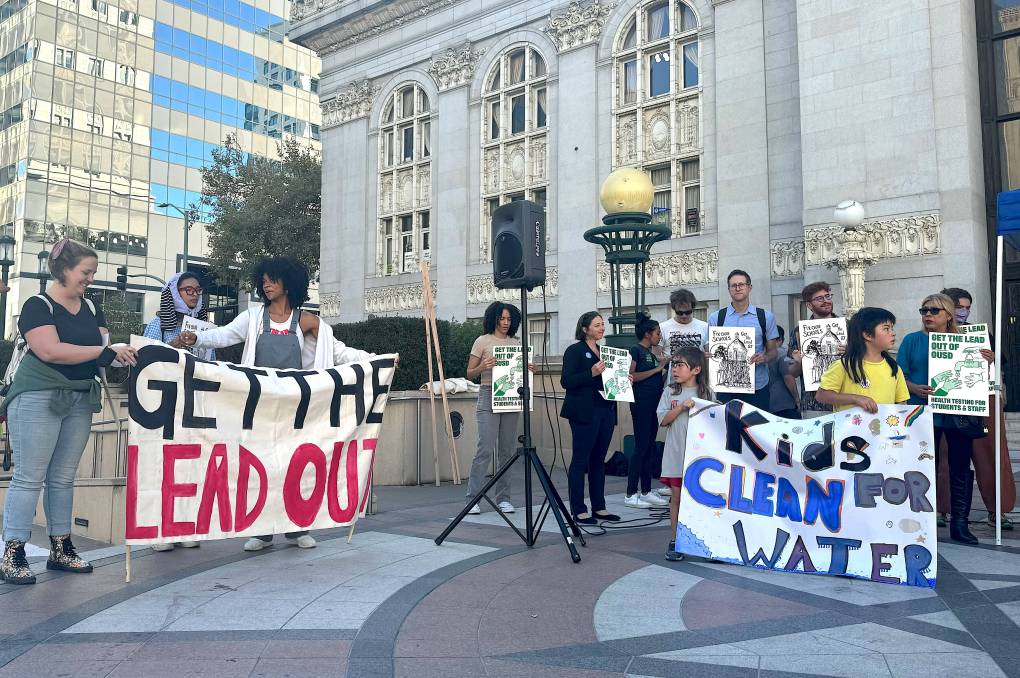
"caption": "Demonstrators rally in front of Oakland City Hall on Sept. 30, 2024, demanding the Oakland Unified School District act immediately to replace water pipes and fixtures at the 22 schools where high levels of lead in drinking water were recently detected.",
"credit": "Gilare Zada/KQED",
"altTag": "A small group of demonstrators, some of them small kids, stand outside of Oakland City Hall with signs that say 'Get the Lead Out' and 'Kids for Clean Water.'",
"description": null,
"imgSizes": {
"medium": {
"file": "https://cdn.kqed.org/wp-content/uploads/sites/10/2024/10/IMG_4345-1-800x532.jpg",
"width": 800,
"height": 532,
"mimeType": "image/jpeg"
},
"large": {
"file": "https://cdn.kqed.org/wp-content/uploads/sites/10/2024/10/IMG_4345-1-1020x678.jpg",
"width": 1020,
"height": 678,
"mimeType": "image/jpeg"
},
"thumbnail": {
"file": "https://cdn.kqed.org/wp-content/uploads/sites/10/2024/10/IMG_4345-1-160x106.jpg",
"width": 160,
"height": 106,
"mimeType": "image/jpeg"
},
"1536x1536": {
"file": "https://cdn.kqed.org/wp-content/uploads/sites/10/2024/10/IMG_4345-1-1536x1021.jpg",
"width": 1536,
"height": 1021,
"mimeType": "image/jpeg"
},
"2048x2048": {
"file": "https://cdn.kqed.org/wp-content/uploads/sites/10/2024/10/IMG_4345-1-2048x1362.jpg",
"width": 2048,
"height": 1362,
"mimeType": "image/jpeg"
},
"post-thumbnail": {
"file": "https://cdn.kqed.org/wp-content/uploads/sites/10/2024/10/IMG_4345-1-672x372.jpg",
"width": 672,
"height": 372,
"mimeType": "image/jpeg"
},
"twentyfourteen-full-width": {
"file": "https://cdn.kqed.org/wp-content/uploads/sites/10/2024/10/IMG_4345-1-1038x576.jpg",
"width": 1038,
"height": 576,
"mimeType": "image/jpeg"
},
"full-width": {
"file": "https://cdn.kqed.org/wp-content/uploads/sites/10/2024/10/IMG_4345-1-1920x1277.jpg",
"width": 1920,
"height": 1277,
"mimeType": "image/jpeg"
},
"kqedFullSize": {
"file": "https://cdn.kqed.org/wp-content/uploads/sites/10/2024/10/IMG_4345-1-scaled.jpg",
"width": 2560,
"height": 1702
}
},
"isLoading": false,
"fetchFailed": false
},
"news_12008751": {
"type": "attachments",
"id": "news_12008751",
"meta": {
"index": "attachments_1716263798",
"site": "news",
"id": "12008751",
"found": true
},
"title": "Abraham Lincoln High School In San Francisco To Be Renamed",
"publishDate": 1728498598,
"status": "inherit",
"parent": 12008739,
"modified": 1728499067,
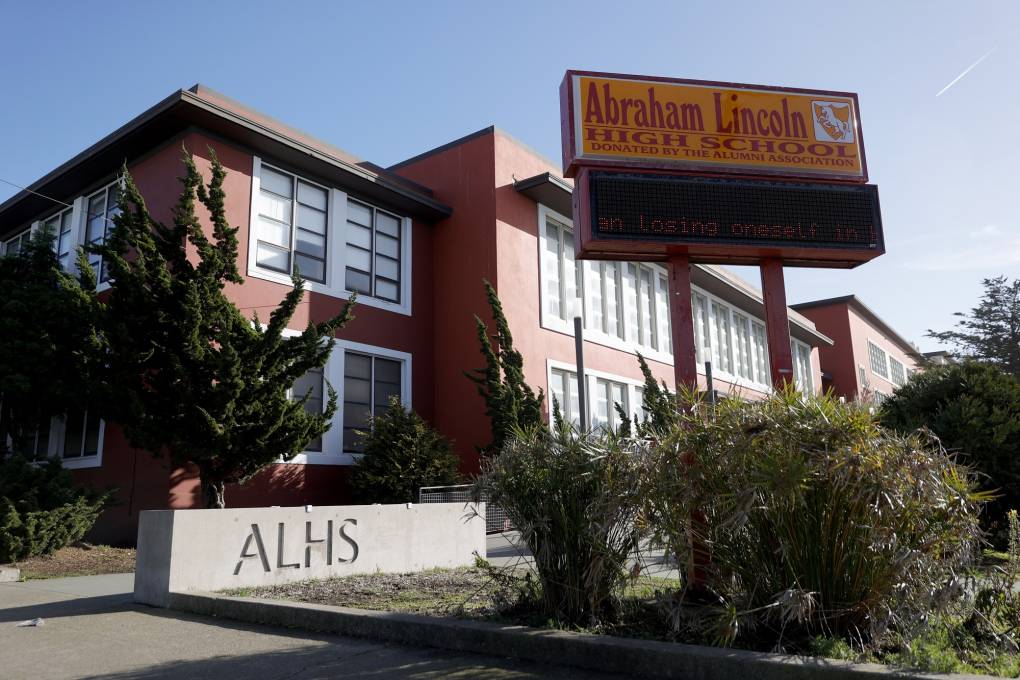
"caption": "Abraham Lincoln High School on Dec. 17, 2020, in San Francisco. San Francisco Unified School District began its antisemitism training on Wednesday for high school teachers at Abraham Lincoln, Balboa, Galileo Academy of Science & Technology and George Washington after postponing the sessions due to objections from pro-Palestinian activists over the American Jewish Committee, the group running the training, and its stance on Israel.",
"credit": "Justin Sullivan/Getty Images",
"altTag": null,
"description": null,
"imgSizes": {
"medium": {
"file": "https://cdn.kqed.org/wp-content/uploads/sites/10/2024/10/AbrahamLincolnHSSFGetty2-800x533.jpg",
"width": 800,
"height": 533,
"mimeType": "image/jpeg"
},
"large": {
"file": "https://cdn.kqed.org/wp-content/uploads/sites/10/2024/10/AbrahamLincolnHSSFGetty2-1020x680.jpg",
"width": 1020,
"height": 680,
"mimeType": "image/jpeg"
},
"thumbnail": {
"file": "https://cdn.kqed.org/wp-content/uploads/sites/10/2024/10/AbrahamLincolnHSSFGetty2-160x107.jpg",
"width": 160,
"height": 107,
"mimeType": "image/jpeg"
},
"1536x1536": {
"file": "https://cdn.kqed.org/wp-content/uploads/sites/10/2024/10/AbrahamLincolnHSSFGetty2-1536x1024.jpg",
"width": 1536,
"height": 1024,
"mimeType": "image/jpeg"
},
"post-thumbnail": {
"file": "https://cdn.kqed.org/wp-content/uploads/sites/10/2024/10/AbrahamLincolnHSSFGetty2-672x372.jpg",
"width": 672,
"height": 372,
"mimeType": "image/jpeg"
},
"twentyfourteen-full-width": {
"file": "https://cdn.kqed.org/wp-content/uploads/sites/10/2024/10/AbrahamLincolnHSSFGetty2-1038x576.jpg",
"width": 1038,
"height": 576,
"mimeType": "image/jpeg"
},
"full-width": {
"file": "https://cdn.kqed.org/wp-content/uploads/sites/10/2024/10/AbrahamLincolnHSSFGetty2-1920x1280.jpg",
"width": 1920,
"height": 1280,
"mimeType": "image/jpeg"
},
"kqedFullSize": {
"file": "https://cdn.kqed.org/wp-content/uploads/sites/10/2024/10/AbrahamLincolnHSSFGetty2.jpg",
"width": 2000,
"height": 1333
}
},
"isLoading": false,
"fetchFailed": false
},
"news_12008834": {
"type": "attachments",
"id": "news_12008834",
"meta": {
"index": "attachments_1716263798",
"site": "news",
"id": "12008834",
"found": true
},
"title": "241009-SFUSDCLOSURESMARCH-19-BL-KQED",
"publishDate": 1728517171,
"status": "inherit",
"parent": 12072028,
"modified": 1770411563,
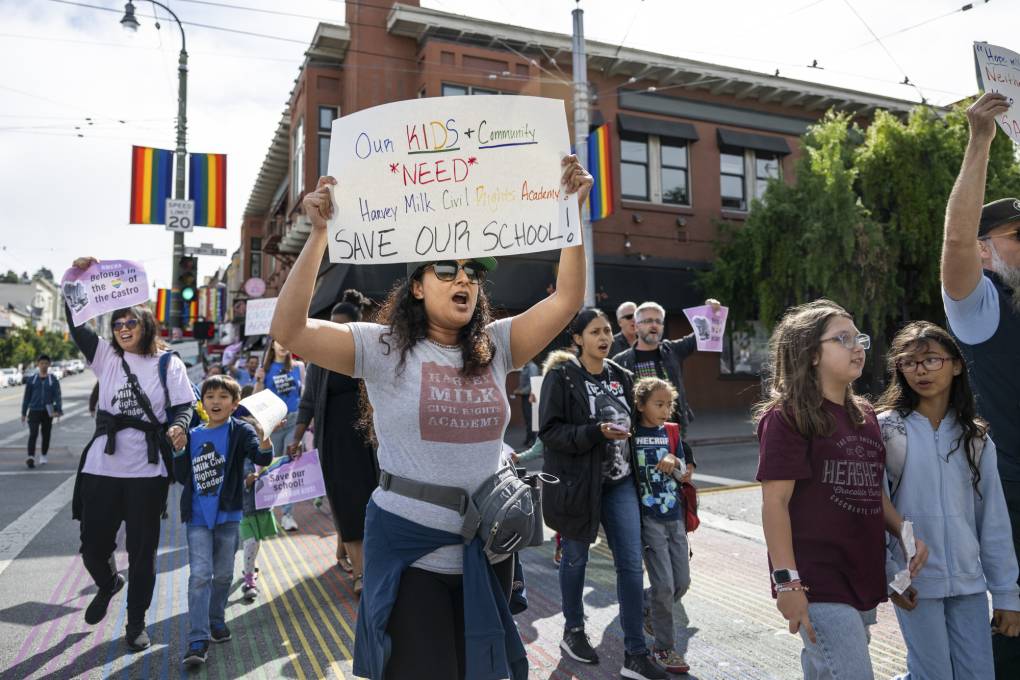
"caption": "Monica Becker (center), a parent of a former student, marches alongside teachers and students from Harvey Milk Civil Rights Academy to Harvey Milk Plaza in the Castro neighborhood of San Francisco on Oct. 9, 2024, to protest against the potential closure of the school. ",
"credit": "Beth LaBerge/KQED",
"altTag": null,
"description": null,
"imgSizes": {
"medium": {
"file": "https://cdn.kqed.org/wp-content/uploads/sites/10/2024/10/241009-SFUSDCLOSURESMARCH-19-BL-KQED-800x533.jpg",
"width": 800,
"height": 533,
"mimeType": "image/jpeg"
},
"large": {
"file": "https://cdn.kqed.org/wp-content/uploads/sites/10/2024/10/241009-SFUSDCLOSURESMARCH-19-BL-KQED-1020x680.jpg",
"width": 1020,
"height": 680,
"mimeType": "image/jpeg"
},
"thumbnail": {
"file": "https://cdn.kqed.org/wp-content/uploads/sites/10/2024/10/241009-SFUSDCLOSURESMARCH-19-BL-KQED-160x107.jpg",
"width": 160,
"height": 107,
"mimeType": "image/jpeg"
},
"1536x1536": {
"file": "https://cdn.kqed.org/wp-content/uploads/sites/10/2024/10/241009-SFUSDCLOSURESMARCH-19-BL-KQED-1536x1024.jpg",
"width": 1536,
"height": 1024,
"mimeType": "image/jpeg"
},
"post-thumbnail": {
"file": "https://cdn.kqed.org/wp-content/uploads/sites/10/2024/10/241009-SFUSDCLOSURESMARCH-19-BL-KQED-672x372.jpg",
"width": 672,
"height": 372,
"mimeType": "image/jpeg"
},
"twentyfourteen-full-width": {
"file": "https://cdn.kqed.org/wp-content/uploads/sites/10/2024/10/241009-SFUSDCLOSURESMARCH-19-BL-KQED-1038x576.jpg",
"width": 1038,
"height": 576,
"mimeType": "image/jpeg"
},
"full-width": {
"file": "https://cdn.kqed.org/wp-content/uploads/sites/10/2024/10/241009-SFUSDCLOSURESMARCH-19-BL-KQED-1920x1280.jpg",
"width": 1920,
"height": 1280,
"mimeType": "image/jpeg"
},
"kqedFullSize": {
"file": "https://cdn.kqed.org/wp-content/uploads/sites/10/2024/10/241009-SFUSDCLOSURESMARCH-19-BL-KQED.jpg",
"width": 2000,
"height": 1333
}
},
"isLoading": false,
"fetchFailed": false
}
},
"audioPlayerReducer": {
"postId": "stream_live",
"isPaused": true,
"isPlaying": false,
"pfsActive": false,
"pledgeModalIsOpen": true,
"playerDrawerIsOpen": false,
"liveAudioPlayStartedAt": 0,
"liveAudioPlayContext": ""
},
"authorsReducer": {
"byline_news_12009426": {
"type": "authors",
"id": "byline_news_12009426",
"meta": {
"override": true
},
"slug": "byline_news_12009426",
"name": "\u003ca href=\"https://calmatters.org/author/carolyn-jones\">Carolyn Jones, \u003c/a>CalMatters",
"isLoading": false
},
"byline_news_12009014": {
"type": "authors",
"id": "byline_news_12009014",
"meta": {
"override": true
},
"slug": "byline_news_12009014",
"name": "\u003ca href=\"https://www.npr.org/people/842041232/jonaki-mehta\">Jonaki Mehta\u003c/a>, NPR",
"isLoading": false
},
"jlara": {
"type": "authors",
"id": "11761",
"meta": {
"index": "authors_1716337520",
"id": "11761",
"found": true
},
"name": "Juan Carlos Lara",
"firstName": "Juan Carlos",
"lastName": "Lara",
"slug": "jlara",
"email": "jlara@kqed.org",
"display_author_email": false,
"staff_mastheads": [],
"title": "KQED Contributor",
"bio": null,
"avatar": "https://secure.gravatar.com/avatar/19e2052b9b05657c5ff2af2121846e9c?s=600&d=blank&r=g",
"twitter": null,
"facebook": null,
"instagram": null,
"linkedin": null,
"sites": [
{
"site": "arts",
"roles": [
"editor"
]
},
{
"site": "news",
"roles": [
"editor"
]
},
{
"site": "forum",
"roles": [
"editor"
]
},
{
"site": "liveblog",
"roles": [
"contributor"
]
}
],
"headData": {
"title": "Juan Carlos Lara | KQED",
"description": "KQED Contributor",
"ogImgSrc": "https://secure.gravatar.com/avatar/19e2052b9b05657c5ff2af2121846e9c?s=600&d=blank&r=g",
"twImgSrc": "https://secure.gravatar.com/avatar/19e2052b9b05657c5ff2af2121846e9c?s=600&d=blank&r=g"
},
"isLoading": false,
"link": "/author/jlara"
},
"daisynguyen": {
"type": "authors",
"id": "11829",
"meta": {
"index": "authors_1716337520",
"id": "11829",
"found": true
},
"name": "Daisy Nguyen",
"firstName": "Daisy",
"lastName": "Nguyen",
"slug": "daisynguyen",
"email": "daisynguyen@kqed.org",
"display_author_email": true,
"staff_mastheads": [
"news"
],
"title": "KQED Contributor",
"bio": "I have covered early childhood education and child care for KQED since 2022. I focus on policies aimed at increasing access to early care and education and how they shape individual lives. I've been a journalist for more than two decades, with most of that time devoted to covering breaking news throughout California for The Associated Press. I grew up in San Francisco and studied at UC Davis and Columbia University's Graduate School of Journalism. I live in Oakland with my husband and two kids.",
"avatar": "https://secure.gravatar.com/avatar/2da2127c27f7143b53ebd419800fd55f?s=600&d=blank&r=g",
"twitter": null,
"facebook": null,
"instagram": null,
"linkedin": "https://www.linkedin.com/in/daisynguyen/",
"sites": [
{
"site": "news",
"roles": [
"author"
]
},
{
"site": "liveblog",
"roles": [
"author"
]
}
],
"headData": {
"title": "Daisy Nguyen | KQED",
"description": "KQED Contributor",
"ogImgSrc": "https://secure.gravatar.com/avatar/2da2127c27f7143b53ebd419800fd55f?s=600&d=blank&r=g",
"twImgSrc": "https://secure.gravatar.com/avatar/2da2127c27f7143b53ebd419800fd55f?s=600&d=blank&r=g"
},
"isLoading": false,
"link": "/author/daisynguyen"
},
"kdebenedetti": {
"type": "authors",
"id": "11913",
"meta": {
"index": "authors_1716337520",
"id": "11913",
"found": true
},
"name": "Katie DeBenedetti",
"firstName": "Katie",
"lastName": "DeBenedetti",
"slug": "kdebenedetti",
"email": "kdebenedetti@kqed.org",
"display_author_email": false,
"staff_mastheads": [
"news",
"science"
],
"title": "KQED Contributor",
"bio": "Katie DeBenedetti is a digital reporter covering daily news for the Express Desk. Prior to joining KQED as a culture reporting intern in January 2024, she covered education and city government for the Napa Valley Register.",
"avatar": "https://secure.gravatar.com/avatar/6e31073cb8f7e4214ab03f42771d0f45?s=600&d=blank&r=g",
"twitter": null,
"facebook": null,
"instagram": null,
"linkedin": null,
"sites": [
{
"site": "news",
"roles": [
"author"
]
},
{
"site": "science",
"roles": [
"author"
]
},
{
"site": "liveblog",
"roles": [
"author"
]
}
],
"headData": {
"title": "Katie DeBenedetti | KQED",
"description": "KQED Contributor",
"ogImgSrc": "https://secure.gravatar.com/avatar/6e31073cb8f7e4214ab03f42771d0f45?s=600&d=blank&r=g",
"twImgSrc": "https://secure.gravatar.com/avatar/6e31073cb8f7e4214ab03f42771d0f45?s=600&d=blank&r=g"
},
"isLoading": false,
"link": "/author/kdebenedetti"
},
"rcooke": {
"type": "authors",
"id": "11921",
"meta": {
"index": "authors_1716337520",
"id": "11921",
"found": true
},
"name": "Riley Cooke",
"firstName": "Riley",
"lastName": "Cooke",
"slug": "rcooke",
"email": "rcooke@kqed.org",
"display_author_email": true,
"staff_mastheads": [
"news"
],
"title": "KQED Contributor",
"bio": "Riley is a senior at UC Berkeley, where she studies political science and journalism. Her work has appeared in SFGate, NBC Bay Area, Local News Matters and more. She enjoys reporting on politics, housing and homelessness — and using as many em dashes as her editors will allow.",
"avatar": "https://secure.gravatar.com/avatar/792f98c126cc5e270a8a96f77f7224ea?s=600&d=blank&r=g",
"twitter": "rrileycooke",
"facebook": null,
"instagram": null,
"linkedin": null,
"sites": [
{
"site": "arts",
"roles": [
"author"
]
},
{
"site": "news",
"roles": [
"author"
]
}
],
"headData": {
"title": "Riley Cooke | KQED",
"description": "KQED Contributor",
"ogImgSrc": "https://secure.gravatar.com/avatar/792f98c126cc5e270a8a96f77f7224ea?s=600&d=blank&r=g",
"twImgSrc": "https://secure.gravatar.com/avatar/792f98c126cc5e270a8a96f77f7224ea?s=600&d=blank&r=g"
},
"isLoading": false,
"link": "/author/rcooke"
},
"gzada": {
"type": "authors",
"id": "11929",
"meta": {
"index": "authors_1716337520",
"id": "11929",
"found": true
},
"name": "Gilare Zada",
"firstName": "Gilare",
"lastName": "Zada",
"slug": "gzada",
"email": "gzada@kqed.org",
"display_author_email": true,
"staff_mastheads": [
"news"
],
"title": null,
"bio": "Gilare Zada is a Kurdish-American from San Diego, CA. Storytelling, fitness, and binge reading are some of her passions outside of news reporting. Her work has appeared in Mission Local, the Peninsula Press, the San Francisco Press Club, and more. She also writes as a class correspondent for the Stanford Magazine - go Card!",
"avatar": "https://secure.gravatar.com/avatar/33a75f2b947669a488a805edec3fbf3838c1cedaedda710e983770633b4d6a75?s=600&d=blank&r=g",
"twitter": null,
"bluesky": null,
"facebook": null,
"instagram": null,
"linkedin": null,
"sites": [
{
"site": "",
"roles": [
"editor"
]
},
{
"site": "arts",
"roles": [
"editor"
]
},
{
"site": "news",
"roles": [
"administrator"
]
},
{
"site": "science",
"roles": [
"editor"
]
}
],
"headData": {
"title": "Gilare Zada | KQED",
"description": null,
"ogImgSrc": "https://secure.gravatar.com/avatar/33a75f2b947669a488a805edec3fbf3838c1cedaedda710e983770633b4d6a75?s=600&d=blank&r=g",
"twImgSrc": "https://secure.gravatar.com/avatar/33a75f2b947669a488a805edec3fbf3838c1cedaedda710e983770633b4d6a75?s=600&d=blank&r=g"
},
"isLoading": false,
"link": "/author/gzada"
}
},
"pagesReducer": {
"news_category_education": {
"type": "terms",
"id": "news_18540",
"meta": {
"index": "terms_1716263798",
"site": "news",
"id": "18540",
"score": 10.973179
},
"featImg": null,
"name": "Education",
"description": null,
"taxonomy": "category",
"headData": {
"twImgId": null,
"twTitle": null,
"ogTitle": null,
"ogImgId": null,
"twDescription": null,
"description": null,
"title": "Education Archives | KQED News",
"ogDescription": null
},
"ttid": 2595,
"slug": "education",
"isLoading": false,
"title": "Education",
"pageMeta": {
"site": "news",
"WpPageTemplate": "page-topic-editorial",
"currentPage": 39
},
"blocks": [
{
"blockName": "kqed/post-list",
"attrs": {
"layout": "cardArticle2",
"query": "posts/news?category=education",
"seeMore": false,
"paginated": true,
"page": 39
}
},
{
"blockName": "kqed/ad"
}
]
}
},
"pfsSessionReducer": {},
"postsReducer": {
"stream_live": {
"type": "live",
"id": "stream_live",
"audioUrl": "https://streams.kqed.org/kqedradio",
"title": "Live Stream",
"excerpt": "Live Stream information currently unavailable.",
"link": "/radio",
"featImg": "",
"label": {
"name": "KQED Live",
"link": "/"
}
},
"stream_kqedNewscast": {
"type": "posts",
"id": "stream_kqedNewscast",
"audioUrl": "https://www.kqed.org/.stream/anon/radio/RDnews/newscast.mp3?_=1",
"title": "KQED Newscast",
"featImg": "",
"label": {
"name": "88.5 FM",
"link": "/"
}
},
"news_12009590": {
"type": "posts",
"id": "news_12009590",
"meta": {
"index": "posts_1716263798",
"site": "news",
"id": "12009590",
"score": null,
"sort": [
1729105929000
]
},
"guestAuthors": [],
"slug": "abrupt-firing-of-south-bays-top-school-official-spurs-an-escalating-war-of-words",
"title": "Abrupt Firing of South Bay’s Top School Official Spurs an Escalating War of Words",
"publishDate": 1729105929,
"format": "standard",
"headTitle": "Abrupt Firing of South Bay’s Top School Official Spurs an Escalating War of Words | KQED",
"labelTerm": {
"site": "news"
},
"content": "\u003cp>Two weeks after \u003ca href=\"https://www.kqed.org/news/tag/santa-clara-county\">Santa Clara County\u003c/a>’s top education officer was \u003ca href=\"https://www.kqed.org/news/12007681/santa-clara-countys-top-school-official-is-fired-with-little-explanation\">fired with little explanation\u003c/a>, the battle over the move has escalated.\u003c/p>\n\u003cp>The county’s Board of Education is standing firm in its decision, calling a \u003ca href=\"https://www.kqed.org/news/12007955/santa-clara-schools-chief-was-fired-in-illegal-closed-door-meeting-attorneys-allege\">lawsuit\u003c/a> filed by ousted Superintendent Mary Ann Dewan “an astounding attempt to hold on to the power of the office” in a response filed Wednesday.\u003c/p>\n\u003cp>Meanwhile, a group of parents, community members and staff are calling for a civil grand jury investigation into the abrupt firing, which has also drawn criticism from state lawmakers representing the South Bay.\u003c/p>\n\u003cp>Tara Sreekrishnan, a member of the county school board, said at a Tuesday press conference that the closed-session decision to \u003ca href=\"https://www.kqed.org/news/12007681/santa-clara-countys-top-school-official-is-fired-with-little-explanation\">remove Dewan\u003c/a> from her post has “thrown schools into chaos and created turmoil for staff.”\u003c/p>\n\u003cp>[ad fullwidth]\u003c/p>\n\u003cp>“We’re here today to ask the civil grand jury to aggressively investigate what happened, to provide policy recommendations and to provide oversight as a watchdog agency for the County Office of Education and the County Board of Education,” Sreekrishnan said. “We need to restore transparency and accountability and bring the focus back to our students, to our classrooms.”\u003c/p>\n\u003cp>School board members voted to terminate Dewan without cause during a closed-door meeting on Oct. 2. The 4–2 vote, with one member abstaining, immediately elicited strong reactions from community members on either side.\u003c/p>\n\u003cp>Dewan’s supporters on Tuesday called for the county’s civil grand jury to investigate the Board of Education, alleging that it has exhibited a pattern of acting in ways that are “unchecked and costly” to taxpayers and the students in Santa Clara schools.\u003c/p>\n\u003cp>[aside postID=news_12007681 hero='https://cdn.kqed.org/wp-content/uploads/sites/10/2024/10/GettyImages-1792528853-1020x680.jpg']\u003c/p>\n\u003cp>The push is the latest in a slew of community efforts backing Dewan since her firing. Six state lawmakers representing Santa Clara County sent a letter on Monday to the school board members, asking them to reconsider Dewan’s ouster.\u003c/p>\n\u003cp>“While we understand that certain members of the board and superintendent may have some differences of opinion, it is clearly not in the public interest to terminate such an exemplary superintendent,” reads the letter signed by Sens. Josh Becker and Dave Cortese, as well as Assemblymembers Gail Pellerin, Robert Rivas, Marc Berman and Evan Low.\u003c/p>\n\u003cp>They say that the decision will cost the public hundreds of thousands of dollars in legal fees and compensation.\u003c/p>\n\u003cp>But the board isn’t backing down. On Wednesday, it filed a forceful response to Dewan’s lawsuit, which asks the Santa Clara County Superior Court to stop the board from removing her, calling it a “reckless notion.”\u003c/p>\n\u003cp>“The court should decline this attempt to seize the constitutional and statutory powers of the Santa Clara County Board of Education,” it reads.\u003c/p>\n\u003cp>Board President Maimona Afzal Berta, who voted in favor of firing Dewan, said in a statement that the suit was “an attempt to undermine the will of county voters by overriding the actions of their duly elected representatives.”\u003c/p>\n\u003cp>The board plans to appoint Charles Hinman, who currently serves as the interim executive director of Oxford Preparatory Academy in Orange County, as the county’s interim superintendent during Wednesday’s regular meeting.\u003c/p>\n\u003cp>\u003c/p>\n",
"blocks": [],
"excerpt": "The Santa Clara County school board blasted the ousted superintendent’s lawsuit as “an astounding attempt to hold on to the power of the office” after she was fired two weeks ago. ",
"status": "publish",
"parent": 0,
"modified": 1729107297,
"stats": {
"hasAudio": false,
"hasVideo": false,
"hasChartOrMap": false,
"iframeSrcs": [],
"hasGoogleForm": false,
"hasGallery": false,
"hasHearkenModule": false,
"hasPolis": false,
"paragraphCount": 17,
"wordCount": 564
},
"headData": {
"title": "Abrupt Firing of South Bay’s Top School Official Spurs an Escalating War of Words | KQED",
"description": "The Santa Clara County school board blasted the ousted superintendent’s lawsuit as “an astounding attempt to hold on to the power of the office” after she was fired two weeks ago. ",
"ogTitle": "",
"ogDescription": "",
"ogImgId": "",
"twTitle": "",
"twDescription": "",
"twImgId": "",
"schema": {
"@context": "https://schema.org",
"@type": "NewsArticle",
"headline": "Abrupt Firing of South Bay’s Top School Official Spurs an Escalating War of Words",
"datePublished": "2024-10-16T12:12:09-07:00",
"dateModified": "2024-10-16T12:34:57-07:00",
"image": "https://cdn.kqed.org/wp-content/uploads/2020/02/KQED-OG-Image@1x.png",
"isAccessibleForFree": "True",
"publisher": {
"@type": "NewsMediaOrganization",
"@id": "https://www.kqed.org/#organization",
"name": "KQED",
"logo": "https://cdn.kqed.org/wp-content/uploads/2020/02/KQED-OG-Image@1x.png",
"url": "https://www.kqed.org",
"sameAs": [
"https://www.facebook.com/KQED",
"https://twitter.com/KQED",
"https://www.instagram.com/kqed/",
"https://www.tiktok.com/@kqedofficial",
"https://www.linkedin.com/company/kqed",
"https://www.youtube.com/channel/UCeC0IOo7i1P_61zVUWbJ4nw"
]
}
}
},
"sticky": false,
"nprStoryId": "kqed-12009590",
"excludeFromSiteSearch": "Include",
"articleAge": "0",
"path": "/news/12009590/abrupt-firing-of-south-bays-top-school-official-spurs-an-escalating-war-of-words",
"audioTrackLength": null,
"parsedContent": [
{
"type": "contentString",
"content": "\u003cdiv class=\"post-body\">\u003cp>\u003cp>Two weeks after \u003ca href=\"https://www.kqed.org/news/tag/santa-clara-county\">Santa Clara County\u003c/a>’s top education officer was \u003ca href=\"https://www.kqed.org/news/12007681/santa-clara-countys-top-school-official-is-fired-with-little-explanation\">fired with little explanation\u003c/a>, the battle over the move has escalated.\u003c/p>\n\u003cp>The county’s Board of Education is standing firm in its decision, calling a \u003ca href=\"https://www.kqed.org/news/12007955/santa-clara-schools-chief-was-fired-in-illegal-closed-door-meeting-attorneys-allege\">lawsuit\u003c/a> filed by ousted Superintendent Mary Ann Dewan “an astounding attempt to hold on to the power of the office” in a response filed Wednesday.\u003c/p>\n\u003cp>Meanwhile, a group of parents, community members and staff are calling for a civil grand jury investigation into the abrupt firing, which has also drawn criticism from state lawmakers representing the South Bay.\u003c/p>\n\u003cp>Tara Sreekrishnan, a member of the county school board, said at a Tuesday press conference that the closed-session decision to \u003ca href=\"https://www.kqed.org/news/12007681/santa-clara-countys-top-school-official-is-fired-with-little-explanation\">remove Dewan\u003c/a> from her post has “thrown schools into chaos and created turmoil for staff.”\u003c/p>\n\u003cp>\u003c/p>\u003c/div>",
"attributes": {
"named": {},
"numeric": []
}
},
{
"type": "component",
"content": "",
"name": "ad",
"attributes": {
"named": {
"label": "fullwidth"
},
"numeric": [
"fullwidth"
]
}
},
{
"type": "contentString",
"content": "\u003cdiv class=\"post-body\">\u003cp>\u003c/p>\n\u003cp>“We’re here today to ask the civil grand jury to aggressively investigate what happened, to provide policy recommendations and to provide oversight as a watchdog agency for the County Office of Education and the County Board of Education,” Sreekrishnan said. “We need to restore transparency and accountability and bring the focus back to our students, to our classrooms.”\u003c/p>\n\u003cp>School board members voted to terminate Dewan without cause during a closed-door meeting on Oct. 2. The 4–2 vote, with one member abstaining, immediately elicited strong reactions from community members on either side.\u003c/p>\n\u003cp>Dewan’s supporters on Tuesday called for the county’s civil grand jury to investigate the Board of Education, alleging that it has exhibited a pattern of acting in ways that are “unchecked and costly” to taxpayers and the students in Santa Clara schools.\u003c/p>\n\u003cp>\u003c/p>\u003c/div>",
"attributes": {
"named": {},
"numeric": []
}
},
{
"type": "component",
"content": "",
"name": "aside",
"attributes": {
"named": {
"postid": "news_12007681",
"hero": "https://cdn.kqed.org/wp-content/uploads/sites/10/2024/10/GettyImages-1792528853-1020x680.jpg",
"label": ""
},
"numeric": []
}
},
{
"type": "contentString",
"content": "\u003cdiv class=\"post-body\">\u003cp>\u003c/p>\n\u003cp>The push is the latest in a slew of community efforts backing Dewan since her firing. Six state lawmakers representing Santa Clara County sent a letter on Monday to the school board members, asking them to reconsider Dewan’s ouster.\u003c/p>\n\u003cp>“While we understand that certain members of the board and superintendent may have some differences of opinion, it is clearly not in the public interest to terminate such an exemplary superintendent,” reads the letter signed by Sens. Josh Becker and Dave Cortese, as well as Assemblymembers Gail Pellerin, Robert Rivas, Marc Berman and Evan Low.\u003c/p>\n\u003cp>They say that the decision will cost the public hundreds of thousands of dollars in legal fees and compensation.\u003c/p>\n\u003cp>But the board isn’t backing down. On Wednesday, it filed a forceful response to Dewan’s lawsuit, which asks the Santa Clara County Superior Court to stop the board from removing her, calling it a “reckless notion.”\u003c/p>\n\u003cp>“The court should decline this attempt to seize the constitutional and statutory powers of the Santa Clara County Board of Education,” it reads.\u003c/p>\n\u003cp>Board President Maimona Afzal Berta, who voted in favor of firing Dewan, said in a statement that the suit was “an attempt to undermine the will of county voters by overriding the actions of their duly elected representatives.”\u003c/p>\n\u003cp>The board plans to appoint Charles Hinman, who currently serves as the interim executive director of Oxford Preparatory Academy in Orange County, as the county’s interim superintendent during Wednesday’s regular meeting.\u003c/p>\n\u003cp>\u003c/p>\n\u003c/div>\u003c/p>",
"attributes": {
"named": {},
"numeric": []
}
}
],
"link": "/news/12009590/abrupt-firing-of-south-bays-top-school-official-spurs-an-escalating-war-of-words",
"authors": [
"11913"
],
"categories": [
"news_31795",
"news_18540",
"news_8"
],
"tags": [
"news_20013",
"news_1749",
"news_18188",
"news_25766",
"news_4479",
"news_21285"
],
"featImg": "news_12009621",
"label": "news"
},
"news_12009509": {
"type": "posts",
"id": "news_12009509",
"meta": {
"index": "posts_1716263798",
"site": "news",
"id": "12009509",
"score": null,
"sort": [
1729026988000
]
},
"guestAuthors": [],
"slug": "mayor-breed-demands-halt-sf-school-closures-citing-chaos-confusion",
"title": "Mayor Breed Demands Halt to SF School Closures, Citing Chaos and Confusion",
"publishDate": 1729026988,
"format": "standard",
"headTitle": "Mayor Breed Demands Halt to SF School Closures, Citing Chaos and Confusion | KQED",
"labelTerm": {
"site": "news"
},
"content": "\u003cp>\u003cem>Updated 3:54 p.m. Tuesday\u003c/em>\u003c/p>\n\u003cp>Mayor London Breed on Tuesday called on the \u003ca href=\"https://www.kqed.org/news/tag/sfusd\">San Francisco Unified School District\u003c/a> to halt its plan to close up to 11 schools at the end of the academic year, citing confusion around the process and saying she has lost confidence in the superintendent’s ability to carry it out.\u003c/p>\n\u003cp>In a \u003ca href=\"https://x.com/LondonBreed/status/1846275807129620800\">statement\u003c/a> posted on social media platform X, Breed said, “It is time to immediately stop the school closure process.”\u003c/p>\n\u003cp>“This has become a distraction from the very real work that must be done to balance the budget in the next two months to prevent a state takeover,” the statement reads.\u003c/p>\n\u003cp>The pressure from the mayor comes a week after Superintendent Matt Wayne \u003ca href=\"https://www.kqed.org/news/12008405/these-san-francisco-schools-could-close-list-isnt-final\">announced the list of campuses being considered for closure\u003c/a>, igniting concern and anger from families who had been frustrated over weeks of uncertainty surrounding the process.\u003c/p>\n\u003cp>[ad fullwidth]\u003c/p>\n\u003cp>Breed said \u003ca href=\"https://www.kqed.org/news/12005932/sf-mayor-sends-team-to-address-crisis-at-school-district-but-dont-call-it-a-takeover\">the rescue team\u003c/a> of city administrators she sent to aid the district three weeks ago has worked alongside district staffers on operational issues, including cutting roughly $110 million from the district’s budget. If that shortfall isn’t closed by the end of the year, the district could face a takeover by the California Department of Education.\u003c/p>\n\u003cp>The “mismanaged school closure process” has made addressing those issues difficult, Breed said in her statement.\u003c/p>\n\u003cp>She also slammed Wayne, saying she does not believe the current school closure plan can be carried out in a way that will benefit SFUSD students and families.\u003c/p>\n\u003cfigure id=\"attachment_12008832\" class=\"wp-caption aligncenter\" style=\"max-width: 2000px\">\u003cimg loading=\"lazy\" decoding=\"async\" class=\"size-full wp-image-12008832\" src=\"https://cdn.kqed.org/wp-content/uploads/sites/10/2024/10/241009-SFUSDCLOSURESMARCH-13-BL-KQED.jpg\" alt=\"\" width=\"2000\" height=\"1333\" srcset=\"https://cdn.kqed.org/wp-content/uploads/sites/10/2024/10/241009-SFUSDCLOSURESMARCH-13-BL-KQED.jpg 2000w, https://cdn.kqed.org/wp-content/uploads/sites/10/2024/10/241009-SFUSDCLOSURESMARCH-13-BL-KQED-800x533.jpg 800w, https://cdn.kqed.org/wp-content/uploads/sites/10/2024/10/241009-SFUSDCLOSURESMARCH-13-BL-KQED-1020x680.jpg 1020w, https://cdn.kqed.org/wp-content/uploads/sites/10/2024/10/241009-SFUSDCLOSURESMARCH-13-BL-KQED-160x107.jpg 160w, https://cdn.kqed.org/wp-content/uploads/sites/10/2024/10/241009-SFUSDCLOSURESMARCH-13-BL-KQED-1536x1024.jpg 1536w, https://cdn.kqed.org/wp-content/uploads/sites/10/2024/10/241009-SFUSDCLOSURESMARCH-13-BL-KQED-1920x1280.jpg 1920w\" sizes=\"(max-width: 2000px) 100vw, 2000px\">\u003cfigcaption class=\"wp-caption-text\">Teachers, K-5 students, families and community members march from Harvey Milk Civil Rights Academy to Harvey Milk Plaza in the Castro on Oct. 9, 2024. \u003ccite>(Beth LaBerge/KQED)\u003c/cite>\u003c/figcaption>\u003c/figure>\n\u003cp>“I recognize that discussions around school closures and mergers are difficult and painful, but that only speaks to why any effort to engage in this conversation must be done with care, clarity, and competence,” Breed said. “That has not happened here, and I don’t have confidence that it can happen right now under the current conditions.”\u003c/p>\n\u003cp>In the week since Wayne released the list, there has been \u003ca href=\"https://www.kqed.org/news/12008882/sfusd-faces-backlash-school-closures-community-rallies-town-halls\">significant fallout from communities\u003c/a> who were told their schools met the district’s criteria for closure.\u003c/p>\n\u003cp>The year was already off to a rocky start, especially after Wayne \u003ca href=\"https://www.kqed.org/news/12004831/anxious-waiting-game-drags-on-as-sfusd-delays-list-of-school-closures\">pushed the planned September announcement\u003c/a> of the closure list back a month, just two days before it was anticipated. That week, the former school board president announced that her abrupt resignation from the board was in part due to Wayne’s failures in leadership, and the school board called an emergency weekend meeting, purportedly to discuss whether to keep Wayne in his job. Breed sent in her team of experts to assist the district’s consolidation plan the same day.\u003c/p>\n\u003cp>The October rollout was also chaotic: After news on Oct. 4 suggested Wayne might hold the list until November, the district \u003ca href=\"https://www.kqed.org/news/12008286/is-san-franciscos-school-closure-list-delayed-again-district-offers-little-clarity\">didn’t offer much information\u003c/a> until the following Monday, when Wayne announced in a video message that he would be releasing a list of schools that met the district’s criteria for closure on Tuesday.\u003c/p>\n\u003cp>[aside postID=news_12008873 hero='https://cdn.kqed.org/wp-content/uploads/sites/10/2024/10/241010-SFUSDClosures-06-BL-1020x680.jpg']\u003c/p>\n\u003cp>\u003ca href=\"https://www.kqed.org/news/12008524/sfusd-closures-which-schools-will-be-affected-and-what-do-families-need-to-know\">The list\u003c/a> went live around 4 p.m. after it was obtained by\u003cem> Mission Local\u003c/em> and led to confusion about whether the list — which included plans for which campuses would merge or welcome students from other campuses — was just the schools that were eligible for closure or the district’s actual proposal.\u003c/p>\n\u003cp>“What I’ve heard over and over is confusion and concern around the proposed school closures/merger list and how it has been communicated and managed,” Breed’s statement continues. “I’ve heard from parents, students, and educators who are fearful about the futures of their schools.”\u003c/p>\n\u003cp>Many school communities and political leaders have \u003ca href=\"https://www.kqed.org/news/12008873/san-francisco-school-closures-will-hurt-chinese-immigrant-communities-city-leaders-say\">protested the closures\u003c/a> in the past week, and parent groups have raised concerns regarding the equity of the list, which disproportionately affects schools on the east side of the city and would relocate students in two schools with Cantonese biliteracy programs.\u003c/p>\n\u003cp>Parents have \u003ca href=\"https://www.kqed.org/news/12008714/parents-sf-schools-named-for-closure-fight-keep-campuses-open\">raised concerns\u003c/a> about the criteria the district used, which targeted small schools and included “composite scores” that rate schools on factors including equity, academic performance, school culture and effective use of resources. Those criteria were also changed the same day the list was posted, they said.\u003c/p>\n\u003cp>Breed suggested that her rescue team and members of the school board weren’t even clued in to all of the district’s communications.\u003c/p>\n\u003cp>“It was our understanding from our work with the school board that our stabilization team would be taken seriously,” she said, speaking with reporters after her announcement. “There were some major communication issues with our superintendent. And the fact is, if we are working on this together and we’re providing that support, we need to all be on the same page, and unfortunately, we haven’t been with this process.”\u003c/p>\n\u003cfigure id=\"attachment_12008829\" class=\"wp-caption aligncenter\" style=\"max-width: 2000px\">\u003cimg loading=\"lazy\" decoding=\"async\" class=\"size-full wp-image-12008829\" src=\"https://cdn.kqed.org/wp-content/uploads/sites/10/2024/10/241009-SFUSDCLOSURESMARCH-01-BL-KQED.jpg\" alt=\"\" width=\"2000\" height=\"1333\" srcset=\"https://cdn.kqed.org/wp-content/uploads/sites/10/2024/10/241009-SFUSDCLOSURESMARCH-01-BL-KQED.jpg 2000w, https://cdn.kqed.org/wp-content/uploads/sites/10/2024/10/241009-SFUSDCLOSURESMARCH-01-BL-KQED-800x533.jpg 800w, https://cdn.kqed.org/wp-content/uploads/sites/10/2024/10/241009-SFUSDCLOSURESMARCH-01-BL-KQED-1020x680.jpg 1020w, https://cdn.kqed.org/wp-content/uploads/sites/10/2024/10/241009-SFUSDCLOSURESMARCH-01-BL-KQED-160x107.jpg 160w, https://cdn.kqed.org/wp-content/uploads/sites/10/2024/10/241009-SFUSDCLOSURESMARCH-01-BL-KQED-1536x1024.jpg 1536w, https://cdn.kqed.org/wp-content/uploads/sites/10/2024/10/241009-SFUSDCLOSURESMARCH-01-BL-KQED-1920x1280.jpg 1920w\" sizes=\"(max-width: 2000px) 100vw, 2000px\">\u003cfigcaption class=\"wp-caption-text\">Teachers, K–5 students, families and community members leave Harvey Milk Civil Rights Academy to march to Harvey Milk Plaza in the Castro neighborhood of San Francisco on Oct. 9, 2024, to protest against the potential closure of the school. \u003ccite>(Beth LaBerge/KQED)\u003c/cite>\u003c/figcaption>\u003c/figure>\n\u003cp>School Board President Matt Alexander said that Breed’s statement made “some valid points,” adding that the rollout wasn’t done in the way he expected.\u003c/p>\n\u003cp>He said although the mayor’s team has been working closely with district staff on fiscal and operational stabilization, the superintendent seemed to decline assistance with strategic communications.\u003c/p>\n\u003cp>“There’s been a fair amount of chaos and unnecessary drama,” Alexander told KQED.\u003c/p>\n\u003cp>“The Board of Education is actively monitoring the situation. We have one employee, which is the superintendent, and so we’re monitoring it, holding him accountable and we understand that as a governance team, it’s our responsibility to ensure that we stabilize the situation and that we provide our students and our educators with the schools they deserve.”\u003c/p>\n\u003cp>This week, Wayne and his staff are expected to meet with various school communities that would be affected by the closures ahead of the final proposal that will go to the school board on Nov. 12.\u003c/p>\n\u003cp>As of now, the board is set to make a final decision on school closures on Dec. 10.\u003c/p>\n\u003cp>Breed said that the next few months should be spent ensuring the district maintains local control by balancing its budget in December. Both she and Alexander said that they believe it’s possible to achieve that goal without closing schools.\u003c/p>\n\u003cp>“The weeks and months ahead are going to be incredibly difficult,” Breed said. “There are painful but necessary decisions that will have to be made and any school closures or mergers would only be one small piece of the overall effort to balance the budget.”\u003c/p>\n\u003cp>\u003cem>KQED’s \u003c/em>\u003ca href=\"https://www.kqed.org/author/sjohnson\">\u003cem>Sydney Johnson\u003c/em>\u003c/a>\u003cem> contributed to this report.\u003c/em>\u003c/p>\n\u003cp>[ad floatright]\u003c/p>\n",
"blocks": [],
"excerpt": "San Francisco Mayor London Breed said she lost confidence in the superintendent’s ability to manage the process and urged SFUSD to focus on balancing its budget.",
"status": "publish",
"parent": 0,
"modified": 1729036500,
"stats": {
"hasAudio": false,
"hasVideo": false,
"hasChartOrMap": false,
"iframeSrcs": [],
"hasGoogleForm": false,
"hasGallery": false,
"hasHearkenModule": false,
"hasPolis": false,
"paragraphCount": 30,
"wordCount": 1201
},
"headData": {
"title": "Mayor Breed Demands Halt to SF School Closures, Citing Chaos and Confusion | KQED",
"description": "San Francisco Mayor London Breed said she lost confidence in the superintendent’s ability to manage the process and urged SFUSD to focus on balancing its budget.",
"ogTitle": "",
"ogDescription": "",
"ogImgId": "",
"twTitle": "",
"twDescription": "",
"twImgId": "",
"schema": {
"@context": "https://schema.org",
"@type": "NewsArticle",
"headline": "Mayor Breed Demands Halt to SF School Closures, Citing Chaos and Confusion",
"datePublished": "2024-10-15T14:16:28-07:00",
"dateModified": "2024-10-15T16:55:00-07:00",
"image": "https://cdn.kqed.org/wp-content/uploads/2020/02/KQED-OG-Image@1x.png",
"isAccessibleForFree": "True",
"publisher": {
"@type": "NewsMediaOrganization",
"@id": "https://www.kqed.org/#organization",
"name": "KQED",
"logo": "https://cdn.kqed.org/wp-content/uploads/2020/02/KQED-OG-Image@1x.png",
"url": "https://www.kqed.org",
"sameAs": [
"https://www.facebook.com/KQED",
"https://twitter.com/KQED",
"https://www.instagram.com/kqed/",
"https://www.tiktok.com/@kqedofficial",
"https://www.linkedin.com/company/kqed",
"https://www.youtube.com/channel/UCeC0IOo7i1P_61zVUWbJ4nw"
]
}
}
},
"sticky": false,
"nprStoryId": "kqed-12009509",
"excludeFromSiteSearch": "Include",
"articleAge": "0",
"path": "/news/12009509/mayor-breed-demands-halt-sf-school-closures-citing-chaos-confusion",
"audioTrackLength": null,
"parsedContent": [
{
"type": "contentString",
"content": "\u003cdiv class=\"post-body\">\u003cp>\u003cp>\u003cem>Updated 3:54 p.m. Tuesday\u003c/em>\u003c/p>\n\u003cp>Mayor London Breed on Tuesday called on the \u003ca href=\"https://www.kqed.org/news/tag/sfusd\">San Francisco Unified School District\u003c/a> to halt its plan to close up to 11 schools at the end of the academic year, citing confusion around the process and saying she has lost confidence in the superintendent’s ability to carry it out.\u003c/p>\n\u003cp>In a \u003ca href=\"https://x.com/LondonBreed/status/1846275807129620800\">statement\u003c/a> posted on social media platform X, Breed said, “It is time to immediately stop the school closure process.”\u003c/p>\n\u003cp>“This has become a distraction from the very real work that must be done to balance the budget in the next two months to prevent a state takeover,” the statement reads.\u003c/p>\n\u003cp>The pressure from the mayor comes a week after Superintendent Matt Wayne \u003ca href=\"https://www.kqed.org/news/12008405/these-san-francisco-schools-could-close-list-isnt-final\">announced the list of campuses being considered for closure\u003c/a>, igniting concern and anger from families who had been frustrated over weeks of uncertainty surrounding the process.\u003c/p>\n\u003cp>\u003c/p>\u003c/div>",
"attributes": {
"named": {},
"numeric": []
}
},
{
"type": "component",
"content": "",
"name": "ad",
"attributes": {
"named": {
"label": "fullwidth"
},
"numeric": [
"fullwidth"
]
}
},
{
"type": "contentString",
"content": "\u003cdiv class=\"post-body\">\u003cp>\u003c/p>\n\u003cp>Breed said \u003ca href=\"https://www.kqed.org/news/12005932/sf-mayor-sends-team-to-address-crisis-at-school-district-but-dont-call-it-a-takeover\">the rescue team\u003c/a> of city administrators she sent to aid the district three weeks ago has worked alongside district staffers on operational issues, including cutting roughly $110 million from the district’s budget. If that shortfall isn’t closed by the end of the year, the district could face a takeover by the California Department of Education.\u003c/p>\n\u003cp>The “mismanaged school closure process” has made addressing those issues difficult, Breed said in her statement.\u003c/p>\n\u003cp>She also slammed Wayne, saying she does not believe the current school closure plan can be carried out in a way that will benefit SFUSD students and families.\u003c/p>\n\u003cfigure id=\"attachment_12008832\" class=\"wp-caption aligncenter\" style=\"max-width: 2000px\">\u003cimg loading=\"lazy\" decoding=\"async\" class=\"size-full wp-image-12008832\" src=\"https://cdn.kqed.org/wp-content/uploads/sites/10/2024/10/241009-SFUSDCLOSURESMARCH-13-BL-KQED.jpg\" alt=\"\" width=\"2000\" height=\"1333\" srcset=\"https://cdn.kqed.org/wp-content/uploads/sites/10/2024/10/241009-SFUSDCLOSURESMARCH-13-BL-KQED.jpg 2000w, https://cdn.kqed.org/wp-content/uploads/sites/10/2024/10/241009-SFUSDCLOSURESMARCH-13-BL-KQED-800x533.jpg 800w, https://cdn.kqed.org/wp-content/uploads/sites/10/2024/10/241009-SFUSDCLOSURESMARCH-13-BL-KQED-1020x680.jpg 1020w, https://cdn.kqed.org/wp-content/uploads/sites/10/2024/10/241009-SFUSDCLOSURESMARCH-13-BL-KQED-160x107.jpg 160w, https://cdn.kqed.org/wp-content/uploads/sites/10/2024/10/241009-SFUSDCLOSURESMARCH-13-BL-KQED-1536x1024.jpg 1536w, https://cdn.kqed.org/wp-content/uploads/sites/10/2024/10/241009-SFUSDCLOSURESMARCH-13-BL-KQED-1920x1280.jpg 1920w\" sizes=\"(max-width: 2000px) 100vw, 2000px\">\u003cfigcaption class=\"wp-caption-text\">Teachers, K-5 students, families and community members march from Harvey Milk Civil Rights Academy to Harvey Milk Plaza in the Castro on Oct. 9, 2024. \u003ccite>(Beth LaBerge/KQED)\u003c/cite>\u003c/figcaption>\u003c/figure>\n\u003cp>“I recognize that discussions around school closures and mergers are difficult and painful, but that only speaks to why any effort to engage in this conversation must be done with care, clarity, and competence,” Breed said. “That has not happened here, and I don’t have confidence that it can happen right now under the current conditions.”\u003c/p>\n\u003cp>In the week since Wayne released the list, there has been \u003ca href=\"https://www.kqed.org/news/12008882/sfusd-faces-backlash-school-closures-community-rallies-town-halls\">significant fallout from communities\u003c/a> who were told their schools met the district’s criteria for closure.\u003c/p>\n\u003cp>The year was already off to a rocky start, especially after Wayne \u003ca href=\"https://www.kqed.org/news/12004831/anxious-waiting-game-drags-on-as-sfusd-delays-list-of-school-closures\">pushed the planned September announcement\u003c/a> of the closure list back a month, just two days before it was anticipated. That week, the former school board president announced that her abrupt resignation from the board was in part due to Wayne’s failures in leadership, and the school board called an emergency weekend meeting, purportedly to discuss whether to keep Wayne in his job. Breed sent in her team of experts to assist the district’s consolidation plan the same day.\u003c/p>\n\u003cp>The October rollout was also chaotic: After news on Oct. 4 suggested Wayne might hold the list until November, the district \u003ca href=\"https://www.kqed.org/news/12008286/is-san-franciscos-school-closure-list-delayed-again-district-offers-little-clarity\">didn’t offer much information\u003c/a> until the following Monday, when Wayne announced in a video message that he would be releasing a list of schools that met the district’s criteria for closure on Tuesday.\u003c/p>\n\u003cp>\u003c/p>\u003c/div>",
"attributes": {
"named": {},
"numeric": []
}
},
{
"type": "component",
"content": "",
"name": "aside",
"attributes": {
"named": {
"postid": "news_12008873",
"hero": "https://cdn.kqed.org/wp-content/uploads/sites/10/2024/10/241010-SFUSDClosures-06-BL-1020x680.jpg",
"label": ""
},
"numeric": []
}
},
{
"type": "contentString",
"content": "\u003cdiv class=\"post-body\">\u003cp>\u003c/p>\n\u003cp>\u003ca href=\"https://www.kqed.org/news/12008524/sfusd-closures-which-schools-will-be-affected-and-what-do-families-need-to-know\">The list\u003c/a> went live around 4 p.m. after it was obtained by\u003cem> Mission Local\u003c/em> and led to confusion about whether the list — which included plans for which campuses would merge or welcome students from other campuses — was just the schools that were eligible for closure or the district’s actual proposal.\u003c/p>\n\u003cp>“What I’ve heard over and over is confusion and concern around the proposed school closures/merger list and how it has been communicated and managed,” Breed’s statement continues. “I’ve heard from parents, students, and educators who are fearful about the futures of their schools.”\u003c/p>\n\u003cp>Many school communities and political leaders have \u003ca href=\"https://www.kqed.org/news/12008873/san-francisco-school-closures-will-hurt-chinese-immigrant-communities-city-leaders-say\">protested the closures\u003c/a> in the past week, and parent groups have raised concerns regarding the equity of the list, which disproportionately affects schools on the east side of the city and would relocate students in two schools with Cantonese biliteracy programs.\u003c/p>\n\u003cp>Parents have \u003ca href=\"https://www.kqed.org/news/12008714/parents-sf-schools-named-for-closure-fight-keep-campuses-open\">raised concerns\u003c/a> about the criteria the district used, which targeted small schools and included “composite scores” that rate schools on factors including equity, academic performance, school culture and effective use of resources. Those criteria were also changed the same day the list was posted, they said.\u003c/p>\n\u003cp>Breed suggested that her rescue team and members of the school board weren’t even clued in to all of the district’s communications.\u003c/p>\n\u003cp>“It was our understanding from our work with the school board that our stabilization team would be taken seriously,” she said, speaking with reporters after her announcement. “There were some major communication issues with our superintendent. And the fact is, if we are working on this together and we’re providing that support, we need to all be on the same page, and unfortunately, we haven’t been with this process.”\u003c/p>\n\u003cfigure id=\"attachment_12008829\" class=\"wp-caption aligncenter\" style=\"max-width: 2000px\">\u003cimg loading=\"lazy\" decoding=\"async\" class=\"size-full wp-image-12008829\" src=\"https://cdn.kqed.org/wp-content/uploads/sites/10/2024/10/241009-SFUSDCLOSURESMARCH-01-BL-KQED.jpg\" alt=\"\" width=\"2000\" height=\"1333\" srcset=\"https://cdn.kqed.org/wp-content/uploads/sites/10/2024/10/241009-SFUSDCLOSURESMARCH-01-BL-KQED.jpg 2000w, https://cdn.kqed.org/wp-content/uploads/sites/10/2024/10/241009-SFUSDCLOSURESMARCH-01-BL-KQED-800x533.jpg 800w, https://cdn.kqed.org/wp-content/uploads/sites/10/2024/10/241009-SFUSDCLOSURESMARCH-01-BL-KQED-1020x680.jpg 1020w, https://cdn.kqed.org/wp-content/uploads/sites/10/2024/10/241009-SFUSDCLOSURESMARCH-01-BL-KQED-160x107.jpg 160w, https://cdn.kqed.org/wp-content/uploads/sites/10/2024/10/241009-SFUSDCLOSURESMARCH-01-BL-KQED-1536x1024.jpg 1536w, https://cdn.kqed.org/wp-content/uploads/sites/10/2024/10/241009-SFUSDCLOSURESMARCH-01-BL-KQED-1920x1280.jpg 1920w\" sizes=\"(max-width: 2000px) 100vw, 2000px\">\u003cfigcaption class=\"wp-caption-text\">Teachers, K–5 students, families and community members leave Harvey Milk Civil Rights Academy to march to Harvey Milk Plaza in the Castro neighborhood of San Francisco on Oct. 9, 2024, to protest against the potential closure of the school. \u003ccite>(Beth LaBerge/KQED)\u003c/cite>\u003c/figcaption>\u003c/figure>\n\u003cp>School Board President Matt Alexander said that Breed’s statement made “some valid points,” adding that the rollout wasn’t done in the way he expected.\u003c/p>\n\u003cp>He said although the mayor’s team has been working closely with district staff on fiscal and operational stabilization, the superintendent seemed to decline assistance with strategic communications.\u003c/p>\n\u003cp>“There’s been a fair amount of chaos and unnecessary drama,” Alexander told KQED.\u003c/p>\n\u003cp>“The Board of Education is actively monitoring the situation. We have one employee, which is the superintendent, and so we’re monitoring it, holding him accountable and we understand that as a governance team, it’s our responsibility to ensure that we stabilize the situation and that we provide our students and our educators with the schools they deserve.”\u003c/p>\n\u003cp>This week, Wayne and his staff are expected to meet with various school communities that would be affected by the closures ahead of the final proposal that will go to the school board on Nov. 12.\u003c/p>\n\u003cp>As of now, the board is set to make a final decision on school closures on Dec. 10.\u003c/p>\n\u003cp>Breed said that the next few months should be spent ensuring the district maintains local control by balancing its budget in December. Both she and Alexander said that they believe it’s possible to achieve that goal without closing schools.\u003c/p>\n\u003cp>“The weeks and months ahead are going to be incredibly difficult,” Breed said. “There are painful but necessary decisions that will have to be made and any school closures or mergers would only be one small piece of the overall effort to balance the budget.”\u003c/p>\n\u003cp>\u003cem>KQED’s \u003c/em>\u003ca href=\"https://www.kqed.org/author/sjohnson\">\u003cem>Sydney Johnson\u003c/em>\u003c/a>\u003cem> contributed to this report.\u003c/em>\u003c/p>\n\u003cp>\u003c/p>\u003c/div>",
"attributes": {
"named": {},
"numeric": []
}
},
{
"type": "component",
"content": "",
"name": "ad",
"attributes": {
"named": {
"label": "floatright"
},
"numeric": [
"floatright"
]
}
},
{
"type": "contentString",
"content": "\u003cdiv class=\"post-body\">\u003cp>\u003c/p>\n\u003c/div>\u003c/p>",
"attributes": {
"named": {},
"numeric": []
}
}
],
"link": "/news/12009509/mayor-breed-demands-halt-sf-school-closures-citing-chaos-confusion",
"authors": [
"11913"
],
"categories": [
"news_18540",
"news_8",
"news_13"
],
"tags": [
"news_20013",
"news_27626",
"news_34377",
"news_17968",
"news_1290"
],
"featImg": "news_11998904",
"label": "news"
},
"news_12009422": {
"type": "posts",
"id": "news_12009422",
"meta": {
"index": "posts_1716263798",
"site": "news",
"id": "12009422",
"score": null,
"sort": [
1728990008000
]
},
"guestAuthors": [],
"slug": "helping-them-build-resiliency-how-this-bay-area-preschool-is-protecting-its-kids-from-extreme-weather",
"title": "'Helping Them Build Resiliency': How This Bay Area Preschool Is Protecting Kids From Extreme Weather",
"publishDate": 1728990008,
"format": "standard",
"headTitle": "‘Helping Them Build Resiliency’: How This Bay Area Preschool Is Protecting Kids From Extreme Weather | KQED",
"labelTerm": {
"term": 72,
"site": "news"
},
"content": "\u003cp>During the early October heat wave that set records across the Bay Area, young children at Fitch Mountain Preschool in Healdsburg crammed all of their outdoor play into the morning hours before temperatures reached dangerous levels.\u003c/p>\n\u003cp>They splashed at the water table, made watermelon juice with a hand-cranked blender, and played under a leafy willow structure. By 11, they retreated to their air-conditioned classrooms, where they stayed active by moving through an obstacle course.\u003c/p>\n\u003cp>Restructuring play time is just one part of the preschool’s overall strategy to adapt to extreme heat and other climate-driven events that are affecting young children in the region.\u003c/p>\n\u003cp>Some of their families have had to evacuate from their homes multiple times in recent years, beginning with the destructive North Bay wildfires in 2017 — either to avoid fire danger, unhealthy smoke created by the fires, or power shutoffs meant to prevent high winds from sparking another fire.\u003c/p>\n\u003cp>“When you look at what these kids have experienced during the first six years of their lives, the world is very unpredictable, dangerous and scary,” said Susan Gilmore, president of North Bay Children’s Center, which operates Fitch Mountain and 13 other preschools in Sonoma and Marin counties.\u003c/p>\n\u003cp>[ad fullwidth]\u003c/p>\n\u003cp>“It’s really about helping them build resiliency,” she said.\u003c/p>\n\u003cp>Fitch Mountain operates in a space rented from a local elementary school. About six years ago, it got permission from the school to rip up asphalt in the play yard and replace it with an edible garden. Mulch covers most of the ground except for the tricycle track and the outdoor dining area. The staff repurposed redwood tree stumps to form steps up to a slide and planted willows to create a tunnel-shaped structure.\u003c/p>\n\u003cp>On a hot day, you can go in and [the structure] can be as much as 20 degrees cooler,” said Teresa Fogolini, who directs the gardening and nutrition program for the center. “And it’s a living structure, so the children are learning and seeing and watching it grow over the years.”\u003ci> \u003c/i>\u003c/p>\n\u003cfigure id=\"attachment_12007549\" class=\"wp-caption alignnone\" style=\"max-width: 2000px\">\u003ca href=\"https://cdn.kqed.org/wp-content/uploads/sites/10/2024/10/241002-CHILDCARE-AND-CLIMATE-CHANGE-MD-07-KQED.jpg\">\u003cimg loading=\"lazy\" decoding=\"async\" class=\"size-full wp-image-12007549\" src=\"https://cdn.kqed.org/wp-content/uploads/sites/10/2024/10/241002-CHILDCARE-AND-CLIMATE-CHANGE-MD-07-KQED.jpg\" alt=\"An arched tunnel made out of willow trees in a garden.\" width=\"2000\" height=\"1333\" srcset=\"https://cdn.kqed.org/wp-content/uploads/sites/10/2024/10/241002-CHILDCARE-AND-CLIMATE-CHANGE-MD-07-KQED.jpg 2000w, https://cdn.kqed.org/wp-content/uploads/sites/10/2024/10/241002-CHILDCARE-AND-CLIMATE-CHANGE-MD-07-KQED-800x533.jpg 800w, https://cdn.kqed.org/wp-content/uploads/sites/10/2024/10/241002-CHILDCARE-AND-CLIMATE-CHANGE-MD-07-KQED-1020x680.jpg 1020w, https://cdn.kqed.org/wp-content/uploads/sites/10/2024/10/241002-CHILDCARE-AND-CLIMATE-CHANGE-MD-07-KQED-160x107.jpg 160w, https://cdn.kqed.org/wp-content/uploads/sites/10/2024/10/241002-CHILDCARE-AND-CLIMATE-CHANGE-MD-07-KQED-1536x1024.jpg 1536w, https://cdn.kqed.org/wp-content/uploads/sites/10/2024/10/241002-CHILDCARE-AND-CLIMATE-CHANGE-MD-07-KQED-1920x1280.jpg 1920w\" sizes=\"(max-width: 2000px) 100vw, 2000px\">\u003c/a>\u003cfigcaption class=\"wp-caption-text\">An arched tunnel made out of willow trees at Fitch Mountain Preschool in Healdsburg, part of the North Bay Children’s Center, on Oct. 2, 2024. \u003ccite>(Martin do Nascimento/KQED)\u003c/cite>\u003c/figcaption>\u003c/figure>\n\u003cp>Reducing children’s exposure to heat has become increasingly urgent as human-caused climate change \u003ca href=\"https://www.kqed.org/science/1994643/yes-these-california-heat-waves-are-connected-to-climate-change-heres-how\">has increased the frequency, size, intensity, and duration of heat waves\u003c/a>. Researchers at UCLA found that on a 93-degree day, \u003ca href=\"https://innovation.luskin.ucla.edu/wp-content/uploads/2023/10/Action-Area-3-Protecting-Students-from-Heat-Outdoors.pdf\">asphalt in school yards can get as hot as 145 degrees\u003c/a> — enough to cause third-degree burns.\u003c/p>\n\u003cp>Children under age 5 are especially vulnerable to high temperatures because they have fewer sweat glands and have a harder time cooling down, which can make it hard for them to sleep well, said Lisa Patel, a pediatrician at Stanford Medicine and executive director of the Medical Society Consortium on Climate and Health. Young kids are often not aware when they’re experiencing symptoms of overheating and dehydration, she added.\u003c/p>\n\u003cp>She said the early childhood education field could do more to improve its infrastructure and come up with standards to deal with high temperatures, like making sure kids get enough water during hot days and recognizing when they may be suffering from heat-related illnesses.\u003c/p>\n\u003cp>“The early childhood and care ecosystem is so diverse, and so it’s hard to have a unified approach because some of them have been out of people’s homes, some of them happen in larger buildings, some of them happen from a business that is offering day care,” Patel said.\u003c/p>\n\u003cfigure id=\"attachment_12007546\" class=\"wp-caption alignnone\" style=\"max-width: 2000px\">\u003ca href=\"https://cdn.kqed.org/wp-content/uploads/sites/10/2024/10/241002-CHILDCARE-AND-CLIMATE-CHANGE-MD-04-KQED.jpg\">\u003cimg loading=\"lazy\" decoding=\"async\" class=\"size-full wp-image-12007546\" src=\"https://cdn.kqed.org/wp-content/uploads/sites/10/2024/10/241002-CHILDCARE-AND-CLIMATE-CHANGE-MD-04-KQED.jpg\" alt=\"A young children standing at a table looks at a teacher digging into a pumpkin.\" width=\"2000\" height=\"1333\" srcset=\"https://cdn.kqed.org/wp-content/uploads/sites/10/2024/10/241002-CHILDCARE-AND-CLIMATE-CHANGE-MD-04-KQED.jpg 2000w, https://cdn.kqed.org/wp-content/uploads/sites/10/2024/10/241002-CHILDCARE-AND-CLIMATE-CHANGE-MD-04-KQED-800x533.jpg 800w, https://cdn.kqed.org/wp-content/uploads/sites/10/2024/10/241002-CHILDCARE-AND-CLIMATE-CHANGE-MD-04-KQED-1020x680.jpg 1020w, https://cdn.kqed.org/wp-content/uploads/sites/10/2024/10/241002-CHILDCARE-AND-CLIMATE-CHANGE-MD-04-KQED-160x107.jpg 160w, https://cdn.kqed.org/wp-content/uploads/sites/10/2024/10/241002-CHILDCARE-AND-CLIMATE-CHANGE-MD-04-KQED-1536x1024.jpg 1536w, https://cdn.kqed.org/wp-content/uploads/sites/10/2024/10/241002-CHILDCARE-AND-CLIMATE-CHANGE-MD-04-KQED-1920x1280.jpg 1920w\" sizes=\"(max-width: 2000px) 100vw, 2000px\">\u003c/a>\u003cfigcaption class=\"wp-caption-text\">Nicole Ramirez shows a student the inside of a pumpkin at Fitch Mountain Preschool in Healdsburg, part of the North Bay Children’s Center, on Oct. 2, 2024. \u003ccite>(Martin do Nascimento/KQED)\u003c/cite>\u003c/figcaption>\u003c/figure>\n\u003cp>Patel said child care facilities in coastal areas that historically have had cooler climates need to prepare for warmer and longer heat waves. She said the San Francisco preschool one of her own kids attended didn’t have an air conditioner, so she helped to get a portable AC unit.\u003c/p>\n\u003cp>Improving spaces like child care centers where young kids spend much of their time is crucial so that they’re protected from weather-related risks, \u003ca href=\"https://citiesandschools.berkeley.edu/wp-content/uploads/PlanningforResilientEarlyCareandEducation9.26.22Final.pdf\">according to a 2022 report\u003c/a> by UC Berkeley’s Center for Cities and Schools and the Low Income Investment Fund (LIIF). The study said most early learning facilities are old, poorly constructed and “largely unequipped to withstand the impacts of a worsening climate.”\u003c/p>\n\u003cfigure id=\"attachment_12007556\" class=\"wp-caption alignnone\" style=\"max-width: 2000px\">\u003ca href=\"https://cdn.kqed.org/wp-content/uploads/sites/10/2024/10/241002-CHILDCARE-AND-CLIMATE-CHANGE-MD-09-KQED-1.jpg\">\u003cimg loading=\"lazy\" decoding=\"async\" class=\"size-full wp-image-12007556\" src=\"https://cdn.kqed.org/wp-content/uploads/sites/10/2024/10/241002-CHILDCARE-AND-CLIMATE-CHANGE-MD-09-KQED-1.jpg\" alt=\"A middle-aged woman standing in a garden.\" width=\"2000\" height=\"1333\" srcset=\"https://cdn.kqed.org/wp-content/uploads/sites/10/2024/10/241002-CHILDCARE-AND-CLIMATE-CHANGE-MD-09-KQED-1.jpg 2000w, https://cdn.kqed.org/wp-content/uploads/sites/10/2024/10/241002-CHILDCARE-AND-CLIMATE-CHANGE-MD-09-KQED-1-800x533.jpg 800w, https://cdn.kqed.org/wp-content/uploads/sites/10/2024/10/241002-CHILDCARE-AND-CLIMATE-CHANGE-MD-09-KQED-1-1020x680.jpg 1020w, https://cdn.kqed.org/wp-content/uploads/sites/10/2024/10/241002-CHILDCARE-AND-CLIMATE-CHANGE-MD-09-KQED-1-160x107.jpg 160w, https://cdn.kqed.org/wp-content/uploads/sites/10/2024/10/241002-CHILDCARE-AND-CLIMATE-CHANGE-MD-09-KQED-1-1536x1024.jpg 1536w, https://cdn.kqed.org/wp-content/uploads/sites/10/2024/10/241002-CHILDCARE-AND-CLIMATE-CHANGE-MD-09-KQED-1-1920x1280.jpg 1920w\" sizes=\"(max-width: 2000px) 100vw, 2000px\">\u003c/a>\u003cfigcaption class=\"wp-caption-text\">Teresa Fogolini, director of Garden of Eatin’, at Fitch Mountain Preschool in Healdsburg, part of the North Bay Children’s Center on Oct. 2, 2024. \u003ccite>(Martin do Nascimento/KQED)\u003c/cite>\u003c/figcaption>\u003c/figure>\n\u003cp>Among the California child care providers receiving a portion of the $350 million in state grants to help recover from the COVID-19 pandemic, many have requested upgrades to reduce climate impacts, said Angie Garling, senior vice president of early care and education at LIIF, which is distributing the funds. Projects include solar panels, shade structures, HVAC systems, insulated windows and misting systems to keep children cool when they’re playing outside.\u003c/p>\n\u003cp>Garling said child care programs across California also received another $30 million from a state grant to help school districts green their play yards.\u003c/p>\n\u003cp>The North Bay Children’s Center received $1.5 million in pandemic relief funds toward building a $12 million campus in Novato. The building will have backup power, air filtration and temperature control systems, allowing the center to stay open during hot, windy or smoky days.\u003c/p>\n\u003cp>Gilmore said the center will be a “resiliency hub,” able to stay open and be a gathering place for families during a natural disaster or local emergency — somewhere they can go and be safe instead of an evacuation shelter. She recalls that when the 2017 wildfires forced them to shutter one of their preschool sites, they were able to move everyone to another one, which helped provide child care for working parents and maintained a reassuring routine for the kids.\u003c/p>\n\u003cp>\u003cb>“\u003c/b>We would minimize the trauma that these families experienced when everything did close down, and they didn’t have power or air filters at home,” she said.\u003c/p>\n\u003cfigure id=\"attachment_12007548\" class=\"wp-caption alignnone\" style=\"max-width: 2000px\">\u003ca href=\"https://cdn.kqed.org/wp-content/uploads/sites/10/2024/10/241002-CHILDCARE-AND-CLIMATE-CHANGE-MD-06-KQED.jpg\">\u003cimg loading=\"lazy\" decoding=\"async\" class=\"size-full wp-image-12007548\" src=\"https://cdn.kqed.org/wp-content/uploads/sites/10/2024/10/241002-CHILDCARE-AND-CLIMATE-CHANGE-MD-06-KQED.jpg\" alt=\"A raised bed of strawberries.\" width=\"2000\" height=\"1333\" srcset=\"https://cdn.kqed.org/wp-content/uploads/sites/10/2024/10/241002-CHILDCARE-AND-CLIMATE-CHANGE-MD-06-KQED.jpg 2000w, https://cdn.kqed.org/wp-content/uploads/sites/10/2024/10/241002-CHILDCARE-AND-CLIMATE-CHANGE-MD-06-KQED-800x533.jpg 800w, https://cdn.kqed.org/wp-content/uploads/sites/10/2024/10/241002-CHILDCARE-AND-CLIMATE-CHANGE-MD-06-KQED-1020x680.jpg 1020w, https://cdn.kqed.org/wp-content/uploads/sites/10/2024/10/241002-CHILDCARE-AND-CLIMATE-CHANGE-MD-06-KQED-160x107.jpg 160w, https://cdn.kqed.org/wp-content/uploads/sites/10/2024/10/241002-CHILDCARE-AND-CLIMATE-CHANGE-MD-06-KQED-1536x1024.jpg 1536w, https://cdn.kqed.org/wp-content/uploads/sites/10/2024/10/241002-CHILDCARE-AND-CLIMATE-CHANGE-MD-06-KQED-1920x1280.jpg 1920w\" sizes=\"(max-width: 2000px) 100vw, 2000px\">\u003c/a>\u003cfigcaption class=\"wp-caption-text\">A bed of strawberries growing at Fitch Mountain Preschool in Healdsburg, part of the North Bay Children’s Center, on Oct. 2, 2024. \u003ccite>(Martin do Nascimento/KQED)\u003c/cite>\u003c/figcaption>\u003c/figure>\n\u003cp>Fogelini said the play yard will also have plenty of shade structures.\u003c/p>\n\u003cp>Beyond the structural improvements, she said the center’s staff teaches children about seasonal changes in the garden as one way to introduce climate change in developmentally appropriate ways. The center adopts the Reggio Emilia philosophy of early childhood education, which considers the environment a “third teacher” in addition to parents and educators.\u003c/p>\n\u003cp>The kids learn to recycle and compost food waste in worm bins as part of the center’s \u003ca href=\"https://nbcc.net/garden-of-eatin/\">“Garden of Eatin’” curriculum\u003c/a>, which has become a model for teaching young kids about the environment and has been adopted by early education programs in other states and countries like Uganda, Fogelini said.\u003c/p>\n\u003cp>The kids are also taught to routinely take water breaks. Fogelini said these are positive ways for children to build their “green muscle memories” and help them adapt to a changing climate.\u003c/p>\n\u003cp>“The more children understand what’s happening in their environments, the more they’re not going to be surprised or overwhelmed by the changes,” she said.\u003c/p>\n\u003cp>[ad floatright]\u003c/p>\n\u003cp>\u003cem>Correction: A previous version of this story incorrectly stated that pediatrician Lisa Patel helped get an HVAC system installed at her child’s preschool. It was a portable air conditioner.\u003c/em>\u003c/p>\n\n",
"blocks": [],
"excerpt": "As intense heat waves in California grow more common, the number of schools that lack air conditioning and other climate-safety infrastructure has come into greater focus, particularly at early child care centers, where young children are among the most vulnerable.",
"status": "publish",
"parent": 0,
"modified": 1729191412,
"stats": {
"hasAudio": false,
"hasVideo": false,
"hasChartOrMap": false,
"iframeSrcs": [],
"hasGoogleForm": false,
"hasGallery": false,
"hasHearkenModule": false,
"hasPolis": false,
"paragraphCount": 27,
"wordCount": 1303
},
"headData": {
"title": "'Helping Them Build Resiliency': How This Bay Area Preschool Is Protecting Kids From Extreme Weather | KQED",
"description": "As intense heat waves in California grow more common, the number of schools that lack air conditioning and other climate-safety infrastructure has come into greater focus, particularly at early child care centers, where young children are among the most vulnerable.",
"ogTitle": "",
"ogDescription": "",
"ogImgId": "",
"twTitle": "",
"twDescription": "",
"twImgId": "",
"schema": {
"@context": "https://schema.org",
"@type": "NewsArticle",
"headline": "'Helping Them Build Resiliency': How This Bay Area Preschool Is Protecting Kids From Extreme Weather",
"datePublished": "2024-10-15T04:00:08-07:00",
"dateModified": "2024-10-17T11:56:52-07:00",
"image": "https://cdn.kqed.org/wp-content/uploads/2020/02/KQED-OG-Image@1x.png",
"isAccessibleForFree": "True",
"publisher": {
"@type": "NewsMediaOrganization",
"@id": "https://www.kqed.org/#organization",
"name": "KQED",
"logo": "https://cdn.kqed.org/wp-content/uploads/2020/02/KQED-OG-Image@1x.png",
"url": "https://www.kqed.org",
"sameAs": [
"https://www.facebook.com/KQED",
"https://twitter.com/KQED",
"https://www.instagram.com/kqed/",
"https://www.tiktok.com/@kqedofficial",
"https://www.linkedin.com/company/kqed",
"https://www.youtube.com/channel/UCeC0IOo7i1P_61zVUWbJ4nw"
]
}
}
},
"audioUrl": "https://traffic.omny.fm/d/clips/0af137ef-751e-4b19-a055-aaef00d2d578/ffca7e9f-6831-4[…]f-aaef00f5a073/8e81106b-9776-4bcd-8341-b20300fbe739/audio.mp3",
"sticky": false,
"nprStoryId": "kqed-12009422",
"excludeFromSiteSearch": "Include",
"articleAge": "0",
"path": "/news/12009422/helping-them-build-resiliency-how-this-bay-area-preschool-is-protecting-its-kids-from-extreme-weather",
"audioTrackLength": null,
"parsedContent": [
{
"type": "contentString",
"content": "\u003cdiv class=\"post-body\">\u003cp>\u003cp>During the early October heat wave that set records across the Bay Area, young children at Fitch Mountain Preschool in Healdsburg crammed all of their outdoor play into the morning hours before temperatures reached dangerous levels.\u003c/p>\n\u003cp>They splashed at the water table, made watermelon juice with a hand-cranked blender, and played under a leafy willow structure. By 11, they retreated to their air-conditioned classrooms, where they stayed active by moving through an obstacle course.\u003c/p>\n\u003cp>Restructuring play time is just one part of the preschool’s overall strategy to adapt to extreme heat and other climate-driven events that are affecting young children in the region.\u003c/p>\n\u003cp>Some of their families have had to evacuate from their homes multiple times in recent years, beginning with the destructive North Bay wildfires in 2017 — either to avoid fire danger, unhealthy smoke created by the fires, or power shutoffs meant to prevent high winds from sparking another fire.\u003c/p>\n\u003cp>“When you look at what these kids have experienced during the first six years of their lives, the world is very unpredictable, dangerous and scary,” said Susan Gilmore, president of North Bay Children’s Center, which operates Fitch Mountain and 13 other preschools in Sonoma and Marin counties.\u003c/p>\n\u003cp>\u003c/p>\u003c/div>",
"attributes": {
"named": {},
"numeric": []
}
},
{
"type": "component",
"content": "",
"name": "ad",
"attributes": {
"named": {
"label": "fullwidth"
},
"numeric": [
"fullwidth"
]
}
},
{
"type": "contentString",
"content": "\u003cdiv class=\"post-body\">\u003cp>\u003c/p>\n\u003cp>“It’s really about helping them build resiliency,” she said.\u003c/p>\n\u003cp>Fitch Mountain operates in a space rented from a local elementary school. About six years ago, it got permission from the school to rip up asphalt in the play yard and replace it with an edible garden. Mulch covers most of the ground except for the tricycle track and the outdoor dining area. The staff repurposed redwood tree stumps to form steps up to a slide and planted willows to create a tunnel-shaped structure.\u003c/p>\n\u003cp>On a hot day, you can go in and [the structure] can be as much as 20 degrees cooler,” said Teresa Fogolini, who directs the gardening and nutrition program for the center. “And it’s a living structure, so the children are learning and seeing and watching it grow over the years.”\u003ci> \u003c/i>\u003c/p>\n\u003cfigure id=\"attachment_12007549\" class=\"wp-caption alignnone\" style=\"max-width: 2000px\">\u003ca href=\"https://cdn.kqed.org/wp-content/uploads/sites/10/2024/10/241002-CHILDCARE-AND-CLIMATE-CHANGE-MD-07-KQED.jpg\">\u003cimg loading=\"lazy\" decoding=\"async\" class=\"size-full wp-image-12007549\" src=\"https://cdn.kqed.org/wp-content/uploads/sites/10/2024/10/241002-CHILDCARE-AND-CLIMATE-CHANGE-MD-07-KQED.jpg\" alt=\"An arched tunnel made out of willow trees in a garden.\" width=\"2000\" height=\"1333\" srcset=\"https://cdn.kqed.org/wp-content/uploads/sites/10/2024/10/241002-CHILDCARE-AND-CLIMATE-CHANGE-MD-07-KQED.jpg 2000w, https://cdn.kqed.org/wp-content/uploads/sites/10/2024/10/241002-CHILDCARE-AND-CLIMATE-CHANGE-MD-07-KQED-800x533.jpg 800w, https://cdn.kqed.org/wp-content/uploads/sites/10/2024/10/241002-CHILDCARE-AND-CLIMATE-CHANGE-MD-07-KQED-1020x680.jpg 1020w, https://cdn.kqed.org/wp-content/uploads/sites/10/2024/10/241002-CHILDCARE-AND-CLIMATE-CHANGE-MD-07-KQED-160x107.jpg 160w, https://cdn.kqed.org/wp-content/uploads/sites/10/2024/10/241002-CHILDCARE-AND-CLIMATE-CHANGE-MD-07-KQED-1536x1024.jpg 1536w, https://cdn.kqed.org/wp-content/uploads/sites/10/2024/10/241002-CHILDCARE-AND-CLIMATE-CHANGE-MD-07-KQED-1920x1280.jpg 1920w\" sizes=\"(max-width: 2000px) 100vw, 2000px\">\u003c/a>\u003cfigcaption class=\"wp-caption-text\">An arched tunnel made out of willow trees at Fitch Mountain Preschool in Healdsburg, part of the North Bay Children’s Center, on Oct. 2, 2024. \u003ccite>(Martin do Nascimento/KQED)\u003c/cite>\u003c/figcaption>\u003c/figure>\n\u003cp>Reducing children’s exposure to heat has become increasingly urgent as human-caused climate change \u003ca href=\"https://www.kqed.org/science/1994643/yes-these-california-heat-waves-are-connected-to-climate-change-heres-how\">has increased the frequency, size, intensity, and duration of heat waves\u003c/a>. Researchers at UCLA found that on a 93-degree day, \u003ca href=\"https://innovation.luskin.ucla.edu/wp-content/uploads/2023/10/Action-Area-3-Protecting-Students-from-Heat-Outdoors.pdf\">asphalt in school yards can get as hot as 145 degrees\u003c/a> — enough to cause third-degree burns.\u003c/p>\n\u003cp>Children under age 5 are especially vulnerable to high temperatures because they have fewer sweat glands and have a harder time cooling down, which can make it hard for them to sleep well, said Lisa Patel, a pediatrician at Stanford Medicine and executive director of the Medical Society Consortium on Climate and Health. Young kids are often not aware when they’re experiencing symptoms of overheating and dehydration, she added.\u003c/p>\n\u003cp>She said the early childhood education field could do more to improve its infrastructure and come up with standards to deal with high temperatures, like making sure kids get enough water during hot days and recognizing when they may be suffering from heat-related illnesses.\u003c/p>\n\u003cp>“The early childhood and care ecosystem is so diverse, and so it’s hard to have a unified approach because some of them have been out of people’s homes, some of them happen in larger buildings, some of them happen from a business that is offering day care,” Patel said.\u003c/p>\n\u003cfigure id=\"attachment_12007546\" class=\"wp-caption alignnone\" style=\"max-width: 2000px\">\u003ca href=\"https://cdn.kqed.org/wp-content/uploads/sites/10/2024/10/241002-CHILDCARE-AND-CLIMATE-CHANGE-MD-04-KQED.jpg\">\u003cimg loading=\"lazy\" decoding=\"async\" class=\"size-full wp-image-12007546\" src=\"https://cdn.kqed.org/wp-content/uploads/sites/10/2024/10/241002-CHILDCARE-AND-CLIMATE-CHANGE-MD-04-KQED.jpg\" alt=\"A young children standing at a table looks at a teacher digging into a pumpkin.\" width=\"2000\" height=\"1333\" srcset=\"https://cdn.kqed.org/wp-content/uploads/sites/10/2024/10/241002-CHILDCARE-AND-CLIMATE-CHANGE-MD-04-KQED.jpg 2000w, https://cdn.kqed.org/wp-content/uploads/sites/10/2024/10/241002-CHILDCARE-AND-CLIMATE-CHANGE-MD-04-KQED-800x533.jpg 800w, https://cdn.kqed.org/wp-content/uploads/sites/10/2024/10/241002-CHILDCARE-AND-CLIMATE-CHANGE-MD-04-KQED-1020x680.jpg 1020w, https://cdn.kqed.org/wp-content/uploads/sites/10/2024/10/241002-CHILDCARE-AND-CLIMATE-CHANGE-MD-04-KQED-160x107.jpg 160w, https://cdn.kqed.org/wp-content/uploads/sites/10/2024/10/241002-CHILDCARE-AND-CLIMATE-CHANGE-MD-04-KQED-1536x1024.jpg 1536w, https://cdn.kqed.org/wp-content/uploads/sites/10/2024/10/241002-CHILDCARE-AND-CLIMATE-CHANGE-MD-04-KQED-1920x1280.jpg 1920w\" sizes=\"(max-width: 2000px) 100vw, 2000px\">\u003c/a>\u003cfigcaption class=\"wp-caption-text\">Nicole Ramirez shows a student the inside of a pumpkin at Fitch Mountain Preschool in Healdsburg, part of the North Bay Children’s Center, on Oct. 2, 2024. \u003ccite>(Martin do Nascimento/KQED)\u003c/cite>\u003c/figcaption>\u003c/figure>\n\u003cp>Patel said child care facilities in coastal areas that historically have had cooler climates need to prepare for warmer and longer heat waves. She said the San Francisco preschool one of her own kids attended didn’t have an air conditioner, so she helped to get a portable AC unit.\u003c/p>\n\u003cp>Improving spaces like child care centers where young kids spend much of their time is crucial so that they’re protected from weather-related risks, \u003ca href=\"https://citiesandschools.berkeley.edu/wp-content/uploads/PlanningforResilientEarlyCareandEducation9.26.22Final.pdf\">according to a 2022 report\u003c/a> by UC Berkeley’s Center for Cities and Schools and the Low Income Investment Fund (LIIF). The study said most early learning facilities are old, poorly constructed and “largely unequipped to withstand the impacts of a worsening climate.”\u003c/p>\n\u003cfigure id=\"attachment_12007556\" class=\"wp-caption alignnone\" style=\"max-width: 2000px\">\u003ca href=\"https://cdn.kqed.org/wp-content/uploads/sites/10/2024/10/241002-CHILDCARE-AND-CLIMATE-CHANGE-MD-09-KQED-1.jpg\">\u003cimg loading=\"lazy\" decoding=\"async\" class=\"size-full wp-image-12007556\" src=\"https://cdn.kqed.org/wp-content/uploads/sites/10/2024/10/241002-CHILDCARE-AND-CLIMATE-CHANGE-MD-09-KQED-1.jpg\" alt=\"A middle-aged woman standing in a garden.\" width=\"2000\" height=\"1333\" srcset=\"https://cdn.kqed.org/wp-content/uploads/sites/10/2024/10/241002-CHILDCARE-AND-CLIMATE-CHANGE-MD-09-KQED-1.jpg 2000w, https://cdn.kqed.org/wp-content/uploads/sites/10/2024/10/241002-CHILDCARE-AND-CLIMATE-CHANGE-MD-09-KQED-1-800x533.jpg 800w, https://cdn.kqed.org/wp-content/uploads/sites/10/2024/10/241002-CHILDCARE-AND-CLIMATE-CHANGE-MD-09-KQED-1-1020x680.jpg 1020w, https://cdn.kqed.org/wp-content/uploads/sites/10/2024/10/241002-CHILDCARE-AND-CLIMATE-CHANGE-MD-09-KQED-1-160x107.jpg 160w, https://cdn.kqed.org/wp-content/uploads/sites/10/2024/10/241002-CHILDCARE-AND-CLIMATE-CHANGE-MD-09-KQED-1-1536x1024.jpg 1536w, https://cdn.kqed.org/wp-content/uploads/sites/10/2024/10/241002-CHILDCARE-AND-CLIMATE-CHANGE-MD-09-KQED-1-1920x1280.jpg 1920w\" sizes=\"(max-width: 2000px) 100vw, 2000px\">\u003c/a>\u003cfigcaption class=\"wp-caption-text\">Teresa Fogolini, director of Garden of Eatin’, at Fitch Mountain Preschool in Healdsburg, part of the North Bay Children’s Center on Oct. 2, 2024. \u003ccite>(Martin do Nascimento/KQED)\u003c/cite>\u003c/figcaption>\u003c/figure>\n\u003cp>Among the California child care providers receiving a portion of the $350 million in state grants to help recover from the COVID-19 pandemic, many have requested upgrades to reduce climate impacts, said Angie Garling, senior vice president of early care and education at LIIF, which is distributing the funds. Projects include solar panels, shade structures, HVAC systems, insulated windows and misting systems to keep children cool when they’re playing outside.\u003c/p>\n\u003cp>Garling said child care programs across California also received another $30 million from a state grant to help school districts green their play yards.\u003c/p>\n\u003cp>The North Bay Children’s Center received $1.5 million in pandemic relief funds toward building a $12 million campus in Novato. The building will have backup power, air filtration and temperature control systems, allowing the center to stay open during hot, windy or smoky days.\u003c/p>\n\u003cp>Gilmore said the center will be a “resiliency hub,” able to stay open and be a gathering place for families during a natural disaster or local emergency — somewhere they can go and be safe instead of an evacuation shelter. She recalls that when the 2017 wildfires forced them to shutter one of their preschool sites, they were able to move everyone to another one, which helped provide child care for working parents and maintained a reassuring routine for the kids.\u003c/p>\n\u003cp>\u003cb>“\u003c/b>We would minimize the trauma that these families experienced when everything did close down, and they didn’t have power or air filters at home,” she said.\u003c/p>\n\u003cfigure id=\"attachment_12007548\" class=\"wp-caption alignnone\" style=\"max-width: 2000px\">\u003ca href=\"https://cdn.kqed.org/wp-content/uploads/sites/10/2024/10/241002-CHILDCARE-AND-CLIMATE-CHANGE-MD-06-KQED.jpg\">\u003cimg loading=\"lazy\" decoding=\"async\" class=\"size-full wp-image-12007548\" src=\"https://cdn.kqed.org/wp-content/uploads/sites/10/2024/10/241002-CHILDCARE-AND-CLIMATE-CHANGE-MD-06-KQED.jpg\" alt=\"A raised bed of strawberries.\" width=\"2000\" height=\"1333\" srcset=\"https://cdn.kqed.org/wp-content/uploads/sites/10/2024/10/241002-CHILDCARE-AND-CLIMATE-CHANGE-MD-06-KQED.jpg 2000w, https://cdn.kqed.org/wp-content/uploads/sites/10/2024/10/241002-CHILDCARE-AND-CLIMATE-CHANGE-MD-06-KQED-800x533.jpg 800w, https://cdn.kqed.org/wp-content/uploads/sites/10/2024/10/241002-CHILDCARE-AND-CLIMATE-CHANGE-MD-06-KQED-1020x680.jpg 1020w, https://cdn.kqed.org/wp-content/uploads/sites/10/2024/10/241002-CHILDCARE-AND-CLIMATE-CHANGE-MD-06-KQED-160x107.jpg 160w, https://cdn.kqed.org/wp-content/uploads/sites/10/2024/10/241002-CHILDCARE-AND-CLIMATE-CHANGE-MD-06-KQED-1536x1024.jpg 1536w, https://cdn.kqed.org/wp-content/uploads/sites/10/2024/10/241002-CHILDCARE-AND-CLIMATE-CHANGE-MD-06-KQED-1920x1280.jpg 1920w\" sizes=\"(max-width: 2000px) 100vw, 2000px\">\u003c/a>\u003cfigcaption class=\"wp-caption-text\">A bed of strawberries growing at Fitch Mountain Preschool in Healdsburg, part of the North Bay Children’s Center, on Oct. 2, 2024. \u003ccite>(Martin do Nascimento/KQED)\u003c/cite>\u003c/figcaption>\u003c/figure>\n\u003cp>Fogelini said the play yard will also have plenty of shade structures.\u003c/p>\n\u003cp>Beyond the structural improvements, she said the center’s staff teaches children about seasonal changes in the garden as one way to introduce climate change in developmentally appropriate ways. The center adopts the Reggio Emilia philosophy of early childhood education, which considers the environment a “third teacher” in addition to parents and educators.\u003c/p>\n\u003cp>The kids learn to recycle and compost food waste in worm bins as part of the center’s \u003ca href=\"https://nbcc.net/garden-of-eatin/\">“Garden of Eatin’” curriculum\u003c/a>, which has become a model for teaching young kids about the environment and has been adopted by early education programs in other states and countries like Uganda, Fogelini said.\u003c/p>\n\u003cp>The kids are also taught to routinely take water breaks. Fogelini said these are positive ways for children to build their “green muscle memories” and help them adapt to a changing climate.\u003c/p>\n\u003cp>“The more children understand what’s happening in their environments, the more they’re not going to be surprised or overwhelmed by the changes,” she said.\u003c/p>\n\u003cp>\u003c/p>\u003c/div>",
"attributes": {
"named": {},
"numeric": []
}
},
{
"type": "component",
"content": "",
"name": "ad",
"attributes": {
"named": {
"label": "floatright"
},
"numeric": [
"floatright"
]
}
},
{
"type": "contentString",
"content": "\u003cdiv class=\"post-body\">\u003cp>\u003c/p>\n\u003cp>\u003cem>Correction: A previous version of this story incorrectly stated that pediatrician Lisa Patel helped get an HVAC system installed at her child’s preschool. It was a portable air conditioner.\u003c/em>\u003c/p>\n\n\u003c/div>\u003c/p>",
"attributes": {
"named": {},
"numeric": []
}
}
],
"link": "/news/12009422/helping-them-build-resiliency-how-this-bay-area-preschool-is-protecting-its-kids-from-extreme-weather",
"authors": [
"11829"
],
"programs": [
"news_72"
],
"categories": [
"news_34165",
"news_18540",
"news_8"
],
"tags": [
"news_34501",
"news_19204",
"news_255",
"news_32102",
"news_20013",
"news_27626"
],
"featImg": "news_12007555",
"label": "news_72"
},
"news_12009426": {
"type": "posts",
"id": "news_12009426",
"meta": {
"index": "posts_1716263798",
"site": "news",
"id": "12009426",
"score": null,
"sort": [
1728945057000
]
},
"guestAuthors": [],
"slug": "the-brutal-story-behind-californias-new-native-american-genocide-education-law",
"title": "The Brutal Story Behind California’s New Native American Genocide Education Law",
"publishDate": 1728945057,
"format": "standard",
"headTitle": "The Brutal Story Behind California’s New Native American Genocide Education Law | KQED",
"labelTerm": {
"term": 18481,
"site": "news"
},
"content": "\u003cp>In the 1860s, an armed militia swept into the historic land of the Serrano people in the San Bernardino mountains and went on a killing spree, attempting to slaughter the entire tribe. A tribal leader named Santos Manuel led the surviving 30 members to safety in a nearby valley.\u003c/p>\n\u003cp>Now, Manuel’s great-great-grandson has ensured that every K–12 student in California will learn the story of the Serrano people and other California native tribes who endured atrocities during the Spanish colonial and Gold Rush eras in California history.\u003c/p>\n\u003cp>“The hope is that students learn the true history of California, the horror and the genocide, but also the resiliency of the Indian people,” said \u003ca href=\"https://digitaldemocracy.calmatters.org/legislators/james-ramos-149649\">Assemblymember James Ramos\u003c/a>, a descendent of Manuel who authored \u003ca href=\"https://digitaldemocracy.calmatters.org/bills/ca_202320240ab1821\">a bill requiring schools\u003c/a> to teach about the mistreatment and perspectives of Native Californians in social studies classes.\u003c/p>\n\u003cp>“It’s time that the voices of California’s first people drive the educational process, especially when the subject is our ways, our people, our history,” said Ramos, who lives on the San Manuel Indian reservation in San Bernardino County and is the first Native Californian to serve in the state Legislature.\u003c/p>\n\u003cp>Gov. Gavin Newsom signed the bill in September. It goes into effect Jan. 1.\u003c/p>\n\u003ch2>Expanding fourth-grade history curriculum\u003c/h2>\n\u003cp>The new law will be most relevant to fourth-graders when they study California history, exploring the stories of California missions, the discovery of gold and statehood — all of which profoundly impacted the indigenous people who’d lived in the region for at least 20,000 years.\u003c/p>\n\u003cp>[ad fullwidth]\u003c/p>\n\u003cp>The \u003ca href=\"https://www.cde.ca.gov/ci/hs/cf/documents/hssfwchapter7.pdf\">current fourth-grade history curriculum\u003c/a> covers the plight of Native Californians, but it’s only recommended and not required. As a result, lessons vary across school districts, with some students getting scant information – or lessons focused largely on the missions. Under Ramos’ law, lessons on the mistreatment of Native Californians will be mandatory. Some of the information may also be covered in California’s new ethnic studies requirement for high school students, which goes into effect in fall 2025.\u003c/p>\n\u003cp>Tribal leaders said they were pleased with the bill but hope students learn more about Native California history than just the tragedies. Ideally, they said, students should be learning the full breadth of Native history and culture: learning basket techniques in art class, reading Native authors in literature class, studying Native healing practices in health and science classes, and learning Native approaches to environmentalism, politics and economics throughout the entire curriculum.\u003c/p>\n\u003cp>They’d also like to see schools develop relationships with local tribes, inviting members in to teach the tribe’s history, language and traditions. Students should learn at least some phrases in the local indigenous language, and the school should promote Native culture at every opportunity, they said.\u003c/p>\n\u003cp>“These stories matter for all Californians,” said William Bauer, a history professor at UC Riverside who specializes in Native Californian studies and is a member of the Round Valley tribe. “I’d hope kids leave school with the idea that California Indians have survived and thrived.”\u003c/p>\n\u003cp>Shannon Rivers, manager of the nonprofit Indigenous Education Now, a Los Angeles advocacy group, said the bill is much needed, but schools also need to do a better job specifically serving Native students, \u003ca href=\"https://calmatters.org/education/k-12-education/2024/03/native-american-students-california/\">many of whom are struggling\u003c/a>.\u003c/p>\n\u003cp>Native students lag behind the state average in nearly every measurement, including attendance, graduation rates, math and literacy scores and discipline. One solution, Rivers said, is to create special programs for Native students that focus on their history, language and traditions, which could boost students’ interest in school and help make curriculum more relevant to their lives. His group is currently working with Los Angeles Unified on such a plan.\u003c/p>\n\u003cp>“It’s important we do this, so Native students have a better understanding of who they are,” said Rivers, a member of the Akimel O’otham tribe in Arizona. “Although the challenge with all these initiatives is that Native people are not monolithic. They’re incredibly diverse, especially in California.”\u003c/p>\n\u003ch2>Disease, enslavement, killing\u003c/h2>\n\u003cp>When Spanish missionaries arrived in the late 1700s, at least 300,000 people lived among an estimated 200 tribes scattered in every part of California, making it one of the most densely populated and diverse regions in North America.\u003c/p>\n\u003cp>But Native numbers began to decline with the arrival of Spanish missionaries, who brought diseases for which Natives had no immunity, including smallpox, malaria and diphtheria. The Spanish also introduced crops and livestock that altered the landscape and created food shortages for tribes. Thousands of native people died when they became enslaved or imprisoned at the missions, where they were forced to work in the fields and convert to Catholicism.\u003c/p>\n\u003cp>But the most violent period followed the discovery of gold in the Sierra foothills in the mid-1800s. Settlers, private militias and the U.S. troops carried out massacres across California with the intent of exterminating the Native population. By 1900, only about 16,000 Native Californians remained, many living in small groups away from their original homeland.\u003c/p>\n\u003cfigure id=\"attachment_12009437\" class=\"wp-caption aligncenter\" style=\"max-width: 2000px\">\u003ca href=\"https://cdn.kqed.org/wp-content/uploads/sites/10/2024/10/100924-Ohlone-Traditional-Dancing-CM-01.jpg\">\u003cimg loading=\"lazy\" decoding=\"async\" class=\"size-full wp-image-12009437\" src=\"https://cdn.kqed.org/wp-content/uploads/sites/10/2024/10/100924-Ohlone-Traditional-Dancing-CM-01.jpg\" alt=\"A black and white illustration of six Native Americans standing near each other outside.\" width=\"2000\" height=\"1659\" srcset=\"https://cdn.kqed.org/wp-content/uploads/sites/10/2024/10/100924-Ohlone-Traditional-Dancing-CM-01.jpg 2000w, https://cdn.kqed.org/wp-content/uploads/sites/10/2024/10/100924-Ohlone-Traditional-Dancing-CM-01-800x664.jpg 800w, https://cdn.kqed.org/wp-content/uploads/sites/10/2024/10/100924-Ohlone-Traditional-Dancing-CM-01-1020x846.jpg 1020w, https://cdn.kqed.org/wp-content/uploads/sites/10/2024/10/100924-Ohlone-Traditional-Dancing-CM-01-160x133.jpg 160w, https://cdn.kqed.org/wp-content/uploads/sites/10/2024/10/100924-Ohlone-Traditional-Dancing-CM-01-1536x1274.jpg 1536w, https://cdn.kqed.org/wp-content/uploads/sites/10/2024/10/100924-Ohlone-Traditional-Dancing-CM-01-1920x1593.jpg 1920w\" sizes=\"(max-width: 2000px) 100vw, 2000px\">\u003c/a>\u003cfigcaption class=\"wp-caption-text\">An illustration of Native Americans belonging to the Ohalne, which lived along the coast of California, strecthing from San Francisco Bay to the lower Salinas Valley. This image is a reproduction of a painting by George H. Langsdorff done in 1806. \u003ccite>(Courtesy of the California State Library)\u003c/cite>\u003c/figcaption>\u003c/figure>\n\u003cp>Over the next century, the population gradually rebounded and Native people nurtured their culture and traditions despite being subject to abuse at government-run boarding schools, discrimination, and legal fights over land ownership. By 2020, there were about 1.4 million Californians who identified as at least part Native American, \u003ca href=\"https://www.census.gov/library/stories/state-by-state/california-population-change-between-census-decade.html\">according to the U.S. Census\u003c/a>.\u003c/p>\n\u003cp>The violent history may be difficult to digest, especially for younger children, but schools should find thoughtful, sensitive ways to impart the full story of Native Americans in California, said Joely Proudfit, head of the Native American studies department at Cal State San Marcos.\u003c/p>\n\u003cfigure id=\"attachment_12009436\" class=\"wp-caption aligncenter\" style=\"max-width: 2000px\">\u003ca href=\"https://cdn.kqed.org/wp-content/uploads/sites/10/2024/10/100924-Mono-Women-CM-01.jpg\">\u003cimg loading=\"lazy\" decoding=\"async\" class=\"size-full wp-image-12009436\" src=\"https://cdn.kqed.org/wp-content/uploads/sites/10/2024/10/100924-Mono-Women-CM-01.jpg\" alt=\"A vintage image of Native American people sitting near a bark hut.\" width=\"2000\" height=\"1569\" srcset=\"https://cdn.kqed.org/wp-content/uploads/sites/10/2024/10/100924-Mono-Women-CM-01.jpg 2000w, https://cdn.kqed.org/wp-content/uploads/sites/10/2024/10/100924-Mono-Women-CM-01-800x628.jpg 800w, https://cdn.kqed.org/wp-content/uploads/sites/10/2024/10/100924-Mono-Women-CM-01-1020x800.jpg 1020w, https://cdn.kqed.org/wp-content/uploads/sites/10/2024/10/100924-Mono-Women-CM-01-160x126.jpg 160w, https://cdn.kqed.org/wp-content/uploads/sites/10/2024/10/100924-Mono-Women-CM-01-1536x1205.jpg 1536w, https://cdn.kqed.org/wp-content/uploads/sites/10/2024/10/100924-Mono-Women-CM-01-1920x1506.jpg 1920w\" sizes=\"(max-width: 2000px) 100vw, 2000px\">\u003c/a>\u003cfigcaption class=\"wp-caption-text\">Four Mono native women sit outside of a bark hut. Bark huts were traditionally built for winter habitation and provided protection from rain, snow and wind. \u003ccite>(Courtesy of the California State Library)\u003c/cite>\u003c/figcaption>\u003c/figure>\n\u003cp>“The history of California is tragic. It’s brutal. It’s violent. Genocide occurred here,” said Proudfit, who is both Payómkawichum and Tongva, tribes that are indigenous to Southern California. “We need to be honest about our history, so maybe we’ll have some compassion and empathy with what’s happening in today’s world.” [aside postID=\"mindshift_64338,news_12001659,news_11970846\" label=\"Related Stories\"]\u003c/p>\n\u003cp>She said that high-quality teacher training will be key in making Ramos’ bill a success. Even though the bill does not come with funding, she said the state should set aside money to help teachers learn the material and find effective ways to present it. \u003cspan style=\"margin: 0px;padding: 0px\">Currently, Proudfit helps run a nonprofit called \u003ca href=\"https://www.caindianeducationforall.com/\" target=\"_blank\" rel=\"noopener\">California Indian Education for All\u003c/a> that provides free and low-cost training for teachers on how to teach about the history, culture and contributions of Native Californians.\u003c/span> But the task should not rely solely on volunteers, she said.\u003c/p>\n\u003cp>“A state like ours, with its rich diversity of tribes, is going to need millions upon millions of dollars to create quality curriculum,” Proudfit said. “Asking cultural knowledge-keepers and professionally trained educators to continue to do these things for free is not appropriate. It’s a cultural taxation.”\u003c/p>\n\u003ch2>‘Innocent bystanders’\u003c/h2>\n\u003cp>In San Bernardino County, where Ramos’ family has lived for hundreds, if not thousands of years, the story of the 1860s massacre remains fresh. According to documents provided by the San Bernardino Historical and Pioneer Society, the Serrano tribe did not provoke the attack; “they really were innocent bystanders,” said Lyn Killian, a librarian with the historical society.\u003c/p>\n\u003cp>Four young Paiute Indians from Utah, who had come west with a wagon train, became involved in a tit-for-tat skirmish with some local cowboys that resulted in several deaths and, according to local historians, the Piutes burning a sawmill. For revenge, an armed posse stormed into the Serrano village — even though the Serranos were not involved in the fighting — and chased the inhabitants to Chimney Rock, near Lucerne Valley.\u003c/p>\n\u003cp>“Despite their cover in the rocks, the Indians were wiped out,” according to a 1966 report by a local historian in the San Bernardino Sun-Telegram newspaper. “Posse men went on to destroy the nearby Indian village, even killing women and children. … The peaceful Serrano had taken no part in the mill burning, but they were driven from their ancestral home nonetheless.”\u003c/p>\n\u003cp>After the bloodshed, the remaining members of the tribe moved around the valley, pushed further and further east as more settlers arrived. In 1891, the federal government granted them a reservation and recognized their sovereignty. Last year, the San Manuel tribe had about 200 members, a casino, resort and charity that provides scholarships, after-school programs, housing assistance, environmental restoration, arts and music programs and support for other tribes, among other causes.\u003c/p>\n\u003cp>[ad floatright]\u003c/p>\n\u003cp>“This history is still very much real to all of us, all California Indian people,” Ramos said. “With this bill, we have a chance to share the true accounts of what happened to us. And also that we’re still here, even though we were almost wiped off this earth. I sit now in the state Legislature with Serrano and Cahuilla blood in my veins. … That’s a story people should know.”\u003c/p>\n\n",
"blocks": [],
"excerpt": "A new law requires California students to learn Native American history in a way that includes the mistreatment and perspectives of tribal members.",
"status": "publish",
"parent": 0,
"modified": 1729034421,
"stats": {
"hasAudio": false,
"hasVideo": false,
"hasChartOrMap": false,
"iframeSrcs": [],
"hasGoogleForm": false,
"hasGallery": false,
"hasHearkenModule": false,
"hasPolis": false,
"paragraphCount": 28,
"wordCount": 1625
},
"headData": {
"title": "The Brutal Story Behind California’s New Native American Genocide Education Law | KQED",
"description": "A new law requires California students to learn Native American history in a way that includes the mistreatment and perspectives of tribal members.",
"ogTitle": "",
"ogDescription": "",
"ogImgId": "",
"twTitle": "",
"twDescription": "",
"twImgId": "",
"schema": {
"@context": "https://schema.org",
"@type": "NewsArticle",
"headline": "The Brutal Story Behind California’s New Native American Genocide Education Law",
"datePublished": "2024-10-14T15:30:57-07:00",
"dateModified": "2024-10-15T16:20:21-07:00",
"image": "https://cdn.kqed.org/wp-content/uploads/2020/02/KQED-OG-Image@1x.png",
"isAccessibleForFree": "True",
"publisher": {
"@type": "NewsMediaOrganization",
"@id": "https://www.kqed.org/#organization",
"name": "KQED",
"logo": "https://cdn.kqed.org/wp-content/uploads/2020/02/KQED-OG-Image@1x.png",
"url": "https://www.kqed.org",
"sameAs": [
"https://www.facebook.com/KQED",
"https://twitter.com/KQED",
"https://www.instagram.com/kqed/",
"https://www.tiktok.com/@kqedofficial",
"https://www.linkedin.com/company/kqed",
"https://www.youtube.com/channel/UCeC0IOo7i1P_61zVUWbJ4nw"
]
}
}
},
"sticky": false,
"nprByline": "\u003ca href=\"https://calmatters.org/author/carolyn-jones\">Carolyn Jones, \u003c/a>CalMatters",
"nprStoryId": "kqed-12009426",
"excludeFromSiteSearch": "Include",
"showOnAuthorArchivePages": "No",
"articleAge": "0",
"path": "/news/12009426/the-brutal-story-behind-californias-new-native-american-genocide-education-law",
"audioTrackLength": null,
"parsedContent": [
{
"type": "contentString",
"content": "\u003cdiv class=\"post-body\">\u003cp>\u003cp>In the 1860s, an armed militia swept into the historic land of the Serrano people in the San Bernardino mountains and went on a killing spree, attempting to slaughter the entire tribe. A tribal leader named Santos Manuel led the surviving 30 members to safety in a nearby valley.\u003c/p>\n\u003cp>Now, Manuel’s great-great-grandson has ensured that every K–12 student in California will learn the story of the Serrano people and other California native tribes who endured atrocities during the Spanish colonial and Gold Rush eras in California history.\u003c/p>\n\u003cp>“The hope is that students learn the true history of California, the horror and the genocide, but also the resiliency of the Indian people,” said \u003ca href=\"https://digitaldemocracy.calmatters.org/legislators/james-ramos-149649\">Assemblymember James Ramos\u003c/a>, a descendent of Manuel who authored \u003ca href=\"https://digitaldemocracy.calmatters.org/bills/ca_202320240ab1821\">a bill requiring schools\u003c/a> to teach about the mistreatment and perspectives of Native Californians in social studies classes.\u003c/p>\n\u003cp>“It’s time that the voices of California’s first people drive the educational process, especially when the subject is our ways, our people, our history,” said Ramos, who lives on the San Manuel Indian reservation in San Bernardino County and is the first Native Californian to serve in the state Legislature.\u003c/p>\n\u003cp>Gov. Gavin Newsom signed the bill in September. It goes into effect Jan. 1.\u003c/p>\n\u003ch2>Expanding fourth-grade history curriculum\u003c/h2>\n\u003cp>The new law will be most relevant to fourth-graders when they study California history, exploring the stories of California missions, the discovery of gold and statehood — all of which profoundly impacted the indigenous people who’d lived in the region for at least 20,000 years.\u003c/p>\n\u003cp>\u003c/p>\u003c/div>",
"attributes": {
"named": {},
"numeric": []
}
},
{
"type": "component",
"content": "",
"name": "ad",
"attributes": {
"named": {
"label": "fullwidth"
},
"numeric": [
"fullwidth"
]
}
},
{
"type": "contentString",
"content": "\u003cdiv class=\"post-body\">\u003cp>\u003c/p>\n\u003cp>The \u003ca href=\"https://www.cde.ca.gov/ci/hs/cf/documents/hssfwchapter7.pdf\">current fourth-grade history curriculum\u003c/a> covers the plight of Native Californians, but it’s only recommended and not required. As a result, lessons vary across school districts, with some students getting scant information – or lessons focused largely on the missions. Under Ramos’ law, lessons on the mistreatment of Native Californians will be mandatory. Some of the information may also be covered in California’s new ethnic studies requirement for high school students, which goes into effect in fall 2025.\u003c/p>\n\u003cp>Tribal leaders said they were pleased with the bill but hope students learn more about Native California history than just the tragedies. Ideally, they said, students should be learning the full breadth of Native history and culture: learning basket techniques in art class, reading Native authors in literature class, studying Native healing practices in health and science classes, and learning Native approaches to environmentalism, politics and economics throughout the entire curriculum.\u003c/p>\n\u003cp>They’d also like to see schools develop relationships with local tribes, inviting members in to teach the tribe’s history, language and traditions. Students should learn at least some phrases in the local indigenous language, and the school should promote Native culture at every opportunity, they said.\u003c/p>\n\u003cp>“These stories matter for all Californians,” said William Bauer, a history professor at UC Riverside who specializes in Native Californian studies and is a member of the Round Valley tribe. “I’d hope kids leave school with the idea that California Indians have survived and thrived.”\u003c/p>\n\u003cp>Shannon Rivers, manager of the nonprofit Indigenous Education Now, a Los Angeles advocacy group, said the bill is much needed, but schools also need to do a better job specifically serving Native students, \u003ca href=\"https://calmatters.org/education/k-12-education/2024/03/native-american-students-california/\">many of whom are struggling\u003c/a>.\u003c/p>\n\u003cp>Native students lag behind the state average in nearly every measurement, including attendance, graduation rates, math and literacy scores and discipline. One solution, Rivers said, is to create special programs for Native students that focus on their history, language and traditions, which could boost students’ interest in school and help make curriculum more relevant to their lives. His group is currently working with Los Angeles Unified on such a plan.\u003c/p>\n\u003cp>“It’s important we do this, so Native students have a better understanding of who they are,” said Rivers, a member of the Akimel O’otham tribe in Arizona. “Although the challenge with all these initiatives is that Native people are not monolithic. They’re incredibly diverse, especially in California.”\u003c/p>\n\u003ch2>Disease, enslavement, killing\u003c/h2>\n\u003cp>When Spanish missionaries arrived in the late 1700s, at least 300,000 people lived among an estimated 200 tribes scattered in every part of California, making it one of the most densely populated and diverse regions in North America.\u003c/p>\n\u003cp>But Native numbers began to decline with the arrival of Spanish missionaries, who brought diseases for which Natives had no immunity, including smallpox, malaria and diphtheria. The Spanish also introduced crops and livestock that altered the landscape and created food shortages for tribes. Thousands of native people died when they became enslaved or imprisoned at the missions, where they were forced to work in the fields and convert to Catholicism.\u003c/p>\n\u003cp>But the most violent period followed the discovery of gold in the Sierra foothills in the mid-1800s. Settlers, private militias and the U.S. troops carried out massacres across California with the intent of exterminating the Native population. By 1900, only about 16,000 Native Californians remained, many living in small groups away from their original homeland.\u003c/p>\n\u003cfigure id=\"attachment_12009437\" class=\"wp-caption aligncenter\" style=\"max-width: 2000px\">\u003ca href=\"https://cdn.kqed.org/wp-content/uploads/sites/10/2024/10/100924-Ohlone-Traditional-Dancing-CM-01.jpg\">\u003cimg loading=\"lazy\" decoding=\"async\" class=\"size-full wp-image-12009437\" src=\"https://cdn.kqed.org/wp-content/uploads/sites/10/2024/10/100924-Ohlone-Traditional-Dancing-CM-01.jpg\" alt=\"A black and white illustration of six Native Americans standing near each other outside.\" width=\"2000\" height=\"1659\" srcset=\"https://cdn.kqed.org/wp-content/uploads/sites/10/2024/10/100924-Ohlone-Traditional-Dancing-CM-01.jpg 2000w, https://cdn.kqed.org/wp-content/uploads/sites/10/2024/10/100924-Ohlone-Traditional-Dancing-CM-01-800x664.jpg 800w, https://cdn.kqed.org/wp-content/uploads/sites/10/2024/10/100924-Ohlone-Traditional-Dancing-CM-01-1020x846.jpg 1020w, https://cdn.kqed.org/wp-content/uploads/sites/10/2024/10/100924-Ohlone-Traditional-Dancing-CM-01-160x133.jpg 160w, https://cdn.kqed.org/wp-content/uploads/sites/10/2024/10/100924-Ohlone-Traditional-Dancing-CM-01-1536x1274.jpg 1536w, https://cdn.kqed.org/wp-content/uploads/sites/10/2024/10/100924-Ohlone-Traditional-Dancing-CM-01-1920x1593.jpg 1920w\" sizes=\"(max-width: 2000px) 100vw, 2000px\">\u003c/a>\u003cfigcaption class=\"wp-caption-text\">An illustration of Native Americans belonging to the Ohalne, which lived along the coast of California, strecthing from San Francisco Bay to the lower Salinas Valley. This image is a reproduction of a painting by George H. Langsdorff done in 1806. \u003ccite>(Courtesy of the California State Library)\u003c/cite>\u003c/figcaption>\u003c/figure>\n\u003cp>Over the next century, the population gradually rebounded and Native people nurtured their culture and traditions despite being subject to abuse at government-run boarding schools, discrimination, and legal fights over land ownership. By 2020, there were about 1.4 million Californians who identified as at least part Native American, \u003ca href=\"https://www.census.gov/library/stories/state-by-state/california-population-change-between-census-decade.html\">according to the U.S. Census\u003c/a>.\u003c/p>\n\u003cp>The violent history may be difficult to digest, especially for younger children, but schools should find thoughtful, sensitive ways to impart the full story of Native Americans in California, said Joely Proudfit, head of the Native American studies department at Cal State San Marcos.\u003c/p>\n\u003cfigure id=\"attachment_12009436\" class=\"wp-caption aligncenter\" style=\"max-width: 2000px\">\u003ca href=\"https://cdn.kqed.org/wp-content/uploads/sites/10/2024/10/100924-Mono-Women-CM-01.jpg\">\u003cimg loading=\"lazy\" decoding=\"async\" class=\"size-full wp-image-12009436\" src=\"https://cdn.kqed.org/wp-content/uploads/sites/10/2024/10/100924-Mono-Women-CM-01.jpg\" alt=\"A vintage image of Native American people sitting near a bark hut.\" width=\"2000\" height=\"1569\" srcset=\"https://cdn.kqed.org/wp-content/uploads/sites/10/2024/10/100924-Mono-Women-CM-01.jpg 2000w, https://cdn.kqed.org/wp-content/uploads/sites/10/2024/10/100924-Mono-Women-CM-01-800x628.jpg 800w, https://cdn.kqed.org/wp-content/uploads/sites/10/2024/10/100924-Mono-Women-CM-01-1020x800.jpg 1020w, https://cdn.kqed.org/wp-content/uploads/sites/10/2024/10/100924-Mono-Women-CM-01-160x126.jpg 160w, https://cdn.kqed.org/wp-content/uploads/sites/10/2024/10/100924-Mono-Women-CM-01-1536x1205.jpg 1536w, https://cdn.kqed.org/wp-content/uploads/sites/10/2024/10/100924-Mono-Women-CM-01-1920x1506.jpg 1920w\" sizes=\"(max-width: 2000px) 100vw, 2000px\">\u003c/a>\u003cfigcaption class=\"wp-caption-text\">Four Mono native women sit outside of a bark hut. Bark huts were traditionally built for winter habitation and provided protection from rain, snow and wind. \u003ccite>(Courtesy of the California State Library)\u003c/cite>\u003c/figcaption>\u003c/figure>\n\u003cp>“The history of California is tragic. It’s brutal. It’s violent. Genocide occurred here,” said Proudfit, who is both Payómkawichum and Tongva, tribes that are indigenous to Southern California. “We need to be honest about our history, so maybe we’ll have some compassion and empathy with what’s happening in today’s world.” \u003c/p>\u003c/div>",
"attributes": {
"named": {},
"numeric": []
}
},
{
"type": "component",
"content": "",
"name": "aside",
"attributes": {
"named": {
"postid": "mindshift_64338,news_12001659,news_11970846",
"label": "Related Stories "
},
"numeric": []
}
},
{
"type": "contentString",
"content": "\u003cdiv class=\"post-body\">\u003cp>\u003c/p>\n\u003cp>She said that high-quality teacher training will be key in making Ramos’ bill a success. Even though the bill does not come with funding, she said the state should set aside money to help teachers learn the material and find effective ways to present it. \u003cspan style=\"margin: 0px;padding: 0px\">Currently, Proudfit helps run a nonprofit called \u003ca href=\"https://www.caindianeducationforall.com/\" target=\"_blank\" rel=\"noopener\">California Indian Education for All\u003c/a> that provides free and low-cost training for teachers on how to teach about the history, culture and contributions of Native Californians.\u003c/span> But the task should not rely solely on volunteers, she said.\u003c/p>\n\u003cp>“A state like ours, with its rich diversity of tribes, is going to need millions upon millions of dollars to create quality curriculum,” Proudfit said. “Asking cultural knowledge-keepers and professionally trained educators to continue to do these things for free is not appropriate. It’s a cultural taxation.”\u003c/p>\n\u003ch2>‘Innocent bystanders’\u003c/h2>\n\u003cp>In San Bernardino County, where Ramos’ family has lived for hundreds, if not thousands of years, the story of the 1860s massacre remains fresh. According to documents provided by the San Bernardino Historical and Pioneer Society, the Serrano tribe did not provoke the attack; “they really were innocent bystanders,” said Lyn Killian, a librarian with the historical society.\u003c/p>\n\u003cp>Four young Paiute Indians from Utah, who had come west with a wagon train, became involved in a tit-for-tat skirmish with some local cowboys that resulted in several deaths and, according to local historians, the Piutes burning a sawmill. For revenge, an armed posse stormed into the Serrano village — even though the Serranos were not involved in the fighting — and chased the inhabitants to Chimney Rock, near Lucerne Valley.\u003c/p>\n\u003cp>“Despite their cover in the rocks, the Indians were wiped out,” according to a 1966 report by a local historian in the San Bernardino Sun-Telegram newspaper. “Posse men went on to destroy the nearby Indian village, even killing women and children. … The peaceful Serrano had taken no part in the mill burning, but they were driven from their ancestral home nonetheless.”\u003c/p>\n\u003cp>After the bloodshed, the remaining members of the tribe moved around the valley, pushed further and further east as more settlers arrived. In 1891, the federal government granted them a reservation and recognized their sovereignty. Last year, the San Manuel tribe had about 200 members, a casino, resort and charity that provides scholarships, after-school programs, housing assistance, environmental restoration, arts and music programs and support for other tribes, among other causes.\u003c/p>\n\u003cp>\u003c/p>\u003c/div>",
"attributes": {
"named": {},
"numeric": []
}
},
{
"type": "component",
"content": "",
"name": "ad",
"attributes": {
"named": {
"label": "floatright"
},
"numeric": [
"floatright"
]
}
},
{
"type": "contentString",
"content": "\u003cdiv class=\"post-body\">\u003cp>\u003c/p>\n\u003cp>“This history is still very much real to all of us, all California Indian people,” Ramos said. “With this bill, we have a chance to share the true accounts of what happened to us. And also that we’re still here, even though we were almost wiped off this earth. I sit now in the state Legislature with Serrano and Cahuilla blood in my veins. … That’s a story people should know.”\u003c/p>\n\n\u003c/div>\u003c/p>",
"attributes": {
"named": {},
"numeric": []
}
}
],
"link": "/news/12009426/the-brutal-story-behind-californias-new-native-american-genocide-education-law",
"authors": [
"byline_news_12009426"
],
"categories": [
"news_18540",
"news_8"
],
"tags": [
"news_31933",
"news_28141",
"news_160",
"news_1262",
"news_31753"
],
"affiliates": [
"news_18481"
],
"featImg": "news_12009433",
"label": "news_18481"
},
"news_12009120": {
"type": "posts",
"id": "news_12009120",
"meta": {
"index": "posts_1716263798",
"site": "news",
"id": "12009120",
"score": null,
"sort": [
1728838826000
]
},
"guestAuthors": [],
"slug": "at-2-conflicting-sfusd-trainings-dueling-ideas-of-what-antisemitism-means",
"title": "At 2 Conflicting SFUSD Trainings, Dueling Ideas of What Antisemitism Means",
"publishDate": 1728838826,
"format": "standard",
"headTitle": "At 2 Conflicting SFUSD Trainings, Dueling Ideas of What Antisemitism Means | KQED",
"labelTerm": {
"site": "news"
},
"content": "\u003cp>At the heart of the split between two separate workshops meant to train \u003ca href=\"https://www.kqed.org/news/tag/san-francisco\">San Francisco\u003c/a> high school teachers \u003ca href=\"https://www.kqed.org/news/12008739/sfusd-antisemitism-training-sparks-controversy-as-some-educators-opt-for-alternative\">on how to combat antisemitism\u003c/a> this week was the definition of antisemitism itself — namely, whether anti-Zionism falls under the umbrella.\u003c/p>\n\u003cp>Dozens of educators refused to attend a Wednesday training that the \u003ca href=\"https://www.kqed.org/news/tag/san-francisco-unified-school-district\">San Francisco Unified School District\u003c/a> called mandatory, which was led by a pro-Israel group. Instead, they opted for an alternative workshop from an anti-racist education institute.\u003c/p>\n\u003cp>“It sounds like the training they received compared to the alternate training that the rest of us received was very polar opposite,” said Marloes Sijstermans, a math teacher at Galileo Academy of Science & Technology who attended the alternative training.\u003c/p>\n\u003cp>[ad fullwidth]\u003c/p>\n\u003cp>Educators had \u003ca href=\"https://www.kqed.org/news/12003864/san-francisco-schools-cancel-antisemitism-workshops-after-complaints-about-potential-bias\">raised concerns weeks ago about the American Jewish Committee\u003c/a> — the organization that the district chose to host antisemitism training at Galileo Academy as well as George Washington, Abraham Lincoln and Balboa high schools — citing its longstanding support for Israel’s right to exist and to defend itself. The initial training, set for September, was called off and \u003ca href=\"https://www.kqed.org/news/12005210/sfusd-reschedules-antisemitism-workshops-amid-outcry-from-parents-jewish-groups\">rescheduled\u003c/a>.\u003c/p>\n\u003cp>Though the district maintained that the workshop would not focus or take a position on the Israel-Hamas war, some teachers and administrators worried that the AJC could not provide unbiased training against that context.\u003c/p>\n\u003cfigure id=\"attachment_12008751\" class=\"wp-caption aligncenter\" style=\"max-width: 2000px\">\u003cimg loading=\"lazy\" decoding=\"async\" class=\"size-full wp-image-12008751\" src=\"https://cdn.kqed.org/wp-content/uploads/sites/10/2024/10/AbrahamLincolnHSSFGetty2.jpg\" alt=\"\" width=\"2000\" height=\"1333\" srcset=\"https://cdn.kqed.org/wp-content/uploads/sites/10/2024/10/AbrahamLincolnHSSFGetty2.jpg 2000w, https://cdn.kqed.org/wp-content/uploads/sites/10/2024/10/AbrahamLincolnHSSFGetty2-800x533.jpg 800w, https://cdn.kqed.org/wp-content/uploads/sites/10/2024/10/AbrahamLincolnHSSFGetty2-1020x680.jpg 1020w, https://cdn.kqed.org/wp-content/uploads/sites/10/2024/10/AbrahamLincolnHSSFGetty2-160x107.jpg 160w, https://cdn.kqed.org/wp-content/uploads/sites/10/2024/10/AbrahamLincolnHSSFGetty2-1536x1024.jpg 1536w, https://cdn.kqed.org/wp-content/uploads/sites/10/2024/10/AbrahamLincolnHSSFGetty2-1920x1280.jpg 1920w\" sizes=\"(max-width: 2000px) 100vw, 2000px\">\u003cfigcaption class=\"wp-caption-text\">Abraham Lincoln High School on Dec. 17, 2020, in San Francisco. San Francisco Unified School District began its antisemitism training on Wednesday for high school teachers at Abraham Lincoln, Balboa, Galileo Academy of Science & Technology and George Washington after postponing the sessions due to objections from pro-Palestinian activists over the American Jewish Committee, the group running the training, and its stance on Israel. \u003ccite>(Justin Sullivan/Getty Images)\u003c/cite>\u003c/figcaption>\u003c/figure>\n\u003cp>With support from their union, a group of teachers organized an alternative workshop to be held at the same time and led by PARCEO, an education justice institute, with support from the anti-Zionist group Jewish Voice for Peace.\u003c/p>\n\u003cp>PARCEO and AJC declined to release their training materials, but educators who attended each workshop shared notes and photos of the presentations with KQED.\u003c/p>\n\u003cp>At Galileo, 33 people — about one-third of the school’s staff members — attended PARCEO’s training, according to Sijstermans. Half of all staff, Sijstermans said, didn’t attend either workshop.\u003c/p>\n\u003cp>Multiple educators said PARCEO’s workshop focused on preparing them to discuss antisemitism with their students. Ian Williams, a special education teacher at Balboa, said he felt it was a better use of his time than other professional development sessions mandated by the district.\u003c/p>\n\u003cp>“Because of the topic, it was one of the best [professional development opportunities] I’ve ever been to,” Williams said. “That speaks to political passion versus the pedagogy that we normally get.”\u003c/p>\n\u003cp>[aside postID=news_12008873 hero='https://cdn.kqed.org/wp-content/uploads/sites/10/2024/10/241010-SFUSDClosures-06-BL-1020x680.jpg']\u003c/p>\n\u003cp>However, not all attendees at the PARCEO workshop were satisfied with the training.\u003c/p>\n\u003cp>Henry Machtay, a media arts teacher at Galileo, said he felt the training focused too much on “disengaging Zionism and Judaism” rather than antisemitism itself. In hindsight, he said he would have preferred to attend neither.\u003c/p>\n\u003cp>“There are negatives about both organizations, and my choice was really a statement about the paternalistic attitude of San Francisco Unified School District — the way they have foisted these professional developments on us one after another after another without any input from teachers,” Machtay said.\u003c/p>\n\u003cp>Over at George Washington High School, teacher Julia David said the AJC training saw about half of all staff in attendance. She said the main focus was the history of antisemitism globally and the complex identity of Jewish people.\u003c/p>\n\u003cp>“Israel did come up because it’s a large part of our identity,” David said, adding that the presentation did not delve into the geopolitical aspect of the modern Israeli-Palestinian conflict.\u003c/p>\n\u003cp>The day before the scheduled training, Galileo principal De Trice Rodgers reminded staff to attend the AJC workshop in an email obtained by KQED. Other schools received similar emails from their principals, Sijstermans said.\u003c/p>\n\u003cp>“We expect teachers to attend this professional development opportunity, and any other type of presentation taking place is not District-approved professional development and you are not authorized to attend during your working hours and while on the school site,” the email reads.\u003c/p>\n\u003cp>The teachers’ union, United Educators of San Francisco, said it would support any educator who skipped the mandatory training in favor of PARCEO’s, according to a union email sent to educators at George Washington High School.\u003c/p>\n\u003cp>In a statement, the district said it could not comment on the PARCEO training because it was not district-sponsored or vetted.\u003c/p>\n\u003cp>“Our focus is on how to provide our diverse student population a safe and supportive learning environment without advocating for any one stance on an issue,” the district said.\u003c/p>\n\u003cp>Officials also chose not to comment on the status of possible disciplinary actions, stating that they were confidential.\u003c/p>\n\u003cp>“Teachers were willing to come up to me and address their own biases that they’re confronting, and I think that’s the point of this workshop,” David said.\u003c/p>\n\u003cp>\u003c/p>\n",
"blocks": [],
"excerpt": "Dozens of San Francisco teachers refused to attend a training led by a pro-Israel group. At the heart of the split between that and an alternative workshop was whether anti-Zionism is antisemitism. ",
"status": "publish",
"parent": 0,
"modified": 1728690882,
"stats": {
"hasAudio": false,
"hasVideo": false,
"hasChartOrMap": false,
"iframeSrcs": [],
"hasGoogleForm": false,
"hasGallery": false,
"hasHearkenModule": false,
"hasPolis": false,
"paragraphCount": 25,
"wordCount": 887
},
"headData": {
"title": "At 2 Conflicting SFUSD Trainings, Dueling Ideas of What Antisemitism Means | KQED",
"description": "Dozens of San Francisco teachers refused to attend a training led by a pro-Israel group. At the heart of the split between that and an alternative workshop was whether anti-Zionism is antisemitism. ",
"ogTitle": "",
"ogDescription": "",
"ogImgId": "",
"twTitle": "",
"twDescription": "",
"twImgId": "",
"schema": {
"@context": "https://schema.org",
"@type": "NewsArticle",
"headline": "At 2 Conflicting SFUSD Trainings, Dueling Ideas of What Antisemitism Means",
"datePublished": "2024-10-13T10:00:26-07:00",
"dateModified": "2024-10-11T16:54:42-07:00",
"image": "https://cdn.kqed.org/wp-content/uploads/2020/02/KQED-OG-Image@1x.png",
"isAccessibleForFree": "True",
"publisher": {
"@type": "NewsMediaOrganization",
"@id": "https://www.kqed.org/#organization",
"name": "KQED",
"logo": "https://cdn.kqed.org/wp-content/uploads/2020/02/KQED-OG-Image@1x.png",
"url": "https://www.kqed.org",
"sameAs": [
"https://www.facebook.com/KQED",
"https://twitter.com/KQED",
"https://www.instagram.com/kqed/",
"https://www.tiktok.com/@kqedofficial",
"https://www.linkedin.com/company/kqed",
"https://www.youtube.com/channel/UCeC0IOo7i1P_61zVUWbJ4nw"
]
}
}
},
"sticky": false,
"excludeFromSiteSearch": "Include",
"articleAge": "0",
"path": "/news/12009120/at-2-conflicting-sfusd-trainings-dueling-ideas-of-what-antisemitism-means",
"audioTrackLength": null,
"parsedContent": [
{
"type": "contentString",
"content": "\u003cdiv class=\"post-body\">\u003cp>\u003cp>At the heart of the split between two separate workshops meant to train \u003ca href=\"https://www.kqed.org/news/tag/san-francisco\">San Francisco\u003c/a> high school teachers \u003ca href=\"https://www.kqed.org/news/12008739/sfusd-antisemitism-training-sparks-controversy-as-some-educators-opt-for-alternative\">on how to combat antisemitism\u003c/a> this week was the definition of antisemitism itself — namely, whether anti-Zionism falls under the umbrella.\u003c/p>\n\u003cp>Dozens of educators refused to attend a Wednesday training that the \u003ca href=\"https://www.kqed.org/news/tag/san-francisco-unified-school-district\">San Francisco Unified School District\u003c/a> called mandatory, which was led by a pro-Israel group. Instead, they opted for an alternative workshop from an anti-racist education institute.\u003c/p>\n\u003cp>“It sounds like the training they received compared to the alternate training that the rest of us received was very polar opposite,” said Marloes Sijstermans, a math teacher at Galileo Academy of Science & Technology who attended the alternative training.\u003c/p>\n\u003cp>\u003c/p>\u003c/div>",
"attributes": {
"named": {},
"numeric": []
}
},
{
"type": "component",
"content": "",
"name": "ad",
"attributes": {
"named": {
"label": "fullwidth"
},
"numeric": [
"fullwidth"
]
}
},
{
"type": "contentString",
"content": "\u003cdiv class=\"post-body\">\u003cp>\u003c/p>\n\u003cp>Educators had \u003ca href=\"https://www.kqed.org/news/12003864/san-francisco-schools-cancel-antisemitism-workshops-after-complaints-about-potential-bias\">raised concerns weeks ago about the American Jewish Committee\u003c/a> — the organization that the district chose to host antisemitism training at Galileo Academy as well as George Washington, Abraham Lincoln and Balboa high schools — citing its longstanding support for Israel’s right to exist and to defend itself. The initial training, set for September, was called off and \u003ca href=\"https://www.kqed.org/news/12005210/sfusd-reschedules-antisemitism-workshops-amid-outcry-from-parents-jewish-groups\">rescheduled\u003c/a>.\u003c/p>\n\u003cp>Though the district maintained that the workshop would not focus or take a position on the Israel-Hamas war, some teachers and administrators worried that the AJC could not provide unbiased training against that context.\u003c/p>\n\u003cfigure id=\"attachment_12008751\" class=\"wp-caption aligncenter\" style=\"max-width: 2000px\">\u003cimg loading=\"lazy\" decoding=\"async\" class=\"size-full wp-image-12008751\" src=\"https://cdn.kqed.org/wp-content/uploads/sites/10/2024/10/AbrahamLincolnHSSFGetty2.jpg\" alt=\"\" width=\"2000\" height=\"1333\" srcset=\"https://cdn.kqed.org/wp-content/uploads/sites/10/2024/10/AbrahamLincolnHSSFGetty2.jpg 2000w, https://cdn.kqed.org/wp-content/uploads/sites/10/2024/10/AbrahamLincolnHSSFGetty2-800x533.jpg 800w, https://cdn.kqed.org/wp-content/uploads/sites/10/2024/10/AbrahamLincolnHSSFGetty2-1020x680.jpg 1020w, https://cdn.kqed.org/wp-content/uploads/sites/10/2024/10/AbrahamLincolnHSSFGetty2-160x107.jpg 160w, https://cdn.kqed.org/wp-content/uploads/sites/10/2024/10/AbrahamLincolnHSSFGetty2-1536x1024.jpg 1536w, https://cdn.kqed.org/wp-content/uploads/sites/10/2024/10/AbrahamLincolnHSSFGetty2-1920x1280.jpg 1920w\" sizes=\"(max-width: 2000px) 100vw, 2000px\">\u003cfigcaption class=\"wp-caption-text\">Abraham Lincoln High School on Dec. 17, 2020, in San Francisco. San Francisco Unified School District began its antisemitism training on Wednesday for high school teachers at Abraham Lincoln, Balboa, Galileo Academy of Science & Technology and George Washington after postponing the sessions due to objections from pro-Palestinian activists over the American Jewish Committee, the group running the training, and its stance on Israel. \u003ccite>(Justin Sullivan/Getty Images)\u003c/cite>\u003c/figcaption>\u003c/figure>\n\u003cp>With support from their union, a group of teachers organized an alternative workshop to be held at the same time and led by PARCEO, an education justice institute, with support from the anti-Zionist group Jewish Voice for Peace.\u003c/p>\n\u003cp>PARCEO and AJC declined to release their training materials, but educators who attended each workshop shared notes and photos of the presentations with KQED.\u003c/p>\n\u003cp>At Galileo, 33 people — about one-third of the school’s staff members — attended PARCEO’s training, according to Sijstermans. Half of all staff, Sijstermans said, didn’t attend either workshop.\u003c/p>\n\u003cp>Multiple educators said PARCEO’s workshop focused on preparing them to discuss antisemitism with their students. Ian Williams, a special education teacher at Balboa, said he felt it was a better use of his time than other professional development sessions mandated by the district.\u003c/p>\n\u003cp>“Because of the topic, it was one of the best [professional development opportunities] I’ve ever been to,” Williams said. “That speaks to political passion versus the pedagogy that we normally get.”\u003c/p>\n\u003cp>\u003c/p>\u003c/div>",
"attributes": {
"named": {},
"numeric": []
}
},
{
"type": "component",
"content": "",
"name": "aside",
"attributes": {
"named": {
"postid": "news_12008873",
"hero": "https://cdn.kqed.org/wp-content/uploads/sites/10/2024/10/241010-SFUSDClosures-06-BL-1020x680.jpg",
"label": ""
},
"numeric": []
}
},
{
"type": "contentString",
"content": "\u003cdiv class=\"post-body\">\u003cp>\u003c/p>\n\u003cp>However, not all attendees at the PARCEO workshop were satisfied with the training.\u003c/p>\n\u003cp>Henry Machtay, a media arts teacher at Galileo, said he felt the training focused too much on “disengaging Zionism and Judaism” rather than antisemitism itself. In hindsight, he said he would have preferred to attend neither.\u003c/p>\n\u003cp>“There are negatives about both organizations, and my choice was really a statement about the paternalistic attitude of San Francisco Unified School District — the way they have foisted these professional developments on us one after another after another without any input from teachers,” Machtay said.\u003c/p>\n\u003cp>Over at George Washington High School, teacher Julia David said the AJC training saw about half of all staff in attendance. She said the main focus was the history of antisemitism globally and the complex identity of Jewish people.\u003c/p>\n\u003cp>“Israel did come up because it’s a large part of our identity,” David said, adding that the presentation did not delve into the geopolitical aspect of the modern Israeli-Palestinian conflict.\u003c/p>\n\u003cp>The day before the scheduled training, Galileo principal De Trice Rodgers reminded staff to attend the AJC workshop in an email obtained by KQED. Other schools received similar emails from their principals, Sijstermans said.\u003c/p>\n\u003cp>“We expect teachers to attend this professional development opportunity, and any other type of presentation taking place is not District-approved professional development and you are not authorized to attend during your working hours and while on the school site,” the email reads.\u003c/p>\n\u003cp>The teachers’ union, United Educators of San Francisco, said it would support any educator who skipped the mandatory training in favor of PARCEO’s, according to a union email sent to educators at George Washington High School.\u003c/p>\n\u003cp>In a statement, the district said it could not comment on the PARCEO training because it was not district-sponsored or vetted.\u003c/p>\n\u003cp>“Our focus is on how to provide our diverse student population a safe and supportive learning environment without advocating for any one stance on an issue,” the district said.\u003c/p>\n\u003cp>Officials also chose not to comment on the status of possible disciplinary actions, stating that they were confidential.\u003c/p>\n\u003cp>“Teachers were willing to come up to me and address their own biases that they’re confronting, and I think that’s the point of this workshop,” David said.\u003c/p>\n\u003cp>\u003c/p>\n\u003c/div>\u003c/p>",
"attributes": {
"named": {},
"numeric": []
}
}
],
"link": "/news/12009120/at-2-conflicting-sfusd-trainings-dueling-ideas-of-what-antisemitism-means",
"authors": [
"11921"
],
"categories": [
"news_31795",
"news_18540",
"news_8"
],
"tags": [
"news_24276",
"news_20013",
"news_27626",
"news_6631",
"news_38",
"news_30812",
"news_3946",
"news_1290"
],
"featImg": "news_12009137",
"label": "news"
},
"news_12009083": {
"type": "posts",
"id": "news_12009083",
"meta": {
"index": "posts_1716263798",
"site": "news",
"id": "12009083",
"score": null,
"sort": [
1728691807000
]
},
"guestAuthors": [],
"slug": "uc-santa-cruz-police-search-pro-palestinian-student-protester-civil-rights-lawsuit",
"title": "UC Santa Cruz Police Search of Student Protester’s Phone Raises Concern of Retaliation",
"publishDate": 1728691807,
"format": "standard",
"headTitle": "UC Santa Cruz Police Search of Student Protester’s Phone Raises Concern of Retaliation | KQED",
"labelTerm": {
"site": "news"
},
"content": "\u003cp>Attorneys for a student who is suing \u003ca href=\"https://www.kqed.org/news/tag/uc-santa-cruz\">UC Santa Cruz\u003c/a> over a temporary campus ban she received after last spring’s pro-Palestinian protests are accusing university police of targeting her with a retaliatory, overly broad search in an apparent effort to stifle her speech.\u003c/p>\n\u003cp>Laaila Irshad is the lead plaintiff in \u003ca href=\"https://www.kqed.org/news/12003855/uc-santa-cruz-students-professor-sue-over-campus-bans-after-pro-palestinian-protest\">a lawsuit filed last month\u003c/a> on behalf of two students and a professor who were temporarily barred from UCSC’s campus, saying their suspensions were illegal and \u003ca href=\"https://www.kqed.org/news/12006851/uc-santa-cruz-campus-bans-protesters-fundamentally-unfair\">caused great harm\u003c/a> during the last two weeks of the spring academic session.\u003c/p>\n\u003cp>Less than a week after instruction began this fall, attorneys said, Irshad had her phone seized by university police.\u003c/p>\n\u003cp>After a fire alarm went off early on Oct. 1, she was standing outside the dormitory where she serves as the resident advisor when police approached with a search warrant for her phone, according to Chessie Thacher, an ACLU of Northern California attorney representing Irshad.\u003c/p>\n\u003cp>[ad fullwidth]\u003c/p>\n\u003cp>The warrant was issued based on a sealed affidavit that allegedly outlines probable cause to believe the phone’s contents include evidence of a felony.\u003c/p>\n\u003cp>While the affidavit is sealed, Thacher said her team has reason to believe the warrant is unrelated to the protest that led to Irshad’s arrest and the separate but related civil rights lawsuit.\u003c/p>\n\u003cfigure id=\"attachment_11989566\" class=\"wp-caption aligncenter\" style=\"max-width: 1024px\">\u003cimg loading=\"lazy\" decoding=\"async\" class=\"size-full wp-image-11989566\" src=\"https://cdn.kqed.org/wp-content/uploads/sites/10/2024/06/GettyImages-2153876773.jpg\" alt=\"\" width=\"1024\" height=\"681\" srcset=\"https://cdn.kqed.org/wp-content/uploads/sites/10/2024/06/GettyImages-2153876773.jpg 1024w, https://cdn.kqed.org/wp-content/uploads/sites/10/2024/06/GettyImages-2153876773-800x532.jpg 800w, https://cdn.kqed.org/wp-content/uploads/sites/10/2024/06/GettyImages-2153876773-1020x678.jpg 1020w, https://cdn.kqed.org/wp-content/uploads/sites/10/2024/06/GettyImages-2153876773-160x106.jpg 160w\" sizes=\"auto, (max-width: 1024px) 100vw, 1024px\">\u003cfigcaption class=\"wp-caption-text\">UC Santa Cruz workers who are union members of UAW 4811, part of the United Auto Workers, and pro-Palestinian protesters carry signs as they demonstrate in front of the UC Santa Cruz campus on May 20, 2024, in Santa Cruz. \u003ccite>(Justin Sullivan/Getty Images)\u003c/cite>\u003c/figcaption>\u003c/figure>\n\u003cp>“The kicker for us was that this search warrant, served in such a public way, had a picture of Laila on it, and it wasn’t a picture of her student ID — it was a picture of her giving an interview to a news reporter about her involvement in the case,” Thacher told KQED. “This just feels like it has a retaliatory motive or intent, or an attempt to kind of say to Ms. Irshad: ‘Proceed with caution because we are intent on silencing your speech.’”\u003c/p>\n\u003cp>Attorneys filed a motion on Friday declaring that Irshad plans to petition the court to destroy or void the warrant, return her phone, order the destruction of all seized information and unseal the affidavit at a hearing in December. If the warrant isn’t voided, she is requesting that the court seal her phone until there can be a hearing about her claim that the warrant is overly broad and the phone contained communication that falls under attorney-client privilege.\u003c/p>\n\u003cp>Scott Hernandez Jason, a spokesperson for UC Santa Cruz, said in an email that the warrant was related to an “active investigation that began prior to the lawsuit” and could not share any additional information.\u003c/p>\n\u003cp>Last May, Irshad was among 112 protesters \u003ca href=\"https://www.kqed.org/news/11988397/many-protesters-arrested-at-uc-santa-cruz-pro-palestinian-encampment\">who were arrested\u003c/a> after police in riot gear were deployed to a pro-Palestinian encampment in a little-used parking lot near the base of UC Santa Cruz’s hilly campus. Rachel Lederman, another of the protesters’ attorneys, told KQED in September that throughout the night, officers squeezed in on the protesters and eventually detained many of them.\u003c/p>\n\u003cfigure id=\"attachment_11988048\" class=\"wp-caption aligncenter\" style=\"max-width: 1920px\">\u003cimg loading=\"lazy\" decoding=\"async\" class=\"size-full wp-image-11988048\" src=\"https://cdn.kqed.org/wp-content/uploads/sites/10/2024/05/GettyImages-2153876794.jpg\" alt=\"\" width=\"1920\" height=\"1250\" srcset=\"https://cdn.kqed.org/wp-content/uploads/sites/10/2024/05/GettyImages-2153876794.jpg 1920w, https://cdn.kqed.org/wp-content/uploads/sites/10/2024/05/GettyImages-2153876794-800x521.jpg 800w, https://cdn.kqed.org/wp-content/uploads/sites/10/2024/05/GettyImages-2153876794-1020x664.jpg 1020w, https://cdn.kqed.org/wp-content/uploads/sites/10/2024/05/GettyImages-2153876794-160x104.jpg 160w, https://cdn.kqed.org/wp-content/uploads/sites/10/2024/05/GettyImages-2153876794-1536x1000.jpg 1536w\" sizes=\"auto, (max-width: 1920px) 100vw, 1920px\">\u003cfigcaption class=\"wp-caption-text\">UC Santa Cruz academic workers represented by UAW 4811 and pro-Palestinian protesters carry signs as they demonstrate in front of the campus on May 20, 2024. \u003ccite>(Justin Sullivan/Getty Images)\u003c/cite>\u003c/figcaption>\u003c/figure>\n\u003cp>Irshad and others who were detained received temporary campus bans under Section 626.4 of the California Penal Code, which allows university officials to revoke consent for a person to be on campus for up to 14 days “whenever there is reasonable cause to believe that such person has willfully disrupted the orderly operation of such campus or facility.” Entering the campus while the ban is in place is a misdemeanor punishable by jail time or a fine.\u003c/p>\n\u003cp>Irshad, fellow student Elio Ellutzi and professor Christine Hong joined a lawsuit over their bans in September, accusing UC Santa Cruz of illegally applying Section 626.4. The bans were issued without a hearing, which is unlawful unless the person’s presence on campus constitutes a “substantial and material threat of significant injury to persons or property,” according to the lawsuit.\u003c/p>\n\u003cp>[aside postID=news_12008430 hero='https://cdn.kqed.org/wp-content/uploads/sites/10/2024/10/241008-UCB-CAMPUS-WALKOUT-MD-09-KQED-1020x680.jpg']\u003c/p>\n\u003cp>Although some students had hearings, they did not begin to take place until at least a week after the bans were issued, Lederman said in September.\u003c/p>\n\u003cp>The protesters are asking the court for an injunction to prevent UC Santa Cruz from issuing these bans and a declaration that doing so is illegal, as well as a preliminary injunction that would halt the university’s use of the tactic until the case is ultimately decided.\u003c/p>\n\u003cp>Irshad, who was a resident advisor last year as well, said she was compensated for her RA work with free campus housing and meal points — both of which she lost access to when she was barred from campus. She also said she could not access her computer, complete assignments or attend class, ultimately leading her to fail courses, according to a declaration filed in Santa Cruz Superior Court.\u003c/p>\n\u003cp>The search warrant for her phone was issued on Sept. 25, about two and a half weeks after her lawsuit was filed and five days after filing for the preliminary injunction. Thacher said the “series of events” is troubling to the attorneys.\u003c/p>\n\u003cp>She also believes that the warrant itself — which gives officers access to all data on Irshad’s phone since it first stored data — is overly broad because it does not define a time period and searches her entire digital history.\u003c/p>\n\u003cp>“If Ms. Irschad was not a plaintiff in a civil rights lawsuit against the UC Santa Cruz Police Department and others, this warrant would still be overbroad,” Thacher said. “But she is a plaintiff in a civil rights lawsuit against [UCSC], and the events here … are really troubling. It feels retaliatory. And we’re asking the court to help us understand what is going on here so that we can protect and defend Ms. Irschad’s rights to be a plaintiff in this lawsuit.”\u003c/p>\n\u003cp>Currently, the motion for a preliminary injunction in Irshad’s civil rights suit is slated for a hearing in November, and a hearing to decide whether to void or tighten the restrictions around her search warrant is set for Dec. 19.\u003c/p>\n\u003cp>[ad floatright]\u003c/p>\n",
"blocks": [],
"excerpt": "A pro-Palestinian protester leading a civil rights lawsuit against UC Santa Cruz had her phone seized by police in a search that attorneys said could be an effort to stifle her speech.",
"status": "publish",
"parent": 0,
"modified": 1740612809,
"stats": {
"hasAudio": false,
"hasVideo": false,
"hasChartOrMap": false,
"iframeSrcs": [],
"hasGoogleForm": false,
"hasGallery": false,
"hasHearkenModule": false,
"hasPolis": false,
"paragraphCount": 22,
"wordCount": 1110
},
"headData": {
"title": "UC Santa Cruz Police Search of Student Protester’s Phone Raises Concern of Retaliation | KQED",
"description": "A pro-Palestinian protester leading a civil rights lawsuit against UC Santa Cruz had her phone seized by police in a search that attorneys said could be an effort to stifle her speech.",
"ogTitle": "",
"ogDescription": "",
"ogImgId": "",
"twTitle": "",
"twDescription": "",
"twImgId": "",
"schema": {
"@context": "https://schema.org",
"@type": "NewsArticle",
"headline": "UC Santa Cruz Police Search of Student Protester’s Phone Raises Concern of Retaliation",
"datePublished": "2024-10-11T17:10:07-07:00",
"dateModified": "2025-02-26T15:33:29-08:00",
"image": "https://cdn.kqed.org/wp-content/uploads/2020/02/KQED-OG-Image@1x.png",
"isAccessibleForFree": "True",
"publisher": {
"@type": "NewsMediaOrganization",
"@id": "https://www.kqed.org/#organization",
"name": "KQED",
"logo": "https://cdn.kqed.org/wp-content/uploads/2020/02/KQED-OG-Image@1x.png",
"url": "https://www.kqed.org",
"sameAs": [
"https://www.facebook.com/KQED",
"https://twitter.com/KQED",
"https://www.instagram.com/kqed/",
"https://www.tiktok.com/@kqedofficial",
"https://www.linkedin.com/company/kqed",
"https://www.youtube.com/channel/UCeC0IOo7i1P_61zVUWbJ4nw"
]
}
}
},
"sticky": false,
"nprStoryId": "kqed-12009083",
"excludeFromSiteSearch": "Include",
"articleAge": "0",
"path": "/news/12009083/uc-santa-cruz-police-search-pro-palestinian-student-protester-civil-rights-lawsuit",
"audioTrackLength": null,
"parsedContent": [
{
"type": "contentString",
"content": "\u003cdiv class=\"post-body\">\u003cp>\u003cp>Attorneys for a student who is suing \u003ca href=\"https://www.kqed.org/news/tag/uc-santa-cruz\">UC Santa Cruz\u003c/a> over a temporary campus ban she received after last spring’s pro-Palestinian protests are accusing university police of targeting her with a retaliatory, overly broad search in an apparent effort to stifle her speech.\u003c/p>\n\u003cp>Laaila Irshad is the lead plaintiff in \u003ca href=\"https://www.kqed.org/news/12003855/uc-santa-cruz-students-professor-sue-over-campus-bans-after-pro-palestinian-protest\">a lawsuit filed last month\u003c/a> on behalf of two students and a professor who were temporarily barred from UCSC’s campus, saying their suspensions were illegal and \u003ca href=\"https://www.kqed.org/news/12006851/uc-santa-cruz-campus-bans-protesters-fundamentally-unfair\">caused great harm\u003c/a> during the last two weeks of the spring academic session.\u003c/p>\n\u003cp>Less than a week after instruction began this fall, attorneys said, Irshad had her phone seized by university police.\u003c/p>\n\u003cp>After a fire alarm went off early on Oct. 1, she was standing outside the dormitory where she serves as the resident advisor when police approached with a search warrant for her phone, according to Chessie Thacher, an ACLU of Northern California attorney representing Irshad.\u003c/p>\n\u003cp>\u003c/p>\u003c/div>",
"attributes": {
"named": {},
"numeric": []
}
},
{
"type": "component",
"content": "",
"name": "ad",
"attributes": {
"named": {
"label": "fullwidth"
},
"numeric": [
"fullwidth"
]
}
},
{
"type": "contentString",
"content": "\u003cdiv class=\"post-body\">\u003cp>\u003c/p>\n\u003cp>The warrant was issued based on a sealed affidavit that allegedly outlines probable cause to believe the phone’s contents include evidence of a felony.\u003c/p>\n\u003cp>While the affidavit is sealed, Thacher said her team has reason to believe the warrant is unrelated to the protest that led to Irshad’s arrest and the separate but related civil rights lawsuit.\u003c/p>\n\u003cfigure id=\"attachment_11989566\" class=\"wp-caption aligncenter\" style=\"max-width: 1024px\">\u003cimg loading=\"lazy\" decoding=\"async\" class=\"size-full wp-image-11989566\" src=\"https://cdn.kqed.org/wp-content/uploads/sites/10/2024/06/GettyImages-2153876773.jpg\" alt=\"\" width=\"1024\" height=\"681\" srcset=\"https://cdn.kqed.org/wp-content/uploads/sites/10/2024/06/GettyImages-2153876773.jpg 1024w, https://cdn.kqed.org/wp-content/uploads/sites/10/2024/06/GettyImages-2153876773-800x532.jpg 800w, https://cdn.kqed.org/wp-content/uploads/sites/10/2024/06/GettyImages-2153876773-1020x678.jpg 1020w, https://cdn.kqed.org/wp-content/uploads/sites/10/2024/06/GettyImages-2153876773-160x106.jpg 160w\" sizes=\"auto, (max-width: 1024px) 100vw, 1024px\">\u003cfigcaption class=\"wp-caption-text\">UC Santa Cruz workers who are union members of UAW 4811, part of the United Auto Workers, and pro-Palestinian protesters carry signs as they demonstrate in front of the UC Santa Cruz campus on May 20, 2024, in Santa Cruz. \u003ccite>(Justin Sullivan/Getty Images)\u003c/cite>\u003c/figcaption>\u003c/figure>\n\u003cp>“The kicker for us was that this search warrant, served in such a public way, had a picture of Laila on it, and it wasn’t a picture of her student ID — it was a picture of her giving an interview to a news reporter about her involvement in the case,” Thacher told KQED. “This just feels like it has a retaliatory motive or intent, or an attempt to kind of say to Ms. Irshad: ‘Proceed with caution because we are intent on silencing your speech.’”\u003c/p>\n\u003cp>Attorneys filed a motion on Friday declaring that Irshad plans to petition the court to destroy or void the warrant, return her phone, order the destruction of all seized information and unseal the affidavit at a hearing in December. If the warrant isn’t voided, she is requesting that the court seal her phone until there can be a hearing about her claim that the warrant is overly broad and the phone contained communication that falls under attorney-client privilege.\u003c/p>\n\u003cp>Scott Hernandez Jason, a spokesperson for UC Santa Cruz, said in an email that the warrant was related to an “active investigation that began prior to the lawsuit” and could not share any additional information.\u003c/p>\n\u003cp>Last May, Irshad was among 112 protesters \u003ca href=\"https://www.kqed.org/news/11988397/many-protesters-arrested-at-uc-santa-cruz-pro-palestinian-encampment\">who were arrested\u003c/a> after police in riot gear were deployed to a pro-Palestinian encampment in a little-used parking lot near the base of UC Santa Cruz’s hilly campus. Rachel Lederman, another of the protesters’ attorneys, told KQED in September that throughout the night, officers squeezed in on the protesters and eventually detained many of them.\u003c/p>\n\u003cfigure id=\"attachment_11988048\" class=\"wp-caption aligncenter\" style=\"max-width: 1920px\">\u003cimg loading=\"lazy\" decoding=\"async\" class=\"size-full wp-image-11988048\" src=\"https://cdn.kqed.org/wp-content/uploads/sites/10/2024/05/GettyImages-2153876794.jpg\" alt=\"\" width=\"1920\" height=\"1250\" srcset=\"https://cdn.kqed.org/wp-content/uploads/sites/10/2024/05/GettyImages-2153876794.jpg 1920w, https://cdn.kqed.org/wp-content/uploads/sites/10/2024/05/GettyImages-2153876794-800x521.jpg 800w, https://cdn.kqed.org/wp-content/uploads/sites/10/2024/05/GettyImages-2153876794-1020x664.jpg 1020w, https://cdn.kqed.org/wp-content/uploads/sites/10/2024/05/GettyImages-2153876794-160x104.jpg 160w, https://cdn.kqed.org/wp-content/uploads/sites/10/2024/05/GettyImages-2153876794-1536x1000.jpg 1536w\" sizes=\"auto, (max-width: 1920px) 100vw, 1920px\">\u003cfigcaption class=\"wp-caption-text\">UC Santa Cruz academic workers represented by UAW 4811 and pro-Palestinian protesters carry signs as they demonstrate in front of the campus on May 20, 2024. \u003ccite>(Justin Sullivan/Getty Images)\u003c/cite>\u003c/figcaption>\u003c/figure>\n\u003cp>Irshad and others who were detained received temporary campus bans under Section 626.4 of the California Penal Code, which allows university officials to revoke consent for a person to be on campus for up to 14 days “whenever there is reasonable cause to believe that such person has willfully disrupted the orderly operation of such campus or facility.” Entering the campus while the ban is in place is a misdemeanor punishable by jail time or a fine.\u003c/p>\n\u003cp>Irshad, fellow student Elio Ellutzi and professor Christine Hong joined a lawsuit over their bans in September, accusing UC Santa Cruz of illegally applying Section 626.4. The bans were issued without a hearing, which is unlawful unless the person’s presence on campus constitutes a “substantial and material threat of significant injury to persons or property,” according to the lawsuit.\u003c/p>\n\u003cp>\u003c/p>\u003c/div>",
"attributes": {
"named": {},
"numeric": []
}
},
{
"type": "component",
"content": "",
"name": "aside",
"attributes": {
"named": {
"postid": "news_12008430",
"hero": "https://cdn.kqed.org/wp-content/uploads/sites/10/2024/10/241008-UCB-CAMPUS-WALKOUT-MD-09-KQED-1020x680.jpg",
"label": ""
},
"numeric": []
}
},
{
"type": "contentString",
"content": "\u003cdiv class=\"post-body\">\u003cp>\u003c/p>\n\u003cp>Although some students had hearings, they did not begin to take place until at least a week after the bans were issued, Lederman said in September.\u003c/p>\n\u003cp>The protesters are asking the court for an injunction to prevent UC Santa Cruz from issuing these bans and a declaration that doing so is illegal, as well as a preliminary injunction that would halt the university’s use of the tactic until the case is ultimately decided.\u003c/p>\n\u003cp>Irshad, who was a resident advisor last year as well, said she was compensated for her RA work with free campus housing and meal points — both of which she lost access to when she was barred from campus. She also said she could not access her computer, complete assignments or attend class, ultimately leading her to fail courses, according to a declaration filed in Santa Cruz Superior Court.\u003c/p>\n\u003cp>The search warrant for her phone was issued on Sept. 25, about two and a half weeks after her lawsuit was filed and five days after filing for the preliminary injunction. Thacher said the “series of events” is troubling to the attorneys.\u003c/p>\n\u003cp>She also believes that the warrant itself — which gives officers access to all data on Irshad’s phone since it first stored data — is overly broad because it does not define a time period and searches her entire digital history.\u003c/p>\n\u003cp>“If Ms. Irschad was not a plaintiff in a civil rights lawsuit against the UC Santa Cruz Police Department and others, this warrant would still be overbroad,” Thacher said. “But she is a plaintiff in a civil rights lawsuit against [UCSC], and the events here … are really troubling. It feels retaliatory. And we’re asking the court to help us understand what is going on here so that we can protect and defend Ms. Irschad’s rights to be a plaintiff in this lawsuit.”\u003c/p>\n\u003cp>Currently, the motion for a preliminary injunction in Irshad’s civil rights suit is slated for a hearing in November, and a hearing to decide whether to void or tighten the restrictions around her search warrant is set for Dec. 19.\u003c/p>\n\u003cp>\u003c/p>\u003c/div>",
"attributes": {
"named": {},
"numeric": []
}
},
{
"type": "component",
"content": "",
"name": "ad",
"attributes": {
"named": {
"label": "floatright"
},
"numeric": [
"floatright"
]
}
},
{
"type": "contentString",
"content": "\u003cdiv class=\"post-body\">\u003cp>\u003c/p>\n\u003c/div>\u003c/p>",
"attributes": {
"named": {},
"numeric": []
}
}
],
"link": "/news/12009083/uc-santa-cruz-police-search-pro-palestinian-student-protester-civil-rights-lawsuit",
"authors": [
"11913"
],
"categories": [
"news_31795",
"news_18540",
"news_8"
],
"tags": [
"news_18538",
"news_22844",
"news_20013",
"news_6631",
"news_33333",
"news_17968",
"news_1859",
"news_33647",
"news_721",
"news_3457",
"news_25682"
],
"featImg": "news_12009086",
"label": "news"
},
"news_12009014": {
"type": "posts",
"id": "news_12009014",
"meta": {
"index": "posts_1716263798",
"site": "news",
"id": "12009014",
"score": null,
"sort": [
1728676810000
]
},
"guestAuthors": [],
"slug": "some-students-are-fighting-to-stay-in-college-after-the-fafsa-delayed-financial-aid",
"title": "Some Students Are Fighting to Stay in College After the FAFSA Delayed Financial Aid",
"publishDate": 1728676810,
"format": "standard",
"headTitle": "Some Students Are Fighting to Stay in College After the FAFSA Delayed Financial Aid | KQED",
"labelTerm": {
"term": 253,
"site": "news"
},
"content": "\u003cp>Brenda H. almost didn’t make it to her first day of college. She tried to apply for financial aid through the Free Application for Federal Student Aid (FAFSA) four times, but encountered glitch after glitch — including a widespread bug that impacted students whose parents or spouses don’t have Social Security numbers. Brenda’s parents are both undocumented, which is why Brenda requested we keep their last name out of this story.\u003c/p>\n\u003cp>It wasn’t until her fifth attempt this spring that Brenda was finally able to submit her FAFSA. The delay meant she committed to a college — California State University, Northridge — without knowing if she could afford it.\u003c/p>\n\u003cp>“I was entering college blind,” she says as she thinks back to that decision.\u003c/p>\n\u003cp>[ad fullwidth]\u003c/p>\n\u003cp>When her financial aid package finally came, she says she was speechless. “My mouth dropped to the floor.” There were only a few weeks left before school started, and her award offer was much lower than she had planned for. “I was mad at FAFSA,” she says. “So I went in blind, I went in confused, and I went in angry.”\u003c/p>\n\u003cp>The \u003ca href=\"https://www.npr.org/2024/09/24/nx-s1-5121218/fafsa-college-financial-aid-gao\">\u003cu>FAFSA debacle\u003c/u>\u003c/a> has followed students like Brenda into the school year, as the repercussions of months-long delays from the last financial aid cycle continue to play out. Many colleges traditionally ask students to commit to their school by May 1, but the National College Attainment Network \u003ca href=\"https://www.ncan.org/page/FAFSAtracker\">\u003cu>estimated that\u003c/u>\u003c/a>, compared to last year, about 408,000 fewer high school seniors had successfully completed their FAFSA as of that week. Some colleges responded by \u003ca href=\"https://www.npr.org/2024/04/05/1242776503/college-fafsa-financial-aid\">\u003cu>pushing their commitment deadlines\u003c/u>\u003c/a>, but the delays still left Brenda, and others like her, forced to make all kinds of decisions about college without knowing how they would pay for it. Now, many of those students are fighting to stay in school.\u003c/p>\n\u003cp>For Brenda, that meant scrambling to find housing nearby — a room that’s a 30-minute bus ride from campus — and making her own lunches to save money. She’s hoping to get more aid out of the next FAFSA cycle, which has again been delayed.\u003c/p>\n\u003cp>The U.S. Department of Education began testing this year’s form with a limited number of students on Oct. 1, the form’s traditional release date. The agency says it’s working to fix glitches and release the application to all students by Dec. 1.\u003c/p>\n\u003ch2>‘I’m wondering how I’m going to pay for the next semester’\u003c/h2>\n\u003cp>Brenda’s mom is a seamstress and her dad works for a bulk spice market. Nobody in her family has ever been to college, so she didn’t grow up thinking she’d get a degree.\u003c/p>\n\u003cp>That changed in 11th grade, when Brenda started taking drum lessons in the basement of a local nonprofit in Downtown Los Angeles. Kid City Hope Place serves low-income students with educational programs, financial aid help and activities meant to get them excited about higher education.\u003c/p>\n\u003cp>“I remember I was so scared of the upstairs kids because they were all about college, all about [their] future. And back in junior year, I didn’t even think I would go to college,” Brenda says.\u003c/p>\n\u003cfigure id=\"attachment_12009019\" class=\"wp-caption aligncenter\" style=\"max-width: 1600px\">\u003cimg loading=\"lazy\" decoding=\"async\" class=\"size-full wp-image-12009019\" src=\"https://cdn.kqed.org/wp-content/uploads/sites/10/2024/10/npr.brightspotcdn-1-copy.jpg\" alt=\"\" width=\"1600\" height=\"1182\" srcset=\"https://cdn.kqed.org/wp-content/uploads/sites/10/2024/10/npr.brightspotcdn-1-copy.jpg 1600w, https://cdn.kqed.org/wp-content/uploads/sites/10/2024/10/npr.brightspotcdn-1-copy-800x591.jpg 800w, https://cdn.kqed.org/wp-content/uploads/sites/10/2024/10/npr.brightspotcdn-1-copy-1020x754.jpg 1020w, https://cdn.kqed.org/wp-content/uploads/sites/10/2024/10/npr.brightspotcdn-1-copy-160x118.jpg 160w, https://cdn.kqed.org/wp-content/uploads/sites/10/2024/10/npr.brightspotcdn-1-copy-1536x1135.jpg 1536w\" sizes=\"(max-width: 1600px) 100vw, 1600px\">\u003cfigcaption class=\"wp-caption-text\">Kid City Hope Place helped inspire Brenda to apply to college. The organization serves low-income students with educational programs, financial aid help and activities meant to get them excited about higher education. \u003ccite>(Jonaki Mehta/NPR)\u003c/cite>\u003c/figcaption>\u003c/figure>\n\u003cp>Kim Fabian, the project director at Kid City, jokes that their music program is just a way to draw kids to the college access program upstairs. “It actually is one of the tactics we use for some of the students who might fall between the cracks — the students that aren’t high achieving, but aren’t low achieving, and they get stuck somewhere in the middle. They just need a gentle push.”\u003c/p>\n\u003cp>That was the case for Brenda, who says, “I just didn’t see a future for myself. But once I started going to the [college access] program at the end of my junior year, they encouraged me to apply to college, and encouraged me to apply for the FAFSA. They encouraged me to just go for it. Like, ‘You won’t regret this.’”\u003c/p>\n\u003cp>Brenda’s counselors told her that because her family was low-income, she would likely qualify for substantial financial aid. Excited about the prospect of going to a four-year university, Brenda forged ahead and applied to colleges last fall, and then to the FAFSA.\u003c/p>\n\u003cp>Fabian says she didn’t know what to say earlier this year when the FAFSA application process failed every single Kid City family who applied. “It felt like a broken promise,” she says. “It was impossible to not feel that guilty feeling because we’re the intermediaries that are supposed to make these dreams happen, make this possible, give you a hand, talk you through the process.”\u003c/p>\n\u003cp>Even though the delays caused Brenda anxiety, she felt better when she saw her friends from higher-income families receive enough aid to cover their education. She was certain the same would be true for her. But when Brenda’s financial aid offer finally came in July, just a few weeks before school was set to begin, “I completely panicked,” she says.\u003c/p>\n\u003cp>She received a Pell Grant for $970 per semester, and was offered $2,750 in federal student loans each semester. That aid amount just about covers her tuition, but she’s on her own when it comes to housing, food, books and transportation.\u003c/p>\n\u003cp>And while Brenda did manage to cobble together enough money to start classes in the fall, she says the financial stress has made it hard to focus on her actual education.\u003c/p>\n\u003cp>“It makes me think about my future … and sometimes I’ll catch myself not focusing in class because I’m wondering how I’m going to pay for the next semester.”\u003c/p>\n\u003ch2>Not just an application, but a gateway to ‘a life plan’\u003c/h2>\n\u003cp>Brenda is majoring in psychology. She has struggled with her own mental health and couldn’t get the help she needed, so she wants to become a therapist to help kids like her. But she’s worried about whether she can afford to finish her degree.[aside label=\"Related Stories\" postID=\"news_11999471,news_11957693,news_11987754\"]Brenda says this whole experience made her realize that, for her, the FAFSA isn’t just a bureaucratic application that results in a sum of money — it’s a gateway to “a life-plan.” Had she gotten her aid package in a timely manner, she could have made a more informed decision about college, applied to scholarships and maybe the entire thing would have been less stressful.\u003c/p>\n\u003cp>“This whole process, everything I experienced, just traumatized me.”\u003c/p>\n\u003cp>She says it was frustrating to hear the form was delayed again this year, but every time she feels discouraged about paying for her education, she thinks about her 2- and 3-year-old nieces.\u003c/p>\n\u003cp>“I want to be a role model for them. I want them to know, ‘You can go to college. You’re not bound to be like your parents, you’re not bound to be like your grandparents. You can go to college and make a name for yourself.’”\u003c/p>\n\u003cp>As she waits to apply to the next FAFSA, she’s trying to stay focused on her coursework, and on her newfound independence. Recently, she stayed out past midnight for the first time, and had her first sleepover.\u003c/p>\n\u003cp>“I was like ‘Wow! I feel so independent. I feel so adult.’ I’ve been experiencing a lot more in college than I did in the past 17 years of my life.”\u003c/p>\n\u003cp>Now, Brenda hopes she can keep having those new life experiences. But it’ll depend on whether she can afford to keep getting the education she never even dreamed of.\u003c/p>\n\u003cp>[ad floatright]\u003c/p>\n",
"blocks": [],
"excerpt": "The FAFSA debacle has followed some students into the school year, as the repercussions of months-long delays from the last financial aid cycle continue to play out.",
"status": "publish",
"parent": 0,
"modified": 1728605551,
"stats": {
"hasAudio": false,
"hasVideo": false,
"hasChartOrMap": false,
"iframeSrcs": [],
"hasGoogleForm": false,
"hasGallery": false,
"hasHearkenModule": false,
"hasPolis": false,
"paragraphCount": 27,
"wordCount": 1391
},
"headData": {
"title": "Some Students Are Fighting to Stay in College After the FAFSA Delayed Financial Aid | KQED",
"description": "The FAFSA debacle has followed some students into the school year, as the repercussions of months-long delays from the last financial aid cycle continue to play out.",
"ogTitle": "",
"ogDescription": "",
"ogImgId": "",
"twTitle": "",
"twDescription": "",
"twImgId": "",
"schema": {
"@context": "https://schema.org",
"@type": "NewsArticle",
"headline": "Some Students Are Fighting to Stay in College After the FAFSA Delayed Financial Aid",
"datePublished": "2024-10-11T13:00:10-07:00",
"dateModified": "2024-10-10T17:12:31-07:00",
"image": "https://cdn.kqed.org/wp-content/uploads/2020/02/KQED-OG-Image@1x.png",
"isAccessibleForFree": "True",
"publisher": {
"@type": "NewsMediaOrganization",
"@id": "https://www.kqed.org/#organization",
"name": "KQED",
"logo": "https://cdn.kqed.org/wp-content/uploads/2020/02/KQED-OG-Image@1x.png",
"url": "https://www.kqed.org",
"sameAs": [
"https://www.facebook.com/KQED",
"https://twitter.com/KQED",
"https://www.instagram.com/kqed/",
"https://www.tiktok.com/@kqedofficial",
"https://www.linkedin.com/company/kqed",
"https://www.youtube.com/channel/UCeC0IOo7i1P_61zVUWbJ4nw"
]
}
}
},
"sticky": false,
"nprByline": "\u003ca href=\"https://www.npr.org/people/842041232/jonaki-mehta\">Jonaki Mehta\u003c/a>, NPR",
"excludeFromSiteSearch": "Include",
"showOnAuthorArchivePages": "No",
"articleAge": "0",
"path": "/news/12009014/some-students-are-fighting-to-stay-in-college-after-the-fafsa-delayed-financial-aid",
"audioTrackLength": null,
"parsedContent": [
{
"type": "contentString",
"content": "\u003cdiv class=\"post-body\">\u003cp>\u003cp>Brenda H. almost didn’t make it to her first day of college. She tried to apply for financial aid through the Free Application for Federal Student Aid (FAFSA) four times, but encountered glitch after glitch — including a widespread bug that impacted students whose parents or spouses don’t have Social Security numbers. Brenda’s parents are both undocumented, which is why Brenda requested we keep their last name out of this story.\u003c/p>\n\u003cp>It wasn’t until her fifth attempt this spring that Brenda was finally able to submit her FAFSA. The delay meant she committed to a college — California State University, Northridge — without knowing if she could afford it.\u003c/p>\n\u003cp>“I was entering college blind,” she says as she thinks back to that decision.\u003c/p>\n\u003cp>\u003c/p>\u003c/div>",
"attributes": {
"named": {},
"numeric": []
}
},
{
"type": "component",
"content": "",
"name": "ad",
"attributes": {
"named": {
"label": "fullwidth"
},
"numeric": [
"fullwidth"
]
}
},
{
"type": "contentString",
"content": "\u003cdiv class=\"post-body\">\u003cp>\u003c/p>\n\u003cp>When her financial aid package finally came, she says she was speechless. “My mouth dropped to the floor.” There were only a few weeks left before school started, and her award offer was much lower than she had planned for. “I was mad at FAFSA,” she says. “So I went in blind, I went in confused, and I went in angry.”\u003c/p>\n\u003cp>The \u003ca href=\"https://www.npr.org/2024/09/24/nx-s1-5121218/fafsa-college-financial-aid-gao\">\u003cu>FAFSA debacle\u003c/u>\u003c/a> has followed students like Brenda into the school year, as the repercussions of months-long delays from the last financial aid cycle continue to play out. Many colleges traditionally ask students to commit to their school by May 1, but the National College Attainment Network \u003ca href=\"https://www.ncan.org/page/FAFSAtracker\">\u003cu>estimated that\u003c/u>\u003c/a>, compared to last year, about 408,000 fewer high school seniors had successfully completed their FAFSA as of that week. Some colleges responded by \u003ca href=\"https://www.npr.org/2024/04/05/1242776503/college-fafsa-financial-aid\">\u003cu>pushing their commitment deadlines\u003c/u>\u003c/a>, but the delays still left Brenda, and others like her, forced to make all kinds of decisions about college without knowing how they would pay for it. Now, many of those students are fighting to stay in school.\u003c/p>\n\u003cp>For Brenda, that meant scrambling to find housing nearby — a room that’s a 30-minute bus ride from campus — and making her own lunches to save money. She’s hoping to get more aid out of the next FAFSA cycle, which has again been delayed.\u003c/p>\n\u003cp>The U.S. Department of Education began testing this year’s form with a limited number of students on Oct. 1, the form’s traditional release date. The agency says it’s working to fix glitches and release the application to all students by Dec. 1.\u003c/p>\n\u003ch2>‘I’m wondering how I’m going to pay for the next semester’\u003c/h2>\n\u003cp>Brenda’s mom is a seamstress and her dad works for a bulk spice market. Nobody in her family has ever been to college, so she didn’t grow up thinking she’d get a degree.\u003c/p>\n\u003cp>That changed in 11th grade, when Brenda started taking drum lessons in the basement of a local nonprofit in Downtown Los Angeles. Kid City Hope Place serves low-income students with educational programs, financial aid help and activities meant to get them excited about higher education.\u003c/p>\n\u003cp>“I remember I was so scared of the upstairs kids because they were all about college, all about [their] future. And back in junior year, I didn’t even think I would go to college,” Brenda says.\u003c/p>\n\u003cfigure id=\"attachment_12009019\" class=\"wp-caption aligncenter\" style=\"max-width: 1600px\">\u003cimg loading=\"lazy\" decoding=\"async\" class=\"size-full wp-image-12009019\" src=\"https://cdn.kqed.org/wp-content/uploads/sites/10/2024/10/npr.brightspotcdn-1-copy.jpg\" alt=\"\" width=\"1600\" height=\"1182\" srcset=\"https://cdn.kqed.org/wp-content/uploads/sites/10/2024/10/npr.brightspotcdn-1-copy.jpg 1600w, https://cdn.kqed.org/wp-content/uploads/sites/10/2024/10/npr.brightspotcdn-1-copy-800x591.jpg 800w, https://cdn.kqed.org/wp-content/uploads/sites/10/2024/10/npr.brightspotcdn-1-copy-1020x754.jpg 1020w, https://cdn.kqed.org/wp-content/uploads/sites/10/2024/10/npr.brightspotcdn-1-copy-160x118.jpg 160w, https://cdn.kqed.org/wp-content/uploads/sites/10/2024/10/npr.brightspotcdn-1-copy-1536x1135.jpg 1536w\" sizes=\"(max-width: 1600px) 100vw, 1600px\">\u003cfigcaption class=\"wp-caption-text\">Kid City Hope Place helped inspire Brenda to apply to college. The organization serves low-income students with educational programs, financial aid help and activities meant to get them excited about higher education. \u003ccite>(Jonaki Mehta/NPR)\u003c/cite>\u003c/figcaption>\u003c/figure>\n\u003cp>Kim Fabian, the project director at Kid City, jokes that their music program is just a way to draw kids to the college access program upstairs. “It actually is one of the tactics we use for some of the students who might fall between the cracks — the students that aren’t high achieving, but aren’t low achieving, and they get stuck somewhere in the middle. They just need a gentle push.”\u003c/p>\n\u003cp>That was the case for Brenda, who says, “I just didn’t see a future for myself. But once I started going to the [college access] program at the end of my junior year, they encouraged me to apply to college, and encouraged me to apply for the FAFSA. They encouraged me to just go for it. Like, ‘You won’t regret this.’”\u003c/p>\n\u003cp>Brenda’s counselors told her that because her family was low-income, she would likely qualify for substantial financial aid. Excited about the prospect of going to a four-year university, Brenda forged ahead and applied to colleges last fall, and then to the FAFSA.\u003c/p>\n\u003cp>Fabian says she didn’t know what to say earlier this year when the FAFSA application process failed every single Kid City family who applied. “It felt like a broken promise,” she says. “It was impossible to not feel that guilty feeling because we’re the intermediaries that are supposed to make these dreams happen, make this possible, give you a hand, talk you through the process.”\u003c/p>\n\u003cp>Even though the delays caused Brenda anxiety, she felt better when she saw her friends from higher-income families receive enough aid to cover their education. She was certain the same would be true for her. But when Brenda’s financial aid offer finally came in July, just a few weeks before school was set to begin, “I completely panicked,” she says.\u003c/p>\n\u003cp>She received a Pell Grant for $970 per semester, and was offered $2,750 in federal student loans each semester. That aid amount just about covers her tuition, but she’s on her own when it comes to housing, food, books and transportation.\u003c/p>\n\u003cp>And while Brenda did manage to cobble together enough money to start classes in the fall, she says the financial stress has made it hard to focus on her actual education.\u003c/p>\n\u003cp>“It makes me think about my future … and sometimes I’ll catch myself not focusing in class because I’m wondering how I’m going to pay for the next semester.”\u003c/p>\n\u003ch2>Not just an application, but a gateway to ‘a life plan’\u003c/h2>\n\u003cp>Brenda is majoring in psychology. She has struggled with her own mental health and couldn’t get the help she needed, so she wants to become a therapist to help kids like her. But she’s worried about whether she can afford to finish her degree.\u003c/p>\u003c/div>",
"attributes": {
"named": {},
"numeric": []
}
},
{
"type": "component",
"content": "",
"name": "aside",
"attributes": {
"named": {
"label": "Related Stories ",
"postid": "news_11999471,news_11957693,news_11987754"
},
"numeric": []
}
},
{
"type": "contentString",
"content": "\u003cdiv class=\"post-body\">\u003cp>Brenda says this whole experience made her realize that, for her, the FAFSA isn’t just a bureaucratic application that results in a sum of money — it’s a gateway to “a life-plan.” Had she gotten her aid package in a timely manner, she could have made a more informed decision about college, applied to scholarships and maybe the entire thing would have been less stressful.\u003c/p>\n\u003cp>“This whole process, everything I experienced, just traumatized me.”\u003c/p>\n\u003cp>She says it was frustrating to hear the form was delayed again this year, but every time she feels discouraged about paying for her education, she thinks about her 2- and 3-year-old nieces.\u003c/p>\n\u003cp>“I want to be a role model for them. I want them to know, ‘You can go to college. You’re not bound to be like your parents, you’re not bound to be like your grandparents. You can go to college and make a name for yourself.’”\u003c/p>\n\u003cp>As she waits to apply to the next FAFSA, she’s trying to stay focused on her coursework, and on her newfound independence. Recently, she stayed out past midnight for the first time, and had her first sleepover.\u003c/p>\n\u003cp>“I was like ‘Wow! I feel so independent. I feel so adult.’ I’ve been experiencing a lot more in college than I did in the past 17 years of my life.”\u003c/p>\n\u003cp>Now, Brenda hopes she can keep having those new life experiences. But it’ll depend on whether she can afford to keep getting the education she never even dreamed of.\u003c/p>\n\u003cp>\u003c/p>\u003c/div>",
"attributes": {
"named": {},
"numeric": []
}
},
{
"type": "component",
"content": "",
"name": "ad",
"attributes": {
"named": {
"label": "floatright"
},
"numeric": [
"floatright"
]
}
},
{
"type": "contentString",
"content": "\u003cdiv class=\"post-body\">\u003cp>\u003c/p>\n\u003c/div>\u003c/p>",
"attributes": {
"named": {},
"numeric": []
}
}
],
"link": "/news/12009014/some-students-are-fighting-to-stay-in-college-after-the-fafsa-delayed-financial-aid",
"authors": [
"byline_news_12009014"
],
"categories": [
"news_18540",
"news_8"
],
"tags": [
"news_20013",
"news_31715",
"news_25523"
],
"affiliates": [
"news_253"
],
"featImg": "news_12009017",
"label": "news_253"
},
"news_12008882": {
"type": "posts",
"id": "news_12008882",
"meta": {
"index": "posts_1716263798",
"site": "news",
"id": "12008882",
"score": null,
"sort": [
1728604118000
]
},
"guestAuthors": [],
"slug": "sfusd-faces-backlash-school-closures-community-rallies-town-halls",
"title": "SFUSD Faces Backlash Over Proposed Closures as Community Rallies Before Town Halls",
"publishDate": 1728604118,
"format": "standard",
"headTitle": "SFUSD Faces Backlash Over Proposed Closures as Community Rallies Before Town Halls | KQED",
"labelTerm": {
"site": "news"
},
"content": "\u003cp>\u003ca href=\"https://www.kqed.org/news/tag/san-francisco-unified-school-district\">San Francisco Unified School District\u003c/a> officials plan to hold the first of three town hall meetings on Thursday night to discuss the newly released \u003ca href=\"https://www.kqed.org/news/12008405/these-san-francisco-schools-could-close-list-isnt-final\">list of schools\u003c/a> proposed for closure or merger.\u003c/p>\n\u003cp>Since Tuesday’s announcement, parent and teacher groups have raised several concerns about the school closure list.\u003c/p>\n\u003cp>Parents point out that most of the selected schools are located on the city’s east side, several have Cantonese biliteracy programs and some could merge with schools with different schedules and after-school programs, making it harder for communities to transition together.\u003c/p>\n\u003cp>Some school communities have \u003ca href=\"https://www.kqed.org/news/12008714/parents-sf-schools-named-for-closure-fight-keep-campuses-open\">vowed to fight the closures. \u003c/a>\u003c/p>\n\u003cp>[ad fullwidth]\u003c/p>\n\u003cp>On Wednesday, parents, students and teachers at Harvey Milk Civil Rights Academy rallied against their school’s inclusion on the list.\u003c/p>\n\u003cp>Many hope to get answers during Thursday night’s town hall, but some are disappointed with the virtual-only format. Led by Superintendent Matt Wayne, the meeting requires questions to be submitted in advance via \u003ca href=\"https://docs.google.com/forms/d/1AOHCbQVvBwYSvuSLotfmGZUspMESy8vmESNgW8ygD8w/viewform?edit_requested=true\">a Google form\u003c/a> on the \u003ca href=\"https://www.sfusd.edu/resource-alignment-initiative/town-halls\">district’s website. \u003c/a>\u003c/p>\n\u003cfigure id=\"attachment_12008835\" class=\"wp-caption aligncenter\" style=\"max-width: 2000px\">\u003cimg loading=\"lazy\" decoding=\"async\" class=\"size-full wp-image-12008835\" src=\"https://cdn.kqed.org/wp-content/uploads/sites/10/2024/10/241009-SFUSDCLOSURESMARCH-29-BL-KQED.jpg\" alt=\"\" width=\"2000\" height=\"1333\" srcset=\"https://cdn.kqed.org/wp-content/uploads/sites/10/2024/10/241009-SFUSDCLOSURESMARCH-29-BL-KQED.jpg 2000w, https://cdn.kqed.org/wp-content/uploads/sites/10/2024/10/241009-SFUSDCLOSURESMARCH-29-BL-KQED-800x533.jpg 800w, https://cdn.kqed.org/wp-content/uploads/sites/10/2024/10/241009-SFUSDCLOSURESMARCH-29-BL-KQED-1020x680.jpg 1020w, https://cdn.kqed.org/wp-content/uploads/sites/10/2024/10/241009-SFUSDCLOSURESMARCH-29-BL-KQED-160x107.jpg 160w, https://cdn.kqed.org/wp-content/uploads/sites/10/2024/10/241009-SFUSDCLOSURESMARCH-29-BL-KQED-1536x1024.jpg 1536w, https://cdn.kqed.org/wp-content/uploads/sites/10/2024/10/241009-SFUSDCLOSURESMARCH-29-BL-KQED-1920x1280.jpg 1920w\" sizes=\"(max-width: 2000px) 100vw, 2000px\">\u003cfigcaption class=\"wp-caption-text\">Teachers, K-5 students and families of Harvey Milk Civil Rights Academy rally at Harvey Milk Plaza in the Castro neighborhood of San Francisco on Oct. 9, 2024, to protest against the potential closure of the school. \u003ccite>(Beth LaBerge/KQED)\u003c/cite>\u003c/figcaption>\u003c/figure>\n\u003cp>“If I am expressing concerns about something with my child’s school, I want an active human being that I can interact with,” said Vanessa Marrero, executive director for Parents for Public Schools of San Francisco. “I don’t want a screen that can’t talk back to me or questions that are cherry-picked that may not be my questions.”\u003c/p>\n\u003cp>Marrero added that she’s concerned that the question form wasn’t made available in other languages for non-English speaking families and may be difficult to access for parents who are visually impaired.\u003c/p>\n\u003cp>“I do think that that is a huge indicator of how culturally unresponsive, as the view has been to the immigrant communities in San Francisco,” Marrero said.\u003c/p>\n\u003cp>The meeting will also include updates regarding the district’s ongoing budget deficit crisis, which the closures are meant to help address.\u003c/p>\n\u003cp>[aside postID=news_12008873 hero='https://cdn.kqed.org/wp-content/uploads/sites/10/2024/10/241010-SFUSDClosures-06-BL-1020x680.jpg']\u003c/p>\n\u003cp>Frank Lara, executive vice president for United Educators of San Francisco, said he’s interested in hearing more about how the district is rectifying the budget while minimizing the negative impacts on students and teachers.\u003c/p>\n\u003cp>“The central office has been bloated and is obviously not capable of carrying out its objectives,” Lara said. “So why all of a sudden is the focus on targeting school sites for budget cuts? What happened to the central office cuts?”\u003c/p>\n\u003cp>Mayor London Breed has also stepped into the fray, saying in a statement that she has “heard from families that are confused and frustrated, and there is a lot of fear in the community.”\u003c/p>\n\u003cp>Last month, Breed announced a new School Stabilization Team to assist district officials. That came not long after the district announced it was delaying the release of the school closure list despite the fact that parents and educators had already been waiting for months.\u003c/p>\n\u003cp>Breed said that the team has been encouraging district leadership to deeply engage with families on this matter.\u003c/p>\n\u003cp>“Unfortunately, the way the Superintendent and the School District rolled out their plan earlier this week was antithetical to these goals,” Breed said in a statement.\u003c/p>\n\u003cp>The remaining two town halls will be held on Oct. 26 and Nov. 6, and the proposal will appear before the San Francisco Board of Education on Nov. 12. Over the next few weeks, district officials will also conduct visits to impacted schools.\u003c/p>\n\u003cp>Those interested in viewing Thursday’s meeting, which begins at 5:30 p.m., \u003ca href=\"https://www.youtube.com/live/mxSq7UuDn8k\">can do so at this link\u003c/a>. Questions for the superintendent \u003ca href=\"https://docs.google.com/forms/d/1AOHCbQVvBwYSvuSLotfmGZUspMESy8vmESNgW8ygD8w/viewform?edit_requested=true\">can be submitted to this link\u003c/a>.\u003c/p>\n\u003cp>\u003c/p>\n",
"blocks": [],
"excerpt": "San Francisco parents, teachers and students rally against SFUSD's proposed school closures, citing concerns over Cantonese programs and community disruption ahead of town halls.",
"status": "publish",
"parent": 0,
"modified": 1728607630,
"stats": {
"hasAudio": false,
"hasVideo": false,
"hasChartOrMap": false,
"iframeSrcs": [],
"hasGoogleForm": false,
"hasGallery": false,
"hasHearkenModule": false,
"hasPolis": false,
"paragraphCount": 21,
"wordCount": 672
},
"headData": {
"title": "SFUSD Faces Backlash Over Proposed Closures as Community Rallies Before Town Halls | KQED",
"description": "San Francisco parents, teachers and students rally against SFUSD's proposed school closures, citing concerns over Cantonese programs and community disruption ahead of town halls.",
"ogTitle": "",
"ogDescription": "",
"ogImgId": "",
"twTitle": "",
"twDescription": "",
"twImgId": "",
"schema": {
"@context": "https://schema.org",
"@type": "NewsArticle",
"headline": "SFUSD Faces Backlash Over Proposed Closures as Community Rallies Before Town Halls",
"datePublished": "2024-10-10T16:48:38-07:00",
"dateModified": "2024-10-10T17:47:10-07:00",
"image": "https://cdn.kqed.org/wp-content/uploads/2020/02/KQED-OG-Image@1x.png",
"isAccessibleForFree": "True",
"publisher": {
"@type": "NewsMediaOrganization",
"@id": "https://www.kqed.org/#organization",
"name": "KQED",
"logo": "https://cdn.kqed.org/wp-content/uploads/2020/02/KQED-OG-Image@1x.png",
"url": "https://www.kqed.org",
"sameAs": [
"https://www.facebook.com/KQED",
"https://twitter.com/KQED",
"https://www.instagram.com/kqed/",
"https://www.tiktok.com/@kqedofficial",
"https://www.linkedin.com/company/kqed",
"https://www.youtube.com/channel/UCeC0IOo7i1P_61zVUWbJ4nw"
]
}
}
},
"sticky": false,
"nprStoryId": "kqed-12008882",
"excludeFromSiteSearch": "Include",
"articleAge": "0",
"path": "/news/12008882/sfusd-faces-backlash-school-closures-community-rallies-town-halls",
"audioTrackLength": null,
"parsedContent": [
{
"type": "contentString",
"content": "\u003cdiv class=\"post-body\">\u003cp>\u003cp>\u003ca href=\"https://www.kqed.org/news/tag/san-francisco-unified-school-district\">San Francisco Unified School District\u003c/a> officials plan to hold the first of three town hall meetings on Thursday night to discuss the newly released \u003ca href=\"https://www.kqed.org/news/12008405/these-san-francisco-schools-could-close-list-isnt-final\">list of schools\u003c/a> proposed for closure or merger.\u003c/p>\n\u003cp>Since Tuesday’s announcement, parent and teacher groups have raised several concerns about the school closure list.\u003c/p>\n\u003cp>Parents point out that most of the selected schools are located on the city’s east side, several have Cantonese biliteracy programs and some could merge with schools with different schedules and after-school programs, making it harder for communities to transition together.\u003c/p>\n\u003cp>Some school communities have \u003ca href=\"https://www.kqed.org/news/12008714/parents-sf-schools-named-for-closure-fight-keep-campuses-open\">vowed to fight the closures. \u003c/a>\u003c/p>\n\u003cp>\u003c/p>\u003c/div>",
"attributes": {
"named": {},
"numeric": []
}
},
{
"type": "component",
"content": "",
"name": "ad",
"attributes": {
"named": {
"label": "fullwidth"
},
"numeric": [
"fullwidth"
]
}
},
{
"type": "contentString",
"content": "\u003cdiv class=\"post-body\">\u003cp>\u003c/p>\n\u003cp>On Wednesday, parents, students and teachers at Harvey Milk Civil Rights Academy rallied against their school’s inclusion on the list.\u003c/p>\n\u003cp>Many hope to get answers during Thursday night’s town hall, but some are disappointed with the virtual-only format. Led by Superintendent Matt Wayne, the meeting requires questions to be submitted in advance via \u003ca href=\"https://docs.google.com/forms/d/1AOHCbQVvBwYSvuSLotfmGZUspMESy8vmESNgW8ygD8w/viewform?edit_requested=true\">a Google form\u003c/a> on the \u003ca href=\"https://www.sfusd.edu/resource-alignment-initiative/town-halls\">district’s website. \u003c/a>\u003c/p>\n\u003cfigure id=\"attachment_12008835\" class=\"wp-caption aligncenter\" style=\"max-width: 2000px\">\u003cimg loading=\"lazy\" decoding=\"async\" class=\"size-full wp-image-12008835\" src=\"https://cdn.kqed.org/wp-content/uploads/sites/10/2024/10/241009-SFUSDCLOSURESMARCH-29-BL-KQED.jpg\" alt=\"\" width=\"2000\" height=\"1333\" srcset=\"https://cdn.kqed.org/wp-content/uploads/sites/10/2024/10/241009-SFUSDCLOSURESMARCH-29-BL-KQED.jpg 2000w, https://cdn.kqed.org/wp-content/uploads/sites/10/2024/10/241009-SFUSDCLOSURESMARCH-29-BL-KQED-800x533.jpg 800w, https://cdn.kqed.org/wp-content/uploads/sites/10/2024/10/241009-SFUSDCLOSURESMARCH-29-BL-KQED-1020x680.jpg 1020w, https://cdn.kqed.org/wp-content/uploads/sites/10/2024/10/241009-SFUSDCLOSURESMARCH-29-BL-KQED-160x107.jpg 160w, https://cdn.kqed.org/wp-content/uploads/sites/10/2024/10/241009-SFUSDCLOSURESMARCH-29-BL-KQED-1536x1024.jpg 1536w, https://cdn.kqed.org/wp-content/uploads/sites/10/2024/10/241009-SFUSDCLOSURESMARCH-29-BL-KQED-1920x1280.jpg 1920w\" sizes=\"(max-width: 2000px) 100vw, 2000px\">\u003cfigcaption class=\"wp-caption-text\">Teachers, K-5 students and families of Harvey Milk Civil Rights Academy rally at Harvey Milk Plaza in the Castro neighborhood of San Francisco on Oct. 9, 2024, to protest against the potential closure of the school. \u003ccite>(Beth LaBerge/KQED)\u003c/cite>\u003c/figcaption>\u003c/figure>\n\u003cp>“If I am expressing concerns about something with my child’s school, I want an active human being that I can interact with,” said Vanessa Marrero, executive director for Parents for Public Schools of San Francisco. “I don’t want a screen that can’t talk back to me or questions that are cherry-picked that may not be my questions.”\u003c/p>\n\u003cp>Marrero added that she’s concerned that the question form wasn’t made available in other languages for non-English speaking families and may be difficult to access for parents who are visually impaired.\u003c/p>\n\u003cp>“I do think that that is a huge indicator of how culturally unresponsive, as the view has been to the immigrant communities in San Francisco,” Marrero said.\u003c/p>\n\u003cp>The meeting will also include updates regarding the district’s ongoing budget deficit crisis, which the closures are meant to help address.\u003c/p>\n\u003cp>\u003c/p>\u003c/div>",
"attributes": {
"named": {},
"numeric": []
}
},
{
"type": "component",
"content": "",
"name": "aside",
"attributes": {
"named": {
"postid": "news_12008873",
"hero": "https://cdn.kqed.org/wp-content/uploads/sites/10/2024/10/241010-SFUSDClosures-06-BL-1020x680.jpg",
"label": ""
},
"numeric": []
}
},
{
"type": "contentString",
"content": "\u003cdiv class=\"post-body\">\u003cp>\u003c/p>\n\u003cp>Frank Lara, executive vice president for United Educators of San Francisco, said he’s interested in hearing more about how the district is rectifying the budget while minimizing the negative impacts on students and teachers.\u003c/p>\n\u003cp>“The central office has been bloated and is obviously not capable of carrying out its objectives,” Lara said. “So why all of a sudden is the focus on targeting school sites for budget cuts? What happened to the central office cuts?”\u003c/p>\n\u003cp>Mayor London Breed has also stepped into the fray, saying in a statement that she has “heard from families that are confused and frustrated, and there is a lot of fear in the community.”\u003c/p>\n\u003cp>Last month, Breed announced a new School Stabilization Team to assist district officials. That came not long after the district announced it was delaying the release of the school closure list despite the fact that parents and educators had already been waiting for months.\u003c/p>\n\u003cp>Breed said that the team has been encouraging district leadership to deeply engage with families on this matter.\u003c/p>\n\u003cp>“Unfortunately, the way the Superintendent and the School District rolled out their plan earlier this week was antithetical to these goals,” Breed said in a statement.\u003c/p>\n\u003cp>The remaining two town halls will be held on Oct. 26 and Nov. 6, and the proposal will appear before the San Francisco Board of Education on Nov. 12. Over the next few weeks, district officials will also conduct visits to impacted schools.\u003c/p>\n\u003cp>Those interested in viewing Thursday’s meeting, which begins at 5:30 p.m., \u003ca href=\"https://www.youtube.com/live/mxSq7UuDn8k\">can do so at this link\u003c/a>. Questions for the superintendent \u003ca href=\"https://docs.google.com/forms/d/1AOHCbQVvBwYSvuSLotfmGZUspMESy8vmESNgW8ygD8w/viewform?edit_requested=true\">can be submitted to this link\u003c/a>.\u003c/p>\n\u003cp>\u003c/p>\n\u003c/div>\u003c/p>",
"attributes": {
"named": {},
"numeric": []
}
}
],
"link": "/news/12008882/sfusd-faces-backlash-school-closures-community-rallies-town-halls",
"authors": [
"11761"
],
"categories": [
"news_31795",
"news_18540",
"news_8"
],
"tags": [
"news_22960",
"news_38",
"news_30812",
"news_3946",
"news_1290",
"news_3457"
],
"featImg": "news_12008836",
"label": "news"
},
"news_12008873": {
"type": "posts",
"id": "news_12008873",
"meta": {
"index": "posts_1716263798",
"site": "news",
"id": "12008873",
"score": null,
"sort": [
1728602745000
]
},
"guestAuthors": [],
"slug": "san-francisco-school-closures-will-hurt-chinese-immigrant-communities-city-leaders-say",
"title": "San Francisco School Closures Will Hurt Chinese, Immigrant Communities, City Leaders Say",
"publishDate": 1728602745,
"format": "standard",
"headTitle": "San Francisco School Closures Will Hurt Chinese, Immigrant Communities, City Leaders Say | KQED",
"labelTerm": {
"site": "news"
},
"content": "\u003cp>City leaders rallied Thursday morning to urge the San Francisco Unified School District to halt its \u003ca href=\"https://www.kqed.org/news/12008714/parents-sf-schools-named-for-closure-fight-keep-campuses-open\">effort to close as many as 11 campuses\u003c/a>, which they say will have a disproportionate impact on the city’s immigrant population and communities of color.\u003c/p>\n\u003cp>Board of Supervisors President Aaron Peskin, whose district includes three elementary schools that could close, said Jean Parker Elementary, in particular, is integral to the Chinatown community.\u003c/p>\n\u003cp>“This is more than just a school site,” Peskin, who is a candidate for mayor, said during the rally outside Spring Valley Science Elementary School, which is also on the list of potential closures. “This is an intimate part of the fabric of this community. This is the densest part of San Francisco, and that’s why we have this many school sites in San Francisco. It is also the heartland of the Chinese-American community.”\u003c/p>\n\u003cp>[ad fullwidth]\u003c/p>\n\u003cp>After a hectic and agonizing few months of waiting and confusion for parents, Superintendent Matt Wayne on Tuesday released \u003ca href=\"https://www.kqed.org/news/12008405/these-san-francisco-schools-could-close-list-isnt-final\">a list of 11 campuses that could close\u003c/a> at the end of this school year.\u003c/p>\n\u003cp>The list includes a few schools with special programs geared toward Cantonese-speaking families, one of which is in Peskin’s District 3 near Chinatown.\u003c/p>\n\u003cp>\u003ciframe title=\"Student Demographic Makeup at SFUSD Schools Slated to Merge or Close\" aria-label=\"Multiple Donuts\" id=\"datawrapper-chart-rz3JE\" src=\"https://datawrapper.dwcdn.net/rz3JE/5/\" scrolling=\"no\" frameborder=\"0\" style=\"width: 0; min-width: 100% !important; border: none;\" height=\"481\" data-external=\"1\">\u003c/iframe>\u003cscript type=\"text/javascript\">!function(){\"use strict\";window.addEventListener(\"message\",(function(a){if(void 0!==a.data[\"datawrapper-height\"]){var e=document.querySelectorAll(\"iframe\");for(var t in a.data[\"datawrapper-height\"])for(var r=0;r\u003ce.length;r++)if(e[r].contentWindow===a.source){var i=a.data[\"datawrapper-height\"][t]+\"px\";e[r].style.height=i}}}))}();\u003c/script>\u003cbr>\nJean Parker, which serves students from Chinatown along with Nob Hill and Russian Hill, has a Cantonese biliteracy program, and about 65% of its students identify as Asian or Pacific Islander. More than 80% of students at both Gordon J. Lau and John Yehall Chin elementary schools, where Jean Parker’s general education students could go next year if it closes, also identify as Asian.\u003c/p>\n\u003cp>Supervisor Connie Chan, who represents the Richmond and Presidio, said that it “seems like [the closures are] targeting Chinese Americans and Asian American families.”\u003c/p>\n\u003cp>Sutro Elementary, the only westside elementary school on the district’s initial list, is the only bilingual and immersion school in the Richmond, Chan said, and many of its students have family members who are monolingual Cantonese speakers.\u003c/p>\n\u003cfigure id=\"attachment_12008939\" class=\"wp-caption aligncenter\" style=\"max-width: 2000px\">\u003cimg loading=\"lazy\" decoding=\"async\" class=\"size-full wp-image-12008939\" src=\"https://cdn.kqed.org/wp-content/uploads/sites/10/2024/10/241010-SFUSDClosures-11-BL_qed.jpg\" alt=\"\" width=\"2000\" height=\"1333\" srcset=\"https://cdn.kqed.org/wp-content/uploads/sites/10/2024/10/241010-SFUSDClosures-11-BL_qed.jpg 2000w, https://cdn.kqed.org/wp-content/uploads/sites/10/2024/10/241010-SFUSDClosures-11-BL_qed-800x533.jpg 800w, https://cdn.kqed.org/wp-content/uploads/sites/10/2024/10/241010-SFUSDClosures-11-BL_qed-1020x680.jpg 1020w, https://cdn.kqed.org/wp-content/uploads/sites/10/2024/10/241010-SFUSDClosures-11-BL_qed-160x107.jpg 160w, https://cdn.kqed.org/wp-content/uploads/sites/10/2024/10/241010-SFUSDClosures-11-BL_qed-1536x1024.jpg 1536w, https://cdn.kqed.org/wp-content/uploads/sites/10/2024/10/241010-SFUSDClosures-11-BL_qed-1920x1280.jpg 1920w\" sizes=\"(max-width: 2000px) 100vw, 2000px\">\u003cfigcaption class=\"wp-caption-text\">Signs cover the fence in front of Spring Valley Science Elementary School in San Francisco during a press conference on Oct. 10, 2024, to push for city intervention in SFUSD’s school closure plans. \u003ccite>(Beth LaBerge/KQED)\u003c/cite>\u003c/figcaption>\u003c/figure>\n\u003cp>Students who are enrolled in Sutro’s Cantonese biliteracy program would move to the Chinese Immersion School at De Avila Elementary next year, but Chan said an immersion program would be very different from the support they get at Sutro.\u003c/p>\n\u003cp>“Chinese [Immersion School at] De Avila is really an immersion program where your primary language doesn't have to be Chinese — or in this case, Cantonese — to be part,” she told KQED. “For Sutro Elementary, though, it’s not just about the language itself, but also many of [the students] are actually what we would call newcomer immigrants. They typically would be first generation, newly arrived immigrants, or their family, are typically monolingual.”\u003c/p>\n\u003cp>She said that while the goal of an immersion program is often for students to become bilingual, the biliteracy program at Sutro is geared toward families whose first language is Cantonese.\u003c/p>\n\u003cp>Other speakers at the event got emotional discussing the school communities affected by the list of potential closures.\u003c/p>\n\u003cfigure id=\"attachment_12008914\" class=\"wp-caption aligncenter\" style=\"max-width: 2000px\">\u003cimg loading=\"lazy\" decoding=\"async\" class=\"size-full wp-image-12008914\" src=\"https://cdn.kqed.org/wp-content/uploads/sites/10/2024/10/241010-SFUSDClosures-01-BL.jpg\" alt=\"\" width=\"2000\" height=\"1333\" srcset=\"https://cdn.kqed.org/wp-content/uploads/sites/10/2024/10/241010-SFUSDClosures-01-BL.jpg 2000w, https://cdn.kqed.org/wp-content/uploads/sites/10/2024/10/241010-SFUSDClosures-01-BL-800x533.jpg 800w, https://cdn.kqed.org/wp-content/uploads/sites/10/2024/10/241010-SFUSDClosures-01-BL-1020x680.jpg 1020w, https://cdn.kqed.org/wp-content/uploads/sites/10/2024/10/241010-SFUSDClosures-01-BL-160x107.jpg 160w, https://cdn.kqed.org/wp-content/uploads/sites/10/2024/10/241010-SFUSDClosures-01-BL-1536x1024.jpg 1536w, https://cdn.kqed.org/wp-content/uploads/sites/10/2024/10/241010-SFUSDClosures-01-BL-1920x1280.jpg 1920w\" sizes=\"(max-width: 2000px) 100vw, 2000px\">\u003cfigcaption class=\"wp-caption-text\">Board of Supervisors president Aaron Peskin speaks during a press conference outside Spring Valley Science Elementary School in San Francisco on Oct. 10, 2024. \u003ccite>(Beth LaBerge/KQED)\u003c/cite>\u003c/figcaption>\u003c/figure>\n\u003cp>“This is a similar situation for me because … during my senior year of high school, we were told our school was cutting a bunch of teachers because we didn't have money because enrollment was down,” said Queena Chen, an alumna of Spring Valley Elementary. “Does that sound familiar?”\u003c/p>\n\u003cp>SFUSD last \u003ca href=\"https://www.sfgate.com/education/article/MANY-S-F-SCHOOLS-TO-CLOSE-OR-MERGE-In-front-of-3237431.php\">closed schools in 2005 and 2006\u003c/a>. Those consolidations drew criticism for disproportionately affecting schools with higher percentages of Black students.\u003c/p>\n\u003cp>Four schools in the Western Addition neighborhood shuttered in those two years, along with a K-8 school in the Bayview. The Japanese Bilingual Bicultural Program was merged with Rosa Parks Elementary School in 2006.\u003c/p>\n\u003cp>The school district has made a point to center equity in this round of cuts, citing an equity audit and weighing equity heavily in the “composite scores” it is giving schools to guide its decisions. In Wayne’s announcement sharing the initial list of campuses that qualify for closure under the district’s criteria, he said that elementary schools with under 260 students and composite scores in the lower 50% — which weigh equity, academic performance, school culture and use of resources — could be closed.\u003c/p>\n\u003cp>[aside postID=news_12008405 hero='https://cdn.kqed.org/wp-content/uploads/sites/10/2024/10/SFUSDStudentsGetty-1020x681.jpg']\u003c/p>\n\u003cp>\u003ca href=\"https://www.sfchronicle.com/sf/article/sfusd-releases-list-sf-schools-facing-closure-19752856.php\">Data\u003c/a> from the \u003cem>San Francisco Chronicle\u003c/em> shows that the demographic split of students affected by the closures aligns pretty closely with the demographic makeup of the district. Still, there’s a lot of concern over where the schools getting cut are located and which communities will be the most heavily affected.\u003c/p>\n\u003cp>“I think that there is a general sense that the list of schools proposed to be merged and closed is unequitable,” said Vanessa Marrero, the executive director of Parents for Public School Students of San Francisco. “The three schools that are proposed for closure are all schools that have a high incidence of Asian populations and or bilingual education programs in the Chinese language, so that seems problematic to me.”\u003c/p>\n\u003cp>Chan and Peskin are calling on the district to hold off on the consolidation plan and focus instead on remediating the district’s budget crisis, which puts it at risk of state takeover if it can’t cut an additional $113 million to balance the books by December.\u003c/p>\n\u003cp>Growing up as an immigrant who attended Galileo High School, Chan said that school communities can be a lifeline for families arriving in the city and added that budget solutions should be more thoroughly examined before turning to closures.\u003c/p>\n\u003cp>“When you really think about a school community — especially for immigrants and new immigrants — those are the very critical community spaces … so that they can actually take root and stay here and thrive as part of the larger San Francisco community,” she told KQED.\u003c/p>\n\u003cp>\u003c/p>\n",
"blocks": [],
"excerpt": "Supervisors Aaron Peskin and Connie Chan joined others in a rally urging a halt to the SFUSD closures, which they say will have a disproportionate impact on immigrants.",
"status": "publish",
"parent": 0,
"modified": 1729049746,
"stats": {
"hasAudio": false,
"hasVideo": false,
"hasChartOrMap": true,
"iframeSrcs": [
"https://datawrapper.dwcdn.net/rz3JE/5/"
],
"hasGoogleForm": false,
"hasGallery": false,
"hasHearkenModule": false,
"hasPolis": false,
"paragraphCount": 7,
"wordCount": 244
},
"headData": {
"title": "San Francisco School Closures Will Hurt Chinese, Immigrant Communities, City Leaders Say | KQED",
"description": "Supervisors Aaron Peskin and Connie Chan joined others in a rally urging a halt to the SFUSD closures, which they say will have a disproportionate impact on immigrants.",
"ogTitle": "",
"ogDescription": "",
"ogImgId": "",
"twTitle": "",
"twDescription": "",
"twImgId": "",
"schema": {
"@context": "https://schema.org",
"@type": "NewsArticle",
"headline": "San Francisco School Closures Will Hurt Chinese, Immigrant Communities, City Leaders Say",
"datePublished": "2024-10-10T16:25:45-07:00",
"dateModified": "2024-10-15T20:35:46-07:00",
"image": "https://cdn.kqed.org/wp-content/uploads/2020/02/KQED-OG-Image@1x.png",
"isAccessibleForFree": "True",
"publisher": {
"@type": "NewsMediaOrganization",
"@id": "https://www.kqed.org/#organization",
"name": "KQED",
"logo": "https://cdn.kqed.org/wp-content/uploads/2020/02/KQED-OG-Image@1x.png",
"url": "https://www.kqed.org",
"sameAs": [
"https://www.facebook.com/KQED",
"https://twitter.com/KQED",
"https://www.instagram.com/kqed/",
"https://www.tiktok.com/@kqedofficial",
"https://www.linkedin.com/company/kqed",
"https://www.youtube.com/channel/UCeC0IOo7i1P_61zVUWbJ4nw"
]
}
}
},
"sticky": false,
"nprStoryId": "kqed-12008873",
"excludeFromSiteSearch": "Include",
"articleAge": "0",
"path": "/news/12008873/san-francisco-school-closures-will-hurt-chinese-immigrant-communities-city-leaders-say",
"audioTrackLength": null,
"parsedContent": [
{
"type": "contentString",
"content": "\u003cdiv class=\"post-body\">\u003cp>\u003cp>City leaders rallied Thursday morning to urge the San Francisco Unified School District to halt its \u003ca href=\"https://www.kqed.org/news/12008714/parents-sf-schools-named-for-closure-fight-keep-campuses-open\">effort to close as many as 11 campuses\u003c/a>, which they say will have a disproportionate impact on the city’s immigrant population and communities of color.\u003c/p>\n\u003cp>Board of Supervisors President Aaron Peskin, whose district includes three elementary schools that could close, said Jean Parker Elementary, in particular, is integral to the Chinatown community.\u003c/p>\n\u003cp>“This is more than just a school site,” Peskin, who is a candidate for mayor, said during the rally outside Spring Valley Science Elementary School, which is also on the list of potential closures. “This is an intimate part of the fabric of this community. This is the densest part of San Francisco, and that’s why we have this many school sites in San Francisco. It is also the heartland of the Chinese-American community.”\u003c/p>\n\u003cp>\u003c/p>\u003c/div>",
"attributes": {
"named": {},
"numeric": []
}
},
{
"type": "component",
"content": "",
"name": "ad",
"attributes": {
"named": {
"label": "fullwidth"
},
"numeric": [
"fullwidth"
]
}
},
{
"type": "contentString",
"content": "\u003cdiv class=\"post-body\">\u003cp>\u003c/p>\n\u003cp>After a hectic and agonizing few months of waiting and confusion for parents, Superintendent Matt Wayne on Tuesday released \u003ca href=\"https://www.kqed.org/news/12008405/these-san-francisco-schools-could-close-list-isnt-final\">a list of 11 campuses that could close\u003c/a> at the end of this school year.\u003c/p>\n\u003cp>The list includes a few schools with special programs geared toward Cantonese-speaking families, one of which is in Peskin’s District 3 near Chinatown.\u003c/p>\n\u003cp>\u003ciframe title=\"Student Demographic Makeup at SFUSD Schools Slated to Merge or Close\" aria-label=\"Multiple Donuts\" id=\"datawrapper-chart-rz3JE\" src=\"https://datawrapper.dwcdn.net/rz3JE/5/\" scrolling=\"no\" frameborder=\"0\" style=\"width: 0; min-width: 100% !important; border: none;\" height=\"481\" data-external=\"1\">\u003c/iframe>\u003cscript type=\"text/javascript\">!function(){\"use strict\";window.addEventListener(\"message\",(function(a){if(void 0!==a.data[\"datawrapper-height\"]){var e=document.querySelectorAll(\"iframe\");for(var t in a.data[\"datawrapper-height\"])for(var r=0;r\u003ce.length;r++)if(e[r].contentWindow===a.source){var i=a.data[\"datawrapper-height\"][t]+\"px\";e[r].style.height=i}}}))}();\u003c/script>\u003cbr>\nJean Parker, which serves students from Chinatown along with Nob Hill and Russian Hill, has a Cantonese biliteracy program, and about 65% of its students identify as Asian or Pacific Islander. More than 80% of students at both Gordon J. Lau and John Yehall Chin elementary schools, where Jean Parker’s general education students could go next year if it closes, also identify as Asian.\u003c/p>\n\u003cp>Supervisor Connie Chan, who represents the Richmond and Presidio, said that it “seems like [the closures are] targeting Chinese Americans and Asian American families.”\u003c/p>\n\u003cp>Sutro Elementary, the only westside elementary school on the district’s initial list, is the only bilingual and immersion school in the Richmond, Chan said, and many of its students have family members who are monolingual Cantonese speakers.\u003c/p>\n\u003cfigure id=\"attachment_12008939\" class=\"wp-caption aligncenter\" style=\"max-width: 2000px\">\u003cimg loading=\"lazy\" decoding=\"async\" class=\"size-full wp-image-12008939\" src=\"https://cdn.kqed.org/wp-content/uploads/sites/10/2024/10/241010-SFUSDClosures-11-BL_qed.jpg\" alt=\"\" width=\"2000\" height=\"1333\" srcset=\"https://cdn.kqed.org/wp-content/uploads/sites/10/2024/10/241010-SFUSDClosures-11-BL_qed.jpg 2000w, https://cdn.kqed.org/wp-content/uploads/sites/10/2024/10/241010-SFUSDClosures-11-BL_qed-800x533.jpg 800w, https://cdn.kqed.org/wp-content/uploads/sites/10/2024/10/241010-SFUSDClosures-11-BL_qed-1020x680.jpg 1020w, https://cdn.kqed.org/wp-content/uploads/sites/10/2024/10/241010-SFUSDClosures-11-BL_qed-160x107.jpg 160w, https://cdn.kqed.org/wp-content/uploads/sites/10/2024/10/241010-SFUSDClosures-11-BL_qed-1536x1024.jpg 1536w, https://cdn.kqed.org/wp-content/uploads/sites/10/2024/10/241010-SFUSDClosures-11-BL_qed-1920x1280.jpg 1920w\" sizes=\"(max-width: 2000px) 100vw, 2000px\">\u003cfigcaption class=\"wp-caption-text\">Signs cover the fence in front of Spring Valley Science Elementary School in San Francisco during a press conference on Oct. 10, 2024, to push for city intervention in SFUSD’s school closure plans. \u003ccite>(Beth LaBerge/KQED)\u003c/cite>\u003c/figcaption>\u003c/figure>\n\u003cp>Students who are enrolled in Sutro’s Cantonese biliteracy program would move to the Chinese Immersion School at De Avila Elementary next year, but Chan said an immersion program would be very different from the support they get at Sutro.\u003c/p>\n\u003cp>“Chinese [Immersion School at] De Avila is really an immersion program where your primary language doesn't have to be Chinese — or in this case, Cantonese — to be part,” she told KQED. “For Sutro Elementary, though, it’s not just about the language itself, but also many of [the students] are actually what we would call newcomer immigrants. They typically would be first generation, newly arrived immigrants, or their family, are typically monolingual.”\u003c/p>\n\u003cp>She said that while the goal of an immersion program is often for students to become bilingual, the biliteracy program at Sutro is geared toward families whose first language is Cantonese.\u003c/p>\n\u003cp>Other speakers at the event got emotional discussing the school communities affected by the list of potential closures.\u003c/p>\n\u003cfigure id=\"attachment_12008914\" class=\"wp-caption aligncenter\" style=\"max-width: 2000px\">\u003cimg loading=\"lazy\" decoding=\"async\" class=\"size-full wp-image-12008914\" src=\"https://cdn.kqed.org/wp-content/uploads/sites/10/2024/10/241010-SFUSDClosures-01-BL.jpg\" alt=\"\" width=\"2000\" height=\"1333\" srcset=\"https://cdn.kqed.org/wp-content/uploads/sites/10/2024/10/241010-SFUSDClosures-01-BL.jpg 2000w, https://cdn.kqed.org/wp-content/uploads/sites/10/2024/10/241010-SFUSDClosures-01-BL-800x533.jpg 800w, https://cdn.kqed.org/wp-content/uploads/sites/10/2024/10/241010-SFUSDClosures-01-BL-1020x680.jpg 1020w, https://cdn.kqed.org/wp-content/uploads/sites/10/2024/10/241010-SFUSDClosures-01-BL-160x107.jpg 160w, https://cdn.kqed.org/wp-content/uploads/sites/10/2024/10/241010-SFUSDClosures-01-BL-1536x1024.jpg 1536w, https://cdn.kqed.org/wp-content/uploads/sites/10/2024/10/241010-SFUSDClosures-01-BL-1920x1280.jpg 1920w\" sizes=\"(max-width: 2000px) 100vw, 2000px\">\u003cfigcaption class=\"wp-caption-text\">Board of Supervisors president Aaron Peskin speaks during a press conference outside Spring Valley Science Elementary School in San Francisco on Oct. 10, 2024. \u003ccite>(Beth LaBerge/KQED)\u003c/cite>\u003c/figcaption>\u003c/figure>\n\u003cp>“This is a similar situation for me because … during my senior year of high school, we were told our school was cutting a bunch of teachers because we didn't have money because enrollment was down,” said Queena Chen, an alumna of Spring Valley Elementary. “Does that sound familiar?”\u003c/p>\n\u003cp>SFUSD last \u003ca href=\"https://www.sfgate.com/education/article/MANY-S-F-SCHOOLS-TO-CLOSE-OR-MERGE-In-front-of-3237431.php\">closed schools in 2005 and 2006\u003c/a>. Those consolidations drew criticism for disproportionately affecting schools with higher percentages of Black students.\u003c/p>\n\u003cp>Four schools in the Western Addition neighborhood shuttered in those two years, along with a K-8 school in the Bayview. The Japanese Bilingual Bicultural Program was merged with Rosa Parks Elementary School in 2006.\u003c/p>\n\u003cp>The school district has made a point to center equity in this round of cuts, citing an equity audit and weighing equity heavily in the “composite scores” it is giving schools to guide its decisions. In Wayne’s announcement sharing the initial list of campuses that qualify for closure under the district’s criteria, he said that elementary schools with under 260 students and composite scores in the lower 50% — which weigh equity, academic performance, school culture and use of resources — could be closed.\u003c/p>\n\u003cp>\u003c/p>\u003c/div>",
"attributes": {
"named": {},
"numeric": []
}
},
{
"type": "component",
"content": "",
"name": "aside",
"attributes": {
"named": {
"postid": "news_12008405",
"hero": "https://cdn.kqed.org/wp-content/uploads/sites/10/2024/10/SFUSDStudentsGetty-1020x681.jpg",
"label": ""
},
"numeric": []
}
},
{
"type": "contentString",
"content": "\u003cdiv class=\"post-body\">\u003cp>\u003c/p>\n\u003cp>\u003ca href=\"https://www.sfchronicle.com/sf/article/sfusd-releases-list-sf-schools-facing-closure-19752856.php\">Data\u003c/a> from the \u003cem>San Francisco Chronicle\u003c/em> shows that the demographic split of students affected by the closures aligns pretty closely with the demographic makeup of the district. Still, there’s a lot of concern over where the schools getting cut are located and which communities will be the most heavily affected.\u003c/p>\n\u003cp>“I think that there is a general sense that the list of schools proposed to be merged and closed is unequitable,” said Vanessa Marrero, the executive director of Parents for Public School Students of San Francisco. “The three schools that are proposed for closure are all schools that have a high incidence of Asian populations and or bilingual education programs in the Chinese language, so that seems problematic to me.”\u003c/p>\n\u003cp>Chan and Peskin are calling on the district to hold off on the consolidation plan and focus instead on remediating the district’s budget crisis, which puts it at risk of state takeover if it can’t cut an additional $113 million to balance the books by December.\u003c/p>\n\u003cp>Growing up as an immigrant who attended Galileo High School, Chan said that school communities can be a lifeline for families arriving in the city and added that budget solutions should be more thoroughly examined before turning to closures.\u003c/p>\n\u003cp>“When you really think about a school community — especially for immigrants and new immigrants — those are the very critical community spaces … so that they can actually take root and stay here and thrive as part of the larger San Francisco community,” she told KQED.\u003c/p>\n\u003cp>\u003c/p>\n\u003c/div>\u003c/p>",
"attributes": {
"named": {},
"numeric": []
}
}
],
"link": "/news/12008873/san-francisco-school-closures-will-hurt-chinese-immigrant-communities-city-leaders-say",
"authors": [
"11913"
],
"categories": [
"news_31795",
"news_18540",
"news_8"
],
"tags": [
"news_195",
"news_1386",
"news_393",
"news_22960",
"news_20013",
"news_38",
"news_30076",
"news_3946",
"news_24524",
"news_1290",
"news_3457"
],
"featImg": "news_12008916",
"label": "news"
},
"news_12008919": {
"type": "posts",
"id": "news_12008919",
"meta": {
"index": "posts_1716263798",
"site": "news",
"id": "12008919",
"score": null,
"sort": [
1728593358000
]
},
"guestAuthors": [],
"slug": "ousd-to-consider-using-all-of-measure-y-funds-to-address-campus-lead-crisis",
"title": "OUSD to Consider Using Entirety of Measure Y Funds to Address Campus Lead Crisis",
"publishDate": 1728593358,
"format": "standard",
"headTitle": "OUSD to Consider Using Entirety of Measure Y Funds to Address Campus Lead Crisis | KQED",
"labelTerm": {
"site": "news"
},
"content": "\u003cp>The Oakland Unified Board of Education is reviewing a new proposal that would divert millions of dollars in unused funds from an infrastructure bond to address the lead \u003ca href=\"https://www.kqed.org/news/12002387/oakland-schools-official-calls-for-state-federal-help-after-lead-contamination-findings\">contamination\u003c/a> issue plaguing many of its schools.\u003c/p>\n\u003cp>Introduced to the board on Wednesday, the resolution proposes redirecting funding from Measure Y, a $35 million facilities bond passed by the city’s voters in 2020, to help address the problem.\u003c/p>\n\u003cp>It comes several months after district officials announced that elevated lead levels, well above the threshold set by the district, had \u003ca href=\"https://www.kqed.org/news/12002387/oakland-schools-official-calls-for-state-federal-help-after-lead-contamination-findings\">been detected in water sources\u003c/a> on the campuses of nearly two dozen schools.\u003c/p>\n\u003cp>On Sept. 30, a community coalition of students, teachers and parents rallied outside Oakland City Hall to protest what they called an unacceptable response from the district, which they said had taken far too long to notify families and was failing to address the issue with the urgency it deserved.\u003c/p>\n\u003cp>“Is this what our students deserve? Is that what should be allowed to happen? Does that show care for our students? No, it does not,” said Stuart Loebl, a teacher at Frick United Academy of Language — the campus with the highest lead levels — who urged the district to reprioritize the available funds.\u003c/p>\n\u003cp>[ad fullwidth]\u003c/p>\n\u003cp>Demonstrators also emphasized the potentially devastating health effects that can come from consuming elevated amounts of lead — such as brain and kidney damage, myalgia and other severe consequences.\u003c/p>\n\u003cp>Measure Y was initially intended for construction, demolition and renovation projects within the district, including major renovations to Skyline High School and Elmhurst Middle School and the demolition of the district’s abandoned headquarters near Lake Merritt. But none of those projects have started yet.\u003c/p>\n\u003cp>Board members Mike Hutchinson and Jorge Lerma, who authored the resolution, are proposing that the board amend the measure’s original spending plan, scrapping those projects and using the funding entirely for lead remediation.\u003c/p>\n\u003cp>[aside label=\"more on OUSD's lead crisis\" tag=\"ousd\"]The board is expected to vote on the resolution in the next two weeks.\u003c/p>\n\u003cp>“I am excited about the prospect of utilizing Measure Y funds for lead,” Loebl, the teacher, told KQED, emphasizing that this should be the district’s top infrastructure improvement priority. “This is a needed first step to address the crisis that is causing our students to be poisoned by lead in the water.”\u003c/p>\n\u003cp>But even if the board approves using the measure’s funds for lead treatment, it may not be enough to address the full scale of the problem — in a previous meeting, the district \u003ca href=\"https://www.kqed.org/news/12007326/lead-problems-in-oakland-schools-drinking-water-could-cost-over-50-million-to-fix\">estimated\u003c/a> that a complete remediation could cost as much as $53 million.\u003c/p>\n\u003cp>The board’s consideration of the proposal aligns with a landmark \u003ca href=\"https://www.nytimes.com/2024/10/08/climate/biden-epa-lead-pipes.html\">Biden administration announcement\u003c/a> on Tuesday, requiring virtually every water utility in the nation to install new pipes within the next 10 years.\u003c/p>\n\u003cp>Nate Landry, an OUSD parent and community organizer, says that if the board passes the resolution, he hopes the district will collaborate with his coalition in addressing the issue.\u003c/p>\n\u003cp>\u003cb>“\u003c/b>The question of what the actual remediation plan this measure pays for is something that I hope can be developed in partnership with the community,” he said. “That’s been a major focus of the demands that we released.”\u003c/p>\n\u003cp>Those demands include free blood testing for all OUSD students and employees, comprehensive testing of the soil and grass in playgrounds and other outdoor school areas, and an overhaul of water fixtures at all district schools. Coalition members have also urged the district to lower its threshold for shutting down a water source from 5 parts per billion to 0 parts.\u003c/p>\n\u003cp>Loebl, who attended Wednesday’s board meeting, has reservations about how the funds will be used, even if the proposal is approved.\u003c/p>\n\u003cp>“We shouldn’t be seeing this bond money being spent on filters,” Loebl said. “It should be spent on pipe repairs, on fixture replacements.”\u003c/p>\n\u003cp>Loebl and Landry also both expressed concerns that the district would not include the coalition in decisions about the use of the funds.\u003c/p>\n\u003cp>\u003c/p>\n\u003cp>“It’s a true coalition in the sense that students are involved, teachers are involved, parents are involved. We have representatives from every union at OUSD who are involved,” Loebl said. “The idea that they might even consider doing any kind of lead legislation without consulting us would be a really big mistake.”\u003c/p>\n\n",
"blocks": [],
"excerpt": "The resolution to use some $35 million in funding from a 2020 infrastructure bond measure comes several months after district officials announced that elevated lead levels had been detected in water sources on the campuses of nearly two dozen schools.\r\n",
"status": "publish",
"parent": 0,
"modified": 1729709515,
"stats": {
"hasAudio": false,
"hasVideo": false,
"hasChartOrMap": false,
"iframeSrcs": [],
"hasGoogleForm": false,
"hasGallery": false,
"hasHearkenModule": false,
"hasPolis": false,
"paragraphCount": 21,
"wordCount": 749
},
"headData": {
"title": "OUSD to Consider Using Entirety of Measure Y Funds to Address Campus Lead Crisis | KQED",
"description": "The resolution to use some $35 million in funding from a 2020 infrastructure bond measure comes several months after district officials announced that elevated lead levels had been detected in water sources on the campuses of nearly two dozen schools.\r\n",
"ogTitle": "",
"ogDescription": "",
"ogImgId": "",
"twTitle": "",
"twDescription": "",
"twImgId": "",
"schema": {
"@context": "https://schema.org",
"@type": "NewsArticle",
"headline": "OUSD to Consider Using Entirety of Measure Y Funds to Address Campus Lead Crisis",
"datePublished": "2024-10-10T13:49:18-07:00",
"dateModified": "2024-10-23T11:51:55-07:00",
"image": "https://cdn.kqed.org/wp-content/uploads/2020/02/KQED-OG-Image@1x.png",
"isAccessibleForFree": "True",
"publisher": {
"@type": "NewsMediaOrganization",
"@id": "https://www.kqed.org/#organization",
"name": "KQED",
"logo": "https://cdn.kqed.org/wp-content/uploads/2020/02/KQED-OG-Image@1x.png",
"url": "https://www.kqed.org",
"sameAs": [
"https://www.facebook.com/KQED",
"https://twitter.com/KQED",
"https://www.instagram.com/kqed/",
"https://www.tiktok.com/@kqedofficial",
"https://www.linkedin.com/company/kqed",
"https://www.youtube.com/channel/UCeC0IOo7i1P_61zVUWbJ4nw"
]
}
}
},
"sticky": false,
"nprStoryId": "kqed-12008919",
"excludeFromSiteSearch": "Include",
"showOnAuthorArchivePages": "No",
"articleAge": "0",
"path": "/news/12008919/ousd-to-consider-using-all-of-measure-y-funds-to-address-campus-lead-crisis",
"audioTrackLength": null,
"parsedContent": [
{
"type": "contentString",
"content": "\u003cdiv class=\"post-body\">\u003cp>\u003cp>The Oakland Unified Board of Education is reviewing a new proposal that would divert millions of dollars in unused funds from an infrastructure bond to address the lead \u003ca href=\"https://www.kqed.org/news/12002387/oakland-schools-official-calls-for-state-federal-help-after-lead-contamination-findings\">contamination\u003c/a> issue plaguing many of its schools.\u003c/p>\n\u003cp>Introduced to the board on Wednesday, the resolution proposes redirecting funding from Measure Y, a $35 million facilities bond passed by the city’s voters in 2020, to help address the problem.\u003c/p>\n\u003cp>It comes several months after district officials announced that elevated lead levels, well above the threshold set by the district, had \u003ca href=\"https://www.kqed.org/news/12002387/oakland-schools-official-calls-for-state-federal-help-after-lead-contamination-findings\">been detected in water sources\u003c/a> on the campuses of nearly two dozen schools.\u003c/p>\n\u003cp>On Sept. 30, a community coalition of students, teachers and parents rallied outside Oakland City Hall to protest what they called an unacceptable response from the district, which they said had taken far too long to notify families and was failing to address the issue with the urgency it deserved.\u003c/p>\n\u003cp>“Is this what our students deserve? Is that what should be allowed to happen? Does that show care for our students? No, it does not,” said Stuart Loebl, a teacher at Frick United Academy of Language — the campus with the highest lead levels — who urged the district to reprioritize the available funds.\u003c/p>\n\u003cp>\u003c/p>\u003c/div>",
"attributes": {
"named": {},
"numeric": []
}
},
{
"type": "component",
"content": "",
"name": "ad",
"attributes": {
"named": {
"label": "fullwidth"
},
"numeric": [
"fullwidth"
]
}
},
{
"type": "contentString",
"content": "\u003cdiv class=\"post-body\">\u003cp>\u003c/p>\n\u003cp>Demonstrators also emphasized the potentially devastating health effects that can come from consuming elevated amounts of lead — such as brain and kidney damage, myalgia and other severe consequences.\u003c/p>\n\u003cp>Measure Y was initially intended for construction, demolition and renovation projects within the district, including major renovations to Skyline High School and Elmhurst Middle School and the demolition of the district’s abandoned headquarters near Lake Merritt. But none of those projects have started yet.\u003c/p>\n\u003cp>Board members Mike Hutchinson and Jorge Lerma, who authored the resolution, are proposing that the board amend the measure’s original spending plan, scrapping those projects and using the funding entirely for lead remediation.\u003c/p>\n\u003cp>\u003c/p>\u003c/div>",
"attributes": {
"named": {},
"numeric": []
}
},
{
"type": "component",
"content": "",
"name": "aside",
"attributes": {
"named": {
"label": "more on OUSD's lead crisis ",
"tag": "ousd"
},
"numeric": []
}
},
{
"type": "contentString",
"content": "\u003cdiv class=\"post-body\">\u003cp>The board is expected to vote on the resolution in the next two weeks.\u003c/p>\n\u003cp>“I am excited about the prospect of utilizing Measure Y funds for lead,” Loebl, the teacher, told KQED, emphasizing that this should be the district’s top infrastructure improvement priority. “This is a needed first step to address the crisis that is causing our students to be poisoned by lead in the water.”\u003c/p>\n\u003cp>But even if the board approves using the measure’s funds for lead treatment, it may not be enough to address the full scale of the problem — in a previous meeting, the district \u003ca href=\"https://www.kqed.org/news/12007326/lead-problems-in-oakland-schools-drinking-water-could-cost-over-50-million-to-fix\">estimated\u003c/a> that a complete remediation could cost as much as $53 million.\u003c/p>\n\u003cp>The board’s consideration of the proposal aligns with a landmark \u003ca href=\"https://www.nytimes.com/2024/10/08/climate/biden-epa-lead-pipes.html\">Biden administration announcement\u003c/a> on Tuesday, requiring virtually every water utility in the nation to install new pipes within the next 10 years.\u003c/p>\n\u003cp>Nate Landry, an OUSD parent and community organizer, says that if the board passes the resolution, he hopes the district will collaborate with his coalition in addressing the issue.\u003c/p>\n\u003cp>\u003cb>“\u003c/b>The question of what the actual remediation plan this measure pays for is something that I hope can be developed in partnership with the community,” he said. “That’s been a major focus of the demands that we released.”\u003c/p>\n\u003cp>Those demands include free blood testing for all OUSD students and employees, comprehensive testing of the soil and grass in playgrounds and other outdoor school areas, and an overhaul of water fixtures at all district schools. Coalition members have also urged the district to lower its threshold for shutting down a water source from 5 parts per billion to 0 parts.\u003c/p>\n\u003cp>Loebl, who attended Wednesday’s board meeting, has reservations about how the funds will be used, even if the proposal is approved.\u003c/p>\n\u003cp>“We shouldn’t be seeing this bond money being spent on filters,” Loebl said. “It should be spent on pipe repairs, on fixture replacements.”\u003c/p>\n\u003cp>Loebl and Landry also both expressed concerns that the district would not include the coalition in decisions about the use of the funds.\u003c/p>\n\u003cp>\u003c/p>\n\u003cp>“It’s a true coalition in the sense that students are involved, teachers are involved, parents are involved. We have representatives from every union at OUSD who are involved,” Loebl said. “The idea that they might even consider doing any kind of lead legislation without consulting us would be a really big mistake.”\u003c/p>\n\n\u003c/div>\u003c/p>",
"attributes": {
"named": {},
"numeric": []
}
}
],
"link": "/news/12008919/ousd-to-consider-using-all-of-measure-y-funds-to-address-campus-lead-crisis",
"authors": [
"11929"
],
"categories": [
"news_18540",
"news_457",
"news_8"
],
"tags": [
"news_20013",
"news_27626",
"news_18543",
"news_3025",
"news_1826",
"news_3366"
],
"featImg": "news_12008940",
"label": "news"
},
"news_12008739": {
"type": "posts",
"id": "news_12008739",
"meta": {
"index": "posts_1716263798",
"site": "news",
"id": "12008739",
"score": null,
"sort": [
1728558014000
]
},
"guestAuthors": [],
"slug": "sfusd-antisemitism-training-sparks-controversy-as-some-educators-opt-for-alternative",
"title": "SFUSD Antisemitism Training Sparks Controversy as Some Educators Opt for Alternative",
"publishDate": 1728558014,
"format": "standard",
"headTitle": "SFUSD Antisemitism Training Sparks Controversy as Some Educators Opt for Alternative | KQED",
"labelTerm": {
"site": "news"
},
"content": "\u003cp>\u003ca href=\"https://www.kqed.org/news/tag/san-francisco-unified-school-district\">San Francisco Unified School District\u003c/a> held mandatory antisemitism training for staff at four high schools on Wednesday, but some educators chose to attend an alternative workshop due to concerns of bias from the district’s contractor.\u003c/p>\n\u003cp>The training sessions led by the American Jewish Committee, initially scheduled for last month, \u003ca href=\"https://www.kqed.org/news/tag/san-francisco-unified-school-district\">were canceled\u003c/a> because parents and community groups expressed concern about the organization’s pro-Israel position. However, on Wednesday, the rescheduled sessions took place at George Washington High School, Galileo Academy of Science & Technology, Abraham Lincoln High School and Balboa High School.\u003c/p>\n\u003cp>SFUSD maintains that the training does not focus or take a position on the Israel-Hamas war, but organizations such as Jewish Voice for Peace say that AJC’s materials are inherently political because the group advocates for the right of Israel to exist and defend itself.\u003c/p>\n\u003cp>[ad fullwidth]\u003c/p>\n\u003cp>“They’re very biased in favor of Israel. They claim that legitimate criticism of Israel is antisemitism, and that is basically weaponizing the concept of antisemitism,” said Seth Morrison, a spokesperson for Jewish Voice for Peace.\u003c/p>\n\u003cp>JVP supported an alternative training option led by PARCEO, a social justice education institute that advocates say is unbiased.\u003c/p>\n\u003cp>“The curriculum is devoted to understanding antisemitism, both historically and currently, as well as understanding what antisemitism is, not and how false charges of antisemitism have been used to serve an anti-liberatory agenda,” Donna Nevel, PARCEO’s co-director, said in a statement.\u003c/p>\n\u003cp>[aside postID=news_12003864 hero='https://cdn.kqed.org/wp-content/uploads/sites/10/2024/09/AbrahamLincolnHSSFGetty1-1020x685.jpg']\u003c/p>\n\u003cp>The PARCEO virtual training was held at the same time as the AJC workshop, forcing educators to choose.\u003c/p>\n\u003cp>The teachers’ union, United Educators of San Francisco, said it would support any educator who decided to forgo the mandatory training in favor of PARCEO’s, according to a union email sent to educators at George Washington High School.\u003c/p>\n\u003cp>Julia David, a teacher at George Washington, said she would want any bias training to come from the group that experiences that bias. She added that JVP, an anti-Zionist organization, represents a “fringe group” that doesn’t advocate for the majority of Jewish Americans.\u003c/p>\n\u003cp>“The emphasis on AJC’s political positions over its capacity to provide education on antisemitism discourages important learning opportunities for all educators,” David said.\u003c/p>\n\u003cp>Both \u003ca href=\"https://www.ajc.org/PublicSchoolAdministratorsActionPlan\">AJC\u003c/a> and PARCEO declined to share their training materials. However, both organizations have curriculum summaries \u003ca href=\"https://www.antisemitismcurriculum.org/copy-of-curriculum-1\">available online\u003c/a>.\u003c/p>\n\u003cp>The main point of contention appears to be the definition of antisemitism in the first place — and whether anti-Zionism falls under that umbrella.\u003c/p>\n\u003cp>AJC stands by the International Holocaust Remembrance Alliance’s working definition of antisemitism, which includes “the denial of Israel’s right to exist.” Meanwhile, the curriculum on PARCEO’s website states that it explores how “criticism of Israel has been falsely equated with antisemitism.”\u003c/p>\n\u003cp>“It is absolutely authentic for an individual to be able to say for themselves that they define their Judaism or antisemitism in a certain way,” AJC Northern California regional director Seth Brysk said. “But it’s not authentic for someone to say that they speak on behalf of an entire community.”\u003c/p>\n\u003cp>Both groups agree that it should be possible to conduct a training program on antisemitism without discussing the escalating conflict in Israel and Palestine in the wake of Oct. 7, 2023.\u003c/p>\n\u003cp>SFUSD has seen an uptick in antisemitic and Islamaphobic incidents at its schools since Hamas attacked Israel and the ensuing war in Gaza. David said the district also plans to host an anti-Islamophobia training in the future.\u003c/p>\n\u003cp>SFUSD did not respond to multiple requests for comment.\u003c/p>\n\u003cp>\u003c/p>\n",
"blocks": [],
"excerpt": "Jewish Voice for Peace supported an alternative training for SFUSD educators held at the same time as the American Jewish Committee’s workshop. ",
"status": "publish",
"parent": 0,
"modified": 1728576465,
"stats": {
"hasAudio": false,
"hasVideo": false,
"hasChartOrMap": false,
"iframeSrcs": [],
"hasGoogleForm": false,
"hasGallery": false,
"hasHearkenModule": false,
"hasPolis": false,
"paragraphCount": 20,
"wordCount": 630
},
"headData": {
"title": "SFUSD Antisemitism Training Sparks Controversy as Some Educators Opt for Alternative | KQED",
"description": "Jewish Voice for Peace supported an alternative training for SFUSD educators held at the same time as the American Jewish Committee’s workshop. ",
"ogTitle": "",
"ogDescription": "",
"ogImgId": "",
"twTitle": "",
"twDescription": "",
"twImgId": "",
"schema": {
"@context": "https://schema.org",
"@type": "NewsArticle",
"headline": "SFUSD Antisemitism Training Sparks Controversy as Some Educators Opt for Alternative",
"datePublished": "2024-10-10T04:00:14-07:00",
"dateModified": "2024-10-10T09:07:45-07:00",
"image": "https://cdn.kqed.org/wp-content/uploads/2020/02/KQED-OG-Image@1x.png",
"isAccessibleForFree": "True",
"publisher": {
"@type": "NewsMediaOrganization",
"@id": "https://www.kqed.org/#organization",
"name": "KQED",
"logo": "https://cdn.kqed.org/wp-content/uploads/2020/02/KQED-OG-Image@1x.png",
"url": "https://www.kqed.org",
"sameAs": [
"https://www.facebook.com/KQED",
"https://twitter.com/KQED",
"https://www.instagram.com/kqed/",
"https://www.tiktok.com/@kqedofficial",
"https://www.linkedin.com/company/kqed",
"https://www.youtube.com/channel/UCeC0IOo7i1P_61zVUWbJ4nw"
]
}
}
},
"sticky": false,
"nprStoryId": "kqed-12008739",
"excludeFromSiteSearch": "Include",
"articleAge": "0",
"path": "/news/12008739/sfusd-antisemitism-training-sparks-controversy-as-some-educators-opt-for-alternative",
"audioTrackLength": null,
"parsedContent": [
{
"type": "contentString",
"content": "\u003cdiv class=\"post-body\">\u003cp>\u003cp>\u003ca href=\"https://www.kqed.org/news/tag/san-francisco-unified-school-district\">San Francisco Unified School District\u003c/a> held mandatory antisemitism training for staff at four high schools on Wednesday, but some educators chose to attend an alternative workshop due to concerns of bias from the district’s contractor.\u003c/p>\n\u003cp>The training sessions led by the American Jewish Committee, initially scheduled for last month, \u003ca href=\"https://www.kqed.org/news/tag/san-francisco-unified-school-district\">were canceled\u003c/a> because parents and community groups expressed concern about the organization’s pro-Israel position. However, on Wednesday, the rescheduled sessions took place at George Washington High School, Galileo Academy of Science & Technology, Abraham Lincoln High School and Balboa High School.\u003c/p>\n\u003cp>SFUSD maintains that the training does not focus or take a position on the Israel-Hamas war, but organizations such as Jewish Voice for Peace say that AJC’s materials are inherently political because the group advocates for the right of Israel to exist and defend itself.\u003c/p>\n\u003cp>\u003c/p>\u003c/div>",
"attributes": {
"named": {},
"numeric": []
}
},
{
"type": "component",
"content": "",
"name": "ad",
"attributes": {
"named": {
"label": "fullwidth"
},
"numeric": [
"fullwidth"
]
}
},
{
"type": "contentString",
"content": "\u003cdiv class=\"post-body\">\u003cp>\u003c/p>\n\u003cp>“They’re very biased in favor of Israel. They claim that legitimate criticism of Israel is antisemitism, and that is basically weaponizing the concept of antisemitism,” said Seth Morrison, a spokesperson for Jewish Voice for Peace.\u003c/p>\n\u003cp>JVP supported an alternative training option led by PARCEO, a social justice education institute that advocates say is unbiased.\u003c/p>\n\u003cp>“The curriculum is devoted to understanding antisemitism, both historically and currently, as well as understanding what antisemitism is, not and how false charges of antisemitism have been used to serve an anti-liberatory agenda,” Donna Nevel, PARCEO’s co-director, said in a statement.\u003c/p>\n\u003cp>\u003c/p>\u003c/div>",
"attributes": {
"named": {},
"numeric": []
}
},
{
"type": "component",
"content": "",
"name": "aside",
"attributes": {
"named": {
"postid": "news_12003864",
"hero": "https://cdn.kqed.org/wp-content/uploads/sites/10/2024/09/AbrahamLincolnHSSFGetty1-1020x685.jpg",
"label": ""
},
"numeric": []
}
},
{
"type": "contentString",
"content": "\u003cdiv class=\"post-body\">\u003cp>\u003c/p>\n\u003cp>The PARCEO virtual training was held at the same time as the AJC workshop, forcing educators to choose.\u003c/p>\n\u003cp>The teachers’ union, United Educators of San Francisco, said it would support any educator who decided to forgo the mandatory training in favor of PARCEO’s, according to a union email sent to educators at George Washington High School.\u003c/p>\n\u003cp>Julia David, a teacher at George Washington, said she would want any bias training to come from the group that experiences that bias. She added that JVP, an anti-Zionist organization, represents a “fringe group” that doesn’t advocate for the majority of Jewish Americans.\u003c/p>\n\u003cp>“The emphasis on AJC’s political positions over its capacity to provide education on antisemitism discourages important learning opportunities for all educators,” David said.\u003c/p>\n\u003cp>Both \u003ca href=\"https://www.ajc.org/PublicSchoolAdministratorsActionPlan\">AJC\u003c/a> and PARCEO declined to share their training materials. However, both organizations have curriculum summaries \u003ca href=\"https://www.antisemitismcurriculum.org/copy-of-curriculum-1\">available online\u003c/a>.\u003c/p>\n\u003cp>The main point of contention appears to be the definition of antisemitism in the first place — and whether anti-Zionism falls under that umbrella.\u003c/p>\n\u003cp>AJC stands by the International Holocaust Remembrance Alliance’s working definition of antisemitism, which includes “the denial of Israel’s right to exist.” Meanwhile, the curriculum on PARCEO’s website states that it explores how “criticism of Israel has been falsely equated with antisemitism.”\u003c/p>\n\u003cp>“It is absolutely authentic for an individual to be able to say for themselves that they define their Judaism or antisemitism in a certain way,” AJC Northern California regional director Seth Brysk said. “But it’s not authentic for someone to say that they speak on behalf of an entire community.”\u003c/p>\n\u003cp>Both groups agree that it should be possible to conduct a training program on antisemitism without discussing the escalating conflict in Israel and Palestine in the wake of Oct. 7, 2023.\u003c/p>\n\u003cp>SFUSD has seen an uptick in antisemitic and Islamaphobic incidents at its schools since Hamas attacked Israel and the ensuing war in Gaza. David said the district also plans to host an anti-Islamophobia training in the future.\u003c/p>\n\u003cp>SFUSD did not respond to multiple requests for comment.\u003c/p>\n\u003cp>\u003c/p>\n\u003c/div>\u003c/p>",
"attributes": {
"named": {},
"numeric": []
}
}
],
"link": "/news/12008739/sfusd-antisemitism-training-sparks-controversy-as-some-educators-opt-for-alternative",
"authors": [
"11921"
],
"categories": [
"news_31795",
"news_18540",
"news_8"
],
"tags": [
"news_24276",
"news_20013",
"news_6631",
"news_33333",
"news_38",
"news_3946",
"news_1290"
],
"featImg": "news_12008751",
"label": "news"
},
"news_12008714": {
"type": "posts",
"id": "news_12008714",
"meta": {
"index": "posts_1716263798",
"site": "news",
"id": "12008714",
"score": null,
"sort": [
1728501932000
]
},
"guestAuthors": [],
"slug": "parents-sf-schools-named-for-closure-fight-keep-campuses-open",
"title": "Parents at Some SF Schools Named for Closure Vow to Fight to Keep Campuses Open",
"publishDate": 1728501932,
"format": "standard",
"headTitle": "Parents at Some SF Schools Named for Closure Vow to Fight to Keep Campuses Open | KQED",
"labelTerm": {
"site": "news"
},
"content": "\u003cp>\u003cem>Updated 2:05 p.m. Wednesday\u003c/em>\u003c/p>\n\u003cp>After touring eight different schools, Nicole Macias and her husband fought through rounds of the \u003ca href=\"https://www.kqed.org/news/tag/san-francisco-unified-school-district\">San Francisco Unified School District\u003c/a>’s \u003ca href=\"https://www.kqed.org/news/11641238/how-the-san-francisco-school-lottery-works-and-how-it-doesnt-2\">difficult enrollment lottery\u003c/a> for a spot at their top pick: Harvey Milk Civil Rights Academy in the Castro, just two blocks from their home.\u003c/p>\n\u003cp>“It’s been a dream,” Macias said. “Our daughter loves it. Her kindergarten teacher is wonderful. The curriculum is wonderful.”\u003c/p>\n\u003cp>Now, Macias and her family must prepare for the likelihood of a new school. Harvey Milk is on the list of 11 \u003ca href=\"https://www.kqed.org/news/12008405/these-san-francisco-schools-could-close-list-isnt-final\">San Francisco campuses that could close\u003c/a> after this academic year as the district grapples with declining enrollment and a staggering budget deficit.\u003c/p>\n\u003cp>[ad fullwidth]\u003c/p>\n\u003cp>Macias said it wasn’t a huge surprise to see Harvey Milk on the list, which SFUSD finally released Tuesday afternoon following months of uncertainty. She knew the school was small and had spoken with her district supervisor over the weekend, who gave her the sense it was likely.\u003c/p>\n\u003cp>Still, she said that as she picked her daughter up from school and walked her and 15 or so students over to soccer practice, she wasn’t sure how she would have the conversation about the decision with her daughter.\u003c/p>\n\u003cfigure id=\"attachment_12008835\" class=\"wp-caption aligncenter\" style=\"max-width: 2000px\">\u003cimg loading=\"lazy\" decoding=\"async\" class=\"size-full wp-image-12008835\" src=\"https://cdn.kqed.org/wp-content/uploads/sites/10/2024/10/241009-SFUSDCLOSURESMARCH-29-BL-KQED.jpg\" alt=\"\" width=\"2000\" height=\"1333\" srcset=\"https://cdn.kqed.org/wp-content/uploads/sites/10/2024/10/241009-SFUSDCLOSURESMARCH-29-BL-KQED.jpg 2000w, https://cdn.kqed.org/wp-content/uploads/sites/10/2024/10/241009-SFUSDCLOSURESMARCH-29-BL-KQED-800x533.jpg 800w, https://cdn.kqed.org/wp-content/uploads/sites/10/2024/10/241009-SFUSDCLOSURESMARCH-29-BL-KQED-1020x680.jpg 1020w, https://cdn.kqed.org/wp-content/uploads/sites/10/2024/10/241009-SFUSDCLOSURESMARCH-29-BL-KQED-160x107.jpg 160w, https://cdn.kqed.org/wp-content/uploads/sites/10/2024/10/241009-SFUSDCLOSURESMARCH-29-BL-KQED-1536x1024.jpg 1536w, https://cdn.kqed.org/wp-content/uploads/sites/10/2024/10/241009-SFUSDCLOSURESMARCH-29-BL-KQED-1920x1280.jpg 1920w\" sizes=\"(max-width: 2000px) 100vw, 2000px\">\u003cfigcaption class=\"wp-caption-text\">Teachers, K-5 students and families of Harvey Milk Civil Rights Academy rally at Harvey Milk Plaza in the Castro neighborhood of San Francisco on Oct. 9, 2024, to protest against the potential closure of the school. \u003ccite>(Beth LaBerge/KQED)\u003c/cite>\u003c/figcaption>\u003c/figure>\n\u003cp>“I’m honestly scared,” she told KQED outside a Tuesday night school board meeting where frustrated parents turned out to vent. “I’ve kind of mentioned to her that this could happen, but just really high level. I’m at a loss.”\u003c/p>\n\u003cp>She’s also thinking about the logistics that families will have to take into account.\u003c/p>\n\u003cp>Under the district’s tentative proposal, Harvey Milk students would merge with Sanchez Elementary. However, the two schools have significantly different schedules; Harvey Milk starts at 9:30 a.m. and gets out later than Sanchez, which starts at 7:50 a.m.\u003c/p>\n\u003cfigure id=\"attachment_12008829\" class=\"wp-caption aligncenter\" style=\"max-width: 2000px\">\u003cimg loading=\"lazy\" decoding=\"async\" class=\"size-full wp-image-12008829\" src=\"https://cdn.kqed.org/wp-content/uploads/sites/10/2024/10/241009-SFUSDCLOSURESMARCH-01-BL-KQED.jpg\" alt=\"\" width=\"2000\" height=\"1333\" srcset=\"https://cdn.kqed.org/wp-content/uploads/sites/10/2024/10/241009-SFUSDCLOSURESMARCH-01-BL-KQED.jpg 2000w, https://cdn.kqed.org/wp-content/uploads/sites/10/2024/10/241009-SFUSDCLOSURESMARCH-01-BL-KQED-800x533.jpg 800w, https://cdn.kqed.org/wp-content/uploads/sites/10/2024/10/241009-SFUSDCLOSURESMARCH-01-BL-KQED-1020x680.jpg 1020w, https://cdn.kqed.org/wp-content/uploads/sites/10/2024/10/241009-SFUSDCLOSURESMARCH-01-BL-KQED-160x107.jpg 160w, https://cdn.kqed.org/wp-content/uploads/sites/10/2024/10/241009-SFUSDCLOSURESMARCH-01-BL-KQED-1536x1024.jpg 1536w, https://cdn.kqed.org/wp-content/uploads/sites/10/2024/10/241009-SFUSDCLOSURESMARCH-01-BL-KQED-1920x1280.jpg 1920w\" sizes=\"(max-width: 2000px) 100vw, 2000px\">\u003cfigcaption class=\"wp-caption-text\">Teachers, K-5 students, families and community members leave Harvey Milk Civil Rights Academy to march to Harvey Milk Plaza in the Castro neighborhood of San Francisco on Oct. 9, 2024, to protest against the potential closure of the school. \u003ccite>(Beth LaBerge/KQED)\u003c/cite>\u003c/figcaption>\u003c/figure>\n\u003cp>“That’s going to force a lot of people to have to get aftercare who don’t have it because the school will end much earlier in the day,” Macias said. “The idea that the community will stay together is not really possible. It’s not going to be viable for a lot of families.”\u003c/p>\n\u003cp>Most of the \u003ca href=\"https://www.kqed.org/news/12008524/sfusd-closures-which-schools-will-be-affected-and-what-do-families-need-to-know\">campuses that could close or merge\u003c/a> — meaning all of their students would move together to another campus — are small elementary schools that have fewer than 260 enrolled students and fall in the bottom half of the district’s “composite scores,” which rate schools on factors including equity, academic performance, school culture and effective use of resources. Two are high schools that have fewer than 400 students without a specialized program.\u003c/p>\n\u003cp>[aside postID=news_12008405 hero='https://cdn.kqed.org/wp-content/uploads/sites/10/2024/10/SFUSDStudentsGetty-1020x681.jpg']\u003c/p>\n\u003cp>Both of Sara Sullivan’s kids have attended San Francisco Community School, a K-8 campus in the Excelsior that is proposed to merge with Paul Revere TK-8. While her daughter transferred to a different middle school, her son is in third grade this year.\u003c/p>\n\u003cp>She said parents are hoping they’ll be able to keep the campus open.\u003c/p>\n\u003cp>“We’re still fighting to not let them close our school because it’s such a special place,” Sullivan said. “It’s been a place that both of my kids have really grown up and flourished and many other kids have grown up and flourished. It doesn’t make sense to close a thriving school.”\u003c/p>\n\u003cp>Macias, meanwhile, said she’s “envisioning a lot of Harvey Milk tactics” in the coming weeks as parents try to keep that campus open, too. On Wednesday afternoon, some plan to march from the school to Harvey Milk Plaza to protest Tuesday’s announcement.\u003c/p>\n\u003cp>The last year has been difficult as families navigate confusing messaging from the district and an “incredibly not transparent rollout,” Sullivan told KQED. The list they came up with, she believes, is also unfair.\u003c/p>\n\u003cfigure id=\"attachment_12008832\" class=\"wp-caption aligncenter\" style=\"max-width: 2000px\">\u003cimg loading=\"lazy\" decoding=\"async\" class=\"size-full wp-image-12008832\" src=\"https://cdn.kqed.org/wp-content/uploads/sites/10/2024/10/241009-SFUSDCLOSURESMARCH-13-BL-KQED.jpg\" alt=\"\" width=\"2000\" height=\"1333\" srcset=\"https://cdn.kqed.org/wp-content/uploads/sites/10/2024/10/241009-SFUSDCLOSURESMARCH-13-BL-KQED.jpg 2000w, https://cdn.kqed.org/wp-content/uploads/sites/10/2024/10/241009-SFUSDCLOSURESMARCH-13-BL-KQED-800x533.jpg 800w, https://cdn.kqed.org/wp-content/uploads/sites/10/2024/10/241009-SFUSDCLOSURESMARCH-13-BL-KQED-1020x680.jpg 1020w, https://cdn.kqed.org/wp-content/uploads/sites/10/2024/10/241009-SFUSDCLOSURESMARCH-13-BL-KQED-160x107.jpg 160w, https://cdn.kqed.org/wp-content/uploads/sites/10/2024/10/241009-SFUSDCLOSURESMARCH-13-BL-KQED-1536x1024.jpg 1536w, https://cdn.kqed.org/wp-content/uploads/sites/10/2024/10/241009-SFUSDCLOSURESMARCH-13-BL-KQED-1920x1280.jpg 1920w\" sizes=\"(max-width: 2000px) 100vw, 2000px\">\u003cfigcaption class=\"wp-caption-text\">Teachers, K-5 students, families and community members march from Harvey Milk Civil Rights Academy to Harvey Milk Plaza in the Castro on Oct. 9, 2024. \u003ccite>(Beth LaBerge/KQED)\u003c/cite>\u003c/figcaption>\u003c/figure>\n\u003cp>“It’s a lot of kids that haven’t had a lot of resources in schools that haven’t had a lot of resources. And now, they’re telling us that they’re going to close us because we’re not good enough,” she said. “That is not OK. That is not equity.”\u003c/p>\n\u003cp>Most of the schools are on the city’s east side. Sutro Elementary, the only westside elementary school on the list for potential closure, offers Cantonese and biliteracy programs in kindergarten through fifth grade in addition to its general education classes.\u003c/p>\n\u003cp>If that school shutters, students enrolled in Cantonese biliteracy would move to the Chinese Immersion School at De Avila Elementary near Buena Vista Park, about two and a half miles southeast of Sutro Elementary’s Richmond campus.\u003c/p>\n\u003cp>Some of the district’s language programs, like Sutro’s, are under-enrolled, according to Frank Lara, the executive vice president of the San Francisco teacher’s union. He said that based on feedback from families, the union is suggesting more dual immersion programs, where two language programs could be taught on one school site.\u003c/p>\n\u003cp>“That’s how you can actually attract families and increase enrollment,” Lara told KQED. “The challenge we have with the current district and the level of mismanagement — and to some degree incompetence — is that instead of talking about how to expand these types of programs, they’re looking to cancel out the programs.”\u003c/p>\n\u003cfigure id=\"attachment_11952124\" class=\"wp-caption aligncenter\" style=\"max-width: 1920px\">\u003cimg loading=\"lazy\" decoding=\"async\" class=\"size-full wp-image-11952124\" src=\"https://cdn.kqed.org/wp-content/uploads/sites/10/2023/06/RS65690_018_KQED_Kindergarten2College_05162023-qut.jpg\" alt='A white man speaks to the audience from behind a dais with an \"SFUSD\" emblem on it.' width=\"1920\" height=\"1280\" srcset=\"https://cdn.kqed.org/wp-content/uploads/sites/10/2023/06/RS65690_018_KQED_Kindergarten2College_05162023-qut.jpg 1920w, https://cdn.kqed.org/wp-content/uploads/sites/10/2023/06/RS65690_018_KQED_Kindergarten2College_05162023-qut-800x533.jpg 800w, https://cdn.kqed.org/wp-content/uploads/sites/10/2023/06/RS65690_018_KQED_Kindergarten2College_05162023-qut-1020x680.jpg 1020w, https://cdn.kqed.org/wp-content/uploads/sites/10/2023/06/RS65690_018_KQED_Kindergarten2College_05162023-qut-160x107.jpg 160w, https://cdn.kqed.org/wp-content/uploads/sites/10/2023/06/RS65690_018_KQED_Kindergarten2College_05162023-qut-1536x1024.jpg 1536w\" sizes=\"(max-width: 1920px) 100vw, 1920px\">\u003cfigcaption class=\"wp-caption-text\">Superintendent Matt Wayne speaks during a ceremony celebrating the first class of graduates from San Francisco high schools using the Kindergarten to College (K2C) savings account at the San Francisco Unified School District headquarters in San Francisco on May 16, 2023. \u003ccite>(Beth LaBerge/KQED)\u003c/cite>\u003c/figcaption>\u003c/figure>\n\u003cp>There’s also the question of whether the eventual school closures will be enough. Superintendent Matt Wayne has said significant staff reduction will be needed to rightsize the district’s budget, and there are already schools that are understaffed and under-resourced.\u003c/p>\n\u003cp>While the district has said, declining enrollment over many years has left about 14,000 empty seats across its campuses, even if all of the closures and mergers on the list released Tuesday are made, only about 2,000 students will be affected.\u003c/p>\n\u003cp>Meredith Dodson, the executive director of San Francisco Parents Coalition, said it appears district officials are suggesting “they can’t deliver on the education that our kids deserve at these really underserved schools because they can’t provide enough staff to support a high-quality education there.”\u003c/p>\n\u003cp>[aside postID=news_12008524 hero='https://cdn.kqed.org/wp-content/uploads/sites/10/2024/10/240916-UnionSFSchoolClosures-38-BL_qed-1020x680.jpg']\u003c/p>\n\u003cp>“If that is your rationale,” Dodson said, “how are we going to actually deliver on that on the other side of this if we’re still going to see not the staffing capacity that we need for that high-quality education because we’re not making enough adjustments?”\u003c/p>\n\u003cp>Multiple Board of Education members have said that about two dozen schools would need to close to make the necessary staffing and budget impacts, Dodson said.\u003c/p>\n\u003cp>Others who have done independent analyses put that number as high as 30 or 40.\u003c/p>\n\u003cp>“I think the question remains, ‘Is it worth it to put these communities through this pain if we’re not even going to see the results that we desire in terms of a higher-quality education across San Francisco?” Dodson asked.\u003c/p>\n\u003cp>During Tuesday night’s school board meeting, President Matt Alexander said the board encourages people at affected schools to engage in upcoming town halls and discussions with Wayne and his staff. Wayne said he plans to meet with families and staff at every campus on the list to discuss their budget impacts next year and what the transition to a new school would look like for students.\u003c/p>\n\u003cp>Alexander said the board expects “meaningful community engagement,” as well as an independent equity audit and fiscal analysis of the closures to be approved by the California Department of Education when a final recommendation is presented next month.\u003c/p>\n\u003cp>Wayne’s proposal will undergo a first reading on Nov. 12, and the board is set to vote on Dec. 10.\u003c/p>\n\u003cp>That will be after November’s general election, when San Franciscans will vote on \u003ca href=\"https://www.kqed.org/voterguide/sanfrancisco/propositions#proposition-a\">a $790 million school bond\u003c/a>, which, if passed, would mostly go toward modernizing district buildings and creating a new central food hub.\u003c/p>\n\u003cp>Harvey Milk underwent a multimillion-dollar renovation in the last few years in a modernization project funded by another bond measure.\u003c/p>\n\u003cp>“That was money from a bond measure in 2016,” Macias said. “What does that say to voters when they’re just as willing to abandon buildings that they invest in?”\u003c/p>\n\u003cp>\u003cem>KQED’s \u003ca href=\"https://www.kqed.org/author/jlara\">Juan Carlos Lara\u003c/a> contributed to this report.\u003c/em>\u003c/p>\n\u003cp>[ad floatright]\u003c/p>\n",
"blocks": [],
"excerpt": "After the San Francisco Unified School District released a list of 11 campuses that could close, frustrated parents turned out to a school board meeting to vent.",
"status": "publish",
"parent": 0,
"modified": 1728519354,
"stats": {
"hasAudio": false,
"hasVideo": false,
"hasChartOrMap": false,
"iframeSrcs": [],
"hasGoogleForm": false,
"hasGallery": false,
"hasHearkenModule": false,
"hasPolis": false,
"paragraphCount": 39,
"wordCount": 1642
},
"headData": {
"title": "Parents at Some SF Schools Named for Closure Vow to Fight to Keep Campuses Open | KQED",
"description": "After the San Francisco Unified School District released a list of 11 campuses that could close, frustrated parents turned out to a school board meeting to vent.",
"ogTitle": "",
"ogDescription": "",
"ogImgId": "",
"twTitle": "",
"twDescription": "",
"twImgId": "",
"schema": {
"@context": "https://schema.org",
"@type": "NewsArticle",
"headline": "Parents at Some SF Schools Named for Closure Vow to Fight to Keep Campuses Open",
"datePublished": "2024-10-09T12:25:32-07:00",
"dateModified": "2024-10-09T17:15:54-07:00",
"image": "https://cdn.kqed.org/wp-content/uploads/2020/02/KQED-OG-Image@1x.png",
"isAccessibleForFree": "True",
"publisher": {
"@type": "NewsMediaOrganization",
"@id": "https://www.kqed.org/#organization",
"name": "KQED",
"logo": "https://cdn.kqed.org/wp-content/uploads/2020/02/KQED-OG-Image@1x.png",
"url": "https://www.kqed.org",
"sameAs": [
"https://www.facebook.com/KQED",
"https://twitter.com/KQED",
"https://www.instagram.com/kqed/",
"https://www.tiktok.com/@kqedofficial",
"https://www.linkedin.com/company/kqed",
"https://www.youtube.com/channel/UCeC0IOo7i1P_61zVUWbJ4nw"
]
}
}
},
"sticky": false,
"WpOldSlug": "sfusd-school-closures-list-parents-scared-frustrated-confusing-rollout",
"nprStoryId": "kqed-12008714",
"excludeFromSiteSearch": "Include",
"articleAge": "0",
"path": "/news/12008714/parents-sf-schools-named-for-closure-fight-keep-campuses-open",
"audioTrackLength": null,
"parsedContent": [
{
"type": "contentString",
"content": "\u003cdiv class=\"post-body\">\u003cp>\u003cp>\u003cem>Updated 2:05 p.m. Wednesday\u003c/em>\u003c/p>\n\u003cp>After touring eight different schools, Nicole Macias and her husband fought through rounds of the \u003ca href=\"https://www.kqed.org/news/tag/san-francisco-unified-school-district\">San Francisco Unified School District\u003c/a>’s \u003ca href=\"https://www.kqed.org/news/11641238/how-the-san-francisco-school-lottery-works-and-how-it-doesnt-2\">difficult enrollment lottery\u003c/a> for a spot at their top pick: Harvey Milk Civil Rights Academy in the Castro, just two blocks from their home.\u003c/p>\n\u003cp>“It’s been a dream,” Macias said. “Our daughter loves it. Her kindergarten teacher is wonderful. The curriculum is wonderful.”\u003c/p>\n\u003cp>Now, Macias and her family must prepare for the likelihood of a new school. Harvey Milk is on the list of 11 \u003ca href=\"https://www.kqed.org/news/12008405/these-san-francisco-schools-could-close-list-isnt-final\">San Francisco campuses that could close\u003c/a> after this academic year as the district grapples with declining enrollment and a staggering budget deficit.\u003c/p>\n\u003cp>\u003c/p>\u003c/div>",
"attributes": {
"named": {},
"numeric": []
}
},
{
"type": "component",
"content": "",
"name": "ad",
"attributes": {
"named": {
"label": "fullwidth"
},
"numeric": [
"fullwidth"
]
}
},
{
"type": "contentString",
"content": "\u003cdiv class=\"post-body\">\u003cp>\u003c/p>\n\u003cp>Macias said it wasn’t a huge surprise to see Harvey Milk on the list, which SFUSD finally released Tuesday afternoon following months of uncertainty. She knew the school was small and had spoken with her district supervisor over the weekend, who gave her the sense it was likely.\u003c/p>\n\u003cp>Still, she said that as she picked her daughter up from school and walked her and 15 or so students over to soccer practice, she wasn’t sure how she would have the conversation about the decision with her daughter.\u003c/p>\n\u003cfigure id=\"attachment_12008835\" class=\"wp-caption aligncenter\" style=\"max-width: 2000px\">\u003cimg loading=\"lazy\" decoding=\"async\" class=\"size-full wp-image-12008835\" src=\"https://cdn.kqed.org/wp-content/uploads/sites/10/2024/10/241009-SFUSDCLOSURESMARCH-29-BL-KQED.jpg\" alt=\"\" width=\"2000\" height=\"1333\" srcset=\"https://cdn.kqed.org/wp-content/uploads/sites/10/2024/10/241009-SFUSDCLOSURESMARCH-29-BL-KQED.jpg 2000w, https://cdn.kqed.org/wp-content/uploads/sites/10/2024/10/241009-SFUSDCLOSURESMARCH-29-BL-KQED-800x533.jpg 800w, https://cdn.kqed.org/wp-content/uploads/sites/10/2024/10/241009-SFUSDCLOSURESMARCH-29-BL-KQED-1020x680.jpg 1020w, https://cdn.kqed.org/wp-content/uploads/sites/10/2024/10/241009-SFUSDCLOSURESMARCH-29-BL-KQED-160x107.jpg 160w, https://cdn.kqed.org/wp-content/uploads/sites/10/2024/10/241009-SFUSDCLOSURESMARCH-29-BL-KQED-1536x1024.jpg 1536w, https://cdn.kqed.org/wp-content/uploads/sites/10/2024/10/241009-SFUSDCLOSURESMARCH-29-BL-KQED-1920x1280.jpg 1920w\" sizes=\"(max-width: 2000px) 100vw, 2000px\">\u003cfigcaption class=\"wp-caption-text\">Teachers, K-5 students and families of Harvey Milk Civil Rights Academy rally at Harvey Milk Plaza in the Castro neighborhood of San Francisco on Oct. 9, 2024, to protest against the potential closure of the school. \u003ccite>(Beth LaBerge/KQED)\u003c/cite>\u003c/figcaption>\u003c/figure>\n\u003cp>“I’m honestly scared,” she told KQED outside a Tuesday night school board meeting where frustrated parents turned out to vent. “I’ve kind of mentioned to her that this could happen, but just really high level. I’m at a loss.”\u003c/p>\n\u003cp>She’s also thinking about the logistics that families will have to take into account.\u003c/p>\n\u003cp>Under the district’s tentative proposal, Harvey Milk students would merge with Sanchez Elementary. However, the two schools have significantly different schedules; Harvey Milk starts at 9:30 a.m. and gets out later than Sanchez, which starts at 7:50 a.m.\u003c/p>\n\u003cfigure id=\"attachment_12008829\" class=\"wp-caption aligncenter\" style=\"max-width: 2000px\">\u003cimg loading=\"lazy\" decoding=\"async\" class=\"size-full wp-image-12008829\" src=\"https://cdn.kqed.org/wp-content/uploads/sites/10/2024/10/241009-SFUSDCLOSURESMARCH-01-BL-KQED.jpg\" alt=\"\" width=\"2000\" height=\"1333\" srcset=\"https://cdn.kqed.org/wp-content/uploads/sites/10/2024/10/241009-SFUSDCLOSURESMARCH-01-BL-KQED.jpg 2000w, https://cdn.kqed.org/wp-content/uploads/sites/10/2024/10/241009-SFUSDCLOSURESMARCH-01-BL-KQED-800x533.jpg 800w, https://cdn.kqed.org/wp-content/uploads/sites/10/2024/10/241009-SFUSDCLOSURESMARCH-01-BL-KQED-1020x680.jpg 1020w, https://cdn.kqed.org/wp-content/uploads/sites/10/2024/10/241009-SFUSDCLOSURESMARCH-01-BL-KQED-160x107.jpg 160w, https://cdn.kqed.org/wp-content/uploads/sites/10/2024/10/241009-SFUSDCLOSURESMARCH-01-BL-KQED-1536x1024.jpg 1536w, https://cdn.kqed.org/wp-content/uploads/sites/10/2024/10/241009-SFUSDCLOSURESMARCH-01-BL-KQED-1920x1280.jpg 1920w\" sizes=\"(max-width: 2000px) 100vw, 2000px\">\u003cfigcaption class=\"wp-caption-text\">Teachers, K-5 students, families and community members leave Harvey Milk Civil Rights Academy to march to Harvey Milk Plaza in the Castro neighborhood of San Francisco on Oct. 9, 2024, to protest against the potential closure of the school. \u003ccite>(Beth LaBerge/KQED)\u003c/cite>\u003c/figcaption>\u003c/figure>\n\u003cp>“That’s going to force a lot of people to have to get aftercare who don’t have it because the school will end much earlier in the day,” Macias said. “The idea that the community will stay together is not really possible. It’s not going to be viable for a lot of families.”\u003c/p>\n\u003cp>Most of the \u003ca href=\"https://www.kqed.org/news/12008524/sfusd-closures-which-schools-will-be-affected-and-what-do-families-need-to-know\">campuses that could close or merge\u003c/a> — meaning all of their students would move together to another campus — are small elementary schools that have fewer than 260 enrolled students and fall in the bottom half of the district’s “composite scores,” which rate schools on factors including equity, academic performance, school culture and effective use of resources. Two are high schools that have fewer than 400 students without a specialized program.\u003c/p>\n\u003cp>\u003c/p>\u003c/div>",
"attributes": {
"named": {},
"numeric": []
}
},
{
"type": "component",
"content": "",
"name": "aside",
"attributes": {
"named": {
"postid": "news_12008405",
"hero": "https://cdn.kqed.org/wp-content/uploads/sites/10/2024/10/SFUSDStudentsGetty-1020x681.jpg",
"label": ""
},
"numeric": []
}
},
{
"type": "contentString",
"content": "\u003cdiv class=\"post-body\">\u003cp>\u003c/p>\n\u003cp>Both of Sara Sullivan’s kids have attended San Francisco Community School, a K-8 campus in the Excelsior that is proposed to merge with Paul Revere TK-8. While her daughter transferred to a different middle school, her son is in third grade this year.\u003c/p>\n\u003cp>She said parents are hoping they’ll be able to keep the campus open.\u003c/p>\n\u003cp>“We’re still fighting to not let them close our school because it’s such a special place,” Sullivan said. “It’s been a place that both of my kids have really grown up and flourished and many other kids have grown up and flourished. It doesn’t make sense to close a thriving school.”\u003c/p>\n\u003cp>Macias, meanwhile, said she’s “envisioning a lot of Harvey Milk tactics” in the coming weeks as parents try to keep that campus open, too. On Wednesday afternoon, some plan to march from the school to Harvey Milk Plaza to protest Tuesday’s announcement.\u003c/p>\n\u003cp>The last year has been difficult as families navigate confusing messaging from the district and an “incredibly not transparent rollout,” Sullivan told KQED. The list they came up with, she believes, is also unfair.\u003c/p>\n\u003cfigure id=\"attachment_12008832\" class=\"wp-caption aligncenter\" style=\"max-width: 2000px\">\u003cimg loading=\"lazy\" decoding=\"async\" class=\"size-full wp-image-12008832\" src=\"https://cdn.kqed.org/wp-content/uploads/sites/10/2024/10/241009-SFUSDCLOSURESMARCH-13-BL-KQED.jpg\" alt=\"\" width=\"2000\" height=\"1333\" srcset=\"https://cdn.kqed.org/wp-content/uploads/sites/10/2024/10/241009-SFUSDCLOSURESMARCH-13-BL-KQED.jpg 2000w, https://cdn.kqed.org/wp-content/uploads/sites/10/2024/10/241009-SFUSDCLOSURESMARCH-13-BL-KQED-800x533.jpg 800w, https://cdn.kqed.org/wp-content/uploads/sites/10/2024/10/241009-SFUSDCLOSURESMARCH-13-BL-KQED-1020x680.jpg 1020w, https://cdn.kqed.org/wp-content/uploads/sites/10/2024/10/241009-SFUSDCLOSURESMARCH-13-BL-KQED-160x107.jpg 160w, https://cdn.kqed.org/wp-content/uploads/sites/10/2024/10/241009-SFUSDCLOSURESMARCH-13-BL-KQED-1536x1024.jpg 1536w, https://cdn.kqed.org/wp-content/uploads/sites/10/2024/10/241009-SFUSDCLOSURESMARCH-13-BL-KQED-1920x1280.jpg 1920w\" sizes=\"(max-width: 2000px) 100vw, 2000px\">\u003cfigcaption class=\"wp-caption-text\">Teachers, K-5 students, families and community members march from Harvey Milk Civil Rights Academy to Harvey Milk Plaza in the Castro on Oct. 9, 2024. \u003ccite>(Beth LaBerge/KQED)\u003c/cite>\u003c/figcaption>\u003c/figure>\n\u003cp>“It’s a lot of kids that haven’t had a lot of resources in schools that haven’t had a lot of resources. And now, they’re telling us that they’re going to close us because we’re not good enough,” she said. “That is not OK. That is not equity.”\u003c/p>\n\u003cp>Most of the schools are on the city’s east side. Sutro Elementary, the only westside elementary school on the list for potential closure, offers Cantonese and biliteracy programs in kindergarten through fifth grade in addition to its general education classes.\u003c/p>\n\u003cp>If that school shutters, students enrolled in Cantonese biliteracy would move to the Chinese Immersion School at De Avila Elementary near Buena Vista Park, about two and a half miles southeast of Sutro Elementary’s Richmond campus.\u003c/p>\n\u003cp>Some of the district’s language programs, like Sutro’s, are under-enrolled, according to Frank Lara, the executive vice president of the San Francisco teacher’s union. He said that based on feedback from families, the union is suggesting more dual immersion programs, where two language programs could be taught on one school site.\u003c/p>\n\u003cp>“That’s how you can actually attract families and increase enrollment,” Lara told KQED. “The challenge we have with the current district and the level of mismanagement — and to some degree incompetence — is that instead of talking about how to expand these types of programs, they’re looking to cancel out the programs.”\u003c/p>\n\u003cfigure id=\"attachment_11952124\" class=\"wp-caption aligncenter\" style=\"max-width: 1920px\">\u003cimg loading=\"lazy\" decoding=\"async\" class=\"size-full wp-image-11952124\" src=\"https://cdn.kqed.org/wp-content/uploads/sites/10/2023/06/RS65690_018_KQED_Kindergarten2College_05162023-qut.jpg\" alt='A white man speaks to the audience from behind a dais with an \"SFUSD\" emblem on it.' width=\"1920\" height=\"1280\" srcset=\"https://cdn.kqed.org/wp-content/uploads/sites/10/2023/06/RS65690_018_KQED_Kindergarten2College_05162023-qut.jpg 1920w, https://cdn.kqed.org/wp-content/uploads/sites/10/2023/06/RS65690_018_KQED_Kindergarten2College_05162023-qut-800x533.jpg 800w, https://cdn.kqed.org/wp-content/uploads/sites/10/2023/06/RS65690_018_KQED_Kindergarten2College_05162023-qut-1020x680.jpg 1020w, https://cdn.kqed.org/wp-content/uploads/sites/10/2023/06/RS65690_018_KQED_Kindergarten2College_05162023-qut-160x107.jpg 160w, https://cdn.kqed.org/wp-content/uploads/sites/10/2023/06/RS65690_018_KQED_Kindergarten2College_05162023-qut-1536x1024.jpg 1536w\" sizes=\"(max-width: 1920px) 100vw, 1920px\">\u003cfigcaption class=\"wp-caption-text\">Superintendent Matt Wayne speaks during a ceremony celebrating the first class of graduates from San Francisco high schools using the Kindergarten to College (K2C) savings account at the San Francisco Unified School District headquarters in San Francisco on May 16, 2023. \u003ccite>(Beth LaBerge/KQED)\u003c/cite>\u003c/figcaption>\u003c/figure>\n\u003cp>There’s also the question of whether the eventual school closures will be enough. Superintendent Matt Wayne has said significant staff reduction will be needed to rightsize the district’s budget, and there are already schools that are understaffed and under-resourced.\u003c/p>\n\u003cp>While the district has said, declining enrollment over many years has left about 14,000 empty seats across its campuses, even if all of the closures and mergers on the list released Tuesday are made, only about 2,000 students will be affected.\u003c/p>\n\u003cp>Meredith Dodson, the executive director of San Francisco Parents Coalition, said it appears district officials are suggesting “they can’t deliver on the education that our kids deserve at these really underserved schools because they can’t provide enough staff to support a high-quality education there.”\u003c/p>\n\u003cp>\u003c/p>\u003c/div>",
"attributes": {
"named": {},
"numeric": []
}
},
{
"type": "component",
"content": "",
"name": "aside",
"attributes": {
"named": {
"postid": "news_12008524",
"hero": "https://cdn.kqed.org/wp-content/uploads/sites/10/2024/10/240916-UnionSFSchoolClosures-38-BL_qed-1020x680.jpg",
"label": ""
},
"numeric": []
}
},
{
"type": "contentString",
"content": "\u003cdiv class=\"post-body\">\u003cp>\u003c/p>\n\u003cp>“If that is your rationale,” Dodson said, “how are we going to actually deliver on that on the other side of this if we’re still going to see not the staffing capacity that we need for that high-quality education because we’re not making enough adjustments?”\u003c/p>\n\u003cp>Multiple Board of Education members have said that about two dozen schools would need to close to make the necessary staffing and budget impacts, Dodson said.\u003c/p>\n\u003cp>Others who have done independent analyses put that number as high as 30 or 40.\u003c/p>\n\u003cp>“I think the question remains, ‘Is it worth it to put these communities through this pain if we’re not even going to see the results that we desire in terms of a higher-quality education across San Francisco?” Dodson asked.\u003c/p>\n\u003cp>During Tuesday night’s school board meeting, President Matt Alexander said the board encourages people at affected schools to engage in upcoming town halls and discussions with Wayne and his staff. Wayne said he plans to meet with families and staff at every campus on the list to discuss their budget impacts next year and what the transition to a new school would look like for students.\u003c/p>\n\u003cp>Alexander said the board expects “meaningful community engagement,” as well as an independent equity audit and fiscal analysis of the closures to be approved by the California Department of Education when a final recommendation is presented next month.\u003c/p>\n\u003cp>Wayne’s proposal will undergo a first reading on Nov. 12, and the board is set to vote on Dec. 10.\u003c/p>\n\u003cp>That will be after November’s general election, when San Franciscans will vote on \u003ca href=\"https://www.kqed.org/voterguide/sanfrancisco/propositions#proposition-a\">a $790 million school bond\u003c/a>, which, if passed, would mostly go toward modernizing district buildings and creating a new central food hub.\u003c/p>\n\u003cp>Harvey Milk underwent a multimillion-dollar renovation in the last few years in a modernization project funded by another bond measure.\u003c/p>\n\u003cp>“That was money from a bond measure in 2016,” Macias said. “What does that say to voters when they’re just as willing to abandon buildings that they invest in?”\u003c/p>\n\u003cp>\u003cem>KQED’s \u003ca href=\"https://www.kqed.org/author/jlara\">Juan Carlos Lara\u003c/a> contributed to this report.\u003c/em>\u003c/p>\n\u003cp>\u003c/p>\u003c/div>",
"attributes": {
"named": {},
"numeric": []
}
},
{
"type": "component",
"content": "",
"name": "ad",
"attributes": {
"named": {
"label": "floatright"
},
"numeric": [
"floatright"
]
}
},
{
"type": "contentString",
"content": "\u003cdiv class=\"post-body\">\u003cp>\u003c/p>\n\u003c/div>\u003c/p>",
"attributes": {
"named": {},
"numeric": []
}
}
],
"link": "/news/12008714/parents-sf-schools-named-for-closure-fight-keep-campuses-open",
"authors": [
"11913"
],
"categories": [
"news_31795",
"news_18540",
"news_8"
],
"tags": [
"news_20013",
"news_27626",
"news_1290"
],
"featImg": "news_12008834",
"label": "news"
}
},
"podcastsReducer": {
"isFetching": false,
"fetchFailed": false,
"hasFetched": false,
"podcasts": {}
},
"radioProgramsReducer": {
"isFetching": false,
"fetchFailed": false,
"hasFetched": false,
"radioPrograms": {}
},
"radioSearchSegmentsReducer": {},
"programsReducer": {
"all-things-considered": {
"id": "all-things-considered",
"title": "All Things Considered",
"info": "Every weekday, \u003cem>All Things Considered\u003c/em> hosts Robert Siegel, Audie Cornish, Ari Shapiro, and Kelly McEvers present the program's trademark mix of news, interviews, commentaries, reviews, and offbeat features. Michel Martin hosts on the weekends.",
"airtime": "MON-FRI 1pm-2pm, 4:30pm-6:30pm\u003cbr />SAT-SUN 5pm-6pm",
"imageSrc": "https://cdn.kqed.org/wp-content/uploads/2024/04/All-Things-Considered-Podcast-Tile-360x360-1.jpg",
"officialWebsiteLink": "https://www.npr.org/programs/all-things-considered/",
"meta": {
"site": "news",
"source": "npr"
},
"link": "/radio/program/all-things-considered"
},
"american-suburb-podcast": {
"id": "american-suburb-podcast",
"title": "American Suburb: The Podcast",
"tagline": "The flip side of gentrification, told through one town",
"info": "Gentrification is changing cities across America, forcing people from neighborhoods they have long called home. Call them the displaced. Now those priced out of the Bay Area are looking for a better life in an unlikely place. American Suburb follows this migration to one California town along the Delta, 45 miles from San Francisco. But is this once sleepy suburb ready for them?",
"imageSrc": "https://cdn.kqed.org/wp-content/uploads/2024/04/American-Suburb-Podcast-Tile-703x703-1.jpg",
"officialWebsiteLink": "/news/series/american-suburb-podcast",
"meta": {
"site": "news",
"source": "kqed",
"order": 19
},
"link": "/news/series/american-suburb-podcast/",
"subscribe": {
"npr": "https://rpb3r.app.goo.gl/RBrW",
"apple": "https://itunes.apple.com/WebObjects/MZStore.woa/wa/viewPodcast?mt=2&id=1287748328",
"tuneIn": "https://tunein.com/radio/American-Suburb-p1086805/",
"rss": "https://ww2.kqed.org/news/series/american-suburb-podcast/feed/podcast",
"google": "https://podcasts.google.com/feed/aHR0cHM6Ly9mZWVkcy5tZWdhcGhvbmUuZm0vS1FJTkMzMDExODgxNjA5"
}
},
"baycurious": {
"id": "baycurious",
"title": "Bay Curious",
"tagline": "Exploring the Bay Area, one question at a time",
"info": "KQED’s new podcast, Bay Curious, gets to the bottom of the mysteries — both profound and peculiar — that give the Bay Area its unique identity. And we’ll do it with your help! You ask the questions. You decide what Bay Curious investigates. And you join us on the journey to find the answers.",
"imageSrc": "https://cdn.kqed.org/wp-content/uploads/2024/04/Bay-Curious-Podcast-Tile-703x703-1.jpg",
"imageAlt": "KQED Bay Curious",
"officialWebsiteLink": "/news/series/baycurious",
"meta": {
"site": "news",
"source": "kqed",
"order": 3
},
"link": "/podcasts/baycurious",
"subscribe": {
"apple": "https://podcasts.apple.com/us/podcast/bay-curious/id1172473406",
"npr": "https://www.npr.org/podcasts/500557090/bay-curious",
"rss": "https://ww2.kqed.org/news/category/bay-curious-podcast/feed/podcast",
"amazon": "https://music.amazon.com/podcasts/9a90d476-aa04-455d-9a4c-0871ed6216d4/bay-curious",
"stitcher": "https://www.stitcher.com/podcast/kqed/bay-curious",
"spotify": "https://open.spotify.com/show/6O76IdmhixfijmhTZLIJ8k"
}
},
"bbc-world-service": {
"id": "bbc-world-service",
"title": "BBC World Service",
"info": "The day's top stories from BBC News compiled twice daily in the week, once at weekends.",
"airtime": "MON-FRI 9pm-10pm, TUE-FRI 1am-2am",
"imageSrc": "https://cdn.kqed.org/wp-content/uploads/2024/04/BBC-World-Service-Podcast-Tile-360x360-1.jpg",
"officialWebsiteLink": "https://www.bbc.co.uk/sounds/play/live:bbc_world_service",
"meta": {
"site": "news",
"source": "BBC World Service"
},
"link": "/radio/program/bbc-world-service",
"subscribe": {
"apple": "https://itunes.apple.com/us/podcast/global-news-podcast/id135067274?mt=2",
"tuneIn": "https://tunein.com/radio/BBC-World-Service-p455581/",
"rss": "https://podcasts.files.bbci.co.uk/p02nq0gn.rss"
}
},
"californiareport": {
"id": "californiareport",
"title": "The California Report",
"tagline": "California, day by day",
"info": "KQED’s statewide radio news program providing daily coverage of issues, trends and public policy decisions.",
"imageSrc": "https://cdn.kqed.org/wp-content/uploads/2024/04/The-California-Report-Podcast-Tile-703x703-1.jpg",
"imageAlt": "KQED The California Report",
"officialWebsiteLink": "/californiareport",
"meta": {
"site": "news",
"source": "kqed",
"order": 8
},
"link": "/californiareport",
"subscribe": {
"apple": "https://podcasts.apple.com/us/podcast/kqeds-the-california-report/id79681292",
"amazon": "https://music.amazon.com/podcasts/26099305-72af-4542-9dde-ac1807fe36d5/kqed-s-the-california-report",
"npr": "https://www.npr.org/podcasts/432285393/the-california-report",
"stitcher": "https://www.stitcher.com/podcast/kqedfm-kqeds-the-california-report-podcast-8838",
"rss": "https://ww2.kqed.org/news/tag/tcram/feed/podcast"
}
},
"californiareportmagazine": {
"id": "californiareportmagazine",
"title": "The California Report Magazine",
"tagline": "Your state, your stories",
"info": "Every week, The California Report Magazine takes you on a road trip for the ears: to visit the places and meet the people who make California unique. The in-depth storytelling podcast from the California Report.",
"airtime": "FRI 4:30pm-5pm, 6:30pm-7pm, 11pm-11:30pm",
"imageSrc": "https://cdn.kqed.org/wp-content/uploads/2024/04/The-California-Report-Magazine-Podcast-Tile-703x703-1.jpg",
"imageAlt": "KQED The California Report Magazine",
"officialWebsiteLink": "/californiareportmagazine",
"meta": {
"site": "news",
"source": "kqed",
"order": 10
},
"link": "/californiareportmagazine",
"subscribe": {
"apple": "https://podcasts.apple.com/us/podcast/the-california-report-magazine/id1314750545",
"google": "https://podcasts.google.com/feed/aHR0cHM6Ly9mZWVkcy5tZWdhcGhvbmUuZm0vS1FJTkM3NjkwNjk1OTAz",
"npr": "https://www.npr.org/podcasts/564733126/the-california-report-magazine",
"stitcher": "https://www.stitcher.com/podcast/kqed/the-california-report-magazine",
"rss": "https://ww2.kqed.org/news/tag/tcrmag/feed/podcast"
}
},
"city-arts": {
"id": "city-arts",
"title": "City Arts & Lectures",
"info": "A one-hour radio program to hear celebrated writers, artists and thinkers address contemporary ideas and values, often discussing the creative process. Please note: tapes or transcripts are not available",
"imageSrc": "https://ww2.kqed.org/radio/wp-content/uploads/sites/50/2018/05/cityartsandlecture-300x300.jpg",
"officialWebsiteLink": "https://www.cityarts.net/",
"airtime": "SUN 1pm-2pm, TUE 10pm, WED 1am",
"meta": {
"site": "news",
"source": "City Arts & Lectures"
},
"link": "https://www.cityarts.net",
"subscribe": {
"tuneIn": "https://tunein.com/radio/City-Arts-and-Lectures-p692/",
"rss": "https://www.cityarts.net/feed/"
}
},
"closealltabs": {
"id": "closealltabs",
"title": "Close All Tabs",
"tagline": "Your irreverent guide to the trends redefining our world",
"info": "Close All Tabs breaks down how digital culture shapes our world through thoughtful insights and irreverent humor.",
"imageSrc": "https://cdn.kqed.org/wp-content/uploads/2025/02/CAT_2_Tile-scaled.jpg",
"imageAlt": "KQED Close All Tabs",
"officialWebsiteLink": "/podcasts/closealltabs",
"meta": {
"site": "news",
"source": "kqed",
"order": 1
},
"link": "/podcasts/closealltabs",
"subscribe": {
"apple": "https://podcasts.apple.com/us/podcast/close-all-tabs/id214663465",
"rss": "https://feeds.megaphone.fm/KQINC6993880386",
"amazon": "https://music.amazon.com/podcasts/92d9d4ac-67a3-4eed-b10a-fb45d45b1ef2/close-all-tabs",
"spotify": "https://open.spotify.com/show/6LAJFHnGK1pYXYzv6SIol6?si=deb0cae19813417c"
}
},
"code-switch-life-kit": {
"id": "code-switch-life-kit",
"title": "Code Switch / Life Kit",
"info": "\u003cem>Code Switch\u003c/em>, which listeners will hear in the first part of the hour, has fearless and much-needed conversations about race. Hosted by journalists of color, the show tackles the subject of race head-on, exploring how it impacts every part of society — from politics and pop culture to history, sports and more.\u003cbr />\u003cbr />\u003cem>Life Kit\u003c/em>, which will be in the second part of the hour, guides you through spaces and feelings no one prepares you for — from finances to mental health, from workplace microaggressions to imposter syndrome, from relationships to parenting. The show features experts with real world experience and shares their knowledge. Because everyone needs a little help being human.\u003cbr />\u003cbr />\u003ca href=\"https://www.npr.org/podcasts/510312/codeswitch\">\u003cem>Code Switch\u003c/em> offical site and podcast\u003c/a>\u003cbr />\u003ca href=\"https://www.npr.org/lifekit\">\u003cem>Life Kit\u003c/em> offical site and podcast\u003c/a>\u003cbr />",
"airtime": "SUN 9pm-10pm",
"imageSrc": "https://cdn.kqed.org/wp-content/uploads/2024/04/Code-Switch-Life-Kit-Podcast-Tile-360x360-1.jpg",
"meta": {
"site": "radio",
"source": "npr"
},
"link": "/radio/program/code-switch-life-kit",
"subscribe": {
"apple": "https://podcasts.apple.com/podcast/1112190608?mt=2&at=11l79Y&ct=nprdirectory",
"google": "https://podcasts.google.com/feed/aHR0cHM6Ly93d3cubnByLm9yZy9yc3MvcG9kY2FzdC5waHA_aWQ9NTEwMzEy",
"spotify": "https://open.spotify.com/show/3bExJ9JQpkwNhoHvaIIuyV",
"rss": "https://feeds.npr.org/510312/podcast.xml"
}
},
"commonwealth-club": {
"id": "commonwealth-club",
"title": "Commonwealth Club of California Podcast",
"info": "The Commonwealth Club of California is the nation's oldest and largest public affairs forum. As a non-partisan forum, The Club brings to the public airwaves diverse viewpoints on important topics. The Club's weekly radio broadcast - the oldest in the U.S., dating back to 1924 - is carried across the nation on public radio stations and is now podcasting. Our website archive features audio of our recent programs, as well as selected speeches from our long and distinguished history. This podcast feed is usually updated twice a week and is always un-edited.",
"airtime": "THU 10pm, FRI 1am",
"imageSrc": "https://cdn.kqed.org/wp-content/uploads/2024/04/Commonwealth-Club-Podcast-Tile-360x360-1.jpg",
"officialWebsiteLink": "https://www.commonwealthclub.org/podcasts",
"meta": {
"site": "news",
"source": "Commonwealth Club of California"
},
"link": "/radio/program/commonwealth-club",
"subscribe": {
"apple": "https://itunes.apple.com/us/podcast/commonwealth-club-of-california-podcast/id976334034?mt=2",
"google": "https://podcasts.google.com/feed/aHR0cDovL3d3dy5jb21tb253ZWFsdGhjbHViLm9yZy9hdWRpby9wb2RjYXN0L3dlZWtseS54bWw",
"tuneIn": "https://tunein.com/radio/Commonwealth-Club-of-California-p1060/"
}
},
"forum": {
"id": "forum",
"title": "Forum",
"tagline": "The conversation starts here",
"info": "KQED’s live call-in program discussing local, state, national and international issues, as well as in-depth interviews.",
"airtime": "MON-FRI 9am-11am, 10pm-11pm",
"imageSrc": "https://cdn.kqed.org/wp-content/uploads/2024/04/Forum-Podcast-Tile-703x703-1.jpg",
"imageAlt": "KQED Forum with Mina Kim and Alexis Madrigal",
"officialWebsiteLink": "/forum",
"meta": {
"site": "news",
"source": "kqed",
"order": 9
},
"link": "/forum",
"subscribe": {
"apple": "https://podcasts.apple.com/us/podcast/kqeds-forum/id73329719",
"google": "https://podcasts.google.com/feed/aHR0cHM6Ly9mZWVkcy5tZWdhcGhvbmUuZm0vS1FJTkM5NTU3MzgxNjMz",
"npr": "https://www.npr.org/podcasts/432307980/forum",
"stitcher": "https://www.stitcher.com/podcast/kqedfm-kqeds-forum-podcast",
"rss": "https://feeds.megaphone.fm/KQINC9557381633"
}
},
"freakonomics-radio": {
"id": "freakonomics-radio",
"title": "Freakonomics Radio",
"info": "Freakonomics Radio is a one-hour award-winning podcast and public-radio project hosted by Stephen Dubner, with co-author Steve Levitt as a regular guest. It is produced in partnership with WNYC.",
"imageSrc": "https://ww2.kqed.org/news/wp-content/uploads/sites/10/2018/05/freakonomicsRadio.png",
"officialWebsiteLink": "http://freakonomics.com/",
"airtime": "SUN 1am-2am, SAT 3pm-4pm",
"meta": {
"site": "radio",
"source": "WNYC"
},
"link": "/radio/program/freakonomics-radio",
"subscribe": {
"npr": "https://rpb3r.app.goo.gl/4s8b",
"apple": "https://itunes.apple.com/us/podcast/freakonomics-radio/id354668519",
"tuneIn": "https://tunein.com/podcasts/WNYC-Podcasts/Freakonomics-Radio-p272293/",
"rss": "https://feeds.feedburner.com/freakonomicsradio"
}
},
"fresh-air": {
"id": "fresh-air",
"title": "Fresh Air",
"info": "Hosted by Terry Gross, \u003cem>Fresh Air from WHYY\u003c/em> is the Peabody Award-winning weekday magazine of contemporary arts and issues. One of public radio's most popular programs, Fresh Air features intimate conversations with today's biggest luminaries.",
"airtime": "MON-FRI 7pm-8pm",
"imageSrc": "https://cdn.kqed.org/wp-content/uploads/2024/04/Fresh-Air-Podcast-Tile-360x360-1.jpg",
"officialWebsiteLink": "https://www.npr.org/programs/fresh-air/",
"meta": {
"site": "radio",
"source": "npr"
},
"link": "/radio/program/fresh-air",
"subscribe": {
"npr": "https://rpb3r.app.goo.gl/4s8b",
"apple": "https://itunes.apple.com/WebObjects/MZStore.woa/wa/viewPodcast?s=143441&mt=2&id=214089682&at=11l79Y&ct=nprdirectory",
"tuneIn": "https://tunein.com/radio/Fresh-Air-p17/",
"rss": "https://feeds.npr.org/381444908/podcast.xml"
}
},
"here-and-now": {
"id": "here-and-now",
"title": "Here & Now",
"info": "A live production of NPR and WBUR Boston, in collaboration with stations across the country, Here & Now reflects the fluid world of news as it's happening in the middle of the day, with timely, in-depth news, interviews and conversation. Hosted by Robin Young, Jeremy Hobson and Tonya Mosley.",
"airtime": "MON-THU 11am-12pm",
"imageSrc": "https://cdn.kqed.org/wp-content/uploads/2024/04/Here-And-Now-Podcast-Tile-360x360-1.jpg",
"officialWebsiteLink": "http://www.wbur.org/hereandnow",
"meta": {
"site": "news",
"source": "npr"
},
"link": "/radio/program/here-and-now",
"subsdcribe": {
"apple": "https://itunes.apple.com/WebObjects/MZStore.woa/wa/viewPodcast?mt=2&id=426698661",
"tuneIn": "https://tunein.com/radio/Here--Now-p211/",
"rss": "https://feeds.npr.org/510051/podcast.xml"
}
},
"hidden-brain": {
"id": "hidden-brain",
"title": "Hidden Brain",
"info": "Shankar Vedantam uses science and storytelling to reveal the unconscious patterns that drive human behavior, shape our choices and direct our relationships.",
"imageSrc": "https://ww2.kqed.org/radio/wp-content/uploads/sites/50/2018/05/hiddenbrain.jpg",
"officialWebsiteLink": "https://www.npr.org/series/423302056/hidden-brain",
"airtime": "SUN 7pm-8pm",
"meta": {
"site": "news",
"source": "NPR"
},
"link": "/radio/program/hidden-brain",
"subscribe": {
"apple": "https://itunes.apple.com/us/podcast/hidden-brain/id1028908750?mt=2",
"tuneIn": "https://tunein.com/podcasts/Science-Podcasts/Hidden-Brain-p787503/",
"rss": "https://feeds.npr.org/510308/podcast.xml"
}
},
"how-i-built-this": {
"id": "how-i-built-this",
"title": "How I Built This with Guy Raz",
"info": "Guy Raz dives into the stories behind some of the world's best known companies. How I Built This weaves a narrative journey about innovators, entrepreneurs and idealists—and the movements they built.",
"imageSrc": "https://ww2.kqed.org/news/wp-content/uploads/sites/10/2018/05/howIBuiltThis.png",
"officialWebsiteLink": "https://www.npr.org/podcasts/510313/how-i-built-this",
"airtime": "SUN 7:30pm-8pm",
"meta": {
"site": "news",
"source": "npr"
},
"link": "/radio/program/how-i-built-this",
"subscribe": {
"npr": "https://rpb3r.app.goo.gl/3zxy",
"apple": "https://itunes.apple.com/us/podcast/how-i-built-this-with-guy-raz/id1150510297?mt=2",
"tuneIn": "https://tunein.com/podcasts/Arts--Culture-Podcasts/How-I-Built-This-p910896/",
"rss": "https://feeds.npr.org/510313/podcast.xml"
}
},
"hyphenacion": {
"id": "hyphenacion",
"title": "Hyphenación",
"tagline": "Where conversation and cultura meet",
"info": "What kind of no sabo word is Hyphenación? For us, it’s about living within a hyphenation. Like being a third-gen Mexican-American from the Texas border now living that Bay Area Chicano life. Like Xorje! Each week we bring together a couple of hyphenated Latinos to talk all about personal life choices: family, careers, relationships, belonging … everything is on the table. ",
"imageSrc": "https://cdn.kqed.org/wp-content/uploads/2025/03/Hyphenacion_FinalAssets_PodcastTile.png",
"imageAlt": "KQED Hyphenación",
"officialWebsiteLink": "/podcasts/hyphenacion",
"meta": {
"site": "news",
"source": "kqed",
"order": 15
},
"link": "/podcasts/hyphenacion",
"subscribe": {
"apple": "https://podcasts.apple.com/us/podcast/hyphenaci%C3%B3n/id1191591838",
"spotify": "https://open.spotify.com/show/2p3Fifq96nw9BPcmFdIq0o?si=39209f7b25774f38",
"youtube": "https://www.youtube.com/c/kqedarts",
"amazon": "https://music.amazon.com/podcasts/6c3dd23c-93fb-4aab-97ba-1725fa6315f1/hyphenaci%C3%B3n",
"rss": "https://feeds.megaphone.fm/KQINC2275451163"
}
},
"jerrybrown": {
"id": "jerrybrown",
"title": "The Political Mind of Jerry Brown",
"tagline": "Lessons from a lifetime in politics",
"info": "The Political Mind of Jerry Brown brings listeners the wisdom of the former Governor, Mayor, and presidential candidate. Scott Shafer interviewed Brown for more than 40 hours, covering the former governor's life and half-century in the political game – and Brown has some lessons he'd like to share. ",
"imageSrc": "https://cdn.kqed.org/wp-content/uploads/2024/04/The-Political-Mind-of-Jerry-Brown-Podcast-Tile-703x703-1.jpg",
"imageAlt": "KQED The Political Mind of Jerry Brown",
"officialWebsiteLink": "/podcasts/jerrybrown",
"meta": {
"site": "news",
"source": "kqed",
"order": 18
},
"link": "/podcasts/jerrybrown",
"subscribe": {
"npr": "https://www.npr.org/podcasts/790253322/the-political-mind-of-jerry-brown",
"apple": "https://itunes.apple.com/us/podcast/id1492194549",
"rss": "https://ww2.kqed.org/news/series/jerrybrown/feed/podcast/",
"tuneIn": "http://tun.in/pjGcK",
"stitcher": "https://www.stitcher.com/podcast/kqed/the-political-mind-of-jerry-brown",
"spotify": "https://open.spotify.com/show/54C1dmuyFyKMFttY6X2j6r?si=K8SgRCoISNK6ZbjpXrX5-w",
"amazon": "https://music.amazon.com/podcasts/44420f75-3b0e-4301-ab3b-16da6b09e543/the-political-mind-of-jerry-brown"
}
},
"latino-usa": {
"id": "latino-usa",
"title": "Latino USA",
"airtime": "MON 1am-2am, SUN 6pm-7pm",
"info": "Latino USA, the radio journal of news and culture, is the only national, English-language radio program produced from a Latino perspective.",
"imageSrc": "https://ww2.kqed.org/radio/wp-content/uploads/sites/50/2018/04/latinoUsa.jpg",
"officialWebsiteLink": "http://latinousa.org/",
"meta": {
"site": "news",
"source": "npr"
},
"link": "/radio/program/latino-usa",
"subscribe": {
"npr": "https://rpb3r.app.goo.gl/xtTd",
"apple": "https://itunes.apple.com/WebObjects/MZStore.woa/wa/viewPodcast?s=143441&mt=2&id=79681317&at=11l79Y&ct=nprdirectory",
"tuneIn": "https://tunein.com/radio/Latino-USA-p621/",
"rss": "https://feeds.npr.org/510016/podcast.xml"
}
},
"marketplace": {
"id": "marketplace",
"title": "Marketplace",
"info": "Our flagship program, helmed by Kai Ryssdal, examines what the day in money delivered, through stories, conversations, newsworthy numbers and more. Updated Monday through Friday at about 3:30 p.m. PT.",
"airtime": "MON-FRI 4pm-4:30pm, MON-WED 6:30pm-7pm",
"imageSrc": "https://cdn.kqed.org/wp-content/uploads/2024/04/Marketplace-Podcast-Tile-360x360-1.jpg",
"officialWebsiteLink": "https://www.marketplace.org/",
"meta": {
"site": "news",
"source": "American Public Media"
},
"link": "/radio/program/marketplace",
"subscribe": {
"apple": "https://itunes.apple.com/WebObjects/MZStore.woa/wa/viewPodcast?s=143441&mt=2&id=201853034&at=11l79Y&ct=nprdirectory",
"tuneIn": "https://tunein.com/radio/APM-Marketplace-p88/",
"rss": "https://feeds.publicradio.org/public_feeds/marketplace-pm/rss/rss"
}
},
"masters-of-scale": {
"id": "masters-of-scale",
"title": "Masters of Scale",
"info": "Masters of Scale is an original podcast in which LinkedIn co-founder and Greylock Partner Reid Hoffman sets out to describe and prove theories that explain how great entrepreneurs take their companies from zero to a gazillion in ingenious fashion.",
"airtime": "Every other Wednesday June 12 through October 16 at 8pm (repeats Thursdays at 2am)",
"imageSrc": "https://cdn.kqed.org/wp-content/uploads/2024/04/Masters-of-Scale-Podcast-Tile-360x360-1.jpg",
"officialWebsiteLink": "https://mastersofscale.com/",
"meta": {
"site": "radio",
"source": "WaitWhat"
},
"link": "/radio/program/masters-of-scale",
"subscribe": {
"apple": "http://mastersofscale.app.link/",
"rss": "https://rss.art19.com/masters-of-scale"
}
},
"mindshift": {
"id": "mindshift",
"title": "MindShift",
"tagline": "A podcast about the future of learning and how we raise our kids",
"info": "The MindShift podcast explores the innovations in education that are shaping how kids learn. Hosts Ki Sung and Katrina Schwartz introduce listeners to educators, researchers, parents and students who are developing effective ways to improve how kids learn. We cover topics like how fed-up administrators are developing surprising tactics to deal with classroom disruptions; how listening to podcasts are helping kids develop reading skills; the consequences of overparenting; and why interdisciplinary learning can engage students on all ends of the traditional achievement spectrum. This podcast is part of the MindShift education site, a division of KQED News. KQED is an NPR/PBS member station based in San Francisco. You can also visit the MindShift website for episodes and supplemental blog posts or tweet us \u003ca href=\"https://twitter.com/MindShiftKQED\">@MindShiftKQED\u003c/a> or visit us at \u003ca href=\"/mindshift\">MindShift.KQED.org\u003c/a>",
"imageSrc": "https://cdn.kqed.org/wp-content/uploads/2024/04/Mindshift-Podcast-Tile-703x703-1.jpg",
"imageAlt": "KQED MindShift: How We Will Learn",
"officialWebsiteLink": "/mindshift/",
"meta": {
"site": "news",
"source": "kqed",
"order": 12
},
"link": "/podcasts/mindshift",
"subscribe": {
"apple": "https://podcasts.apple.com/us/podcast/mindshift-podcast/id1078765985",
"google": "https://podcasts.google.com/feed/aHR0cHM6Ly9mZWVkcy5tZWdhcGhvbmUuZm0vS1FJTkM1NzY0NjAwNDI5",
"npr": "https://www.npr.org/podcasts/464615685/mind-shift-podcast",
"stitcher": "https://www.stitcher.com/podcast/kqed/stories-teachers-share",
"spotify": "https://open.spotify.com/show/0MxSpNYZKNprFLCl7eEtyx"
}
},
"morning-edition": {
"id": "morning-edition",
"title": "Morning Edition",
"info": "\u003cem>Morning Edition\u003c/em> takes listeners around the country and the world with multi-faceted stories and commentaries every weekday. Hosts Steve Inskeep, David Greene and Rachel Martin bring you the latest breaking news and features to prepare you for the day.",
"airtime": "MON-FRI 3am-9am",
"imageSrc": "https://cdn.kqed.org/wp-content/uploads/2024/04/Morning-Edition-Podcast-Tile-360x360-1.jpg",
"officialWebsiteLink": "https://www.npr.org/programs/morning-edition/",
"meta": {
"site": "news",
"source": "npr"
},
"link": "/radio/program/morning-edition"
},
"onourwatch": {
"id": "onourwatch",
"title": "On Our Watch",
"tagline": "Deeply-reported investigative journalism",
"info": "For decades, the process for how police police themselves has been inconsistent – if not opaque. In some states, like California, these proceedings were completely hidden. After a new police transparency law unsealed scores of internal affairs files, our reporters set out to examine these cases and the shadow world of police discipline. On Our Watch brings listeners into the rooms where officers are questioned and witnesses are interrogated to find out who this system is really protecting. Is it the officers, or the public they've sworn to serve?",
"imageSrc": "https://cdn.kqed.org/wp-content/uploads/2024/04/On-Our-Watch-Podcast-Tile-703x703-1.jpg",
"imageAlt": "On Our Watch from NPR and KQED",
"officialWebsiteLink": "/podcasts/onourwatch",
"meta": {
"site": "news",
"source": "kqed",
"order": 11
},
"link": "/podcasts/onourwatch",
"subscribe": {
"apple": "https://podcasts.apple.com/podcast/id1567098962",
"google": "https://podcasts.google.com/feed/aHR0cHM6Ly9mZWVkcy5ucHIub3JnLzUxMDM2MC9wb2RjYXN0LnhtbD9zYz1nb29nbGVwb2RjYXN0cw",
"npr": "https://rpb3r.app.goo.gl/onourwatch",
"spotify": "https://open.spotify.com/show/0OLWoyizopu6tY1XiuX70x",
"tuneIn": "https://tunein.com/radio/On-Our-Watch-p1436229/",
"stitcher": "https://www.stitcher.com/show/on-our-watch",
"rss": "https://feeds.npr.org/510360/podcast.xml"
}
},
"on-the-media": {
"id": "on-the-media",
"title": "On The Media",
"info": "Our weekly podcast explores how the media 'sausage' is made, casts an incisive eye on fluctuations in the marketplace of ideas, and examines threats to the freedom of information and expression in America and abroad. For one hour a week, the show tries to lift the veil from the process of \"making media,\" especially news media, because it's through that lens that we see the world and the world sees us",
"airtime": "SUN 2pm-3pm, MON 12am-1am",
"imageSrc": "https://ww2.kqed.org/radio/wp-content/uploads/sites/50/2018/04/onTheMedia.png",
"officialWebsiteLink": "https://www.wnycstudios.org/shows/otm",
"meta": {
"site": "news",
"source": "wnyc"
},
"link": "/radio/program/on-the-media",
"subscribe": {
"apple": "https://itunes.apple.com/us/podcast/on-the-media/id73330715?mt=2",
"tuneIn": "https://tunein.com/radio/On-the-Media-p69/",
"rss": "http://feeds.wnyc.org/onthemedia"
}
},
"pbs-newshour": {
"id": "pbs-newshour",
"title": "PBS NewsHour",
"info": "Analysis, background reports and updates from the PBS NewsHour putting today's news in context.",
"airtime": "MON-FRI 3pm-4pm",
"imageSrc": "https://cdn.kqed.org/wp-content/uploads/2024/04/PBS-News-Hour-Podcast-Tile-360x360-1.jpg",
"officialWebsiteLink": "https://www.pbs.org/newshour/",
"meta": {
"site": "news",
"source": "pbs"
},
"link": "/radio/program/pbs-newshour",
"subscribe": {
"apple": "https://itunes.apple.com/us/podcast/pbs-newshour-full-show/id394432287?mt=2",
"tuneIn": "https://tunein.com/radio/PBS-NewsHour---Full-Show-p425698/",
"rss": "https://www.pbs.org/newshour/feeds/rss/podcasts/show"
}
},
"perspectives": {
"id": "perspectives",
"title": "Perspectives",
"tagline": "KQED's series of daily listener commentaries since 1991",
"info": "KQED's series of daily listener commentaries since 1991.",
"imageSrc": "https://cdn.kqed.org/wp-content/uploads/2025/01/Perspectives_Tile_Final.jpg",
"imageAlt": "KQED Perspectives",
"officialWebsiteLink": "/perspectives/",
"meta": {
"site": "radio",
"source": "kqed",
"order": 14
},
"link": "/perspectives",
"subscribe": {
"apple": "https://podcasts.apple.com/us/podcast/id73801135",
"npr": "https://www.npr.org/podcasts/432309616/perspectives",
"rss": "https://ww2.kqed.org/perspectives/category/perspectives/feed/",
"google": "https://podcasts.google.com/feed/aHR0cHM6Ly93dzIua3FlZC5vcmcvcGVyc3BlY3RpdmVzL2NhdGVnb3J5L3BlcnNwZWN0aXZlcy9mZWVkLw"
}
},
"planet-money": {
"id": "planet-money",
"title": "Planet Money",
"info": "The economy explained. Imagine you could call up a friend and say, Meet me at the bar and tell me what's going on with the economy. Now imagine that's actually a fun evening.",
"airtime": "SUN 3pm-4pm",
"imageSrc": "https://ww2.kqed.org/radio/wp-content/uploads/sites/50/2018/04/planetmoney.jpg",
"officialWebsiteLink": "https://www.npr.org/sections/money/",
"meta": {
"site": "news",
"source": "npr"
},
"link": "/radio/program/planet-money",
"subscribe": {
"npr": "https://rpb3r.app.goo.gl/M4f5",
"apple": "https://itunes.apple.com/us/podcast/planet-money/id290783428?mt=2",
"tuneIn": "https://tunein.com/podcasts/Business--Economics-Podcasts/Planet-Money-p164680/",
"rss": "https://feeds.npr.org/510289/podcast.xml"
}
},
"politicalbreakdown": {
"id": "politicalbreakdown",
"title": "Political Breakdown",
"tagline": "Politics from a personal perspective",
"info": "Political Breakdown is a new series that explores the political intersection of California and the nation. Each week hosts Scott Shafer and Marisa Lagos are joined with a new special guest to unpack politics -- with personality — and offer an insider’s glimpse at how politics happens.",
"airtime": "THU 6:30pm-7pm",
"imageSrc": "https://cdn.kqed.org/wp-content/uploads/2024/04/Political-Breakdown-2024-Podcast-Tile-703x703-1.jpg",
"imageAlt": "KQED Political Breakdown",
"officialWebsiteLink": "/podcasts/politicalbreakdown",
"meta": {
"site": "radio",
"source": "kqed",
"order": 5
},
"link": "/podcasts/politicalbreakdown",
"subscribe": {
"apple": "https://podcasts.apple.com/us/podcast/political-breakdown/id1327641087",
"amazon": "https://music.amazon.com/podcasts/e0c2d153-ad36-4c8d-901d-f1da6a724824/political-breakdown",
"npr": "https://www.npr.org/podcasts/572155894/political-breakdown",
"stitcher": "https://www.stitcher.com/podcast/kqed/political-breakdown",
"spotify": "https://open.spotify.com/show/07RVyIjIdk2WDuVehvBMoN",
"rss": "https://ww2.kqed.org/news/tag/political-breakdown/feed/podcast"
}
},
"possible": {
"id": "possible",
"title": "Possible",
"info": "Possible is hosted by entrepreneur Reid Hoffman and writer Aria Finger. Together in Possible, Hoffman and Finger lead enlightening discussions about building a brighter collective future. The show features interviews with visionary guests like Trevor Noah, Sam Altman and Janette Sadik-Khan. Possible paints an optimistic portrait of the world we can create through science, policy, business, art and our shared humanity. It asks: What if everything goes right for once? How can we get there? Each episode also includes a short fiction story generated by advanced AI GPT-4, serving as a thought-provoking springboard to speculate how humanity could leverage technology for good.",
"airtime": "SUN 2pm",
"imageSrc": "https://cdn.kqed.org/wp-content/uploads/2024/04/Possible-Podcast-Tile-360x360-1.jpg",
"officialWebsiteLink": "https://www.possible.fm/",
"meta": {
"site": "news",
"source": "Possible"
},
"link": "/radio/program/possible",
"subscribe": {
"apple": "https://podcasts.apple.com/us/podcast/possible/id1677184070",
"spotify": "https://open.spotify.com/show/730YpdUSNlMyPQwNnyjp4k"
}
},
"pri-the-world": {
"id": "pri-the-world",
"title": "PRI's The World: Latest Edition",
"info": "Each weekday, host Marco Werman and his team of producers bring you the world's most interesting stories in an hour of radio that reminds us just how small our planet really is.",
"airtime": "MON-FRI 2pm-3pm",
"imageSrc": "https://cdn.kqed.org/wp-content/uploads/2024/04/The-World-Podcast-Tile-360x360-1.jpg",
"officialWebsiteLink": "https://www.pri.org/programs/the-world",
"meta": {
"site": "news",
"source": "PRI"
},
"link": "/radio/program/pri-the-world",
"subscribe": {
"apple": "https://itunes.apple.com/us/podcast/pris-the-world-latest-edition/id278196007?mt=2",
"tuneIn": "https://tunein.com/podcasts/News--Politics-Podcasts/PRIs-The-World-p24/",
"rss": "http://feeds.feedburner.com/pri/theworld"
}
},
"radiolab": {
"id": "radiolab",
"title": "Radiolab",
"info": "A two-time Peabody Award-winner, Radiolab is an investigation told through sounds and stories, and centered around one big idea. In the Radiolab world, information sounds like music and science and culture collide. Hosted by Jad Abumrad and Robert Krulwich, the show is designed for listeners who demand skepticism, but appreciate wonder. WNYC Studios is the producer of other leading podcasts including Freakonomics Radio, Death, Sex & Money, On the Media and many more.",
"airtime": "SUN 12am-1am, SAT 2pm-3pm",
"imageSrc": "https://ww2.kqed.org/radio/wp-content/uploads/sites/50/2018/04/radiolab1400.png",
"officialWebsiteLink": "https://www.wnycstudios.org/shows/radiolab/",
"meta": {
"site": "science",
"source": "WNYC"
},
"link": "/radio/program/radiolab",
"subscribe": {
"apple": "https://itunes.apple.com/us/podcast/radiolab/id152249110?mt=2",
"tuneIn": "https://tunein.com/radio/RadioLab-p68032/",
"rss": "https://feeds.wnyc.org/radiolab"
}
},
"reveal": {
"id": "reveal",
"title": "Reveal",
"info": "Created by The Center for Investigative Reporting and PRX, Reveal is public radios first one-hour weekly radio show and podcast dedicated to investigative reporting. Credible, fact based and without a partisan agenda, Reveal combines the power and artistry of driveway moment storytelling with data-rich reporting on critically important issues. The result is stories that inform and inspire, arming our listeners with information to right injustices, hold the powerful accountable and improve lives.Reveal is hosted by Al Letson and showcases the award-winning work of CIR and newsrooms large and small across the nation. In a radio and podcast market crowded with choices, Reveal focuses on important and often surprising stories that illuminate the world for our listeners.",
"airtime": "SAT 4pm-5pm",
"imageSrc": "https://ww2.kqed.org/radio/wp-content/uploads/sites/50/2018/04/reveal300px.png",
"officialWebsiteLink": "https://www.revealnews.org/episodes/",
"meta": {
"site": "news",
"source": "npr"
},
"link": "/radio/program/reveal",
"subscribe": {
"apple": "https://itunes.apple.com/us/podcast/reveal/id886009669",
"tuneIn": "https://tunein.com/radio/Reveal-p679597/",
"rss": "http://feeds.revealradio.org/revealpodcast"
}
},
"rightnowish": {
"id": "rightnowish",
"title": "Rightnowish",
"tagline": "Art is where you find it",
"info": "Rightnowish digs into life in the Bay Area right now… ish. Journalist Pendarvis Harshaw takes us to galleries painted on the sides of liquor stores in West Oakland. We'll dance in warehouses in the Bayview, make smoothies with kids in South Berkeley, and listen to classical music in a 1984 Cutlass Supreme in Richmond. Every week, Pen talks to movers and shakers about how the Bay Area shapes what they create, and how they shape the place we call home.",
"imageSrc": "https://cdn.kqed.org/wp-content/uploads/2024/04/Rightnowish-Podcast-Tile-500x500-1.jpg",
"imageAlt": "KQED Rightnowish with Pendarvis Harshaw",
"officialWebsiteLink": "/podcasts/rightnowish",
"meta": {
"site": "arts",
"source": "kqed",
"order": 16
},
"link": "/podcasts/rightnowish",
"subscribe": {
"npr": "https://www.npr.org/podcasts/721590300/rightnowish",
"rss": "https://ww2.kqed.org/arts/programs/rightnowish/feed/podcast",
"apple": "https://podcasts.apple.com/us/podcast/rightnowish/id1482187648",
"stitcher": "https://www.stitcher.com/podcast/kqed/rightnowish",
"google": "https://podcasts.google.com/feed/aHR0cHM6Ly9mZWVkcy5tZWdhcGhvbmUuZm0vS1FJTkMxMjU5MTY3NDc4",
"spotify": "https://open.spotify.com/show/7kEJuafTzTVan7B78ttz1I"
}
},
"science-friday": {
"id": "science-friday",
"title": "Science Friday",
"info": "Science Friday is a weekly science talk show, broadcast live over public radio stations nationwide. Each week, the show focuses on science topics that are in the news and tries to bring an educated, balanced discussion to bear on the scientific issues at hand. Panels of expert guests join host Ira Flatow, a veteran science journalist, to discuss science and to take questions from listeners during the call-in portion of the program.",
"airtime": "FRI 11am-1pm",
"imageSrc": "https://cdn.kqed.org/wp-content/uploads/2024/04/Science-Friday-Podcast-Tile-360x360-1.jpg",
"officialWebsiteLink": "https://www.wnycstudios.org/shows/science-friday",
"meta": {
"site": "news",
"source": "npr"
},
"link": "/radio/program/science-friday",
"subscribe": {
"apple": "https://itunes.apple.com/WebObjects/MZStore.woa/wa/viewPodcast?s=143441&mt=2&id=73329284&at=11l79Y&ct=nprdirectory",
"tuneIn": "https://tunein.com/radio/Science-Friday-p394/",
"rss": "http://feeds.wnyc.org/science-friday"
}
},
"snap-judgment": {
"id": "snap-judgment",
"title": "Snap Judgment",
"tagline": "Real stories with killer beats",
"info": "The Snap Judgment radio show and podcast mixes real stories with killer beats to produce cinematic, dramatic radio. Snap's musical brand of storytelling dares listeners to see the world through the eyes of another. This is storytelling... with a BEAT!! Snap first aired on public radio stations nationwide in July 2010. Today, Snap Judgment airs on over 450 public radio stations and is brought to the airwaves by KQED & PRX.",
"airtime": "SAT 1pm-2pm, 9pm-10pm",
"imageSrc": "https://cdn.kqed.org/wp-content/uploads/2024/05/Snap-Judgment-Podcast-Tile-703x703-1.jpg",
"imageAlt": "KQED Snap Judgment",
"officialWebsiteLink": "https://snapjudgment.org",
"meta": {
"site": "arts",
"source": "kqed",
"order": 4
},
"link": "https://snapjudgment.org",
"subscribe": {
"apple": "https://podcasts.apple.com/us/podcast/snap-judgment/id283657561",
"npr": "https://www.npr.org/podcasts/449018144/snap-judgment",
"stitcher": "https://www.pandora.com/podcast/snap-judgment/PC:241?source=stitcher-sunset",
"spotify": "https://open.spotify.com/show/3Cct7ZWmxHNAtLgBTqjC5v",
"rss": "https://snap.feed.snapjudgment.org/"
}
},
"soldout": {
"id": "soldout",
"title": "SOLD OUT: Rethinking Housing in America",
"tagline": "A new future for housing",
"info": "Sold Out: Rethinking Housing in America",
"imageSrc": "https://cdn.kqed.org/wp-content/uploads/2024/04/Sold-Out-Podcast-Tile-703x703-1.jpg",
"imageAlt": "KQED Sold Out: Rethinking Housing in America",
"officialWebsiteLink": "/podcasts/soldout",
"meta": {
"site": "news",
"source": "kqed",
"order": 13
},
"link": "/podcasts/soldout",
"subscribe": {
"npr": "https://www.npr.org/podcasts/911586047/s-o-l-d-o-u-t-a-new-future-for-housing",
"apple": "https://podcasts.apple.com/us/podcast/introducing-sold-out-rethinking-housing-in-america/id1531354937",
"rss": "https://feeds.megaphone.fm/soldout",
"spotify": "https://open.spotify.com/show/38dTBSk2ISFoPiyYNoKn1X",
"stitcher": "https://www.stitcher.com/podcast/kqed/sold-out-rethinking-housing-in-america",
"tunein": "https://tunein.com/radio/SOLD-OUT-Rethinking-Housing-in-America-p1365871/"
}
},
"spooked": {
"id": "spooked",
"title": "Spooked",
"tagline": "True-life supernatural stories",
"info": "",
"imageSrc": "https://cdn.kqed.org/wp-content/uploads/2024/10/Spooked-Podcast-Tile-703x703-1.jpg",
"imageAlt": "KQED Spooked",
"officialWebsiteLink": "https://spookedpodcast.org/",
"meta": {
"site": "news",
"source": "kqed",
"order": 7
},
"link": "https://spookedpodcast.org/",
"subscribe": {
"apple": "https://podcasts.apple.com/us/podcast/spooked/id1279361017",
"npr": "https://www.npr.org/podcasts/549547848/snap-judgment-presents-spooked",
"spotify": "https://open.spotify.com/show/76571Rfl3m7PLJQZKQIGCT",
"rss": "https://feeds.simplecast.com/TBotaapn"
}
},
"tech-nation": {
"id": "tech-nation",
"title": "Tech Nation Radio Podcast",
"info": "Tech Nation is a weekly public radio program, hosted by Dr. Moira Gunn. Founded in 1993, it has grown from a simple interview show to a multi-faceted production, featuring conversations with noted technology and science leaders, and a weekly science and technology-related commentary.",
"airtime": "FRI 10pm",
"imageSrc": "https://cdn.kqed.org/wp-content/uploads/2024/04/Tech-Nation-Radio-Podcast-Tile-360x360-1.jpg",
"officialWebsiteLink": "http://technation.podomatic.com/",
"meta": {
"site": "science",
"source": "Tech Nation Media"
},
"link": "/radio/program/tech-nation",
"subscribe": {
"rss": "https://technation.podomatic.com/rss2.xml"
}
},
"ted-radio-hour": {
"id": "ted-radio-hour",
"title": "TED Radio Hour",
"info": "The TED Radio Hour is a journey through fascinating ideas, astonishing inventions, fresh approaches to old problems, and new ways to think and create.",
"airtime": "SUN 3pm-4pm, SAT 10pm-11pm",
"imageSrc": "https://ww2.kqed.org/radio/wp-content/uploads/sites/50/2018/04/tedRadioHour.jpg",
"officialWebsiteLink": "https://www.npr.org/programs/ted-radio-hour/?showDate=2018-06-22",
"meta": {
"site": "news",
"source": "npr"
},
"link": "/radio/program/ted-radio-hour",
"subscribe": {
"npr": "https://rpb3r.app.goo.gl/8vsS",
"apple": "https://itunes.apple.com/WebObjects/MZStore.woa/wa/viewPodcast?s=143441&mt=2&id=523121474&at=11l79Y&ct=nprdirectory",
"tuneIn": "https://tunein.com/radio/TED-Radio-Hour-p418021/",
"rss": "https://feeds.npr.org/510298/podcast.xml"
}
},
"thebay": {
"id": "thebay",
"title": "The Bay",
"tagline": "Local news to keep you rooted",
"info": "Host Devin Katayama walks you through the biggest story of the day with reporters and newsmakers.",
"imageSrc": "https://cdn.kqed.org/wp-content/uploads/2024/04/The-Bay-Podcast-Tile-703x703-1.jpg",
"imageAlt": "KQED The Bay",
"officialWebsiteLink": "/podcasts/thebay",
"meta": {
"site": "radio",
"source": "kqed",
"order": 2
},
"link": "/podcasts/thebay",
"subscribe": {
"apple": "https://podcasts.apple.com/us/podcast/the-bay/id1350043452",
"amazon": "https://music.amazon.com/podcasts/d800ea4c-7a2c-42f2-b861-edaf78a5db0b/the-bay",
"npr": "https://www.npr.org/podcasts/586725995/the-bay",
"stitcher": "https://www.stitcher.com/podcast/kqed/the-bay",
"spotify": "https://open.spotify.com/show/4BIKBKIujizLHlIlBNaAqQ",
"rss": "https://feeds.megaphone.fm/KQINC8259786327"
}
},
"thelatest": {
"id": "thelatest",
"title": "The Latest",
"tagline": "Trusted local news in real time",
"info": "",
"imageSrc": "https://cdn.kqed.org/wp-content/uploads/2025/05/The-Latest-2025-Podcast-Tile-703x703-1.jpg",
"imageAlt": "KQED The Latest",
"officialWebsiteLink": "/thelatest",
"meta": {
"site": "news",
"source": "kqed",
"order": 6
},
"link": "/thelatest",
"subscribe": {
"apple": "https://podcasts.apple.com/us/podcast/the-latest-from-kqed/id1197721799",
"npr": "https://www.npr.org/podcasts/1257949365/the-latest-from-k-q-e-d",
"spotify": "https://open.spotify.com/show/5KIIXMgM9GTi5AepwOYvIZ?si=bd3053fec7244dba",
"rss": "https://feeds.megaphone.fm/KQINC9137121918"
}
},
"theleap": {
"id": "theleap",
"title": "The Leap",
"tagline": "What if you closed your eyes, and jumped?",
"info": "Stories about people making dramatic, risky changes, told by award-winning public radio reporter Judy Campbell.",
"imageSrc": "https://cdn.kqed.org/wp-content/uploads/2024/04/The-Leap-Podcast-Tile-703x703-1.jpg",
"imageAlt": "KQED The Leap",
"officialWebsiteLink": "/podcasts/theleap",
"meta": {
"site": "news",
"source": "kqed",
"order": 17
},
"link": "/podcasts/theleap",
"subscribe": {
"apple": "https://podcasts.apple.com/us/podcast/the-leap/id1046668171",
"npr": "https://www.npr.org/podcasts/447248267/the-leap",
"stitcher": "https://www.stitcher.com/podcast/kqed/the-leap",
"spotify": "https://open.spotify.com/show/3sSlVHHzU0ytLwuGs1SD1U",
"rss": "https://ww2.kqed.org/news/programs/the-leap/feed/podcast"
}
},
"the-moth-radio-hour": {
"id": "the-moth-radio-hour",
"title": "The Moth Radio Hour",
"info": "Since its launch in 1997, The Moth has presented thousands of true stories, told live and without notes, to standing-room-only crowds worldwide. Moth storytellers stand alone, under a spotlight, with only a microphone and a roomful of strangers. The storyteller and the audience embark on a high-wire act of shared experience which is both terrifying and exhilarating. Since 2008, The Moth podcast has featured many of our favorite stories told live on Moth stages around the country. For information on all of our programs and live events, visit themoth.org.",
"airtime": "SAT 8pm-9pm and SUN 11am-12pm",
"imageSrc": "https://ww2.kqed.org/radio/wp-content/uploads/sites/50/2018/04/theMoth.jpg",
"officialWebsiteLink": "https://themoth.org/",
"meta": {
"site": "arts",
"source": "prx"
},
"link": "/radio/program/the-moth-radio-hour",
"subscribe": {
"apple": "https://itunes.apple.com/us/podcast/the-moth-podcast/id275699983?mt=2",
"tuneIn": "https://tunein.com/radio/The-Moth-p273888/",
"rss": "http://feeds.themoth.org/themothpodcast"
}
},
"the-new-yorker-radio-hour": {
"id": "the-new-yorker-radio-hour",
"title": "The New Yorker Radio Hour",
"info": "The New Yorker Radio Hour is a weekly program presented by the magazine's editor, David Remnick, and produced by WNYC Studios and The New Yorker. Each episode features a diverse mix of interviews, profiles, storytelling, and an occasional burst of humor inspired by the magazine, and shaped by its writers, artists, and editors. This isn't a radio version of a magazine, but something all its own, reflecting the rich possibilities of audio storytelling and conversation. Theme music for the show was composed and performed by Merrill Garbus of tUnE-YArDs.",
"airtime": "SAT 10am-11am",
"imageSrc": "https://cdn.kqed.org/wp-content/uploads/2024/04/The-New-Yorker-Podcast-Tile-360x360-1.jpg",
"officialWebsiteLink": "https://www.wnycstudios.org/shows/tnyradiohour",
"meta": {
"site": "arts",
"source": "WNYC"
},
"link": "/radio/program/the-new-yorker-radio-hour",
"subscribe": {
"apple": "https://itunes.apple.com/us/podcast/id1050430296",
"tuneIn": "https://tunein.com/podcasts/WNYC-Podcasts/New-Yorker-Radio-Hour-p803804/",
"rss": "https://feeds.feedburner.com/newyorkerradiohour"
}
},
"the-sam-sanders-show": {
"id": "the-sam-sanders-show",
"title": "The Sam Sanders Show",
"info": "One of public radio's most dynamic voices, Sam Sanders helped launch The NPR Politics Podcast and hosted NPR's hit show It's Been A Minute. Now, the award-winning host returns with something brand new, The Sam Sanders Show. Every week, Sam Sanders and friends dig into the culture that shapes our lives: what's driving the biggest trends, how artists really think, and even the memes you can't stop scrolling past. Sam is beloved for his way of unpacking the world and bringing you up close to fresh currents and engaging conversations. The Sam Sanders Show is smart, funny and always a good time.",
"airtime": "FRI 12-1pm AND SAT 11am-12pm",
"imageSrc": "https://cdn.kqed.org/wp-content/uploads/2025/11/The-Sam-Sanders-Show-Podcast-Tile-400x400-1.jpg",
"officialWebsiteLink": "https://www.kcrw.com/shows/the-sam-sanders-show/latest",
"meta": {
"site": "arts",
"source": "KCRW"
},
"link": "https://www.kcrw.com/shows/the-sam-sanders-show/latest",
"subscribe": {
"rss": "https://feed.cdnstream1.com/zjb/feed/download/ac/28/59/ac28594c-e1d0-4231-8728-61865cdc80e8.xml"
}
},
"the-splendid-table": {
"id": "the-splendid-table",
"title": "The Splendid Table",
"info": "\u003cem>The Splendid Table\u003c/em> hosts our nation's conversations about cooking, sustainability and food culture.",
"imageSrc": "https://cdn.kqed.org/wp-content/uploads/2024/04/The-Splendid-Table-Podcast-Tile-360x360-1.jpg",
"officialWebsiteLink": "https://www.splendidtable.org/",
"airtime": "SUN 10-11 pm",
"meta": {
"site": "radio",
"source": "npr"
},
"link": "/radio/program/the-splendid-table"
},
"this-american-life": {
"id": "this-american-life",
"title": "This American Life",
"info": "This American Life is a weekly public radio show, heard by 2.2 million people on more than 500 stations. Another 2.5 million people download the weekly podcast. It is hosted by Ira Glass, produced in collaboration with Chicago Public Media, delivered to stations by PRX The Public Radio Exchange, and has won all of the major broadcasting awards.",
"airtime": "SAT 12pm-1pm, 7pm-8pm",
"imageSrc": "https://ww2.kqed.org/radio/wp-content/uploads/sites/50/2018/04/thisAmericanLife.png",
"officialWebsiteLink": "https://www.thisamericanlife.org/",
"meta": {
"site": "news",
"source": "wbez"
},
"link": "/radio/program/this-american-life",
"subscribe": {
"apple": "https://itunes.apple.com/WebObjects/MZStore.woa/wa/viewPodcast?s=143441&mt=2&id=201671138&at=11l79Y&ct=nprdirectory",
"rss": "https://www.thisamericanlife.org/podcast/rss.xml"
}
},
"tinydeskradio": {
"id": "tinydeskradio",
"title": "Tiny Desk Radio",
"info": "We're bringing the best of Tiny Desk to the airwaves, only on public radio.",
"airtime": "SUN 8pm and SAT 9pm",
"imageSrc": "https://cdn.kqed.org/wp-content/uploads/2025/04/300x300-For-Member-Station-Logo-Tiny-Desk-Radio-@2x.png",
"officialWebsiteLink": "https://www.npr.org/series/g-s1-52030/tiny-desk-radio",
"meta": {
"site": "news",
"source": "npr"
},
"link": "/radio/program/tinydeskradio",
"subscribe": {
"rss": "https://feeds.npr.org/g-s1-52030/rss.xml"
}
},
"wait-wait-dont-tell-me": {
"id": "wait-wait-dont-tell-me",
"title": "Wait Wait... Don't Tell Me!",
"info": "Peter Sagal and Bill Kurtis host the weekly NPR News quiz show alongside some of the best and brightest news and entertainment personalities.",
"airtime": "SUN 10am-11am, SAT 11am-12pm, SAT 6pm-7pm",
"imageSrc": "https://cdn.kqed.org/wp-content/uploads/2024/04/Wait-Wait-Podcast-Tile-300x300-1.jpg",
"officialWebsiteLink": "https://www.npr.org/programs/wait-wait-dont-tell-me/",
"meta": {
"site": "news",
"source": "npr"
},
"link": "/radio/program/wait-wait-dont-tell-me",
"subscribe": {
"npr": "https://rpb3r.app.goo.gl/Xogv",
"apple": "https://itunes.apple.com/WebObjects/MZStore.woa/wa/viewPodcast?s=143441&mt=2&id=121493804&at=11l79Y&ct=nprdirectory",
"tuneIn": "https://tunein.com/radio/Wait-Wait-Dont-Tell-Me-p46/",
"rss": "https://feeds.npr.org/344098539/podcast.xml"
}
},
"weekend-edition-saturday": {
"id": "weekend-edition-saturday",
"title": "Weekend Edition Saturday",
"info": "Weekend Edition Saturday wraps up the week's news and offers a mix of analysis and features on a wide range of topics, including arts, sports, entertainment, and human interest stories. The two-hour program is hosted by NPR's Peabody Award-winning Scott Simon.",
"airtime": "SAT 5am-10am",
"imageSrc": "https://cdn.kqed.org/wp-content/uploads/2024/04/Weekend-Edition-Podcast-Tile-360x360-1.jpg",
"officialWebsiteLink": "https://www.npr.org/programs/weekend-edition-saturday/",
"meta": {
"site": "news",
"source": "npr"
},
"link": "/radio/program/weekend-edition-saturday"
},
"weekend-edition-sunday": {
"id": "weekend-edition-sunday",
"title": "Weekend Edition Sunday",
"info": "Weekend Edition Sunday features interviews with newsmakers, artists, scientists, politicians, musicians, writers, theologians and historians. The program has covered news events from Nelson Mandela's 1990 release from a South African prison to the capture of Saddam Hussein.",
"airtime": "SUN 5am-10am",
"imageSrc": "https://cdn.kqed.org/wp-content/uploads/2024/04/Weekend-Edition-Podcast-Tile-360x360-1.jpg",
"officialWebsiteLink": "https://www.npr.org/programs/weekend-edition-sunday/",
"meta": {
"site": "news",
"source": "npr"
},
"link": "/radio/program/weekend-edition-sunday"
}
},
"racesReducer": {},
"racesGenElectionReducer": {},
"racesGenElection2026Reducer": {},
"racesGenElection2026PresidentialReducer": {},
"radioSchedulesReducer": {},
"listsReducer": {
"posts/news?category=education": {
"isFetching": false,
"latestQuery": {
"from": 456,
"size": 12
},
"vitalsOnly": false,
"totalRequested": 12,
"isLoading": false,
"isLoadingMore": true,
"total": {
"value": 2621,
"relation": "eq"
},
"items": [
"news_12009590",
"news_12009509",
"news_12009422",
"news_12009426",
"news_12009120",
"news_12009083",
"news_12009014",
"news_12008882",
"news_12008873",
"news_12008919",
"news_12008739",
"news_12008714"
],
"complete": true
}
},
"recallGuideReducer": {
"intros": {},
"policy": {},
"candidates": {}
},
"savedArticleReducer": {
"articles": [],
"status": {}
},
"newslettersReducer": {
"isFetching": false,
"fetchFailed": false,
"hasFetched": false,
"newsletters": {},
"isSubscribing": false,
"isUnsubscribing": false,
"subscribedNewsletters": {}
},
"termsReducer": {
"about": {
"name": "About",
"type": "terms",
"id": "about",
"slug": "about",
"link": "/about",
"taxonomy": "site"
},
"arts": {
"name": "Arts & Culture",
"grouping": [
"arts",
"pop",
"trulyca"
],
"description": "KQED Arts provides daily in-depth coverage of the Bay Area's music, art, film, performing arts, literature and arts news, as well as cultural commentary and criticism.",
"type": "terms",
"id": "arts",
"slug": "arts",
"link": "/arts",
"taxonomy": "site"
},
"artschool": {
"name": "Art School",
"parent": "arts",
"type": "terms",
"id": "artschool",
"slug": "artschool",
"link": "/artschool",
"taxonomy": "site"
},
"bayareabites": {
"name": "KQED food",
"grouping": [
"food",
"bayareabites",
"checkplease"
],
"parent": "food",
"type": "terms",
"id": "bayareabites",
"slug": "bayareabites",
"link": "/food",
"taxonomy": "site"
},
"bayareahiphop": {
"name": "Bay Area Hiphop",
"type": "terms",
"id": "bayareahiphop",
"slug": "bayareahiphop",
"link": "/bayareahiphop",
"taxonomy": "site"
},
"campaign21": {
"name": "Campaign 21",
"type": "terms",
"id": "campaign21",
"slug": "campaign21",
"link": "/campaign21",
"taxonomy": "site"
},
"careers": {
"name": "Careers",
"type": "terms",
"id": "careers",
"slug": "careers",
"link": "/careers",
"taxonomy": "site"
},
"checkplease": {
"name": "KQED food",
"grouping": [
"food",
"bayareabites",
"checkplease"
],
"parent": "food",
"type": "terms",
"id": "checkplease",
"slug": "checkplease",
"link": "/food",
"taxonomy": "site"
},
"education": {
"name": "Education",
"grouping": [
"education"
],
"type": "terms",
"id": "education",
"slug": "education",
"link": "/education",
"taxonomy": "site"
},
"elections": {
"name": "Elections",
"type": "terms",
"id": "elections",
"slug": "elections",
"link": "/elections",
"taxonomy": "site"
},
"events": {
"name": "Events",
"type": "terms",
"id": "events",
"slug": "events",
"link": "/events",
"taxonomy": "site"
},
"event": {
"name": "Event",
"alias": "events",
"type": "terms",
"id": "event",
"slug": "event",
"link": "/event",
"taxonomy": "site"
},
"filmschoolshorts": {
"name": "Film School Shorts",
"type": "terms",
"id": "filmschoolshorts",
"slug": "filmschoolshorts",
"link": "/filmschoolshorts",
"taxonomy": "site"
},
"food": {
"name": "KQED food",
"grouping": [
"food",
"bayareabites",
"checkplease"
],
"type": "terms",
"id": "food",
"slug": "food",
"link": "/food",
"taxonomy": "site"
},
"forum": {
"name": "Forum",
"relatedContentQuery": "posts/forum?",
"parent": "news",
"type": "terms",
"id": "forum",
"slug": "forum",
"link": "/forum",
"taxonomy": "site"
},
"futureofyou": {
"name": "Future of You",
"grouping": [
"science",
"futureofyou"
],
"parent": "science",
"type": "terms",
"id": "futureofyou",
"slug": "futureofyou",
"link": "/futureofyou",
"taxonomy": "site"
},
"jpepinheart": {
"name": "KQED food",
"relatedContentQuery": "posts/food,bayareabites,checkplease",
"parent": "food",
"type": "terms",
"id": "jpepinheart",
"slug": "jpepinheart",
"link": "/food",
"taxonomy": "site"
},
"liveblog": {
"name": "Live Blog",
"type": "terms",
"id": "liveblog",
"slug": "liveblog",
"link": "/liveblog",
"taxonomy": "site"
},
"livetv": {
"name": "Live TV",
"parent": "tv",
"type": "terms",
"id": "livetv",
"slug": "livetv",
"link": "/livetv",
"taxonomy": "site"
},
"lowdown": {
"name": "The Lowdown",
"relatedContentQuery": "posts/lowdown?",
"parent": "news",
"type": "terms",
"id": "lowdown",
"slug": "lowdown",
"link": "/lowdown",
"taxonomy": "site"
},
"mindshift": {
"name": "Mindshift",
"parent": "news",
"description": "MindShift explores the future of education by highlighting the innovative – and sometimes counterintuitive – ways educators and parents are helping all children succeed.",
"type": "terms",
"id": "mindshift",
"slug": "mindshift",
"link": "/mindshift",
"taxonomy": "site"
},
"news": {
"name": "News",
"grouping": [
"news",
"forum"
],
"type": "terms",
"id": "news",
"slug": "news",
"link": "/news",
"taxonomy": "site"
},
"newsletters": {
"name": "newsletters",
"type": "terms",
"id": "newsletters",
"slug": "newsletters",
"link": "/newsletters",
"taxonomy": "site"
},
"perspectives": {
"name": "Perspectives",
"parent": "radio",
"type": "terms",
"id": "perspectives",
"slug": "perspectives",
"link": "/perspectives",
"taxonomy": "site"
},
"podcasts": {
"name": "Podcasts",
"type": "terms",
"id": "podcasts",
"slug": "podcasts",
"link": "/podcasts",
"taxonomy": "site"
},
"pop": {
"name": "Pop",
"parent": "arts",
"type": "terms",
"id": "pop",
"slug": "pop",
"link": "/pop",
"taxonomy": "site"
},
"pressroom": {
"name": "Pressroom",
"type": "terms",
"id": "pressroom",
"slug": "pressroom",
"link": "/pressroom",
"taxonomy": "site"
},
"quest": {
"name": "Quest",
"parent": "science",
"type": "terms",
"id": "quest",
"slug": "quest",
"link": "/quest",
"taxonomy": "site"
},
"radio": {
"name": "Radio",
"grouping": [
"forum",
"perspectives"
],
"description": "Listen to KQED Public Radio – home of Forum and The California Report – on 88.5 FM in San Francisco, 89.3 FM in Sacramento, 88.3 FM in Santa Rosa and 88.1 FM in Martinez.",
"type": "terms",
"id": "radio",
"slug": "radio",
"link": "/radio",
"taxonomy": "site"
},
"root": {
"name": "KQED",
"image": "https://ww2.kqed.org/app/uploads/2020/02/KQED-OG-Image@1x.png",
"imageWidth": 1200,
"imageHeight": 630,
"headData": {
"title": "KQED | News, Radio, Podcasts, TV | Public Media for Northern California",
"description": "KQED provides public radio, television, and independent reporting on issues that matter to the Bay Area. We’re the NPR and PBS member station for Northern California."
},
"type": "terms",
"id": "root",
"slug": "root",
"link": "/root",
"taxonomy": "site"
},
"science": {
"name": "Science",
"grouping": [
"science",
"futureofyou"
],
"description": "KQED Science brings you award-winning science and environment coverage from the Bay Area and beyond.",
"type": "terms",
"id": "science",
"slug": "science",
"link": "/science",
"taxonomy": "site"
},
"stateofhealth": {
"name": "State of Health",
"parent": "science",
"type": "terms",
"id": "stateofhealth",
"slug": "stateofhealth",
"link": "/stateofhealth",
"taxonomy": "site"
},
"support": {
"name": "Support",
"type": "terms",
"id": "support",
"slug": "support",
"link": "/support",
"taxonomy": "site"
},
"thedolist": {
"name": "The Do List",
"parent": "arts",
"type": "terms",
"id": "thedolist",
"slug": "thedolist",
"link": "/thedolist",
"taxonomy": "site"
},
"trulyca": {
"name": "Truly CA",
"grouping": [
"arts",
"pop",
"trulyca"
],
"parent": "arts",
"type": "terms",
"id": "trulyca",
"slug": "trulyca",
"link": "/trulyca",
"taxonomy": "site"
},
"tv": {
"name": "TV",
"type": "terms",
"id": "tv",
"slug": "tv",
"link": "/tv",
"taxonomy": "site"
},
"voterguide": {
"name": "Voter Guide",
"parent": "elections",
"alias": "elections",
"type": "terms",
"id": "voterguide",
"slug": "voterguide",
"link": "/voterguide",
"taxonomy": "site"
},
"guiaelectoral": {
"name": "Guia Electoral",
"parent": "elections",
"alias": "elections",
"type": "terms",
"id": "guiaelectoral",
"slug": "guiaelectoral",
"link": "/guiaelectoral",
"taxonomy": "site"
},
"news_category_education": {
"isLoading": true
},
"news_18540": {
"type": "terms",
"id": "news_18540",
"meta": {
"index": "terms_1716263798",
"site": "news",
"id": "18540",
"found": true
},
"relationships": {},
"featImg": null,
"name": "Education",
"description": null,
"taxonomy": "category",
"headData": {
"twImgId": null,
"twTitle": null,
"ogTitle": null,
"ogImgId": null,
"twDescription": null,
"description": null,
"title": "Education Archives | KQED News",
"ogDescription": null
},
"ttid": 2595,
"slug": "education",
"isLoading": false,
"link": "/news/category/education"
},
"news_31795": {
"type": "terms",
"id": "news_31795",
"meta": {
"index": "terms_1716263798",
"site": "news",
"id": "31795",
"found": true
},
"relationships": {},
"featImg": null,
"name": "California",
"description": null,
"taxonomy": "category",
"headData": {
"twImgId": null,
"twTitle": null,
"ogTitle": null,
"ogImgId": null,
"twDescription": null,
"description": null,
"title": "California Archives | KQED News",
"ogDescription": null
},
"ttid": 31812,
"slug": "california",
"isLoading": false,
"link": "/news/category/california"
},
"news_8": {
"type": "terms",
"id": "news_8",
"meta": {
"index": "terms_1716263798",
"site": "news",
"id": "8",
"found": true
},
"relationships": {},
"featImg": null,
"name": "News",
"description": null,
"taxonomy": "category",
"headData": {
"twImgId": null,
"twTitle": null,
"ogTitle": null,
"ogImgId": null,
"twDescription": null,
"description": null,
"title": "News Archives | KQED News",
"ogDescription": null
},
"ttid": 8,
"slug": "news",
"isLoading": false,
"link": "/news/category/news"
},
"news_20013": {
"type": "terms",
"id": "news_20013",
"meta": {
"index": "terms_1716263798",
"site": "news",
"id": "20013",
"found": true
},
"relationships": {},
"featImg": null,
"name": "education",
"description": null,
"taxonomy": "tag",
"headData": {
"twImgId": null,
"twTitle": null,
"ogTitle": null,
"ogImgId": null,
"twDescription": null,
"description": null,
"title": "education Archives | KQED News",
"ogDescription": null
},
"ttid": 20030,
"slug": "education",
"isLoading": false,
"link": "/news/tag/education"
},
"news_1749": {
"type": "terms",
"id": "news_1749",
"meta": {
"index": "terms_1716263798",
"site": "news",
"id": "1749",
"found": true
},
"relationships": {},
"featImg": null,
"name": "Santa Clara",
"description": null,
"taxonomy": "tag",
"headData": {
"twImgId": null,
"twTitle": null,
"ogTitle": null,
"ogImgId": null,
"twDescription": null,
"description": null,
"title": "Santa Clara Archives | KQED News",
"ogDescription": null
},
"ttid": 1761,
"slug": "santa-clara",
"isLoading": false,
"link": "/news/tag/santa-clara"
},
"news_18188": {
"type": "terms",
"id": "news_18188",
"meta": {
"index": "terms_1716263798",
"site": "news",
"id": "18188",
"found": true
},
"relationships": {},
"featImg": null,
"name": "Santa Clara County",
"description": null,
"taxonomy": "tag",
"headData": {
"twImgId": null,
"twTitle": null,
"ogTitle": null,
"ogImgId": null,
"twDescription": null,
"description": null,
"title": "Santa Clara County Archives | KQED News",
"ogDescription": null
},
"ttid": 18222,
"slug": "santa-clara-county",
"isLoading": false,
"link": "/news/tag/santa-clara-county"
},
"news_25766": {
"type": "terms",
"id": "news_25766",
"meta": {
"index": "terms_1716263798",
"site": "news",
"id": "25766",
"found": true
},
"relationships": {},
"featImg": null,
"name": "Santa Clara County Board of Supervisors",
"description": null,
"taxonomy": "tag",
"headData": {
"twImgId": null,
"twTitle": null,
"ogTitle": null,
"ogImgId": null,
"twDescription": null,
"description": null,
"title": "Santa Clara County Board of Supervisors Archives | KQED News",
"ogDescription": null
},
"ttid": 25783,
"slug": "santa-clara-county-board-of-supervisors",
"isLoading": false,
"link": "/news/tag/santa-clara-county-board-of-supervisors"
},
"news_4479": {
"type": "terms",
"id": "news_4479",
"meta": {
"index": "terms_1716263798",
"site": "news",
"id": "4479",
"found": true
},
"relationships": {},
"name": "Santa Clara Supervisor",
"slug": "santa-clara-supervisor",
"taxonomy": "tag",
"description": null,
"featImg": null,
"headData": {
"title": "Santa Clara Supervisor | KQED News",
"description": null,
"ogTitle": null,
"ogDescription": null,
"ogImgId": null,
"twTitle": null,
"twDescription": null,
"twImgId": null,
"metaRobotsNoIndex": "noindex"
},
"ttid": 4498,
"isLoading": false,
"link": "/news/tag/santa-clara-supervisor"
},
"news_21285": {
"type": "terms",
"id": "news_21285",
"meta": {
"index": "terms_1716263798",
"site": "news",
"id": "21285",
"found": true
},
"relationships": {},
"featImg": null,
"name": "South Bay",
"description": null,
"taxonomy": "tag",
"headData": {
"twImgId": null,
"twTitle": null,
"ogTitle": null,
"ogImgId": null,
"twDescription": null,
"description": null,
"title": "South Bay Archives | KQED News",
"ogDescription": null
},
"ttid": 21302,
"slug": "south-bay",
"isLoading": false,
"link": "/news/tag/south-bay"
},
"news_33746": {
"type": "terms",
"id": "news_33746",
"meta": {
"index": "terms_1716263798",
"site": "news",
"id": "33746",
"found": true
},
"relationships": {},
"featImg": null,
"name": "Education",
"description": null,
"taxonomy": "interest",
"headData": {
"twImgId": null,
"twTitle": null,
"ogTitle": null,
"ogImgId": null,
"twDescription": null,
"description": null,
"title": "Education Archives | KQED News",
"ogDescription": null
},
"ttid": 33763,
"slug": "education",
"isLoading": false,
"link": "/news/interest/education"
},
"news_33733": {
"type": "terms",
"id": "news_33733",
"meta": {
"index": "terms_1716263798",
"site": "news",
"id": "33733",
"found": true
},
"relationships": {},
"featImg": null,
"name": "News",
"description": null,
"taxonomy": "interest",
"headData": {
"twImgId": null,
"twTitle": null,
"ogTitle": null,
"ogImgId": null,
"twDescription": null,
"description": null,
"title": "News Archives | KQED News",
"ogDescription": null
},
"ttid": 33750,
"slug": "news",
"isLoading": false,
"link": "/news/interest/news"
},
"news_33731": {
"type": "terms",
"id": "news_33731",
"meta": {
"index": "terms_1716263798",
"site": "news",
"id": "33731",
"found": true
},
"relationships": {},
"featImg": null,
"name": "South Bay",
"description": null,
"taxonomy": "interest",
"headData": {
"twImgId": null,
"twTitle": null,
"ogTitle": null,
"ogImgId": null,
"twDescription": null,
"description": null,
"title": "South Bay Archives | KQED News",
"ogDescription": null
},
"ttid": 33748,
"slug": "south-bay",
"isLoading": false,
"link": "/news/interest/south-bay"
},
"news_13": {
"type": "terms",
"id": "news_13",
"meta": {
"index": "terms_1716263798",
"site": "news",
"id": "13",
"found": true
},
"relationships": {},
"name": "Politics",
"slug": "politics",
"taxonomy": "category",
"description": null,
"featImg": null,
"headData": {
"title": "Politics | KQED News",
"description": null,
"ogTitle": null,
"ogDescription": null,
"ogImgId": null,
"twTitle": null,
"twDescription": null,
"twImgId": null
},
"ttid": 13,
"isLoading": false,
"link": "/news/category/politics"
},
"news_27626": {
"type": "terms",
"id": "news_27626",
"meta": {
"index": "terms_1716263798",
"site": "news",
"id": "27626",
"found": true
},
"relationships": {},
"featImg": null,
"name": "featured-news",
"description": null,
"taxonomy": "tag",
"headData": {
"twImgId": null,
"twTitle": null,
"ogTitle": null,
"ogImgId": null,
"twDescription": null,
"description": null,
"title": "featured-news Archives | KQED News",
"ogDescription": null
},
"ttid": 27643,
"slug": "featured-news",
"isLoading": false,
"link": "/news/tag/featured-news"
},
"news_34377": {
"type": "terms",
"id": "news_34377",
"meta": {
"index": "terms_1716263798",
"site": "news",
"id": "34377",
"found": true
},
"relationships": {},
"name": "featured-politics",
"slug": "featured-politics",
"taxonomy": "tag",
"description": null,
"featImg": null,
"headData": {
"title": "featured-politics Archives | KQED News",
"description": null,
"ogTitle": null,
"ogDescription": null,
"ogImgId": null,
"twTitle": null,
"twDescription": null,
"twImgId": null
},
"ttid": 34394,
"isLoading": false,
"link": "/news/tag/featured-politics"
},
"news_17968": {
"type": "terms",
"id": "news_17968",
"meta": {
"index": "terms_1716263798",
"site": "news",
"id": "17968",
"found": true
},
"relationships": {},
"name": "Politics",
"slug": "politics",
"taxonomy": "tag",
"description": null,
"featImg": null,
"headData": {
"title": "Politics | KQED News",
"description": null,
"ogTitle": null,
"ogDescription": null,
"ogImgId": null,
"twTitle": null,
"twDescription": null,
"twImgId": null
},
"ttid": 18002,
"isLoading": false,
"link": "/news/tag/politics"
},
"news_1290": {
"type": "terms",
"id": "news_1290",
"meta": {
"index": "terms_1716263798",
"site": "news",
"id": "1290",
"found": true
},
"relationships": {},
"featImg": null,
"name": "SFUSD",
"description": null,
"taxonomy": "tag",
"headData": {
"twImgId": null,
"twTitle": null,
"ogTitle": null,
"ogImgId": null,
"twDescription": null,
"description": null,
"title": "SFUSD Archives | KQED News",
"ogDescription": null
},
"ttid": 1302,
"slug": "sfusd",
"isLoading": false,
"link": "/news/tag/sfusd"
},
"news_33729": {
"type": "terms",
"id": "news_33729",
"meta": {
"index": "terms_1716263798",
"site": "news",
"id": "33729",
"found": true
},
"relationships": {},
"featImg": null,
"name": "San Francisco",
"description": null,
"taxonomy": "interest",
"headData": {
"twImgId": null,
"twTitle": null,
"ogTitle": null,
"ogImgId": null,
"twDescription": null,
"description": null,
"title": "San Francisco Archives | KQED News",
"ogDescription": null
},
"ttid": 33746,
"slug": "san-francisco",
"isLoading": false,
"link": "/news/interest/san-francisco"
},
"news_72": {
"type": "terms",
"id": "news_72",
"meta": {
"index": "terms_1716263798",
"site": "news",
"id": "72",
"found": true
},
"relationships": {},
"featImg": "https://ww2.kqed.org/app/uploads/sites/10/2014/10/TCR-2-Logo-Web-Banners-03.png",
"name": "The California Report",
"description": null,
"taxonomy": "program",
"headData": {
"twImgId": null,
"twTitle": null,
"ogTitle": null,
"ogImgId": null,
"twDescription": null,
"description": null,
"title": "The California Report Archives | KQED News",
"ogDescription": null
},
"ttid": 6969,
"slug": "the-california-report",
"isLoading": false,
"link": "/news/program/the-california-report"
},
"news_34165": {
"type": "terms",
"id": "news_34165",
"meta": {
"index": "terms_1716263798",
"site": "news",
"id": "34165",
"found": true
},
"relationships": {},
"name": "Climate",
"slug": "climate",
"taxonomy": "category",
"description": null,
"featImg": null,
"headData": {
"title": "Climate Archives | KQED News",
"description": null,
"ogTitle": null,
"ogDescription": null,
"ogImgId": null,
"twTitle": null,
"twDescription": null,
"twImgId": null
},
"ttid": 34182,
"isLoading": false,
"link": "/news/category/climate"
},
"news_34501": {
"type": "terms",
"id": "news_34501",
"meta": {
"index": "terms_1716263798",
"site": "news",
"id": "34501",
"found": true
},
"relationships": {},
"name": "air conditioning",
"slug": "air-conditioning",
"taxonomy": "tag",
"description": null,
"featImg": null,
"headData": {
"title": "air conditioning | KQED News",
"description": null,
"ogTitle": null,
"ogDescription": null,
"ogImgId": null,
"twTitle": null,
"twDescription": null,
"twImgId": null,
"metaRobotsNoIndex": "noindex"
},
"ttid": 34518,
"isLoading": false,
"link": "/news/tag/air-conditioning"
},
"news_19204": {
"type": "terms",
"id": "news_19204",
"meta": {
"index": "terms_1716263798",
"site": "news",
"id": "19204",
"found": true
},
"relationships": {},
"featImg": null,
"name": "climate",
"description": null,
"taxonomy": "tag",
"headData": {
"twImgId": null,
"twTitle": null,
"ogTitle": null,
"ogImgId": null,
"twDescription": null,
"description": null,
"title": "climate Archives | KQED News",
"ogDescription": null
},
"ttid": 19221,
"slug": "climate",
"isLoading": false,
"link": "/news/tag/climate"
},
"news_255": {
"type": "terms",
"id": "news_255",
"meta": {
"index": "terms_1716263798",
"site": "news",
"id": "255",
"found": true
},
"relationships": {},
"featImg": null,
"name": "climate change",
"description": null,
"taxonomy": "tag",
"headData": {
"twImgId": null,
"twTitle": null,
"ogTitle": null,
"ogImgId": null,
"twDescription": null,
"description": null,
"title": "climate change Archives | KQED News",
"ogDescription": null
},
"ttid": 263,
"slug": "climate-change",
"isLoading": false,
"link": "/news/tag/climate-change"
},
"news_32102": {
"type": "terms",
"id": "news_32102",
"meta": {
"index": "terms_1716263798",
"site": "news",
"id": "32102",
"found": true
},
"relationships": {},
"featImg": null,
"name": "early childhood education and care",
"description": null,
"taxonomy": "tag",
"headData": {
"twImgId": null,
"twTitle": null,
"ogTitle": null,
"ogImgId": null,
"twDescription": null,
"description": null,
"title": "early childhood education and care Archives | KQED News",
"ogDescription": null
},
"ttid": 32119,
"slug": "early-childhood-education-and-care",
"isLoading": false,
"link": "/news/tag/early-childhood-education-and-care"
},
"news_33750": {
"type": "terms",
"id": "news_33750",
"meta": {
"index": "terms_1716263798",
"site": "news",
"id": "33750",
"found": true
},
"relationships": {},
"featImg": null,
"name": "Climate",
"description": null,
"taxonomy": "interest",
"headData": {
"twImgId": null,
"twTitle": null,
"ogTitle": null,
"ogImgId": null,
"twDescription": null,
"description": null,
"title": "Climate Archives | KQED News",
"ogDescription": null
},
"ttid": 33767,
"slug": "climate",
"isLoading": false,
"link": "/news/interest/climate"
},
"news_31933": {
"type": "terms",
"id": "news_31933",
"meta": {
"index": "terms_1716263798",
"site": "news",
"id": "31933",
"found": true
},
"relationships": {},
"featImg": null,
"name": "California education",
"description": null,
"taxonomy": "tag",
"headData": {
"twImgId": null,
"twTitle": null,
"ogTitle": null,
"ogImgId": null,
"twDescription": null,
"description": null,
"title": "California education Archives | KQED News",
"ogDescription": null
},
"ttid": 31950,
"slug": "california-education",
"isLoading": false,
"link": "/news/tag/california-education"
},
"news_28141": {
"type": "terms",
"id": "news_28141",
"meta": {
"index": "terms_1716263798",
"site": "news",
"id": "28141",
"found": true
},
"relationships": {},
"featImg": null,
"name": "genocide",
"description": null,
"taxonomy": "tag",
"headData": {
"twImgId": null,
"twTitle": null,
"ogTitle": null,
"ogImgId": null,
"twDescription": null,
"description": null,
"title": "genocide Archives | KQED News",
"ogDescription": null
},
"ttid": 28158,
"slug": "genocide",
"isLoading": false,
"link": "/news/tag/genocide"
},
"news_160": {
"type": "terms",
"id": "news_160",
"meta": {
"index": "terms_1716263798",
"site": "news",
"id": "160",
"found": true
},
"relationships": {},
"featImg": null,
"name": "history",
"description": null,
"taxonomy": "tag",
"headData": {
"twImgId": null,
"twTitle": null,
"ogTitle": null,
"ogImgId": null,
"twDescription": null,
"description": null,
"title": "history Archives | KQED News",
"ogDescription": null
},
"ttid": 167,
"slug": "history",
"isLoading": false,
"link": "/news/tag/history"
},
"news_1262": {
"type": "terms",
"id": "news_1262",
"meta": {
"index": "terms_1716263798",
"site": "news",
"id": "1262",
"found": true
},
"relationships": {},
"featImg": null,
"name": "native americans",
"description": null,
"taxonomy": "tag",
"headData": {
"twImgId": null,
"twTitle": null,
"ogTitle": null,
"ogImgId": null,
"twDescription": null,
"description": null,
"title": "native americans Archives | KQED News",
"ogDescription": null
},
"ttid": 1274,
"slug": "native-americans",
"isLoading": false,
"link": "/news/tag/native-americans"
},
"news_31753": {
"type": "terms",
"id": "news_31753",
"meta": {
"index": "terms_1716263798",
"site": "news",
"id": "31753",
"found": true
},
"relationships": {},
"featImg": null,
"name": "tribes",
"description": null,
"taxonomy": "tag",
"headData": {
"twImgId": null,
"twTitle": null,
"ogTitle": null,
"ogImgId": null,
"twDescription": null,
"description": null,
"title": "tribes Archives | KQED News",
"ogDescription": null
},
"ttid": 31770,
"slug": "tribes",
"isLoading": false,
"link": "/news/tag/tribes"
},
"news_18481": {
"type": "terms",
"id": "news_18481",
"meta": {
"index": "terms_1716263798",
"site": "news",
"id": "18481",
"found": true
},
"relationships": {},
"featImg": null,
"name": "CALmatters",
"description": null,
"taxonomy": "affiliate",
"headData": {
"twImgId": null,
"twTitle": null,
"ogTitle": null,
"ogImgId": null,
"twDescription": null,
"description": null,
"title": "CALmatters Archives | KQED Arts",
"ogDescription": null
},
"ttid": 18515,
"slug": "calmatters",
"isLoading": false,
"link": "/news/affiliate/calmatters"
},
"news_24276": {
"type": "terms",
"id": "news_24276",
"meta": {
"index": "terms_1716263798",
"site": "news",
"id": "24276",
"found": true
},
"relationships": {},
"featImg": null,
"name": "Anti-Semitism",
"description": null,
"taxonomy": "tag",
"headData": {
"twImgId": null,
"twTitle": null,
"ogTitle": null,
"ogImgId": null,
"twDescription": null,
"description": null,
"title": "Anti-Semitism Archives | KQED News",
"ogDescription": null
},
"ttid": 24293,
"slug": "anti-semitism",
"isLoading": false,
"link": "/news/tag/anti-semitism"
},
"news_6631": {
"type": "terms",
"id": "news_6631",
"meta": {
"index": "terms_1716263798",
"site": "news",
"id": "6631",
"found": true
},
"relationships": {},
"featImg": null,
"name": "Gaza",
"description": null,
"taxonomy": "tag",
"headData": {
"twImgId": null,
"twTitle": null,
"ogTitle": null,
"ogImgId": null,
"twDescription": null,
"description": null,
"title": "Gaza Archives | KQED News",
"ogDescription": null
},
"ttid": 6655,
"slug": "gaza",
"isLoading": false,
"link": "/news/tag/gaza"
},
"news_38": {
"type": "terms",
"id": "news_38",
"meta": {
"index": "terms_1716263798",
"site": "news",
"id": "38",
"found": true
},
"relationships": {},
"featImg": null,
"name": "San Francisco",
"description": null,
"taxonomy": "tag",
"headData": {
"twImgId": null,
"twTitle": null,
"ogTitle": null,
"ogImgId": null,
"twDescription": null,
"description": null,
"title": "San Francisco Archives | KQED News",
"ogDescription": null
},
"ttid": 58,
"slug": "san-francisco",
"isLoading": false,
"link": "/news/tag/san-francisco"
},
"news_30812": {
"type": "terms",
"id": "news_30812",
"meta": {
"index": "terms_1716263798",
"site": "news",
"id": "30812",
"found": true
},
"relationships": {},
"featImg": null,
"name": "san francisco teachers",
"description": null,
"taxonomy": "tag",
"headData": {
"twImgId": null,
"twTitle": null,
"ogTitle": null,
"ogImgId": null,
"twDescription": null,
"description": null,
"title": "san francisco teachers Archives | KQED News",
"ogDescription": null
},
"ttid": 30829,
"slug": "san-francisco-teachers",
"isLoading": false,
"link": "/news/tag/san-francisco-teachers"
},
"news_3946": {
"type": "terms",
"id": "news_3946",
"meta": {
"index": "terms_1716263798",
"site": "news",
"id": "3946",
"found": true
},
"relationships": {},
"featImg": null,
"name": "San Francisco Unified School District",
"description": null,
"taxonomy": "tag",
"headData": {
"twImgId": null,
"twTitle": null,
"ogTitle": null,
"ogImgId": null,
"twDescription": null,
"description": null,
"title": "San Francisco Unified School District Archives | KQED News",
"ogDescription": null
},
"ttid": 3965,
"slug": "san-francisco-unified-school-district",
"isLoading": false,
"link": "/news/tag/san-francisco-unified-school-district"
},
"news_18538": {
"type": "terms",
"id": "news_18538",
"meta": {
"index": "terms_1716263798",
"site": "news",
"id": "18538",
"found": true
},
"relationships": {},
"featImg": null,
"name": "California",
"description": null,
"taxonomy": "tag",
"headData": {
"twImgId": null,
"twTitle": null,
"ogTitle": null,
"ogImgId": null,
"twDescription": null,
"description": null,
"title": "California Archives | KQED News",
"ogDescription": null
},
"ttid": 31,
"slug": "california",
"isLoading": false,
"link": "/news/tag/california"
},
"news_22844": {
"type": "terms",
"id": "news_22844",
"meta": {
"index": "terms_1716263798",
"site": "news",
"id": "22844",
"found": true
},
"relationships": {},
"featImg": null,
"name": "Data Privacy",
"description": null,
"taxonomy": "tag",
"headData": {
"twImgId": null,
"twTitle": null,
"ogTitle": null,
"ogImgId": null,
"twDescription": null,
"description": null,
"title": "Data Privacy Archives | KQED News",
"ogDescription": null
},
"ttid": 22861,
"slug": "data-privacy",
"isLoading": false,
"link": "/news/tag/data-privacy"
},
"news_33333": {
"type": "terms",
"id": "news_33333",
"meta": {
"index": "terms_1716263798",
"site": "news",
"id": "33333",
"found": true
},
"relationships": {},
"featImg": null,
"name": "Israel-Hamas War",
"description": null,
"taxonomy": "tag",
"headData": {
"twImgId": null,
"twTitle": null,
"ogTitle": null,
"ogImgId": null,
"twDescription": null,
"description": null,
"title": "Israel-Hamas War Archives | KQED News",
"ogDescription": null
},
"ttid": 33350,
"slug": "israel-hamas-war",
"isLoading": false,
"link": "/news/tag/israel-hamas-war"
},
"news_1859": {
"type": "terms",
"id": "news_1859",
"meta": {
"index": "terms_1716263798",
"site": "news",
"id": "1859",
"found": true
},
"relationships": {},
"featImg": null,
"name": "privacy",
"description": null,
"taxonomy": "tag",
"headData": {
"twImgId": null,
"twTitle": null,
"ogTitle": null,
"ogImgId": null,
"twDescription": null,
"description": null,
"title": "privacy Archives | KQED News",
"ogDescription": null
},
"ttid": 1874,
"slug": "privacy",
"isLoading": false,
"link": "/news/tag/privacy"
},
"news_33647": {
"type": "terms",
"id": "news_33647",
"meta": {
"index": "terms_1716263798",
"site": "news",
"id": "33647",
"found": true
},
"relationships": {},
"featImg": null,
"name": "pro-palestinian protest",
"description": null,
"taxonomy": "tag",
"headData": {
"twImgId": null,
"twTitle": null,
"ogTitle": null,
"ogImgId": null,
"twDescription": null,
"description": null,
"title": "pro-palestinian protest Archives | KQED News",
"ogDescription": null
},
"ttid": 33664,
"slug": "pro-palestinian-protest",
"isLoading": false,
"link": "/news/tag/pro-palestinian-protest"
},
"news_721": {
"type": "terms",
"id": "news_721",
"meta": {
"index": "terms_1716263798",
"site": "news",
"id": "721",
"found": true
},
"relationships": {},
"featImg": null,
"name": "Santa Cruz",
"description": null,
"taxonomy": "tag",
"headData": {
"twImgId": null,
"twTitle": null,
"ogTitle": null,
"ogImgId": null,
"twDescription": null,
"description": null,
"title": "Santa Cruz Archives | KQED News",
"ogDescription": null
},
"ttid": 730,
"slug": "santa-cruz",
"isLoading": false,
"link": "/news/tag/santa-cruz"
},
"news_3457": {
"type": "terms",
"id": "news_3457",
"meta": {
"index": "terms_1716263798",
"site": "news",
"id": "3457",
"found": true
},
"relationships": {},
"name": "Students",
"slug": "students",
"taxonomy": "tag",
"description": null,
"featImg": null,
"headData": {
"title": "Students | KQED News",
"description": null,
"ogTitle": null,
"ogDescription": null,
"ogImgId": null,
"twTitle": null,
"twDescription": null,
"twImgId": null
},
"ttid": 3475,
"isLoading": false,
"link": "/news/tag/students"
},
"news_25682": {
"type": "terms",
"id": "news_25682",
"meta": {
"index": "terms_1716263798",
"site": "news",
"id": "25682",
"found": true
},
"relationships": {},
"featImg": null,
"name": "UC Santa Cruz",
"description": null,
"taxonomy": "tag",
"headData": {
"twImgId": null,
"twTitle": null,
"ogTitle": null,
"ogImgId": null,
"twDescription": null,
"description": null,
"title": "UC Santa Cruz Archives | KQED News",
"ogDescription": null
},
"ttid": 25699,
"slug": "uc-santa-cruz",
"isLoading": false,
"link": "/news/tag/uc-santa-cruz"
},
"news_33738": {
"type": "terms",
"id": "news_33738",
"meta": {
"index": "terms_1716263798",
"site": "news",
"id": "33738",
"found": true
},
"relationships": {},
"featImg": null,
"name": "California",
"description": null,
"taxonomy": "interest",
"headData": {
"twImgId": null,
"twTitle": null,
"ogTitle": null,
"ogImgId": null,
"twDescription": null,
"description": null,
"title": "California Archives | KQED News",
"ogDescription": null
},
"ttid": 33755,
"slug": "california",
"isLoading": false,
"link": "/news/interest/california"
},
"news_31715": {
"type": "terms",
"id": "news_31715",
"meta": {
"index": "terms_1716263798",
"site": "news",
"id": "31715",
"found": true
},
"relationships": {},
"featImg": null,
"name": "FAFSA",
"description": null,
"taxonomy": "tag",
"headData": {
"twImgId": null,
"twTitle": null,
"ogTitle": null,
"ogImgId": null,
"twDescription": null,
"description": null,
"title": "FAFSA Archives | KQED News",
"ogDescription": null
},
"ttid": 31732,
"slug": "fafsa",
"isLoading": false,
"link": "/news/tag/fafsa"
},
"news_25523": {
"type": "terms",
"id": "news_25523",
"meta": {
"index": "terms_1716263798",
"site": "news",
"id": "25523",
"found": true
},
"relationships": {},
"featImg": null,
"name": "student loans",
"description": null,
"taxonomy": "tag",
"headData": {
"twImgId": null,
"twTitle": null,
"ogTitle": null,
"ogImgId": null,
"twDescription": null,
"description": null,
"title": "student loans Archives | KQED News",
"ogDescription": null
},
"ttid": 25540,
"slug": "student-loans",
"isLoading": false,
"link": "/news/tag/student-loans"
},
"news_253": {
"type": "terms",
"id": "news_253",
"meta": {
"index": "terms_1716263798",
"site": "news",
"id": "253",
"found": true
},
"relationships": {},
"featImg": null,
"name": "NPR",
"description": null,
"taxonomy": "affiliate",
"headData": {
"twImgId": null,
"twTitle": null,
"ogTitle": null,
"ogImgId": null,
"twDescription": null,
"description": "KQED is the NPR station for the Bay Area, providing award-winning news, programming, and community engagement.",
"title": "NPR Archives - Get the Latest News and Reports from California | KQED",
"ogDescription": null
},
"ttid": 7083,
"slug": "npr",
"isLoading": false,
"link": "/news/affiliate/npr"
},
"news_22960": {
"type": "terms",
"id": "news_22960",
"meta": {
"index": "terms_1716263798",
"site": "news",
"id": "22960",
"found": true
},
"relationships": {},
"featImg": null,
"name": "community",
"description": null,
"taxonomy": "tag",
"headData": {
"twImgId": null,
"twTitle": null,
"ogTitle": null,
"ogImgId": null,
"twDescription": null,
"description": null,
"title": "community Archives | KQED News",
"ogDescription": null
},
"ttid": 22977,
"slug": "community",
"isLoading": false,
"link": "/news/tag/community"
},
"news_195": {
"type": "terms",
"id": "news_195",
"meta": {
"index": "terms_1716263798",
"site": "news",
"id": "195",
"found": true
},
"relationships": {},
"featImg": null,
"name": "Aaron Peskin",
"description": null,
"taxonomy": "tag",
"headData": {
"twImgId": null,
"twTitle": null,
"ogTitle": null,
"ogImgId": null,
"twDescription": null,
"description": null,
"title": "Aaron Peskin Archives | KQED News",
"ogDescription": null
},
"ttid": 203,
"slug": "aaron-peskin",
"isLoading": false,
"link": "/news/tag/aaron-peskin"
},
"news_1386": {
"type": "terms",
"id": "news_1386",
"meta": {
"index": "terms_1716263798",
"site": "news",
"id": "1386",
"found": true
},
"relationships": {},
"featImg": null,
"name": "Bay Area",
"description": null,
"taxonomy": "tag",
"headData": {
"twImgId": null,
"twTitle": null,
"ogTitle": null,
"ogImgId": null,
"twDescription": null,
"description": null,
"title": "Bay Area Archives | KQED News",
"ogDescription": null
},
"ttid": 1398,
"slug": "bay-area",
"isLoading": false,
"link": "/news/tag/bay-area"
},
"news_393": {
"type": "terms",
"id": "news_393",
"meta": {
"index": "terms_1716263798",
"site": "news",
"id": "393",
"found": true
},
"relationships": {},
"featImg": null,
"name": "Chinatown",
"description": null,
"taxonomy": "tag",
"headData": {
"twImgId": null,
"twTitle": null,
"ogTitle": null,
"ogImgId": null,
"twDescription": null,
"description": null,
"title": "Chinatown Archives | KQED News",
"ogDescription": null
},
"ttid": 401,
"slug": "chinatown",
"isLoading": false,
"link": "/news/tag/chinatown"
},
"news_30076": {
"type": "terms",
"id": "news_30076",
"meta": {
"index": "terms_1716263798",
"site": "news",
"id": "30076",
"found": true
},
"relationships": {},
"featImg": null,
"name": "San Francisco Chinatown",
"description": null,
"taxonomy": "tag",
"headData": {
"twImgId": null,
"twTitle": null,
"ogTitle": null,
"ogImgId": null,
"twDescription": null,
"description": null,
"title": "San Francisco Chinatown Archives | KQED News",
"ogDescription": null
},
"ttid": 30093,
"slug": "san-francisco-chinatown",
"isLoading": false,
"link": "/news/tag/san-francisco-chinatown"
},
"news_24524": {
"type": "terms",
"id": "news_24524",
"meta": {
"index": "terms_1716263798",
"site": "news",
"id": "24524",
"found": true
},
"relationships": {},
"featImg": null,
"name": "school closures",
"description": null,
"taxonomy": "tag",
"headData": {
"twImgId": null,
"twTitle": null,
"ogTitle": null,
"ogImgId": null,
"twDescription": null,
"description": null,
"title": "school closures Archives | KQED News",
"ogDescription": null
},
"ttid": 24541,
"slug": "school-closures",
"isLoading": false,
"link": "/news/tag/school-closures"
},
"news_457": {
"type": "terms",
"id": "news_457",
"meta": {
"index": "terms_1716263798",
"site": "news",
"id": "457",
"found": true
},
"relationships": {},
"featImg": null,
"name": "Health",
"description": null,
"taxonomy": "category",
"headData": {
"twImgId": null,
"twTitle": null,
"ogTitle": null,
"ogImgId": null,
"twDescription": null,
"description": null,
"title": "Health Archives | KQED News",
"ogDescription": null
},
"ttid": 16998,
"slug": "health",
"isLoading": false,
"link": "/news/category/health"
},
"news_18543": {
"type": "terms",
"id": "news_18543",
"meta": {
"index": "terms_1716263798",
"site": "news",
"id": "18543",
"found": true
},
"relationships": {},
"featImg": null,
"name": "Health",
"description": null,
"taxonomy": "tag",
"headData": {
"twImgId": null,
"twTitle": null,
"ogTitle": null,
"ogImgId": null,
"twDescription": null,
"description": null,
"title": "Health Archives | KQED News",
"ogDescription": null
},
"ttid": 466,
"slug": "health",
"isLoading": false,
"link": "/news/tag/health"
},
"news_3025": {
"type": "terms",
"id": "news_3025",
"meta": {
"index": "terms_1716263798",
"site": "news",
"id": "3025",
"found": true
},
"relationships": {},
"featImg": null,
"name": "lead",
"description": null,
"taxonomy": "tag",
"headData": {
"twImgId": null,
"twTitle": null,
"ogTitle": null,
"ogImgId": null,
"twDescription": null,
"description": null,
"title": "lead Archives | KQED News",
"ogDescription": null
},
"ttid": 3043,
"slug": "lead",
"isLoading": false,
"link": "/news/tag/lead"
},
"news_1826": {
"type": "terms",
"id": "news_1826",
"meta": {
"index": "terms_1716263798",
"site": "news",
"id": "1826",
"found": true
},
"relationships": {},
"featImg": null,
"name": "Oakland Unified School District",
"description": null,
"taxonomy": "tag",
"headData": {
"twImgId": null,
"twTitle": null,
"ogTitle": null,
"ogImgId": null,
"twDescription": null,
"description": null,
"title": "Oakland Unified School District Archives | KQED News",
"ogDescription": null
},
"ttid": 1841,
"slug": "oakland-unified-school-district",
"isLoading": false,
"link": "/news/tag/oakland-unified-school-district"
},
"news_3366": {
"type": "terms",
"id": "news_3366",
"meta": {
"index": "terms_1716263798",
"site": "news",
"id": "3366",
"found": true
},
"relationships": {},
"featImg": null,
"name": "OUSD",
"description": null,
"taxonomy": "tag",
"headData": {
"twImgId": null,
"twTitle": null,
"ogTitle": null,
"ogImgId": null,
"twDescription": null,
"description": null,
"title": "OUSD Archives | KQED News",
"ogDescription": null
},
"ttid": 3384,
"slug": "ousd",
"isLoading": false,
"link": "/news/tag/ousd"
},
"news_33741": {
"type": "terms",
"id": "news_33741",
"meta": {
"index": "terms_1716263798",
"site": "news",
"id": "33741",
"found": true
},
"relationships": {},
"featImg": null,
"name": "East Bay",
"description": null,
"taxonomy": "interest",
"headData": {
"twImgId": null,
"twTitle": null,
"ogTitle": null,
"ogImgId": null,
"twDescription": null,
"description": null,
"title": "East Bay Archives | KQED News",
"ogDescription": null
},
"ttid": 33758,
"slug": "east-bay",
"isLoading": false,
"link": "/news/interest/east-bay"
}
},
"userPermissionsReducer": {
"wpLoggedIn": false
},
"eventsReducer": {},
"fssReducer": {},
"tvDailyScheduleReducer": {},
"tvWeeklyScheduleReducer": {},
"tvPrimetimeScheduleReducer": {},
"tvMonthlyScheduleReducer": {},
"userAccountReducer": {
"user": {
"email": null,
"emailStatus": "EMAIL_UNVALIDATED",
"loggedStatus": "LOGGED_OUT",
"loggingChecked": false,
"articles": [],
"firstName": null,
"lastName": null,
"phoneNumber": null,
"fetchingMembership": false,
"membershipError": false,
"memberships": [
{
"id": null,
"startDate": null,
"firstName": null,
"lastName": null,
"familyNumber": null,
"memberNumber": null,
"memberSince": null,
"expirationDate": null,
"pfsEligible": false,
"isSustaining": false,
"membershipLevel": "Prospect",
"membershipStatus": "Non Member",
"lastGiftDate": null,
"renewalDate": null,
"lastDonationAmount": null
}
]
},
"authModal": {
"isOpen": false,
"view": "LANDING_VIEW"
},
"error": null
},
"youthMediaReducer": {},
"checkPleaseReducer": {
"filterData": {
"region": {
"key": "Restaurant Region",
"filters": [
"Any Region"
]
},
"cuisine": {
"key": "Restaurant Cuisine",
"filters": [
"Any Cuisine"
]
}
},
"restaurantDataById": {},
"restaurantIdsSorted": [],
"error": null
},
"userAgentReducer": {
"userAgent": "Mozilla/5.0 AppleWebKit/537.36 (KHTML, like Gecko; compatible; ClaudeBot/1.0; +claudebot@anthropic.com)",
"isBot": true
},
"requestOutcomesReducer": {
"notFound": []
}
}