window.__IS_SSR__=true
window.__INITIAL_STATE__={
"attachmentsReducer": {
"audio_0": {
"type": "attachments",
"id": "audio_0",
"imgSizes": {
"kqedFullSize": {
"file": "https://ww2.kqed.org/news/wp-content/themes/KQED-unified/img/audio_bgs/background0.jpg"
}
}
},
"audio_1": {
"type": "attachments",
"id": "audio_1",
"imgSizes": {
"kqedFullSize": {
"file": "https://ww2.kqed.org/news/wp-content/themes/KQED-unified/img/audio_bgs/background1.jpg"
}
}
},
"audio_2": {
"type": "attachments",
"id": "audio_2",
"imgSizes": {
"kqedFullSize": {
"file": "https://ww2.kqed.org/news/wp-content/themes/KQED-unified/img/audio_bgs/background2.jpg"
}
}
},
"audio_3": {
"type": "attachments",
"id": "audio_3",
"imgSizes": {
"kqedFullSize": {
"file": "https://ww2.kqed.org/news/wp-content/themes/KQED-unified/img/audio_bgs/background3.jpg"
}
}
},
"audio_4": {
"type": "attachments",
"id": "audio_4",
"imgSizes": {
"kqedFullSize": {
"file": "https://ww2.kqed.org/news/wp-content/themes/KQED-unified/img/audio_bgs/background4.jpg"
}
}
},
"placeholder": {
"type": "attachments",
"id": "placeholder",
"imgSizes": {
"thumbnail": {
"file": "https://cdn.kqed.org/wp-content/uploads/2024/12/KQED-Default-Image-816638274-2000x1333-1-160x107.jpg",
"width": 160,
"height": 107,
"mimeType": "image/jpeg"
},
"medium": {
"file": "https://cdn.kqed.org/wp-content/uploads/2024/12/KQED-Default-Image-816638274-2000x1333-1-800x533.jpg",
"width": 800,
"height": 533,
"mimeType": "image/jpeg"
},
"medium_large": {
"file": "https://cdn.kqed.org/wp-content/uploads/2024/12/KQED-Default-Image-816638274-2000x1333-1-768x512.jpg",
"width": 768,
"height": 512,
"mimeType": "image/jpeg"
},
"large": {
"file": "https://cdn.kqed.org/wp-content/uploads/2024/12/KQED-Default-Image-816638274-2000x1333-1-1020x680.jpg",
"width": 1020,
"height": 680,
"mimeType": "image/jpeg"
},
"1536x1536": {
"file": "https://cdn.kqed.org/wp-content/uploads/2024/12/KQED-Default-Image-816638274-2000x1333-1-1536x1024.jpg",
"width": 1536,
"height": 1024,
"mimeType": "image/jpeg"
},
"fd-lrg": {
"file": "https://cdn.kqed.org/wp-content/uploads/2024/12/KQED-Default-Image-816638274-2000x1333-1-1536x1024.jpg",
"width": 1536,
"height": 1024,
"mimeType": "image/jpeg"
},
"fd-med": {
"file": "https://cdn.kqed.org/wp-content/uploads/2024/12/KQED-Default-Image-816638274-2000x1333-1-1020x680.jpg",
"width": 1020,
"height": 680,
"mimeType": "image/jpeg"
},
"fd-sm": {
"file": "https://cdn.kqed.org/wp-content/uploads/2024/12/KQED-Default-Image-816638274-2000x1333-1-800x533.jpg",
"width": 800,
"height": 533,
"mimeType": "image/jpeg"
},
"post-thumbnail": {
"file": "https://cdn.kqed.org/wp-content/uploads/2024/12/KQED-Default-Image-816638274-2000x1333-1-672x372.jpg",
"width": 672,
"height": 372,
"mimeType": "image/jpeg"
},
"twentyfourteen-full-width": {
"file": "https://cdn.kqed.org/wp-content/uploads/2024/12/KQED-Default-Image-816638274-2000x1333-1-1038x576.jpg",
"width": 1038,
"height": 576,
"mimeType": "image/jpeg"
},
"xxsmall": {
"file": "https://cdn.kqed.org/wp-content/uploads/2024/12/KQED-Default-Image-816638274-2000x1333-1-160x107.jpg",
"width": 160,
"height": 107,
"mimeType": "image/jpeg"
},
"xsmall": {
"file": "https://cdn.kqed.org/wp-content/uploads/2024/12/KQED-Default-Image-816638274-2000x1333-1-672x372.jpg",
"width": 672,
"height": 372,
"mimeType": "image/jpeg"
},
"small": {
"file": "https://cdn.kqed.org/wp-content/uploads/2024/12/KQED-Default-Image-816638274-2000x1333-1-672x372.jpg",
"width": 672,
"height": 372,
"mimeType": "image/jpeg"
},
"xlarge": {
"file": "https://cdn.kqed.org/wp-content/uploads/2024/12/KQED-Default-Image-816638274-2000x1333-1-1020x680.jpg",
"width": 1020,
"height": 680,
"mimeType": "image/jpeg"
},
"full-width": {
"file": "https://cdn.kqed.org/wp-content/uploads/2024/12/KQED-Default-Image-816638274-2000x1333-1-1920x1280.jpg",
"width": 1920,
"height": 1280,
"mimeType": "image/jpeg"
},
"guest-author-32": {
"file": "https://cdn.kqed.org/wp-content/uploads/2025/01/KQED-Default-Image-816638274-1333x1333-1-160x160.jpg",
"width": 32,
"height": 32,
"mimeType": "image/jpeg"
},
"guest-author-50": {
"file": "https://cdn.kqed.org/wp-content/uploads/2025/01/KQED-Default-Image-816638274-1333x1333-1-160x160.jpg",
"width": 50,
"height": 50,
"mimeType": "image/jpeg"
},
"guest-author-64": {
"file": "https://cdn.kqed.org/wp-content/uploads/2025/01/KQED-Default-Image-816638274-1333x1333-1-160x160.jpg",
"width": 64,
"height": 64,
"mimeType": "image/jpeg"
},
"guest-author-96": {
"file": "https://cdn.kqed.org/wp-content/uploads/2025/01/KQED-Default-Image-816638274-1333x1333-1-160x160.jpg",
"width": 96,
"height": 96,
"mimeType": "image/jpeg"
},
"guest-author-128": {
"file": "https://cdn.kqed.org/wp-content/uploads/2025/01/KQED-Default-Image-816638274-1333x1333-1-160x160.jpg",
"width": 128,
"height": 128,
"mimeType": "image/jpeg"
},
"detail": {
"file": "https://cdn.kqed.org/wp-content/uploads/2025/01/KQED-Default-Image-816638274-1333x1333-1-160x160.jpg",
"width": 160,
"height": 160,
"mimeType": "image/jpeg"
},
"kqedFullSize": {
"file": "https://cdn.kqed.org/wp-content/uploads/2024/12/KQED-Default-Image-816638274-2000x1333-1.jpg",
"width": 2000,
"height": 1333
}
}
},
"news_11944067": {
"type": "attachments",
"id": "news_11944067",
"meta": {
"index": "attachments_1716263798",
"site": "news",
"id": "11944067",
"found": true
},
"parent": 11944063,
"imgSizes": {
"twentyfourteen-full-width": {
"file": "https://ww2.kqed.org/app/uploads/sites/10/2023/03/Screenshot-2023-03-19-at-12.06.48-PM-1038x576.png",
"width": 1038,
"mimeType": "image/png",
"height": 576
},
"thumbnail": {
"file": "https://ww2.kqed.org/app/uploads/sites/10/2023/03/Screenshot-2023-03-19-at-12.06.48-PM-160x106.png",
"width": 160,
"mimeType": "image/png",
"height": 106
},
"post-thumbnail": {
"file": "https://ww2.kqed.org/app/uploads/sites/10/2023/03/Screenshot-2023-03-19-at-12.06.48-PM-672x372.png",
"width": 672,
"mimeType": "image/png",
"height": 372
},
"kqedFullSize": {
"file": "https://ww2.kqed.org/app/uploads/sites/10/2023/03/Screenshot-2023-03-19-at-12.06.48-PM.png",
"width": 2378,
"height": 1580
},
"2048x2048": {
"file": "https://ww2.kqed.org/app/uploads/sites/10/2023/03/Screenshot-2023-03-19-at-12.06.48-PM-2048x1361.png",
"width": 2048,
"mimeType": "image/png",
"height": 1361
},
"large": {
"file": "https://ww2.kqed.org/app/uploads/sites/10/2023/03/Screenshot-2023-03-19-at-12.06.48-PM-1020x678.png",
"width": 1020,
"mimeType": "image/png",
"height": 678
},
"1536x1536": {
"file": "https://ww2.kqed.org/app/uploads/sites/10/2023/03/Screenshot-2023-03-19-at-12.06.48-PM-1536x1021.png",
"width": 1536,
"mimeType": "image/png",
"height": 1021
},
"full-width": {
"file": "https://ww2.kqed.org/app/uploads/sites/10/2023/03/Screenshot-2023-03-19-at-12.06.48-PM-1920x1276.png",
"width": 1920,
"mimeType": "image/png",
"height": 1276
},
"medium": {
"file": "https://ww2.kqed.org/app/uploads/sites/10/2023/03/Screenshot-2023-03-19-at-12.06.48-PM-800x532.png",
"width": 800,
"mimeType": "image/png",
"height": 532
}
},
"publishDate": 1679253207,
"modified": 1679352159,
"caption": "Students on campus at UC Davis on Feb. 2, 2022.",
"description": null,
"title": "Screenshot 2023-03-19 at 12.06.48 PM",
"credit": "Miguel Gutierrez Jr./CalMatters",
"status": "inherit",
"altTag": "Several people walking outside while others are seated at tables.",
"isLoading": false,
"fetchFailed": false
},
"news_11943666": {
"type": "attachments",
"id": "news_11943666",
"meta": {
"index": "attachments_1716263798",
"site": "news",
"id": "11943666",
"found": true
},
"parent": 0,
"imgSizes": {
"twentyfourteen-full-width": {
"file": "https://ww2.kqed.org/app/uploads/sites/10/2023/03/CalMatters_01-1038x576.jpg",
"width": 1038,
"mimeType": "image/jpeg",
"height": 576
},
"thumbnail": {
"file": "https://ww2.kqed.org/app/uploads/sites/10/2023/03/CalMatters_01-160x107.jpg",
"width": 160,
"mimeType": "image/jpeg",
"height": 107
},
"post-thumbnail": {
"file": "https://ww2.kqed.org/app/uploads/sites/10/2023/03/CalMatters_01-672x372.jpg",
"width": 672,
"mimeType": "image/jpeg",
"height": 372
},
"kqedFullSize": {
"file": "https://ww2.kqed.org/app/uploads/sites/10/2023/03/CalMatters_01.jpg",
"width": 2000,
"height": 1333
},
"large": {
"file": "https://ww2.kqed.org/app/uploads/sites/10/2023/03/CalMatters_01-1020x680.jpg",
"width": 1020,
"mimeType": "image/jpeg",
"height": 680
},
"1536x1536": {
"file": "https://ww2.kqed.org/app/uploads/sites/10/2023/03/CalMatters_01-1536x1024.jpg",
"width": 1536,
"mimeType": "image/jpeg",
"height": 1024
},
"full-width": {
"file": "https://ww2.kqed.org/app/uploads/sites/10/2023/03/CalMatters_01-1920x1280.jpg",
"width": 1920,
"mimeType": "image/jpeg",
"height": 1280
},
"medium": {
"file": "https://ww2.kqed.org/app/uploads/sites/10/2023/03/CalMatters_01-800x533.jpg",
"width": 800,
"mimeType": "image/jpeg",
"height": 533
}
},
"publishDate": 1678924556,
"modified": 1678989288,
"caption": "Michelle Hackett at the entrance to Riverview Farms in Salinas, which flooded in the mid-March storms.",
"description": null,
"title": "CalMatters_01",
"credit": "Martin do Nascimento/CalMatters",
"status": "inherit",
"altTag": "A woman with dark hair, a black jacket, gray blouse and jeans stands in front of a dirt road that leads to a gateway entrance of a farm. She looks concerned as greenhouses can be seen in the background.",
"isLoading": false,
"fetchFailed": false
},
"news_11843813": {
"type": "attachments",
"id": "news_11843813",
"meta": {
"index": "attachments_1716263798",
"site": "news",
"id": "11843813",
"found": true
},
"parent": 11843123,
"imgSizes": {
"apple_news_ca_landscape_5_5": {
"file": "https://ww2.kqed.org/app/uploads/sites/10/2020/10/uber-lyft-protest-sign-1044x783.jpg",
"width": 1044,
"mimeType": "image/jpeg",
"height": 783
},
"apple_news_ca_square_4_0": {
"file": "https://ww2.kqed.org/app/uploads/sites/10/2020/10/uber-lyft-protest-sign-470x470.jpg",
"width": 470,
"mimeType": "image/jpeg",
"height": 470
},
"twentyfourteen-full-width": {
"file": "https://ww2.kqed.org/app/uploads/sites/10/2020/10/uber-lyft-protest-sign-1038x576.jpg",
"width": 1038,
"mimeType": "image/jpeg",
"height": 576
},
"thumbnail": {
"file": "https://ww2.kqed.org/app/uploads/sites/10/2020/10/uber-lyft-protest-sign-160x111.jpg",
"width": 160,
"mimeType": "image/jpeg",
"height": 111
},
"post-thumbnail": {
"file": "https://ww2.kqed.org/app/uploads/sites/10/2020/10/uber-lyft-protest-sign-672x372.jpg",
"width": 672,
"mimeType": "image/jpeg",
"height": 372
},
"kqedFullSize": {
"file": "https://ww2.kqed.org/app/uploads/sites/10/2020/10/uber-lyft-protest-sign.jpg",
"width": 1920,
"height": 1330
},
"apple_news_ca_landscape_4_7": {
"file": "https://ww2.kqed.org/app/uploads/sites/10/2020/10/uber-lyft-protest-sign-632x474.jpg",
"width": 632,
"mimeType": "image/jpeg",
"height": 474
},
"large": {
"file": "https://ww2.kqed.org/app/uploads/sites/10/2020/10/uber-lyft-protest-sign-1020x707.jpg",
"width": 1020,
"mimeType": "image/jpeg",
"height": 707
},
"apple_news_ca_landscape_4_0": {
"file": "https://ww2.kqed.org/app/uploads/sites/10/2020/10/uber-lyft-protest-sign-536x402.jpg",
"width": 536,
"mimeType": "image/jpeg",
"height": 402
},
"apple_news_ca_portrait_12_9": {
"file": "https://ww2.kqed.org/app/uploads/sites/10/2020/10/uber-lyft-protest-sign-1122x1330.jpg",
"width": 1122,
"mimeType": "image/jpeg",
"height": 1330
},
"medium": {
"file": "https://ww2.kqed.org/app/uploads/sites/10/2020/10/uber-lyft-protest-sign-800x554.jpg",
"width": 800,
"mimeType": "image/jpeg",
"height": 554
},
"apple_news_ca_portrait_4_0": {
"file": "https://ww2.kqed.org/app/uploads/sites/10/2020/10/uber-lyft-protest-sign-354x472.jpg",
"width": 354,
"mimeType": "image/jpeg",
"height": 472
},
"apple_news_ca_portrait_9_7": {
"file": "https://ww2.kqed.org/app/uploads/sites/10/2020/10/uber-lyft-protest-sign-840x1120.jpg",
"width": 840,
"mimeType": "image/jpeg",
"height": 1120
},
"apple_news_ca_landscape_12_9": {
"file": "https://ww2.kqed.org/app/uploads/sites/10/2020/10/uber-lyft-protest-sign-1832x1330.jpg",
"width": 1832,
"mimeType": "image/jpeg",
"height": 1330
},
"apple_news_ca_square_9_7": {
"file": "https://ww2.kqed.org/app/uploads/sites/10/2020/10/uber-lyft-protest-sign-1104x1104.jpg",
"width": 1104,
"mimeType": "image/jpeg",
"height": 1104
},
"1536x1536": {
"file": "https://ww2.kqed.org/app/uploads/sites/10/2020/10/uber-lyft-protest-sign-1536x1064.jpg",
"width": 1536,
"mimeType": "image/jpeg",
"height": 1064
},
"apple_news_ca_portrait_4_7": {
"file": "https://ww2.kqed.org/app/uploads/sites/10/2020/10/uber-lyft-protest-sign-414x552.jpg",
"width": 414,
"mimeType": "image/jpeg",
"height": 552
},
"apple_news_ca_square_12_9": {
"file": "https://ww2.kqed.org/app/uploads/sites/10/2020/10/uber-lyft-protest-sign-1472x1330.jpg",
"width": 1472,
"mimeType": "image/jpeg",
"height": 1330
},
"apple_news_ca_portrait_5_5": {
"file": "https://ww2.kqed.org/app/uploads/sites/10/2020/10/uber-lyft-protest-sign-687x916.jpg",
"width": 687,
"mimeType": "image/jpeg",
"height": 916
},
"apple_news_ca_square_4_7": {
"file": "https://ww2.kqed.org/app/uploads/sites/10/2020/10/uber-lyft-protest-sign-550x550.jpg",
"width": 550,
"mimeType": "image/jpeg",
"height": 550
},
"apple_news_ca_landscape_9_7": {
"file": "https://ww2.kqed.org/app/uploads/sites/10/2020/10/uber-lyft-protest-sign-1376x1032.jpg",
"width": 1376,
"mimeType": "image/jpeg",
"height": 1032
},
"apple_news_ca_square_5_5": {
"file": "https://ww2.kqed.org/app/uploads/sites/10/2020/10/uber-lyft-protest-sign-912x912.jpg",
"width": 912,
"mimeType": "image/jpeg",
"height": 912
}
},
"publishDate": 1603753946,
"modified": 1678823724,
"caption": "A supporter of ride-hail drivers holds a sign during a protest in front of Uber headquarters in May 2019. Prop. 22, backed by huge amounts of cash from gig companies, would create a new class of worker in California.",
"description": "A supporter of ride-hail drivers holds a sign during a protest in front of Uber headquarters in May, 2019. Prop. 22, backed by huge amounts of cash from gig companies, would create a new class of worker in California.",
"title": "uber-lyft-protest-sign",
"credit": "Justin Sullivan/Getty Images",
"status": "inherit",
"altTag": "Protesters stand on a sidewalk in front of an office, and next to a car with Lyft and Uber stickers on the back. A woman holds a sign that says: Uber: 'Pay Drivers a Living Wage.'",
"isLoading": false,
"fetchFailed": false
},
"news_11943246": {
"type": "attachments",
"id": "news_11943246",
"meta": {
"index": "attachments_1716263798",
"site": "news",
"id": "11943246",
"found": true
},
"parent": 11943212,
"imgSizes": {
"twentyfourteen-full-width": {
"file": "https://ww2.kqed.org/app/uploads/sites/10/2023/03/GettyImages-1455380425-1038x576.jpg",
"width": 1038,
"mimeType": "image/jpeg",
"height": 576
},
"thumbnail": {
"file": "https://ww2.kqed.org/app/uploads/sites/10/2023/03/GettyImages-1455380425-160x108.jpg",
"width": 160,
"mimeType": "image/jpeg",
"height": 108
},
"post-thumbnail": {
"file": "https://ww2.kqed.org/app/uploads/sites/10/2023/03/GettyImages-1455380425-672x372.jpg",
"width": 672,
"mimeType": "image/jpeg",
"height": 372
},
"kqedFullSize": {
"file": "https://ww2.kqed.org/app/uploads/sites/10/2023/03/GettyImages-1455380425-scaled.jpg",
"width": 2560,
"height": 1724
},
"2048x2048": {
"file": "https://ww2.kqed.org/app/uploads/sites/10/2023/03/GettyImages-1455380425-2048x1379.jpg",
"width": 2048,
"mimeType": "image/jpeg",
"height": 1379
},
"large": {
"file": "https://ww2.kqed.org/app/uploads/sites/10/2023/03/GettyImages-1455380425-1020x687.jpg",
"width": 1020,
"mimeType": "image/jpeg",
"height": 687
},
"1536x1536": {
"file": "https://ww2.kqed.org/app/uploads/sites/10/2023/03/GettyImages-1455380425-1536x1035.jpg",
"width": 1536,
"mimeType": "image/jpeg",
"height": 1035
},
"full-width": {
"file": "https://ww2.kqed.org/app/uploads/sites/10/2023/03/GettyImages-1455380425-1920x1293.jpg",
"width": 1920,
"mimeType": "image/jpeg",
"height": 1293
},
"medium": {
"file": "https://ww2.kqed.org/app/uploads/sites/10/2023/03/GettyImages-1455380425-800x539.jpg",
"width": 800,
"mimeType": "image/jpeg",
"height": 539
}
},
"publishDate": 1678482749,
"modified": 1678491576,
"caption": "Water flows down the spillway at the Nicasio Reservoir in Marin County after days of rain brought the reservoir to near capacity on Jan. 9. The Bay Area, and much of Northern California, continues to endure powerful atmospheric river events that have brought high winds, flooding rains and rising reservoirs.",
"description": null,
"title": "Multiple Storms Batter California With Flooding Rains",
"credit": "Justin Sullivan/Getty Images",
"status": "inherit",
"altTag": "Rushing white waters rapidly flow down the spillway at the Nicasio Reservoir in California as a person in a black hoodie and jeans walks along the levee to the right.",
"isLoading": false,
"fetchFailed": false
},
"news_11943134": {
"type": "attachments",
"id": "news_11943134",
"meta": {
"index": "attachments_1716263798",
"site": "news",
"id": "11943134",
"found": true
},
"parent": 0,
"imgSizes": {
"twentyfourteen-full-width": {
"file": "https://ww2.kqed.org/app/uploads/sites/10/2023/03/GettyImages-527179526-1038x576.jpg",
"width": 1038,
"mimeType": "image/jpeg",
"height": 576
},
"thumbnail": {
"file": "https://ww2.kqed.org/app/uploads/sites/10/2023/03/GettyImages-527179526-160x100.jpg",
"width": 160,
"mimeType": "image/jpeg",
"height": 100
},
"post-thumbnail": {
"file": "https://ww2.kqed.org/app/uploads/sites/10/2023/03/GettyImages-527179526-672x372.jpg",
"width": 672,
"mimeType": "image/jpeg",
"height": 372
},
"kqedFullSize": {
"file": "https://ww2.kqed.org/app/uploads/sites/10/2023/03/GettyImages-527179526-scaled.jpg",
"width": 2560,
"height": 1606
},
"2048x2048": {
"file": "https://ww2.kqed.org/app/uploads/sites/10/2023/03/GettyImages-527179526-2048x1285.jpg",
"width": 2048,
"mimeType": "image/jpeg",
"height": 1285
},
"large": {
"file": "https://ww2.kqed.org/app/uploads/sites/10/2023/03/GettyImages-527179526-1020x640.jpg",
"width": 1020,
"mimeType": "image/jpeg",
"height": 640
},
"1536x1536": {
"file": "https://ww2.kqed.org/app/uploads/sites/10/2023/03/GettyImages-527179526-1536x964.jpg",
"width": 1536,
"mimeType": "image/jpeg",
"height": 964
},
"full-width": {
"file": "https://ww2.kqed.org/app/uploads/sites/10/2023/03/GettyImages-527179526-1920x1205.jpg",
"width": 1920,
"mimeType": "image/jpeg",
"height": 1205
},
"medium": {
"file": "https://ww2.kqed.org/app/uploads/sites/10/2023/03/GettyImages-527179526-800x502.jpg",
"width": 800,
"mimeType": "image/jpeg",
"height": 502
}
},
"publishDate": 1678403032,
"modified": 1678476036,
"caption": "A disability access sign points toward a nearby entrance. A recent court ruling has paved the way for more lawsuits to be filed related to ADA violations in California.",
"description": null,
"title": "Differently-Abled Sign by Nathan Griffith",
"credit": "Nathan Griffith/Corbis via Getty Images",
"status": "inherit",
"altTag": "A blue and white disability access sign with white arrow points toward an entrance to the left.",
"isLoading": false,
"fetchFailed": false
},
"news_11942923": {
"type": "attachments",
"id": "news_11942923",
"meta": {
"index": "attachments_1716263798",
"site": "news",
"id": "11942923",
"found": true
},
"parent": 11942915,
"imgSizes": {
"twentyfourteen-full-width": {
"file": "https://ww2.kqed.org/app/uploads/sites/10/2023/03/GettyImages-504713198-1024x576.jpg",
"width": 1024,
"mimeType": "image/jpeg",
"height": 576
},
"thumbnail": {
"file": "https://ww2.kqed.org/app/uploads/sites/10/2023/03/GettyImages-504713198-160x111.jpg",
"width": 160,
"mimeType": "image/jpeg",
"height": 111
},
"post-thumbnail": {
"file": "https://ww2.kqed.org/app/uploads/sites/10/2023/03/GettyImages-504713198-672x372.jpg",
"width": 672,
"mimeType": "image/jpeg",
"height": 372
},
"kqedFullSize": {
"file": "https://ww2.kqed.org/app/uploads/sites/10/2023/03/GettyImages-504713198.jpg",
"width": 1024,
"height": 711
},
"large": {
"file": "https://ww2.kqed.org/app/uploads/sites/10/2023/03/GettyImages-504713198-1020x708.jpg",
"width": 1020,
"mimeType": "image/jpeg",
"height": 708
},
"medium": {
"file": "https://ww2.kqed.org/app/uploads/sites/10/2023/03/GettyImages-504713198-800x555.jpg",
"width": 800,
"mimeType": "image/jpeg",
"height": 555
}
},
"publishDate": 1678305921,
"modified": 1678319564,
"caption": "El Niño-generated storm waves crash onto seaside houses at Mondos Beach, on Jan. 12, 2016.",
"description": null,
"title": "US-ENVIRONMENT-EL NINO-SURF",
"credit": "Mark Ralston/AFP via Getty Images",
"status": "inherit",
"altTag": "Waves crashing onto seaside houses.",
"isLoading": false,
"fetchFailed": false
},
"news_11942226": {
"type": "attachments",
"id": "news_11942226",
"meta": {
"index": "attachments_1716263798",
"site": "news",
"id": "11942226",
"found": true
},
"parent": 11942213,
"imgSizes": {
"twentyfourteen-full-width": {
"file": "https://ww2.kqed.org/app/uploads/sites/10/2023/03/Screenshot-2023-03-01-at-10.05.44-AM-1038x576.png",
"width": 1038,
"mimeType": "image/png",
"height": 576
},
"thumbnail": {
"file": "https://ww2.kqed.org/app/uploads/sites/10/2023/03/Screenshot-2023-03-01-at-10.05.44-AM-160x102.png",
"width": 160,
"mimeType": "image/png",
"height": 102
},
"post-thumbnail": {
"file": "https://ww2.kqed.org/app/uploads/sites/10/2023/03/Screenshot-2023-03-01-at-10.05.44-AM-672x372.png",
"width": 672,
"mimeType": "image/png",
"height": 372
},
"kqedFullSize": {
"file": "https://ww2.kqed.org/app/uploads/sites/10/2023/03/Screenshot-2023-03-01-at-10.05.44-AM.png",
"width": 2386,
"height": 1518
},
"2048x2048": {
"file": "https://ww2.kqed.org/app/uploads/sites/10/2023/03/Screenshot-2023-03-01-at-10.05.44-AM-2048x1303.png",
"width": 2048,
"mimeType": "image/png",
"height": 1303
},
"large": {
"file": "https://ww2.kqed.org/app/uploads/sites/10/2023/03/Screenshot-2023-03-01-at-10.05.44-AM-1020x649.png",
"width": 1020,
"mimeType": "image/png",
"height": 649
},
"1536x1536": {
"file": "https://ww2.kqed.org/app/uploads/sites/10/2023/03/Screenshot-2023-03-01-at-10.05.44-AM-1536x977.png",
"width": 1536,
"mimeType": "image/png",
"height": 977
},
"full-width": {
"file": "https://ww2.kqed.org/app/uploads/sites/10/2023/03/Screenshot-2023-03-01-at-10.05.44-AM-1920x1222.png",
"width": 1920,
"mimeType": "image/png",
"height": 1222
},
"medium": {
"file": "https://ww2.kqed.org/app/uploads/sites/10/2023/03/Screenshot-2023-03-01-at-10.05.44-AM-800x509.png",
"width": 800,
"mimeType": "image/png",
"height": 509
}
},
"publishDate": 1677699149,
"modified": 1677699202,
"caption": "The I-980 freeway in Oakland on Feb. 24, 2023.",
"description": null,
"title": "Screenshot 2023-03-01 at 10.05.44 AM",
"credit": "Martin do Nascimento/CalMatters",
"status": "inherit",
"altTag": "An aerial view of a freeway and residential buildings.",
"isLoading": false,
"fetchFailed": false
},
"news_11941327": {
"type": "attachments",
"id": "news_11941327",
"meta": {
"index": "attachments_1716263798",
"site": "news",
"id": "11941327",
"found": true
},
"parent": 11941322,
"imgSizes": {
"thumbnail": {
"file": "https://ww2.kqed.org/app/uploads/sites/10/2023/02/GettyImages-1300421541-160x78.jpg",
"width": 160,
"mimeType": "image/jpeg",
"height": 78
},
"post-thumbnail": {
"file": "https://ww2.kqed.org/app/uploads/sites/10/2023/02/GettyImages-1300421541-672x372.jpg",
"width": 672,
"mimeType": "image/jpeg",
"height": 372
},
"kqedFullSize": {
"file": "https://ww2.kqed.org/app/uploads/sites/10/2023/02/GettyImages-1300421541.jpg",
"width": 1024,
"height": 498
},
"large": {
"file": "https://ww2.kqed.org/app/uploads/sites/10/2023/02/GettyImages-1300421541-1020x496.jpg",
"width": 1020,
"mimeType": "image/jpeg",
"height": 496
},
"medium": {
"file": "https://ww2.kqed.org/app/uploads/sites/10/2023/02/GettyImages-1300421541-800x389.jpg",
"width": 800,
"mimeType": "image/jpeg",
"height": 389
}
},
"publishDate": 1676669440,
"modified": 1677521951,
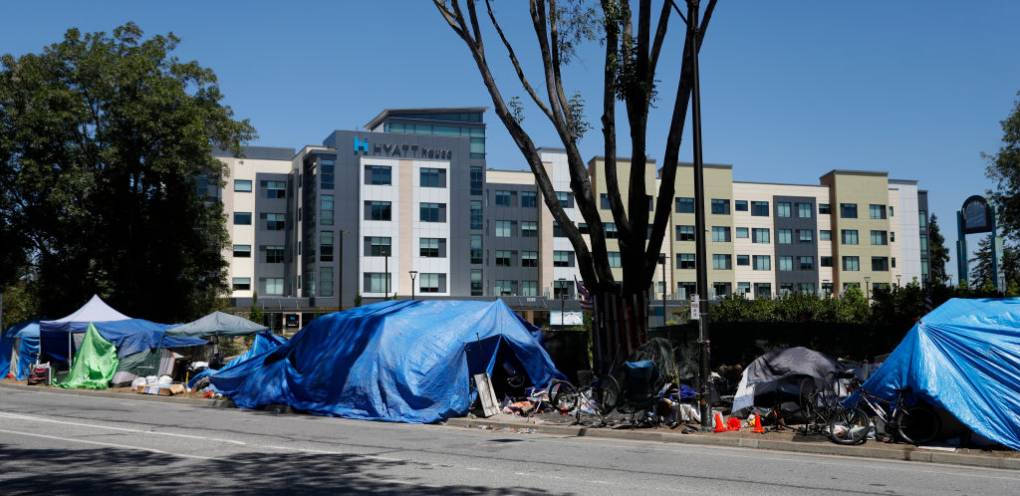
"caption": "A homeless encampment along Wolfe Road next to Vallco in Cupertino, May 26, 2020. In the background is the Hyatt House hotel.",
"description": null,
"title": "Cupertino homeless encampment",
"credit": "Nhat V. Meyer/MediaNews Group/The Mercury News via Getty Images",
"status": "inherit",
"altTag": "A blue tent by the side of a road with a modern Hyatt House hotel in the background.",
"isLoading": false,
"fetchFailed": false
},
"news_11940810": {
"type": "attachments",
"id": "news_11940810",
"meta": {
"index": "attachments_1716263798",
"site": "news",
"id": "11940810",
"found": true
},
"parent": 11940807,
"imgSizes": {
"twentyfourteen-full-width": {
"file": "https://ww2.kqed.org/app/uploads/sites/10/2023/02/011223-ST-MARYS-CENTER-MHN-03-CM-copy-1038x576.jpg",
"width": 1038,
"mimeType": "image/jpeg",
"height": 576
},
"thumbnail": {
"file": "https://ww2.kqed.org/app/uploads/sites/10/2023/02/011223-ST-MARYS-CENTER-MHN-03-CM-copy-160x107.jpg",
"width": 160,
"mimeType": "image/jpeg",
"height": 107
},
"post-thumbnail": {
"file": "https://ww2.kqed.org/app/uploads/sites/10/2023/02/011223-ST-MARYS-CENTER-MHN-03-CM-copy-672x372.jpg",
"width": 672,
"mimeType": "image/jpeg",
"height": 372
},
"kqedFullSize": {
"file": "https://ww2.kqed.org/app/uploads/sites/10/2023/02/011223-ST-MARYS-CENTER-MHN-03-CM-copy.jpg",
"width": 2000,
"height": 1333
},
"large": {
"file": "https://ww2.kqed.org/app/uploads/sites/10/2023/02/011223-ST-MARYS-CENTER-MHN-03-CM-copy-1020x680.jpg",
"width": 1020,
"mimeType": "image/jpeg",
"height": 680
},
"1536x1536": {
"file": "https://ww2.kqed.org/app/uploads/sites/10/2023/02/011223-ST-MARYS-CENTER-MHN-03-CM-copy-1536x1024.jpg",
"width": 1536,
"mimeType": "image/jpeg",
"height": 1024
},
"full-width": {
"file": "https://ww2.kqed.org/app/uploads/sites/10/2023/02/011223-ST-MARYS-CENTER-MHN-03-CM-copy-1920x1280.jpg",
"width": 1920,
"mimeType": "image/jpeg",
"height": 1280
},
"medium": {
"file": "https://ww2.kqed.org/app/uploads/sites/10/2023/02/011223-ST-MARYS-CENTER-MHN-03-CM-copy-800x533.jpg",
"width": 800,
"mimeType": "image/jpeg",
"height": 533
}
},
"publishDate": 1676153003,
"modified": 1676153155,
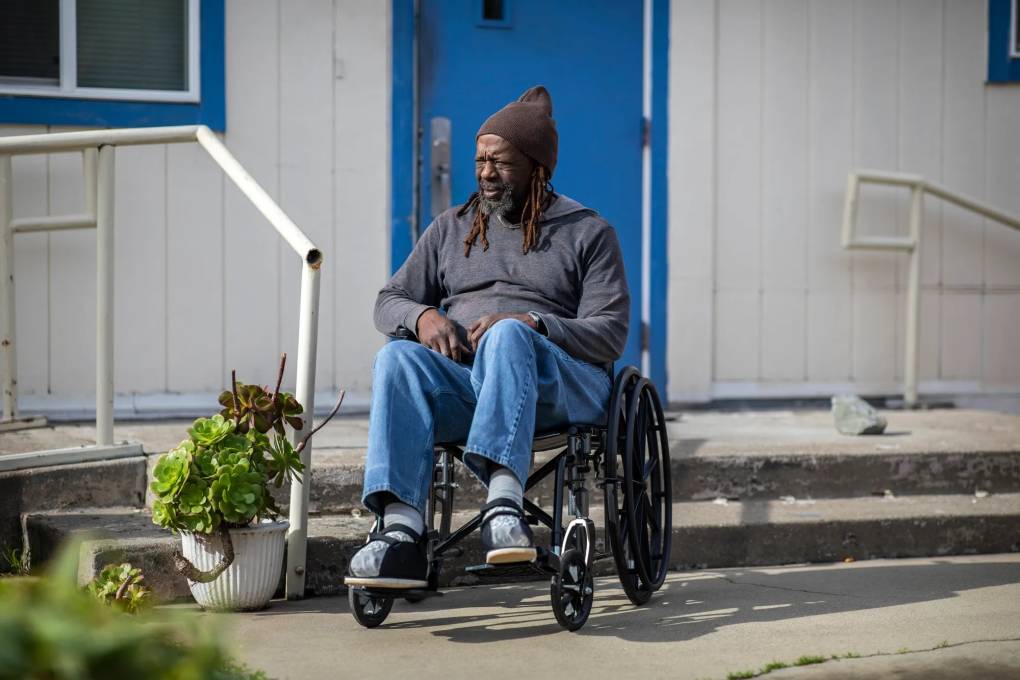
"caption": "Elbert Lee Jones Jr. outside the Closer to Home St. Mary's Center transitional housing in West Oakland on Jan. 12, 2023.",
"description": null,
"title": "011223-ST-MARYS-CENTER-MHN-03-CM copy",
"credit": "Martin do Nascimento/CalMatters",
"status": "inherit",
"altTag": "An older Black man in a wheelchair outsidea white house with a blue window and door.",
"isLoading": false,
"fetchFailed": false
},
"news_11940606": {
"type": "attachments",
"id": "news_11940606",
"meta": {
"index": "attachments_1716263798",
"site": "news",
"id": "11940606",
"found": true
},
"parent": 11940602,
"imgSizes": {
"twentyfourteen-full-width": {
"file": "https://ww2.kqed.org/app/uploads/sites/10/2023/02/GettyImages-1219595595-1024x576.jpg",
"width": 1024,
"mimeType": "image/jpeg",
"height": 576
},
"thumbnail": {
"file": "https://ww2.kqed.org/app/uploads/sites/10/2023/02/GettyImages-1219595595-160x105.jpg",
"width": 160,
"mimeType": "image/jpeg",
"height": 105
},
"post-thumbnail": {
"file": "https://ww2.kqed.org/app/uploads/sites/10/2023/02/GettyImages-1219595595-672x372.jpg",
"width": 672,
"mimeType": "image/jpeg",
"height": 372
},
"kqedFullSize": {
"file": "https://ww2.kqed.org/app/uploads/sites/10/2023/02/GettyImages-1219595595.jpg",
"width": 1024,
"height": 671
},
"large": {
"file": "https://ww2.kqed.org/app/uploads/sites/10/2023/02/GettyImages-1219595595-1020x668.jpg",
"width": 1020,
"mimeType": "image/jpeg",
"height": 668
},
"medium": {
"file": "https://ww2.kqed.org/app/uploads/sites/10/2023/02/GettyImages-1219595595-800x524.jpg",
"width": 800,
"mimeType": "image/jpeg",
"height": 524
}
},
"publishDate": 1675976348,
"modified": 1675989056,
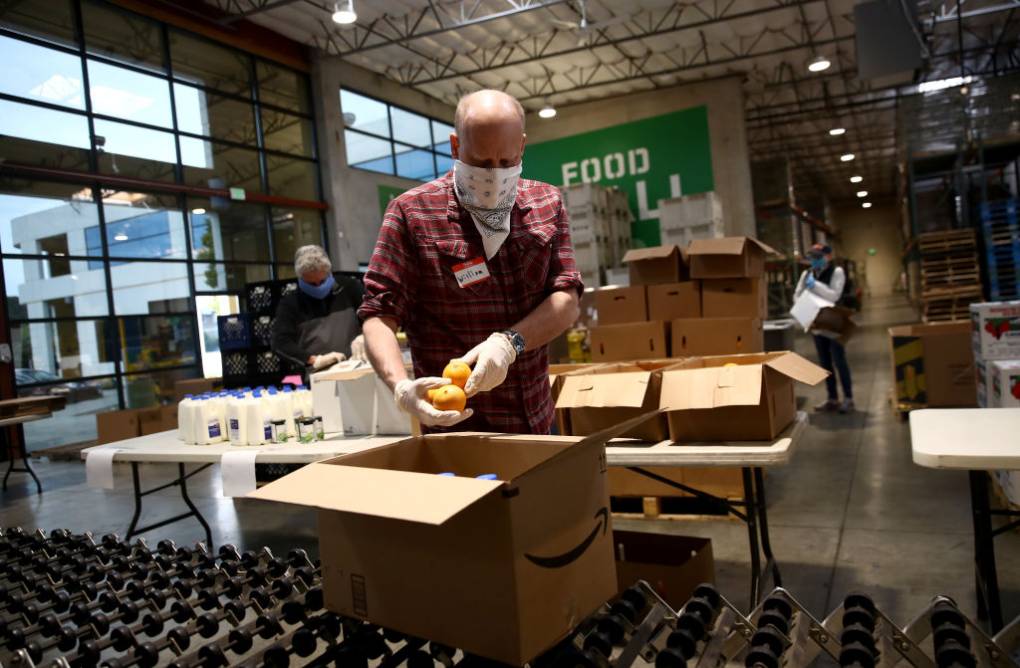
"caption": "Volunteers pack boxes full of food at the San Francisco-Marin Food Bank on April 18, 2020, in San Rafael.",
"description": "Second sentence previously was: The food bank is offering drive thru pickup on Saturday mornings during the Coronavirus (COVID-19) pandemic. ",
"title": "Food Pantry Offers Drive Thru Grocery Pickup During Coronavirus Pandemic",
"credit": "Ezra Shaw/Getty Images",
"status": "inherit",
"altTag": "A man wearing a white bandana, gloves and red shirt holds fruit in both hands over a cardboard box sitting on a conveyor belt inside a warehouse.",
"isLoading": false,
"fetchFailed": false
},
"news_11940535": {
"type": "attachments",
"id": "news_11940535",
"meta": {
"index": "attachments_1716263798",
"site": "news",
"id": "11940535",
"found": true
},
"parent": 11940489,
"imgSizes": {
"twentyfourteen-full-width": {
"file": "https://ww2.kqed.org/app/uploads/sites/10/2023/02/GettyImages-1076622970-1-1038x576.jpg",
"width": 1038,
"mimeType": "image/jpeg",
"height": 576
},
"thumbnail": {
"file": "https://ww2.kqed.org/app/uploads/sites/10/2023/02/GettyImages-1076622970-1-160x120.jpg",
"width": 160,
"mimeType": "image/jpeg",
"height": 120
},
"post-thumbnail": {
"file": "https://ww2.kqed.org/app/uploads/sites/10/2023/02/GettyImages-1076622970-1-672x372.jpg",
"width": 672,
"mimeType": "image/jpeg",
"height": 372
},
"kqedFullSize": {
"file": "https://ww2.kqed.org/app/uploads/sites/10/2023/02/GettyImages-1076622970-1-scaled.jpg",
"width": 2560,
"height": 1920
},
"2048x2048": {
"file": "https://ww2.kqed.org/app/uploads/sites/10/2023/02/GettyImages-1076622970-1-2048x1536.jpg",
"width": 2048,
"mimeType": "image/jpeg",
"height": 1536
},
"large": {
"file": "https://ww2.kqed.org/app/uploads/sites/10/2023/02/GettyImages-1076622970-1-1020x765.jpg",
"width": 1020,
"mimeType": "image/jpeg",
"height": 765
},
"1536x1536": {
"file": "https://ww2.kqed.org/app/uploads/sites/10/2023/02/GettyImages-1076622970-1-1536x1152.jpg",
"width": 1536,
"mimeType": "image/jpeg",
"height": 1152
},
"full-width": {
"file": "https://ww2.kqed.org/app/uploads/sites/10/2023/02/GettyImages-1076622970-1-1920x1440.jpg",
"width": 1920,
"mimeType": "image/jpeg",
"height": 1440
},
"medium": {
"file": "https://ww2.kqed.org/app/uploads/sites/10/2023/02/GettyImages-1076622970-1-800x600.jpg",
"width": 800,
"mimeType": "image/jpeg",
"height": 600
}
},
"publishDate": 1675905275,
"modified": 1675974637,
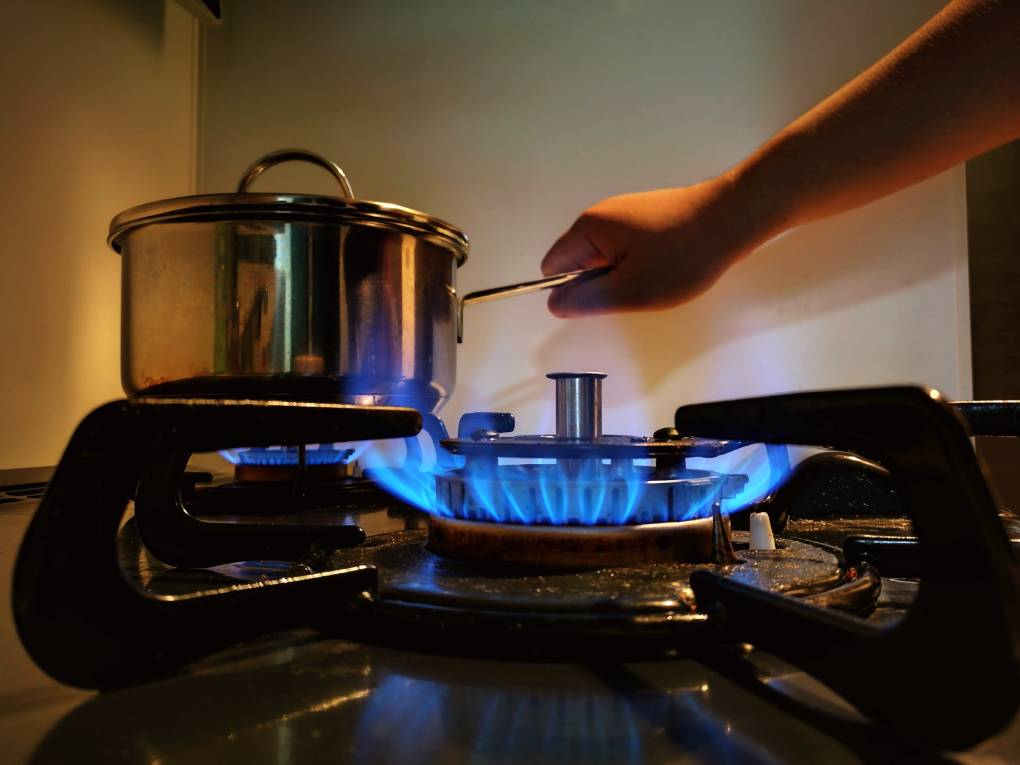
"caption": "A spike in natural gas prices has led to notably higher utility bills this winter for most California residents.",
"description": null,
"title": "Close-Up Of Woman Preparing Food In Kitchen At Home",
"credit": "Erano Bundoc/EyeEm via Getty Images",
"status": "inherit",
"altTag": "A woman's hand holds a pot over a blue flame from a gas stove.",
"isLoading": false,
"fetchFailed": false
},
"news_11940268": {
"type": "attachments",
"id": "news_11940268",
"meta": {
"index": "attachments_1716263798",
"site": "news",
"id": "11940268",
"found": true
},
"parent": 11940248,
"imgSizes": {
"twentyfourteen-full-width": {
"file": "https://ww2.kqed.org/app/uploads/sites/10/2023/02/120422-SENATE-SWEARING-IN-CM-MHN-11-CM-1038x576.jpg",
"width": 1038,
"mimeType": "image/jpeg",
"height": 576
},
"thumbnail": {
"file": "https://ww2.kqed.org/app/uploads/sites/10/2023/02/120422-SENATE-SWEARING-IN-CM-MHN-11-CM-160x107.jpg",
"width": 160,
"mimeType": "image/jpeg",
"height": 107
},
"post-thumbnail": {
"file": "https://ww2.kqed.org/app/uploads/sites/10/2023/02/120422-SENATE-SWEARING-IN-CM-MHN-11-CM-672x372.jpg",
"width": 672,
"mimeType": "image/jpeg",
"height": 372
},
"kqedFullSize": {
"file": "https://ww2.kqed.org/app/uploads/sites/10/2023/02/120422-SENATE-SWEARING-IN-CM-MHN-11-CM.jpg",
"width": 2000,
"height": 1333
},
"large": {
"file": "https://ww2.kqed.org/app/uploads/sites/10/2023/02/120422-SENATE-SWEARING-IN-CM-MHN-11-CM-1020x680.jpg",
"width": 1020,
"mimeType": "image/jpeg",
"height": 680
},
"1536x1536": {
"file": "https://ww2.kqed.org/app/uploads/sites/10/2023/02/120422-SENATE-SWEARING-IN-CM-MHN-11-CM-1536x1024.jpg",
"width": 1536,
"mimeType": "image/jpeg",
"height": 1024
},
"full-width": {
"file": "https://ww2.kqed.org/app/uploads/sites/10/2023/02/120422-SENATE-SWEARING-IN-CM-MHN-11-CM-1920x1280.jpg",
"width": 1920,
"mimeType": "image/jpeg",
"height": 1280
},
"medium": {
"file": "https://ww2.kqed.org/app/uploads/sites/10/2023/02/120422-SENATE-SWEARING-IN-CM-MHN-11-CM-800x533.jpg",
"width": 800,
"mimeType": "image/jpeg",
"height": 533
}
},
"publishDate": 1675724729,
"modified": 1675729242,
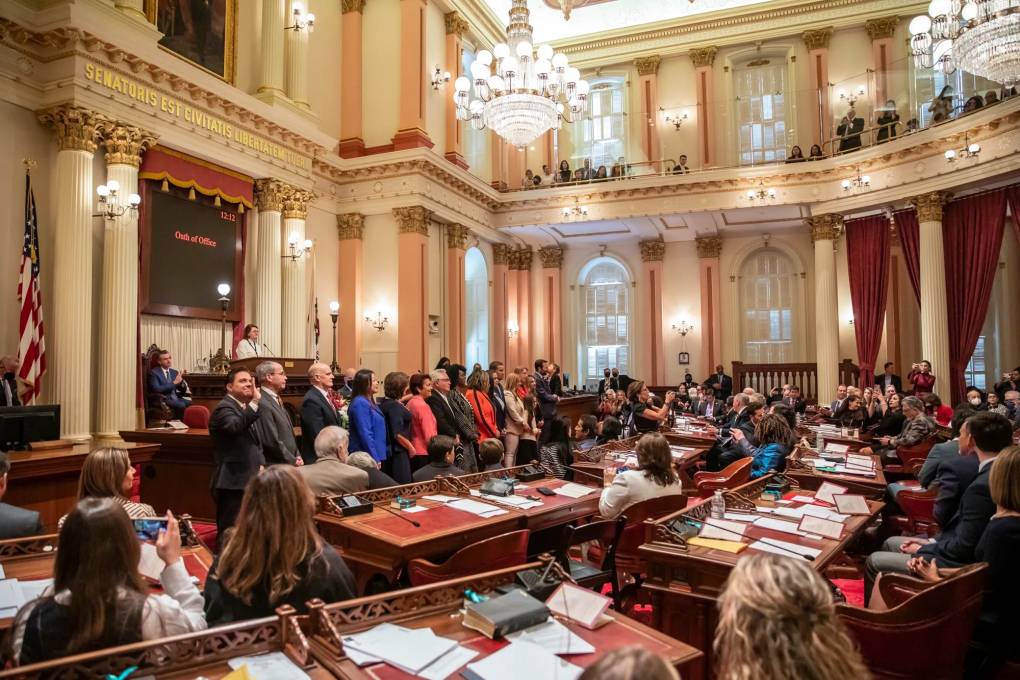
"caption": "New California legislators stand to take the oath of office in the Senate chambers in the state Capitol on Dec. 5, 2022.",
"description": null,
"title": "120422-SENATE-SWEARING-IN-CM-MHN-11-CM",
"credit": "Martin do Nascimento/CalMatters",
"status": "inherit",
"altTag": "A line of people in the California State Capitol Senate chambers stand in front of a room full of other people who are seated.",
"isLoading": false,
"fetchFailed": false
}
},
"audioPlayerReducer": {
"postId": "stream_live",
"isPaused": true,
"isPlaying": false,
"pfsActive": false,
"pledgeModalIsOpen": true,
"playerDrawerIsOpen": false,
"liveAudioPlayStartedAt": 0,
"liveAudioPlayContext": ""
},
"authorsReducer": {
"byline_news_11944063": {
"type": "authors",
"id": "byline_news_11944063",
"meta": {
"override": true
},
"slug": "byline_news_11944063",
"name": "\u003ca href=\"https://calmatters.org/author/mikhailzinshteyn/\">Mikhail Zinshteyn\u003c/a>",
"isLoading": false
},
"byline_news_11943590": {
"type": "authors",
"id": "byline_news_11943590",
"meta": {
"override": true
},
"slug": "byline_news_11943590",
"name": "\u003ca href=\"https://calmatters.org/author/laurenhepler/\">Lauren Hepler\u003c/a>, \u003ca href=\"https://calmatters.org/author/nicole-foy/\">Nicole Foy \u003c/a>, \u003ca href=\"https://calmatters.org/author/wendy-fry/\">Wendy Fry\u003c/a>",
"isLoading": false
},
"byline_news_11943454": {
"type": "authors",
"id": "byline_news_11943454",
"meta": {
"override": true
},
"slug": "byline_news_11943454",
"name": "\u003ca href=\"https://calmatters.org/author/grace-gedye/\">Grace Gedye\u003c/a>",
"isLoading": false
},
"byline_news_11943212": {
"type": "authors",
"id": "byline_news_11943212",
"meta": {
"override": true
},
"slug": "byline_news_11943212",
"name": "\u003ca href=\"https://calmatters.org/author/alastair-bland/\">Alastair Bland\u003c/a>",
"isLoading": false
},
"byline_news_11942959": {
"type": "authors",
"id": "byline_news_11942959",
"meta": {
"override": true
},
"slug": "byline_news_11942959",
"name": "\u003ca href=\"https://calmatters.org/author/nigelduara/\">Nigel Duara\u003c/a>",
"isLoading": false
},
"byline_news_11942915": {
"type": "authors",
"id": "byline_news_11942915",
"meta": {
"override": true
},
"slug": "byline_news_11942915",
"name": "\u003ca href=\"https://calmatters.org/author/julie-cart/\">Julie Cart\u003c/a>",
"isLoading": false
},
"byline_news_11942213": {
"type": "authors",
"id": "byline_news_11942213",
"meta": {
"override": true
},
"slug": "byline_news_11942213",
"name": "\u003ca href=\"https://calmatters.org/author/wendy-fry/\">Wendy Fry\u003c/a>",
"isLoading": false
},
"byline_news_11941322": {
"type": "authors",
"id": "byline_news_11941322",
"meta": {
"override": true
},
"slug": "byline_news_11941322",
"name": "\u003ca href=\"https://calmatters.org/author/alejandro-lazo/\">Alejandro Lazo\u003c/a>",
"isLoading": false
},
"byline_news_11940807": {
"type": "authors",
"id": "byline_news_11940807",
"meta": {
"override": true
},
"slug": "byline_news_11940807",
"name": "\u003ca href=\"https://calmatters.org/author/anaibarra/\">Ana B. Ibarra\u003c/a>",
"isLoading": false
},
"byline_news_11940602": {
"type": "authors",
"id": "byline_news_11940602",
"meta": {
"override": true
},
"slug": "byline_news_11940602",
"name": "\u003ca href=\"https://calmatters.org/author/jeanne-kuang/\">Jeanne Kuang\u003c/a>",
"isLoading": false
},
"byline_news_11940489": {
"type": "authors",
"id": "byline_news_11940489",
"meta": {
"override": true
},
"slug": "byline_news_11940489",
"name": "\u003ca href=\"https://calmatters.org/author/grace-gedye/\">Grace Gedye\u003c/a>",
"isLoading": false
},
"byline_news_11940248": {
"type": "authors",
"id": "byline_news_11940248",
"meta": {
"override": true
},
"slug": "byline_news_11940248",
"name": "\u003ca href=\"https://calmatters.org/author/sameea-kamal/\">Sameea Kamal\u003c/a>",
"isLoading": false
}
},
"pagesReducer": {
"news_affiliate_calmatters": {
"type": "terms",
"id": "news_18481",
"meta": {
"index": "terms_1716263798",
"site": "news",
"id": "18481",
"score": 15.355904
},
"featImg": null,
"name": "CALmatters",
"description": null,
"taxonomy": "affiliate",
"headData": {
"twImgId": null,
"twTitle": null,
"ogTitle": null,
"ogImgId": null,
"twDescription": null,
"description": null,
"title": "CALmatters Archives | KQED Arts",
"ogDescription": null
},
"ttid": 18515,
"slug": "calmatters",
"isLoading": false,
"title": "CALmatters",
"pageMeta": {
"site": "news",
"WpPageTemplate": "page-topic-editorial",
"currentPage": 50
},
"blocks": [
{
"blockName": "kqed/post-list",
"attrs": {
"layout": "cardArticle2",
"query": "posts/news?affiliate=calmatters",
"seeMore": false,
"paginated": true,
"page": 50
}
},
{
"blockName": "kqed/ad"
}
]
}
},
"pfsSessionReducer": {},
"postsReducer": {
"stream_live": {
"type": "live",
"id": "stream_live",
"audioUrl": "https://streams.kqed.org/kqedradio",
"title": "Live Stream",
"excerpt": "Live Stream information currently unavailable.",
"link": "/radio",
"featImg": "",
"label": {
"name": "KQED Live",
"link": "/"
}
},
"stream_kqedNewscast": {
"type": "posts",
"id": "stream_kqedNewscast",
"audioUrl": "https://www.kqed.org/.stream/anon/radio/RDnews/newscast.mp3?_=1",
"title": "KQED Newscast",
"featImg": "",
"label": {
"name": "88.5 FM",
"link": "/"
}
},
"news_11944063": {
"type": "posts",
"id": "news_11944063",
"meta": {
"index": "posts_1716263798",
"site": "news",
"id": "11944063",
"score": null,
"sort": [
1679263257000
]
},
"guestAuthors": [],
"slug": "states-promise-to-build-more-campus-housing-hits-setbacks",
"title": "State's Promise to Build More Campus Housing Hits Setbacks",
"publishDate": 1679263257,
"format": "standard",
"headTitle": "State’s Promise to Build More Campus Housing Hits Setbacks | KQED",
"labelTerm": {
"term": 18481,
"site": "news"
},
"content": "\u003cp>Campus housing: Students can’t get enough of it, and California public campuses can’t build dorm rooms fast enough.\u003c/p>\n\u003cp>And yet, Gov. Gavin Newsom has proposed delaying by a year \u003ca href=\"https://ebudget.ca.gov/2023-24/pdf/BudgetSummary/HigherEducation.pdf#page=7\">nearly $1.2 billion in loans and grants (PDF)\u003c/a> that would build housing for thousands of students at affordable rates — money the state promised campuses in last year’s state budget.\u003c/p>\n\u003cp>Newsom seeks the delay to help balance the state’s projected $22.5 billion budget deficit in 2023–24. But lawmakers who hold huge sway over higher-education finances are adamant that no money is pulled from the state’s recent, unprecedented \u003ca href=\"https://calmatters.org/education/higher-education/2022/07/student-housing-affordable-dorms/\">multibillion-dollar down payment\u003c/a> on affordable student housing.\u003c/p>\n\u003cp>Adding to the intrigue, the Legislature’s own top policy adviser, the Legislative Analyst’s Office, proposed that the state \u003ca href=\"https://calmatters.org/newsletters/2023/03/california-flood-reservoir-rain-snow/#:~:text=From%20CalMatters%20higher%20education%20reporter%20Mikhail%20Zinshteyn%3A\">completely drop its investment in student housing\u003c/a> or at least change how the money is spent. One such idea? Renege on \u003ca href=\"https://lao.ca.gov/reports/2023/4733/Student-Housing-030923.pdf#page=8\">a promise to continue sending community colleges grants (PDF)\u003c/a> to build more student housing for next year.[pullquote size=\"medium\" align=\"right\" citation=\"Assemblymember Kevin McCarty\"]‘This is such a priority for the Senate and the Assembly the last couple years and just checks so many boxes: Housing crisis, check. College affordability, check. Enrollment growth for students, check.’[/pullquote]Ultimately the state must have a balanced budget before June 30, but if the last three legislative budget hearings on higher education are any indication, how much — and when — to spend on student housing will be a key point of friction between the Democrat-controlled Legislature and Newsom.\u003c/p>\n\u003cp>The governor’s plans to delay housing funding is “something that we don’t support, and we’re going to be looking at other options,” said Assemblymember Kevin McCarty, a Democrat from Sacramento and chair of the Assembly’s budget subcommittee on education, at a Tuesday hearing.\u003c/p>\n\u003cp>“This is such a priority for the Senate and the Assembly the last couple years and just checks so many boxes: Housing crisis, check. College affordability, check. Enrollment growth for students, check,” he added.\u003c/p>\n\u003cp>If Newsom gets his way, the $750 million campus housing grants slated for 2023–24 would drop to $500 million, and the remaining $250 million would become available in 2024–25. And rather than spending a combined $1.8 billion on \u003ca href=\"https://calmatters.org/education/2022/01/student-housing-2/\">campus no-interest loans\u003c/a> in 2023–24 and 2024–25, Newsom proposed zero dollars in 2023–24 and spreading the funds across the subsequent two years.\u003c/p>\n\u003cp>“Effectively the governor’s budget maintains the overall funding commitment for these two student housing programs,” said Michelle Nguyen of the Department of Finance, an office in the governor’s administration. “But given the budget outlook, the governor’s budget proposes funding delays for these programs.”\u003c/p>\n\u003cp>That may be bad news for the \u003ca href=\"https://calmatters.org/multimedia/podcasts/gimme-shelter/2022/11/california-student-housing-crisis/\">hundreds of thousands of college students\u003c/a> in \u003ca href=\"https://calmatters.org/education/2022/01/student-housing-2/#:~:text=The%20system%20has%20made%20strides%3A\">desperate pursuit\u003c/a> of housing — even if these state efforts can build only a fraction of the living quarters survey data say is needed.\u003c/p>\n\u003cp>Sparing campus-housing funding from cuts is a bipartisan sentiment in the Legislature. It’s important that “we have the funding available and not delayed … in order to build housing necessary to accommodate those students in the universities, especially when the state is requiring a certain level of enrollment for each university,” said Sen. Rosilicie Ochoa Bogh, a Republican from Rancho Cucamonga, at a Senate subcommittee hearing last Thursday.\u003c/p>\n\u003cp>Thirty campuses remain unfazed and have submitted plans exceeding $2.1 billion to build as many as 12,700 additional dorm beds with low rents. The size of the projects varies, including 1,553 affordable beds at UC Riverside, 517 at San José State and 117 at Lassen Community College in northeastern California.\u003c/p>\n\u003cp>For the University of California, the state grants supplement plans to construct \u003ca href=\"https://regents.universityofcalifornia.edu/regmeet/mar23/j1.pdf#page=3\">an extra 22,000 beds by 2028 (PDF)\u003c/a>.\u003c/p>\n\u003cp>Included in the state grant mix is housing for UC graduate students — 236 dorm beds at UC Merced, a campus \u003ca href=\"https://calmatters.org/education/2023/01/uc-housing-problem-persists-for-graduate-students/\">with just nine beds for graduate students\u003c/a> at a time when affordable housing was a major rallying cry for \u003ca href=\"https://calmatters.org/education/higher-education/2023/01/six-takeaways-for-californians-after-the-uc-graduate-student-worker-strike/\">students striking late last fall\u003c/a>.\u003c/p>\n\u003cp>All told, the University of California’s \u003ca href=\"https://abgt.assembly.ca.gov/sites/abgt.assembly.ca.gov/files/March%2014%20Sub%202%20%20Agenda.pdf#page=4\">six grant proposals pencil out to about $108,000 per affordable bed (PDF)\u003c/a>; Cal State’s three projects \u003ca href=\"https://abgt.assembly.ca.gov/sites/abgt.assembly.ca.gov/files/March%2014%20Sub%202%20%20Agenda.pdf#page=4\">would cost $170,000 per bed (PDF)\u003c/a>; and the 21 plans submitted by community colleges — schools with little experience building student housing — \u003ca href=\"https://abgt.assembly.ca.gov/sites/abgt.assembly.ca.gov/files/March%2014%20Sub%202%20%20Agenda.pdf#page=5\">would cost $205,000 per bed (PDF)\u003c/a>. (Overall, last year’s approved state-funded dorms \u003ca href=\"https://calmatters.org/education/higher-education/2022/07/student-housing-affordable-dorms/#:~:text=affordable%20through%20the%20grant\">were slightly more expensive\u003c/a> per bed.)\u003c/p>\n\u003cp>Even if the Legislature and Newsom agree to pull no dollars from the housing grant in 2023–24, most of those plans will go unfunded by the program. That’s because last year’s spending road map called for pouring $750 million into the grant in 2023–24 — about a third of the money colleges and universities are seeking.[aside postID=\"news_11937658,news_11938865\" label=\"Related Posts\"]It’s a case of déjà vu: When the affordable housing grant program took applications from campuses for the first time in 2021, 42 campuses submitted construction bids totaling $2.8 billion — well above the \u003ca href=\"https://calmatters.org/education/higher-education/2022/07/student-housing-affordable-dorms/#:~:text=Lawmakers%20initially%20created%20a%20%24500%20million%20pot\">$500 million the state planned to spend\u003c/a>.\u003c/p>\n\u003cp>With the state eyeing \u003ca href=\"https://calmatters.org/politics/2022/05/newsom-budget-spending/\">a $100 billion budget surplus last year\u003c/a>, lawmakers and Newsom nearly tripled last year’s budget for the housing grant program, in part by advancing money from future budgets, ultimately greenlighting the construction of roughly 7,300 affordable residencies for students with lower incomes.\u003c/p>\n\u003cp>But with a \u003ca href=\"https://calmatters.org/california-budget/2023/01/california-budget-newsom-deficit/\">multibillion-dollar deficit\u003c/a> projected across several years, the state spending more to approve a larger number of projects isn’t likely this year. The Legislature and governor’s office will pick projects based on a rubric that takes into account details such as an area’s unmet need and the number of affordable beds new construction will create.\u003c/p>\n\u003cp>Plus, budgeting is an inexact science. The Cal State system is reporting that its construction costs for the nine dorms it sought to build last year rose by 14% between fall 2021 — when the system submitted their plans — and this January. A CSU senior official told lawmakers Tuesday that its campuses found most of the necessary outside funds, but the system still needs another $12 million in grant funds to pay for the projects approved last year.\u003c/p>\n\u003cp>UC also saw costs grow, but they’re paying for those internally, a university official told lawmakers yesterday. A court ruling \u003ca href=\"https://calmatters.org/newsletters/whatmatters/2023/02/california-cannabis-emerald-triangle/#:~:text=Is%20noise%20from%20student%20parties%20a%20type%20of%20pollution%3F%C2%A0\">stalling UC Berkeley’s housing plans\u003c/a> is another headwind for the UC.\u003cbr>\nCosts rising quickly is another reason some lawmakers don’t want to delay building student housing. It’s likely “that delays will increase costs and lessen the number of beds projects can deliver,” staff for the \u003ca href=\"https://abgt.assembly.ca.gov/sites/abgt.assembly.ca.gov/files/March%2014%20Sub%202%20%20Agenda.pdf#page=7\">Assembly’s budget subcommittee on education wrote (PDF)\u003c/a>.\u003c/p>\n\u003cp>Lawmakers also considered whether the state should fund the no-interest loan program rather than the housing grants for the upcoming year.\u003c/p>\n\u003cp>An official at the Legislative Analyst’s Office, \u003ca href=\"https://lao.ca.gov/reports/2023/4733/Student-Housing-030923.pdf#page=7\">which floated the idea in a report (PDF)\u003c/a>, said there’s some merit to that because campuses could build more affordable housing with the same amount of money under the loan program. Also, as campuses repay the state, the loan fund is replenished, allowing lawmakers to approve a new generation of campus housing.\u003c/p>\n\u003cp>But the analyst’s office warned that some campuses that budgeted to have grant dollars may not be able to afford their projects with just a loan at no interest. Also, it’s likely that dorms built with loan money — while still affordable — will have larger rents than grant-funded housing. Typically, campuses issue bonds to build dorms and repay those with interest.\u003c/p>\n\u003cp>McCarty also suggested that the state should pass on funding the dorm plans that community colleges submitted this year because they “aren’t ready for prime time.” He said the state could supply community colleges the money in 18 months to two years.\u003c/p>\n\u003cp>A senior official at the California Community Colleges Chancellor’s Office disputed that assertion. “All of these projects are not in an aspirational stage,” said Lizette Navarette, interim deputy chancellor. The plans submitted have “demonstrated need, a viable financial plan, community support and extensive student need.”\u003c/p>\n\u003cp>Meanwhile, some students don’t want to wait on the state to produce more housing: A coalition of student groups recently sponsored \u003ca href=\"https://ww2.kqed.org/news/2023/03/20/top-climate-scientists-warn-planet-on-track-for-catastrophic-warming-heres-what-world-leaders-can-do-now/\">a bill that would encourage more private developers to construct homes for students\u003c/a> off campus. \u003ca href=\"https://a36.asmdc.org/press-releases/20230315-assemblymember-eduardo-garcia-and-student-homes-coalition-announce\">Assemblymember Eduardo Garcia\u003c/a>, a Democrat from Coachella, is the author.\u003c/p>\n\u003cp>“The availability of off-campus housing is just as necessary,” said Zachariah Wooden, vice president for the Student Senate for California Community Colleges, at a press conference yesterday.\u003cbr>\n[ad fullwidth]\u003c/p>\n\u003cp>[ad floatright]\u003c/p>\n",
"blocks": [],
"excerpt": "Gov. Gavin Newsom wants to delay state funds to student housing because of the state's budget deficit. Lawmakers have different ideas on what kind of compromise might be reached.",
"status": "publish",
"parent": 0,
"modified": 1725922395,
"stats": {
"hasAudio": false,
"hasVideo": false,
"hasChartOrMap": false,
"iframeSrcs": [],
"hasGoogleForm": false,
"hasGallery": false,
"hasHearkenModule": false,
"hasPolis": false,
"paragraphCount": 27,
"wordCount": 1518
},
"headData": {
"title": "State's Promise to Build More Campus Housing Hits Setbacks | KQED",
"description": "Gov. Gavin Newsom wants to delay state funds to student housing because of the state's budget deficit. Lawmakers have different ideas on what kind of compromise might be reached.",
"ogTitle": "",
"ogDescription": "",
"ogImgId": "",
"twTitle": "",
"twDescription": "",
"twImgId": "",
"schema": {
"@context": "https://schema.org",
"@type": "NewsArticle",
"headline": "State's Promise to Build More Campus Housing Hits Setbacks",
"datePublished": "2023-03-19T15:00:57-07:00",
"dateModified": "2024-09-09T15:53:15-07:00",
"image": "https://cdn.kqed.org/wp-content/uploads/2020/02/KQED-OG-Image@1x.png",
"isAccessibleForFree": "True",
"publisher": {
"@type": "NewsMediaOrganization",
"@id": "https://www.kqed.org/#organization",
"name": "KQED",
"logo": "https://cdn.kqed.org/wp-content/uploads/2020/02/KQED-OG-Image@1x.png",
"url": "https://www.kqed.org",
"sameAs": [
"https://www.facebook.com/KQED",
"https://twitter.com/KQED",
"https://www.instagram.com/kqed/",
"https://www.tiktok.com/@kqedofficial",
"https://www.linkedin.com/company/kqed",
"https://www.youtube.com/channel/UCeC0IOo7i1P_61zVUWbJ4nw"
]
}
}
},
"sticky": false,
"nprByline": "\u003ca href=\"https://calmatters.org/author/mikhailzinshteyn/\">Mikhail Zinshteyn\u003c/a>",
"excludeFromSiteSearch": "Include",
"showOnAuthorArchivePages": "No",
"articleAge": "0",
"path": "/news/11944063/states-promise-to-build-more-campus-housing-hits-setbacks",
"audioTrackLength": null,
"parsedContent": [
{
"type": "contentString",
"content": "\u003cdiv class=\"post-body\">\u003cp>\u003cp>Campus housing: Students can’t get enough of it, and California public campuses can’t build dorm rooms fast enough.\u003c/p>\n\u003cp>And yet, Gov. Gavin Newsom has proposed delaying by a year \u003ca href=\"https://ebudget.ca.gov/2023-24/pdf/BudgetSummary/HigherEducation.pdf#page=7\">nearly $1.2 billion in loans and grants (PDF)\u003c/a> that would build housing for thousands of students at affordable rates — money the state promised campuses in last year’s state budget.\u003c/p>\n\u003cp>Newsom seeks the delay to help balance the state’s projected $22.5 billion budget deficit in 2023–24. But lawmakers who hold huge sway over higher-education finances are adamant that no money is pulled from the state’s recent, unprecedented \u003ca href=\"https://calmatters.org/education/higher-education/2022/07/student-housing-affordable-dorms/\">multibillion-dollar down payment\u003c/a> on affordable student housing.\u003c/p>\n\u003cp>Adding to the intrigue, the Legislature’s own top policy adviser, the Legislative Analyst’s Office, proposed that the state \u003ca href=\"https://calmatters.org/newsletters/2023/03/california-flood-reservoir-rain-snow/#:~:text=From%20CalMatters%20higher%20education%20reporter%20Mikhail%20Zinshteyn%3A\">completely drop its investment in student housing\u003c/a> or at least change how the money is spent. One such idea? Renege on \u003ca href=\"https://lao.ca.gov/reports/2023/4733/Student-Housing-030923.pdf#page=8\">a promise to continue sending community colleges grants (PDF)\u003c/a> to build more student housing for next year.\u003c/p>\u003c/div>",
"attributes": {
"named": {},
"numeric": []
}
},
{
"type": "component",
"content": "‘This is such a priority for the Senate and the Assembly the last couple years and just checks so many boxes: Housing crisis, check. College affordability, check. Enrollment growth for students, check.’",
"name": "pullquote",
"attributes": {
"named": {
"size": "medium",
"align": "right",
"citation": "Assemblymember Kevin McCarty",
"label": ""
},
"numeric": []
}
},
{
"type": "contentString",
"content": "\u003cdiv class=\"post-body\">\u003cp>Ultimately the state must have a balanced budget before June 30, but if the last three legislative budget hearings on higher education are any indication, how much — and when — to spend on student housing will be a key point of friction between the Democrat-controlled Legislature and Newsom.\u003c/p>\n\u003cp>The governor’s plans to delay housing funding is “something that we don’t support, and we’re going to be looking at other options,” said Assemblymember Kevin McCarty, a Democrat from Sacramento and chair of the Assembly’s budget subcommittee on education, at a Tuesday hearing.\u003c/p>\n\u003cp>“This is such a priority for the Senate and the Assembly the last couple years and just checks so many boxes: Housing crisis, check. College affordability, check. Enrollment growth for students, check,” he added.\u003c/p>\n\u003cp>If Newsom gets his way, the $750 million campus housing grants slated for 2023–24 would drop to $500 million, and the remaining $250 million would become available in 2024–25. And rather than spending a combined $1.8 billion on \u003ca href=\"https://calmatters.org/education/2022/01/student-housing-2/\">campus no-interest loans\u003c/a> in 2023–24 and 2024–25, Newsom proposed zero dollars in 2023–24 and spreading the funds across the subsequent two years.\u003c/p>\n\u003cp>“Effectively the governor’s budget maintains the overall funding commitment for these two student housing programs,” said Michelle Nguyen of the Department of Finance, an office in the governor’s administration. “But given the budget outlook, the governor’s budget proposes funding delays for these programs.”\u003c/p>\n\u003cp>That may be bad news for the \u003ca href=\"https://calmatters.org/multimedia/podcasts/gimme-shelter/2022/11/california-student-housing-crisis/\">hundreds of thousands of college students\u003c/a> in \u003ca href=\"https://calmatters.org/education/2022/01/student-housing-2/#:~:text=The%20system%20has%20made%20strides%3A\">desperate pursuit\u003c/a> of housing — even if these state efforts can build only a fraction of the living quarters survey data say is needed.\u003c/p>\n\u003cp>Sparing campus-housing funding from cuts is a bipartisan sentiment in the Legislature. It’s important that “we have the funding available and not delayed … in order to build housing necessary to accommodate those students in the universities, especially when the state is requiring a certain level of enrollment for each university,” said Sen. Rosilicie Ochoa Bogh, a Republican from Rancho Cucamonga, at a Senate subcommittee hearing last Thursday.\u003c/p>\n\u003cp>Thirty campuses remain unfazed and have submitted plans exceeding $2.1 billion to build as many as 12,700 additional dorm beds with low rents. The size of the projects varies, including 1,553 affordable beds at UC Riverside, 517 at San José State and 117 at Lassen Community College in northeastern California.\u003c/p>\n\u003cp>For the University of California, the state grants supplement plans to construct \u003ca href=\"https://regents.universityofcalifornia.edu/regmeet/mar23/j1.pdf#page=3\">an extra 22,000 beds by 2028 (PDF)\u003c/a>.\u003c/p>\n\u003cp>Included in the state grant mix is housing for UC graduate students — 236 dorm beds at UC Merced, a campus \u003ca href=\"https://calmatters.org/education/2023/01/uc-housing-problem-persists-for-graduate-students/\">with just nine beds for graduate students\u003c/a> at a time when affordable housing was a major rallying cry for \u003ca href=\"https://calmatters.org/education/higher-education/2023/01/six-takeaways-for-californians-after-the-uc-graduate-student-worker-strike/\">students striking late last fall\u003c/a>.\u003c/p>\n\u003cp>All told, the University of California’s \u003ca href=\"https://abgt.assembly.ca.gov/sites/abgt.assembly.ca.gov/files/March%2014%20Sub%202%20%20Agenda.pdf#page=4\">six grant proposals pencil out to about $108,000 per affordable bed (PDF)\u003c/a>; Cal State’s three projects \u003ca href=\"https://abgt.assembly.ca.gov/sites/abgt.assembly.ca.gov/files/March%2014%20Sub%202%20%20Agenda.pdf#page=4\">would cost $170,000 per bed (PDF)\u003c/a>; and the 21 plans submitted by community colleges — schools with little experience building student housing — \u003ca href=\"https://abgt.assembly.ca.gov/sites/abgt.assembly.ca.gov/files/March%2014%20Sub%202%20%20Agenda.pdf#page=5\">would cost $205,000 per bed (PDF)\u003c/a>. (Overall, last year’s approved state-funded dorms \u003ca href=\"https://calmatters.org/education/higher-education/2022/07/student-housing-affordable-dorms/#:~:text=affordable%20through%20the%20grant\">were slightly more expensive\u003c/a> per bed.)\u003c/p>\n\u003cp>Even if the Legislature and Newsom agree to pull no dollars from the housing grant in 2023–24, most of those plans will go unfunded by the program. That’s because last year’s spending road map called for pouring $750 million into the grant in 2023–24 — about a third of the money colleges and universities are seeking.\u003c/p>\u003c/div>",
"attributes": {
"named": {},
"numeric": []
}
},
{
"type": "component",
"content": "",
"name": "aside",
"attributes": {
"named": {
"postid": "news_11937658,news_11938865",
"label": "Related Posts "
},
"numeric": []
}
},
{
"type": "contentString",
"content": "\u003cdiv class=\"post-body\">\u003cp>It’s a case of déjà vu: When the affordable housing grant program took applications from campuses for the first time in 2021, 42 campuses submitted construction bids totaling $2.8 billion — well above the \u003ca href=\"https://calmatters.org/education/higher-education/2022/07/student-housing-affordable-dorms/#:~:text=Lawmakers%20initially%20created%20a%20%24500%20million%20pot\">$500 million the state planned to spend\u003c/a>.\u003c/p>\n\u003cp>With the state eyeing \u003ca href=\"https://calmatters.org/politics/2022/05/newsom-budget-spending/\">a $100 billion budget surplus last year\u003c/a>, lawmakers and Newsom nearly tripled last year’s budget for the housing grant program, in part by advancing money from future budgets, ultimately greenlighting the construction of roughly 7,300 affordable residencies for students with lower incomes.\u003c/p>\n\u003cp>But with a \u003ca href=\"https://calmatters.org/california-budget/2023/01/california-budget-newsom-deficit/\">multibillion-dollar deficit\u003c/a> projected across several years, the state spending more to approve a larger number of projects isn’t likely this year. The Legislature and governor’s office will pick projects based on a rubric that takes into account details such as an area’s unmet need and the number of affordable beds new construction will create.\u003c/p>\n\u003cp>Plus, budgeting is an inexact science. The Cal State system is reporting that its construction costs for the nine dorms it sought to build last year rose by 14% between fall 2021 — when the system submitted their plans — and this January. A CSU senior official told lawmakers Tuesday that its campuses found most of the necessary outside funds, but the system still needs another $12 million in grant funds to pay for the projects approved last year.\u003c/p>\n\u003cp>UC also saw costs grow, but they’re paying for those internally, a university official told lawmakers yesterday. A court ruling \u003ca href=\"https://calmatters.org/newsletters/whatmatters/2023/02/california-cannabis-emerald-triangle/#:~:text=Is%20noise%20from%20student%20parties%20a%20type%20of%20pollution%3F%C2%A0\">stalling UC Berkeley’s housing plans\u003c/a> is another headwind for the UC.\u003cbr>\nCosts rising quickly is another reason some lawmakers don’t want to delay building student housing. It’s likely “that delays will increase costs and lessen the number of beds projects can deliver,” staff for the \u003ca href=\"https://abgt.assembly.ca.gov/sites/abgt.assembly.ca.gov/files/March%2014%20Sub%202%20%20Agenda.pdf#page=7\">Assembly’s budget subcommittee on education wrote (PDF)\u003c/a>.\u003c/p>\n\u003cp>Lawmakers also considered whether the state should fund the no-interest loan program rather than the housing grants for the upcoming year.\u003c/p>\n\u003cp>An official at the Legislative Analyst’s Office, \u003ca href=\"https://lao.ca.gov/reports/2023/4733/Student-Housing-030923.pdf#page=7\">which floated the idea in a report (PDF)\u003c/a>, said there’s some merit to that because campuses could build more affordable housing with the same amount of money under the loan program. Also, as campuses repay the state, the loan fund is replenished, allowing lawmakers to approve a new generation of campus housing.\u003c/p>\n\u003cp>But the analyst’s office warned that some campuses that budgeted to have grant dollars may not be able to afford their projects with just a loan at no interest. Also, it’s likely that dorms built with loan money — while still affordable — will have larger rents than grant-funded housing. Typically, campuses issue bonds to build dorms and repay those with interest.\u003c/p>\n\u003cp>McCarty also suggested that the state should pass on funding the dorm plans that community colleges submitted this year because they “aren’t ready for prime time.” He said the state could supply community colleges the money in 18 months to two years.\u003c/p>\n\u003cp>A senior official at the California Community Colleges Chancellor’s Office disputed that assertion. “All of these projects are not in an aspirational stage,” said Lizette Navarette, interim deputy chancellor. The plans submitted have “demonstrated need, a viable financial plan, community support and extensive student need.”\u003c/p>\n\u003cp>Meanwhile, some students don’t want to wait on the state to produce more housing: A coalition of student groups recently sponsored \u003ca href=\"https://ww2.kqed.org/news/2023/03/20/top-climate-scientists-warn-planet-on-track-for-catastrophic-warming-heres-what-world-leaders-can-do-now/\">a bill that would encourage more private developers to construct homes for students\u003c/a> off campus. \u003ca href=\"https://a36.asmdc.org/press-releases/20230315-assemblymember-eduardo-garcia-and-student-homes-coalition-announce\">Assemblymember Eduardo Garcia\u003c/a>, a Democrat from Coachella, is the author.\u003c/p>\n\u003cp>“The availability of off-campus housing is just as necessary,” said Zachariah Wooden, vice president for the Student Senate for California Community Colleges, at a press conference yesterday.\u003cbr>\n\u003c/p>\u003c/div>",
"attributes": {
"named": {},
"numeric": []
}
},
{
"type": "component",
"content": "",
"name": "ad",
"attributes": {
"named": {
"label": "fullwidth"
},
"numeric": [
"fullwidth"
]
}
},
{
"type": "contentString",
"content": "\u003cdiv class=\"post-body\">\u003cp>\u003c/p>\n\u003cp>\u003c/p>\u003c/div>",
"attributes": {
"named": {},
"numeric": []
}
},
{
"type": "component",
"content": "",
"name": "ad",
"attributes": {
"named": {
"label": "floatright"
},
"numeric": [
"floatright"
]
}
},
{
"type": "contentString",
"content": "\u003cdiv class=\"post-body\">\u003cp>\u003c/p>\n\u003c/div>\u003c/p>",
"attributes": {
"named": {},
"numeric": []
}
}
],
"link": "/news/11944063/states-promise-to-build-more-campus-housing-hits-setbacks",
"authors": [
"byline_news_11944063"
],
"categories": [
"news_6266",
"news_8"
],
"tags": [
"news_20334",
"news_1775",
"news_17968",
"news_17597"
],
"affiliates": [
"news_18481"
],
"featImg": "news_11944067",
"label": "news_18481"
},
"news_11943590": {
"type": "posts",
"id": "news_11943590",
"meta": {
"index": "posts_1716263798",
"site": "news",
"id": "11943590",
"score": null,
"sort": [
1678971642000
]
},
"guestAuthors": [],
"slug": "thousands-of-californians-arent-eligible-for-federal-aid-after-storms-heres-why",
"title": "Thousands of Californians Aren't Eligible for Federal Aid After Storms. Here's Why",
"publishDate": 1678971642,
"format": "standard",
"headTitle": "Thousands of Californians Aren’t Eligible for Federal Aid After Storms. Here’s Why | KQED",
"labelTerm": {
"term": 18481,
"site": "news"
},
"content": "\u003cp>It was late Friday morning when muddy, brown water started rushing onto Michelle Hackett’s Salinas Valley farms.\u003c/p>\n\u003cp>On one side of her family’s Riverview Farms cannabis business, a county-mandated retention pond overflowed. Next door, a farm abandoned by another grower — one of \u003ca href=\"https://calmatters.org/politics/2023/02/emerald-triangle-cannabis-communities/\">dozens of cannabis businesses to shut down in Monterey County\u003c/a> in recent years — spawned another small river headed straight for Hackett and her skeleton crew.\u003c/p>\n\u003cp>“The water completely stopped and backed up,” Hackett said. “I thought, ‘Holy s—, this is going to flood our greenhouses.’”\u003c/p>\n\u003cp>Cannabis businesses like Hackett’s — along with thousands of undocumented farmworkers and the area’s unhoused residents — fear they’ll be left to fend for themselves as yet another winter storm batters California’s Central Coast, local officials and advocates say.\u003c/p>\n\u003cp>[ad fullwidth]\u003c/p>\n\u003cp>Undocumented workers and cannabis businesses are, by law, ineligible for federally funded programs such as unemployment or aid from the Federal Emergency Management Agency.\u003c/p>\n\u003cp>Now — after days of wind and rain and a Pajaro River levee failure flooded the area, displacing hundreds of people in Monterey County alone — details are lacking about how state officials would respond to calls to direct state funds and other disaster relief to these communities in the region known as \u003ca href=\"https://asmith.ucdavis.edu/news/whither-salinas-valley#:~:text=Salinas%20Valley%20grows%20almost%20half,over%2080%25%20of%20its%20artichokes.\">America’s salad bowl\u003c/a>.\u003c/p>\n\u003cp>California has stepped into the breach before, offering some \u003ca href=\"https://www.gov.ca.gov/2020/04/15/governor-newsom-announces-new-initiatives-to-support-california-workers-impacted-by-covid-19/\">support to undocumented workers\u003c/a> during the height of the \u003ca href=\"https://calmatters.org/california-divide/2022/04/california-undocumented-immigrants/\">COVID-19 pandemic\u003c/a>, and to some cannabis farmers whose crops were \u003ca href=\"https://cannabis.ca.gov/resources/disaster-relief-programs/\">damaged in wildfires\u003c/a>.\u003c/p>\n\u003cp>It’s an issue complicated by competing political priorities and a projected \u003ca href=\"https://calmatters.org/california-divide/2022/12/california-budget-deficit-safety-net/\">$24 billion state budget deficit\u003c/a> for the coming year.\u003c/p>\n\u003cp>Gov. Gavin Newsom is scheduled to survey flood and storm damage in Monterey County on March 15, including the inundated farmworker town of Pajaro. He will be getting an update from local officials, a spokesperson said.\u003c/p>\n\u003cp>As Newsom planned his visit, many officials and advocates said they hope to hear how the state will help. A few lawmakers said they’re exploring legislative options.\u003c/p>\n\u003cfigure id=\"attachment_11943670\" class=\"wp-caption aligncenter\" style=\"max-width: 2560px\">\u003cimg loading=\"lazy\" decoding=\"async\" class=\"size-full wp-image-11943670\" src=\"https://ww2.kqed.org/app/uploads/sites/10/2023/03/GettyImages-1248040438-scaled.jpg\" alt=\"An aerial view shows many buildings, homes, streets and cars flooded with brown water.\" width=\"2560\" height=\"1430\" srcset=\"https://cdn.kqed.org/wp-content/uploads/sites/10/2023/03/GettyImages-1248040438-scaled.jpg 2560w, https://cdn.kqed.org/wp-content/uploads/sites/10/2023/03/GettyImages-1248040438-800x447.jpg 800w, https://cdn.kqed.org/wp-content/uploads/sites/10/2023/03/GettyImages-1248040438-1020x570.jpg 1020w, https://cdn.kqed.org/wp-content/uploads/sites/10/2023/03/GettyImages-1248040438-160x89.jpg 160w, https://cdn.kqed.org/wp-content/uploads/sites/10/2023/03/GettyImages-1248040438-1536x858.jpg 1536w, https://cdn.kqed.org/wp-content/uploads/sites/10/2023/03/GettyImages-1248040438-2048x1144.jpg 2048w, https://cdn.kqed.org/wp-content/uploads/sites/10/2023/03/GettyImages-1248040438-1920x1072.jpg 1920w\" sizes=\"auto, (max-width: 2560px) 100vw, 2560px\">\u003cfigcaption class=\"wp-caption-text\">An aerial view shows a flooded neighborhood in the unincorporated community of Pajaro in Watsonville, on March 11, 2023. Residents were forced to evacuate in the middle of the night after an atmospheric river storm surge broke the Pajaro levee and sent floodwaters flowing into the community. \u003ccite>(Josh Edelson/Getty Images)\u003c/cite>\u003c/figcaption>\u003c/figure>\n\u003cp>“I think we need to step up our efforts to help those who are undocumented and can’t earn a paycheck because of the current rains and floods,” said Assemblymember Miguel Santiago, a Democrat representing Los Angeles.\u003c/p>\n\u003cp>He is co-sponsoring \u003ca href=\"https://leginfo.legislature.ca.gov/faces/billTextClient.xhtml?bill_id=202320240SB227\">Senate Bill 227\u003c/a> to provide \u003ca href=\"https://calmatters.org/california-divide/2023/02/california-safety-net/\">unemployment benefits\u003c/a> to undocumented Californians. About \u003ca href=\"https://clc.ucmerced.edu/sites/clc.ucmerced.edu/files/page/documents/fwhs_report_2.2.2383.pdf?_gl=1*pc2ynm*_ga*MTQ2ODM4OTYwMC4xNjc1Mzg4NTc3*_ga_TSE2LSBDQZ*MTY3ODg0OTMxNC4zLjEuMTY3ODg0OTMyMS41My4wLjA.\">6 in 10 farmworkers are not eligible for unemployment benefits (PDF)\u003c/a>, according to studies.\u003c/p>\n\u003cp>Santiago said the current situation is frustrating because he has advocated for years for more safety-net programs that could have helped families hurt by the flooding. If such legislation were in place, he said, “we’d be able to have a place where we could go get people some financial relief.”\u003c/p>\n\u003cp>[pullquote size=\"medium\" align=\"right\" citation=\"Assemblymember Miguel Santiago (D-Los Angeles)\"]‘I think we need to step up our efforts to help those who are undocumented and can’t earn a paycheck because of the current rains and floods.’[/pullquote]\u003c/p>\n\u003cp>Assemblymember Robert Rivas of Salinas, chosen by his fellow Democrats to be the next Assembly Speaker, noted in a statement to CalMatters that undocumented workers typically don’t qualify for federal assistance funds for emergency housing, home repairs, personal property loss, funeral expenses and other aid.\u003c/p>\n\u003cp>“My office, in collaboration with other legislative offices, is exploring immediate legislative and budget action to provide relief for these vulnerable communities,” Rivas said, noting that the workers also had been ineligible for many COVID-19 relief programs.\u003c/p>\n\u003cp>The state began filling some of that gap during the pandemic. Undocumented workers were eligible for $1,700 in state funds: a $500 COVID-19 disaster relief prepaid card and $1,200 from the Golden State Stimulus Fund.\u003c/p>\n\u003cp>Tuesday afternoon, groups of people remained in tents along the flooded Pajaro River. Despite large federal and state housing budgets, many of those people don’t have homes.\u003c/p>\n\u003cp>Many farmworker families in the flooded region are undocumented, from Indigenous groups, and don’t speak either English or Spanish well, said Eloy Ortiz, board member for the Watsonville-based \u003ca href=\"https://farmworkerfamily.org/board-of-directors\">Center for Farmworker Families\u003c/a>.\u003c/p>\n\u003cp>That complicates attempts to apply for assistance on behalf of the legal residents in their household. Some were rejected when they applied for aid in January, Ortiz said.\u003c/p>\n\u003cp>“The folks who have been flooded out, if it were a normal year, they’d be starting to go back to the fields to work right now,” Ortiz said. “And now they will probably not be able to go back for months.”\u003c/p>\n\u003cp>[aside label='California Storm Coverage' tag='california-storm']\u003c/p>\n\u003cp>More than 20,000 acres of agricultural land in Monterey County will likely sit fallow because of stormwater contamination, noted Monterey County Supervisor Luis Alejo, a former Assembly member from Watsonville, in a tweet.\u003c/p>\n\u003cp>“These are low-income Latino families, and the start of the harvest season for strawberries, raspberries and other crops is in March. Now farmworkers will be out of work,” he wrote Tuesday.\u003c/p>\n\u003cp>“I urge our state leaders to provide aid in the state budget for undocumented flood victims who do not qualify for FEMA assistance & additional relief for farmworkers who will be out of work due to flooded ag fields and not qualifying for unemployment insurance,” he wrote.\u003c/p>\n\u003cp>“The financial pain they will face will be severe & prolonged!”\u003c/p>\n\u003cp>As many as 8,500 people were under flood evacuation warnings in Monterey County over the weekend. The California Governor’s Office of Emergency Services \u003ca href=\"https://news.caloes.ca.gov/shelters-available-for-residents-impacted-by-march-storms-03-14-23/\">reported that more than 300 people had stayed in five shelters across Santa Cruz and Monterey counties\u003c/a> Monday night, the vast majority taking shelter at the Santa Cruz County Fairgrounds.\u003c/p>\n\u003cp>https://twitter.com/SupervisorAlejo/status/1635917913394937857\u003c/p>\n\u003cp>In Salinas, Hackett, 32, said her choice was simple as the storm bore down: save herself, or say goodbye to a crop that has already weathered a steep drop in prices and other industry pressures. At least 56 cannabis businesses have closed in Monterey County in recent years, according to a recent estimate.\u003c/p>\n\u003cp>As the water rose Friday morning, Hackett and her team who normally would be busy trimming plants or readying retail products instead shut down early to reinforce storm ditches and forge cement slabs into an impromptu flood wall.\u003c/p>\n\u003cp>On Tuesday, as another storm knocked out power at her two adjacent 10-acre farms, Hackett said she is unaware of any aid available for cannabis businesses affected by flooding.\u003c/p>\n\u003cp>“Ideally if we were any other business, we would have immediately had help,” Hackett said. “Whether it be the county, whether it be the state — someone needs to be held accountable.”\u003c/p>\n\u003cp>Longer term, Hackett said she fears climate change and economic obstacles will point her industry toward the same downward trajectory that wiped out many of the flower growers who once thrived in the same Monterey County greenhouses.\u003c/p>\n\u003cfigure id=\"attachment_11943673\" class=\"wp-caption aligncenter\" style=\"max-width: 2560px\">\u003cimg loading=\"lazy\" decoding=\"async\" class=\"size-full wp-image-11943673\" src=\"https://ww2.kqed.org/app/uploads/sites/10/2023/03/RS21243_Grow-scaled.jpg\" alt=\"Rows of bright green cannabis plants inside a greenhouse during the daytime.\" width=\"2560\" height=\"1920\" srcset=\"https://cdn.kqed.org/wp-content/uploads/sites/10/2023/03/RS21243_Grow-scaled.jpg 2560w, https://cdn.kqed.org/wp-content/uploads/sites/10/2023/03/RS21243_Grow-800x600.jpg 800w, https://cdn.kqed.org/wp-content/uploads/sites/10/2023/03/RS21243_Grow-1020x765.jpg 1020w, https://cdn.kqed.org/wp-content/uploads/sites/10/2023/03/RS21243_Grow-160x120.jpg 160w, https://cdn.kqed.org/wp-content/uploads/sites/10/2023/03/RS21243_Grow-1536x1152.jpg 1536w, https://cdn.kqed.org/wp-content/uploads/sites/10/2023/03/RS21243_Grow-2048x1536.jpg 2048w, https://cdn.kqed.org/wp-content/uploads/sites/10/2023/03/RS21243_Grow-1920x1440.jpg 1920w\" sizes=\"auto, (max-width: 2560px) 100vw, 2560px\">\u003cfigcaption class=\"wp-caption-text\">The inside of a cannabis greenhouse. \u003ccite>(Sam Harnett/KQED)\u003c/cite>\u003c/figcaption>\u003c/figure>\n\u003cp>She isn’t alone in her frustrations.\u003c/p>\n\u003cp>Joey Espinoza, a Salinas-raised cannabis compliance consultant, said several of his clients were directly affected by floodwaters, including one grower who had to evacuate plants from a flooded greenhouse. Even while the ground was still muddy, he said, many cannabis farmers have turned their attention to other pressing challenges in the industry.\u003c/p>\n\u003cp>As cannabis remains illegal at the national level, Espinoza said, local growers shut out of federal financial aid are now confronting storm damage after a collapse in cannabis prices and while facing a tight deadline to apply for new state licenses by the end of the year.\u003c/p>\n\u003cp>Industry advocates say\u003ca href=\"https://calmatters.org/politics/2023/02/emerald-triangle-cannabis-communities/\"> the economic turmoil\u003c/a> stems from a mix of overproduction of legal and illegal cannabis, as well as ever-changing taxes and regulations.\u003c/p>\n\u003cp>“There’s layers of issues with all of this,” Espinoza said. “And the thing to remember is, there’s not gonna be a lot of relief for cannabis in terms of FEMA and things like that.”\u003c/p>\n\u003cp>It was unclear exactly what the state might do.\u003c/p>\n\u003cp>The California Department of Cannabis Control told CalMatters that, under current state law, \u003ca href=\"https://cannabis.ca.gov/resources/disaster-relief-programs/\">cannabis businesses affected by disasters may apply for temporary waivers of license requirements\u003c/a> if they become unable to meet regulatory requirements. State \u003ca href=\"https://cannabis.ca.gov/applicants/application-resources/\">licensing rules\u003c/a> govern everything from sometimes-costly infrastructure requirements to the way products are transported and secured.\u003c/p>\n\u003cp>“All requests are reviewed on a case-by-case basis and aim to provide regulatory relief to licensees for impacts related to issues including flooding,” said David Hafner, department spokesperson.\u003c/p>\n\u003cp>In the past the \u003ca href=\"https://cannabis.ca.gov/2021/09/disaster-relief-for-cannabis-businesses-affected-by-fires/\">department has offered support for cannabis growers\u003c/a> affected by wildfires.\u003c/p>\n\u003cp>Few lawmakers voiced ideas.\u003c/p>\n\u003cp>In the meantime, some residents took matters into their own hands.\u003c/p>\n\u003cp>Gabino Orozco Avila was getting ready to serve dinner to neighbors gathered on a walkway above the rushing Pajaro River late Tuesday afternoon, a stone’s throw from his daughter’s home in Pajaro. While his daughter remained evacuated, Avila, owner of a longtime food business, Tacos Los Jacona — a nod to his Michoacán hometown — had prepared carne asada, rice and beans for the community that had long supported him.\u003c/p>\n\u003cp>“Now that people need me,” he said in Spanish, “I’ll be here.”\u003c/p>\n\u003cp>[ad floatright]\u003c/p>\n",
"blocks": [],
"excerpt": "Many cannabis farms and undocumented farmworkers lost their homes and livelihoods, yet they won't qualify for federal help. Will legislators and Gov. Gavin Newsom, who's expected to visit flooded areas on March 15, commit state funds to remedy that?",
"status": "publish",
"parent": 0,
"modified": 1738793692,
"stats": {
"hasAudio": false,
"hasVideo": false,
"hasChartOrMap": false,
"iframeSrcs": [],
"hasGoogleForm": false,
"hasGallery": false,
"hasHearkenModule": false,
"hasPolis": false,
"paragraphCount": 47,
"wordCount": 1630
},
"headData": {
"title": "Thousands of Californians Aren't Eligible for Federal Aid After Storms. Here's Why | KQED",
"description": "Many cannabis farms and undocumented farmworkers lost their homes and livelihoods, yet they won't qualify for federal help. Will legislators and Gov. Gavin Newsom, who's expected to visit flooded areas on March 15, commit state funds to remedy that?",
"ogTitle": "",
"ogDescription": "",
"ogImgId": "",
"twTitle": "",
"twDescription": "",
"twImgId": "",
"schema": {
"@context": "https://schema.org",
"@type": "NewsArticle",
"headline": "Thousands of Californians Aren't Eligible for Federal Aid After Storms. Here's Why",
"datePublished": "2023-03-16T06:00:42-07:00",
"dateModified": "2025-02-05T14:14:52-08:00",
"image": "https://cdn.kqed.org/wp-content/uploads/2020/02/KQED-OG-Image@1x.png",
"isAccessibleForFree": "True",
"publisher": {
"@type": "NewsMediaOrganization",
"@id": "https://www.kqed.org/#organization",
"name": "KQED",
"logo": "https://cdn.kqed.org/wp-content/uploads/2020/02/KQED-OG-Image@1x.png",
"url": "https://www.kqed.org",
"sameAs": [
"https://www.facebook.com/KQED",
"https://twitter.com/KQED",
"https://www.instagram.com/kqed/",
"https://www.tiktok.com/@kqedofficial",
"https://www.linkedin.com/company/kqed",
"https://www.youtube.com/channel/UCeC0IOo7i1P_61zVUWbJ4nw"
]
}
}
},
"sticky": false,
"nprByline": "\u003ca href=\"https://calmatters.org/author/laurenhepler/\">Lauren Hepler\u003c/a>, \u003ca href=\"https://calmatters.org/author/nicole-foy/\">Nicole Foy \u003c/a>, \u003ca href=\"https://calmatters.org/author/wendy-fry/\">Wendy Fry\u003c/a>",
"excludeFromSiteSearch": "Include",
"showOnAuthorArchivePages": "No",
"articleAge": "0",
"path": "/news/11943590/thousands-of-californians-arent-eligible-for-federal-aid-after-storms-heres-why",
"audioTrackLength": null,
"parsedContent": [
{
"type": "contentString",
"content": "\u003cdiv class=\"post-body\">\u003cp>\u003cp>It was late Friday morning when muddy, brown water started rushing onto Michelle Hackett’s Salinas Valley farms.\u003c/p>\n\u003cp>On one side of her family’s Riverview Farms cannabis business, a county-mandated retention pond overflowed. Next door, a farm abandoned by another grower — one of \u003ca href=\"https://calmatters.org/politics/2023/02/emerald-triangle-cannabis-communities/\">dozens of cannabis businesses to shut down in Monterey County\u003c/a> in recent years — spawned another small river headed straight for Hackett and her skeleton crew.\u003c/p>\n\u003cp>“The water completely stopped and backed up,” Hackett said. “I thought, ‘Holy s—, this is going to flood our greenhouses.’”\u003c/p>\n\u003cp>Cannabis businesses like Hackett’s — along with thousands of undocumented farmworkers and the area’s unhoused residents — fear they’ll be left to fend for themselves as yet another winter storm batters California’s Central Coast, local officials and advocates say.\u003c/p>\n\u003cp>\u003c/p>\u003c/div>",
"attributes": {
"named": {},
"numeric": []
}
},
{
"type": "component",
"content": "",
"name": "ad",
"attributes": {
"named": {
"label": "fullwidth"
},
"numeric": [
"fullwidth"
]
}
},
{
"type": "contentString",
"content": "\u003cdiv class=\"post-body\">\u003cp>\u003c/p>\n\u003cp>Undocumented workers and cannabis businesses are, by law, ineligible for federally funded programs such as unemployment or aid from the Federal Emergency Management Agency.\u003c/p>\n\u003cp>Now — after days of wind and rain and a Pajaro River levee failure flooded the area, displacing hundreds of people in Monterey County alone — details are lacking about how state officials would respond to calls to direct state funds and other disaster relief to these communities in the region known as \u003ca href=\"https://asmith.ucdavis.edu/news/whither-salinas-valley#:~:text=Salinas%20Valley%20grows%20almost%20half,over%2080%25%20of%20its%20artichokes.\">America’s salad bowl\u003c/a>.\u003c/p>\n\u003cp>California has stepped into the breach before, offering some \u003ca href=\"https://www.gov.ca.gov/2020/04/15/governor-newsom-announces-new-initiatives-to-support-california-workers-impacted-by-covid-19/\">support to undocumented workers\u003c/a> during the height of the \u003ca href=\"https://calmatters.org/california-divide/2022/04/california-undocumented-immigrants/\">COVID-19 pandemic\u003c/a>, and to some cannabis farmers whose crops were \u003ca href=\"https://cannabis.ca.gov/resources/disaster-relief-programs/\">damaged in wildfires\u003c/a>.\u003c/p>\n\u003cp>It’s an issue complicated by competing political priorities and a projected \u003ca href=\"https://calmatters.org/california-divide/2022/12/california-budget-deficit-safety-net/\">$24 billion state budget deficit\u003c/a> for the coming year.\u003c/p>\n\u003cp>Gov. Gavin Newsom is scheduled to survey flood and storm damage in Monterey County on March 15, including the inundated farmworker town of Pajaro. He will be getting an update from local officials, a spokesperson said.\u003c/p>\n\u003cp>As Newsom planned his visit, many officials and advocates said they hope to hear how the state will help. A few lawmakers said they’re exploring legislative options.\u003c/p>\n\u003cfigure id=\"attachment_11943670\" class=\"wp-caption aligncenter\" style=\"max-width: 2560px\">\u003cimg loading=\"lazy\" decoding=\"async\" class=\"size-full wp-image-11943670\" src=\"https://ww2.kqed.org/app/uploads/sites/10/2023/03/GettyImages-1248040438-scaled.jpg\" alt=\"An aerial view shows many buildings, homes, streets and cars flooded with brown water.\" width=\"2560\" height=\"1430\" srcset=\"https://cdn.kqed.org/wp-content/uploads/sites/10/2023/03/GettyImages-1248040438-scaled.jpg 2560w, https://cdn.kqed.org/wp-content/uploads/sites/10/2023/03/GettyImages-1248040438-800x447.jpg 800w, https://cdn.kqed.org/wp-content/uploads/sites/10/2023/03/GettyImages-1248040438-1020x570.jpg 1020w, https://cdn.kqed.org/wp-content/uploads/sites/10/2023/03/GettyImages-1248040438-160x89.jpg 160w, https://cdn.kqed.org/wp-content/uploads/sites/10/2023/03/GettyImages-1248040438-1536x858.jpg 1536w, https://cdn.kqed.org/wp-content/uploads/sites/10/2023/03/GettyImages-1248040438-2048x1144.jpg 2048w, https://cdn.kqed.org/wp-content/uploads/sites/10/2023/03/GettyImages-1248040438-1920x1072.jpg 1920w\" sizes=\"auto, (max-width: 2560px) 100vw, 2560px\">\u003cfigcaption class=\"wp-caption-text\">An aerial view shows a flooded neighborhood in the unincorporated community of Pajaro in Watsonville, on March 11, 2023. Residents were forced to evacuate in the middle of the night after an atmospheric river storm surge broke the Pajaro levee and sent floodwaters flowing into the community. \u003ccite>(Josh Edelson/Getty Images)\u003c/cite>\u003c/figcaption>\u003c/figure>\n\u003cp>“I think we need to step up our efforts to help those who are undocumented and can’t earn a paycheck because of the current rains and floods,” said Assemblymember Miguel Santiago, a Democrat representing Los Angeles.\u003c/p>\n\u003cp>He is co-sponsoring \u003ca href=\"https://leginfo.legislature.ca.gov/faces/billTextClient.xhtml?bill_id=202320240SB227\">Senate Bill 227\u003c/a> to provide \u003ca href=\"https://calmatters.org/california-divide/2023/02/california-safety-net/\">unemployment benefits\u003c/a> to undocumented Californians. About \u003ca href=\"https://clc.ucmerced.edu/sites/clc.ucmerced.edu/files/page/documents/fwhs_report_2.2.2383.pdf?_gl=1*pc2ynm*_ga*MTQ2ODM4OTYwMC4xNjc1Mzg4NTc3*_ga_TSE2LSBDQZ*MTY3ODg0OTMxNC4zLjEuMTY3ODg0OTMyMS41My4wLjA.\">6 in 10 farmworkers are not eligible for unemployment benefits (PDF)\u003c/a>, according to studies.\u003c/p>\n\u003cp>Santiago said the current situation is frustrating because he has advocated for years for more safety-net programs that could have helped families hurt by the flooding. If such legislation were in place, he said, “we’d be able to have a place where we could go get people some financial relief.”\u003c/p>\n\u003cp>\u003c/p>\u003c/div>",
"attributes": {
"named": {},
"numeric": []
}
},
{
"type": "component",
"content": "‘I think we need to step up our efforts to help those who are undocumented and can’t earn a paycheck because of the current rains and floods.’",
"name": "pullquote",
"attributes": {
"named": {
"size": "medium",
"align": "right",
"citation": "Assemblymember Miguel Santiago (D-Los Angeles)",
"label": ""
},
"numeric": []
}
},
{
"type": "contentString",
"content": "\u003cdiv class=\"post-body\">\u003cp>\u003c/p>\n\u003cp>Assemblymember Robert Rivas of Salinas, chosen by his fellow Democrats to be the next Assembly Speaker, noted in a statement to CalMatters that undocumented workers typically don’t qualify for federal assistance funds for emergency housing, home repairs, personal property loss, funeral expenses and other aid.\u003c/p>\n\u003cp>“My office, in collaboration with other legislative offices, is exploring immediate legislative and budget action to provide relief for these vulnerable communities,” Rivas said, noting that the workers also had been ineligible for many COVID-19 relief programs.\u003c/p>\n\u003cp>The state began filling some of that gap during the pandemic. Undocumented workers were eligible for $1,700 in state funds: a $500 COVID-19 disaster relief prepaid card and $1,200 from the Golden State Stimulus Fund.\u003c/p>\n\u003cp>Tuesday afternoon, groups of people remained in tents along the flooded Pajaro River. Despite large federal and state housing budgets, many of those people don’t have homes.\u003c/p>\n\u003cp>Many farmworker families in the flooded region are undocumented, from Indigenous groups, and don’t speak either English or Spanish well, said Eloy Ortiz, board member for the Watsonville-based \u003ca href=\"https://farmworkerfamily.org/board-of-directors\">Center for Farmworker Families\u003c/a>.\u003c/p>\n\u003cp>That complicates attempts to apply for assistance on behalf of the legal residents in their household. Some were rejected when they applied for aid in January, Ortiz said.\u003c/p>\n\u003cp>“The folks who have been flooded out, if it were a normal year, they’d be starting to go back to the fields to work right now,” Ortiz said. “And now they will probably not be able to go back for months.”\u003c/p>\n\u003cp>\u003c/p>\u003c/div>",
"attributes": {
"named": {},
"numeric": []
}
},
{
"type": "component",
"content": "",
"name": "aside",
"attributes": {
"named": {
"label": "California Storm Coverage ",
"tag": "california-storm"
},
"numeric": []
}
},
{
"type": "contentString",
"content": "\u003cdiv class=\"post-body\">\u003cp>\u003c/p>\n\u003cp>More than 20,000 acres of agricultural land in Monterey County will likely sit fallow because of stormwater contamination, noted Monterey County Supervisor Luis Alejo, a former Assembly member from Watsonville, in a tweet.\u003c/p>\n\u003cp>“These are low-income Latino families, and the start of the harvest season for strawberries, raspberries and other crops is in March. Now farmworkers will be out of work,” he wrote Tuesday.\u003c/p>\n\u003cp>“I urge our state leaders to provide aid in the state budget for undocumented flood victims who do not qualify for FEMA assistance & additional relief for farmworkers who will be out of work due to flooded ag fields and not qualifying for unemployment insurance,” he wrote.\u003c/p>\n\u003cp>“The financial pain they will face will be severe & prolonged!”\u003c/p>\n\u003cp>As many as 8,500 people were under flood evacuation warnings in Monterey County over the weekend. The California Governor’s Office of Emergency Services \u003ca href=\"https://news.caloes.ca.gov/shelters-available-for-residents-impacted-by-march-storms-03-14-23/\">reported that more than 300 people had stayed in five shelters across Santa Cruz and Monterey counties\u003c/a> Monday night, the vast majority taking shelter at the Santa Cruz County Fairgrounds.\u003c/p>\u003c/p>\u003c/div>",
"attributes": {
"named": {},
"numeric": []
}
},
{
"type": "component",
"content": "",
"name": "singleTwitterStatus",
"attributes": {
"named": {
"id": "1635917913394937857"
},
"numeric": []
}
},
{
"type": "contentString",
"content": "\u003cdiv class=\"post-body\">\u003cp>\n\u003cp>In Salinas, Hackett, 32, said her choice was simple as the storm bore down: save herself, or say goodbye to a crop that has already weathered a steep drop in prices and other industry pressures. At least 56 cannabis businesses have closed in Monterey County in recent years, according to a recent estimate.\u003c/p>\n\u003cp>As the water rose Friday morning, Hackett and her team who normally would be busy trimming plants or readying retail products instead shut down early to reinforce storm ditches and forge cement slabs into an impromptu flood wall.\u003c/p>\n\u003cp>On Tuesday, as another storm knocked out power at her two adjacent 10-acre farms, Hackett said she is unaware of any aid available for cannabis businesses affected by flooding.\u003c/p>\n\u003cp>“Ideally if we were any other business, we would have immediately had help,” Hackett said. “Whether it be the county, whether it be the state — someone needs to be held accountable.”\u003c/p>\n\u003cp>Longer term, Hackett said she fears climate change and economic obstacles will point her industry toward the same downward trajectory that wiped out many of the flower growers who once thrived in the same Monterey County greenhouses.\u003c/p>\n\u003cfigure id=\"attachment_11943673\" class=\"wp-caption aligncenter\" style=\"max-width: 2560px\">\u003cimg loading=\"lazy\" decoding=\"async\" class=\"size-full wp-image-11943673\" src=\"https://ww2.kqed.org/app/uploads/sites/10/2023/03/RS21243_Grow-scaled.jpg\" alt=\"Rows of bright green cannabis plants inside a greenhouse during the daytime.\" width=\"2560\" height=\"1920\" srcset=\"https://cdn.kqed.org/wp-content/uploads/sites/10/2023/03/RS21243_Grow-scaled.jpg 2560w, https://cdn.kqed.org/wp-content/uploads/sites/10/2023/03/RS21243_Grow-800x600.jpg 800w, https://cdn.kqed.org/wp-content/uploads/sites/10/2023/03/RS21243_Grow-1020x765.jpg 1020w, https://cdn.kqed.org/wp-content/uploads/sites/10/2023/03/RS21243_Grow-160x120.jpg 160w, https://cdn.kqed.org/wp-content/uploads/sites/10/2023/03/RS21243_Grow-1536x1152.jpg 1536w, https://cdn.kqed.org/wp-content/uploads/sites/10/2023/03/RS21243_Grow-2048x1536.jpg 2048w, https://cdn.kqed.org/wp-content/uploads/sites/10/2023/03/RS21243_Grow-1920x1440.jpg 1920w\" sizes=\"auto, (max-width: 2560px) 100vw, 2560px\">\u003cfigcaption class=\"wp-caption-text\">The inside of a cannabis greenhouse. \u003ccite>(Sam Harnett/KQED)\u003c/cite>\u003c/figcaption>\u003c/figure>\n\u003cp>She isn’t alone in her frustrations.\u003c/p>\n\u003cp>Joey Espinoza, a Salinas-raised cannabis compliance consultant, said several of his clients were directly affected by floodwaters, including one grower who had to evacuate plants from a flooded greenhouse. Even while the ground was still muddy, he said, many cannabis farmers have turned their attention to other pressing challenges in the industry.\u003c/p>\n\u003cp>As cannabis remains illegal at the national level, Espinoza said, local growers shut out of federal financial aid are now confronting storm damage after a collapse in cannabis prices and while facing a tight deadline to apply for new state licenses by the end of the year.\u003c/p>\n\u003cp>Industry advocates say\u003ca href=\"https://calmatters.org/politics/2023/02/emerald-triangle-cannabis-communities/\"> the economic turmoil\u003c/a> stems from a mix of overproduction of legal and illegal cannabis, as well as ever-changing taxes and regulations.\u003c/p>\n\u003cp>“There’s layers of issues with all of this,” Espinoza said. “And the thing to remember is, there’s not gonna be a lot of relief for cannabis in terms of FEMA and things like that.”\u003c/p>\n\u003cp>It was unclear exactly what the state might do.\u003c/p>\n\u003cp>The California Department of Cannabis Control told CalMatters that, under current state law, \u003ca href=\"https://cannabis.ca.gov/resources/disaster-relief-programs/\">cannabis businesses affected by disasters may apply for temporary waivers of license requirements\u003c/a> if they become unable to meet regulatory requirements. State \u003ca href=\"https://cannabis.ca.gov/applicants/application-resources/\">licensing rules\u003c/a> govern everything from sometimes-costly infrastructure requirements to the way products are transported and secured.\u003c/p>\n\u003cp>“All requests are reviewed on a case-by-case basis and aim to provide regulatory relief to licensees for impacts related to issues including flooding,” said David Hafner, department spokesperson.\u003c/p>\n\u003cp>In the past the \u003ca href=\"https://cannabis.ca.gov/2021/09/disaster-relief-for-cannabis-businesses-affected-by-fires/\">department has offered support for cannabis growers\u003c/a> affected by wildfires.\u003c/p>\n\u003cp>Few lawmakers voiced ideas.\u003c/p>\n\u003cp>In the meantime, some residents took matters into their own hands.\u003c/p>\n\u003cp>Gabino Orozco Avila was getting ready to serve dinner to neighbors gathered on a walkway above the rushing Pajaro River late Tuesday afternoon, a stone’s throw from his daughter’s home in Pajaro. While his daughter remained evacuated, Avila, owner of a longtime food business, Tacos Los Jacona — a nod to his Michoacán hometown — had prepared carne asada, rice and beans for the community that had long supported him.\u003c/p>\n\u003cp>“Now that people need me,” he said in Spanish, “I’ll be here.”\u003c/p>\n\u003cp>\u003c/p>\u003c/div>",
"attributes": {
"named": {},
"numeric": []
}
},
{
"type": "component",
"content": "",
"name": "ad",
"attributes": {
"named": {
"label": "floatright"
},
"numeric": [
"floatright"
]
}
},
{
"type": "contentString",
"content": "\u003cdiv class=\"post-body\">\u003cp>\u003c/p>\n\u003c/div>\u003c/p>",
"attributes": {
"named": {},
"numeric": []
}
}
],
"link": "/news/11943590/thousands-of-californians-arent-eligible-for-federal-aid-after-storms-heres-why",
"authors": [
"byline_news_11943590"
],
"categories": [
"news_8"
],
"tags": [
"news_4092",
"news_20061",
"news_18538",
"news_31961",
"news_19963",
"news_18269",
"news_3431",
"news_16",
"news_102",
"news_32519",
"news_32380"
],
"affiliates": [
"news_18481"
],
"featImg": "news_11943666",
"label": "news_18481"
},
"news_11943454": {
"type": "posts",
"id": "news_11943454",
"meta": {
"index": "posts_1716263798",
"site": "news",
"id": "11943454",
"score": null,
"sort": [
1678825642000
]
},
"parent": 0,
"labelTerm": {
"site": "news",
"term": 18481
},
"blocks": [],
"publishDate": 1678825642,
"format": "standard",
"title": "Court Upholds Prop. 22 in Big Win for Gig Firms Like Lyft and Uber",
"headTitle": "CALmatters | KQED News",
"content": "\u003cp>In the winding story of California’s gig-worker laws, another chapter has come to a close.\u003c/p>\n\u003cp>Justices in a California court of appeals on Monday ruled that Proposition 22 — a 2020 ballot measure that allowed Uber, Lyft and other \"gig\" companies to classify their workers as independent contractors rather than employees — is largely constitutional.\u003c/p>\n\u003cp>The distinction between employees and contractors is important: Unlike independent contractors, employees have the right to a host of benefits and protections like minimum wage, sick leave and family leave, unemployment and disability benefits, and more.\u003c/p>\n\u003cp>The three court of appeals judges in San Francisco, who heard oral arguments in the case in December, disagreed with two of the three points of a lower court's ruling that had largely \u003ca href=\"https://www.latimes.com/business/story/2021-08-20/prop-22-unconstitutional\">invalidated Prop. 22\u003c/a>.\u003c/p>\n\u003cp>But the judges on Monday did agree with the lower court that a clause in the measure — requiring collective bargaining to occur through an amendment to the proposition — “violates separation of powers principles,” and ordered it be removed.\u003c/p>\n\u003cp>[ad fullwidth]\u003c/p>\n\u003cp>Even so, the appeals court ruling leaves most of Prop. 22 intact.\u003c/p>\n\u003cp>Supporters of the measure were quick to celebrate the decision, with the Protect App-Based Drivers and Services coalition, which includes Uber, Lyft, DoorDash and Instacart, calling it “a victory for the nearly 1.4 million drivers” in California.[aside label=\"related coverage\" tag=\"proposition-22\"]“Voters knew what they were voting on,” said Jennifer Barrera, president of the California Chamber of Commerce. “They wanted to maintain the flexibility for these gig workers and provide them the opportunity to do this work. And I think that’s ultimately what the judge did — is to uphold that flexibility.”\u003c/p>\n\u003cp>But while this chapter has drawn to a close, the story probably isn’t over. The Service Employees International Union is challenging the constitutionality of the measure and may appeal the ruling.\u003c/p>\n\u003cp>“Drivers have always led this movement, and we will follow their lead as we consider all options — including seeking review from the [California] Supreme Court — to ensure that gig drivers and delivery workers have access to the same rights and protections afforded to other workers in California,” Tia Orr, executive director of SEIU California, said in a statement.\u003c/p>\n\u003cp>Lorena Gonzalez Fletcher, executive secretary-treasurer of the California Labor Federation, an umbrella organization for labor unions, which opposed Prop. 22, lambasted the ruling.\u003c/p>\n\u003cp>“Today the Appeals Court chose to stand with powerful corporations over working people, allowing companies to buy their way out of our state’s labor laws and undermine our state constitution,” she said in a statement. “Our system is broken. It would be an understatement to say we are disappointed by this decision.”\u003c/p>\n\u003cp>In an interview earlier this month, \u003ca href=\"https://www.law.berkeley.edu/our-faculty/faculty-profiles/catherine-fisk/\">UC Berkeley Law professor Catherine Fisk\u003c/a> said she’d be “stunned” if whichever side lost didn’t appeal the decision.\u003c/p>\n\u003cp>“There’s just too much money at stake — for both sides,” she said.\u003c/p>\n\u003cp>The judicial system moves slowly, so it could be months before the California Supreme Court decides on whether or not to hear an appeal.\u003c/p>\n\u003cp>The case has ramifications beyond this initiative, said \u003ca href=\"https://www.nmgovlaw.com/team/kurt-oneto/\">Kurt Oneto, an attorney with Nielsen Merksamer\u003c/a>, the firm representing the coalition of gig companies, and is defending the ballot measure in court.\u003c/p>\n\u003cp>The challenges to the initiative “would drastically undercut and restrain the initiative power of California voters,” he told CalMatters earlier this year.\u003c/p>\n\u003cp>But ultimately at stake are the kinds of pay, benefits and legal protections that drivers are entitled to, said \u003ca href=\"https://altshulerberzon.com/attorneys/stacey-leyton/\">Stacey Leyton, attorney with Altshuler Berzon\u003c/a>, the law firm representing SEIU and workers in challenging the ballot measure.\u003c/p>\n\u003cp>But the effects will extend beyond drivers, she said.\u003c/p>\n\u003cp>“When companies exploit their workers and misclassify their workers, it has the effect of harming all workers,” said Leyton.\u003c/p>\n\u003ch2>How did we get here?\u003c/h2>\n\u003cp>California’s battle over the classification of workers began in 2018, when the state Supreme Court issued a ruling that \u003ca href=\"https://calmatters.org/economy/2018/08/companies-beg-for-relief-from-pro-labor-gig-worker-ruling/\">established a new standard for who can be counted as an independent contractor\u003c/a>. That decision spurred a \u003ca href=\"https://calmatters.org/economy/2019/09/whos-in-whos-out-of-ab-5/\">new state law\u003c/a> that classified workers in many sectors — including truckers, commercial janitors, nail salon workers, physical therapists and gig economy workers — as employees.\u003c/p>\n\u003cp>After failing to get the ride-share industry exempted from the new law, Uber and Lyft upped the ante, \u003ca href=\"https://www.latimes.com/business/technology/story/2019-08-29/ab5-uber-lyft-newsom-lorena-gonzalez-ballot-tony-west\">threatening to write a ballot measure\u003c/a> to do so unless they could negotiate another deal. They argued that changing the employment status of drivers would reduce workers’ flexibility and “\u003ca href=\"https://www.sfchronicle.com/opinion/openforum/article/Open-Forum-Uber-Lyft-ready-to-do-our-part-for-13969843.php?\">pose a risk to our businesses\u003c/a>.”\u003c/p>\n\u003cp>In 2020, the companies forged ahead with Prop. 22, which became a pitched battle between labor and business, \u003ca href=\"https://www.latimes.com/projects/props-california-2020-election-money/\">breaking state campaign finance records\u003c/a> in the process.\u003c/p>\n\u003cp>In addition to \u003ca href=\"https://calmatters.org/election-2020-guide/proposition-22-gig-workers-ab-5/\">classifying workers as independent contractors\u003c/a>, the measure offered gig workers \u003ca href=\"https://lao.ca.gov/BallotAnalysis/Proposition?number=22&year=2020\">certain incentives\u003c/a>, in lieu of standard employee benefits, including 120% of minimum wage for “active” driving time (but not time waiting), a partial health care subsidy for those who clocked enough hours per week, and on-the-job injury coverage.\u003c/p>\n\u003cp>The \u003ca href=\"https://calmatters.org/election-2020-guide/proposition-22-gig-workers-ab-5/\">measure passed\u003c/a> with 58% of the vote in November 2020.\u003c/p>\n\u003cp>Shortly after Prop. 22 passed, SEIU and a group of drivers mounted a \u003ca href=\"https://www.latimes.com/business/technology/story/2021-01-12/prop-22-faces-first-legal-challenge-from-ride-share-drivers-seiu\">legal challenge\u003c/a>, arguing that it violated California’s constitution. Their case was eventually heard by a judge in Alameda County Superior Court, who in 2021 struck down \u003ca href=\"https://ca-times.brightspotcdn.com/c5/f5/7bba477c4a839d1edd9f5b5a75e9/prop-22-alameda-superior-ct.%208-20-21.pdf\">Prop. 22 (PDF)\u003c/a> as unconstitutional. But attorneys representing the state and the coalition representing gig companies appealed that decision, sending it to the appeals court.\u003c/p>\n\u003ch2 id=\"h-what-s-happened-since-prop-22-went-into-effect\">What's happened since Prop. 22 went into effect\u003c/h2>\n\u003cp>What has changed — for better or worse — since the measure took effect depends somewhat on who you ask.\u003c/p>\n\u003cp>Jose Pineda, a driver for DoorDash in Northridge who was referred to CalMatters by the industry coalition, says his hourly pay has increased from about $23–$25 (before costs) to $27–$30. After switching from Medi-Cal to an insurance plan through Covered California, he receives a health stipend of about $75 every two weeks, he said. He supported Prop. 22, and said, “I think it’s good. I think we need it. I mean, what else is out there?”\u003c/p>\n\u003cp>Contrast that with the experience of Daryush Khodadadi-Mobarakeh, who was referred to CalMatters by SEIU. Khodadadi-Mobarakeh, who drives 35 to 40 hours a week for several companies, including Uber, Lyft and DoorDash, and is a leader with the California Gig Workers Union, said his pay has consistently decreased since he began working in 2014, and particularly after Prop. 22 went into effect.\u003c/p>\n\u003cp>Now it takes him about 12 hours to make the same amount he used to earn in eight hours before Prop. 22, he said.\u003c/p>\n\u003cp>How drivers’ wages have been affected by Prop. 22 depends in part on how working hours and expenses are calculated (and who's doing the research). A \u003ca href=\"https://protectdriversandservices.com/wp-content/uploads/2022/03/UCR_CEFD_CA_AppDrivers_Analysis_2_17_2022-41.pdf\">study paid for by the industry coalition \u003c/a>and conducted by researchers at UC Riverside found that in late 2021, drivers for DoorDash, Instacart, Lyft and Uber earned $34.46 in gross pay per hour of “engaged” time — the time between accepting a ride or delivery and dropping off the order or rider. That was up from $27.34 in late 2019, before the measure passed. Those wages don’t account for the time workers spend waiting between rides, or costs like fuel, car maintenance and insurance.\u003c/p>\n\u003cp>[ad floatright]\u003c/p>\n\u003cp>But a \u003ca href=\"https://nationalequityatlas.org/prop22-paystudy\">study of Uber and Lyft drivers\u003c/a> conducted by National Equity Atlas, in partnership with Rideshare Drivers United, which opposed Prop. 22, found that drivers on average earned $26.30 in gross wages per hour in late 2021. But the study then calculated the cost of employee benefits that gig workers don't receive — including reimbursement for total miles driven and employer contributions to programs including Social Security, Medicare, unemployment insurance and paid sick time. When figured into the equation, drivers' net wages dropped to $6.20 per hour, the study found.\u003c/p>\n\n",
"stats": {
"hasVideo": false,
"hasChartOrMap": false,
"hasAudio": false,
"hasPolis": false,
"wordCount": 1369,
"hasGoogleForm": false,
"hasGallery": false,
"hasHearkenModule": false,
"iframeSrcs": [],
"paragraphCount": 33
},
"modified": 1678825642,
"excerpt": "An appeals court ruled Monday in favor of companies that want to classify some workers as independent contractors, saying that Proposition 22 is mostly constitutional.",
"headData": {
"twImgId": "",
"twTitle": "",
"ogTitle": "",
"ogImgId": "",
"twDescription": "",
"description": "An appeals court ruled Monday in favor of companies that want to classify some workers as independent contractors, saying that Proposition 22 is mostly constitutional.",
"title": "Court Upholds Prop. 22 in Big Win for Gig Firms Like Lyft and Uber | KQED",
"ogDescription": "",
"schema": {
"@context": "https://schema.org",
"@type": "NewsArticle",
"headline": "Court Upholds Prop. 22 in Big Win for Gig Firms Like Lyft and Uber",
"datePublished": "2023-03-14T13:27:22-07:00",
"dateModified": "2023-03-14T13:27:22-07:00",
"image": "https://cdn.kqed.org/wp-content/uploads/2020/02/KQED-OG-Image@1x.png",
"isAccessibleForFree": "True",
"publisher": {
"@type": "NewsMediaOrganization",
"@id": "https://www.kqed.org/#organization",
"name": "KQED",
"logo": "https://cdn.kqed.org/wp-content/uploads/2020/02/KQED-OG-Image@1x.png",
"url": "https://www.kqed.org",
"sameAs": [
"https://www.facebook.com/KQED",
"https://twitter.com/KQED",
"https://www.instagram.com/kqed/",
"https://www.tiktok.com/@kqedofficial",
"https://www.linkedin.com/company/kqed",
"https://www.youtube.com/channel/UCeC0IOo7i1P_61zVUWbJ4nw"
]
}
}
},
"guestAuthors": [],
"slug": "court-upholds-prop-22-in-big-win-for-gig-firms-like-lyft-and-uber",
"status": "publish",
"nprByline": "\u003ca href=\"https://calmatters.org/author/grace-gedye/\">Grace Gedye\u003c/a>",
"excludeFromSiteSearch": "Include",
"showOnAuthorArchivePages": "No",
"articleAge": "0",
"path": "/news/11943454/court-upholds-prop-22-in-big-win-for-gig-firms-like-lyft-and-uber",
"audioTrackLength": null,
"parsedContent": [
{
"type": "contentString",
"content": "\u003cdiv class=\"post-body\">\u003cp>\u003cp>In the winding story of California’s gig-worker laws, another chapter has come to a close.\u003c/p>\n\u003cp>Justices in a California court of appeals on Monday ruled that Proposition 22 — a 2020 ballot measure that allowed Uber, Lyft and other \"gig\" companies to classify their workers as independent contractors rather than employees — is largely constitutional.\u003c/p>\n\u003cp>The distinction between employees and contractors is important: Unlike independent contractors, employees have the right to a host of benefits and protections like minimum wage, sick leave and family leave, unemployment and disability benefits, and more.\u003c/p>\n\u003cp>The three court of appeals judges in San Francisco, who heard oral arguments in the case in December, disagreed with two of the three points of a lower court's ruling that had largely \u003ca href=\"https://www.latimes.com/business/story/2021-08-20/prop-22-unconstitutional\">invalidated Prop. 22\u003c/a>.\u003c/p>\n\u003cp>But the judges on Monday did agree with the lower court that a clause in the measure — requiring collective bargaining to occur through an amendment to the proposition — “violates separation of powers principles,” and ordered it be removed.\u003c/p>\n\u003cp>\u003c/p>\u003c/div>",
"attributes": {
"named": {},
"numeric": []
}
},
{
"type": "component",
"content": "",
"name": "ad",
"attributes": {
"named": {
"label": "fullwidth"
},
"numeric": [
"fullwidth"
]
}
},
{
"type": "contentString",
"content": "\u003cdiv class=\"post-body\">\u003cp>\u003c/p>\n\u003cp>Even so, the appeals court ruling leaves most of Prop. 22 intact.\u003c/p>\n\u003cp>Supporters of the measure were quick to celebrate the decision, with the Protect App-Based Drivers and Services coalition, which includes Uber, Lyft, DoorDash and Instacart, calling it “a victory for the nearly 1.4 million drivers” in California.\u003c/p>\u003c/div>",
"attributes": {
"named": {},
"numeric": []
}
},
{
"type": "component",
"content": "",
"name": "aside",
"attributes": {
"named": {
"label": "related coverage ",
"tag": "proposition-22"
},
"numeric": []
}
},
{
"type": "contentString",
"content": "\u003cdiv class=\"post-body\">\u003cp>“Voters knew what they were voting on,” said Jennifer Barrera, president of the California Chamber of Commerce. “They wanted to maintain the flexibility for these gig workers and provide them the opportunity to do this work. And I think that’s ultimately what the judge did — is to uphold that flexibility.”\u003c/p>\n\u003cp>But while this chapter has drawn to a close, the story probably isn’t over. The Service Employees International Union is challenging the constitutionality of the measure and may appeal the ruling.\u003c/p>\n\u003cp>“Drivers have always led this movement, and we will follow their lead as we consider all options — including seeking review from the [California] Supreme Court — to ensure that gig drivers and delivery workers have access to the same rights and protections afforded to other workers in California,” Tia Orr, executive director of SEIU California, said in a statement.\u003c/p>\n\u003cp>Lorena Gonzalez Fletcher, executive secretary-treasurer of the California Labor Federation, an umbrella organization for labor unions, which opposed Prop. 22, lambasted the ruling.\u003c/p>\n\u003cp>“Today the Appeals Court chose to stand with powerful corporations over working people, allowing companies to buy their way out of our state’s labor laws and undermine our state constitution,” she said in a statement. “Our system is broken. It would be an understatement to say we are disappointed by this decision.”\u003c/p>\n\u003cp>In an interview earlier this month, \u003ca href=\"https://www.law.berkeley.edu/our-faculty/faculty-profiles/catherine-fisk/\">UC Berkeley Law professor Catherine Fisk\u003c/a> said she’d be “stunned” if whichever side lost didn’t appeal the decision.\u003c/p>\n\u003cp>“There’s just too much money at stake — for both sides,” she said.\u003c/p>\n\u003cp>The judicial system moves slowly, so it could be months before the California Supreme Court decides on whether or not to hear an appeal.\u003c/p>\n\u003cp>The case has ramifications beyond this initiative, said \u003ca href=\"https://www.nmgovlaw.com/team/kurt-oneto/\">Kurt Oneto, an attorney with Nielsen Merksamer\u003c/a>, the firm representing the coalition of gig companies, and is defending the ballot measure in court.\u003c/p>\n\u003cp>The challenges to the initiative “would drastically undercut and restrain the initiative power of California voters,” he told CalMatters earlier this year.\u003c/p>\n\u003cp>But ultimately at stake are the kinds of pay, benefits and legal protections that drivers are entitled to, said \u003ca href=\"https://altshulerberzon.com/attorneys/stacey-leyton/\">Stacey Leyton, attorney with Altshuler Berzon\u003c/a>, the law firm representing SEIU and workers in challenging the ballot measure.\u003c/p>\n\u003cp>But the effects will extend beyond drivers, she said.\u003c/p>\n\u003cp>“When companies exploit their workers and misclassify their workers, it has the effect of harming all workers,” said Leyton.\u003c/p>\n\u003ch2>How did we get here?\u003c/h2>\n\u003cp>California’s battle over the classification of workers began in 2018, when the state Supreme Court issued a ruling that \u003ca href=\"https://calmatters.org/economy/2018/08/companies-beg-for-relief-from-pro-labor-gig-worker-ruling/\">established a new standard for who can be counted as an independent contractor\u003c/a>. That decision spurred a \u003ca href=\"https://calmatters.org/economy/2019/09/whos-in-whos-out-of-ab-5/\">new state law\u003c/a> that classified workers in many sectors — including truckers, commercial janitors, nail salon workers, physical therapists and gig economy workers — as employees.\u003c/p>\n\u003cp>After failing to get the ride-share industry exempted from the new law, Uber and Lyft upped the ante, \u003ca href=\"https://www.latimes.com/business/technology/story/2019-08-29/ab5-uber-lyft-newsom-lorena-gonzalez-ballot-tony-west\">threatening to write a ballot measure\u003c/a> to do so unless they could negotiate another deal. They argued that changing the employment status of drivers would reduce workers’ flexibility and “\u003ca href=\"https://www.sfchronicle.com/opinion/openforum/article/Open-Forum-Uber-Lyft-ready-to-do-our-part-for-13969843.php?\">pose a risk to our businesses\u003c/a>.”\u003c/p>\n\u003cp>In 2020, the companies forged ahead with Prop. 22, which became a pitched battle between labor and business, \u003ca href=\"https://www.latimes.com/projects/props-california-2020-election-money/\">breaking state campaign finance records\u003c/a> in the process.\u003c/p>\n\u003cp>In addition to \u003ca href=\"https://calmatters.org/election-2020-guide/proposition-22-gig-workers-ab-5/\">classifying workers as independent contractors\u003c/a>, the measure offered gig workers \u003ca href=\"https://lao.ca.gov/BallotAnalysis/Proposition?number=22&year=2020\">certain incentives\u003c/a>, in lieu of standard employee benefits, including 120% of minimum wage for “active” driving time (but not time waiting), a partial health care subsidy for those who clocked enough hours per week, and on-the-job injury coverage.\u003c/p>\n\u003cp>The \u003ca href=\"https://calmatters.org/election-2020-guide/proposition-22-gig-workers-ab-5/\">measure passed\u003c/a> with 58% of the vote in November 2020.\u003c/p>\n\u003cp>Shortly after Prop. 22 passed, SEIU and a group of drivers mounted a \u003ca href=\"https://www.latimes.com/business/technology/story/2021-01-12/prop-22-faces-first-legal-challenge-from-ride-share-drivers-seiu\">legal challenge\u003c/a>, arguing that it violated California’s constitution. Their case was eventually heard by a judge in Alameda County Superior Court, who in 2021 struck down \u003ca href=\"https://ca-times.brightspotcdn.com/c5/f5/7bba477c4a839d1edd9f5b5a75e9/prop-22-alameda-superior-ct.%208-20-21.pdf\">Prop. 22 (PDF)\u003c/a> as unconstitutional. But attorneys representing the state and the coalition representing gig companies appealed that decision, sending it to the appeals court.\u003c/p>\n\u003ch2 id=\"h-what-s-happened-since-prop-22-went-into-effect\">What's happened since Prop. 22 went into effect\u003c/h2>\n\u003cp>What has changed — for better or worse — since the measure took effect depends somewhat on who you ask.\u003c/p>\n\u003cp>Jose Pineda, a driver for DoorDash in Northridge who was referred to CalMatters by the industry coalition, says his hourly pay has increased from about $23–$25 (before costs) to $27–$30. After switching from Medi-Cal to an insurance plan through Covered California, he receives a health stipend of about $75 every two weeks, he said. He supported Prop. 22, and said, “I think it’s good. I think we need it. I mean, what else is out there?”\u003c/p>\n\u003cp>Contrast that with the experience of Daryush Khodadadi-Mobarakeh, who was referred to CalMatters by SEIU. Khodadadi-Mobarakeh, who drives 35 to 40 hours a week for several companies, including Uber, Lyft and DoorDash, and is a leader with the California Gig Workers Union, said his pay has consistently decreased since he began working in 2014, and particularly after Prop. 22 went into effect.\u003c/p>\n\u003cp>Now it takes him about 12 hours to make the same amount he used to earn in eight hours before Prop. 22, he said.\u003c/p>\n\u003cp>How drivers’ wages have been affected by Prop. 22 depends in part on how working hours and expenses are calculated (and who's doing the research). A \u003ca href=\"https://protectdriversandservices.com/wp-content/uploads/2022/03/UCR_CEFD_CA_AppDrivers_Analysis_2_17_2022-41.pdf\">study paid for by the industry coalition \u003c/a>and conducted by researchers at UC Riverside found that in late 2021, drivers for DoorDash, Instacart, Lyft and Uber earned $34.46 in gross pay per hour of “engaged” time — the time between accepting a ride or delivery and dropping off the order or rider. That was up from $27.34 in late 2019, before the measure passed. Those wages don’t account for the time workers spend waiting between rides, or costs like fuel, car maintenance and insurance.\u003c/p>\n\u003cp>\u003c/p>\u003c/div>",
"attributes": {
"named": {},
"numeric": []
}
},
{
"type": "component",
"content": "",
"name": "ad",
"attributes": {
"named": {
"label": "floatright"
},
"numeric": [
"floatright"
]
}
},
{
"type": "contentString",
"content": "\u003cdiv class=\"post-body\">\u003cp>\u003c/p>\n\u003cp>But a \u003ca href=\"https://nationalequityatlas.org/prop22-paystudy\">study of Uber and Lyft drivers\u003c/a> conducted by National Equity Atlas, in partnership with Rideshare Drivers United, which opposed Prop. 22, found that drivers on average earned $26.30 in gross wages per hour in late 2021. But the study then calculated the cost of employee benefits that gig workers don't receive — including reimbursement for total miles driven and employer contributions to programs including Social Security, Medicare, unemployment insurance and paid sick time. When figured into the equation, drivers' net wages dropped to $6.20 per hour, the study found.\u003c/p>\n\n\u003c/div>\u003c/p>",
"attributes": {
"named": {},
"numeric": []
}
}
],
"link": "/news/11943454/court-upholds-prop-22-in-big-win-for-gig-firms-like-lyft-and-uber",
"authors": [
"byline_news_11943454"
],
"categories": [
"news_8"
],
"tags": [
"news_26585",
"news_4524",
"news_28695",
"news_32528",
"news_25675",
"news_20517",
"news_4523"
],
"affiliates": [
"news_18481"
],
"featImg": "news_11843813",
"label": "news_18481"
},
"news_11943212": {
"type": "posts",
"id": "news_11943212",
"meta": {
"index": "posts_1716263798",
"site": "news",
"id": "11943212",
"score": null,
"sort": [
1678492075000
]
},
"guestAuthors": [],
"slug": "californias-historic-storms-are-refilling-reservoirs-faster-than-they-can-handle",
"title": "California's Historic Storms Are Refilling Reservoirs Faster Than They Can Handle",
"publishDate": 1678492075,
"format": "standard",
"headTitle": "California’s Historic Storms Are Refilling Reservoirs Faster Than They Can Handle | KQED",
"labelTerm": {},
"content": "\u003cp>Two winters’ worth of snow has already fallen in the Sierra Nevada since Christmas, pulling California from the depths of \u003ca href=\"https://calmatters.org/environment/2023/01/california-drought-snow-rain/\">extreme drought\u003c/a> into one of its wettest winters in memory.\u003c/p>\n\u003cp>But as a series of tropical storms slams the state, that bounty has become a flood risk as warm rains fall on the state’s record snowpack, causing rapid melting and jeopardizing Central Valley towns still soggy from \u003ca href=\"https://calmatters.org/environment/2023/01/california-floods-sacramento-valley/\">January’s deluges\u003c/a>.\u003c/p>\n\u003cp>The expected surge of mountain runoff forced state officials on Wednesday to open the “floodgates” of Lake Oroville and other large reservoirs that store water for millions of Southern Californians and Central Valley farms. Releasing the water will make room for the storm’s water and melted snow, prevent the reservoirs from flooding local communities — and send more water downstream, into San Francisco Bay. The increased flows in the Sacramento-San Joaquin Delta could help \u003ca href=\"https://calmatters.org/environment/2023/02/water-board-waives-environmental-rules-delta-water/\">endangered salmon\u003c/a> migrate to the ocean.\u003c/p>\n\u003cp>So what’s the downside? These same storms are prematurely melting a deep and valuable snowpack that ideally would last later into the spring and summer, when farmers and cities need water the most.\u003c/p>\n\u003cp>[ad fullwidth]\u003c/p>\n\u003cp>The storms have created a tricky situation for officials who manage state and federal reservoirs in California, since they have to juggle the risk of flooding Central Valley communities with the risk of letting too much water go from reservoirs. They must strike a balance between holding enough water in storage, as long as they can, while maintaining room in reservoirs for more water later in the season.\u003c/p>\n\u003cp>“Water management in California is complicated, and it’s made even more complex during these challenging climate conditions where we see swings between very, very dry, very, very wet, back to dry. We’re now back into wet,” said Karla Nemeth, director of the Department of Water Resources.\u003c/p>\n\u003cp>[aside postID=news_11938251 hero='https://ww2.kqed.org/app/uploads/sites/10/2023/01/RS62026_GettyImages-1455813510-qut-800x533.jpg']\u003c/p>\n\u003cp>\u003ca href=\"https://water.weather.gov/ahps2/index.php?wfo=sto&fcst_timeframe=0¤t_color=all¤t_type=all&fcst_type=obs&conus_map=d_map¢er_point_lat=37.344684825174724¢er_point_lon=-121.66994459472116&default_zoom=8&marker=false\">Rivers in the San Joaquin Valley are forecast to flood today or Saturday.\u003c/a> Eleven locations are expected to reach flood stage, although no “danger stage” flooding is anticipated, according to Jeremy Arrich, deputy director of the Division of Flood Management with the Department of Water Resources.\u003c/p>\n\u003cp>To make room for more water, state and federal officials who manage California’s major dams and reservoirs are releasing water. Some will flow into the ocean — which aggravates many water managers, Central Valley legislators and growers, who often say freshwater that reaches the bay or ocean is wasted. However, efforts are underway to divert much of the released water into \u003ca href=\"https://calmatters.org/environment/water/2023/02/california-depleted-groundwater-storms/\">depleted groundwater storage basins\u003c/a>.\u003c/p>\n\u003cp>On Wednesday, the Department of Water Resources \u003ca href=\"https://water.ca.gov/News/Blog/2023/Mar-23/Update-on-Lake-Oroville-Operations\">increased outflow of water from Oroville\u003c/a> from about 1,000 cubic feet per second to 3,500 cubic feet per second. By Friday, total releases could be as high as 15,000 cubic feet per second, according to Ted Craddock, deputy director of the State Water Project.\u003c/p>\n\u003cp>Oroville is now more than 75% full, containing 2.7 million acre-feet of water — up from less than 1 million in the beginning of December. In spite of releases, the reservoir’s level will keep rising. Craddock said inflow in the next five days could hit 70,000 cubic feet per second. That’s about half a million gallons of water per second.\u003c/p>\n\u003cfigure id=\"attachment_11943221\" class=\"wp-caption aligncenter\" style=\"max-width: 1200px\">\u003cimg loading=\"lazy\" decoding=\"async\" class=\"wp-image-11943221 size-full\" src=\"https://ww2.kqed.org/app/uploads/sites/10/2023/03/CalMattersStormIngest01.jpg\" alt=\"Side-by-side satellite images of a green landscape, with green water in the middle. The lake is not round but rather L-shaped, with the largest area pooling at the fulcrum. Whereas the picture on the left shows an outline of brown shoreline, the picture on the right shows much more green water and a significantly smaller brown shoreline.\" width=\"1200\" height=\"800\" srcset=\"https://cdn.kqed.org/wp-content/uploads/sites/10/2023/03/CalMattersStormIngest01.jpg 1200w, https://cdn.kqed.org/wp-content/uploads/sites/10/2023/03/CalMattersStormIngest01-800x533.jpg 800w, https://cdn.kqed.org/wp-content/uploads/sites/10/2023/03/CalMattersStormIngest01-1020x680.jpg 1020w, https://cdn.kqed.org/wp-content/uploads/sites/10/2023/03/CalMattersStormIngest01-160x107.jpg 160w\" sizes=\"auto, (max-width: 1200px) 100vw, 1200px\">\u003cfigcaption class=\"wp-caption-text\">Satellite images show how January storms boosted water levels in parched Lake Oroville, one of the state’s largest reservoirs. State officials released water from the reservoir this week in anticipation of another major storm. \u003ccite>(NASA Earth Observatory)\u003c/cite>\u003c/figcaption>\u003c/figure>\n\u003cp>In 2017 Oroville’s levels reached so high that the \u003ca href=\"https://damfailures.org/case-study/oroville-dam-california-2017/\">overflow water damaged its spillway\u003c/a>. An emergency spillway had to be used, eroding a hillside and triggering evacuation of about 200,000 people in nearby communities.\u003c/p>\n\u003cp>The U.S. Bureau of Reclamation announced a similar operational move for Millerton Lake, the reservoir behind Friant Dam on the San Joaquin River, which supplies water to growers throughout the Central Valley.\u003c/p>\n\u003cp>The two-day rainfall totals will be “quite astounding” and “will lead to some really significant runoff,” said State Climatologist Michael Anderson. More storms are expected next week and later in March.\u003c/p>\n\u003cblockquote class=\"twitter-tweet\">\n\u003cp lang=\"en\" dir=\"ltr\">Ted Craddock, DWR Deputy Director for the State Water Project, being interviewed by \u003ca href=\"https://twitter.com/RobMarciano?ref_src=twsrc%5Etfw\">@RobMarciano\u003c/a> of \u003ca href=\"https://twitter.com/ABC?ref_src=twsrc%5Etfw\">@ABC\u003c/a> on releasing water from the main spillway at \u003ca href=\"https://twitter.com/hashtag/OrovilleDam?src=hash&ref_src=twsrc%5Etfw\">#OrovilleDam\u003c/a>. This is the second time the new spillway has been used – the first time was in April 2019. \u003ca href=\"https://t.co/iWNfYWPNkD\">pic.twitter.com/iWNfYWPNkD\u003c/a>\u003c/p>\n\u003cp>— CA – DWR (@CA_DWR) \u003ca href=\"https://twitter.com/CA_DWR/status/1634336843134291969?ref_src=twsrc%5Etfw\">March 10, 2023\u003c/a>\u003c/p>\u003c/blockquote>\n\u003ch2 id=\"h-rain-on-snow\">Rain on snow\u003c/h2>\n\u003cp>Today’s storm is creating what watershed scientists and weather watchers call a “rain on snow” event. Earlier this winter, freezing elevations hovered as low as 3,000 feet, meaning precipitation above that fell as snow.\u003c/p>\n\u003cp>That has changed, Anderson said. Freezing levels have risen to as high as 7,000 feet in the southern and central Sierra Nevada, where the bulk of the snowpack has accumulated. A \u003ca href=\"https://forecast.weather.gov/product.php?site=HNX&issuedby=HNX&product=AFD&format=CI&version=1&glossary=1\">National Weather Service forecast\u003c/a> shows freezing elevations even higher, at 9,000 feet, and warned that “snow will melt easily below 5,000 feet,” since it is already approaching the melting point of 32 degrees Fahrenheit.\u003c/p>\n\u003cp>State officials say the premature snowmelt from this storm likely won’t have much effect on supplies this spring and summer.\u003c/p>\n\u003cp>“This winter, there has been an accumulation of snow at lower to mid-level elevations, which will experience melt during this storm and will generate runoff into foothill and valley communities,” said David Rizzardo, manager of the state water agency’s hydrology section.\u003c/p>\n\u003cp>[pullquote size=\"medium\" align=\"right\" citation=\"John Abatzoglou, climatology professor, UC Merced\"]‘As you add liquid to the snowpack, it gets denser, it gets warm, and it gets more apt to melt when the next storm comes.’[/pullquote]\u003c/p>\n\u003cp>“However, at higher elevations, where the vast majority of the snowpack is, we will not experience significant melt. Even with higher snow levels above 8,000 feet in these storms, we still anticipate seeing additional snow accumulation at the higher elevations that will add to our snowpack totals, especially in the southern Sierra.”\u003c/p>\n\u003cp>\u003ca href=\"https://snri.ucmerced.edu/content/john-abatzoglou\">John Abatzoglou\u003c/a>, a UC Merced professor of climatology, said deep, soft snow has the physical capacity to absorb a great deal of rain. The snow may even freeze the rain, rather than vice versa, effectively increasing the snowpack volume, at least for a while.\u003c/p>\n\u003cp>“As you add liquid to the snowpack, it gets denser, it gets warm, and it gets more apt to melt when the next storm comes,” he said, noting that more atmospheric river events are coming next week.\u003c/p>\n\u003cp>\u003c!-- iframe plugin v.4.3 wordpress.org/plugins/iframe/ -->\u003cbr>\n\u003ciframe loading=\"lazy\" src=\"https://calmatters-water-dashboard.netlify.app/graphics/reservoir?initialWidth=780&childId=pym_water-dashboard__reservoirs&parentTitle=California%20storms%20create%20paradox%3A%20Too%20much%20water%20in%20reservoirs%2C%20too%20soon%20%E2%80%93%20CalMatters%20Network&parentUrl=https%3A%2F%2Fcalmatters.network%2F2023%2F03%2F10%2Fcalifornia-storms-create-paradox-too-much-water-in-reservoirs-too-soon%2F\" width=\"100%\" scrolling=\"no\" marginheight=\"0\" frameborder=\"0\" height=\"1815px\" class=\"iframe-class\">\u003c/iframe>\u003c/p>\n\u003ch2 id=\"h-diverting-underground\">Diverting underground\u003c/h2>\n\u003cp>While the latest storms flood river valleys, state regulators have taken action to capture as much stormwater as possible before it flows into the ocean and use it to recharge groundwater basins.\u003c/p>\n\u003cp>On Wednesday, the State Water Resources Control Board approved a petition from the Bureau of Reclamation to divert 600,000 acre-feet of San Joaquin Valley floodwater into wildlife refuges and groundwater recharge basins. Diversions can begin on March 15 and continue until July.\u003c/p>\n\u003cp>“Given the time it takes for water to reach the downstream point of diversion at Mendota Dam, the approval period will allow for floodwater capture following storms expected this weekend,” the water board explained in a news release.\u003c/p>\n\u003cp>The action is intended in part to help meet Gov. Gavin Newsom’s goal of increasing groundwater storage by over 500,000 acre-feet per year, spelled out in his \u003ca href=\"https://u7061146.ct.sendgrid.net/ls/click?upn=4tNED-2FM8iDZJQyQ53jATUeFsJD-2BoNEazZLyS0q-2BLWbLNOkUwYXgySahIh8SvNkxRwYMcuvIF8rKx36Gm8usE4cgDcBiShsumKP8Y7U3Re3FoWLcUkMt3qrZiwsUJ6E-2F3LU3cJs0m-2BKP-2FN0RkB5lXWw2gapBT1xcesTG0IPzxrUw-3DSvM9_vzgePtGfZsjUSCqY3X2eA3AGhj2Z3O8hftAJhWEG-2ByM0ahjx1CjKR23n2kejrgw6RrcdCWIviKIMxeUXC3Lp7sO-2BAURivYMUFU2R3JEGckshHNKgZ1PFbbLFMnLV0YUyU-2FTUzFUTIj-2B-2FlxNp6bKp-2BLFP1LXjVNCub7mPWvccLOGJB5G5LBSdew9YNmFZIzFfkKWWiM5hKPxml4ulyByj2TPq3hiMPYh8YGRsQaPv1L720RQlv9GsUk3fC6-2BVO5aVKmoO7wM6NXiu8-2FP9RUcNd5heyRonv8BUvwdWovWNE8Pk0Q-2FKqECvMRRKzSGlDOAZwqogl55U9Ry4AFkjb0Je7ZgfeBuf9bjP-2FTiA-2BCLfqTE-3D\">Water Supply Strategy (PDF)\u003c/a>\u003cstrong> \u003c/strong>released last summer.\u003c/p>\n\u003cp>But environmental groups protested the water board’s action.\u003c/p>\n\u003cp>Greg Reis, hydrologist with The Bay Institute, said it will allow the bureau to divert all of the San Joaquin River except for 300 cubic feet per second — what he calls “a very, very small” amount of water. Floodwaters, he said, are important for ecosystem function and survival of fish, including threatened spring-run Chinook salmon.\u003c/p>\n\u003cp>He compared floodwaters in a river to a person’s increased pulse when they exercise.\u003c/p>\n\u003cp>“If you don’t get your heart rate up when you exercise, you don’t get the health benefits,” he said. “Same thing for a river. You’ve got to get the flows up, and the 300 cubic feet per second is certainly not adequate for a river like the San Joaquin.”\u003c/p>\n\u003cp>[ad floatright]\u003c/p>\n",
"blocks": [],
"excerpt": "As storms melt snowpack, water managers have released supply to prevent reservoirs from overflowing and flooding Central Valley towns, which sends excess water into the ocean. The warm rains melt snow that ideally would last into spring and help with water deliveries.",
"status": "publish",
"parent": 0,
"modified": 1738793698,
"stats": {
"hasAudio": false,
"hasVideo": false,
"hasChartOrMap": true,
"iframeSrcs": [
"https://calmatters-water-dashboard.netlify.app/graphics/reservoir"
],
"hasGoogleForm": false,
"hasGallery": false,
"hasHearkenModule": false,
"hasPolis": false,
"paragraphCount": 34,
"wordCount": 1447
},
"headData": {
"title": "California's Historic Storms Are Refilling Reservoirs Faster Than They Can Handle | KQED",
"description": "As storms melt snowpack, water managers have released supply to prevent reservoirs from overflowing and flooding Central Valley towns, which sends excess water into the ocean. The warm rains melt snow that ideally would last into spring and help with water deliveries.",
"ogTitle": "",
"ogDescription": "",
"ogImgId": "",
"twTitle": "",
"twDescription": "",
"twImgId": "",
"schema": {
"@context": "https://schema.org",
"@type": "NewsArticle",
"headline": "California's Historic Storms Are Refilling Reservoirs Faster Than They Can Handle",
"datePublished": "2023-03-10T15:47:55-08:00",
"dateModified": "2025-02-05T14:14:58-08:00",
"image": "https://cdn.kqed.org/wp-content/uploads/2020/02/KQED-OG-Image@1x.png",
"isAccessibleForFree": "True",
"publisher": {
"@type": "NewsMediaOrganization",
"@id": "https://www.kqed.org/#organization",
"name": "KQED",
"logo": "https://cdn.kqed.org/wp-content/uploads/2020/02/KQED-OG-Image@1x.png",
"url": "https://www.kqed.org",
"sameAs": [
"https://www.facebook.com/KQED",
"https://twitter.com/KQED",
"https://www.instagram.com/kqed/",
"https://www.tiktok.com/@kqedofficial",
"https://www.linkedin.com/company/kqed",
"https://www.youtube.com/channel/UCeC0IOo7i1P_61zVUWbJ4nw"
]
}
}
},
"source": "CalMatters",
"sourceUrl": "https://calmatters.org/",
"sticky": false,
"nprByline": "\u003ca href=\"https://calmatters.org/author/alastair-bland/\">Alastair Bland\u003c/a>",
"excludeFromSiteSearch": "Include",
"showOnAuthorArchivePages": "No",
"articleAge": "0",
"path": "/news/11943212/californias-historic-storms-are-refilling-reservoirs-faster-than-they-can-handle",
"audioTrackLength": null,
"parsedContent": [
{
"type": "contentString",
"content": "\u003cdiv class=\"post-body\">\u003cp>\u003cp>Two winters’ worth of snow has already fallen in the Sierra Nevada since Christmas, pulling California from the depths of \u003ca href=\"https://calmatters.org/environment/2023/01/california-drought-snow-rain/\">extreme drought\u003c/a> into one of its wettest winters in memory.\u003c/p>\n\u003cp>But as a series of tropical storms slams the state, that bounty has become a flood risk as warm rains fall on the state’s record snowpack, causing rapid melting and jeopardizing Central Valley towns still soggy from \u003ca href=\"https://calmatters.org/environment/2023/01/california-floods-sacramento-valley/\">January’s deluges\u003c/a>.\u003c/p>\n\u003cp>The expected surge of mountain runoff forced state officials on Wednesday to open the “floodgates” of Lake Oroville and other large reservoirs that store water for millions of Southern Californians and Central Valley farms. Releasing the water will make room for the storm’s water and melted snow, prevent the reservoirs from flooding local communities — and send more water downstream, into San Francisco Bay. The increased flows in the Sacramento-San Joaquin Delta could help \u003ca href=\"https://calmatters.org/environment/2023/02/water-board-waives-environmental-rules-delta-water/\">endangered salmon\u003c/a> migrate to the ocean.\u003c/p>\n\u003cp>So what’s the downside? These same storms are prematurely melting a deep and valuable snowpack that ideally would last later into the spring and summer, when farmers and cities need water the most.\u003c/p>\n\u003cp>\u003c/p>\u003c/div>",
"attributes": {
"named": {},
"numeric": []
}
},
{
"type": "component",
"content": "",
"name": "ad",
"attributes": {
"named": {
"label": "fullwidth"
},
"numeric": [
"fullwidth"
]
}
},
{
"type": "contentString",
"content": "\u003cdiv class=\"post-body\">\u003cp>\u003c/p>\n\u003cp>The storms have created a tricky situation for officials who manage state and federal reservoirs in California, since they have to juggle the risk of flooding Central Valley communities with the risk of letting too much water go from reservoirs. They must strike a balance between holding enough water in storage, as long as they can, while maintaining room in reservoirs for more water later in the season.\u003c/p>\n\u003cp>“Water management in California is complicated, and it’s made even more complex during these challenging climate conditions where we see swings between very, very dry, very, very wet, back to dry. We’re now back into wet,” said Karla Nemeth, director of the Department of Water Resources.\u003c/p>\n\u003cp>\u003c/p>\u003c/div>",
"attributes": {
"named": {},
"numeric": []
}
},
{
"type": "component",
"content": "",
"name": "aside",
"attributes": {
"named": {
"postid": "news_11938251",
"hero": "https://ww2.kqed.org/app/uploads/sites/10/2023/01/RS62026_GettyImages-1455813510-qut-800x533.jpg",
"label": ""
},
"numeric": []
}
},
{
"type": "contentString",
"content": "\u003cdiv class=\"post-body\">\u003cp>\u003c/p>\n\u003cp>\u003ca href=\"https://water.weather.gov/ahps2/index.php?wfo=sto&fcst_timeframe=0¤t_color=all¤t_type=all&fcst_type=obs&conus_map=d_map¢er_point_lat=37.344684825174724¢er_point_lon=-121.66994459472116&default_zoom=8&marker=false\">Rivers in the San Joaquin Valley are forecast to flood today or Saturday.\u003c/a> Eleven locations are expected to reach flood stage, although no “danger stage” flooding is anticipated, according to Jeremy Arrich, deputy director of the Division of Flood Management with the Department of Water Resources.\u003c/p>\n\u003cp>To make room for more water, state and federal officials who manage California’s major dams and reservoirs are releasing water. Some will flow into the ocean — which aggravates many water managers, Central Valley legislators and growers, who often say freshwater that reaches the bay or ocean is wasted. However, efforts are underway to divert much of the released water into \u003ca href=\"https://calmatters.org/environment/water/2023/02/california-depleted-groundwater-storms/\">depleted groundwater storage basins\u003c/a>.\u003c/p>\n\u003cp>On Wednesday, the Department of Water Resources \u003ca href=\"https://water.ca.gov/News/Blog/2023/Mar-23/Update-on-Lake-Oroville-Operations\">increased outflow of water from Oroville\u003c/a> from about 1,000 cubic feet per second to 3,500 cubic feet per second. By Friday, total releases could be as high as 15,000 cubic feet per second, according to Ted Craddock, deputy director of the State Water Project.\u003c/p>\n\u003cp>Oroville is now more than 75% full, containing 2.7 million acre-feet of water — up from less than 1 million in the beginning of December. In spite of releases, the reservoir’s level will keep rising. Craddock said inflow in the next five days could hit 70,000 cubic feet per second. That’s about half a million gallons of water per second.\u003c/p>\n\u003cfigure id=\"attachment_11943221\" class=\"wp-caption aligncenter\" style=\"max-width: 1200px\">\u003cimg loading=\"lazy\" decoding=\"async\" class=\"wp-image-11943221 size-full\" src=\"https://ww2.kqed.org/app/uploads/sites/10/2023/03/CalMattersStormIngest01.jpg\" alt=\"Side-by-side satellite images of a green landscape, with green water in the middle. The lake is not round but rather L-shaped, with the largest area pooling at the fulcrum. Whereas the picture on the left shows an outline of brown shoreline, the picture on the right shows much more green water and a significantly smaller brown shoreline.\" width=\"1200\" height=\"800\" srcset=\"https://cdn.kqed.org/wp-content/uploads/sites/10/2023/03/CalMattersStormIngest01.jpg 1200w, https://cdn.kqed.org/wp-content/uploads/sites/10/2023/03/CalMattersStormIngest01-800x533.jpg 800w, https://cdn.kqed.org/wp-content/uploads/sites/10/2023/03/CalMattersStormIngest01-1020x680.jpg 1020w, https://cdn.kqed.org/wp-content/uploads/sites/10/2023/03/CalMattersStormIngest01-160x107.jpg 160w\" sizes=\"auto, (max-width: 1200px) 100vw, 1200px\">\u003cfigcaption class=\"wp-caption-text\">Satellite images show how January storms boosted water levels in parched Lake Oroville, one of the state’s largest reservoirs. State officials released water from the reservoir this week in anticipation of another major storm. \u003ccite>(NASA Earth Observatory)\u003c/cite>\u003c/figcaption>\u003c/figure>\n\u003cp>In 2017 Oroville’s levels reached so high that the \u003ca href=\"https://damfailures.org/case-study/oroville-dam-california-2017/\">overflow water damaged its spillway\u003c/a>. An emergency spillway had to be used, eroding a hillside and triggering evacuation of about 200,000 people in nearby communities.\u003c/p>\n\u003cp>The U.S. Bureau of Reclamation announced a similar operational move for Millerton Lake, the reservoir behind Friant Dam on the San Joaquin River, which supplies water to growers throughout the Central Valley.\u003c/p>\n\u003cp>The two-day rainfall totals will be “quite astounding” and “will lead to some really significant runoff,” said State Climatologist Michael Anderson. More storms are expected next week and later in March.\u003c/p>\n\u003cblockquote class=\"twitter-tweet\">\n\u003cp lang=\"en\" dir=\"ltr\">Ted Craddock, DWR Deputy Director for the State Water Project, being interviewed by \u003ca href=\"https://twitter.com/RobMarciano?ref_src=twsrc%5Etfw\">@RobMarciano\u003c/a> of \u003ca href=\"https://twitter.com/ABC?ref_src=twsrc%5Etfw\">@ABC\u003c/a> on releasing water from the main spillway at \u003ca href=\"https://twitter.com/hashtag/OrovilleDam?src=hash&ref_src=twsrc%5Etfw\">#OrovilleDam\u003c/a>. This is the second time the new spillway has been used – the first time was in April 2019. \u003ca href=\"https://t.co/iWNfYWPNkD\">pic.twitter.com/iWNfYWPNkD\u003c/a>\u003c/p>\n\u003cp>— CA – DWR (@CA_DWR) \u003ca href=\"https://twitter.com/CA_DWR/status/1634336843134291969?ref_src=twsrc%5Etfw\">March 10, 2023\u003c/a>\u003c/p>\u003c/blockquote>\n\u003ch2 id=\"h-rain-on-snow\">Rain on snow\u003c/h2>\n\u003cp>Today’s storm is creating what watershed scientists and weather watchers call a “rain on snow” event. Earlier this winter, freezing elevations hovered as low as 3,000 feet, meaning precipitation above that fell as snow.\u003c/p>\n\u003cp>That has changed, Anderson said. Freezing levels have risen to as high as 7,000 feet in the southern and central Sierra Nevada, where the bulk of the snowpack has accumulated. A \u003ca href=\"https://forecast.weather.gov/product.php?site=HNX&issuedby=HNX&product=AFD&format=CI&version=1&glossary=1\">National Weather Service forecast\u003c/a> shows freezing elevations even higher, at 9,000 feet, and warned that “snow will melt easily below 5,000 feet,” since it is already approaching the melting point of 32 degrees Fahrenheit.\u003c/p>\n\u003cp>State officials say the premature snowmelt from this storm likely won’t have much effect on supplies this spring and summer.\u003c/p>\n\u003cp>“This winter, there has been an accumulation of snow at lower to mid-level elevations, which will experience melt during this storm and will generate runoff into foothill and valley communities,” said David Rizzardo, manager of the state water agency’s hydrology section.\u003c/p>\n\u003cp>\u003c/p>\u003c/div>",
"attributes": {
"named": {},
"numeric": []
}
},
{
"type": "component",
"content": "‘As you add liquid to the snowpack, it gets denser, it gets warm, and it gets more apt to melt when the next storm comes.’",
"name": "pullquote",
"attributes": {
"named": {
"size": "medium",
"align": "right",
"citation": "John Abatzoglou, climatology professor, UC Merced",
"label": ""
},
"numeric": []
}
},
{
"type": "contentString",
"content": "\u003cdiv class=\"post-body\">\u003cp>\u003c/p>\n\u003cp>“However, at higher elevations, where the vast majority of the snowpack is, we will not experience significant melt. Even with higher snow levels above 8,000 feet in these storms, we still anticipate seeing additional snow accumulation at the higher elevations that will add to our snowpack totals, especially in the southern Sierra.”\u003c/p>\n\u003cp>\u003ca href=\"https://snri.ucmerced.edu/content/john-abatzoglou\">John Abatzoglou\u003c/a>, a UC Merced professor of climatology, said deep, soft snow has the physical capacity to absorb a great deal of rain. The snow may even freeze the rain, rather than vice versa, effectively increasing the snowpack volume, at least for a while.\u003c/p>\n\u003cp>“As you add liquid to the snowpack, it gets denser, it gets warm, and it gets more apt to melt when the next storm comes,” he said, noting that more atmospheric river events are coming next week.\u003c/p>\n\u003cp>\u003c!-- iframe plugin v.4.3 wordpress.org/plugins/iframe/ -->\u003cbr>\n\u003ciframe loading=\"lazy\" src=\"https://calmatters-water-dashboard.netlify.app/graphics/reservoir?initialWidth=780&childId=pym_water-dashboard__reservoirs&parentTitle=California%20storms%20create%20paradox%3A%20Too%20much%20water%20in%20reservoirs%2C%20too%20soon%20%E2%80%93%20CalMatters%20Network&parentUrl=https%3A%2F%2Fcalmatters.network%2F2023%2F03%2F10%2Fcalifornia-storms-create-paradox-too-much-water-in-reservoirs-too-soon%2F\" width=\"100%\" scrolling=\"no\" marginheight=\"0\" frameborder=\"0\" height=\"1815px\" class=\"iframe-class\">\u003c/iframe>\u003c/p>\n\u003ch2 id=\"h-diverting-underground\">Diverting underground\u003c/h2>\n\u003cp>While the latest storms flood river valleys, state regulators have taken action to capture as much stormwater as possible before it flows into the ocean and use it to recharge groundwater basins.\u003c/p>\n\u003cp>On Wednesday, the State Water Resources Control Board approved a petition from the Bureau of Reclamation to divert 600,000 acre-feet of San Joaquin Valley floodwater into wildlife refuges and groundwater recharge basins. Diversions can begin on March 15 and continue until July.\u003c/p>\n\u003cp>“Given the time it takes for water to reach the downstream point of diversion at Mendota Dam, the approval period will allow for floodwater capture following storms expected this weekend,” the water board explained in a news release.\u003c/p>\n\u003cp>The action is intended in part to help meet Gov. Gavin Newsom’s goal of increasing groundwater storage by over 500,000 acre-feet per year, spelled out in his \u003ca href=\"https://u7061146.ct.sendgrid.net/ls/click?upn=4tNED-2FM8iDZJQyQ53jATUeFsJD-2BoNEazZLyS0q-2BLWbLNOkUwYXgySahIh8SvNkxRwYMcuvIF8rKx36Gm8usE4cgDcBiShsumKP8Y7U3Re3FoWLcUkMt3qrZiwsUJ6E-2F3LU3cJs0m-2BKP-2FN0RkB5lXWw2gapBT1xcesTG0IPzxrUw-3DSvM9_vzgePtGfZsjUSCqY3X2eA3AGhj2Z3O8hftAJhWEG-2ByM0ahjx1CjKR23n2kejrgw6RrcdCWIviKIMxeUXC3Lp7sO-2BAURivYMUFU2R3JEGckshHNKgZ1PFbbLFMnLV0YUyU-2FTUzFUTIj-2B-2FlxNp6bKp-2BLFP1LXjVNCub7mPWvccLOGJB5G5LBSdew9YNmFZIzFfkKWWiM5hKPxml4ulyByj2TPq3hiMPYh8YGRsQaPv1L720RQlv9GsUk3fC6-2BVO5aVKmoO7wM6NXiu8-2FP9RUcNd5heyRonv8BUvwdWovWNE8Pk0Q-2FKqECvMRRKzSGlDOAZwqogl55U9Ry4AFkjb0Je7ZgfeBuf9bjP-2FTiA-2BCLfqTE-3D\">Water Supply Strategy (PDF)\u003c/a>\u003cstrong> \u003c/strong>released last summer.\u003c/p>\n\u003cp>But environmental groups protested the water board’s action.\u003c/p>\n\u003cp>Greg Reis, hydrologist with The Bay Institute, said it will allow the bureau to divert all of the San Joaquin River except for 300 cubic feet per second — what he calls “a very, very small” amount of water. Floodwaters, he said, are important for ecosystem function and survival of fish, including threatened spring-run Chinook salmon.\u003c/p>\n\u003cp>He compared floodwaters in a river to a person’s increased pulse when they exercise.\u003c/p>\n\u003cp>“If you don’t get your heart rate up when you exercise, you don’t get the health benefits,” he said. “Same thing for a river. You’ve got to get the flows up, and the 300 cubic feet per second is certainly not adequate for a river like the San Joaquin.”\u003c/p>\n\u003cp>\u003c/p>\u003c/div>",
"attributes": {
"named": {},
"numeric": []
}
},
{
"type": "component",
"content": "",
"name": "ad",
"attributes": {
"named": {
"label": "floatright"
},
"numeric": [
"floatright"
]
}
},
{
"type": "contentString",
"content": "\u003cdiv class=\"post-body\">\u003cp>\u003c/p>\n\u003c/div>\u003c/p>",
"attributes": {
"named": {},
"numeric": []
}
}
],
"link": "/news/11943212/californias-historic-storms-are-refilling-reservoirs-faster-than-they-can-handle",
"authors": [
"byline_news_11943212"
],
"categories": [
"news_31795",
"news_8",
"news_356"
],
"tags": [
"news_5725",
"news_18538",
"news_31961",
"news_311",
"news_3431",
"news_4175",
"news_20509",
"news_20559",
"news_30125",
"news_464",
"news_3187",
"news_4747",
"news_467",
"news_3"
],
"affiliates": [
"news_18481"
],
"featImg": "news_11943246",
"label": "source_news_11943212"
},
"news_11942959": {
"type": "posts",
"id": "news_11942959",
"meta": {
"index": "posts_1716263798",
"site": "news",
"id": "11942959",
"score": null,
"sort": [
1678474816000
]
},
"guestAuthors": [],
"slug": "hes-filed-over-2000-disability-lawsuits-in-california-his-latest-may-mean-more-cases-nationwide",
"title": "He's Filed Over 2,000 Disability Lawsuits in California. His Latest May Mean More Cases Nationwide",
"publishDate": 1678474816,
"format": "standard",
"headTitle": "He’s Filed Over 2,000 Disability Lawsuits in California. His Latest May Mean More Cases Nationwide | KQED",
"labelTerm": {},
"content": "\u003cp>It all started with a parking spot.\u003c/p>\n\u003cp>On a breezy afternoon in September 2017, Chris Langer couldn’t find one that would accommodate his van and the ramp he uses for his wheelchair behind a San Diego lobster shop.\u003c/p>\n\u003cp>What transpired next has been the subject of arguments before two federal courts and opened a wide door to more federal disability lawsuits in California, home to more of these lawsuits in the last litigious decade than any other state.\u003c/p>\n\u003cp>Four months after that fall day, Langer filed a disability access lawsuit in federal court against the lobster shop, a smoke shop in the same building and the building’s owners, Milan and Diana Kiser, claiming a violation of his rights.\u003c/p>\n\u003cp>Langer has filed more than 2,000 claims like those over the past decade or so. For the last two years, his case against the Kisers was headed to defeat, with a federal judge ruling against him and questioning his motivation.\u003c/p>\n\u003cp>[ad fullwidth]\u003c/p>\n\u003cp>But last month, Langer prevailed before a three-judge panel on the 9th U.S. Circuit Court of Appeals. Attorneys who argue federal disability cases say that victory, which itself is being appealed, could open the floodgates to more federal disability rights lawsuits after a brief slowdown last year.\u003c/p>\n\u003cp>If Langer wins the next round, attorneys who represent businesses sued in disability cases worry that the case would set a precedent for a broader claim of “standing” to sue among plaintiffs in California disabled access lawsuits.\u003c/p>\n\u003cp>Typically, these cases are settled — out of tens of thousands of federal disability rights lawsuits filed nationally, only a couple dozen have ever gone to trial, according to a review of federal appellate court decisions by Texas attorney Richard Hunt, who defends businesses sued for disability rights claims.\u003c/p>\n\u003cp>In most other states, any awards won in federal disability rights cases can only be used to pay legal fees.\u003c/p>\n\u003cp>[pullquote size=\"medium\" align=\"right\" citation=\"Dennis Price, attorney for Chris Langer\"]‘What my clients are doing is basic code enforcement, and that’s what California law specifically encourages.’[/pullquote]\u003c/p>\n\u003cp>California law allows for extra compensation that can benefit plaintiffs in those cases. The \u003ca href=\"https://leginfo.legislature.ca.gov/faces/codes_displaySection.xhtml?lawCode=CIV§ionNum=51\">Unruh Civil Rights Act\u003c/a> provides an additional award to plaintiffs themselves, which begins at a minimum of $4,000.\u003c/p>\n\u003cp>And that’s a major reason why California has had \u003ca href=\"https://www.adatitleiii.com/2023/02/ada-title-iii-federal-lawsuits-numbers-are-down-but-likely-to-rebound-in-2023/\">more than 30,000 federal disability rights lawsuits\u003c/a> in the last decade, far outpacing the rest of the country.\u003c/p>\n\u003cp>Langer declined to be interviewed, according to his attorney, who said people like Langer are forcing businesses to comply with a law they should already be following.\u003c/p>\n\u003cp>“There’s no three-letter agency that’s going around and enforcing these laws,” said Langer’s attorney, Dennis Price. “What my clients are doing is basic code enforcement, and that’s what California law specifically encourages.”\u003c/p>\n\u003cp>The Americans with Disabilities Act is one of a few federal laws that operate by turning their enforcement over to the people, with \u003ca href=\"https://www.justice.gov/crt/disability-rights-cases\">occasional interventions\u003c/a> by the U.S. Department of Justice.\u003c/p>\n\u003cp>Among the courts, the academics who study this issue and the lawyers who argue the cases, there are three interpretations of the actions of Langer, who has acknowledged in court proceedings that he is a “serial litigator.”\u003c/p>\n\u003cp>In one, serial litigants are warriors for disability access, literally opening doors for other people by identifying obstacles and suing to fix them.\u003c/p>\n\u003cp>In the second, they are simply pawns of avaricious law firms who have created a cottage industry out of disability rights lawsuits. According to filings in a tax case, \u003ca href=\"https://www.sacbee.com/news/local/article269332397.html\">one serial litigant\u003c/a> in Sacramento accumulated more than $1 million in settlements in 2014 alone. The firm representing him kept more than half the money and he kept the rest.\u003c/p>\n\u003cp>[pullquote size=\"medium\" align=\"right\" citation=\"U.S. District Court Judge Roger Benitez\"]‘On the day he filed this lawsuit, he also filed six other lawsuits. Yet, [Langer] was unfamiliar with those suits as well as the businesses involved.’[/pullquote]The third perspective, and one evidently held by the original judge deciding Langer’s case, is the least generous, handed down when Langer attempted to exclude his history as a serial litigator from trial. Several times in his April 5, 2021, opinion, U.S. District Court Judge Robert Benitez questioned Langer’s credibility.\u003c/p>\n\u003cp>“The court finds it doubtful that [Langer] would frequently travel to the property to purchase lobster, as he testified,” Benitez wrote. “This is bolstered by the fact [Langer] has filed previous lawsuits in which he admits he never intended to return to the premises.\u003c/p>\n\u003cp>“On the day he filed this lawsuit, he also filed six other lawsuits. Yet, [Langer] was unfamiliar with those suits as well as the businesses involved.”\u003c/p>\n\u003cfigure id=\"attachment_11942995\" class=\"wp-caption aligncenter\" style=\"max-width: 800px\">\u003cimg loading=\"lazy\" decoding=\"async\" class=\"size-medium wp-image-11942995\" src=\"https://ww2.kqed.org/app/uploads/sites/10/2023/03/CalMattersIngest02-800x533.jpg\" alt=\"A woman with short black hair and a baseball cap walks by a business with a blue accessibility sign displayed next to a ramp.\" width=\"800\" height=\"533\" srcset=\"https://cdn.kqed.org/wp-content/uploads/sites/10/2023/03/CalMattersIngest02-800x533.jpg 800w, https://cdn.kqed.org/wp-content/uploads/sites/10/2023/03/CalMattersIngest02-1020x680.jpg 1020w, https://cdn.kqed.org/wp-content/uploads/sites/10/2023/03/CalMattersIngest02-160x107.jpg 160w, https://cdn.kqed.org/wp-content/uploads/sites/10/2023/03/CalMattersIngest02.jpg 1200w\" sizes=\"(max-width: 800px) 100vw, 800px\">\u003cfigcaption class=\"wp-caption-text\">An accessibility sign at the entrance of a business in Chinatown, San Francisco, on Feb. 18, 2023. \u003ccite>(Shelby Knowles/CalMatters)\u003c/cite>\u003c/figcaption>\u003c/figure>\n\u003ch2>Thousands of disability claims every year\u003c/h2>\n\u003cp>The Americans with Disabilities Act was signed into law in 1990, but the volume of lawsuits picked up in 2013, according to Seyfarth Shaw, the law firm that \u003ca href=\"https://www.adatitleiii.com/2023/02/ada-title-iii-federal-lawsuits-numbers-are-down-but-likely-to-rebound-in-2023/\">tracks federal disability lawsuits\u003c/a>. Since then, 33,100 claims were filed in federal courts in California. New York had 15,427, and Florida had 14,296 in the last decade. The next seven states barely topped 1,000 cases combined.\u003c/p>\n\u003cp>That initial ruling in the Langer case, coupled with high-profile moves by liberal district attorneys in San Francisco and Los Angeles against a firm known for representing serial filers, appeared to chill the number of disability claims filed against California businesses last year, according to data collected by Seyfarth Shaw. Last year, 2,519 cases were filed in California.\u003c/p>\n\u003cp>In one of the most publicized California cases, an attorney who used a wheelchair \u003ca href=\"https://www.sandiegouniontribune.com/sdut-exclusive-disabled-access-attorney-to-be-2012sep12-story.html\">filed 67 lawsuits against businesses\u003c/a> in 2005 in the tiny San Diego County mountain town of Julian, home of the Apple Days Festival, alleging that he could not access them. The attorney was later disbarred, in part because he pleaded no contest to filing federal disability lawsuits on behalf of a disabled client who had no idea the cases had been filed.\u003c/p>\n\u003cp>But businesses in the town of Julian did indeed improve their disability access. In the words of a \u003ca href=\"https://www.sandiegouniontribune.com/sdut-julian-working-toward-more-access-for-disabled-2007jun11-story.html\">\u003cem>North County Times\u003c/em> story from 2007\u003c/a>: “wider doors, lower counters, repaved parking lots, more disabled parking and signs, signs, signs.”[aside postID=news_11934545 hero='https://ww2.kqed.org/app/uploads/sites/10/2023/12/Featured-photo-horizontal-Alice-Wong-1020x574.png']The question in many of these cases comes down to the legal concept of “standing,” which asks whether the plaintiffs have actually suffered a consequence because of their disability, and whether they ever intended to return to the place where they encountered a problem. Benitez ruled that Langer did have standing, but his rights weren’t violated, in part because the parking spot in question wasn’t supposed to be publicly accessible.\u003c/p>\n\u003cp>On appeal — and this is the other big reason plaintiffs file so often in California — the standing claim was received much more warmly, as it has been in other disability cases filed in the 9th U.S. Circuit Court of Appeals. “The attempted use of past litigation to prevent a litigant from pursuing a valid claim in federal court warrants our most careful scrutiny,” the court, known as one of the country’s most liberal federal appeals courts, had written in a 2008 opinion cited in the Langer appellate decision.\u003c/p>\n\u003cp>Last month, Langer’s arguments won over two judges on a three-judge panel. They reversed the Benitez decision and found that the lobster shop’s penchant for letting customers park in the tenant space made it, effectively, a public lot.\u003c/p>\n\u003cp>“A business cannot offer parking to customers without disabilities while not offering that same benefit to customers with disabilities,” the two judges wrote. “That discrimination goes to the heart of the ADA.”\u003c/p>\n\u003cp>The Kisers have asked for a rehearing before all nine appellate court judges.\u003c/p>\n\u003ch2>A service for disabled Californians\u003c/h2>\n\u003cp>Serial filers are the targets of misdirected anger, said Evelyn Clark, a Washington, D.C., attorney who uses a wheelchair and authored \u003ca href=\"https://heinonline.org/HOL/LandingPage?handle=hein.journals/walee26&div=22&id=&page=\">a much-cited paper\u003c/a> in law school on serial litigants.\u003c/p>\n\u003cp>“Something that’s really small for you that just looks like, oh, it’s just one little step, could be a total barrier for someone like me trying to get in,” Clark said. “But nobody’s going to be 100% compliant with every tiny regulation under the ADA. So I can understand the frustration of business owners.\u003c/p>\n\u003cp>“But I’ve heard people in California talk about how they go out in a wheelchair and it’s almost kind of a reverse discrimination, where people just assume you’re there to sue them,” Clark said.\u003c/p>\n\u003cp>On the defense’s side, there’s another perception: that these lawsuits find the poorest store owners least able to defend themselves in a country where they may not speak the language or understand the legal system, with offers to settle that just so happen to be a little cheaper than mounting a defense.\u003c/p>\n\u003ch2>Business owners on edge\u003c/h2>\n\u003cp>Business owners with a direct interest in the Langer case are hoping the Kisers get a rehearing before the full appeals court. Late last month, they filed a friend-of-the-court brief arguing against the decision by the three-judge panel.\u003c/p>\n\u003cp>“Make no mistake, these ADA lawsuits are not about promoting the ideals of the ADA,” they wrote, “but rather, they are about the illegitimate transfer of wealth from historically marginalized communities and into the pockets of ADA plaintiff’s lawyers.”\u003c/p>\n\u003cp>It was a federal disability lawsuit that led Moji Saniefar, one of the authors of that brief, from white-collar securities litigation to defending businesses from federal disability rights lawsuits. Like an action movie sequel, this time it was personal: A serial litigant sued Saniefar’s father’s restaurant.\u003c/p>\n\u003cp>Reza Saniefar was the owner of Zlfred’s, a well-loved Fresno cafe that closed during the coronavirus pandemic. An Iranian immigrant who fled the revolution in 1979, Reza Saniefar operated a small, family business. Locals evidently miss his restaurant enough to \u003ca href=\"http://whatmomscooking.com/2021/09/27/zlfreds/\">post and share copycat recipes\u003c/a>.\u003c/p>\n\u003cp>The cafe was named Zlfred’s because its former name was shared with another restaurant, called Alfred’s. When the other Alfred’s sued, Saniefar said, the previous owner simply stuck a Z where the A was. Thus, Zlfred’s.\u003c/p>\n\u003cp>The Saniefar family adopted the same defiant attitude when the restaurant was sued over disability access in 2014. Moji was their attorney. They won, and then went on the offensive, taking the law firm that represented the plaintiff to court, claiming they used fraud and deception to coerce small businesses into settling the cases.\u003c/p>\n\u003cp>The firm \u003ca href=\"https://www.abajournal.com/news/article/law-firms-settle-suit-accusing-them-of-civil-rico-conspiracy-to-collect-ada-settlements\">settled the case and shut down\u003c/a>, but it wasn’t the only firm that represents serial litigants.\u003c/p>\n\u003cfigure id=\"attachment_11942993\" class=\"wp-caption aligncenter\" style=\"max-width: 2000px\">\u003cimg loading=\"lazy\" decoding=\"async\" class=\"size-full wp-image-11942993\" src=\"https://ww2.kqed.org/app/uploads/sites/10/2023/03/CalMatterIngest01.jpg\" alt=\"A blue accessibility sign hangs in the window of a building's entrance next to a variety of colorful, stuffed animals on display.\" width=\"2000\" height=\"1334\" srcset=\"https://cdn.kqed.org/wp-content/uploads/sites/10/2023/03/CalMatterIngest01.jpg 2000w, https://cdn.kqed.org/wp-content/uploads/sites/10/2023/03/CalMatterIngest01-800x534.jpg 800w, https://cdn.kqed.org/wp-content/uploads/sites/10/2023/03/CalMatterIngest01-1020x680.jpg 1020w, https://cdn.kqed.org/wp-content/uploads/sites/10/2023/03/CalMatterIngest01-160x107.jpg 160w, https://cdn.kqed.org/wp-content/uploads/sites/10/2023/03/CalMatterIngest01-1536x1025.jpg 1536w, https://cdn.kqed.org/wp-content/uploads/sites/10/2023/03/CalMatterIngest01-1920x1281.jpg 1920w\" sizes=\"(max-width: 2000px) 100vw, 2000px\">\u003cfigcaption class=\"wp-caption-text\">An accessibility sign hangs at the entrance of a Chinatown business in San Francisco on Feb. 18, 2023. A recent court ruling could set a new precedent in regards to ADA violations in California. Yet, some believe these complaints are targeting immigrant communities. \u003ccite>(Shelby Knowles/CalMatters)\u003c/cite>\u003c/figcaption>\u003c/figure>\n\u003cp>A much larger one, called Potter Handy, was accused by the liberal district attorneys in Los Angeles and San Francisco counties of “bombarding California’s small businesses with abusive boilerplate lawsuits,” and instructing serial litigants to pretend to have encountered barriers at a business they never visited. They further accused Potter Handy of having its clients file fake disability claims that led to settlements.\u003c/p>\n\u003cp>“Each year Potter Handy uses ADA/Unruh lawsuits to shake down hundreds or even thousands of small businesses to pay it cash settlements, regardless of whether the businesses actually violate the ADA,” wrote Los Angeles County District Attorney George Gascón and former San Francisco City and County District Attorney Chesa Boudin in an April 2022 state court filing.\u003c/p>\n\u003cp>They said the lawsuits not only threaten small businesses, but also “unfairly taint the reputation of other innocent disabled consumers.”\u003c/p>\n\u003cp>Potter Handy, which also does business as the Center for Disability Access, did not return calls seeking comment. Neither did Gascón. Boudin and Gascón wrote in their complaint that Potter Handy was particularly active in San Francisco’s Chinatown during the pandemic.\u003c/p>\n\u003cp>“Multiple Chinatown businesses were sued for allegedly having inaccessible outdoor dining tables during the early months of 2021,” they wrote, but “those businesses were open for takeout only during that time and had no dining tables at all — indoor or outdoor.”\u003c/p>\n\u003cp>Potter Handy responded in court that Boudin and Gascón were making the accusations for political reasons. San Francisco Superior Court Judge Curtis Karnow \u003ca href=\"https://www.sfgate.com/news/bayarea/article/Da-s-Lawsuit-Against-Potter-Handy-Law-Firm-17408200.php\">dismissed the case\u003c/a>, and ruled that Potter Handy’s attorneys were covered by California’s “litigation privilege.”\u003c/p>\n\u003ch2 id=\"h-a-client-who-wanted-to-fight\">A client who wanted to fight\u003c/h2>\n\u003cp>In the Langer case, Moji Saniefar is representing a handful of Bay Area merchant associations, including the Chinatown Merchants United Association of San Francisco, who are panicked about the appellate court ruling in Langer’s favor.\u003c/p>\n\u003cp>“Serial ADA plaintiff’s lawyers recognize that the justice gap makes [small businesses] far more likely to settle cases quickly and without prolonged litigation,” according to the Feb. 16 friend-of-the-court brief.\u003c/p>\n\u003cp>Hunt, the Texas attorney who defends businesses in disability rights cases, said it’s unusual for his clients to take a case to court, much less all the way up to federal appeals court.\u003c/p>\n\u003cp>“You have to have a particularly angry, rich, stubborn client to not settle the case,” Hunt said. “I’m looking for angry, rich, stubborn clients. I would love to have some, but so far, when I tell my clients that they can get out of it by settling it for cheaper than the cost of defense, then they’re like, you know, let’s just settle it.”\u003c/p>\n\u003cp>The attorney for the Kisers, whom Langer is suing, said the Legislature needs to step in. He agrees that his clients may fit Hunt’s description.\u003c/p>\n\u003cp>“Mr. Kiser’s perspective is, hey, we did nothing wrong and we don’t think we should have to pay this guy,” said Sam Henein, a San Diego lawyer. “He says if the judge tells me I did something wrong, I guess then I have to pay, but I don’t think I did.”\u003c/p>\n\u003cp>The solution, said Clark, the D.C. attorney, is to amend the ADA’s enforcement mechanism from its current iteration to a “notice and cure” standard, which would give businesses 60 or 90 days to fix the accessibility issue without money changing hands.\u003c/p>\n\u003cp>[ad floatright]\u003c/p>\n",
"blocks": [],
"excerpt": "Chris Langer couldn't find a parking spot for his specialized van at a San Diego lobster shop. The lawsuit that followed is a test of how California upholds disability rights.",
"status": "publish",
"parent": 0,
"modified": 1721113574,
"stats": {
"hasAudio": false,
"hasVideo": false,
"hasChartOrMap": false,
"iframeSrcs": [],
"hasGoogleForm": false,
"hasGallery": false,
"hasHearkenModule": false,
"hasPolis": false,
"paragraphCount": 55,
"wordCount": 2548
},
"headData": {
"title": "He's Filed Over 2,000 Disability Lawsuits in California. His Latest May Mean More Cases Nationwide | KQED",
"description": "Chris Langer couldn't find a parking spot for his specialized van at a San Diego lobster shop. The lawsuit that followed is a test of how California upholds disability rights.",
"ogTitle": "",
"ogDescription": "",
"ogImgId": "",
"twTitle": "",
"twDescription": "",
"twImgId": "",
"schema": {
"@context": "https://schema.org",
"@type": "NewsArticle",
"headline": "He's Filed Over 2,000 Disability Lawsuits in California. His Latest May Mean More Cases Nationwide",
"datePublished": "2023-03-10T11:00:16-08:00",
"dateModified": "2024-07-16T00:06:14-07:00",
"image": "https://cdn.kqed.org/wp-content/uploads/2020/02/KQED-OG-Image@1x.png",
"isAccessibleForFree": "True",
"publisher": {
"@type": "NewsMediaOrganization",
"@id": "https://www.kqed.org/#organization",
"name": "KQED",
"logo": "https://cdn.kqed.org/wp-content/uploads/2020/02/KQED-OG-Image@1x.png",
"url": "https://www.kqed.org",
"sameAs": [
"https://www.facebook.com/KQED",
"https://twitter.com/KQED",
"https://www.instagram.com/kqed/",
"https://www.tiktok.com/@kqedofficial",
"https://www.linkedin.com/company/kqed",
"https://www.youtube.com/channel/UCeC0IOo7i1P_61zVUWbJ4nw"
]
}
}
},
"source": "CalMatters",
"sourceUrl": "https://calmatters.org",
"sticky": false,
"nprByline": "\u003ca href=\"https://calmatters.org/author/nigelduara/\">Nigel Duara\u003c/a>",
"excludeFromSiteSearch": "Include",
"showOnAuthorArchivePages": "No",
"articleAge": "0",
"path": "/news/11942959/hes-filed-over-2000-disability-lawsuits-in-california-his-latest-may-mean-more-cases-nationwide",
"audioTrackLength": null,
"parsedContent": [
{
"type": "contentString",
"content": "\u003cdiv class=\"post-body\">\u003cp>\u003cp>It all started with a parking spot.\u003c/p>\n\u003cp>On a breezy afternoon in September 2017, Chris Langer couldn’t find one that would accommodate his van and the ramp he uses for his wheelchair behind a San Diego lobster shop.\u003c/p>\n\u003cp>What transpired next has been the subject of arguments before two federal courts and opened a wide door to more federal disability lawsuits in California, home to more of these lawsuits in the last litigious decade than any other state.\u003c/p>\n\u003cp>Four months after that fall day, Langer filed a disability access lawsuit in federal court against the lobster shop, a smoke shop in the same building and the building’s owners, Milan and Diana Kiser, claiming a violation of his rights.\u003c/p>\n\u003cp>Langer has filed more than 2,000 claims like those over the past decade or so. For the last two years, his case against the Kisers was headed to defeat, with a federal judge ruling against him and questioning his motivation.\u003c/p>\n\u003cp>\u003c/p>\u003c/div>",
"attributes": {
"named": {},
"numeric": []
}
},
{
"type": "component",
"content": "",
"name": "ad",
"attributes": {
"named": {
"label": "fullwidth"
},
"numeric": [
"fullwidth"
]
}
},
{
"type": "contentString",
"content": "\u003cdiv class=\"post-body\">\u003cp>\u003c/p>\n\u003cp>But last month, Langer prevailed before a three-judge panel on the 9th U.S. Circuit Court of Appeals. Attorneys who argue federal disability cases say that victory, which itself is being appealed, could open the floodgates to more federal disability rights lawsuits after a brief slowdown last year.\u003c/p>\n\u003cp>If Langer wins the next round, attorneys who represent businesses sued in disability cases worry that the case would set a precedent for a broader claim of “standing” to sue among plaintiffs in California disabled access lawsuits.\u003c/p>\n\u003cp>Typically, these cases are settled — out of tens of thousands of federal disability rights lawsuits filed nationally, only a couple dozen have ever gone to trial, according to a review of federal appellate court decisions by Texas attorney Richard Hunt, who defends businesses sued for disability rights claims.\u003c/p>\n\u003cp>In most other states, any awards won in federal disability rights cases can only be used to pay legal fees.\u003c/p>\n\u003cp>\u003c/p>\u003c/div>",
"attributes": {
"named": {},
"numeric": []
}
},
{
"type": "component",
"content": "‘What my clients are doing is basic code enforcement, and that’s what California law specifically encourages.’",
"name": "pullquote",
"attributes": {
"named": {
"size": "medium",
"align": "right",
"citation": "Dennis Price, attorney for Chris Langer",
"label": ""
},
"numeric": []
}
},
{
"type": "contentString",
"content": "\u003cdiv class=\"post-body\">\u003cp>\u003c/p>\n\u003cp>California law allows for extra compensation that can benefit plaintiffs in those cases. The \u003ca href=\"https://leginfo.legislature.ca.gov/faces/codes_displaySection.xhtml?lawCode=CIV§ionNum=51\">Unruh Civil Rights Act\u003c/a> provides an additional award to plaintiffs themselves, which begins at a minimum of $4,000.\u003c/p>\n\u003cp>And that’s a major reason why California has had \u003ca href=\"https://www.adatitleiii.com/2023/02/ada-title-iii-federal-lawsuits-numbers-are-down-but-likely-to-rebound-in-2023/\">more than 30,000 federal disability rights lawsuits\u003c/a> in the last decade, far outpacing the rest of the country.\u003c/p>\n\u003cp>Langer declined to be interviewed, according to his attorney, who said people like Langer are forcing businesses to comply with a law they should already be following.\u003c/p>\n\u003cp>“There’s no three-letter agency that’s going around and enforcing these laws,” said Langer’s attorney, Dennis Price. “What my clients are doing is basic code enforcement, and that’s what California law specifically encourages.”\u003c/p>\n\u003cp>The Americans with Disabilities Act is one of a few federal laws that operate by turning their enforcement over to the people, with \u003ca href=\"https://www.justice.gov/crt/disability-rights-cases\">occasional interventions\u003c/a> by the U.S. Department of Justice.\u003c/p>\n\u003cp>Among the courts, the academics who study this issue and the lawyers who argue the cases, there are three interpretations of the actions of Langer, who has acknowledged in court proceedings that he is a “serial litigator.”\u003c/p>\n\u003cp>In one, serial litigants are warriors for disability access, literally opening doors for other people by identifying obstacles and suing to fix them.\u003c/p>\n\u003cp>In the second, they are simply pawns of avaricious law firms who have created a cottage industry out of disability rights lawsuits. According to filings in a tax case, \u003ca href=\"https://www.sacbee.com/news/local/article269332397.html\">one serial litigant\u003c/a> in Sacramento accumulated more than $1 million in settlements in 2014 alone. The firm representing him kept more than half the money and he kept the rest.\u003c/p>\n\u003cp>\u003c/p>\u003c/div>",
"attributes": {
"named": {},
"numeric": []
}
},
{
"type": "component",
"content": "‘On the day he filed this lawsuit, he also filed six other lawsuits. Yet, [Langer] was unfamiliar with those suits as well as the businesses involved.’",
"name": "pullquote",
"attributes": {
"named": {
"size": "medium",
"align": "right",
"citation": "U.S. District Court Judge Roger Benitez",
"label": ""
},
"numeric": []
}
},
{
"type": "contentString",
"content": "\u003cdiv class=\"post-body\">\u003cp>The third perspective, and one evidently held by the original judge deciding Langer’s case, is the least generous, handed down when Langer attempted to exclude his history as a serial litigator from trial. Several times in his April 5, 2021, opinion, U.S. District Court Judge Robert Benitez questioned Langer’s credibility.\u003c/p>\n\u003cp>“The court finds it doubtful that [Langer] would frequently travel to the property to purchase lobster, as he testified,” Benitez wrote. “This is bolstered by the fact [Langer] has filed previous lawsuits in which he admits he never intended to return to the premises.\u003c/p>\n\u003cp>“On the day he filed this lawsuit, he also filed six other lawsuits. Yet, [Langer] was unfamiliar with those suits as well as the businesses involved.”\u003c/p>\n\u003cfigure id=\"attachment_11942995\" class=\"wp-caption aligncenter\" style=\"max-width: 800px\">\u003cimg loading=\"lazy\" decoding=\"async\" class=\"size-medium wp-image-11942995\" src=\"https://ww2.kqed.org/app/uploads/sites/10/2023/03/CalMattersIngest02-800x533.jpg\" alt=\"A woman with short black hair and a baseball cap walks by a business with a blue accessibility sign displayed next to a ramp.\" width=\"800\" height=\"533\" srcset=\"https://cdn.kqed.org/wp-content/uploads/sites/10/2023/03/CalMattersIngest02-800x533.jpg 800w, https://cdn.kqed.org/wp-content/uploads/sites/10/2023/03/CalMattersIngest02-1020x680.jpg 1020w, https://cdn.kqed.org/wp-content/uploads/sites/10/2023/03/CalMattersIngest02-160x107.jpg 160w, https://cdn.kqed.org/wp-content/uploads/sites/10/2023/03/CalMattersIngest02.jpg 1200w\" sizes=\"(max-width: 800px) 100vw, 800px\">\u003cfigcaption class=\"wp-caption-text\">An accessibility sign at the entrance of a business in Chinatown, San Francisco, on Feb. 18, 2023. \u003ccite>(Shelby Knowles/CalMatters)\u003c/cite>\u003c/figcaption>\u003c/figure>\n\u003ch2>Thousands of disability claims every year\u003c/h2>\n\u003cp>The Americans with Disabilities Act was signed into law in 1990, but the volume of lawsuits picked up in 2013, according to Seyfarth Shaw, the law firm that \u003ca href=\"https://www.adatitleiii.com/2023/02/ada-title-iii-federal-lawsuits-numbers-are-down-but-likely-to-rebound-in-2023/\">tracks federal disability lawsuits\u003c/a>. Since then, 33,100 claims were filed in federal courts in California. New York had 15,427, and Florida had 14,296 in the last decade. The next seven states barely topped 1,000 cases combined.\u003c/p>\n\u003cp>That initial ruling in the Langer case, coupled with high-profile moves by liberal district attorneys in San Francisco and Los Angeles against a firm known for representing serial filers, appeared to chill the number of disability claims filed against California businesses last year, according to data collected by Seyfarth Shaw. Last year, 2,519 cases were filed in California.\u003c/p>\n\u003cp>In one of the most publicized California cases, an attorney who used a wheelchair \u003ca href=\"https://www.sandiegouniontribune.com/sdut-exclusive-disabled-access-attorney-to-be-2012sep12-story.html\">filed 67 lawsuits against businesses\u003c/a> in 2005 in the tiny San Diego County mountain town of Julian, home of the Apple Days Festival, alleging that he could not access them. The attorney was later disbarred, in part because he pleaded no contest to filing federal disability lawsuits on behalf of a disabled client who had no idea the cases had been filed.\u003c/p>\n\u003cp>But businesses in the town of Julian did indeed improve their disability access. In the words of a \u003ca href=\"https://www.sandiegouniontribune.com/sdut-julian-working-toward-more-access-for-disabled-2007jun11-story.html\">\u003cem>North County Times\u003c/em> story from 2007\u003c/a>: “wider doors, lower counters, repaved parking lots, more disabled parking and signs, signs, signs.”\u003c/p>\u003c/div>",
"attributes": {
"named": {},
"numeric": []
}
},
{
"type": "component",
"content": "",
"name": "aside",
"attributes": {
"named": {
"postid": "news_11934545",
"hero": "https://ww2.kqed.org/app/uploads/sites/10/2023/12/Featured-photo-horizontal-Alice-Wong-1020x574.png",
"label": ""
},
"numeric": []
}
},
{
"type": "contentString",
"content": "\u003cdiv class=\"post-body\">\u003cp>The question in many of these cases comes down to the legal concept of “standing,” which asks whether the plaintiffs have actually suffered a consequence because of their disability, and whether they ever intended to return to the place where they encountered a problem. Benitez ruled that Langer did have standing, but his rights weren’t violated, in part because the parking spot in question wasn’t supposed to be publicly accessible.\u003c/p>\n\u003cp>On appeal — and this is the other big reason plaintiffs file so often in California — the standing claim was received much more warmly, as it has been in other disability cases filed in the 9th U.S. Circuit Court of Appeals. “The attempted use of past litigation to prevent a litigant from pursuing a valid claim in federal court warrants our most careful scrutiny,” the court, known as one of the country’s most liberal federal appeals courts, had written in a 2008 opinion cited in the Langer appellate decision.\u003c/p>\n\u003cp>Last month, Langer’s arguments won over two judges on a three-judge panel. They reversed the Benitez decision and found that the lobster shop’s penchant for letting customers park in the tenant space made it, effectively, a public lot.\u003c/p>\n\u003cp>“A business cannot offer parking to customers without disabilities while not offering that same benefit to customers with disabilities,” the two judges wrote. “That discrimination goes to the heart of the ADA.”\u003c/p>\n\u003cp>The Kisers have asked for a rehearing before all nine appellate court judges.\u003c/p>\n\u003ch2>A service for disabled Californians\u003c/h2>\n\u003cp>Serial filers are the targets of misdirected anger, said Evelyn Clark, a Washington, D.C., attorney who uses a wheelchair and authored \u003ca href=\"https://heinonline.org/HOL/LandingPage?handle=hein.journals/walee26&div=22&id=&page=\">a much-cited paper\u003c/a> in law school on serial litigants.\u003c/p>\n\u003cp>“Something that’s really small for you that just looks like, oh, it’s just one little step, could be a total barrier for someone like me trying to get in,” Clark said. “But nobody’s going to be 100% compliant with every tiny regulation under the ADA. So I can understand the frustration of business owners.\u003c/p>\n\u003cp>“But I’ve heard people in California talk about how they go out in a wheelchair and it’s almost kind of a reverse discrimination, where people just assume you’re there to sue them,” Clark said.\u003c/p>\n\u003cp>On the defense’s side, there’s another perception: that these lawsuits find the poorest store owners least able to defend themselves in a country where they may not speak the language or understand the legal system, with offers to settle that just so happen to be a little cheaper than mounting a defense.\u003c/p>\n\u003ch2>Business owners on edge\u003c/h2>\n\u003cp>Business owners with a direct interest in the Langer case are hoping the Kisers get a rehearing before the full appeals court. Late last month, they filed a friend-of-the-court brief arguing against the decision by the three-judge panel.\u003c/p>\n\u003cp>“Make no mistake, these ADA lawsuits are not about promoting the ideals of the ADA,” they wrote, “but rather, they are about the illegitimate transfer of wealth from historically marginalized communities and into the pockets of ADA plaintiff’s lawyers.”\u003c/p>\n\u003cp>It was a federal disability lawsuit that led Moji Saniefar, one of the authors of that brief, from white-collar securities litigation to defending businesses from federal disability rights lawsuits. Like an action movie sequel, this time it was personal: A serial litigant sued Saniefar’s father’s restaurant.\u003c/p>\n\u003cp>Reza Saniefar was the owner of Zlfred’s, a well-loved Fresno cafe that closed during the coronavirus pandemic. An Iranian immigrant who fled the revolution in 1979, Reza Saniefar operated a small, family business. Locals evidently miss his restaurant enough to \u003ca href=\"http://whatmomscooking.com/2021/09/27/zlfreds/\">post and share copycat recipes\u003c/a>.\u003c/p>\n\u003cp>The cafe was named Zlfred’s because its former name was shared with another restaurant, called Alfred’s. When the other Alfred’s sued, Saniefar said, the previous owner simply stuck a Z where the A was. Thus, Zlfred’s.\u003c/p>\n\u003cp>The Saniefar family adopted the same defiant attitude when the restaurant was sued over disability access in 2014. Moji was their attorney. They won, and then went on the offensive, taking the law firm that represented the plaintiff to court, claiming they used fraud and deception to coerce small businesses into settling the cases.\u003c/p>\n\u003cp>The firm \u003ca href=\"https://www.abajournal.com/news/article/law-firms-settle-suit-accusing-them-of-civil-rico-conspiracy-to-collect-ada-settlements\">settled the case and shut down\u003c/a>, but it wasn’t the only firm that represents serial litigants.\u003c/p>\n\u003cfigure id=\"attachment_11942993\" class=\"wp-caption aligncenter\" style=\"max-width: 2000px\">\u003cimg loading=\"lazy\" decoding=\"async\" class=\"size-full wp-image-11942993\" src=\"https://ww2.kqed.org/app/uploads/sites/10/2023/03/CalMatterIngest01.jpg\" alt=\"A blue accessibility sign hangs in the window of a building's entrance next to a variety of colorful, stuffed animals on display.\" width=\"2000\" height=\"1334\" srcset=\"https://cdn.kqed.org/wp-content/uploads/sites/10/2023/03/CalMatterIngest01.jpg 2000w, https://cdn.kqed.org/wp-content/uploads/sites/10/2023/03/CalMatterIngest01-800x534.jpg 800w, https://cdn.kqed.org/wp-content/uploads/sites/10/2023/03/CalMatterIngest01-1020x680.jpg 1020w, https://cdn.kqed.org/wp-content/uploads/sites/10/2023/03/CalMatterIngest01-160x107.jpg 160w, https://cdn.kqed.org/wp-content/uploads/sites/10/2023/03/CalMatterIngest01-1536x1025.jpg 1536w, https://cdn.kqed.org/wp-content/uploads/sites/10/2023/03/CalMatterIngest01-1920x1281.jpg 1920w\" sizes=\"(max-width: 2000px) 100vw, 2000px\">\u003cfigcaption class=\"wp-caption-text\">An accessibility sign hangs at the entrance of a Chinatown business in San Francisco on Feb. 18, 2023. A recent court ruling could set a new precedent in regards to ADA violations in California. Yet, some believe these complaints are targeting immigrant communities. \u003ccite>(Shelby Knowles/CalMatters)\u003c/cite>\u003c/figcaption>\u003c/figure>\n\u003cp>A much larger one, called Potter Handy, was accused by the liberal district attorneys in Los Angeles and San Francisco counties of “bombarding California’s small businesses with abusive boilerplate lawsuits,” and instructing serial litigants to pretend to have encountered barriers at a business they never visited. They further accused Potter Handy of having its clients file fake disability claims that led to settlements.\u003c/p>\n\u003cp>“Each year Potter Handy uses ADA/Unruh lawsuits to shake down hundreds or even thousands of small businesses to pay it cash settlements, regardless of whether the businesses actually violate the ADA,” wrote Los Angeles County District Attorney George Gascón and former San Francisco City and County District Attorney Chesa Boudin in an April 2022 state court filing.\u003c/p>\n\u003cp>They said the lawsuits not only threaten small businesses, but also “unfairly taint the reputation of other innocent disabled consumers.”\u003c/p>\n\u003cp>Potter Handy, which also does business as the Center for Disability Access, did not return calls seeking comment. Neither did Gascón. Boudin and Gascón wrote in their complaint that Potter Handy was particularly active in San Francisco’s Chinatown during the pandemic.\u003c/p>\n\u003cp>“Multiple Chinatown businesses were sued for allegedly having inaccessible outdoor dining tables during the early months of 2021,” they wrote, but “those businesses were open for takeout only during that time and had no dining tables at all — indoor or outdoor.”\u003c/p>\n\u003cp>Potter Handy responded in court that Boudin and Gascón were making the accusations for political reasons. San Francisco Superior Court Judge Curtis Karnow \u003ca href=\"https://www.sfgate.com/news/bayarea/article/Da-s-Lawsuit-Against-Potter-Handy-Law-Firm-17408200.php\">dismissed the case\u003c/a>, and ruled that Potter Handy’s attorneys were covered by California’s “litigation privilege.”\u003c/p>\n\u003ch2 id=\"h-a-client-who-wanted-to-fight\">A client who wanted to fight\u003c/h2>\n\u003cp>In the Langer case, Moji Saniefar is representing a handful of Bay Area merchant associations, including the Chinatown Merchants United Association of San Francisco, who are panicked about the appellate court ruling in Langer’s favor.\u003c/p>\n\u003cp>“Serial ADA plaintiff’s lawyers recognize that the justice gap makes [small businesses] far more likely to settle cases quickly and without prolonged litigation,” according to the Feb. 16 friend-of-the-court brief.\u003c/p>\n\u003cp>Hunt, the Texas attorney who defends businesses in disability rights cases, said it’s unusual for his clients to take a case to court, much less all the way up to federal appeals court.\u003c/p>\n\u003cp>“You have to have a particularly angry, rich, stubborn client to not settle the case,” Hunt said. “I’m looking for angry, rich, stubborn clients. I would love to have some, but so far, when I tell my clients that they can get out of it by settling it for cheaper than the cost of defense, then they’re like, you know, let’s just settle it.”\u003c/p>\n\u003cp>The attorney for the Kisers, whom Langer is suing, said the Legislature needs to step in. He agrees that his clients may fit Hunt’s description.\u003c/p>\n\u003cp>“Mr. Kiser’s perspective is, hey, we did nothing wrong and we don’t think we should have to pay this guy,” said Sam Henein, a San Diego lawyer. “He says if the judge tells me I did something wrong, I guess then I have to pay, but I don’t think I did.”\u003c/p>\n\u003cp>The solution, said Clark, the D.C. attorney, is to amend the ADA’s enforcement mechanism from its current iteration to a “notice and cure” standard, which would give businesses 60 or 90 days to fix the accessibility issue without money changing hands.\u003c/p>\n\u003cp>\u003c/p>\u003c/div>",
"attributes": {
"named": {},
"numeric": []
}
},
{
"type": "component",
"content": "",
"name": "ad",
"attributes": {
"named": {
"label": "floatright"
},
"numeric": [
"floatright"
]
}
},
{
"type": "contentString",
"content": "\u003cdiv class=\"post-body\">\u003cp>\u003c/p>\n\u003c/div>\u003c/p>",
"attributes": {
"named": {},
"numeric": []
}
}
],
"link": "/news/11942959/hes-filed-over-2000-disability-lawsuits-in-california-his-latest-may-mean-more-cases-nationwide",
"authors": [
"byline_news_11942959"
],
"categories": [
"news_31795",
"news_8"
],
"tags": [
"news_28002",
"news_26991",
"news_18538",
"news_30069",
"news_4750",
"news_29228",
"news_25262",
"news_21891"
],
"affiliates": [
"news_18481"
],
"featImg": "news_11943134",
"label": "source_news_11942959"
},
"news_11942915": {
"type": "posts",
"id": "news_11942915",
"meta": {
"index": "posts_1716263798",
"site": "news",
"id": "11942915",
"score": null,
"sort": [
1678319837000
]
},
"guestAuthors": [],
"slug": "newsoms-climate-budget-would-slash-funds-that-protect-coast",
"title": "Newsom's Climate Budget Would Slash Funds That Protect Coast",
"publishDate": 1678319837,
"format": "standard",
"headTitle": "Newsom’s Climate Budget Would Slash Funds That Protect Coast | KQED",
"labelTerm": {},
"content": "\u003cp>Gov. Gavin Newsom’s proposed budget would cut funding for coastal resilience projects almost in half, eliminating more than half a billion dollars of state funds this year that would help protect the coast against rising seas and climate change.\u003c/p>\n\u003cp>The cuts are part of Newsom’s proposed $6 billion in \u003ca href=\"https://calmatters.org/environment/2023/01/california-climate-budget/\">reductions to California’s climate change programs\u003c/a> in response to a \u003ca href=\"https://calmatters.org/california-budget/2023/01/california-budget-newsom-deficit/\">projected $22.5 billion statewide deficit\u003c/a>.\u003c/p>\n\u003cp>California’s coastal resilience programs provide funding for local governments to prepare coastal plans and pay for projects that protect beaches, homes and infrastructure at risk from rising seas. Greenhouse gases are responsible for warming the planet, which melts ice and causes sea levels to rise.[pullquote size=\"medium\" align=\"right\" citation=\"Sen. Josh Becker\"]‘I’m very concerned about it, given the timing that we are experiencing these floods. My county is among the most endangered in the state for sea level rise.’[/pullquote]Newsom’s proposal would budget \u003ca href=\"https://lao.ca.gov/Publications/Report/4692#Coastal_Resilience\">$734 million\u003c/a> for coastal resilience, a cut of 43% or $561 million compared to 2021 and 2022, according to the Legislative Analyst’s Office.\u003c/p>\n\u003cp>Some lawmakers told CalMatters that they are concerned about Newsom’s proposal to gut the programs that are helping coastal towns prepare for flooding that has already damaged many communities.\u003c/p>\n\u003cp>Sen. Josh Becker, who chairs the Senate’s budget subcommittee, called the cuts “highly concerning,” especially because they are excessive compared to the cuts applied to other state programs.[aside postID=\"news_11937772,news_11937658\" label=\"Related Posts\"]“Most programs received 10% cuts,” Becker, a Democrat from San Mateo, said in an interview. “I’m very concerned about it, given the timing that we are experiencing these floods. My county is among the most endangered in the state for sea level rise.”\u003c/p>\n\u003cp>Becker said he hopes to restore some of the money, possibly by finding federal funds to backfill some programs.\u003c/p>\n\u003cp>“These are dramatic cuts to something we agreed upon, and I’m going to try to get it back,” he said.\u003c/p>\n\u003cp>\u003ca href=\"https://calmatters.org/california-budget/2023/01/california-budget-newsom-deficit/\">Newsom’s budget\u003c/a>, released on Jan. 10, is not final, with revisions due in May.\u003c/p>\n\u003cp>Experts say there’s a lot at stake if \u003ca href=\"https://calmatters.org/category/environment/rising-seas/\">sea level rise\u003c/a> and coastal projects are not addressed now. Last month the state Department of Transportation, Caltrans, released a \u003ca href=\"https://dot.ca.gov/-/media/dot-media/programs/asset-management/documents/2023_shsmp_draft_02-09-2023_1000.pdf\">draft management plan (PDF)\u003c/a> estimating that it needs nearly $15 billion over the next 10 years to protect bridges and roads from sea level rise.\u003c/p>\n\u003cp>A 2020 report by the Legislative Analyst’s Office projects that \u003ca href=\"https://lao.ca.gov/Publications/Report/4261\">more than $20 billion worth of California property will be at risk or underwater by 2050\u003c/a> without planning and funding. “Waiting too long to initiate adaptation efforts likely will make responding effectively more difficult and costly … . The next decade represents a crucial time period for taking action to prepare for” sea level rise, the report says.\u003c/p>\n\u003cp>Much of the \u003ca href=\"https://lao.ca.gov/Publications/Report/4692#Coastal_Resilience\">funding on the chopping block\u003c/a> is in the form of grants to local governments to fund projects and planning. Included is $64 million for cities to prepare extensive management plans to prepare for sea level rise.\u003c/p>\n\u003cp>Chris Helmer, director of environmental and natural resources for the city of Imperial Beach, said, “If the state cuts adaptation projects, that would be a concern.”\u003c/p>\n\u003cp>Imperial Beach received about $200,000 to prepare a \u003ca href=\"https://calmatters.org/environment/2020/04/california-coast-rising-seas-climate-change/\">draft sea level rise plan\u003c/a>, he said. It also has a grant pending with the Ocean Protection Council for another project to protect the city from encroaching seas.\u003c/p>\n\u003cp>“If there’s no money, that’s a major concern for us,” Helmer said. January’s storm exacerbated already massive flooding issues, he said. Waves broke on city streets, sand was driven well past the beach and rocks were thrown through residents’ windows. The cleanup took two months.\u003c/p>\n\u003cp>Up the coast in Ventura, recent storms also undermined beachfront infrastructure and proved the value of a project at \u003ca href=\"https://toolkit.climate.gov/case-studies/restoring-surfers-point-partnerships-persistence-pays\">Surfers Point\u003c/a>, partially funded by a $1.6 million state grant, which relocated a parking lot and bike path away from the water and protected the beach with a “living shoreline.”\u003c/p>\n\u003cp>The second phase of that project is contingent on a $16.2 million grant application with the state. The timeline to begin is this winter.\u003c/p>\n\u003cp>Cody Stults, the city’s associate engineer, said he is optimistic that the grant would survive the cuts, but added there is no way the city could afford to pay for the next phase of the Surfers Point project.\u003c/p>\n\u003cp>“If we can’t get the money, I can almost guarantee that the work will not be going through this winter,” he said.\u003c/p>\n\u003cp>Among the statewide programs with deep proposed cuts are protecting the coast from climate change, with a 65% cut; adapting infrastructure to sea level rise, a 74% cut; and implementing SB 1, a 63% cut.\u003c/p>\n\u003cp>\u003ca href=\"https://sd39.senate.ca.gov/news/20210923-governor-newsom-signs-senate-leader-atkins%E2%80%99-historic-sb-1-%E2%80%93-sea-level-rise-mitigation\">SB 1\u003c/a> provides funding for much of the state’s sea level rise response. The author, Senate President Pro Tem Toni Atkins, said the threat is more urgent now than when the 2021 law passed.\u003c/p>\n\u003cp>“The intent of SB 1 was to empower communities to work to find solutions at the local level to address sea level rise in partnership with the state,” the San Diego Democrat said in a statement to CalMatters. “While we are facing challenging times, the past decade of responsible budgeting has prepared the state to withstand a downturn without devastating cuts to critical programs.”\u003c/p>\n\u003cp>In testimony before the Legislature last week, Natural Resources Secretary Wade Crowfoot characterized the governor’s proposed cuts as “surgical.” When pressed to explain how the administration prioritized programs that would be trimmed, he said the focus was on addressing “clear and present danger.” He identified wildfire and water projects as posing a direct and immediate threat to Californians.\u003c/p>\n\u003cp>Environmentalists said the governor’s proposal to cut climate funding is shortsighted: Rising seas are often described as a “slow-moving disaster,” as the most devastating impacts are projected to show up in coming decades.\u003c/p>\n\u003cp>“Sea level rise is here,” said Laura Walsh, California policy manager for the Surfrider Foundation. While wildfires are a “huge deal and we don’t want to compare sob stories, at this particular moment, living on the coast feels like an emergency. This is not belt-tightening, this is drowning,” she said.\u003c/p>\n\u003cp>Newsom proposed the cuts right when California was lashed with a \u003ca href=\"https://www.cnn.com/2023/01/11/weather/california-flooding-atmospheric-river-wednesday/index.html\">damaging series of atmospheric river storms\u003c/a>, flooding and high surf, which was proof enough that sea level rise is already harming the state, said Donne Brownsey, chair of the California Coastal Commission.\u003c/p>\n\u003cp>Brownsey didn’t criticize the governor’s proposed cuts. But she said she hoped they would be reevaluated.\u003c/p>\n\u003cp>“What we saw in January was the trailer for the movie. That’s the way it’s going to roll,” she said. “We’re hopeful that given what happened — all the flooding and damage up and down the coastline — we are hoping there will be a reevaluation of these programs. It’s not a future problem. It’s today.”\u003c/p>\n\u003cp>Brownsey and others noted that past budgets have been generous, but also that their programs are increasingly under pressure.\u003c/p>\n\u003cp>“We still have unprecedented amounts of funding to make these investments. The state is committed,” said Jenn Eckerle, deputy secretary for oceans and coastal policy and executive director of the state’s Ocean Protection Council. “But we also know impacts are happening now and we know they are only going to get more extreme over time. We also recognize that failure to invest in planning now can lead to significant costs later.”\u003c/p>\n\u003cp>Crowfoot told the Senate budget panel that state agencies have been scouring federal programs for money to backfill state funding losses. About $4 billion in new federal money is set aside for coastal resilience projects.\u003c/p>\n\u003cp>The Newsom administration floated the idea of a general obligation bond to make up for the cuts, and a “trigger” provision that would restore funding if the revenue picture brightens.\u003c/p>\n\u003cp>But Rachel Ehlers of the Legislative Analyst’s Office told the Senate subcommittee that expecting revenues to rebound is “optimistic.” She said there is a strong chance that the deficit will grow.\u003cbr>\n[ad fullwidth]\u003c/p>\n\u003cp>[ad floatright]\u003c/p>\n",
"blocks": [],
"excerpt": "In his initial climate budget proposal, the governor has cut about $561 million from local coastal resilience projects. Legislators and cities are expressing concerns.",
"status": "publish",
"parent": 0,
"modified": 1722644245,
"stats": {
"hasAudio": false,
"hasVideo": false,
"hasChartOrMap": false,
"iframeSrcs": [],
"hasGoogleForm": false,
"hasGallery": false,
"hasHearkenModule": false,
"hasPolis": false,
"paragraphCount": 33,
"wordCount": 1430
},
"headData": {
"title": "Newsom's Climate Budget Would Slash Funds That Protect Coast | KQED",
"description": "In his initial climate budget proposal, the governor has cut about $561 million from local coastal resilience projects. Legislators and cities are expressing concerns.",
"ogTitle": "",
"ogDescription": "",
"ogImgId": "",
"twTitle": "",
"twDescription": "",
"twImgId": "",
"schema": {
"@context": "https://schema.org",
"@type": "NewsArticle",
"headline": "Newsom's Climate Budget Would Slash Funds That Protect Coast",
"datePublished": "2023-03-08T15:57:17-08:00",
"dateModified": "2024-08-02T17:17:25-07:00",
"image": "https://cdn.kqed.org/wp-content/uploads/2020/02/KQED-OG-Image@1x.png",
"isAccessibleForFree": "True",
"publisher": {
"@type": "NewsMediaOrganization",
"@id": "https://www.kqed.org/#organization",
"name": "KQED",
"logo": "https://cdn.kqed.org/wp-content/uploads/2020/02/KQED-OG-Image@1x.png",
"url": "https://www.kqed.org",
"sameAs": [
"https://www.facebook.com/KQED",
"https://twitter.com/KQED",
"https://www.instagram.com/kqed/",
"https://www.tiktok.com/@kqedofficial",
"https://www.linkedin.com/company/kqed",
"https://www.youtube.com/channel/UCeC0IOo7i1P_61zVUWbJ4nw"
]
}
}
},
"source": "CalMatters",
"sourceUrl": "hitps://calmatters.org/",
"sticky": false,
"nprByline": "\u003ca href=\"https://calmatters.org/author/julie-cart/\">Julie Cart\u003c/a>",
"excludeFromSiteSearch": "Include",
"showOnAuthorArchivePages": "No",
"articleAge": "0",
"path": "/news/11942915/newsoms-climate-budget-would-slash-funds-that-protect-coast",
"audioTrackLength": null,
"parsedContent": [
{
"type": "contentString",
"content": "\u003cdiv class=\"post-body\">\u003cp>\u003cp>Gov. Gavin Newsom’s proposed budget would cut funding for coastal resilience projects almost in half, eliminating more than half a billion dollars of state funds this year that would help protect the coast against rising seas and climate change.\u003c/p>\n\u003cp>The cuts are part of Newsom’s proposed $6 billion in \u003ca href=\"https://calmatters.org/environment/2023/01/california-climate-budget/\">reductions to California’s climate change programs\u003c/a> in response to a \u003ca href=\"https://calmatters.org/california-budget/2023/01/california-budget-newsom-deficit/\">projected $22.5 billion statewide deficit\u003c/a>.\u003c/p>\n\u003cp>California’s coastal resilience programs provide funding for local governments to prepare coastal plans and pay for projects that protect beaches, homes and infrastructure at risk from rising seas. Greenhouse gases are responsible for warming the planet, which melts ice and causes sea levels to rise.\u003c/p>\u003c/div>",
"attributes": {
"named": {},
"numeric": []
}
},
{
"type": "component",
"content": "‘I’m very concerned about it, given the timing that we are experiencing these floods. My county is among the most endangered in the state for sea level rise.’",
"name": "pullquote",
"attributes": {
"named": {
"size": "medium",
"align": "right",
"citation": "Sen. Josh Becker",
"label": ""
},
"numeric": []
}
},
{
"type": "contentString",
"content": "\u003cdiv class=\"post-body\">\u003cp>Newsom’s proposal would budget \u003ca href=\"https://lao.ca.gov/Publications/Report/4692#Coastal_Resilience\">$734 million\u003c/a> for coastal resilience, a cut of 43% or $561 million compared to 2021 and 2022, according to the Legislative Analyst’s Office.\u003c/p>\n\u003cp>Some lawmakers told CalMatters that they are concerned about Newsom’s proposal to gut the programs that are helping coastal towns prepare for flooding that has already damaged many communities.\u003c/p>\n\u003cp>Sen. Josh Becker, who chairs the Senate’s budget subcommittee, called the cuts “highly concerning,” especially because they are excessive compared to the cuts applied to other state programs.\u003c/p>\u003c/div>",
"attributes": {
"named": {},
"numeric": []
}
},
{
"type": "component",
"content": "",
"name": "aside",
"attributes": {
"named": {
"postid": "news_11937772,news_11937658",
"label": "Related Posts "
},
"numeric": []
}
},
{
"type": "contentString",
"content": "\u003cdiv class=\"post-body\">\u003cp>“Most programs received 10% cuts,” Becker, a Democrat from San Mateo, said in an interview. “I’m very concerned about it, given the timing that we are experiencing these floods. My county is among the most endangered in the state for sea level rise.”\u003c/p>\n\u003cp>Becker said he hopes to restore some of the money, possibly by finding federal funds to backfill some programs.\u003c/p>\n\u003cp>“These are dramatic cuts to something we agreed upon, and I’m going to try to get it back,” he said.\u003c/p>\n\u003cp>\u003ca href=\"https://calmatters.org/california-budget/2023/01/california-budget-newsom-deficit/\">Newsom’s budget\u003c/a>, released on Jan. 10, is not final, with revisions due in May.\u003c/p>\n\u003cp>Experts say there’s a lot at stake if \u003ca href=\"https://calmatters.org/category/environment/rising-seas/\">sea level rise\u003c/a> and coastal projects are not addressed now. Last month the state Department of Transportation, Caltrans, released a \u003ca href=\"https://dot.ca.gov/-/media/dot-media/programs/asset-management/documents/2023_shsmp_draft_02-09-2023_1000.pdf\">draft management plan (PDF)\u003c/a> estimating that it needs nearly $15 billion over the next 10 years to protect bridges and roads from sea level rise.\u003c/p>\n\u003cp>A 2020 report by the Legislative Analyst’s Office projects that \u003ca href=\"https://lao.ca.gov/Publications/Report/4261\">more than $20 billion worth of California property will be at risk or underwater by 2050\u003c/a> without planning and funding. “Waiting too long to initiate adaptation efforts likely will make responding effectively more difficult and costly … . The next decade represents a crucial time period for taking action to prepare for” sea level rise, the report says.\u003c/p>\n\u003cp>Much of the \u003ca href=\"https://lao.ca.gov/Publications/Report/4692#Coastal_Resilience\">funding on the chopping block\u003c/a> is in the form of grants to local governments to fund projects and planning. Included is $64 million for cities to prepare extensive management plans to prepare for sea level rise.\u003c/p>\n\u003cp>Chris Helmer, director of environmental and natural resources for the city of Imperial Beach, said, “If the state cuts adaptation projects, that would be a concern.”\u003c/p>\n\u003cp>Imperial Beach received about $200,000 to prepare a \u003ca href=\"https://calmatters.org/environment/2020/04/california-coast-rising-seas-climate-change/\">draft sea level rise plan\u003c/a>, he said. It also has a grant pending with the Ocean Protection Council for another project to protect the city from encroaching seas.\u003c/p>\n\u003cp>“If there’s no money, that’s a major concern for us,” Helmer said. January’s storm exacerbated already massive flooding issues, he said. Waves broke on city streets, sand was driven well past the beach and rocks were thrown through residents’ windows. The cleanup took two months.\u003c/p>\n\u003cp>Up the coast in Ventura, recent storms also undermined beachfront infrastructure and proved the value of a project at \u003ca href=\"https://toolkit.climate.gov/case-studies/restoring-surfers-point-partnerships-persistence-pays\">Surfers Point\u003c/a>, partially funded by a $1.6 million state grant, which relocated a parking lot and bike path away from the water and protected the beach with a “living shoreline.”\u003c/p>\n\u003cp>The second phase of that project is contingent on a $16.2 million grant application with the state. The timeline to begin is this winter.\u003c/p>\n\u003cp>Cody Stults, the city’s associate engineer, said he is optimistic that the grant would survive the cuts, but added there is no way the city could afford to pay for the next phase of the Surfers Point project.\u003c/p>\n\u003cp>“If we can’t get the money, I can almost guarantee that the work will not be going through this winter,” he said.\u003c/p>\n\u003cp>Among the statewide programs with deep proposed cuts are protecting the coast from climate change, with a 65% cut; adapting infrastructure to sea level rise, a 74% cut; and implementing SB 1, a 63% cut.\u003c/p>\n\u003cp>\u003ca href=\"https://sd39.senate.ca.gov/news/20210923-governor-newsom-signs-senate-leader-atkins%E2%80%99-historic-sb-1-%E2%80%93-sea-level-rise-mitigation\">SB 1\u003c/a> provides funding for much of the state’s sea level rise response. The author, Senate President Pro Tem Toni Atkins, said the threat is more urgent now than when the 2021 law passed.\u003c/p>\n\u003cp>“The intent of SB 1 was to empower communities to work to find solutions at the local level to address sea level rise in partnership with the state,” the San Diego Democrat said in a statement to CalMatters. “While we are facing challenging times, the past decade of responsible budgeting has prepared the state to withstand a downturn without devastating cuts to critical programs.”\u003c/p>\n\u003cp>In testimony before the Legislature last week, Natural Resources Secretary Wade Crowfoot characterized the governor’s proposed cuts as “surgical.” When pressed to explain how the administration prioritized programs that would be trimmed, he said the focus was on addressing “clear and present danger.” He identified wildfire and water projects as posing a direct and immediate threat to Californians.\u003c/p>\n\u003cp>Environmentalists said the governor’s proposal to cut climate funding is shortsighted: Rising seas are often described as a “slow-moving disaster,” as the most devastating impacts are projected to show up in coming decades.\u003c/p>\n\u003cp>“Sea level rise is here,” said Laura Walsh, California policy manager for the Surfrider Foundation. While wildfires are a “huge deal and we don’t want to compare sob stories, at this particular moment, living on the coast feels like an emergency. This is not belt-tightening, this is drowning,” she said.\u003c/p>\n\u003cp>Newsom proposed the cuts right when California was lashed with a \u003ca href=\"https://www.cnn.com/2023/01/11/weather/california-flooding-atmospheric-river-wednesday/index.html\">damaging series of atmospheric river storms\u003c/a>, flooding and high surf, which was proof enough that sea level rise is already harming the state, said Donne Brownsey, chair of the California Coastal Commission.\u003c/p>\n\u003cp>Brownsey didn’t criticize the governor’s proposed cuts. But she said she hoped they would be reevaluated.\u003c/p>\n\u003cp>“What we saw in January was the trailer for the movie. That’s the way it’s going to roll,” she said. “We’re hopeful that given what happened — all the flooding and damage up and down the coastline — we are hoping there will be a reevaluation of these programs. It’s not a future problem. It’s today.”\u003c/p>\n\u003cp>Brownsey and others noted that past budgets have been generous, but also that their programs are increasingly under pressure.\u003c/p>\n\u003cp>“We still have unprecedented amounts of funding to make these investments. The state is committed,” said Jenn Eckerle, deputy secretary for oceans and coastal policy and executive director of the state’s Ocean Protection Council. “But we also know impacts are happening now and we know they are only going to get more extreme over time. We also recognize that failure to invest in planning now can lead to significant costs later.”\u003c/p>\n\u003cp>Crowfoot told the Senate budget panel that state agencies have been scouring federal programs for money to backfill state funding losses. About $4 billion in new federal money is set aside for coastal resilience projects.\u003c/p>\n\u003cp>The Newsom administration floated the idea of a general obligation bond to make up for the cuts, and a “trigger” provision that would restore funding if the revenue picture brightens.\u003c/p>\n\u003cp>But Rachel Ehlers of the Legislative Analyst’s Office told the Senate subcommittee that expecting revenues to rebound is “optimistic.” She said there is a strong chance that the deficit will grow.\u003cbr>\n\u003c/p>\u003c/div>",
"attributes": {
"named": {},
"numeric": []
}
},
{
"type": "component",
"content": "",
"name": "ad",
"attributes": {
"named": {
"label": "fullwidth"
},
"numeric": [
"fullwidth"
]
}
},
{
"type": "contentString",
"content": "\u003cdiv class=\"post-body\">\u003cp>\u003c/p>\n\u003cp>\u003c/p>\u003c/div>",
"attributes": {
"named": {},
"numeric": []
}
},
{
"type": "component",
"content": "",
"name": "ad",
"attributes": {
"named": {
"label": "floatright"
},
"numeric": [
"floatright"
]
}
},
{
"type": "contentString",
"content": "\u003cdiv class=\"post-body\">\u003cp>\u003c/p>\n\u003c/div>\u003c/p>",
"attributes": {
"named": {},
"numeric": []
}
}
],
"link": "/news/11942915/newsoms-climate-budget-would-slash-funds-that-protect-coast",
"authors": [
"byline_news_11942915"
],
"categories": [
"news_8",
"news_356"
],
"tags": [
"news_3854",
"news_3431",
"news_16"
],
"affiliates": [
"news_18481"
],
"featImg": "news_11942923",
"label": "source_news_11942915"
},
"news_11942213": {
"type": "posts",
"id": "news_11942213",
"meta": {
"index": "posts_1716263798",
"site": "news",
"id": "11942213",
"score": null,
"sort": [
1677765615000
]
},
"parent": 0,
"labelTerm": {},
"blocks": [],
"publishDate": 1677765615,
"format": "standard",
"title": "Highways Gutted Many California Communities. Lawmakers Could Reconnect Them",
"headTitle": "CALmatters | KQED News",
"content": "\u003cp>A new select committee in the California Legislature will explore ways the state can reconnect neighborhoods that decades ago were torn apart by interstates and highways.\u003c/p>\n\u003cp>During the nation’s interstate highway construction boom in the 1950s and ’60s, numerous urban neighborhoods were sliced through, often isolating residential areas largely populated by people of color and those with lower incomes from surrounding communities — and from economic opportunity.[pullquote size=\"medium\" align=\"right\" citation=\"California Assemblymember David Alvarez\"]'Many communities, like Logan Heights and Sherman Heights, were devastated by the superhighway system.'[/pullquote]\u003c/p>\n\u003cp>More than \u003ca href=\"https://www.cnu.org/sites/default/files/FreewaysWithoutFutures_2021.pdf\">1 million people lost their homes (PDF)\u003c/a>, researchers have estimated. Federal transportation officials noted that in the first 20 years after the 1956 Federal-Aid Highway Act launched nationwide highway construction, \u003ca href=\"https://www.transportation.gov/sites/dot.gov/files/docs/BeyondTraffic_tagged_508_final.pdf\">more than 475,000 households were displaced (PDF)\u003c/a>.\u003c/p>\n\u003cp>Now local and state governments across the nation are exploring ways to undo some of that harm by finding ways to re-link some of those neighborhoods. On Thursday, California Assembly Speaker \u003ca href=\"https://calmatters.org/legislator-tracker/anthony-rendon-1968/\">Anthony Rendon\u003c/a> appointed Assemblymember \u003ca href=\"https://calmatters.org/legislator-tracker/david-alvarez-1980/\">David Alvarez\u003c/a>, a Democrat from San Diego, to chair a new Select Committee on Reconnecting Communities.\u003c/p>\n\u003cp>“Many communities, like Logan Heights and Sherman Heights, were devastated by the superhighway system,” Alvarez said in an interview, referring to San Diego neighborhoods. “I intend to focus the committee’s work on reconnecting neighbors and creating new opportunities, like park space and affordable housing.”\u003c/p>\n\u003ch2>Roadways vs. neighborhoods\u003c/h2>\n\u003cp>While the superhighway system connected cities and metro areas across the nation, allowing drivers and shippers to more efficiently traverse the country, communities of color and other under-resourced neighborhoods experienced fewer of the benefits from that system — such as interstate exits and transit hubs — while suffering the greatest harm, including isolation from job centers, more air pollution and the devastation of local business areas, experts say.\u003c/p>\n\u003cp>Gustavo Dallarda, Caltrans district director for San Diego and Imperial counties, said the state transportation agency is seeking new ways to make transportation part of the community “rather than something that runs through it.”\u003c/p>\n\u003cp>“Caltrans is evolving from prioritizing transportation efficiency to a people-first organization,” he said in an interview. “We have a heightened awareness of the impact our infrastructure has had on communities throughout the state … including those in underserved neighborhoods.”\u003c/p>\n\u003cp>Federal money is on its way. U.S. Sen. Alex Padilla on Tuesday announced California will receive nearly $36 million from \u003ca href=\"https://www.transportation.gov/grants/reconnecting-communities\">a pilot program aimed at reconnecting communities on a national level\u003c/a>.\u003c/p>\n\u003cp>The federal program will fund planning, design, demolition and reconstruction of street grids, parks and other infrastructure to reconnect communities divided by transportation infrastructure.\u003c/p>\n\u003ch2>Removing barriers\u003c/h2>\n\u003cp data-reader-unique-id=\"37\">Projects already slated for federal funding include:\u003c/p>\n\u003cul data-reader-unique-id=\"38\">\n\u003cli data-reader-unique-id=\"39\">$30 million for the city of Long Beach to reconfigure West Shoreline Drive to remove a roadway barrier and improve access and connectivity between downtown Long Beach and a public open space;\u003c/li>\n\u003cli data-reader-unique-id=\"40\">$2 million to the city of Pasadena for future redevelopment of the I-710;\u003c/li>\n\u003cli data-reader-unique-id=\"41\">$2 million to the city of San José to convert Monterey Road from a motor highway to a “grand” boulevard with dedicated bike lanes and “urban greening”;\u003c/li>\n\u003cli data-reader-unique-id=\"42\">$680,000 for a Caltrans project in Oakland to explore alternatives for reconnecting communities along the I-980 corridor;\u003c/li>\n\u003cli data-reader-unique-id=\"43\">and $600,000 to the city of Fresno for a pedestrian bridge that would cross California State Route 99 and connect Parkway Drive and Roeding Park.\u003c/li>\n\u003c/ul>\n\u003cp>Across the nation, some cities are considering ripping up parts of aging highway systems to make room for open spaces to reconnect once-separated neighborhoods. In California, state officials said they are looking for ways to reconnect neighborhoods by building parks and community spaces along freeways.\u003c/p>\n\u003cp>Activists nationwide are urging that such plans include input from the community members most affected.\u003c/p>\n\u003cp>“The benefits unlocked by taking down an expressway must be channeled to the members of the current community. As more and more state and local agencies take up these projects, it is essential that they achieve the best possible outcomes,” according to \u003ca href=\"https://www.cnu.org/\">Congress for the New Urbanism\u003c/a>, a national nonprofit group.\u003c/p>\n\u003cp>In San Diego, a groundbreaking in early March will provide an example. The project will become a community space and park along Interstate 5 at Boston Avenue, in the Barrio Logan neighborhood. The mostly Latino community is already known for its extensive collection of large Chicano murals painted on pillars of the Coronado Bridge, which bisects a key community park.\u003c/p>\n\u003cp>In coming months the state’s new select committee will hold public informational hearings in San Francisco, Los Angeles and San Diego to discuss how local and national actions damaged communities. The committee will use these hearings to develop legislative and budget proposals to address systemic injustices and inequality, according to Alvarez’s office.\u003c/p>\n\u003cp>[ad fullwidth]\u003c/p>\n\u003cp>\u003c/p>\n",
"stats": {
"hasVideo": false,
"hasChartOrMap": false,
"hasAudio": false,
"hasPolis": false,
"wordCount": 810,
"hasGoogleForm": false,
"hasGallery": false,
"hasHearkenModule": false,
"iframeSrcs": [],
"paragraphCount": 17
},
"modified": 1677708569,
"excerpt": "During the interstate highway construction boom, urban neighborhoods were sliced apart, often isolating the homes of people of color and lower-income residents. California lawmakers are exploring ways to undo some of that harm by reconnecting neighborhoods.",
"headData": {
"twImgId": "",
"twTitle": "",
"ogTitle": "",
"ogImgId": "",
"twDescription": "",
"description": "During the interstate highway construction boom, urban neighborhoods were sliced apart, often isolating the homes of people of color and lower-income residents. California lawmakers are exploring ways to undo some of that harm by reconnecting neighborhoods.",
"title": "Highways Gutted Many California Communities. Lawmakers Could Reconnect Them | KQED",
"ogDescription": "",
"schema": {
"@context": "https://schema.org",
"@type": "NewsArticle",
"headline": "Highways Gutted Many California Communities. Lawmakers Could Reconnect Them",
"datePublished": "2023-03-02T06:00:15-08:00",
"dateModified": "2023-03-01T14:09:29-08:00",
"image": "https://cdn.kqed.org/wp-content/uploads/2020/02/KQED-OG-Image@1x.png",
"isAccessibleForFree": "True",
"publisher": {
"@type": "NewsMediaOrganization",
"@id": "https://www.kqed.org/#organization",
"name": "KQED",
"logo": "https://cdn.kqed.org/wp-content/uploads/2020/02/KQED-OG-Image@1x.png",
"url": "https://www.kqed.org",
"sameAs": [
"https://www.facebook.com/KQED",
"https://twitter.com/KQED",
"https://www.instagram.com/kqed/",
"https://www.tiktok.com/@kqedofficial",
"https://www.linkedin.com/company/kqed",
"https://www.youtube.com/channel/UCeC0IOo7i1P_61zVUWbJ4nw"
]
}
}
},
"guestAuthors": [],
"slug": "undoing-the-past-lawmakers-seek-to-mend-california-neighborhoods-sliced-by-highways",
"status": "publish",
"sourceUrl": "https://calmatters.org",
"nprByline": "\u003ca href=\"https://calmatters.org/author/wendy-fry/\">Wendy Fry\u003c/a>",
"excludeFromSiteSearch": "Include",
"source": "CalMatters",
"showOnAuthorArchivePages": "No",
"articleAge": "0",
"path": "/news/11942213/undoing-the-past-lawmakers-seek-to-mend-california-neighborhoods-sliced-by-highways",
"audioTrackLength": null,
"parsedContent": [
{
"type": "contentString",
"content": "\u003cdiv class=\"post-body\">\u003cp>\u003cp>A new select committee in the California Legislature will explore ways the state can reconnect neighborhoods that decades ago were torn apart by interstates and highways.\u003c/p>\n\u003cp>During the nation’s interstate highway construction boom in the 1950s and ’60s, numerous urban neighborhoods were sliced through, often isolating residential areas largely populated by people of color and those with lower incomes from surrounding communities — and from economic opportunity.\u003c/p>\u003c/div>",
"attributes": {
"named": {},
"numeric": []
}
},
{
"type": "component",
"content": "'Many communities, like Logan Heights and Sherman Heights, were devastated by the superhighway system.'",
"name": "pullquote",
"attributes": {
"named": {
"size": "medium",
"align": "right",
"citation": "California Assemblymember David Alvarez",
"label": ""
},
"numeric": []
}
},
{
"type": "contentString",
"content": "\u003cdiv class=\"post-body\">\u003cp>\u003c/p>\n\u003cp>More than \u003ca href=\"https://www.cnu.org/sites/default/files/FreewaysWithoutFutures_2021.pdf\">1 million people lost their homes (PDF)\u003c/a>, researchers have estimated. Federal transportation officials noted that in the first 20 years after the 1956 Federal-Aid Highway Act launched nationwide highway construction, \u003ca href=\"https://www.transportation.gov/sites/dot.gov/files/docs/BeyondTraffic_tagged_508_final.pdf\">more than 475,000 households were displaced (PDF)\u003c/a>.\u003c/p>\n\u003cp>Now local and state governments across the nation are exploring ways to undo some of that harm by finding ways to re-link some of those neighborhoods. On Thursday, California Assembly Speaker \u003ca href=\"https://calmatters.org/legislator-tracker/anthony-rendon-1968/\">Anthony Rendon\u003c/a> appointed Assemblymember \u003ca href=\"https://calmatters.org/legislator-tracker/david-alvarez-1980/\">David Alvarez\u003c/a>, a Democrat from San Diego, to chair a new Select Committee on Reconnecting Communities.\u003c/p>\n\u003cp>“Many communities, like Logan Heights and Sherman Heights, were devastated by the superhighway system,” Alvarez said in an interview, referring to San Diego neighborhoods. “I intend to focus the committee’s work on reconnecting neighbors and creating new opportunities, like park space and affordable housing.”\u003c/p>\n\u003ch2>Roadways vs. neighborhoods\u003c/h2>\n\u003cp>While the superhighway system connected cities and metro areas across the nation, allowing drivers and shippers to more efficiently traverse the country, communities of color and other under-resourced neighborhoods experienced fewer of the benefits from that system — such as interstate exits and transit hubs — while suffering the greatest harm, including isolation from job centers, more air pollution and the devastation of local business areas, experts say.\u003c/p>\n\u003cp>Gustavo Dallarda, Caltrans district director for San Diego and Imperial counties, said the state transportation agency is seeking new ways to make transportation part of the community “rather than something that runs through it.”\u003c/p>\n\u003cp>“Caltrans is evolving from prioritizing transportation efficiency to a people-first organization,” he said in an interview. “We have a heightened awareness of the impact our infrastructure has had on communities throughout the state … including those in underserved neighborhoods.”\u003c/p>\n\u003cp>Federal money is on its way. U.S. Sen. Alex Padilla on Tuesday announced California will receive nearly $36 million from \u003ca href=\"https://www.transportation.gov/grants/reconnecting-communities\">a pilot program aimed at reconnecting communities on a national level\u003c/a>.\u003c/p>\n\u003cp>The federal program will fund planning, design, demolition and reconstruction of street grids, parks and other infrastructure to reconnect communities divided by transportation infrastructure.\u003c/p>\n\u003ch2>Removing barriers\u003c/h2>\n\u003cp data-reader-unique-id=\"37\">Projects already slated for federal funding include:\u003c/p>\n\u003cul data-reader-unique-id=\"38\">\n\u003cli data-reader-unique-id=\"39\">$30 million for the city of Long Beach to reconfigure West Shoreline Drive to remove a roadway barrier and improve access and connectivity between downtown Long Beach and a public open space;\u003c/li>\n\u003cli data-reader-unique-id=\"40\">$2 million to the city of Pasadena for future redevelopment of the I-710;\u003c/li>\n\u003cli data-reader-unique-id=\"41\">$2 million to the city of San José to convert Monterey Road from a motor highway to a “grand” boulevard with dedicated bike lanes and “urban greening”;\u003c/li>\n\u003cli data-reader-unique-id=\"42\">$680,000 for a Caltrans project in Oakland to explore alternatives for reconnecting communities along the I-980 corridor;\u003c/li>\n\u003cli data-reader-unique-id=\"43\">and $600,000 to the city of Fresno for a pedestrian bridge that would cross California State Route 99 and connect Parkway Drive and Roeding Park.\u003c/li>\n\u003c/ul>\n\u003cp>Across the nation, some cities are considering ripping up parts of aging highway systems to make room for open spaces to reconnect once-separated neighborhoods. In California, state officials said they are looking for ways to reconnect neighborhoods by building parks and community spaces along freeways.\u003c/p>\n\u003cp>Activists nationwide are urging that such plans include input from the community members most affected.\u003c/p>\n\u003cp>“The benefits unlocked by taking down an expressway must be channeled to the members of the current community. As more and more state and local agencies take up these projects, it is essential that they achieve the best possible outcomes,” according to \u003ca href=\"https://www.cnu.org/\">Congress for the New Urbanism\u003c/a>, a national nonprofit group.\u003c/p>\n\u003cp>In San Diego, a groundbreaking in early March will provide an example. The project will become a community space and park along Interstate 5 at Boston Avenue, in the Barrio Logan neighborhood. The mostly Latino community is already known for its extensive collection of large Chicano murals painted on pillars of the Coronado Bridge, which bisects a key community park.\u003c/p>\n\u003cp>In coming months the state’s new select committee will hold public informational hearings in San Francisco, Los Angeles and San Diego to discuss how local and national actions damaged communities. The committee will use these hearings to develop legislative and budget proposals to address systemic injustices and inequality, according to Alvarez’s office.\u003c/p>\n\u003cp>\u003c/p>\u003c/div>",
"attributes": {
"named": {},
"numeric": []
}
},
{
"type": "component",
"content": "",
"name": "ad",
"attributes": {
"named": {
"label": "fullwidth"
},
"numeric": [
"fullwidth"
]
}
},
{
"type": "contentString",
"content": "\u003cdiv class=\"post-body\">\u003cp>\u003c/p>\n\u003cp>\u003c/p>\n\u003c/div>\u003c/p>",
"attributes": {
"named": {},
"numeric": []
}
}
],
"link": "/news/11942213/undoing-the-past-lawmakers-seek-to-mend-california-neighborhoods-sliced-by-highways",
"authors": [
"byline_news_11942213"
],
"categories": [
"news_8"
],
"tags": [
"news_32465",
"news_20519",
"news_32462",
"news_32464",
"news_32463"
],
"affiliates": [
"news_18481"
],
"featImg": "news_11942226",
"label": "source_news_11942213"
},
"news_11941322": {
"type": "posts",
"id": "news_11941322",
"meta": {
"index": "posts_1716263798",
"site": "news",
"id": "11941322",
"score": null,
"sort": [
1676747246000
]
},
"guestAuthors": [],
"slug": "silicon-valleys-vast-wealth-disparity-continues-to-widen-as-poverty-increases",
"title": "Silicon Valley's Vast Wealth Disparity Continues to Widen as Poverty Increases",
"publishDate": 1676747246,
"format": "standard",
"headTitle": "Silicon Valley’s Vast Wealth Disparity Continues to Widen as Poverty Increases | KQED",
"labelTerm": {
"term": 18481,
"site": "news"
},
"content": "\u003cp>A new study of Silicon Valley wealth, income and other economic measures shows vast disparities in one of the country’s wealthiest regions, with the top 10% of households holding 66% of the investable assets in the region last year.\u003c/p>\n\u003cp>In Santa Clara and San Mateo counties, \u003ca href=\"https://jointventure.org/download-the-2023-index\">just eight households held more wealth than the bottom 50%\u003c/a> (nearly half a million households), according to the Silicon Valley Index, an annual report by the Silicon Valley Institute for Regional Studies, the research arm of Joint Venture Silicon Valley.[pullquote align=\"right\" size=\"medium\" citation=\"Russell Hancock, chief executive, Silicon Valley Institute for Regional Studies\"]‘We live in a capitalist system that is based on markets. There’s rules to the game; the rules are fair. In Silicon Valley, we have some of the world’s biggest winners.’[/pullquote]“We live in a capitalist system that is based on markets,” said Russell Hancock, chief executive of the San José-based think tank. “There’s rules to the game; the rules are fair. In Silicon Valley, we have some of the world’s biggest winners.”\u003c/p>\n\u003cp>Hancock added that the report highlights the need for more investments in education and “equipping people for success.”\u003c/p>\n\u003cp>The institute defines Silicon Valley as Santa Clara and San Mateo counties, as well as parts of Santa Cruz and southern Alameda counties. The think tank also includes San Francisco in some of its metrics. The report focused solely on data from Santa Clara and San Mateo counties for its wealth analyses.\u003c/p>\n\u003cp>Wealth inequality in Silicon Valley is more pronounced than in the U.S. overall, or globally, with the top 1% of households holding 48 times more of the total wealth than the bottom 50%, according to the report. That compares to 23 times nationally and globally, the report said.\u003c/p>\n\u003ch2>Ultra rich\u003c/h2>\n\u003cp>The report estimates Silicon Valley’s aggregate household wealth is nearly $1.1 trillion, when it counts ultra-high-net-worth individuals.\u003c/p>\n\u003cp>The report marks the first time the think tank published wealth estimates that include data on these ultra-high-net-worth individuals, whom the institute defined as those with net investable assets of $30 million or more.\u003c/p>\n\u003cp>Such assets are those that are held in cash, or can easily and quickly be converted into cash, including checking accounts, certificates of deposit and retirement accounts. The group did not count houses, cars or other nonliquid financial holdings as investable assets.\u003c/p>\n\u003cp>Santa Clara and San Mateo counties had 163,000 millionaire households in 2022, which the report defined as households that had more than $1 million in investable assets. That translates to less than 1% of the region’s population holding about 36% of its wealth.\u003c/p>\n\u003cp>And an estimated 8,300 households held more than $10 million in investable assets, according to the report.\u003c/p>\n\u003cp>Conversely, there were about 220,000 Silicon Valley households with fewer than $5,000 in total assets.\u003c/p>\n\u003cp>About 23% of Silicon Valley residents lived below the poverty threshold in 2021, a three-percentage-point increase from 2019. Two percent of Silicon Valley households, or about 22,000 households, did not hold bank accounts.\u003cbr>\n\u003c!-- iframe plugin v.4.3 wordpress.org/plugins/iframe/ -->\u003cbr>\n\u003ciframe loading=\"lazy\" src=\"https://flo.uri.sh/visualisation/12779669/embed\" title=\"Interactive or visual content\" class=\"flourish-embed-iframe\" frameborder=\"0\" scrolling=\"no\" style=\"width:100%;height:600px;\" sandbox=\"allow-same-origin allow-forms allow-scripts allow-downloads allow-popups allow-popups-to-escape-sandbox allow-top-navigation-by-user-activation\" width=\"100%\" height=\"500\">\u003c/iframe>\u003cbr>\nThe report also noted that while income inequality was lessening statewide, down 1%, as well as nationally, down 3%, income inequality rose in Silicon Valley by 5% in 2021. Generally, the pace of income inequality growth since the 2009 recession has been twice that of the nation, the report said.\u003c/p>\n\u003cp>The disparities in Silicon Valley began in earnest in the 1990s, when the internet economy first took off, and grew more pronounced after 2010, following the Great Recession. The first two years of the pandemic exacerbated the inequality, the report said.\u003c/p>\n\u003cp>[ad fullwidth]\u003c/p>\n\u003cp>\u003c/p>\n",
"blocks": [],
"excerpt": "One of the world's richest regions has some of its starkest divides, with its top 10% of households holding two-thirds of its wealth and the top 1% of households holding 48 times more of the total wealth than the bottom 50%, according to a new report.",
"status": "publish",
"parent": 0,
"modified": 1729027575,
"stats": {
"hasAudio": false,
"hasVideo": false,
"hasChartOrMap": true,
"iframeSrcs": [
"https://flo.uri.sh/visualisation/12779669/embed"
],
"hasGoogleForm": false,
"hasGallery": false,
"hasHearkenModule": false,
"hasPolis": false,
"paragraphCount": 15,
"wordCount": 629
},
"headData": {
"title": "Silicon Valley's Vast Wealth Disparity Continues to Widen as Poverty Increases | KQED",
"description": "One of the world's richest regions has some of its starkest divides, with its top 10% of households holding two-thirds of its wealth and the top 1% of households holding 48 times more of the total wealth than the bottom 50%, according to a new report.",
"ogTitle": "",
"ogDescription": "",
"ogImgId": "",
"twTitle": "",
"twDescription": "",
"twImgId": "",
"schema": {
"@context": "https://schema.org",
"@type": "NewsArticle",
"headline": "Silicon Valley's Vast Wealth Disparity Continues to Widen as Poverty Increases",
"datePublished": "2023-02-18T11:07:26-08:00",
"dateModified": "2024-10-15T14:26:15-07:00",
"image": "https://cdn.kqed.org/wp-content/uploads/2020/02/KQED-OG-Image@1x.png",
"isAccessibleForFree": "True",
"publisher": {
"@type": "NewsMediaOrganization",
"@id": "https://www.kqed.org/#organization",
"name": "KQED",
"logo": "https://cdn.kqed.org/wp-content/uploads/2020/02/KQED-OG-Image@1x.png",
"url": "https://www.kqed.org",
"sameAs": [
"https://www.facebook.com/KQED",
"https://twitter.com/KQED",
"https://www.instagram.com/kqed/",
"https://www.tiktok.com/@kqedofficial",
"https://www.linkedin.com/company/kqed",
"https://www.youtube.com/channel/UCeC0IOo7i1P_61zVUWbJ4nw"
]
}
}
},
"sticky": false,
"nprByline": "\u003ca href=\"https://calmatters.org/author/alejandro-lazo/\">Alejandro Lazo\u003c/a>",
"excludeFromSiteSearch": "Include",
"showOnAuthorArchivePages": "No",
"articleAge": "0",
"path": "/news/11941322/silicon-valleys-vast-wealth-disparity-continues-to-widen-as-poverty-increases",
"audioTrackLength": null,
"parsedContent": [
{
"type": "contentString",
"content": "\u003cdiv class=\"post-body\">\u003cp>\u003cp>A new study of Silicon Valley wealth, income and other economic measures shows vast disparities in one of the country’s wealthiest regions, with the top 10% of households holding 66% of the investable assets in the region last year.\u003c/p>\n\u003cp>In Santa Clara and San Mateo counties, \u003ca href=\"https://jointventure.org/download-the-2023-index\">just eight households held more wealth than the bottom 50%\u003c/a> (nearly half a million households), according to the Silicon Valley Index, an annual report by the Silicon Valley Institute for Regional Studies, the research arm of Joint Venture Silicon Valley.\u003c/p>\u003c/div>",
"attributes": {
"named": {},
"numeric": []
}
},
{
"type": "component",
"content": "‘We live in a capitalist system that is based on markets. There’s rules to the game; the rules are fair. In Silicon Valley, we have some of the world’s biggest winners.’",
"name": "pullquote",
"attributes": {
"named": {
"align": "right",
"size": "medium",
"citation": "Russell Hancock, chief executive, Silicon Valley Institute for Regional Studies",
"label": ""
},
"numeric": []
}
},
{
"type": "contentString",
"content": "\u003cdiv class=\"post-body\">\u003cp>“We live in a capitalist system that is based on markets,” said Russell Hancock, chief executive of the San José-based think tank. “There’s rules to the game; the rules are fair. In Silicon Valley, we have some of the world’s biggest winners.”\u003c/p>\n\u003cp>Hancock added that the report highlights the need for more investments in education and “equipping people for success.”\u003c/p>\n\u003cp>The institute defines Silicon Valley as Santa Clara and San Mateo counties, as well as parts of Santa Cruz and southern Alameda counties. The think tank also includes San Francisco in some of its metrics. The report focused solely on data from Santa Clara and San Mateo counties for its wealth analyses.\u003c/p>\n\u003cp>Wealth inequality in Silicon Valley is more pronounced than in the U.S. overall, or globally, with the top 1% of households holding 48 times more of the total wealth than the bottom 50%, according to the report. That compares to 23 times nationally and globally, the report said.\u003c/p>\n\u003ch2>Ultra rich\u003c/h2>\n\u003cp>The report estimates Silicon Valley’s aggregate household wealth is nearly $1.1 trillion, when it counts ultra-high-net-worth individuals.\u003c/p>\n\u003cp>The report marks the first time the think tank published wealth estimates that include data on these ultra-high-net-worth individuals, whom the institute defined as those with net investable assets of $30 million or more.\u003c/p>\n\u003cp>Such assets are those that are held in cash, or can easily and quickly be converted into cash, including checking accounts, certificates of deposit and retirement accounts. The group did not count houses, cars or other nonliquid financial holdings as investable assets.\u003c/p>\n\u003cp>Santa Clara and San Mateo counties had 163,000 millionaire households in 2022, which the report defined as households that had more than $1 million in investable assets. That translates to less than 1% of the region’s population holding about 36% of its wealth.\u003c/p>\n\u003cp>And an estimated 8,300 households held more than $10 million in investable assets, according to the report.\u003c/p>\n\u003cp>Conversely, there were about 220,000 Silicon Valley households with fewer than $5,000 in total assets.\u003c/p>\n\u003cp>About 23% of Silicon Valley residents lived below the poverty threshold in 2021, a three-percentage-point increase from 2019. Two percent of Silicon Valley households, or about 22,000 households, did not hold bank accounts.\u003cbr>\n\u003c!-- iframe plugin v.4.3 wordpress.org/plugins/iframe/ -->\u003cbr>\n\u003ciframe loading=\"lazy\" src=\"https://flo.uri.sh/visualisation/12779669/embed\" title=\"Interactive or visual content\" class=\"flourish-embed-iframe\" frameborder=\"0\" scrolling=\"no\" style=\"width:100%;height:600px;\" sandbox=\"allow-same-origin allow-forms allow-scripts allow-downloads allow-popups allow-popups-to-escape-sandbox allow-top-navigation-by-user-activation\" width=\"100%\" height=\"500\">\u003c/iframe>\u003cbr>\nThe report also noted that while income inequality was lessening statewide, down 1%, as well as nationally, down 3%, income inequality rose in Silicon Valley by 5% in 2021. Generally, the pace of income inequality growth since the 2009 recession has been twice that of the nation, the report said.\u003c/p>\n\u003cp>The disparities in Silicon Valley began in earnest in the 1990s, when the internet economy first took off, and grew more pronounced after 2010, following the Great Recession. The first two years of the pandemic exacerbated the inequality, the report said.\u003c/p>\n\u003cp>\u003c/p>\u003c/div>",
"attributes": {
"named": {},
"numeric": []
}
},
{
"type": "component",
"content": "",
"name": "ad",
"attributes": {
"named": {
"label": "fullwidth"
},
"numeric": [
"fullwidth"
]
}
},
{
"type": "contentString",
"content": "\u003cdiv class=\"post-body\">\u003cp>\u003c/p>\n\u003cp>\u003c/p>\n\u003c/div>\u003c/p>",
"attributes": {
"named": {},
"numeric": []
}
}
],
"link": "/news/11941322/silicon-valleys-vast-wealth-disparity-continues-to-widen-as-poverty-increases",
"authors": [
"byline_news_11941322"
],
"categories": [
"news_1758",
"news_8",
"news_248"
],
"tags": [
"news_1585",
"news_1631"
],
"affiliates": [
"news_18481"
],
"featImg": "news_11941327",
"label": "news_18481"
},
"news_11940807": {
"type": "posts",
"id": "news_11940807",
"meta": {
"index": "posts_1716263798",
"site": "news",
"id": "11940807",
"score": null,
"sort": [
1676499586000
]
},
"guestAuthors": [],
"slug": "older-adults-are-now-the-fastest-growing-unhoused-population-in-california",
"title": "Older Adults Are Now the Fastest-Growing Unhoused Population in California",
"publishDate": 1676499586,
"format": "standard",
"headTitle": "Older Adults Are Now the Fastest-Growing Unhoused Population in California | KQED",
"labelTerm": {
"term": 18481,
"site": "news"
},
"content": "\u003cp>Norma Johnson cracks a faint smile as she adjusts her stylish cat’s-eye glasses.\u003c/p>\n\u003cp>She’s at the cafeteria of \u003ca href=\"https://stmaryscenter.org/mission-history/\">St. Mary’s Center\u003c/a> in West Oakland, where older adults in interim housing or living on the streets can drop by for a free meal. But Johnson’s mind is elsewhere. Her treasured red leather rocking chair, along with most of her belongings, sits in a storage unit. She’s afraid if she doesn’t pay her $500 balance soon, the storage unit operator will auction everything.\u003c/p>\n\u003cp>“I gotta pull a rabbit out of my hat,” Johnson, 65, said during a rainy January day. “I don’t want to lose the things I do have. I don’t have a house, and now I won’t have … ” She hangs her head before finishing that sentence.[pullquote align=\"right\" size=\"medium\" citation=\"Sharon Cornu, executive director, St. Mary's Center\"]‘[I]t’s remarkable to think about — you’ve kept yourself employed and housed and above water this whole time period, and in what ought to be golden years, here you are out on the street.’[/pullquote]Unexpectedly, Johnson finds herself in the middle of a budding crisis: aging without a home.\u003c/p>\n\u003cp>California accounts for \u003ca href=\"https://calmatters.org/newsletters/whatmatters/2022/12/california-homeless-count-2/\">about a third of the nation’s unhoused people\u003c/a>, and among this population, older adults are estimated to be the fastest-growing group. One key indicator is the state’s tally of people accessing homelessness services. From 2017 to 2021, California’s overall older adult population grew by 7%, but \u003ca href=\"https://www.bcsh.ca.gov/calich/hdis.html\">the number of people 55 and over who sought homelessness services increased 84%\u003c/a> — more than any other age group — according to the state’s Homeless Data Integration System.\u003c/p>\n\u003cp>For comparison, the number of people accessing homelessness services across all ages increased 43% during this time period.\u003c/p>\n\u003cp>Older adults who are unhoused include those who have been unhoused for a long time and are getting older. But they also include those who are part of a growing trend, research shows: \u003ca href=\"https://generations.asaging.org/homelessness-older-adults-poverty-health\">people experiencing homelessness for the first time after age 50\u003c/a>.\u003c/p>\n\u003cp>Those at increased risk of losing shelter tend to be older adults who live alone and on fixed incomes, with little to no savings. A main contributor, experts say, is that as California rents soar, older adults’ income streams — including Social Security benefits and Supplemental Security Income — \u003ca href=\"https://www.vcstar.com/story/news/2022/04/05/senior-advocate-older-adults-pushed-out-housing/9472635002/\">have not kept up\u003c/a>.\u003c/p>\n\u003cp>\u003ca href=\"https://calmatters.org/california-divide/2019/10/black-people-disproportionately-homeless-in-california/\">Black Californians have long been overrepresented in the unhoused population\u003c/a> — representing about 6% of the state’s population but close to 30% of those accessing homelessness services, state data show.\u003c/p>\n\u003cp>“For many of us, there’s a picture in our mind connected to substance abuse or mental health issues. And for maybe a quarter of people who are currently unhoused, that is a cause. But most people becoming homeless today do so for economic reasons,” said Sharon Cornu, executive director at St. Mary’s Center, a nonprofit group that operates several services for older adults, including transitional housing.\u003c/p>\n\u003cp>“As someone in this age group, I can tell you, it’s remarkable to think about — you’ve kept yourself employed and housed and above water this whole time period, and in what ought to be golden years, here you are out on the street,” she said.\u003c/p>\n\u003ch2>Respite at St. Mary’s Center\u003c/h2>\n\u003cp>Just last summer, Johnson was living in a three-bedroom house she shared with a housemate and working at a COVID-19 testing site. But her situation changed suddenly. She had to stop working to undergo surgery for an old back injury. Then her housemate of almost three years moved out, leaving Johnson on the hook for the full $2,500 rent that she could not afford on her own.\u003c/p>\n\u003cp>After she lost her home, Johnson was referred to St. Mary’s Center, where she currently shares a trailer with five other people. Everyone who stays at St. Mary’s transitional housing units is 55 or older and many have moved from the streets to shelters to living in cars or staying with relatives. Here, they have access to a case manager. The goal is to link them to any health and social services they may need and help them find permanent affordable housing.\u003c/p>\n\u003cfigure id=\"attachment_11940813\" class=\"wp-caption alignright\" style=\"max-width: 800px\">\u003cimg loading=\"lazy\" decoding=\"async\" class=\"size-medium wp-image-11940813\" src=\"https://ww2.kqed.org/app/uploads/sites/10/2023/02/011223-ST-MARYS-CENTER-MHN-07-CM-copy-800x533.jpg\" alt=\"An older Black woman with graying hair and a white shirt and glasses looks at the camera while seated on a white couch.\" width=\"800\" height=\"533\" srcset=\"https://cdn.kqed.org/wp-content/uploads/sites/10/2023/02/011223-ST-MARYS-CENTER-MHN-07-CM-copy-800x533.jpg 800w, https://cdn.kqed.org/wp-content/uploads/sites/10/2023/02/011223-ST-MARYS-CENTER-MHN-07-CM-copy-1020x680.jpg 1020w, https://cdn.kqed.org/wp-content/uploads/sites/10/2023/02/011223-ST-MARYS-CENTER-MHN-07-CM-copy-160x107.jpg 160w, https://cdn.kqed.org/wp-content/uploads/sites/10/2023/02/011223-ST-MARYS-CENTER-MHN-07-CM-copy-1536x1024.jpg 1536w, https://cdn.kqed.org/wp-content/uploads/sites/10/2023/02/011223-ST-MARYS-CENTER-MHN-07-CM-copy.jpg 1568w\" sizes=\"auto, (max-width: 800px) 100vw, 800px\">\u003cfigcaption class=\"wp-caption-text\">Norma Johnson at the Closer to Home St. Mary’s Center transitional housing in West Oakland on Jan. 12, 2023. \u003ccite>(Martin do Nascimento/CalMatters)\u003c/cite>\u003c/figcaption>\u003c/figure>\n\u003cp>Stories like Johnson’s are common among people who have been through St. Mary’s Center — barely making ends meet, an injury or stint of bad health having forced them to leave jobs sooner than they had hoped. In some cases, the death of a loved one, family conflicts or abusive relationships left people without a place to stay.\u003c/p>\n\u003cp>Others, like Elbert Lee Jones Jr., spent decades on the streets. Born in Germany to a military family, he and his family moved to Oakland when he was 5 years old. As a young adult, he worked in fast-food restaurants, laundromats and convenience stores.\u003c/p>\n\u003cp>“I had jobs, had a life, until cocaine came knocking on the door. It came knocking on the door and really messed up a whole lot,” Jones said.\u003c/p>\n\u003cp>Strong and mostly healthy, he managed on the streets for a long time. Then about three years ago, he woke up in his tent to foot pain so unbearable he could barely stand. An ambulance took him to the closest emergency room, where doctors told him he had gangrene on his toes; they would have to amputate all of them.\u003c/p>\n\u003cp>“They said, ‘If you hadn’t come in when you did, you’da been dead,’” Jones said. “That was the darkest part of my life right there.”\u003c/p>\n\u003cp>After some time healing at a nursing home, he was back on the streets. In a wheelchair and about to turn 60, he found his situation getting more complicated. So when the clinical director at St. Mary’s Center approached Jones under a freeway overpass last year and offered him a place to stay, he accepted. He was reluctant at first, he said. It had been a long time since he’d trusted anyone.\u003c/p>\n\u003ch2>On the streets, 50 is the new 70\u003c/h2>\n\u003cp>Research has shown that living on the streets — eating and sleeping poorly, being exposed to the elements, not getting proper medical care and losing medication during encampment sweeps — will \u003ca href=\"https://epibiostat.ucsf.edu/news/older-homeless-people-are-great-risk-dying\">prematurely age, sicken and kill people\u003c/a>. That is why when speaking about the unhoused population, advocates and experts often refer to “seniors” as anyone 50 and above.\u003c/p>\n\u003cp>By the time unhoused people are in their 50s and early 60s, they look much more like other people in their 70s and 80s, said Dr. Margot Kushel, director of UC San Francisco’s Benioff Homelessness and Housing Initiative.\u003c/p>\n\u003cp>“Everything is shifted back about 20 years,” Kushel said. “The health problems that we normally associate with aging — vision problems, hearing problems, cognitive impairments, difficulty bathing, difficulty walking — all of those things start much younger.”\u003c/p>\n\u003cfigure id=\"attachment_11940812\" class=\"wp-caption alignright\" style=\"max-width: 800px\">\u003cimg loading=\"lazy\" decoding=\"async\" class=\"size-medium wp-image-11940812\" src=\"https://ww2.kqed.org/app/uploads/sites/10/2023/02/011223-ST-MARYS-CENTER-MHN-05-CM-1-copy-800x533.jpg\" alt=\"A white trailer with blue door and windows, and a little yard and planting garden outside.\" width=\"800\" height=\"533\" srcset=\"https://cdn.kqed.org/wp-content/uploads/sites/10/2023/02/011223-ST-MARYS-CENTER-MHN-05-CM-1-copy-800x533.jpg 800w, https://cdn.kqed.org/wp-content/uploads/sites/10/2023/02/011223-ST-MARYS-CENTER-MHN-05-CM-1-copy-1020x680.jpg 1020w, https://cdn.kqed.org/wp-content/uploads/sites/10/2023/02/011223-ST-MARYS-CENTER-MHN-05-CM-1-copy-160x107.jpg 160w, https://cdn.kqed.org/wp-content/uploads/sites/10/2023/02/011223-ST-MARYS-CENTER-MHN-05-CM-1-copy-1536x1024.jpg 1536w, https://cdn.kqed.org/wp-content/uploads/sites/10/2023/02/011223-ST-MARYS-CENTER-MHN-05-CM-1-copy.jpg 1568w\" sizes=\"auto, (max-width: 800px) 100vw, 800px\">\u003cfigcaption class=\"wp-caption-text\">The Closer to Home St. Mary’s Center transitional housing in West Oakland on Jan. 12, 2023. \u003ccite>(Martin do Nascimento/CalMatters)\u003c/cite>\u003c/figcaption>\u003c/figure>\n\u003cp>Their situation could also trigger anxiety, depression and substance use.\u003c/p>\n\u003cp>Recently, the state launched incentives for Medi-Cal providers, who serve patients with lower incomes, to start and grow \u003ca href=\"https://calmatters.org/health/2022/12/homeless-health-care/\">street medicine programs\u003c/a>. Historically, most of these programs have been funded by philanthropic groups and foundations. And perhaps now more than ever, these programs play a crucial role, but in limited numbers they can only do so much for this medically high-needs population. Routine care and timely diagnosis are more difficult when people are moving from one encampment or shelter to another.\u003c/p>\n\u003cp>And simply put, “There is no medicine as powerful as housing,” Kushel said.\u003c/p>\n\u003cp>Researchers for one UCSF study published last summer followed unhoused people 50 and older over eight years in Oakland and found they were \u003ca href=\"https://jamanetwork.com/journals/jamainternalmedicine/article-abstract/2795475?guestAccessKey=7ac6269d-6dbd-4288-a405-b1ecca6e082e&utm_source=For_The_Media&utm_medium=referral&utm_campaign=ftm_links&utm_content=tfl&utm_term=082922\">3.5 times more likely to die early\u003c/a> compared to other older people in the city. In the study, the median age of death was 64.6 years, compared to \u003ca href=\"https://www.cdc.gov/nchs/pressroom/nchs_press_releases/2022/20220831.htm#:~:text=That%20decline%20%E2%80%93%2077.0%20to%2076.1,life%20expectancy%20since%201921%2D1923.\">76.1 years for all Americans\u003c/a>. The main causes of death for the unhoused were heart disease, cancer and drug overdose.\u003c/p>\n\u003cp>The health needs of older adults can be complex. And most shelters are not equipped to serve a geriatric population. Programs that serve older adults specifically, like the one at St. Mary’s Center, are few and far between.\u003c/p>\n\u003cp>Across the state, shelters are being overwhelmed by unhoused people who need more than these facilities can provide. For example, ideally, shelters would have a nurse on-site, but that could cost about $90,000 a year per nurse, which most facilities wouldn’t be able to afford, said Sara Mirhadi, chief programs officer at \u003ca href=\"https://poverellohouse.org/\">Poverello House\u003c/a>, which provides food, shelter and social services to unhoused people in downtown Fresno.\u003c/p>\n\u003cp>In the past several years, her shelter’s population has gotten older and their disabilities have increased. A number of those who come in regularly are in wheelchairs and need help using the bathroom. When you add conditions such as dementia and mental health issues, caring for this population becomes even more challenging, Mirhadi said.[pullquote align=\"right\" size=\"medium\" citation=\"Sara Mirhadi, chief programs officer, Poverello House\"]‘I think we need to really take a hard look at what we’re doing for our elderly population, because they should not be in a shelter.’[/pullquote]“At this point, I feel like our shelters are slowly becoming de facto nursing facilities,” she said. “I’ve had to ask staff to do a lot of things that they normally wouldn’t do.”\u003c/p>\n\u003cp>The Fresno-Madera region has seen one of the biggest jumps in homelessness among the 55-and-older population, increasing 216% from 2017 to 2021, state data shows. Coincidentally or not, \u003ca href=\"https://calmatters.org/housing/2021/09/california-housing-podcasat-fresno-market/\">rents and home prices in the Fresno area\u003c/a> have skyrocketed in recent years. Other areas that saw more than a two-fold increase in homelessness among this age group include the Yuba-Sutter area, and Yolo, San Francisco, Merced and Alameda counties. (Homelessness data is tracked by regional agencies whose territories can include a single city or several counties.)\u003c/p>\n\u003cp>“I think we need to really take a hard look at what we’re doing for our elderly population, because they should not be in a shelter,” Mirhadi added.\u003c/p>\n\u003ch2>Making a dent in homelessness\u003c/h2>\n\u003cp>In January 2021, Gov. Gavin Newsom released \u003ca href=\"https://mpa.aging.ca.gov/\">California’s Master Plan for Aging\u003c/a>, a 10-year blueprint on how to better prepare the state for a graying population — a quarter of the state’s residents will be 60 or older by 2030. The rollout of this plan also comes at a time when an estimated \u003ca href=\"https://www.aging.ca.gov/download.ashx?lE0rcNUV0zZe1bBmXluFyg%3D%3D\">2 million older adults are considered economically insecure\u003c/a>, struggling to afford rising rents and health care costs.\u003c/p>\n\u003cp>The No. 1 priority in that master plan is increasing affordable housing options for older adults, allowing them to age in place. The plan lays out goals and initiatives that legislators and the administration can pursue over time.\u003c/p>\n\u003cp>“Once homeless, older individuals face really unique barriers that make it extremely difficult for them to get housed again, so putting the emphasis on homeless prevention and making that a front-and-center strategy of dealing with older adult homelessness is something that we are seeing more attention paid to,” said Patti Prunhuber, director of housing advocacy at Justice in Aging, a legal advocacy group focused on poverty among older adults.\u003c/p>\n\u003cfigure id=\"attachment_11940811\" class=\"wp-caption alignright\" style=\"max-width: 800px\">\u003cimg loading=\"lazy\" decoding=\"async\" class=\"size-medium wp-image-11940811\" src=\"https://ww2.kqed.org/app/uploads/sites/10/2023/02/011223-ST-MARYS-CENTER-MHN-08-CM-1-copy-800x533.jpg\" alt=\"An older Black woman cooks food in a trailer kitchen.\" width=\"800\" height=\"533\" srcset=\"https://cdn.kqed.org/wp-content/uploads/sites/10/2023/02/011223-ST-MARYS-CENTER-MHN-08-CM-1-copy-800x533.jpg 800w, https://cdn.kqed.org/wp-content/uploads/sites/10/2023/02/011223-ST-MARYS-CENTER-MHN-08-CM-1-copy-1020x680.jpg 1020w, https://cdn.kqed.org/wp-content/uploads/sites/10/2023/02/011223-ST-MARYS-CENTER-MHN-08-CM-1-copy-160x107.jpg 160w, https://cdn.kqed.org/wp-content/uploads/sites/10/2023/02/011223-ST-MARYS-CENTER-MHN-08-CM-1-copy-1536x1024.jpg 1536w, https://cdn.kqed.org/wp-content/uploads/sites/10/2023/02/011223-ST-MARYS-CENTER-MHN-08-CM-1-copy.jpg 1568w\" sizes=\"auto, (max-width: 800px) 100vw, 800px\">\u003cfigcaption class=\"wp-caption-text\">Norma Johnson cooks in the communal kitchen at the Closer to Home St. Mary’s Center transitional housing in West Oakland on Jan. 12, 2023. \u003ccite>(Martin do Nascimento/CalMatters)\u003c/cite>\u003c/figcaption>\u003c/figure>\n\u003cp>One proposal Prunhuber and other advocates are pushing for this year is \u003ca href=\"https://leginfo.legislature.ca.gov/faces/billNavClient.xhtml?bill_id=202320240SB37\">Senate Bill 37\u003c/a>, carried by Sen. Anna Caballero, a Merced Democrat, that would create a state-run housing subsidy program for older people and those with disabilities at highest risk of becoming unhoused. \u003ca href=\"https://justiceinaging.org/new-california-bill-would-prevent-homelessness-among-older-adults-and-people-with-disabilities/\">A similar bill\u003c/a> died in the Legislature last year after it failed to receive funding in the state budget.\u003c/p>\n\u003cp>A state subsidy program would supplement federal assistance programs — such as Section 8 vouchers — that help \u003ca href=\"https://twitter.com/BrooksLaSureCMS/status/1623761054059593730?s=20&t=2AzEgXJGjyy7ihHKAZ7q-Q\">about 10.2 million Americans\u003c/a> with “\u003ca href=\"https://www.cbpp.org/research/housing/the-housing-choice-voucher-program\">extremely low incomes\u003c/a>” afford rent. With demand outpacing supply, only about 4 out of every 10 people eligible for a federal rental subsidy receive it, said Sharon Rapport, California policy director for the Corporation for Supportive Housing, a nonprofit organization that advocates for homelessness prevention and a sponsor of the bill.\u003c/p>\n\u003cp>The goal of a state program would be to help people obtain federal rental vouchers, but in the meantime provide state-funded help. This way, more older adults will be able to stay in their current homes, she said.\u003c/p>\n\u003cp>“The state should be in this business, too, because the feds alone can’t solve homelessness and the state alone can’t solve homelessness,” Rapport said. “But they can make a big dent in it and eventually solve it if they’re both putting in resources toward programs that work.”\u003c/p>\n\u003cp>With the help of housing navigators at St. Mary’s Center, Jones has spent the last eight months filling out applications for subsidized housing. If everything goes as planned, he expects to have his own studio apartment in Oakland by the end of this month.\u003c/p>\n\u003cp>It’ll be a far cry from his 20-plus years on the streets, he said.\u003c/p>\n\u003cp>He has a vision for his place: “I want it to be homey, warm. A place you could be comfortable in,” he said. “I’m going to have pictures up on the walls. I’ve got a green thumb. I’m going to have plants. It’s gonna be nice.”\u003c/p>\n\u003cp>Johnson said she, too, dreams of having a place to call her own again.\u003c/p>\n\u003cp>“I don’t want to have to worry about people leaving me behind with the whole amount of the rent,” she said. “I don’t want to do that anymore.”\u003c/p>\n\u003cp>[ad fullwidth]\u003c/p>\n\u003cp>[ad floatright]\u003c/p>\n",
"blocks": [],
"excerpt": "Some older adults have been unhoused for years and are now growing older. But the increasing numbers also reflect another trend: those experiencing homelessness for the first time after age 50.",
"status": "publish",
"parent": 0,
"modified": 1740516667,
"stats": {
"hasAudio": false,
"hasVideo": false,
"hasChartOrMap": false,
"iframeSrcs": [],
"hasGoogleForm": false,
"hasGallery": false,
"hasHearkenModule": false,
"hasPolis": false,
"paragraphCount": 44,
"wordCount": 2444
},
"headData": {
"title": "Older Adults Are Now the Fastest-Growing Unhoused Population in California | KQED",
"description": "Some older adults have been unhoused for years and are now growing older. But the increasing numbers also reflect another trend: those experiencing homelessness for the first time after age 50.",
"ogTitle": "",
"ogDescription": "",
"ogImgId": "",
"twTitle": "",
"twDescription": "",
"twImgId": "",
"schema": {
"@context": "https://schema.org",
"@type": "NewsArticle",
"headline": "Older Adults Are Now the Fastest-Growing Unhoused Population in California",
"datePublished": "2023-02-15T14:19:46-08:00",
"dateModified": "2025-02-25T12:51:07-08:00",
"image": "https://cdn.kqed.org/wp-content/uploads/2020/02/KQED-OG-Image@1x.png",
"isAccessibleForFree": "True",
"publisher": {
"@type": "NewsMediaOrganization",
"@id": "https://www.kqed.org/#organization",
"name": "KQED",
"logo": "https://cdn.kqed.org/wp-content/uploads/2020/02/KQED-OG-Image@1x.png",
"url": "https://www.kqed.org",
"sameAs": [
"https://www.facebook.com/KQED",
"https://twitter.com/KQED",
"https://www.instagram.com/kqed/",
"https://www.tiktok.com/@kqedofficial",
"https://www.linkedin.com/company/kqed",
"https://www.youtube.com/channel/UCeC0IOo7i1P_61zVUWbJ4nw"
]
}
}
},
"sticky": false,
"nprByline": "\u003ca href=\"https://calmatters.org/author/anaibarra/\">Ana B. Ibarra\u003c/a>",
"excludeFromSiteSearch": "Include",
"showOnAuthorArchivePages": "No",
"articleAge": "0",
"path": "/news/11940807/older-adults-are-now-the-fastest-growing-unhoused-population-in-california",
"audioTrackLength": null,
"parsedContent": [
{
"type": "contentString",
"content": "\u003cdiv class=\"post-body\">\u003cp>\u003cp>Norma Johnson cracks a faint smile as she adjusts her stylish cat’s-eye glasses.\u003c/p>\n\u003cp>She’s at the cafeteria of \u003ca href=\"https://stmaryscenter.org/mission-history/\">St. Mary’s Center\u003c/a> in West Oakland, where older adults in interim housing or living on the streets can drop by for a free meal. But Johnson’s mind is elsewhere. Her treasured red leather rocking chair, along with most of her belongings, sits in a storage unit. She’s afraid if she doesn’t pay her $500 balance soon, the storage unit operator will auction everything.\u003c/p>\n\u003cp>“I gotta pull a rabbit out of my hat,” Johnson, 65, said during a rainy January day. “I don’t want to lose the things I do have. I don’t have a house, and now I won’t have … ” She hangs her head before finishing that sentence.\u003c/p>\u003c/div>",
"attributes": {
"named": {},
"numeric": []
}
},
{
"type": "component",
"content": "‘[I]t’s remarkable to think about — you’ve kept yourself employed and housed and above water this whole time period, and in what ought to be golden years, here you are out on the street.’",
"name": "pullquote",
"attributes": {
"named": {
"align": "right",
"size": "medium",
"citation": "Sharon Cornu, executive director, St. Mary's Center",
"label": ""
},
"numeric": []
}
},
{
"type": "contentString",
"content": "\u003cdiv class=\"post-body\">\u003cp>Unexpectedly, Johnson finds herself in the middle of a budding crisis: aging without a home.\u003c/p>\n\u003cp>California accounts for \u003ca href=\"https://calmatters.org/newsletters/whatmatters/2022/12/california-homeless-count-2/\">about a third of the nation’s unhoused people\u003c/a>, and among this population, older adults are estimated to be the fastest-growing group. One key indicator is the state’s tally of people accessing homelessness services. From 2017 to 2021, California’s overall older adult population grew by 7%, but \u003ca href=\"https://www.bcsh.ca.gov/calich/hdis.html\">the number of people 55 and over who sought homelessness services increased 84%\u003c/a> — more than any other age group — according to the state’s Homeless Data Integration System.\u003c/p>\n\u003cp>For comparison, the number of people accessing homelessness services across all ages increased 43% during this time period.\u003c/p>\n\u003cp>Older adults who are unhoused include those who have been unhoused for a long time and are getting older. But they also include those who are part of a growing trend, research shows: \u003ca href=\"https://generations.asaging.org/homelessness-older-adults-poverty-health\">people experiencing homelessness for the first time after age 50\u003c/a>.\u003c/p>\n\u003cp>Those at increased risk of losing shelter tend to be older adults who live alone and on fixed incomes, with little to no savings. A main contributor, experts say, is that as California rents soar, older adults’ income streams — including Social Security benefits and Supplemental Security Income — \u003ca href=\"https://www.vcstar.com/story/news/2022/04/05/senior-advocate-older-adults-pushed-out-housing/9472635002/\">have not kept up\u003c/a>.\u003c/p>\n\u003cp>\u003ca href=\"https://calmatters.org/california-divide/2019/10/black-people-disproportionately-homeless-in-california/\">Black Californians have long been overrepresented in the unhoused population\u003c/a> — representing about 6% of the state’s population but close to 30% of those accessing homelessness services, state data show.\u003c/p>\n\u003cp>“For many of us, there’s a picture in our mind connected to substance abuse or mental health issues. And for maybe a quarter of people who are currently unhoused, that is a cause. But most people becoming homeless today do so for economic reasons,” said Sharon Cornu, executive director at St. Mary’s Center, a nonprofit group that operates several services for older adults, including transitional housing.\u003c/p>\n\u003cp>“As someone in this age group, I can tell you, it’s remarkable to think about — you’ve kept yourself employed and housed and above water this whole time period, and in what ought to be golden years, here you are out on the street,” she said.\u003c/p>\n\u003ch2>Respite at St. Mary’s Center\u003c/h2>\n\u003cp>Just last summer, Johnson was living in a three-bedroom house she shared with a housemate and working at a COVID-19 testing site. But her situation changed suddenly. She had to stop working to undergo surgery for an old back injury. Then her housemate of almost three years moved out, leaving Johnson on the hook for the full $2,500 rent that she could not afford on her own.\u003c/p>\n\u003cp>After she lost her home, Johnson was referred to St. Mary’s Center, where she currently shares a trailer with five other people. Everyone who stays at St. Mary’s transitional housing units is 55 or older and many have moved from the streets to shelters to living in cars or staying with relatives. Here, they have access to a case manager. The goal is to link them to any health and social services they may need and help them find permanent affordable housing.\u003c/p>\n\u003cfigure id=\"attachment_11940813\" class=\"wp-caption alignright\" style=\"max-width: 800px\">\u003cimg loading=\"lazy\" decoding=\"async\" class=\"size-medium wp-image-11940813\" src=\"https://ww2.kqed.org/app/uploads/sites/10/2023/02/011223-ST-MARYS-CENTER-MHN-07-CM-copy-800x533.jpg\" alt=\"An older Black woman with graying hair and a white shirt and glasses looks at the camera while seated on a white couch.\" width=\"800\" height=\"533\" srcset=\"https://cdn.kqed.org/wp-content/uploads/sites/10/2023/02/011223-ST-MARYS-CENTER-MHN-07-CM-copy-800x533.jpg 800w, https://cdn.kqed.org/wp-content/uploads/sites/10/2023/02/011223-ST-MARYS-CENTER-MHN-07-CM-copy-1020x680.jpg 1020w, https://cdn.kqed.org/wp-content/uploads/sites/10/2023/02/011223-ST-MARYS-CENTER-MHN-07-CM-copy-160x107.jpg 160w, https://cdn.kqed.org/wp-content/uploads/sites/10/2023/02/011223-ST-MARYS-CENTER-MHN-07-CM-copy-1536x1024.jpg 1536w, https://cdn.kqed.org/wp-content/uploads/sites/10/2023/02/011223-ST-MARYS-CENTER-MHN-07-CM-copy.jpg 1568w\" sizes=\"auto, (max-width: 800px) 100vw, 800px\">\u003cfigcaption class=\"wp-caption-text\">Norma Johnson at the Closer to Home St. Mary’s Center transitional housing in West Oakland on Jan. 12, 2023. \u003ccite>(Martin do Nascimento/CalMatters)\u003c/cite>\u003c/figcaption>\u003c/figure>\n\u003cp>Stories like Johnson’s are common among people who have been through St. Mary’s Center — barely making ends meet, an injury or stint of bad health having forced them to leave jobs sooner than they had hoped. In some cases, the death of a loved one, family conflicts or abusive relationships left people without a place to stay.\u003c/p>\n\u003cp>Others, like Elbert Lee Jones Jr., spent decades on the streets. Born in Germany to a military family, he and his family moved to Oakland when he was 5 years old. As a young adult, he worked in fast-food restaurants, laundromats and convenience stores.\u003c/p>\n\u003cp>“I had jobs, had a life, until cocaine came knocking on the door. It came knocking on the door and really messed up a whole lot,” Jones said.\u003c/p>\n\u003cp>Strong and mostly healthy, he managed on the streets for a long time. Then about three years ago, he woke up in his tent to foot pain so unbearable he could barely stand. An ambulance took him to the closest emergency room, where doctors told him he had gangrene on his toes; they would have to amputate all of them.\u003c/p>\n\u003cp>“They said, ‘If you hadn’t come in when you did, you’da been dead,’” Jones said. “That was the darkest part of my life right there.”\u003c/p>\n\u003cp>After some time healing at a nursing home, he was back on the streets. In a wheelchair and about to turn 60, he found his situation getting more complicated. So when the clinical director at St. Mary’s Center approached Jones under a freeway overpass last year and offered him a place to stay, he accepted. He was reluctant at first, he said. It had been a long time since he’d trusted anyone.\u003c/p>\n\u003ch2>On the streets, 50 is the new 70\u003c/h2>\n\u003cp>Research has shown that living on the streets — eating and sleeping poorly, being exposed to the elements, not getting proper medical care and losing medication during encampment sweeps — will \u003ca href=\"https://epibiostat.ucsf.edu/news/older-homeless-people-are-great-risk-dying\">prematurely age, sicken and kill people\u003c/a>. That is why when speaking about the unhoused population, advocates and experts often refer to “seniors” as anyone 50 and above.\u003c/p>\n\u003cp>By the time unhoused people are in their 50s and early 60s, they look much more like other people in their 70s and 80s, said Dr. Margot Kushel, director of UC San Francisco’s Benioff Homelessness and Housing Initiative.\u003c/p>\n\u003cp>“Everything is shifted back about 20 years,” Kushel said. “The health problems that we normally associate with aging — vision problems, hearing problems, cognitive impairments, difficulty bathing, difficulty walking — all of those things start much younger.”\u003c/p>\n\u003cfigure id=\"attachment_11940812\" class=\"wp-caption alignright\" style=\"max-width: 800px\">\u003cimg loading=\"lazy\" decoding=\"async\" class=\"size-medium wp-image-11940812\" src=\"https://ww2.kqed.org/app/uploads/sites/10/2023/02/011223-ST-MARYS-CENTER-MHN-05-CM-1-copy-800x533.jpg\" alt=\"A white trailer with blue door and windows, and a little yard and planting garden outside.\" width=\"800\" height=\"533\" srcset=\"https://cdn.kqed.org/wp-content/uploads/sites/10/2023/02/011223-ST-MARYS-CENTER-MHN-05-CM-1-copy-800x533.jpg 800w, https://cdn.kqed.org/wp-content/uploads/sites/10/2023/02/011223-ST-MARYS-CENTER-MHN-05-CM-1-copy-1020x680.jpg 1020w, https://cdn.kqed.org/wp-content/uploads/sites/10/2023/02/011223-ST-MARYS-CENTER-MHN-05-CM-1-copy-160x107.jpg 160w, https://cdn.kqed.org/wp-content/uploads/sites/10/2023/02/011223-ST-MARYS-CENTER-MHN-05-CM-1-copy-1536x1024.jpg 1536w, https://cdn.kqed.org/wp-content/uploads/sites/10/2023/02/011223-ST-MARYS-CENTER-MHN-05-CM-1-copy.jpg 1568w\" sizes=\"auto, (max-width: 800px) 100vw, 800px\">\u003cfigcaption class=\"wp-caption-text\">The Closer to Home St. Mary’s Center transitional housing in West Oakland on Jan. 12, 2023. \u003ccite>(Martin do Nascimento/CalMatters)\u003c/cite>\u003c/figcaption>\u003c/figure>\n\u003cp>Their situation could also trigger anxiety, depression and substance use.\u003c/p>\n\u003cp>Recently, the state launched incentives for Medi-Cal providers, who serve patients with lower incomes, to start and grow \u003ca href=\"https://calmatters.org/health/2022/12/homeless-health-care/\">street medicine programs\u003c/a>. Historically, most of these programs have been funded by philanthropic groups and foundations. And perhaps now more than ever, these programs play a crucial role, but in limited numbers they can only do so much for this medically high-needs population. Routine care and timely diagnosis are more difficult when people are moving from one encampment or shelter to another.\u003c/p>\n\u003cp>And simply put, “There is no medicine as powerful as housing,” Kushel said.\u003c/p>\n\u003cp>Researchers for one UCSF study published last summer followed unhoused people 50 and older over eight years in Oakland and found they were \u003ca href=\"https://jamanetwork.com/journals/jamainternalmedicine/article-abstract/2795475?guestAccessKey=7ac6269d-6dbd-4288-a405-b1ecca6e082e&utm_source=For_The_Media&utm_medium=referral&utm_campaign=ftm_links&utm_content=tfl&utm_term=082922\">3.5 times more likely to die early\u003c/a> compared to other older people in the city. In the study, the median age of death was 64.6 years, compared to \u003ca href=\"https://www.cdc.gov/nchs/pressroom/nchs_press_releases/2022/20220831.htm#:~:text=That%20decline%20%E2%80%93%2077.0%20to%2076.1,life%20expectancy%20since%201921%2D1923.\">76.1 years for all Americans\u003c/a>. The main causes of death for the unhoused were heart disease, cancer and drug overdose.\u003c/p>\n\u003cp>The health needs of older adults can be complex. And most shelters are not equipped to serve a geriatric population. Programs that serve older adults specifically, like the one at St. Mary’s Center, are few and far between.\u003c/p>\n\u003cp>Across the state, shelters are being overwhelmed by unhoused people who need more than these facilities can provide. For example, ideally, shelters would have a nurse on-site, but that could cost about $90,000 a year per nurse, which most facilities wouldn’t be able to afford, said Sara Mirhadi, chief programs officer at \u003ca href=\"https://poverellohouse.org/\">Poverello House\u003c/a>, which provides food, shelter and social services to unhoused people in downtown Fresno.\u003c/p>\n\u003cp>In the past several years, her shelter’s population has gotten older and their disabilities have increased. A number of those who come in regularly are in wheelchairs and need help using the bathroom. When you add conditions such as dementia and mental health issues, caring for this population becomes even more challenging, Mirhadi said.\u003c/p>\u003c/div>",
"attributes": {
"named": {},
"numeric": []
}
},
{
"type": "component",
"content": "‘I think we need to really take a hard look at what we’re doing for our elderly population, because they should not be in a shelter.’",
"name": "pullquote",
"attributes": {
"named": {
"align": "right",
"size": "medium",
"citation": "Sara Mirhadi, chief programs officer, Poverello House",
"label": ""
},
"numeric": []
}
},
{
"type": "contentString",
"content": "\u003cdiv class=\"post-body\">\u003cp>“At this point, I feel like our shelters are slowly becoming de facto nursing facilities,” she said. “I’ve had to ask staff to do a lot of things that they normally wouldn’t do.”\u003c/p>\n\u003cp>The Fresno-Madera region has seen one of the biggest jumps in homelessness among the 55-and-older population, increasing 216% from 2017 to 2021, state data shows. Coincidentally or not, \u003ca href=\"https://calmatters.org/housing/2021/09/california-housing-podcasat-fresno-market/\">rents and home prices in the Fresno area\u003c/a> have skyrocketed in recent years. Other areas that saw more than a two-fold increase in homelessness among this age group include the Yuba-Sutter area, and Yolo, San Francisco, Merced and Alameda counties. (Homelessness data is tracked by regional agencies whose territories can include a single city or several counties.)\u003c/p>\n\u003cp>“I think we need to really take a hard look at what we’re doing for our elderly population, because they should not be in a shelter,” Mirhadi added.\u003c/p>\n\u003ch2>Making a dent in homelessness\u003c/h2>\n\u003cp>In January 2021, Gov. Gavin Newsom released \u003ca href=\"https://mpa.aging.ca.gov/\">California’s Master Plan for Aging\u003c/a>, a 10-year blueprint on how to better prepare the state for a graying population — a quarter of the state’s residents will be 60 or older by 2030. The rollout of this plan also comes at a time when an estimated \u003ca href=\"https://www.aging.ca.gov/download.ashx?lE0rcNUV0zZe1bBmXluFyg%3D%3D\">2 million older adults are considered economically insecure\u003c/a>, struggling to afford rising rents and health care costs.\u003c/p>\n\u003cp>The No. 1 priority in that master plan is increasing affordable housing options for older adults, allowing them to age in place. The plan lays out goals and initiatives that legislators and the administration can pursue over time.\u003c/p>\n\u003cp>“Once homeless, older individuals face really unique barriers that make it extremely difficult for them to get housed again, so putting the emphasis on homeless prevention and making that a front-and-center strategy of dealing with older adult homelessness is something that we are seeing more attention paid to,” said Patti Prunhuber, director of housing advocacy at Justice in Aging, a legal advocacy group focused on poverty among older adults.\u003c/p>\n\u003cfigure id=\"attachment_11940811\" class=\"wp-caption alignright\" style=\"max-width: 800px\">\u003cimg loading=\"lazy\" decoding=\"async\" class=\"size-medium wp-image-11940811\" src=\"https://ww2.kqed.org/app/uploads/sites/10/2023/02/011223-ST-MARYS-CENTER-MHN-08-CM-1-copy-800x533.jpg\" alt=\"An older Black woman cooks food in a trailer kitchen.\" width=\"800\" height=\"533\" srcset=\"https://cdn.kqed.org/wp-content/uploads/sites/10/2023/02/011223-ST-MARYS-CENTER-MHN-08-CM-1-copy-800x533.jpg 800w, https://cdn.kqed.org/wp-content/uploads/sites/10/2023/02/011223-ST-MARYS-CENTER-MHN-08-CM-1-copy-1020x680.jpg 1020w, https://cdn.kqed.org/wp-content/uploads/sites/10/2023/02/011223-ST-MARYS-CENTER-MHN-08-CM-1-copy-160x107.jpg 160w, https://cdn.kqed.org/wp-content/uploads/sites/10/2023/02/011223-ST-MARYS-CENTER-MHN-08-CM-1-copy-1536x1024.jpg 1536w, https://cdn.kqed.org/wp-content/uploads/sites/10/2023/02/011223-ST-MARYS-CENTER-MHN-08-CM-1-copy.jpg 1568w\" sizes=\"auto, (max-width: 800px) 100vw, 800px\">\u003cfigcaption class=\"wp-caption-text\">Norma Johnson cooks in the communal kitchen at the Closer to Home St. Mary’s Center transitional housing in West Oakland on Jan. 12, 2023. \u003ccite>(Martin do Nascimento/CalMatters)\u003c/cite>\u003c/figcaption>\u003c/figure>\n\u003cp>One proposal Prunhuber and other advocates are pushing for this year is \u003ca href=\"https://leginfo.legislature.ca.gov/faces/billNavClient.xhtml?bill_id=202320240SB37\">Senate Bill 37\u003c/a>, carried by Sen. Anna Caballero, a Merced Democrat, that would create a state-run housing subsidy program for older people and those with disabilities at highest risk of becoming unhoused. \u003ca href=\"https://justiceinaging.org/new-california-bill-would-prevent-homelessness-among-older-adults-and-people-with-disabilities/\">A similar bill\u003c/a> died in the Legislature last year after it failed to receive funding in the state budget.\u003c/p>\n\u003cp>A state subsidy program would supplement federal assistance programs — such as Section 8 vouchers — that help \u003ca href=\"https://twitter.com/BrooksLaSureCMS/status/1623761054059593730?s=20&t=2AzEgXJGjyy7ihHKAZ7q-Q\">about 10.2 million Americans\u003c/a> with “\u003ca href=\"https://www.cbpp.org/research/housing/the-housing-choice-voucher-program\">extremely low incomes\u003c/a>” afford rent. With demand outpacing supply, only about 4 out of every 10 people eligible for a federal rental subsidy receive it, said Sharon Rapport, California policy director for the Corporation for Supportive Housing, a nonprofit organization that advocates for homelessness prevention and a sponsor of the bill.\u003c/p>\n\u003cp>The goal of a state program would be to help people obtain federal rental vouchers, but in the meantime provide state-funded help. This way, more older adults will be able to stay in their current homes, she said.\u003c/p>\n\u003cp>“The state should be in this business, too, because the feds alone can’t solve homelessness and the state alone can’t solve homelessness,” Rapport said. “But they can make a big dent in it and eventually solve it if they’re both putting in resources toward programs that work.”\u003c/p>\n\u003cp>With the help of housing navigators at St. Mary’s Center, Jones has spent the last eight months filling out applications for subsidized housing. If everything goes as planned, he expects to have his own studio apartment in Oakland by the end of this month.\u003c/p>\n\u003cp>It’ll be a far cry from his 20-plus years on the streets, he said.\u003c/p>\n\u003cp>He has a vision for his place: “I want it to be homey, warm. A place you could be comfortable in,” he said. “I’m going to have pictures up on the walls. I’ve got a green thumb. I’m going to have plants. It’s gonna be nice.”\u003c/p>\n\u003cp>Johnson said she, too, dreams of having a place to call her own again.\u003c/p>\n\u003cp>“I don’t want to have to worry about people leaving me behind with the whole amount of the rent,” she said. “I don’t want to do that anymore.”\u003c/p>\n\u003cp>\u003c/p>\u003c/div>",
"attributes": {
"named": {},
"numeric": []
}
},
{
"type": "component",
"content": "",
"name": "ad",
"attributes": {
"named": {
"label": "fullwidth"
},
"numeric": [
"fullwidth"
]
}
},
{
"type": "contentString",
"content": "\u003cdiv class=\"post-body\">\u003cp>\u003c/p>\n\u003cp>\u003c/p>\u003c/div>",
"attributes": {
"named": {},
"numeric": []
}
},
{
"type": "component",
"content": "",
"name": "ad",
"attributes": {
"named": {
"label": "floatright"
},
"numeric": [
"floatright"
]
}
},
{
"type": "contentString",
"content": "\u003cdiv class=\"post-body\">\u003cp>\u003c/p>\n\u003c/div>\u003c/p>",
"attributes": {
"named": {},
"numeric": []
}
}
],
"link": "/news/11940807/older-adults-are-now-the-fastest-growing-unhoused-population-in-california",
"authors": [
"byline_news_11940807"
],
"categories": [
"news_457",
"news_8"
],
"tags": [
"news_22072",
"news_4020",
"news_2081",
"news_29607"
],
"affiliates": [
"news_18481"
],
"featImg": "news_11940810",
"label": "news_18481"
},
"news_11940602": {
"type": "posts",
"id": "news_11940602",
"meta": {
"index": "posts_1716263798",
"site": "news",
"id": "11940602",
"score": null,
"sort": [
1675990985000
]
},
"guestAuthors": [],
"slug": "no-light-at-the-other-end-impending-loss-of-pandemic-calfresh-boosts-could-trigger-hunger-spike",
"title": "'No Light at the Other End': Impending Loss of Pandemic CalFresh Boosts Could Trigger Hunger Spike",
"publishDate": 1675990985,
"format": "standard",
"headTitle": "‘No Light at the Other End’: Impending Loss of Pandemic CalFresh Boosts Could Trigger Hunger Spike | KQED",
"labelTerm": {},
"content": "\u003cp>Food banks across California are bracing for a feared spike in hunger amid inflated prices after a pandemic-era boost in food aid ends in April.\u003c/p>\n\u003cp>March is the last month CalFresh recipients will get the additional benefits, as the federal government cuts off the “emergency allotments” that have kept food stamp allowances higher than usual for nearly three years now.[pullquote size=\"medium\" align=\"right\" citation=\"Becky Silva, government relations director, California Association of Food Banks\"]‘Families are going to see a dramatic and sudden drop in their food benefits at a time when food price inflation and the cost of living in California especially is through the roof.’[/pullquote]\u003c/p>\n\u003cp>The average household on CalFresh will lose about $200 a month, said Becky Silva, government relations director at the California Association of Food Banks. A single-person household, for instance, could drop from $281 a month in food aid to as low as $23 in April.\u003c/p>\n\u003cp>U.S. Department of Agriculture documents show that since November, the pandemic boosts have amounted to \u003ca href=\"https://fns-prod.azureedge.us/sites/default/files/resource-files/CA-SNAP-COVID-EA-Extension-February-2023-Acknowledged.pdf\">more than $500 million a month (PDF)\u003c/a> in additional food stamps coming into lower-income Californians’ budgets.\u003c/p>\n\u003cp>“There’s no way to overstate how devastating this is going to be,” Silva said. “Families are going to see a dramatic and sudden drop in their food benefits at a time when food price inflation and the cost of living in California especially is through the roof.”\u003c/p>\n\u003cp>Food stamps are funded by the federal government, which determines benefit amounts annually based on the nationwide cost of living as well as recipients’ household size and income.[aside postID=\"news_11937317,news_11897177\" label=\"Related Posts\"]In March 2020, Congress allowed the USDA to give states funding to boost all recipients’ aid to the maximum allowable benefits for their household size, or add $95 on top for those already receiving the maximum. The recent Congressional spending bill passed in December cuts that off this spring in exchange for funding for extra food aid for schoolchildren during the summer months.\u003c/p>\n\u003cp>More than \u003ca href=\"https://www.cdss.ca.gov/inforesources/data-portal/research-and-data/calfresh-data-dashboard\">2.9 million California households receive food assistance\u003c/a> through CalFresh, a number that has risen steadily throughout the pandemic.\u003c/p>\n\u003cp>The state social services department attributes the increase partially to a more flexible application process during the pandemic, while advocates like Silva also suggest the boost in aid made going through an application more worthwhile for eligible residents.\u003c/p>\n\u003cp>The loss of emergency allotments will be felt particularly hard by older and disabled people, many of whom have already seen their food aid eligibility reduced after \u003ca href=\"https://www.mercurynews.com/2022/10/13/social-security-benefits-to-jump-by-8-7-next-year-2/\">a historic inflationary bump\u003c/a> in Social Security checks in January. In addition to wages, Social Security, unemployment benefits and disability payments all count as income for the person receiving food aid.[pullquote size=\"medium\" align=\"right\" citation=\"Tom McSpedden, Citrus Heights CalFresh recipient\"]‘I’m just not going to be able to afford food. It’s that simple.’[/pullquote]Tom McSpedden, a 69-year-old Citrus Heights resident with Type 2 diabetes, saw a nearly $60 decrease in his normal CalFresh allowance last month after getting a $109 increase in his monthly Social Security checks.\u003c/p>\n\u003cp>But he continued to get the pandemic CalFresh boosts, which kept the total food stamps on his benefits card at $281 that month — the maximum allowable aid for a single-person household.\u003c/p>\n\u003cp>In April, McSpedden’s monthly CalFresh benefits will drop to roughly $50.\u003c/p>\n\u003cp>Nearly half of McSpedden’s monthly $1,368 Social Security check goes toward renting a room; the rest is meticulously budgeted for his phone, car insurance, gas, the portion of insulin and medications that Medicare doesn’t cover and bankruptcy payments.\u003c/p>\n\u003cp>“I don’t have the $230 left over each month to compensate” for the drop in aid, he said. “I’m just not going to be able to afford food. It’s that simple.”\u003c/p>\n\u003cp>There isn’t any plan to immediately backfill the loss.\u003c/p>\n\u003cp>The food banks association and other anti-poverty organizations have proposed that the state spend more than $2 billion providing a “ramp-down” of the extra benefits for five months after the federal boosts end.\u003c/p>\n\u003cp>But it’s unclear whether the Legislature and Gov. Gavin Newsom’s administration would agree on new spending as they \u003ca href=\"https://calmatters.org/california-budget/2023/01/california-budget-newsom-deficit/\">seek to close a $23 billion budget deficit\u003c/a>.\u003c/p>\n\u003cp>Advocates are also calling for the state to add its own funds to the regular food stamps program, to boost the minimum food aid grant from $23 to $50 with corresponding inflationary increases. Other ideas include expanding special CalFresh programs that provide extra dollars for those purchasing California-grown produce, or for certain Central Valley households who lack clean drinking water in their homes.\u003c/p>\n\u003cp>Those proposals are “nowhere near approaching the $500 million a month that will be absent from people’s budgets, dinner tables and California retailers as well,” said Jared Call, senior advocate at the food policy organization Nourish California. “But our approach is, no tool in the toolbox should be unused.”\u003c/p>\n\u003cp>The California Department of Social Services says it’s warning households of the upcoming decline in aid and directing CalFresh recipients to food banks, which have received additional funding from both the state and federal governments in recent years.\u003c/p>\n\u003cp>The state’s network of food banks continues to serve on average 1.5 times the number of clients as before the pandemic, Silva said.\u003c/p>\n\u003cp>The Sacramento Food Bank and Family Services, which provides food in the county McSpedden lives, averaged 150,000 clients a month before the pandemic, said community resource manager Lorena Carranza. In recent months, that number has been about 275,000.\u003c/p>\n\u003cp>But food distributions can’t replace the flexibility of food stamps that many residents rely on.\u003c/p>\n\u003cp>With a special diet to manage his diabetes, McSpedden said food distribution boxes usually only contain a few items he can eat. He’s loath to take a full box when others could use it, he said.\u003c/p>\n\u003cp>McSpedden worked for nearly three decades as a long-haul trucker until about 15 years ago, when a series of heart attacks ended that career and landed him in a hospital stay that wiped out his savings and retirement accounts.\u003c/p>\n\u003cp>“I’ve been in predicaments before,” he said. “But this thing here with the extra food stamps, I have no idea. I’m looking into a tunnel with no light at the other end.”\u003c/p>\n\u003cp>[ad fullwidth]\u003c/p>\n\u003cp>[ad floatright]\u003c/p>\n",
"blocks": [],
"excerpt": "For nearly three years, an increase in federal aid has allowed California to issue higher-than-usual amounts in food stamps. That ends in April.",
"status": "publish",
"parent": 0,
"modified": 1721133679,
"stats": {
"hasAudio": false,
"hasVideo": false,
"hasChartOrMap": false,
"iframeSrcs": [],
"hasGoogleForm": false,
"hasGallery": false,
"hasHearkenModule": false,
"hasPolis": false,
"paragraphCount": 27,
"wordCount": 1105
},
"headData": {
"title": "'No Light at the Other End': Impending Loss of Pandemic CalFresh Boosts Could Trigger Hunger Spike | KQED",
"description": "For nearly three years, an increase in federal aid has allowed California to issue higher-than-usual amounts in food stamps. That ends in April.",
"ogTitle": "",
"ogDescription": "",
"ogImgId": "",
"twTitle": "",
"twDescription": "",
"twImgId": "",
"schema": {
"@context": "https://schema.org",
"@type": "NewsArticle",
"headline": "'No Light at the Other End': Impending Loss of Pandemic CalFresh Boosts Could Trigger Hunger Spike",
"datePublished": "2023-02-09T17:03:05-08:00",
"dateModified": "2024-07-16T05:41:19-07:00",
"image": "https://cdn.kqed.org/wp-content/uploads/2020/02/KQED-OG-Image@1x.png",
"isAccessibleForFree": "True",
"publisher": {
"@type": "NewsMediaOrganization",
"@id": "https://www.kqed.org/#organization",
"name": "KQED",
"logo": "https://cdn.kqed.org/wp-content/uploads/2020/02/KQED-OG-Image@1x.png",
"url": "https://www.kqed.org",
"sameAs": [
"https://www.facebook.com/KQED",
"https://twitter.com/KQED",
"https://www.instagram.com/kqed/",
"https://www.tiktok.com/@kqedofficial",
"https://www.linkedin.com/company/kqed",
"https://www.youtube.com/channel/UCeC0IOo7i1P_61zVUWbJ4nw"
]
}
}
},
"source": "CalMatters",
"sourceUrl": "https://calmatters.org/",
"sticky": false,
"nprByline": "\u003ca href=\"https://calmatters.org/author/jeanne-kuang/\">Jeanne Kuang\u003c/a>",
"excludeFromSiteSearch": "Include",
"showOnAuthorArchivePages": "No",
"articleAge": "0",
"path": "/news/11940602/no-light-at-the-other-end-impending-loss-of-pandemic-calfresh-boosts-could-trigger-hunger-spike",
"audioTrackLength": null,
"parsedContent": [
{
"type": "contentString",
"content": "\u003cdiv class=\"post-body\">\u003cp>\u003cp>Food banks across California are bracing for a feared spike in hunger amid inflated prices after a pandemic-era boost in food aid ends in April.\u003c/p>\n\u003cp>March is the last month CalFresh recipients will get the additional benefits, as the federal government cuts off the “emergency allotments” that have kept food stamp allowances higher than usual for nearly three years now.\u003c/p>\u003c/div>",
"attributes": {
"named": {},
"numeric": []
}
},
{
"type": "component",
"content": "‘Families are going to see a dramatic and sudden drop in their food benefits at a time when food price inflation and the cost of living in California especially is through the roof.’",
"name": "pullquote",
"attributes": {
"named": {
"size": "medium",
"align": "right",
"citation": "Becky Silva, government relations director, California Association of Food Banks",
"label": ""
},
"numeric": []
}
},
{
"type": "contentString",
"content": "\u003cdiv class=\"post-body\">\u003cp>\u003c/p>\n\u003cp>The average household on CalFresh will lose about $200 a month, said Becky Silva, government relations director at the California Association of Food Banks. A single-person household, for instance, could drop from $281 a month in food aid to as low as $23 in April.\u003c/p>\n\u003cp>U.S. Department of Agriculture documents show that since November, the pandemic boosts have amounted to \u003ca href=\"https://fns-prod.azureedge.us/sites/default/files/resource-files/CA-SNAP-COVID-EA-Extension-February-2023-Acknowledged.pdf\">more than $500 million a month (PDF)\u003c/a> in additional food stamps coming into lower-income Californians’ budgets.\u003c/p>\n\u003cp>“There’s no way to overstate how devastating this is going to be,” Silva said. “Families are going to see a dramatic and sudden drop in their food benefits at a time when food price inflation and the cost of living in California especially is through the roof.”\u003c/p>\n\u003cp>Food stamps are funded by the federal government, which determines benefit amounts annually based on the nationwide cost of living as well as recipients’ household size and income.\u003c/p>\u003c/div>",
"attributes": {
"named": {},
"numeric": []
}
},
{
"type": "component",
"content": "",
"name": "aside",
"attributes": {
"named": {
"postid": "news_11937317,news_11897177",
"label": "Related Posts "
},
"numeric": []
}
},
{
"type": "contentString",
"content": "\u003cdiv class=\"post-body\">\u003cp>In March 2020, Congress allowed the USDA to give states funding to boost all recipients’ aid to the maximum allowable benefits for their household size, or add $95 on top for those already receiving the maximum. The recent Congressional spending bill passed in December cuts that off this spring in exchange for funding for extra food aid for schoolchildren during the summer months.\u003c/p>\n\u003cp>More than \u003ca href=\"https://www.cdss.ca.gov/inforesources/data-portal/research-and-data/calfresh-data-dashboard\">2.9 million California households receive food assistance\u003c/a> through CalFresh, a number that has risen steadily throughout the pandemic.\u003c/p>\n\u003cp>The state social services department attributes the increase partially to a more flexible application process during the pandemic, while advocates like Silva also suggest the boost in aid made going through an application more worthwhile for eligible residents.\u003c/p>\n\u003cp>The loss of emergency allotments will be felt particularly hard by older and disabled people, many of whom have already seen their food aid eligibility reduced after \u003ca href=\"https://www.mercurynews.com/2022/10/13/social-security-benefits-to-jump-by-8-7-next-year-2/\">a historic inflationary bump\u003c/a> in Social Security checks in January. In addition to wages, Social Security, unemployment benefits and disability payments all count as income for the person receiving food aid.\u003c/p>\u003c/div>",
"attributes": {
"named": {},
"numeric": []
}
},
{
"type": "component",
"content": "‘I’m just not going to be able to afford food. It’s that simple.’",
"name": "pullquote",
"attributes": {
"named": {
"size": "medium",
"align": "right",
"citation": "Tom McSpedden, Citrus Heights CalFresh recipient",
"label": ""
},
"numeric": []
}
},
{
"type": "contentString",
"content": "\u003cdiv class=\"post-body\">\u003cp>Tom McSpedden, a 69-year-old Citrus Heights resident with Type 2 diabetes, saw a nearly $60 decrease in his normal CalFresh allowance last month after getting a $109 increase in his monthly Social Security checks.\u003c/p>\n\u003cp>But he continued to get the pandemic CalFresh boosts, which kept the total food stamps on his benefits card at $281 that month — the maximum allowable aid for a single-person household.\u003c/p>\n\u003cp>In April, McSpedden’s monthly CalFresh benefits will drop to roughly $50.\u003c/p>\n\u003cp>Nearly half of McSpedden’s monthly $1,368 Social Security check goes toward renting a room; the rest is meticulously budgeted for his phone, car insurance, gas, the portion of insulin and medications that Medicare doesn’t cover and bankruptcy payments.\u003c/p>\n\u003cp>“I don’t have the $230 left over each month to compensate” for the drop in aid, he said. “I’m just not going to be able to afford food. It’s that simple.”\u003c/p>\n\u003cp>There isn’t any plan to immediately backfill the loss.\u003c/p>\n\u003cp>The food banks association and other anti-poverty organizations have proposed that the state spend more than $2 billion providing a “ramp-down” of the extra benefits for five months after the federal boosts end.\u003c/p>\n\u003cp>But it’s unclear whether the Legislature and Gov. Gavin Newsom’s administration would agree on new spending as they \u003ca href=\"https://calmatters.org/california-budget/2023/01/california-budget-newsom-deficit/\">seek to close a $23 billion budget deficit\u003c/a>.\u003c/p>\n\u003cp>Advocates are also calling for the state to add its own funds to the regular food stamps program, to boost the minimum food aid grant from $23 to $50 with corresponding inflationary increases. Other ideas include expanding special CalFresh programs that provide extra dollars for those purchasing California-grown produce, or for certain Central Valley households who lack clean drinking water in their homes.\u003c/p>\n\u003cp>Those proposals are “nowhere near approaching the $500 million a month that will be absent from people’s budgets, dinner tables and California retailers as well,” said Jared Call, senior advocate at the food policy organization Nourish California. “But our approach is, no tool in the toolbox should be unused.”\u003c/p>\n\u003cp>The California Department of Social Services says it’s warning households of the upcoming decline in aid and directing CalFresh recipients to food banks, which have received additional funding from both the state and federal governments in recent years.\u003c/p>\n\u003cp>The state’s network of food banks continues to serve on average 1.5 times the number of clients as before the pandemic, Silva said.\u003c/p>\n\u003cp>The Sacramento Food Bank and Family Services, which provides food in the county McSpedden lives, averaged 150,000 clients a month before the pandemic, said community resource manager Lorena Carranza. In recent months, that number has been about 275,000.\u003c/p>\n\u003cp>But food distributions can’t replace the flexibility of food stamps that many residents rely on.\u003c/p>\n\u003cp>With a special diet to manage his diabetes, McSpedden said food distribution boxes usually only contain a few items he can eat. He’s loath to take a full box when others could use it, he said.\u003c/p>\n\u003cp>McSpedden worked for nearly three decades as a long-haul trucker until about 15 years ago, when a series of heart attacks ended that career and landed him in a hospital stay that wiped out his savings and retirement accounts.\u003c/p>\n\u003cp>“I’ve been in predicaments before,” he said. “But this thing here with the extra food stamps, I have no idea. I’m looking into a tunnel with no light at the other end.”\u003c/p>\n\u003cp>\u003c/p>\u003c/div>",
"attributes": {
"named": {},
"numeric": []
}
},
{
"type": "component",
"content": "",
"name": "ad",
"attributes": {
"named": {
"label": "fullwidth"
},
"numeric": [
"fullwidth"
]
}
},
{
"type": "contentString",
"content": "\u003cdiv class=\"post-body\">\u003cp>\u003c/p>\n\u003cp>\u003c/p>\u003c/div>",
"attributes": {
"named": {},
"numeric": []
}
},
{
"type": "component",
"content": "",
"name": "ad",
"attributes": {
"named": {
"label": "floatright"
},
"numeric": [
"floatright"
]
}
},
{
"type": "contentString",
"content": "\u003cdiv class=\"post-body\">\u003cp>\u003c/p>\n\u003c/div>\u003c/p>",
"attributes": {
"named": {},
"numeric": []
}
}
],
"link": "/news/11940602/no-light-at-the-other-end-impending-loss-of-pandemic-calfresh-boosts-could-trigger-hunger-spike",
"authors": [
"byline_news_11940602"
],
"categories": [
"news_8"
],
"tags": [
"news_22578",
"news_18538",
"news_20337",
"news_19994"
],
"affiliates": [
"news_18481"
],
"featImg": "news_11940606",
"label": "source_news_11940602"
},
"news_11940489": {
"type": "posts",
"id": "news_11940489",
"meta": {
"index": "posts_1716263798",
"site": "news",
"id": "11940489",
"score": null,
"sort": [
1675951250000
]
},
"parent": 0,
"labelTerm": {
"site": "news",
"term": 18481
},
"blocks": [],
"publishDate": 1675951250,
"format": "standard",
"title": "California Regulators Look to Shield Residents From Spiking Natural Gas Rates",
"headTitle": "CALmatters | KQED News",
"content": "\u003cp>Gas prices have spiked in California.\u003c/p>\n\u003cp>That may sound like old news after months of high prices at the pump, but this time another kind of gas is running up the tab: natural gas, which fuels stoves and heats water and homes.\u003c/p>\n\u003cp>Average bills for PG&E residential customers in Northern California \u003ca href=\"https://www.cpuc.ca.gov/-/media/cpuc-website/industries-and-topics/meeting-documents/20230207-en-banc/gaselectricpricesenbanc_masterdeck-2022-02-07.pdf#page=9\">shot up to an estimated $195\u003c/a> in January, compared to $151 the year before; Southern California Gas customers got hit with $300 on average, compared to $123 last year, according to data that Jean Spencer, supervisor of the energy division of the California Public Utilities Commission (CPUC), shared at a recent hearing. Meanwhile, across the country, wholesale natural gas prices have fallen an average of 50% since October, according to \u003ca href=\"https://www.bloomberg.com/news/articles/2023-02-01/california-natural-gas-prices-surge-with-bills-300-higher-than-normal?leadSource=uverify%20wall\">reporting in Bloomberg\u003c/a>.\u003c/p>\n\u003cp>So what gives?\u003c/p>\n\u003cp>At a CPUC hearing Tuesday, a host of state energy-related agencies and industry representatives looked into that exact question and discussed strategies to mitigate high prices. While the CPUC can’t directly set prices, attendees weighed different long-term options that could keep the cost of gas down for consumers.\u003c/p>\n\u003cp>[ad fullwidth]\u003c/p>\n\u003cp>The meeting followed a decision by the CPUC last week to speed up a \u003ca href=\"https://calmatters.org/newsletters/whatmatters/2023/02/california-natural-gas-prices-relief/\">climate credit for consumers that should reduce gas bills\u003c/a>. That move will translate to \u003ca href=\"https://www.latimes.com/california/story/2023-02-01/socalgas-bill-relief-for-customers\">roughly $50 off most people's utility bills\u003c/a> — but is just “a short-term Band-Aid, and this is a longer-term problem,” said CPUC President Alice Busching Reynolds.\u003c/p>\n\u003cp>At least one California \u003ca href=\"https://newsroom.socalgas.com/stories/market-prices-for-natural-gas-drop-driving-a-68-decrease-in-socalgas-february-procurement\">gas company\u003c/a> — SoCalGas — said it expects bills to go down in February.\u003c/p>\n\u003ch2 id=\"h-why-are-prices-so-high\">Why are prices so high?\u003c/h2>\n\u003cp>\u003ca href=\"https://www.energy.ca.gov/data-reports/energy-almanac/californias-natural-gas-market/supply-and-demand-natural-gas-california\">California pipes in 90% of its natural gas\u003c/a> from outside its borders, making the state vulnerable to supply issues beyond its control.\u003c/p>\n\u003cp>\u003ca href=\"https://www.eia.gov/todayinenergy/detail.php?id=55279\">Several factors conspired\u003c/a> to send natural gas prices soaring in the West, according to the U.S. Energy Information Agency: below-normal temperatures; high gas use; lower imports of natural gas from Canada; gas pipeline constraints, including maintenance issues in West Texas; and lower gas storage levels in the Pacific region.\u003c/p>\n\u003cp>But on Monday, Gov. Gavin Newsom made clear he isn’t satisfied those reasons represent the whole story, writing in a \u003ca href=\"https://www.gov.ca.gov/wp-content/uploads/2023/02/Governor-Newsom-FERC-Letter-02.06.23.pdf\">letter to federal regulators\u003c/a> that “those known factors cannot explain the extent and longevity of the price spike.” He asked federal energy regulators to investigate “whether market manipulation, anticompetitive behavior, or other anomalous activities are driving these ongoing elevated prices in the western gas markets.”\u003c/p>\n\u003ch2 id=\"h-what-if-anything-can-be-done\">What, if anything, can be done?\u003c/h2>\n\u003cp>Although the price of natural gas is set by regional and national markets, the CPUC and industry representatives on Tuesday weighed shorter- and longer-term changes that could insulate California customers from wildly fluctuating bills.\u003c/p>\n\u003cp>In addition to accelerating the climate credit, the CPUC's Public Advocates Office has proposed \u003ca href=\"https://www.publicadvocates.cpuc.ca.gov/uploadedFiles/Content/Energy/230202%20CALADVOCATES%20Early%202023%20Natural%20Gas%20Bill%20Increases%20Memo%20FINAL.pdf\">spreading the increased cost over three to six months\u003c/a>, to make each individual bill more affordable and reduce the risk of disconnections.\u003c/p>\n\u003cp>Industry representatives also suggested increasing gas storage capacity and loosening certain regulations.[aside label=\"related coverage\" tag=\"natural-gas\"]Storing natural gas enables utilities to rely on that existing supply and not have to buy as much when prices spike, shielding customers from shockingly high bills.\u003c/p>\n\u003cp>Rodger Schwecke, senior vice president and chief infrastructure officer at SoCalGas, suggested reevaluating how much gas is stored at Aliso Canyon, the largest natural gas storage facility in the state. A major leak occurred at Aliso Canyon in 2015, causing the utility to temporarily \u003ca href=\"https://www.bbc.com/news/world-us-canada-35258036\">relocate thousands of households\u003c/a>. In the aftermath, the CPUC \u003ca href=\"https://www.cpuc.ca.gov/regulatory-services/safety/gas-safety-and-reliability-branch/aliso-canyon-well-failure\">capped how much gas could be stored at the facility\u003c/a>.\u003c/p>\n\u003cp>Mark Pocta, program manager at the Public Advocates Office, also emphasized the importance of storage capacity at Aliso Canyon, mentioning a proposal to increase the cap, which would provide more storage capacity. How Aliso Canyon gets used is something “that the commission will need to consider closely moving forward,” Pocta said.\u003c/p>\n\u003cp>Meanwhile, Lucy Redmond, director of gas reservoir engineering and facilities at PG&E, told officials on Tuesday that the impact of a 2018 state regulation caused a 40% average decline in the utility’s well capacity.\u003c/p>\n\u003cp>Those rules, which were much stricter than previous gas storage standards, were enacted after the Aliso Canyon leak, said Mike Florio, senior fellow at the policy group Gridworks and a former CPUC commissioner, in an interview with CalMatters.\u003c/p>\n\u003cp>“A lot of people think it’s really excessive, that they kind of went from not paying any attention at all to being really too strict in these regulations,” he said, adding that the rules require testing of gas facilities, and some of the tests can take a well out of service for as long as a year.\u003c/p>\n\u003cp>“They’ve created a price problem,” he said.\u003c/p>\n\u003cp>But the CPUC couldn’t revise the rules even if it wanted to, because a different state agency, the Geologic Energy Management Division of the Department of Conservation, wrote them, Florio noted.\u003c/p>\n\u003cp>\u003c/p>\n\u003cp>“The only way this gets resolved is if it goes up their respective chains of command, maybe even as far as the governor’s office, to say, ‘Hey, let’s get these agencies on the same page,’” he said.\u003c/p>\n\n",
"stats": {
"hasVideo": false,
"hasChartOrMap": false,
"hasAudio": false,
"hasPolis": false,
"wordCount": 883,
"hasGoogleForm": false,
"hasGallery": false,
"hasHearkenModule": false,
"iframeSrcs": [],
"paragraphCount": 23
},
"modified": 1675983492,
"excerpt": "At a Tuesday hearing, state utilities regulators and industry representatives discussed why natural gas prices in California have suddenly spiked, and what can be done to protect ratepayers from exorbitant utility bills.\r\n\r\n",
"headData": {
"twImgId": "",
"twTitle": "",
"ogTitle": "",
"ogImgId": "",
"twDescription": "",
"description": "At a Tuesday hearing, state utilities regulators and industry representatives discussed why natural gas prices in California have suddenly spiked, and what can be done to protect ratepayers from exorbitant utility bills.\r\n\r\n",
"title": "California Regulators Look to Shield Residents From Spiking Natural Gas Rates | KQED",
"ogDescription": "",
"schema": {
"@context": "https://schema.org",
"@type": "NewsArticle",
"headline": "California Regulators Look to Shield Residents From Spiking Natural Gas Rates",
"datePublished": "2023-02-09T06:00:50-08:00",
"dateModified": "2023-02-09T14:58:12-08:00",
"image": "https://cdn.kqed.org/wp-content/uploads/2020/02/KQED-OG-Image@1x.png",
"isAccessibleForFree": "True",
"publisher": {
"@type": "NewsMediaOrganization",
"@id": "https://www.kqed.org/#organization",
"name": "KQED",
"logo": "https://cdn.kqed.org/wp-content/uploads/2020/02/KQED-OG-Image@1x.png",
"url": "https://www.kqed.org",
"sameAs": [
"https://www.facebook.com/KQED",
"https://twitter.com/KQED",
"https://www.instagram.com/kqed/",
"https://www.tiktok.com/@kqedofficial",
"https://www.linkedin.com/company/kqed",
"https://www.youtube.com/channel/UCeC0IOo7i1P_61zVUWbJ4nw"
]
}
}
},
"guestAuthors": [],
"slug": "california-regulators-look-to-protect-residents-from-skyrocketing-natural-gas-prices",
"status": "publish",
"nprByline": "\u003ca href=\"https://calmatters.org/author/grace-gedye/\">Grace Gedye\u003c/a>",
"excludeFromSiteSearch": "Include",
"showOnAuthorArchivePages": "No",
"articleAge": "0",
"path": "/news/11940489/california-regulators-look-to-protect-residents-from-skyrocketing-natural-gas-prices",
"audioTrackLength": null,
"parsedContent": [
{
"type": "contentString",
"content": "\u003cdiv class=\"post-body\">\u003cp>\u003cp>Gas prices have spiked in California.\u003c/p>\n\u003cp>That may sound like old news after months of high prices at the pump, but this time another kind of gas is running up the tab: natural gas, which fuels stoves and heats water and homes.\u003c/p>\n\u003cp>Average bills for PG&E residential customers in Northern California \u003ca href=\"https://www.cpuc.ca.gov/-/media/cpuc-website/industries-and-topics/meeting-documents/20230207-en-banc/gaselectricpricesenbanc_masterdeck-2022-02-07.pdf#page=9\">shot up to an estimated $195\u003c/a> in January, compared to $151 the year before; Southern California Gas customers got hit with $300 on average, compared to $123 last year, according to data that Jean Spencer, supervisor of the energy division of the California Public Utilities Commission (CPUC), shared at a recent hearing. Meanwhile, across the country, wholesale natural gas prices have fallen an average of 50% since October, according to \u003ca href=\"https://www.bloomberg.com/news/articles/2023-02-01/california-natural-gas-prices-surge-with-bills-300-higher-than-normal?leadSource=uverify%20wall\">reporting in Bloomberg\u003c/a>.\u003c/p>\n\u003cp>So what gives?\u003c/p>\n\u003cp>At a CPUC hearing Tuesday, a host of state energy-related agencies and industry representatives looked into that exact question and discussed strategies to mitigate high prices. While the CPUC can’t directly set prices, attendees weighed different long-term options that could keep the cost of gas down for consumers.\u003c/p>\n\u003cp>\u003c/p>\u003c/div>",
"attributes": {
"named": {},
"numeric": []
}
},
{
"type": "component",
"content": "",
"name": "ad",
"attributes": {
"named": {
"label": "fullwidth"
},
"numeric": [
"fullwidth"
]
}
},
{
"type": "contentString",
"content": "\u003cdiv class=\"post-body\">\u003cp>\u003c/p>\n\u003cp>The meeting followed a decision by the CPUC last week to speed up a \u003ca href=\"https://calmatters.org/newsletters/whatmatters/2023/02/california-natural-gas-prices-relief/\">climate credit for consumers that should reduce gas bills\u003c/a>. That move will translate to \u003ca href=\"https://www.latimes.com/california/story/2023-02-01/socalgas-bill-relief-for-customers\">roughly $50 off most people's utility bills\u003c/a> — but is just “a short-term Band-Aid, and this is a longer-term problem,” said CPUC President Alice Busching Reynolds.\u003c/p>\n\u003cp>At least one California \u003ca href=\"https://newsroom.socalgas.com/stories/market-prices-for-natural-gas-drop-driving-a-68-decrease-in-socalgas-february-procurement\">gas company\u003c/a> — SoCalGas — said it expects bills to go down in February.\u003c/p>\n\u003ch2 id=\"h-why-are-prices-so-high\">Why are prices so high?\u003c/h2>\n\u003cp>\u003ca href=\"https://www.energy.ca.gov/data-reports/energy-almanac/californias-natural-gas-market/supply-and-demand-natural-gas-california\">California pipes in 90% of its natural gas\u003c/a> from outside its borders, making the state vulnerable to supply issues beyond its control.\u003c/p>\n\u003cp>\u003ca href=\"https://www.eia.gov/todayinenergy/detail.php?id=55279\">Several factors conspired\u003c/a> to send natural gas prices soaring in the West, according to the U.S. Energy Information Agency: below-normal temperatures; high gas use; lower imports of natural gas from Canada; gas pipeline constraints, including maintenance issues in West Texas; and lower gas storage levels in the Pacific region.\u003c/p>\n\u003cp>But on Monday, Gov. Gavin Newsom made clear he isn’t satisfied those reasons represent the whole story, writing in a \u003ca href=\"https://www.gov.ca.gov/wp-content/uploads/2023/02/Governor-Newsom-FERC-Letter-02.06.23.pdf\">letter to federal regulators\u003c/a> that “those known factors cannot explain the extent and longevity of the price spike.” He asked federal energy regulators to investigate “whether market manipulation, anticompetitive behavior, or other anomalous activities are driving these ongoing elevated prices in the western gas markets.”\u003c/p>\n\u003ch2 id=\"h-what-if-anything-can-be-done\">What, if anything, can be done?\u003c/h2>\n\u003cp>Although the price of natural gas is set by regional and national markets, the CPUC and industry representatives on Tuesday weighed shorter- and longer-term changes that could insulate California customers from wildly fluctuating bills.\u003c/p>\n\u003cp>In addition to accelerating the climate credit, the CPUC's Public Advocates Office has proposed \u003ca href=\"https://www.publicadvocates.cpuc.ca.gov/uploadedFiles/Content/Energy/230202%20CALADVOCATES%20Early%202023%20Natural%20Gas%20Bill%20Increases%20Memo%20FINAL.pdf\">spreading the increased cost over three to six months\u003c/a>, to make each individual bill more affordable and reduce the risk of disconnections.\u003c/p>\n\u003cp>Industry representatives also suggested increasing gas storage capacity and loosening certain regulations.\u003c/p>\u003c/div>",
"attributes": {
"named": {},
"numeric": []
}
},
{
"type": "component",
"content": "",
"name": "aside",
"attributes": {
"named": {
"label": "related coverage ",
"tag": "natural-gas"
},
"numeric": []
}
},
{
"type": "contentString",
"content": "\u003cdiv class=\"post-body\">\u003cp>Storing natural gas enables utilities to rely on that existing supply and not have to buy as much when prices spike, shielding customers from shockingly high bills.\u003c/p>\n\u003cp>Rodger Schwecke, senior vice president and chief infrastructure officer at SoCalGas, suggested reevaluating how much gas is stored at Aliso Canyon, the largest natural gas storage facility in the state. A major leak occurred at Aliso Canyon in 2015, causing the utility to temporarily \u003ca href=\"https://www.bbc.com/news/world-us-canada-35258036\">relocate thousands of households\u003c/a>. In the aftermath, the CPUC \u003ca href=\"https://www.cpuc.ca.gov/regulatory-services/safety/gas-safety-and-reliability-branch/aliso-canyon-well-failure\">capped how much gas could be stored at the facility\u003c/a>.\u003c/p>\n\u003cp>Mark Pocta, program manager at the Public Advocates Office, also emphasized the importance of storage capacity at Aliso Canyon, mentioning a proposal to increase the cap, which would provide more storage capacity. How Aliso Canyon gets used is something “that the commission will need to consider closely moving forward,” Pocta said.\u003c/p>\n\u003cp>Meanwhile, Lucy Redmond, director of gas reservoir engineering and facilities at PG&E, told officials on Tuesday that the impact of a 2018 state regulation caused a 40% average decline in the utility’s well capacity.\u003c/p>\n\u003cp>Those rules, which were much stricter than previous gas storage standards, were enacted after the Aliso Canyon leak, said Mike Florio, senior fellow at the policy group Gridworks and a former CPUC commissioner, in an interview with CalMatters.\u003c/p>\n\u003cp>“A lot of people think it’s really excessive, that they kind of went from not paying any attention at all to being really too strict in these regulations,” he said, adding that the rules require testing of gas facilities, and some of the tests can take a well out of service for as long as a year.\u003c/p>\n\u003cp>“They’ve created a price problem,” he said.\u003c/p>\n\u003cp>But the CPUC couldn’t revise the rules even if it wanted to, because a different state agency, the Geologic Energy Management Division of the Department of Conservation, wrote them, Florio noted.\u003c/p>\n\u003cp>\u003c/p>\n\u003cp>“The only way this gets resolved is if it goes up their respective chains of command, maybe even as far as the governor’s office, to say, ‘Hey, let’s get these agencies on the same page,’” he said.\u003c/p>\n\n\u003c/div>\u003c/p>",
"attributes": {
"named": {},
"numeric": []
}
}
],
"link": "/news/11940489/california-regulators-look-to-protect-residents-from-skyrocketing-natural-gas-prices",
"authors": [
"byline_news_11940489"
],
"categories": [
"news_8"
],
"tags": [
"news_1066",
"news_32383",
"news_641",
"news_19436",
"news_23900"
],
"affiliates": [
"news_18481"
],
"featImg": "news_11940535",
"label": "news_18481"
},
"news_11940248": {
"type": "posts",
"id": "news_11940248",
"meta": {
"index": "posts_1716263798",
"site": "news",
"id": "11940248",
"score": null,
"sort": [
1675729329000
]
},
"guestAuthors": [],
"slug": "what-are-we-afraid-of-california-legislators-may-finally-allow-their-staffers-to-unionize-under-new-bill",
"title": "'What Are We Afraid Of?': California Legislators May Finally Allow Their Staffers to Unionize Under New Bill",
"publishDate": 1675729329,
"format": "standard",
"headTitle": "‘What Are We Afraid Of?’: California Legislators May Finally Allow Their Staffers to Unionize Under New Bill | KQED",
"labelTerm": {
"term": 18481,
"site": "news"
},
"content": "\u003cp>California legislators pass hundreds of laws every year. But sometimes, they free themselves from following them.\u003c/p>\n\u003cp>On one emblematic issue, however, this may be the session when that changes: Lawmakers, who have pushed through major bills to support unions throughout California may finally let their own staffers organize.\u003c/p>\n\u003cp>For at least the fifth time in the last 25 years, the effort came to an anticlimactic end last year as \u003ca href=\"https://leginfo.legislature.ca.gov/faces/billVotesClient.xhtml?bill_id=202120220AB1577\">a legislative unionization bill passed the state Senate, but failed in an Assembly committee\u003c/a> on the last day of the session.\u003c/p>\n\u003cp>This year, there are multiple pieces in place that could help the new push. For one: the \u003ca href=\"https://calmatters.org/politics/2022/01/california-legislature-great-resignation/\">amount of turnover\u003c/a> in what is now California’s \u003ca href=\"https://calmatters.org/politics/election-2022/2022/11/california-legislature-diversity/\">most diverse Legislature in its history\u003c/a>.[pullquote align=\"right\" size=\"medium\" citation=\"Assemblymember Tina McKinnor\"]‘We’ve asked the farmers to let the farmworkers unionize. We asked the hotel owners to let hotel workers unionize and the restaurant owners to let restaurant folks unionize. And we’re not letting our own folks in our building unionize. We can’t continue this.’[/pullquote]The legislation was revived — and highlighted as Assembly Bill 1 on the first day of the current session — by new Assemblymember Tina McKinnor, who leads the committee where it has died four out of the five times it has been proposed.\u003c/p>\n\u003cp>“What are we afraid of? Why are we afraid of our staff to have representation?” the Inglewood Democrat told CalMatters today. “We’ve asked the farmers to let the farmworkers unionize. We asked the hotel owners to let hotel workers unionize and the restaurant owners to let restaurant folks unionize. And we’re not letting our own folks in our building unionize. We can’t continue this.”\u003c/p>\n\u003cp>In addition, Assembly Speaker Anthony Rendon supports the idea of staff unionization. The incoming speaker, Assemblymember Robert Rivas, the Hollister Democrat who is set to take the top leadership post on June 30, is one of 20 Assemblymembers and seven senators whose names were on the bill at introduction.\u003c/p>\n\u003cp>\u003ca href=\"https://www.route-fifty.com/management/2022/08/unionization-waves-hit-blue-state-capitols-around-nation/375461/\">A wave of unionization\u003c/a> in Democratic state legislatures across the country, as well as among \u003ca href=\"https://www.npr.org/2022/09/27/1125257131/congress-staff-union-election-win-andy-levin\">some U.S. congressional staff\u003c/a>, could also help the cause. Oregon became the first state to allow legislative staff to unionize in 2021. Similar efforts were started in Massachusetts, New York and Washington state.\u003c/p>\n\u003cp>San Diego Democrat \u003ca href=\"https://calmatters.org/legislator-tracker/lorena-gonzalez-1971/\">Lorena Gonzalez Fletcher\u003c/a> — one of the most prominent union champions in the Legislature from 2013 until last year, when she \u003ca href=\"https://calmatters.org/newsletters/whatmatters/2022/01/california-legislature-labor-gonzalez/\">resigned from the Assembly to become head of the California Labor Federation\u003c/a> — says there’s no legitimate reason for legislative staff to be blocked from collective bargaining.\u003c/p>\n\u003cp>“It’s an argument that we hear always in unionizing efforts: Our place of work is special, it’s different, we have unique challenges,” she told CalMatters. “We have unions that are used to dealing with a variety of sticky situations. That’s something that can be worked out.”\u003c/p>\n\u003cp>At last count, there were \u003ca href=\"http://www.onevoter.org/legislative-staff/\">more than 1,800 full-time staffers in the state Assembly and Senate\u003c/a>, including legislative directors, district coordinators, secretaries and aides.\u003c/p>\n\u003cp>Dan Schnur, a politics professor at UC Berkeley, University of Southern California and Pepperdine University, says there’s “no coherent argument” to be made for why legislators should not abide by the laws they pass for other Californians. He also argues that “rules for thee” damages civic engagement.\u003c/p>\n\u003cp>“This is exactly the type of double standard that makes voters across the ideological spectrum absolutely despise politics and politicians,” he said.\u003c/p>\n\u003ch2>Legislative staffers unite\u003c/h2>\n\u003cp>State employees other than legislative staff were \u003ca href=\"https://leginfo.legislature.ca.gov/faces/codes_displayText.xhtml?lawCode=GOV&division=4.&title=1.&part=&chapter=10.3.&article=\">granted the right to collective bargaining in the Ralph C. Dills Act\u003c/a>, signed into law by then-Gov. Jerry Brown in 1977.\u003c/p>\n\u003cp>Of the 200,000-plus state workers, \u003ca href=\"https://lao.ca.gov/StateWorkforce/BargainingUnits\">more than 80% are represented in one of 21 bargaining units\u003c/a>; managers, supervisors and some others are excluded. Last week, for instance, the union representing more than \u003ca href=\"https://www.sacbee.com/news/politics-government/the-state-worker/article272029567.html\">2,700 state scientists rejected a contract offer from the Newsom administration\u003c/a>. The union, which has been without an agreement since July 2020, is seeking 43% raises.\u003c/p>\n\u003cp>Concerns about past staff unionization bills have included treating the Assembly and Senate as one joint employer although they operate independently, as well as potential timing conflicts between labor contracts and \u003ca href=\"https://lao.ca.gov/BallotAnalysis/Initiative/2019-012#:~:text=Proposition%20140%20(1990)%20established%20term,the%20state's%20economy%20and%20population.\">legislative terms\u003c/a>.\u003c/p>\n\u003cp>Other lawmakers have also flagged concerns about outside interests such as unions having a say in the Legislature’s operations, where constituents’ voices are meant to be prioritized above all else.\u003c/p>\n\u003cp>But staff members say \u003ca href=\"https://twitter.com/CAUnionRights/status/1603822013595860992\">long hours and low pay can also be damaging to democracy\u003c/a>.\u003c/p>\n\u003cp>“People are comfortable trying to exploit our passions for public service,” said Aubrey Rodriguez, a legislative director. “That’s why a union is absolutely needed.”\u003c/p>\n\u003cp>And McKinnor, the Assemblymember, said that if there were a strike, and managers and supervisors remained on duty, legislators would still be able to vote.\u003c/p>\n\u003cp>“We can write. We can read. We can do some of our own work,” she said. “Nothing will stop.”\u003c/p>\n\u003cp>\u003ca href=\"https://www.sfchronicle.com/politics/article/How-California-s-Legislature-exempts-itself-12369822.php\">Unionization isn’t the only labor law the Legislature exempts itself from.\u003c/a> Lawmakers also aren’t required to pay minimum wage — though many choose to do so — or to \u003ca href=\"https://www.dir.ca.gov/dlse/faq_overtimeexemptions.htm#:~:text=Any%20employee%20who%20is%20engaged,wage%20for%20full%20time%20employment.\">pay overtime\u003c/a>. And until 2018, \u003ca href=\"https://apnews.com/article/f7fb899d741244bc9fd52ef877bec11d\">legislative staff weren’t included\u003c/a> under the \u003ca href=\"https://leginfo.legislature.ca.gov/faces/codes_displayText.xhtml?division=1.&chapter=6.5.&lawCode=GOV&title=2.&article=3.\">Whistleblower Protection Act\u003c/a>, which prohibits retaliation against state employees who report misconduct.\u003c/p>\n\u003cp>The Legislature also wasn’t immune from the #MeToo movement, which raised awareness about rampant sexual harassment and abuse in workplaces. In 2018, leaders released a decade’s worth of records that included 18 cases of alleged sexual harassment and \u003ca href=\"https://calmatters.org/politics/inside-california-capitol/2018/02/california-legislature-last-releases-sexual-harassment-records/\">named four lawmakers who were still serving at the time\u003c/a> — but only after public pressure and \u003ca href=\"https://www.latimes.com/politics/la-pol-ca-legislature-sexual-harassment-records-released-20180202-story.html\">the threat of court intervention\u003c/a>.\u003c/p>\n\u003cp>[ad fullwidth]\u003c/p>\n\u003cp>In response, Senate and Assembly leaders \u003ca href=\"https://sd39.senate.ca.gov/news/20190118-legislative-leaders-announce-new-workplace-conduct-unit-and-review-panel\">created the Workplace Conduct Unit in 2019\u003c/a>. Last December, the unit released its first report, which said that since February 2019, 91 cases were substantiated and 86 resulted in disciplinary action, including nine dismissals.\u003c/p>\n\u003cp>The goal was to clear up the “erroneous assumption that allegations are not being substantiated or that discipline has not been imposed,” according to \u003ca href=\"https://calmatters.org/wp-content/uploads/2022/06/WCU-Letter-8-19-22.pdf\">an August 2022 letter (PDF)\u003c/a> from legislative leaders to fellow lawmakers and staff.\u003c/p>\n\u003cp>But beyond the high-level numbers, the letter didn’t provide a lot of detail. It did not include names or specify disciplinary actions, other than the terminations.\u003c/p>\n\u003cp>That’s concerning to Ruth Ferguson, a former legislative staff member who helped start the \u003ca href=\"https://twitter.com/ship_ca\">Stop Sexual Harassment in Politics\u003c/a> coalition after her unsatisfactory experience with the \u003ca href=\"https://www.sfchronicle.com/politics/article/California-legislature-workplace-harassment-17078756.php\">Workplace Conduct Unit\u003c/a>.\u003c/p>\n\u003cp>“It appears they haven’t \u003ca href=\"https://www.latimes.com/politics/la-pol-ca-legislature-sexual-harassment-records-released-20180202-story.html\">kept that promise\u003c/a> of reporting out high-level staffers or members who have been found to have done something inappropriate,” Ferguson told CalMatters. “It makes me wonder: Why hasn’t the public been given an explanation as to why?”\u003c/p>\n\u003cp>[aside label=\"related coverage\" tag=\"unions\"]The Legislature is exempt from the Public Records Act that applies to other state agencies. Instead, it’s covered by the Legislative Open Records Act, which does not require the release of misconduct reports.\u003c/p>\n\u003cp>The anti-sexual harassment coalition will focus this year on trying again to pass a bill to amend the Legislative Open Records Act to require the release of those records, using language similar to \u003ca href=\"https://leginfo.legislature.ca.gov/faces/billNavClient.xhtml?bill_id=202120220SB16\">a law passed in 2021\u003c/a> that applies to disclosing police misconduct.\u003c/p>\n\u003cp>“The justification [for those bills] was that there’s this lack of trust and transparency and that greater transparency would result in a fair and more just system,” Ferguson said. “I think similarly that’s really true in this case. For staffers in the Legislature and the public, there’s no accountability mechanism.”\u003c/p>\n\u003cp>Public meetings are another area where the Legislature doesn’t have to be as transparent as other elected officials. The 1953 \u003ca href=\"https://leginfo.legislature.ca.gov/faces/codes_displayText.xhtml?division=2.&chapter=9.&part=1.&lawCode=GOV&title=5.\">Ralph M. Brown Act\u003c/a> and the 1967 Bagley-Keene Act require local governments and state agencies to conduct business at open meetings, with some exceptions for closed sessions requiring confidentiality, such as personnel issues.\u003c/p>\n\u003cp>The logic: “The people, in delegating authority, do not give their public servants the right to decide what is good for the people to know and what is not good for them to know.”\u003c/p>\n\u003cp>But that doesn’t apply to the Legislature. Under\u003cstrong> \u003c/strong>a 1973 law, legislators can gather privately in partisan caucuses. For example, Assembly Democrats \u003ca href=\"https://calmatters.org/newsletters/whatmatters/2022/06/california-assembly-speaker-drama/\">met behind closed doors for six hours\u003c/a> at the state Capitol last spring on the speakership fight, then hammered out the deal for Rivas to succeed Rendon as speaker in \u003ca href=\"https://calmatters.org/politics/california-legislature/2022/11/california-legislature-assembly-speaker-deal/\">another six-hour private meeting\u003c/a> in November at the Sacramento Convention Center.\u003c/p>\n\u003cp>“The most angry and resentful populists in both parties are driven by the accurate belief that most politicians think that they’re better than the rest of society,” Schnur said. “Every one of these double standards reinforces that belief.”\u003c/p>\n\u003cp>[ad floatright]\u003c/p>\n",
"blocks": [],
"excerpt": "California legislators have pushed through major bills in recent years to support unions throughout the state, despite barring their own staffers from organizing. A bill this session could change that.",
"status": "publish",
"parent": 0,
"modified": 1721145924,
"stats": {
"hasAudio": false,
"hasVideo": false,
"hasChartOrMap": false,
"iframeSrcs": [],
"hasGoogleForm": false,
"hasGallery": false,
"hasHearkenModule": false,
"hasPolis": false,
"paragraphCount": 36,
"wordCount": 1557
},
"headData": {
"title": "'What Are We Afraid Of?': California Legislators May Finally Allow Their Staffers to Unionize Under New Bill | KQED",
"description": "California legislators have pushed through major bills in recent years to support unions throughout the state, despite barring their own staffers from organizing. A bill this session could change that.",
"ogTitle": "",
"ogDescription": "",
"ogImgId": "",
"twTitle": "",
"twDescription": "",
"twImgId": "",
"schema": {
"@context": "https://schema.org",
"@type": "NewsArticle",
"headline": "'What Are We Afraid Of?': California Legislators May Finally Allow Their Staffers to Unionize Under New Bill",
"datePublished": "2023-02-06T16:22:09-08:00",
"dateModified": "2024-07-16T09:05:24-07:00",
"image": "https://cdn.kqed.org/wp-content/uploads/2020/02/KQED-OG-Image@1x.png",
"isAccessibleForFree": "True",
"publisher": {
"@type": "NewsMediaOrganization",
"@id": "https://www.kqed.org/#organization",
"name": "KQED",
"logo": "https://cdn.kqed.org/wp-content/uploads/2020/02/KQED-OG-Image@1x.png",
"url": "https://www.kqed.org",
"sameAs": [
"https://www.facebook.com/KQED",
"https://twitter.com/KQED",
"https://www.instagram.com/kqed/",
"https://www.tiktok.com/@kqedofficial",
"https://www.linkedin.com/company/kqed",
"https://www.youtube.com/channel/UCeC0IOo7i1P_61zVUWbJ4nw"
]
}
}
},
"sticky": false,
"nprByline": "\u003ca href=\"https://calmatters.org/author/sameea-kamal/\">Sameea Kamal\u003c/a>",
"excludeFromSiteSearch": "Include",
"showOnAuthorArchivePages": "No",
"articleAge": "0",
"path": "/news/11940248/what-are-we-afraid-of-california-legislators-may-finally-allow-their-staffers-to-unionize-under-new-bill",
"audioTrackLength": null,
"parsedContent": [
{
"type": "contentString",
"content": "\u003cdiv class=\"post-body\">\u003cp>\u003cp>California legislators pass hundreds of laws every year. But sometimes, they free themselves from following them.\u003c/p>\n\u003cp>On one emblematic issue, however, this may be the session when that changes: Lawmakers, who have pushed through major bills to support unions throughout California may finally let their own staffers organize.\u003c/p>\n\u003cp>For at least the fifth time in the last 25 years, the effort came to an anticlimactic end last year as \u003ca href=\"https://leginfo.legislature.ca.gov/faces/billVotesClient.xhtml?bill_id=202120220AB1577\">a legislative unionization bill passed the state Senate, but failed in an Assembly committee\u003c/a> on the last day of the session.\u003c/p>\n\u003cp>This year, there are multiple pieces in place that could help the new push. For one: the \u003ca href=\"https://calmatters.org/politics/2022/01/california-legislature-great-resignation/\">amount of turnover\u003c/a> in what is now California’s \u003ca href=\"https://calmatters.org/politics/election-2022/2022/11/california-legislature-diversity/\">most diverse Legislature in its history\u003c/a>.\u003c/p>\u003c/div>",
"attributes": {
"named": {},
"numeric": []
}
},
{
"type": "component",
"content": "‘We’ve asked the farmers to let the farmworkers unionize. We asked the hotel owners to let hotel workers unionize and the restaurant owners to let restaurant folks unionize. And we’re not letting our own folks in our building unionize. We can’t continue this.’",
"name": "pullquote",
"attributes": {
"named": {
"align": "right",
"size": "medium",
"citation": "Assemblymember Tina McKinnor",
"label": ""
},
"numeric": []
}
},
{
"type": "contentString",
"content": "\u003cdiv class=\"post-body\">\u003cp>The legislation was revived — and highlighted as Assembly Bill 1 on the first day of the current session — by new Assemblymember Tina McKinnor, who leads the committee where it has died four out of the five times it has been proposed.\u003c/p>\n\u003cp>“What are we afraid of? Why are we afraid of our staff to have representation?” the Inglewood Democrat told CalMatters today. “We’ve asked the farmers to let the farmworkers unionize. We asked the hotel owners to let hotel workers unionize and the restaurant owners to let restaurant folks unionize. And we’re not letting our own folks in our building unionize. We can’t continue this.”\u003c/p>\n\u003cp>In addition, Assembly Speaker Anthony Rendon supports the idea of staff unionization. The incoming speaker, Assemblymember Robert Rivas, the Hollister Democrat who is set to take the top leadership post on June 30, is one of 20 Assemblymembers and seven senators whose names were on the bill at introduction.\u003c/p>\n\u003cp>\u003ca href=\"https://www.route-fifty.com/management/2022/08/unionization-waves-hit-blue-state-capitols-around-nation/375461/\">A wave of unionization\u003c/a> in Democratic state legislatures across the country, as well as among \u003ca href=\"https://www.npr.org/2022/09/27/1125257131/congress-staff-union-election-win-andy-levin\">some U.S. congressional staff\u003c/a>, could also help the cause. Oregon became the first state to allow legislative staff to unionize in 2021. Similar efforts were started in Massachusetts, New York and Washington state.\u003c/p>\n\u003cp>San Diego Democrat \u003ca href=\"https://calmatters.org/legislator-tracker/lorena-gonzalez-1971/\">Lorena Gonzalez Fletcher\u003c/a> — one of the most prominent union champions in the Legislature from 2013 until last year, when she \u003ca href=\"https://calmatters.org/newsletters/whatmatters/2022/01/california-legislature-labor-gonzalez/\">resigned from the Assembly to become head of the California Labor Federation\u003c/a> — says there’s no legitimate reason for legislative staff to be blocked from collective bargaining.\u003c/p>\n\u003cp>“It’s an argument that we hear always in unionizing efforts: Our place of work is special, it’s different, we have unique challenges,” she told CalMatters. “We have unions that are used to dealing with a variety of sticky situations. That’s something that can be worked out.”\u003c/p>\n\u003cp>At last count, there were \u003ca href=\"http://www.onevoter.org/legislative-staff/\">more than 1,800 full-time staffers in the state Assembly and Senate\u003c/a>, including legislative directors, district coordinators, secretaries and aides.\u003c/p>\n\u003cp>Dan Schnur, a politics professor at UC Berkeley, University of Southern California and Pepperdine University, says there’s “no coherent argument” to be made for why legislators should not abide by the laws they pass for other Californians. He also argues that “rules for thee” damages civic engagement.\u003c/p>\n\u003cp>“This is exactly the type of double standard that makes voters across the ideological spectrum absolutely despise politics and politicians,” he said.\u003c/p>\n\u003ch2>Legislative staffers unite\u003c/h2>\n\u003cp>State employees other than legislative staff were \u003ca href=\"https://leginfo.legislature.ca.gov/faces/codes_displayText.xhtml?lawCode=GOV&division=4.&title=1.&part=&chapter=10.3.&article=\">granted the right to collective bargaining in the Ralph C. Dills Act\u003c/a>, signed into law by then-Gov. Jerry Brown in 1977.\u003c/p>\n\u003cp>Of the 200,000-plus state workers, \u003ca href=\"https://lao.ca.gov/StateWorkforce/BargainingUnits\">more than 80% are represented in one of 21 bargaining units\u003c/a>; managers, supervisors and some others are excluded. Last week, for instance, the union representing more than \u003ca href=\"https://www.sacbee.com/news/politics-government/the-state-worker/article272029567.html\">2,700 state scientists rejected a contract offer from the Newsom administration\u003c/a>. The union, which has been without an agreement since July 2020, is seeking 43% raises.\u003c/p>\n\u003cp>Concerns about past staff unionization bills have included treating the Assembly and Senate as one joint employer although they operate independently, as well as potential timing conflicts between labor contracts and \u003ca href=\"https://lao.ca.gov/BallotAnalysis/Initiative/2019-012#:~:text=Proposition%20140%20(1990)%20established%20term,the%20state's%20economy%20and%20population.\">legislative terms\u003c/a>.\u003c/p>\n\u003cp>Other lawmakers have also flagged concerns about outside interests such as unions having a say in the Legislature’s operations, where constituents’ voices are meant to be prioritized above all else.\u003c/p>\n\u003cp>But staff members say \u003ca href=\"https://twitter.com/CAUnionRights/status/1603822013595860992\">long hours and low pay can also be damaging to democracy\u003c/a>.\u003c/p>\n\u003cp>“People are comfortable trying to exploit our passions for public service,” said Aubrey Rodriguez, a legislative director. “That’s why a union is absolutely needed.”\u003c/p>\n\u003cp>And McKinnor, the Assemblymember, said that if there were a strike, and managers and supervisors remained on duty, legislators would still be able to vote.\u003c/p>\n\u003cp>“We can write. We can read. We can do some of our own work,” she said. “Nothing will stop.”\u003c/p>\n\u003cp>\u003ca href=\"https://www.sfchronicle.com/politics/article/How-California-s-Legislature-exempts-itself-12369822.php\">Unionization isn’t the only labor law the Legislature exempts itself from.\u003c/a> Lawmakers also aren’t required to pay minimum wage — though many choose to do so — or to \u003ca href=\"https://www.dir.ca.gov/dlse/faq_overtimeexemptions.htm#:~:text=Any%20employee%20who%20is%20engaged,wage%20for%20full%20time%20employment.\">pay overtime\u003c/a>. And until 2018, \u003ca href=\"https://apnews.com/article/f7fb899d741244bc9fd52ef877bec11d\">legislative staff weren’t included\u003c/a> under the \u003ca href=\"https://leginfo.legislature.ca.gov/faces/codes_displayText.xhtml?division=1.&chapter=6.5.&lawCode=GOV&title=2.&article=3.\">Whistleblower Protection Act\u003c/a>, which prohibits retaliation against state employees who report misconduct.\u003c/p>\n\u003cp>The Legislature also wasn’t immune from the #MeToo movement, which raised awareness about rampant sexual harassment and abuse in workplaces. In 2018, leaders released a decade’s worth of records that included 18 cases of alleged sexual harassment and \u003ca href=\"https://calmatters.org/politics/inside-california-capitol/2018/02/california-legislature-last-releases-sexual-harassment-records/\">named four lawmakers who were still serving at the time\u003c/a> — but only after public pressure and \u003ca href=\"https://www.latimes.com/politics/la-pol-ca-legislature-sexual-harassment-records-released-20180202-story.html\">the threat of court intervention\u003c/a>.\u003c/p>\n\u003cp>\u003c/p>\u003c/div>",
"attributes": {
"named": {},
"numeric": []
}
},
{
"type": "component",
"content": "",
"name": "ad",
"attributes": {
"named": {
"label": "fullwidth"
},
"numeric": [
"fullwidth"
]
}
},
{
"type": "contentString",
"content": "\u003cdiv class=\"post-body\">\u003cp>\u003c/p>\n\u003cp>In response, Senate and Assembly leaders \u003ca href=\"https://sd39.senate.ca.gov/news/20190118-legislative-leaders-announce-new-workplace-conduct-unit-and-review-panel\">created the Workplace Conduct Unit in 2019\u003c/a>. Last December, the unit released its first report, which said that since February 2019, 91 cases were substantiated and 86 resulted in disciplinary action, including nine dismissals.\u003c/p>\n\u003cp>The goal was to clear up the “erroneous assumption that allegations are not being substantiated or that discipline has not been imposed,” according to \u003ca href=\"https://calmatters.org/wp-content/uploads/2022/06/WCU-Letter-8-19-22.pdf\">an August 2022 letter (PDF)\u003c/a> from legislative leaders to fellow lawmakers and staff.\u003c/p>\n\u003cp>But beyond the high-level numbers, the letter didn’t provide a lot of detail. It did not include names or specify disciplinary actions, other than the terminations.\u003c/p>\n\u003cp>That’s concerning to Ruth Ferguson, a former legislative staff member who helped start the \u003ca href=\"https://twitter.com/ship_ca\">Stop Sexual Harassment in Politics\u003c/a> coalition after her unsatisfactory experience with the \u003ca href=\"https://www.sfchronicle.com/politics/article/California-legislature-workplace-harassment-17078756.php\">Workplace Conduct Unit\u003c/a>.\u003c/p>\n\u003cp>“It appears they haven’t \u003ca href=\"https://www.latimes.com/politics/la-pol-ca-legislature-sexual-harassment-records-released-20180202-story.html\">kept that promise\u003c/a> of reporting out high-level staffers or members who have been found to have done something inappropriate,” Ferguson told CalMatters. “It makes me wonder: Why hasn’t the public been given an explanation as to why?”\u003c/p>\n\u003cp>\u003c/p>\u003c/div>",
"attributes": {
"named": {},
"numeric": []
}
},
{
"type": "component",
"content": "",
"name": "aside",
"attributes": {
"named": {
"label": "related coverage ",
"tag": "unions"
},
"numeric": []
}
},
{
"type": "contentString",
"content": "\u003cdiv class=\"post-body\">\u003cp>The Legislature is exempt from the Public Records Act that applies to other state agencies. Instead, it’s covered by the Legislative Open Records Act, which does not require the release of misconduct reports.\u003c/p>\n\u003cp>The anti-sexual harassment coalition will focus this year on trying again to pass a bill to amend the Legislative Open Records Act to require the release of those records, using language similar to \u003ca href=\"https://leginfo.legislature.ca.gov/faces/billNavClient.xhtml?bill_id=202120220SB16\">a law passed in 2021\u003c/a> that applies to disclosing police misconduct.\u003c/p>\n\u003cp>“The justification [for those bills] was that there’s this lack of trust and transparency and that greater transparency would result in a fair and more just system,” Ferguson said. “I think similarly that’s really true in this case. For staffers in the Legislature and the public, there’s no accountability mechanism.”\u003c/p>\n\u003cp>Public meetings are another area where the Legislature doesn’t have to be as transparent as other elected officials. The 1953 \u003ca href=\"https://leginfo.legislature.ca.gov/faces/codes_displayText.xhtml?division=2.&chapter=9.&part=1.&lawCode=GOV&title=5.\">Ralph M. Brown Act\u003c/a> and the 1967 Bagley-Keene Act require local governments and state agencies to conduct business at open meetings, with some exceptions for closed sessions requiring confidentiality, such as personnel issues.\u003c/p>\n\u003cp>The logic: “The people, in delegating authority, do not give their public servants the right to decide what is good for the people to know and what is not good for them to know.”\u003c/p>\n\u003cp>But that doesn’t apply to the Legislature. Under\u003cstrong> \u003c/strong>a 1973 law, legislators can gather privately in partisan caucuses. For example, Assembly Democrats \u003ca href=\"https://calmatters.org/newsletters/whatmatters/2022/06/california-assembly-speaker-drama/\">met behind closed doors for six hours\u003c/a> at the state Capitol last spring on the speakership fight, then hammered out the deal for Rivas to succeed Rendon as speaker in \u003ca href=\"https://calmatters.org/politics/california-legislature/2022/11/california-legislature-assembly-speaker-deal/\">another six-hour private meeting\u003c/a> in November at the Sacramento Convention Center.\u003c/p>\n\u003cp>“The most angry and resentful populists in both parties are driven by the accurate belief that most politicians think that they’re better than the rest of society,” Schnur said. “Every one of these double standards reinforces that belief.”\u003c/p>\n\u003cp>\u003c/p>\u003c/div>",
"attributes": {
"named": {},
"numeric": []
}
},
{
"type": "component",
"content": "",
"name": "ad",
"attributes": {
"named": {
"label": "floatright"
},
"numeric": [
"floatright"
]
}
},
{
"type": "contentString",
"content": "\u003cdiv class=\"post-body\">\u003cp>\u003c/p>\n\u003c/div>\u003c/p>",
"attributes": {
"named": {},
"numeric": []
}
}
],
"link": "/news/11940248/what-are-we-afraid-of-california-legislators-may-finally-allow-their-staffers-to-unionize-under-new-bill",
"authors": [
"byline_news_11940248"
],
"categories": [
"news_8"
],
"tags": [
"news_913",
"news_2704",
"news_914",
"news_19904",
"news_794"
],
"affiliates": [
"news_18481"
],
"featImg": "news_11940268",
"label": "news_18481"
}
},
"podcastsReducer": {
"isFetching": false,
"fetchFailed": false,
"hasFetched": false,
"podcasts": {}
},
"radioProgramsReducer": {
"isFetching": false,
"fetchFailed": false,
"hasFetched": false,
"radioPrograms": {}
},
"radioSearchSegmentsReducer": {},
"programsReducer": {
"all-things-considered": {
"id": "all-things-considered",
"title": "All Things Considered",
"info": "Every weekday, \u003cem>All Things Considered\u003c/em> hosts Robert Siegel, Audie Cornish, Ari Shapiro, and Kelly McEvers present the program's trademark mix of news, interviews, commentaries, reviews, and offbeat features. Michel Martin hosts on the weekends.",
"airtime": "MON-FRI 1pm-2pm, 4:30pm-6:30pm\u003cbr />SAT-SUN 5pm-6pm",
"imageSrc": "https://cdn.kqed.org/wp-content/uploads/2024/04/All-Things-Considered-Podcast-Tile-360x360-1.jpg",
"officialWebsiteLink": "https://www.npr.org/programs/all-things-considered/",
"meta": {
"site": "news",
"source": "npr"
},
"link": "/radio/program/all-things-considered"
},
"american-suburb-podcast": {
"id": "american-suburb-podcast",
"title": "American Suburb: The Podcast",
"tagline": "The flip side of gentrification, told through one town",
"info": "Gentrification is changing cities across America, forcing people from neighborhoods they have long called home. Call them the displaced. Now those priced out of the Bay Area are looking for a better life in an unlikely place. American Suburb follows this migration to one California town along the Delta, 45 miles from San Francisco. But is this once sleepy suburb ready for them?",
"imageSrc": "https://cdn.kqed.org/wp-content/uploads/2024/04/American-Suburb-Podcast-Tile-703x703-1.jpg",
"officialWebsiteLink": "/news/series/american-suburb-podcast",
"meta": {
"site": "news",
"source": "kqed",
"order": 19
},
"link": "/news/series/american-suburb-podcast/",
"subscribe": {
"npr": "https://rpb3r.app.goo.gl/RBrW",
"apple": "https://itunes.apple.com/WebObjects/MZStore.woa/wa/viewPodcast?mt=2&id=1287748328",
"tuneIn": "https://tunein.com/radio/American-Suburb-p1086805/",
"rss": "https://ww2.kqed.org/news/series/american-suburb-podcast/feed/podcast",
"google": "https://podcasts.google.com/feed/aHR0cHM6Ly9mZWVkcy5tZWdhcGhvbmUuZm0vS1FJTkMzMDExODgxNjA5"
}
},
"baycurious": {
"id": "baycurious",
"title": "Bay Curious",
"tagline": "Exploring the Bay Area, one question at a time",
"info": "KQED’s new podcast, Bay Curious, gets to the bottom of the mysteries — both profound and peculiar — that give the Bay Area its unique identity. And we’ll do it with your help! You ask the questions. You decide what Bay Curious investigates. And you join us on the journey to find the answers.",
"imageSrc": "https://cdn.kqed.org/wp-content/uploads/2024/04/Bay-Curious-Podcast-Tile-703x703-1.jpg",
"imageAlt": "KQED Bay Curious",
"officialWebsiteLink": "/news/series/baycurious",
"meta": {
"site": "news",
"source": "kqed",
"order": 3
},
"link": "/podcasts/baycurious",
"subscribe": {
"apple": "https://podcasts.apple.com/us/podcast/bay-curious/id1172473406",
"npr": "https://www.npr.org/podcasts/500557090/bay-curious",
"rss": "https://ww2.kqed.org/news/category/bay-curious-podcast/feed/podcast",
"amazon": "https://music.amazon.com/podcasts/9a90d476-aa04-455d-9a4c-0871ed6216d4/bay-curious",
"stitcher": "https://www.stitcher.com/podcast/kqed/bay-curious",
"spotify": "https://open.spotify.com/show/6O76IdmhixfijmhTZLIJ8k"
}
},
"bbc-world-service": {
"id": "bbc-world-service",
"title": "BBC World Service",
"info": "The day's top stories from BBC News compiled twice daily in the week, once at weekends.",
"airtime": "MON-FRI 9pm-10pm, TUE-FRI 1am-2am",
"imageSrc": "https://cdn.kqed.org/wp-content/uploads/2024/04/BBC-World-Service-Podcast-Tile-360x360-1.jpg",
"officialWebsiteLink": "https://www.bbc.co.uk/sounds/play/live:bbc_world_service",
"meta": {
"site": "news",
"source": "BBC World Service"
},
"link": "/radio/program/bbc-world-service",
"subscribe": {
"apple": "https://itunes.apple.com/us/podcast/global-news-podcast/id135067274?mt=2",
"tuneIn": "https://tunein.com/radio/BBC-World-Service-p455581/",
"rss": "https://podcasts.files.bbci.co.uk/p02nq0gn.rss"
}
},
"californiareport": {
"id": "californiareport",
"title": "The California Report",
"tagline": "California, day by day",
"info": "KQED’s statewide radio news program providing daily coverage of issues, trends and public policy decisions.",
"imageSrc": "https://cdn.kqed.org/wp-content/uploads/2024/04/The-California-Report-Podcast-Tile-703x703-1.jpg",
"imageAlt": "KQED The California Report",
"officialWebsiteLink": "/californiareport",
"meta": {
"site": "news",
"source": "kqed",
"order": 8
},
"link": "/californiareport",
"subscribe": {
"apple": "https://podcasts.apple.com/us/podcast/kqeds-the-california-report/id79681292",
"amazon": "https://music.amazon.com/podcasts/26099305-72af-4542-9dde-ac1807fe36d5/kqed-s-the-california-report",
"npr": "https://www.npr.org/podcasts/432285393/the-california-report",
"stitcher": "https://www.stitcher.com/podcast/kqedfm-kqeds-the-california-report-podcast-8838",
"rss": "https://ww2.kqed.org/news/tag/tcram/feed/podcast"
}
},
"californiareportmagazine": {
"id": "californiareportmagazine",
"title": "The California Report Magazine",
"tagline": "Your state, your stories",
"info": "Every week, The California Report Magazine takes you on a road trip for the ears: to visit the places and meet the people who make California unique. The in-depth storytelling podcast from the California Report.",
"airtime": "FRI 4:30pm-5pm, 6:30pm-7pm, 11pm-11:30pm",
"imageSrc": "https://cdn.kqed.org/wp-content/uploads/2024/04/The-California-Report-Magazine-Podcast-Tile-703x703-1.jpg",
"imageAlt": "KQED The California Report Magazine",
"officialWebsiteLink": "/californiareportmagazine",
"meta": {
"site": "news",
"source": "kqed",
"order": 10
},
"link": "/californiareportmagazine",
"subscribe": {
"apple": "https://podcasts.apple.com/us/podcast/the-california-report-magazine/id1314750545",
"google": "https://podcasts.google.com/feed/aHR0cHM6Ly9mZWVkcy5tZWdhcGhvbmUuZm0vS1FJTkM3NjkwNjk1OTAz",
"npr": "https://www.npr.org/podcasts/564733126/the-california-report-magazine",
"stitcher": "https://www.stitcher.com/podcast/kqed/the-california-report-magazine",
"rss": "https://ww2.kqed.org/news/tag/tcrmag/feed/podcast"
}
},
"city-arts": {
"id": "city-arts",
"title": "City Arts & Lectures",
"info": "A one-hour radio program to hear celebrated writers, artists and thinkers address contemporary ideas and values, often discussing the creative process. Please note: tapes or transcripts are not available",
"imageSrc": "https://ww2.kqed.org/radio/wp-content/uploads/sites/50/2018/05/cityartsandlecture-300x300.jpg",
"officialWebsiteLink": "https://www.cityarts.net/",
"airtime": "SUN 1pm-2pm, TUE 10pm, WED 1am",
"meta": {
"site": "news",
"source": "City Arts & Lectures"
},
"link": "https://www.cityarts.net",
"subscribe": {
"tuneIn": "https://tunein.com/radio/City-Arts-and-Lectures-p692/",
"rss": "https://www.cityarts.net/feed/"
}
},
"closealltabs": {
"id": "closealltabs",
"title": "Close All Tabs",
"tagline": "Your irreverent guide to the trends redefining our world",
"info": "Close All Tabs breaks down how digital culture shapes our world through thoughtful insights and irreverent humor.",
"imageSrc": "https://cdn.kqed.org/wp-content/uploads/2025/02/CAT_2_Tile-scaled.jpg",
"imageAlt": "KQED Close All Tabs",
"officialWebsiteLink": "/podcasts/closealltabs",
"meta": {
"site": "news",
"source": "kqed",
"order": 1
},
"link": "/podcasts/closealltabs",
"subscribe": {
"apple": "https://podcasts.apple.com/us/podcast/close-all-tabs/id214663465",
"rss": "https://feeds.megaphone.fm/KQINC6993880386",
"amazon": "https://music.amazon.com/podcasts/92d9d4ac-67a3-4eed-b10a-fb45d45b1ef2/close-all-tabs",
"spotify": "https://open.spotify.com/show/6LAJFHnGK1pYXYzv6SIol6?si=deb0cae19813417c"
}
},
"code-switch-life-kit": {
"id": "code-switch-life-kit",
"title": "Code Switch / Life Kit",
"info": "\u003cem>Code Switch\u003c/em>, which listeners will hear in the first part of the hour, has fearless and much-needed conversations about race. Hosted by journalists of color, the show tackles the subject of race head-on, exploring how it impacts every part of society — from politics and pop culture to history, sports and more.\u003cbr />\u003cbr />\u003cem>Life Kit\u003c/em>, which will be in the second part of the hour, guides you through spaces and feelings no one prepares you for — from finances to mental health, from workplace microaggressions to imposter syndrome, from relationships to parenting. The show features experts with real world experience and shares their knowledge. Because everyone needs a little help being human.\u003cbr />\u003cbr />\u003ca href=\"https://www.npr.org/podcasts/510312/codeswitch\">\u003cem>Code Switch\u003c/em> offical site and podcast\u003c/a>\u003cbr />\u003ca href=\"https://www.npr.org/lifekit\">\u003cem>Life Kit\u003c/em> offical site and podcast\u003c/a>\u003cbr />",
"airtime": "SUN 9pm-10pm",
"imageSrc": "https://cdn.kqed.org/wp-content/uploads/2024/04/Code-Switch-Life-Kit-Podcast-Tile-360x360-1.jpg",
"meta": {
"site": "radio",
"source": "npr"
},
"link": "/radio/program/code-switch-life-kit",
"subscribe": {
"apple": "https://podcasts.apple.com/podcast/1112190608?mt=2&at=11l79Y&ct=nprdirectory",
"google": "https://podcasts.google.com/feed/aHR0cHM6Ly93d3cubnByLm9yZy9yc3MvcG9kY2FzdC5waHA_aWQ9NTEwMzEy",
"spotify": "https://open.spotify.com/show/3bExJ9JQpkwNhoHvaIIuyV",
"rss": "https://feeds.npr.org/510312/podcast.xml"
}
},
"commonwealth-club": {
"id": "commonwealth-club",
"title": "Commonwealth Club of California Podcast",
"info": "The Commonwealth Club of California is the nation's oldest and largest public affairs forum. As a non-partisan forum, The Club brings to the public airwaves diverse viewpoints on important topics. The Club's weekly radio broadcast - the oldest in the U.S., dating back to 1924 - is carried across the nation on public radio stations and is now podcasting. Our website archive features audio of our recent programs, as well as selected speeches from our long and distinguished history. This podcast feed is usually updated twice a week and is always un-edited.",
"airtime": "THU 10pm, FRI 1am",
"imageSrc": "https://cdn.kqed.org/wp-content/uploads/2024/04/Commonwealth-Club-Podcast-Tile-360x360-1.jpg",
"officialWebsiteLink": "https://www.commonwealthclub.org/podcasts",
"meta": {
"site": "news",
"source": "Commonwealth Club of California"
},
"link": "/radio/program/commonwealth-club",
"subscribe": {
"apple": "https://itunes.apple.com/us/podcast/commonwealth-club-of-california-podcast/id976334034?mt=2",
"google": "https://podcasts.google.com/feed/aHR0cDovL3d3dy5jb21tb253ZWFsdGhjbHViLm9yZy9hdWRpby9wb2RjYXN0L3dlZWtseS54bWw",
"tuneIn": "https://tunein.com/radio/Commonwealth-Club-of-California-p1060/"
}
},
"forum": {
"id": "forum",
"title": "Forum",
"tagline": "The conversation starts here",
"info": "KQED’s live call-in program discussing local, state, national and international issues, as well as in-depth interviews.",
"airtime": "MON-FRI 9am-11am, 10pm-11pm",
"imageSrc": "https://cdn.kqed.org/wp-content/uploads/2024/04/Forum-Podcast-Tile-703x703-1.jpg",
"imageAlt": "KQED Forum with Mina Kim and Alexis Madrigal",
"officialWebsiteLink": "/forum",
"meta": {
"site": "news",
"source": "kqed",
"order": 9
},
"link": "/forum",
"subscribe": {
"apple": "https://podcasts.apple.com/us/podcast/kqeds-forum/id73329719",
"google": "https://podcasts.google.com/feed/aHR0cHM6Ly9mZWVkcy5tZWdhcGhvbmUuZm0vS1FJTkM5NTU3MzgxNjMz",
"npr": "https://www.npr.org/podcasts/432307980/forum",
"stitcher": "https://www.stitcher.com/podcast/kqedfm-kqeds-forum-podcast",
"rss": "https://feeds.megaphone.fm/KQINC9557381633"
}
},
"freakonomics-radio": {
"id": "freakonomics-radio",
"title": "Freakonomics Radio",
"info": "Freakonomics Radio is a one-hour award-winning podcast and public-radio project hosted by Stephen Dubner, with co-author Steve Levitt as a regular guest. It is produced in partnership with WNYC.",
"imageSrc": "https://ww2.kqed.org/news/wp-content/uploads/sites/10/2018/05/freakonomicsRadio.png",
"officialWebsiteLink": "http://freakonomics.com/",
"airtime": "SUN 1am-2am, SAT 3pm-4pm",
"meta": {
"site": "radio",
"source": "WNYC"
},
"link": "/radio/program/freakonomics-radio",
"subscribe": {
"npr": "https://rpb3r.app.goo.gl/4s8b",
"apple": "https://itunes.apple.com/us/podcast/freakonomics-radio/id354668519",
"tuneIn": "https://tunein.com/podcasts/WNYC-Podcasts/Freakonomics-Radio-p272293/",
"rss": "https://feeds.feedburner.com/freakonomicsradio"
}
},
"fresh-air": {
"id": "fresh-air",
"title": "Fresh Air",
"info": "Hosted by Terry Gross, \u003cem>Fresh Air from WHYY\u003c/em> is the Peabody Award-winning weekday magazine of contemporary arts and issues. One of public radio's most popular programs, Fresh Air features intimate conversations with today's biggest luminaries.",
"airtime": "MON-FRI 7pm-8pm",
"imageSrc": "https://cdn.kqed.org/wp-content/uploads/2024/04/Fresh-Air-Podcast-Tile-360x360-1.jpg",
"officialWebsiteLink": "https://www.npr.org/programs/fresh-air/",
"meta": {
"site": "radio",
"source": "npr"
},
"link": "/radio/program/fresh-air",
"subscribe": {
"npr": "https://rpb3r.app.goo.gl/4s8b",
"apple": "https://itunes.apple.com/WebObjects/MZStore.woa/wa/viewPodcast?s=143441&mt=2&id=214089682&at=11l79Y&ct=nprdirectory",
"tuneIn": "https://tunein.com/radio/Fresh-Air-p17/",
"rss": "https://feeds.npr.org/381444908/podcast.xml"
}
},
"here-and-now": {
"id": "here-and-now",
"title": "Here & Now",
"info": "A live production of NPR and WBUR Boston, in collaboration with stations across the country, Here & Now reflects the fluid world of news as it's happening in the middle of the day, with timely, in-depth news, interviews and conversation. Hosted by Robin Young, Jeremy Hobson and Tonya Mosley.",
"airtime": "MON-THU 11am-12pm",
"imageSrc": "https://cdn.kqed.org/wp-content/uploads/2024/04/Here-And-Now-Podcast-Tile-360x360-1.jpg",
"officialWebsiteLink": "http://www.wbur.org/hereandnow",
"meta": {
"site": "news",
"source": "npr"
},
"link": "/radio/program/here-and-now",
"subsdcribe": {
"apple": "https://itunes.apple.com/WebObjects/MZStore.woa/wa/viewPodcast?mt=2&id=426698661",
"tuneIn": "https://tunein.com/radio/Here--Now-p211/",
"rss": "https://feeds.npr.org/510051/podcast.xml"
}
},
"hidden-brain": {
"id": "hidden-brain",
"title": "Hidden Brain",
"info": "Shankar Vedantam uses science and storytelling to reveal the unconscious patterns that drive human behavior, shape our choices and direct our relationships.",
"imageSrc": "https://ww2.kqed.org/radio/wp-content/uploads/sites/50/2018/05/hiddenbrain.jpg",
"officialWebsiteLink": "https://www.npr.org/series/423302056/hidden-brain",
"airtime": "SUN 7pm-8pm",
"meta": {
"site": "news",
"source": "NPR"
},
"link": "/radio/program/hidden-brain",
"subscribe": {
"apple": "https://itunes.apple.com/us/podcast/hidden-brain/id1028908750?mt=2",
"tuneIn": "https://tunein.com/podcasts/Science-Podcasts/Hidden-Brain-p787503/",
"rss": "https://feeds.npr.org/510308/podcast.xml"
}
},
"how-i-built-this": {
"id": "how-i-built-this",
"title": "How I Built This with Guy Raz",
"info": "Guy Raz dives into the stories behind some of the world's best known companies. How I Built This weaves a narrative journey about innovators, entrepreneurs and idealists—and the movements they built.",
"imageSrc": "https://ww2.kqed.org/news/wp-content/uploads/sites/10/2018/05/howIBuiltThis.png",
"officialWebsiteLink": "https://www.npr.org/podcasts/510313/how-i-built-this",
"airtime": "SUN 7:30pm-8pm",
"meta": {
"site": "news",
"source": "npr"
},
"link": "/radio/program/how-i-built-this",
"subscribe": {
"npr": "https://rpb3r.app.goo.gl/3zxy",
"apple": "https://itunes.apple.com/us/podcast/how-i-built-this-with-guy-raz/id1150510297?mt=2",
"tuneIn": "https://tunein.com/podcasts/Arts--Culture-Podcasts/How-I-Built-This-p910896/",
"rss": "https://feeds.npr.org/510313/podcast.xml"
}
},
"hyphenacion": {
"id": "hyphenacion",
"title": "Hyphenación",
"tagline": "Where conversation and cultura meet",
"info": "What kind of no sabo word is Hyphenación? For us, it’s about living within a hyphenation. Like being a third-gen Mexican-American from the Texas border now living that Bay Area Chicano life. Like Xorje! Each week we bring together a couple of hyphenated Latinos to talk all about personal life choices: family, careers, relationships, belonging … everything is on the table. ",
"imageSrc": "https://cdn.kqed.org/wp-content/uploads/2025/03/Hyphenacion_FinalAssets_PodcastTile.png",
"imageAlt": "KQED Hyphenación",
"officialWebsiteLink": "/podcasts/hyphenacion",
"meta": {
"site": "news",
"source": "kqed",
"order": 15
},
"link": "/podcasts/hyphenacion",
"subscribe": {
"apple": "https://podcasts.apple.com/us/podcast/hyphenaci%C3%B3n/id1191591838",
"spotify": "https://open.spotify.com/show/2p3Fifq96nw9BPcmFdIq0o?si=39209f7b25774f38",
"youtube": "https://www.youtube.com/c/kqedarts",
"amazon": "https://music.amazon.com/podcasts/6c3dd23c-93fb-4aab-97ba-1725fa6315f1/hyphenaci%C3%B3n",
"rss": "https://feeds.megaphone.fm/KQINC2275451163"
}
},
"jerrybrown": {
"id": "jerrybrown",
"title": "The Political Mind of Jerry Brown",
"tagline": "Lessons from a lifetime in politics",
"info": "The Political Mind of Jerry Brown brings listeners the wisdom of the former Governor, Mayor, and presidential candidate. Scott Shafer interviewed Brown for more than 40 hours, covering the former governor's life and half-century in the political game – and Brown has some lessons he'd like to share. ",
"imageSrc": "https://cdn.kqed.org/wp-content/uploads/2024/04/The-Political-Mind-of-Jerry-Brown-Podcast-Tile-703x703-1.jpg",
"imageAlt": "KQED The Political Mind of Jerry Brown",
"officialWebsiteLink": "/podcasts/jerrybrown",
"meta": {
"site": "news",
"source": "kqed",
"order": 18
},
"link": "/podcasts/jerrybrown",
"subscribe": {
"npr": "https://www.npr.org/podcasts/790253322/the-political-mind-of-jerry-brown",
"apple": "https://itunes.apple.com/us/podcast/id1492194549",
"rss": "https://ww2.kqed.org/news/series/jerrybrown/feed/podcast/",
"tuneIn": "http://tun.in/pjGcK",
"stitcher": "https://www.stitcher.com/podcast/kqed/the-political-mind-of-jerry-brown",
"spotify": "https://open.spotify.com/show/54C1dmuyFyKMFttY6X2j6r?si=K8SgRCoISNK6ZbjpXrX5-w",
"amazon": "https://music.amazon.com/podcasts/44420f75-3b0e-4301-ab3b-16da6b09e543/the-political-mind-of-jerry-brown"
}
},
"latino-usa": {
"id": "latino-usa",
"title": "Latino USA",
"airtime": "MON 1am-2am, SUN 6pm-7pm",
"info": "Latino USA, the radio journal of news and culture, is the only national, English-language radio program produced from a Latino perspective.",
"imageSrc": "https://ww2.kqed.org/radio/wp-content/uploads/sites/50/2018/04/latinoUsa.jpg",
"officialWebsiteLink": "http://latinousa.org/",
"meta": {
"site": "news",
"source": "npr"
},
"link": "/radio/program/latino-usa",
"subscribe": {
"npr": "https://rpb3r.app.goo.gl/xtTd",
"apple": "https://itunes.apple.com/WebObjects/MZStore.woa/wa/viewPodcast?s=143441&mt=2&id=79681317&at=11l79Y&ct=nprdirectory",
"tuneIn": "https://tunein.com/radio/Latino-USA-p621/",
"rss": "https://feeds.npr.org/510016/podcast.xml"
}
},
"marketplace": {
"id": "marketplace",
"title": "Marketplace",
"info": "Our flagship program, helmed by Kai Ryssdal, examines what the day in money delivered, through stories, conversations, newsworthy numbers and more. Updated Monday through Friday at about 3:30 p.m. PT.",
"airtime": "MON-FRI 4pm-4:30pm, MON-WED 6:30pm-7pm",
"imageSrc": "https://cdn.kqed.org/wp-content/uploads/2024/04/Marketplace-Podcast-Tile-360x360-1.jpg",
"officialWebsiteLink": "https://www.marketplace.org/",
"meta": {
"site": "news",
"source": "American Public Media"
},
"link": "/radio/program/marketplace",
"subscribe": {
"apple": "https://itunes.apple.com/WebObjects/MZStore.woa/wa/viewPodcast?s=143441&mt=2&id=201853034&at=11l79Y&ct=nprdirectory",
"tuneIn": "https://tunein.com/radio/APM-Marketplace-p88/",
"rss": "https://feeds.publicradio.org/public_feeds/marketplace-pm/rss/rss"
}
},
"masters-of-scale": {
"id": "masters-of-scale",
"title": "Masters of Scale",
"info": "Masters of Scale is an original podcast in which LinkedIn co-founder and Greylock Partner Reid Hoffman sets out to describe and prove theories that explain how great entrepreneurs take their companies from zero to a gazillion in ingenious fashion.",
"airtime": "Every other Wednesday June 12 through October 16 at 8pm (repeats Thursdays at 2am)",
"imageSrc": "https://cdn.kqed.org/wp-content/uploads/2024/04/Masters-of-Scale-Podcast-Tile-360x360-1.jpg",
"officialWebsiteLink": "https://mastersofscale.com/",
"meta": {
"site": "radio",
"source": "WaitWhat"
},
"link": "/radio/program/masters-of-scale",
"subscribe": {
"apple": "http://mastersofscale.app.link/",
"rss": "https://rss.art19.com/masters-of-scale"
}
},
"mindshift": {
"id": "mindshift",
"title": "MindShift",
"tagline": "A podcast about the future of learning and how we raise our kids",
"info": "The MindShift podcast explores the innovations in education that are shaping how kids learn. Hosts Ki Sung and Katrina Schwartz introduce listeners to educators, researchers, parents and students who are developing effective ways to improve how kids learn. We cover topics like how fed-up administrators are developing surprising tactics to deal with classroom disruptions; how listening to podcasts are helping kids develop reading skills; the consequences of overparenting; and why interdisciplinary learning can engage students on all ends of the traditional achievement spectrum. This podcast is part of the MindShift education site, a division of KQED News. KQED is an NPR/PBS member station based in San Francisco. You can also visit the MindShift website for episodes and supplemental blog posts or tweet us \u003ca href=\"https://twitter.com/MindShiftKQED\">@MindShiftKQED\u003c/a> or visit us at \u003ca href=\"/mindshift\">MindShift.KQED.org\u003c/a>",
"imageSrc": "https://cdn.kqed.org/wp-content/uploads/2024/04/Mindshift-Podcast-Tile-703x703-1.jpg",
"imageAlt": "KQED MindShift: How We Will Learn",
"officialWebsiteLink": "/mindshift/",
"meta": {
"site": "news",
"source": "kqed",
"order": 12
},
"link": "/podcasts/mindshift",
"subscribe": {
"apple": "https://podcasts.apple.com/us/podcast/mindshift-podcast/id1078765985",
"google": "https://podcasts.google.com/feed/aHR0cHM6Ly9mZWVkcy5tZWdhcGhvbmUuZm0vS1FJTkM1NzY0NjAwNDI5",
"npr": "https://www.npr.org/podcasts/464615685/mind-shift-podcast",
"stitcher": "https://www.stitcher.com/podcast/kqed/stories-teachers-share",
"spotify": "https://open.spotify.com/show/0MxSpNYZKNprFLCl7eEtyx"
}
},
"morning-edition": {
"id": "morning-edition",
"title": "Morning Edition",
"info": "\u003cem>Morning Edition\u003c/em> takes listeners around the country and the world with multi-faceted stories and commentaries every weekday. Hosts Steve Inskeep, David Greene and Rachel Martin bring you the latest breaking news and features to prepare you for the day.",
"airtime": "MON-FRI 3am-9am",
"imageSrc": "https://cdn.kqed.org/wp-content/uploads/2024/04/Morning-Edition-Podcast-Tile-360x360-1.jpg",
"officialWebsiteLink": "https://www.npr.org/programs/morning-edition/",
"meta": {
"site": "news",
"source": "npr"
},
"link": "/radio/program/morning-edition"
},
"onourwatch": {
"id": "onourwatch",
"title": "On Our Watch",
"tagline": "Deeply-reported investigative journalism",
"info": "For decades, the process for how police police themselves has been inconsistent – if not opaque. In some states, like California, these proceedings were completely hidden. After a new police transparency law unsealed scores of internal affairs files, our reporters set out to examine these cases and the shadow world of police discipline. On Our Watch brings listeners into the rooms where officers are questioned and witnesses are interrogated to find out who this system is really protecting. Is it the officers, or the public they've sworn to serve?",
"imageSrc": "https://cdn.kqed.org/wp-content/uploads/2024/04/On-Our-Watch-Podcast-Tile-703x703-1.jpg",
"imageAlt": "On Our Watch from NPR and KQED",
"officialWebsiteLink": "/podcasts/onourwatch",
"meta": {
"site": "news",
"source": "kqed",
"order": 11
},
"link": "/podcasts/onourwatch",
"subscribe": {
"apple": "https://podcasts.apple.com/podcast/id1567098962",
"google": "https://podcasts.google.com/feed/aHR0cHM6Ly9mZWVkcy5ucHIub3JnLzUxMDM2MC9wb2RjYXN0LnhtbD9zYz1nb29nbGVwb2RjYXN0cw",
"npr": "https://rpb3r.app.goo.gl/onourwatch",
"spotify": "https://open.spotify.com/show/0OLWoyizopu6tY1XiuX70x",
"tuneIn": "https://tunein.com/radio/On-Our-Watch-p1436229/",
"stitcher": "https://www.stitcher.com/show/on-our-watch",
"rss": "https://feeds.npr.org/510360/podcast.xml"
}
},
"on-the-media": {
"id": "on-the-media",
"title": "On The Media",
"info": "Our weekly podcast explores how the media 'sausage' is made, casts an incisive eye on fluctuations in the marketplace of ideas, and examines threats to the freedom of information and expression in America and abroad. For one hour a week, the show tries to lift the veil from the process of \"making media,\" especially news media, because it's through that lens that we see the world and the world sees us",
"airtime": "SUN 2pm-3pm, MON 12am-1am",
"imageSrc": "https://ww2.kqed.org/radio/wp-content/uploads/sites/50/2018/04/onTheMedia.png",
"officialWebsiteLink": "https://www.wnycstudios.org/shows/otm",
"meta": {
"site": "news",
"source": "wnyc"
},
"link": "/radio/program/on-the-media",
"subscribe": {
"apple": "https://itunes.apple.com/us/podcast/on-the-media/id73330715?mt=2",
"tuneIn": "https://tunein.com/radio/On-the-Media-p69/",
"rss": "http://feeds.wnyc.org/onthemedia"
}
},
"pbs-newshour": {
"id": "pbs-newshour",
"title": "PBS NewsHour",
"info": "Analysis, background reports and updates from the PBS NewsHour putting today's news in context.",
"airtime": "MON-FRI 3pm-4pm",
"imageSrc": "https://cdn.kqed.org/wp-content/uploads/2024/04/PBS-News-Hour-Podcast-Tile-360x360-1.jpg",
"officialWebsiteLink": "https://www.pbs.org/newshour/",
"meta": {
"site": "news",
"source": "pbs"
},
"link": "/radio/program/pbs-newshour",
"subscribe": {
"apple": "https://itunes.apple.com/us/podcast/pbs-newshour-full-show/id394432287?mt=2",
"tuneIn": "https://tunein.com/radio/PBS-NewsHour---Full-Show-p425698/",
"rss": "https://www.pbs.org/newshour/feeds/rss/podcasts/show"
}
},
"perspectives": {
"id": "perspectives",
"title": "Perspectives",
"tagline": "KQED's series of daily listener commentaries since 1991",
"info": "KQED's series of daily listener commentaries since 1991.",
"imageSrc": "https://cdn.kqed.org/wp-content/uploads/2025/01/Perspectives_Tile_Final.jpg",
"imageAlt": "KQED Perspectives",
"officialWebsiteLink": "/perspectives/",
"meta": {
"site": "radio",
"source": "kqed",
"order": 14
},
"link": "/perspectives",
"subscribe": {
"apple": "https://podcasts.apple.com/us/podcast/id73801135",
"npr": "https://www.npr.org/podcasts/432309616/perspectives",
"rss": "https://ww2.kqed.org/perspectives/category/perspectives/feed/",
"google": "https://podcasts.google.com/feed/aHR0cHM6Ly93dzIua3FlZC5vcmcvcGVyc3BlY3RpdmVzL2NhdGVnb3J5L3BlcnNwZWN0aXZlcy9mZWVkLw"
}
},
"planet-money": {
"id": "planet-money",
"title": "Planet Money",
"info": "The economy explained. Imagine you could call up a friend and say, Meet me at the bar and tell me what's going on with the economy. Now imagine that's actually a fun evening.",
"airtime": "SUN 3pm-4pm",
"imageSrc": "https://ww2.kqed.org/radio/wp-content/uploads/sites/50/2018/04/planetmoney.jpg",
"officialWebsiteLink": "https://www.npr.org/sections/money/",
"meta": {
"site": "news",
"source": "npr"
},
"link": "/radio/program/planet-money",
"subscribe": {
"npr": "https://rpb3r.app.goo.gl/M4f5",
"apple": "https://itunes.apple.com/us/podcast/planet-money/id290783428?mt=2",
"tuneIn": "https://tunein.com/podcasts/Business--Economics-Podcasts/Planet-Money-p164680/",
"rss": "https://feeds.npr.org/510289/podcast.xml"
}
},
"politicalbreakdown": {
"id": "politicalbreakdown",
"title": "Political Breakdown",
"tagline": "Politics from a personal perspective",
"info": "Political Breakdown is a new series that explores the political intersection of California and the nation. Each week hosts Scott Shafer and Marisa Lagos are joined with a new special guest to unpack politics -- with personality — and offer an insider’s glimpse at how politics happens.",
"airtime": "THU 6:30pm-7pm",
"imageSrc": "https://cdn.kqed.org/wp-content/uploads/2024/04/Political-Breakdown-2024-Podcast-Tile-703x703-1.jpg",
"imageAlt": "KQED Political Breakdown",
"officialWebsiteLink": "/podcasts/politicalbreakdown",
"meta": {
"site": "radio",
"source": "kqed",
"order": 5
},
"link": "/podcasts/politicalbreakdown",
"subscribe": {
"apple": "https://podcasts.apple.com/us/podcast/political-breakdown/id1327641087",
"amazon": "https://music.amazon.com/podcasts/e0c2d153-ad36-4c8d-901d-f1da6a724824/political-breakdown",
"npr": "https://www.npr.org/podcasts/572155894/political-breakdown",
"stitcher": "https://www.stitcher.com/podcast/kqed/political-breakdown",
"spotify": "https://open.spotify.com/show/07RVyIjIdk2WDuVehvBMoN",
"rss": "https://ww2.kqed.org/news/tag/political-breakdown/feed/podcast"
}
},
"possible": {
"id": "possible",
"title": "Possible",
"info": "Possible is hosted by entrepreneur Reid Hoffman and writer Aria Finger. Together in Possible, Hoffman and Finger lead enlightening discussions about building a brighter collective future. The show features interviews with visionary guests like Trevor Noah, Sam Altman and Janette Sadik-Khan. Possible paints an optimistic portrait of the world we can create through science, policy, business, art and our shared humanity. It asks: What if everything goes right for once? How can we get there? Each episode also includes a short fiction story generated by advanced AI GPT-4, serving as a thought-provoking springboard to speculate how humanity could leverage technology for good.",
"airtime": "SUN 2pm",
"imageSrc": "https://cdn.kqed.org/wp-content/uploads/2024/04/Possible-Podcast-Tile-360x360-1.jpg",
"officialWebsiteLink": "https://www.possible.fm/",
"meta": {
"site": "news",
"source": "Possible"
},
"link": "/radio/program/possible",
"subscribe": {
"apple": "https://podcasts.apple.com/us/podcast/possible/id1677184070",
"spotify": "https://open.spotify.com/show/730YpdUSNlMyPQwNnyjp4k"
}
},
"pri-the-world": {
"id": "pri-the-world",
"title": "PRI's The World: Latest Edition",
"info": "Each weekday, host Marco Werman and his team of producers bring you the world's most interesting stories in an hour of radio that reminds us just how small our planet really is.",
"airtime": "MON-FRI 2pm-3pm",
"imageSrc": "https://cdn.kqed.org/wp-content/uploads/2024/04/The-World-Podcast-Tile-360x360-1.jpg",
"officialWebsiteLink": "https://www.pri.org/programs/the-world",
"meta": {
"site": "news",
"source": "PRI"
},
"link": "/radio/program/pri-the-world",
"subscribe": {
"apple": "https://itunes.apple.com/us/podcast/pris-the-world-latest-edition/id278196007?mt=2",
"tuneIn": "https://tunein.com/podcasts/News--Politics-Podcasts/PRIs-The-World-p24/",
"rss": "http://feeds.feedburner.com/pri/theworld"
}
},
"radiolab": {
"id": "radiolab",
"title": "Radiolab",
"info": "A two-time Peabody Award-winner, Radiolab is an investigation told through sounds and stories, and centered around one big idea. In the Radiolab world, information sounds like music and science and culture collide. Hosted by Jad Abumrad and Robert Krulwich, the show is designed for listeners who demand skepticism, but appreciate wonder. WNYC Studios is the producer of other leading podcasts including Freakonomics Radio, Death, Sex & Money, On the Media and many more.",
"airtime": "SUN 12am-1am, SAT 2pm-3pm",
"imageSrc": "https://ww2.kqed.org/radio/wp-content/uploads/sites/50/2018/04/radiolab1400.png",
"officialWebsiteLink": "https://www.wnycstudios.org/shows/radiolab/",
"meta": {
"site": "science",
"source": "WNYC"
},
"link": "/radio/program/radiolab",
"subscribe": {
"apple": "https://itunes.apple.com/us/podcast/radiolab/id152249110?mt=2",
"tuneIn": "https://tunein.com/radio/RadioLab-p68032/",
"rss": "https://feeds.wnyc.org/radiolab"
}
},
"reveal": {
"id": "reveal",
"title": "Reveal",
"info": "Created by The Center for Investigative Reporting and PRX, Reveal is public radios first one-hour weekly radio show and podcast dedicated to investigative reporting. Credible, fact based and without a partisan agenda, Reveal combines the power and artistry of driveway moment storytelling with data-rich reporting on critically important issues. The result is stories that inform and inspire, arming our listeners with information to right injustices, hold the powerful accountable and improve lives.Reveal is hosted by Al Letson and showcases the award-winning work of CIR and newsrooms large and small across the nation. In a radio and podcast market crowded with choices, Reveal focuses on important and often surprising stories that illuminate the world for our listeners.",
"airtime": "SAT 4pm-5pm",
"imageSrc": "https://ww2.kqed.org/radio/wp-content/uploads/sites/50/2018/04/reveal300px.png",
"officialWebsiteLink": "https://www.revealnews.org/episodes/",
"meta": {
"site": "news",
"source": "npr"
},
"link": "/radio/program/reveal",
"subscribe": {
"apple": "https://itunes.apple.com/us/podcast/reveal/id886009669",
"tuneIn": "https://tunein.com/radio/Reveal-p679597/",
"rss": "http://feeds.revealradio.org/revealpodcast"
}
},
"rightnowish": {
"id": "rightnowish",
"title": "Rightnowish",
"tagline": "Art is where you find it",
"info": "Rightnowish digs into life in the Bay Area right now… ish. Journalist Pendarvis Harshaw takes us to galleries painted on the sides of liquor stores in West Oakland. We'll dance in warehouses in the Bayview, make smoothies with kids in South Berkeley, and listen to classical music in a 1984 Cutlass Supreme in Richmond. Every week, Pen talks to movers and shakers about how the Bay Area shapes what they create, and how they shape the place we call home.",
"imageSrc": "https://cdn.kqed.org/wp-content/uploads/2024/04/Rightnowish-Podcast-Tile-500x500-1.jpg",
"imageAlt": "KQED Rightnowish with Pendarvis Harshaw",
"officialWebsiteLink": "/podcasts/rightnowish",
"meta": {
"site": "arts",
"source": "kqed",
"order": 16
},
"link": "/podcasts/rightnowish",
"subscribe": {
"npr": "https://www.npr.org/podcasts/721590300/rightnowish",
"rss": "https://ww2.kqed.org/arts/programs/rightnowish/feed/podcast",
"apple": "https://podcasts.apple.com/us/podcast/rightnowish/id1482187648",
"stitcher": "https://www.stitcher.com/podcast/kqed/rightnowish",
"google": "https://podcasts.google.com/feed/aHR0cHM6Ly9mZWVkcy5tZWdhcGhvbmUuZm0vS1FJTkMxMjU5MTY3NDc4",
"spotify": "https://open.spotify.com/show/7kEJuafTzTVan7B78ttz1I"
}
},
"science-friday": {
"id": "science-friday",
"title": "Science Friday",
"info": "Science Friday is a weekly science talk show, broadcast live over public radio stations nationwide. Each week, the show focuses on science topics that are in the news and tries to bring an educated, balanced discussion to bear on the scientific issues at hand. Panels of expert guests join host Ira Flatow, a veteran science journalist, to discuss science and to take questions from listeners during the call-in portion of the program.",
"airtime": "FRI 11am-1pm",
"imageSrc": "https://cdn.kqed.org/wp-content/uploads/2024/04/Science-Friday-Podcast-Tile-360x360-1.jpg",
"officialWebsiteLink": "https://www.wnycstudios.org/shows/science-friday",
"meta": {
"site": "news",
"source": "npr"
},
"link": "/radio/program/science-friday",
"subscribe": {
"apple": "https://itunes.apple.com/WebObjects/MZStore.woa/wa/viewPodcast?s=143441&mt=2&id=73329284&at=11l79Y&ct=nprdirectory",
"tuneIn": "https://tunein.com/radio/Science-Friday-p394/",
"rss": "http://feeds.wnyc.org/science-friday"
}
},
"snap-judgment": {
"id": "snap-judgment",
"title": "Snap Judgment",
"tagline": "Real stories with killer beats",
"info": "The Snap Judgment radio show and podcast mixes real stories with killer beats to produce cinematic, dramatic radio. Snap's musical brand of storytelling dares listeners to see the world through the eyes of another. This is storytelling... with a BEAT!! Snap first aired on public radio stations nationwide in July 2010. Today, Snap Judgment airs on over 450 public radio stations and is brought to the airwaves by KQED & PRX.",
"airtime": "SAT 1pm-2pm, 9pm-10pm",
"imageSrc": "https://cdn.kqed.org/wp-content/uploads/2024/05/Snap-Judgment-Podcast-Tile-703x703-1.jpg",
"imageAlt": "KQED Snap Judgment",
"officialWebsiteLink": "https://snapjudgment.org",
"meta": {
"site": "arts",
"source": "kqed",
"order": 4
},
"link": "https://snapjudgment.org",
"subscribe": {
"apple": "https://podcasts.apple.com/us/podcast/snap-judgment/id283657561",
"npr": "https://www.npr.org/podcasts/449018144/snap-judgment",
"stitcher": "https://www.pandora.com/podcast/snap-judgment/PC:241?source=stitcher-sunset",
"spotify": "https://open.spotify.com/show/3Cct7ZWmxHNAtLgBTqjC5v",
"rss": "https://snap.feed.snapjudgment.org/"
}
},
"soldout": {
"id": "soldout",
"title": "SOLD OUT: Rethinking Housing in America",
"tagline": "A new future for housing",
"info": "Sold Out: Rethinking Housing in America",
"imageSrc": "https://cdn.kqed.org/wp-content/uploads/2024/04/Sold-Out-Podcast-Tile-703x703-1.jpg",
"imageAlt": "KQED Sold Out: Rethinking Housing in America",
"officialWebsiteLink": "/podcasts/soldout",
"meta": {
"site": "news",
"source": "kqed",
"order": 13
},
"link": "/podcasts/soldout",
"subscribe": {
"npr": "https://www.npr.org/podcasts/911586047/s-o-l-d-o-u-t-a-new-future-for-housing",
"apple": "https://podcasts.apple.com/us/podcast/introducing-sold-out-rethinking-housing-in-america/id1531354937",
"rss": "https://feeds.megaphone.fm/soldout",
"spotify": "https://open.spotify.com/show/38dTBSk2ISFoPiyYNoKn1X",
"stitcher": "https://www.stitcher.com/podcast/kqed/sold-out-rethinking-housing-in-america",
"tunein": "https://tunein.com/radio/SOLD-OUT-Rethinking-Housing-in-America-p1365871/"
}
},
"spooked": {
"id": "spooked",
"title": "Spooked",
"tagline": "True-life supernatural stories",
"info": "",
"imageSrc": "https://cdn.kqed.org/wp-content/uploads/2024/10/Spooked-Podcast-Tile-703x703-1.jpg",
"imageAlt": "KQED Spooked",
"officialWebsiteLink": "https://spookedpodcast.org/",
"meta": {
"site": "news",
"source": "kqed",
"order": 7
},
"link": "https://spookedpodcast.org/",
"subscribe": {
"apple": "https://podcasts.apple.com/us/podcast/spooked/id1279361017",
"npr": "https://www.npr.org/podcasts/549547848/snap-judgment-presents-spooked",
"spotify": "https://open.spotify.com/show/76571Rfl3m7PLJQZKQIGCT",
"rss": "https://feeds.simplecast.com/TBotaapn"
}
},
"tech-nation": {
"id": "tech-nation",
"title": "Tech Nation Radio Podcast",
"info": "Tech Nation is a weekly public radio program, hosted by Dr. Moira Gunn. Founded in 1993, it has grown from a simple interview show to a multi-faceted production, featuring conversations with noted technology and science leaders, and a weekly science and technology-related commentary.",
"airtime": "FRI 10pm",
"imageSrc": "https://cdn.kqed.org/wp-content/uploads/2024/04/Tech-Nation-Radio-Podcast-Tile-360x360-1.jpg",
"officialWebsiteLink": "http://technation.podomatic.com/",
"meta": {
"site": "science",
"source": "Tech Nation Media"
},
"link": "/radio/program/tech-nation",
"subscribe": {
"rss": "https://technation.podomatic.com/rss2.xml"
}
},
"ted-radio-hour": {
"id": "ted-radio-hour",
"title": "TED Radio Hour",
"info": "The TED Radio Hour is a journey through fascinating ideas, astonishing inventions, fresh approaches to old problems, and new ways to think and create.",
"airtime": "SUN 3pm-4pm, SAT 10pm-11pm",
"imageSrc": "https://ww2.kqed.org/radio/wp-content/uploads/sites/50/2018/04/tedRadioHour.jpg",
"officialWebsiteLink": "https://www.npr.org/programs/ted-radio-hour/?showDate=2018-06-22",
"meta": {
"site": "news",
"source": "npr"
},
"link": "/radio/program/ted-radio-hour",
"subscribe": {
"npr": "https://rpb3r.app.goo.gl/8vsS",
"apple": "https://itunes.apple.com/WebObjects/MZStore.woa/wa/viewPodcast?s=143441&mt=2&id=523121474&at=11l79Y&ct=nprdirectory",
"tuneIn": "https://tunein.com/radio/TED-Radio-Hour-p418021/",
"rss": "https://feeds.npr.org/510298/podcast.xml"
}
},
"thebay": {
"id": "thebay",
"title": "The Bay",
"tagline": "Local news to keep you rooted",
"info": "Host Devin Katayama walks you through the biggest story of the day with reporters and newsmakers.",
"imageSrc": "https://cdn.kqed.org/wp-content/uploads/2024/04/The-Bay-Podcast-Tile-703x703-1.jpg",
"imageAlt": "KQED The Bay",
"officialWebsiteLink": "/podcasts/thebay",
"meta": {
"site": "radio",
"source": "kqed",
"order": 2
},
"link": "/podcasts/thebay",
"subscribe": {
"apple": "https://podcasts.apple.com/us/podcast/the-bay/id1350043452",
"amazon": "https://music.amazon.com/podcasts/d800ea4c-7a2c-42f2-b861-edaf78a5db0b/the-bay",
"npr": "https://www.npr.org/podcasts/586725995/the-bay",
"stitcher": "https://www.stitcher.com/podcast/kqed/the-bay",
"spotify": "https://open.spotify.com/show/4BIKBKIujizLHlIlBNaAqQ",
"rss": "https://feeds.megaphone.fm/KQINC8259786327"
}
},
"thelatest": {
"id": "thelatest",
"title": "The Latest",
"tagline": "Trusted local news in real time",
"info": "",
"imageSrc": "https://cdn.kqed.org/wp-content/uploads/2025/05/The-Latest-2025-Podcast-Tile-703x703-1.jpg",
"imageAlt": "KQED The Latest",
"officialWebsiteLink": "/thelatest",
"meta": {
"site": "news",
"source": "kqed",
"order": 6
},
"link": "/thelatest",
"subscribe": {
"apple": "https://podcasts.apple.com/us/podcast/the-latest-from-kqed/id1197721799",
"npr": "https://www.npr.org/podcasts/1257949365/the-latest-from-k-q-e-d",
"spotify": "https://open.spotify.com/show/5KIIXMgM9GTi5AepwOYvIZ?si=bd3053fec7244dba",
"rss": "https://feeds.megaphone.fm/KQINC9137121918"
}
},
"theleap": {
"id": "theleap",
"title": "The Leap",
"tagline": "What if you closed your eyes, and jumped?",
"info": "Stories about people making dramatic, risky changes, told by award-winning public radio reporter Judy Campbell.",
"imageSrc": "https://cdn.kqed.org/wp-content/uploads/2024/04/The-Leap-Podcast-Tile-703x703-1.jpg",
"imageAlt": "KQED The Leap",
"officialWebsiteLink": "/podcasts/theleap",
"meta": {
"site": "news",
"source": "kqed",
"order": 17
},
"link": "/podcasts/theleap",
"subscribe": {
"apple": "https://podcasts.apple.com/us/podcast/the-leap/id1046668171",
"npr": "https://www.npr.org/podcasts/447248267/the-leap",
"stitcher": "https://www.stitcher.com/podcast/kqed/the-leap",
"spotify": "https://open.spotify.com/show/3sSlVHHzU0ytLwuGs1SD1U",
"rss": "https://ww2.kqed.org/news/programs/the-leap/feed/podcast"
}
},
"the-moth-radio-hour": {
"id": "the-moth-radio-hour",
"title": "The Moth Radio Hour",
"info": "Since its launch in 1997, The Moth has presented thousands of true stories, told live and without notes, to standing-room-only crowds worldwide. Moth storytellers stand alone, under a spotlight, with only a microphone and a roomful of strangers. The storyteller and the audience embark on a high-wire act of shared experience which is both terrifying and exhilarating. Since 2008, The Moth podcast has featured many of our favorite stories told live on Moth stages around the country. For information on all of our programs and live events, visit themoth.org.",
"airtime": "SAT 8pm-9pm and SUN 11am-12pm",
"imageSrc": "https://ww2.kqed.org/radio/wp-content/uploads/sites/50/2018/04/theMoth.jpg",
"officialWebsiteLink": "https://themoth.org/",
"meta": {
"site": "arts",
"source": "prx"
},
"link": "/radio/program/the-moth-radio-hour",
"subscribe": {
"apple": "https://itunes.apple.com/us/podcast/the-moth-podcast/id275699983?mt=2",
"tuneIn": "https://tunein.com/radio/The-Moth-p273888/",
"rss": "http://feeds.themoth.org/themothpodcast"
}
},
"the-new-yorker-radio-hour": {
"id": "the-new-yorker-radio-hour",
"title": "The New Yorker Radio Hour",
"info": "The New Yorker Radio Hour is a weekly program presented by the magazine's editor, David Remnick, and produced by WNYC Studios and The New Yorker. Each episode features a diverse mix of interviews, profiles, storytelling, and an occasional burst of humor inspired by the magazine, and shaped by its writers, artists, and editors. This isn't a radio version of a magazine, but something all its own, reflecting the rich possibilities of audio storytelling and conversation. Theme music for the show was composed and performed by Merrill Garbus of tUnE-YArDs.",
"airtime": "SAT 10am-11am",
"imageSrc": "https://cdn.kqed.org/wp-content/uploads/2024/04/The-New-Yorker-Podcast-Tile-360x360-1.jpg",
"officialWebsiteLink": "https://www.wnycstudios.org/shows/tnyradiohour",
"meta": {
"site": "arts",
"source": "WNYC"
},
"link": "/radio/program/the-new-yorker-radio-hour",
"subscribe": {
"apple": "https://itunes.apple.com/us/podcast/id1050430296",
"tuneIn": "https://tunein.com/podcasts/WNYC-Podcasts/New-Yorker-Radio-Hour-p803804/",
"rss": "https://feeds.feedburner.com/newyorkerradiohour"
}
},
"the-sam-sanders-show": {
"id": "the-sam-sanders-show",
"title": "The Sam Sanders Show",
"info": "One of public radio's most dynamic voices, Sam Sanders helped launch The NPR Politics Podcast and hosted NPR's hit show It's Been A Minute. Now, the award-winning host returns with something brand new, The Sam Sanders Show. Every week, Sam Sanders and friends dig into the culture that shapes our lives: what's driving the biggest trends, how artists really think, and even the memes you can't stop scrolling past. Sam is beloved for his way of unpacking the world and bringing you up close to fresh currents and engaging conversations. The Sam Sanders Show is smart, funny and always a good time.",
"airtime": "FRI 12-1pm AND SAT 11am-12pm",
"imageSrc": "https://cdn.kqed.org/wp-content/uploads/2025/11/The-Sam-Sanders-Show-Podcast-Tile-400x400-1.jpg",
"officialWebsiteLink": "https://www.kcrw.com/shows/the-sam-sanders-show/latest",
"meta": {
"site": "arts",
"source": "KCRW"
},
"link": "https://www.kcrw.com/shows/the-sam-sanders-show/latest",
"subscribe": {
"rss": "https://feed.cdnstream1.com/zjb/feed/download/ac/28/59/ac28594c-e1d0-4231-8728-61865cdc80e8.xml"
}
},
"the-splendid-table": {
"id": "the-splendid-table",
"title": "The Splendid Table",
"info": "\u003cem>The Splendid Table\u003c/em> hosts our nation's conversations about cooking, sustainability and food culture.",
"imageSrc": "https://cdn.kqed.org/wp-content/uploads/2024/04/The-Splendid-Table-Podcast-Tile-360x360-1.jpg",
"officialWebsiteLink": "https://www.splendidtable.org/",
"airtime": "SUN 10-11 pm",
"meta": {
"site": "radio",
"source": "npr"
},
"link": "/radio/program/the-splendid-table"
},
"this-american-life": {
"id": "this-american-life",
"title": "This American Life",
"info": "This American Life is a weekly public radio show, heard by 2.2 million people on more than 500 stations. Another 2.5 million people download the weekly podcast. It is hosted by Ira Glass, produced in collaboration with Chicago Public Media, delivered to stations by PRX The Public Radio Exchange, and has won all of the major broadcasting awards.",
"airtime": "SAT 12pm-1pm, 7pm-8pm",
"imageSrc": "https://ww2.kqed.org/radio/wp-content/uploads/sites/50/2018/04/thisAmericanLife.png",
"officialWebsiteLink": "https://www.thisamericanlife.org/",
"meta": {
"site": "news",
"source": "wbez"
},
"link": "/radio/program/this-american-life",
"subscribe": {
"apple": "https://itunes.apple.com/WebObjects/MZStore.woa/wa/viewPodcast?s=143441&mt=2&id=201671138&at=11l79Y&ct=nprdirectory",
"rss": "https://www.thisamericanlife.org/podcast/rss.xml"
}
},
"tinydeskradio": {
"id": "tinydeskradio",
"title": "Tiny Desk Radio",
"info": "We're bringing the best of Tiny Desk to the airwaves, only on public radio.",
"airtime": "SUN 8pm and SAT 9pm",
"imageSrc": "https://cdn.kqed.org/wp-content/uploads/2025/04/300x300-For-Member-Station-Logo-Tiny-Desk-Radio-@2x.png",
"officialWebsiteLink": "https://www.npr.org/series/g-s1-52030/tiny-desk-radio",
"meta": {
"site": "news",
"source": "npr"
},
"link": "/radio/program/tinydeskradio",
"subscribe": {
"rss": "https://feeds.npr.org/g-s1-52030/rss.xml"
}
},
"wait-wait-dont-tell-me": {
"id": "wait-wait-dont-tell-me",
"title": "Wait Wait... Don't Tell Me!",
"info": "Peter Sagal and Bill Kurtis host the weekly NPR News quiz show alongside some of the best and brightest news and entertainment personalities.",
"airtime": "SUN 10am-11am, SAT 11am-12pm, SAT 6pm-7pm",
"imageSrc": "https://cdn.kqed.org/wp-content/uploads/2024/04/Wait-Wait-Podcast-Tile-300x300-1.jpg",
"officialWebsiteLink": "https://www.npr.org/programs/wait-wait-dont-tell-me/",
"meta": {
"site": "news",
"source": "npr"
},
"link": "/radio/program/wait-wait-dont-tell-me",
"subscribe": {
"npr": "https://rpb3r.app.goo.gl/Xogv",
"apple": "https://itunes.apple.com/WebObjects/MZStore.woa/wa/viewPodcast?s=143441&mt=2&id=121493804&at=11l79Y&ct=nprdirectory",
"tuneIn": "https://tunein.com/radio/Wait-Wait-Dont-Tell-Me-p46/",
"rss": "https://feeds.npr.org/344098539/podcast.xml"
}
},
"weekend-edition-saturday": {
"id": "weekend-edition-saturday",
"title": "Weekend Edition Saturday",
"info": "Weekend Edition Saturday wraps up the week's news and offers a mix of analysis and features on a wide range of topics, including arts, sports, entertainment, and human interest stories. The two-hour program is hosted by NPR's Peabody Award-winning Scott Simon.",
"airtime": "SAT 5am-10am",
"imageSrc": "https://cdn.kqed.org/wp-content/uploads/2024/04/Weekend-Edition-Podcast-Tile-360x360-1.jpg",
"officialWebsiteLink": "https://www.npr.org/programs/weekend-edition-saturday/",
"meta": {
"site": "news",
"source": "npr"
},
"link": "/radio/program/weekend-edition-saturday"
},
"weekend-edition-sunday": {
"id": "weekend-edition-sunday",
"title": "Weekend Edition Sunday",
"info": "Weekend Edition Sunday features interviews with newsmakers, artists, scientists, politicians, musicians, writers, theologians and historians. The program has covered news events from Nelson Mandela's 1990 release from a South African prison to the capture of Saddam Hussein.",
"airtime": "SUN 5am-10am",
"imageSrc": "https://cdn.kqed.org/wp-content/uploads/2024/04/Weekend-Edition-Podcast-Tile-360x360-1.jpg",
"officialWebsiteLink": "https://www.npr.org/programs/weekend-edition-sunday/",
"meta": {
"site": "news",
"source": "npr"
},
"link": "/radio/program/weekend-edition-sunday"
}
},
"racesReducer": {},
"racesGenElectionReducer": {},
"racesGenElection2026Reducer": {},
"racesGenElection2026PresidentialReducer": {},
"radioSchedulesReducer": {},
"listsReducer": {
"posts/news?affiliate=calmatters": {
"isFetching": false,
"latestQuery": {
"from": 588,
"size": 12
},
"vitalsOnly": false,
"totalRequested": 12,
"isLoading": false,
"isLoadingMore": true,
"total": {
"value": 1005,
"relation": "eq"
},
"items": [
"news_11944063",
"news_11943590",
"news_11943454",
"news_11943212",
"news_11942959",
"news_11942915",
"news_11942213",
"news_11941322",
"news_11940807",
"news_11940602",
"news_11940489",
"news_11940248"
],
"complete": true
}
},
"recallGuideReducer": {
"intros": {},
"policy": {},
"candidates": {}
},
"savedArticleReducer": {
"articles": [],
"status": {}
},
"newslettersReducer": {
"isFetching": false,
"fetchFailed": false,
"hasFetched": false,
"newsletters": {},
"isSubscribing": false,
"isUnsubscribing": false,
"subscribedNewsletters": {}
},
"termsReducer": {
"about": {
"name": "About",
"type": "terms",
"id": "about",
"slug": "about",
"link": "/about",
"taxonomy": "site"
},
"arts": {
"name": "Arts & Culture",
"grouping": [
"arts",
"pop",
"trulyca"
],
"description": "KQED Arts provides daily in-depth coverage of the Bay Area's music, art, film, performing arts, literature and arts news, as well as cultural commentary and criticism.",
"type": "terms",
"id": "arts",
"slug": "arts",
"link": "/arts",
"taxonomy": "site"
},
"artschool": {
"name": "Art School",
"parent": "arts",
"type": "terms",
"id": "artschool",
"slug": "artschool",
"link": "/artschool",
"taxonomy": "site"
},
"bayareabites": {
"name": "KQED food",
"grouping": [
"food",
"bayareabites",
"checkplease"
],
"parent": "food",
"type": "terms",
"id": "bayareabites",
"slug": "bayareabites",
"link": "/food",
"taxonomy": "site"
},
"bayareahiphop": {
"name": "Bay Area Hiphop",
"type": "terms",
"id": "bayareahiphop",
"slug": "bayareahiphop",
"link": "/bayareahiphop",
"taxonomy": "site"
},
"campaign21": {
"name": "Campaign 21",
"type": "terms",
"id": "campaign21",
"slug": "campaign21",
"link": "/campaign21",
"taxonomy": "site"
},
"careers": {
"name": "Careers",
"type": "terms",
"id": "careers",
"slug": "careers",
"link": "/careers",
"taxonomy": "site"
},
"checkplease": {
"name": "KQED food",
"grouping": [
"food",
"bayareabites",
"checkplease"
],
"parent": "food",
"type": "terms",
"id": "checkplease",
"slug": "checkplease",
"link": "/food",
"taxonomy": "site"
},
"education": {
"name": "Education",
"grouping": [
"education"
],
"type": "terms",
"id": "education",
"slug": "education",
"link": "/education",
"taxonomy": "site"
},
"elections": {
"name": "Elections",
"type": "terms",
"id": "elections",
"slug": "elections",
"link": "/elections",
"taxonomy": "site"
},
"events": {
"name": "Events",
"type": "terms",
"id": "events",
"slug": "events",
"link": "/events",
"taxonomy": "site"
},
"event": {
"name": "Event",
"alias": "events",
"type": "terms",
"id": "event",
"slug": "event",
"link": "/event",
"taxonomy": "site"
},
"filmschoolshorts": {
"name": "Film School Shorts",
"type": "terms",
"id": "filmschoolshorts",
"slug": "filmschoolshorts",
"link": "/filmschoolshorts",
"taxonomy": "site"
},
"food": {
"name": "KQED food",
"grouping": [
"food",
"bayareabites",
"checkplease"
],
"type": "terms",
"id": "food",
"slug": "food",
"link": "/food",
"taxonomy": "site"
},
"forum": {
"name": "Forum",
"relatedContentQuery": "posts/forum?",
"parent": "news",
"type": "terms",
"id": "forum",
"slug": "forum",
"link": "/forum",
"taxonomy": "site"
},
"futureofyou": {
"name": "Future of You",
"grouping": [
"science",
"futureofyou"
],
"parent": "science",
"type": "terms",
"id": "futureofyou",
"slug": "futureofyou",
"link": "/futureofyou",
"taxonomy": "site"
},
"jpepinheart": {
"name": "KQED food",
"relatedContentQuery": "posts/food,bayareabites,checkplease",
"parent": "food",
"type": "terms",
"id": "jpepinheart",
"slug": "jpepinheart",
"link": "/food",
"taxonomy": "site"
},
"liveblog": {
"name": "Live Blog",
"type": "terms",
"id": "liveblog",
"slug": "liveblog",
"link": "/liveblog",
"taxonomy": "site"
},
"livetv": {
"name": "Live TV",
"parent": "tv",
"type": "terms",
"id": "livetv",
"slug": "livetv",
"link": "/livetv",
"taxonomy": "site"
},
"lowdown": {
"name": "The Lowdown",
"relatedContentQuery": "posts/lowdown?",
"parent": "news",
"type": "terms",
"id": "lowdown",
"slug": "lowdown",
"link": "/lowdown",
"taxonomy": "site"
},
"mindshift": {
"name": "Mindshift",
"parent": "news",
"description": "MindShift explores the future of education by highlighting the innovative – and sometimes counterintuitive – ways educators and parents are helping all children succeed.",
"type": "terms",
"id": "mindshift",
"slug": "mindshift",
"link": "/mindshift",
"taxonomy": "site"
},
"news": {
"name": "News",
"grouping": [
"news",
"forum"
],
"type": "terms",
"id": "news",
"slug": "news",
"link": "/news",
"taxonomy": "site"
},
"newsletters": {
"name": "newsletters",
"type": "terms",
"id": "newsletters",
"slug": "newsletters",
"link": "/newsletters",
"taxonomy": "site"
},
"perspectives": {
"name": "Perspectives",
"parent": "radio",
"type": "terms",
"id": "perspectives",
"slug": "perspectives",
"link": "/perspectives",
"taxonomy": "site"
},
"podcasts": {
"name": "Podcasts",
"type": "terms",
"id": "podcasts",
"slug": "podcasts",
"link": "/podcasts",
"taxonomy": "site"
},
"pop": {
"name": "Pop",
"parent": "arts",
"type": "terms",
"id": "pop",
"slug": "pop",
"link": "/pop",
"taxonomy": "site"
},
"pressroom": {
"name": "Pressroom",
"type": "terms",
"id": "pressroom",
"slug": "pressroom",
"link": "/pressroom",
"taxonomy": "site"
},
"quest": {
"name": "Quest",
"parent": "science",
"type": "terms",
"id": "quest",
"slug": "quest",
"link": "/quest",
"taxonomy": "site"
},
"radio": {
"name": "Radio",
"grouping": [
"forum",
"perspectives"
],
"description": "Listen to KQED Public Radio – home of Forum and The California Report – on 88.5 FM in San Francisco, 89.3 FM in Sacramento, 88.3 FM in Santa Rosa and 88.1 FM in Martinez.",
"type": "terms",
"id": "radio",
"slug": "radio",
"link": "/radio",
"taxonomy": "site"
},
"root": {
"name": "KQED",
"image": "https://ww2.kqed.org/app/uploads/2020/02/KQED-OG-Image@1x.png",
"imageWidth": 1200,
"imageHeight": 630,
"headData": {
"title": "KQED | News, Radio, Podcasts, TV | Public Media for Northern California",
"description": "KQED provides public radio, television, and independent reporting on issues that matter to the Bay Area. We’re the NPR and PBS member station for Northern California."
},
"type": "terms",
"id": "root",
"slug": "root",
"link": "/root",
"taxonomy": "site"
},
"science": {
"name": "Science",
"grouping": [
"science",
"futureofyou"
],
"description": "KQED Science brings you award-winning science and environment coverage from the Bay Area and beyond.",
"type": "terms",
"id": "science",
"slug": "science",
"link": "/science",
"taxonomy": "site"
},
"stateofhealth": {
"name": "State of Health",
"parent": "science",
"type": "terms",
"id": "stateofhealth",
"slug": "stateofhealth",
"link": "/stateofhealth",
"taxonomy": "site"
},
"support": {
"name": "Support",
"type": "terms",
"id": "support",
"slug": "support",
"link": "/support",
"taxonomy": "site"
},
"thedolist": {
"name": "The Do List",
"parent": "arts",
"type": "terms",
"id": "thedolist",
"slug": "thedolist",
"link": "/thedolist",
"taxonomy": "site"
},
"trulyca": {
"name": "Truly CA",
"grouping": [
"arts",
"pop",
"trulyca"
],
"parent": "arts",
"type": "terms",
"id": "trulyca",
"slug": "trulyca",
"link": "/trulyca",
"taxonomy": "site"
},
"tv": {
"name": "TV",
"type": "terms",
"id": "tv",
"slug": "tv",
"link": "/tv",
"taxonomy": "site"
},
"voterguide": {
"name": "Voter Guide",
"parent": "elections",
"alias": "elections",
"type": "terms",
"id": "voterguide",
"slug": "voterguide",
"link": "/voterguide",
"taxonomy": "site"
},
"guiaelectoral": {
"name": "Guia Electoral",
"parent": "elections",
"alias": "elections",
"type": "terms",
"id": "guiaelectoral",
"slug": "guiaelectoral",
"link": "/guiaelectoral",
"taxonomy": "site"
},
"news_affiliate_calmatters": {
"isLoading": true
},
"news_18481": {
"type": "terms",
"id": "news_18481",
"meta": {
"index": "terms_1716263798",
"site": "news",
"id": "18481",
"found": true
},
"relationships": {},
"featImg": null,
"name": "CALmatters",
"description": null,
"taxonomy": "affiliate",
"headData": {
"twImgId": null,
"twTitle": null,
"ogTitle": null,
"ogImgId": null,
"twDescription": null,
"description": null,
"title": "CALmatters Archives | KQED Arts",
"ogDescription": null
},
"ttid": 18515,
"slug": "calmatters",
"isLoading": false,
"link": "/news/affiliate/calmatters"
},
"source_news_11943212": {
"type": "terms",
"id": "source_news_11943212",
"meta": {
"override": true
},
"name": "CalMatters",
"link": "https://calmatters.org/",
"isLoading": false
},
"source_news_11942959": {
"type": "terms",
"id": "source_news_11942959",
"meta": {
"override": true
},
"name": "CalMatters",
"link": "https://calmatters.org",
"isLoading": false
},
"source_news_11942915": {
"type": "terms",
"id": "source_news_11942915",
"meta": {
"override": true
},
"name": "CalMatters",
"link": "hitps://calmatters.org/",
"isLoading": false
},
"source_news_11942213": {
"type": "terms",
"id": "source_news_11942213",
"meta": {
"override": true
},
"name": "CalMatters",
"link": "https://calmatters.org",
"isLoading": false
},
"source_news_11940602": {
"type": "terms",
"id": "source_news_11940602",
"meta": {
"override": true
},
"name": "CalMatters",
"link": "https://calmatters.org/",
"isLoading": false
},
"news_6266": {
"type": "terms",
"id": "news_6266",
"meta": {
"index": "terms_1716263798",
"site": "news",
"id": "6266",
"found": true
},
"relationships": {},
"featImg": null,
"name": "Housing",
"description": null,
"taxonomy": "category",
"headData": {
"twImgId": null,
"twTitle": null,
"ogTitle": null,
"ogImgId": null,
"twDescription": null,
"description": null,
"title": "Housing Archives | KQED News",
"ogDescription": null
},
"ttid": 6290,
"slug": "housing",
"isLoading": false,
"link": "/news/category/housing"
},
"news_8": {
"type": "terms",
"id": "news_8",
"meta": {
"index": "terms_1716263798",
"site": "news",
"id": "8",
"found": true
},
"relationships": {},
"featImg": null,
"name": "News",
"description": null,
"taxonomy": "category",
"headData": {
"twImgId": null,
"twTitle": null,
"ogTitle": null,
"ogImgId": null,
"twDescription": null,
"description": null,
"title": "News Archives | KQED News",
"ogDescription": null
},
"ttid": 8,
"slug": "news",
"isLoading": false,
"link": "/news/category/news"
},
"news_20334": {
"type": "terms",
"id": "news_20334",
"meta": {
"index": "terms_1716263798",
"site": "news",
"id": "20334",
"found": true
},
"relationships": {},
"featImg": null,
"name": "California Community Colleges",
"description": null,
"taxonomy": "tag",
"headData": {
"twImgId": null,
"twTitle": null,
"ogTitle": null,
"ogImgId": null,
"twDescription": null,
"description": null,
"title": "California Community Colleges Archives | KQED News",
"ogDescription": null
},
"ttid": 20351,
"slug": "california-community-colleges",
"isLoading": false,
"link": "/news/tag/california-community-colleges"
},
"news_1775": {
"type": "terms",
"id": "news_1775",
"meta": {
"index": "terms_1716263798",
"site": "news",
"id": "1775",
"found": true
},
"relationships": {},
"featImg": null,
"name": "housing",
"description": null,
"taxonomy": "tag",
"headData": {
"twImgId": null,
"twTitle": null,
"ogTitle": null,
"ogImgId": null,
"twDescription": null,
"description": null,
"title": "housing Archives | KQED News",
"ogDescription": null
},
"ttid": 1790,
"slug": "housing",
"isLoading": false,
"link": "/news/tag/housing"
},
"news_17968": {
"type": "terms",
"id": "news_17968",
"meta": {
"index": "terms_1716263798",
"site": "news",
"id": "17968",
"found": true
},
"relationships": {},
"name": "Politics",
"slug": "politics",
"taxonomy": "tag",
"description": null,
"featImg": null,
"headData": {
"title": "Politics | KQED News",
"description": null,
"ogTitle": null,
"ogDescription": null,
"ogImgId": null,
"twTitle": null,
"twDescription": null,
"twImgId": null
},
"ttid": 18002,
"isLoading": false,
"link": "/news/tag/politics"
},
"news_17597": {
"type": "terms",
"id": "news_17597",
"meta": {
"index": "terms_1716263798",
"site": "news",
"id": "17597",
"found": true
},
"relationships": {},
"featImg": null,
"name": "UC Berkeley",
"description": null,
"taxonomy": "tag",
"headData": {
"twImgId": null,
"twTitle": null,
"ogTitle": null,
"ogImgId": null,
"twDescription": null,
"description": null,
"title": "UC Berkeley Archives | KQED News",
"ogDescription": null
},
"ttid": 17631,
"slug": "uc-berkeley",
"isLoading": false,
"link": "/news/tag/uc-berkeley"
},
"news_4092": {
"type": "terms",
"id": "news_4092",
"meta": {
"index": "terms_1716263798",
"site": "news",
"id": "4092",
"found": true
},
"relationships": {},
"featImg": null,
"name": "agriculture",
"description": null,
"taxonomy": "tag",
"headData": {
"twImgId": null,
"twTitle": null,
"ogTitle": null,
"ogImgId": null,
"twDescription": null,
"description": null,
"title": "agriculture Archives | KQED News",
"ogDescription": null
},
"ttid": 4111,
"slug": "agriculture-2",
"isLoading": false,
"link": "/news/tag/agriculture-2"
},
"news_20061": {
"type": "terms",
"id": "news_20061",
"meta": {
"index": "terms_1716263798",
"site": "news",
"id": "20061",
"found": true
},
"relationships": {},
"featImg": null,
"name": "Atmospheric River",
"description": null,
"taxonomy": "tag",
"headData": {
"twImgId": null,
"twTitle": null,
"ogTitle": null,
"ogImgId": null,
"twDescription": null,
"description": null,
"title": "Atmospheric River Archives | KQED News",
"ogDescription": null
},
"ttid": 20078,
"slug": "atmospheric-river",
"isLoading": false,
"link": "/news/tag/atmospheric-river"
},
"news_18538": {
"type": "terms",
"id": "news_18538",
"meta": {
"index": "terms_1716263798",
"site": "news",
"id": "18538",
"found": true
},
"relationships": {},
"featImg": null,
"name": "California",
"description": null,
"taxonomy": "tag",
"headData": {
"twImgId": null,
"twTitle": null,
"ogTitle": null,
"ogImgId": null,
"twDescription": null,
"description": null,
"title": "California Archives | KQED News",
"ogDescription": null
},
"ttid": 31,
"slug": "california",
"isLoading": false,
"link": "/news/tag/california"
},
"news_31961": {
"type": "terms",
"id": "news_31961",
"meta": {
"index": "terms_1716263798",
"site": "news",
"id": "31961",
"found": true
},
"relationships": {},
"featImg": null,
"name": "California storm",
"description": null,
"taxonomy": "tag",
"headData": {
"twImgId": null,
"twTitle": null,
"ogTitle": null,
"ogImgId": null,
"twDescription": null,
"description": null,
"title": "California storm Archives | KQED News",
"ogDescription": null
},
"ttid": 31978,
"slug": "california-storm",
"isLoading": false,
"link": "/news/tag/california-storm"
},
"news_19963": {
"type": "terms",
"id": "news_19963",
"meta": {
"index": "terms_1716263798",
"site": "news",
"id": "19963",
"found": true
},
"relationships": {},
"featImg": null,
"name": "Cannabis",
"description": null,
"taxonomy": "tag",
"headData": {
"twImgId": null,
"twTitle": null,
"ogTitle": null,
"ogImgId": null,
"twDescription": null,
"description": null,
"title": "Cannabis Archives | KQED News",
"ogDescription": null
},
"ttid": 19980,
"slug": "cannabis",
"isLoading": false,
"link": "/news/tag/cannabis"
},
"news_18269": {
"type": "terms",
"id": "news_18269",
"meta": {
"index": "terms_1716263798",
"site": "news",
"id": "18269",
"found": true
},
"relationships": {},
"featImg": null,
"name": "farmworkers",
"description": null,
"taxonomy": "tag",
"headData": {
"twImgId": null,
"twTitle": null,
"ogTitle": null,
"ogImgId": null,
"twDescription": null,
"description": null,
"title": "farmworkers Archives | KQED News",
"ogDescription": null
},
"ttid": 18303,
"slug": "farmworkers",
"isLoading": false,
"link": "/news/tag/farmworkers"
},
"news_3431": {
"type": "terms",
"id": "news_3431",
"meta": {
"index": "terms_1716263798",
"site": "news",
"id": "3431",
"found": true
},
"relationships": {},
"name": "Flooding",
"slug": "flooding",
"taxonomy": "tag",
"description": null,
"featImg": null,
"headData": {
"title": "Flooding | KQED News",
"description": null,
"ogTitle": null,
"ogDescription": null,
"ogImgId": null,
"twTitle": null,
"twDescription": null,
"twImgId": null
},
"ttid": 3449,
"isLoading": false,
"link": "/news/tag/flooding"
},
"news_16": {
"type": "terms",
"id": "news_16",
"meta": {
"index": "terms_1716263798",
"site": "news",
"id": "16",
"found": true
},
"relationships": {},
"featImg": null,
"name": "Gavin Newsom",
"description": null,
"taxonomy": "tag",
"headData": {
"twImgId": null,
"twTitle": null,
"ogTitle": null,
"ogImgId": null,
"twDescription": null,
"description": null,
"title": "Gavin Newsom Archives | KQED News",
"ogDescription": null
},
"ttid": 16,
"slug": "gavin-newsom",
"isLoading": false,
"link": "/news/tag/gavin-newsom"
},
"news_102": {
"type": "terms",
"id": "news_102",
"meta": {
"index": "terms_1716263798",
"site": "news",
"id": "102",
"found": true
},
"relationships": {},
"featImg": null,
"name": "marijuana",
"description": null,
"taxonomy": "tag",
"headData": {
"twImgId": null,
"twTitle": null,
"ogTitle": null,
"ogImgId": null,
"twDescription": null,
"description": null,
"title": "marijuana Archives | KQED News",
"ogDescription": null
},
"ttid": 106,
"slug": "marijuana",
"isLoading": false,
"link": "/news/tag/marijuana"
},
"news_32519": {
"type": "terms",
"id": "news_32519",
"meta": {
"index": "terms_1716263798",
"site": "news",
"id": "32519",
"found": true
},
"relationships": {},
"featImg": null,
"name": "pajaro",
"description": null,
"taxonomy": "tag",
"headData": {
"twImgId": null,
"twTitle": null,
"ogTitle": null,
"ogImgId": null,
"twDescription": null,
"description": null,
"title": "pajaro Archives | KQED News",
"ogDescription": null
},
"ttid": 32536,
"slug": "pajaro",
"isLoading": false,
"link": "/news/tag/pajaro"
},
"news_32380": {
"type": "terms",
"id": "news_32380",
"meta": {
"index": "terms_1716263798",
"site": "news",
"id": "32380",
"found": true
},
"relationships": {},
"featImg": null,
"name": "undocumented workers",
"description": null,
"taxonomy": "tag",
"headData": {
"twImgId": null,
"twTitle": null,
"ogTitle": null,
"ogImgId": null,
"twDescription": null,
"description": null,
"title": "undocumented workers Archives | KQED News",
"ogDescription": null
},
"ttid": 32397,
"slug": "undocumented-workers",
"isLoading": false,
"link": "/news/tag/undocumented-workers"
},
"news_26585": {
"type": "terms",
"id": "news_26585",
"meta": {
"index": "terms_1716263798",
"site": "news",
"id": "26585",
"found": true
},
"relationships": {},
"featImg": null,
"name": "gig workers",
"description": null,
"taxonomy": "tag",
"headData": {
"twImgId": null,
"twTitle": null,
"ogTitle": null,
"ogImgId": null,
"twDescription": null,
"description": null,
"title": "gig workers Archives | KQED News",
"ogDescription": null
},
"ttid": 26602,
"slug": "gig-workers",
"isLoading": false,
"link": "/news/tag/gig-workers"
},
"news_4524": {
"type": "terms",
"id": "news_4524",
"meta": {
"index": "terms_1716263798",
"site": "news",
"id": "4524",
"found": true
},
"relationships": {},
"featImg": null,
"name": "Lyft",
"description": null,
"taxonomy": "tag",
"headData": {
"twImgId": null,
"twTitle": null,
"ogTitle": null,
"ogImgId": null,
"twDescription": null,
"description": null,
"title": "Lyft Archives | KQED News",
"ogDescription": null
},
"ttid": 4543,
"slug": "lyft",
"isLoading": false,
"link": "/news/tag/lyft"
},
"news_28695": {
"type": "terms",
"id": "news_28695",
"meta": {
"index": "terms_1716263798",
"site": "news",
"id": "28695",
"found": true
},
"relationships": {},
"featImg": null,
"name": "proposition 22",
"description": null,
"taxonomy": "tag",
"headData": {
"twImgId": null,
"twTitle": null,
"ogTitle": null,
"ogImgId": null,
"twDescription": null,
"description": null,
"title": "proposition 22 Archives | KQED News",
"ogDescription": null
},
"ttid": 28712,
"slug": "proposition-22",
"isLoading": false,
"link": "/news/tag/proposition-22"
},
"news_25675": {
"type": "terms",
"id": "news_25675",
"meta": {
"index": "terms_1716263798",
"site": "news",
"id": "25675",
"found": true
},
"relationships": {},
"featImg": null,
"name": "rideshare",
"description": null,
"taxonomy": "tag",
"headData": {
"twImgId": null,
"twTitle": null,
"ogTitle": null,
"ogImgId": null,
"twDescription": null,
"description": null,
"title": "rideshare Archives | KQED News",
"ogDescription": null
},
"ttid": 25692,
"slug": "rideshare",
"isLoading": false,
"link": "/news/tag/rideshare"
},
"news_20517": {
"type": "terms",
"id": "news_20517",
"meta": {
"index": "terms_1716263798",
"site": "news",
"id": "20517",
"found": true
},
"relationships": {},
"featImg": null,
"name": "transportation",
"description": null,
"taxonomy": "tag",
"headData": {
"twImgId": null,
"twTitle": null,
"ogTitle": null,
"ogImgId": null,
"twDescription": null,
"description": null,
"title": "transportation Archives | KQED News",
"ogDescription": null
},
"ttid": 20534,
"slug": "transportation",
"isLoading": false,
"link": "/news/tag/transportation"
},
"news_4523": {
"type": "terms",
"id": "news_4523",
"meta": {
"index": "terms_1716263798",
"site": "news",
"id": "4523",
"found": true
},
"relationships": {},
"featImg": null,
"name": "Uber",
"description": null,
"taxonomy": "tag",
"headData": {
"twImgId": null,
"twTitle": null,
"ogTitle": null,
"ogImgId": null,
"twDescription": null,
"description": null,
"title": "Uber Archives | KQED News",
"ogDescription": null
},
"ttid": 4542,
"slug": "uber",
"isLoading": false,
"link": "/news/tag/uber"
},
"news_31795": {
"type": "terms",
"id": "news_31795",
"meta": {
"index": "terms_1716263798",
"site": "news",
"id": "31795",
"found": true
},
"relationships": {},
"featImg": null,
"name": "California",
"description": null,
"taxonomy": "category",
"headData": {
"twImgId": null,
"twTitle": null,
"ogTitle": null,
"ogImgId": null,
"twDescription": null,
"description": null,
"title": "California Archives | KQED News",
"ogDescription": null
},
"ttid": 31812,
"slug": "california",
"isLoading": false,
"link": "/news/category/california"
},
"news_356": {
"type": "terms",
"id": "news_356",
"meta": {
"index": "terms_1716263798",
"site": "news",
"id": "356",
"found": true
},
"relationships": {},
"featImg": null,
"name": "Science",
"description": null,
"taxonomy": "category",
"headData": {
"twImgId": null,
"twTitle": null,
"ogTitle": null,
"ogImgId": null,
"twDescription": null,
"description": null,
"title": "Science Archives | KQED News",
"ogDescription": null
},
"ttid": 364,
"slug": "science",
"isLoading": false,
"link": "/news/category/science"
},
"news_5725": {
"type": "terms",
"id": "news_5725",
"meta": {
"index": "terms_1716263798",
"site": "news",
"id": "5725",
"found": true
},
"relationships": {},
"featImg": null,
"name": "American River",
"description": null,
"taxonomy": "tag",
"headData": {
"twImgId": null,
"twTitle": null,
"ogTitle": null,
"ogImgId": null,
"twDescription": null,
"description": null,
"title": "American River Archives | KQED News",
"ogDescription": null
},
"ttid": 5749,
"slug": "american-river",
"isLoading": false,
"link": "/news/tag/american-river"
},
"news_311": {
"type": "terms",
"id": "news_311",
"meta": {
"index": "terms_1716263798",
"site": "news",
"id": "311",
"found": true
},
"relationships": {},
"featImg": null,
"name": "Central Valley",
"description": null,
"taxonomy": "tag",
"headData": {
"twImgId": null,
"twTitle": null,
"ogTitle": null,
"ogImgId": null,
"twDescription": null,
"description": null,
"title": "Central Valley Archives | KQED News",
"ogDescription": null
},
"ttid": 319,
"slug": "central-valley",
"isLoading": false,
"link": "/news/tag/central-valley"
},
"news_4175": {
"type": "terms",
"id": "news_4175",
"meta": {
"index": "terms_1716263798",
"site": "news",
"id": "4175",
"found": true
},
"relationships": {},
"featImg": null,
"name": "Lake Oroville",
"description": null,
"taxonomy": "tag",
"headData": {
"twImgId": null,
"twTitle": null,
"ogTitle": null,
"ogImgId": null,
"twDescription": null,
"description": null,
"title": "Lake Oroville Archives | KQED News",
"ogDescription": null
},
"ttid": 4194,
"slug": "lake-oroville",
"isLoading": false,
"link": "/news/tag/lake-oroville"
},
"news_20509": {
"type": "terms",
"id": "news_20509",
"meta": {
"index": "terms_1716263798",
"site": "news",
"id": "20509",
"found": true
},
"relationships": {},
"featImg": null,
"name": "Oroville Dam",
"description": null,
"taxonomy": "tag",
"headData": {
"twImgId": null,
"twTitle": null,
"ogTitle": null,
"ogImgId": null,
"twDescription": null,
"description": null,
"title": "Oroville Dam Archives | KQED News",
"ogDescription": null
},
"ttid": 20526,
"slug": "oroville-dam",
"isLoading": false,
"link": "/news/tag/oroville-dam"
},
"news_20559": {
"type": "terms",
"id": "news_20559",
"meta": {
"index": "terms_1716263798",
"site": "news",
"id": "20559",
"found": true
},
"relationships": {},
"featImg": null,
"name": "Oroville spillway",
"description": null,
"taxonomy": "tag",
"headData": {
"twImgId": null,
"twTitle": null,
"ogTitle": null,
"ogImgId": null,
"twDescription": null,
"description": null,
"title": "Oroville spillway Archives | KQED News",
"ogDescription": null
},
"ttid": 20576,
"slug": "oroville-spillway",
"isLoading": false,
"link": "/news/tag/oroville-spillway"
},
"news_30125": {
"type": "terms",
"id": "news_30125",
"meta": {
"index": "terms_1716263798",
"site": "news",
"id": "30125",
"found": true
},
"relationships": {},
"featImg": null,
"name": "rain storm",
"description": null,
"taxonomy": "tag",
"headData": {
"twImgId": null,
"twTitle": null,
"ogTitle": null,
"ogImgId": null,
"twDescription": null,
"description": null,
"title": "rain storm Archives | KQED News",
"ogDescription": null
},
"ttid": 30142,
"slug": "rain-storm",
"isLoading": false,
"link": "/news/tag/rain-storm"
},
"news_464": {
"type": "terms",
"id": "news_464",
"meta": {
"index": "terms_1716263798",
"site": "news",
"id": "464",
"found": true
},
"relationships": {},
"featImg": null,
"name": "reservoirs",
"description": null,
"taxonomy": "tag",
"headData": {
"twImgId": null,
"twTitle": null,
"ogTitle": null,
"ogImgId": null,
"twDescription": null,
"description": null,
"title": "reservoirs Archives | KQED News",
"ogDescription": null
},
"ttid": 473,
"slug": "reservoirs",
"isLoading": false,
"link": "/news/tag/reservoirs"
},
"news_3187": {
"type": "terms",
"id": "news_3187",
"meta": {
"index": "terms_1716263798",
"site": "news",
"id": "3187",
"found": true
},
"relationships": {},
"featImg": null,
"name": "science",
"description": null,
"taxonomy": "tag",
"headData": {
"twImgId": null,
"twTitle": null,
"ogTitle": null,
"ogImgId": null,
"twDescription": null,
"description": null,
"title": "science Archives | KQED News",
"ogDescription": null
},
"ttid": 3205,
"slug": "science-2",
"isLoading": false,
"link": "/news/tag/science-2"
},
"news_4747": {
"type": "terms",
"id": "news_4747",
"meta": {
"index": "terms_1716263798",
"site": "news",
"id": "4747",
"found": true
},
"relationships": {},
"featImg": null,
"name": "Sierra Nevada",
"description": null,
"taxonomy": "tag",
"headData": {
"twImgId": null,
"twTitle": null,
"ogTitle": null,
"ogImgId": null,
"twDescription": null,
"description": null,
"title": "Sierra Nevada Archives | KQED News",
"ogDescription": null
},
"ttid": 4766,
"slug": "sierra-nevada",
"isLoading": false,
"link": "/news/tag/sierra-nevada"
},
"news_467": {
"type": "terms",
"id": "news_467",
"meta": {
"index": "terms_1716263798",
"site": "news",
"id": "467",
"found": true
},
"relationships": {},
"featImg": null,
"name": "snowpack",
"description": null,
"taxonomy": "tag",
"headData": {
"twImgId": null,
"twTitle": null,
"ogTitle": null,
"ogImgId": null,
"twDescription": null,
"description": null,
"title": "snowpack Archives | KQED News",
"ogDescription": null
},
"ttid": 476,
"slug": "snowpack",
"isLoading": false,
"link": "/news/tag/snowpack"
},
"news_3": {
"type": "terms",
"id": "news_3",
"meta": {
"index": "terms_1716263798",
"site": "news",
"id": "3",
"found": true
},
"relationships": {},
"featImg": null,
"name": "weather",
"description": null,
"taxonomy": "tag",
"headData": {
"twImgId": null,
"twTitle": null,
"ogTitle": null,
"ogImgId": null,
"twDescription": null,
"description": null,
"title": "weather Archives | KQED News",
"ogDescription": null
},
"ttid": 3,
"slug": "weather",
"isLoading": false,
"link": "/news/tag/weather"
},
"news_28002": {
"type": "terms",
"id": "news_28002",
"meta": {
"index": "terms_1716263798",
"site": "news",
"id": "28002",
"found": true
},
"relationships": {},
"name": "ADA",
"slug": "ada",
"taxonomy": "tag",
"description": null,
"featImg": null,
"headData": {
"title": "ADA | KQED News",
"description": null,
"ogTitle": null,
"ogDescription": null,
"ogImgId": null,
"twTitle": null,
"twDescription": null,
"twImgId": null,
"metaRobotsNoIndex": "noindex"
},
"ttid": 28019,
"isLoading": false,
"link": "/news/tag/ada"
},
"news_26991": {
"type": "terms",
"id": "news_26991",
"meta": {
"index": "terms_1716263798",
"site": "news",
"id": "26991",
"found": true
},
"relationships": {},
"featImg": null,
"name": "Americans With Disabilities Act",
"description": null,
"taxonomy": "tag",
"headData": {
"twImgId": null,
"twTitle": null,
"ogTitle": null,
"ogImgId": null,
"twDescription": null,
"description": null,
"title": "Americans With Disabilities Act Archives | KQED News",
"ogDescription": null
},
"ttid": 27008,
"slug": "americans-with-disabilities-act",
"isLoading": false,
"link": "/news/tag/americans-with-disabilities-act"
},
"news_30069": {
"type": "terms",
"id": "news_30069",
"meta": {
"index": "terms_1716263798",
"site": "news",
"id": "30069",
"found": true
},
"relationships": {},
"featImg": null,
"name": "california law",
"description": null,
"taxonomy": "tag",
"headData": {
"twImgId": null,
"twTitle": null,
"ogTitle": null,
"ogImgId": null,
"twDescription": null,
"description": null,
"title": "california law Archives | KQED News",
"ogDescription": null
},
"ttid": 30086,
"slug": "california-law",
"isLoading": false,
"link": "/news/tag/california-law"
},
"news_4750": {
"type": "terms",
"id": "news_4750",
"meta": {
"index": "terms_1716263798",
"site": "news",
"id": "4750",
"found": true
},
"relationships": {},
"featImg": null,
"name": "civil rights",
"description": null,
"taxonomy": "tag",
"headData": {
"twImgId": null,
"twTitle": null,
"ogTitle": null,
"ogImgId": null,
"twDescription": null,
"description": null,
"title": "civil rights Archives | KQED News",
"ogDescription": null
},
"ttid": 4769,
"slug": "civil-rights",
"isLoading": false,
"link": "/news/tag/civil-rights"
},
"news_29228": {
"type": "terms",
"id": "news_29228",
"meta": {
"index": "terms_1716263798",
"site": "news",
"id": "29228",
"found": true
},
"relationships": {},
"featImg": null,
"name": "disability community",
"description": null,
"taxonomy": "tag",
"headData": {
"twImgId": null,
"twTitle": null,
"ogTitle": null,
"ogImgId": null,
"twDescription": null,
"description": null,
"title": "disability community Archives | KQED News",
"ogDescription": null
},
"ttid": 29245,
"slug": "disability-community",
"isLoading": false,
"link": "/news/tag/disability-community"
},
"news_25262": {
"type": "terms",
"id": "news_25262",
"meta": {
"index": "terms_1716263798",
"site": "news",
"id": "25262",
"found": true
},
"relationships": {},
"featImg": null,
"name": "disability rights",
"description": null,
"taxonomy": "tag",
"headData": {
"twImgId": null,
"twTitle": null,
"ogTitle": null,
"ogImgId": null,
"twDescription": null,
"description": null,
"title": "disability rights Archives | KQED News",
"ogDescription": null
},
"ttid": 25279,
"slug": "disability-rights",
"isLoading": false,
"link": "/news/tag/disability-rights"
},
"news_21891": {
"type": "terms",
"id": "news_21891",
"meta": {
"index": "terms_1716263798",
"site": "news",
"id": "21891",
"found": true
},
"relationships": {},
"featImg": null,
"name": "lawsuits",
"description": null,
"taxonomy": "tag",
"headData": {
"twImgId": null,
"twTitle": null,
"ogTitle": null,
"ogImgId": null,
"twDescription": null,
"description": null,
"title": "lawsuits Archives | KQED News",
"ogDescription": null
},
"ttid": 21908,
"slug": "lawsuits",
"isLoading": false,
"link": "/news/tag/lawsuits"
},
"news_3854": {
"type": "terms",
"id": "news_3854",
"meta": {
"index": "terms_1716263798",
"site": "news",
"id": "3854",
"found": true
},
"relationships": {},
"featImg": null,
"name": "budget cuts",
"description": null,
"taxonomy": "tag",
"headData": {
"twImgId": null,
"twTitle": null,
"ogTitle": null,
"ogImgId": null,
"twDescription": null,
"description": null,
"title": "budget cuts Archives | KQED News",
"ogDescription": null
},
"ttid": 3873,
"slug": "budget-cuts",
"isLoading": false,
"link": "/news/tag/budget-cuts"
},
"news_20519": {
"type": "terms",
"id": "news_20519",
"meta": {
"index": "terms_1716263798",
"site": "news",
"id": "20519",
"found": true
},
"relationships": {},
"featImg": null,
"name": "displacement",
"description": null,
"taxonomy": "tag",
"headData": {
"twImgId": null,
"twTitle": null,
"ogTitle": null,
"ogImgId": null,
"twDescription": null,
"description": null,
"title": "displacement Archives | KQED News",
"ogDescription": null
},
"ttid": 20536,
"slug": "displacement",
"isLoading": false,
"link": "/news/tag/displacement"
},
"news_1758": {
"type": "terms",
"id": "news_1758",
"meta": {
"index": "terms_1716263798",
"site": "news",
"id": "1758",
"found": true
},
"relationships": {},
"featImg": null,
"name": "Economy",
"description": null,
"taxonomy": "category",
"headData": {
"twImgId": null,
"twTitle": null,
"ogTitle": null,
"ogImgId": null,
"twDescription": null,
"description": "Full coverage of the economy",
"title": "Economy Archives | KQED News",
"ogDescription": null
},
"ttid": 2648,
"slug": "economy",
"isLoading": false,
"link": "/news/category/economy"
},
"news_248": {
"type": "terms",
"id": "news_248",
"meta": {
"index": "terms_1716263798",
"site": "news",
"id": "248",
"found": true
},
"relationships": {},
"featImg": null,
"name": "Technology",
"description": null,
"taxonomy": "category",
"headData": {
"twImgId": null,
"twTitle": null,
"ogTitle": null,
"ogImgId": null,
"twDescription": null,
"description": null,
"title": "Technology Archives | KQED News",
"ogDescription": null
},
"ttid": 256,
"slug": "technology",
"isLoading": false,
"link": "/news/category/technology"
},
"news_1585": {
"type": "terms",
"id": "news_1585",
"meta": {
"index": "terms_1716263798",
"site": "news",
"id": "1585",
"found": true
},
"relationships": {},
"featImg": null,
"name": "poverty",
"description": null,
"taxonomy": "tag",
"headData": {
"twImgId": null,
"twTitle": null,
"ogTitle": null,
"ogImgId": null,
"twDescription": null,
"description": null,
"title": "poverty Archives | KQED News",
"ogDescription": null
},
"ttid": 1597,
"slug": "poverty",
"isLoading": false,
"link": "/news/tag/poverty"
},
"news_1631": {
"type": "terms",
"id": "news_1631",
"meta": {
"index": "terms_1716263798",
"site": "news",
"id": "1631",
"found": true
},
"relationships": {},
"name": "Technology",
"slug": "technology",
"taxonomy": "tag",
"description": null,
"featImg": null,
"headData": {
"title": "Technology | KQED News",
"description": null,
"ogTitle": null,
"ogDescription": null,
"ogImgId": null,
"twTitle": null,
"twDescription": null,
"twImgId": null
},
"ttid": 1643,
"isLoading": false,
"link": "/news/tag/technology"
},
"news_457": {
"type": "terms",
"id": "news_457",
"meta": {
"index": "terms_1716263798",
"site": "news",
"id": "457",
"found": true
},
"relationships": {},
"featImg": null,
"name": "Health",
"description": null,
"taxonomy": "category",
"headData": {
"twImgId": null,
"twTitle": null,
"ogTitle": null,
"ogImgId": null,
"twDescription": null,
"description": null,
"title": "Health Archives | KQED News",
"ogDescription": null
},
"ttid": 16998,
"slug": "health",
"isLoading": false,
"link": "/news/category/health"
},
"news_22072": {
"type": "terms",
"id": "news_22072",
"meta": {
"index": "terms_1716263798",
"site": "news",
"id": "22072",
"found": true
},
"relationships": {},
"featImg": null,
"name": "elderly",
"description": null,
"taxonomy": "tag",
"headData": {
"twImgId": null,
"twTitle": null,
"ogTitle": null,
"ogImgId": null,
"twDescription": null,
"description": null,
"title": "elderly Archives | KQED News",
"ogDescription": null
},
"ttid": 22089,
"slug": "elderly",
"isLoading": false,
"link": "/news/tag/elderly"
},
"news_4020": {
"type": "terms",
"id": "news_4020",
"meta": {
"index": "terms_1716263798",
"site": "news",
"id": "4020",
"found": true
},
"relationships": {},
"name": "Homelessness",
"slug": "homelessness",
"taxonomy": "tag",
"description": null,
"featImg": null,
"headData": {
"title": "Homelessness | KQED News",
"description": null,
"ogTitle": null,
"ogDescription": null,
"ogImgId": null,
"twTitle": null,
"twDescription": null,
"twImgId": null,
"metaRobotsNoIndex": "index"
},
"ttid": 4039,
"isLoading": false,
"link": "/news/tag/homelessness"
},
"news_2081": {
"type": "terms",
"id": "news_2081",
"meta": {
"index": "terms_1716263798",
"site": "news",
"id": "2081",
"found": true
},
"relationships": {},
"featImg": null,
"name": "Seniors",
"description": null,
"taxonomy": "tag",
"headData": {
"twImgId": null,
"twTitle": null,
"ogTitle": null,
"ogImgId": null,
"twDescription": null,
"description": null,
"title": "Seniors Archives | KQED News",
"ogDescription": null
},
"ttid": 2096,
"slug": "seniors",
"isLoading": false,
"link": "/news/tag/seniors"
},
"news_29607": {
"type": "terms",
"id": "news_29607",
"meta": {
"index": "terms_1716263798",
"site": "news",
"id": "29607",
"found": true
},
"relationships": {},
"featImg": null,
"name": "unhoused",
"description": null,
"taxonomy": "tag",
"headData": {
"twImgId": null,
"twTitle": null,
"ogTitle": null,
"ogImgId": null,
"twDescription": null,
"description": null,
"title": "unhoused Archives | KQED News",
"ogDescription": null
},
"ttid": 29624,
"slug": "unhoused",
"isLoading": false,
"link": "/news/tag/unhoused"
},
"news_22578": {
"type": "terms",
"id": "news_22578",
"meta": {
"index": "terms_1716263798",
"site": "news",
"id": "22578",
"found": true
},
"relationships": {},
"featImg": null,
"name": "CalFresh",
"description": null,
"taxonomy": "tag",
"headData": {
"twImgId": null,
"twTitle": null,
"ogTitle": null,
"ogImgId": null,
"twDescription": null,
"description": null,
"title": "CalFresh Archives | KQED News",
"ogDescription": null
},
"ttid": 22595,
"slug": "calfresh",
"isLoading": false,
"link": "/news/tag/calfresh"
},
"news_20337": {
"type": "terms",
"id": "news_20337",
"meta": {
"index": "terms_1716263798",
"site": "news",
"id": "20337",
"found": true
},
"relationships": {},
"featImg": null,
"name": "food banks",
"description": null,
"taxonomy": "tag",
"headData": {
"twImgId": null,
"twTitle": null,
"ogTitle": null,
"ogImgId": null,
"twDescription": null,
"description": null,
"title": "food banks Archives | KQED News",
"ogDescription": null
},
"ttid": 20354,
"slug": "food-banks",
"isLoading": false,
"link": "/news/tag/food-banks"
},
"news_19994": {
"type": "terms",
"id": "news_19994",
"meta": {
"index": "terms_1716263798",
"site": "news",
"id": "19994",
"found": true
},
"relationships": {},
"featImg": null,
"name": "food stamps",
"description": null,
"taxonomy": "tag",
"headData": {
"twImgId": null,
"twTitle": null,
"ogTitle": null,
"ogImgId": null,
"twDescription": null,
"description": null,
"title": "food stamps Archives | KQED News",
"ogDescription": null
},
"ttid": 20011,
"slug": "food-stamps",
"isLoading": false,
"link": "/news/tag/food-stamps"
},
"news_1066": {
"type": "terms",
"id": "news_1066",
"meta": {
"index": "terms_1716263798",
"site": "news",
"id": "1066",
"found": true
},
"relationships": {},
"featImg": null,
"name": "California Public Utilities Commission",
"description": null,
"taxonomy": "tag",
"headData": {
"twImgId": null,
"twTitle": null,
"ogTitle": null,
"ogImgId": null,
"twDescription": null,
"description": null,
"title": "California Public Utilities Commission Archives | KQED News",
"ogDescription": null
},
"ttid": 1077,
"slug": "california-public-utilities-commission",
"isLoading": false,
"link": "/news/tag/california-public-utilities-commission"
},
"news_641": {
"type": "terms",
"id": "news_641",
"meta": {
"index": "terms_1716263798",
"site": "news",
"id": "641",
"found": true
},
"relationships": {},
"featImg": null,
"name": "gas prices",
"description": null,
"taxonomy": "tag",
"headData": {
"twImgId": null,
"twTitle": null,
"ogTitle": null,
"ogImgId": null,
"twDescription": null,
"description": null,
"title": "gas prices Archives | KQED News",
"ogDescription": null
},
"ttid": 650,
"slug": "gas-prices",
"isLoading": false,
"link": "/news/tag/gas-prices"
},
"news_19436": {
"type": "terms",
"id": "news_19436",
"meta": {
"index": "terms_1716263798",
"site": "news",
"id": "19436",
"found": true
},
"relationships": {},
"featImg": null,
"name": "natural gas",
"description": null,
"taxonomy": "tag",
"headData": {
"twImgId": null,
"twTitle": null,
"ogTitle": null,
"ogImgId": null,
"twDescription": null,
"description": null,
"title": "natural gas Archives | KQED News",
"ogDescription": null
},
"ttid": 19453,
"slug": "natural-gas",
"isLoading": false,
"link": "/news/tag/natural-gas"
},
"news_23900": {
"type": "terms",
"id": "news_23900",
"meta": {
"index": "terms_1716263798",
"site": "news",
"id": "23900",
"found": true
},
"relationships": {},
"featImg": null,
"name": "utilities",
"description": null,
"taxonomy": "tag",
"headData": {
"twImgId": null,
"twTitle": null,
"ogTitle": null,
"ogImgId": null,
"twDescription": null,
"description": null,
"title": "utilities Archives | KQED News",
"ogDescription": null
},
"ttid": 23917,
"slug": "utilities",
"isLoading": false,
"link": "/news/tag/utilities"
},
"news_913": {
"type": "terms",
"id": "news_913",
"meta": {
"index": "terms_1716263798",
"site": "news",
"id": "913",
"found": true
},
"relationships": {},
"featImg": null,
"name": "California Assembly",
"description": null,
"taxonomy": "tag",
"headData": {
"twImgId": null,
"twTitle": null,
"ogTitle": null,
"ogImgId": null,
"twDescription": null,
"description": null,
"title": "California Assembly Archives | KQED News",
"ogDescription": null
},
"ttid": 923,
"slug": "california-assembly",
"isLoading": false,
"link": "/news/tag/california-assembly"
},
"news_2704": {
"type": "terms",
"id": "news_2704",
"meta": {
"index": "terms_1716263798",
"site": "news",
"id": "2704",
"found": true
},
"relationships": {},
"featImg": null,
"name": "California Legislature",
"description": null,
"taxonomy": "tag",
"headData": {
"twImgId": null,
"twTitle": null,
"ogTitle": null,
"ogImgId": null,
"twDescription": null,
"description": null,
"title": "California Legislature Archives | KQED News",
"ogDescription": null
},
"ttid": 2722,
"slug": "california-legislature",
"isLoading": false,
"link": "/news/tag/california-legislature"
},
"news_914": {
"type": "terms",
"id": "news_914",
"meta": {
"index": "terms_1716263798",
"site": "news",
"id": "914",
"found": true
},
"relationships": {},
"featImg": null,
"name": "California Senate",
"description": null,
"taxonomy": "tag",
"headData": {
"twImgId": null,
"twTitle": null,
"ogTitle": null,
"ogImgId": null,
"twDescription": null,
"description": null,
"title": "California Senate Archives | KQED News",
"ogDescription": null
},
"ttid": 924,
"slug": "california-senate",
"isLoading": false,
"link": "/news/tag/california-senate"
},
"news_19904": {
"type": "terms",
"id": "news_19904",
"meta": {
"index": "terms_1716263798",
"site": "news",
"id": "19904",
"found": true
},
"relationships": {},
"name": "Labor",
"slug": "labor",
"taxonomy": "tag",
"description": null,
"featImg": null,
"headData": {
"title": "Labor | KQED News",
"description": null,
"ogTitle": null,
"ogDescription": null,
"ogImgId": null,
"twTitle": null,
"twDescription": null,
"twImgId": null
},
"ttid": 19921,
"isLoading": false,
"link": "/news/tag/labor"
},
"news_794": {
"type": "terms",
"id": "news_794",
"meta": {
"index": "terms_1716263798",
"site": "news",
"id": "794",
"found": true
},
"relationships": {},
"name": "Unions",
"slug": "unions",
"taxonomy": "tag",
"description": null,
"featImg": null,
"headData": {
"title": "Unions | KQED News",
"description": null,
"ogTitle": null,
"ogDescription": null,
"ogImgId": null,
"twTitle": null,
"twDescription": null,
"twImgId": null
},
"ttid": 804,
"isLoading": false,
"link": "/news/tag/unions"
}
},
"userPermissionsReducer": {
"wpLoggedIn": false
},
"eventsReducer": {},
"fssReducer": {},
"tvDailyScheduleReducer": {},
"tvWeeklyScheduleReducer": {},
"tvPrimetimeScheduleReducer": {},
"tvMonthlyScheduleReducer": {},
"userAccountReducer": {
"user": {
"email": null,
"emailStatus": "EMAIL_UNVALIDATED",
"loggedStatus": "LOGGED_OUT",
"loggingChecked": false,
"articles": [],
"firstName": null,
"lastName": null,
"phoneNumber": null,
"fetchingMembership": false,
"membershipError": false,
"memberships": [
{
"id": null,
"startDate": null,
"firstName": null,
"lastName": null,
"familyNumber": null,
"memberNumber": null,
"memberSince": null,
"expirationDate": null,
"pfsEligible": false,
"isSustaining": false,
"membershipLevel": "Prospect",
"membershipStatus": "Non Member",
"lastGiftDate": null,
"renewalDate": null,
"lastDonationAmount": null
}
]
},
"authModal": {
"isOpen": false,
"view": "LANDING_VIEW"
},
"error": null
},
"youthMediaReducer": {},
"checkPleaseReducer": {
"filterData": {
"region": {
"key": "Restaurant Region",
"filters": [
"Any Region"
]
},
"cuisine": {
"key": "Restaurant Cuisine",
"filters": [
"Any Cuisine"
]
}
},
"restaurantDataById": {},
"restaurantIdsSorted": [],
"error": null
},
"userAgentReducer": {
"userAgent": "Mozilla/5.0 AppleWebKit/537.36 (KHTML, like Gecko; compatible; ClaudeBot/1.0; +claudebot@anthropic.com)",
"isBot": true
},
"requestOutcomesReducer": {
"notFound": []
}
}