The Heart Behind the Mic: How Randy Hahn Brings Sharks Games to Life
View the full episode transcript.
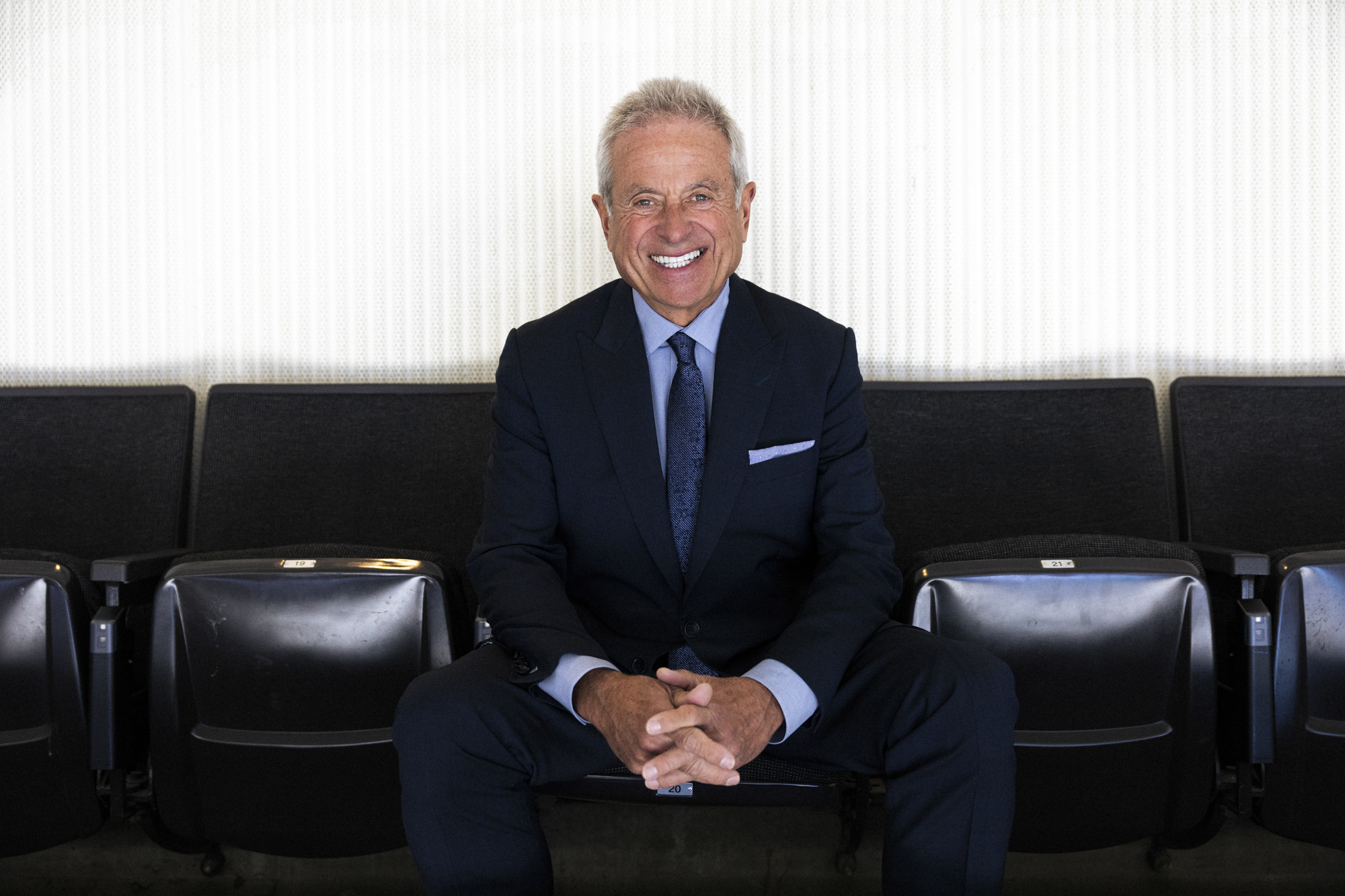
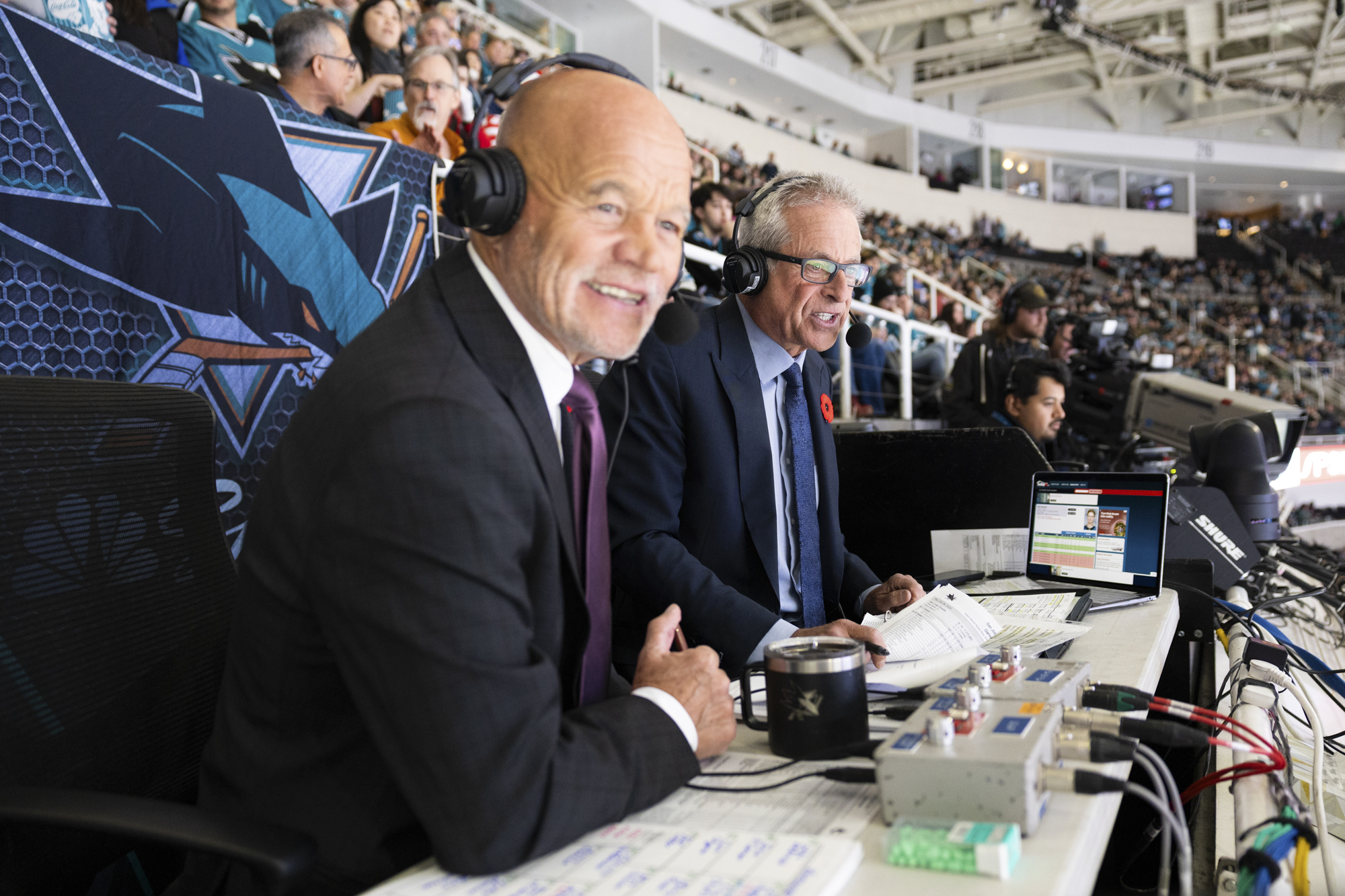
Of all the things that make Randy Hahn stand out in the world of ice hockey announcers, there is one fact of his career that rises above the rest: he’s been calling games for the same team for 35 years, ever since the San José Sharks were first established in 1991.
For a lot of fans, Hahn’s been the voice of the Sharks for their entire lives, helping to cultivate and nurture father-son bonds across the Bay Area for three generations.
“I’ve been watching Randy since I was a kid, with my dad,” said Mark Gavartin, a long-time Sharks fan who now works at Stanford.
When the Sharks last made the playoffs in 2019, Gavartin had 4-year-old twins of his own and began passing the team allegiance down the family line. Watching the dramatic first-round series against the Vegas Golden Knights on TV, Gavartin relied on Hahn to transport the excitement unfolding in the arena back to him and his family on his living room couch. Years later, just thinking about Hahn calling that Game 7 overtime gave Gavartin goosebumps.
“We were so emotional,” he remembered. “With the Sharks and Randy Hahn, it was like we were all together on this. We were like buddies, watching the game together.”
But as the Sharks advanced through the playoffs, then to the conference final, Gavartin noticed something strange: his buddy, Randy Hahn, was no longer behind the microphone calling the games. The national network wanted one of their own announcers to make the postseason calls. It was a voice Gavartin didn’t know.
“It was not the same as listening to Randy Hahn,” he said. “It’s some other guy who was ‘meh, okay.’ Like, he didn’t go through what we went through.”
Gavartin wondered what many fans across many teams have wondered over the years: why did his beloved announcer disappear from the airwaves right when the team hit the peak of success? The question is not unique to the NHL. The phenomenon occurs across all sports during the postseason. But to truly understand why national TV networks install their own announcers for the most high-profile games, it is important, first, to understand why that decision leaves so many fans feeling so bereft. The fans of Randy Hahn, and the generations-worth of love and loyalty they hold for him, offer the perfect case study to reveal the answer.
‘A roller coaster ride wrapped up in a soap opera’
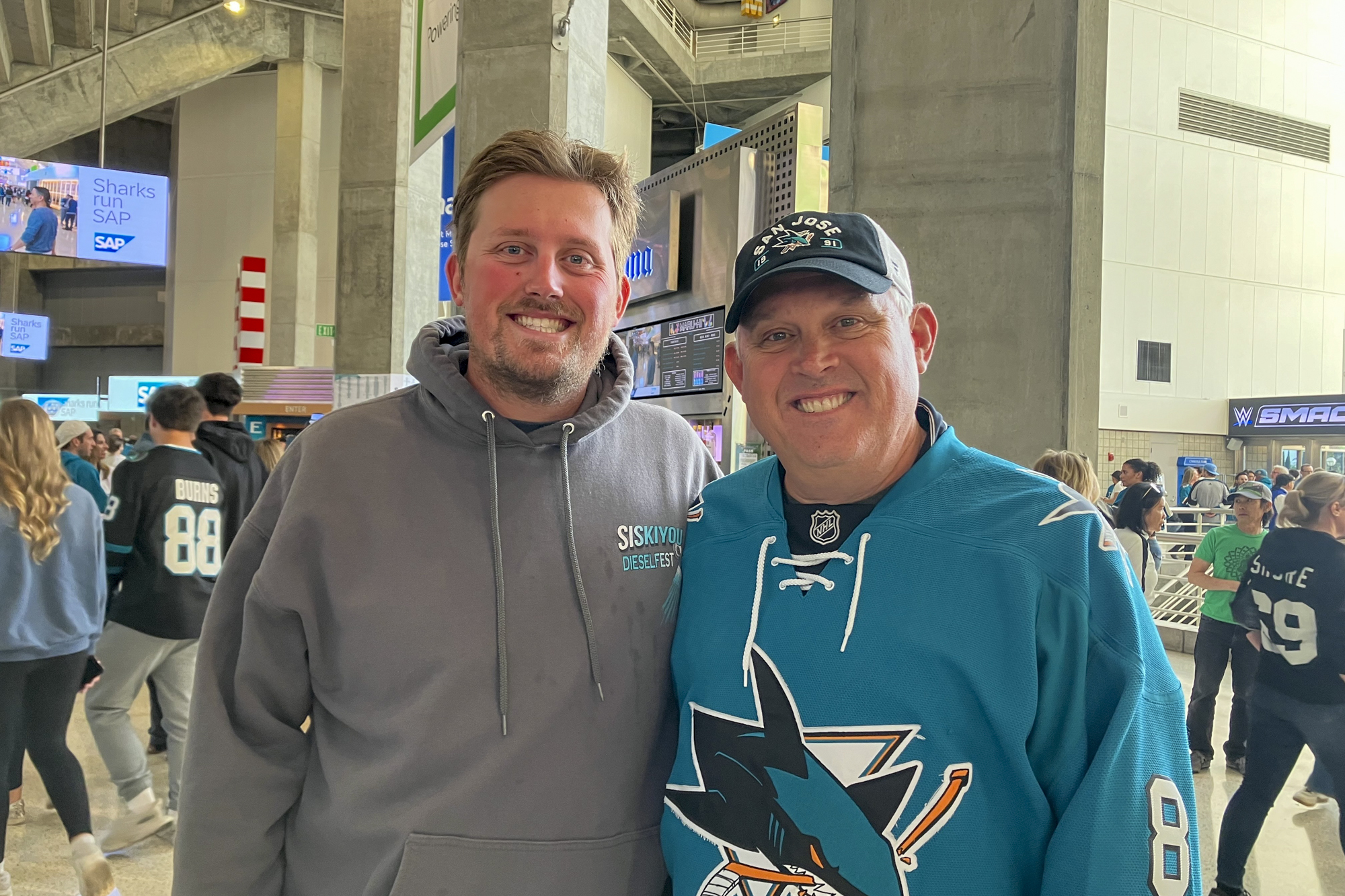
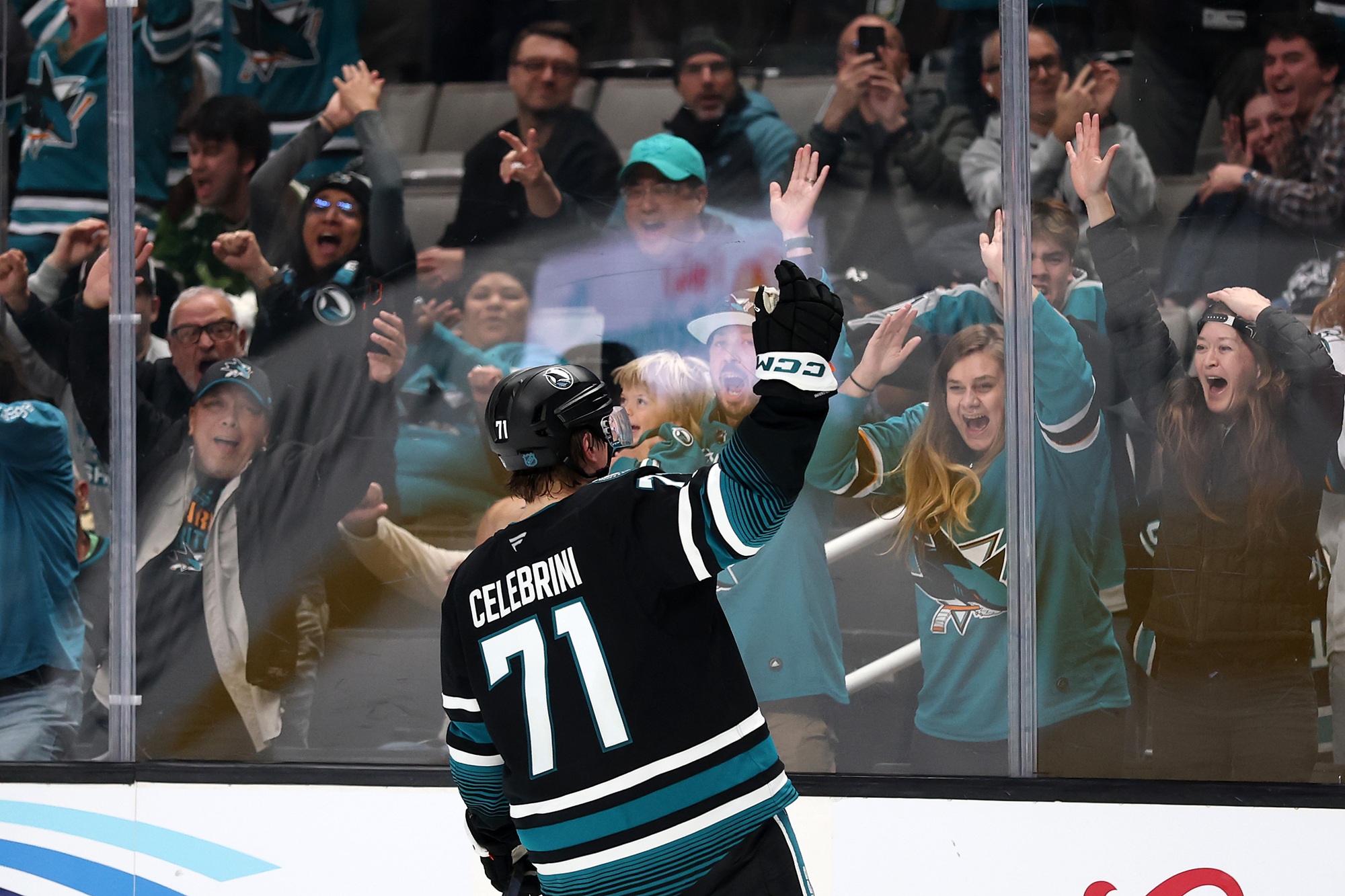
On game days, the ice rink at San José’s SAP Center, aka the Shark Tank, is full of teal-clad fans. After the 2019 playoffs, the Sharks entered a drought and spectatorship dwindled amid the teams’ losses. But since acquiring the teenage phenom Macklin Celebrini in 2024, attendance at home games is again respectable; last year they filled the arena to 93% capacity on average and had 22 sellouts. For the Sharks home game against the Chicago Blackhawks last spring, every fan milling by the hot dog and beer stands, young or old, knew Hahn and had something to say about what made him a living legend.
“He’s a Sharks encyclopedia,” said Tristan Nickey, who grew up in San José, but now lives in Idaho where he watches Hahn call the games on ESPN+. “He’s got all these stats that he’s always giving out, and it makes the whole game enjoyable.”
For 18-year-old Mia Dimmock, who started watching hockey a few years ago after seeing a clip on TikTok, Hahn explains things in a way that makes the game accessible to newbies. He shares details about players that bring them to life. He’s at every home game and every away game. He’s on the same buses and planes as the team, in the same hotels. He’s at the practice rink, in the weight room. He sees and hears a lot.
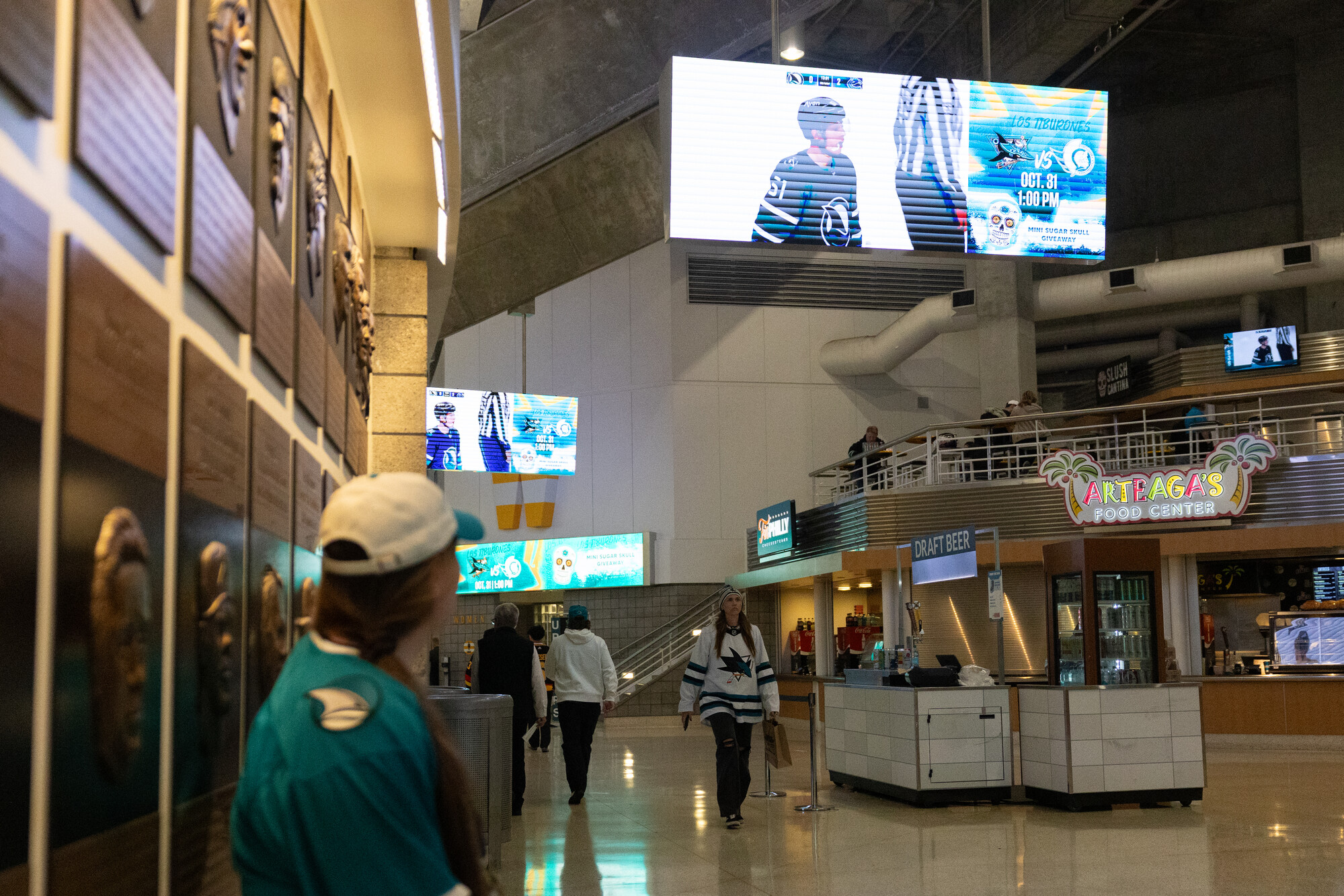
“He is that connection to the team that we need,” Dimmock said. “He is the team and the team is him.”
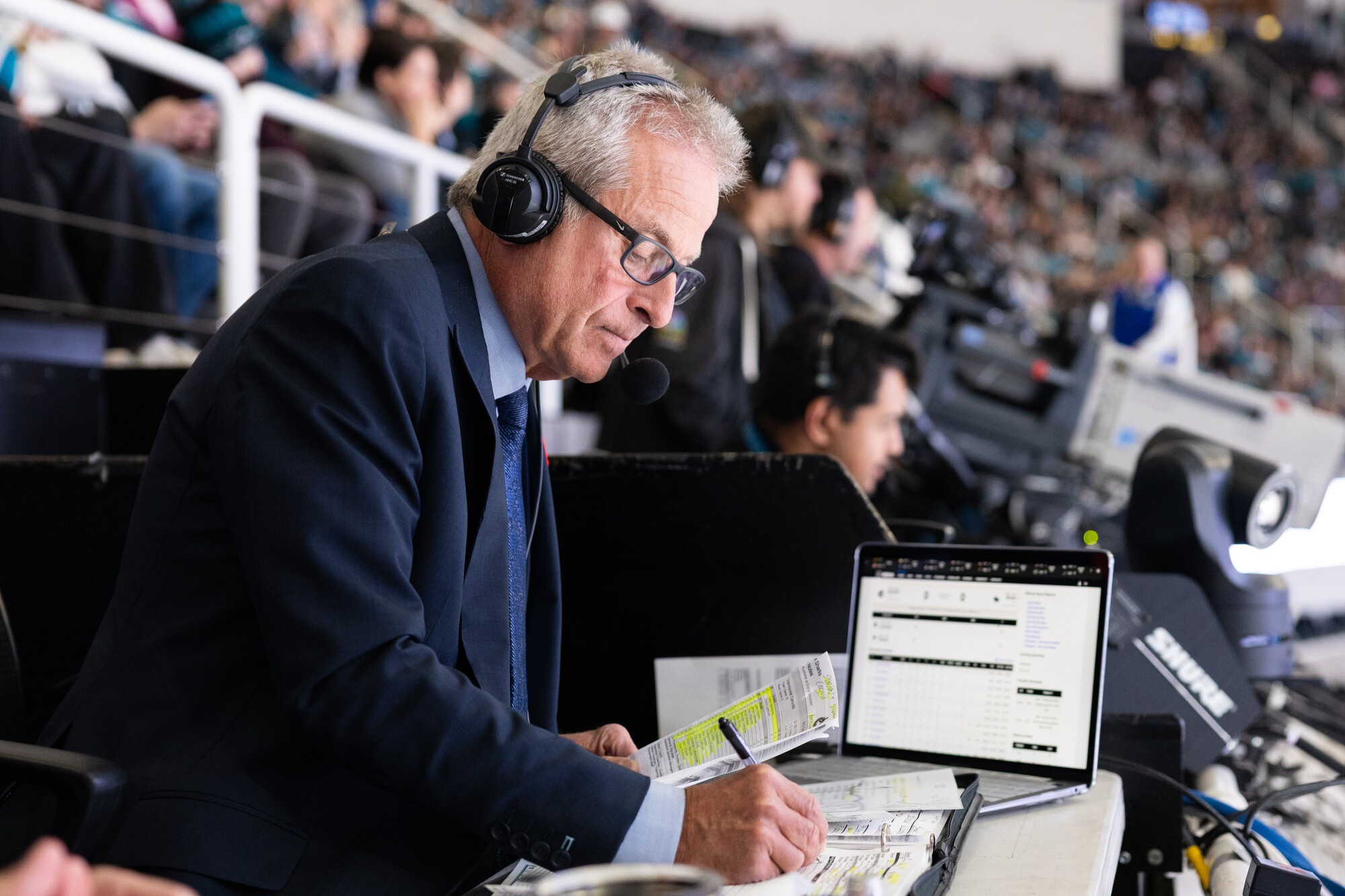
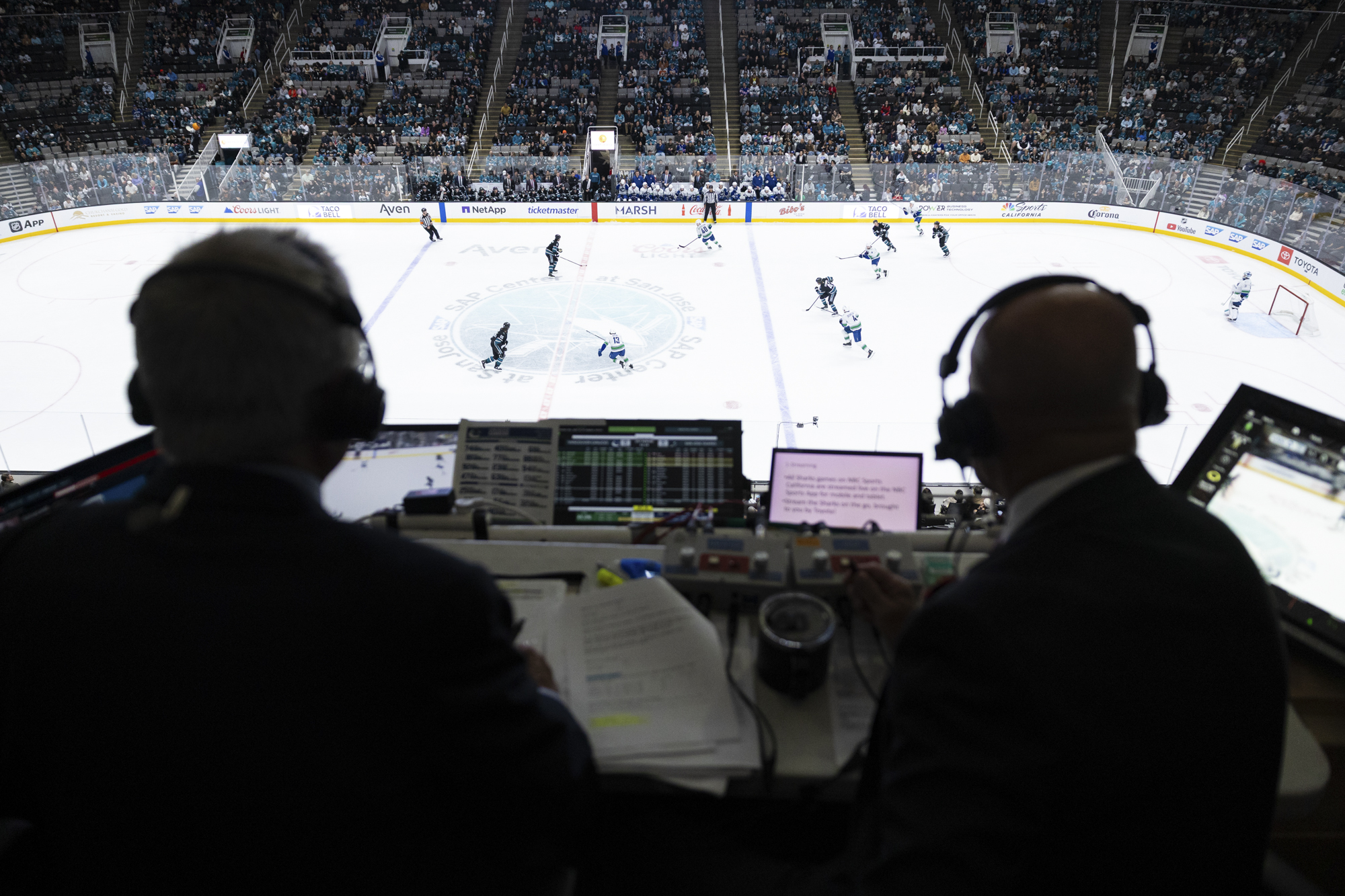
Hahn calls home games from an open-air broadcast booth inside the arena – a narrow perch at the front of section 215 overlooking the ice. I crammed into a chair behind him and watched over his shoulder as he called the Sharks’ game vs. the Blackhawks, and I noticed what Dimmock noticed: while Hahn is calling the play-by-play, he’s also telling a story. He gives each game a dramatic arc with historic context tucked in. He turns the players into characters who drive the plot. Currently, the leading man is Celebrini, now 20.
“Macklin’s not the only child in the family,” Hahn told TV viewers during a lull in play. “His older brother Aiden is a Vancouver Canuck, and his youngest brother RJ, he’s 13 playing up in Vancouver and is starting to challenge some of Macklin’s records that Macklin established there when he was that age. Watch out for RJ Celebrini.”
Equally interesting to what Hahn shares is what he doesn’t share. There are certain facts and details he holds back. If Hahn notices a player on the bus with a bag of ice on his ankle or his hand wrapped in a bandage, for example, he won’t say anything during a game.
“There might be somebody on another team who knows that if that player has a sore left knee, ‘I’m gonna go after that knee,’” Hahn told me. “It’s pro sports; it’s cutthroat. People are playing for money.”
So if a defensive player has a goal scored against him, Hahn won’t say he failed to make the right play because he’s injured, but he will shade his commentary differently; he’ll be less critical.
“It’s our way of putting our arm around him, if you will,” Hahn said.
There’s an inherent tension in this. Hahn works for NBC Sports Bay Area, the local TV station, not the Sharks. He’s first and foremost a broadcaster, and he’s supposed to maintain some level of professional distance from his subjects. But that boundary can get murky, especially in light of how much time he spends with the players. Sometimes he catches himself referring to the team as “we,” as in, “we won.” Then he corrects himself: “they won.”
Technically, he’s not part of the team, but fans absolutely see him that way.
“He is the Sharks to me,” said Trevin Cholmondeley, a fan from Napa.
This tension hit a high point last December when the Sharks played the Pittsburgh Penguins. The Sharks season had started off slow with a lot of losses. They were losing the game to Pittsburgh, 5 to 1. Then halfway through the third period, two Penguins were sent to the penalty box and the Sharks seized the moment.
Hahn is fond of saying that every hockey season is a “roller coaster ride wrapped up in a soap opera,” and through the twists and turns of the third period in Pittsburgh, he seized the energy in the arena and transposed it back to fans watching at home. He built the suspense of each goal the Sharks scored in the next five minutes like a crescendo in a Beethoven symphony. When the Sharks tied the game 5-5, then scored the winning goal in overtime, Hahn rallied the metaphorical trumpet blasts and cymbal crashes to capture the finale on the ice.
“They scooooore!” he roared. “One of the most amazing comebacks in franchise history! Sharks win! I’m beside myself, and there’s tears in my eyes.”
It was an expert, nuanced performance, on the ice and off. Hahn modulated his cadence and pitch to up the drama of each play, then added a strong dose of vulnerability, all to create what he later called “the theater of the moment.” He shouted in ecstasy to punctuate the win, then swiftly confessed to his TV audience that he was crying.
Afterward, Hahn texted a colleague and admitted that he was worried he’d gone too far at that game; perhaps he’d veered beyond his professional broadcasting boundaries and allowed himself to become overly emotional?
But after players and coaches made a point of complimenting his calls, he decided ultimately that he’d struck the right balance. Coaches and players have to keep their heads in the game. They can’t lose their cool after every goal. Hahn seemed to surmise that part of his job is to express the emotions that the other men on the team can’t. Hahn does the feeling for them.
“When something like that happens, it’s emotional for all of us because we all have so much invested in the process,” Hahn told the Sharks’ in-house podcaster Brodie Brazil. “To me, it was them saying, ‘you captured the way we felt even though we couldn’t show it.’ A head coach can’t show that; it just wouldn’t look right. But inside, you feel it.”
It was the same with the fans. People who have to play it cool in the office, stay calm at home, Hahn does the feeling for them, too. When Hahn teared up watching the Sharks beat the Penguins, so did Tristan Nickey.
“I felt what he was feeling,” he said.
When Hahn got excited, so did Caleb Edwards.
“Hearing his motivation and his excitement build just kind of pulsates through you as a fan,” he said.
When Hahn screamed into his mic, Trevin Cholmondeley screamed back at the TV.
“The dude lost his voice halfway through,” he said. “I think he understands the energy that’s in the clubhouse that we, as a fan, don’t get to experience. We can live, sort of, through him.”
Why do local announcers get sidelined during the playoffs?
Sociologists say that sports are like religion. Arenas, like churches. Fans are a kind of congregation worshipping the players and coaches and TV announcers like idols. To Sharks fans, Randy Hahn is an emotional conduit, a medium, channeling the euphoria and grief back and forth between players and fans. So when the playoffs come, and the local TV announcer gets deposed, replaced by a national announcer, it can feel like blasphemy.
“It will suck,” said Edwards, echoing a chorus of complaints from fans who wish Hahn could announce those games, should they come to pass.
“It is not just a hockey question. There are baseball fans who are always wondering, ‘Why, if my team makes the playoffs, can’t I get my local announcers? Why am I getting the national announcers?’” said Richard Deitsch, a sports journalist who has worked for Sports Illustrated, The Athletic, and now CBC Radio in Canada. “By and large, the answer to these questions is the eternal answer to most questions. And the answer is money.”
When the Sharks first made the playoffs in 1994, local television announcers called every playoff game, through four rounds. But as national networks like ESPN and Fox got into the business of airing the Stanley Cup finals, and paid high rights fees for the privilege, they wanted exclusivity in return. While NBC Sports Bay Area, Hahn’s employer, aired the regular season games and early rounds of the playoffs, they no longer had the right to air the final series.
When networks negotiated the next contract, they wanted exclusivity of the final two rounds of the playoffs. And when ESPN and TNT signed their latest contract with the NHL – a seven-year deal for $600 million – they won exclusivity of the final three rounds of the playoffs.
These final games of the season always attract the biggest audiences. And the more people there are watching, the more national TV networks can charge advertisers to air their commercials. Close to one million fans tune in for the Stanley Cup hockey finals; 20 million for the World Series; 120 million for the Super Bowl.
“These are massive numbers, and that’s very, very rare in society today. It’s a very, very divisive and polarized time,” Deitsch said. “It is very hard to get Americans to agree on anything, but sports is one thing.”
Americans may not agree on who should win, but they agree the game is worth watching. Across racial backgrounds, political affiliations, and religious beliefs, people can sit together in the same arena, or in front of one TV at a bar, and share the experience.
“That’s the power of sports still. And it’s also the reason why it’s such an economic force and a multi-billion dollar business,” said Deitsh, “because the people who are in charge of these leagues and the people who are in charge of the networks that put on these games, they know that it’s one of few, if not the only thing, left where you can get communal experiences of that many people.”
Because so many different audiences are tuning in, including fans from both teams, the national networks are looking for neutrality and impartiality in their broadcasts. Hahn’s passion for the Sharks, or even simply his affiliation with the team, is seen as a liability, so the networks steer clear.
It’s a brutal reality for local announcers. To follow a team to the climax of the season, then be forced to turn the mic over to someone else.
“It’s like you go to this great movie, it’s unbelievably dramatic, you’re there, and literally seven minutes before the movie’s over, an usher asks you to leave,” Deitsch said.
When the Sharks last made the playoffs in 2019, Hahn was in the stands at the Shark Tank, watching the game with all the other fans.
But fans at home wished he was in the broadcast booth, not realizing that what they most loved about Hahn was precisely what disqualified him from calling the finals. They want his partiality. They prefer his bias. And they’re not shy about it.
“I tend to actually turn the volume down during the playoffs,” said Trevin Cholmondeley. He wants an announcer who’s been through what he’s been through, all the ups and downs of the soap opera-infused roller coaster. “Every season’s a little microcosm of life, and not having someone like Hahn, or any team’s local announcer, on the big stage just brings the quality down for me.”
Last winter, after the Sharks’ stunning win over Pittsburgh, Hahn predicted the Sharks would make the playoffs, if not last season, when they just missed qualifying, then this season for sure.
Fans will be tuning in, ready for Randy Hahn to be their prophet, their guide, their buddy, through every twist and turn.
Episode transcript
Sounds of ice skating
Olivia Allen-Price: The NHL season officially opened at the end of September and ice hockey fans around the country are hoping their team will make it to the playoffs next spring. Fans are prone to believing their players, their coaches, even their announcers are the best. For San Jose Sharks fans, that announcer is Randy Hahn.
Randy Hahn announcing:The building’s come alive! Here’s Kane, Knight push, back for Burns, save, rebound!
Olivia Allen-Price: Fans still talk about Randy’s calls from the last time the Sharks made it to the playoffs – in 2019.
Randy Hahn announcing: He’ll drop it back for Burns. Over to Couture. Scooore! They’ve done it. (Fade under earlier, starting here: They’ve come all the way back with a tie!
Olivia Allen-Price: Longtime Sharks fan and Bay Curious listener Mark Gavartin remembers this game really well.
Mark Gavartin: I listened to it many, many times.
Olivia Allen-Price: He says just talking about it now, years later, still gives him goose bumps.
Mark Gavartin: And then the Sharks won that game on overtime. And it was just like crazy. (laughs)
Olivia Allen-Price: Mark had four-year old twins at the time. So it was really hard to make it out to any of the games. He couldn’t sit in an arena with thousands of other fans riding the same emotional roller coaster together. Instead, he watched the games on TV and he relied on Randy to transport that excitement to his living room.
Mark Gavartin: And we were so like emotional with the, you know the Sharks and the, and Randy Hahn. And we just like, you know, like we’re all like together on this. It’s like having buddies watching the game together.
Olivia Allen-Price: But then something strange happened. As the Sharks advanced through the playoffs then to the conference final, fans no longer heard Randy Hahn behind the mic. The national network wanted one of their announcers to call the games instead. A guy that Mark didn’t know.
Mark Gavartin: It was like not the same listening to Randy Hahn. It was just different. It was like like they didn’t go through what we went through. And now it’s like some other guy is like, eh, you know, like, okay.
Olivia Allen-Price: And that made Mark wonder:
Mark Gavartin: Why doesn’t Randy Hahn call the final rounds of the playoffs?
Olivia Allen-Price: And that made us wonder, why do fans care so much that he doesn’t?
I’m Olivia Allen-Price. This is Bay Curious, the show that answers listener questions about the San Francisco Bay Area.
We asked KQED’s April Dembosky to introduce us to Randy Hahn and the fans who love him. Then explain why Randy disappears from the airwaves at the most critical moment in the season. Here’s April…
April Dembosky: There are a lot of things about Randy Hahn that make him stand out in the world of hockey announcers. But there’s one thing in particular. He’s been calling games for the same team for 35 years, ever since San Jose first established its team in 1991.
For a lot of fans, Randy’s been the voice of the Sharks for their entire lives.
Trevin: He IS the Sharks to me.
Kenneth: Just living legend. I’ve been listening to him since I was a kid.
Mark: I’ve been watching since I was a kid with my dad.
Trevin: Randy’s a part of my life since I was a baby.
April Dembosky: Randy is so iconic, Pixar filmmakers asked him to do a cameo in the movie Inside Out. Riley’s dad is caught daydreaming about a hockey game when his wife is trying to talk to him.
Inside Out clip: Sound of hockey game announcing.
Sounds of Sharks arena
April Dembosky: Last spring I went to see the Sharks play the Chicago Blackhawks at the SAP center, aka, the Shark tank. And every fan I talked to … knew Randy and had something to say about why they loved him.
Tristan Nickey: He’s a Sharks encyclopedia.
April Dembosky: Tristan Nickey is from San Jose but lives in Idaho now. He watches all the Sharks games on ESPN plus where he has the choice to select Randy as his announcer.
Tristan Nickey: He’s got all these stats that he’s always giving out and it makes the whole game enjoyable.
Mia Dimmock: I feel like he’s a through on through Sharks man.
April Dembosky: Eighteen year old Mia Dimmock started watching hockey a few years ago, after she saw a clip on TikTok. She says Randy has a way of explaining things that makes the game accessible to newbies like her.
Mia Dimmock: He has a way of introducing the fans to the players more and giving them an experience where then we feel more connected to the players as a whole.
April Dembosky: Randy is at every home game and every away game. He’s on the same buses and planes as the team, in the same hotels. He’s at the practice rink, in the weight room. He sees and hears a lot.
Mia Dimmock: He is the team and the team is him. He is that connection to the team that we need.
Randy Hahn announcing: Let’s see if the Sharks can get some mojo going here in the second period. Will Smith with the puck, drops it for Macklin…
April Dembosky: I got to see Randy in action when he called the game against the Blackhawks. I sat behind him, crammed into his open-air broadcast booth in the arena. It’s at the front of section 215.
And I noticed what Mia noticed: while Randy is calling the play by play of the games, he’s also telling a story. He gives each game a dramatic arc. He turns the players into characters who drive the plot. Right now, the leading man is 20-year old phenom Macklin Celebrini.
Randy Hahn announcing: Macklin’s not the only child in the family. His older brother Aiden is a Vancouver Canuck and his youngest brother RJ, he’s 13 playing up in northshore winter club up in Vancouver is started to challenge some of Macklin’s records that Macklin established there when he was that age.
April Dembosky: When I talked to Randy outside the Shark tank, he explained that there are also certain details he holds back. The guys often play through injuries, but don’t want their opponents to know.
Randy Hahn: There might be somebody on another team who knows that if that player has a sore left knee, I’m gonna go after that knee. It’s pro sports, it’s cutthroat. People are playing for money.
April Dembosky: If Randy notices a player on the bus with a bag of ice on his ankle or his hand wrapped in a bandage, he won’t say anything during a game, but he’ll shade his commentary differently; he’ll be less critical.
Randy Hahn: He might have a goal scored against him and be unable to make a defensive play but I know, you know what? That guy’s toughing it out. And the fans don’t know it and he’s not saying anything about it and we aren’t either, but it’s our way of putting our arm around him, if you will.
April Dembosky: There’s an inherent tension in this. Randy works for NBC Bay Area, the local TV station, not the Sharks. He’s first and foremost a broadcaster and he’s supposed to maintain some level of professional distance. But that boundary can get murky. Especially in light of how much time he spends with the players. Sometimes he catches himself referring to the team as “we,” as in, “we won.” Then he corrects himself: “they won.”
Arena sounds
April Dembosky: Technically, he’s not part of the team, but Sharks fans absolutely see him that way.
Emma Daniels: Oh my god! That was so cool. Oh my God.
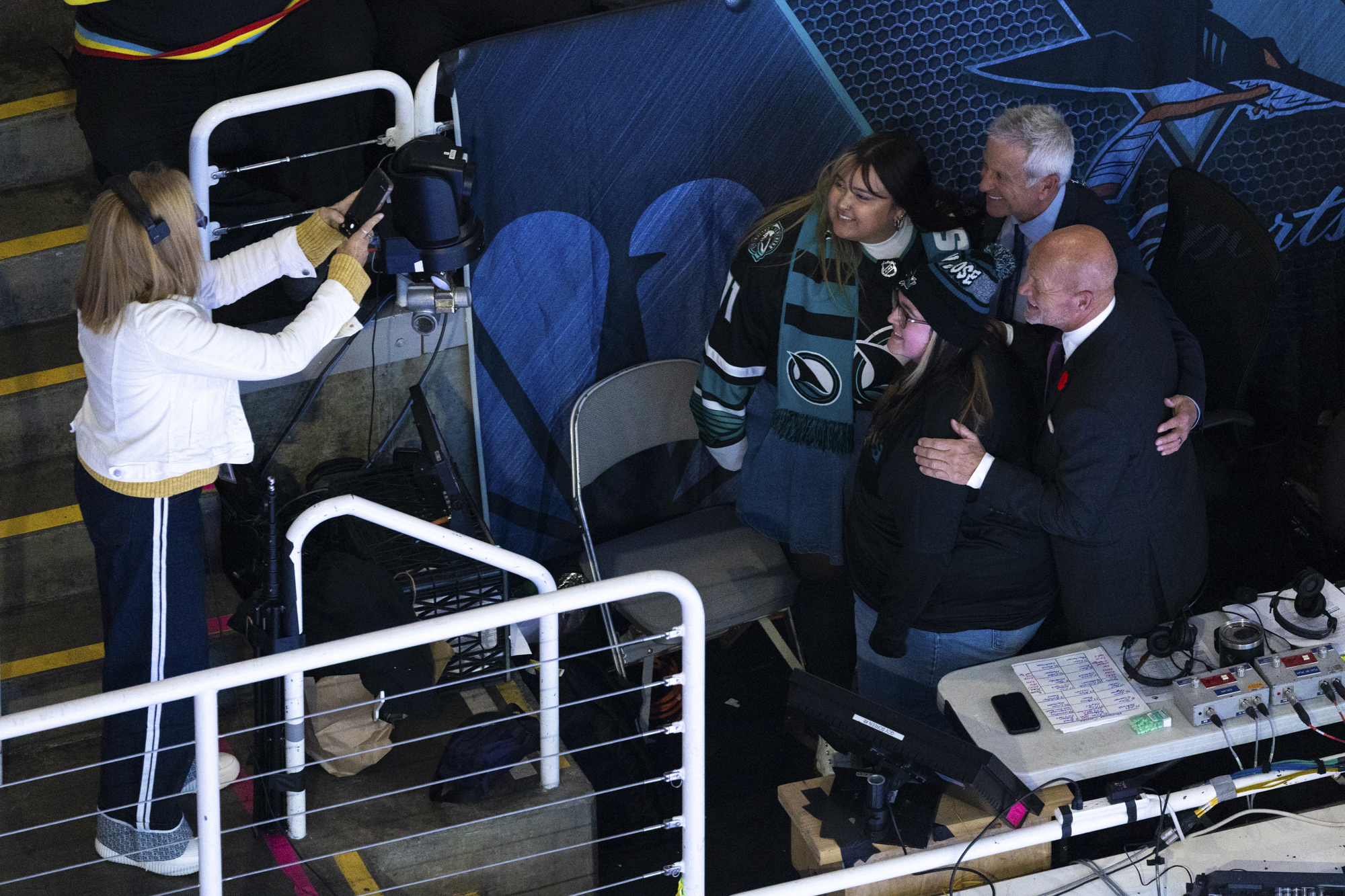
April Dembosky: I caught up with Emma Daniels right after she visited Randy in his broadcast booth and fans line up here in between periods to meet him.
Emma Daniels: I’m such a big fan of him and he’s been so welcoming toward new fans. Oh my gosh.
April Dembosky: She got to take a picture with him.
Emma Daniels: I’m shaking. That was more exciting than the players. I met Randy Hahn!
April Dembosky: What Emma loves most about Randy is the feeling that he’s on her side. For her, and a bunch of fans, there was one game last season where Randy was so in it.
Emma Daniels: There was that game against the Penguins, the clips of him yelling in that game are so amazing.
Caleb Edwards: With every goal, the energy in his voice built
Trevin: The dude lost his voice halfway through, I don’t think he could believe what he was seeing on the ice.
April Dembosky: It was December 2025. The Sharks season had started off slow with a lot of losses. They were losing the game to Pittsburgh, 5 to 1. Then halfway through the third period TWO Penguins were sent to the penalty box. The Sharks seized the moment.
Listen to the way Randy builds the tension. It’s like a crescendo in a Beethoven symphony.
Randy Hahn announcing condensed: The Sharks with a power play goal, and it’s 5-2. Off the scramble, and it’s 5-3! The Sharks clawing their way back into this game. It’s 5-4! Save, rebound. They score! They score! The Sharks have tied it up! Unbelievable.
April Dembosky: The TV cameras pan the crowd, Penguins fans suddenly looking very tired and very nervous, biting their nails, folding their hands in prayer. The game goes into sudden death overtime. And soon enough Randy is rallying the metaphorical trumpet blasts and cymbal crashes to capture the finale on the ice.
Randy Hahn annoucing: They score! One of the most amazing comebacks in franchise history! Sharks win! I’m beside myself and there’s tears in my eyes, my friend.
April Dembosky: Randy is doing something complex here. He’s surveying the feeling in the building and delivering it back to fans watching at home.
He later told the Sharks’ in-house podcaster Brodie Brazil that he’s creating “the theater of the moment.”
Randy Hahn: If it sounded like I was getting a little more excited with every goal, that was happening organically, yes, but it’s also part of years of doing this job.
April Dembosky: Randy shouts in ecstasy in one moment then confesses to his TV audience that he’s crying.
Brodie Brazil: And you said afterwards, ‘I was a little worried, I got very emotional, I don’t know what happened.’ And that got me thinking, why did you get emotional?
Randy Hahn: I, I don’t. I still am not sure.
April Dembosky: Randy wondered if he’d veered too far beyond his professional boundaries at that game…if he got too emotional.
But after players and coaches made a point of complimenting his calls, he decided ultimately that he got it right.
Randy Hahn: When something like that happens it is it’s emotional for all of us because we all have so much invested in the process and to me it was them saying you captured the way we felt even though we maybe couldn’t show it like a head coach can’t show that, it just wouldn’t look right, right? But inside you feel it.
April Dembosky: Coaches and players have to keep their heads in the game. They can’t lose their cool after every goal. Randy seems to understand that part of his job is to express the emotions that the other men on the team can’t. Randy does the feeling for them.
Randy Hahn: I go into every season with the same expectation, no matter what the roster, the season from start to finish will be a roller coaster ride wrapped up in a soap opera.
April Dembosky: It’s the same with the fans. People who have to play it cool in the office, stay calm at home, Randy does the feeling for them, too. When Randy teared up watching the Sharks beat the Penguins, so did Tristan Nickey.
Tristan Nickey: Like I felt it, I was watching the game. And it was absolutely incredible and I felt what he was feeling.
April Dembosky: When Randy got excited, so did Caleb Edwards.
Caleb Edwards: Hearing his motivation and his excitement build just kind of pulsates through you as a fan.
April Dembosky: When Randy screamed into his mic, Trevin Cholmondeley screamed back at the TV.
Trevin Cholmondeley: I think he understands the energy that’s in the clubhouse that we as fans don’t get to experience and I think we can live sort of through him.
April Dembosky: So you can see why Randy’s fans are so attached to him. He’s an emotional conduit. An emotional medium. Funneling the euphoria and grief back and forth between players and the fans.
Maybe now it makes sense why fans get so upset at the prospect of their beloved local announcer getting replaced when the team advances through the playoffs.
Olivia Allen-Price: We’ve got to take a quick break, but when we come back we’ll find out why that happens. Stay with us.
Sponsor messages
Olivia Allen-Price: Okay, so it’s clear that Sharks fans love Randy Hahn. But if the team makes it into the later rounds of the playoffs this season, we won’t be hearing him on air anymore. April Dembosky explains why…
April Dembosky: Sociologists say that sports are like religion. Arenas, like churches. Fans are a kind of congregation worshipping the players and coaches and TV announcers like idols. So when the playoffs come and the TV announcer gets deposed, it can feel like blasphemy.
Caleb Edwards: It will suck.
Randy C: That’s what’s a bummer.
Trevin Cholmondeley: That’s a disappointment.
Emma Daniels: I wish it was a local announcer.
Mia Dimmock: I think we should petition to get Randy on that board. We need him calling the games.
April Dembosky: So why do local announcers get sidelined right when their team hits the peak of success? Randy Hahn has been around long enough to see how this evolved.
Randy Hahn: Way back in the early days of the Sharks, in 1994 when they first made the playoffs, local television was allowed to do every playoff game through four rounds.
April Dembosky: But as national networks like ESPN and Fox got into the business of airing the finals, they didn’t want to share the stage with the local stations.
Randy Hahn: As network television contracts were negotiated and high rights fees were paid by those networks, they started to claw back and said we want exclusivity of the Stanley Cup finals.
April Dembosky: But it didn’t stop there.
Randy Hahn: Then when the next contract rolled around, we want exclusivity of the final two rounds and then eventually the final three rounds, which is where we sit now.
April Dembosky: The NHL signed its latest national TV contract in 2021 – a seven year-deal with ESPN and TNT for $600 million.
Richard Deitsch has been a sports reporter and editor for two decades, at Sports Illustrated, The Athletic, and now CBC radio in Canada. He says these exclusive contracts exist for all sports.
Richard Deitsch: It is not just a hockey question. There are baseball fans who are always wondering why, if my team makes the playoffs, can I get my local announcers and why am I getting the national announcers? And by and large, the answer to these questions are the eternal answer to most questions. And the answer is money.
April Dembosky: The final games of the season always attract the biggest audiences. And the more people there are watching, the more networks can charge advertisers to air their commercials. Close to one million fans tune in for the hockey finals. 20 million for the World Series. 120 million for the Super Bowl.
Richard Deitsch: These are massive numbers and that’s very, very rare in society today. It’s a very, very divisive and polarized time. It is very hard to get Americans to agree on anything, but sports is one thing.
April Dembosky: They may not agree on who should win, but they agree the game is worth watching. Across racial backgrounds, political affiliations, and religious beliefs, people can sit together in the same arena, or in front of one TV at a bar, and share the experience.
Richard Deitsch: That’s the power of sports still. And it’s also the reason why it’s such an economic force and a multi-billion dollar business, is because the people who are in charge of these leagues and the people who are in charge of the networks that put on these games, they know that it’s one of few, if not only things left where you can get communal experiences of that many people.
April Dembosky: Deitsch says, on a national broadcast, Randy Hahn’s passion for the Sharks could be a liability, so the networks steer clear.
Richard Deitsch: They want to at least come off as impartial as possible. There’s got to be neutrality here because they know that there’s different fans tuning in.
April Dembosky: So what the fans love most about Randy is precisely what disqualifies him from calling the playoffs.
It’s a brutal reality for local announcers. To follow a team to the climax of the season, then be forced to turn the mic over to someone else.
Richard Deitsch: It’s like you go to this great movie, it’s unbelievably dramatic, you’re there, and literally seven minutes before the movie’s over, an usher asks you to leave.
Randy Hahn: Well obviously I don’t like it.
April Dembosky: Randy Hahn thinks there should be a middle ground.
Randy Hahn: I would prefer to be doing games, and I think fans would love the option of being able to have a choice.
April Dembosky: When the Sharks last made the playoffs in 2019, Randy was in the stands at the Shark tank, watching the game with all the other fans.
But fans at home wished he was in the broadcast booth. They want his partiality. They prefer his bias. And they’re not shy about it.
Trevin Cholmondeley: I tend to actually turn the volume down during the playoffs
April Dembosky: Trevin Cholmondeley says he wants an announcer who’s been through what he’s been through, all the ups and downs.
Trevin Cholmondeley: Every season’s a little microcosm of life, really, and not having someone like Randy or any team’s local announcer on the big stage. Just brings the quality down for me.
April Dembosky: Sports have always been tribal. Super fans often see their team as an extension of their own identity. And because of that, they have higher self-esteem and lower levels of loneliness.
Research shows sports provide structure and routine and meaning. They fulfill our need to belong.
Even when it comes to commiserating over Randy not calling the playoffs – there’s community in that.
Mark Gavartin: I was very pleasantly surprised I’m not the only one who’s feeling that way.
April Dembosky: That’s what our question-asker Mark Gavartin took away from all this.
Mark Gavartin: This is our team. We live here.
April Dembosky: Last winter, Randy Hahn predicted the Sharks would make the playoffs, if not last season, then this season for sure. Mark wants Randy to be his prophet, his guide, his buddy, through it all…
Mark Gavartin: And see Randy announce, ‘Hey, the Sharks won the Stanley Cup.’ It hasn’t happened yet, but wouldn’t that be amazing? Like, to hear his voice saying that?
April Dembosky: But even if the Sharks do win the title, that won’t happen.
Olivia Allen-Price: That was KQED health correspondent April Dembosky.
Big thanks to Mark Gavartin for submitting this week’s question, and to the many KQED members whose support make our reporting possible. Are you a KQED member? Become one today at donate.kqed.org/podcasts.
Bay Curious is made in SF at member-supported KQED. Our show is produced by
Katrina Schwarts, Christopher Beale, Anna Casalme, and me, Olivia Allen Price. With extra support from Maha Sanad, Jen Chien, Katie Sprenger, Ethan Toven-Lindsey and
everyone on Team KQED.
I’m Olivia Allen-Price. Have a wonderful week. And go Sharks!