The Election Fraud Evangelizers Targeting Rural Californians
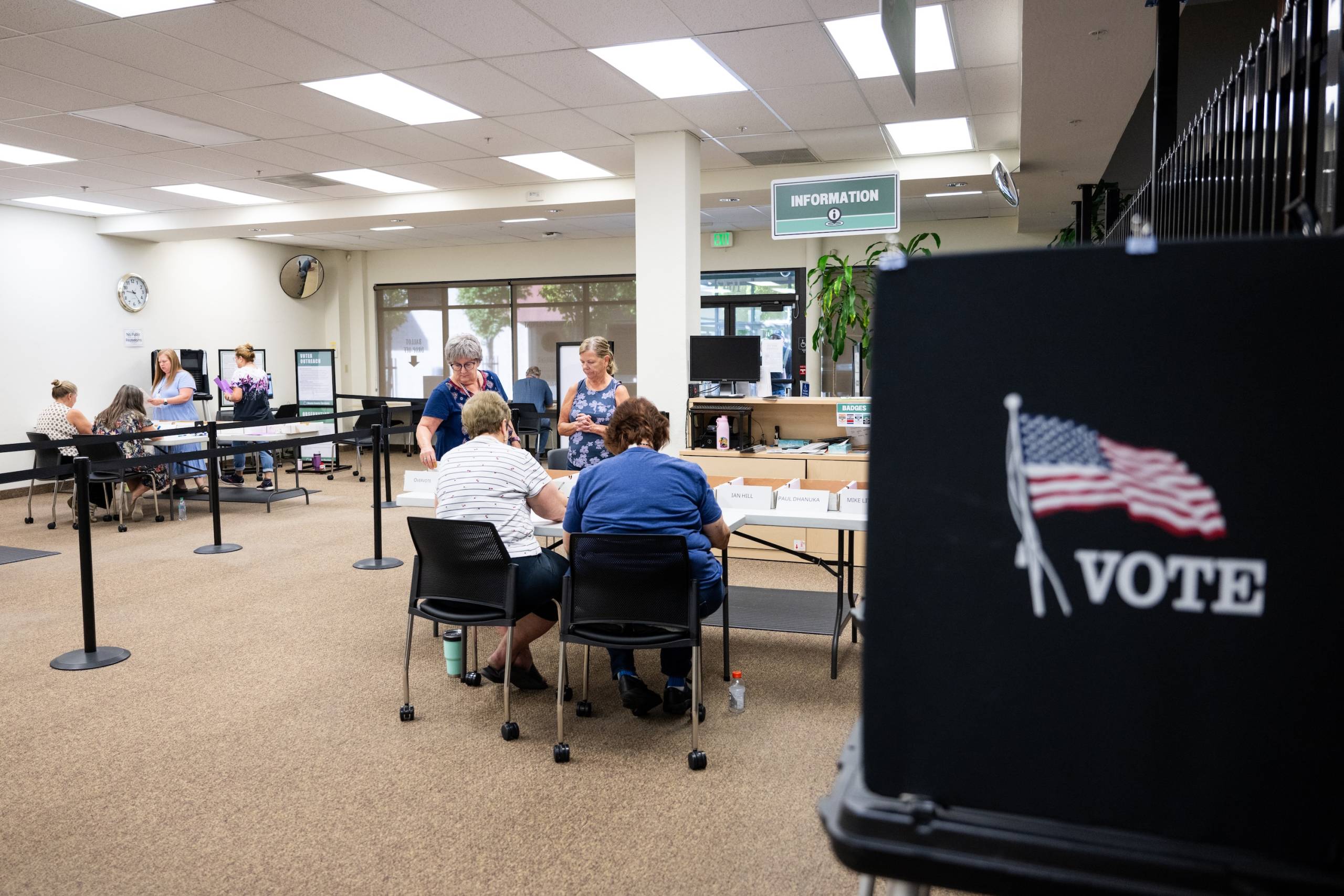
The Trump administration has been ramping up efforts to find voter fraud in California. Claims of voter fraud can have real-world consequences for communities. Today, Stanford Political Science Professor Justin Grimmer tells us about a group of traveling election skeptics who target mostly rural, conservative communities to spread their claims of fraud.
Episode Transcript
This transcript is computer-generated. While our team has reviewed it, there may be errors.
Ericka Cruz Guevarra: I’m Ericka Cruz Guevarra and welcome to The Bay, local news to keep you rooted. Justin Grimmer is obsessed with voter fraud. He’s a professor of political science at Stanford University and a senior fellow at the Hoover Institution. And he spent a lot of time researching elections. So when Donald Trump began making claims of voter fraud and manipulation after the 2020 election, Justin and his collaborators made it their mission to get to the bottom of it.
Justin Grimmer: And so I, along with one of my post-docs and a collaborator, we began investigating these claims in gory, gory details, dove into the data to figure out what they were claiming and what evidence basis they had to make those claims. And what we found was those claims were lacking really any evidentiary basis at all, or were pointing out to patterns in the world that weren’t really evidence of fraud.
Ericka Cruz Guevarra: Since then, claims of election fraud have become dangerously common, and Justin has kept pace, diving into these claims one by one. They’ve taken him all over the country to follow a growing movement of traveling election skeptics who visit mostly rural conservative communities to spread their claims of fraud.
Justin Grimmer: This sort of campaign says every election is subject to this manipulation. And that is a troubling allegation for democracy. It’s a troubling allegation if you’re an election administrator in those places.
Ericka Cruz Guevarra: Today, inside the movement of election fraud evangelizers and the real world impacts it has on the communities they visit. When did you first get wind of this movement of people?
Justin Grimmer: So it was the summer of 2021. We had just published our paper about the Trump campaign’s claims about the 2020 election and a reporter from the Philadelphia Inquirer called me. He said, I want to let you know that there is this kind of movement happening in Pennsylvania. There’s someone alleging that every election in our state is being manipulated. And the reason you should care is that this person is talking to our state legislature. And so in 2021, we began assembling the claims that this person, Doug Frank, was making. It became clear to us very quickly that there were other people in this space who were making similar sorts of claims. And it also became very clear that the claims were outlandish. They’re sort of, like, very quickly, we noticed a sort of statistical flaw in the argument. But nevertheless, the claims were popular, people seemed to be adopting them, people are very responsive to them.
Ericka Cruz Guevarra: What you’re talking about is this research that you’re doing on specifically this sort of movement of people who really, it seems like, target these sort of rural, more conservative areas to spread these claims of voter fraud. Tell me a little bit more about this movement. Who are these people and what exactly are they doing?
Justin Grimmer: We could think about two parts to this movement. One part of the movement is a national movement of almost professional election skeptics who tour the country and make the claim that every election everywhere is being stolen. At the same time, they’re inspiring local movements of individuals who hear what these election skeptic have to say and then form groups of people who wanna investigate it themselves. And those individuals will begin an investigation where they see if they can find phantom voters or individuals who should not be on the voter file or they think should not on the vote file. So it’s a movement that’s happening both nationally and then very locally as these groups get together.
Ericka Cruz Guevarra: And how did you go about actually studying this group of people?
Justin Grimmer: So what we decided to do was to start showing up where the election skeptics were presenting and talking to the people who were there, figuring out what it is about the movement that they find compelling, why do they think this argument is true and what sort of evidence are they basing their beliefs on?
Ericka Cruz Guevarra: So let’s talk about how this sort of plays out on the ground. For these sort of election fraud evangelizers, Justin, I mean, what is their MO, and how do they end up in places like Shasta County?
Justin Grimmer: My general impression is that they go where they are invited. And so this would explain why they end up in relatively conservative places, because individuals may learn about them from online social media like Telegram or from a sort of right-wing version of YouTube called Rumble will post their videos. So they learn about then. And when they’re invited to these places, it’ll either be local political activists who are interested in having them speak. And sometimes it’s entrepreneurial politicians. So we’ve seen both, for example, in Shasta County, political activists have helped support bringing these individuals in, and also some elected officials have supported it as well.
Ericka Cruz Guevarra: And who is their audience? I mean, are these like town halls? Are these people who maybe otherwise don’t believe in these things, but are sitting there to be convinced?
Justin Grimmer: So one thing that they love to do, these election evangelizers or election skeptics, is they’ll go to public comment at county meetings. That’s often a prelude to those skeptics being invited back to give a longer presentation at the county meeting.
Meeting tape: I want to see some hands as to how many people think in the United States there’s been some hacking with our computer system. Let’s see some…
Justin Grimmer: In parallel, when they make these visits, they’ll also do night time meetings. Sometimes they’ll be held in churches, sometimes in public forums. We attended a speech by a different election, a skeptic in Shasta County. It was hosted by a former county supervisor, Patrick Jones, at a holiday inn in Redding, California.
Meeting tape: How many people think we’ve had hacking in California? Similar number. Now the important question. How many think we had hacking in Shasta County? And that’s what’s important to me.
Justin Grimmer: In Shasta County, where we attended this presentation, the election skeptic that they brought in to speak was Jeffrey O’Donnell. He goes online by the moniker The Lone Raccoon. He is a heavier set gentleman, very thick gray beard with gray-shocked hair. He was slated to speak there in person. At the very last minute, it was revealed that he would be zooming in.
Jeffrey O’Donnell: Well, hello, Shasta County. Hello! I feel like I’ve been with you in spirit for a long time…
Justin Grimmer: So the election skeptics are usually the main event. And so from his house in Florida, he presented a series of plots that he alleged revealed that Shasta County elections had been manipulated, including primary elections.
Jeffrey O’Donnell: Alright, this is the math portion, so we’re going to take a deep breath, okay?
Justin Grimmer: The election skeptic will get up and they’ll regularly make reference to proof that the elections are being manipulated and by that they mean that they have some sort of statistical analysis that they’ve conducted where they’ve convinced themselves that this statistical analysis is evidence of fraud.
Jeffrey O’Donnell: CVR analysis, 80%, 162, fit that abnormal pattern. That’s the pattern, that’s manipulation.
Justin Grimmer: And if you were to hear this person speak and just listen to the cadence and they have a slideshow and in their sort of demeanor and their affect, you would almost think you were listening to a PhD political scientists or economists present results. It has all the same sort of trappings of a empirical social science presentation.
Jeffrey O’Donnell: The result is the receipt of the bail-in votes is essentially random, or near enough random, to expect them to fall into your kind of random power, which is established in that matter.
Ericka Cruz Guevarra: What do we know, Justin, about whether or not these statistics that they’re presenting, the stories that they are sharing, are true?
Justin Grimmer: So just one general, very important point is that it is essentially impossible to diagnose fraud from a statistical analysis alone. But one of the things that we’ve learned as we’ve dug into these models is that they’re often based on either statistical misunderstandings or data misunderstandings or a really unfortunate collision of the two. And as a result, every time we’ve analyzed these claims, we found them to not offer any support that fraud is occurring or offer any indication of fraud.
Ericka Cruz Guevarra: These claims your analyzes have found are not true. But what have you learned about how else they try to sort of sweeten their argument and make it more convincing?
Justin Grimmer: One of the things that we’ve noticed, though, in a comprehensive analysis of what they’re saying, so many of these are videotapes, so we’re able to ingest them, transcribe them, and analyze them en masse, is that by and large, what they are actually doing, though, is telling personal stories about their adventures evangelizing about why elections are manipulated and what should be done about it. My suspicion is that they’ve learned that the statistical analyzes aren’t really gonna land with the audience. But these personal stories where they talk about being with secretaries of states or attorneys general, or advocating with elected officials to change the way ballots are counted. This is the kind of proof that resonates with the audience.
Jeffrey O’Donnell: I wanted to equip all of you with the knowledge and the confidence, right, to be true to your convictions. I mean, most of you, I suspect, knew in your heart that we had a problem long before the first piece of evidence ever came out.
Ericka Cruz Guevarra: I mean, yeah, it sounds like they really know how to work the crowds that they’re talking to.
Justin Grimmer: I think they’re exceptional at it. This one individual, Doug Frank, I joke he’s much better at being a professor than I am, even though he’s not a professor. His affectation, his bow tie, he really presents the image in a way that I don’t think I’m able to. And
Ericka Cruz Guevarra: Coming up how false claims of voter fraud have real-world impacts on communities By the way, if you appreciate the local deep dives that we bring you on this show consider becoming a sustaining KQED member We can’t do this work without you. Just go to donate dot kqed.org/podcasts. I know your grad students sometimes join you on these trips and have actually talked to people in the audience. What have you all learned about why people show up and if they believe these claims?
Justin Grimmer: So one type of person who was there is a sort of hard and true conspiracy theorist. So I sat next to a gentleman who I often describe as the final boss of conspiracy theorists. He believed every conspiracy theory you had heard. Of course he believed the earth was flat. So there’s some people who are there who I think are very immersed in a sort online conspiratorial way of thinking. But our impression was that they’re not the bulk of the people there. There’s other folks who attend these events, again, for example, at this Holiday Inn event, that are skeptical about elections are run. They’ve been told repeatedly by the president and other prominent Republicans that there’s something wrong with elections. And so they have some intuition that something’s wrong. And they’re looking for a vehicle to get active and back into politics. For example, one woman who we observed at this Holiday Inn, she was texting a friend saying that she was at this event and then said, this is my way of sort of getting back into politics. Was like, gonna join this movement and fight for a thing that she was hearing needed to be fought for. And there’s a final group of people, there’s this sort of opposition that shows up as well. So there’s people usually more aligned with the left who show up and they observe what’s going on sometimes offer critical questions at these events.
Meeting tape: Have a nice day. You’re hosting a liar. Have a Nice day.
Justin Grimmer: Everyday folks can’t possibly track the statistics. The folks who present these statistics make it quite difficult. They’re not publishing papers, laying out their model. We’ve had to piece it together across many videos. And so instead they can rely upon these cues and you can really, I think, start to feel sympathy for these folks in these places because the kind of cues that they get in these meetings would indicate that perhaps this person has really uncovered something.
Douglas Frank: What I did is I studied every county in California because California was a control case for me. I’m a scientist. I set up control studies. That’s what we do.
Justin Grimmer: So for example, when Doug Frank gets up to speak, he makes the claim that he’s a Nobel Prize nominee in chemistry. That’s, just to be clear, not a thing that anyone could ever claim. Nobel Prize nominations are confidential for 50 years. He claims it happened in 1990. We’re still well within that confidential region there. He also claims to have published 60 peer-reviewed papers and to be a world leading physicist. So if someone with that pedigree stands up and tells you.
Douglas Frank: I spent a month of my life last year analyzing every ballot passed in this state for the last 20 years. Why would I do such a thing? You know, I’m a masochist, right? I guess I’m scientist. I like numbers.
Justin Grimmer: I’ve uncovered a statistical model that proves your county’s elections are being manipulated. And by the way, I’m going to tell you a lot of stories about positions of people who are in power who have listened to me, or people who were in power, who said they were going to listen to me and then backed out at the last minute because some cabal influenced them. I think a reasonable person could hear all that and think, perhaps there’s something here.
Ericka Cruz Guevarra: Yeah it could be convincing.
Justin Grimmer: Could be pretty convincing.
Douglas Frank: Placer County and they were so mad at me because it turns out in their county I can predict the number of Republicans that voted in every precinct. I can predict the numbers of Democrats that voted every precint. I could predict the number of others that voted at every precinc. But to the one or two out of hundreds I can predict that accurately and I was using them as an example so first let me try it out…
Ericka Cruz Guevarra: True or not, this kind of messaging can have real consequences. And I wanna stick with this Shasta County example. How have you seen these claims impact the community there?
Justin Grimmer: Yeah, there’s been a big movement in Shasta County to change the way their elections are being run. So Shasta county attempted to just have hand count ballots only. California state legislature had to pass a law to say you can’t actually do that. So there’s money and litigation and time spent. And there’s also a very personal toll here on these people who are, I would describe. The heroes of American democracy, election administrators. So Shasta County had a fantastic election administrator, Kathy Darling-Allen. She was fantastic at her job, incredibly dedicated to her community, but this movement began to allege that she was involved in various conspiracies to manipulate the elections in Shasta county, or at least was standing to the side while those manipulations occurred. And as a result, there was a real physical toll on her. So it harmed her health. She ended up retiring because she was going into heart failure. And now there’s a new individual who’s running Shasta County’s elections, who is a well-known election skeptic in charge of their elections. And what we’ve seen from his work there, fortunately, he has little discretion in what could be done. There’s nice parameters from the law. But there’s some evidence that things have been running not as well without Kathy Darling Allen. And there’s been a bit more confusion.
Ericka Cruz Guevarra: What have you learned about what it takes to convince people, otherwise, to believe in our elections?
Justin Grimmer: One of the very best things you could do is to volunteer at a polling place to help tabulate ballots, open envelopes, work with your local election administrators. You’re gonna see that this is a process with a large number of safeguards filled with people who are working very hard, who have a really inherent dedication to American democracy as it’s practiced on the ground. And it’s not comprised of people who are partisan or really trying to manipulate the results in a particular way. So just seeing, again, these heroes of American democracy as its practice in action seems to be the best way to restore faith in our elections. Yeah.
Ericka Cruz Guevarra: My last question for you, Justin, another part of your research process is that sometimes you’ll actually present a rebuttal to the election fraud claims that are presented in some of these rural, more conservative counties. I wanna end by asking you, what motivates you to do that and to keep pushing back against fraud, even maybe if sometimes it feels in vain?
Justin Grimmer: I think as professors and as academics, there is a tendency to think about problems at the broadest scale. When I think in reality, one solution to this is that we need to deploy people to these places, to talk to them, to meet them where they are, to understand how they interact with the kind of arguments we make, to see that the people making these arguments are real people from real places. I often describe it perhaps a bit pejoratively as the sort of knife fight of democracy, where you’re sort of, you’re in it. You’re rebutting, you have, you are talking to these folks. It’s very one-to-one. It’s hard to scale this. But I think very important for even convincing a small number of people who might be on the margin that there are real reasons to trust American elections. I don’t see a way we’ll get out of this with broad national declarations. There’s not gonna be, in my opinion, really well-crafted advertising campaign that we could just deploy everywhere. I think the solution is that we have to engage folks where they are. And absolutely the solution’s going to be local.
Ericka Cruz Guevarra: Well, Justin, it’s such a pleasure having you on. Thank you so much. Thank you. As we head into election week, Justin’s research feels more timely than ever. The Trump administration has been ramping up its efforts to find voter fraud in California, demanding that the state set aside the ballots of thousands of registered voters. They accuse of not being US citizens. They’ve even threatened local elections officials with subpoenas and criminal charges if they don’t comply. They’ve claimed without proof that California elections are rigged in Democrats’ favor because of non-citizen votes. Justin says that once the results come in, there’s sure to be even more criticism.
Justin Grimmer: But voters can have an assurance that California elections are secure. It’s relatively easy to access the ballot and that there are many opportunities for those who want to vote to vote and many ways in which those who are not allowed to vote are prevented from voting.
Ericka Cruz Guevarra: That was Justin Grimmer, a professor of political science at Stanford University and a senior fellow at the Hoover Institution. If you’re doing some last minute voting this week, be sure to check out KQED’s Voter Guide, which has a bunch of handy info on all the statewide and local races. kqed.org/voter guide is the link. Again, that’s kqed.org/voterguide. This conversation with Justin was pitched and produced by producer Gabriela Glueck. It was cut down and edited by Pauline Bartolone. Additional production support from me. Music courtesy of Audio Network and APM. If you wanna get in touch with us here at The Bay, feel free to send us an email. We’re at thebayatkqed.org. Support for The Bay is provided in part by the Osher Production Fund. Some members of the KQED podcast team are represented by the Screen Actors Guild, American Federation of Television and Radio Artists, San Francisco, Northern California Local. And I’m Ericka Cruz Guevarra. Happy election week, everybody. Talk to you next time.
Some members of the KQED podcast team are represented by The Screen Actors Guild, American Federation of Television and Radio Artists, San Francisco-Northern California Local.