window.__IS_SSR__=true
window.__INITIAL_STATE__={
"attachmentsReducer": {
"audio_0": {
"type": "attachments",
"id": "audio_0",
"imgSizes": {
"kqedFullSize": {
"file": "https://ww2.kqed.org/news/wp-content/themes/KQED-unified/img/audio_bgs/background0.jpg"
}
}
},
"audio_1": {
"type": "attachments",
"id": "audio_1",
"imgSizes": {
"kqedFullSize": {
"file": "https://ww2.kqed.org/news/wp-content/themes/KQED-unified/img/audio_bgs/background1.jpg"
}
}
},
"audio_2": {
"type": "attachments",
"id": "audio_2",
"imgSizes": {
"kqedFullSize": {
"file": "https://ww2.kqed.org/news/wp-content/themes/KQED-unified/img/audio_bgs/background2.jpg"
}
}
},
"audio_3": {
"type": "attachments",
"id": "audio_3",
"imgSizes": {
"kqedFullSize": {
"file": "https://ww2.kqed.org/news/wp-content/themes/KQED-unified/img/audio_bgs/background3.jpg"
}
}
},
"audio_4": {
"type": "attachments",
"id": "audio_4",
"imgSizes": {
"kqedFullSize": {
"file": "https://ww2.kqed.org/news/wp-content/themes/KQED-unified/img/audio_bgs/background4.jpg"
}
}
},
"placeholder": {
"type": "attachments",
"id": "placeholder",
"imgSizes": {
"thumbnail": {
"file": "https://cdn.kqed.org/wp-content/uploads/2024/12/KQED-Default-Image-816638274-2000x1333-1-160x107.jpg",
"width": 160,
"height": 107,
"mimeType": "image/jpeg"
},
"medium": {
"file": "https://cdn.kqed.org/wp-content/uploads/2024/12/KQED-Default-Image-816638274-2000x1333-1-800x533.jpg",
"width": 800,
"height": 533,
"mimeType": "image/jpeg"
},
"medium_large": {
"file": "https://cdn.kqed.org/wp-content/uploads/2024/12/KQED-Default-Image-816638274-2000x1333-1-768x512.jpg",
"width": 768,
"height": 512,
"mimeType": "image/jpeg"
},
"large": {
"file": "https://cdn.kqed.org/wp-content/uploads/2024/12/KQED-Default-Image-816638274-2000x1333-1-1020x680.jpg",
"width": 1020,
"height": 680,
"mimeType": "image/jpeg"
},
"1536x1536": {
"file": "https://cdn.kqed.org/wp-content/uploads/2024/12/KQED-Default-Image-816638274-2000x1333-1-1536x1024.jpg",
"width": 1536,
"height": 1024,
"mimeType": "image/jpeg"
},
"fd-lrg": {
"file": "https://cdn.kqed.org/wp-content/uploads/2024/12/KQED-Default-Image-816638274-2000x1333-1-1536x1024.jpg",
"width": 1536,
"height": 1024,
"mimeType": "image/jpeg"
},
"fd-med": {
"file": "https://cdn.kqed.org/wp-content/uploads/2024/12/KQED-Default-Image-816638274-2000x1333-1-1020x680.jpg",
"width": 1020,
"height": 680,
"mimeType": "image/jpeg"
},
"fd-sm": {
"file": "https://cdn.kqed.org/wp-content/uploads/2024/12/KQED-Default-Image-816638274-2000x1333-1-800x533.jpg",
"width": 800,
"height": 533,
"mimeType": "image/jpeg"
},
"post-thumbnail": {
"file": "https://cdn.kqed.org/wp-content/uploads/2024/12/KQED-Default-Image-816638274-2000x1333-1-672x372.jpg",
"width": 672,
"height": 372,
"mimeType": "image/jpeg"
},
"twentyfourteen-full-width": {
"file": "https://cdn.kqed.org/wp-content/uploads/2024/12/KQED-Default-Image-816638274-2000x1333-1-1038x576.jpg",
"width": 1038,
"height": 576,
"mimeType": "image/jpeg"
},
"xxsmall": {
"file": "https://cdn.kqed.org/wp-content/uploads/2024/12/KQED-Default-Image-816638274-2000x1333-1-160x107.jpg",
"width": 160,
"height": 107,
"mimeType": "image/jpeg"
},
"xsmall": {
"file": "https://cdn.kqed.org/wp-content/uploads/2024/12/KQED-Default-Image-816638274-2000x1333-1-672x372.jpg",
"width": 672,
"height": 372,
"mimeType": "image/jpeg"
},
"small": {
"file": "https://cdn.kqed.org/wp-content/uploads/2024/12/KQED-Default-Image-816638274-2000x1333-1-672x372.jpg",
"width": 672,
"height": 372,
"mimeType": "image/jpeg"
},
"xlarge": {
"file": "https://cdn.kqed.org/wp-content/uploads/2024/12/KQED-Default-Image-816638274-2000x1333-1-1020x680.jpg",
"width": 1020,
"height": 680,
"mimeType": "image/jpeg"
},
"full-width": {
"file": "https://cdn.kqed.org/wp-content/uploads/2024/12/KQED-Default-Image-816638274-2000x1333-1-1920x1280.jpg",
"width": 1920,
"height": 1280,
"mimeType": "image/jpeg"
},
"guest-author-32": {
"file": "https://cdn.kqed.org/wp-content/uploads/2025/01/KQED-Default-Image-816638274-1333x1333-1-160x160.jpg",
"width": 32,
"height": 32,
"mimeType": "image/jpeg"
},
"guest-author-50": {
"file": "https://cdn.kqed.org/wp-content/uploads/2025/01/KQED-Default-Image-816638274-1333x1333-1-160x160.jpg",
"width": 50,
"height": 50,
"mimeType": "image/jpeg"
},
"guest-author-64": {
"file": "https://cdn.kqed.org/wp-content/uploads/2025/01/KQED-Default-Image-816638274-1333x1333-1-160x160.jpg",
"width": 64,
"height": 64,
"mimeType": "image/jpeg"
},
"guest-author-96": {
"file": "https://cdn.kqed.org/wp-content/uploads/2025/01/KQED-Default-Image-816638274-1333x1333-1-160x160.jpg",
"width": 96,
"height": 96,
"mimeType": "image/jpeg"
},
"guest-author-128": {
"file": "https://cdn.kqed.org/wp-content/uploads/2025/01/KQED-Default-Image-816638274-1333x1333-1-160x160.jpg",
"width": 128,
"height": 128,
"mimeType": "image/jpeg"
},
"detail": {
"file": "https://cdn.kqed.org/wp-content/uploads/2025/01/KQED-Default-Image-816638274-1333x1333-1-160x160.jpg",
"width": 160,
"height": 160,
"mimeType": "image/jpeg"
},
"kqedFullSize": {
"file": "https://cdn.kqed.org/wp-content/uploads/2024/12/KQED-Default-Image-816638274-2000x1333-1.jpg",
"width": 2000,
"height": 1333
}
}
},
"arts_13952877": {
"type": "attachments",
"id": "arts_13952877",
"meta": {
"index": "attachments_1716263798",
"site": "arts",
"id": "13952877",
"found": true
},
"title": "BDA_084",
"publishDate": 1708649147,
"status": "inherit",
"parent": 13952873,
"modified": 1733173067,
"caption": "(L–R) BD Wong (M), Michael Phillis (Timmy), and Gabriel Brown (Sam) in the world premiere of\nKate Attwell’s\n'Big Data' at\nACT.",
"credit": "Kevin Berne",
"altTag": null,
"description": null,
"imgSizes": {
"medium": {
"file": "https://cdn.kqed.org/wp-content/uploads/sites/2/2024/02/BDA_084-800x533.jpg",
"width": 800,
"height": 533,
"mimeType": "image/jpeg"
},
"large": {
"file": "https://cdn.kqed.org/wp-content/uploads/sites/2/2024/02/BDA_084-1020x679.jpg",
"width": 1020,
"height": 679,
"mimeType": "image/jpeg"
},
"thumbnail": {
"file": "https://cdn.kqed.org/wp-content/uploads/sites/2/2024/02/BDA_084-160x107.jpg",
"width": 160,
"height": 107,
"mimeType": "image/jpeg"
},
"medium_large": {
"file": "https://cdn.kqed.org/wp-content/uploads/sites/2/2024/02/BDA_084-768x511.jpg",
"width": 768,
"height": 511,
"mimeType": "image/jpeg"
},
"1536x1536": {
"file": "https://cdn.kqed.org/wp-content/uploads/sites/2/2024/02/BDA_084-1536x1022.jpg",
"width": 1536,
"height": 1022,
"mimeType": "image/jpeg"
},
"post-thumbnail": {
"file": "https://cdn.kqed.org/wp-content/uploads/sites/2/2024/02/BDA_084-672x372.jpg",
"width": 672,
"height": 372,
"mimeType": "image/jpeg"
},
"twentyfourteen-full-width": {
"file": "https://cdn.kqed.org/wp-content/uploads/sites/2/2024/02/BDA_084-1038x576.jpg",
"width": 1038,
"height": 576,
"mimeType": "image/jpeg"
},
"kqedFullSize": {
"file": "https://cdn.kqed.org/wp-content/uploads/sites/2/2024/02/BDA_084.jpg",
"width": 1920,
"height": 1278
}
},
"isLoading": false,
"fetchFailed": false
},
"arts_13952832": {
"type": "attachments",
"id": "arts_13952832",
"meta": {
"index": "attachments_1716263798",
"site": "arts",
"id": "13952832",
"found": true
},
"parent": 13952823,
"imgSizes": {
"twentyfourteen-full-width": {
"file": "https://cdn.kqed.org/wp-content/uploads/sites/2/2024/02/zzan-crop-1038x576.jpg",
"width": 1038,
"mimeType": "image/jpeg",
"height": 576
},
"thumbnail": {
"file": "https://cdn.kqed.org/wp-content/uploads/sites/2/2024/02/zzan-crop-160x90.jpg",
"width": 160,
"mimeType": "image/jpeg",
"height": 90
},
"post-thumbnail": {
"file": "https://cdn.kqed.org/wp-content/uploads/sites/2/2024/02/zzan-crop-672x372.jpg",
"width": 672,
"mimeType": "image/jpeg",
"height": 372
},
"kqedFullSize": {
"file": "https://cdn.kqed.org/wp-content/uploads/sites/2/2024/02/zzan-crop.jpg",
"width": 1920,
"height": 1080
},
"large": {
"file": "https://cdn.kqed.org/wp-content/uploads/sites/2/2024/02/zzan-crop-1020x574.jpg",
"width": 1020,
"mimeType": "image/jpeg",
"height": 574
},
"1536x1536": {
"file": "https://cdn.kqed.org/wp-content/uploads/sites/2/2024/02/zzan-crop-1536x864.jpg",
"width": 1536,
"mimeType": "image/jpeg",
"height": 864
},
"medium": {
"file": "https://cdn.kqed.org/wp-content/uploads/sites/2/2024/02/zzan-crop-800x450.jpg",
"width": 800,
"mimeType": "image/jpeg",
"height": 450
},
"medium_large": {
"file": "https://cdn.kqed.org/wp-content/uploads/sites/2/2024/02/zzan-crop-768x432.jpg",
"width": 768,
"mimeType": "image/jpeg",
"height": 432
}
},
"publishDate": 1708636229,
"modified": 1708636608,
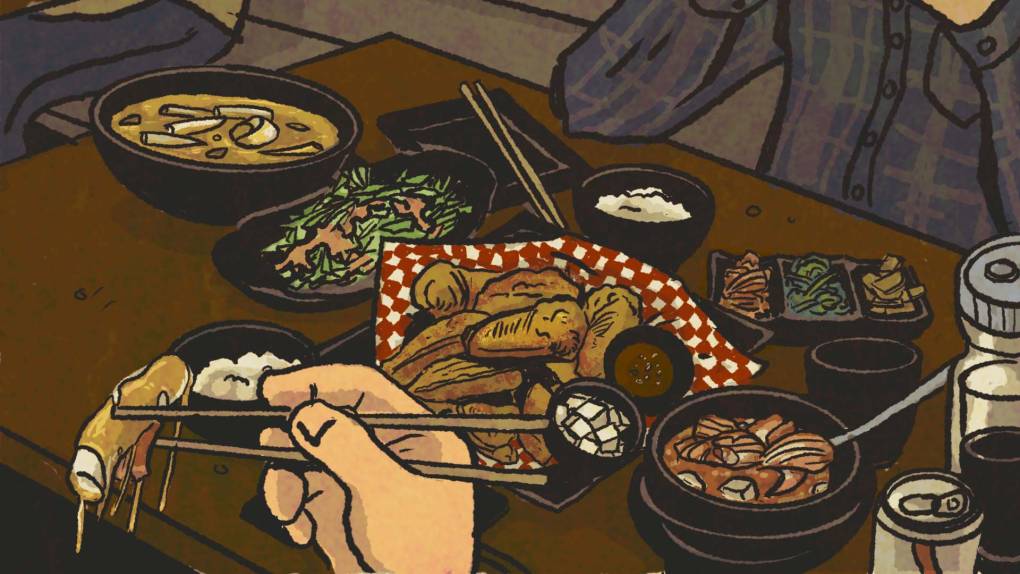
"caption": "Zzan's piping-hot Korean fried chicken wings and other bar snacks are among the best late-night options in San Francisco. ",
"description": null,
"title": "zzan crop",
"credit": "Thien Pham",
"status": "inherit",
"altTag": "Illustration of a spread of Korean food, including fried chicken wings, kimchi stew, rice cakes in cream sauce, and bowls of white rice.",
"isLoading": false,
"fetchFailed": false
},
"arts_13952634": {
"type": "attachments",
"id": "arts_13952634",
"meta": {
"index": "attachments_1716263798",
"site": "arts",
"id": "13952634",
"found": true
},
"parent": 13952578,
"imgSizes": {
"twentyfourteen-full-width": {
"file": "https://cdn.kqed.org/wp-content/uploads/sites/2/2024/02/SFCFC.parrot.shirt_-1038x576.jpg",
"width": 1038,
"mimeType": "image/jpeg",
"height": 576
},
"thumbnail": {
"file": "https://cdn.kqed.org/wp-content/uploads/sites/2/2024/02/SFCFC.parrot.shirt_-160x90.jpg",
"width": 160,
"mimeType": "image/jpeg",
"height": 90
},
"post-thumbnail": {
"file": "https://cdn.kqed.org/wp-content/uploads/sites/2/2024/02/SFCFC.parrot.shirt_-672x372.jpg",
"width": 672,
"mimeType": "image/jpeg",
"height": 372
},
"kqedFullSize": {
"file": "https://cdn.kqed.org/wp-content/uploads/sites/2/2024/02/SFCFC.parrot.shirt_.jpg",
"width": 1676,
"height": 943
},
"large": {
"file": "https://cdn.kqed.org/wp-content/uploads/sites/2/2024/02/SFCFC.parrot.shirt_-1020x574.jpg",
"width": 1020,
"mimeType": "image/jpeg",
"height": 574
},
"1536x1536": {
"file": "https://cdn.kqed.org/wp-content/uploads/sites/2/2024/02/SFCFC.parrot.shirt_-1536x864.jpg",
"width": 1536,
"mimeType": "image/jpeg",
"height": 864
},
"medium": {
"file": "https://cdn.kqed.org/wp-content/uploads/sites/2/2024/02/SFCFC.parrot.shirt_-800x450.jpg",
"width": 800,
"mimeType": "image/jpeg",
"height": 450
},
"medium_large": {
"file": "https://cdn.kqed.org/wp-content/uploads/sites/2/2024/02/SFCFC.parrot.shirt_-768x432.jpg",
"width": 768,
"mimeType": "image/jpeg",
"height": 432
}
},
"publishDate": 1708465446,
"modified": 1708465479,
"caption": "Hollis Callas’ new jersey for San Francisco City Football Club features the official animal of the city, a wild parrot. ",
"description": null,
"title": "SFCFC.parrot.shirt",
"credit": "Instagram/@holliscallas/@sfcityfc",
"status": "inherit",
"altTag": null,
"isLoading": false,
"fetchFailed": false
},
"arts_13952571": {
"type": "attachments",
"id": "arts_13952571",
"meta": {
"index": "attachments_1716263798",
"site": "arts",
"id": "13952571",
"found": true
},
"parent": 13952566,
"imgSizes": {
"twentyfourteen-full-width": {
"file": "https://cdn.kqed.org/wp-content/uploads/sites/2/2024/02/231215-BayAreaStyleZakiya-26-BL-1038x576.jpg",
"width": 1038,
"mimeType": "image/jpeg",
"height": 576
},
"thumbnail": {
"file": "https://cdn.kqed.org/wp-content/uploads/sites/2/2024/02/231215-BayAreaStyleZakiya-26-BL-160x107.jpg",
"width": 160,
"mimeType": "image/jpeg",
"height": 107
},
"post-thumbnail": {
"file": "https://cdn.kqed.org/wp-content/uploads/sites/2/2024/02/231215-BayAreaStyleZakiya-26-BL-672x372.jpg",
"width": 672,
"mimeType": "image/jpeg",
"height": 372
},
"kqedFullSize": {
"file": "https://cdn.kqed.org/wp-content/uploads/sites/2/2024/02/231215-BayAreaStyleZakiya-26-BL-scaled.jpg",
"width": 2560,
"height": 1707
},
"2048x2048": {
"file": "https://cdn.kqed.org/wp-content/uploads/sites/2/2024/02/231215-BayAreaStyleZakiya-26-BL-2048x1365.jpg",
"width": 2048,
"mimeType": "image/jpeg",
"height": 1365
},
"large": {
"file": "https://cdn.kqed.org/wp-content/uploads/sites/2/2024/02/231215-BayAreaStyleZakiya-26-BL-1020x680.jpg",
"width": 1020,
"mimeType": "image/jpeg",
"height": 680
},
"1536x1536": {
"file": "https://cdn.kqed.org/wp-content/uploads/sites/2/2024/02/231215-BayAreaStyleZakiya-26-BL-1536x1024.jpg",
"width": 1536,
"mimeType": "image/jpeg",
"height": 1024
},
"full-width": {
"file": "https://cdn.kqed.org/wp-content/uploads/sites/2/2024/02/231215-BayAreaStyleZakiya-26-BL-1920x1280.jpg",
"width": 1920,
"mimeType": "image/jpeg",
"height": 1280
},
"medium": {
"file": "https://cdn.kqed.org/wp-content/uploads/sites/2/2024/02/231215-BayAreaStyleZakiya-26-BL-800x533.jpg",
"width": 800,
"mimeType": "image/jpeg",
"height": 533
},
"medium_large": {
"file": "https://cdn.kqed.org/wp-content/uploads/sites/2/2024/02/231215-BayAreaStyleZakiya-26-BL-768x512.jpg",
"width": 768,
"mimeType": "image/jpeg",
"height": 512
}
},
"publishDate": 1708450925,
"modified": 1708464110,
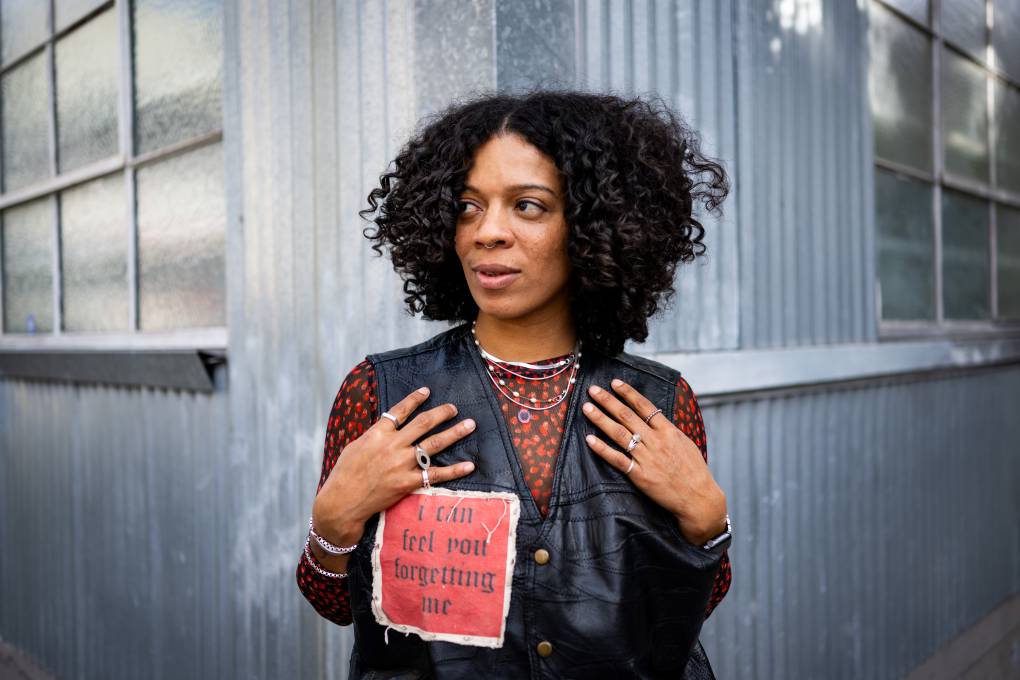
"caption": "'Even people who are not necessarily into fashion see my outfits, and they're just like, ‘There's something about your outfit that makes me happy,’' says Zakiya Zazaboi, pictured in San Francisco on Dec. 15, 2023.",
"description": null,
"title": "Zakiya Zazaboi poses for a portrait in San Francisco on Dec. 15, 2023.",
"credit": "Beth LaBerge/KQED",
"status": "inherit",
"altTag": null,
"isLoading": false,
"fetchFailed": false
},
"arts_13952334": {
"type": "attachments",
"id": "arts_13952334",
"meta": {
"index": "attachments_1716263798",
"site": "arts",
"id": "13952334",
"found": true
},
"parent": 13952329,
"imgSizes": {
"twentyfourteen-full-width": {
"file": "https://cdn.kqed.org/wp-content/uploads/sites/2/2024/02/Screenshot-2024-02-14-at-2.18.11-PM-1038x576.png",
"width": 1038,
"mimeType": "image/png",
"height": 576
},
"thumbnail": {
"file": "https://cdn.kqed.org/wp-content/uploads/sites/2/2024/02/Screenshot-2024-02-14-at-2.18.11-PM-160x150.png",
"width": 160,
"mimeType": "image/png",
"height": 150
},
"post-thumbnail": {
"file": "https://cdn.kqed.org/wp-content/uploads/sites/2/2024/02/Screenshot-2024-02-14-at-2.18.11-PM-672x372.png",
"width": 672,
"mimeType": "image/png",
"height": 372
},
"kqedFullSize": {
"file": "https://cdn.kqed.org/wp-content/uploads/sites/2/2024/02/Screenshot-2024-02-14-at-2.18.11-PM.png",
"width": 1242,
"height": 1166
},
"large": {
"file": "https://cdn.kqed.org/wp-content/uploads/sites/2/2024/02/Screenshot-2024-02-14-at-2.18.11-PM-1020x958.png",
"width": 1020,
"mimeType": "image/png",
"height": 958
},
"medium": {
"file": "https://cdn.kqed.org/wp-content/uploads/sites/2/2024/02/Screenshot-2024-02-14-at-2.18.11-PM-800x751.png",
"width": 800,
"mimeType": "image/png",
"height": 751
},
"medium_large": {
"file": "https://cdn.kqed.org/wp-content/uploads/sites/2/2024/02/Screenshot-2024-02-14-at-2.18.11-PM-768x721.png",
"width": 768,
"mimeType": "image/png",
"height": 721
}
},
"publishDate": 1707950493,
"modified": 1707950560,
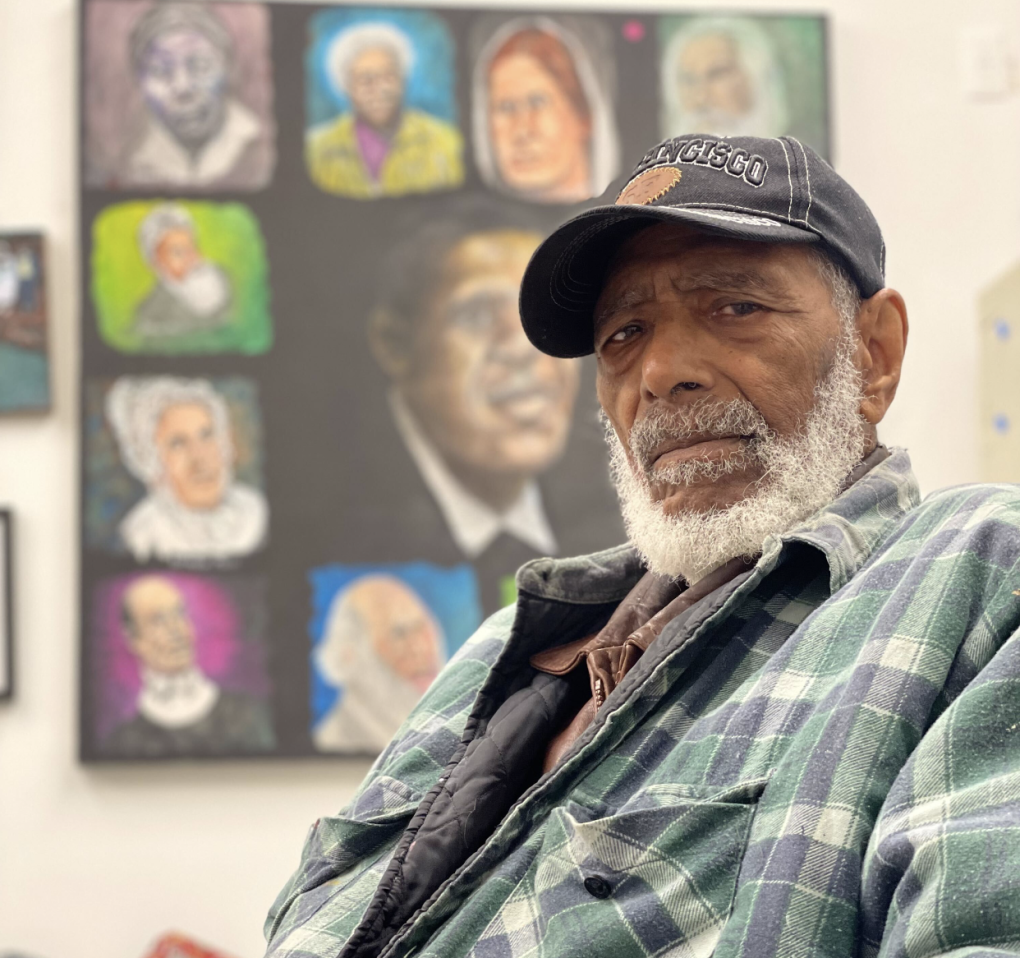
"caption": "Painter Ira Watkins at his studio in the Hunters Point Shipyard.",
"description": "Painter Ira Watkins sits, looking into the camera, at his studio in the Hunters Point Shipyard.",
"title": "Painter Ira Watkins at his studio in the Hunters Point Shipyard.",
"credit": "Pendarvis Harshaw",
"status": "inherit",
"altTag": "Painter Ira Watkins at his studio in the Hunters Point Shipyard.",
"isLoading": false,
"fetchFailed": false
},
"arts_13952156": {
"type": "attachments",
"id": "arts_13952156",
"meta": {
"index": "attachments_1716263798",
"site": "arts",
"id": "13952156",
"found": true
},
"parent": 13952152,
"imgSizes": {
"twentyfourteen-full-width": {
"file": "https://cdn.kqed.org/wp-content/uploads/sites/2/2024/02/Screen-Shot-2024-02-13-at-11.52.21-AM-1038x576.png",
"width": 1038,
"mimeType": "image/png",
"height": 576
},
"thumbnail": {
"file": "https://cdn.kqed.org/wp-content/uploads/sites/2/2024/02/Screen-Shot-2024-02-13-at-11.52.21-AM-160x86.png",
"width": 160,
"mimeType": "image/png",
"height": 86
},
"post-thumbnail": {
"file": "https://cdn.kqed.org/wp-content/uploads/sites/2/2024/02/Screen-Shot-2024-02-13-at-11.52.21-AM-672x372.png",
"width": 672,
"mimeType": "image/png",
"height": 372
},
"kqedFullSize": {
"file": "https://cdn.kqed.org/wp-content/uploads/sites/2/2024/02/Screen-Shot-2024-02-13-at-11.52.21-AM.png",
"width": 1378,
"height": 738
},
"large": {
"file": "https://cdn.kqed.org/wp-content/uploads/sites/2/2024/02/Screen-Shot-2024-02-13-at-11.52.21-AM-1020x546.png",
"width": 1020,
"mimeType": "image/png",
"height": 546
},
"medium": {
"file": "https://cdn.kqed.org/wp-content/uploads/sites/2/2024/02/Screen-Shot-2024-02-13-at-11.52.21-AM-800x428.png",
"width": 800,
"mimeType": "image/png",
"height": 428
},
"medium_large": {
"file": "https://cdn.kqed.org/wp-content/uploads/sites/2/2024/02/Screen-Shot-2024-02-13-at-11.52.21-AM-768x411.png",
"width": 768,
"mimeType": "image/png",
"height": 411
}
},
"publishDate": 1707853994,
"modified": 1707956352,
"caption": "A woman holds a child in the San Francisco Mission during a community event in the early 1970s, in a still from the program 'Mission Love.'",
"description": null,
"title": "Screen Shot 2024-02-13 at 11.52.21 AM",
"credit": "Roxie Theater",
"status": "inherit",
"altTag": "a Latina woman holds a child in a San Francisco park, circa 1970s",
"isLoading": false,
"fetchFailed": false
},
"arts_13952262": {
"type": "attachments",
"id": "arts_13952262",
"meta": {
"index": "attachments_1716263798",
"site": "arts",
"id": "13952262",
"found": true
},
"parent": 13952260,
"imgSizes": {
"twentyfourteen-full-width": {
"file": "https://cdn.kqed.org/wp-content/uploads/sites/2/2024/02/ISP.impact.MAIN_-1038x576.jpg",
"width": 1038,
"mimeType": "image/jpeg",
"height": 576
},
"thumbnail": {
"file": "https://cdn.kqed.org/wp-content/uploads/sites/2/2024/02/ISP.impact.MAIN_-160x90.jpg",
"width": 160,
"mimeType": "image/jpeg",
"height": 90
},
"post-thumbnail": {
"file": "https://cdn.kqed.org/wp-content/uploads/sites/2/2024/02/ISP.impact.MAIN_-672x372.jpg",
"width": 672,
"mimeType": "image/jpeg",
"height": 372
},
"kqedFullSize": {
"file": "https://cdn.kqed.org/wp-content/uploads/sites/2/2024/02/ISP.impact.MAIN_.jpg",
"width": 1080,
"height": 608
},
"large": {
"file": "https://cdn.kqed.org/wp-content/uploads/sites/2/2024/02/ISP.impact.MAIN_-1020x574.jpg",
"width": 1020,
"mimeType": "image/jpeg",
"height": 574
},
"medium": {
"file": "https://cdn.kqed.org/wp-content/uploads/sites/2/2024/02/ISP.impact.MAIN_-800x450.jpg",
"width": 800,
"mimeType": "image/jpeg",
"height": 450
},
"medium_large": {
"file": "https://cdn.kqed.org/wp-content/uploads/sites/2/2024/02/ISP.impact.MAIN_-768x432.jpg",
"width": 768,
"mimeType": "image/jpeg",
"height": 432
}
},
"publishDate": 1707897078,
"modified": 1707897388,
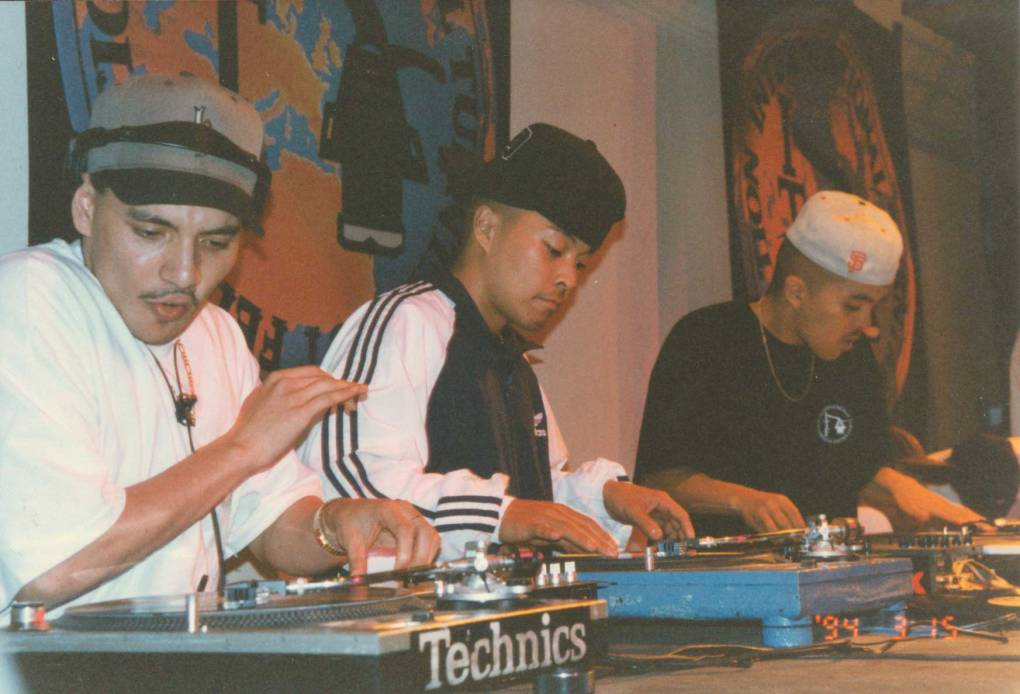
"caption": "The Invisibl Skratch Piklz' cultural impact over the past 40 years has been felt around the globe. The crew is pictured here backstage in San Francisco in 2017.",
"description": null,
"title": "ISP.impact.MAIN",
"credit": "Courtesy Shortkut",
"status": "inherit",
"altTag": null,
"isLoading": false,
"fetchFailed": false
},
"arts_13952226": {
"type": "attachments",
"id": "arts_13952226",
"meta": {
"index": "attachments_1716263798",
"site": "arts",
"id": "13952226",
"found": true
},
"parent": 13952208,
"imgSizes": {
"twentyfourteen-full-width": {
"file": "https://cdn.kqed.org/wp-content/uploads/sites/2/2024/02/ISP.all3_.MMMwShortkut-1038x576.jpg",
"width": 1038,
"mimeType": "image/jpeg",
"height": 576
},
"thumbnail": {
"file": "https://cdn.kqed.org/wp-content/uploads/sites/2/2024/02/ISP.all3_.MMMwShortkut-160x109.jpg",
"width": 160,
"mimeType": "image/jpeg",
"height": 109
},
"post-thumbnail": {
"file": "https://cdn.kqed.org/wp-content/uploads/sites/2/2024/02/ISP.all3_.MMMwShortkut-672x372.jpg",
"width": 672,
"mimeType": "image/jpeg",
"height": 372
},
"kqedFullSize": {
"file": "https://cdn.kqed.org/wp-content/uploads/sites/2/2024/02/ISP.all3_.MMMwShortkut.jpg",
"width": 1745,
"height": 1188
},
"large": {
"file": "https://cdn.kqed.org/wp-content/uploads/sites/2/2024/02/ISP.all3_.MMMwShortkut-1020x694.jpg",
"width": 1020,
"mimeType": "image/jpeg",
"height": 694
},
"1536x1536": {
"file": "https://cdn.kqed.org/wp-content/uploads/sites/2/2024/02/ISP.all3_.MMMwShortkut-1536x1046.jpg",
"width": 1536,
"mimeType": "image/jpeg",
"height": 1046
},
"medium": {
"file": "https://cdn.kqed.org/wp-content/uploads/sites/2/2024/02/ISP.all3_.MMMwShortkut-800x545.jpg",
"width": 800,
"mimeType": "image/jpeg",
"height": 545
},
"medium_large": {
"file": "https://cdn.kqed.org/wp-content/uploads/sites/2/2024/02/ISP.all3_.MMMwShortkut-768x523.jpg",
"width": 768,
"mimeType": "image/jpeg",
"height": 523
}
},
"publishDate": 1707885634,
"modified": 1707886423,
"caption": "The Invisibl Skratch Piklz' lineup of Mix Master Mike, Qbert and Shortkut.",
"description": null,
"title": "ISP.all3.MMMwShortkut",
"credit": "Courtesy Alex Aquino",
"status": "inherit",
"altTag": null,
"isLoading": false,
"fetchFailed": false
},
"arts_13934340": {
"type": "attachments",
"id": "arts_13934340",
"meta": {
"index": "attachments_1716263798",
"site": "arts",
"id": "13934340",
"found": true
},
"parent": 13934324,
"imgSizes": {
"twentyfourteen-full-width": {
"file": "https://ww2.kqed.org/app/uploads/sites/2/2023/09/DSC00110-1038x576.jpg",
"width": 1038,
"mimeType": "image/jpeg",
"height": 576
},
"thumbnail": {
"file": "https://ww2.kqed.org/app/uploads/sites/2/2023/09/DSC00110-160x120.jpg",
"width": 160,
"mimeType": "image/jpeg",
"height": 120
},
"post-thumbnail": {
"file": "https://ww2.kqed.org/app/uploads/sites/2/2023/09/DSC00110-672x372.jpg",
"width": 672,
"mimeType": "image/jpeg",
"height": 372
},
"kqedFullSize": {
"file": "https://ww2.kqed.org/app/uploads/sites/2/2023/09/DSC00110.jpg",
"width": 1920,
"height": 1440
},
"large": {
"file": "https://ww2.kqed.org/app/uploads/sites/2/2023/09/DSC00110-1020x765.jpg",
"width": 1020,
"mimeType": "image/jpeg",
"height": 765
},
"1536x1536": {
"file": "https://ww2.kqed.org/app/uploads/sites/2/2023/09/DSC00110-1536x1152.jpg",
"width": 1536,
"mimeType": "image/jpeg",
"height": 1152
},
"medium": {
"file": "https://ww2.kqed.org/app/uploads/sites/2/2023/09/DSC00110-800x600.jpg",
"width": 800,
"mimeType": "image/jpeg",
"height": 600
},
"medium_large": {
"file": "https://ww2.kqed.org/app/uploads/sites/2/2023/09/DSC00110-768x576.jpg",
"width": 768,
"mimeType": "image/jpeg",
"height": 576
}
},
"publishDate": 1693958723,
"modified": 1693959635,
"caption": "Cellski on stage at Hiero Day in Frank Ogawa Plaza, Oakland, Sept. 4, 2023.",
"description": null,
"title": "DSC00110",
"credit": "Eric Arnold/KQED",
"status": "inherit",
"altTag": null,
"isLoading": false,
"fetchFailed": false
},
"arts_13952119": {
"type": "attachments",
"id": "arts_13952119",
"meta": {
"index": "attachments_1716263798",
"site": "arts",
"id": "13952119",
"found": true
},
"parent": 13952094,
"imgSizes": {
"twentyfourteen-full-width": {
"file": "https://cdn.kqed.org/wp-content/uploads/sites/2/2024/02/240211-LAS-VEGAS-WATCH-PARTY-MD-14-KQED-1-1038x576.jpg",
"width": 1038,
"mimeType": "image/jpeg",
"height": 576
},
"thumbnail": {
"file": "https://cdn.kqed.org/wp-content/uploads/sites/2/2024/02/240211-LAS-VEGAS-WATCH-PARTY-MD-14-KQED-1-160x107.jpg",
"width": 160,
"mimeType": "image/jpeg",
"height": 107
},
"post-thumbnail": {
"file": "https://cdn.kqed.org/wp-content/uploads/sites/2/2024/02/240211-LAS-VEGAS-WATCH-PARTY-MD-14-KQED-1-672x372.jpg",
"width": 672,
"mimeType": "image/jpeg",
"height": 372
},
"kqedFullSize": {
"file": "https://cdn.kqed.org/wp-content/uploads/sites/2/2024/02/240211-LAS-VEGAS-WATCH-PARTY-MD-14-KQED-1.jpg",
"width": 2000,
"height": 1333
},
"large": {
"file": "https://cdn.kqed.org/wp-content/uploads/sites/2/2024/02/240211-LAS-VEGAS-WATCH-PARTY-MD-14-KQED-1-1020x680.jpg",
"width": 1020,
"mimeType": "image/jpeg",
"height": 680
},
"1536x1536": {
"file": "https://cdn.kqed.org/wp-content/uploads/sites/2/2024/02/240211-LAS-VEGAS-WATCH-PARTY-MD-14-KQED-1-1536x1024.jpg",
"width": 1536,
"mimeType": "image/jpeg",
"height": 1024
},
"full-width": {
"file": "https://cdn.kqed.org/wp-content/uploads/sites/2/2024/02/240211-LAS-VEGAS-WATCH-PARTY-MD-14-KQED-1-1920x1280.jpg",
"width": 1920,
"mimeType": "image/jpeg",
"height": 1280
},
"medium": {
"file": "https://cdn.kqed.org/wp-content/uploads/sites/2/2024/02/240211-LAS-VEGAS-WATCH-PARTY-MD-14-KQED-1-800x533.jpg",
"width": 800,
"mimeType": "image/jpeg",
"height": 533
},
"medium_large": {
"file": "https://cdn.kqed.org/wp-content/uploads/sites/2/2024/02/240211-LAS-VEGAS-WATCH-PARTY-MD-14-KQED-1-768x512.jpg",
"width": 768,
"mimeType": "image/jpeg",
"height": 512
}
},
"publishDate": 1707835896,
"modified": 1707835924,
"caption": "San Francisco 49ers fan Madonna Caballes anxiously watches the closing minutes of the Super Bowl between the San Francisco 49ers and the Kansas City Chiefs at the Biggest Big Game Bash watch party in Downtown Las Vegas on Feb. 11, 2024.",
"description": null,
"title": "240211-LAS VEGAS WATCH PARTY-MD-14-KQED-1",
"credit": "Martin do Nascimento/KQED",
"status": "inherit",
"altTag": null,
"isLoading": false,
"fetchFailed": false
},
"arts_13952058": {
"type": "attachments",
"id": "arts_13952058",
"meta": {
"index": "attachments_1716263798",
"site": "arts",
"id": "13952058",
"found": true
},
"parent": 13952052,
"imgSizes": {
"twentyfourteen-full-width": {
"file": "https://cdn.kqed.org/wp-content/uploads/sites/2/2024/02/3.__a_third_culture_kid_pilgrimage__shot_by__terry.thunder__creative_direction___taiwanesenoodles___bowlcutsurvivor__taken_from___itsyangsheng_crop-1038x576.jpg",
"width": 1038,
"mimeType": "image/jpeg",
"height": 576
},
"thumbnail": {
"file": "https://cdn.kqed.org/wp-content/uploads/sites/2/2024/02/3.__a_third_culture_kid_pilgrimage__shot_by__terry.thunder__creative_direction___taiwanesenoodles___bowlcutsurvivor__taken_from___itsyangsheng_crop-160x100.jpg",
"width": 160,
"mimeType": "image/jpeg",
"height": 100
},
"post-thumbnail": {
"file": "https://cdn.kqed.org/wp-content/uploads/sites/2/2024/02/3.__a_third_culture_kid_pilgrimage__shot_by__terry.thunder__creative_direction___taiwanesenoodles___bowlcutsurvivor__taken_from___itsyangsheng_crop-672x372.jpg",
"width": 672,
"mimeType": "image/jpeg",
"height": 372
},
"kqedFullSize": {
"file": "https://cdn.kqed.org/wp-content/uploads/sites/2/2024/02/3.__a_third_culture_kid_pilgrimage__shot_by__terry.thunder__creative_direction___taiwanesenoodles___bowlcutsurvivor__taken_from___itsyangsheng_crop.jpg",
"width": 1920,
"height": 1200
},
"large": {
"file": "https://cdn.kqed.org/wp-content/uploads/sites/2/2024/02/3.__a_third_culture_kid_pilgrimage__shot_by__terry.thunder__creative_direction___taiwanesenoodles___bowlcutsurvivor__taken_from___itsyangsheng_crop-1020x638.jpg",
"width": 1020,
"mimeType": "image/jpeg",
"height": 638
},
"1536x1536": {
"file": "https://cdn.kqed.org/wp-content/uploads/sites/2/2024/02/3.__a_third_culture_kid_pilgrimage__shot_by__terry.thunder__creative_direction___taiwanesenoodles___bowlcutsurvivor__taken_from___itsyangsheng_crop-1536x960.jpg",
"width": 1536,
"mimeType": "image/jpeg",
"height": 960
},
"medium": {
"file": "https://cdn.kqed.org/wp-content/uploads/sites/2/2024/02/3.__a_third_culture_kid_pilgrimage__shot_by__terry.thunder__creative_direction___taiwanesenoodles___bowlcutsurvivor__taken_from___itsyangsheng_crop-800x500.jpg",
"width": 800,
"mimeType": "image/jpeg",
"height": 500
},
"medium_large": {
"file": "https://cdn.kqed.org/wp-content/uploads/sites/2/2024/02/3.__a_third_culture_kid_pilgrimage__shot_by__terry.thunder__creative_direction___taiwanesenoodles___bowlcutsurvivor__taken_from___itsyangsheng_crop-768x480.jpg",
"width": 768,
"mimeType": "image/jpeg",
"height": 480
}
},
"publishDate": 1707524553,
"modified": 1707776022,
"caption": "Yăng Shēng, a multimedia project launched by Hanna Chen (left) and Steph Cai (center), aims to bring \"third culture\" children of immigrants from Asian diasporas together in the Bay Area.",
"description": null,
"title": "3.__a_third_culture_kid_pilgrimage__shot_by__terry.thunder__creative_direction___taiwanesenoodles___bowlcutsurvivor__taken_from___itsyangsheng_crop",
"credit": "Terry Thunder Tsai, courtesy of Yăng Shēng",
"status": "inherit",
"altTag": "A trio of first-generation Asian American women pose in front of a Chinatown market",
"isLoading": false,
"fetchFailed": false
},
"arts_13950580": {
"type": "attachments",
"id": "arts_13950580",
"meta": {
"index": "attachments_1716263798",
"site": "arts",
"id": "13950580",
"found": true
},
"parent": 13950526,
"imgSizes": {
"twentyfourteen-full-width": {
"file": "https://cdn.kqed.org/wp-content/uploads/sites/2/2024/01/GettyImages-526307346-1038x576.jpg",
"width": 1038,
"mimeType": "image/jpeg",
"height": 576
},
"thumbnail": {
"file": "https://cdn.kqed.org/wp-content/uploads/sites/2/2024/01/GettyImages-526307346-160x110.jpg",
"width": 160,
"mimeType": "image/jpeg",
"height": 110
},
"post-thumbnail": {
"file": "https://cdn.kqed.org/wp-content/uploads/sites/2/2024/01/GettyImages-526307346-672x372.jpg",
"width": 672,
"mimeType": "image/jpeg",
"height": 372
},
"kqedFullSize": {
"file": "https://cdn.kqed.org/wp-content/uploads/sites/2/2024/01/GettyImages-526307346-scaled-e1705619320196.jpg",
"width": 1920,
"height": 1319
},
"2048x2048": {
"file": "https://cdn.kqed.org/wp-content/uploads/sites/2/2024/01/GettyImages-526307346-2048x1407.jpg",
"width": 2048,
"mimeType": "image/jpeg",
"height": 1407
},
"large": {
"file": "https://cdn.kqed.org/wp-content/uploads/sites/2/2024/01/GettyImages-526307346-1020x701.jpg",
"width": 1020,
"mimeType": "image/jpeg",
"height": 701
},
"1536x1536": {
"file": "https://cdn.kqed.org/wp-content/uploads/sites/2/2024/01/GettyImages-526307346-1536x1056.jpg",
"width": 1536,
"mimeType": "image/jpeg",
"height": 1056
},
"full-width": {
"file": "https://cdn.kqed.org/wp-content/uploads/sites/2/2024/01/GettyImages-526307346-1920x1319.jpg",
"width": 1920,
"mimeType": "image/jpeg",
"height": 1319
},
"medium": {
"file": "https://cdn.kqed.org/wp-content/uploads/sites/2/2024/01/GettyImages-526307346-800x550.jpg",
"width": 800,
"mimeType": "image/jpeg",
"height": 550
},
"medium_large": {
"file": "https://cdn.kqed.org/wp-content/uploads/sites/2/2024/01/GettyImages-526307346-768x528.jpg",
"width": 768,
"mimeType": "image/jpeg",
"height": 528
}
},
"publishDate": 1705619294,
"modified": 1705621678,
"caption": "Victorian couples living it up like only Victorians could.",
"description": null,
"title": "Victorian couples living it up like only Victorians could.",
"credit": "Kirn Vintage Stock/ Corbis via Getty Images",
"status": "inherit",
"altTag": "Two couples pose in a novelty photo in San Francisco, ca. 1900.",
"isLoading": false,
"fetchFailed": false
}
},
"audioPlayerReducer": {
"postId": "stream_live",
"isPaused": true,
"isPlaying": false,
"pfsActive": false,
"pledgeModalIsOpen": true,
"playerDrawerIsOpen": false,
"liveAudioPlayStartedAt": 0,
"liveAudioPlayContext": ""
},
"authorsReducer": {
"ralexandra": {
"type": "authors",
"id": "11242",
"meta": {
"index": "authors_1716337520",
"id": "11242",
"found": true
},
"name": "Rae Alexandra",
"firstName": "Rae",
"lastName": "Alexandra",
"slug": "ralexandra",
"email": "ralexandra@kqed.org",
"display_author_email": true,
"staff_mastheads": [],
"title": "Reporter/Producer",
"bio": "Rae Alexandra is a Reporter/Producer for KQED Arts & Culture, and the creator/author of the \u003ca href=\"https://www.kqed.org/arts/program/rebel-girls-from-bay-area-history\">Rebel Girls From Bay Area History\u003c/a> and \u003ca href=\"https://www.kqed.org/bizarrebayarea\">Bizarre Bay Area\u003c/a> series. Her debut book, \u003ca href=\"https://citylights.com/politics-current-events-history/unsung-heroines35-women-who-changed/\">Unsung Heroines: 35 Women Who Changed the Bay Area\u003c/a> was published by City Lights in March 2026. In 2023, Rae was awarded an SPJ Excellence in Journalism Award for Arts & Culture. Rae was born and raised in Wales and subsequently — even after two decades in Northern California — still uses phrases that regularly baffle her coworkers.",
"avatar": "https://secure.gravatar.com/avatar/edfee8176c80cc0a382b051190f5341997df378a934a5774dcb0977732dfd401?s=600&d=blank&r=g",
"twitter": null,
"bluesky": null,
"facebook": null,
"instagram": null,
"linkedin": null,
"sites": [
{
"site": "arts",
"roles": [
"subscriber"
]
},
{
"site": "news",
"roles": [
"subscriber"
]
},
{
"site": "pop",
"roles": [
"subscriber"
]
},
{
"site": "bayareabites",
"roles": [
"subscriber"
]
},
{
"site": "science",
"roles": [
"subscriber"
]
}
],
"headData": {
"title": "Rae Alexandra | KQED",
"description": "Reporter/Producer",
"ogImgSrc": "https://secure.gravatar.com/avatar/edfee8176c80cc0a382b051190f5341997df378a934a5774dcb0977732dfd401?s=600&d=blank&r=g",
"twImgSrc": "https://secure.gravatar.com/avatar/edfee8176c80cc0a382b051190f5341997df378a934a5774dcb0977732dfd401?s=600&d=blank&r=g"
},
"isLoading": false,
"link": "/author/ralexandra"
},
"ogpenn": {
"type": "authors",
"id": "11491",
"meta": {
"index": "authors_1716337520",
"id": "11491",
"found": true
},
"name": "Pendarvis Harshaw",
"firstName": "Pendarvis",
"lastName": "Harshaw",
"slug": "ogpenn",
"email": "ogpenn@gmail.com",
"display_author_email": false,
"staff_mastheads": [
"arts"
],
"title": "Community Engagement Reporter",
"bio": "Pendarvis Harshaw is an educator, host and writer with KQED Arts.",
"avatar": "https://secure.gravatar.com/avatar/972b77ee8e3f346ae2b00622661187fbfabd059b5693bbdc1475ea7a722fd4cd?s=600&d=blank&r=g",
"twitter": null,
"bluesky": null,
"facebook": null,
"instagram": "ogpenn",
"linkedin": null,
"sites": [
{
"site": "arts",
"roles": [
"administrator"
]
},
{
"site": "news",
"roles": [
"editor"
]
},
{
"site": "bayareabites",
"roles": [
"author"
]
},
{
"site": "hiphop",
"roles": [
"editor"
]
}
],
"headData": {
"title": "Pendarvis Harshaw | KQED",
"description": "Community Engagement Reporter",
"ogImgSrc": "https://secure.gravatar.com/avatar/972b77ee8e3f346ae2b00622661187fbfabd059b5693bbdc1475ea7a722fd4cd?s=600&d=blank&r=g",
"twImgSrc": "https://secure.gravatar.com/avatar/972b77ee8e3f346ae2b00622661187fbfabd059b5693bbdc1475ea7a722fd4cd?s=600&d=blank&r=g"
},
"isLoading": false,
"link": "/author/ogpenn"
},
"mmedina": {
"type": "authors",
"id": "11528",
"meta": {
"index": "authors_1716337520",
"id": "11528",
"found": true
},
"name": "Marisol Medina-Cadena",
"firstName": "Marisol",
"lastName": "Medina-Cadena",
"slug": "mmedina",
"email": "mmedina@KQED.org",
"display_author_email": true,
"staff_mastheads": [],
"title": "Producer, Rightnowish Podcast",
"bio": "Marisol Medina-Cadena is a radio reporter and podcast producer. Before working at KQED, she produced for PBS member station, KCET, in Los Angeles. In 2017, Marisol won an Emmy Award for her work on the televised documentary, \u003cem>City Rising\u003c/em>, examining California's affordable housing crisis and the historical roots of gentrification.",
"avatar": "https://secure.gravatar.com/avatar/6c3db46a1cabb5e1fe9a365b5f4e681e?s=600&d=blank&r=g",
"twitter": "marisolreports",
"facebook": null,
"instagram": null,
"linkedin": null,
"sites": [
{
"site": "arts",
"roles": []
},
{
"site": "news",
"roles": [
"edit_others_posts"
]
}
],
"headData": {
"title": "Marisol Medina-Cadena | KQED",
"description": "Producer, Rightnowish Podcast",
"ogImgSrc": "https://secure.gravatar.com/avatar/6c3db46a1cabb5e1fe9a365b5f4e681e?s=600&d=blank&r=g",
"twImgSrc": "https://secure.gravatar.com/avatar/6c3db46a1cabb5e1fe9a365b5f4e681e?s=600&d=blank&r=g"
},
"isLoading": false,
"link": "/author/mmedina"
},
"ltsai": {
"type": "authors",
"id": "11743",
"meta": {
"index": "authors_1716337520",
"id": "11743",
"found": true
},
"name": "Luke Tsai",
"firstName": "Luke",
"lastName": "Tsai",
"slug": "ltsai",
"email": "ltsai@kqed.org",
"display_author_email": true,
"staff_mastheads": [
"arts"
],
"title": "Food Editor",
"bio": "Luke Tsai is KQED's food editor and resident stinky tofu connoisseur. Prior to KQED, he was an editor at Eater SF, \u003cem>San Francisco \u003c/em>magazine, and the \u003cem>East Bay Express\u003c/em>, and his work has also appeared in TASTE, the \u003cem>San Francisco Chronicle\u003c/em>, and the \u003cem>Best Food Writing\u003c/em> anthology. When he isn't writing or editing, you'll find him eating most everything he can get his hands on.",
"avatar": "https://secure.gravatar.com/avatar/1e59b45bf191526e7339d6ba46e33a57b2030d25c27660ecc64ea3cb863e34f7?s=600&d=blank&r=g",
"twitter": "theluketsai",
"bluesky": null,
"facebook": null,
"instagram": null,
"linkedin": null,
"sites": [
{
"site": "",
"roles": [
"editor"
]
},
{
"site": "arts",
"roles": [
"administrator"
]
},
{
"site": "news",
"roles": [
"editor",
"contributor"
]
},
{
"site": "bayareabites",
"roles": [
"editor"
]
},
{
"site": "food",
"roles": [
"editor"
]
}
],
"headData": {
"title": "Luke Tsai | KQED",
"description": "Food Editor",
"ogImgSrc": "https://secure.gravatar.com/avatar/1e59b45bf191526e7339d6ba46e33a57b2030d25c27660ecc64ea3cb863e34f7?s=600&d=blank&r=g",
"twImgSrc": "https://secure.gravatar.com/avatar/1e59b45bf191526e7339d6ba46e33a57b2030d25c27660ecc64ea3cb863e34f7?s=600&d=blank&r=g"
},
"isLoading": false,
"link": "/author/ltsai"
},
"achazaro": {
"type": "authors",
"id": "11748",
"meta": {
"index": "authors_1716337520",
"id": "11748",
"found": true
},
"name": "Alan Chazaro",
"firstName": "Alan",
"lastName": "Chazaro",
"slug": "achazaro",
"email": "agchazaro@gmail.com",
"display_author_email": true,
"staff_mastheads": [],
"title": "Food Writer and Reporter",
"bio": "Alan Chazaro is the author of \u003cem>This Is Not a Frank Ocean Cover Album\u003c/em> (Black Lawrence Press, 2019), \u003cem>Piñata Theory\u003c/em> (Black Lawrence Press, 2020), and \u003cem>Notes from the Eastern Span of the Bay Bridge\u003c/em> (Ghost City Press, 2021). He is a graduate of June Jordan’s Poetry for the People program at UC Berkeley and a former Lawrence Ferlinghetti Fellow at the University of San Francisco. He writes about sports, food, art, music, education, and culture while repping the Bay on \u003ca href=\"https://twitter.com/alan_chazaro\">Twitter\u003c/a> and \u003ca href=\"https://www.instagram.com/alan_chazaro/?hl=en\">Instagram\u003c/a> at @alan_chazaro.",
"avatar": "https://secure.gravatar.com/avatar/ea8b6dd970fc5c29e7a188e7d5861df7?s=600&d=blank&r=g",
"twitter": "alan_chazaro",
"facebook": null,
"instagram": null,
"linkedin": null,
"sites": [
{
"site": "arts",
"roles": [
"contributor"
]
},
{
"site": "news",
"roles": [
"editor"
]
}
],
"headData": {
"title": "Alan Chazaro | KQED",
"description": "Food Writer and Reporter",
"ogImgSrc": "https://secure.gravatar.com/avatar/ea8b6dd970fc5c29e7a188e7d5861df7?s=600&d=blank&r=g",
"twImgSrc": "https://secure.gravatar.com/avatar/ea8b6dd970fc5c29e7a188e7d5861df7?s=600&d=blank&r=g"
},
"isLoading": false,
"link": "/author/achazaro"
},
"tpham": {
"type": "authors",
"id": "11753",
"meta": {
"index": "authors_1716337520",
"id": "11753",
"found": true
},
"name": "Thien Pham",
"firstName": "Thien",
"lastName": "Pham",
"slug": "tpham",
"email": "thiendog@gmail.com",
"display_author_email": false,
"staff_mastheads": [],
"title": "KQED Contributor",
"bio": null,
"avatar": "https://secure.gravatar.com/avatar/a5b4729969ad46d88e7b9ec9dd4f3fa6af84dd0fa8fa91f01d8d9481694999bc?s=600&d=blank&r=g",
"twitter": null,
"bluesky": null,
"facebook": null,
"instagram": null,
"linkedin": null,
"sites": [
{
"site": "arts",
"roles": [
"contributor"
]
}
],
"headData": {
"title": "Thien Pham | KQED",
"description": "KQED Contributor",
"ogImgSrc": "https://secure.gravatar.com/avatar/a5b4729969ad46d88e7b9ec9dd4f3fa6af84dd0fa8fa91f01d8d9481694999bc?s=600&d=blank&r=g",
"twImgSrc": "https://secure.gravatar.com/avatar/a5b4729969ad46d88e7b9ec9dd4f3fa6af84dd0fa8fa91f01d8d9481694999bc?s=600&d=blank&r=g"
},
"isLoading": false,
"link": "/author/tpham"
},
"earnold": {
"type": "authors",
"id": "11839",
"meta": {
"index": "authors_1716337520",
"id": "11839",
"found": true
},
"name": "Eric Arnold",
"firstName": "Eric",
"lastName": "Arnold",
"slug": "earnold",
"email": "earnold@kqed.org",
"display_author_email": false,
"staff_mastheads": [],
"title": "Contributing Editor, 'That's My Word'",
"bio": "Eric Arnold has covered hip-hop locally and nationally for over 30 years. Formerly the managing editor of \u003cem>4080\u003c/em> and columnist for \u003cem>The Source\u003c/em>, he chronicled hyphy’s rise and fall, co-curated the Oakland Museum of California’s first hip-hop exhibit in 2018 and won a 2022 Northern California Emmy Award for a mini-documentary on Oakland’s Boogaloo dance culture. He is a contributing editor for \u003cem>That’s My Word\u003c/em>, KQED's series on the history of Bay Area hip-hop.",
"avatar": "https://secure.gravatar.com/avatar/ede45b04898456ad0893a2811e78b0a2?s=600&d=blank&r=g",
"twitter": null,
"facebook": null,
"instagram": null,
"linkedin": null,
"sites": [
{
"site": "arts",
"roles": [
"contributor"
]
},
{
"site": "news",
"roles": [
"contributor"
]
},
{
"site": "hiphop",
"roles": [
"contributor"
]
}
],
"headData": {
"title": "Eric Arnold | KQED",
"description": "Contributing Editor, 'That's My Word'",
"ogImgSrc": "https://secure.gravatar.com/avatar/ede45b04898456ad0893a2811e78b0a2?s=600&d=blank&r=g",
"twImgSrc": "https://secure.gravatar.com/avatar/ede45b04898456ad0893a2811e78b0a2?s=600&d=blank&r=g"
},
"isLoading": false,
"link": "/author/earnold"
},
"omayeda": {
"type": "authors",
"id": "11872",
"meta": {
"index": "authors_1716337520",
"id": "11872",
"found": true
},
"name": "Olivia Cruz Mayeda",
"firstName": "Olivia Cruz",
"lastName": "Mayeda",
"slug": "omayeda",
"email": "omayeda@kqed.org",
"display_author_email": false,
"staff_mastheads": [],
"title": "Reporter",
"bio": "Olivia Cruz Mayeda is a journalist covering style, culture and reparations in the Bay Area, a place that has been home to her family for over 100 years. Her writing has also appeared in the \u003cem>San Francisco Chronicle\u003c/em> and \u003cem>El Tecolote\u003c/em>.",
"avatar": "https://secure.gravatar.com/avatar/a8c0baa30219ce1071a9474f4c14141f?s=600&d=blank&r=g",
"twitter": null,
"facebook": null,
"instagram": null,
"linkedin": null,
"sites": [
{
"site": "arts",
"roles": [
"contributor"
]
}
],
"headData": {
"title": "Olivia Cruz Mayeda | KQED",
"description": "Reporter",
"ogImgSrc": "https://secure.gravatar.com/avatar/a8c0baa30219ce1071a9474f4c14141f?s=600&d=blank&r=g",
"twImgSrc": "https://secure.gravatar.com/avatar/a8c0baa30219ce1071a9474f4c14141f?s=600&d=blank&r=g"
},
"isLoading": false,
"link": "/author/omayeda"
},
"djchavez": {
"type": "authors",
"id": "11905",
"meta": {
"index": "authors_1716337520",
"id": "11905",
"found": true
},
"name": "David John Chávez",
"firstName": "David John",
"lastName": "Chávez",
"slug": "djchavez",
"email": "theatrechavez@gmail.com",
"display_author_email": false,
"staff_mastheads": [],
"title": "KQED Contributor",
"bio": "Based in San José, David is a theater critic and reporter who who served as Executive Chair of the American Theatre Critics/Journalists Association (’22-’25), as well as a regular theater contributor to The Mercury News, San Francisco Chronicle, American Theatre Magazine and KQED, among other publications. He is a two-time juror for the Pulitzer Prize for Drama (’22-’23) and a 2020 fellow of the Eugene O'Neill National Critics Institute.",
"avatar": "https://secure.gravatar.com/avatar/5eaa3ce994228213820907c390795c28f7b97165c2b575f46d15fc9273a132b7?s=600&d=blank&r=g",
"twitter": null,
"bluesky": null,
"facebook": "https://www.facebook.com/bydavidjchavez",
"instagram": "https://www.instagram.com/davidjchavez/",
"linkedin": null,
"sites": [
{
"site": "arts",
"roles": [
"contributor"
]
}
],
"headData": {
"title": "David John Chávez | KQED",
"description": "KQED Contributor",
"ogImgSrc": "https://secure.gravatar.com/avatar/5eaa3ce994228213820907c390795c28f7b97165c2b575f46d15fc9273a132b7?s=600&d=blank&r=g",
"twImgSrc": "https://secure.gravatar.com/avatar/5eaa3ce994228213820907c390795c28f7b97165c2b575f46d15fc9273a132b7?s=600&d=blank&r=g"
},
"isLoading": false,
"link": "/author/djchavez"
}
},
"pagesReducer": {
"arts_tag_san-francisco": {
"type": "terms",
"id": "arts_1146",
"meta": {
"index": "terms_1716263798",
"site": "arts",
"id": "1146",
"score": 6.722821
},
"featImg": null,
"name": "San Francisco",
"description": null,
"taxonomy": "tag",
"headData": {
"twImgId": null,
"twTitle": null,
"ogTitle": null,
"ogImgId": null,
"twDescription": null,
"description": null,
"title": "San Francisco Archives | KQED Arts",
"ogDescription": null
},
"ttid": 701,
"slug": "san-francisco",
"isLoading": false,
"title": "San Francisco",
"pageMeta": {
"site": "arts",
"WpPageTemplate": "page-topic-editorial",
"currentPage": 31
},
"blocks": [
{
"blockName": "kqed/post-list",
"attrs": {
"layout": "cardArticle2",
"query": "posts/arts?tag=san-francisco",
"seeMore": false,
"paginated": true,
"page": 31
}
},
{
"blockName": "kqed/ad"
}
]
}
},
"pfsSessionReducer": {},
"postsReducer": {
"stream_live": {
"type": "live",
"id": "stream_live",
"audioUrl": "https://streams.kqed.org/kqedradio",
"title": "Live Stream",
"excerpt": "Live Stream information currently unavailable.",
"link": "/radio",
"featImg": "",
"label": {
"name": "KQED Live",
"link": "/"
}
},
"stream_kqedNewscast": {
"type": "posts",
"id": "stream_kqedNewscast",
"audioUrl": "https://www.kqed.org/.stream/anon/radio/RDnews/newscast.mp3?_=1",
"title": "KQED Newscast",
"featImg": "",
"label": {
"name": "88.5 FM",
"link": "/"
}
},
"arts_13952873": {
"type": "posts",
"id": "arts_13952873",
"meta": {
"index": "posts_1716263798",
"site": "arts",
"id": "13952873",
"score": null,
"sort": [
1708707622000
]
},
"guestAuthors": [],
"slug": "big-ideas-and-big-chaos-from-the-algorithm-in-big-data-at-act",
"title": "Big Ideas, and Big Chaos from the Algorithm, in 'Big Data' at ACT",
"publishDate": 1708707622,
"format": "standard",
"headTitle": "Big Ideas, and Big Chaos from the Algorithm, in ‘Big Data’ at ACT | KQED",
"labelTerm": {
"term": 140,
"site": "arts"
},
"content": "\u003cp>There is a specific and toxic level of melancholia that comes with modern life.\u003c/p>\n\u003cp>Certainly, having the world at one’s literal fingertips makes for infinite possibilities. No longer do archaic fossils of culture dominate society — think about the last time you needed to buy a concert or sports ticket in person, or when you last sat in a bookstore reading a novel or magazine with pages that required physical turning.\u003c/p>\n\u003cp>Today, phones, tablets or a trusty laptop provide every creature comfort known to humanity, and tech’s capabilities expand with each new update. But at what cost? Are we, in our yearning for more knowledge with blaring rapidity, simply feeding the beast? Frailty, thy name is algorithm!\u003c/p>\n\u003cfigure id=\"attachment_13952875\" class=\"wp-caption aligncenter\" style=\"max-width: 1278px\">\u003cimg loading=\"lazy\" decoding=\"async\" class=\"size-full wp-image-13952875\" src=\"https://cdn.kqed.org/wp-content/uploads/sites/2/2024/02/BDA_121.jpg\" alt=\"\" width=\"1278\" height=\"1920\" srcset=\"https://cdn.kqed.org/wp-content/uploads/sites/2/2024/02/BDA_121.jpg 1278w, https://cdn.kqed.org/wp-content/uploads/sites/2/2024/02/BDA_121-800x1202.jpg 800w, https://cdn.kqed.org/wp-content/uploads/sites/2/2024/02/BDA_121-1020x1532.jpg 1020w, https://cdn.kqed.org/wp-content/uploads/sites/2/2024/02/BDA_121-160x240.jpg 160w, https://cdn.kqed.org/wp-content/uploads/sites/2/2024/02/BDA_121-768x1154.jpg 768w, https://cdn.kqed.org/wp-content/uploads/sites/2/2024/02/BDA_121-1022x1536.jpg 1022w\" sizes=\"(max-width: 1278px) 100vw, 1278px\">\u003cfigcaption class=\"wp-caption-text\">BD Wong (M) in the world premiere of Kate Attwell’s ‘Big Data,’ running at ACT’s Toni Rembe Theater through March 10. \u003ccite>(Kevin Berne)\u003c/cite>\u003c/figcaption>\u003c/figure>\n\u003cp>In playwright Kate Attwell’s world premiere of \u003cem>Big Data\u003c/em>, commissioned and presented by American Conservatory Theater in San Francisco, modern society’s horrors take the form of the dastardly-yet-dashing “M” (B.D. Wong), an automated puppet master who readily loads his subjects with thoughts and ideas that veer from inspired to toxic. “M” is random as all get out – knocking on stranger’s doors to simply hang out, seducing a young man and offering pleasures of the flesh, and subtly convincing an older couple that their time on this Earth has surpassed its useful life.\u003c/p>\n\u003cp>Director Pam MacKinnon’s meticulous attention to detail provides effective, steady subtlety inside Attwell’s staccato-ish dialogue. Occasionally, the script has a propensity to drone into one-note, ineffective territory, especially within stretches of the first act. This is not a fault of the cast, which is universally terrific. Both Sam (Gabriel Brown) and Timmy (Michael Phillis) are handsome, married millennials whose polyamorous dealings veer outside of simple physicality. Those invited inside their velvet, lustful ropes didn’t plan for the baggage of loneliness that both carry.\u003c/p>\n\u003cfigure id=\"attachment_13952876\" class=\"wp-caption aligncenter\" style=\"max-width: 1920px\">\u003cimg loading=\"lazy\" decoding=\"async\" class=\"size-full wp-image-13952876\" src=\"https://cdn.kqed.org/wp-content/uploads/sites/2/2024/02/BDA_176.jpg\" alt=\"\" width=\"1920\" height=\"1278\" srcset=\"https://cdn.kqed.org/wp-content/uploads/sites/2/2024/02/BDA_176.jpg 1920w, https://cdn.kqed.org/wp-content/uploads/sites/2/2024/02/BDA_176-800x533.jpg 800w, https://cdn.kqed.org/wp-content/uploads/sites/2/2024/02/BDA_176-1020x679.jpg 1020w, https://cdn.kqed.org/wp-content/uploads/sites/2/2024/02/BDA_176-160x107.jpg 160w, https://cdn.kqed.org/wp-content/uploads/sites/2/2024/02/BDA_176-768x511.jpg 768w, https://cdn.kqed.org/wp-content/uploads/sites/2/2024/02/BDA_176-1536x1022.jpg 1536w\" sizes=\"(max-width: 1920px) 100vw, 1920px\">\u003cfigcaption class=\"wp-caption-text\">(L–R) Gabriel Brown (Sam), Rosie Hallett (Lucy), and Michael Phillis (Timmy) in the world premiere of Kate Attwell’s ‘Big Data,’ running at ACT’s Toni Rembe Theater through March 10. \u003ccite>(Kevin Berne)\u003c/cite>\u003c/figcaption>\u003c/figure>\n\u003cp>Likewise, a sense of unease persists between medical professional Lucy (Rosie Hallett) and husband Max (Jomar Tagatac). While Lucy easily gives every ounce of herself to big tech, her cell phone notifications going off incessantly, Max is much more concerned with old school natural dangers like earthquakes and flooding. Together, the mix of infertility, home economics and large loans turn the couple into carbon and oxygen balls of mass agita.\u003c/p>\n\u003cp>[ad fullwidth]\u003c/p>\n\u003cp>The distinct nature of each act is intentional. Whereas the first act establishes five characters, all with their own issues, the second introduces two new characters entirely, revealing the ways in which the aforementioned folks connect. As the older parentals, Didi (Julia McNeal) and her husband Joe (Harold Surratt) don’t carry the same relationship to tech as their younger counterparts, but are nonetheless affected mightily by its constant presence.\u003c/p>\n\u003cp>Didi and Joe refuse to succumb to the new vanguard without a fight, thanks to Joe’s gargantuan cement truck that creates a physical barrier to the tech devices they’re actively shunning. (That smart thermometer is no match for concrete.)\u003c/p>\n\u003cfigure id=\"attachment_13952878\" class=\"wp-caption aligncenter\" style=\"max-width: 1920px\">\u003cimg loading=\"lazy\" decoding=\"async\" class=\"size-full wp-image-13952878\" src=\"https://cdn.kqed.org/wp-content/uploads/sites/2/2024/02/BDA_043.jpg\" alt=\"\" width=\"1920\" height=\"1278\" srcset=\"https://cdn.kqed.org/wp-content/uploads/sites/2/2024/02/BDA_043.jpg 1920w, https://cdn.kqed.org/wp-content/uploads/sites/2/2024/02/BDA_043-800x533.jpg 800w, https://cdn.kqed.org/wp-content/uploads/sites/2/2024/02/BDA_043-1020x679.jpg 1020w, https://cdn.kqed.org/wp-content/uploads/sites/2/2024/02/BDA_043-160x107.jpg 160w, https://cdn.kqed.org/wp-content/uploads/sites/2/2024/02/BDA_043-768x511.jpg 768w, https://cdn.kqed.org/wp-content/uploads/sites/2/2024/02/BDA_043-1536x1022.jpg 1536w\" sizes=\"(max-width: 1920px) 100vw, 1920px\">\u003cfigcaption class=\"wp-caption-text\">Gabriel Brown (Sam) in the world premiere of Kate Attwell’s ‘Big Data,’ running at ACT’s Toni Rembe Theater through March 10. \u003ccite>(Kevin Berne)\u003c/cite>\u003c/figcaption>\u003c/figure>\n\u003cp>While no one would advocate the play’s denouement, there is something poetic about Didi and Joe’s choices. Technology will always move forward, yet at a time when the human mind is challenged more than ever by the artificial world, human expendability is on the table in unforeseen ways. To those who make art their life’s work, putting random words into a machine and having poetry and music returned with soaring fidelity is horrifying.\u003c/p>\n\u003cp>[aside postID='arts_13951752']Each performer takes turns as the representation of societal strife. Tagatac, an ACT favorite, brings forth a skittish freneticism that parallels our divisive times. Hallett, whose listening skills are uncanny, engages sharply with Tagatac and advocates for her character’s neurosis with resonance. Brown and Phillis carry the responsibility of establishing the narrative’s style, handling many of the play’s funniest moments due to their honesty. And McNeal, along with Surratt and his dopey, everyman quality, delivers critical information with searing truth, magically making her case about the world’s artificiality and what it means to her generation.\u003c/p>\n\u003cp>As a primary strength, \u003cem>Big Data\u003c/em> advocates that the absurd really isn’t that absurd at all. Back in the day, we just knew how to breathe. Now, there’s an app for that. Even while Attwell’s dialogue is often sly, characters don’t speak with wonderment and discovery, and instead with mechanical precision. Each of the first act’s scene changes are soulless jaunts, moving from one reality to the next, within Tanya Orellana’s broad, barren scenic design. A completely different world appears in the second act — brought upon by the charming Wong as he gleefully pops and prances all over the place, sporting many fun costume changes borne of Lydia Tanji’s design.\u003c/p>\n\u003cfigure id=\"attachment_13952874\" class=\"wp-caption aligncenter\" style=\"max-width: 1920px\">\u003cimg loading=\"lazy\" decoding=\"async\" class=\"size-full wp-image-13952874\" src=\"https://cdn.kqed.org/wp-content/uploads/sites/2/2024/02/BDA_102.jpg\" alt=\"\" width=\"1920\" height=\"1278\" srcset=\"https://cdn.kqed.org/wp-content/uploads/sites/2/2024/02/BDA_102.jpg 1920w, https://cdn.kqed.org/wp-content/uploads/sites/2/2024/02/BDA_102-800x533.jpg 800w, https://cdn.kqed.org/wp-content/uploads/sites/2/2024/02/BDA_102-1020x679.jpg 1020w, https://cdn.kqed.org/wp-content/uploads/sites/2/2024/02/BDA_102-160x107.jpg 160w, https://cdn.kqed.org/wp-content/uploads/sites/2/2024/02/BDA_102-768x511.jpg 768w, https://cdn.kqed.org/wp-content/uploads/sites/2/2024/02/BDA_102-1536x1022.jpg 1536w\" sizes=\"(max-width: 1920px) 100vw, 1920px\">\u003cfigcaption class=\"wp-caption-text\">BD Wong (M) and Gabriel Brown (Sam) in the world premiere of Kate Attwell’s ‘Big Data,’ running at ACT’s Toni Rembe Theater through March 10. \u003ccite>(Kevin Berne)\u003c/cite>\u003c/figcaption>\u003c/figure>\n\u003cp>At the end of the day, what messages are we sending to certain generations? Your dollar bill is worthless, and so is that change in your pocket, because it’s all about cash-free zones and cryptocurrency now. How about some soulless poetry or music from Chat GPT? Is this where society is headed? Are we just birds programmed to eat, drink, even play piano on command? How does one even do that?\u003c/p>\n\u003cp>Let me guess – there’s an app for that.\u003c/p>\n\u003cp>\u003cimg loading=\"lazy\" decoding=\"async\" class=\"aligncenter size-full wp-image-12127869\" src=\"https://cdn.kqed.org/wp-content/uploads/sites/2/2016/09/Q.Logo_.Break_.jpg\" alt=\"\" width=\"800\" height=\"78\" srcset=\"https://cdn.kqed.org/wp-content/uploads/sites/2/2016/09/Q.Logo_.Break_.jpg 800w, https://cdn.kqed.org/wp-content/uploads/sites/2/2016/09/Q.Logo_.Break_-400x39.jpg 400w, https://cdn.kqed.org/wp-content/uploads/sites/2/2016/09/Q.Logo_.Break_-768x75.jpg 768w\" sizes=\"(max-width: 800px) 100vw, 800px\">\u003c/p>\n\u003cp>\u003c/p>\n\u003cp>\u003cem>‘Big Data’ runs through Sunday, March 10, at ACT’s Toni Rembe Theater in San Francisco. \u003ca href=\"https://www.act-sf.org/whats-on/2023-24-season/big-data/\">Details and ticket info here\u003c/a>. \u003c/em>\u003c/p>\n\n",
"blocks": [],
"excerpt": "Playwright Kate Attwell explores modern society’s horrors in this world premiere starring BD Wong. ",
"status": "publish",
"parent": 0,
"modified": 1716520436,
"stats": {
"hasAudio": false,
"hasVideo": false,
"hasChartOrMap": false,
"iframeSrcs": [],
"hasGoogleForm": false,
"hasGallery": false,
"hasHearkenModule": false,
"hasPolis": false,
"paragraphCount": 17,
"wordCount": 1053
},
"headData": {
"title": "Big Ideas, and Big Chaos from the Algorithm, in 'Big Data' at ACT | KQED",
"description": "Playwright Kate Attwell explores modern society’s horrors in this world premiere starring BD Wong. ",
"ogTitle": "",
"ogDescription": "",
"ogImgId": "",
"twTitle": "",
"twDescription": "",
"twImgId": "",
"schema": {
"@context": "https://schema.org",
"@type": "Article",
"headline": "Big Ideas, and Big Chaos from the Algorithm, in 'Big Data' at ACT",
"datePublished": "2024-02-23T09:00:22-08:00",
"dateModified": "2024-05-23T20:13:56-07:00",
"image": "https://cdn.kqed.org/wp-content/uploads/2020/02/KQED-OG-Image@1x.png"
}
},
"sticky": false,
"templateType": "standard",
"featuredImageType": "standard",
"excludeFromSiteSearch": "Include",
"showOnAuthorArchivePages": "No",
"articleAge": "0",
"path": "/arts/13952873/big-ideas-and-big-chaos-from-the-algorithm-in-big-data-at-act",
"audioTrackLength": null,
"parsedContent": [
{
"type": "contentString",
"content": "\u003cdiv class=\"post-body\">\u003cp>\u003cp>There is a specific and toxic level of melancholia that comes with modern life.\u003c/p>\n\u003cp>Certainly, having the world at one’s literal fingertips makes for infinite possibilities. No longer do archaic fossils of culture dominate society — think about the last time you needed to buy a concert or sports ticket in person, or when you last sat in a bookstore reading a novel or magazine with pages that required physical turning.\u003c/p>\n\u003cp>Today, phones, tablets or a trusty laptop provide every creature comfort known to humanity, and tech’s capabilities expand with each new update. But at what cost? Are we, in our yearning for more knowledge with blaring rapidity, simply feeding the beast? Frailty, thy name is algorithm!\u003c/p>\n\u003cfigure id=\"attachment_13952875\" class=\"wp-caption aligncenter\" style=\"max-width: 1278px\">\u003cimg loading=\"lazy\" decoding=\"async\" class=\"size-full wp-image-13952875\" src=\"https://cdn.kqed.org/wp-content/uploads/sites/2/2024/02/BDA_121.jpg\" alt=\"\" width=\"1278\" height=\"1920\" srcset=\"https://cdn.kqed.org/wp-content/uploads/sites/2/2024/02/BDA_121.jpg 1278w, https://cdn.kqed.org/wp-content/uploads/sites/2/2024/02/BDA_121-800x1202.jpg 800w, https://cdn.kqed.org/wp-content/uploads/sites/2/2024/02/BDA_121-1020x1532.jpg 1020w, https://cdn.kqed.org/wp-content/uploads/sites/2/2024/02/BDA_121-160x240.jpg 160w, https://cdn.kqed.org/wp-content/uploads/sites/2/2024/02/BDA_121-768x1154.jpg 768w, https://cdn.kqed.org/wp-content/uploads/sites/2/2024/02/BDA_121-1022x1536.jpg 1022w\" sizes=\"(max-width: 1278px) 100vw, 1278px\">\u003cfigcaption class=\"wp-caption-text\">BD Wong (M) in the world premiere of Kate Attwell’s ‘Big Data,’ running at ACT’s Toni Rembe Theater through March 10. \u003ccite>(Kevin Berne)\u003c/cite>\u003c/figcaption>\u003c/figure>\n\u003cp>In playwright Kate Attwell’s world premiere of \u003cem>Big Data\u003c/em>, commissioned and presented by American Conservatory Theater in San Francisco, modern society’s horrors take the form of the dastardly-yet-dashing “M” (B.D. Wong), an automated puppet master who readily loads his subjects with thoughts and ideas that veer from inspired to toxic. “M” is random as all get out – knocking on stranger’s doors to simply hang out, seducing a young man and offering pleasures of the flesh, and subtly convincing an older couple that their time on this Earth has surpassed its useful life.\u003c/p>\n\u003cp>Director Pam MacKinnon’s meticulous attention to detail provides effective, steady subtlety inside Attwell’s staccato-ish dialogue. Occasionally, the script has a propensity to drone into one-note, ineffective territory, especially within stretches of the first act. This is not a fault of the cast, which is universally terrific. Both Sam (Gabriel Brown) and Timmy (Michael Phillis) are handsome, married millennials whose polyamorous dealings veer outside of simple physicality. Those invited inside their velvet, lustful ropes didn’t plan for the baggage of loneliness that both carry.\u003c/p>\n\u003cfigure id=\"attachment_13952876\" class=\"wp-caption aligncenter\" style=\"max-width: 1920px\">\u003cimg loading=\"lazy\" decoding=\"async\" class=\"size-full wp-image-13952876\" src=\"https://cdn.kqed.org/wp-content/uploads/sites/2/2024/02/BDA_176.jpg\" alt=\"\" width=\"1920\" height=\"1278\" srcset=\"https://cdn.kqed.org/wp-content/uploads/sites/2/2024/02/BDA_176.jpg 1920w, https://cdn.kqed.org/wp-content/uploads/sites/2/2024/02/BDA_176-800x533.jpg 800w, https://cdn.kqed.org/wp-content/uploads/sites/2/2024/02/BDA_176-1020x679.jpg 1020w, https://cdn.kqed.org/wp-content/uploads/sites/2/2024/02/BDA_176-160x107.jpg 160w, https://cdn.kqed.org/wp-content/uploads/sites/2/2024/02/BDA_176-768x511.jpg 768w, https://cdn.kqed.org/wp-content/uploads/sites/2/2024/02/BDA_176-1536x1022.jpg 1536w\" sizes=\"(max-width: 1920px) 100vw, 1920px\">\u003cfigcaption class=\"wp-caption-text\">(L–R) Gabriel Brown (Sam), Rosie Hallett (Lucy), and Michael Phillis (Timmy) in the world premiere of Kate Attwell’s ‘Big Data,’ running at ACT’s Toni Rembe Theater through March 10. \u003ccite>(Kevin Berne)\u003c/cite>\u003c/figcaption>\u003c/figure>\n\u003cp>Likewise, a sense of unease persists between medical professional Lucy (Rosie Hallett) and husband Max (Jomar Tagatac). While Lucy easily gives every ounce of herself to big tech, her cell phone notifications going off incessantly, Max is much more concerned with old school natural dangers like earthquakes and flooding. Together, the mix of infertility, home economics and large loans turn the couple into carbon and oxygen balls of mass agita.\u003c/p>\n\u003cp>\u003c/p>\u003c/div>",
"attributes": {
"named": {},
"numeric": []
}
},
{
"type": "component",
"content": "",
"name": "ad",
"attributes": {
"named": {
"label": "fullwidth"
},
"numeric": [
"fullwidth"
]
}
},
{
"type": "contentString",
"content": "\u003cdiv class=\"post-body\">\u003cp>\u003c/p>\n\u003cp>The distinct nature of each act is intentional. Whereas the first act establishes five characters, all with their own issues, the second introduces two new characters entirely, revealing the ways in which the aforementioned folks connect. As the older parentals, Didi (Julia McNeal) and her husband Joe (Harold Surratt) don’t carry the same relationship to tech as their younger counterparts, but are nonetheless affected mightily by its constant presence.\u003c/p>\n\u003cp>Didi and Joe refuse to succumb to the new vanguard without a fight, thanks to Joe’s gargantuan cement truck that creates a physical barrier to the tech devices they’re actively shunning. (That smart thermometer is no match for concrete.)\u003c/p>\n\u003cfigure id=\"attachment_13952878\" class=\"wp-caption aligncenter\" style=\"max-width: 1920px\">\u003cimg loading=\"lazy\" decoding=\"async\" class=\"size-full wp-image-13952878\" src=\"https://cdn.kqed.org/wp-content/uploads/sites/2/2024/02/BDA_043.jpg\" alt=\"\" width=\"1920\" height=\"1278\" srcset=\"https://cdn.kqed.org/wp-content/uploads/sites/2/2024/02/BDA_043.jpg 1920w, https://cdn.kqed.org/wp-content/uploads/sites/2/2024/02/BDA_043-800x533.jpg 800w, https://cdn.kqed.org/wp-content/uploads/sites/2/2024/02/BDA_043-1020x679.jpg 1020w, https://cdn.kqed.org/wp-content/uploads/sites/2/2024/02/BDA_043-160x107.jpg 160w, https://cdn.kqed.org/wp-content/uploads/sites/2/2024/02/BDA_043-768x511.jpg 768w, https://cdn.kqed.org/wp-content/uploads/sites/2/2024/02/BDA_043-1536x1022.jpg 1536w\" sizes=\"(max-width: 1920px) 100vw, 1920px\">\u003cfigcaption class=\"wp-caption-text\">Gabriel Brown (Sam) in the world premiere of Kate Attwell’s ‘Big Data,’ running at ACT’s Toni Rembe Theater through March 10. \u003ccite>(Kevin Berne)\u003c/cite>\u003c/figcaption>\u003c/figure>\n\u003cp>While no one would advocate the play’s denouement, there is something poetic about Didi and Joe’s choices. Technology will always move forward, yet at a time when the human mind is challenged more than ever by the artificial world, human expendability is on the table in unforeseen ways. To those who make art their life’s work, putting random words into a machine and having poetry and music returned with soaring fidelity is horrifying.\u003c/p>\n\u003cp>\u003c/p>\u003c/div>",
"attributes": {
"named": {},
"numeric": []
}
},
{
"type": "component",
"content": "",
"name": "aside",
"attributes": {
"named": {
"postid": "arts_13951752",
"label": ""
},
"numeric": []
}
},
{
"type": "contentString",
"content": "\u003cdiv class=\"post-body\">\u003cp>Each performer takes turns as the representation of societal strife. Tagatac, an ACT favorite, brings forth a skittish freneticism that parallels our divisive times. Hallett, whose listening skills are uncanny, engages sharply with Tagatac and advocates for her character’s neurosis with resonance. Brown and Phillis carry the responsibility of establishing the narrative’s style, handling many of the play’s funniest moments due to their honesty. And McNeal, along with Surratt and his dopey, everyman quality, delivers critical information with searing truth, magically making her case about the world’s artificiality and what it means to her generation.\u003c/p>\n\u003cp>As a primary strength, \u003cem>Big Data\u003c/em> advocates that the absurd really isn’t that absurd at all. Back in the day, we just knew how to breathe. Now, there’s an app for that. Even while Attwell’s dialogue is often sly, characters don’t speak with wonderment and discovery, and instead with mechanical precision. Each of the first act’s scene changes are soulless jaunts, moving from one reality to the next, within Tanya Orellana’s broad, barren scenic design. A completely different world appears in the second act — brought upon by the charming Wong as he gleefully pops and prances all over the place, sporting many fun costume changes borne of Lydia Tanji’s design.\u003c/p>\n\u003cfigure id=\"attachment_13952874\" class=\"wp-caption aligncenter\" style=\"max-width: 1920px\">\u003cimg loading=\"lazy\" decoding=\"async\" class=\"size-full wp-image-13952874\" src=\"https://cdn.kqed.org/wp-content/uploads/sites/2/2024/02/BDA_102.jpg\" alt=\"\" width=\"1920\" height=\"1278\" srcset=\"https://cdn.kqed.org/wp-content/uploads/sites/2/2024/02/BDA_102.jpg 1920w, https://cdn.kqed.org/wp-content/uploads/sites/2/2024/02/BDA_102-800x533.jpg 800w, https://cdn.kqed.org/wp-content/uploads/sites/2/2024/02/BDA_102-1020x679.jpg 1020w, https://cdn.kqed.org/wp-content/uploads/sites/2/2024/02/BDA_102-160x107.jpg 160w, https://cdn.kqed.org/wp-content/uploads/sites/2/2024/02/BDA_102-768x511.jpg 768w, https://cdn.kqed.org/wp-content/uploads/sites/2/2024/02/BDA_102-1536x1022.jpg 1536w\" sizes=\"(max-width: 1920px) 100vw, 1920px\">\u003cfigcaption class=\"wp-caption-text\">BD Wong (M) and Gabriel Brown (Sam) in the world premiere of Kate Attwell’s ‘Big Data,’ running at ACT’s Toni Rembe Theater through March 10. \u003ccite>(Kevin Berne)\u003c/cite>\u003c/figcaption>\u003c/figure>\n\u003cp>At the end of the day, what messages are we sending to certain generations? Your dollar bill is worthless, and so is that change in your pocket, because it’s all about cash-free zones and cryptocurrency now. How about some soulless poetry or music from Chat GPT? Is this where society is headed? Are we just birds programmed to eat, drink, even play piano on command? How does one even do that?\u003c/p>\n\u003cp>Let me guess – there’s an app for that.\u003c/p>\n\u003cp>\u003cimg loading=\"lazy\" decoding=\"async\" class=\"aligncenter size-full wp-image-12127869\" src=\"https://cdn.kqed.org/wp-content/uploads/sites/2/2016/09/Q.Logo_.Break_.jpg\" alt=\"\" width=\"800\" height=\"78\" srcset=\"https://cdn.kqed.org/wp-content/uploads/sites/2/2016/09/Q.Logo_.Break_.jpg 800w, https://cdn.kqed.org/wp-content/uploads/sites/2/2016/09/Q.Logo_.Break_-400x39.jpg 400w, https://cdn.kqed.org/wp-content/uploads/sites/2/2016/09/Q.Logo_.Break_-768x75.jpg 768w\" sizes=\"(max-width: 800px) 100vw, 800px\">\u003c/p>\n\u003cp>\u003c/p>\n\u003cp>\u003cem>‘Big Data’ runs through Sunday, March 10, at ACT’s Toni Rembe Theater in San Francisco. \u003ca href=\"https://www.act-sf.org/whats-on/2023-24-season/big-data/\">Details and ticket info here\u003c/a>. \u003c/em>\u003c/p>\n\n\u003c/div>\u003c/p>",
"attributes": {
"named": {},
"numeric": []
}
}
],
"link": "/arts/13952873/big-ideas-and-big-chaos-from-the-algorithm-in-big-data-at-act",
"authors": [
"11905"
],
"programs": [
"arts_140"
],
"categories": [
"arts_1",
"arts_967"
],
"tags": [
"arts_1238",
"arts_1175",
"arts_21969",
"arts_10278",
"arts_21970",
"arts_769",
"arts_1146"
],
"featImg": "arts_13952877",
"label": "arts_140"
},
"arts_13952823": {
"type": "posts",
"id": "arts_13952823",
"meta": {
"index": "posts_1716263798",
"site": "arts",
"id": "13952823",
"score": null,
"sort": [
1708645960000
]
},
"parent": 0,
"labelTerm": {},
"blocks": [],
"publishDate": 1708645960,
"format": "aside",
"title": "Korean Fried Chicken Is the Perfect Late-Night Bar Snack",
"headTitle": "Korean Fried Chicken Is the Perfect Late-Night Bar Snack | KQED",
"content": "\u003cfigure id=\"attachment_13952836\" class=\"wp-caption alignnone\" style=\"max-width: 1920px\">\u003cimg loading=\"lazy\" decoding=\"async\" class=\"size-full wp-image-13952836\" src=\"https://cdn.kqed.org/wp-content/uploads/sites/2/2024/02/Untitled_Artwork-2-2.jpg\" alt=\"Illustration of a man eating Korean chicken wings in a restaurant. He's blowing air out of his mouth because the chicken is too hot.\" width=\"1920\" height=\"1920\" srcset=\"https://cdn.kqed.org/wp-content/uploads/sites/2/2024/02/Untitled_Artwork-2-2.jpg 1920w, https://cdn.kqed.org/wp-content/uploads/sites/2/2024/02/Untitled_Artwork-2-2-800x800.jpg 800w, https://cdn.kqed.org/wp-content/uploads/sites/2/2024/02/Untitled_Artwork-2-2-1020x1020.jpg 1020w, https://cdn.kqed.org/wp-content/uploads/sites/2/2024/02/Untitled_Artwork-2-2-160x160.jpg 160w, https://cdn.kqed.org/wp-content/uploads/sites/2/2024/02/Untitled_Artwork-2-2-768x768.jpg 768w, https://cdn.kqed.org/wp-content/uploads/sites/2/2024/02/Untitled_Artwork-2-2-1536x1536.jpg 1536w\" sizes=\"(max-width: 1920px) 100vw, 1920px\">\u003cfigcaption class=\"wp-caption-text\">Zzan’s piping-hot Korean fried chicken wings and other bar snacks are among the best late-night options in San Francisco. \u003ccite>(Thien Pham)\u003c/cite>\u003c/figcaption>\u003c/figure>\n\u003cp>\u003ca href=\"https://www.kqed.org/arts/tag/the-midnight-diners\">\u003ci>The Midnight Diners\u003c/i>\u003c/a>\u003ci> is a regular collaboration between KQED food editor Luke Tsai and artist Thien Pham. Follow them each week as they explore the hot pot restaurants, taco carts and 24-hour casino buffets that make up the Bay Area’s after-hours dining scene.\u003c/i>\u003c/p>\n\u003cp>Korean food isn’t necessarily San Francisco’s strong suit — not compared to what you can find on Telegraph Avenue in Oakland or in Santa Clara’s sprawling, suburban Koreatown, where the options are vast and better by several orders of magnitude.\u003c/p>\n\u003cp>\u003cspan style=\"color: #2b2b2b;font-weight: 400\">\u003cb>\u003cstrong>\u003cspan style=\"font-weight: 400\">[aside postID='arts_13952384,arts_13950866,arts_13951914']\u003c/span>\u003c/strong>\u003c/b>\u003c/span>But if you find yourself hungry in San Francisco after 10 o’clock on a weeknight, Korean might be your very best bet. That’s thanks to the slew of soju bangs, or Korean pubs, that are sprinkled all over the western part of the city, and in and around the Tenderloin. As a rule, these spots blast K-pop, sell large quantities of cold beer and soju, and serve spicy bar snacks and some of the best fried chicken around. If it’s late enough at night, they might be the only place in the neighborhood that’s still open.\u003c/p>\n\u003cp>That’s how we found ourselves in \u003ca href=\"https://www.instagram.com/zzan_sf/\">Zzan\u003c/a>, a low-key, slightly industrial-looking pub on Post Street, right on the edge of the Tenderloin. (It’s part of a little hub of late-night restaurants, with both Pinecrest Diner and Cocobang, another late-night Korean fried chicken specialist, right around the corner.) There’s a big white screen on the wall where they project K-pop and Korean hip-hop videos, but at least during our visit, the vibe was more chill than rambunctious — less big groups of salarymen getting hammered, more VC bro lecturing his date on international banking. (Diagonal mouth emoji.)\u003c/p>\n\u003cfigure id=\"attachment_13952917\" class=\"wp-caption alignnone\" style=\"max-width: 1920px\">\u003cimg loading=\"lazy\" decoding=\"async\" class=\"size-full wp-image-13952917\" src=\"https://cdn.kqed.org/wp-content/uploads/sites/2/2024/02/ZZAN.jpg\" alt='Illustration of the yellow-gold exterior of a restaurant, lit up at night. The sign reads, \"ZZAN.\"' width=\"1920\" height=\"1920\" srcset=\"https://cdn.kqed.org/wp-content/uploads/sites/2/2024/02/ZZAN.jpg 1920w, https://cdn.kqed.org/wp-content/uploads/sites/2/2024/02/ZZAN-800x800.jpg 800w, https://cdn.kqed.org/wp-content/uploads/sites/2/2024/02/ZZAN-1020x1020.jpg 1020w, https://cdn.kqed.org/wp-content/uploads/sites/2/2024/02/ZZAN-160x160.jpg 160w, https://cdn.kqed.org/wp-content/uploads/sites/2/2024/02/ZZAN-768x768.jpg 768w, https://cdn.kqed.org/wp-content/uploads/sites/2/2024/02/ZZAN-1536x1536.jpg 1536w\" sizes=\"(max-width: 1920px) 100vw, 1920px\">\u003cfigcaption class=\"wp-caption-text\">Located on the edge of the Tenderloin, Zzan is part of a small hub of restaurants in the neighborhood that are open late every night. \u003ccite>(Thien Pham)\u003c/cite>\u003c/figcaption>\u003c/figure>\n\u003cp>Zzan’s main virtues are its fried chicken wings and more-fun-than-average selection of pub snacks, from cheese corn and giant cheese omelets to Spam omurice and fancified instant ramyun. My favorite of these are the creamy rice cakes, a carbonara-like dish that includes bacon, a hard-boiled egg, tubular rice cakes and a velvety, mildly spicy-sweet cream sauce that’s nearly impossible to stop eating — the overall effect falls somewhere between penne alla vodka and lobster bisque. That orange-pink sauce is delicious with the extra-chewy rice cakes; or ladled over white rice, with the egg yolk mashed in for extra richness; or simply spooned directly into your mouth.\u003c/p>\n\u003cp>[ad fullwidth]\u003c/p>\n\u003cp>As for the fried chicken, just know that it arrives at the table literally too hot to eat — burn-your-mouth hot. But once it’s cooled a little bit, it has the kind of impeccably crunchy skin and plump, juicy flesh that hits the spot at any time of day, but especially at midnight, after you’ve had a couple of drinks. If you order your garlic soy sauce on the side, as we did, know that those perfectly fried wings come almost entirely unseasoned, so you really do want to dunk it in that sauce — which wasn’t overly gloppy or sweet, as we’d feared it might be. It was just right.\u003c/p>\n\u003cp>Look, Zzan might not be in the drive-all-the-way-to-Santa-Clara-on-a-whim tier of Korean food. But late on a Thursday night in the city, it was exactly the meal we needed.\u003c/p>\n\u003cp>\u003cimg loading=\"lazy\" decoding=\"async\" class=\"alignnone size-full wp-image-12127869\" src=\"https://cdn.kqed.org/wp-content/uploads/sites/2/2016/09/Q.Logo_.Break_.jpg\" alt=\"\" width=\"800\" height=\"78\" srcset=\"https://cdn.kqed.org/wp-content/uploads/sites/2/2016/09/Q.Logo_.Break_.jpg 800w, https://cdn.kqed.org/wp-content/uploads/sites/2/2016/09/Q.Logo_.Break_-400x39.jpg 400w, https://cdn.kqed.org/wp-content/uploads/sites/2/2016/09/Q.Logo_.Break_-768x75.jpg 768w\" sizes=\"(max-width: 800px) 100vw, 800px\">\u003c/p>\n\u003cp>\u003c/p>\n\u003cp>\u003ci>Zzan is open 4 p.m. to 1 a.m. daily at 643 Post St., San Francisco.\u003c/i>\u003c/p>\n\n",
"stats": {
"hasVideo": false,
"hasChartOrMap": false,
"hasAudio": false,
"hasPolis": false,
"wordCount": 658,
"hasGoogleForm": false,
"hasGallery": false,
"hasHearkenModule": false,
"iframeSrcs": [],
"paragraphCount": 11
},
"modified": 1708717754,
"excerpt": "Zzan’s creative K-pub food in San Francisco is a winner.",
"headData": {
"twImgId": "",
"twTitle": "Korean Fried Chicken Is the Perfect Late-Night Bar Snack",
"socialTitle": "Late-Night Korean Fried Chicken in San Francisco %%page%% %%sep%% KQED",
"ogTitle": "Korean Fried Chicken Is the Perfect Late-Night Bar Snack",
"ogImgId": "",
"twDescription": "",
"description": "Zzan’s creative K-pub food in San Francisco is a winner.",
"title": "Late-Night Korean Fried Chicken in San Francisco | KQED",
"ogDescription": "",
"schema": {
"@context": "https://schema.org",
"@type": "Article",
"headline": "Korean Fried Chicken Is the Perfect Late-Night Bar Snack",
"datePublished": "2024-02-22T15:52:40-08:00",
"dateModified": "2024-02-23T11:49:14-08:00",
"image": "https://cdn.kqed.org/wp-content/uploads/2020/02/KQED-OG-Image@1x.png"
}
},
"guestAuthors": [],
"slug": "zzan-korean-fried-chicken-late-night-san-francisco",
"status": "publish",
"sourceUrl": "https://www.kqed.org/arts/tag/the-midnight-diners",
"templateType": "standard",
"excludeFromSiteSearch": "Include",
"featuredImageType": "standard",
"sticky": false,
"source": "The Midnight Diners",
"articleAge": "0",
"path": "/arts/13952823/zzan-korean-fried-chicken-late-night-san-francisco",
"audioTrackLength": null,
"parsedContent": [
{
"type": "contentString",
"content": "\u003cdiv class=\"post-body\">\u003cp>\u003cfigure id=\"attachment_13952836\" class=\"wp-caption alignnone\" style=\"max-width: 1920px\">\u003cimg loading=\"lazy\" decoding=\"async\" class=\"size-full wp-image-13952836\" src=\"https://cdn.kqed.org/wp-content/uploads/sites/2/2024/02/Untitled_Artwork-2-2.jpg\" alt=\"Illustration of a man eating Korean chicken wings in a restaurant. He's blowing air out of his mouth because the chicken is too hot.\" width=\"1920\" height=\"1920\" srcset=\"https://cdn.kqed.org/wp-content/uploads/sites/2/2024/02/Untitled_Artwork-2-2.jpg 1920w, https://cdn.kqed.org/wp-content/uploads/sites/2/2024/02/Untitled_Artwork-2-2-800x800.jpg 800w, https://cdn.kqed.org/wp-content/uploads/sites/2/2024/02/Untitled_Artwork-2-2-1020x1020.jpg 1020w, https://cdn.kqed.org/wp-content/uploads/sites/2/2024/02/Untitled_Artwork-2-2-160x160.jpg 160w, https://cdn.kqed.org/wp-content/uploads/sites/2/2024/02/Untitled_Artwork-2-2-768x768.jpg 768w, https://cdn.kqed.org/wp-content/uploads/sites/2/2024/02/Untitled_Artwork-2-2-1536x1536.jpg 1536w\" sizes=\"(max-width: 1920px) 100vw, 1920px\">\u003cfigcaption class=\"wp-caption-text\">Zzan’s piping-hot Korean fried chicken wings and other bar snacks are among the best late-night options in San Francisco. \u003ccite>(Thien Pham)\u003c/cite>\u003c/figcaption>\u003c/figure>\n\u003cp>\u003ca href=\"https://www.kqed.org/arts/tag/the-midnight-diners\">\u003ci>The Midnight Diners\u003c/i>\u003c/a>\u003ci> is a regular collaboration between KQED food editor Luke Tsai and artist Thien Pham. Follow them each week as they explore the hot pot restaurants, taco carts and 24-hour casino buffets that make up the Bay Area’s after-hours dining scene.\u003c/i>\u003c/p>\n\u003cp>Korean food isn’t necessarily San Francisco’s strong suit — not compared to what you can find on Telegraph Avenue in Oakland or in Santa Clara’s sprawling, suburban Koreatown, where the options are vast and better by several orders of magnitude.\u003c/p>\n\u003cp>\u003cspan style=\"color: #2b2b2b;font-weight: 400\">\u003cb>\u003cstrong>\u003cspan style=\"font-weight: 400\">\u003c/p>\u003c/div>",
"attributes": {
"named": {},
"numeric": []
}
},
{
"type": "component",
"content": "",
"name": "aside",
"attributes": {
"named": {
"postid": "arts_13952384,arts_13950866,arts_13951914",
"label": ""
},
"numeric": []
}
},
{
"type": "contentString",
"content": "\u003cdiv class=\"post-body\">\u003cp>\u003c/span>\u003c/strong>\u003c/b>\u003c/span>But if you find yourself hungry in San Francisco after 10 o’clock on a weeknight, Korean might be your very best bet. That’s thanks to the slew of soju bangs, or Korean pubs, that are sprinkled all over the western part of the city, and in and around the Tenderloin. As a rule, these spots blast K-pop, sell large quantities of cold beer and soju, and serve spicy bar snacks and some of the best fried chicken around. If it’s late enough at night, they might be the only place in the neighborhood that’s still open.\u003c/p>\n\u003cp>That’s how we found ourselves in \u003ca href=\"https://www.instagram.com/zzan_sf/\">Zzan\u003c/a>, a low-key, slightly industrial-looking pub on Post Street, right on the edge of the Tenderloin. (It’s part of a little hub of late-night restaurants, with both Pinecrest Diner and Cocobang, another late-night Korean fried chicken specialist, right around the corner.) There’s a big white screen on the wall where they project K-pop and Korean hip-hop videos, but at least during our visit, the vibe was more chill than rambunctious — less big groups of salarymen getting hammered, more VC bro lecturing his date on international banking. (Diagonal mouth emoji.)\u003c/p>\n\u003cfigure id=\"attachment_13952917\" class=\"wp-caption alignnone\" style=\"max-width: 1920px\">\u003cimg loading=\"lazy\" decoding=\"async\" class=\"size-full wp-image-13952917\" src=\"https://cdn.kqed.org/wp-content/uploads/sites/2/2024/02/ZZAN.jpg\" alt='Illustration of the yellow-gold exterior of a restaurant, lit up at night. The sign reads, \"ZZAN.\"' width=\"1920\" height=\"1920\" srcset=\"https://cdn.kqed.org/wp-content/uploads/sites/2/2024/02/ZZAN.jpg 1920w, https://cdn.kqed.org/wp-content/uploads/sites/2/2024/02/ZZAN-800x800.jpg 800w, https://cdn.kqed.org/wp-content/uploads/sites/2/2024/02/ZZAN-1020x1020.jpg 1020w, https://cdn.kqed.org/wp-content/uploads/sites/2/2024/02/ZZAN-160x160.jpg 160w, https://cdn.kqed.org/wp-content/uploads/sites/2/2024/02/ZZAN-768x768.jpg 768w, https://cdn.kqed.org/wp-content/uploads/sites/2/2024/02/ZZAN-1536x1536.jpg 1536w\" sizes=\"(max-width: 1920px) 100vw, 1920px\">\u003cfigcaption class=\"wp-caption-text\">Located on the edge of the Tenderloin, Zzan is part of a small hub of restaurants in the neighborhood that are open late every night. \u003ccite>(Thien Pham)\u003c/cite>\u003c/figcaption>\u003c/figure>\n\u003cp>Zzan’s main virtues are its fried chicken wings and more-fun-than-average selection of pub snacks, from cheese corn and giant cheese omelets to Spam omurice and fancified instant ramyun. My favorite of these are the creamy rice cakes, a carbonara-like dish that includes bacon, a hard-boiled egg, tubular rice cakes and a velvety, mildly spicy-sweet cream sauce that’s nearly impossible to stop eating — the overall effect falls somewhere between penne alla vodka and lobster bisque. That orange-pink sauce is delicious with the extra-chewy rice cakes; or ladled over white rice, with the egg yolk mashed in for extra richness; or simply spooned directly into your mouth.\u003c/p>\n\u003cp>\u003c/p>\u003c/div>",
"attributes": {
"named": {},
"numeric": []
}
},
{
"type": "component",
"content": "",
"name": "ad",
"attributes": {
"named": {
"label": "fullwidth"
},
"numeric": [
"fullwidth"
]
}
},
{
"type": "contentString",
"content": "\u003cdiv class=\"post-body\">\u003cp>\u003c/p>\n\u003cp>As for the fried chicken, just know that it arrives at the table literally too hot to eat — burn-your-mouth hot. But once it’s cooled a little bit, it has the kind of impeccably crunchy skin and plump, juicy flesh that hits the spot at any time of day, but especially at midnight, after you’ve had a couple of drinks. If you order your garlic soy sauce on the side, as we did, know that those perfectly fried wings come almost entirely unseasoned, so you really do want to dunk it in that sauce — which wasn’t overly gloppy or sweet, as we’d feared it might be. It was just right.\u003c/p>\n\u003cp>Look, Zzan might not be in the drive-all-the-way-to-Santa-Clara-on-a-whim tier of Korean food. But late on a Thursday night in the city, it was exactly the meal we needed.\u003c/p>\n\u003cp>\u003cimg loading=\"lazy\" decoding=\"async\" class=\"alignnone size-full wp-image-12127869\" src=\"https://cdn.kqed.org/wp-content/uploads/sites/2/2016/09/Q.Logo_.Break_.jpg\" alt=\"\" width=\"800\" height=\"78\" srcset=\"https://cdn.kqed.org/wp-content/uploads/sites/2/2016/09/Q.Logo_.Break_.jpg 800w, https://cdn.kqed.org/wp-content/uploads/sites/2/2016/09/Q.Logo_.Break_-400x39.jpg 400w, https://cdn.kqed.org/wp-content/uploads/sites/2/2016/09/Q.Logo_.Break_-768x75.jpg 768w\" sizes=\"(max-width: 800px) 100vw, 800px\">\u003c/p>\n\u003cp>\u003c/p>\n\u003cp>\u003ci>Zzan is open 4 p.m. to 1 a.m. daily at 643 Post St., San Francisco.\u003c/i>\u003c/p>\n\n\u003c/div>\u003c/p>",
"attributes": {
"named": {},
"numeric": []
}
}
],
"link": "/arts/13952823/zzan-korean-fried-chicken-late-night-san-francisco",
"authors": [
"11743",
"11753"
],
"categories": [
"arts_1",
"arts_12276"
],
"tags": [
"arts_10278",
"arts_1297",
"arts_15803",
"arts_8805",
"arts_1146",
"arts_1020",
"arts_21928"
],
"featImg": "arts_13952832",
"label": "source_arts_13952823"
},
"arts_13952578": {
"type": "posts",
"id": "arts_13952578",
"meta": {
"index": "posts_1716263798",
"site": "arts",
"id": "13952578",
"score": null,
"sort": [
1708465676000
]
},
"parent": 0,
"labelTerm": {
"site": "arts"
},
"blocks": [],
"publishDate": 1708465676,
"format": "aside",
"title": "San Francisco’s Soccer Team Keeps Making Unusually Good Jerseys",
"headTitle": "San Francisco’s Soccer Team Keeps Making Unusually Good Jerseys | KQED",
"content": "\u003cp>Do you care about soccer? If the answer is “yes,” then good for you, carry on, beautiful game, etc., etc.\u003c/p>\n\u003cp>If the answer is “no,” you might be interested to learn that San Francisco’s City Football Club isn’t above trying to win you over by utilizing Excellent Graphic Design.\u003c/p>\n\u003cp>[aside postid='arts_13952437']On Tuesday, SFCFC announced a partnership with \u003ca href=\"https://www.holliscallas.com/\">Hollis Callas\u003c/a>, the San Francisco artist and designer who cites the natural world as her primary inspiration. For those familiar with her work, it should come as little surprise that Callas’ jersey for the club features a \u003ca href=\"https://www.kqed.org/arts/13940341/wild-parrots-of-telegraph-hill-judy-irving-mark-bittman-4k\">wild parrot\u003c/a>. The birds were, after all, included in Callas’ design for those vibrant, floral \u003ca href=\"https://www.instagram.com/p/C3Q9l5lPmzR/\">“I Voted” stickers\u003c/a>. (Lest we forget that the parrots were also, somewhat controversially, \u003ca href=\"https://hoodline.com/2023/06/san-francisco-sea-lion-lovers-call-the-decision-hasty-but-the-wild-parrots-are-now-sf-s-official-animal/\">voted San Francisco’s official animal\u003c/a> in 2023.)\u003c/p>\n\u003cp>Callas’ design \u003ca href=\"https://www.instagram.com/p/C3k2h7fres4/\">hit Instagram\u003c/a> on Tuesday morning, posted to both her page and SFCFC’s.\u003c/p>\n\u003cfigure id=\"attachment_13952589\" class=\"wp-caption aligncenter\" style=\"max-width: 1076px\">\u003ca href=\"https://www.instagram.com/p/C3k2h7fres4/\">\u003cimg loading=\"lazy\" decoding=\"async\" class=\"size-full wp-image-13952589\" src=\"https://cdn.kqed.org/wp-content/uploads/sites/2/2024/02/Screen-Shot-2024-02-20-at-10.45.12-AM.png\" alt=\"A green t-shirt design featuring a green parrot with its red head nodded to one side.\" width=\"1076\" height=\"1350\" srcset=\"https://cdn.kqed.org/wp-content/uploads/sites/2/2024/02/Screen-Shot-2024-02-20-at-10.45.12-AM.png 1076w, https://cdn.kqed.org/wp-content/uploads/sites/2/2024/02/Screen-Shot-2024-02-20-at-10.45.12-AM-800x1004.png 800w, https://cdn.kqed.org/wp-content/uploads/sites/2/2024/02/Screen-Shot-2024-02-20-at-10.45.12-AM-1020x1280.png 1020w, https://cdn.kqed.org/wp-content/uploads/sites/2/2024/02/Screen-Shot-2024-02-20-at-10.45.12-AM-160x201.png 160w, https://cdn.kqed.org/wp-content/uploads/sites/2/2024/02/Screen-Shot-2024-02-20-at-10.45.12-AM-768x964.png 768w\" sizes=\"(max-width: 1076px) 100vw, 1076px\">\u003c/a>\u003cfigcaption class=\"wp-caption-text\">Don’t care about soccer? Okay, but try and resist this parrot. \u003ccite>(Instagram/ @holliscallas/ @sfcityfc)\u003c/cite>\u003c/figcaption>\u003c/figure>\n\u003cp>SFCFC was founded in 2001, and is community-driven, both literally and figuratively — the club is 51% fan-owned. The team also leans hard into the motto seen on San Francisco’s flag since 1940: “Oro en Paz y Fierro en Guerra” — or “Gold in Peace, Iron in War.” (Variations on the phrase are already all over so much of the \u003ca href=\"https://sfcityfc.com/store/p/lcc7eeq2io6m3mfy1d0h0v0vi5mczj-38tz2\">club’s increasingly desirable merch\u003c/a>.)\u003c/p>\n\u003cp>[ad fullwidth]\u003c/p>\n\u003cp>Last month, the club collaborated with \u003ca href=\"https://churchcalifornia.com/pages/church-barber\">Church Barber and Apothecary\u003c/a> on this limited edition jersey:\u003c/p>\n\u003cfigure id=\"attachment_13952596\" class=\"wp-caption aligncenter\" style=\"max-width: 1306px\">\u003cimg loading=\"lazy\" decoding=\"async\" class=\"size-full wp-image-13952596\" src=\"https://cdn.kqed.org/wp-content/uploads/sites/2/2024/02/Screen-Shot-2024-02-20-at-10.57.18-AM.png\" alt=\"A Black man wearing a vertically striped shirt leans against a barber station with a mirror behind him.\" width=\"1306\" height=\"1258\" srcset=\"https://cdn.kqed.org/wp-content/uploads/sites/2/2024/02/Screen-Shot-2024-02-20-at-10.57.18-AM.png 1306w, https://cdn.kqed.org/wp-content/uploads/sites/2/2024/02/Screen-Shot-2024-02-20-at-10.57.18-AM-800x771.png 800w, https://cdn.kqed.org/wp-content/uploads/sites/2/2024/02/Screen-Shot-2024-02-20-at-10.57.18-AM-1020x983.png 1020w, https://cdn.kqed.org/wp-content/uploads/sites/2/2024/02/Screen-Shot-2024-02-20-at-10.57.18-AM-160x154.png 160w, https://cdn.kqed.org/wp-content/uploads/sites/2/2024/02/Screen-Shot-2024-02-20-at-10.57.18-AM-768x740.png 768w\" sizes=\"(max-width: 1306px) 100vw, 1306px\">\u003cfigcaption class=\"wp-caption-text\">Play soccer ever? Doesn’t matter if you like the design! \u003ccite>(Instagram/ @churchbarber/ @sfcityfc)\u003c/cite>\u003c/figcaption>\u003c/figure>\n\u003cp>Before that, the club embraced the logo of its sponsor, Muni, featuring its iconic wiggle on several team jerseys.\u003c/p>\n\u003cfigure id=\"attachment_13952598\" class=\"wp-caption aligncenter\" style=\"max-width: 1070px\">\u003cimg loading=\"lazy\" decoding=\"async\" class=\"size-full wp-image-13952598\" src=\"https://cdn.kqed.org/wp-content/uploads/sites/2/2024/02/Screen-Shot-2024-02-20-at-11.02.09-AM.png\" alt=\"An orange football jersey featuring the red logo of San Francisco's MUNI.\" width=\"1070\" height=\"1006\" srcset=\"https://cdn.kqed.org/wp-content/uploads/sites/2/2024/02/Screen-Shot-2024-02-20-at-11.02.09-AM.png 1070w, https://cdn.kqed.org/wp-content/uploads/sites/2/2024/02/Screen-Shot-2024-02-20-at-11.02.09-AM-800x752.png 800w, https://cdn.kqed.org/wp-content/uploads/sites/2/2024/02/Screen-Shot-2024-02-20-at-11.02.09-AM-1020x959.png 1020w, https://cdn.kqed.org/wp-content/uploads/sites/2/2024/02/Screen-Shot-2024-02-20-at-11.02.09-AM-160x150.png 160w, https://cdn.kqed.org/wp-content/uploads/sites/2/2024/02/Screen-Shot-2024-02-20-at-11.02.09-AM-768x722.png 768w\" sizes=\"(max-width: 1070px) 100vw, 1070px\">\u003cfigcaption class=\"wp-caption-text\">Apathetic about soccer but love Muni? Try this on for size. \u003ccite>(Instagram/ @sfcityfc)\u003c/cite>\u003c/figcaption>\u003c/figure>\n\u003cp>In many ways, SFCFC doesn’t even seem to care if you pay them any soccer-related attention or not. Its \u003ca href=\"https://sfcityfc.com/store/p/foggy-university-tee-6zkkc\">official crest\u003c/a> features the Golden Gate Bridge, the Transamerica Building, Sutro Tower — and nothing soccer-related whatsoever. In fact, its merch tells us over and over again that loving San Francisco is enough.\u003c/p>\n\u003cp>Why else would a soccer club have given us this Karl the Fog design?\u003c/p>\n\u003cfigure id=\"attachment_13952606\" class=\"wp-caption aligncenter\" style=\"max-width: 1308px\">\u003cimg loading=\"lazy\" decoding=\"async\" class=\"wp-image-13952606 size-full\" src=\"https://cdn.kqed.org/wp-content/uploads/sites/2/2024/02/Screen-Shot-2024-02-20-at-11.19.09-AM.png\" alt=\"A crewneck sweater featuring a cloud with a happy face waving a flag.\" width=\"1308\" height=\"1308\" srcset=\"https://cdn.kqed.org/wp-content/uploads/sites/2/2024/02/Screen-Shot-2024-02-20-at-11.19.09-AM.png 1308w, https://cdn.kqed.org/wp-content/uploads/sites/2/2024/02/Screen-Shot-2024-02-20-at-11.19.09-AM-800x800.png 800w, https://cdn.kqed.org/wp-content/uploads/sites/2/2024/02/Screen-Shot-2024-02-20-at-11.19.09-AM-1020x1020.png 1020w, https://cdn.kqed.org/wp-content/uploads/sites/2/2024/02/Screen-Shot-2024-02-20-at-11.19.09-AM-160x160.png 160w, https://cdn.kqed.org/wp-content/uploads/sites/2/2024/02/Screen-Shot-2024-02-20-at-11.19.09-AM-768x768.png 768w\" sizes=\"(max-width: 1308px) 100vw, 1308px\">\u003cfigcaption class=\"wp-caption-text\">Can we cheer on this rendition of Karl going head-to-head with the Stay-Puft marshmallow man? \u003ccite>(sfcityfc.com)\u003c/cite>\u003c/figcaption>\u003c/figure>\n\u003cp>Or this nod to beloved local hero Robin Williams?\u003c/p>\n\u003cfigure id=\"attachment_13952614\" class=\"wp-caption aligncenter\" style=\"max-width: 1190px\">\u003cimg loading=\"lazy\" decoding=\"async\" class=\"size-full wp-image-13952614\" src=\"https://cdn.kqed.org/wp-content/uploads/sites/2/2024/02/Screen-Shot-2024-02-20-at-11.28.30-AM.png\" alt=\"A red and black striped t-shirt with rainbow suspenders worked into the design.\" width=\"1190\" height=\"1306\" srcset=\"https://cdn.kqed.org/wp-content/uploads/sites/2/2024/02/Screen-Shot-2024-02-20-at-11.28.30-AM.png 1190w, https://cdn.kqed.org/wp-content/uploads/sites/2/2024/02/Screen-Shot-2024-02-20-at-11.28.30-AM-800x878.png 800w, https://cdn.kqed.org/wp-content/uploads/sites/2/2024/02/Screen-Shot-2024-02-20-at-11.28.30-AM-1020x1119.png 1020w, https://cdn.kqed.org/wp-content/uploads/sites/2/2024/02/Screen-Shot-2024-02-20-at-11.28.30-AM-160x176.png 160w, https://cdn.kqed.org/wp-content/uploads/sites/2/2024/02/Screen-Shot-2024-02-20-at-11.28.30-AM-768x843.png 768w\" sizes=\"(max-width: 1190px) 100vw, 1190px\">\u003cfigcaption class=\"wp-caption-text\">A shirt that screams a love of ‘Mork & Mindy’-era Robin Williams and says almost nothing about soccer? Yay! \u003ccite>(sfcityfc.com)\u003c/cite>\u003c/figcaption>\u003c/figure>\n\u003cp>And, oh yes, here’s Sutro Tower again, though this one actually has a soccer ball on it, so… the \u003ca href=\"https://www.theringer.com/world-cup/2022/12/7/23497080/22-goals-world-cup-brazil-carlos-alberto\">beautiful game\u003c/a> does have to come up now and again, I guess:\u003c/p>\n\u003cfigure id=\"attachment_13952603\" class=\"wp-caption aligncenter\" style=\"max-width: 1308px\">\u003cimg loading=\"lazy\" decoding=\"async\" class=\"size-full wp-image-13952603\" src=\"https://cdn.kqed.org/wp-content/uploads/sites/2/2024/02/Screen-Shot-2024-02-20-at-11.13.44-AM.png\" alt=\"A black hoodie featuring the outline of a soccer ball and San Francisco's Sutro Tower surrounded by lightning bolts.\" width=\"1308\" height=\"1354\" srcset=\"https://cdn.kqed.org/wp-content/uploads/sites/2/2024/02/Screen-Shot-2024-02-20-at-11.13.44-AM.png 1308w, https://cdn.kqed.org/wp-content/uploads/sites/2/2024/02/Screen-Shot-2024-02-20-at-11.13.44-AM-800x828.png 800w, https://cdn.kqed.org/wp-content/uploads/sites/2/2024/02/Screen-Shot-2024-02-20-at-11.13.44-AM-1020x1056.png 1020w, https://cdn.kqed.org/wp-content/uploads/sites/2/2024/02/Screen-Shot-2024-02-20-at-11.13.44-AM-160x166.png 160w, https://cdn.kqed.org/wp-content/uploads/sites/2/2024/02/Screen-Shot-2024-02-20-at-11.13.44-AM-768x795.png 768w\" sizes=\"(max-width: 1308px) 100vw, 1308px\">\u003cfigcaption class=\"wp-caption-text\">You kind of have to like soccer to wear this one, but still… cool idea. \u003ccite>(sfcityfc.com)\u003c/cite>\u003c/figcaption>\u003c/figure>\n\u003cp>Whichever design San Francisco City comes up with next, it would be cool to see the club collaborate with more local artists like Callas down the road. A \u003ca href=\"https://sillypinkbunnies.com/\">Jeremy Fish\u003c/a> sea lion/bear/bison? Just something to keep in mind, soccer people.\u003c/p>\n\u003cp>\u003c/p>\n\u003cp>[\u003cstrong>March 25, 2024 Update\u003c/strong>: \u003ca href=\"https://sfcityfc.com/store/p/2024-parrot-kit\">The Hollis Callas parrot kit is available to pre-order\u003c/a> now.]\u003c/p>\n\n",
"stats": {
"hasVideo": false,
"hasChartOrMap": false,
"hasAudio": false,
"hasPolis": false,
"wordCount": 548,
"hasGoogleForm": false,
"hasGallery": false,
"hasHearkenModule": false,
"iframeSrcs": [],
"paragraphCount": 15
},
"modified": 1711403275,
"excerpt": "Is it okay to buy one if you don't care about soccer? Asking for a friend.",
"headData": {
"twImgId": "",
"twTitle": "San Francisco’s Soccer Team Keeps Making Unusually Good Jerseys",
"socialTitle": "San Francisco Artist Hollis Callas Collaborates With Soccer Club%%page%% %%sep%% KQED",
"ogTitle": "San Francisco’s Soccer Team Keeps Making Unusually Good Jerseys",
"ogImgId": "",
"twDescription": "",
"description": "Is it okay to buy one if you don't care about soccer? Asking for a friend.",
"title": "San Francisco Artist Hollis Callas Collaborates With Soccer Club | KQED",
"ogDescription": "",
"schema": {
"@context": "https://schema.org",
"@type": "Article",
"headline": "San Francisco’s Soccer Team Keeps Making Unusually Good Jerseys",
"datePublished": "2024-02-20T13:47:56-08:00",
"dateModified": "2024-03-25T14:47:55-07:00",
"image": "https://cdn.kqed.org/wp-content/uploads/2020/02/KQED-OG-Image@1x.png"
}
},
"guestAuthors": [],
"slug": "san-francisco-soccer-team-city-fc-muni-hollis-callas-collaboration",
"status": "publish",
"templateType": "standard",
"excludeFromSiteSearch": "Include",
"featuredImageType": "standard",
"sticky": false,
"articleAge": "0",
"path": "/arts/13952578/san-francisco-soccer-team-city-fc-muni-hollis-callas-collaboration",
"audioTrackLength": null,
"parsedContent": [
{
"type": "contentString",
"content": "\u003cdiv class=\"post-body\">\u003cp>\u003cp>Do you care about soccer? If the answer is “yes,” then good for you, carry on, beautiful game, etc., etc.\u003c/p>\n\u003cp>If the answer is “no,” you might be interested to learn that San Francisco’s City Football Club isn’t above trying to win you over by utilizing Excellent Graphic Design.\u003c/p>\n\u003cp>\u003c/p>\u003c/div>",
"attributes": {
"named": {},
"numeric": []
}
},
{
"type": "component",
"content": "",
"name": "aside",
"attributes": {
"named": {
"postid": "arts_13952437",
"label": ""
},
"numeric": []
}
},
{
"type": "contentString",
"content": "\u003cdiv class=\"post-body\">\u003cp>On Tuesday, SFCFC announced a partnership with \u003ca href=\"https://www.holliscallas.com/\">Hollis Callas\u003c/a>, the San Francisco artist and designer who cites the natural world as her primary inspiration. For those familiar with her work, it should come as little surprise that Callas’ jersey for the club features a \u003ca href=\"https://www.kqed.org/arts/13940341/wild-parrots-of-telegraph-hill-judy-irving-mark-bittman-4k\">wild parrot\u003c/a>. The birds were, after all, included in Callas’ design for those vibrant, floral \u003ca href=\"https://www.instagram.com/p/C3Q9l5lPmzR/\">“I Voted” stickers\u003c/a>. (Lest we forget that the parrots were also, somewhat controversially, \u003ca href=\"https://hoodline.com/2023/06/san-francisco-sea-lion-lovers-call-the-decision-hasty-but-the-wild-parrots-are-now-sf-s-official-animal/\">voted San Francisco’s official animal\u003c/a> in 2023.)\u003c/p>\n\u003cp>Callas’ design \u003ca href=\"https://www.instagram.com/p/C3k2h7fres4/\">hit Instagram\u003c/a> on Tuesday morning, posted to both her page and SFCFC’s.\u003c/p>\n\u003cfigure id=\"attachment_13952589\" class=\"wp-caption aligncenter\" style=\"max-width: 1076px\">\u003ca href=\"https://www.instagram.com/p/C3k2h7fres4/\">\u003cimg loading=\"lazy\" decoding=\"async\" class=\"size-full wp-image-13952589\" src=\"https://cdn.kqed.org/wp-content/uploads/sites/2/2024/02/Screen-Shot-2024-02-20-at-10.45.12-AM.png\" alt=\"A green t-shirt design featuring a green parrot with its red head nodded to one side.\" width=\"1076\" height=\"1350\" srcset=\"https://cdn.kqed.org/wp-content/uploads/sites/2/2024/02/Screen-Shot-2024-02-20-at-10.45.12-AM.png 1076w, https://cdn.kqed.org/wp-content/uploads/sites/2/2024/02/Screen-Shot-2024-02-20-at-10.45.12-AM-800x1004.png 800w, https://cdn.kqed.org/wp-content/uploads/sites/2/2024/02/Screen-Shot-2024-02-20-at-10.45.12-AM-1020x1280.png 1020w, https://cdn.kqed.org/wp-content/uploads/sites/2/2024/02/Screen-Shot-2024-02-20-at-10.45.12-AM-160x201.png 160w, https://cdn.kqed.org/wp-content/uploads/sites/2/2024/02/Screen-Shot-2024-02-20-at-10.45.12-AM-768x964.png 768w\" sizes=\"(max-width: 1076px) 100vw, 1076px\">\u003c/a>\u003cfigcaption class=\"wp-caption-text\">Don’t care about soccer? Okay, but try and resist this parrot. \u003ccite>(Instagram/ @holliscallas/ @sfcityfc)\u003c/cite>\u003c/figcaption>\u003c/figure>\n\u003cp>SFCFC was founded in 2001, and is community-driven, both literally and figuratively — the club is 51% fan-owned. The team also leans hard into the motto seen on San Francisco’s flag since 1940: “Oro en Paz y Fierro en Guerra” — or “Gold in Peace, Iron in War.” (Variations on the phrase are already all over so much of the \u003ca href=\"https://sfcityfc.com/store/p/lcc7eeq2io6m3mfy1d0h0v0vi5mczj-38tz2\">club’s increasingly desirable merch\u003c/a>.)\u003c/p>\n\u003cp>\u003c/p>\u003c/div>",
"attributes": {
"named": {},
"numeric": []
}
},
{
"type": "component",
"content": "",
"name": "ad",
"attributes": {
"named": {
"label": "fullwidth"
},
"numeric": [
"fullwidth"
]
}
},
{
"type": "contentString",
"content": "\u003cdiv class=\"post-body\">\u003cp>\u003c/p>\n\u003cp>Last month, the club collaborated with \u003ca href=\"https://churchcalifornia.com/pages/church-barber\">Church Barber and Apothecary\u003c/a> on this limited edition jersey:\u003c/p>\n\u003cfigure id=\"attachment_13952596\" class=\"wp-caption aligncenter\" style=\"max-width: 1306px\">\u003cimg loading=\"lazy\" decoding=\"async\" class=\"size-full wp-image-13952596\" src=\"https://cdn.kqed.org/wp-content/uploads/sites/2/2024/02/Screen-Shot-2024-02-20-at-10.57.18-AM.png\" alt=\"A Black man wearing a vertically striped shirt leans against a barber station with a mirror behind him.\" width=\"1306\" height=\"1258\" srcset=\"https://cdn.kqed.org/wp-content/uploads/sites/2/2024/02/Screen-Shot-2024-02-20-at-10.57.18-AM.png 1306w, https://cdn.kqed.org/wp-content/uploads/sites/2/2024/02/Screen-Shot-2024-02-20-at-10.57.18-AM-800x771.png 800w, https://cdn.kqed.org/wp-content/uploads/sites/2/2024/02/Screen-Shot-2024-02-20-at-10.57.18-AM-1020x983.png 1020w, https://cdn.kqed.org/wp-content/uploads/sites/2/2024/02/Screen-Shot-2024-02-20-at-10.57.18-AM-160x154.png 160w, https://cdn.kqed.org/wp-content/uploads/sites/2/2024/02/Screen-Shot-2024-02-20-at-10.57.18-AM-768x740.png 768w\" sizes=\"(max-width: 1306px) 100vw, 1306px\">\u003cfigcaption class=\"wp-caption-text\">Play soccer ever? Doesn’t matter if you like the design! \u003ccite>(Instagram/ @churchbarber/ @sfcityfc)\u003c/cite>\u003c/figcaption>\u003c/figure>\n\u003cp>Before that, the club embraced the logo of its sponsor, Muni, featuring its iconic wiggle on several team jerseys.\u003c/p>\n\u003cfigure id=\"attachment_13952598\" class=\"wp-caption aligncenter\" style=\"max-width: 1070px\">\u003cimg loading=\"lazy\" decoding=\"async\" class=\"size-full wp-image-13952598\" src=\"https://cdn.kqed.org/wp-content/uploads/sites/2/2024/02/Screen-Shot-2024-02-20-at-11.02.09-AM.png\" alt=\"An orange football jersey featuring the red logo of San Francisco's MUNI.\" width=\"1070\" height=\"1006\" srcset=\"https://cdn.kqed.org/wp-content/uploads/sites/2/2024/02/Screen-Shot-2024-02-20-at-11.02.09-AM.png 1070w, https://cdn.kqed.org/wp-content/uploads/sites/2/2024/02/Screen-Shot-2024-02-20-at-11.02.09-AM-800x752.png 800w, https://cdn.kqed.org/wp-content/uploads/sites/2/2024/02/Screen-Shot-2024-02-20-at-11.02.09-AM-1020x959.png 1020w, https://cdn.kqed.org/wp-content/uploads/sites/2/2024/02/Screen-Shot-2024-02-20-at-11.02.09-AM-160x150.png 160w, https://cdn.kqed.org/wp-content/uploads/sites/2/2024/02/Screen-Shot-2024-02-20-at-11.02.09-AM-768x722.png 768w\" sizes=\"(max-width: 1070px) 100vw, 1070px\">\u003cfigcaption class=\"wp-caption-text\">Apathetic about soccer but love Muni? Try this on for size. \u003ccite>(Instagram/ @sfcityfc)\u003c/cite>\u003c/figcaption>\u003c/figure>\n\u003cp>In many ways, SFCFC doesn’t even seem to care if you pay them any soccer-related attention or not. Its \u003ca href=\"https://sfcityfc.com/store/p/foggy-university-tee-6zkkc\">official crest\u003c/a> features the Golden Gate Bridge, the Transamerica Building, Sutro Tower — and nothing soccer-related whatsoever. In fact, its merch tells us over and over again that loving San Francisco is enough.\u003c/p>\n\u003cp>Why else would a soccer club have given us this Karl the Fog design?\u003c/p>\n\u003cfigure id=\"attachment_13952606\" class=\"wp-caption aligncenter\" style=\"max-width: 1308px\">\u003cimg loading=\"lazy\" decoding=\"async\" class=\"wp-image-13952606 size-full\" src=\"https://cdn.kqed.org/wp-content/uploads/sites/2/2024/02/Screen-Shot-2024-02-20-at-11.19.09-AM.png\" alt=\"A crewneck sweater featuring a cloud with a happy face waving a flag.\" width=\"1308\" height=\"1308\" srcset=\"https://cdn.kqed.org/wp-content/uploads/sites/2/2024/02/Screen-Shot-2024-02-20-at-11.19.09-AM.png 1308w, https://cdn.kqed.org/wp-content/uploads/sites/2/2024/02/Screen-Shot-2024-02-20-at-11.19.09-AM-800x800.png 800w, https://cdn.kqed.org/wp-content/uploads/sites/2/2024/02/Screen-Shot-2024-02-20-at-11.19.09-AM-1020x1020.png 1020w, https://cdn.kqed.org/wp-content/uploads/sites/2/2024/02/Screen-Shot-2024-02-20-at-11.19.09-AM-160x160.png 160w, https://cdn.kqed.org/wp-content/uploads/sites/2/2024/02/Screen-Shot-2024-02-20-at-11.19.09-AM-768x768.png 768w\" sizes=\"(max-width: 1308px) 100vw, 1308px\">\u003cfigcaption class=\"wp-caption-text\">Can we cheer on this rendition of Karl going head-to-head with the Stay-Puft marshmallow man? \u003ccite>(sfcityfc.com)\u003c/cite>\u003c/figcaption>\u003c/figure>\n\u003cp>Or this nod to beloved local hero Robin Williams?\u003c/p>\n\u003cfigure id=\"attachment_13952614\" class=\"wp-caption aligncenter\" style=\"max-width: 1190px\">\u003cimg loading=\"lazy\" decoding=\"async\" class=\"size-full wp-image-13952614\" src=\"https://cdn.kqed.org/wp-content/uploads/sites/2/2024/02/Screen-Shot-2024-02-20-at-11.28.30-AM.png\" alt=\"A red and black striped t-shirt with rainbow suspenders worked into the design.\" width=\"1190\" height=\"1306\" srcset=\"https://cdn.kqed.org/wp-content/uploads/sites/2/2024/02/Screen-Shot-2024-02-20-at-11.28.30-AM.png 1190w, https://cdn.kqed.org/wp-content/uploads/sites/2/2024/02/Screen-Shot-2024-02-20-at-11.28.30-AM-800x878.png 800w, https://cdn.kqed.org/wp-content/uploads/sites/2/2024/02/Screen-Shot-2024-02-20-at-11.28.30-AM-1020x1119.png 1020w, https://cdn.kqed.org/wp-content/uploads/sites/2/2024/02/Screen-Shot-2024-02-20-at-11.28.30-AM-160x176.png 160w, https://cdn.kqed.org/wp-content/uploads/sites/2/2024/02/Screen-Shot-2024-02-20-at-11.28.30-AM-768x843.png 768w\" sizes=\"(max-width: 1190px) 100vw, 1190px\">\u003cfigcaption class=\"wp-caption-text\">A shirt that screams a love of ‘Mork & Mindy’-era Robin Williams and says almost nothing about soccer? Yay! \u003ccite>(sfcityfc.com)\u003c/cite>\u003c/figcaption>\u003c/figure>\n\u003cp>And, oh yes, here’s Sutro Tower again, though this one actually has a soccer ball on it, so… the \u003ca href=\"https://www.theringer.com/world-cup/2022/12/7/23497080/22-goals-world-cup-brazil-carlos-alberto\">beautiful game\u003c/a> does have to come up now and again, I guess:\u003c/p>\n\u003cfigure id=\"attachment_13952603\" class=\"wp-caption aligncenter\" style=\"max-width: 1308px\">\u003cimg loading=\"lazy\" decoding=\"async\" class=\"size-full wp-image-13952603\" src=\"https://cdn.kqed.org/wp-content/uploads/sites/2/2024/02/Screen-Shot-2024-02-20-at-11.13.44-AM.png\" alt=\"A black hoodie featuring the outline of a soccer ball and San Francisco's Sutro Tower surrounded by lightning bolts.\" width=\"1308\" height=\"1354\" srcset=\"https://cdn.kqed.org/wp-content/uploads/sites/2/2024/02/Screen-Shot-2024-02-20-at-11.13.44-AM.png 1308w, https://cdn.kqed.org/wp-content/uploads/sites/2/2024/02/Screen-Shot-2024-02-20-at-11.13.44-AM-800x828.png 800w, https://cdn.kqed.org/wp-content/uploads/sites/2/2024/02/Screen-Shot-2024-02-20-at-11.13.44-AM-1020x1056.png 1020w, https://cdn.kqed.org/wp-content/uploads/sites/2/2024/02/Screen-Shot-2024-02-20-at-11.13.44-AM-160x166.png 160w, https://cdn.kqed.org/wp-content/uploads/sites/2/2024/02/Screen-Shot-2024-02-20-at-11.13.44-AM-768x795.png 768w\" sizes=\"(max-width: 1308px) 100vw, 1308px\">\u003cfigcaption class=\"wp-caption-text\">You kind of have to like soccer to wear this one, but still… cool idea. \u003ccite>(sfcityfc.com)\u003c/cite>\u003c/figcaption>\u003c/figure>\n\u003cp>Whichever design San Francisco City comes up with next, it would be cool to see the club collaborate with more local artists like Callas down the road. A \u003ca href=\"https://sillypinkbunnies.com/\">Jeremy Fish\u003c/a> sea lion/bear/bison? Just something to keep in mind, soccer people.\u003c/p>\n\u003cp>\u003c/p>\n\u003cp>[\u003cstrong>March 25, 2024 Update\u003c/strong>: \u003ca href=\"https://sfcityfc.com/store/p/2024-parrot-kit\">The Hollis Callas parrot kit is available to pre-order\u003c/a> now.]\u003c/p>\n\n\u003c/div>\u003c/p>",
"attributes": {
"named": {},
"numeric": []
}
}
],
"link": "/arts/13952578/san-francisco-soccer-team-city-fc-muni-hollis-callas-collaboration",
"authors": [
"11242"
],
"categories": [
"arts_1",
"arts_76",
"arts_13238"
],
"tags": [
"arts_9124",
"arts_21962",
"arts_21961",
"arts_1146",
"arts_21960"
],
"featImg": "arts_13952634",
"label": "arts"
},
"arts_13952566": {
"type": "posts",
"id": "arts_13952566",
"meta": {
"index": "posts_1716263798",
"site": "arts",
"id": "13952566",
"score": null,
"sort": [
1708455444000
]
},
"parent": 0,
"labelTerm": {},
"blocks": [],
"publishDate": 1708455444,
"format": "standard",
"title": "How One Outfit Changed the Life of a Former Berkeley High Teacher",
"headTitle": "How One Outfit Changed the Life of a Former Berkeley High Teacher | KQED",
"content": "\u003cp>\u003cem>\u003cstrong>Editor’s Note:\u003c/strong> Fit Check is a series about style and personal expression in the Bay Area. See other installments \u003ca href=\"https://www.kqed.org/arts/tag/fit-check\">here\u003c/a>.\u003c/em>\u003c/p>\n\u003cp>One summer night three years ago, \u003ca href=\"https://www.instagram.com/the.daily.zazz/\">Zakiya Zazaboi\u003c/a>’s outfit changed her life.\u003c/p>\n\u003cp>At the time, Zazaboi was a history teacher at Berkeley High School, and her students used to tell her that she was too cool for school — literally. “‘It’s honestly really sad seeing you here,’” Zazaboi remembers a student telling her, with brutal teenage conviction.\u003c/p>\n\u003cp>[aside postID='arts_13951605']Zazaboi waved off her students’ suggestions that she should quit to do something “cooler.” But a party at Miss Ollie’s in Oakland had other plans. That night in May 2021, at a long dining table in Oakland lined with saltfish, jerk chicken and artists of all kinds, Zazaboi met fashion stylist Mai-lei Pecorari.\u003c/p>\n\u003cp>Zazaboi had shown up in cerulean vintage bell bottoms, a Danish knit sweater with enormous silver clasps, oversized white glasses and white cowboy boots. Pecorari, who’s styled the likes of NBA player Draymond Green and DJ Honey Dijon, looked Zazaboi up and down and asked her about her outfit.\u003c/p>\n\u003cp>[ad fullwidth]\u003c/p>\n\u003cp>“‘Do you just do this as a passion project, or professionally?’” Zazaboi remembers Pecorari asking her.\u003c/p>\n\u003cfigure id=\"attachment_13939663\" class=\"wp-caption aligncenter\" style=\"max-width: 2000px\">\u003cimg loading=\"lazy\" decoding=\"async\" class=\"size-full wp-image-13939663\" src=\"https://cdn.kqed.org/wp-content/uploads/sites/2/2023/12/231215-BayAreaStyleZakiya-09-BL-KQED.jpg\" alt=\"A person with a leather jacket holds a circular necklace.\" width=\"2000\" height=\"1333\" srcset=\"https://cdn.kqed.org/wp-content/uploads/sites/2/2023/12/231215-BayAreaStyleZakiya-09-BL-KQED.jpg 2000w, https://cdn.kqed.org/wp-content/uploads/sites/2/2023/12/231215-BayAreaStyleZakiya-09-BL-KQED-800x533.jpg 800w, https://cdn.kqed.org/wp-content/uploads/sites/2/2023/12/231215-BayAreaStyleZakiya-09-BL-KQED-1020x680.jpg 1020w, https://cdn.kqed.org/wp-content/uploads/sites/2/2023/12/231215-BayAreaStyleZakiya-09-BL-KQED-160x107.jpg 160w, https://cdn.kqed.org/wp-content/uploads/sites/2/2023/12/231215-BayAreaStyleZakiya-09-BL-KQED-768x512.jpg 768w, https://cdn.kqed.org/wp-content/uploads/sites/2/2023/12/231215-BayAreaStyleZakiya-09-BL-KQED-1536x1024.jpg 1536w, https://cdn.kqed.org/wp-content/uploads/sites/2/2023/12/231215-BayAreaStyleZakiya-09-BL-KQED-1920x1280.jpg 1920w\" sizes=\"(max-width: 2000px) 100vw, 2000px\">\u003cfigcaption class=\"wp-caption-text\">Zakiya Zazaboi shows off her collection of silver jewelry, including a necklace engraved with her late mother’s thumbprint. \u003ccite>(Beth LaBerge/KQED)\u003c/cite>\u003c/figcaption>\u003c/figure>\n\u003cp>And then Pecorari just sort of whisked her off into the world of fashion, Zazaboi says. Just a few months later, she got a call from Pecorari about a styling job at a photoshoot, and then another, and another.\u003c/p>\n\u003cp>“I began making more than I was as a public school teacher,” she says.\u003c/p>\n\u003cp>Zazaboi has been a stylist ever since.\u003c/p>\n\u003ch2>‘It’s Very Political’\u003c/h2>\n\u003cp>Zazaboi, who was born in Daly City but now lives between Oakland and L.A., describes the style sensibility that transformed her career as bright and emotional. “It’s very queer, too, just because of the ways that I play around with my own masculine energy,” she says. “And it’s very political.”\u003c/p>\n\u003cfigure id=\"attachment_13939662\" class=\"wp-caption aligncenter\" style=\"max-width: 2000px\">\u003cimg loading=\"lazy\" decoding=\"async\" class=\"size-full wp-image-13939662\" src=\"https://cdn.kqed.org/wp-content/uploads/sites/2/2023/12/231215-BayAreaStyleZakiya-03-BL-KQED.jpg\" alt=\"A person dressed in black poses for a photo.\" width=\"2000\" height=\"1333\" srcset=\"https://cdn.kqed.org/wp-content/uploads/sites/2/2023/12/231215-BayAreaStyleZakiya-03-BL-KQED.jpg 2000w, https://cdn.kqed.org/wp-content/uploads/sites/2/2023/12/231215-BayAreaStyleZakiya-03-BL-KQED-800x533.jpg 800w, https://cdn.kqed.org/wp-content/uploads/sites/2/2023/12/231215-BayAreaStyleZakiya-03-BL-KQED-1020x680.jpg 1020w, https://cdn.kqed.org/wp-content/uploads/sites/2/2023/12/231215-BayAreaStyleZakiya-03-BL-KQED-160x107.jpg 160w, https://cdn.kqed.org/wp-content/uploads/sites/2/2023/12/231215-BayAreaStyleZakiya-03-BL-KQED-768x512.jpg 768w, https://cdn.kqed.org/wp-content/uploads/sites/2/2023/12/231215-BayAreaStyleZakiya-03-BL-KQED-1536x1024.jpg 1536w, https://cdn.kqed.org/wp-content/uploads/sites/2/2023/12/231215-BayAreaStyleZakiya-03-BL-KQED-1920x1280.jpg 1920w\" sizes=\"(max-width: 2000px) 100vw, 2000px\">\u003cfigcaption class=\"wp-caption-text\">Zakiya Zazaboi sports a leather jacket from San Francisco vintage shop Wasteland and a skirt from Goodwill. \u003ccite>(Beth LaBerge/KQED)\u003c/cite>\u003c/figcaption>\u003c/figure>\n\u003cp>It’s a sunny December day in San Francsico when I catch up with Zazaboi at a warehouse building in SOMA. Working a photoshoot for Banana Republic, she wears speed-bump yellow boots, red shorts and a leather vest with two patches — one on the front and one on the back.\u003c/p>\n\u003cp>“I tend to put a lot of different patches on my outfits to reflect things that are going on politically,” she says, her neck, wrists and fingers glimmering with a constellation of silver jewelry. “I like to keep it very pro African, a lot of poetry.”\u003c/p>\n\u003cp>Zazaboi had also printed a photo she found on Tumblr of a group of young Black boys onto a large piece of canvas. Sewn into her vest, the image is stunning and conspicuous, stretching across the length and width of Zazaboi’s back.\u003c/p>\n\u003cp>“It’s a pretty punk thing to do, very gritty DIY,” she says.\u003c/p>\n\u003cp>The front panel of the vest bears the words “I can feel you forgetting me” in medieval script, backdropped by red. (“I definitely have a bit of a sad bone to me because of my Cancer side,” she explains.)\u003c/p>\n\u003cfigure id=\"attachment_13939665\" class=\"wp-caption aligncenter\" style=\"max-width: 2000px\">\u003cimg loading=\"lazy\" decoding=\"async\" class=\"size-full wp-image-13939665\" src=\"https://cdn.kqed.org/wp-content/uploads/sites/2/2023/12/231215-BayAreaStyleZakiya-28-BL-KQED.jpg\" alt=\"A person long hair poses for a photo with an old photo stitched to the back of their leather vest.\" width=\"2000\" height=\"1333\" srcset=\"https://cdn.kqed.org/wp-content/uploads/sites/2/2023/12/231215-BayAreaStyleZakiya-28-BL-KQED.jpg 2000w, https://cdn.kqed.org/wp-content/uploads/sites/2/2023/12/231215-BayAreaStyleZakiya-28-BL-KQED-800x533.jpg 800w, https://cdn.kqed.org/wp-content/uploads/sites/2/2023/12/231215-BayAreaStyleZakiya-28-BL-KQED-1020x680.jpg 1020w, https://cdn.kqed.org/wp-content/uploads/sites/2/2023/12/231215-BayAreaStyleZakiya-28-BL-KQED-160x107.jpg 160w, https://cdn.kqed.org/wp-content/uploads/sites/2/2023/12/231215-BayAreaStyleZakiya-28-BL-KQED-768x512.jpg 768w, https://cdn.kqed.org/wp-content/uploads/sites/2/2023/12/231215-BayAreaStyleZakiya-28-BL-KQED-1536x1024.jpg 1536w, https://cdn.kqed.org/wp-content/uploads/sites/2/2023/12/231215-BayAreaStyleZakiya-28-BL-KQED-1920x1280.jpg 1920w\" sizes=\"(max-width: 2000px) 100vw, 2000px\">\u003cfigcaption class=\"wp-caption-text\">Zakiya Zazaboi adorns her outwear with custom patches using images that speak to her. \u003ccite>(Beth LaBerge/KQED)\u003c/cite>\u003c/figcaption>\u003c/figure>\n\u003cp>At Berkeley High, a fellow teacher let Zazaboi experiment with her garment printer, and she soon started installing patches on her clothes. They now ornament Zazaboi’s collection of outerwear and add dimension to an already distinct wardrobe.\u003c/p>\n\u003cp>She also credits her former students at Berkeley High for their influence. “They have some of the best outfits out here, and they’re very trendy and on it,” she says, “It’s probably the one thing I miss the most about teaching — I’m not constantly being inspired by a lot of our younger generations’ outfits.”\u003c/p>\n\u003cp>On the long San Francisco street outside the Banana Republic photoshoot, Zazaboi clicks the heels of her bright yellow boots — a beam of sunshine in a field of concrete.\u003c/p>\n\u003cp>“I grew up around Filipinos, and their shoe game was on top of it,” she says. “I learned a lot about shoes in Daly City.”\u003c/p>\n\u003cfigure id=\"attachment_13939666\" class=\"wp-caption aligncenter\" style=\"max-width: 1333px\">\u003cimg loading=\"lazy\" decoding=\"async\" class=\"size-full wp-image-13939666\" src=\"https://cdn.kqed.org/wp-content/uploads/sites/2/2023/12/231215-BayAreaStyleZakiya-37-BL-KQED.jpg\" alt=\"A person long hair and red shorts is photographed.\" width=\"1333\" height=\"2000\" srcset=\"https://cdn.kqed.org/wp-content/uploads/sites/2/2023/12/231215-BayAreaStyleZakiya-37-BL-KQED.jpg 1333w, https://cdn.kqed.org/wp-content/uploads/sites/2/2023/12/231215-BayAreaStyleZakiya-37-BL-KQED-800x1200.jpg 800w, https://cdn.kqed.org/wp-content/uploads/sites/2/2023/12/231215-BayAreaStyleZakiya-37-BL-KQED-1020x1530.jpg 1020w, https://cdn.kqed.org/wp-content/uploads/sites/2/2023/12/231215-BayAreaStyleZakiya-37-BL-KQED-160x240.jpg 160w, https://cdn.kqed.org/wp-content/uploads/sites/2/2023/12/231215-BayAreaStyleZakiya-37-BL-KQED-768x1152.jpg 768w, https://cdn.kqed.org/wp-content/uploads/sites/2/2023/12/231215-BayAreaStyleZakiya-37-BL-KQED-1024x1536.jpg 1024w\" sizes=\"(max-width: 1333px) 100vw, 1333px\">\u003cfigcaption class=\"wp-caption-text\">Color and texture are big considerations for Zakiya Zazaboi when putting together her looks. \u003ccite>(Beth LaBerge/KQED)\u003c/cite>\u003c/figcaption>\u003c/figure>\n\u003ch2>Keeping It Attainable\u003c/h2>\n\u003cp>Zazaboi also learned about how to budget her money for clothes, and has advice for the rest of us.\u003c/p>\n\u003cp>“I definitely look at a lot of high-end fashion all the time, but babe, I don’t have high fashion money,” she says, “So I’m always keeping in mind longevity, and ‘How’s this gonna look when it’s dirty and beat up? Will it still look good?’”\u003c/p>\n\u003cp>More than anything, she wants fashion to be attainable.\u003c/p>\n\u003cp>“I know that people are going to ask me where I got my outfit from, and I’m not the type of babe that’s gonna be like ‘Valentino’ or ‘Gucci,’” she says.\u003c/p>\n\u003cp>For Zazaboi, there’s something much more valuable and lasting than access to brand names. It helps her find gems in the most random piles of clothes, and it’s accessible to others too.\u003c/p>\n\u003cp>“I just have an eye for things,” she says.\u003c/p>\n\u003cp>\u003c/p>\n\u003cp>\u003cimg loading=\"lazy\" decoding=\"async\" class=\"aligncenter size-full wp-image-12127869\" src=\"https://cdn.kqed.org/wp-content/uploads/sites/2/2016/09/Q.Logo_.Break_.jpg\" alt=\"\" width=\"800\" height=\"78\" srcset=\"https://cdn.kqed.org/wp-content/uploads/sites/2/2016/09/Q.Logo_.Break_.jpg 800w, https://cdn.kqed.org/wp-content/uploads/sites/2/2016/09/Q.Logo_.Break_-400x39.jpg 400w, https://cdn.kqed.org/wp-content/uploads/sites/2/2016/09/Q.Logo_.Break_-768x75.jpg 768w\" sizes=\"(max-width: 800px) 100vw, 800px\">\u003c/p>\n\n",
"stats": {
"hasVideo": false,
"hasChartOrMap": false,
"hasAudio": false,
"hasPolis": false,
"wordCount": 976,
"hasGoogleForm": false,
"hasGallery": false,
"hasHearkenModule": false,
"iframeSrcs": [],
"paragraphCount": 28
},
"modified": 1715272684,
"excerpt": "Zakiya Zazaboi’s ‘gritty DIY’ fashion is informed by her former students, her zodiac sign and Daly City.",
"headData": {
"twImgId": "",
"twTitle": "",
"ogTitle": "",
"ogImgId": "",
"twDescription": "",
"description": "Zakiya Zazaboi’s ‘gritty DIY’ fashion is informed by her former students, her zodiac sign and Daly City.",
"title": "How One Outfit Changed the Life of a Former Berkeley High Teacher | KQED",
"ogDescription": "",
"schema": {
"@context": "https://schema.org",
"@type": "Article",
"headline": "How One Outfit Changed the Life of a Former Berkeley High Teacher",
"datePublished": "2024-02-20T10:57:24-08:00",
"dateModified": "2024-05-09T09:38:04-07:00",
"image": "https://cdn.kqed.org/wp-content/uploads/2020/02/KQED-OG-Image@1x.png"
}
},
"guestAuthors": [],
"slug": "fit-check-berkeley-high-teacher-zakiya-zazaboi",
"status": "publish",
"sourceUrl": "https://www.kqed.org/arts/tag/fit-check",
"templateType": "standard",
"excludeFromSiteSearch": "Include",
"featuredImageType": "standard",
"sticky": false,
"source": "Fit Check ",
"articleAge": "0",
"nprStoryId": "kqed-13952566",
"path": "/arts/13952566/fit-check-berkeley-high-teacher-zakiya-zazaboi",
"audioTrackLength": null,
"parsedContent": [
{
"type": "contentString",
"content": "\u003cdiv class=\"post-body\">\u003cp>\u003cp>\u003cem>\u003cstrong>Editor’s Note:\u003c/strong> Fit Check is a series about style and personal expression in the Bay Area. See other installments \u003ca href=\"https://www.kqed.org/arts/tag/fit-check\">here\u003c/a>.\u003c/em>\u003c/p>\n\u003cp>One summer night three years ago, \u003ca href=\"https://www.instagram.com/the.daily.zazz/\">Zakiya Zazaboi\u003c/a>’s outfit changed her life.\u003c/p>\n\u003cp>At the time, Zazaboi was a history teacher at Berkeley High School, and her students used to tell her that she was too cool for school — literally. “‘It’s honestly really sad seeing you here,’” Zazaboi remembers a student telling her, with brutal teenage conviction.\u003c/p>\n\u003cp>\u003c/p>\u003c/div>",
"attributes": {
"named": {},
"numeric": []
}
},
{
"type": "component",
"content": "",
"name": "aside",
"attributes": {
"named": {
"postid": "arts_13951605",
"label": ""
},
"numeric": []
}
},
{
"type": "contentString",
"content": "\u003cdiv class=\"post-body\">\u003cp>Zazaboi waved off her students’ suggestions that she should quit to do something “cooler.” But a party at Miss Ollie’s in Oakland had other plans. That night in May 2021, at a long dining table in Oakland lined with saltfish, jerk chicken and artists of all kinds, Zazaboi met fashion stylist Mai-lei Pecorari.\u003c/p>\n\u003cp>Zazaboi had shown up in cerulean vintage bell bottoms, a Danish knit sweater with enormous silver clasps, oversized white glasses and white cowboy boots. Pecorari, who’s styled the likes of NBA player Draymond Green and DJ Honey Dijon, looked Zazaboi up and down and asked her about her outfit.\u003c/p>\n\u003cp>\u003c/p>\u003c/div>",
"attributes": {
"named": {},
"numeric": []
}
},
{
"type": "component",
"content": "",
"name": "ad",
"attributes": {
"named": {
"label": "fullwidth"
},
"numeric": [
"fullwidth"
]
}
},
{
"type": "contentString",
"content": "\u003cdiv class=\"post-body\">\u003cp>\u003c/p>\n\u003cp>“‘Do you just do this as a passion project, or professionally?’” Zazaboi remembers Pecorari asking her.\u003c/p>\n\u003cfigure id=\"attachment_13939663\" class=\"wp-caption aligncenter\" style=\"max-width: 2000px\">\u003cimg loading=\"lazy\" decoding=\"async\" class=\"size-full wp-image-13939663\" src=\"https://cdn.kqed.org/wp-content/uploads/sites/2/2023/12/231215-BayAreaStyleZakiya-09-BL-KQED.jpg\" alt=\"A person with a leather jacket holds a circular necklace.\" width=\"2000\" height=\"1333\" srcset=\"https://cdn.kqed.org/wp-content/uploads/sites/2/2023/12/231215-BayAreaStyleZakiya-09-BL-KQED.jpg 2000w, https://cdn.kqed.org/wp-content/uploads/sites/2/2023/12/231215-BayAreaStyleZakiya-09-BL-KQED-800x533.jpg 800w, https://cdn.kqed.org/wp-content/uploads/sites/2/2023/12/231215-BayAreaStyleZakiya-09-BL-KQED-1020x680.jpg 1020w, https://cdn.kqed.org/wp-content/uploads/sites/2/2023/12/231215-BayAreaStyleZakiya-09-BL-KQED-160x107.jpg 160w, https://cdn.kqed.org/wp-content/uploads/sites/2/2023/12/231215-BayAreaStyleZakiya-09-BL-KQED-768x512.jpg 768w, https://cdn.kqed.org/wp-content/uploads/sites/2/2023/12/231215-BayAreaStyleZakiya-09-BL-KQED-1536x1024.jpg 1536w, https://cdn.kqed.org/wp-content/uploads/sites/2/2023/12/231215-BayAreaStyleZakiya-09-BL-KQED-1920x1280.jpg 1920w\" sizes=\"(max-width: 2000px) 100vw, 2000px\">\u003cfigcaption class=\"wp-caption-text\">Zakiya Zazaboi shows off her collection of silver jewelry, including a necklace engraved with her late mother’s thumbprint. \u003ccite>(Beth LaBerge/KQED)\u003c/cite>\u003c/figcaption>\u003c/figure>\n\u003cp>And then Pecorari just sort of whisked her off into the world of fashion, Zazaboi says. Just a few months later, she got a call from Pecorari about a styling job at a photoshoot, and then another, and another.\u003c/p>\n\u003cp>“I began making more than I was as a public school teacher,” she says.\u003c/p>\n\u003cp>Zazaboi has been a stylist ever since.\u003c/p>\n\u003ch2>‘It’s Very Political’\u003c/h2>\n\u003cp>Zazaboi, who was born in Daly City but now lives between Oakland and L.A., describes the style sensibility that transformed her career as bright and emotional. “It’s very queer, too, just because of the ways that I play around with my own masculine energy,” she says. “And it’s very political.”\u003c/p>\n\u003cfigure id=\"attachment_13939662\" class=\"wp-caption aligncenter\" style=\"max-width: 2000px\">\u003cimg loading=\"lazy\" decoding=\"async\" class=\"size-full wp-image-13939662\" src=\"https://cdn.kqed.org/wp-content/uploads/sites/2/2023/12/231215-BayAreaStyleZakiya-03-BL-KQED.jpg\" alt=\"A person dressed in black poses for a photo.\" width=\"2000\" height=\"1333\" srcset=\"https://cdn.kqed.org/wp-content/uploads/sites/2/2023/12/231215-BayAreaStyleZakiya-03-BL-KQED.jpg 2000w, https://cdn.kqed.org/wp-content/uploads/sites/2/2023/12/231215-BayAreaStyleZakiya-03-BL-KQED-800x533.jpg 800w, https://cdn.kqed.org/wp-content/uploads/sites/2/2023/12/231215-BayAreaStyleZakiya-03-BL-KQED-1020x680.jpg 1020w, https://cdn.kqed.org/wp-content/uploads/sites/2/2023/12/231215-BayAreaStyleZakiya-03-BL-KQED-160x107.jpg 160w, https://cdn.kqed.org/wp-content/uploads/sites/2/2023/12/231215-BayAreaStyleZakiya-03-BL-KQED-768x512.jpg 768w, https://cdn.kqed.org/wp-content/uploads/sites/2/2023/12/231215-BayAreaStyleZakiya-03-BL-KQED-1536x1024.jpg 1536w, https://cdn.kqed.org/wp-content/uploads/sites/2/2023/12/231215-BayAreaStyleZakiya-03-BL-KQED-1920x1280.jpg 1920w\" sizes=\"(max-width: 2000px) 100vw, 2000px\">\u003cfigcaption class=\"wp-caption-text\">Zakiya Zazaboi sports a leather jacket from San Francisco vintage shop Wasteland and a skirt from Goodwill. \u003ccite>(Beth LaBerge/KQED)\u003c/cite>\u003c/figcaption>\u003c/figure>\n\u003cp>It’s a sunny December day in San Francsico when I catch up with Zazaboi at a warehouse building in SOMA. Working a photoshoot for Banana Republic, she wears speed-bump yellow boots, red shorts and a leather vest with two patches — one on the front and one on the back.\u003c/p>\n\u003cp>“I tend to put a lot of different patches on my outfits to reflect things that are going on politically,” she says, her neck, wrists and fingers glimmering with a constellation of silver jewelry. “I like to keep it very pro African, a lot of poetry.”\u003c/p>\n\u003cp>Zazaboi had also printed a photo she found on Tumblr of a group of young Black boys onto a large piece of canvas. Sewn into her vest, the image is stunning and conspicuous, stretching across the length and width of Zazaboi’s back.\u003c/p>\n\u003cp>“It’s a pretty punk thing to do, very gritty DIY,” she says.\u003c/p>\n\u003cp>The front panel of the vest bears the words “I can feel you forgetting me” in medieval script, backdropped by red. (“I definitely have a bit of a sad bone to me because of my Cancer side,” she explains.)\u003c/p>\n\u003cfigure id=\"attachment_13939665\" class=\"wp-caption aligncenter\" style=\"max-width: 2000px\">\u003cimg loading=\"lazy\" decoding=\"async\" class=\"size-full wp-image-13939665\" src=\"https://cdn.kqed.org/wp-content/uploads/sites/2/2023/12/231215-BayAreaStyleZakiya-28-BL-KQED.jpg\" alt=\"A person long hair poses for a photo with an old photo stitched to the back of their leather vest.\" width=\"2000\" height=\"1333\" srcset=\"https://cdn.kqed.org/wp-content/uploads/sites/2/2023/12/231215-BayAreaStyleZakiya-28-BL-KQED.jpg 2000w, https://cdn.kqed.org/wp-content/uploads/sites/2/2023/12/231215-BayAreaStyleZakiya-28-BL-KQED-800x533.jpg 800w, https://cdn.kqed.org/wp-content/uploads/sites/2/2023/12/231215-BayAreaStyleZakiya-28-BL-KQED-1020x680.jpg 1020w, https://cdn.kqed.org/wp-content/uploads/sites/2/2023/12/231215-BayAreaStyleZakiya-28-BL-KQED-160x107.jpg 160w, https://cdn.kqed.org/wp-content/uploads/sites/2/2023/12/231215-BayAreaStyleZakiya-28-BL-KQED-768x512.jpg 768w, https://cdn.kqed.org/wp-content/uploads/sites/2/2023/12/231215-BayAreaStyleZakiya-28-BL-KQED-1536x1024.jpg 1536w, https://cdn.kqed.org/wp-content/uploads/sites/2/2023/12/231215-BayAreaStyleZakiya-28-BL-KQED-1920x1280.jpg 1920w\" sizes=\"(max-width: 2000px) 100vw, 2000px\">\u003cfigcaption class=\"wp-caption-text\">Zakiya Zazaboi adorns her outwear with custom patches using images that speak to her. \u003ccite>(Beth LaBerge/KQED)\u003c/cite>\u003c/figcaption>\u003c/figure>\n\u003cp>At Berkeley High, a fellow teacher let Zazaboi experiment with her garment printer, and she soon started installing patches on her clothes. They now ornament Zazaboi’s collection of outerwear and add dimension to an already distinct wardrobe.\u003c/p>\n\u003cp>She also credits her former students at Berkeley High for their influence. “They have some of the best outfits out here, and they’re very trendy and on it,” she says, “It’s probably the one thing I miss the most about teaching — I’m not constantly being inspired by a lot of our younger generations’ outfits.”\u003c/p>\n\u003cp>On the long San Francisco street outside the Banana Republic photoshoot, Zazaboi clicks the heels of her bright yellow boots — a beam of sunshine in a field of concrete.\u003c/p>\n\u003cp>“I grew up around Filipinos, and their shoe game was on top of it,” she says. “I learned a lot about shoes in Daly City.”\u003c/p>\n\u003cfigure id=\"attachment_13939666\" class=\"wp-caption aligncenter\" style=\"max-width: 1333px\">\u003cimg loading=\"lazy\" decoding=\"async\" class=\"size-full wp-image-13939666\" src=\"https://cdn.kqed.org/wp-content/uploads/sites/2/2023/12/231215-BayAreaStyleZakiya-37-BL-KQED.jpg\" alt=\"A person long hair and red shorts is photographed.\" width=\"1333\" height=\"2000\" srcset=\"https://cdn.kqed.org/wp-content/uploads/sites/2/2023/12/231215-BayAreaStyleZakiya-37-BL-KQED.jpg 1333w, https://cdn.kqed.org/wp-content/uploads/sites/2/2023/12/231215-BayAreaStyleZakiya-37-BL-KQED-800x1200.jpg 800w, https://cdn.kqed.org/wp-content/uploads/sites/2/2023/12/231215-BayAreaStyleZakiya-37-BL-KQED-1020x1530.jpg 1020w, https://cdn.kqed.org/wp-content/uploads/sites/2/2023/12/231215-BayAreaStyleZakiya-37-BL-KQED-160x240.jpg 160w, https://cdn.kqed.org/wp-content/uploads/sites/2/2023/12/231215-BayAreaStyleZakiya-37-BL-KQED-768x1152.jpg 768w, https://cdn.kqed.org/wp-content/uploads/sites/2/2023/12/231215-BayAreaStyleZakiya-37-BL-KQED-1024x1536.jpg 1024w\" sizes=\"(max-width: 1333px) 100vw, 1333px\">\u003cfigcaption class=\"wp-caption-text\">Color and texture are big considerations for Zakiya Zazaboi when putting together her looks. \u003ccite>(Beth LaBerge/KQED)\u003c/cite>\u003c/figcaption>\u003c/figure>\n\u003ch2>Keeping It Attainable\u003c/h2>\n\u003cp>Zazaboi also learned about how to budget her money for clothes, and has advice for the rest of us.\u003c/p>\n\u003cp>“I definitely look at a lot of high-end fashion all the time, but babe, I don’t have high fashion money,” she says, “So I’m always keeping in mind longevity, and ‘How’s this gonna look when it’s dirty and beat up? Will it still look good?’”\u003c/p>\n\u003cp>More than anything, she wants fashion to be attainable.\u003c/p>\n\u003cp>“I know that people are going to ask me where I got my outfit from, and I’m not the type of babe that’s gonna be like ‘Valentino’ or ‘Gucci,’” she says.\u003c/p>\n\u003cp>For Zazaboi, there’s something much more valuable and lasting than access to brand names. It helps her find gems in the most random piles of clothes, and it’s accessible to others too.\u003c/p>\n\u003cp>“I just have an eye for things,” she says.\u003c/p>\n\u003cp>\u003c/p>\n\u003cp>\u003cimg loading=\"lazy\" decoding=\"async\" class=\"aligncenter size-full wp-image-12127869\" src=\"https://cdn.kqed.org/wp-content/uploads/sites/2/2016/09/Q.Logo_.Break_.jpg\" alt=\"\" width=\"800\" height=\"78\" srcset=\"https://cdn.kqed.org/wp-content/uploads/sites/2/2016/09/Q.Logo_.Break_.jpg 800w, https://cdn.kqed.org/wp-content/uploads/sites/2/2016/09/Q.Logo_.Break_-400x39.jpg 400w, https://cdn.kqed.org/wp-content/uploads/sites/2/2016/09/Q.Logo_.Break_-768x75.jpg 768w\" sizes=\"(max-width: 800px) 100vw, 800px\">\u003c/p>\n\n\u003c/div>\u003c/p>",
"attributes": {
"named": {},
"numeric": []
}
}
],
"link": "/arts/13952566/fit-check-berkeley-high-teacher-zakiya-zazaboi",
"authors": [
"11872"
],
"categories": [
"arts_1",
"arts_76",
"arts_235"
],
"tags": [
"arts_1270",
"arts_10342",
"arts_1696",
"arts_10278",
"arts_10422",
"arts_21953",
"arts_16934",
"arts_822",
"arts_1146"
],
"featImg": "arts_13952571",
"label": "source_arts_13952566"
},
"arts_13952329": {
"type": "posts",
"id": "arts_13952329",
"meta": {
"index": "posts_1716263798",
"site": "arts",
"id": "13952329",
"score": null,
"sort": [
1707994848000
]
},
"guestAuthors": [],
"slug": "six-decades-of-painting-black-history",
"title": "Six Decades of Painting Black History",
"publishDate": 1707994848,
"format": "audio",
"headTitle": "Six Decades of Painting Black History | KQED",
"labelTerm": {
"term": 8720,
"site": "arts"
},
"content": "\u003cp>\u003ca href=\"#episode-transcript\">\u003ci>\u003cspan style=\"font-weight: 400\">View the full episode transcript.\u003c/span>\u003c/i>\u003c/a>\u003c/p>\n\u003cp>Ira Watkins paints Black history while living it.\u003c/p>\n\u003cp>He’s a self-taught visual artist who has been using dazzling colors, expressive images and hidden messages to document Black history for decades.\u003c/p>\n\u003cp>Originally from Waco, Texas, Ira left the south in 1957 on the heels of a street racing accident that knocked a house off of its foundation. Ira says he feared what his punishment might be, so after the accident he just kept going.\u003c/p>\n\u003cfigure id=\"attachment_13952336\" class=\"wp-caption aligncenter\" style=\"max-width: 800px\">\u003cimg loading=\"lazy\" decoding=\"async\" class=\"size-medium wp-image-13952336\" src=\"https://cdn.kqed.org/wp-content/uploads/sites/2/2024/02/IraWatkins_PhotoBy_PendarvisHarshaw_13-800x1067.jpg\" alt=\"Painter Ira Watkins shows one of his many pieces that adorn the walls of his studio in Hunters Point Shipyard. \" width=\"800\" height=\"1067\" srcset=\"https://cdn.kqed.org/wp-content/uploads/sites/2/2024/02/IraWatkins_PhotoBy_PendarvisHarshaw_13-800x1067.jpg 800w, https://cdn.kqed.org/wp-content/uploads/sites/2/2024/02/IraWatkins_PhotoBy_PendarvisHarshaw_13-1020x1360.jpg 1020w, https://cdn.kqed.org/wp-content/uploads/sites/2/2024/02/IraWatkins_PhotoBy_PendarvisHarshaw_13-160x213.jpg 160w, https://cdn.kqed.org/wp-content/uploads/sites/2/2024/02/IraWatkins_PhotoBy_PendarvisHarshaw_13-768x1024.jpg 768w, https://cdn.kqed.org/wp-content/uploads/sites/2/2024/02/IraWatkins_PhotoBy_PendarvisHarshaw_13-1152x1536.jpg 1152w, https://cdn.kqed.org/wp-content/uploads/sites/2/2024/02/IraWatkins_PhotoBy_PendarvisHarshaw_13-1536x2048.jpg 1536w, https://cdn.kqed.org/wp-content/uploads/sites/2/2024/02/IraWatkins_PhotoBy_PendarvisHarshaw_13-scaled.jpg 1920w\" sizes=\"(max-width: 800px) 100vw, 800px\">\u003cfigcaption class=\"wp-caption-text\">Painter Ira Watkins shows one of his many pieces that adorn the walls of his studio in Hunters Point Shipyard. \u003ccite>(Pendarvis Harshaw)\u003c/cite>\u003c/figcaption>\u003c/figure>\n\u003cp>He arrived in the Bay Area, stopping first in Richmond before moving to San Francisco, where he fell in love with the bustling, big city. He hung out in the Tenderloin where the extravagant nightlife kept him entertained, and he’d frequent pool halls in the Dogpatch neighborhood– as he was a self-proclaimed pool shark.\u003c/p>\n\u003cp>His life took on a new chapter when he stumbled into Hospitality House, a community-based organization. There he was given the necessary resources and guidance to launch his career as a painter; and he hasn’t stop painting since.\u003c/p>\n\u003cp>His work has graced walls in his Bayview neighborhood and has been shown at the Tenderloin Museum. He’s also painted a huge mural in his hometown of Waco, Texas, where the city dedicated a day in his honor– now every January 17 is “Ira Watkins Day.”\u003c/p>\n\u003cp>This week we talk about Black history with someone who has seen it firsthand, and used his hands to make sure the stories are passed on.\u003c/p>\n\u003cfigure id=\"attachment_13952339\" class=\"wp-caption aligncenter\" style=\"max-width: 800px\">\u003cimg loading=\"lazy\" decoding=\"async\" class=\"size-medium wp-image-13952339\" src=\"https://cdn.kqed.org/wp-content/uploads/sites/2/2024/02/IraWatkins_PhotoBy_PendarvisHarshaw_7-800x535.jpg\" alt='\"Thanks to this little bitty brush, man, I done had all kinds of doors and opportunity to open for me!\"- Ira Watkins' width=\"800\" height=\"535\" srcset=\"https://cdn.kqed.org/wp-content/uploads/sites/2/2024/02/IraWatkins_PhotoBy_PendarvisHarshaw_7-800x535.jpg 800w, https://cdn.kqed.org/wp-content/uploads/sites/2/2024/02/IraWatkins_PhotoBy_PendarvisHarshaw_7-1020x682.jpg 1020w, https://cdn.kqed.org/wp-content/uploads/sites/2/2024/02/IraWatkins_PhotoBy_PendarvisHarshaw_7-160x107.jpg 160w, https://cdn.kqed.org/wp-content/uploads/sites/2/2024/02/IraWatkins_PhotoBy_PendarvisHarshaw_7-768x513.jpg 768w, https://cdn.kqed.org/wp-content/uploads/sites/2/2024/02/IraWatkins_PhotoBy_PendarvisHarshaw_7-1536x1027.jpg 1536w, https://cdn.kqed.org/wp-content/uploads/sites/2/2024/02/IraWatkins_PhotoBy_PendarvisHarshaw_7.jpg 1616w\" sizes=\"(max-width: 800px) 100vw, 800px\">\u003cfigcaption class=\"wp-caption-text\">“Thanks to this little bitty brush, man, I done had all kinds of doors and opportunity to open for me!”- Ira Watkins \u003ccite>(Pendarvis Harshaw)\u003c/cite>\u003c/figcaption>\u003c/figure>\n\u003cp>Ira’s work can be seen in the \u003ci data-stringify-type=\"italic\">\u003ca class=\"c-link\" href=\"https://www.shipyardartists.com/shipyard-artists-honor-black-history-month-at-cafe-alma/\" target=\"_blank\" rel=\"noopener noreferrer\" data-stringify-link=\"https://www.shipyardartists.com/shipyard-artists-honor-black-history-month-at-cafe-alma/\" data-sk=\"tooltip_parent\">Black on Point\u003c/a>\u003c/i> exhibit at Cafe Alma in the Bayview. The exhibit runs February 5, 2024 – March 2, 2024.\u003c/p>\n\u003cp>\u003c!-- iframe plugin v.4.3 wordpress.org/plugins/iframe/ -->\u003cbr>\n\u003ciframe loading=\"lazy\" frameborder=\"0\" height=\"200\" scrolling=\"no\" src=\"https://playlist.megaphone.fm/?e=KQINC9778775184\" width=\"100%\" class=\"iframe-class\">\u003c/iframe>\u003c/p>\n\u003ch2>\u003c/h2>\n\u003ch2 id=\"episode-transcript\">Episode Transcript\u003c/h2>\n\u003cp>\u003ci>\u003cspan style=\"font-weight: 400\">[Music playing]\u003c/span>\u003c/i>\u003c/p>\n\u003cp>\u003cb>Pendarvis Harshaw, host: \u003c/b>\u003cspan style=\"font-weight: 400\">Hey\u003c/span> \u003cspan style=\"font-weight: 400\">what’s up y’all? Welcome to Rightnowish. I’m your host, Pendarvis Harshaw. \u003c/span>\u003c/p>\n\u003cp>\u003cspan style=\"font-weight: 400\">I recently talked to a brother who is a longtime visual artist, a former pool shark and a living example of the impact of the Great Migration. His name is Ira Watkins. \u003c/span>\u003c/p>\n\u003cp>\u003cspan style=\"font-weight: 400\">He’s a well-renowned artist who’s been painting for decades. And since leaving the south and arriving in the Bay Area in the mid 1900s, Ira has been constantly contributing to the culture of this region.\u003c/span>\u003c/p>\n\u003cp>\u003cspan style=\"font-weight: 400\">His work can be found on walls in the Bayview, in a studio in the Hunter’s Point Shipyard, and at the Tenderloin Museum. \u003c/span>\u003c/p>\n\u003cp>\u003cspan style=\"font-weight: 400\">His paintings are filled with Black faces with pronounced features, wide smiles and rosy cheeks. And in just about every painting there are these little details referring to historical facts or figures– almost like easter eggs for those who are paying attention. \u003c/span>\u003c/p>\n\u003cp>\u003cspan style=\"font-weight: 400\">One of his most famous paintings led to the creation of Ira Watkins day in his hometown of Waco, Texas. It’s a long expansive mural depicting major historical events and local landmarks from the Waco area. \u003c/span>\u003c/p>\n\u003cp>\u003cspan style=\"font-weight: 400\">A small version of it was the first thing that caught my attention when Rightnowish’s Marisol Medina-Cadena and I pulled up to his studio in Hunter’s Point. We talked about that image, as well as the importance of preserving history through art, and the thriving culture of the Tenderloin back in the day. \u003c/span>\u003c/p>\n\u003cp>\u003cspan style=\"font-weight: 400\">More from Ira Watkins after this!\u003c/span>\u003c/p>\n\u003cp>\u003cspan style=\"font-weight: 400\">We’re in your studio, in the Hunters Point shipyard. As soon as I walked in, I felt like I was in a museum as well as, like, it’s familial. It’s Black faces. There’s Harriet Tubman, there’s Frederick Douglass, as well as people I could identify looking like community members or people from history books. And it’s artistic. It’s flavorful. There’s so much to pull from. I’m like, there’s stories behind every piece. And the first piece you introduced me to was this one up top. What’s the story behind this piece right here?\u003c/span>\u003c/p>\n\u003cp>\u003cb>Ira Watkins: \u003c/b>\u003cspan style=\"font-weight: 400\">I\u003c/span> \u003cspan style=\"font-weight: 400\">had did the, uh, Martin Luther King mural project in Waco, Texas, which they named a day after me for doing that project. Then Doreen Ravenscroft got in touch with me and asked me would I be interested in doing a mural pertaining to South Waco. I told her “yeah”, she said, “well do me a design.”\u003c/span>\u003c/p>\n\u003cp>\u003cspan style=\"font-weight: 400\">\u003cbr>\n\u003c/span>\u003cspan style=\"font-weight: 400\">So I got a book pertaining to the history of McLennan County, which is Waco is in. It’s the biggest city in McLennan County.\u003c/span> \u003cspan style=\"font-weight: 400\">Then from there, I got an idea. That bridge is represent the oldest, uh, one of the oldest suspension bridges in the USA. It’s a tourist attraction where they just have events on it. No traffic has been on it for years. \u003c/span>\u003c/p>\n\u003cp>\u003cspan style=\"font-weight: 400\">Over here on the left is, uh, in 1953, the tornado came through Waco and wiped it out, downtown section. This on this end over here represent the, uh, tornado and the destruction and everything.\u003c/span>\u003ci>\u003cspan style=\"font-weight: 400\"> \u003c/span>\u003c/i>\u003c/p>\n\u003cp>\u003cb>Pendarvis Harshaw: \u003c/b>\u003cspan style=\"font-weight: 400\">It still tells an amazing story. There’s a lot of history depicted in it, and the fact that it’s the blueprint for a larger piece that still stands today is really impressive.\u003c/span>\u003ci>\u003cspan style=\"font-weight: 400\"> \u003c/span>\u003c/i>\u003c/p>\n\u003cp>\u003cspan style=\"font-weight: 400\">What is a day in the life like for you?\u003c/span>\u003c/p>\n\u003cp>\u003cb>Ira Watkins: \u003c/b>\u003cspan style=\"font-weight: 400\">This is my life right here. I come here every day! The lady that works in the office, she say, “Do you, uh, paint every day?” I say ‘Yeah. I like to create.’\u003c/span>\u003c/p>\n\u003cp>\u003cspan style=\"font-weight: 400\">Some people just like to paint flowers. I don’t knock them, that’s their approach to art. But my approach to art is I try to tell a story with what I knew about or read about, a vision from me is to try to get it out there, to give you a different opinion to history. You know, that’s, that’s all it is to me. \u003c/span>\u003cb> \u003c/b>\u003c/p>\n\u003cp>\u003cspan style=\"font-weight: 400\">I’m a self-taught artist, and I just do stuff and hope that it tells a story. Take that big picture. Not that..the big one. The first picture up here.\u003c/span>\u003cspan style=\"font-weight: 400\">\u003cbr>\n\u003c/span>\u003cb>\u003c/b>\u003c/p>\n\u003cp>\u003cb>Pendarvis Harshaw: \u003c/b>\u003cspan style=\"font-weight: 400\">Mhm.\u003c/span>\u003c/p>\n\u003cp>\u003cb>Ira Watkins: \u003c/b>\u003cspan style=\"font-weight: 400\">I done had all kind of comments on that.\u003c/span>\u003c/p>\n\u003cp>\u003cb>Pendarvis Harshaw: \u003c/b>\u003cspan style=\"font-weight: 400\">The depiction is… um, or the thing that pops out is on the left side there’s a big green book which says “his story.” And the other one, it’s an upside down King James Holy Bible. And in between the two books are the words-\u003c/span>\u003c/p>\n\u003cp>\u003cb>Ira Watkins: \u003c/b>\u003cspan style=\"font-weight: 400\">Well you see what it says in the middle?\u003c/span>\u003cspan style=\"font-weight: 400\">\u003cbr>\n\u003c/span>\u003cspan style=\"font-weight: 400\">\u003cbr>\n\u003c/span>\u003cb>Pendarvis Harshaw: \u003c/b>\u003cspan style=\"font-weight: 400\">Yeah, “two big lies” right in the middle of it. Yeah. And then behind them are, uh, the community of Black folks. Even further beyond them, it looks like there’s some people.\u003c/span>\u003c/p>\n\u003cp>\u003cb>Ira Watkins: \u003c/b>\u003cspan style=\"font-weight: 400\">Yeah.\u003c/span>\u003c/p>\n\u003cp>\u003cb>Pendarvis Harshaw: \u003c/b>\u003cspan style=\"font-weight: 400\">Picking cotton.\u003c/span>\u003c/p>\n\u003cp>\u003cb>Ira Watkins: \u003c/b>\u003cspan style=\"font-weight: 400\">Where you see the field, labor and all that stuff, the horses and mules and cotton and stuff like that? But the history, Columbus. They taught that shit in school. Columbus discovered America. Well what about all the people there waving at his ass when he come ashore? You know, what about their history? Then, the Bible, King James version, anytime you say “version,” you’re copying. And anytime you copy something, you’re going to interpret something different.\u003c/span>\u003c/p>\n\u003cp>\u003cb>Marisol Medina-Cadena, host: \u003c/b>\u003cspan style=\"font-weight: 400\">You were born in Waco, Texas, but you live here and you’ve been doing so for a while, a couple decades. So what brought you to San Francisco?\u003c/span>\u003c/p>\n\u003cp>\u003ci>\u003cspan style=\"font-weight: 400\">[Music playing]\u003c/span>\u003c/i>\u003c/p>\n\u003cp>\u003cb>Ira Watkins: \u003c/b>\u003cspan style=\"font-weight: 400\">I wrecked my mom’s car, and I didn’t want to get my butt whooped, so I just took off.\u003c/span>\u003c/p>\n\u003cp>\u003cspan style=\"font-weight: 400\">My oldest brother could get the car and when he had it, All I had to do was find him because he hung at the pool hall and stuff like this here. “Hey, man let me use the car for a minute.” “All right. Just don’t go down this way.”\u003c/span>\u003c/p>\n\u003cp>\u003cspan style=\"font-weight: 400\">And one day, one of my oldest friends who’s still alive today. He pull…“Who you got in the car with you, man?” “Man, don’t let him see it.” That started the race. \u003c/span>\u003ci>\u003cspan style=\"font-weight: 400\">[laughs] \u003c/span>\u003c/i>\u003cspan style=\"font-weight: 400\">Next thing you know, we didn’t run into no car. We bumped each other and went up and believe it or not, hit a house and knocked the house off the foundation,one block, no, two blocks up the street from where my parents lived.\u003c/span>\u003c/p>\n\u003cp>\u003cspan style=\"font-weight: 400\">So when my father came down and, you know, like spectators and everything. My father told me, said, “I don’t know what kind of lie you tellin’ them, but I could look at them tire tracks and tell you was racing. I’ll see you when you get home.”\u003c/span>\u003ci>\u003cspan style=\"font-weight: 400\"> [laughs]\u003c/span>\u003c/i>\u003cspan style=\"font-weight: 400\"> I kept going. I didn’t go home. I wasn’t going to be able to stand that part. Not that my father was no cruel person, but his word was law.\u003c/span>\u003c/p>\n\u003cp>\u003cb>Marisol Medina-Cadena: \u003c/b>\u003cspan style=\"font-weight: 400\">So you picked the Bay area because you had an uncle in Richmond?\u003c/span>\u003c/p>\n\u003cp>\u003cb>Ira Watkins: \u003c/b>\u003cspan style=\"font-weight: 400\">My oldest brother lived in Los Angeles. I stayed in Los Angeles. My uncle came through. My uncle… one of those guys that had his government contracts all over the world. Got in a car, came to Richmond, California. Got relatives over there.\u003c/span>\u003c/p>\n\u003cp>\u003cspan style=\"font-weight: 400\">And my uncle told me “Anywhere in the USA you want to go, I’ll get you a one way ticket.” I came to San Francisco, and I ain’t never regret it.\u003c/span>\u003c/p>\n\u003cp>\u003cspan style=\"font-weight: 400\">And plus, during that time, I was a real good pool player. I shot pool good enough, I couldn’t make no living where I’d be having big time money. But I could keep the cheat off me. I could eat, and get me- see, when I came to San Francisco. You could get a room, man, cheap. I mean, real cheap. You can’t do that no more. Hell, they want $100, $200 for fleabag now in San Francisco you know. \u003c/span>\u003c/p>\n\u003cp>\u003ci>\u003cspan style=\"font-weight: 400\">[Music playing]\u003c/span>\u003c/i>\u003c/p>\n\u003cp>\u003cb>Ira Watkins: \u003c/b>\u003cspan style=\"font-weight: 400\">The tenderloin district when I came here was lit up like Vegas and everything. All kind of neon lights and everything was down there, man.\u003c/span>\u003c/p>\n\u003cp>\u003cspan style=\"font-weight: 400\">\u003cbr>\n\u003c/span>\u003cb>Pendarvis Harshaw: \u003c/b>\u003cspan style=\"font-weight: 400\">So would you consider yourself like a pool shark back in the day?\u003c/span>\u003c/p>\n\u003cp>\u003ci>\u003cspan style=\"font-weight: 400\">[Billiards SFX]\u003c/span>\u003c/i>\u003c/p>\n\u003cp>\u003cb>Ira Watkins: \u003c/b>\u003cspan style=\"font-weight: 400\">I would say that. I used to hitchhike around a lot and I guess go to place- I don’t carry no pool cue with me, but I go to a place where they had these little mini pool tables and stuff and just stand around and watch people. ‘Aww, hell, I can beat him.’ \u003c/span>\u003ci>\u003cspan style=\"font-weight: 400\">[laughs]\u003c/span>\u003c/i>\u003cspan style=\"font-weight: 400\"> ‘I could beat this one.’ You know, you let them win some, you win some. But the whole thing is when you leave, you just want to have enough money to survive on. And then you come back tomorrow and beat 2 or 3 people then move on. You know, that’s how that went, man. And Dogpatch here, used to have a pool hall right down Tennessee and was a 22nd I think it is, but it used to be a pool hall there. I used to go there every day and win some money every day.\u003c/span>\u003c/p>\n\u003cp>\u003ci>\u003cspan style=\"font-weight: 400\">[Music playing]\u003c/span>\u003c/i>\u003c/p>\n\u003cp>\u003cb>Pendarvis Harshaw:\u003c/b> \u003cspan style=\"font-weight: 400\">You started to paint the picture of what San Francisco looked like when you first got here and I wanted to kind of put it in context. You coming up here in the mid 50s, the, uh, mid 1900s in general was known for this massive influx of Black folks from the south coming up in what’s deemed the Great Migration. And I’m wondering from your perspective, did you see San Francisco get Blacker?\u003c/span>\u003ci>\u003cspan style=\"font-weight: 400\"> \u003c/span>\u003c/i>\u003c/p>\n\u003cp>\u003cb>Ira Watkins: \u003c/b>\u003cspan style=\"font-weight: 400\">See when I came, if you was on Hayes and Fillmore and you looking towards Geary, man all you seen was Cadillacs and Buicks and things, Black people. Now they had other races, but it was predominantly Black people. They had a hotel called the Booker T. Washington. This place here was about nine stories high. It was owned by a Black dude out of New Orleans called Red Duvene. \u003c/span>\u003c/p>\n\u003cp>\u003cspan style=\"font-weight: 400\">All I could say is San Francisco back during that time was thriving. They had a theater on Market street, see Market used to have about four or five theaters on it. They had one called the Emerson. Everybody and any and everyone that was down and out or anything, that’s where you can meet them at, at the Emerson. All you have to do is go in and get your $1 per ticket. I think it opened at 9:30 to 11:00 at night. \u003c/span>\u003c/p>\n\u003cp>\u003cb>T\u003c/b>\u003cspan style=\"font-weight: 400\">hey had Fosters restaurants all over San Francisco. You could go and sit in and get your cup of coffee and get your newspaper and sit there and just pretend that you’re drinking your coffee or whatever, ‘cause some more people that you know, that’s in the street, they’re gon’ come in and sit somewhere around here, have a few minutes conversation and boom. \u003c/span>\u003c/p>\n\u003cp>\u003cspan style=\"font-weight: 400\">When you really looked at the reality part, it was hell. But on the other hand, it was cool. I done been to most of the states in the USA, and this is the best city that I’ve been to, San Francisco. Los Angeles is all right, but then it can’t compare to San Francisco.\u003c/span>\u003c/p>\n\u003cp>\u003cb>Pendarivs Harshaw:\u003c/b>\u003cspan style=\"font-weight: 400\">I love the way you talk about personal survival as well as community survival, and also how you eventually gravitated toward the arts. \u003c/span>\u003c/p>\n\u003cp>\u003cb>Marisol Medina-Cadena: \u003c/b>\u003cspan style=\"font-weight: 400\">You got your start making art at this place called\u003c/span>\u003ca href=\"https://www.hospitalityhouse.org/\">\u003cspan style=\"font-weight: 400\"> Hospitality House\u003c/span>\u003c/a>\u003cspan style=\"font-weight: 400\">?\u003c/span>\u003c/p>\n\u003cp>\u003cb>Ira Watkins: \u003c/b>\u003cspan style=\"font-weight: 400\">It was later on in life, when I got to the part where I started, uh, I got involved in house painting with one of my relatives and that is how I learned the five basic colors of paint and through that, over the years, I guess developed from there. And then when I went to the Central City Hospitality House, a friend of mine who had told me, say, “You always talk about how good you can draw and paint. I know this place, man that if you can draw, they’ll give you all the supplies and sell your paintings if it’s worth anything.” I couldn’t believe that shit. And I had passed by this place hundreds of times and never even thought about going on inside!\u003c/span>\u003c/p>\n\u003cp>\u003ci>\u003cspan style=\"font-weight: 400\">[Music playing]\u003c/span>\u003c/i>\u003c/p>\n\u003cp>\u003cspan style=\"font-weight: 400\">And I stepped through the door and the guy say, uh, “Can I help you?” \u003c/span>\u003c/p>\n\u003cp>\u003cspan style=\"font-weight: 400\">I say, “Yeah, I want to see about, uh, joining an art program here.” \u003c/span>\u003c/p>\n\u003cp>\u003cspan style=\"font-weight: 400\">“Can you paint?” \u003c/span>\u003c/p>\n\u003cp>\u003cspan style=\"font-weight: 400\">I said, “Yeah.”\u003c/span>\u003c/p>\n\u003cp>\u003cspan style=\"font-weight: 400\"> “Can you give me a demonstration?” And I started going. After about a month. They asked me would I be interested in volunteering. I stayed there, volunteering for about five years in that program.\u003c/span>\u003c/p>\n\u003cp>\u003cspan style=\"font-weight: 400\">I never got involved in, uh, you know, welfare and stuff like it. I never had anything to do with them until I got to the Hospitality House, and they made it possible for me to get food stamps, a check and all of this stuff. So that’s how come I stayed there volunteering for five years but at the same time, I had kind of got away from hustling the pool in the streets and things for the simple reason, you know, I would, not every day, but I sell a picture, $150, $200. Well, that was cool to me because hell, I had never been selling nothing. If you wanted something painted, I’d paint you a picture. if you gave me something, cool, if you didn’t, you know, if you was just my friend I was doing something for.\u003c/span>\u003c/p>\n\u003cp>\u003cspan style=\"font-weight: 400\">So then, uh, my work started selling. Then a little bit more. Then next thing, I start getting interviews. I just, all kind of things started happening for me. And I just, like today, I just tell everybody, thanks to this little bitty brush, man, I done had all kinds of doors and opportunity to open for me.\u003c/span>\u003c/p>\n\u003cp>\u003cspan style=\"font-weight: 400\">\u003cbr>\n\u003c/span>\u003cb>Marisol Medina-Cadena: \u003c/b>\u003cspan style=\"font-weight: 400\">Yeah, you currently live on Third Street in the George Davis Senior Center? \u003c/span>\u003c/p>\n\u003cp>\u003cb>Ira Watkins:\u003c/b>\u003cspan style=\"font-weight: 400\"> Yup. \u003c/span>\u003c/p>\n\u003cp>\u003cb>Marisol Medina-Cadena: \u003c/b>\u003cspan style=\"font-weight: 400\">What’s that like?\u003c/span>\u003c/p>\n\u003cp>\u003cb>Ira Watkins: \u003c/b>\u003cspan style=\"font-weight: 400\">It’s great for the simple reason: I got a roof over my head. I got an apartment that I can afford.\u003c/span>\u003c/p>\n\u003cp>\u003cspan style=\"font-weight: 400\">You know, like I shoot pool cause they have a pool table there. I play dominoes, but it’s been maybe about a month since I went did that because, you know, you just get burned out hearing death stories.\u003c/span>\u003c/p>\n\u003cp>\u003cspan style=\"font-weight: 400\">I don’t want to sit around and be around, I’m 82, I don’t want to hang around no 82 year old peoples all the time. Hell \u003c/span>\u003ci>\u003cspan style=\"font-weight: 400\">[laughs] \u003c/span>\u003c/i>\u003cspan style=\"font-weight: 400\">For what? What are we going to talk about? “Are you going here?” I hear enough of them. They talk about doctors. Hell, I don’t want to hear about your sickness. No, I’m just telling you like it is.\u003c/span>\u003c/p>\n\u003cp>\u003cb>Marisol Medina-Cadena: \u003c/b>\u003cspan style=\"font-weight: 400\">Do you ever teach art to them?\u003c/span>\u003c/p>\n\u003cp>\u003cb>Ira Watkins: \u003c/b>\u003cspan style=\"font-weight: 400\">I started the art class there, and, for about three years, and then, uh, I just moved on. I’m involved enough with my personal art thing. That’s the reason I stopped because it made me be obligated on Tuesdays to go and open up the studio, the art room there. I got enough on my plate, I might say, for me to do. How many more years I’m gon’ to be around here on the planet? And I want to enjoy the rest of my time for me. \u003c/span>\u003c/p>\n\u003cp>\u003cb>Pendarvis Harshaw: \u003c/b>\u003cspan style=\"font-weight: 400\">Love it. You’re so active. You’re so focused. You know what you want to do. You know why you here. And I’m like… I’m wondering, is there any advice that you can give to younger artists who want to walk a similar path and have a long, luxurious career as an artist?\u003c/span>\u003c/p>\n\u003cp>\u003cb>Ira Watkins:\u003c/b>\u003cspan style=\"font-weight: 400\"> You\u003c/span> \u003cspan style=\"font-weight: 400\">gotta be your own self. You can’t be tripping off of what other people think of you. They always gon’ have that negative view. Even people that, when I say negative view, people that you socialize with, that you consider your friend and everything, that you went to elementary school with and all of that. You’re not going to be tight with them all the time. Ya’ll gon’ have friction, you know? So you have to stay focused on you, you’re first, before you can reach out to other people.\u003c/span>\u003c/p>\n\u003cp>\u003ci>\u003cspan style=\"font-weight: 400\">[Music playing]\u003c/span>\u003c/i>\u003c/p>\n\u003cp>\u003cb>Ira Watkins: \u003c/b>\u003cspan style=\"font-weight: 400\">Best thing I could tell a young person, If you go get a job, that don’t mean that you’re going to be, uh, financially successful. That don’t mean that you’re going to have all the shit that you want. But if you go get a job, if it’s flipping hamburgers at McDonald’s or Burger King or something like this here, in the long run, you’ll come out better than standing on that corner down there.\u003c/span>\u003c/p>\n\u003cp>\u003cspan style=\"font-weight: 400\">But it’s the older you get, the less energy that you have to do any-damn-thing. Well, when you get up to about 60, whole lot of energy is gone. But the guy that’s been flipping the hamburger can count on a Social Security check. You can’t count on nobody because you didn’t plot!\u003c/span>\u003c/p>\n\u003cp>\u003cb>Pendarvis Harshaw: \u003c/b>\u003cspan style=\"font-weight: 400\">It makes sense. What it boils all down to is investing in yourself. Yeah. Investing in yourself and being aware of the benefits, the long term benefits of what it looks like to invest in yourself, consistently. \u003c/span>\u003c/p>\n\u003cp>\u003ci>\u003cspan style=\"font-weight: 400\">[Music playing]\u003c/span>\u003c/i>\u003c/p>\n\u003cp>\u003cb>Pendarvis Harshaw: \u003c/b>\u003cspan style=\"font-weight: 400\">A lifetime dedicated to art, shooting pool and staying on the move. Ira Watkins, thank you. Thank you for sharing a bit of your story with us. \u003c/span>\u003c/p>\n\u003cp>\u003cspan style=\"font-weight: 400\">For all of my folks out there listening, Ira isn’t online– he doesn’t do the social media thing. But his work is readily on display at his space in the \u003c/span>\u003ca href=\"https://www.shipyardartists.com/\">\u003cspan style=\"font-weight: 400\"> Hunter’s Point Shipyard Arts Studios\u003c/span>\u003c/a>\u003cspan style=\"font-weight: 400\">. \u003c/span>\u003c/p>\n\u003cp>\u003cspan style=\"font-weight: 400\">And, I’d add that there are so many other artists out there just like Ira– self taught, doing their work to preserve history, and making art every single day, so I ask that you stop by a local museum or attend an art show. Not only do the artists benefit from this, you will as well. \u003c/span>\u003c/p>\n\u003cp>\u003cspan style=\"font-weight: 400\">This episode was hosted by me, Pendarvis Harshaw and Marisol Medina Cadena. It was produced by Sheree Bishop. Chris Hambrick is our editor. Christopher Beale is our engineer. Additional support provided by Jen Chien, Katie Sprenger, Cesar Saldaña, Ugur Dursun and Holly Kernan.\u003c/span>\u003c/p>\n\u003cp>\u003cspan style=\"font-weight: 400\">Rightnowish is a KQED Production.\u003c/span>\u003c/p>\n\u003cp>\u003cspan style=\"font-weight: 400\">Happy Black History Month, ya’ll. \u003c/span>\u003c/p>\n\u003cp>\u003cspan style=\"font-weight: 400\">Until next time, peace.\u003c/span>\u003c/p>\n\u003cp> \u003c/p>\n\u003cp>\u003cimg loading=\"lazy\" decoding=\"async\" class=\"aligncenter size-full wp-image-12127869\" src=\"https://ww2.kqed.org/app/uploads/sites/2/2016/09/Q.Logo_.Break_.jpg\" alt=\"\" width=\"800\" height=\"78\" srcset=\"https://cdn.kqed.org/wp-content/uploads/sites/2/2016/09/Q.Logo_.Break_.jpg 800w, https://cdn.kqed.org/wp-content/uploads/sites/2/2016/09/Q.Logo_.Break_-400x39.jpg 400w, https://cdn.kqed.org/wp-content/uploads/sites/2/2016/09/Q.Logo_.Break_-768x75.jpg 768w\" sizes=\"(max-width: 800px) 100vw, 800px\">\u003c/p>\n\u003cp>\u003cstrong>\u003cem>Rightnowish is an arts and culture podcast produced at KQED. Listen to it wherever you get your podcasts or click the play button at the top of this page and subscribe to the show on \u003ca href=\"https://www.npr.org/podcasts/721590300/rightnowish\">NPR One\u003c/a>, \u003ca href=\"https://open.spotify.com/show/7kEJuafTzTVan7B78ttz1I\">Spotify\u003c/a>, \u003ca href=\"https://podcasts.apple.com/us/podcast/rightnowish/id1482187648\">Apple Podcasts\u003c/a>, \u003ca href=\"https://tunein.com/podcasts/Arts--Culture-Podcasts/Rightnowish-p1258245/\">TuneIn\u003c/a>, \u003ca href=\"https://www.stitcher.com/podcast/kqed/rightnowish\">Stitcher\u003c/a> or wherever you get your podcasts. \u003c/em>\u003c/strong>\u003c/p>\n\u003cp>[ad fullwidth]=\u003c/p>\n\u003cp>[ad floatright]\u003c/p>\n",
"blocks": [],
"excerpt": "Ira Watkins is a self-taught visual artist who has been documenting Black history for decades.",
"status": "publish",
"parent": 0,
"modified": 1726875417,
"stats": {
"hasAudio": true,
"hasVideo": false,
"hasChartOrMap": false,
"iframeSrcs": [],
"hasGoogleForm": false,
"hasGallery": false,
"hasHearkenModule": false,
"hasPolis": false,
"paragraphCount": 92,
"wordCount": 3743
},
"headData": {
"title": "Six Decades of Painting Black History | KQED",
"description": "Ira Watkins paints Black history while living it. He's a self-taught visual artist who has been using dazzling colors, expressive images and hidden messages to document Black history for decades.",
"ogTitle": "",
"ogDescription": "",
"ogImgId": "",
"twTitle": "",
"twDescription": "",
"twImgId": "",
"socialDescription": "Ira Watkins paints Black history while living it. He's a self-taught visual artist who has been using dazzling colors, expressive images and hidden messages to document Black history for decades.",
"schema": {
"@context": "https://schema.org",
"@type": "Article",
"headline": "Six Decades of Painting Black History",
"datePublished": "2024-02-15T03:00:48-08:00",
"dateModified": "2024-09-20T16:36:57-07:00",
"image": "https://cdn.kqed.org/wp-content/uploads/2020/02/KQED-OG-Image@1x.png"
}
},
"audioUrl": "https://www.podtrac.com/pts/redirect.mp3/chrt.fm/track/G6C7C3/traffic.megaphone.fm/KQINC9778775184.mp3?updated=1707962609",
"sticky": false,
"templateType": "standard",
"featuredImageType": "standard",
"excludeFromSiteSearch": "Include",
"articleAge": "0",
"path": "/arts/13952329/six-decades-of-painting-black-history",
"audioTrackLength": null,
"parsedContent": [
{
"type": "contentString",
"content": "\u003cdiv class=\"post-body\">\u003cp>\u003cp>\u003ca href=\"#episode-transcript\">\u003ci>\u003cspan style=\"font-weight: 400\">View the full episode transcript.\u003c/span>\u003c/i>\u003c/a>\u003c/p>\n\u003cp>Ira Watkins paints Black history while living it.\u003c/p>\n\u003cp>He’s a self-taught visual artist who has been using dazzling colors, expressive images and hidden messages to document Black history for decades.\u003c/p>\n\u003cp>Originally from Waco, Texas, Ira left the south in 1957 on the heels of a street racing accident that knocked a house off of its foundation. Ira says he feared what his punishment might be, so after the accident he just kept going.\u003c/p>\n\u003cfigure id=\"attachment_13952336\" class=\"wp-caption aligncenter\" style=\"max-width: 800px\">\u003cimg loading=\"lazy\" decoding=\"async\" class=\"size-medium wp-image-13952336\" src=\"https://cdn.kqed.org/wp-content/uploads/sites/2/2024/02/IraWatkins_PhotoBy_PendarvisHarshaw_13-800x1067.jpg\" alt=\"Painter Ira Watkins shows one of his many pieces that adorn the walls of his studio in Hunters Point Shipyard. \" width=\"800\" height=\"1067\" srcset=\"https://cdn.kqed.org/wp-content/uploads/sites/2/2024/02/IraWatkins_PhotoBy_PendarvisHarshaw_13-800x1067.jpg 800w, https://cdn.kqed.org/wp-content/uploads/sites/2/2024/02/IraWatkins_PhotoBy_PendarvisHarshaw_13-1020x1360.jpg 1020w, https://cdn.kqed.org/wp-content/uploads/sites/2/2024/02/IraWatkins_PhotoBy_PendarvisHarshaw_13-160x213.jpg 160w, https://cdn.kqed.org/wp-content/uploads/sites/2/2024/02/IraWatkins_PhotoBy_PendarvisHarshaw_13-768x1024.jpg 768w, https://cdn.kqed.org/wp-content/uploads/sites/2/2024/02/IraWatkins_PhotoBy_PendarvisHarshaw_13-1152x1536.jpg 1152w, https://cdn.kqed.org/wp-content/uploads/sites/2/2024/02/IraWatkins_PhotoBy_PendarvisHarshaw_13-1536x2048.jpg 1536w, https://cdn.kqed.org/wp-content/uploads/sites/2/2024/02/IraWatkins_PhotoBy_PendarvisHarshaw_13-scaled.jpg 1920w\" sizes=\"(max-width: 800px) 100vw, 800px\">\u003cfigcaption class=\"wp-caption-text\">Painter Ira Watkins shows one of his many pieces that adorn the walls of his studio in Hunters Point Shipyard. \u003ccite>(Pendarvis Harshaw)\u003c/cite>\u003c/figcaption>\u003c/figure>\n\u003cp>He arrived in the Bay Area, stopping first in Richmond before moving to San Francisco, where he fell in love with the bustling, big city. He hung out in the Tenderloin where the extravagant nightlife kept him entertained, and he’d frequent pool halls in the Dogpatch neighborhood– as he was a self-proclaimed pool shark.\u003c/p>\n\u003cp>His life took on a new chapter when he stumbled into Hospitality House, a community-based organization. There he was given the necessary resources and guidance to launch his career as a painter; and he hasn’t stop painting since.\u003c/p>\n\u003cp>His work has graced walls in his Bayview neighborhood and has been shown at the Tenderloin Museum. He’s also painted a huge mural in his hometown of Waco, Texas, where the city dedicated a day in his honor– now every January 17 is “Ira Watkins Day.”\u003c/p>\n\u003cp>This week we talk about Black history with someone who has seen it firsthand, and used his hands to make sure the stories are passed on.\u003c/p>\n\u003cfigure id=\"attachment_13952339\" class=\"wp-caption aligncenter\" style=\"max-width: 800px\">\u003cimg loading=\"lazy\" decoding=\"async\" class=\"size-medium wp-image-13952339\" src=\"https://cdn.kqed.org/wp-content/uploads/sites/2/2024/02/IraWatkins_PhotoBy_PendarvisHarshaw_7-800x535.jpg\" alt='\"Thanks to this little bitty brush, man, I done had all kinds of doors and opportunity to open for me!\"- Ira Watkins' width=\"800\" height=\"535\" srcset=\"https://cdn.kqed.org/wp-content/uploads/sites/2/2024/02/IraWatkins_PhotoBy_PendarvisHarshaw_7-800x535.jpg 800w, https://cdn.kqed.org/wp-content/uploads/sites/2/2024/02/IraWatkins_PhotoBy_PendarvisHarshaw_7-1020x682.jpg 1020w, https://cdn.kqed.org/wp-content/uploads/sites/2/2024/02/IraWatkins_PhotoBy_PendarvisHarshaw_7-160x107.jpg 160w, https://cdn.kqed.org/wp-content/uploads/sites/2/2024/02/IraWatkins_PhotoBy_PendarvisHarshaw_7-768x513.jpg 768w, https://cdn.kqed.org/wp-content/uploads/sites/2/2024/02/IraWatkins_PhotoBy_PendarvisHarshaw_7-1536x1027.jpg 1536w, https://cdn.kqed.org/wp-content/uploads/sites/2/2024/02/IraWatkins_PhotoBy_PendarvisHarshaw_7.jpg 1616w\" sizes=\"(max-width: 800px) 100vw, 800px\">\u003cfigcaption class=\"wp-caption-text\">“Thanks to this little bitty brush, man, I done had all kinds of doors and opportunity to open for me!”- Ira Watkins \u003ccite>(Pendarvis Harshaw)\u003c/cite>\u003c/figcaption>\u003c/figure>\n\u003cp>Ira’s work can be seen in the \u003ci data-stringify-type=\"italic\">\u003ca class=\"c-link\" href=\"https://www.shipyardartists.com/shipyard-artists-honor-black-history-month-at-cafe-alma/\" target=\"_blank\" rel=\"noopener noreferrer\" data-stringify-link=\"https://www.shipyardartists.com/shipyard-artists-honor-black-history-month-at-cafe-alma/\" data-sk=\"tooltip_parent\">Black on Point\u003c/a>\u003c/i> exhibit at Cafe Alma in the Bayview. The exhibit runs February 5, 2024 – March 2, 2024.\u003c/p>\n\u003cp>\u003c!-- iframe plugin v.4.3 wordpress.org/plugins/iframe/ -->\u003cbr>\n\u003ciframe loading=\"lazy\" frameborder=\"0\" height=\"200\" scrolling=\"no\" src=\"https://playlist.megaphone.fm/?e=KQINC9778775184\" width=\"100%\" class=\"iframe-class\">\u003c/iframe>\u003c/p>\n\u003ch2>\u003c/h2>\u003c/div>",
"attributes": {
"named": {},
"numeric": []
}
},
{
"type": "contentString",
"content": "\u003cdiv class=\"post-content post-body\">\u003ch2 id=\"episode-transcript\">Episode Transcript\u003c/h2>\n\u003cp>\u003ci>\u003cspan style=\"font-weight: 400\">[Music playing]\u003c/span>\u003c/i>\u003c/p>\n\u003cp>\u003cb>Pendarvis Harshaw, host: \u003c/b>\u003cspan style=\"font-weight: 400\">Hey\u003c/span> \u003cspan style=\"font-weight: 400\">what’s up y’all? Welcome to Rightnowish. I’m your host, Pendarvis Harshaw. \u003c/span>\u003c/p>\n\u003cp>\u003cspan style=\"font-weight: 400\">I recently talked to a brother who is a longtime visual artist, a former pool shark and a living example of the impact of the Great Migration. His name is Ira Watkins. \u003c/span>\u003c/p>\n\u003cp>\u003cspan style=\"font-weight: 400\">He’s a well-renowned artist who’s been painting for decades. And since leaving the south and arriving in the Bay Area in the mid 1900s, Ira has been constantly contributing to the culture of this region.\u003c/span>\u003c/p>\n\u003cp>\u003cspan style=\"font-weight: 400\">His work can be found on walls in the Bayview, in a studio in the Hunter’s Point Shipyard, and at the Tenderloin Museum. \u003c/span>\u003c/p>\n\u003cp>\u003cspan style=\"font-weight: 400\">His paintings are filled with Black faces with pronounced features, wide smiles and rosy cheeks. And in just about every painting there are these little details referring to historical facts or figures– almost like easter eggs for those who are paying attention. \u003c/span>\u003c/p>\n\u003cp>\u003cspan style=\"font-weight: 400\">One of his most famous paintings led to the creation of Ira Watkins day in his hometown of Waco, Texas. It’s a long expansive mural depicting major historical events and local landmarks from the Waco area. \u003c/span>\u003c/p>\n\u003cp>\u003cspan style=\"font-weight: 400\">A small version of it was the first thing that caught my attention when Rightnowish’s Marisol Medina-Cadena and I pulled up to his studio in Hunter’s Point. We talked about that image, as well as the importance of preserving history through art, and the thriving culture of the Tenderloin back in the day. \u003c/span>\u003c/p>\n\u003cp>\u003cspan style=\"font-weight: 400\">More from Ira Watkins after this!\u003c/span>\u003c/p>\n\u003cp>\u003cspan style=\"font-weight: 400\">We’re in your studio, in the Hunters Point shipyard. As soon as I walked in, I felt like I was in a museum as well as, like, it’s familial. It’s Black faces. There’s Harriet Tubman, there’s Frederick Douglass, as well as people I could identify looking like community members or people from history books. And it’s artistic. It’s flavorful. There’s so much to pull from. I’m like, there’s stories behind every piece. And the first piece you introduced me to was this one up top. What’s the story behind this piece right here?\u003c/span>\u003c/p>\n\u003cp>\u003cb>Ira Watkins: \u003c/b>\u003cspan style=\"font-weight: 400\">I\u003c/span> \u003cspan style=\"font-weight: 400\">had did the, uh, Martin Luther King mural project in Waco, Texas, which they named a day after me for doing that project. Then Doreen Ravenscroft got in touch with me and asked me would I be interested in doing a mural pertaining to South Waco. I told her “yeah”, she said, “well do me a design.”\u003c/span>\u003c/p>\n\u003cp>\u003cspan style=\"font-weight: 400\">\u003cbr>\n\u003c/span>\u003cspan style=\"font-weight: 400\">So I got a book pertaining to the history of McLennan County, which is Waco is in. It’s the biggest city in McLennan County.\u003c/span> \u003cspan style=\"font-weight: 400\">Then from there, I got an idea. That bridge is represent the oldest, uh, one of the oldest suspension bridges in the USA. It’s a tourist attraction where they just have events on it. No traffic has been on it for years. \u003c/span>\u003c/p>\n\u003cp>\u003cspan style=\"font-weight: 400\">Over here on the left is, uh, in 1953, the tornado came through Waco and wiped it out, downtown section. This on this end over here represent the, uh, tornado and the destruction and everything.\u003c/span>\u003ci>\u003cspan style=\"font-weight: 400\"> \u003c/span>\u003c/i>\u003c/p>\n\u003cp>\u003cb>Pendarvis Harshaw: \u003c/b>\u003cspan style=\"font-weight: 400\">It still tells an amazing story. There’s a lot of history depicted in it, and the fact that it’s the blueprint for a larger piece that still stands today is really impressive.\u003c/span>\u003ci>\u003cspan style=\"font-weight: 400\"> \u003c/span>\u003c/i>\u003c/p>\n\u003cp>\u003cspan style=\"font-weight: 400\">What is a day in the life like for you?\u003c/span>\u003c/p>\n\u003cp>\u003cb>Ira Watkins: \u003c/b>\u003cspan style=\"font-weight: 400\">This is my life right here. I come here every day! The lady that works in the office, she say, “Do you, uh, paint every day?” I say ‘Yeah. I like to create.’\u003c/span>\u003c/p>\n\u003cp>\u003cspan style=\"font-weight: 400\">Some people just like to paint flowers. I don’t knock them, that’s their approach to art. But my approach to art is I try to tell a story with what I knew about or read about, a vision from me is to try to get it out there, to give you a different opinion to history. You know, that’s, that’s all it is to me. \u003c/span>\u003cb> \u003c/b>\u003c/p>\n\u003cp>\u003cspan style=\"font-weight: 400\">I’m a self-taught artist, and I just do stuff and hope that it tells a story. Take that big picture. Not that..the big one. The first picture up here.\u003c/span>\u003cspan style=\"font-weight: 400\">\u003cbr>\n\u003c/span>\u003cb>\u003c/b>\u003c/p>\n\u003cp>\u003cb>Pendarvis Harshaw: \u003c/b>\u003cspan style=\"font-weight: 400\">Mhm.\u003c/span>\u003c/p>\n\u003cp>\u003cb>Ira Watkins: \u003c/b>\u003cspan style=\"font-weight: 400\">I done had all kind of comments on that.\u003c/span>\u003c/p>\n\u003cp>\u003cb>Pendarvis Harshaw: \u003c/b>\u003cspan style=\"font-weight: 400\">The depiction is… um, or the thing that pops out is on the left side there’s a big green book which says “his story.” And the other one, it’s an upside down King James Holy Bible. And in between the two books are the words-\u003c/span>\u003c/p>\n\u003cp>\u003cb>Ira Watkins: \u003c/b>\u003cspan style=\"font-weight: 400\">Well you see what it says in the middle?\u003c/span>\u003cspan style=\"font-weight: 400\">\u003cbr>\n\u003c/span>\u003cspan style=\"font-weight: 400\">\u003cbr>\n\u003c/span>\u003cb>Pendarvis Harshaw: \u003c/b>\u003cspan style=\"font-weight: 400\">Yeah, “two big lies” right in the middle of it. Yeah. And then behind them are, uh, the community of Black folks. Even further beyond them, it looks like there’s some people.\u003c/span>\u003c/p>\n\u003cp>\u003cb>Ira Watkins: \u003c/b>\u003cspan style=\"font-weight: 400\">Yeah.\u003c/span>\u003c/p>\n\u003cp>\u003cb>Pendarvis Harshaw: \u003c/b>\u003cspan style=\"font-weight: 400\">Picking cotton.\u003c/span>\u003c/p>\n\u003cp>\u003cb>Ira Watkins: \u003c/b>\u003cspan style=\"font-weight: 400\">Where you see the field, labor and all that stuff, the horses and mules and cotton and stuff like that? But the history, Columbus. They taught that shit in school. Columbus discovered America. Well what about all the people there waving at his ass when he come ashore? You know, what about their history? Then, the Bible, King James version, anytime you say “version,” you’re copying. And anytime you copy something, you’re going to interpret something different.\u003c/span>\u003c/p>\n\u003cp>\u003cb>Marisol Medina-Cadena, host: \u003c/b>\u003cspan style=\"font-weight: 400\">You were born in Waco, Texas, but you live here and you’ve been doing so for a while, a couple decades. So what brought you to San Francisco?\u003c/span>\u003c/p>\n\u003cp>\u003ci>\u003cspan style=\"font-weight: 400\">[Music playing]\u003c/span>\u003c/i>\u003c/p>\n\u003cp>\u003cb>Ira Watkins: \u003c/b>\u003cspan style=\"font-weight: 400\">I wrecked my mom’s car, and I didn’t want to get my butt whooped, so I just took off.\u003c/span>\u003c/p>\n\u003cp>\u003cspan style=\"font-weight: 400\">My oldest brother could get the car and when he had it, All I had to do was find him because he hung at the pool hall and stuff like this here. “Hey, man let me use the car for a minute.” “All right. Just don’t go down this way.”\u003c/span>\u003c/p>\n\u003cp>\u003cspan style=\"font-weight: 400\">And one day, one of my oldest friends who’s still alive today. He pull…“Who you got in the car with you, man?” “Man, don’t let him see it.” That started the race. \u003c/span>\u003ci>\u003cspan style=\"font-weight: 400\">[laughs] \u003c/span>\u003c/i>\u003cspan style=\"font-weight: 400\">Next thing you know, we didn’t run into no car. We bumped each other and went up and believe it or not, hit a house and knocked the house off the foundation,one block, no, two blocks up the street from where my parents lived.\u003c/span>\u003c/p>\n\u003cp>\u003cspan style=\"font-weight: 400\">So when my father came down and, you know, like spectators and everything. My father told me, said, “I don’t know what kind of lie you tellin’ them, but I could look at them tire tracks and tell you was racing. I’ll see you when you get home.”\u003c/span>\u003ci>\u003cspan style=\"font-weight: 400\"> [laughs]\u003c/span>\u003c/i>\u003cspan style=\"font-weight: 400\"> I kept going. I didn’t go home. I wasn’t going to be able to stand that part. Not that my father was no cruel person, but his word was law.\u003c/span>\u003c/p>\n\u003cp>\u003cb>Marisol Medina-Cadena: \u003c/b>\u003cspan style=\"font-weight: 400\">So you picked the Bay area because you had an uncle in Richmond?\u003c/span>\u003c/p>\n\u003cp>\u003cb>Ira Watkins: \u003c/b>\u003cspan style=\"font-weight: 400\">My oldest brother lived in Los Angeles. I stayed in Los Angeles. My uncle came through. My uncle… one of those guys that had his government contracts all over the world. Got in a car, came to Richmond, California. Got relatives over there.\u003c/span>\u003c/p>\n\u003cp>\u003cspan style=\"font-weight: 400\">And my uncle told me “Anywhere in the USA you want to go, I’ll get you a one way ticket.” I came to San Francisco, and I ain’t never regret it.\u003c/span>\u003c/p>\n\u003cp>\u003cspan style=\"font-weight: 400\">And plus, during that time, I was a real good pool player. I shot pool good enough, I couldn’t make no living where I’d be having big time money. But I could keep the cheat off me. I could eat, and get me- see, when I came to San Francisco. You could get a room, man, cheap. I mean, real cheap. You can’t do that no more. Hell, they want $100, $200 for fleabag now in San Francisco you know. \u003c/span>\u003c/p>\n\u003cp>\u003ci>\u003cspan style=\"font-weight: 400\">[Music playing]\u003c/span>\u003c/i>\u003c/p>\n\u003cp>\u003cb>Ira Watkins: \u003c/b>\u003cspan style=\"font-weight: 400\">The tenderloin district when I came here was lit up like Vegas and everything. All kind of neon lights and everything was down there, man.\u003c/span>\u003c/p>\n\u003cp>\u003cspan style=\"font-weight: 400\">\u003cbr>\n\u003c/span>\u003cb>Pendarvis Harshaw: \u003c/b>\u003cspan style=\"font-weight: 400\">So would you consider yourself like a pool shark back in the day?\u003c/span>\u003c/p>\n\u003cp>\u003ci>\u003cspan style=\"font-weight: 400\">[Billiards SFX]\u003c/span>\u003c/i>\u003c/p>\n\u003cp>\u003cb>Ira Watkins: \u003c/b>\u003cspan style=\"font-weight: 400\">I would say that. I used to hitchhike around a lot and I guess go to place- I don’t carry no pool cue with me, but I go to a place where they had these little mini pool tables and stuff and just stand around and watch people. ‘Aww, hell, I can beat him.’ \u003c/span>\u003ci>\u003cspan style=\"font-weight: 400\">[laughs]\u003c/span>\u003c/i>\u003cspan style=\"font-weight: 400\"> ‘I could beat this one.’ You know, you let them win some, you win some. But the whole thing is when you leave, you just want to have enough money to survive on. And then you come back tomorrow and beat 2 or 3 people then move on. You know, that’s how that went, man. And Dogpatch here, used to have a pool hall right down Tennessee and was a 22nd I think it is, but it used to be a pool hall there. I used to go there every day and win some money every day.\u003c/span>\u003c/p>\n\u003cp>\u003ci>\u003cspan style=\"font-weight: 400\">[Music playing]\u003c/span>\u003c/i>\u003c/p>\n\u003cp>\u003cb>Pendarvis Harshaw:\u003c/b> \u003cspan style=\"font-weight: 400\">You started to paint the picture of what San Francisco looked like when you first got here and I wanted to kind of put it in context. You coming up here in the mid 50s, the, uh, mid 1900s in general was known for this massive influx of Black folks from the south coming up in what’s deemed the Great Migration. And I’m wondering from your perspective, did you see San Francisco get Blacker?\u003c/span>\u003ci>\u003cspan style=\"font-weight: 400\"> \u003c/span>\u003c/i>\u003c/p>\n\u003cp>\u003cb>Ira Watkins: \u003c/b>\u003cspan style=\"font-weight: 400\">See when I came, if you was on Hayes and Fillmore and you looking towards Geary, man all you seen was Cadillacs and Buicks and things, Black people. Now they had other races, but it was predominantly Black people. They had a hotel called the Booker T. Washington. This place here was about nine stories high. It was owned by a Black dude out of New Orleans called Red Duvene. \u003c/span>\u003c/p>\n\u003cp>\u003cspan style=\"font-weight: 400\">All I could say is San Francisco back during that time was thriving. They had a theater on Market street, see Market used to have about four or five theaters on it. They had one called the Emerson. Everybody and any and everyone that was down and out or anything, that’s where you can meet them at, at the Emerson. All you have to do is go in and get your $1 per ticket. I think it opened at 9:30 to 11:00 at night. \u003c/span>\u003c/p>\n\u003cp>\u003cb>T\u003c/b>\u003cspan style=\"font-weight: 400\">hey had Fosters restaurants all over San Francisco. You could go and sit in and get your cup of coffee and get your newspaper and sit there and just pretend that you’re drinking your coffee or whatever, ‘cause some more people that you know, that’s in the street, they’re gon’ come in and sit somewhere around here, have a few minutes conversation and boom. \u003c/span>\u003c/p>\n\u003cp>\u003cspan style=\"font-weight: 400\">When you really looked at the reality part, it was hell. But on the other hand, it was cool. I done been to most of the states in the USA, and this is the best city that I’ve been to, San Francisco. Los Angeles is all right, but then it can’t compare to San Francisco.\u003c/span>\u003c/p>\n\u003cp>\u003cb>Pendarivs Harshaw:\u003c/b>\u003cspan style=\"font-weight: 400\">I love the way you talk about personal survival as well as community survival, and also how you eventually gravitated toward the arts. \u003c/span>\u003c/p>\n\u003cp>\u003cb>Marisol Medina-Cadena: \u003c/b>\u003cspan style=\"font-weight: 400\">You got your start making art at this place called\u003c/span>\u003ca href=\"https://www.hospitalityhouse.org/\">\u003cspan style=\"font-weight: 400\"> Hospitality House\u003c/span>\u003c/a>\u003cspan style=\"font-weight: 400\">?\u003c/span>\u003c/p>\n\u003cp>\u003cb>Ira Watkins: \u003c/b>\u003cspan style=\"font-weight: 400\">It was later on in life, when I got to the part where I started, uh, I got involved in house painting with one of my relatives and that is how I learned the five basic colors of paint and through that, over the years, I guess developed from there. And then when I went to the Central City Hospitality House, a friend of mine who had told me, say, “You always talk about how good you can draw and paint. I know this place, man that if you can draw, they’ll give you all the supplies and sell your paintings if it’s worth anything.” I couldn’t believe that shit. And I had passed by this place hundreds of times and never even thought about going on inside!\u003c/span>\u003c/p>\n\u003cp>\u003ci>\u003cspan style=\"font-weight: 400\">[Music playing]\u003c/span>\u003c/i>\u003c/p>\n\u003cp>\u003cspan style=\"font-weight: 400\">And I stepped through the door and the guy say, uh, “Can I help you?” \u003c/span>\u003c/p>\n\u003cp>\u003cspan style=\"font-weight: 400\">I say, “Yeah, I want to see about, uh, joining an art program here.” \u003c/span>\u003c/p>\n\u003cp>\u003cspan style=\"font-weight: 400\">“Can you paint?” \u003c/span>\u003c/p>\n\u003cp>\u003cspan style=\"font-weight: 400\">I said, “Yeah.”\u003c/span>\u003c/p>\n\u003cp>\u003cspan style=\"font-weight: 400\"> “Can you give me a demonstration?” And I started going. After about a month. They asked me would I be interested in volunteering. I stayed there, volunteering for about five years in that program.\u003c/span>\u003c/p>\n\u003cp>\u003cspan style=\"font-weight: 400\">I never got involved in, uh, you know, welfare and stuff like it. I never had anything to do with them until I got to the Hospitality House, and they made it possible for me to get food stamps, a check and all of this stuff. So that’s how come I stayed there volunteering for five years but at the same time, I had kind of got away from hustling the pool in the streets and things for the simple reason, you know, I would, not every day, but I sell a picture, $150, $200. Well, that was cool to me because hell, I had never been selling nothing. If you wanted something painted, I’d paint you a picture. if you gave me something, cool, if you didn’t, you know, if you was just my friend I was doing something for.\u003c/span>\u003c/p>\n\u003cp>\u003cspan style=\"font-weight: 400\">So then, uh, my work started selling. Then a little bit more. Then next thing, I start getting interviews. I just, all kind of things started happening for me. And I just, like today, I just tell everybody, thanks to this little bitty brush, man, I done had all kinds of doors and opportunity to open for me.\u003c/span>\u003c/p>\n\u003cp>\u003cspan style=\"font-weight: 400\">\u003cbr>\n\u003c/span>\u003cb>Marisol Medina-Cadena: \u003c/b>\u003cspan style=\"font-weight: 400\">Yeah, you currently live on Third Street in the George Davis Senior Center? \u003c/span>\u003c/p>\n\u003cp>\u003cb>Ira Watkins:\u003c/b>\u003cspan style=\"font-weight: 400\"> Yup. \u003c/span>\u003c/p>\n\u003cp>\u003cb>Marisol Medina-Cadena: \u003c/b>\u003cspan style=\"font-weight: 400\">What’s that like?\u003c/span>\u003c/p>\n\u003cp>\u003cb>Ira Watkins: \u003c/b>\u003cspan style=\"font-weight: 400\">It’s great for the simple reason: I got a roof over my head. I got an apartment that I can afford.\u003c/span>\u003c/p>\n\u003cp>\u003cspan style=\"font-weight: 400\">You know, like I shoot pool cause they have a pool table there. I play dominoes, but it’s been maybe about a month since I went did that because, you know, you just get burned out hearing death stories.\u003c/span>\u003c/p>\n\u003cp>\u003cspan style=\"font-weight: 400\">I don’t want to sit around and be around, I’m 82, I don’t want to hang around no 82 year old peoples all the time. Hell \u003c/span>\u003ci>\u003cspan style=\"font-weight: 400\">[laughs] \u003c/span>\u003c/i>\u003cspan style=\"font-weight: 400\">For what? What are we going to talk about? “Are you going here?” I hear enough of them. They talk about doctors. Hell, I don’t want to hear about your sickness. No, I’m just telling you like it is.\u003c/span>\u003c/p>\n\u003cp>\u003cb>Marisol Medina-Cadena: \u003c/b>\u003cspan style=\"font-weight: 400\">Do you ever teach art to them?\u003c/span>\u003c/p>\n\u003cp>\u003cb>Ira Watkins: \u003c/b>\u003cspan style=\"font-weight: 400\">I started the art class there, and, for about three years, and then, uh, I just moved on. I’m involved enough with my personal art thing. That’s the reason I stopped because it made me be obligated on Tuesdays to go and open up the studio, the art room there. I got enough on my plate, I might say, for me to do. How many more years I’m gon’ to be around here on the planet? And I want to enjoy the rest of my time for me. \u003c/span>\u003c/p>\n\u003cp>\u003cb>Pendarvis Harshaw: \u003c/b>\u003cspan style=\"font-weight: 400\">Love it. You’re so active. You’re so focused. You know what you want to do. You know why you here. And I’m like… I’m wondering, is there any advice that you can give to younger artists who want to walk a similar path and have a long, luxurious career as an artist?\u003c/span>\u003c/p>\n\u003cp>\u003cb>Ira Watkins:\u003c/b>\u003cspan style=\"font-weight: 400\"> You\u003c/span> \u003cspan style=\"font-weight: 400\">gotta be your own self. You can’t be tripping off of what other people think of you. They always gon’ have that negative view. Even people that, when I say negative view, people that you socialize with, that you consider your friend and everything, that you went to elementary school with and all of that. You’re not going to be tight with them all the time. Ya’ll gon’ have friction, you know? So you have to stay focused on you, you’re first, before you can reach out to other people.\u003c/span>\u003c/p>\n\u003cp>\u003ci>\u003cspan style=\"font-weight: 400\">[Music playing]\u003c/span>\u003c/i>\u003c/p>\n\u003cp>\u003cb>Ira Watkins: \u003c/b>\u003cspan style=\"font-weight: 400\">Best thing I could tell a young person, If you go get a job, that don’t mean that you’re going to be, uh, financially successful. That don’t mean that you’re going to have all the shit that you want. But if you go get a job, if it’s flipping hamburgers at McDonald’s or Burger King or something like this here, in the long run, you’ll come out better than standing on that corner down there.\u003c/span>\u003c/p>\n\u003cp>\u003cspan style=\"font-weight: 400\">But it’s the older you get, the less energy that you have to do any-damn-thing. Well, when you get up to about 60, whole lot of energy is gone. But the guy that’s been flipping the hamburger can count on a Social Security check. You can’t count on nobody because you didn’t plot!\u003c/span>\u003c/p>\n\u003cp>\u003cb>Pendarvis Harshaw: \u003c/b>\u003cspan style=\"font-weight: 400\">It makes sense. What it boils all down to is investing in yourself. Yeah. Investing in yourself and being aware of the benefits, the long term benefits of what it looks like to invest in yourself, consistently. \u003c/span>\u003c/p>\n\u003cp>\u003ci>\u003cspan style=\"font-weight: 400\">[Music playing]\u003c/span>\u003c/i>\u003c/p>\n\u003cp>\u003cb>Pendarvis Harshaw: \u003c/b>\u003cspan style=\"font-weight: 400\">A lifetime dedicated to art, shooting pool and staying on the move. Ira Watkins, thank you. Thank you for sharing a bit of your story with us. \u003c/span>\u003c/p>\n\u003cp>\u003cspan style=\"font-weight: 400\">For all of my folks out there listening, Ira isn’t online– he doesn’t do the social media thing. But his work is readily on display at his space in the \u003c/span>\u003ca href=\"https://www.shipyardartists.com/\">\u003cspan style=\"font-weight: 400\"> Hunter’s Point Shipyard Arts Studios\u003c/span>\u003c/a>\u003cspan style=\"font-weight: 400\">. \u003c/span>\u003c/p>\n\u003cp>\u003cspan style=\"font-weight: 400\">And, I’d add that there are so many other artists out there just like Ira– self taught, doing their work to preserve history, and making art every single day, so I ask that you stop by a local museum or attend an art show. Not only do the artists benefit from this, you will as well. \u003c/span>\u003c/p>\n\u003cp>\u003cspan style=\"font-weight: 400\">This episode was hosted by me, Pendarvis Harshaw and Marisol Medina Cadena. It was produced by Sheree Bishop. Chris Hambrick is our editor. Christopher Beale is our engineer. Additional support provided by Jen Chien, Katie Sprenger, Cesar Saldaña, Ugur Dursun and Holly Kernan.\u003c/span>\u003c/p>\n\u003cp>\u003cspan style=\"font-weight: 400\">Rightnowish is a KQED Production.\u003c/span>\u003c/p>\n\u003cp>\u003cspan style=\"font-weight: 400\">Happy Black History Month, ya’ll. \u003c/span>\u003c/p>\n\u003cp>\u003cspan style=\"font-weight: 400\">Until next time, peace.\u003c/span>\u003c/p>\n\u003cp> \u003c/p>\n\u003cp>\u003cimg loading=\"lazy\" decoding=\"async\" class=\"aligncenter size-full wp-image-12127869\" src=\"https://ww2.kqed.org/app/uploads/sites/2/2016/09/Q.Logo_.Break_.jpg\" alt=\"\" width=\"800\" height=\"78\" srcset=\"https://cdn.kqed.org/wp-content/uploads/sites/2/2016/09/Q.Logo_.Break_.jpg 800w, https://cdn.kqed.org/wp-content/uploads/sites/2/2016/09/Q.Logo_.Break_-400x39.jpg 400w, https://cdn.kqed.org/wp-content/uploads/sites/2/2016/09/Q.Logo_.Break_-768x75.jpg 768w\" sizes=\"(max-width: 800px) 100vw, 800px\">\u003c/p>\n\u003cp>\u003cstrong>\u003cem>Rightnowish is an arts and culture podcast produced at KQED. Listen to it wherever you get your podcasts or click the play button at the top of this page and subscribe to the show on \u003ca href=\"https://www.npr.org/podcasts/721590300/rightnowish\">NPR One\u003c/a>, \u003ca href=\"https://open.spotify.com/show/7kEJuafTzTVan7B78ttz1I\">Spotify\u003c/a>, \u003ca href=\"https://podcasts.apple.com/us/podcast/rightnowish/id1482187648\">Apple Podcasts\u003c/a>, \u003ca href=\"https://tunein.com/podcasts/Arts--Culture-Podcasts/Rightnowish-p1258245/\">TuneIn\u003c/a>, \u003ca href=\"https://www.stitcher.com/podcast/kqed/rightnowish\">Stitcher\u003c/a> or wherever you get your podcasts. \u003c/em>\u003c/strong>\u003c/p>\n\u003cp>=\u003c/p>\n\u003cp>\u003c/p>\n\u003c/div>"
}
],
"link": "/arts/13952329/six-decades-of-painting-black-history",
"authors": [
"11491",
"11528"
],
"programs": [
"arts_8720"
],
"categories": [
"arts_1",
"arts_21759"
],
"tags": [
"arts_4097",
"arts_13952",
"arts_21945",
"arts_21942",
"arts_2636",
"arts_1146",
"arts_21943"
],
"featImg": "arts_13952334",
"label": "arts_8720"
},
"arts_13952152": {
"type": "posts",
"id": "arts_13952152",
"meta": {
"index": "posts_1716263798",
"site": "arts",
"id": "13952152",
"score": null,
"sort": [
1707956361000
]
},
"guestAuthors": [],
"slug": "mission-love-archival-film-roxie",
"title": "It's Your Last Chance to See the Archival Footage of ‘Mission Love’ at the Roxie",
"publishDate": 1707956361,
"format": "standard",
"headTitle": "It’s Your Last Chance to See the Archival Footage of ‘Mission Love’ at the Roxie | KQED",
"labelTerm": {},
"content": "\u003cp>“Brown people from the Mission, this is our little history here,” says Ray Balberan of Mission Media Archives, in the trailer for \u003ci>Mission Love\u003c/i>, while holding an original can of 16mm footage.\u003c/p>\n\u003cp>The Chicano filmmaker’s latest project opened at the Roxie Theater on Jan. 27, and will have one final screening on Sunday, Feb. 18.\u003c/p>\n\u003cp>A compilation of four short films — which includes the work of Latinx filmmakers and community activists Vero Majano, Debra Koffler and Loriz “Ginger” Godines — serves as a time capsule into the early 1970s, when, in the words of Balberan, “young people took to the streets in the struggle to gain access to the broadcast airwaves to serve the community, share our own views, and create systematic change around issues like empowerment, poverty, youth employment, police brutality, and racial discrimination.”\u003c/p>\n\u003cp>The short films utilize footage taken between 1972 to 1973 that appear in each of the four shorts: \u003ci>The Family\u003c/i>; \u003ci>Mission Streets\u003c/i>;\u003ci> Back on the Streets\u003c/i>; and\u003ci> Mission Coalition Organization Demonstration and Press Conference.\u003c/i>\u003c/p>\n\u003cp>https://www.youtube.com/watch?v=7zZ_vkS1R_I\u003c/p>\n\u003cp>[ad fullwidth]\u003c/p>\n\u003cp> \u003c/p>\n\u003cp>The sepia-toned, black and white, grainy-color footage from each film creates a mixtape-like montage of iconic institutions and community members from a bygone era. During a time of social upheaval, including the Vietnam War in a post-Civil Rights America, the films focus on the fabric of family, community and rebellious youth movements that held the Mission together — in ways that propelled progress with poetry, protests and public music gatherings.\u003c/p>\n\u003cp>Among the more hyperlocal issues, the final short film “Mission Coalition Organization Demonstration and Press Conference” follows protestors’ reaction to the sudden cancellation of KQED’s \u003cem>Mission and 24th Street\u003c/em> program. Having originally premiered in 1970, the program provided training for neighborhood residents in film and television. An issue of censorship is said to have caused the cancellation, which initially featured Balberan’s \u003ca href=\"https://www.youtube.com/channel/UCbuiQlIGfWBLBNZ24j_cnjQ\">Mission Mediarts\u003c/a> as part of the show’s production.\u003c/p>\n\u003cp>In many ways, \u003ci>Mission Love\u003c/i> is a reclamation — what may once have been censored is now essential viewing.\u003c/p>\n\u003cp>\u003cimg loading=\"lazy\" decoding=\"async\" class=\"alignnone size-full wp-image-12127869\" src=\"https://cdn.kqed.org/wp-content/uploads/sites/2/2016/09/Q.Logo_.Break_.jpg\" alt=\"\" width=\"800\" height=\"78\" srcset=\"https://cdn.kqed.org/wp-content/uploads/sites/2/2016/09/Q.Logo_.Break_.jpg 800w, https://cdn.kqed.org/wp-content/uploads/sites/2/2016/09/Q.Logo_.Break_-400x39.jpg 400w, https://cdn.kqed.org/wp-content/uploads/sites/2/2016/09/Q.Logo_.Break_-768x75.jpg 768w\" sizes=\"(max-width: 800px) 100vw, 800px\">\u003c/p>\n\u003cp>\u003c/p>\n\u003cp>\u003ci>‘Mission Love’ will be shown for the final time at the Roxie Theater (3125 16th St., SF) on Sun., Feb. 18 at 6 p.m. Tickets available \u003ca href=\"https://ticketing.uswest.veezi.com/purchase/14923?siteToken=4m48btf3yavn7xjk5yxk6nc40c\">here\u003c/a>.\u003c/i>\u003c/p>\n\n",
"blocks": [],
"excerpt": "A compilation of short films from the early '70s showcases the Mission’s resistance against censorship.\r\n",
"status": "publish",
"parent": 0,
"modified": 1726757245,
"stats": {
"hasAudio": false,
"hasVideo": true,
"hasChartOrMap": false,
"iframeSrcs": [],
"hasGoogleForm": false,
"hasGallery": false,
"hasHearkenModule": false,
"hasPolis": false,
"paragraphCount": 11,
"wordCount": 389
},
"headData": {
"title": "It's Your Last Chance to See the Archival Footage of ‘Mission Love’ at the Roxie | KQED",
"description": "A compilation of short films from the early '70s showcases the Mission’s resistance against censorship.\r\n",
"ogTitle": "",
"ogDescription": "",
"ogImgId": "",
"twTitle": "",
"twDescription": "",
"twImgId": "",
"schema": {
"@context": "https://schema.org",
"@type": "Article",
"headline": "It's Your Last Chance to See the Archival Footage of ‘Mission Love’ at the Roxie",
"datePublished": "2024-02-14T16:19:21-08:00",
"dateModified": "2024-09-19T07:47:25-07:00",
"image": "https://cdn.kqed.org/wp-content/uploads/2020/02/KQED-OG-Image@1x.png"
}
},
"source": "The Do List",
"sticky": false,
"WpOldSlug": "its-your-last-chance-to-see-the-archival-footage-of-mission-love-at-the-roxie",
"templateType": "standard",
"featuredImageType": "standard",
"excludeFromSiteSearch": "Include",
"articleAge": "0",
"path": "/arts/13952152/mission-love-archival-film-roxie",
"audioTrackLength": null,
"parsedContent": [
{
"type": "contentString",
"content": "\u003cdiv class=\"post-body\">\u003cp>\u003cp>“Brown people from the Mission, this is our little history here,” says Ray Balberan of Mission Media Archives, in the trailer for \u003ci>Mission Love\u003c/i>, while holding an original can of 16mm footage.\u003c/p>\n\u003cp>The Chicano filmmaker’s latest project opened at the Roxie Theater on Jan. 27, and will have one final screening on Sunday, Feb. 18.\u003c/p>\n\u003cp>A compilation of four short films — which includes the work of Latinx filmmakers and community activists Vero Majano, Debra Koffler and Loriz “Ginger” Godines — serves as a time capsule into the early 1970s, when, in the words of Balberan, “young people took to the streets in the struggle to gain access to the broadcast airwaves to serve the community, share our own views, and create systematic change around issues like empowerment, poverty, youth employment, police brutality, and racial discrimination.”\u003c/p>\n\u003cp>The short films utilize footage taken between 1972 to 1973 that appear in each of the four shorts: \u003ci>The Family\u003c/i>; \u003ci>Mission Streets\u003c/i>;\u003ci> Back on the Streets\u003c/i>; and\u003ci> Mission Coalition Organization Demonstration and Press Conference.\u003c/i>\u003c/p>\u003c/p>\u003cp>\u003cspan class='utils-parseShortcode-shortcodes-__youtubeShortcode__embedYoutube'>\n \u003cspan class='utils-parseShortcode-shortcodes-__youtubeShortcode__embedYoutubeInside'>\n \u003ciframe\n loading='lazy'\n class='utils-parseShortcode-shortcodes-__youtubeShortcode__youtubePlayer'\n type='text/html'\n src='//www.youtube.com/embed/7zZ_vkS1R_I'\n title='//www.youtube.com/embed/7zZ_vkS1R_I'\n allowfullscreen='true'\n style='border:0;'>\u003c/iframe>\n \u003c/span>\n \u003c/span>\u003c/p>\u003cp>\u003cp>\u003c/p>\u003c/div>",
"attributes": {
"named": {},
"numeric": []
}
},
{
"type": "component",
"content": "",
"name": "ad",
"attributes": {
"named": {
"label": "fullwidth"
},
"numeric": [
"fullwidth"
]
}
},
{
"type": "contentString",
"content": "\u003cdiv class=\"post-body\">\u003cp>\u003c/p>\n\u003cp> \u003c/p>\n\u003cp>The sepia-toned, black and white, grainy-color footage from each film creates a mixtape-like montage of iconic institutions and community members from a bygone era. During a time of social upheaval, including the Vietnam War in a post-Civil Rights America, the films focus on the fabric of family, community and rebellious youth movements that held the Mission together — in ways that propelled progress with poetry, protests and public music gatherings.\u003c/p>\n\u003cp>Among the more hyperlocal issues, the final short film “Mission Coalition Organization Demonstration and Press Conference” follows protestors’ reaction to the sudden cancellation of KQED’s \u003cem>Mission and 24th Street\u003c/em> program. Having originally premiered in 1970, the program provided training for neighborhood residents in film and television. An issue of censorship is said to have caused the cancellation, which initially featured Balberan’s \u003ca href=\"https://www.youtube.com/channel/UCbuiQlIGfWBLBNZ24j_cnjQ\">Mission Mediarts\u003c/a> as part of the show’s production.\u003c/p>\n\u003cp>In many ways, \u003ci>Mission Love\u003c/i> is a reclamation — what may once have been censored is now essential viewing.\u003c/p>\n\u003cp>\u003cimg loading=\"lazy\" decoding=\"async\" class=\"alignnone size-full wp-image-12127869\" src=\"https://cdn.kqed.org/wp-content/uploads/sites/2/2016/09/Q.Logo_.Break_.jpg\" alt=\"\" width=\"800\" height=\"78\" srcset=\"https://cdn.kqed.org/wp-content/uploads/sites/2/2016/09/Q.Logo_.Break_.jpg 800w, https://cdn.kqed.org/wp-content/uploads/sites/2/2016/09/Q.Logo_.Break_-400x39.jpg 400w, https://cdn.kqed.org/wp-content/uploads/sites/2/2016/09/Q.Logo_.Break_-768x75.jpg 768w\" sizes=\"(max-width: 800px) 100vw, 800px\">\u003c/p>\n\u003cp>\u003c/p>\n\u003cp>\u003ci>‘Mission Love’ will be shown for the final time at the Roxie Theater (3125 16th St., SF) on Sun., Feb. 18 at 6 p.m. Tickets available \u003ca href=\"https://ticketing.uswest.veezi.com/purchase/14923?siteToken=4m48btf3yavn7xjk5yxk6nc40c\">here\u003c/a>.\u003c/i>\u003c/p>\n\n\u003c/div>\u003c/p>",
"attributes": {
"named": {},
"numeric": []
}
}
],
"link": "/arts/13952152/mission-love-archival-film-roxie",
"authors": [
"11748"
],
"programs": [
"arts_140"
],
"categories": [
"arts_1",
"arts_74"
],
"tags": [
"arts_7705",
"arts_977",
"arts_2696",
"arts_1256",
"arts_5747",
"arts_1257",
"arts_1146",
"arts_585"
],
"featImg": "arts_13952156",
"label": "source_arts_13952152"
},
"arts_13952260": {
"type": "posts",
"id": "arts_13952260",
"meta": {
"index": "posts_1716263798",
"site": "arts",
"id": "13952260",
"score": null,
"sort": [
1707929631000
]
},
"guestAuthors": [],
"slug": "turntablism-invisibl-skratch-piklz-legacy-impact",
"title": "Turntablism’s Mightiest Heroes: The Legacy, Impact and Aesthetics of the Invisibl Skratch Piklz",
"publishDate": 1707929631,
"format": "aside",
"headTitle": "Turntablism’s Mightiest Heroes: The Legacy, Impact and Aesthetics of the Invisibl Skratch Piklz | KQED",
"labelTerm": {},
"content": "\u003cfigure id=\"attachment_13952272\" class=\"wp-caption aligncenter\" style=\"max-width: 1080px\">\u003cimg loading=\"lazy\" decoding=\"async\" class=\"size-full wp-image-13952272\" src=\"https://cdn.kqed.org/wp-content/uploads/sites/2/2024/02/ISP-backstage-in-SF-2017.jpg\" alt=\"\" width=\"1080\" height=\"1080\" srcset=\"https://cdn.kqed.org/wp-content/uploads/sites/2/2024/02/ISP-backstage-in-SF-2017.jpg 1080w, https://cdn.kqed.org/wp-content/uploads/sites/2/2024/02/ISP-backstage-in-SF-2017-800x800.jpg 800w, https://cdn.kqed.org/wp-content/uploads/sites/2/2024/02/ISP-backstage-in-SF-2017-1020x1020.jpg 1020w, https://cdn.kqed.org/wp-content/uploads/sites/2/2024/02/ISP-backstage-in-SF-2017-160x160.jpg 160w, https://cdn.kqed.org/wp-content/uploads/sites/2/2024/02/ISP-backstage-in-SF-2017-768x768.jpg 768w\" sizes=\"(max-width: 1080px) 100vw, 1080px\">\u003cfigcaption class=\"wp-caption-text\">The Invisibl Skratch Piklz’ cultural impact over the past 40 years has been felt around the globe. The crew is pictured here backstage in San Francisco in 2017. \u003ccite>(Courtesy Shortkut)\u003c/cite>\u003c/figcaption>\u003c/figure>\n\u003cp>\u003cem>\u003cstrong>Editor’s note\u003c/strong>: This story is part of \u003c/em>\u003ca href=\"https://www.kqed.org/bayareahiphop/\">That’s My Word\u003c/a>\u003cem>, KQED’s story series on \u003ca href=\"https://www.kqed.org/bayareahiphop/\">Bay Area hip-hop\u003c/a> history.\u003c/em>\u003c/p>\n\u003cp>On an overcast November day in Oakland, DJ Shortkut – a member of the Invisibl Skratch Piklz DJ crew – was the featured performer on a boat cruise, as part of the DMC World DJ Finals festivities. The weather didn’t get too rough during the two-hour tour, which meandered out to the Bay Bridge and back to port at Jack London Square. The worst was some mildly choppy squalls into fierce headwinds. Because this wasn’t your average boat cruise – its attendees mainly consisted of DJs from all over the world in town for the DMC battle – the ship’s crew circled around Treasure Island for a bit, instead of heading further out into the open sea.\u003c/p>\n\u003cp>The calmer waters allowed Shortkut, who had been playing a vibrant set of mostly classic midtempo hip-hop, to show off his mixing and scratching skills a bit. As the boat headed back toward its East Bay dock, Shortkut unleashed an impressive display of scratching skills that lasted for a good five minutes. As the boat neared its mooring, the DJ called his peers to the turntables. What followed was an unforgettable, and super-fun, display of global turntablism at its best, as each DJ in succession laid down a wicked scratch segment.\u003c/p>\n\u003cfigure id=\"attachment_13937761\" class=\"wp-caption aligncenter\" style=\"max-width: 2000px\">\u003cimg loading=\"lazy\" decoding=\"async\" class=\"size-full wp-image-13937761\" src=\"https://cdn.kqed.org/wp-content/uploads/sites/2/2023/11/231103-DMCBattle-22-BL-KQED.jpg\" alt=\"A person with a shaved head stands at a table as a screen behind them shows the images of several people.\" width=\"2000\" height=\"1333\" srcset=\"https://cdn.kqed.org/wp-content/uploads/sites/2/2023/11/231103-DMCBattle-22-BL-KQED.jpg 2000w, https://cdn.kqed.org/wp-content/uploads/sites/2/2023/11/231103-DMCBattle-22-BL-KQED-800x533.jpg 800w, https://cdn.kqed.org/wp-content/uploads/sites/2/2023/11/231103-DMCBattle-22-BL-KQED-1020x680.jpg 1020w, https://cdn.kqed.org/wp-content/uploads/sites/2/2023/11/231103-DMCBattle-22-BL-KQED-160x107.jpg 160w, https://cdn.kqed.org/wp-content/uploads/sites/2/2023/11/231103-DMCBattle-22-BL-KQED-768x512.jpg 768w, https://cdn.kqed.org/wp-content/uploads/sites/2/2023/11/231103-DMCBattle-22-BL-KQED-1536x1024.jpg 1536w, https://cdn.kqed.org/wp-content/uploads/sites/2/2023/11/231103-DMCBattle-22-BL-KQED-1920x1280.jpg 1920w\" sizes=\"(max-width: 2000px) 100vw, 2000px\">\u003cfigcaption class=\"wp-caption-text\">Shortkut performs with Invisibl Skratch Piklz during the DMC World DJ Finals at The Midway in San Francisco, Calif., on Nov. 3, 2023. \u003ccite>(Beth LaBerge/KQED)\u003c/cite>\u003c/figcaption>\u003c/figure>\n\u003cp>It seemed appropriate for Shortkut to be leading the activities. Once a battle entrant in the DMCs himself and understudy to fellow Piklz Qbert, Apollo, and Mix Master Mike, Shortkut has become an accomplished master in his own right – most recently playing an opening set on LL Cool J’s star-studded Hip Hop 50 tour. The message to the younger DJs on the boat was clear: keep developing your skills and be a balanced DJ who can rise to any occasion – scratching and beat-juggling skills are nice, but rocking a party with impeccable selection while displaying your skills is even better.\u003c/p>\n\u003ch2>Perfecting – and Teaching – the Art\u003c/h2>\n\u003cp>The Piklz first rose to prominence during the ’90s, winning multiple world DJ battle titles as a crew and individually while displaying innovative new techniques that elevated turntablism to unprecedented heights. After revolutionizing the artform and birthing scratch music as a genre, by the decade’s end, they had left an indelible mark on DJ culture and furthered its global reach.\u003c/p>\n\u003cfigure id=\"attachment_13952265\" class=\"wp-caption aligncenter\" style=\"max-width: 1759px\">\u003cimg loading=\"lazy\" decoding=\"async\" class=\"size-full wp-image-13952265\" src=\"https://cdn.kqed.org/wp-content/uploads/sites/2/2024/02/ISP.japan_.decks_.93.jpg\" alt=\"\" width=\"1759\" height=\"1196\" srcset=\"https://cdn.kqed.org/wp-content/uploads/sites/2/2024/02/ISP.japan_.decks_.93.jpg 1759w, https://cdn.kqed.org/wp-content/uploads/sites/2/2024/02/ISP.japan_.decks_.93-800x544.jpg 800w, https://cdn.kqed.org/wp-content/uploads/sites/2/2024/02/ISP.japan_.decks_.93-1020x694.jpg 1020w, https://cdn.kqed.org/wp-content/uploads/sites/2/2024/02/ISP.japan_.decks_.93-160x109.jpg 160w, https://cdn.kqed.org/wp-content/uploads/sites/2/2024/02/ISP.japan_.decks_.93-768x522.jpg 768w, https://cdn.kqed.org/wp-content/uploads/sites/2/2024/02/ISP.japan_.decks_.93-1536x1044.jpg 1536w\" sizes=\"(max-width: 1759px) 100vw, 1759px\">\u003cfigcaption class=\"wp-caption-text\">The Invisibl Skratch Piklz in Japan in 1993. \u003ccite>(Courtesy Alex Aquino)\u003c/cite>\u003c/figcaption>\u003c/figure>\n\u003cp>Christie Zee, the organizer for 2023’s DMC World Battle, held in San Francisco, has worked off and on for the London-based organization since 1998. She first became aware of the Piklz from an old boyfriend’s copy of DJ Qbert’s \u003cem>Demolition Pumpkin Squeeze Musik\u003c/em> mixtape – “It just had so much scratching and it was so fun,” she says. She recalls meeting the crew for the first time in 1999, at the DMC World Finals.\u003c/p>\n\u003cp>[ad fullwidth]\u003c/p>\n\u003cp>“I’m really delicate, really careful about (saying) \u003cem>pioneer\u003c/em> versus \u003cem>legend\u003c/em>, but I do think they were pioneering, because of things they’ve innovated and presented and invented,” she says. “They didn’t invent the scratch, but they just progressed the hell out of it.”\u003c/p>\n\u003cp>“Obviously they have titles under their belts,” says Rob Swift, a founding member of the X-Men/X-Ecutioners, the New York turntablists who famously battled the Piklz in 1996. “But for me, I would say their most pivotal contribution to DJing is teaching the art. Before the Invisibl Skratch Piklz, nobody was teaching. DJing was a secret art.”\u003c/p>\n\u003cfigure id=\"attachment_13952266\" class=\"wp-caption aligncenter\" style=\"max-width: 1759px\">\u003cimg loading=\"lazy\" decoding=\"async\" class=\"size-full wp-image-13952266\" src=\"https://cdn.kqed.org/wp-content/uploads/sites/2/2024/02/ISP.japan2_.jpg\" alt=\"\" width=\"1759\" height=\"1192\" srcset=\"https://cdn.kqed.org/wp-content/uploads/sites/2/2024/02/ISP.japan2_.jpg 1759w, https://cdn.kqed.org/wp-content/uploads/sites/2/2024/02/ISP.japan2_-800x542.jpg 800w, https://cdn.kqed.org/wp-content/uploads/sites/2/2024/02/ISP.japan2_-1020x691.jpg 1020w, https://cdn.kqed.org/wp-content/uploads/sites/2/2024/02/ISP.japan2_-160x108.jpg 160w, https://cdn.kqed.org/wp-content/uploads/sites/2/2024/02/ISP.japan2_-768x520.jpg 768w, https://cdn.kqed.org/wp-content/uploads/sites/2/2024/02/ISP.japan2_-1536x1041.jpg 1536w\" sizes=\"(max-width: 1759px) 100vw, 1759px\">\u003cfigcaption class=\"wp-caption-text\">Invisibl Skratch Piklz with Japanese fans, 1993. \u003ccite>(Courtesy Alex Aquino)\u003c/cite>\u003c/figcaption>\u003c/figure>\n\u003cp>Swift – who’s been teaching a DJ course at the New School for Liberal Arts in New York since 2014 – speaks from experience. Within months of Qbert developing the crab scratch, Swift was using the technique in battles. He cites the instructional \u003cem>Turntable TV\u003c/em> series of video tutorials as not only an inspiration for the X-Men, but also for other DJs and even corporate entities. As a result, more people started DJing and the culture grew.\u003c/p>\n\u003cp>“Before the Piklz, all of us had our own personal terminology for DJing. But the Piklz started (creating) terms that globally started to become accepted and become the consensus terms… Q started giving individual techniques specific names. In doing so, it made the art teachable, because you can’t teach someone by saying, yo, make it go \u003cem>wigga wigga wigga wigga\u003c/em>.\u003c/p>\n\u003cp>“Now these guys are selling videos to kids in Japan, kids in Canada, kids across the country, kids in Europe that had no clue how to do this shit… Myself, (Roc) Raida, Mista Sinista, (Total) Eclipse, we were inspired by Q, and we started teaching how to juggle, and we made videotapes just like them.” Without the Picklz, he says, there wouldn’t be “the ripple effects of what we see now, of all these DJ schools, all of these people teaching on YouTube, all these online tutorials, all these companies designing gear with all these effects.”\u003c/p>\n\u003cfigure id=\"attachment_13952270\" class=\"wp-caption aligncenter\" style=\"max-width: 1759px\">\u003cimg loading=\"lazy\" decoding=\"async\" class=\"size-full wp-image-13952270\" src=\"https://cdn.kqed.org/wp-content/uploads/sites/2/2024/02/ISP.Japan_.vestax.jpg\" alt=\"\" width=\"1759\" height=\"1156\" srcset=\"https://cdn.kqed.org/wp-content/uploads/sites/2/2024/02/ISP.Japan_.vestax.jpg 1759w, https://cdn.kqed.org/wp-content/uploads/sites/2/2024/02/ISP.Japan_.vestax-800x526.jpg 800w, https://cdn.kqed.org/wp-content/uploads/sites/2/2024/02/ISP.Japan_.vestax-1020x670.jpg 1020w, https://cdn.kqed.org/wp-content/uploads/sites/2/2024/02/ISP.Japan_.vestax-160x105.jpg 160w, https://cdn.kqed.org/wp-content/uploads/sites/2/2024/02/ISP.Japan_.vestax-768x505.jpg 768w, https://cdn.kqed.org/wp-content/uploads/sites/2/2024/02/ISP.Japan_.vestax-1536x1009.jpg 1536w\" sizes=\"(max-width: 1759px) 100vw, 1759px\">\u003cfigcaption class=\"wp-caption-text\">Invisibl Skratch Piklz at Vestax headquarters in Tokyo, Japan, to preview their signature mixer. \u003ccite>(Courtesy Alex Aquino)\u003c/cite>\u003c/figcaption>\u003c/figure>\n\u003ch2>Signature Models and Scratch Technique\u003c/h2>\n\u003cp>The Piklz also served as consultants to audio companies like Vestax and Ortofon to develop ISP-branded mixers and needles; more recently, Shortkut served as a brand ambassador for Serato’s vinyl emulation software. In a 2022 video tutorial for \u003cem>Wired\u003c/em>, the master turntablist demonstrates 15 levels of scratching, from the basic “baby scratch” to complex combos, rhythm and drum scratches, and the beat-juggle.\u003c/p>\n\u003cp>According to Shortkut, beat-juggling is “live manual remixing, basically, with two turntables and a mixer” utilizing two copies of the same record, or two different records. When done properly, the technique creates an entirely new beat using existing sounds.\u003c/p>\n\u003cp>Mix Master Mike estimates that he and Qbert have named hundreds of specific scratches. Among his original contributions is the “Tweaker,” which was developed accidentally, due to a power outage. “When you cut a turntable off, the sound still comes out of it” when the needle is left on the record. “You got to manually move the belt with your hand, which (makes) a totally way-out, dragging sound from the record.”\u003c/p>\n\u003cfigure id=\"attachment_13952268\" class=\"wp-caption aligncenter\" style=\"max-width: 1759px\">\u003cimg loading=\"lazy\" decoding=\"async\" src=\"https://cdn.kqed.org/wp-content/uploads/sites/2/2024/02/ISP.3fromsideshortkut.jpg\" alt=\"\" width=\"1759\" height=\"1186\" class=\"size-full wp-image-13952268\" srcset=\"https://cdn.kqed.org/wp-content/uploads/sites/2/2024/02/ISP.3fromsideshortkut.jpg 1759w, https://cdn.kqed.org/wp-content/uploads/sites/2/2024/02/ISP.3fromsideshortkut-800x539.jpg 800w, https://cdn.kqed.org/wp-content/uploads/sites/2/2024/02/ISP.3fromsideshortkut-1020x688.jpg 1020w, https://cdn.kqed.org/wp-content/uploads/sites/2/2024/02/ISP.3fromsideshortkut-160x108.jpg 160w, https://cdn.kqed.org/wp-content/uploads/sites/2/2024/02/ISP.3fromsideshortkut-768x518.jpg 768w, https://cdn.kqed.org/wp-content/uploads/sites/2/2024/02/ISP.3fromsideshortkut-1536x1036.jpg 1536w\" sizes=\"(max-width: 1759px) 100vw, 1759px\">\u003cfigcaption class=\"wp-caption-text\">Invisibl Skratch Piklz, mid-routine in Seattle, 1994. \u003ccite>(Courtesy Alex Aquino)\u003c/cite>\u003c/figcaption>\u003c/figure>\n\u003cp>In live shows, Mike deploys an arsenal of sound banks with trees of various audio samples for different instruments. He often improvises his sets – rarely playing the same scratch solo twice. With all the scratches he’s invented, “If I’m performing live, it’s all about if I can remember it on the spot.”\u003c/p>\n\u003cp>Qbert’s most ubiquitous scratch may be the crab, which uses the crossfader to chop the audio signal, similar to the transformer scratch. Unlike the transformer – performed with just thumb and forefinger – the crab utilizes a rapid tapping motion with the other three fingers, resulting in finer chops, like a triplet of 1/16th notes instead of quarter-notes. The crab can then be combined with other techniques like the stab, the tear, or the orbit to create an infinite number of scratch patterns.\u003c/p>\n\u003cp>Q says the crab has nothing to do with crustaceans, actually. It was originally called the crepe, based off a food order he’d made in Lebanon. Except no one could pronounce the rolled r’s of a Lebanese accent correctly. Among the other scratches he’s named personally, “there’s like the hydro, the laser, the phaser, the swipe, oh man, let’s see, there’s the clover tear, the prism scratch. … there’s so many.”\u003c/p>\n\u003cfigure id=\"attachment_13952274\" class=\"wp-caption aligncenter\" style=\"max-width: 749px\">\u003cimg loading=\"lazy\" decoding=\"async\" class=\"size-full wp-image-13952274\" src=\"https://cdn.kqed.org/wp-content/uploads/sites/2/2024/02/1996-Vestax-ISP-ad.jpg\" alt=\"\" width=\"749\" height=\"960\" srcset=\"https://cdn.kqed.org/wp-content/uploads/sites/2/2024/02/1996-Vestax-ISP-ad.jpg 749w, https://cdn.kqed.org/wp-content/uploads/sites/2/2024/02/1996-Vestax-ISP-ad-160x205.jpg 160w\" sizes=\"(max-width: 749px) 100vw, 749px\">\u003cfigcaption class=\"wp-caption-text\">A Vestax advertisement for the Invisibl Skratch Piklz’ signature mixer. \u003ccite>(Courtesy Shortkut)\u003c/cite>\u003c/figcaption>\u003c/figure>\n\u003ch2>100mph Backsliding Turkey Kuts\u003c/h2>\n\u003cp>The Piklz began developing tools for DJs with the original \u003cem>Battle Breaks\u003c/em> vinyl record, which resampled various sound effects and verbal phrases, making them more scratch-friendly and accessible. Their imprint Dirt Style has released dozens of such records over the decades with names like \u003cem>Bionic Booger Breaks\u003c/em>, \u003cem>Buttcrack Breaks\u003c/em>, or \u003cem>Scratch Fetishes of the Third Kind\u003c/em>. These records are sometimes credited to DJ Qbert, DJ Flare or Mix Master Mike, and sometimes credited to aliases like the Psychedelic Scratch Bastards, The Wax Fondler and Darth Fader.\u003c/p>\n\u003cp>\u003cem>Battle Breaks\u003c/em> led to another innovation: the \u003cem>Scratchy Seal\u003c/em> series of skipless records. As Qbert explains, there’s a science behind this. “If you look at the turntable, it spins at 33 ⅓ — 33.33333 (revolutions) per minute. If you just make the BPM of the sound effect 33-point-dee dee dee dee dee dee dee dee dee dee, the magic number, it’s all going to be repetitive. No matter where the needle jumps, it’s going to land on the same sound again.”\u003c/p>\n\u003cfigure id=\"attachment_13952264\" class=\"wp-caption aligncenter\" style=\"max-width: 1920px\">\u003cimg loading=\"lazy\" decoding=\"async\" class=\"size-full wp-image-13952264\" src=\"https://cdn.kqed.org/wp-content/uploads/sites/2/2024/02/AAA_Q_MMM_best_PhotobyJeffStrawBranding-2000.jpg\" alt=\"\" width=\"1920\" height=\"1280\" srcset=\"https://cdn.kqed.org/wp-content/uploads/sites/2/2024/02/AAA_Q_MMM_best_PhotobyJeffStrawBranding-2000.jpg 1920w, https://cdn.kqed.org/wp-content/uploads/sites/2/2024/02/AAA_Q_MMM_best_PhotobyJeffStrawBranding-2000-800x533.jpg 800w, https://cdn.kqed.org/wp-content/uploads/sites/2/2024/02/AAA_Q_MMM_best_PhotobyJeffStrawBranding-2000-1020x680.jpg 1020w, https://cdn.kqed.org/wp-content/uploads/sites/2/2024/02/AAA_Q_MMM_best_PhotobyJeffStrawBranding-2000-160x107.jpg 160w, https://cdn.kqed.org/wp-content/uploads/sites/2/2024/02/AAA_Q_MMM_best_PhotobyJeffStrawBranding-2000-768x512.jpg 768w, https://cdn.kqed.org/wp-content/uploads/sites/2/2024/02/AAA_Q_MMM_best_PhotobyJeffStrawBranding-2000-1536x1024.jpg 1536w\" sizes=\"(max-width: 1920px) 100vw, 1920px\">\u003cfigcaption class=\"wp-caption-text\">Qbert and Mix Master Mike backstage at the 2023 DMC championships in San Francisco. \u003ccite>(Jeff Straw)\u003c/cite>\u003c/figcaption>\u003c/figure>\n\u003cp>\u003cem>How\u003c/em> the Piklz scratched also made a difference. According to crew member D-Styles, prior to the Piklz, “a lot of the scratch styles were straight ahead. It was very on the beat. ” He likens the Piklz’ approach to Bird and Dizzy’s excursions in the bebop era – “being ahead of the beat, or behind the beat, being more free with it, not so (much) in the line.”\u003c/p>\n\u003cp>While there were other DJ crews before the Piklz, Swift says, the idea of a turntable orchestra was uncharted territory. “One guy would take a horn hit, another guy would take drums, the other guy would take vocals. Nobody was doing that before the Piklz.” This became a common practice, and led to the introduction of team routines in major battles. Qbert remarks that he and the other Piklz have been doing synchronized routines for so long, the communication between them has become telepathic. “It’s just kind of like walking in step.”\u003c/p>\n\u003cfigure id=\"attachment_13952269\" class=\"wp-caption aligncenter\" style=\"max-width: 1759px\">\u003cimg loading=\"lazy\" decoding=\"async\" src=\"https://cdn.kqed.org/wp-content/uploads/sites/2/2024/02/ISP.Qbert_.buckethead.jpg\" alt=\"\" width=\"1759\" height=\"1173\" class=\"size-full wp-image-13952269\" srcset=\"https://cdn.kqed.org/wp-content/uploads/sites/2/2024/02/ISP.Qbert_.buckethead.jpg 1759w, https://cdn.kqed.org/wp-content/uploads/sites/2/2024/02/ISP.Qbert_.buckethead-800x533.jpg 800w, https://cdn.kqed.org/wp-content/uploads/sites/2/2024/02/ISP.Qbert_.buckethead-1020x680.jpg 1020w, https://cdn.kqed.org/wp-content/uploads/sites/2/2024/02/ISP.Qbert_.buckethead-160x107.jpg 160w, https://cdn.kqed.org/wp-content/uploads/sites/2/2024/02/ISP.Qbert_.buckethead-768x512.jpg 768w, https://cdn.kqed.org/wp-content/uploads/sites/2/2024/02/ISP.Qbert_.buckethead-1536x1024.jpg 1536w\" sizes=\"(max-width: 1759px) 100vw, 1759px\">\u003cfigcaption class=\"wp-caption-text\">Qbert onstage with guitarist Buckethead at the Jazznojazz Festival in Zurich, 1995. \u003ccite>(Courtesy Alex Aquino)\u003c/cite>\u003c/figcaption>\u003c/figure>\n\u003cp>Another advancement was the first all-scratching record, i.e. a musical composition consisting entirely of scratched sounds. The scratch music trend resulted in a slew of solo releases — many of them on the now-defunct Bomb Hip Hop label – as well as group albums from the X-Ecutioners, The Allies, and Birdy Nam Nam, and one-offs like El Stew, an alternative supergroup featuring guitarist Buckethead, ISP alumni DJ Disk and producer Eddie Def. After turntablism’s initial wave died down in the early 2000s, the Piklz continued to develop the genre, which Shortkut says has become its own culture.\u003c/p>\n\u003cp>“It’s a niche market,” Qbert says. “But I’m totally immersed in it.”\u003c/p>\n\u003cfigure id=\"attachment_13952275\" class=\"wp-caption aligncenter\" style=\"max-width: 1920px\">\u003cimg loading=\"lazy\" decoding=\"async\" class=\"size-full wp-image-13952275\" src=\"https://cdn.kqed.org/wp-content/uploads/sites/2/2024/02/IMG_2459.jpg\" alt=\"\" width=\"1920\" height=\"1440\" srcset=\"https://cdn.kqed.org/wp-content/uploads/sites/2/2024/02/IMG_2459.jpg 1920w, https://cdn.kqed.org/wp-content/uploads/sites/2/2024/02/IMG_2459-800x600.jpg 800w, https://cdn.kqed.org/wp-content/uploads/sites/2/2024/02/IMG_2459-1020x765.jpg 1020w, https://cdn.kqed.org/wp-content/uploads/sites/2/2024/02/IMG_2459-160x120.jpg 160w, https://cdn.kqed.org/wp-content/uploads/sites/2/2024/02/IMG_2459-768x576.jpg 768w, https://cdn.kqed.org/wp-content/uploads/sites/2/2024/02/IMG_2459-1536x1152.jpg 1536w\" sizes=\"(max-width: 1920px) 100vw, 1920px\">\u003cfigcaption class=\"wp-caption-text\">Invisibl Skratch Piklz at a Red Bull event. \u003ccite>(Courtesy Shortkut)\u003c/cite>\u003c/figcaption>\u003c/figure>\n\u003ch2>‘It’s Just Some Human Shit, and It’s a Beautiful Thing’\u003c/h2>\n\u003cp>On his solo albums, Qbert has frequently explored sci-fi themes, beginning with 1998’s \u003cem>Wave Twisters\u003c/em>, and continuing with 2014’s \u003cem>Extraterrestria\u003c/em> and \u003cem>Galaxxxian\u003c/em>, 2020’s \u003cem>Origins (Wave Twisters 0)\u003c/em>, and 2022’s \u003cem>Next Cosmos\u003c/em>. He’s imagined what scratch music from across the galaxy might sound like, evoking starships navigating irradiated asteroid belts, alien creatures scurrying across cratered landscapes, and underwater temples emanating immemorial chants over percussive beats, while turning Rakim and Too Short phrases into Zen mantras. He’s done all this by embracing the musical possibilities of the turntable.\u003c/p>\n\u003cp>“On what other equipment could you make the sounds go backwards and forwards and just do all these weird things with it? You know, with your hands,” he says. Unlike pressing buttons on a computer, “this is like fucking connected to your soul. It’s not like AI can do it. It’s just some human shit, and it’s a beautiful thing.”\u003c/p>\n\u003cp>Mix Master Mike served as the official DJ for the Beastie Boys from 1998 up until 2012, later joined Cypress Hill, and has toured with arena rock giants Metallica, Guns ‘N’ Roses, and Godsmack, playing to crowds of up to 50,000. His solo catalog has expanded the turntablism field into new arenas – literally. “I’ve always targeted the rock audience,” Mike says. “I’m not just hip-hop. I’m everything around it. The greatness is having to conquer uncharted territories.\u003c/p>\n\u003cp>“I like to remain mysterious in that sense as far as being a mysterious artist and being unpredictable. I’m the risk taker, right? It’s therapeutic for me at this point, but it’s like I’m just taking it as a mission because nobody’s doing this.”\u003c/p>\n\u003cfigure id=\"attachment_13952267\" class=\"wp-caption aligncenter\" style=\"max-width: 1759px\">\u003cimg loading=\"lazy\" decoding=\"async\" class=\"size-full wp-image-13952267\" src=\"https://cdn.kqed.org/wp-content/uploads/sites/2/2024/02/ISP.MMMonthedecks.jpg\" alt=\"\" width=\"1759\" height=\"1196\" srcset=\"https://cdn.kqed.org/wp-content/uploads/sites/2/2024/02/ISP.MMMonthedecks.jpg 1759w, https://cdn.kqed.org/wp-content/uploads/sites/2/2024/02/ISP.MMMonthedecks-800x544.jpg 800w, https://cdn.kqed.org/wp-content/uploads/sites/2/2024/02/ISP.MMMonthedecks-1020x694.jpg 1020w, https://cdn.kqed.org/wp-content/uploads/sites/2/2024/02/ISP.MMMonthedecks-160x109.jpg 160w, https://cdn.kqed.org/wp-content/uploads/sites/2/2024/02/ISP.MMMonthedecks-768x522.jpg 768w, https://cdn.kqed.org/wp-content/uploads/sites/2/2024/02/ISP.MMMonthedecks-1536x1044.jpg 1536w\" sizes=\"(max-width: 1759px) 100vw, 1759px\">\u003cfigcaption class=\"wp-caption-text\">Mix Master Mike. \u003ccite>(Courtesy Alex Aquino)\u003c/cite>\u003c/figcaption>\u003c/figure>\n\u003cp>This philosophy extends from live shows to recordings. “Growing up, I was always listening to soundtrack music. Lalo Schifrin, Quincy Jones, Ennio Morricone.” His goal in making records is to capture a cinematic sense, to make “a soundtrack that can live forever.”\u003c/p>\n\u003cp>His newest release, 2023’s \u003cem>Opus X Magnum\u003c/em>, is a headphone album with arena sensibilities. Or vice-versa. There’s lots of subtle instrumental and sound effect-y passages, along with chest-pumping drums and serpentine basslines. The quieter moments are few, but precious. MMM’s Pikl heritage is evident in the way horns, keyboards and vocal phrases are scratched vicariously, resulting in twisty turns that keep your ears guessing what’s next. To the artist’s credit, \u003cem>Opus\u003c/em> does sound epically cinematic throughout, its constantly changing moods and textures suggesting perpetual motion and a full dose of adrenaline.\u003c/p>\n\u003cp>D-Styles’ two solo albums, released 17 years apart, illustrate his artistic growth. 2002’s \u003cem>Phantazmagorea\u003c/em> delves into dark themes, with vocal phrases seemingly selected for shock value, along with recognizable scratched snippets from KRS-One and Stetsasonic. 2019’s \u003cem>Noises In the Right Order\u003c/em> – inspired by a residency at Low End Theory, a club night frequented by lo-fi producers – recalls DJ Shadow’s \u003cem>Endtroducing\u003c/em> and the trip-hop era, while still using found vocals as documentary. D-Styles says \u003cem>Noises\u003c/em> was about being “more musical and less technical.” There’s plenty of scratching, but the emphasis is on overall composition.\u003c/p>\n\u003cfigure id=\"attachment_13952271\" class=\"wp-caption aligncenter\" style=\"max-width: 597px\">\u003cimg loading=\"lazy\" decoding=\"async\" class=\"size-full wp-image-13952271\" src=\"https://cdn.kqed.org/wp-content/uploads/sites/2/2024/02/ISP-at-HEIRO-DAY-2016.jpg\" alt=\"\" width=\"597\" height=\"506\" srcset=\"https://cdn.kqed.org/wp-content/uploads/sites/2/2024/02/ISP-at-HEIRO-DAY-2016.jpg 597w, https://cdn.kqed.org/wp-content/uploads/sites/2/2024/02/ISP-at-HEIRO-DAY-2016-160x136.jpg 160w\" sizes=\"(max-width: 597px) 100vw, 597px\">\u003cfigcaption class=\"wp-caption-text\">Invisibl Skratch Piklz at Hiero Day 2016 in Oakland. \u003ccite>(Courtesy Shortkut)\u003c/cite>\u003c/figcaption>\u003c/figure>\n\u003cp>Being a turntable composer, D-Styles maintains, means using scratching’s vocabulary as a musical language. “You look at it like an alphabet. You got chirps, you got flares, you got crabs, you got autobahns, you got Stewie’s, and all of that stuff. You can add swing to it, you could be ahead of the beat. Behind the beat. You can accent. There’s so much that goes into putting these combinations together.”\u003c/p>\n\u003ch2>Many Styles\u003c/h2>\n\u003cp>Apollo and Shortkut, meanwhile, joined forces with former ITF World Champion Vin Roc in 1999 to form Triple Threat, a DJ crew whose mission was to integrate turntablism into party-rocking live sets. “Just coming up as turntablists, we kind of like, created little monsters everywhere,” Apollo says. “All they would do is scratch in their bedrooms.” There’s more to DJing, he says, than just doing tricks and scratching and juggling.\u003c/p>\n\u003cp>Triple Threat released a well-received 2003 album, \u003cem>Many Styles\u003c/em>, which blended turntablist-oriented tracks with emcee features from Planet Asia, Black Thought, Souls of Mischief and Zion-I. The trio toured the United States and Asia regularly, and remained active up until the late 2010s. Apollo – who judged the DMC World Finals last year – still identifies as a Pikl, and says his focus nowadays is on upgrading his studio and reestablishing himself as a producer; he hopes to contribute some tracks to future ISP albums.\u003c/p>\n\u003cfigure id=\"attachment_13952276\" class=\"wp-caption aligncenter\" style=\"max-width: 1440px\">\u003cimg loading=\"lazy\" decoding=\"async\" src=\"https://cdn.kqed.org/wp-content/uploads/sites/2/2024/02/LLCoolJ.Ztrip_.shortkut.jpg\" alt=\"\" width=\"1440\" height=\"1920\" class=\"size-full wp-image-13952276\" srcset=\"https://cdn.kqed.org/wp-content/uploads/sites/2/2024/02/LLCoolJ.Ztrip_.shortkut.jpg 1440w, https://cdn.kqed.org/wp-content/uploads/sites/2/2024/02/LLCoolJ.Ztrip_.shortkut-800x1067.jpg 800w, https://cdn.kqed.org/wp-content/uploads/sites/2/2024/02/LLCoolJ.Ztrip_.shortkut-1020x1360.jpg 1020w, https://cdn.kqed.org/wp-content/uploads/sites/2/2024/02/LLCoolJ.Ztrip_.shortkut-160x213.jpg 160w, https://cdn.kqed.org/wp-content/uploads/sites/2/2024/02/LLCoolJ.Ztrip_.shortkut-768x1024.jpg 768w, https://cdn.kqed.org/wp-content/uploads/sites/2/2024/02/LLCoolJ.Ztrip_.shortkut-1152x1536.jpg 1152w\" sizes=\"(max-width: 1440px) 100vw, 1440px\">\u003cfigcaption class=\"wp-caption-text\">Shortkut, at right, on the F.O.R.C.E. Tour with (L–R) DJ Z-Trip, LL Cool J and DJ Jazzy Jeff. \u003ccite>(Courtesy Shortkut)\u003c/cite>\u003c/figcaption>\u003c/figure>\n\u003cp>Shortkut’s recorded output mainly consists of DJ mixtapes covering a wide variety of genres, but he did produce 2012’s “Twelve,” a funky, fun track with “Sesame Street”-esque vocal samples, for the Beat Junkies 45 Series, as well as 2017’s “Mini-Wheels,” a 7-inch single for Thud Rumble, and “Short Rugs,” a limited-edition slipmat designed for 45 rpm records and a 7-inch record with three skipless vinyl scratch tracks. He’s been an occasional headliner at DJ Platurn’s 45 Sessions party; playing all-vinyl sets, he says, helps him maintain his sanity.\u003c/p>\n\u003cp>After a lengthy break following 2000’s “final” performance, Qbert, Shortkut and D-Styles officially reformed as ISP for 2015’s \u003cem>The 13th Floor\u003c/em>, their first full-length release. “This was the first time as a scratch artist that I’ve felt able to do shows with the Piklz where people know the songs,” Shortkut says. The album’s moods range from dark to soulful to jazzy, and were intended to be templates for live performances that typically involve improvised scratch soloing over a structured song with defined instrumental parts.\u003c/p>\n\u003cfigure id=\"attachment_13952273\" class=\"wp-caption aligncenter\" style=\"max-width: 1500px\">\u003cimg loading=\"lazy\" decoding=\"async\" class=\"size-full wp-image-13952273\" src=\"https://cdn.kqed.org/wp-content/uploads/sites/2/2024/02/ISP-making-of-The-13th-Floor-album-Japan-2015.jpg\" alt=\"\" width=\"1500\" height=\"1000\" srcset=\"https://cdn.kqed.org/wp-content/uploads/sites/2/2024/02/ISP-making-of-The-13th-Floor-album-Japan-2015.jpg 1500w, https://cdn.kqed.org/wp-content/uploads/sites/2/2024/02/ISP-making-of-The-13th-Floor-album-Japan-2015-800x533.jpg 800w, https://cdn.kqed.org/wp-content/uploads/sites/2/2024/02/ISP-making-of-The-13th-Floor-album-Japan-2015-1020x680.jpg 1020w, https://cdn.kqed.org/wp-content/uploads/sites/2/2024/02/ISP-making-of-The-13th-Floor-album-Japan-2015-160x107.jpg 160w, https://cdn.kqed.org/wp-content/uploads/sites/2/2024/02/ISP-making-of-The-13th-Floor-album-Japan-2015-768x512.jpg 768w\" sizes=\"(max-width: 1500px) 100vw, 1500px\">\u003cfigcaption class=\"wp-caption-text\">The Invisibl Skratch Piklz in Japan, making their ’13th Floor’ album in 2015. \u003ccite>(Courtesy Shortkut)\u003c/cite>\u003c/figcaption>\u003c/figure>\n\u003cp>Many of \u003cem>The 13th Floor\u003c/em>’s compositional elements were developed by D-Styles, who went on to become an online instructor at the Beat Junkies Institute of Sound in 2019. He notes the Piklz are more than halfway through their next, as-yet-untitled album — several tracks from which they previewed live during their recent DMC showcase in San Francisco.\u003c/p>\n\u003cp>“My strength is, I’m always in the studio,” says D-Styles. “I always have these ideas, these sketches that I’ll try at home by myself. But I always have parts in mind, so if i have drums, I’ll be like, this is perfect for Shortkut. And then I have these keyboards, you know, these notes. So I’ll carry that side. And then I’ll give Q this (vocal) phrase. And I know he’ll know what to do with it.”\u003c/p>\n\u003ch2>Aesthetics That ‘Vibrate a Certain Way’\u003c/h2>\n\u003cp>Qbert maintains he’s still a student, trying to learn new things after all these years. He keeps pushing himself to new levels because he doesn’t want to repeat what he’s already done. “You got to come unique and original, or else it’s like, fucking wack. Or it’s, \u003cem>ah… he did the same shit last time\u003c/em>, you know? I don’t want to hear that.”\u003c/p>\n\u003cfigure id=\"attachment_13952294\" class=\"wp-caption aligncenter\" style=\"max-width: 1811px\">\u003cimg loading=\"lazy\" decoding=\"async\" src=\"https://cdn.kqed.org/wp-content/uploads/sites/2/2024/02/ISP.Qbert_.LPs_.jpg\" alt=\"\" width=\"1811\" height=\"600\" class=\"size-full wp-image-13952294\" srcset=\"https://cdn.kqed.org/wp-content/uploads/sites/2/2024/02/ISP.Qbert_.LPs_.jpg 1811w, https://cdn.kqed.org/wp-content/uploads/sites/2/2024/02/ISP.Qbert_.LPs_-800x265.jpg 800w, https://cdn.kqed.org/wp-content/uploads/sites/2/2024/02/ISP.Qbert_.LPs_-1020x338.jpg 1020w, https://cdn.kqed.org/wp-content/uploads/sites/2/2024/02/ISP.Qbert_.LPs_-160x53.jpg 160w, https://cdn.kqed.org/wp-content/uploads/sites/2/2024/02/ISP.Qbert_.LPs_-768x254.jpg 768w, https://cdn.kqed.org/wp-content/uploads/sites/2/2024/02/ISP.Qbert_.LPs_-1536x509.jpg 1536w\" sizes=\"(max-width: 1811px) 100vw, 1811px\">\u003cfigcaption class=\"wp-caption-text\">A sample of Qbert’s visual aesthetic from three full-length albums: ‘Extraterrestria,’ ‘Origins Wave Twisters 0,’ and ‘Next Cosmos in 5D.’\u003c/figcaption>\u003c/figure>\n\u003cp>The most sublime aspect of the Piklz legacy may be their aesthetic, best described as part kung-fu, part sci-fi, part zany humor, yet firmly grounded in DJ culture and hip-hop expression. This is reflected in Mike and Q’s outsize personalities. “Those two in particular are very much outside of this Earth,” says Christie Z, noting that Mike’s custom Serato vinyl is covered in Zectarian language. (In 2017, Qbert joined Mike for a duo performance of MMM’s alienesque single “Channel Zecktar” live at the NAMM showcase.) Artists are sometimes kooky, she says, but she’s used to it by now. “That’s what they do.”\u003c/p>\n\u003cp>Unsurprisingly, perhaps, Mike sees himself as a glowing, ultramagnetic, cosmic antenna. “I would say, you know, my brain is like a super cerebral satellite dish that I’m just logging into the channels in my mind, and I call it the access to the interstellar network, my own interstellar network that’s going on in my head.”\u003c/p>\n\u003cp>As for Qbert, “nowadays I work off of karma,” he says. Though he’s consulted for audio companies before, when he’s asked for input, he doesn’t insist on contractual agreements. “I’ll give you the honest truth.” If a mixer could be sleeker and more ergonomic, he’ll say so. He feels equipment makers could be more visionary and futuristic with their products. “They could put chromatherapy in these things, you know, they vibrate a certain way to make it heal you as a human.”\u003c/p>\n\u003cp>For all of Qbert’s zany sense of humor and embracing of otherworldliness, he’s remarkably down to earth at times. That is to say, his ideology isn’t illogical at all – just advanced.\u003c/p>\n\u003cp>“With any art, if you’re deep into it, you’re already touching infinity,” he says. “So you could do so many things in it that you haven’t done. And there’s freakin’ a bag of infinity left — that is never-ending.”\u003c/p>\n\u003cp>[ad floatright]\u003c/p>\n\u003cp>\u003cimg loading=\"lazy\" decoding=\"async\" class=\"aligncenter size-full wp-image-11687704\" src=\"https://cdn.kqed.org/wp-content/uploads/sites/2/2016/06/Turntable.Break_.jpg\" alt=\"\" width=\"800\" height=\"60\" srcset=\"https://cdn.kqed.org/wp-content/uploads/sites/2/2016/06/Turntable.Break_.jpg 800w, https://cdn.kqed.org/wp-content/uploads/sites/2/2016/06/Turntable.Break_-400x30.jpg 400w, https://cdn.kqed.org/wp-content/uploads/sites/2/2016/06/Turntable.Break_-768x58.jpg 768w\" sizes=\"(max-width: 800px) 100vw, 800px\">\u003c/p>\n\n",
"blocks": [],
"excerpt": "The Skratch Piklz' innovations in scratch technique, education and battle tools have impacted the globe. ",
"status": "publish",
"parent": 0,
"modified": 1726790337,
"stats": {
"hasAudio": false,
"hasVideo": false,
"hasChartOrMap": false,
"iframeSrcs": [],
"hasGoogleForm": false,
"hasGallery": false,
"hasHearkenModule": false,
"hasPolis": false,
"paragraphCount": 46,
"wordCount": 3685
},
"headData": {
"title": "Turntablism’s Mightiest Heroes: The Legacy, Impact and Aesthetics of the Invisibl Skratch Piklz | KQED",
"description": "The Skratch Piklz' innovations in scratch technique, education and battle tools have impacted the globe. ",
"ogTitle": "",
"ogDescription": "",
"ogImgId": "",
"twTitle": "",
"twDescription": "",
"twImgId": "",
"schema": {
"@context": "https://schema.org",
"@type": "Article",
"headline": "Turntablism’s Mightiest Heroes: The Legacy, Impact and Aesthetics of the Invisibl Skratch Piklz",
"datePublished": "2024-02-14T08:53:51-08:00",
"dateModified": "2024-09-19T16:58:57-07:00",
"image": "https://cdn.kqed.org/wp-content/uploads/2020/02/KQED-OG-Image@1x.png"
}
},
"source": "That's My Word",
"sourceUrl": "https://www.kqed.org/bayareahiphop",
"sticky": false,
"templateType": "standard",
"featuredImageType": "standard",
"excludeFromSiteSearch": "Include",
"articleAge": "0",
"path": "/arts/13952260/turntablism-invisibl-skratch-piklz-legacy-impact",
"audioTrackLength": null,
"parsedContent": [
{
"type": "contentString",
"content": "\u003cdiv class=\"post-body\">\u003cp>\u003cfigure id=\"attachment_13952272\" class=\"wp-caption aligncenter\" style=\"max-width: 1080px\">\u003cimg loading=\"lazy\" decoding=\"async\" class=\"size-full wp-image-13952272\" src=\"https://cdn.kqed.org/wp-content/uploads/sites/2/2024/02/ISP-backstage-in-SF-2017.jpg\" alt=\"\" width=\"1080\" height=\"1080\" srcset=\"https://cdn.kqed.org/wp-content/uploads/sites/2/2024/02/ISP-backstage-in-SF-2017.jpg 1080w, https://cdn.kqed.org/wp-content/uploads/sites/2/2024/02/ISP-backstage-in-SF-2017-800x800.jpg 800w, https://cdn.kqed.org/wp-content/uploads/sites/2/2024/02/ISP-backstage-in-SF-2017-1020x1020.jpg 1020w, https://cdn.kqed.org/wp-content/uploads/sites/2/2024/02/ISP-backstage-in-SF-2017-160x160.jpg 160w, https://cdn.kqed.org/wp-content/uploads/sites/2/2024/02/ISP-backstage-in-SF-2017-768x768.jpg 768w\" sizes=\"(max-width: 1080px) 100vw, 1080px\">\u003cfigcaption class=\"wp-caption-text\">The Invisibl Skratch Piklz’ cultural impact over the past 40 years has been felt around the globe. The crew is pictured here backstage in San Francisco in 2017. \u003ccite>(Courtesy Shortkut)\u003c/cite>\u003c/figcaption>\u003c/figure>\n\u003cp>\u003cem>\u003cstrong>Editor’s note\u003c/strong>: This story is part of \u003c/em>\u003ca href=\"https://www.kqed.org/bayareahiphop/\">That’s My Word\u003c/a>\u003cem>, KQED’s story series on \u003ca href=\"https://www.kqed.org/bayareahiphop/\">Bay Area hip-hop\u003c/a> history.\u003c/em>\u003c/p>\n\u003cp>On an overcast November day in Oakland, DJ Shortkut – a member of the Invisibl Skratch Piklz DJ crew – was the featured performer on a boat cruise, as part of the DMC World DJ Finals festivities. The weather didn’t get too rough during the two-hour tour, which meandered out to the Bay Bridge and back to port at Jack London Square. The worst was some mildly choppy squalls into fierce headwinds. Because this wasn’t your average boat cruise – its attendees mainly consisted of DJs from all over the world in town for the DMC battle – the ship’s crew circled around Treasure Island for a bit, instead of heading further out into the open sea.\u003c/p>\n\u003cp>The calmer waters allowed Shortkut, who had been playing a vibrant set of mostly classic midtempo hip-hop, to show off his mixing and scratching skills a bit. As the boat headed back toward its East Bay dock, Shortkut unleashed an impressive display of scratching skills that lasted for a good five minutes. As the boat neared its mooring, the DJ called his peers to the turntables. What followed was an unforgettable, and super-fun, display of global turntablism at its best, as each DJ in succession laid down a wicked scratch segment.\u003c/p>\n\u003cfigure id=\"attachment_13937761\" class=\"wp-caption aligncenter\" style=\"max-width: 2000px\">\u003cimg loading=\"lazy\" decoding=\"async\" class=\"size-full wp-image-13937761\" src=\"https://cdn.kqed.org/wp-content/uploads/sites/2/2023/11/231103-DMCBattle-22-BL-KQED.jpg\" alt=\"A person with a shaved head stands at a table as a screen behind them shows the images of several people.\" width=\"2000\" height=\"1333\" srcset=\"https://cdn.kqed.org/wp-content/uploads/sites/2/2023/11/231103-DMCBattle-22-BL-KQED.jpg 2000w, https://cdn.kqed.org/wp-content/uploads/sites/2/2023/11/231103-DMCBattle-22-BL-KQED-800x533.jpg 800w, https://cdn.kqed.org/wp-content/uploads/sites/2/2023/11/231103-DMCBattle-22-BL-KQED-1020x680.jpg 1020w, https://cdn.kqed.org/wp-content/uploads/sites/2/2023/11/231103-DMCBattle-22-BL-KQED-160x107.jpg 160w, https://cdn.kqed.org/wp-content/uploads/sites/2/2023/11/231103-DMCBattle-22-BL-KQED-768x512.jpg 768w, https://cdn.kqed.org/wp-content/uploads/sites/2/2023/11/231103-DMCBattle-22-BL-KQED-1536x1024.jpg 1536w, https://cdn.kqed.org/wp-content/uploads/sites/2/2023/11/231103-DMCBattle-22-BL-KQED-1920x1280.jpg 1920w\" sizes=\"(max-width: 2000px) 100vw, 2000px\">\u003cfigcaption class=\"wp-caption-text\">Shortkut performs with Invisibl Skratch Piklz during the DMC World DJ Finals at The Midway in San Francisco, Calif., on Nov. 3, 2023. \u003ccite>(Beth LaBerge/KQED)\u003c/cite>\u003c/figcaption>\u003c/figure>\n\u003cp>It seemed appropriate for Shortkut to be leading the activities. Once a battle entrant in the DMCs himself and understudy to fellow Piklz Qbert, Apollo, and Mix Master Mike, Shortkut has become an accomplished master in his own right – most recently playing an opening set on LL Cool J’s star-studded Hip Hop 50 tour. The message to the younger DJs on the boat was clear: keep developing your skills and be a balanced DJ who can rise to any occasion – scratching and beat-juggling skills are nice, but rocking a party with impeccable selection while displaying your skills is even better.\u003c/p>\n\u003ch2>Perfecting – and Teaching – the Art\u003c/h2>\n\u003cp>The Piklz first rose to prominence during the ’90s, winning multiple world DJ battle titles as a crew and individually while displaying innovative new techniques that elevated turntablism to unprecedented heights. After revolutionizing the artform and birthing scratch music as a genre, by the decade’s end, they had left an indelible mark on DJ culture and furthered its global reach.\u003c/p>\n\u003cfigure id=\"attachment_13952265\" class=\"wp-caption aligncenter\" style=\"max-width: 1759px\">\u003cimg loading=\"lazy\" decoding=\"async\" class=\"size-full wp-image-13952265\" src=\"https://cdn.kqed.org/wp-content/uploads/sites/2/2024/02/ISP.japan_.decks_.93.jpg\" alt=\"\" width=\"1759\" height=\"1196\" srcset=\"https://cdn.kqed.org/wp-content/uploads/sites/2/2024/02/ISP.japan_.decks_.93.jpg 1759w, https://cdn.kqed.org/wp-content/uploads/sites/2/2024/02/ISP.japan_.decks_.93-800x544.jpg 800w, https://cdn.kqed.org/wp-content/uploads/sites/2/2024/02/ISP.japan_.decks_.93-1020x694.jpg 1020w, https://cdn.kqed.org/wp-content/uploads/sites/2/2024/02/ISP.japan_.decks_.93-160x109.jpg 160w, https://cdn.kqed.org/wp-content/uploads/sites/2/2024/02/ISP.japan_.decks_.93-768x522.jpg 768w, https://cdn.kqed.org/wp-content/uploads/sites/2/2024/02/ISP.japan_.decks_.93-1536x1044.jpg 1536w\" sizes=\"(max-width: 1759px) 100vw, 1759px\">\u003cfigcaption class=\"wp-caption-text\">The Invisibl Skratch Piklz in Japan in 1993. \u003ccite>(Courtesy Alex Aquino)\u003c/cite>\u003c/figcaption>\u003c/figure>\n\u003cp>Christie Zee, the organizer for 2023’s DMC World Battle, held in San Francisco, has worked off and on for the London-based organization since 1998. She first became aware of the Piklz from an old boyfriend’s copy of DJ Qbert’s \u003cem>Demolition Pumpkin Squeeze Musik\u003c/em> mixtape – “It just had so much scratching and it was so fun,” she says. She recalls meeting the crew for the first time in 1999, at the DMC World Finals.\u003c/p>\n\u003cp>\u003c/p>\u003c/div>",
"attributes": {
"named": {},
"numeric": []
}
},
{
"type": "component",
"content": "",
"name": "ad",
"attributes": {
"named": {
"label": "fullwidth"
},
"numeric": [
"fullwidth"
]
}
},
{
"type": "contentString",
"content": "\u003cdiv class=\"post-body\">\u003cp>\u003c/p>\n\u003cp>“I’m really delicate, really careful about (saying) \u003cem>pioneer\u003c/em> versus \u003cem>legend\u003c/em>, but I do think they were pioneering, because of things they’ve innovated and presented and invented,” she says. “They didn’t invent the scratch, but they just progressed the hell out of it.”\u003c/p>\n\u003cp>“Obviously they have titles under their belts,” says Rob Swift, a founding member of the X-Men/X-Ecutioners, the New York turntablists who famously battled the Piklz in 1996. “But for me, I would say their most pivotal contribution to DJing is teaching the art. Before the Invisibl Skratch Piklz, nobody was teaching. DJing was a secret art.”\u003c/p>\n\u003cfigure id=\"attachment_13952266\" class=\"wp-caption aligncenter\" style=\"max-width: 1759px\">\u003cimg loading=\"lazy\" decoding=\"async\" class=\"size-full wp-image-13952266\" src=\"https://cdn.kqed.org/wp-content/uploads/sites/2/2024/02/ISP.japan2_.jpg\" alt=\"\" width=\"1759\" height=\"1192\" srcset=\"https://cdn.kqed.org/wp-content/uploads/sites/2/2024/02/ISP.japan2_.jpg 1759w, https://cdn.kqed.org/wp-content/uploads/sites/2/2024/02/ISP.japan2_-800x542.jpg 800w, https://cdn.kqed.org/wp-content/uploads/sites/2/2024/02/ISP.japan2_-1020x691.jpg 1020w, https://cdn.kqed.org/wp-content/uploads/sites/2/2024/02/ISP.japan2_-160x108.jpg 160w, https://cdn.kqed.org/wp-content/uploads/sites/2/2024/02/ISP.japan2_-768x520.jpg 768w, https://cdn.kqed.org/wp-content/uploads/sites/2/2024/02/ISP.japan2_-1536x1041.jpg 1536w\" sizes=\"(max-width: 1759px) 100vw, 1759px\">\u003cfigcaption class=\"wp-caption-text\">Invisibl Skratch Piklz with Japanese fans, 1993. \u003ccite>(Courtesy Alex Aquino)\u003c/cite>\u003c/figcaption>\u003c/figure>\n\u003cp>Swift – who’s been teaching a DJ course at the New School for Liberal Arts in New York since 2014 – speaks from experience. Within months of Qbert developing the crab scratch, Swift was using the technique in battles. He cites the instructional \u003cem>Turntable TV\u003c/em> series of video tutorials as not only an inspiration for the X-Men, but also for other DJs and even corporate entities. As a result, more people started DJing and the culture grew.\u003c/p>\n\u003cp>“Before the Piklz, all of us had our own personal terminology for DJing. But the Piklz started (creating) terms that globally started to become accepted and become the consensus terms… Q started giving individual techniques specific names. In doing so, it made the art teachable, because you can’t teach someone by saying, yo, make it go \u003cem>wigga wigga wigga wigga\u003c/em>.\u003c/p>\n\u003cp>“Now these guys are selling videos to kids in Japan, kids in Canada, kids across the country, kids in Europe that had no clue how to do this shit… Myself, (Roc) Raida, Mista Sinista, (Total) Eclipse, we were inspired by Q, and we started teaching how to juggle, and we made videotapes just like them.” Without the Picklz, he says, there wouldn’t be “the ripple effects of what we see now, of all these DJ schools, all of these people teaching on YouTube, all these online tutorials, all these companies designing gear with all these effects.”\u003c/p>\n\u003cfigure id=\"attachment_13952270\" class=\"wp-caption aligncenter\" style=\"max-width: 1759px\">\u003cimg loading=\"lazy\" decoding=\"async\" class=\"size-full wp-image-13952270\" src=\"https://cdn.kqed.org/wp-content/uploads/sites/2/2024/02/ISP.Japan_.vestax.jpg\" alt=\"\" width=\"1759\" height=\"1156\" srcset=\"https://cdn.kqed.org/wp-content/uploads/sites/2/2024/02/ISP.Japan_.vestax.jpg 1759w, https://cdn.kqed.org/wp-content/uploads/sites/2/2024/02/ISP.Japan_.vestax-800x526.jpg 800w, https://cdn.kqed.org/wp-content/uploads/sites/2/2024/02/ISP.Japan_.vestax-1020x670.jpg 1020w, https://cdn.kqed.org/wp-content/uploads/sites/2/2024/02/ISP.Japan_.vestax-160x105.jpg 160w, https://cdn.kqed.org/wp-content/uploads/sites/2/2024/02/ISP.Japan_.vestax-768x505.jpg 768w, https://cdn.kqed.org/wp-content/uploads/sites/2/2024/02/ISP.Japan_.vestax-1536x1009.jpg 1536w\" sizes=\"(max-width: 1759px) 100vw, 1759px\">\u003cfigcaption class=\"wp-caption-text\">Invisibl Skratch Piklz at Vestax headquarters in Tokyo, Japan, to preview their signature mixer. \u003ccite>(Courtesy Alex Aquino)\u003c/cite>\u003c/figcaption>\u003c/figure>\n\u003ch2>Signature Models and Scratch Technique\u003c/h2>\n\u003cp>The Piklz also served as consultants to audio companies like Vestax and Ortofon to develop ISP-branded mixers and needles; more recently, Shortkut served as a brand ambassador for Serato’s vinyl emulation software. In a 2022 video tutorial for \u003cem>Wired\u003c/em>, the master turntablist demonstrates 15 levels of scratching, from the basic “baby scratch” to complex combos, rhythm and drum scratches, and the beat-juggle.\u003c/p>\n\u003cp>According to Shortkut, beat-juggling is “live manual remixing, basically, with two turntables and a mixer” utilizing two copies of the same record, or two different records. When done properly, the technique creates an entirely new beat using existing sounds.\u003c/p>\n\u003cp>Mix Master Mike estimates that he and Qbert have named hundreds of specific scratches. Among his original contributions is the “Tweaker,” which was developed accidentally, due to a power outage. “When you cut a turntable off, the sound still comes out of it” when the needle is left on the record. “You got to manually move the belt with your hand, which (makes) a totally way-out, dragging sound from the record.”\u003c/p>\n\u003cfigure id=\"attachment_13952268\" class=\"wp-caption aligncenter\" style=\"max-width: 1759px\">\u003cimg loading=\"lazy\" decoding=\"async\" src=\"https://cdn.kqed.org/wp-content/uploads/sites/2/2024/02/ISP.3fromsideshortkut.jpg\" alt=\"\" width=\"1759\" height=\"1186\" class=\"size-full wp-image-13952268\" srcset=\"https://cdn.kqed.org/wp-content/uploads/sites/2/2024/02/ISP.3fromsideshortkut.jpg 1759w, https://cdn.kqed.org/wp-content/uploads/sites/2/2024/02/ISP.3fromsideshortkut-800x539.jpg 800w, https://cdn.kqed.org/wp-content/uploads/sites/2/2024/02/ISP.3fromsideshortkut-1020x688.jpg 1020w, https://cdn.kqed.org/wp-content/uploads/sites/2/2024/02/ISP.3fromsideshortkut-160x108.jpg 160w, https://cdn.kqed.org/wp-content/uploads/sites/2/2024/02/ISP.3fromsideshortkut-768x518.jpg 768w, https://cdn.kqed.org/wp-content/uploads/sites/2/2024/02/ISP.3fromsideshortkut-1536x1036.jpg 1536w\" sizes=\"(max-width: 1759px) 100vw, 1759px\">\u003cfigcaption class=\"wp-caption-text\">Invisibl Skratch Piklz, mid-routine in Seattle, 1994. \u003ccite>(Courtesy Alex Aquino)\u003c/cite>\u003c/figcaption>\u003c/figure>\n\u003cp>In live shows, Mike deploys an arsenal of sound banks with trees of various audio samples for different instruments. He often improvises his sets – rarely playing the same scratch solo twice. With all the scratches he’s invented, “If I’m performing live, it’s all about if I can remember it on the spot.”\u003c/p>\n\u003cp>Qbert’s most ubiquitous scratch may be the crab, which uses the crossfader to chop the audio signal, similar to the transformer scratch. Unlike the transformer – performed with just thumb and forefinger – the crab utilizes a rapid tapping motion with the other three fingers, resulting in finer chops, like a triplet of 1/16th notes instead of quarter-notes. The crab can then be combined with other techniques like the stab, the tear, or the orbit to create an infinite number of scratch patterns.\u003c/p>\n\u003cp>Q says the crab has nothing to do with crustaceans, actually. It was originally called the crepe, based off a food order he’d made in Lebanon. Except no one could pronounce the rolled r’s of a Lebanese accent correctly. Among the other scratches he’s named personally, “there’s like the hydro, the laser, the phaser, the swipe, oh man, let’s see, there’s the clover tear, the prism scratch. … there’s so many.”\u003c/p>\n\u003cfigure id=\"attachment_13952274\" class=\"wp-caption aligncenter\" style=\"max-width: 749px\">\u003cimg loading=\"lazy\" decoding=\"async\" class=\"size-full wp-image-13952274\" src=\"https://cdn.kqed.org/wp-content/uploads/sites/2/2024/02/1996-Vestax-ISP-ad.jpg\" alt=\"\" width=\"749\" height=\"960\" srcset=\"https://cdn.kqed.org/wp-content/uploads/sites/2/2024/02/1996-Vestax-ISP-ad.jpg 749w, https://cdn.kqed.org/wp-content/uploads/sites/2/2024/02/1996-Vestax-ISP-ad-160x205.jpg 160w\" sizes=\"(max-width: 749px) 100vw, 749px\">\u003cfigcaption class=\"wp-caption-text\">A Vestax advertisement for the Invisibl Skratch Piklz’ signature mixer. \u003ccite>(Courtesy Shortkut)\u003c/cite>\u003c/figcaption>\u003c/figure>\n\u003ch2>100mph Backsliding Turkey Kuts\u003c/h2>\n\u003cp>The Piklz began developing tools for DJs with the original \u003cem>Battle Breaks\u003c/em> vinyl record, which resampled various sound effects and verbal phrases, making them more scratch-friendly and accessible. Their imprint Dirt Style has released dozens of such records over the decades with names like \u003cem>Bionic Booger Breaks\u003c/em>, \u003cem>Buttcrack Breaks\u003c/em>, or \u003cem>Scratch Fetishes of the Third Kind\u003c/em>. These records are sometimes credited to DJ Qbert, DJ Flare or Mix Master Mike, and sometimes credited to aliases like the Psychedelic Scratch Bastards, The Wax Fondler and Darth Fader.\u003c/p>\n\u003cp>\u003cem>Battle Breaks\u003c/em> led to another innovation: the \u003cem>Scratchy Seal\u003c/em> series of skipless records. As Qbert explains, there’s a science behind this. “If you look at the turntable, it spins at 33 ⅓ — 33.33333 (revolutions) per minute. If you just make the BPM of the sound effect 33-point-dee dee dee dee dee dee dee dee dee dee, the magic number, it’s all going to be repetitive. No matter where the needle jumps, it’s going to land on the same sound again.”\u003c/p>\n\u003cfigure id=\"attachment_13952264\" class=\"wp-caption aligncenter\" style=\"max-width: 1920px\">\u003cimg loading=\"lazy\" decoding=\"async\" class=\"size-full wp-image-13952264\" src=\"https://cdn.kqed.org/wp-content/uploads/sites/2/2024/02/AAA_Q_MMM_best_PhotobyJeffStrawBranding-2000.jpg\" alt=\"\" width=\"1920\" height=\"1280\" srcset=\"https://cdn.kqed.org/wp-content/uploads/sites/2/2024/02/AAA_Q_MMM_best_PhotobyJeffStrawBranding-2000.jpg 1920w, https://cdn.kqed.org/wp-content/uploads/sites/2/2024/02/AAA_Q_MMM_best_PhotobyJeffStrawBranding-2000-800x533.jpg 800w, https://cdn.kqed.org/wp-content/uploads/sites/2/2024/02/AAA_Q_MMM_best_PhotobyJeffStrawBranding-2000-1020x680.jpg 1020w, https://cdn.kqed.org/wp-content/uploads/sites/2/2024/02/AAA_Q_MMM_best_PhotobyJeffStrawBranding-2000-160x107.jpg 160w, https://cdn.kqed.org/wp-content/uploads/sites/2/2024/02/AAA_Q_MMM_best_PhotobyJeffStrawBranding-2000-768x512.jpg 768w, https://cdn.kqed.org/wp-content/uploads/sites/2/2024/02/AAA_Q_MMM_best_PhotobyJeffStrawBranding-2000-1536x1024.jpg 1536w\" sizes=\"(max-width: 1920px) 100vw, 1920px\">\u003cfigcaption class=\"wp-caption-text\">Qbert and Mix Master Mike backstage at the 2023 DMC championships in San Francisco. \u003ccite>(Jeff Straw)\u003c/cite>\u003c/figcaption>\u003c/figure>\n\u003cp>\u003cem>How\u003c/em> the Piklz scratched also made a difference. According to crew member D-Styles, prior to the Piklz, “a lot of the scratch styles were straight ahead. It was very on the beat. ” He likens the Piklz’ approach to Bird and Dizzy’s excursions in the bebop era – “being ahead of the beat, or behind the beat, being more free with it, not so (much) in the line.”\u003c/p>\n\u003cp>While there were other DJ crews before the Piklz, Swift says, the idea of a turntable orchestra was uncharted territory. “One guy would take a horn hit, another guy would take drums, the other guy would take vocals. Nobody was doing that before the Piklz.” This became a common practice, and led to the introduction of team routines in major battles. Qbert remarks that he and the other Piklz have been doing synchronized routines for so long, the communication between them has become telepathic. “It’s just kind of like walking in step.”\u003c/p>\n\u003cfigure id=\"attachment_13952269\" class=\"wp-caption aligncenter\" style=\"max-width: 1759px\">\u003cimg loading=\"lazy\" decoding=\"async\" src=\"https://cdn.kqed.org/wp-content/uploads/sites/2/2024/02/ISP.Qbert_.buckethead.jpg\" alt=\"\" width=\"1759\" height=\"1173\" class=\"size-full wp-image-13952269\" srcset=\"https://cdn.kqed.org/wp-content/uploads/sites/2/2024/02/ISP.Qbert_.buckethead.jpg 1759w, https://cdn.kqed.org/wp-content/uploads/sites/2/2024/02/ISP.Qbert_.buckethead-800x533.jpg 800w, https://cdn.kqed.org/wp-content/uploads/sites/2/2024/02/ISP.Qbert_.buckethead-1020x680.jpg 1020w, https://cdn.kqed.org/wp-content/uploads/sites/2/2024/02/ISP.Qbert_.buckethead-160x107.jpg 160w, https://cdn.kqed.org/wp-content/uploads/sites/2/2024/02/ISP.Qbert_.buckethead-768x512.jpg 768w, https://cdn.kqed.org/wp-content/uploads/sites/2/2024/02/ISP.Qbert_.buckethead-1536x1024.jpg 1536w\" sizes=\"(max-width: 1759px) 100vw, 1759px\">\u003cfigcaption class=\"wp-caption-text\">Qbert onstage with guitarist Buckethead at the Jazznojazz Festival in Zurich, 1995. \u003ccite>(Courtesy Alex Aquino)\u003c/cite>\u003c/figcaption>\u003c/figure>\n\u003cp>Another advancement was the first all-scratching record, i.e. a musical composition consisting entirely of scratched sounds. The scratch music trend resulted in a slew of solo releases — many of them on the now-defunct Bomb Hip Hop label – as well as group albums from the X-Ecutioners, The Allies, and Birdy Nam Nam, and one-offs like El Stew, an alternative supergroup featuring guitarist Buckethead, ISP alumni DJ Disk and producer Eddie Def. After turntablism’s initial wave died down in the early 2000s, the Piklz continued to develop the genre, which Shortkut says has become its own culture.\u003c/p>\n\u003cp>“It’s a niche market,” Qbert says. “But I’m totally immersed in it.”\u003c/p>\n\u003cfigure id=\"attachment_13952275\" class=\"wp-caption aligncenter\" style=\"max-width: 1920px\">\u003cimg loading=\"lazy\" decoding=\"async\" class=\"size-full wp-image-13952275\" src=\"https://cdn.kqed.org/wp-content/uploads/sites/2/2024/02/IMG_2459.jpg\" alt=\"\" width=\"1920\" height=\"1440\" srcset=\"https://cdn.kqed.org/wp-content/uploads/sites/2/2024/02/IMG_2459.jpg 1920w, https://cdn.kqed.org/wp-content/uploads/sites/2/2024/02/IMG_2459-800x600.jpg 800w, https://cdn.kqed.org/wp-content/uploads/sites/2/2024/02/IMG_2459-1020x765.jpg 1020w, https://cdn.kqed.org/wp-content/uploads/sites/2/2024/02/IMG_2459-160x120.jpg 160w, https://cdn.kqed.org/wp-content/uploads/sites/2/2024/02/IMG_2459-768x576.jpg 768w, https://cdn.kqed.org/wp-content/uploads/sites/2/2024/02/IMG_2459-1536x1152.jpg 1536w\" sizes=\"(max-width: 1920px) 100vw, 1920px\">\u003cfigcaption class=\"wp-caption-text\">Invisibl Skratch Piklz at a Red Bull event. \u003ccite>(Courtesy Shortkut)\u003c/cite>\u003c/figcaption>\u003c/figure>\n\u003ch2>‘It’s Just Some Human Shit, and It’s a Beautiful Thing’\u003c/h2>\n\u003cp>On his solo albums, Qbert has frequently explored sci-fi themes, beginning with 1998’s \u003cem>Wave Twisters\u003c/em>, and continuing with 2014’s \u003cem>Extraterrestria\u003c/em> and \u003cem>Galaxxxian\u003c/em>, 2020’s \u003cem>Origins (Wave Twisters 0)\u003c/em>, and 2022’s \u003cem>Next Cosmos\u003c/em>. He’s imagined what scratch music from across the galaxy might sound like, evoking starships navigating irradiated asteroid belts, alien creatures scurrying across cratered landscapes, and underwater temples emanating immemorial chants over percussive beats, while turning Rakim and Too Short phrases into Zen mantras. He’s done all this by embracing the musical possibilities of the turntable.\u003c/p>\n\u003cp>“On what other equipment could you make the sounds go backwards and forwards and just do all these weird things with it? You know, with your hands,” he says. Unlike pressing buttons on a computer, “this is like fucking connected to your soul. It’s not like AI can do it. It’s just some human shit, and it’s a beautiful thing.”\u003c/p>\n\u003cp>Mix Master Mike served as the official DJ for the Beastie Boys from 1998 up until 2012, later joined Cypress Hill, and has toured with arena rock giants Metallica, Guns ‘N’ Roses, and Godsmack, playing to crowds of up to 50,000. His solo catalog has expanded the turntablism field into new arenas – literally. “I’ve always targeted the rock audience,” Mike says. “I’m not just hip-hop. I’m everything around it. The greatness is having to conquer uncharted territories.\u003c/p>\n\u003cp>“I like to remain mysterious in that sense as far as being a mysterious artist and being unpredictable. I’m the risk taker, right? It’s therapeutic for me at this point, but it’s like I’m just taking it as a mission because nobody’s doing this.”\u003c/p>\n\u003cfigure id=\"attachment_13952267\" class=\"wp-caption aligncenter\" style=\"max-width: 1759px\">\u003cimg loading=\"lazy\" decoding=\"async\" class=\"size-full wp-image-13952267\" src=\"https://cdn.kqed.org/wp-content/uploads/sites/2/2024/02/ISP.MMMonthedecks.jpg\" alt=\"\" width=\"1759\" height=\"1196\" srcset=\"https://cdn.kqed.org/wp-content/uploads/sites/2/2024/02/ISP.MMMonthedecks.jpg 1759w, https://cdn.kqed.org/wp-content/uploads/sites/2/2024/02/ISP.MMMonthedecks-800x544.jpg 800w, https://cdn.kqed.org/wp-content/uploads/sites/2/2024/02/ISP.MMMonthedecks-1020x694.jpg 1020w, https://cdn.kqed.org/wp-content/uploads/sites/2/2024/02/ISP.MMMonthedecks-160x109.jpg 160w, https://cdn.kqed.org/wp-content/uploads/sites/2/2024/02/ISP.MMMonthedecks-768x522.jpg 768w, https://cdn.kqed.org/wp-content/uploads/sites/2/2024/02/ISP.MMMonthedecks-1536x1044.jpg 1536w\" sizes=\"(max-width: 1759px) 100vw, 1759px\">\u003cfigcaption class=\"wp-caption-text\">Mix Master Mike. \u003ccite>(Courtesy Alex Aquino)\u003c/cite>\u003c/figcaption>\u003c/figure>\n\u003cp>This philosophy extends from live shows to recordings. “Growing up, I was always listening to soundtrack music. Lalo Schifrin, Quincy Jones, Ennio Morricone.” His goal in making records is to capture a cinematic sense, to make “a soundtrack that can live forever.”\u003c/p>\n\u003cp>His newest release, 2023’s \u003cem>Opus X Magnum\u003c/em>, is a headphone album with arena sensibilities. Or vice-versa. There’s lots of subtle instrumental and sound effect-y passages, along with chest-pumping drums and serpentine basslines. The quieter moments are few, but precious. MMM’s Pikl heritage is evident in the way horns, keyboards and vocal phrases are scratched vicariously, resulting in twisty turns that keep your ears guessing what’s next. To the artist’s credit, \u003cem>Opus\u003c/em> does sound epically cinematic throughout, its constantly changing moods and textures suggesting perpetual motion and a full dose of adrenaline.\u003c/p>\n\u003cp>D-Styles’ two solo albums, released 17 years apart, illustrate his artistic growth. 2002’s \u003cem>Phantazmagorea\u003c/em> delves into dark themes, with vocal phrases seemingly selected for shock value, along with recognizable scratched snippets from KRS-One and Stetsasonic. 2019’s \u003cem>Noises In the Right Order\u003c/em> – inspired by a residency at Low End Theory, a club night frequented by lo-fi producers – recalls DJ Shadow’s \u003cem>Endtroducing\u003c/em> and the trip-hop era, while still using found vocals as documentary. D-Styles says \u003cem>Noises\u003c/em> was about being “more musical and less technical.” There’s plenty of scratching, but the emphasis is on overall composition.\u003c/p>\n\u003cfigure id=\"attachment_13952271\" class=\"wp-caption aligncenter\" style=\"max-width: 597px\">\u003cimg loading=\"lazy\" decoding=\"async\" class=\"size-full wp-image-13952271\" src=\"https://cdn.kqed.org/wp-content/uploads/sites/2/2024/02/ISP-at-HEIRO-DAY-2016.jpg\" alt=\"\" width=\"597\" height=\"506\" srcset=\"https://cdn.kqed.org/wp-content/uploads/sites/2/2024/02/ISP-at-HEIRO-DAY-2016.jpg 597w, https://cdn.kqed.org/wp-content/uploads/sites/2/2024/02/ISP-at-HEIRO-DAY-2016-160x136.jpg 160w\" sizes=\"(max-width: 597px) 100vw, 597px\">\u003cfigcaption class=\"wp-caption-text\">Invisibl Skratch Piklz at Hiero Day 2016 in Oakland. \u003ccite>(Courtesy Shortkut)\u003c/cite>\u003c/figcaption>\u003c/figure>\n\u003cp>Being a turntable composer, D-Styles maintains, means using scratching’s vocabulary as a musical language. “You look at it like an alphabet. You got chirps, you got flares, you got crabs, you got autobahns, you got Stewie’s, and all of that stuff. You can add swing to it, you could be ahead of the beat. Behind the beat. You can accent. There’s so much that goes into putting these combinations together.”\u003c/p>\n\u003ch2>Many Styles\u003c/h2>\n\u003cp>Apollo and Shortkut, meanwhile, joined forces with former ITF World Champion Vin Roc in 1999 to form Triple Threat, a DJ crew whose mission was to integrate turntablism into party-rocking live sets. “Just coming up as turntablists, we kind of like, created little monsters everywhere,” Apollo says. “All they would do is scratch in their bedrooms.” There’s more to DJing, he says, than just doing tricks and scratching and juggling.\u003c/p>\n\u003cp>Triple Threat released a well-received 2003 album, \u003cem>Many Styles\u003c/em>, which blended turntablist-oriented tracks with emcee features from Planet Asia, Black Thought, Souls of Mischief and Zion-I. The trio toured the United States and Asia regularly, and remained active up until the late 2010s. Apollo – who judged the DMC World Finals last year – still identifies as a Pikl, and says his focus nowadays is on upgrading his studio and reestablishing himself as a producer; he hopes to contribute some tracks to future ISP albums.\u003c/p>\n\u003cfigure id=\"attachment_13952276\" class=\"wp-caption aligncenter\" style=\"max-width: 1440px\">\u003cimg loading=\"lazy\" decoding=\"async\" src=\"https://cdn.kqed.org/wp-content/uploads/sites/2/2024/02/LLCoolJ.Ztrip_.shortkut.jpg\" alt=\"\" width=\"1440\" height=\"1920\" class=\"size-full wp-image-13952276\" srcset=\"https://cdn.kqed.org/wp-content/uploads/sites/2/2024/02/LLCoolJ.Ztrip_.shortkut.jpg 1440w, https://cdn.kqed.org/wp-content/uploads/sites/2/2024/02/LLCoolJ.Ztrip_.shortkut-800x1067.jpg 800w, https://cdn.kqed.org/wp-content/uploads/sites/2/2024/02/LLCoolJ.Ztrip_.shortkut-1020x1360.jpg 1020w, https://cdn.kqed.org/wp-content/uploads/sites/2/2024/02/LLCoolJ.Ztrip_.shortkut-160x213.jpg 160w, https://cdn.kqed.org/wp-content/uploads/sites/2/2024/02/LLCoolJ.Ztrip_.shortkut-768x1024.jpg 768w, https://cdn.kqed.org/wp-content/uploads/sites/2/2024/02/LLCoolJ.Ztrip_.shortkut-1152x1536.jpg 1152w\" sizes=\"(max-width: 1440px) 100vw, 1440px\">\u003cfigcaption class=\"wp-caption-text\">Shortkut, at right, on the F.O.R.C.E. Tour with (L–R) DJ Z-Trip, LL Cool J and DJ Jazzy Jeff. \u003ccite>(Courtesy Shortkut)\u003c/cite>\u003c/figcaption>\u003c/figure>\n\u003cp>Shortkut’s recorded output mainly consists of DJ mixtapes covering a wide variety of genres, but he did produce 2012’s “Twelve,” a funky, fun track with “Sesame Street”-esque vocal samples, for the Beat Junkies 45 Series, as well as 2017’s “Mini-Wheels,” a 7-inch single for Thud Rumble, and “Short Rugs,” a limited-edition slipmat designed for 45 rpm records and a 7-inch record with three skipless vinyl scratch tracks. He’s been an occasional headliner at DJ Platurn’s 45 Sessions party; playing all-vinyl sets, he says, helps him maintain his sanity.\u003c/p>\n\u003cp>After a lengthy break following 2000’s “final” performance, Qbert, Shortkut and D-Styles officially reformed as ISP for 2015’s \u003cem>The 13th Floor\u003c/em>, their first full-length release. “This was the first time as a scratch artist that I’ve felt able to do shows with the Piklz where people know the songs,” Shortkut says. The album’s moods range from dark to soulful to jazzy, and were intended to be templates for live performances that typically involve improvised scratch soloing over a structured song with defined instrumental parts.\u003c/p>\n\u003cfigure id=\"attachment_13952273\" class=\"wp-caption aligncenter\" style=\"max-width: 1500px\">\u003cimg loading=\"lazy\" decoding=\"async\" class=\"size-full wp-image-13952273\" src=\"https://cdn.kqed.org/wp-content/uploads/sites/2/2024/02/ISP-making-of-The-13th-Floor-album-Japan-2015.jpg\" alt=\"\" width=\"1500\" height=\"1000\" srcset=\"https://cdn.kqed.org/wp-content/uploads/sites/2/2024/02/ISP-making-of-The-13th-Floor-album-Japan-2015.jpg 1500w, https://cdn.kqed.org/wp-content/uploads/sites/2/2024/02/ISP-making-of-The-13th-Floor-album-Japan-2015-800x533.jpg 800w, https://cdn.kqed.org/wp-content/uploads/sites/2/2024/02/ISP-making-of-The-13th-Floor-album-Japan-2015-1020x680.jpg 1020w, https://cdn.kqed.org/wp-content/uploads/sites/2/2024/02/ISP-making-of-The-13th-Floor-album-Japan-2015-160x107.jpg 160w, https://cdn.kqed.org/wp-content/uploads/sites/2/2024/02/ISP-making-of-The-13th-Floor-album-Japan-2015-768x512.jpg 768w\" sizes=\"(max-width: 1500px) 100vw, 1500px\">\u003cfigcaption class=\"wp-caption-text\">The Invisibl Skratch Piklz in Japan, making their ’13th Floor’ album in 2015. \u003ccite>(Courtesy Shortkut)\u003c/cite>\u003c/figcaption>\u003c/figure>\n\u003cp>Many of \u003cem>The 13th Floor\u003c/em>’s compositional elements were developed by D-Styles, who went on to become an online instructor at the Beat Junkies Institute of Sound in 2019. He notes the Piklz are more than halfway through their next, as-yet-untitled album — several tracks from which they previewed live during their recent DMC showcase in San Francisco.\u003c/p>\n\u003cp>“My strength is, I’m always in the studio,” says D-Styles. “I always have these ideas, these sketches that I’ll try at home by myself. But I always have parts in mind, so if i have drums, I’ll be like, this is perfect for Shortkut. And then I have these keyboards, you know, these notes. So I’ll carry that side. And then I’ll give Q this (vocal) phrase. And I know he’ll know what to do with it.”\u003c/p>\n\u003ch2>Aesthetics That ‘Vibrate a Certain Way’\u003c/h2>\n\u003cp>Qbert maintains he’s still a student, trying to learn new things after all these years. He keeps pushing himself to new levels because he doesn’t want to repeat what he’s already done. “You got to come unique and original, or else it’s like, fucking wack. Or it’s, \u003cem>ah… he did the same shit last time\u003c/em>, you know? I don’t want to hear that.”\u003c/p>\n\u003cfigure id=\"attachment_13952294\" class=\"wp-caption aligncenter\" style=\"max-width: 1811px\">\u003cimg loading=\"lazy\" decoding=\"async\" src=\"https://cdn.kqed.org/wp-content/uploads/sites/2/2024/02/ISP.Qbert_.LPs_.jpg\" alt=\"\" width=\"1811\" height=\"600\" class=\"size-full wp-image-13952294\" srcset=\"https://cdn.kqed.org/wp-content/uploads/sites/2/2024/02/ISP.Qbert_.LPs_.jpg 1811w, https://cdn.kqed.org/wp-content/uploads/sites/2/2024/02/ISP.Qbert_.LPs_-800x265.jpg 800w, https://cdn.kqed.org/wp-content/uploads/sites/2/2024/02/ISP.Qbert_.LPs_-1020x338.jpg 1020w, https://cdn.kqed.org/wp-content/uploads/sites/2/2024/02/ISP.Qbert_.LPs_-160x53.jpg 160w, https://cdn.kqed.org/wp-content/uploads/sites/2/2024/02/ISP.Qbert_.LPs_-768x254.jpg 768w, https://cdn.kqed.org/wp-content/uploads/sites/2/2024/02/ISP.Qbert_.LPs_-1536x509.jpg 1536w\" sizes=\"(max-width: 1811px) 100vw, 1811px\">\u003cfigcaption class=\"wp-caption-text\">A sample of Qbert’s visual aesthetic from three full-length albums: ‘Extraterrestria,’ ‘Origins Wave Twisters 0,’ and ‘Next Cosmos in 5D.’\u003c/figcaption>\u003c/figure>\n\u003cp>The most sublime aspect of the Piklz legacy may be their aesthetic, best described as part kung-fu, part sci-fi, part zany humor, yet firmly grounded in DJ culture and hip-hop expression. This is reflected in Mike and Q’s outsize personalities. “Those two in particular are very much outside of this Earth,” says Christie Z, noting that Mike’s custom Serato vinyl is covered in Zectarian language. (In 2017, Qbert joined Mike for a duo performance of MMM’s alienesque single “Channel Zecktar” live at the NAMM showcase.) Artists are sometimes kooky, she says, but she’s used to it by now. “That’s what they do.”\u003c/p>\n\u003cp>Unsurprisingly, perhaps, Mike sees himself as a glowing, ultramagnetic, cosmic antenna. “I would say, you know, my brain is like a super cerebral satellite dish that I’m just logging into the channels in my mind, and I call it the access to the interstellar network, my own interstellar network that’s going on in my head.”\u003c/p>\n\u003cp>As for Qbert, “nowadays I work off of karma,” he says. Though he’s consulted for audio companies before, when he’s asked for input, he doesn’t insist on contractual agreements. “I’ll give you the honest truth.” If a mixer could be sleeker and more ergonomic, he’ll say so. He feels equipment makers could be more visionary and futuristic with their products. “They could put chromatherapy in these things, you know, they vibrate a certain way to make it heal you as a human.”\u003c/p>\n\u003cp>For all of Qbert’s zany sense of humor and embracing of otherworldliness, he’s remarkably down to earth at times. That is to say, his ideology isn’t illogical at all – just advanced.\u003c/p>\n\u003cp>“With any art, if you’re deep into it, you’re already touching infinity,” he says. “So you could do so many things in it that you haven’t done. And there’s freakin’ a bag of infinity left — that is never-ending.”\u003c/p>\n\u003cp>\u003c/p>\u003c/div>",
"attributes": {
"named": {},
"numeric": []
}
},
{
"type": "component",
"content": "",
"name": "ad",
"attributes": {
"named": {
"label": "floatright"
},
"numeric": [
"floatright"
]
}
},
{
"type": "contentString",
"content": "\u003cdiv class=\"post-body\">\u003cp>\u003c/p>\n\u003cp>\u003cimg loading=\"lazy\" decoding=\"async\" class=\"aligncenter size-full wp-image-11687704\" src=\"https://cdn.kqed.org/wp-content/uploads/sites/2/2016/06/Turntable.Break_.jpg\" alt=\"\" width=\"800\" height=\"60\" srcset=\"https://cdn.kqed.org/wp-content/uploads/sites/2/2016/06/Turntable.Break_.jpg 800w, https://cdn.kqed.org/wp-content/uploads/sites/2/2016/06/Turntable.Break_-400x30.jpg 400w, https://cdn.kqed.org/wp-content/uploads/sites/2/2016/06/Turntable.Break_-768x58.jpg 768w\" sizes=\"(max-width: 800px) 100vw, 800px\">\u003c/p>\n\n\u003c/div>\u003c/p>",
"attributes": {
"named": {},
"numeric": []
}
}
],
"link": "/arts/13952260/turntablism-invisibl-skratch-piklz-legacy-impact",
"authors": [
"11839"
],
"series": [
"arts_22314"
],
"categories": [
"arts_1",
"arts_69"
],
"tags": [
"arts_2854",
"arts_21712",
"arts_2852",
"arts_17218",
"arts_21940",
"arts_1146",
"arts_19347",
"arts_21711"
],
"featImg": "arts_13952262",
"label": "source_arts_13952260"
},
"arts_13952208": {
"type": "posts",
"id": "arts_13952208",
"meta": {
"index": "posts_1716263798",
"site": "arts",
"id": "13952208",
"score": null,
"sort": [
1707929580000
]
},
"guestAuthors": [],
"slug": "invisibl-skratch-piklz-filipino-djs-daly-city-san-francisco-turntablism-history",
"title": "How The Invisibl Skratch Piklz Put San Francisco Turntablism on the DJ Map",
"publishDate": 1707929580,
"format": "standard",
"headTitle": "How The Invisibl Skratch Piklz Put San Francisco Turntablism on the DJ Map | KQED",
"labelTerm": {
"term": 22314,
"site": "arts"
},
"content": "\u003cp>\u003cem>\u003cstrong>Editor’s note\u003c/strong>: This story is part of \u003c/em>\u003ca href=\"https://www.kqed.org/bayareahiphop/\">That’s My Word\u003c/a>\u003cem>, KQED’s story series on \u003ca href=\"https://www.kqed.org/bayareahiphop/\">Bay Area hip-hop\u003c/a> history.\u003c/em>\u003c/p>\n\u003cp>On a recent Friday night in San Francisco, a couple thousand fans of DJ culture crammed into the cavernous main room of a nightclub in Hunters Point.\u003c/p>\n\u003cp>Inside The Midway, it was elbow room-only from the stage to the back patio; many of those in the crowd were DJs themselves. The scene recalled the late ’90s-early 2000s glory days of the Bay Area, when turntablism seemed destined to become the Next Big Thing, and DJ nights dominated SF’s club scene. No one was there to dance; it wasn’t that kind of party.\u003c/p>\n\u003cfigure id=\"attachment_13937762\" class=\"wp-caption aligncenter\" style=\"max-width: 2000px\">\u003cimg loading=\"lazy\" decoding=\"async\" class=\"size-full wp-image-13937762\" src=\"https://cdn.kqed.org/wp-content/uploads/sites/2/2023/11/231103-DMCBattle-28-BL-KQED.jpg\" alt=\"A person wearing a baseball cap stands at a table under fluorescent lighting.\" width=\"2000\" height=\"1333\" srcset=\"https://cdn.kqed.org/wp-content/uploads/sites/2/2023/11/231103-DMCBattle-28-BL-KQED.jpg 2000w, https://cdn.kqed.org/wp-content/uploads/sites/2/2023/11/231103-DMCBattle-28-BL-KQED-800x533.jpg 800w, https://cdn.kqed.org/wp-content/uploads/sites/2/2023/11/231103-DMCBattle-28-BL-KQED-1020x680.jpg 1020w, https://cdn.kqed.org/wp-content/uploads/sites/2/2023/11/231103-DMCBattle-28-BL-KQED-160x107.jpg 160w, https://cdn.kqed.org/wp-content/uploads/sites/2/2023/11/231103-DMCBattle-28-BL-KQED-768x512.jpg 768w, https://cdn.kqed.org/wp-content/uploads/sites/2/2023/11/231103-DMCBattle-28-BL-KQED-1536x1024.jpg 1536w, https://cdn.kqed.org/wp-content/uploads/sites/2/2023/11/231103-DMCBattle-28-BL-KQED-1920x1280.jpg 1920w\" sizes=\"(max-width: 2000px) 100vw, 2000px\">\u003cfigcaption class=\"wp-caption-text\">DJ Qbert performs with Invisibl Skratch Piklz during the DMC World DJ Finals at The Midway in San Francisco, Calif., on Nov. 3, 2023. \u003ccite>(Beth LaBerge/KQED)\u003c/cite>\u003c/figcaption>\u003c/figure>\n\u003cp>The occasion was the DMC World Championship DJ Battle Finals, with some of the best DJs in the world competing against each other. But there was another attraction too: live showcases by the Invisibl Skratch Piklz and Mix Master Mike, the legendary DJs who transformed the Bay Area into a turntablist Mecca during a seminal era for local hip-hop. DMC event organizer Christie Zee put the proceedings into their proper context: “You can’t have a battle in the Bay without the Skratch Piklz.”\u003c/p>\n\u003cp>As midnight approached, the lights dimmed, and the Piklz – Qbert, Shortkut and D-Styles – were announced to cheers that echoed throughout the high-ceilinged room. The Piklz opened with the 2015 ISP track “Fresh Out of FVCKs,” with its ominous electric organ melody that transitions into repeating melodic chords. A snare drum beat came in, followed by a rhythmically scratched snippet of a stuttering vocal phrase. The electric organ chords shifted into a chopped melody as the snare dropped out, then returned. And that’s all before the mind-bending scratch solos that followed.\u003c/p>\n\u003cp>[ad fullwidth]\u003c/p>\n\u003cp>The Piklz proceeded to display their musicality, keeping their technical acumen within the groove pocket with synchronized timing. As is customary with the Piklz, each played the part of a specific instrumentalist: D-Styles as the keyboardist, Shortkut as the drummer, and Qbert as the scratch soloist.\u003c/p>\n\u003cfigure id=\"attachment_13952244\" class=\"wp-caption aligncenter\" style=\"max-width: 1920px\">\u003cimg loading=\"lazy\" decoding=\"async\" class=\"size-full wp-image-13952244\" src=\"https://cdn.kqed.org/wp-content/uploads/sites/2/2024/02/MMM_DJ_mixer_PhotobyJeffStrawBranding-2275.jpg\" alt=\"\" width=\"1920\" height=\"1280\" srcset=\"https://cdn.kqed.org/wp-content/uploads/sites/2/2024/02/MMM_DJ_mixer_PhotobyJeffStrawBranding-2275.jpg 1920w, https://cdn.kqed.org/wp-content/uploads/sites/2/2024/02/MMM_DJ_mixer_PhotobyJeffStrawBranding-2275-800x533.jpg 800w, https://cdn.kqed.org/wp-content/uploads/sites/2/2024/02/MMM_DJ_mixer_PhotobyJeffStrawBranding-2275-1020x680.jpg 1020w, https://cdn.kqed.org/wp-content/uploads/sites/2/2024/02/MMM_DJ_mixer_PhotobyJeffStrawBranding-2275-160x107.jpg 160w, https://cdn.kqed.org/wp-content/uploads/sites/2/2024/02/MMM_DJ_mixer_PhotobyJeffStrawBranding-2275-768x512.jpg 768w, https://cdn.kqed.org/wp-content/uploads/sites/2/2024/02/MMM_DJ_mixer_PhotobyJeffStrawBranding-2275-1536x1024.jpg 1536w\" sizes=\"(max-width: 1920px) 100vw, 1920px\">\u003cfigcaption class=\"wp-caption-text\">Mix Master Mike at the DMC World DJ Finals at The Midway in San Francisco, Calif., on Nov. 3, 2023. \u003ccite>(Jeff Straw)\u003c/cite>\u003c/figcaption>\u003c/figure>\n\u003cp>A live version of “Death By A Thousand Paper Cuts” – a song from D-Styles’ 2019 album \u003cem>Noises In the Right Order\u003c/em> – and several unreleased ISP songs showed that \u003ca href=\"https://ccnmtl.columbia.edu/projects/jazzglossary/g/ghost_note.html\">ghost notes\u003c/a> aren’t just associated with jazz music. The turntable trio used the spaces between to impart a sense of presence and feel, a minimalist approach that allowed their scratches, cuts and juggles to resonate with maximum impact.\u003c/p>\n\u003cp>This would have been a hard act to follow for anyone but Mix Master Mike. The ISP co-founder, who’s been a solo artist since 1995 or so, has a gigantic stage presence and skills to match. A one-man musical blender, MMM unleashed a maelstrom of sonic fury, with bone-crunching drums, an entire range of musical and vocal phrases, and precise turntable cuts that deconstructed the individual pieces of a live performance — only to reconstruct all the fragments into an emotionally-thrilling pastiche. After his set, when Mike was celebrated with a Lifetime Achievement Award, the honor was clearly well-deserved.\u003c/p>\n\u003cp>The Invisible Skratch Piklz were celebrating, too – 2023 marks their 30th anniversary – and it’s safe to say no Bay Area crew has done more to advance the DJ artform. Along with New York’s X-Ecutioners and LA’s Beat Junkies, ISP have defined the term turntablist, carving out a cultural niche that rests on a hip-hop foundation but exists in its own space.\u003c/p>\n\u003cfigure id=\"attachment_13937759\" class=\"wp-caption aligncenter\" style=\"max-width: 2000px\">\u003cimg loading=\"lazy\" decoding=\"async\" class=\"size-full wp-image-13937759\" src=\"https://cdn.kqed.org/wp-content/uploads/sites/2/2023/11/231103-DMCBattle-13-BL-KQED.jpg\" alt=\"People stand in a crowd leaning on a barrier indoors.\" width=\"2000\" height=\"1333\" srcset=\"https://cdn.kqed.org/wp-content/uploads/sites/2/2023/11/231103-DMCBattle-13-BL-KQED.jpg 2000w, https://cdn.kqed.org/wp-content/uploads/sites/2/2023/11/231103-DMCBattle-13-BL-KQED-800x533.jpg 800w, https://cdn.kqed.org/wp-content/uploads/sites/2/2023/11/231103-DMCBattle-13-BL-KQED-1020x680.jpg 1020w, https://cdn.kqed.org/wp-content/uploads/sites/2/2023/11/231103-DMCBattle-13-BL-KQED-160x107.jpg 160w, https://cdn.kqed.org/wp-content/uploads/sites/2/2023/11/231103-DMCBattle-13-BL-KQED-768x512.jpg 768w, https://cdn.kqed.org/wp-content/uploads/sites/2/2023/11/231103-DMCBattle-13-BL-KQED-1536x1024.jpg 1536w, https://cdn.kqed.org/wp-content/uploads/sites/2/2023/11/231103-DMCBattle-13-BL-KQED-1920x1280.jpg 1920w\" sizes=\"(max-width: 2000px) 100vw, 2000px\">\u003cfigcaption class=\"wp-caption-text\">A crowd watches finalists compete during the DMC World DJ Finals at The Midway in San Francisco, Calif., on Nov. 3, 2023. \u003ccite>(Beth LaBerge/KQED)\u003c/cite>\u003c/figcaption>\u003c/figure>\n\u003cp>The Piklz have counted many firsts. As hip-hop’s relationship with the DJ has flipped from essential to inconsequential, they’ve maintained the DJ tradition for future generations, and extended its global reach. Over the past four decades, they’ve gone from students of the scratch to wizened masters of turntable music.\u003c/p>\n\u003cp>And like most cultural icons, their backstory is involved, multilayered and fascinating.\u003c/p>\n\u003cfigure id=\"attachment_13952236\" class=\"wp-caption aligncenter\" style=\"max-width: 1528px\">\u003cimg loading=\"lazy\" decoding=\"async\" class=\"size-full wp-image-13952236\" src=\"https://cdn.kqed.org/wp-content/uploads/sites/2/2024/02/q.sta_.jpg\" alt=\"\" width=\"1528\" height=\"1032\" srcset=\"https://cdn.kqed.org/wp-content/uploads/sites/2/2024/02/q.sta_.jpg 1528w, https://cdn.kqed.org/wp-content/uploads/sites/2/2024/02/q.sta_-800x540.jpg 800w, https://cdn.kqed.org/wp-content/uploads/sites/2/2024/02/q.sta_-1020x689.jpg 1020w, https://cdn.kqed.org/wp-content/uploads/sites/2/2024/02/q.sta_-160x108.jpg 160w, https://cdn.kqed.org/wp-content/uploads/sites/2/2024/02/q.sta_-768x519.jpg 768w\" sizes=\"(max-width: 1528px) 100vw, 1528px\">\u003cfigcaption class=\"wp-caption-text\">A young Qbert at a community hall mobile DJ dance party. \u003ccite>(Courtesy Shortkut)\u003c/cite>\u003c/figcaption>\u003c/figure>\n\u003ch2>The Garage Party Era\u003c/h2>\n\u003cp>The Invisibl Skratch Piklz story begins in what former ISP manager Alex Aquino calls the “pre-hip-hop era” of the late ’70s-early ’80s, when youth-oriented street dance intersected with pioneering mobile DJ crews and a Filipino-American tradition of garage parties.\u003c/p>\n\u003cp>“This was before breakdancing,” Aquino says. He recalls being 6 or 7 and seeing strutters, poppers and elements of DJ culture – including the Filipino mobile DJ crews who established a scene built around vinyl records, large stereo systems and frequent dance parties.\u003c/p>\n\u003cp>One of those Filipino DJs was Apollo Novicio, a.k.a. DJ Apollo, a founding member of ISP who spent his early childhood roaming around the Mission District. By the time he reached middle school, his family had relocated to Daly City – where he likely attended some of the same parties as Aquino. “Back in the day, they’d have garage parties and there would be a DJ in the corner of the garage, set up on a washing machine and dryer and stuff like that. And at the parties, they would have popping and locking circles. Strutting, popping and locking. Breakdancing wasn’t even here yet, really. This was, I’d say, early ’80s, and that was pretty much my first exposure to the DJing and dancing element of it.”\u003c/p>\n\u003cfigure id=\"attachment_13952292\" class=\"wp-caption aligncenter\" style=\"max-width: 1004px\">\u003cimg loading=\"lazy\" decoding=\"async\" src=\"https://cdn.kqed.org/wp-content/uploads/sites/2/2024/02/ISP.mobiledjparty.png\" alt=\"\" width=\"1004\" height=\"674\" class=\"size-full wp-image-13952292\" srcset=\"https://cdn.kqed.org/wp-content/uploads/sites/2/2024/02/ISP.mobiledjparty.png 1004w, https://cdn.kqed.org/wp-content/uploads/sites/2/2024/02/ISP.mobiledjparty-800x537.png 800w, https://cdn.kqed.org/wp-content/uploads/sites/2/2024/02/ISP.mobiledjparty-160x107.png 160w, https://cdn.kqed.org/wp-content/uploads/sites/2/2024/02/ISP.mobiledjparty-768x516.png 768w\" sizes=\"(max-width: 1004px) 100vw, 1004px\">\u003cfigcaption class=\"wp-caption-text\">Setup for a typical mobile DJ party in the early 1990s. \u003ccite>(Courtesy Shortkut)\u003c/cite>\u003c/figcaption>\u003c/figure>\n\u003cp>In 1982, Aquino remembers, a New York transplant named Oscar Sop had introduced B-boying and fat laces to the neighborhood, becoming one of the Bay Area’s first breakdancers. Meanwhile, the DJ crews were becoming more professional, and getting hired for weddings, quinceaneras, traditional Filipino celebrations and the occasional school dance party.\u003c/p>\n\u003cp>Apollo recalls “doing the strutting, popping, locking thing before B-boying got here.” Back then, “I didn’t even know it was hip-hop. I was such a young age. I’m like, just doing it and like, later on find out, oh, this is a hip-hop culture.”\u003c/p>\n\u003cp>In addition to dancing being popular among Filipino youth, he remembers DJ groups proliferating at local high schools. “It was just kind of like the thing to do,” he says. “All the kids would form DJ groups.”\u003c/p>\n\u003cp>“I don’t know how to explain (why), but there was a lot of Filipino mobile disc jockey groups,” says DJ Apollo. ”Back in the seventies, my older brothers and sisters, they used to collect music and listen to music. Everybody had to go to the record store and buy vinyl.”\u003c/p>\n\u003cfigure id=\"attachment_13952212\" class=\"wp-caption aligncenter\" style=\"max-width: 1030px\">\u003cimg loading=\"lazy\" decoding=\"async\" class=\"size-full wp-image-13952212\" src=\"https://cdn.kqed.org/wp-content/uploads/sites/2/2024/02/ISP.mobileDJparty.jpg\" alt=\"\" width=\"1030\" height=\"778\" srcset=\"https://cdn.kqed.org/wp-content/uploads/sites/2/2024/02/ISP.mobileDJparty.jpg 1030w, https://cdn.kqed.org/wp-content/uploads/sites/2/2024/02/ISP.mobileDJparty-800x604.jpg 800w, https://cdn.kqed.org/wp-content/uploads/sites/2/2024/02/ISP.mobileDJparty-1020x770.jpg 1020w, https://cdn.kqed.org/wp-content/uploads/sites/2/2024/02/ISP.mobileDJparty-160x121.jpg 160w, https://cdn.kqed.org/wp-content/uploads/sites/2/2024/02/ISP.mobileDJparty-768x580.jpg 768w\" sizes=\"(max-width: 1030px) 100vw, 1030px\">\u003cfigcaption class=\"wp-caption-text\">A mobile DJ party in 1991. \u003ccite>(Courtesy Shortkut)\u003c/cite>\u003c/figcaption>\u003c/figure>\n\u003cp>Dr. Oliver Wang, author of \u003cem>\u003ca href=\"https://www.dukeupress.edu/legions-of-boom\">Legions of Boom: Filipino American Mobile DJ Crews in the San Francisco Bay Area\u003c/a>\u003c/em> and a professor of sociology at CSU Long Beach, explains that “the mobile DJ scene that the Piklz’ members got their start in wasn’t an exclusively Filipino phenomenon at all; there were Black, White, Latino and Chinese crews around then too. But the Fil-Am scene flourished above and beyond those other groups because they had distinct advantages coming from an immigrant community with strong social ties and large social networks.”\u003c/p>\n\u003cp>In addition, Wang says, “Filipino American families have parties for practically any occasion — birthdays, debuts, christenings, graduations, or just plain house/garage parties for the heck of it. Importantly, those parties all wanted music, and that meant that DJs had all these opportunities to find gigs.”\u003c/p>\n\u003cp>By the time breakdancing became popularized through movies like \u003cem>Beat Street\u003c/em> and \u003cem>Breakin’,\u003c/em> Apollo says, “DJing was already here… there were dances every weekend, and DJ battles and showcases almost every other weekend. That’s how it was when I was growing up around the San Francisco and Daly City area in the early ’80s.”\u003c/p>\n\u003cfigure id=\"attachment_13952219\" class=\"wp-caption aligncenter\" style=\"max-width: 1163px\">\u003cimg loading=\"lazy\" decoding=\"async\" src=\"https://cdn.kqed.org/wp-content/uploads/sites/2/2024/02/rscdjs.jpg\" alt=\"\" width=\"1163\" height=\"831\" class=\"size-full wp-image-13952219\" srcset=\"https://cdn.kqed.org/wp-content/uploads/sites/2/2024/02/rscdjs.jpg 1163w, https://cdn.kqed.org/wp-content/uploads/sites/2/2024/02/rscdjs-800x572.jpg 800w, https://cdn.kqed.org/wp-content/uploads/sites/2/2024/02/rscdjs-1020x729.jpg 1020w, https://cdn.kqed.org/wp-content/uploads/sites/2/2024/02/rscdjs-160x114.jpg 160w, https://cdn.kqed.org/wp-content/uploads/sites/2/2024/02/rscdjs-768x549.jpg 768w\" sizes=\"(max-width: 1163px) 100vw, 1163px\">\u003cfigcaption class=\"wp-caption-text\">Appearing as FM2O (Furious Minds 2 Observe), Qbert, Mix Master Mike and Apollo perform at an ‘eco-rap’ show in San Francisco, circa 1989–1990. \u003ccite>(Courtesy Apollo)\u003c/cite>\u003c/figcaption>\u003c/figure>\n\u003cp>One of the top mobile DJ crews at that time was Unlimited Sounds. “They were like the biggest group from Daly City, and they were already established,” Apollo says. Many of the crew members were older and attended Jefferson High School. Apollo remembers hanging out at Serra Bowl, becoming friends with Unlimited Sounds and gradually being drawn into the world of DJing.\u003c/p>\n\u003cp>“Every day after school, I would just hang out at their garage and practice,” he says. “All the equipment was there, the records were all there, the lights, everything.”\u003c/p>\n\u003cp>Apollo saved his allowance and lunch money to buy his first set of turntables, and formed makeshift DJ crews with his friends. “We would gather our parents’ equipment, like home stereo equipment and gather it all up. I would get my parents’ home stereo system combined with my homies’ parents’ stereo system, combined with my other homie’s house system. And then we would put all the equipment together and we saw we had a DJ group.”\u003c/p>\n\u003cp>Apollo started making mixtapes — he still remembers the first time he had enough records to make an all-hip-hop tape — and eventually became good enough to join Unlimited Sounds in 1985, who at the time had gigs all over the Bay Area. That experience gave him a solid foundation in DJing parties and playing a wide variety of records, but he was more interested in “scratching, juggling, trick-mixing — turntablism before it was even called that.”\u003c/p>\n\u003cfigure id=\"attachment_13952233\" class=\"wp-caption aligncenter\" style=\"max-width: 600px\">\u003cimg loading=\"lazy\" decoding=\"async\" src=\"https://cdn.kqed.org/wp-content/uploads/sites/2/2024/02/RSC-DJs-Psycho-City-Cover.jpeg\" alt=\"\" width=\"600\" height=\"401\" class=\"size-full wp-image-13952233\" srcset=\"https://cdn.kqed.org/wp-content/uploads/sites/2/2024/02/RSC-DJs-Psycho-City-Cover.jpeg 600w, https://cdn.kqed.org/wp-content/uploads/sites/2/2024/02/RSC-DJs-Psycho-City-Cover-160x107.jpeg 160w\" sizes=\"(max-width: 600px) 100vw, 600px\">\u003cfigcaption class=\"wp-caption-text\">The Rock City DJs at the famed San Francisco graffiti spot Psycho City, January 1993. \u003ccite>(Courtesy Shortkut)\u003c/cite>\u003c/figcaption>\u003c/figure>\n\u003cp>Prior to joining Unlimited Sounds, Apollo had hooked up with another up-and-coming DJ who was becoming known for his pause-tape mixes and obsessive focus on scratching: Michael Anthony Schwartz, a.k.a. Mix Master Mike, a Filipino-German kid who attended Jeffferson, the same high school as Aquino and Apollo. Rather than practice the blends and beat-matching typically used at parties, though, Apollo and Mix Master Mike would “do more scratching or tricks, routines and that type of stuff.”\u003c/p>\n\u003cp>With those bedroom routines, a reimagining of the turntable’s possibilities had begun.\u003c/p>\n\u003ch2>‘Oh, Snap — What Did We Just Do?’\u003c/h2>\n\u003cp>Mix Master Mike didn’t come up in the mobile DJ scene. His early inspiration was seeing Run-DMC’s Jam Master Jay live.\u003c/p>\n\u003cp>Watching Jay DJ for DMC and Run, he says, he remembers thinking, “Oh, they’re using records, but they sound more like they’re a full-fledged band, you know? That was just profound to me, that he was using records and rocking the house, \u003cem>with just records\u003c/em>. And that’s when I immediately knew that’s what I wanted to be.”\u003c/p>\n\u003cfigure id=\"attachment_13952222\" class=\"wp-caption aligncenter\" style=\"max-width: 1732px\">\u003cimg loading=\"lazy\" decoding=\"async\" class=\"size-full wp-image-13952222\" src=\"https://cdn.kqed.org/wp-content/uploads/sites/2/2024/02/ISP.MMM_.japan_.subway.jpg\" alt=\"\" width=\"1732\" height=\"1177\" srcset=\"https://cdn.kqed.org/wp-content/uploads/sites/2/2024/02/ISP.MMM_.japan_.subway.jpg 1732w, https://cdn.kqed.org/wp-content/uploads/sites/2/2024/02/ISP.MMM_.japan_.subway-800x544.jpg 800w, https://cdn.kqed.org/wp-content/uploads/sites/2/2024/02/ISP.MMM_.japan_.subway-1020x693.jpg 1020w, https://cdn.kqed.org/wp-content/uploads/sites/2/2024/02/ISP.MMM_.japan_.subway-160x109.jpg 160w, https://cdn.kqed.org/wp-content/uploads/sites/2/2024/02/ISP.MMM_.japan_.subway-768x522.jpg 768w, https://cdn.kqed.org/wp-content/uploads/sites/2/2024/02/ISP.MMM_.japan_.subway-1536x1044.jpg 1536w\" sizes=\"(max-width: 1732px) 100vw, 1732px\">\u003cfigcaption class=\"wp-caption-text\">Mix Master Mike on the subway in Japan, 1993. \u003ccite>(Courtesy Alex Aquino)\u003c/cite>\u003c/figcaption>\u003c/figure>\n\u003cp>Not long after Run-DMC brought their Raising Hell tour to a sold-out Oakland Coliseum arena, Apollo and Mike formed an informal DJ crew called Together With Style (not to be confused with the SF graffiti crew of the same name) and held long practice sessions in Apollo’s garage.\u003c/p>\n\u003cp>But with Mike, “we did go hard on scratching and tricks and juggling – which later on turned into turntablism.”\u003c/p>\n\u003cp>Individually, they would take turns on Apollo’s set of turntables. But one day, they decided to work in tandem — a moment that altered the course of DJ history.\u003c/p>\n\u003cp>As Apollo remembers it: “Me and Mike were messing around with the turntables and… we’re like, well, let’s just do something together, since we don’t have to wait our turn (to practice). So I grabbed one turntable, and he grabbed the other turntable and we kind of just started making a beat with two records and one mixer. I got the bass kick and he grabbed the snare and we just started making a beat like, \u003cem>boom, cha, boom boom boom cha, boom boom\u003c/em>, you know? And then we’re just like, ‘Oh, snap, what did we just do? That was crazy.’”\u003c/p>\n\u003cfigure id=\"attachment_13952218\" class=\"wp-caption aligncenter\" style=\"max-width: 604px\">\u003cimg loading=\"lazy\" decoding=\"async\" class=\"size-full wp-image-13952218\" src=\"https://cdn.kqed.org/wp-content/uploads/sites/2/2024/02/10423_136960922731_697132731_2526758_2429020_n.jpg\" alt=\"\" width=\"604\" height=\"408\" srcset=\"https://cdn.kqed.org/wp-content/uploads/sites/2/2024/02/10423_136960922731_697132731_2526758_2429020_n.jpg 604w, https://cdn.kqed.org/wp-content/uploads/sites/2/2024/02/10423_136960922731_697132731_2526758_2429020_n-160x108.jpg 160w\" sizes=\"(max-width: 604px) 100vw, 604px\">\u003cfigcaption class=\"wp-caption-text\">The Rock Steady Crew DJs in 1991. \u003ccite>(Courtesy Apollo)\u003c/cite>\u003c/figcaption>\u003c/figure>\n\u003cp>Apollo and Mike would perfect the two-man routine over a period of several years, “and we just started performing it all over the place at showcases and dances, you know, wherever. People were seeing it and being amazed. We were amazed by it ourselves.”\u003c/p>\n\u003cp>[pullquote size='large' align='center' citation='DJ Apollo']I got the bass kick and he grabbed the snare and we just started making a beat like, boom, cha, boom boom boom cha, boom boom, you know? And then we’re just like, ‘Oh, snap, what did we just do?” [/pullquote] \u003c/p>\n\u003cp>One witness to the early routine was Richard Quitevis, an acquaintance of Mike and Apollo who went by the name DJ Qbert.\u003c/p>\n\u003cp>“Qbert saw it one time and he was amazed by it. He’s like, \u003cem>Oh, what is that?!?\u003c/em>,” Apollo says.\u003c/p>\n\u003ch2>Qbert Enters the Picture\u003c/h2>\n\u003cp>DJ Qbert grew up in San Francisco’s Excelsior district. Like Apollo, his first exposure to hip-hop precedes the term itself. He recalls fishing at Pier 39 at the age of 12 and seeing the Fillmore dance crew \u003ca href=\"https://www.youtube.com/watch?v=weKkAF9NdCI\">Demons of the Mind\u003c/a>. “There would be all these poppers; at the time they were called strutters. They would be playing this really fast electro music. And it was like, ‘Look at these robot-like guys in shiny little outfits with these silver hats.”\u003c/p>\n\u003cp>Qbert was fascinated not only with the vibrant dancers, but the sounds. “I was like, ‘Man, this is crazy. I love it, but where are they getting this music from?’”\u003c/p>\n\u003cfigure id=\"attachment_13952215\" class=\"wp-caption aligncenter\" style=\"max-width: 1371px\">\u003cimg loading=\"lazy\" decoding=\"async\" class=\"size-full wp-image-13952215\" src=\"https://cdn.kqed.org/wp-content/uploads/sites/2/2024/02/ISP-in-bologna.jpg\" alt=\"\" width=\"1371\" height=\"984\" srcset=\"https://cdn.kqed.org/wp-content/uploads/sites/2/2024/02/ISP-in-bologna.jpg 1371w, https://cdn.kqed.org/wp-content/uploads/sites/2/2024/02/ISP-in-bologna-800x574.jpg 800w, https://cdn.kqed.org/wp-content/uploads/sites/2/2024/02/ISP-in-bologna-1020x732.jpg 1020w, https://cdn.kqed.org/wp-content/uploads/sites/2/2024/02/ISP-in-bologna-160x115.jpg 160w, https://cdn.kqed.org/wp-content/uploads/sites/2/2024/02/ISP-in-bologna-768x551.jpg 768w\" sizes=\"(max-width: 1371px) 100vw, 1371px\">\u003cfigcaption class=\"wp-caption-text\">Shortkut, Mix Master Mike and Qbert gettin’ up in Bologna, Italy. \u003ccite>(Courtesy Shortkut)\u003c/cite>\u003c/figcaption>\u003c/figure>\n\u003cp>Qbert remembers early attempts at breakdancing with his friends, who fashioned their own makeshift outfits. But it was the DJ scratch – particularly the skills displayed by Mix Master Ice on UTFO’s 1985 single “\u003ca href=\"https://www.youtube.com/watch?v=0KE3-IyLsg8\">Leader of the Pack\u003c/a>” – that really drew his interest. “I just started collecting the music, always collecting the music. And that’s what made me become a DJ.”\u003c/p>\n\u003cp>One day, Qbert was asked to DJ a garage party. “Everybody was about 12, 13, 14, 15, and everybody was breaking in the garage. And we were playing all my records on a big-ass giant box. Like, you open the top and you put the record in, and you just let that play. And the kids were spinning and they couldn’t control themselves. They would spin and they would spin, right into the DJ box, the turntable box. That was my first time being a mobile DJ.”\u003c/p>\n\u003cp>He explains his early attraction to turntables and scratching: “You could manipulate sound by grabbing (the record), moving forward and backward,” he says, imitating a scratch sound. “It was like a toy. A toy that was like a musical instrument. I didn’t even know it was a musical instrument. I was just thinking of it as like, it just sounds crazy. You just pull sound out of the air and move it, like, ‘Oh, what a weird contraption.’”\u003c/p>\n\u003cp>Eventually, Q joined a mobile DJ crew called Live Style Productions, and came to the attention of Apollo and Mix Master Mike, who remember going to Balboa High School to see him spin.\u003c/p>\n\u003cp>“Q, we just knew from around the way,” Apollo says. “We would go to different showcases on the weekends and see him perform. And so we knew about Q.”\u003c/p>\n\u003cfigure id=\"attachment_13952240\" class=\"wp-caption aligncenter\" style=\"max-width: 600px\">\u003cimg loading=\"lazy\" decoding=\"async\" class=\"size-full wp-image-13952240\" src=\"https://cdn.kqed.org/wp-content/uploads/sites/2/2024/02/600_us_champ_trophy.jpg\" alt=\"\" width=\"600\" height=\"407\" srcset=\"https://cdn.kqed.org/wp-content/uploads/sites/2/2024/02/600_us_champ_trophy.jpg 600w, https://cdn.kqed.org/wp-content/uploads/sites/2/2024/02/600_us_champ_trophy-160x109.jpg 160w\" sizes=\"(max-width: 600px) 100vw, 600px\">\u003cfigcaption class=\"wp-caption-text\">Invisibl Skratch Piklz with the U.S. Championship trophy. \u003ccite>(Courtesy Shortkut)\u003c/cite>\u003c/figcaption>\u003c/figure>\n\u003cp>In 1991, Qbert entered the DMCs, winning the U.S. Championships and advancing all the way to the World Finals in London, where he took 2nd place. Aquino claims Qbert’s technical skills were so advanced, they went over most of the audience’s heads, but Qbert admits he got cocky and didn’t practice before his set: “I was sloppy,” he says. That loss instilled in him the importance of practicing, which he took to with rigorous discipline.\u003c/p>\n\u003ch2>The Turntables Might Wobble\u003c/h2>\n\u003cp>Hip-hop journalist and author Adisa Banjoko, a friend, recalls once being at Qbert’s house and hearing him scratch the rhythms of Rakim’s verses from Eric B. & Rakim’s “I Ain’t No Joke” – using entirely scratched tones to replicate Rakim’s stanzas. “You gotta record that,” Banjoko told Q, who just shrugged and said, “Nah, I do that all the time.”\u003c/p>\n\u003cp>Around this time, Apollo and Mike were honing their two-man routine and making beats with the intention of forming a rap crew, with them as producers and DJs. After returning from London with his U.S. title, Qbert introduced Mike and Apollo to a rapper who used to hang out at his house named Nim-FHD.\u003c/p>\n\u003cp>“This is where it all comes together,” Apollo says. “Me and Mike were making beats, and we always wanted to find a voice for our beats. And so when Qbert introduced us to this rapper, and when me and Mike heard that guy’s voice, Nim’s voice, we were like, ‘Oh man, that’s the voice for our music.’”\u003c/p>\n\u003cfigure id=\"attachment_13952232\" class=\"wp-caption aligncenter\" style=\"max-width: 604px\">\u003cimg loading=\"lazy\" decoding=\"async\" class=\"size-full wp-image-13952232\" src=\"https://cdn.kqed.org/wp-content/uploads/sites/2/2024/02/n1071373619_171639_1875.jpg\" alt=\"\" width=\"604\" height=\"416\" srcset=\"https://cdn.kqed.org/wp-content/uploads/sites/2/2024/02/n1071373619_171639_1875.jpg 604w, https://cdn.kqed.org/wp-content/uploads/sites/2/2024/02/n1071373619_171639_1875-160x110.jpg 160w\" sizes=\"(max-width: 604px) 100vw, 604px\">\u003cfigcaption class=\"wp-caption-text\">The extended crew. \u003ccite>(Courtesy Apollo)\u003c/cite>\u003c/figcaption>\u003c/figure>\n\u003cp>Apollo explained his vision to Nim, and they enlisted H2O, another emcee they met through Qbert, who also joined the group. “We told Q, do you want to be a part of the ‘\u003ca href=\"https://www.youtube.com/watch?v=Sd5gFx001qg\">Peter Piper\u003c/a>’ routine? And he was like, overjoyed. Like, ‘Let’s do it. Absolutely, let’s do it.’ So then we’re like… why don’t we become the DJs for this group that will be the first rap group with three DJs and two rappers? And we’ll do all the beats and scratching.”\u003c/p>\n\u003cp>They christened themselves FM2O – an acronym for “Furious Minds To Observe” — the first iteration of what would become the Invisibl Skratch Piklz. As Mike says, “it was definitely a meant-to-be moment, when I hooked up with Q.”\u003c/p>\n\u003cp>The group was managed by Aquino, who had left Unlimited Sounds and started throwing parties while trying to establish an independent hip-hop label, Ace Beat. While working on a demo tape, FM2O played local venues and music industry showcases like the Gavin Convention and New Music Seminar. In 1992, they appeared at the Omni in Oakland on a bill with Banjoko’s crew, Freedom T.R.O.O.P. 187, plus Organized Konfusion, Gangstarr and headliner Body Count. Epic as that lineup is, Apollo, Mike and Qbert’s orchestrated turntable segment during FM2O’s set was the absolute showstopper.\u003c/p>\n\u003cp>FM2O’s music was slightly ahead of its time; in the early ’90s, “alternative hip-hop” hadn’t yet established itself in the mainstream. No hip-hop group had ever featured three DJs, all of them scratch fanatics.\u003c/p>\n\u003cp>While Aquino tried unsuccessfully to secure FM2O a label deal, the DJs made moves in the battle scene.\u003c/p>\n\u003cfigure id=\"attachment_13952242\" class=\"wp-caption aligncenter\" style=\"max-width: 1920px\">\u003cimg loading=\"lazy\" decoding=\"async\" class=\"size-full wp-image-13952242\" src=\"https://cdn.kqed.org/wp-content/uploads/sites/2/2024/02/AAA_MMM_jacket_PhotobyJeffStrawBranding-2387.jpg\" alt=\"\" width=\"1920\" height=\"1280\" srcset=\"https://cdn.kqed.org/wp-content/uploads/sites/2/2024/02/AAA_MMM_jacket_PhotobyJeffStrawBranding-2387.jpg 1920w, https://cdn.kqed.org/wp-content/uploads/sites/2/2024/02/AAA_MMM_jacket_PhotobyJeffStrawBranding-2387-800x533.jpg 800w, https://cdn.kqed.org/wp-content/uploads/sites/2/2024/02/AAA_MMM_jacket_PhotobyJeffStrawBranding-2387-1020x680.jpg 1020w, https://cdn.kqed.org/wp-content/uploads/sites/2/2024/02/AAA_MMM_jacket_PhotobyJeffStrawBranding-2387-160x107.jpg 160w, https://cdn.kqed.org/wp-content/uploads/sites/2/2024/02/AAA_MMM_jacket_PhotobyJeffStrawBranding-2387-768x512.jpg 768w, https://cdn.kqed.org/wp-content/uploads/sites/2/2024/02/AAA_MMM_jacket_PhotobyJeffStrawBranding-2387-1536x1024.jpg 1536w\" sizes=\"(max-width: 1920px) 100vw, 1920px\">\u003cfigcaption class=\"wp-caption-text\">Mix Master Mike with his DMC Legend jacket at The Midway in San Francisco, 2023. \u003ccite>(Jeff Straw)\u003c/cite>\u003c/figcaption>\u003c/figure>\n\u003ch2>The First Major World Titles\u003c/h2>\n\u003cp>Qbert’s second-place 1991 DMC finish earned him props from Clark Kent, a well-respected New York DJ and producer of the New Music Seminar DJ Battle for World Supremacy. Kent asked Qbert to judge the 1992 battle alongside NYC heavyweights like EPMD’s DJ Scratch and Gangstarr’s DJ Premier. Mix Master Mike, meanwhile, entered as a contestant – and ended up winning the battle. (Ironically, Aquino says, instead of practicing before his routine, Mike had stayed up all night.)\u003c/p>\n\u003cp>\u003ca href=\"https://www.youtube.com/watch?v=ZLRprNA_GSk\">Video of the battle\u003c/a> – during which Mike performs eight different routines, besting Japan’s DJ Honda in the final showdown before taking on defending champ Supreme in a challenge match – confirms he was on a mission to crush all competition. He doubles up Word of Mouth’s “King Kut” with blinding speed and finesse, blends Schooly D and Flavor Flav phrases to dis “sucker DJs,” slows down the records to juggle entirely new beats, deconstructs the wax into a series of melodic tones, and maintains a sense of rhythmic mastery that’s chaotic and jarring but never veers out of control. Boisterous shouts from the crowd testify to Mike’s determined brilliance.\u003c/p>\n\u003cp>Billed as the Rocksteady DJs (with the blessing of Bronx B-boy legend Crazy Legs, from the Rock Steady Crew), Qbert, Mike and Apollo won the DMCs that same year with the “Peter Piper” routine. The following year, with DJ Apollo unavailable while touring as the Souls of Mischief’s DJ, Mike and Qbert, billed as the Dream Team, again won the DMC World Championship. Mike still remembers the anticipation and energy that went into the preparations for the battle, along with the ginseng they imbibed before their set “like Chinese martial arts masters.”\u003c/p>\n\u003cfigure id=\"attachment_13952237\" class=\"wp-caption aligncenter\" style=\"max-width: 600px\">\u003cimg loading=\"lazy\" decoding=\"async\" src=\"https://cdn.kqed.org/wp-content/uploads/sites/2/2024/02/l_f99accf3c766cef703abeb72c042e21e.jpg\" alt=\"\" width=\"600\" height=\"397\" class=\"size-full wp-image-13952237\" srcset=\"https://cdn.kqed.org/wp-content/uploads/sites/2/2024/02/l_f99accf3c766cef703abeb72c042e21e.jpg 600w, https://cdn.kqed.org/wp-content/uploads/sites/2/2024/02/l_f99accf3c766cef703abeb72c042e21e-160x106.jpg 160w\" sizes=\"(max-width: 600px) 100vw, 600px\">\u003cfigcaption class=\"wp-caption-text\">Mix Master Mike, pictured at center: ‘It was a discovery. Right? ‘Oh, shit. We could take this and flip it anyway we want to,’ you know?’ \u003ccite>(Courtesy Shortkut)\u003c/cite>\u003c/figcaption>\u003c/figure>\n\u003cp>These victories were culturally significant. Not only had no West Coast DJ ever been crowned a World Champion before, but no Filipino DJ had ever placed that high in a major competition.\u003c/p>\n\u003cp>To explain just how significant, it’s necessary to understand the evolution of the DJ artform.\u003c/p>\n\u003cp>The first development, playing “break” sections of records (known as breakbeats), was initially a clumsy needle-drop technique originated by hip-hop pioneer Kool Herc. Grandmaster Flash refined the DJ vocabulary with backspinning, cueing, cutting, punch phrasing, quick-mixing and reading the record like a clock. Grand Wizzard Theodore developed the basic scratch. Steve Dee invented the beat-juggle. But no DJ was doing synchronized team routines that reimagined the turntables as individual instruments prior to the Rocksteady DJs.\u003c/p>\n\u003cp>“That was an awesome thing,” Mike says. “It just started from a thought. The collective team, it was like it was a unit. We all had the same aspirations and goals of doing things people had never, ever seen or heard before. And it just spawned this whole movement. And it’s just something that we love to do. It was a discovery. Right? ‘Oh, shit. We could take this and flip it anyway we want to,’ you know? And that was the beauty of it.”\u003c/p>\n\u003cfigure id=\"attachment_13952220\" class=\"wp-caption aligncenter\" style=\"max-width: 2560px\">\u003cimg loading=\"lazy\" decoding=\"async\" class=\"size-full wp-image-13952220\" src=\"https://cdn.kqed.org/wp-content/uploads/sites/2/2024/02/ISP.japan_.jackets-scaled.jpg\" alt=\"\" width=\"2560\" height=\"1715\" srcset=\"https://cdn.kqed.org/wp-content/uploads/sites/2/2024/02/ISP.japan_.jackets-scaled.jpg 2560w, https://cdn.kqed.org/wp-content/uploads/sites/2/2024/02/ISP.japan_.jackets-800x536.jpg 800w, https://cdn.kqed.org/wp-content/uploads/sites/2/2024/02/ISP.japan_.jackets-1020x683.jpg 1020w, https://cdn.kqed.org/wp-content/uploads/sites/2/2024/02/ISP.japan_.jackets-160x107.jpg 160w, https://cdn.kqed.org/wp-content/uploads/sites/2/2024/02/ISP.japan_.jackets-768x515.jpg 768w, https://cdn.kqed.org/wp-content/uploads/sites/2/2024/02/ISP.japan_.jackets-1536x1029.jpg 1536w, https://cdn.kqed.org/wp-content/uploads/sites/2/2024/02/ISP.japan_.jackets-2048x1372.jpg 2048w, https://cdn.kqed.org/wp-content/uploads/sites/2/2024/02/ISP.japan_.jackets-1920x1286.jpg 1920w\" sizes=\"(max-width: 2560px) 100vw, 2560px\">\u003cfigcaption class=\"wp-caption-text\">Sporting championship jackets in Tokyo, 1993. \u003ccite>(Courtesy Alex Aquino)\u003c/cite>\u003c/figcaption>\u003c/figure>\n\u003cp>Their succession of three major titles in two years elevated the DJ artform and raised the bar for battles. Teams of three or more DJs would soon proliferate throughout the DJ universe, and battle routines became more well-rounded, with emphasis on scratching, beat-juggling, and musicality or rhythmic coherence, as well as sheer technical ability.\u003c/p>\n\u003cp>It also led to a backlash of sorts: Mike confirms that after dominating for three years in a row, his crew was politely asked to retire from the DMC competition. He characterizes the request as a “giving other people a chance to win type deal.” But to him and his other Bay Area battlers, “We felt like it wasn’t fair to us because we got a lot in the tank. Let’s go. Keep going. See how far we can go… we were ready to defend the next year. But unfortunately they wanted to make us judges.”\u003c/p>\n\u003cp>As it turned out, stepping away from the competitive battle scene proved to be a blessing in disguise. “After we stopped battling,” Mike says, “I was like, okay, what’s next? We’re going to make records now. I’m gonna become a full fledged artist, you know? I don’t want to be this DJ dude. I don’t want to be a DJ guy that’s playing other people’s records standing up there. We’ve done that already. I’m going to get in the studio and be a producer, and I’m going to make music out of this whole thing, like, springboard into making original compositions. And so that’s what I’m doing, to this day.”\u003c/p>\n\u003cfigure id=\"attachment_13952238\" class=\"wp-caption aligncenter\" style=\"max-width: 1430px\">\u003cimg loading=\"lazy\" decoding=\"async\" class=\"size-full wp-image-13952238\" src=\"https://cdn.kqed.org/wp-content/uploads/sites/2/2024/02/ISP-in-Hawaii-1996.jpg\" alt=\"\" width=\"1430\" height=\"1039\" srcset=\"https://cdn.kqed.org/wp-content/uploads/sites/2/2024/02/ISP-in-Hawaii-1996.jpg 1430w, https://cdn.kqed.org/wp-content/uploads/sites/2/2024/02/ISP-in-Hawaii-1996-800x581.jpg 800w, https://cdn.kqed.org/wp-content/uploads/sites/2/2024/02/ISP-in-Hawaii-1996-1020x741.jpg 1020w, https://cdn.kqed.org/wp-content/uploads/sites/2/2024/02/ISP-in-Hawaii-1996-160x116.jpg 160w, https://cdn.kqed.org/wp-content/uploads/sites/2/2024/02/ISP-in-Hawaii-1996-768x558.jpg 768w\" sizes=\"(max-width: 1430px) 100vw, 1430px\">\u003cfigcaption class=\"wp-caption-text\">Invisibl Skratch Piklz in Hawaii, 1996. \u003ccite>(Courtesy Shortkut)\u003c/cite>\u003c/figcaption>\u003c/figure>\n\u003cp>But first, the crew needed a new name. During their time DJing for FM2O, the three DJs were collectively known as Shadow of the Prophet, or simply, The Shadow. A chance encounter with an early-career DJ Shadow – who apologetically offered to change his name – led to Qbert graciously telling him that he could keep the name “Shadow,” and that he’d change his group’s name instead. “Rocksteady DJs” and “The Dream Team” were one-offs, for the most part. They needed something catchy that also reflected who they were.\u003c/p>\n\u003cp>One day it came to them. As Qbert recounts, “We was on one, and we were laughing and laughing. And I think Mix Master Mike said, “Why don’t we be called the Invisible Pickles? We were just cracking up and we were thinking about, you know, an invisible pickle.”\u003c/p>\n\u003cp>The next day, Qbert got a call from his pal Lou Quintanilla, a.k.a. DJ Disk. “And he said, ‘How about Invisible Scratch Pickles?’ I was like, that kind of sounds dope.” (Though it may sound abstract, the name is rooted in a concrete concept: the turntable as an “invisible instrument” that could be almost any instrument – drums, guitar, vocals, anything.) The crew’s offbeat sense of humor reflected in their new name had long been evident; in 1992, they released \u003cem>Battle Breaks\u003c/em>, one of the first DJ tool records specifically designed for scratching, officially credited to the Psychedelic Scratch Bastards on the Dirt Style label. In later years they would put out various releases under an affiliate record label that they named Galactic Butt Hair.\u003c/p>\n\u003cp>Before settling on the new name, though, they ran it by a younger DJ who was asked to join the crew — Jonathan Cruz, a.k.a. DJ Shortkut.\u003c/p>\n\u003cfigure id=\"attachment_13952228\" class=\"wp-caption aligncenter\" style=\"max-width: 1759px\">\u003cimg loading=\"lazy\" decoding=\"async\" class=\"size-full wp-image-13952228\" src=\"https://cdn.kqed.org/wp-content/uploads/sites/2/2024/02/ISP.shortkut.jpg\" alt=\"\" width=\"1759\" height=\"1193\" srcset=\"https://cdn.kqed.org/wp-content/uploads/sites/2/2024/02/ISP.shortkut.jpg 1759w, https://cdn.kqed.org/wp-content/uploads/sites/2/2024/02/ISP.shortkut-800x543.jpg 800w, https://cdn.kqed.org/wp-content/uploads/sites/2/2024/02/ISP.shortkut-1020x692.jpg 1020w, https://cdn.kqed.org/wp-content/uploads/sites/2/2024/02/ISP.shortkut-160x109.jpg 160w, https://cdn.kqed.org/wp-content/uploads/sites/2/2024/02/ISP.shortkut-768x521.jpg 768w, https://cdn.kqed.org/wp-content/uploads/sites/2/2024/02/ISP.shortkut-1536x1042.jpg 1536w\" sizes=\"(max-width: 1759px) 100vw, 1759px\">\u003cfigcaption class=\"wp-caption-text\">Shortkut. \u003ccite>(Courtesy Alex Aquino)\u003c/cite>\u003c/figcaption>\u003c/figure>\n\u003ch2>Electro and the Art of the Quick Mix\u003c/h2>\n\u003cp>Growing up in Daly City, Shortkut caught the DJ bug thanks to a Filipino mobile crew who played his 6th grade dance. He started DJing at age 13, after the local Filipino sound system culture had cycled through disco, metal, and New Wave, before arriving at hip-hop, freestyle and Miami bass.\u003c/p>\n\u003cp>One of Shortkut’s first exposures to a DJ battle took place in a large hall.“There would be about four to six sound systems separately set up in the one room with their own individual sound systems. Each group would get about like 20 minutes to do their thing, and then at the end of the night, whoever won. The word got out that group won, and then that’s who everyone wanted to book for school dances or birthday parties.”\u003c/p>\n\u003cp>Shortkut joined a crew called Just 2 Hype, which played freestyle, Miami bass and 808-laced Mantronix singles. “That’s why I think the Bay Area is specifically more scratch-DJ based,” he says, “because everyone scratched to fast beats, all the classic electro stuff.”\u003c/p>\n\u003cp>He also worked on perfecting the art of the quick-mix, changing up the record every four or eight bars. But records like DJ Jazzy Jeff’s “Live At Union Square” drew him into the world of scratch-mixing. “When I first started scratching, I just listened to records, basically. All the early records I used to buy, I would just try to copy what I heard on record.”\u003cbr>\nIn the late ’80s and early ’90s, he says, “I really got into embracing hip-hop” – catching up with records that hadn’t been hugely popular in the Filipino scene, and becoming further enthralled with scratching and beat-juggling. “That’s when I was first hearing about Qbert and Apollo and Mix Master Mike,” he says.\u003c/p>\n\u003cfigure id=\"attachment_13952223\" class=\"wp-caption aligncenter\" style=\"max-width: 1742px\">\u003cimg loading=\"lazy\" decoding=\"async\" src=\"https://cdn.kqed.org/wp-content/uploads/sites/2/2024/02/ISP.japan1_.jpg\" alt=\"\" width=\"1742\" height=\"1190\" class=\"size-full wp-image-13952223\" srcset=\"https://cdn.kqed.org/wp-content/uploads/sites/2/2024/02/ISP.japan1_.jpg 1742w, https://cdn.kqed.org/wp-content/uploads/sites/2/2024/02/ISP.japan1_-800x546.jpg 800w, https://cdn.kqed.org/wp-content/uploads/sites/2/2024/02/ISP.japan1_-1020x697.jpg 1020w, https://cdn.kqed.org/wp-content/uploads/sites/2/2024/02/ISP.japan1_-160x109.jpg 160w, https://cdn.kqed.org/wp-content/uploads/sites/2/2024/02/ISP.japan1_-768x525.jpg 768w, https://cdn.kqed.org/wp-content/uploads/sites/2/2024/02/ISP.japan1_-1536x1049.jpg 1536w\" sizes=\"(max-width: 1742px) 100vw, 1742px\">\u003cfigcaption class=\"wp-caption-text\">First trip to Japan, 1993. At far left is B-boy and dancer Richard Colón, a.k.a. Crazy Legs from the Rock Steady Crew. \u003ccite>(Courtesy Alex Aquino)\u003c/cite>\u003c/figcaption>\u003c/figure>\n\u003cp>Back then, Apollo was the big name, being from Unlimited Sounds. “He was the party rocker. But he was kind of the B-boy out of all the Filipino guys I knew.”\u003c/p>\n\u003cp>As he attempted to build his DJ skills, Shortkut remembers listening to cassette tapes of Qbert scratching and mixing. Initially, he had only basic equipment, and used belt-driven turntables. “I got better once I got to direct-drives because I already knew how to handle it and have a certain feel to it.”\u003c/p>\n\u003cp>Qbert winning the U.S. DMC Championship in 1991 was huge, he says. “We didn’t really have any role models, as a Filipino kid.” He took the win as validation – and inspiration.\u003c/p>\n\u003cp>“I lived about five minutes from Q’s house,” he says. “I used to go to Q’s house with the guy who taught me how to DJ. We both cold-called Q because we knew he was the one who had all the battle videos. So we would go to his house and dub the videos and while they were dubbing, me and Q would scratch.”\u003c/p>\n\u003cp>During this time, Shortkut says, Mike had moved to Sacramento, and Apollo was DJing for Branford Marsalis, “so I would hook up with Q and Disk a lot.” Q used to bring Shortkut and Disk along when he opened up shows in the Bay – affording the younger DJs valuable stage experience. Shortkut, Mike, and Q eventually formed a crew briefly called the Turntable Dragons, pre-ISP. Then, in 1993, Shortkut, Mike, and Q played a \u003ca href=\"https://www.kqed.org/arts/13935467/the-bomb-magazine-label-san-francisco-turntablism-djs\">Bomb Hip-Hop\u003c/a> Party – possibly the first time they had been billed as the Invisibl Skratch Piklz.\u003c/p>\n\u003cfigure id=\"attachment_13952239\" class=\"wp-caption aligncenter\" style=\"max-width: 250px\">\u003cimg loading=\"lazy\" decoding=\"async\" class=\"size-full wp-image-13952239\" src=\"https://cdn.kqed.org/wp-content/uploads/sites/2/2024/02/invisblskratchp_002-h.gif\" alt=\"\" width=\"250\" height=\"250\">\u003cfigcaption class=\"wp-caption-text\">The five-man crew. \u003ccite>(Courtesy Shortkut)\u003c/cite>\u003c/figcaption>\u003c/figure>\n\u003ch2>‘Everyone That Worked There Was Filipino’\u003c/h2>\n\u003cp>Dave Paul, publisher of \u003cem>Bomb Hip Hop Magazine\u003c/em>, coincidentally also began as a mobile DJ in 1984 with a crew called Midnight Connections. He tells a funny story about working an after-school job for Chevron. “I wasn’t that great. So they moved me from, like, the main Chevron on Geary Street over to one on California Street. And everyone that worked there was Filipino. Turned out everyone that worked there was also a DJ.”\u003c/p>\n\u003cp>Paul knew of Apollo from Unlimited Sounds, and had seen Qbert perform a famous “Mary Had A Little Lamb” routine during a San Jose battle around 1989 or 1990. “That really got his name out,” he says.\u003c/p>\n\u003cp>During the annual Gavin Convention in San Francisco, Bomb Hip Hop magazine would present live performance showcases. Paul booked the Piklz on multiple occasions, beginning in 1992, when they were still called the Rocksteady DJs.\u003c/p>\n\u003cp>According to Paul, the vibe of those early performances “was always sort of the \u003ca href=\"https://www.youtube.com/watch?v=kDLzGtQmMyw\">don’t-give-a-fuck style\u003c/a>. Like, things didn’t have to be clean. They were just really raw. And it was just ill. They were doing stuff that no one else was doing at the time.”\u003c/p>\n\u003cfigure id=\"attachment_10345320\" class=\"wp-caption aligncenter\" style=\"max-width: 800px\">\u003cimg loading=\"lazy\" decoding=\"async\" class=\"size-full wp-image-10345320\" src=\"https://cdn.kqed.org/wp-content/uploads/sites/2/2015/01/QBertMain.jpg\" alt=\"\" width=\"800\" height=\"450\" srcset=\"https://cdn.kqed.org/wp-content/uploads/sites/2/2015/01/QBertMain.jpg 800w, https://cdn.kqed.org/wp-content/uploads/sites/2/2015/01/QBertMain-400x225.jpg 400w\" sizes=\"(max-width: 800px) 100vw, 800px\">\u003cfigcaption class=\"wp-caption-text\">DJ QBert. \u003ccite>(Thud Rumble)\u003c/cite>\u003c/figcaption>\u003c/figure>\n\u003cp>After releasing a now-legendary compilation tape that featured Qbert along with a Canadian MC named Madchild, as well as local underground artists like Homeless Derelix, Blackalicious, Bored Stiff, and Mystik Journeymen, Bomb Hip Hop became a record label in 1995 with the release of \u003ca href=\"https://www.kqed.org/arts/13937489/best-bay-area-turntablism-scratch-dj-albums\">\u003cem>Return of the DJ Vol. 1\u003c/em>\u003c/a>.\u003c/p>\n\u003cp>That record essentially started the movement of turntablism as a musical genre. The Skratch Piklz (at that time, Qbert, Shortkut and Disk) were featured on “Invasion of the Octopus People,” while Mix Master Mike contributed his first official solo production, “Terrorwrist.”\u003c/p>\n\u003cp>\u003cem>Return of the DJ \u003c/em>evolved into a compilation series spanning multiple volumes, and inspired numerous others, like Om Records’ \u003cem>Deep Concentration\u003c/em> and Ubiquity’s \u003cem>Audio Alchemy\u003c/em> compilations. Asphodel, an alternative label known for ultra-underground somnolent, ambient, droney electronic music, signed the Skratch Piklz to a deal, which resulted in 1996’s single “Invisibl Skratch Piklz vs. Da Klamz Uv Deth,” which featured Qbert, Shortkut, and Mix Master Mike.\u003c/p>\n\u003cfigure id=\"attachment_13952246\" class=\"wp-caption aligncenter\" style=\"max-width: 1938px\">\u003cimg loading=\"lazy\" decoding=\"async\" class=\"size-full wp-image-13952246\" src=\"https://cdn.kqed.org/wp-content/uploads/sites/2/2024/02/ezgif-3-ae00e595ca.jpg\" alt=\"\" width=\"1938\" height=\"1882\" srcset=\"https://cdn.kqed.org/wp-content/uploads/sites/2/2024/02/ezgif-3-ae00e595ca.jpg 1938w, https://cdn.kqed.org/wp-content/uploads/sites/2/2024/02/ezgif-3-ae00e595ca-800x777.jpg 800w, https://cdn.kqed.org/wp-content/uploads/sites/2/2024/02/ezgif-3-ae00e595ca-1020x991.jpg 1020w, https://cdn.kqed.org/wp-content/uploads/sites/2/2024/02/ezgif-3-ae00e595ca-160x155.jpg 160w, https://cdn.kqed.org/wp-content/uploads/sites/2/2024/02/ezgif-3-ae00e595ca-768x746.jpg 768w, https://cdn.kqed.org/wp-content/uploads/sites/2/2024/02/ezgif-3-ae00e595ca-1536x1492.jpg 1536w, https://cdn.kqed.org/wp-content/uploads/sites/2/2024/02/ezgif-3-ae00e595ca-1920x1865.jpg 1920w\" sizes=\"(max-width: 1938px) 100vw, 1938px\">\u003cfigcaption class=\"wp-caption-text\">‘Invisibl Skratch Piklz vs. Da Clamz Uv Deth,’ 1997. \u003ccite>(Asphodel Records)\u003c/cite>\u003c/figcaption>\u003c/figure>\n\u003cp>“A very strange thing about that (single) is, I had just invented scratch music,” Qbert says. “Which is this thing where every sound is scratched. Drums are scratched, the hi-hats are scratched, the snare and vocals are scratched, the chords, every single thing is scratched! No matter what is in there. So that was tracked out — like, every track was off the turntables, making a complete scratch song.”\u003c/p>\n\u003cp>Turntablism spread quickly through San Francisco’s progressive club scene in the mid-’90s. Mark Herlihy’s art/performance collective Future Primitive established itself as an avant garde music label with a live recording of Shortkut and Cut Chemist at Cat’s Alley, on Folsom Street. An outer Tenderloin hole in the wall, Deco, became a headquarters for unfiltered, ultra-creative DJ expression in its basement, via “Many Styles” nights curated by Apollo. Qbert was part of the groundbreaking alternative hip-hop group Dr. Octagon along with producer Dan the Automator and MC Kool Keith, who recorded an indie classic that got re-released nationally by Dreamworks. To this day, Qbert’s scratch solo on Dr. Octagon’s “Earth People” stands out as a particular flashpoint, the turntable equivalent, perhaps, of the guitar solos on “Hotel California” or “Comfortably Numb.”\u003c/p>\n\u003cp>Needless to say, it’s not an empty boast when Mix Master Mike says he and the Skratch Piklz “pretty much created this genre of music.” No one was doing it before them, and many followed in their footsteps. Locally, the Bullet Proof Scratch Hamsters (aka the Space Travelers), Supernatural Turntable Artists, and the Oakland Faders all scratched and juggled. Live bands incorporating turntablists included Live Human (DJ Quest) and Soulstice (Mei-Lwun). New York’s X-Ecutioners were probably ISP’s closest counterparts nationally, having formed in 1989. But despite their turntable innovations, even they weren’t performing or recording as a \u003cem>band\u003c/em> until after the Skratch Piklz.\u003c/p>\n\u003cfigure id=\"attachment_13952245\" class=\"wp-caption aligncenter\" style=\"max-width: 1920px\">\u003cimg loading=\"lazy\" decoding=\"async\" class=\"size-full wp-image-13952245\" src=\"https://cdn.kqed.org/wp-content/uploads/sites/2/2024/02/AAA_Q_ISP_11_JeffStraw-2144.jpg\" alt=\"\" width=\"1920\" height=\"1280\" srcset=\"https://cdn.kqed.org/wp-content/uploads/sites/2/2024/02/AAA_Q_ISP_11_JeffStraw-2144.jpg 1920w, https://cdn.kqed.org/wp-content/uploads/sites/2/2024/02/AAA_Q_ISP_11_JeffStraw-2144-800x533.jpg 800w, https://cdn.kqed.org/wp-content/uploads/sites/2/2024/02/AAA_Q_ISP_11_JeffStraw-2144-1020x680.jpg 1020w, https://cdn.kqed.org/wp-content/uploads/sites/2/2024/02/AAA_Q_ISP_11_JeffStraw-2144-160x107.jpg 160w, https://cdn.kqed.org/wp-content/uploads/sites/2/2024/02/AAA_Q_ISP_11_JeffStraw-2144-768x512.jpg 768w, https://cdn.kqed.org/wp-content/uploads/sites/2/2024/02/AAA_Q_ISP_11_JeffStraw-2144-1536x1024.jpg 1536w\" sizes=\"(max-width: 1920px) 100vw, 1920px\">\u003cfigcaption class=\"wp-caption-text\">Invisibl Skratch Piklz at the DMC World DJ Finals at The Midway in San Francisco, Calif., on Nov. 3, 2023. \u003ccite>(Jeff Straw)\u003c/cite>\u003c/figcaption>\u003c/figure>\n\u003cp>Back when they were known as the X-Men, the X-Ecutioners faced off against the Piklz in a landmark 1996 battle in New York’s Manhattan Center – a contest so epic, it’s listed among \u003cem>Mixmag\u003c/em>’s \u003ca href=\"https://mixmag.net/feature/the-10-best-dj-scratch-battles-of-all-time\">Top 10 DJ Scratch Battles of All Time\u003c/a>. X-Ecutioners member and DJ historian Rob Swift says Qbert first came on his radar in 1991, when he beat X-Ecutioners founder Steve Dee to win the US DMC Finals.\u003c/p>\n\u003cp>“We thought he was Hawaiian,” Swift says, because Qbert appeared to be wearing a lei in the battle video. “We didn’t know that he was this Filipino DJ that came out of this Filipino community of DJs in the Bay Area. We didn’t know that there \u003cem>were\u003c/em> DJs out there.”\u003c/p>\n\u003cp>Swift later entered the 1991 New Music Seminar battle, where Qbert was a judge; the two exchanged numbers and began calling each other and exchanging videos regularly.\u003c/p>\n\u003cp>When rappers began increasingly excluding the DJ throughout the ’90s, he says he and Qbert would discuss what to do about it., “We would both be like, ‘You’ve got these rappers (not respecting the DJ). Fuck them, and we’re going to create our own DJ scene. If the music industry is going to turn their backs on DJing, we need to figure out a way to just create our own scene.’”\u003c/p>\n\u003cp>“And,” he adds, “that’s exactly what we did.”\u003c/p>\n\u003cfigure id=\"attachment_13952225\" class=\"wp-caption aligncenter\" style=\"max-width: 1759px\">\u003cimg loading=\"lazy\" decoding=\"async\" class=\"size-full wp-image-13952225\" src=\"https://cdn.kqed.org/wp-content/uploads/sites/2/2024/02/ISP.Lebanon.trophy.jpg\" alt=\"\" width=\"1759\" height=\"1166\" srcset=\"https://cdn.kqed.org/wp-content/uploads/sites/2/2024/02/ISP.Lebanon.trophy.jpg 1759w, https://cdn.kqed.org/wp-content/uploads/sites/2/2024/02/ISP.Lebanon.trophy-800x530.jpg 800w, https://cdn.kqed.org/wp-content/uploads/sites/2/2024/02/ISP.Lebanon.trophy-1020x676.jpg 1020w, https://cdn.kqed.org/wp-content/uploads/sites/2/2024/02/ISP.Lebanon.trophy-160x106.jpg 160w, https://cdn.kqed.org/wp-content/uploads/sites/2/2024/02/ISP.Lebanon.trophy-768x509.jpg 768w, https://cdn.kqed.org/wp-content/uploads/sites/2/2024/02/ISP.Lebanon.trophy-1536x1018.jpg 1536w\" sizes=\"(max-width: 1759px) 100vw, 1759px\">\u003cfigcaption class=\"wp-caption-text\">Invisibl Skratch Piklz in Lebanon. \u003ccite>(Courtesy Alex Aquino)\u003c/cite>\u003c/figcaption>\u003c/figure>\n\u003ch2>Enter the ITF — and D-Styles\u003c/h2>\n\u003cp>When the Pilkz battled the X-Ecutioners, it was as much about gaining respect for turntable culture as it was about individual bragging rights. Though the court of public opinion is still split on who won, the battle put a spotlight on both crews. As Swift says, “We started strategizing ways to book our own tours and create all-DJ competitions (like) the ITF, the International Turntablist Federation,” who organized the historic battle.\u003c/p>\n\u003cp>Founded by Alex Aquino with help from Shortkut, the ITF was established in 1995 and stayed active until 2005. It was intended as a cultural organization, and as somewhat of a critique of the DMC, which had become the only major DJ competition, following the demise of the New Music Seminar.\u003c/p>\n\u003cp>“Without the DMC,” Aquino says, “we wouldn’t have this world stage for the guys to be on. But after Q lost that first battle, we were like, something has to change.”\u003c/p>\n\u003cp>Specifically, the criteria. “And so, we were like, let’s do our own battle. Let’s have real turntablists and DJs judge it, like a New Music Seminar, but instead of just the one-on-one battle, the advancement class for the belt, let’s do a scratching category. Let’s do a beat-juggling category. And let’s do a team category. And that’s how we started out.”\u003c/p>\n\u003cfigure id=\"attachment_13952211\" class=\"wp-caption aligncenter\" style=\"max-width: 1366px\">\u003cimg loading=\"lazy\" decoding=\"async\" class=\"size-full wp-image-13952211\" src=\"https://cdn.kqed.org/wp-content/uploads/sites/2/2024/02/ISP.japan_.magazine.jpg\" alt=\"\" width=\"1366\" height=\"1834\" srcset=\"https://cdn.kqed.org/wp-content/uploads/sites/2/2024/02/ISP.japan_.magazine.jpg 1366w, https://cdn.kqed.org/wp-content/uploads/sites/2/2024/02/ISP.japan_.magazine-800x1074.jpg 800w, https://cdn.kqed.org/wp-content/uploads/sites/2/2024/02/ISP.japan_.magazine-1020x1369.jpg 1020w, https://cdn.kqed.org/wp-content/uploads/sites/2/2024/02/ISP.japan_.magazine-160x215.jpg 160w, https://cdn.kqed.org/wp-content/uploads/sites/2/2024/02/ISP.japan_.magazine-768x1031.jpg 768w, https://cdn.kqed.org/wp-content/uploads/sites/2/2024/02/ISP.japan_.magazine-1144x1536.jpg 1144w\" sizes=\"(max-width: 1366px) 100vw, 1366px\">\u003cfigcaption class=\"wp-caption-text\">In a Japanese magazine, date unknown. \u003ccite>(Courtesy Shortkut)\u003c/cite>\u003c/figcaption>\u003c/figure>\n\u003cp>DJs like Vin Roc, Babu, Craze, and A-Trak all won ITF titles, as did teams like the Allies and Beat Junkies. The ITF succeeded in giving turntablists a visible platform to showcase their skills and in further popularizing the artform in the U.S. and internationally. (In 1999, the DMC would add a team category, and the organization currently rotates additional categories, including Scratch, Portablist, and Beat Juggling.)\u003c/p>\n\u003cp>After \u003cem>Return of the DJ\u003c/em>’s “Octopus People,” with Apollo unavailable and Mix Master Mike pursuing a solo career, the Skratch Piklz needed new blood. For the next few years, ISP membership became somewhat fluid, swelling and contracting as new members joined for a while, before going off to do other projects. DJ Disk, DJ Flare, Canadian teenage prodigy A-Trak, and former Thud Rumble label manager Ritche Desuasido, a.k.a. Yogafrog, were all ISP members at one time or another, along with Shortkut.\u003c/p>\n\u003cp>In 1996, Beat Junkies member Dave Cuasito, a.k.a. D-Styles, joined the Piklz and became a linchpin for the group; Aquino calls him “the hidden master.” Though not as flashy or famous as Qbert, he’s well-respected in turntablist circles and has helped focus the Pilkz on compositional elements in their music while also being able to scratch, cut and juggle at a high level.\u003c/p>\n\u003cp>Born in the Philippines, D-Styles grew up in San Jose. Like the other Piklz, he was exposed to hip-hop through breaking and its accompanying soundtrack. “I would hear the songs that they were playing, but then they would scratch certain words and certain parts of that song. And so I was always curious how they were doing it.”\u003c/p>\n\u003cfigure id=\"attachment_13952229\" class=\"wp-caption aligncenter\" style=\"max-width: 1759px\">\u003cimg loading=\"lazy\" decoding=\"async\" class=\"size-full wp-image-13952229\" src=\"https://cdn.kqed.org/wp-content/uploads/sites/2/2024/02/ISP.qbert_.dst_.jpg\" alt=\"\" width=\"1759\" height=\"1168\" srcset=\"https://cdn.kqed.org/wp-content/uploads/sites/2/2024/02/ISP.qbert_.dst_.jpg 1759w, https://cdn.kqed.org/wp-content/uploads/sites/2/2024/02/ISP.qbert_.dst_-800x531.jpg 800w, https://cdn.kqed.org/wp-content/uploads/sites/2/2024/02/ISP.qbert_.dst_-1020x677.jpg 1020w, https://cdn.kqed.org/wp-content/uploads/sites/2/2024/02/ISP.qbert_.dst_-160x106.jpg 160w, https://cdn.kqed.org/wp-content/uploads/sites/2/2024/02/ISP.qbert_.dst_-768x510.jpg 768w, https://cdn.kqed.org/wp-content/uploads/sites/2/2024/02/ISP.qbert_.dst_-1536x1020.jpg 1536w\" sizes=\"(max-width: 1759px) 100vw, 1759px\">\u003cfigcaption class=\"wp-caption-text\">Grandmaster DXT and Qbert. \u003ccite>(Courtesy Alex Aquino)\u003c/cite>\u003c/figcaption>\u003c/figure>\n\u003cp>His answer came when he saw Grandmixer DST (now known as DXT)’s scratch segment on Herbie Hancock’s “Rockit.” After getting a basic Realistic mixer for his birthday, he, too, joined a mobile DJ crew (Sound City), who pooled their equipment like so many others – and spent their meager proceeds on post-gig Denny’s meals. After taking part in typical mobile battles with crews exchanging 20-minute sets, he discovered there was a battle specifically for scratch DJs, and competed in the 1993 DMC.\u003c/p>\n\u003cp>In 1996, he moved to San Francisco to attend college, but what he really wanted was to pursue music. He was already familiar with Mike, Qbert and Shortkut from the battle scene, and from hanging out on Tuesday night at Deco, a small speakeasy-style jazz bar with open turntables in the basement.\u003c/p>\n\u003cp>“One strange night, I got a phone call on my answering machine and it was Yogafrog and Q, and they were like, ‘Hey, man’ – I don’t know if they were drunk or what – but they were like, ‘we need to talk, man. We think we should all come together and form a crew.” They met up and talked, and soon after, he was asked to officially join the group.\u003c/p>\n\u003cp>D-Styles stoic demeanor compliments the other Piklz, yet beneath his focused concentration lies a punk rock attitude that aligns with Qbert’s philosophy that the only rule is there are no rules. Likewise, his turntable-composition approach balances the others’ battle-DJ backgrounds.\u003c/p>\n\u003cfigure id=\"attachment_13952235\" class=\"wp-caption aligncenter\" style=\"max-width: 636px\">\u003cimg loading=\"lazy\" decoding=\"async\" class=\"size-full wp-image-13952235\" src=\"https://cdn.kqed.org/wp-content/uploads/sites/2/2024/02/SK-A-TRAK-1997-at-Qs.png\" alt=\"\" width=\"636\" height=\"474\" srcset=\"https://cdn.kqed.org/wp-content/uploads/sites/2/2024/02/SK-A-TRAK-1997-at-Qs.png 636w, https://cdn.kqed.org/wp-content/uploads/sites/2/2024/02/SK-A-TRAK-1997-at-Qs-160x119.png 160w\" sizes=\"(max-width: 636px) 100vw, 636px\">\u003cfigcaption class=\"wp-caption-text\">Shortkut and A-Trak at Qbert’s place, 1997. \u003ccite>(Courtesy Shortkut)\u003c/cite>\u003c/figcaption>\u003c/figure>\n\u003cp>“As far as a turntable composer, I feel like we definitely embrace the more musical side of it, and less technical,” he says. “For the battle DJs, they really try to spray like a Uzi, you know what I mean? And just get off a bunch of power stuff and try to wow the the crowd and the judges. For music, it’s more about the long-term thing. We want to make music that’s timeless. And it’s not based off of a five-minute routine.”\u003c/p>\n\u003cp>With the core Piklz now set with Qbert, Shortkut and D-Styles, Mix Master Mike – who remained affiliated with the crew – says, “I felt like we had the perfect stew. Everyone had their own style, their own identity.”\u003c/p>\n\u003cp>Around this time, Mike began putting together his first solo album, \u003cem>Anti-Theft Device\u003c/em>, which he envisioned as “not an underground album (but) a worldwide release.” He imagined himself as a sonic transducer, attracting and reshaping matter into different forms. He drew on inspirations like Led Zeppelin’s John Bonham, early Public Enemy, Thelonious Monk, Rage Against the Machine and Ennio Morricone. He contemplated the subtlety of silence, of ghost notes and pregnant pauses. And then he went out and made an album with booming, deafening drums and thumping bass on nearly every track.\u003c/p>\n\u003cp>“I focused on the drums first,” Mike says. “I wanted to make sure those drums were hitting really hard.”\u003c/p>\n\u003cfigure id=\"attachment_13952249\" class=\"wp-caption aligncenter\" style=\"max-width: 1000px\">\u003cimg loading=\"lazy\" decoding=\"async\" class=\"size-full wp-image-13952249\" src=\"https://cdn.kqed.org/wp-content/uploads/sites/2/2024/02/MMM.antitheft.jpg\" alt=\"\" width=\"1000\" height=\"984\" srcset=\"https://cdn.kqed.org/wp-content/uploads/sites/2/2024/02/MMM.antitheft.jpg 1000w, https://cdn.kqed.org/wp-content/uploads/sites/2/2024/02/MMM.antitheft-800x787.jpg 800w, https://cdn.kqed.org/wp-content/uploads/sites/2/2024/02/MMM.antitheft-160x157.jpg 160w, https://cdn.kqed.org/wp-content/uploads/sites/2/2024/02/MMM.antitheft-768x756.jpg 768w\" sizes=\"(max-width: 1000px) 100vw, 1000px\">\u003cfigcaption class=\"wp-caption-text\">Mix Master Mike’s ‘Anti-Theft Device,’ 1998. \u003ccite>(Asphodel Records)\u003c/cite>\u003c/figcaption>\u003c/figure>\n\u003cp>On \u003cem>Anti-Theft Device\u003c/em>, the found sounds and quirky vocal samples (“NASA maintains this is \u003cem>not\u003c/em> Colonel Blaha’s voice”) often present on DJ mix tapes resurface often, along with boom-bap beats and scratched phrases, instruments and sound effects. There are elements of intoxicated or altered reality, and bug-out moments that suggest turboized vocoders spouting underwater propellers, or seemingly random musical sample generators harnessing infinite libraries of sound, from raga to reggae to rock.\u003c/p>\n\u003cp>“At the end of the day,” Mike says, “it’s about spearheading the evolution of the battle DJ – as artist, composer, tastemaker.”\u003c/p>\n\u003cp>While Mike was the first Pikl to make a solo album, Qbert crafted an especially ambitious concept for his first official solo debut. As Mike tells it, he had some extra tracks left over, which he gave to Qbert. “And he fuckin’, just like, went crazy on those beats. And then, yeah. It became \u003cem>Wave Twisters\u003c/em>.”\u003c/p>\n\u003cfigure id=\"attachment_13952250\" class=\"wp-caption aligncenter\" style=\"max-width: 600px\">\u003cimg loading=\"lazy\" decoding=\"async\" class=\"size-full wp-image-13952250\" src=\"https://cdn.kqed.org/wp-content/uploads/sites/2/2024/02/R-16932444-1610670653-3566.jpg\" alt=\"\" width=\"600\" height=\"600\" srcset=\"https://cdn.kqed.org/wp-content/uploads/sites/2/2024/02/R-16932444-1610670653-3566.jpg 600w, https://cdn.kqed.org/wp-content/uploads/sites/2/2024/02/R-16932444-1610670653-3566-160x160.jpg 160w\" sizes=\"(max-width: 600px) 100vw, 600px\">\u003cfigcaption class=\"wp-caption-text\">DJ Qbert’s ‘Wave Twisters,’ 1998. The album spawned a cult-classic 2001 animated film of the same name. \u003ccite>(Galactic Butt Hair Records)\u003c/cite>\u003c/figcaption>\u003c/figure>\n\u003ch2>Wave Twisters, the Beasties and Beyond\u003c/h2>\n\u003cp>\u003cem>Wave Twisters\u003c/em> holds the rare distinction of being a soundtrack around which a movie was later designed. The album received extremely positive reviews, making many music critics’ year-end lists. To this day, it’s regarded as one of the best turntablism albums of all time. Tracks like “Destination: Quasar 16.33.45.78” took ISP battle routines to new levels, imagining a battle in inner space between a heroic dental hygienist and the minions of a villain named Lord Ook. The track revels in sci-fi tropes, with vocal cues like “Attention, starship!” coloring the scratched, transformed and cut-up audio landscape.\u003c/p>\n\u003cp>According to Qbert, \u003cem>Wave Twisters\u003c/em> was willed into existence. “I intentionally foresaw it because in the back of my head, I was like, I’m gonna make every song like a storyline. It’s going to be a thing. And somebody’s going to animate this. And then out of nowhere, the universe made it all work.”\u003c/p>\n\u003cp>[aside postID='arts_13937489']Meanwhile, Mix Master Mike was setting his own intentions – around becoming a member of the Beastie Boys. A longtime fan of their music, he says, “even before I met them, I always thought I was the fourth Beastie, and I was the missing element.”\u003c/p>\n\u003cp>After meeting the Beasties’ MCA during a Rock Steady Crew anniversary in 1996, Mike took an unusual route to make his dreams come true. “I went up to MCA and introduced myself,” he recalls. “He knew who I was through all the competitions and the battles, and we exchanged phone numbers and went back home. And late at night, I would just leave these scratch messages on his answering machine. Two, three in the morning, just leaving these scratches on his machine, hoping that these transmissions would penetrate. Fortunately they did. \u003ca href=\"http://www.kqed.org/bayareahiphop/timeline#mix-master-mike-becomes-the-beastie-boys-dj\">And the rest is history\u003c/a>.”\u003c/p>\n\u003cfigure id=\"attachment_13952251\" class=\"wp-caption aligncenter\" style=\"max-width: 2560px\">\u003cimg loading=\"lazy\" decoding=\"async\" class=\"size-full wp-image-13952251\" src=\"https://cdn.kqed.org/wp-content/uploads/sites/2/2024/02/Beasties.MixMasterMike.2004-scaled.jpg\" alt=\"\" width=\"2560\" height=\"1611\" srcset=\"https://cdn.kqed.org/wp-content/uploads/sites/2/2024/02/Beasties.MixMasterMike.2004-scaled.jpg 2560w, https://cdn.kqed.org/wp-content/uploads/sites/2/2024/02/Beasties.MixMasterMike.2004-800x503.jpg 800w, https://cdn.kqed.org/wp-content/uploads/sites/2/2024/02/Beasties.MixMasterMike.2004-1020x642.jpg 1020w, https://cdn.kqed.org/wp-content/uploads/sites/2/2024/02/Beasties.MixMasterMike.2004-160x101.jpg 160w, https://cdn.kqed.org/wp-content/uploads/sites/2/2024/02/Beasties.MixMasterMike.2004-768x483.jpg 768w, https://cdn.kqed.org/wp-content/uploads/sites/2/2024/02/Beasties.MixMasterMike.2004-1536x967.jpg 1536w, https://cdn.kqed.org/wp-content/uploads/sites/2/2024/02/Beasties.MixMasterMike.2004-2048x1289.jpg 2048w, https://cdn.kqed.org/wp-content/uploads/sites/2/2024/02/Beasties.MixMasterMike.2004-1920x1208.jpg 1920w\" sizes=\"(max-width: 2560px) 100vw, 2560px\">\u003cfigcaption class=\"wp-caption-text\">(L-R) Mixmaster Mike, Mike Diamond, Adam ‘MCA’ Yauch, and Adam ‘Ad-Rock’ Horovitz of The Beastie Boys attend the MTV Europe Music Awards 2004 at Tor di Valle Nov. 18, 2004 in Rome, Italy. \u003ccite>(Bruno Vincent/Getty Images)\u003c/cite>\u003c/figcaption>\u003c/figure>\n\u003cp>Mike joined the Beasties in time for 1998’s \u003cem>Hello Nasty\u003c/em> album, remaining part of the group until MCA died of cancer in 2012 and the Beastie Boys disbanded. “So at the end of the day,” Mike says, “it’s all about power of intention, right? And my intention was to get in the band or work with the band.”\u003c/p>\n\u003cp>As the ’90s drew to a close, the Piklz weren’t quite done. They produced Skratchcon 2000, a scratching convention, bringing together pioneering masters and acolytes of DJ scratch music. “That was our old manager, Yogafrog,” Qbert says. “His idea to put on a convention called Scratchcon, that was a genius idea of his, and we should do a Part II. We got all the best, most popular scratchers on the planet to come through. It was huge. Steve Dee was there, even Aladdin, all the X-Ecutioners, everybody. It was amazing.”\u003c/p>\n\u003cfigure id=\"attachment_13952252\" class=\"wp-caption aligncenter\" style=\"max-width: 1500px\">\u003cimg loading=\"lazy\" decoding=\"async\" class=\"size-full wp-image-13952252\" src=\"https://cdn.kqed.org/wp-content/uploads/sites/2/2024/02/ISP.Garage.Group_.jpg\" alt=\"\" width=\"1500\" height=\"983\" srcset=\"https://cdn.kqed.org/wp-content/uploads/sites/2/2024/02/ISP.Garage.Group_.jpg 1500w, https://cdn.kqed.org/wp-content/uploads/sites/2/2024/02/ISP.Garage.Group_-800x524.jpg 800w, https://cdn.kqed.org/wp-content/uploads/sites/2/2024/02/ISP.Garage.Group_-1020x668.jpg 1020w, https://cdn.kqed.org/wp-content/uploads/sites/2/2024/02/ISP.Garage.Group_-160x105.jpg 160w, https://cdn.kqed.org/wp-content/uploads/sites/2/2024/02/ISP.Garage.Group_-768x503.jpg 768w\" sizes=\"(max-width: 1500px) 100vw, 1500px\">\u003cfigcaption class=\"wp-caption-text\">(L–R) Shortkut, D-Styles, Mix Master Mike, Yogafrog and QBert in QBert’s garage in the Excelsior District of San Francisco, 1998. \u003ccite>(Liz Hafalia /The San Francisco Chronicle via Getty Images))\u003c/cite>\u003c/figcaption>\u003c/figure>\n\u003cp>Skratchcon drew fans from all over the country, in addition to current and historic scratch DJs,for live showcases and demonstrations like DJ Radar’s introduction of scratch notation. The convention culminated with a live concert at the Fillmore Auditorium, billed at the time as the ISP’s last official performance. To this day, it stands as one of the highpoints of a decade overflowing with revolutionary developments in hip-hop DJ culture, which saw the Invisibl Skratch Piklz make history and become iconic representatives of turntablism.\u003c/p>\n\u003cp>As Mix Master Mike says, “There is no ceiling to this. No, it’s whatever you think about is whatever you create and whatever you can apply.”\u003c/p>\n\u003cp>[ad floatright]\u003c/p>\n\u003cp>\u003cimg loading=\"lazy\" decoding=\"async\" class=\"aligncenter size-full wp-image-11687704\" src=\"https://cdn.kqed.org/wp-content/uploads/sites/2/2016/06/Turntable.Break_.jpg\" alt=\"\" width=\"800\" height=\"60\" srcset=\"https://cdn.kqed.org/wp-content/uploads/sites/2/2016/06/Turntable.Break_.jpg 800w, https://cdn.kqed.org/wp-content/uploads/sites/2/2016/06/Turntable.Break_-400x30.jpg 400w, https://cdn.kqed.org/wp-content/uploads/sites/2/2016/06/Turntable.Break_-768x58.jpg 768w\" sizes=\"(max-width: 800px) 100vw, 800px\">\u003c/p>\n\n",
"blocks": [],
"excerpt": "A comprehensive history of the pioneering DJ crew, from Daly City garage parties to world domination.",
"status": "publish",
"parent": 0,
"modified": 1726790339,
"stats": {
"hasAudio": false,
"hasVideo": false,
"hasChartOrMap": false,
"iframeSrcs": [],
"hasGoogleForm": false,
"hasGallery": false,
"hasHearkenModule": false,
"hasPolis": false,
"paragraphCount": 121,
"wordCount": 8314
},
"headData": {
"title": "How The Invisibl Skratch Piklz Put San Francisco Turntablism on the DJ Map | KQED",
"description": "A comprehensive history of the pioneering DJ crew, from Daly City garage parties to world domination.",
"ogTitle": "",
"ogDescription": "",
"ogImgId": "",
"twTitle": "",
"twDescription": "",
"twImgId": "",
"schema": {
"@context": "https://schema.org",
"@type": "Article",
"headline": "How The Invisibl Skratch Piklz Put San Francisco Turntablism on the DJ Map",
"datePublished": "2024-02-14T08:53:00-08:00",
"dateModified": "2024-09-19T16:58:59-07:00",
"image": "https://cdn.kqed.org/wp-content/uploads/2020/02/KQED-OG-Image@1x.png"
}
},
"sticky": false,
"templateType": "standard",
"featuredImageType": "standard",
"excludeFromSiteSearch": "Include",
"articleAge": "0",
"path": "/arts/13952208/invisibl-skratch-piklz-filipino-djs-daly-city-san-francisco-turntablism-history",
"audioTrackLength": null,
"parsedContent": [
{
"type": "contentString",
"content": "\u003cdiv class=\"post-body\">\u003cp>\u003cp>\u003cem>\u003cstrong>Editor’s note\u003c/strong>: This story is part of \u003c/em>\u003ca href=\"https://www.kqed.org/bayareahiphop/\">That’s My Word\u003c/a>\u003cem>, KQED’s story series on \u003ca href=\"https://www.kqed.org/bayareahiphop/\">Bay Area hip-hop\u003c/a> history.\u003c/em>\u003c/p>\n\u003cp>On a recent Friday night in San Francisco, a couple thousand fans of DJ culture crammed into the cavernous main room of a nightclub in Hunters Point.\u003c/p>\n\u003cp>Inside The Midway, it was elbow room-only from the stage to the back patio; many of those in the crowd were DJs themselves. The scene recalled the late ’90s-early 2000s glory days of the Bay Area, when turntablism seemed destined to become the Next Big Thing, and DJ nights dominated SF’s club scene. No one was there to dance; it wasn’t that kind of party.\u003c/p>\n\u003cfigure id=\"attachment_13937762\" class=\"wp-caption aligncenter\" style=\"max-width: 2000px\">\u003cimg loading=\"lazy\" decoding=\"async\" class=\"size-full wp-image-13937762\" src=\"https://cdn.kqed.org/wp-content/uploads/sites/2/2023/11/231103-DMCBattle-28-BL-KQED.jpg\" alt=\"A person wearing a baseball cap stands at a table under fluorescent lighting.\" width=\"2000\" height=\"1333\" srcset=\"https://cdn.kqed.org/wp-content/uploads/sites/2/2023/11/231103-DMCBattle-28-BL-KQED.jpg 2000w, https://cdn.kqed.org/wp-content/uploads/sites/2/2023/11/231103-DMCBattle-28-BL-KQED-800x533.jpg 800w, https://cdn.kqed.org/wp-content/uploads/sites/2/2023/11/231103-DMCBattle-28-BL-KQED-1020x680.jpg 1020w, https://cdn.kqed.org/wp-content/uploads/sites/2/2023/11/231103-DMCBattle-28-BL-KQED-160x107.jpg 160w, https://cdn.kqed.org/wp-content/uploads/sites/2/2023/11/231103-DMCBattle-28-BL-KQED-768x512.jpg 768w, https://cdn.kqed.org/wp-content/uploads/sites/2/2023/11/231103-DMCBattle-28-BL-KQED-1536x1024.jpg 1536w, https://cdn.kqed.org/wp-content/uploads/sites/2/2023/11/231103-DMCBattle-28-BL-KQED-1920x1280.jpg 1920w\" sizes=\"(max-width: 2000px) 100vw, 2000px\">\u003cfigcaption class=\"wp-caption-text\">DJ Qbert performs with Invisibl Skratch Piklz during the DMC World DJ Finals at The Midway in San Francisco, Calif., on Nov. 3, 2023. \u003ccite>(Beth LaBerge/KQED)\u003c/cite>\u003c/figcaption>\u003c/figure>\n\u003cp>The occasion was the DMC World Championship DJ Battle Finals, with some of the best DJs in the world competing against each other. But there was another attraction too: live showcases by the Invisibl Skratch Piklz and Mix Master Mike, the legendary DJs who transformed the Bay Area into a turntablist Mecca during a seminal era for local hip-hop. DMC event organizer Christie Zee put the proceedings into their proper context: “You can’t have a battle in the Bay without the Skratch Piklz.”\u003c/p>\n\u003cp>As midnight approached, the lights dimmed, and the Piklz – Qbert, Shortkut and D-Styles – were announced to cheers that echoed throughout the high-ceilinged room. The Piklz opened with the 2015 ISP track “Fresh Out of FVCKs,” with its ominous electric organ melody that transitions into repeating melodic chords. A snare drum beat came in, followed by a rhythmically scratched snippet of a stuttering vocal phrase. The electric organ chords shifted into a chopped melody as the snare dropped out, then returned. And that’s all before the mind-bending scratch solos that followed.\u003c/p>\n\u003cp>\u003c/p>\u003c/div>",
"attributes": {
"named": {},
"numeric": []
}
},
{
"type": "component",
"content": "",
"name": "ad",
"attributes": {
"named": {
"label": "fullwidth"
},
"numeric": [
"fullwidth"
]
}
},
{
"type": "contentString",
"content": "\u003cdiv class=\"post-body\">\u003cp>\u003c/p>\n\u003cp>The Piklz proceeded to display their musicality, keeping their technical acumen within the groove pocket with synchronized timing. As is customary with the Piklz, each played the part of a specific instrumentalist: D-Styles as the keyboardist, Shortkut as the drummer, and Qbert as the scratch soloist.\u003c/p>\n\u003cfigure id=\"attachment_13952244\" class=\"wp-caption aligncenter\" style=\"max-width: 1920px\">\u003cimg loading=\"lazy\" decoding=\"async\" class=\"size-full wp-image-13952244\" src=\"https://cdn.kqed.org/wp-content/uploads/sites/2/2024/02/MMM_DJ_mixer_PhotobyJeffStrawBranding-2275.jpg\" alt=\"\" width=\"1920\" height=\"1280\" srcset=\"https://cdn.kqed.org/wp-content/uploads/sites/2/2024/02/MMM_DJ_mixer_PhotobyJeffStrawBranding-2275.jpg 1920w, https://cdn.kqed.org/wp-content/uploads/sites/2/2024/02/MMM_DJ_mixer_PhotobyJeffStrawBranding-2275-800x533.jpg 800w, https://cdn.kqed.org/wp-content/uploads/sites/2/2024/02/MMM_DJ_mixer_PhotobyJeffStrawBranding-2275-1020x680.jpg 1020w, https://cdn.kqed.org/wp-content/uploads/sites/2/2024/02/MMM_DJ_mixer_PhotobyJeffStrawBranding-2275-160x107.jpg 160w, https://cdn.kqed.org/wp-content/uploads/sites/2/2024/02/MMM_DJ_mixer_PhotobyJeffStrawBranding-2275-768x512.jpg 768w, https://cdn.kqed.org/wp-content/uploads/sites/2/2024/02/MMM_DJ_mixer_PhotobyJeffStrawBranding-2275-1536x1024.jpg 1536w\" sizes=\"(max-width: 1920px) 100vw, 1920px\">\u003cfigcaption class=\"wp-caption-text\">Mix Master Mike at the DMC World DJ Finals at The Midway in San Francisco, Calif., on Nov. 3, 2023. \u003ccite>(Jeff Straw)\u003c/cite>\u003c/figcaption>\u003c/figure>\n\u003cp>A live version of “Death By A Thousand Paper Cuts” – a song from D-Styles’ 2019 album \u003cem>Noises In the Right Order\u003c/em> – and several unreleased ISP songs showed that \u003ca href=\"https://ccnmtl.columbia.edu/projects/jazzglossary/g/ghost_note.html\">ghost notes\u003c/a> aren’t just associated with jazz music. The turntable trio used the spaces between to impart a sense of presence and feel, a minimalist approach that allowed their scratches, cuts and juggles to resonate with maximum impact.\u003c/p>\n\u003cp>This would have been a hard act to follow for anyone but Mix Master Mike. The ISP co-founder, who’s been a solo artist since 1995 or so, has a gigantic stage presence and skills to match. A one-man musical blender, MMM unleashed a maelstrom of sonic fury, with bone-crunching drums, an entire range of musical and vocal phrases, and precise turntable cuts that deconstructed the individual pieces of a live performance — only to reconstruct all the fragments into an emotionally-thrilling pastiche. After his set, when Mike was celebrated with a Lifetime Achievement Award, the honor was clearly well-deserved.\u003c/p>\n\u003cp>The Invisible Skratch Piklz were celebrating, too – 2023 marks their 30th anniversary – and it’s safe to say no Bay Area crew has done more to advance the DJ artform. Along with New York’s X-Ecutioners and LA’s Beat Junkies, ISP have defined the term turntablist, carving out a cultural niche that rests on a hip-hop foundation but exists in its own space.\u003c/p>\n\u003cfigure id=\"attachment_13937759\" class=\"wp-caption aligncenter\" style=\"max-width: 2000px\">\u003cimg loading=\"lazy\" decoding=\"async\" class=\"size-full wp-image-13937759\" src=\"https://cdn.kqed.org/wp-content/uploads/sites/2/2023/11/231103-DMCBattle-13-BL-KQED.jpg\" alt=\"People stand in a crowd leaning on a barrier indoors.\" width=\"2000\" height=\"1333\" srcset=\"https://cdn.kqed.org/wp-content/uploads/sites/2/2023/11/231103-DMCBattle-13-BL-KQED.jpg 2000w, https://cdn.kqed.org/wp-content/uploads/sites/2/2023/11/231103-DMCBattle-13-BL-KQED-800x533.jpg 800w, https://cdn.kqed.org/wp-content/uploads/sites/2/2023/11/231103-DMCBattle-13-BL-KQED-1020x680.jpg 1020w, https://cdn.kqed.org/wp-content/uploads/sites/2/2023/11/231103-DMCBattle-13-BL-KQED-160x107.jpg 160w, https://cdn.kqed.org/wp-content/uploads/sites/2/2023/11/231103-DMCBattle-13-BL-KQED-768x512.jpg 768w, https://cdn.kqed.org/wp-content/uploads/sites/2/2023/11/231103-DMCBattle-13-BL-KQED-1536x1024.jpg 1536w, https://cdn.kqed.org/wp-content/uploads/sites/2/2023/11/231103-DMCBattle-13-BL-KQED-1920x1280.jpg 1920w\" sizes=\"(max-width: 2000px) 100vw, 2000px\">\u003cfigcaption class=\"wp-caption-text\">A crowd watches finalists compete during the DMC World DJ Finals at The Midway in San Francisco, Calif., on Nov. 3, 2023. \u003ccite>(Beth LaBerge/KQED)\u003c/cite>\u003c/figcaption>\u003c/figure>\n\u003cp>The Piklz have counted many firsts. As hip-hop’s relationship with the DJ has flipped from essential to inconsequential, they’ve maintained the DJ tradition for future generations, and extended its global reach. Over the past four decades, they’ve gone from students of the scratch to wizened masters of turntable music.\u003c/p>\n\u003cp>And like most cultural icons, their backstory is involved, multilayered and fascinating.\u003c/p>\n\u003cfigure id=\"attachment_13952236\" class=\"wp-caption aligncenter\" style=\"max-width: 1528px\">\u003cimg loading=\"lazy\" decoding=\"async\" class=\"size-full wp-image-13952236\" src=\"https://cdn.kqed.org/wp-content/uploads/sites/2/2024/02/q.sta_.jpg\" alt=\"\" width=\"1528\" height=\"1032\" srcset=\"https://cdn.kqed.org/wp-content/uploads/sites/2/2024/02/q.sta_.jpg 1528w, https://cdn.kqed.org/wp-content/uploads/sites/2/2024/02/q.sta_-800x540.jpg 800w, https://cdn.kqed.org/wp-content/uploads/sites/2/2024/02/q.sta_-1020x689.jpg 1020w, https://cdn.kqed.org/wp-content/uploads/sites/2/2024/02/q.sta_-160x108.jpg 160w, https://cdn.kqed.org/wp-content/uploads/sites/2/2024/02/q.sta_-768x519.jpg 768w\" sizes=\"(max-width: 1528px) 100vw, 1528px\">\u003cfigcaption class=\"wp-caption-text\">A young Qbert at a community hall mobile DJ dance party. \u003ccite>(Courtesy Shortkut)\u003c/cite>\u003c/figcaption>\u003c/figure>\n\u003ch2>The Garage Party Era\u003c/h2>\n\u003cp>The Invisibl Skratch Piklz story begins in what former ISP manager Alex Aquino calls the “pre-hip-hop era” of the late ’70s-early ’80s, when youth-oriented street dance intersected with pioneering mobile DJ crews and a Filipino-American tradition of garage parties.\u003c/p>\n\u003cp>“This was before breakdancing,” Aquino says. He recalls being 6 or 7 and seeing strutters, poppers and elements of DJ culture – including the Filipino mobile DJ crews who established a scene built around vinyl records, large stereo systems and frequent dance parties.\u003c/p>\n\u003cp>One of those Filipino DJs was Apollo Novicio, a.k.a. DJ Apollo, a founding member of ISP who spent his early childhood roaming around the Mission District. By the time he reached middle school, his family had relocated to Daly City – where he likely attended some of the same parties as Aquino. “Back in the day, they’d have garage parties and there would be a DJ in the corner of the garage, set up on a washing machine and dryer and stuff like that. And at the parties, they would have popping and locking circles. Strutting, popping and locking. Breakdancing wasn’t even here yet, really. This was, I’d say, early ’80s, and that was pretty much my first exposure to the DJing and dancing element of it.”\u003c/p>\n\u003cfigure id=\"attachment_13952292\" class=\"wp-caption aligncenter\" style=\"max-width: 1004px\">\u003cimg loading=\"lazy\" decoding=\"async\" src=\"https://cdn.kqed.org/wp-content/uploads/sites/2/2024/02/ISP.mobiledjparty.png\" alt=\"\" width=\"1004\" height=\"674\" class=\"size-full wp-image-13952292\" srcset=\"https://cdn.kqed.org/wp-content/uploads/sites/2/2024/02/ISP.mobiledjparty.png 1004w, https://cdn.kqed.org/wp-content/uploads/sites/2/2024/02/ISP.mobiledjparty-800x537.png 800w, https://cdn.kqed.org/wp-content/uploads/sites/2/2024/02/ISP.mobiledjparty-160x107.png 160w, https://cdn.kqed.org/wp-content/uploads/sites/2/2024/02/ISP.mobiledjparty-768x516.png 768w\" sizes=\"(max-width: 1004px) 100vw, 1004px\">\u003cfigcaption class=\"wp-caption-text\">Setup for a typical mobile DJ party in the early 1990s. \u003ccite>(Courtesy Shortkut)\u003c/cite>\u003c/figcaption>\u003c/figure>\n\u003cp>In 1982, Aquino remembers, a New York transplant named Oscar Sop had introduced B-boying and fat laces to the neighborhood, becoming one of the Bay Area’s first breakdancers. Meanwhile, the DJ crews were becoming more professional, and getting hired for weddings, quinceaneras, traditional Filipino celebrations and the occasional school dance party.\u003c/p>\n\u003cp>Apollo recalls “doing the strutting, popping, locking thing before B-boying got here.” Back then, “I didn’t even know it was hip-hop. I was such a young age. I’m like, just doing it and like, later on find out, oh, this is a hip-hop culture.”\u003c/p>\n\u003cp>In addition to dancing being popular among Filipino youth, he remembers DJ groups proliferating at local high schools. “It was just kind of like the thing to do,” he says. “All the kids would form DJ groups.”\u003c/p>\n\u003cp>“I don’t know how to explain (why), but there was a lot of Filipino mobile disc jockey groups,” says DJ Apollo. ”Back in the seventies, my older brothers and sisters, they used to collect music and listen to music. Everybody had to go to the record store and buy vinyl.”\u003c/p>\n\u003cfigure id=\"attachment_13952212\" class=\"wp-caption aligncenter\" style=\"max-width: 1030px\">\u003cimg loading=\"lazy\" decoding=\"async\" class=\"size-full wp-image-13952212\" src=\"https://cdn.kqed.org/wp-content/uploads/sites/2/2024/02/ISP.mobileDJparty.jpg\" alt=\"\" width=\"1030\" height=\"778\" srcset=\"https://cdn.kqed.org/wp-content/uploads/sites/2/2024/02/ISP.mobileDJparty.jpg 1030w, https://cdn.kqed.org/wp-content/uploads/sites/2/2024/02/ISP.mobileDJparty-800x604.jpg 800w, https://cdn.kqed.org/wp-content/uploads/sites/2/2024/02/ISP.mobileDJparty-1020x770.jpg 1020w, https://cdn.kqed.org/wp-content/uploads/sites/2/2024/02/ISP.mobileDJparty-160x121.jpg 160w, https://cdn.kqed.org/wp-content/uploads/sites/2/2024/02/ISP.mobileDJparty-768x580.jpg 768w\" sizes=\"(max-width: 1030px) 100vw, 1030px\">\u003cfigcaption class=\"wp-caption-text\">A mobile DJ party in 1991. \u003ccite>(Courtesy Shortkut)\u003c/cite>\u003c/figcaption>\u003c/figure>\n\u003cp>Dr. Oliver Wang, author of \u003cem>\u003ca href=\"https://www.dukeupress.edu/legions-of-boom\">Legions of Boom: Filipino American Mobile DJ Crews in the San Francisco Bay Area\u003c/a>\u003c/em> and a professor of sociology at CSU Long Beach, explains that “the mobile DJ scene that the Piklz’ members got their start in wasn’t an exclusively Filipino phenomenon at all; there were Black, White, Latino and Chinese crews around then too. But the Fil-Am scene flourished above and beyond those other groups because they had distinct advantages coming from an immigrant community with strong social ties and large social networks.”\u003c/p>\n\u003cp>In addition, Wang says, “Filipino American families have parties for practically any occasion — birthdays, debuts, christenings, graduations, or just plain house/garage parties for the heck of it. Importantly, those parties all wanted music, and that meant that DJs had all these opportunities to find gigs.”\u003c/p>\n\u003cp>By the time breakdancing became popularized through movies like \u003cem>Beat Street\u003c/em> and \u003cem>Breakin’,\u003c/em> Apollo says, “DJing was already here… there were dances every weekend, and DJ battles and showcases almost every other weekend. That’s how it was when I was growing up around the San Francisco and Daly City area in the early ’80s.”\u003c/p>\n\u003cfigure id=\"attachment_13952219\" class=\"wp-caption aligncenter\" style=\"max-width: 1163px\">\u003cimg loading=\"lazy\" decoding=\"async\" src=\"https://cdn.kqed.org/wp-content/uploads/sites/2/2024/02/rscdjs.jpg\" alt=\"\" width=\"1163\" height=\"831\" class=\"size-full wp-image-13952219\" srcset=\"https://cdn.kqed.org/wp-content/uploads/sites/2/2024/02/rscdjs.jpg 1163w, https://cdn.kqed.org/wp-content/uploads/sites/2/2024/02/rscdjs-800x572.jpg 800w, https://cdn.kqed.org/wp-content/uploads/sites/2/2024/02/rscdjs-1020x729.jpg 1020w, https://cdn.kqed.org/wp-content/uploads/sites/2/2024/02/rscdjs-160x114.jpg 160w, https://cdn.kqed.org/wp-content/uploads/sites/2/2024/02/rscdjs-768x549.jpg 768w\" sizes=\"(max-width: 1163px) 100vw, 1163px\">\u003cfigcaption class=\"wp-caption-text\">Appearing as FM2O (Furious Minds 2 Observe), Qbert, Mix Master Mike and Apollo perform at an ‘eco-rap’ show in San Francisco, circa 1989–1990. \u003ccite>(Courtesy Apollo)\u003c/cite>\u003c/figcaption>\u003c/figure>\n\u003cp>One of the top mobile DJ crews at that time was Unlimited Sounds. “They were like the biggest group from Daly City, and they were already established,” Apollo says. Many of the crew members were older and attended Jefferson High School. Apollo remembers hanging out at Serra Bowl, becoming friends with Unlimited Sounds and gradually being drawn into the world of DJing.\u003c/p>\n\u003cp>“Every day after school, I would just hang out at their garage and practice,” he says. “All the equipment was there, the records were all there, the lights, everything.”\u003c/p>\n\u003cp>Apollo saved his allowance and lunch money to buy his first set of turntables, and formed makeshift DJ crews with his friends. “We would gather our parents’ equipment, like home stereo equipment and gather it all up. I would get my parents’ home stereo system combined with my homies’ parents’ stereo system, combined with my other homie’s house system. And then we would put all the equipment together and we saw we had a DJ group.”\u003c/p>\n\u003cp>Apollo started making mixtapes — he still remembers the first time he had enough records to make an all-hip-hop tape — and eventually became good enough to join Unlimited Sounds in 1985, who at the time had gigs all over the Bay Area. That experience gave him a solid foundation in DJing parties and playing a wide variety of records, but he was more interested in “scratching, juggling, trick-mixing — turntablism before it was even called that.”\u003c/p>\n\u003cfigure id=\"attachment_13952233\" class=\"wp-caption aligncenter\" style=\"max-width: 600px\">\u003cimg loading=\"lazy\" decoding=\"async\" src=\"https://cdn.kqed.org/wp-content/uploads/sites/2/2024/02/RSC-DJs-Psycho-City-Cover.jpeg\" alt=\"\" width=\"600\" height=\"401\" class=\"size-full wp-image-13952233\" srcset=\"https://cdn.kqed.org/wp-content/uploads/sites/2/2024/02/RSC-DJs-Psycho-City-Cover.jpeg 600w, https://cdn.kqed.org/wp-content/uploads/sites/2/2024/02/RSC-DJs-Psycho-City-Cover-160x107.jpeg 160w\" sizes=\"(max-width: 600px) 100vw, 600px\">\u003cfigcaption class=\"wp-caption-text\">The Rock City DJs at the famed San Francisco graffiti spot Psycho City, January 1993. \u003ccite>(Courtesy Shortkut)\u003c/cite>\u003c/figcaption>\u003c/figure>\n\u003cp>Prior to joining Unlimited Sounds, Apollo had hooked up with another up-and-coming DJ who was becoming known for his pause-tape mixes and obsessive focus on scratching: Michael Anthony Schwartz, a.k.a. Mix Master Mike, a Filipino-German kid who attended Jeffferson, the same high school as Aquino and Apollo. Rather than practice the blends and beat-matching typically used at parties, though, Apollo and Mix Master Mike would “do more scratching or tricks, routines and that type of stuff.”\u003c/p>\n\u003cp>With those bedroom routines, a reimagining of the turntable’s possibilities had begun.\u003c/p>\n\u003ch2>‘Oh, Snap — What Did We Just Do?’\u003c/h2>\n\u003cp>Mix Master Mike didn’t come up in the mobile DJ scene. His early inspiration was seeing Run-DMC’s Jam Master Jay live.\u003c/p>\n\u003cp>Watching Jay DJ for DMC and Run, he says, he remembers thinking, “Oh, they’re using records, but they sound more like they’re a full-fledged band, you know? That was just profound to me, that he was using records and rocking the house, \u003cem>with just records\u003c/em>. And that’s when I immediately knew that’s what I wanted to be.”\u003c/p>\n\u003cfigure id=\"attachment_13952222\" class=\"wp-caption aligncenter\" style=\"max-width: 1732px\">\u003cimg loading=\"lazy\" decoding=\"async\" class=\"size-full wp-image-13952222\" src=\"https://cdn.kqed.org/wp-content/uploads/sites/2/2024/02/ISP.MMM_.japan_.subway.jpg\" alt=\"\" width=\"1732\" height=\"1177\" srcset=\"https://cdn.kqed.org/wp-content/uploads/sites/2/2024/02/ISP.MMM_.japan_.subway.jpg 1732w, https://cdn.kqed.org/wp-content/uploads/sites/2/2024/02/ISP.MMM_.japan_.subway-800x544.jpg 800w, https://cdn.kqed.org/wp-content/uploads/sites/2/2024/02/ISP.MMM_.japan_.subway-1020x693.jpg 1020w, https://cdn.kqed.org/wp-content/uploads/sites/2/2024/02/ISP.MMM_.japan_.subway-160x109.jpg 160w, https://cdn.kqed.org/wp-content/uploads/sites/2/2024/02/ISP.MMM_.japan_.subway-768x522.jpg 768w, https://cdn.kqed.org/wp-content/uploads/sites/2/2024/02/ISP.MMM_.japan_.subway-1536x1044.jpg 1536w\" sizes=\"(max-width: 1732px) 100vw, 1732px\">\u003cfigcaption class=\"wp-caption-text\">Mix Master Mike on the subway in Japan, 1993. \u003ccite>(Courtesy Alex Aquino)\u003c/cite>\u003c/figcaption>\u003c/figure>\n\u003cp>Not long after Run-DMC brought their Raising Hell tour to a sold-out Oakland Coliseum arena, Apollo and Mike formed an informal DJ crew called Together With Style (not to be confused with the SF graffiti crew of the same name) and held long practice sessions in Apollo’s garage.\u003c/p>\n\u003cp>But with Mike, “we did go hard on scratching and tricks and juggling – which later on turned into turntablism.”\u003c/p>\n\u003cp>Individually, they would take turns on Apollo’s set of turntables. But one day, they decided to work in tandem — a moment that altered the course of DJ history.\u003c/p>\n\u003cp>As Apollo remembers it: “Me and Mike were messing around with the turntables and… we’re like, well, let’s just do something together, since we don’t have to wait our turn (to practice). So I grabbed one turntable, and he grabbed the other turntable and we kind of just started making a beat with two records and one mixer. I got the bass kick and he grabbed the snare and we just started making a beat like, \u003cem>boom, cha, boom boom boom cha, boom boom\u003c/em>, you know? And then we’re just like, ‘Oh, snap, what did we just do? That was crazy.’”\u003c/p>\n\u003cfigure id=\"attachment_13952218\" class=\"wp-caption aligncenter\" style=\"max-width: 604px\">\u003cimg loading=\"lazy\" decoding=\"async\" class=\"size-full wp-image-13952218\" src=\"https://cdn.kqed.org/wp-content/uploads/sites/2/2024/02/10423_136960922731_697132731_2526758_2429020_n.jpg\" alt=\"\" width=\"604\" height=\"408\" srcset=\"https://cdn.kqed.org/wp-content/uploads/sites/2/2024/02/10423_136960922731_697132731_2526758_2429020_n.jpg 604w, https://cdn.kqed.org/wp-content/uploads/sites/2/2024/02/10423_136960922731_697132731_2526758_2429020_n-160x108.jpg 160w\" sizes=\"(max-width: 604px) 100vw, 604px\">\u003cfigcaption class=\"wp-caption-text\">The Rock Steady Crew DJs in 1991. \u003ccite>(Courtesy Apollo)\u003c/cite>\u003c/figcaption>\u003c/figure>\n\u003cp>Apollo and Mike would perfect the two-man routine over a period of several years, “and we just started performing it all over the place at showcases and dances, you know, wherever. People were seeing it and being amazed. We were amazed by it ourselves.”\u003c/p>\n\u003cp>\u003c/p>\u003c/div>",
"attributes": {
"named": {},
"numeric": []
}
},
{
"type": "component",
"content": "I got the bass kick and he grabbed the snare and we just started making a beat like, boom, cha, boom boom boom cha, boom boom, you know? And then we’re just like, ‘Oh, snap, what did we just do?” ",
"name": "pullquote",
"attributes": {
"named": {
"size": "large",
"align": "center",
"citation": "DJ Apollo",
"label": ""
},
"numeric": []
}
},
{
"type": "contentString",
"content": "\u003cdiv class=\"post-body\">\u003cp> \u003c/p>\n\u003cp>One witness to the early routine was Richard Quitevis, an acquaintance of Mike and Apollo who went by the name DJ Qbert.\u003c/p>\n\u003cp>“Qbert saw it one time and he was amazed by it. He’s like, \u003cem>Oh, what is that?!?\u003c/em>,” Apollo says.\u003c/p>\n\u003ch2>Qbert Enters the Picture\u003c/h2>\n\u003cp>DJ Qbert grew up in San Francisco’s Excelsior district. Like Apollo, his first exposure to hip-hop precedes the term itself. He recalls fishing at Pier 39 at the age of 12 and seeing the Fillmore dance crew \u003ca href=\"https://www.youtube.com/watch?v=weKkAF9NdCI\">Demons of the Mind\u003c/a>. “There would be all these poppers; at the time they were called strutters. They would be playing this really fast electro music. And it was like, ‘Look at these robot-like guys in shiny little outfits with these silver hats.”\u003c/p>\n\u003cp>Qbert was fascinated not only with the vibrant dancers, but the sounds. “I was like, ‘Man, this is crazy. I love it, but where are they getting this music from?’”\u003c/p>\n\u003cfigure id=\"attachment_13952215\" class=\"wp-caption aligncenter\" style=\"max-width: 1371px\">\u003cimg loading=\"lazy\" decoding=\"async\" class=\"size-full wp-image-13952215\" src=\"https://cdn.kqed.org/wp-content/uploads/sites/2/2024/02/ISP-in-bologna.jpg\" alt=\"\" width=\"1371\" height=\"984\" srcset=\"https://cdn.kqed.org/wp-content/uploads/sites/2/2024/02/ISP-in-bologna.jpg 1371w, https://cdn.kqed.org/wp-content/uploads/sites/2/2024/02/ISP-in-bologna-800x574.jpg 800w, https://cdn.kqed.org/wp-content/uploads/sites/2/2024/02/ISP-in-bologna-1020x732.jpg 1020w, https://cdn.kqed.org/wp-content/uploads/sites/2/2024/02/ISP-in-bologna-160x115.jpg 160w, https://cdn.kqed.org/wp-content/uploads/sites/2/2024/02/ISP-in-bologna-768x551.jpg 768w\" sizes=\"(max-width: 1371px) 100vw, 1371px\">\u003cfigcaption class=\"wp-caption-text\">Shortkut, Mix Master Mike and Qbert gettin’ up in Bologna, Italy. \u003ccite>(Courtesy Shortkut)\u003c/cite>\u003c/figcaption>\u003c/figure>\n\u003cp>Qbert remembers early attempts at breakdancing with his friends, who fashioned their own makeshift outfits. But it was the DJ scratch – particularly the skills displayed by Mix Master Ice on UTFO’s 1985 single “\u003ca href=\"https://www.youtube.com/watch?v=0KE3-IyLsg8\">Leader of the Pack\u003c/a>” – that really drew his interest. “I just started collecting the music, always collecting the music. And that’s what made me become a DJ.”\u003c/p>\n\u003cp>One day, Qbert was asked to DJ a garage party. “Everybody was about 12, 13, 14, 15, and everybody was breaking in the garage. And we were playing all my records on a big-ass giant box. Like, you open the top and you put the record in, and you just let that play. And the kids were spinning and they couldn’t control themselves. They would spin and they would spin, right into the DJ box, the turntable box. That was my first time being a mobile DJ.”\u003c/p>\n\u003cp>He explains his early attraction to turntables and scratching: “You could manipulate sound by grabbing (the record), moving forward and backward,” he says, imitating a scratch sound. “It was like a toy. A toy that was like a musical instrument. I didn’t even know it was a musical instrument. I was just thinking of it as like, it just sounds crazy. You just pull sound out of the air and move it, like, ‘Oh, what a weird contraption.’”\u003c/p>\n\u003cp>Eventually, Q joined a mobile DJ crew called Live Style Productions, and came to the attention of Apollo and Mix Master Mike, who remember going to Balboa High School to see him spin.\u003c/p>\n\u003cp>“Q, we just knew from around the way,” Apollo says. “We would go to different showcases on the weekends and see him perform. And so we knew about Q.”\u003c/p>\n\u003cfigure id=\"attachment_13952240\" class=\"wp-caption aligncenter\" style=\"max-width: 600px\">\u003cimg loading=\"lazy\" decoding=\"async\" class=\"size-full wp-image-13952240\" src=\"https://cdn.kqed.org/wp-content/uploads/sites/2/2024/02/600_us_champ_trophy.jpg\" alt=\"\" width=\"600\" height=\"407\" srcset=\"https://cdn.kqed.org/wp-content/uploads/sites/2/2024/02/600_us_champ_trophy.jpg 600w, https://cdn.kqed.org/wp-content/uploads/sites/2/2024/02/600_us_champ_trophy-160x109.jpg 160w\" sizes=\"(max-width: 600px) 100vw, 600px\">\u003cfigcaption class=\"wp-caption-text\">Invisibl Skratch Piklz with the U.S. Championship trophy. \u003ccite>(Courtesy Shortkut)\u003c/cite>\u003c/figcaption>\u003c/figure>\n\u003cp>In 1991, Qbert entered the DMCs, winning the U.S. Championships and advancing all the way to the World Finals in London, where he took 2nd place. Aquino claims Qbert’s technical skills were so advanced, they went over most of the audience’s heads, but Qbert admits he got cocky and didn’t practice before his set: “I was sloppy,” he says. That loss instilled in him the importance of practicing, which he took to with rigorous discipline.\u003c/p>\n\u003ch2>The Turntables Might Wobble\u003c/h2>\n\u003cp>Hip-hop journalist and author Adisa Banjoko, a friend, recalls once being at Qbert’s house and hearing him scratch the rhythms of Rakim’s verses from Eric B. & Rakim’s “I Ain’t No Joke” – using entirely scratched tones to replicate Rakim’s stanzas. “You gotta record that,” Banjoko told Q, who just shrugged and said, “Nah, I do that all the time.”\u003c/p>\n\u003cp>Around this time, Apollo and Mike were honing their two-man routine and making beats with the intention of forming a rap crew, with them as producers and DJs. After returning from London with his U.S. title, Qbert introduced Mike and Apollo to a rapper who used to hang out at his house named Nim-FHD.\u003c/p>\n\u003cp>“This is where it all comes together,” Apollo says. “Me and Mike were making beats, and we always wanted to find a voice for our beats. And so when Qbert introduced us to this rapper, and when me and Mike heard that guy’s voice, Nim’s voice, we were like, ‘Oh man, that’s the voice for our music.’”\u003c/p>\n\u003cfigure id=\"attachment_13952232\" class=\"wp-caption aligncenter\" style=\"max-width: 604px\">\u003cimg loading=\"lazy\" decoding=\"async\" class=\"size-full wp-image-13952232\" src=\"https://cdn.kqed.org/wp-content/uploads/sites/2/2024/02/n1071373619_171639_1875.jpg\" alt=\"\" width=\"604\" height=\"416\" srcset=\"https://cdn.kqed.org/wp-content/uploads/sites/2/2024/02/n1071373619_171639_1875.jpg 604w, https://cdn.kqed.org/wp-content/uploads/sites/2/2024/02/n1071373619_171639_1875-160x110.jpg 160w\" sizes=\"(max-width: 604px) 100vw, 604px\">\u003cfigcaption class=\"wp-caption-text\">The extended crew. \u003ccite>(Courtesy Apollo)\u003c/cite>\u003c/figcaption>\u003c/figure>\n\u003cp>Apollo explained his vision to Nim, and they enlisted H2O, another emcee they met through Qbert, who also joined the group. “We told Q, do you want to be a part of the ‘\u003ca href=\"https://www.youtube.com/watch?v=Sd5gFx001qg\">Peter Piper\u003c/a>’ routine? And he was like, overjoyed. Like, ‘Let’s do it. Absolutely, let’s do it.’ So then we’re like… why don’t we become the DJs for this group that will be the first rap group with three DJs and two rappers? And we’ll do all the beats and scratching.”\u003c/p>\n\u003cp>They christened themselves FM2O – an acronym for “Furious Minds To Observe” — the first iteration of what would become the Invisibl Skratch Piklz. As Mike says, “it was definitely a meant-to-be moment, when I hooked up with Q.”\u003c/p>\n\u003cp>The group was managed by Aquino, who had left Unlimited Sounds and started throwing parties while trying to establish an independent hip-hop label, Ace Beat. While working on a demo tape, FM2O played local venues and music industry showcases like the Gavin Convention and New Music Seminar. In 1992, they appeared at the Omni in Oakland on a bill with Banjoko’s crew, Freedom T.R.O.O.P. 187, plus Organized Konfusion, Gangstarr and headliner Body Count. Epic as that lineup is, Apollo, Mike and Qbert’s orchestrated turntable segment during FM2O’s set was the absolute showstopper.\u003c/p>\n\u003cp>FM2O’s music was slightly ahead of its time; in the early ’90s, “alternative hip-hop” hadn’t yet established itself in the mainstream. No hip-hop group had ever featured three DJs, all of them scratch fanatics.\u003c/p>\n\u003cp>While Aquino tried unsuccessfully to secure FM2O a label deal, the DJs made moves in the battle scene.\u003c/p>\n\u003cfigure id=\"attachment_13952242\" class=\"wp-caption aligncenter\" style=\"max-width: 1920px\">\u003cimg loading=\"lazy\" decoding=\"async\" class=\"size-full wp-image-13952242\" src=\"https://cdn.kqed.org/wp-content/uploads/sites/2/2024/02/AAA_MMM_jacket_PhotobyJeffStrawBranding-2387.jpg\" alt=\"\" width=\"1920\" height=\"1280\" srcset=\"https://cdn.kqed.org/wp-content/uploads/sites/2/2024/02/AAA_MMM_jacket_PhotobyJeffStrawBranding-2387.jpg 1920w, https://cdn.kqed.org/wp-content/uploads/sites/2/2024/02/AAA_MMM_jacket_PhotobyJeffStrawBranding-2387-800x533.jpg 800w, https://cdn.kqed.org/wp-content/uploads/sites/2/2024/02/AAA_MMM_jacket_PhotobyJeffStrawBranding-2387-1020x680.jpg 1020w, https://cdn.kqed.org/wp-content/uploads/sites/2/2024/02/AAA_MMM_jacket_PhotobyJeffStrawBranding-2387-160x107.jpg 160w, https://cdn.kqed.org/wp-content/uploads/sites/2/2024/02/AAA_MMM_jacket_PhotobyJeffStrawBranding-2387-768x512.jpg 768w, https://cdn.kqed.org/wp-content/uploads/sites/2/2024/02/AAA_MMM_jacket_PhotobyJeffStrawBranding-2387-1536x1024.jpg 1536w\" sizes=\"(max-width: 1920px) 100vw, 1920px\">\u003cfigcaption class=\"wp-caption-text\">Mix Master Mike with his DMC Legend jacket at The Midway in San Francisco, 2023. \u003ccite>(Jeff Straw)\u003c/cite>\u003c/figcaption>\u003c/figure>\n\u003ch2>The First Major World Titles\u003c/h2>\n\u003cp>Qbert’s second-place 1991 DMC finish earned him props from Clark Kent, a well-respected New York DJ and producer of the New Music Seminar DJ Battle for World Supremacy. Kent asked Qbert to judge the 1992 battle alongside NYC heavyweights like EPMD’s DJ Scratch and Gangstarr’s DJ Premier. Mix Master Mike, meanwhile, entered as a contestant – and ended up winning the battle. (Ironically, Aquino says, instead of practicing before his routine, Mike had stayed up all night.)\u003c/p>\n\u003cp>\u003ca href=\"https://www.youtube.com/watch?v=ZLRprNA_GSk\">Video of the battle\u003c/a> – during which Mike performs eight different routines, besting Japan’s DJ Honda in the final showdown before taking on defending champ Supreme in a challenge match – confirms he was on a mission to crush all competition. He doubles up Word of Mouth’s “King Kut” with blinding speed and finesse, blends Schooly D and Flavor Flav phrases to dis “sucker DJs,” slows down the records to juggle entirely new beats, deconstructs the wax into a series of melodic tones, and maintains a sense of rhythmic mastery that’s chaotic and jarring but never veers out of control. Boisterous shouts from the crowd testify to Mike’s determined brilliance.\u003c/p>\n\u003cp>Billed as the Rocksteady DJs (with the blessing of Bronx B-boy legend Crazy Legs, from the Rock Steady Crew), Qbert, Mike and Apollo won the DMCs that same year with the “Peter Piper” routine. The following year, with DJ Apollo unavailable while touring as the Souls of Mischief’s DJ, Mike and Qbert, billed as the Dream Team, again won the DMC World Championship. Mike still remembers the anticipation and energy that went into the preparations for the battle, along with the ginseng they imbibed before their set “like Chinese martial arts masters.”\u003c/p>\n\u003cfigure id=\"attachment_13952237\" class=\"wp-caption aligncenter\" style=\"max-width: 600px\">\u003cimg loading=\"lazy\" decoding=\"async\" src=\"https://cdn.kqed.org/wp-content/uploads/sites/2/2024/02/l_f99accf3c766cef703abeb72c042e21e.jpg\" alt=\"\" width=\"600\" height=\"397\" class=\"size-full wp-image-13952237\" srcset=\"https://cdn.kqed.org/wp-content/uploads/sites/2/2024/02/l_f99accf3c766cef703abeb72c042e21e.jpg 600w, https://cdn.kqed.org/wp-content/uploads/sites/2/2024/02/l_f99accf3c766cef703abeb72c042e21e-160x106.jpg 160w\" sizes=\"(max-width: 600px) 100vw, 600px\">\u003cfigcaption class=\"wp-caption-text\">Mix Master Mike, pictured at center: ‘It was a discovery. Right? ‘Oh, shit. We could take this and flip it anyway we want to,’ you know?’ \u003ccite>(Courtesy Shortkut)\u003c/cite>\u003c/figcaption>\u003c/figure>\n\u003cp>These victories were culturally significant. Not only had no West Coast DJ ever been crowned a World Champion before, but no Filipino DJ had ever placed that high in a major competition.\u003c/p>\n\u003cp>To explain just how significant, it’s necessary to understand the evolution of the DJ artform.\u003c/p>\n\u003cp>The first development, playing “break” sections of records (known as breakbeats), was initially a clumsy needle-drop technique originated by hip-hop pioneer Kool Herc. Grandmaster Flash refined the DJ vocabulary with backspinning, cueing, cutting, punch phrasing, quick-mixing and reading the record like a clock. Grand Wizzard Theodore developed the basic scratch. Steve Dee invented the beat-juggle. But no DJ was doing synchronized team routines that reimagined the turntables as individual instruments prior to the Rocksteady DJs.\u003c/p>\n\u003cp>“That was an awesome thing,” Mike says. “It just started from a thought. The collective team, it was like it was a unit. We all had the same aspirations and goals of doing things people had never, ever seen or heard before. And it just spawned this whole movement. And it’s just something that we love to do. It was a discovery. Right? ‘Oh, shit. We could take this and flip it anyway we want to,’ you know? And that was the beauty of it.”\u003c/p>\n\u003cfigure id=\"attachment_13952220\" class=\"wp-caption aligncenter\" style=\"max-width: 2560px\">\u003cimg loading=\"lazy\" decoding=\"async\" class=\"size-full wp-image-13952220\" src=\"https://cdn.kqed.org/wp-content/uploads/sites/2/2024/02/ISP.japan_.jackets-scaled.jpg\" alt=\"\" width=\"2560\" height=\"1715\" srcset=\"https://cdn.kqed.org/wp-content/uploads/sites/2/2024/02/ISP.japan_.jackets-scaled.jpg 2560w, https://cdn.kqed.org/wp-content/uploads/sites/2/2024/02/ISP.japan_.jackets-800x536.jpg 800w, https://cdn.kqed.org/wp-content/uploads/sites/2/2024/02/ISP.japan_.jackets-1020x683.jpg 1020w, https://cdn.kqed.org/wp-content/uploads/sites/2/2024/02/ISP.japan_.jackets-160x107.jpg 160w, https://cdn.kqed.org/wp-content/uploads/sites/2/2024/02/ISP.japan_.jackets-768x515.jpg 768w, https://cdn.kqed.org/wp-content/uploads/sites/2/2024/02/ISP.japan_.jackets-1536x1029.jpg 1536w, https://cdn.kqed.org/wp-content/uploads/sites/2/2024/02/ISP.japan_.jackets-2048x1372.jpg 2048w, https://cdn.kqed.org/wp-content/uploads/sites/2/2024/02/ISP.japan_.jackets-1920x1286.jpg 1920w\" sizes=\"(max-width: 2560px) 100vw, 2560px\">\u003cfigcaption class=\"wp-caption-text\">Sporting championship jackets in Tokyo, 1993. \u003ccite>(Courtesy Alex Aquino)\u003c/cite>\u003c/figcaption>\u003c/figure>\n\u003cp>Their succession of three major titles in two years elevated the DJ artform and raised the bar for battles. Teams of three or more DJs would soon proliferate throughout the DJ universe, and battle routines became more well-rounded, with emphasis on scratching, beat-juggling, and musicality or rhythmic coherence, as well as sheer technical ability.\u003c/p>\n\u003cp>It also led to a backlash of sorts: Mike confirms that after dominating for three years in a row, his crew was politely asked to retire from the DMC competition. He characterizes the request as a “giving other people a chance to win type deal.” But to him and his other Bay Area battlers, “We felt like it wasn’t fair to us because we got a lot in the tank. Let’s go. Keep going. See how far we can go… we were ready to defend the next year. But unfortunately they wanted to make us judges.”\u003c/p>\n\u003cp>As it turned out, stepping away from the competitive battle scene proved to be a blessing in disguise. “After we stopped battling,” Mike says, “I was like, okay, what’s next? We’re going to make records now. I’m gonna become a full fledged artist, you know? I don’t want to be this DJ dude. I don’t want to be a DJ guy that’s playing other people’s records standing up there. We’ve done that already. I’m going to get in the studio and be a producer, and I’m going to make music out of this whole thing, like, springboard into making original compositions. And so that’s what I’m doing, to this day.”\u003c/p>\n\u003cfigure id=\"attachment_13952238\" class=\"wp-caption aligncenter\" style=\"max-width: 1430px\">\u003cimg loading=\"lazy\" decoding=\"async\" class=\"size-full wp-image-13952238\" src=\"https://cdn.kqed.org/wp-content/uploads/sites/2/2024/02/ISP-in-Hawaii-1996.jpg\" alt=\"\" width=\"1430\" height=\"1039\" srcset=\"https://cdn.kqed.org/wp-content/uploads/sites/2/2024/02/ISP-in-Hawaii-1996.jpg 1430w, https://cdn.kqed.org/wp-content/uploads/sites/2/2024/02/ISP-in-Hawaii-1996-800x581.jpg 800w, https://cdn.kqed.org/wp-content/uploads/sites/2/2024/02/ISP-in-Hawaii-1996-1020x741.jpg 1020w, https://cdn.kqed.org/wp-content/uploads/sites/2/2024/02/ISP-in-Hawaii-1996-160x116.jpg 160w, https://cdn.kqed.org/wp-content/uploads/sites/2/2024/02/ISP-in-Hawaii-1996-768x558.jpg 768w\" sizes=\"(max-width: 1430px) 100vw, 1430px\">\u003cfigcaption class=\"wp-caption-text\">Invisibl Skratch Piklz in Hawaii, 1996. \u003ccite>(Courtesy Shortkut)\u003c/cite>\u003c/figcaption>\u003c/figure>\n\u003cp>But first, the crew needed a new name. During their time DJing for FM2O, the three DJs were collectively known as Shadow of the Prophet, or simply, The Shadow. A chance encounter with an early-career DJ Shadow – who apologetically offered to change his name – led to Qbert graciously telling him that he could keep the name “Shadow,” and that he’d change his group’s name instead. “Rocksteady DJs” and “The Dream Team” were one-offs, for the most part. They needed something catchy that also reflected who they were.\u003c/p>\n\u003cp>One day it came to them. As Qbert recounts, “We was on one, and we were laughing and laughing. And I think Mix Master Mike said, “Why don’t we be called the Invisible Pickles? We were just cracking up and we were thinking about, you know, an invisible pickle.”\u003c/p>\n\u003cp>The next day, Qbert got a call from his pal Lou Quintanilla, a.k.a. DJ Disk. “And he said, ‘How about Invisible Scratch Pickles?’ I was like, that kind of sounds dope.” (Though it may sound abstract, the name is rooted in a concrete concept: the turntable as an “invisible instrument” that could be almost any instrument – drums, guitar, vocals, anything.) The crew’s offbeat sense of humor reflected in their new name had long been evident; in 1992, they released \u003cem>Battle Breaks\u003c/em>, one of the first DJ tool records specifically designed for scratching, officially credited to the Psychedelic Scratch Bastards on the Dirt Style label. In later years they would put out various releases under an affiliate record label that they named Galactic Butt Hair.\u003c/p>\n\u003cp>Before settling on the new name, though, they ran it by a younger DJ who was asked to join the crew — Jonathan Cruz, a.k.a. DJ Shortkut.\u003c/p>\n\u003cfigure id=\"attachment_13952228\" class=\"wp-caption aligncenter\" style=\"max-width: 1759px\">\u003cimg loading=\"lazy\" decoding=\"async\" class=\"size-full wp-image-13952228\" src=\"https://cdn.kqed.org/wp-content/uploads/sites/2/2024/02/ISP.shortkut.jpg\" alt=\"\" width=\"1759\" height=\"1193\" srcset=\"https://cdn.kqed.org/wp-content/uploads/sites/2/2024/02/ISP.shortkut.jpg 1759w, https://cdn.kqed.org/wp-content/uploads/sites/2/2024/02/ISP.shortkut-800x543.jpg 800w, https://cdn.kqed.org/wp-content/uploads/sites/2/2024/02/ISP.shortkut-1020x692.jpg 1020w, https://cdn.kqed.org/wp-content/uploads/sites/2/2024/02/ISP.shortkut-160x109.jpg 160w, https://cdn.kqed.org/wp-content/uploads/sites/2/2024/02/ISP.shortkut-768x521.jpg 768w, https://cdn.kqed.org/wp-content/uploads/sites/2/2024/02/ISP.shortkut-1536x1042.jpg 1536w\" sizes=\"(max-width: 1759px) 100vw, 1759px\">\u003cfigcaption class=\"wp-caption-text\">Shortkut. \u003ccite>(Courtesy Alex Aquino)\u003c/cite>\u003c/figcaption>\u003c/figure>\n\u003ch2>Electro and the Art of the Quick Mix\u003c/h2>\n\u003cp>Growing up in Daly City, Shortkut caught the DJ bug thanks to a Filipino mobile crew who played his 6th grade dance. He started DJing at age 13, after the local Filipino sound system culture had cycled through disco, metal, and New Wave, before arriving at hip-hop, freestyle and Miami bass.\u003c/p>\n\u003cp>One of Shortkut’s first exposures to a DJ battle took place in a large hall.“There would be about four to six sound systems separately set up in the one room with their own individual sound systems. Each group would get about like 20 minutes to do their thing, and then at the end of the night, whoever won. The word got out that group won, and then that’s who everyone wanted to book for school dances or birthday parties.”\u003c/p>\n\u003cp>Shortkut joined a crew called Just 2 Hype, which played freestyle, Miami bass and 808-laced Mantronix singles. “That’s why I think the Bay Area is specifically more scratch-DJ based,” he says, “because everyone scratched to fast beats, all the classic electro stuff.”\u003c/p>\n\u003cp>He also worked on perfecting the art of the quick-mix, changing up the record every four or eight bars. But records like DJ Jazzy Jeff’s “Live At Union Square” drew him into the world of scratch-mixing. “When I first started scratching, I just listened to records, basically. All the early records I used to buy, I would just try to copy what I heard on record.”\u003cbr>\nIn the late ’80s and early ’90s, he says, “I really got into embracing hip-hop” – catching up with records that hadn’t been hugely popular in the Filipino scene, and becoming further enthralled with scratching and beat-juggling. “That’s when I was first hearing about Qbert and Apollo and Mix Master Mike,” he says.\u003c/p>\n\u003cfigure id=\"attachment_13952223\" class=\"wp-caption aligncenter\" style=\"max-width: 1742px\">\u003cimg loading=\"lazy\" decoding=\"async\" src=\"https://cdn.kqed.org/wp-content/uploads/sites/2/2024/02/ISP.japan1_.jpg\" alt=\"\" width=\"1742\" height=\"1190\" class=\"size-full wp-image-13952223\" srcset=\"https://cdn.kqed.org/wp-content/uploads/sites/2/2024/02/ISP.japan1_.jpg 1742w, https://cdn.kqed.org/wp-content/uploads/sites/2/2024/02/ISP.japan1_-800x546.jpg 800w, https://cdn.kqed.org/wp-content/uploads/sites/2/2024/02/ISP.japan1_-1020x697.jpg 1020w, https://cdn.kqed.org/wp-content/uploads/sites/2/2024/02/ISP.japan1_-160x109.jpg 160w, https://cdn.kqed.org/wp-content/uploads/sites/2/2024/02/ISP.japan1_-768x525.jpg 768w, https://cdn.kqed.org/wp-content/uploads/sites/2/2024/02/ISP.japan1_-1536x1049.jpg 1536w\" sizes=\"(max-width: 1742px) 100vw, 1742px\">\u003cfigcaption class=\"wp-caption-text\">First trip to Japan, 1993. At far left is B-boy and dancer Richard Colón, a.k.a. Crazy Legs from the Rock Steady Crew. \u003ccite>(Courtesy Alex Aquino)\u003c/cite>\u003c/figcaption>\u003c/figure>\n\u003cp>Back then, Apollo was the big name, being from Unlimited Sounds. “He was the party rocker. But he was kind of the B-boy out of all the Filipino guys I knew.”\u003c/p>\n\u003cp>As he attempted to build his DJ skills, Shortkut remembers listening to cassette tapes of Qbert scratching and mixing. Initially, he had only basic equipment, and used belt-driven turntables. “I got better once I got to direct-drives because I already knew how to handle it and have a certain feel to it.”\u003c/p>\n\u003cp>Qbert winning the U.S. DMC Championship in 1991 was huge, he says. “We didn’t really have any role models, as a Filipino kid.” He took the win as validation – and inspiration.\u003c/p>\n\u003cp>“I lived about five minutes from Q’s house,” he says. “I used to go to Q’s house with the guy who taught me how to DJ. We both cold-called Q because we knew he was the one who had all the battle videos. So we would go to his house and dub the videos and while they were dubbing, me and Q would scratch.”\u003c/p>\n\u003cp>During this time, Shortkut says, Mike had moved to Sacramento, and Apollo was DJing for Branford Marsalis, “so I would hook up with Q and Disk a lot.” Q used to bring Shortkut and Disk along when he opened up shows in the Bay – affording the younger DJs valuable stage experience. Shortkut, Mike, and Q eventually formed a crew briefly called the Turntable Dragons, pre-ISP. Then, in 1993, Shortkut, Mike, and Q played a \u003ca href=\"https://www.kqed.org/arts/13935467/the-bomb-magazine-label-san-francisco-turntablism-djs\">Bomb Hip-Hop\u003c/a> Party – possibly the first time they had been billed as the Invisibl Skratch Piklz.\u003c/p>\n\u003cfigure id=\"attachment_13952239\" class=\"wp-caption aligncenter\" style=\"max-width: 250px\">\u003cimg loading=\"lazy\" decoding=\"async\" class=\"size-full wp-image-13952239\" src=\"https://cdn.kqed.org/wp-content/uploads/sites/2/2024/02/invisblskratchp_002-h.gif\" alt=\"\" width=\"250\" height=\"250\">\u003cfigcaption class=\"wp-caption-text\">The five-man crew. \u003ccite>(Courtesy Shortkut)\u003c/cite>\u003c/figcaption>\u003c/figure>\n\u003ch2>‘Everyone That Worked There Was Filipino’\u003c/h2>\n\u003cp>Dave Paul, publisher of \u003cem>Bomb Hip Hop Magazine\u003c/em>, coincidentally also began as a mobile DJ in 1984 with a crew called Midnight Connections. He tells a funny story about working an after-school job for Chevron. “I wasn’t that great. So they moved me from, like, the main Chevron on Geary Street over to one on California Street. And everyone that worked there was Filipino. Turned out everyone that worked there was also a DJ.”\u003c/p>\n\u003cp>Paul knew of Apollo from Unlimited Sounds, and had seen Qbert perform a famous “Mary Had A Little Lamb” routine during a San Jose battle around 1989 or 1990. “That really got his name out,” he says.\u003c/p>\n\u003cp>During the annual Gavin Convention in San Francisco, Bomb Hip Hop magazine would present live performance showcases. Paul booked the Piklz on multiple occasions, beginning in 1992, when they were still called the Rocksteady DJs.\u003c/p>\n\u003cp>According to Paul, the vibe of those early performances “was always sort of the \u003ca href=\"https://www.youtube.com/watch?v=kDLzGtQmMyw\">don’t-give-a-fuck style\u003c/a>. Like, things didn’t have to be clean. They were just really raw. And it was just ill. They were doing stuff that no one else was doing at the time.”\u003c/p>\n\u003cfigure id=\"attachment_10345320\" class=\"wp-caption aligncenter\" style=\"max-width: 800px\">\u003cimg loading=\"lazy\" decoding=\"async\" class=\"size-full wp-image-10345320\" src=\"https://cdn.kqed.org/wp-content/uploads/sites/2/2015/01/QBertMain.jpg\" alt=\"\" width=\"800\" height=\"450\" srcset=\"https://cdn.kqed.org/wp-content/uploads/sites/2/2015/01/QBertMain.jpg 800w, https://cdn.kqed.org/wp-content/uploads/sites/2/2015/01/QBertMain-400x225.jpg 400w\" sizes=\"(max-width: 800px) 100vw, 800px\">\u003cfigcaption class=\"wp-caption-text\">DJ QBert. \u003ccite>(Thud Rumble)\u003c/cite>\u003c/figcaption>\u003c/figure>\n\u003cp>After releasing a now-legendary compilation tape that featured Qbert along with a Canadian MC named Madchild, as well as local underground artists like Homeless Derelix, Blackalicious, Bored Stiff, and Mystik Journeymen, Bomb Hip Hop became a record label in 1995 with the release of \u003ca href=\"https://www.kqed.org/arts/13937489/best-bay-area-turntablism-scratch-dj-albums\">\u003cem>Return of the DJ Vol. 1\u003c/em>\u003c/a>.\u003c/p>\n\u003cp>That record essentially started the movement of turntablism as a musical genre. The Skratch Piklz (at that time, Qbert, Shortkut and Disk) were featured on “Invasion of the Octopus People,” while Mix Master Mike contributed his first official solo production, “Terrorwrist.”\u003c/p>\n\u003cp>\u003cem>Return of the DJ \u003c/em>evolved into a compilation series spanning multiple volumes, and inspired numerous others, like Om Records’ \u003cem>Deep Concentration\u003c/em> and Ubiquity’s \u003cem>Audio Alchemy\u003c/em> compilations. Asphodel, an alternative label known for ultra-underground somnolent, ambient, droney electronic music, signed the Skratch Piklz to a deal, which resulted in 1996’s single “Invisibl Skratch Piklz vs. Da Klamz Uv Deth,” which featured Qbert, Shortkut, and Mix Master Mike.\u003c/p>\n\u003cfigure id=\"attachment_13952246\" class=\"wp-caption aligncenter\" style=\"max-width: 1938px\">\u003cimg loading=\"lazy\" decoding=\"async\" class=\"size-full wp-image-13952246\" src=\"https://cdn.kqed.org/wp-content/uploads/sites/2/2024/02/ezgif-3-ae00e595ca.jpg\" alt=\"\" width=\"1938\" height=\"1882\" srcset=\"https://cdn.kqed.org/wp-content/uploads/sites/2/2024/02/ezgif-3-ae00e595ca.jpg 1938w, https://cdn.kqed.org/wp-content/uploads/sites/2/2024/02/ezgif-3-ae00e595ca-800x777.jpg 800w, https://cdn.kqed.org/wp-content/uploads/sites/2/2024/02/ezgif-3-ae00e595ca-1020x991.jpg 1020w, https://cdn.kqed.org/wp-content/uploads/sites/2/2024/02/ezgif-3-ae00e595ca-160x155.jpg 160w, https://cdn.kqed.org/wp-content/uploads/sites/2/2024/02/ezgif-3-ae00e595ca-768x746.jpg 768w, https://cdn.kqed.org/wp-content/uploads/sites/2/2024/02/ezgif-3-ae00e595ca-1536x1492.jpg 1536w, https://cdn.kqed.org/wp-content/uploads/sites/2/2024/02/ezgif-3-ae00e595ca-1920x1865.jpg 1920w\" sizes=\"(max-width: 1938px) 100vw, 1938px\">\u003cfigcaption class=\"wp-caption-text\">‘Invisibl Skratch Piklz vs. Da Clamz Uv Deth,’ 1997. \u003ccite>(Asphodel Records)\u003c/cite>\u003c/figcaption>\u003c/figure>\n\u003cp>“A very strange thing about that (single) is, I had just invented scratch music,” Qbert says. “Which is this thing where every sound is scratched. Drums are scratched, the hi-hats are scratched, the snare and vocals are scratched, the chords, every single thing is scratched! No matter what is in there. So that was tracked out — like, every track was off the turntables, making a complete scratch song.”\u003c/p>\n\u003cp>Turntablism spread quickly through San Francisco’s progressive club scene in the mid-’90s. Mark Herlihy’s art/performance collective Future Primitive established itself as an avant garde music label with a live recording of Shortkut and Cut Chemist at Cat’s Alley, on Folsom Street. An outer Tenderloin hole in the wall, Deco, became a headquarters for unfiltered, ultra-creative DJ expression in its basement, via “Many Styles” nights curated by Apollo. Qbert was part of the groundbreaking alternative hip-hop group Dr. Octagon along with producer Dan the Automator and MC Kool Keith, who recorded an indie classic that got re-released nationally by Dreamworks. To this day, Qbert’s scratch solo on Dr. Octagon’s “Earth People” stands out as a particular flashpoint, the turntable equivalent, perhaps, of the guitar solos on “Hotel California” or “Comfortably Numb.”\u003c/p>\n\u003cp>Needless to say, it’s not an empty boast when Mix Master Mike says he and the Skratch Piklz “pretty much created this genre of music.” No one was doing it before them, and many followed in their footsteps. Locally, the Bullet Proof Scratch Hamsters (aka the Space Travelers), Supernatural Turntable Artists, and the Oakland Faders all scratched and juggled. Live bands incorporating turntablists included Live Human (DJ Quest) and Soulstice (Mei-Lwun). New York’s X-Ecutioners were probably ISP’s closest counterparts nationally, having formed in 1989. But despite their turntable innovations, even they weren’t performing or recording as a \u003cem>band\u003c/em> until after the Skratch Piklz.\u003c/p>\n\u003cfigure id=\"attachment_13952245\" class=\"wp-caption aligncenter\" style=\"max-width: 1920px\">\u003cimg loading=\"lazy\" decoding=\"async\" class=\"size-full wp-image-13952245\" src=\"https://cdn.kqed.org/wp-content/uploads/sites/2/2024/02/AAA_Q_ISP_11_JeffStraw-2144.jpg\" alt=\"\" width=\"1920\" height=\"1280\" srcset=\"https://cdn.kqed.org/wp-content/uploads/sites/2/2024/02/AAA_Q_ISP_11_JeffStraw-2144.jpg 1920w, https://cdn.kqed.org/wp-content/uploads/sites/2/2024/02/AAA_Q_ISP_11_JeffStraw-2144-800x533.jpg 800w, https://cdn.kqed.org/wp-content/uploads/sites/2/2024/02/AAA_Q_ISP_11_JeffStraw-2144-1020x680.jpg 1020w, https://cdn.kqed.org/wp-content/uploads/sites/2/2024/02/AAA_Q_ISP_11_JeffStraw-2144-160x107.jpg 160w, https://cdn.kqed.org/wp-content/uploads/sites/2/2024/02/AAA_Q_ISP_11_JeffStraw-2144-768x512.jpg 768w, https://cdn.kqed.org/wp-content/uploads/sites/2/2024/02/AAA_Q_ISP_11_JeffStraw-2144-1536x1024.jpg 1536w\" sizes=\"(max-width: 1920px) 100vw, 1920px\">\u003cfigcaption class=\"wp-caption-text\">Invisibl Skratch Piklz at the DMC World DJ Finals at The Midway in San Francisco, Calif., on Nov. 3, 2023. \u003ccite>(Jeff Straw)\u003c/cite>\u003c/figcaption>\u003c/figure>\n\u003cp>Back when they were known as the X-Men, the X-Ecutioners faced off against the Piklz in a landmark 1996 battle in New York’s Manhattan Center – a contest so epic, it’s listed among \u003cem>Mixmag\u003c/em>’s \u003ca href=\"https://mixmag.net/feature/the-10-best-dj-scratch-battles-of-all-time\">Top 10 DJ Scratch Battles of All Time\u003c/a>. X-Ecutioners member and DJ historian Rob Swift says Qbert first came on his radar in 1991, when he beat X-Ecutioners founder Steve Dee to win the US DMC Finals.\u003c/p>\n\u003cp>“We thought he was Hawaiian,” Swift says, because Qbert appeared to be wearing a lei in the battle video. “We didn’t know that he was this Filipino DJ that came out of this Filipino community of DJs in the Bay Area. We didn’t know that there \u003cem>were\u003c/em> DJs out there.”\u003c/p>\n\u003cp>Swift later entered the 1991 New Music Seminar battle, where Qbert was a judge; the two exchanged numbers and began calling each other and exchanging videos regularly.\u003c/p>\n\u003cp>When rappers began increasingly excluding the DJ throughout the ’90s, he says he and Qbert would discuss what to do about it., “We would both be like, ‘You’ve got these rappers (not respecting the DJ). Fuck them, and we’re going to create our own DJ scene. If the music industry is going to turn their backs on DJing, we need to figure out a way to just create our own scene.’”\u003c/p>\n\u003cp>“And,” he adds, “that’s exactly what we did.”\u003c/p>\n\u003cfigure id=\"attachment_13952225\" class=\"wp-caption aligncenter\" style=\"max-width: 1759px\">\u003cimg loading=\"lazy\" decoding=\"async\" class=\"size-full wp-image-13952225\" src=\"https://cdn.kqed.org/wp-content/uploads/sites/2/2024/02/ISP.Lebanon.trophy.jpg\" alt=\"\" width=\"1759\" height=\"1166\" srcset=\"https://cdn.kqed.org/wp-content/uploads/sites/2/2024/02/ISP.Lebanon.trophy.jpg 1759w, https://cdn.kqed.org/wp-content/uploads/sites/2/2024/02/ISP.Lebanon.trophy-800x530.jpg 800w, https://cdn.kqed.org/wp-content/uploads/sites/2/2024/02/ISP.Lebanon.trophy-1020x676.jpg 1020w, https://cdn.kqed.org/wp-content/uploads/sites/2/2024/02/ISP.Lebanon.trophy-160x106.jpg 160w, https://cdn.kqed.org/wp-content/uploads/sites/2/2024/02/ISP.Lebanon.trophy-768x509.jpg 768w, https://cdn.kqed.org/wp-content/uploads/sites/2/2024/02/ISP.Lebanon.trophy-1536x1018.jpg 1536w\" sizes=\"(max-width: 1759px) 100vw, 1759px\">\u003cfigcaption class=\"wp-caption-text\">Invisibl Skratch Piklz in Lebanon. \u003ccite>(Courtesy Alex Aquino)\u003c/cite>\u003c/figcaption>\u003c/figure>\n\u003ch2>Enter the ITF — and D-Styles\u003c/h2>\n\u003cp>When the Pilkz battled the X-Ecutioners, it was as much about gaining respect for turntable culture as it was about individual bragging rights. Though the court of public opinion is still split on who won, the battle put a spotlight on both crews. As Swift says, “We started strategizing ways to book our own tours and create all-DJ competitions (like) the ITF, the International Turntablist Federation,” who organized the historic battle.\u003c/p>\n\u003cp>Founded by Alex Aquino with help from Shortkut, the ITF was established in 1995 and stayed active until 2005. It was intended as a cultural organization, and as somewhat of a critique of the DMC, which had become the only major DJ competition, following the demise of the New Music Seminar.\u003c/p>\n\u003cp>“Without the DMC,” Aquino says, “we wouldn’t have this world stage for the guys to be on. But after Q lost that first battle, we were like, something has to change.”\u003c/p>\n\u003cp>Specifically, the criteria. “And so, we were like, let’s do our own battle. Let’s have real turntablists and DJs judge it, like a New Music Seminar, but instead of just the one-on-one battle, the advancement class for the belt, let’s do a scratching category. Let’s do a beat-juggling category. And let’s do a team category. And that’s how we started out.”\u003c/p>\n\u003cfigure id=\"attachment_13952211\" class=\"wp-caption aligncenter\" style=\"max-width: 1366px\">\u003cimg loading=\"lazy\" decoding=\"async\" class=\"size-full wp-image-13952211\" src=\"https://cdn.kqed.org/wp-content/uploads/sites/2/2024/02/ISP.japan_.magazine.jpg\" alt=\"\" width=\"1366\" height=\"1834\" srcset=\"https://cdn.kqed.org/wp-content/uploads/sites/2/2024/02/ISP.japan_.magazine.jpg 1366w, https://cdn.kqed.org/wp-content/uploads/sites/2/2024/02/ISP.japan_.magazine-800x1074.jpg 800w, https://cdn.kqed.org/wp-content/uploads/sites/2/2024/02/ISP.japan_.magazine-1020x1369.jpg 1020w, https://cdn.kqed.org/wp-content/uploads/sites/2/2024/02/ISP.japan_.magazine-160x215.jpg 160w, https://cdn.kqed.org/wp-content/uploads/sites/2/2024/02/ISP.japan_.magazine-768x1031.jpg 768w, https://cdn.kqed.org/wp-content/uploads/sites/2/2024/02/ISP.japan_.magazine-1144x1536.jpg 1144w\" sizes=\"(max-width: 1366px) 100vw, 1366px\">\u003cfigcaption class=\"wp-caption-text\">In a Japanese magazine, date unknown. \u003ccite>(Courtesy Shortkut)\u003c/cite>\u003c/figcaption>\u003c/figure>\n\u003cp>DJs like Vin Roc, Babu, Craze, and A-Trak all won ITF titles, as did teams like the Allies and Beat Junkies. The ITF succeeded in giving turntablists a visible platform to showcase their skills and in further popularizing the artform in the U.S. and internationally. (In 1999, the DMC would add a team category, and the organization currently rotates additional categories, including Scratch, Portablist, and Beat Juggling.)\u003c/p>\n\u003cp>After \u003cem>Return of the DJ\u003c/em>’s “Octopus People,” with Apollo unavailable and Mix Master Mike pursuing a solo career, the Skratch Piklz needed new blood. For the next few years, ISP membership became somewhat fluid, swelling and contracting as new members joined for a while, before going off to do other projects. DJ Disk, DJ Flare, Canadian teenage prodigy A-Trak, and former Thud Rumble label manager Ritche Desuasido, a.k.a. Yogafrog, were all ISP members at one time or another, along with Shortkut.\u003c/p>\n\u003cp>In 1996, Beat Junkies member Dave Cuasito, a.k.a. D-Styles, joined the Piklz and became a linchpin for the group; Aquino calls him “the hidden master.” Though not as flashy or famous as Qbert, he’s well-respected in turntablist circles and has helped focus the Pilkz on compositional elements in their music while also being able to scratch, cut and juggle at a high level.\u003c/p>\n\u003cp>Born in the Philippines, D-Styles grew up in San Jose. Like the other Piklz, he was exposed to hip-hop through breaking and its accompanying soundtrack. “I would hear the songs that they were playing, but then they would scratch certain words and certain parts of that song. And so I was always curious how they were doing it.”\u003c/p>\n\u003cfigure id=\"attachment_13952229\" class=\"wp-caption aligncenter\" style=\"max-width: 1759px\">\u003cimg loading=\"lazy\" decoding=\"async\" class=\"size-full wp-image-13952229\" src=\"https://cdn.kqed.org/wp-content/uploads/sites/2/2024/02/ISP.qbert_.dst_.jpg\" alt=\"\" width=\"1759\" height=\"1168\" srcset=\"https://cdn.kqed.org/wp-content/uploads/sites/2/2024/02/ISP.qbert_.dst_.jpg 1759w, https://cdn.kqed.org/wp-content/uploads/sites/2/2024/02/ISP.qbert_.dst_-800x531.jpg 800w, https://cdn.kqed.org/wp-content/uploads/sites/2/2024/02/ISP.qbert_.dst_-1020x677.jpg 1020w, https://cdn.kqed.org/wp-content/uploads/sites/2/2024/02/ISP.qbert_.dst_-160x106.jpg 160w, https://cdn.kqed.org/wp-content/uploads/sites/2/2024/02/ISP.qbert_.dst_-768x510.jpg 768w, https://cdn.kqed.org/wp-content/uploads/sites/2/2024/02/ISP.qbert_.dst_-1536x1020.jpg 1536w\" sizes=\"(max-width: 1759px) 100vw, 1759px\">\u003cfigcaption class=\"wp-caption-text\">Grandmaster DXT and Qbert. \u003ccite>(Courtesy Alex Aquino)\u003c/cite>\u003c/figcaption>\u003c/figure>\n\u003cp>His answer came when he saw Grandmixer DST (now known as DXT)’s scratch segment on Herbie Hancock’s “Rockit.” After getting a basic Realistic mixer for his birthday, he, too, joined a mobile DJ crew (Sound City), who pooled their equipment like so many others – and spent their meager proceeds on post-gig Denny’s meals. After taking part in typical mobile battles with crews exchanging 20-minute sets, he discovered there was a battle specifically for scratch DJs, and competed in the 1993 DMC.\u003c/p>\n\u003cp>In 1996, he moved to San Francisco to attend college, but what he really wanted was to pursue music. He was already familiar with Mike, Qbert and Shortkut from the battle scene, and from hanging out on Tuesday night at Deco, a small speakeasy-style jazz bar with open turntables in the basement.\u003c/p>\n\u003cp>“One strange night, I got a phone call on my answering machine and it was Yogafrog and Q, and they were like, ‘Hey, man’ – I don’t know if they were drunk or what – but they were like, ‘we need to talk, man. We think we should all come together and form a crew.” They met up and talked, and soon after, he was asked to officially join the group.\u003c/p>\n\u003cp>D-Styles stoic demeanor compliments the other Piklz, yet beneath his focused concentration lies a punk rock attitude that aligns with Qbert’s philosophy that the only rule is there are no rules. Likewise, his turntable-composition approach balances the others’ battle-DJ backgrounds.\u003c/p>\n\u003cfigure id=\"attachment_13952235\" class=\"wp-caption aligncenter\" style=\"max-width: 636px\">\u003cimg loading=\"lazy\" decoding=\"async\" class=\"size-full wp-image-13952235\" src=\"https://cdn.kqed.org/wp-content/uploads/sites/2/2024/02/SK-A-TRAK-1997-at-Qs.png\" alt=\"\" width=\"636\" height=\"474\" srcset=\"https://cdn.kqed.org/wp-content/uploads/sites/2/2024/02/SK-A-TRAK-1997-at-Qs.png 636w, https://cdn.kqed.org/wp-content/uploads/sites/2/2024/02/SK-A-TRAK-1997-at-Qs-160x119.png 160w\" sizes=\"(max-width: 636px) 100vw, 636px\">\u003cfigcaption class=\"wp-caption-text\">Shortkut and A-Trak at Qbert’s place, 1997. \u003ccite>(Courtesy Shortkut)\u003c/cite>\u003c/figcaption>\u003c/figure>\n\u003cp>“As far as a turntable composer, I feel like we definitely embrace the more musical side of it, and less technical,” he says. “For the battle DJs, they really try to spray like a Uzi, you know what I mean? And just get off a bunch of power stuff and try to wow the the crowd and the judges. For music, it’s more about the long-term thing. We want to make music that’s timeless. And it’s not based off of a five-minute routine.”\u003c/p>\n\u003cp>With the core Piklz now set with Qbert, Shortkut and D-Styles, Mix Master Mike – who remained affiliated with the crew – says, “I felt like we had the perfect stew. Everyone had their own style, their own identity.”\u003c/p>\n\u003cp>Around this time, Mike began putting together his first solo album, \u003cem>Anti-Theft Device\u003c/em>, which he envisioned as “not an underground album (but) a worldwide release.” He imagined himself as a sonic transducer, attracting and reshaping matter into different forms. He drew on inspirations like Led Zeppelin’s John Bonham, early Public Enemy, Thelonious Monk, Rage Against the Machine and Ennio Morricone. He contemplated the subtlety of silence, of ghost notes and pregnant pauses. And then he went out and made an album with booming, deafening drums and thumping bass on nearly every track.\u003c/p>\n\u003cp>“I focused on the drums first,” Mike says. “I wanted to make sure those drums were hitting really hard.”\u003c/p>\n\u003cfigure id=\"attachment_13952249\" class=\"wp-caption aligncenter\" style=\"max-width: 1000px\">\u003cimg loading=\"lazy\" decoding=\"async\" class=\"size-full wp-image-13952249\" src=\"https://cdn.kqed.org/wp-content/uploads/sites/2/2024/02/MMM.antitheft.jpg\" alt=\"\" width=\"1000\" height=\"984\" srcset=\"https://cdn.kqed.org/wp-content/uploads/sites/2/2024/02/MMM.antitheft.jpg 1000w, https://cdn.kqed.org/wp-content/uploads/sites/2/2024/02/MMM.antitheft-800x787.jpg 800w, https://cdn.kqed.org/wp-content/uploads/sites/2/2024/02/MMM.antitheft-160x157.jpg 160w, https://cdn.kqed.org/wp-content/uploads/sites/2/2024/02/MMM.antitheft-768x756.jpg 768w\" sizes=\"(max-width: 1000px) 100vw, 1000px\">\u003cfigcaption class=\"wp-caption-text\">Mix Master Mike’s ‘Anti-Theft Device,’ 1998. \u003ccite>(Asphodel Records)\u003c/cite>\u003c/figcaption>\u003c/figure>\n\u003cp>On \u003cem>Anti-Theft Device\u003c/em>, the found sounds and quirky vocal samples (“NASA maintains this is \u003cem>not\u003c/em> Colonel Blaha’s voice”) often present on DJ mix tapes resurface often, along with boom-bap beats and scratched phrases, instruments and sound effects. There are elements of intoxicated or altered reality, and bug-out moments that suggest turboized vocoders spouting underwater propellers, or seemingly random musical sample generators harnessing infinite libraries of sound, from raga to reggae to rock.\u003c/p>\n\u003cp>“At the end of the day,” Mike says, “it’s about spearheading the evolution of the battle DJ – as artist, composer, tastemaker.”\u003c/p>\n\u003cp>While Mike was the first Pikl to make a solo album, Qbert crafted an especially ambitious concept for his first official solo debut. As Mike tells it, he had some extra tracks left over, which he gave to Qbert. “And he fuckin’, just like, went crazy on those beats. And then, yeah. It became \u003cem>Wave Twisters\u003c/em>.”\u003c/p>\n\u003cfigure id=\"attachment_13952250\" class=\"wp-caption aligncenter\" style=\"max-width: 600px\">\u003cimg loading=\"lazy\" decoding=\"async\" class=\"size-full wp-image-13952250\" src=\"https://cdn.kqed.org/wp-content/uploads/sites/2/2024/02/R-16932444-1610670653-3566.jpg\" alt=\"\" width=\"600\" height=\"600\" srcset=\"https://cdn.kqed.org/wp-content/uploads/sites/2/2024/02/R-16932444-1610670653-3566.jpg 600w, https://cdn.kqed.org/wp-content/uploads/sites/2/2024/02/R-16932444-1610670653-3566-160x160.jpg 160w\" sizes=\"(max-width: 600px) 100vw, 600px\">\u003cfigcaption class=\"wp-caption-text\">DJ Qbert’s ‘Wave Twisters,’ 1998. The album spawned a cult-classic 2001 animated film of the same name. \u003ccite>(Galactic Butt Hair Records)\u003c/cite>\u003c/figcaption>\u003c/figure>\n\u003ch2>Wave Twisters, the Beasties and Beyond\u003c/h2>\n\u003cp>\u003cem>Wave Twisters\u003c/em> holds the rare distinction of being a soundtrack around which a movie was later designed. The album received extremely positive reviews, making many music critics’ year-end lists. To this day, it’s regarded as one of the best turntablism albums of all time. Tracks like “Destination: Quasar 16.33.45.78” took ISP battle routines to new levels, imagining a battle in inner space between a heroic dental hygienist and the minions of a villain named Lord Ook. The track revels in sci-fi tropes, with vocal cues like “Attention, starship!” coloring the scratched, transformed and cut-up audio landscape.\u003c/p>\n\u003cp>According to Qbert, \u003cem>Wave Twisters\u003c/em> was willed into existence. “I intentionally foresaw it because in the back of my head, I was like, I’m gonna make every song like a storyline. It’s going to be a thing. And somebody’s going to animate this. And then out of nowhere, the universe made it all work.”\u003c/p>\n\u003cp>\u003c/p>\u003c/div>",
"attributes": {
"named": {},
"numeric": []
}
},
{
"type": "component",
"content": "",
"name": "aside",
"attributes": {
"named": {
"postid": "arts_13937489",
"label": ""
},
"numeric": []
}
},
{
"type": "contentString",
"content": "\u003cdiv class=\"post-body\">\u003cp>Meanwhile, Mix Master Mike was setting his own intentions – around becoming a member of the Beastie Boys. A longtime fan of their music, he says, “even before I met them, I always thought I was the fourth Beastie, and I was the missing element.”\u003c/p>\n\u003cp>After meeting the Beasties’ MCA during a Rock Steady Crew anniversary in 1996, Mike took an unusual route to make his dreams come true. “I went up to MCA and introduced myself,” he recalls. “He knew who I was through all the competitions and the battles, and we exchanged phone numbers and went back home. And late at night, I would just leave these scratch messages on his answering machine. Two, three in the morning, just leaving these scratches on his machine, hoping that these transmissions would penetrate. Fortunately they did. \u003ca href=\"http://www.kqed.org/bayareahiphop/timeline#mix-master-mike-becomes-the-beastie-boys-dj\">And the rest is history\u003c/a>.”\u003c/p>\n\u003cfigure id=\"attachment_13952251\" class=\"wp-caption aligncenter\" style=\"max-width: 2560px\">\u003cimg loading=\"lazy\" decoding=\"async\" class=\"size-full wp-image-13952251\" src=\"https://cdn.kqed.org/wp-content/uploads/sites/2/2024/02/Beasties.MixMasterMike.2004-scaled.jpg\" alt=\"\" width=\"2560\" height=\"1611\" srcset=\"https://cdn.kqed.org/wp-content/uploads/sites/2/2024/02/Beasties.MixMasterMike.2004-scaled.jpg 2560w, https://cdn.kqed.org/wp-content/uploads/sites/2/2024/02/Beasties.MixMasterMike.2004-800x503.jpg 800w, https://cdn.kqed.org/wp-content/uploads/sites/2/2024/02/Beasties.MixMasterMike.2004-1020x642.jpg 1020w, https://cdn.kqed.org/wp-content/uploads/sites/2/2024/02/Beasties.MixMasterMike.2004-160x101.jpg 160w, https://cdn.kqed.org/wp-content/uploads/sites/2/2024/02/Beasties.MixMasterMike.2004-768x483.jpg 768w, https://cdn.kqed.org/wp-content/uploads/sites/2/2024/02/Beasties.MixMasterMike.2004-1536x967.jpg 1536w, https://cdn.kqed.org/wp-content/uploads/sites/2/2024/02/Beasties.MixMasterMike.2004-2048x1289.jpg 2048w, https://cdn.kqed.org/wp-content/uploads/sites/2/2024/02/Beasties.MixMasterMike.2004-1920x1208.jpg 1920w\" sizes=\"(max-width: 2560px) 100vw, 2560px\">\u003cfigcaption class=\"wp-caption-text\">(L-R) Mixmaster Mike, Mike Diamond, Adam ‘MCA’ Yauch, and Adam ‘Ad-Rock’ Horovitz of The Beastie Boys attend the MTV Europe Music Awards 2004 at Tor di Valle Nov. 18, 2004 in Rome, Italy. \u003ccite>(Bruno Vincent/Getty Images)\u003c/cite>\u003c/figcaption>\u003c/figure>\n\u003cp>Mike joined the Beasties in time for 1998’s \u003cem>Hello Nasty\u003c/em> album, remaining part of the group until MCA died of cancer in 2012 and the Beastie Boys disbanded. “So at the end of the day,” Mike says, “it’s all about power of intention, right? And my intention was to get in the band or work with the band.”\u003c/p>\n\u003cp>As the ’90s drew to a close, the Piklz weren’t quite done. They produced Skratchcon 2000, a scratching convention, bringing together pioneering masters and acolytes of DJ scratch music. “That was our old manager, Yogafrog,” Qbert says. “His idea to put on a convention called Scratchcon, that was a genius idea of his, and we should do a Part II. We got all the best, most popular scratchers on the planet to come through. It was huge. Steve Dee was there, even Aladdin, all the X-Ecutioners, everybody. It was amazing.”\u003c/p>\n\u003cfigure id=\"attachment_13952252\" class=\"wp-caption aligncenter\" style=\"max-width: 1500px\">\u003cimg loading=\"lazy\" decoding=\"async\" class=\"size-full wp-image-13952252\" src=\"https://cdn.kqed.org/wp-content/uploads/sites/2/2024/02/ISP.Garage.Group_.jpg\" alt=\"\" width=\"1500\" height=\"983\" srcset=\"https://cdn.kqed.org/wp-content/uploads/sites/2/2024/02/ISP.Garage.Group_.jpg 1500w, https://cdn.kqed.org/wp-content/uploads/sites/2/2024/02/ISP.Garage.Group_-800x524.jpg 800w, https://cdn.kqed.org/wp-content/uploads/sites/2/2024/02/ISP.Garage.Group_-1020x668.jpg 1020w, https://cdn.kqed.org/wp-content/uploads/sites/2/2024/02/ISP.Garage.Group_-160x105.jpg 160w, https://cdn.kqed.org/wp-content/uploads/sites/2/2024/02/ISP.Garage.Group_-768x503.jpg 768w\" sizes=\"(max-width: 1500px) 100vw, 1500px\">\u003cfigcaption class=\"wp-caption-text\">(L–R) Shortkut, D-Styles, Mix Master Mike, Yogafrog and QBert in QBert’s garage in the Excelsior District of San Francisco, 1998. \u003ccite>(Liz Hafalia /The San Francisco Chronicle via Getty Images))\u003c/cite>\u003c/figcaption>\u003c/figure>\n\u003cp>Skratchcon drew fans from all over the country, in addition to current and historic scratch DJs,for live showcases and demonstrations like DJ Radar’s introduction of scratch notation. The convention culminated with a live concert at the Fillmore Auditorium, billed at the time as the ISP’s last official performance. To this day, it stands as one of the highpoints of a decade overflowing with revolutionary developments in hip-hop DJ culture, which saw the Invisibl Skratch Piklz make history and become iconic representatives of turntablism.\u003c/p>\n\u003cp>As Mix Master Mike says, “There is no ceiling to this. No, it’s whatever you think about is whatever you create and whatever you can apply.”\u003c/p>\n\u003cp>\u003c/p>\u003c/div>",
"attributes": {
"named": {},
"numeric": []
}
},
{
"type": "component",
"content": "",
"name": "ad",
"attributes": {
"named": {
"label": "floatright"
},
"numeric": [
"floatright"
]
}
},
{
"type": "contentString",
"content": "\u003cdiv class=\"post-body\">\u003cp>\u003c/p>\n\u003cp>\u003cimg loading=\"lazy\" decoding=\"async\" class=\"aligncenter size-full wp-image-11687704\" src=\"https://cdn.kqed.org/wp-content/uploads/sites/2/2016/06/Turntable.Break_.jpg\" alt=\"\" width=\"800\" height=\"60\" srcset=\"https://cdn.kqed.org/wp-content/uploads/sites/2/2016/06/Turntable.Break_.jpg 800w, https://cdn.kqed.org/wp-content/uploads/sites/2/2016/06/Turntable.Break_-400x30.jpg 400w, https://cdn.kqed.org/wp-content/uploads/sites/2/2016/06/Turntable.Break_-768x58.jpg 768w\" sizes=\"(max-width: 800px) 100vw, 800px\">\u003c/p>\n\n\u003c/div>\u003c/p>",
"attributes": {
"named": {},
"numeric": []
}
}
],
"link": "/arts/13952208/invisibl-skratch-piklz-filipino-djs-daly-city-san-francisco-turntablism-history",
"authors": [
"11839"
],
"series": [
"arts_22314"
],
"categories": [
"arts_1",
"arts_69"
],
"tags": [
"arts_2854",
"arts_21712",
"arts_2852",
"arts_10278",
"arts_831",
"arts_17218",
"arts_21940",
"arts_1146",
"arts_19347",
"arts_21711"
],
"featImg": "arts_13952226",
"label": "arts_22314"
},
"arts_13952088": {
"type": "posts",
"id": "arts_13952088",
"meta": {
"index": "posts_1716263798",
"site": "arts",
"id": "13952088",
"score": null,
"sort": [
1707844518000
]
},
"guestAuthors": [],
"slug": "cellski-mr-predicter-live-band-frisco",
"title": "San Francisco's Cellski Announces First-Ever Live Band Show",
"publishDate": 1707844518,
"format": "standard",
"headTitle": "San Francisco’s Cellski Announces First-Ever Live Band Show | KQED",
"labelTerm": {
"term": 140,
"site": "arts"
},
"content": "\u003cp>There aren’t many Frisco rappers with as much flavor as \u003ca href=\"https://www.instagram.com/cellski415/?hl=en\">Cellski\u003c/a>. In 1994, the streetwise lyricist and producer helped give rise to mobb music in the 415 with his debut studio album, \u003ci>Mr. Predicter\u003c/i>. Now, for its 30th anniversary, he’ll perform the breakout LP with a live band on \u003ca href=\"https://www.brickandmortarmusic.com/event-details/13418813/cellski/\">Feb. 22 in San Francisco\u003c/a>.\u003c/p>\n\u003cp>At age 20, Cellski produced and engineered \u003cem>Mr. Predicter\u003c/em> himself, with the assistance of his friends Tomie Witherspoon (a.k.a. the famed rap engineer T.C., who will DJ the event) and Don Marsh, a.k.a. The Enhancer. After recording its 17 tracks, he released it on his own label, Inner City Records.\u003c/p>\n\u003cp>[aside postID='arts_13922141']As Cellski’s first ever show with a live band, the set will add songs from his 1998 release, \u003cem>Canadian Bacon and Hash Browns\u003c/em>, and will bring out San Francisco legends from \u003ca href=\"https://www.kqed.org/arts/13923766/rbl-posse-a-lesson-to-be-learned-album-cover\">RBL Posse\u003c/a>.\u003c/p>\n\u003cp>For his backing band, the emcee has teamed up with \u003ca href=\"https://www.instagram.com/topchefsband?igsh=MzRlODBiNWFlZA%3D%3D\">The Top Chefs\u003c/a>, a San Francisco band made up of \u003ca href=\"https://www.kqed.org/arts/13910221/family-not-a-group-san-francisco-rap\">Family Not A Group\u003c/a> members who’ve previously worked with rappers like SF’s Afterthought and Vallejo’s LaRussell.\u003c/p>\n\u003cp>https://www.youtube.com/watch?v=reRDnI-JIsY&list=OLAK5uy_kYuBvBEuw5PMn8cxzmTV4sOnHNwbu1GXI&index=5\u003c/p>\n\u003cp>[ad fullwidth]\u003c/p>\n\u003cp> \u003c/p>\n\u003cp>While Cellski’s work has been vastly underappreciated — part of \u003ca href=\"https://www.kqed.org/news/11957970/the-bays-overlooked-contributions-to-hip-hop\">a larger wave of historically overlooked San Francisco rappers \u003c/a>— he says he’s more concerned with assisting his community and being a pioneer in his own lane than chasing after fame.\u003c/p>\n\u003cp>“I’m independent,” he says proudly. “At 18 [years old], I went to \u003ca href=\"http://www.cityhallrecords.com/\">City Hall\u003c/a> and started my own label. Back then, you could sell $20,000 on your own and make the type of money these record labels wanted to sign you for. It didn’t make sense to sign if you could make money yourself.”\u003c/p>\n\u003cp>[aside postID='arts_13951122']Cellski’s cultivated a loyal fanbase beyond music as well. In recent years, he launched a streetwear brand and boutique, \u003ca href=\"https://www.instagram.com/chemicalbabycbc/?hl=en\">Chemical Baby Clothing\u003c/a>, as well as a “mash burger” pop-up, \u003ca href=\"https://www.kqed.org/arts/13922141/cellskis-big-mafi-burgers-come-with-a-side-of-sf-rap-history\">Big Mafi Burgers\u003c/a>, which often shows up at the parking lot of Levi’s Stadium before 49ers games or on a weekend afternoon in Golden Gate Park.\u003c/p>\n\u003cp>Whether you’re a Bay Area hip-hop OG or a newcomer, a live set from Mr. Predicter himself is a rare way to witness \u003ca href=\"https://www.kqed.org/arts/13895586/a-salute-to-san-francisco-rap\">San Francisco’s laudable rap legacy\u003c/a>.\u003c/p>\n\u003cp>\u003cimg loading=\"lazy\" decoding=\"async\" class=\"alignnone size-full wp-image-12127869\" src=\"https://cdn.kqed.org/wp-content/uploads/sites/2/2016/09/Q.Logo_.Break_.jpg\" alt=\"\" width=\"800\" height=\"78\" srcset=\"https://cdn.kqed.org/wp-content/uploads/sites/2/2016/09/Q.Logo_.Break_.jpg 800w, https://cdn.kqed.org/wp-content/uploads/sites/2/2016/09/Q.Logo_.Break_-400x39.jpg 400w, https://cdn.kqed.org/wp-content/uploads/sites/2/2016/09/Q.Logo_.Break_-768x75.jpg 768w\" sizes=\"(max-width: 800px) 100vw, 800px\">\u003c/p>\n\u003cp>\u003c/p>\n\u003cp>\u003ci>Cellski performs his album ‘Mr. Predicter’ with a live band on Thursday, Feb. 22, at the Brick & Mortar Music Hall in San Francisco. \u003c/i>\u003ca href=\"https://www.brickandmortarmusic.com/event-details/13418813/cellski/\">\u003ci>Ticket info and details here.\u003c/i>\u003c/a>\u003c/p>\n\n",
"blocks": [],
"excerpt": "Cellski performs his debut album 'Mr. Predicter' with a full band at Brick and Mortar Music Hall.",
"status": "publish",
"parent": 0,
"modified": 1728426515,
"stats": {
"hasAudio": false,
"hasVideo": true,
"hasChartOrMap": false,
"iframeSrcs": [],
"hasGoogleForm": false,
"hasGallery": false,
"hasHearkenModule": false,
"hasPolis": false,
"paragraphCount": 12,
"wordCount": 447
},
"headData": {
"title": "San Francisco's Cellski Announces First-Ever Live Band Show | KQED",
"description": "Cellski performs his debut album 'Mr. Predicter' with a full band at Brick and Mortar Music Hall.",
"ogTitle": "",
"ogDescription": "",
"ogImgId": "",
"twTitle": "",
"twDescription": "",
"twImgId": "",
"schema": {
"@context": "https://schema.org",
"@type": "Article",
"headline": "San Francisco's Cellski Announces First-Ever Live Band Show",
"datePublished": "2024-02-13T09:15:18-08:00",
"dateModified": "2024-10-08T15:28:35-07:00",
"image": "https://cdn.kqed.org/wp-content/uploads/2020/02/KQED-OG-Image@1x.png"
}
},
"sticky": false,
"templateType": "standard",
"featuredImageType": "standard",
"excludeFromSiteSearch": "Include",
"articleAge": "0",
"path": "/arts/13952088/cellski-mr-predicter-live-band-frisco",
"audioTrackLength": null,
"parsedContent": [
{
"type": "contentString",
"content": "\u003cdiv class=\"post-body\">\u003cp>\u003cp>There aren’t many Frisco rappers with as much flavor as \u003ca href=\"https://www.instagram.com/cellski415/?hl=en\">Cellski\u003c/a>. In 1994, the streetwise lyricist and producer helped give rise to mobb music in the 415 with his debut studio album, \u003ci>Mr. Predicter\u003c/i>. Now, for its 30th anniversary, he’ll perform the breakout LP with a live band on \u003ca href=\"https://www.brickandmortarmusic.com/event-details/13418813/cellski/\">Feb. 22 in San Francisco\u003c/a>.\u003c/p>\n\u003cp>At age 20, Cellski produced and engineered \u003cem>Mr. Predicter\u003c/em> himself, with the assistance of his friends Tomie Witherspoon (a.k.a. the famed rap engineer T.C., who will DJ the event) and Don Marsh, a.k.a. The Enhancer. After recording its 17 tracks, he released it on his own label, Inner City Records.\u003c/p>\n\u003cp>\u003c/p>\u003c/div>",
"attributes": {
"named": {},
"numeric": []
}
},
{
"type": "component",
"content": "",
"name": "aside",
"attributes": {
"named": {
"postid": "arts_13922141",
"label": ""
},
"numeric": []
}
},
{
"type": "contentString",
"content": "\u003cdiv class=\"post-body\">\u003cp>As Cellski’s first ever show with a live band, the set will add songs from his 1998 release, \u003cem>Canadian Bacon and Hash Browns\u003c/em>, and will bring out San Francisco legends from \u003ca href=\"https://www.kqed.org/arts/13923766/rbl-posse-a-lesson-to-be-learned-album-cover\">RBL Posse\u003c/a>.\u003c/p>\n\u003cp>For his backing band, the emcee has teamed up with \u003ca href=\"https://www.instagram.com/topchefsband?igsh=MzRlODBiNWFlZA%3D%3D\">The Top Chefs\u003c/a>, a San Francisco band made up of \u003ca href=\"https://www.kqed.org/arts/13910221/family-not-a-group-san-francisco-rap\">Family Not A Group\u003c/a> members who’ve previously worked with rappers like SF’s Afterthought and Vallejo’s LaRussell.\u003c/p>\u003c/p>\u003cp>\u003cspan class='utils-parseShortcode-shortcodes-__youtubeShortcode__embedYoutube'>\n \u003cspan class='utils-parseShortcode-shortcodes-__youtubeShortcode__embedYoutubeInside'>\n \u003ciframe\n loading='lazy'\n class='utils-parseShortcode-shortcodes-__youtubeShortcode__youtubePlayer'\n type='text/html'\n src='//www.youtube.com/embed/reRDnI-JIsY'\n title='//www.youtube.com/embed/reRDnI-JIsY'\n allowfullscreen='true'\n style='border:0;'>\u003c/iframe>\n \u003c/span>\n \u003c/span>\u003c/p>\u003cp>\u003cp>\u003c/p>\u003c/div>",
"attributes": {
"named": {},
"numeric": []
}
},
{
"type": "component",
"content": "",
"name": "ad",
"attributes": {
"named": {
"label": "fullwidth"
},
"numeric": [
"fullwidth"
]
}
},
{
"type": "contentString",
"content": "\u003cdiv class=\"post-body\">\u003cp>\u003c/p>\n\u003cp> \u003c/p>\n\u003cp>While Cellski’s work has been vastly underappreciated — part of \u003ca href=\"https://www.kqed.org/news/11957970/the-bays-overlooked-contributions-to-hip-hop\">a larger wave of historically overlooked San Francisco rappers \u003c/a>— he says he’s more concerned with assisting his community and being a pioneer in his own lane than chasing after fame.\u003c/p>\n\u003cp>“I’m independent,” he says proudly. “At 18 [years old], I went to \u003ca href=\"http://www.cityhallrecords.com/\">City Hall\u003c/a> and started my own label. Back then, you could sell $20,000 on your own and make the type of money these record labels wanted to sign you for. It didn’t make sense to sign if you could make money yourself.”\u003c/p>\n\u003cp>\u003c/p>\u003c/div>",
"attributes": {
"named": {},
"numeric": []
}
},
{
"type": "component",
"content": "",
"name": "aside",
"attributes": {
"named": {
"postid": "arts_13951122",
"label": ""
},
"numeric": []
}
},
{
"type": "contentString",
"content": "\u003cdiv class=\"post-body\">\u003cp>Cellski’s cultivated a loyal fanbase beyond music as well. In recent years, he launched a streetwear brand and boutique, \u003ca href=\"https://www.instagram.com/chemicalbabycbc/?hl=en\">Chemical Baby Clothing\u003c/a>, as well as a “mash burger” pop-up, \u003ca href=\"https://www.kqed.org/arts/13922141/cellskis-big-mafi-burgers-come-with-a-side-of-sf-rap-history\">Big Mafi Burgers\u003c/a>, which often shows up at the parking lot of Levi’s Stadium before 49ers games or on a weekend afternoon in Golden Gate Park.\u003c/p>\n\u003cp>Whether you’re a Bay Area hip-hop OG or a newcomer, a live set from Mr. Predicter himself is a rare way to witness \u003ca href=\"https://www.kqed.org/arts/13895586/a-salute-to-san-francisco-rap\">San Francisco’s laudable rap legacy\u003c/a>.\u003c/p>\n\u003cp>\u003cimg loading=\"lazy\" decoding=\"async\" class=\"alignnone size-full wp-image-12127869\" src=\"https://cdn.kqed.org/wp-content/uploads/sites/2/2016/09/Q.Logo_.Break_.jpg\" alt=\"\" width=\"800\" height=\"78\" srcset=\"https://cdn.kqed.org/wp-content/uploads/sites/2/2016/09/Q.Logo_.Break_.jpg 800w, https://cdn.kqed.org/wp-content/uploads/sites/2/2016/09/Q.Logo_.Break_-400x39.jpg 400w, https://cdn.kqed.org/wp-content/uploads/sites/2/2016/09/Q.Logo_.Break_-768x75.jpg 768w\" sizes=\"(max-width: 800px) 100vw, 800px\">\u003c/p>\n\u003cp>\u003c/p>\n\u003cp>\u003ci>Cellski performs his album ‘Mr. Predicter’ with a live band on Thursday, Feb. 22, at the Brick & Mortar Music Hall in San Francisco. \u003c/i>\u003ca href=\"https://www.brickandmortarmusic.com/event-details/13418813/cellski/\">\u003ci>Ticket info and details here.\u003c/i>\u003c/a>\u003c/p>\n\n\u003c/div>\u003c/p>",
"attributes": {
"named": {},
"numeric": []
}
}
],
"link": "/arts/13952088/cellski-mr-predicter-live-band-frisco",
"authors": [
"11748"
],
"programs": [
"arts_140"
],
"series": [
"arts_22314"
],
"categories": [
"arts_1",
"arts_69"
],
"tags": [
"arts_8505",
"arts_831",
"arts_1720",
"arts_974",
"arts_1146",
"arts_585"
],
"featImg": "arts_13934340",
"label": "arts_140"
},
"arts_13952094": {
"type": "posts",
"id": "arts_13952094",
"meta": {
"index": "posts_1716263798",
"site": "arts",
"id": "13952094",
"score": null,
"sort": [
1707778751000
]
},
"parent": 0,
"labelTerm": {
"site": "arts"
},
"blocks": [],
"publishDate": 1707778751,
"format": "aside",
"title": "San Francisco 49ers Fans React Online to Heartbreaking Loss",
"headTitle": "San Francisco 49ers Fans React Online to Heartbreaking Loss | KQED",
"content": "\u003cfigure id=\"attachment_13952119\" class=\"wp-caption alignnone\" style=\"max-width: 2000px\">\u003cimg loading=\"lazy\" decoding=\"async\" class=\"wp-image-13952119 size-full\" src=\"https://cdn.kqed.org/wp-content/uploads/sites/2/2024/02/240211-LAS-VEGAS-WATCH-PARTY-MD-14-KQED-1.jpg\" alt=\"\" width=\"2000\" height=\"1333\" srcset=\"https://cdn.kqed.org/wp-content/uploads/sites/2/2024/02/240211-LAS-VEGAS-WATCH-PARTY-MD-14-KQED-1.jpg 2000w, https://cdn.kqed.org/wp-content/uploads/sites/2/2024/02/240211-LAS-VEGAS-WATCH-PARTY-MD-14-KQED-1-800x533.jpg 800w, https://cdn.kqed.org/wp-content/uploads/sites/2/2024/02/240211-LAS-VEGAS-WATCH-PARTY-MD-14-KQED-1-1020x680.jpg 1020w, https://cdn.kqed.org/wp-content/uploads/sites/2/2024/02/240211-LAS-VEGAS-WATCH-PARTY-MD-14-KQED-1-160x107.jpg 160w, https://cdn.kqed.org/wp-content/uploads/sites/2/2024/02/240211-LAS-VEGAS-WATCH-PARTY-MD-14-KQED-1-768x512.jpg 768w, https://cdn.kqed.org/wp-content/uploads/sites/2/2024/02/240211-LAS-VEGAS-WATCH-PARTY-MD-14-KQED-1-1536x1024.jpg 1536w, https://cdn.kqed.org/wp-content/uploads/sites/2/2024/02/240211-LAS-VEGAS-WATCH-PARTY-MD-14-KQED-1-1920x1280.jpg 1920w\" sizes=\"(max-width: 2000px) 100vw, 2000px\">\u003cfigcaption class=\"wp-caption-text\">San Francisco 49ers fan Madonna Caballes anxiously watches the closing minutes of the Super Bowl between the San Francisco 49ers and the Kansas City Chiefs at the Biggest Big Game Bash watch party in Downtown Las Vegas on Feb. 11, 2024. \u003ccite>(Martin do Nascimento/KQED)\u003c/cite>\u003c/figcaption>\u003c/figure>\n\u003cp>Last night, after Patrick Mahomes charged his way toward another Super Bowl victory with the Kansas City Chiefs, I watched my cousin punch a hole in the wall. He was hardly alone in his disappointment — it was a loss that the Niners Faithful will likely never forget.\u003c/p>\n\u003cp>In the past 14 seasons, the 49ers have appeared in seven NFC Championship games and reached the Super Bowl three times. And yet — whether under coach Jim Harbaugh or Mike Shannahan; whether Colin Kaepernick or Brock Purdy is behind center; whether defensively anchored by Patrick Willis or Fred Warner; whether Christian McCaffrey or Deebo Samuel are healthy or injured — it hasn’t been enough.\u003c/p>\n\u003cp>As sadness, rage and and anxiety spread across Niner Nation today, here’s how some of the team’s fans and well-known supporters — from rappers to sportswriters to the team’s “official post-game ranter” — are coping.\u003c/p>\n\u003cp>\u003cstrong>\u003cem>Beloved Niners advocate and sports radio host Bonta Hill was reflective and even vulnerable — rare for a publicly vociferous football addict — in his post-game reaction:\u003c/em>\u003c/strong>\u003c/p>\n\u003cp>https://twitter.com/BontaHill/status/1756888912876970435\u003c/p>\n\u003cp>[ad fullwidth]\u003c/p>\n\u003cp>\u003cstrong>\u003cem>In case you were wondering, here’s what “I’m pretty numb and this is a loss that will haunt this organization forever” looks like:\u003c/em>\u003c/strong>\u003c/p>\n\u003cp>https://twitter.com/ScottStrazzante/status/1756890973760844106\u003c/p>\n\u003cp>\u003cem>\u003cstrong>Rapper Kevin Allen had a theory about why the Niners continue to come up short:\u003c/strong>\u003c/em>\u003c/p>\n\u003cp>https://twitter.com/KevinAllenMusic/status/1756912315541127622\u003c/p>\n\u003cp>\u003cstrong>\u003cem>Squandered Super Bowls are becoming an excruciatingly yearly routine for Niners fans, just like paying your taxes in April:\u003c/em>\u003c/strong>\u003c/p>\n\u003cp>https://twitter.com/BSpang75/status/1756899744348266727\u003c/p>\n\u003cp>\u003cstrong>\u003cem>Speaking of taxes, U.S. Vice president — and former San Francisco District Attorney — Kamala Harris, chimed in:\u003c/em>\u003c/strong>\u003c/p>\n\u003cp>https://twitter.com/VP/status/1756891128446460034\u003c/p>\n\u003cp>\u003cstrong>\u003cem>P-Lo, the rapper who delivered \u003ca href=\"https://www.kqed.org/arts/13950697/49ers-nfl-playoffs-superbowl-p-lo-saweetie-do-it-for-the-bay\">this Super Bowl’s official 49ers anthem\u003c/a>, said this after witnessing the Chiefs beat Niners again:\u003c/em>\u003c/strong>\u003c/p>\n\u003cp>https://twitter.com/p_lo/status/1756913073481527727\u003c/p>\n\u003cp>\u003cstrong>\u003cem>I hold a fond spot in my heart for parents ushering in the next generation of sports fans. There aren’t many dads more diehard than Niner Nick, who posted this about his newborn son after Sunday’s shortcoming:\u003c/em>\u003c/strong>\u003c/p>\n\u003cp>https://twitter.com/NinerNick_22/status/1757078547855008002\u003c/p>\n\u003cp>\u003cstrong>\u003cem>I’ve already consoled one crying adult in the past 24 hours. It’s time to check in on your Niners friends:\u003c/em>\u003c/strong>\u003c/p>\n\u003cp>https://twitter.com/NFL_Memes/status/1757051492475740317\u003c/p>\n\u003cp>\u003cstrong>\u003cem>I’m not sure if this is how therapy cycles are supposed to work, but here’s an attempt from one fan after the game ended:\u003c/em>\u003c/strong>\u003c/p>\n\u003cp>https://twitter.com/btrossler/status/1757110544694186231\u003c/p>\n\u003cp>\u003cstrong>\u003cem>It wouldn’t be a post-game venting session without at least one accusation of conspiracy and NFL collusion. Here’s what local rapper Darrell Medellin said about the Kansas City Swifties winning it all:\u003c/em>\u003c/strong>\u003c/p>\n\u003cp>https://twitter.com/DarrellMedellin/status/1757113084697862627\u003c/p>\n\u003cp>\u003cstrong>\u003cem>In retrospect, maybe signs of the inevitable were already there early on, as San Francisco Chronicle columnist and 49er diehard, Peter Hartlaub, posted this thread at halftime:\u003c/em>\u003c/strong>\u003c/p>\n\u003cp>https://twitter.com/peterhartlaub/status/1756857238839501181\u003c/p>\n\u003cp>\u003cstrong>\u003cem>Ultimately, it was Marcus Thompson — the Oaklander who authored both Stephen Curry and Kevin Durant’s autobiographies, and has seen his fair share of Bay Area championships as a columnist for The Athletic — who broke down last night’s Super Bowl defeat into its most distilled reality:\u003c/em>\u003c/strong>\u003c/p>\n\u003cp>\u003c/p>\n\u003cp>https://twitter.com/ThompsonScribe/status/1756887606498119688\u003c/p>\n\n",
"stats": {
"hasVideo": false,
"hasChartOrMap": false,
"hasAudio": false,
"hasPolis": false,
"wordCount": 622,
"hasGoogleForm": false,
"hasGallery": false,
"hasHearkenModule": false,
"iframeSrcs": [],
"paragraphCount": 17
},
"modified": 1707836780,
"excerpt": "Commiseration is becoming a too-familiar postgame ritual for Niners fans. ",
"headData": {
"twImgId": "",
"twTitle": "",
"ogTitle": "",
"ogImgId": "",
"twDescription": "",
"description": "Commiseration is becoming a too-familiar postgame ritual for Niners fans. ",
"title": "San Francisco 49ers Fans React Online to Heartbreaking Loss | KQED",
"ogDescription": "",
"schema": {
"@context": "https://schema.org",
"@type": "Article",
"headline": "San Francisco 49ers Fans React Online to Heartbreaking Loss",
"datePublished": "2024-02-12T14:59:11-08:00",
"dateModified": "2024-02-13T07:06:20-08:00",
"image": "https://cdn.kqed.org/wp-content/uploads/2020/02/KQED-OG-Image@1x.png"
}
},
"guestAuthors": [],
"slug": "san-francisco-49ers-fans-react-online-to-heartbreaking-loss",
"status": "publish",
"templateType": "standard",
"excludeFromSiteSearch": "Include",
"featuredImageType": "standard",
"sticky": false,
"articleAge": "0",
"path": "/arts/13952094/san-francisco-49ers-fans-react-online-to-heartbreaking-loss",
"audioTrackLength": null,
"parsedContent": [
{
"type": "contentString",
"content": "\u003cdiv class=\"post-body\">\u003cp>\u003cfigure id=\"attachment_13952119\" class=\"wp-caption alignnone\" style=\"max-width: 2000px\">\u003cimg loading=\"lazy\" decoding=\"async\" class=\"wp-image-13952119 size-full\" src=\"https://cdn.kqed.org/wp-content/uploads/sites/2/2024/02/240211-LAS-VEGAS-WATCH-PARTY-MD-14-KQED-1.jpg\" alt=\"\" width=\"2000\" height=\"1333\" srcset=\"https://cdn.kqed.org/wp-content/uploads/sites/2/2024/02/240211-LAS-VEGAS-WATCH-PARTY-MD-14-KQED-1.jpg 2000w, https://cdn.kqed.org/wp-content/uploads/sites/2/2024/02/240211-LAS-VEGAS-WATCH-PARTY-MD-14-KQED-1-800x533.jpg 800w, https://cdn.kqed.org/wp-content/uploads/sites/2/2024/02/240211-LAS-VEGAS-WATCH-PARTY-MD-14-KQED-1-1020x680.jpg 1020w, https://cdn.kqed.org/wp-content/uploads/sites/2/2024/02/240211-LAS-VEGAS-WATCH-PARTY-MD-14-KQED-1-160x107.jpg 160w, https://cdn.kqed.org/wp-content/uploads/sites/2/2024/02/240211-LAS-VEGAS-WATCH-PARTY-MD-14-KQED-1-768x512.jpg 768w, https://cdn.kqed.org/wp-content/uploads/sites/2/2024/02/240211-LAS-VEGAS-WATCH-PARTY-MD-14-KQED-1-1536x1024.jpg 1536w, https://cdn.kqed.org/wp-content/uploads/sites/2/2024/02/240211-LAS-VEGAS-WATCH-PARTY-MD-14-KQED-1-1920x1280.jpg 1920w\" sizes=\"(max-width: 2000px) 100vw, 2000px\">\u003cfigcaption class=\"wp-caption-text\">San Francisco 49ers fan Madonna Caballes anxiously watches the closing minutes of the Super Bowl between the San Francisco 49ers and the Kansas City Chiefs at the Biggest Big Game Bash watch party in Downtown Las Vegas on Feb. 11, 2024. \u003ccite>(Martin do Nascimento/KQED)\u003c/cite>\u003c/figcaption>\u003c/figure>\n\u003cp>Last night, after Patrick Mahomes charged his way toward another Super Bowl victory with the Kansas City Chiefs, I watched my cousin punch a hole in the wall. He was hardly alone in his disappointment — it was a loss that the Niners Faithful will likely never forget.\u003c/p>\n\u003cp>In the past 14 seasons, the 49ers have appeared in seven NFC Championship games and reached the Super Bowl three times. And yet — whether under coach Jim Harbaugh or Mike Shannahan; whether Colin Kaepernick or Brock Purdy is behind center; whether defensively anchored by Patrick Willis or Fred Warner; whether Christian McCaffrey or Deebo Samuel are healthy or injured — it hasn’t been enough.\u003c/p>\n\u003cp>As sadness, rage and and anxiety spread across Niner Nation today, here’s how some of the team’s fans and well-known supporters — from rappers to sportswriters to the team’s “official post-game ranter” — are coping.\u003c/p>\n\u003cp>\u003cstrong>\u003cem>Beloved Niners advocate and sports radio host Bonta Hill was reflective and even vulnerable — rare for a publicly vociferous football addict — in his post-game reaction:\u003c/em>\u003c/strong>\u003c/p>\u003c/p>\u003c/div>",
"attributes": {
"named": {},
"numeric": []
}
},
{
"type": "component",
"content": "",
"name": "singleTwitterStatus",
"attributes": {
"named": {
"id": "1756888912876970435"
},
"numeric": []
}
},
{
"type": "contentString",
"content": "\u003cdiv class=\"post-body\">\u003cp>\n\u003cp>\u003c/p>\u003c/div>",
"attributes": {
"named": {},
"numeric": []
}
},
{
"type": "component",
"content": "",
"name": "ad",
"attributes": {
"named": {
"label": "fullwidth"
},
"numeric": [
"fullwidth"
]
}
},
{
"type": "contentString",
"content": "\u003cdiv class=\"post-body\">\u003cp>\u003c/p>\n\u003cp>\u003cstrong>\u003cem>In case you were wondering, here’s what “I’m pretty numb and this is a loss that will haunt this organization forever” looks like:\u003c/em>\u003c/strong>\u003c/p>\u003c/p>\u003c/div>",
"attributes": {
"named": {},
"numeric": []
}
},
{
"type": "component",
"content": "",
"name": "singleTwitterStatus",
"attributes": {
"named": {
"id": "1756890973760844106"
},
"numeric": []
}
},
{
"type": "contentString",
"content": "\u003cdiv class=\"post-body\">\u003cp>\n\u003cp>\u003cem>\u003cstrong>Rapper Kevin Allen had a theory about why the Niners continue to come up short:\u003c/strong>\u003c/em>\u003c/p>\u003c/p>\u003c/div>",
"attributes": {
"named": {},
"numeric": []
}
},
{
"type": "component",
"content": "",
"name": "singleTwitterStatus",
"attributes": {
"named": {
"id": "1756912315541127622"
},
"numeric": []
}
},
{
"type": "contentString",
"content": "\u003cdiv class=\"post-body\">\u003cp>\n\u003cp>\u003cstrong>\u003cem>Squandered Super Bowls are becoming an excruciatingly yearly routine for Niners fans, just like paying your taxes in April:\u003c/em>\u003c/strong>\u003c/p>\u003c/p>\u003c/div>",
"attributes": {
"named": {},
"numeric": []
}
},
{
"type": "component",
"content": "",
"name": "singleTwitterStatus",
"attributes": {
"named": {
"id": "1756899744348266727"
},
"numeric": []
}
},
{
"type": "contentString",
"content": "\u003cdiv class=\"post-body\">\u003cp>\n\u003cp>\u003cstrong>\u003cem>Speaking of taxes, U.S. Vice president — and former San Francisco District Attorney — Kamala Harris, chimed in:\u003c/em>\u003c/strong>\u003c/p>\u003c/p>\u003c/div>",
"attributes": {
"named": {},
"numeric": []
}
},
{
"type": "component",
"content": "",
"name": "singleTwitterStatus",
"attributes": {
"named": {
"id": "1756891128446460034"
},
"numeric": []
}
},
{
"type": "contentString",
"content": "\u003cdiv class=\"post-body\">\u003cp>\n\u003cp>\u003cstrong>\u003cem>P-Lo, the rapper who delivered \u003ca href=\"https://www.kqed.org/arts/13950697/49ers-nfl-playoffs-superbowl-p-lo-saweetie-do-it-for-the-bay\">this Super Bowl’s official 49ers anthem\u003c/a>, said this after witnessing the Chiefs beat Niners again:\u003c/em>\u003c/strong>\u003c/p>\u003c/p>\u003c/div>",
"attributes": {
"named": {},
"numeric": []
}
},
{
"type": "component",
"content": "",
"name": "singleTwitterStatus",
"attributes": {
"named": {
"id": "1756913073481527727"
},
"numeric": []
}
},
{
"type": "contentString",
"content": "\u003cdiv class=\"post-body\">\u003cp>\n\u003cp>\u003cstrong>\u003cem>I hold a fond spot in my heart for parents ushering in the next generation of sports fans. There aren’t many dads more diehard than Niner Nick, who posted this about his newborn son after Sunday’s shortcoming:\u003c/em>\u003c/strong>\u003c/p>\u003c/p>\u003c/div>",
"attributes": {
"named": {},
"numeric": []
}
},
{
"type": "component",
"content": "",
"name": "singleTwitterStatus",
"attributes": {
"named": {
"id": "1757078547855008002"
},
"numeric": []
}
},
{
"type": "contentString",
"content": "\u003cdiv class=\"post-body\">\u003cp>\n\u003cp>\u003cstrong>\u003cem>I’ve already consoled one crying adult in the past 24 hours. It’s time to check in on your Niners friends:\u003c/em>\u003c/strong>\u003c/p>\u003c/p>\u003c/div>",
"attributes": {
"named": {},
"numeric": []
}
},
{
"type": "component",
"content": "",
"name": "singleTwitterStatus",
"attributes": {
"named": {
"id": "1757051492475740317"
},
"numeric": []
}
},
{
"type": "contentString",
"content": "\u003cdiv class=\"post-body\">\u003cp>\n\u003cp>\u003cstrong>\u003cem>I’m not sure if this is how therapy cycles are supposed to work, but here’s an attempt from one fan after the game ended:\u003c/em>\u003c/strong>\u003c/p>\u003c/p>\u003c/div>",
"attributes": {
"named": {},
"numeric": []
}
},
{
"type": "component",
"content": "",
"name": "singleTwitterStatus",
"attributes": {
"named": {
"id": "1757110544694186231"
},
"numeric": []
}
},
{
"type": "contentString",
"content": "\u003cdiv class=\"post-body\">\u003cp>\n\u003cp>\u003cstrong>\u003cem>It wouldn’t be a post-game venting session without at least one accusation of conspiracy and NFL collusion. Here’s what local rapper Darrell Medellin said about the Kansas City Swifties winning it all:\u003c/em>\u003c/strong>\u003c/p>\u003c/p>\u003c/div>",
"attributes": {
"named": {},
"numeric": []
}
},
{
"type": "component",
"content": "",
"name": "singleTwitterStatus",
"attributes": {
"named": {
"id": "1757113084697862627"
},
"numeric": []
}
},
{
"type": "contentString",
"content": "\u003cdiv class=\"post-body\">\u003cp>\n\u003cp>\u003cstrong>\u003cem>In retrospect, maybe signs of the inevitable were already there early on, as San Francisco Chronicle columnist and 49er diehard, Peter Hartlaub, posted this thread at halftime:\u003c/em>\u003c/strong>\u003c/p>\u003c/p>\u003c/div>",
"attributes": {
"named": {},
"numeric": []
}
},
{
"type": "component",
"content": "",
"name": "singleTwitterStatus",
"attributes": {
"named": {
"id": "1756857238839501181"
},
"numeric": []
}
},
{
"type": "contentString",
"content": "\u003cdiv class=\"post-body\">\u003cp>\n\u003cp>\u003cstrong>\u003cem>Ultimately, it was Marcus Thompson — the Oaklander who authored both Stephen Curry and Kevin Durant’s autobiographies, and has seen his fair share of Bay Area championships as a columnist for The Athletic — who broke down last night’s Super Bowl defeat into its most distilled reality:\u003c/em>\u003c/strong>\u003c/p>\n\u003cp>\u003c/p>\u003c/p>\u003c/div>",
"attributes": {
"named": {},
"numeric": []
}
},
{
"type": "component",
"content": "",
"name": "singleTwitterStatus",
"attributes": {
"named": {
"id": "1756887606498119688"
},
"numeric": []
}
},
{
"type": "contentString",
"content": "\u003cdiv class=\"post-body\">\u003cp>\n\n\u003c/div>\u003c/p>",
"attributes": {
"named": {},
"numeric": []
}
}
],
"link": "/arts/13952094/san-francisco-49ers-fans-react-online-to-heartbreaking-loss",
"authors": [
"11748"
],
"categories": [
"arts_1",
"arts_13238"
],
"tags": [
"arts_21897",
"arts_1146",
"arts_3842"
],
"featImg": "arts_13952119",
"label": "arts"
},
"arts_13952052": {
"type": "posts",
"id": "arts_13952052",
"meta": {
"index": "posts_1716263798",
"site": "arts",
"id": "13952052",
"score": null,
"sort": [
1707762185000
]
},
"parent": 0,
"labelTerm": {},
"blocks": [],
"publishDate": 1707762185,
"format": "standard",
"title": "A Next-Generation Lunar New Year Party in Oakland",
"headTitle": "A Next-Generation Lunar New Year Party in Oakland | KQED",
"content": "\u003cp>For Oakland small business owner Jenn Lui and San Francisco visual artist Hanna Chen, embracing the traditions of their Cantonese and Taiwanese ancestors is a kind of soul-filling nourishment. It’s an imaginative labor that allows for the multi-generational preservation of old-school memories, while forging exciting new ones.\u003c/p>\n\u003cp>The creative duo is behind an intimate Lunar New Year celebration happening on February 18 at \u003ca href=\"https://www.instagram.com/groundfloorclub/?hl=en\">Groundfloor\u003c/a> in Oakland. The get-together will honor nostalgic Asian cultural cornerstones like mahjong, holiday \u003ca href=\"https://www.kqed.org/forum/2010101904619/all-you-can-eat-ringing-in-the-lunar-new-year-with-asian-american-desserts\">desserts\u003c/a> and red envelopes. At the same time, it will also create space for modern, up-and-coming makers who are reshaping the possibilities of diasporic joy with tea-based cocktails, flash tattoos and tooth gems.\u003c/p>\n\u003cp>“We’re just reimagining [our cultures] for the current times,” says Lui, the co-founder of \u003ca href=\"https://www.instagram.com/thisisbabas.house/?hl=en\">Baba’s House\u003c/a>, a specialty Asian snack shop in downtown Oakland. “Mahjong was heavily played as a gambling game in my family, but now it’s a social community type of event. It’s about celebrating those blessings, prosperity, health, and doing it intentionally.”\u003c/p>\n\u003cp>The event will feature live DJs (\u003ca href=\"http://inachu\">Ina Chu\u003c/a>, \u003ca href=\"http://jazz.fm/\" target=\"_blank\" rel=\"noopener\" data-saferedirecturl=\"https://www.google.com/url?q=http://JAZZ.FM&source=gmail&ust=1707862337560000&usg=AOvVaw02x83AbDHbRaxDA4ztH9Ee\">JAZZ.FM\u003c/a>, \u003ca href=\"https://www.instagram.com/tomudj/\">TOMU DJ\u003c/a>), foodmakers (including \u003ca href=\"https://www.instagram.com/oramasamadumplings/\">Oramasama Dumplings\u003c/a>, \u003ca href=\"https://www.instagram.com/oaklandfortunefactory/\">Oakland Fortune Factory\u003c/a> and \u003ca href=\"https://www.instagram.com/jasonbakessf/\">Jason Bakes\u003c/a>), tattoo artists (\u003ca href=\"https://www.instagram.com/proper.tattoo/\">Proper Tattoo\u003c/a>), retail vendors (\u003ca href=\"https://www.instagram.com/twotwo.online/\">Two Two\u003c/a>, \u003ca href=\"https://www.instagram.com/jiahomeco/\">JIĀ HOME CO. \u003c/a>and more) and visual artists (\u003ca href=\"https://www.instagram.com/mag.dre/\">Mag Dre\u003c/a>, \u003ca href=\"https://www.instagram.com/chrisjcheung/\">Chris Cheung\u003c/a>). In addition, there will be snacks provided by Baba’s House, a DIY red envelope station, an altar to commemorate deceased loved ones, mahjong, raffles and “tea-tails” (alcohol optional) mixed using KACE Tea, a local \u003ca href=\"https://www.instagram.com/drinkkace/\">Taiwanese-Filipino brand\u003c/a>.\u003c/p>\n\u003cfigure id=\"attachment_13952055\" class=\"wp-caption alignnone\" style=\"max-width: 1920px\">\u003cimg loading=\"lazy\" decoding=\"async\" class=\"size-full wp-image-13952055\" src=\"https://cdn.kqed.org/wp-content/uploads/sites/2/2024/02/7._jason_bakes_2.jpg\" alt=\"a red table featuring Chinese cookies for Lunar New Year\" width=\"1920\" height=\"1536\" srcset=\"https://cdn.kqed.org/wp-content/uploads/sites/2/2024/02/7._jason_bakes_2.jpg 1920w, https://cdn.kqed.org/wp-content/uploads/sites/2/2024/02/7._jason_bakes_2-800x640.jpg 800w, https://cdn.kqed.org/wp-content/uploads/sites/2/2024/02/7._jason_bakes_2-1020x816.jpg 1020w, https://cdn.kqed.org/wp-content/uploads/sites/2/2024/02/7._jason_bakes_2-160x128.jpg 160w, https://cdn.kqed.org/wp-content/uploads/sites/2/2024/02/7._jason_bakes_2-768x614.jpg 768w, https://cdn.kqed.org/wp-content/uploads/sites/2/2024/02/7._jason_bakes_2-1536x1229.jpg 1536w\" sizes=\"(max-width: 1920px) 100vw, 1920px\">\u003cfigcaption class=\"wp-caption-text\">Taiwanese pineapple cakes from Jason Bakes will be one of the desserts served at the Lunar New Year Festival. \u003ccite>(Courtesy Jenn Lui)\u003c/cite>\u003c/figcaption>\u003c/figure>\n\u003cp>The festivities are part of \u003ca href=\"https://linktr.ee/itsyangsheng\">Yăng Shēng\u003c/a>, a multimedia project launched by Chen and Cai that highlights the evolving expressions of Asian American artists through art installations, photography and community events (a book is forthcoming in 2026). The San Francisco-raised artist says that for her, Lunar New Year has always represented a connection to her parents’ homeland. It’s about transporting herself and others abroad, without actually going very far.\u003c/p>\n\u003cp>[ad fullwidth]\u003c/p>\n\u003cp>[aside postID='arts_13951648,arts_13924997,arts_13951382']“We want to recreate the feeling of a night market and also take elements from Bay Area events: art gatherings, supper parties, bringing in that club feeling, too. We’re pulling from different pockets of the world like New York, Taipei, Hong Kong, and putting all that into one space for people who might not be able to travel,” Chen says. “This is nudging American culture to be more community-oriented.”\u003c/p>\n\u003cp>The two entrepreneurs, along with Lui’s partner, Alan Chen, are thunderously vocal when it comes to creating a safe space. It’s not something they’ve always experienced as first-generation children of Asian immigrants whose parents and relatives have sometimes questioned their artistic endeavors and cross-cultural expressions.\u003c/p>\n\u003cp>“We’re kind of reimagining everything,” Lui says. “When I told my mom about the altar, she asked why we’re doing that. I found that interesting, and I wonder if other folks from that generation don’t see what we’re doing as a positive thing.”\u003c/p>\n\u003cfigure id=\"attachment_13952059\" class=\"wp-caption alignnone\" style=\"max-width: 1920px\">\u003cimg loading=\"lazy\" decoding=\"async\" class=\"size-full wp-image-13952059\" src=\"https://cdn.kqed.org/wp-content/uploads/sites/2/2024/02/altar_shot_by_jenn____soulrealjenn.jpg\" alt=\"a table altar featuring photos of deceased family members, incense and treats\" width=\"1920\" height=\"1440\" srcset=\"https://cdn.kqed.org/wp-content/uploads/sites/2/2024/02/altar_shot_by_jenn____soulrealjenn.jpg 1920w, https://cdn.kqed.org/wp-content/uploads/sites/2/2024/02/altar_shot_by_jenn____soulrealjenn-800x600.jpg 800w, https://cdn.kqed.org/wp-content/uploads/sites/2/2024/02/altar_shot_by_jenn____soulrealjenn-1020x765.jpg 1020w, https://cdn.kqed.org/wp-content/uploads/sites/2/2024/02/altar_shot_by_jenn____soulrealjenn-160x120.jpg 160w, https://cdn.kqed.org/wp-content/uploads/sites/2/2024/02/altar_shot_by_jenn____soulrealjenn-768x576.jpg 768w, https://cdn.kqed.org/wp-content/uploads/sites/2/2024/02/altar_shot_by_jenn____soulrealjenn-1536x1152.jpg 1536w\" sizes=\"(max-width: 1920px) 100vw, 1920px\">\u003cfigcaption class=\"wp-caption-text\">An altar will be provided inside Groundfloor for attendees to honor their loved ones. \u003ccite>(Jenn Lui)\u003c/cite>\u003c/figcaption>\u003c/figure>\n\u003cp>The generational gap hasn’t stopped them, though. If anything, it encourages them to bridge the various ages and groups of Asian Americans who live here in the Bay Area. For both Lui and Chen, intergenerational reclamation and representation is essential. And doing it in a way that feels authentically curated and creatively expansive is what drives them both.\u003c/p>\n\u003cp>“Our collective experiences span across many decades,” says Chen, who is about 10 years younger than Lui. “We come from really different eras. But we’re all Asian Americans who grew up in the Bay, and I think that connection is special.”\u003c/p>\n\u003cp>“Maybe you were an outcast growing up as a person of color, but now you’re a cool kid pushing the culture.”\u003c/p>\n\u003cp>\u003cimg loading=\"lazy\" decoding=\"async\" class=\"alignnone size-full wp-image-12127869\" src=\"https://cdn.kqed.org/wp-content/uploads/sites/2/2016/09/Q.Logo_.Break_.jpg\" alt=\"\" width=\"800\" height=\"78\" srcset=\"https://cdn.kqed.org/wp-content/uploads/sites/2/2016/09/Q.Logo_.Break_.jpg 800w, https://cdn.kqed.org/wp-content/uploads/sites/2/2016/09/Q.Logo_.Break_-400x39.jpg 400w, https://cdn.kqed.org/wp-content/uploads/sites/2/2016/09/Q.Logo_.Break_-768x75.jpg 768w\" sizes=\"(max-width: 800px) 100vw, 800px\">\u003c/p>\n\u003cp>\u003c/p>\n\u003cp>\u003ci>The Lunar New Year Festival presented by \u003c/i>\u003ca href=\"https://www.instagram.com/thisisbabas.house/?hl=en\">\u003ci>Baba’s House\u003c/i>\u003c/a>\u003ci> and \u003c/i>\u003ca href=\"https://linktr.ee/itsyangsheng\">\u003ci>Yăng Shēng\u003c/i>\u003c/a>\u003ci> will take place at \u003c/i>\u003ca href=\"https://www.instagram.com/groundfloorclub/?hl=en\">\u003ci>Groundfloor\u003c/i>\u003c/a>\u003ci> (4055 Telegraph Ave., Oakland) on Feb. 18, 1–6 p.m. \u003c/i>\u003ca href=\"https://www.eventbrite.com/e/babas-house-x-yang-sheng-presents-lunar-new-year-festival-tickets-808221972677?aff=oddtdtcreator\">\u003ci>Tickets\u003c/i>\u003c/a>\u003ci> are available online for $15–$25.\u003c/i>\u003c/p>\n\n",
"stats": {
"hasVideo": false,
"hasChartOrMap": false,
"hasAudio": false,
"hasPolis": false,
"wordCount": 753,
"hasGoogleForm": false,
"hasGallery": false,
"hasHearkenModule": false,
"iframeSrcs": [],
"paragraphCount": 15
},
"modified": 1707895213,
"excerpt": "How the children of immigrants are reshaping traditions to reflect their eclectic Bay Area upbringings.\r\n",
"headData": {
"twImgId": "",
"twTitle": "",
"ogTitle": "",
"ogImgId": "",
"twDescription": "",
"description": "How the children of immigrants are reshaping traditions to reflect their eclectic Bay Area upbringings.\r\n",
"title": "A Next-Generation Lunar New Year Party in Oakland | KQED",
"ogDescription": "",
"schema": {
"@context": "https://schema.org",
"@type": "Article",
"headline": "A Next-Generation Lunar New Year Party in Oakland",
"datePublished": "2024-02-12T10:23:05-08:00",
"dateModified": "2024-02-13T23:20:13-08:00",
"image": "https://cdn.kqed.org/wp-content/uploads/2020/02/KQED-OG-Image@1x.png"
}
},
"guestAuthors": [],
"slug": "lunar-new-year-party-oakland-cantonese-taiwanese",
"status": "publish",
"sourceUrl": "https://www.kqed.org/food",
"templateType": "standard",
"excludeFromSiteSearch": "Include",
"featuredImageType": "standard",
"sticky": false,
"source": "Food",
"articleAge": "0",
"path": "/arts/13952052/lunar-new-year-party-oakland-cantonese-taiwanese",
"audioTrackLength": null,
"parsedContent": [
{
"type": "contentString",
"content": "\u003cdiv class=\"post-body\">\u003cp>\u003cp>For Oakland small business owner Jenn Lui and San Francisco visual artist Hanna Chen, embracing the traditions of their Cantonese and Taiwanese ancestors is a kind of soul-filling nourishment. It’s an imaginative labor that allows for the multi-generational preservation of old-school memories, while forging exciting new ones.\u003c/p>\n\u003cp>The creative duo is behind an intimate Lunar New Year celebration happening on February 18 at \u003ca href=\"https://www.instagram.com/groundfloorclub/?hl=en\">Groundfloor\u003c/a> in Oakland. The get-together will honor nostalgic Asian cultural cornerstones like mahjong, holiday \u003ca href=\"https://www.kqed.org/forum/2010101904619/all-you-can-eat-ringing-in-the-lunar-new-year-with-asian-american-desserts\">desserts\u003c/a> and red envelopes. At the same time, it will also create space for modern, up-and-coming makers who are reshaping the possibilities of diasporic joy with tea-based cocktails, flash tattoos and tooth gems.\u003c/p>\n\u003cp>“We’re just reimagining [our cultures] for the current times,” says Lui, the co-founder of \u003ca href=\"https://www.instagram.com/thisisbabas.house/?hl=en\">Baba’s House\u003c/a>, a specialty Asian snack shop in downtown Oakland. “Mahjong was heavily played as a gambling game in my family, but now it’s a social community type of event. It’s about celebrating those blessings, prosperity, health, and doing it intentionally.”\u003c/p>\n\u003cp>The event will feature live DJs (\u003ca href=\"http://inachu\">Ina Chu\u003c/a>, \u003ca href=\"http://jazz.fm/\" target=\"_blank\" rel=\"noopener\" data-saferedirecturl=\"https://www.google.com/url?q=http://JAZZ.FM&source=gmail&ust=1707862337560000&usg=AOvVaw02x83AbDHbRaxDA4ztH9Ee\">JAZZ.FM\u003c/a>, \u003ca href=\"https://www.instagram.com/tomudj/\">TOMU DJ\u003c/a>), foodmakers (including \u003ca href=\"https://www.instagram.com/oramasamadumplings/\">Oramasama Dumplings\u003c/a>, \u003ca href=\"https://www.instagram.com/oaklandfortunefactory/\">Oakland Fortune Factory\u003c/a> and \u003ca href=\"https://www.instagram.com/jasonbakessf/\">Jason Bakes\u003c/a>), tattoo artists (\u003ca href=\"https://www.instagram.com/proper.tattoo/\">Proper Tattoo\u003c/a>), retail vendors (\u003ca href=\"https://www.instagram.com/twotwo.online/\">Two Two\u003c/a>, \u003ca href=\"https://www.instagram.com/jiahomeco/\">JIĀ HOME CO. \u003c/a>and more) and visual artists (\u003ca href=\"https://www.instagram.com/mag.dre/\">Mag Dre\u003c/a>, \u003ca href=\"https://www.instagram.com/chrisjcheung/\">Chris Cheung\u003c/a>). In addition, there will be snacks provided by Baba’s House, a DIY red envelope station, an altar to commemorate deceased loved ones, mahjong, raffles and “tea-tails” (alcohol optional) mixed using KACE Tea, a local \u003ca href=\"https://www.instagram.com/drinkkace/\">Taiwanese-Filipino brand\u003c/a>.\u003c/p>\n\u003cfigure id=\"attachment_13952055\" class=\"wp-caption alignnone\" style=\"max-width: 1920px\">\u003cimg loading=\"lazy\" decoding=\"async\" class=\"size-full wp-image-13952055\" src=\"https://cdn.kqed.org/wp-content/uploads/sites/2/2024/02/7._jason_bakes_2.jpg\" alt=\"a red table featuring Chinese cookies for Lunar New Year\" width=\"1920\" height=\"1536\" srcset=\"https://cdn.kqed.org/wp-content/uploads/sites/2/2024/02/7._jason_bakes_2.jpg 1920w, https://cdn.kqed.org/wp-content/uploads/sites/2/2024/02/7._jason_bakes_2-800x640.jpg 800w, https://cdn.kqed.org/wp-content/uploads/sites/2/2024/02/7._jason_bakes_2-1020x816.jpg 1020w, https://cdn.kqed.org/wp-content/uploads/sites/2/2024/02/7._jason_bakes_2-160x128.jpg 160w, https://cdn.kqed.org/wp-content/uploads/sites/2/2024/02/7._jason_bakes_2-768x614.jpg 768w, https://cdn.kqed.org/wp-content/uploads/sites/2/2024/02/7._jason_bakes_2-1536x1229.jpg 1536w\" sizes=\"(max-width: 1920px) 100vw, 1920px\">\u003cfigcaption class=\"wp-caption-text\">Taiwanese pineapple cakes from Jason Bakes will be one of the desserts served at the Lunar New Year Festival. \u003ccite>(Courtesy Jenn Lui)\u003c/cite>\u003c/figcaption>\u003c/figure>\n\u003cp>The festivities are part of \u003ca href=\"https://linktr.ee/itsyangsheng\">Yăng Shēng\u003c/a>, a multimedia project launched by Chen and Cai that highlights the evolving expressions of Asian American artists through art installations, photography and community events (a book is forthcoming in 2026). The San Francisco-raised artist says that for her, Lunar New Year has always represented a connection to her parents’ homeland. It’s about transporting herself and others abroad, without actually going very far.\u003c/p>\n\u003cp>\u003c/p>\u003c/div>",
"attributes": {
"named": {},
"numeric": []
}
},
{
"type": "component",
"content": "",
"name": "ad",
"attributes": {
"named": {
"label": "fullwidth"
},
"numeric": [
"fullwidth"
]
}
},
{
"type": "contentString",
"content": "\u003cdiv class=\"post-body\">\u003cp>\u003c/p>\n\u003cp>\u003c/p>\u003c/div>",
"attributes": {
"named": {},
"numeric": []
}
},
{
"type": "component",
"content": "",
"name": "aside",
"attributes": {
"named": {
"postid": "arts_13951648,arts_13924997,arts_13951382",
"label": ""
},
"numeric": []
}
},
{
"type": "contentString",
"content": "\u003cdiv class=\"post-body\">\u003cp>“We want to recreate the feeling of a night market and also take elements from Bay Area events: art gatherings, supper parties, bringing in that club feeling, too. We’re pulling from different pockets of the world like New York, Taipei, Hong Kong, and putting all that into one space for people who might not be able to travel,” Chen says. “This is nudging American culture to be more community-oriented.”\u003c/p>\n\u003cp>The two entrepreneurs, along with Lui’s partner, Alan Chen, are thunderously vocal when it comes to creating a safe space. It’s not something they’ve always experienced as first-generation children of Asian immigrants whose parents and relatives have sometimes questioned their artistic endeavors and cross-cultural expressions.\u003c/p>\n\u003cp>“We’re kind of reimagining everything,” Lui says. “When I told my mom about the altar, she asked why we’re doing that. I found that interesting, and I wonder if other folks from that generation don’t see what we’re doing as a positive thing.”\u003c/p>\n\u003cfigure id=\"attachment_13952059\" class=\"wp-caption alignnone\" style=\"max-width: 1920px\">\u003cimg loading=\"lazy\" decoding=\"async\" class=\"size-full wp-image-13952059\" src=\"https://cdn.kqed.org/wp-content/uploads/sites/2/2024/02/altar_shot_by_jenn____soulrealjenn.jpg\" alt=\"a table altar featuring photos of deceased family members, incense and treats\" width=\"1920\" height=\"1440\" srcset=\"https://cdn.kqed.org/wp-content/uploads/sites/2/2024/02/altar_shot_by_jenn____soulrealjenn.jpg 1920w, https://cdn.kqed.org/wp-content/uploads/sites/2/2024/02/altar_shot_by_jenn____soulrealjenn-800x600.jpg 800w, https://cdn.kqed.org/wp-content/uploads/sites/2/2024/02/altar_shot_by_jenn____soulrealjenn-1020x765.jpg 1020w, https://cdn.kqed.org/wp-content/uploads/sites/2/2024/02/altar_shot_by_jenn____soulrealjenn-160x120.jpg 160w, https://cdn.kqed.org/wp-content/uploads/sites/2/2024/02/altar_shot_by_jenn____soulrealjenn-768x576.jpg 768w, https://cdn.kqed.org/wp-content/uploads/sites/2/2024/02/altar_shot_by_jenn____soulrealjenn-1536x1152.jpg 1536w\" sizes=\"(max-width: 1920px) 100vw, 1920px\">\u003cfigcaption class=\"wp-caption-text\">An altar will be provided inside Groundfloor for attendees to honor their loved ones. \u003ccite>(Jenn Lui)\u003c/cite>\u003c/figcaption>\u003c/figure>\n\u003cp>The generational gap hasn’t stopped them, though. If anything, it encourages them to bridge the various ages and groups of Asian Americans who live here in the Bay Area. For both Lui and Chen, intergenerational reclamation and representation is essential. And doing it in a way that feels authentically curated and creatively expansive is what drives them both.\u003c/p>\n\u003cp>“Our collective experiences span across many decades,” says Chen, who is about 10 years younger than Lui. “We come from really different eras. But we’re all Asian Americans who grew up in the Bay, and I think that connection is special.”\u003c/p>\n\u003cp>“Maybe you were an outcast growing up as a person of color, but now you’re a cool kid pushing the culture.”\u003c/p>\n\u003cp>\u003cimg loading=\"lazy\" decoding=\"async\" class=\"alignnone size-full wp-image-12127869\" src=\"https://cdn.kqed.org/wp-content/uploads/sites/2/2016/09/Q.Logo_.Break_.jpg\" alt=\"\" width=\"800\" height=\"78\" srcset=\"https://cdn.kqed.org/wp-content/uploads/sites/2/2016/09/Q.Logo_.Break_.jpg 800w, https://cdn.kqed.org/wp-content/uploads/sites/2/2016/09/Q.Logo_.Break_-400x39.jpg 400w, https://cdn.kqed.org/wp-content/uploads/sites/2/2016/09/Q.Logo_.Break_-768x75.jpg 768w\" sizes=\"(max-width: 800px) 100vw, 800px\">\u003c/p>\n\u003cp>\u003c/p>\n\u003cp>\u003ci>The Lunar New Year Festival presented by \u003c/i>\u003ca href=\"https://www.instagram.com/thisisbabas.house/?hl=en\">\u003ci>Baba’s House\u003c/i>\u003c/a>\u003ci> and \u003c/i>\u003ca href=\"https://linktr.ee/itsyangsheng\">\u003ci>Yăng Shēng\u003c/i>\u003c/a>\u003ci> will take place at \u003c/i>\u003ca href=\"https://www.instagram.com/groundfloorclub/?hl=en\">\u003ci>Groundfloor\u003c/i>\u003c/a>\u003ci> (4055 Telegraph Ave., Oakland) on Feb. 18, 1–6 p.m. \u003c/i>\u003ca href=\"https://www.eventbrite.com/e/babas-house-x-yang-sheng-presents-lunar-new-year-festival-tickets-808221972677?aff=oddtdtcreator\">\u003ci>Tickets\u003c/i>\u003c/a>\u003ci> are available online for $15–$25.\u003c/i>\u003c/p>\n\n\u003c/div>\u003c/p>",
"attributes": {
"named": {},
"numeric": []
}
}
],
"link": "/arts/13952052/lunar-new-year-party-oakland-cantonese-taiwanese",
"authors": [
"11748"
],
"programs": [
"arts_140"
],
"categories": [
"arts_1",
"arts_12276"
],
"tags": [
"arts_4672",
"arts_21727",
"arts_2854",
"arts_10278",
"arts_2855",
"arts_13164",
"arts_1143",
"arts_1146",
"arts_15151",
"arts_585"
],
"featImg": "arts_13952058",
"label": "source_arts_13952052"
},
"arts_13950526": {
"type": "posts",
"id": "arts_13950526",
"meta": {
"index": "posts_1716263798",
"site": "arts",
"id": "13950526",
"score": null,
"sort": [
1707498042000
]
},
"guestAuthors": [],
"slug": "san-francisco-couples-victorian-valentines-day-history-bay-area-portraits",
"title": "Photos of Weird Victorian Couples to Ruin Your Valentine’s Day",
"publishDate": 1707498042,
"format": "standard",
"headTitle": "Photos of Weird Victorian Couples to Ruin Your Valentine’s Day | KQED",
"labelTerm": {
"site": "arts"
},
"content": "\u003cp>Ah, love. Eternal. Binding. Great when you’re in it. Often supremely irritating to look at when you’re not. If you find yourself lacking relationship inspiration as we approach this year’s \u003ca href=\"https://www.kqed.org/pop/20463/the-dark-and-twisted-history-of-valentines-day\">Valentine’s Day\u003c/a>, please consider this a heart-shaped candy box from us to you. Ten couples from San Francisco history who just can’t help but remind us that relationships aren’t all they’re cracked up to be.\u003c/p>\n\u003cp>[aside postid='arts_13874348']Please now gaze upon their perplexed, dejected faces and imagine the stilted conversations that occurred before and after these portraits were taken. May they stand as a reminder that sometimes, being alone is better than being saddled with someone else…\u003c/p>\n\u003cp>Up first! Look at this duo from 1890. Gaze deep into their eyes and ponder the souls within. An abyss of darkness.\u003c/p>\n\u003cfigure id=\"attachment_13950574\" class=\"wp-caption aligncenter\" style=\"max-width: 637px\">\u003cimg loading=\"lazy\" decoding=\"async\" class=\"size-full wp-image-13950574\" src=\"https://cdn.kqed.org/wp-content/uploads/sites/2/2024/01/opensfhistory_wnp37.02417.jpg\" alt=\"A Victorian era couple pose in a studio, she sitting, he standing. They both look confused and perhaps a little angry.\" width=\"637\" height=\"1000\" srcset=\"https://cdn.kqed.org/wp-content/uploads/sites/2/2024/01/opensfhistory_wnp37.02417.jpg 637w, https://cdn.kqed.org/wp-content/uploads/sites/2/2024/01/opensfhistory_wnp37.02417-160x251.jpg 160w\" sizes=\"(max-width: 637px) 100vw, 637px\">\u003cfigcaption class=\"wp-caption-text\">‘You talkin’ to us? You talkin’ to us?! Then who the hell else are you talkin’ to? We’re the only ones here…’ etc. \u003ccite>(OpenSFHistory / wnp37.02417)\u003c/cite>\u003c/figcaption>\u003c/figure>\n\u003cp>Ah, to be visiting the Cliff House with this cheery couple from 1900.\u003c/p>\n\u003cfigure id=\"attachment_13950531\" class=\"wp-caption aligncenter\" style=\"max-width: 1000px\">\u003cimg loading=\"lazy\" decoding=\"async\" class=\"size-full wp-image-13950531\" src=\"https://cdn.kqed.org/wp-content/uploads/sites/2/2024/01/opensfhistory_wnp70.0172.jpg\" alt=\"A Victorian woman in a hat and a large man in a suit pose on a bench in front of an image of the Cliff House in San Francisco.\" width=\"1000\" height=\"706\" srcset=\"https://cdn.kqed.org/wp-content/uploads/sites/2/2024/01/opensfhistory_wnp70.0172.jpg 1000w, https://cdn.kqed.org/wp-content/uploads/sites/2/2024/01/opensfhistory_wnp70.0172-800x565.jpg 800w, https://cdn.kqed.org/wp-content/uploads/sites/2/2024/01/opensfhistory_wnp70.0172-160x113.jpg 160w, https://cdn.kqed.org/wp-content/uploads/sites/2/2024/01/opensfhistory_wnp70.0172-768x542.jpg 768w\" sizes=\"(max-width: 1000px) 100vw, 1000px\">\u003cfigcaption class=\"wp-caption-text\">‘The thing that really drew me to Malcolm was that really special way he does his jackets up.’ \u003ccite>(OpenSFHistory / wnp70.0172)\u003c/cite>\u003c/figcaption>\u003c/figure>\n\u003cp>Then there are these two from 1900, in the middle of paying a visit to \u003ca href=\"https://www.kqed.org/arts/13909983/victorian-attractions-san-francisco-chutes-gravity-railroad-woodwards-gardens-bonet-tower-auditorium-skating\">the Haight Street Chutes\u003c/a> (a giant waterslide, ridden in a flat-bottomed boat that existed between 1895 and 1902). What a barrel of laughs they’re having!\u003c/p>\n\u003cfigure id=\"attachment_13950537\" class=\"wp-caption aligncenter\" style=\"max-width: 740px\">\u003cimg loading=\"lazy\" decoding=\"async\" class=\"size-full wp-image-13950537\" src=\"https://cdn.kqed.org/wp-content/uploads/sites/2/2024/01/opensfhistory_wnp27.7774.jpg\" alt=\"A man and a woman sit very straight-faced in front of an image depicting a giant water slide.\" width=\"740\" height=\"1000\" srcset=\"https://cdn.kqed.org/wp-content/uploads/sites/2/2024/01/opensfhistory_wnp27.7774.jpg 740w, https://cdn.kqed.org/wp-content/uploads/sites/2/2024/01/opensfhistory_wnp27.7774-160x216.jpg 160w\" sizes=\"(max-width: 740px) 100vw, 740px\">\u003cfigcaption class=\"wp-caption-text\">Fairly certain that Amanda Knox is a reincarnation of this woman. \u003ccite>(OpenSFHistory / wnp27.7774)\u003c/cite>\u003c/figcaption>\u003c/figure>\n\u003cp>Our next couple is clearly having the time of their lives, yes, but look where they’re doing it — all over the rubble of the 1906 earthquake. Like raging, fork-stealing psychopaths.\u003c/p>\n\u003cfigure id=\"attachment_13950530\" class=\"wp-caption aligncenter\" style=\"max-width: 1000px\">\u003cimg loading=\"lazy\" decoding=\"async\" class=\"size-full wp-image-13950530\" src=\"https://cdn.kqed.org/wp-content/uploads/sites/2/2024/01/earthqua.jpg\" alt=\"A Victorian couple gazes at each other and smiles while walking across piles of bricks and ruins.\" width=\"1000\" height=\"862\" srcset=\"https://cdn.kqed.org/wp-content/uploads/sites/2/2024/01/earthqua.jpg 1000w, https://cdn.kqed.org/wp-content/uploads/sites/2/2024/01/earthqua-800x690.jpg 800w, https://cdn.kqed.org/wp-content/uploads/sites/2/2024/01/earthqua-160x138.jpg 160w, https://cdn.kqed.org/wp-content/uploads/sites/2/2024/01/earthqua-768x662.jpg 768w\" sizes=\"(max-width: 1000px) 100vw, 1000px\">\u003cfigcaption class=\"wp-caption-text\">‘Babe, you’re so damn sexy that when I’m with you it feels, like, totally fine to dance on the rubble of other people’s hopes and dreams.’ ‘Same, Arnold. Same.’ \u003ccite>(OpenSFHistory / wnp37.01299)\u003c/cite>\u003c/figcaption>\u003c/figure>\n\u003cp>I don’t want to make groundless accusations or anything but these two look like they’ve got a body hidden in their basement.\u003c/p>\n\u003cfigure id=\"attachment_13950586\" class=\"wp-caption aligncenter\" style=\"max-width: 590px\">\u003cimg loading=\"lazy\" decoding=\"async\" class=\"size-full wp-image-13950586\" src=\"https://cdn.kqed.org/wp-content/uploads/sites/2/2024/01/opensfhistory_wnp14.11172.jpg\" alt=\"A Victorian couple stands on the side of a road. \" width=\"590\" height=\"1000\" srcset=\"https://cdn.kqed.org/wp-content/uploads/sites/2/2024/01/opensfhistory_wnp14.11172.jpg 590w, https://cdn.kqed.org/wp-content/uploads/sites/2/2024/01/opensfhistory_wnp14.11172-160x271.jpg 160w\" sizes=\"(max-width: 590px) 100vw, 590px\">\u003cfigcaption class=\"wp-caption-text\">This was taken on the Great Highway circa 1910 — an excellent location to plot an escape strategy. Coincidence? \u003ccite>(OpenSFHistory / wnp14.11172)\u003c/cite>\u003c/figcaption>\u003c/figure>\n\u003cp>Don’t have a date this year? Please find comfort in this super-awkward double date that took place at the Premium Postal Studio at 1311 Fillmore Street in the 1910s.\u003c/p>\n\u003cfigure id=\"attachment_13950534\" class=\"wp-caption aligncenter\" style=\"max-width: 1000px\">\u003cimg loading=\"lazy\" decoding=\"async\" class=\"size-full wp-image-13950534\" src=\"https://cdn.kqed.org/wp-content/uploads/sites/2/2024/01/opensfhistory_wnp70.1005.jpg\" alt=\"Two men and two women stand within a prop cutout that resembles a hot air balloon.\" width=\"1000\" height=\"740\" srcset=\"https://cdn.kqed.org/wp-content/uploads/sites/2/2024/01/opensfhistory_wnp70.1005.jpg 1000w, https://cdn.kqed.org/wp-content/uploads/sites/2/2024/01/opensfhistory_wnp70.1005-800x592.jpg 800w, https://cdn.kqed.org/wp-content/uploads/sites/2/2024/01/opensfhistory_wnp70.1005-160x118.jpg 160w, https://cdn.kqed.org/wp-content/uploads/sites/2/2024/01/opensfhistory_wnp70.1005-768x568.jpg 768w\" sizes=\"(max-width: 1000px) 100vw, 1000px\">\u003cfigcaption class=\"wp-caption-text\">This whole thing was masterminded by the guy on the left. You can just tell. \u003ccite>(OpenSFHistory / wnp70.1005)\u003c/cite>\u003c/figcaption>\u003c/figure>\n\u003cp>These two are basically just in training for the haunting they’re going to do after they’ve crashed that car into the side of the house.\u003c/p>\n\u003cfigure id=\"attachment_13950575\" class=\"wp-caption aligncenter\" style=\"max-width: 1000px\">\u003cimg loading=\"lazy\" decoding=\"async\" class=\"size-full wp-image-13950575\" src=\"https://cdn.kqed.org/wp-content/uploads/sites/2/2024/01/opensfhistory_wnp37.03219.jpg\" alt=\"A Victorian couple sitting in an early automobile outside a large house.\" width=\"1000\" height=\"722\" srcset=\"https://cdn.kqed.org/wp-content/uploads/sites/2/2024/01/opensfhistory_wnp37.03219.jpg 1000w, https://cdn.kqed.org/wp-content/uploads/sites/2/2024/01/opensfhistory_wnp37.03219-800x578.jpg 800w, https://cdn.kqed.org/wp-content/uploads/sites/2/2024/01/opensfhistory_wnp37.03219-160x116.jpg 160w, https://cdn.kqed.org/wp-content/uploads/sites/2/2024/01/opensfhistory_wnp37.03219-768x554.jpg 768w\" sizes=\"(max-width: 1000px) 100vw, 1000px\">\u003cfigcaption class=\"wp-caption-text\">Here we see a couple outside the McLaren Lodge on Stanyan Street in the 1910s. Ten bucks says they’re still there. \u003ccite>(OpenSFHistory / wnp37.03219)\u003c/cite>\u003c/figcaption>\u003c/figure>\n\u003cp>The photographer for this one really captured the unfiltered joy and unabashed closeness of this couple, didn’t he? Perfection!\u003c/p>\n\u003cfigure id=\"attachment_13950576\" class=\"wp-caption aligncenter\" style=\"max-width: 1000px\">\u003cimg loading=\"lazy\" decoding=\"async\" class=\"size-full wp-image-13950576\" src=\"https://cdn.kqed.org/wp-content/uploads/sites/2/2024/01/opensfhistory_wnp70.0174.jpg\" alt=\"A man and a woman pose inside a prop car in a photo studio. Turn of the century.\" width=\"1000\" height=\"667\" srcset=\"https://cdn.kqed.org/wp-content/uploads/sites/2/2024/01/opensfhistory_wnp70.0174.jpg 1000w, https://cdn.kqed.org/wp-content/uploads/sites/2/2024/01/opensfhistory_wnp70.0174-800x534.jpg 800w, https://cdn.kqed.org/wp-content/uploads/sites/2/2024/01/opensfhistory_wnp70.0174-160x107.jpg 160w, https://cdn.kqed.org/wp-content/uploads/sites/2/2024/01/opensfhistory_wnp70.0174-768x512.jpg 768w\" sizes=\"(max-width: 1000px) 100vw, 1000px\">\u003cfigcaption class=\"wp-caption-text\">I don’t know. Something about it just screams ‘I make her walk behind me in the street.’ \u003ccite>(OpenSFHistory / wnp70.0174)\u003c/cite>\u003c/figcaption>\u003c/figure>\n\u003cp>Look. \u003ca href=\"https://www.kqed.org/arts/13866892/an-exhibit-explores-victorian-mourning-customs-ahead-of-halloween\">Victorian mourning garb\u003c/a> was weird and all, but letting anyone leave the house with half an emu on their head is just downright cruel and unusual. Bad husbanding, bro.\u003c/p>\n\u003cfigure id=\"attachment_13950533\" class=\"wp-caption aligncenter\" style=\"max-width: 1000px\">\u003cimg loading=\"lazy\" decoding=\"async\" class=\"size-full wp-image-13950533\" src=\"https://cdn.kqed.org/wp-content/uploads/sites/2/2024/01/opensfhistory_wnp70.0977.jpg\" alt=\"A Victorian couple sits in front of an image of San Francisco's Cliff House. \" width=\"1000\" height=\"753\" srcset=\"https://cdn.kqed.org/wp-content/uploads/sites/2/2024/01/opensfhistory_wnp70.0977.jpg 1000w, https://cdn.kqed.org/wp-content/uploads/sites/2/2024/01/opensfhistory_wnp70.0977-800x602.jpg 800w, https://cdn.kqed.org/wp-content/uploads/sites/2/2024/01/opensfhistory_wnp70.0977-160x120.jpg 160w, https://cdn.kqed.org/wp-content/uploads/sites/2/2024/01/opensfhistory_wnp70.0977-768x578.jpg 768w\" sizes=\"(max-width: 1000px) 100vw, 1000px\">\u003cfigcaption class=\"wp-caption-text\">‘What’s the secret to a good marriage? Being really, really into unfathomable hats.’ \u003ccite>(OpenSFHistory / wnp70.0977)\u003c/cite>\u003c/figcaption>\u003c/figure>\n\u003cp>Finally, there’s this wild and wacky couple from 1911. Bob’s letting his lady friend sit at the wheel of the car, sure, but you can practically hear the sound of his ego breaking under the weight of it. Clench that jaw a little tighter, my man!\u003c/p>\n\u003cfigure id=\"attachment_13950539\" class=\"wp-caption aligncenter\" style=\"max-width: 1000px\">\u003cimg loading=\"lazy\" decoding=\"async\" class=\"size-full wp-image-13950539\" src=\"https://cdn.kqed.org/wp-content/uploads/sites/2/2024/01/opensfhistory_wnp70.1012.jpg\" alt=\"A man and woman pose inside a car in front of a backdrop featuring San Francisco’s Cliff House.\" width=\"1000\" height=\"755\" srcset=\"https://cdn.kqed.org/wp-content/uploads/sites/2/2024/01/opensfhistory_wnp70.1012.jpg 1000w, https://cdn.kqed.org/wp-content/uploads/sites/2/2024/01/opensfhistory_wnp70.1012-800x604.jpg 800w, https://cdn.kqed.org/wp-content/uploads/sites/2/2024/01/opensfhistory_wnp70.1012-160x121.jpg 160w, https://cdn.kqed.org/wp-content/uploads/sites/2/2024/01/opensfhistory_wnp70.1012-768x580.jpg 768w\" sizes=\"(max-width: 1000px) 100vw, 1000px\">\u003cfigcaption class=\"wp-caption-text\">‘Our marriage was in real trouble for a while, but now, every two weeks or so, I let Meredith pretend-drive this prop car. Really gives her a sense of independence, you know?’ \u003ccite>(OpenSFHistory / wnp70.1012)\u003c/cite>\u003c/figcaption>\u003c/figure>\n\u003cp>Happy Valentine’s Day, everyone! May you ignore everything that just happened and go find a wooden rendition of a donkey to have a cuddle on — just like these cutie pies.\u003c/p>\n\u003cfigure id=\"attachment_13950535\" class=\"wp-caption aligncenter\" style=\"max-width: 1000px\">\u003cimg loading=\"lazy\" decoding=\"async\" class=\"size-full wp-image-13950535\" src=\"https://cdn.kqed.org/wp-content/uploads/sites/2/2024/01/opensfhistory_wnp70.1026.jpg\" alt=\"A 1920s-era couple sits on a prop donkey in front of a backdrop of San Francisco's cliff house.\" width=\"1000\" height=\"783\" srcset=\"https://cdn.kqed.org/wp-content/uploads/sites/2/2024/01/opensfhistory_wnp70.1026.jpg 1000w, https://cdn.kqed.org/wp-content/uploads/sites/2/2024/01/opensfhistory_wnp70.1026-800x626.jpg 800w, https://cdn.kqed.org/wp-content/uploads/sites/2/2024/01/opensfhistory_wnp70.1026-160x125.jpg 160w, https://cdn.kqed.org/wp-content/uploads/sites/2/2024/01/opensfhistory_wnp70.1026-768x601.jpg 768w\" sizes=\"(max-width: 1000px) 100vw, 1000px\">\u003cfigcaption class=\"wp-caption-text\">Relationship goals. \u003ccite>(OpenSFHistory / wnp70.1026)\u003c/cite>\u003c/figcaption>\u003c/figure>\n\u003cp>[ad fullwidth]\u003c/p>\u003cp>\u003c/p>\n",
"blocks": [],
"excerpt": "May your Feb. 14 not involve sitting in a prop car with half an emu on your head.",
"status": "publish",
"parent": 0,
"modified": 1726771030,
"stats": {
"hasAudio": false,
"hasVideo": false,
"hasChartOrMap": false,
"iframeSrcs": [],
"hasGoogleForm": false,
"hasGallery": false,
"hasHearkenModule": false,
"hasPolis": false,
"paragraphCount": 15,
"wordCount": 725
},
"headData": {
"title": "Victorian Portraits of Uncomfortable Couples for Valentine's Day | KQED",
"description": "May your Feb. 14 not involve sitting in a prop car with half an emu on your head.",
"ogTitle": "Photos of Weird Victorian San Francisco Couples to Inspire Your Valentine’s Day",
"ogDescription": "",
"ogImgId": "",
"twTitle": "Photos of Weird Victorian San Francisco Couples to Inspire Your Valentine’s Day",
"twDescription": "",
"twImgId": "",
"socialTitle": "Victorian Portraits of Uncomfortable Couples for Valentine's Day %%page%% %%sep%% KQED",
"schema": {
"@context": "https://schema.org",
"@type": "Article",
"headline": "Photos of Weird Victorian Couples to Ruin Your Valentine’s Day",
"datePublished": "2024-02-09T09:00:42-08:00",
"dateModified": "2024-09-19T11:37:10-07:00",
"image": "https://cdn.kqed.org/wp-content/uploads/2020/02/KQED-OG-Image@1x.png"
}
},
"sticky": false,
"templateType": "standard",
"featuredImageType": "standard",
"excludeFromSiteSearch": "Include",
"articleAge": "0",
"path": "/arts/13950526/san-francisco-couples-victorian-valentines-day-history-bay-area-portraits",
"audioTrackLength": null,
"parsedContent": [
{
"type": "contentString",
"content": "\u003cdiv class=\"post-body\">\u003cp>\u003cp>Ah, love. Eternal. Binding. Great when you’re in it. Often supremely irritating to look at when you’re not. If you find yourself lacking relationship inspiration as we approach this year’s \u003ca href=\"https://www.kqed.org/pop/20463/the-dark-and-twisted-history-of-valentines-day\">Valentine’s Day\u003c/a>, please consider this a heart-shaped candy box from us to you. Ten couples from San Francisco history who just can’t help but remind us that relationships aren’t all they’re cracked up to be.\u003c/p>\n\u003cp>\u003c/p>\u003c/div>",
"attributes": {
"named": {},
"numeric": []
}
},
{
"type": "component",
"content": "",
"name": "aside",
"attributes": {
"named": {
"postid": "arts_13874348",
"label": ""
},
"numeric": []
}
},
{
"type": "contentString",
"content": "\u003cdiv class=\"post-body\">\u003cp>Please now gaze upon their perplexed, dejected faces and imagine the stilted conversations that occurred before and after these portraits were taken. May they stand as a reminder that sometimes, being alone is better than being saddled with someone else…\u003c/p>\n\u003cp>Up first! Look at this duo from 1890. Gaze deep into their eyes and ponder the souls within. An abyss of darkness.\u003c/p>\n\u003cfigure id=\"attachment_13950574\" class=\"wp-caption aligncenter\" style=\"max-width: 637px\">\u003cimg loading=\"lazy\" decoding=\"async\" class=\"size-full wp-image-13950574\" src=\"https://cdn.kqed.org/wp-content/uploads/sites/2/2024/01/opensfhistory_wnp37.02417.jpg\" alt=\"A Victorian era couple pose in a studio, she sitting, he standing. They both look confused and perhaps a little angry.\" width=\"637\" height=\"1000\" srcset=\"https://cdn.kqed.org/wp-content/uploads/sites/2/2024/01/opensfhistory_wnp37.02417.jpg 637w, https://cdn.kqed.org/wp-content/uploads/sites/2/2024/01/opensfhistory_wnp37.02417-160x251.jpg 160w\" sizes=\"(max-width: 637px) 100vw, 637px\">\u003cfigcaption class=\"wp-caption-text\">‘You talkin’ to us? You talkin’ to us?! Then who the hell else are you talkin’ to? We’re the only ones here…’ etc. \u003ccite>(OpenSFHistory / wnp37.02417)\u003c/cite>\u003c/figcaption>\u003c/figure>\n\u003cp>Ah, to be visiting the Cliff House with this cheery couple from 1900.\u003c/p>\n\u003cfigure id=\"attachment_13950531\" class=\"wp-caption aligncenter\" style=\"max-width: 1000px\">\u003cimg loading=\"lazy\" decoding=\"async\" class=\"size-full wp-image-13950531\" src=\"https://cdn.kqed.org/wp-content/uploads/sites/2/2024/01/opensfhistory_wnp70.0172.jpg\" alt=\"A Victorian woman in a hat and a large man in a suit pose on a bench in front of an image of the Cliff House in San Francisco.\" width=\"1000\" height=\"706\" srcset=\"https://cdn.kqed.org/wp-content/uploads/sites/2/2024/01/opensfhistory_wnp70.0172.jpg 1000w, https://cdn.kqed.org/wp-content/uploads/sites/2/2024/01/opensfhistory_wnp70.0172-800x565.jpg 800w, https://cdn.kqed.org/wp-content/uploads/sites/2/2024/01/opensfhistory_wnp70.0172-160x113.jpg 160w, https://cdn.kqed.org/wp-content/uploads/sites/2/2024/01/opensfhistory_wnp70.0172-768x542.jpg 768w\" sizes=\"(max-width: 1000px) 100vw, 1000px\">\u003cfigcaption class=\"wp-caption-text\">‘The thing that really drew me to Malcolm was that really special way he does his jackets up.’ \u003ccite>(OpenSFHistory / wnp70.0172)\u003c/cite>\u003c/figcaption>\u003c/figure>\n\u003cp>Then there are these two from 1900, in the middle of paying a visit to \u003ca href=\"https://www.kqed.org/arts/13909983/victorian-attractions-san-francisco-chutes-gravity-railroad-woodwards-gardens-bonet-tower-auditorium-skating\">the Haight Street Chutes\u003c/a> (a giant waterslide, ridden in a flat-bottomed boat that existed between 1895 and 1902). What a barrel of laughs they’re having!\u003c/p>\n\u003cfigure id=\"attachment_13950537\" class=\"wp-caption aligncenter\" style=\"max-width: 740px\">\u003cimg loading=\"lazy\" decoding=\"async\" class=\"size-full wp-image-13950537\" src=\"https://cdn.kqed.org/wp-content/uploads/sites/2/2024/01/opensfhistory_wnp27.7774.jpg\" alt=\"A man and a woman sit very straight-faced in front of an image depicting a giant water slide.\" width=\"740\" height=\"1000\" srcset=\"https://cdn.kqed.org/wp-content/uploads/sites/2/2024/01/opensfhistory_wnp27.7774.jpg 740w, https://cdn.kqed.org/wp-content/uploads/sites/2/2024/01/opensfhistory_wnp27.7774-160x216.jpg 160w\" sizes=\"(max-width: 740px) 100vw, 740px\">\u003cfigcaption class=\"wp-caption-text\">Fairly certain that Amanda Knox is a reincarnation of this woman. \u003ccite>(OpenSFHistory / wnp27.7774)\u003c/cite>\u003c/figcaption>\u003c/figure>\n\u003cp>Our next couple is clearly having the time of their lives, yes, but look where they’re doing it — all over the rubble of the 1906 earthquake. Like raging, fork-stealing psychopaths.\u003c/p>\n\u003cfigure id=\"attachment_13950530\" class=\"wp-caption aligncenter\" style=\"max-width: 1000px\">\u003cimg loading=\"lazy\" decoding=\"async\" class=\"size-full wp-image-13950530\" src=\"https://cdn.kqed.org/wp-content/uploads/sites/2/2024/01/earthqua.jpg\" alt=\"A Victorian couple gazes at each other and smiles while walking across piles of bricks and ruins.\" width=\"1000\" height=\"862\" srcset=\"https://cdn.kqed.org/wp-content/uploads/sites/2/2024/01/earthqua.jpg 1000w, https://cdn.kqed.org/wp-content/uploads/sites/2/2024/01/earthqua-800x690.jpg 800w, https://cdn.kqed.org/wp-content/uploads/sites/2/2024/01/earthqua-160x138.jpg 160w, https://cdn.kqed.org/wp-content/uploads/sites/2/2024/01/earthqua-768x662.jpg 768w\" sizes=\"(max-width: 1000px) 100vw, 1000px\">\u003cfigcaption class=\"wp-caption-text\">‘Babe, you’re so damn sexy that when I’m with you it feels, like, totally fine to dance on the rubble of other people’s hopes and dreams.’ ‘Same, Arnold. Same.’ \u003ccite>(OpenSFHistory / wnp37.01299)\u003c/cite>\u003c/figcaption>\u003c/figure>\n\u003cp>I don’t want to make groundless accusations or anything but these two look like they’ve got a body hidden in their basement.\u003c/p>\n\u003cfigure id=\"attachment_13950586\" class=\"wp-caption aligncenter\" style=\"max-width: 590px\">\u003cimg loading=\"lazy\" decoding=\"async\" class=\"size-full wp-image-13950586\" src=\"https://cdn.kqed.org/wp-content/uploads/sites/2/2024/01/opensfhistory_wnp14.11172.jpg\" alt=\"A Victorian couple stands on the side of a road. \" width=\"590\" height=\"1000\" srcset=\"https://cdn.kqed.org/wp-content/uploads/sites/2/2024/01/opensfhistory_wnp14.11172.jpg 590w, https://cdn.kqed.org/wp-content/uploads/sites/2/2024/01/opensfhistory_wnp14.11172-160x271.jpg 160w\" sizes=\"(max-width: 590px) 100vw, 590px\">\u003cfigcaption class=\"wp-caption-text\">This was taken on the Great Highway circa 1910 — an excellent location to plot an escape strategy. Coincidence? \u003ccite>(OpenSFHistory / wnp14.11172)\u003c/cite>\u003c/figcaption>\u003c/figure>\n\u003cp>Don’t have a date this year? Please find comfort in this super-awkward double date that took place at the Premium Postal Studio at 1311 Fillmore Street in the 1910s.\u003c/p>\n\u003cfigure id=\"attachment_13950534\" class=\"wp-caption aligncenter\" style=\"max-width: 1000px\">\u003cimg loading=\"lazy\" decoding=\"async\" class=\"size-full wp-image-13950534\" src=\"https://cdn.kqed.org/wp-content/uploads/sites/2/2024/01/opensfhistory_wnp70.1005.jpg\" alt=\"Two men and two women stand within a prop cutout that resembles a hot air balloon.\" width=\"1000\" height=\"740\" srcset=\"https://cdn.kqed.org/wp-content/uploads/sites/2/2024/01/opensfhistory_wnp70.1005.jpg 1000w, https://cdn.kqed.org/wp-content/uploads/sites/2/2024/01/opensfhistory_wnp70.1005-800x592.jpg 800w, https://cdn.kqed.org/wp-content/uploads/sites/2/2024/01/opensfhistory_wnp70.1005-160x118.jpg 160w, https://cdn.kqed.org/wp-content/uploads/sites/2/2024/01/opensfhistory_wnp70.1005-768x568.jpg 768w\" sizes=\"(max-width: 1000px) 100vw, 1000px\">\u003cfigcaption class=\"wp-caption-text\">This whole thing was masterminded by the guy on the left. You can just tell. \u003ccite>(OpenSFHistory / wnp70.1005)\u003c/cite>\u003c/figcaption>\u003c/figure>\n\u003cp>These two are basically just in training for the haunting they’re going to do after they’ve crashed that car into the side of the house.\u003c/p>\n\u003cfigure id=\"attachment_13950575\" class=\"wp-caption aligncenter\" style=\"max-width: 1000px\">\u003cimg loading=\"lazy\" decoding=\"async\" class=\"size-full wp-image-13950575\" src=\"https://cdn.kqed.org/wp-content/uploads/sites/2/2024/01/opensfhistory_wnp37.03219.jpg\" alt=\"A Victorian couple sitting in an early automobile outside a large house.\" width=\"1000\" height=\"722\" srcset=\"https://cdn.kqed.org/wp-content/uploads/sites/2/2024/01/opensfhistory_wnp37.03219.jpg 1000w, https://cdn.kqed.org/wp-content/uploads/sites/2/2024/01/opensfhistory_wnp37.03219-800x578.jpg 800w, https://cdn.kqed.org/wp-content/uploads/sites/2/2024/01/opensfhistory_wnp37.03219-160x116.jpg 160w, https://cdn.kqed.org/wp-content/uploads/sites/2/2024/01/opensfhistory_wnp37.03219-768x554.jpg 768w\" sizes=\"(max-width: 1000px) 100vw, 1000px\">\u003cfigcaption class=\"wp-caption-text\">Here we see a couple outside the McLaren Lodge on Stanyan Street in the 1910s. Ten bucks says they’re still there. \u003ccite>(OpenSFHistory / wnp37.03219)\u003c/cite>\u003c/figcaption>\u003c/figure>\n\u003cp>The photographer for this one really captured the unfiltered joy and unabashed closeness of this couple, didn’t he? Perfection!\u003c/p>\n\u003cfigure id=\"attachment_13950576\" class=\"wp-caption aligncenter\" style=\"max-width: 1000px\">\u003cimg loading=\"lazy\" decoding=\"async\" class=\"size-full wp-image-13950576\" src=\"https://cdn.kqed.org/wp-content/uploads/sites/2/2024/01/opensfhistory_wnp70.0174.jpg\" alt=\"A man and a woman pose inside a prop car in a photo studio. Turn of the century.\" width=\"1000\" height=\"667\" srcset=\"https://cdn.kqed.org/wp-content/uploads/sites/2/2024/01/opensfhistory_wnp70.0174.jpg 1000w, https://cdn.kqed.org/wp-content/uploads/sites/2/2024/01/opensfhistory_wnp70.0174-800x534.jpg 800w, https://cdn.kqed.org/wp-content/uploads/sites/2/2024/01/opensfhistory_wnp70.0174-160x107.jpg 160w, https://cdn.kqed.org/wp-content/uploads/sites/2/2024/01/opensfhistory_wnp70.0174-768x512.jpg 768w\" sizes=\"(max-width: 1000px) 100vw, 1000px\">\u003cfigcaption class=\"wp-caption-text\">I don’t know. Something about it just screams ‘I make her walk behind me in the street.’ \u003ccite>(OpenSFHistory / wnp70.0174)\u003c/cite>\u003c/figcaption>\u003c/figure>\n\u003cp>Look. \u003ca href=\"https://www.kqed.org/arts/13866892/an-exhibit-explores-victorian-mourning-customs-ahead-of-halloween\">Victorian mourning garb\u003c/a> was weird and all, but letting anyone leave the house with half an emu on their head is just downright cruel and unusual. Bad husbanding, bro.\u003c/p>\n\u003cfigure id=\"attachment_13950533\" class=\"wp-caption aligncenter\" style=\"max-width: 1000px\">\u003cimg loading=\"lazy\" decoding=\"async\" class=\"size-full wp-image-13950533\" src=\"https://cdn.kqed.org/wp-content/uploads/sites/2/2024/01/opensfhistory_wnp70.0977.jpg\" alt=\"A Victorian couple sits in front of an image of San Francisco's Cliff House. \" width=\"1000\" height=\"753\" srcset=\"https://cdn.kqed.org/wp-content/uploads/sites/2/2024/01/opensfhistory_wnp70.0977.jpg 1000w, https://cdn.kqed.org/wp-content/uploads/sites/2/2024/01/opensfhistory_wnp70.0977-800x602.jpg 800w, https://cdn.kqed.org/wp-content/uploads/sites/2/2024/01/opensfhistory_wnp70.0977-160x120.jpg 160w, https://cdn.kqed.org/wp-content/uploads/sites/2/2024/01/opensfhistory_wnp70.0977-768x578.jpg 768w\" sizes=\"(max-width: 1000px) 100vw, 1000px\">\u003cfigcaption class=\"wp-caption-text\">‘What’s the secret to a good marriage? Being really, really into unfathomable hats.’ \u003ccite>(OpenSFHistory / wnp70.0977)\u003c/cite>\u003c/figcaption>\u003c/figure>\n\u003cp>Finally, there’s this wild and wacky couple from 1911. Bob’s letting his lady friend sit at the wheel of the car, sure, but you can practically hear the sound of his ego breaking under the weight of it. Clench that jaw a little tighter, my man!\u003c/p>\n\u003cfigure id=\"attachment_13950539\" class=\"wp-caption aligncenter\" style=\"max-width: 1000px\">\u003cimg loading=\"lazy\" decoding=\"async\" class=\"size-full wp-image-13950539\" src=\"https://cdn.kqed.org/wp-content/uploads/sites/2/2024/01/opensfhistory_wnp70.1012.jpg\" alt=\"A man and woman pose inside a car in front of a backdrop featuring San Francisco’s Cliff House.\" width=\"1000\" height=\"755\" srcset=\"https://cdn.kqed.org/wp-content/uploads/sites/2/2024/01/opensfhistory_wnp70.1012.jpg 1000w, https://cdn.kqed.org/wp-content/uploads/sites/2/2024/01/opensfhistory_wnp70.1012-800x604.jpg 800w, https://cdn.kqed.org/wp-content/uploads/sites/2/2024/01/opensfhistory_wnp70.1012-160x121.jpg 160w, https://cdn.kqed.org/wp-content/uploads/sites/2/2024/01/opensfhistory_wnp70.1012-768x580.jpg 768w\" sizes=\"(max-width: 1000px) 100vw, 1000px\">\u003cfigcaption class=\"wp-caption-text\">‘Our marriage was in real trouble for a while, but now, every two weeks or so, I let Meredith pretend-drive this prop car. Really gives her a sense of independence, you know?’ \u003ccite>(OpenSFHistory / wnp70.1012)\u003c/cite>\u003c/figcaption>\u003c/figure>\n\u003cp>Happy Valentine’s Day, everyone! May you ignore everything that just happened and go find a wooden rendition of a donkey to have a cuddle on — just like these cutie pies.\u003c/p>\n\u003cfigure id=\"attachment_13950535\" class=\"wp-caption aligncenter\" style=\"max-width: 1000px\">\u003cimg loading=\"lazy\" decoding=\"async\" class=\"size-full wp-image-13950535\" src=\"https://cdn.kqed.org/wp-content/uploads/sites/2/2024/01/opensfhistory_wnp70.1026.jpg\" alt=\"A 1920s-era couple sits on a prop donkey in front of a backdrop of San Francisco's cliff house.\" width=\"1000\" height=\"783\" srcset=\"https://cdn.kqed.org/wp-content/uploads/sites/2/2024/01/opensfhistory_wnp70.1026.jpg 1000w, https://cdn.kqed.org/wp-content/uploads/sites/2/2024/01/opensfhistory_wnp70.1026-800x626.jpg 800w, https://cdn.kqed.org/wp-content/uploads/sites/2/2024/01/opensfhistory_wnp70.1026-160x125.jpg 160w, https://cdn.kqed.org/wp-content/uploads/sites/2/2024/01/opensfhistory_wnp70.1026-768x601.jpg 768w\" sizes=\"(max-width: 1000px) 100vw, 1000px\">\u003cfigcaption class=\"wp-caption-text\">Relationship goals. \u003ccite>(OpenSFHistory / wnp70.1026)\u003c/cite>\u003c/figcaption>\u003c/figure>\n\u003cp>\u003c/p>\u003c/div>",
"attributes": {
"named": {},
"numeric": []
}
},
{
"type": "component",
"content": "",
"name": "ad",
"attributes": {
"named": {
"label": "fullwidth"
},
"numeric": [
"fullwidth"
]
}
},
{
"type": "contentString",
"content": "\u003cdiv class=\"post-body\">\u003cp>\u003c/p>\u003cp>\u003c/p>\n\u003c/div>\u003c/p>",
"attributes": {
"named": {},
"numeric": []
}
}
],
"link": "/arts/13950526/san-francisco-couples-victorian-valentines-day-history-bay-area-portraits",
"authors": [
"11242"
],
"categories": [
"arts_1",
"arts_7862"
],
"tags": [
"arts_3931",
"arts_1146",
"arts_3923"
],
"featImg": "arts_13950580",
"label": "arts"
}
},
"podcastsReducer": {
"isFetching": false,
"fetchFailed": false,
"hasFetched": false,
"podcasts": {}
},
"radioProgramsReducer": {
"isFetching": false,
"fetchFailed": false,
"hasFetched": false,
"radioPrograms": {}
},
"radioSearchSegmentsReducer": {},
"programsReducer": {
"all-things-considered": {
"id": "all-things-considered",
"title": "All Things Considered",
"info": "Every weekday, \u003cem>All Things Considered\u003c/em> hosts Robert Siegel, Audie Cornish, Ari Shapiro, and Kelly McEvers present the program's trademark mix of news, interviews, commentaries, reviews, and offbeat features. Michel Martin hosts on the weekends.",
"airtime": "MON-FRI 1pm-2pm, 4:30pm-6:30pm\u003cbr />SAT-SUN 5pm-6pm",
"imageSrc": "https://cdn.kqed.org/wp-content/uploads/2024/04/All-Things-Considered-Podcast-Tile-360x360-1.jpg",
"officialWebsiteLink": "https://www.npr.org/programs/all-things-considered/",
"meta": {
"site": "news",
"source": "npr"
},
"link": "/radio/program/all-things-considered"
},
"american-suburb-podcast": {
"id": "american-suburb-podcast",
"title": "American Suburb: The Podcast",
"tagline": "The flip side of gentrification, told through one town",
"info": "Gentrification is changing cities across America, forcing people from neighborhoods they have long called home. Call them the displaced. Now those priced out of the Bay Area are looking for a better life in an unlikely place. American Suburb follows this migration to one California town along the Delta, 45 miles from San Francisco. But is this once sleepy suburb ready for them?",
"imageSrc": "https://cdn.kqed.org/wp-content/uploads/2024/04/American-Suburb-Podcast-Tile-703x703-1.jpg",
"officialWebsiteLink": "/news/series/american-suburb-podcast",
"meta": {
"site": "news",
"source": "kqed",
"order": 19
},
"link": "/news/series/american-suburb-podcast/",
"subscribe": {
"npr": "https://rpb3r.app.goo.gl/RBrW",
"apple": "https://itunes.apple.com/WebObjects/MZStore.woa/wa/viewPodcast?mt=2&id=1287748328",
"tuneIn": "https://tunein.com/radio/American-Suburb-p1086805/",
"rss": "https://ww2.kqed.org/news/series/american-suburb-podcast/feed/podcast",
"google": "https://podcasts.google.com/feed/aHR0cHM6Ly9mZWVkcy5tZWdhcGhvbmUuZm0vS1FJTkMzMDExODgxNjA5"
}
},
"baycurious": {
"id": "baycurious",
"title": "Bay Curious",
"tagline": "Exploring the Bay Area, one question at a time",
"info": "KQED’s new podcast, Bay Curious, gets to the bottom of the mysteries — both profound and peculiar — that give the Bay Area its unique identity. And we’ll do it with your help! You ask the questions. You decide what Bay Curious investigates. And you join us on the journey to find the answers.",
"imageSrc": "https://cdn.kqed.org/wp-content/uploads/2024/04/Bay-Curious-Podcast-Tile-703x703-1.jpg",
"imageAlt": "KQED Bay Curious",
"officialWebsiteLink": "/news/series/baycurious",
"meta": {
"site": "news",
"source": "kqed",
"order": 3
},
"link": "/podcasts/baycurious",
"subscribe": {
"apple": "https://podcasts.apple.com/us/podcast/bay-curious/id1172473406",
"npr": "https://www.npr.org/podcasts/500557090/bay-curious",
"rss": "https://ww2.kqed.org/news/category/bay-curious-podcast/feed/podcast",
"amazon": "https://music.amazon.com/podcasts/9a90d476-aa04-455d-9a4c-0871ed6216d4/bay-curious",
"stitcher": "https://www.stitcher.com/podcast/kqed/bay-curious",
"spotify": "https://open.spotify.com/show/6O76IdmhixfijmhTZLIJ8k"
}
},
"bbc-world-service": {
"id": "bbc-world-service",
"title": "BBC World Service",
"info": "The day's top stories from BBC News compiled twice daily in the week, once at weekends.",
"airtime": "MON-FRI 9pm-10pm, TUE-FRI 1am-2am",
"imageSrc": "https://cdn.kqed.org/wp-content/uploads/2024/04/BBC-World-Service-Podcast-Tile-360x360-1.jpg",
"officialWebsiteLink": "https://www.bbc.co.uk/sounds/play/live:bbc_world_service",
"meta": {
"site": "news",
"source": "BBC World Service"
},
"link": "/radio/program/bbc-world-service",
"subscribe": {
"apple": "https://itunes.apple.com/us/podcast/global-news-podcast/id135067274?mt=2",
"tuneIn": "https://tunein.com/radio/BBC-World-Service-p455581/",
"rss": "https://podcasts.files.bbci.co.uk/p02nq0gn.rss"
}
},
"californiareport": {
"id": "californiareport",
"title": "The California Report",
"tagline": "California, day by day",
"info": "KQED’s statewide radio news program providing daily coverage of issues, trends and public policy decisions.",
"imageSrc": "https://cdn.kqed.org/wp-content/uploads/2024/04/The-California-Report-Podcast-Tile-703x703-1.jpg",
"imageAlt": "KQED The California Report",
"officialWebsiteLink": "/californiareport",
"meta": {
"site": "news",
"source": "kqed",
"order": 8
},
"link": "/californiareport",
"subscribe": {
"apple": "https://podcasts.apple.com/us/podcast/kqeds-the-california-report/id79681292",
"amazon": "https://music.amazon.com/podcasts/26099305-72af-4542-9dde-ac1807fe36d5/kqed-s-the-california-report",
"npr": "https://www.npr.org/podcasts/432285393/the-california-report",
"stitcher": "https://www.stitcher.com/podcast/kqedfm-kqeds-the-california-report-podcast-8838",
"rss": "https://ww2.kqed.org/news/tag/tcram/feed/podcast"
}
},
"californiareportmagazine": {
"id": "californiareportmagazine",
"title": "The California Report Magazine",
"tagline": "Your state, your stories",
"info": "Every week, The California Report Magazine takes you on a road trip for the ears: to visit the places and meet the people who make California unique. The in-depth storytelling podcast from the California Report.",
"airtime": "FRI 4:30pm-5pm, 6:30pm-7pm, 11pm-11:30pm",
"imageSrc": "https://cdn.kqed.org/wp-content/uploads/2024/04/The-California-Report-Magazine-Podcast-Tile-703x703-1.jpg",
"imageAlt": "KQED The California Report Magazine",
"officialWebsiteLink": "/californiareportmagazine",
"meta": {
"site": "news",
"source": "kqed",
"order": 10
},
"link": "/californiareportmagazine",
"subscribe": {
"apple": "https://podcasts.apple.com/us/podcast/the-california-report-magazine/id1314750545",
"google": "https://podcasts.google.com/feed/aHR0cHM6Ly9mZWVkcy5tZWdhcGhvbmUuZm0vS1FJTkM3NjkwNjk1OTAz",
"npr": "https://www.npr.org/podcasts/564733126/the-california-report-magazine",
"stitcher": "https://www.stitcher.com/podcast/kqed/the-california-report-magazine",
"rss": "https://ww2.kqed.org/news/tag/tcrmag/feed/podcast"
}
},
"city-arts": {
"id": "city-arts",
"title": "City Arts & Lectures",
"info": "A one-hour radio program to hear celebrated writers, artists and thinkers address contemporary ideas and values, often discussing the creative process. Please note: tapes or transcripts are not available",
"imageSrc": "https://ww2.kqed.org/radio/wp-content/uploads/sites/50/2018/05/cityartsandlecture-300x300.jpg",
"officialWebsiteLink": "https://www.cityarts.net/",
"airtime": "SUN 1pm-2pm, TUE 10pm, WED 1am",
"meta": {
"site": "news",
"source": "City Arts & Lectures"
},
"link": "https://www.cityarts.net",
"subscribe": {
"tuneIn": "https://tunein.com/radio/City-Arts-and-Lectures-p692/",
"rss": "https://www.cityarts.net/feed/"
}
},
"closealltabs": {
"id": "closealltabs",
"title": "Close All Tabs",
"tagline": "Your irreverent guide to the trends redefining our world",
"info": "Close All Tabs breaks down how digital culture shapes our world through thoughtful insights and irreverent humor.",
"imageSrc": "https://cdn.kqed.org/wp-content/uploads/2025/02/CAT_2_Tile-scaled.jpg",
"imageAlt": "KQED Close All Tabs",
"officialWebsiteLink": "/podcasts/closealltabs",
"meta": {
"site": "news",
"source": "kqed",
"order": 1
},
"link": "/podcasts/closealltabs",
"subscribe": {
"apple": "https://podcasts.apple.com/us/podcast/close-all-tabs/id214663465",
"rss": "https://feeds.megaphone.fm/KQINC6993880386",
"amazon": "https://music.amazon.com/podcasts/92d9d4ac-67a3-4eed-b10a-fb45d45b1ef2/close-all-tabs",
"spotify": "https://open.spotify.com/show/6LAJFHnGK1pYXYzv6SIol6?si=deb0cae19813417c"
}
},
"code-switch-life-kit": {
"id": "code-switch-life-kit",
"title": "Code Switch / Life Kit",
"info": "\u003cem>Code Switch\u003c/em>, which listeners will hear in the first part of the hour, has fearless and much-needed conversations about race. Hosted by journalists of color, the show tackles the subject of race head-on, exploring how it impacts every part of society — from politics and pop culture to history, sports and more.\u003cbr />\u003cbr />\u003cem>Life Kit\u003c/em>, which will be in the second part of the hour, guides you through spaces and feelings no one prepares you for — from finances to mental health, from workplace microaggressions to imposter syndrome, from relationships to parenting. The show features experts with real world experience and shares their knowledge. Because everyone needs a little help being human.\u003cbr />\u003cbr />\u003ca href=\"https://www.npr.org/podcasts/510312/codeswitch\">\u003cem>Code Switch\u003c/em> offical site and podcast\u003c/a>\u003cbr />\u003ca href=\"https://www.npr.org/lifekit\">\u003cem>Life Kit\u003c/em> offical site and podcast\u003c/a>\u003cbr />",
"airtime": "SUN 9pm-10pm",
"imageSrc": "https://cdn.kqed.org/wp-content/uploads/2024/04/Code-Switch-Life-Kit-Podcast-Tile-360x360-1.jpg",
"meta": {
"site": "radio",
"source": "npr"
},
"link": "/radio/program/code-switch-life-kit",
"subscribe": {
"apple": "https://podcasts.apple.com/podcast/1112190608?mt=2&at=11l79Y&ct=nprdirectory",
"google": "https://podcasts.google.com/feed/aHR0cHM6Ly93d3cubnByLm9yZy9yc3MvcG9kY2FzdC5waHA_aWQ9NTEwMzEy",
"spotify": "https://open.spotify.com/show/3bExJ9JQpkwNhoHvaIIuyV",
"rss": "https://feeds.npr.org/510312/podcast.xml"
}
},
"commonwealth-club": {
"id": "commonwealth-club",
"title": "Commonwealth Club of California Podcast",
"info": "The Commonwealth Club of California is the nation's oldest and largest public affairs forum. As a non-partisan forum, The Club brings to the public airwaves diverse viewpoints on important topics. The Club's weekly radio broadcast - the oldest in the U.S., dating back to 1924 - is carried across the nation on public radio stations and is now podcasting. Our website archive features audio of our recent programs, as well as selected speeches from our long and distinguished history. This podcast feed is usually updated twice a week and is always un-edited.",
"airtime": "THU 10pm, FRI 1am",
"imageSrc": "https://cdn.kqed.org/wp-content/uploads/2024/04/Commonwealth-Club-Podcast-Tile-360x360-1.jpg",
"officialWebsiteLink": "https://www.commonwealthclub.org/podcasts",
"meta": {
"site": "news",
"source": "Commonwealth Club of California"
},
"link": "/radio/program/commonwealth-club",
"subscribe": {
"apple": "https://itunes.apple.com/us/podcast/commonwealth-club-of-california-podcast/id976334034?mt=2",
"google": "https://podcasts.google.com/feed/aHR0cDovL3d3dy5jb21tb253ZWFsdGhjbHViLm9yZy9hdWRpby9wb2RjYXN0L3dlZWtseS54bWw",
"tuneIn": "https://tunein.com/radio/Commonwealth-Club-of-California-p1060/"
}
},
"forum": {
"id": "forum",
"title": "Forum",
"tagline": "The conversation starts here",
"info": "KQED’s live call-in program discussing local, state, national and international issues, as well as in-depth interviews.",
"airtime": "MON-FRI 9am-11am, 10pm-11pm",
"imageSrc": "https://cdn.kqed.org/wp-content/uploads/2024/04/Forum-Podcast-Tile-703x703-1.jpg",
"imageAlt": "KQED Forum with Mina Kim and Alexis Madrigal",
"officialWebsiteLink": "/forum",
"meta": {
"site": "news",
"source": "kqed",
"order": 9
},
"link": "/forum",
"subscribe": {
"apple": "https://podcasts.apple.com/us/podcast/kqeds-forum/id73329719",
"google": "https://podcasts.google.com/feed/aHR0cHM6Ly9mZWVkcy5tZWdhcGhvbmUuZm0vS1FJTkM5NTU3MzgxNjMz",
"npr": "https://www.npr.org/podcasts/432307980/forum",
"stitcher": "https://www.stitcher.com/podcast/kqedfm-kqeds-forum-podcast",
"rss": "https://feeds.megaphone.fm/KQINC9557381633"
}
},
"freakonomics-radio": {
"id": "freakonomics-radio",
"title": "Freakonomics Radio",
"info": "Freakonomics Radio is a one-hour award-winning podcast and public-radio project hosted by Stephen Dubner, with co-author Steve Levitt as a regular guest. It is produced in partnership with WNYC.",
"imageSrc": "https://ww2.kqed.org/news/wp-content/uploads/sites/10/2018/05/freakonomicsRadio.png",
"officialWebsiteLink": "http://freakonomics.com/",
"airtime": "SUN 1am-2am, SAT 3pm-4pm",
"meta": {
"site": "radio",
"source": "WNYC"
},
"link": "/radio/program/freakonomics-radio",
"subscribe": {
"npr": "https://rpb3r.app.goo.gl/4s8b",
"apple": "https://itunes.apple.com/us/podcast/freakonomics-radio/id354668519",
"tuneIn": "https://tunein.com/podcasts/WNYC-Podcasts/Freakonomics-Radio-p272293/",
"rss": "https://feeds.feedburner.com/freakonomicsradio"
}
},
"fresh-air": {
"id": "fresh-air",
"title": "Fresh Air",
"info": "Hosted by Terry Gross, \u003cem>Fresh Air from WHYY\u003c/em> is the Peabody Award-winning weekday magazine of contemporary arts and issues. One of public radio's most popular programs, Fresh Air features intimate conversations with today's biggest luminaries.",
"airtime": "MON-FRI 7pm-8pm",
"imageSrc": "https://cdn.kqed.org/wp-content/uploads/2024/04/Fresh-Air-Podcast-Tile-360x360-1.jpg",
"officialWebsiteLink": "https://www.npr.org/programs/fresh-air/",
"meta": {
"site": "radio",
"source": "npr"
},
"link": "/radio/program/fresh-air",
"subscribe": {
"npr": "https://rpb3r.app.goo.gl/4s8b",
"apple": "https://itunes.apple.com/WebObjects/MZStore.woa/wa/viewPodcast?s=143441&mt=2&id=214089682&at=11l79Y&ct=nprdirectory",
"tuneIn": "https://tunein.com/radio/Fresh-Air-p17/",
"rss": "https://feeds.npr.org/381444908/podcast.xml"
}
},
"here-and-now": {
"id": "here-and-now",
"title": "Here & Now",
"info": "A live production of NPR and WBUR Boston, in collaboration with stations across the country, Here & Now reflects the fluid world of news as it's happening in the middle of the day, with timely, in-depth news, interviews and conversation. Hosted by Robin Young, Jeremy Hobson and Tonya Mosley.",
"airtime": "MON-THU 11am-12pm",
"imageSrc": "https://cdn.kqed.org/wp-content/uploads/2024/04/Here-And-Now-Podcast-Tile-360x360-1.jpg",
"officialWebsiteLink": "http://www.wbur.org/hereandnow",
"meta": {
"site": "news",
"source": "npr"
},
"link": "/radio/program/here-and-now",
"subsdcribe": {
"apple": "https://itunes.apple.com/WebObjects/MZStore.woa/wa/viewPodcast?mt=2&id=426698661",
"tuneIn": "https://tunein.com/radio/Here--Now-p211/",
"rss": "https://feeds.npr.org/510051/podcast.xml"
}
},
"hidden-brain": {
"id": "hidden-brain",
"title": "Hidden Brain",
"info": "Shankar Vedantam uses science and storytelling to reveal the unconscious patterns that drive human behavior, shape our choices and direct our relationships.",
"imageSrc": "https://ww2.kqed.org/radio/wp-content/uploads/sites/50/2018/05/hiddenbrain.jpg",
"officialWebsiteLink": "https://www.npr.org/series/423302056/hidden-brain",
"airtime": "SUN 7pm-8pm",
"meta": {
"site": "news",
"source": "NPR"
},
"link": "/radio/program/hidden-brain",
"subscribe": {
"apple": "https://itunes.apple.com/us/podcast/hidden-brain/id1028908750?mt=2",
"tuneIn": "https://tunein.com/podcasts/Science-Podcasts/Hidden-Brain-p787503/",
"rss": "https://feeds.npr.org/510308/podcast.xml"
}
},
"how-i-built-this": {
"id": "how-i-built-this",
"title": "How I Built This with Guy Raz",
"info": "Guy Raz dives into the stories behind some of the world's best known companies. How I Built This weaves a narrative journey about innovators, entrepreneurs and idealists—and the movements they built.",
"imageSrc": "https://ww2.kqed.org/news/wp-content/uploads/sites/10/2018/05/howIBuiltThis.png",
"officialWebsiteLink": "https://www.npr.org/podcasts/510313/how-i-built-this",
"airtime": "SUN 7:30pm-8pm",
"meta": {
"site": "news",
"source": "npr"
},
"link": "/radio/program/how-i-built-this",
"subscribe": {
"npr": "https://rpb3r.app.goo.gl/3zxy",
"apple": "https://itunes.apple.com/us/podcast/how-i-built-this-with-guy-raz/id1150510297?mt=2",
"tuneIn": "https://tunein.com/podcasts/Arts--Culture-Podcasts/How-I-Built-This-p910896/",
"rss": "https://feeds.npr.org/510313/podcast.xml"
}
},
"hyphenacion": {
"id": "hyphenacion",
"title": "Hyphenación",
"tagline": "Where conversation and cultura meet",
"info": "What kind of no sabo word is Hyphenación? For us, it’s about living within a hyphenation. Like being a third-gen Mexican-American from the Texas border now living that Bay Area Chicano life. Like Xorje! Each week we bring together a couple of hyphenated Latinos to talk all about personal life choices: family, careers, relationships, belonging … everything is on the table. ",
"imageSrc": "https://cdn.kqed.org/wp-content/uploads/2025/03/Hyphenacion_FinalAssets_PodcastTile.png",
"imageAlt": "KQED Hyphenación",
"officialWebsiteLink": "/podcasts/hyphenacion",
"meta": {
"site": "news",
"source": "kqed",
"order": 15
},
"link": "/podcasts/hyphenacion",
"subscribe": {
"apple": "https://podcasts.apple.com/us/podcast/hyphenaci%C3%B3n/id1191591838",
"spotify": "https://open.spotify.com/show/2p3Fifq96nw9BPcmFdIq0o?si=39209f7b25774f38",
"youtube": "https://www.youtube.com/c/kqedarts",
"amazon": "https://music.amazon.com/podcasts/6c3dd23c-93fb-4aab-97ba-1725fa6315f1/hyphenaci%C3%B3n",
"rss": "https://feeds.megaphone.fm/KQINC2275451163"
}
},
"jerrybrown": {
"id": "jerrybrown",
"title": "The Political Mind of Jerry Brown",
"tagline": "Lessons from a lifetime in politics",
"info": "The Political Mind of Jerry Brown brings listeners the wisdom of the former Governor, Mayor, and presidential candidate. Scott Shafer interviewed Brown for more than 40 hours, covering the former governor's life and half-century in the political game – and Brown has some lessons he'd like to share. ",
"imageSrc": "https://cdn.kqed.org/wp-content/uploads/2024/04/The-Political-Mind-of-Jerry-Brown-Podcast-Tile-703x703-1.jpg",
"imageAlt": "KQED The Political Mind of Jerry Brown",
"officialWebsiteLink": "/podcasts/jerrybrown",
"meta": {
"site": "news",
"source": "kqed",
"order": 18
},
"link": "/podcasts/jerrybrown",
"subscribe": {
"npr": "https://www.npr.org/podcasts/790253322/the-political-mind-of-jerry-brown",
"apple": "https://itunes.apple.com/us/podcast/id1492194549",
"rss": "https://ww2.kqed.org/news/series/jerrybrown/feed/podcast/",
"tuneIn": "http://tun.in/pjGcK",
"stitcher": "https://www.stitcher.com/podcast/kqed/the-political-mind-of-jerry-brown",
"spotify": "https://open.spotify.com/show/54C1dmuyFyKMFttY6X2j6r?si=K8SgRCoISNK6ZbjpXrX5-w",
"amazon": "https://music.amazon.com/podcasts/44420f75-3b0e-4301-ab3b-16da6b09e543/the-political-mind-of-jerry-brown"
}
},
"latino-usa": {
"id": "latino-usa",
"title": "Latino USA",
"airtime": "MON 1am-2am, SUN 6pm-7pm",
"info": "Latino USA, the radio journal of news and culture, is the only national, English-language radio program produced from a Latino perspective.",
"imageSrc": "https://ww2.kqed.org/radio/wp-content/uploads/sites/50/2018/04/latinoUsa.jpg",
"officialWebsiteLink": "http://latinousa.org/",
"meta": {
"site": "news",
"source": "npr"
},
"link": "/radio/program/latino-usa",
"subscribe": {
"npr": "https://rpb3r.app.goo.gl/xtTd",
"apple": "https://itunes.apple.com/WebObjects/MZStore.woa/wa/viewPodcast?s=143441&mt=2&id=79681317&at=11l79Y&ct=nprdirectory",
"tuneIn": "https://tunein.com/radio/Latino-USA-p621/",
"rss": "https://feeds.npr.org/510016/podcast.xml"
}
},
"marketplace": {
"id": "marketplace",
"title": "Marketplace",
"info": "Our flagship program, helmed by Kai Ryssdal, examines what the day in money delivered, through stories, conversations, newsworthy numbers and more. Updated Monday through Friday at about 3:30 p.m. PT.",
"airtime": "MON-FRI 4pm-4:30pm, MON-WED 6:30pm-7pm",
"imageSrc": "https://cdn.kqed.org/wp-content/uploads/2024/04/Marketplace-Podcast-Tile-360x360-1.jpg",
"officialWebsiteLink": "https://www.marketplace.org/",
"meta": {
"site": "news",
"source": "American Public Media"
},
"link": "/radio/program/marketplace",
"subscribe": {
"apple": "https://itunes.apple.com/WebObjects/MZStore.woa/wa/viewPodcast?s=143441&mt=2&id=201853034&at=11l79Y&ct=nprdirectory",
"tuneIn": "https://tunein.com/radio/APM-Marketplace-p88/",
"rss": "https://feeds.publicradio.org/public_feeds/marketplace-pm/rss/rss"
}
},
"masters-of-scale": {
"id": "masters-of-scale",
"title": "Masters of Scale",
"info": "Masters of Scale is an original podcast in which LinkedIn co-founder and Greylock Partner Reid Hoffman sets out to describe and prove theories that explain how great entrepreneurs take their companies from zero to a gazillion in ingenious fashion.",
"airtime": "Every other Wednesday June 12 through October 16 at 8pm (repeats Thursdays at 2am)",
"imageSrc": "https://cdn.kqed.org/wp-content/uploads/2024/04/Masters-of-Scale-Podcast-Tile-360x360-1.jpg",
"officialWebsiteLink": "https://mastersofscale.com/",
"meta": {
"site": "radio",
"source": "WaitWhat"
},
"link": "/radio/program/masters-of-scale",
"subscribe": {
"apple": "http://mastersofscale.app.link/",
"rss": "https://rss.art19.com/masters-of-scale"
}
},
"mindshift": {
"id": "mindshift",
"title": "MindShift",
"tagline": "A podcast about the future of learning and how we raise our kids",
"info": "The MindShift podcast explores the innovations in education that are shaping how kids learn. Hosts Ki Sung and Katrina Schwartz introduce listeners to educators, researchers, parents and students who are developing effective ways to improve how kids learn. We cover topics like how fed-up administrators are developing surprising tactics to deal with classroom disruptions; how listening to podcasts are helping kids develop reading skills; the consequences of overparenting; and why interdisciplinary learning can engage students on all ends of the traditional achievement spectrum. This podcast is part of the MindShift education site, a division of KQED News. KQED is an NPR/PBS member station based in San Francisco. You can also visit the MindShift website for episodes and supplemental blog posts or tweet us \u003ca href=\"https://twitter.com/MindShiftKQED\">@MindShiftKQED\u003c/a> or visit us at \u003ca href=\"/mindshift\">MindShift.KQED.org\u003c/a>",
"imageSrc": "https://cdn.kqed.org/wp-content/uploads/2024/04/Mindshift-Podcast-Tile-703x703-1.jpg",
"imageAlt": "KQED MindShift: How We Will Learn",
"officialWebsiteLink": "/mindshift/",
"meta": {
"site": "news",
"source": "kqed",
"order": 12
},
"link": "/podcasts/mindshift",
"subscribe": {
"apple": "https://podcasts.apple.com/us/podcast/mindshift-podcast/id1078765985",
"google": "https://podcasts.google.com/feed/aHR0cHM6Ly9mZWVkcy5tZWdhcGhvbmUuZm0vS1FJTkM1NzY0NjAwNDI5",
"npr": "https://www.npr.org/podcasts/464615685/mind-shift-podcast",
"stitcher": "https://www.stitcher.com/podcast/kqed/stories-teachers-share",
"spotify": "https://open.spotify.com/show/0MxSpNYZKNprFLCl7eEtyx"
}
},
"morning-edition": {
"id": "morning-edition",
"title": "Morning Edition",
"info": "\u003cem>Morning Edition\u003c/em> takes listeners around the country and the world with multi-faceted stories and commentaries every weekday. Hosts Steve Inskeep, David Greene and Rachel Martin bring you the latest breaking news and features to prepare you for the day.",
"airtime": "MON-FRI 3am-9am",
"imageSrc": "https://cdn.kqed.org/wp-content/uploads/2024/04/Morning-Edition-Podcast-Tile-360x360-1.jpg",
"officialWebsiteLink": "https://www.npr.org/programs/morning-edition/",
"meta": {
"site": "news",
"source": "npr"
},
"link": "/radio/program/morning-edition"
},
"onourwatch": {
"id": "onourwatch",
"title": "On Our Watch",
"tagline": "Deeply-reported investigative journalism",
"info": "For decades, the process for how police police themselves has been inconsistent – if not opaque. In some states, like California, these proceedings were completely hidden. After a new police transparency law unsealed scores of internal affairs files, our reporters set out to examine these cases and the shadow world of police discipline. On Our Watch brings listeners into the rooms where officers are questioned and witnesses are interrogated to find out who this system is really protecting. Is it the officers, or the public they've sworn to serve?",
"imageSrc": "https://cdn.kqed.org/wp-content/uploads/2024/04/On-Our-Watch-Podcast-Tile-703x703-1.jpg",
"imageAlt": "On Our Watch from NPR and KQED",
"officialWebsiteLink": "/podcasts/onourwatch",
"meta": {
"site": "news",
"source": "kqed",
"order": 11
},
"link": "/podcasts/onourwatch",
"subscribe": {
"apple": "https://podcasts.apple.com/podcast/id1567098962",
"google": "https://podcasts.google.com/feed/aHR0cHM6Ly9mZWVkcy5ucHIub3JnLzUxMDM2MC9wb2RjYXN0LnhtbD9zYz1nb29nbGVwb2RjYXN0cw",
"npr": "https://rpb3r.app.goo.gl/onourwatch",
"spotify": "https://open.spotify.com/show/0OLWoyizopu6tY1XiuX70x",
"tuneIn": "https://tunein.com/radio/On-Our-Watch-p1436229/",
"stitcher": "https://www.stitcher.com/show/on-our-watch",
"rss": "https://feeds.npr.org/510360/podcast.xml"
}
},
"on-the-media": {
"id": "on-the-media",
"title": "On The Media",
"info": "Our weekly podcast explores how the media 'sausage' is made, casts an incisive eye on fluctuations in the marketplace of ideas, and examines threats to the freedom of information and expression in America and abroad. For one hour a week, the show tries to lift the veil from the process of \"making media,\" especially news media, because it's through that lens that we see the world and the world sees us",
"airtime": "SUN 2pm-3pm, MON 12am-1am",
"imageSrc": "https://ww2.kqed.org/radio/wp-content/uploads/sites/50/2018/04/onTheMedia.png",
"officialWebsiteLink": "https://www.wnycstudios.org/shows/otm",
"meta": {
"site": "news",
"source": "wnyc"
},
"link": "/radio/program/on-the-media",
"subscribe": {
"apple": "https://itunes.apple.com/us/podcast/on-the-media/id73330715?mt=2",
"tuneIn": "https://tunein.com/radio/On-the-Media-p69/",
"rss": "http://feeds.wnyc.org/onthemedia"
}
},
"pbs-newshour": {
"id": "pbs-newshour",
"title": "PBS NewsHour",
"info": "Analysis, background reports and updates from the PBS NewsHour putting today's news in context.",
"airtime": "MON-FRI 3pm-4pm",
"imageSrc": "https://cdn.kqed.org/wp-content/uploads/2024/04/PBS-News-Hour-Podcast-Tile-360x360-1.jpg",
"officialWebsiteLink": "https://www.pbs.org/newshour/",
"meta": {
"site": "news",
"source": "pbs"
},
"link": "/radio/program/pbs-newshour",
"subscribe": {
"apple": "https://itunes.apple.com/us/podcast/pbs-newshour-full-show/id394432287?mt=2",
"tuneIn": "https://tunein.com/radio/PBS-NewsHour---Full-Show-p425698/",
"rss": "https://www.pbs.org/newshour/feeds/rss/podcasts/show"
}
},
"perspectives": {
"id": "perspectives",
"title": "Perspectives",
"tagline": "KQED's series of daily listener commentaries since 1991",
"info": "KQED's series of daily listener commentaries since 1991.",
"imageSrc": "https://cdn.kqed.org/wp-content/uploads/2025/01/Perspectives_Tile_Final.jpg",
"imageAlt": "KQED Perspectives",
"officialWebsiteLink": "/perspectives/",
"meta": {
"site": "radio",
"source": "kqed",
"order": 14
},
"link": "/perspectives",
"subscribe": {
"apple": "https://podcasts.apple.com/us/podcast/id73801135",
"npr": "https://www.npr.org/podcasts/432309616/perspectives",
"rss": "https://ww2.kqed.org/perspectives/category/perspectives/feed/",
"google": "https://podcasts.google.com/feed/aHR0cHM6Ly93dzIua3FlZC5vcmcvcGVyc3BlY3RpdmVzL2NhdGVnb3J5L3BlcnNwZWN0aXZlcy9mZWVkLw"
}
},
"planet-money": {
"id": "planet-money",
"title": "Planet Money",
"info": "The economy explained. Imagine you could call up a friend and say, Meet me at the bar and tell me what's going on with the economy. Now imagine that's actually a fun evening.",
"airtime": "SUN 3pm-4pm",
"imageSrc": "https://ww2.kqed.org/radio/wp-content/uploads/sites/50/2018/04/planetmoney.jpg",
"officialWebsiteLink": "https://www.npr.org/sections/money/",
"meta": {
"site": "news",
"source": "npr"
},
"link": "/radio/program/planet-money",
"subscribe": {
"npr": "https://rpb3r.app.goo.gl/M4f5",
"apple": "https://itunes.apple.com/us/podcast/planet-money/id290783428?mt=2",
"tuneIn": "https://tunein.com/podcasts/Business--Economics-Podcasts/Planet-Money-p164680/",
"rss": "https://feeds.npr.org/510289/podcast.xml"
}
},
"politicalbreakdown": {
"id": "politicalbreakdown",
"title": "Political Breakdown",
"tagline": "Politics from a personal perspective",
"info": "Political Breakdown is a new series that explores the political intersection of California and the nation. Each week hosts Scott Shafer and Marisa Lagos are joined with a new special guest to unpack politics -- with personality — and offer an insider’s glimpse at how politics happens.",
"airtime": "THU 6:30pm-7pm",
"imageSrc": "https://cdn.kqed.org/wp-content/uploads/2024/04/Political-Breakdown-2024-Podcast-Tile-703x703-1.jpg",
"imageAlt": "KQED Political Breakdown",
"officialWebsiteLink": "/podcasts/politicalbreakdown",
"meta": {
"site": "radio",
"source": "kqed",
"order": 5
},
"link": "/podcasts/politicalbreakdown",
"subscribe": {
"apple": "https://podcasts.apple.com/us/podcast/political-breakdown/id1327641087",
"amazon": "https://music.amazon.com/podcasts/e0c2d153-ad36-4c8d-901d-f1da6a724824/political-breakdown",
"npr": "https://www.npr.org/podcasts/572155894/political-breakdown",
"stitcher": "https://www.stitcher.com/podcast/kqed/political-breakdown",
"spotify": "https://open.spotify.com/show/07RVyIjIdk2WDuVehvBMoN",
"rss": "https://ww2.kqed.org/news/tag/political-breakdown/feed/podcast"
}
},
"possible": {
"id": "possible",
"title": "Possible",
"info": "Possible is hosted by entrepreneur Reid Hoffman and writer Aria Finger. Together in Possible, Hoffman and Finger lead enlightening discussions about building a brighter collective future. The show features interviews with visionary guests like Trevor Noah, Sam Altman and Janette Sadik-Khan. Possible paints an optimistic portrait of the world we can create through science, policy, business, art and our shared humanity. It asks: What if everything goes right for once? How can we get there? Each episode also includes a short fiction story generated by advanced AI GPT-4, serving as a thought-provoking springboard to speculate how humanity could leverage technology for good.",
"airtime": "SUN 2pm",
"imageSrc": "https://cdn.kqed.org/wp-content/uploads/2024/04/Possible-Podcast-Tile-360x360-1.jpg",
"officialWebsiteLink": "https://www.possible.fm/",
"meta": {
"site": "news",
"source": "Possible"
},
"link": "/radio/program/possible",
"subscribe": {
"apple": "https://podcasts.apple.com/us/podcast/possible/id1677184070",
"spotify": "https://open.spotify.com/show/730YpdUSNlMyPQwNnyjp4k"
}
},
"pri-the-world": {
"id": "pri-the-world",
"title": "PRI's The World: Latest Edition",
"info": "Each weekday, host Marco Werman and his team of producers bring you the world's most interesting stories in an hour of radio that reminds us just how small our planet really is.",
"airtime": "MON-FRI 2pm-3pm",
"imageSrc": "https://cdn.kqed.org/wp-content/uploads/2024/04/The-World-Podcast-Tile-360x360-1.jpg",
"officialWebsiteLink": "https://www.pri.org/programs/the-world",
"meta": {
"site": "news",
"source": "PRI"
},
"link": "/radio/program/pri-the-world",
"subscribe": {
"apple": "https://itunes.apple.com/us/podcast/pris-the-world-latest-edition/id278196007?mt=2",
"tuneIn": "https://tunein.com/podcasts/News--Politics-Podcasts/PRIs-The-World-p24/",
"rss": "http://feeds.feedburner.com/pri/theworld"
}
},
"radiolab": {
"id": "radiolab",
"title": "Radiolab",
"info": "A two-time Peabody Award-winner, Radiolab is an investigation told through sounds and stories, and centered around one big idea. In the Radiolab world, information sounds like music and science and culture collide. Hosted by Jad Abumrad and Robert Krulwich, the show is designed for listeners who demand skepticism, but appreciate wonder. WNYC Studios is the producer of other leading podcasts including Freakonomics Radio, Death, Sex & Money, On the Media and many more.",
"airtime": "SUN 12am-1am, SAT 2pm-3pm",
"imageSrc": "https://ww2.kqed.org/radio/wp-content/uploads/sites/50/2018/04/radiolab1400.png",
"officialWebsiteLink": "https://www.wnycstudios.org/shows/radiolab/",
"meta": {
"site": "science",
"source": "WNYC"
},
"link": "/radio/program/radiolab",
"subscribe": {
"apple": "https://itunes.apple.com/us/podcast/radiolab/id152249110?mt=2",
"tuneIn": "https://tunein.com/radio/RadioLab-p68032/",
"rss": "https://feeds.wnyc.org/radiolab"
}
},
"reveal": {
"id": "reveal",
"title": "Reveal",
"info": "Created by The Center for Investigative Reporting and PRX, Reveal is public radios first one-hour weekly radio show and podcast dedicated to investigative reporting. Credible, fact based and without a partisan agenda, Reveal combines the power and artistry of driveway moment storytelling with data-rich reporting on critically important issues. The result is stories that inform and inspire, arming our listeners with information to right injustices, hold the powerful accountable and improve lives.Reveal is hosted by Al Letson and showcases the award-winning work of CIR and newsrooms large and small across the nation. In a radio and podcast market crowded with choices, Reveal focuses on important and often surprising stories that illuminate the world for our listeners.",
"airtime": "SAT 4pm-5pm",
"imageSrc": "https://ww2.kqed.org/radio/wp-content/uploads/sites/50/2018/04/reveal300px.png",
"officialWebsiteLink": "https://www.revealnews.org/episodes/",
"meta": {
"site": "news",
"source": "npr"
},
"link": "/radio/program/reveal",
"subscribe": {
"apple": "https://itunes.apple.com/us/podcast/reveal/id886009669",
"tuneIn": "https://tunein.com/radio/Reveal-p679597/",
"rss": "http://feeds.revealradio.org/revealpodcast"
}
},
"rightnowish": {
"id": "rightnowish",
"title": "Rightnowish",
"tagline": "Art is where you find it",
"info": "Rightnowish digs into life in the Bay Area right now… ish. Journalist Pendarvis Harshaw takes us to galleries painted on the sides of liquor stores in West Oakland. We'll dance in warehouses in the Bayview, make smoothies with kids in South Berkeley, and listen to classical music in a 1984 Cutlass Supreme in Richmond. Every week, Pen talks to movers and shakers about how the Bay Area shapes what they create, and how they shape the place we call home.",
"imageSrc": "https://cdn.kqed.org/wp-content/uploads/2024/04/Rightnowish-Podcast-Tile-500x500-1.jpg",
"imageAlt": "KQED Rightnowish with Pendarvis Harshaw",
"officialWebsiteLink": "/podcasts/rightnowish",
"meta": {
"site": "arts",
"source": "kqed",
"order": 16
},
"link": "/podcasts/rightnowish",
"subscribe": {
"npr": "https://www.npr.org/podcasts/721590300/rightnowish",
"rss": "https://ww2.kqed.org/arts/programs/rightnowish/feed/podcast",
"apple": "https://podcasts.apple.com/us/podcast/rightnowish/id1482187648",
"stitcher": "https://www.stitcher.com/podcast/kqed/rightnowish",
"google": "https://podcasts.google.com/feed/aHR0cHM6Ly9mZWVkcy5tZWdhcGhvbmUuZm0vS1FJTkMxMjU5MTY3NDc4",
"spotify": "https://open.spotify.com/show/7kEJuafTzTVan7B78ttz1I"
}
},
"science-friday": {
"id": "science-friday",
"title": "Science Friday",
"info": "Science Friday is a weekly science talk show, broadcast live over public radio stations nationwide. Each week, the show focuses on science topics that are in the news and tries to bring an educated, balanced discussion to bear on the scientific issues at hand. Panels of expert guests join host Ira Flatow, a veteran science journalist, to discuss science and to take questions from listeners during the call-in portion of the program.",
"airtime": "FRI 11am-1pm",
"imageSrc": "https://cdn.kqed.org/wp-content/uploads/2024/04/Science-Friday-Podcast-Tile-360x360-1.jpg",
"officialWebsiteLink": "https://www.wnycstudios.org/shows/science-friday",
"meta": {
"site": "news",
"source": "npr"
},
"link": "/radio/program/science-friday",
"subscribe": {
"apple": "https://itunes.apple.com/WebObjects/MZStore.woa/wa/viewPodcast?s=143441&mt=2&id=73329284&at=11l79Y&ct=nprdirectory",
"tuneIn": "https://tunein.com/radio/Science-Friday-p394/",
"rss": "http://feeds.wnyc.org/science-friday"
}
},
"snap-judgment": {
"id": "snap-judgment",
"title": "Snap Judgment",
"tagline": "Real stories with killer beats",
"info": "The Snap Judgment radio show and podcast mixes real stories with killer beats to produce cinematic, dramatic radio. Snap's musical brand of storytelling dares listeners to see the world through the eyes of another. This is storytelling... with a BEAT!! Snap first aired on public radio stations nationwide in July 2010. Today, Snap Judgment airs on over 450 public radio stations and is brought to the airwaves by KQED & PRX.",
"airtime": "SAT 1pm-2pm, 9pm-10pm",
"imageSrc": "https://cdn.kqed.org/wp-content/uploads/2024/05/Snap-Judgment-Podcast-Tile-703x703-1.jpg",
"imageAlt": "KQED Snap Judgment",
"officialWebsiteLink": "https://snapjudgment.org",
"meta": {
"site": "arts",
"source": "kqed",
"order": 4
},
"link": "https://snapjudgment.org",
"subscribe": {
"apple": "https://podcasts.apple.com/us/podcast/snap-judgment/id283657561",
"npr": "https://www.npr.org/podcasts/449018144/snap-judgment",
"stitcher": "https://www.pandora.com/podcast/snap-judgment/PC:241?source=stitcher-sunset",
"spotify": "https://open.spotify.com/show/3Cct7ZWmxHNAtLgBTqjC5v",
"rss": "https://snap.feed.snapjudgment.org/"
}
},
"soldout": {
"id": "soldout",
"title": "SOLD OUT: Rethinking Housing in America",
"tagline": "A new future for housing",
"info": "Sold Out: Rethinking Housing in America",
"imageSrc": "https://cdn.kqed.org/wp-content/uploads/2024/04/Sold-Out-Podcast-Tile-703x703-1.jpg",
"imageAlt": "KQED Sold Out: Rethinking Housing in America",
"officialWebsiteLink": "/podcasts/soldout",
"meta": {
"site": "news",
"source": "kqed",
"order": 13
},
"link": "/podcasts/soldout",
"subscribe": {
"npr": "https://www.npr.org/podcasts/911586047/s-o-l-d-o-u-t-a-new-future-for-housing",
"apple": "https://podcasts.apple.com/us/podcast/introducing-sold-out-rethinking-housing-in-america/id1531354937",
"rss": "https://feeds.megaphone.fm/soldout",
"spotify": "https://open.spotify.com/show/38dTBSk2ISFoPiyYNoKn1X",
"stitcher": "https://www.stitcher.com/podcast/kqed/sold-out-rethinking-housing-in-america",
"tunein": "https://tunein.com/radio/SOLD-OUT-Rethinking-Housing-in-America-p1365871/"
}
},
"spooked": {
"id": "spooked",
"title": "Spooked",
"tagline": "True-life supernatural stories",
"info": "",
"imageSrc": "https://cdn.kqed.org/wp-content/uploads/2024/10/Spooked-Podcast-Tile-703x703-1.jpg",
"imageAlt": "KQED Spooked",
"officialWebsiteLink": "https://spookedpodcast.org/",
"meta": {
"site": "news",
"source": "kqed",
"order": 7
},
"link": "https://spookedpodcast.org/",
"subscribe": {
"apple": "https://podcasts.apple.com/us/podcast/spooked/id1279361017",
"npr": "https://www.npr.org/podcasts/549547848/snap-judgment-presents-spooked",
"spotify": "https://open.spotify.com/show/76571Rfl3m7PLJQZKQIGCT",
"rss": "https://feeds.simplecast.com/TBotaapn"
}
},
"tech-nation": {
"id": "tech-nation",
"title": "Tech Nation Radio Podcast",
"info": "Tech Nation is a weekly public radio program, hosted by Dr. Moira Gunn. Founded in 1993, it has grown from a simple interview show to a multi-faceted production, featuring conversations with noted technology and science leaders, and a weekly science and technology-related commentary.",
"airtime": "FRI 10pm",
"imageSrc": "https://cdn.kqed.org/wp-content/uploads/2024/04/Tech-Nation-Radio-Podcast-Tile-360x360-1.jpg",
"officialWebsiteLink": "http://technation.podomatic.com/",
"meta": {
"site": "science",
"source": "Tech Nation Media"
},
"link": "/radio/program/tech-nation",
"subscribe": {
"rss": "https://technation.podomatic.com/rss2.xml"
}
},
"ted-radio-hour": {
"id": "ted-radio-hour",
"title": "TED Radio Hour",
"info": "The TED Radio Hour is a journey through fascinating ideas, astonishing inventions, fresh approaches to old problems, and new ways to think and create.",
"airtime": "SUN 3pm-4pm, SAT 10pm-11pm",
"imageSrc": "https://ww2.kqed.org/radio/wp-content/uploads/sites/50/2018/04/tedRadioHour.jpg",
"officialWebsiteLink": "https://www.npr.org/programs/ted-radio-hour/?showDate=2018-06-22",
"meta": {
"site": "news",
"source": "npr"
},
"link": "/radio/program/ted-radio-hour",
"subscribe": {
"npr": "https://rpb3r.app.goo.gl/8vsS",
"apple": "https://itunes.apple.com/WebObjects/MZStore.woa/wa/viewPodcast?s=143441&mt=2&id=523121474&at=11l79Y&ct=nprdirectory",
"tuneIn": "https://tunein.com/radio/TED-Radio-Hour-p418021/",
"rss": "https://feeds.npr.org/510298/podcast.xml"
}
},
"thebay": {
"id": "thebay",
"title": "The Bay",
"tagline": "Local news to keep you rooted",
"info": "Host Devin Katayama walks you through the biggest story of the day with reporters and newsmakers.",
"imageSrc": "https://cdn.kqed.org/wp-content/uploads/2024/04/The-Bay-Podcast-Tile-703x703-1.jpg",
"imageAlt": "KQED The Bay",
"officialWebsiteLink": "/podcasts/thebay",
"meta": {
"site": "radio",
"source": "kqed",
"order": 2
},
"link": "/podcasts/thebay",
"subscribe": {
"apple": "https://podcasts.apple.com/us/podcast/the-bay/id1350043452",
"amazon": "https://music.amazon.com/podcasts/d800ea4c-7a2c-42f2-b861-edaf78a5db0b/the-bay",
"npr": "https://www.npr.org/podcasts/586725995/the-bay",
"stitcher": "https://www.stitcher.com/podcast/kqed/the-bay",
"spotify": "https://open.spotify.com/show/4BIKBKIujizLHlIlBNaAqQ",
"rss": "https://feeds.megaphone.fm/KQINC8259786327"
}
},
"thelatest": {
"id": "thelatest",
"title": "The Latest",
"tagline": "Trusted local news in real time",
"info": "",
"imageSrc": "https://cdn.kqed.org/wp-content/uploads/2025/05/The-Latest-2025-Podcast-Tile-703x703-1.jpg",
"imageAlt": "KQED The Latest",
"officialWebsiteLink": "/thelatest",
"meta": {
"site": "news",
"source": "kqed",
"order": 6
},
"link": "/thelatest",
"subscribe": {
"apple": "https://podcasts.apple.com/us/podcast/the-latest-from-kqed/id1197721799",
"npr": "https://www.npr.org/podcasts/1257949365/the-latest-from-k-q-e-d",
"spotify": "https://open.spotify.com/show/5KIIXMgM9GTi5AepwOYvIZ?si=bd3053fec7244dba",
"rss": "https://feeds.megaphone.fm/KQINC9137121918"
}
},
"theleap": {
"id": "theleap",
"title": "The Leap",
"tagline": "What if you closed your eyes, and jumped?",
"info": "Stories about people making dramatic, risky changes, told by award-winning public radio reporter Judy Campbell.",
"imageSrc": "https://cdn.kqed.org/wp-content/uploads/2024/04/The-Leap-Podcast-Tile-703x703-1.jpg",
"imageAlt": "KQED The Leap",
"officialWebsiteLink": "/podcasts/theleap",
"meta": {
"site": "news",
"source": "kqed",
"order": 17
},
"link": "/podcasts/theleap",
"subscribe": {
"apple": "https://podcasts.apple.com/us/podcast/the-leap/id1046668171",
"npr": "https://www.npr.org/podcasts/447248267/the-leap",
"stitcher": "https://www.stitcher.com/podcast/kqed/the-leap",
"spotify": "https://open.spotify.com/show/3sSlVHHzU0ytLwuGs1SD1U",
"rss": "https://ww2.kqed.org/news/programs/the-leap/feed/podcast"
}
},
"the-moth-radio-hour": {
"id": "the-moth-radio-hour",
"title": "The Moth Radio Hour",
"info": "Since its launch in 1997, The Moth has presented thousands of true stories, told live and without notes, to standing-room-only crowds worldwide. Moth storytellers stand alone, under a spotlight, with only a microphone and a roomful of strangers. The storyteller and the audience embark on a high-wire act of shared experience which is both terrifying and exhilarating. Since 2008, The Moth podcast has featured many of our favorite stories told live on Moth stages around the country. For information on all of our programs and live events, visit themoth.org.",
"airtime": "SAT 8pm-9pm and SUN 11am-12pm",
"imageSrc": "https://ww2.kqed.org/radio/wp-content/uploads/sites/50/2018/04/theMoth.jpg",
"officialWebsiteLink": "https://themoth.org/",
"meta": {
"site": "arts",
"source": "prx"
},
"link": "/radio/program/the-moth-radio-hour",
"subscribe": {
"apple": "https://itunes.apple.com/us/podcast/the-moth-podcast/id275699983?mt=2",
"tuneIn": "https://tunein.com/radio/The-Moth-p273888/",
"rss": "http://feeds.themoth.org/themothpodcast"
}
},
"the-new-yorker-radio-hour": {
"id": "the-new-yorker-radio-hour",
"title": "The New Yorker Radio Hour",
"info": "The New Yorker Radio Hour is a weekly program presented by the magazine's editor, David Remnick, and produced by WNYC Studios and The New Yorker. Each episode features a diverse mix of interviews, profiles, storytelling, and an occasional burst of humor inspired by the magazine, and shaped by its writers, artists, and editors. This isn't a radio version of a magazine, but something all its own, reflecting the rich possibilities of audio storytelling and conversation. Theme music for the show was composed and performed by Merrill Garbus of tUnE-YArDs.",
"airtime": "SAT 10am-11am",
"imageSrc": "https://cdn.kqed.org/wp-content/uploads/2024/04/The-New-Yorker-Podcast-Tile-360x360-1.jpg",
"officialWebsiteLink": "https://www.wnycstudios.org/shows/tnyradiohour",
"meta": {
"site": "arts",
"source": "WNYC"
},
"link": "/radio/program/the-new-yorker-radio-hour",
"subscribe": {
"apple": "https://itunes.apple.com/us/podcast/id1050430296",
"tuneIn": "https://tunein.com/podcasts/WNYC-Podcasts/New-Yorker-Radio-Hour-p803804/",
"rss": "https://feeds.feedburner.com/newyorkerradiohour"
}
},
"the-sam-sanders-show": {
"id": "the-sam-sanders-show",
"title": "The Sam Sanders Show",
"info": "One of public radio's most dynamic voices, Sam Sanders helped launch The NPR Politics Podcast and hosted NPR's hit show It's Been A Minute. Now, the award-winning host returns with something brand new, The Sam Sanders Show. Every week, Sam Sanders and friends dig into the culture that shapes our lives: what's driving the biggest trends, how artists really think, and even the memes you can't stop scrolling past. Sam is beloved for his way of unpacking the world and bringing you up close to fresh currents and engaging conversations. The Sam Sanders Show is smart, funny and always a good time.",
"airtime": "FRI 12-1pm AND SAT 11am-12pm",
"imageSrc": "https://cdn.kqed.org/wp-content/uploads/2025/11/The-Sam-Sanders-Show-Podcast-Tile-400x400-1.jpg",
"officialWebsiteLink": "https://www.kcrw.com/shows/the-sam-sanders-show/latest",
"meta": {
"site": "arts",
"source": "KCRW"
},
"link": "https://www.kcrw.com/shows/the-sam-sanders-show/latest",
"subscribe": {
"rss": "https://feed.cdnstream1.com/zjb/feed/download/ac/28/59/ac28594c-e1d0-4231-8728-61865cdc80e8.xml"
}
},
"the-splendid-table": {
"id": "the-splendid-table",
"title": "The Splendid Table",
"info": "\u003cem>The Splendid Table\u003c/em> hosts our nation's conversations about cooking, sustainability and food culture.",
"imageSrc": "https://cdn.kqed.org/wp-content/uploads/2024/04/The-Splendid-Table-Podcast-Tile-360x360-1.jpg",
"officialWebsiteLink": "https://www.splendidtable.org/",
"airtime": "SUN 10-11 pm",
"meta": {
"site": "radio",
"source": "npr"
},
"link": "/radio/program/the-splendid-table"
},
"this-american-life": {
"id": "this-american-life",
"title": "This American Life",
"info": "This American Life is a weekly public radio show, heard by 2.2 million people on more than 500 stations. Another 2.5 million people download the weekly podcast. It is hosted by Ira Glass, produced in collaboration with Chicago Public Media, delivered to stations by PRX The Public Radio Exchange, and has won all of the major broadcasting awards.",
"airtime": "SAT 12pm-1pm, 7pm-8pm",
"imageSrc": "https://ww2.kqed.org/radio/wp-content/uploads/sites/50/2018/04/thisAmericanLife.png",
"officialWebsiteLink": "https://www.thisamericanlife.org/",
"meta": {
"site": "news",
"source": "wbez"
},
"link": "/radio/program/this-american-life",
"subscribe": {
"apple": "https://itunes.apple.com/WebObjects/MZStore.woa/wa/viewPodcast?s=143441&mt=2&id=201671138&at=11l79Y&ct=nprdirectory",
"rss": "https://www.thisamericanlife.org/podcast/rss.xml"
}
},
"tinydeskradio": {
"id": "tinydeskradio",
"title": "Tiny Desk Radio",
"info": "We're bringing the best of Tiny Desk to the airwaves, only on public radio.",
"airtime": "SUN 8pm and SAT 9pm",
"imageSrc": "https://cdn.kqed.org/wp-content/uploads/2025/04/300x300-For-Member-Station-Logo-Tiny-Desk-Radio-@2x.png",
"officialWebsiteLink": "https://www.npr.org/series/g-s1-52030/tiny-desk-radio",
"meta": {
"site": "news",
"source": "npr"
},
"link": "/radio/program/tinydeskradio",
"subscribe": {
"rss": "https://feeds.npr.org/g-s1-52030/rss.xml"
}
},
"wait-wait-dont-tell-me": {
"id": "wait-wait-dont-tell-me",
"title": "Wait Wait... Don't Tell Me!",
"info": "Peter Sagal and Bill Kurtis host the weekly NPR News quiz show alongside some of the best and brightest news and entertainment personalities.",
"airtime": "SUN 10am-11am, SAT 11am-12pm, SAT 6pm-7pm",
"imageSrc": "https://cdn.kqed.org/wp-content/uploads/2024/04/Wait-Wait-Podcast-Tile-300x300-1.jpg",
"officialWebsiteLink": "https://www.npr.org/programs/wait-wait-dont-tell-me/",
"meta": {
"site": "news",
"source": "npr"
},
"link": "/radio/program/wait-wait-dont-tell-me",
"subscribe": {
"npr": "https://rpb3r.app.goo.gl/Xogv",
"apple": "https://itunes.apple.com/WebObjects/MZStore.woa/wa/viewPodcast?s=143441&mt=2&id=121493804&at=11l79Y&ct=nprdirectory",
"tuneIn": "https://tunein.com/radio/Wait-Wait-Dont-Tell-Me-p46/",
"rss": "https://feeds.npr.org/344098539/podcast.xml"
}
},
"weekend-edition-saturday": {
"id": "weekend-edition-saturday",
"title": "Weekend Edition Saturday",
"info": "Weekend Edition Saturday wraps up the week's news and offers a mix of analysis and features on a wide range of topics, including arts, sports, entertainment, and human interest stories. The two-hour program is hosted by NPR's Peabody Award-winning Scott Simon.",
"airtime": "SAT 5am-10am",
"imageSrc": "https://cdn.kqed.org/wp-content/uploads/2024/04/Weekend-Edition-Podcast-Tile-360x360-1.jpg",
"officialWebsiteLink": "https://www.npr.org/programs/weekend-edition-saturday/",
"meta": {
"site": "news",
"source": "npr"
},
"link": "/radio/program/weekend-edition-saturday"
},
"weekend-edition-sunday": {
"id": "weekend-edition-sunday",
"title": "Weekend Edition Sunday",
"info": "Weekend Edition Sunday features interviews with newsmakers, artists, scientists, politicians, musicians, writers, theologians and historians. The program has covered news events from Nelson Mandela's 1990 release from a South African prison to the capture of Saddam Hussein.",
"airtime": "SUN 5am-10am",
"imageSrc": "https://cdn.kqed.org/wp-content/uploads/2024/04/Weekend-Edition-Podcast-Tile-360x360-1.jpg",
"officialWebsiteLink": "https://www.npr.org/programs/weekend-edition-sunday/",
"meta": {
"site": "news",
"source": "npr"
},
"link": "/radio/program/weekend-edition-sunday"
}
},
"racesReducer": {},
"racesGenElectionReducer": {},
"racesGenElection2026Reducer": {},
"radioSchedulesReducer": {},
"listsReducer": {
"posts/arts?tag=san-francisco": {
"isFetching": false,
"latestQuery": {
"from": 360,
"size": 12
},
"vitalsOnly": false,
"totalRequested": 12,
"isLoading": false,
"isLoadingMore": true,
"total": {
"value": 617,
"relation": "eq"
},
"items": [
"arts_13952873",
"arts_13952823",
"arts_13952578",
"arts_13952566",
"arts_13952329",
"arts_13952152",
"arts_13952260",
"arts_13952208",
"arts_13952088",
"arts_13952094",
"arts_13952052",
"arts_13950526"
],
"complete": true
}
},
"recallGuideReducer": {
"intros": {},
"policy": {},
"candidates": {}
},
"savedArticleReducer": {
"articles": [],
"status": {}
},
"newslettersReducer": {
"isFetching": false,
"fetchFailed": false,
"hasFetched": false,
"newsletters": {},
"isSubscribing": false,
"isUnsubscribing": false,
"subscribedNewsletters": {}
},
"termsReducer": {
"about": {
"name": "About",
"type": "terms",
"id": "about",
"slug": "about",
"link": "/about",
"taxonomy": "site"
},
"arts": {
"name": "Arts & Culture",
"grouping": [
"arts",
"pop",
"trulyca"
],
"description": "KQED Arts provides daily in-depth coverage of the Bay Area's music, art, film, performing arts, literature and arts news, as well as cultural commentary and criticism.",
"type": "terms",
"id": "arts",
"slug": "arts",
"link": "/arts",
"taxonomy": "site"
},
"artschool": {
"name": "Art School",
"parent": "arts",
"type": "terms",
"id": "artschool",
"slug": "artschool",
"link": "/artschool",
"taxonomy": "site"
},
"bayareabites": {
"name": "KQED food",
"grouping": [
"food",
"bayareabites",
"checkplease"
],
"parent": "food",
"type": "terms",
"id": "bayareabites",
"slug": "bayareabites",
"link": "/food",
"taxonomy": "site"
},
"bayareahiphop": {
"name": "Bay Area Hiphop",
"type": "terms",
"id": "bayareahiphop",
"slug": "bayareahiphop",
"link": "/bayareahiphop",
"taxonomy": "site"
},
"campaign21": {
"name": "Campaign 21",
"type": "terms",
"id": "campaign21",
"slug": "campaign21",
"link": "/campaign21",
"taxonomy": "site"
},
"careers": {
"name": "Careers",
"type": "terms",
"id": "careers",
"slug": "careers",
"link": "/careers",
"taxonomy": "site"
},
"checkplease": {
"name": "KQED food",
"grouping": [
"food",
"bayareabites",
"checkplease"
],
"parent": "food",
"type": "terms",
"id": "checkplease",
"slug": "checkplease",
"link": "/food",
"taxonomy": "site"
},
"education": {
"name": "Education",
"grouping": [
"education"
],
"type": "terms",
"id": "education",
"slug": "education",
"link": "/education",
"taxonomy": "site"
},
"elections": {
"name": "Elections",
"type": "terms",
"id": "elections",
"slug": "elections",
"link": "/elections",
"taxonomy": "site"
},
"events": {
"name": "Events",
"type": "terms",
"id": "events",
"slug": "events",
"link": "/events",
"taxonomy": "site"
},
"event": {
"name": "Event",
"alias": "events",
"type": "terms",
"id": "event",
"slug": "event",
"link": "/event",
"taxonomy": "site"
},
"filmschoolshorts": {
"name": "Film School Shorts",
"type": "terms",
"id": "filmschoolshorts",
"slug": "filmschoolshorts",
"link": "/filmschoolshorts",
"taxonomy": "site"
},
"food": {
"name": "KQED food",
"grouping": [
"food",
"bayareabites",
"checkplease"
],
"type": "terms",
"id": "food",
"slug": "food",
"link": "/food",
"taxonomy": "site"
},
"forum": {
"name": "Forum",
"relatedContentQuery": "posts/forum?",
"parent": "news",
"type": "terms",
"id": "forum",
"slug": "forum",
"link": "/forum",
"taxonomy": "site"
},
"futureofyou": {
"name": "Future of You",
"grouping": [
"science",
"futureofyou"
],
"parent": "science",
"type": "terms",
"id": "futureofyou",
"slug": "futureofyou",
"link": "/futureofyou",
"taxonomy": "site"
},
"jpepinheart": {
"name": "KQED food",
"relatedContentQuery": "posts/food,bayareabites,checkplease",
"parent": "food",
"type": "terms",
"id": "jpepinheart",
"slug": "jpepinheart",
"link": "/food",
"taxonomy": "site"
},
"liveblog": {
"name": "Live Blog",
"type": "terms",
"id": "liveblog",
"slug": "liveblog",
"link": "/liveblog",
"taxonomy": "site"
},
"livetv": {
"name": "Live TV",
"parent": "tv",
"type": "terms",
"id": "livetv",
"slug": "livetv",
"link": "/livetv",
"taxonomy": "site"
},
"lowdown": {
"name": "The Lowdown",
"relatedContentQuery": "posts/lowdown?",
"parent": "news",
"type": "terms",
"id": "lowdown",
"slug": "lowdown",
"link": "/lowdown",
"taxonomy": "site"
},
"mindshift": {
"name": "Mindshift",
"parent": "news",
"description": "MindShift explores the future of education by highlighting the innovative – and sometimes counterintuitive – ways educators and parents are helping all children succeed.",
"type": "terms",
"id": "mindshift",
"slug": "mindshift",
"link": "/mindshift",
"taxonomy": "site"
},
"news": {
"name": "News",
"grouping": [
"news",
"forum"
],
"type": "terms",
"id": "news",
"slug": "news",
"link": "/news",
"taxonomy": "site"
},
"newsletters": {
"name": "newsletters",
"type": "terms",
"id": "newsletters",
"slug": "newsletters",
"link": "/newsletters",
"taxonomy": "site"
},
"perspectives": {
"name": "Perspectives",
"parent": "radio",
"type": "terms",
"id": "perspectives",
"slug": "perspectives",
"link": "/perspectives",
"taxonomy": "site"
},
"podcasts": {
"name": "Podcasts",
"type": "terms",
"id": "podcasts",
"slug": "podcasts",
"link": "/podcasts",
"taxonomy": "site"
},
"pop": {
"name": "Pop",
"parent": "arts",
"type": "terms",
"id": "pop",
"slug": "pop",
"link": "/pop",
"taxonomy": "site"
},
"pressroom": {
"name": "Pressroom",
"type": "terms",
"id": "pressroom",
"slug": "pressroom",
"link": "/pressroom",
"taxonomy": "site"
},
"quest": {
"name": "Quest",
"parent": "science",
"type": "terms",
"id": "quest",
"slug": "quest",
"link": "/quest",
"taxonomy": "site"
},
"radio": {
"name": "Radio",
"grouping": [
"forum",
"perspectives"
],
"description": "Listen to KQED Public Radio – home of Forum and The California Report – on 88.5 FM in San Francisco, 89.3 FM in Sacramento, 88.3 FM in Santa Rosa and 88.1 FM in Martinez.",
"type": "terms",
"id": "radio",
"slug": "radio",
"link": "/radio",
"taxonomy": "site"
},
"root": {
"name": "KQED",
"image": "https://ww2.kqed.org/app/uploads/2020/02/KQED-OG-Image@1x.png",
"imageWidth": 1200,
"imageHeight": 630,
"headData": {
"title": "KQED | News, Radio, Podcasts, TV | Public Media for Northern California",
"description": "KQED provides public radio, television, and independent reporting on issues that matter to the Bay Area. We’re the NPR and PBS member station for Northern California."
},
"type": "terms",
"id": "root",
"slug": "root",
"link": "/root",
"taxonomy": "site"
},
"science": {
"name": "Science",
"grouping": [
"science",
"futureofyou"
],
"description": "KQED Science brings you award-winning science and environment coverage from the Bay Area and beyond.",
"type": "terms",
"id": "science",
"slug": "science",
"link": "/science",
"taxonomy": "site"
},
"stateofhealth": {
"name": "State of Health",
"parent": "science",
"type": "terms",
"id": "stateofhealth",
"slug": "stateofhealth",
"link": "/stateofhealth",
"taxonomy": "site"
},
"support": {
"name": "Support",
"type": "terms",
"id": "support",
"slug": "support",
"link": "/support",
"taxonomy": "site"
},
"thedolist": {
"name": "The Do List",
"parent": "arts",
"type": "terms",
"id": "thedolist",
"slug": "thedolist",
"link": "/thedolist",
"taxonomy": "site"
},
"trulyca": {
"name": "Truly CA",
"grouping": [
"arts",
"pop",
"trulyca"
],
"parent": "arts",
"type": "terms",
"id": "trulyca",
"slug": "trulyca",
"link": "/trulyca",
"taxonomy": "site"
},
"tv": {
"name": "TV",
"type": "terms",
"id": "tv",
"slug": "tv",
"link": "/tv",
"taxonomy": "site"
},
"voterguide": {
"name": "Voter Guide",
"parent": "elections",
"alias": "elections",
"type": "terms",
"id": "voterguide",
"slug": "voterguide",
"link": "/voterguide",
"taxonomy": "site"
},
"guiaelectoral": {
"name": "Guia Electoral",
"parent": "elections",
"alias": "elections",
"type": "terms",
"id": "guiaelectoral",
"slug": "guiaelectoral",
"link": "/guiaelectoral",
"taxonomy": "site"
},
"arts_tag_san-francisco": {
"isLoading": true
},
"arts_1146": {
"type": "terms",
"id": "arts_1146",
"meta": {
"index": "terms_1716263798",
"site": "arts",
"id": "1146",
"found": true
},
"relationships": {},
"featImg": null,
"name": "San Francisco",
"description": null,
"taxonomy": "tag",
"headData": {
"twImgId": null,
"twTitle": null,
"ogTitle": null,
"ogImgId": null,
"twDescription": null,
"description": null,
"title": "San Francisco Archives | KQED Arts",
"ogDescription": null
},
"ttid": 701,
"slug": "san-francisco",
"isLoading": false,
"link": "/arts/tag/san-francisco"
},
"source_arts_13952823": {
"type": "terms",
"id": "source_arts_13952823",
"meta": {
"override": true
},
"name": "The Midnight Diners",
"link": "https://www.kqed.org/arts/tag/the-midnight-diners",
"isLoading": false
},
"source_arts_13952566": {
"type": "terms",
"id": "source_arts_13952566",
"meta": {
"override": true
},
"name": "Fit Check ",
"link": "https://www.kqed.org/arts/tag/fit-check",
"isLoading": false
},
"source_arts_13952152": {
"type": "terms",
"id": "source_arts_13952152",
"meta": {
"override": true
},
"name": "The Do List",
"isLoading": false
},
"source_arts_13952260": {
"type": "terms",
"id": "source_arts_13952260",
"meta": {
"override": true
},
"name": "That's My Word",
"link": "https://www.kqed.org/bayareahiphop",
"isLoading": false
},
"source_arts_13952052": {
"type": "terms",
"id": "source_arts_13952052",
"meta": {
"override": true
},
"name": "Food",
"link": "https://www.kqed.org/food",
"isLoading": false
},
"arts_140": {
"type": "terms",
"id": "arts_140",
"meta": {
"index": "terms_1716263798",
"site": "arts",
"id": "140",
"found": true
},
"relationships": {},
"name": "The Do List",
"slug": "the-do-list",
"taxonomy": "program",
"description": null,
"featImg": "https://cdn.kqed.org/wp-content/uploads/sites/2/2015/11/The-Do-LIst-logo-2014-horizontal-015.png",
"headData": {
"title": "The Do List Archives | KQED Arts",
"description": null,
"ogTitle": null,
"ogDescription": null,
"ogImgId": null,
"twTitle": null,
"twDescription": null,
"twImgId": null
},
"ttid": 141,
"isLoading": false,
"link": "/arts/program/the-do-list"
},
"arts_1": {
"type": "terms",
"id": "arts_1",
"meta": {
"index": "terms_1716263798",
"site": "arts",
"id": "1",
"found": true
},
"relationships": {},
"featImg": null,
"name": "Arts",
"description": null,
"taxonomy": "category",
"headData": {
"twImgId": null,
"twTitle": null,
"ogTitle": null,
"ogImgId": null,
"twDescription": null,
"description": null,
"title": "Arts Archives | KQED Arts",
"ogDescription": null
},
"ttid": 1,
"slug": "arts",
"isLoading": false,
"link": "/arts/category/arts"
},
"arts_967": {
"type": "terms",
"id": "arts_967",
"meta": {
"index": "terms_1716263798",
"site": "arts",
"id": "967",
"found": true
},
"relationships": {},
"featImg": null,
"name": "Theater",
"description": null,
"taxonomy": "category",
"headData": {
"twImgId": null,
"twTitle": null,
"ogTitle": null,
"ogImgId": null,
"twDescription": null,
"description": null,
"title": "Theater Archives | KQED Arts",
"ogDescription": null
},
"ttid": 985,
"slug": "theater",
"isLoading": false,
"link": "/arts/category/theater"
},
"arts_1238": {
"type": "terms",
"id": "arts_1238",
"meta": {
"index": "terms_1716263798",
"site": "arts",
"id": "1238",
"found": true
},
"relationships": {},
"featImg": null,
"name": "ACT",
"description": null,
"taxonomy": "tag",
"headData": {
"twImgId": null,
"twTitle": null,
"ogTitle": null,
"ogImgId": null,
"twDescription": null,
"description": null,
"title": "ACT Archives | KQED Arts",
"ogDescription": null
},
"ttid": 1250,
"slug": "act",
"isLoading": false,
"link": "/arts/tag/act"
},
"arts_1175": {
"type": "terms",
"id": "arts_1175",
"meta": {
"index": "terms_1716263798",
"site": "arts",
"id": "1175",
"found": true
},
"relationships": {},
"featImg": null,
"name": "American Conservatory Theater",
"description": null,
"taxonomy": "tag",
"headData": {
"twImgId": null,
"twTitle": null,
"ogTitle": null,
"ogImgId": null,
"twDescription": null,
"description": null,
"title": "American Conservatory Theater Archives | KQED Arts",
"ogDescription": null
},
"ttid": 1187,
"slug": "american-conservatory-theater",
"isLoading": false,
"link": "/arts/tag/american-conservatory-theater"
},
"arts_21969": {
"type": "terms",
"id": "arts_21969",
"meta": {
"index": "terms_1716263798",
"site": "arts",
"id": "21969",
"found": true
},
"relationships": {},
"featImg": null,
"name": "bd wong",
"description": null,
"taxonomy": "tag",
"headData": {
"twImgId": null,
"twTitle": null,
"ogTitle": null,
"ogImgId": null,
"twDescription": null,
"description": null,
"title": "bd wong Archives | KQED Arts",
"ogDescription": null
},
"ttid": 21981,
"slug": "bd-wong",
"isLoading": false,
"link": "/arts/tag/bd-wong"
},
"arts_10278": {
"type": "terms",
"id": "arts_10278",
"meta": {
"index": "terms_1716263798",
"site": "arts",
"id": "10278",
"found": true
},
"relationships": {},
"featImg": null,
"name": "featured-arts",
"description": null,
"taxonomy": "tag",
"headData": {
"twImgId": null,
"twTitle": null,
"ogTitle": null,
"ogImgId": null,
"twDescription": null,
"description": null,
"title": "featured-arts Archives | KQED Arts",
"ogDescription": null
},
"ttid": 10290,
"slug": "featured-arts",
"isLoading": false,
"link": "/arts/tag/featured-arts"
},
"arts_21970": {
"type": "terms",
"id": "arts_21970",
"meta": {
"index": "terms_1716263798",
"site": "arts",
"id": "21970",
"found": true
},
"relationships": {},
"featImg": null,
"name": "Pam MacKinnon",
"description": null,
"taxonomy": "tag",
"headData": {
"twImgId": null,
"twTitle": null,
"ogTitle": null,
"ogImgId": null,
"twDescription": null,
"description": null,
"title": "Pam MacKinnon Archives | KQED Arts",
"ogDescription": null
},
"ttid": 21982,
"slug": "pam-mackinnon",
"isLoading": false,
"link": "/arts/tag/pam-mackinnon"
},
"arts_769": {
"type": "terms",
"id": "arts_769",
"meta": {
"index": "terms_1716263798",
"site": "arts",
"id": "769",
"found": true
},
"relationships": {},
"featImg": null,
"name": "review",
"description": null,
"taxonomy": "tag",
"headData": {
"twImgId": null,
"twTitle": null,
"ogTitle": null,
"ogImgId": null,
"twDescription": null,
"description": null,
"title": "review Archives | KQED Arts",
"ogDescription": null
},
"ttid": 787,
"slug": "review",
"isLoading": false,
"link": "/arts/tag/review"
},
"arts_12276": {
"type": "terms",
"id": "arts_12276",
"meta": {
"index": "terms_1716263798",
"site": "arts",
"id": "12276",
"found": true
},
"relationships": {},
"featImg": null,
"name": "Food",
"description": null,
"taxonomy": "category",
"headData": {
"twImgId": null,
"twTitle": null,
"ogTitle": null,
"ogImgId": null,
"twDescription": null,
"description": "Explore the Bay Area culinary scene through KQED's food stories, recipes, dining experiences, and stories from the diverse tastemakers that define the Bay's cuisines.",
"title": "Bay Area Food Archives, Articles, News, and Reviews | KQED",
"ogDescription": null
},
"ttid": 12288,
"slug": "food",
"isLoading": false,
"link": "/arts/category/food"
},
"arts_1297": {
"type": "terms",
"id": "arts_1297",
"meta": {
"index": "terms_1716263798",
"site": "arts",
"id": "1297",
"found": true
},
"relationships": {},
"featImg": null,
"name": "food",
"description": null,
"taxonomy": "tag",
"headData": {
"twImgId": null,
"twTitle": null,
"ogTitle": null,
"ogImgId": null,
"twDescription": null,
"description": null,
"title": "food Archives | KQED Arts",
"ogDescription": null
},
"ttid": 1309,
"slug": "food",
"isLoading": false,
"link": "/arts/tag/food"
},
"arts_15803": {
"type": "terms",
"id": "arts_15803",
"meta": {
"index": "terms_1716263798",
"site": "arts",
"id": "15803",
"found": true
},
"relationships": {},
"featImg": null,
"name": "korean food",
"description": null,
"taxonomy": "tag",
"headData": {
"twImgId": null,
"twTitle": null,
"ogTitle": null,
"ogImgId": null,
"twDescription": null,
"description": null,
"title": "korean food Archives | KQED Arts",
"ogDescription": null
},
"ttid": 15815,
"slug": "korean-food",
"isLoading": false,
"link": "/arts/tag/korean-food"
},
"arts_8805": {
"type": "terms",
"id": "arts_8805",
"meta": {
"index": "terms_1716263798",
"site": "arts",
"id": "8805",
"found": true
},
"relationships": {},
"featImg": null,
"name": "late night",
"description": null,
"taxonomy": "tag",
"headData": {
"twImgId": null,
"twTitle": null,
"ogTitle": null,
"ogImgId": null,
"twDescription": null,
"description": null,
"title": "late night Archives | KQED Arts",
"ogDescription": null
},
"ttid": 8817,
"slug": "late-night",
"isLoading": false,
"link": "/arts/tag/late-night"
},
"arts_1020": {
"type": "terms",
"id": "arts_1020",
"meta": {
"index": "terms_1716263798",
"site": "arts",
"id": "1020",
"found": true
},
"relationships": {},
"featImg": null,
"name": "Tenderloin",
"description": null,
"taxonomy": "tag",
"headData": {
"twImgId": null,
"twTitle": null,
"ogTitle": null,
"ogImgId": null,
"twDescription": null,
"description": null,
"title": "Tenderloin Archives | KQED Arts",
"ogDescription": null
},
"ttid": 1037,
"slug": "tenderloin",
"isLoading": false,
"link": "/arts/tag/tenderloin"
},
"arts_21928": {
"type": "terms",
"id": "arts_21928",
"meta": {
"index": "terms_1716263798",
"site": "arts",
"id": "21928",
"found": true
},
"relationships": {},
"featImg": null,
"name": "The Midnight Diners",
"description": "The Midnight Diners is a regular collaboration between KQED food editor Luke Tsai and artist Thien Pham. Follow them each week as they explore the hot pot restaurants, taco carts and 24-hour casino buffets that make up the Bay Area’s after-hours dining scene.",
"taxonomy": "tag",
"headData": {
"twImgId": null,
"twTitle": null,
"ogTitle": null,
"ogImgId": null,
"twDescription": null,
"description": "The Midnight Diners is a regular collaboration between KQED food editor Luke Tsai and artist Thien Pham. Follow them each week as they explore the hot pot restaurants, taco carts and 24-hour casino buffets that make up the Bay Area’s after-hours dining scene.",
"title": "The Midnight Diners Archives | KQED Arts",
"ogDescription": null
},
"ttid": 21940,
"slug": "the-midnight-diners",
"isLoading": false,
"link": "/arts/tag/the-midnight-diners"
},
"arts_76": {
"type": "terms",
"id": "arts_76",
"meta": {
"index": "terms_1716263798",
"site": "arts",
"id": "76",
"found": true
},
"relationships": {},
"featImg": null,
"name": "Fashion/Design",
"description": null,
"taxonomy": "category",
"headData": {
"twImgId": null,
"twTitle": null,
"ogTitle": null,
"ogImgId": null,
"twDescription": null,
"description": null,
"title": "Fashion/Design Archives | KQED Arts",
"ogDescription": null
},
"ttid": 77,
"slug": "design",
"isLoading": false,
"link": "/arts/category/design"
},
"arts_13238": {
"type": "terms",
"id": "arts_13238",
"meta": {
"index": "terms_1716263798",
"site": "arts",
"id": "13238",
"found": true
},
"relationships": {},
"featImg": null,
"name": "Sports",
"description": null,
"taxonomy": "category",
"headData": {
"twImgId": null,
"twTitle": null,
"ogTitle": null,
"ogImgId": null,
"twDescription": null,
"description": null,
"title": "Sports Archives | KQED Arts",
"ogDescription": null
},
"ttid": 13250,
"slug": "sports",
"isLoading": false,
"link": "/arts/category/sports"
},
"arts_9124": {
"type": "terms",
"id": "arts_9124",
"meta": {
"index": "terms_1716263798",
"site": "arts",
"id": "9124",
"found": true
},
"relationships": {},
"name": "Animals",
"slug": "animals",
"taxonomy": "tag",
"description": null,
"featImg": null,
"headData": {
"title": "Animals | KQED Arts",
"description": null,
"ogTitle": null,
"ogDescription": null,
"ogImgId": null,
"twTitle": null,
"twDescription": null,
"twImgId": null
},
"ttid": 9136,
"isLoading": false,
"link": "/arts/tag/animals"
},
"arts_21962": {
"type": "terms",
"id": "arts_21962",
"meta": {
"index": "terms_1716263798",
"site": "arts",
"id": "21962",
"found": true
},
"relationships": {},
"featImg": null,
"name": "karl the fog",
"description": null,
"taxonomy": "tag",
"headData": {
"twImgId": null,
"twTitle": null,
"ogTitle": null,
"ogImgId": null,
"twDescription": null,
"description": null,
"title": "karl the fog Archives | KQED Arts",
"ogDescription": null
},
"ttid": 21974,
"slug": "karl-the-fog",
"isLoading": false,
"link": "/arts/tag/karl-the-fog"
},
"arts_21961": {
"type": "terms",
"id": "arts_21961",
"meta": {
"index": "terms_1716263798",
"site": "arts",
"id": "21961",
"found": true
},
"relationships": {},
"featImg": null,
"name": "robin williams",
"description": null,
"taxonomy": "tag",
"headData": {
"twImgId": null,
"twTitle": null,
"ogTitle": null,
"ogImgId": null,
"twDescription": null,
"description": null,
"title": "robin williams Archives | KQED Arts",
"ogDescription": null
},
"ttid": 21973,
"slug": "robin-williams",
"isLoading": false,
"link": "/arts/tag/robin-williams"
},
"arts_21960": {
"type": "terms",
"id": "arts_21960",
"meta": {
"index": "terms_1716263798",
"site": "arts",
"id": "21960",
"found": true
},
"relationships": {},
"featImg": null,
"name": "soccer",
"description": null,
"taxonomy": "tag",
"headData": {
"twImgId": null,
"twTitle": null,
"ogTitle": null,
"ogImgId": null,
"twDescription": null,
"description": null,
"title": "soccer Archives | KQED Arts",
"ogDescription": null
},
"ttid": 21972,
"slug": "soccer",
"isLoading": false,
"link": "/arts/tag/soccer"
},
"arts_235": {
"type": "terms",
"id": "arts_235",
"meta": {
"index": "terms_1716263798",
"site": "arts",
"id": "235",
"found": true
},
"relationships": {},
"featImg": null,
"name": "News",
"description": null,
"taxonomy": "category",
"headData": {
"twImgId": null,
"twTitle": null,
"ogTitle": null,
"ogImgId": null,
"twDescription": null,
"description": null,
"title": "News Archives | KQED Arts",
"ogDescription": null
},
"ttid": 236,
"slug": "news",
"isLoading": false,
"link": "/arts/category/news"
},
"arts_1270": {
"type": "terms",
"id": "arts_1270",
"meta": {
"index": "terms_1716263798",
"site": "arts",
"id": "1270",
"found": true
},
"relationships": {},
"featImg": null,
"name": "Berkeley",
"description": null,
"taxonomy": "tag",
"headData": {
"twImgId": null,
"twTitle": null,
"ogTitle": null,
"ogImgId": null,
"twDescription": null,
"description": null,
"title": "Berkeley Archives | KQED Arts",
"ogDescription": null
},
"ttid": 1282,
"slug": "berkeley",
"isLoading": false,
"link": "/arts/tag/berkeley"
},
"arts_10342": {
"type": "terms",
"id": "arts_10342",
"meta": {
"index": "terms_1716263798",
"site": "arts",
"id": "10342",
"found": true
},
"relationships": {},
"featImg": null,
"name": "editorspick",
"description": null,
"taxonomy": "tag",
"headData": {
"twImgId": null,
"twTitle": null,
"ogTitle": null,
"ogImgId": null,
"twDescription": null,
"description": null,
"title": "editorspick Archives | KQED Arts",
"ogDescription": null
},
"ttid": 10354,
"slug": "editorspick",
"isLoading": false,
"link": "/arts/tag/editorspick"
},
"arts_1696": {
"type": "terms",
"id": "arts_1696",
"meta": {
"index": "terms_1716263798",
"site": "arts",
"id": "1696",
"found": true
},
"relationships": {},
"featImg": null,
"name": "fashion",
"description": null,
"taxonomy": "tag",
"headData": {
"twImgId": null,
"twTitle": null,
"ogTitle": null,
"ogImgId": null,
"twDescription": null,
"description": null,
"title": "fashion Archives | KQED Arts",
"ogDescription": null
},
"ttid": 1708,
"slug": "fashion",
"isLoading": false,
"link": "/arts/tag/fashion"
},
"arts_10422": {
"type": "terms",
"id": "arts_10422",
"meta": {
"index": "terms_1716263798",
"site": "arts",
"id": "10422",
"found": true
},
"relationships": {},
"featImg": null,
"name": "featured-news",
"description": null,
"taxonomy": "tag",
"headData": {
"twImgId": null,
"twTitle": null,
"ogTitle": null,
"ogImgId": null,
"twDescription": null,
"description": null,
"title": "featured-news Archives | KQED Arts",
"ogDescription": null
},
"ttid": 10434,
"slug": "featured-news",
"isLoading": false,
"link": "/arts/tag/featured-news"
},
"arts_21953": {
"type": "terms",
"id": "arts_21953",
"meta": {
"index": "terms_1716263798",
"site": "arts",
"id": "21953",
"found": true
},
"relationships": {},
"featImg": null,
"name": "Fit Check",
"description": null,
"taxonomy": "tag",
"headData": {
"twImgId": null,
"twTitle": null,
"ogTitle": null,
"ogImgId": null,
"twDescription": null,
"description": null,
"title": "Fit Check Archives | KQED Arts",
"ogDescription": null
},
"ttid": 21965,
"slug": "fit-check",
"isLoading": false,
"link": "/arts/tag/fit-check"
},
"arts_16934": {
"type": "terms",
"id": "arts_16934",
"meta": {
"index": "terms_1716263798",
"site": "arts",
"id": "16934",
"found": true
},
"relationships": {},
"featImg": null,
"name": "miss ollie's",
"description": null,
"taxonomy": "tag",
"headData": {
"twImgId": null,
"twTitle": null,
"ogTitle": null,
"ogImgId": null,
"twDescription": null,
"description": null,
"title": "miss ollie's Archives | KQED Arts",
"ogDescription": null
},
"ttid": 16946,
"slug": "miss-ollies",
"isLoading": false,
"link": "/arts/tag/miss-ollies"
},
"arts_822": {
"type": "terms",
"id": "arts_822",
"meta": {
"index": "terms_1716263798",
"site": "arts",
"id": "822",
"found": true
},
"relationships": {},
"featImg": null,
"name": "photography",
"description": null,
"taxonomy": "tag",
"headData": {
"twImgId": null,
"twTitle": null,
"ogTitle": null,
"ogImgId": null,
"twDescription": null,
"description": null,
"title": "photography Archives | KQED Arts",
"ogDescription": null
},
"ttid": 840,
"slug": "photography",
"isLoading": false,
"link": "/arts/tag/photography"
},
"arts_8720": {
"type": "terms",
"id": "arts_8720",
"meta": {
"index": "terms_1716263798",
"site": "arts",
"id": "8720",
"found": true
},
"relationships": {},
"featImg": null,
"name": "Rightnowish",
"description": null,
"taxonomy": "program",
"headData": {
"twImgId": null,
"twTitle": null,
"ogTitle": null,
"ogImgId": null,
"twDescription": null,
"description": null,
"title": "Rightnowish Archives | KQED Arts",
"ogDescription": null
},
"ttid": 8732,
"slug": "rightnowish",
"isLoading": false,
"link": "/arts/program/rightnowish"
},
"arts_21759": {
"type": "terms",
"id": "arts_21759",
"meta": {
"index": "terms_1716263798",
"site": "arts",
"id": "21759",
"found": true
},
"relationships": {},
"featImg": null,
"name": "Podcast",
"description": null,
"taxonomy": "category",
"headData": {
"twImgId": null,
"twTitle": null,
"ogTitle": null,
"ogImgId": null,
"twDescription": null,
"description": null,
"title": "Podcast Archives | KQED Arts",
"ogDescription": null
},
"ttid": 21771,
"slug": "podcast",
"isLoading": false,
"link": "/arts/category/podcast"
},
"arts_4097": {
"type": "terms",
"id": "arts_4097",
"meta": {
"index": "terms_1716263798",
"site": "arts",
"id": "4097",
"found": true
},
"relationships": {},
"featImg": null,
"name": "black history",
"description": null,
"taxonomy": "tag",
"headData": {
"twImgId": null,
"twTitle": null,
"ogTitle": null,
"ogImgId": null,
"twDescription": null,
"description": null,
"title": "black history Archives | KQED Arts",
"ogDescription": null
},
"ttid": 4109,
"slug": "black-history",
"isLoading": false,
"link": "/arts/tag/black-history"
},
"arts_13952": {
"type": "terms",
"id": "arts_13952",
"meta": {
"index": "terms_1716263798",
"site": "arts",
"id": "13952",
"found": true
},
"relationships": {},
"featImg": null,
"name": "great migration",
"description": null,
"taxonomy": "tag",
"headData": {
"twImgId": null,
"twTitle": null,
"ogTitle": null,
"ogImgId": null,
"twDescription": null,
"description": null,
"title": "great migration Archives | KQED Arts",
"ogDescription": null
},
"ttid": 13964,
"slug": "great-migration",
"isLoading": false,
"link": "/arts/tag/great-migration"
},
"arts_21945": {
"type": "terms",
"id": "arts_21945",
"meta": {
"index": "terms_1716263798",
"site": "arts",
"id": "21945",
"found": true
},
"relationships": {},
"featImg": null,
"name": "Interests",
"description": null,
"taxonomy": "tag",
"headData": {
"twImgId": null,
"twTitle": null,
"ogTitle": null,
"ogImgId": null,
"twDescription": null,
"description": null,
"title": "Interests Archives | KQED Arts",
"ogDescription": null
},
"ttid": 21957,
"slug": "interests",
"isLoading": false,
"link": "/arts/tag/interests"
},
"arts_21942": {
"type": "terms",
"id": "arts_21942",
"meta": {
"index": "terms_1716263798",
"site": "arts",
"id": "21942",
"found": true
},
"relationships": {},
"featImg": null,
"name": "Ira Watkins",
"description": null,
"taxonomy": "tag",
"headData": {
"twImgId": null,
"twTitle": null,
"ogTitle": null,
"ogImgId": null,
"twDescription": null,
"description": null,
"title": "Ira Watkins Archives | KQED Arts",
"ogDescription": null
},
"ttid": 21954,
"slug": "ira-watkins",
"isLoading": false,
"link": "/arts/tag/ira-watkins"
},
"arts_2636": {
"type": "terms",
"id": "arts_2636",
"meta": {
"index": "terms_1716263798",
"site": "arts",
"id": "2636",
"found": true
},
"relationships": {},
"featImg": null,
"name": "painting",
"description": null,
"taxonomy": "tag",
"headData": {
"twImgId": null,
"twTitle": null,
"ogTitle": null,
"ogImgId": null,
"twDescription": null,
"description": null,
"title": "painting Archives | KQED Arts",
"ogDescription": null
},
"ttid": 2648,
"slug": "painting",
"isLoading": false,
"link": "/arts/tag/painting"
},
"arts_21943": {
"type": "terms",
"id": "arts_21943",
"meta": {
"index": "terms_1716263798",
"site": "arts",
"id": "21943",
"found": true
},
"relationships": {},
"featImg": null,
"name": "Waco Texas",
"description": null,
"taxonomy": "tag",
"headData": {
"twImgId": null,
"twTitle": null,
"ogTitle": null,
"ogImgId": null,
"twDescription": null,
"description": null,
"title": "Waco Texas Archives | KQED Arts",
"ogDescription": null
},
"ttid": 21955,
"slug": "waco-texas",
"isLoading": false,
"link": "/arts/tag/waco-texas"
},
"arts_21866": {
"type": "terms",
"id": "arts_21866",
"meta": {
"index": "terms_1716263798",
"site": "arts",
"id": "21866",
"found": true
},
"relationships": {},
"featImg": null,
"name": "Arts and Culture",
"description": null,
"taxonomy": "interest",
"headData": {
"twImgId": null,
"twTitle": null,
"ogTitle": null,
"ogImgId": null,
"twDescription": null,
"description": null,
"title": "Arts and Culture Archives | KQED Arts",
"ogDescription": null
},
"ttid": 21878,
"slug": "arts-and-culture",
"isLoading": false,
"link": "/arts/interest/arts-and-culture"
},
"arts_21859": {
"type": "terms",
"id": "arts_21859",
"meta": {
"index": "terms_1716263798",
"site": "arts",
"id": "21859",
"found": true
},
"relationships": {},
"featImg": null,
"name": "San Francisco",
"description": null,
"taxonomy": "interest",
"headData": {
"twImgId": null,
"twTitle": null,
"ogTitle": null,
"ogImgId": null,
"twDescription": null,
"description": null,
"title": "San Francisco Archives | KQED Arts",
"ogDescription": null
},
"ttid": 21871,
"slug": "san-francisco",
"isLoading": false,
"link": "/arts/interest/san-francisco"
},
"arts_74": {
"type": "terms",
"id": "arts_74",
"meta": {
"index": "terms_1716263798",
"site": "arts",
"id": "74",
"found": true
},
"relationships": {},
"featImg": null,
"name": "Movies",
"description": null,
"taxonomy": "category",
"headData": {
"twImgId": null,
"twTitle": null,
"ogTitle": null,
"ogImgId": null,
"twDescription": null,
"description": null,
"title": "Movies Archives | KQED Arts",
"ogDescription": null
},
"ttid": 75,
"slug": "movies",
"isLoading": false,
"link": "/arts/category/movies"
},
"arts_7705": {
"type": "terms",
"id": "arts_7705",
"meta": {
"index": "terms_1716263798",
"site": "arts",
"id": "7705",
"found": true
},
"relationships": {},
"featImg": null,
"name": "archives",
"description": null,
"taxonomy": "tag",
"headData": {
"twImgId": null,
"twTitle": null,
"ogTitle": null,
"ogImgId": null,
"twDescription": null,
"description": null,
"title": "archives Archives | KQED Arts",
"ogDescription": null
},
"ttid": 7717,
"slug": "archives",
"isLoading": false,
"link": "/arts/tag/archives"
},
"arts_977": {
"type": "terms",
"id": "arts_977",
"meta": {
"index": "terms_1716263798",
"site": "arts",
"id": "977",
"found": true
},
"relationships": {},
"name": "Film",
"slug": "film",
"taxonomy": "tag",
"description": null,
"featImg": null,
"headData": {
"title": "Film Archives | KQED Arts",
"description": null,
"ogTitle": null,
"ogDescription": null,
"ogImgId": null,
"twTitle": null,
"twDescription": null,
"twImgId": null
},
"ttid": 995,
"isLoading": false,
"link": "/arts/tag/film"
},
"arts_2696": {
"type": "terms",
"id": "arts_2696",
"meta": {
"index": "terms_1716263798",
"site": "arts",
"id": "2696",
"found": true
},
"relationships": {},
"featImg": null,
"name": "KQED",
"description": null,
"taxonomy": "tag",
"headData": {
"twImgId": null,
"twTitle": null,
"ogTitle": null,
"ogImgId": null,
"twDescription": null,
"description": null,
"title": "KQED Archives | KQED Arts",
"ogDescription": null
},
"ttid": 2708,
"slug": "kqed",
"isLoading": false,
"link": "/arts/tag/kqed"
},
"arts_1256": {
"type": "terms",
"id": "arts_1256",
"meta": {
"index": "terms_1716263798",
"site": "arts",
"id": "1256",
"found": true
},
"relationships": {},
"featImg": null,
"name": "Latino",
"description": null,
"taxonomy": "tag",
"headData": {
"twImgId": null,
"twTitle": null,
"ogTitle": null,
"ogImgId": null,
"twDescription": null,
"description": null,
"title": "Latino Archives | KQED Arts",
"ogDescription": null
},
"ttid": 1268,
"slug": "latino",
"isLoading": false,
"link": "/arts/tag/latino"
},
"arts_5747": {
"type": "terms",
"id": "arts_5747",
"meta": {
"index": "terms_1716263798",
"site": "arts",
"id": "5747",
"found": true
},
"relationships": {},
"featImg": null,
"name": "latinx",
"description": null,
"taxonomy": "tag",
"headData": {
"twImgId": null,
"twTitle": null,
"ogTitle": null,
"ogImgId": null,
"twDescription": null,
"description": null,
"title": "latinx Archives | KQED Arts",
"ogDescription": null
},
"ttid": 5759,
"slug": "latinx",
"isLoading": false,
"link": "/arts/tag/latinx"
},
"arts_1257": {
"type": "terms",
"id": "arts_1257",
"meta": {
"index": "terms_1716263798",
"site": "arts",
"id": "1257",
"found": true
},
"relationships": {},
"featImg": null,
"name": "Mission District",
"description": null,
"taxonomy": "tag",
"headData": {
"twImgId": null,
"twTitle": null,
"ogTitle": null,
"ogImgId": null,
"twDescription": null,
"description": null,
"title": "Mission District Archives | KQED Arts",
"ogDescription": null
},
"ttid": 1269,
"slug": "mission-district",
"isLoading": false,
"link": "/arts/tag/mission-district"
},
"arts_585": {
"type": "terms",
"id": "arts_585",
"meta": {
"index": "terms_1716263798",
"site": "arts",
"id": "585",
"found": true
},
"relationships": {},
"featImg": null,
"name": "thedolist",
"description": null,
"taxonomy": "tag",
"headData": {
"twImgId": null,
"twTitle": null,
"ogTitle": null,
"ogImgId": null,
"twDescription": null,
"description": null,
"title": "thedolist Archives | KQED Arts",
"ogDescription": null
},
"ttid": 590,
"slug": "thedolist",
"isLoading": false,
"link": "/arts/tag/thedolist"
},
"arts_22314": {
"type": "terms",
"id": "arts_22314",
"meta": {
"index": "terms_1716263798",
"site": "arts",
"id": "22314",
"found": true
},
"relationships": {},
"name": "That’s My Word",
"slug": "thats-my-word",
"taxonomy": "series",
"description": null,
"featImg": null,
"headData": {
"title": "That’s My Word | KQED Arts",
"description": null,
"ogTitle": null,
"ogDescription": null,
"ogImgId": null,
"twTitle": null,
"twDescription": null,
"twImgId": null
},
"ttid": 22326,
"isLoading": false,
"link": "/arts/series/thats-my-word"
},
"arts_69": {
"type": "terms",
"id": "arts_69",
"meta": {
"index": "terms_1716263798",
"site": "arts",
"id": "69",
"found": true
},
"relationships": {},
"featImg": null,
"name": "Music",
"description": null,
"taxonomy": "category",
"headData": {
"twImgId": null,
"twTitle": null,
"ogTitle": null,
"ogImgId": null,
"twDescription": null,
"description": null,
"title": "Music Archives | KQED Arts",
"ogDescription": null
},
"ttid": 70,
"slug": "music",
"isLoading": false,
"link": "/arts/category/music"
},
"arts_2854": {
"type": "terms",
"id": "arts_2854",
"meta": {
"index": "terms_1716263798",
"site": "arts",
"id": "2854",
"found": true
},
"relationships": {},
"featImg": null,
"name": "daly city",
"description": null,
"taxonomy": "tag",
"headData": {
"twImgId": null,
"twTitle": null,
"ogTitle": null,
"ogImgId": null,
"twDescription": null,
"description": null,
"title": "daly city Archives | KQED Arts",
"ogDescription": null
},
"ttid": 2866,
"slug": "daly-city",
"isLoading": false,
"link": "/arts/tag/daly-city"
},
"arts_21712": {
"type": "terms",
"id": "arts_21712",
"meta": {
"index": "terms_1716263798",
"site": "arts",
"id": "21712",
"found": true
},
"relationships": {},
"featImg": null,
"name": "dj qbert",
"description": null,
"taxonomy": "tag",
"headData": {
"twImgId": null,
"twTitle": null,
"ogTitle": null,
"ogImgId": null,
"twDescription": null,
"description": null,
"title": "dj qbert Archives | KQED Arts",
"ogDescription": null
},
"ttid": 21724,
"slug": "dj-qbert",
"isLoading": false,
"link": "/arts/tag/dj-qbert"
},
"arts_2852": {
"type": "terms",
"id": "arts_2852",
"meta": {
"index": "terms_1716263798",
"site": "arts",
"id": "2852",
"found": true
},
"relationships": {},
"featImg": null,
"name": "DJs",
"description": null,
"taxonomy": "tag",
"headData": {
"twImgId": null,
"twTitle": null,
"ogTitle": null,
"ogImgId": null,
"twDescription": null,
"description": null,
"title": "DJs Archives | KQED Arts",
"ogDescription": null
},
"ttid": 2864,
"slug": "djs",
"isLoading": false,
"link": "/arts/tag/djs"
},
"arts_17218": {
"type": "terms",
"id": "arts_17218",
"meta": {
"index": "terms_1716263798",
"site": "arts",
"id": "17218",
"found": true
},
"relationships": {},
"featImg": null,
"name": "Invisibl Skratch Piklz",
"description": null,
"taxonomy": "tag",
"headData": {
"twImgId": null,
"twTitle": null,
"ogTitle": null,
"ogImgId": null,
"twDescription": null,
"description": null,
"title": "Invisibl Skratch Piklz Archives | KQED Arts",
"ogDescription": null
},
"ttid": 17230,
"slug": "invisibl-skratch-piklz",
"isLoading": false,
"link": "/arts/tag/invisibl-skratch-piklz"
},
"arts_21940": {
"type": "terms",
"id": "arts_21940",
"meta": {
"index": "terms_1716263798",
"site": "arts",
"id": "21940",
"found": true
},
"relationships": {},
"featImg": null,
"name": "mix master mike",
"description": null,
"taxonomy": "tag",
"headData": {
"twImgId": null,
"twTitle": null,
"ogTitle": null,
"ogImgId": null,
"twDescription": null,
"description": null,
"title": "mix master mike Archives | KQED Arts",
"ogDescription": null
},
"ttid": 21952,
"slug": "mix-master-mike",
"isLoading": false,
"link": "/arts/tag/mix-master-mike"
},
"arts_19347": {
"type": "terms",
"id": "arts_19347",
"meta": {
"index": "terms_1716263798",
"site": "arts",
"id": "19347",
"found": true
},
"relationships": {},
"featImg": null,
"name": "tmw-latest",
"description": null,
"taxonomy": "tag",
"headData": {
"twImgId": null,
"twTitle": null,
"ogTitle": null,
"ogImgId": null,
"twDescription": null,
"description": null,
"title": "tmw-latest Archives | KQED Arts",
"ogDescription": null
},
"ttid": 19359,
"slug": "tmw-latest",
"isLoading": false,
"link": "/arts/tag/tmw-latest"
},
"arts_21711": {
"type": "terms",
"id": "arts_21711",
"meta": {
"index": "terms_1716263798",
"site": "arts",
"id": "21711",
"found": true
},
"relationships": {},
"featImg": null,
"name": "turntablism",
"description": null,
"taxonomy": "tag",
"headData": {
"twImgId": null,
"twTitle": null,
"ogTitle": null,
"ogImgId": null,
"twDescription": null,
"description": null,
"title": "turntablism Archives | KQED Arts",
"ogDescription": null
},
"ttid": 21723,
"slug": "turntablism",
"isLoading": false,
"link": "/arts/tag/turntablism"
},
"arts_831": {
"type": "terms",
"id": "arts_831",
"meta": {
"index": "terms_1716263798",
"site": "arts",
"id": "831",
"found": true
},
"relationships": {},
"featImg": null,
"name": "Hip Hop",
"description": null,
"taxonomy": "tag",
"headData": {
"twImgId": null,
"twTitle": null,
"socialTitle": "Fresh Off the Streets: Get Amped by the Bay's Hottest Hip-Hop Stories",
"ogTitle": null,
"ogImgId": null,
"twDescription": null,
"description": "Discover rising stars, hidden gems, and live events that'll keep your head nodding. Find your next favorite local hip hop artist right here.",
"metaRobotsNoIndex": "index",
"title": "Fresh Off the Streets: Get Amped by the Bay's Hottest Hip-Hop Stories",
"ogDescription": null
},
"ttid": 849,
"slug": "hip-hop",
"isLoading": false,
"link": "/arts/tag/hip-hop"
},
"arts_8505": {
"type": "terms",
"id": "arts_8505",
"meta": {
"index": "terms_1716263798",
"site": "arts",
"id": "8505",
"found": true
},
"relationships": {},
"featImg": null,
"name": "bay area hip-hop",
"description": null,
"taxonomy": "tag",
"headData": {
"twImgId": null,
"twTitle": null,
"ogTitle": null,
"ogImgId": null,
"twDescription": null,
"description": null,
"title": "bay area hip-hop Archives | KQED Arts",
"ogDescription": null
},
"ttid": 8517,
"slug": "bay-area-hip-hop",
"isLoading": false,
"link": "/arts/tag/bay-area-hip-hop"
},
"arts_1720": {
"type": "terms",
"id": "arts_1720",
"meta": {
"index": "terms_1716263798",
"site": "arts",
"id": "1720",
"found": true
},
"relationships": {},
"featImg": null,
"name": "local music",
"description": null,
"taxonomy": "tag",
"headData": {
"twImgId": null,
"twTitle": null,
"ogTitle": null,
"ogImgId": null,
"twDescription": null,
"description": null,
"title": "local music Archives | KQED Arts",
"ogDescription": null
},
"ttid": 1732,
"slug": "local-music",
"isLoading": false,
"link": "/arts/tag/local-music"
},
"arts_974": {
"type": "terms",
"id": "arts_974",
"meta": {
"index": "terms_1716263798",
"site": "arts",
"id": "974",
"found": true
},
"relationships": {},
"featImg": null,
"name": "rap",
"description": null,
"taxonomy": "tag",
"headData": {
"twImgId": null,
"twTitle": null,
"ogTitle": null,
"ogImgId": null,
"twDescription": null,
"description": null,
"title": "rap Archives | KQED Arts",
"ogDescription": null
},
"ttid": 992,
"slug": "rap",
"isLoading": false,
"link": "/arts/tag/rap"
},
"arts_21897": {
"type": "terms",
"id": "arts_21897",
"meta": {
"index": "terms_1716263798",
"site": "arts",
"id": "21897",
"found": true
},
"relationships": {},
"featImg": null,
"name": "49ers",
"description": null,
"taxonomy": "tag",
"headData": {
"twImgId": null,
"twTitle": null,
"ogTitle": null,
"ogImgId": null,
"twDescription": null,
"description": null,
"title": "49ers Archives | KQED Arts",
"ogDescription": null
},
"ttid": 21909,
"slug": "49ers",
"isLoading": false,
"link": "/arts/tag/49ers"
},
"arts_3842": {
"type": "terms",
"id": "arts_3842",
"meta": {
"index": "terms_1716263798",
"site": "arts",
"id": "3842",
"found": true
},
"relationships": {},
"featImg": null,
"name": "Super Bowl",
"description": null,
"taxonomy": "tag",
"headData": {
"twImgId": null,
"twTitle": null,
"ogTitle": null,
"ogImgId": null,
"twDescription": null,
"description": null,
"title": "Super Bowl Archives | KQED Arts",
"ogDescription": null
},
"ttid": 3854,
"slug": "super-bowl",
"isLoading": false,
"link": "/arts/tag/super-bowl"
},
"arts_4672": {
"type": "terms",
"id": "arts_4672",
"meta": {
"index": "terms_1716263798",
"site": "arts",
"id": "4672",
"found": true
},
"relationships": {},
"featImg": null,
"name": "Asian American",
"description": null,
"taxonomy": "tag",
"headData": {
"twImgId": null,
"twTitle": null,
"ogTitle": null,
"ogImgId": null,
"twDescription": null,
"description": null,
"title": "Asian American Archives | KQED Arts",
"ogDescription": null
},
"ttid": 4684,
"slug": "asian-american",
"isLoading": false,
"link": "/arts/tag/asian-american"
},
"arts_21727": {
"type": "terms",
"id": "arts_21727",
"meta": {
"index": "terms_1716263798",
"site": "arts",
"id": "21727",
"found": true
},
"relationships": {},
"featImg": null,
"name": "chinese food",
"description": null,
"taxonomy": "tag",
"headData": {
"twImgId": null,
"twTitle": null,
"ogTitle": null,
"ogImgId": null,
"twDescription": null,
"description": null,
"title": "chinese food Archives | KQED Arts",
"ogDescription": null
},
"ttid": 21739,
"slug": "chinese-food",
"isLoading": false,
"link": "/arts/tag/chinese-food"
},
"arts_2855": {
"type": "terms",
"id": "arts_2855",
"meta": {
"index": "terms_1716263798",
"site": "arts",
"id": "2855",
"found": true
},
"relationships": {},
"featImg": null,
"name": "Filipino",
"description": null,
"taxonomy": "tag",
"headData": {
"twImgId": null,
"twTitle": null,
"ogTitle": null,
"ogImgId": null,
"twDescription": null,
"description": null,
"title": "Filipino Archives | KQED Arts",
"ogDescription": null
},
"ttid": 2867,
"slug": "filipino",
"isLoading": false,
"link": "/arts/tag/filipino"
},
"arts_13164": {
"type": "terms",
"id": "arts_13164",
"meta": {
"index": "terms_1716263798",
"site": "arts",
"id": "13164",
"found": true
},
"relationships": {},
"featImg": null,
"name": "Lunar New Year",
"description": null,
"taxonomy": "tag",
"headData": {
"twImgId": null,
"twTitle": null,
"ogTitle": null,
"ogImgId": null,
"twDescription": null,
"description": null,
"title": "Lunar New Year Archives | KQED Arts",
"ogDescription": null
},
"ttid": 13176,
"slug": "lunar-new-year",
"isLoading": false,
"link": "/arts/tag/lunar-new-year"
},
"arts_1143": {
"type": "terms",
"id": "arts_1143",
"meta": {
"index": "terms_1716263798",
"site": "arts",
"id": "1143",
"found": true
},
"relationships": {},
"featImg": null,
"name": "Oakland",
"description": null,
"taxonomy": "tag",
"headData": {
"twImgId": null,
"twTitle": null,
"ogTitle": null,
"ogImgId": null,
"twDescription": null,
"description": null,
"title": "Oakland Archives | KQED Arts",
"ogDescription": null
},
"ttid": 692,
"slug": "oakland",
"isLoading": false,
"link": "/arts/tag/oakland"
},
"arts_15151": {
"type": "terms",
"id": "arts_15151",
"meta": {
"index": "terms_1716263798",
"site": "arts",
"id": "15151",
"found": true
},
"relationships": {},
"featImg": null,
"name": "taiwanese food",
"description": null,
"taxonomy": "tag",
"headData": {
"twImgId": null,
"twTitle": null,
"ogTitle": null,
"ogImgId": null,
"twDescription": null,
"description": null,
"title": "taiwanese food Archives | KQED Arts",
"ogDescription": null
},
"ttid": 15163,
"slug": "taiwanese-food",
"isLoading": false,
"link": "/arts/tag/taiwanese-food"
},
"arts_7862": {
"type": "terms",
"id": "arts_7862",
"meta": {
"index": "terms_1716263798",
"site": "arts",
"id": "7862",
"found": true
},
"relationships": {},
"featImg": null,
"name": "History",
"description": null,
"taxonomy": "category",
"headData": {
"twImgId": null,
"twTitle": null,
"ogTitle": null,
"ogImgId": null,
"twDescription": null,
"description": null,
"title": "History Archives | KQED Arts",
"ogDescription": null
},
"ttid": 7874,
"slug": "history",
"isLoading": false,
"link": "/arts/category/history"
},
"arts_3931": {
"type": "terms",
"id": "arts_3931",
"meta": {
"index": "terms_1716263798",
"site": "arts",
"id": "3931",
"found": true
},
"relationships": {},
"featImg": null,
"name": "love",
"description": null,
"taxonomy": "tag",
"headData": {
"twImgId": null,
"twTitle": null,
"ogTitle": null,
"ogImgId": null,
"twDescription": null,
"description": null,
"title": "love Archives | KQED Arts",
"ogDescription": null
},
"ttid": 3943,
"slug": "love",
"isLoading": false,
"link": "/arts/tag/love"
},
"arts_3923": {
"type": "terms",
"id": "arts_3923",
"meta": {
"index": "terms_1716263798",
"site": "arts",
"id": "3923",
"found": true
},
"relationships": {},
"featImg": null,
"name": "valentines day",
"description": null,
"taxonomy": "tag",
"headData": {
"twImgId": null,
"twTitle": null,
"ogTitle": null,
"ogImgId": null,
"twDescription": null,
"description": null,
"title": "valentines day Archives | KQED Arts",
"ogDescription": null
},
"ttid": 3935,
"slug": "valentines-day",
"isLoading": false,
"link": "/arts/tag/valentines-day"
}
},
"userPermissionsReducer": {
"wpLoggedIn": false
},
"eventsReducer": {},
"fssReducer": {},
"tvDailyScheduleReducer": {},
"tvWeeklyScheduleReducer": {},
"tvPrimetimeScheduleReducer": {},
"tvMonthlyScheduleReducer": {},
"userAccountReducer": {
"user": {
"email": null,
"emailStatus": "EMAIL_UNVALIDATED",
"loggedStatus": "LOGGED_OUT",
"loggingChecked": false,
"articles": [],
"firstName": null,
"lastName": null,
"phoneNumber": null,
"fetchingMembership": false,
"membershipError": false,
"memberships": [
{
"id": null,
"startDate": null,
"firstName": null,
"lastName": null,
"familyNumber": null,
"memberNumber": null,
"memberSince": null,
"expirationDate": null,
"pfsEligible": false,
"isSustaining": false,
"membershipLevel": "Prospect",
"membershipStatus": "Non Member",
"lastGiftDate": null,
"renewalDate": null,
"lastDonationAmount": null
}
]
},
"authModal": {
"isOpen": false,
"view": "LANDING_VIEW"
},
"error": null
},
"youthMediaReducer": {},
"checkPleaseReducer": {
"filterData": {
"region": {
"key": "Restaurant Region",
"filters": [
"Any Region"
]
},
"cuisine": {
"key": "Restaurant Cuisine",
"filters": [
"Any Cuisine"
]
}
},
"restaurantDataById": {},
"restaurantIdsSorted": [],
"error": null
},
"userAgentReducer": {
"userAgent": "Mozilla/5.0 AppleWebKit/537.36 (KHTML, like Gecko; compatible; ClaudeBot/1.0; +claudebot@anthropic.com)",
"isBot": true
},
"requestOutcomesReducer": {
"notFound": []
}
}