window.__IS_SSR__=true
window.__INITIAL_STATE__={
"attachmentsReducer": {
"audio_0": {
"type": "attachments",
"id": "audio_0",
"imgSizes": {
"kqedFullSize": {
"file": "https://ww2.kqed.org/news/wp-content/themes/KQED-unified/img/audio_bgs/background0.jpg"
}
}
},
"audio_1": {
"type": "attachments",
"id": "audio_1",
"imgSizes": {
"kqedFullSize": {
"file": "https://ww2.kqed.org/news/wp-content/themes/KQED-unified/img/audio_bgs/background1.jpg"
}
}
},
"audio_2": {
"type": "attachments",
"id": "audio_2",
"imgSizes": {
"kqedFullSize": {
"file": "https://ww2.kqed.org/news/wp-content/themes/KQED-unified/img/audio_bgs/background2.jpg"
}
}
},
"audio_3": {
"type": "attachments",
"id": "audio_3",
"imgSizes": {
"kqedFullSize": {
"file": "https://ww2.kqed.org/news/wp-content/themes/KQED-unified/img/audio_bgs/background3.jpg"
}
}
},
"audio_4": {
"type": "attachments",
"id": "audio_4",
"imgSizes": {
"kqedFullSize": {
"file": "https://ww2.kqed.org/news/wp-content/themes/KQED-unified/img/audio_bgs/background4.jpg"
}
}
},
"placeholder": {
"type": "attachments",
"id": "placeholder",
"imgSizes": {
"thumbnail": {
"file": "https://cdn.kqed.org/wp-content/uploads/2024/12/KQED-Default-Image-816638274-2000x1333-1-160x107.jpg",
"width": 160,
"height": 107,
"mimeType": "image/jpeg"
},
"medium": {
"file": "https://cdn.kqed.org/wp-content/uploads/2024/12/KQED-Default-Image-816638274-2000x1333-1-800x533.jpg",
"width": 800,
"height": 533,
"mimeType": "image/jpeg"
},
"medium_large": {
"file": "https://cdn.kqed.org/wp-content/uploads/2024/12/KQED-Default-Image-816638274-2000x1333-1-768x512.jpg",
"width": 768,
"height": 512,
"mimeType": "image/jpeg"
},
"large": {
"file": "https://cdn.kqed.org/wp-content/uploads/2024/12/KQED-Default-Image-816638274-2000x1333-1-1020x680.jpg",
"width": 1020,
"height": 680,
"mimeType": "image/jpeg"
},
"1536x1536": {
"file": "https://cdn.kqed.org/wp-content/uploads/2024/12/KQED-Default-Image-816638274-2000x1333-1-1536x1024.jpg",
"width": 1536,
"height": 1024,
"mimeType": "image/jpeg"
},
"fd-lrg": {
"file": "https://cdn.kqed.org/wp-content/uploads/2024/12/KQED-Default-Image-816638274-2000x1333-1-1536x1024.jpg",
"width": 1536,
"height": 1024,
"mimeType": "image/jpeg"
},
"fd-med": {
"file": "https://cdn.kqed.org/wp-content/uploads/2024/12/KQED-Default-Image-816638274-2000x1333-1-1020x680.jpg",
"width": 1020,
"height": 680,
"mimeType": "image/jpeg"
},
"fd-sm": {
"file": "https://cdn.kqed.org/wp-content/uploads/2024/12/KQED-Default-Image-816638274-2000x1333-1-800x533.jpg",
"width": 800,
"height": 533,
"mimeType": "image/jpeg"
},
"post-thumbnail": {
"file": "https://cdn.kqed.org/wp-content/uploads/2024/12/KQED-Default-Image-816638274-2000x1333-1-672x372.jpg",
"width": 672,
"height": 372,
"mimeType": "image/jpeg"
},
"twentyfourteen-full-width": {
"file": "https://cdn.kqed.org/wp-content/uploads/2024/12/KQED-Default-Image-816638274-2000x1333-1-1038x576.jpg",
"width": 1038,
"height": 576,
"mimeType": "image/jpeg"
},
"xxsmall": {
"file": "https://cdn.kqed.org/wp-content/uploads/2024/12/KQED-Default-Image-816638274-2000x1333-1-160x107.jpg",
"width": 160,
"height": 107,
"mimeType": "image/jpeg"
},
"xsmall": {
"file": "https://cdn.kqed.org/wp-content/uploads/2024/12/KQED-Default-Image-816638274-2000x1333-1-672x372.jpg",
"width": 672,
"height": 372,
"mimeType": "image/jpeg"
},
"small": {
"file": "https://cdn.kqed.org/wp-content/uploads/2024/12/KQED-Default-Image-816638274-2000x1333-1-672x372.jpg",
"width": 672,
"height": 372,
"mimeType": "image/jpeg"
},
"xlarge": {
"file": "https://cdn.kqed.org/wp-content/uploads/2024/12/KQED-Default-Image-816638274-2000x1333-1-1020x680.jpg",
"width": 1020,
"height": 680,
"mimeType": "image/jpeg"
},
"full-width": {
"file": "https://cdn.kqed.org/wp-content/uploads/2024/12/KQED-Default-Image-816638274-2000x1333-1-1920x1280.jpg",
"width": 1920,
"height": 1280,
"mimeType": "image/jpeg"
},
"guest-author-32": {
"file": "https://cdn.kqed.org/wp-content/uploads/2025/01/KQED-Default-Image-816638274-1333x1333-1-160x160.jpg",
"width": 32,
"height": 32,
"mimeType": "image/jpeg"
},
"guest-author-50": {
"file": "https://cdn.kqed.org/wp-content/uploads/2025/01/KQED-Default-Image-816638274-1333x1333-1-160x160.jpg",
"width": 50,
"height": 50,
"mimeType": "image/jpeg"
},
"guest-author-64": {
"file": "https://cdn.kqed.org/wp-content/uploads/2025/01/KQED-Default-Image-816638274-1333x1333-1-160x160.jpg",
"width": 64,
"height": 64,
"mimeType": "image/jpeg"
},
"guest-author-96": {
"file": "https://cdn.kqed.org/wp-content/uploads/2025/01/KQED-Default-Image-816638274-1333x1333-1-160x160.jpg",
"width": 96,
"height": 96,
"mimeType": "image/jpeg"
},
"guest-author-128": {
"file": "https://cdn.kqed.org/wp-content/uploads/2025/01/KQED-Default-Image-816638274-1333x1333-1-160x160.jpg",
"width": 128,
"height": 128,
"mimeType": "image/jpeg"
},
"detail": {
"file": "https://cdn.kqed.org/wp-content/uploads/2025/01/KQED-Default-Image-816638274-1333x1333-1-160x160.jpg",
"width": 160,
"height": 160,
"mimeType": "image/jpeg"
},
"kqedFullSize": {
"file": "https://cdn.kqed.org/wp-content/uploads/2024/12/KQED-Default-Image-816638274-2000x1333-1.jpg",
"width": 2000,
"height": 1333
}
}
},
"arts_13925914": {
"type": "attachments",
"id": "arts_13925914",
"meta": {
"index": "attachments_1716263798",
"site": "arts",
"id": "13925914",
"found": true
},
"parent": 13925835,
"imgSizes": {
"twentyfourteen-full-width": {
"file": "https://ww2.kqed.org/app/uploads/sites/2/2023/03/GettyImages-691141531-1038x576.jpg",
"width": 1038,
"mimeType": "image/jpeg",
"height": 576
},
"thumbnail": {
"file": "https://ww2.kqed.org/app/uploads/sites/2/2023/03/GettyImages-691141531-160x90.jpg",
"width": 160,
"mimeType": "image/jpeg",
"height": 90
},
"post-thumbnail": {
"file": "https://ww2.kqed.org/app/uploads/sites/2/2023/03/GettyImages-691141531-672x372.jpg",
"width": 672,
"mimeType": "image/jpeg",
"height": 372
},
"kqedFullSize": {
"file": "https://ww2.kqed.org/app/uploads/sites/2/2023/03/GettyImages-691141531.jpg",
"width": 2121,
"height": 1193
},
"2048x2048": {
"file": "https://ww2.kqed.org/app/uploads/sites/2/2023/03/GettyImages-691141531-2048x1152.jpg",
"width": 2048,
"mimeType": "image/jpeg",
"height": 1152
},
"large": {
"file": "https://ww2.kqed.org/app/uploads/sites/2/2023/03/GettyImages-691141531-1020x574.jpg",
"width": 1020,
"mimeType": "image/jpeg",
"height": 574
},
"1536x1536": {
"file": "https://ww2.kqed.org/app/uploads/sites/2/2023/03/GettyImages-691141531-1536x864.jpg",
"width": 1536,
"mimeType": "image/jpeg",
"height": 864
},
"full-width": {
"file": "https://ww2.kqed.org/app/uploads/sites/2/2023/03/GettyImages-691141531-1920x1080.jpg",
"width": 1920,
"mimeType": "image/jpeg",
"height": 1080
},
"medium": {
"file": "https://ww2.kqed.org/app/uploads/sites/2/2023/03/GettyImages-691141531-800x450.jpg",
"width": 800,
"mimeType": "image/jpeg",
"height": 450
},
"medium_large": {
"file": "https://ww2.kqed.org/app/uploads/sites/2/2023/03/GettyImages-691141531-768x432.jpg",
"width": 768,
"mimeType": "image/jpeg",
"height": 432
}
},
"publishDate": 1678215915,
"modified": 1678216142,
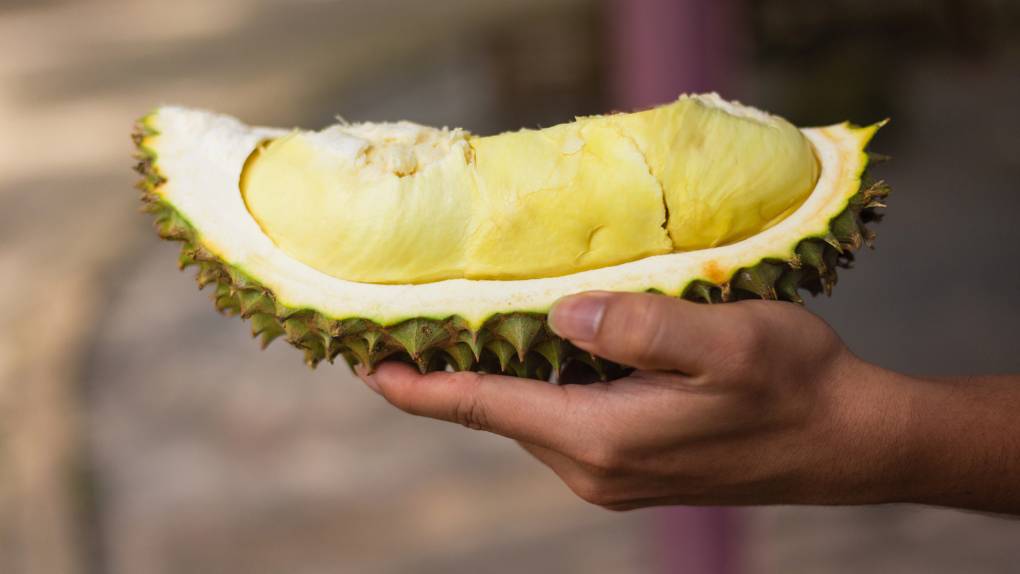
"caption": "Falling in love with durian — in all its complex pungency — helped the author feel more strongly connected to her father's Singaporean roots.",
"description": null,
"title": "GettyImages-691141531",
"credit": "Ekachai Chobphot / EyeEm",
"status": "inherit",
"altTag": "A hand holding a slice of durian still in its spiky green rind.",
"isLoading": false,
"fetchFailed": false
},
"arts_13925806": {
"type": "attachments",
"id": "arts_13925806",
"meta": {
"index": "attachments_1716263798",
"site": "arts",
"id": "13925806",
"found": true
},
"parent": 13925774,
"imgSizes": {
"twentyfourteen-full-width": {
"file": "https://ww2.kqed.org/app/uploads/sites/2/2023/03/westoakfarmersmarket_sign_alanchazaro-1038x576.jpg",
"width": 1038,
"mimeType": "image/jpeg",
"height": 576
},
"thumbnail": {
"file": "https://ww2.kqed.org/app/uploads/sites/2/2023/03/westoakfarmersmarket_sign_alanchazaro-160x90.jpg",
"width": 160,
"mimeType": "image/jpeg",
"height": 90
},
"post-thumbnail": {
"file": "https://ww2.kqed.org/app/uploads/sites/2/2023/03/westoakfarmersmarket_sign_alanchazaro-672x372.jpg",
"width": 672,
"mimeType": "image/jpeg",
"height": 372
},
"kqedFullSize": {
"file": "https://ww2.kqed.org/app/uploads/sites/2/2023/03/westoakfarmersmarket_sign_alanchazaro.jpg",
"width": 1920,
"height": 1080
},
"large": {
"file": "https://ww2.kqed.org/app/uploads/sites/2/2023/03/westoakfarmersmarket_sign_alanchazaro-1020x574.jpg",
"width": 1020,
"mimeType": "image/jpeg",
"height": 574
},
"1536x1536": {
"file": "https://ww2.kqed.org/app/uploads/sites/2/2023/03/westoakfarmersmarket_sign_alanchazaro-1536x864.jpg",
"width": 1536,
"mimeType": "image/jpeg",
"height": 864
},
"medium": {
"file": "https://ww2.kqed.org/app/uploads/sites/2/2023/03/westoakfarmersmarket_sign_alanchazaro-800x450.jpg",
"width": 800,
"mimeType": "image/jpeg",
"height": 450
},
"medium_large": {
"file": "https://ww2.kqed.org/app/uploads/sites/2/2023/03/westoakfarmersmarket_sign_alanchazaro-768x432.jpg",
"width": 768,
"mimeType": "image/jpeg",
"height": 432
}
},
"publishDate": 1677807282,
"modified": 1677867909,
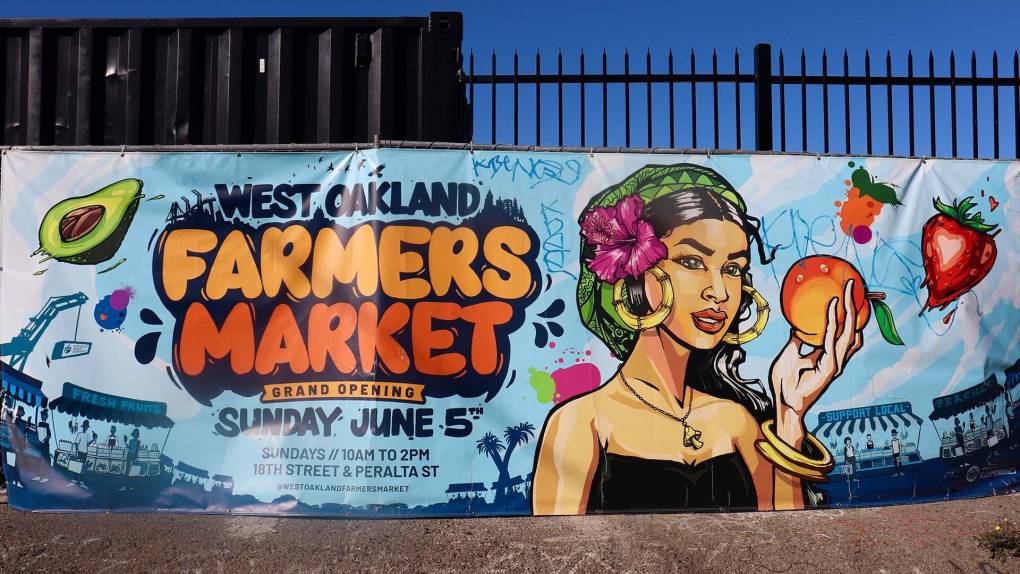
"caption": "The West Oakland Farmers Market debuted on June 5, 2022, and is open every Sunday. ",
"description": null,
"title": "westoakfarmersmarket_sign_alanchazaro",
"credit": "Alan Chazaro",
"status": "inherit",
"altTag": "a colorful advertisement banner for the new West Oakland Farmers Market",
"isLoading": false,
"fetchFailed": false
},
"arts_13925721": {
"type": "attachments",
"id": "arts_13925721",
"meta": {
"index": "attachments_1716263798",
"site": "arts",
"id": "13925721",
"found": true
},
"parent": 13925701,
"imgSizes": {
"twentyfourteen-full-width": {
"file": "https://ww2.kqed.org/app/uploads/sites/2/2023/02/masabistro_brokedamouf-1038x576.jpg",
"width": 1038,
"mimeType": "image/jpeg",
"height": 576
},
"thumbnail": {
"file": "https://ww2.kqed.org/app/uploads/sites/2/2023/02/masabistro_brokedamouf-160x110.jpg",
"width": 160,
"mimeType": "image/jpeg",
"height": 110
},
"post-thumbnail": {
"file": "https://ww2.kqed.org/app/uploads/sites/2/2023/02/masabistro_brokedamouf-672x372.jpg",
"width": 672,
"mimeType": "image/jpeg",
"height": 372
},
"kqedFullSize": {
"file": "https://ww2.kqed.org/app/uploads/sites/2/2023/02/masabistro_brokedamouf.jpg",
"width": 1920,
"height": 1320
},
"large": {
"file": "https://ww2.kqed.org/app/uploads/sites/2/2023/02/masabistro_brokedamouf-1020x701.jpg",
"width": 1020,
"mimeType": "image/jpeg",
"height": 701
},
"1536x1536": {
"file": "https://ww2.kqed.org/app/uploads/sites/2/2023/02/masabistro_brokedamouf-1536x1056.jpg",
"width": 1536,
"mimeType": "image/jpeg",
"height": 1056
},
"medium": {
"file": "https://ww2.kqed.org/app/uploads/sites/2/2023/02/masabistro_brokedamouf-800x550.jpg",
"width": 800,
"mimeType": "image/jpeg",
"height": 550
},
"medium_large": {
"file": "https://ww2.kqed.org/app/uploads/sites/2/2023/02/masabistro_brokedamouf-768x528.jpg",
"width": 768,
"mimeType": "image/jpeg",
"height": 528
}
},
"publishDate": 1677545336,
"modified": 1677545496,
"caption": "Even though Masa Ramen Bistro's signature \"Broke Da Mouf\" ramen doesn't have Hawaiian ingredients, the over-the-top spirit behind the dish is quintessentially Hawaiian.",
"description": null,
"title": "masabistro_brokedamouf",
"credit": "Luke Tsai",
"status": "inherit",
"altTag": "A bowl of ramen: red-tinted broth topped with pork chashu, egg, scallions and a flurry of grated Parmesan cheese.",
"isLoading": false,
"fetchFailed": false
},
"arts_13925324": {
"type": "attachments",
"id": "arts_13925324",
"meta": {
"index": "attachments_1716263798",
"site": "arts",
"id": "13925324",
"found": true
},
"parent": 13925310,
"imgSizes": {
"twentyfourteen-full-width": {
"file": "https://ww2.kqed.org/app/uploads/sites/2/2023/02/Natera_DekDoiCafe_feature-crop-1038x576.jpg",
"width": 1038,
"mimeType": "image/jpeg",
"height": 576
},
"thumbnail": {
"file": "https://ww2.kqed.org/app/uploads/sites/2/2023/02/Natera_DekDoiCafe_feature-crop-160x90.jpg",
"width": 160,
"mimeType": "image/jpeg",
"height": 90
},
"post-thumbnail": {
"file": "https://ww2.kqed.org/app/uploads/sites/2/2023/02/Natera_DekDoiCafe_feature-crop-672x372.jpg",
"width": 672,
"mimeType": "image/jpeg",
"height": 372
},
"kqedFullSize": {
"file": "https://ww2.kqed.org/app/uploads/sites/2/2023/02/Natera_DekDoiCafe_feature-crop.jpg",
"width": 1920,
"height": 1080
},
"large": {
"file": "https://ww2.kqed.org/app/uploads/sites/2/2023/02/Natera_DekDoiCafe_feature-crop-1020x574.jpg",
"width": 1020,
"mimeType": "image/jpeg",
"height": 574
},
"1536x1536": {
"file": "https://ww2.kqed.org/app/uploads/sites/2/2023/02/Natera_DekDoiCafe_feature-crop-1536x864.jpg",
"width": 1536,
"mimeType": "image/jpeg",
"height": 864
},
"medium": {
"file": "https://ww2.kqed.org/app/uploads/sites/2/2023/02/Natera_DekDoiCafe_feature-crop-800x450.jpg",
"width": 800,
"mimeType": "image/jpeg",
"height": 450
},
"medium_large": {
"file": "https://ww2.kqed.org/app/uploads/sites/2/2023/02/Natera_DekDoiCafe_feature-crop-768x432.jpg",
"width": 768,
"mimeType": "image/jpeg",
"height": 432
}
},
"publishDate": 1676681165,
"modified": 1676681401,
"caption": "Dek Doi Cafe is introducing Bay Area customers to Thai-style \"pink milk\" and street food style sweet roti.",
"description": null,
"title": "Natera_DekDoiCafe_feature-crop",
"credit": null,
"status": "inherit",
"altTag": "A hand reaches to pick up an icy pink beverage. There's also a iced chocolate drink and a plate of corn roti on the table.",
"isLoading": false,
"fetchFailed": false
},
"arts_13925241": {
"type": "attachments",
"id": "arts_13925241",
"meta": {
"index": "attachments_1716263798",
"site": "arts",
"id": "13925241",
"found": true
},
"parent": 13925233,
"imgSizes": {
"twentyfourteen-full-width": {
"file": "https://ww2.kqed.org/app/uploads/sites/2/2023/02/pre-hispanic-mexican_featured-crop-1038x576.jpg",
"width": 1038,
"mimeType": "image/jpeg",
"height": 576
},
"thumbnail": {
"file": "https://ww2.kqed.org/app/uploads/sites/2/2023/02/pre-hispanic-mexican_featured-crop-160x100.jpg",
"width": 160,
"mimeType": "image/jpeg",
"height": 100
},
"post-thumbnail": {
"file": "https://ww2.kqed.org/app/uploads/sites/2/2023/02/pre-hispanic-mexican_featured-crop-672x372.jpg",
"width": 672,
"mimeType": "image/jpeg",
"height": 372
},
"kqedFullSize": {
"file": "https://ww2.kqed.org/app/uploads/sites/2/2023/02/pre-hispanic-mexican_featured-crop.jpg",
"width": 1920,
"height": 1200
},
"large": {
"file": "https://ww2.kqed.org/app/uploads/sites/2/2023/02/pre-hispanic-mexican_featured-crop-1020x638.jpg",
"width": 1020,
"mimeType": "image/jpeg",
"height": 638
},
"1536x1536": {
"file": "https://ww2.kqed.org/app/uploads/sites/2/2023/02/pre-hispanic-mexican_featured-crop-1536x960.jpg",
"width": 1536,
"mimeType": "image/jpeg",
"height": 960
},
"medium": {
"file": "https://ww2.kqed.org/app/uploads/sites/2/2023/02/pre-hispanic-mexican_featured-crop-800x500.jpg",
"width": 800,
"mimeType": "image/jpeg",
"height": 500
},
"medium_large": {
"file": "https://ww2.kqed.org/app/uploads/sites/2/2023/02/pre-hispanic-mexican_featured-crop-768x480.jpg",
"width": 768,
"mimeType": "image/jpeg",
"height": 480
}
},
"publishDate": 1676584110,
"modified": 1676584268,
"caption": "Even though the food at Pre-Hispanic Mexican Cuisine comes in a familiar format — like the tacos pictured here — most dishes feature Indigenous ingredients that predate Spain's colonization of Mexico by several hundred years.",
"description": null,
"title": "pre-hispanic mexican_featured-crop",
"credit": "Octavio Peña",
"status": "inherit",
"altTag": "Hands holding a plate of colorful tacos, with two lime wedges and a tub of salsa on the side.",
"isLoading": false,
"fetchFailed": false
},
"arts_13924999": {
"type": "attachments",
"id": "arts_13924999",
"meta": {
"index": "attachments_1716263798",
"site": "arts",
"id": "13924999",
"found": true
},
"parent": 13924997,
"imgSizes": {
"twentyfourteen-full-width": {
"file": "https://ww2.kqed.org/app/uploads/sites/2/2023/02/Leungs-Cooking-Together-cropped-1038x576.jpg",
"width": 1038,
"mimeType": "image/jpeg",
"height": 576
},
"thumbnail": {
"file": "https://ww2.kqed.org/app/uploads/sites/2/2023/02/Leungs-Cooking-Together-cropped-160x90.jpg",
"width": 160,
"mimeType": "image/jpeg",
"height": 90
},
"post-thumbnail": {
"file": "https://ww2.kqed.org/app/uploads/sites/2/2023/02/Leungs-Cooking-Together-cropped-672x372.jpg",
"width": 672,
"mimeType": "image/jpeg",
"height": 372
},
"kqedFullSize": {
"file": "https://ww2.kqed.org/app/uploads/sites/2/2023/02/Leungs-Cooking-Together-cropped.jpg",
"width": 1920,
"height": 1080
},
"large": {
"file": "https://ww2.kqed.org/app/uploads/sites/2/2023/02/Leungs-Cooking-Together-cropped-1020x574.jpg",
"width": 1020,
"mimeType": "image/jpeg",
"height": 574
},
"1536x1536": {
"file": "https://ww2.kqed.org/app/uploads/sites/2/2023/02/Leungs-Cooking-Together-cropped-1536x864.jpg",
"width": 1536,
"mimeType": "image/jpeg",
"height": 864
},
"medium": {
"file": "https://ww2.kqed.org/app/uploads/sites/2/2023/02/Leungs-Cooking-Together-cropped-800x450.jpg",
"width": 800,
"mimeType": "image/jpeg",
"height": 450
},
"medium_large": {
"file": "https://ww2.kqed.org/app/uploads/sites/2/2023/02/Leungs-Cooking-Together-cropped-768x432.jpg",
"width": 768,
"mimeType": "image/jpeg",
"height": 432
}
},
"publishDate": 1676056051,
"modified": 1676056216,
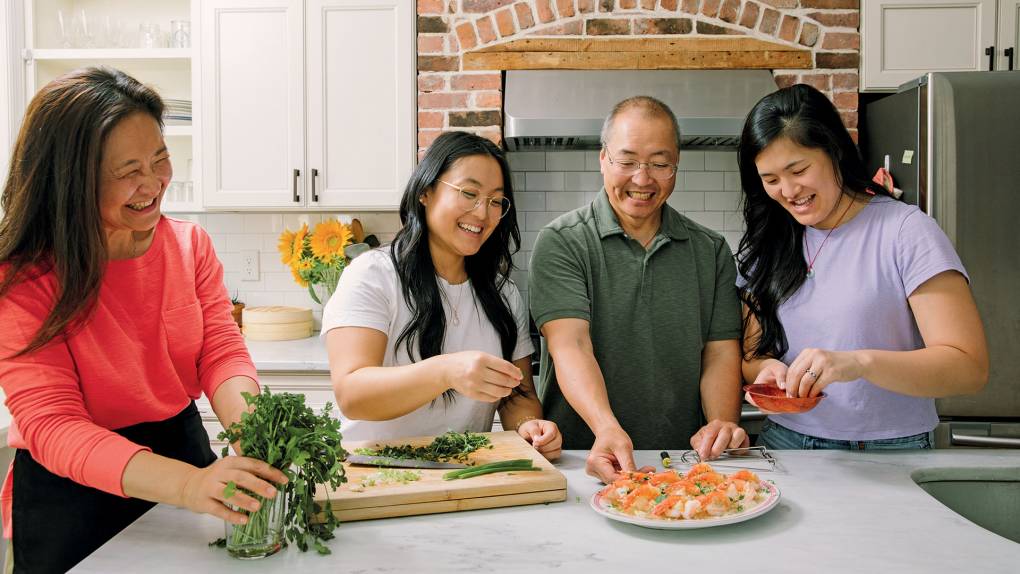
"caption": "The Woks of Life is the rare multi-generational food blog: It's written by Sarah and Kaitlin Leung along with their parents, Bill and Judy.",
"description": null,
"title": "Leungs Cooking Together-cropped",
"credit": "Courtesy of The Woks of Life",
"status": "inherit",
"altTag": "A Chinese American family prepares a shrimp dish on their kitchen counter.",
"isLoading": false,
"fetchFailed": false
},
"arts_13924282": {
"type": "attachments",
"id": "arts_13924282",
"meta": {
"index": "attachments_1716263798",
"site": "arts",
"id": "13924282",
"found": true
},
"parent": 13924280,
"imgSizes": {
"twentyfourteen-full-width": {
"file": "https://ww2.kqed.org/app/uploads/sites/2/2023/01/Anh-by-Andria-Lo_cropped-1038x576.jpg",
"width": 1038,
"mimeType": "image/jpeg",
"height": 576
},
"thumbnail": {
"file": "https://ww2.kqed.org/app/uploads/sites/2/2023/01/Anh-by-Andria-Lo_cropped-160x100.jpg",
"width": 160,
"mimeType": "image/jpeg",
"height": 100
},
"post-thumbnail": {
"file": "https://ww2.kqed.org/app/uploads/sites/2/2023/01/Anh-by-Andria-Lo_cropped-672x372.jpg",
"width": 672,
"mimeType": "image/jpeg",
"height": 372
},
"kqedFullSize": {
"file": "https://ww2.kqed.org/app/uploads/sites/2/2023/01/Anh-by-Andria-Lo_cropped.jpg",
"width": 1920,
"height": 1199
},
"large": {
"file": "https://ww2.kqed.org/app/uploads/sites/2/2023/01/Anh-by-Andria-Lo_cropped-1020x637.jpg",
"width": 1020,
"mimeType": "image/jpeg",
"height": 637
},
"1536x1536": {
"file": "https://ww2.kqed.org/app/uploads/sites/2/2023/01/Anh-by-Andria-Lo_cropped-1536x959.jpg",
"width": 1536,
"mimeType": "image/jpeg",
"height": 959
},
"medium": {
"file": "https://ww2.kqed.org/app/uploads/sites/2/2023/01/Anh-by-Andria-Lo_cropped-800x500.jpg",
"width": 800,
"mimeType": "image/jpeg",
"height": 500
},
"medium_large": {
"file": "https://ww2.kqed.org/app/uploads/sites/2/2023/01/Anh-by-Andria-Lo_cropped-768x480.jpg",
"width": 768,
"mimeType": "image/jpeg",
"height": 480
}
},
"publishDate": 1674767239,
"modified": 1674769736,
"caption": "Anh Nguyen strikes a pose in a banh mi-themed shirt created by the nonprofit Cut Fruit Collective to raise funds for her business, Cam Anh in Oakland Chinatown.",
"description": null,
"title": "Anh by Andria Lo_cropped",
"credit": "Andria Lo",
"status": "inherit",
"altTag": "A woman poses in a poppy orange long-sleeved tee, in front of a wall showing pictures of Vietnamese dishes.",
"isLoading": false,
"fetchFailed": false
},
"arts_13924246": {
"type": "attachments",
"id": "arts_13924246",
"meta": {
"index": "attachments_1716263798",
"site": "arts",
"id": "13924246",
"found": true
},
"parent": 13924242,
"imgSizes": {
"twentyfourteen-full-width": {
"file": "https://ww2.kqed.org/app/uploads/sites/2/2023/01/img_5153_wide-5b07d854333ce39ceb6c70091aa12295860256c5-scaled-e1674760185337-1038x576.jpg",
"width": 1038,
"mimeType": "image/jpeg",
"height": 576
},
"thumbnail": {
"file": "https://ww2.kqed.org/app/uploads/sites/2/2023/01/img_5153_wide-5b07d854333ce39ceb6c70091aa12295860256c5-scaled-e1674760185337-160x90.jpg",
"width": 160,
"mimeType": "image/jpeg",
"height": 90
},
"post-thumbnail": {
"file": "https://ww2.kqed.org/app/uploads/sites/2/2023/01/img_5153_wide-5b07d854333ce39ceb6c70091aa12295860256c5-scaled-e1674760185337-672x372.jpg",
"width": 672,
"mimeType": "image/jpeg",
"height": 372
},
"kqedFullSize": {
"file": "https://ww2.kqed.org/app/uploads/sites/2/2023/01/img_5153_wide-5b07d854333ce39ceb6c70091aa12295860256c5-scaled-e1674760185337.jpg",
"width": 1920,
"height": 1080
},
"2048x2048": {
"file": "https://ww2.kqed.org/app/uploads/sites/2/2023/01/img_5153_wide-5b07d854333ce39ceb6c70091aa12295860256c5-2048x1152.jpg",
"width": 2048,
"mimeType": "image/jpeg",
"height": 1152
},
"large": {
"file": "https://ww2.kqed.org/app/uploads/sites/2/2023/01/img_5153_wide-5b07d854333ce39ceb6c70091aa12295860256c5-scaled-e1674760185337-1020x574.jpg",
"width": 1020,
"mimeType": "image/jpeg",
"height": 574
},
"1536x1536": {
"file": "https://ww2.kqed.org/app/uploads/sites/2/2023/01/img_5153_wide-5b07d854333ce39ceb6c70091aa12295860256c5-scaled-e1674760185337-1536x864.jpg",
"width": 1536,
"mimeType": "image/jpeg",
"height": 864
},
"full-width": {
"file": "https://ww2.kqed.org/app/uploads/sites/2/2023/01/img_5153_wide-5b07d854333ce39ceb6c70091aa12295860256c5-1920x1080.jpg",
"width": 1920,
"mimeType": "image/jpeg",
"height": 1080
},
"medium": {
"file": "https://ww2.kqed.org/app/uploads/sites/2/2023/01/img_5153_wide-5b07d854333ce39ceb6c70091aa12295860256c5-scaled-e1674760185337-800x450.jpg",
"width": 800,
"mimeType": "image/jpeg",
"height": 450
},
"medium_large": {
"file": "https://ww2.kqed.org/app/uploads/sites/2/2023/01/img_5153_wide-5b07d854333ce39ceb6c70091aa12295860256c5-scaled-e1674760185337-768x432.jpg",
"width": 768,
"mimeType": "image/jpeg",
"height": 432
}
},
"publishDate": 1674758756,
"modified": 1674760256,
"caption": "A rooster crows in a new day atop a fence at Back Forty Farms in Nampa, Idaho. The rising price of eggs as well as shortages in some areas have created enormous demand for Back Forty’s freeze dried eggs.",
"description": null,
"title": "A rooster crows in a new day atop a fence at Back Forty Farms in Nampa, Idaho. The rising price of eggs as well as shortages in some areas have created enormous demand for Back Forty’s freeze dried eggs.",
"credit": "Back Forty Farms",
"status": "inherit",
"altTag": null,
"isLoading": false,
"fetchFailed": false
},
"arts_13923963": {
"type": "attachments",
"id": "arts_13923963",
"meta": {
"index": "attachments_1716263798",
"site": "arts",
"id": "13923963",
"found": true
},
"parent": 13923936,
"imgSizes": {
"twentyfourteen-full-width": {
"file": "https://ww2.kqed.org/app/uploads/sites/2/2023/01/Jocelyn-Jackson-credit-Molly-DeCoudreaux_-1038x576.jpg",
"width": 1038,
"mimeType": "image/jpeg",
"height": 576
},
"thumbnail": {
"file": "https://ww2.kqed.org/app/uploads/sites/2/2023/01/Jocelyn-Jackson-credit-Molly-DeCoudreaux_-160x100.jpg",
"width": 160,
"mimeType": "image/jpeg",
"height": 100
},
"post-thumbnail": {
"file": "https://ww2.kqed.org/app/uploads/sites/2/2023/01/Jocelyn-Jackson-credit-Molly-DeCoudreaux_-672x372.jpg",
"width": 672,
"mimeType": "image/jpeg",
"height": 372
},
"kqedFullSize": {
"file": "https://ww2.kqed.org/app/uploads/sites/2/2023/01/Jocelyn-Jackson-credit-Molly-DeCoudreaux_.jpg",
"width": 1920,
"height": 1200
},
"large": {
"file": "https://ww2.kqed.org/app/uploads/sites/2/2023/01/Jocelyn-Jackson-credit-Molly-DeCoudreaux_-1020x638.jpg",
"width": 1020,
"mimeType": "image/jpeg",
"height": 638
},
"1536x1536": {
"file": "https://ww2.kqed.org/app/uploads/sites/2/2023/01/Jocelyn-Jackson-credit-Molly-DeCoudreaux_-1536x960.jpg",
"width": 1536,
"mimeType": "image/jpeg",
"height": 960
},
"medium": {
"file": "https://ww2.kqed.org/app/uploads/sites/2/2023/01/Jocelyn-Jackson-credit-Molly-DeCoudreaux_-800x500.jpg",
"width": 800,
"mimeType": "image/jpeg",
"height": 500
},
"medium_large": {
"file": "https://ww2.kqed.org/app/uploads/sites/2/2023/01/Jocelyn-Jackson-credit-Molly-DeCoudreaux_-768x480.jpg",
"width": 768,
"mimeType": "image/jpeg",
"height": 480
}
},
"publishDate": 1674494582,
"modified": 1674494732,
"caption": "People's Kitchen Collective co-founder Jocelyn Jackson is stepping the chef-in-residence position at the Museum of the African Disapora previously held by Bryant Terry.",
"description": null,
"title": "Jocelyn Jackson credit Molly DeCoudreaux_",
"credit": "Molly DeCoudreaux",
"status": "inherit",
"altTag": "Headshot of Jocelyn Jackson posing in front of a colorful blue patterned wallpaper.",
"isLoading": false,
"fetchFailed": false
},
"arts_13923842": {
"type": "attachments",
"id": "arts_13923842",
"meta": {
"index": "attachments_1716263798",
"site": "arts",
"id": "13923842",
"found": true
},
"parent": 13923840,
"imgSizes": {
"twentyfourteen-full-width": {
"file": "https://ww2.kqed.org/app/uploads/sites/2/2023/01/noka_lead-cropped-1038x576.jpg",
"width": 1038,
"mimeType": "image/jpeg",
"height": 576
},
"thumbnail": {
"file": "https://ww2.kqed.org/app/uploads/sites/2/2023/01/noka_lead-cropped-160x90.jpg",
"width": 160,
"mimeType": "image/jpeg",
"height": 90
},
"post-thumbnail": {
"file": "https://ww2.kqed.org/app/uploads/sites/2/2023/01/noka_lead-cropped-672x372.jpg",
"width": 672,
"mimeType": "image/jpeg",
"height": 372
},
"kqedFullSize": {
"file": "https://ww2.kqed.org/app/uploads/sites/2/2023/01/noka_lead-cropped.jpg",
"width": 1920,
"height": 1080
},
"large": {
"file": "https://ww2.kqed.org/app/uploads/sites/2/2023/01/noka_lead-cropped-1020x574.jpg",
"width": 1020,
"mimeType": "image/jpeg",
"height": 574
},
"1536x1536": {
"file": "https://ww2.kqed.org/app/uploads/sites/2/2023/01/noka_lead-cropped-1536x864.jpg",
"width": 1536,
"mimeType": "image/jpeg",
"height": 864
},
"medium": {
"file": "https://ww2.kqed.org/app/uploads/sites/2/2023/01/noka_lead-cropped-800x450.jpg",
"width": 800,
"mimeType": "image/jpeg",
"height": 450
},
"medium_large": {
"file": "https://ww2.kqed.org/app/uploads/sites/2/2023/01/noka_lead-cropped-768x432.jpg",
"width": 768,
"mimeType": "image/jpeg",
"height": 432
}
},
"publishDate": 1674151762,
"modified": 1674159527,
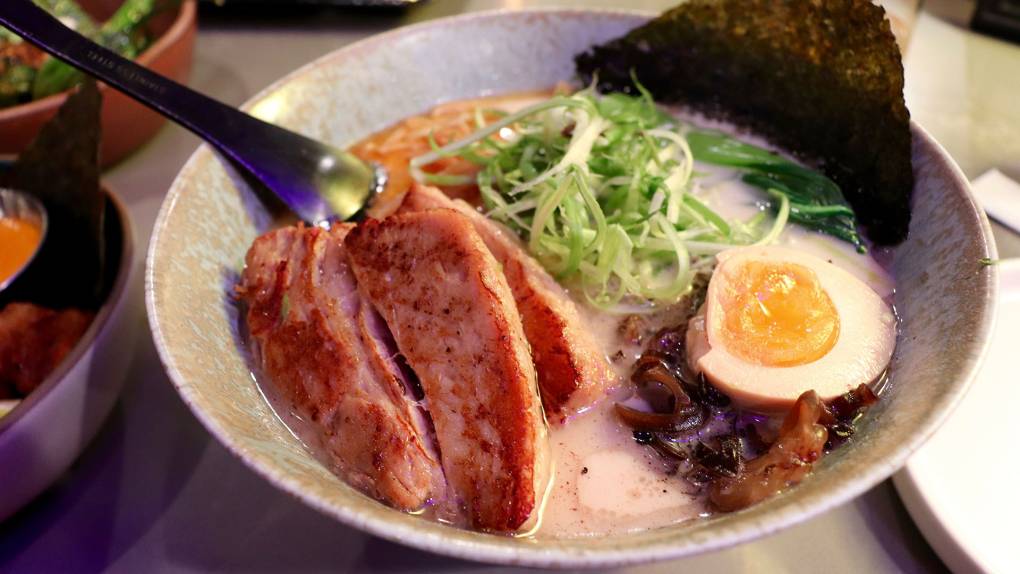
"caption": "The classic tonkotsu (pork belly, bean sprouts, bok choy, mushrooms, seaweed, noodles, egg) is a signature at Noka Ramen.",
"description": null,
"title": "noka_lead-cropped",
"credit": "Alan Chazaro",
"status": "inherit",
"altTag": "a bowl of ramen, with pork belly, seaweed, bean sprouts and more",
"isLoading": false,
"fetchFailed": false
},
"arts_13923555": {
"type": "attachments",
"id": "arts_13923555",
"meta": {
"index": "attachments_1716263798",
"site": "arts",
"id": "13923555",
"found": true
},
"parent": 13923548,
"imgSizes": {
"twentyfourteen-full-width": {
"file": "https://ww2.kqed.org/app/uploads/sites/2/2023/01/tangyuan_lead-1038x576.jpg",
"width": 1038,
"mimeType": "image/jpeg",
"height": 576
},
"thumbnail": {
"file": "https://ww2.kqed.org/app/uploads/sites/2/2023/01/tangyuan_lead-160x90.jpg",
"width": 160,
"mimeType": "image/jpeg",
"height": 90
},
"post-thumbnail": {
"file": "https://ww2.kqed.org/app/uploads/sites/2/2023/01/tangyuan_lead-672x372.jpg",
"width": 672,
"mimeType": "image/jpeg",
"height": 372
},
"kqedFullSize": {
"file": "https://ww2.kqed.org/app/uploads/sites/2/2023/01/tangyuan_lead.jpg",
"width": 1920,
"height": 1080
},
"large": {
"file": "https://ww2.kqed.org/app/uploads/sites/2/2023/01/tangyuan_lead-1020x574.jpg",
"width": 1020,
"mimeType": "image/jpeg",
"height": 574
},
"1536x1536": {
"file": "https://ww2.kqed.org/app/uploads/sites/2/2023/01/tangyuan_lead-1536x864.jpg",
"width": 1536,
"mimeType": "image/jpeg",
"height": 864
},
"medium": {
"file": "https://ww2.kqed.org/app/uploads/sites/2/2023/01/tangyuan_lead-800x450.jpg",
"width": 800,
"mimeType": "image/jpeg",
"height": 450
},
"medium_large": {
"file": "https://ww2.kqed.org/app/uploads/sites/2/2023/01/tangyuan_lead-768x432.jpg",
"width": 768,
"mimeType": "image/jpeg",
"height": 432
}
},
"publishDate": 1673382154,
"modified": 1673382333,
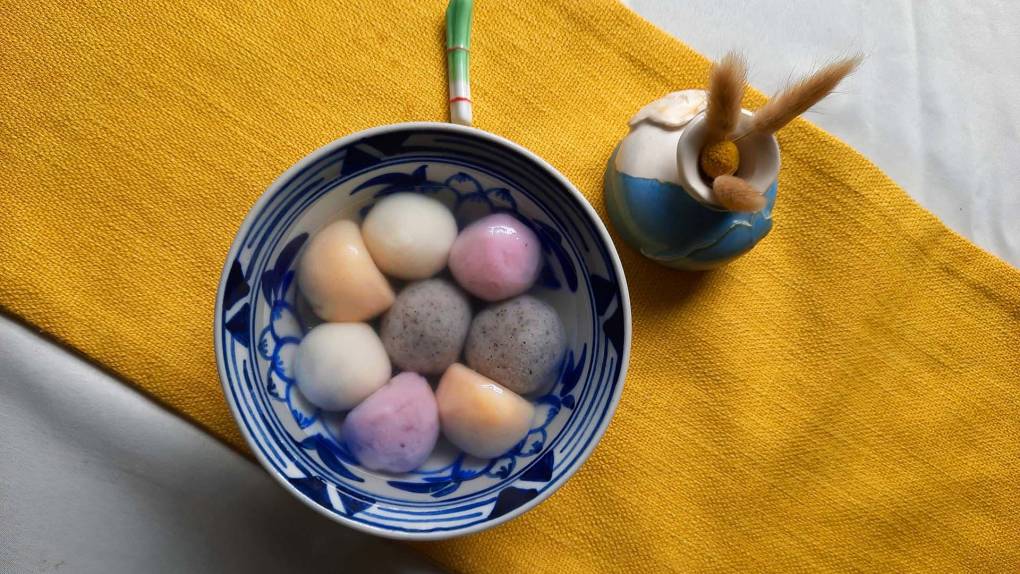
"caption": "Annie's T Cakes proprietor Annie Wang says her tangyuan soup kits are a way for her to provide some cultural education for her customers.",
"description": null,
"title": "tangyuan_lead",
"credit": "Courtesy of Annie's T Cakes",
"status": "inherit",
"altTag": "Overhead view of a bowl of colorful glutinous rice balls, or tangyuan, served in a ceramic bowl on gold cloth.",
"isLoading": false,
"fetchFailed": false
},
"arts_13923360": {
"type": "attachments",
"id": "arts_13923360",
"meta": {
"index": "attachments_1716263798",
"site": "arts",
"id": "13923360",
"found": true
},
"parent": 13923359,
"imgSizes": {
"twentyfourteen-full-width": {
"file": "https://cdn.kqed.org/wp-content/uploads/sites/2/2023/01/antojitos-guatemaltecos_churrasco_lead-1038x576.jpg",
"width": 1038,
"mimeType": "image/jpeg",
"height": 576
},
"thumbnail": {
"file": "https://cdn.kqed.org/wp-content/uploads/sites/2/2023/01/antojitos-guatemaltecos_churrasco_lead-160x100.jpg",
"width": 160,
"mimeType": "image/jpeg",
"height": 100
},
"post-thumbnail": {
"file": "https://cdn.kqed.org/wp-content/uploads/sites/2/2023/01/antojitos-guatemaltecos_churrasco_lead-672x372.jpg",
"width": 672,
"mimeType": "image/jpeg",
"height": 372
},
"kqedFullSize": {
"file": "https://cdn.kqed.org/wp-content/uploads/sites/2/2023/01/antojitos-guatemaltecos_churrasco_lead.jpg",
"width": 1920,
"height": 1200
},
"large": {
"file": "https://cdn.kqed.org/wp-content/uploads/sites/2/2023/01/antojitos-guatemaltecos_churrasco_lead-1020x638.jpg",
"width": 1020,
"mimeType": "image/jpeg",
"height": 638
},
"1536x1536": {
"file": "https://cdn.kqed.org/wp-content/uploads/sites/2/2023/01/antojitos-guatemaltecos_churrasco_lead-1536x960.jpg",
"width": 1536,
"mimeType": "image/jpeg",
"height": 960
},
"medium": {
"file": "https://cdn.kqed.org/wp-content/uploads/sites/2/2023/01/antojitos-guatemaltecos_churrasco_lead-800x500.jpg",
"width": 800,
"mimeType": "image/jpeg",
"height": 500
},
"medium_large": {
"file": "https://cdn.kqed.org/wp-content/uploads/sites/2/2023/01/antojitos-guatemaltecos_churrasco_lead-768x480.jpg",
"width": 768,
"mimeType": "image/jpeg",
"height": 480
}
},
"publishDate": 1672956482,
"modified": 1702068701,
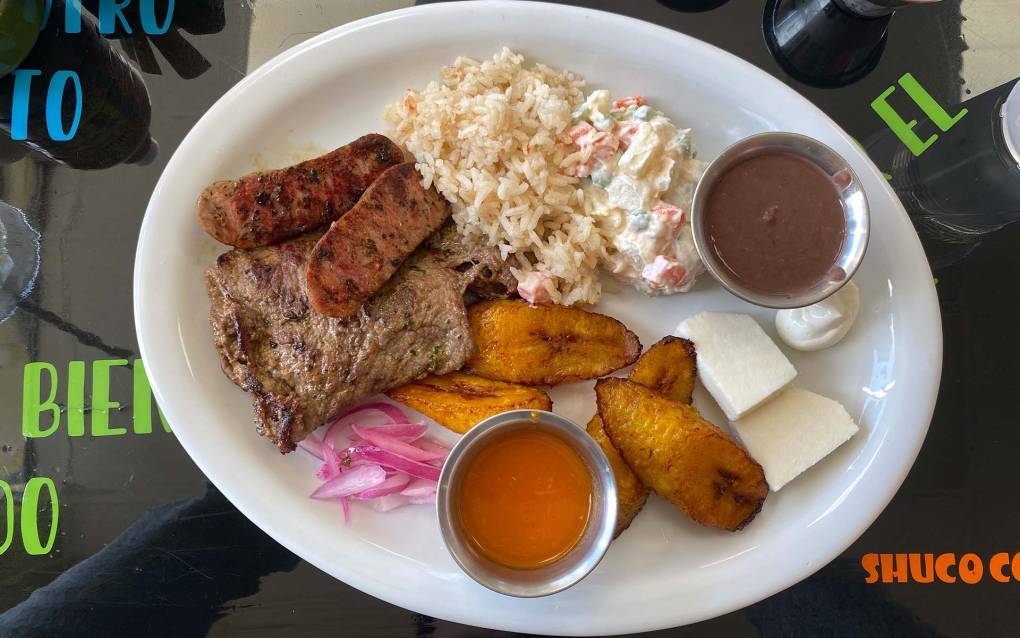
"caption": "The churrasco chapin is one of the very typical traditional Guatemalan plates that diners can find at Antojitos Guatemaltecos, a new restaurant in El Cerrito.",
"description": null,
"title": "antojitos guatemaltecos_churrasco_lead",
"credit": "Luke Tsai/KQED",
"status": "inherit",
"altTag": "Overhead view of a Guatemalan churrasco chapin plate: steak, rice, potato salad, fried plantains, cheese, and little tubs of salsa and refried beans.",
"isLoading": false,
"fetchFailed": false
}
},
"audioPlayerReducer": {
"postId": "stream_live",
"isPaused": true,
"isPlaying": false,
"pfsActive": false,
"pledgeModalIsOpen": true,
"playerDrawerIsOpen": false,
"liveAudioPlayStartedAt": 0,
"liveAudioPlayContext": ""
},
"authorsReducer": {
"byline_arts_13925835": {
"type": "authors",
"id": "byline_arts_13925835",
"meta": {
"override": true
},
"slug": "byline_arts_13925835",
"name": "Jennifer Wong",
"isLoading": false
},
"kqedarts": {
"type": "authors",
"id": "92",
"meta": {
"index": "authors_1716337520",
"id": "92",
"found": true
},
"name": "KQED Arts",
"firstName": "KQED",
"lastName": "Arts",
"slug": "kqedarts",
"email": "arts@kqed.org",
"display_author_email": false,
"staff_mastheads": [],
"title": "KQED Staff",
"bio": null,
"avatar": "https://secure.gravatar.com/avatar/321c9ebfeb7736f9e55366a6d3399ab0?s=600&d=blank&r=g",
"twitter": null,
"facebook": null,
"instagram": "https://www.instagram.com/kqed_arts/",
"linkedin": null,
"sites": [
{
"site": "arts",
"roles": [
"contributor"
]
},
{
"site": "pop",
"roles": [
"contributor"
]
},
{
"site": "science",
"roles": [
"author"
]
},
{
"site": "food",
"roles": [
"contributor"
]
}
],
"headData": {
"title": "KQED Arts | KQED",
"description": "KQED Staff",
"ogImgSrc": "https://secure.gravatar.com/avatar/321c9ebfeb7736f9e55366a6d3399ab0?s=600&d=blank&r=g",
"twImgSrc": "https://secure.gravatar.com/avatar/321c9ebfeb7736f9e55366a6d3399ab0?s=600&d=blank&r=g"
},
"isLoading": false,
"link": "/author/kqedarts"
},
"ltsai": {
"type": "authors",
"id": "11743",
"meta": {
"index": "authors_1716337520",
"id": "11743",
"found": true
},
"name": "Luke Tsai",
"firstName": "Luke",
"lastName": "Tsai",
"slug": "ltsai",
"email": "ltsai@kqed.org",
"display_author_email": true,
"staff_mastheads": [
"arts"
],
"title": "Food Editor",
"bio": "Luke Tsai is KQED's food editor and resident stinky tofu connoisseur. Prior to KQED, he was an editor at Eater SF, \u003cem>San Francisco \u003c/em>magazine, and the \u003cem>East Bay Express\u003c/em>, and his work has also appeared in TASTE, the \u003cem>San Francisco Chronicle\u003c/em>, and the \u003cem>Best Food Writing\u003c/em> anthology. When he isn't writing or editing, you'll find him eating most everything he can get his hands on.",
"avatar": "https://secure.gravatar.com/avatar/1e59b45bf191526e7339d6ba46e33a57b2030d25c27660ecc64ea3cb863e34f7?s=600&d=blank&r=g",
"twitter": "theluketsai",
"bluesky": null,
"facebook": null,
"instagram": null,
"linkedin": null,
"sites": [
{
"site": "",
"roles": [
"editor"
]
},
{
"site": "arts",
"roles": [
"administrator"
]
},
{
"site": "news",
"roles": [
"editor",
"contributor"
]
},
{
"site": "bayareabites",
"roles": [
"editor"
]
},
{
"site": "food",
"roles": [
"editor"
]
}
],
"headData": {
"title": "Luke Tsai | KQED",
"description": "Food Editor",
"ogImgSrc": "https://secure.gravatar.com/avatar/1e59b45bf191526e7339d6ba46e33a57b2030d25c27660ecc64ea3cb863e34f7?s=600&d=blank&r=g",
"twImgSrc": "https://secure.gravatar.com/avatar/1e59b45bf191526e7339d6ba46e33a57b2030d25c27660ecc64ea3cb863e34f7?s=600&d=blank&r=g"
},
"isLoading": false,
"link": "/author/ltsai"
},
"achazaro": {
"type": "authors",
"id": "11748",
"meta": {
"index": "authors_1716337520",
"id": "11748",
"found": true
},
"name": "Alan Chazaro",
"firstName": "Alan",
"lastName": "Chazaro",
"slug": "achazaro",
"email": "agchazaro@gmail.com",
"display_author_email": true,
"staff_mastheads": [],
"title": "Food Writer and Reporter",
"bio": "Alan Chazaro is the author of \u003cem>This Is Not a Frank Ocean Cover Album\u003c/em> (Black Lawrence Press, 2019), \u003cem>Piñata Theory\u003c/em> (Black Lawrence Press, 2020), and \u003cem>Notes from the Eastern Span of the Bay Bridge\u003c/em> (Ghost City Press, 2021). He is a graduate of June Jordan’s Poetry for the People program at UC Berkeley and a former Lawrence Ferlinghetti Fellow at the University of San Francisco. He writes about sports, food, art, music, education, and culture while repping the Bay on \u003ca href=\"https://twitter.com/alan_chazaro\">Twitter\u003c/a> and \u003ca href=\"https://www.instagram.com/alan_chazaro/?hl=en\">Instagram\u003c/a> at @alan_chazaro.",
"avatar": "https://secure.gravatar.com/avatar/ea8b6dd970fc5c29e7a188e7d5861df7?s=600&d=blank&r=g",
"twitter": "alan_chazaro",
"facebook": null,
"instagram": null,
"linkedin": null,
"sites": [
{
"site": "arts",
"roles": [
"contributor"
]
},
{
"site": "news",
"roles": [
"editor"
]
}
],
"headData": {
"title": "Alan Chazaro | KQED",
"description": "Food Writer and Reporter",
"ogImgSrc": "https://secure.gravatar.com/avatar/ea8b6dd970fc5c29e7a188e7d5861df7?s=600&d=blank&r=g",
"twImgSrc": "https://secure.gravatar.com/avatar/ea8b6dd970fc5c29e7a188e7d5861df7?s=600&d=blank&r=g"
},
"isLoading": false,
"link": "/author/achazaro"
},
"athapliyal": {
"type": "authors",
"id": "11766",
"meta": {
"index": "authors_1716337520",
"id": "11766",
"found": true
},
"name": "Adesh Thapliyal",
"firstName": "Adesh",
"lastName": "Thapliyal",
"slug": "athapliyal",
"email": "athapliyal@kqed.org",
"display_author_email": false,
"staff_mastheads": [],
"title": "KQED Contributor",
"bio": "Adesh Thapliyal is KQED Arts' Editorial Intern. Previously, he wrote for the experimental newsletter \u003cem>Tone Glow\u003c/em> and the pop music blog \u003cem>The Singles Jukebox\u003c/em>.",
"avatar": "https://secure.gravatar.com/avatar/25c945182616a5283c4f746e7017bca3?s=600&d=blank&r=g",
"twitter": null,
"facebook": null,
"instagram": null,
"linkedin": null,
"sites": [
{
"site": "arts",
"roles": [
"author"
]
}
],
"headData": {
"title": "Adesh Thapliyal | KQED",
"description": "KQED Contributor",
"ogImgSrc": "https://secure.gravatar.com/avatar/25c945182616a5283c4f746e7017bca3?s=600&d=blank&r=g",
"twImgSrc": "https://secure.gravatar.com/avatar/25c945182616a5283c4f746e7017bca3?s=600&d=blank&r=g"
},
"isLoading": false,
"link": "/author/athapliyal"
},
"opena": {
"type": "authors",
"id": "11903",
"meta": {
"index": "authors_1716337520",
"id": "11903",
"found": true
},
"name": "Octavio Peña",
"firstName": "Octavio",
"lastName": "Peña",
"slug": "opena",
"email": "octaviopenagutierrez@gmail.com",
"display_author_email": false,
"staff_mastheads": [],
"title": "KQED Contributor",
"bio": null,
"avatar": "https://secure.gravatar.com/avatar/62850791380238ea3945ee72a3d56056477904792b41daaf11effa8780bab75d?s=600&d=blank&r=g",
"twitter": null,
"bluesky": null,
"facebook": null,
"instagram": null,
"linkedin": null,
"sites": [
{
"site": "arts",
"roles": [
"contributor"
]
}
],
"headData": {
"title": "Octavio Peña | KQED",
"description": "KQED Contributor",
"ogImgSrc": "https://secure.gravatar.com/avatar/62850791380238ea3945ee72a3d56056477904792b41daaf11effa8780bab75d?s=600&d=blank&r=g",
"twImgSrc": "https://secure.gravatar.com/avatar/62850791380238ea3945ee72a3d56056477904792b41daaf11effa8780bab75d?s=600&d=blank&r=g"
},
"isLoading": false,
"link": "/author/opena"
}
},
"pagesReducer": {
"arts_tag_food": {
"type": "terms",
"id": "arts_1297",
"meta": {
"index": "terms_1716263798",
"site": "arts",
"id": "1297",
"score": 7.4243016
},
"featImg": null,
"name": "food",
"description": null,
"taxonomy": "tag",
"headData": {
"twImgId": null,
"twTitle": null,
"ogTitle": null,
"ogImgId": null,
"twDescription": null,
"description": null,
"title": "food Archives | KQED Arts",
"ogDescription": null
},
"ttid": 1309,
"slug": "food",
"isLoading": false,
"title": "food",
"pageMeta": {
"site": "arts",
"WpPageTemplate": "page-topic-editorial",
"currentPage": 27
},
"blocks": [
{
"blockName": "kqed/post-list",
"attrs": {
"layout": "cardArticle2",
"query": "posts/arts?tag=food",
"seeMore": false,
"paginated": true,
"page": 27
}
},
{
"blockName": "kqed/ad"
}
]
}
},
"pfsSessionReducer": {},
"postsReducer": {
"stream_live": {
"type": "live",
"id": "stream_live",
"audioUrl": "https://streams.kqed.org/kqedradio",
"title": "Live Stream",
"excerpt": "Live Stream information currently unavailable.",
"link": "/radio",
"featImg": "",
"label": {
"name": "KQED Live",
"link": "/"
}
},
"stream_kqedNewscast": {
"type": "posts",
"id": "stream_kqedNewscast",
"audioUrl": "https://www.kqed.org/.stream/anon/radio/RDnews/newscast.mp3?_=1",
"title": "KQED Newscast",
"featImg": "",
"label": {
"name": "88.5 FM",
"link": "/"
}
},
"arts_13925835": {
"type": "posts",
"id": "arts_13925835",
"meta": {
"index": "posts_1716263798",
"site": "arts",
"id": "13925835",
"score": null,
"sort": [
1678216356000
]
},
"guestAuthors": [],
"slug": "durian-bay-area-love-letter-singaporean-culture",
"title": "A Bay Area Love Letter to Durian",
"publishDate": 1678216356,
"format": "standard",
"headTitle": "A Bay Area Love Letter to Durian | KQED",
"labelTerm": {},
"content": "\u003cp>[dropcap]D[/dropcap]urian. The King of Fruits. 榴蓮. The heart of my Singaporean Chinese family and the gateway to knowledge of my father’s culture. I grew up with no true understanding of Singapore. For those living in the Bay Area of the ’80s and ’90s, it barely even registered as a country. My father’s vague stories of his Singaporean past always read as being about China in my immature mind.\u003c/p>\n\u003cp>But then he would bring home a durian. A spiky ball that looks like a medieval weapon, with a pungent, pale yellow, fleshy interior. Dad would find a soft spot between those spikes to stab the fruit’s bottom and wedge it open with a knife and rice paddle. The strong rind once fought back, breaking the tip off of his massive chef’s knife.\u003c/p>\n\u003cp>It was serious work, but Dad is serious about durian.\u003c/p>\n\u003cp>Durian may be nature’s most misunderstood fruit. It grows high up in trees from precariously thin stems — a falling durian can literally kill you. Searching for the word “durian” online will dredge up articles on the fruit’s “terrible smell” and videos of people eating under-ripe specimens and gagging on camera for the likes.\u003c/p>\n\u003cfigure id=\"attachment_13925895\" class=\"wp-caption alignnone\" style=\"max-width: 1920px\">\u003cimg loading=\"lazy\" decoding=\"async\" class=\"size-full wp-image-13925895\" src=\"https://ww2.kqed.org/app/uploads/sites/2/2023/03/2020-thanksgiving-durian.jpg\" alt=\"Woman holds up a piece of fresh durian, with the one of the fruit's large seeds on a plate in front of her.\" width=\"1920\" height=\"1440\" srcset=\"https://cdn.kqed.org/wp-content/uploads/sites/2/2023/03/2020-thanksgiving-durian.jpg 1920w, https://cdn.kqed.org/wp-content/uploads/sites/2/2023/03/2020-thanksgiving-durian-800x600.jpg 800w, https://cdn.kqed.org/wp-content/uploads/sites/2/2023/03/2020-thanksgiving-durian-1020x765.jpg 1020w, https://cdn.kqed.org/wp-content/uploads/sites/2/2023/03/2020-thanksgiving-durian-160x120.jpg 160w, https://cdn.kqed.org/wp-content/uploads/sites/2/2023/03/2020-thanksgiving-durian-768x576.jpg 768w, https://cdn.kqed.org/wp-content/uploads/sites/2/2023/03/2020-thanksgiving-durian-1536x1152.jpg 1536w\" sizes=\"auto, (max-width: 1920px) 100vw, 1920px\">\u003cfigcaption class=\"wp-caption-text\">The author enjoys a piece of Red Prawn durian purchased from the online company Year of Durian. \u003ccite>(Courtesy of Jennifer Wong)\u003c/cite>\u003c/figcaption>\u003c/figure>\n\u003cp>Admittedly, to the untrained nose, durian smells strange, even rank. But the fruit also has an unexpectedly custardy texture and — with hundreds of varieties — complex flavor profiles akin to wine, coffee and chocolate. For those of us who hail durian as our king of fruits, the smell elicits an undeniable longing — for both the fruit itself and the cultural remembrance it represents. That feeling sticks with you, sits deep within your bones. It stayed with my father even as he crossed an ocean to live in the Bay Area.\u003c/p>\n\u003cp>[ad fullwidth]\u003c/p>\n\u003cp>My father immigrated to San Francisco in the ’70s. While he and his siblings found camaraderie amongst other first- and second-generation Chinese here, they rarely encountered other Singaporeans. The Immigration and Nationality Act of 1965 had only just reversed the racist immigration policies codified by the Asian Exclusion Act. And Singapore had just gone through its own transformation, separating from Malaysia that same year.\u003c/p>\n\u003cp>\u003cspan style=\"font-weight: 400\">[pullquote size=\"large\" align=\"right\"]“For those of us who hail durian as our king of fruits, the smell elicits an undeniable longing.”[/pullquote]\u003c/span>In his first decades in the States, Dad also never encountered his favorite tropical fruits — jackfruit, rambutan and the infamous durian. He speculates that many Bay Area folks at the time hadn’t even heard of durian. Even if they had, shopkeepers probably wouldn’t have wanted it in their stores because of the smell.\u003c/p>\n\u003cfigure id=\"attachment_13925897\" class=\"wp-caption alignnone\" style=\"max-width: 1920px\">\u003cimg loading=\"lazy\" decoding=\"async\" class=\"size-full wp-image-13925897\" src=\"https://ww2.kqed.org/app/uploads/sites/2/2023/03/durian-dad.jpg\" alt=\"A man sits in his doorway wearing protective gloves as he prepares to open a durian.\" width=\"1920\" height=\"2560\" srcset=\"https://cdn.kqed.org/wp-content/uploads/sites/2/2023/03/durian-dad.jpg 1920w, https://cdn.kqed.org/wp-content/uploads/sites/2/2023/03/durian-dad-800x1067.jpg 800w, https://cdn.kqed.org/wp-content/uploads/sites/2/2023/03/durian-dad-1020x1360.jpg 1020w, https://cdn.kqed.org/wp-content/uploads/sites/2/2023/03/durian-dad-160x213.jpg 160w, https://cdn.kqed.org/wp-content/uploads/sites/2/2023/03/durian-dad-768x1024.jpg 768w, https://cdn.kqed.org/wp-content/uploads/sites/2/2023/03/durian-dad-1152x1536.jpg 1152w, https://cdn.kqed.org/wp-content/uploads/sites/2/2023/03/durian-dad-1536x2048.jpg 1536w\" sizes=\"auto, (max-width: 1920px) 100vw, 1920px\">\u003cfigcaption class=\"wp-caption-text\">The author’s father prepares to open a durian. \u003ccite>(Jennifer Wong)\u003c/cite>\u003c/figcaption>\u003c/figure>\n\u003cp>The first time Dad saw durian after he immigrated was on a road trip to Vancouver, Canada, in the early ’80s. He and his sister Patty spotted them at a market. Elated, they bought one quickly, not noticing that it was previously frozen.\u003c/p>\n\u003cp>Was this sad, unripe durian an indicator of progress?\u003c/p>\n\u003cp>Indeed it was! My father estimates that he first saw (or maybe smelled) frozen whole durians in San Francisco not long after, in the late ’80s or early ’90s, at a Chinese grocery on Clement Street. Seeing them brought back wistful memories of his own father bringing home durians by the basketful, and how he and his family would “eat it like crazy.” It was a different experience in Singapore, he explains. You would have a durian feast with family, opening several durians at once and pigging out. There were always mangosteens to balance out the durian’s 熱氣 — “yeet hay,” or build-up of internal heat, according to traditional Chinese medicine. Mangosteens are cooling by contrast.\u003c/p>\n\u003cp>Durian is too costly in the U.S. for it to have ever been an everyday occurrence for our family. But Dad would bring one home when he “got a craving,” he tells me. Whenever he did, my brother and I used to run away, hiding with my mom in our parents’ bedroom and leaving dad alone with his bounty. Eventually, we came around — first for a taste and now for handfuls of the delicious fruit.\u003c/p>\n\u003cp>What I love about durian is the tactile feeling of pulling out a seed, the luscious, custardy texture and the complex flavor. Whenever I take a bite, the room goes quiet while my mouth analyzes whether the durian is sweet or bitter, smooth or stringy, fruity or nutty. My fellow durian enthusiasts and I discuss which pieces are our favorites and trade bites — after all, it’s nearly always a social event.\u003c/p>\n\u003cfigure id=\"attachment_13925901\" class=\"wp-caption alignnone\" style=\"max-width: 1920px\">\u003cimg loading=\"lazy\" decoding=\"async\" class=\"size-full wp-image-13925901\" src=\"https://ww2.kqed.org/app/uploads/sites/2/2023/03/2009-durian-dad-auntie-geraldine-01.jpg\" alt=\"Durian eaters hold up sticky fingers at a durian stall in Singapore.\" width=\"1920\" height=\"1440\" srcset=\"https://cdn.kqed.org/wp-content/uploads/sites/2/2023/03/2009-durian-dad-auntie-geraldine-01.jpg 1920w, https://cdn.kqed.org/wp-content/uploads/sites/2/2023/03/2009-durian-dad-auntie-geraldine-01-800x600.jpg 800w, https://cdn.kqed.org/wp-content/uploads/sites/2/2023/03/2009-durian-dad-auntie-geraldine-01-1020x765.jpg 1020w, https://cdn.kqed.org/wp-content/uploads/sites/2/2023/03/2009-durian-dad-auntie-geraldine-01-160x120.jpg 160w, https://cdn.kqed.org/wp-content/uploads/sites/2/2023/03/2009-durian-dad-auntie-geraldine-01-768x576.jpg 768w, https://cdn.kqed.org/wp-content/uploads/sites/2/2023/03/2009-durian-dad-auntie-geraldine-01-1536x1152.jpg 1536w\" sizes=\"auto, (max-width: 1920px) 100vw, 1920px\">\u003cfigcaption class=\"wp-caption-text\">The author, her father and his cousin hold up sticky fingers at a durian stall in Singapore. \u003ccite>(Courtesy of Jennifer Wong)\u003c/cite>\u003c/figcaption>\u003c/figure>\n\u003ch2>A Newfound Appreciation\u003c/h2>\n\u003cp>My first trip to Singapore in 2007 was a massive eye-opener. I thought my one ethnic identity was Cantonese, which felt ordinary in San Francisco, where Chinese Americans make up 21% of the population. Singapore, on the other hand, is a melting pot of Chinese, Malay, Indian, and Eurasian. It’s a tropical island nation filled with exciting foods I’d never even heard of and rich cultures I barely recognized. How could this be part of my own identity?\u003c/p>\n\u003cp>Reality could not be further from how I had envisioned my father’s childhood. Government-subsidized public housing developments almost touching the clouds were nothing like the kampongs he described. I met dozens of family members that I’d never even heard of — great-aunts and uncles, first and second cousins. And instead of the simple choice of “durian or no durian” that I’d experienced in San Francisco, Singaporean durian came in endless, eye-popping varieties — D24, Musang King, XO and other names in Chinese that I couldn’t read.\u003c/p>\n\u003cp>What remained familiar were the family gatherings in the name of our king. On one of my first days there, we convened at a great-auntie’s flat to feast on durian and mangosteen. About a dozen of us across generations sat around in the summer heat with fans blasting. One of my dad’s cousins, Katherine, taught me how to open a mangosteen, which I quickly fell in love with. Each of us ate durian until we had our fill, then rested, satisfied, in the cool breeze of the fans.\u003c/p>\n\u003cp>Another of my dad’s cousins, Geraldine, brought us to a neighborhood durian stall, where she ordered more whole durians than there were people in our party because “each one has a different taste. You have to try many.” We had leftover durian for days.\u003c/p>\n\u003cfigure id=\"attachment_13925902\" class=\"wp-caption alignnone\" style=\"max-width: 1920px\">\u003cimg loading=\"lazy\" decoding=\"async\" class=\"size-full wp-image-13925902\" src=\"https://ww2.kqed.org/app/uploads/sites/2/2023/03/2007-durian-at-2nd-auntie.jpg\" alt=\"A spread of split durian, still in its spiky green rind, spread on top of sheets of newspaper.\" width=\"1920\" height=\"1440\" srcset=\"https://cdn.kqed.org/wp-content/uploads/sites/2/2023/03/2007-durian-at-2nd-auntie.jpg 1920w, https://cdn.kqed.org/wp-content/uploads/sites/2/2023/03/2007-durian-at-2nd-auntie-800x600.jpg 800w, https://cdn.kqed.org/wp-content/uploads/sites/2/2023/03/2007-durian-at-2nd-auntie-1020x765.jpg 1020w, https://cdn.kqed.org/wp-content/uploads/sites/2/2023/03/2007-durian-at-2nd-auntie-160x120.jpg 160w, https://cdn.kqed.org/wp-content/uploads/sites/2/2023/03/2007-durian-at-2nd-auntie-768x576.jpg 768w, https://cdn.kqed.org/wp-content/uploads/sites/2/2023/03/2007-durian-at-2nd-auntie-1536x1152.jpg 1536w\" sizes=\"auto, (max-width: 1920px) 100vw, 1920px\">\u003cfigcaption class=\"wp-caption-text\">A durian feast at the author’s great-auntie’s flat. \u003ccite>(Courtesy of Jennifer Wong)\u003c/cite>\u003c/figcaption>\u003c/figure>\n\u003cp>I came back to SF with a newfound appreciation for my Singaporean heritage. This understanding even put my grandmother’s accent into perspective — I had always thought of it as a Chinese accent, when in fact it was Singaporean. I was finally part of the inside joke when my grandmother purchased a durian for our white elephant gift exchange. I now sought out connections to Singaporean culture wherever I went, and a big part of that was trying to eat durian as often as I could.\u003c/p>\n\u003ch2>Durian Renaissance\u003c/h2>\n\u003cp>Thankfully, durian is widely available in the Bay these days, much to the delight of Dad and the rest of the family. You’ll find it everywhere from mom-and-pop Asian grocery stores to name-brand shops like H-Mart and even Costco. Tracy Goh, chef-owner of \u003ca href=\"https://damansarasf.com/\">Damansara\u003c/a>, a Malaysian restaurant in San Francisco, likes to buy hers through a specialty online ordering service called \u003ca href=\"https://www.yearofthedurian.com/\">Year of the Durian\u003c/a>.\u003c/p>\n\u003cp>“Compared to when I first arrived 10 years ago, the varieties have expanded beyond Thai Monthong and the occasional Malaysian Musang King,” Goh tells me. “And I am seeing more genuine appreciation for durian outside of the Southeast Asian community.”\u003c/p>\n\u003cp>\u003cspan style=\"font-weight: 400\">[pullquote size=\"large\" align=\"right\"]“My love of durian ties me back to my Singaporean culture. It’s a secret language that I use to find my people.”[/pullquote]\u003c/span>In San Francisco alone, you can now find durian in ice cream from \u003ca href=\"https://www.facebook.com/gelatoMP/\">Marco Polo\u003c/a>, chocolates from \u003ca href=\"https://www.instagram.com/socolachocs/\">Socola\u003c/a>, mooncakes from \u003ca href=\"https://www.instagram.com/pineapplekingbakery/\">Pineapple King\u003c/a> and desserts from \u003ca href=\"https://www.facebook.com/mangomedley/\">Mango Medley\u003c/a>. Socola even has a special mailing list for releases of their durian truffles. (Of course, I’m subscribed.) At the same time, a growing number of Singaporean and Malaysian restaurants have opened across the Bay to much fanfare, including Damansara, \u003ca href=\"https://www.dabaosingapore.com/\">Dabao Singapore\u003c/a>, \u003ca href=\"https://www.instagram.com/liondancecafe/\">Lion Dance Cafe\u003c/a> and \u003ca href=\"https://www.instagram.com/sataybythebaysf/\">Satay by the Bay\u003c/a>.\u003c/p>\n\u003cp>\u003cspan style=\"font-weight: 400\">[aside postID='arts_13923127,arts_13924997,arts_13915312']\u003c/span>The durian renaissance has been fueled in part by the 2004 U.S.-Singapore Free Trade Agreement and the fact that many more Singaporeans have come to this country to study in the past decade. Here in the Bay Area, where Asian Americans and Pacific Islanders are \u003ca href=\"https://bayareaequityatlas.org/BayArea-API-diversity\">the fastest growing demographic\u003c/a>, new immigration always leads to a mixing of cultures and exposure to new foods.\u003c/p>\n\u003cp>My love of durian ties me back to my Singaporean culture. It’s a secret language that I use to find my people. As Goh puts it, “I used to feel more compelled to give a whole crash course on my ‘complicated’ identity. I no longer feel the need to explain my existence in this country to someone who questions it.”\u003c/p>\n\u003cp>Instead, I might just offer you some durian. For me, the fruit is a litmus test for those who hope to understand the Singaporean part of my identity. If I introduce someone to durian and they’re not even willing to try it, they might never understand me.\u003c/p>\n\u003cp>Now, even my cat loves durian! And whenever I feel the tug of nostalgia, I know I don’t have to go far. If I’m lucky, Dad will call to say that he brought a durian home. He’s just waiting for me and my brother to come over.\u003c/p>\n\u003cfigure id=\"attachment_13925903\" class=\"wp-caption alignnone\" style=\"max-width: 1920px\">\u003cimg loading=\"lazy\" decoding=\"async\" class=\"size-full wp-image-13925903\" src=\"https://ww2.kqed.org/app/uploads/sites/2/2023/03/durian-cat.jpg\" alt=\"A cat reaches its paw out to snatch a piece of durian from its owner.\" width=\"1920\" height=\"1440\" srcset=\"https://cdn.kqed.org/wp-content/uploads/sites/2/2023/03/durian-cat.jpg 1920w, https://cdn.kqed.org/wp-content/uploads/sites/2/2023/03/durian-cat-800x600.jpg 800w, https://cdn.kqed.org/wp-content/uploads/sites/2/2023/03/durian-cat-1020x765.jpg 1020w, https://cdn.kqed.org/wp-content/uploads/sites/2/2023/03/durian-cat-160x120.jpg 160w, https://cdn.kqed.org/wp-content/uploads/sites/2/2023/03/durian-cat-768x576.jpg 768w, https://cdn.kqed.org/wp-content/uploads/sites/2/2023/03/durian-cat-1536x1152.jpg 1536w\" sizes=\"auto, (max-width: 1920px) 100vw, 1920px\">\u003cfigcaption class=\"wp-caption-text\">Even the cat loves durian. \u003ccite>(Courtesy of Jennifer Wong)\u003c/cite>\u003c/figcaption>\u003c/figure>\n\u003cp>[ad floatright]\u003c/p>\n\u003cp>\u003cimg loading=\"lazy\" decoding=\"async\" class=\"aligncenter size-full wp-image-12904247\" src=\"https://ww2.kqed.org/app/uploads/sites/2/2017/03/Q.Logo_.Break_-400x39.jpg\" alt=\"\" width=\"400\" height=\"39\" srcset=\"https://cdn.kqed.org/wp-content/uploads/sites/2/2017/03/Q.Logo_.Break_-400x39.jpg 400w, https://cdn.kqed.org/wp-content/uploads/sites/2/2017/03/Q.Logo_.Break_-400x39-160x16.jpg 160w, https://cdn.kqed.org/wp-content/uploads/sites/2/2017/03/Q.Logo_.Break_-400x39-240x23.jpg 240w, https://cdn.kqed.org/wp-content/uploads/sites/2/2017/03/Q.Logo_.Break_-400x39-375x37.jpg 375w\" sizes=\"auto, (max-width: 400px) 100vw, 400px\">\u003c/p>\n\n",
"blocks": [],
"excerpt": "How the King of Fruits helped one San Franciscan connect with her Singaporean heritage.",
"status": "publish",
"parent": 0,
"modified": 1780019095,
"stats": {
"hasAudio": false,
"hasVideo": false,
"hasChartOrMap": false,
"iframeSrcs": [],
"hasGoogleForm": false,
"hasGallery": false,
"hasHearkenModule": false,
"hasPolis": false,
"paragraphCount": 27,
"wordCount": 1757
},
"headData": {
"title": "How Durian Helped Me Connect With My Singaporean Heritage | KQED",
"description": "How the King of Fruits helped one San Franciscan connect with her Singaporean heritage.",
"ogTitle": "A Bay Area Love Letter to Durian",
"ogDescription": "",
"ogImgId": "",
"twTitle": "A Bay Area Love Letter to Durian",
"twDescription": "",
"twImgId": "",
"socialTitle": "How Durian Helped Me Connect With My Singaporean Heritage %%page%% %%sep%% KQED",
"schema": {
"@context": "https://schema.org",
"@type": "Article",
"headline": "A Bay Area Love Letter to Durian",
"datePublished": "2023-03-07T11:12:36-08:00",
"dateModified": "2026-05-28T18:44:55-07:00",
"image": "https://cdn.kqed.org/wp-content/uploads/2020/02/KQED-OG-Image@1x.png"
}
},
"primaryCategory": {
"termId": 12276,
"slug": "food",
"name": "Food"
},
"source": "Food",
"sourceUrl": "https://www.kqed.org/food",
"sticky": false,
"nprByline": "Jennifer Wong",
"templateType": "standard",
"featuredImageType": "standard",
"excludeFromSiteSearch": "Include",
"showOnAuthorArchivePages": "No",
"articleAge": "0",
"path": "/arts/13925835/durian-bay-area-love-letter-singaporean-culture",
"audioTrackLength": null,
"parsedContent": [
{
"type": "contentString",
"content": "\u003cdiv class=\"post-body\">\u003cp>\u003cp>\u003c/p>\u003cp>\u003cspan class=\"utils-parseShortcode-shortcodes-__dropcapShortcode__dropcap\">D\u003c/span>\u003c/p>\u003cp>urian. The King of Fruits. 榴蓮. The heart of my Singaporean Chinese family and the gateway to knowledge of my father’s culture. I grew up with no true understanding of Singapore. For those living in the Bay Area of the ’80s and ’90s, it barely even registered as a country. My father’s vague stories of his Singaporean past always read as being about China in my immature mind.\u003c/p>\n\u003cp>But then he would bring home a durian. A spiky ball that looks like a medieval weapon, with a pungent, pale yellow, fleshy interior. Dad would find a soft spot between those spikes to stab the fruit’s bottom and wedge it open with a knife and rice paddle. The strong rind once fought back, breaking the tip off of his massive chef’s knife.\u003c/p>\n\u003cp>It was serious work, but Dad is serious about durian.\u003c/p>\n\u003cp>Durian may be nature’s most misunderstood fruit. It grows high up in trees from precariously thin stems — a falling durian can literally kill you. Searching for the word “durian” online will dredge up articles on the fruit’s “terrible smell” and videos of people eating under-ripe specimens and gagging on camera for the likes.\u003c/p>\n\u003cfigure id=\"attachment_13925895\" class=\"wp-caption alignnone\" style=\"max-width: 1920px\">\u003cimg loading=\"lazy\" decoding=\"async\" class=\"size-full wp-image-13925895\" src=\"https://ww2.kqed.org/app/uploads/sites/2/2023/03/2020-thanksgiving-durian.jpg\" alt=\"Woman holds up a piece of fresh durian, with the one of the fruit's large seeds on a plate in front of her.\" width=\"1920\" height=\"1440\" srcset=\"https://cdn.kqed.org/wp-content/uploads/sites/2/2023/03/2020-thanksgiving-durian.jpg 1920w, https://cdn.kqed.org/wp-content/uploads/sites/2/2023/03/2020-thanksgiving-durian-800x600.jpg 800w, https://cdn.kqed.org/wp-content/uploads/sites/2/2023/03/2020-thanksgiving-durian-1020x765.jpg 1020w, https://cdn.kqed.org/wp-content/uploads/sites/2/2023/03/2020-thanksgiving-durian-160x120.jpg 160w, https://cdn.kqed.org/wp-content/uploads/sites/2/2023/03/2020-thanksgiving-durian-768x576.jpg 768w, https://cdn.kqed.org/wp-content/uploads/sites/2/2023/03/2020-thanksgiving-durian-1536x1152.jpg 1536w\" sizes=\"auto, (max-width: 1920px) 100vw, 1920px\">\u003cfigcaption class=\"wp-caption-text\">The author enjoys a piece of Red Prawn durian purchased from the online company Year of Durian. \u003ccite>(Courtesy of Jennifer Wong)\u003c/cite>\u003c/figcaption>\u003c/figure>\n\u003cp>Admittedly, to the untrained nose, durian smells strange, even rank. But the fruit also has an unexpectedly custardy texture and — with hundreds of varieties — complex flavor profiles akin to wine, coffee and chocolate. For those of us who hail durian as our king of fruits, the smell elicits an undeniable longing — for both the fruit itself and the cultural remembrance it represents. That feeling sticks with you, sits deep within your bones. It stayed with my father even as he crossed an ocean to live in the Bay Area.\u003c/p>\n\u003cp>\u003c/p>\u003c/div>",
"attributes": {
"named": {},
"numeric": []
}
},
{
"type": "component",
"content": "",
"name": "ad",
"attributes": {
"named": {
"label": "fullwidth"
},
"numeric": [
"fullwidth"
]
}
},
{
"type": "contentString",
"content": "\u003cdiv class=\"post-body\">\u003cp>\u003c/p>\n\u003cp>My father immigrated to San Francisco in the ’70s. While he and his siblings found camaraderie amongst other first- and second-generation Chinese here, they rarely encountered other Singaporeans. The Immigration and Nationality Act of 1965 had only just reversed the racist immigration policies codified by the Asian Exclusion Act. And Singapore had just gone through its own transformation, separating from Malaysia that same year.\u003c/p>\n\u003cp>\u003cspan style=\"font-weight: 400\">\u003c/p>\u003c/div>",
"attributes": {
"named": {},
"numeric": []
}
},
{
"type": "component",
"content": "“For those of us who hail durian as our king of fruits, the smell elicits an undeniable longing.”",
"name": "pullquote",
"attributes": {
"named": {
"size": "large",
"align": "right",
"label": ""
},
"numeric": []
}
},
{
"type": "contentString",
"content": "\u003cdiv class=\"post-body\">\u003cp>\u003c/span>In his first decades in the States, Dad also never encountered his favorite tropical fruits — jackfruit, rambutan and the infamous durian. He speculates that many Bay Area folks at the time hadn’t even heard of durian. Even if they had, shopkeepers probably wouldn’t have wanted it in their stores because of the smell.\u003c/p>\n\u003cfigure id=\"attachment_13925897\" class=\"wp-caption alignnone\" style=\"max-width: 1920px\">\u003cimg loading=\"lazy\" decoding=\"async\" class=\"size-full wp-image-13925897\" src=\"https://ww2.kqed.org/app/uploads/sites/2/2023/03/durian-dad.jpg\" alt=\"A man sits in his doorway wearing protective gloves as he prepares to open a durian.\" width=\"1920\" height=\"2560\" srcset=\"https://cdn.kqed.org/wp-content/uploads/sites/2/2023/03/durian-dad.jpg 1920w, https://cdn.kqed.org/wp-content/uploads/sites/2/2023/03/durian-dad-800x1067.jpg 800w, https://cdn.kqed.org/wp-content/uploads/sites/2/2023/03/durian-dad-1020x1360.jpg 1020w, https://cdn.kqed.org/wp-content/uploads/sites/2/2023/03/durian-dad-160x213.jpg 160w, https://cdn.kqed.org/wp-content/uploads/sites/2/2023/03/durian-dad-768x1024.jpg 768w, https://cdn.kqed.org/wp-content/uploads/sites/2/2023/03/durian-dad-1152x1536.jpg 1152w, https://cdn.kqed.org/wp-content/uploads/sites/2/2023/03/durian-dad-1536x2048.jpg 1536w\" sizes=\"auto, (max-width: 1920px) 100vw, 1920px\">\u003cfigcaption class=\"wp-caption-text\">The author’s father prepares to open a durian. \u003ccite>(Jennifer Wong)\u003c/cite>\u003c/figcaption>\u003c/figure>\n\u003cp>The first time Dad saw durian after he immigrated was on a road trip to Vancouver, Canada, in the early ’80s. He and his sister Patty spotted them at a market. Elated, they bought one quickly, not noticing that it was previously frozen.\u003c/p>\n\u003cp>Was this sad, unripe durian an indicator of progress?\u003c/p>\n\u003cp>Indeed it was! My father estimates that he first saw (or maybe smelled) frozen whole durians in San Francisco not long after, in the late ’80s or early ’90s, at a Chinese grocery on Clement Street. Seeing them brought back wistful memories of his own father bringing home durians by the basketful, and how he and his family would “eat it like crazy.” It was a different experience in Singapore, he explains. You would have a durian feast with family, opening several durians at once and pigging out. There were always mangosteens to balance out the durian’s 熱氣 — “yeet hay,” or build-up of internal heat, according to traditional Chinese medicine. Mangosteens are cooling by contrast.\u003c/p>\n\u003cp>Durian is too costly in the U.S. for it to have ever been an everyday occurrence for our family. But Dad would bring one home when he “got a craving,” he tells me. Whenever he did, my brother and I used to run away, hiding with my mom in our parents’ bedroom and leaving dad alone with his bounty. Eventually, we came around — first for a taste and now for handfuls of the delicious fruit.\u003c/p>\n\u003cp>What I love about durian is the tactile feeling of pulling out a seed, the luscious, custardy texture and the complex flavor. Whenever I take a bite, the room goes quiet while my mouth analyzes whether the durian is sweet or bitter, smooth or stringy, fruity or nutty. My fellow durian enthusiasts and I discuss which pieces are our favorites and trade bites — after all, it’s nearly always a social event.\u003c/p>\n\u003cfigure id=\"attachment_13925901\" class=\"wp-caption alignnone\" style=\"max-width: 1920px\">\u003cimg loading=\"lazy\" decoding=\"async\" class=\"size-full wp-image-13925901\" src=\"https://ww2.kqed.org/app/uploads/sites/2/2023/03/2009-durian-dad-auntie-geraldine-01.jpg\" alt=\"Durian eaters hold up sticky fingers at a durian stall in Singapore.\" width=\"1920\" height=\"1440\" srcset=\"https://cdn.kqed.org/wp-content/uploads/sites/2/2023/03/2009-durian-dad-auntie-geraldine-01.jpg 1920w, https://cdn.kqed.org/wp-content/uploads/sites/2/2023/03/2009-durian-dad-auntie-geraldine-01-800x600.jpg 800w, https://cdn.kqed.org/wp-content/uploads/sites/2/2023/03/2009-durian-dad-auntie-geraldine-01-1020x765.jpg 1020w, https://cdn.kqed.org/wp-content/uploads/sites/2/2023/03/2009-durian-dad-auntie-geraldine-01-160x120.jpg 160w, https://cdn.kqed.org/wp-content/uploads/sites/2/2023/03/2009-durian-dad-auntie-geraldine-01-768x576.jpg 768w, https://cdn.kqed.org/wp-content/uploads/sites/2/2023/03/2009-durian-dad-auntie-geraldine-01-1536x1152.jpg 1536w\" sizes=\"auto, (max-width: 1920px) 100vw, 1920px\">\u003cfigcaption class=\"wp-caption-text\">The author, her father and his cousin hold up sticky fingers at a durian stall in Singapore. \u003ccite>(Courtesy of Jennifer Wong)\u003c/cite>\u003c/figcaption>\u003c/figure>\n\u003ch2>A Newfound Appreciation\u003c/h2>\n\u003cp>My first trip to Singapore in 2007 was a massive eye-opener. I thought my one ethnic identity was Cantonese, which felt ordinary in San Francisco, where Chinese Americans make up 21% of the population. Singapore, on the other hand, is a melting pot of Chinese, Malay, Indian, and Eurasian. It’s a tropical island nation filled with exciting foods I’d never even heard of and rich cultures I barely recognized. How could this be part of my own identity?\u003c/p>\n\u003cp>Reality could not be further from how I had envisioned my father’s childhood. Government-subsidized public housing developments almost touching the clouds were nothing like the kampongs he described. I met dozens of family members that I’d never even heard of — great-aunts and uncles, first and second cousins. And instead of the simple choice of “durian or no durian” that I’d experienced in San Francisco, Singaporean durian came in endless, eye-popping varieties — D24, Musang King, XO and other names in Chinese that I couldn’t read.\u003c/p>\n\u003cp>What remained familiar were the family gatherings in the name of our king. On one of my first days there, we convened at a great-auntie’s flat to feast on durian and mangosteen. About a dozen of us across generations sat around in the summer heat with fans blasting. One of my dad’s cousins, Katherine, taught me how to open a mangosteen, which I quickly fell in love with. Each of us ate durian until we had our fill, then rested, satisfied, in the cool breeze of the fans.\u003c/p>\n\u003cp>Another of my dad’s cousins, Geraldine, brought us to a neighborhood durian stall, where she ordered more whole durians than there were people in our party because “each one has a different taste. You have to try many.” We had leftover durian for days.\u003c/p>\n\u003cfigure id=\"attachment_13925902\" class=\"wp-caption alignnone\" style=\"max-width: 1920px\">\u003cimg loading=\"lazy\" decoding=\"async\" class=\"size-full wp-image-13925902\" src=\"https://ww2.kqed.org/app/uploads/sites/2/2023/03/2007-durian-at-2nd-auntie.jpg\" alt=\"A spread of split durian, still in its spiky green rind, spread on top of sheets of newspaper.\" width=\"1920\" height=\"1440\" srcset=\"https://cdn.kqed.org/wp-content/uploads/sites/2/2023/03/2007-durian-at-2nd-auntie.jpg 1920w, https://cdn.kqed.org/wp-content/uploads/sites/2/2023/03/2007-durian-at-2nd-auntie-800x600.jpg 800w, https://cdn.kqed.org/wp-content/uploads/sites/2/2023/03/2007-durian-at-2nd-auntie-1020x765.jpg 1020w, https://cdn.kqed.org/wp-content/uploads/sites/2/2023/03/2007-durian-at-2nd-auntie-160x120.jpg 160w, https://cdn.kqed.org/wp-content/uploads/sites/2/2023/03/2007-durian-at-2nd-auntie-768x576.jpg 768w, https://cdn.kqed.org/wp-content/uploads/sites/2/2023/03/2007-durian-at-2nd-auntie-1536x1152.jpg 1536w\" sizes=\"auto, (max-width: 1920px) 100vw, 1920px\">\u003cfigcaption class=\"wp-caption-text\">A durian feast at the author’s great-auntie’s flat. \u003ccite>(Courtesy of Jennifer Wong)\u003c/cite>\u003c/figcaption>\u003c/figure>\n\u003cp>I came back to SF with a newfound appreciation for my Singaporean heritage. This understanding even put my grandmother’s accent into perspective — I had always thought of it as a Chinese accent, when in fact it was Singaporean. I was finally part of the inside joke when my grandmother purchased a durian for our white elephant gift exchange. I now sought out connections to Singaporean culture wherever I went, and a big part of that was trying to eat durian as often as I could.\u003c/p>\n\u003ch2>Durian Renaissance\u003c/h2>\n\u003cp>Thankfully, durian is widely available in the Bay these days, much to the delight of Dad and the rest of the family. You’ll find it everywhere from mom-and-pop Asian grocery stores to name-brand shops like H-Mart and even Costco. Tracy Goh, chef-owner of \u003ca href=\"https://damansarasf.com/\">Damansara\u003c/a>, a Malaysian restaurant in San Francisco, likes to buy hers through a specialty online ordering service called \u003ca href=\"https://www.yearofthedurian.com/\">Year of the Durian\u003c/a>.\u003c/p>\n\u003cp>“Compared to when I first arrived 10 years ago, the varieties have expanded beyond Thai Monthong and the occasional Malaysian Musang King,” Goh tells me. “And I am seeing more genuine appreciation for durian outside of the Southeast Asian community.”\u003c/p>\n\u003cp>\u003cspan style=\"font-weight: 400\">\u003c/p>\u003c/div>",
"attributes": {
"named": {},
"numeric": []
}
},
{
"type": "component",
"content": "“My love of durian ties me back to my Singaporean culture. It’s a secret language that I use to find my people.”",
"name": "pullquote",
"attributes": {
"named": {
"size": "large",
"align": "right",
"label": ""
},
"numeric": []
}
},
{
"type": "contentString",
"content": "\u003cdiv class=\"post-body\">\u003cp>\u003c/span>In San Francisco alone, you can now find durian in ice cream from \u003ca href=\"https://www.facebook.com/gelatoMP/\">Marco Polo\u003c/a>, chocolates from \u003ca href=\"https://www.instagram.com/socolachocs/\">Socola\u003c/a>, mooncakes from \u003ca href=\"https://www.instagram.com/pineapplekingbakery/\">Pineapple King\u003c/a> and desserts from \u003ca href=\"https://www.facebook.com/mangomedley/\">Mango Medley\u003c/a>. Socola even has a special mailing list for releases of their durian truffles. (Of course, I’m subscribed.) At the same time, a growing number of Singaporean and Malaysian restaurants have opened across the Bay to much fanfare, including Damansara, \u003ca href=\"https://www.dabaosingapore.com/\">Dabao Singapore\u003c/a>, \u003ca href=\"https://www.instagram.com/liondancecafe/\">Lion Dance Cafe\u003c/a> and \u003ca href=\"https://www.instagram.com/sataybythebaysf/\">Satay by the Bay\u003c/a>.\u003c/p>\n\u003cp>\u003cspan style=\"font-weight: 400\">\u003c/p>\u003c/div>",
"attributes": {
"named": {},
"numeric": []
}
},
{
"type": "component",
"content": "",
"name": "aside",
"attributes": {
"named": {
"postid": "arts_13923127,arts_13924997,arts_13915312",
"label": ""
},
"numeric": []
}
},
{
"type": "contentString",
"content": "\u003cdiv class=\"post-body\">\u003cp>\u003c/span>The durian renaissance has been fueled in part by the 2004 U.S.-Singapore Free Trade Agreement and the fact that many more Singaporeans have come to this country to study in the past decade. Here in the Bay Area, where Asian Americans and Pacific Islanders are \u003ca href=\"https://bayareaequityatlas.org/BayArea-API-diversity\">the fastest growing demographic\u003c/a>, new immigration always leads to a mixing of cultures and exposure to new foods.\u003c/p>\n\u003cp>My love of durian ties me back to my Singaporean culture. It’s a secret language that I use to find my people. As Goh puts it, “I used to feel more compelled to give a whole crash course on my ‘complicated’ identity. I no longer feel the need to explain my existence in this country to someone who questions it.”\u003c/p>\n\u003cp>Instead, I might just offer you some durian. For me, the fruit is a litmus test for those who hope to understand the Singaporean part of my identity. If I introduce someone to durian and they’re not even willing to try it, they might never understand me.\u003c/p>\n\u003cp>Now, even my cat loves durian! And whenever I feel the tug of nostalgia, I know I don’t have to go far. If I’m lucky, Dad will call to say that he brought a durian home. He’s just waiting for me and my brother to come over.\u003c/p>\n\u003cfigure id=\"attachment_13925903\" class=\"wp-caption alignnone\" style=\"max-width: 1920px\">\u003cimg loading=\"lazy\" decoding=\"async\" class=\"size-full wp-image-13925903\" src=\"https://ww2.kqed.org/app/uploads/sites/2/2023/03/durian-cat.jpg\" alt=\"A cat reaches its paw out to snatch a piece of durian from its owner.\" width=\"1920\" height=\"1440\" srcset=\"https://cdn.kqed.org/wp-content/uploads/sites/2/2023/03/durian-cat.jpg 1920w, https://cdn.kqed.org/wp-content/uploads/sites/2/2023/03/durian-cat-800x600.jpg 800w, https://cdn.kqed.org/wp-content/uploads/sites/2/2023/03/durian-cat-1020x765.jpg 1020w, https://cdn.kqed.org/wp-content/uploads/sites/2/2023/03/durian-cat-160x120.jpg 160w, https://cdn.kqed.org/wp-content/uploads/sites/2/2023/03/durian-cat-768x576.jpg 768w, https://cdn.kqed.org/wp-content/uploads/sites/2/2023/03/durian-cat-1536x1152.jpg 1536w\" sizes=\"auto, (max-width: 1920px) 100vw, 1920px\">\u003cfigcaption class=\"wp-caption-text\">Even the cat loves durian. \u003ccite>(Courtesy of Jennifer Wong)\u003c/cite>\u003c/figcaption>\u003c/figure>\n\u003cp>\u003c/p>\u003c/div>",
"attributes": {
"named": {},
"numeric": []
}
},
{
"type": "component",
"content": "",
"name": "ad",
"attributes": {
"named": {
"label": "floatright"
},
"numeric": [
"floatright"
]
}
},
{
"type": "contentString",
"content": "\u003cdiv class=\"post-body\">\u003cp>\u003c/p>\n\u003cp>\u003cimg loading=\"lazy\" decoding=\"async\" class=\"aligncenter size-full wp-image-12904247\" src=\"https://ww2.kqed.org/app/uploads/sites/2/2017/03/Q.Logo_.Break_-400x39.jpg\" alt=\"\" width=\"400\" height=\"39\" srcset=\"https://cdn.kqed.org/wp-content/uploads/sites/2/2017/03/Q.Logo_.Break_-400x39.jpg 400w, https://cdn.kqed.org/wp-content/uploads/sites/2/2017/03/Q.Logo_.Break_-400x39-160x16.jpg 160w, https://cdn.kqed.org/wp-content/uploads/sites/2/2017/03/Q.Logo_.Break_-400x39-240x23.jpg 240w, https://cdn.kqed.org/wp-content/uploads/sites/2/2017/03/Q.Logo_.Break_-400x39-375x37.jpg 375w\" sizes=\"auto, (max-width: 400px) 100vw, 400px\">\u003c/p>\n\n\u003c/div>\u003c/p>",
"attributes": {
"named": {},
"numeric": []
}
}
],
"link": "/arts/13925835/durian-bay-area-love-letter-singaporean-culture",
"authors": [
"byline_arts_13925835"
],
"categories": [
"arts_1",
"arts_12276"
],
"tags": [
"arts_4672",
"arts_10278",
"arts_1297",
"arts_10426",
"arts_1146"
],
"featImg": "arts_13925914",
"label": "source_arts_13925835"
},
"arts_13925774": {
"type": "posts",
"id": "arts_13925774",
"meta": {
"index": "posts_1716263798",
"site": "arts",
"id": "13925774",
"score": null,
"sort": [
1677870159000
]
},
"parent": 0,
"labelTerm": {},
"blocks": [],
"publishDate": 1677870159,
"format": "standard",
"title": "A New Farmers Market in West Oakland Promises Healthy Foods and Community Flavor",
"headTitle": "A New Farmers Market in West Oakland Promises Healthy Foods and Community Flavor | KQED",
"content": "\u003cp>The West Oakland neighborhood where Elliot Johnson grew up during the 1980s was filled with community abundance — but hampered, at times, by a lack of fresh, organic foods.\u003c/p>\n\u003cp>“On 14th and Center there was a store, but a real grocer wasn’t really around until Acorn Super. Then they closed,” he remembers. “The people were happy, but it was real bad poverty back then. You had to go to Alameda or Rockridge for fresh food. It was tough. So when [West Oakland Farmers Market] started, we knew we had to be part of it.”\u003c/p>\n\u003cp>Johnson and his wife, Shawlaya, operate \u003ca href=\"https://www.instagram.com/goldisgourmetspices/?hl=en\">Goldi’s\u003c/a>, a small-batch spice business that pops up every Sunday at the quirky \u003ca href=\"https://www.instagram.com/westoaklandfarmersmarket/?hl=en\">West Oakland Farmers Market\u003c/a>. The new outdoor market — located in the Prescott neighborhood on Peralta Street, between 18th and 20th Streets — offers a mosaic of goods provided by a diverse spectrum of local vendors and artisans. The hope is to reflect the neighborhood’s robust past and evolving future in order to serve the community’s present needs.\u003c/p>\n\u003cp>On any given Sunday, you can browse the market’s selection of tasty beverages and natural foods while strolling a quiet, two-block road sentineled by nearby Victorian homes. Perhaps more importantly, you’ll notice that the market is helping to open a fresh lane in the community: one that creates a path for aspiring entrepreneurs in the area’s overlooked pocket of healthy foods commerce.\u003c/p>\n\u003cfigure id=\"attachment_13925807\" class=\"wp-caption alignnone\" style=\"max-width: 800px\">\u003cimg loading=\"lazy\" decoding=\"async\" class=\"size-medium wp-image-13925807\" src=\"https://ww2.kqed.org/app/uploads/sites/2/2023/03/goldis_alanchazaro-800x533.jpg\" alt=\"A man stands in front of his spice booth at the market\" width=\"800\" height=\"533\" srcset=\"https://cdn.kqed.org/wp-content/uploads/sites/2/2023/03/goldis_alanchazaro-800x533.jpg 800w, https://cdn.kqed.org/wp-content/uploads/sites/2/2023/03/goldis_alanchazaro-1020x680.jpg 1020w, https://cdn.kqed.org/wp-content/uploads/sites/2/2023/03/goldis_alanchazaro-160x107.jpg 160w, https://cdn.kqed.org/wp-content/uploads/sites/2/2023/03/goldis_alanchazaro-768x512.jpg 768w, https://cdn.kqed.org/wp-content/uploads/sites/2/2023/03/goldis_alanchazaro-1536x1024.jpg 1536w, https://cdn.kqed.org/wp-content/uploads/sites/2/2023/03/goldis_alanchazaro.jpg 1920w\" sizes=\"(max-width: 800px) 100vw, 800px\">\u003cfigcaption class=\"wp-caption-text\">Elliot Johnson grew up in West Oakland in the 1980s and now sells his spices at the new farmers market. \u003ccite>(Alan Chazaro)\u003c/cite>\u003c/figcaption>\u003c/figure>\n\u003cp>Launched in the summer of 2022 with the support of Oakland Councilmember Carroll Fife and the \u003ca href=\"https://cao-94612.s3.amazonaws.com/documents/Neighborhood-Council-Meeting-Schedule-2_2022-09-20-192105_fkcl.xlsx\">Prescott Neighborhood Council\u003c/a>, the market is currently the neighborhood’s only farmers market. Less than a year later, the market has turned into the only intersection in West Oakland where such a collection of organic farmers, florists, breadmakers, honey purveyors, ranchers, meat suppliers and wide-ranging community members like the Johnsons can share their homemade offerings to a steady base of market-goers..\u003c/p>\n\u003cp>[ad fullwidth]\u003c/p>\n\u003cp>Featuring anywhere from 25 to 50 vendors each week — and predominantly representing Black, brown and Asian diasporas — the market spotlights a potpourri of creative offerings with an emphasis on providers who aren’t usually the biggest demographic at other farmers markets.\u003c/p>\n\u003cp>“Working with future generations of diverse organic farmers, it’s harder for them to get into more established markets,” says Harvindar Singh, the founder of \u003ca href=\"https://www.foragersmarket.org/about\">Foragers Market\u003c/a>, the organization that operates West Oakland Farmers Market along with a handful of similar markets around the Bay Area. “But things are changing. [The idea of] traditional, old, white hippie farmers is beginning to open up to more diverse farmers and vendors.”\u003c/p>\n\u003cp>Coming on the heels of last year’s sudden closure of \u003ca href=\"https://www.berkeleyside.org/2022/02/24/oakland-community-foods-brahm-ahmadi\">People’s Community Market\u003c/a>, one of West Oakland’s only grocery stores, the farmers market arrives at a time when the neighborhood once again finds itself with limited access to such resources.\u003c/p>\n\u003cp>Often described as a “food desert,” West Oakland — like many communities shaped by decades of segregation and systemically racist practices — has struggled to maintain a sustainable, concentrated supply of high-quality groceries, particularly in recent years as the Bay Area has only become increasingly unaffordable and inaccessible for working class families. Besides small, community-led sources like \u003ca href=\"https://www.instagram.com/bottomsupcommunitygarden/?hl=en\">Bottoms Up Community Garden\u003c/a> and \u003ca href=\"https://www.cityslickerfarms.org/about-us/\">City Slicker Farms\u003c/a>, which supply fresh produce directly to the immediate area, the neighborhood doesn’t have many options. \u003ca href=\"https://www.good.is/articles/change-through-food-bringing-an-oasis-to-the-west-oakland-food-desert\">Mandela Foods Cooperative\u003c/a> is a heralded beacon, providing the only walkable source of varietal produce for those who call the area home.\u003c/p>\n\u003cp>Within this complex landscape of food injustice, the West Oakland Farmers Market — which partners with Mandela to allow its vendors to distribute at the co-op in order to foster a mutually beneficial relationship — is hoping to shift the narrative.\u003c/p>\n\u003cfigure id=\"attachment_13925810\" class=\"wp-caption alignnone\" style=\"max-width: 800px\">\u003cimg loading=\"lazy\" decoding=\"async\" class=\"size-medium wp-image-13925810\" src=\"https://ww2.kqed.org/app/uploads/sites/2/2023/03/westoakfarmersmarket_foodhall_alanchazaro-800x533.jpg\" alt=\"the inside of a commercial building that is planning to be turned into a foodhall\" width=\"800\" height=\"533\" srcset=\"https://cdn.kqed.org/wp-content/uploads/sites/2/2023/03/westoakfarmersmarket_foodhall_alanchazaro-800x533.jpg 800w, https://cdn.kqed.org/wp-content/uploads/sites/2/2023/03/westoakfarmersmarket_foodhall_alanchazaro-1020x680.jpg 1020w, https://cdn.kqed.org/wp-content/uploads/sites/2/2023/03/westoakfarmersmarket_foodhall_alanchazaro-160x107.jpg 160w, https://cdn.kqed.org/wp-content/uploads/sites/2/2023/03/westoakfarmersmarket_foodhall_alanchazaro-768x512.jpg 768w, https://cdn.kqed.org/wp-content/uploads/sites/2/2023/03/westoakfarmersmarket_foodhall_alanchazaro-1536x1024.jpg 1536w, https://cdn.kqed.org/wp-content/uploads/sites/2/2023/03/westoakfarmersmarket_foodhall_alanchazaro.jpg 1920w\" sizes=\"(max-width: 800px) 100vw, 800px\">\u003cfigcaption class=\"wp-caption-text\">Plans for a food hall near the West Oakland Farmers Market will feature local foodmakers. \u003ccite>(Alan Chazaro)\u003c/cite>\u003c/figcaption>\u003c/figure>\n\u003cp>At the same time, it’s necessary to look at any emerging venture in West Oakland with a certain degree of skepticism — to perhaps wonder if this is another attempt to gain footing in an increasingly gentrifiying sliver of land. After all, the farmers market is funded by a commercial real estate developer, \u003ca href=\"https://srmernst.com/\">srmERNST Development Partners\u003c/a>, which is also in the process of building a new food hall nearby — an impressive space that will host local foodmakers as well. Joe Ernst, srmERNST’s founder, and the folks behind West Oakland Farmers Market all seem to have good intentions. They say they want to deliver a promising, collaborative space for the neighborhood’s residents. But the larger issue of community revitalization is layered and intersectional, and no single effort can resolve more than nearly a half-century of institutional neglect.\u003c/p>\n\u003cp>“What we know from mounting research over the past four to six years is that geographic access inequalities are actually a pretty poor explanation of dietary inequalities,” said Priya Fielding-Singh, author of \u003ci>How the Other Half Eats\u003c/i>, \u003ca href=\"https://www.kqed.org/arts/13907528/how-the-other-half-eats-food-deserts-food-inequality-bay-area\">in a past interview with KQED\u003c/a>. In other words, food deserts are only a small part of the problem, and the addition of a single farmers market can only do so much to improve the way that people in West Oakland eat.\u003c/p>\n\u003cp>That said, the West Oakland Farmers Market does represent a tide of change and opportunity, with potential to become a generative outlet for both vendors and market-goers. In \u003ca href=\"https://www.sfchronicle.com/food/restaurants/article/west-oakland-farmers-market-17782486.php\">a recent \u003ci>San Francisco Chronicle\u003c/i> interview\u003c/a>, Ernst, the developer, said he wants to “have an impact on the area, not just build and lease.” What better way to make an impact than through good food?\u003c/p>\n\u003cp>Singh, who has over 10 years of experience as the “local forager” for Whole Foods and has built relationships with farmers around Northern California, seems to be the right man for the task, with his empathetic outlook and understanding of what’s at stake for small businesses and community members.\u003c/p>\n\u003cp>“Markets like these are incubators,” Singh says. “They’re designed to give people a way to start up, scale, grow and then go to broader markets.”\u003c/p>\n\u003cp>Under Singh’s energetic leadership, the new farmers market is taking a community-first approach to ensure that the space will remain accessible — and useful — to local buyers and sellers.\u003c/p>\n\u003cp>For instance, 80% of the vendors at the market are BIPOC and representative of the neighborhood, Singh tells me. It’s an intentional effort to provide a space for fledgling micro-businesses around the area. For many of the vendors, it’s one of the only markets they have a chance to sell at, allowing them to supplement their pop-up business while trying to expand sustainably.\u003c/p>\n\u003cfigure id=\"attachment_13925808\" class=\"wp-caption alignleft\" style=\"max-width: 800px\">\u003cimg loading=\"lazy\" decoding=\"async\" class=\"size-medium wp-image-13925808\" src=\"https://ww2.kqed.org/app/uploads/sites/2/2023/03/sanalo_alanchazaro-800x1200.jpg\" alt=\"two local siblings sell smoothies and granola at the market every Sunday\" width=\"800\" height=\"1200\" srcset=\"https://cdn.kqed.org/wp-content/uploads/sites/2/2023/03/sanalo_alanchazaro-800x1200.jpg 800w, https://cdn.kqed.org/wp-content/uploads/sites/2/2023/03/sanalo_alanchazaro-1020x1530.jpg 1020w, https://cdn.kqed.org/wp-content/uploads/sites/2/2023/03/sanalo_alanchazaro-160x240.jpg 160w, https://cdn.kqed.org/wp-content/uploads/sites/2/2023/03/sanalo_alanchazaro-768x1152.jpg 768w, https://cdn.kqed.org/wp-content/uploads/sites/2/2023/03/sanalo_alanchazaro-1024x1536.jpg 1024w, https://cdn.kqed.org/wp-content/uploads/sites/2/2023/03/sanalo_alanchazaro-1365x2048.jpg 1365w, https://cdn.kqed.org/wp-content/uploads/sites/2/2023/03/sanalo_alanchazaro-scaled.jpg 1707w\" sizes=\"(max-width: 800px) 100vw, 800px\">\u003cfigcaption class=\"wp-caption-text\">Cristian and Grisela Sánalo can be found selling smoothies every Sunday at the new market. \u003ccite>(Alan Chazaro)\u003c/cite>\u003c/figcaption>\u003c/figure>\n\u003cp>One such vendor is \u003ca href=\"https://www.instagram.com/sanalo2022/\">Sánalo\u003c/a>, a smoothie and snack company founded by Cristian and Grisela Sánalo, two Mexican American siblings with roots in Oakland and Hayward. The young venture is a part-time hustle for the Sánalos, who work full-time jobs and side gigs on weekdays, then set up on weekends to serve treats like toast and granola.\u003c/p>\n\u003cp>“Living in a major city, it can be difficult to find [a feeling of community],” says Cristian Sánalo. “But the culture [at West Oakland Farmers Market] is definitely inclined to feel like a community. They’re good people who want everyone to do their thing and be successful.”\u003c/p>\n\u003cp>Sánalo’s “Green Magic” smoothie is a rich blend of chia, dates, apple, kale, pineapple, celery and spinach. And the “Apapacho” (a hot beverage made from oats, kabocha squash, ginger and cinnamon) — whose Spanish name, derived from indigenous Nahuatl, roughly translates to “tender affection” — allows customers to tap into less commonly available flavors that reflect the Sánalos’ heritage.\u003c/p>\n\u003cp>If beverages aren’t your thing, there’s amazing sourdough from \u003ca href=\"https://www.instagram.com/rizeupbakery/?hl=en\">Rize Up Bakery\u003c/a>, a Black-owned bakery from San Francisco that, \u003ca href=\"https://rizeupsourdough.com/pages/about\">according to founder Azikiwee Anderson\u003c/a>, was “born as a way to channel energy into something healing during the social unrest caused by the murder of George Floyd.”\u003c/p>\n\u003cp>Looking for less carbs? Bassline Coffee — whose owner, Brad Katz, is \u003ca href=\"https://www.waveworksav.com/\">involved in the local music industry\u003c/a> as an audio-video engineer and first dipped into coffee-making during the pandemic — is pouring “a roast for every rhythm” and supplements his coffee company with his passion for mixtapes.\u003c/p>\n\u003cp>[aside postID='arts_13905374,arts_13915889,arts_13908432']Don’t do caffeine? A few booths away you’ll come across \u003ca href=\"https://www.instagram.com/clandestinacocinaberkeley/?hl=en\">Clandestina Cocina\u003c/a>, a Berkeley-based Cuban eatery serving island-style soul food and classic favorites like ropa vieja (shredded steak in tomato sauce with bell peppers and onions) and the eternally-delicious Cubano sandwich. Havana-born chef Lilian Duran is happy to feed others, including Chari Parla, a Cuban American who used to work at the market.\u003c/p>\n\u003cp>“My first day at the market was such an amazing, dreamlike treat to look up from my booth and see Clandestina across the way,” says Parla, originally from Miami. “I’ve been living [in Oakland] for six years, and I can count on one hand how many Cuban people I’ve met. We don’t find each other often. For me to see, smell, taste and hear all of those Cuban elements is really just warming.”\u003c/p>\n\u003cp>That’s the sort of feeling that Singh hopes to facilitate, often surveying customers and nearby residents about what else they would like to see. The Sunday market has featured live music and, at one point, curated open mic poetry.\u003c/p>\n\u003cp>In an effort to be inclusive, Singh has also lowered, or in some cases removed, the entrance fees for vendors in need, making it easier for non-traditional suppliers to participate. The market also donates products to \u003ca href=\"https://www.acdsal.org/farms\">Dig Deep Farms\u003c/a>, \u003ca href=\"https://westoaklandhealth.org/\">West Oakland Health Council\u003c/a> and the \u003ca href=\"https://www.facebook.com/profile.php?id=1028996737152976&paipv=0&eav=AfY-Rcqphpmcxw2XqrXOeF-Er55s2YHMJsNxFrdjBL7sCfKrKHC4zSHr63ISC8UwZEo&_rdr\">Eritrean Task Force-Orthodox Church\u003c/a>.\u003c/p>\n\u003cfigure id=\"attachment_13925809\" class=\"wp-caption alignnone\" style=\"max-width: 800px\">\u003cimg loading=\"lazy\" decoding=\"async\" class=\"size-medium wp-image-13925809\" src=\"https://ww2.kqed.org/app/uploads/sites/2/2023/03/westoakfarmersmarket_shoppers_alanchazaro-800x533.jpg\" alt=\"a group of friends pose for the camera while exploring the new market\" width=\"800\" height=\"533\" srcset=\"https://cdn.kqed.org/wp-content/uploads/sites/2/2023/03/westoakfarmersmarket_shoppers_alanchazaro-800x533.jpg 800w, https://cdn.kqed.org/wp-content/uploads/sites/2/2023/03/westoakfarmersmarket_shoppers_alanchazaro-1020x680.jpg 1020w, https://cdn.kqed.org/wp-content/uploads/sites/2/2023/03/westoakfarmersmarket_shoppers_alanchazaro-160x107.jpg 160w, https://cdn.kqed.org/wp-content/uploads/sites/2/2023/03/westoakfarmersmarket_shoppers_alanchazaro-768x512.jpg 768w, https://cdn.kqed.org/wp-content/uploads/sites/2/2023/03/westoakfarmersmarket_shoppers_alanchazaro-1536x1024.jpg 1536w, https://cdn.kqed.org/wp-content/uploads/sites/2/2023/03/westoakfarmersmarket_shoppers_alanchazaro.jpg 1920w\" sizes=\"(max-width: 800px) 100vw, 800px\">\u003cfigcaption class=\"wp-caption-text\">A group of friends pose for the camera while exploring the new market. \u003ccite>(Alan Chazaro)\u003c/cite>\u003c/figcaption>\u003c/figure>\n\u003cp>In many ways, the West Oakland Farmers Market doesn’t feel like most other farmers markets. Singh’s track record of investing in nascent, grassroots business is a strong focus, and his compassionate compass helps him navigate the market’s larger civic goals.\u003c/p>\n\u003cp>“Fernando [from Catalan Farm] is an organic farmer from Alba,” says Singh. “He teaches immigrant farmers how to grow organically. He’s the perfect example of how this market is about uplifting space to converse and support locally. It’s gonna take time to build, but we’re in it for the long haul. I’m having a blast, I love this community and these customers communing and supporting each other.”\u003c/p>\n\u003cp>With the aforementioned food hall already under construction in partnership with the developer, Ernst — who initially funded the West Oakland Farmers Market during its start-up phase before it became self-sufficient — Singh says Foragers Market hopes to continue to provide enriching economic opportunities for vendors and accessible, affordable and natural foods that meet customers wherever they’re at. It will require care, awareness and precise management — much like a field of crops, I imagine — but if done right, could yield a cornucopia of possibilities. And for many, it’s what they’ve been waiting for.\u003c/p>\n\u003cp>“It’s like being back home,” Johnson, the spice vendor who grew up in West Oakland, says.\u003c/p>\n\u003cp>\u003cimg loading=\"lazy\" decoding=\"async\" class=\"size-full wp-image-12904247 aligncenter\" src=\"https://ww2.kqed.org/app/uploads/sites/2/2017/03/Q.Logo_.Break_-400x39.jpg\" alt=\"\" width=\"400\" height=\"39\" srcset=\"https://cdn.kqed.org/wp-content/uploads/sites/2/2017/03/Q.Logo_.Break_-400x39.jpg 400w, https://cdn.kqed.org/wp-content/uploads/sites/2/2017/03/Q.Logo_.Break_-400x39-160x16.jpg 160w, https://cdn.kqed.org/wp-content/uploads/sites/2/2017/03/Q.Logo_.Break_-400x39-240x23.jpg 240w, https://cdn.kqed.org/wp-content/uploads/sites/2/2017/03/Q.Logo_.Break_-400x39-375x37.jpg 375w\" sizes=\"(max-width: 400px) 100vw, 400px\">\u003c/p>\n\u003cp>[ad floatright]\u003c/p>\n\u003cp>\u003ci>West Oakland Farmers Market is open every Sunday from 10 a.m. to 2 p.m. (on Peralta Street between 18th and 20th Streets). WIC/EBT accepted.\u003c/i>\u003c/p>\n\n",
"stats": {
"hasVideo": false,
"hasChartOrMap": false,
"hasAudio": false,
"hasPolis": false,
"wordCount": 2025,
"hasGoogleForm": false,
"hasGallery": false,
"hasHearkenModule": false,
"iframeSrcs": [],
"paragraphCount": 34
},
"modified": 1713814027,
"excerpt": "Vendors say the West Oakland Farmers Market represents new opportunities for a long-neglected neighborhood.",
"headData": {
"twImgId": "",
"twTitle": "A New Farmers Market in West Oakland Promises Healthy Foods and Community Flavor",
"socialTitle": "The West Oakland Farmers Market Promises Healthy Foods and Community Flavor %%page%% %%sep%% KQED",
"ogTitle": "A New Farmers Market in West Oakland Promises Healthy Foods and Community Flavor",
"ogImgId": "",
"twDescription": "",
"description": "Vendors say the West Oakland Farmers Market represents new opportunities for a long-neglected neighborhood.",
"title": "The West Oakland Farmers Market Promises Healthy Foods and Community Flavor | KQED",
"ogDescription": "",
"schema": {
"@context": "https://schema.org",
"@type": "Article",
"headline": "A New Farmers Market in West Oakland Promises Healthy Foods and Community Flavor",
"datePublished": "2023-03-03T11:02:39-08:00",
"dateModified": "2024-04-22T12:27:07-07:00",
"image": "https://cdn.kqed.org/wp-content/uploads/2020/02/KQED-OG-Image@1x.png"
}
},
"guestAuthors": [],
"slug": "new-west-oakland-farmers-market-healthy-foods-harvindar-singh",
"status": "publish",
"sourceUrl": "https://www.kqed.org/food/",
"excludeFromSiteSearch": "Include",
"sticky": false,
"source": "Food",
"articleAge": "0",
"path": "/arts/13925774/new-west-oakland-farmers-market-healthy-foods-harvindar-singh",
"audioTrackLength": null,
"parsedContent": [
{
"type": "contentString",
"content": "\u003cdiv class=\"post-body\">\u003cp>\u003cp>The West Oakland neighborhood where Elliot Johnson grew up during the 1980s was filled with community abundance — but hampered, at times, by a lack of fresh, organic foods.\u003c/p>\n\u003cp>“On 14th and Center there was a store, but a real grocer wasn’t really around until Acorn Super. Then they closed,” he remembers. “The people were happy, but it was real bad poverty back then. You had to go to Alameda or Rockridge for fresh food. It was tough. So when [West Oakland Farmers Market] started, we knew we had to be part of it.”\u003c/p>\n\u003cp>Johnson and his wife, Shawlaya, operate \u003ca href=\"https://www.instagram.com/goldisgourmetspices/?hl=en\">Goldi’s\u003c/a>, a small-batch spice business that pops up every Sunday at the quirky \u003ca href=\"https://www.instagram.com/westoaklandfarmersmarket/?hl=en\">West Oakland Farmers Market\u003c/a>. The new outdoor market — located in the Prescott neighborhood on Peralta Street, between 18th and 20th Streets — offers a mosaic of goods provided by a diverse spectrum of local vendors and artisans. The hope is to reflect the neighborhood’s robust past and evolving future in order to serve the community’s present needs.\u003c/p>\n\u003cp>On any given Sunday, you can browse the market’s selection of tasty beverages and natural foods while strolling a quiet, two-block road sentineled by nearby Victorian homes. Perhaps more importantly, you’ll notice that the market is helping to open a fresh lane in the community: one that creates a path for aspiring entrepreneurs in the area’s overlooked pocket of healthy foods commerce.\u003c/p>\n\u003cfigure id=\"attachment_13925807\" class=\"wp-caption alignnone\" style=\"max-width: 800px\">\u003cimg loading=\"lazy\" decoding=\"async\" class=\"size-medium wp-image-13925807\" src=\"https://ww2.kqed.org/app/uploads/sites/2/2023/03/goldis_alanchazaro-800x533.jpg\" alt=\"A man stands in front of his spice booth at the market\" width=\"800\" height=\"533\" srcset=\"https://cdn.kqed.org/wp-content/uploads/sites/2/2023/03/goldis_alanchazaro-800x533.jpg 800w, https://cdn.kqed.org/wp-content/uploads/sites/2/2023/03/goldis_alanchazaro-1020x680.jpg 1020w, https://cdn.kqed.org/wp-content/uploads/sites/2/2023/03/goldis_alanchazaro-160x107.jpg 160w, https://cdn.kqed.org/wp-content/uploads/sites/2/2023/03/goldis_alanchazaro-768x512.jpg 768w, https://cdn.kqed.org/wp-content/uploads/sites/2/2023/03/goldis_alanchazaro-1536x1024.jpg 1536w, https://cdn.kqed.org/wp-content/uploads/sites/2/2023/03/goldis_alanchazaro.jpg 1920w\" sizes=\"(max-width: 800px) 100vw, 800px\">\u003cfigcaption class=\"wp-caption-text\">Elliot Johnson grew up in West Oakland in the 1980s and now sells his spices at the new farmers market. \u003ccite>(Alan Chazaro)\u003c/cite>\u003c/figcaption>\u003c/figure>\n\u003cp>Launched in the summer of 2022 with the support of Oakland Councilmember Carroll Fife and the \u003ca href=\"https://cao-94612.s3.amazonaws.com/documents/Neighborhood-Council-Meeting-Schedule-2_2022-09-20-192105_fkcl.xlsx\">Prescott Neighborhood Council\u003c/a>, the market is currently the neighborhood’s only farmers market. Less than a year later, the market has turned into the only intersection in West Oakland where such a collection of organic farmers, florists, breadmakers, honey purveyors, ranchers, meat suppliers and wide-ranging community members like the Johnsons can share their homemade offerings to a steady base of market-goers..\u003c/p>\n\u003cp>\u003c/p>\u003c/div>",
"attributes": {
"named": {},
"numeric": []
}
},
{
"type": "component",
"content": "",
"name": "ad",
"attributes": {
"named": {
"label": "fullwidth"
},
"numeric": [
"fullwidth"
]
}
},
{
"type": "contentString",
"content": "\u003cdiv class=\"post-body\">\u003cp>\u003c/p>\n\u003cp>Featuring anywhere from 25 to 50 vendors each week — and predominantly representing Black, brown and Asian diasporas — the market spotlights a potpourri of creative offerings with an emphasis on providers who aren’t usually the biggest demographic at other farmers markets.\u003c/p>\n\u003cp>“Working with future generations of diverse organic farmers, it’s harder for them to get into more established markets,” says Harvindar Singh, the founder of \u003ca href=\"https://www.foragersmarket.org/about\">Foragers Market\u003c/a>, the organization that operates West Oakland Farmers Market along with a handful of similar markets around the Bay Area. “But things are changing. [The idea of] traditional, old, white hippie farmers is beginning to open up to more diverse farmers and vendors.”\u003c/p>\n\u003cp>Coming on the heels of last year’s sudden closure of \u003ca href=\"https://www.berkeleyside.org/2022/02/24/oakland-community-foods-brahm-ahmadi\">People’s Community Market\u003c/a>, one of West Oakland’s only grocery stores, the farmers market arrives at a time when the neighborhood once again finds itself with limited access to such resources.\u003c/p>\n\u003cp>Often described as a “food desert,” West Oakland — like many communities shaped by decades of segregation and systemically racist practices — has struggled to maintain a sustainable, concentrated supply of high-quality groceries, particularly in recent years as the Bay Area has only become increasingly unaffordable and inaccessible for working class families. Besides small, community-led sources like \u003ca href=\"https://www.instagram.com/bottomsupcommunitygarden/?hl=en\">Bottoms Up Community Garden\u003c/a> and \u003ca href=\"https://www.cityslickerfarms.org/about-us/\">City Slicker Farms\u003c/a>, which supply fresh produce directly to the immediate area, the neighborhood doesn’t have many options. \u003ca href=\"https://www.good.is/articles/change-through-food-bringing-an-oasis-to-the-west-oakland-food-desert\">Mandela Foods Cooperative\u003c/a> is a heralded beacon, providing the only walkable source of varietal produce for those who call the area home.\u003c/p>\n\u003cp>Within this complex landscape of food injustice, the West Oakland Farmers Market — which partners with Mandela to allow its vendors to distribute at the co-op in order to foster a mutually beneficial relationship — is hoping to shift the narrative.\u003c/p>\n\u003cfigure id=\"attachment_13925810\" class=\"wp-caption alignnone\" style=\"max-width: 800px\">\u003cimg loading=\"lazy\" decoding=\"async\" class=\"size-medium wp-image-13925810\" src=\"https://ww2.kqed.org/app/uploads/sites/2/2023/03/westoakfarmersmarket_foodhall_alanchazaro-800x533.jpg\" alt=\"the inside of a commercial building that is planning to be turned into a foodhall\" width=\"800\" height=\"533\" srcset=\"https://cdn.kqed.org/wp-content/uploads/sites/2/2023/03/westoakfarmersmarket_foodhall_alanchazaro-800x533.jpg 800w, https://cdn.kqed.org/wp-content/uploads/sites/2/2023/03/westoakfarmersmarket_foodhall_alanchazaro-1020x680.jpg 1020w, https://cdn.kqed.org/wp-content/uploads/sites/2/2023/03/westoakfarmersmarket_foodhall_alanchazaro-160x107.jpg 160w, https://cdn.kqed.org/wp-content/uploads/sites/2/2023/03/westoakfarmersmarket_foodhall_alanchazaro-768x512.jpg 768w, https://cdn.kqed.org/wp-content/uploads/sites/2/2023/03/westoakfarmersmarket_foodhall_alanchazaro-1536x1024.jpg 1536w, https://cdn.kqed.org/wp-content/uploads/sites/2/2023/03/westoakfarmersmarket_foodhall_alanchazaro.jpg 1920w\" sizes=\"(max-width: 800px) 100vw, 800px\">\u003cfigcaption class=\"wp-caption-text\">Plans for a food hall near the West Oakland Farmers Market will feature local foodmakers. \u003ccite>(Alan Chazaro)\u003c/cite>\u003c/figcaption>\u003c/figure>\n\u003cp>At the same time, it’s necessary to look at any emerging venture in West Oakland with a certain degree of skepticism — to perhaps wonder if this is another attempt to gain footing in an increasingly gentrifiying sliver of land. After all, the farmers market is funded by a commercial real estate developer, \u003ca href=\"https://srmernst.com/\">srmERNST Development Partners\u003c/a>, which is also in the process of building a new food hall nearby — an impressive space that will host local foodmakers as well. Joe Ernst, srmERNST’s founder, and the folks behind West Oakland Farmers Market all seem to have good intentions. They say they want to deliver a promising, collaborative space for the neighborhood’s residents. But the larger issue of community revitalization is layered and intersectional, and no single effort can resolve more than nearly a half-century of institutional neglect.\u003c/p>\n\u003cp>“What we know from mounting research over the past four to six years is that geographic access inequalities are actually a pretty poor explanation of dietary inequalities,” said Priya Fielding-Singh, author of \u003ci>How the Other Half Eats\u003c/i>, \u003ca href=\"https://www.kqed.org/arts/13907528/how-the-other-half-eats-food-deserts-food-inequality-bay-area\">in a past interview with KQED\u003c/a>. In other words, food deserts are only a small part of the problem, and the addition of a single farmers market can only do so much to improve the way that people in West Oakland eat.\u003c/p>\n\u003cp>That said, the West Oakland Farmers Market does represent a tide of change and opportunity, with potential to become a generative outlet for both vendors and market-goers. In \u003ca href=\"https://www.sfchronicle.com/food/restaurants/article/west-oakland-farmers-market-17782486.php\">a recent \u003ci>San Francisco Chronicle\u003c/i> interview\u003c/a>, Ernst, the developer, said he wants to “have an impact on the area, not just build and lease.” What better way to make an impact than through good food?\u003c/p>\n\u003cp>Singh, who has over 10 years of experience as the “local forager” for Whole Foods and has built relationships with farmers around Northern California, seems to be the right man for the task, with his empathetic outlook and understanding of what’s at stake for small businesses and community members.\u003c/p>\n\u003cp>“Markets like these are incubators,” Singh says. “They’re designed to give people a way to start up, scale, grow and then go to broader markets.”\u003c/p>\n\u003cp>Under Singh’s energetic leadership, the new farmers market is taking a community-first approach to ensure that the space will remain accessible — and useful — to local buyers and sellers.\u003c/p>\n\u003cp>For instance, 80% of the vendors at the market are BIPOC and representative of the neighborhood, Singh tells me. It’s an intentional effort to provide a space for fledgling micro-businesses around the area. For many of the vendors, it’s one of the only markets they have a chance to sell at, allowing them to supplement their pop-up business while trying to expand sustainably.\u003c/p>\n\u003cfigure id=\"attachment_13925808\" class=\"wp-caption alignleft\" style=\"max-width: 800px\">\u003cimg loading=\"lazy\" decoding=\"async\" class=\"size-medium wp-image-13925808\" src=\"https://ww2.kqed.org/app/uploads/sites/2/2023/03/sanalo_alanchazaro-800x1200.jpg\" alt=\"two local siblings sell smoothies and granola at the market every Sunday\" width=\"800\" height=\"1200\" srcset=\"https://cdn.kqed.org/wp-content/uploads/sites/2/2023/03/sanalo_alanchazaro-800x1200.jpg 800w, https://cdn.kqed.org/wp-content/uploads/sites/2/2023/03/sanalo_alanchazaro-1020x1530.jpg 1020w, https://cdn.kqed.org/wp-content/uploads/sites/2/2023/03/sanalo_alanchazaro-160x240.jpg 160w, https://cdn.kqed.org/wp-content/uploads/sites/2/2023/03/sanalo_alanchazaro-768x1152.jpg 768w, https://cdn.kqed.org/wp-content/uploads/sites/2/2023/03/sanalo_alanchazaro-1024x1536.jpg 1024w, https://cdn.kqed.org/wp-content/uploads/sites/2/2023/03/sanalo_alanchazaro-1365x2048.jpg 1365w, https://cdn.kqed.org/wp-content/uploads/sites/2/2023/03/sanalo_alanchazaro-scaled.jpg 1707w\" sizes=\"(max-width: 800px) 100vw, 800px\">\u003cfigcaption class=\"wp-caption-text\">Cristian and Grisela Sánalo can be found selling smoothies every Sunday at the new market. \u003ccite>(Alan Chazaro)\u003c/cite>\u003c/figcaption>\u003c/figure>\n\u003cp>One such vendor is \u003ca href=\"https://www.instagram.com/sanalo2022/\">Sánalo\u003c/a>, a smoothie and snack company founded by Cristian and Grisela Sánalo, two Mexican American siblings with roots in Oakland and Hayward. The young venture is a part-time hustle for the Sánalos, who work full-time jobs and side gigs on weekdays, then set up on weekends to serve treats like toast and granola.\u003c/p>\n\u003cp>“Living in a major city, it can be difficult to find [a feeling of community],” says Cristian Sánalo. “But the culture [at West Oakland Farmers Market] is definitely inclined to feel like a community. They’re good people who want everyone to do their thing and be successful.”\u003c/p>\n\u003cp>Sánalo’s “Green Magic” smoothie is a rich blend of chia, dates, apple, kale, pineapple, celery and spinach. And the “Apapacho” (a hot beverage made from oats, kabocha squash, ginger and cinnamon) — whose Spanish name, derived from indigenous Nahuatl, roughly translates to “tender affection” — allows customers to tap into less commonly available flavors that reflect the Sánalos’ heritage.\u003c/p>\n\u003cp>If beverages aren’t your thing, there’s amazing sourdough from \u003ca href=\"https://www.instagram.com/rizeupbakery/?hl=en\">Rize Up Bakery\u003c/a>, a Black-owned bakery from San Francisco that, \u003ca href=\"https://rizeupsourdough.com/pages/about\">according to founder Azikiwee Anderson\u003c/a>, was “born as a way to channel energy into something healing during the social unrest caused by the murder of George Floyd.”\u003c/p>\n\u003cp>Looking for less carbs? Bassline Coffee — whose owner, Brad Katz, is \u003ca href=\"https://www.waveworksav.com/\">involved in the local music industry\u003c/a> as an audio-video engineer and first dipped into coffee-making during the pandemic — is pouring “a roast for every rhythm” and supplements his coffee company with his passion for mixtapes.\u003c/p>\n\u003cp>\u003c/p>\u003c/div>",
"attributes": {
"named": {},
"numeric": []
}
},
{
"type": "component",
"content": "",
"name": "aside",
"attributes": {
"named": {
"postid": "arts_13905374,arts_13915889,arts_13908432",
"label": ""
},
"numeric": []
}
},
{
"type": "contentString",
"content": "\u003cdiv class=\"post-body\">\u003cp>Don’t do caffeine? A few booths away you’ll come across \u003ca href=\"https://www.instagram.com/clandestinacocinaberkeley/?hl=en\">Clandestina Cocina\u003c/a>, a Berkeley-based Cuban eatery serving island-style soul food and classic favorites like ropa vieja (shredded steak in tomato sauce with bell peppers and onions) and the eternally-delicious Cubano sandwich. Havana-born chef Lilian Duran is happy to feed others, including Chari Parla, a Cuban American who used to work at the market.\u003c/p>\n\u003cp>“My first day at the market was such an amazing, dreamlike treat to look up from my booth and see Clandestina across the way,” says Parla, originally from Miami. “I’ve been living [in Oakland] for six years, and I can count on one hand how many Cuban people I’ve met. We don’t find each other often. For me to see, smell, taste and hear all of those Cuban elements is really just warming.”\u003c/p>\n\u003cp>That’s the sort of feeling that Singh hopes to facilitate, often surveying customers and nearby residents about what else they would like to see. The Sunday market has featured live music and, at one point, curated open mic poetry.\u003c/p>\n\u003cp>In an effort to be inclusive, Singh has also lowered, or in some cases removed, the entrance fees for vendors in need, making it easier for non-traditional suppliers to participate. The market also donates products to \u003ca href=\"https://www.acdsal.org/farms\">Dig Deep Farms\u003c/a>, \u003ca href=\"https://westoaklandhealth.org/\">West Oakland Health Council\u003c/a> and the \u003ca href=\"https://www.facebook.com/profile.php?id=1028996737152976&paipv=0&eav=AfY-Rcqphpmcxw2XqrXOeF-Er55s2YHMJsNxFrdjBL7sCfKrKHC4zSHr63ISC8UwZEo&_rdr\">Eritrean Task Force-Orthodox Church\u003c/a>.\u003c/p>\n\u003cfigure id=\"attachment_13925809\" class=\"wp-caption alignnone\" style=\"max-width: 800px\">\u003cimg loading=\"lazy\" decoding=\"async\" class=\"size-medium wp-image-13925809\" src=\"https://ww2.kqed.org/app/uploads/sites/2/2023/03/westoakfarmersmarket_shoppers_alanchazaro-800x533.jpg\" alt=\"a group of friends pose for the camera while exploring the new market\" width=\"800\" height=\"533\" srcset=\"https://cdn.kqed.org/wp-content/uploads/sites/2/2023/03/westoakfarmersmarket_shoppers_alanchazaro-800x533.jpg 800w, https://cdn.kqed.org/wp-content/uploads/sites/2/2023/03/westoakfarmersmarket_shoppers_alanchazaro-1020x680.jpg 1020w, https://cdn.kqed.org/wp-content/uploads/sites/2/2023/03/westoakfarmersmarket_shoppers_alanchazaro-160x107.jpg 160w, https://cdn.kqed.org/wp-content/uploads/sites/2/2023/03/westoakfarmersmarket_shoppers_alanchazaro-768x512.jpg 768w, https://cdn.kqed.org/wp-content/uploads/sites/2/2023/03/westoakfarmersmarket_shoppers_alanchazaro-1536x1024.jpg 1536w, https://cdn.kqed.org/wp-content/uploads/sites/2/2023/03/westoakfarmersmarket_shoppers_alanchazaro.jpg 1920w\" sizes=\"(max-width: 800px) 100vw, 800px\">\u003cfigcaption class=\"wp-caption-text\">A group of friends pose for the camera while exploring the new market. \u003ccite>(Alan Chazaro)\u003c/cite>\u003c/figcaption>\u003c/figure>\n\u003cp>In many ways, the West Oakland Farmers Market doesn’t feel like most other farmers markets. Singh’s track record of investing in nascent, grassroots business is a strong focus, and his compassionate compass helps him navigate the market’s larger civic goals.\u003c/p>\n\u003cp>“Fernando [from Catalan Farm] is an organic farmer from Alba,” says Singh. “He teaches immigrant farmers how to grow organically. He’s the perfect example of how this market is about uplifting space to converse and support locally. It’s gonna take time to build, but we’re in it for the long haul. I’m having a blast, I love this community and these customers communing and supporting each other.”\u003c/p>\n\u003cp>With the aforementioned food hall already under construction in partnership with the developer, Ernst — who initially funded the West Oakland Farmers Market during its start-up phase before it became self-sufficient — Singh says Foragers Market hopes to continue to provide enriching economic opportunities for vendors and accessible, affordable and natural foods that meet customers wherever they’re at. It will require care, awareness and precise management — much like a field of crops, I imagine — but if done right, could yield a cornucopia of possibilities. And for many, it’s what they’ve been waiting for.\u003c/p>\n\u003cp>“It’s like being back home,” Johnson, the spice vendor who grew up in West Oakland, says.\u003c/p>\n\u003cp>\u003cimg loading=\"lazy\" decoding=\"async\" class=\"size-full wp-image-12904247 aligncenter\" src=\"https://ww2.kqed.org/app/uploads/sites/2/2017/03/Q.Logo_.Break_-400x39.jpg\" alt=\"\" width=\"400\" height=\"39\" srcset=\"https://cdn.kqed.org/wp-content/uploads/sites/2/2017/03/Q.Logo_.Break_-400x39.jpg 400w, https://cdn.kqed.org/wp-content/uploads/sites/2/2017/03/Q.Logo_.Break_-400x39-160x16.jpg 160w, https://cdn.kqed.org/wp-content/uploads/sites/2/2017/03/Q.Logo_.Break_-400x39-240x23.jpg 240w, https://cdn.kqed.org/wp-content/uploads/sites/2/2017/03/Q.Logo_.Break_-400x39-375x37.jpg 375w\" sizes=\"(max-width: 400px) 100vw, 400px\">\u003c/p>\n\u003cp>\u003c/p>\u003c/div>",
"attributes": {
"named": {},
"numeric": []
}
},
{
"type": "component",
"content": "",
"name": "ad",
"attributes": {
"named": {
"label": "floatright"
},
"numeric": [
"floatright"
]
}
},
{
"type": "contentString",
"content": "\u003cdiv class=\"post-body\">\u003cp>\u003c/p>\n\u003cp>\u003ci>West Oakland Farmers Market is open every Sunday from 10 a.m. to 2 p.m. (on Peralta Street between 18th and 20th Streets). WIC/EBT accepted.\u003c/i>\u003c/p>\n\n\u003c/div>\u003c/p>",
"attributes": {
"named": {},
"numeric": []
}
}
],
"link": "/arts/13925774/new-west-oakland-farmers-market-healthy-foods-harvindar-singh",
"authors": [
"11748"
],
"categories": [
"arts_1",
"arts_12276"
],
"tags": [
"arts_22099",
"arts_10278",
"arts_1297",
"arts_1143",
"arts_2533"
],
"featImg": "arts_13925806",
"label": "source_arts_13925774"
},
"arts_13925701": {
"type": "posts",
"id": "arts_13925701",
"meta": {
"index": "posts_1716263798",
"site": "arts",
"id": "13925701",
"score": null,
"sort": [
1677600041000
]
},
"parent": 0,
"labelTerm": {},
"blocks": [],
"publishDate": 1677600041,
"format": "standard",
"title": "One of the East Bay’s Best Ramen Shops Takes Its Cues From Hawaii",
"headTitle": "One of the East Bay’s Best Ramen Shops Takes Its Cues From Hawaii | KQED",
"content": "\u003cp>\u003cspan style=\"font-weight: 400\">At Berkeley’s \u003ca href=\"https://www.instagram.com/masaramenbistro/?hl=en\">Masa Ramen Bistro\u003c/a>, one vintage travel poster on the wall depicts a woman in a stylized kimono. In another, a young man crouches on a surfboard, riding a wave alongside a school of flying fish. “Fly to Hawaii,” the poster reads, and that’s also the promise that the restaurant offers to prospective diners: It’s a marriage between Japanese traditionalism and chill island vibes — between tonkotsu on one side of the menu and Spam musubi on the other. \u003c/span>\u003c/p>\n\u003cp>Not for nothing, the restaurant also serves some of the tastiest ramen in the East Bay.\u003c/p>\n\u003cp>Open since September on University Avenue, a few blocks away from the UC Berkeley campus, Masa Ramen is the brainchild of its namesake, chef Tim Masa Kawamoto. He and his partners in the venture, Clyde and Jackie Ulep, were born and raised in the Honolulu area, and upon arriving on the mainland, they identified what seemed like a surefire business opportunity. They met a lot of Hawaiians who’d relocated to the Bay Area, and, at the same time, they hadn’t been very impressed with the local ramen scene.\u003c/p>\n\u003cp>“We just felt like there was a niche for it,” Kawamoto says.\u003c/p>\n\u003cp>So Kawamoto, who is Japanese and has spent the better part of his career cooking at Japanese restaurants in Hawaii, set out to create his own unique mix of the two culinary traditions. Hawaii itself has its own rich ramen culture, Kawamoto explains. Because there are so many people of Japanese descent who live there — and many Japanese tourists who visit — there are a lot of high-quality traditional ramen shops, which span many of the different regional styles that are popular in Japan. At the same time, Hawaii has its own local style known as saimin, a noodle soup created by Chinese and Japanese workers on the pineapple plantations during the early 20th century.\u003c/p>\n\u003cfigure id=\"attachment_13925722\" class=\"wp-caption alignnone\" style=\"max-width: 1920px\">\u003cimg loading=\"lazy\" decoding=\"async\" class=\"size-full wp-image-13925722\" src=\"https://ww2.kqed.org/app/uploads/sites/2/2023/02/masabistro_michiko.jpg\" alt=\"A plate of Hawaiian-style mochiko fried chicken with shredded cabbage and lemon wedges on the side.\" width=\"1920\" height=\"1440\" srcset=\"https://cdn.kqed.org/wp-content/uploads/sites/2/2023/02/masabistro_michiko.jpg 1920w, https://cdn.kqed.org/wp-content/uploads/sites/2/2023/02/masabistro_michiko-800x600.jpg 800w, https://cdn.kqed.org/wp-content/uploads/sites/2/2023/02/masabistro_michiko-1020x765.jpg 1020w, https://cdn.kqed.org/wp-content/uploads/sites/2/2023/02/masabistro_michiko-160x120.jpg 160w, https://cdn.kqed.org/wp-content/uploads/sites/2/2023/02/masabistro_michiko-768x576.jpg 768w, https://cdn.kqed.org/wp-content/uploads/sites/2/2023/02/masabistro_michiko-1536x1152.jpg 1536w\" sizes=\"(max-width: 1920px) 100vw, 1920px\">\u003cfigcaption class=\"wp-caption-text\">The restaurant serves both Japanese-style karaage and Hawaiian-style mochiko fried chicken — the crunchy, sweet-and-savory version pictured here. \u003ccite>(Luke Tsai)\u003c/cite>\u003c/figcaption>\u003c/figure>\n\u003cp>Masa Ramen Bistro doesn’t serve saimin. And, for the most part, it doesn’t really aspire to serve “Hawaiian ramen,” in that literal sense. If anything, the focus of the menu is comfort food, both Hawaiian and Japanese — but the two sides are mostly kept separate. The Hawaiian side includes things like mochiko (sweet rice flour) fried chicken, Spam musubi and loco moco. On the Japanese side, the restaurant serves curry plates and karaage-style fried chicken, in addition to its daily lineup of six or seven different ramens.\u003c/p>\n\u003cp>[ad fullwidth]\u003c/p>\n\u003cp>Meanwhile, Kawamoto says he wouldn’t necessarily characterize the ramen itself as any kind of “fusion” food. The Diamond Head, for instance, is a straight-ahead tonkotsu ramen, and it’s about as satisfying a version as you’ll find in the area — rich without being overly heavy. But that’s not to say that the ramens don’t have a certain Hawaiian sensibility to them as well.\u003c/p>\n\u003cp>Take the restaurant’s signature “Broke Da Mouf” ramen, for instance, which takes its name from a Hawaiian expression used to describe something very, very delicious. (Or, as Kawamoto puts it, “It’s just so good, you can’t wait to have it.”) The base of the dish, again, is Kawamoto’s creamy tonkotsu broth, which he spikes with black garlic oil, garlic butter and chili sauce, all made in-house. Thin, straight ramen noodles are custom-made for the restaurant by \u003ca href=\"https://www.instagram.com/iseya_craft_noodle/?hl=en\">Iseya Craft Noodle\u003c/a>, the same Hayward-based noodle maker that supplies San Francisco’s \u003ca href=\"https://www.kqed.org/arts/13898743/noodle-in-a-haystack-ramen-pop-up-sf-richmond\">Noodle in a Haystack\u003c/a> and \u003ca href=\"https://www.sfchronicle.com/food/restaurants/article/ramen-noodles-iseya-17547602.php\">a few other highly touted ramen shops\u003c/a>. Most striking, a little mound of hand-grated Parmesan cheese sits on top, providing an extra layer of unctuousness once you mix it into the broth. It’s a bold bowl of ramen, both in its flavors and in the way it manages to strike just the right balance between so many disparate components.\u003c/p>\n\u003cp>[aside postID='arts_13911062,arts_13898743,arts_13923840']There’s nothing Hawaiian per se about any of those ingredients, Kawamoto explains. But the everything-but-the-kitchen-sink spirit behind the dish \u003ci>is\u003c/i> purely Hawaiian. “You know how they say in Texas, everything is bigger?” he says. “In Hawaii, the term is ‘go for broke.’ If you’re going to go, then go all the way. If you’re going to eat, then \u003ci>eat.\u003c/i>”\u003c/p>\n\u003cp>Another nod to Hawaii’s multicultural food traditions: The restaurant serves oxtail soup, a slow-simmered, star anise–fragrant dish that came out of Hawaii’s Chinese immigrant community. Masa Ramen Bistro serves the soup in the traditional way, with a side of white rice. But, fittingly for a Hawaiian ramen restaurant, you can also order it over ramen noodles.\u003c/p>\n\u003cp>In the five months since it has been open, the restaurant has already picked up a devoted following among Cal students and folks who live in the surrounding neighborhood. Kawamoto says he understands why some hardcore ramen heads may have been a little bit skeptical at first, perhaps worried that the “Hawaiian ramen” concept was just a gimmick.\u003c/p>\n\u003cp>There is one demographic, however, that Kawamoto says has embraced the restaurant from the start: “Japanese people love Hawaii,” he says. “For them, it’s the best of both worlds.”\u003c/p>\n\u003cfigure id=\"attachment_13925724\" class=\"wp-caption alignnone\" style=\"max-width: 1920px\">\u003cimg loading=\"lazy\" decoding=\"async\" class=\"size-full wp-image-13925724\" src=\"https://ww2.kqed.org/app/uploads/sites/2/2023/02/masabistro_spam.jpg\" alt=\"Spam musubi — spam and rice wrapped in a large piece of toasted seaweed — served on a black plate.\" width=\"1920\" height=\"1440\" srcset=\"https://cdn.kqed.org/wp-content/uploads/sites/2/2023/02/masabistro_spam.jpg 1920w, https://cdn.kqed.org/wp-content/uploads/sites/2/2023/02/masabistro_spam-800x600.jpg 800w, https://cdn.kqed.org/wp-content/uploads/sites/2/2023/02/masabistro_spam-1020x765.jpg 1020w, https://cdn.kqed.org/wp-content/uploads/sites/2/2023/02/masabistro_spam-160x120.jpg 160w, https://cdn.kqed.org/wp-content/uploads/sites/2/2023/02/masabistro_spam-768x576.jpg 768w, https://cdn.kqed.org/wp-content/uploads/sites/2/2023/02/masabistro_spam-1536x1152.jpg 1536w\" sizes=\"(max-width: 1920px) 100vw, 1920px\">\u003cfigcaption class=\"wp-caption-text\">Spam musubi, Masa Ramen Bistro style. \u003ccite>(Luke Tsai)\u003c/cite>\u003c/figcaption>\u003c/figure>\n\u003cp>\u003cimg loading=\"lazy\" decoding=\"async\" class=\"aligncenter size-full wp-image-12904247\" src=\"https://ww2.kqed.org/app/uploads/sites/2/2017/03/Q.Logo_.Break_-400x39.jpg\" alt=\"\" width=\"400\" height=\"39\" srcset=\"https://cdn.kqed.org/wp-content/uploads/sites/2/2017/03/Q.Logo_.Break_-400x39.jpg 400w, https://cdn.kqed.org/wp-content/uploads/sites/2/2017/03/Q.Logo_.Break_-400x39-160x16.jpg 160w, https://cdn.kqed.org/wp-content/uploads/sites/2/2017/03/Q.Logo_.Break_-400x39-240x23.jpg 240w, https://cdn.kqed.org/wp-content/uploads/sites/2/2017/03/Q.Logo_.Break_-400x39-375x37.jpg 375w\" sizes=\"(max-width: 400px) 100vw, 400px\">\u003c/p>\n\u003cp>\u003c/p>\n\u003cp>\u003ci>Masa Ramen Bistro is open Tuesday through Sunday, 11:30 a.m.–2:45 p.m. and 5–8:30 p.m., at 1923 University Ave. in Berkeley.\u003cbr>\n\u003c/i>\u003c/p>\n\n",
"stats": {
"hasVideo": false,
"hasChartOrMap": false,
"hasAudio": false,
"hasPolis": false,
"wordCount": 972,
"hasGoogleForm": false,
"hasGallery": false,
"hasHearkenModule": false,
"iframeSrcs": [],
"paragraphCount": 16
},
"modified": 1705005796,
"excerpt": "At Berkeley’s Masa Ramen Shop, comfort food comes in the form of Spam musubi, Japanese curry and some of the Bay Area’s most delicious ramen.",
"headData": {
"twImgId": "",
"twTitle": "",
"ogTitle": "",
"ogImgId": "",
"twDescription": "",
"description": "At Berkeley’s Masa Ramen Shop, comfort food comes in the form of Spam musubi, Japanese curry and some of the Bay Area’s most delicious ramen.",
"title": "One of the East Bay’s Best Ramen Shops Takes Its Cues From Hawaii | KQED",
"ogDescription": "",
"schema": {
"@context": "https://schema.org",
"@type": "Article",
"headline": "One of the East Bay’s Best Ramen Shops Takes Its Cues From Hawaii",
"datePublished": "2023-02-28T08:00:41-08:00",
"dateModified": "2024-01-11T12:43:16-08:00",
"image": "https://cdn.kqed.org/wp-content/uploads/2020/02/KQED-OG-Image@1x.png"
}
},
"guestAuthors": [],
"slug": "masa-ramen-bistro-hawaiian-ramen-shop-berkeley-broke-da-mouf",
"status": "publish",
"sourceUrl": "https://www.kqed.org/food/",
"excludeFromSiteSearch": "Include",
"sticky": false,
"source": "Food",
"articleAge": "0",
"path": "/arts/13925701/masa-ramen-bistro-hawaiian-ramen-shop-berkeley-broke-da-mouf",
"audioTrackLength": null,
"parsedContent": [
{
"type": "contentString",
"content": "\u003cdiv class=\"post-body\">\u003cp>\u003cp>\u003cspan style=\"font-weight: 400\">At Berkeley’s \u003ca href=\"https://www.instagram.com/masaramenbistro/?hl=en\">Masa Ramen Bistro\u003c/a>, one vintage travel poster on the wall depicts a woman in a stylized kimono. In another, a young man crouches on a surfboard, riding a wave alongside a school of flying fish. “Fly to Hawaii,” the poster reads, and that’s also the promise that the restaurant offers to prospective diners: It’s a marriage between Japanese traditionalism and chill island vibes — between tonkotsu on one side of the menu and Spam musubi on the other. \u003c/span>\u003c/p>\n\u003cp>Not for nothing, the restaurant also serves some of the tastiest ramen in the East Bay.\u003c/p>\n\u003cp>Open since September on University Avenue, a few blocks away from the UC Berkeley campus, Masa Ramen is the brainchild of its namesake, chef Tim Masa Kawamoto. He and his partners in the venture, Clyde and Jackie Ulep, were born and raised in the Honolulu area, and upon arriving on the mainland, they identified what seemed like a surefire business opportunity. They met a lot of Hawaiians who’d relocated to the Bay Area, and, at the same time, they hadn’t been very impressed with the local ramen scene.\u003c/p>\n\u003cp>“We just felt like there was a niche for it,” Kawamoto says.\u003c/p>\n\u003cp>So Kawamoto, who is Japanese and has spent the better part of his career cooking at Japanese restaurants in Hawaii, set out to create his own unique mix of the two culinary traditions. Hawaii itself has its own rich ramen culture, Kawamoto explains. Because there are so many people of Japanese descent who live there — and many Japanese tourists who visit — there are a lot of high-quality traditional ramen shops, which span many of the different regional styles that are popular in Japan. At the same time, Hawaii has its own local style known as saimin, a noodle soup created by Chinese and Japanese workers on the pineapple plantations during the early 20th century.\u003c/p>\n\u003cfigure id=\"attachment_13925722\" class=\"wp-caption alignnone\" style=\"max-width: 1920px\">\u003cimg loading=\"lazy\" decoding=\"async\" class=\"size-full wp-image-13925722\" src=\"https://ww2.kqed.org/app/uploads/sites/2/2023/02/masabistro_michiko.jpg\" alt=\"A plate of Hawaiian-style mochiko fried chicken with shredded cabbage and lemon wedges on the side.\" width=\"1920\" height=\"1440\" srcset=\"https://cdn.kqed.org/wp-content/uploads/sites/2/2023/02/masabistro_michiko.jpg 1920w, https://cdn.kqed.org/wp-content/uploads/sites/2/2023/02/masabistro_michiko-800x600.jpg 800w, https://cdn.kqed.org/wp-content/uploads/sites/2/2023/02/masabistro_michiko-1020x765.jpg 1020w, https://cdn.kqed.org/wp-content/uploads/sites/2/2023/02/masabistro_michiko-160x120.jpg 160w, https://cdn.kqed.org/wp-content/uploads/sites/2/2023/02/masabistro_michiko-768x576.jpg 768w, https://cdn.kqed.org/wp-content/uploads/sites/2/2023/02/masabistro_michiko-1536x1152.jpg 1536w\" sizes=\"(max-width: 1920px) 100vw, 1920px\">\u003cfigcaption class=\"wp-caption-text\">The restaurant serves both Japanese-style karaage and Hawaiian-style mochiko fried chicken — the crunchy, sweet-and-savory version pictured here. \u003ccite>(Luke Tsai)\u003c/cite>\u003c/figcaption>\u003c/figure>\n\u003cp>Masa Ramen Bistro doesn’t serve saimin. And, for the most part, it doesn’t really aspire to serve “Hawaiian ramen,” in that literal sense. If anything, the focus of the menu is comfort food, both Hawaiian and Japanese — but the two sides are mostly kept separate. The Hawaiian side includes things like mochiko (sweet rice flour) fried chicken, Spam musubi and loco moco. On the Japanese side, the restaurant serves curry plates and karaage-style fried chicken, in addition to its daily lineup of six or seven different ramens.\u003c/p>\n\u003cp>\u003c/p>\u003c/div>",
"attributes": {
"named": {},
"numeric": []
}
},
{
"type": "component",
"content": "",
"name": "ad",
"attributes": {
"named": {
"label": "fullwidth"
},
"numeric": [
"fullwidth"
]
}
},
{
"type": "contentString",
"content": "\u003cdiv class=\"post-body\">\u003cp>\u003c/p>\n\u003cp>Meanwhile, Kawamoto says he wouldn’t necessarily characterize the ramen itself as any kind of “fusion” food. The Diamond Head, for instance, is a straight-ahead tonkotsu ramen, and it’s about as satisfying a version as you’ll find in the area — rich without being overly heavy. But that’s not to say that the ramens don’t have a certain Hawaiian sensibility to them as well.\u003c/p>\n\u003cp>Take the restaurant’s signature “Broke Da Mouf” ramen, for instance, which takes its name from a Hawaiian expression used to describe something very, very delicious. (Or, as Kawamoto puts it, “It’s just so good, you can’t wait to have it.”) The base of the dish, again, is Kawamoto’s creamy tonkotsu broth, which he spikes with black garlic oil, garlic butter and chili sauce, all made in-house. Thin, straight ramen noodles are custom-made for the restaurant by \u003ca href=\"https://www.instagram.com/iseya_craft_noodle/?hl=en\">Iseya Craft Noodle\u003c/a>, the same Hayward-based noodle maker that supplies San Francisco’s \u003ca href=\"https://www.kqed.org/arts/13898743/noodle-in-a-haystack-ramen-pop-up-sf-richmond\">Noodle in a Haystack\u003c/a> and \u003ca href=\"https://www.sfchronicle.com/food/restaurants/article/ramen-noodles-iseya-17547602.php\">a few other highly touted ramen shops\u003c/a>. Most striking, a little mound of hand-grated Parmesan cheese sits on top, providing an extra layer of unctuousness once you mix it into the broth. It’s a bold bowl of ramen, both in its flavors and in the way it manages to strike just the right balance between so many disparate components.\u003c/p>\n\u003cp>\u003c/p>\u003c/div>",
"attributes": {
"named": {},
"numeric": []
}
},
{
"type": "component",
"content": "",
"name": "aside",
"attributes": {
"named": {
"postid": "arts_13911062,arts_13898743,arts_13923840",
"label": ""
},
"numeric": []
}
},
{
"type": "contentString",
"content": "\u003cdiv class=\"post-body\">\u003cp>There’s nothing Hawaiian per se about any of those ingredients, Kawamoto explains. But the everything-but-the-kitchen-sink spirit behind the dish \u003ci>is\u003c/i> purely Hawaiian. “You know how they say in Texas, everything is bigger?” he says. “In Hawaii, the term is ‘go for broke.’ If you’re going to go, then go all the way. If you’re going to eat, then \u003ci>eat.\u003c/i>”\u003c/p>\n\u003cp>Another nod to Hawaii’s multicultural food traditions: The restaurant serves oxtail soup, a slow-simmered, star anise–fragrant dish that came out of Hawaii’s Chinese immigrant community. Masa Ramen Bistro serves the soup in the traditional way, with a side of white rice. But, fittingly for a Hawaiian ramen restaurant, you can also order it over ramen noodles.\u003c/p>\n\u003cp>In the five months since it has been open, the restaurant has already picked up a devoted following among Cal students and folks who live in the surrounding neighborhood. Kawamoto says he understands why some hardcore ramen heads may have been a little bit skeptical at first, perhaps worried that the “Hawaiian ramen” concept was just a gimmick.\u003c/p>\n\u003cp>There is one demographic, however, that Kawamoto says has embraced the restaurant from the start: “Japanese people love Hawaii,” he says. “For them, it’s the best of both worlds.”\u003c/p>\n\u003cfigure id=\"attachment_13925724\" class=\"wp-caption alignnone\" style=\"max-width: 1920px\">\u003cimg loading=\"lazy\" decoding=\"async\" class=\"size-full wp-image-13925724\" src=\"https://ww2.kqed.org/app/uploads/sites/2/2023/02/masabistro_spam.jpg\" alt=\"Spam musubi — spam and rice wrapped in a large piece of toasted seaweed — served on a black plate.\" width=\"1920\" height=\"1440\" srcset=\"https://cdn.kqed.org/wp-content/uploads/sites/2/2023/02/masabistro_spam.jpg 1920w, https://cdn.kqed.org/wp-content/uploads/sites/2/2023/02/masabistro_spam-800x600.jpg 800w, https://cdn.kqed.org/wp-content/uploads/sites/2/2023/02/masabistro_spam-1020x765.jpg 1020w, https://cdn.kqed.org/wp-content/uploads/sites/2/2023/02/masabistro_spam-160x120.jpg 160w, https://cdn.kqed.org/wp-content/uploads/sites/2/2023/02/masabistro_spam-768x576.jpg 768w, https://cdn.kqed.org/wp-content/uploads/sites/2/2023/02/masabistro_spam-1536x1152.jpg 1536w\" sizes=\"(max-width: 1920px) 100vw, 1920px\">\u003cfigcaption class=\"wp-caption-text\">Spam musubi, Masa Ramen Bistro style. \u003ccite>(Luke Tsai)\u003c/cite>\u003c/figcaption>\u003c/figure>\n\u003cp>\u003cimg loading=\"lazy\" decoding=\"async\" class=\"aligncenter size-full wp-image-12904247\" src=\"https://ww2.kqed.org/app/uploads/sites/2/2017/03/Q.Logo_.Break_-400x39.jpg\" alt=\"\" width=\"400\" height=\"39\" srcset=\"https://cdn.kqed.org/wp-content/uploads/sites/2/2017/03/Q.Logo_.Break_-400x39.jpg 400w, https://cdn.kqed.org/wp-content/uploads/sites/2/2017/03/Q.Logo_.Break_-400x39-160x16.jpg 160w, https://cdn.kqed.org/wp-content/uploads/sites/2/2017/03/Q.Logo_.Break_-400x39-240x23.jpg 240w, https://cdn.kqed.org/wp-content/uploads/sites/2/2017/03/Q.Logo_.Break_-400x39-375x37.jpg 375w\" sizes=\"(max-width: 400px) 100vw, 400px\">\u003c/p>\n\u003cp>\u003c/p>\n\u003cp>\u003ci>Masa Ramen Bistro is open Tuesday through Sunday, 11:30 a.m.–2:45 p.m. and 5–8:30 p.m., at 1923 University Ave. in Berkeley.\u003cbr>\n\u003c/i>\u003c/p>\n\n\u003c/div>\u003c/p>",
"attributes": {
"named": {},
"numeric": []
}
}
],
"link": "/arts/13925701/masa-ramen-bistro-hawaiian-ramen-shop-berkeley-broke-da-mouf",
"authors": [
"11743"
],
"categories": [
"arts_1",
"arts_12276"
],
"tags": [
"arts_10278",
"arts_1297",
"arts_21732",
"arts_5779"
],
"featImg": "arts_13925721",
"label": "source_arts_13925701"
},
"arts_13925310": {
"type": "posts",
"id": "arts_13925310",
"meta": {
"index": "posts_1716263798",
"site": "arts",
"id": "13925310",
"score": null,
"sort": [
1677006767000
]
},
"parent": 0,
"labelTerm": {},
"blocks": [],
"publishDate": 1677006767,
"format": "standard",
"title": "Thailand's Famous Gay Pink Milk Comes to Oakland",
"headTitle": "Thailand’s Famous Gay Pink Milk Comes to Oakland | KQED",
"content": "\u003cp>The menu at \u003ca href=\"https://www.instagram.com/dekdoicafe/\">Dek Doi Cafe\u003c/a>, the new Thai boba shop on Oakland’s Piedmont Avenue, begins with the expected taro and matcha, Thai tea and mango — the usual flavors in the usual order. But the end of the menu has a surprise: drinks called nom sod and nom chompuu, nom Milo and nom mocha, all in Thai sans translation.\u003c/p>\n\u003cp>Pary Phusawadrattana, a co-owner of the cafe who is manning the cashiers during its soft opening, tells me that this is a deliberate bait and switch. “Customers come in for milk tea, but they get curious about what is ‘nom,’ and they order it. We want to introduce people to Thai drinks, so we keep it on the menu.”\u003c/p>\n\u003cp>“Nom” means milk in Thai, and it’s served flavored and cooled by street vendors throughout Thailand. The most iconic flavor is the blindingly sweet nom chompuu, literally “pink milk,” which is colored by the addition of bright-red sala syrup, which is made with a kind of palm fruit. Other popular flavors include sod (plain), Milo (a malted chocolate drink similar to Ovaltine) and mocha (exactly what it sounds like).\u003c/p>\n\u003cp>I admit, I fell for Pary’s gambit and ordered the nom chompuu out of curiosity. I had vaguely heard of it before: I knew it as nom yen (“cold milk”), the name more often used in Bangkok, Thailand’s media capital. As a watcher of Thai BL (Boys’ Love) dramas — gay romantic television shows that have developed \u003ca href=\"https://time.com/6208817/thailand-bl-dramas-popularity/\">a huge following in Thailand\u003c/a> — I knew that \u003ca href=\"https://www.youtube.com/watch?v=zIvDMvO9Qjs&t=48s\">pink milk had become a meme among the genre’s overseas fans\u003c/a>, who are fascinated by the colorful drink the handsome protagonists tote around the streets of Bangkok.\u003c/p>\n\u003cp>https://twitter.com/perayuhhh/status/1272465135232114688\u003c/p>\n\u003cp>[ad fullwidth]\u003c/p>\n\u003cp>Pary served the drink to me in a tall boba glass. I was prepared for it to be sweet — anything that shade of neon pink would be — but it was so sugary that I felt a little lightheaded after a swig. Still, I loved it. The creaminess of the milk, the cold ice and the buzz of the sugar rush all sent me back to the strawberry milkshakes and lychee Calpicos of my childhood. Nom chompuu felt like one of the great South/Southeast Asian pink drinks I nostalgically love, up there with rooh afza, falooda and bandung.\u003c/p>\n\u003cp>Later on, I asked Wawa Maneewan — another co-owner of Dek Doi and the brains behind the menu — if the drink’s newfound subcultural popularity influenced her decision to serve it in her new cafe. Wawa said it had more to do with her background: “I’m from Chiang Mai,” she says, referring to the northern Thai city, “and I remember all the cafes that used to be there. That’s why I named the cafe Dek Doi, meaning ‘mountain child’ in Thai. I wanted to make a cafe just like the ones I grew up with.”\u003c/p>\n\u003cp>That’s why she makes it a point to include classic street food like nom chompuu and sweet roti, to represent her roots. The roti, a type of flaky pancake, might be more familiar to Americans as a savory appetizer in Thai restaurants. Dek Doi, however, serves the roti in its street food form, as a dessert topped with either coconut and corn or nutella and banana. It is delicately flaky and tender, much less dense than the frozen roti that you can find in freezer aisles. “The roti is the same one I serve in all my restaurants, except sweet,” Wawa explains. “I wanted to find something fresh, nothing frozen. I eventually found a Thai woman in Daly City who makes roti by hand — I call her Grandma, but she’s not my real grandma — and she makes thousands of them every week for me.”\u003c/p>\n\u003cfigure id=\"attachment_13925325\" class=\"wp-caption alignnone\" style=\"max-width: 1920px\">\u003cimg loading=\"lazy\" decoding=\"async\" class=\"size-full wp-image-13925325\" src=\"https://ww2.kqed.org/app/uploads/sites/2/2023/02/Natera_DekDoiCafe_04.jpg\" alt=\"Close-up view of the cafe's sweet roti topped with coconut and corn.\" width=\"1920\" height=\"1282\" srcset=\"https://cdn.kqed.org/wp-content/uploads/sites/2/2023/02/Natera_DekDoiCafe_04.jpg 1920w, https://cdn.kqed.org/wp-content/uploads/sites/2/2023/02/Natera_DekDoiCafe_04-800x534.jpg 800w, https://cdn.kqed.org/wp-content/uploads/sites/2/2023/02/Natera_DekDoiCafe_04-1020x681.jpg 1020w, https://cdn.kqed.org/wp-content/uploads/sites/2/2023/02/Natera_DekDoiCafe_04-160x107.jpg 160w, https://cdn.kqed.org/wp-content/uploads/sites/2/2023/02/Natera_DekDoiCafe_04-768x513.jpg 768w, https://cdn.kqed.org/wp-content/uploads/sites/2/2023/02/Natera_DekDoiCafe_04-1536x1026.jpg 1536w\" sizes=\"(max-width: 1920px) 100vw, 1920px\">\u003cfigcaption class=\"wp-caption-text\">Most Thai restaurants serve roti as a savory appetizer. At Dek Doi, it’s served as a sweet dessert. Here it’s topped with corn and coconut.\u003c/figcaption>\u003c/figure>\n\u003cp>Maybe the most regional item on the menu is the “Chiang Mai Mocha,” a tribute to her city’s famous coffee industry. “I source the beans from my sister’s coffee fields in the Chiang Rai mountains,” Wawa says. “The beans are very aromatic, but the caffeine content is very small. That way you can have a lot more coffee without feeling bad!”\u003c/p>\n\u003cp>However, to make Dek Doi financially viable, Wawa and her partners added boba and milk tea to the menu. At Dek Doi, you can even add boba to traditional Thai pink milk if you really want to. To a Thai person, that might sound strange, but it’s part of an American trend born out of necessity. Here in the Bay Area, Asian food businesses often capitalize on the widespread recognition of boba to make more niche Asian desserts accessible. In that way, Dek Doi is just like Berkeley’s \u003ca href=\"https://www.kubobaspot.com/\">Kuboba\u003c/a>, which serves Filipino buko pandan mixed with tapioca pearls, or San Jose’s Soyful Desserts, which sells Japanese tofu pudding untraditionally topped with the same.\u003c/p>\n\u003cp>[aside postID='arts_13904913,arts_13915004,arts_13908947']Wawa says she’d rather put top-selling items on her menu than compromise on the quality. “I do this at my other restaurants [\u003ca href=\"https://www.wawathaifood.com/\">Wawa Thai\u003c/a> and \u003ca href=\"https://www.instagram.com/pladaek_thai/?hl=en\">Pla Daek\u003c/a> in Oakland] too. My restaurants are \u003ca href=\"https://eastbayexpress.com/home-plate/\">known for quality\u003c/a>, so we use only fresh ingredients. We want everything to be just as they serve it in Thailand.”\u003c/p>\n\u003cp>Wawa also wants to bring another aspect of a Thai cafe from Chiang Mai to Oakland: the street-side cafe’s role as a community hangout and social venue. Dek Doi is a joint venture between Wawa, Pary (who owns Grand Avenue Thai and Amarin Thai in Oakland), and Ook Papartassee (Neecha Thai), long-time friends who have decades of experience of running restaurants between them. There’s a communal spirit to the business — the day I stopped by, Pary had invited her husband to play the guitar for customers on a little stage at the back of the store, while she kept a watchful eye on her two daughters doing homework in the front.\u003c/p>\n\u003cp>“I want this to be a community space,” says Wawa. “It doesn’t matter if you have money, I want people to come by and ask for help. Maybe local musicians can come to the back and play for tips. I don’t know, but I want this to be a place for everyone.”\u003c/p>\n\u003cp>\u003cimg loading=\"lazy\" decoding=\"async\" class=\"aligncenter size-full wp-image-12904247\" src=\"https://ww2.kqed.org/app/uploads/sites/2/2017/03/Q.Logo_.Break_-400x39.jpg\" alt=\"\" width=\"400\" height=\"39\" srcset=\"https://cdn.kqed.org/wp-content/uploads/sites/2/2017/03/Q.Logo_.Break_-400x39.jpg 400w, https://cdn.kqed.org/wp-content/uploads/sites/2/2017/03/Q.Logo_.Break_-400x39-160x16.jpg 160w, https://cdn.kqed.org/wp-content/uploads/sites/2/2017/03/Q.Logo_.Break_-400x39-240x23.jpg 240w, https://cdn.kqed.org/wp-content/uploads/sites/2/2017/03/Q.Logo_.Break_-400x39-375x37.jpg 375w\" sizes=\"(max-width: 400px) 100vw, 400px\">\u003c/p>\n\u003cp>[ad floatright]\u003c/p>\n\u003cp>\u003ci>Dek Doi Cafe is located at 4125 Piedmont Ave. in Oakland, in the Piedmont Alley complex. It will offer a limited soft opening menu until at least the end of February. \u003c/i>\u003c/p>\n\n",
"stats": {
"hasVideo": false,
"hasChartOrMap": false,
"hasAudio": false,
"hasPolis": false,
"wordCount": 1168,
"hasGoogleForm": false,
"hasGallery": false,
"hasHearkenModule": false,
"iframeSrcs": [],
"paragraphCount": 16
},
"modified": 1705005823,
"excerpt": "Dek Doi Cafe wants to introduce Bay Area customers to the world of Thai drinks and sweets.",
"headData": {
"twImgId": "",
"twTitle": "Thailand's Famous Gay Pink Milk Comes to Oakland",
"socialTitle": "Dek Doi Cafe in Oakland Serves Thailand's Famous Gay Pink Milk %%page%% %%sep%% KQED",
"ogTitle": "Thailand's Famous Gay Pink Milk Comes to Oakland",
"ogImgId": "",
"twDescription": "",
"description": "Dek Doi Cafe wants to introduce Bay Area customers to the world of Thai drinks and sweets.",
"title": "Dek Doi Cafe in Oakland Serves Thailand's Famous Gay Pink Milk | KQED",
"ogDescription": "",
"schema": {
"@context": "https://schema.org",
"@type": "Article",
"headline": "Thailand's Famous Gay Pink Milk Comes to Oakland",
"datePublished": "2023-02-21T11:12:47-08:00",
"dateModified": "2024-01-11T12:43:43-08:00",
"image": "https://cdn.kqed.org/wp-content/uploads/2020/02/KQED-OG-Image@1x.png"
}
},
"guestAuthors": [],
"slug": "dek-doi-cafe-pink-milk-thai-bl-oakland",
"status": "publish",
"sourceUrl": "/food/",
"excludeFromSiteSearch": "Include",
"sticky": false,
"source": "Food",
"articleAge": "0",
"path": "/arts/13925310/dek-doi-cafe-pink-milk-thai-bl-oakland",
"audioTrackLength": null,
"parsedContent": [
{
"type": "contentString",
"content": "\u003cdiv class=\"post-body\">\u003cp>\u003cp>The menu at \u003ca href=\"https://www.instagram.com/dekdoicafe/\">Dek Doi Cafe\u003c/a>, the new Thai boba shop on Oakland’s Piedmont Avenue, begins with the expected taro and matcha, Thai tea and mango — the usual flavors in the usual order. But the end of the menu has a surprise: drinks called nom sod and nom chompuu, nom Milo and nom mocha, all in Thai sans translation.\u003c/p>\n\u003cp>Pary Phusawadrattana, a co-owner of the cafe who is manning the cashiers during its soft opening, tells me that this is a deliberate bait and switch. “Customers come in for milk tea, but they get curious about what is ‘nom,’ and they order it. We want to introduce people to Thai drinks, so we keep it on the menu.”\u003c/p>\n\u003cp>“Nom” means milk in Thai, and it’s served flavored and cooled by street vendors throughout Thailand. The most iconic flavor is the blindingly sweet nom chompuu, literally “pink milk,” which is colored by the addition of bright-red sala syrup, which is made with a kind of palm fruit. Other popular flavors include sod (plain), Milo (a malted chocolate drink similar to Ovaltine) and mocha (exactly what it sounds like).\u003c/p>\n\u003cp>I admit, I fell for Pary’s gambit and ordered the nom chompuu out of curiosity. I had vaguely heard of it before: I knew it as nom yen (“cold milk”), the name more often used in Bangkok, Thailand’s media capital. As a watcher of Thai BL (Boys’ Love) dramas — gay romantic television shows that have developed \u003ca href=\"https://time.com/6208817/thailand-bl-dramas-popularity/\">a huge following in Thailand\u003c/a> — I knew that \u003ca href=\"https://www.youtube.com/watch?v=zIvDMvO9Qjs&t=48s\">pink milk had become a meme among the genre’s overseas fans\u003c/a>, who are fascinated by the colorful drink the handsome protagonists tote around the streets of Bangkok.\u003c/p>\u003c/p>\u003c/div>",
"attributes": {
"named": {},
"numeric": []
}
},
{
"type": "component",
"content": "",
"name": "singleTwitterStatus",
"attributes": {
"named": {
"id": "1272465135232114688"
},
"numeric": []
}
},
{
"type": "contentString",
"content": "\u003cdiv class=\"post-body\">\u003cp>\n\u003cp>\u003c/p>\u003c/div>",
"attributes": {
"named": {},
"numeric": []
}
},
{
"type": "component",
"content": "",
"name": "ad",
"attributes": {
"named": {
"label": "fullwidth"
},
"numeric": [
"fullwidth"
]
}
},
{
"type": "contentString",
"content": "\u003cdiv class=\"post-body\">\u003cp>\u003c/p>\n\u003cp>Pary served the drink to me in a tall boba glass. I was prepared for it to be sweet — anything that shade of neon pink would be — but it was so sugary that I felt a little lightheaded after a swig. Still, I loved it. The creaminess of the milk, the cold ice and the buzz of the sugar rush all sent me back to the strawberry milkshakes and lychee Calpicos of my childhood. Nom chompuu felt like one of the great South/Southeast Asian pink drinks I nostalgically love, up there with rooh afza, falooda and bandung.\u003c/p>\n\u003cp>Later on, I asked Wawa Maneewan — another co-owner of Dek Doi and the brains behind the menu — if the drink’s newfound subcultural popularity influenced her decision to serve it in her new cafe. Wawa said it had more to do with her background: “I’m from Chiang Mai,” she says, referring to the northern Thai city, “and I remember all the cafes that used to be there. That’s why I named the cafe Dek Doi, meaning ‘mountain child’ in Thai. I wanted to make a cafe just like the ones I grew up with.”\u003c/p>\n\u003cp>That’s why she makes it a point to include classic street food like nom chompuu and sweet roti, to represent her roots. The roti, a type of flaky pancake, might be more familiar to Americans as a savory appetizer in Thai restaurants. Dek Doi, however, serves the roti in its street food form, as a dessert topped with either coconut and corn or nutella and banana. It is delicately flaky and tender, much less dense than the frozen roti that you can find in freezer aisles. “The roti is the same one I serve in all my restaurants, except sweet,” Wawa explains. “I wanted to find something fresh, nothing frozen. I eventually found a Thai woman in Daly City who makes roti by hand — I call her Grandma, but she’s not my real grandma — and she makes thousands of them every week for me.”\u003c/p>\n\u003cfigure id=\"attachment_13925325\" class=\"wp-caption alignnone\" style=\"max-width: 1920px\">\u003cimg loading=\"lazy\" decoding=\"async\" class=\"size-full wp-image-13925325\" src=\"https://ww2.kqed.org/app/uploads/sites/2/2023/02/Natera_DekDoiCafe_04.jpg\" alt=\"Close-up view of the cafe's sweet roti topped with coconut and corn.\" width=\"1920\" height=\"1282\" srcset=\"https://cdn.kqed.org/wp-content/uploads/sites/2/2023/02/Natera_DekDoiCafe_04.jpg 1920w, https://cdn.kqed.org/wp-content/uploads/sites/2/2023/02/Natera_DekDoiCafe_04-800x534.jpg 800w, https://cdn.kqed.org/wp-content/uploads/sites/2/2023/02/Natera_DekDoiCafe_04-1020x681.jpg 1020w, https://cdn.kqed.org/wp-content/uploads/sites/2/2023/02/Natera_DekDoiCafe_04-160x107.jpg 160w, https://cdn.kqed.org/wp-content/uploads/sites/2/2023/02/Natera_DekDoiCafe_04-768x513.jpg 768w, https://cdn.kqed.org/wp-content/uploads/sites/2/2023/02/Natera_DekDoiCafe_04-1536x1026.jpg 1536w\" sizes=\"(max-width: 1920px) 100vw, 1920px\">\u003cfigcaption class=\"wp-caption-text\">Most Thai restaurants serve roti as a savory appetizer. At Dek Doi, it’s served as a sweet dessert. Here it’s topped with corn and coconut.\u003c/figcaption>\u003c/figure>\n\u003cp>Maybe the most regional item on the menu is the “Chiang Mai Mocha,” a tribute to her city’s famous coffee industry. “I source the beans from my sister’s coffee fields in the Chiang Rai mountains,” Wawa says. “The beans are very aromatic, but the caffeine content is very small. That way you can have a lot more coffee without feeling bad!”\u003c/p>\n\u003cp>However, to make Dek Doi financially viable, Wawa and her partners added boba and milk tea to the menu. At Dek Doi, you can even add boba to traditional Thai pink milk if you really want to. To a Thai person, that might sound strange, but it’s part of an American trend born out of necessity. Here in the Bay Area, Asian food businesses often capitalize on the widespread recognition of boba to make more niche Asian desserts accessible. In that way, Dek Doi is just like Berkeley’s \u003ca href=\"https://www.kubobaspot.com/\">Kuboba\u003c/a>, which serves Filipino buko pandan mixed with tapioca pearls, or San Jose’s Soyful Desserts, which sells Japanese tofu pudding untraditionally topped with the same.\u003c/p>\n\u003cp>\u003c/p>\u003c/div>",
"attributes": {
"named": {},
"numeric": []
}
},
{
"type": "component",
"content": "",
"name": "aside",
"attributes": {
"named": {
"postid": "arts_13904913,arts_13915004,arts_13908947",
"label": ""
},
"numeric": []
}
},
{
"type": "contentString",
"content": "\u003cdiv class=\"post-body\">\u003cp>Wawa says she’d rather put top-selling items on her menu than compromise on the quality. “I do this at my other restaurants [\u003ca href=\"https://www.wawathaifood.com/\">Wawa Thai\u003c/a> and \u003ca href=\"https://www.instagram.com/pladaek_thai/?hl=en\">Pla Daek\u003c/a> in Oakland] too. My restaurants are \u003ca href=\"https://eastbayexpress.com/home-plate/\">known for quality\u003c/a>, so we use only fresh ingredients. We want everything to be just as they serve it in Thailand.”\u003c/p>\n\u003cp>Wawa also wants to bring another aspect of a Thai cafe from Chiang Mai to Oakland: the street-side cafe’s role as a community hangout and social venue. Dek Doi is a joint venture between Wawa, Pary (who owns Grand Avenue Thai and Amarin Thai in Oakland), and Ook Papartassee (Neecha Thai), long-time friends who have decades of experience of running restaurants between them. There’s a communal spirit to the business — the day I stopped by, Pary had invited her husband to play the guitar for customers on a little stage at the back of the store, while she kept a watchful eye on her two daughters doing homework in the front.\u003c/p>\n\u003cp>“I want this to be a community space,” says Wawa. “It doesn’t matter if you have money, I want people to come by and ask for help. Maybe local musicians can come to the back and play for tips. I don’t know, but I want this to be a place for everyone.”\u003c/p>\n\u003cp>\u003cimg loading=\"lazy\" decoding=\"async\" class=\"aligncenter size-full wp-image-12904247\" src=\"https://ww2.kqed.org/app/uploads/sites/2/2017/03/Q.Logo_.Break_-400x39.jpg\" alt=\"\" width=\"400\" height=\"39\" srcset=\"https://cdn.kqed.org/wp-content/uploads/sites/2/2017/03/Q.Logo_.Break_-400x39.jpg 400w, https://cdn.kqed.org/wp-content/uploads/sites/2/2017/03/Q.Logo_.Break_-400x39-160x16.jpg 160w, https://cdn.kqed.org/wp-content/uploads/sites/2/2017/03/Q.Logo_.Break_-400x39-240x23.jpg 240w, https://cdn.kqed.org/wp-content/uploads/sites/2/2017/03/Q.Logo_.Break_-400x39-375x37.jpg 375w\" sizes=\"(max-width: 400px) 100vw, 400px\">\u003c/p>\n\u003cp>\u003c/p>\u003c/div>",
"attributes": {
"named": {},
"numeric": []
}
},
{
"type": "component",
"content": "",
"name": "ad",
"attributes": {
"named": {
"label": "floatright"
},
"numeric": [
"floatright"
]
}
},
{
"type": "contentString",
"content": "\u003cdiv class=\"post-body\">\u003cp>\u003c/p>\n\u003cp>\u003ci>Dek Doi Cafe is located at 4125 Piedmont Ave. in Oakland, in the Piedmont Alley complex. It will offer a limited soft opening menu until at least the end of February. \u003c/i>\u003c/p>\n\n\u003c/div>\u003c/p>",
"attributes": {
"named": {},
"numeric": []
}
}
],
"link": "/arts/13925310/dek-doi-cafe-pink-milk-thai-bl-oakland",
"authors": [
"11766"
],
"categories": [
"arts_1",
"arts_12276"
],
"tags": [
"arts_14423",
"arts_10278",
"arts_1297",
"arts_1143"
],
"featImg": "arts_13925324",
"label": "source_arts_13925310"
},
"arts_13925233": {
"type": "posts",
"id": "arts_13925233",
"meta": {
"index": "posts_1716263798",
"site": "arts",
"id": "13925233",
"score": null,
"sort": [
1676584867000
]
},
"guestAuthors": [],
"slug": "pre-hispanic-mexican-cuisine-indigenous-mayan-food-truck-taco-truck-san-jose",
"title": "A New Food Truck Brings Indigenous Mexican Flavors to San Jose",
"publishDate": 1676584867,
"format": "standard",
"headTitle": "A New Food Truck Brings Indigenous Mexican Flavors to San Jose | KQED",
"labelTerm": {},
"content": "\u003cp>\u003cspan style=\"font-weight: 400\">At the \u003ca href=\"https://www.instagram.com/prehispanicmxcuisine/\">Pre-Hispanic Mexican Cuisine\u003c/a> food truck, a taco might come seasoned with a Mayan spice paste, stuffed with huitlacoche or drizzled with fiery xni-pec salsa — all ingredients that predate Spain’s colonization of Mexico by hundreds of years. That makes it one of just a handful of food businesses in San Jose that specialize in Indigenous Mexican cooking.\u003c/span>\u003c/p>\n\u003cp>Chef Jesus Varguez started the truck in 2021 because he wanted to introduce these Indigenous flavors to the South Bay. He’d had years of experience cooking at upscale restaurants such as Alexander’s Steakhouse, Orchard City Kitchen and Zona Rosa, but he decided to pursue a path that he found more personally meaningful: sharing the cuisine of his Mayan roots.\u003c/p>\n\u003cp>“Pre-Hispanic, for me,” Varguez says, “is a way to bring back what our ancient food tastes like. I always had this interest to open my own restaurant to my tradition in the Yucatán peninsula. What I see from my grandma and [other] Natives.”\u003c/p>\n\u003cfigure id=\"attachment_13925242\" class=\"wp-caption alignnone\" style=\"max-width: 1920px\">\u003cimg loading=\"lazy\" decoding=\"async\" class=\"size-full wp-image-13925242\" src=\"https://ww2.kqed.org/app/uploads/sites/2/2023/02/pre-hispanic-jose-varguez_octavio-pena.jpg\" alt=\"A taquero in a baseball cap cooks meat on the grill inside his taco truck.\" width=\"1920\" height=\"1320\" srcset=\"https://cdn.kqed.org/wp-content/uploads/sites/2/2023/02/pre-hispanic-jose-varguez_octavio-pena.jpg 1920w, https://cdn.kqed.org/wp-content/uploads/sites/2/2023/02/pre-hispanic-jose-varguez_octavio-pena-800x550.jpg 800w, https://cdn.kqed.org/wp-content/uploads/sites/2/2023/02/pre-hispanic-jose-varguez_octavio-pena-1020x701.jpg 1020w, https://cdn.kqed.org/wp-content/uploads/sites/2/2023/02/pre-hispanic-jose-varguez_octavio-pena-160x110.jpg 160w, https://cdn.kqed.org/wp-content/uploads/sites/2/2023/02/pre-hispanic-jose-varguez_octavio-pena-768x528.jpg 768w, https://cdn.kqed.org/wp-content/uploads/sites/2/2023/02/pre-hispanic-jose-varguez_octavio-pena-1536x1056.jpg 1536w\" sizes=\"(max-width: 1920px) 100vw, 1920px\">\u003cfigcaption class=\"wp-caption-text\">Jesus Varguez started the food truck as a way to connect to his family’s Mayan roots. \u003ccite>(Octavio Peña)\u003c/cite>\u003c/figcaption>\u003c/figure>\n\u003cp>Varguez considers his menu the rebirth of the food of his ancestors. The dishes come in a familiar format — tacos, burritos and quesadillas. But almost every item features pre-colonial ingredients and techniques that set them apart from your typical taco truck.\u003c/p>\n\u003cp>For instance, the truck offers quesadillas stuffed with huitlacoche, which the Aztecs first enjoyed 700 years ago when they learned that the fungus stunting the growth of their diseased corn had a nutty, mushroomy taste. The quesadillas come with a bright-orange salsa from the Yucatán called xni-pec, which dates back to the Mayan civilization and is made by pickling slices of habanero and onions in citrus juice, providing acidity to balance the fat from the cheese.\u003c/p>\n\u003cp>[ad fullwidth]\u003c/p>\n\u003cp>To make his al pastor Yucateco, Varguez marinates pork in recado negro — a traditional Mayan marinade made by charring chilies and other ingredients — and tops it with fresh pineapple, epazote oil, lime and onion. And while most taco trucks only serve pork, chicken and beef, Varguez also offers an octopus and chorizo taco with a layer of crispy cheese, a drizzle of chili oil and a spritz of lime.\u003c/p>\n\u003cp>Even the most basic building block of Mexican cuisine, the corn tortilla, has pre-Hispanic roots — especially when they’re made from scratch using a 3,500-year-old technique known as nixtamalization, a process the Mayans used to soften corn kernels and break down the niacin to make it more nutritious. Varguez makes his multi-colored tortillas in this traditional way: He soaks purple and yellow heirloom corn from Oaxaca in a bath of calcium hydroxide, then grinds it to form a pliable masa dough. His freshly pressed tortillas are pillowy and have a more prominent corn flavor than their factory-made counterparts.\u003c/p>\n\u003cfigure id=\"attachment_13925243\" class=\"wp-caption alignnone\" style=\"max-width: 1707px\">\u003cimg loading=\"lazy\" decoding=\"async\" class=\"size-full wp-image-13925243\" src=\"https://ww2.kqed.org/app/uploads/sites/2/2023/02/pre-hispanic-tacos_octavio-pena-scaled.jpg\" alt=\"Overhead view of a plate of four tacos, with a side of bright orange salsa.\" width=\"1707\" height=\"2560\" srcset=\"https://cdn.kqed.org/wp-content/uploads/sites/2/2023/02/pre-hispanic-tacos_octavio-pena-scaled.jpg 1707w, https://cdn.kqed.org/wp-content/uploads/sites/2/2023/02/pre-hispanic-tacos_octavio-pena-800x1200.jpg 800w, https://cdn.kqed.org/wp-content/uploads/sites/2/2023/02/pre-hispanic-tacos_octavio-pena-1020x1530.jpg 1020w, https://cdn.kqed.org/wp-content/uploads/sites/2/2023/02/pre-hispanic-tacos_octavio-pena-160x240.jpg 160w, https://cdn.kqed.org/wp-content/uploads/sites/2/2023/02/pre-hispanic-tacos_octavio-pena-768x1152.jpg 768w, https://cdn.kqed.org/wp-content/uploads/sites/2/2023/02/pre-hispanic-tacos_octavio-pena-1024x1536.jpg 1024w, https://cdn.kqed.org/wp-content/uploads/sites/2/2023/02/pre-hispanic-tacos_octavio-pena-1365x2048.jpg 1365w\" sizes=\"(max-width: 1707px) 100vw, 1707px\">\u003cfigcaption class=\"wp-caption-text\">Another view of the food trucks Indigenous-influenced tacos, served with a side of Mayan xni-pec salsa. \u003ccite>(Octavio Peña)\u003c/cite>\u003c/figcaption>\u003c/figure>\n\u003cp>Pre-hispanic Mexican Cuisine is part of a larger movement of talented chefs who are \u003ca href=\"https://www.kqed.org/arts/13900187/molcaxitl-kitchen-taco-stand-outer-sunset-indigenous-mexican-food\">recreating the food of Mexico’s pre-colonial past\u003c/a>. \u003ca href=\"https://www.facebook.com/people/Xokol/100063747542621/\">Xokol\u003c/a> in Jalisco, for instance, honors the importance of maize to Indigenous Mexican communities by serving dishes that incorporate corn in different forms. It specializes in making a kind of concentric, tri-colored tortilla that Indigenous people in Mexico would hide in a stack of standard tortillas \u003ca href=\"https://www.bonappetit.com/story/patterned-tortillas-instagram-indigenous-mexican-ceremony\">as a symbol of resistance to the Spanish conquest\u003c/a>. Here in the Bay Area, San Francisco’s \u003ca href=\"https://www.nopalitosf.com/\">Nopalito\u003c/a> combines its handmade masa with Native ingredients to create tamales stuffed with heirloom ayocote beans and panuchos topped with chicken tinted red with achiote.\u003c/p>\n\u003cp>[aside postID='arts_13900187,arts_13912976,arts_13903531']Through these restaurants’ combined efforts, more people are tasting a new side of Mexican cuisine — and people with Indigenous heritage are reconnecting with their roots.\u003c/p>\n\u003cp>Varguez says he’s proud to represent the flavors of his community here in California. While some customers are surprised by the unfamiliar dishes and modify their order to resemble something more traditional, the chef says most people are enthusiastic to try something new. By dedicating his skills to preserve these flavors, he’s giving a new generation of diners the opportunity to taste a cuisine from long ago and far away.\u003c/p>\n\u003cp>“It’s something that’s happening right now,” Varguez says. “It’s a new way to see Indigenous food.”\u003c/p>\n\u003cp>\u003cimg loading=\"lazy\" decoding=\"async\" class=\"aligncenter size-full wp-image-12904247\" src=\"https://ww2.kqed.org/app/uploads/sites/2/2017/03/Q.Logo_.Break_-400x39.jpg\" alt=\"\" width=\"400\" height=\"39\" srcset=\"https://cdn.kqed.org/wp-content/uploads/sites/2/2017/03/Q.Logo_.Break_-400x39.jpg 400w, https://cdn.kqed.org/wp-content/uploads/sites/2/2017/03/Q.Logo_.Break_-400x39-160x16.jpg 160w, https://cdn.kqed.org/wp-content/uploads/sites/2/2017/03/Q.Logo_.Break_-400x39-240x23.jpg 240w, https://cdn.kqed.org/wp-content/uploads/sites/2/2017/03/Q.Logo_.Break_-400x39-375x37.jpg 375w\" sizes=\"(max-width: 400px) 100vw, 400px\">\u003c/p>\n\u003cp>\u003c/p>\n\u003cp>\u003ci>Pre-Hispanic Mexican Cuisine’s location changes daily. For the food truck’s weekly schedule, check its \u003c/i>\u003ca href=\"https://www.instagram.com/prehispanicmxcuisine/\">\u003ci>Instagram account.\u003cbr>\n\u003c/i>\u003c/a>\u003c/p>\n\n",
"blocks": [],
"excerpt": "Pre-Hispanic Mexican Cuisine is a celebration of its chef's Mayan heritage.",
"status": "publish",
"parent": 0,
"modified": 1716317032,
"stats": {
"hasAudio": false,
"hasVideo": false,
"hasChartOrMap": false,
"iframeSrcs": [],
"hasGoogleForm": false,
"hasGallery": false,
"hasHearkenModule": false,
"hasPolis": false,
"paragraphCount": 15,
"wordCount": 790
},
"headData": {
"title": "A New Food Truck Brings Indigenous Mexican Flavors to San Jose | KQED",
"description": "Pre-Hispanic Mexican Cuisine is a celebration of its chef's Mayan heritage.",
"ogTitle": "",
"ogDescription": "",
"ogImgId": "",
"twTitle": "",
"twDescription": "",
"twImgId": "",
"schema": {
"@context": "https://schema.org",
"@type": "Article",
"headline": "A New Food Truck Brings Indigenous Mexican Flavors to San Jose",
"datePublished": "2023-02-16T14:01:07-08:00",
"dateModified": "2024-05-21T11:43:52-07:00",
"image": "https://cdn.kqed.org/wp-content/uploads/2020/02/KQED-OG-Image@1x.png"
}
},
"source": "Food",
"sourceUrl": "https://www.kqed.org/food/",
"sticky": false,
"excludeFromSiteSearch": "Include",
"showOnAuthorArchivePages": "Yes",
"articleAge": "0",
"path": "/arts/13925233/pre-hispanic-mexican-cuisine-indigenous-mayan-food-truck-taco-truck-san-jose",
"audioTrackLength": null,
"parsedContent": [
{
"type": "contentString",
"content": "\u003cdiv class=\"post-body\">\u003cp>\u003cp>\u003cspan style=\"font-weight: 400\">At the \u003ca href=\"https://www.instagram.com/prehispanicmxcuisine/\">Pre-Hispanic Mexican Cuisine\u003c/a> food truck, a taco might come seasoned with a Mayan spice paste, stuffed with huitlacoche or drizzled with fiery xni-pec salsa — all ingredients that predate Spain’s colonization of Mexico by hundreds of years. That makes it one of just a handful of food businesses in San Jose that specialize in Indigenous Mexican cooking.\u003c/span>\u003c/p>\n\u003cp>Chef Jesus Varguez started the truck in 2021 because he wanted to introduce these Indigenous flavors to the South Bay. He’d had years of experience cooking at upscale restaurants such as Alexander’s Steakhouse, Orchard City Kitchen and Zona Rosa, but he decided to pursue a path that he found more personally meaningful: sharing the cuisine of his Mayan roots.\u003c/p>\n\u003cp>“Pre-Hispanic, for me,” Varguez says, “is a way to bring back what our ancient food tastes like. I always had this interest to open my own restaurant to my tradition in the Yucatán peninsula. What I see from my grandma and [other] Natives.”\u003c/p>\n\u003cfigure id=\"attachment_13925242\" class=\"wp-caption alignnone\" style=\"max-width: 1920px\">\u003cimg loading=\"lazy\" decoding=\"async\" class=\"size-full wp-image-13925242\" src=\"https://ww2.kqed.org/app/uploads/sites/2/2023/02/pre-hispanic-jose-varguez_octavio-pena.jpg\" alt=\"A taquero in a baseball cap cooks meat on the grill inside his taco truck.\" width=\"1920\" height=\"1320\" srcset=\"https://cdn.kqed.org/wp-content/uploads/sites/2/2023/02/pre-hispanic-jose-varguez_octavio-pena.jpg 1920w, https://cdn.kqed.org/wp-content/uploads/sites/2/2023/02/pre-hispanic-jose-varguez_octavio-pena-800x550.jpg 800w, https://cdn.kqed.org/wp-content/uploads/sites/2/2023/02/pre-hispanic-jose-varguez_octavio-pena-1020x701.jpg 1020w, https://cdn.kqed.org/wp-content/uploads/sites/2/2023/02/pre-hispanic-jose-varguez_octavio-pena-160x110.jpg 160w, https://cdn.kqed.org/wp-content/uploads/sites/2/2023/02/pre-hispanic-jose-varguez_octavio-pena-768x528.jpg 768w, https://cdn.kqed.org/wp-content/uploads/sites/2/2023/02/pre-hispanic-jose-varguez_octavio-pena-1536x1056.jpg 1536w\" sizes=\"(max-width: 1920px) 100vw, 1920px\">\u003cfigcaption class=\"wp-caption-text\">Jesus Varguez started the food truck as a way to connect to his family’s Mayan roots. \u003ccite>(Octavio Peña)\u003c/cite>\u003c/figcaption>\u003c/figure>\n\u003cp>Varguez considers his menu the rebirth of the food of his ancestors. The dishes come in a familiar format — tacos, burritos and quesadillas. But almost every item features pre-colonial ingredients and techniques that set them apart from your typical taco truck.\u003c/p>\n\u003cp>For instance, the truck offers quesadillas stuffed with huitlacoche, which the Aztecs first enjoyed 700 years ago when they learned that the fungus stunting the growth of their diseased corn had a nutty, mushroomy taste. The quesadillas come with a bright-orange salsa from the Yucatán called xni-pec, which dates back to the Mayan civilization and is made by pickling slices of habanero and onions in citrus juice, providing acidity to balance the fat from the cheese.\u003c/p>\n\u003cp>\u003c/p>\u003c/div>",
"attributes": {
"named": {},
"numeric": []
}
},
{
"type": "component",
"content": "",
"name": "ad",
"attributes": {
"named": {
"label": "fullwidth"
},
"numeric": [
"fullwidth"
]
}
},
{
"type": "contentString",
"content": "\u003cdiv class=\"post-body\">\u003cp>\u003c/p>\n\u003cp>To make his al pastor Yucateco, Varguez marinates pork in recado negro — a traditional Mayan marinade made by charring chilies and other ingredients — and tops it with fresh pineapple, epazote oil, lime and onion. And while most taco trucks only serve pork, chicken and beef, Varguez also offers an octopus and chorizo taco with a layer of crispy cheese, a drizzle of chili oil and a spritz of lime.\u003c/p>\n\u003cp>Even the most basic building block of Mexican cuisine, the corn tortilla, has pre-Hispanic roots — especially when they’re made from scratch using a 3,500-year-old technique known as nixtamalization, a process the Mayans used to soften corn kernels and break down the niacin to make it more nutritious. Varguez makes his multi-colored tortillas in this traditional way: He soaks purple and yellow heirloom corn from Oaxaca in a bath of calcium hydroxide, then grinds it to form a pliable masa dough. His freshly pressed tortillas are pillowy and have a more prominent corn flavor than their factory-made counterparts.\u003c/p>\n\u003cfigure id=\"attachment_13925243\" class=\"wp-caption alignnone\" style=\"max-width: 1707px\">\u003cimg loading=\"lazy\" decoding=\"async\" class=\"size-full wp-image-13925243\" src=\"https://ww2.kqed.org/app/uploads/sites/2/2023/02/pre-hispanic-tacos_octavio-pena-scaled.jpg\" alt=\"Overhead view of a plate of four tacos, with a side of bright orange salsa.\" width=\"1707\" height=\"2560\" srcset=\"https://cdn.kqed.org/wp-content/uploads/sites/2/2023/02/pre-hispanic-tacos_octavio-pena-scaled.jpg 1707w, https://cdn.kqed.org/wp-content/uploads/sites/2/2023/02/pre-hispanic-tacos_octavio-pena-800x1200.jpg 800w, https://cdn.kqed.org/wp-content/uploads/sites/2/2023/02/pre-hispanic-tacos_octavio-pena-1020x1530.jpg 1020w, https://cdn.kqed.org/wp-content/uploads/sites/2/2023/02/pre-hispanic-tacos_octavio-pena-160x240.jpg 160w, https://cdn.kqed.org/wp-content/uploads/sites/2/2023/02/pre-hispanic-tacos_octavio-pena-768x1152.jpg 768w, https://cdn.kqed.org/wp-content/uploads/sites/2/2023/02/pre-hispanic-tacos_octavio-pena-1024x1536.jpg 1024w, https://cdn.kqed.org/wp-content/uploads/sites/2/2023/02/pre-hispanic-tacos_octavio-pena-1365x2048.jpg 1365w\" sizes=\"(max-width: 1707px) 100vw, 1707px\">\u003cfigcaption class=\"wp-caption-text\">Another view of the food trucks Indigenous-influenced tacos, served with a side of Mayan xni-pec salsa. \u003ccite>(Octavio Peña)\u003c/cite>\u003c/figcaption>\u003c/figure>\n\u003cp>Pre-hispanic Mexican Cuisine is part of a larger movement of talented chefs who are \u003ca href=\"https://www.kqed.org/arts/13900187/molcaxitl-kitchen-taco-stand-outer-sunset-indigenous-mexican-food\">recreating the food of Mexico’s pre-colonial past\u003c/a>. \u003ca href=\"https://www.facebook.com/people/Xokol/100063747542621/\">Xokol\u003c/a> in Jalisco, for instance, honors the importance of maize to Indigenous Mexican communities by serving dishes that incorporate corn in different forms. It specializes in making a kind of concentric, tri-colored tortilla that Indigenous people in Mexico would hide in a stack of standard tortillas \u003ca href=\"https://www.bonappetit.com/story/patterned-tortillas-instagram-indigenous-mexican-ceremony\">as a symbol of resistance to the Spanish conquest\u003c/a>. Here in the Bay Area, San Francisco’s \u003ca href=\"https://www.nopalitosf.com/\">Nopalito\u003c/a> combines its handmade masa with Native ingredients to create tamales stuffed with heirloom ayocote beans and panuchos topped with chicken tinted red with achiote.\u003c/p>\n\u003cp>\u003c/p>\u003c/div>",
"attributes": {
"named": {},
"numeric": []
}
},
{
"type": "component",
"content": "",
"name": "aside",
"attributes": {
"named": {
"postid": "arts_13900187,arts_13912976,arts_13903531",
"label": ""
},
"numeric": []
}
},
{
"type": "contentString",
"content": "\u003cdiv class=\"post-body\">\u003cp>Through these restaurants’ combined efforts, more people are tasting a new side of Mexican cuisine — and people with Indigenous heritage are reconnecting with their roots.\u003c/p>\n\u003cp>Varguez says he’s proud to represent the flavors of his community here in California. While some customers are surprised by the unfamiliar dishes and modify their order to resemble something more traditional, the chef says most people are enthusiastic to try something new. By dedicating his skills to preserve these flavors, he’s giving a new generation of diners the opportunity to taste a cuisine from long ago and far away.\u003c/p>\n\u003cp>“It’s something that’s happening right now,” Varguez says. “It’s a new way to see Indigenous food.”\u003c/p>\n\u003cp>\u003cimg loading=\"lazy\" decoding=\"async\" class=\"aligncenter size-full wp-image-12904247\" src=\"https://ww2.kqed.org/app/uploads/sites/2/2017/03/Q.Logo_.Break_-400x39.jpg\" alt=\"\" width=\"400\" height=\"39\" srcset=\"https://cdn.kqed.org/wp-content/uploads/sites/2/2017/03/Q.Logo_.Break_-400x39.jpg 400w, https://cdn.kqed.org/wp-content/uploads/sites/2/2017/03/Q.Logo_.Break_-400x39-160x16.jpg 160w, https://cdn.kqed.org/wp-content/uploads/sites/2/2017/03/Q.Logo_.Break_-400x39-240x23.jpg 240w, https://cdn.kqed.org/wp-content/uploads/sites/2/2017/03/Q.Logo_.Break_-400x39-375x37.jpg 375w\" sizes=\"(max-width: 400px) 100vw, 400px\">\u003c/p>\n\u003cp>\u003c/p>\n\u003cp>\u003ci>Pre-Hispanic Mexican Cuisine’s location changes daily. For the food truck’s weekly schedule, check its \u003c/i>\u003ca href=\"https://www.instagram.com/prehispanicmxcuisine/\">\u003ci>Instagram account.\u003cbr>\n\u003c/i>\u003c/a>\u003c/p>\n\n\u003c/div>\u003c/p>",
"attributes": {
"named": {},
"numeric": []
}
}
],
"link": "/arts/13925233/pre-hispanic-mexican-cuisine-indigenous-mayan-food-truck-taco-truck-san-jose",
"authors": [
"11903"
],
"categories": [
"arts_1",
"arts_12276"
],
"tags": [
"arts_10278",
"arts_1297",
"arts_7005",
"arts_14985",
"arts_19757",
"arts_1084"
],
"featImg": "arts_13925241",
"label": "source_arts_13925233"
},
"arts_13924997": {
"type": "posts",
"id": "arts_13924997",
"meta": {
"index": "posts_1716263798",
"site": "arts",
"id": "13924997",
"score": null,
"sort": [
1676057436000
]
},
"parent": 0,
"labelTerm": {},
"blocks": [],
"publishDate": 1676057436,
"format": "standard",
"title": "How The Woks of Life Helped a New Generation of Chinese Americans Learn to Cook",
"headTitle": "How The Woks of Life Helped a New Generation of Chinese Americans Learn to Cook | KQED",
"content": "\u003cp>[dropcap]F[/dropcap]or the first 18 years of my life, my mom cooked Chinese food every day — a couple of homey stir-fries, a whole steamed fish, a pot of white rice, all served family-style. She rarely even glanced at a recipe.\u003c/p>\n\u003cp>But when it came time for me to teach myself how to cook, I didn’t ask my mom for help. Instead, like so many young people who came of age in the ‘90s and early 2000s, I turned to the Food Network and the online recipes of the early internet. I bought three Jamie Oliver cookbooks. And by the time I started my own family, I was making coq au vin for fun on the weekends and could cook a mean risotto. What I didn’t really know how to cook at all, however, was Chinese food.\u003c/p>\n\u003cp>Part of the problem was that I only knew how to cook by following recipes. And up until maybe five or 10 years ago, the number of English-language recipes for Chinese dishes you could find in a cookbook or on the internet still felt extremely limited — at least when it came to homey, everyday recipes written with a younger Chinese American audience in mind.\u003c/p>\n\u003cp>That was the experience, too, for sisters Sarah and Kaitlin Leung, co-authors — along with their parents, Bill and Judy — of \u003ca href=\"https://thewoksoflife.com/the-woks-of-life-cookbook-now-available/\">\u003ci>The Woks of Life\u003c/i>\u003c/a>, a new Chinese American cookbook published this past November, based on the Leungs’ popular blog of the same name. Their book tour will arrive in the Bay Area on Saturday, Feb. 11, with the two sisters appearing at events at Omnivore Books in San Francisco and the main branch of the Berkeley Public Library.\u003c/p>\n\u003cfigure id=\"attachment_13925003\" class=\"wp-caption alignnone\" style=\"max-width: 1920px\">\u003cimg loading=\"lazy\" decoding=\"async\" class=\"size-full wp-image-13925003\" src=\"https://ww2.kqed.org/app/uploads/sites/2/2023/02/COVER_Woks-of-Life.jpg\" alt=\"Cover of The Woks of Life cookbook shows a bowl of spicy wontons against a red backdrop.\" width=\"1920\" height=\"2392\" srcset=\"https://cdn.kqed.org/wp-content/uploads/sites/2/2023/02/COVER_Woks-of-Life.jpg 1920w, https://cdn.kqed.org/wp-content/uploads/sites/2/2023/02/COVER_Woks-of-Life-800x997.jpg 800w, https://cdn.kqed.org/wp-content/uploads/sites/2/2023/02/COVER_Woks-of-Life-1020x1271.jpg 1020w, https://cdn.kqed.org/wp-content/uploads/sites/2/2023/02/COVER_Woks-of-Life-160x199.jpg 160w, https://cdn.kqed.org/wp-content/uploads/sites/2/2023/02/COVER_Woks-of-Life-768x957.jpg 768w, https://cdn.kqed.org/wp-content/uploads/sites/2/2023/02/COVER_Woks-of-Life-1233x1536.jpg 1233w, https://cdn.kqed.org/wp-content/uploads/sites/2/2023/02/COVER_Woks-of-Life-1644x2048.jpg 1644w\" sizes=\"(max-width: 1920px) 100vw, 1920px\">\u003cfigcaption class=\"wp-caption-text\">The cookbook version of the blog was published by Clarkson Potter this past November. \u003ccite>(Courtesy of Clarkson Potter/Penguin Random House)\u003c/cite>\u003c/figcaption>\u003c/figure>\n\u003cp>“We learned to cook from Rachael Ray and Ina Garten and Giada DeLaurentiis,” Sarah recalls. “But we learned to \u003ci>eat \u003c/i>from our parents.”\u003c/p>\n\u003cp>[ad fullwidth]\u003c/p>\n\u003cp>Like so many other ABCs (American-born Chinese) and younger first- and second-generation Chinese immigrants, the Leung sisters reached a point in their adult lives when they started to crave the food they’d grown up on, but found it really difficult to learn how to prepare it. There was such a “representation gap,” as Sarah puts it, in terms of what kinds of cuisines were prominently featured in those early days of TV celebrity chefs and the emerging food blogosphere.\u003c/p>\n\u003cp>\u003cspan style=\"font-weight: 400\">[pullquote size=\"large\" align=\"right\" citation=\"Sarah Leung\"]“We learned to cook from Rachael Ray and Ina Garten and Giada DeLaurentiis. But we learned to \u003ci>eat \u003c/i>from our parents.”[/pullquote]\u003c/span>As it turns out, though, the Leung sisters were uniquely positioned to do something about it: Bill, their father, had spent years cranking out beef and broccoli at his family’s Chinese American takeout restaurant in the Catskills in New York. Judy, their mom, was born and raised in Shanghai and had deep knowledge about traditional Shanghainese cooking. Meanwhile, the two sisters had grown up in the New Jersey suburbs, eating their parents’ food, but also immersed in America’s own food-obsessed culture.\u003c/p>\n\u003cp>So, in 2013, the Leungs did what so many young people did at that time: They started a food blog. What differentiated \u003ca href=\"https://thewoksoflife.com/\">The Woks of Life\u003c/a> from other blogs was that the intergenerational transfer of knowledge that the Leungs were so eager for was baked right into the concept: The four family members took turns posting recipes, each sharing their own favorites, tapping into their own areas of expertise. In that way, Sarah says, the blog reflected — and continues to reflect — the diversity of the Chinese diaspora.\u003c/p>\n\u003cfigure id=\"attachment_13925005\" class=\"wp-caption alignnone\" style=\"max-width: 1920px\">\u003cimg loading=\"lazy\" decoding=\"async\" class=\"size-full wp-image-13925005\" src=\"https://ww2.kqed.org/app/uploads/sites/2/2023/02/TWOL-90sFamilyPhoto2.jpg\" alt=\"A family photo of a Chinese American family taken during the 1990s. A father, mother and two daughters sit at the dinner table.\" width=\"1920\" height=\"1320\" srcset=\"https://cdn.kqed.org/wp-content/uploads/sites/2/2023/02/TWOL-90sFamilyPhoto2.jpg 1920w, https://cdn.kqed.org/wp-content/uploads/sites/2/2023/02/TWOL-90sFamilyPhoto2-800x550.jpg 800w, https://cdn.kqed.org/wp-content/uploads/sites/2/2023/02/TWOL-90sFamilyPhoto2-1020x701.jpg 1020w, https://cdn.kqed.org/wp-content/uploads/sites/2/2023/02/TWOL-90sFamilyPhoto2-160x110.jpg 160w, https://cdn.kqed.org/wp-content/uploads/sites/2/2023/02/TWOL-90sFamilyPhoto2-768x528.jpg 768w, https://cdn.kqed.org/wp-content/uploads/sites/2/2023/02/TWOL-90sFamilyPhoto2-1536x1056.jpg 1536w\" sizes=\"(max-width: 1920px) 100vw, 1920px\">\u003cfigcaption class=\"wp-caption-text\">The Leungs at dinner time in a family photo taken during the 1990s. \u003ccite>(Courtesy of The Woks of Life)\u003c/cite>\u003c/figcaption>\u003c/figure>\n\u003cp>The Woks of Life was one of the forerunners of a new generation of food blogs that started around that time — along with \u003ca href=\"https://www.maangchi.com/\">Maangchi\u003c/a> (for Korean food) and \u003ca href=\"https://www.kqed.org/arts/13920714/just-one-cookbook-japanese-recipe-food-blog-namiko-chen\">Just One Cookbook\u003c/a> (Japanese) — all geared, to a large extent, toward Asian Americans looking to reconnect with the food of their heritage.\u003c/p>\n\u003cp>I was in that exact target demographic: I wanted to learn how to cook Chinese food like my mom, but she was never in the habit of writing down recipes or giving precise measurements. Then, four or five years ago, I started coming across Woks of Life recipes on the regular. Their recipe for \u003ca href=\"https://thewoksoflife.com/steamed-pork-patty-preserved-vegetables/\">steamed pork patty\u003c/a> was the closest thing I found on the English-language internet to a dish my grandma always made for me when I was a kid. Their \u003ca href=\"https://thewoksoflife.com/taiwanese-beef-noodle-soup-instant-pot/\">Instant Pot Taiwanese beef noodle soup\u003c/a> recipe was such a resounding hit with my entire family, I basically gave up on trying to find an adequate restaurant version here in the Bay. (To show off the richness of regional Chinese cuisine, the blog has expanded far beyond just Shanghainese and Americanized Chinese dishes — and it now features dishes from Taiwan, Malaysia and Macau as well.)\u003c/p>\n\u003cp>Stories like mine are why the Leungs have kept the blog going for all these years. “We’re getting this incredible feedback,” Sarah says. “For us collectively, especially my mom, she feels like we’re doing this as a public service so that these recipes don’t get lost.”\u003c/p>\n\u003cfigure id=\"attachment_13925006\" class=\"wp-caption alignnone\" style=\"max-width: 1920px\">\u003cimg loading=\"lazy\" decoding=\"async\" class=\"size-full wp-image-13925006\" src=\"https://ww2.kqed.org/app/uploads/sites/2/2023/02/TWOL-Dumplings.jpg\" alt=\"A plate of boiled dumplings drizzled with red chili oil.\" width=\"1920\" height=\"2421\" srcset=\"https://cdn.kqed.org/wp-content/uploads/sites/2/2023/02/TWOL-Dumplings.jpg 1920w, https://cdn.kqed.org/wp-content/uploads/sites/2/2023/02/TWOL-Dumplings-800x1009.jpg 800w, https://cdn.kqed.org/wp-content/uploads/sites/2/2023/02/TWOL-Dumplings-1020x1286.jpg 1020w, https://cdn.kqed.org/wp-content/uploads/sites/2/2023/02/TWOL-Dumplings-160x202.jpg 160w, https://cdn.kqed.org/wp-content/uploads/sites/2/2023/02/TWOL-Dumplings-768x968.jpg 768w, https://cdn.kqed.org/wp-content/uploads/sites/2/2023/02/TWOL-Dumplings-1218x1536.jpg 1218w, https://cdn.kqed.org/wp-content/uploads/sites/2/2023/02/TWOL-Dumplings-1624x2048.jpg 1624w\" sizes=\"(max-width: 1920px) 100vw, 1920px\">\u003cfigcaption class=\"wp-caption-text\">Dumplings drizzled with the now-famous Woks of Life chili oil. \u003ccite>(Courtesy of The Woks of Life)\u003c/cite>\u003c/figcaption>\u003c/figure>\n\u003cp>Kaitlin stresses that The Woks of Life follows a long line of trailblazers — folks like Joyce Chen, Martin Yan and Ming Tsai, who first started to bring Chinese home cooking into the mainstream in the U.S. “We feel proud that we have made a meaningful mark over the past decade, shedding a light that there’s a huge demand for these recipes,” she says. “It’s about representation, yes, but there’s also a huge demand.”\u003c/p>\n\u003cp>[aside postID='arts_13920714,arts_13910817,arts_13904835']Five years ago, you wouldn’t have been able to find a ton of Chinese recipes in the \u003ci>New York Times \u003c/i>food section, Kaitlin notes. Now you can. She says the clearest example of that shift is the popularity of the Woks of Life recipe for Chinese-style \u003ca href=\"https://thewoksoflife.com/how-to-make-chili-oil/\">chili oil\u003c/a>. In 2015, when Kaitlin first posted that recipe, if you Googled “chili oil,” the top search result was a Giada De Laurentiis recipe for Calabrian chili oil. Now, the Woks of Life recipe is the top result. And more than that, she says, the American public’s idea of chili oil has changed to the point that now, for a lot of Americans — maybe even \u003ci>most \u003c/i>Americans — the first thing they think of is something you might use as a dipping sauce for dumplings.\u003c/p>\n\u003cp>“These dishes are becoming more part of the American consciousness,” Sarah says. “I think that’s a great thing. There’s a little bit more diversity out there on the internet.”\u003c/p>\n\u003cp>\u003cimg loading=\"lazy\" decoding=\"async\" class=\"aligncenter size-full wp-image-12904247\" src=\"https://ww2.kqed.org/app/uploads/sites/2/2017/03/Q.Logo_.Break_-400x39.jpg\" alt=\"\" width=\"400\" height=\"39\" srcset=\"https://cdn.kqed.org/wp-content/uploads/sites/2/2017/03/Q.Logo_.Break_-400x39.jpg 400w, https://cdn.kqed.org/wp-content/uploads/sites/2/2017/03/Q.Logo_.Break_-400x39-160x16.jpg 160w, https://cdn.kqed.org/wp-content/uploads/sites/2/2017/03/Q.Logo_.Break_-400x39-240x23.jpg 240w, https://cdn.kqed.org/wp-content/uploads/sites/2/2017/03/Q.Logo_.Break_-400x39-375x37.jpg 375w\" sizes=\"(max-width: 400px) 100vw, 400px\">\u003c/p>\n\u003cp>[ad floatright]\u003c/p>\n\u003cp>\u003ci>Kaitlin and Sarah Leung will give a presentation on the Woks of Life cookbook — and the blog’s role in cultivating Chinese cooking in America — at the \u003ca href=\"https://www.berkeleypubliclibrary.org/events/author-talk-woks-life-centralmr\">main branch of the Berkeley Public Library\u003c/a> (2090 Kittredge St.) on Saturday, Feb. 11, from 10:30 a.m.–12:30 p.m. On the same day, they’ll do a book talk and Q&A session at San Francisco’s \u003ca href=\"https://omnivorebooks.myshopify.com/collections/events/products/author-event-sat-feb-11-bill-leung-kaitlin-leung-judy-leung-sarah-leung-the-woks-of-life-recipes-to-know-and-love-from-a-chinese-american-family-3-00-p-m-free-to-attend-the-price-listed-is-for-the-book\">Omnivore Books on Food\u003c/a> (3885 Cesar Chavez St.) starting at 3 p.m. Both events are free and open to the public and will include book signings afterwards.\u003c/i>\u003c/p>\n\n",
"stats": {
"hasVideo": false,
"hasChartOrMap": false,
"hasAudio": false,
"hasPolis": false,
"wordCount": 1302,
"hasGoogleForm": false,
"hasGallery": false,
"hasHearkenModule": false,
"iframeSrcs": [],
"paragraphCount": 18
},
"modified": 1705005858,
"excerpt": "The influential food bloggers will appear in Berkeley and San Francisco on Feb. 11 to promote their new cookbook.",
"headData": {
"twImgId": "",
"twTitle": "How The Woks of Life Helped a New Generation of Chinese Americans Learn to Cook",
"socialTitle": "The Woks of Life Food Blog Helped a New Generation of Chinese Americans Learn to Cook %%page%% %%sep%% KQED",
"ogTitle": "How The Woks of Life Helped a New Generation of Chinese Americans Learn to Cook",
"ogImgId": "",
"twDescription": "",
"description": "The influential food bloggers will appear in Berkeley and San Francisco on Feb. 11 to promote their new cookbook.",
"title": "The Woks of Life Food Blog Helped a New Generation of Chinese Americans Learn to Cook | KQED",
"ogDescription": "",
"schema": {
"@context": "https://schema.org",
"@type": "Article",
"headline": "How The Woks of Life Helped a New Generation of Chinese Americans Learn to Cook",
"datePublished": "2023-02-10T11:30:36-08:00",
"dateModified": "2024-01-11T12:44:18-08:00",
"image": "https://cdn.kqed.org/wp-content/uploads/2020/02/KQED-OG-Image@1x.png"
}
},
"guestAuthors": [],
"slug": "the-woks-of-life-chinese-american-cookbook-berkeley-san-francisco-omnivore-books",
"status": "publish",
"sourceUrl": "https://www.kqed.org/food",
"excludeFromSiteSearch": "Include",
"sticky": false,
"source": "Food",
"articleAge": "0",
"path": "/arts/13924997/the-woks-of-life-chinese-american-cookbook-berkeley-san-francisco-omnivore-books",
"audioTrackLength": null,
"parsedContent": [
{
"type": "contentString",
"content": "\u003cdiv class=\"post-body\">\u003cp>\u003cp>\u003c/p>\u003cp>\u003cspan class=\"utils-parseShortcode-shortcodes-__dropcapShortcode__dropcap\">F\u003c/span>\u003c/p>\u003cp>or the first 18 years of my life, my mom cooked Chinese food every day — a couple of homey stir-fries, a whole steamed fish, a pot of white rice, all served family-style. She rarely even glanced at a recipe.\u003c/p>\n\u003cp>But when it came time for me to teach myself how to cook, I didn’t ask my mom for help. Instead, like so many young people who came of age in the ‘90s and early 2000s, I turned to the Food Network and the online recipes of the early internet. I bought three Jamie Oliver cookbooks. And by the time I started my own family, I was making coq au vin for fun on the weekends and could cook a mean risotto. What I didn’t really know how to cook at all, however, was Chinese food.\u003c/p>\n\u003cp>Part of the problem was that I only knew how to cook by following recipes. And up until maybe five or 10 years ago, the number of English-language recipes for Chinese dishes you could find in a cookbook or on the internet still felt extremely limited — at least when it came to homey, everyday recipes written with a younger Chinese American audience in mind.\u003c/p>\n\u003cp>That was the experience, too, for sisters Sarah and Kaitlin Leung, co-authors — along with their parents, Bill and Judy — of \u003ca href=\"https://thewoksoflife.com/the-woks-of-life-cookbook-now-available/\">\u003ci>The Woks of Life\u003c/i>\u003c/a>, a new Chinese American cookbook published this past November, based on the Leungs’ popular blog of the same name. Their book tour will arrive in the Bay Area on Saturday, Feb. 11, with the two sisters appearing at events at Omnivore Books in San Francisco and the main branch of the Berkeley Public Library.\u003c/p>\n\u003cfigure id=\"attachment_13925003\" class=\"wp-caption alignnone\" style=\"max-width: 1920px\">\u003cimg loading=\"lazy\" decoding=\"async\" class=\"size-full wp-image-13925003\" src=\"https://ww2.kqed.org/app/uploads/sites/2/2023/02/COVER_Woks-of-Life.jpg\" alt=\"Cover of The Woks of Life cookbook shows a bowl of spicy wontons against a red backdrop.\" width=\"1920\" height=\"2392\" srcset=\"https://cdn.kqed.org/wp-content/uploads/sites/2/2023/02/COVER_Woks-of-Life.jpg 1920w, https://cdn.kqed.org/wp-content/uploads/sites/2/2023/02/COVER_Woks-of-Life-800x997.jpg 800w, https://cdn.kqed.org/wp-content/uploads/sites/2/2023/02/COVER_Woks-of-Life-1020x1271.jpg 1020w, https://cdn.kqed.org/wp-content/uploads/sites/2/2023/02/COVER_Woks-of-Life-160x199.jpg 160w, https://cdn.kqed.org/wp-content/uploads/sites/2/2023/02/COVER_Woks-of-Life-768x957.jpg 768w, https://cdn.kqed.org/wp-content/uploads/sites/2/2023/02/COVER_Woks-of-Life-1233x1536.jpg 1233w, https://cdn.kqed.org/wp-content/uploads/sites/2/2023/02/COVER_Woks-of-Life-1644x2048.jpg 1644w\" sizes=\"(max-width: 1920px) 100vw, 1920px\">\u003cfigcaption class=\"wp-caption-text\">The cookbook version of the blog was published by Clarkson Potter this past November. \u003ccite>(Courtesy of Clarkson Potter/Penguin Random House)\u003c/cite>\u003c/figcaption>\u003c/figure>\n\u003cp>“We learned to cook from Rachael Ray and Ina Garten and Giada DeLaurentiis,” Sarah recalls. “But we learned to \u003ci>eat \u003c/i>from our parents.”\u003c/p>\n\u003cp>\u003c/p>\u003c/div>",
"attributes": {
"named": {},
"numeric": []
}
},
{
"type": "component",
"content": "",
"name": "ad",
"attributes": {
"named": {
"label": "fullwidth"
},
"numeric": [
"fullwidth"
]
}
},
{
"type": "contentString",
"content": "\u003cdiv class=\"post-body\">\u003cp>\u003c/p>\n\u003cp>Like so many other ABCs (American-born Chinese) and younger first- and second-generation Chinese immigrants, the Leung sisters reached a point in their adult lives when they started to crave the food they’d grown up on, but found it really difficult to learn how to prepare it. There was such a “representation gap,” as Sarah puts it, in terms of what kinds of cuisines were prominently featured in those early days of TV celebrity chefs and the emerging food blogosphere.\u003c/p>\n\u003cp>\u003cspan style=\"font-weight: 400\">\u003c/p>\u003c/div>",
"attributes": {
"named": {},
"numeric": []
}
},
{
"type": "component",
"content": "“We learned to cook from Rachael Ray and Ina Garten and Giada DeLaurentiis. But we learned to \u003ci>eat \u003c/i>from our parents.”",
"name": "pullquote",
"attributes": {
"named": {
"size": "large",
"align": "right",
"citation": "Sarah Leung",
"label": ""
},
"numeric": []
}
},
{
"type": "contentString",
"content": "\u003cdiv class=\"post-body\">\u003cp>\u003c/span>As it turns out, though, the Leung sisters were uniquely positioned to do something about it: Bill, their father, had spent years cranking out beef and broccoli at his family’s Chinese American takeout restaurant in the Catskills in New York. Judy, their mom, was born and raised in Shanghai and had deep knowledge about traditional Shanghainese cooking. Meanwhile, the two sisters had grown up in the New Jersey suburbs, eating their parents’ food, but also immersed in America’s own food-obsessed culture.\u003c/p>\n\u003cp>So, in 2013, the Leungs did what so many young people did at that time: They started a food blog. What differentiated \u003ca href=\"https://thewoksoflife.com/\">The Woks of Life\u003c/a> from other blogs was that the intergenerational transfer of knowledge that the Leungs were so eager for was baked right into the concept: The four family members took turns posting recipes, each sharing their own favorites, tapping into their own areas of expertise. In that way, Sarah says, the blog reflected — and continues to reflect — the diversity of the Chinese diaspora.\u003c/p>\n\u003cfigure id=\"attachment_13925005\" class=\"wp-caption alignnone\" style=\"max-width: 1920px\">\u003cimg loading=\"lazy\" decoding=\"async\" class=\"size-full wp-image-13925005\" src=\"https://ww2.kqed.org/app/uploads/sites/2/2023/02/TWOL-90sFamilyPhoto2.jpg\" alt=\"A family photo of a Chinese American family taken during the 1990s. A father, mother and two daughters sit at the dinner table.\" width=\"1920\" height=\"1320\" srcset=\"https://cdn.kqed.org/wp-content/uploads/sites/2/2023/02/TWOL-90sFamilyPhoto2.jpg 1920w, https://cdn.kqed.org/wp-content/uploads/sites/2/2023/02/TWOL-90sFamilyPhoto2-800x550.jpg 800w, https://cdn.kqed.org/wp-content/uploads/sites/2/2023/02/TWOL-90sFamilyPhoto2-1020x701.jpg 1020w, https://cdn.kqed.org/wp-content/uploads/sites/2/2023/02/TWOL-90sFamilyPhoto2-160x110.jpg 160w, https://cdn.kqed.org/wp-content/uploads/sites/2/2023/02/TWOL-90sFamilyPhoto2-768x528.jpg 768w, https://cdn.kqed.org/wp-content/uploads/sites/2/2023/02/TWOL-90sFamilyPhoto2-1536x1056.jpg 1536w\" sizes=\"(max-width: 1920px) 100vw, 1920px\">\u003cfigcaption class=\"wp-caption-text\">The Leungs at dinner time in a family photo taken during the 1990s. \u003ccite>(Courtesy of The Woks of Life)\u003c/cite>\u003c/figcaption>\u003c/figure>\n\u003cp>The Woks of Life was one of the forerunners of a new generation of food blogs that started around that time — along with \u003ca href=\"https://www.maangchi.com/\">Maangchi\u003c/a> (for Korean food) and \u003ca href=\"https://www.kqed.org/arts/13920714/just-one-cookbook-japanese-recipe-food-blog-namiko-chen\">Just One Cookbook\u003c/a> (Japanese) — all geared, to a large extent, toward Asian Americans looking to reconnect with the food of their heritage.\u003c/p>\n\u003cp>I was in that exact target demographic: I wanted to learn how to cook Chinese food like my mom, but she was never in the habit of writing down recipes or giving precise measurements. Then, four or five years ago, I started coming across Woks of Life recipes on the regular. Their recipe for \u003ca href=\"https://thewoksoflife.com/steamed-pork-patty-preserved-vegetables/\">steamed pork patty\u003c/a> was the closest thing I found on the English-language internet to a dish my grandma always made for me when I was a kid. Their \u003ca href=\"https://thewoksoflife.com/taiwanese-beef-noodle-soup-instant-pot/\">Instant Pot Taiwanese beef noodle soup\u003c/a> recipe was such a resounding hit with my entire family, I basically gave up on trying to find an adequate restaurant version here in the Bay. (To show off the richness of regional Chinese cuisine, the blog has expanded far beyond just Shanghainese and Americanized Chinese dishes — and it now features dishes from Taiwan, Malaysia and Macau as well.)\u003c/p>\n\u003cp>Stories like mine are why the Leungs have kept the blog going for all these years. “We’re getting this incredible feedback,” Sarah says. “For us collectively, especially my mom, she feels like we’re doing this as a public service so that these recipes don’t get lost.”\u003c/p>\n\u003cfigure id=\"attachment_13925006\" class=\"wp-caption alignnone\" style=\"max-width: 1920px\">\u003cimg loading=\"lazy\" decoding=\"async\" class=\"size-full wp-image-13925006\" src=\"https://ww2.kqed.org/app/uploads/sites/2/2023/02/TWOL-Dumplings.jpg\" alt=\"A plate of boiled dumplings drizzled with red chili oil.\" width=\"1920\" height=\"2421\" srcset=\"https://cdn.kqed.org/wp-content/uploads/sites/2/2023/02/TWOL-Dumplings.jpg 1920w, https://cdn.kqed.org/wp-content/uploads/sites/2/2023/02/TWOL-Dumplings-800x1009.jpg 800w, https://cdn.kqed.org/wp-content/uploads/sites/2/2023/02/TWOL-Dumplings-1020x1286.jpg 1020w, https://cdn.kqed.org/wp-content/uploads/sites/2/2023/02/TWOL-Dumplings-160x202.jpg 160w, https://cdn.kqed.org/wp-content/uploads/sites/2/2023/02/TWOL-Dumplings-768x968.jpg 768w, https://cdn.kqed.org/wp-content/uploads/sites/2/2023/02/TWOL-Dumplings-1218x1536.jpg 1218w, https://cdn.kqed.org/wp-content/uploads/sites/2/2023/02/TWOL-Dumplings-1624x2048.jpg 1624w\" sizes=\"(max-width: 1920px) 100vw, 1920px\">\u003cfigcaption class=\"wp-caption-text\">Dumplings drizzled with the now-famous Woks of Life chili oil. \u003ccite>(Courtesy of The Woks of Life)\u003c/cite>\u003c/figcaption>\u003c/figure>\n\u003cp>Kaitlin stresses that The Woks of Life follows a long line of trailblazers — folks like Joyce Chen, Martin Yan and Ming Tsai, who first started to bring Chinese home cooking into the mainstream in the U.S. “We feel proud that we have made a meaningful mark over the past decade, shedding a light that there’s a huge demand for these recipes,” she says. “It’s about representation, yes, but there’s also a huge demand.”\u003c/p>\n\u003cp>\u003c/p>\u003c/div>",
"attributes": {
"named": {},
"numeric": []
}
},
{
"type": "component",
"content": "",
"name": "aside",
"attributes": {
"named": {
"postid": "arts_13920714,arts_13910817,arts_13904835",
"label": ""
},
"numeric": []
}
},
{
"type": "contentString",
"content": "\u003cdiv class=\"post-body\">\u003cp>Five years ago, you wouldn’t have been able to find a ton of Chinese recipes in the \u003ci>New York Times \u003c/i>food section, Kaitlin notes. Now you can. She says the clearest example of that shift is the popularity of the Woks of Life recipe for Chinese-style \u003ca href=\"https://thewoksoflife.com/how-to-make-chili-oil/\">chili oil\u003c/a>. In 2015, when Kaitlin first posted that recipe, if you Googled “chili oil,” the top search result was a Giada De Laurentiis recipe for Calabrian chili oil. Now, the Woks of Life recipe is the top result. And more than that, she says, the American public’s idea of chili oil has changed to the point that now, for a lot of Americans — maybe even \u003ci>most \u003c/i>Americans — the first thing they think of is something you might use as a dipping sauce for dumplings.\u003c/p>\n\u003cp>“These dishes are becoming more part of the American consciousness,” Sarah says. “I think that’s a great thing. There’s a little bit more diversity out there on the internet.”\u003c/p>\n\u003cp>\u003cimg loading=\"lazy\" decoding=\"async\" class=\"aligncenter size-full wp-image-12904247\" src=\"https://ww2.kqed.org/app/uploads/sites/2/2017/03/Q.Logo_.Break_-400x39.jpg\" alt=\"\" width=\"400\" height=\"39\" srcset=\"https://cdn.kqed.org/wp-content/uploads/sites/2/2017/03/Q.Logo_.Break_-400x39.jpg 400w, https://cdn.kqed.org/wp-content/uploads/sites/2/2017/03/Q.Logo_.Break_-400x39-160x16.jpg 160w, https://cdn.kqed.org/wp-content/uploads/sites/2/2017/03/Q.Logo_.Break_-400x39-240x23.jpg 240w, https://cdn.kqed.org/wp-content/uploads/sites/2/2017/03/Q.Logo_.Break_-400x39-375x37.jpg 375w\" sizes=\"(max-width: 400px) 100vw, 400px\">\u003c/p>\n\u003cp>\u003c/p>\u003c/div>",
"attributes": {
"named": {},
"numeric": []
}
},
{
"type": "component",
"content": "",
"name": "ad",
"attributes": {
"named": {
"label": "floatright"
},
"numeric": [
"floatright"
]
}
},
{
"type": "contentString",
"content": "\u003cdiv class=\"post-body\">\u003cp>\u003c/p>\n\u003cp>\u003ci>Kaitlin and Sarah Leung will give a presentation on the Woks of Life cookbook — and the blog’s role in cultivating Chinese cooking in America — at the \u003ca href=\"https://www.berkeleypubliclibrary.org/events/author-talk-woks-life-centralmr\">main branch of the Berkeley Public Library\u003c/a> (2090 Kittredge St.) on Saturday, Feb. 11, from 10:30 a.m.–12:30 p.m. On the same day, they’ll do a book talk and Q&A session at San Francisco’s \u003ca href=\"https://omnivorebooks.myshopify.com/collections/events/products/author-event-sat-feb-11-bill-leung-kaitlin-leung-judy-leung-sarah-leung-the-woks-of-life-recipes-to-know-and-love-from-a-chinese-american-family-3-00-p-m-free-to-attend-the-price-listed-is-for-the-book\">Omnivore Books on Food\u003c/a> (3885 Cesar Chavez St.) starting at 3 p.m. Both events are free and open to the public and will include book signings afterwards.\u003c/i>\u003c/p>\n\n\u003c/div>\u003c/p>",
"attributes": {
"named": {},
"numeric": []
}
}
],
"link": "/arts/13924997/the-woks-of-life-chinese-american-cookbook-berkeley-san-francisco-omnivore-books",
"authors": [
"11743"
],
"programs": [
"arts_140"
],
"categories": [
"arts_1",
"arts_12276"
],
"tags": [
"arts_14125",
"arts_1270",
"arts_928",
"arts_21727",
"arts_16106",
"arts_10278",
"arts_1297",
"arts_1146"
],
"featImg": "arts_13924999",
"label": "source_arts_13924997"
},
"arts_13924280": {
"type": "posts",
"id": "arts_13924280",
"meta": {
"index": "posts_1716263798",
"site": "arts",
"id": "13924280",
"score": null,
"sort": [
1674769831000
]
},
"guestAuthors": [],
"slug": "oakland-chinatown-lunar-new-year-swag-cut-fruit-collective-lantern-festival",
"title": "For Lunar New Year, an Oakland Nonprofit Is Giving Chinatown Businesses the Gift of Swag",
"publishDate": 1674769831,
"format": "aside",
"headTitle": "For Lunar New Year, an Oakland Nonprofit Is Giving Chinatown Businesses the Gift of Swag | KQED",
"labelTerm": {},
"content": "\u003cfigure id=\"attachment_13924281\" class=\"wp-caption alignnone\" style=\"max-width: 1708px\">\u003cimg loading=\"lazy\" decoding=\"async\" class=\"wp-image-13924281 size-full\" src=\"https://ww2.kqed.org/app/uploads/sites/2/2023/01/Anh-by-Andria-Lo-scaled.jpg\" alt=\"Anh Nguyen poses in a poppy orange long-sleeved tee and a stylish hat and boots, inside her restaurant Cam Anh.\" width=\"1708\" height=\"2560\" srcset=\"https://cdn.kqed.org/wp-content/uploads/sites/2/2023/01/Anh-by-Andria-Lo-scaled.jpg 1708w, https://cdn.kqed.org/wp-content/uploads/sites/2/2023/01/Anh-by-Andria-Lo-800x1199.jpg 800w, https://cdn.kqed.org/wp-content/uploads/sites/2/2023/01/Anh-by-Andria-Lo-1020x1529.jpg 1020w, https://cdn.kqed.org/wp-content/uploads/sites/2/2023/01/Anh-by-Andria-Lo-160x240.jpg 160w, https://cdn.kqed.org/wp-content/uploads/sites/2/2023/01/Anh-by-Andria-Lo-768x1151.jpg 768w, https://cdn.kqed.org/wp-content/uploads/sites/2/2023/01/Anh-by-Andria-Lo-1025x1536.jpg 1025w, https://cdn.kqed.org/wp-content/uploads/sites/2/2023/01/Anh-by-Andria-Lo-1366x2048.jpg 1366w\" sizes=\"(max-width: 1708px) 100vw, 1708px\">\u003cfigcaption class=\"wp-caption-text\">Anh Nguyen strikes a pose in a banh mi-themed shirt created by the nonprofit Cut Fruit Collective to raise funds for her Oakland Chinatown business Cam Anh. \u003ccite>(Andria Lo)\u003c/cite>\u003c/figcaption>\u003c/figure>\n\u003cp>\u003cspan style=\"font-weight: 400\">To boost Oakland Chinatown restaurants struggling to survive the pandemic, Daphne Wu has helped raise tens of thousands of dollars through \u003ca href=\"https://www.gofundme.com/f/save-our-chinatowns\">emergency GoFundMe campaigns\u003c/a>, \u003ca href=\"https://www.cutfruitcollective.org/blogs/programs/pride-fortune-cookie-fundraiser\">fortune cookie bake sales\u003c/a> and the distribution of \u003ca href=\"https://sf.eater.com/2021/1/21/22241666/oakland-chinatown-save-our-chinatowns-lunar-new-year-fundraiser-zine-daphne-wu\">limited-edition zines\u003c/a>. Still, the co-founder of the Oakland-based nonprofit \u003ca href=\"https://www.cutfruitcollective.org/\">Cut Fruit Collective\u003c/a> says, recovery for the neighborhood has been slow.\u003c/span>\u003c/p>\n\u003cp>Now, just in time for Lunar New Year, Wu and her collaborators have put together their most stylish fundraising project yet: \u003ca href=\"https://www.cutfruitcollective.org/collections/lunar-new-year-2023\">a collection of swag\u003c/a> that includes a trucker hat, a tote bag and a banh mi–themed long-sleeved shirt. Each item features a longstanding Chinatown food business that will receive 100% of the profits from each sale.\u003c/p>\n\u003cp>Wu explains that most of Cut Fruit Collective’s past initiatives, extending back to when the group was called Save Our Chinatowns, were more akin to emergency relief funds or mutual aid. Inspired by the work of a New York City-based organization called \u003ca href=\"https://welcometochinatown.com/\">Welcome to Chinatown\u003c/a>, the new, auspiciously named Community Prosperity Collection was born out of the desire to co-create something with Chinatown merchants themselves.\u003c/p>\n\u003cp>As it turns out, Finnie Phung, the owner of Green Fish Seafood Market, had studied fashion design, so she worked with Cut Fruit Collective creative director Maya Kulkarni to design the collection’s Green Fish Seafood sweater and trucker hat. And both she and Cam Anh owner Anh Nguyen even helped model the merch.\u003c/p>\n\u003cfigure id=\"attachment_13924283\" class=\"wp-caption alignnone\" style=\"max-width: 1708px\">\u003cimg loading=\"lazy\" decoding=\"async\" class=\"size-full wp-image-13924283\" src=\"https://ww2.kqed.org/app/uploads/sites/2/2023/01/Finnie-by-Andria-Lo-scaled.jpg\" alt=\"Woman poses in a trucker hat and a green sweatshirt, both promoting her business, Green Fish Seafood Market.\" width=\"1708\" height=\"2560\" srcset=\"https://cdn.kqed.org/wp-content/uploads/sites/2/2023/01/Finnie-by-Andria-Lo-scaled.jpg 1708w, https://cdn.kqed.org/wp-content/uploads/sites/2/2023/01/Finnie-by-Andria-Lo-800x1199.jpg 800w, https://cdn.kqed.org/wp-content/uploads/sites/2/2023/01/Finnie-by-Andria-Lo-1020x1529.jpg 1020w, https://cdn.kqed.org/wp-content/uploads/sites/2/2023/01/Finnie-by-Andria-Lo-160x240.jpg 160w, https://cdn.kqed.org/wp-content/uploads/sites/2/2023/01/Finnie-by-Andria-Lo-768x1151.jpg 768w, https://cdn.kqed.org/wp-content/uploads/sites/2/2023/01/Finnie-by-Andria-Lo-1025x1536.jpg 1025w, https://cdn.kqed.org/wp-content/uploads/sites/2/2023/01/Finnie-by-Andria-Lo-1366x2048.jpg 1366w\" sizes=\"(max-width: 1708px) 100vw, 1708px\">\u003cfigcaption class=\"wp-caption-text\">Green Fish Seafood owner Finnie Phong models a trucker hat and sweater that she co-created with the nonprofit Cut Fruit Collective. \u003ccite>(Andria Lo)\u003c/cite>\u003c/figcaption>\u003c/figure>\n\u003cp>Needless to say, salvation rarely comes in the form of trucker hats alone. But the broader significance of the work of Oakland organizations like Cut Fruit Collective and \u003ca href=\"https://www.goodgoodeatz.com/\">Good Good Eatz\u003c/a> is the way they’re helping Chinatown stay relevant to younger generations of Asian Americans who are looking to connect, or reconnect, with their heritage. In the past, you wouldn’t have imagined that legacy Chinatown businesses, which have historically catered to an older, monolingual, first-generation immigrant customer base, would have hip, fashion-forward swag or a vibrant social media presence. Cut Fruit Collective’s mission, in a nutshell, is to help bridge that gap.\u003c/p>\n\u003cp>[ad fullwidth]\u003c/p>\n\u003cp>“Even if they didn’t grow up in neighborhoods like this, they feel that connection,” Wu says of the younger folks who, for instance, make up most of Cut Fruit Collective’s \u003ca href=\"https://www.instagram.com/cutfruitcollective/?hl=en\">Instagram\u003c/a> following. “These neighborhoods help them explore their identities. And we can introduce them to these neighborhood shops that they might not be as bold to venture out to.”\u003c/p>\n\u003cp>The organization’s name alludes to the practice — ubiquitous in many cultures throughout Asia and the Pacific Islands — of sharing cut fruit as an act of hospitality. “It’s a love language for our communities,” Wu says.\u003c/p>\n\u003cp>That model of community care will also be on display next weekend during a Lantern Festival celebration in Oakland Chinatown’s Pacific Renaissance Plaza that Cut Fruit Collective is co-sponsoring on Sunday, Feb. 5, marking the end of this year’s Lunar New Year festivities. More than that, Wu says, it’ll be an effort to get people excited again about going to Chinatown in the evening time, when business in the neighborhood continues to be extremely slow.\u003c/p>\n\u003cp>So, Wu and her colleagues thought, “Why not bring an Asian night market to Oakland Chinatown?”\u003c/p>\n\u003cp>[aside postID='arts_13923548,arts_13903133']To create a celebratory vibe, local design firm Civic Design Studio will light up the plaza with paper lanterns and other light installations. AAPI Healers for Liberation will organize workshops and community healing activities, in light of the tragic mass shootings in Monterey Park and Half Moon Bay earlier this week. And of course, since it’s a night market, there will be food — mostly courtesy of four vendors from \u003ca href=\"https://oaklandbloom.org/\">Oakland Bloom\u003c/a>, a kitchen incubator for \u003ca href=\"https://www.kqed.org/arts/13903133/oakland-bloom-understory-primas-corner-asukar-cuban-palestinian-pop-up\">immigrant and refugee chefs\u003c/a>.\u003c/p>\n\u003cp>The main focus, though, will be on encouraging customers to patronize Chinatown’s restaurants and other businesses. Toward that end, Cut Fruit Collective will create a scavenger hunt with prizes.\u003c/p>\n\u003cp>“It’s been so heavy for the past few years,” Wu says of the outlook and atmosphere in Chinatown. “We feel the Year of the Rabbit is the time to put forth a new vision.”\u003c/p>\n\u003cp>\u003cimg loading=\"lazy\" decoding=\"async\" class=\"aligncenter size-full wp-image-12904247\" src=\"https://ww2.kqed.org/app/uploads/sites/2/2017/03/Q.Logo_.Break_-400x39.jpg\" alt=\"\" width=\"400\" height=\"39\" srcset=\"https://cdn.kqed.org/wp-content/uploads/sites/2/2017/03/Q.Logo_.Break_-400x39.jpg 400w, https://cdn.kqed.org/wp-content/uploads/sites/2/2017/03/Q.Logo_.Break_-400x39-160x16.jpg 160w, https://cdn.kqed.org/wp-content/uploads/sites/2/2017/03/Q.Logo_.Break_-400x39-240x23.jpg 240w, https://cdn.kqed.org/wp-content/uploads/sites/2/2017/03/Q.Logo_.Break_-400x39-375x37.jpg 375w\" sizes=\"(max-width: 400px) 100vw, 400px\">\u003c/p>\n\u003cp>\u003c/p>\n\u003cp>\u003cem>The Community Prosperity Collection merch is available for purchase via Cut Fruit Collective’s \u003ca href=\"https://www.cutfruitcollective.org/collections/lunar-new-year-2023\">website\u003c/a>. The Lantern Festival night market will take place on Sunday, Feb. 5. 3–8 p.m. at the Pacific Renaissance Plaza in Oakland Chinatown.\u003c/em>\u003c/p>\n\n",
"blocks": [],
"excerpt": "Cut Fruit Collective rings in the Year of the Rabbit with trucker hats, tote bags and a Lantern Festival night market.",
"status": "publish",
"parent": 0,
"modified": 1726759079,
"stats": {
"hasAudio": false,
"hasVideo": false,
"hasChartOrMap": false,
"iframeSrcs": [],
"hasGoogleForm": false,
"hasGallery": false,
"hasHearkenModule": false,
"hasPolis": false,
"paragraphCount": 16,
"wordCount": 813
},
"headData": {
"title": "For Lunar New Year, an Oakland Nonprofit Is Giving Chinatown Businesses the Gift of Swag | KQED",
"description": "Cut Fruit Collective rings in the Year of the Rabbit with trucker hats, tote bags and a Lantern Festival night market.",
"ogTitle": "",
"ogDescription": "",
"ogImgId": "",
"twTitle": "",
"twDescription": "",
"twImgId": "",
"schema": {
"@context": "https://schema.org",
"@type": "Article",
"headline": "For Lunar New Year, an Oakland Nonprofit Is Giving Chinatown Businesses the Gift of Swag",
"datePublished": "2023-01-26T13:50:31-08:00",
"dateModified": "2024-09-19T08:17:59-07:00",
"image": "https://cdn.kqed.org/wp-content/uploads/2020/02/KQED-OG-Image@1x.png"
}
},
"source": "Food",
"sourceUrl": "https://www.kqed.org/food/",
"sticky": false,
"excludeFromSiteSearch": "Include",
"articleAge": "0",
"path": "/arts/13924280/oakland-chinatown-lunar-new-year-swag-cut-fruit-collective-lantern-festival",
"audioTrackLength": null,
"parsedContent": [
{
"type": "contentString",
"content": "\u003cdiv class=\"post-body\">\u003cp>\u003cfigure id=\"attachment_13924281\" class=\"wp-caption alignnone\" style=\"max-width: 1708px\">\u003cimg loading=\"lazy\" decoding=\"async\" class=\"wp-image-13924281 size-full\" src=\"https://ww2.kqed.org/app/uploads/sites/2/2023/01/Anh-by-Andria-Lo-scaled.jpg\" alt=\"Anh Nguyen poses in a poppy orange long-sleeved tee and a stylish hat and boots, inside her restaurant Cam Anh.\" width=\"1708\" height=\"2560\" srcset=\"https://cdn.kqed.org/wp-content/uploads/sites/2/2023/01/Anh-by-Andria-Lo-scaled.jpg 1708w, https://cdn.kqed.org/wp-content/uploads/sites/2/2023/01/Anh-by-Andria-Lo-800x1199.jpg 800w, https://cdn.kqed.org/wp-content/uploads/sites/2/2023/01/Anh-by-Andria-Lo-1020x1529.jpg 1020w, https://cdn.kqed.org/wp-content/uploads/sites/2/2023/01/Anh-by-Andria-Lo-160x240.jpg 160w, https://cdn.kqed.org/wp-content/uploads/sites/2/2023/01/Anh-by-Andria-Lo-768x1151.jpg 768w, https://cdn.kqed.org/wp-content/uploads/sites/2/2023/01/Anh-by-Andria-Lo-1025x1536.jpg 1025w, https://cdn.kqed.org/wp-content/uploads/sites/2/2023/01/Anh-by-Andria-Lo-1366x2048.jpg 1366w\" sizes=\"(max-width: 1708px) 100vw, 1708px\">\u003cfigcaption class=\"wp-caption-text\">Anh Nguyen strikes a pose in a banh mi-themed shirt created by the nonprofit Cut Fruit Collective to raise funds for her Oakland Chinatown business Cam Anh. \u003ccite>(Andria Lo)\u003c/cite>\u003c/figcaption>\u003c/figure>\n\u003cp>\u003cspan style=\"font-weight: 400\">To boost Oakland Chinatown restaurants struggling to survive the pandemic, Daphne Wu has helped raise tens of thousands of dollars through \u003ca href=\"https://www.gofundme.com/f/save-our-chinatowns\">emergency GoFundMe campaigns\u003c/a>, \u003ca href=\"https://www.cutfruitcollective.org/blogs/programs/pride-fortune-cookie-fundraiser\">fortune cookie bake sales\u003c/a> and the distribution of \u003ca href=\"https://sf.eater.com/2021/1/21/22241666/oakland-chinatown-save-our-chinatowns-lunar-new-year-fundraiser-zine-daphne-wu\">limited-edition zines\u003c/a>. Still, the co-founder of the Oakland-based nonprofit \u003ca href=\"https://www.cutfruitcollective.org/\">Cut Fruit Collective\u003c/a> says, recovery for the neighborhood has been slow.\u003c/span>\u003c/p>\n\u003cp>Now, just in time for Lunar New Year, Wu and her collaborators have put together their most stylish fundraising project yet: \u003ca href=\"https://www.cutfruitcollective.org/collections/lunar-new-year-2023\">a collection of swag\u003c/a> that includes a trucker hat, a tote bag and a banh mi–themed long-sleeved shirt. Each item features a longstanding Chinatown food business that will receive 100% of the profits from each sale.\u003c/p>\n\u003cp>Wu explains that most of Cut Fruit Collective’s past initiatives, extending back to when the group was called Save Our Chinatowns, were more akin to emergency relief funds or mutual aid. Inspired by the work of a New York City-based organization called \u003ca href=\"https://welcometochinatown.com/\">Welcome to Chinatown\u003c/a>, the new, auspiciously named Community Prosperity Collection was born out of the desire to co-create something with Chinatown merchants themselves.\u003c/p>\n\u003cp>As it turns out, Finnie Phung, the owner of Green Fish Seafood Market, had studied fashion design, so she worked with Cut Fruit Collective creative director Maya Kulkarni to design the collection’s Green Fish Seafood sweater and trucker hat. And both she and Cam Anh owner Anh Nguyen even helped model the merch.\u003c/p>\n\u003cfigure id=\"attachment_13924283\" class=\"wp-caption alignnone\" style=\"max-width: 1708px\">\u003cimg loading=\"lazy\" decoding=\"async\" class=\"size-full wp-image-13924283\" src=\"https://ww2.kqed.org/app/uploads/sites/2/2023/01/Finnie-by-Andria-Lo-scaled.jpg\" alt=\"Woman poses in a trucker hat and a green sweatshirt, both promoting her business, Green Fish Seafood Market.\" width=\"1708\" height=\"2560\" srcset=\"https://cdn.kqed.org/wp-content/uploads/sites/2/2023/01/Finnie-by-Andria-Lo-scaled.jpg 1708w, https://cdn.kqed.org/wp-content/uploads/sites/2/2023/01/Finnie-by-Andria-Lo-800x1199.jpg 800w, https://cdn.kqed.org/wp-content/uploads/sites/2/2023/01/Finnie-by-Andria-Lo-1020x1529.jpg 1020w, https://cdn.kqed.org/wp-content/uploads/sites/2/2023/01/Finnie-by-Andria-Lo-160x240.jpg 160w, https://cdn.kqed.org/wp-content/uploads/sites/2/2023/01/Finnie-by-Andria-Lo-768x1151.jpg 768w, https://cdn.kqed.org/wp-content/uploads/sites/2/2023/01/Finnie-by-Andria-Lo-1025x1536.jpg 1025w, https://cdn.kqed.org/wp-content/uploads/sites/2/2023/01/Finnie-by-Andria-Lo-1366x2048.jpg 1366w\" sizes=\"(max-width: 1708px) 100vw, 1708px\">\u003cfigcaption class=\"wp-caption-text\">Green Fish Seafood owner Finnie Phong models a trucker hat and sweater that she co-created with the nonprofit Cut Fruit Collective. \u003ccite>(Andria Lo)\u003c/cite>\u003c/figcaption>\u003c/figure>\n\u003cp>Needless to say, salvation rarely comes in the form of trucker hats alone. But the broader significance of the work of Oakland organizations like Cut Fruit Collective and \u003ca href=\"https://www.goodgoodeatz.com/\">Good Good Eatz\u003c/a> is the way they’re helping Chinatown stay relevant to younger generations of Asian Americans who are looking to connect, or reconnect, with their heritage. In the past, you wouldn’t have imagined that legacy Chinatown businesses, which have historically catered to an older, monolingual, first-generation immigrant customer base, would have hip, fashion-forward swag or a vibrant social media presence. Cut Fruit Collective’s mission, in a nutshell, is to help bridge that gap.\u003c/p>\n\u003cp>\u003c/p>\u003c/div>",
"attributes": {
"named": {},
"numeric": []
}
},
{
"type": "component",
"content": "",
"name": "ad",
"attributes": {
"named": {
"label": "fullwidth"
},
"numeric": [
"fullwidth"
]
}
},
{
"type": "contentString",
"content": "\u003cdiv class=\"post-body\">\u003cp>\u003c/p>\n\u003cp>“Even if they didn’t grow up in neighborhoods like this, they feel that connection,” Wu says of the younger folks who, for instance, make up most of Cut Fruit Collective’s \u003ca href=\"https://www.instagram.com/cutfruitcollective/?hl=en\">Instagram\u003c/a> following. “These neighborhoods help them explore their identities. And we can introduce them to these neighborhood shops that they might not be as bold to venture out to.”\u003c/p>\n\u003cp>The organization’s name alludes to the practice — ubiquitous in many cultures throughout Asia and the Pacific Islands — of sharing cut fruit as an act of hospitality. “It’s a love language for our communities,” Wu says.\u003c/p>\n\u003cp>That model of community care will also be on display next weekend during a Lantern Festival celebration in Oakland Chinatown’s Pacific Renaissance Plaza that Cut Fruit Collective is co-sponsoring on Sunday, Feb. 5, marking the end of this year’s Lunar New Year festivities. More than that, Wu says, it’ll be an effort to get people excited again about going to Chinatown in the evening time, when business in the neighborhood continues to be extremely slow.\u003c/p>\n\u003cp>So, Wu and her colleagues thought, “Why not bring an Asian night market to Oakland Chinatown?”\u003c/p>\n\u003cp>\u003c/p>\u003c/div>",
"attributes": {
"named": {},
"numeric": []
}
},
{
"type": "component",
"content": "",
"name": "aside",
"attributes": {
"named": {
"postid": "arts_13923548,arts_13903133",
"label": ""
},
"numeric": []
}
},
{
"type": "contentString",
"content": "\u003cdiv class=\"post-body\">\u003cp>To create a celebratory vibe, local design firm Civic Design Studio will light up the plaza with paper lanterns and other light installations. AAPI Healers for Liberation will organize workshops and community healing activities, in light of the tragic mass shootings in Monterey Park and Half Moon Bay earlier this week. And of course, since it’s a night market, there will be food — mostly courtesy of four vendors from \u003ca href=\"https://oaklandbloom.org/\">Oakland Bloom\u003c/a>, a kitchen incubator for \u003ca href=\"https://www.kqed.org/arts/13903133/oakland-bloom-understory-primas-corner-asukar-cuban-palestinian-pop-up\">immigrant and refugee chefs\u003c/a>.\u003c/p>\n\u003cp>The main focus, though, will be on encouraging customers to patronize Chinatown’s restaurants and other businesses. Toward that end, Cut Fruit Collective will create a scavenger hunt with prizes.\u003c/p>\n\u003cp>“It’s been so heavy for the past few years,” Wu says of the outlook and atmosphere in Chinatown. “We feel the Year of the Rabbit is the time to put forth a new vision.”\u003c/p>\n\u003cp>\u003cimg loading=\"lazy\" decoding=\"async\" class=\"aligncenter size-full wp-image-12904247\" src=\"https://ww2.kqed.org/app/uploads/sites/2/2017/03/Q.Logo_.Break_-400x39.jpg\" alt=\"\" width=\"400\" height=\"39\" srcset=\"https://cdn.kqed.org/wp-content/uploads/sites/2/2017/03/Q.Logo_.Break_-400x39.jpg 400w, https://cdn.kqed.org/wp-content/uploads/sites/2/2017/03/Q.Logo_.Break_-400x39-160x16.jpg 160w, https://cdn.kqed.org/wp-content/uploads/sites/2/2017/03/Q.Logo_.Break_-400x39-240x23.jpg 240w, https://cdn.kqed.org/wp-content/uploads/sites/2/2017/03/Q.Logo_.Break_-400x39-375x37.jpg 375w\" sizes=\"(max-width: 400px) 100vw, 400px\">\u003c/p>\n\u003cp>\u003c/p>\n\u003cp>\u003cem>The Community Prosperity Collection merch is available for purchase via Cut Fruit Collective’s \u003ca href=\"https://www.cutfruitcollective.org/collections/lunar-new-year-2023\">website\u003c/a>. The Lantern Festival night market will take place on Sunday, Feb. 5. 3–8 p.m. at the Pacific Renaissance Plaza in Oakland Chinatown.\u003c/em>\u003c/p>\n\n\u003c/div>\u003c/p>",
"attributes": {
"named": {},
"numeric": []
}
}
],
"link": "/arts/13924280/oakland-chinatown-lunar-new-year-swag-cut-fruit-collective-lantern-festival",
"authors": [
"11743"
],
"programs": [
"arts_140"
],
"categories": [
"arts_1",
"arts_12276"
],
"tags": [
"arts_11374",
"arts_19525",
"arts_10278",
"arts_1297",
"arts_13164",
"arts_1143",
"arts_585"
],
"featImg": "arts_13924282",
"label": "source_arts_13924280"
},
"arts_13924244": {
"type": "posts",
"id": "arts_13924244",
"meta": {
"index": "posts_1716263798",
"site": "arts",
"id": "13924244",
"score": null,
"sort": [
1674760646000
]
},
"parent": 0,
"labelTerm": {},
"blocks": [],
"publishDate": 1674760646,
"format": "standard",
"title": "Mung Bean Omelet, Anyone? Sky High Egg Prices Crack Open Market for Alternatives",
"headTitle": "Mung Bean Omelet, Anyone? Sky High Egg Prices Crack Open Market for Alternatives | KQED",
"content": "\u003cp>Americans love eggs. And it is a consuming love. We eat about 280 eggs a year (more than half an egg per day).\u003c/p>\n\u003cp>But lately, that love is costing us dearly: The price of eggs has roughly\u003ca href=\"https://fred.stlouisfed.org/series/APU0000708111\"> tripled\u003c/a> since the pandemic began and egg shortages are hitting parts of the country. That combination has created a rare window of opportunity for substitutes.\u003c/p>\n\u003ch3>Shell-shocked consumers\u003c/h3>\n\u003cp>The price of most food \u003ca href=\"https://www.bls.gov/news.release/cpi.nr0.htm\">has risen over the last year\u003c/a> and while that has caused a lot of shock and hardship for people across the country, the price of eggs has struck a particular chord. Eggs are often seen a cheap, reliable source of protein — a go-to when other things get expensive.\u003c/p>\n\u003cp>When the price of eggs goes up, people get emotional.\u003c/p>\n\u003cp>“It’s a hot button for consumers,” says Bill Lapp, president of \u003ca href=\"https://www.advancedeconomicsolutions.com/\">Advanced Economic Solutions\u003c/a>, a food industry consultant. “It’s similar to driving down the highway and seeing gas prices at $5.30.”\u003c/p>\n\u003cp>[ad fullwidth]\u003c/p>\n\u003cp>Of course, it’s not just emotional: \u003ca href=\"https://www.bls.gov/news.release/cpi.nr0.htm\">The price of eggs has risen more than the price of almost anything else in the economy.\u003c/a>\u003c/p>\n\u003cp>The reason? A lot of it has to do with the usual suspects: rising energy prices and rising prices for feed, packaging and labor.\u003c/p>\n\u003cp>[aside postid='bayareabites_111426']With eggs, though, there is another culprit: A devastating avian flu has killed millions of chickens over the last year. The supply of eggs in the US has plummeted and, in some places, it’s hard to get eggs at all.\u003c/p>\n\u003cp>“A lot of people are concerned with not being able to get eggs,” says Ron Kern, a chicken farmer in Nampa, Idaho.\u003c/p>\n\u003cp>He hears this from his customers: they go to the supermarket and there aren’t any eggs. “These huge freezers are empty,” he says. That has people worried that eggs might start being hard to find.\u003c/p>\n\u003cp>That eggsistential angst gave Kern an idea.\u003c/p>\n\u003ch3>Feeding time\u003c/h3>\n\u003cp>Kern runs \u003ca href=\"https://www.back-forty-farms.com/\">Back Forty Farms\u003c/a> in Nampa, Idaho, where it is 4 p.m. — time to feed the chickens.\u003c/p>\n\u003cp>Kern walks into the coop with a bucket of feed and hundreds of chickens rush in from all directions: fluttering down from their roosts, hustling in from outside.\u003c/p>\n\u003cp>As the chickens peck at their food, Ron Kern and his son Tony gather up the eggs — a mix of green, blue, white and brown. They are very careful with them. These eggs are valuable. Especially now.\u003c/p>\n\u003cfigure id=\"attachment_13924264\" class=\"wp-caption aligncenter\" style=\"max-width: 800px\">\u003cimg loading=\"lazy\" decoding=\"async\" class=\"size-medium wp-image-13924264\" src=\"https://ww2.kqed.org/app/uploads/sites/2/2023/01/Screen-Shot-2023-01-26-at-11.12.14-AM-800x557.png\" alt=\"Two men, warmly dressed, hold a blue bucket that’s about half full of multi-colored eggs.\" width=\"800\" height=\"557\" srcset=\"https://cdn.kqed.org/wp-content/uploads/sites/2/2023/01/Screen-Shot-2023-01-26-at-11.12.14-AM-800x557.png 800w, https://cdn.kqed.org/wp-content/uploads/sites/2/2023/01/Screen-Shot-2023-01-26-at-11.12.14-AM-1020x711.png 1020w, https://cdn.kqed.org/wp-content/uploads/sites/2/2023/01/Screen-Shot-2023-01-26-at-11.12.14-AM-160x111.png 160w, https://cdn.kqed.org/wp-content/uploads/sites/2/2023/01/Screen-Shot-2023-01-26-at-11.12.14-AM-768x535.png 768w, https://cdn.kqed.org/wp-content/uploads/sites/2/2023/01/Screen-Shot-2023-01-26-at-11.12.14-AM.png 1516w\" sizes=\"(max-width: 800px) 100vw, 800px\">\u003cfigcaption class=\"wp-caption-text\">Ron Kern and his son Tony show off some of the eggs they’ve gathered outside of their chicken coop at Back Forty Farms in Nampa, Idaho. \u003ccite>(Stacey Vanek Smith)\u003c/cite>\u003c/figcaption>\u003c/figure>\n\u003cp>A few years ago, these eggs would have been packaged into boxes and sold for about $3 a dozen, but these days, most of them go straight into a freeze dryer.\u003c/p>\n\u003ch3>Freeze dried gold dust\u003c/h3>\n\u003cp>Instead of selling fresh eggs, Kern now freeze dries most of them.\u003c/p>\n\u003cp>The freeze dryers are about the size of a mini fridge and a row of them hums away in a little building near Kern’s chicken coop.\u003c/p>\n\u003cp>The eggs Kern and his son just collected will be cleaned, cracked, whipped and poured into cookie sheets that go into the freeze dryers.\u003c/p>\n\u003cp>The freeze dryers reduce the eggs to a bright yellow powder. “Looks kind of like gold dust,” remarks Kern. “I guess it kind of is gold dust, right?”\u003c/p>\n\u003cfigure id=\"attachment_13924253\" class=\"wp-caption aligncenter\" style=\"max-width: 800px\">\u003cimg loading=\"lazy\" decoding=\"async\" class=\"size-medium wp-image-13924253\" src=\"https://ww2.kqed.org/app/uploads/sites/2/2023/01/egg-freeze-dried_vert-7ee637b3908d227a645868ef27dda23986d06158-800x1067.jpg\" alt=\"A vacuum packed bag of yellow food grains with a label reading FREEZE DRIED CHICKEN EGGS.\" width=\"800\" height=\"1067\" srcset=\"https://cdn.kqed.org/wp-content/uploads/sites/2/2023/01/egg-freeze-dried_vert-7ee637b3908d227a645868ef27dda23986d06158-800x1067.jpg 800w, https://cdn.kqed.org/wp-content/uploads/sites/2/2023/01/egg-freeze-dried_vert-7ee637b3908d227a645868ef27dda23986d06158-1020x1360.jpg 1020w, https://cdn.kqed.org/wp-content/uploads/sites/2/2023/01/egg-freeze-dried_vert-7ee637b3908d227a645868ef27dda23986d06158-160x213.jpg 160w, https://cdn.kqed.org/wp-content/uploads/sites/2/2023/01/egg-freeze-dried_vert-7ee637b3908d227a645868ef27dda23986d06158-768x1024.jpg 768w, https://cdn.kqed.org/wp-content/uploads/sites/2/2023/01/egg-freeze-dried_vert-7ee637b3908d227a645868ef27dda23986d06158-1152x1536.jpg 1152w, https://cdn.kqed.org/wp-content/uploads/sites/2/2023/01/egg-freeze-dried_vert-7ee637b3908d227a645868ef27dda23986d06158-1535x2048.jpg 1535w, https://cdn.kqed.org/wp-content/uploads/sites/2/2023/01/egg-freeze-dried_vert-7ee637b3908d227a645868ef27dda23986d06158-1920x2561.jpg 1920w, https://cdn.kqed.org/wp-content/uploads/sites/2/2023/01/egg-freeze-dried_vert-7ee637b3908d227a645868ef27dda23986d06158-scaled.jpg 1919w\" sizes=\"(max-width: 800px) 100vw, 800px\">\u003cfigcaption class=\"wp-caption-text\">A package of freeze dried chicken eggs costs about $20 a dozen. The eggs keep for more than 20 years, weigh almost nothing and store easily. They sell out as fast as Ron Kern can post them. \u003ccite>(Back Forty Farms)\u003c/cite>\u003c/figcaption>\u003c/figure>\n\u003ch3>The proof is in the profits\u003c/h3>\n\u003cp>Kern charges about $20 a dozen for his freeze dried eggs. He tells me this is a good deal: the eggs weigh almost nothing, keep for decades, don’t lose any nutritional value and come in a little mylar envelope, which stores easily.\u003c/p>\n\u003cp>And, mostly, it gives customers peace of mind: whatever supply chain disasters, deadly flus, price spikes and shortages the economy might throw at us, they will still have their beloved breakfast dish.\u003c/p>\n\u003cp>The proof is in the profits. The moment Kern started selling his eggs online, orders poured in from all across the country.\u003c/p>\n\u003cp>“The demand went nuts,” he recalls. “Every single package that we put on our online store was sold within 30 seconds. They just … fly off the shelves,” He adds: “I’m not even a pun person, but there you go.”\u003c/p>\n\u003cfigure id=\"attachment_13924243\" class=\"wp-caption aligncenter\" style=\"max-width: 800px\">\u003cimg loading=\"lazy\" decoding=\"async\" class=\"size-medium wp-image-13924243\" src=\"https://ww2.kqed.org/app/uploads/sites/2/2023/01/img_4231-a66e176766e914fd62ce86141ae3d78eb9cd2431-scaled-e1674759704866-800x600.jpg\" alt=\"A coop of white and black chickens gathers around a feed bucket.\" width=\"800\" height=\"600\" srcset=\"https://cdn.kqed.org/wp-content/uploads/sites/2/2023/01/img_4231-a66e176766e914fd62ce86141ae3d78eb9cd2431-scaled-e1674759704866-800x600.jpg 800w, https://cdn.kqed.org/wp-content/uploads/sites/2/2023/01/img_4231-a66e176766e914fd62ce86141ae3d78eb9cd2431-scaled-e1674759704866-1020x765.jpg 1020w, https://cdn.kqed.org/wp-content/uploads/sites/2/2023/01/img_4231-a66e176766e914fd62ce86141ae3d78eb9cd2431-scaled-e1674759704866-160x120.jpg 160w, https://cdn.kqed.org/wp-content/uploads/sites/2/2023/01/img_4231-a66e176766e914fd62ce86141ae3d78eb9cd2431-scaled-e1674759704866-768x576.jpg 768w, https://cdn.kqed.org/wp-content/uploads/sites/2/2023/01/img_4231-a66e176766e914fd62ce86141ae3d78eb9cd2431-scaled-e1674759704866-1536x1152.jpg 1536w, https://cdn.kqed.org/wp-content/uploads/sites/2/2023/01/img_4231-a66e176766e914fd62ce86141ae3d78eb9cd2431-scaled-e1674759704866.jpg 1920w\" sizes=\"(max-width: 800px) 100vw, 800px\">\u003cfigcaption class=\"wp-caption-text\">In one of the chicken coops on Back Forty Farms, the chickens come in for feeding time. \u003ccite>(Back Forty Farms)\u003c/cite>\u003c/figcaption>\u003c/figure>\n\u003cp>(Incidentally, nobody, \u003ca href=\"https://www.usda.gov/media/blog/2020/04/14/egg-stat-ic-about-eggs\">not even authors of government\u003c/a> reports, seems able to resist egg puns — they are ineggscapable.)\u003c/p>\n\u003ch3>Economics vs eggonomics\u003c/h3>\n\u003cp>Basic economics tells us that when the price of something rises, people will buy less of it: Demand goes down.\u003c/p>\n\u003cp>But eggonomics is a different story, says Bill Lapp. Even when the price of eggs go up, people buy them. This is what is called ‘inelastic demand’ in economics, meaning that it’s something people will buy no matter what.\u003c/p>\n\u003cp>Inelastic demand is usually reserved for necessities, like gasoline, electricity etc. Eggs are an exception.\u003c/p>\n\u003cp>“The demand for eggs is pretty inelastic,” says Lapp. “It’s a cheap source of protein, it’s convenient and consumers are very very fond of cracking that shell open and cooking their egg. The demand has been slow to change.”\u003c/p>\n\u003ch3>Any interest in a mung bean omelet?\u003c/h3>\n\u003cp>Demand might be slow to change, but supply is another story. The eggceptional circumstances around eggs over the last few years has created a major business opportunity for food companies.\u003c/p>\n\u003cp>[aside postid='bayareabites_115736']All kinds of egg alternatives have been cropping up: Not only freeze dried eggs, but also plant based egg products. Those are usually soy or bean based liquids that resemble scrambled eggs when you cook them up.\u003c/p>\n\u003cp>For the first time last year, egg alternatives were cheaper than real eggs. And, not surprisingly, sales of egg substitutes rose by nearly 20%, \u003ca href=\"https://www.iriworldwide.com/en-us\">according to Chicago based market research firm, IRI\u003c/a>.\u003c/p>\n\u003cp>\u003ca href=\"https://www.ju.st/\">JUST Egg\u003c/a>, which makes a mung-bean based scrambled egg product, has reportedly seen \u003ca href=\"https://www.bloomberg.com/news/articles/2023-01-18/plant-based-eggs-are-having-a-moment\">sales rise by about 17%\u003c/a> over the last year.\u003c/p>\n\u003cp>Right now, if you can make something that looks like an egg, tastes like an egg, and costs less than an egg, you can make a lot of money.\u003c/p>\n\u003ch3>An eggceptionally unscientific taste test\u003c/h3>\n\u003cp>[aside postid='bayareabites_114702']But do the substitute egg products actually taste like eggs? Do they have a shot at getting between Americans and their beloved eggs? I got some of my NPR colleagues together to try some of the eggternatives and see if they’ve managed to crack the code.\u003c/p>\n\u003cp>I don’t think eggs are going to lose their superstar status anytime soon (one of my colleagues remarked that the plant-based eggs tasted like potatoes, another colleague described them as “super interesting… but nothing like eggs”).\u003c/p>\n\u003ch3>That’s all, yolks\u003c/h3>\n\u003cp>But never fear, egg lovers! Science is moving quickly: \u003ca href=\"https://techcrunch.com/2022/05/17/yo-egg-restaurant-plant-based-eggs/\">The first plant based fried egg\u003c/a> has just been developed by a start up in Israel and investors are pouring billions of dollars into food start ups that are working to tackle the elusive egg.\u003c/p>\n\u003cp>[ad floatright]\u003c/p>\n\u003cp>One thing is for sure: If egg prices stay high and supply stays spotty, customers could start getting serious about looking for the eggsit.\u003c/p>\n\u003cdiv class=\"fullattribution\">\u003cem>Copyright 2023 NPR. To see more, \u003ca href=\"https://www.npr.org\" target=\"_blank\" rel=\"noopener\">visit NPR\u003c/a>.\u003cimg decoding=\"async\" src=\"https://www.google-analytics.com/__utm.gif?utmac=UA-5828686-4&utmdt=Mung+bean+omelet%2C+anyone%3F+Sky+high+egg+prices+crack+open+market+for+alternatives&utme=8(APIKey)9(MDAxOTAwOTE4MDEyMTkxMDAzNjczZDljZA004)\">\u003c/em>\u003c/div>\n\n",
"stats": {
"hasVideo": false,
"hasChartOrMap": false,
"hasAudio": false,
"hasPolis": false,
"wordCount": 1286,
"hasGoogleForm": false,
"hasGallery": false,
"hasHearkenModule": false,
"iframeSrcs": [],
"paragraphCount": 39
},
"modified": 1705005935,
"excerpt": "Eggs have roughly tripled in price in the last few years. Now a raft of competitors are offering substitutes.",
"headData": {
"twImgId": "",
"twTitle": "",
"ogTitle": "",
"ogImgId": "",
"twDescription": "",
"description": "Eggs have roughly tripled in price in the last few years. Now a raft of competitors are offering substitutes.",
"title": "Mung Bean Omelet, Anyone? Sky High Egg Prices Crack Open Market for Alternatives | KQED",
"ogDescription": "",
"schema": {
"@context": "https://schema.org",
"@type": "Article",
"headline": "Mung Bean Omelet, Anyone? Sky High Egg Prices Crack Open Market for Alternatives",
"datePublished": "2023-01-26T11:17:26-08:00",
"dateModified": "2024-01-11T12:45:35-08:00",
"image": "https://cdn.kqed.org/wp-content/uploads/2020/02/KQED-OG-Image@1x.png"
}
},
"guestAuthors": [],
"slug": "mung-bean-omelet-anyone-sky-high-egg-prices-crack-open-market-for-alternatives",
"status": "publish",
"nprApiLink": "http://api.npr.org/query?id=1151252362&apiKey=MDAxOTAwOTE4MDEyMTkxMDAzNjczZDljZA004",
"templateType": "standard",
"nprStoryDate": "Thu, 26 Jan 2023 11:25:19 -0500",
"excludeFromSiteSearch": "Include",
"nprLastModifiedDate": "Thu, 26 Jan 2023 11:25:19 -0500",
"featuredImageType": "standard",
"nprHtmlLink": "https://www.npr.org/2023/01/26/1151252362/egg-prices-push-people-to-try-alternatives-planet-based-soy?ft=nprml&f=1151252362",
"nprAudio": "https://ondemand.npr.org/anon.npr-mp3/npr/me/2023/01/20230126_me_americas_eggs-istential_crisis.mp3?orgId=1&topicId=1053&d=326&p=3&story=1151252362&ft=nprml&f=1151252362",
"nprImageAgency": "Back Forty Farms",
"source": "Food",
"nprAudioM3u": "http://api.npr.org/m3u/11151624447-365391.m3u?orgId=1&topicId=1053&d=326&p=3&story=1151252362&ft=nprml&f=1151252362",
"nprStoryId": "1151252362",
"sourceUrl": "/food/",
"sticky": false,
"articleAge": "0",
"nprRetrievedStory": "1",
"nprPubDate": "Thu, 26 Jan 2023 11:25:00 -0500",
"path": "/arts/13924244/mung-bean-omelet-anyone-sky-high-egg-prices-crack-open-market-for-alternatives",
"audioUrl": "https://ondemand.npr.org/anon.npr-mp3/npr/me/2023/01/20230126_me_americas_eggs-istential_crisis.mp3?orgId=1&topicId=1053&d=326&p=3&story=1151252362&ft=nprml&f=1151252362",
"audioTrackLength": null,
"parsedContent": [
{
"type": "contentString",
"content": "\u003cdiv class=\"post-body\">\u003cp>\u003cp>Americans love eggs. And it is a consuming love. We eat about 280 eggs a year (more than half an egg per day).\u003c/p>\n\u003cp>But lately, that love is costing us dearly: The price of eggs has roughly\u003ca href=\"https://fred.stlouisfed.org/series/APU0000708111\"> tripled\u003c/a> since the pandemic began and egg shortages are hitting parts of the country. That combination has created a rare window of opportunity for substitutes.\u003c/p>\n\u003ch3>Shell-shocked consumers\u003c/h3>\n\u003cp>The price of most food \u003ca href=\"https://www.bls.gov/news.release/cpi.nr0.htm\">has risen over the last year\u003c/a> and while that has caused a lot of shock and hardship for people across the country, the price of eggs has struck a particular chord. Eggs are often seen a cheap, reliable source of protein — a go-to when other things get expensive.\u003c/p>\n\u003cp>When the price of eggs goes up, people get emotional.\u003c/p>\n\u003cp>“It’s a hot button for consumers,” says Bill Lapp, president of \u003ca href=\"https://www.advancedeconomicsolutions.com/\">Advanced Economic Solutions\u003c/a>, a food industry consultant. “It’s similar to driving down the highway and seeing gas prices at $5.30.”\u003c/p>\n\u003cp>\u003c/p>\u003c/div>",
"attributes": {
"named": {},
"numeric": []
}
},
{
"type": "component",
"content": "",
"name": "ad",
"attributes": {
"named": {
"label": "fullwidth"
},
"numeric": [
"fullwidth"
]
}
},
{
"type": "contentString",
"content": "\u003cdiv class=\"post-body\">\u003cp>\u003c/p>\n\u003cp>Of course, it’s not just emotional: \u003ca href=\"https://www.bls.gov/news.release/cpi.nr0.htm\">The price of eggs has risen more than the price of almost anything else in the economy.\u003c/a>\u003c/p>\n\u003cp>The reason? A lot of it has to do with the usual suspects: rising energy prices and rising prices for feed, packaging and labor.\u003c/p>\n\u003cp>\u003c/p>\u003c/div>",
"attributes": {
"named": {},
"numeric": []
}
},
{
"type": "component",
"content": "",
"name": "aside",
"attributes": {
"named": {
"postid": "bayareabites_111426",
"label": ""
},
"numeric": []
}
},
{
"type": "contentString",
"content": "\u003cdiv class=\"post-body\">\u003cp>With eggs, though, there is another culprit: A devastating avian flu has killed millions of chickens over the last year. The supply of eggs in the US has plummeted and, in some places, it’s hard to get eggs at all.\u003c/p>\n\u003cp>“A lot of people are concerned with not being able to get eggs,” says Ron Kern, a chicken farmer in Nampa, Idaho.\u003c/p>\n\u003cp>He hears this from his customers: they go to the supermarket and there aren’t any eggs. “These huge freezers are empty,” he says. That has people worried that eggs might start being hard to find.\u003c/p>\n\u003cp>That eggsistential angst gave Kern an idea.\u003c/p>\n\u003ch3>Feeding time\u003c/h3>\n\u003cp>Kern runs \u003ca href=\"https://www.back-forty-farms.com/\">Back Forty Farms\u003c/a> in Nampa, Idaho, where it is 4 p.m. — time to feed the chickens.\u003c/p>\n\u003cp>Kern walks into the coop with a bucket of feed and hundreds of chickens rush in from all directions: fluttering down from their roosts, hustling in from outside.\u003c/p>\n\u003cp>As the chickens peck at their food, Ron Kern and his son Tony gather up the eggs — a mix of green, blue, white and brown. They are very careful with them. These eggs are valuable. Especially now.\u003c/p>\n\u003cfigure id=\"attachment_13924264\" class=\"wp-caption aligncenter\" style=\"max-width: 800px\">\u003cimg loading=\"lazy\" decoding=\"async\" class=\"size-medium wp-image-13924264\" src=\"https://ww2.kqed.org/app/uploads/sites/2/2023/01/Screen-Shot-2023-01-26-at-11.12.14-AM-800x557.png\" alt=\"Two men, warmly dressed, hold a blue bucket that’s about half full of multi-colored eggs.\" width=\"800\" height=\"557\" srcset=\"https://cdn.kqed.org/wp-content/uploads/sites/2/2023/01/Screen-Shot-2023-01-26-at-11.12.14-AM-800x557.png 800w, https://cdn.kqed.org/wp-content/uploads/sites/2/2023/01/Screen-Shot-2023-01-26-at-11.12.14-AM-1020x711.png 1020w, https://cdn.kqed.org/wp-content/uploads/sites/2/2023/01/Screen-Shot-2023-01-26-at-11.12.14-AM-160x111.png 160w, https://cdn.kqed.org/wp-content/uploads/sites/2/2023/01/Screen-Shot-2023-01-26-at-11.12.14-AM-768x535.png 768w, https://cdn.kqed.org/wp-content/uploads/sites/2/2023/01/Screen-Shot-2023-01-26-at-11.12.14-AM.png 1516w\" sizes=\"(max-width: 800px) 100vw, 800px\">\u003cfigcaption class=\"wp-caption-text\">Ron Kern and his son Tony show off some of the eggs they’ve gathered outside of their chicken coop at Back Forty Farms in Nampa, Idaho. \u003ccite>(Stacey Vanek Smith)\u003c/cite>\u003c/figcaption>\u003c/figure>\n\u003cp>A few years ago, these eggs would have been packaged into boxes and sold for about $3 a dozen, but these days, most of them go straight into a freeze dryer.\u003c/p>\n\u003ch3>Freeze dried gold dust\u003c/h3>\n\u003cp>Instead of selling fresh eggs, Kern now freeze dries most of them.\u003c/p>\n\u003cp>The freeze dryers are about the size of a mini fridge and a row of them hums away in a little building near Kern’s chicken coop.\u003c/p>\n\u003cp>The eggs Kern and his son just collected will be cleaned, cracked, whipped and poured into cookie sheets that go into the freeze dryers.\u003c/p>\n\u003cp>The freeze dryers reduce the eggs to a bright yellow powder. “Looks kind of like gold dust,” remarks Kern. “I guess it kind of is gold dust, right?”\u003c/p>\n\u003cfigure id=\"attachment_13924253\" class=\"wp-caption aligncenter\" style=\"max-width: 800px\">\u003cimg loading=\"lazy\" decoding=\"async\" class=\"size-medium wp-image-13924253\" src=\"https://ww2.kqed.org/app/uploads/sites/2/2023/01/egg-freeze-dried_vert-7ee637b3908d227a645868ef27dda23986d06158-800x1067.jpg\" alt=\"A vacuum packed bag of yellow food grains with a label reading FREEZE DRIED CHICKEN EGGS.\" width=\"800\" height=\"1067\" srcset=\"https://cdn.kqed.org/wp-content/uploads/sites/2/2023/01/egg-freeze-dried_vert-7ee637b3908d227a645868ef27dda23986d06158-800x1067.jpg 800w, https://cdn.kqed.org/wp-content/uploads/sites/2/2023/01/egg-freeze-dried_vert-7ee637b3908d227a645868ef27dda23986d06158-1020x1360.jpg 1020w, https://cdn.kqed.org/wp-content/uploads/sites/2/2023/01/egg-freeze-dried_vert-7ee637b3908d227a645868ef27dda23986d06158-160x213.jpg 160w, https://cdn.kqed.org/wp-content/uploads/sites/2/2023/01/egg-freeze-dried_vert-7ee637b3908d227a645868ef27dda23986d06158-768x1024.jpg 768w, https://cdn.kqed.org/wp-content/uploads/sites/2/2023/01/egg-freeze-dried_vert-7ee637b3908d227a645868ef27dda23986d06158-1152x1536.jpg 1152w, https://cdn.kqed.org/wp-content/uploads/sites/2/2023/01/egg-freeze-dried_vert-7ee637b3908d227a645868ef27dda23986d06158-1535x2048.jpg 1535w, https://cdn.kqed.org/wp-content/uploads/sites/2/2023/01/egg-freeze-dried_vert-7ee637b3908d227a645868ef27dda23986d06158-1920x2561.jpg 1920w, https://cdn.kqed.org/wp-content/uploads/sites/2/2023/01/egg-freeze-dried_vert-7ee637b3908d227a645868ef27dda23986d06158-scaled.jpg 1919w\" sizes=\"(max-width: 800px) 100vw, 800px\">\u003cfigcaption class=\"wp-caption-text\">A package of freeze dried chicken eggs costs about $20 a dozen. The eggs keep for more than 20 years, weigh almost nothing and store easily. They sell out as fast as Ron Kern can post them. \u003ccite>(Back Forty Farms)\u003c/cite>\u003c/figcaption>\u003c/figure>\n\u003ch3>The proof is in the profits\u003c/h3>\n\u003cp>Kern charges about $20 a dozen for his freeze dried eggs. He tells me this is a good deal: the eggs weigh almost nothing, keep for decades, don’t lose any nutritional value and come in a little mylar envelope, which stores easily.\u003c/p>\n\u003cp>And, mostly, it gives customers peace of mind: whatever supply chain disasters, deadly flus, price spikes and shortages the economy might throw at us, they will still have their beloved breakfast dish.\u003c/p>\n\u003cp>The proof is in the profits. The moment Kern started selling his eggs online, orders poured in from all across the country.\u003c/p>\n\u003cp>“The demand went nuts,” he recalls. “Every single package that we put on our online store was sold within 30 seconds. They just … fly off the shelves,” He adds: “I’m not even a pun person, but there you go.”\u003c/p>\n\u003cfigure id=\"attachment_13924243\" class=\"wp-caption aligncenter\" style=\"max-width: 800px\">\u003cimg loading=\"lazy\" decoding=\"async\" class=\"size-medium wp-image-13924243\" src=\"https://ww2.kqed.org/app/uploads/sites/2/2023/01/img_4231-a66e176766e914fd62ce86141ae3d78eb9cd2431-scaled-e1674759704866-800x600.jpg\" alt=\"A coop of white and black chickens gathers around a feed bucket.\" width=\"800\" height=\"600\" srcset=\"https://cdn.kqed.org/wp-content/uploads/sites/2/2023/01/img_4231-a66e176766e914fd62ce86141ae3d78eb9cd2431-scaled-e1674759704866-800x600.jpg 800w, https://cdn.kqed.org/wp-content/uploads/sites/2/2023/01/img_4231-a66e176766e914fd62ce86141ae3d78eb9cd2431-scaled-e1674759704866-1020x765.jpg 1020w, https://cdn.kqed.org/wp-content/uploads/sites/2/2023/01/img_4231-a66e176766e914fd62ce86141ae3d78eb9cd2431-scaled-e1674759704866-160x120.jpg 160w, https://cdn.kqed.org/wp-content/uploads/sites/2/2023/01/img_4231-a66e176766e914fd62ce86141ae3d78eb9cd2431-scaled-e1674759704866-768x576.jpg 768w, https://cdn.kqed.org/wp-content/uploads/sites/2/2023/01/img_4231-a66e176766e914fd62ce86141ae3d78eb9cd2431-scaled-e1674759704866-1536x1152.jpg 1536w, https://cdn.kqed.org/wp-content/uploads/sites/2/2023/01/img_4231-a66e176766e914fd62ce86141ae3d78eb9cd2431-scaled-e1674759704866.jpg 1920w\" sizes=\"(max-width: 800px) 100vw, 800px\">\u003cfigcaption class=\"wp-caption-text\">In one of the chicken coops on Back Forty Farms, the chickens come in for feeding time. \u003ccite>(Back Forty Farms)\u003c/cite>\u003c/figcaption>\u003c/figure>\n\u003cp>(Incidentally, nobody, \u003ca href=\"https://www.usda.gov/media/blog/2020/04/14/egg-stat-ic-about-eggs\">not even authors of government\u003c/a> reports, seems able to resist egg puns — they are ineggscapable.)\u003c/p>\n\u003ch3>Economics vs eggonomics\u003c/h3>\n\u003cp>Basic economics tells us that when the price of something rises, people will buy less of it: Demand goes down.\u003c/p>\n\u003cp>But eggonomics is a different story, says Bill Lapp. Even when the price of eggs go up, people buy them. This is what is called ‘inelastic demand’ in economics, meaning that it’s something people will buy no matter what.\u003c/p>\n\u003cp>Inelastic demand is usually reserved for necessities, like gasoline, electricity etc. Eggs are an exception.\u003c/p>\n\u003cp>“The demand for eggs is pretty inelastic,” says Lapp. “It’s a cheap source of protein, it’s convenient and consumers are very very fond of cracking that shell open and cooking their egg. The demand has been slow to change.”\u003c/p>\n\u003ch3>Any interest in a mung bean omelet?\u003c/h3>\n\u003cp>Demand might be slow to change, but supply is another story. The eggceptional circumstances around eggs over the last few years has created a major business opportunity for food companies.\u003c/p>\n\u003cp>\u003c/p>\u003c/div>",
"attributes": {
"named": {},
"numeric": []
}
},
{
"type": "component",
"content": "",
"name": "aside",
"attributes": {
"named": {
"postid": "bayareabites_115736",
"label": ""
},
"numeric": []
}
},
{
"type": "contentString",
"content": "\u003cdiv class=\"post-body\">\u003cp>All kinds of egg alternatives have been cropping up: Not only freeze dried eggs, but also plant based egg products. Those are usually soy or bean based liquids that resemble scrambled eggs when you cook them up.\u003c/p>\n\u003cp>For the first time last year, egg alternatives were cheaper than real eggs. And, not surprisingly, sales of egg substitutes rose by nearly 20%, \u003ca href=\"https://www.iriworldwide.com/en-us\">according to Chicago based market research firm, IRI\u003c/a>.\u003c/p>\n\u003cp>\u003ca href=\"https://www.ju.st/\">JUST Egg\u003c/a>, which makes a mung-bean based scrambled egg product, has reportedly seen \u003ca href=\"https://www.bloomberg.com/news/articles/2023-01-18/plant-based-eggs-are-having-a-moment\">sales rise by about 17%\u003c/a> over the last year.\u003c/p>\n\u003cp>Right now, if you can make something that looks like an egg, tastes like an egg, and costs less than an egg, you can make a lot of money.\u003c/p>\n\u003ch3>An eggceptionally unscientific taste test\u003c/h3>\n\u003cp>\u003c/p>\u003c/div>",
"attributes": {
"named": {},
"numeric": []
}
},
{
"type": "component",
"content": "",
"name": "aside",
"attributes": {
"named": {
"postid": "bayareabites_114702",
"label": ""
},
"numeric": []
}
},
{
"type": "contentString",
"content": "\u003cdiv class=\"post-body\">\u003cp>But do the substitute egg products actually taste like eggs? Do they have a shot at getting between Americans and their beloved eggs? I got some of my NPR colleagues together to try some of the eggternatives and see if they’ve managed to crack the code.\u003c/p>\n\u003cp>I don’t think eggs are going to lose their superstar status anytime soon (one of my colleagues remarked that the plant-based eggs tasted like potatoes, another colleague described them as “super interesting… but nothing like eggs”).\u003c/p>\n\u003ch3>That’s all, yolks\u003c/h3>\n\u003cp>But never fear, egg lovers! Science is moving quickly: \u003ca href=\"https://techcrunch.com/2022/05/17/yo-egg-restaurant-plant-based-eggs/\">The first plant based fried egg\u003c/a> has just been developed by a start up in Israel and investors are pouring billions of dollars into food start ups that are working to tackle the elusive egg.\u003c/p>\n\u003cp>\u003c/p>\u003c/div>",
"attributes": {
"named": {},
"numeric": []
}
},
{
"type": "component",
"content": "",
"name": "ad",
"attributes": {
"named": {
"label": "floatright"
},
"numeric": [
"floatright"
]
}
},
{
"type": "contentString",
"content": "\u003cdiv class=\"post-body\">\u003cp>\u003c/p>\n\u003cp>One thing is for sure: If egg prices stay high and supply stays spotty, customers could start getting serious about looking for the eggsit.\u003c/p>\n\u003cdiv class=\"fullattribution\">\u003cem>Copyright 2023 NPR. To see more, \u003ca href=\"https://www.npr.org\" target=\"_blank\" rel=\"noopener\">visit NPR\u003c/a>.\u003cimg decoding=\"async\" src=\"https://www.google-analytics.com/__utm.gif?utmac=UA-5828686-4&utmdt=Mung+bean+omelet%2C+anyone%3F+Sky+high+egg+prices+crack+open+market+for+alternatives&utme=8(APIKey)9(MDAxOTAwOTE4MDEyMTkxMDAzNjczZDljZA004)\">\u003c/em>\u003c/div>\n\n\u003c/div>\u003c/p>",
"attributes": {
"named": {},
"numeric": []
}
}
],
"link": "/arts/13924244/mung-bean-omelet-anyone-sky-high-egg-prices-crack-open-market-for-alternatives",
"authors": [
"92"
],
"categories": [
"arts_1",
"arts_12276"
],
"tags": [
"arts_1297"
],
"affiliates": [
"arts_137"
],
"featImg": "arts_13924246",
"label": "source_arts_13924244"
},
"arts_13923936": {
"type": "posts",
"id": "arts_13923936",
"meta": {
"index": "posts_1716263798",
"site": "arts",
"id": "13923936",
"score": null,
"sort": [
1674496558000
]
},
"parent": 0,
"labelTerm": {},
"blocks": [],
"publishDate": 1674496558,
"format": "standard",
"title": "MoAD’s New Chef-in-Residence Wants to Put Black Women Front and Center",
"headTitle": "MoAD’s New Chef-in-Residence Wants to Put Black Women Front and Center | KQED",
"content": "\u003cp>\u003cspan style=\"font-weight: 400\">The first time I met Jocelyn Jackson, back in 2015, the chef and food activist Bryant Terry was emceeing an Oakland food event where he introduced the organization that Jackson co-founded — \u003ca href=\"http://peopleskitchencollective.com/\">People’s Kitchen Collective\u003c/a> — as the Bay Area food movement’s “house band.” In other words, the group wasn’t always the headliner, but it often worked behind the scenes whenever there was an event or initiative at the intersection of food, art and social justice. One week Jackson and her collaborators might sling vegan tacos at an \u003ca href=\"https://eastbayexpress.com/luz-calvo-wants-to-decolonize-your-plate-2-1/\">anti-colonialist cookbook event\u003c/a>. Another week you’d find them in West Oakland giving away a \u003ca href=\"http://peopleskitchencollective.com/free-breakfast-program\">free hot breakfast\u003c/a> to anyone who wanted one. \u003c/span>\u003c/p>\n\u003cp>All of which is to say: Jackson has been deeply involved in the Bay Area food world for a long time. Or, as she says about the scene, “There is no stranger in this room. … We know each other. We’ve been there for each other — for years.”\u003c/p>\n\u003cp>So there’s some poetry to the fact that Jackson is now stepping into one of the Bay Area food movement’s most prominent, unique positions: At the start of this year, she became the \u003ca href=\"https://www.moadsf.org/\">Museum of the African Diaspora’s\u003c/a> second ever chef-in-residence — a role that Terry himself essentially created and held for seven years.\u003c/p>\n\u003cp>I spoke to Jackson by phone a couple of weeks into her new gig. Here are five things you can expect from the chef’s tenure at MoAD:\u003c/p>\n\u003ch2>\u003cb>1. MoAD’s chef-in-residence program will continue to be one of a kind. \u003c/b>\u003c/h2>\n\u003cp>If you’ve never heard of any other museum having a “chef-in-residence,” that’s because programs like MoAD’s, which focus on the ways that food, art and culture intersect in the Black diaspora, don’t really exist anywhere else — certainly not in such a comprehensive way. Jackson isn’t becoming the museum’s “chef” in the traditional sense of running a restaurant on its premises. Instead, like Terry before her, she’ll run a whole slate of food-related cultural programming all year round (more on the specifics of that programming in a minute).\u003c/p>\n\u003cfigure id=\"attachment_13923965\" class=\"wp-caption alignnone\" style=\"max-width: 1920px\">\u003cimg loading=\"lazy\" decoding=\"async\" class=\"size-full wp-image-13923965\" src=\"https://ww2.kqed.org/app/uploads/sites/2/2023/01/jocelynjackson_diasporadinner.jpg\" alt=\"Artistically arranged of food whose shape resembles the continent of Africa.\" width=\"1920\" height=\"1280\" srcset=\"https://cdn.kqed.org/wp-content/uploads/sites/2/2023/01/jocelynjackson_diasporadinner.jpg 1920w, https://cdn.kqed.org/wp-content/uploads/sites/2/2023/01/jocelynjackson_diasporadinner-800x533.jpg 800w, https://cdn.kqed.org/wp-content/uploads/sites/2/2023/01/jocelynjackson_diasporadinner-1020x680.jpg 1020w, https://cdn.kqed.org/wp-content/uploads/sites/2/2023/01/jocelynjackson_diasporadinner-160x107.jpg 160w, https://cdn.kqed.org/wp-content/uploads/sites/2/2023/01/jocelynjackson_diasporadinner-768x512.jpg 768w, https://cdn.kqed.org/wp-content/uploads/sites/2/2023/01/jocelynjackson_diasporadinner-1536x1024.jpg 1536w\" sizes=\"(max-width: 1920px) 100vw, 1920px\">\u003cfigcaption class=\"wp-caption-text\">A plate of food served by the People’s Kitchen Collective at one of MoAD’s Diaspora Dinners held in 2015. \u003ccite>(Fox Nakai)\u003c/cite>\u003c/figcaption>\u003c/figure>\n\u003cp>“The Museum of the African Diaspora is about reflecting the beauty and wholeness of our people,” Jackson says. “It would be remiss to overlook that food is part of our artistry — it’s part of the way that our people find survival and celebration.”\u003c/p>\n\u003cp>[ad fullwidth]\u003c/p>\n\u003cp>“It’s not static when you’re doing a chef-in-residence,” she continues. “It’s not just something that you simply attend. It’s something that you do. I love that.”\u003c/p>\n\u003ch2>\u003cb>2. Black women will be front and center.\u003c/b>\u003c/h2>\n\u003cp>The tagline for Jackson’s \u003ca href=\"https://www.instagram.com/justuskitchen/?hl=en\">Instagram page\u003c/a> reads, “healing food experiences for Blk womxn.” Providing those kinds of culturally specific experiences — at group retreats, one-on-one sessions and more — has been the main focus of the chef’s company, \u003ca href=\"http://www.justuskitchen.com/\">Justus Kitchen\u003c/a>. It makes sense, then, that under Jackson’s stewardship, MoAD’s chef-in-residence program would make the experiences of Black women an even bigger priority.\u003c/p>\n\u003cp>[pullquote size=\"large\" align=\"right\" citation=\"Jocelyn Jackson\"]“It would be remiss to overlook that food is part of our artistry — it’s part of the way that our people find survival and celebration.”[/pullquote]“It is front of mind in every choice,” Jackson says. “Within my own experience, it is essential to make choices from the perspective of Black womanhood in everything I do. When Black women get free, we all get free.”\u003c/p>\n\u003cp>Jackson says she isn’t quite ready to announce too many of the specifics in terms of how this focus will play out in terms of MoAD’s actual programming. But, just to cite one example, Jackson plans to continue the chef-in-residence program’s longstanding tradition of hosting “Diaspora Dinners” — big, celebratory meals at the museum, usually featuring a prominent guest chef. And this year the events will highlight two Black women in the food industry.\u003c/p>\n\u003cp>Jackson also has a partnership in the works with San Francisco’s \u003ca href=\"https://btwcsc.org/\">Booker T. Washington Community Service Center\u003c/a>, including what she describes as some “beautiful projects” with elders in the community. “Every elder is a library. I don’t want them to pass from this earth without sharing whatever they feel compelled to share with us,” Jackson says.\u003c/p>\n\u003cfigure id=\"attachment_13923968\" class=\"wp-caption alignnone\" style=\"max-width: 1920px\">\u003cimg loading=\"lazy\" decoding=\"async\" class=\"size-full wp-image-13923968\" src=\"https://ww2.kqed.org/app/uploads/sites/2/2023/01/blackfoodsummit_guests.jpg\" alt=\"Three smiling women dressed in all white sit at a table outdoors, awaiting the start of a meal.\" width=\"1920\" height=\"1081\" srcset=\"https://cdn.kqed.org/wp-content/uploads/sites/2/2023/01/blackfoodsummit_guests.jpg 1920w, https://cdn.kqed.org/wp-content/uploads/sites/2/2023/01/blackfoodsummit_guests-800x450.jpg 800w, https://cdn.kqed.org/wp-content/uploads/sites/2/2023/01/blackfoodsummit_guests-1020x574.jpg 1020w, https://cdn.kqed.org/wp-content/uploads/sites/2/2023/01/blackfoodsummit_guests-160x90.jpg 160w, https://cdn.kqed.org/wp-content/uploads/sites/2/2023/01/blackfoodsummit_guests-768x432.jpg 768w, https://cdn.kqed.org/wp-content/uploads/sites/2/2023/01/blackfoodsummit_guests-1536x865.jpg 1536w\" sizes=\"(max-width: 1920px) 100vw, 1920px\">\u003cfigcaption class=\"wp-caption-text\">MoAD board member Jill Cowan and friends at the Black Food Summit, held in September of 2022. \u003ccite>(Tinashe Chidarikire)\u003c/cite>\u003c/figcaption>\u003c/figure>\n\u003ch3>\u003cb>3. The Black Food Summit will live on.\u003c/b>\u003c/h3>\n\u003cp>The capstone of Terry’s seven-year tenure at MoAD was the \u003ca href=\"https://www.kqed.org/arts/13918267/food-events-fall-2022\">Black Food Summit\u003c/a>, a gathering of amazing Black talent from all over the country, across all sectors of the food world — chefs, cookbook authors, photographers, food stylists and more — who came together for two days of workshops, rejuvenation and mutual support. The event was created to advance \u003ca href=\"https://www.kqed.org/arts/13900311/bryant-terry-four-color-books-imprint-food-media-diversity\">Terry’s vision of creating a pipeline\u003c/a> that would allow Black chefs, writers and artists to land the kinds of prestigious gigs that they’ve been shut out of historically.\u003c/p>\n\u003cp>Thankfully, the summit will live on. As Jackson notes, Terry himself will continue to have an advisory role at the museum, and “it makes all the sense in the world” for her to carry on the tradition that he started. Most likely, the first Black Food Summit under Jackson’s stewardship will happen sometime in 2024.\u003c/p>\n\u003ch2>\u003cb>4. Art and artists will get an even bigger spotlight during Jackson’s tenure. \u003c/b>\u003c/h2>\n\u003cp>[aside postID='arts_13900311,arts_13915489,arts_13900855']MoAD is, of course, a \u003ci>museum\u003c/i> first and foremost, and most visitors come to see the art. In that respect, Jackson makes for an ideal chef-in-residence: She’s a practicing artist herself, known for exploring both food and social justice in her work. A notable recent example: an art installation in which Jackson imagined the “\u003ca href=\"http://www.justuskitchen.com/fixed-price-menu\">fixed price menu\u003c/a>” of a meal that Philando Castile and Jeronimo Yanez — the Minnesota police officer who shot and killed Castile in 2016 — might have shared.\u003c/p>\n\u003cp>For that piece, part of Ava DuVernay’s \u003ca href=\"https://www.leapaction.org/\">Law Enforcement Accountability Project\u003c/a> (LEAP), Jackson says, “I was doing quilting. I was doing writing. I was doing sculpture. I could say in that moment, ‘I’ve been training for decades for this.’ As an attorney, as an environmental educator, as an artist — it’s like I got these credentials on purpose in reverse.”\u003c/p>\n\u003cp>The same could be said for Jackson’s new role as MoAD’s chef-in-residence. If anything, she says, her own art background means she’ll place even more of a focus on collaborating with the artists whose work is being featured at the museum, whether that be in terms of new art installations or conversations in which the artists talk about the food connections in their work.\u003c/p>\n\u003cfigure id=\"attachment_13923970\" class=\"wp-caption alignnone\" style=\"max-width: 1920px\">\u003cimg loading=\"lazy\" decoding=\"async\" class=\"wp-image-13923970 size-full\" src=\"https://ww2.kqed.org/app/uploads/sites/2/2023/01/blackfoodsummit_plate.jpg\" alt=\"An abundant plate of food, including greens, beans and mac and cheese.\" width=\"1920\" height=\"2400\" srcset=\"https://cdn.kqed.org/wp-content/uploads/sites/2/2023/01/blackfoodsummit_plate.jpg 1920w, https://cdn.kqed.org/wp-content/uploads/sites/2/2023/01/blackfoodsummit_plate-800x1000.jpg 800w, https://cdn.kqed.org/wp-content/uploads/sites/2/2023/01/blackfoodsummit_plate-1020x1275.jpg 1020w, https://cdn.kqed.org/wp-content/uploads/sites/2/2023/01/blackfoodsummit_plate-160x200.jpg 160w, https://cdn.kqed.org/wp-content/uploads/sites/2/2023/01/blackfoodsummit_plate-768x960.jpg 768w, https://cdn.kqed.org/wp-content/uploads/sites/2/2023/01/blackfoodsummit_plate-1229x1536.jpg 1229w, https://cdn.kqed.org/wp-content/uploads/sites/2/2023/01/blackfoodsummit_plate-1638x2048.jpg 1638w\" sizes=\"(max-width: 1920px) 100vw, 1920px\">\u003cfigcaption class=\"wp-caption-text\">Dinner at the Black Food Summit. \u003ccite>(Tinashe Chidarikire)\u003c/cite>\u003c/figcaption>\u003c/figure>\n\u003ch2>\u003cb>5. Social justice will be the focus of everything she does at the museum.\u003c/b>\u003c/h2>\n\u003cp>It’s not lost on Jackson that she’s stepping into the role at a political moment when it’s become clear, as she puts it, that the long-term changes many hoped for during the widespread protests against police violence in 2020 haven’t really happened. “There was a boomerang effect, and lasting change has not occurred,” she says.\u003c/p>\n\u003cp>[pullquote size=\"large\" align=\"right\" citation=\"Jocelyn Jackson\"]“Artists are first responders. Anyone in this industry of art has that shared responsibility.”[/pullquote]At the same time, Jackson says that her position at MoAD is something of an oasis. “I get to luxuriate in the environment of an organization that’s made by and for Black folks. I get to be calm and peaceful and authentic within that space.”\u003c/p>\n\u003cp>She recognizes that the art world at large isn’t like that. It wasn’t lost on her that the viral incident a couple of weeks ago in which a \u003ca href=\"https://www.sfgate.com/food/article/san-francisco-man-sprays-woman-17708160.php\">San Francisco gallery owner sprayed an unhoused woman with a hose\u003c/a> was also a reflection of the art world.\u003c/p>\n\u003cp>So how can an institution like MoAD play a role in changing that? “How do we present ourselves as warriors for justice? Artists are first responders,” Jackson says, referencing the term \u003ca href=\"https://www.artistasfirstresponder.com/\">coined by Oakland-based artist Ashara Ekundayo\u003c/a>. “Anyone in this industry of art has that shared responsibility.”\u003c/p>\n\u003cp>For Jackson, that mindset has to inform all of her chef-in-residence programming. “There’s nothing that isn’t related to social justice,” she says.\u003c/p>\n\u003cp>\u003cimg loading=\"lazy\" decoding=\"async\" class=\"aligncenter size-full wp-image-12904247\" src=\"https://ww2.kqed.org/app/uploads/sites/2/2017/03/Q.Logo_.Break_-400x39.jpg\" alt=\"\" width=\"400\" height=\"39\" srcset=\"https://cdn.kqed.org/wp-content/uploads/sites/2/2017/03/Q.Logo_.Break_-400x39.jpg 400w, https://cdn.kqed.org/wp-content/uploads/sites/2/2017/03/Q.Logo_.Break_-400x39-160x16.jpg 160w, https://cdn.kqed.org/wp-content/uploads/sites/2/2017/03/Q.Logo_.Break_-400x39-240x23.jpg 240w, https://cdn.kqed.org/wp-content/uploads/sites/2/2017/03/Q.Logo_.Break_-400x39-375x37.jpg 375w\" sizes=\"(max-width: 400px) 100vw, 400px\">\u003c/p>\n\u003cp>[ad floatright]\u003c/p>\n\u003cp>\u003ci>Jocelyn Jackson’s first public event as MoAD’s chef-in-residence will be a \u003ca href=\"https://www.moadsf.org/event/chef-in-residence-presents-two-black-cooks-in-the-kitchen-a-celebration-of-bryant-terry-and-welcome-to-jocelyn-jackson\">conversation with Bryant Terry\u003c/a>, her predecessor in the role. The free event will take place at the museum (685 Mission St. in San Francisco) on Feb. 11 at 2 p.m.\u003c/i>\u003c/p>\n\n",
"stats": {
"hasVideo": false,
"hasChartOrMap": false,
"hasAudio": false,
"hasPolis": false,
"wordCount": 1597,
"hasGoogleForm": false,
"hasGallery": false,
"hasHearkenModule": false,
"iframeSrcs": [],
"paragraphCount": 25
},
"modified": 1705005952,
"excerpt": "Jocelyn Jackson of the People's Kitchen Collective steps into one of the Bay Area food world’s most unique roles.",
"headData": {
"twImgId": "",
"twTitle": "MoAD’s New Chef-in-Residence Wants to Put Black Women Front and Center",
"socialTitle": "Jocelyn Jackson Is the New Chef-in-Residence at MoAD (Museum of African Diaspora) %%page%% %%sep%% KQED",
"ogTitle": "MoAD’s New Chef-in-Residence Wants to Put Black Women Front and Center",
"ogImgId": "",
"twDescription": "",
"description": "Jocelyn Jackson of the People's Kitchen Collective steps into one of the Bay Area food world’s most unique roles.",
"title": "Jocelyn Jackson Is the New Chef-in-Residence at MoAD (Museum of African Diaspora) | KQED",
"ogDescription": "",
"schema": {
"@context": "https://schema.org",
"@type": "Article",
"headline": "MoAD’s New Chef-in-Residence Wants to Put Black Women Front and Center",
"datePublished": "2023-01-23T09:55:58-08:00",
"dateModified": "2024-01-11T12:45:52-08:00",
"image": "https://cdn.kqed.org/wp-content/uploads/2020/02/KQED-OG-Image@1x.png"
}
},
"guestAuthors": [],
"slug": "moad-new-chef-in-residence-jocelyn-jackson-peoples-kitchen-collective",
"status": "publish",
"sourceUrl": "/food/",
"excludeFromSiteSearch": "Include",
"sticky": false,
"source": "Food",
"articleAge": "0",
"path": "/arts/13923936/moad-new-chef-in-residence-jocelyn-jackson-peoples-kitchen-collective",
"audioTrackLength": null,
"parsedContent": [
{
"type": "contentString",
"content": "\u003cdiv class=\"post-body\">\u003cp>\u003cp>\u003cspan style=\"font-weight: 400\">The first time I met Jocelyn Jackson, back in 2015, the chef and food activist Bryant Terry was emceeing an Oakland food event where he introduced the organization that Jackson co-founded — \u003ca href=\"http://peopleskitchencollective.com/\">People’s Kitchen Collective\u003c/a> — as the Bay Area food movement’s “house band.” In other words, the group wasn’t always the headliner, but it often worked behind the scenes whenever there was an event or initiative at the intersection of food, art and social justice. One week Jackson and her collaborators might sling vegan tacos at an \u003ca href=\"https://eastbayexpress.com/luz-calvo-wants-to-decolonize-your-plate-2-1/\">anti-colonialist cookbook event\u003c/a>. Another week you’d find them in West Oakland giving away a \u003ca href=\"http://peopleskitchencollective.com/free-breakfast-program\">free hot breakfast\u003c/a> to anyone who wanted one. \u003c/span>\u003c/p>\n\u003cp>All of which is to say: Jackson has been deeply involved in the Bay Area food world for a long time. Or, as she says about the scene, “There is no stranger in this room. … We know each other. We’ve been there for each other — for years.”\u003c/p>\n\u003cp>So there’s some poetry to the fact that Jackson is now stepping into one of the Bay Area food movement’s most prominent, unique positions: At the start of this year, she became the \u003ca href=\"https://www.moadsf.org/\">Museum of the African Diaspora’s\u003c/a> second ever chef-in-residence — a role that Terry himself essentially created and held for seven years.\u003c/p>\n\u003cp>I spoke to Jackson by phone a couple of weeks into her new gig. Here are five things you can expect from the chef’s tenure at MoAD:\u003c/p>\n\u003ch2>\u003cb>1. MoAD’s chef-in-residence program will continue to be one of a kind. \u003c/b>\u003c/h2>\n\u003cp>If you’ve never heard of any other museum having a “chef-in-residence,” that’s because programs like MoAD’s, which focus on the ways that food, art and culture intersect in the Black diaspora, don’t really exist anywhere else — certainly not in such a comprehensive way. Jackson isn’t becoming the museum’s “chef” in the traditional sense of running a restaurant on its premises. Instead, like Terry before her, she’ll run a whole slate of food-related cultural programming all year round (more on the specifics of that programming in a minute).\u003c/p>\n\u003cfigure id=\"attachment_13923965\" class=\"wp-caption alignnone\" style=\"max-width: 1920px\">\u003cimg loading=\"lazy\" decoding=\"async\" class=\"size-full wp-image-13923965\" src=\"https://ww2.kqed.org/app/uploads/sites/2/2023/01/jocelynjackson_diasporadinner.jpg\" alt=\"Artistically arranged of food whose shape resembles the continent of Africa.\" width=\"1920\" height=\"1280\" srcset=\"https://cdn.kqed.org/wp-content/uploads/sites/2/2023/01/jocelynjackson_diasporadinner.jpg 1920w, https://cdn.kqed.org/wp-content/uploads/sites/2/2023/01/jocelynjackson_diasporadinner-800x533.jpg 800w, https://cdn.kqed.org/wp-content/uploads/sites/2/2023/01/jocelynjackson_diasporadinner-1020x680.jpg 1020w, https://cdn.kqed.org/wp-content/uploads/sites/2/2023/01/jocelynjackson_diasporadinner-160x107.jpg 160w, https://cdn.kqed.org/wp-content/uploads/sites/2/2023/01/jocelynjackson_diasporadinner-768x512.jpg 768w, https://cdn.kqed.org/wp-content/uploads/sites/2/2023/01/jocelynjackson_diasporadinner-1536x1024.jpg 1536w\" sizes=\"(max-width: 1920px) 100vw, 1920px\">\u003cfigcaption class=\"wp-caption-text\">A plate of food served by the People’s Kitchen Collective at one of MoAD’s Diaspora Dinners held in 2015. \u003ccite>(Fox Nakai)\u003c/cite>\u003c/figcaption>\u003c/figure>\n\u003cp>“The Museum of the African Diaspora is about reflecting the beauty and wholeness of our people,” Jackson says. “It would be remiss to overlook that food is part of our artistry — it’s part of the way that our people find survival and celebration.”\u003c/p>\n\u003cp>\u003c/p>\u003c/div>",
"attributes": {
"named": {},
"numeric": []
}
},
{
"type": "component",
"content": "",
"name": "ad",
"attributes": {
"named": {
"label": "fullwidth"
},
"numeric": [
"fullwidth"
]
}
},
{
"type": "contentString",
"content": "\u003cdiv class=\"post-body\">\u003cp>\u003c/p>\n\u003cp>“It’s not static when you’re doing a chef-in-residence,” she continues. “It’s not just something that you simply attend. It’s something that you do. I love that.”\u003c/p>\n\u003ch2>\u003cb>2. Black women will be front and center.\u003c/b>\u003c/h2>\n\u003cp>The tagline for Jackson’s \u003ca href=\"https://www.instagram.com/justuskitchen/?hl=en\">Instagram page\u003c/a> reads, “healing food experiences for Blk womxn.” Providing those kinds of culturally specific experiences — at group retreats, one-on-one sessions and more — has been the main focus of the chef’s company, \u003ca href=\"http://www.justuskitchen.com/\">Justus Kitchen\u003c/a>. It makes sense, then, that under Jackson’s stewardship, MoAD’s chef-in-residence program would make the experiences of Black women an even bigger priority.\u003c/p>\n\u003cp>\u003c/p>\u003c/div>",
"attributes": {
"named": {},
"numeric": []
}
},
{
"type": "component",
"content": "“It would be remiss to overlook that food is part of our artistry — it’s part of the way that our people find survival and celebration.”",
"name": "pullquote",
"attributes": {
"named": {
"size": "large",
"align": "right",
"citation": "Jocelyn Jackson",
"label": ""
},
"numeric": []
}
},
{
"type": "contentString",
"content": "\u003cdiv class=\"post-body\">\u003cp>“It is front of mind in every choice,” Jackson says. “Within my own experience, it is essential to make choices from the perspective of Black womanhood in everything I do. When Black women get free, we all get free.”\u003c/p>\n\u003cp>Jackson says she isn’t quite ready to announce too many of the specifics in terms of how this focus will play out in terms of MoAD’s actual programming. But, just to cite one example, Jackson plans to continue the chef-in-residence program’s longstanding tradition of hosting “Diaspora Dinners” — big, celebratory meals at the museum, usually featuring a prominent guest chef. And this year the events will highlight two Black women in the food industry.\u003c/p>\n\u003cp>Jackson also has a partnership in the works with San Francisco’s \u003ca href=\"https://btwcsc.org/\">Booker T. Washington Community Service Center\u003c/a>, including what she describes as some “beautiful projects” with elders in the community. “Every elder is a library. I don’t want them to pass from this earth without sharing whatever they feel compelled to share with us,” Jackson says.\u003c/p>\n\u003cfigure id=\"attachment_13923968\" class=\"wp-caption alignnone\" style=\"max-width: 1920px\">\u003cimg loading=\"lazy\" decoding=\"async\" class=\"size-full wp-image-13923968\" src=\"https://ww2.kqed.org/app/uploads/sites/2/2023/01/blackfoodsummit_guests.jpg\" alt=\"Three smiling women dressed in all white sit at a table outdoors, awaiting the start of a meal.\" width=\"1920\" height=\"1081\" srcset=\"https://cdn.kqed.org/wp-content/uploads/sites/2/2023/01/blackfoodsummit_guests.jpg 1920w, https://cdn.kqed.org/wp-content/uploads/sites/2/2023/01/blackfoodsummit_guests-800x450.jpg 800w, https://cdn.kqed.org/wp-content/uploads/sites/2/2023/01/blackfoodsummit_guests-1020x574.jpg 1020w, https://cdn.kqed.org/wp-content/uploads/sites/2/2023/01/blackfoodsummit_guests-160x90.jpg 160w, https://cdn.kqed.org/wp-content/uploads/sites/2/2023/01/blackfoodsummit_guests-768x432.jpg 768w, https://cdn.kqed.org/wp-content/uploads/sites/2/2023/01/blackfoodsummit_guests-1536x865.jpg 1536w\" sizes=\"(max-width: 1920px) 100vw, 1920px\">\u003cfigcaption class=\"wp-caption-text\">MoAD board member Jill Cowan and friends at the Black Food Summit, held in September of 2022. \u003ccite>(Tinashe Chidarikire)\u003c/cite>\u003c/figcaption>\u003c/figure>\n\u003ch3>\u003cb>3. The Black Food Summit will live on.\u003c/b>\u003c/h3>\n\u003cp>The capstone of Terry’s seven-year tenure at MoAD was the \u003ca href=\"https://www.kqed.org/arts/13918267/food-events-fall-2022\">Black Food Summit\u003c/a>, a gathering of amazing Black talent from all over the country, across all sectors of the food world — chefs, cookbook authors, photographers, food stylists and more — who came together for two days of workshops, rejuvenation and mutual support. The event was created to advance \u003ca href=\"https://www.kqed.org/arts/13900311/bryant-terry-four-color-books-imprint-food-media-diversity\">Terry’s vision of creating a pipeline\u003c/a> that would allow Black chefs, writers and artists to land the kinds of prestigious gigs that they’ve been shut out of historically.\u003c/p>\n\u003cp>Thankfully, the summit will live on. As Jackson notes, Terry himself will continue to have an advisory role at the museum, and “it makes all the sense in the world” for her to carry on the tradition that he started. Most likely, the first Black Food Summit under Jackson’s stewardship will happen sometime in 2024.\u003c/p>\n\u003ch2>\u003cb>4. Art and artists will get an even bigger spotlight during Jackson’s tenure. \u003c/b>\u003c/h2>\n\u003cp>\u003c/p>\u003c/div>",
"attributes": {
"named": {},
"numeric": []
}
},
{
"type": "component",
"content": "",
"name": "aside",
"attributes": {
"named": {
"postid": "arts_13900311,arts_13915489,arts_13900855",
"label": ""
},
"numeric": []
}
},
{
"type": "contentString",
"content": "\u003cdiv class=\"post-body\">\u003cp>MoAD is, of course, a \u003ci>museum\u003c/i> first and foremost, and most visitors come to see the art. In that respect, Jackson makes for an ideal chef-in-residence: She’s a practicing artist herself, known for exploring both food and social justice in her work. A notable recent example: an art installation in which Jackson imagined the “\u003ca href=\"http://www.justuskitchen.com/fixed-price-menu\">fixed price menu\u003c/a>” of a meal that Philando Castile and Jeronimo Yanez — the Minnesota police officer who shot and killed Castile in 2016 — might have shared.\u003c/p>\n\u003cp>For that piece, part of Ava DuVernay’s \u003ca href=\"https://www.leapaction.org/\">Law Enforcement Accountability Project\u003c/a> (LEAP), Jackson says, “I was doing quilting. I was doing writing. I was doing sculpture. I could say in that moment, ‘I’ve been training for decades for this.’ As an attorney, as an environmental educator, as an artist — it’s like I got these credentials on purpose in reverse.”\u003c/p>\n\u003cp>The same could be said for Jackson’s new role as MoAD’s chef-in-residence. If anything, she says, her own art background means she’ll place even more of a focus on collaborating with the artists whose work is being featured at the museum, whether that be in terms of new art installations or conversations in which the artists talk about the food connections in their work.\u003c/p>\n\u003cfigure id=\"attachment_13923970\" class=\"wp-caption alignnone\" style=\"max-width: 1920px\">\u003cimg loading=\"lazy\" decoding=\"async\" class=\"wp-image-13923970 size-full\" src=\"https://ww2.kqed.org/app/uploads/sites/2/2023/01/blackfoodsummit_plate.jpg\" alt=\"An abundant plate of food, including greens, beans and mac and cheese.\" width=\"1920\" height=\"2400\" srcset=\"https://cdn.kqed.org/wp-content/uploads/sites/2/2023/01/blackfoodsummit_plate.jpg 1920w, https://cdn.kqed.org/wp-content/uploads/sites/2/2023/01/blackfoodsummit_plate-800x1000.jpg 800w, https://cdn.kqed.org/wp-content/uploads/sites/2/2023/01/blackfoodsummit_plate-1020x1275.jpg 1020w, https://cdn.kqed.org/wp-content/uploads/sites/2/2023/01/blackfoodsummit_plate-160x200.jpg 160w, https://cdn.kqed.org/wp-content/uploads/sites/2/2023/01/blackfoodsummit_plate-768x960.jpg 768w, https://cdn.kqed.org/wp-content/uploads/sites/2/2023/01/blackfoodsummit_plate-1229x1536.jpg 1229w, https://cdn.kqed.org/wp-content/uploads/sites/2/2023/01/blackfoodsummit_plate-1638x2048.jpg 1638w\" sizes=\"(max-width: 1920px) 100vw, 1920px\">\u003cfigcaption class=\"wp-caption-text\">Dinner at the Black Food Summit. \u003ccite>(Tinashe Chidarikire)\u003c/cite>\u003c/figcaption>\u003c/figure>\n\u003ch2>\u003cb>5. Social justice will be the focus of everything she does at the museum.\u003c/b>\u003c/h2>\n\u003cp>It’s not lost on Jackson that she’s stepping into the role at a political moment when it’s become clear, as she puts it, that the long-term changes many hoped for during the widespread protests against police violence in 2020 haven’t really happened. “There was a boomerang effect, and lasting change has not occurred,” she says.\u003c/p>\n\u003cp>\u003c/p>\u003c/div>",
"attributes": {
"named": {},
"numeric": []
}
},
{
"type": "component",
"content": "“Artists are first responders. Anyone in this industry of art has that shared responsibility.”",
"name": "pullquote",
"attributes": {
"named": {
"size": "large",
"align": "right",
"citation": "Jocelyn Jackson",
"label": ""
},
"numeric": []
}
},
{
"type": "contentString",
"content": "\u003cdiv class=\"post-body\">\u003cp>At the same time, Jackson says that her position at MoAD is something of an oasis. “I get to luxuriate in the environment of an organization that’s made by and for Black folks. I get to be calm and peaceful and authentic within that space.”\u003c/p>\n\u003cp>She recognizes that the art world at large isn’t like that. It wasn’t lost on her that the viral incident a couple of weeks ago in which a \u003ca href=\"https://www.sfgate.com/food/article/san-francisco-man-sprays-woman-17708160.php\">San Francisco gallery owner sprayed an unhoused woman with a hose\u003c/a> was also a reflection of the art world.\u003c/p>\n\u003cp>So how can an institution like MoAD play a role in changing that? “How do we present ourselves as warriors for justice? Artists are first responders,” Jackson says, referencing the term \u003ca href=\"https://www.artistasfirstresponder.com/\">coined by Oakland-based artist Ashara Ekundayo\u003c/a>. “Anyone in this industry of art has that shared responsibility.”\u003c/p>\n\u003cp>For Jackson, that mindset has to inform all of her chef-in-residence programming. “There’s nothing that isn’t related to social justice,” she says.\u003c/p>\n\u003cp>\u003cimg loading=\"lazy\" decoding=\"async\" class=\"aligncenter size-full wp-image-12904247\" src=\"https://ww2.kqed.org/app/uploads/sites/2/2017/03/Q.Logo_.Break_-400x39.jpg\" alt=\"\" width=\"400\" height=\"39\" srcset=\"https://cdn.kqed.org/wp-content/uploads/sites/2/2017/03/Q.Logo_.Break_-400x39.jpg 400w, https://cdn.kqed.org/wp-content/uploads/sites/2/2017/03/Q.Logo_.Break_-400x39-160x16.jpg 160w, https://cdn.kqed.org/wp-content/uploads/sites/2/2017/03/Q.Logo_.Break_-400x39-240x23.jpg 240w, https://cdn.kqed.org/wp-content/uploads/sites/2/2017/03/Q.Logo_.Break_-400x39-375x37.jpg 375w\" sizes=\"(max-width: 400px) 100vw, 400px\">\u003c/p>\n\u003cp>\u003c/p>\u003c/div>",
"attributes": {
"named": {},
"numeric": []
}
},
{
"type": "component",
"content": "",
"name": "ad",
"attributes": {
"named": {
"label": "floatright"
},
"numeric": [
"floatright"
]
}
},
{
"type": "contentString",
"content": "\u003cdiv class=\"post-body\">\u003cp>\u003c/p>\n\u003cp>\u003ci>Jocelyn Jackson’s first public event as MoAD’s chef-in-residence will be a \u003ca href=\"https://www.moadsf.org/event/chef-in-residence-presents-two-black-cooks-in-the-kitchen-a-celebration-of-bryant-terry-and-welcome-to-jocelyn-jackson\">conversation with Bryant Terry\u003c/a>, her predecessor in the role. The free event will take place at the museum (685 Mission St. in San Francisco) on Feb. 11 at 2 p.m.\u003c/i>\u003c/p>\n\n\u003c/div>\u003c/p>",
"attributes": {
"named": {},
"numeric": []
}
}
],
"link": "/arts/13923936/moad-new-chef-in-residence-jocelyn-jackson-peoples-kitchen-collective",
"authors": [
"11743"
],
"categories": [
"arts_1",
"arts_12276"
],
"tags": [
"arts_3850",
"arts_10278",
"arts_1297",
"arts_1987",
"arts_1143",
"arts_5264",
"arts_1146"
],
"featImg": "arts_13923963",
"label": "source_arts_13923936"
},
"arts_13923840": {
"type": "posts",
"id": "arts_13923840",
"meta": {
"index": "posts_1716263798",
"site": "arts",
"id": "13923840",
"score": null,
"sort": [
1674161371000
]
},
"guestAuthors": [],
"slug": "noka-ramen-power-rangers-spicy-miso-oakland-hella-hungry",
"title": "A Power Rangers-Inspired Ramen Shop Is Mastering the Art of Kick-Ass Noodles",
"publishDate": 1674161371,
"format": "standard",
"headTitle": "A Power Rangers-Inspired Ramen Shop Is Mastering the Art of Kick-Ass Noodles | KQED",
"labelTerm": {},
"content": "\u003cp>\u003ci>¡Hella Hungry! is a column about Bay Area foodmakers, exploring the region’s culinary cultures through the mouth of a first-generation local.\u003c/i>\u003c/p>\n\u003cp>If you scan ramen threads on Reddit or Twitter, you’ll find the occasional hater who claims that the Bay Area’s ramen “sucks” or is “overrated” (particularly when compared to LA’s offerings). I don’t \u003ci>completely\u003c/i> disagree with those statements. Many times I’ve been told about a top ramen joint in NorCal only to be underwhelmed by spaghetti-like noodles or an odd ratio of toppings that overpower the actual ramen.\u003c/p>\n\u003cp>Occasionally, though, I’ll find a spot here that reminds me of the top-tier ramen I experienced during a trip to Tokyo, where each brothy spoonful delivered a soulful warmth that transcended any language barrier.\u003c/p>\n\u003cp>That’s exactly the kind of good vibe I found at \u003ca href=\"https://nokaramen.com/\">Noka Ramen\u003c/a> in Oakland’s Jack London Square. You may recall the restaurant going viral last fall, when its staff stopped a man from assaulting a woman inside the dining room — \u003ca href=\"https://twitter.com/ppirapokin/status/1581147164591329280\">while dressed up as Power Rangers\u003c/a>. As the story made the rounds on social media, it also brought attention to the eatery’s flamboyant staff and quirky decor. The establishment’s most essential element — its actual ramen — was given a well-deserved signal boost, too. They haven’t held back any punches since then.\u003c/p>\n\u003cp>Since it opened in the summer of 2022, Noka has been serving up some of the tastiest (and spiciest) ramen in the East Bay. The colorful shop has mastered the art of flavorful presentation, with its stylish Power Ranger–themed tiki drinks, anime playing in the background and over-the-top menu items like the Ikari Steak Ramen, which features slow–cooked beef rib confit, creamy spicy miso and a splash of 151 rum that’s been lit on fire ($36).\u003c/p>\n\u003cfigure id=\"attachment_13923844\" class=\"wp-caption alignnone\" style=\"max-width: 800px\">\u003cimg loading=\"lazy\" decoding=\"async\" class=\"size-medium wp-image-13923844\" src=\"https://ww2.kqed.org/app/uploads/sites/2/2023/01/noka_uniform-800x533.jpg\" alt=\"an employee at Noka Ramen wears his uniform while serving a customer\" width=\"800\" height=\"533\" srcset=\"https://cdn.kqed.org/wp-content/uploads/sites/2/2023/01/noka_uniform-800x533.jpg 800w, https://cdn.kqed.org/wp-content/uploads/sites/2/2023/01/noka_uniform-1020x680.jpg 1020w, https://cdn.kqed.org/wp-content/uploads/sites/2/2023/01/noka_uniform-160x107.jpg 160w, https://cdn.kqed.org/wp-content/uploads/sites/2/2023/01/noka_uniform-768x512.jpg 768w, https://cdn.kqed.org/wp-content/uploads/sites/2/2023/01/noka_uniform-1536x1024.jpg 1536w, https://cdn.kqed.org/wp-content/uploads/sites/2/2023/01/noka_uniform.jpg 1920w\" sizes=\"(max-width: 800px) 100vw, 800px\">\u003cfigcaption class=\"wp-caption-text\">A server at Noka Ramen embodies the restaurant’s stylish vibe. \u003ccite>(Alan Chazaro)\u003c/cite>\u003c/figcaption>\u003c/figure>\n\u003cp>But for me, it’s the simpler ramen dishes that keep me coming back for more. The spicy miso ramen, in particular, is one of the fiercest broths I’ve found in the Bay and packs more than enough heat (hack: order the shishito pepper appetizer and mix some of its spicy sauce into your bowl for an extra kick).\u003c/p>\n\u003cp>[ad fullwidth]\u003c/p>\n\u003cp>What helps Noka stand out from the competition is the vision of Pop-Kasem Saengsawang, the creative owner of a local Thai restaurant mini-empire that includes \u003ca href=\"https://www.instagram.com/thaifarmhouse/?hl=en\">Farmhouse Kitchen\u003c/a>, \u003ca href=\"https://www.instagram.com/sonandgarden/?hl=en\">Son & Garden\u003c/a> and \u003ca href=\"https://www.instagram.com/daughterthaikitchen/?hl=en\">Daughter Thai Kitchen\u003c/a>. With the help of Kenichi Ota, the consultant and teacher behind the Los Angeles-based \u003ca href=\"https://www.ramenschoolusa.com/\">Ramen School USA\u003c/a>, Saengsawang is now adding his own spin to the ramen circuit.\u003c/p>\n\u003cp>Here’s what the two collaborators and friends had to say about serving noodles on the docks of the Frisco Bay.\u003c/p>\n\u003cp>\u003ci>This interview has been edited for length and clarity.\u003c/i>\u003c/p>\n\u003cp style=\"text-align: center\">\u003ci>********\u003c/i>\u003c/p>\n\u003cp>\u003cb>ALAN CHAZARO: You both grew up in Asia before immigrating to California. What brought you here, and what has been your experience with the U.S. food industry?\u003c/b>\u003c/p>\n\u003cp>\u003cb>POP-KASEM SAENGSAWANG: \u003c/b>I’m originally from Thailand. I moved to the States with the hope of becoming Bill Gates (laughs). I was a computer scientist and moved here to continue my studies. During college, I had to start working and learn how to live on my own. I worked in a kitchen and served as a manager for six years and fell in love with food. I opened my first restaurant back then, but only nine months later it closed down (laughs). I was 26 years old. It was a Japanese sushi restaurant. My chef taught me a lot about raw fish, sauces and to care about the traditions. It was all new to me. One day my chef didn’t show up, and I realized that I didn’t understand it well enough, that I needed to learn more. Eventually I opened Farmhouse Kitchen. It was fun. My wife [Ing Kumo] and I enjoyed that, because it was totally us.\u003c/p>\n\u003cp>\u003cb>KENICHI OTA: \u003c/b>I came 18 years ago and started working at a Japanese grocery shop in San Jose. I eventually opened a ramen shop of my own, but I had some issues at the time and had to return to Japan, so I closed it down. Five years ago, after I returned, I wanted to enter the ramen market, but nobody was making the sort of ramen that I wanted to make. I decided that I could help others who wanted to learn how to make ramen. I thought, let’s try to support the restaurants who have a passion for Japanese food and products and who want to learn to make it. That’s when I started to do consulting and teaching.\u003c/p>\n\u003cp>\u003cb>Why did you decide to open Noka? Why ramen?\u003c/b>\u003c/p>\n\u003cp>\u003cb>SAENGSAWANG: \u003c/b>After the pandemic, I learned a lot about comfort food and what people wanted. I was always dreaming about a noodle bar for so long. I grew up in Thailand, [where] the two key ingredients are rice and noodles. I had time to learn and study during [the pandemic]. I went to different noodle shops, tried to get a feel, talked to the chefs. But I didn’t have the answers until I found Ken. The way he taught me is to jump in and make it your own experience. I feel like it’s something that I really enjoyed and could adapt and turn into my own recipes. With his knowledge and help, we created a beautiful broth and chewy noodles. I didn’t want my ramen shop to feel like traditional ramen, so I added lobster, short ribs, those kinds of things to the menu. I didn’t want to mix with Thai or anything else, though. I wanted it to be Japanese ramen. Over many months, Ken returned to check the recipe and make it better. I’m super grateful for him.\u003c/p>\n\u003cp>\u003cb>OTA: \u003c/b>For Japanese people, ramen is an important part of food. I started making ramen about 14 years ago. I was working at the grocery store and making ramen there. I was working with ramen chefs to make it and started going to outside events and pop-ups as well. People think ramen is just general. But it’s a whole process with many varieties and styles. It’s about details and careful directions, but the whole process is enjoyable. It’s not stressful for me. Making ramen is simply fun.\u003c/p>\n\u003cfigure id=\"attachment_13923843\" class=\"wp-caption alignnone\" style=\"max-width: 800px\">\u003cimg loading=\"lazy\" decoding=\"async\" class=\"size-medium wp-image-13923843\" src=\"https://ww2.kqed.org/app/uploads/sites/2/2023/01/noka_spicy-800x1200.jpg\" alt=\"a bowl of spicy miso ramen, with spicy ground pork, egg, corn and more\" width=\"800\" height=\"1200\" srcset=\"https://cdn.kqed.org/wp-content/uploads/sites/2/2023/01/noka_spicy-800x1200.jpg 800w, https://cdn.kqed.org/wp-content/uploads/sites/2/2023/01/noka_spicy-1020x1530.jpg 1020w, https://cdn.kqed.org/wp-content/uploads/sites/2/2023/01/noka_spicy-160x240.jpg 160w, https://cdn.kqed.org/wp-content/uploads/sites/2/2023/01/noka_spicy-768x1152.jpg 768w, https://cdn.kqed.org/wp-content/uploads/sites/2/2023/01/noka_spicy-1024x1536.jpg 1024w, https://cdn.kqed.org/wp-content/uploads/sites/2/2023/01/noka_spicy-1365x2048.jpg 1365w, https://cdn.kqed.org/wp-content/uploads/sites/2/2023/01/noka_spicy-scaled.jpg 1707w\" sizes=\"(max-width: 800px) 100vw, 800px\">\u003cfigcaption class=\"wp-caption-text\">The Spicy Miso Ramen (spicy ground pork, chili paste, bamboo shoot, corn, egg, thin noodles) is a personal favorite for this writer. \u003ccite>(Alan Chazaro)\u003c/cite>\u003c/figcaption>\u003c/figure>\n\u003cp>\u003cb>Where did the whole Power Rangers concept come from?\u003c/b>\u003c/p>\n\u003cp>\u003cb>SAENGSAWANG: \u003c/b>The Power Rangers idea is about having fun, first of all. It’s also a good look. I grew up with Japanese cosplay, so I really enjoy the Power Rangers. The Power Rangers don’t have just one guy or person — it’s a team. That was our goal. Then my wife, Ing Kumo, created the Power Ranger cocktail. When we bring it out, the server might do the Power Ranger move (chops the air). We might as well wear it and have fun. For our shyest servers, they become different people when they wear it. Customers can’t see you. It changed the way they walked from when they would dress regularly. It just brings a unique experience to everyone — customers and workers. At first everyone laughed and didn’t want to wear it. But now they love to pick their colors each week: pink, black, green, white.\u003c/p>\n\u003cp>\u003cb>Noka Ramen \u003c/b>\u003ca href=\"https://twitter.com/ppirapokin/status/1581147164591329280\">\u003cb>went viral last year\u003c/b>\u003c/a>\u003cb> after an incident involving staff members dressed as Power Rangers — when your employees helped to end a physical altercation in public. How did you all deal with that and in what ways did it affect the community?\u003c/b>\u003c/p>\n\u003cp>\u003cb>SAENGSAWANG: \u003c/b>The first couple of days I told everyone I don’t want to say that we were heroes. I don’t want to twist it since we weren’t really sure what was going on with the gentleman and lady who were fighting in our restaurant. Our goal is to protect our customers, always. The cosplay heroes were the story that day by coincidence. My manager pushed the guy out of the restaurant. It’s difficult because we don’t expect our staff to fight like that. It’s dangerous. There is one instance in San Francisco where a worker was stabbed because they ran after a customer who didn’t pay. I told everyone that we didn’t want to celebrate or share what happened because it’s a tricky situation. When \u003ca href=\"https://sf.eater.com/2022/10/18/23411764/noka-ramen-power-rangers-oakland\">the media came\u003c/a>, I didn’t want to put my workers in the spotlight. What if the man came back and tried to attack my workers? So we focused on what we serve, how we value the customers.\u003c/p>\n\u003cp>[pullquote size=\"large\" align=\"right\" citation=\"Pop-Kasem Saengsawang\"]“Our goal is to protect our customers, always. It’s difficult because we don’t expect our staff to fight like that. It’s dangerous. … So we focused on what we serve, how we value the customers.”[/pullquote]We went to court as witnesses, and we had to make sure the woman who was attacked got the support she needed. We hired a lawyer to make sure that one of our employees wasn’t involved [with any charges]. We were just trying to protect ourselves and everyone. That guy who attacked went to other locations nearby; he was also at Plank, and the police were involved there and arrested him. We don’t want our employees to be in those situations, but we appreciate the community that keeps supporting us because they feel like it was a heroic thing. It turned out positive. In Oakland, we have many people who are protecting the community and making sure no one gets hurt here in this city.\u003c/p>\n\u003cp>\u003cb>That incident brought a lot of positive attention to Noka and put it on many people’s radars as a ramen destination. What are your thoughts on the ramen scene in the Bay Area, and what is Noka doing differently, besides dressing up as Power Rangers, to stand out?\u003c/b>\u003c/p>\n\u003cp>\u003cb>OTA: \u003c/b>There is high-quality ramen in San Francisco, and there is a huge market in the Bay Area. It’s competitive for the United States. Noka is joining that market later, so Pop and I talked about concepts. We don’t need to only follow the exact authentic recipes. It’s not our goal. Our goal is to have ramen lovers come back; maybe they’re new to ramen. We focused on the mix of American people here and what we could do to make them like Noka. That’s how we approached it.\u003c/p>\n\u003cp>\u003cb>SAENGSAWANG: \u003c/b>To my understanding, when people experience something and they enjoy it, they want to return because they liked it, whether it’s traditional or non-traditional. Some people grew up with ramen being cooked at home by mom. Noka Ramen can’t recreate that. Noka Ramen is about bringing a fun new experience. Ramen is about joy and we try our best to represent that feeling. Of course, we can’t replicate the most traditional. It can’t ever be exactly like home-cooked ramen. There are too many factors. So we focus on providing a good experience with noodles with love and joy. That’s the concept.\u003c/p>\n\u003cp>We don’t like to compare ourselves with others. Every ramen [shop] has their own unique story of making ramen. Some restaurants here are owned by Koreans, so they add kimchi. Some are Chinese-owned and have catfish or ingredients mixed from Chinese culture. That’s great. The generations that grew up with mixed cultures can adapt and adventure easier. But I told Ken that I wanted Noka to be Japanese without any Thai [influence].\u003c/p>\n\u003cfigure id=\"attachment_13923845\" class=\"wp-caption alignnone\" style=\"max-width: 800px\">\u003cimg loading=\"lazy\" decoding=\"async\" class=\"size-medium wp-image-13923845\" src=\"https://ww2.kqed.org/app/uploads/sites/2/2023/01/noka_sign-800x1200.jpg\" alt='a neon \"Noka\" sign hangs in front of the restaurant at night' width=\"800\" height=\"1200\" srcset=\"https://cdn.kqed.org/wp-content/uploads/sites/2/2023/01/noka_sign-800x1200.jpg 800w, https://cdn.kqed.org/wp-content/uploads/sites/2/2023/01/noka_sign-1020x1530.jpg 1020w, https://cdn.kqed.org/wp-content/uploads/sites/2/2023/01/noka_sign-160x240.jpg 160w, https://cdn.kqed.org/wp-content/uploads/sites/2/2023/01/noka_sign-768x1152.jpg 768w, https://cdn.kqed.org/wp-content/uploads/sites/2/2023/01/noka_sign-1024x1536.jpg 1024w, https://cdn.kqed.org/wp-content/uploads/sites/2/2023/01/noka_sign-1365x2048.jpg 1365w, https://cdn.kqed.org/wp-content/uploads/sites/2/2023/01/noka_sign-scaled.jpg 1707w\" sizes=\"(max-width: 800px) 100vw, 800px\">\u003cfigcaption class=\"wp-caption-text\">Noka, which is the Thai owner’s ode to Japanese cosplay and culinary traditions, translates into “farmhouse.” \u003ccite>(Alan Chazaro)\u003c/cite>\u003c/figcaption>\u003c/figure>\n\u003cp>\u003cb>What’s the secret to making good ramen?\u003c/b>\u003c/p>\n\u003cp>\u003cb>OTA: \u003c/b>My teaching program is about making everything from scratch and using premium ingredients. Everything from scratch, including appetizers and other dishes. Lots of people use [pre-made] concentrated stuff, and the broth isn’t as good. Or [they use] cheap ingredients. We use so many steps to make our ramen that it’s almost too much to follow (laughs).\u003c/p>\n\u003cp>[aside postID='arts_13922141,arts_13898743,arts_13908798']\u003cb>SAENGSAWANG: \u003c/b>We probably use about 40 pounds of bones or more in each batch of our broth, and it takes about six hours just to make the broth. Ken brought his technique to Noka, which is the high-pressure machine. We use that, too. Ken imported that from Japan. Traditional style uses an open-faced pot, but this high-pressure pot pushes all the ingredients into water and makes it super creamy. That makes it different and isn’t a common technique here. Ken’s [noodle] recipe is really unique. It’s high-end flour imported from Japan. I also purchased a noodle machine from Japan. Everything is written in Japanese and I can’t read it (laughs). Google Translate didn’t help. Ken came in and showed us the steps and how to operate it.\u003c/p>\n\u003cp>I thought you could just buy noodles and put it in a broth (laughs). Not at all. It’s all worth it though. I want our customers to eat with love. That’s our goal.\u003c/p>\n\u003cp>\u003cb>Besides Noka, where is your favorite place to get ramen in the Bay Area?\u003c/b>\u003c/p>\n\u003cp>\u003cb>SAENGSAWANG: \u003c/b>My spot to go for ramen is Nagi Ramen in San Mateo.\u003c/p>\n\u003cp>\u003cb>OTA: \u003c/b>Yes, Nagi is good. Very unique ramen. They come from Japan. I enjoy it. But also I have to say: Go Noka!\u003c/p>\n\u003cp>\u003cimg loading=\"lazy\" decoding=\"async\" class=\"size-full wp-image-12904247 aligncenter\" src=\"https://ww2.kqed.org/app/uploads/sites/2/2017/03/Q.Logo_.Break_-400x39.jpg\" alt=\"\" width=\"400\" height=\"39\" srcset=\"https://cdn.kqed.org/wp-content/uploads/sites/2/2017/03/Q.Logo_.Break_-400x39.jpg 400w, https://cdn.kqed.org/wp-content/uploads/sites/2/2017/03/Q.Logo_.Break_-400x39-160x16.jpg 160w, https://cdn.kqed.org/wp-content/uploads/sites/2/2017/03/Q.Logo_.Break_-400x39-240x23.jpg 240w, https://cdn.kqed.org/wp-content/uploads/sites/2/2017/03/Q.Logo_.Break_-400x39-375x37.jpg 375w\" sizes=\"(max-width: 400px) 100vw, 400px\">\u003c/p>\n\u003cp>[ad floatright]\u003c/p>\n\u003cp>\u003ca href=\"https://nokaramen.com/\">\u003ci>Noka Ramen\u003c/i>\u003c/a>\u003ci> is open Mon. through Fri. from 11 a.m.–2 pm and 5–9 p.m., and Sat. and Sun. from noon–3 p.m. and 5–9 p.m. The restaurant is located at 90 Franklin St. in Oakland.\u003c/i>\u003c/p>\n\n",
"blocks": [],
"excerpt": "Oakland's Noka Ramen serves chewy noodles, creative cocktails and some of the spiciest ramen broth in the Bay.",
"status": "publish",
"parent": 0,
"modified": 1727131907,
"stats": {
"hasAudio": false,
"hasVideo": false,
"hasChartOrMap": false,
"iframeSrcs": [],
"hasGoogleForm": false,
"hasGallery": false,
"hasHearkenModule": false,
"hasPolis": false,
"paragraphCount": 35,
"wordCount": 2439
},
"headData": {
"title": "A Power Rangers-Inspired Ramen Shop Is Mastering the Art of Kick-Ass Noodles | KQED",
"description": "Oakland's Noka Ramen serves chewy noodles, creative cocktails and some of the spiciest ramen broth in the Bay.",
"ogTitle": "",
"ogDescription": "",
"ogImgId": "",
"twTitle": "",
"twDescription": "",
"twImgId": "",
"schema": {
"@context": "https://schema.org",
"@type": "Article",
"headline": "A Power Rangers-Inspired Ramen Shop Is Mastering the Art of Kick-Ass Noodles",
"datePublished": "2023-01-19T12:49:31-08:00",
"dateModified": "2024-09-23T15:51:47-07:00",
"image": "https://cdn.kqed.org/wp-content/uploads/2020/02/KQED-OG-Image@1x.png"
}
},
"source": "Food",
"sourceUrl": "https://www.kqed.org/food",
"sticky": false,
"excludeFromSiteSearch": "Include",
"articleAge": "0",
"path": "/arts/13923840/noka-ramen-power-rangers-spicy-miso-oakland-hella-hungry",
"audioTrackLength": null,
"parsedContent": [
{
"type": "contentString",
"content": "\u003cdiv class=\"post-body\">\u003cp>\u003cp>\u003ci>¡Hella Hungry! is a column about Bay Area foodmakers, exploring the region’s culinary cultures through the mouth of a first-generation local.\u003c/i>\u003c/p>\n\u003cp>If you scan ramen threads on Reddit or Twitter, you’ll find the occasional hater who claims that the Bay Area’s ramen “sucks” or is “overrated” (particularly when compared to LA’s offerings). I don’t \u003ci>completely\u003c/i> disagree with those statements. Many times I’ve been told about a top ramen joint in NorCal only to be underwhelmed by spaghetti-like noodles or an odd ratio of toppings that overpower the actual ramen.\u003c/p>\n\u003cp>Occasionally, though, I’ll find a spot here that reminds me of the top-tier ramen I experienced during a trip to Tokyo, where each brothy spoonful delivered a soulful warmth that transcended any language barrier.\u003c/p>\n\u003cp>That’s exactly the kind of good vibe I found at \u003ca href=\"https://nokaramen.com/\">Noka Ramen\u003c/a> in Oakland’s Jack London Square. You may recall the restaurant going viral last fall, when its staff stopped a man from assaulting a woman inside the dining room — \u003ca href=\"https://twitter.com/ppirapokin/status/1581147164591329280\">while dressed up as Power Rangers\u003c/a>. As the story made the rounds on social media, it also brought attention to the eatery’s flamboyant staff and quirky decor. The establishment’s most essential element — its actual ramen — was given a well-deserved signal boost, too. They haven’t held back any punches since then.\u003c/p>\n\u003cp>Since it opened in the summer of 2022, Noka has been serving up some of the tastiest (and spiciest) ramen in the East Bay. The colorful shop has mastered the art of flavorful presentation, with its stylish Power Ranger–themed tiki drinks, anime playing in the background and over-the-top menu items like the Ikari Steak Ramen, which features slow–cooked beef rib confit, creamy spicy miso and a splash of 151 rum that’s been lit on fire ($36).\u003c/p>\n\u003cfigure id=\"attachment_13923844\" class=\"wp-caption alignnone\" style=\"max-width: 800px\">\u003cimg loading=\"lazy\" decoding=\"async\" class=\"size-medium wp-image-13923844\" src=\"https://ww2.kqed.org/app/uploads/sites/2/2023/01/noka_uniform-800x533.jpg\" alt=\"an employee at Noka Ramen wears his uniform while serving a customer\" width=\"800\" height=\"533\" srcset=\"https://cdn.kqed.org/wp-content/uploads/sites/2/2023/01/noka_uniform-800x533.jpg 800w, https://cdn.kqed.org/wp-content/uploads/sites/2/2023/01/noka_uniform-1020x680.jpg 1020w, https://cdn.kqed.org/wp-content/uploads/sites/2/2023/01/noka_uniform-160x107.jpg 160w, https://cdn.kqed.org/wp-content/uploads/sites/2/2023/01/noka_uniform-768x512.jpg 768w, https://cdn.kqed.org/wp-content/uploads/sites/2/2023/01/noka_uniform-1536x1024.jpg 1536w, https://cdn.kqed.org/wp-content/uploads/sites/2/2023/01/noka_uniform.jpg 1920w\" sizes=\"(max-width: 800px) 100vw, 800px\">\u003cfigcaption class=\"wp-caption-text\">A server at Noka Ramen embodies the restaurant’s stylish vibe. \u003ccite>(Alan Chazaro)\u003c/cite>\u003c/figcaption>\u003c/figure>\n\u003cp>But for me, it’s the simpler ramen dishes that keep me coming back for more. The spicy miso ramen, in particular, is one of the fiercest broths I’ve found in the Bay and packs more than enough heat (hack: order the shishito pepper appetizer and mix some of its spicy sauce into your bowl for an extra kick).\u003c/p>\n\u003cp>\u003c/p>\u003c/div>",
"attributes": {
"named": {},
"numeric": []
}
},
{
"type": "component",
"content": "",
"name": "ad",
"attributes": {
"named": {
"label": "fullwidth"
},
"numeric": [
"fullwidth"
]
}
},
{
"type": "contentString",
"content": "\u003cdiv class=\"post-body\">\u003cp>\u003c/p>\n\u003cp>What helps Noka stand out from the competition is the vision of Pop-Kasem Saengsawang, the creative owner of a local Thai restaurant mini-empire that includes \u003ca href=\"https://www.instagram.com/thaifarmhouse/?hl=en\">Farmhouse Kitchen\u003c/a>, \u003ca href=\"https://www.instagram.com/sonandgarden/?hl=en\">Son & Garden\u003c/a> and \u003ca href=\"https://www.instagram.com/daughterthaikitchen/?hl=en\">Daughter Thai Kitchen\u003c/a>. With the help of Kenichi Ota, the consultant and teacher behind the Los Angeles-based \u003ca href=\"https://www.ramenschoolusa.com/\">Ramen School USA\u003c/a>, Saengsawang is now adding his own spin to the ramen circuit.\u003c/p>\n\u003cp>Here’s what the two collaborators and friends had to say about serving noodles on the docks of the Frisco Bay.\u003c/p>\n\u003cp>\u003ci>This interview has been edited for length and clarity.\u003c/i>\u003c/p>\n\u003cp style=\"text-align: center\">\u003ci>********\u003c/i>\u003c/p>\n\u003cp>\u003cb>ALAN CHAZARO: You both grew up in Asia before immigrating to California. What brought you here, and what has been your experience with the U.S. food industry?\u003c/b>\u003c/p>\n\u003cp>\u003cb>POP-KASEM SAENGSAWANG: \u003c/b>I’m originally from Thailand. I moved to the States with the hope of becoming Bill Gates (laughs). I was a computer scientist and moved here to continue my studies. During college, I had to start working and learn how to live on my own. I worked in a kitchen and served as a manager for six years and fell in love with food. I opened my first restaurant back then, but only nine months later it closed down (laughs). I was 26 years old. It was a Japanese sushi restaurant. My chef taught me a lot about raw fish, sauces and to care about the traditions. It was all new to me. One day my chef didn’t show up, and I realized that I didn’t understand it well enough, that I needed to learn more. Eventually I opened Farmhouse Kitchen. It was fun. My wife [Ing Kumo] and I enjoyed that, because it was totally us.\u003c/p>\n\u003cp>\u003cb>KENICHI OTA: \u003c/b>I came 18 years ago and started working at a Japanese grocery shop in San Jose. I eventually opened a ramen shop of my own, but I had some issues at the time and had to return to Japan, so I closed it down. Five years ago, after I returned, I wanted to enter the ramen market, but nobody was making the sort of ramen that I wanted to make. I decided that I could help others who wanted to learn how to make ramen. I thought, let’s try to support the restaurants who have a passion for Japanese food and products and who want to learn to make it. That’s when I started to do consulting and teaching.\u003c/p>\n\u003cp>\u003cb>Why did you decide to open Noka? Why ramen?\u003c/b>\u003c/p>\n\u003cp>\u003cb>SAENGSAWANG: \u003c/b>After the pandemic, I learned a lot about comfort food and what people wanted. I was always dreaming about a noodle bar for so long. I grew up in Thailand, [where] the two key ingredients are rice and noodles. I had time to learn and study during [the pandemic]. I went to different noodle shops, tried to get a feel, talked to the chefs. But I didn’t have the answers until I found Ken. The way he taught me is to jump in and make it your own experience. I feel like it’s something that I really enjoyed and could adapt and turn into my own recipes. With his knowledge and help, we created a beautiful broth and chewy noodles. I didn’t want my ramen shop to feel like traditional ramen, so I added lobster, short ribs, those kinds of things to the menu. I didn’t want to mix with Thai or anything else, though. I wanted it to be Japanese ramen. Over many months, Ken returned to check the recipe and make it better. I’m super grateful for him.\u003c/p>\n\u003cp>\u003cb>OTA: \u003c/b>For Japanese people, ramen is an important part of food. I started making ramen about 14 years ago. I was working at the grocery store and making ramen there. I was working with ramen chefs to make it and started going to outside events and pop-ups as well. People think ramen is just general. But it’s a whole process with many varieties and styles. It’s about details and careful directions, but the whole process is enjoyable. It’s not stressful for me. Making ramen is simply fun.\u003c/p>\n\u003cfigure id=\"attachment_13923843\" class=\"wp-caption alignnone\" style=\"max-width: 800px\">\u003cimg loading=\"lazy\" decoding=\"async\" class=\"size-medium wp-image-13923843\" src=\"https://ww2.kqed.org/app/uploads/sites/2/2023/01/noka_spicy-800x1200.jpg\" alt=\"a bowl of spicy miso ramen, with spicy ground pork, egg, corn and more\" width=\"800\" height=\"1200\" srcset=\"https://cdn.kqed.org/wp-content/uploads/sites/2/2023/01/noka_spicy-800x1200.jpg 800w, https://cdn.kqed.org/wp-content/uploads/sites/2/2023/01/noka_spicy-1020x1530.jpg 1020w, https://cdn.kqed.org/wp-content/uploads/sites/2/2023/01/noka_spicy-160x240.jpg 160w, https://cdn.kqed.org/wp-content/uploads/sites/2/2023/01/noka_spicy-768x1152.jpg 768w, https://cdn.kqed.org/wp-content/uploads/sites/2/2023/01/noka_spicy-1024x1536.jpg 1024w, https://cdn.kqed.org/wp-content/uploads/sites/2/2023/01/noka_spicy-1365x2048.jpg 1365w, https://cdn.kqed.org/wp-content/uploads/sites/2/2023/01/noka_spicy-scaled.jpg 1707w\" sizes=\"(max-width: 800px) 100vw, 800px\">\u003cfigcaption class=\"wp-caption-text\">The Spicy Miso Ramen (spicy ground pork, chili paste, bamboo shoot, corn, egg, thin noodles) is a personal favorite for this writer. \u003ccite>(Alan Chazaro)\u003c/cite>\u003c/figcaption>\u003c/figure>\n\u003cp>\u003cb>Where did the whole Power Rangers concept come from?\u003c/b>\u003c/p>\n\u003cp>\u003cb>SAENGSAWANG: \u003c/b>The Power Rangers idea is about having fun, first of all. It’s also a good look. I grew up with Japanese cosplay, so I really enjoy the Power Rangers. The Power Rangers don’t have just one guy or person — it’s a team. That was our goal. Then my wife, Ing Kumo, created the Power Ranger cocktail. When we bring it out, the server might do the Power Ranger move (chops the air). We might as well wear it and have fun. For our shyest servers, they become different people when they wear it. Customers can’t see you. It changed the way they walked from when they would dress regularly. It just brings a unique experience to everyone — customers and workers. At first everyone laughed and didn’t want to wear it. But now they love to pick their colors each week: pink, black, green, white.\u003c/p>\n\u003cp>\u003cb>Noka Ramen \u003c/b>\u003ca href=\"https://twitter.com/ppirapokin/status/1581147164591329280\">\u003cb>went viral last year\u003c/b>\u003c/a>\u003cb> after an incident involving staff members dressed as Power Rangers — when your employees helped to end a physical altercation in public. How did you all deal with that and in what ways did it affect the community?\u003c/b>\u003c/p>\n\u003cp>\u003cb>SAENGSAWANG: \u003c/b>The first couple of days I told everyone I don’t want to say that we were heroes. I don’t want to twist it since we weren’t really sure what was going on with the gentleman and lady who were fighting in our restaurant. Our goal is to protect our customers, always. The cosplay heroes were the story that day by coincidence. My manager pushed the guy out of the restaurant. It’s difficult because we don’t expect our staff to fight like that. It’s dangerous. There is one instance in San Francisco where a worker was stabbed because they ran after a customer who didn’t pay. I told everyone that we didn’t want to celebrate or share what happened because it’s a tricky situation. When \u003ca href=\"https://sf.eater.com/2022/10/18/23411764/noka-ramen-power-rangers-oakland\">the media came\u003c/a>, I didn’t want to put my workers in the spotlight. What if the man came back and tried to attack my workers? So we focused on what we serve, how we value the customers.\u003c/p>\n\u003cp>\u003c/p>\u003c/div>",
"attributes": {
"named": {},
"numeric": []
}
},
{
"type": "component",
"content": "“Our goal is to protect our customers, always. It’s difficult because we don’t expect our staff to fight like that. It’s dangerous. … So we focused on what we serve, how we value the customers.”",
"name": "pullquote",
"attributes": {
"named": {
"size": "large",
"align": "right",
"citation": "Pop-Kasem Saengsawang",
"label": ""
},
"numeric": []
}
},
{
"type": "contentString",
"content": "\u003cdiv class=\"post-body\">\u003cp>We went to court as witnesses, and we had to make sure the woman who was attacked got the support she needed. We hired a lawyer to make sure that one of our employees wasn’t involved [with any charges]. We were just trying to protect ourselves and everyone. That guy who attacked went to other locations nearby; he was also at Plank, and the police were involved there and arrested him. We don’t want our employees to be in those situations, but we appreciate the community that keeps supporting us because they feel like it was a heroic thing. It turned out positive. In Oakland, we have many people who are protecting the community and making sure no one gets hurt here in this city.\u003c/p>\n\u003cp>\u003cb>That incident brought a lot of positive attention to Noka and put it on many people’s radars as a ramen destination. What are your thoughts on the ramen scene in the Bay Area, and what is Noka doing differently, besides dressing up as Power Rangers, to stand out?\u003c/b>\u003c/p>\n\u003cp>\u003cb>OTA: \u003c/b>There is high-quality ramen in San Francisco, and there is a huge market in the Bay Area. It’s competitive for the United States. Noka is joining that market later, so Pop and I talked about concepts. We don’t need to only follow the exact authentic recipes. It’s not our goal. Our goal is to have ramen lovers come back; maybe they’re new to ramen. We focused on the mix of American people here and what we could do to make them like Noka. That’s how we approached it.\u003c/p>\n\u003cp>\u003cb>SAENGSAWANG: \u003c/b>To my understanding, when people experience something and they enjoy it, they want to return because they liked it, whether it’s traditional or non-traditional. Some people grew up with ramen being cooked at home by mom. Noka Ramen can’t recreate that. Noka Ramen is about bringing a fun new experience. Ramen is about joy and we try our best to represent that feeling. Of course, we can’t replicate the most traditional. It can’t ever be exactly like home-cooked ramen. There are too many factors. So we focus on providing a good experience with noodles with love and joy. That’s the concept.\u003c/p>\n\u003cp>We don’t like to compare ourselves with others. Every ramen [shop] has their own unique story of making ramen. Some restaurants here are owned by Koreans, so they add kimchi. Some are Chinese-owned and have catfish or ingredients mixed from Chinese culture. That’s great. The generations that grew up with mixed cultures can adapt and adventure easier. But I told Ken that I wanted Noka to be Japanese without any Thai [influence].\u003c/p>\n\u003cfigure id=\"attachment_13923845\" class=\"wp-caption alignnone\" style=\"max-width: 800px\">\u003cimg loading=\"lazy\" decoding=\"async\" class=\"size-medium wp-image-13923845\" src=\"https://ww2.kqed.org/app/uploads/sites/2/2023/01/noka_sign-800x1200.jpg\" alt='a neon \"Noka\" sign hangs in front of the restaurant at night' width=\"800\" height=\"1200\" srcset=\"https://cdn.kqed.org/wp-content/uploads/sites/2/2023/01/noka_sign-800x1200.jpg 800w, https://cdn.kqed.org/wp-content/uploads/sites/2/2023/01/noka_sign-1020x1530.jpg 1020w, https://cdn.kqed.org/wp-content/uploads/sites/2/2023/01/noka_sign-160x240.jpg 160w, https://cdn.kqed.org/wp-content/uploads/sites/2/2023/01/noka_sign-768x1152.jpg 768w, https://cdn.kqed.org/wp-content/uploads/sites/2/2023/01/noka_sign-1024x1536.jpg 1024w, https://cdn.kqed.org/wp-content/uploads/sites/2/2023/01/noka_sign-1365x2048.jpg 1365w, https://cdn.kqed.org/wp-content/uploads/sites/2/2023/01/noka_sign-scaled.jpg 1707w\" sizes=\"(max-width: 800px) 100vw, 800px\">\u003cfigcaption class=\"wp-caption-text\">Noka, which is the Thai owner’s ode to Japanese cosplay and culinary traditions, translates into “farmhouse.” \u003ccite>(Alan Chazaro)\u003c/cite>\u003c/figcaption>\u003c/figure>\n\u003cp>\u003cb>What’s the secret to making good ramen?\u003c/b>\u003c/p>\n\u003cp>\u003cb>OTA: \u003c/b>My teaching program is about making everything from scratch and using premium ingredients. Everything from scratch, including appetizers and other dishes. Lots of people use [pre-made] concentrated stuff, and the broth isn’t as good. Or [they use] cheap ingredients. We use so many steps to make our ramen that it’s almost too much to follow (laughs).\u003c/p>\n\u003cp>\u003c/p>\u003c/div>",
"attributes": {
"named": {},
"numeric": []
}
},
{
"type": "component",
"content": "",
"name": "aside",
"attributes": {
"named": {
"postid": "arts_13922141,arts_13898743,arts_13908798",
"label": ""
},
"numeric": []
}
},
{
"type": "contentString",
"content": "\u003cdiv class=\"post-body\">\u003cp>\u003cb>SAENGSAWANG: \u003c/b>We probably use about 40 pounds of bones or more in each batch of our broth, and it takes about six hours just to make the broth. Ken brought his technique to Noka, which is the high-pressure machine. We use that, too. Ken imported that from Japan. Traditional style uses an open-faced pot, but this high-pressure pot pushes all the ingredients into water and makes it super creamy. That makes it different and isn’t a common technique here. Ken’s [noodle] recipe is really unique. It’s high-end flour imported from Japan. I also purchased a noodle machine from Japan. Everything is written in Japanese and I can’t read it (laughs). Google Translate didn’t help. Ken came in and showed us the steps and how to operate it.\u003c/p>\n\u003cp>I thought you could just buy noodles and put it in a broth (laughs). Not at all. It’s all worth it though. I want our customers to eat with love. That’s our goal.\u003c/p>\n\u003cp>\u003cb>Besides Noka, where is your favorite place to get ramen in the Bay Area?\u003c/b>\u003c/p>\n\u003cp>\u003cb>SAENGSAWANG: \u003c/b>My spot to go for ramen is Nagi Ramen in San Mateo.\u003c/p>\n\u003cp>\u003cb>OTA: \u003c/b>Yes, Nagi is good. Very unique ramen. They come from Japan. I enjoy it. But also I have to say: Go Noka!\u003c/p>\n\u003cp>\u003cimg loading=\"lazy\" decoding=\"async\" class=\"size-full wp-image-12904247 aligncenter\" src=\"https://ww2.kqed.org/app/uploads/sites/2/2017/03/Q.Logo_.Break_-400x39.jpg\" alt=\"\" width=\"400\" height=\"39\" srcset=\"https://cdn.kqed.org/wp-content/uploads/sites/2/2017/03/Q.Logo_.Break_-400x39.jpg 400w, https://cdn.kqed.org/wp-content/uploads/sites/2/2017/03/Q.Logo_.Break_-400x39-160x16.jpg 160w, https://cdn.kqed.org/wp-content/uploads/sites/2/2017/03/Q.Logo_.Break_-400x39-240x23.jpg 240w, https://cdn.kqed.org/wp-content/uploads/sites/2/2017/03/Q.Logo_.Break_-400x39-375x37.jpg 375w\" sizes=\"(max-width: 400px) 100vw, 400px\">\u003c/p>\n\u003cp>\u003c/p>\u003c/div>",
"attributes": {
"named": {},
"numeric": []
}
},
{
"type": "component",
"content": "",
"name": "ad",
"attributes": {
"named": {
"label": "floatright"
},
"numeric": [
"floatright"
]
}
},
{
"type": "contentString",
"content": "\u003cdiv class=\"post-body\">\u003cp>\u003c/p>\n\u003cp>\u003ca href=\"https://nokaramen.com/\">\u003ci>Noka Ramen\u003c/i>\u003c/a>\u003ci> is open Mon. through Fri. from 11 a.m.–2 pm and 5–9 p.m., and Sat. and Sun. from noon–3 p.m. and 5–9 p.m. The restaurant is located at 90 Franklin St. in Oakland.\u003c/i>\u003c/p>\n\n\u003c/div>\u003c/p>",
"attributes": {
"named": {},
"numeric": []
}
}
],
"link": "/arts/13923840/noka-ramen-power-rangers-spicy-miso-oakland-hella-hungry",
"authors": [
"11748"
],
"series": [
"arts_22307"
],
"categories": [
"arts_1",
"arts_12276"
],
"tags": [
"arts_10278",
"arts_1297",
"arts_17573",
"arts_21732",
"arts_1143",
"arts_13915"
],
"featImg": "arts_13923842",
"label": "source_arts_13923840"
},
"arts_13923548": {
"type": "posts",
"id": "arts_13923548",
"meta": {
"index": "posts_1716263798",
"site": "arts",
"id": "13923548",
"score": null,
"sort": [
1673385249000
]
},
"parent": 0,
"labelTerm": {},
"blocks": [],
"publishDate": 1673385249,
"format": "standard",
"title": "Tangyuan Soup Is One of the Sweetest Lunar New Year Traditions",
"headTitle": "Tangyuan Soup Is One of the Sweetest Lunar New Year Traditions | KQED",
"content": "\u003cp>Annie Wang remembers eating hot tangyuan soup when she was a kid. On chilly nights — or whenever her parents felt the inclination to prepare them — she’d spoon the chewy, sticky-sweet glutinous rice balls into her mouth. She didn’t think of them as being associated with any particular holiday or cultural tradition. “They were just a treat,” Wang says.\u003c/p>\n\u003cp>For the past two years, Wang has run \u003ca href=\"https://www.instagram.com/anniestcakes/\">Annie’s T Cakes\u003c/a>, a home bakery that specializes in \u003ca href=\"https://www.kqed.org/arts/13908103/lunar-new-year-vegan-mooncake-biscuits-annies-t-cakes\">vegan Chinese and Taiwanese sweets\u003c/a>. The business has provided, among other things, an ongoing cultural education for the baker. Now, Wang knows that tangyuan are traditionally eaten during Lunar New Year — specifically to celebrate the Lantern Festival, which takes place on the 15th and final day of the holiday. She knows that the dessert symbolizes the big family gatherings that typically happen at this time of year because the word “tangyuan” sounds similar to the phrase “tuan yuan,” which means “reunion.”\u003c/p>\n\u003cp>And of course Wang also learned to make her own version, which Annie’s T Cakes will sell this year to help customers ring in the Year of the Rabbit (or the Year of the Cat, if you’re Vietnamese). The tangyuan soup kits can be \u003ca href=\"https://www.anniestcakes.com/\">preordered from now through Jan. 15\u003c/a>, and they’ll be available for pickup in Oakland in the days leading up to Lunar New Year, which falls on Jan. 22 this year.\u003c/p>\n\u003cfigure id=\"attachment_13923556\" class=\"wp-caption alignnone\" style=\"max-width: 1920px\">\u003cimg loading=\"lazy\" decoding=\"async\" class=\"size-full wp-image-13923556\" src=\"https://ww2.kqed.org/app/uploads/sites/2/2023/01/tangyuan_black-sesame.jpg\" alt=\"Cross section of a tangyuan (glutinous rice ball) on a spoon, with the black sesame filling visible.\" width=\"1920\" height=\"2560\" srcset=\"https://cdn.kqed.org/wp-content/uploads/sites/2/2023/01/tangyuan_black-sesame.jpg 1920w, https://cdn.kqed.org/wp-content/uploads/sites/2/2023/01/tangyuan_black-sesame-800x1067.jpg 800w, https://cdn.kqed.org/wp-content/uploads/sites/2/2023/01/tangyuan_black-sesame-1020x1360.jpg 1020w, https://cdn.kqed.org/wp-content/uploads/sites/2/2023/01/tangyuan_black-sesame-160x213.jpg 160w, https://cdn.kqed.org/wp-content/uploads/sites/2/2023/01/tangyuan_black-sesame-768x1024.jpg 768w, https://cdn.kqed.org/wp-content/uploads/sites/2/2023/01/tangyuan_black-sesame-1152x1536.jpg 1152w, https://cdn.kqed.org/wp-content/uploads/sites/2/2023/01/tangyuan_black-sesame-1536x2048.jpg 1536w\" sizes=\"(max-width: 1920px) 100vw, 1920px\">\u003cfigcaption class=\"wp-caption-text\">The tangyuan come in four flavors: black sesame (pictured here), red bean, peanut and ube. \u003ccite>(Courtesy of Annie's T Cakes)\u003c/cite>\u003c/figcaption>\u003c/figure>\n\u003cp>These days Bay Area dessert enthusiasts can buy decent frozen tangyuan all year round at their local 99 Ranch and other Asian grocery stores. Wang’s version is distinctive in part because her tangyuan are fully vegan — many old-school recipes call for the use of lard. And in addition to the most traditional flavors (red bean, peanut and, her favorite, black sesame), Wang has also added a nontraditional, Filipino-inspired ube filling to the lineup this year, using ube paste made by Filipino American chef Ace Boral of Oakland’s \u003ca href=\"https://www.instagram.com/bhk.oakland/?hl=en\">Baba’s House Kitchen\u003c/a>.\u003c/p>\n\u003cp>[aside postID='arts_13911775,arts_13915004']Wang says selling the tangyuan as part of a kit is her way of providing some cultural education for her customers, too. When you buy a package of tangyuan from the grocery store, it might only come with very basic instructions on how to boil the glutinous rice balls. Wang’s kits, on the other hand, also come with a packet of brown sugar, ginger and goji berries and instructions for how to use them to prepare the sweet soup that the tangyuan are traditionally served in.\u003c/p>\n\u003cp>[ad fullwidth]\u003c/p>\n\u003cp>Many Chinese families would already have these ingredients in their pantry, but for customers who are new to this holiday treat, Wang says she wants to provide “a window into how people usually eat [tangyuan] at home and share them with each other.”\u003c/p>\n\u003cp>“It’s a window into learning the culture of where something comes from,” Wang says.\u003c/p>\n\u003cp>\u003cimg loading=\"lazy\" decoding=\"async\" class=\"aligncenter size-full wp-image-12904247\" src=\"https://ww2.kqed.org/app/uploads/sites/2/2017/03/Q.Logo_.Break_-400x39.jpg\" alt=\"\" width=\"400\" height=\"39\" srcset=\"https://cdn.kqed.org/wp-content/uploads/sites/2/2017/03/Q.Logo_.Break_-400x39.jpg 400w, https://cdn.kqed.org/wp-content/uploads/sites/2/2017/03/Q.Logo_.Break_-400x39-160x16.jpg 160w, https://cdn.kqed.org/wp-content/uploads/sites/2/2017/03/Q.Logo_.Break_-400x39-240x23.jpg 240w, https://cdn.kqed.org/wp-content/uploads/sites/2/2017/03/Q.Logo_.Break_-400x39-375x37.jpg 375w\" sizes=\"(max-width: 400px) 100vw, 400px\">\u003c/p>\n\u003cp>\u003c/p>\n\u003cp>\u003ci>The \u003c/i>\u003ca href=\"https://www.anniestcakes.com/\">\u003ci>tangyuan soup kits from Annie’s T Cakes\u003c/i>\u003c/a>\u003ci> ($28 for a kit that includes 16 tangyuan) are available for preorder from now through Jan. 15. Pickup options are at Little Giant Ice Cream (1951 Telegraph Ave., Oakland) from Jan. 19–23 and at Baba’s House Kitchen (450 15th St., Oakland) from Jan. 20–21.\u003c/i>\u003c/p>\n\n",
"stats": {
"hasVideo": false,
"hasChartOrMap": false,
"hasAudio": false,
"hasPolis": false,
"wordCount": 591,
"hasGoogleForm": false,
"hasGallery": false,
"hasHearkenModule": false,
"iframeSrcs": [],
"paragraphCount": 11
},
"modified": 1716247802,
"excerpt": "Annie’s T Cakes rings in the Year of the Rabbit with a vegan version of the traditional Chinese dessert.",
"headData": {
"twImgId": "",
"twTitle": "",
"ogTitle": "",
"ogImgId": "",
"twDescription": "",
"description": "Annie’s T Cakes rings in the Year of the Rabbit with a vegan version of the traditional Chinese dessert.",
"title": "Tangyuan Soup Is One of the Sweetest Lunar New Year Traditions | KQED",
"ogDescription": "",
"schema": {
"@context": "https://schema.org",
"@type": "Article",
"headline": "Tangyuan Soup Is One of the Sweetest Lunar New Year Traditions",
"datePublished": "2023-01-10T13:14:09-08:00",
"dateModified": "2024-05-20T16:30:02-07:00",
"image": "https://cdn.kqed.org/wp-content/uploads/2020/02/KQED-OG-Image@1x.png"
}
},
"guestAuthors": [],
"slug": "lunar-new-year-tangyuan-soup-kit-annies-t-cakes",
"status": "publish",
"sourceUrl": "https://www.kqed.org/food",
"templateType": "standard",
"excludeFromSiteSearch": "Include",
"featuredImageType": "standard",
"sticky": false,
"source": "Food",
"articleAge": "0",
"path": "/arts/13923548/lunar-new-year-tangyuan-soup-kit-annies-t-cakes",
"audioTrackLength": null,
"parsedContent": [
{
"type": "contentString",
"content": "\u003cdiv class=\"post-body\">\u003cp>\u003cp>Annie Wang remembers eating hot tangyuan soup when she was a kid. On chilly nights — or whenever her parents felt the inclination to prepare them — she’d spoon the chewy, sticky-sweet glutinous rice balls into her mouth. She didn’t think of them as being associated with any particular holiday or cultural tradition. “They were just a treat,” Wang says.\u003c/p>\n\u003cp>For the past two years, Wang has run \u003ca href=\"https://www.instagram.com/anniestcakes/\">Annie’s T Cakes\u003c/a>, a home bakery that specializes in \u003ca href=\"https://www.kqed.org/arts/13908103/lunar-new-year-vegan-mooncake-biscuits-annies-t-cakes\">vegan Chinese and Taiwanese sweets\u003c/a>. The business has provided, among other things, an ongoing cultural education for the baker. Now, Wang knows that tangyuan are traditionally eaten during Lunar New Year — specifically to celebrate the Lantern Festival, which takes place on the 15th and final day of the holiday. She knows that the dessert symbolizes the big family gatherings that typically happen at this time of year because the word “tangyuan” sounds similar to the phrase “tuan yuan,” which means “reunion.”\u003c/p>\n\u003cp>And of course Wang also learned to make her own version, which Annie’s T Cakes will sell this year to help customers ring in the Year of the Rabbit (or the Year of the Cat, if you’re Vietnamese). The tangyuan soup kits can be \u003ca href=\"https://www.anniestcakes.com/\">preordered from now through Jan. 15\u003c/a>, and they’ll be available for pickup in Oakland in the days leading up to Lunar New Year, which falls on Jan. 22 this year.\u003c/p>\n\u003cfigure id=\"attachment_13923556\" class=\"wp-caption alignnone\" style=\"max-width: 1920px\">\u003cimg loading=\"lazy\" decoding=\"async\" class=\"size-full wp-image-13923556\" src=\"https://ww2.kqed.org/app/uploads/sites/2/2023/01/tangyuan_black-sesame.jpg\" alt=\"Cross section of a tangyuan (glutinous rice ball) on a spoon, with the black sesame filling visible.\" width=\"1920\" height=\"2560\" srcset=\"https://cdn.kqed.org/wp-content/uploads/sites/2/2023/01/tangyuan_black-sesame.jpg 1920w, https://cdn.kqed.org/wp-content/uploads/sites/2/2023/01/tangyuan_black-sesame-800x1067.jpg 800w, https://cdn.kqed.org/wp-content/uploads/sites/2/2023/01/tangyuan_black-sesame-1020x1360.jpg 1020w, https://cdn.kqed.org/wp-content/uploads/sites/2/2023/01/tangyuan_black-sesame-160x213.jpg 160w, https://cdn.kqed.org/wp-content/uploads/sites/2/2023/01/tangyuan_black-sesame-768x1024.jpg 768w, https://cdn.kqed.org/wp-content/uploads/sites/2/2023/01/tangyuan_black-sesame-1152x1536.jpg 1152w, https://cdn.kqed.org/wp-content/uploads/sites/2/2023/01/tangyuan_black-sesame-1536x2048.jpg 1536w\" sizes=\"(max-width: 1920px) 100vw, 1920px\">\u003cfigcaption class=\"wp-caption-text\">The tangyuan come in four flavors: black sesame (pictured here), red bean, peanut and ube. \u003ccite>(Courtesy of Annie's T Cakes)\u003c/cite>\u003c/figcaption>\u003c/figure>\n\u003cp>These days Bay Area dessert enthusiasts can buy decent frozen tangyuan all year round at their local 99 Ranch and other Asian grocery stores. Wang’s version is distinctive in part because her tangyuan are fully vegan — many old-school recipes call for the use of lard. And in addition to the most traditional flavors (red bean, peanut and, her favorite, black sesame), Wang has also added a nontraditional, Filipino-inspired ube filling to the lineup this year, using ube paste made by Filipino American chef Ace Boral of Oakland’s \u003ca href=\"https://www.instagram.com/bhk.oakland/?hl=en\">Baba’s House Kitchen\u003c/a>.\u003c/p>\n\u003cp>\u003c/p>\u003c/div>",
"attributes": {
"named": {},
"numeric": []
}
},
{
"type": "component",
"content": "",
"name": "aside",
"attributes": {
"named": {
"postid": "arts_13911775,arts_13915004",
"label": ""
},
"numeric": []
}
},
{
"type": "contentString",
"content": "\u003cdiv class=\"post-body\">\u003cp>Wang says selling the tangyuan as part of a kit is her way of providing some cultural education for her customers, too. When you buy a package of tangyuan from the grocery store, it might only come with very basic instructions on how to boil the glutinous rice balls. Wang’s kits, on the other hand, also come with a packet of brown sugar, ginger and goji berries and instructions for how to use them to prepare the sweet soup that the tangyuan are traditionally served in.\u003c/p>\n\u003cp>\u003c/p>\u003c/div>",
"attributes": {
"named": {},
"numeric": []
}
},
{
"type": "component",
"content": "",
"name": "ad",
"attributes": {
"named": {
"label": "fullwidth"
},
"numeric": [
"fullwidth"
]
}
},
{
"type": "contentString",
"content": "\u003cdiv class=\"post-body\">\u003cp>\u003c/p>\n\u003cp>Many Chinese families would already have these ingredients in their pantry, but for customers who are new to this holiday treat, Wang says she wants to provide “a window into how people usually eat [tangyuan] at home and share them with each other.”\u003c/p>\n\u003cp>“It’s a window into learning the culture of where something comes from,” Wang says.\u003c/p>\n\u003cp>\u003cimg loading=\"lazy\" decoding=\"async\" class=\"aligncenter size-full wp-image-12904247\" src=\"https://ww2.kqed.org/app/uploads/sites/2/2017/03/Q.Logo_.Break_-400x39.jpg\" alt=\"\" width=\"400\" height=\"39\" srcset=\"https://cdn.kqed.org/wp-content/uploads/sites/2/2017/03/Q.Logo_.Break_-400x39.jpg 400w, https://cdn.kqed.org/wp-content/uploads/sites/2/2017/03/Q.Logo_.Break_-400x39-160x16.jpg 160w, https://cdn.kqed.org/wp-content/uploads/sites/2/2017/03/Q.Logo_.Break_-400x39-240x23.jpg 240w, https://cdn.kqed.org/wp-content/uploads/sites/2/2017/03/Q.Logo_.Break_-400x39-375x37.jpg 375w\" sizes=\"(max-width: 400px) 100vw, 400px\">\u003c/p>\n\u003cp>\u003c/p>\n\u003cp>\u003ci>The \u003c/i>\u003ca href=\"https://www.anniestcakes.com/\">\u003ci>tangyuan soup kits from Annie’s T Cakes\u003c/i>\u003c/a>\u003ci> ($28 for a kit that includes 16 tangyuan) are available for preorder from now through Jan. 15. Pickup options are at Little Giant Ice Cream (1951 Telegraph Ave., Oakland) from Jan. 19–23 and at Baba’s House Kitchen (450 15th St., Oakland) from Jan. 20–21.\u003c/i>\u003c/p>\n\n\u003c/div>\u003c/p>",
"attributes": {
"named": {},
"numeric": []
}
}
],
"link": "/arts/13923548/lunar-new-year-tangyuan-soup-kit-annies-t-cakes",
"authors": [
"11743"
],
"programs": [
"arts_140"
],
"categories": [
"arts_1",
"arts_12276"
],
"tags": [
"arts_16423",
"arts_13165",
"arts_22144",
"arts_10278",
"arts_1297",
"arts_13164",
"arts_1143"
],
"featImg": "arts_13923555",
"label": "source_arts_13923548"
},
"arts_13923359": {
"type": "posts",
"id": "arts_13923359",
"meta": {
"index": "posts_1716263798",
"site": "arts",
"id": "13923359",
"score": null,
"sort": [
1672960112000
]
},
"parent": 0,
"labelTerm": {},
"blocks": [],
"publishDate": 1672960112,
"format": "standard",
"title": "A New Guatemalan Restaurant Brings Central American Flavors to El Cerrito",
"headTitle": "A New Guatemalan Restaurant Brings Central American Flavors to El Cerrito | KQED",
"content": "\u003cp>When Yury Aguilar and her husband Carlos Pool first started selling tamales from the trunk of their car back in 2015, it was hard for them to even imagine what it would be like to open an actual restaurant. An entire restaurant selling nothing but \u003ca href=\"https://www.kqed.org/arts/13913355/guatemalan-rice-tamales-antojitos-guatemaltecos-richmond\">traditional Guatemalan dishes like tamales de arroz and pepián de pollo\u003c/a>? How many customers could they count on to support something like that?\u003c/p>\n\u003cp>Quite a few, it turns out. After cultivating a loyal fanbase for their tamales in the Richmond area for the past seven years, the Aguilar family — Pool, Aguilar and several of her brothers and sisters — opened their first brick-and-mortar restaurant, \u003ca href=\"https://www.facebook.com/antojitosguatemaltecoss/\">Antojitos Guatemaltecos\u003c/a>, in El Cerrito this past December. The San Pablo Ave. storefront is an expansion of the family’s tamal cart business, which two of the Aguilar siblings continue to operate in Richmond.\u003c/p>\n\u003cp>Aguilar’s initial doubts were understandable: Despite the region’s growing Guatemalan population, the Bay Area doesn’t really have an established Guatemalan dining scene, apart from a handful of panaderías and \u003ca href=\"https://www.sfchronicle.com/eastbay/article/oakland-fruitvale-guatemala-neighborhood-17667201.php\">informal food stalls that have sprung up in Oakland’s Fruitvale neighborhood\u003c/a>. But no one should be sleeping on Guatemalan food, mostly because it’s delicious, with unique charms that set it apart from the Bay Area’s more widely recognized Mexican and Salvadoran food scenes.\u003c/p>\n\u003cfigure id=\"attachment_13923366\" class=\"wp-caption alignnone\" style=\"max-width: 1920px\">\u003cimg loading=\"lazy\" decoding=\"async\" class=\"size-full wp-image-13923366\" src=\"https://ww2.kqed.org/app/uploads/sites/2/2023/01/antojitos-guatemaltecos_aguilar-family.jpg\" alt=\"Seven family members in matching black shirts pose inside their restaurant, Antojitos Guatemaltecos.\" width=\"1920\" height=\"1440\" srcset=\"https://cdn.kqed.org/wp-content/uploads/sites/2/2023/01/antojitos-guatemaltecos_aguilar-family.jpg 1920w, https://cdn.kqed.org/wp-content/uploads/sites/2/2023/01/antojitos-guatemaltecos_aguilar-family-800x600.jpg 800w, https://cdn.kqed.org/wp-content/uploads/sites/2/2023/01/antojitos-guatemaltecos_aguilar-family-1020x765.jpg 1020w, https://cdn.kqed.org/wp-content/uploads/sites/2/2023/01/antojitos-guatemaltecos_aguilar-family-160x120.jpg 160w, https://cdn.kqed.org/wp-content/uploads/sites/2/2023/01/antojitos-guatemaltecos_aguilar-family-768x576.jpg 768w, https://cdn.kqed.org/wp-content/uploads/sites/2/2023/01/antojitos-guatemaltecos_aguilar-family-1536x1152.jpg 1536w\" sizes=\"(max-width: 1920px) 100vw, 1920px\">\u003cfigcaption class=\"wp-caption-text\">Pictured from left to right inside Antojitos Guatemaltecos: Carlos Pool and Yury, Marleny, Yasmin, Edilma, Melany and Josue Aguilar. Not pictured is Azriel Aguilar, the seventh Aguilar sibling who helped open this family business. \u003ccite>(Courtesy of Antojitos Guatemaltecos)\u003c/cite>\u003c/figcaption>\u003c/figure>\n\u003cp>The new Antojitos Guatemaltecos restaurant is the perfect place to cozy up to some of the greatest hits of the cuisine. If you haven’t had them before, you’ll want to start with a sampling of the Aguilars’ tamales, which have long been the staple of the business. They’re available not only in the exceptionally tender, jiggly Central American style, but also in lesser-known varieties that aren’t made with corn masa — \u003ca href=\"https://www.kqed.org/arts/13913355/guatemalan-rice-tamales-antojitos-guatemaltecos-richmond\">exquisitely flavorful rice tamales\u003c/a> and the potato tamales known as paches.\u003c/p>\n\u003cp>Now that the Aguilars have a full kitchen to work out of, they’re also able to offer hot food that’s cooked to order, not just reheated, for the first time. The best lunch I’ve eaten so far in 2023 was the restaurant’s churrasco chapin — Guatemala’s answer to a Mexican restaurant’s carne asada plate, Aguilar explains. It comes with a thin cut of well-seasoned steak, two slabs of sausage, rice, refried beans, fried plantains served with queso fresco and a dab of sour cream, a kind of savory potato salad that Guatemalans call ensalada rusa and thick, piping-hot corn tortillas. By any standard, it’s an elite-level lunch or dinner plate.\u003c/p>\n\u003cp>[ad fullwidth]\u003c/p>\n\u003cp>Other menu staples include the estofada de res, a kind of beef stew that Aguilar says she learned how to cook back in Guatemala when she was 13 years old, and started working at a restaurant that served dishes associated with the country’s indigenous Mam community. To drink, there’s agua de nance, a sweet, refreshing juice made from a tropical fruit that resembles a yellow cherry.\u003c/p>\n\u003cfigure id=\"attachment_13923367\" class=\"wp-caption alignnone\" style=\"max-width: 1920px\">\u003cimg loading=\"lazy\" decoding=\"async\" class=\"size-full wp-image-13923367\" src=\"https://ww2.kqed.org/app/uploads/sites/2/2023/01/antojitos_snacks.jpg\" alt=\"A display shelf stocked full of Central American chips and other snacks.\" width=\"1920\" height=\"2560\" srcset=\"https://cdn.kqed.org/wp-content/uploads/sites/2/2023/01/antojitos_snacks.jpg 1920w, https://cdn.kqed.org/wp-content/uploads/sites/2/2023/01/antojitos_snacks-800x1067.jpg 800w, https://cdn.kqed.org/wp-content/uploads/sites/2/2023/01/antojitos_snacks-1020x1360.jpg 1020w, https://cdn.kqed.org/wp-content/uploads/sites/2/2023/01/antojitos_snacks-160x213.jpg 160w, https://cdn.kqed.org/wp-content/uploads/sites/2/2023/01/antojitos_snacks-768x1024.jpg 768w, https://cdn.kqed.org/wp-content/uploads/sites/2/2023/01/antojitos_snacks-1152x1536.jpg 1152w, https://cdn.kqed.org/wp-content/uploads/sites/2/2023/01/antojitos_snacks-1536x2048.jpg 1536w\" sizes=\"(max-width: 1920px) 100vw, 1920px\">\u003cfigcaption class=\"wp-caption-text\">A display of Central American snacks, including an assortment of Tortrix brand chips and Diana jalapeño-flavored tortilla chips. \u003ccite>(Luke Tsai)\u003c/cite>\u003c/figcaption>\u003c/figure>\n\u003cp>[aside postID='arts_13913355,arts_13921650,arts_13921917']Perhaps most exciting to homesick Guatemalan immigrants, the restaurant has also started serving fried chicken that’s similar in style to Pollo Campero — a Central American chain so beloved that \u003ca href=\"https://www.latimes.com/california/story/2021-04-14/pollo-campero-central-america-los-angeles\">Guatemalan Americans are known to stuff their suitcases with huge boxes of the chicken\u003c/a> every time they fly back from their home country. What distinguishes the fried chicken, Aguilar says, is that the batter is lighter than the typical American style, and they use a seasoning blend that they ship in from Guatemala.\u003c/p>\n\u003cp>In the month since Antojitos Guatemaltecos has opened, Aguilar says the most surprising thing is how diverse the customer base has been — not just Guatemalans, not just regulars from the tamal cart, but also locals from all different backgrounds who have poked their heads in the restaurant, curious about the cuisine.\u003c/p>\n\u003cp>“I was so afraid that people would not accept our food,” Aguilar says. “Guatemalan food is not popular in the world. But I’m very happy. People from everywhere have come.”\u003c/p>\n\u003cfigure id=\"attachment_13923368\" class=\"wp-caption alignnone\" style=\"max-width: 1920px\">\u003cimg loading=\"lazy\" decoding=\"async\" class=\"size-full wp-image-13923368\" src=\"https://ww2.kqed.org/app/uploads/sites/2/2023/01/antojitos-exterior.jpg\" alt=\"Exterior of the Antojitos Guatemaltecos restaurant with a yellow facade and a handful of outdoor tables on the sidewalk.\" width=\"1920\" height=\"1440\" srcset=\"https://cdn.kqed.org/wp-content/uploads/sites/2/2023/01/antojitos-exterior.jpg 1920w, https://cdn.kqed.org/wp-content/uploads/sites/2/2023/01/antojitos-exterior-800x600.jpg 800w, https://cdn.kqed.org/wp-content/uploads/sites/2/2023/01/antojitos-exterior-1020x765.jpg 1020w, https://cdn.kqed.org/wp-content/uploads/sites/2/2023/01/antojitos-exterior-160x120.jpg 160w, https://cdn.kqed.org/wp-content/uploads/sites/2/2023/01/antojitos-exterior-768x576.jpg 768w, https://cdn.kqed.org/wp-content/uploads/sites/2/2023/01/antojitos-exterior-1536x1152.jpg 1536w\" sizes=\"(max-width: 1920px) 100vw, 1920px\">\u003cfigcaption class=\"wp-caption-text\">Now open in El Cerrito. \u003ccite>(Luke Tsai)\u003c/cite>\u003c/figcaption>\u003c/figure>\n\u003cp>\u003cimg loading=\"lazy\" decoding=\"async\" class=\"aligncenter size-full wp-image-12904247\" src=\"https://ww2.kqed.org/app/uploads/sites/2/2017/03/Q.Logo_.Break_-400x39.jpg\" alt=\"\" width=\"400\" height=\"39\" srcset=\"https://cdn.kqed.org/wp-content/uploads/sites/2/2017/03/Q.Logo_.Break_-400x39.jpg 400w, https://cdn.kqed.org/wp-content/uploads/sites/2/2017/03/Q.Logo_.Break_-400x39-160x16.jpg 160w, https://cdn.kqed.org/wp-content/uploads/sites/2/2017/03/Q.Logo_.Break_-400x39-240x23.jpg 240w, https://cdn.kqed.org/wp-content/uploads/sites/2/2017/03/Q.Logo_.Break_-400x39-375x37.jpg 375w\" sizes=\"(max-width: 400px) 100vw, 400px\">\u003c/p>\n\u003cp>\u003c/p>\n\u003cp>\u003ci>The Antojitos Guatemaltecos restaurant is open Tue.–Sat., from 9 a.m. to 9 p.m., at 11252 San Pablo Ave. in El Cerrito. The tamal cart is open Mon.–Sat., 3 p.m. to 9 p.m., outside Panadería Guatemalteca at 653 23rd St. in Richmond. Cash only.\u003c/i>\u003c/p>\n\n",
"stats": {
"hasVideo": false,
"hasChartOrMap": false,
"hasAudio": false,
"hasPolis": false,
"wordCount": 825,
"hasGoogleForm": false,
"hasGallery": false,
"hasHearkenModule": false,
"iframeSrcs": [],
"paragraphCount": 13
},
"modified": 1705006007,
"excerpt": "Antojitos Guatemaltecos serves exceptional tamales, churrasco plates and Pollo Campero-style fried chicken.",
"headData": {
"twImgId": "arts_13923360",
"twTitle": "",
"ogTitle": "",
"ogImgId": "arts_13923360",
"twDescription": "",
"description": "Antojitos Guatemaltecos serves exceptional tamales, churrasco plates and Pollo Campero-style fried chicken.",
"title": "A New Guatemalan Restaurant Brings Central American Flavors to El Cerrito | KQED",
"ogDescription": "",
"schema": {
"@context": "https://schema.org",
"@type": "Article",
"headline": "A New Guatemalan Restaurant Brings Central American Flavors to El Cerrito",
"datePublished": "2023-01-05T15:08:32-08:00",
"dateModified": "2024-01-11T12:46:47-08:00",
"image": "https://cdn.kqed.org/wp-content/uploads/2020/02/KQED-OG-Image@1x.png"
}
},
"guestAuthors": [],
"slug": "antojitos-guatemaltecos-guatemalan-restaurant-el-cerrito-tamales-pollo-campero",
"status": "publish",
"sourceUrl": "https://www.kqed.org/food/",
"excludeFromSiteSearch": "Include",
"sticky": false,
"source": "Food",
"articleAge": "0",
"path": "/arts/13923359/antojitos-guatemaltecos-guatemalan-restaurant-el-cerrito-tamales-pollo-campero",
"audioTrackLength": null,
"parsedContent": [
{
"type": "contentString",
"content": "\u003cdiv class=\"post-body\">\u003cp>\u003cp>When Yury Aguilar and her husband Carlos Pool first started selling tamales from the trunk of their car back in 2015, it was hard for them to even imagine what it would be like to open an actual restaurant. An entire restaurant selling nothing but \u003ca href=\"https://www.kqed.org/arts/13913355/guatemalan-rice-tamales-antojitos-guatemaltecos-richmond\">traditional Guatemalan dishes like tamales de arroz and pepián de pollo\u003c/a>? How many customers could they count on to support something like that?\u003c/p>\n\u003cp>Quite a few, it turns out. After cultivating a loyal fanbase for their tamales in the Richmond area for the past seven years, the Aguilar family — Pool, Aguilar and several of her brothers and sisters — opened their first brick-and-mortar restaurant, \u003ca href=\"https://www.facebook.com/antojitosguatemaltecoss/\">Antojitos Guatemaltecos\u003c/a>, in El Cerrito this past December. The San Pablo Ave. storefront is an expansion of the family’s tamal cart business, which two of the Aguilar siblings continue to operate in Richmond.\u003c/p>\n\u003cp>Aguilar’s initial doubts were understandable: Despite the region’s growing Guatemalan population, the Bay Area doesn’t really have an established Guatemalan dining scene, apart from a handful of panaderías and \u003ca href=\"https://www.sfchronicle.com/eastbay/article/oakland-fruitvale-guatemala-neighborhood-17667201.php\">informal food stalls that have sprung up in Oakland’s Fruitvale neighborhood\u003c/a>. But no one should be sleeping on Guatemalan food, mostly because it’s delicious, with unique charms that set it apart from the Bay Area’s more widely recognized Mexican and Salvadoran food scenes.\u003c/p>\n\u003cfigure id=\"attachment_13923366\" class=\"wp-caption alignnone\" style=\"max-width: 1920px\">\u003cimg loading=\"lazy\" decoding=\"async\" class=\"size-full wp-image-13923366\" src=\"https://ww2.kqed.org/app/uploads/sites/2/2023/01/antojitos-guatemaltecos_aguilar-family.jpg\" alt=\"Seven family members in matching black shirts pose inside their restaurant, Antojitos Guatemaltecos.\" width=\"1920\" height=\"1440\" srcset=\"https://cdn.kqed.org/wp-content/uploads/sites/2/2023/01/antojitos-guatemaltecos_aguilar-family.jpg 1920w, https://cdn.kqed.org/wp-content/uploads/sites/2/2023/01/antojitos-guatemaltecos_aguilar-family-800x600.jpg 800w, https://cdn.kqed.org/wp-content/uploads/sites/2/2023/01/antojitos-guatemaltecos_aguilar-family-1020x765.jpg 1020w, https://cdn.kqed.org/wp-content/uploads/sites/2/2023/01/antojitos-guatemaltecos_aguilar-family-160x120.jpg 160w, https://cdn.kqed.org/wp-content/uploads/sites/2/2023/01/antojitos-guatemaltecos_aguilar-family-768x576.jpg 768w, https://cdn.kqed.org/wp-content/uploads/sites/2/2023/01/antojitos-guatemaltecos_aguilar-family-1536x1152.jpg 1536w\" sizes=\"(max-width: 1920px) 100vw, 1920px\">\u003cfigcaption class=\"wp-caption-text\">Pictured from left to right inside Antojitos Guatemaltecos: Carlos Pool and Yury, Marleny, Yasmin, Edilma, Melany and Josue Aguilar. Not pictured is Azriel Aguilar, the seventh Aguilar sibling who helped open this family business. \u003ccite>(Courtesy of Antojitos Guatemaltecos)\u003c/cite>\u003c/figcaption>\u003c/figure>\n\u003cp>The new Antojitos Guatemaltecos restaurant is the perfect place to cozy up to some of the greatest hits of the cuisine. If you haven’t had them before, you’ll want to start with a sampling of the Aguilars’ tamales, which have long been the staple of the business. They’re available not only in the exceptionally tender, jiggly Central American style, but also in lesser-known varieties that aren’t made with corn masa — \u003ca href=\"https://www.kqed.org/arts/13913355/guatemalan-rice-tamales-antojitos-guatemaltecos-richmond\">exquisitely flavorful rice tamales\u003c/a> and the potato tamales known as paches.\u003c/p>\n\u003cp>Now that the Aguilars have a full kitchen to work out of, they’re also able to offer hot food that’s cooked to order, not just reheated, for the first time. The best lunch I’ve eaten so far in 2023 was the restaurant’s churrasco chapin — Guatemala’s answer to a Mexican restaurant’s carne asada plate, Aguilar explains. It comes with a thin cut of well-seasoned steak, two slabs of sausage, rice, refried beans, fried plantains served with queso fresco and a dab of sour cream, a kind of savory potato salad that Guatemalans call ensalada rusa and thick, piping-hot corn tortillas. By any standard, it’s an elite-level lunch or dinner plate.\u003c/p>\n\u003cp>\u003c/p>\u003c/div>",
"attributes": {
"named": {},
"numeric": []
}
},
{
"type": "component",
"content": "",
"name": "ad",
"attributes": {
"named": {
"label": "fullwidth"
},
"numeric": [
"fullwidth"
]
}
},
{
"type": "contentString",
"content": "\u003cdiv class=\"post-body\">\u003cp>\u003c/p>\n\u003cp>Other menu staples include the estofada de res, a kind of beef stew that Aguilar says she learned how to cook back in Guatemala when she was 13 years old, and started working at a restaurant that served dishes associated with the country’s indigenous Mam community. To drink, there’s agua de nance, a sweet, refreshing juice made from a tropical fruit that resembles a yellow cherry.\u003c/p>\n\u003cfigure id=\"attachment_13923367\" class=\"wp-caption alignnone\" style=\"max-width: 1920px\">\u003cimg loading=\"lazy\" decoding=\"async\" class=\"size-full wp-image-13923367\" src=\"https://ww2.kqed.org/app/uploads/sites/2/2023/01/antojitos_snacks.jpg\" alt=\"A display shelf stocked full of Central American chips and other snacks.\" width=\"1920\" height=\"2560\" srcset=\"https://cdn.kqed.org/wp-content/uploads/sites/2/2023/01/antojitos_snacks.jpg 1920w, https://cdn.kqed.org/wp-content/uploads/sites/2/2023/01/antojitos_snacks-800x1067.jpg 800w, https://cdn.kqed.org/wp-content/uploads/sites/2/2023/01/antojitos_snacks-1020x1360.jpg 1020w, https://cdn.kqed.org/wp-content/uploads/sites/2/2023/01/antojitos_snacks-160x213.jpg 160w, https://cdn.kqed.org/wp-content/uploads/sites/2/2023/01/antojitos_snacks-768x1024.jpg 768w, https://cdn.kqed.org/wp-content/uploads/sites/2/2023/01/antojitos_snacks-1152x1536.jpg 1152w, https://cdn.kqed.org/wp-content/uploads/sites/2/2023/01/antojitos_snacks-1536x2048.jpg 1536w\" sizes=\"(max-width: 1920px) 100vw, 1920px\">\u003cfigcaption class=\"wp-caption-text\">A display of Central American snacks, including an assortment of Tortrix brand chips and Diana jalapeño-flavored tortilla chips. \u003ccite>(Luke Tsai)\u003c/cite>\u003c/figcaption>\u003c/figure>\n\u003cp>\u003c/p>\u003c/div>",
"attributes": {
"named": {},
"numeric": []
}
},
{
"type": "component",
"content": "",
"name": "aside",
"attributes": {
"named": {
"postid": "arts_13913355,arts_13921650,arts_13921917",
"label": ""
},
"numeric": []
}
},
{
"type": "contentString",
"content": "\u003cdiv class=\"post-body\">\u003cp>Perhaps most exciting to homesick Guatemalan immigrants, the restaurant has also started serving fried chicken that’s similar in style to Pollo Campero — a Central American chain so beloved that \u003ca href=\"https://www.latimes.com/california/story/2021-04-14/pollo-campero-central-america-los-angeles\">Guatemalan Americans are known to stuff their suitcases with huge boxes of the chicken\u003c/a> every time they fly back from their home country. What distinguishes the fried chicken, Aguilar says, is that the batter is lighter than the typical American style, and they use a seasoning blend that they ship in from Guatemala.\u003c/p>\n\u003cp>In the month since Antojitos Guatemaltecos has opened, Aguilar says the most surprising thing is how diverse the customer base has been — not just Guatemalans, not just regulars from the tamal cart, but also locals from all different backgrounds who have poked their heads in the restaurant, curious about the cuisine.\u003c/p>\n\u003cp>“I was so afraid that people would not accept our food,” Aguilar says. “Guatemalan food is not popular in the world. But I’m very happy. People from everywhere have come.”\u003c/p>\n\u003cfigure id=\"attachment_13923368\" class=\"wp-caption alignnone\" style=\"max-width: 1920px\">\u003cimg loading=\"lazy\" decoding=\"async\" class=\"size-full wp-image-13923368\" src=\"https://ww2.kqed.org/app/uploads/sites/2/2023/01/antojitos-exterior.jpg\" alt=\"Exterior of the Antojitos Guatemaltecos restaurant with a yellow facade and a handful of outdoor tables on the sidewalk.\" width=\"1920\" height=\"1440\" srcset=\"https://cdn.kqed.org/wp-content/uploads/sites/2/2023/01/antojitos-exterior.jpg 1920w, https://cdn.kqed.org/wp-content/uploads/sites/2/2023/01/antojitos-exterior-800x600.jpg 800w, https://cdn.kqed.org/wp-content/uploads/sites/2/2023/01/antojitos-exterior-1020x765.jpg 1020w, https://cdn.kqed.org/wp-content/uploads/sites/2/2023/01/antojitos-exterior-160x120.jpg 160w, https://cdn.kqed.org/wp-content/uploads/sites/2/2023/01/antojitos-exterior-768x576.jpg 768w, https://cdn.kqed.org/wp-content/uploads/sites/2/2023/01/antojitos-exterior-1536x1152.jpg 1536w\" sizes=\"(max-width: 1920px) 100vw, 1920px\">\u003cfigcaption class=\"wp-caption-text\">Now open in El Cerrito. \u003ccite>(Luke Tsai)\u003c/cite>\u003c/figcaption>\u003c/figure>\n\u003cp>\u003cimg loading=\"lazy\" decoding=\"async\" class=\"aligncenter size-full wp-image-12904247\" src=\"https://ww2.kqed.org/app/uploads/sites/2/2017/03/Q.Logo_.Break_-400x39.jpg\" alt=\"\" width=\"400\" height=\"39\" srcset=\"https://cdn.kqed.org/wp-content/uploads/sites/2/2017/03/Q.Logo_.Break_-400x39.jpg 400w, https://cdn.kqed.org/wp-content/uploads/sites/2/2017/03/Q.Logo_.Break_-400x39-160x16.jpg 160w, https://cdn.kqed.org/wp-content/uploads/sites/2/2017/03/Q.Logo_.Break_-400x39-240x23.jpg 240w, https://cdn.kqed.org/wp-content/uploads/sites/2/2017/03/Q.Logo_.Break_-400x39-375x37.jpg 375w\" sizes=\"(max-width: 400px) 100vw, 400px\">\u003c/p>\n\u003cp>\u003c/p>\n\u003cp>\u003ci>The Antojitos Guatemaltecos restaurant is open Tue.–Sat., from 9 a.m. to 9 p.m., at 11252 San Pablo Ave. in El Cerrito. The tamal cart is open Mon.–Sat., 3 p.m. to 9 p.m., outside Panadería Guatemalteca at 653 23rd St. in Richmond. Cash only.\u003c/i>\u003c/p>\n\n\u003c/div>\u003c/p>",
"attributes": {
"named": {},
"numeric": []
}
}
],
"link": "/arts/13923359/antojitos-guatemaltecos-guatemalan-restaurant-el-cerrito-tamales-pollo-campero",
"authors": [
"11743"
],
"categories": [
"arts_1",
"arts_12276"
],
"tags": [
"arts_17487",
"arts_19355",
"arts_10278",
"arts_1297",
"arts_2479",
"arts_21729"
],
"featImg": "arts_13923360",
"label": "source_arts_13923359"
}
},
"podcastsReducer": {
"isFetching": false,
"fetchFailed": false,
"hasFetched": false,
"podcasts": {}
},
"radioProgramsReducer": {
"isFetching": false,
"fetchFailed": false,
"hasFetched": false,
"radioPrograms": {}
},
"radioSearchSegmentsReducer": {},
"programsReducer": {
"all-things-considered": {
"id": "all-things-considered",
"title": "All Things Considered",
"info": "Every weekday, \u003cem>All Things Considered\u003c/em> hosts Robert Siegel, Audie Cornish, Ari Shapiro, and Kelly McEvers present the program's trademark mix of news, interviews, commentaries, reviews, and offbeat features. Michel Martin hosts on the weekends.",
"airtime": "MON-FRI 1pm-2pm, 4:30pm-6:30pm\u003cbr />SAT-SUN 5pm-6pm",
"imageSrc": "https://cdn.kqed.org/wp-content/uploads/2024/04/All-Things-Considered-Podcast-Tile-360x360-1.jpg",
"officialWebsiteLink": "https://www.npr.org/programs/all-things-considered/",
"meta": {
"site": "news",
"source": "npr"
},
"link": "/radio/program/all-things-considered"
},
"american-suburb-podcast": {
"id": "american-suburb-podcast",
"title": "American Suburb: The Podcast",
"tagline": "The flip side of gentrification, told through one town",
"info": "Gentrification is changing cities across America, forcing people from neighborhoods they have long called home. Call them the displaced. Now those priced out of the Bay Area are looking for a better life in an unlikely place. American Suburb follows this migration to one California town along the Delta, 45 miles from San Francisco. But is this once sleepy suburb ready for them?",
"imageSrc": "https://cdn.kqed.org/wp-content/uploads/2024/04/American-Suburb-Podcast-Tile-703x703-1.jpg",
"officialWebsiteLink": "/news/series/american-suburb-podcast",
"meta": {
"site": "news",
"source": "kqed",
"order": 19
},
"link": "/news/series/american-suburb-podcast/",
"subscribe": {
"npr": "https://rpb3r.app.goo.gl/RBrW",
"apple": "https://itunes.apple.com/WebObjects/MZStore.woa/wa/viewPodcast?mt=2&id=1287748328",
"tuneIn": "https://tunein.com/radio/American-Suburb-p1086805/",
"rss": "https://ww2.kqed.org/news/series/american-suburb-podcast/feed/podcast",
"google": "https://podcasts.google.com/feed/aHR0cHM6Ly9mZWVkcy5tZWdhcGhvbmUuZm0vS1FJTkMzMDExODgxNjA5"
}
},
"baycurious": {
"id": "baycurious",
"title": "Bay Curious",
"tagline": "Exploring the Bay Area, one question at a time",
"info": "KQED’s new podcast, Bay Curious, gets to the bottom of the mysteries — both profound and peculiar — that give the Bay Area its unique identity. And we’ll do it with your help! You ask the questions. You decide what Bay Curious investigates. And you join us on the journey to find the answers.",
"imageSrc": "https://cdn.kqed.org/wp-content/uploads/2024/04/Bay-Curious-Podcast-Tile-703x703-1.jpg",
"imageAlt": "KQED Bay Curious",
"officialWebsiteLink": "/news/series/baycurious",
"meta": {
"site": "news",
"source": "kqed",
"order": 3
},
"link": "/podcasts/baycurious",
"subscribe": {
"apple": "https://podcasts.apple.com/us/podcast/bay-curious/id1172473406",
"npr": "https://www.npr.org/podcasts/500557090/bay-curious",
"rss": "https://ww2.kqed.org/news/category/bay-curious-podcast/feed/podcast",
"amazon": "https://music.amazon.com/podcasts/9a90d476-aa04-455d-9a4c-0871ed6216d4/bay-curious",
"stitcher": "https://www.stitcher.com/podcast/kqed/bay-curious",
"spotify": "https://open.spotify.com/show/6O76IdmhixfijmhTZLIJ8k"
}
},
"bbc-world-service": {
"id": "bbc-world-service",
"title": "BBC World Service",
"info": "The day's top stories from BBC News compiled twice daily in the week, once at weekends.",
"airtime": "MON-FRI 9pm-10pm, TUE-FRI 1am-2am",
"imageSrc": "https://cdn.kqed.org/wp-content/uploads/2024/04/BBC-World-Service-Podcast-Tile-360x360-1.jpg",
"officialWebsiteLink": "https://www.bbc.co.uk/sounds/play/live:bbc_world_service",
"meta": {
"site": "news",
"source": "BBC World Service"
},
"link": "/radio/program/bbc-world-service",
"subscribe": {
"apple": "https://itunes.apple.com/us/podcast/global-news-podcast/id135067274?mt=2",
"tuneIn": "https://tunein.com/radio/BBC-World-Service-p455581/",
"rss": "https://podcasts.files.bbci.co.uk/p02nq0gn.rss"
}
},
"californiareport": {
"id": "californiareport",
"title": "The California Report",
"tagline": "California, day by day",
"info": "KQED’s statewide radio news program providing daily coverage of issues, trends and public policy decisions.",
"imageSrc": "https://cdn.kqed.org/wp-content/uploads/2024/04/The-California-Report-Podcast-Tile-703x703-1.jpg",
"imageAlt": "KQED The California Report",
"officialWebsiteLink": "/californiareport",
"meta": {
"site": "news",
"source": "kqed",
"order": 8
},
"link": "/californiareport",
"subscribe": {
"apple": "https://podcasts.apple.com/us/podcast/kqeds-the-california-report/id79681292",
"amazon": "https://music.amazon.com/podcasts/26099305-72af-4542-9dde-ac1807fe36d5/kqed-s-the-california-report",
"npr": "https://www.npr.org/podcasts/432285393/the-california-report",
"stitcher": "https://www.stitcher.com/podcast/kqedfm-kqeds-the-california-report-podcast-8838",
"rss": "https://ww2.kqed.org/news/tag/tcram/feed/podcast"
}
},
"californiareportmagazine": {
"id": "californiareportmagazine",
"title": "The California Report Magazine",
"tagline": "Your state, your stories",
"info": "Every week, The California Report Magazine takes you on a road trip for the ears: to visit the places and meet the people who make California unique. The in-depth storytelling podcast from the California Report.",
"airtime": "FRI 4:30pm-5pm, 6:30pm-7pm, 11pm-11:30pm",
"imageSrc": "https://cdn.kqed.org/wp-content/uploads/2024/04/The-California-Report-Magazine-Podcast-Tile-703x703-1.jpg",
"imageAlt": "KQED The California Report Magazine",
"officialWebsiteLink": "/californiareportmagazine",
"meta": {
"site": "news",
"source": "kqed",
"order": 10
},
"link": "/californiareportmagazine",
"subscribe": {
"apple": "https://podcasts.apple.com/us/podcast/the-california-report-magazine/id1314750545",
"google": "https://podcasts.google.com/feed/aHR0cHM6Ly9mZWVkcy5tZWdhcGhvbmUuZm0vS1FJTkM3NjkwNjk1OTAz",
"npr": "https://www.npr.org/podcasts/564733126/the-california-report-magazine",
"stitcher": "https://www.stitcher.com/podcast/kqed/the-california-report-magazine",
"rss": "https://ww2.kqed.org/news/tag/tcrmag/feed/podcast"
}
},
"city-arts": {
"id": "city-arts",
"title": "City Arts & Lectures",
"info": "A one-hour radio program to hear celebrated writers, artists and thinkers address contemporary ideas and values, often discussing the creative process. Please note: tapes or transcripts are not available",
"imageSrc": "https://ww2.kqed.org/radio/wp-content/uploads/sites/50/2018/05/cityartsandlecture-300x300.jpg",
"officialWebsiteLink": "https://www.cityarts.net/",
"airtime": "SUN 1pm-2pm, TUE 10pm, WED 1am",
"meta": {
"site": "news",
"source": "City Arts & Lectures"
},
"link": "https://www.cityarts.net",
"subscribe": {
"tuneIn": "https://tunein.com/radio/City-Arts-and-Lectures-p692/",
"rss": "https://www.cityarts.net/feed/"
}
},
"closealltabs": {
"id": "closealltabs",
"title": "Close All Tabs",
"tagline": "Your irreverent guide to the trends redefining our world",
"info": "Close All Tabs breaks down how digital culture shapes our world through thoughtful insights and irreverent humor.",
"imageSrc": "https://cdn.kqed.org/wp-content/uploads/2025/02/CAT_2_Tile-scaled.jpg",
"imageAlt": "KQED Close All Tabs",
"officialWebsiteLink": "/podcasts/closealltabs",
"meta": {
"site": "news",
"source": "kqed",
"order": 1
},
"link": "/podcasts/closealltabs",
"subscribe": {
"apple": "https://podcasts.apple.com/us/podcast/close-all-tabs/id214663465",
"rss": "https://feeds.megaphone.fm/KQINC6993880386",
"amazon": "https://music.amazon.com/podcasts/92d9d4ac-67a3-4eed-b10a-fb45d45b1ef2/close-all-tabs",
"spotify": "https://open.spotify.com/show/6LAJFHnGK1pYXYzv6SIol6?si=deb0cae19813417c"
}
},
"code-switch-life-kit": {
"id": "code-switch-life-kit",
"title": "Code Switch / Life Kit",
"info": "\u003cem>Code Switch\u003c/em>, which listeners will hear in the first part of the hour, has fearless and much-needed conversations about race. Hosted by journalists of color, the show tackles the subject of race head-on, exploring how it impacts every part of society — from politics and pop culture to history, sports and more.\u003cbr />\u003cbr />\u003cem>Life Kit\u003c/em>, which will be in the second part of the hour, guides you through spaces and feelings no one prepares you for — from finances to mental health, from workplace microaggressions to imposter syndrome, from relationships to parenting. The show features experts with real world experience and shares their knowledge. Because everyone needs a little help being human.\u003cbr />\u003cbr />\u003ca href=\"https://www.npr.org/podcasts/510312/codeswitch\">\u003cem>Code Switch\u003c/em> offical site and podcast\u003c/a>\u003cbr />\u003ca href=\"https://www.npr.org/lifekit\">\u003cem>Life Kit\u003c/em> offical site and podcast\u003c/a>\u003cbr />",
"airtime": "SUN 9pm-10pm",
"imageSrc": "https://cdn.kqed.org/wp-content/uploads/2024/04/Code-Switch-Life-Kit-Podcast-Tile-360x360-1.jpg",
"meta": {
"site": "radio",
"source": "npr"
},
"link": "/radio/program/code-switch-life-kit",
"subscribe": {
"apple": "https://podcasts.apple.com/podcast/1112190608?mt=2&at=11l79Y&ct=nprdirectory",
"google": "https://podcasts.google.com/feed/aHR0cHM6Ly93d3cubnByLm9yZy9yc3MvcG9kY2FzdC5waHA_aWQ9NTEwMzEy",
"spotify": "https://open.spotify.com/show/3bExJ9JQpkwNhoHvaIIuyV",
"rss": "https://feeds.npr.org/510312/podcast.xml"
}
},
"commonwealth-club": {
"id": "commonwealth-club",
"title": "Commonwealth Club of California Podcast",
"info": "The Commonwealth Club of California is the nation's oldest and largest public affairs forum. As a non-partisan forum, The Club brings to the public airwaves diverse viewpoints on important topics. The Club's weekly radio broadcast - the oldest in the U.S., dating back to 1924 - is carried across the nation on public radio stations and is now podcasting. Our website archive features audio of our recent programs, as well as selected speeches from our long and distinguished history. This podcast feed is usually updated twice a week and is always un-edited.",
"airtime": "THU 10pm, FRI 1am",
"imageSrc": "https://cdn.kqed.org/wp-content/uploads/2024/04/Commonwealth-Club-Podcast-Tile-360x360-1.jpg",
"officialWebsiteLink": "https://www.commonwealthclub.org/podcasts",
"meta": {
"site": "news",
"source": "Commonwealth Club of California"
},
"link": "/radio/program/commonwealth-club",
"subscribe": {
"apple": "https://itunes.apple.com/us/podcast/commonwealth-club-of-california-podcast/id976334034?mt=2",
"google": "https://podcasts.google.com/feed/aHR0cDovL3d3dy5jb21tb253ZWFsdGhjbHViLm9yZy9hdWRpby9wb2RjYXN0L3dlZWtseS54bWw",
"tuneIn": "https://tunein.com/radio/Commonwealth-Club-of-California-p1060/"
}
},
"forum": {
"id": "forum",
"title": "Forum",
"tagline": "The conversation starts here",
"info": "KQED’s live call-in program discussing local, state, national and international issues, as well as in-depth interviews.",
"airtime": "MON-FRI 9am-11am, 10pm-11pm",
"imageSrc": "https://cdn.kqed.org/wp-content/uploads/2024/04/Forum-Podcast-Tile-703x703-1.jpg",
"imageAlt": "KQED Forum with Mina Kim and Alexis Madrigal",
"officialWebsiteLink": "/forum",
"meta": {
"site": "news",
"source": "kqed",
"order": 9
},
"link": "/forum",
"subscribe": {
"apple": "https://podcasts.apple.com/us/podcast/kqeds-forum/id73329719",
"google": "https://podcasts.google.com/feed/aHR0cHM6Ly9mZWVkcy5tZWdhcGhvbmUuZm0vS1FJTkM5NTU3MzgxNjMz",
"npr": "https://www.npr.org/podcasts/432307980/forum",
"stitcher": "https://www.stitcher.com/podcast/kqedfm-kqeds-forum-podcast",
"rss": "https://feeds.megaphone.fm/KQINC9557381633"
}
},
"freakonomics-radio": {
"id": "freakonomics-radio",
"title": "Freakonomics Radio",
"info": "Freakonomics Radio is a one-hour award-winning podcast and public-radio project hosted by Stephen Dubner, with co-author Steve Levitt as a regular guest. It is produced in partnership with WNYC.",
"imageSrc": "https://ww2.kqed.org/news/wp-content/uploads/sites/10/2018/05/freakonomicsRadio.png",
"officialWebsiteLink": "http://freakonomics.com/",
"airtime": "SUN 1am-2am, SAT 3pm-4pm",
"meta": {
"site": "radio",
"source": "WNYC"
},
"link": "/radio/program/freakonomics-radio",
"subscribe": {
"npr": "https://rpb3r.app.goo.gl/4s8b",
"apple": "https://itunes.apple.com/us/podcast/freakonomics-radio/id354668519",
"tuneIn": "https://tunein.com/podcasts/WNYC-Podcasts/Freakonomics-Radio-p272293/",
"rss": "https://feeds.feedburner.com/freakonomicsradio"
}
},
"fresh-air": {
"id": "fresh-air",
"title": "Fresh Air",
"info": "Hosted by Terry Gross, \u003cem>Fresh Air from WHYY\u003c/em> is the Peabody Award-winning weekday magazine of contemporary arts and issues. One of public radio's most popular programs, Fresh Air features intimate conversations with today's biggest luminaries.",
"airtime": "MON-FRI 7pm-8pm",
"imageSrc": "https://cdn.kqed.org/wp-content/uploads/2024/04/Fresh-Air-Podcast-Tile-360x360-1.jpg",
"officialWebsiteLink": "https://www.npr.org/programs/fresh-air/",
"meta": {
"site": "radio",
"source": "npr"
},
"link": "/radio/program/fresh-air",
"subscribe": {
"npr": "https://rpb3r.app.goo.gl/4s8b",
"apple": "https://itunes.apple.com/WebObjects/MZStore.woa/wa/viewPodcast?s=143441&mt=2&id=214089682&at=11l79Y&ct=nprdirectory",
"tuneIn": "https://tunein.com/radio/Fresh-Air-p17/",
"rss": "https://feeds.npr.org/381444908/podcast.xml"
}
},
"here-and-now": {
"id": "here-and-now",
"title": "Here & Now",
"info": "A live production of NPR and WBUR Boston, in collaboration with stations across the country, Here & Now reflects the fluid world of news as it's happening in the middle of the day, with timely, in-depth news, interviews and conversation. Hosted by Robin Young, Jeremy Hobson and Tonya Mosley.",
"airtime": "MON-THU 11am-12pm",
"imageSrc": "https://cdn.kqed.org/wp-content/uploads/2024/04/Here-And-Now-Podcast-Tile-360x360-1.jpg",
"officialWebsiteLink": "http://www.wbur.org/hereandnow",
"meta": {
"site": "news",
"source": "npr"
},
"link": "/radio/program/here-and-now",
"subsdcribe": {
"apple": "https://itunes.apple.com/WebObjects/MZStore.woa/wa/viewPodcast?mt=2&id=426698661",
"tuneIn": "https://tunein.com/radio/Here--Now-p211/",
"rss": "https://feeds.npr.org/510051/podcast.xml"
}
},
"hidden-brain": {
"id": "hidden-brain",
"title": "Hidden Brain",
"info": "Shankar Vedantam uses science and storytelling to reveal the unconscious patterns that drive human behavior, shape our choices and direct our relationships.",
"imageSrc": "https://ww2.kqed.org/radio/wp-content/uploads/sites/50/2018/05/hiddenbrain.jpg",
"officialWebsiteLink": "https://www.npr.org/series/423302056/hidden-brain",
"airtime": "SUN 7pm-8pm",
"meta": {
"site": "news",
"source": "NPR"
},
"link": "/radio/program/hidden-brain",
"subscribe": {
"apple": "https://itunes.apple.com/us/podcast/hidden-brain/id1028908750?mt=2",
"tuneIn": "https://tunein.com/podcasts/Science-Podcasts/Hidden-Brain-p787503/",
"rss": "https://feeds.npr.org/510308/podcast.xml"
}
},
"how-i-built-this": {
"id": "how-i-built-this",
"title": "How I Built This with Guy Raz",
"info": "Guy Raz dives into the stories behind some of the world's best known companies. How I Built This weaves a narrative journey about innovators, entrepreneurs and idealists—and the movements they built.",
"imageSrc": "https://ww2.kqed.org/news/wp-content/uploads/sites/10/2018/05/howIBuiltThis.png",
"officialWebsiteLink": "https://www.npr.org/podcasts/510313/how-i-built-this",
"airtime": "SUN 7:30pm-8pm",
"meta": {
"site": "news",
"source": "npr"
},
"link": "/radio/program/how-i-built-this",
"subscribe": {
"npr": "https://rpb3r.app.goo.gl/3zxy",
"apple": "https://itunes.apple.com/us/podcast/how-i-built-this-with-guy-raz/id1150510297?mt=2",
"tuneIn": "https://tunein.com/podcasts/Arts--Culture-Podcasts/How-I-Built-This-p910896/",
"rss": "https://feeds.npr.org/510313/podcast.xml"
}
},
"hyphenacion": {
"id": "hyphenacion",
"title": "Hyphenación",
"tagline": "Where conversation and cultura meet",
"info": "What kind of no sabo word is Hyphenación? For us, it’s about living within a hyphenation. Like being a third-gen Mexican-American from the Texas border now living that Bay Area Chicano life. Like Xorje! Each week we bring together a couple of hyphenated Latinos to talk all about personal life choices: family, careers, relationships, belonging … everything is on the table. ",
"imageSrc": "https://cdn.kqed.org/wp-content/uploads/2025/03/Hyphenacion_FinalAssets_PodcastTile.png",
"imageAlt": "KQED Hyphenación",
"officialWebsiteLink": "/podcasts/hyphenacion",
"meta": {
"site": "news",
"source": "kqed",
"order": 15
},
"link": "/podcasts/hyphenacion",
"subscribe": {
"apple": "https://podcasts.apple.com/us/podcast/hyphenaci%C3%B3n/id1191591838",
"spotify": "https://open.spotify.com/show/2p3Fifq96nw9BPcmFdIq0o?si=39209f7b25774f38",
"youtube": "https://www.youtube.com/c/kqedarts",
"amazon": "https://music.amazon.com/podcasts/6c3dd23c-93fb-4aab-97ba-1725fa6315f1/hyphenaci%C3%B3n",
"rss": "https://feeds.megaphone.fm/KQINC2275451163"
}
},
"jerrybrown": {
"id": "jerrybrown",
"title": "The Political Mind of Jerry Brown",
"tagline": "Lessons from a lifetime in politics",
"info": "The Political Mind of Jerry Brown brings listeners the wisdom of the former Governor, Mayor, and presidential candidate. Scott Shafer interviewed Brown for more than 40 hours, covering the former governor's life and half-century in the political game – and Brown has some lessons he'd like to share. ",
"imageSrc": "https://cdn.kqed.org/wp-content/uploads/2024/04/The-Political-Mind-of-Jerry-Brown-Podcast-Tile-703x703-1.jpg",
"imageAlt": "KQED The Political Mind of Jerry Brown",
"officialWebsiteLink": "/podcasts/jerrybrown",
"meta": {
"site": "news",
"source": "kqed",
"order": 18
},
"link": "/podcasts/jerrybrown",
"subscribe": {
"npr": "https://www.npr.org/podcasts/790253322/the-political-mind-of-jerry-brown",
"apple": "https://itunes.apple.com/us/podcast/id1492194549",
"rss": "https://ww2.kqed.org/news/series/jerrybrown/feed/podcast/",
"tuneIn": "http://tun.in/pjGcK",
"stitcher": "https://www.stitcher.com/podcast/kqed/the-political-mind-of-jerry-brown",
"spotify": "https://open.spotify.com/show/54C1dmuyFyKMFttY6X2j6r?si=K8SgRCoISNK6ZbjpXrX5-w",
"amazon": "https://music.amazon.com/podcasts/44420f75-3b0e-4301-ab3b-16da6b09e543/the-political-mind-of-jerry-brown"
}
},
"latino-usa": {
"id": "latino-usa",
"title": "Latino USA",
"airtime": "MON 1am-2am, SUN 6pm-7pm",
"info": "Latino USA, the radio journal of news and culture, is the only national, English-language radio program produced from a Latino perspective.",
"imageSrc": "https://ww2.kqed.org/radio/wp-content/uploads/sites/50/2018/04/latinoUsa.jpg",
"officialWebsiteLink": "http://latinousa.org/",
"meta": {
"site": "news",
"source": "npr"
},
"link": "/radio/program/latino-usa",
"subscribe": {
"npr": "https://rpb3r.app.goo.gl/xtTd",
"apple": "https://itunes.apple.com/WebObjects/MZStore.woa/wa/viewPodcast?s=143441&mt=2&id=79681317&at=11l79Y&ct=nprdirectory",
"tuneIn": "https://tunein.com/radio/Latino-USA-p621/",
"rss": "https://feeds.npr.org/510016/podcast.xml"
}
},
"marketplace": {
"id": "marketplace",
"title": "Marketplace",
"info": "Our flagship program, helmed by Kai Ryssdal, examines what the day in money delivered, through stories, conversations, newsworthy numbers and more. Updated Monday through Friday at about 3:30 p.m. PT.",
"airtime": "MON-FRI 4pm-4:30pm, MON-WED 6:30pm-7pm",
"imageSrc": "https://cdn.kqed.org/wp-content/uploads/2024/04/Marketplace-Podcast-Tile-360x360-1.jpg",
"officialWebsiteLink": "https://www.marketplace.org/",
"meta": {
"site": "news",
"source": "American Public Media"
},
"link": "/radio/program/marketplace",
"subscribe": {
"apple": "https://itunes.apple.com/WebObjects/MZStore.woa/wa/viewPodcast?s=143441&mt=2&id=201853034&at=11l79Y&ct=nprdirectory",
"tuneIn": "https://tunein.com/radio/APM-Marketplace-p88/",
"rss": "https://feeds.publicradio.org/public_feeds/marketplace-pm/rss/rss"
}
},
"masters-of-scale": {
"id": "masters-of-scale",
"title": "Masters of Scale",
"info": "Masters of Scale is an original podcast in which LinkedIn co-founder and Greylock Partner Reid Hoffman sets out to describe and prove theories that explain how great entrepreneurs take their companies from zero to a gazillion in ingenious fashion.",
"airtime": "Every other Wednesday June 12 through October 16 at 8pm (repeats Thursdays at 2am)",
"imageSrc": "https://cdn.kqed.org/wp-content/uploads/2024/04/Masters-of-Scale-Podcast-Tile-360x360-1.jpg",
"officialWebsiteLink": "https://mastersofscale.com/",
"meta": {
"site": "radio",
"source": "WaitWhat"
},
"link": "/radio/program/masters-of-scale",
"subscribe": {
"apple": "http://mastersofscale.app.link/",
"rss": "https://rss.art19.com/masters-of-scale"
}
},
"mindshift": {
"id": "mindshift",
"title": "MindShift",
"tagline": "A podcast about the future of learning and how we raise our kids",
"info": "The MindShift podcast explores the innovations in education that are shaping how kids learn. Hosts Ki Sung and Katrina Schwartz introduce listeners to educators, researchers, parents and students who are developing effective ways to improve how kids learn. We cover topics like how fed-up administrators are developing surprising tactics to deal with classroom disruptions; how listening to podcasts are helping kids develop reading skills; the consequences of overparenting; and why interdisciplinary learning can engage students on all ends of the traditional achievement spectrum. This podcast is part of the MindShift education site, a division of KQED News. KQED is an NPR/PBS member station based in San Francisco. You can also visit the MindShift website for episodes and supplemental blog posts or tweet us \u003ca href=\"https://twitter.com/MindShiftKQED\">@MindShiftKQED\u003c/a> or visit us at \u003ca href=\"/mindshift\">MindShift.KQED.org\u003c/a>",
"imageSrc": "https://cdn.kqed.org/wp-content/uploads/2024/04/Mindshift-Podcast-Tile-703x703-1.jpg",
"imageAlt": "KQED MindShift: How We Will Learn",
"officialWebsiteLink": "/mindshift/",
"meta": {
"site": "news",
"source": "kqed",
"order": 12
},
"link": "/podcasts/mindshift",
"subscribe": {
"apple": "https://podcasts.apple.com/us/podcast/mindshift-podcast/id1078765985",
"google": "https://podcasts.google.com/feed/aHR0cHM6Ly9mZWVkcy5tZWdhcGhvbmUuZm0vS1FJTkM1NzY0NjAwNDI5",
"npr": "https://www.npr.org/podcasts/464615685/mind-shift-podcast",
"stitcher": "https://www.stitcher.com/podcast/kqed/stories-teachers-share",
"spotify": "https://open.spotify.com/show/0MxSpNYZKNprFLCl7eEtyx"
}
},
"morning-edition": {
"id": "morning-edition",
"title": "Morning Edition",
"info": "\u003cem>Morning Edition\u003c/em> takes listeners around the country and the world with multi-faceted stories and commentaries every weekday. Hosts Steve Inskeep, David Greene and Rachel Martin bring you the latest breaking news and features to prepare you for the day.",
"airtime": "MON-FRI 3am-9am",
"imageSrc": "https://cdn.kqed.org/wp-content/uploads/2024/04/Morning-Edition-Podcast-Tile-360x360-1.jpg",
"officialWebsiteLink": "https://www.npr.org/programs/morning-edition/",
"meta": {
"site": "news",
"source": "npr"
},
"link": "/radio/program/morning-edition"
},
"onourwatch": {
"id": "onourwatch",
"title": "On Our Watch",
"tagline": "Deeply-reported investigative journalism",
"info": "For decades, the process for how police police themselves has been inconsistent – if not opaque. In some states, like California, these proceedings were completely hidden. After a new police transparency law unsealed scores of internal affairs files, our reporters set out to examine these cases and the shadow world of police discipline. On Our Watch brings listeners into the rooms where officers are questioned and witnesses are interrogated to find out who this system is really protecting. Is it the officers, or the public they've sworn to serve?",
"imageSrc": "https://cdn.kqed.org/wp-content/uploads/2024/04/On-Our-Watch-Podcast-Tile-703x703-1.jpg",
"imageAlt": "On Our Watch from NPR and KQED",
"officialWebsiteLink": "/podcasts/onourwatch",
"meta": {
"site": "news",
"source": "kqed",
"order": 11
},
"link": "/podcasts/onourwatch",
"subscribe": {
"apple": "https://podcasts.apple.com/podcast/id1567098962",
"google": "https://podcasts.google.com/feed/aHR0cHM6Ly9mZWVkcy5ucHIub3JnLzUxMDM2MC9wb2RjYXN0LnhtbD9zYz1nb29nbGVwb2RjYXN0cw",
"npr": "https://rpb3r.app.goo.gl/onourwatch",
"spotify": "https://open.spotify.com/show/0OLWoyizopu6tY1XiuX70x",
"tuneIn": "https://tunein.com/radio/On-Our-Watch-p1436229/",
"stitcher": "https://www.stitcher.com/show/on-our-watch",
"rss": "https://feeds.npr.org/510360/podcast.xml"
}
},
"on-the-media": {
"id": "on-the-media",
"title": "On The Media",
"info": "Our weekly podcast explores how the media 'sausage' is made, casts an incisive eye on fluctuations in the marketplace of ideas, and examines threats to the freedom of information and expression in America and abroad. For one hour a week, the show tries to lift the veil from the process of \"making media,\" especially news media, because it's through that lens that we see the world and the world sees us",
"airtime": "SUN 2pm-3pm, MON 12am-1am",
"imageSrc": "https://ww2.kqed.org/radio/wp-content/uploads/sites/50/2018/04/onTheMedia.png",
"officialWebsiteLink": "https://www.wnycstudios.org/shows/otm",
"meta": {
"site": "news",
"source": "wnyc"
},
"link": "/radio/program/on-the-media",
"subscribe": {
"apple": "https://itunes.apple.com/us/podcast/on-the-media/id73330715?mt=2",
"tuneIn": "https://tunein.com/radio/On-the-Media-p69/",
"rss": "http://feeds.wnyc.org/onthemedia"
}
},
"pbs-newshour": {
"id": "pbs-newshour",
"title": "PBS NewsHour",
"info": "Analysis, background reports and updates from the PBS NewsHour putting today's news in context.",
"airtime": "MON-FRI 3pm-4pm",
"imageSrc": "https://cdn.kqed.org/wp-content/uploads/2024/04/PBS-News-Hour-Podcast-Tile-360x360-1.jpg",
"officialWebsiteLink": "https://www.pbs.org/newshour/",
"meta": {
"site": "news",
"source": "pbs"
},
"link": "/radio/program/pbs-newshour",
"subscribe": {
"apple": "https://itunes.apple.com/us/podcast/pbs-newshour-full-show/id394432287?mt=2",
"tuneIn": "https://tunein.com/radio/PBS-NewsHour---Full-Show-p425698/",
"rss": "https://www.pbs.org/newshour/feeds/rss/podcasts/show"
}
},
"perspectives": {
"id": "perspectives",
"title": "Perspectives",
"tagline": "KQED's series of daily listener commentaries since 1991",
"info": "KQED's series of daily listener commentaries since 1991.",
"imageSrc": "https://cdn.kqed.org/wp-content/uploads/2025/01/Perspectives_Tile_Final.jpg",
"imageAlt": "KQED Perspectives",
"officialWebsiteLink": "/perspectives/",
"meta": {
"site": "radio",
"source": "kqed",
"order": 14
},
"link": "/perspectives",
"subscribe": {
"apple": "https://podcasts.apple.com/us/podcast/id73801135",
"npr": "https://www.npr.org/podcasts/432309616/perspectives",
"rss": "https://ww2.kqed.org/perspectives/category/perspectives/feed/",
"google": "https://podcasts.google.com/feed/aHR0cHM6Ly93dzIua3FlZC5vcmcvcGVyc3BlY3RpdmVzL2NhdGVnb3J5L3BlcnNwZWN0aXZlcy9mZWVkLw"
}
},
"planet-money": {
"id": "planet-money",
"title": "Planet Money",
"info": "The economy explained. Imagine you could call up a friend and say, Meet me at the bar and tell me what's going on with the economy. Now imagine that's actually a fun evening.",
"airtime": "SUN 3pm-4pm",
"imageSrc": "https://ww2.kqed.org/radio/wp-content/uploads/sites/50/2018/04/planetmoney.jpg",
"officialWebsiteLink": "https://www.npr.org/sections/money/",
"meta": {
"site": "news",
"source": "npr"
},
"link": "/radio/program/planet-money",
"subscribe": {
"npr": "https://rpb3r.app.goo.gl/M4f5",
"apple": "https://itunes.apple.com/us/podcast/planet-money/id290783428?mt=2",
"tuneIn": "https://tunein.com/podcasts/Business--Economics-Podcasts/Planet-Money-p164680/",
"rss": "https://feeds.npr.org/510289/podcast.xml"
}
},
"politicalbreakdown": {
"id": "politicalbreakdown",
"title": "Political Breakdown",
"tagline": "Politics from a personal perspective",
"info": "Political Breakdown is a new series that explores the political intersection of California and the nation. Each week hosts Scott Shafer and Marisa Lagos are joined with a new special guest to unpack politics -- with personality — and offer an insider’s glimpse at how politics happens.",
"airtime": "THU 6:30pm-7pm",
"imageSrc": "https://cdn.kqed.org/wp-content/uploads/2024/04/Political-Breakdown-2024-Podcast-Tile-703x703-1.jpg",
"imageAlt": "KQED Political Breakdown",
"officialWebsiteLink": "/podcasts/politicalbreakdown",
"meta": {
"site": "radio",
"source": "kqed",
"order": 5
},
"link": "/podcasts/politicalbreakdown",
"subscribe": {
"apple": "https://podcasts.apple.com/us/podcast/political-breakdown/id1327641087",
"amazon": "https://music.amazon.com/podcasts/e0c2d153-ad36-4c8d-901d-f1da6a724824/political-breakdown",
"npr": "https://www.npr.org/podcasts/572155894/political-breakdown",
"stitcher": "https://www.stitcher.com/podcast/kqed/political-breakdown",
"spotify": "https://open.spotify.com/show/07RVyIjIdk2WDuVehvBMoN",
"rss": "https://ww2.kqed.org/news/tag/political-breakdown/feed/podcast"
}
},
"possible": {
"id": "possible",
"title": "Possible",
"info": "Possible is hosted by entrepreneur Reid Hoffman and writer Aria Finger. Together in Possible, Hoffman and Finger lead enlightening discussions about building a brighter collective future. The show features interviews with visionary guests like Trevor Noah, Sam Altman and Janette Sadik-Khan. Possible paints an optimistic portrait of the world we can create through science, policy, business, art and our shared humanity. It asks: What if everything goes right for once? How can we get there? Each episode also includes a short fiction story generated by advanced AI GPT-4, serving as a thought-provoking springboard to speculate how humanity could leverage technology for good.",
"airtime": "SUN 2pm",
"imageSrc": "https://cdn.kqed.org/wp-content/uploads/2024/04/Possible-Podcast-Tile-360x360-1.jpg",
"officialWebsiteLink": "https://www.possible.fm/",
"meta": {
"site": "news",
"source": "Possible"
},
"link": "/radio/program/possible",
"subscribe": {
"apple": "https://podcasts.apple.com/us/podcast/possible/id1677184070",
"spotify": "https://open.spotify.com/show/730YpdUSNlMyPQwNnyjp4k"
}
},
"pri-the-world": {
"id": "pri-the-world",
"title": "PRI's The World: Latest Edition",
"info": "Each weekday, host Marco Werman and his team of producers bring you the world's most interesting stories in an hour of radio that reminds us just how small our planet really is.",
"airtime": "MON-FRI 2pm-3pm",
"imageSrc": "https://cdn.kqed.org/wp-content/uploads/2024/04/The-World-Podcast-Tile-360x360-1.jpg",
"officialWebsiteLink": "https://www.pri.org/programs/the-world",
"meta": {
"site": "news",
"source": "PRI"
},
"link": "/radio/program/pri-the-world",
"subscribe": {
"apple": "https://itunes.apple.com/us/podcast/pris-the-world-latest-edition/id278196007?mt=2",
"tuneIn": "https://tunein.com/podcasts/News--Politics-Podcasts/PRIs-The-World-p24/",
"rss": "http://feeds.feedburner.com/pri/theworld"
}
},
"radiolab": {
"id": "radiolab",
"title": "Radiolab",
"info": "A two-time Peabody Award-winner, Radiolab is an investigation told through sounds and stories, and centered around one big idea. In the Radiolab world, information sounds like music and science and culture collide. Hosted by Jad Abumrad and Robert Krulwich, the show is designed for listeners who demand skepticism, but appreciate wonder. WNYC Studios is the producer of other leading podcasts including Freakonomics Radio, Death, Sex & Money, On the Media and many more.",
"airtime": "SUN 12am-1am, SAT 2pm-3pm",
"imageSrc": "https://ww2.kqed.org/radio/wp-content/uploads/sites/50/2018/04/radiolab1400.png",
"officialWebsiteLink": "https://www.wnycstudios.org/shows/radiolab/",
"meta": {
"site": "science",
"source": "WNYC"
},
"link": "/radio/program/radiolab",
"subscribe": {
"apple": "https://itunes.apple.com/us/podcast/radiolab/id152249110?mt=2",
"tuneIn": "https://tunein.com/radio/RadioLab-p68032/",
"rss": "https://feeds.wnyc.org/radiolab"
}
},
"reveal": {
"id": "reveal",
"title": "Reveal",
"info": "Created by The Center for Investigative Reporting and PRX, Reveal is public radios first one-hour weekly radio show and podcast dedicated to investigative reporting. Credible, fact based and without a partisan agenda, Reveal combines the power and artistry of driveway moment storytelling with data-rich reporting on critically important issues. The result is stories that inform and inspire, arming our listeners with information to right injustices, hold the powerful accountable and improve lives.Reveal is hosted by Al Letson and showcases the award-winning work of CIR and newsrooms large and small across the nation. In a radio and podcast market crowded with choices, Reveal focuses on important and often surprising stories that illuminate the world for our listeners.",
"airtime": "SAT 4pm-5pm",
"imageSrc": "https://ww2.kqed.org/radio/wp-content/uploads/sites/50/2018/04/reveal300px.png",
"officialWebsiteLink": "https://www.revealnews.org/episodes/",
"meta": {
"site": "news",
"source": "npr"
},
"link": "/radio/program/reveal",
"subscribe": {
"apple": "https://itunes.apple.com/us/podcast/reveal/id886009669",
"tuneIn": "https://tunein.com/radio/Reveal-p679597/",
"rss": "http://feeds.revealradio.org/revealpodcast"
}
},
"rightnowish": {
"id": "rightnowish",
"title": "Rightnowish",
"tagline": "Art is where you find it",
"info": "Rightnowish digs into life in the Bay Area right now… ish. Journalist Pendarvis Harshaw takes us to galleries painted on the sides of liquor stores in West Oakland. We'll dance in warehouses in the Bayview, make smoothies with kids in South Berkeley, and listen to classical music in a 1984 Cutlass Supreme in Richmond. Every week, Pen talks to movers and shakers about how the Bay Area shapes what they create, and how they shape the place we call home.",
"imageSrc": "https://cdn.kqed.org/wp-content/uploads/2024/04/Rightnowish-Podcast-Tile-500x500-1.jpg",
"imageAlt": "KQED Rightnowish with Pendarvis Harshaw",
"officialWebsiteLink": "/podcasts/rightnowish",
"meta": {
"site": "arts",
"source": "kqed",
"order": 16
},
"link": "/podcasts/rightnowish",
"subscribe": {
"npr": "https://www.npr.org/podcasts/721590300/rightnowish",
"rss": "https://ww2.kqed.org/arts/programs/rightnowish/feed/podcast",
"apple": "https://podcasts.apple.com/us/podcast/rightnowish/id1482187648",
"stitcher": "https://www.stitcher.com/podcast/kqed/rightnowish",
"google": "https://podcasts.google.com/feed/aHR0cHM6Ly9mZWVkcy5tZWdhcGhvbmUuZm0vS1FJTkMxMjU5MTY3NDc4",
"spotify": "https://open.spotify.com/show/7kEJuafTzTVan7B78ttz1I"
}
},
"science-friday": {
"id": "science-friday",
"title": "Science Friday",
"info": "Science Friday is a weekly science talk show, broadcast live over public radio stations nationwide. Each week, the show focuses on science topics that are in the news and tries to bring an educated, balanced discussion to bear on the scientific issues at hand. Panels of expert guests join host Ira Flatow, a veteran science journalist, to discuss science and to take questions from listeners during the call-in portion of the program.",
"airtime": "FRI 11am-1pm",
"imageSrc": "https://cdn.kqed.org/wp-content/uploads/2024/04/Science-Friday-Podcast-Tile-360x360-1.jpg",
"officialWebsiteLink": "https://www.wnycstudios.org/shows/science-friday",
"meta": {
"site": "news",
"source": "npr"
},
"link": "/radio/program/science-friday",
"subscribe": {
"apple": "https://itunes.apple.com/WebObjects/MZStore.woa/wa/viewPodcast?s=143441&mt=2&id=73329284&at=11l79Y&ct=nprdirectory",
"tuneIn": "https://tunein.com/radio/Science-Friday-p394/",
"rss": "http://feeds.wnyc.org/science-friday"
}
},
"snap-judgment": {
"id": "snap-judgment",
"title": "Snap Judgment",
"tagline": "Real stories with killer beats",
"info": "The Snap Judgment radio show and podcast mixes real stories with killer beats to produce cinematic, dramatic radio. Snap's musical brand of storytelling dares listeners to see the world through the eyes of another. This is storytelling... with a BEAT!! Snap first aired on public radio stations nationwide in July 2010. Today, Snap Judgment airs on over 450 public radio stations and is brought to the airwaves by KQED & PRX.",
"airtime": "SAT 1pm-2pm, 9pm-10pm",
"imageSrc": "https://cdn.kqed.org/wp-content/uploads/2024/05/Snap-Judgment-Podcast-Tile-703x703-1.jpg",
"imageAlt": "KQED Snap Judgment",
"officialWebsiteLink": "https://snapjudgment.org",
"meta": {
"site": "arts",
"source": "kqed",
"order": 4
},
"link": "https://snapjudgment.org",
"subscribe": {
"apple": "https://podcasts.apple.com/us/podcast/snap-judgment/id283657561",
"npr": "https://www.npr.org/podcasts/449018144/snap-judgment",
"stitcher": "https://www.pandora.com/podcast/snap-judgment/PC:241?source=stitcher-sunset",
"spotify": "https://open.spotify.com/show/3Cct7ZWmxHNAtLgBTqjC5v",
"rss": "https://snap.feed.snapjudgment.org/"
}
},
"soldout": {
"id": "soldout",
"title": "SOLD OUT: Rethinking Housing in America",
"tagline": "A new future for housing",
"info": "Sold Out: Rethinking Housing in America",
"imageSrc": "https://cdn.kqed.org/wp-content/uploads/2024/04/Sold-Out-Podcast-Tile-703x703-1.jpg",
"imageAlt": "KQED Sold Out: Rethinking Housing in America",
"officialWebsiteLink": "/podcasts/soldout",
"meta": {
"site": "news",
"source": "kqed",
"order": 13
},
"link": "/podcasts/soldout",
"subscribe": {
"npr": "https://www.npr.org/podcasts/911586047/s-o-l-d-o-u-t-a-new-future-for-housing",
"apple": "https://podcasts.apple.com/us/podcast/introducing-sold-out-rethinking-housing-in-america/id1531354937",
"rss": "https://feeds.megaphone.fm/soldout",
"spotify": "https://open.spotify.com/show/38dTBSk2ISFoPiyYNoKn1X",
"stitcher": "https://www.stitcher.com/podcast/kqed/sold-out-rethinking-housing-in-america",
"tunein": "https://tunein.com/radio/SOLD-OUT-Rethinking-Housing-in-America-p1365871/"
}
},
"spooked": {
"id": "spooked",
"title": "Spooked",
"tagline": "True-life supernatural stories",
"info": "",
"imageSrc": "https://cdn.kqed.org/wp-content/uploads/2024/10/Spooked-Podcast-Tile-703x703-1.jpg",
"imageAlt": "KQED Spooked",
"officialWebsiteLink": "https://spookedpodcast.org/",
"meta": {
"site": "news",
"source": "kqed",
"order": 7
},
"link": "https://spookedpodcast.org/",
"subscribe": {
"apple": "https://podcasts.apple.com/us/podcast/spooked/id1279361017",
"npr": "https://www.npr.org/podcasts/549547848/snap-judgment-presents-spooked",
"spotify": "https://open.spotify.com/show/76571Rfl3m7PLJQZKQIGCT",
"rss": "https://feeds.simplecast.com/TBotaapn"
}
},
"tech-nation": {
"id": "tech-nation",
"title": "Tech Nation Radio Podcast",
"info": "Tech Nation is a weekly public radio program, hosted by Dr. Moira Gunn. Founded in 1993, it has grown from a simple interview show to a multi-faceted production, featuring conversations with noted technology and science leaders, and a weekly science and technology-related commentary.",
"airtime": "FRI 10pm",
"imageSrc": "https://cdn.kqed.org/wp-content/uploads/2024/04/Tech-Nation-Radio-Podcast-Tile-360x360-1.jpg",
"officialWebsiteLink": "http://technation.podomatic.com/",
"meta": {
"site": "science",
"source": "Tech Nation Media"
},
"link": "/radio/program/tech-nation",
"subscribe": {
"rss": "https://technation.podomatic.com/rss2.xml"
}
},
"ted-radio-hour": {
"id": "ted-radio-hour",
"title": "TED Radio Hour",
"info": "The TED Radio Hour is a journey through fascinating ideas, astonishing inventions, fresh approaches to old problems, and new ways to think and create.",
"airtime": "SUN 3pm-4pm, SAT 10pm-11pm",
"imageSrc": "https://ww2.kqed.org/radio/wp-content/uploads/sites/50/2018/04/tedRadioHour.jpg",
"officialWebsiteLink": "https://www.npr.org/programs/ted-radio-hour/?showDate=2018-06-22",
"meta": {
"site": "news",
"source": "npr"
},
"link": "/radio/program/ted-radio-hour",
"subscribe": {
"npr": "https://rpb3r.app.goo.gl/8vsS",
"apple": "https://itunes.apple.com/WebObjects/MZStore.woa/wa/viewPodcast?s=143441&mt=2&id=523121474&at=11l79Y&ct=nprdirectory",
"tuneIn": "https://tunein.com/radio/TED-Radio-Hour-p418021/",
"rss": "https://feeds.npr.org/510298/podcast.xml"
}
},
"thebay": {
"id": "thebay",
"title": "The Bay",
"tagline": "Local news to keep you rooted",
"info": "Host Devin Katayama walks you through the biggest story of the day with reporters and newsmakers.",
"imageSrc": "https://cdn.kqed.org/wp-content/uploads/2024/04/The-Bay-Podcast-Tile-703x703-1.jpg",
"imageAlt": "KQED The Bay",
"officialWebsiteLink": "/podcasts/thebay",
"meta": {
"site": "radio",
"source": "kqed",
"order": 2
},
"link": "/podcasts/thebay",
"subscribe": {
"apple": "https://podcasts.apple.com/us/podcast/the-bay/id1350043452",
"amazon": "https://music.amazon.com/podcasts/d800ea4c-7a2c-42f2-b861-edaf78a5db0b/the-bay",
"npr": "https://www.npr.org/podcasts/586725995/the-bay",
"stitcher": "https://www.stitcher.com/podcast/kqed/the-bay",
"spotify": "https://open.spotify.com/show/4BIKBKIujizLHlIlBNaAqQ",
"rss": "https://feeds.megaphone.fm/KQINC8259786327"
}
},
"thelatest": {
"id": "thelatest",
"title": "The Latest",
"tagline": "Trusted local news in real time",
"info": "",
"imageSrc": "https://cdn.kqed.org/wp-content/uploads/2025/05/The-Latest-2025-Podcast-Tile-703x703-1.jpg",
"imageAlt": "KQED The Latest",
"officialWebsiteLink": "/thelatest",
"meta": {
"site": "news",
"source": "kqed",
"order": 6
},
"link": "/thelatest",
"subscribe": {
"apple": "https://podcasts.apple.com/us/podcast/the-latest-from-kqed/id1197721799",
"npr": "https://www.npr.org/podcasts/1257949365/the-latest-from-k-q-e-d",
"spotify": "https://open.spotify.com/show/5KIIXMgM9GTi5AepwOYvIZ?si=bd3053fec7244dba",
"rss": "https://feeds.megaphone.fm/KQINC9137121918"
}
},
"theleap": {
"id": "theleap",
"title": "The Leap",
"tagline": "What if you closed your eyes, and jumped?",
"info": "Stories about people making dramatic, risky changes, told by award-winning public radio reporter Judy Campbell.",
"imageSrc": "https://cdn.kqed.org/wp-content/uploads/2024/04/The-Leap-Podcast-Tile-703x703-1.jpg",
"imageAlt": "KQED The Leap",
"officialWebsiteLink": "/podcasts/theleap",
"meta": {
"site": "news",
"source": "kqed",
"order": 17
},
"link": "/podcasts/theleap",
"subscribe": {
"apple": "https://podcasts.apple.com/us/podcast/the-leap/id1046668171",
"npr": "https://www.npr.org/podcasts/447248267/the-leap",
"stitcher": "https://www.stitcher.com/podcast/kqed/the-leap",
"spotify": "https://open.spotify.com/show/3sSlVHHzU0ytLwuGs1SD1U",
"rss": "https://ww2.kqed.org/news/programs/the-leap/feed/podcast"
}
},
"the-moth-radio-hour": {
"id": "the-moth-radio-hour",
"title": "The Moth Radio Hour",
"info": "Since its launch in 1997, The Moth has presented thousands of true stories, told live and without notes, to standing-room-only crowds worldwide. Moth storytellers stand alone, under a spotlight, with only a microphone and a roomful of strangers. The storyteller and the audience embark on a high-wire act of shared experience which is both terrifying and exhilarating. Since 2008, The Moth podcast has featured many of our favorite stories told live on Moth stages around the country. For information on all of our programs and live events, visit themoth.org.",
"airtime": "SAT 8pm-9pm and SUN 11am-12pm",
"imageSrc": "https://ww2.kqed.org/radio/wp-content/uploads/sites/50/2018/04/theMoth.jpg",
"officialWebsiteLink": "https://themoth.org/",
"meta": {
"site": "arts",
"source": "prx"
},
"link": "/radio/program/the-moth-radio-hour",
"subscribe": {
"apple": "https://itunes.apple.com/us/podcast/the-moth-podcast/id275699983?mt=2",
"tuneIn": "https://tunein.com/radio/The-Moth-p273888/",
"rss": "http://feeds.themoth.org/themothpodcast"
}
},
"the-new-yorker-radio-hour": {
"id": "the-new-yorker-radio-hour",
"title": "The New Yorker Radio Hour",
"info": "The New Yorker Radio Hour is a weekly program presented by the magazine's editor, David Remnick, and produced by WNYC Studios and The New Yorker. Each episode features a diverse mix of interviews, profiles, storytelling, and an occasional burst of humor inspired by the magazine, and shaped by its writers, artists, and editors. This isn't a radio version of a magazine, but something all its own, reflecting the rich possibilities of audio storytelling and conversation. Theme music for the show was composed and performed by Merrill Garbus of tUnE-YArDs.",
"airtime": "SAT 10am-11am",
"imageSrc": "https://cdn.kqed.org/wp-content/uploads/2024/04/The-New-Yorker-Podcast-Tile-360x360-1.jpg",
"officialWebsiteLink": "https://www.wnycstudios.org/shows/tnyradiohour",
"meta": {
"site": "arts",
"source": "WNYC"
},
"link": "/radio/program/the-new-yorker-radio-hour",
"subscribe": {
"apple": "https://itunes.apple.com/us/podcast/id1050430296",
"tuneIn": "https://tunein.com/podcasts/WNYC-Podcasts/New-Yorker-Radio-Hour-p803804/",
"rss": "https://feeds.feedburner.com/newyorkerradiohour"
}
},
"the-sam-sanders-show": {
"id": "the-sam-sanders-show",
"title": "The Sam Sanders Show",
"info": "One of public radio's most dynamic voices, Sam Sanders helped launch The NPR Politics Podcast and hosted NPR's hit show It's Been A Minute. Now, the award-winning host returns with something brand new, The Sam Sanders Show. Every week, Sam Sanders and friends dig into the culture that shapes our lives: what's driving the biggest trends, how artists really think, and even the memes you can't stop scrolling past. Sam is beloved for his way of unpacking the world and bringing you up close to fresh currents and engaging conversations. The Sam Sanders Show is smart, funny and always a good time.",
"airtime": "FRI 12-1pm AND SAT 11am-12pm",
"imageSrc": "https://cdn.kqed.org/wp-content/uploads/2025/11/The-Sam-Sanders-Show-Podcast-Tile-400x400-1.jpg",
"officialWebsiteLink": "https://www.kcrw.com/shows/the-sam-sanders-show/latest",
"meta": {
"site": "arts",
"source": "KCRW"
},
"link": "https://www.kcrw.com/shows/the-sam-sanders-show/latest",
"subscribe": {
"rss": "https://feed.cdnstream1.com/zjb/feed/download/ac/28/59/ac28594c-e1d0-4231-8728-61865cdc80e8.xml"
}
},
"the-splendid-table": {
"id": "the-splendid-table",
"title": "The Splendid Table",
"info": "\u003cem>The Splendid Table\u003c/em> hosts our nation's conversations about cooking, sustainability and food culture.",
"imageSrc": "https://cdn.kqed.org/wp-content/uploads/2024/04/The-Splendid-Table-Podcast-Tile-360x360-1.jpg",
"officialWebsiteLink": "https://www.splendidtable.org/",
"airtime": "SUN 10-11 pm",
"meta": {
"site": "radio",
"source": "npr"
},
"link": "/radio/program/the-splendid-table"
},
"this-american-life": {
"id": "this-american-life",
"title": "This American Life",
"info": "This American Life is a weekly public radio show, heard by 2.2 million people on more than 500 stations. Another 2.5 million people download the weekly podcast. It is hosted by Ira Glass, produced in collaboration with Chicago Public Media, delivered to stations by PRX The Public Radio Exchange, and has won all of the major broadcasting awards.",
"airtime": "SAT 12pm-1pm, 7pm-8pm",
"imageSrc": "https://ww2.kqed.org/radio/wp-content/uploads/sites/50/2018/04/thisAmericanLife.png",
"officialWebsiteLink": "https://www.thisamericanlife.org/",
"meta": {
"site": "news",
"source": "wbez"
},
"link": "/radio/program/this-american-life",
"subscribe": {
"apple": "https://itunes.apple.com/WebObjects/MZStore.woa/wa/viewPodcast?s=143441&mt=2&id=201671138&at=11l79Y&ct=nprdirectory",
"rss": "https://www.thisamericanlife.org/podcast/rss.xml"
}
},
"tinydeskradio": {
"id": "tinydeskradio",
"title": "Tiny Desk Radio",
"info": "We're bringing the best of Tiny Desk to the airwaves, only on public radio.",
"airtime": "SUN 8pm and SAT 9pm",
"imageSrc": "https://cdn.kqed.org/wp-content/uploads/2025/04/300x300-For-Member-Station-Logo-Tiny-Desk-Radio-@2x.png",
"officialWebsiteLink": "https://www.npr.org/series/g-s1-52030/tiny-desk-radio",
"meta": {
"site": "news",
"source": "npr"
},
"link": "/radio/program/tinydeskradio",
"subscribe": {
"rss": "https://feeds.npr.org/g-s1-52030/rss.xml"
}
},
"wait-wait-dont-tell-me": {
"id": "wait-wait-dont-tell-me",
"title": "Wait Wait... Don't Tell Me!",
"info": "Peter Sagal and Bill Kurtis host the weekly NPR News quiz show alongside some of the best and brightest news and entertainment personalities.",
"airtime": "SUN 10am-11am, SAT 11am-12pm, SAT 6pm-7pm",
"imageSrc": "https://cdn.kqed.org/wp-content/uploads/2024/04/Wait-Wait-Podcast-Tile-300x300-1.jpg",
"officialWebsiteLink": "https://www.npr.org/programs/wait-wait-dont-tell-me/",
"meta": {
"site": "news",
"source": "npr"
},
"link": "/radio/program/wait-wait-dont-tell-me",
"subscribe": {
"npr": "https://rpb3r.app.goo.gl/Xogv",
"apple": "https://itunes.apple.com/WebObjects/MZStore.woa/wa/viewPodcast?s=143441&mt=2&id=121493804&at=11l79Y&ct=nprdirectory",
"tuneIn": "https://tunein.com/radio/Wait-Wait-Dont-Tell-Me-p46/",
"rss": "https://feeds.npr.org/344098539/podcast.xml"
}
},
"weekend-edition-saturday": {
"id": "weekend-edition-saturday",
"title": "Weekend Edition Saturday",
"info": "Weekend Edition Saturday wraps up the week's news and offers a mix of analysis and features on a wide range of topics, including arts, sports, entertainment, and human interest stories. The two-hour program is hosted by NPR's Peabody Award-winning Scott Simon.",
"airtime": "SAT 5am-10am",
"imageSrc": "https://cdn.kqed.org/wp-content/uploads/2024/04/Weekend-Edition-Podcast-Tile-360x360-1.jpg",
"officialWebsiteLink": "https://www.npr.org/programs/weekend-edition-saturday/",
"meta": {
"site": "news",
"source": "npr"
},
"link": "/radio/program/weekend-edition-saturday"
},
"weekend-edition-sunday": {
"id": "weekend-edition-sunday",
"title": "Weekend Edition Sunday",
"info": "Weekend Edition Sunday features interviews with newsmakers, artists, scientists, politicians, musicians, writers, theologians and historians. The program has covered news events from Nelson Mandela's 1990 release from a South African prison to the capture of Saddam Hussein.",
"airtime": "SUN 5am-10am",
"imageSrc": "https://cdn.kqed.org/wp-content/uploads/2024/04/Weekend-Edition-Podcast-Tile-360x360-1.jpg",
"officialWebsiteLink": "https://www.npr.org/programs/weekend-edition-sunday/",
"meta": {
"site": "news",
"source": "npr"
},
"link": "/radio/program/weekend-edition-sunday"
}
},
"racesReducer": {},
"racesGenElectionReducer": {},
"racesGenElection2026Reducer": {},
"radioSchedulesReducer": {},
"listsReducer": {
"posts/arts?tag=food": {
"isFetching": false,
"latestQuery": {
"from": 312,
"size": 12
},
"vitalsOnly": false,
"totalRequested": 12,
"isLoading": false,
"isLoadingMore": true,
"total": {
"value": 481,
"relation": "eq"
},
"items": [
"arts_13925835",
"arts_13925774",
"arts_13925701",
"arts_13925310",
"arts_13925233",
"arts_13924997",
"arts_13924280",
"arts_13924244",
"arts_13923936",
"arts_13923840",
"arts_13923548",
"arts_13923359"
],
"complete": true
}
},
"recallGuideReducer": {
"intros": {},
"policy": {},
"candidates": {}
},
"savedArticleReducer": {
"articles": [],
"status": {}
},
"newslettersReducer": {
"isFetching": false,
"fetchFailed": false,
"hasFetched": false,
"newsletters": {},
"isSubscribing": false,
"isUnsubscribing": false,
"subscribedNewsletters": {}
},
"termsReducer": {
"about": {
"name": "About",
"type": "terms",
"id": "about",
"slug": "about",
"link": "/about",
"taxonomy": "site"
},
"arts": {
"name": "Arts & Culture",
"grouping": [
"arts",
"pop",
"trulyca"
],
"description": "KQED Arts provides daily in-depth coverage of the Bay Area's music, art, film, performing arts, literature and arts news, as well as cultural commentary and criticism.",
"type": "terms",
"id": "arts",
"slug": "arts",
"link": "/arts",
"taxonomy": "site"
},
"artschool": {
"name": "Art School",
"parent": "arts",
"type": "terms",
"id": "artschool",
"slug": "artschool",
"link": "/artschool",
"taxonomy": "site"
},
"bayareabites": {
"name": "KQED food",
"grouping": [
"food",
"bayareabites",
"checkplease"
],
"parent": "food",
"type": "terms",
"id": "bayareabites",
"slug": "bayareabites",
"link": "/food",
"taxonomy": "site"
},
"bayareahiphop": {
"name": "Bay Area Hiphop",
"type": "terms",
"id": "bayareahiphop",
"slug": "bayareahiphop",
"link": "/bayareahiphop",
"taxonomy": "site"
},
"campaign21": {
"name": "Campaign 21",
"type": "terms",
"id": "campaign21",
"slug": "campaign21",
"link": "/campaign21",
"taxonomy": "site"
},
"careers": {
"name": "Careers",
"type": "terms",
"id": "careers",
"slug": "careers",
"link": "/careers",
"taxonomy": "site"
},
"checkplease": {
"name": "KQED food",
"grouping": [
"food",
"bayareabites",
"checkplease"
],
"parent": "food",
"type": "terms",
"id": "checkplease",
"slug": "checkplease",
"link": "/food",
"taxonomy": "site"
},
"education": {
"name": "Education",
"grouping": [
"education"
],
"type": "terms",
"id": "education",
"slug": "education",
"link": "/education",
"taxonomy": "site"
},
"elections": {
"name": "Elections",
"type": "terms",
"id": "elections",
"slug": "elections",
"link": "/elections",
"taxonomy": "site"
},
"events": {
"name": "Events",
"type": "terms",
"id": "events",
"slug": "events",
"link": "/events",
"taxonomy": "site"
},
"event": {
"name": "Event",
"alias": "events",
"type": "terms",
"id": "event",
"slug": "event",
"link": "/event",
"taxonomy": "site"
},
"filmschoolshorts": {
"name": "Film School Shorts",
"type": "terms",
"id": "filmschoolshorts",
"slug": "filmschoolshorts",
"link": "/filmschoolshorts",
"taxonomy": "site"
},
"food": {
"name": "KQED food",
"grouping": [
"food",
"bayareabites",
"checkplease"
],
"type": "terms",
"id": "food",
"slug": "food",
"link": "/food",
"taxonomy": "site"
},
"forum": {
"name": "Forum",
"relatedContentQuery": "posts/forum?",
"parent": "news",
"type": "terms",
"id": "forum",
"slug": "forum",
"link": "/forum",
"taxonomy": "site"
},
"futureofyou": {
"name": "Future of You",
"grouping": [
"science",
"futureofyou"
],
"parent": "science",
"type": "terms",
"id": "futureofyou",
"slug": "futureofyou",
"link": "/futureofyou",
"taxonomy": "site"
},
"jpepinheart": {
"name": "KQED food",
"relatedContentQuery": "posts/food,bayareabites,checkplease",
"parent": "food",
"type": "terms",
"id": "jpepinheart",
"slug": "jpepinheart",
"link": "/food",
"taxonomy": "site"
},
"liveblog": {
"name": "Live Blog",
"type": "terms",
"id": "liveblog",
"slug": "liveblog",
"link": "/liveblog",
"taxonomy": "site"
},
"livetv": {
"name": "Live TV",
"parent": "tv",
"type": "terms",
"id": "livetv",
"slug": "livetv",
"link": "/livetv",
"taxonomy": "site"
},
"lowdown": {
"name": "The Lowdown",
"relatedContentQuery": "posts/lowdown?",
"parent": "news",
"type": "terms",
"id": "lowdown",
"slug": "lowdown",
"link": "/lowdown",
"taxonomy": "site"
},
"mindshift": {
"name": "Mindshift",
"parent": "news",
"description": "MindShift explores the future of education by highlighting the innovative – and sometimes counterintuitive – ways educators and parents are helping all children succeed.",
"type": "terms",
"id": "mindshift",
"slug": "mindshift",
"link": "/mindshift",
"taxonomy": "site"
},
"news": {
"name": "News",
"grouping": [
"news",
"forum"
],
"type": "terms",
"id": "news",
"slug": "news",
"link": "/news",
"taxonomy": "site"
},
"newsletters": {
"name": "newsletters",
"type": "terms",
"id": "newsletters",
"slug": "newsletters",
"link": "/newsletters",
"taxonomy": "site"
},
"perspectives": {
"name": "Perspectives",
"parent": "radio",
"type": "terms",
"id": "perspectives",
"slug": "perspectives",
"link": "/perspectives",
"taxonomy": "site"
},
"podcasts": {
"name": "Podcasts",
"type": "terms",
"id": "podcasts",
"slug": "podcasts",
"link": "/podcasts",
"taxonomy": "site"
},
"pop": {
"name": "Pop",
"parent": "arts",
"type": "terms",
"id": "pop",
"slug": "pop",
"link": "/pop",
"taxonomy": "site"
},
"pressroom": {
"name": "Pressroom",
"type": "terms",
"id": "pressroom",
"slug": "pressroom",
"link": "/pressroom",
"taxonomy": "site"
},
"quest": {
"name": "Quest",
"parent": "science",
"type": "terms",
"id": "quest",
"slug": "quest",
"link": "/quest",
"taxonomy": "site"
},
"radio": {
"name": "Radio",
"grouping": [
"forum",
"perspectives"
],
"description": "Listen to KQED Public Radio – home of Forum and The California Report – on 88.5 FM in San Francisco, 89.3 FM in Sacramento, 88.3 FM in Santa Rosa and 88.1 FM in Martinez.",
"type": "terms",
"id": "radio",
"slug": "radio",
"link": "/radio",
"taxonomy": "site"
},
"root": {
"name": "KQED",
"image": "https://ww2.kqed.org/app/uploads/2020/02/KQED-OG-Image@1x.png",
"imageWidth": 1200,
"imageHeight": 630,
"headData": {
"title": "KQED | News, Radio, Podcasts, TV | Public Media for Northern California",
"description": "KQED provides public radio, television, and independent reporting on issues that matter to the Bay Area. We’re the NPR and PBS member station for Northern California."
},
"type": "terms",
"id": "root",
"slug": "root",
"link": "/root",
"taxonomy": "site"
},
"science": {
"name": "Science",
"grouping": [
"science",
"futureofyou"
],
"description": "KQED Science brings you award-winning science and environment coverage from the Bay Area and beyond.",
"type": "terms",
"id": "science",
"slug": "science",
"link": "/science",
"taxonomy": "site"
},
"stateofhealth": {
"name": "State of Health",
"parent": "science",
"type": "terms",
"id": "stateofhealth",
"slug": "stateofhealth",
"link": "/stateofhealth",
"taxonomy": "site"
},
"support": {
"name": "Support",
"type": "terms",
"id": "support",
"slug": "support",
"link": "/support",
"taxonomy": "site"
},
"thedolist": {
"name": "The Do List",
"parent": "arts",
"type": "terms",
"id": "thedolist",
"slug": "thedolist",
"link": "/thedolist",
"taxonomy": "site"
},
"trulyca": {
"name": "Truly CA",
"grouping": [
"arts",
"pop",
"trulyca"
],
"parent": "arts",
"type": "terms",
"id": "trulyca",
"slug": "trulyca",
"link": "/trulyca",
"taxonomy": "site"
},
"tv": {
"name": "TV",
"type": "terms",
"id": "tv",
"slug": "tv",
"link": "/tv",
"taxonomy": "site"
},
"voterguide": {
"name": "Voter Guide",
"parent": "elections",
"alias": "elections",
"type": "terms",
"id": "voterguide",
"slug": "voterguide",
"link": "/voterguide",
"taxonomy": "site"
},
"guiaelectoral": {
"name": "Guia Electoral",
"parent": "elections",
"alias": "elections",
"type": "terms",
"id": "guiaelectoral",
"slug": "guiaelectoral",
"link": "/guiaelectoral",
"taxonomy": "site"
},
"arts_tag_food": {
"isLoading": true
},
"arts_1297": {
"type": "terms",
"id": "arts_1297",
"meta": {
"index": "terms_1716263798",
"site": "arts",
"id": "1297",
"found": true
},
"relationships": {},
"featImg": null,
"name": "food",
"description": null,
"taxonomy": "tag",
"headData": {
"twImgId": null,
"twTitle": null,
"ogTitle": null,
"ogImgId": null,
"twDescription": null,
"description": null,
"title": "food Archives | KQED Arts",
"ogDescription": null
},
"ttid": 1309,
"slug": "food",
"isLoading": false,
"link": "/arts/tag/food"
},
"source_arts_13925835": {
"type": "terms",
"id": "source_arts_13925835",
"meta": {
"override": true
},
"name": "Food",
"link": "https://www.kqed.org/food",
"isLoading": false
},
"source_arts_13925774": {
"type": "terms",
"id": "source_arts_13925774",
"meta": {
"override": true
},
"name": "Food",
"link": "https://www.kqed.org/food/",
"isLoading": false
},
"source_arts_13925701": {
"type": "terms",
"id": "source_arts_13925701",
"meta": {
"override": true
},
"name": "Food",
"link": "https://www.kqed.org/food/",
"isLoading": false
},
"source_arts_13925310": {
"type": "terms",
"id": "source_arts_13925310",
"meta": {
"override": true
},
"name": "Food",
"link": "/food/",
"isLoading": false
},
"source_arts_13925233": {
"type": "terms",
"id": "source_arts_13925233",
"meta": {
"override": true
},
"name": "Food",
"link": "https://www.kqed.org/food/",
"isLoading": false
},
"source_arts_13924997": {
"type": "terms",
"id": "source_arts_13924997",
"meta": {
"override": true
},
"name": "Food",
"link": "https://www.kqed.org/food",
"isLoading": false
},
"source_arts_13924280": {
"type": "terms",
"id": "source_arts_13924280",
"meta": {
"override": true
},
"name": "Food",
"link": "https://www.kqed.org/food/",
"isLoading": false
},
"source_arts_13924244": {
"type": "terms",
"id": "source_arts_13924244",
"meta": {
"override": true
},
"name": "Food",
"link": "/food/",
"isLoading": false
},
"source_arts_13923936": {
"type": "terms",
"id": "source_arts_13923936",
"meta": {
"override": true
},
"name": "Food",
"link": "/food/",
"isLoading": false
},
"source_arts_13923840": {
"type": "terms",
"id": "source_arts_13923840",
"meta": {
"override": true
},
"name": "Food",
"link": "https://www.kqed.org/food",
"isLoading": false
},
"source_arts_13923548": {
"type": "terms",
"id": "source_arts_13923548",
"meta": {
"override": true
},
"name": "Food",
"link": "https://www.kqed.org/food",
"isLoading": false
},
"source_arts_13923359": {
"type": "terms",
"id": "source_arts_13923359",
"meta": {
"override": true
},
"name": "Food",
"link": "https://www.kqed.org/food/",
"isLoading": false
},
"arts_1": {
"type": "terms",
"id": "arts_1",
"meta": {
"index": "terms_1716263798",
"site": "arts",
"id": "1",
"found": true
},
"relationships": {},
"featImg": null,
"name": "Arts",
"description": null,
"taxonomy": "category",
"headData": {
"twImgId": null,
"twTitle": null,
"ogTitle": null,
"ogImgId": null,
"twDescription": null,
"description": null,
"title": "Arts Archives | KQED Arts",
"ogDescription": null
},
"ttid": 1,
"slug": "arts",
"isLoading": false,
"link": "/arts/category/arts"
},
"arts_12276": {
"type": "terms",
"id": "arts_12276",
"meta": {
"index": "terms_1716263798",
"site": "arts",
"id": "12276",
"found": true
},
"relationships": {},
"featImg": null,
"name": "Food",
"description": null,
"taxonomy": "category",
"headData": {
"twImgId": null,
"twTitle": null,
"ogTitle": null,
"ogImgId": null,
"twDescription": null,
"description": "Explore the Bay Area culinary scene through KQED's food stories, recipes, dining experiences, and stories from the diverse tastemakers that define the Bay's cuisines.",
"title": "Bay Area Food Archives, Articles, News, and Reviews | KQED",
"ogDescription": null
},
"ttid": 12288,
"slug": "food",
"isLoading": false,
"link": "/arts/category/food"
},
"arts_4672": {
"type": "terms",
"id": "arts_4672",
"meta": {
"index": "terms_1716263798",
"site": "arts",
"id": "4672",
"found": true
},
"relationships": {},
"featImg": null,
"name": "Asian American",
"description": null,
"taxonomy": "tag",
"headData": {
"twImgId": null,
"twTitle": null,
"ogTitle": null,
"ogImgId": null,
"twDescription": null,
"description": null,
"title": "Asian American Archives | KQED Arts",
"ogDescription": null
},
"ttid": 4684,
"slug": "asian-american",
"isLoading": false,
"link": "/arts/tag/asian-american"
},
"arts_10278": {
"type": "terms",
"id": "arts_10278",
"meta": {
"index": "terms_1716263798",
"site": "arts",
"id": "10278",
"found": true
},
"relationships": {},
"featImg": null,
"name": "featured-arts",
"description": null,
"taxonomy": "tag",
"headData": {
"twImgId": null,
"twTitle": null,
"ogTitle": null,
"ogImgId": null,
"twDescription": null,
"description": null,
"title": "featured-arts Archives | KQED Arts",
"ogDescription": null
},
"ttid": 10290,
"slug": "featured-arts",
"isLoading": false,
"link": "/arts/tag/featured-arts"
},
"arts_10426": {
"type": "terms",
"id": "arts_10426",
"meta": {
"index": "terms_1716263798",
"site": "arts",
"id": "10426",
"found": true
},
"relationships": {},
"featImg": null,
"name": "personal essay",
"description": null,
"taxonomy": "tag",
"headData": {
"twImgId": null,
"twTitle": null,
"ogTitle": null,
"ogImgId": null,
"twDescription": null,
"description": null,
"title": "personal essay Archives | KQED Arts",
"ogDescription": null
},
"ttid": 10438,
"slug": "personal-essay",
"isLoading": false,
"link": "/arts/tag/personal-essay"
},
"arts_1146": {
"type": "terms",
"id": "arts_1146",
"meta": {
"index": "terms_1716263798",
"site": "arts",
"id": "1146",
"found": true
},
"relationships": {},
"featImg": null,
"name": "San Francisco",
"description": null,
"taxonomy": "tag",
"headData": {
"twImgId": null,
"twTitle": null,
"ogTitle": null,
"ogImgId": null,
"twDescription": null,
"description": null,
"title": "San Francisco Archives | KQED Arts",
"ogDescription": null
},
"ttid": 701,
"slug": "san-francisco",
"isLoading": false,
"link": "/arts/tag/san-francisco"
},
"arts_22099": {
"type": "terms",
"id": "arts_22099",
"meta": {
"index": "terms_1716263798",
"site": "arts",
"id": "22099",
"found": true
},
"relationships": {},
"featImg": null,
"name": "farmers market",
"description": null,
"taxonomy": "tag",
"headData": {
"twImgId": null,
"twTitle": null,
"ogTitle": null,
"ogImgId": null,
"twDescription": null,
"description": null,
"title": "farmers market Archives | KQED Arts",
"ogDescription": null
},
"ttid": 22111,
"slug": "farmers-market",
"isLoading": false,
"link": "/arts/tag/farmers-market"
},
"arts_1143": {
"type": "terms",
"id": "arts_1143",
"meta": {
"index": "terms_1716263798",
"site": "arts",
"id": "1143",
"found": true
},
"relationships": {},
"featImg": null,
"name": "Oakland",
"description": null,
"taxonomy": "tag",
"headData": {
"twImgId": null,
"twTitle": null,
"ogTitle": null,
"ogImgId": null,
"twDescription": null,
"description": null,
"title": "Oakland Archives | KQED Arts",
"ogDescription": null
},
"ttid": 692,
"slug": "oakland",
"isLoading": false,
"link": "/arts/tag/oakland"
},
"arts_2533": {
"type": "terms",
"id": "arts_2533",
"meta": {
"index": "terms_1716263798",
"site": "arts",
"id": "2533",
"found": true
},
"relationships": {},
"featImg": null,
"name": "West Oakland",
"description": null,
"taxonomy": "tag",
"headData": {
"twImgId": null,
"twTitle": null,
"ogTitle": null,
"ogImgId": null,
"twDescription": null,
"description": null,
"title": "West Oakland Archives | KQED Arts",
"ogDescription": null
},
"ttid": 2545,
"slug": "west-oakland",
"isLoading": false,
"link": "/arts/tag/west-oakland"
},
"arts_21732": {
"type": "terms",
"id": "arts_21732",
"meta": {
"index": "terms_1716263798",
"site": "arts",
"id": "21732",
"found": true
},
"relationships": {},
"featImg": null,
"name": "japanese food",
"description": null,
"taxonomy": "tag",
"headData": {
"twImgId": null,
"twTitle": null,
"ogTitle": null,
"ogImgId": null,
"twDescription": null,
"description": null,
"title": "japanese food Archives | KQED Arts",
"ogDescription": null
},
"ttid": 21744,
"slug": "japanese-food",
"isLoading": false,
"link": "/arts/tag/japanese-food"
},
"arts_5779": {
"type": "terms",
"id": "arts_5779",
"meta": {
"index": "terms_1716263798",
"site": "arts",
"id": "5779",
"found": true
},
"relationships": {},
"featImg": null,
"name": "sacramento",
"description": null,
"taxonomy": "tag",
"headData": {
"twImgId": null,
"twTitle": null,
"ogTitle": null,
"ogImgId": null,
"twDescription": null,
"description": null,
"title": "sacramento Archives | KQED Arts",
"ogDescription": null
},
"ttid": 5791,
"slug": "sacramento",
"isLoading": false,
"link": "/arts/tag/sacramento"
},
"arts_14423": {
"type": "terms",
"id": "arts_14423",
"meta": {
"index": "terms_1716263798",
"site": "arts",
"id": "14423",
"found": true
},
"relationships": {},
"featImg": null,
"name": "boba",
"description": null,
"taxonomy": "tag",
"headData": {
"twImgId": null,
"twTitle": null,
"ogTitle": null,
"ogImgId": null,
"twDescription": null,
"description": null,
"title": "boba Archives | KQED Arts",
"ogDescription": null
},
"ttid": 14435,
"slug": "boba",
"isLoading": false,
"link": "/arts/tag/boba"
},
"arts_7005": {
"type": "terms",
"id": "arts_7005",
"meta": {
"index": "terms_1716263798",
"site": "arts",
"id": "7005",
"found": true
},
"relationships": {},
"featImg": null,
"name": "Indigenous",
"description": null,
"taxonomy": "tag",
"headData": {
"twImgId": null,
"twTitle": null,
"ogTitle": null,
"ogImgId": null,
"twDescription": null,
"description": null,
"title": "Indigenous Archives | KQED Arts",
"ogDescription": null
},
"ttid": 7017,
"slug": "indigenous",
"isLoading": false,
"link": "/arts/tag/indigenous"
},
"arts_14985": {
"type": "terms",
"id": "arts_14985",
"meta": {
"index": "terms_1716263798",
"site": "arts",
"id": "14985",
"found": true
},
"relationships": {},
"featImg": null,
"name": "mexican food",
"description": null,
"taxonomy": "tag",
"headData": {
"twImgId": null,
"twTitle": null,
"ogTitle": null,
"ogImgId": null,
"twDescription": null,
"description": null,
"title": "mexican food Archives | KQED Arts",
"ogDescription": null
},
"ttid": 14997,
"slug": "mexican-food",
"isLoading": false,
"link": "/arts/tag/mexican-food"
},
"arts_19757": {
"type": "terms",
"id": "arts_19757",
"meta": {
"index": "terms_1716263798",
"site": "arts",
"id": "19757",
"found": true
},
"relationships": {},
"featImg": null,
"name": "nixtamalization",
"description": null,
"taxonomy": "tag",
"headData": {
"twImgId": null,
"twTitle": null,
"ogTitle": null,
"ogImgId": null,
"twDescription": null,
"description": null,
"title": "nixtamalization Archives | KQED Arts",
"ogDescription": null
},
"ttid": 19769,
"slug": "nixtamalization",
"isLoading": false,
"link": "/arts/tag/nixtamalization"
},
"arts_1084": {
"type": "terms",
"id": "arts_1084",
"meta": {
"index": "terms_1716263798",
"site": "arts",
"id": "1084",
"found": true
},
"relationships": {},
"featImg": null,
"name": "San Jose",
"description": null,
"taxonomy": "tag",
"headData": {
"twImgId": null,
"twTitle": null,
"ogTitle": null,
"ogImgId": null,
"twDescription": null,
"description": null,
"title": "San Jose Archives | KQED Arts",
"ogDescription": null
},
"ttid": 1101,
"slug": "san-jose",
"isLoading": false,
"link": "/arts/tag/san-jose"
},
"arts_140": {
"type": "terms",
"id": "arts_140",
"meta": {
"index": "terms_1716263798",
"site": "arts",
"id": "140",
"found": true
},
"relationships": {},
"name": "The Do List",
"slug": "the-do-list",
"taxonomy": "program",
"description": null,
"featImg": "https://cdn.kqed.org/wp-content/uploads/sites/2/2015/11/The-Do-LIst-logo-2014-horizontal-015.png",
"headData": {
"title": "The Do List Archives | KQED Arts",
"description": null,
"ogTitle": null,
"ogDescription": null,
"ogImgId": null,
"twTitle": null,
"twDescription": null,
"twImgId": null
},
"ttid": 141,
"isLoading": false,
"link": "/arts/program/the-do-list"
},
"arts_14125": {
"type": "terms",
"id": "arts_14125",
"meta": {
"index": "terms_1716263798",
"site": "arts",
"id": "14125",
"found": true
},
"relationships": {},
"featImg": null,
"name": "beef noodle soup",
"description": null,
"taxonomy": "tag",
"headData": {
"twImgId": null,
"twTitle": null,
"ogTitle": null,
"ogImgId": null,
"twDescription": null,
"description": null,
"title": "beef noodle soup Archives | KQED Arts",
"ogDescription": null
},
"ttid": 14137,
"slug": "beef-noodle-soup",
"isLoading": false,
"link": "/arts/tag/beef-noodle-soup"
},
"arts_1270": {
"type": "terms",
"id": "arts_1270",
"meta": {
"index": "terms_1716263798",
"site": "arts",
"id": "1270",
"found": true
},
"relationships": {},
"featImg": null,
"name": "Berkeley",
"description": null,
"taxonomy": "tag",
"headData": {
"twImgId": null,
"twTitle": null,
"ogTitle": null,
"ogImgId": null,
"twDescription": null,
"description": null,
"title": "Berkeley Archives | KQED Arts",
"ogDescription": null
},
"ttid": 1282,
"slug": "berkeley",
"isLoading": false,
"link": "/arts/tag/berkeley"
},
"arts_928": {
"type": "terms",
"id": "arts_928",
"meta": {
"index": "terms_1716263798",
"site": "arts",
"id": "928",
"found": true
},
"relationships": {},
"featImg": null,
"name": "books",
"description": null,
"taxonomy": "tag",
"headData": {
"twImgId": null,
"twTitle": null,
"ogTitle": null,
"ogImgId": null,
"twDescription": null,
"description": null,
"title": "books Archives | KQED Arts",
"ogDescription": null
},
"ttid": 946,
"slug": "books",
"isLoading": false,
"link": "/arts/tag/books"
},
"arts_21727": {
"type": "terms",
"id": "arts_21727",
"meta": {
"index": "terms_1716263798",
"site": "arts",
"id": "21727",
"found": true
},
"relationships": {},
"featImg": null,
"name": "chinese food",
"description": null,
"taxonomy": "tag",
"headData": {
"twImgId": null,
"twTitle": null,
"ogTitle": null,
"ogImgId": null,
"twDescription": null,
"description": null,
"title": "chinese food Archives | KQED Arts",
"ogDescription": null
},
"ttid": 21739,
"slug": "chinese-food",
"isLoading": false,
"link": "/arts/tag/chinese-food"
},
"arts_16106": {
"type": "terms",
"id": "arts_16106",
"meta": {
"index": "terms_1716263798",
"site": "arts",
"id": "16106",
"found": true
},
"relationships": {},
"featImg": null,
"name": "cookbook",
"description": null,
"taxonomy": "tag",
"headData": {
"twImgId": null,
"twTitle": null,
"ogTitle": null,
"ogImgId": null,
"twDescription": null,
"description": null,
"title": "cookbook Archives | KQED Arts",
"ogDescription": null
},
"ttid": 16118,
"slug": "cookbook",
"isLoading": false,
"link": "/arts/tag/cookbook"
},
"arts_11374": {
"type": "terms",
"id": "arts_11374",
"meta": {
"index": "terms_1716263798",
"site": "arts",
"id": "11374",
"found": true
},
"relationships": {},
"featImg": null,
"name": "arts-featured",
"description": null,
"taxonomy": "tag",
"headData": {
"twImgId": null,
"twTitle": null,
"ogTitle": null,
"ogImgId": null,
"twDescription": null,
"description": null,
"title": "arts-featured Archives | KQED Arts",
"ogDescription": null
},
"ttid": 11386,
"slug": "arts-featured",
"isLoading": false,
"link": "/arts/tag/arts-featured"
},
"arts_19525": {
"type": "terms",
"id": "arts_19525",
"meta": {
"index": "terms_1716263798",
"site": "arts",
"id": "19525",
"found": true
},
"relationships": {},
"featImg": null,
"name": "cut fruit collective",
"description": null,
"taxonomy": "tag",
"headData": {
"twImgId": null,
"twTitle": null,
"ogTitle": null,
"ogImgId": null,
"twDescription": null,
"description": null,
"title": "cut fruit collective Archives | KQED Arts",
"ogDescription": null
},
"ttid": 19537,
"slug": "cut-fruit-collective",
"isLoading": false,
"link": "/arts/tag/cut-fruit-collective"
},
"arts_13164": {
"type": "terms",
"id": "arts_13164",
"meta": {
"index": "terms_1716263798",
"site": "arts",
"id": "13164",
"found": true
},
"relationships": {},
"featImg": null,
"name": "Lunar New Year",
"description": null,
"taxonomy": "tag",
"headData": {
"twImgId": null,
"twTitle": null,
"ogTitle": null,
"ogImgId": null,
"twDescription": null,
"description": null,
"title": "Lunar New Year Archives | KQED Arts",
"ogDescription": null
},
"ttid": 13176,
"slug": "lunar-new-year",
"isLoading": false,
"link": "/arts/tag/lunar-new-year"
},
"arts_585": {
"type": "terms",
"id": "arts_585",
"meta": {
"index": "terms_1716263798",
"site": "arts",
"id": "585",
"found": true
},
"relationships": {},
"featImg": null,
"name": "thedolist",
"description": null,
"taxonomy": "tag",
"headData": {
"twImgId": null,
"twTitle": null,
"ogTitle": null,
"ogImgId": null,
"twDescription": null,
"description": null,
"title": "thedolist Archives | KQED Arts",
"ogDescription": null
},
"ttid": 590,
"slug": "thedolist",
"isLoading": false,
"link": "/arts/tag/thedolist"
},
"arts_137": {
"type": "terms",
"id": "arts_137",
"meta": {
"index": "terms_1716263798",
"site": "arts",
"id": "137",
"found": true
},
"relationships": {},
"featImg": "https://ww2.kqed.org/app/uploads/sites/2/2014/04/logo-npr-lg1.png",
"name": "NPR",
"description": null,
"taxonomy": "affiliate",
"headData": {
"twImgId": null,
"twTitle": null,
"ogTitle": null,
"ogImgId": null,
"twDescription": null,
"description": null,
"title": "NPR Archives | KQED Arts",
"ogDescription": null
},
"ttid": 138,
"slug": "npr",
"isLoading": false,
"link": "/arts/affiliate/npr"
},
"arts_3850": {
"type": "terms",
"id": "arts_3850",
"meta": {
"index": "terms_1716263798",
"site": "arts",
"id": "3850",
"found": true
},
"relationships": {},
"featImg": null,
"name": "ava duvernay",
"description": null,
"taxonomy": "tag",
"headData": {
"twImgId": null,
"twTitle": null,
"ogTitle": null,
"ogImgId": null,
"twDescription": null,
"description": null,
"title": "ava duvernay Archives | KQED Arts",
"ogDescription": null
},
"ttid": 3862,
"slug": "ava-duvernay",
"isLoading": false,
"link": "/arts/tag/ava-duvernay"
},
"arts_1987": {
"type": "terms",
"id": "arts_1987",
"meta": {
"index": "terms_1716263798",
"site": "arts",
"id": "1987",
"found": true
},
"relationships": {},
"featImg": null,
"name": "Museum of the African Diaspora",
"description": null,
"taxonomy": "tag",
"headData": {
"twImgId": null,
"twTitle": null,
"ogTitle": null,
"ogImgId": null,
"twDescription": null,
"description": null,
"title": "Museum of the African Diaspora Archives | KQED Arts",
"ogDescription": null
},
"ttid": 1999,
"slug": "museum-of-the-african-diaspora",
"isLoading": false,
"link": "/arts/tag/museum-of-the-african-diaspora"
},
"arts_5264": {
"type": "terms",
"id": "arts_5264",
"meta": {
"index": "terms_1716263798",
"site": "arts",
"id": "5264",
"found": true
},
"relationships": {},
"featImg": null,
"name": "People's Kitchen Collective",
"description": null,
"taxonomy": "tag",
"headData": {
"twImgId": null,
"twTitle": null,
"ogTitle": null,
"ogImgId": null,
"twDescription": null,
"description": null,
"title": "People's Kitchen Collective Archives | KQED Arts",
"ogDescription": null
},
"ttid": 5276,
"slug": "peoples-kitchen-collective",
"isLoading": false,
"link": "/arts/tag/peoples-kitchen-collective"
},
"arts_22307": {
"type": "terms",
"id": "arts_22307",
"meta": {
"index": "terms_1716263798",
"site": "arts",
"id": "22307",
"found": true
},
"relationships": {},
"name": "¡Hella Hungry!",
"slug": "hella-hungry",
"taxonomy": "series",
"description": null,
"featImg": null,
"headData": {
"title": "¡Hella Hungry! | KQED Arts",
"description": null,
"ogTitle": null,
"ogDescription": null,
"ogImgId": null,
"twTitle": null,
"twDescription": null,
"twImgId": null
},
"ttid": 22319,
"isLoading": false,
"link": "/arts/series/hella-hungry"
},
"arts_17573": {
"type": "terms",
"id": "arts_17573",
"meta": {
"index": "terms_1716263798",
"site": "arts",
"id": "17573",
"found": true
},
"relationships": {},
"featImg": null,
"name": "hella hungry",
"description": null,
"taxonomy": "tag",
"headData": {
"twImgId": null,
"twTitle": null,
"socialTitle": "From Tamales to Trendy Toasts: Hella Hungry Tours Bay Area Flavors",
"ogTitle": null,
"ogImgId": null,
"twDescription": null,
"description": "KQED's food blog, Hella Hungry, dives into the Bay Area's diverse culinary scene. Discover hidden gems, meet passionate chefs, and explore the stories behind the flavors.",
"metaRobotsNoIndex": "index",
"title": "From Tamales to Trendy Toasts: Hella Hungry Tours Bay Area Flavors",
"ogDescription": null
},
"ttid": 17585,
"slug": "hella-hungry",
"isLoading": false,
"link": "/arts/tag/hella-hungry"
},
"arts_13915": {
"type": "terms",
"id": "arts_13915",
"meta": {
"index": "terms_1716263798",
"site": "arts",
"id": "13915",
"found": true
},
"relationships": {},
"featImg": null,
"name": "ramen",
"description": null,
"taxonomy": "tag",
"headData": {
"twImgId": null,
"twTitle": null,
"ogTitle": null,
"ogImgId": null,
"twDescription": null,
"description": null,
"title": "ramen Archives | KQED Arts",
"ogDescription": null
},
"ttid": 13927,
"slug": "ramen",
"isLoading": false,
"link": "/arts/tag/ramen"
},
"arts_16423": {
"type": "terms",
"id": "arts_16423",
"meta": {
"index": "terms_1716263798",
"site": "arts",
"id": "16423",
"found": true
},
"relationships": {},
"featImg": null,
"name": "annie's t cakes",
"description": null,
"taxonomy": "tag",
"headData": {
"twImgId": null,
"twTitle": null,
"ogTitle": null,
"ogImgId": null,
"twDescription": null,
"description": null,
"title": "annie's t cakes Archives | KQED Arts",
"ogDescription": null
},
"ttid": 16435,
"slug": "annies-t-cakes",
"isLoading": false,
"link": "/arts/tag/annies-t-cakes"
},
"arts_13165": {
"type": "terms",
"id": "arts_13165",
"meta": {
"index": "terms_1716263798",
"site": "arts",
"id": "13165",
"found": true
},
"relationships": {},
"featImg": null,
"name": "Chinese New Year",
"description": null,
"taxonomy": "tag",
"headData": {
"twImgId": null,
"twTitle": null,
"ogTitle": null,
"ogImgId": null,
"twDescription": null,
"description": null,
"title": "Chinese New Year Archives | KQED Arts",
"ogDescription": null
},
"ttid": 13177,
"slug": "chinese-new-year",
"isLoading": false,
"link": "/arts/tag/chinese-new-year"
},
"arts_22144": {
"type": "terms",
"id": "arts_22144",
"meta": {
"index": "terms_1716263798",
"site": "arts",
"id": "22144",
"found": true
},
"relationships": {},
"featImg": null,
"name": "dessert",
"description": null,
"taxonomy": "tag",
"headData": {
"twImgId": null,
"twTitle": null,
"ogTitle": null,
"ogImgId": null,
"twDescription": null,
"description": null,
"title": "dessert Archives | KQED Arts",
"ogDescription": null
},
"ttid": 22156,
"slug": "dessert",
"isLoading": false,
"link": "/arts/tag/dessert"
},
"arts_17487": {
"type": "terms",
"id": "arts_17487",
"meta": {
"index": "terms_1716263798",
"site": "arts",
"id": "17487",
"found": true
},
"relationships": {},
"featImg": null,
"name": "Antojitos Guatemaltecos",
"description": null,
"taxonomy": "tag",
"headData": {
"twImgId": null,
"twTitle": null,
"ogTitle": null,
"ogImgId": null,
"twDescription": null,
"description": null,
"title": "Antojitos Guatemaltecos Archives | KQED Arts",
"ogDescription": null
},
"ttid": 17499,
"slug": "antojitos-guatemaltecos",
"isLoading": false,
"link": "/arts/tag/antojitos-guatemaltecos"
},
"arts_19355": {
"type": "terms",
"id": "arts_19355",
"meta": {
"index": "terms_1716263798",
"site": "arts",
"id": "19355",
"found": true
},
"relationships": {},
"featImg": null,
"name": "El Cerrito",
"description": null,
"taxonomy": "tag",
"headData": {
"twImgId": null,
"twTitle": null,
"ogTitle": null,
"ogImgId": null,
"twDescription": null,
"description": null,
"title": "El Cerrito Archives | KQED Arts",
"ogDescription": null
},
"ttid": 19367,
"slug": "el-cerrito",
"isLoading": false,
"link": "/arts/tag/el-cerrito"
},
"arts_2479": {
"type": "terms",
"id": "arts_2479",
"meta": {
"index": "terms_1716263798",
"site": "arts",
"id": "2479",
"found": true
},
"relationships": {},
"featImg": null,
"name": "Richmond",
"description": null,
"taxonomy": "tag",
"headData": {
"twImgId": null,
"twTitle": null,
"ogTitle": null,
"ogImgId": null,
"twDescription": null,
"description": null,
"title": "Richmond Archives | KQED Arts",
"ogDescription": null
},
"ttid": 2491,
"slug": "richmond",
"isLoading": false,
"link": "/arts/tag/richmond"
},
"arts_21729": {
"type": "terms",
"id": "arts_21729",
"meta": {
"index": "terms_1716263798",
"site": "arts",
"id": "21729",
"found": true
},
"relationships": {},
"featImg": null,
"name": "tamales",
"description": null,
"taxonomy": "tag",
"headData": {
"twImgId": null,
"twTitle": null,
"ogTitle": null,
"ogImgId": null,
"twDescription": null,
"description": null,
"title": "tamales Archives | KQED Arts",
"ogDescription": null
},
"ttid": 21741,
"slug": "tamales",
"isLoading": false,
"link": "/arts/tag/tamales"
}
},
"userPermissionsReducer": {
"wpLoggedIn": false
},
"eventsReducer": {},
"fssReducer": {},
"tvDailyScheduleReducer": {},
"tvWeeklyScheduleReducer": {},
"tvPrimetimeScheduleReducer": {},
"tvMonthlyScheduleReducer": {},
"userAccountReducer": {
"user": {
"email": null,
"emailStatus": "EMAIL_UNVALIDATED",
"loggedStatus": "LOGGED_OUT",
"loggingChecked": false,
"articles": [],
"firstName": null,
"lastName": null,
"phoneNumber": null,
"fetchingMembership": false,
"membershipError": false,
"memberships": [
{
"id": null,
"startDate": null,
"firstName": null,
"lastName": null,
"familyNumber": null,
"memberNumber": null,
"memberSince": null,
"expirationDate": null,
"pfsEligible": false,
"isSustaining": false,
"membershipLevel": "Prospect",
"membershipStatus": "Non Member",
"lastGiftDate": null,
"renewalDate": null,
"lastDonationAmount": null
}
]
},
"authModal": {
"isOpen": false,
"view": "LANDING_VIEW"
},
"error": null
},
"youthMediaReducer": {},
"checkPleaseReducer": {
"filterData": {
"region": {
"key": "Restaurant Region",
"filters": [
"Any Region"
]
},
"cuisine": {
"key": "Restaurant Cuisine",
"filters": [
"Any Cuisine"
]
}
},
"restaurantDataById": {},
"restaurantIdsSorted": [],
"error": null
},
"userAgentReducer": {
"userAgent": "Mozilla/5.0 AppleWebKit/537.36 (KHTML, like Gecko; compatible; ClaudeBot/1.0; +claudebot@anthropic.com)",
"isBot": true
},
"requestOutcomesReducer": {
"notFound": []
}
}