window.__IS_SSR__=true
window.__INITIAL_STATE__={
"attachmentsReducer": {
"audio_0": {
"type": "attachments",
"id": "audio_0",
"imgSizes": {
"kqedFullSize": {
"file": "https://ww2.kqed.org/news/wp-content/themes/KQED-unified/img/audio_bgs/background0.jpg"
}
}
},
"audio_1": {
"type": "attachments",
"id": "audio_1",
"imgSizes": {
"kqedFullSize": {
"file": "https://ww2.kqed.org/news/wp-content/themes/KQED-unified/img/audio_bgs/background1.jpg"
}
}
},
"audio_2": {
"type": "attachments",
"id": "audio_2",
"imgSizes": {
"kqedFullSize": {
"file": "https://ww2.kqed.org/news/wp-content/themes/KQED-unified/img/audio_bgs/background2.jpg"
}
}
},
"audio_3": {
"type": "attachments",
"id": "audio_3",
"imgSizes": {
"kqedFullSize": {
"file": "https://ww2.kqed.org/news/wp-content/themes/KQED-unified/img/audio_bgs/background3.jpg"
}
}
},
"audio_4": {
"type": "attachments",
"id": "audio_4",
"imgSizes": {
"kqedFullSize": {
"file": "https://ww2.kqed.org/news/wp-content/themes/KQED-unified/img/audio_bgs/background4.jpg"
}
}
},
"placeholder": {
"type": "attachments",
"id": "placeholder",
"imgSizes": {
"thumbnail": {
"file": "https://cdn.kqed.org/wp-content/uploads/2024/12/KQED-Default-Image-816638274-2000x1333-1-160x107.jpg",
"width": 160,
"height": 107,
"mimeType": "image/jpeg"
},
"medium": {
"file": "https://cdn.kqed.org/wp-content/uploads/2024/12/KQED-Default-Image-816638274-2000x1333-1-800x533.jpg",
"width": 800,
"height": 533,
"mimeType": "image/jpeg"
},
"medium_large": {
"file": "https://cdn.kqed.org/wp-content/uploads/2024/12/KQED-Default-Image-816638274-2000x1333-1-768x512.jpg",
"width": 768,
"height": 512,
"mimeType": "image/jpeg"
},
"large": {
"file": "https://cdn.kqed.org/wp-content/uploads/2024/12/KQED-Default-Image-816638274-2000x1333-1-1020x680.jpg",
"width": 1020,
"height": 680,
"mimeType": "image/jpeg"
},
"1536x1536": {
"file": "https://cdn.kqed.org/wp-content/uploads/2024/12/KQED-Default-Image-816638274-2000x1333-1-1536x1024.jpg",
"width": 1536,
"height": 1024,
"mimeType": "image/jpeg"
},
"fd-lrg": {
"file": "https://cdn.kqed.org/wp-content/uploads/2024/12/KQED-Default-Image-816638274-2000x1333-1-1536x1024.jpg",
"width": 1536,
"height": 1024,
"mimeType": "image/jpeg"
},
"fd-med": {
"file": "https://cdn.kqed.org/wp-content/uploads/2024/12/KQED-Default-Image-816638274-2000x1333-1-1020x680.jpg",
"width": 1020,
"height": 680,
"mimeType": "image/jpeg"
},
"fd-sm": {
"file": "https://cdn.kqed.org/wp-content/uploads/2024/12/KQED-Default-Image-816638274-2000x1333-1-800x533.jpg",
"width": 800,
"height": 533,
"mimeType": "image/jpeg"
},
"post-thumbnail": {
"file": "https://cdn.kqed.org/wp-content/uploads/2024/12/KQED-Default-Image-816638274-2000x1333-1-672x372.jpg",
"width": 672,
"height": 372,
"mimeType": "image/jpeg"
},
"twentyfourteen-full-width": {
"file": "https://cdn.kqed.org/wp-content/uploads/2024/12/KQED-Default-Image-816638274-2000x1333-1-1038x576.jpg",
"width": 1038,
"height": 576,
"mimeType": "image/jpeg"
},
"xxsmall": {
"file": "https://cdn.kqed.org/wp-content/uploads/2024/12/KQED-Default-Image-816638274-2000x1333-1-160x107.jpg",
"width": 160,
"height": 107,
"mimeType": "image/jpeg"
},
"xsmall": {
"file": "https://cdn.kqed.org/wp-content/uploads/2024/12/KQED-Default-Image-816638274-2000x1333-1-672x372.jpg",
"width": 672,
"height": 372,
"mimeType": "image/jpeg"
},
"small": {
"file": "https://cdn.kqed.org/wp-content/uploads/2024/12/KQED-Default-Image-816638274-2000x1333-1-672x372.jpg",
"width": 672,
"height": 372,
"mimeType": "image/jpeg"
},
"xlarge": {
"file": "https://cdn.kqed.org/wp-content/uploads/2024/12/KQED-Default-Image-816638274-2000x1333-1-1020x680.jpg",
"width": 1020,
"height": 680,
"mimeType": "image/jpeg"
},
"full-width": {
"file": "https://cdn.kqed.org/wp-content/uploads/2024/12/KQED-Default-Image-816638274-2000x1333-1-1920x1280.jpg",
"width": 1920,
"height": 1280,
"mimeType": "image/jpeg"
},
"guest-author-32": {
"file": "https://cdn.kqed.org/wp-content/uploads/2025/01/KQED-Default-Image-816638274-1333x1333-1-160x160.jpg",
"width": 32,
"height": 32,
"mimeType": "image/jpeg"
},
"guest-author-50": {
"file": "https://cdn.kqed.org/wp-content/uploads/2025/01/KQED-Default-Image-816638274-1333x1333-1-160x160.jpg",
"width": 50,
"height": 50,
"mimeType": "image/jpeg"
},
"guest-author-64": {
"file": "https://cdn.kqed.org/wp-content/uploads/2025/01/KQED-Default-Image-816638274-1333x1333-1-160x160.jpg",
"width": 64,
"height": 64,
"mimeType": "image/jpeg"
},
"guest-author-96": {
"file": "https://cdn.kqed.org/wp-content/uploads/2025/01/KQED-Default-Image-816638274-1333x1333-1-160x160.jpg",
"width": 96,
"height": 96,
"mimeType": "image/jpeg"
},
"guest-author-128": {
"file": "https://cdn.kqed.org/wp-content/uploads/2025/01/KQED-Default-Image-816638274-1333x1333-1-160x160.jpg",
"width": 128,
"height": 128,
"mimeType": "image/jpeg"
},
"detail": {
"file": "https://cdn.kqed.org/wp-content/uploads/2025/01/KQED-Default-Image-816638274-1333x1333-1-160x160.jpg",
"width": 160,
"height": 160,
"mimeType": "image/jpeg"
},
"kqedFullSize": {
"file": "https://cdn.kqed.org/wp-content/uploads/2024/12/KQED-Default-Image-816638274-2000x1333-1.jpg",
"width": 2000,
"height": 1333
}
}
},
"arts_13833223": {
"type": "attachments",
"id": "arts_13833223",
"meta": {
"index": "attachments_1716263798",
"site": "arts",
"id": "13833223",
"found": true
},
"parent": 13833221,
"imgSizes": {
"small": {
"file": "https://ww2.kqed.org/app/uploads/sites/2/2018/05/Philip-Roth-520x293.jpeg",
"width": 520,
"mimeType": "image/jpeg",
"height": 293
},
"thumbnail": {
"file": "https://ww2.kqed.org/app/uploads/sites/2/2018/05/Philip-Roth-160x90.jpeg",
"width": 160,
"mimeType": "image/jpeg",
"height": 90
},
"fd-sm": {
"file": "https://ww2.kqed.org/app/uploads/sites/2/2018/05/Philip-Roth-960x540.jpeg",
"width": 960,
"mimeType": "image/jpeg",
"height": 540
},
"post-thumbnail": {
"file": "https://ww2.kqed.org/app/uploads/sites/2/2018/05/Philip-Roth-672x372.jpeg",
"width": 672,
"mimeType": "image/jpeg",
"height": 372
},
"xsmall": {
"file": "https://ww2.kqed.org/app/uploads/sites/2/2018/05/Philip-Roth-375x211.jpeg",
"width": 375,
"mimeType": "image/jpeg",
"height": 211
},
"kqedFullSize": {
"file": "https://ww2.kqed.org/app/uploads/sites/2/2018/05/Philip-Roth.jpeg",
"width": 1000,
"height": 563
},
"guest-author-50": {
"file": "https://ww2.kqed.org/app/uploads/sites/2/2018/05/Philip-Roth-50x50.jpeg",
"width": 50,
"mimeType": "image/jpeg",
"height": 50
},
"guest-author-96": {
"file": "https://ww2.kqed.org/app/uploads/sites/2/2018/05/Philip-Roth-96x96.jpeg",
"width": 96,
"mimeType": "image/jpeg",
"height": 96
},
"medium": {
"file": "https://ww2.kqed.org/app/uploads/sites/2/2018/05/Philip-Roth-800x450.jpeg",
"width": 800,
"mimeType": "image/jpeg",
"height": 450
},
"guest-author-64": {
"file": "https://ww2.kqed.org/app/uploads/sites/2/2018/05/Philip-Roth-64x64.jpeg",
"width": 64,
"mimeType": "image/jpeg",
"height": 64
},
"guest-author-32": {
"file": "https://ww2.kqed.org/app/uploads/sites/2/2018/05/Philip-Roth-32x32.jpeg",
"width": 32,
"mimeType": "image/jpeg",
"height": 32
},
"detail": {
"file": "https://ww2.kqed.org/app/uploads/sites/2/2018/05/Philip-Roth-150x150.jpeg",
"width": 150,
"mimeType": "image/jpeg",
"height": 150
},
"medium_large": {
"file": "https://ww2.kqed.org/app/uploads/sites/2/2018/05/Philip-Roth-768x432.jpeg",
"width": 768,
"mimeType": "image/jpeg",
"height": 432
},
"guest-author-128": {
"file": "https://ww2.kqed.org/app/uploads/sites/2/2018/05/Philip-Roth-128x128.jpeg",
"width": 128,
"mimeType": "image/jpeg",
"height": 128
},
"xxsmall": {
"file": "https://ww2.kqed.org/app/uploads/sites/2/2018/05/Philip-Roth-240x135.jpeg",
"width": 240,
"mimeType": "image/jpeg",
"height": 135
}
},
"publishDate": 1527048508,
"modified": 1527048545,
"caption": "Philip Roth has received the Pulitzer Prize, two National Book Awards, two National Book Critics Circle Awards and three PEN/Faulkner Awards.",
"description": "Philip Roth has received the Pulitzer Prize, two National Book Awards, two National Book Critics Circle Awards and three PEN/Faulkner Awards.",
"title": "Philip Roth",
"credit": "Courtesy of Philip Roth",
"status": "inherit",
"isLoading": false,
"fetchFailed": false
},
"arts_13832712": {
"type": "attachments",
"id": "arts_13832712",
"meta": {
"index": "attachments_1716263798",
"site": "arts",
"id": "13832712",
"found": true
},
"parent": 13832637,
"imgSizes": {
"small": {
"file": "https://ww2.kqed.org/app/uploads/sites/2/2018/05/Jan17_NewMoonBloom_5061_COVER-520x293.jpg",
"width": 520,
"mimeType": "image/jpeg",
"height": 293
},
"twentyfourteen-full-width": {
"file": "https://ww2.kqed.org/app/uploads/sites/2/2018/05/Jan17_NewMoonBloom_5061_COVER-1038x576.jpg",
"width": 1038,
"mimeType": "image/jpeg",
"height": 576
},
"thumbnail": {
"file": "https://ww2.kqed.org/app/uploads/sites/2/2018/05/Jan17_NewMoonBloom_5061_COVER-160x90.jpg",
"width": 160,
"mimeType": "image/jpeg",
"height": 90
},
"fd-sm": {
"file": "https://ww2.kqed.org/app/uploads/sites/2/2018/05/Jan17_NewMoonBloom_5061_COVER-960x540.jpg",
"width": 960,
"mimeType": "image/jpeg",
"height": 540
},
"post-thumbnail": {
"file": "https://ww2.kqed.org/app/uploads/sites/2/2018/05/Jan17_NewMoonBloom_5061_COVER-672x372.jpg",
"width": 672,
"mimeType": "image/jpeg",
"height": 372
},
"xsmall": {
"file": "https://ww2.kqed.org/app/uploads/sites/2/2018/05/Jan17_NewMoonBloom_5061_COVER-375x211.jpg",
"width": 375,
"mimeType": "image/jpeg",
"height": 211
},
"kqedFullSize": {
"file": "https://ww2.kqed.org/app/uploads/sites/2/2018/05/Jan17_NewMoonBloom_5061_COVER.jpg",
"width": 1920,
"height": 1080
},
"large": {
"file": "https://ww2.kqed.org/app/uploads/sites/2/2018/05/Jan17_NewMoonBloom_5061_COVER-1020x574.jpg",
"width": 1020,
"mimeType": "image/jpeg",
"height": 574
},
"xlarge": {
"file": "https://ww2.kqed.org/app/uploads/sites/2/2018/05/Jan17_NewMoonBloom_5061_COVER-1180x664.jpg",
"width": 1180,
"mimeType": "image/jpeg",
"height": 664
},
"complete_open_graph": {
"file": "https://ww2.kqed.org/app/uploads/sites/2/2018/05/Jan17_NewMoonBloom_5061_COVER-1200x675.jpg",
"width": 1200,
"mimeType": "image/jpeg",
"height": 675
},
"guest-author-50": {
"file": "https://ww2.kqed.org/app/uploads/sites/2/2018/05/Jan17_NewMoonBloom_5061_COVER-50x50.jpg",
"width": 50,
"mimeType": "image/jpeg",
"height": 50
},
"guest-author-96": {
"file": "https://ww2.kqed.org/app/uploads/sites/2/2018/05/Jan17_NewMoonBloom_5061_COVER-96x96.jpg",
"width": 96,
"mimeType": "image/jpeg",
"height": 96
},
"medium": {
"file": "https://ww2.kqed.org/app/uploads/sites/2/2018/05/Jan17_NewMoonBloom_5061_COVER-800x450.jpg",
"width": 800,
"mimeType": "image/jpeg",
"height": 450
},
"guest-author-64": {
"file": "https://ww2.kqed.org/app/uploads/sites/2/2018/05/Jan17_NewMoonBloom_5061_COVER-64x64.jpg",
"width": 64,
"mimeType": "image/jpeg",
"height": 64
},
"guest-author-32": {
"file": "https://ww2.kqed.org/app/uploads/sites/2/2018/05/Jan17_NewMoonBloom_5061_COVER-32x32.jpg",
"width": 32,
"mimeType": "image/jpeg",
"height": 32
},
"fd-lrg": {
"file": "https://ww2.kqed.org/app/uploads/sites/2/2018/05/Jan17_NewMoonBloom_5061_COVER-1920x1080.jpg",
"width": 1920,
"mimeType": "image/jpeg",
"height": 1080
},
"fd-med": {
"file": "https://ww2.kqed.org/app/uploads/sites/2/2018/05/Jan17_NewMoonBloom_5061_COVER-1180x664.jpg",
"width": 1180,
"mimeType": "image/jpeg",
"height": 664
},
"full-width": {
"file": "https://ww2.kqed.org/app/uploads/sites/2/2018/05/Jan17_NewMoonBloom_5061_COVER-1920x1080.jpg",
"width": 1920,
"mimeType": "image/jpeg",
"height": 1080
},
"detail": {
"file": "https://ww2.kqed.org/app/uploads/sites/2/2018/05/Jan17_NewMoonBloom_5061_COVER-150x150.jpg",
"width": 150,
"mimeType": "image/jpeg",
"height": 150
},
"medium_large": {
"file": "https://ww2.kqed.org/app/uploads/sites/2/2018/05/Jan17_NewMoonBloom_5061_COVER-768x432.jpg",
"width": 768,
"mimeType": "image/jpeg",
"height": 432
},
"guest-author-128": {
"file": "https://ww2.kqed.org/app/uploads/sites/2/2018/05/Jan17_NewMoonBloom_5061_COVER-128x128.jpg",
"width": 128,
"mimeType": "image/jpeg",
"height": 128
},
"xxsmall": {
"file": "https://ww2.kqed.org/app/uploads/sites/2/2018/05/Jan17_NewMoonBloom_5061_COVER-240x135.jpg",
"width": 240,
"mimeType": "image/jpeg",
"height": 135
}
},
"publishDate": 1526684228,
"modified": 1526685820,
"caption": "Photo by Kristina Bakrevski, 'Jan. 17 New Moon Bloom.'",
"description": "Photo by Kristina Bakrevski, 'Jan. 17 New Moon Bloom.'",
"title": "Jan17_NewMoonBloom_5061_COVER",
"credit": "Courtesy of the artist",
"status": "inherit",
"isLoading": false,
"fetchFailed": false
},
"arts_13832510": {
"type": "attachments",
"id": "arts_13832510",
"meta": {
"index": "attachments_1716263798",
"site": "arts",
"id": "13832510",
"found": true
},
"parent": 13832436,
"imgSizes": {
"small": {
"file": "https://ww2.kqed.org/app/uploads/sites/2/2018/05/summer-lit-guide-520x312.jpg",
"width": 520,
"mimeType": "image/jpeg",
"height": 312
},
"twentyfourteen-full-width": {
"file": "https://ww2.kqed.org/app/uploads/sites/2/2018/05/summer-lit-guide-1038x576.jpg",
"width": 1038,
"mimeType": "image/jpeg",
"height": 576
},
"thumbnail": {
"file": "https://ww2.kqed.org/app/uploads/sites/2/2018/05/summer-lit-guide-160x96.jpg",
"width": 160,
"mimeType": "image/jpeg",
"height": 96
},
"fd-sm": {
"file": "https://ww2.kqed.org/app/uploads/sites/2/2018/05/summer-lit-guide-960x576.jpg",
"width": 960,
"mimeType": "image/jpeg",
"height": 576
},
"post-thumbnail": {
"file": "https://ww2.kqed.org/app/uploads/sites/2/2018/05/summer-lit-guide-672x372.jpg",
"width": 672,
"mimeType": "image/jpeg",
"height": 372
},
"xsmall": {
"file": "https://ww2.kqed.org/app/uploads/sites/2/2018/05/summer-lit-guide-375x225.jpg",
"width": 375,
"mimeType": "image/jpeg",
"height": 225
},
"kqedFullSize": {
"file": "https://ww2.kqed.org/app/uploads/sites/2/2018/05/summer-lit-guide.jpg",
"width": 2048,
"height": 1229
},
"large": {
"file": "https://ww2.kqed.org/app/uploads/sites/2/2018/05/summer-lit-guide-1020x612.jpg",
"width": 1020,
"mimeType": "image/jpeg",
"height": 612
},
"xlarge": {
"file": "https://ww2.kqed.org/app/uploads/sites/2/2018/05/summer-lit-guide-1180x708.jpg",
"width": 1180,
"mimeType": "image/jpeg",
"height": 708
},
"complete_open_graph": {
"file": "https://ww2.kqed.org/app/uploads/sites/2/2018/05/summer-lit-guide-1200x720.jpg",
"width": 1200,
"mimeType": "image/jpeg",
"height": 720
},
"guest-author-50": {
"file": "https://ww2.kqed.org/app/uploads/sites/2/2018/05/summer-lit-guide-50x50.jpg",
"width": 50,
"mimeType": "image/jpeg",
"height": 50
},
"guest-author-96": {
"file": "https://ww2.kqed.org/app/uploads/sites/2/2018/05/summer-lit-guide-96x96.jpg",
"width": 96,
"mimeType": "image/jpeg",
"height": 96
},
"medium": {
"file": "https://ww2.kqed.org/app/uploads/sites/2/2018/05/summer-lit-guide-800x480.jpg",
"width": 800,
"mimeType": "image/jpeg",
"height": 480
},
"guest-author-64": {
"file": "https://ww2.kqed.org/app/uploads/sites/2/2018/05/summer-lit-guide-64x64.jpg",
"width": 64,
"mimeType": "image/jpeg",
"height": 64
},
"guest-author-32": {
"file": "https://ww2.kqed.org/app/uploads/sites/2/2018/05/summer-lit-guide-32x32.jpg",
"width": 32,
"mimeType": "image/jpeg",
"height": 32
},
"fd-lrg": {
"file": "https://ww2.kqed.org/app/uploads/sites/2/2018/05/summer-lit-guide-1920x1152.jpg",
"width": 1920,
"mimeType": "image/jpeg",
"height": 1152
},
"fd-med": {
"file": "https://ww2.kqed.org/app/uploads/sites/2/2018/05/summer-lit-guide-1180x708.jpg",
"width": 1180,
"mimeType": "image/jpeg",
"height": 708
},
"full-width": {
"file": "https://ww2.kqed.org/app/uploads/sites/2/2018/05/summer-lit-guide-1920x1152.jpg",
"width": 1920,
"mimeType": "image/jpeg",
"height": 1152
},
"detail": {
"file": "https://ww2.kqed.org/app/uploads/sites/2/2018/05/summer-lit-guide-150x150.jpg",
"width": 150,
"mimeType": "image/jpeg",
"height": 150
},
"medium_large": {
"file": "https://ww2.kqed.org/app/uploads/sites/2/2018/05/summer-lit-guide-768x461.jpg",
"width": 768,
"mimeType": "image/jpeg",
"height": 461
},
"guest-author-128": {
"file": "https://ww2.kqed.org/app/uploads/sites/2/2018/05/summer-lit-guide-128x128.jpg",
"width": 128,
"mimeType": "image/jpeg",
"height": 128
},
"xxsmall": {
"file": "https://ww2.kqed.org/app/uploads/sites/2/2018/05/summer-lit-guide-240x144.jpg",
"width": 240,
"mimeType": "image/jpeg",
"height": 144
}
},
"publishDate": 1526513860,
"modified": 1526513897,
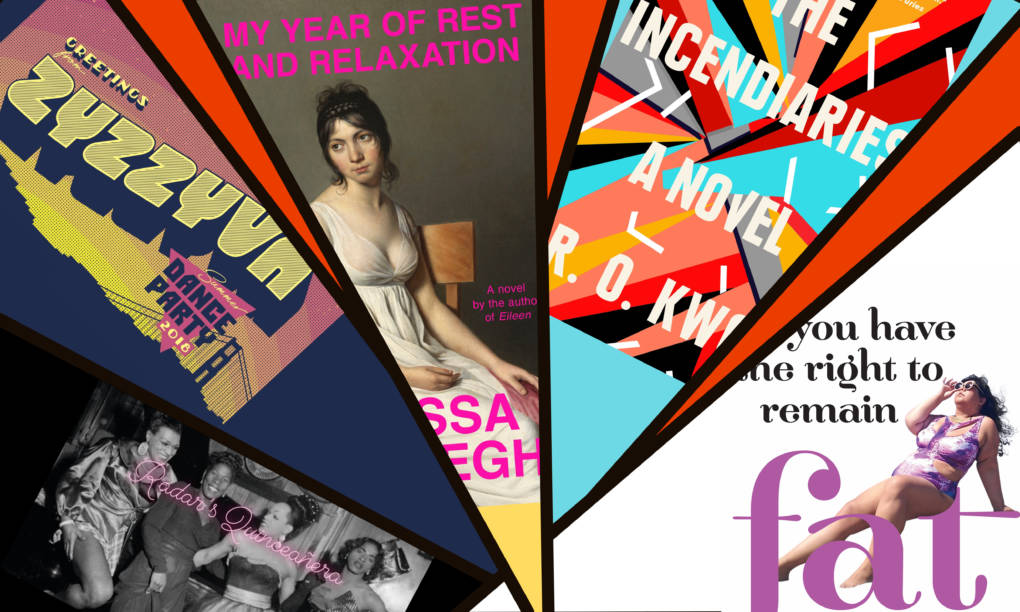
"caption": "Collage by Ingrid Rojas Contreras.",
"description": null,
"title": "summer lit guide",
"credit": null,
"status": "inherit",
"isLoading": false,
"fetchFailed": false
},
"arts_13832918": {
"type": "attachments",
"id": "arts_13832918",
"meta": {
"index": "attachments_1716263798",
"site": "arts",
"id": "13832918",
"found": true
},
"parent": 13831710,
"imgSizes": {
"small": {
"file": "https://ww2.kqed.org/app/uploads/sites/2/2018/05/LAdy-ReadingCROP-520x293.jpg",
"width": 520,
"mimeType": "image/jpeg",
"height": 293
},
"twentyfourteen-full-width": {
"file": "https://ww2.kqed.org/app/uploads/sites/2/2018/05/LAdy-ReadingCROP-1038x576.jpg",
"width": 1038,
"mimeType": "image/jpeg",
"height": 576
},
"thumbnail": {
"file": "https://ww2.kqed.org/app/uploads/sites/2/2018/05/LAdy-ReadingCROP-160x90.jpg",
"width": 160,
"mimeType": "image/jpeg",
"height": 90
},
"fd-sm": {
"file": "https://ww2.kqed.org/app/uploads/sites/2/2018/05/LAdy-ReadingCROP-960x540.jpg",
"width": 960,
"mimeType": "image/jpeg",
"height": 540
},
"post-thumbnail": {
"file": "https://ww2.kqed.org/app/uploads/sites/2/2018/05/LAdy-ReadingCROP-672x372.jpg",
"width": 672,
"mimeType": "image/jpeg",
"height": 372
},
"xsmall": {
"file": "https://ww2.kqed.org/app/uploads/sites/2/2018/05/LAdy-ReadingCROP-375x211.jpg",
"width": 375,
"mimeType": "image/jpeg",
"height": 211
},
"kqedFullSize": {
"file": "https://ww2.kqed.org/app/uploads/sites/2/2018/05/LAdy-ReadingCROP.jpg",
"width": 1920,
"height": 1080
},
"large": {
"file": "https://ww2.kqed.org/app/uploads/sites/2/2018/05/LAdy-ReadingCROP-1020x574.jpg",
"width": 1020,
"mimeType": "image/jpeg",
"height": 574
},
"xlarge": {
"file": "https://ww2.kqed.org/app/uploads/sites/2/2018/05/LAdy-ReadingCROP-1180x664.jpg",
"width": 1180,
"mimeType": "image/jpeg",
"height": 664
},
"complete_open_graph": {
"file": "https://ww2.kqed.org/app/uploads/sites/2/2018/05/LAdy-ReadingCROP-1200x675.jpg",
"width": 1200,
"mimeType": "image/jpeg",
"height": 675
},
"guest-author-50": {
"file": "https://ww2.kqed.org/app/uploads/sites/2/2018/05/LAdy-ReadingCROP-50x50.jpg",
"width": 50,
"mimeType": "image/jpeg",
"height": 50
},
"guest-author-96": {
"file": "https://ww2.kqed.org/app/uploads/sites/2/2018/05/LAdy-ReadingCROP-96x96.jpg",
"width": 96,
"mimeType": "image/jpeg",
"height": 96
},
"medium": {
"file": "https://ww2.kqed.org/app/uploads/sites/2/2018/05/LAdy-ReadingCROP-800x450.jpg",
"width": 800,
"mimeType": "image/jpeg",
"height": 450
},
"guest-author-64": {
"file": "https://ww2.kqed.org/app/uploads/sites/2/2018/05/LAdy-ReadingCROP-64x64.jpg",
"width": 64,
"mimeType": "image/jpeg",
"height": 64
},
"guest-author-32": {
"file": "https://ww2.kqed.org/app/uploads/sites/2/2018/05/LAdy-ReadingCROP-32x32.jpg",
"width": 32,
"mimeType": "image/jpeg",
"height": 32
},
"fd-lrg": {
"file": "https://ww2.kqed.org/app/uploads/sites/2/2018/05/LAdy-ReadingCROP-1920x1080.jpg",
"width": 1920,
"mimeType": "image/jpeg",
"height": 1080
},
"fd-med": {
"file": "https://ww2.kqed.org/app/uploads/sites/2/2018/05/LAdy-ReadingCROP-1180x664.jpg",
"width": 1180,
"mimeType": "image/jpeg",
"height": 664
},
"full-width": {
"file": "https://ww2.kqed.org/app/uploads/sites/2/2018/05/LAdy-ReadingCROP-1920x1080.jpg",
"width": 1920,
"mimeType": "image/jpeg",
"height": 1080
},
"detail": {
"file": "https://ww2.kqed.org/app/uploads/sites/2/2018/05/LAdy-ReadingCROP-150x150.jpg",
"width": 150,
"mimeType": "image/jpeg",
"height": 150
},
"medium_large": {
"file": "https://ww2.kqed.org/app/uploads/sites/2/2018/05/LAdy-ReadingCROP-768x432.jpg",
"width": 768,
"mimeType": "image/jpeg",
"height": 432
},
"guest-author-128": {
"file": "https://ww2.kqed.org/app/uploads/sites/2/2018/05/LAdy-ReadingCROP-128x128.jpg",
"width": 128,
"mimeType": "image/jpeg",
"height": 128
},
"xxsmall": {
"file": "https://ww2.kqed.org/app/uploads/sites/2/2018/05/LAdy-ReadingCROP-240x135.jpg",
"width": 240,
"mimeType": "image/jpeg",
"height": 135
}
},
"publishDate": 1526934936,
"modified": 1526935393,
"caption": "Young African American woman reads on a park bench.",
"description": "Young african american woman reads on a park bench.",
"title": "reading on a park bench",
"credit": "iStock",
"status": "inherit",
"isLoading": false,
"fetchFailed": false
},
"arts_13832337": {
"type": "attachments",
"id": "arts_13832337",
"meta": {
"index": "attachments_1716263798",
"site": "arts",
"id": "13832337",
"found": true
},
"parent": 13832336,
"imgSizes": {
"small": {
"file": "https://ww2.kqed.org/app/uploads/sites/2/2018/05/ap_18135506208818-4467b2b77548a1a421fb72a570952022e1e9e54c-520x390.jpg",
"width": 520,
"mimeType": "image/jpeg",
"height": 390
},
"twentyfourteen-full-width": {
"file": "https://ww2.kqed.org/app/uploads/sites/2/2018/05/ap_18135506208818-4467b2b77548a1a421fb72a570952022e1e9e54c-1038x576.jpg",
"width": 1038,
"mimeType": "image/jpeg",
"height": 576
},
"thumbnail": {
"file": "https://ww2.kqed.org/app/uploads/sites/2/2018/05/ap_18135506208818-4467b2b77548a1a421fb72a570952022e1e9e54c-160x120.jpg",
"width": 160,
"mimeType": "image/jpeg",
"height": 120
},
"fd-sm": {
"file": "https://ww2.kqed.org/app/uploads/sites/2/2018/05/ap_18135506208818-4467b2b77548a1a421fb72a570952022e1e9e54c-960x720.jpg",
"width": 960,
"mimeType": "image/jpeg",
"height": 720
},
"post-thumbnail": {
"file": "https://ww2.kqed.org/app/uploads/sites/2/2018/05/ap_18135506208818-4467b2b77548a1a421fb72a570952022e1e9e54c-672x372.jpg",
"width": 672,
"mimeType": "image/jpeg",
"height": 372
},
"xsmall": {
"file": "https://ww2.kqed.org/app/uploads/sites/2/2018/05/ap_18135506208818-4467b2b77548a1a421fb72a570952022e1e9e54c-375x281.jpg",
"width": 375,
"mimeType": "image/jpeg",
"height": 281
},
"kqedFullSize": {
"file": "https://ww2.kqed.org/app/uploads/sites/2/2018/05/ap_18135506208818-4467b2b77548a1a421fb72a570952022e1e9e54c.jpg",
"width": 2048,
"height": 1536
},
"large": {
"file": "https://ww2.kqed.org/app/uploads/sites/2/2018/05/ap_18135506208818-4467b2b77548a1a421fb72a570952022e1e9e54c-1020x765.jpg",
"width": 1020,
"mimeType": "image/jpeg",
"height": 765
},
"xlarge": {
"file": "https://ww2.kqed.org/app/uploads/sites/2/2018/05/ap_18135506208818-4467b2b77548a1a421fb72a570952022e1e9e54c-1180x885.jpg",
"width": 1180,
"mimeType": "image/jpeg",
"height": 885
},
"complete_open_graph": {
"file": "https://ww2.kqed.org/app/uploads/sites/2/2018/05/ap_18135506208818-4467b2b77548a1a421fb72a570952022e1e9e54c-1200x900.jpg",
"width": 1200,
"mimeType": "image/jpeg",
"height": 900
},
"guest-author-50": {
"file": "https://ww2.kqed.org/app/uploads/sites/2/2018/05/ap_18135506208818-4467b2b77548a1a421fb72a570952022e1e9e54c-50x50.jpg",
"width": 50,
"mimeType": "image/jpeg",
"height": 50
},
"guest-author-96": {
"file": "https://ww2.kqed.org/app/uploads/sites/2/2018/05/ap_18135506208818-4467b2b77548a1a421fb72a570952022e1e9e54c-96x96.jpg",
"width": 96,
"mimeType": "image/jpeg",
"height": 96
},
"medium": {
"file": "https://ww2.kqed.org/app/uploads/sites/2/2018/05/ap_18135506208818-4467b2b77548a1a421fb72a570952022e1e9e54c-800x600.jpg",
"width": 800,
"mimeType": "image/jpeg",
"height": 600
},
"guest-author-64": {
"file": "https://ww2.kqed.org/app/uploads/sites/2/2018/05/ap_18135506208818-4467b2b77548a1a421fb72a570952022e1e9e54c-64x64.jpg",
"width": 64,
"mimeType": "image/jpeg",
"height": 64
},
"guest-author-32": {
"file": "https://ww2.kqed.org/app/uploads/sites/2/2018/05/ap_18135506208818-4467b2b77548a1a421fb72a570952022e1e9e54c-32x32.jpg",
"width": 32,
"mimeType": "image/jpeg",
"height": 32
},
"fd-lrg": {
"file": "https://ww2.kqed.org/app/uploads/sites/2/2018/05/ap_18135506208818-4467b2b77548a1a421fb72a570952022e1e9e54c-1920x1440.jpg",
"width": 1920,
"mimeType": "image/jpeg",
"height": 1440
},
"fd-med": {
"file": "https://ww2.kqed.org/app/uploads/sites/2/2018/05/ap_18135506208818-4467b2b77548a1a421fb72a570952022e1e9e54c-1180x885.jpg",
"width": 1180,
"mimeType": "image/jpeg",
"height": 885
},
"full-width": {
"file": "https://ww2.kqed.org/app/uploads/sites/2/2018/05/ap_18135506208818-4467b2b77548a1a421fb72a570952022e1e9e54c-1920x1440.jpg",
"width": 1920,
"mimeType": "image/jpeg",
"height": 1440
},
"detail": {
"file": "https://ww2.kqed.org/app/uploads/sites/2/2018/05/ap_18135506208818-4467b2b77548a1a421fb72a570952022e1e9e54c-150x150.jpg",
"width": 150,
"mimeType": "image/jpeg",
"height": 150
},
"medium_large": {
"file": "https://ww2.kqed.org/app/uploads/sites/2/2018/05/ap_18135506208818-4467b2b77548a1a421fb72a570952022e1e9e54c-768x576.jpg",
"width": 768,
"mimeType": "image/jpeg",
"height": 576
},
"guest-author-128": {
"file": "https://ww2.kqed.org/app/uploads/sites/2/2018/05/ap_18135506208818-4467b2b77548a1a421fb72a570952022e1e9e54c-128x128.jpg",
"width": 128,
"mimeType": "image/jpeg",
"height": 128
},
"xxsmall": {
"file": "https://ww2.kqed.org/app/uploads/sites/2/2018/05/ap_18135506208818-4467b2b77548a1a421fb72a570952022e1e9e54c-240x180.jpg",
"width": 240,
"mimeType": "image/jpeg",
"height": 180
}
},
"publishDate": 1526417618,
"modified": 1526417760,
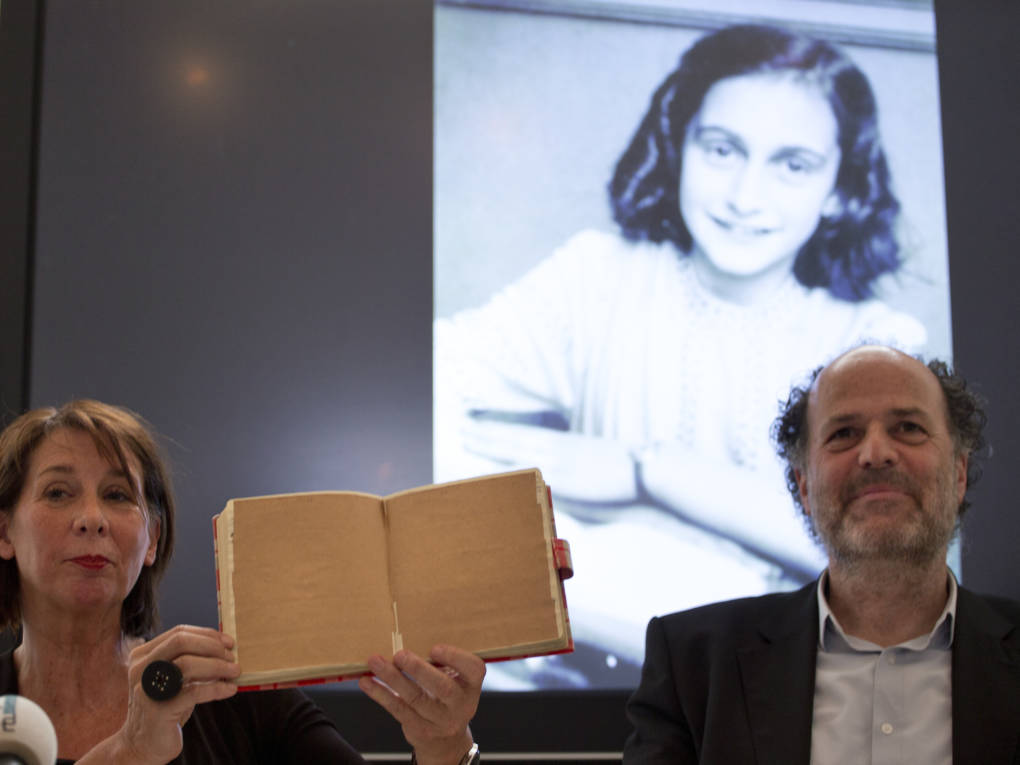
"caption": "Teresien da Silva, left, and Ronald Leopold of the Anne Frank Foundation show a facsimile of Anne Frank's diary at a press conference in Amsterdam on Tuesday. Researchers used digital photo editing techniques to uncover text on two pages of the diary, revealing risque jokes and an explanation of sex and prostitution.",
"description": "Teresien da Silva, left, and Ronald Leopold of the Anne Frank Foundation show a facsimile of Anne Frank's diary at a press conference in Amsterdam on Tuesday. Researchers used digital photo editing techniques to uncover text on two pages of the diary, revealing risque jokes and an explanation of sex and prostitut",
"title": "Teresien da Silva, left, and Ronald Leopold of the Anne Frank Foundation show a facsimile of Anne Frank's diary at a press conference in Amsterdam on Tuesday. Researchers used digital photo editing techniques to uncover text on two pages of the diary, revealing risque jokes and an explanation of sex and prostitution.",
"credit": "Peter Dejong/AP",
"status": "inherit",
"isLoading": false,
"fetchFailed": false
},
"arts_13832312": {
"type": "attachments",
"id": "arts_13832312",
"meta": {
"index": "attachments_1716263798",
"site": "arts",
"id": "13832312",
"found": true
},
"parent": 13832311,
"imgSizes": {
"small": {
"file": "https://ww2.kqed.org/app/uploads/sites/2/2018/05/gettyimages-142767283_custom-6faa1295bbe4164832502bb67948c7e1536c19c2-520x374.jpg",
"width": 520,
"mimeType": "image/jpeg",
"height": 374
},
"twentyfourteen-full-width": {
"file": "https://ww2.kqed.org/app/uploads/sites/2/2018/05/gettyimages-142767283_custom-6faa1295bbe4164832502bb67948c7e1536c19c2-1038x576.jpg",
"width": 1038,
"mimeType": "image/jpeg",
"height": 576
},
"thumbnail": {
"file": "https://ww2.kqed.org/app/uploads/sites/2/2018/05/gettyimages-142767283_custom-6faa1295bbe4164832502bb67948c7e1536c19c2-160x115.jpg",
"width": 160,
"mimeType": "image/jpeg",
"height": 115
},
"fd-sm": {
"file": "https://ww2.kqed.org/app/uploads/sites/2/2018/05/gettyimages-142767283_custom-6faa1295bbe4164832502bb67948c7e1536c19c2-960x690.jpg",
"width": 960,
"mimeType": "image/jpeg",
"height": 690
},
"post-thumbnail": {
"file": "https://ww2.kqed.org/app/uploads/sites/2/2018/05/gettyimages-142767283_custom-6faa1295bbe4164832502bb67948c7e1536c19c2-672x372.jpg",
"width": 672,
"mimeType": "image/jpeg",
"height": 372
},
"xsmall": {
"file": "https://ww2.kqed.org/app/uploads/sites/2/2018/05/gettyimages-142767283_custom-6faa1295bbe4164832502bb67948c7e1536c19c2-375x270.jpg",
"width": 375,
"mimeType": "image/jpeg",
"height": 270
},
"kqedFullSize": {
"file": "https://ww2.kqed.org/app/uploads/sites/2/2018/05/gettyimages-142767283_custom-6faa1295bbe4164832502bb67948c7e1536c19c2.jpg",
"width": 2048,
"height": 1472
},
"large": {
"file": "https://ww2.kqed.org/app/uploads/sites/2/2018/05/gettyimages-142767283_custom-6faa1295bbe4164832502bb67948c7e1536c19c2-1020x733.jpg",
"width": 1020,
"mimeType": "image/jpeg",
"height": 733
},
"xlarge": {
"file": "https://ww2.kqed.org/app/uploads/sites/2/2018/05/gettyimages-142767283_custom-6faa1295bbe4164832502bb67948c7e1536c19c2-1180x848.jpg",
"width": 1180,
"mimeType": "image/jpeg",
"height": 848
},
"complete_open_graph": {
"file": "https://ww2.kqed.org/app/uploads/sites/2/2018/05/gettyimages-142767283_custom-6faa1295bbe4164832502bb67948c7e1536c19c2-1200x863.jpg",
"width": 1200,
"mimeType": "image/jpeg",
"height": 863
},
"guest-author-50": {
"file": "https://ww2.kqed.org/app/uploads/sites/2/2018/05/gettyimages-142767283_custom-6faa1295bbe4164832502bb67948c7e1536c19c2-50x50.jpg",
"width": 50,
"mimeType": "image/jpeg",
"height": 50
},
"guest-author-96": {
"file": "https://ww2.kqed.org/app/uploads/sites/2/2018/05/gettyimages-142767283_custom-6faa1295bbe4164832502bb67948c7e1536c19c2-96x96.jpg",
"width": 96,
"mimeType": "image/jpeg",
"height": 96
},
"medium": {
"file": "https://ww2.kqed.org/app/uploads/sites/2/2018/05/gettyimages-142767283_custom-6faa1295bbe4164832502bb67948c7e1536c19c2-800x575.jpg",
"width": 800,
"mimeType": "image/jpeg",
"height": 575
},
"guest-author-64": {
"file": "https://ww2.kqed.org/app/uploads/sites/2/2018/05/gettyimages-142767283_custom-6faa1295bbe4164832502bb67948c7e1536c19c2-64x64.jpg",
"width": 64,
"mimeType": "image/jpeg",
"height": 64
},
"guest-author-32": {
"file": "https://ww2.kqed.org/app/uploads/sites/2/2018/05/gettyimages-142767283_custom-6faa1295bbe4164832502bb67948c7e1536c19c2-32x32.jpg",
"width": 32,
"mimeType": "image/jpeg",
"height": 32
},
"fd-lrg": {
"file": "https://ww2.kqed.org/app/uploads/sites/2/2018/05/gettyimages-142767283_custom-6faa1295bbe4164832502bb67948c7e1536c19c2-1920x1380.jpg",
"width": 1920,
"mimeType": "image/jpeg",
"height": 1380
},
"fd-med": {
"file": "https://ww2.kqed.org/app/uploads/sites/2/2018/05/gettyimages-142767283_custom-6faa1295bbe4164832502bb67948c7e1536c19c2-1180x848.jpg",
"width": 1180,
"mimeType": "image/jpeg",
"height": 848
},
"full-width": {
"file": "https://ww2.kqed.org/app/uploads/sites/2/2018/05/gettyimages-142767283_custom-6faa1295bbe4164832502bb67948c7e1536c19c2-1920x1380.jpg",
"width": 1920,
"mimeType": "image/jpeg",
"height": 1380
},
"detail": {
"file": "https://ww2.kqed.org/app/uploads/sites/2/2018/05/gettyimages-142767283_custom-6faa1295bbe4164832502bb67948c7e1536c19c2-150x150.jpg",
"width": 150,
"mimeType": "image/jpeg",
"height": 150
},
"medium_large": {
"file": "https://ww2.kqed.org/app/uploads/sites/2/2018/05/gettyimages-142767283_custom-6faa1295bbe4164832502bb67948c7e1536c19c2-768x552.jpg",
"width": 768,
"mimeType": "image/jpeg",
"height": 552
},
"guest-author-128": {
"file": "https://ww2.kqed.org/app/uploads/sites/2/2018/05/gettyimages-142767283_custom-6faa1295bbe4164832502bb67948c7e1536c19c2-128x128.jpg",
"width": 128,
"mimeType": "image/jpeg",
"height": 128
},
"xxsmall": {
"file": "https://ww2.kqed.org/app/uploads/sites/2/2018/05/gettyimages-142767283_custom-6faa1295bbe4164832502bb67948c7e1536c19c2-240x173.jpg",
"width": 240,
"mimeType": "image/jpeg",
"height": 173
}
},
"publishDate": 1526399491,
"modified": 1526399683,
"caption": "Novelist and journalist Tom Wolfe believed that techniques for fiction and non-fiction should be interchangeable. \"The things that work in non-fiction would work in fiction, and vice-versa,\" he said.",
"description": "Novelist and journalist Tom Wolfe believed that techniques for fiction and non-fiction should be interchangeable. \"The things that work in non-fiction would work in fiction, and vice-versa,\" he said",
"title": "Novelist and journalist Tom Wolfe believed that techniques for fiction and non-fiction should be interchangeable. \"The things that work in non-fiction would work in fiction, and vice-versa,\" he said.",
"credit": " David Corio/Redferns/Getty Images",
"status": "inherit",
"isLoading": false,
"fetchFailed": false
},
"arts_13831210": {
"type": "attachments",
"id": "arts_13831210",
"meta": {
"index": "attachments_1716263798",
"site": "arts",
"id": "13831210",
"found": true
},
"parent": 13831050,
"imgSizes": {
"small": {
"file": "https://ww2.kqed.org/app/uploads/sites/2/2018/05/jamel-brinkley--520x293.jpg",
"width": 520,
"mimeType": "image/jpeg",
"height": 293
},
"twentyfourteen-full-width": {
"file": "https://ww2.kqed.org/app/uploads/sites/2/2018/05/jamel-brinkley--1024x576.jpg",
"width": 1024,
"mimeType": "image/jpeg",
"height": 576
},
"thumbnail": {
"file": "https://ww2.kqed.org/app/uploads/sites/2/2018/05/jamel-brinkley--160x90.jpg",
"width": 160,
"mimeType": "image/jpeg",
"height": 90
},
"fd-sm": {
"file": "https://ww2.kqed.org/app/uploads/sites/2/2018/05/jamel-brinkley--960x540.jpg",
"width": 960,
"mimeType": "image/jpeg",
"height": 540
},
"post-thumbnail": {
"file": "https://ww2.kqed.org/app/uploads/sites/2/2018/05/jamel-brinkley--672x372.jpg",
"width": 672,
"mimeType": "image/jpeg",
"height": 372
},
"xsmall": {
"file": "https://ww2.kqed.org/app/uploads/sites/2/2018/05/jamel-brinkley--375x211.jpg",
"width": 375,
"mimeType": "image/jpeg",
"height": 211
},
"kqedFullSize": {
"file": "https://ww2.kqed.org/app/uploads/sites/2/2018/05/jamel-brinkley-.jpg",
"width": 1024,
"height": 576
},
"large": {
"file": "https://ww2.kqed.org/app/uploads/sites/2/2018/05/jamel-brinkley--1020x574.jpg",
"width": 1020,
"mimeType": "image/jpeg",
"height": 574
},
"guest-author-50": {
"file": "https://ww2.kqed.org/app/uploads/sites/2/2018/05/jamel-brinkley--50x50.jpg",
"width": 50,
"mimeType": "image/jpeg",
"height": 50
},
"guest-author-96": {
"file": "https://ww2.kqed.org/app/uploads/sites/2/2018/05/jamel-brinkley--96x96.jpg",
"width": 96,
"mimeType": "image/jpeg",
"height": 96
},
"medium": {
"file": "https://ww2.kqed.org/app/uploads/sites/2/2018/05/jamel-brinkley--800x450.jpg",
"width": 800,
"mimeType": "image/jpeg",
"height": 450
},
"guest-author-64": {
"file": "https://ww2.kqed.org/app/uploads/sites/2/2018/05/jamel-brinkley--64x64.jpg",
"width": 64,
"mimeType": "image/jpeg",
"height": 64
},
"guest-author-32": {
"file": "https://ww2.kqed.org/app/uploads/sites/2/2018/05/jamel-brinkley--32x32.jpg",
"width": 32,
"mimeType": "image/jpeg",
"height": 32
},
"detail": {
"file": "https://ww2.kqed.org/app/uploads/sites/2/2018/05/jamel-brinkley--150x150.jpg",
"width": 150,
"mimeType": "image/jpeg",
"height": 150
},
"medium_large": {
"file": "https://ww2.kqed.org/app/uploads/sites/2/2018/05/jamel-brinkley--768x432.jpg",
"width": 768,
"mimeType": "image/jpeg",
"height": 432
},
"guest-author-128": {
"file": "https://ww2.kqed.org/app/uploads/sites/2/2018/05/jamel-brinkley--128x128.jpg",
"width": 128,
"mimeType": "image/jpeg",
"height": 128
},
"xxsmall": {
"file": "https://ww2.kqed.org/app/uploads/sites/2/2018/05/jamel-brinkley--240x135.jpg",
"width": 240,
"mimeType": "image/jpeg",
"height": 135
}
},
"publishDate": 1525468343,
"modified": 1539192340,
"caption": "Jamel Brinkley is a National Book Awards finalist in the fiction category. ",
"description": "Jamel Brinkley is a National Book Awards finalist in the fiction category. ",
"title": "jamel brinkley",
"credit": "Arash Saedinia",
"status": "inherit",
"isLoading": false,
"fetchFailed": false
},
"arts_13831250": {
"type": "attachments",
"id": "arts_13831250",
"meta": {
"index": "attachments_1716263798",
"site": "arts",
"id": "13831250",
"found": true
},
"parent": 13831225,
"imgSizes": {
"thumbnail": {
"file": "https://ww2.kqed.org/app/uploads/sites/2/2018/05/Fest-logo-160x129.jpg",
"width": 160,
"mimeType": "image/jpeg",
"height": 129
},
"xsmall": {
"file": "https://ww2.kqed.org/app/uploads/sites/2/2018/05/Fest-logo-375x302.jpg",
"width": 375,
"mimeType": "image/jpeg",
"height": 302
},
"kqedFullSize": {
"file": "https://ww2.kqed.org/app/uploads/sites/2/2018/05/Fest-logo.jpg",
"width": 455,
"height": 367
},
"guest-author-50": {
"file": "https://ww2.kqed.org/app/uploads/sites/2/2018/05/Fest-logo-50x50.jpg",
"width": 50,
"mimeType": "image/jpeg",
"height": 50
},
"guest-author-96": {
"file": "https://ww2.kqed.org/app/uploads/sites/2/2018/05/Fest-logo-96x96.jpg",
"width": 96,
"mimeType": "image/jpeg",
"height": 96
},
"guest-author-64": {
"file": "https://ww2.kqed.org/app/uploads/sites/2/2018/05/Fest-logo-64x64.jpg",
"width": 64,
"mimeType": "image/jpeg",
"height": 64
},
"detail": {
"file": "https://ww2.kqed.org/app/uploads/sites/2/2018/05/Fest-logo-150x150.jpg",
"width": 150,
"mimeType": "image/jpeg",
"height": 150
},
"guest-author-32": {
"file": "https://ww2.kqed.org/app/uploads/sites/2/2018/05/Fest-logo-32x32.jpg",
"width": 32,
"mimeType": "image/jpeg",
"height": 32
},
"guest-author-128": {
"file": "https://ww2.kqed.org/app/uploads/sites/2/2018/05/Fest-logo-128x128.jpg",
"width": 128,
"mimeType": "image/jpeg",
"height": 128
},
"xxsmall": {
"file": "https://ww2.kqed.org/app/uploads/sites/2/2018/05/Fest-logo-240x194.jpg",
"width": 240,
"mimeType": "image/jpeg",
"height": 194
}
},
"publishDate": 1525484793,
"modified": 1525484880,
"caption": "\"I think you can look at a writer with different lenses and suddenly suddenly It opens up into something that is so intriguing and relevant to today’s world,\" says Susan Shillinglaw, director of the National Steinbeck Center.",
"description": "\"I think you can look at a writer with different lenses and suddenly suddenly It opens up into something that is so intriguing and relevant to today’s world,\" says Susan Shillinglaw, director of the National Steinbeck Center.",
"title": "Fest-logo",
"credit": "Photo: Courtesy of the National Steinbeck Center",
"status": "inherit",
"isLoading": false,
"fetchFailed": false
},
"arts_13831231": {
"type": "attachments",
"id": "arts_13831231",
"meta": {
"index": "attachments_1716263798",
"site": "arts",
"id": "13831231",
"found": true
},
"parent": 13831229,
"imgSizes": {
"small": {
"file": "https://ww2.kqed.org/app/uploads/sites/2/2018/05/Junot-Diaz-520x348.jpg",
"width": 520,
"mimeType": "image/jpeg",
"height": 348
},
"twentyfourteen-full-width": {
"file": "https://ww2.kqed.org/app/uploads/sites/2/2018/05/Junot-Diaz-1038x576.jpg",
"width": 1038,
"mimeType": "image/jpeg",
"height": 576
},
"thumbnail": {
"file": "https://ww2.kqed.org/app/uploads/sites/2/2018/05/Junot-Diaz-160x107.jpg",
"width": 160,
"mimeType": "image/jpeg",
"height": 107
},
"fd-sm": {
"file": "https://ww2.kqed.org/app/uploads/sites/2/2018/05/Junot-Diaz-960x643.jpg",
"width": 960,
"mimeType": "image/jpeg",
"height": 643
},
"post-thumbnail": {
"file": "https://ww2.kqed.org/app/uploads/sites/2/2018/05/Junot-Diaz-672x372.jpg",
"width": 672,
"mimeType": "image/jpeg",
"height": 372
},
"xsmall": {
"file": "https://ww2.kqed.org/app/uploads/sites/2/2018/05/Junot-Diaz-375x251.jpg",
"width": 375,
"mimeType": "image/jpeg",
"height": 251
},
"kqedFullSize": {
"file": "https://ww2.kqed.org/app/uploads/sites/2/2018/05/Junot-Diaz.jpg",
"width": 1920,
"height": 1285
},
"large": {
"file": "https://ww2.kqed.org/app/uploads/sites/2/2018/05/Junot-Diaz-1020x683.jpg",
"width": 1020,
"mimeType": "image/jpeg",
"height": 683
},
"xlarge": {
"file": "https://ww2.kqed.org/app/uploads/sites/2/2018/05/Junot-Diaz-1180x790.jpg",
"width": 1180,
"mimeType": "image/jpeg",
"height": 790
},
"complete_open_graph": {
"file": "https://ww2.kqed.org/app/uploads/sites/2/2018/05/Junot-Diaz-1200x803.jpg",
"width": 1200,
"mimeType": "image/jpeg",
"height": 803
},
"guest-author-50": {
"file": "https://ww2.kqed.org/app/uploads/sites/2/2018/05/Junot-Diaz-50x50.jpg",
"width": 50,
"mimeType": "image/jpeg",
"height": 50
},
"guest-author-96": {
"file": "https://ww2.kqed.org/app/uploads/sites/2/2018/05/Junot-Diaz-96x96.jpg",
"width": 96,
"mimeType": "image/jpeg",
"height": 96
},
"medium": {
"file": "https://ww2.kqed.org/app/uploads/sites/2/2018/05/Junot-Diaz-800x535.jpg",
"width": 800,
"mimeType": "image/jpeg",
"height": 535
},
"guest-author-64": {
"file": "https://ww2.kqed.org/app/uploads/sites/2/2018/05/Junot-Diaz-64x64.jpg",
"width": 64,
"mimeType": "image/jpeg",
"height": 64
},
"guest-author-32": {
"file": "https://ww2.kqed.org/app/uploads/sites/2/2018/05/Junot-Diaz-32x32.jpg",
"width": 32,
"mimeType": "image/jpeg",
"height": 32
},
"fd-lrg": {
"file": "https://ww2.kqed.org/app/uploads/sites/2/2018/05/Junot-Diaz-1920x1285.jpg",
"width": 1920,
"mimeType": "image/jpeg",
"height": 1285
},
"fd-med": {
"file": "https://ww2.kqed.org/app/uploads/sites/2/2018/05/Junot-Diaz-1180x790.jpg",
"width": 1180,
"mimeType": "image/jpeg",
"height": 790
},
"full-width": {
"file": "https://ww2.kqed.org/app/uploads/sites/2/2018/05/Junot-Diaz-1920x1285.jpg",
"width": 1920,
"mimeType": "image/jpeg",
"height": 1285
},
"detail": {
"file": "https://ww2.kqed.org/app/uploads/sites/2/2018/05/Junot-Diaz-150x150.jpg",
"width": 150,
"mimeType": "image/jpeg",
"height": 150
},
"medium_large": {
"file": "https://ww2.kqed.org/app/uploads/sites/2/2018/05/Junot-Diaz-768x514.jpg",
"width": 768,
"mimeType": "image/jpeg",
"height": 514
},
"guest-author-128": {
"file": "https://ww2.kqed.org/app/uploads/sites/2/2018/05/Junot-Diaz-128x128.jpg",
"width": 128,
"mimeType": "image/jpeg",
"height": 128
},
"xxsmall": {
"file": "https://ww2.kqed.org/app/uploads/sites/2/2018/05/Junot-Diaz-240x161.jpg",
"width": 240,
"mimeType": "image/jpeg",
"height": 161
}
},
"publishDate": 1525475830,
"modified": 1525475930,
"caption": "Dominican MIT professor Junot Diaz, winner of the Pulitzer Prize for his novel 'The Brief Wondrous Life of Oscar Wao' attends a ceremony in Santo Domingo, on May 1, 2008. ",
"description": "Dominican MIT professor Junot Diaz, winner of the Pulitzer Prize for his novel 'The Brief Wondrous Life of Oscar Wao' attends a ceremony in Santo Domingo, on May 1, 2008. ",
"title": "Dominican MIT professor Junot Diaz, winn",
"credit": "Ricardo Hernandez /AFP/Getty Images",
"status": "inherit",
"isLoading": false,
"fetchFailed": false
},
"arts_13922137": {
"type": "attachments",
"id": "arts_13922137",
"meta": {
"index": "attachments_1716263798",
"site": "arts",
"id": "13922137",
"found": true
},
"parent": 13831138,
"imgSizes": {
"twentyfourteen-full-width": {
"file": "https://ww2.kqed.org/app/uploads/sites/2/2018/05/AlineCrumb.THUMB_-1038x576.jpg",
"width": 1038,
"mimeType": "image/jpeg",
"height": 576
},
"thumbnail": {
"file": "https://ww2.kqed.org/app/uploads/sites/2/2018/05/AlineCrumb.THUMB_-160x90.jpg",
"width": 160,
"mimeType": "image/jpeg",
"height": 90
},
"post-thumbnail": {
"file": "https://ww2.kqed.org/app/uploads/sites/2/2018/05/AlineCrumb.THUMB_-672x372.jpg",
"width": 672,
"mimeType": "image/jpeg",
"height": 372
},
"kqedFullSize": {
"file": "https://ww2.kqed.org/app/uploads/sites/2/2018/05/AlineCrumb.THUMB_.jpg",
"width": 1180,
"height": 664
},
"large": {
"file": "https://ww2.kqed.org/app/uploads/sites/2/2018/05/AlineCrumb.THUMB_-1020x574.jpg",
"width": 1020,
"mimeType": "image/jpeg",
"height": 574
},
"medium": {
"file": "https://ww2.kqed.org/app/uploads/sites/2/2018/05/AlineCrumb.THUMB_-800x450.jpg",
"width": 800,
"mimeType": "image/jpeg",
"height": 450
},
"medium_large": {
"file": "https://ww2.kqed.org/app/uploads/sites/2/2018/05/AlineCrumb.THUMB_-768x432.jpg",
"width": 768,
"mimeType": "image/jpeg",
"height": 432
}
},
"publishDate": 1669845029,
"modified": 1669845142,
"caption": "Aline Kominsky-Crumb",
"description": null,
"title": "AlineCrumb.THUMB",
"credit": "Kate Mada",
"status": "inherit",
"altTag": null,
"isLoading": false,
"fetchFailed": false
},
"arts_13830501": {
"type": "attachments",
"id": "arts_13830501",
"meta": {
"index": "attachments_1716263798",
"site": "arts",
"id": "13830501",
"found": true
},
"parent": 13830489,
"imgSizes": {
"small": {
"file": "https://ww2.kqed.org/app/uploads/sites/2/2018/04/Michele-Mackinens-quilt-is-part-of-the-exhibition-Guns-A-Loaded-Conversation-at-the-San-Jose-Museum-of-Quilts-adn-Textiles-520x312.jpg",
"width": 520,
"mimeType": "image/jpeg",
"height": 312
},
"twentyfourteen-full-width": {
"file": "https://ww2.kqed.org/app/uploads/sites/2/2018/04/Michele-Mackinens-quilt-is-part-of-the-exhibition-Guns-A-Loaded-Conversation-at-the-San-Jose-Museum-of-Quilts-adn-Textiles-1038x576.jpg",
"width": 1038,
"mimeType": "image/jpeg",
"height": 576
},
"thumbnail": {
"file": "https://ww2.kqed.org/app/uploads/sites/2/2018/04/Michele-Mackinens-quilt-is-part-of-the-exhibition-Guns-A-Loaded-Conversation-at-the-San-Jose-Museum-of-Quilts-adn-Textiles-160x96.jpg",
"width": 160,
"mimeType": "image/jpeg",
"height": 96
},
"fd-sm": {
"file": "https://ww2.kqed.org/app/uploads/sites/2/2018/04/Michele-Mackinens-quilt-is-part-of-the-exhibition-Guns-A-Loaded-Conversation-at-the-San-Jose-Museum-of-Quilts-adn-Textiles-960x576.jpg",
"width": 960,
"mimeType": "image/jpeg",
"height": 576
},
"post-thumbnail": {
"file": "https://ww2.kqed.org/app/uploads/sites/2/2018/04/Michele-Mackinens-quilt-is-part-of-the-exhibition-Guns-A-Loaded-Conversation-at-the-San-Jose-Museum-of-Quilts-adn-Textiles-672x372.jpg",
"width": 672,
"mimeType": "image/jpeg",
"height": 372
},
"xsmall": {
"file": "https://ww2.kqed.org/app/uploads/sites/2/2018/04/Michele-Mackinens-quilt-is-part-of-the-exhibition-Guns-A-Loaded-Conversation-at-the-San-Jose-Museum-of-Quilts-adn-Textiles-375x225.jpg",
"width": 375,
"mimeType": "image/jpeg",
"height": 225
},
"kqedFullSize": {
"file": "https://ww2.kqed.org/app/uploads/sites/2/2018/04/Michele-Mackinens-quilt-is-part-of-the-exhibition-Guns-A-Loaded-Conversation-at-the-San-Jose-Museum-of-Quilts-adn-Textiles.jpg",
"width": 2048,
"height": 1229
},
"large": {
"file": "https://ww2.kqed.org/app/uploads/sites/2/2018/04/Michele-Mackinens-quilt-is-part-of-the-exhibition-Guns-A-Loaded-Conversation-at-the-San-Jose-Museum-of-Quilts-adn-Textiles-1020x612.jpg",
"width": 1020,
"mimeType": "image/jpeg",
"height": 612
},
"xlarge": {
"file": "https://ww2.kqed.org/app/uploads/sites/2/2018/04/Michele-Mackinens-quilt-is-part-of-the-exhibition-Guns-A-Loaded-Conversation-at-the-San-Jose-Museum-of-Quilts-adn-Textiles-1180x708.jpg",
"width": 1180,
"mimeType": "image/jpeg",
"height": 708
},
"complete_open_graph": {
"file": "https://ww2.kqed.org/app/uploads/sites/2/2018/04/Michele-Mackinens-quilt-is-part-of-the-exhibition-Guns-A-Loaded-Conversation-at-the-San-Jose-Museum-of-Quilts-adn-Textiles-1200x720.jpg",
"width": 1200,
"mimeType": "image/jpeg",
"height": 720
},
"guest-author-50": {
"file": "https://ww2.kqed.org/app/uploads/sites/2/2018/04/Michele-Mackinens-quilt-is-part-of-the-exhibition-Guns-A-Loaded-Conversation-at-the-San-Jose-Museum-of-Quilts-adn-Textiles-50x50.jpg",
"width": 50,
"mimeType": "image/jpeg",
"height": 50
},
"guest-author-96": {
"file": "https://ww2.kqed.org/app/uploads/sites/2/2018/04/Michele-Mackinens-quilt-is-part-of-the-exhibition-Guns-A-Loaded-Conversation-at-the-San-Jose-Museum-of-Quilts-adn-Textiles-96x96.jpg",
"width": 96,
"mimeType": "image/jpeg",
"height": 96
},
"medium": {
"file": "https://ww2.kqed.org/app/uploads/sites/2/2018/04/Michele-Mackinens-quilt-is-part-of-the-exhibition-Guns-A-Loaded-Conversation-at-the-San-Jose-Museum-of-Quilts-adn-Textiles-800x480.jpg",
"width": 800,
"mimeType": "image/jpeg",
"height": 480
},
"guest-author-64": {
"file": "https://ww2.kqed.org/app/uploads/sites/2/2018/04/Michele-Mackinens-quilt-is-part-of-the-exhibition-Guns-A-Loaded-Conversation-at-the-San-Jose-Museum-of-Quilts-adn-Textiles-64x64.jpg",
"width": 64,
"mimeType": "image/jpeg",
"height": 64
},
"guest-author-32": {
"file": "https://ww2.kqed.org/app/uploads/sites/2/2018/04/Michele-Mackinens-quilt-is-part-of-the-exhibition-Guns-A-Loaded-Conversation-at-the-San-Jose-Museum-of-Quilts-adn-Textiles-32x32.jpg",
"width": 32,
"mimeType": "image/jpeg",
"height": 32
},
"fd-lrg": {
"file": "https://ww2.kqed.org/app/uploads/sites/2/2018/04/Michele-Mackinens-quilt-is-part-of-the-exhibition-Guns-A-Loaded-Conversation-at-the-San-Jose-Museum-of-Quilts-adn-Textiles-1920x1152.jpg",
"width": 1920,
"mimeType": "image/jpeg",
"height": 1152
},
"fd-med": {
"file": "https://ww2.kqed.org/app/uploads/sites/2/2018/04/Michele-Mackinens-quilt-is-part-of-the-exhibition-Guns-A-Loaded-Conversation-at-the-San-Jose-Museum-of-Quilts-adn-Textiles-1180x708.jpg",
"width": 1180,
"mimeType": "image/jpeg",
"height": 708
},
"full-width": {
"file": "https://ww2.kqed.org/app/uploads/sites/2/2018/04/Michele-Mackinens-quilt-is-part-of-the-exhibition-Guns-A-Loaded-Conversation-at-the-San-Jose-Museum-of-Quilts-adn-Textiles-1920x1152.jpg",
"width": 1920,
"mimeType": "image/jpeg",
"height": 1152
},
"detail": {
"file": "https://ww2.kqed.org/app/uploads/sites/2/2018/04/Michele-Mackinens-quilt-is-part-of-the-exhibition-Guns-A-Loaded-Conversation-at-the-San-Jose-Museum-of-Quilts-adn-Textiles-150x150.jpg",
"width": 150,
"mimeType": "image/jpeg",
"height": 150
},
"medium_large": {
"file": "https://ww2.kqed.org/app/uploads/sites/2/2018/04/Michele-Mackinens-quilt-is-part-of-the-exhibition-Guns-A-Loaded-Conversation-at-the-San-Jose-Museum-of-Quilts-adn-Textiles-768x461.jpg",
"width": 768,
"mimeType": "image/jpeg",
"height": 461
},
"guest-author-128": {
"file": "https://ww2.kqed.org/app/uploads/sites/2/2018/04/Michele-Mackinens-quilt-is-part-of-the-exhibition-Guns-A-Loaded-Conversation-at-the-San-Jose-Museum-of-Quilts-adn-Textiles-128x128.jpg",
"width": 128,
"mimeType": "image/jpeg",
"height": 128
},
"xxsmall": {
"file": "https://ww2.kqed.org/app/uploads/sites/2/2018/04/Michele-Mackinens-quilt-is-part-of-the-exhibition-Guns-A-Loaded-Conversation-at-the-San-Jose-Museum-of-Quilts-adn-Textiles-240x144.jpg",
"width": 240,
"mimeType": "image/jpeg",
"height": 144
}
},
"publishDate": 1524702738,
"modified": 1524702878,
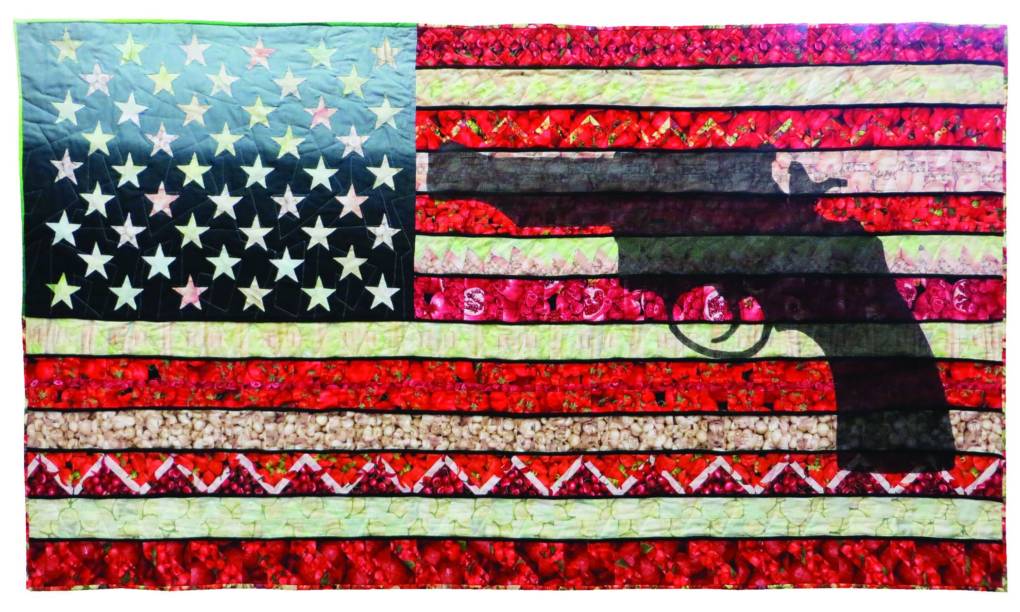
"caption": "Michele Mackinen's quilt is part of the exhibition 'Guns: Loaded Conversations' at the San Jose Museum of Quilts and Textiles",
"description": "Michele Mackinen's quilt is part of the exhibition 'Guns: Loaded Conversations' at the San Jose Museum of Quilts and Textiles",
"title": "Michele Mackinen's quilt is part of the exhibition 'Guns: Loaded Conversations' at the San Jose Museum of Quilts and Textiles",
"credit": "Monika Wulfers",
"status": "inherit",
"isLoading": false,
"fetchFailed": false
},
"arts_13830379": {
"type": "attachments",
"id": "arts_13830379",
"meta": {
"index": "attachments_1716263798",
"site": "arts",
"id": "13830379",
"found": true
},
"parent": 0,
"imgSizes": {
"small": {
"file": "https://ww2.kqed.org/app/uploads/sites/2/2018/04/Audience-for-RaceResistance-session-StierlyBucaloy-e1524676122783-520x293.jpg",
"width": 520,
"mimeType": "image/jpeg",
"height": 293
},
"twentyfourteen-full-width": {
"file": "https://ww2.kqed.org/app/uploads/sites/2/2018/04/Audience-for-RaceResistance-session-StierlyBucaloy-e1524676122783-1038x576.jpg",
"width": 1038,
"mimeType": "image/jpeg",
"height": 576
},
"thumbnail": {
"file": "https://ww2.kqed.org/app/uploads/sites/2/2018/04/Audience-for-RaceResistance-session-StierlyBucaloy-e1524676122783-160x90.jpg",
"width": 160,
"mimeType": "image/jpeg",
"height": 90
},
"fd-sm": {
"file": "https://ww2.kqed.org/app/uploads/sites/2/2018/04/Audience-for-RaceResistance-session-StierlyBucaloy-e1524676122783-960x540.jpg",
"width": 960,
"mimeType": "image/jpeg",
"height": 540
},
"post-thumbnail": {
"file": "https://ww2.kqed.org/app/uploads/sites/2/2018/04/Audience-for-RaceResistance-session-StierlyBucaloy-e1524676122783-672x372.jpg",
"width": 672,
"mimeType": "image/jpeg",
"height": 372
},
"xsmall": {
"file": "https://ww2.kqed.org/app/uploads/sites/2/2018/04/Audience-for-RaceResistance-session-StierlyBucaloy-e1524676122783-375x211.jpg",
"width": 375,
"mimeType": "image/jpeg",
"height": 211
},
"kqedFullSize": {
"file": "https://ww2.kqed.org/app/uploads/sites/2/2018/04/Audience-for-RaceResistance-session-StierlyBucaloy-e1524676122783.jpg",
"width": 2048,
"height": 1152
},
"large": {
"file": "https://ww2.kqed.org/app/uploads/sites/2/2018/04/Audience-for-RaceResistance-session-StierlyBucaloy-e1524676122783-1020x574.jpg",
"width": 1020,
"mimeType": "image/jpeg",
"height": 574
},
"xlarge": {
"file": "https://ww2.kqed.org/app/uploads/sites/2/2018/04/Audience-for-RaceResistance-session-StierlyBucaloy-e1524676122783-1180x664.jpg",
"width": 1180,
"mimeType": "image/jpeg",
"height": 664
},
"complete_open_graph": {
"file": "https://ww2.kqed.org/app/uploads/sites/2/2018/04/Audience-for-RaceResistance-session-StierlyBucaloy-e1524676122783-1200x675.jpg",
"width": 1200,
"mimeType": "image/jpeg",
"height": 675
},
"guest-author-50": {
"file": "https://ww2.kqed.org/app/uploads/sites/2/2018/04/Audience-for-RaceResistance-session-StierlyBucaloy-e1524676122783-50x50.jpg",
"width": 50,
"mimeType": "image/jpeg",
"height": 50
},
"guest-author-96": {
"file": "https://ww2.kqed.org/app/uploads/sites/2/2018/04/Audience-for-RaceResistance-session-StierlyBucaloy-e1524676122783-96x96.jpg",
"width": 96,
"mimeType": "image/jpeg",
"height": 96
},
"medium": {
"file": "https://ww2.kqed.org/app/uploads/sites/2/2018/04/Audience-for-RaceResistance-session-StierlyBucaloy-e1524676122783-800x450.jpg",
"width": 800,
"mimeType": "image/jpeg",
"height": 450
},
"guest-author-64": {
"file": "https://ww2.kqed.org/app/uploads/sites/2/2018/04/Audience-for-RaceResistance-session-StierlyBucaloy-e1524676122783-64x64.jpg",
"width": 64,
"mimeType": "image/jpeg",
"height": 64
},
"guest-author-32": {
"file": "https://ww2.kqed.org/app/uploads/sites/2/2018/04/Audience-for-RaceResistance-session-StierlyBucaloy-e1524676122783-32x32.jpg",
"width": 32,
"mimeType": "image/jpeg",
"height": 32
},
"fd-lrg": {
"file": "https://ww2.kqed.org/app/uploads/sites/2/2018/04/Audience-for-RaceResistance-session-StierlyBucaloy-e1524676122783-1920x1080.jpg",
"width": 1920,
"mimeType": "image/jpeg",
"height": 1080
},
"fd-med": {
"file": "https://ww2.kqed.org/app/uploads/sites/2/2018/04/Audience-for-RaceResistance-session-StierlyBucaloy-e1524676122783-1180x664.jpg",
"width": 1180,
"mimeType": "image/jpeg",
"height": 664
},
"full-width": {
"file": "https://ww2.kqed.org/app/uploads/sites/2/2018/04/Audience-for-RaceResistance-session-StierlyBucaloy-e1524676122783-1920x1080.jpg",
"width": 1920,
"mimeType": "image/jpeg",
"height": 1080
},
"detail": {
"file": "https://ww2.kqed.org/app/uploads/sites/2/2018/04/Audience-for-RaceResistance-session-StierlyBucaloy-e1524676122783-150x150.jpg",
"width": 150,
"mimeType": "image/jpeg",
"height": 150
},
"medium_large": {
"file": "https://ww2.kqed.org/app/uploads/sites/2/2018/04/Audience-for-RaceResistance-session-StierlyBucaloy-e1524676122783-768x432.jpg",
"width": 768,
"mimeType": "image/jpeg",
"height": 432
},
"guest-author-128": {
"file": "https://ww2.kqed.org/app/uploads/sites/2/2018/04/Audience-for-RaceResistance-session-StierlyBucaloy-e1524676122783-128x128.jpg",
"width": 128,
"mimeType": "image/jpeg",
"height": 128
},
"xxsmall": {
"file": "https://ww2.kqed.org/app/uploads/sites/2/2018/04/Audience-for-RaceResistance-session-StierlyBucaloy-e1524676122783-240x135.jpg",
"width": 240,
"mimeType": "image/jpeg",
"height": 135
}
},
"publishDate": 1524675912,
"modified": 1524676080,
"caption": "The audience for a panel on Race and Resistance at the 2017 Bay Area Book Festival",
"description": "The audience for a panel on Race and Resistance at the 2017 Bay Area Book Festival",
"title": "The audience for a panel on Race and Resistance at the 2017 Bay Area Book Festival",
"credit": "Stierly Bucaloy",
"status": "inherit",
"isLoading": false,
"fetchFailed": false
}
},
"audioPlayerReducer": {
"postId": "stream_live",
"isPaused": true,
"isPlaying": false,
"pfsActive": false,
"pledgeModalIsOpen": true,
"playerDrawerIsOpen": false,
"liveAudioPlayStartedAt": 0,
"liveAudioPlayContext": ""
},
"authorsReducer": {
"byline_arts_13833221": {
"type": "authors",
"id": "byline_arts_13833221",
"meta": {
"override": true
},
"slug": "byline_arts_13833221",
"name": "Hillel Italie",
"isLoading": false
},
"byline_arts_13832637": {
"type": "authors",
"id": "byline_arts_13832637",
"meta": {
"override": true
},
"slug": "byline_arts_13832637",
"name": "Michelle Threadgould",
"isLoading": false
},
"byline_arts_13832336": {
"type": "authors",
"id": "byline_arts_13832336",
"meta": {
"override": true
},
"slug": "byline_arts_13832336",
"name": "Sasha Ingber",
"isLoading": false
},
"byline_arts_13832311": {
"type": "authors",
"id": "byline_arts_13832311",
"meta": {
"override": true
},
"slug": "byline_arts_13832311",
"name": "Tom Vitale",
"isLoading": false
},
"byline_arts_13831229": {
"type": "authors",
"id": "byline_arts_13831229",
"meta": {
"override": true
},
"slug": "byline_arts_13831229",
"name": "Alexandra Villareal",
"isLoading": false
},
"cmusiker": {
"type": "authors",
"id": "32",
"meta": {
"index": "authors_1716337520",
"id": "32",
"found": true
},
"name": "Cy Musiker",
"firstName": "Cy",
"lastName": "Musiker",
"slug": "cmusiker",
"email": "cmusiker@kqed.org",
"display_author_email": false,
"staff_mastheads": [],
"title": "KQED Contributor",
"bio": "Cy Musiker is a former co-host of The Do List and a former reporter covering the arts for KQED News and The California Report. He loves live performance, especially great theater, jazz, roots music, anything by Mahler. Cy has an MJ from UC Berkeley's School of Journalism, and got his BA from Hampshire College. His work has been recognized by the Society for Professional Journalists with their Sigma Delta Chi Award for Public Service in Journalism. When he can, Cy likes to swim in Tomales Bay, run with his dog in the East Bay Hills, and hike the Sierra.",
"avatar": "https://secure.gravatar.com/avatar/05eaba5c5696ce8f062e4ea2df428a43?s=600&d=blank&r=g",
"twitter": null,
"facebook": null,
"instagram": null,
"linkedin": null,
"sites": [
{
"site": "arts",
"roles": [
"Contributor",
"subscriber"
]
},
{
"site": "news",
"roles": [
"author"
]
},
{
"site": "bayareabites",
"roles": [
"contributor"
]
}
],
"headData": {
"title": "Cy Musiker | KQED",
"description": "KQED Contributor",
"ogImgSrc": "https://secure.gravatar.com/avatar/05eaba5c5696ce8f062e4ea2df428a43?s=600&d=blank&r=g",
"twImgSrc": "https://secure.gravatar.com/avatar/05eaba5c5696ce8f062e4ea2df428a43?s=600&d=blank&r=g"
},
"isLoading": false,
"link": "/author/cmusiker"
},
"irojascontreras": {
"type": "authors",
"id": "78",
"meta": {
"index": "authors_1716337520",
"id": "78",
"found": true
},
"name": "Ingrid Rojas Contreras",
"firstName": "Ingrid",
"lastName": "Rojas Contreras",
"slug": "irojascontreras",
"email": "ingrid.rojas.c@gmail.com",
"display_author_email": false,
"staff_mastheads": [],
"title": null,
"bio": "Ingrid Rojas Contreras lives in San Francisco with her books. Her debut novel\u003cem> Fruit of the Drunken Tree \u003c/em>is forthcoming from Doubleday (Summer 2018). Find more at \u003ca href=\"http://www.ingridrojascontreras.com\">www.ingridrojascontreras.com\u003c/a>.",
"avatar": "https://secure.gravatar.com/avatar/908d94de9342e71b9d5ceaa8152a16a0?s=600&d=blank&r=g",
"twitter": null,
"facebook": null,
"instagram": null,
"linkedin": null,
"sites": [
{
"site": "arts",
"roles": [
"Contributor",
"contributor"
]
}
],
"headData": {
"title": "Ingrid Rojas Contreras | KQED",
"description": null,
"ogImgSrc": "https://secure.gravatar.com/avatar/908d94de9342e71b9d5ceaa8152a16a0?s=600&d=blank&r=g",
"twImgSrc": "https://secure.gravatar.com/avatar/908d94de9342e71b9d5ceaa8152a16a0?s=600&d=blank&r=g"
},
"isLoading": false,
"link": "/author/irojascontreras"
},
"rachael-myrow": {
"type": "authors",
"id": "251",
"meta": {
"index": "authors_1716337520",
"id": "251",
"found": true
},
"name": "Rachael Myrow",
"firstName": "Rachael",
"lastName": "Myrow",
"slug": "rachael-myrow",
"email": "rmyrow@kqed.org",
"display_author_email": true,
"staff_mastheads": [
"news"
],
"title": "Senior Editor of KQED's Silicon Valley News Desk",
"bio": "• I write and edit stories about how Silicon Valley power and policies shape everyday life in California. I’m also passionate about making Bay Area history and culture more accessible to a broad public. • I’ve been a journalist for most of my life, starting in high school with The Franklin Press in Los Angeles, where I grew up. While earning my first degree in English at UC Berkeley, I got my start in public radio at KALX-FM. After completing a second degree in journalism at Cal, I landed my first professional job at Marketplace, then moved on to KPCC (now LAist), and then KQED, where I hosted The California Report for more than seven years. • My reporting has appeared on NPR, The World, WBUR’s \u003ci>Here & Now\u003c/i>, and the BBC. I also guest host for KQED’s \u003ci>Forum\u003c/i>, as well as the Commonwealth Club in San Francisco. • I speak periodically on media, democracy and technology issues, and do voiceover work for documentaries and educational video projects. • Outside of the studio, you'll find me hiking Bay Area trails and whipping up Insta-ready meals in my kitchen. • I do not accept gifts, money, or favors from anyone connected to my reporting, I don't pay people for information, and I do not support or donate to political causes. • I strive to treat the people I report on with fairness, honesty, and respect. I also recognize there are often multiple sides to a story and work to verify information through multiple sources and documentation. If I get something wrong, I correct it.",
"avatar": "https://secure.gravatar.com/avatar/3ed8a3c5f26025e4a805ba634cda8cd764906b97438a6d9ce216b044e340da4e?s=600&d=blank&r=g",
"twitter": "rachaelmyrow",
"bluesky": null,
"facebook": null,
"instagram": null,
"linkedin": "https://www.linkedin.com/in/rachaelmyrow/",
"sites": [
{
"site": "arts",
"roles": [
"administrator"
]
},
{
"site": "news",
"roles": [
"edit_others_posts",
"editor"
]
},
{
"site": "futureofyou",
"roles": [
"editor"
]
},
{
"site": "bayareabites",
"roles": [
"editor"
]
},
{
"site": "stateofhealth",
"roles": [
"editor"
]
},
{
"site": "science",
"roles": [
"editor"
]
},
{
"site": "food",
"roles": [
"editor"
]
},
{
"site": "forum",
"roles": [
"editor"
]
},
{
"site": "liveblog",
"roles": [
"author"
]
}
],
"headData": {
"title": "Rachael Myrow | KQED",
"description": "Senior Editor of KQED's Silicon Valley News Desk",
"ogImgSrc": "https://secure.gravatar.com/avatar/3ed8a3c5f26025e4a805ba634cda8cd764906b97438a6d9ce216b044e340da4e?s=600&d=blank&r=g",
"twImgSrc": "https://secure.gravatar.com/avatar/3ed8a3c5f26025e4a805ba634cda8cd764906b97438a6d9ce216b044e340da4e?s=600&d=blank&r=g"
},
"isLoading": false,
"link": "/author/rachael-myrow"
},
"carlysevern": {
"type": "authors",
"id": "3243",
"meta": {
"index": "authors_1716337520",
"id": "3243",
"found": true
},
"name": "Carly Severn",
"firstName": "Carly",
"lastName": "Severn",
"slug": "carlysevern",
"email": "csevern@kqed.org",
"display_author_email": false,
"staff_mastheads": [
"news"
],
"title": "Senior Editor, Audience News ",
"bio": "Carly is KQED's Senior Editor of Audience News on the Digital News team, and has reported for the California Report Magazine, Bay Curious and KQED Arts. She's formerly the host of \u003ca href=\"http://ww2.kqed.org/pop/category/the-cooler/\" rel=\"noopener noreferrer\">The Cooler\u003c/a> podcast.",
"avatar": "https://secure.gravatar.com/avatar/54037bf5c128fe678f0ef26cec97a93f2e7f220a22d7285703328f12c42c1b1d?s=600&d=blank&r=g",
"twitter": "teacupinthebay",
"bluesky": null,
"facebook": null,
"instagram": null,
"linkedin": null,
"sites": [
{
"site": "",
"roles": [
"editor"
]
},
{
"site": "arts",
"roles": [
"editor"
]
},
{
"site": "news",
"roles": [
"administrator"
]
},
{
"site": "pop",
"roles": [
"editor"
]
},
{
"site": "futureofyou",
"roles": [
"editor"
]
},
{
"site": "about",
"roles": [
"administrator"
]
},
{
"site": "mindshift",
"roles": [
"editor"
]
},
{
"site": "bayareabites",
"roles": [
"editor"
]
},
{
"site": "stateofhealth",
"roles": [
"editor"
]
},
{
"site": "science",
"roles": [
"editor"
]
},
{
"site": "food",
"roles": [
"contributor"
]
},
{
"site": "forum",
"roles": [
"editor"
]
},
{
"site": "perspectives",
"roles": [
"administrator"
]
},
{
"site": "liveblog",
"roles": [
"editor"
]
}
],
"headData": {
"title": "Carly Severn | KQED",
"description": "Senior Editor, Audience News ",
"ogImgSrc": "https://secure.gravatar.com/avatar/54037bf5c128fe678f0ef26cec97a93f2e7f220a22d7285703328f12c42c1b1d?s=600&d=blank&r=g",
"twImgSrc": "https://secure.gravatar.com/avatar/54037bf5c128fe678f0ef26cec97a93f2e7f220a22d7285703328f12c42c1b1d?s=600&d=blank&r=g"
},
"isLoading": false,
"link": "/author/carlysevern"
},
"jhesig": {
"type": "authors",
"id": "11333",
"meta": {
"index": "authors_1716337520",
"id": "11333",
"found": true
},
"name": "Janelle Hessig",
"firstName": "Janelle",
"lastName": "Hessig",
"slug": "jhesig",
"email": "jhessig@kqed.org",
"display_author_email": false,
"staff_mastheads": [],
"title": "KQED Contributor",
"bio": null,
"avatar": "https://secure.gravatar.com/avatar/27dd6e3cd88f82541593bd6d8f2aec4a?s=600&d=mm&r=g",
"twitter": null,
"facebook": null,
"instagram": null,
"linkedin": null,
"sites": [
{
"site": "arts",
"roles": []
},
{
"site": "food",
"roles": []
},
{
"site": "filmschoolshorts",
"roles": [
"editor"
]
}
],
"headData": {
"title": "Janelle Hessig | KQED",
"description": "KQED Contributor",
"ogImgSrc": "https://secure.gravatar.com/avatar/27dd6e3cd88f82541593bd6d8f2aec4a?s=600&d=mm&r=g",
"twImgSrc": "https://secure.gravatar.com/avatar/27dd6e3cd88f82541593bd6d8f2aec4a?s=600&d=mm&r=g"
},
"isLoading": false,
"link": "/author/jhesig"
},
"lblanco": {
"type": "authors",
"id": "11357",
"meta": {
"index": "authors_1716337520",
"id": "11357",
"found": true
},
"name": "Lina Blanco",
"firstName": "Lina",
"lastName": "Blanco",
"slug": "lblanco",
"email": "lblanco@kqed.org",
"display_author_email": false,
"staff_mastheads": [],
"title": null,
"bio": "Lina was a Senior Engagement Platforms Manager for KQED News, producing engagement strategies on social media at \u003ca href=\"https://twitter.com/KQEDnews\">@KQEDNews, \u003c/a>via \u003ca href=\"https://www.kqed.org/about/newsletters/\">KQED's daily newsletter\u003c/a> as well as texting campaigns with KQED readers and listeners. She also co-produces for KQED's bilingual news hub \u003ca href=\"https://www.instagram.com/kqedenespanol/\">KQED en Español\u003c/a>.\r\n\r\nLina previously worked for \u003ca href=\"https://kqed.org/arts\">KQED Arts\u003c/a> — supporting audience engagement efforts on the weekly \u003ca href=\"https://www.kqed.org/podcasts/rightnowish\">\u003cem>Rightnowish\u003c/em> \u003c/a>podcast, Webby-winning video series \u003ca href=\"https://www.kqed.org/if-cities-could-dance\">\u003cem>If Cities Could Dance\u003c/em>\u003c/a>, and daily Arts & Culture reporting. She won a \u003ca href=\"https://www.kqed.org/pressroom/10884/murrow\">National 2019 Edward R. Murrow Award for Excellence in Social Media\u003c/a> for KQED's series \u003cem>The Hustle\u003c/em>.\r\n\r\nBefore KQED, Lina worked as a graphic designer and digital storytelling facilitator at the \u003ca href=\"https://www.nativehealth.org/\">Native American Health Center\u003c/a>.\r\n\r\nShe's mom to a senior Chihuahua (plus one black cat) and lives in West Sonoma County on a small farmstead.",
"avatar": "https://secure.gravatar.com/avatar/77ec326d67223c38a436b87bcfd2a2e8?s=600&d=mm&r=g",
"twitter": "LinaBlanco",
"facebook": null,
"instagram": null,
"linkedin": null,
"sites": [
{
"site": "arts",
"roles": [
"subscriber"
]
},
{
"site": "news",
"roles": [
"subscriber"
]
},
{
"site": "pop",
"roles": [
"administrator"
]
},
{
"site": "about",
"roles": [
"administrator"
]
},
{
"site": "bayareabites",
"roles": [
"editor"
]
},
{
"site": "science",
"roles": [
"editor"
]
},
{
"site": "checkplease",
"roles": [
"editor"
]
},
{
"site": "food",
"roles": []
},
{
"site": "perspectives",
"roles": [
"editor"
]
}
],
"headData": {
"title": "Lina Blanco | KQED",
"description": null,
"ogImgSrc": "https://secure.gravatar.com/avatar/77ec326d67223c38a436b87bcfd2a2e8?s=600&d=mm&r=g",
"twImgSrc": "https://secure.gravatar.com/avatar/77ec326d67223c38a436b87bcfd2a2e8?s=600&d=mm&r=g"
},
"isLoading": false,
"link": "/author/lblanco"
}
},
"pagesReducer": {
"arts_category_literature": {
"type": "terms",
"id": "arts_73",
"meta": {
"index": "terms_1716263798",
"site": "arts",
"id": "73",
"score": 12.797771
},
"featImg": null,
"name": "Books",
"description": null,
"taxonomy": "category",
"headData": {
"twImgId": null,
"twTitle": null,
"ogTitle": null,
"ogImgId": null,
"twDescription": null,
"description": null,
"title": "Books Archives | KQED Arts",
"ogDescription": null
},
"ttid": 74,
"slug": "literature",
"isLoading": false,
"title": "Books",
"pageMeta": {
"site": "arts",
"WpPageTemplate": "page-topic-editorial",
"currentPage": 68
},
"blocks": [
{
"blockName": "kqed/post-list",
"attrs": {
"layout": "cardArticle2",
"query": "posts/arts?category=literature",
"seeMore": false,
"paginated": true,
"page": 68
}
},
{
"blockName": "kqed/ad"
}
]
}
},
"pfsSessionReducer": {},
"postsReducer": {
"stream_live": {
"type": "live",
"id": "stream_live",
"audioUrl": "https://streams.kqed.org/kqedradio",
"title": "Live Stream",
"excerpt": "Live Stream information currently unavailable.",
"link": "/radio",
"featImg": "",
"label": {
"name": "KQED Live",
"link": "/"
}
},
"stream_kqedNewscast": {
"type": "posts",
"id": "stream_kqedNewscast",
"audioUrl": "https://www.kqed.org/.stream/anon/radio/RDnews/newscast.mp3?_=1",
"title": "KQED Newscast",
"featImg": "",
"label": {
"name": "88.5 FM",
"link": "/"
}
},
"arts_13833221": {
"type": "posts",
"id": "arts_13833221",
"meta": {
"index": "posts_1716263798",
"site": "arts",
"id": "13833221",
"score": null,
"sort": [
1527048552000
]
},
"guestAuthors": [],
"slug": "philip-roth-fearless-and-celebrated-author-dies-at-85",
"title": "Philip Roth, Fearless and Celebrated Author, Dies at 85",
"publishDate": 1527048552,
"format": "standard",
"headTitle": "Philip Roth, Fearless and Celebrated Author, Dies at 85 | KQED",
"labelTerm": {
"site": "arts"
},
"content": "\u003cp>Philip Roth, the prize-winning novelist and fearless narrator of sex, death, assimilation and fate, from the comic madness of \u003cem>Portnoy’s Complaint\u003c/em> to the elegiac lyricism of \u003cem>American Pastoral\u003c/em>, died Tuesday night at age 85.\u003c/p>\n\u003cp>Roth’s literary agent, Andrew Wylie, said that the author died in a New York City hospital of congestive heart failure.\u003c/p>\n\u003cp>Author of more than 25 books, Roth was a fierce satirist and uncompromising realist, confronting readers in a bold, direct style that scorned false sentiment or hopes for heavenly reward. He was an atheist who swore allegiance to earthly imagination, whether devising pornographic functions for raw liver or indulging romantic fantasies about Anne Frank. In \u003cem>The Plot Against America\u003c/em>, published in 2004, he placed his own family under the anti-Semitic reign of President Charles Lindbergh. In 2010, in \u003cem>Nemesis\u003c/em>, he subjected his native New Jersey to a polio epidemic.\u003c/p>\n\u003cp>He was among the greatest writers never to win the Nobel Prize. But he received virtually every other literary honor, including two National Book Awards, two National Book Critics Circle prizes and, in 1998, the Pulitzer for \u003cem>American Pastoral\u003c/em>. He was in his 20s when he won his first award and awed critics and fellow writers by producing some of his most acclaimed novels in his 60s and 70s, including \u003cem>The Human Stain\u003c/em> and \u003cem>Sabbath’s Theater\u003c/em>, a savage narrative of lust and mortality he considered his finest work.\u003c/p>\n\u003cp>He identified himself as an American writer, not a Jewish one, but for Roth the American experience and the Jewish experience were often the same. While predecessors such as Saul Bellow and Bernard Malamud wrote of the Jews’ painful adjustment from immigrant life, Roth’s characters represented the next generation. Their first language was English, and they spoke without accents. They observed no rituals and belonged to no synagogues. The American dream, or nightmare, was to become “a Jew without Jews, without Judaism, without Zionism, without Jewishness.” The reality, more often, was to be regarded as a Jew among gentiles and a gentile among Jews.\u003c/p>\n\u003cp>[ad fullwidth]\u003c/p>\n\u003cp>In the novel \u003cem>The Ghost Writer\u003c/em> he quoted one of his heroes, Franz Kafka: “We should only read those books that bite and sting us.” For his critics, his books were to be repelled like a swarm of bees.\u003c/p>\n\u003cp>Feminists, Jews and one ex-wife attacked him in print, and sometimes in person. Women in his books were at times little more than objects of desire and rage and The Village Voice once put his picture on its cover, condemning him as a misogynist. A panel moderator berated him for his comic portrayals of Jews, asking Roth if he would have written the same books in Nazi Germany. The Jewish scholar Gershom Scholem called \u003cem>Portnoy’s Complaint\u003c/em> the “book for which all anti-Semites have been praying.” When Roth won the Man Booker International Prize, in 2011, a judge resigned, alleging that the author suffered from terminal solipsism and went “on and on and on about the same subject in almost every single book.” In \u003cem>Sabbath’s Theater\u003c/em>, Roth imagines the inscription for his title character’s headstone: “Sodomist, Abuser of Women, Destroyer of Morals.”\u003c/p>\n\u003cp>Ex-wife Claire Bloom wrote a best-selling memoir, \u003cem>Leaving a Doll’s House\u003c/em>, in which the actress remembered reading the manuscript of his novel \u003cem>Deception\u003c/em>. With horror, she discovered his characters included a boring middle-aged wife named Claire, married to an adulterous writer named Philip. Bloom also described her ex-husband as cold, manipulative and unstable. (Although, alas, she still loved him). The book was published by Virago Press, whose founder, Carmen Callil, was the same judge who quit years later from the Booker committee.\u003c/p>\n\u003cp>Roth’s wars also originated from within. He survived a burst appendix in the late 1960s and near-suicidal depression in 1987. After the disappointing reaction to his 1993 novel, \u003cem>Operation Shylock\u003c/em>, he fell again into severe depression and for years rarely communicated with the media. For all the humor in his work — and, friends would say, in private life — jacket photos usually highlighted the author’s tense, dark-eyed glare. In 2012, he announced that he had stopped writing fiction and would instead dedicate himself to helping biographer Blake Bailey complete his life story, one he openly wished would not come out while he was alive. By 2015, he had retired from public life altogether.\u003c/p>\n\u003cp>He never promised to be his readers’ friend; writing was its own reward, the narration of “life, in all its shameless impurity.” Until his abrupt retirement, Roth was a dedicated, prolific author who often published a book a year and was generous to writers from other countries. For years, he edited the \u003cem>Writers from the Other Europe\u003c/em> series, in which authors from Eastern Europe received exposure to American readers; Milan Kundera was among the beneficiaries. Roth also helped bring a wider readership to the acclaimed Israeli writer Aharon Appelfeld.\u003c/p>\n\u003cp>Roth began his career in rebellion against the conformity of the 1950s and ended it in defense of the security of the 1940s; he was never warmer than when writing about his childhood, or more sorrowful, and enraged, than when narrating the shock of innocence lost.\u003c/p>\n\u003cp>Roth was born in 1933 in Newark, New Jersey, a time and place he remembered lovingly in \u003cem>The Facts\u003c/em>, \u003cem>American Pastoral \u003c/em>and other works. The scolding, cartoonish parents of his novels were pure fiction. He adored his parents, especially his father, an insurance salesman to whom he paid tribute in the memoir \u003cem>Patrimony\u003c/em>. Roth would describe his childhood as “intensely secure and protected,” at least at home. He was outgoing and brilliant and, tall and dark-haired, especially attractive to girls. In his teens he presumed he would become a lawyer, a most respectable profession in his family’s world.\u003c/p>\n\u003cp>But after a year at Newark College of Rutgers University, Roth emulated an early literary hero, James Joyce, and fled his hometown. He transferred to Bucknell College in Pennsylvania and only returned to Newark on paper. By his early 20s, Roth was writing fiction — at first casually, soon with primary passion, with Roth observing he could never really be happy unless working on a novel, inside the “fun house” of his imagination. “The unlived, the surmise, fully drawn in print on paper, is the life whose meaning comes to matter most,” he wrote in the novel \u003cem>Exit Ghost\u003c/em>.\u003c/p>\n\u003cp>After receiving a master’s degree in English from the University of Chicago, he began publishing stories in The Paris Review and elsewhere. Bellow was an early influence, as were Thomas Wolfe, Flaubert, Henry James and Kafka, whose picture Roth hung in his writing room.\u003c/p>\n\u003cp>Acclaim and controversy were inseparable. A short story about Jews in the military, \u003cem>Defender of the Faith\u003c/em>, introduced Roth to accusations of Jewish self-hatred. His debut collection, published in 1959, was \u003cem>Goodbye, Columbus\u003c/em>, featuring a love (and lust) title story about a working class Jew and his wealthier girlfriend. It brought the writer a National Book Award and some extra-literary criticism.\u003c/p>\n\u003cp>The aunt of the main character, Neil Klugman, is a meddling worrywart, and the upper-middle-class relatives of Neil’s girlfriend are satirized as shallow materialists. Roth believed he was simply writing about people he knew, but some Jews saw him as a traitor, subjecting his brethren to ridicule before the gentile world. A rabbi accused him of distorting the lives of Orthodox Jews. At a writers conference in the early 1960s, he was relentlessly accused of creating stories that affirmed the worst Nazi stereotypes.\u003c/p>\n\u003cp>But Roth insisted writing should express, not sanitize. After two relatively tame novels, \u003cem>Letting Go\u003c/em> and \u003cem>When She was Good\u003c/em>, he abandoned his good manners with \u003cem>Portnoy’s Complaint\u003c/em>, his ode to blasphemy against the “unholy trinity of “father, mother and Jewish son.” Published in 1969, a great year for rebellion, it was an event, a birth, a summation, Roth’s triumph over “the awesome graduate school authority of Henry James,” as if history’s lid had blown open and out erupted a generation of Jewish guilt and desire.\u003c/p>\n\u003cp>As narrated by Alexander Portnoy, from a psychiatrist’s couch, Roth’s novel satirized the dull expectations heaped upon “nice Jewish boys” and immortalized the most ribald manifestations of sexual obsession. His manic tour of one man’s onanistic adventures led Jacqueline Susann to comment that “Philip Roth is a good writer, but I wouldn’t want to shake hands with him.” Although \u003cem>Portnoy’s Complaint\u003c/em> was banned in Australia and attacked by Scholem and others, many critics welcomed the novel as a declaration of creative freedom. \u003cem>Portnoy’s Complaint\u003c/em> sold millions, making Roth wealthy, and, more important, famous. The writer, an observer by nature, was now observed. He was an item in gossip columns, a name debated at parties. Strangers called out to him in the streets. Roth would remember hailing a taxi and, seeing that the driver’s last name was Portnoy, commiserating over the book’s notoriety.\u003c/p>\n\u003cp>In an Oval Office recording from November 1971, President Richard Nixon and White House chief of staff H.R. Haldeman discussed the famous author, whom Nixon apparently confused with the pornographer Samuel Roth.\u003c/p>\n\u003cblockquote>\u003cp>Haldeman: I never read “Portnoy’s Complaint,” but I understand it was a well written book but just sickeningly filthy.\u003cbr>\nNixon: Roth is of course a Jew.\u003cbr>\nHaldeman: Oh, yes … He’s brilliant in a sick way.\u003cbr>\nNixon: Oh, I know —\u003cbr>\nHaldeman: Everything he’s written has been sick …\u003c/p>\u003c/blockquote>\n\u003cp>With Roth finding himself asked whether he really was Portnoy, several of his post-Portnoy novels amounted to a dare: Is it fact of fiction? In \u003cem>The Anatomy Lesson\u003c/em>, \u003cem>The Counterlife\u003c/em> and other novels, the featured character is a Jewish writer from New Jersey named Nathan Zuckerman. He is a man of similar age to Roth who just happened to have written a “dirty” best seller, \u003cem>Carnovsky\u003c/em>, and is lectured by friends and family for putting their lives into his books.\u003c/p>\n\u003cp>\u003cem>Operation Skylock\u003c/em> featured a middle-aged writer named Philip Roth, haunted by an impersonator in Israel who has a wild plan to lead the Jews back to Europe. In interviews, Roth claimed (not very convincingly) the story was true, lamenting that only when he wrote fiction did people think he was writing about his life.\u003c/p>\n\u003cp>Even when Roth wrote non-fiction, the game continued. At the end of his autobiography, \u003cem>The Facts\u003c/em>, Roth included a disclaimer by Nathan Zuckerman himself, chastising his creator for a self-serving, inhibited piece of storytelling.\u003c/p>\n\u003cp>“As for characterization, you, Roth, are the least completely rendered of all your protagonists,” Zuckerman tells him.\u003c/p>\n\u003cp>In the 1990s, after splitting with Bloom and again living fulltime in the United States (he had been spending much of his time in England), Roth reconnected with the larger world and culture of his native country. \u003cem>American Pastoral\u003c/em> narrated a decent man’s decline from high school sports star to victim of the ’60s and the “indigenous American berserk.” In \u003cem>The Human Stain\u003c/em>, he raged against the impeachment of President Clinton over his affair with a White House intern. “The fantasy of purity is appalling. It’s insane,” he wrote.\u003c/p>\n\u003cp>In recent years, Roth was increasingly preoccupied with history and its sucker punch, how ordinary people were defeated by events beyond their control, like the Jews in \u003cem>The Plot Against America\u003c/em> or the college student in \u003cem>Indignation\u003c/em> who dies in the Korean War. Mortality, “the inevitable onslaught that is the end of life,” became another subject, in \u003cem>Everyman\u003c/em> and \u003cem>The Humbling\u003c/em>, despairing chronicles as told by a non-believer.\u003c/p>\n\u003cp>Writing proved the author’s most enduring relationship. Roth, who married Bloom in 1990, had one previous wife. In 1959, he was married to the former Margaret Martinson Williams, a time remembered bitterly in \u003cem>The Facts\u003c/em> and in his novel \u003cem>My Life as a Man\u003c/em>. They were legally separated in 1963 and she died in a car crash five years later. There were no children from either marriage.\u003c/p>\n\u003cp>Roth’s non-literary life could be as strange, if not stranger than his fiction. In the mid-’90s, he split up with Bloom, whose acting roles included a part in Woody Allen’s \u003cem>Crimes and Misdemeanors\u003c/em>. Roth then reportedly dated Mia Farrow, the ex-lover of Allen, who in another movie played a writer with the last name Roth.\u003c/p>\n\u003cp>Bloom turned her marriage into a memoir, and Roth turned her memoir into fiction. In the novel \u003cem>I Married a Communist\u003c/em>, one character just happens to have been married to an actress who wrote a book about him after their divorce.\u003c/p>\n\u003cp>[ad floatright]\u003c/p>\n\u003cp>“How could she publish this book and not expect him to do something?” he asks. “Did she imagine this openly aggressive hothead was going to do nothing in response?”\u003c/p>\n\n",
"blocks": [],
"excerpt": "Roth won virtually every literary honor, including the Pulitzer Prize for 'American Pastoral.'",
"status": "publish",
"parent": 0,
"modified": 1726705106,
"stats": {
"hasAudio": false,
"hasVideo": false,
"hasChartOrMap": false,
"iframeSrcs": [],
"hasGoogleForm": false,
"hasGallery": false,
"hasHearkenModule": false,
"hasPolis": false,
"paragraphCount": 32,
"wordCount": 2213
},
"headData": {
"title": "Philip Roth, Fearless and Celebrated Author, Dies at 85 | KQED",
"description": "Roth won virtually every literary honor, including the Pulitzer Prize for 'American Pastoral.'",
"ogTitle": "",
"ogDescription": "",
"ogImgId": "",
"twTitle": "",
"twDescription": "",
"twImgId": "",
"schema": {
"@context": "https://schema.org",
"@type": "Article",
"headline": "Philip Roth, Fearless and Celebrated Author, Dies at 85",
"datePublished": "2018-05-22T21:09:12-07:00",
"dateModified": "2024-09-18T17:18:26-07:00",
"image": "https://cdn.kqed.org/wp-content/uploads/2020/02/KQED-OG-Image@1x.png"
}
},
"sticky": false,
"nprByline": "Hillel Italie",
"path": "/arts/13833221/philip-roth-fearless-and-celebrated-author-dies-at-85",
"audioTrackLength": null,
"parsedContent": [
{
"type": "contentString",
"content": "\u003cdiv class=\"post-body\">\u003cp>\u003cp>Philip Roth, the prize-winning novelist and fearless narrator of sex, death, assimilation and fate, from the comic madness of \u003cem>Portnoy’s Complaint\u003c/em> to the elegiac lyricism of \u003cem>American Pastoral\u003c/em>, died Tuesday night at age 85.\u003c/p>\n\u003cp>Roth’s literary agent, Andrew Wylie, said that the author died in a New York City hospital of congestive heart failure.\u003c/p>\n\u003cp>Author of more than 25 books, Roth was a fierce satirist and uncompromising realist, confronting readers in a bold, direct style that scorned false sentiment or hopes for heavenly reward. He was an atheist who swore allegiance to earthly imagination, whether devising pornographic functions for raw liver or indulging romantic fantasies about Anne Frank. In \u003cem>The Plot Against America\u003c/em>, published in 2004, he placed his own family under the anti-Semitic reign of President Charles Lindbergh. In 2010, in \u003cem>Nemesis\u003c/em>, he subjected his native New Jersey to a polio epidemic.\u003c/p>\n\u003cp>He was among the greatest writers never to win the Nobel Prize. But he received virtually every other literary honor, including two National Book Awards, two National Book Critics Circle prizes and, in 1998, the Pulitzer for \u003cem>American Pastoral\u003c/em>. He was in his 20s when he won his first award and awed critics and fellow writers by producing some of his most acclaimed novels in his 60s and 70s, including \u003cem>The Human Stain\u003c/em> and \u003cem>Sabbath’s Theater\u003c/em>, a savage narrative of lust and mortality he considered his finest work.\u003c/p>\n\u003cp>He identified himself as an American writer, not a Jewish one, but for Roth the American experience and the Jewish experience were often the same. While predecessors such as Saul Bellow and Bernard Malamud wrote of the Jews’ painful adjustment from immigrant life, Roth’s characters represented the next generation. Their first language was English, and they spoke without accents. They observed no rituals and belonged to no synagogues. The American dream, or nightmare, was to become “a Jew without Jews, without Judaism, without Zionism, without Jewishness.” The reality, more often, was to be regarded as a Jew among gentiles and a gentile among Jews.\u003c/p>\n\u003cp>\u003c/p>\u003c/div>",
"attributes": {
"named": {},
"numeric": []
}
},
{
"type": "component",
"content": "",
"name": "ad",
"attributes": {
"named": {
"label": "fullwidth"
},
"numeric": [
"fullwidth"
]
}
},
{
"type": "contentString",
"content": "\u003cdiv class=\"post-body\">\u003cp>\u003c/p>\n\u003cp>In the novel \u003cem>The Ghost Writer\u003c/em> he quoted one of his heroes, Franz Kafka: “We should only read those books that bite and sting us.” For his critics, his books were to be repelled like a swarm of bees.\u003c/p>\n\u003cp>Feminists, Jews and one ex-wife attacked him in print, and sometimes in person. Women in his books were at times little more than objects of desire and rage and The Village Voice once put his picture on its cover, condemning him as a misogynist. A panel moderator berated him for his comic portrayals of Jews, asking Roth if he would have written the same books in Nazi Germany. The Jewish scholar Gershom Scholem called \u003cem>Portnoy’s Complaint\u003c/em> the “book for which all anti-Semites have been praying.” When Roth won the Man Booker International Prize, in 2011, a judge resigned, alleging that the author suffered from terminal solipsism and went “on and on and on about the same subject in almost every single book.” In \u003cem>Sabbath’s Theater\u003c/em>, Roth imagines the inscription for his title character’s headstone: “Sodomist, Abuser of Women, Destroyer of Morals.”\u003c/p>\n\u003cp>Ex-wife Claire Bloom wrote a best-selling memoir, \u003cem>Leaving a Doll’s House\u003c/em>, in which the actress remembered reading the manuscript of his novel \u003cem>Deception\u003c/em>. With horror, she discovered his characters included a boring middle-aged wife named Claire, married to an adulterous writer named Philip. Bloom also described her ex-husband as cold, manipulative and unstable. (Although, alas, she still loved him). The book was published by Virago Press, whose founder, Carmen Callil, was the same judge who quit years later from the Booker committee.\u003c/p>\n\u003cp>Roth’s wars also originated from within. He survived a burst appendix in the late 1960s and near-suicidal depression in 1987. After the disappointing reaction to his 1993 novel, \u003cem>Operation Shylock\u003c/em>, he fell again into severe depression and for years rarely communicated with the media. For all the humor in his work — and, friends would say, in private life — jacket photos usually highlighted the author’s tense, dark-eyed glare. In 2012, he announced that he had stopped writing fiction and would instead dedicate himself to helping biographer Blake Bailey complete his life story, one he openly wished would not come out while he was alive. By 2015, he had retired from public life altogether.\u003c/p>\n\u003cp>He never promised to be his readers’ friend; writing was its own reward, the narration of “life, in all its shameless impurity.” Until his abrupt retirement, Roth was a dedicated, prolific author who often published a book a year and was generous to writers from other countries. For years, he edited the \u003cem>Writers from the Other Europe\u003c/em> series, in which authors from Eastern Europe received exposure to American readers; Milan Kundera was among the beneficiaries. Roth also helped bring a wider readership to the acclaimed Israeli writer Aharon Appelfeld.\u003c/p>\n\u003cp>Roth began his career in rebellion against the conformity of the 1950s and ended it in defense of the security of the 1940s; he was never warmer than when writing about his childhood, or more sorrowful, and enraged, than when narrating the shock of innocence lost.\u003c/p>\n\u003cp>Roth was born in 1933 in Newark, New Jersey, a time and place he remembered lovingly in \u003cem>The Facts\u003c/em>, \u003cem>American Pastoral \u003c/em>and other works. The scolding, cartoonish parents of his novels were pure fiction. He adored his parents, especially his father, an insurance salesman to whom he paid tribute in the memoir \u003cem>Patrimony\u003c/em>. Roth would describe his childhood as “intensely secure and protected,” at least at home. He was outgoing and brilliant and, tall and dark-haired, especially attractive to girls. In his teens he presumed he would become a lawyer, a most respectable profession in his family’s world.\u003c/p>\n\u003cp>But after a year at Newark College of Rutgers University, Roth emulated an early literary hero, James Joyce, and fled his hometown. He transferred to Bucknell College in Pennsylvania and only returned to Newark on paper. By his early 20s, Roth was writing fiction — at first casually, soon with primary passion, with Roth observing he could never really be happy unless working on a novel, inside the “fun house” of his imagination. “The unlived, the surmise, fully drawn in print on paper, is the life whose meaning comes to matter most,” he wrote in the novel \u003cem>Exit Ghost\u003c/em>.\u003c/p>\n\u003cp>After receiving a master’s degree in English from the University of Chicago, he began publishing stories in The Paris Review and elsewhere. Bellow was an early influence, as were Thomas Wolfe, Flaubert, Henry James and Kafka, whose picture Roth hung in his writing room.\u003c/p>\n\u003cp>Acclaim and controversy were inseparable. A short story about Jews in the military, \u003cem>Defender of the Faith\u003c/em>, introduced Roth to accusations of Jewish self-hatred. His debut collection, published in 1959, was \u003cem>Goodbye, Columbus\u003c/em>, featuring a love (and lust) title story about a working class Jew and his wealthier girlfriend. It brought the writer a National Book Award and some extra-literary criticism.\u003c/p>\n\u003cp>The aunt of the main character, Neil Klugman, is a meddling worrywart, and the upper-middle-class relatives of Neil’s girlfriend are satirized as shallow materialists. Roth believed he was simply writing about people he knew, but some Jews saw him as a traitor, subjecting his brethren to ridicule before the gentile world. A rabbi accused him of distorting the lives of Orthodox Jews. At a writers conference in the early 1960s, he was relentlessly accused of creating stories that affirmed the worst Nazi stereotypes.\u003c/p>\n\u003cp>But Roth insisted writing should express, not sanitize. After two relatively tame novels, \u003cem>Letting Go\u003c/em> and \u003cem>When She was Good\u003c/em>, he abandoned his good manners with \u003cem>Portnoy’s Complaint\u003c/em>, his ode to blasphemy against the “unholy trinity of “father, mother and Jewish son.” Published in 1969, a great year for rebellion, it was an event, a birth, a summation, Roth’s triumph over “the awesome graduate school authority of Henry James,” as if history’s lid had blown open and out erupted a generation of Jewish guilt and desire.\u003c/p>\n\u003cp>As narrated by Alexander Portnoy, from a psychiatrist’s couch, Roth’s novel satirized the dull expectations heaped upon “nice Jewish boys” and immortalized the most ribald manifestations of sexual obsession. His manic tour of one man’s onanistic adventures led Jacqueline Susann to comment that “Philip Roth is a good writer, but I wouldn’t want to shake hands with him.” Although \u003cem>Portnoy’s Complaint\u003c/em> was banned in Australia and attacked by Scholem and others, many critics welcomed the novel as a declaration of creative freedom. \u003cem>Portnoy’s Complaint\u003c/em> sold millions, making Roth wealthy, and, more important, famous. The writer, an observer by nature, was now observed. He was an item in gossip columns, a name debated at parties. Strangers called out to him in the streets. Roth would remember hailing a taxi and, seeing that the driver’s last name was Portnoy, commiserating over the book’s notoriety.\u003c/p>\n\u003cp>In an Oval Office recording from November 1971, President Richard Nixon and White House chief of staff H.R. Haldeman discussed the famous author, whom Nixon apparently confused with the pornographer Samuel Roth.\u003c/p>\n\u003cblockquote>\u003cp>Haldeman: I never read “Portnoy’s Complaint,” but I understand it was a well written book but just sickeningly filthy.\u003cbr>\nNixon: Roth is of course a Jew.\u003cbr>\nHaldeman: Oh, yes … He’s brilliant in a sick way.\u003cbr>\nNixon: Oh, I know —\u003cbr>\nHaldeman: Everything he’s written has been sick …\u003c/p>\u003c/blockquote>\n\u003cp>With Roth finding himself asked whether he really was Portnoy, several of his post-Portnoy novels amounted to a dare: Is it fact of fiction? In \u003cem>The Anatomy Lesson\u003c/em>, \u003cem>The Counterlife\u003c/em> and other novels, the featured character is a Jewish writer from New Jersey named Nathan Zuckerman. He is a man of similar age to Roth who just happened to have written a “dirty” best seller, \u003cem>Carnovsky\u003c/em>, and is lectured by friends and family for putting their lives into his books.\u003c/p>\n\u003cp>\u003cem>Operation Skylock\u003c/em> featured a middle-aged writer named Philip Roth, haunted by an impersonator in Israel who has a wild plan to lead the Jews back to Europe. In interviews, Roth claimed (not very convincingly) the story was true, lamenting that only when he wrote fiction did people think he was writing about his life.\u003c/p>\n\u003cp>Even when Roth wrote non-fiction, the game continued. At the end of his autobiography, \u003cem>The Facts\u003c/em>, Roth included a disclaimer by Nathan Zuckerman himself, chastising his creator for a self-serving, inhibited piece of storytelling.\u003c/p>\n\u003cp>“As for characterization, you, Roth, are the least completely rendered of all your protagonists,” Zuckerman tells him.\u003c/p>\n\u003cp>In the 1990s, after splitting with Bloom and again living fulltime in the United States (he had been spending much of his time in England), Roth reconnected with the larger world and culture of his native country. \u003cem>American Pastoral\u003c/em> narrated a decent man’s decline from high school sports star to victim of the ’60s and the “indigenous American berserk.” In \u003cem>The Human Stain\u003c/em>, he raged against the impeachment of President Clinton over his affair with a White House intern. “The fantasy of purity is appalling. It’s insane,” he wrote.\u003c/p>\n\u003cp>In recent years, Roth was increasingly preoccupied with history and its sucker punch, how ordinary people were defeated by events beyond their control, like the Jews in \u003cem>The Plot Against America\u003c/em> or the college student in \u003cem>Indignation\u003c/em> who dies in the Korean War. Mortality, “the inevitable onslaught that is the end of life,” became another subject, in \u003cem>Everyman\u003c/em> and \u003cem>The Humbling\u003c/em>, despairing chronicles as told by a non-believer.\u003c/p>\n\u003cp>Writing proved the author’s most enduring relationship. Roth, who married Bloom in 1990, had one previous wife. In 1959, he was married to the former Margaret Martinson Williams, a time remembered bitterly in \u003cem>The Facts\u003c/em> and in his novel \u003cem>My Life as a Man\u003c/em>. They were legally separated in 1963 and she died in a car crash five years later. There were no children from either marriage.\u003c/p>\n\u003cp>Roth’s non-literary life could be as strange, if not stranger than his fiction. In the mid-’90s, he split up with Bloom, whose acting roles included a part in Woody Allen’s \u003cem>Crimes and Misdemeanors\u003c/em>. Roth then reportedly dated Mia Farrow, the ex-lover of Allen, who in another movie played a writer with the last name Roth.\u003c/p>\n\u003cp>Bloom turned her marriage into a memoir, and Roth turned her memoir into fiction. In the novel \u003cem>I Married a Communist\u003c/em>, one character just happens to have been married to an actress who wrote a book about him after their divorce.\u003c/p>\n\u003cp>\u003c/p>\u003c/div>",
"attributes": {
"named": {},
"numeric": []
}
},
{
"type": "component",
"content": "",
"name": "ad",
"attributes": {
"named": {
"label": "floatright"
},
"numeric": [
"floatright"
]
}
},
{
"type": "contentString",
"content": "\u003cdiv class=\"post-body\">\u003cp>\u003c/p>\n\u003cp>“How could she publish this book and not expect him to do something?” he asks. “Did she imagine this openly aggressive hothead was going to do nothing in response?”\u003c/p>\n\n\u003c/div>\u003c/p>",
"attributes": {
"named": {},
"numeric": []
}
}
],
"link": "/arts/13833221/philip-roth-fearless-and-celebrated-author-dies-at-85",
"authors": [
"byline_arts_13833221"
],
"categories": [
"arts_73",
"arts_235"
],
"tags": [
"arts_1448",
"arts_596",
"arts_1091",
"arts_4358"
],
"featImg": "arts_13833223",
"label": "arts"
},
"arts_13832637": {
"type": "posts",
"id": "arts_13832637",
"meta": {
"index": "posts_1716263798",
"site": "arts",
"id": "13832637",
"score": null,
"sort": [
1526940056000
]
},
"guestAuthors": [],
"slug": "bay-area-brujas-heal-themselves-and-honor-their-ancestors-with-art",
"title": "With Art, Bay Area Brujas Honor Ancestors and Heal Themselves",
"publishDate": 1526940056,
"format": "image",
"headTitle": "With Art, Bay Area Brujas Honor Ancestors and Heal Themselves | KQED",
"labelTerm": {
"site": "arts"
},
"content": "\u003cp>When I talk to the dead, sometimes I talk to people I know, like my grandmother. Other times I talk to women who I don’t want forgotten, like the immigrants who didn’t make it across the border, or the reporters—like \u003ca href=\"https://www.thedailybeast.com/she-tweeted-against-the-mexican-cartels-they-tweeted-her-murder\" target=\"_blank\" rel=\"noopener\">Felina\u003c/a>—who died covering narco violence, or the disappeared in Tamaulipas, Mexico.\u003c/p>\n\u003cp>I talk to them in my writing, in my research and through my stories. Sometimes I talk to them in what Catholics would describe as prayers, and which Brujas (the Spanish word for witch) would describe as spells.\u003c/p>\n\u003cp>I’m not alone in this practice. I’m going to tell you a story about Brujería, Curanderismo, and the local Latinx artists finding their voices in these alternative spiritualities. And I’m not going to italicize the words from my culture. Let the words wash over you, and maybe, this story will help you learn to listen to voices we once thought were silent. \u003c/p>\n\u003cfigure id=\"attachment_13832717\" class=\"wp-caption aligncenter\" style=\"max-width: 1200px\">\u003cimg loading=\"lazy\" decoding=\"async\" class=\"size-full wp-image-13832717\" src=\"https://ww2.kqed.org/arts/wp-content/uploads/sites/2/2018/05/Mar31_MoonCloth_8607_1200.jpg\" alt=\"Photo by Kristina Bakrevski, 'Mar. 31 Moon Cloth.'\" width=\"1200\" height=\"800\" srcset=\"https://cdn.kqed.org/wp-content/uploads/sites/2/2018/05/Mar31_MoonCloth_8607_1200.jpg 1200w, https://cdn.kqed.org/wp-content/uploads/sites/2/2018/05/Mar31_MoonCloth_8607_1200-160x107.jpg 160w, https://cdn.kqed.org/wp-content/uploads/sites/2/2018/05/Mar31_MoonCloth_8607_1200-800x533.jpg 800w, https://cdn.kqed.org/wp-content/uploads/sites/2/2018/05/Mar31_MoonCloth_8607_1200-768x512.jpg 768w, https://cdn.kqed.org/wp-content/uploads/sites/2/2018/05/Mar31_MoonCloth_8607_1200-1020x680.jpg 1020w, https://cdn.kqed.org/wp-content/uploads/sites/2/2018/05/Mar31_MoonCloth_8607_1200-1180x787.jpg 1180w, https://cdn.kqed.org/wp-content/uploads/sites/2/2018/05/Mar31_MoonCloth_8607_1200-960x640.jpg 960w, https://cdn.kqed.org/wp-content/uploads/sites/2/2018/05/Mar31_MoonCloth_8607_1200-240x160.jpg 240w, https://cdn.kqed.org/wp-content/uploads/sites/2/2018/05/Mar31_MoonCloth_8607_1200-375x250.jpg 375w, https://cdn.kqed.org/wp-content/uploads/sites/2/2018/05/Mar31_MoonCloth_8607_1200-520x347.jpg 520w\" sizes=\"(max-width: 1200px) 100vw, 1200px\">\u003cfigcaption class=\"wp-caption-text\">Photo by Kristina Bakrevski, ‘Mar. 31 Moon Cloth.’ \u003ccite>(Courtesy of the artist)\u003c/cite>\u003c/figcaption>\u003c/figure>\n\u003ch2>Spiritual narratives remade in ancestors’ images\u003c/h2>\n\u003cp>You can find active Brujería communities practicing forms of Latin American witchcraft and engaging in Curanderismo (folk healing) in the American Southwest, Latin America, the Caribbean, and throughout California. These spiritualities give disenfranchised people a sense of community and a way to voice their resistance.\u003c/p>\n\u003cp>Recently, the influence of Brujería and Curanderismo can be seen in both pop culture and politics. Orichas, or Santería folk saints, \u003ca href=\"https://www.pbs.org/newshour/arts/what-beyonce-teaches-us-about-the-african-diaspora-in-lemonade\" target=\"_blank\" rel=\"noopener\">made cameos in Beyoncé music videos\u003c/a>, while witches across the Americas \u003ca href=\"https://www.vox.com/2017/6/20/15830312/magicresistance-restance-witches-magic-spell-to-bind-donald-trump-mememagic\" target=\"_blank\" rel=\"noopener\">cast spells against Trump every month\u003c/a> to remove him from the White House.\u003c/p>\n\u003cfigure id=\"attachment_13832726\" class=\"wp-caption aligncenter\" style=\"max-width: 2048px\">\u003cimg loading=\"lazy\" decoding=\"async\" class=\"size-full wp-image-13832726\" src=\"https://ww2.kqed.org/arts/wp-content/uploads/sites/2/2018/05/vela.jpg\" alt=\"Still from Nina Reyes Rosenberg's short film 'Invisible Men.'\" width=\"2048\" height=\"864\" srcset=\"https://cdn.kqed.org/wp-content/uploads/sites/2/2018/05/vela.jpg 2048w, https://cdn.kqed.org/wp-content/uploads/sites/2/2018/05/vela-160x68.jpg 160w, https://cdn.kqed.org/wp-content/uploads/sites/2/2018/05/vela-800x338.jpg 800w, https://cdn.kqed.org/wp-content/uploads/sites/2/2018/05/vela-768x324.jpg 768w, https://cdn.kqed.org/wp-content/uploads/sites/2/2018/05/vela-1020x430.jpg 1020w, https://cdn.kqed.org/wp-content/uploads/sites/2/2018/05/vela-1200x506.jpg 1200w, https://cdn.kqed.org/wp-content/uploads/sites/2/2018/05/vela-1920x810.jpg 1920w, https://cdn.kqed.org/wp-content/uploads/sites/2/2018/05/vela-1180x498.jpg 1180w, https://cdn.kqed.org/wp-content/uploads/sites/2/2018/05/vela-960x405.jpg 960w, https://cdn.kqed.org/wp-content/uploads/sites/2/2018/05/vela-240x101.jpg 240w, https://cdn.kqed.org/wp-content/uploads/sites/2/2018/05/vela-375x158.jpg 375w, https://cdn.kqed.org/wp-content/uploads/sites/2/2018/05/vela-520x219.jpg 520w\" sizes=\"(max-width: 2048px) 100vw, 2048px\">\u003cfigcaption class=\"wp-caption-text\">Still from Nina Reyes Rosenberg’s short film ‘Invisible Men.’ \u003ccite>(Courtesy of the artist)\u003c/cite>\u003c/figcaption>\u003c/figure>\n\u003cp>More traditionally, Curanderos, those who engage in folk healing, pray to Catholic saints and practice herbalism. Others channel the dead in order to heal their patients, taking the illness or evil into their own bodies. The “performance” of healing, and the relationship of trust or faith between Curandero and patient is as important to the healing process as the medicine itself.\u003c/p>\n\u003cp>[ad fullwidth]\u003c/p>\n\u003cp>For Latinx of the Bay Area, Brujería and Curanderismo connect us to a history in which our ancestors resisted colonization and found ways to keep their stories and spiritual practices alive under the guise of Catholicism. By practicing rituals, herbalism and folk healing, we are honoring our ancestors, and retelling our stories in our image. And as we write these stories—through film, fiction, sound and image—more and more Latinx artists in the Bay Area are paying homage to the Brujas and Curanderas who inspire their art.\u003c/p>\n\u003ch2>Symbolism informs divination—and fiction\u003c/h2>\n\u003cfigure id=\"attachment_13832711\" class=\"wp-caption alignright\" style=\"max-width: 500px\">\u003cimg loading=\"lazy\" decoding=\"async\" class=\"size-full wp-image-13832711\" src=\"https://ww2.kqed.org/arts/wp-content/uploads/sites/2/2018/05/Ingrid_500.jpg\" alt=\"A photograph by Ingrid Rojas Contreras' partner Jeremiah Barber, who wanted to create a portrait that spoke of her background. \" width=\"500\" height=\"791\" srcset=\"https://cdn.kqed.org/wp-content/uploads/sites/2/2018/05/Ingrid_500.jpg 500w, https://cdn.kqed.org/wp-content/uploads/sites/2/2018/05/Ingrid_500-160x253.jpg 160w, https://cdn.kqed.org/wp-content/uploads/sites/2/2018/05/Ingrid_500-240x380.jpg 240w, https://cdn.kqed.org/wp-content/uploads/sites/2/2018/05/Ingrid_500-375x593.jpg 375w\" sizes=\"(max-width: 500px) 100vw, 500px\">\u003cfigcaption class=\"wp-caption-text\">A photograph by Ingrid Rojas Contreras’ partner Jeremiah Barber, who wanted to create a portrait that spoke of her background. \u003ccite>(Courtesy of Ingrid Rojas Contreras)\u003c/cite>\u003c/figcaption>\u003c/figure>\n\u003cp>Colombian-born, San Francisco-based writer \u003ca href=\"https://www.ingridrojascontreras.com/\" target=\"_blank\" rel=\"noopener\">Ingrid Rojas Contreras\u003c/a> is the author of \u003cem>Fruit of the Drunken Tree\u003c/em>, a novel based on the writer’s life, centering on two young girls who are split apart in the wake of violence in Colombia. (She is also a regular \u003ca href=\"https://www.kqed.org/author/irojascontreras\" target=\"_blank\" rel=\"noopener\">KQED Arts contributor\u003c/a>).\u003c/p>\n\u003cp>Curanderismo is not only a prominent subject of her writing, it plays a vital role in the actual telling of her stories, which employ magic realism. Her grandfather was a Curandero in Colombia, and the people of his town \u003ca href=\"https://soundcloud.com/makingcontact/ingrid-rojas-contreras-making-contact-fellow\" target=\"_blank\" rel=\"noopener\">still prayed to him, even after he passed away\u003c/a>.\u003c/p>\n\u003cp>Rojas Contreras’ mother often assisted her father in his healings, although she does not consider herself a Curandera. It’s important to note that there is a difference between Curanderos, practitioners of herbalism, and laypeople. While Rojas Contreras’ mother was not a Curandera, she did pass on aspects of her father’s knowledge to family members. When Rojas Contreras was a teenager, her mother taught her how to use a regular deck of cards for divination, similar to the tarot, and to give readings.\u003c/p>\n\u003cp>Rojas Contreras says her mother told her, “If someone asks you: does this person like me? You’re going to know the answer, but you don’t give it to them. Everything that you give someone, it has to be given in a riddle or given in a hint, but you never tell them what you know. You guide them towards what it is.”\u003c/p>\n\u003cp>This concept became the framework for how Rojas Contreras approaches her storytelling. “It was a formative fiction writing lesson,” she says. “The things that she was telling me about narrative, hiding the true narrative in symbol, in riddles, and in hints is exactly what writing a novel is like.”\u003c/p>\n\u003ch2>Finding spiritual strength\u003c/h2>\n\u003cp>How Curanderismo or Brujería translate into an artist’s work completely depends on an artist’s relationship to their spirituality. For Mexican-American and Jewish filmmaker Nina Reyes Rosenberg, Brujería was a jumping off point for her short film, \u003cem>\u003ca href=\"https://vimeo.com/215448944/569f4e345a\" target=\"_blank\" rel=\"noopener\">Invisible Men\u003c/a>\u003c/em>, which recently premiered at the Roxie in San Francisco.\u003c/p>\n\u003cp>https://youtu.be/XxQkqoumMQs\u003c/p>\n\u003cp>Reyes Rosenberg doesn’t identify as a Bruja or Curandera, but she views the process of filmmaking as a spiritual experience. “A lot of my work tends to be a little bit surrealist or more magical realist,” she says. “For me it’s such a profound idea that someone you don’t even know could watch something and engage with something you’ve created and see the world a little bit differently. To me that’s magic. It’s very spiritual. I always say that movie theaters are like my church.”\u003c/p>\n\u003cp>\u003cem>Invisible Men\u003c/em> is a story about a young woman living in a #MeToo world. Disgusted by men, she visits a botanica to confide in a Curandera that she wishes all men would disappear. When she wears rose colored glasses, her wish comes true; she and her girlfriends rule the streets, \u003ca href=\"https://soundcloud.com/ms-niiina/ms-nina-chupa-chupa-prod-by-chico-sonido\" target=\"_blank\" rel=\"noopener\">dancing to the beats of reggaetonera Ms. Nina\u003c/a>.\u003c/p>\n\u003cfigure id=\"attachment_13832720\" class=\"wp-caption aligncenter\" style=\"max-width: 1200px\">\u003cimg loading=\"lazy\" decoding=\"async\" class=\"wp-image-13832720 size-full\" src=\"https://ww2.kqed.org/arts/wp-content/uploads/sites/2/2018/05/Glasses_1200.jpg\" alt=\"Still from Nina Reyes Rosenberg's short film 'Invisible Men,' starring Hunny Tinted and Marlo Su.\" width=\"1200\" height=\"506\" srcset=\"https://cdn.kqed.org/wp-content/uploads/sites/2/2018/05/Glasses_1200.jpg 1200w, https://cdn.kqed.org/wp-content/uploads/sites/2/2018/05/Glasses_1200-160x67.jpg 160w, https://cdn.kqed.org/wp-content/uploads/sites/2/2018/05/Glasses_1200-800x337.jpg 800w, https://cdn.kqed.org/wp-content/uploads/sites/2/2018/05/Glasses_1200-768x324.jpg 768w, https://cdn.kqed.org/wp-content/uploads/sites/2/2018/05/Glasses_1200-1020x430.jpg 1020w, https://cdn.kqed.org/wp-content/uploads/sites/2/2018/05/Glasses_1200-1180x498.jpg 1180w, https://cdn.kqed.org/wp-content/uploads/sites/2/2018/05/Glasses_1200-960x405.jpg 960w, https://cdn.kqed.org/wp-content/uploads/sites/2/2018/05/Glasses_1200-240x101.jpg 240w, https://cdn.kqed.org/wp-content/uploads/sites/2/2018/05/Glasses_1200-375x158.jpg 375w, https://cdn.kqed.org/wp-content/uploads/sites/2/2018/05/Glasses_1200-520x219.jpg 520w\" sizes=\"(max-width: 1200px) 100vw, 1200px\">\u003cfigcaption class=\"wp-caption-text\">Still from Nina Reyes Rosenberg’s short film ‘Invisible Men,’ starring Hunny Tinted and Marlo Su. \u003ccite>(Courtesy of the artist)\u003c/cite>\u003c/figcaption>\u003c/figure>\n\u003cp>When describing the concept behind the film, Reyes Rosenberg says it comes down to resisting mainstream narratives. “When do I go with the program, and when do I resist it?” she says. “That’s the core thinking behind \u003cem>Invisible Men\u003c/em>. It takes a lot of emotional courage and a lot of spiritual strength in order to be able to hold your own power as a woman.”\u003c/p>\n\u003ch2>Creating a space on the airwaves\u003c/h2>\n\u003cfigure id=\"attachment_13832721\" class=\"wp-caption alignright\" style=\"max-width: 578px\">\u003cimg loading=\"lazy\" decoding=\"async\" class=\"wp-image-13832721 size-full\" src=\"https://ww2.kqed.org/arts/wp-content/uploads/sites/2/2018/05/Imani-NoNo-Queens-Dlight-Credit-Sasha-Kelly_crop.jpg\" alt=\"Imani Atlantic, Namaste Shawty (NoNo) and Queens D.Light of Las Brujas Radio.\" width=\"578\" height=\"578\" srcset=\"https://cdn.kqed.org/wp-content/uploads/sites/2/2018/05/Imani-NoNo-Queens-Dlight-Credit-Sasha-Kelly_crop.jpg 578w, https://cdn.kqed.org/wp-content/uploads/sites/2/2018/05/Imani-NoNo-Queens-Dlight-Credit-Sasha-Kelly_crop-160x160.jpg 160w, https://cdn.kqed.org/wp-content/uploads/sites/2/2018/05/Imani-NoNo-Queens-Dlight-Credit-Sasha-Kelly_crop-240x240.jpg 240w, https://cdn.kqed.org/wp-content/uploads/sites/2/2018/05/Imani-NoNo-Queens-Dlight-Credit-Sasha-Kelly_crop-375x375.jpg 375w, https://cdn.kqed.org/wp-content/uploads/sites/2/2018/05/Imani-NoNo-Queens-Dlight-Credit-Sasha-Kelly_crop-520x520.jpg 520w, https://cdn.kqed.org/wp-content/uploads/sites/2/2018/05/Imani-NoNo-Queens-Dlight-Credit-Sasha-Kelly_crop-32x32.jpg 32w, https://cdn.kqed.org/wp-content/uploads/sites/2/2018/05/Imani-NoNo-Queens-Dlight-Credit-Sasha-Kelly_crop-50x50.jpg 50w, https://cdn.kqed.org/wp-content/uploads/sites/2/2018/05/Imani-NoNo-Queens-Dlight-Credit-Sasha-Kelly_crop-64x64.jpg 64w, https://cdn.kqed.org/wp-content/uploads/sites/2/2018/05/Imani-NoNo-Queens-Dlight-Credit-Sasha-Kelly_crop-96x96.jpg 96w, https://cdn.kqed.org/wp-content/uploads/sites/2/2018/05/Imani-NoNo-Queens-Dlight-Credit-Sasha-Kelly_crop-128x128.jpg 128w, https://cdn.kqed.org/wp-content/uploads/sites/2/2018/05/Imani-NoNo-Queens-Dlight-Credit-Sasha-Kelly_crop-150x150.jpg 150w\" sizes=\"(max-width: 578px) 100vw, 578px\">\u003cfigcaption class=\"wp-caption-text\">Imani Atlantic, Namaste Shawty (NoNo) and Queens D.Light of Las Brujas Radio. \u003ccite>(Sasha Kelley)\u003c/cite>\u003c/figcaption>\u003c/figure>\n\u003cp>Oakland-based Salvadorian DJ and radio producer Noamy “NoNo” Henriquez co-hosts \u003ca href=\"https://soundcloud.com/namasteshawty/sets/las-brujas-radio\" target=\"_blank\" rel=\"noopener\">Las Brujas Radio\u003c/a> along with rapper Queens D.Light and activist Imani Atlantic. She found her spirituality, Lucumí, after a period of searching.\u003c/p>\n\u003cp>Lucumí is synonymous with Santería, but many practitioners of the Afro-Caribbean tradition prefer to call it La Regla Lucumí or “the order of Lucumí,” because the term Lucumí derives from a Yoruba greeting meaning, “my friend,” instead of centering around the Catholic saints in Santería.\u003c/p>\n\u003cp>“In my early twenties, I felt like I was floating and I didn’t have a solid foundation around a spiritual practice,” NoNo says. “So for a long time, I was trying to identify with something that was more like me, more earthy, more indigenous. You know, the colonizer’s religion didn’t resonate with me.”\u003c/p>\n\u003cp>They started Las Brujas Radio with the recognition that they didn’t need an outside authority to heal their trauma—they could heal themselves. “For me the intention of the show, how it began, was talking about our experiences as women of color and how we get through life with these bodies and these identities in the most holistic ways possible.”\u003c/p>\n\u003cp>[soundcloud url=”https://api.soundcloud.com/tracks/334064059″ params=”color=#902004&auto_play=false&hide_related=false&show_comments=true&show_user=true&show_reposts=false&show_teaser=true” width=”100%” height=”166″ iframe=”true” /]\u003c/p>\n\u003cp>In Las Brujas Radio, the three women hold space for each other, make room for self healing, and build community with femme-identifying listeners. A recent program called “\u003ca href=\"https://soundcloud.com/namasteshawty/las-brujas-radio-ep8-anger-faire?in=namasteshawty/sets/las-brujas-radio\" target=\"_blank\" rel=\"noopener\">Anger Faire\u003c/a>” dealt with intergenerational trauma and anger transference, as well as the ways in which gentrification is particularly triggering to people of color, refugees and the continuously dispossessed.\u003c/p>\n\u003cp>“We’re doing this because we want to be doing it,” NoNo says. “And because it heals us, and we’re getting a lot of feedback that people want to hear it. That in itself is resistance and a big fuck you to the systems in power that don’t work for us—we made something for ourselves.”\u003c/p>\n\u003ch2>Creating autonomy through art\u003c/h2>\n\u003cp>Similar to NoNo’s search, the biracial Chicana and Macedonian photographer Kristina Bakrevski came to Brujería because she no longer identified with Christianity. “My relationship to Brujería is a lot of things, but it’s absolutely a form of resistance to the patriarchy and especially colonization,” she says. “Anything that empowers women is a threat to those systems, which is why I find a great deal of power and liberation in calling myself a Bruja.”\u003c/p>\n\u003cfigure id=\"attachment_13832722\" class=\"wp-caption aligncenter\" style=\"max-width: 1200px\">\u003cimg loading=\"lazy\" decoding=\"async\" class=\"size-full wp-image-13832722\" src=\"https://ww2.kqed.org/arts/wp-content/uploads/sites/2/2018/05/IMG_7876_1200.jpg\" alt=\"A photo by Kristina Bakrevski from Mexico City's Día de los Muertos celebration, 2017.\" width=\"1200\" height=\"800\" srcset=\"https://cdn.kqed.org/wp-content/uploads/sites/2/2018/05/IMG_7876_1200.jpg 1200w, https://cdn.kqed.org/wp-content/uploads/sites/2/2018/05/IMG_7876_1200-160x107.jpg 160w, https://cdn.kqed.org/wp-content/uploads/sites/2/2018/05/IMG_7876_1200-800x533.jpg 800w, https://cdn.kqed.org/wp-content/uploads/sites/2/2018/05/IMG_7876_1200-768x512.jpg 768w, https://cdn.kqed.org/wp-content/uploads/sites/2/2018/05/IMG_7876_1200-1020x680.jpg 1020w, https://cdn.kqed.org/wp-content/uploads/sites/2/2018/05/IMG_7876_1200-1180x787.jpg 1180w, https://cdn.kqed.org/wp-content/uploads/sites/2/2018/05/IMG_7876_1200-960x640.jpg 960w, https://cdn.kqed.org/wp-content/uploads/sites/2/2018/05/IMG_7876_1200-240x160.jpg 240w, https://cdn.kqed.org/wp-content/uploads/sites/2/2018/05/IMG_7876_1200-375x250.jpg 375w, https://cdn.kqed.org/wp-content/uploads/sites/2/2018/05/IMG_7876_1200-520x347.jpg 520w\" sizes=\"(max-width: 1200px) 100vw, 1200px\">\u003cfigcaption class=\"wp-caption-text\">A photo by Kristina Bakrevski from Mexico City’s Día de los Muertos celebration, 2017. \u003ccite>(Courtesy of the artist)\u003c/cite>\u003c/figcaption>\u003c/figure>\n\u003cp>In recent years, Bakrevski’s covered \u003ca href=\"https://www.everfest.com/magazine/in-photos-this-is-how-mexico-city-does-dia-de-los-muertos\" target=\"_blank\" rel=\"noopener\">Día de los Muertos\u003c/a> in Mexico City, \u003ca href=\"http://remezcla.com/features/music/aj-davila-tour/\" target=\"_blank\" rel=\"noopener\">documented rock alternativo acts\u003c/a>, and \u003ca href=\"http://www.kristinabakrevski.com/#/travel/\" target=\"_blank\" rel=\"noopener\">captured images of the Cuban underground\u003c/a>. In her work, she is making space for herself, covering Latinx culture in the male-dominated industry of photojournalism.\u003c/p>\n\u003cp>“It’s still in my bloodline, so it kind of feels like an ancient remembering of lost wisdom,” she says of her connection to the spirituality of Brujería. “And by choosing to express myself artistically, it’s a way for me to honor my ancestors by owning my gifts. They’re my spirit guides. I get to make art for a living because they brought me here.”\u003c/p>\n\u003ch2>Honoring women on the page\u003c/h2>\n\u003cp>In my prayer and in my writing, I try to listen to the Latinx women who came before me. I try not to talk over their voices. I have an altar where I honor the women who have fallen, women who inspire me and women with unwritten histories. And each day, I try to write a page dedicated to them. Sometimes, the writing is very, very broken. Other times it’s poetry. But I am learning to listen to these women, and give them the space they deserve on the page.\u003c/p>\n\u003cp>I am trying to write them into the spell of memory.\u003c/p>\n\u003cp>When I listen to the words of the women who translate Brujería into their art, I hear a calling. The calling is to create, to act and to show up, especially for other women, especially for women of color. All of the women I interviewed in this piece are holding a sacred space, and teaching us how to hold our own.\u003c/p>\n\u003cp>[ad floatright]\u003c/p>\n\u003cp>Because when you honor spirits, you aren’t just honoring your ancestors, but the spirits all around you, who are empowering you to be free.\u003c/p>\n\n",
"blocks": [],
"excerpt": "Local Latinx artists find inspiration and autonomy in the traditions of Brujería and Curanderismo as a community grows around these spiritualities.",
"status": "publish",
"parent": 0,
"modified": 1726771127,
"stats": {
"hasAudio": false,
"hasVideo": false,
"hasChartOrMap": false,
"iframeSrcs": [],
"hasGoogleForm": false,
"hasGallery": false,
"hasHearkenModule": false,
"hasPolis": false,
"paragraphCount": 32,
"wordCount": 1962
},
"headData": {
"title": "With Art, Bay Area Brujas Honor Ancestors and Heal Themselves | KQED",
"description": "Local Latinx artists find inspiration and autonomy in the traditions of Brujería and Curanderismo as a community grows around these spiritualities.",
"ogTitle": "",
"ogDescription": "",
"ogImgId": "",
"twTitle": "",
"twDescription": "",
"twImgId": "",
"schema": {
"@context": "https://schema.org",
"@type": "Article",
"headline": "With Art, Bay Area Brujas Honor Ancestors and Heal Themselves",
"datePublished": "2018-05-21T15:00:56-07:00",
"dateModified": "2024-09-19T11:38:47-07:00",
"image": "https://cdn.kqed.org/wp-content/uploads/2020/02/KQED-OG-Image@1x.png"
}
},
"sticky": false,
"nprByline": "Michelle Threadgould",
"path": "/arts/13832637/bay-area-brujas-heal-themselves-and-honor-their-ancestors-with-art",
"audioTrackLength": null,
"parsedContent": [
{
"type": "contentString",
"content": "\u003cdiv class=\"post-body\">\u003cp>\u003cp>When I talk to the dead, sometimes I talk to people I know, like my grandmother. Other times I talk to women who I don’t want forgotten, like the immigrants who didn’t make it across the border, or the reporters—like \u003ca href=\"https://www.thedailybeast.com/she-tweeted-against-the-mexican-cartels-they-tweeted-her-murder\" target=\"_blank\" rel=\"noopener\">Felina\u003c/a>—who died covering narco violence, or the disappeared in Tamaulipas, Mexico.\u003c/p>\n\u003cp>I talk to them in my writing, in my research and through my stories. Sometimes I talk to them in what Catholics would describe as prayers, and which Brujas (the Spanish word for witch) would describe as spells.\u003c/p>\n\u003cp>I’m not alone in this practice. I’m going to tell you a story about Brujería, Curanderismo, and the local Latinx artists finding their voices in these alternative spiritualities. And I’m not going to italicize the words from my culture. Let the words wash over you, and maybe, this story will help you learn to listen to voices we once thought were silent. \u003c/p>\n\u003cfigure id=\"attachment_13832717\" class=\"wp-caption aligncenter\" style=\"max-width: 1200px\">\u003cimg loading=\"lazy\" decoding=\"async\" class=\"size-full wp-image-13832717\" src=\"https://ww2.kqed.org/arts/wp-content/uploads/sites/2/2018/05/Mar31_MoonCloth_8607_1200.jpg\" alt=\"Photo by Kristina Bakrevski, 'Mar. 31 Moon Cloth.'\" width=\"1200\" height=\"800\" srcset=\"https://cdn.kqed.org/wp-content/uploads/sites/2/2018/05/Mar31_MoonCloth_8607_1200.jpg 1200w, https://cdn.kqed.org/wp-content/uploads/sites/2/2018/05/Mar31_MoonCloth_8607_1200-160x107.jpg 160w, https://cdn.kqed.org/wp-content/uploads/sites/2/2018/05/Mar31_MoonCloth_8607_1200-800x533.jpg 800w, https://cdn.kqed.org/wp-content/uploads/sites/2/2018/05/Mar31_MoonCloth_8607_1200-768x512.jpg 768w, https://cdn.kqed.org/wp-content/uploads/sites/2/2018/05/Mar31_MoonCloth_8607_1200-1020x680.jpg 1020w, https://cdn.kqed.org/wp-content/uploads/sites/2/2018/05/Mar31_MoonCloth_8607_1200-1180x787.jpg 1180w, https://cdn.kqed.org/wp-content/uploads/sites/2/2018/05/Mar31_MoonCloth_8607_1200-960x640.jpg 960w, https://cdn.kqed.org/wp-content/uploads/sites/2/2018/05/Mar31_MoonCloth_8607_1200-240x160.jpg 240w, https://cdn.kqed.org/wp-content/uploads/sites/2/2018/05/Mar31_MoonCloth_8607_1200-375x250.jpg 375w, https://cdn.kqed.org/wp-content/uploads/sites/2/2018/05/Mar31_MoonCloth_8607_1200-520x347.jpg 520w\" sizes=\"(max-width: 1200px) 100vw, 1200px\">\u003cfigcaption class=\"wp-caption-text\">Photo by Kristina Bakrevski, ‘Mar. 31 Moon Cloth.’ \u003ccite>(Courtesy of the artist)\u003c/cite>\u003c/figcaption>\u003c/figure>\n\u003ch2>Spiritual narratives remade in ancestors’ images\u003c/h2>\n\u003cp>You can find active Brujería communities practicing forms of Latin American witchcraft and engaging in Curanderismo (folk healing) in the American Southwest, Latin America, the Caribbean, and throughout California. These spiritualities give disenfranchised people a sense of community and a way to voice their resistance.\u003c/p>\n\u003cp>Recently, the influence of Brujería and Curanderismo can be seen in both pop culture and politics. Orichas, or Santería folk saints, \u003ca href=\"https://www.pbs.org/newshour/arts/what-beyonce-teaches-us-about-the-african-diaspora-in-lemonade\" target=\"_blank\" rel=\"noopener\">made cameos in Beyoncé music videos\u003c/a>, while witches across the Americas \u003ca href=\"https://www.vox.com/2017/6/20/15830312/magicresistance-restance-witches-magic-spell-to-bind-donald-trump-mememagic\" target=\"_blank\" rel=\"noopener\">cast spells against Trump every month\u003c/a> to remove him from the White House.\u003c/p>\n\u003cfigure id=\"attachment_13832726\" class=\"wp-caption aligncenter\" style=\"max-width: 2048px\">\u003cimg loading=\"lazy\" decoding=\"async\" class=\"size-full wp-image-13832726\" src=\"https://ww2.kqed.org/arts/wp-content/uploads/sites/2/2018/05/vela.jpg\" alt=\"Still from Nina Reyes Rosenberg's short film 'Invisible Men.'\" width=\"2048\" height=\"864\" srcset=\"https://cdn.kqed.org/wp-content/uploads/sites/2/2018/05/vela.jpg 2048w, https://cdn.kqed.org/wp-content/uploads/sites/2/2018/05/vela-160x68.jpg 160w, https://cdn.kqed.org/wp-content/uploads/sites/2/2018/05/vela-800x338.jpg 800w, https://cdn.kqed.org/wp-content/uploads/sites/2/2018/05/vela-768x324.jpg 768w, https://cdn.kqed.org/wp-content/uploads/sites/2/2018/05/vela-1020x430.jpg 1020w, https://cdn.kqed.org/wp-content/uploads/sites/2/2018/05/vela-1200x506.jpg 1200w, https://cdn.kqed.org/wp-content/uploads/sites/2/2018/05/vela-1920x810.jpg 1920w, https://cdn.kqed.org/wp-content/uploads/sites/2/2018/05/vela-1180x498.jpg 1180w, https://cdn.kqed.org/wp-content/uploads/sites/2/2018/05/vela-960x405.jpg 960w, https://cdn.kqed.org/wp-content/uploads/sites/2/2018/05/vela-240x101.jpg 240w, https://cdn.kqed.org/wp-content/uploads/sites/2/2018/05/vela-375x158.jpg 375w, https://cdn.kqed.org/wp-content/uploads/sites/2/2018/05/vela-520x219.jpg 520w\" sizes=\"(max-width: 2048px) 100vw, 2048px\">\u003cfigcaption class=\"wp-caption-text\">Still from Nina Reyes Rosenberg’s short film ‘Invisible Men.’ \u003ccite>(Courtesy of the artist)\u003c/cite>\u003c/figcaption>\u003c/figure>\n\u003cp>More traditionally, Curanderos, those who engage in folk healing, pray to Catholic saints and practice herbalism. Others channel the dead in order to heal their patients, taking the illness or evil into their own bodies. The “performance” of healing, and the relationship of trust or faith between Curandero and patient is as important to the healing process as the medicine itself.\u003c/p>\n\u003cp>\u003c/p>\u003c/div>",
"attributes": {
"named": {},
"numeric": []
}
},
{
"type": "component",
"content": "",
"name": "ad",
"attributes": {
"named": {
"label": "fullwidth"
},
"numeric": [
"fullwidth"
]
}
},
{
"type": "contentString",
"content": "\u003cdiv class=\"post-body\">\u003cp>\u003c/p>\n\u003cp>For Latinx of the Bay Area, Brujería and Curanderismo connect us to a history in which our ancestors resisted colonization and found ways to keep their stories and spiritual practices alive under the guise of Catholicism. By practicing rituals, herbalism and folk healing, we are honoring our ancestors, and retelling our stories in our image. And as we write these stories—through film, fiction, sound and image—more and more Latinx artists in the Bay Area are paying homage to the Brujas and Curanderas who inspire their art.\u003c/p>\n\u003ch2>Symbolism informs divination—and fiction\u003c/h2>\n\u003cfigure id=\"attachment_13832711\" class=\"wp-caption alignright\" style=\"max-width: 500px\">\u003cimg loading=\"lazy\" decoding=\"async\" class=\"size-full wp-image-13832711\" src=\"https://ww2.kqed.org/arts/wp-content/uploads/sites/2/2018/05/Ingrid_500.jpg\" alt=\"A photograph by Ingrid Rojas Contreras' partner Jeremiah Barber, who wanted to create a portrait that spoke of her background. \" width=\"500\" height=\"791\" srcset=\"https://cdn.kqed.org/wp-content/uploads/sites/2/2018/05/Ingrid_500.jpg 500w, https://cdn.kqed.org/wp-content/uploads/sites/2/2018/05/Ingrid_500-160x253.jpg 160w, https://cdn.kqed.org/wp-content/uploads/sites/2/2018/05/Ingrid_500-240x380.jpg 240w, https://cdn.kqed.org/wp-content/uploads/sites/2/2018/05/Ingrid_500-375x593.jpg 375w\" sizes=\"(max-width: 500px) 100vw, 500px\">\u003cfigcaption class=\"wp-caption-text\">A photograph by Ingrid Rojas Contreras’ partner Jeremiah Barber, who wanted to create a portrait that spoke of her background. \u003ccite>(Courtesy of Ingrid Rojas Contreras)\u003c/cite>\u003c/figcaption>\u003c/figure>\n\u003cp>Colombian-born, San Francisco-based writer \u003ca href=\"https://www.ingridrojascontreras.com/\" target=\"_blank\" rel=\"noopener\">Ingrid Rojas Contreras\u003c/a> is the author of \u003cem>Fruit of the Drunken Tree\u003c/em>, a novel based on the writer’s life, centering on two young girls who are split apart in the wake of violence in Colombia. (She is also a regular \u003ca href=\"https://www.kqed.org/author/irojascontreras\" target=\"_blank\" rel=\"noopener\">KQED Arts contributor\u003c/a>).\u003c/p>\n\u003cp>Curanderismo is not only a prominent subject of her writing, it plays a vital role in the actual telling of her stories, which employ magic realism. Her grandfather was a Curandero in Colombia, and the people of his town \u003ca href=\"https://soundcloud.com/makingcontact/ingrid-rojas-contreras-making-contact-fellow\" target=\"_blank\" rel=\"noopener\">still prayed to him, even after he passed away\u003c/a>.\u003c/p>\n\u003cp>Rojas Contreras’ mother often assisted her father in his healings, although she does not consider herself a Curandera. It’s important to note that there is a difference between Curanderos, practitioners of herbalism, and laypeople. While Rojas Contreras’ mother was not a Curandera, she did pass on aspects of her father’s knowledge to family members. When Rojas Contreras was a teenager, her mother taught her how to use a regular deck of cards for divination, similar to the tarot, and to give readings.\u003c/p>\n\u003cp>Rojas Contreras says her mother told her, “If someone asks you: does this person like me? You’re going to know the answer, but you don’t give it to them. Everything that you give someone, it has to be given in a riddle or given in a hint, but you never tell them what you know. You guide them towards what it is.”\u003c/p>\n\u003cp>This concept became the framework for how Rojas Contreras approaches her storytelling. “It was a formative fiction writing lesson,” she says. “The things that she was telling me about narrative, hiding the true narrative in symbol, in riddles, and in hints is exactly what writing a novel is like.”\u003c/p>\n\u003ch2>Finding spiritual strength\u003c/h2>\n\u003cp>How Curanderismo or Brujería translate into an artist’s work completely depends on an artist’s relationship to their spirituality. For Mexican-American and Jewish filmmaker Nina Reyes Rosenberg, Brujería was a jumping off point for her short film, \u003cem>\u003ca href=\"https://vimeo.com/215448944/569f4e345a\" target=\"_blank\" rel=\"noopener\">Invisible Men\u003c/a>\u003c/em>, which recently premiered at the Roxie in San Francisco.\u003c/p>\u003c/p>\u003cp>\u003cspan class='utils-parseShortcode-shortcodes-__youtubeShortcode__embedYoutube'>\n \u003cspan class='utils-parseShortcode-shortcodes-__youtubeShortcode__embedYoutubeInside'>\n \u003ciframe\n loading='lazy'\n class='utils-parseShortcode-shortcodes-__youtubeShortcode__youtubePlayer'\n type='text/html'\n src='//www.youtube.com/embed/XxQkqoumMQs'\n title='//www.youtube.com/embed/XxQkqoumMQs'\n allowfullscreen='true'\n style='border:0;'>\u003c/iframe>\n \u003c/span>\n \u003c/span>\u003c/p>\u003cp>\u003cp>Reyes Rosenberg doesn’t identify as a Bruja or Curandera, but she views the process of filmmaking as a spiritual experience. “A lot of my work tends to be a little bit surrealist or more magical realist,” she says. “For me it’s such a profound idea that someone you don’t even know could watch something and engage with something you’ve created and see the world a little bit differently. To me that’s magic. It’s very spiritual. I always say that movie theaters are like my church.”\u003c/p>\n\u003cp>\u003cem>Invisible Men\u003c/em> is a story about a young woman living in a #MeToo world. Disgusted by men, she visits a botanica to confide in a Curandera that she wishes all men would disappear. When she wears rose colored glasses, her wish comes true; she and her girlfriends rule the streets, \u003ca href=\"https://soundcloud.com/ms-niiina/ms-nina-chupa-chupa-prod-by-chico-sonido\" target=\"_blank\" rel=\"noopener\">dancing to the beats of reggaetonera Ms. Nina\u003c/a>.\u003c/p>\n\u003cfigure id=\"attachment_13832720\" class=\"wp-caption aligncenter\" style=\"max-width: 1200px\">\u003cimg loading=\"lazy\" decoding=\"async\" class=\"wp-image-13832720 size-full\" src=\"https://ww2.kqed.org/arts/wp-content/uploads/sites/2/2018/05/Glasses_1200.jpg\" alt=\"Still from Nina Reyes Rosenberg's short film 'Invisible Men,' starring Hunny Tinted and Marlo Su.\" width=\"1200\" height=\"506\" srcset=\"https://cdn.kqed.org/wp-content/uploads/sites/2/2018/05/Glasses_1200.jpg 1200w, https://cdn.kqed.org/wp-content/uploads/sites/2/2018/05/Glasses_1200-160x67.jpg 160w, https://cdn.kqed.org/wp-content/uploads/sites/2/2018/05/Glasses_1200-800x337.jpg 800w, https://cdn.kqed.org/wp-content/uploads/sites/2/2018/05/Glasses_1200-768x324.jpg 768w, https://cdn.kqed.org/wp-content/uploads/sites/2/2018/05/Glasses_1200-1020x430.jpg 1020w, https://cdn.kqed.org/wp-content/uploads/sites/2/2018/05/Glasses_1200-1180x498.jpg 1180w, https://cdn.kqed.org/wp-content/uploads/sites/2/2018/05/Glasses_1200-960x405.jpg 960w, https://cdn.kqed.org/wp-content/uploads/sites/2/2018/05/Glasses_1200-240x101.jpg 240w, https://cdn.kqed.org/wp-content/uploads/sites/2/2018/05/Glasses_1200-375x158.jpg 375w, https://cdn.kqed.org/wp-content/uploads/sites/2/2018/05/Glasses_1200-520x219.jpg 520w\" sizes=\"(max-width: 1200px) 100vw, 1200px\">\u003cfigcaption class=\"wp-caption-text\">Still from Nina Reyes Rosenberg’s short film ‘Invisible Men,’ starring Hunny Tinted and Marlo Su. \u003ccite>(Courtesy of the artist)\u003c/cite>\u003c/figcaption>\u003c/figure>\n\u003cp>When describing the concept behind the film, Reyes Rosenberg says it comes down to resisting mainstream narratives. “When do I go with the program, and when do I resist it?” she says. “That’s the core thinking behind \u003cem>Invisible Men\u003c/em>. It takes a lot of emotional courage and a lot of spiritual strength in order to be able to hold your own power as a woman.”\u003c/p>\n\u003ch2>Creating a space on the airwaves\u003c/h2>\n\u003cfigure id=\"attachment_13832721\" class=\"wp-caption alignright\" style=\"max-width: 578px\">\u003cimg loading=\"lazy\" decoding=\"async\" class=\"wp-image-13832721 size-full\" src=\"https://ww2.kqed.org/arts/wp-content/uploads/sites/2/2018/05/Imani-NoNo-Queens-Dlight-Credit-Sasha-Kelly_crop.jpg\" alt=\"Imani Atlantic, Namaste Shawty (NoNo) and Queens D.Light of Las Brujas Radio.\" width=\"578\" height=\"578\" srcset=\"https://cdn.kqed.org/wp-content/uploads/sites/2/2018/05/Imani-NoNo-Queens-Dlight-Credit-Sasha-Kelly_crop.jpg 578w, https://cdn.kqed.org/wp-content/uploads/sites/2/2018/05/Imani-NoNo-Queens-Dlight-Credit-Sasha-Kelly_crop-160x160.jpg 160w, https://cdn.kqed.org/wp-content/uploads/sites/2/2018/05/Imani-NoNo-Queens-Dlight-Credit-Sasha-Kelly_crop-240x240.jpg 240w, https://cdn.kqed.org/wp-content/uploads/sites/2/2018/05/Imani-NoNo-Queens-Dlight-Credit-Sasha-Kelly_crop-375x375.jpg 375w, https://cdn.kqed.org/wp-content/uploads/sites/2/2018/05/Imani-NoNo-Queens-Dlight-Credit-Sasha-Kelly_crop-520x520.jpg 520w, https://cdn.kqed.org/wp-content/uploads/sites/2/2018/05/Imani-NoNo-Queens-Dlight-Credit-Sasha-Kelly_crop-32x32.jpg 32w, https://cdn.kqed.org/wp-content/uploads/sites/2/2018/05/Imani-NoNo-Queens-Dlight-Credit-Sasha-Kelly_crop-50x50.jpg 50w, https://cdn.kqed.org/wp-content/uploads/sites/2/2018/05/Imani-NoNo-Queens-Dlight-Credit-Sasha-Kelly_crop-64x64.jpg 64w, https://cdn.kqed.org/wp-content/uploads/sites/2/2018/05/Imani-NoNo-Queens-Dlight-Credit-Sasha-Kelly_crop-96x96.jpg 96w, https://cdn.kqed.org/wp-content/uploads/sites/2/2018/05/Imani-NoNo-Queens-Dlight-Credit-Sasha-Kelly_crop-128x128.jpg 128w, https://cdn.kqed.org/wp-content/uploads/sites/2/2018/05/Imani-NoNo-Queens-Dlight-Credit-Sasha-Kelly_crop-150x150.jpg 150w\" sizes=\"(max-width: 578px) 100vw, 578px\">\u003cfigcaption class=\"wp-caption-text\">Imani Atlantic, Namaste Shawty (NoNo) and Queens D.Light of Las Brujas Radio. \u003ccite>(Sasha Kelley)\u003c/cite>\u003c/figcaption>\u003c/figure>\n\u003cp>Oakland-based Salvadorian DJ and radio producer Noamy “NoNo” Henriquez co-hosts \u003ca href=\"https://soundcloud.com/namasteshawty/sets/las-brujas-radio\" target=\"_blank\" rel=\"noopener\">Las Brujas Radio\u003c/a> along with rapper Queens D.Light and activist Imani Atlantic. She found her spirituality, Lucumí, after a period of searching.\u003c/p>\n\u003cp>Lucumí is synonymous with Santería, but many practitioners of the Afro-Caribbean tradition prefer to call it La Regla Lucumí or “the order of Lucumí,” because the term Lucumí derives from a Yoruba greeting meaning, “my friend,” instead of centering around the Catholic saints in Santería.\u003c/p>\n\u003cp>“In my early twenties, I felt like I was floating and I didn’t have a solid foundation around a spiritual practice,” NoNo says. “So for a long time, I was trying to identify with something that was more like me, more earthy, more indigenous. You know, the colonizer’s religion didn’t resonate with me.”\u003c/p>\n\u003cp>They started Las Brujas Radio with the recognition that they didn’t need an outside authority to heal their trauma—they could heal themselves. “For me the intention of the show, how it began, was talking about our experiences as women of color and how we get through life with these bodies and these identities in the most holistic ways possible.”\u003c/p>\n\u003cp>\u003c/p>\u003cp>\u003cdiv class='utils-parseShortcode-shortcodes-__shortcodes__shortcodeWrapper'>\n \u003ciframe width='”100%”' height='”166″'\n scrolling='no' frameborder='no'\n src='https://w.soundcloud.com/player/?url=”https://api.soundcloud.com/tracks/334064059″&visual=true&”color=#902004&auto_play=false&hide_related=false&show_comments=true&show_user=true&show_reposts=false&show_teaser=true”'\n title='”https://api.soundcloud.com/tracks/334064059″'>\n \u003c/iframe>\n \u003c/div>\u003c/p>\u003cp>\u003c/p>\n\u003cp>In Las Brujas Radio, the three women hold space for each other, make room for self healing, and build community with femme-identifying listeners. A recent program called “\u003ca href=\"https://soundcloud.com/namasteshawty/las-brujas-radio-ep8-anger-faire?in=namasteshawty/sets/las-brujas-radio\" target=\"_blank\" rel=\"noopener\">Anger Faire\u003c/a>” dealt with intergenerational trauma and anger transference, as well as the ways in which gentrification is particularly triggering to people of color, refugees and the continuously dispossessed.\u003c/p>\n\u003cp>“We’re doing this because we want to be doing it,” NoNo says. “And because it heals us, and we’re getting a lot of feedback that people want to hear it. That in itself is resistance and a big fuck you to the systems in power that don’t work for us—we made something for ourselves.”\u003c/p>\n\u003ch2>Creating autonomy through art\u003c/h2>\n\u003cp>Similar to NoNo’s search, the biracial Chicana and Macedonian photographer Kristina Bakrevski came to Brujería because she no longer identified with Christianity. “My relationship to Brujería is a lot of things, but it’s absolutely a form of resistance to the patriarchy and especially colonization,” she says. “Anything that empowers women is a threat to those systems, which is why I find a great deal of power and liberation in calling myself a Bruja.”\u003c/p>\n\u003cfigure id=\"attachment_13832722\" class=\"wp-caption aligncenter\" style=\"max-width: 1200px\">\u003cimg loading=\"lazy\" decoding=\"async\" class=\"size-full wp-image-13832722\" src=\"https://ww2.kqed.org/arts/wp-content/uploads/sites/2/2018/05/IMG_7876_1200.jpg\" alt=\"A photo by Kristina Bakrevski from Mexico City's Día de los Muertos celebration, 2017.\" width=\"1200\" height=\"800\" srcset=\"https://cdn.kqed.org/wp-content/uploads/sites/2/2018/05/IMG_7876_1200.jpg 1200w, https://cdn.kqed.org/wp-content/uploads/sites/2/2018/05/IMG_7876_1200-160x107.jpg 160w, https://cdn.kqed.org/wp-content/uploads/sites/2/2018/05/IMG_7876_1200-800x533.jpg 800w, https://cdn.kqed.org/wp-content/uploads/sites/2/2018/05/IMG_7876_1200-768x512.jpg 768w, https://cdn.kqed.org/wp-content/uploads/sites/2/2018/05/IMG_7876_1200-1020x680.jpg 1020w, https://cdn.kqed.org/wp-content/uploads/sites/2/2018/05/IMG_7876_1200-1180x787.jpg 1180w, https://cdn.kqed.org/wp-content/uploads/sites/2/2018/05/IMG_7876_1200-960x640.jpg 960w, https://cdn.kqed.org/wp-content/uploads/sites/2/2018/05/IMG_7876_1200-240x160.jpg 240w, https://cdn.kqed.org/wp-content/uploads/sites/2/2018/05/IMG_7876_1200-375x250.jpg 375w, https://cdn.kqed.org/wp-content/uploads/sites/2/2018/05/IMG_7876_1200-520x347.jpg 520w\" sizes=\"(max-width: 1200px) 100vw, 1200px\">\u003cfigcaption class=\"wp-caption-text\">A photo by Kristina Bakrevski from Mexico City’s Día de los Muertos celebration, 2017. \u003ccite>(Courtesy of the artist)\u003c/cite>\u003c/figcaption>\u003c/figure>\n\u003cp>In recent years, Bakrevski’s covered \u003ca href=\"https://www.everfest.com/magazine/in-photos-this-is-how-mexico-city-does-dia-de-los-muertos\" target=\"_blank\" rel=\"noopener\">Día de los Muertos\u003c/a> in Mexico City, \u003ca href=\"http://remezcla.com/features/music/aj-davila-tour/\" target=\"_blank\" rel=\"noopener\">documented rock alternativo acts\u003c/a>, and \u003ca href=\"http://www.kristinabakrevski.com/#/travel/\" target=\"_blank\" rel=\"noopener\">captured images of the Cuban underground\u003c/a>. In her work, she is making space for herself, covering Latinx culture in the male-dominated industry of photojournalism.\u003c/p>\n\u003cp>“It’s still in my bloodline, so it kind of feels like an ancient remembering of lost wisdom,” she says of her connection to the spirituality of Brujería. “And by choosing to express myself artistically, it’s a way for me to honor my ancestors by owning my gifts. They’re my spirit guides. I get to make art for a living because they brought me here.”\u003c/p>\n\u003ch2>Honoring women on the page\u003c/h2>\n\u003cp>In my prayer and in my writing, I try to listen to the Latinx women who came before me. I try not to talk over their voices. I have an altar where I honor the women who have fallen, women who inspire me and women with unwritten histories. And each day, I try to write a page dedicated to them. Sometimes, the writing is very, very broken. Other times it’s poetry. But I am learning to listen to these women, and give them the space they deserve on the page.\u003c/p>\n\u003cp>I am trying to write them into the spell of memory.\u003c/p>\n\u003cp>When I listen to the words of the women who translate Brujería into their art, I hear a calling. The calling is to create, to act and to show up, especially for other women, especially for women of color. All of the women I interviewed in this piece are holding a sacred space, and teaching us how to hold our own.\u003c/p>\n\u003cp>\u003c/p>\u003c/div>",
"attributes": {
"named": {},
"numeric": []
}
},
{
"type": "component",
"content": "",
"name": "ad",
"attributes": {
"named": {
"label": "floatright"
},
"numeric": [
"floatright"
]
}
},
{
"type": "contentString",
"content": "\u003cdiv class=\"post-body\">\u003cp>\u003c/p>\n\u003cp>Because when you honor spirits, you aren’t just honoring your ancestors, but the spirits all around you, who are empowering you to be free.\u003c/p>\n\n\u003c/div>\u003c/p>",
"attributes": {
"named": {},
"numeric": []
}
}
],
"link": "/arts/13832637/bay-area-brujas-heal-themselves-and-honor-their-ancestors-with-art",
"authors": [
"byline_arts_13832637"
],
"categories": [
"arts_73",
"arts_74",
"arts_70"
],
"tags": [
"arts_1118",
"arts_5849",
"arts_596"
],
"featImg": "arts_13832712",
"label": "arts"
},
"arts_13832436": {
"type": "posts",
"id": "arts_13832436",
"meta": {
"index": "posts_1716263798",
"site": "arts",
"id": "13832436",
"score": null,
"sort": [
1526828410000
]
},
"guestAuthors": [],
"slug": "beach-reads-and-beyond-five-literary-events-to-make-your-summer-sizzle",
"title": "Beach Reads and Beyond: Five Literary Events to Make Your Summer Sizzle",
"publishDate": 1526828410,
"format": "standard",
"headTitle": "Beach Reads and Beyond: Five Literary Events to Make Your Summer Sizzle | KQED",
"labelTerm": {
"site": "arts"
},
"content": "\u003cp>This summer, San Francisco boasts some of the best book releases of the year—and the best parties. Although we may not have as many sunny days as Southern California, the Bay Area’s literary scene is lit.\u003c/p>\n\u003cp>Here are five events book lovers should add to their calendars.\u003c/p>\n\u003cp>[youtube https://www.youtube.com/watch?v=-L81fAi3-7Y?rel=0]\u003c/p>\n\u003ch2>Radar’s Quinceañera\u003c/h2>\n\u003cp>\u003cem>June 7. San Francisco Public Library, San Francisco. Details \u003ca href=\"https://www.facebook.com/events/415521992250380/\" target=\"_blank\" rel=\"noopener\">here\u003c/a>.\u003c/em>\u003c/p>\n\u003cp>\u003ca href=\"https://www.kqed.org/arts/series/summer-guide-2018\">\u003cimg loading=\"lazy\" decoding=\"async\" src=\"https://ww2.kqed.org/arts/wp-content/uploads/sites/2/2018/05/HotSummer_300x300px.jpg\" alt=\"\" width=\"300\" height=\"300\" class=\"alignright size-medium wp-image-13832925\" srcset=\"https://cdn.kqed.org/wp-content/uploads/sites/2/2018/05/HotSummer_300x300px.jpg 300w, https://cdn.kqed.org/wp-content/uploads/sites/2/2018/05/HotSummer_300x300px-160x160.jpg 160w, https://cdn.kqed.org/wp-content/uploads/sites/2/2018/05/HotSummer_300x300px-240x240.jpg 240w, https://cdn.kqed.org/wp-content/uploads/sites/2/2018/05/HotSummer_300x300px-32x32.jpg 32w, https://cdn.kqed.org/wp-content/uploads/sites/2/2018/05/HotSummer_300x300px-50x50.jpg 50w, https://cdn.kqed.org/wp-content/uploads/sites/2/2018/05/HotSummer_300x300px-64x64.jpg 64w, https://cdn.kqed.org/wp-content/uploads/sites/2/2018/05/HotSummer_300x300px-96x96.jpg 96w, https://cdn.kqed.org/wp-content/uploads/sites/2/2018/05/HotSummer_300x300px-128x128.jpg 128w, https://cdn.kqed.org/wp-content/uploads/sites/2/2018/05/HotSummer_300x300px-150x150.jpg 150w\" sizes=\"(max-width: 300px) 100vw, 300px\">\u003c/a>\u003c/p>\n\u003cp>[ad fullwidth]\u003c/p>\n\u003cp>In the vein of coming-of-age quinceañera parties, RADAR Productions raises a glass to its 15th anniversary this June with cake, pink tulle, balloons and tiaras. With programming like the fabulous Drag Queen Story Hour (bringing drag queens to libraries and schools to read books to children), the Sister Spit Tour (which spotlights queer and trans authors of color) and monthly reading series spotlighting the hottest queer and feminist voices, RADAR is a tremendous organization. The party features performances by Grace Towers, Brontez Purnell, Jewelle Gomez and Arisa White, whom Roxane Gay called “exhilarating and memorable.” Oh, and there will be cake, and the first 40 people through the door get a tiara.\u003c/p>\n\u003cp>\u003cimg loading=\"lazy\" decoding=\"async\" class=\"size-medium wp-image-13832739 alignleft\" src=\"https://ww2.kqed.org/arts/wp-content/uploads/sites/2/2018/05/z-dance-party-800x518.png\" alt=\"\" width=\"800\" height=\"518\" srcset=\"https://cdn.kqed.org/wp-content/uploads/sites/2/2018/05/z-dance-party-800x518.png 800w, https://cdn.kqed.org/wp-content/uploads/sites/2/2018/05/z-dance-party-160x104.png 160w, https://cdn.kqed.org/wp-content/uploads/sites/2/2018/05/z-dance-party-768x497.png 768w, https://cdn.kqed.org/wp-content/uploads/sites/2/2018/05/z-dance-party-1020x660.png 1020w, https://cdn.kqed.org/wp-content/uploads/sites/2/2018/05/z-dance-party-1200x776.png 1200w, https://cdn.kqed.org/wp-content/uploads/sites/2/2018/05/z-dance-party-1180x764.png 1180w, https://cdn.kqed.org/wp-content/uploads/sites/2/2018/05/z-dance-party-960x621.png 960w, https://cdn.kqed.org/wp-content/uploads/sites/2/2018/05/z-dance-party-240x155.png 240w, https://cdn.kqed.org/wp-content/uploads/sites/2/2018/05/z-dance-party-375x243.png 375w, https://cdn.kqed.org/wp-content/uploads/sites/2/2018/05/z-dance-party-520x336.png 520w, https://cdn.kqed.org/wp-content/uploads/sites/2/2018/05/z-dance-party.png 1530w\" sizes=\"(max-width: 800px) 100vw, 800px\">\u003c/p>\n\u003ch2>Zyzzyva’s Summer Dance Party\u003c/h2>\n\u003cp>\u003cem>June 15. Make Out Room (3225 22nd St) in San Francisco. Details \u003ca href=\"https://www.brownpapertickets.com/event/3379094\" target=\"_blank\" rel=\"noopener\">here\u003c/a>.\u003c/em>\u003c/p>\n\u003cp>There is no party like a Zyzzyva party. For the second year in a row, the literary magazine is throwing a dance party fundraiser, giving local authors and their readers a welcome opportunity to blow off some steam. Editor Oscar Villalón stated over e-mail: “Given the understandably anxious mood most of us share in the Bay Area these days—dread of the cost of living, dread of the authoritarian bent the country has taken, dread of all the things likely to go wrong under Trump—Laura and I thought maybe we should re-cast our traditional fundraiser as an opportunity for people to leave all that aside for a few hours and just enjoy themselves.”\u003c/p>\n\u003cp>The evening is hosted by Glen David Gold and features performances by Paul Beatty and Michelle Latiolais. Did I mention there’s a raffle to win a manuscript consultation with \u003cem>Sirens\u003c/em> author Joshua Mohr?\u003c/p>\n\u003cfigure id=\"attachment_13832557\" class=\"wp-caption alignleft\" style=\"max-width: 674px\">\u003cimg loading=\"lazy\" decoding=\"async\" class=\"wp-image-13832557 size-full\" src=\"https://ww2.kqed.org/arts/wp-content/uploads/sites/2/2018/05/Ottessa-Moshfegh.jpg\" alt=\"\" width=\"674\" height=\"506\" srcset=\"https://cdn.kqed.org/wp-content/uploads/sites/2/2018/05/Ottessa-Moshfegh.jpg 674w, https://cdn.kqed.org/wp-content/uploads/sites/2/2018/05/Ottessa-Moshfegh-160x120.jpg 160w, https://cdn.kqed.org/wp-content/uploads/sites/2/2018/05/Ottessa-Moshfegh-240x180.jpg 240w, https://cdn.kqed.org/wp-content/uploads/sites/2/2018/05/Ottessa-Moshfegh-375x282.jpg 375w, https://cdn.kqed.org/wp-content/uploads/sites/2/2018/05/Ottessa-Moshfegh-520x390.jpg 520w\" sizes=\"(max-width: 674px) 100vw, 674px\">\u003cfigcaption class=\"wp-caption-text\">Otessa Moshfegh.\u003c/figcaption>\u003c/figure>\n\u003ch2>Otessa Moshfegh’s \u003cem>My Year of Rest and Relaxation\u003c/em>\u003c/h2>\n\u003cp>\u003cem>July 11. Green Apple Books on the Park, San Francisco. Details \u003ca href=\"https://www.greenapplebooks.com/event/9th-ave-ottessa-moshfegh-0\" target=\"_blank\" rel=\"noopener\">here\u003c/a>.\u003c/em>\u003c/p>\n\u003cp>I’ve been waiting for Otessa Moshfegh’s \u003cem>My Year of Rest and Relaxation \u003c/em>since \u003ca href=\"https://www.vice.com/en_us/article/3kvgkv/an-excerpt-from-ottessa-moshfeghs-upcoming-novel-my-year-of-rest-and-relaxation-v24n10\">reading\u003c/a> an excerpt in VICE’s fiction issue last December. In \u003cem>My Year of Rest and Relaxation\u003c/em>, a woman decides she will go into hibernation by taking as many drugs as her (terrible) psychiatrist will prescribe to her. Hers is a constantly evanescing reality. She wakes up to herself on a train, for example, and wonders:\u003c/p>\n\u003cblockquote>\u003cp>Was the sun coming up, or was it setting? Which way was the train headed? I looked at my hands again, at the gray line of dirt under my chewed-up fingernails. When a man in uniform passed, I stopped him. I was too shy to ask the important questions—“What day is it? Where am I going? Is it night or morning?”—so I asked him what the next stop on the train would be instead.\u003c/p>\u003c/blockquote>\n\u003cp>Moshfegh writes dizzying whorls out of reality, and her characters are mystifying and absolutely alluring. I read her in a gulp.\u003c/p>\n\u003cfigure id=\"attachment_13832544\" class=\"wp-caption alignleft\" style=\"max-width: 800px\">\u003cimg loading=\"lazy\" decoding=\"async\" class=\"size-medium wp-image-13832544\" src=\"https://ww2.kqed.org/arts/wp-content/uploads/sites/2/2018/05/Kwonheadshot-SmeetaMahanti-800x533.jpg\" alt=\"\" width=\"800\" height=\"533\" srcset=\"https://cdn.kqed.org/wp-content/uploads/sites/2/2018/05/Kwonheadshot-SmeetaMahanti-800x533.jpg 800w, https://cdn.kqed.org/wp-content/uploads/sites/2/2018/05/Kwonheadshot-SmeetaMahanti-160x107.jpg 160w, https://cdn.kqed.org/wp-content/uploads/sites/2/2018/05/Kwonheadshot-SmeetaMahanti-768x512.jpg 768w, https://cdn.kqed.org/wp-content/uploads/sites/2/2018/05/Kwonheadshot-SmeetaMahanti-1020x680.jpg 1020w, https://cdn.kqed.org/wp-content/uploads/sites/2/2018/05/Kwonheadshot-SmeetaMahanti-1200x800.jpg 1200w, https://cdn.kqed.org/wp-content/uploads/sites/2/2018/05/Kwonheadshot-SmeetaMahanti-1180x787.jpg 1180w, https://cdn.kqed.org/wp-content/uploads/sites/2/2018/05/Kwonheadshot-SmeetaMahanti-960x640.jpg 960w, https://cdn.kqed.org/wp-content/uploads/sites/2/2018/05/Kwonheadshot-SmeetaMahanti-240x160.jpg 240w, https://cdn.kqed.org/wp-content/uploads/sites/2/2018/05/Kwonheadshot-SmeetaMahanti-375x250.jpg 375w, https://cdn.kqed.org/wp-content/uploads/sites/2/2018/05/Kwonheadshot-SmeetaMahanti-520x347.jpg 520w, https://cdn.kqed.org/wp-content/uploads/sites/2/2018/05/Kwonheadshot-SmeetaMahanti.jpg 1500w\" sizes=\"(max-width: 800px) 100vw, 800px\">\u003cfigcaption class=\"wp-caption-text\">R.O. Kwon. \u003ccite>(Smeeta Mahanti)\u003c/cite>\u003c/figcaption>\u003c/figure>\n\u003ch2>R.O. Kwon’s \u003cem>The Incediaries\u003c/em>\u003c/h2>\n\u003cp>\u003cem>July 31, Green Apple Books on the Park, San Francisco. Details \u003ca href=\"https://www.greenapplebooks.com/event/9th-ave-ro-kwon-book-release\" target=\"_blank\" rel=\"noopener\">here\u003c/a>. \u003c/em>\u003c/p>\n\u003cp>R.O. Kwon’s novel, \u003cem>The Incediaries\u003c/em>, promises to be one of the most sizzling debuts of the summer. It’s a story about God, domestic terrorism, a cult and love—which is to say, the perfect read for relaxing in the sun. Kwon’s prose is elegant, addictive and profoundly affecting. For the release of her debut, Kwon will be in conversation with Esmé Weijun Wang (author of the \u003cem>Border of Paradise\u003c/em>).\u003c/p>\n\u003cfigure id=\"attachment_13832561\" class=\"wp-caption alignleft\" style=\"max-width: 800px\">\u003cimg loading=\"lazy\" decoding=\"async\" class=\"wp-image-13832561 size-medium\" src=\"https://ww2.kqed.org/arts/wp-content/uploads/sites/2/2018/05/virgie-ebx_orig-800x533.jpg\" alt=\"\" width=\"800\" height=\"533\" srcset=\"https://cdn.kqed.org/wp-content/uploads/sites/2/2018/05/virgie-ebx_orig-800x533.jpg 800w, https://cdn.kqed.org/wp-content/uploads/sites/2/2018/05/virgie-ebx_orig-160x107.jpg 160w, https://cdn.kqed.org/wp-content/uploads/sites/2/2018/05/virgie-ebx_orig-768x512.jpg 768w, https://cdn.kqed.org/wp-content/uploads/sites/2/2018/05/virgie-ebx_orig-1020x680.jpg 1020w, https://cdn.kqed.org/wp-content/uploads/sites/2/2018/05/virgie-ebx_orig-960x640.jpg 960w, https://cdn.kqed.org/wp-content/uploads/sites/2/2018/05/virgie-ebx_orig-240x160.jpg 240w, https://cdn.kqed.org/wp-content/uploads/sites/2/2018/05/virgie-ebx_orig-375x250.jpg 375w, https://cdn.kqed.org/wp-content/uploads/sites/2/2018/05/virgie-ebx_orig-520x347.jpg 520w, https://cdn.kqed.org/wp-content/uploads/sites/2/2018/05/virgie-ebx_orig.jpg 1100w\" sizes=\"(max-width: 800px) 100vw, 800px\">\u003cfigcaption class=\"wp-caption-text\">Virgie Tovar.\u003c/figcaption>\u003c/figure>\n\u003ch2>Virgie Tovar’s \u003cem>You Have a Right to Remain Fat\u003c/em>\u003c/h2>\n\u003cp>\u003cem>Aug. 13. The Bindery, San Francisco. Details \u003ca href=\"https://www.booksmith.com/Bindery\" target=\"_blank\" rel=\"noopener\">here\u003c/a>. \u003c/em>\u003c/p>\n\u003cp>Amid anxiety-inducing swimsuit season, if there was ever an ideal beach read, this is it. Tovar is a force. In the opening chapter, she writes:\u003c/p>\n\u003cblockquote>\u003cp>I think it’s almost a fact that everyone remembers that kid in their class who used to look up all the girls’ skirts… I don’t think it’s a coincidence that the boy who looked up skirts was also the first person who called me fat. After all, unsolicited masculine sexual attention and the drive to control feminine bodies go hand in hand.\u003c/p>\u003c/blockquote>\n\u003cp>Weaving personal stories with cultural critique, \u003cem>You Have the Right to Remain Fat \u003c/em>is as astute as it is refreshing.\u003c/p>\n\u003cp>\u003cimg loading=\"lazy\" decoding=\"async\" class=\"aligncenter size-medium wp-image-12935470\" src=\"https://ww2.kqed.org/arts/wp-content/uploads/sites/2/2017/03/Spine-1-800x42.jpg\" alt=\"\" width=\"800\" height=\"42\" srcset=\"https://cdn.kqed.org/wp-content/uploads/sites/2/2017/03/Spine-1.jpg 800w, https://cdn.kqed.org/wp-content/uploads/sites/2/2017/03/Spine-1-160x8.jpg 160w, https://cdn.kqed.org/wp-content/uploads/sites/2/2017/03/Spine-1-768x40.jpg 768w, https://cdn.kqed.org/wp-content/uploads/sites/2/2017/03/Spine-1-240x13.jpg 240w, https://cdn.kqed.org/wp-content/uploads/sites/2/2017/03/Spine-1-375x20.jpg 375w, https://cdn.kqed.org/wp-content/uploads/sites/2/2017/03/Spine-1-520x27.jpg 520w\" sizes=\"(max-width: 800px) 100vw, 800px\">\u003c/p>\n\u003cp>\u003c/p>\n\u003cp>\u003cem>The Spine is a biweekly column. Catch us back here in two weeks.\u003c/em>\u003c/p>\n\n",
"blocks": [],
"excerpt": "Literary parties, riveting releases and the quest for the perfect summertime novel. ",
"status": "publish",
"parent": 0,
"modified": 1726702817,
"stats": {
"hasAudio": false,
"hasVideo": true,
"hasChartOrMap": false,
"iframeSrcs": [],
"hasGoogleForm": false,
"hasGallery": false,
"hasHearkenModule": false,
"hasPolis": false,
"paragraphCount": 24,
"wordCount": 834
},
"headData": {
"title": "Beach Reads and Beyond: Five Literary Events to Make Your Summer Sizzle | KQED",
"description": "Literary parties, riveting releases and the quest for the perfect summertime novel. ",
"ogTitle": "",
"ogDescription": "",
"ogImgId": "",
"twTitle": "",
"twDescription": "",
"twImgId": "",
"schema": {
"@context": "https://schema.org",
"@type": "Article",
"headline": "Beach Reads and Beyond: Five Literary Events to Make Your Summer Sizzle",
"datePublished": "2018-05-20T08:00:10-07:00",
"dateModified": "2024-09-18T16:40:17-07:00",
"image": "https://cdn.kqed.org/wp-content/uploads/2020/02/KQED-OG-Image@1x.png"
}
},
"sticky": false,
"path": "/arts/13832436/beach-reads-and-beyond-five-literary-events-to-make-your-summer-sizzle",
"audioTrackLength": null,
"parsedContent": [
{
"type": "contentString",
"content": "\u003cdiv class=\"post-body\">\u003cp>\u003cp>This summer, San Francisco boasts some of the best book releases of the year—and the best parties. Although we may not have as many sunny days as Southern California, the Bay Area’s literary scene is lit.\u003c/p>\n\u003cp>Here are five events book lovers should add to their calendars.\u003c/p>\n\u003cp>\u003c/p>\u003cp>\u003cspan class='utils-parseShortcode-shortcodes-__youtubeShortcode__embedYoutube'>\n \u003cspan class='utils-parseShortcode-shortcodes-__youtubeShortcode__embedYoutubeInside'>\n \u003ciframe\n loading='lazy'\n class='utils-parseShortcode-shortcodes-__youtubeShortcode__youtubePlayer'\n type='text/html'\n src='//www.youtube.com/embed/-L81fAi3-7Y?rel=0'\n title='//www.youtube.com/embed/-L81fAi3-7Y?rel=0'\n allowfullscreen='true'\n style='border:0;'>\u003c/iframe>\n \u003c/span>\n \u003c/span>\u003c/p>\u003cp>\u003c/p>\n\u003ch2>Radar’s Quinceañera\u003c/h2>\n\u003cp>\u003cem>June 7. San Francisco Public Library, San Francisco. Details \u003ca href=\"https://www.facebook.com/events/415521992250380/\" target=\"_blank\" rel=\"noopener\">here\u003c/a>.\u003c/em>\u003c/p>\n\u003cp>\u003ca href=\"https://www.kqed.org/arts/series/summer-guide-2018\">\u003cimg loading=\"lazy\" decoding=\"async\" src=\"https://ww2.kqed.org/arts/wp-content/uploads/sites/2/2018/05/HotSummer_300x300px.jpg\" alt=\"\" width=\"300\" height=\"300\" class=\"alignright size-medium wp-image-13832925\" srcset=\"https://cdn.kqed.org/wp-content/uploads/sites/2/2018/05/HotSummer_300x300px.jpg 300w, https://cdn.kqed.org/wp-content/uploads/sites/2/2018/05/HotSummer_300x300px-160x160.jpg 160w, https://cdn.kqed.org/wp-content/uploads/sites/2/2018/05/HotSummer_300x300px-240x240.jpg 240w, https://cdn.kqed.org/wp-content/uploads/sites/2/2018/05/HotSummer_300x300px-32x32.jpg 32w, https://cdn.kqed.org/wp-content/uploads/sites/2/2018/05/HotSummer_300x300px-50x50.jpg 50w, https://cdn.kqed.org/wp-content/uploads/sites/2/2018/05/HotSummer_300x300px-64x64.jpg 64w, https://cdn.kqed.org/wp-content/uploads/sites/2/2018/05/HotSummer_300x300px-96x96.jpg 96w, https://cdn.kqed.org/wp-content/uploads/sites/2/2018/05/HotSummer_300x300px-128x128.jpg 128w, https://cdn.kqed.org/wp-content/uploads/sites/2/2018/05/HotSummer_300x300px-150x150.jpg 150w\" sizes=\"(max-width: 300px) 100vw, 300px\">\u003c/a>\u003c/p>\n\u003cp>\u003c/p>\u003c/div>",
"attributes": {
"named": {},
"numeric": []
}
},
{
"type": "component",
"content": "",
"name": "ad",
"attributes": {
"named": {
"label": "fullwidth"
},
"numeric": [
"fullwidth"
]
}
},
{
"type": "contentString",
"content": "\u003cdiv class=\"post-body\">\u003cp>\u003c/p>\n\u003cp>In the vein of coming-of-age quinceañera parties, RADAR Productions raises a glass to its 15th anniversary this June with cake, pink tulle, balloons and tiaras. With programming like the fabulous Drag Queen Story Hour (bringing drag queens to libraries and schools to read books to children), the Sister Spit Tour (which spotlights queer and trans authors of color) and monthly reading series spotlighting the hottest queer and feminist voices, RADAR is a tremendous organization. The party features performances by Grace Towers, Brontez Purnell, Jewelle Gomez and Arisa White, whom Roxane Gay called “exhilarating and memorable.” Oh, and there will be cake, and the first 40 people through the door get a tiara.\u003c/p>\n\u003cp>\u003cimg loading=\"lazy\" decoding=\"async\" class=\"size-medium wp-image-13832739 alignleft\" src=\"https://ww2.kqed.org/arts/wp-content/uploads/sites/2/2018/05/z-dance-party-800x518.png\" alt=\"\" width=\"800\" height=\"518\" srcset=\"https://cdn.kqed.org/wp-content/uploads/sites/2/2018/05/z-dance-party-800x518.png 800w, https://cdn.kqed.org/wp-content/uploads/sites/2/2018/05/z-dance-party-160x104.png 160w, https://cdn.kqed.org/wp-content/uploads/sites/2/2018/05/z-dance-party-768x497.png 768w, https://cdn.kqed.org/wp-content/uploads/sites/2/2018/05/z-dance-party-1020x660.png 1020w, https://cdn.kqed.org/wp-content/uploads/sites/2/2018/05/z-dance-party-1200x776.png 1200w, https://cdn.kqed.org/wp-content/uploads/sites/2/2018/05/z-dance-party-1180x764.png 1180w, https://cdn.kqed.org/wp-content/uploads/sites/2/2018/05/z-dance-party-960x621.png 960w, https://cdn.kqed.org/wp-content/uploads/sites/2/2018/05/z-dance-party-240x155.png 240w, https://cdn.kqed.org/wp-content/uploads/sites/2/2018/05/z-dance-party-375x243.png 375w, https://cdn.kqed.org/wp-content/uploads/sites/2/2018/05/z-dance-party-520x336.png 520w, https://cdn.kqed.org/wp-content/uploads/sites/2/2018/05/z-dance-party.png 1530w\" sizes=\"(max-width: 800px) 100vw, 800px\">\u003c/p>\n\u003ch2>Zyzzyva’s Summer Dance Party\u003c/h2>\n\u003cp>\u003cem>June 15. Make Out Room (3225 22nd St) in San Francisco. Details \u003ca href=\"https://www.brownpapertickets.com/event/3379094\" target=\"_blank\" rel=\"noopener\">here\u003c/a>.\u003c/em>\u003c/p>\n\u003cp>There is no party like a Zyzzyva party. For the second year in a row, the literary magazine is throwing a dance party fundraiser, giving local authors and their readers a welcome opportunity to blow off some steam. Editor Oscar Villalón stated over e-mail: “Given the understandably anxious mood most of us share in the Bay Area these days—dread of the cost of living, dread of the authoritarian bent the country has taken, dread of all the things likely to go wrong under Trump—Laura and I thought maybe we should re-cast our traditional fundraiser as an opportunity for people to leave all that aside for a few hours and just enjoy themselves.”\u003c/p>\n\u003cp>The evening is hosted by Glen David Gold and features performances by Paul Beatty and Michelle Latiolais. Did I mention there’s a raffle to win a manuscript consultation with \u003cem>Sirens\u003c/em> author Joshua Mohr?\u003c/p>\n\u003cfigure id=\"attachment_13832557\" class=\"wp-caption alignleft\" style=\"max-width: 674px\">\u003cimg loading=\"lazy\" decoding=\"async\" class=\"wp-image-13832557 size-full\" src=\"https://ww2.kqed.org/arts/wp-content/uploads/sites/2/2018/05/Ottessa-Moshfegh.jpg\" alt=\"\" width=\"674\" height=\"506\" srcset=\"https://cdn.kqed.org/wp-content/uploads/sites/2/2018/05/Ottessa-Moshfegh.jpg 674w, https://cdn.kqed.org/wp-content/uploads/sites/2/2018/05/Ottessa-Moshfegh-160x120.jpg 160w, https://cdn.kqed.org/wp-content/uploads/sites/2/2018/05/Ottessa-Moshfegh-240x180.jpg 240w, https://cdn.kqed.org/wp-content/uploads/sites/2/2018/05/Ottessa-Moshfegh-375x282.jpg 375w, https://cdn.kqed.org/wp-content/uploads/sites/2/2018/05/Ottessa-Moshfegh-520x390.jpg 520w\" sizes=\"(max-width: 674px) 100vw, 674px\">\u003cfigcaption class=\"wp-caption-text\">Otessa Moshfegh.\u003c/figcaption>\u003c/figure>\n\u003ch2>Otessa Moshfegh’s \u003cem>My Year of Rest and Relaxation\u003c/em>\u003c/h2>\n\u003cp>\u003cem>July 11. Green Apple Books on the Park, San Francisco. Details \u003ca href=\"https://www.greenapplebooks.com/event/9th-ave-ottessa-moshfegh-0\" target=\"_blank\" rel=\"noopener\">here\u003c/a>.\u003c/em>\u003c/p>\n\u003cp>I’ve been waiting for Otessa Moshfegh’s \u003cem>My Year of Rest and Relaxation \u003c/em>since \u003ca href=\"https://www.vice.com/en_us/article/3kvgkv/an-excerpt-from-ottessa-moshfeghs-upcoming-novel-my-year-of-rest-and-relaxation-v24n10\">reading\u003c/a> an excerpt in VICE’s fiction issue last December. In \u003cem>My Year of Rest and Relaxation\u003c/em>, a woman decides she will go into hibernation by taking as many drugs as her (terrible) psychiatrist will prescribe to her. Hers is a constantly evanescing reality. She wakes up to herself on a train, for example, and wonders:\u003c/p>\n\u003cblockquote>\u003cp>Was the sun coming up, or was it setting? Which way was the train headed? I looked at my hands again, at the gray line of dirt under my chewed-up fingernails. When a man in uniform passed, I stopped him. I was too shy to ask the important questions—“What day is it? Where am I going? Is it night or morning?”—so I asked him what the next stop on the train would be instead.\u003c/p>\u003c/blockquote>\n\u003cp>Moshfegh writes dizzying whorls out of reality, and her characters are mystifying and absolutely alluring. I read her in a gulp.\u003c/p>\n\u003cfigure id=\"attachment_13832544\" class=\"wp-caption alignleft\" style=\"max-width: 800px\">\u003cimg loading=\"lazy\" decoding=\"async\" class=\"size-medium wp-image-13832544\" src=\"https://ww2.kqed.org/arts/wp-content/uploads/sites/2/2018/05/Kwonheadshot-SmeetaMahanti-800x533.jpg\" alt=\"\" width=\"800\" height=\"533\" srcset=\"https://cdn.kqed.org/wp-content/uploads/sites/2/2018/05/Kwonheadshot-SmeetaMahanti-800x533.jpg 800w, https://cdn.kqed.org/wp-content/uploads/sites/2/2018/05/Kwonheadshot-SmeetaMahanti-160x107.jpg 160w, https://cdn.kqed.org/wp-content/uploads/sites/2/2018/05/Kwonheadshot-SmeetaMahanti-768x512.jpg 768w, https://cdn.kqed.org/wp-content/uploads/sites/2/2018/05/Kwonheadshot-SmeetaMahanti-1020x680.jpg 1020w, https://cdn.kqed.org/wp-content/uploads/sites/2/2018/05/Kwonheadshot-SmeetaMahanti-1200x800.jpg 1200w, https://cdn.kqed.org/wp-content/uploads/sites/2/2018/05/Kwonheadshot-SmeetaMahanti-1180x787.jpg 1180w, https://cdn.kqed.org/wp-content/uploads/sites/2/2018/05/Kwonheadshot-SmeetaMahanti-960x640.jpg 960w, https://cdn.kqed.org/wp-content/uploads/sites/2/2018/05/Kwonheadshot-SmeetaMahanti-240x160.jpg 240w, https://cdn.kqed.org/wp-content/uploads/sites/2/2018/05/Kwonheadshot-SmeetaMahanti-375x250.jpg 375w, https://cdn.kqed.org/wp-content/uploads/sites/2/2018/05/Kwonheadshot-SmeetaMahanti-520x347.jpg 520w, https://cdn.kqed.org/wp-content/uploads/sites/2/2018/05/Kwonheadshot-SmeetaMahanti.jpg 1500w\" sizes=\"(max-width: 800px) 100vw, 800px\">\u003cfigcaption class=\"wp-caption-text\">R.O. Kwon. \u003ccite>(Smeeta Mahanti)\u003c/cite>\u003c/figcaption>\u003c/figure>\n\u003ch2>R.O. Kwon’s \u003cem>The Incediaries\u003c/em>\u003c/h2>\n\u003cp>\u003cem>July 31, Green Apple Books on the Park, San Francisco. Details \u003ca href=\"https://www.greenapplebooks.com/event/9th-ave-ro-kwon-book-release\" target=\"_blank\" rel=\"noopener\">here\u003c/a>. \u003c/em>\u003c/p>\n\u003cp>R.O. Kwon’s novel, \u003cem>The Incediaries\u003c/em>, promises to be one of the most sizzling debuts of the summer. It’s a story about God, domestic terrorism, a cult and love—which is to say, the perfect read for relaxing in the sun. Kwon’s prose is elegant, addictive and profoundly affecting. For the release of her debut, Kwon will be in conversation with Esmé Weijun Wang (author of the \u003cem>Border of Paradise\u003c/em>).\u003c/p>\n\u003cfigure id=\"attachment_13832561\" class=\"wp-caption alignleft\" style=\"max-width: 800px\">\u003cimg loading=\"lazy\" decoding=\"async\" class=\"wp-image-13832561 size-medium\" src=\"https://ww2.kqed.org/arts/wp-content/uploads/sites/2/2018/05/virgie-ebx_orig-800x533.jpg\" alt=\"\" width=\"800\" height=\"533\" srcset=\"https://cdn.kqed.org/wp-content/uploads/sites/2/2018/05/virgie-ebx_orig-800x533.jpg 800w, https://cdn.kqed.org/wp-content/uploads/sites/2/2018/05/virgie-ebx_orig-160x107.jpg 160w, https://cdn.kqed.org/wp-content/uploads/sites/2/2018/05/virgie-ebx_orig-768x512.jpg 768w, https://cdn.kqed.org/wp-content/uploads/sites/2/2018/05/virgie-ebx_orig-1020x680.jpg 1020w, https://cdn.kqed.org/wp-content/uploads/sites/2/2018/05/virgie-ebx_orig-960x640.jpg 960w, https://cdn.kqed.org/wp-content/uploads/sites/2/2018/05/virgie-ebx_orig-240x160.jpg 240w, https://cdn.kqed.org/wp-content/uploads/sites/2/2018/05/virgie-ebx_orig-375x250.jpg 375w, https://cdn.kqed.org/wp-content/uploads/sites/2/2018/05/virgie-ebx_orig-520x347.jpg 520w, https://cdn.kqed.org/wp-content/uploads/sites/2/2018/05/virgie-ebx_orig.jpg 1100w\" sizes=\"(max-width: 800px) 100vw, 800px\">\u003cfigcaption class=\"wp-caption-text\">Virgie Tovar.\u003c/figcaption>\u003c/figure>\n\u003ch2>Virgie Tovar’s \u003cem>You Have a Right to Remain Fat\u003c/em>\u003c/h2>\n\u003cp>\u003cem>Aug. 13. The Bindery, San Francisco. Details \u003ca href=\"https://www.booksmith.com/Bindery\" target=\"_blank\" rel=\"noopener\">here\u003c/a>. \u003c/em>\u003c/p>\n\u003cp>Amid anxiety-inducing swimsuit season, if there was ever an ideal beach read, this is it. Tovar is a force. In the opening chapter, she writes:\u003c/p>\n\u003cblockquote>\u003cp>I think it’s almost a fact that everyone remembers that kid in their class who used to look up all the girls’ skirts… I don’t think it’s a coincidence that the boy who looked up skirts was also the first person who called me fat. After all, unsolicited masculine sexual attention and the drive to control feminine bodies go hand in hand.\u003c/p>\u003c/blockquote>\n\u003cp>Weaving personal stories with cultural critique, \u003cem>You Have the Right to Remain Fat \u003c/em>is as astute as it is refreshing.\u003c/p>\n\u003cp>\u003cimg loading=\"lazy\" decoding=\"async\" class=\"aligncenter size-medium wp-image-12935470\" src=\"https://ww2.kqed.org/arts/wp-content/uploads/sites/2/2017/03/Spine-1-800x42.jpg\" alt=\"\" width=\"800\" height=\"42\" srcset=\"https://cdn.kqed.org/wp-content/uploads/sites/2/2017/03/Spine-1.jpg 800w, https://cdn.kqed.org/wp-content/uploads/sites/2/2017/03/Spine-1-160x8.jpg 160w, https://cdn.kqed.org/wp-content/uploads/sites/2/2017/03/Spine-1-768x40.jpg 768w, https://cdn.kqed.org/wp-content/uploads/sites/2/2017/03/Spine-1-240x13.jpg 240w, https://cdn.kqed.org/wp-content/uploads/sites/2/2017/03/Spine-1-375x20.jpg 375w, https://cdn.kqed.org/wp-content/uploads/sites/2/2017/03/Spine-1-520x27.jpg 520w\" sizes=\"(max-width: 800px) 100vw, 800px\">\u003c/p>\n\u003cp>\u003c/p>\n\u003cp>\u003cem>The Spine is a biweekly column. Catch us back here in two weeks.\u003c/em>\u003c/p>\n\n\u003c/div>\u003c/p>",
"attributes": {
"named": {},
"numeric": []
}
}
],
"link": "/arts/13832436/beach-reads-and-beyond-five-literary-events-to-make-your-summer-sizzle",
"authors": [
"78"
],
"categories": [
"arts_73"
],
"tags": [
"arts_1118",
"arts_1006",
"arts_596"
],
"featImg": "arts_13832510",
"label": "arts"
},
"arts_13831710": {
"type": "posts",
"id": "arts_13831710",
"meta": {
"index": "posts_1716263798",
"site": "arts",
"id": "13831710",
"score": null,
"sort": [
1526430789000
]
},
"guestAuthors": [],
"slug": "what-novel-changed-your-life",
"title": "What Novel Changed Your Life?",
"publishDate": 1526430789,
"format": "standard",
"headTitle": "What Novel Changed Your Life? | KQED",
"labelTerm": {
"site": "arts"
},
"content": "\u003cp>To mark the broadcast premiere of PBS’ \u003ca href=\"https://www.kqed.org/arts/series/greatamericanread\" target=\"_blank\" rel=\"noopener\">\u003cem>The Great American Read\u003c/em>\u003c/a>, a landmark TV series about America’s love of reading, we want to hear from you: \u003cstrong>What novel changed \u003cem>your\u003c/em> life?\u003c/strong>\u003c/p>\n\u003cp>Did discovering a certain author at a pivotal moment in your life change things for you? Perhaps the words you read in a book set you on an unexpected path, or identifying with a certain character taught you more about yourself. If so, we want to tell your story.\u003c/p>\n\u003cp>\u003cstrong>In 400-800 words, tell us about the novel that changed your life—and why. \u003c/strong> Your words could be featured on our website, KQED radio, TV or social media, so we’d love to hear from you before August 30. If you have any photographs you’d like to share to help tell your story, you can submit them here too.\u003c/p>\n\u003cp>https://docs.google.com/forms/d/e/1FAIpQLSdq9PdswKrqyO9Aod2VzIk3QPnbfWPt_8RcWQFk_2bckrHsyA/viewform?usp=sf_link\u003c/p>\n\u003cp>Prefer to use email? Contact us at \u003ca href=\"mailto:arts@kqed.org\">arts[at]kqed.org.\u003c/a>\u003c/p>\n\u003cp>[ad fullwidth]\u003c/p>\n\u003cp>Also, vote in our national poll, choose a book below!\u003c/p>\n\u003cp>\u003c/p>\n\u003cp>[telescope]\u003c/p>\n\n",
"blocks": [],
"excerpt": "To mark the PBS premiere of ‘The Great American Read,’ we want to hear from you and find out what novels changed your life.",
"status": "publish",
"parent": 0,
"modified": 1726702981,
"stats": {
"hasAudio": false,
"hasVideo": false,
"hasChartOrMap": false,
"iframeSrcs": [],
"hasGoogleForm": true,
"hasGallery": false,
"hasHearkenModule": false,
"hasPolis": false,
"paragraphCount": 8,
"wordCount": 184
},
"headData": {
"title": "What Novel Changed Your Life? | KQED",
"description": "To mark the PBS premiere of ‘The Great American Read,’ we want to hear from you and find out what novels changed your life.",
"ogTitle": "",
"ogDescription": "",
"ogImgId": "",
"twTitle": "",
"twDescription": "",
"twImgId": "",
"schema": {
"@context": "https://schema.org",
"@type": "Article",
"headline": "What Novel Changed Your Life?",
"datePublished": "2018-05-15T17:33:09-07:00",
"dateModified": "2024-09-18T16:43:01-07:00",
"image": "https://cdn.kqed.org/wp-content/uploads/2020/02/KQED-OG-Image@1x.png"
}
},
"sticky": false,
"path": "/arts/13831710/what-novel-changed-your-life",
"audioTrackLength": null,
"parsedContent": [
{
"type": "contentString",
"content": "\u003cdiv class=\"post-body\">\u003cp>\u003cp>To mark the broadcast premiere of PBS’ \u003ca href=\"https://www.kqed.org/arts/series/greatamericanread\" target=\"_blank\" rel=\"noopener\">\u003cem>The Great American Read\u003c/em>\u003c/a>, a landmark TV series about America’s love of reading, we want to hear from you: \u003cstrong>What novel changed \u003cem>your\u003c/em> life?\u003c/strong>\u003c/p>\n\u003cp>Did discovering a certain author at a pivotal moment in your life change things for you? Perhaps the words you read in a book set you on an unexpected path, or identifying with a certain character taught you more about yourself. If so, we want to tell your story.\u003c/p>\n\u003cp>\u003cstrong>In 400-800 words, tell us about the novel that changed your life—and why. \u003c/strong> Your words could be featured on our website, KQED radio, TV or social media, so we’d love to hear from you before August 30. If you have any photographs you’d like to share to help tell your story, you can submit them here too.\u003c/p>\u003c/p>\u003cp>\u003cdiv class='utils-parseShortcode-shortcodes-__shortcodes__shortcodeWrapper'>\n \u003ciframe\n src='https://docs.google.com/forms/d/e/1FAIpQLSdq9PdswKrqyO9Aod2VzIk3QPnbfWPt_8RcWQFk_2bckrHsyA/viewform?usp=sf_link?embedded=true'\n title='https://docs.google.com/forms/d/e/1FAIpQLSdq9PdswKrqyO9Aod2VzIk3QPnbfWPt_8RcWQFk_2bckrHsyA/viewform?usp=sf_link'\n width='760' height='500'\n frameborder='0'\n marginheight='0' marginwidth='0'>\u003c/iframe>\u003c/div>\u003c/p>\u003cp>\u003cp>Prefer to use email? Contact us at \u003ca href=\"mailto:arts@kqed.org\">arts[at]kqed.org.\u003c/a>\u003c/p>\n\u003cp>\u003c/p>\u003c/div>",
"attributes": {
"named": {},
"numeric": []
}
},
{
"type": "component",
"content": "",
"name": "ad",
"attributes": {
"named": {
"label": "fullwidth"
},
"numeric": [
"fullwidth"
]
}
},
{
"type": "contentString",
"content": "\u003cdiv class=\"post-body\">\u003cp>\u003c/p>\n\u003cp>Also, vote in our national poll, choose a book below!\u003c/p>\n\u003cp>\u003c/p>\n\u003cp>\u003c/p>\u003c/div>",
"attributes": {
"named": {},
"numeric": []
}
},
{
"type": "component",
"content": "",
"name": "telescope",
"attributes": {
"named": {
"label": ""
},
"numeric": []
}
},
{
"type": "contentString",
"content": "\u003cdiv class=\"post-body\">\u003cp>\u003c/p>\n\n\u003c/div>\u003c/p>",
"attributes": {
"named": {},
"numeric": []
}
}
],
"link": "/arts/13831710/what-novel-changed-your-life",
"authors": [
"11357",
"3243"
],
"categories": [
"arts_1",
"arts_73",
"arts_990"
],
"tags": [
"arts_820",
"arts_928",
"arts_5394",
"arts_4566",
"arts_596",
"arts_4565",
"arts_4911"
],
"featImg": "arts_13832918",
"label": "arts"
},
"arts_13832336": {
"type": "posts",
"id": "arts_13832336",
"meta": {
"index": "posts_1716263798",
"site": "arts",
"id": "13832336",
"score": null,
"sort": [
1526418610000
]
},
"guestAuthors": [],
"slug": "newly-uncovered-pages-from-anne-franks-diary-reveal-risque-jokes",
"title": "Newly Uncovered Pages From Anne Frank's Diary Reveal Risqué Jokes",
"publishDate": 1526418610,
"format": "standard",
"headTitle": "Newly Uncovered Pages From Anne Frank’s Diary Reveal Risqué Jokes | KQED",
"labelTerm": {
"term": 137,
"site": "arts"
},
"content": "\u003cp>Inside a secret annex above her father’s office, Anne Frank edited passages from her first diary, the book that captured a teenager’s experience of the Holocaust. What she hid underneath brown gummed paper on two pages was revealed on Tuesday – five crossed-out phrases, four risqué jokes and 33 lines about sex education and prostitution.\u003c/p>\n\u003cp>The two pages, the only pages that the teenager ever covered, were photographed in 2016 during a regular check on the condition of her diaries, \u003ca href=\"http://www.annefrank.org/en/News/News/2018/Hidden-pages-published/\" target=\"_blank\" rel=\"noopener\">said\u003c/a> the Anne Frank House. \u003c/p>\n\u003cp>The pages were backlit by a flash and image-processing software helped researchers to make out the words, \u003ca href=\"https://www.apnews.com/3a2f6fd8bc914f8fa76a17b706298770/Dutch-researchers-uncover-dirty-jokes-in-Anne-Frank's-diary\" target=\"_blank\" rel=\"noopener\">reported the Associated Press\u003c/a>. \u003c/p>\n\u003cp>“I’ll use this spoiled page to write down ‘dirty’ jokes,” Frank had written on September 28, 1942. Then she filled a page with words about how a young woman starts to menstruate around age 14, “a sign that she is ripe to have relations with a man but one doesn’t do that of course before one is married.” \u003c/p>\n\u003cp>She also wrote about prostitution. “All men, if they are normal, go with women, women like that accost them on the street and then they go together. In Paris they have big houses for that. Papa has been there.” \u003c/p>\n\u003cp>[ad fullwidth]\u003c/p>\n\u003cp>After the racy remarks, Frank discussed the importance of sex education, pretending that she had to teach someone else which allowed her to show what she knew about sex. She didn’t understand why adults were so secretive about it, said the Anne Frank House.\u003c/p>\n\u003cp>The hidden texts were presented by the Huygens Institute for the History of the Netherlands, the Anne Frank House and the NIOD Institute for War, Holocaust and Genocide Studies.\u003c/p>\n\u003cp>“Anne Frank writes about sexuality in a disarming way. Like every adolescent she is curious about this subject,” said Ronald Leopold, executive director of the Anne Frank House. \u003c/p>\n\u003cp>“Anyone who reads the passages that have now been discovered will be unable to suppress a smile. The ‘dirty’ jokes are classics among growing children,” \u003ca href=\"https://www.niod.nl/en/news/new-texts-diary-anne-frank-revealed\" target=\"_blank\" rel=\"noopener\">said\u003c/a> Frank van Vree, director of NIOD. “They make it clear that Anne, with all her gifts, was above all also an ordinary girl.”\u003c/p>\n\u003cp>The researchers said the newly discovered subject matter is not exceptional — Frank often wrote down suggestive jokes that she heard from her father, Peter van Pels and radio broadcasts. And she wrote openly about her menstruation and conversations with van Pels on sex and sexuality.\u003c/p>\n\u003cp>Instead, the “dirty” humor reveals a way to break the tension in an 800-square-foot space where movement and expression were curtailed for survival, said the Anne Frank House. \u003c/p>\n\u003cp>“That Anne Frank had risqué jokes in her diary speaks to her humanity,” Sara Bloomfield, director of the U.S. Holocaust Memorial Museum, told NPR. “Anne is the Holocaust’s most well-known victim because her diary describes her inner life and her hopes for the future in the midst of the Nazi onslaught.” \u003c/p>\n\u003cp>In the two years that Frank hid from the Nazis, she wrote about hunger and fear of being discovered, but also \u003ca href=\"https://www.npr.org/sections/ed/2017/06/23/534056727/75-years-later-anne-franks-diary-still-has-much-to-teach\" target=\"_blank\" rel=\"noopener\">celebrity gossip, arguments with her mother and her first kiss. \u003c/a>\u003c/p>\n\u003cp>https://twitter.com/NIODamsterdam/status/996406382583742464\u003c/p>\n\u003cp>According to The Anne Frank House, the teenager often reread and edited her diary. She might have hidden these two original pages because she worried that the other seven people in the annex would read her diary. \u003c/p>\n\u003cp>After the group was discovered and deported, and Frank perished in Bergen-Belsen, Otto Frank, her father and the only surviving member of the family, edited and published his daughter’s writing. \u003c/p>\n\u003cp>\u003c/p>\n\u003cp>\u003cem>The\u003c/em> \u003cem>Diary of a Young Girl\u003c/em> became one of the world’s most widely read books, available in more than 70 languages. \u003c/p>\n\u003cdiv class=\"fullattribution\">Copyright 2018 NPR. To see more, visit http://www.npr.org/.\u003cimg decoding=\"async\" src=\"https://www.google-analytics.com/__utm.gif?utmac=UA-5828686-4&utmdt=Newly+Uncovered+Pages+From+Anne+Frank%27s+Diary+Reveal+Risqu%C3%A9+Jokes&utme=8(APIKey)9(MDAxOTAwOTE4MDEyMTkxMDAzNjczZDljZA004)\">\u003c/div>\n\n",
"blocks": [],
"excerpt": "She covered them up with brown paper while hiding from the Nazis in Amsterdam. But on Tuesday, the texts were revealed.",
"status": "publish",
"parent": 0,
"modified": 1726771140,
"stats": {
"hasAudio": false,
"hasVideo": false,
"hasChartOrMap": false,
"iframeSrcs": [],
"hasGoogleForm": false,
"hasGallery": false,
"hasHearkenModule": false,
"hasPolis": false,
"paragraphCount": 18,
"wordCount": 666
},
"headData": {
"title": "Newly Uncovered Pages From Anne Frank's Diary Reveal Risqué Jokes | KQED",
"description": "She covered them up with brown paper while hiding from the Nazis in Amsterdam. But on Tuesday, the texts were revealed.",
"ogTitle": "",
"ogDescription": "",
"ogImgId": "",
"twTitle": "",
"twDescription": "",
"twImgId": "",
"schema": {
"@context": "https://schema.org",
"@type": "Article",
"headline": "Newly Uncovered Pages From Anne Frank's Diary Reveal Risqué Jokes",
"datePublished": "2018-05-15T14:10:10-07:00",
"dateModified": "2024-09-19T11:39:00-07:00",
"image": "https://cdn.kqed.org/wp-content/uploads/2020/02/KQED-OG-Image@1x.png"
}
},
"sticky": false,
"nprImageCredit": "Peter Dejong",
"nprByline": "Sasha Ingber",
"nprImageAgency": "AP",
"nprStoryId": "611320890",
"nprApiLink": "http://api.npr.org/query?id=611320890&apiKey=MDAxOTAwOTE4MDEyMTkxMDAzNjczZDljZA004",
"nprHtmlLink": "https://www.npr.org/sections/thetwo-way/2018/05/15/611320890/newly-uncovered-pages-from-anne-franks-diary-reveal-risqu-jokes?ft=nprml&f=611320890",
"nprRetrievedStory": "1",
"nprPubDate": "Tue, 15 May 2018 16:33:00 -0400",
"nprStoryDate": "Tue, 15 May 2018 16:33:48 -0400",
"nprLastModifiedDate": "Tue, 15 May 2018 16:33:48 -0400",
"path": "/arts/13832336/newly-uncovered-pages-from-anne-franks-diary-reveal-risque-jokes",
"audioTrackLength": null,
"parsedContent": [
{
"type": "contentString",
"content": "\u003cdiv class=\"post-body\">\u003cp>\u003cp>Inside a secret annex above her father’s office, Anne Frank edited passages from her first diary, the book that captured a teenager’s experience of the Holocaust. What she hid underneath brown gummed paper on two pages was revealed on Tuesday – five crossed-out phrases, four risqué jokes and 33 lines about sex education and prostitution.\u003c/p>\n\u003cp>The two pages, the only pages that the teenager ever covered, were photographed in 2016 during a regular check on the condition of her diaries, \u003ca href=\"http://www.annefrank.org/en/News/News/2018/Hidden-pages-published/\" target=\"_blank\" rel=\"noopener\">said\u003c/a> the Anne Frank House. \u003c/p>\n\u003cp>The pages were backlit by a flash and image-processing software helped researchers to make out the words, \u003ca href=\"https://www.apnews.com/3a2f6fd8bc914f8fa76a17b706298770/Dutch-researchers-uncover-dirty-jokes-in-Anne-Frank's-diary\" target=\"_blank\" rel=\"noopener\">reported the Associated Press\u003c/a>. \u003c/p>\n\u003cp>“I’ll use this spoiled page to write down ‘dirty’ jokes,” Frank had written on September 28, 1942. Then she filled a page with words about how a young woman starts to menstruate around age 14, “a sign that she is ripe to have relations with a man but one doesn’t do that of course before one is married.” \u003c/p>\n\u003cp>She also wrote about prostitution. “All men, if they are normal, go with women, women like that accost them on the street and then they go together. In Paris they have big houses for that. Papa has been there.” \u003c/p>\n\u003cp>\u003c/p>\u003c/div>",
"attributes": {
"named": {},
"numeric": []
}
},
{
"type": "component",
"content": "",
"name": "ad",
"attributes": {
"named": {
"label": "fullwidth"
},
"numeric": [
"fullwidth"
]
}
},
{
"type": "contentString",
"content": "\u003cdiv class=\"post-body\">\u003cp>\u003c/p>\n\u003cp>After the racy remarks, Frank discussed the importance of sex education, pretending that she had to teach someone else which allowed her to show what she knew about sex. She didn’t understand why adults were so secretive about it, said the Anne Frank House.\u003c/p>\n\u003cp>The hidden texts were presented by the Huygens Institute for the History of the Netherlands, the Anne Frank House and the NIOD Institute for War, Holocaust and Genocide Studies.\u003c/p>\n\u003cp>“Anne Frank writes about sexuality in a disarming way. Like every adolescent she is curious about this subject,” said Ronald Leopold, executive director of the Anne Frank House. \u003c/p>\n\u003cp>“Anyone who reads the passages that have now been discovered will be unable to suppress a smile. The ‘dirty’ jokes are classics among growing children,” \u003ca href=\"https://www.niod.nl/en/news/new-texts-diary-anne-frank-revealed\" target=\"_blank\" rel=\"noopener\">said\u003c/a> Frank van Vree, director of NIOD. “They make it clear that Anne, with all her gifts, was above all also an ordinary girl.”\u003c/p>\n\u003cp>The researchers said the newly discovered subject matter is not exceptional — Frank often wrote down suggestive jokes that she heard from her father, Peter van Pels and radio broadcasts. And she wrote openly about her menstruation and conversations with van Pels on sex and sexuality.\u003c/p>\n\u003cp>Instead, the “dirty” humor reveals a way to break the tension in an 800-square-foot space where movement and expression were curtailed for survival, said the Anne Frank House. \u003c/p>\n\u003cp>“That Anne Frank had risqué jokes in her diary speaks to her humanity,” Sara Bloomfield, director of the U.S. Holocaust Memorial Museum, told NPR. “Anne is the Holocaust’s most well-known victim because her diary describes her inner life and her hopes for the future in the midst of the Nazi onslaught.” \u003c/p>\n\u003cp>In the two years that Frank hid from the Nazis, she wrote about hunger and fear of being discovered, but also \u003ca href=\"https://www.npr.org/sections/ed/2017/06/23/534056727/75-years-later-anne-franks-diary-still-has-much-to-teach\" target=\"_blank\" rel=\"noopener\">celebrity gossip, arguments with her mother and her first kiss. \u003c/a>\u003c/p>\u003c/p>\u003c/div>",
"attributes": {
"named": {},
"numeric": []
}
},
{
"type": "component",
"content": "",
"name": "singleTwitterStatus",
"attributes": {
"named": {
"id": "996406382583742464"
},
"numeric": []
}
},
{
"type": "contentString",
"content": "\u003cdiv class=\"post-body\">\u003cp>\n\u003cp>According to The Anne Frank House, the teenager often reread and edited her diary. She might have hidden these two original pages because she worried that the other seven people in the annex would read her diary. \u003c/p>\n\u003cp>After the group was discovered and deported, and Frank perished in Bergen-Belsen, Otto Frank, her father and the only surviving member of the family, edited and published his daughter’s writing. \u003c/p>\n\u003cp>\u003c/p>\n\u003cp>\u003cem>The\u003c/em> \u003cem>Diary of a Young Girl\u003c/em> became one of the world’s most widely read books, available in more than 70 languages. \u003c/p>\n\u003cdiv class=\"fullattribution\">Copyright 2018 NPR. To see more, visit http://www.npr.org/.\u003cimg decoding=\"async\" src=\"https://www.google-analytics.com/__utm.gif?utmac=UA-5828686-4&utmdt=Newly+Uncovered+Pages+From+Anne+Frank%27s+Diary+Reveal+Risqu%C3%A9+Jokes&utme=8(APIKey)9(MDAxOTAwOTE4MDEyMTkxMDAzNjczZDljZA004)\">\u003c/div>\n\n\u003c/div>\u003c/p>",
"attributes": {
"named": {},
"numeric": []
}
}
],
"link": "/arts/13832336/newly-uncovered-pages-from-anne-franks-diary-reveal-risque-jokes",
"authors": [
"byline_arts_13832336"
],
"categories": [
"arts_73",
"arts_235"
],
"tags": [
"arts_596",
"arts_4358"
],
"affiliates": [
"arts_137"
],
"featImg": "arts_13832337",
"label": "arts_137"
},
"arts_13832311": {
"type": "posts",
"id": "arts_13832311",
"meta": {
"index": "posts_1716263798",
"site": "arts",
"id": "13832311",
"score": null,
"sort": [
1526399691000
]
},
"parent": 0,
"labelTerm": {
"site": "arts",
"term": 137
},
"blocks": [],
"publishDate": 1526399691,
"format": "standard",
"title": "Tom Wolfe, Best-Selling Author And Genre-Breaking Journalist, Dies at 87",
"headTitle": "Tom Wolfe, Best-Selling Author And Genre-Breaking Journalist, Dies at 87 | KQED",
"content": "\u003cp>In a career that spanned more than half a century, Tom Wolfe wrote fiction and non-fiction bestsellers including \u003cem>The Electric Kool-Aid Acid Test\u003c/em> and \u003cem>Bonfire of the Vanities. \u003c/em>Along the way, he created a new type of journalism and coined phrases that became part of the American lexicon. Wolfe died Monday in Manhattan. He was 87.\u003c/p>\n\u003cp>Wolfe didn’t start a novel with a character or a plot, but rather, with an idea. In 1987, wearing his signature white suit, Wolfe told me how he began his first novel, a panoramic story of New York Society:\u003c/p>\n\u003cp>“I looked at the whole city first,” he said. “I wanted to do New York High and Low. I figured Wall Street could stand for the high end, and also some of the life on Park Avenue. And at the low end there would be what you find caught up in the criminal mechanism in the Bronx. Once I zeroed in on these areas, I would then find the characters.”\u003c/p>\n\u003cp>The novel that grew out of Wolfe’s research — \u003cem>The Bonfire of the Vanities\u003c/em> — was the tale of Sherman McCoy, a wealthy bond trader who loses everything after a wrong turn in the South Bronx with his mistress in the passenger seat. It was a huge critical and commercial success. Wolfe had written the novel from the same “You-Are-There,” stream of consciousness, first-person perspective that he pioneered in his non-fiction 20 years earlier.\u003c/p>\n\u003cp>“I’ve always contended on a theoretical level that the techniques … for fiction and non-fiction are interchangeable,” he said. “The things that work in non-fiction would work in fiction, and vice-versa.”\u003c/p>\n\u003cp>[ad fullwidth]\u003c/p>\n\u003cp>Wolfe began working as a newspaper reporter, first for the \u003cem>Washington Post,\u003c/em> then the \u003cem>New York Herald Tribune. \u003c/em> He developed a unique style, incorporating literary techniques — interior monologues, amped-up prose and eccentric punctuation. It was called the “New Journalism.”\u003c/p>\n\u003cp>“When Tom Wolfe’s voice broke into the world of non-fiction, it was a time when a lot of writers, and a lot of artists in general, were turning inward,” says Lev Grossman, book critic for \u003cem>TIME\u003c/em> magazine. “Wolfe didn’t do that. Wolfe turned outwards. He was a guy who was interested in other people.”\u003c/p>\n\u003cp>Wolfe was interested in how they thought, and how they did things, and how the things they did affected the world around them.\u003c/p>\n\u003cp>“He showed us how to walk into a cocktail party, a NASA training center — how to walk down the street, and see in front of us this incredible drama of amazing richness, and amazing significance,” Grossman says.\u003c/p>\n\u003cp>In 1979, Wolfe published \u003cem>The Right Stuff,\u003c/em> an account of the military test pilots who became America’s first astronauts. Four years later the book was adapted as a feature film.\u003c/p>\n\u003cp>“\u003cem>The Right Stuff \u003c/em>was the book for me,” says Grossman. “It reminded me, in case I’d forgotten, that the world is an incredible place.”\u003c/p>\n\u003cp>In \u003cem>The Right Stuff,\u003c/em> Wolfe popularized the phrase “pushing the envelope.” The title of Wolfe’s non-fiction book about Leonard Bernstein’s fundraiser for the Black Panthers, \u003cem>Radical Chic,\u003c/em> became a catchphrase for leftist liberals. In a \u003cem>New York Magazine \u003c/em>article, Wolfe dubbed the 1970s, “the Me Decade.” Grossman says these phrases became part of the American idiom because they were dead on.\u003c/p>\n\u003cp>“He was an enormously forceful observer, and he was not afraid of making strong claims about what was happening in reality,” Grossman says. “He did it well, and eloquently. And people heard him. And they repeated what he said because he was right.”\u003c/p>\n\u003cp>To get it right, Wolfe said first he did extensive research, then he made an exhaustive outline — and \u003cem>then \u003c/em>he started “having fun.”\u003c/p>\n\u003cp>“I like to use the technique of what I think of as a controlled trance,” he explained. “I’ll actually sit in front of the typewriter, close my eyes, and then try to imagine myself into the particular scene that I’m going to write about. Once you know what you’re going to say — I give myself a quota each day of 10 triple-spaced pages on the typewriter. And that comes out for me anywhere from 1,600 to 1,800 words. That’s not all that hard to do.”\u003c/p>\n\u003cp>All those words started a revolution in non-fiction that’s still going on, says Grossman.\u003c/p>\n\u003cp>\u003c/p>\n\u003cp>“Everything that bloggers have done for journalism — and I personally think they’ve done a lot — Wolfe did it first, he did it 30 years earlier, and he did it better,” Grossman says. “And I think we’re still catching up to him.” \u003c/p>\n\u003cdiv class=\"fullattribution\">Copyright 2018 NPR. To see more, visit http://www.npr.org/.\u003cimg decoding=\"async\" src=\"https://www.google-analytics.com/__utm.gif?utmac=UA-5828686-4&utmdt=Tom+Wolfe%2C+Best-Selling+Author+And+Genre-Breaking+Journalist%2C+Dies+At+87&utme=8(APIKey)9(MDAxOTAwOTE4MDEyMTkxMDAzNjczZDljZA004)\">\u003c/div>\n\n",
"stats": {
"hasVideo": false,
"hasChartOrMap": false,
"hasAudio": false,
"hasPolis": false,
"wordCount": 851,
"hasGoogleForm": false,
"hasGallery": false,
"hasHearkenModule": false,
"iframeSrcs": [],
"paragraphCount": 19
},
"modified": 1705027863,
"excerpt": "The author of 'Bonfire of the Vanities' and 'The Right Stuff' used to give himself a quota of 10 triple-spaced pages per day. He also experimented with literary techniques in his non-fiction.",
"headData": {
"twImgId": "",
"twTitle": "",
"ogTitle": "",
"ogImgId": "",
"twDescription": "",
"description": "The author of 'Bonfire of the Vanities' and 'The Right Stuff' used to give himself a quota of 10 triple-spaced pages per day. He also experimented with literary techniques in his non-fiction.",
"title": "Tom Wolfe, Best-Selling Author And Genre-Breaking Journalist, Dies at 87 | KQED",
"ogDescription": "",
"schema": {
"@context": "https://schema.org",
"@type": "Article",
"headline": "Tom Wolfe, Best-Selling Author And Genre-Breaking Journalist, Dies at 87",
"datePublished": "2018-05-15T08:54:51-07:00",
"dateModified": "2024-01-11T18:51:03-08:00",
"image": "https://cdn.kqed.org/wp-content/uploads/2020/02/KQED-OG-Image@1x.png"
}
},
"guestAuthors": [],
"slug": "tom-wolfe-best-selling-author-and-genre-breaking-journalist-dies-at-87",
"status": "publish",
"nprApiLink": "http://api.npr.org/query?id=471414238&apiKey=MDAxOTAwOTE4MDEyMTkxMDAzNjczZDljZA004",
"nprByline": "Tom Vitale",
"nprStoryDate": "Tue, 15 May 2018 11:35:34 -0400",
"nprLastModifiedDate": "Tue, 15 May 2018 11:35:34 -0400",
"sticky": false,
"nprHtmlLink": "https://www.npr.org/2018/05/15/471414238/tom-wolfe-best-selling-author-and-genre-breaking-journalist-dies-at-87?ft=nprml&f=471414238",
"nprImageAgency": "Redferns/Getty Images",
"nprImageCredit": "David Corio",
"nprStoryId": "471414238",
"nprRetrievedStory": "1",
"nprPubDate": "Tue, 15 May 2018 11:35:00 -0400",
"path": "/arts/13832311/tom-wolfe-best-selling-author-and-genre-breaking-journalist-dies-at-87",
"audioTrackLength": null,
"parsedContent": [
{
"type": "contentString",
"content": "\u003cdiv class=\"post-body\">\u003cp>\u003cp>In a career that spanned more than half a century, Tom Wolfe wrote fiction and non-fiction bestsellers including \u003cem>The Electric Kool-Aid Acid Test\u003c/em> and \u003cem>Bonfire of the Vanities. \u003c/em>Along the way, he created a new type of journalism and coined phrases that became part of the American lexicon. Wolfe died Monday in Manhattan. He was 87.\u003c/p>\n\u003cp>Wolfe didn’t start a novel with a character or a plot, but rather, with an idea. In 1987, wearing his signature white suit, Wolfe told me how he began his first novel, a panoramic story of New York Society:\u003c/p>\n\u003cp>“I looked at the whole city first,” he said. “I wanted to do New York High and Low. I figured Wall Street could stand for the high end, and also some of the life on Park Avenue. And at the low end there would be what you find caught up in the criminal mechanism in the Bronx. Once I zeroed in on these areas, I would then find the characters.”\u003c/p>\n\u003cp>The novel that grew out of Wolfe’s research — \u003cem>The Bonfire of the Vanities\u003c/em> — was the tale of Sherman McCoy, a wealthy bond trader who loses everything after a wrong turn in the South Bronx with his mistress in the passenger seat. It was a huge critical and commercial success. Wolfe had written the novel from the same “You-Are-There,” stream of consciousness, first-person perspective that he pioneered in his non-fiction 20 years earlier.\u003c/p>\n\u003cp>“I’ve always contended on a theoretical level that the techniques … for fiction and non-fiction are interchangeable,” he said. “The things that work in non-fiction would work in fiction, and vice-versa.”\u003c/p>\n\u003cp>\u003c/p>\u003c/div>",
"attributes": {
"named": {},
"numeric": []
}
},
{
"type": "component",
"content": "",
"name": "ad",
"attributes": {
"named": {
"label": "fullwidth"
},
"numeric": [
"fullwidth"
]
}
},
{
"type": "contentString",
"content": "\u003cdiv class=\"post-body\">\u003cp>\u003c/p>\n\u003cp>Wolfe began working as a newspaper reporter, first for the \u003cem>Washington Post,\u003c/em> then the \u003cem>New York Herald Tribune. \u003c/em> He developed a unique style, incorporating literary techniques — interior monologues, amped-up prose and eccentric punctuation. It was called the “New Journalism.”\u003c/p>\n\u003cp>“When Tom Wolfe’s voice broke into the world of non-fiction, it was a time when a lot of writers, and a lot of artists in general, were turning inward,” says Lev Grossman, book critic for \u003cem>TIME\u003c/em> magazine. “Wolfe didn’t do that. Wolfe turned outwards. He was a guy who was interested in other people.”\u003c/p>\n\u003cp>Wolfe was interested in how they thought, and how they did things, and how the things they did affected the world around them.\u003c/p>\n\u003cp>“He showed us how to walk into a cocktail party, a NASA training center — how to walk down the street, and see in front of us this incredible drama of amazing richness, and amazing significance,” Grossman says.\u003c/p>\n\u003cp>In 1979, Wolfe published \u003cem>The Right Stuff,\u003c/em> an account of the military test pilots who became America’s first astronauts. Four years later the book was adapted as a feature film.\u003c/p>\n\u003cp>“\u003cem>The Right Stuff \u003c/em>was the book for me,” says Grossman. “It reminded me, in case I’d forgotten, that the world is an incredible place.”\u003c/p>\n\u003cp>In \u003cem>The Right Stuff,\u003c/em> Wolfe popularized the phrase “pushing the envelope.” The title of Wolfe’s non-fiction book about Leonard Bernstein’s fundraiser for the Black Panthers, \u003cem>Radical Chic,\u003c/em> became a catchphrase for leftist liberals. In a \u003cem>New York Magazine \u003c/em>article, Wolfe dubbed the 1970s, “the Me Decade.” Grossman says these phrases became part of the American idiom because they were dead on.\u003c/p>\n\u003cp>“He was an enormously forceful observer, and he was not afraid of making strong claims about what was happening in reality,” Grossman says. “He did it well, and eloquently. And people heard him. And they repeated what he said because he was right.”\u003c/p>\n\u003cp>To get it right, Wolfe said first he did extensive research, then he made an exhaustive outline — and \u003cem>then \u003c/em>he started “having fun.”\u003c/p>\n\u003cp>“I like to use the technique of what I think of as a controlled trance,” he explained. “I’ll actually sit in front of the typewriter, close my eyes, and then try to imagine myself into the particular scene that I’m going to write about. Once you know what you’re going to say — I give myself a quota each day of 10 triple-spaced pages on the typewriter. And that comes out for me anywhere from 1,600 to 1,800 words. That’s not all that hard to do.”\u003c/p>\n\u003cp>All those words started a revolution in non-fiction that’s still going on, says Grossman.\u003c/p>\n\u003cp>\u003c/p>\n\u003cp>“Everything that bloggers have done for journalism — and I personally think they’ve done a lot — Wolfe did it first, he did it 30 years earlier, and he did it better,” Grossman says. “And I think we’re still catching up to him.” \u003c/p>\n\u003cdiv class=\"fullattribution\">Copyright 2018 NPR. To see more, visit http://www.npr.org/.\u003cimg decoding=\"async\" src=\"https://www.google-analytics.com/__utm.gif?utmac=UA-5828686-4&utmdt=Tom+Wolfe%2C+Best-Selling+Author+And+Genre-Breaking+Journalist%2C+Dies+At+87&utme=8(APIKey)9(MDAxOTAwOTE4MDEyMTkxMDAzNjczZDljZA004)\">\u003c/div>\n\n\u003c/div>\u003c/p>",
"attributes": {
"named": {},
"numeric": []
}
}
],
"link": "/arts/13832311/tom-wolfe-best-selling-author-and-genre-breaking-journalist-dies-at-87",
"authors": [
"byline_arts_13832311"
],
"categories": [
"arts_73",
"arts_74",
"arts_235"
],
"tags": [
"arts_1448",
"arts_596",
"arts_1091"
],
"affiliates": [
"arts_137"
],
"featImg": "arts_13832312",
"label": "arts_137"
},
"arts_13831050": {
"type": "posts",
"id": "arts_13831050",
"meta": {
"index": "posts_1716263798",
"site": "arts",
"id": "13831050",
"score": null,
"sort": [
1525618838000
]
},
"guestAuthors": [],
"slug": "a-lucky-man-a-feminist-approved-book-about-masculinity",
"title": "'A Lucky Man': A Feminist-Approved Book About Masculinity",
"publishDate": 1525618838,
"format": "standard",
"headTitle": "‘A Lucky Man’: A Feminist-Approved Book About Masculinity | KQED",
"labelTerm": {
"site": "arts"
},
"content": "\u003cp>We are in a cultural moment where men’s predatory behavior — in the workplace, at parties, in living rooms and in the White House — has wrung dry any grace that dictums like “boys will be boys” previously provided. Critics sportingly hunt down that dictum wherever it appears, and one only wishes it a rapid extinction.\u003c/p>\n\u003cp>\u003cimg loading=\"lazy\" decoding=\"async\" class=\"alignright size-full wp-image-13831208\" src=\"https://ww2.kqed.org/arts/wp-content/uploads/sites/2/2018/05/a-lucky-man.jpg\" alt=\"\" width=\"396\" height=\"595\" srcset=\"https://cdn.kqed.org/wp-content/uploads/sites/2/2018/05/a-lucky-man.jpg 396w, https://cdn.kqed.org/wp-content/uploads/sites/2/2018/05/a-lucky-man-160x240.jpg 160w, https://cdn.kqed.org/wp-content/uploads/sites/2/2018/05/a-lucky-man-240x361.jpg 240w, https://cdn.kqed.org/wp-content/uploads/sites/2/2018/05/a-lucky-man-375x563.jpg 375w\" sizes=\"(max-width: 396px) 100vw, 396px\">\u003c/p>\n\u003cp>Personally, I hunger for more complicated views of masculinity. I couldn’t stop talking about \u003cem>Moonlight \u003c/em>after I saw it. I remember curling up with my blanket and emotions on an airplane, landing and renting it again as soon as I returned to my apartment. I paused only to appreciate the beauty of its tonal blues and tenderness; its achingly beautiful and wholly unpredictable grace.\u003c/p>\n\u003cp>\u003cem>A Lucky Man, \u003c/em>out this May, is the stunning debut short story collection by Jamel Brinkley, one that reminds me of \u003cem>Moonlight\u003c/em>. It is not a book about gay men, though. Rather, Brinkley explores black men under both the pressurized violence and bottled up tenderness that undoes them at every turn. This is a book that acknowledges male stereotypes while subverting them and exploring the psychic damage they leave in their wake.\u003c/p>\n\u003cp>Brinkley builds his stories over the lowly clatter of life: recent college graduates on the prowl for girls; teenage boys on the prowl for a glance up a skirt; small boys on the prowl for haircuts that will make them look like men; and grown men on the prowl for something, \u003cem>anything\u003c/em>, that will make them feel more whole.\u003c/p>\n\u003cp>[ad fullwidth]\u003c/p>\n\u003cp>Brinkley describes women as men on the hunt might see them, except perhaps more admiringly. In “No More Than a Bubble,” two young men arrive at a Harvard party convinced the girls there “wore better, tinier underwear than the girls [they] knew” and were “mad geniuses of their bodies.” Women seen by the men in Brinkley’s stories are creatures full of wiles and mysterious ways. A classic male gaze. But even while writing from the points of view of his characters, Brinkley writes with precision about women, letting the men who hunger after them witness a complicated dimensionality. Each story also carries, even while traversing the superficiality of a college party, the profound tenor of old wounds (about race, family, and yearning).\u003c/p>\n\u003cp>All nine of the stories in this collection share an identical architecture, but Brinkley’s endings are so ethereal and luminous that one is hardly bothered. Brinkley’s stories find their footing on the violent edge of gender performativity and end in a reach for language to describe the incomprehensible.\u003c/p>\n\u003cp>One ending is so beautiful, I must share it. But will not give you any context so as not to ruin your reading:\u003c/p>\n\u003cblockquote>\u003cp>Claudius was sitting in the bed, staring at me. All at once an acute ugliness shuddered into being, a face revealed within a face, and he must have seen it within mine too. It has been that way with people in my life, with people I have loved: a fine dispersal, a rupture as quiet as two lips parting, a change so sudden one morning, so slight, you wonder if they had ever been beautiful at all.\u003c/p>\u003c/blockquote>\n\u003cp>Jamel Brinkley’s \u003cem>A Lucky Man\u003c/em> is as compulsive to read as an addictive novel. It is a gripping tapestry of boys at that juncture of life where the men they are to become “[begins] to erupt out of [them], like a flourish of horns.” It’s also a tapestry of those moments where the distances, hesitations and intimacies become the crack of these men’s breaking.\u003c/p>\n\u003cp>\u003cimg loading=\"lazy\" decoding=\"async\" class=\"aligncenter size-full wp-image-12935470\" src=\"https://ww2.kqed.org/arts/wp-content/uploads/sites/2/2017/03/Spine-1.jpg\" alt=\"\" width=\"800\" height=\"42\" srcset=\"https://cdn.kqed.org/wp-content/uploads/sites/2/2017/03/Spine-1.jpg 800w, https://cdn.kqed.org/wp-content/uploads/sites/2/2017/03/Spine-1-160x8.jpg 160w, https://cdn.kqed.org/wp-content/uploads/sites/2/2017/03/Spine-1-768x40.jpg 768w, https://cdn.kqed.org/wp-content/uploads/sites/2/2017/03/Spine-1-240x13.jpg 240w, https://cdn.kqed.org/wp-content/uploads/sites/2/2017/03/Spine-1-375x20.jpg 375w, https://cdn.kqed.org/wp-content/uploads/sites/2/2017/03/Spine-1-520x27.jpg 520w\" sizes=\"(max-width: 800px) 100vw, 800px\">\u003c/p>\n\u003cp>\u003cem>Catch Jamel Brinkley at the Booksmith (1644 Haight St) in San Francisco on May 7 at 7:30pm.\u003c/em>\u003c/p>\n\u003cp>\u003c/p>\n\u003cp>\u003cem>The Spine is a biweekly column. Catch us back here in two weeks.\u003c/em>\u003c/p>\n\n",
"blocks": [],
"excerpt": "Jamel Brinkley's short story collection 'A Lucky Man' offers an expansive, nuanced look at black masculinity.",
"status": "publish",
"parent": 0,
"modified": 1726700047,
"stats": {
"hasAudio": false,
"hasVideo": false,
"hasChartOrMap": false,
"iframeSrcs": [],
"hasGoogleForm": false,
"hasGallery": false,
"hasHearkenModule": false,
"hasPolis": false,
"paragraphCount": 15,
"wordCount": 647
},
"headData": {
"title": "'A Lucky Man': A Feminist-Approved Book About Masculinity | KQED",
"description": "Jamel Brinkley's short story collection 'A Lucky Man' offers an expansive, nuanced look at black masculinity.",
"ogTitle": "",
"ogDescription": "",
"ogImgId": "",
"twTitle": "",
"twDescription": "",
"twImgId": "",
"schema": {
"@context": "https://schema.org",
"@type": "Article",
"headline": "'A Lucky Man': A Feminist-Approved Book About Masculinity",
"datePublished": "2018-05-06T08:00:38-07:00",
"dateModified": "2024-09-18T15:54:07-07:00",
"image": "https://cdn.kqed.org/wp-content/uploads/2020/02/KQED-OG-Image@1x.png"
}
},
"sticky": false,
"path": "/arts/13831050/a-lucky-man-a-feminist-approved-book-about-masculinity",
"audioTrackLength": null,
"parsedContent": [
{
"type": "contentString",
"content": "\u003cdiv class=\"post-body\">\u003cp>\u003cp>We are in a cultural moment where men’s predatory behavior — in the workplace, at parties, in living rooms and in the White House — has wrung dry any grace that dictums like “boys will be boys” previously provided. Critics sportingly hunt down that dictum wherever it appears, and one only wishes it a rapid extinction.\u003c/p>\n\u003cp>\u003cimg loading=\"lazy\" decoding=\"async\" class=\"alignright size-full wp-image-13831208\" src=\"https://ww2.kqed.org/arts/wp-content/uploads/sites/2/2018/05/a-lucky-man.jpg\" alt=\"\" width=\"396\" height=\"595\" srcset=\"https://cdn.kqed.org/wp-content/uploads/sites/2/2018/05/a-lucky-man.jpg 396w, https://cdn.kqed.org/wp-content/uploads/sites/2/2018/05/a-lucky-man-160x240.jpg 160w, https://cdn.kqed.org/wp-content/uploads/sites/2/2018/05/a-lucky-man-240x361.jpg 240w, https://cdn.kqed.org/wp-content/uploads/sites/2/2018/05/a-lucky-man-375x563.jpg 375w\" sizes=\"(max-width: 396px) 100vw, 396px\">\u003c/p>\n\u003cp>Personally, I hunger for more complicated views of masculinity. I couldn’t stop talking about \u003cem>Moonlight \u003c/em>after I saw it. I remember curling up with my blanket and emotions on an airplane, landing and renting it again as soon as I returned to my apartment. I paused only to appreciate the beauty of its tonal blues and tenderness; its achingly beautiful and wholly unpredictable grace.\u003c/p>\n\u003cp>\u003cem>A Lucky Man, \u003c/em>out this May, is the stunning debut short story collection by Jamel Brinkley, one that reminds me of \u003cem>Moonlight\u003c/em>. It is not a book about gay men, though. Rather, Brinkley explores black men under both the pressurized violence and bottled up tenderness that undoes them at every turn. This is a book that acknowledges male stereotypes while subverting them and exploring the psychic damage they leave in their wake.\u003c/p>\n\u003cp>Brinkley builds his stories over the lowly clatter of life: recent college graduates on the prowl for girls; teenage boys on the prowl for a glance up a skirt; small boys on the prowl for haircuts that will make them look like men; and grown men on the prowl for something, \u003cem>anything\u003c/em>, that will make them feel more whole.\u003c/p>\n\u003cp>\u003c/p>\u003c/div>",
"attributes": {
"named": {},
"numeric": []
}
},
{
"type": "component",
"content": "",
"name": "ad",
"attributes": {
"named": {
"label": "fullwidth"
},
"numeric": [
"fullwidth"
]
}
},
{
"type": "contentString",
"content": "\u003cdiv class=\"post-body\">\u003cp>\u003c/p>\n\u003cp>Brinkley describes women as men on the hunt might see them, except perhaps more admiringly. In “No More Than a Bubble,” two young men arrive at a Harvard party convinced the girls there “wore better, tinier underwear than the girls [they] knew” and were “mad geniuses of their bodies.” Women seen by the men in Brinkley’s stories are creatures full of wiles and mysterious ways. A classic male gaze. But even while writing from the points of view of his characters, Brinkley writes with precision about women, letting the men who hunger after them witness a complicated dimensionality. Each story also carries, even while traversing the superficiality of a college party, the profound tenor of old wounds (about race, family, and yearning).\u003c/p>\n\u003cp>All nine of the stories in this collection share an identical architecture, but Brinkley’s endings are so ethereal and luminous that one is hardly bothered. Brinkley’s stories find their footing on the violent edge of gender performativity and end in a reach for language to describe the incomprehensible.\u003c/p>\n\u003cp>One ending is so beautiful, I must share it. But will not give you any context so as not to ruin your reading:\u003c/p>\n\u003cblockquote>\u003cp>Claudius was sitting in the bed, staring at me. All at once an acute ugliness shuddered into being, a face revealed within a face, and he must have seen it within mine too. It has been that way with people in my life, with people I have loved: a fine dispersal, a rupture as quiet as two lips parting, a change so sudden one morning, so slight, you wonder if they had ever been beautiful at all.\u003c/p>\u003c/blockquote>\n\u003cp>Jamel Brinkley’s \u003cem>A Lucky Man\u003c/em> is as compulsive to read as an addictive novel. It is a gripping tapestry of boys at that juncture of life where the men they are to become “[begins] to erupt out of [them], like a flourish of horns.” It’s also a tapestry of those moments where the distances, hesitations and intimacies become the crack of these men’s breaking.\u003c/p>\n\u003cp>\u003cimg loading=\"lazy\" decoding=\"async\" class=\"aligncenter size-full wp-image-12935470\" src=\"https://ww2.kqed.org/arts/wp-content/uploads/sites/2/2017/03/Spine-1.jpg\" alt=\"\" width=\"800\" height=\"42\" srcset=\"https://cdn.kqed.org/wp-content/uploads/sites/2/2017/03/Spine-1.jpg 800w, https://cdn.kqed.org/wp-content/uploads/sites/2/2017/03/Spine-1-160x8.jpg 160w, https://cdn.kqed.org/wp-content/uploads/sites/2/2017/03/Spine-1-768x40.jpg 768w, https://cdn.kqed.org/wp-content/uploads/sites/2/2017/03/Spine-1-240x13.jpg 240w, https://cdn.kqed.org/wp-content/uploads/sites/2/2017/03/Spine-1-375x20.jpg 375w, https://cdn.kqed.org/wp-content/uploads/sites/2/2017/03/Spine-1-520x27.jpg 520w\" sizes=\"(max-width: 800px) 100vw, 800px\">\u003c/p>\n\u003cp>\u003cem>Catch Jamel Brinkley at the Booksmith (1644 Haight St) in San Francisco on May 7 at 7:30pm.\u003c/em>\u003c/p>\n\u003cp>\u003c/p>\n\u003cp>\u003cem>The Spine is a biweekly column. Catch us back here in two weeks.\u003c/em>\u003c/p>\n\n\u003c/div>\u003c/p>",
"attributes": {
"named": {},
"numeric": []
}
}
],
"link": "/arts/13831050/a-lucky-man-a-feminist-approved-book-about-masculinity",
"authors": [
"78"
],
"categories": [
"arts_73"
],
"tags": [
"arts_977",
"arts_4740",
"arts_596"
],
"featImg": "arts_13831210",
"label": "arts"
},
"arts_13831225": {
"type": "posts",
"id": "arts_13831225",
"meta": {
"index": "posts_1716263798",
"site": "arts",
"id": "13831225",
"score": null,
"sort": [
1525528851000
]
},
"guestAuthors": [],
"slug": "steinbeck-festival-in-salinas-all-about-the-women",
"title": "Steinbeck Festival in Salinas is All About the Women",
"publishDate": 1525528851,
"format": "audio",
"headTitle": "Steinbeck Festival in Salinas is All About the Women | KQED",
"labelTerm": {
"site": "arts"
},
"content": "\u003cp>The annual \u003ca href=\"http://www.steinbeck.org/event/steinbeck-festival/\" target=\"_blank\" rel=\"noopener\">Steinbeck Festival\u003c/a> this weekend focuses on “The Women Of Steinbeck’s World.”\u003c/p>\n\u003cp>This focus goes well beyond the characters in John Steinbeck’s books — like Ma Joad in \u003ci>The Grapes of Wrath\u003c/i> or Juana in \u003ci>The Pearl — \u003c/i>to include real life women who influenced him, like First Lady Eleanor Roosevelt, photographer Dorothea Lange and the environmentalist \u003ca href=\"https://video.kqed.org/video/american-experience-rachel-carson/\" target=\"_blank\" rel=\"noopener\">Rachel Carson\u003c/a>. Why Carson?\u003c/p>\n\u003cp>“Because Steinbeck said the book that he most wished that he’d written was \u003ci>Silent Spring\u003c/i>,” says Susan Shillinglaw, who directs the National Steinbeck Center in Salinas when she’s not teaching English at San Jose State.\u003c/p>\n\u003cp>Shillinglaw says she wouldn’t call Steinbeck a feminist, but, “He so admired strong, resolute women. He married three of them. He was very close to his sisters and his family. And fished with women, had women as companions, et cetera,” she says.\u003c/p>\n\u003cfigure id=\"attachment_10494579\" class=\"wp-caption alignright\" style=\"max-width: 160px\">\u003cimg loading=\"lazy\" decoding=\"async\" class=\"size-thumbnail wp-image-10494579\" src=\"https://ww2.kqed.org/arts/wp-content/uploads/sites/2/2015/03/steinbeck-2-s-n--400x501.jpg\" alt=\"John Steinbeck c. 1930\" width=\"160\" height=\"200\" srcset=\"https://cdn.kqed.org/wp-content/uploads/sites/2/2015/03/steinbeck-2-s-n--400x501.jpg 400w, https://cdn.kqed.org/wp-content/uploads/sites/2/2015/03/steinbeck-2-s-n--479x600.jpg 479w, https://cdn.kqed.org/wp-content/uploads/sites/2/2015/03/steinbeck-2-s-n--320x401.jpg 320w, https://cdn.kqed.org/wp-content/uploads/sites/2/2015/03/steinbeck-2-s-n-.jpg 640w\" sizes=\"(max-width: 160px) 100vw, 160px\">\u003cfigcaption class=\"wp-caption-text\">John Steinbeck c. 1930 \u003ccite>(Photo: Courtesy of Sonya Noskowiak)\u003c/cite>\u003c/figcaption>\u003c/figure>\n\u003cp>There will be lectures throughout the weekend, ranging from Shillinglaw’s own on Steinbeck’s sisters, to UC Berkeley visiting scholar Ignacio Ornelas Rodriguez talking about female fieldworkers and strike organizers.\u003c/p>\n\u003cp>[ad fullwidth]\u003c/p>\n\u003cp>There are also local tours of Steinbeck landmarks, a home brew fest (he was said to love a good party) and a taco lunch.\u003c/p>\n\u003cp>But the highlight of the weekend happens Saturday night, with the West Coast premiere of an off-Broadway musical based on Steinbeck’s classic \u003ci>Of Mice and Men\u003c/i>.\u003c/p>\n\u003cp>New York arts journalist Ira Bilowit had Steinbeck’s blessing and suggestions, even though Bilowit’s musical diverges fairly dramatically from the book by giving Curly’s wife — she never had a name in the book — more time on stage and a more sympathetic treatment.\u003c/p>\n\u003cp>\u003ci>Of Mice and Men\u003c/i> debuted off-Broadway in 1958, but it closed after just six weeks. An unfortunately timed newspaper strike drastically reduced the amount of press the work might have received otherwise, and it died a quiet death. The musical wouldn’t be performed again until 2007, when it got a reading at York Theatre Company.\u003c/p>\n\u003cfigure id=\"attachment_13831251\" class=\"wp-caption aligncenter\" style=\"max-width: 800px\">\u003cimg loading=\"lazy\" decoding=\"async\" class=\"size-medium wp-image-13831251\" src=\"https://ww2.kqed.org/arts/wp-content/uploads/sites/2/2018/05/Musical-Still-I-e1525486312147-800x650.jpg\" alt='The cast of the original 1958 off-Broadway production of \"Of Mice and Men\" included Art Lund, Jo Sullivan, and Leo Penn (father of actor Sean Penn). The few reviews it did receive were very good, but it wasn’t enough to build up an audience when a newspaper strike hit New York City soon after the musical opened. The show closed after just six weeks.' width=\"800\" height=\"650\" srcset=\"https://cdn.kqed.org/wp-content/uploads/sites/2/2018/05/Musical-Still-I-e1525486312147-800x650.jpg 800w, https://cdn.kqed.org/wp-content/uploads/sites/2/2018/05/Musical-Still-I-e1525486312147-160x130.jpg 160w, https://cdn.kqed.org/wp-content/uploads/sites/2/2018/05/Musical-Still-I-e1525486312147-768x624.jpg 768w, https://cdn.kqed.org/wp-content/uploads/sites/2/2018/05/Musical-Still-I-e1525486312147-1020x829.jpg 1020w, https://cdn.kqed.org/wp-content/uploads/sites/2/2018/05/Musical-Still-I-e1525486312147-1200x976.jpg 1200w, https://cdn.kqed.org/wp-content/uploads/sites/2/2018/05/Musical-Still-I-e1525486312147-1920x1561.jpg 1920w, https://cdn.kqed.org/wp-content/uploads/sites/2/2018/05/Musical-Still-I-e1525486312147-1180x959.jpg 1180w, https://cdn.kqed.org/wp-content/uploads/sites/2/2018/05/Musical-Still-I-e1525486312147-960x780.jpg 960w, https://cdn.kqed.org/wp-content/uploads/sites/2/2018/05/Musical-Still-I-e1525486312147-240x195.jpg 240w, https://cdn.kqed.org/wp-content/uploads/sites/2/2018/05/Musical-Still-I-e1525486312147-375x305.jpg 375w, https://cdn.kqed.org/wp-content/uploads/sites/2/2018/05/Musical-Still-I-e1525486312147-520x423.jpg 520w, https://cdn.kqed.org/wp-content/uploads/sites/2/2018/05/Musical-Still-I-e1525486312147.jpg 2048w\" sizes=\"(max-width: 800px) 100vw, 800px\">\u003cfigcaption class=\"wp-caption-text\">The cast of the original 1958 off-Broadway production of “Of Mice and Men” included Art Lund, Jo Sullivan, and Leo Penn (father of actor Sean Penn). The few reviews it did receive were very good, but it wasn’t enough to build up an audience when a newspaper strike hit New York City soon after the musical opened. The show closed after just six weeks. \u003ccite>(Photo: Courtesy of Western Stage)\u003c/cite>\u003c/figcaption>\u003c/figure>\n\u003cp>When Bilowit died in 2016, his notes, drawings and photos of the production went to the National Steinbeck Center, and \u003ca href=\"https://westernstage.com\" target=\"_blank\" rel=\"noopener\">Western Stage\u003c/a> got permission from the Steinbeck estate to do the staged reading of the work.\u003c/p>\n\u003cp>His stepdaughter and heir Waverly Scott Kaffaga is expected to attend, and if she likes it, the Stage just might get permission to stage a full production — the first in 60 years — four blocks from the house Steinbeck grew up in.\u003c/p>\n\u003cp>\u003c/p>\n\u003cp>\u003cem>The 2018 Steinbeck Festival runs from May 4-6. For more information, click \u003ca href=\"http://www.steinbeck.org/event/steinbeck-festival/\" target=\"_blank\" rel=\"noopener\">\u003cstrong>here\u003c/strong>\u003c/a>.\u003c/em>\u003c/p>\n\n",
"blocks": [],
"excerpt": "Think you know all there is to know about John Steinbeck? This year's Steinbeck Festival promises to surprise you.",
"status": "publish",
"parent": 0,
"modified": 1726771147,
"stats": {
"hasAudio": false,
"hasVideo": false,
"hasChartOrMap": false,
"iframeSrcs": [],
"hasGoogleForm": false,
"hasGallery": false,
"hasHearkenModule": false,
"hasPolis": false,
"paragraphCount": 14,
"wordCount": 536
},
"headData": {
"title": "Steinbeck Festival in Salinas is All About the Women | KQED",
"description": "Think you know all there is to know about John Steinbeck? This year's Steinbeck Festival promises to surprise you.",
"ogTitle": "",
"ogDescription": "",
"ogImgId": "",
"twTitle": "",
"twDescription": "",
"twImgId": "",
"schema": {
"@context": "https://schema.org",
"@type": "Article",
"headline": "Steinbeck Festival in Salinas is All About the Women",
"datePublished": "2018-05-05T07:00:51-07:00",
"dateModified": "2024-09-19T11:39:07-07:00",
"image": "https://cdn.kqed.org/wp-content/uploads/2020/02/KQED-OG-Image@1x.png"
}
},
"audioUrl": "https://www.kqed.org/.stream/anon/radio/RDnews/2018/05/SteinbeckWomen.mp3",
"sticky": false,
"path": "/arts/13831225/steinbeck-festival-in-salinas-all-about-the-women",
"audioTrackLength": null,
"parsedContent": [
{
"type": "contentString",
"content": "\u003cdiv class=\"post-body\">\u003cp>\u003cp>The annual \u003ca href=\"http://www.steinbeck.org/event/steinbeck-festival/\" target=\"_blank\" rel=\"noopener\">Steinbeck Festival\u003c/a> this weekend focuses on “The Women Of Steinbeck’s World.”\u003c/p>\n\u003cp>This focus goes well beyond the characters in John Steinbeck’s books — like Ma Joad in \u003ci>The Grapes of Wrath\u003c/i> or Juana in \u003ci>The Pearl — \u003c/i>to include real life women who influenced him, like First Lady Eleanor Roosevelt, photographer Dorothea Lange and the environmentalist \u003ca href=\"https://video.kqed.org/video/american-experience-rachel-carson/\" target=\"_blank\" rel=\"noopener\">Rachel Carson\u003c/a>. Why Carson?\u003c/p>\n\u003cp>“Because Steinbeck said the book that he most wished that he’d written was \u003ci>Silent Spring\u003c/i>,” says Susan Shillinglaw, who directs the National Steinbeck Center in Salinas when she’s not teaching English at San Jose State.\u003c/p>\n\u003cp>Shillinglaw says she wouldn’t call Steinbeck a feminist, but, “He so admired strong, resolute women. He married three of them. He was very close to his sisters and his family. And fished with women, had women as companions, et cetera,” she says.\u003c/p>\n\u003cfigure id=\"attachment_10494579\" class=\"wp-caption alignright\" style=\"max-width: 160px\">\u003cimg loading=\"lazy\" decoding=\"async\" class=\"size-thumbnail wp-image-10494579\" src=\"https://ww2.kqed.org/arts/wp-content/uploads/sites/2/2015/03/steinbeck-2-s-n--400x501.jpg\" alt=\"John Steinbeck c. 1930\" width=\"160\" height=\"200\" srcset=\"https://cdn.kqed.org/wp-content/uploads/sites/2/2015/03/steinbeck-2-s-n--400x501.jpg 400w, https://cdn.kqed.org/wp-content/uploads/sites/2/2015/03/steinbeck-2-s-n--479x600.jpg 479w, https://cdn.kqed.org/wp-content/uploads/sites/2/2015/03/steinbeck-2-s-n--320x401.jpg 320w, https://cdn.kqed.org/wp-content/uploads/sites/2/2015/03/steinbeck-2-s-n-.jpg 640w\" sizes=\"(max-width: 160px) 100vw, 160px\">\u003cfigcaption class=\"wp-caption-text\">John Steinbeck c. 1930 \u003ccite>(Photo: Courtesy of Sonya Noskowiak)\u003c/cite>\u003c/figcaption>\u003c/figure>\n\u003cp>There will be lectures throughout the weekend, ranging from Shillinglaw’s own on Steinbeck’s sisters, to UC Berkeley visiting scholar Ignacio Ornelas Rodriguez talking about female fieldworkers and strike organizers.\u003c/p>\n\u003cp>\u003c/p>\u003c/div>",
"attributes": {
"named": {},
"numeric": []
}
},
{
"type": "component",
"content": "",
"name": "ad",
"attributes": {
"named": {
"label": "fullwidth"
},
"numeric": [
"fullwidth"
]
}
},
{
"type": "contentString",
"content": "\u003cdiv class=\"post-body\">\u003cp>\u003c/p>\n\u003cp>There are also local tours of Steinbeck landmarks, a home brew fest (he was said to love a good party) and a taco lunch.\u003c/p>\n\u003cp>But the highlight of the weekend happens Saturday night, with the West Coast premiere of an off-Broadway musical based on Steinbeck’s classic \u003ci>Of Mice and Men\u003c/i>.\u003c/p>\n\u003cp>New York arts journalist Ira Bilowit had Steinbeck’s blessing and suggestions, even though Bilowit’s musical diverges fairly dramatically from the book by giving Curly’s wife — she never had a name in the book — more time on stage and a more sympathetic treatment.\u003c/p>\n\u003cp>\u003ci>Of Mice and Men\u003c/i> debuted off-Broadway in 1958, but it closed after just six weeks. An unfortunately timed newspaper strike drastically reduced the amount of press the work might have received otherwise, and it died a quiet death. The musical wouldn’t be performed again until 2007, when it got a reading at York Theatre Company.\u003c/p>\n\u003cfigure id=\"attachment_13831251\" class=\"wp-caption aligncenter\" style=\"max-width: 800px\">\u003cimg loading=\"lazy\" decoding=\"async\" class=\"size-medium wp-image-13831251\" src=\"https://ww2.kqed.org/arts/wp-content/uploads/sites/2/2018/05/Musical-Still-I-e1525486312147-800x650.jpg\" alt='The cast of the original 1958 off-Broadway production of \"Of Mice and Men\" included Art Lund, Jo Sullivan, and Leo Penn (father of actor Sean Penn). The few reviews it did receive were very good, but it wasn’t enough to build up an audience when a newspaper strike hit New York City soon after the musical opened. The show closed after just six weeks.' width=\"800\" height=\"650\" srcset=\"https://cdn.kqed.org/wp-content/uploads/sites/2/2018/05/Musical-Still-I-e1525486312147-800x650.jpg 800w, https://cdn.kqed.org/wp-content/uploads/sites/2/2018/05/Musical-Still-I-e1525486312147-160x130.jpg 160w, https://cdn.kqed.org/wp-content/uploads/sites/2/2018/05/Musical-Still-I-e1525486312147-768x624.jpg 768w, https://cdn.kqed.org/wp-content/uploads/sites/2/2018/05/Musical-Still-I-e1525486312147-1020x829.jpg 1020w, https://cdn.kqed.org/wp-content/uploads/sites/2/2018/05/Musical-Still-I-e1525486312147-1200x976.jpg 1200w, https://cdn.kqed.org/wp-content/uploads/sites/2/2018/05/Musical-Still-I-e1525486312147-1920x1561.jpg 1920w, https://cdn.kqed.org/wp-content/uploads/sites/2/2018/05/Musical-Still-I-e1525486312147-1180x959.jpg 1180w, https://cdn.kqed.org/wp-content/uploads/sites/2/2018/05/Musical-Still-I-e1525486312147-960x780.jpg 960w, https://cdn.kqed.org/wp-content/uploads/sites/2/2018/05/Musical-Still-I-e1525486312147-240x195.jpg 240w, https://cdn.kqed.org/wp-content/uploads/sites/2/2018/05/Musical-Still-I-e1525486312147-375x305.jpg 375w, https://cdn.kqed.org/wp-content/uploads/sites/2/2018/05/Musical-Still-I-e1525486312147-520x423.jpg 520w, https://cdn.kqed.org/wp-content/uploads/sites/2/2018/05/Musical-Still-I-e1525486312147.jpg 2048w\" sizes=\"(max-width: 800px) 100vw, 800px\">\u003cfigcaption class=\"wp-caption-text\">The cast of the original 1958 off-Broadway production of “Of Mice and Men” included Art Lund, Jo Sullivan, and Leo Penn (father of actor Sean Penn). The few reviews it did receive were very good, but it wasn’t enough to build up an audience when a newspaper strike hit New York City soon after the musical opened. The show closed after just six weeks. \u003ccite>(Photo: Courtesy of Western Stage)\u003c/cite>\u003c/figcaption>\u003c/figure>\n\u003cp>When Bilowit died in 2016, his notes, drawings and photos of the production went to the National Steinbeck Center, and \u003ca href=\"https://westernstage.com\" target=\"_blank\" rel=\"noopener\">Western Stage\u003c/a> got permission from the Steinbeck estate to do the staged reading of the work.\u003c/p>\n\u003cp>His stepdaughter and heir Waverly Scott Kaffaga is expected to attend, and if she likes it, the Stage just might get permission to stage a full production — the first in 60 years — four blocks from the house Steinbeck grew up in.\u003c/p>\n\u003cp>\u003c/p>\n\u003cp>\u003cem>The 2018 Steinbeck Festival runs from May 4-6. For more information, click \u003ca href=\"http://www.steinbeck.org/event/steinbeck-festival/\" target=\"_blank\" rel=\"noopener\">\u003cstrong>here\u003c/strong>\u003c/a>.\u003c/em>\u003c/p>\n\n\u003c/div>\u003c/p>",
"attributes": {
"named": {},
"numeric": []
}
}
],
"link": "/arts/13831225/steinbeck-festival-in-salinas-all-about-the-women",
"authors": [
"251"
],
"categories": [
"arts_1",
"arts_73",
"arts_235"
],
"tags": [
"arts_4754",
"arts_1118",
"arts_596",
"arts_4642",
"arts_4751"
],
"featImg": "arts_13831250",
"label": "arts"
},
"arts_13831229": {
"type": "posts",
"id": "arts_13831229",
"meta": {
"index": "posts_1716263798",
"site": "arts",
"id": "13831229",
"score": null,
"sort": [
1525476297000
]
},
"parent": 0,
"labelTerm": {
"site": "arts"
},
"blocks": [],
"publishDate": 1525476297,
"format": "standard",
"title": "Author Junot Diaz Faces Sexual Misconduct Allegations",
"headTitle": "Author Junot Diaz Faces Sexual Misconduct Allegations | KQED",
"content": "\u003cp>Weeks after publishing his own story of sexual abuse in the \u003cem>New Yorker\u003c/em>, Pulitzer Prize-winning author Junot Diaz is facing an onslaught of accusations of sexual misconduct and misogyny directed at fellow writers.\u003c/p>\n\u003cp>Zinzi Clemmons, who penned coming-of-age novel \u003cem>What We Lose\u003c/em>, tweeted early Friday morning that when she was a 26-year-old graduate student, Diaz cornered her and forcibly kissed her after she invited him to speak at a workshop several years ago. She said she believes she is far from the only woman he has “exploited” and told The Associated Press that she cannot bear to think of the others.\u003c/p>\n\u003cp>“Junot Diaz has made his behavior the burden of young women — particularly women of color — for far too long, enabled by his team and the institutions that employ him,” Clemmons wrote in a statement to the AP. “It is time for the burden of his bad behavior to be laid squarely at his feet, and for him to deal with the consequences of his actions.”\u003c/p>\n\u003cp>Through his literary agent, Diaz told the \u003cem>New York Times\u003c/em> that he takes responsibility for his past.\u003cbr>\n“That is the reason I made the decision to tell the truth of my (childhood) rape and its damaging aftermath,” he said. “This conversation is important and must continue.”\u003c/p>\n\u003cp>Since Clemmons’ tweets, other women have come forward with stories of alleged verbal abuse and misogyny by Diaz.\u003c/p>\n\u003cp>[ad fullwidth]\u003c/p>\n\u003cp>Rebecca Fortes was in the University of Michigan’s master’s of fine arts program when she volunteered to moderate a Q&A with Diaz in early-2017.\u003c/p>\n\u003cp>When Diaz entered the room, he refused to sit or take off his jacket. He told Fortes her introduction was too long and would not let her read it.\u003c/p>\n\u003cp>She asked him about world building — which he teaches at the Massachusetts Institute of Technology, where he is a professor — and pegged her question to Republican President Donald Trump’s election.\u003c/p>\n\u003cp>“He literally laughed,” Fortes said. “He was just very dismissive, and I remember being really embarrassed and really hurt.”\u003c/p>\n\u003cp>A few months before, Diaz had published an essay in the New Yorker expressing the “rejection” and “fear” that came from a Trump victory. A few months later, his essay appeared in an anthology reacting to Trump’s presidency. But when Fortes asked about the subject, she said she was made to feel small.\u003c/p>\n\u003cp>Soon after, Diaz refused to answer the rest of Fortes’ and her co-moderator’s questions, instead calling on audience members.\u003c/p>\n\u003cp>She was clear that she was not a victim of sexual violence, but she did feel that she had been a recipient of his “misogynistic behavior.”\u003c/p>\n\u003cp>On Facebook, author Monica Byrne detailed her encounter with Diaz at a dinner in 2014. She made a comment that Diaz responded was akin to saying “I haven’t been raped, so rape must not exist.”\u003c/p>\n\u003cp>“His voice had risen to a shout. He literally shouted the word ‘rape’ in my face,” Byrne wrote. “I was speechless and felt sick.”\u003c/p>\n\u003cp>Author Carmen Maria Machado, who is currently at the Sydney Writers’ Festival with Diaz, shared over Twitter how she was treated when she attended a Q&A with the famed Dominican-American writer.\u003c/p>\n\u003cp>“When I made the mistake of asking him a question about his protagonist’s unhealthy, pathological relationship with women, he went off for me for 20 minutes,” Machado tweeted. “In the intervening years, I’ve heard easily a dozen stories about (expletive) sexual misconduct on his part.”\u003c/p>\n\u003cp>In April, Diaz published an essay in the New Yorker about his own experience with rape when he was eight years old and how the trauma manifested later in his personal life.\u003c/p>\n\u003cp>“I think about the hurt I caused,” he wrote. “I think of all the years and all the life I lost to the hiding and to the fear and to the pain. The mask got more of me than I ever did.”\u003c/p>\n\u003cp>Diaz won the Pulitzer for \u003cem>The Brief Wondrous Life of Oscar Wao\u003c/em> in 2008. He is also known for his books, \u003cem>Drown\u003c/em> and \u003cem>This Is How You Lose Her\u003c/em>. In his fiction, Diaz often represents unhealthy romantic relationships tinged with abuse and infidelity.\u003c/p>\n\u003cp>\u003c/p>\n\u003cp>Neither Diaz nor MIT have responded to the AP’s requests for comment.\u003cbr>\n___\u003cbr>\nAssociated Press reporter Philip Marcelo contributed to this report.\u003c/p>\n\n",
"stats": {
"hasVideo": false,
"hasChartOrMap": false,
"hasAudio": false,
"hasPolis": false,
"wordCount": 779,
"hasGoogleForm": false,
"hasGallery": false,
"hasHearkenModule": false,
"iframeSrcs": [],
"paragraphCount": 22
},
"modified": 1705027938,
"excerpt": "The Pulitzer Prize-winning author is facing an onslaught of accusations of sexual misconduct and misogyny.",
"headData": {
"twImgId": "",
"twTitle": "",
"ogTitle": "",
"ogImgId": "",
"twDescription": "",
"description": "The Pulitzer Prize-winning author is facing an onslaught of accusations of sexual misconduct and misogyny.",
"title": "Author Junot Diaz Faces Sexual Misconduct Allegations | KQED",
"ogDescription": "",
"schema": {
"@context": "https://schema.org",
"@type": "Article",
"headline": "Author Junot Diaz Faces Sexual Misconduct Allegations",
"datePublished": "2018-05-04T16:24:57-07:00",
"dateModified": "2024-01-11T18:52:18-08:00",
"image": "https://cdn.kqed.org/wp-content/uploads/2020/02/KQED-OG-Image@1x.png"
}
},
"guestAuthors": [],
"slug": "author-junot-diaz-faces-sexual-misconduct-allegations",
"status": "publish",
"nprByline": "Alexandra Villareal",
"sticky": false,
"path": "/arts/13831229/author-junot-diaz-faces-sexual-misconduct-allegations",
"audioTrackLength": null,
"parsedContent": [
{
"type": "contentString",
"content": "\u003cdiv class=\"post-body\">\u003cp>\u003cp>Weeks after publishing his own story of sexual abuse in the \u003cem>New Yorker\u003c/em>, Pulitzer Prize-winning author Junot Diaz is facing an onslaught of accusations of sexual misconduct and misogyny directed at fellow writers.\u003c/p>\n\u003cp>Zinzi Clemmons, who penned coming-of-age novel \u003cem>What We Lose\u003c/em>, tweeted early Friday morning that when she was a 26-year-old graduate student, Diaz cornered her and forcibly kissed her after she invited him to speak at a workshop several years ago. She said she believes she is far from the only woman he has “exploited” and told The Associated Press that she cannot bear to think of the others.\u003c/p>\n\u003cp>“Junot Diaz has made his behavior the burden of young women — particularly women of color — for far too long, enabled by his team and the institutions that employ him,” Clemmons wrote in a statement to the AP. “It is time for the burden of his bad behavior to be laid squarely at his feet, and for him to deal with the consequences of his actions.”\u003c/p>\n\u003cp>Through his literary agent, Diaz told the \u003cem>New York Times\u003c/em> that he takes responsibility for his past.\u003cbr>\n“That is the reason I made the decision to tell the truth of my (childhood) rape and its damaging aftermath,” he said. “This conversation is important and must continue.”\u003c/p>\n\u003cp>Since Clemmons’ tweets, other women have come forward with stories of alleged verbal abuse and misogyny by Diaz.\u003c/p>\n\u003cp>\u003c/p>\u003c/div>",
"attributes": {
"named": {},
"numeric": []
}
},
{
"type": "component",
"content": "",
"name": "ad",
"attributes": {
"named": {
"label": "fullwidth"
},
"numeric": [
"fullwidth"
]
}
},
{
"type": "contentString",
"content": "\u003cdiv class=\"post-body\">\u003cp>\u003c/p>\n\u003cp>Rebecca Fortes was in the University of Michigan’s master’s of fine arts program when she volunteered to moderate a Q&A with Diaz in early-2017.\u003c/p>\n\u003cp>When Diaz entered the room, he refused to sit or take off his jacket. He told Fortes her introduction was too long and would not let her read it.\u003c/p>\n\u003cp>She asked him about world building — which he teaches at the Massachusetts Institute of Technology, where he is a professor — and pegged her question to Republican President Donald Trump’s election.\u003c/p>\n\u003cp>“He literally laughed,” Fortes said. “He was just very dismissive, and I remember being really embarrassed and really hurt.”\u003c/p>\n\u003cp>A few months before, Diaz had published an essay in the New Yorker expressing the “rejection” and “fear” that came from a Trump victory. A few months later, his essay appeared in an anthology reacting to Trump’s presidency. But when Fortes asked about the subject, she said she was made to feel small.\u003c/p>\n\u003cp>Soon after, Diaz refused to answer the rest of Fortes’ and her co-moderator’s questions, instead calling on audience members.\u003c/p>\n\u003cp>She was clear that she was not a victim of sexual violence, but she did feel that she had been a recipient of his “misogynistic behavior.”\u003c/p>\n\u003cp>On Facebook, author Monica Byrne detailed her encounter with Diaz at a dinner in 2014. She made a comment that Diaz responded was akin to saying “I haven’t been raped, so rape must not exist.”\u003c/p>\n\u003cp>“His voice had risen to a shout. He literally shouted the word ‘rape’ in my face,” Byrne wrote. “I was speechless and felt sick.”\u003c/p>\n\u003cp>Author Carmen Maria Machado, who is currently at the Sydney Writers’ Festival with Diaz, shared over Twitter how she was treated when she attended a Q&A with the famed Dominican-American writer.\u003c/p>\n\u003cp>“When I made the mistake of asking him a question about his protagonist’s unhealthy, pathological relationship with women, he went off for me for 20 minutes,” Machado tweeted. “In the intervening years, I’ve heard easily a dozen stories about (expletive) sexual misconduct on his part.”\u003c/p>\n\u003cp>In April, Diaz published an essay in the New Yorker about his own experience with rape when he was eight years old and how the trauma manifested later in his personal life.\u003c/p>\n\u003cp>“I think about the hurt I caused,” he wrote. “I think of all the years and all the life I lost to the hiding and to the fear and to the pain. The mask got more of me than I ever did.”\u003c/p>\n\u003cp>Diaz won the Pulitzer for \u003cem>The Brief Wondrous Life of Oscar Wao\u003c/em> in 2008. He is also known for his books, \u003cem>Drown\u003c/em> and \u003cem>This Is How You Lose Her\u003c/em>. In his fiction, Diaz often represents unhealthy romantic relationships tinged with abuse and infidelity.\u003c/p>\n\u003cp>\u003c/p>\n\u003cp>Neither Diaz nor MIT have responded to the AP’s requests for comment.\u003cbr>\n___\u003cbr>\nAssociated Press reporter Philip Marcelo contributed to this report.\u003c/p>\n\n\u003c/div>\u003c/p>",
"attributes": {
"named": {},
"numeric": []
}
}
],
"link": "/arts/13831229/author-junot-diaz-faces-sexual-misconduct-allegations",
"authors": [
"byline_arts_13831229"
],
"categories": [
"arts_73",
"arts_235"
],
"tags": [
"arts_928",
"arts_596"
],
"featImg": "arts_13831231",
"label": "arts"
},
"arts_13831138": {
"type": "posts",
"id": "arts_13831138",
"meta": {
"index": "posts_1716263798",
"site": "arts",
"id": "13831138",
"score": null,
"sort": [
1525467658000
]
},
"parent": 0,
"labelTerm": {
"site": "arts"
},
"blocks": [],
"publishDate": 1525467658,
"format": "aside",
"title": "Talking With Aline Kominsky-Crumb: 'I'll Continue Being Creative for the Rest of My Life'",
"headTitle": "Talking With Aline Kominsky-Crumb: ‘I’ll Continue Being Creative for the Rest of My Life’ | KQED",
"content": "\u003cfigure id=\"attachment_13831190\" class=\"wp-caption aligncenter\" style=\"max-width: 800px\">\u003cimg loading=\"lazy\" decoding=\"async\" src=\"https://ww2.kqed.org/app/uploads/sites/2/2018/05/ALINE-copyright-Kate-Mada-2018_02-1-800x599.jpg\" alt=\"Aline Kominsky-Crumb\" width=\"800\" height=\"599\" class=\"size-medium wp-image-13831190\" srcset=\"https://cdn.kqed.org/wp-content/uploads/sites/2/2018/05/ALINE-copyright-Kate-Mada-2018_02-1-800x599.jpg 800w, https://cdn.kqed.org/wp-content/uploads/sites/2/2018/05/ALINE-copyright-Kate-Mada-2018_02-1-160x120.jpg 160w, https://cdn.kqed.org/wp-content/uploads/sites/2/2018/05/ALINE-copyright-Kate-Mada-2018_02-1-768x575.jpg 768w, https://cdn.kqed.org/wp-content/uploads/sites/2/2018/05/ALINE-copyright-Kate-Mada-2018_02-1-1020x763.jpg 1020w, https://cdn.kqed.org/wp-content/uploads/sites/2/2018/05/ALINE-copyright-Kate-Mada-2018_02-1-1200x898.jpg 1200w, https://cdn.kqed.org/wp-content/uploads/sites/2/2018/05/ALINE-copyright-Kate-Mada-2018_02-1.jpg 1920w, https://cdn.kqed.org/wp-content/uploads/sites/2/2018/05/ALINE-copyright-Kate-Mada-2018_02-1-1180x883.jpg 1180w, https://cdn.kqed.org/wp-content/uploads/sites/2/2018/05/ALINE-copyright-Kate-Mada-2018_02-1-960x719.jpg 960w, https://cdn.kqed.org/wp-content/uploads/sites/2/2018/05/ALINE-copyright-Kate-Mada-2018_02-1-240x180.jpg 240w, https://cdn.kqed.org/wp-content/uploads/sites/2/2018/05/ALINE-copyright-Kate-Mada-2018_02-1-375x281.jpg 375w, https://cdn.kqed.org/wp-content/uploads/sites/2/2018/05/ALINE-copyright-Kate-Mada-2018_02-1-520x389.jpg 520w\" sizes=\"(max-width: 800px) 100vw, 800px\">\u003cfigcaption class=\"wp-caption-text\">It’s largely gone unacknowledged, but Aline Kominsky-Crumb, picture here in 2018, was the first woman to publish autobiographical comics. \u003ccite>(Kate Mada)\u003c/cite>\u003c/figcaption>\u003c/figure>\n\u003cp>\u003ca href=\"https://www.suzannesomers.com/\" rel=\"noopener noreferrer\" target=\"_blank\">Suzanne Somers\u003c/a>, I hereby declare that you’ve been fired. Hang up your Thigh Master and make way for the Queen. After five minutes of talking with underground comics legend Aline Kominsky-Crumb, I’m ready to buy any tonic, cream, pill, or supplement that could possibly account for her otherworldly effervescence. She’s stylish, bronze, and I’m confident she could body slam me. Her vigor feels impossible when I learn that she’s 70 years old.\u003c/p>\n\u003cp>Then she tells me she had just finished chemotherapy three months before embarking on an international book tour to promote \u003cem>Love That Bunch\u003c/em>, her career retrospective graphic novel, and I am floored.\u003c/p>\n\u003cp>“Getting through cancer, I got through it with no fear. I had no fear. And it wasn’t like I was trying not to be scared or I was trying to be positive. I actually wasn’t scared,” Kominsky-Crumb tells me. “At my age, I’m going to die from \u003cem>something\u003c/em>.”\u003c/p>\n\u003cp>As I chat with her in a small Bernal Heights coffee shop, the vision of serenity and health before me seems light years away from “The Bunch” – Kominsky-Crumb’s tortured cartoon alter ego who figures prominently in \u003cem>Love That Bunch\u003c/em>.\u003c/p>\n\u003cfigure id=\"attachment_13831195\" class=\"wp-caption alignright\" style=\"max-width: 800px\">\u003cimg loading=\"lazy\" decoding=\"async\" src=\"https://ww2.kqed.org/arts/wp-content/uploads/sites/2/2018/05/Love-That-Bunch-cover-1400-800x999.jpg\" alt=\"The cover of 'Love That Bunch' by Aline Kominsky-Crumb\" width=\"800\" height=\"999\" class=\"size-medium wp-image-13831195\" srcset=\"https://cdn.kqed.org/wp-content/uploads/sites/2/2018/05/Love-That-Bunch-cover-1400-800x999.jpg 800w, https://cdn.kqed.org/wp-content/uploads/sites/2/2018/05/Love-That-Bunch-cover-1400-160x200.jpg 160w, https://cdn.kqed.org/wp-content/uploads/sites/2/2018/05/Love-That-Bunch-cover-1400-768x959.jpg 768w, https://cdn.kqed.org/wp-content/uploads/sites/2/2018/05/Love-That-Bunch-cover-1400-1020x1274.jpg 1020w, https://cdn.kqed.org/wp-content/uploads/sites/2/2018/05/Love-That-Bunch-cover-1400-961x1200.jpg 961w, https://cdn.kqed.org/wp-content/uploads/sites/2/2018/05/Love-That-Bunch-cover-1400-1180x1474.jpg 1180w, https://cdn.kqed.org/wp-content/uploads/sites/2/2018/05/Love-That-Bunch-cover-1400-960x1199.jpg 960w, https://cdn.kqed.org/wp-content/uploads/sites/2/2018/05/Love-That-Bunch-cover-1400-240x300.jpg 240w, https://cdn.kqed.org/wp-content/uploads/sites/2/2018/05/Love-That-Bunch-cover-1400-375x468.jpg 375w, https://cdn.kqed.org/wp-content/uploads/sites/2/2018/05/Love-That-Bunch-cover-1400-520x650.jpg 520w, https://cdn.kqed.org/wp-content/uploads/sites/2/2018/05/Love-That-Bunch-cover-1400.jpg 1400w\" sizes=\"(max-width: 800px) 100vw, 800px\">\u003cfigcaption class=\"wp-caption-text\">The cover of ‘Love That Bunch’ by Aline Kominsky-Crumb. \u003ccite>(Courtesy of the artist)\u003c/cite>\u003c/figcaption>\u003c/figure>\n\u003cp>The Bunch was born during San Francisco’s ’60s underground comics scene, after Kominsky-Crumb fled a tumultuous upbringing in New Jersey. Rendered in her signature, appropriately uncontrolled style, The Bunch is raw, unfiltered, and living large in both carriage and personality. She’s also painfully vulnerable, obsessed with her appearance, and perpetually self-deprecating as she navigates the free love scene of ’60s California. While other women of the early underground comix movement drew themselves as gorgeous, strong superheroes, Kominsky-Crumb drew herself sitting on the toilet.\u003c/p>\n\u003cp>“[We were] all being feminists in our own way, but our vision of what that meant was different and contradictory in some cases,” Kominsky-Crumb says. “The original group were these militant feminists who I thought didn’t have much of a sense of humor, and they really didn’t like my work, particularly because it was self-deprecating.”\u003c/p>\n\u003cp>Kominsky-Crumb’s compulsion to draw confessional, funny, and unflattering work began as a response to a painful childhood. Her book opens with the story “The Young Bunch: A Nonromantic Unadventure Story.” It’s filled with disturbing scenes of early sexual encounters, and ends with a panel of father Arnie hammering her head against the wall for coming home late while mother “Blabette” frets in the background, “Arnie, don’t kill her!”\u003c/p>\n\u003cfigure id=\"attachment_13831192\" class=\"wp-caption alignright\" style=\"max-width: 800px\">\u003cimg loading=\"lazy\" decoding=\"async\" src=\"https://ww2.kqed.org/arts/wp-content/uploads/sites/2/2018/05/LOVETHATBUNCH61-800x767.jpg\" alt=\"A panel from 'Love That Bunch'A panel from 'Love That Bunch'\" width=\"800\" height=\"767\" class=\"size-medium wp-image-13831192\" srcset=\"https://cdn.kqed.org/wp-content/uploads/sites/2/2018/05/LOVETHATBUNCH61-800x767.jpg 800w, https://cdn.kqed.org/wp-content/uploads/sites/2/2018/05/LOVETHATBUNCH61-160x153.jpg 160w, https://cdn.kqed.org/wp-content/uploads/sites/2/2018/05/LOVETHATBUNCH61-768x736.jpg 768w, https://cdn.kqed.org/wp-content/uploads/sites/2/2018/05/LOVETHATBUNCH61.jpg 1020w, https://cdn.kqed.org/wp-content/uploads/sites/2/2018/05/LOVETHATBUNCH61-960x920.jpg 960w, https://cdn.kqed.org/wp-content/uploads/sites/2/2018/05/LOVETHATBUNCH61-240x230.jpg 240w, https://cdn.kqed.org/wp-content/uploads/sites/2/2018/05/LOVETHATBUNCH61-375x360.jpg 375w, https://cdn.kqed.org/wp-content/uploads/sites/2/2018/05/LOVETHATBUNCH61-520x499.jpg 520w, https://cdn.kqed.org/wp-content/uploads/sites/2/2018/05/LOVETHATBUNCH61-32x32.jpg 32w\" sizes=\"(max-width: 800px) 100vw, 800px\">\u003cfigcaption class=\"wp-caption-text\">A panel from ‘Love That Bunch.’ \u003ccite>(Courtesy of the artist)\u003c/cite>\u003c/figcaption>\u003c/figure>\n\u003cp>“A lot of it was just that raw anger and pain,” Kominsky-Crumb says, “and if you don’t express that, you go crazy.”\u003c/p>\n\u003cp>It has largely gone unacknowledged, but Kominsky-Crumb was the first woman to publish autobiographical comics. That’s all the more noteworthy considering that women are, traditionally, expert diarists; starting as young girls, writing on the inside cover of Hello Kitty journals, “WARNING: Keep Out. Snoops caught reading this will be cursed with 100 years of diarrhea and will burn in hell. This means YOU.” As girls get older, sometimes the stockpile of conflicted feelings grows too large, breaking tiny gold diary locks, and spilling into the public eye.\u003c/p>\n\u003cp>“You want to tell all of these bad things about yourself and then see if you’ll still be loved,” Kominsky-Crumb explains. “‘Look, I do this. Do you still love me?’”\u003c/p>\n\u003cp>Though both Kominsky-Crumb and her husband, cartoonist Robert Crumb, were always highly regarded within subversive art circles, they were afforded a relative degree of personal privacy due to their chosen medium. Comics were mostly either ignored or maligned up until the late ’90s, when academics got involved and deemed funny books “graphic novels.” Though Kominsky-Crumb herself is no wallflower, such anonymity was especially valuable to Robert. \u003c/p>\n\u003cp>“He has Asperger’s Syndrome. Very mild, but he does,” she says. “He had a very difficult time talking, but he would be in a corner drawing so he had a way to get it out and to communicate. If you’re really an artist, then you don’t have a choice. You’re one of the walking wounded.”\u003c/p>\n\u003cp>But then the release of Terry Zwigoff’s 1995 award-winning documentary \u003cem>Crumb\u003c/em> jeopardized that blissful anonymity.\u003c/p>\n\u003cfigure id=\"attachment_13831193\" class=\"wp-caption aligncenter\" style=\"max-width: 800px\">\u003cimg loading=\"lazy\" decoding=\"async\" src=\"https://ww2.kqed.org/arts/wp-content/uploads/sites/2/2018/05/LOVETHATBUNCH83-800x759.jpg\" alt=\"Another panel from 'Love That Bunch'\" width=\"800\" height=\"759\" class=\"size-medium wp-image-13831193\" srcset=\"https://cdn.kqed.org/wp-content/uploads/sites/2/2018/05/LOVETHATBUNCH83-800x759.jpg 800w, https://cdn.kqed.org/wp-content/uploads/sites/2/2018/05/LOVETHATBUNCH83-160x152.jpg 160w, https://cdn.kqed.org/wp-content/uploads/sites/2/2018/05/LOVETHATBUNCH83-768x728.jpg 768w, https://cdn.kqed.org/wp-content/uploads/sites/2/2018/05/LOVETHATBUNCH83-1020x967.jpg 1020w, https://cdn.kqed.org/wp-content/uploads/sites/2/2018/05/LOVETHATBUNCH83-960x910.jpg 960w, https://cdn.kqed.org/wp-content/uploads/sites/2/2018/05/LOVETHATBUNCH83-240x228.jpg 240w, https://cdn.kqed.org/wp-content/uploads/sites/2/2018/05/LOVETHATBUNCH83-375x356.jpg 375w, https://cdn.kqed.org/wp-content/uploads/sites/2/2018/05/LOVETHATBUNCH83-520x493.jpg 520w, https://cdn.kqed.org/wp-content/uploads/sites/2/2018/05/LOVETHATBUNCH83.jpg 1100w\" sizes=\"(max-width: 800px) 100vw, 800px\">\u003cfigcaption class=\"wp-caption-text\">Another panel from ‘Love That Bunch.’ \u003ccite>(Courtesy of the artist)\u003c/cite>\u003c/figcaption>\u003c/figure>\n\u003cp>“Terry filmed it over the course of about seven years because he never had any money,” Kominsky-Crumb says. “We just sort of forgot about it. We let him do it because he was our really good friend. I thought if it ever got made at all, which I doubted, it would be some real small thing. In the film he asks me, ‘What if your mother see this?’ I said, ‘She’s not going to see this unless it comes to the mall next to her condo.’ And then it did. She was really upset.”\u003c/p>\n\u003cp>Luckily, Aline, Robert, and daughter Sophie had already moved to the French countryside when the movie was released. They had left rural Winters, Calif., where all of their neighbors worshipped God and guns, and bought a house in a small village in Southern France, where they still live today. Years of art, yoga, and therapy have resolved many of Kominsky-Crumb’s neuroses. Her brother, Sophie, and her grandchildren live next door. If there’s such a thing as a happy ending, Kominsky-Crumb may have found it. \u003c/p>\n\u003cp>[ad fullwidth]\u003c/p>\n\u003cp>During our talk, Kominsky-Crumb mentions this will be her final book tour. She came to the states, she says, to see the young people reading her work and writing their Harvard dissertations on her.\u003c/p>\n\u003cp>When I ask if she’ll continue drawing comics, she says she’s uncertain.\u003c/p>\n\u003cp>“I’ll continue being creative for the rest of my life,” Kominsky-Crumb says. “I always have been. But I don’t know what form. I never know.”\u003c/p>\n\u003cp>\u003cimg loading=\"lazy\" decoding=\"async\" src=\"https://ww2.kqed.org/arts/wp-content/uploads/sites/2/2016/09/Q.Logo_.Break_-800x78.jpg\" alt=\"\" width=\"800\" height=\"78\" class=\"aligncenter size-medium wp-image-12127869\" srcset=\"https://cdn.kqed.org/wp-content/uploads/sites/2/2016/09/Q.Logo_.Break_.jpg 800w, https://cdn.kqed.org/wp-content/uploads/sites/2/2016/09/Q.Logo_.Break_-400x39.jpg 400w, https://cdn.kqed.org/wp-content/uploads/sites/2/2016/09/Q.Logo_.Break_-768x75.jpg 768w\" sizes=\"(max-width: 800px) 100vw, 800px\">\u003c/p>\n\u003cp>\u003ci>Aline Kominsky-Crumb appears at Green Apple Books on the Park on Friday, May 4, 2018, at 7:30pm. Details \u003ca href=\"https://www.greenapplebooks.com/event/9th-ave-aline-kominsky-crumb\" rel=\"noopener noreferrer\" target=\"_blank\">here\u003c/a>.\u003c/i>\u003c/p>\n\u003cp>[ad floatright]\u003c/p>\n",
"stats": {
"hasVideo": false,
"hasChartOrMap": false,
"hasAudio": false,
"hasPolis": false,
"wordCount": 1142,
"hasGoogleForm": false,
"hasGallery": false,
"hasHearkenModule": false,
"iframeSrcs": [],
"paragraphCount": 22
},
"modified": 1705027941,
"excerpt": "A luminary of San Francisco's underground comix scene, Aline Kominsky-Crumb talks with KQED about her semi-autobiographical work, 'Love That Bunch.'",
"headData": {
"twImgId": "",
"twTitle": "",
"ogTitle": "",
"ogImgId": "",
"twDescription": "",
"description": "A luminary of San Francisco's underground comix scene, Aline Kominsky-Crumb talks with KQED about her semi-autobiographical work, 'Love That Bunch.'",
"title": "Talking With Aline Kominsky-Crumb: 'I'll Continue Being Creative for the Rest of My Life' | KQED",
"ogDescription": "",
"schema": {
"@context": "https://schema.org",
"@type": "Article",
"headline": "Talking With Aline Kominsky-Crumb: 'I'll Continue Being Creative for the Rest of My Life'",
"datePublished": "2018-05-04T14:00:58-07:00",
"dateModified": "2024-01-11T18:52:21-08:00",
"image": "https://cdn.kqed.org/wp-content/uploads/2020/02/KQED-OG-Image@1x.png"
}
},
"guestAuthors": [],
"slug": "make-way-for-the-queen-aline-kominsky-crumb-returns-to-sf",
"status": "publish",
"templateType": "standard",
"excludeFromSiteSearch": "Include",
"featuredImageType": "standard",
"sticky": false,
"path": "/arts/13831138/make-way-for-the-queen-aline-kominsky-crumb-returns-to-sf",
"audioTrackLength": null,
"parsedContent": [
{
"type": "contentString",
"content": "\u003cdiv class=\"post-body\">\u003cp>\u003cfigure id=\"attachment_13831190\" class=\"wp-caption aligncenter\" style=\"max-width: 800px\">\u003cimg loading=\"lazy\" decoding=\"async\" src=\"https://ww2.kqed.org/app/uploads/sites/2/2018/05/ALINE-copyright-Kate-Mada-2018_02-1-800x599.jpg\" alt=\"Aline Kominsky-Crumb\" width=\"800\" height=\"599\" class=\"size-medium wp-image-13831190\" srcset=\"https://cdn.kqed.org/wp-content/uploads/sites/2/2018/05/ALINE-copyright-Kate-Mada-2018_02-1-800x599.jpg 800w, https://cdn.kqed.org/wp-content/uploads/sites/2/2018/05/ALINE-copyright-Kate-Mada-2018_02-1-160x120.jpg 160w, https://cdn.kqed.org/wp-content/uploads/sites/2/2018/05/ALINE-copyright-Kate-Mada-2018_02-1-768x575.jpg 768w, https://cdn.kqed.org/wp-content/uploads/sites/2/2018/05/ALINE-copyright-Kate-Mada-2018_02-1-1020x763.jpg 1020w, https://cdn.kqed.org/wp-content/uploads/sites/2/2018/05/ALINE-copyright-Kate-Mada-2018_02-1-1200x898.jpg 1200w, https://cdn.kqed.org/wp-content/uploads/sites/2/2018/05/ALINE-copyright-Kate-Mada-2018_02-1.jpg 1920w, https://cdn.kqed.org/wp-content/uploads/sites/2/2018/05/ALINE-copyright-Kate-Mada-2018_02-1-1180x883.jpg 1180w, https://cdn.kqed.org/wp-content/uploads/sites/2/2018/05/ALINE-copyright-Kate-Mada-2018_02-1-960x719.jpg 960w, https://cdn.kqed.org/wp-content/uploads/sites/2/2018/05/ALINE-copyright-Kate-Mada-2018_02-1-240x180.jpg 240w, https://cdn.kqed.org/wp-content/uploads/sites/2/2018/05/ALINE-copyright-Kate-Mada-2018_02-1-375x281.jpg 375w, https://cdn.kqed.org/wp-content/uploads/sites/2/2018/05/ALINE-copyright-Kate-Mada-2018_02-1-520x389.jpg 520w\" sizes=\"(max-width: 800px) 100vw, 800px\">\u003cfigcaption class=\"wp-caption-text\">It’s largely gone unacknowledged, but Aline Kominsky-Crumb, picture here in 2018, was the first woman to publish autobiographical comics. \u003ccite>(Kate Mada)\u003c/cite>\u003c/figcaption>\u003c/figure>\n\u003cp>\u003ca href=\"https://www.suzannesomers.com/\" rel=\"noopener noreferrer\" target=\"_blank\">Suzanne Somers\u003c/a>, I hereby declare that you’ve been fired. Hang up your Thigh Master and make way for the Queen. After five minutes of talking with underground comics legend Aline Kominsky-Crumb, I’m ready to buy any tonic, cream, pill, or supplement that could possibly account for her otherworldly effervescence. She’s stylish, bronze, and I’m confident she could body slam me. Her vigor feels impossible when I learn that she’s 70 years old.\u003c/p>\n\u003cp>Then she tells me she had just finished chemotherapy three months before embarking on an international book tour to promote \u003cem>Love That Bunch\u003c/em>, her career retrospective graphic novel, and I am floored.\u003c/p>\n\u003cp>“Getting through cancer, I got through it with no fear. I had no fear. And it wasn’t like I was trying not to be scared or I was trying to be positive. I actually wasn’t scared,” Kominsky-Crumb tells me. “At my age, I’m going to die from \u003cem>something\u003c/em>.”\u003c/p>\n\u003cp>As I chat with her in a small Bernal Heights coffee shop, the vision of serenity and health before me seems light years away from “The Bunch” – Kominsky-Crumb’s tortured cartoon alter ego who figures prominently in \u003cem>Love That Bunch\u003c/em>.\u003c/p>\n\u003cfigure id=\"attachment_13831195\" class=\"wp-caption alignright\" style=\"max-width: 800px\">\u003cimg loading=\"lazy\" decoding=\"async\" src=\"https://ww2.kqed.org/arts/wp-content/uploads/sites/2/2018/05/Love-That-Bunch-cover-1400-800x999.jpg\" alt=\"The cover of 'Love That Bunch' by Aline Kominsky-Crumb\" width=\"800\" height=\"999\" class=\"size-medium wp-image-13831195\" srcset=\"https://cdn.kqed.org/wp-content/uploads/sites/2/2018/05/Love-That-Bunch-cover-1400-800x999.jpg 800w, https://cdn.kqed.org/wp-content/uploads/sites/2/2018/05/Love-That-Bunch-cover-1400-160x200.jpg 160w, https://cdn.kqed.org/wp-content/uploads/sites/2/2018/05/Love-That-Bunch-cover-1400-768x959.jpg 768w, https://cdn.kqed.org/wp-content/uploads/sites/2/2018/05/Love-That-Bunch-cover-1400-1020x1274.jpg 1020w, https://cdn.kqed.org/wp-content/uploads/sites/2/2018/05/Love-That-Bunch-cover-1400-961x1200.jpg 961w, https://cdn.kqed.org/wp-content/uploads/sites/2/2018/05/Love-That-Bunch-cover-1400-1180x1474.jpg 1180w, https://cdn.kqed.org/wp-content/uploads/sites/2/2018/05/Love-That-Bunch-cover-1400-960x1199.jpg 960w, https://cdn.kqed.org/wp-content/uploads/sites/2/2018/05/Love-That-Bunch-cover-1400-240x300.jpg 240w, https://cdn.kqed.org/wp-content/uploads/sites/2/2018/05/Love-That-Bunch-cover-1400-375x468.jpg 375w, https://cdn.kqed.org/wp-content/uploads/sites/2/2018/05/Love-That-Bunch-cover-1400-520x650.jpg 520w, https://cdn.kqed.org/wp-content/uploads/sites/2/2018/05/Love-That-Bunch-cover-1400.jpg 1400w\" sizes=\"(max-width: 800px) 100vw, 800px\">\u003cfigcaption class=\"wp-caption-text\">The cover of ‘Love That Bunch’ by Aline Kominsky-Crumb. \u003ccite>(Courtesy of the artist)\u003c/cite>\u003c/figcaption>\u003c/figure>\n\u003cp>The Bunch was born during San Francisco’s ’60s underground comics scene, after Kominsky-Crumb fled a tumultuous upbringing in New Jersey. Rendered in her signature, appropriately uncontrolled style, The Bunch is raw, unfiltered, and living large in both carriage and personality. She’s also painfully vulnerable, obsessed with her appearance, and perpetually self-deprecating as she navigates the free love scene of ’60s California. While other women of the early underground comix movement drew themselves as gorgeous, strong superheroes, Kominsky-Crumb drew herself sitting on the toilet.\u003c/p>\n\u003cp>“[We were] all being feminists in our own way, but our vision of what that meant was different and contradictory in some cases,” Kominsky-Crumb says. “The original group were these militant feminists who I thought didn’t have much of a sense of humor, and they really didn’t like my work, particularly because it was self-deprecating.”\u003c/p>\n\u003cp>Kominsky-Crumb’s compulsion to draw confessional, funny, and unflattering work began as a response to a painful childhood. Her book opens with the story “The Young Bunch: A Nonromantic Unadventure Story.” It’s filled with disturbing scenes of early sexual encounters, and ends with a panel of father Arnie hammering her head against the wall for coming home late while mother “Blabette” frets in the background, “Arnie, don’t kill her!”\u003c/p>\n\u003cfigure id=\"attachment_13831192\" class=\"wp-caption alignright\" style=\"max-width: 800px\">\u003cimg loading=\"lazy\" decoding=\"async\" src=\"https://ww2.kqed.org/arts/wp-content/uploads/sites/2/2018/05/LOVETHATBUNCH61-800x767.jpg\" alt=\"A panel from 'Love That Bunch'A panel from 'Love That Bunch'\" width=\"800\" height=\"767\" class=\"size-medium wp-image-13831192\" srcset=\"https://cdn.kqed.org/wp-content/uploads/sites/2/2018/05/LOVETHATBUNCH61-800x767.jpg 800w, https://cdn.kqed.org/wp-content/uploads/sites/2/2018/05/LOVETHATBUNCH61-160x153.jpg 160w, https://cdn.kqed.org/wp-content/uploads/sites/2/2018/05/LOVETHATBUNCH61-768x736.jpg 768w, https://cdn.kqed.org/wp-content/uploads/sites/2/2018/05/LOVETHATBUNCH61.jpg 1020w, https://cdn.kqed.org/wp-content/uploads/sites/2/2018/05/LOVETHATBUNCH61-960x920.jpg 960w, https://cdn.kqed.org/wp-content/uploads/sites/2/2018/05/LOVETHATBUNCH61-240x230.jpg 240w, https://cdn.kqed.org/wp-content/uploads/sites/2/2018/05/LOVETHATBUNCH61-375x360.jpg 375w, https://cdn.kqed.org/wp-content/uploads/sites/2/2018/05/LOVETHATBUNCH61-520x499.jpg 520w, https://cdn.kqed.org/wp-content/uploads/sites/2/2018/05/LOVETHATBUNCH61-32x32.jpg 32w\" sizes=\"(max-width: 800px) 100vw, 800px\">\u003cfigcaption class=\"wp-caption-text\">A panel from ‘Love That Bunch.’ \u003ccite>(Courtesy of the artist)\u003c/cite>\u003c/figcaption>\u003c/figure>\n\u003cp>“A lot of it was just that raw anger and pain,” Kominsky-Crumb says, “and if you don’t express that, you go crazy.”\u003c/p>\n\u003cp>It has largely gone unacknowledged, but Kominsky-Crumb was the first woman to publish autobiographical comics. That’s all the more noteworthy considering that women are, traditionally, expert diarists; starting as young girls, writing on the inside cover of Hello Kitty journals, “WARNING: Keep Out. Snoops caught reading this will be cursed with 100 years of diarrhea and will burn in hell. This means YOU.” As girls get older, sometimes the stockpile of conflicted feelings grows too large, breaking tiny gold diary locks, and spilling into the public eye.\u003c/p>\n\u003cp>“You want to tell all of these bad things about yourself and then see if you’ll still be loved,” Kominsky-Crumb explains. “‘Look, I do this. Do you still love me?’”\u003c/p>\n\u003cp>Though both Kominsky-Crumb and her husband, cartoonist Robert Crumb, were always highly regarded within subversive art circles, they were afforded a relative degree of personal privacy due to their chosen medium. Comics were mostly either ignored or maligned up until the late ’90s, when academics got involved and deemed funny books “graphic novels.” Though Kominsky-Crumb herself is no wallflower, such anonymity was especially valuable to Robert. \u003c/p>\n\u003cp>“He has Asperger’s Syndrome. Very mild, but he does,” she says. “He had a very difficult time talking, but he would be in a corner drawing so he had a way to get it out and to communicate. If you’re really an artist, then you don’t have a choice. You’re one of the walking wounded.”\u003c/p>\n\u003cp>But then the release of Terry Zwigoff’s 1995 award-winning documentary \u003cem>Crumb\u003c/em> jeopardized that blissful anonymity.\u003c/p>\n\u003cfigure id=\"attachment_13831193\" class=\"wp-caption aligncenter\" style=\"max-width: 800px\">\u003cimg loading=\"lazy\" decoding=\"async\" src=\"https://ww2.kqed.org/arts/wp-content/uploads/sites/2/2018/05/LOVETHATBUNCH83-800x759.jpg\" alt=\"Another panel from 'Love That Bunch'\" width=\"800\" height=\"759\" class=\"size-medium wp-image-13831193\" srcset=\"https://cdn.kqed.org/wp-content/uploads/sites/2/2018/05/LOVETHATBUNCH83-800x759.jpg 800w, https://cdn.kqed.org/wp-content/uploads/sites/2/2018/05/LOVETHATBUNCH83-160x152.jpg 160w, https://cdn.kqed.org/wp-content/uploads/sites/2/2018/05/LOVETHATBUNCH83-768x728.jpg 768w, https://cdn.kqed.org/wp-content/uploads/sites/2/2018/05/LOVETHATBUNCH83-1020x967.jpg 1020w, https://cdn.kqed.org/wp-content/uploads/sites/2/2018/05/LOVETHATBUNCH83-960x910.jpg 960w, https://cdn.kqed.org/wp-content/uploads/sites/2/2018/05/LOVETHATBUNCH83-240x228.jpg 240w, https://cdn.kqed.org/wp-content/uploads/sites/2/2018/05/LOVETHATBUNCH83-375x356.jpg 375w, https://cdn.kqed.org/wp-content/uploads/sites/2/2018/05/LOVETHATBUNCH83-520x493.jpg 520w, https://cdn.kqed.org/wp-content/uploads/sites/2/2018/05/LOVETHATBUNCH83.jpg 1100w\" sizes=\"(max-width: 800px) 100vw, 800px\">\u003cfigcaption class=\"wp-caption-text\">Another panel from ‘Love That Bunch.’ \u003ccite>(Courtesy of the artist)\u003c/cite>\u003c/figcaption>\u003c/figure>\n\u003cp>“Terry filmed it over the course of about seven years because he never had any money,” Kominsky-Crumb says. “We just sort of forgot about it. We let him do it because he was our really good friend. I thought if it ever got made at all, which I doubted, it would be some real small thing. In the film he asks me, ‘What if your mother see this?’ I said, ‘She’s not going to see this unless it comes to the mall next to her condo.’ And then it did. She was really upset.”\u003c/p>\n\u003cp>Luckily, Aline, Robert, and daughter Sophie had already moved to the French countryside when the movie was released. They had left rural Winters, Calif., where all of their neighbors worshipped God and guns, and bought a house in a small village in Southern France, where they still live today. Years of art, yoga, and therapy have resolved many of Kominsky-Crumb’s neuroses. Her brother, Sophie, and her grandchildren live next door. If there’s such a thing as a happy ending, Kominsky-Crumb may have found it. \u003c/p>\n\u003cp>\u003c/p>\u003c/div>",
"attributes": {
"named": {},
"numeric": []
}
},
{
"type": "component",
"content": "",
"name": "ad",
"attributes": {
"named": {
"label": "fullwidth"
},
"numeric": [
"fullwidth"
]
}
},
{
"type": "contentString",
"content": "\u003cdiv class=\"post-body\">\u003cp>\u003c/p>\n\u003cp>During our talk, Kominsky-Crumb mentions this will be her final book tour. She came to the states, she says, to see the young people reading her work and writing their Harvard dissertations on her.\u003c/p>\n\u003cp>When I ask if she’ll continue drawing comics, she says she’s uncertain.\u003c/p>\n\u003cp>“I’ll continue being creative for the rest of my life,” Kominsky-Crumb says. “I always have been. But I don’t know what form. I never know.”\u003c/p>\n\u003cp>\u003cimg loading=\"lazy\" decoding=\"async\" src=\"https://ww2.kqed.org/arts/wp-content/uploads/sites/2/2016/09/Q.Logo_.Break_-800x78.jpg\" alt=\"\" width=\"800\" height=\"78\" class=\"aligncenter size-medium wp-image-12127869\" srcset=\"https://cdn.kqed.org/wp-content/uploads/sites/2/2016/09/Q.Logo_.Break_.jpg 800w, https://cdn.kqed.org/wp-content/uploads/sites/2/2016/09/Q.Logo_.Break_-400x39.jpg 400w, https://cdn.kqed.org/wp-content/uploads/sites/2/2016/09/Q.Logo_.Break_-768x75.jpg 768w\" sizes=\"(max-width: 800px) 100vw, 800px\">\u003c/p>\n\u003cp>\u003ci>Aline Kominsky-Crumb appears at Green Apple Books on the Park on Friday, May 4, 2018, at 7:30pm. Details \u003ca href=\"https://www.greenapplebooks.com/event/9th-ave-aline-kominsky-crumb\" rel=\"noopener noreferrer\" target=\"_blank\">here\u003c/a>.\u003c/i>\u003c/p>\n\u003cp>\u003c/p>\u003c/div>",
"attributes": {
"named": {},
"numeric": []
}
},
{
"type": "component",
"content": "",
"name": "ad",
"attributes": {
"named": {
"label": "floatright"
},
"numeric": [
"floatright"
]
}
},
{
"type": "contentString",
"content": "\u003cdiv class=\"post-body\">\u003cp>\u003c/p>\n\u003c/div>\u003c/p>",
"attributes": {
"named": {},
"numeric": []
}
}
],
"link": "/arts/13831138/make-way-for-the-queen-aline-kominsky-crumb-returns-to-sf",
"authors": [
"11333"
],
"categories": [
"arts_1",
"arts_73"
],
"tags": [
"arts_1942",
"arts_1118",
"arts_596"
],
"featImg": "arts_13922137",
"label": "arts"
},
"arts_13830489": {
"type": "posts",
"id": "arts_13830489",
"meta": {
"index": "posts_1716263798",
"site": "arts",
"id": "13830489",
"score": null,
"sort": [
1524705291000
]
},
"parent": 0,
"labelTerm": {
"site": "arts",
"term": 140
},
"blocks": [],
"publishDate": 1524705291,
"format": "audio",
"title": "On the Air: Cy and Nick's Do List Picks for April 27, 2018",
"headTitle": "On the Air: Cy and Nick’s Do List Picks for April 27, 2018 | KQED",
"content": "\u003cp>The Do List was taken over this week and we’re delighted. My co-host is Nick Abraham, a member of KQED’s Youth Advisory Board, guitarist in the band Unpopular Opinion, a high school junior at Sequoia High School in Redwood City, and a lover of pop-punk music. He’s also a member of the invasion force for KQED’s Youth Takeover week, in which we featured news stories and commentary by students from ten Bay Area high schools. Thanks Nick; we’d love to have you co-host again.\u003c/p>\n\u003cp>Here’s the show he and I picked:\u003c/p>\n\u003cp>\u003cstrong>April 29:\u003c/strong> \u003ca href=\"https://www.kqed.org/arts/13830445/keeping-musical-traditions-alive-from-generation-to-generation\" target=\"_blank\" rel=\"noopener\">The California Alliance for Traditional Arts celebrates four bands in which master musicians pass on their knowledge to a new generation\u003c/a>\u003c/p>\n\u003cp>\u003cstrong>April 28-29: \u003c/strong>\u003ca href=\"https://www.kqed.org/arts/13830383/a-whole-world-of-books-at-berkeleys-bay-area-book-fest\" target=\"_blank\" rel=\"noopener\">The Bay Area Book Festival makes the case that books will never be obsolete.\u003c/a>\u003c/p>\n\u003cp>\u003cstrong>May 5\u003c/strong>: \u003ca href=\"https://www.kqed.org/arts/13830429/the-pride-prom-returns-to-924-gilman\" target=\"_blank\" rel=\"noopener\">The Pride Prom returns to Berkeley’s 924 Gilman, offering a safe place for LGBTQ teens.\u003c/a>\u003c/p>\n\u003cp>[ad fullwidth]\u003c/p>\n\u003cp>\u003cstrong>April 20-July 15\u003c/strong>: \u003ca href=\"https://www.kqed.org/arts/13830393/not-your-grandmothers-quilts-in-an-exhibition-on-gun-violence\" target=\"_blank\" rel=\"noopener\">The San Jose Museum of Quilts and Textiles opens an exhibition on gun violence that proves these are not your grandmother’s quilts.\u003c/a>\u003c/p>\n\u003cp>\u003cstrong>May 3 and 4\u003c/strong>: \u003ca href=\"https://www.kqed.org/arts/13830478/torrance-band-joyce-manor-makes-perfect-pop-punk-miniatures\" target=\"_blank\" rel=\"noopener\">Joyce Manor and awakebutstillinbed make loud intense music in shows in the North and South Bay.\u003c/a>\u003c/p>\n\u003cp>\u003cstrong>April 27:\u003c/strong> \u003ca href=\"https://loscenzontles.networkforgood.com/events/5805-cd-release-party\" target=\"_blank\" rel=\"noopener\">Los Cenzontles Juvenil, the kids at the Los Cenzontles Cultural Academy, stage a record release show.\u003c/a>\u003c/p>\n\u003cp>\u003c/p>\n\u003cp>\u003cstrong>May 3: \u003c/strong>\u003ca href=\"https://www.facebook.com/unpopularopinionband/\" target=\"_blank\" rel=\"noopener\">Nick Abraham’s punk band Backyard Brew plays a gig at Backyard Brew in Palo Alto, and they’re good.\u003c/a>\u003c/p>\n\u003cfigure id=\"attachment_13830499\" class=\"wp-caption aligncenter\" style=\"max-width: 800px\">\u003cimg loading=\"lazy\" decoding=\"async\" class=\"size-medium wp-image-13830499\" src=\"https://ww2.kqed.org/arts/wp-content/uploads/sites/2/2018/04/IMG_4072-800x495.jpg\" alt=\"The Do List got a youth takeover this week from guitarist and KQED Youth Advisory Board Member Nick Abraham\" width=\"800\" height=\"495\" srcset=\"https://cdn.kqed.org/wp-content/uploads/sites/2/2018/04/IMG_4072-800x495.jpg 800w, https://cdn.kqed.org/wp-content/uploads/sites/2/2018/04/IMG_4072-160x99.jpg 160w, https://cdn.kqed.org/wp-content/uploads/sites/2/2018/04/IMG_4072-768x475.jpg 768w, https://cdn.kqed.org/wp-content/uploads/sites/2/2018/04/IMG_4072-1020x631.jpg 1020w, https://cdn.kqed.org/wp-content/uploads/sites/2/2018/04/IMG_4072-1200x742.jpg 1200w, https://cdn.kqed.org/wp-content/uploads/sites/2/2018/04/IMG_4072-1920x1187.jpg 1920w, https://cdn.kqed.org/wp-content/uploads/sites/2/2018/04/IMG_4072-1180x730.jpg 1180w, https://cdn.kqed.org/wp-content/uploads/sites/2/2018/04/IMG_4072-960x594.jpg 960w, https://cdn.kqed.org/wp-content/uploads/sites/2/2018/04/IMG_4072-240x148.jpg 240w, https://cdn.kqed.org/wp-content/uploads/sites/2/2018/04/IMG_4072-375x232.jpg 375w, https://cdn.kqed.org/wp-content/uploads/sites/2/2018/04/IMG_4072-520x322.jpg 520w, https://cdn.kqed.org/wp-content/uploads/sites/2/2018/04/IMG_4072.jpg 2048w\" sizes=\"(max-width: 800px) 100vw, 800px\">\u003cfigcaption class=\"wp-caption-text\">The Do List got a youth takeover this week from guitarist and KQED Youth Advisory Board Member Nick Abraham \u003ccite>(Nadia Voynovskaya)\u003c/cite>\u003c/figcaption>\u003c/figure>\n\n",
"stats": {
"hasVideo": false,
"hasChartOrMap": false,
"hasAudio": false,
"hasPolis": false,
"wordCount": 279,
"hasGoogleForm": false,
"hasGallery": false,
"hasHearkenModule": false,
"iframeSrcs": [],
"paragraphCount": 11
},
"modified": 1705027999,
"excerpt": "On the Do List this week, Cy Musiker and KQED Youth takeover week co-host Nick Abraham feature a pride prom, quiltmakers comment on guns, and more",
"headData": {
"twImgId": "",
"twTitle": "",
"ogTitle": "",
"ogImgId": "",
"twDescription": "",
"description": "On the Do List this week, Cy Musiker and KQED Youth takeover week co-host Nick Abraham feature a pride prom, quiltmakers comment on guns, and more",
"title": "On the Air: Cy and Nick's Do List Picks for April 27, 2018 | KQED",
"ogDescription": "",
"schema": {
"@context": "https://schema.org",
"@type": "Article",
"headline": "On the Air: Cy and Nick's Do List Picks for April 27, 2018",
"datePublished": "2018-04-25T18:14:51-07:00",
"dateModified": "2024-01-11T18:53:19-08:00",
"image": "https://cdn.kqed.org/wp-content/uploads/2020/02/KQED-OG-Image@1x.png"
}
},
"guestAuthors": [],
"slug": "on-the-air-cy-and-nicks-do-list-picks-for-april-27-2018",
"status": "publish",
"audioUrl": "https://www.kqed.org/.stream/anon/radio/thedolist/2018/04/TDL20180427.mp3",
"sticky": false,
"path": "/arts/13830489/on-the-air-cy-and-nicks-do-list-picks-for-april-27-2018",
"audioTrackLength": null,
"parsedContent": [
{
"type": "contentString",
"content": "\u003cdiv class=\"post-body\">\u003cp>\u003cp>The Do List was taken over this week and we’re delighted. My co-host is Nick Abraham, a member of KQED’s Youth Advisory Board, guitarist in the band Unpopular Opinion, a high school junior at Sequoia High School in Redwood City, and a lover of pop-punk music. He’s also a member of the invasion force for KQED’s Youth Takeover week, in which we featured news stories and commentary by students from ten Bay Area high schools. Thanks Nick; we’d love to have you co-host again.\u003c/p>\n\u003cp>Here’s the show he and I picked:\u003c/p>\n\u003cp>\u003cstrong>April 29:\u003c/strong> \u003ca href=\"https://www.kqed.org/arts/13830445/keeping-musical-traditions-alive-from-generation-to-generation\" target=\"_blank\" rel=\"noopener\">The California Alliance for Traditional Arts celebrates four bands in which master musicians pass on their knowledge to a new generation\u003c/a>\u003c/p>\n\u003cp>\u003cstrong>April 28-29: \u003c/strong>\u003ca href=\"https://www.kqed.org/arts/13830383/a-whole-world-of-books-at-berkeleys-bay-area-book-fest\" target=\"_blank\" rel=\"noopener\">The Bay Area Book Festival makes the case that books will never be obsolete.\u003c/a>\u003c/p>\n\u003cp>\u003cstrong>May 5\u003c/strong>: \u003ca href=\"https://www.kqed.org/arts/13830429/the-pride-prom-returns-to-924-gilman\" target=\"_blank\" rel=\"noopener\">The Pride Prom returns to Berkeley’s 924 Gilman, offering a safe place for LGBTQ teens.\u003c/a>\u003c/p>\n\u003cp>\u003c/p>\u003c/div>",
"attributes": {
"named": {},
"numeric": []
}
},
{
"type": "component",
"content": "",
"name": "ad",
"attributes": {
"named": {
"label": "fullwidth"
},
"numeric": [
"fullwidth"
]
}
},
{
"type": "contentString",
"content": "\u003cdiv class=\"post-body\">\u003cp>\u003c/p>\n\u003cp>\u003cstrong>April 20-July 15\u003c/strong>: \u003ca href=\"https://www.kqed.org/arts/13830393/not-your-grandmothers-quilts-in-an-exhibition-on-gun-violence\" target=\"_blank\" rel=\"noopener\">The San Jose Museum of Quilts and Textiles opens an exhibition on gun violence that proves these are not your grandmother’s quilts.\u003c/a>\u003c/p>\n\u003cp>\u003cstrong>May 3 and 4\u003c/strong>: \u003ca href=\"https://www.kqed.org/arts/13830478/torrance-band-joyce-manor-makes-perfect-pop-punk-miniatures\" target=\"_blank\" rel=\"noopener\">Joyce Manor and awakebutstillinbed make loud intense music in shows in the North and South Bay.\u003c/a>\u003c/p>\n\u003cp>\u003cstrong>April 27:\u003c/strong> \u003ca href=\"https://loscenzontles.networkforgood.com/events/5805-cd-release-party\" target=\"_blank\" rel=\"noopener\">Los Cenzontles Juvenil, the kids at the Los Cenzontles Cultural Academy, stage a record release show.\u003c/a>\u003c/p>\n\u003cp>\u003c/p>\n\u003cp>\u003cstrong>May 3: \u003c/strong>\u003ca href=\"https://www.facebook.com/unpopularopinionband/\" target=\"_blank\" rel=\"noopener\">Nick Abraham’s punk band Backyard Brew plays a gig at Backyard Brew in Palo Alto, and they’re good.\u003c/a>\u003c/p>\n\u003cfigure id=\"attachment_13830499\" class=\"wp-caption aligncenter\" style=\"max-width: 800px\">\u003cimg loading=\"lazy\" decoding=\"async\" class=\"size-medium wp-image-13830499\" src=\"https://ww2.kqed.org/arts/wp-content/uploads/sites/2/2018/04/IMG_4072-800x495.jpg\" alt=\"The Do List got a youth takeover this week from guitarist and KQED Youth Advisory Board Member Nick Abraham\" width=\"800\" height=\"495\" srcset=\"https://cdn.kqed.org/wp-content/uploads/sites/2/2018/04/IMG_4072-800x495.jpg 800w, https://cdn.kqed.org/wp-content/uploads/sites/2/2018/04/IMG_4072-160x99.jpg 160w, https://cdn.kqed.org/wp-content/uploads/sites/2/2018/04/IMG_4072-768x475.jpg 768w, https://cdn.kqed.org/wp-content/uploads/sites/2/2018/04/IMG_4072-1020x631.jpg 1020w, https://cdn.kqed.org/wp-content/uploads/sites/2/2018/04/IMG_4072-1200x742.jpg 1200w, https://cdn.kqed.org/wp-content/uploads/sites/2/2018/04/IMG_4072-1920x1187.jpg 1920w, https://cdn.kqed.org/wp-content/uploads/sites/2/2018/04/IMG_4072-1180x730.jpg 1180w, https://cdn.kqed.org/wp-content/uploads/sites/2/2018/04/IMG_4072-960x594.jpg 960w, https://cdn.kqed.org/wp-content/uploads/sites/2/2018/04/IMG_4072-240x148.jpg 240w, https://cdn.kqed.org/wp-content/uploads/sites/2/2018/04/IMG_4072-375x232.jpg 375w, https://cdn.kqed.org/wp-content/uploads/sites/2/2018/04/IMG_4072-520x322.jpg 520w, https://cdn.kqed.org/wp-content/uploads/sites/2/2018/04/IMG_4072.jpg 2048w\" sizes=\"(max-width: 800px) 100vw, 800px\">\u003cfigcaption class=\"wp-caption-text\">The Do List got a youth takeover this week from guitarist and KQED Youth Advisory Board Member Nick Abraham \u003ccite>(Nadia Voynovskaya)\u003c/cite>\u003c/figcaption>\u003c/figure>\n\n\u003c/div>\u003c/p>",
"attributes": {
"named": {},
"numeric": []
}
}
],
"link": "/arts/13830489/on-the-air-cy-and-nicks-do-list-picks-for-april-27-2018",
"authors": [
"32"
],
"programs": [
"arts_140"
],
"categories": [
"arts_73",
"arts_69",
"arts_70"
],
"tags": [
"arts_4574",
"arts_5684",
"arts_1118",
"arts_1006",
"arts_4621",
"arts_4624",
"arts_4605",
"arts_4625",
"arts_5158",
"arts_913",
"arts_4630",
"arts_2102",
"arts_626",
"arts_4623"
],
"featImg": "arts_13830501",
"label": "arts_140"
},
"arts_13830383": {
"type": "posts",
"id": "arts_13830383",
"meta": {
"index": "posts_1716263798",
"site": "arts",
"id": "13830383",
"score": null,
"sort": [
1524682110000
]
},
"parent": 0,
"labelTerm": {
"site": "arts",
"term": 140
},
"blocks": [],
"publishDate": 1524682110,
"format": "standard",
"title": "A Whole World of Books at Berkeley's Bay Area Book Fest",
"headTitle": "A Whole World of Books at Berkeley’s Bay Area Book Fest | KQED",
"content": "\u003cp>East Bay book stores Black Oak Books and Cody’s may be gone, but Berkeley is still book crazy. The Bay Area Book Festival settles into California’s original college town this weekend for readings and discussions with 250 authors and hundreds of other events. Look for panels on the #metoo movement with authors Saru Jayaraman, Winnie M. Li, T. Christian Miller and Bernice Yeung — also moderated by KQED’s Sandya Dirks — plus another panel on the impact of Tony Kushner’s play \u003cem>Angels in America\u003c/em>. And bring the kids, as the festival has invited plenty of young adult writers.\u003c/p>\n\u003cfigure id=\"attachment_13830376\" class=\"wp-caption aligncenter\" style=\"max-width: 800px\">\u003cimg loading=\"lazy\" decoding=\"async\" class=\"size-medium wp-image-13830376\" src=\"https://ww2.kqed.org/arts/wp-content/uploads/sites/2/2018/04/Marcus-Greil-c-Ida-L%C3%B8demel-Tvedt-e1524675966132-800x534.jpg\" alt=\"Greil Marcus wil discuss movie and book 'The Manchurian Candidate' at the Bay Area Book Festival in Berkeley\" width=\"800\" height=\"534\" srcset=\"https://cdn.kqed.org/wp-content/uploads/sites/2/2018/04/Marcus-Greil-c-Ida-Lødemel-Tvedt-e1524675966132-800x534.jpg 800w, https://cdn.kqed.org/wp-content/uploads/sites/2/2018/04/Marcus-Greil-c-Ida-Lødemel-Tvedt-e1524675966132-160x107.jpg 160w, https://cdn.kqed.org/wp-content/uploads/sites/2/2018/04/Marcus-Greil-c-Ida-Lødemel-Tvedt-e1524675966132-768x512.jpg 768w, https://cdn.kqed.org/wp-content/uploads/sites/2/2018/04/Marcus-Greil-c-Ida-Lødemel-Tvedt-e1524675966132-1020x681.jpg 1020w, https://cdn.kqed.org/wp-content/uploads/sites/2/2018/04/Marcus-Greil-c-Ida-Lødemel-Tvedt-e1524675966132-1200x801.jpg 1200w, https://cdn.kqed.org/wp-content/uploads/sites/2/2018/04/Marcus-Greil-c-Ida-Lødemel-Tvedt-e1524675966132-1920x1281.jpg 1920w, https://cdn.kqed.org/wp-content/uploads/sites/2/2018/04/Marcus-Greil-c-Ida-Lødemel-Tvedt-e1524675966132-1180x787.jpg 1180w, https://cdn.kqed.org/wp-content/uploads/sites/2/2018/04/Marcus-Greil-c-Ida-Lødemel-Tvedt-e1524675966132-960x640.jpg 960w, https://cdn.kqed.org/wp-content/uploads/sites/2/2018/04/Marcus-Greil-c-Ida-Lødemel-Tvedt-e1524675966132-240x160.jpg 240w, https://cdn.kqed.org/wp-content/uploads/sites/2/2018/04/Marcus-Greil-c-Ida-Lødemel-Tvedt-e1524675966132-375x250.jpg 375w, https://cdn.kqed.org/wp-content/uploads/sites/2/2018/04/Marcus-Greil-c-Ida-Lødemel-Tvedt-e1524675966132-520x347.jpg 520w, https://cdn.kqed.org/wp-content/uploads/sites/2/2018/04/Marcus-Greil-c-Ida-Lødemel-Tvedt-e1524675966132.jpg 1995w\" sizes=\"(max-width: 800px) 100vw, 800px\">\u003cfigcaption class=\"wp-caption-text\">Greil Marcus wil discuss movie and book ‘The Manchurian Candidate’ at the Bay Area Book Festival in Berkeley \u003ccite>(Ida Lødemel Tvedt)\u003c/cite>\u003c/figcaption>\u003c/figure>\n\u003cp>There are also collaborations with the Pacific Film Archive, with cultural critic Greil Marcus talking about \u003cem>The Manchurian Candidate,\u003c/em> the creepy 1962 political thriller starring Angela Lansbury and Frank Sinatra, and based on the book by Richard Condon.\u003c/p>\n\u003cfigure id=\"attachment_13830380\" class=\"wp-caption aligncenter\" style=\"max-width: 800px\">\u003cimg loading=\"lazy\" decoding=\"async\" class=\"size-medium wp-image-13830380\" src=\"https://ww2.kqed.org/arts/wp-content/uploads/sites/2/2018/04/Strossen-Nadine-c-Anthony-Alvarez-e1524677736670-800x450.jpg\" alt=\"Former ACLU President Nadine Strossen will speak at the Bay Area Book Fair on free speech\" width=\"800\" height=\"450\" srcset=\"https://cdn.kqed.org/wp-content/uploads/sites/2/2018/04/Strossen-Nadine-c-Anthony-Alvarez-e1524677736670-800x450.jpg 800w, https://cdn.kqed.org/wp-content/uploads/sites/2/2018/04/Strossen-Nadine-c-Anthony-Alvarez-e1524677736670-160x90.jpg 160w, https://cdn.kqed.org/wp-content/uploads/sites/2/2018/04/Strossen-Nadine-c-Anthony-Alvarez-e1524677736670-768x432.jpg 768w, https://cdn.kqed.org/wp-content/uploads/sites/2/2018/04/Strossen-Nadine-c-Anthony-Alvarez-e1524677736670-1020x574.jpg 1020w, https://cdn.kqed.org/wp-content/uploads/sites/2/2018/04/Strossen-Nadine-c-Anthony-Alvarez-e1524677736670-1200x675.jpg 1200w, https://cdn.kqed.org/wp-content/uploads/sites/2/2018/04/Strossen-Nadine-c-Anthony-Alvarez-e1524677736670-1920x1080.jpg 1920w, https://cdn.kqed.org/wp-content/uploads/sites/2/2018/04/Strossen-Nadine-c-Anthony-Alvarez-e1524677736670-1180x664.jpg 1180w, https://cdn.kqed.org/wp-content/uploads/sites/2/2018/04/Strossen-Nadine-c-Anthony-Alvarez-e1524677736670-960x540.jpg 960w, https://cdn.kqed.org/wp-content/uploads/sites/2/2018/04/Strossen-Nadine-c-Anthony-Alvarez-e1524677736670-240x135.jpg 240w, https://cdn.kqed.org/wp-content/uploads/sites/2/2018/04/Strossen-Nadine-c-Anthony-Alvarez-e1524677736670-375x211.jpg 375w, https://cdn.kqed.org/wp-content/uploads/sites/2/2018/04/Strossen-Nadine-c-Anthony-Alvarez-e1524677736670-520x293.jpg 520w, https://cdn.kqed.org/wp-content/uploads/sites/2/2018/04/Strossen-Nadine-c-Anthony-Alvarez-e1524677736670.jpg 2048w\" sizes=\"(max-width: 800px) 100vw, 800px\">\u003cfigcaption class=\"wp-caption-text\">Former ACLU President Nadine Strossen will speak at the Bay Area Book Fair on free speech \u003ccite>(Anthony Alvarez)\u003c/cite>\u003c/figcaption>\u003c/figure>\n\u003cp>The most controversial session may be a discussion on free speech with former ACLU President Nadine Strossen. Her new book is \u003cem>Hate: Why We Should Resist it With Free Speech, Not Censorship\u003c/em>, and that is definitely a controversial message these days. College campuses like University of California, Berkeley have been free speech battlegrounds, with student protesters shutting down planned talks by right wing apostles Milo Yiannopoulos and Ann Coulter. \u003c/p>\n\u003cp>The fourth annual Bay Area Book Festival is in Berkeley Saturday and Sunday April 28 and 29. Take BART, as parking will be nigh impossible. \u003ca href=\"https://www.baybookfest.org/\" target=\"_blank\" rel=\"noopener\">Details here.\u003c/a>\u003c/p>\n\u003cp>[ad fullwidth]\u003c/p>\u003cp>\u003c/p>\n",
"stats": {
"hasVideo": false,
"hasChartOrMap": false,
"hasAudio": false,
"hasPolis": false,
"wordCount": 288,
"hasGoogleForm": false,
"hasGallery": false,
"hasHearkenModule": false,
"iframeSrcs": [],
"paragraphCount": 6
},
"modified": 1705028010,
"excerpt": "Find an intellectual feast and fun at the Bay Area Book Festival this weekend in Berkeley.",
"headData": {
"twImgId": "",
"twTitle": "",
"ogTitle": "",
"ogImgId": "",
"twDescription": "",
"description": "Find an intellectual feast and fun at the Bay Area Book Festival this weekend in Berkeley.",
"title": "A Whole World of Books at Berkeley's Bay Area Book Fest | KQED",
"ogDescription": "",
"schema": {
"@context": "https://schema.org",
"@type": "Article",
"headline": "A Whole World of Books at Berkeley's Bay Area Book Fest",
"datePublished": "2018-04-25T11:48:30-07:00",
"dateModified": "2024-01-11T18:53:30-08:00",
"image": "https://cdn.kqed.org/wp-content/uploads/2020/02/KQED-OG-Image@1x.png"
}
},
"guestAuthors": [],
"slug": "a-whole-world-of-books-at-berkeleys-bay-area-book-fest",
"status": "publish",
"sticky": false,
"path": "/arts/13830383/a-whole-world-of-books-at-berkeleys-bay-area-book-fest",
"audioTrackLength": null,
"parsedContent": [
{
"type": "contentString",
"content": "\u003cdiv class=\"post-body\">\u003cp>\u003cp>East Bay book stores Black Oak Books and Cody’s may be gone, but Berkeley is still book crazy. The Bay Area Book Festival settles into California’s original college town this weekend for readings and discussions with 250 authors and hundreds of other events. Look for panels on the #metoo movement with authors Saru Jayaraman, Winnie M. Li, T. Christian Miller and Bernice Yeung — also moderated by KQED’s Sandya Dirks — plus another panel on the impact of Tony Kushner’s play \u003cem>Angels in America\u003c/em>. And bring the kids, as the festival has invited plenty of young adult writers.\u003c/p>\n\u003cfigure id=\"attachment_13830376\" class=\"wp-caption aligncenter\" style=\"max-width: 800px\">\u003cimg loading=\"lazy\" decoding=\"async\" class=\"size-medium wp-image-13830376\" src=\"https://ww2.kqed.org/arts/wp-content/uploads/sites/2/2018/04/Marcus-Greil-c-Ida-L%C3%B8demel-Tvedt-e1524675966132-800x534.jpg\" alt=\"Greil Marcus wil discuss movie and book 'The Manchurian Candidate' at the Bay Area Book Festival in Berkeley\" width=\"800\" height=\"534\" srcset=\"https://cdn.kqed.org/wp-content/uploads/sites/2/2018/04/Marcus-Greil-c-Ida-Lødemel-Tvedt-e1524675966132-800x534.jpg 800w, https://cdn.kqed.org/wp-content/uploads/sites/2/2018/04/Marcus-Greil-c-Ida-Lødemel-Tvedt-e1524675966132-160x107.jpg 160w, https://cdn.kqed.org/wp-content/uploads/sites/2/2018/04/Marcus-Greil-c-Ida-Lødemel-Tvedt-e1524675966132-768x512.jpg 768w, https://cdn.kqed.org/wp-content/uploads/sites/2/2018/04/Marcus-Greil-c-Ida-Lødemel-Tvedt-e1524675966132-1020x681.jpg 1020w, https://cdn.kqed.org/wp-content/uploads/sites/2/2018/04/Marcus-Greil-c-Ida-Lødemel-Tvedt-e1524675966132-1200x801.jpg 1200w, https://cdn.kqed.org/wp-content/uploads/sites/2/2018/04/Marcus-Greil-c-Ida-Lødemel-Tvedt-e1524675966132-1920x1281.jpg 1920w, https://cdn.kqed.org/wp-content/uploads/sites/2/2018/04/Marcus-Greil-c-Ida-Lødemel-Tvedt-e1524675966132-1180x787.jpg 1180w, https://cdn.kqed.org/wp-content/uploads/sites/2/2018/04/Marcus-Greil-c-Ida-Lødemel-Tvedt-e1524675966132-960x640.jpg 960w, https://cdn.kqed.org/wp-content/uploads/sites/2/2018/04/Marcus-Greil-c-Ida-Lødemel-Tvedt-e1524675966132-240x160.jpg 240w, https://cdn.kqed.org/wp-content/uploads/sites/2/2018/04/Marcus-Greil-c-Ida-Lødemel-Tvedt-e1524675966132-375x250.jpg 375w, https://cdn.kqed.org/wp-content/uploads/sites/2/2018/04/Marcus-Greil-c-Ida-Lødemel-Tvedt-e1524675966132-520x347.jpg 520w, https://cdn.kqed.org/wp-content/uploads/sites/2/2018/04/Marcus-Greil-c-Ida-Lødemel-Tvedt-e1524675966132.jpg 1995w\" sizes=\"(max-width: 800px) 100vw, 800px\">\u003cfigcaption class=\"wp-caption-text\">Greil Marcus wil discuss movie and book ‘The Manchurian Candidate’ at the Bay Area Book Festival in Berkeley \u003ccite>(Ida Lødemel Tvedt)\u003c/cite>\u003c/figcaption>\u003c/figure>\n\u003cp>There are also collaborations with the Pacific Film Archive, with cultural critic Greil Marcus talking about \u003cem>The Manchurian Candidate,\u003c/em> the creepy 1962 political thriller starring Angela Lansbury and Frank Sinatra, and based on the book by Richard Condon.\u003c/p>\n\u003cfigure id=\"attachment_13830380\" class=\"wp-caption aligncenter\" style=\"max-width: 800px\">\u003cimg loading=\"lazy\" decoding=\"async\" class=\"size-medium wp-image-13830380\" src=\"https://ww2.kqed.org/arts/wp-content/uploads/sites/2/2018/04/Strossen-Nadine-c-Anthony-Alvarez-e1524677736670-800x450.jpg\" alt=\"Former ACLU President Nadine Strossen will speak at the Bay Area Book Fair on free speech\" width=\"800\" height=\"450\" srcset=\"https://cdn.kqed.org/wp-content/uploads/sites/2/2018/04/Strossen-Nadine-c-Anthony-Alvarez-e1524677736670-800x450.jpg 800w, https://cdn.kqed.org/wp-content/uploads/sites/2/2018/04/Strossen-Nadine-c-Anthony-Alvarez-e1524677736670-160x90.jpg 160w, https://cdn.kqed.org/wp-content/uploads/sites/2/2018/04/Strossen-Nadine-c-Anthony-Alvarez-e1524677736670-768x432.jpg 768w, https://cdn.kqed.org/wp-content/uploads/sites/2/2018/04/Strossen-Nadine-c-Anthony-Alvarez-e1524677736670-1020x574.jpg 1020w, https://cdn.kqed.org/wp-content/uploads/sites/2/2018/04/Strossen-Nadine-c-Anthony-Alvarez-e1524677736670-1200x675.jpg 1200w, https://cdn.kqed.org/wp-content/uploads/sites/2/2018/04/Strossen-Nadine-c-Anthony-Alvarez-e1524677736670-1920x1080.jpg 1920w, https://cdn.kqed.org/wp-content/uploads/sites/2/2018/04/Strossen-Nadine-c-Anthony-Alvarez-e1524677736670-1180x664.jpg 1180w, https://cdn.kqed.org/wp-content/uploads/sites/2/2018/04/Strossen-Nadine-c-Anthony-Alvarez-e1524677736670-960x540.jpg 960w, https://cdn.kqed.org/wp-content/uploads/sites/2/2018/04/Strossen-Nadine-c-Anthony-Alvarez-e1524677736670-240x135.jpg 240w, https://cdn.kqed.org/wp-content/uploads/sites/2/2018/04/Strossen-Nadine-c-Anthony-Alvarez-e1524677736670-375x211.jpg 375w, https://cdn.kqed.org/wp-content/uploads/sites/2/2018/04/Strossen-Nadine-c-Anthony-Alvarez-e1524677736670-520x293.jpg 520w, https://cdn.kqed.org/wp-content/uploads/sites/2/2018/04/Strossen-Nadine-c-Anthony-Alvarez-e1524677736670.jpg 2048w\" sizes=\"(max-width: 800px) 100vw, 800px\">\u003cfigcaption class=\"wp-caption-text\">Former ACLU President Nadine Strossen will speak at the Bay Area Book Fair on free speech \u003ccite>(Anthony Alvarez)\u003c/cite>\u003c/figcaption>\u003c/figure>\n\u003cp>The most controversial session may be a discussion on free speech with former ACLU President Nadine Strossen. Her new book is \u003cem>Hate: Why We Should Resist it With Free Speech, Not Censorship\u003c/em>, and that is definitely a controversial message these days. College campuses like University of California, Berkeley have been free speech battlegrounds, with student protesters shutting down planned talks by right wing apostles Milo Yiannopoulos and Ann Coulter. \u003c/p>\n\u003cp>The fourth annual Bay Area Book Festival is in Berkeley Saturday and Sunday April 28 and 29. Take BART, as parking will be nigh impossible. \u003ca href=\"https://www.baybookfest.org/\" target=\"_blank\" rel=\"noopener\">Details here.\u003c/a>\u003c/p>\n\u003cp>\u003c/p>\u003c/div>",
"attributes": {
"named": {},
"numeric": []
}
},
{
"type": "component",
"content": "",
"name": "ad",
"attributes": {
"named": {
"label": "fullwidth"
},
"numeric": [
"fullwidth"
]
}
},
{
"type": "contentString",
"content": "\u003cdiv class=\"post-body\">\u003cp>\u003c/p>\u003cp>\u003c/p>\n\u003c/div>\u003c/p>",
"attributes": {
"named": {},
"numeric": []
}
}
],
"link": "/arts/13830383/a-whole-world-of-books-at-berkeleys-bay-area-book-fest",
"authors": [
"32"
],
"programs": [
"arts_140"
],
"categories": [
"arts_73"
],
"tags": [
"arts_2798",
"arts_4574",
"arts_1006"
],
"featImg": "arts_13830379",
"label": "arts_140"
}
},
"podcastsReducer": {
"isFetching": false,
"fetchFailed": false,
"hasFetched": false,
"podcasts": {}
},
"radioProgramsReducer": {
"isFetching": false,
"fetchFailed": false,
"hasFetched": false,
"radioPrograms": {}
},
"radioSearchSegmentsReducer": {},
"programsReducer": {
"all-things-considered": {
"id": "all-things-considered",
"title": "All Things Considered",
"info": "Every weekday, \u003cem>All Things Considered\u003c/em> hosts Robert Siegel, Audie Cornish, Ari Shapiro, and Kelly McEvers present the program's trademark mix of news, interviews, commentaries, reviews, and offbeat features. Michel Martin hosts on the weekends.",
"airtime": "MON-FRI 1pm-2pm, 4:30pm-6:30pm\u003cbr />SAT-SUN 5pm-6pm",
"imageSrc": "https://cdn.kqed.org/wp-content/uploads/2024/04/All-Things-Considered-Podcast-Tile-360x360-1.jpg",
"officialWebsiteLink": "https://www.npr.org/programs/all-things-considered/",
"meta": {
"site": "news",
"source": "npr"
},
"link": "/radio/program/all-things-considered"
},
"american-suburb-podcast": {
"id": "american-suburb-podcast",
"title": "American Suburb: The Podcast",
"tagline": "The flip side of gentrification, told through one town",
"info": "Gentrification is changing cities across America, forcing people from neighborhoods they have long called home. Call them the displaced. Now those priced out of the Bay Area are looking for a better life in an unlikely place. American Suburb follows this migration to one California town along the Delta, 45 miles from San Francisco. But is this once sleepy suburb ready for them?",
"imageSrc": "https://cdn.kqed.org/wp-content/uploads/2024/04/American-Suburb-Podcast-Tile-703x703-1.jpg",
"officialWebsiteLink": "/news/series/american-suburb-podcast",
"meta": {
"site": "news",
"source": "kqed",
"order": 19
},
"link": "/news/series/american-suburb-podcast/",
"subscribe": {
"npr": "https://rpb3r.app.goo.gl/RBrW",
"apple": "https://itunes.apple.com/WebObjects/MZStore.woa/wa/viewPodcast?mt=2&id=1287748328",
"tuneIn": "https://tunein.com/radio/American-Suburb-p1086805/",
"rss": "https://ww2.kqed.org/news/series/american-suburb-podcast/feed/podcast",
"google": "https://podcasts.google.com/feed/aHR0cHM6Ly9mZWVkcy5tZWdhcGhvbmUuZm0vS1FJTkMzMDExODgxNjA5"
}
},
"baycurious": {
"id": "baycurious",
"title": "Bay Curious",
"tagline": "Exploring the Bay Area, one question at a time",
"info": "KQED’s new podcast, Bay Curious, gets to the bottom of the mysteries — both profound and peculiar — that give the Bay Area its unique identity. And we’ll do it with your help! You ask the questions. You decide what Bay Curious investigates. And you join us on the journey to find the answers.",
"imageSrc": "https://cdn.kqed.org/wp-content/uploads/2024/04/Bay-Curious-Podcast-Tile-703x703-1.jpg",
"imageAlt": "KQED Bay Curious",
"officialWebsiteLink": "/news/series/baycurious",
"meta": {
"site": "news",
"source": "kqed",
"order": 3
},
"link": "/podcasts/baycurious",
"subscribe": {
"apple": "https://podcasts.apple.com/us/podcast/bay-curious/id1172473406",
"npr": "https://www.npr.org/podcasts/500557090/bay-curious",
"rss": "https://ww2.kqed.org/news/category/bay-curious-podcast/feed/podcast",
"amazon": "https://music.amazon.com/podcasts/9a90d476-aa04-455d-9a4c-0871ed6216d4/bay-curious",
"stitcher": "https://www.stitcher.com/podcast/kqed/bay-curious",
"spotify": "https://open.spotify.com/show/6O76IdmhixfijmhTZLIJ8k"
}
},
"bbc-world-service": {
"id": "bbc-world-service",
"title": "BBC World Service",
"info": "The day's top stories from BBC News compiled twice daily in the week, once at weekends.",
"airtime": "MON-FRI 9pm-10pm, TUE-FRI 1am-2am",
"imageSrc": "https://cdn.kqed.org/wp-content/uploads/2024/04/BBC-World-Service-Podcast-Tile-360x360-1.jpg",
"officialWebsiteLink": "https://www.bbc.co.uk/sounds/play/live:bbc_world_service",
"meta": {
"site": "news",
"source": "BBC World Service"
},
"link": "/radio/program/bbc-world-service",
"subscribe": {
"apple": "https://itunes.apple.com/us/podcast/global-news-podcast/id135067274?mt=2",
"tuneIn": "https://tunein.com/radio/BBC-World-Service-p455581/",
"rss": "https://podcasts.files.bbci.co.uk/p02nq0gn.rss"
}
},
"californiareport": {
"id": "californiareport",
"title": "The California Report",
"tagline": "California, day by day",
"info": "KQED’s statewide radio news program providing daily coverage of issues, trends and public policy decisions.",
"imageSrc": "https://cdn.kqed.org/wp-content/uploads/2024/04/The-California-Report-Podcast-Tile-703x703-1.jpg",
"imageAlt": "KQED The California Report",
"officialWebsiteLink": "/californiareport",
"meta": {
"site": "news",
"source": "kqed",
"order": 8
},
"link": "/californiareport",
"subscribe": {
"apple": "https://podcasts.apple.com/us/podcast/kqeds-the-california-report/id79681292",
"amazon": "https://music.amazon.com/podcasts/26099305-72af-4542-9dde-ac1807fe36d5/kqed-s-the-california-report",
"npr": "https://www.npr.org/podcasts/432285393/the-california-report",
"stitcher": "https://www.stitcher.com/podcast/kqedfm-kqeds-the-california-report-podcast-8838",
"rss": "https://ww2.kqed.org/news/tag/tcram/feed/podcast"
}
},
"californiareportmagazine": {
"id": "californiareportmagazine",
"title": "The California Report Magazine",
"tagline": "Your state, your stories",
"info": "Every week, The California Report Magazine takes you on a road trip for the ears: to visit the places and meet the people who make California unique. The in-depth storytelling podcast from the California Report.",
"airtime": "FRI 4:30pm-5pm, 6:30pm-7pm, 11pm-11:30pm",
"imageSrc": "https://cdn.kqed.org/wp-content/uploads/2024/04/The-California-Report-Magazine-Podcast-Tile-703x703-1.jpg",
"imageAlt": "KQED The California Report Magazine",
"officialWebsiteLink": "/californiareportmagazine",
"meta": {
"site": "news",
"source": "kqed",
"order": 10
},
"link": "/californiareportmagazine",
"subscribe": {
"apple": "https://podcasts.apple.com/us/podcast/the-california-report-magazine/id1314750545",
"google": "https://podcasts.google.com/feed/aHR0cHM6Ly9mZWVkcy5tZWdhcGhvbmUuZm0vS1FJTkM3NjkwNjk1OTAz",
"npr": "https://www.npr.org/podcasts/564733126/the-california-report-magazine",
"stitcher": "https://www.stitcher.com/podcast/kqed/the-california-report-magazine",
"rss": "https://ww2.kqed.org/news/tag/tcrmag/feed/podcast"
}
},
"city-arts": {
"id": "city-arts",
"title": "City Arts & Lectures",
"info": "A one-hour radio program to hear celebrated writers, artists and thinkers address contemporary ideas and values, often discussing the creative process. Please note: tapes or transcripts are not available",
"imageSrc": "https://ww2.kqed.org/radio/wp-content/uploads/sites/50/2018/05/cityartsandlecture-300x300.jpg",
"officialWebsiteLink": "https://www.cityarts.net/",
"airtime": "SUN 1pm-2pm, TUE 10pm, WED 1am",
"meta": {
"site": "news",
"source": "City Arts & Lectures"
},
"link": "https://www.cityarts.net",
"subscribe": {
"tuneIn": "https://tunein.com/radio/City-Arts-and-Lectures-p692/",
"rss": "https://www.cityarts.net/feed/"
}
},
"closealltabs": {
"id": "closealltabs",
"title": "Close All Tabs",
"tagline": "Your irreverent guide to the trends redefining our world",
"info": "Close All Tabs breaks down how digital culture shapes our world through thoughtful insights and irreverent humor.",
"imageSrc": "https://cdn.kqed.org/wp-content/uploads/2025/02/CAT_2_Tile-scaled.jpg",
"imageAlt": "KQED Close All Tabs",
"officialWebsiteLink": "/podcasts/closealltabs",
"meta": {
"site": "news",
"source": "kqed",
"order": 1
},
"link": "/podcasts/closealltabs",
"subscribe": {
"apple": "https://podcasts.apple.com/us/podcast/close-all-tabs/id214663465",
"rss": "https://feeds.megaphone.fm/KQINC6993880386",
"amazon": "https://music.amazon.com/podcasts/92d9d4ac-67a3-4eed-b10a-fb45d45b1ef2/close-all-tabs",
"spotify": "https://open.spotify.com/show/6LAJFHnGK1pYXYzv6SIol6?si=deb0cae19813417c"
}
},
"code-switch-life-kit": {
"id": "code-switch-life-kit",
"title": "Code Switch / Life Kit",
"info": "\u003cem>Code Switch\u003c/em>, which listeners will hear in the first part of the hour, has fearless and much-needed conversations about race. Hosted by journalists of color, the show tackles the subject of race head-on, exploring how it impacts every part of society — from politics and pop culture to history, sports and more.\u003cbr />\u003cbr />\u003cem>Life Kit\u003c/em>, which will be in the second part of the hour, guides you through spaces and feelings no one prepares you for — from finances to mental health, from workplace microaggressions to imposter syndrome, from relationships to parenting. The show features experts with real world experience and shares their knowledge. Because everyone needs a little help being human.\u003cbr />\u003cbr />\u003ca href=\"https://www.npr.org/podcasts/510312/codeswitch\">\u003cem>Code Switch\u003c/em> offical site and podcast\u003c/a>\u003cbr />\u003ca href=\"https://www.npr.org/lifekit\">\u003cem>Life Kit\u003c/em> offical site and podcast\u003c/a>\u003cbr />",
"airtime": "SUN 9pm-10pm",
"imageSrc": "https://cdn.kqed.org/wp-content/uploads/2024/04/Code-Switch-Life-Kit-Podcast-Tile-360x360-1.jpg",
"meta": {
"site": "radio",
"source": "npr"
},
"link": "/radio/program/code-switch-life-kit",
"subscribe": {
"apple": "https://podcasts.apple.com/podcast/1112190608?mt=2&at=11l79Y&ct=nprdirectory",
"google": "https://podcasts.google.com/feed/aHR0cHM6Ly93d3cubnByLm9yZy9yc3MvcG9kY2FzdC5waHA_aWQ9NTEwMzEy",
"spotify": "https://open.spotify.com/show/3bExJ9JQpkwNhoHvaIIuyV",
"rss": "https://feeds.npr.org/510312/podcast.xml"
}
},
"commonwealth-club": {
"id": "commonwealth-club",
"title": "Commonwealth Club of California Podcast",
"info": "The Commonwealth Club of California is the nation's oldest and largest public affairs forum. As a non-partisan forum, The Club brings to the public airwaves diverse viewpoints on important topics. The Club's weekly radio broadcast - the oldest in the U.S., dating back to 1924 - is carried across the nation on public radio stations and is now podcasting. Our website archive features audio of our recent programs, as well as selected speeches from our long and distinguished history. This podcast feed is usually updated twice a week and is always un-edited.",
"airtime": "THU 10pm, FRI 1am",
"imageSrc": "https://cdn.kqed.org/wp-content/uploads/2024/04/Commonwealth-Club-Podcast-Tile-360x360-1.jpg",
"officialWebsiteLink": "https://www.commonwealthclub.org/podcasts",
"meta": {
"site": "news",
"source": "Commonwealth Club of California"
},
"link": "/radio/program/commonwealth-club",
"subscribe": {
"apple": "https://itunes.apple.com/us/podcast/commonwealth-club-of-california-podcast/id976334034?mt=2",
"google": "https://podcasts.google.com/feed/aHR0cDovL3d3dy5jb21tb253ZWFsdGhjbHViLm9yZy9hdWRpby9wb2RjYXN0L3dlZWtseS54bWw",
"tuneIn": "https://tunein.com/radio/Commonwealth-Club-of-California-p1060/"
}
},
"forum": {
"id": "forum",
"title": "Forum",
"tagline": "The conversation starts here",
"info": "KQED’s live call-in program discussing local, state, national and international issues, as well as in-depth interviews.",
"airtime": "MON-FRI 9am-11am, 10pm-11pm",
"imageSrc": "https://cdn.kqed.org/wp-content/uploads/2024/04/Forum-Podcast-Tile-703x703-1.jpg",
"imageAlt": "KQED Forum with Mina Kim and Alexis Madrigal",
"officialWebsiteLink": "/forum",
"meta": {
"site": "news",
"source": "kqed",
"order": 9
},
"link": "/forum",
"subscribe": {
"apple": "https://podcasts.apple.com/us/podcast/kqeds-forum/id73329719",
"google": "https://podcasts.google.com/feed/aHR0cHM6Ly9mZWVkcy5tZWdhcGhvbmUuZm0vS1FJTkM5NTU3MzgxNjMz",
"npr": "https://www.npr.org/podcasts/432307980/forum",
"stitcher": "https://www.stitcher.com/podcast/kqedfm-kqeds-forum-podcast",
"rss": "https://feeds.megaphone.fm/KQINC9557381633"
}
},
"freakonomics-radio": {
"id": "freakonomics-radio",
"title": "Freakonomics Radio",
"info": "Freakonomics Radio is a one-hour award-winning podcast and public-radio project hosted by Stephen Dubner, with co-author Steve Levitt as a regular guest. It is produced in partnership with WNYC.",
"imageSrc": "https://ww2.kqed.org/news/wp-content/uploads/sites/10/2018/05/freakonomicsRadio.png",
"officialWebsiteLink": "http://freakonomics.com/",
"airtime": "SUN 1am-2am, SAT 3pm-4pm",
"meta": {
"site": "radio",
"source": "WNYC"
},
"link": "/radio/program/freakonomics-radio",
"subscribe": {
"npr": "https://rpb3r.app.goo.gl/4s8b",
"apple": "https://itunes.apple.com/us/podcast/freakonomics-radio/id354668519",
"tuneIn": "https://tunein.com/podcasts/WNYC-Podcasts/Freakonomics-Radio-p272293/",
"rss": "https://feeds.feedburner.com/freakonomicsradio"
}
},
"fresh-air": {
"id": "fresh-air",
"title": "Fresh Air",
"info": "Hosted by Terry Gross, \u003cem>Fresh Air from WHYY\u003c/em> is the Peabody Award-winning weekday magazine of contemporary arts and issues. One of public radio's most popular programs, Fresh Air features intimate conversations with today's biggest luminaries.",
"airtime": "MON-FRI 7pm-8pm",
"imageSrc": "https://cdn.kqed.org/wp-content/uploads/2024/04/Fresh-Air-Podcast-Tile-360x360-1.jpg",
"officialWebsiteLink": "https://www.npr.org/programs/fresh-air/",
"meta": {
"site": "radio",
"source": "npr"
},
"link": "/radio/program/fresh-air",
"subscribe": {
"npr": "https://rpb3r.app.goo.gl/4s8b",
"apple": "https://itunes.apple.com/WebObjects/MZStore.woa/wa/viewPodcast?s=143441&mt=2&id=214089682&at=11l79Y&ct=nprdirectory",
"tuneIn": "https://tunein.com/radio/Fresh-Air-p17/",
"rss": "https://feeds.npr.org/381444908/podcast.xml"
}
},
"here-and-now": {
"id": "here-and-now",
"title": "Here & Now",
"info": "A live production of NPR and WBUR Boston, in collaboration with stations across the country, Here & Now reflects the fluid world of news as it's happening in the middle of the day, with timely, in-depth news, interviews and conversation. Hosted by Robin Young, Jeremy Hobson and Tonya Mosley.",
"airtime": "MON-THU 11am-12pm",
"imageSrc": "https://cdn.kqed.org/wp-content/uploads/2024/04/Here-And-Now-Podcast-Tile-360x360-1.jpg",
"officialWebsiteLink": "http://www.wbur.org/hereandnow",
"meta": {
"site": "news",
"source": "npr"
},
"link": "/radio/program/here-and-now",
"subsdcribe": {
"apple": "https://itunes.apple.com/WebObjects/MZStore.woa/wa/viewPodcast?mt=2&id=426698661",
"tuneIn": "https://tunein.com/radio/Here--Now-p211/",
"rss": "https://feeds.npr.org/510051/podcast.xml"
}
},
"hidden-brain": {
"id": "hidden-brain",
"title": "Hidden Brain",
"info": "Shankar Vedantam uses science and storytelling to reveal the unconscious patterns that drive human behavior, shape our choices and direct our relationships.",
"imageSrc": "https://ww2.kqed.org/radio/wp-content/uploads/sites/50/2018/05/hiddenbrain.jpg",
"officialWebsiteLink": "https://www.npr.org/series/423302056/hidden-brain",
"airtime": "SUN 7pm-8pm",
"meta": {
"site": "news",
"source": "NPR"
},
"link": "/radio/program/hidden-brain",
"subscribe": {
"apple": "https://itunes.apple.com/us/podcast/hidden-brain/id1028908750?mt=2",
"tuneIn": "https://tunein.com/podcasts/Science-Podcasts/Hidden-Brain-p787503/",
"rss": "https://feeds.npr.org/510308/podcast.xml"
}
},
"how-i-built-this": {
"id": "how-i-built-this",
"title": "How I Built This with Guy Raz",
"info": "Guy Raz dives into the stories behind some of the world's best known companies. How I Built This weaves a narrative journey about innovators, entrepreneurs and idealists—and the movements they built.",
"imageSrc": "https://ww2.kqed.org/news/wp-content/uploads/sites/10/2018/05/howIBuiltThis.png",
"officialWebsiteLink": "https://www.npr.org/podcasts/510313/how-i-built-this",
"airtime": "SUN 7:30pm-8pm",
"meta": {
"site": "news",
"source": "npr"
},
"link": "/radio/program/how-i-built-this",
"subscribe": {
"npr": "https://rpb3r.app.goo.gl/3zxy",
"apple": "https://itunes.apple.com/us/podcast/how-i-built-this-with-guy-raz/id1150510297?mt=2",
"tuneIn": "https://tunein.com/podcasts/Arts--Culture-Podcasts/How-I-Built-This-p910896/",
"rss": "https://feeds.npr.org/510313/podcast.xml"
}
},
"hyphenacion": {
"id": "hyphenacion",
"title": "Hyphenación",
"tagline": "Where conversation and cultura meet",
"info": "What kind of no sabo word is Hyphenación? For us, it’s about living within a hyphenation. Like being a third-gen Mexican-American from the Texas border now living that Bay Area Chicano life. Like Xorje! Each week we bring together a couple of hyphenated Latinos to talk all about personal life choices: family, careers, relationships, belonging … everything is on the table. ",
"imageSrc": "https://cdn.kqed.org/wp-content/uploads/2025/03/Hyphenacion_FinalAssets_PodcastTile.png",
"imageAlt": "KQED Hyphenación",
"officialWebsiteLink": "/podcasts/hyphenacion",
"meta": {
"site": "news",
"source": "kqed",
"order": 15
},
"link": "/podcasts/hyphenacion",
"subscribe": {
"apple": "https://podcasts.apple.com/us/podcast/hyphenaci%C3%B3n/id1191591838",
"spotify": "https://open.spotify.com/show/2p3Fifq96nw9BPcmFdIq0o?si=39209f7b25774f38",
"youtube": "https://www.youtube.com/c/kqedarts",
"amazon": "https://music.amazon.com/podcasts/6c3dd23c-93fb-4aab-97ba-1725fa6315f1/hyphenaci%C3%B3n",
"rss": "https://feeds.megaphone.fm/KQINC2275451163"
}
},
"jerrybrown": {
"id": "jerrybrown",
"title": "The Political Mind of Jerry Brown",
"tagline": "Lessons from a lifetime in politics",
"info": "The Political Mind of Jerry Brown brings listeners the wisdom of the former Governor, Mayor, and presidential candidate. Scott Shafer interviewed Brown for more than 40 hours, covering the former governor's life and half-century in the political game – and Brown has some lessons he'd like to share. ",
"imageSrc": "https://cdn.kqed.org/wp-content/uploads/2024/04/The-Political-Mind-of-Jerry-Brown-Podcast-Tile-703x703-1.jpg",
"imageAlt": "KQED The Political Mind of Jerry Brown",
"officialWebsiteLink": "/podcasts/jerrybrown",
"meta": {
"site": "news",
"source": "kqed",
"order": 18
},
"link": "/podcasts/jerrybrown",
"subscribe": {
"npr": "https://www.npr.org/podcasts/790253322/the-political-mind-of-jerry-brown",
"apple": "https://itunes.apple.com/us/podcast/id1492194549",
"rss": "https://ww2.kqed.org/news/series/jerrybrown/feed/podcast/",
"tuneIn": "http://tun.in/pjGcK",
"stitcher": "https://www.stitcher.com/podcast/kqed/the-political-mind-of-jerry-brown",
"spotify": "https://open.spotify.com/show/54C1dmuyFyKMFttY6X2j6r?si=K8SgRCoISNK6ZbjpXrX5-w",
"amazon": "https://music.amazon.com/podcasts/44420f75-3b0e-4301-ab3b-16da6b09e543/the-political-mind-of-jerry-brown"
}
},
"latino-usa": {
"id": "latino-usa",
"title": "Latino USA",
"airtime": "MON 1am-2am, SUN 6pm-7pm",
"info": "Latino USA, the radio journal of news and culture, is the only national, English-language radio program produced from a Latino perspective.",
"imageSrc": "https://ww2.kqed.org/radio/wp-content/uploads/sites/50/2018/04/latinoUsa.jpg",
"officialWebsiteLink": "http://latinousa.org/",
"meta": {
"site": "news",
"source": "npr"
},
"link": "/radio/program/latino-usa",
"subscribe": {
"npr": "https://rpb3r.app.goo.gl/xtTd",
"apple": "https://itunes.apple.com/WebObjects/MZStore.woa/wa/viewPodcast?s=143441&mt=2&id=79681317&at=11l79Y&ct=nprdirectory",
"tuneIn": "https://tunein.com/radio/Latino-USA-p621/",
"rss": "https://feeds.npr.org/510016/podcast.xml"
}
},
"marketplace": {
"id": "marketplace",
"title": "Marketplace",
"info": "Our flagship program, helmed by Kai Ryssdal, examines what the day in money delivered, through stories, conversations, newsworthy numbers and more. Updated Monday through Friday at about 3:30 p.m. PT.",
"airtime": "MON-FRI 4pm-4:30pm, MON-WED 6:30pm-7pm",
"imageSrc": "https://cdn.kqed.org/wp-content/uploads/2024/04/Marketplace-Podcast-Tile-360x360-1.jpg",
"officialWebsiteLink": "https://www.marketplace.org/",
"meta": {
"site": "news",
"source": "American Public Media"
},
"link": "/radio/program/marketplace",
"subscribe": {
"apple": "https://itunes.apple.com/WebObjects/MZStore.woa/wa/viewPodcast?s=143441&mt=2&id=201853034&at=11l79Y&ct=nprdirectory",
"tuneIn": "https://tunein.com/radio/APM-Marketplace-p88/",
"rss": "https://feeds.publicradio.org/public_feeds/marketplace-pm/rss/rss"
}
},
"masters-of-scale": {
"id": "masters-of-scale",
"title": "Masters of Scale",
"info": "Masters of Scale is an original podcast in which LinkedIn co-founder and Greylock Partner Reid Hoffman sets out to describe and prove theories that explain how great entrepreneurs take their companies from zero to a gazillion in ingenious fashion.",
"airtime": "Every other Wednesday June 12 through October 16 at 8pm (repeats Thursdays at 2am)",
"imageSrc": "https://cdn.kqed.org/wp-content/uploads/2024/04/Masters-of-Scale-Podcast-Tile-360x360-1.jpg",
"officialWebsiteLink": "https://mastersofscale.com/",
"meta": {
"site": "radio",
"source": "WaitWhat"
},
"link": "/radio/program/masters-of-scale",
"subscribe": {
"apple": "http://mastersofscale.app.link/",
"rss": "https://rss.art19.com/masters-of-scale"
}
},
"mindshift": {
"id": "mindshift",
"title": "MindShift",
"tagline": "A podcast about the future of learning and how we raise our kids",
"info": "The MindShift podcast explores the innovations in education that are shaping how kids learn. Hosts Ki Sung and Katrina Schwartz introduce listeners to educators, researchers, parents and students who are developing effective ways to improve how kids learn. We cover topics like how fed-up administrators are developing surprising tactics to deal with classroom disruptions; how listening to podcasts are helping kids develop reading skills; the consequences of overparenting; and why interdisciplinary learning can engage students on all ends of the traditional achievement spectrum. This podcast is part of the MindShift education site, a division of KQED News. KQED is an NPR/PBS member station based in San Francisco. You can also visit the MindShift website for episodes and supplemental blog posts or tweet us \u003ca href=\"https://twitter.com/MindShiftKQED\">@MindShiftKQED\u003c/a> or visit us at \u003ca href=\"/mindshift\">MindShift.KQED.org\u003c/a>",
"imageSrc": "https://cdn.kqed.org/wp-content/uploads/2024/04/Mindshift-Podcast-Tile-703x703-1.jpg",
"imageAlt": "KQED MindShift: How We Will Learn",
"officialWebsiteLink": "/mindshift/",
"meta": {
"site": "news",
"source": "kqed",
"order": 12
},
"link": "/podcasts/mindshift",
"subscribe": {
"apple": "https://podcasts.apple.com/us/podcast/mindshift-podcast/id1078765985",
"google": "https://podcasts.google.com/feed/aHR0cHM6Ly9mZWVkcy5tZWdhcGhvbmUuZm0vS1FJTkM1NzY0NjAwNDI5",
"npr": "https://www.npr.org/podcasts/464615685/mind-shift-podcast",
"stitcher": "https://www.stitcher.com/podcast/kqed/stories-teachers-share",
"spotify": "https://open.spotify.com/show/0MxSpNYZKNprFLCl7eEtyx"
}
},
"morning-edition": {
"id": "morning-edition",
"title": "Morning Edition",
"info": "\u003cem>Morning Edition\u003c/em> takes listeners around the country and the world with multi-faceted stories and commentaries every weekday. Hosts Steve Inskeep, David Greene and Rachel Martin bring you the latest breaking news and features to prepare you for the day.",
"airtime": "MON-FRI 3am-9am",
"imageSrc": "https://cdn.kqed.org/wp-content/uploads/2024/04/Morning-Edition-Podcast-Tile-360x360-1.jpg",
"officialWebsiteLink": "https://www.npr.org/programs/morning-edition/",
"meta": {
"site": "news",
"source": "npr"
},
"link": "/radio/program/morning-edition"
},
"onourwatch": {
"id": "onourwatch",
"title": "On Our Watch",
"tagline": "Deeply-reported investigative journalism",
"info": "For decades, the process for how police police themselves has been inconsistent – if not opaque. In some states, like California, these proceedings were completely hidden. After a new police transparency law unsealed scores of internal affairs files, our reporters set out to examine these cases and the shadow world of police discipline. On Our Watch brings listeners into the rooms where officers are questioned and witnesses are interrogated to find out who this system is really protecting. Is it the officers, or the public they've sworn to serve?",
"imageSrc": "https://cdn.kqed.org/wp-content/uploads/2024/04/On-Our-Watch-Podcast-Tile-703x703-1.jpg",
"imageAlt": "On Our Watch from NPR and KQED",
"officialWebsiteLink": "/podcasts/onourwatch",
"meta": {
"site": "news",
"source": "kqed",
"order": 11
},
"link": "/podcasts/onourwatch",
"subscribe": {
"apple": "https://podcasts.apple.com/podcast/id1567098962",
"google": "https://podcasts.google.com/feed/aHR0cHM6Ly9mZWVkcy5ucHIub3JnLzUxMDM2MC9wb2RjYXN0LnhtbD9zYz1nb29nbGVwb2RjYXN0cw",
"npr": "https://rpb3r.app.goo.gl/onourwatch",
"spotify": "https://open.spotify.com/show/0OLWoyizopu6tY1XiuX70x",
"tuneIn": "https://tunein.com/radio/On-Our-Watch-p1436229/",
"stitcher": "https://www.stitcher.com/show/on-our-watch",
"rss": "https://feeds.npr.org/510360/podcast.xml"
}
},
"on-the-media": {
"id": "on-the-media",
"title": "On The Media",
"info": "Our weekly podcast explores how the media 'sausage' is made, casts an incisive eye on fluctuations in the marketplace of ideas, and examines threats to the freedom of information and expression in America and abroad. For one hour a week, the show tries to lift the veil from the process of \"making media,\" especially news media, because it's through that lens that we see the world and the world sees us",
"airtime": "SUN 2pm-3pm, MON 12am-1am",
"imageSrc": "https://ww2.kqed.org/radio/wp-content/uploads/sites/50/2018/04/onTheMedia.png",
"officialWebsiteLink": "https://www.wnycstudios.org/shows/otm",
"meta": {
"site": "news",
"source": "wnyc"
},
"link": "/radio/program/on-the-media",
"subscribe": {
"apple": "https://itunes.apple.com/us/podcast/on-the-media/id73330715?mt=2",
"tuneIn": "https://tunein.com/radio/On-the-Media-p69/",
"rss": "http://feeds.wnyc.org/onthemedia"
}
},
"pbs-newshour": {
"id": "pbs-newshour",
"title": "PBS NewsHour",
"info": "Analysis, background reports and updates from the PBS NewsHour putting today's news in context.",
"airtime": "MON-FRI 3pm-4pm",
"imageSrc": "https://cdn.kqed.org/wp-content/uploads/2024/04/PBS-News-Hour-Podcast-Tile-360x360-1.jpg",
"officialWebsiteLink": "https://www.pbs.org/newshour/",
"meta": {
"site": "news",
"source": "pbs"
},
"link": "/radio/program/pbs-newshour",
"subscribe": {
"apple": "https://itunes.apple.com/us/podcast/pbs-newshour-full-show/id394432287?mt=2",
"tuneIn": "https://tunein.com/radio/PBS-NewsHour---Full-Show-p425698/",
"rss": "https://www.pbs.org/newshour/feeds/rss/podcasts/show"
}
},
"perspectives": {
"id": "perspectives",
"title": "Perspectives",
"tagline": "KQED's series of daily listener commentaries since 1991",
"info": "KQED's series of daily listener commentaries since 1991.",
"imageSrc": "https://cdn.kqed.org/wp-content/uploads/2025/01/Perspectives_Tile_Final.jpg",
"imageAlt": "KQED Perspectives",
"officialWebsiteLink": "/perspectives/",
"meta": {
"site": "radio",
"source": "kqed",
"order": 14
},
"link": "/perspectives",
"subscribe": {
"apple": "https://podcasts.apple.com/us/podcast/id73801135",
"npr": "https://www.npr.org/podcasts/432309616/perspectives",
"rss": "https://ww2.kqed.org/perspectives/category/perspectives/feed/",
"google": "https://podcasts.google.com/feed/aHR0cHM6Ly93dzIua3FlZC5vcmcvcGVyc3BlY3RpdmVzL2NhdGVnb3J5L3BlcnNwZWN0aXZlcy9mZWVkLw"
}
},
"planet-money": {
"id": "planet-money",
"title": "Planet Money",
"info": "The economy explained. Imagine you could call up a friend and say, Meet me at the bar and tell me what's going on with the economy. Now imagine that's actually a fun evening.",
"airtime": "SUN 3pm-4pm",
"imageSrc": "https://ww2.kqed.org/radio/wp-content/uploads/sites/50/2018/04/planetmoney.jpg",
"officialWebsiteLink": "https://www.npr.org/sections/money/",
"meta": {
"site": "news",
"source": "npr"
},
"link": "/radio/program/planet-money",
"subscribe": {
"npr": "https://rpb3r.app.goo.gl/M4f5",
"apple": "https://itunes.apple.com/us/podcast/planet-money/id290783428?mt=2",
"tuneIn": "https://tunein.com/podcasts/Business--Economics-Podcasts/Planet-Money-p164680/",
"rss": "https://feeds.npr.org/510289/podcast.xml"
}
},
"politicalbreakdown": {
"id": "politicalbreakdown",
"title": "Political Breakdown",
"tagline": "Politics from a personal perspective",
"info": "Political Breakdown is a new series that explores the political intersection of California and the nation. Each week hosts Scott Shafer and Marisa Lagos are joined with a new special guest to unpack politics -- with personality — and offer an insider’s glimpse at how politics happens.",
"airtime": "THU 6:30pm-7pm",
"imageSrc": "https://cdn.kqed.org/wp-content/uploads/2024/04/Political-Breakdown-2024-Podcast-Tile-703x703-1.jpg",
"imageAlt": "KQED Political Breakdown",
"officialWebsiteLink": "/podcasts/politicalbreakdown",
"meta": {
"site": "radio",
"source": "kqed",
"order": 5
},
"link": "/podcasts/politicalbreakdown",
"subscribe": {
"apple": "https://podcasts.apple.com/us/podcast/political-breakdown/id1327641087",
"amazon": "https://music.amazon.com/podcasts/e0c2d153-ad36-4c8d-901d-f1da6a724824/political-breakdown",
"npr": "https://www.npr.org/podcasts/572155894/political-breakdown",
"stitcher": "https://www.stitcher.com/podcast/kqed/political-breakdown",
"spotify": "https://open.spotify.com/show/07RVyIjIdk2WDuVehvBMoN",
"rss": "https://ww2.kqed.org/news/tag/political-breakdown/feed/podcast"
}
},
"possible": {
"id": "possible",
"title": "Possible",
"info": "Possible is hosted by entrepreneur Reid Hoffman and writer Aria Finger. Together in Possible, Hoffman and Finger lead enlightening discussions about building a brighter collective future. The show features interviews with visionary guests like Trevor Noah, Sam Altman and Janette Sadik-Khan. Possible paints an optimistic portrait of the world we can create through science, policy, business, art and our shared humanity. It asks: What if everything goes right for once? How can we get there? Each episode also includes a short fiction story generated by advanced AI GPT-4, serving as a thought-provoking springboard to speculate how humanity could leverage technology for good.",
"airtime": "SUN 2pm",
"imageSrc": "https://cdn.kqed.org/wp-content/uploads/2024/04/Possible-Podcast-Tile-360x360-1.jpg",
"officialWebsiteLink": "https://www.possible.fm/",
"meta": {
"site": "news",
"source": "Possible"
},
"link": "/radio/program/possible",
"subscribe": {
"apple": "https://podcasts.apple.com/us/podcast/possible/id1677184070",
"spotify": "https://open.spotify.com/show/730YpdUSNlMyPQwNnyjp4k"
}
},
"pri-the-world": {
"id": "pri-the-world",
"title": "PRI's The World: Latest Edition",
"info": "Each weekday, host Marco Werman and his team of producers bring you the world's most interesting stories in an hour of radio that reminds us just how small our planet really is.",
"airtime": "MON-FRI 2pm-3pm",
"imageSrc": "https://cdn.kqed.org/wp-content/uploads/2024/04/The-World-Podcast-Tile-360x360-1.jpg",
"officialWebsiteLink": "https://www.pri.org/programs/the-world",
"meta": {
"site": "news",
"source": "PRI"
},
"link": "/radio/program/pri-the-world",
"subscribe": {
"apple": "https://itunes.apple.com/us/podcast/pris-the-world-latest-edition/id278196007?mt=2",
"tuneIn": "https://tunein.com/podcasts/News--Politics-Podcasts/PRIs-The-World-p24/",
"rss": "http://feeds.feedburner.com/pri/theworld"
}
},
"radiolab": {
"id": "radiolab",
"title": "Radiolab",
"info": "A two-time Peabody Award-winner, Radiolab is an investigation told through sounds and stories, and centered around one big idea. In the Radiolab world, information sounds like music and science and culture collide. Hosted by Jad Abumrad and Robert Krulwich, the show is designed for listeners who demand skepticism, but appreciate wonder. WNYC Studios is the producer of other leading podcasts including Freakonomics Radio, Death, Sex & Money, On the Media and many more.",
"airtime": "SUN 12am-1am, SAT 2pm-3pm",
"imageSrc": "https://ww2.kqed.org/radio/wp-content/uploads/sites/50/2018/04/radiolab1400.png",
"officialWebsiteLink": "https://www.wnycstudios.org/shows/radiolab/",
"meta": {
"site": "science",
"source": "WNYC"
},
"link": "/radio/program/radiolab",
"subscribe": {
"apple": "https://itunes.apple.com/us/podcast/radiolab/id152249110?mt=2",
"tuneIn": "https://tunein.com/radio/RadioLab-p68032/",
"rss": "https://feeds.wnyc.org/radiolab"
}
},
"reveal": {
"id": "reveal",
"title": "Reveal",
"info": "Created by The Center for Investigative Reporting and PRX, Reveal is public radios first one-hour weekly radio show and podcast dedicated to investigative reporting. Credible, fact based and without a partisan agenda, Reveal combines the power and artistry of driveway moment storytelling with data-rich reporting on critically important issues. The result is stories that inform and inspire, arming our listeners with information to right injustices, hold the powerful accountable and improve lives.Reveal is hosted by Al Letson and showcases the award-winning work of CIR and newsrooms large and small across the nation. In a radio and podcast market crowded with choices, Reveal focuses on important and often surprising stories that illuminate the world for our listeners.",
"airtime": "SAT 4pm-5pm",
"imageSrc": "https://ww2.kqed.org/radio/wp-content/uploads/sites/50/2018/04/reveal300px.png",
"officialWebsiteLink": "https://www.revealnews.org/episodes/",
"meta": {
"site": "news",
"source": "npr"
},
"link": "/radio/program/reveal",
"subscribe": {
"apple": "https://itunes.apple.com/us/podcast/reveal/id886009669",
"tuneIn": "https://tunein.com/radio/Reveal-p679597/",
"rss": "http://feeds.revealradio.org/revealpodcast"
}
},
"rightnowish": {
"id": "rightnowish",
"title": "Rightnowish",
"tagline": "Art is where you find it",
"info": "Rightnowish digs into life in the Bay Area right now… ish. Journalist Pendarvis Harshaw takes us to galleries painted on the sides of liquor stores in West Oakland. We'll dance in warehouses in the Bayview, make smoothies with kids in South Berkeley, and listen to classical music in a 1984 Cutlass Supreme in Richmond. Every week, Pen talks to movers and shakers about how the Bay Area shapes what they create, and how they shape the place we call home.",
"imageSrc": "https://cdn.kqed.org/wp-content/uploads/2024/04/Rightnowish-Podcast-Tile-500x500-1.jpg",
"imageAlt": "KQED Rightnowish with Pendarvis Harshaw",
"officialWebsiteLink": "/podcasts/rightnowish",
"meta": {
"site": "arts",
"source": "kqed",
"order": 16
},
"link": "/podcasts/rightnowish",
"subscribe": {
"npr": "https://www.npr.org/podcasts/721590300/rightnowish",
"rss": "https://ww2.kqed.org/arts/programs/rightnowish/feed/podcast",
"apple": "https://podcasts.apple.com/us/podcast/rightnowish/id1482187648",
"stitcher": "https://www.stitcher.com/podcast/kqed/rightnowish",
"google": "https://podcasts.google.com/feed/aHR0cHM6Ly9mZWVkcy5tZWdhcGhvbmUuZm0vS1FJTkMxMjU5MTY3NDc4",
"spotify": "https://open.spotify.com/show/7kEJuafTzTVan7B78ttz1I"
}
},
"science-friday": {
"id": "science-friday",
"title": "Science Friday",
"info": "Science Friday is a weekly science talk show, broadcast live over public radio stations nationwide. Each week, the show focuses on science topics that are in the news and tries to bring an educated, balanced discussion to bear on the scientific issues at hand. Panels of expert guests join host Ira Flatow, a veteran science journalist, to discuss science and to take questions from listeners during the call-in portion of the program.",
"airtime": "FRI 11am-1pm",
"imageSrc": "https://cdn.kqed.org/wp-content/uploads/2024/04/Science-Friday-Podcast-Tile-360x360-1.jpg",
"officialWebsiteLink": "https://www.wnycstudios.org/shows/science-friday",
"meta": {
"site": "news",
"source": "npr"
},
"link": "/radio/program/science-friday",
"subscribe": {
"apple": "https://itunes.apple.com/WebObjects/MZStore.woa/wa/viewPodcast?s=143441&mt=2&id=73329284&at=11l79Y&ct=nprdirectory",
"tuneIn": "https://tunein.com/radio/Science-Friday-p394/",
"rss": "http://feeds.wnyc.org/science-friday"
}
},
"snap-judgment": {
"id": "snap-judgment",
"title": "Snap Judgment",
"tagline": "Real stories with killer beats",
"info": "The Snap Judgment radio show and podcast mixes real stories with killer beats to produce cinematic, dramatic radio. Snap's musical brand of storytelling dares listeners to see the world through the eyes of another. This is storytelling... with a BEAT!! Snap first aired on public radio stations nationwide in July 2010. Today, Snap Judgment airs on over 450 public radio stations and is brought to the airwaves by KQED & PRX.",
"airtime": "SAT 1pm-2pm, 9pm-10pm",
"imageSrc": "https://cdn.kqed.org/wp-content/uploads/2024/05/Snap-Judgment-Podcast-Tile-703x703-1.jpg",
"imageAlt": "KQED Snap Judgment",
"officialWebsiteLink": "https://snapjudgment.org",
"meta": {
"site": "arts",
"source": "kqed",
"order": 4
},
"link": "https://snapjudgment.org",
"subscribe": {
"apple": "https://podcasts.apple.com/us/podcast/snap-judgment/id283657561",
"npr": "https://www.npr.org/podcasts/449018144/snap-judgment",
"stitcher": "https://www.pandora.com/podcast/snap-judgment/PC:241?source=stitcher-sunset",
"spotify": "https://open.spotify.com/show/3Cct7ZWmxHNAtLgBTqjC5v",
"rss": "https://snap.feed.snapjudgment.org/"
}
},
"soldout": {
"id": "soldout",
"title": "SOLD OUT: Rethinking Housing in America",
"tagline": "A new future for housing",
"info": "Sold Out: Rethinking Housing in America",
"imageSrc": "https://cdn.kqed.org/wp-content/uploads/2024/04/Sold-Out-Podcast-Tile-703x703-1.jpg",
"imageAlt": "KQED Sold Out: Rethinking Housing in America",
"officialWebsiteLink": "/podcasts/soldout",
"meta": {
"site": "news",
"source": "kqed",
"order": 13
},
"link": "/podcasts/soldout",
"subscribe": {
"npr": "https://www.npr.org/podcasts/911586047/s-o-l-d-o-u-t-a-new-future-for-housing",
"apple": "https://podcasts.apple.com/us/podcast/introducing-sold-out-rethinking-housing-in-america/id1531354937",
"rss": "https://feeds.megaphone.fm/soldout",
"spotify": "https://open.spotify.com/show/38dTBSk2ISFoPiyYNoKn1X",
"stitcher": "https://www.stitcher.com/podcast/kqed/sold-out-rethinking-housing-in-america",
"tunein": "https://tunein.com/radio/SOLD-OUT-Rethinking-Housing-in-America-p1365871/"
}
},
"spooked": {
"id": "spooked",
"title": "Spooked",
"tagline": "True-life supernatural stories",
"info": "",
"imageSrc": "https://cdn.kqed.org/wp-content/uploads/2024/10/Spooked-Podcast-Tile-703x703-1.jpg",
"imageAlt": "KQED Spooked",
"officialWebsiteLink": "https://spookedpodcast.org/",
"meta": {
"site": "news",
"source": "kqed",
"order": 7
},
"link": "https://spookedpodcast.org/",
"subscribe": {
"apple": "https://podcasts.apple.com/us/podcast/spooked/id1279361017",
"npr": "https://www.npr.org/podcasts/549547848/snap-judgment-presents-spooked",
"spotify": "https://open.spotify.com/show/76571Rfl3m7PLJQZKQIGCT",
"rss": "https://feeds.simplecast.com/TBotaapn"
}
},
"tech-nation": {
"id": "tech-nation",
"title": "Tech Nation Radio Podcast",
"info": "Tech Nation is a weekly public radio program, hosted by Dr. Moira Gunn. Founded in 1993, it has grown from a simple interview show to a multi-faceted production, featuring conversations with noted technology and science leaders, and a weekly science and technology-related commentary.",
"airtime": "FRI 10pm",
"imageSrc": "https://cdn.kqed.org/wp-content/uploads/2024/04/Tech-Nation-Radio-Podcast-Tile-360x360-1.jpg",
"officialWebsiteLink": "http://technation.podomatic.com/",
"meta": {
"site": "science",
"source": "Tech Nation Media"
},
"link": "/radio/program/tech-nation",
"subscribe": {
"rss": "https://technation.podomatic.com/rss2.xml"
}
},
"ted-radio-hour": {
"id": "ted-radio-hour",
"title": "TED Radio Hour",
"info": "The TED Radio Hour is a journey through fascinating ideas, astonishing inventions, fresh approaches to old problems, and new ways to think and create.",
"airtime": "SUN 3pm-4pm, SAT 10pm-11pm",
"imageSrc": "https://ww2.kqed.org/radio/wp-content/uploads/sites/50/2018/04/tedRadioHour.jpg",
"officialWebsiteLink": "https://www.npr.org/programs/ted-radio-hour/?showDate=2018-06-22",
"meta": {
"site": "news",
"source": "npr"
},
"link": "/radio/program/ted-radio-hour",
"subscribe": {
"npr": "https://rpb3r.app.goo.gl/8vsS",
"apple": "https://itunes.apple.com/WebObjects/MZStore.woa/wa/viewPodcast?s=143441&mt=2&id=523121474&at=11l79Y&ct=nprdirectory",
"tuneIn": "https://tunein.com/radio/TED-Radio-Hour-p418021/",
"rss": "https://feeds.npr.org/510298/podcast.xml"
}
},
"thebay": {
"id": "thebay",
"title": "The Bay",
"tagline": "Local news to keep you rooted",
"info": "Host Devin Katayama walks you through the biggest story of the day with reporters and newsmakers.",
"imageSrc": "https://cdn.kqed.org/wp-content/uploads/2024/04/The-Bay-Podcast-Tile-703x703-1.jpg",
"imageAlt": "KQED The Bay",
"officialWebsiteLink": "/podcasts/thebay",
"meta": {
"site": "radio",
"source": "kqed",
"order": 2
},
"link": "/podcasts/thebay",
"subscribe": {
"apple": "https://podcasts.apple.com/us/podcast/the-bay/id1350043452",
"amazon": "https://music.amazon.com/podcasts/d800ea4c-7a2c-42f2-b861-edaf78a5db0b/the-bay",
"npr": "https://www.npr.org/podcasts/586725995/the-bay",
"stitcher": "https://www.stitcher.com/podcast/kqed/the-bay",
"spotify": "https://open.spotify.com/show/4BIKBKIujizLHlIlBNaAqQ",
"rss": "https://feeds.megaphone.fm/KQINC8259786327"
}
},
"thelatest": {
"id": "thelatest",
"title": "The Latest",
"tagline": "Trusted local news in real time",
"info": "",
"imageSrc": "https://cdn.kqed.org/wp-content/uploads/2025/05/The-Latest-2025-Podcast-Tile-703x703-1.jpg",
"imageAlt": "KQED The Latest",
"officialWebsiteLink": "/thelatest",
"meta": {
"site": "news",
"source": "kqed",
"order": 6
},
"link": "/thelatest",
"subscribe": {
"apple": "https://podcasts.apple.com/us/podcast/the-latest-from-kqed/id1197721799",
"npr": "https://www.npr.org/podcasts/1257949365/the-latest-from-k-q-e-d",
"spotify": "https://open.spotify.com/show/5KIIXMgM9GTi5AepwOYvIZ?si=bd3053fec7244dba",
"rss": "https://feeds.megaphone.fm/KQINC9137121918"
}
},
"theleap": {
"id": "theleap",
"title": "The Leap",
"tagline": "What if you closed your eyes, and jumped?",
"info": "Stories about people making dramatic, risky changes, told by award-winning public radio reporter Judy Campbell.",
"imageSrc": "https://cdn.kqed.org/wp-content/uploads/2024/04/The-Leap-Podcast-Tile-703x703-1.jpg",
"imageAlt": "KQED The Leap",
"officialWebsiteLink": "/podcasts/theleap",
"meta": {
"site": "news",
"source": "kqed",
"order": 17
},
"link": "/podcasts/theleap",
"subscribe": {
"apple": "https://podcasts.apple.com/us/podcast/the-leap/id1046668171",
"npr": "https://www.npr.org/podcasts/447248267/the-leap",
"stitcher": "https://www.stitcher.com/podcast/kqed/the-leap",
"spotify": "https://open.spotify.com/show/3sSlVHHzU0ytLwuGs1SD1U",
"rss": "https://ww2.kqed.org/news/programs/the-leap/feed/podcast"
}
},
"the-moth-radio-hour": {
"id": "the-moth-radio-hour",
"title": "The Moth Radio Hour",
"info": "Since its launch in 1997, The Moth has presented thousands of true stories, told live and without notes, to standing-room-only crowds worldwide. Moth storytellers stand alone, under a spotlight, with only a microphone and a roomful of strangers. The storyteller and the audience embark on a high-wire act of shared experience which is both terrifying and exhilarating. Since 2008, The Moth podcast has featured many of our favorite stories told live on Moth stages around the country. For information on all of our programs and live events, visit themoth.org.",
"airtime": "SAT 8pm-9pm and SUN 11am-12pm",
"imageSrc": "https://ww2.kqed.org/radio/wp-content/uploads/sites/50/2018/04/theMoth.jpg",
"officialWebsiteLink": "https://themoth.org/",
"meta": {
"site": "arts",
"source": "prx"
},
"link": "/radio/program/the-moth-radio-hour",
"subscribe": {
"apple": "https://itunes.apple.com/us/podcast/the-moth-podcast/id275699983?mt=2",
"tuneIn": "https://tunein.com/radio/The-Moth-p273888/",
"rss": "http://feeds.themoth.org/themothpodcast"
}
},
"the-new-yorker-radio-hour": {
"id": "the-new-yorker-radio-hour",
"title": "The New Yorker Radio Hour",
"info": "The New Yorker Radio Hour is a weekly program presented by the magazine's editor, David Remnick, and produced by WNYC Studios and The New Yorker. Each episode features a diverse mix of interviews, profiles, storytelling, and an occasional burst of humor inspired by the magazine, and shaped by its writers, artists, and editors. This isn't a radio version of a magazine, but something all its own, reflecting the rich possibilities of audio storytelling and conversation. Theme music for the show was composed and performed by Merrill Garbus of tUnE-YArDs.",
"airtime": "SAT 10am-11am",
"imageSrc": "https://cdn.kqed.org/wp-content/uploads/2024/04/The-New-Yorker-Podcast-Tile-360x360-1.jpg",
"officialWebsiteLink": "https://www.wnycstudios.org/shows/tnyradiohour",
"meta": {
"site": "arts",
"source": "WNYC"
},
"link": "/radio/program/the-new-yorker-radio-hour",
"subscribe": {
"apple": "https://itunes.apple.com/us/podcast/id1050430296",
"tuneIn": "https://tunein.com/podcasts/WNYC-Podcasts/New-Yorker-Radio-Hour-p803804/",
"rss": "https://feeds.feedburner.com/newyorkerradiohour"
}
},
"the-sam-sanders-show": {
"id": "the-sam-sanders-show",
"title": "The Sam Sanders Show",
"info": "One of public radio's most dynamic voices, Sam Sanders helped launch The NPR Politics Podcast and hosted NPR's hit show It's Been A Minute. Now, the award-winning host returns with something brand new, The Sam Sanders Show. Every week, Sam Sanders and friends dig into the culture that shapes our lives: what's driving the biggest trends, how artists really think, and even the memes you can't stop scrolling past. Sam is beloved for his way of unpacking the world and bringing you up close to fresh currents and engaging conversations. The Sam Sanders Show is smart, funny and always a good time.",
"airtime": "FRI 12-1pm AND SAT 11am-12pm",
"imageSrc": "https://cdn.kqed.org/wp-content/uploads/2025/11/The-Sam-Sanders-Show-Podcast-Tile-400x400-1.jpg",
"officialWebsiteLink": "https://www.kcrw.com/shows/the-sam-sanders-show/latest",
"meta": {
"site": "arts",
"source": "KCRW"
},
"link": "https://www.kcrw.com/shows/the-sam-sanders-show/latest",
"subscribe": {
"rss": "https://feed.cdnstream1.com/zjb/feed/download/ac/28/59/ac28594c-e1d0-4231-8728-61865cdc80e8.xml"
}
},
"the-splendid-table": {
"id": "the-splendid-table",
"title": "The Splendid Table",
"info": "\u003cem>The Splendid Table\u003c/em> hosts our nation's conversations about cooking, sustainability and food culture.",
"imageSrc": "https://cdn.kqed.org/wp-content/uploads/2024/04/The-Splendid-Table-Podcast-Tile-360x360-1.jpg",
"officialWebsiteLink": "https://www.splendidtable.org/",
"airtime": "SUN 10-11 pm",
"meta": {
"site": "radio",
"source": "npr"
},
"link": "/radio/program/the-splendid-table"
},
"this-american-life": {
"id": "this-american-life",
"title": "This American Life",
"info": "This American Life is a weekly public radio show, heard by 2.2 million people on more than 500 stations. Another 2.5 million people download the weekly podcast. It is hosted by Ira Glass, produced in collaboration with Chicago Public Media, delivered to stations by PRX The Public Radio Exchange, and has won all of the major broadcasting awards.",
"airtime": "SAT 12pm-1pm, 7pm-8pm",
"imageSrc": "https://ww2.kqed.org/radio/wp-content/uploads/sites/50/2018/04/thisAmericanLife.png",
"officialWebsiteLink": "https://www.thisamericanlife.org/",
"meta": {
"site": "news",
"source": "wbez"
},
"link": "/radio/program/this-american-life",
"subscribe": {
"apple": "https://itunes.apple.com/WebObjects/MZStore.woa/wa/viewPodcast?s=143441&mt=2&id=201671138&at=11l79Y&ct=nprdirectory",
"rss": "https://www.thisamericanlife.org/podcast/rss.xml"
}
},
"tinydeskradio": {
"id": "tinydeskradio",
"title": "Tiny Desk Radio",
"info": "We're bringing the best of Tiny Desk to the airwaves, only on public radio.",
"airtime": "SUN 8pm and SAT 9pm",
"imageSrc": "https://cdn.kqed.org/wp-content/uploads/2025/04/300x300-For-Member-Station-Logo-Tiny-Desk-Radio-@2x.png",
"officialWebsiteLink": "https://www.npr.org/series/g-s1-52030/tiny-desk-radio",
"meta": {
"site": "news",
"source": "npr"
},
"link": "/radio/program/tinydeskradio",
"subscribe": {
"rss": "https://feeds.npr.org/g-s1-52030/rss.xml"
}
},
"wait-wait-dont-tell-me": {
"id": "wait-wait-dont-tell-me",
"title": "Wait Wait... Don't Tell Me!",
"info": "Peter Sagal and Bill Kurtis host the weekly NPR News quiz show alongside some of the best and brightest news and entertainment personalities.",
"airtime": "SUN 10am-11am, SAT 11am-12pm, SAT 6pm-7pm",
"imageSrc": "https://cdn.kqed.org/wp-content/uploads/2024/04/Wait-Wait-Podcast-Tile-300x300-1.jpg",
"officialWebsiteLink": "https://www.npr.org/programs/wait-wait-dont-tell-me/",
"meta": {
"site": "news",
"source": "npr"
},
"link": "/radio/program/wait-wait-dont-tell-me",
"subscribe": {
"npr": "https://rpb3r.app.goo.gl/Xogv",
"apple": "https://itunes.apple.com/WebObjects/MZStore.woa/wa/viewPodcast?s=143441&mt=2&id=121493804&at=11l79Y&ct=nprdirectory",
"tuneIn": "https://tunein.com/radio/Wait-Wait-Dont-Tell-Me-p46/",
"rss": "https://feeds.npr.org/344098539/podcast.xml"
}
},
"weekend-edition-saturday": {
"id": "weekend-edition-saturday",
"title": "Weekend Edition Saturday",
"info": "Weekend Edition Saturday wraps up the week's news and offers a mix of analysis and features on a wide range of topics, including arts, sports, entertainment, and human interest stories. The two-hour program is hosted by NPR's Peabody Award-winning Scott Simon.",
"airtime": "SAT 5am-10am",
"imageSrc": "https://cdn.kqed.org/wp-content/uploads/2024/04/Weekend-Edition-Podcast-Tile-360x360-1.jpg",
"officialWebsiteLink": "https://www.npr.org/programs/weekend-edition-saturday/",
"meta": {
"site": "news",
"source": "npr"
},
"link": "/radio/program/weekend-edition-saturday"
},
"weekend-edition-sunday": {
"id": "weekend-edition-sunday",
"title": "Weekend Edition Sunday",
"info": "Weekend Edition Sunday features interviews with newsmakers, artists, scientists, politicians, musicians, writers, theologians and historians. The program has covered news events from Nelson Mandela's 1990 release from a South African prison to the capture of Saddam Hussein.",
"airtime": "SUN 5am-10am",
"imageSrc": "https://cdn.kqed.org/wp-content/uploads/2024/04/Weekend-Edition-Podcast-Tile-360x360-1.jpg",
"officialWebsiteLink": "https://www.npr.org/programs/weekend-edition-sunday/",
"meta": {
"site": "news",
"source": "npr"
},
"link": "/radio/program/weekend-edition-sunday"
}
},
"racesReducer": {},
"racesGenElectionReducer": {},
"racesGenElection2026Reducer": {},
"racesGenElection2026PresidentialReducer": {},
"radioSchedulesReducer": {},
"listsReducer": {
"posts/arts?category=literature": {
"isFetching": false,
"latestQuery": {
"from": 804,
"size": 12
},
"vitalsOnly": false,
"totalRequested": 12,
"isLoading": false,
"isLoadingMore": true,
"total": {
"value": 1928,
"relation": "eq"
},
"items": [
"arts_13833221",
"arts_13832637",
"arts_13832436",
"arts_13831710",
"arts_13832336",
"arts_13832311",
"arts_13831050",
"arts_13831225",
"arts_13831229",
"arts_13831138",
"arts_13830489",
"arts_13830383"
],
"complete": true
}
},
"recallGuideReducer": {
"intros": {},
"policy": {},
"candidates": {}
},
"savedArticleReducer": {
"articles": [],
"status": {}
},
"newslettersReducer": {
"isFetching": false,
"fetchFailed": false,
"hasFetched": false,
"newsletters": {},
"isSubscribing": false,
"isUnsubscribing": false,
"subscribedNewsletters": {}
},
"termsReducer": {
"about": {
"name": "About",
"type": "terms",
"id": "about",
"slug": "about",
"link": "/about",
"taxonomy": "site"
},
"arts": {
"name": "Arts & Culture",
"grouping": [
"arts",
"pop",
"trulyca"
],
"description": "KQED Arts provides daily in-depth coverage of the Bay Area's music, art, film, performing arts, literature and arts news, as well as cultural commentary and criticism.",
"type": "terms",
"id": "arts",
"slug": "arts",
"link": "/arts",
"taxonomy": "site"
},
"artschool": {
"name": "Art School",
"parent": "arts",
"type": "terms",
"id": "artschool",
"slug": "artschool",
"link": "/artschool",
"taxonomy": "site"
},
"bayareabites": {
"name": "KQED food",
"grouping": [
"food",
"bayareabites",
"checkplease"
],
"parent": "food",
"type": "terms",
"id": "bayareabites",
"slug": "bayareabites",
"link": "/food",
"taxonomy": "site"
},
"bayareahiphop": {
"name": "Bay Area Hiphop",
"type": "terms",
"id": "bayareahiphop",
"slug": "bayareahiphop",
"link": "/bayareahiphop",
"taxonomy": "site"
},
"campaign21": {
"name": "Campaign 21",
"type": "terms",
"id": "campaign21",
"slug": "campaign21",
"link": "/campaign21",
"taxonomy": "site"
},
"careers": {
"name": "Careers",
"type": "terms",
"id": "careers",
"slug": "careers",
"link": "/careers",
"taxonomy": "site"
},
"checkplease": {
"name": "KQED food",
"grouping": [
"food",
"bayareabites",
"checkplease"
],
"parent": "food",
"type": "terms",
"id": "checkplease",
"slug": "checkplease",
"link": "/food",
"taxonomy": "site"
},
"education": {
"name": "Education",
"grouping": [
"education"
],
"type": "terms",
"id": "education",
"slug": "education",
"link": "/education",
"taxonomy": "site"
},
"elections": {
"name": "Elections",
"type": "terms",
"id": "elections",
"slug": "elections",
"link": "/elections",
"taxonomy": "site"
},
"events": {
"name": "Events",
"type": "terms",
"id": "events",
"slug": "events",
"link": "/events",
"taxonomy": "site"
},
"event": {
"name": "Event",
"alias": "events",
"type": "terms",
"id": "event",
"slug": "event",
"link": "/event",
"taxonomy": "site"
},
"filmschoolshorts": {
"name": "Film School Shorts",
"type": "terms",
"id": "filmschoolshorts",
"slug": "filmschoolshorts",
"link": "/filmschoolshorts",
"taxonomy": "site"
},
"food": {
"name": "KQED food",
"grouping": [
"food",
"bayareabites",
"checkplease"
],
"type": "terms",
"id": "food",
"slug": "food",
"link": "/food",
"taxonomy": "site"
},
"forum": {
"name": "Forum",
"relatedContentQuery": "posts/forum?",
"parent": "news",
"type": "terms",
"id": "forum",
"slug": "forum",
"link": "/forum",
"taxonomy": "site"
},
"futureofyou": {
"name": "Future of You",
"grouping": [
"science",
"futureofyou"
],
"parent": "science",
"type": "terms",
"id": "futureofyou",
"slug": "futureofyou",
"link": "/futureofyou",
"taxonomy": "site"
},
"jpepinheart": {
"name": "KQED food",
"relatedContentQuery": "posts/food,bayareabites,checkplease",
"parent": "food",
"type": "terms",
"id": "jpepinheart",
"slug": "jpepinheart",
"link": "/food",
"taxonomy": "site"
},
"liveblog": {
"name": "Live Blog",
"type": "terms",
"id": "liveblog",
"slug": "liveblog",
"link": "/liveblog",
"taxonomy": "site"
},
"livetv": {
"name": "Live TV",
"parent": "tv",
"type": "terms",
"id": "livetv",
"slug": "livetv",
"link": "/livetv",
"taxonomy": "site"
},
"lowdown": {
"name": "The Lowdown",
"relatedContentQuery": "posts/lowdown?",
"parent": "news",
"type": "terms",
"id": "lowdown",
"slug": "lowdown",
"link": "/lowdown",
"taxonomy": "site"
},
"mindshift": {
"name": "Mindshift",
"parent": "news",
"description": "MindShift explores the future of education by highlighting the innovative – and sometimes counterintuitive – ways educators and parents are helping all children succeed.",
"type": "terms",
"id": "mindshift",
"slug": "mindshift",
"link": "/mindshift",
"taxonomy": "site"
},
"news": {
"name": "News",
"grouping": [
"news",
"forum"
],
"type": "terms",
"id": "news",
"slug": "news",
"link": "/news",
"taxonomy": "site"
},
"newsletters": {
"name": "newsletters",
"type": "terms",
"id": "newsletters",
"slug": "newsletters",
"link": "/newsletters",
"taxonomy": "site"
},
"perspectives": {
"name": "Perspectives",
"parent": "radio",
"type": "terms",
"id": "perspectives",
"slug": "perspectives",
"link": "/perspectives",
"taxonomy": "site"
},
"podcasts": {
"name": "Podcasts",
"type": "terms",
"id": "podcasts",
"slug": "podcasts",
"link": "/podcasts",
"taxonomy": "site"
},
"pop": {
"name": "Pop",
"parent": "arts",
"type": "terms",
"id": "pop",
"slug": "pop",
"link": "/pop",
"taxonomy": "site"
},
"pressroom": {
"name": "Pressroom",
"type": "terms",
"id": "pressroom",
"slug": "pressroom",
"link": "/pressroom",
"taxonomy": "site"
},
"quest": {
"name": "Quest",
"parent": "science",
"type": "terms",
"id": "quest",
"slug": "quest",
"link": "/quest",
"taxonomy": "site"
},
"radio": {
"name": "Radio",
"grouping": [
"forum",
"perspectives"
],
"description": "Listen to KQED Public Radio – home of Forum and The California Report – on 88.5 FM in San Francisco, 89.3 FM in Sacramento, 88.3 FM in Santa Rosa and 88.1 FM in Martinez.",
"type": "terms",
"id": "radio",
"slug": "radio",
"link": "/radio",
"taxonomy": "site"
},
"root": {
"name": "KQED",
"image": "https://ww2.kqed.org/app/uploads/2020/02/KQED-OG-Image@1x.png",
"imageWidth": 1200,
"imageHeight": 630,
"headData": {
"title": "KQED | News, Radio, Podcasts, TV | Public Media for Northern California",
"description": "KQED provides public radio, television, and independent reporting on issues that matter to the Bay Area. We’re the NPR and PBS member station for Northern California."
},
"type": "terms",
"id": "root",
"slug": "root",
"link": "/root",
"taxonomy": "site"
},
"science": {
"name": "Science",
"grouping": [
"science",
"futureofyou"
],
"description": "KQED Science brings you award-winning science and environment coverage from the Bay Area and beyond.",
"type": "terms",
"id": "science",
"slug": "science",
"link": "/science",
"taxonomy": "site"
},
"stateofhealth": {
"name": "State of Health",
"parent": "science",
"type": "terms",
"id": "stateofhealth",
"slug": "stateofhealth",
"link": "/stateofhealth",
"taxonomy": "site"
},
"support": {
"name": "Support",
"type": "terms",
"id": "support",
"slug": "support",
"link": "/support",
"taxonomy": "site"
},
"thedolist": {
"name": "The Do List",
"parent": "arts",
"type": "terms",
"id": "thedolist",
"slug": "thedolist",
"link": "/thedolist",
"taxonomy": "site"
},
"trulyca": {
"name": "Truly CA",
"grouping": [
"arts",
"pop",
"trulyca"
],
"parent": "arts",
"type": "terms",
"id": "trulyca",
"slug": "trulyca",
"link": "/trulyca",
"taxonomy": "site"
},
"tv": {
"name": "TV",
"type": "terms",
"id": "tv",
"slug": "tv",
"link": "/tv",
"taxonomy": "site"
},
"voterguide": {
"name": "Voter Guide",
"parent": "elections",
"alias": "elections",
"type": "terms",
"id": "voterguide",
"slug": "voterguide",
"link": "/voterguide",
"taxonomy": "site"
},
"guiaelectoral": {
"name": "Guia Electoral",
"parent": "elections",
"alias": "elections",
"type": "terms",
"id": "guiaelectoral",
"slug": "guiaelectoral",
"link": "/guiaelectoral",
"taxonomy": "site"
},
"arts_category_literature": {
"isLoading": true
},
"arts_73": {
"type": "terms",
"id": "arts_73",
"meta": {
"index": "terms_1716263798",
"site": "arts",
"id": "73",
"found": true
},
"relationships": {},
"featImg": null,
"name": "Books",
"description": null,
"taxonomy": "category",
"headData": {
"twImgId": null,
"twTitle": null,
"ogTitle": null,
"ogImgId": null,
"twDescription": null,
"description": null,
"title": "Books Archives | KQED Arts",
"ogDescription": null
},
"ttid": 74,
"slug": "literature",
"isLoading": false,
"link": "/arts/category/literature"
},
"arts_235": {
"type": "terms",
"id": "arts_235",
"meta": {
"index": "terms_1716263798",
"site": "arts",
"id": "235",
"found": true
},
"relationships": {},
"featImg": null,
"name": "News",
"description": null,
"taxonomy": "category",
"headData": {
"twImgId": null,
"twTitle": null,
"ogTitle": null,
"ogImgId": null,
"twDescription": null,
"description": null,
"title": "News Archives | KQED Arts",
"ogDescription": null
},
"ttid": 236,
"slug": "news",
"isLoading": false,
"link": "/arts/category/news"
},
"arts_1448": {
"type": "terms",
"id": "arts_1448",
"meta": {
"index": "terms_1716263798",
"site": "arts",
"id": "1448",
"found": true
},
"relationships": {},
"featImg": null,
"name": "art wire",
"description": null,
"taxonomy": "tag",
"headData": {
"twImgId": null,
"twTitle": null,
"ogTitle": null,
"ogImgId": null,
"twDescription": null,
"description": null,
"title": "art wire Archives | KQED Arts",
"ogDescription": null
},
"ttid": 1460,
"slug": "art-wire",
"isLoading": false,
"link": "/arts/tag/art-wire"
},
"arts_596": {
"type": "terms",
"id": "arts_596",
"meta": {
"index": "terms_1716263798",
"site": "arts",
"id": "596",
"found": true
},
"relationships": {},
"featImg": null,
"name": "ntv",
"description": null,
"taxonomy": "tag",
"headData": {
"twImgId": null,
"twTitle": null,
"ogTitle": null,
"ogImgId": null,
"twDescription": null,
"description": null,
"title": "ntv Archives | KQED Arts",
"ogDescription": null
},
"ttid": 602,
"slug": "ntv",
"isLoading": false,
"link": "/arts/tag/ntv"
},
"arts_1091": {
"type": "terms",
"id": "arts_1091",
"meta": {
"index": "terms_1716263798",
"site": "arts",
"id": "1091",
"found": true
},
"relationships": {},
"featImg": null,
"name": "obit",
"description": null,
"taxonomy": "tag",
"headData": {
"twImgId": null,
"twTitle": null,
"ogTitle": null,
"ogImgId": null,
"twDescription": null,
"description": null,
"title": "obit Archives | KQED Arts",
"ogDescription": null
},
"ttid": 1108,
"slug": "obit",
"isLoading": false,
"link": "/arts/tag/obit"
},
"arts_4358": {
"type": "terms",
"id": "arts_4358",
"meta": {
"index": "terms_1716263798",
"site": "arts",
"id": "4358",
"found": true
},
"relationships": {},
"featImg": null,
"name": "TGAR news",
"description": null,
"taxonomy": "tag",
"headData": {
"twImgId": null,
"twTitle": null,
"ogTitle": null,
"ogImgId": null,
"twDescription": null,
"description": null,
"title": "TGAR news Archives | KQED Arts",
"ogDescription": null
},
"ttid": 4370,
"slug": "tgar-news",
"isLoading": false,
"link": "/arts/tag/tgar-news"
},
"arts_74": {
"type": "terms",
"id": "arts_74",
"meta": {
"index": "terms_1716263798",
"site": "arts",
"id": "74",
"found": true
},
"relationships": {},
"featImg": null,
"name": "Movies",
"description": null,
"taxonomy": "category",
"headData": {
"twImgId": null,
"twTitle": null,
"ogTitle": null,
"ogImgId": null,
"twDescription": null,
"description": null,
"title": "Movies Archives | KQED Arts",
"ogDescription": null
},
"ttid": 75,
"slug": "movies",
"isLoading": false,
"link": "/arts/category/movies"
},
"arts_70": {
"type": "terms",
"id": "arts_70",
"meta": {
"index": "terms_1716263798",
"site": "arts",
"id": "70",
"found": true
},
"relationships": {},
"featImg": null,
"name": "Visual Arts",
"description": null,
"taxonomy": "category",
"headData": {
"twImgId": null,
"twTitle": null,
"ogTitle": null,
"ogImgId": null,
"twDescription": null,
"description": null,
"title": "Visual Arts Archives | KQED Arts",
"ogDescription": null
},
"ttid": 71,
"slug": "visualarts",
"isLoading": false,
"link": "/arts/category/visualarts"
},
"arts_1118": {
"type": "terms",
"id": "arts_1118",
"meta": {
"index": "terms_1716263798",
"site": "arts",
"id": "1118",
"found": true
},
"relationships": {},
"featImg": null,
"name": "featured",
"description": null,
"taxonomy": "tag",
"headData": {
"twImgId": null,
"twTitle": null,
"ogTitle": null,
"ogImgId": null,
"twDescription": null,
"description": null,
"title": "featured Archives | KQED Arts",
"ogDescription": null
},
"ttid": 1135,
"slug": "featured",
"isLoading": false,
"link": "/arts/tag/featured"
},
"arts_5849": {
"type": "terms",
"id": "arts_5849",
"meta": {
"index": "terms_1716263798",
"site": "arts",
"id": "5849",
"found": true
},
"relationships": {},
"featImg": null,
"name": "long",
"description": null,
"taxonomy": "tag",
"headData": {
"twImgId": null,
"twTitle": null,
"ogTitle": null,
"ogImgId": null,
"twDescription": null,
"description": null,
"title": "long Archives | KQED Arts",
"ogDescription": null
},
"ttid": 5861,
"slug": "long",
"isLoading": false,
"link": "/arts/tag/long"
},
"arts_1006": {
"type": "terms",
"id": "arts_1006",
"meta": {
"index": "terms_1716263798",
"site": "arts",
"id": "1006",
"found": true
},
"relationships": {},
"featImg": null,
"name": "guide",
"description": null,
"taxonomy": "tag",
"headData": {
"twImgId": null,
"twTitle": null,
"ogTitle": null,
"ogImgId": null,
"twDescription": null,
"description": null,
"title": "guide Archives | KQED Arts",
"ogDescription": null
},
"ttid": 1023,
"slug": "guide",
"isLoading": false,
"link": "/arts/tag/guide"
},
"arts_1": {
"type": "terms",
"id": "arts_1",
"meta": {
"index": "terms_1716263798",
"site": "arts",
"id": "1",
"found": true
},
"relationships": {},
"featImg": null,
"name": "Arts",
"description": null,
"taxonomy": "category",
"headData": {
"twImgId": null,
"twTitle": null,
"ogTitle": null,
"ogImgId": null,
"twDescription": null,
"description": null,
"title": "Arts Archives | KQED Arts",
"ogDescription": null
},
"ttid": 1,
"slug": "arts",
"isLoading": false,
"link": "/arts/category/arts"
},
"arts_990": {
"type": "terms",
"id": "arts_990",
"meta": {
"index": "terms_1716263798",
"site": "arts",
"id": "990",
"found": true
},
"relationships": {},
"featImg": null,
"name": "TV",
"description": null,
"taxonomy": "category",
"headData": {
"twImgId": null,
"twTitle": null,
"ogTitle": null,
"ogImgId": null,
"twDescription": null,
"description": null,
"title": "TV Archives | KQED Arts",
"ogDescription": null
},
"ttid": 1008,
"slug": "tv",
"isLoading": false,
"link": "/arts/category/tv"
},
"arts_820": {
"type": "terms",
"id": "arts_820",
"meta": {
"index": "terms_1716263798",
"site": "arts",
"id": "820",
"found": true
},
"relationships": {},
"featImg": null,
"name": "art",
"description": null,
"taxonomy": "tag",
"headData": {
"twImgId": null,
"twTitle": null,
"ogTitle": null,
"ogImgId": null,
"twDescription": null,
"description": null,
"title": "art Archives | KQED Arts",
"ogDescription": null
},
"ttid": 838,
"slug": "art",
"isLoading": false,
"link": "/arts/tag/art"
},
"arts_928": {
"type": "terms",
"id": "arts_928",
"meta": {
"index": "terms_1716263798",
"site": "arts",
"id": "928",
"found": true
},
"relationships": {},
"featImg": null,
"name": "books",
"description": null,
"taxonomy": "tag",
"headData": {
"twImgId": null,
"twTitle": null,
"ogTitle": null,
"ogImgId": null,
"twDescription": null,
"description": null,
"title": "books Archives | KQED Arts",
"ogDescription": null
},
"ttid": 946,
"slug": "books",
"isLoading": false,
"link": "/arts/tag/books"
},
"arts_5394": {
"type": "terms",
"id": "arts_5394",
"meta": {
"index": "terms_1716263798",
"site": "arts",
"id": "5394",
"found": true
},
"relationships": {},
"featImg": null,
"name": "life-changing",
"description": null,
"taxonomy": "tag",
"headData": {
"twImgId": null,
"twTitle": null,
"ogTitle": null,
"ogImgId": null,
"twDescription": null,
"description": null,
"title": "life-changing Archives | KQED Arts",
"ogDescription": null
},
"ttid": 5406,
"slug": "life-changing",
"isLoading": false,
"link": "/arts/tag/life-changing"
},
"arts_4566": {
"type": "terms",
"id": "arts_4566",
"meta": {
"index": "terms_1716263798",
"site": "arts",
"id": "4566",
"found": true
},
"relationships": {},
"featImg": null,
"name": "literature",
"description": null,
"taxonomy": "tag",
"headData": {
"twImgId": null,
"twTitle": null,
"ogTitle": null,
"ogImgId": null,
"twDescription": null,
"description": null,
"title": "literature Archives | KQED Arts",
"ogDescription": null
},
"ttid": 4578,
"slug": "literature",
"isLoading": false,
"link": "/arts/tag/literature"
},
"arts_4565": {
"type": "terms",
"id": "arts_4565",
"meta": {
"index": "terms_1716263798",
"site": "arts",
"id": "4565",
"found": true
},
"relationships": {},
"featImg": null,
"name": "pbs",
"description": null,
"taxonomy": "tag",
"headData": {
"twImgId": null,
"twTitle": null,
"ogTitle": null,
"ogImgId": null,
"twDescription": null,
"description": null,
"title": "pbs Archives | KQED Arts",
"ogDescription": null
},
"ttid": 4577,
"slug": "pbs",
"isLoading": false,
"link": "/arts/tag/pbs"
},
"arts_4911": {
"type": "terms",
"id": "arts_4911",
"meta": {
"index": "terms_1716263798",
"site": "arts",
"id": "4911",
"found": true
},
"relationships": {},
"featImg": null,
"name": "the great american read",
"description": null,
"taxonomy": "tag",
"headData": {
"twImgId": null,
"twTitle": null,
"ogTitle": null,
"ogImgId": null,
"twDescription": null,
"description": null,
"title": "the great american read Archives | KQED Arts",
"ogDescription": null
},
"ttid": 4923,
"slug": "the-great-american-read",
"isLoading": false,
"link": "/arts/tag/the-great-american-read"
},
"arts_137": {
"type": "terms",
"id": "arts_137",
"meta": {
"index": "terms_1716263798",
"site": "arts",
"id": "137",
"found": true
},
"relationships": {},
"featImg": "https://ww2.kqed.org/app/uploads/sites/2/2014/04/logo-npr-lg1.png",
"name": "NPR",
"description": null,
"taxonomy": "affiliate",
"headData": {
"twImgId": null,
"twTitle": null,
"ogTitle": null,
"ogImgId": null,
"twDescription": null,
"description": null,
"title": "NPR Archives | KQED Arts",
"ogDescription": null
},
"ttid": 138,
"slug": "npr",
"isLoading": false,
"link": "/arts/affiliate/npr"
},
"arts_977": {
"type": "terms",
"id": "arts_977",
"meta": {
"index": "terms_1716263798",
"site": "arts",
"id": "977",
"found": true
},
"relationships": {},
"name": "Film",
"slug": "film",
"taxonomy": "tag",
"description": null,
"featImg": null,
"headData": {
"title": "Film Archives | KQED Arts",
"description": null,
"ogTitle": null,
"ogDescription": null,
"ogImgId": null,
"twTitle": null,
"twDescription": null,
"twImgId": null
},
"ttid": 995,
"isLoading": false,
"link": "/arts/tag/film"
},
"arts_4740": {
"type": "terms",
"id": "arts_4740",
"meta": {
"index": "terms_1716263798",
"site": "arts",
"id": "4740",
"found": true
},
"relationships": {},
"featImg": null,
"name": "masculinity",
"description": null,
"taxonomy": "tag",
"headData": {
"twImgId": null,
"twTitle": null,
"ogTitle": null,
"ogImgId": null,
"twDescription": null,
"description": null,
"title": "masculinity Archives | KQED Arts",
"ogDescription": null
},
"ttid": 4752,
"slug": "masculinity",
"isLoading": false,
"link": "/arts/tag/masculinity"
},
"arts_4754": {
"type": "terms",
"id": "arts_4754",
"meta": {
"index": "terms_1716263798",
"site": "arts",
"id": "4754",
"found": true
},
"relationships": {},
"featImg": null,
"name": "Dorothea Lange",
"description": null,
"taxonomy": "tag",
"headData": {
"twImgId": null,
"twTitle": null,
"ogTitle": null,
"ogImgId": null,
"twDescription": null,
"description": null,
"title": "Dorothea Lange Archives | KQED Arts",
"ogDescription": null
},
"ttid": 4766,
"slug": "dorothea-lange",
"isLoading": false,
"link": "/arts/tag/dorothea-lange"
},
"arts_4642": {
"type": "terms",
"id": "arts_4642",
"meta": {
"index": "terms_1716263798",
"site": "arts",
"id": "4642",
"found": true
},
"relationships": {},
"featImg": null,
"name": "Rachael Myrow",
"description": null,
"taxonomy": "tag",
"headData": {
"twImgId": null,
"twTitle": null,
"ogTitle": null,
"ogImgId": null,
"twDescription": null,
"description": null,
"title": "Rachael Myrow Archives | KQED Arts",
"ogDescription": null
},
"ttid": 4654,
"slug": "rachael-myrow",
"isLoading": false,
"link": "/arts/tag/rachael-myrow"
},
"arts_4751": {
"type": "terms",
"id": "arts_4751",
"meta": {
"index": "terms_1716263798",
"site": "arts",
"id": "4751",
"found": true
},
"relationships": {},
"featImg": null,
"name": "Salinas",
"description": null,
"taxonomy": "tag",
"headData": {
"twImgId": null,
"twTitle": null,
"ogTitle": null,
"ogImgId": null,
"twDescription": null,
"description": null,
"title": "Salinas Archives | KQED Arts",
"ogDescription": null
},
"ttid": 4763,
"slug": "salinas",
"isLoading": false,
"link": "/arts/tag/salinas"
},
"arts_1942": {
"type": "terms",
"id": "arts_1942",
"meta": {
"index": "terms_1716263798",
"site": "arts",
"id": "1942",
"found": true
},
"relationships": {},
"featImg": null,
"name": "comics",
"description": null,
"taxonomy": "tag",
"headData": {
"twImgId": null,
"twTitle": null,
"ogTitle": null,
"ogImgId": null,
"twDescription": null,
"description": null,
"title": "comics Archives | KQED Arts",
"ogDescription": null
},
"ttid": 1954,
"slug": "comics",
"isLoading": false,
"link": "/arts/tag/comics"
},
"arts_140": {
"type": "terms",
"id": "arts_140",
"meta": {
"index": "terms_1716263798",
"site": "arts",
"id": "140",
"found": true
},
"relationships": {},
"name": "The Do List",
"slug": "the-do-list",
"taxonomy": "program",
"description": null,
"featImg": "https://cdn.kqed.org/wp-content/uploads/sites/2/2015/11/The-Do-LIst-logo-2014-horizontal-015.png",
"headData": {
"title": "The Do List Archives | KQED Arts",
"description": null,
"ogTitle": null,
"ogDescription": null,
"ogImgId": null,
"twTitle": null,
"twDescription": null,
"twImgId": null
},
"ttid": 141,
"isLoading": false,
"link": "/arts/program/the-do-list"
},
"arts_69": {
"type": "terms",
"id": "arts_69",
"meta": {
"index": "terms_1716263798",
"site": "arts",
"id": "69",
"found": true
},
"relationships": {},
"featImg": null,
"name": "Music",
"description": null,
"taxonomy": "category",
"headData": {
"twImgId": null,
"twTitle": null,
"ogTitle": null,
"ogImgId": null,
"twDescription": null,
"description": null,
"title": "Music Archives | KQED Arts",
"ogDescription": null
},
"ttid": 70,
"slug": "music",
"isLoading": false,
"link": "/arts/category/music"
},
"arts_4574": {
"type": "terms",
"id": "arts_4574",
"meta": {
"index": "terms_1716263798",
"site": "arts",
"id": "4574",
"found": true
},
"relationships": {},
"featImg": null,
"name": "bay area book festival",
"description": null,
"taxonomy": "tag",
"headData": {
"twImgId": null,
"twTitle": null,
"ogTitle": null,
"ogImgId": null,
"twDescription": null,
"description": null,
"title": "bay area book festival Archives | KQED Arts",
"ogDescription": null
},
"ttid": 4586,
"slug": "bay-area-book-festival",
"isLoading": false,
"link": "/arts/tag/bay-area-book-festival"
},
"arts_5684": {
"type": "terms",
"id": "arts_5684",
"meta": {
"index": "terms_1716263798",
"site": "arts",
"id": "5684",
"found": true
},
"relationships": {},
"featImg": null,
"name": "craft",
"description": null,
"taxonomy": "tag",
"headData": {
"twImgId": null,
"twTitle": null,
"ogTitle": null,
"ogImgId": null,
"twDescription": null,
"description": null,
"title": "craft Archives | KQED Arts",
"ogDescription": null
},
"ttid": 5696,
"slug": "craft",
"isLoading": false,
"link": "/arts/tag/craft"
},
"arts_4621": {
"type": "terms",
"id": "arts_4621",
"meta": {
"index": "terms_1716263798",
"site": "arts",
"id": "4621",
"found": true
},
"relationships": {},
"featImg": null,
"name": "Isik Berfin",
"description": null,
"taxonomy": "tag",
"headData": {
"twImgId": null,
"twTitle": null,
"ogTitle": null,
"ogImgId": null,
"twDescription": null,
"description": null,
"title": "Isik Berfin Archives | KQED Arts",
"ogDescription": null
},
"ttid": 4633,
"slug": "isik-berfin",
"isLoading": false,
"link": "/arts/tag/isik-berfin"
},
"arts_4624": {
"type": "terms",
"id": "arts_4624",
"meta": {
"index": "terms_1716263798",
"site": "arts",
"id": "4624",
"found": true
},
"relationships": {},
"featImg": null,
"name": "La Familia Peña-Govea",
"description": null,
"taxonomy": "tag",
"headData": {
"twImgId": null,
"twTitle": null,
"ogTitle": null,
"ogImgId": null,
"twDescription": null,
"description": null,
"title": "La Familia Peña-Govea Archives | KQED Arts",
"ogDescription": null
},
"ttid": 4636,
"slug": "la-familia-pena-govea",
"isLoading": false,
"link": "/arts/tag/la-familia-pena-govea"
},
"arts_4605": {
"type": "terms",
"id": "arts_4605",
"meta": {
"index": "terms_1716263798",
"site": "arts",
"id": "4605",
"found": true
},
"relationships": {},
"featImg": null,
"name": "Nancy Bavor",
"description": null,
"taxonomy": "tag",
"headData": {
"twImgId": null,
"twTitle": null,
"ogTitle": null,
"ogImgId": null,
"twDescription": null,
"description": null,
"title": "Nancy Bavor Archives | KQED Arts",
"ogDescription": null
},
"ttid": 4617,
"slug": "nancy-bavor",
"isLoading": false,
"link": "/arts/tag/nancy-bavor"
},
"arts_4625": {
"type": "terms",
"id": "arts_4625",
"meta": {
"index": "terms_1716263798",
"site": "arts",
"id": "4625",
"found": true
},
"relationships": {},
"featImg": null,
"name": "Omnira Institute",
"description": null,
"taxonomy": "tag",
"headData": {
"twImgId": null,
"twTitle": null,
"ogTitle": null,
"ogImgId": null,
"twDescription": null,
"description": null,
"title": "Omnira Institute Archives | KQED Arts",
"ogDescription": null
},
"ttid": 4637,
"slug": "omnira-institute",
"isLoading": false,
"link": "/arts/tag/omnira-institute"
},
"arts_5158": {
"type": "terms",
"id": "arts_5158",
"meta": {
"index": "terms_1716263798",
"site": "arts",
"id": "5158",
"found": true
},
"relationships": {},
"name": "Pride",
"slug": "pride",
"taxonomy": "tag",
"description": null,
"featImg": null,
"headData": {
"title": "Pride | KQED Arts",
"description": null,
"ogTitle": null,
"ogDescription": null,
"ogImgId": null,
"twTitle": null,
"twDescription": null,
"twImgId": null
},
"ttid": 5170,
"isLoading": false,
"link": "/arts/tag/pride"
},
"arts_913": {
"type": "terms",
"id": "arts_913",
"meta": {
"index": "terms_1716263798",
"site": "arts",
"id": "913",
"found": true
},
"relationships": {},
"featImg": null,
"name": "punk",
"description": null,
"taxonomy": "tag",
"headData": {
"twImgId": null,
"twTitle": null,
"ogTitle": null,
"ogImgId": null,
"twDescription": null,
"description": null,
"title": "punk Archives | KQED Arts",
"ogDescription": null
},
"ttid": 931,
"slug": "punk",
"isLoading": false,
"link": "/arts/tag/punk"
},
"arts_4630": {
"type": "terms",
"id": "arts_4630",
"meta": {
"index": "terms_1716263798",
"site": "arts",
"id": "4630",
"found": true
},
"relationships": {},
"featImg": null,
"name": "Shannon Taylor",
"description": null,
"taxonomy": "tag",
"headData": {
"twImgId": null,
"twTitle": null,
"ogTitle": null,
"ogImgId": null,
"twDescription": null,
"description": null,
"title": "Shannon Taylor Archives | KQED Arts",
"ogDescription": null
},
"ttid": 4642,
"slug": "shannon-taylor",
"isLoading": false,
"link": "/arts/tag/shannon-taylor"
},
"arts_2102": {
"type": "terms",
"id": "arts_2102",
"meta": {
"index": "terms_1716263798",
"site": "arts",
"id": "2102",
"found": true
},
"relationships": {},
"featImg": null,
"name": "the ritz",
"description": null,
"taxonomy": "tag",
"headData": {
"twImgId": null,
"twTitle": null,
"ogTitle": null,
"ogImgId": null,
"twDescription": null,
"description": null,
"title": "the ritz Archives | KQED Arts",
"ogDescription": null
},
"ttid": 2114,
"slug": "the-ritz",
"isLoading": false,
"link": "/arts/tag/the-ritz"
},
"arts_626": {
"type": "terms",
"id": "arts_626",
"meta": {
"index": "terms_1716263798",
"site": "arts",
"id": "626",
"found": true
},
"relationships": {},
"featImg": null,
"name": "the-do-list-featured",
"description": null,
"taxonomy": "tag",
"headData": {
"twImgId": null,
"twTitle": null,
"ogTitle": null,
"ogImgId": null,
"twDescription": null,
"description": null,
"title": "the-do-list-featured Archives | KQED Arts",
"ogDescription": null
},
"ttid": 634,
"slug": "the-do-list-featured",
"isLoading": false,
"link": "/arts/tag/the-do-list-featured"
},
"arts_4623": {
"type": "terms",
"id": "arts_4623",
"meta": {
"index": "terms_1716263798",
"site": "arts",
"id": "4623",
"found": true
},
"relationships": {},
"featImg": null,
"name": "Võ Vân Ánh",
"description": null,
"taxonomy": "tag",
"headData": {
"twImgId": null,
"twTitle": null,
"ogTitle": null,
"ogImgId": null,
"twDescription": null,
"description": null,
"title": "Võ Vân Ánh Archives | KQED Arts",
"ogDescription": null
},
"ttid": 4635,
"slug": "vo-van-anh",
"isLoading": false,
"link": "/arts/tag/vo-van-anh"
},
"arts_2798": {
"type": "terms",
"id": "arts_2798",
"meta": {
"index": "terms_1716263798",
"site": "arts",
"id": "2798",
"found": true
},
"relationships": {},
"name": "#MeToo",
"slug": "metoo",
"taxonomy": "tag",
"description": null,
"featImg": null,
"headData": {
"title": "#MeToo | KQED Arts",
"description": null,
"ogTitle": null,
"ogDescription": null,
"ogImgId": null,
"twTitle": null,
"twDescription": null,
"twImgId": null
},
"ttid": 2810,
"isLoading": false,
"link": "/arts/tag/metoo"
}
},
"userPermissionsReducer": {
"wpLoggedIn": false
},
"eventsReducer": {},
"fssReducer": {},
"tvDailyScheduleReducer": {},
"tvWeeklyScheduleReducer": {},
"tvPrimetimeScheduleReducer": {},
"tvMonthlyScheduleReducer": {},
"userAccountReducer": {
"user": {
"email": null,
"emailStatus": "EMAIL_UNVALIDATED",
"loggedStatus": "LOGGED_OUT",
"loggingChecked": false,
"articles": [],
"firstName": null,
"lastName": null,
"phoneNumber": null,
"fetchingMembership": false,
"membershipError": false,
"memberships": [
{
"id": null,
"startDate": null,
"firstName": null,
"lastName": null,
"familyNumber": null,
"memberNumber": null,
"memberSince": null,
"expirationDate": null,
"pfsEligible": false,
"isSustaining": false,
"membershipLevel": "Prospect",
"membershipStatus": "Non Member",
"lastGiftDate": null,
"renewalDate": null,
"lastDonationAmount": null
}
]
},
"authModal": {
"isOpen": false,
"view": "LANDING_VIEW"
},
"error": null
},
"youthMediaReducer": {},
"checkPleaseReducer": {
"filterData": {
"region": {
"key": "Restaurant Region",
"filters": [
"Any Region"
]
},
"cuisine": {
"key": "Restaurant Cuisine",
"filters": [
"Any Cuisine"
]
}
},
"restaurantDataById": {},
"restaurantIdsSorted": [],
"error": null
},
"userAgentReducer": {
"userAgent": "Mozilla/5.0 AppleWebKit/537.36 (KHTML, like Gecko; compatible; ClaudeBot/1.0; +claudebot@anthropic.com)",
"isBot": true
},
"requestOutcomesReducer": {
"notFound": []
}
}