window.__IS_SSR__=true
window.__INITIAL_STATE__={
"attachmentsReducer": {
"audio_0": {
"type": "attachments",
"id": "audio_0",
"imgSizes": {
"kqedFullSize": {
"file": "https://ww2.kqed.org/news/wp-content/themes/KQED-unified/img/audio_bgs/background0.jpg"
}
}
},
"audio_1": {
"type": "attachments",
"id": "audio_1",
"imgSizes": {
"kqedFullSize": {
"file": "https://ww2.kqed.org/news/wp-content/themes/KQED-unified/img/audio_bgs/background1.jpg"
}
}
},
"audio_2": {
"type": "attachments",
"id": "audio_2",
"imgSizes": {
"kqedFullSize": {
"file": "https://ww2.kqed.org/news/wp-content/themes/KQED-unified/img/audio_bgs/background2.jpg"
}
}
},
"audio_3": {
"type": "attachments",
"id": "audio_3",
"imgSizes": {
"kqedFullSize": {
"file": "https://ww2.kqed.org/news/wp-content/themes/KQED-unified/img/audio_bgs/background3.jpg"
}
}
},
"audio_4": {
"type": "attachments",
"id": "audio_4",
"imgSizes": {
"kqedFullSize": {
"file": "https://ww2.kqed.org/news/wp-content/themes/KQED-unified/img/audio_bgs/background4.jpg"
}
}
},
"placeholder": {
"type": "attachments",
"id": "placeholder",
"imgSizes": {
"thumbnail": {
"file": "https://cdn.kqed.org/wp-content/uploads/2024/12/KQED-Default-Image-816638274-2000x1333-1-160x107.jpg",
"width": 160,
"height": 107,
"mimeType": "image/jpeg"
},
"medium": {
"file": "https://cdn.kqed.org/wp-content/uploads/2024/12/KQED-Default-Image-816638274-2000x1333-1-800x533.jpg",
"width": 800,
"height": 533,
"mimeType": "image/jpeg"
},
"medium_large": {
"file": "https://cdn.kqed.org/wp-content/uploads/2024/12/KQED-Default-Image-816638274-2000x1333-1-768x512.jpg",
"width": 768,
"height": 512,
"mimeType": "image/jpeg"
},
"large": {
"file": "https://cdn.kqed.org/wp-content/uploads/2024/12/KQED-Default-Image-816638274-2000x1333-1-1020x680.jpg",
"width": 1020,
"height": 680,
"mimeType": "image/jpeg"
},
"1536x1536": {
"file": "https://cdn.kqed.org/wp-content/uploads/2024/12/KQED-Default-Image-816638274-2000x1333-1-1536x1024.jpg",
"width": 1536,
"height": 1024,
"mimeType": "image/jpeg"
},
"fd-lrg": {
"file": "https://cdn.kqed.org/wp-content/uploads/2024/12/KQED-Default-Image-816638274-2000x1333-1-1536x1024.jpg",
"width": 1536,
"height": 1024,
"mimeType": "image/jpeg"
},
"fd-med": {
"file": "https://cdn.kqed.org/wp-content/uploads/2024/12/KQED-Default-Image-816638274-2000x1333-1-1020x680.jpg",
"width": 1020,
"height": 680,
"mimeType": "image/jpeg"
},
"fd-sm": {
"file": "https://cdn.kqed.org/wp-content/uploads/2024/12/KQED-Default-Image-816638274-2000x1333-1-800x533.jpg",
"width": 800,
"height": 533,
"mimeType": "image/jpeg"
},
"post-thumbnail": {
"file": "https://cdn.kqed.org/wp-content/uploads/2024/12/KQED-Default-Image-816638274-2000x1333-1-672x372.jpg",
"width": 672,
"height": 372,
"mimeType": "image/jpeg"
},
"twentyfourteen-full-width": {
"file": "https://cdn.kqed.org/wp-content/uploads/2024/12/KQED-Default-Image-816638274-2000x1333-1-1038x576.jpg",
"width": 1038,
"height": 576,
"mimeType": "image/jpeg"
},
"xxsmall": {
"file": "https://cdn.kqed.org/wp-content/uploads/2024/12/KQED-Default-Image-816638274-2000x1333-1-160x107.jpg",
"width": 160,
"height": 107,
"mimeType": "image/jpeg"
},
"xsmall": {
"file": "https://cdn.kqed.org/wp-content/uploads/2024/12/KQED-Default-Image-816638274-2000x1333-1-672x372.jpg",
"width": 672,
"height": 372,
"mimeType": "image/jpeg"
},
"small": {
"file": "https://cdn.kqed.org/wp-content/uploads/2024/12/KQED-Default-Image-816638274-2000x1333-1-672x372.jpg",
"width": 672,
"height": 372,
"mimeType": "image/jpeg"
},
"xlarge": {
"file": "https://cdn.kqed.org/wp-content/uploads/2024/12/KQED-Default-Image-816638274-2000x1333-1-1020x680.jpg",
"width": 1020,
"height": 680,
"mimeType": "image/jpeg"
},
"full-width": {
"file": "https://cdn.kqed.org/wp-content/uploads/2024/12/KQED-Default-Image-816638274-2000x1333-1-1920x1280.jpg",
"width": 1920,
"height": 1280,
"mimeType": "image/jpeg"
},
"guest-author-32": {
"file": "https://cdn.kqed.org/wp-content/uploads/2025/01/KQED-Default-Image-816638274-1333x1333-1-160x160.jpg",
"width": 32,
"height": 32,
"mimeType": "image/jpeg"
},
"guest-author-50": {
"file": "https://cdn.kqed.org/wp-content/uploads/2025/01/KQED-Default-Image-816638274-1333x1333-1-160x160.jpg",
"width": 50,
"height": 50,
"mimeType": "image/jpeg"
},
"guest-author-64": {
"file": "https://cdn.kqed.org/wp-content/uploads/2025/01/KQED-Default-Image-816638274-1333x1333-1-160x160.jpg",
"width": 64,
"height": 64,
"mimeType": "image/jpeg"
},
"guest-author-96": {
"file": "https://cdn.kqed.org/wp-content/uploads/2025/01/KQED-Default-Image-816638274-1333x1333-1-160x160.jpg",
"width": 96,
"height": 96,
"mimeType": "image/jpeg"
},
"guest-author-128": {
"file": "https://cdn.kqed.org/wp-content/uploads/2025/01/KQED-Default-Image-816638274-1333x1333-1-160x160.jpg",
"width": 128,
"height": 128,
"mimeType": "image/jpeg"
},
"detail": {
"file": "https://cdn.kqed.org/wp-content/uploads/2025/01/KQED-Default-Image-816638274-1333x1333-1-160x160.jpg",
"width": 160,
"height": 160,
"mimeType": "image/jpeg"
},
"kqedFullSize": {
"file": "https://cdn.kqed.org/wp-content/uploads/2024/12/KQED-Default-Image-816638274-2000x1333-1.jpg",
"width": 2000,
"height": 1333
}
}
},
"science_1962232": {
"type": "attachments",
"id": "science_1962232",
"meta": {
"index": "attachments_1716263798",
"site": "science",
"id": "1962232",
"found": true
},
"parent": 1962231,
"imgSizes": {
"twentyfourteen-full-width": {
"file": "https://ww2.kqed.org/app/uploads/sites/35/2020/04/gettyimages-1206945741_custom-ec9d913697cebcbf5cd3cf2820d47aee5f723e03-1038x576.jpg",
"width": 1038,
"mimeType": "image/jpeg",
"height": 576
},
"thumbnail": {
"file": "https://ww2.kqed.org/app/uploads/sites/35/2020/04/gettyimages-1206945741_custom-ec9d913697cebcbf5cd3cf2820d47aee5f723e03-160x104.jpg",
"width": 160,
"mimeType": "image/jpeg",
"height": 104
},
"post-thumbnail": {
"file": "https://ww2.kqed.org/app/uploads/sites/35/2020/04/gettyimages-1206945741_custom-ec9d913697cebcbf5cd3cf2820d47aee5f723e03-672x372.jpg",
"width": 672,
"mimeType": "image/jpeg",
"height": 372
},
"kqedFullSize": {
"file": "https://ww2.kqed.org/app/uploads/sites/35/2020/04/gettyimages-1206945741_custom-ec9d913697cebcbf5cd3cf2820d47aee5f723e03.jpg",
"width": 2994,
"height": 1944
},
"large": {
"file": "https://ww2.kqed.org/app/uploads/sites/35/2020/04/gettyimages-1206945741_custom-ec9d913697cebcbf5cd3cf2820d47aee5f723e03-1020x662.jpg",
"width": 1020,
"mimeType": "image/jpeg",
"height": 662
},
"full-width": {
"file": "https://ww2.kqed.org/app/uploads/sites/35/2020/04/gettyimages-1206945741_custom-ec9d913697cebcbf5cd3cf2820d47aee5f723e03-1920x1247.jpg",
"width": 1920,
"mimeType": "image/jpeg",
"height": 1247
},
"medium": {
"file": "https://ww2.kqed.org/app/uploads/sites/35/2020/04/gettyimages-1206945741_custom-ec9d913697cebcbf5cd3cf2820d47aee5f723e03-800x519.jpg",
"width": 800,
"mimeType": "image/jpeg",
"height": 519
},
"medium_large": {
"file": "https://ww2.kqed.org/app/uploads/sites/35/2020/04/gettyimages-1206945741_custom-ec9d913697cebcbf5cd3cf2820d47aee5f723e03-768x499.jpg",
"width": 768,
"mimeType": "image/jpeg",
"height": 499
}
},
"publishDate": 1587069881,
"modified": 1587069881,
"caption": null,
"description": "Contact tracing involves a painstaking process of identifying and reaching out to all of a COVID-19 patient's recent contacts. In Ireland, Irish Army cadets assist with the contact tracing work in Dublin.",
"title": "Contact tracing involves a painstaking process of identifying and reaching out to all of a COVID-19 patient's recent contacts. In Ireland, Irish Army cadets assist with the contact tracing work in Dublin.",
"credit": null,
"status": "inherit",
"isLoading": false,
"fetchFailed": false
},
"science_1962250": {
"type": "attachments",
"id": "science_1962250",
"meta": {
"index": "attachments_1716263798",
"site": "science",
"id": "1962250",
"found": true
},
"parent": 1962249,
"imgSizes": {
"twentyfourteen-full-width": {
"file": "https://ww2.kqed.org/app/uploads/sites/35/2020/04/gettyimages-1210107153_wide-65b3352b0c2ef49075c3ed460fa517fd33ccd28a-1038x576.jpg",
"width": 1038,
"mimeType": "image/jpeg",
"height": 576
},
"thumbnail": {
"file": "https://ww2.kqed.org/app/uploads/sites/35/2020/04/gettyimages-1210107153_wide-65b3352b0c2ef49075c3ed460fa517fd33ccd28a-160x90.jpg",
"width": 160,
"mimeType": "image/jpeg",
"height": 90
},
"post-thumbnail": {
"file": "https://ww2.kqed.org/app/uploads/sites/35/2020/04/gettyimages-1210107153_wide-65b3352b0c2ef49075c3ed460fa517fd33ccd28a-672x372.jpg",
"width": 672,
"mimeType": "image/jpeg",
"height": 372
},
"kqedFullSize": {
"file": "https://ww2.kqed.org/app/uploads/sites/35/2020/04/gettyimages-1210107153_wide-65b3352b0c2ef49075c3ed460fa517fd33ccd28a.jpg",
"width": 4326,
"height": 2437
},
"large": {
"file": "https://ww2.kqed.org/app/uploads/sites/35/2020/04/gettyimages-1210107153_wide-65b3352b0c2ef49075c3ed460fa517fd33ccd28a-1020x575.jpg",
"width": 1020,
"mimeType": "image/jpeg",
"height": 575
},
"full-width": {
"file": "https://ww2.kqed.org/app/uploads/sites/35/2020/04/gettyimages-1210107153_wide-65b3352b0c2ef49075c3ed460fa517fd33ccd28a-1920x1082.jpg",
"width": 1920,
"mimeType": "image/jpeg",
"height": 1082
},
"medium": {
"file": "https://ww2.kqed.org/app/uploads/sites/35/2020/04/gettyimages-1210107153_wide-65b3352b0c2ef49075c3ed460fa517fd33ccd28a-800x451.jpg",
"width": 800,
"mimeType": "image/jpeg",
"height": 451
},
"medium_large": {
"file": "https://ww2.kqed.org/app/uploads/sites/35/2020/04/gettyimages-1210107153_wide-65b3352b0c2ef49075c3ed460fa517fd33ccd28a-768x433.jpg",
"width": 768,
"mimeType": "image/jpeg",
"height": 433
}
},
"publishDate": 1587074311,
"modified": 1587074311,
"caption": null,
"description": "A mailman wearing a mask and gloves to protect himself and others from the coronavirus loads a postal truck with packages in Washington, D.C., Thursday.",
"title": "A mailman wearing a mask and gloves to protect himself and others from the coronavirus loads a postal truck with packages in Washington, D.C., Thursday.",
"credit": null,
"status": "inherit",
"isLoading": false,
"fetchFailed": false
},
"science_1962193": {
"type": "attachments",
"id": "science_1962193",
"meta": {
"index": "attachments_1716263798",
"site": "science",
"id": "1962193",
"found": true
},
"parent": 1962153,
"imgSizes": {
"twentyfourteen-full-width": {
"file": "https://ww2.kqed.org/app/uploads/sites/35/2020/10/Oceana-Web-959x576.jpg",
"width": 959,
"mimeType": "image/jpeg",
"height": 576
},
"thumbnail": {
"file": "https://ww2.kqed.org/app/uploads/sites/35/2020/10/Oceana-Web-160x121.jpg",
"width": 160,
"mimeType": "image/jpeg",
"height": 121
},
"post-thumbnail": {
"file": "https://ww2.kqed.org/app/uploads/sites/35/2020/10/Oceana-Web-672x372.jpg",
"width": 672,
"mimeType": "image/jpeg",
"height": 372
},
"kqedFullSize": {
"file": "https://ww2.kqed.org/app/uploads/sites/35/2020/10/Oceana-Web.jpg",
"width": 959,
"height": 726
},
"medium": {
"file": "https://ww2.kqed.org/app/uploads/sites/35/2020/10/Oceana-Web-800x606.jpg",
"width": 800,
"mimeType": "image/jpeg",
"height": 606
},
"medium_large": {
"file": "https://ww2.kqed.org/app/uploads/sites/35/2020/10/Oceana-Web-768x581.jpg",
"width": 768,
"mimeType": "image/jpeg",
"height": 581
}
},
"publishDate": 1587060027,
"modified": 1587061524,
"caption": "Eureka-based fisherman Harrison Ibach started selling fish off his boat, the 42-foot Oceana, to make up for losses due to the coronavirus pandemic.",
"description": null,
"title": "Oceana Web",
"credit": "Courtesy of Oceana Hooknline Seafood",
"status": "inherit",
"isLoading": false,
"fetchFailed": false
},
"science_1962230": {
"type": "attachments",
"id": "science_1962230",
"meta": {
"index": "attachments_1716263798",
"site": "science",
"id": "1962230",
"found": true
},
"parent": 1962229,
"imgSizes": {
"twentyfourteen-full-width": {
"file": "https://ww2.kqed.org/app/uploads/sites/35/2020/04/AP_20101756277973-1600x900-1038x576.jpg",
"width": 1038,
"mimeType": "image/jpeg",
"height": 576
},
"thumbnail": {
"file": "https://ww2.kqed.org/app/uploads/sites/35/2020/04/AP_20101756277973-1600x900-160x90.jpg",
"width": 160,
"mimeType": "image/jpeg",
"height": 90
},
"post-thumbnail": {
"file": "https://ww2.kqed.org/app/uploads/sites/35/2020/04/AP_20101756277973-1600x900-672x372.jpg",
"width": 672,
"mimeType": "image/jpeg",
"height": 372
},
"kqedFullSize": {
"file": "https://ww2.kqed.org/app/uploads/sites/35/2020/04/AP_20101756277973-1600x900.jpg",
"width": 1600,
"height": 900
},
"large": {
"file": "https://ww2.kqed.org/app/uploads/sites/35/2020/04/AP_20101756277973-1600x900-1020x574.jpg",
"width": 1020,
"mimeType": "image/jpeg",
"height": 574
},
"medium": {
"file": "https://ww2.kqed.org/app/uploads/sites/35/2020/04/AP_20101756277973-1600x900-800x450.jpg",
"width": 800,
"mimeType": "image/jpeg",
"height": 450
},
"medium_large": {
"file": "https://ww2.kqed.org/app/uploads/sites/35/2020/04/AP_20101756277973-1600x900-768x432.jpg",
"width": 768,
"mimeType": "image/jpeg",
"height": 432
}
},
"publishDate": 1587069609,
"modified": 1587069651,
"caption": "A vial of the remdesivir, an investigational drug from Gilead.",
"description": null,
"title": "AP_20101756277973-1600x900",
"credit": "Gilead Sciences via STAT",
"status": "inherit",
"isLoading": false,
"fetchFailed": false
},
"science_1962130": {
"type": "attachments",
"id": "science_1962130",
"meta": {
"index": "attachments_1716263798",
"site": "science",
"id": "1962130",
"found": true
},
"parent": 1962104,
"imgSizes": {
"twentyfourteen-full-width": {
"file": "https://ww2.kqed.org/app/uploads/sites/35/2020/04/IMG_8259-1-1038x576.jpg",
"width": 1038,
"mimeType": "image/jpeg",
"height": 576
},
"thumbnail": {
"file": "https://ww2.kqed.org/app/uploads/sites/35/2020/04/IMG_8259-1-160x122.jpg",
"width": 160,
"mimeType": "image/jpeg",
"height": 122
},
"post-thumbnail": {
"file": "https://ww2.kqed.org/app/uploads/sites/35/2020/04/IMG_8259-1-672x372.jpg",
"width": 672,
"mimeType": "image/jpeg",
"height": 372
},
"kqedFullSize": {
"file": "https://ww2.kqed.org/app/uploads/sites/35/2020/04/IMG_8259-1-e1587051507472.jpg",
"width": 1920,
"height": 1461
},
"large": {
"file": "https://ww2.kqed.org/app/uploads/sites/35/2020/04/IMG_8259-1-1020x776.jpg",
"width": 1020,
"mimeType": "image/jpeg",
"height": 776
},
"full-width": {
"file": "https://ww2.kqed.org/app/uploads/sites/35/2020/04/IMG_8259-1-1920x1461.jpg",
"width": 1920,
"mimeType": "image/jpeg",
"height": 1461
},
"medium": {
"file": "https://ww2.kqed.org/app/uploads/sites/35/2020/04/IMG_8259-1-800x609.jpg",
"width": 800,
"mimeType": "image/jpeg",
"height": 609
},
"medium_large": {
"file": "https://ww2.kqed.org/app/uploads/sites/35/2020/04/IMG_8259-1-768x584.jpg",
"width": 768,
"mimeType": "image/jpeg",
"height": 584
}
},
"publishDate": 1586988899,
"modified": 1587051534,
"caption": "Rosemary Pathy-McKinney was diagnosed with two brain tumors in February just as the coronavirus was starting to spread in the Bay Area. ",
"description": null,
"title": "IMG_8259 (1)",
"credit": "Rick McKinney",
"status": "inherit",
"isLoading": false,
"fetchFailed": false
},
"science_1962085": {
"type": "attachments",
"id": "science_1962085",
"meta": {
"index": "attachments_1716263798",
"site": "science",
"id": "1962085",
"found": true
},
"parent": 1962084,
"imgSizes": {
"twentyfourteen-full-width": {
"file": "https://ww2.kqed.org/app/uploads/sites/35/2020/04/gettyimages-1208127177-41000a6d001c4bfcd4f41f7c96051a8ee9a6738e-1038x576.jpg",
"width": 1038,
"mimeType": "image/jpeg",
"height": 576
},
"thumbnail": {
"file": "https://ww2.kqed.org/app/uploads/sites/35/2020/04/gettyimages-1208127177-41000a6d001c4bfcd4f41f7c96051a8ee9a6738e-160x99.jpg",
"width": 160,
"mimeType": "image/jpeg",
"height": 99
},
"post-thumbnail": {
"file": "https://ww2.kqed.org/app/uploads/sites/35/2020/04/gettyimages-1208127177-41000a6d001c4bfcd4f41f7c96051a8ee9a6738e-672x372.jpg",
"width": 672,
"mimeType": "image/jpeg",
"height": 372
},
"kqedFullSize": {
"file": "https://ww2.kqed.org/app/uploads/sites/35/2020/04/gettyimages-1208127177-41000a6d001c4bfcd4f41f7c96051a8ee9a6738e.jpg",
"width": 4990,
"height": 3088
},
"large": {
"file": "https://ww2.kqed.org/app/uploads/sites/35/2020/04/gettyimages-1208127177-41000a6d001c4bfcd4f41f7c96051a8ee9a6738e-1020x631.jpg",
"width": 1020,
"mimeType": "image/jpeg",
"height": 631
},
"full-width": {
"file": "https://ww2.kqed.org/app/uploads/sites/35/2020/04/gettyimages-1208127177-41000a6d001c4bfcd4f41f7c96051a8ee9a6738e-1920x1188.jpg",
"width": 1920,
"mimeType": "image/jpeg",
"height": 1188
},
"medium": {
"file": "https://ww2.kqed.org/app/uploads/sites/35/2020/04/gettyimages-1208127177-41000a6d001c4bfcd4f41f7c96051a8ee9a6738e-800x495.jpg",
"width": 800,
"mimeType": "image/jpeg",
"height": 495
},
"medium_large": {
"file": "https://ww2.kqed.org/app/uploads/sites/35/2020/04/gettyimages-1208127177-41000a6d001c4bfcd4f41f7c96051a8ee9a6738e-768x475.jpg",
"width": 768,
"mimeType": "image/jpeg",
"height": 475
}
},
"publishDate": 1586975205,
"modified": 1586980089,
"caption": "Several countries around the world are emitting less carbon due to the pandemic slowdown, but the climate will continue to warm.",
"description": null,
"title": "gettyimages-1208127177-41000a6d001c4bfcd4f41f7c96051a8ee9a6738e",
"credit": "Andy Buchanan/AFP via Getty Images",
"status": "inherit",
"isLoading": false,
"fetchFailed": false
},
"science_1962093": {
"type": "attachments",
"id": "science_1962093",
"meta": {
"index": "attachments_1716263798",
"site": "science",
"id": "1962093",
"found": true
},
"parent": 1962089,
"imgSizes": {
"twentyfourteen-full-width": {
"file": "https://ww2.kqed.org/app/uploads/sites/35/2020/04/RS42779_GettyImages-1214769471-qut-1038x576.jpg",
"width": 1038,
"mimeType": "image/jpeg",
"height": 576
},
"thumbnail": {
"file": "https://ww2.kqed.org/app/uploads/sites/35/2020/04/RS42779_GettyImages-1214769471-qut-160x99.jpg",
"width": 160,
"mimeType": "image/jpeg",
"height": 99
},
"post-thumbnail": {
"file": "https://ww2.kqed.org/app/uploads/sites/35/2020/04/RS42779_GettyImages-1214769471-qut-672x372.jpg",
"width": 672,
"mimeType": "image/jpeg",
"height": 372
},
"kqedFullSize": {
"file": "https://ww2.kqed.org/app/uploads/sites/35/2020/04/RS42779_GettyImages-1214769471-qut.jpg",
"width": 1920,
"height": 1185
},
"large": {
"file": "https://ww2.kqed.org/app/uploads/sites/35/2020/04/RS42779_GettyImages-1214769471-qut-1020x630.jpg",
"width": 1020,
"mimeType": "image/jpeg",
"height": 630
},
"full-width": {
"file": "https://ww2.kqed.org/app/uploads/sites/35/2020/04/RS42779_GettyImages-1214769471-qut-1920x1185.jpg",
"width": 1920,
"mimeType": "image/jpeg",
"height": 1185
},
"medium": {
"file": "https://ww2.kqed.org/app/uploads/sites/35/2020/04/RS42779_GettyImages-1214769471-qut-800x494.jpg",
"width": 800,
"mimeType": "image/jpeg",
"height": 494
},
"medium_large": {
"file": "https://ww2.kqed.org/app/uploads/sites/35/2020/04/RS42779_GettyImages-1214769471-qut-768x474.jpg",
"width": 768,
"mimeType": "image/jpeg",
"height": 474
}
},
"publishDate": 1586977299,
"modified": 1586977349,
"caption": "People maintain social distancing while standing in line to enter a Trader Joe's, along the Hollywood Walk of Fame, as the coronavirus pandemic continues on March 25, 2020 in Los Angeles, California. ",
"description": null,
"title": "Coronavirus Pandemic Causes Climate Of Anxiety And Changing Routines In America",
"credit": "Mario Tama/Getty Images",
"status": "inherit",
"isLoading": false,
"fetchFailed": false
},
"science_1961823": {
"type": "attachments",
"id": "science_1961823",
"meta": {
"index": "attachments_1716263798",
"site": "science",
"id": "1961823",
"found": true
},
"parent": 1961819,
"imgSizes": {
"twentyfourteen-full-width": {
"file": "https://ww2.kqed.org/app/uploads/sites/35/2020/04/RS42692_GettyImages-1217663662-qut-1038x576.jpg",
"width": 1038,
"mimeType": "image/jpeg",
"height": 576
},
"thumbnail": {
"file": "https://ww2.kqed.org/app/uploads/sites/35/2020/04/RS42692_GettyImages-1217663662-qut-160x108.jpg",
"width": 160,
"mimeType": "image/jpeg",
"height": 108
},
"post-thumbnail": {
"file": "https://ww2.kqed.org/app/uploads/sites/35/2020/04/RS42692_GettyImages-1217663662-qut-672x372.jpg",
"width": 672,
"mimeType": "image/jpeg",
"height": 372
},
"kqedFullSize": {
"file": "https://ww2.kqed.org/app/uploads/sites/35/2020/04/RS42692_GettyImages-1217663662-qut.jpg",
"width": 1920,
"height": 1293
},
"large": {
"file": "https://ww2.kqed.org/app/uploads/sites/35/2020/04/RS42692_GettyImages-1217663662-qut-1020x687.jpg",
"width": 1020,
"mimeType": "image/jpeg",
"height": 687
},
"full-width": {
"file": "https://ww2.kqed.org/app/uploads/sites/35/2020/04/RS42692_GettyImages-1217663662-qut-1920x1293.jpg",
"width": 1920,
"mimeType": "image/jpeg",
"height": 1293
},
"medium": {
"file": "https://ww2.kqed.org/app/uploads/sites/35/2020/04/RS42692_GettyImages-1217663662-qut-800x539.jpg",
"width": 800,
"mimeType": "image/jpeg",
"height": 539
},
"medium_large": {
"file": "https://ww2.kqed.org/app/uploads/sites/35/2020/04/RS42692_GettyImages-1217663662-qut-768x517.jpg",
"width": 768,
"mimeType": "image/jpeg",
"height": 517
}
},
"publishDate": 1586796467,
"modified": 1586796507,
"caption": "The platform at the Daly City BART station is deserted on April 08, 2020 in Daly City, California. ",
"description": null,
"title": "RS42692_GettyImages-1217663662-qut",
"credit": "Photo by Justin Sullivan/Getty Images",
"status": "inherit",
"isLoading": false,
"fetchFailed": false
},
"science_1961678": {
"type": "attachments",
"id": "science_1961678",
"meta": {
"index": "attachments_1716263798",
"site": "science",
"id": "1961678",
"found": true
},
"parent": 1961589,
"imgSizes": {
"twentyfourteen-full-width": {
"file": "https://ww2.kqed.org/app/uploads/sites/35/2020/04/Antibody-Test-1038x576.jpg",
"width": 1038,
"mimeType": "image/jpeg",
"height": 576
},
"thumbnail": {
"file": "https://ww2.kqed.org/app/uploads/sites/35/2020/04/Antibody-Test-160x120.jpg",
"width": 160,
"mimeType": "image/jpeg",
"height": 120
},
"post-thumbnail": {
"file": "https://ww2.kqed.org/app/uploads/sites/35/2020/04/Antibody-Test-672x372.jpg",
"width": 672,
"mimeType": "image/jpeg",
"height": 372
},
"kqedFullSize": {
"file": "https://ww2.kqed.org/app/uploads/sites/35/2020/04/Antibody-Test.jpg",
"width": 3880,
"height": 2910
},
"large": {
"file": "https://ww2.kqed.org/app/uploads/sites/35/2020/04/Antibody-Test-1020x765.jpg",
"width": 1020,
"mimeType": "image/jpeg",
"height": 765
},
"full-width": {
"file": "https://ww2.kqed.org/app/uploads/sites/35/2020/04/Antibody-Test-1920x1440.jpg",
"width": 1920,
"mimeType": "image/jpeg",
"height": 1440
},
"medium": {
"file": "https://ww2.kqed.org/app/uploads/sites/35/2020/04/Antibody-Test-800x600.jpg",
"width": 800,
"mimeType": "image/jpeg",
"height": 600
},
"medium_large": {
"file": "https://ww2.kqed.org/app/uploads/sites/35/2020/04/Antibody-Test-768x576.jpg",
"width": 768,
"mimeType": "image/jpeg",
"height": 576
}
},
"publishDate": 1586564173,
"modified": 1586564254,
"caption": "An active antibody test for COVID-19 at the Dworska Hospital on April 9, 2020 in Krakow, Poland. The 20-minute coronavirus test was brought from China and created in cooperation with the CDC (Centers for Disease Control and Prevention).",
"description": null,
"title": "Hospital Offers Coronavirus Antibody Tests, But Health Authorities Urge Caution",
"credit": "Omar Marques/Getty Images",
"status": "inherit",
"isLoading": false,
"fetchFailed": false
},
"science_1961843": {
"type": "attachments",
"id": "science_1961843",
"meta": {
"index": "attachments_1716263798",
"site": "science",
"id": "1961843",
"found": true
},
"parent": 1961488,
"imgSizes": {
"twentyfourteen-full-width": {
"file": "https://ww2.kqed.org/app/uploads/sites/35/2020/04/San-Francisco-Bay-Area-Traffic-coronavirus-1038x576.jpg",
"width": 1038,
"mimeType": "image/jpeg",
"height": 576
},
"thumbnail": {
"file": "https://ww2.kqed.org/app/uploads/sites/35/2020/04/San-Francisco-Bay-Area-Traffic-coronavirus-160x107.jpg",
"width": 160,
"mimeType": "image/jpeg",
"height": 107
},
"post-thumbnail": {
"file": "https://ww2.kqed.org/app/uploads/sites/35/2020/04/San-Francisco-Bay-Area-Traffic-coronavirus-672x372.jpg",
"width": 672,
"mimeType": "image/jpeg",
"height": 372
},
"kqedFullSize": {
"file": "https://ww2.kqed.org/app/uploads/sites/35/2020/04/San-Francisco-Bay-Area-Traffic-coronavirus.jpg",
"width": 1920,
"height": 1280
},
"large": {
"file": "https://ww2.kqed.org/app/uploads/sites/35/2020/04/San-Francisco-Bay-Area-Traffic-coronavirus-1020x680.jpg",
"width": 1020,
"mimeType": "image/jpeg",
"height": 680
},
"full-width": {
"file": "https://ww2.kqed.org/app/uploads/sites/35/2020/04/San-Francisco-Bay-Area-Traffic-coronavirus-1920x1280.jpg",
"width": 1920,
"mimeType": "image/jpeg",
"height": 1280
},
"medium": {
"file": "https://ww2.kqed.org/app/uploads/sites/35/2020/04/San-Francisco-Bay-Area-Traffic-coronavirus-800x533.jpg",
"width": 800,
"mimeType": "image/jpeg",
"height": 533
},
"medium_large": {
"file": "https://ww2.kqed.org/app/uploads/sites/35/2020/04/San-Francisco-Bay-Area-Traffic-coronavirus-768x512.jpg",
"width": 768,
"mimeType": "image/jpeg",
"height": 512
}
},
"publishDate": 1586802604,
"modified": 1588886091,
"caption": "Midday on Highway 101 in San Francisco on March 20 saw extremely light traffic.",
"description": null,
"title": "Coronavirus Pandemic Causes Climate Of Anxiety And Changing Routines In America",
"credit": "Justin Sullivan/Getty Images",
"status": "inherit",
"isLoading": false,
"fetchFailed": false
},
"science_1961685": {
"type": "attachments",
"id": "science_1961685",
"meta": {
"index": "attachments_1716263798",
"site": "science",
"id": "1961685",
"found": true
},
"parent": 1961684,
"imgSizes": {
"twentyfourteen-full-width": {
"file": "https://ww2.kqed.org/app/uploads/sites/35/2020/04/GettyImages-1206287521-2-1024x576.jpg",
"width": 1024,
"mimeType": "image/jpeg",
"height": 576
},
"thumbnail": {
"file": "https://ww2.kqed.org/app/uploads/sites/35/2020/04/GettyImages-1206287521-2-160x107.jpg",
"width": 160,
"mimeType": "image/jpeg",
"height": 107
},
"post-thumbnail": {
"file": "https://ww2.kqed.org/app/uploads/sites/35/2020/04/GettyImages-1206287521-2-672x372.jpg",
"width": 672,
"mimeType": "image/jpeg",
"height": 372
},
"kqedFullSize": {
"file": "https://ww2.kqed.org/app/uploads/sites/35/2020/04/GettyImages-1206287521-2.jpg",
"width": 1024,
"height": 683
},
"large": {
"file": "https://ww2.kqed.org/app/uploads/sites/35/2020/04/GettyImages-1206287521-2-1020x680.jpg",
"width": 1020,
"mimeType": "image/jpeg",
"height": 680
},
"medium": {
"file": "https://ww2.kqed.org/app/uploads/sites/35/2020/04/GettyImages-1206287521-2-800x534.jpg",
"width": 800,
"mimeType": "image/jpeg",
"height": 534
},
"medium_large": {
"file": "https://ww2.kqed.org/app/uploads/sites/35/2020/04/GettyImages-1206287521-2-768x512.jpg",
"width": 768,
"mimeType": "image/jpeg",
"height": 512
}
},
"publishDate": 1586576192,
"modified": 1586577442,
"caption": "Empty chairs and tables sit outside the usually bustling student union during a quiet morning at Stanford University in March, after administrators moved all classes online. ",
"description": null,
"title": "Stanford University Cancels On-Campus Classes After Faculty Member Tests Positive For Coronavirus",
"credit": "Philip Pacheco/Getty Images",
"status": "inherit",
"isLoading": false,
"fetchFailed": false
},
"science_1961385": {
"type": "attachments",
"id": "science_1961385",
"meta": {
"index": "attachments_1716263798",
"site": "science",
"id": "1961385",
"found": true
},
"parent": 1961381,
"imgSizes": {
"twentyfourteen-full-width": {
"file": "https://ww2.kqed.org/app/uploads/sites/35/2020/04/iStock-1147672173-1038x576.jpg",
"width": 1038,
"mimeType": "image/jpeg",
"height": 576
},
"thumbnail": {
"file": "https://ww2.kqed.org/app/uploads/sites/35/2020/04/iStock-1147672173-160x107.jpg",
"width": 160,
"mimeType": "image/jpeg",
"height": 107
},
"post-thumbnail": {
"file": "https://ww2.kqed.org/app/uploads/sites/35/2020/04/iStock-1147672173-672x372.jpg",
"width": 672,
"mimeType": "image/jpeg",
"height": 372
},
"kqedFullSize": {
"file": "https://ww2.kqed.org/app/uploads/sites/35/2020/04/iStock-1147672173.jpg",
"width": 1280,
"height": 853
},
"large": {
"file": "https://ww2.kqed.org/app/uploads/sites/35/2020/04/iStock-1147672173-1020x680.jpg",
"width": 1020,
"mimeType": "image/jpeg",
"height": 680
},
"medium": {
"file": "https://ww2.kqed.org/app/uploads/sites/35/2020/04/iStock-1147672173-800x533.jpg",
"width": 800,
"mimeType": "image/jpeg",
"height": 533
},
"medium_large": {
"file": "https://ww2.kqed.org/app/uploads/sites/35/2020/04/iStock-1147672173-768x512.jpg",
"width": 768,
"mimeType": "image/jpeg",
"height": 512
}
},
"publishDate": 1586464179,
"modified": 1586464179,
"caption": "Person",
"description": null,
"title": "Senior lady in a wheelchair",
"credit": null,
"status": "inherit",
"isLoading": false,
"fetchFailed": false
}
},
"audioPlayerReducer": {
"postId": "stream_live",
"isPaused": true,
"isPlaying": false,
"pfsActive": false,
"pledgeModalIsOpen": true,
"playerDrawerIsOpen": false,
"liveAudioPlayStartedAt": 0,
"liveAudioPlayContext": ""
},
"authorsReducer": {
"byline_science_1962231": {
"type": "authors",
"id": "byline_science_1962231",
"meta": {
"override": true
},
"slug": "byline_science_1962231",
"name": "Selena Simmons-Duffin, NPR",
"isLoading": false
},
"byline_science_1962249": {
"type": "authors",
"id": "byline_science_1962249",
"meta": {
"override": true
},
"slug": "byline_science_1962249",
"name": "EKE MILLER, ALAN SUDERMAN, and KEVIN FREKING\u003cbr /> Associated Press",
"isLoading": false
},
"byline_science_1962229": {
"type": "authors",
"id": "byline_science_1962229",
"meta": {
"override": true
},
"slug": "byline_science_1962229",
"name": "Adam Feuerstein and Matthew Herper\u003cbr />STAT",
"isLoading": false
},
"byline_science_1962084": {
"type": "authors",
"id": "byline_science_1962084",
"meta": {
"override": true
},
"slug": "byline_science_1962084",
"name": "Lauren Sommer \u003cbr />NPR\u003cbr>",
"isLoading": false
},
"byline_science_1962089": {
"type": "authors",
"id": "byline_science_1962089",
"meta": {
"override": true
},
"slug": "byline_science_1962089",
"name": "Helen Branswell \u003cbr />STAT\u003cbr>",
"isLoading": false
},
"byline_science_1961819": {
"type": "authors",
"id": "byline_science_1961819",
"meta": {
"override": true
},
"slug": "byline_science_1961819",
"name": "Maggie Fox \u003cbr />STAT\u003cbr>",
"isLoading": false
},
"mpeterson": {
"type": "authors",
"id": "11223",
"meta": {
"index": "authors_1716337520",
"id": "11223",
"found": true
},
"name": "Molly Peterson",
"firstName": "Molly",
"lastName": "Peterson",
"slug": "mpeterson",
"email": "mpeterson@kqed.org",
"display_author_email": false,
"staff_mastheads": [],
"title": null,
"bio": "Molly Peterson reports for KQED science and news on climate change, catastrophe and risk. Previously she was environment correspondent at Southern California Public Radio. Her work has also appeared at The New York Times, The Guardian, on NPR, at High Country News, on Code Switch, and other national outlets. She has been honored with awards from Public Radio News Directors Incorporated, Investigative Reporters and Editors, the Society for Professional Journalists, the Los Angeles Press Club, and RTNDA Edward R. Murrow awards, among others.",
"avatar": "https://secure.gravatar.com/avatar/7908e2807131f776cc8165c649530b05?s=600&d=blank&r=g",
"twitter": "Mollydacious",
"facebook": null,
"instagram": "https://www.instagram.com/radiomolly/",
"linkedin": null,
"sites": [
{
"site": "news",
"roles": [
"subscriber"
]
},
{
"site": "futureofyou",
"roles": [
"editor"
]
},
{
"site": "science",
"roles": [
"editor"
]
}
],
"headData": {
"title": "Molly Peterson | KQED",
"description": null,
"ogImgSrc": "https://secure.gravatar.com/avatar/7908e2807131f776cc8165c649530b05?s=600&d=blank&r=g",
"twImgSrc": "https://secure.gravatar.com/avatar/7908e2807131f776cc8165c649530b05?s=600&d=blank&r=g"
},
"isLoading": false,
"link": "/author/mpeterson"
},
"lesleymcclurg": {
"type": "authors",
"id": "11229",
"meta": {
"index": "authors_1716337520",
"id": "11229",
"found": true
},
"name": "Lesley McClurg",
"firstName": "Lesley",
"lastName": "McClurg",
"slug": "lesleymcclurg",
"email": "lmcclurg@KQED.org",
"display_author_email": false,
"staff_mastheads": [
"news",
"science"
],
"title": "KQED Health Correspondent",
"bio": "Lesley McClurg is a health correspondent and fill-in host whose work is regularly rebroadcast on NPR and PBS programs. She’s earned multiple regional Emmy awards, a national and a regional Edward R. Murrow award, and was named Best Beat Reporter by the Association of Health Care Journalists. The Society of Professional Journalists has recognized her work several times, and the Society of Environmental Journalists spotlighted her coverage of California’s historic drought.\r\n\r\nBefore joining KQED in 2016, Lesley covered food and sustainability for Capital Public Radio, environmental issues for Colorado Public Radio, and reported for KUOW and KCTS 9 in Seattle. Away from the newsroom, she loves skiing with her daughter, mountain biking with her partner, and playing with Ollie, the family’s goldendoodle. On deadline, she runs almost entirely on chocolate chips.\r\n\r\n ",
"avatar": "https://secure.gravatar.com/avatar/bab49e972ea10c774fe0f5e29dba1722b158f7c0d58a360923d1389d380b2978?s=600&d=blank&r=g",
"twitter": "lesleywmcclurg",
"bluesky": null,
"facebook": null,
"instagram": null,
"linkedin": null,
"sites": [
{
"site": "arts",
"roles": [
"author"
]
},
{
"site": "news",
"roles": [
"editor"
]
},
{
"site": "futureofyou",
"roles": [
"editor"
]
},
{
"site": "stateofhealth",
"roles": [
"author"
]
},
{
"site": "science",
"roles": [
"editor"
]
},
{
"site": "quest",
"roles": [
"subscriber"
]
},
{
"site": "forum",
"roles": [
"administrator"
]
},
{
"site": "liveblog",
"roles": [
"author"
]
}
],
"headData": {
"title": "Lesley McClurg | KQED",
"description": "KQED Health Correspondent",
"ogImgSrc": "https://secure.gravatar.com/avatar/bab49e972ea10c774fe0f5e29dba1722b158f7c0d58a360923d1389d380b2978?s=600&d=blank&r=g",
"twImgSrc": "https://secure.gravatar.com/avatar/bab49e972ea10c774fe0f5e29dba1722b158f7c0d58a360923d1389d380b2978?s=600&d=blank&r=g"
},
"isLoading": false,
"link": "/author/lesleymcclurg"
},
"parcuni": {
"type": "authors",
"id": "11368",
"meta": {
"index": "authors_1716337520",
"id": "11368",
"found": true
},
"name": "Peter Arcuni",
"firstName": "Peter",
"lastName": "Arcuni",
"slug": "parcuni",
"email": "parcuni@KQED.org",
"display_author_email": false,
"staff_mastheads": [
"science"
],
"title": "Reporter",
"bio": "Peter reports radio and online stories for \u003cem>KQED Science\u003c/em>. His work has also appeared on the \u003cem>The California Report\u003c/em> morning show and \u003cem>KQED News\u003c/em>. His production credits include \u003cem>The California Report, The California Report Magazine\u003c/em> and KQED's local news podcast \u003cem>The Bay\u003c/em>. Other credits include NPR's \u003cem>All Things Considered\u003c/em>, WNYC's \u003cem>Science Friday\u003c/em>, WBUR's \u003cem>Here & Now\u003c/em>, WIRED and SFGate. Peter graduated from Brown University and earned a master's degree in journalism from Stanford. He's covered everything from homelessness to wildfires, health, the environment, arts and Thanksgiving in San Quentin prison. In other lives, he played rock n roll music and studied neuroscience. You can email him at: parcuni@kqed.org",
"avatar": "https://secure.gravatar.com/avatar/d5032f6f27199d478af34ad2e1d98732?s=600&d=blank&r=g",
"twitter": "peterarcuni",
"facebook": null,
"instagram": null,
"linkedin": null,
"sites": [
{
"site": "news",
"roles": [
"editor"
]
},
{
"site": "science",
"roles": [
"editor"
]
}
],
"headData": {
"title": "Peter Arcuni | KQED",
"description": "Reporter",
"ogImgSrc": "https://secure.gravatar.com/avatar/d5032f6f27199d478af34ad2e1d98732?s=600&d=blank&r=g",
"twImgSrc": "https://secure.gravatar.com/avatar/d5032f6f27199d478af34ad2e1d98732?s=600&d=blank&r=g"
},
"isLoading": false,
"link": "/author/parcuni"
},
"kevinstark": {
"type": "authors",
"id": "11608",
"meta": {
"index": "authors_1716337520",
"id": "11608",
"found": true
},
"name": "Kevin Stark",
"firstName": "Kevin",
"lastName": "Stark",
"slug": "kevinstark",
"email": "kstark@kqed.org",
"display_author_email": true,
"staff_mastheads": [
"science"
],
"title": "Senior Editor",
"bio": "Kevin is a senior editor for KQED Science, managing the station's health and climate desks. His journalism career began in the Pacific Northwest, and he later became a lead reporter for the San Francisco Public Press. His work has appeared in Pacific Standard magazine, the Energy News Network, the Center for Investigative Reporting's Reveal and WBEZ in Chicago. Kevin joined KQED in 2019, and has covered issues related to energy, wildfire, climate change and the environment.",
"avatar": "https://secure.gravatar.com/avatar/365aaa4b597d3a8374f67504ff0facd323d7906e8eb4be0a7efd2427408e802c?s=600&d=blank&r=g",
"twitter": "starkkev",
"bluesky": null,
"facebook": null,
"instagram": null,
"linkedin": null,
"sites": [
{
"site": "",
"roles": [
"editor"
]
},
{
"site": "news",
"roles": [
"editor"
]
},
{
"site": "science",
"roles": [
"administrator"
]
}
],
"headData": {
"title": "Kevin Stark | KQED",
"description": "Senior Editor",
"ogImgSrc": "https://secure.gravatar.com/avatar/365aaa4b597d3a8374f67504ff0facd323d7906e8eb4be0a7efd2427408e802c?s=600&d=blank&r=g",
"twImgSrc": "https://secure.gravatar.com/avatar/365aaa4b597d3a8374f67504ff0facd323d7906e8eb4be0a7efd2427408e802c?s=600&d=blank&r=g"
},
"isLoading": false,
"link": "/author/kevinstark"
}
},
"pagesReducer": {
"science_tag_coronavirus": {
"type": "terms",
"id": "science_4329",
"meta": {
"index": "terms_1716263798",
"site": "science",
"id": "4329",
"score": 8.457257
},
"featImg": null,
"name": "Coronavirus",
"description": null,
"taxonomy": "tag",
"headData": {
"twImgId": null,
"twTitle": null,
"ogTitle": null,
"ogImgId": null,
"twDescription": null,
"description": null,
"title": "Coronavirus Archives | KQED Science",
"ogDescription": null
},
"ttid": 4329,
"slug": "coronavirus",
"isLoading": false,
"title": "Coronavirus",
"pageMeta": {
"site": "science",
"WpPageTemplate": "page-topic-editorial",
"currentPage": 17
},
"blocks": [
{
"blockName": "kqed/post-list",
"attrs": {
"layout": "cardArticle2",
"query": "posts/science?tag=coronavirus",
"seeMore": false,
"paginated": true,
"page": 17
}
},
{
"blockName": "kqed/ad"
}
]
}
},
"pfsSessionReducer": {},
"postsReducer": {
"stream_live": {
"type": "live",
"id": "stream_live",
"audioUrl": "https://streams.kqed.org/kqedradio",
"title": "Live Stream",
"excerpt": "Live Stream information currently unavailable.",
"link": "/radio",
"featImg": "",
"label": {
"name": "KQED Live",
"link": "/"
}
},
"stream_kqedNewscast": {
"type": "posts",
"id": "stream_kqedNewscast",
"audioUrl": "https://www.kqed.org/.stream/anon/radio/RDnews/newscast.mp3?_=1",
"title": "KQED Newscast",
"featImg": "",
"label": {
"name": "88.5 FM",
"link": "/"
}
},
"science_1962231": {
"type": "posts",
"id": "science_1962231",
"meta": {
"index": "posts_1716263798",
"site": "science",
"id": "1962231",
"score": null,
"sort": [
1587075922000
]
},
"parent": 0,
"labelTerm": {},
"blocks": [],
"publishDate": 1587075922,
"format": "audio",
"title": "For Society To Reopen, America Needs Massive 'Contact Tracing.' Here's What That Is",
"headTitle": "For Society To Reopen, America Needs Massive ‘Contact Tracing.’ Here’s What That Is | KQED",
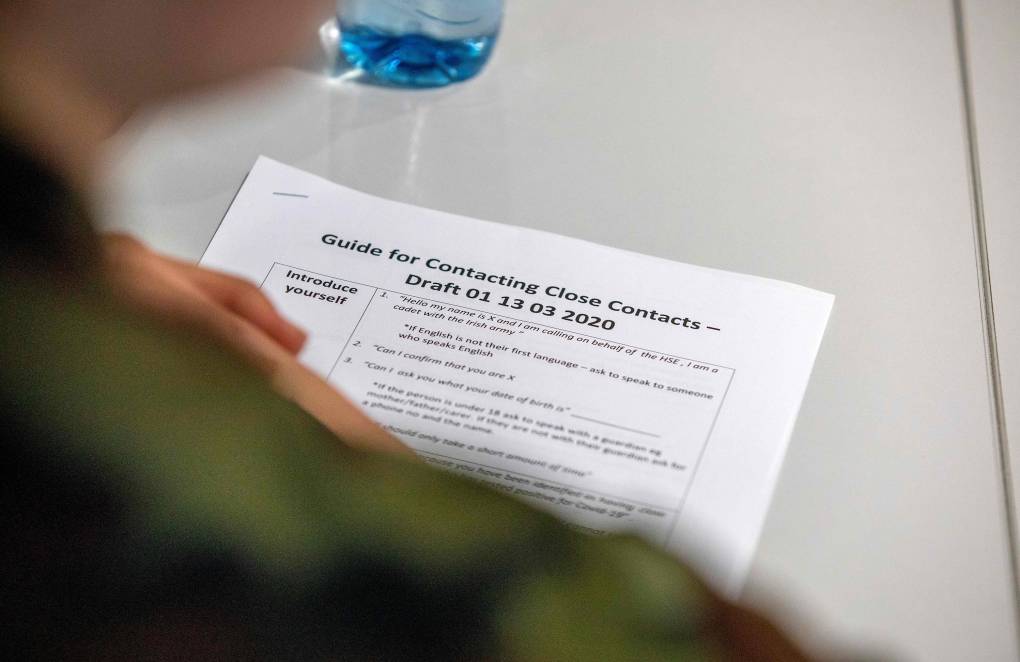
"content": "\u003cp>When the call came from the local health department in northeast Nebraska, Katie Berger was waiting. She had already gotten a text from the salon where she’d gotten her hair done recently, telling her that one of the stylists had COVID-19. She knew she was at risk.\u003c/p>\n\u003cp>“They said, ‘We’re calling to inform you that you were exposed to a COVID-19 patient,’ ” Berger says. “It was still pretty scary getting that call, even though I knew it was coming.” The public health official told her to monitor her temperature and watch for possible symptoms until two weeks after the haircut — April 17. Berger’s been staying at home since that call, hoping her quarantine will end uneventfully.\u003c/p>\n\u003cp>This process is called contact tracing. It’s been a critical tool to control the spread of infectious diseases for decades. Now, public health leaders are calling for communities around the country to ramp up capacity and get ready for a \u003ca href=\"https://www.npr.org/sections/health-shots/2020/04/10/831200054/cdc-director-very-aggressive-contact-tracing-needed-for-u-s-to-return-to-normal\">massive contact tracing effort\u003c/a> to control the coronavirus.\u003c/p>\n\u003cp>Here’s a guide to the basics of the process and how it could help society restart after the current wave of coronavirus cases.\u003c/p>\n\u003cp>\u003cstrong>Identify and isolate: How to stop infection from spreading\u003c/strong>\u003c/p>\n\u003cp>Contact tracing is a process designed to halt the chain of transmission of an infectious pathogen — like the coronavirus — and slow community spread.\u003c/p>\n\u003cp>When someone tests positive for an infectious disease they become a “case.” Public health workers then reach out to the case, first of all to make sure they have what they need and that they \u003ca href=\"https://www.cdc.gov/coronavirus/2019-ncov/if-you-are-sick/steps-when-sick.html\">are self-isolating\u003c/a>, and then to figure out who they had contact with who may be at risk of infection, too.\u003c/p>\n\u003cp>“The whole point of this process is to make sure that people who have the virus are separated from those who don’t,” says \u003ca href=\"https://www.kff.org/person/josh-michaud/\">Josh Michaud\u003c/a>, associate director for global health policy at the Kaiser Family Foundation. “That includes the original case, who’s isolating, and the contacts who might be incubating the disease. If you get them to self-quarantine before they are infectious, then you’ve essentially stopped the transmission of that disease from that transmission train. If you do that with enough contacts, then you’ve effectively interrupted community transmission.”\u003c/p>\n\u003cp>It’s not perfect — a tracer might not be able to reach all the contacts, and those contacts might not all follow the guidance, says \u003ca href=\"https://www.cste.org/page/Staff?\">Dr. Jeff Engel\u003c/a>, senior adviser for COVID-19 to the Council of State and Territorial Epidemiologists. “But even the leaky quarantine is effective,” he says. “If you get 85% of contacts to self-quarantine for 14 days, you’re going to do a lot in the community to decrease transmission.”\u003c/p>\n\u003cp>[aside tag=\"privacy\" label=\"Related Coverage\"]The World Health Organization \u003ca href=\"https://www.who.int/news-room/q-a-detail/contact-tracing\">breaks down the process into three steps\u003c/a>: contact identification, contact listing and contact follow-up.\u003c/p>\n\u003cp>\u003cstrong>Step 1: Sleuth out all the patients’ contacts\u003c/strong>\u003c/p>\n\u003cp>If you’re picturing being put under a spotlight and grilled about where you were and who you were with, put that image aside. It’s not usually so dramatic.\u003c/p>\n\u003cp>A public health worker will typically call the patient who tests positive and have a straightforward — and hopefully empathetic — conversation, says Engel, requesting that they help the health department piece together a list of their recent contacts.\u003c/p>\n\u003cp>For a hair stylist who tests positive, that might involve pulling up a list of everyone who had hair appointments while that stylist was at work, as was the case with Berger. But it can get much more complicated than that. One COVID-19 patient \u003ca href=\"https://www.latimes.com/politics/story/2020-03-15/coronavirus-aerospace-consultant-web-of-potential-infection\">described to the LA Times\u003c/a> how he had to reach out to at least a dozen contacts after he attended a conference before everything shut down. It can mean going through your social media posts, your emails or your calendar, trying to piece together who you were close to.\u003c/p>\n\u003cp>“With some cases, there might not be a contact history — maybe they haven’t left their house, maybe they haven’t come in contact or been exposed or have exposed anybody else,” Michaud says. On the other hand, he says, there can be dozens or even hundreds of contacts to follow up with.\u003c/p>\n\u003cp>\u003cstrong>Step 2: Reach out and gain trust\u003c/strong>\u003c/p>\n\u003cp>After the list is made, public health workers do outreach to those contacts, which can be brief and to the point. Berger says her call with the public health department took just a few minutes: “They just told me to monitor symptoms until April 17.”\u003c/p>\n\u003cp>The guidance for each contact may also vary depending on how high risk the contact was. If you were very close to a coughing person for an hour, you may be asked to self-quarantine for 14 days. If you were just in the same room as someone who was mildly symptomatic for 20 minutes, you might just be asked to self-monitor for symptoms.\u003c/p>\n\u003cp>Receiving calls from a government official about your health can be nerve-wracking. Public health officials have learned lessons from contact tracing sexually transmitted diseases such as HIV and syphilis, Engel says, to talk to people in a way that’s not stigmatizing and will encourage people to get on board with the request to self-isolate or share their contacts.\u003c/p>\n\u003cp>\u003cstrong>Step 3: Follow-up\u003c/strong>\u003c/p>\n\u003cp>Finally there’s follow-up, and some information about what to do next. Berger says she was told that “if anything changes, or if I develop symptoms, to either call them or to call my primary care physician,” she says.\u003c/p>\n\u003cp>Michaud says if someone who’s in quarantine does develop symptoms, the health department will want to make sure to get them tested.\u003c/p>\n\u003cp>Contact follow-up can be rigorous in some countries. In South Korea, for instance, \u003ca href=\"https://www.technologyreview.com/2020/03/06/905459/coronavirus-south-korea-smartphone-app-quarantine/\">MIT Technology Review\u003c/a> reports that each person in quarantine is assigned a government case officer who checks in twice a day, and a smartphone app notifies that officer if the contact leaves their quarantine area.\u003c/p>\n\u003cp>[ad fullwidth]\u003c/p>\n\u003cp>\u003cstrong>Determining who’s an at-risk contact\u003c/strong>\u003c/p>\n\u003cp>According to the \u003ca href=\"https://www.cdc.gov/coronavirus/2019-ncov/php/public-health-recommendations.html\">Centers for Disease Control and Prevention’s current recommendations\u003c/a>, contacts include household members, intimate partners, caregivers of COVID-19 patients in a household and anyone who’s had close contact (6 feet or closer) “for a prolonged period of time.”\u003c/p>\n\u003cp>Those guidelines note that the longer a contact was exposed to the patient, the greater their exposure risk. And if the patient who tested positive had symptoms like coughing or if they were wearing a mask which can block some respiratory droplets, these things also affect risk level.\u003c/p>\n\u003cp>“The rule of thumb is that you were within 6 feet of a person,” Engel says. “But the variable that has everyone a little bit stumped is that time element. Should it be 30 minutes at 6 feet or should it be more like 10 minutes? There’s some controversy about that, and the science is still emerging.”\u003c/p>\n\u003cp>\u003cstrong>How contact tracing could help the country open up\u003c/strong>\u003c/p>\n\u003cp>Health officials have zeroed in on widespread testing and contact tracing of positive cases as key tools for the U.S. to be able to begin to return to normal life.\u003c/p>\n\u003cp>The broad \u003ca href=\"https://www.cdc.gov/coronavirus/2019-ncov/prevent-getting-sick/social-distancing.html\">social distancing\u003c/a> measures in place now for \u003ca href=\"https://www.npr.org/2020/03/12/815200313/what-governors-are-doing-to-tackle-spreading-coronavirus\">most of the country\u003c/a> are a kind of mass quarantine — in contrast, contact tracing can allow a more targeted group of people to quarantine while the rest of society begins to open up, Engel says.\u003c/p>\n\u003cp>Right now in hot spots like New York City, contact tracing isn’t really happening. “It’s just not feasible to take in literally thousands of new infections a day that are being discovered in the community — the workforce isn’t there,” Engel says. But “when the numbers begin to become more manageable,” he says, contact tracing will be key to end the lockdown.\u003c/p>\n\u003cp>In other words, says Michaud, contact tracing is especially helpful at the flatter ends of \u003ca href=\"https://www.npr.org/sections/health-shots/2020/03/13/815502262/flattening-a-pandemics-curve-why-staying-home-now-can-save-lives\">the epidemic curve\u003c/a> — at the beginning, and after the peak as case counts go down.\u003c/p>\n\u003cp>Since the epidemic isn’t affecting all places equally, in a place like Utah, where the case count is much lower than New York City, contact tracing is feasible and happening now.\u003c/p>\n\u003cp>Testing is an important piece of the puzzle, too, Michaud notes. “If you’re not identifying most or all the cases, then contact tracing is going to be missing a lot of transmission,” he says, and quick and widespread testing is still a major problem in the U.S.\u003c/p>\n\u003cp>\u003cstrong>Increasing the contact tracing workforce\u003c/strong>\u003c/p>\n\u003cp>There are currently 2,200 contact tracers across the country, according to a letter the Association of State and Territorial Health Officials \u003ca href=\"https://www.astho.org/Federal-Government-Relations/Correspondence/ASTHO-Issues-Contact-Tracing-Memo-to-Congress/\">recently sent to Congress\u003c/a>.\u003c/p>\n\u003cp>Recently, there have been calls to massively increase the number of people doing this work to meet the need during the coronavirus pandemic.\u003c/p>\n\u003cp>Massachusetts is \u003ca href=\"https://www.npr.org/sections/health-shots/2020/04/13/832027703/massachusetts-recruits-1-000-contact-tracers-to-battle-covid-19\">launching a statewide effort\u003c/a>, hiring 1,000 contact tracers in partnership with Partners In Health, an international health nonprofit with experience in the developing world. \u003ca href=\"https://jobs.crelate.com/portal/talentboost/job/3kyqki4zeqoyugdzsha5iynhce\">Qualifications include\u003c/a> a high school diploma or equivalent, the ability to speak and write in English, and the “ability to show empathy to distressed individuals.” San Francisco has also been \u003ca href=\"https://www.technologyreview.com/2020/04/08/998758/how-san-francisco-plans-to-trace-every-coronavirus-case-and-contact/\">scaling up its contact tracing workforce\u003c/a>.\u003c/p>\n\u003cp>\u003ca href=\"http://chm.med.umich.edu/about/howard-markel-m-d-ph-d/\">Dr. Howard Markel\u003c/a>, director of the Center for the History of Medicine at the University of Michigan, notes that these efforts are a kind of return to the way things were in the 20th century.\u003c/p>\n\u003cp>“They had very large departments of health in every city and they had many workers that ranked all the way from doctors who ran things and public health nurses and social workers, but also contact trace workers,” he says. “As public health budgets were cut — beginning in the 1980s and almost every year since — that has fallen by the wayside.”\u003c/p>\n\u003cp>To open up the country safely with the coronavirus still spreading, a recent report from the Johns Hopkins \u003ca href=\"http://www.centerforhealthsecurity.org/our-work/pubs_archive/pubs-pdfs/2020/a-national-plan-to-enable-comprehensive-COVID-19-case-finding-and-contact-tracing-in-the-US.pdf\">Center for Health Security calculates\u003c/a> that we may need in the ballpark of 100,000 contact tracers.\u003c/p>\n\u003cp>\u003cstrong>A place for smartphone surveillance?\u003c/strong>\u003c/p>\n\u003cp>There are some promising apps that take advantage of the tracking device many of us carry around already: our smartphones. Some apps use \u003ca href=\"https://www.npr.org/sections/coronavirus-live-updates/2020/04/02/825860406/in-germany-high-hopes-for-new-covid-19-contact-tracing-app-that-protects-privacy\">Bluetooth to notify you\u003c/a> if you’ve been close to someone who tested positive. Others allow contact tracers to work more efficiently, for instance, by automating follow-up for contacts who are in quarantine, asking if they have any symptoms, etc.\u003c/p>\n\u003cp>But there are privacy concerns there, and many apps are still in development and need further testing. In the meantime, old fashioned phone calls still work.\u003c/p>\n\u003cdiv class=\"fullattribution\">Copyright 2020 NPR. To see more, visit https://www.npr.org.\u003cimg decoding=\"async\" src=\"https://www.google-analytics.com/__utm.gif?utmac=UA-5828686-4&utmdt=How+Contact+Tracing+Works+And+How+It+Can+Help+Reopen+The+Country&utme=8(APIKey)9(MDAxOTAwOTE4MDEyMTkxMDAzNjczZDljZA004)\">\u003c/div>\n\u003cp>[ad floatright]\u003c/p>\n",
"stats": {
"hasVideo": false,
"hasChartOrMap": false,
"hasAudio": false,
"hasPolis": false,
"wordCount": 1844,
"hasGoogleForm": false,
"hasGallery": false,
"hasHearkenModule": false,
"iframeSrcs": [],
"paragraphCount": 46
},
"modified": 1704847562,
"excerpt": "Contact tracing is labor-intensive and represents an expanding job market in the midst of the economic shutdown. ",
"headData": {
"twImgId": "",
"twTitle": "",
"ogTitle": "",
"ogImgId": "",
"twDescription": "",
"description": "Contact tracing is labor-intensive and represents an expanding job market in the midst of the economic shutdown.",
"socialDescription": "Contact tracing is labor-intensive and represents an expanding job market in the midst of the economic shutdown.",
"title": "For Society To Reopen, America Needs Massive 'Contact Tracing.' Here's What That Is | KQED",
"ogDescription": "",
"schema": {
"@context": "https://schema.org",
"@type": "Article",
"headline": "For Society To Reopen, America Needs Massive 'Contact Tracing.' Here's What That Is",
"datePublished": "2020-04-16T15:25:22-07:00",
"dateModified": "2024-01-09T16:46:02-08:00",
"image": "https://cdn.kqed.org/wp-content/uploads/2020/02/KQED-OG-Image@1x.png"
}
},
"guestAuthors": [],
"slug": "for-society-to-reopen-america-needs-massive-contract-tracing-heres-what-that-is",
"status": "publish",
"nprApiLink": "http://api.npr.org/query?id=833726999&apiKey=MDAxOTAwOTE4MDEyMTkxMDAzNjczZDljZA004",
"nprStoryDate": "Tue, 14 Apr 2020 08:57:02 -0400",
"nprLastModifiedDate": "Tue, 14 Apr 2020 10:41:29 -0400",
"nprHtmlLink": "https://www.npr.org/sections/health-shots/2020/04/14/833726999/how-contact-tracing-can-help-fight-coronavirus?ft=nprml&f=833726999",
"nprImageAgency": "AFP via Getty Images",
"source": "NPR",
"nprStoryId": "833726999",
"audioUrl": "https://traffic.omny.fm/d/clips/0af137ef-751e-4b19-a055-aaef00d2d578/ffca7e9f-6831-41c5-bcaf-aaef00f5a073/659bb554-327b-49c7-bfcb-aba001074b57/audio.mp3",
"nprByline": "Selena Simmons-Duffin, NPR",
"sticky": false,
"nprImageCredit": "Paul Faith",
"nprRetrievedStory": "1",
"nprPubDate": "Tue, 14 Apr 2020 10:41:00 -0400",
"path": "/science/1962231/for-society-to-reopen-america-needs-massive-contract-tracing-heres-what-that-is",
"audioDuration": 211000,
"audioTrackLength": null,
"parsedContent": [
{
"type": "contentString",
"content": "\u003cdiv class=\"post-body\">\u003cp>\u003cp>When the call came from the local health department in northeast Nebraska, Katie Berger was waiting. She had already gotten a text from the salon where she’d gotten her hair done recently, telling her that one of the stylists had COVID-19. She knew she was at risk.\u003c/p>\n\u003cp>“They said, ‘We’re calling to inform you that you were exposed to a COVID-19 patient,’ ” Berger says. “It was still pretty scary getting that call, even though I knew it was coming.” The public health official told her to monitor her temperature and watch for possible symptoms until two weeks after the haircut — April 17. Berger’s been staying at home since that call, hoping her quarantine will end uneventfully.\u003c/p>\n\u003cp>This process is called contact tracing. It’s been a critical tool to control the spread of infectious diseases for decades. Now, public health leaders are calling for communities around the country to ramp up capacity and get ready for a \u003ca href=\"https://www.npr.org/sections/health-shots/2020/04/10/831200054/cdc-director-very-aggressive-contact-tracing-needed-for-u-s-to-return-to-normal\">massive contact tracing effort\u003c/a> to control the coronavirus.\u003c/p>\n\u003cp>Here’s a guide to the basics of the process and how it could help society restart after the current wave of coronavirus cases.\u003c/p>\n\u003cp>\u003cstrong>Identify and isolate: How to stop infection from spreading\u003c/strong>\u003c/p>\n\u003cp>Contact tracing is a process designed to halt the chain of transmission of an infectious pathogen — like the coronavirus — and slow community spread.\u003c/p>\n\u003cp>When someone tests positive for an infectious disease they become a “case.” Public health workers then reach out to the case, first of all to make sure they have what they need and that they \u003ca href=\"https://www.cdc.gov/coronavirus/2019-ncov/if-you-are-sick/steps-when-sick.html\">are self-isolating\u003c/a>, and then to figure out who they had contact with who may be at risk of infection, too.\u003c/p>\n\u003cp>“The whole point of this process is to make sure that people who have the virus are separated from those who don’t,” says \u003ca href=\"https://www.kff.org/person/josh-michaud/\">Josh Michaud\u003c/a>, associate director for global health policy at the Kaiser Family Foundation. “That includes the original case, who’s isolating, and the contacts who might be incubating the disease. If you get them to self-quarantine before they are infectious, then you’ve essentially stopped the transmission of that disease from that transmission train. If you do that with enough contacts, then you’ve effectively interrupted community transmission.”\u003c/p>\n\u003cp>It’s not perfect — a tracer might not be able to reach all the contacts, and those contacts might not all follow the guidance, says \u003ca href=\"https://www.cste.org/page/Staff?\">Dr. Jeff Engel\u003c/a>, senior adviser for COVID-19 to the Council of State and Territorial Epidemiologists. “But even the leaky quarantine is effective,” he says. “If you get 85% of contacts to self-quarantine for 14 days, you’re going to do a lot in the community to decrease transmission.”\u003c/p>\n\u003cp>\u003c/p>\u003c/div>",
"attributes": {
"named": {},
"numeric": []
}
},
{
"type": "component",
"content": "",
"name": "aside",
"attributes": {
"named": {
"tag": "privacy",
"label": "Related Coverage "
},
"numeric": []
}
},
{
"type": "contentString",
"content": "\u003cdiv class=\"post-body\">\u003cp>The World Health Organization \u003ca href=\"https://www.who.int/news-room/q-a-detail/contact-tracing\">breaks down the process into three steps\u003c/a>: contact identification, contact listing and contact follow-up.\u003c/p>\n\u003cp>\u003cstrong>Step 1: Sleuth out all the patients’ contacts\u003c/strong>\u003c/p>\n\u003cp>If you’re picturing being put under a spotlight and grilled about where you were and who you were with, put that image aside. It’s not usually so dramatic.\u003c/p>\n\u003cp>A public health worker will typically call the patient who tests positive and have a straightforward — and hopefully empathetic — conversation, says Engel, requesting that they help the health department piece together a list of their recent contacts.\u003c/p>\n\u003cp>For a hair stylist who tests positive, that might involve pulling up a list of everyone who had hair appointments while that stylist was at work, as was the case with Berger. But it can get much more complicated than that. One COVID-19 patient \u003ca href=\"https://www.latimes.com/politics/story/2020-03-15/coronavirus-aerospace-consultant-web-of-potential-infection\">described to the LA Times\u003c/a> how he had to reach out to at least a dozen contacts after he attended a conference before everything shut down. It can mean going through your social media posts, your emails or your calendar, trying to piece together who you were close to.\u003c/p>\n\u003cp>“With some cases, there might not be a contact history — maybe they haven’t left their house, maybe they haven’t come in contact or been exposed or have exposed anybody else,” Michaud says. On the other hand, he says, there can be dozens or even hundreds of contacts to follow up with.\u003c/p>\n\u003cp>\u003cstrong>Step 2: Reach out and gain trust\u003c/strong>\u003c/p>\n\u003cp>After the list is made, public health workers do outreach to those contacts, which can be brief and to the point. Berger says her call with the public health department took just a few minutes: “They just told me to monitor symptoms until April 17.”\u003c/p>\n\u003cp>The guidance for each contact may also vary depending on how high risk the contact was. If you were very close to a coughing person for an hour, you may be asked to self-quarantine for 14 days. If you were just in the same room as someone who was mildly symptomatic for 20 minutes, you might just be asked to self-monitor for symptoms.\u003c/p>\n\u003cp>Receiving calls from a government official about your health can be nerve-wracking. Public health officials have learned lessons from contact tracing sexually transmitted diseases such as HIV and syphilis, Engel says, to talk to people in a way that’s not stigmatizing and will encourage people to get on board with the request to self-isolate or share their contacts.\u003c/p>\n\u003cp>\u003cstrong>Step 3: Follow-up\u003c/strong>\u003c/p>\n\u003cp>Finally there’s follow-up, and some information about what to do next. Berger says she was told that “if anything changes, or if I develop symptoms, to either call them or to call my primary care physician,” she says.\u003c/p>\n\u003cp>Michaud says if someone who’s in quarantine does develop symptoms, the health department will want to make sure to get them tested.\u003c/p>\n\u003cp>Contact follow-up can be rigorous in some countries. In South Korea, for instance, \u003ca href=\"https://www.technologyreview.com/2020/03/06/905459/coronavirus-south-korea-smartphone-app-quarantine/\">MIT Technology Review\u003c/a> reports that each person in quarantine is assigned a government case officer who checks in twice a day, and a smartphone app notifies that officer if the contact leaves their quarantine area.\u003c/p>\n\u003cp>\u003c/p>\u003c/div>",
"attributes": {
"named": {},
"numeric": []
}
},
{
"type": "component",
"content": "",
"name": "ad",
"attributes": {
"named": {
"label": "fullwidth"
},
"numeric": [
"fullwidth"
]
}
},
{
"type": "contentString",
"content": "\u003cdiv class=\"post-body\">\u003cp>\u003c/p>\n\u003cp>\u003cstrong>Determining who’s an at-risk contact\u003c/strong>\u003c/p>\n\u003cp>According to the \u003ca href=\"https://www.cdc.gov/coronavirus/2019-ncov/php/public-health-recommendations.html\">Centers for Disease Control and Prevention’s current recommendations\u003c/a>, contacts include household members, intimate partners, caregivers of COVID-19 patients in a household and anyone who’s had close contact (6 feet or closer) “for a prolonged period of time.”\u003c/p>\n\u003cp>Those guidelines note that the longer a contact was exposed to the patient, the greater their exposure risk. And if the patient who tested positive had symptoms like coughing or if they were wearing a mask which can block some respiratory droplets, these things also affect risk level.\u003c/p>\n\u003cp>“The rule of thumb is that you were within 6 feet of a person,” Engel says. “But the variable that has everyone a little bit stumped is that time element. Should it be 30 minutes at 6 feet or should it be more like 10 minutes? There’s some controversy about that, and the science is still emerging.”\u003c/p>\n\u003cp>\u003cstrong>How contact tracing could help the country open up\u003c/strong>\u003c/p>\n\u003cp>Health officials have zeroed in on widespread testing and contact tracing of positive cases as key tools for the U.S. to be able to begin to return to normal life.\u003c/p>\n\u003cp>The broad \u003ca href=\"https://www.cdc.gov/coronavirus/2019-ncov/prevent-getting-sick/social-distancing.html\">social distancing\u003c/a> measures in place now for \u003ca href=\"https://www.npr.org/2020/03/12/815200313/what-governors-are-doing-to-tackle-spreading-coronavirus\">most of the country\u003c/a> are a kind of mass quarantine — in contrast, contact tracing can allow a more targeted group of people to quarantine while the rest of society begins to open up, Engel says.\u003c/p>\n\u003cp>Right now in hot spots like New York City, contact tracing isn’t really happening. “It’s just not feasible to take in literally thousands of new infections a day that are being discovered in the community — the workforce isn’t there,” Engel says. But “when the numbers begin to become more manageable,” he says, contact tracing will be key to end the lockdown.\u003c/p>\n\u003cp>In other words, says Michaud, contact tracing is especially helpful at the flatter ends of \u003ca href=\"https://www.npr.org/sections/health-shots/2020/03/13/815502262/flattening-a-pandemics-curve-why-staying-home-now-can-save-lives\">the epidemic curve\u003c/a> — at the beginning, and after the peak as case counts go down.\u003c/p>\n\u003cp>Since the epidemic isn’t affecting all places equally, in a place like Utah, where the case count is much lower than New York City, contact tracing is feasible and happening now.\u003c/p>\n\u003cp>Testing is an important piece of the puzzle, too, Michaud notes. “If you’re not identifying most or all the cases, then contact tracing is going to be missing a lot of transmission,” he says, and quick and widespread testing is still a major problem in the U.S.\u003c/p>\n\u003cp>\u003cstrong>Increasing the contact tracing workforce\u003c/strong>\u003c/p>\n\u003cp>There are currently 2,200 contact tracers across the country, according to a letter the Association of State and Territorial Health Officials \u003ca href=\"https://www.astho.org/Federal-Government-Relations/Correspondence/ASTHO-Issues-Contact-Tracing-Memo-to-Congress/\">recently sent to Congress\u003c/a>.\u003c/p>\n\u003cp>Recently, there have been calls to massively increase the number of people doing this work to meet the need during the coronavirus pandemic.\u003c/p>\n\u003cp>Massachusetts is \u003ca href=\"https://www.npr.org/sections/health-shots/2020/04/13/832027703/massachusetts-recruits-1-000-contact-tracers-to-battle-covid-19\">launching a statewide effort\u003c/a>, hiring 1,000 contact tracers in partnership with Partners In Health, an international health nonprofit with experience in the developing world. \u003ca href=\"https://jobs.crelate.com/portal/talentboost/job/3kyqki4zeqoyugdzsha5iynhce\">Qualifications include\u003c/a> a high school diploma or equivalent, the ability to speak and write in English, and the “ability to show empathy to distressed individuals.” San Francisco has also been \u003ca href=\"https://www.technologyreview.com/2020/04/08/998758/how-san-francisco-plans-to-trace-every-coronavirus-case-and-contact/\">scaling up its contact tracing workforce\u003c/a>.\u003c/p>\n\u003cp>\u003ca href=\"http://chm.med.umich.edu/about/howard-markel-m-d-ph-d/\">Dr. Howard Markel\u003c/a>, director of the Center for the History of Medicine at the University of Michigan, notes that these efforts are a kind of return to the way things were in the 20th century.\u003c/p>\n\u003cp>“They had very large departments of health in every city and they had many workers that ranked all the way from doctors who ran things and public health nurses and social workers, but also contact trace workers,” he says. “As public health budgets were cut — beginning in the 1980s and almost every year since — that has fallen by the wayside.”\u003c/p>\n\u003cp>To open up the country safely with the coronavirus still spreading, a recent report from the Johns Hopkins \u003ca href=\"http://www.centerforhealthsecurity.org/our-work/pubs_archive/pubs-pdfs/2020/a-national-plan-to-enable-comprehensive-COVID-19-case-finding-and-contact-tracing-in-the-US.pdf\">Center for Health Security calculates\u003c/a> that we may need in the ballpark of 100,000 contact tracers.\u003c/p>\n\u003cp>\u003cstrong>A place for smartphone surveillance?\u003c/strong>\u003c/p>\n\u003cp>There are some promising apps that take advantage of the tracking device many of us carry around already: our smartphones. Some apps use \u003ca href=\"https://www.npr.org/sections/coronavirus-live-updates/2020/04/02/825860406/in-germany-high-hopes-for-new-covid-19-contact-tracing-app-that-protects-privacy\">Bluetooth to notify you\u003c/a> if you’ve been close to someone who tested positive. Others allow contact tracers to work more efficiently, for instance, by automating follow-up for contacts who are in quarantine, asking if they have any symptoms, etc.\u003c/p>\n\u003cp>But there are privacy concerns there, and many apps are still in development and need further testing. In the meantime, old fashioned phone calls still work.\u003c/p>\n\u003cdiv class=\"fullattribution\">Copyright 2020 NPR. To see more, visit https://www.npr.org.\u003cimg decoding=\"async\" src=\"https://www.google-analytics.com/__utm.gif?utmac=UA-5828686-4&utmdt=How+Contact+Tracing+Works+And+How+It+Can+Help+Reopen+The+Country&utme=8(APIKey)9(MDAxOTAwOTE4MDEyMTkxMDAzNjczZDljZA004)\">\u003c/div>\n\u003cp>\u003c/p>\u003c/div>",
"attributes": {
"named": {},
"numeric": []
}
},
{
"type": "component",
"content": "",
"name": "ad",
"attributes": {
"named": {
"label": "floatright"
},
"numeric": [
"floatright"
]
}
},
{
"type": "contentString",
"content": "\u003cdiv class=\"post-body\">\u003cp>\u003c/p>\n\u003c/div>\u003c/p>",
"attributes": {
"named": {},
"numeric": []
}
}
],
"link": "/science/1962231/for-society-to-reopen-america-needs-massive-contract-tracing-heres-what-that-is",
"authors": [
"byline_science_1962231"
],
"categories": [
"science_39",
"science_3890",
"science_4450"
],
"tags": [
"science_4329",
"science_4368",
"science_5181",
"science_3563",
"science_968"
],
"featImg": "science_1962232",
"label": "source_science_1962231"
},
"science_1962249": {
"type": "posts",
"id": "science_1962249",
"meta": {
"index": "posts_1716263798",
"site": "science",
"id": "1962249",
"score": null,
"sort": [
1587075144000
]
},
"guestAuthors": [],
"slug": "read-white-house-guidelines-to-states-for-reopening",
"title": "Trump Gives States Three-Phase Plan for Reopening Economy",
"publishDate": 1587075144,
"format": "standard",
"headTitle": "Trump Gives States Three-Phase Plan for Reopening Economy | KQED",
"labelTerm": {},
"content": "\u003cp>President Donald Trump gave governors a road map Thursday for recovering from the economic pain of the coronavirus pandemic, laying out a phased approach to restoring normal activity in places that have strong testing and are seeing a decrease in COVID-19 cases.\u003c/p>\n\u003cp>[aside label='Read the Guidelines Here' size='medium' link1='https://apps.npr.org/documents/document.html?id=6840714-Guidelines,Opening Up America Again']“You’re going to call your own shots,” Trump told the governors, according to an audio recording obtained by The Associated Press. “We’re going to be standing alongside of you.”\u003c/p>\n\u003cp>The new guidelines are aimed at easing restrictions in areas with low transmission of the coronavirus, while holding the line in harder-hit locations. They make clear that the return to normalcy will be a far longer process than Trump initially envisioned, with federal officials warning that some social distancing measures may need to remain in place through the end of the year to prevent a new outbreak.\u003c/p>\n\u003cp>Places with declining infections and strong testing would begin a three-phased gradual reopening of businesses and schools — each phase lasting at least 14 days — to ensure that infections don’t accelerate again.\u003c/p>\n\u003cp>In phase one, for instance, the plan recommends strict social distancing for all people in public. Gatherings larger than 10 people are to be avoided and nonessential travel is discouraged.\u003c/p>\n\u003cp>[ad fullwidth]\u003c/p>\n\u003cp>In phase two, people are encouraged to maximize social distancing where possible and limit gatherings to no more than 50 people unless precautionary measures are taken. Travel could resume.\u003c/p>\n\u003cp>Phase three envisions a return to normalcy for most Americans, with a focus on identification and isolation of any new infections.\u003c/p>\n\u003cp>The Associated Press obtained a copy of the guidelines before their public release.\u003c/p>\n\u003cp>Governors of both parties made clear they will move at their own pace.\u003c/p>\n\u003cp>Delaware Gov. John Carney, a Democrat, said the guidelines “seem to make sense.”\u003c/p>\n\u003cp>“We’re days, maybe weeks away from the starting line and then you have to have 14 days of declining cases, of declining symptoms and hospital capacity that exists in case you have a rebound,” he said.\u003c/p>\n\u003cp>West Virginia Gov. Jim Justice, a Trump ally, cautiously floated the idea of reopening parts of the state, but said testing capacity and contact tracing would need to be considerably ramped up before restrictions could be safely lifted.\u003c/p>\n\u003cp>“All would be forgotten very quickly if we moved into a stage quicker than we should, and then we got into a situation where we had people dying like flies,” Justice told reporters.\u003c/p>\n\u003cp>At earliest, the guidelines suggest, some parts of the country could see a resumption in normal commerce and social gatherings after a month of evaluating whether easing up on restrictions has led to a resurgence in virus cases. In other parts of the country, or if virus cases pick up, it could be substantially longer.\u003c/p>\n\u003cp>Trump briefed the nation’s governors on the plan Thursday afternoon, saying they were going to be responsible for deciding when it is safe to lift restrictions in their states. It came days after the president drew swift pushback for claiming he had the absolute authority to determine how and when states reopen.\u003c/p>\n\u003cp>“We have a very large number of states that want to get going and they’re in very good shape,” Trump said. “That’s good with us, frankly.”\u003c/p>\n\u003cp>The guidelines also include general recommendations to businesses as they plan for potential reopenings, suggesting temperature-taking, rapid COVID-19 testing and widespread increased disinfection efforts in workplaces.\u003c/p>\n\u003cp>Those most susceptible to the respiratory disease are advised to remain sheltered in place until their area enters the final phase — and even then are encouraged to take precautions to avoid close contact with other people.\u003c/p>\n\u003cp>Governors, for their part, have been moving ahead with their own plans for how to safely revive normal activity. Seven Midwestern governors announced Thursday they will coordinate on reopening their economies. Similar pacts were announced earlier in the week in the West and Northeast.\u003c/p>\n\u003cp>Two in three Americans expressed concerns that restrictions meant to slow the spread of the virus would be eased too quickly, according to a Pew Research Center survey released Thursday.\u003c/p>\n\u003cp>Trump held conference calls earlier Thursday with lawmakers he named to a new congressional advisory task force on reviving the economy. The economic costs were clear in new federal data showing that at least 22 million Americans have been thrown out of work in the last month. But the legislators repeatedly urged the president not to sacrifice public health by moving too quickly.\u003c/p>\n\u003cp>“My highest priority on this task force will be to ensure the federal government’s efforts to reopen our economy are bipartisan, data-driven, and based on the expertise of public health professionals,” said Democratic Sen. Mark Warner of Virginia.\u003c/p>\n\u003cp>The federal government envisions a gradual recovery from the virus, in which disruptive mitigation measures may be needed in some places at least until a vaccine is available — a milestone unlikely to be reached until sometime next year.\u003c/p>\n\u003cp>“It’s not going to immediately be a situation where we have stadiums full of people,” said Housing and Urban Development Secretary Ben Carson on Thursday. “We’re Americans. We will adapt,” he added.\u003c/p>\n\u003cp>South Carolina Sen. Lindsey Graham, a Republican close to Trump, said the lack of widespread testing was an impediment to lifting the social distancing guidelines. “We are struggling with testing at a large scale,” he told ABC’s “The View.” “You really can’t go back to work until we have more tests.”\u003c/p>\n\u003cp>But some of Trump’s conservative allies, like economist Stephen Moore, have encouraged him to act swiftly, warning of “a mini Great Depression if we keep the economy shut down.”\u003c/p>\n\u003cp>\u003c/p>\n\u003cp>“That is a catastrophic outcome for our country. Period,” Moore said he advised the president. “We can’t have 30 million people in this country unemployed or you’re going to have social chaos.”\u003c/p>\n\n",
"blocks": [],
"excerpt": "President Trump has released a three-phase outline for states to reopen their economies in the wake of the coronavirus pandemic. ",
"status": "publish",
"parent": 0,
"modified": 1725576212,
"stats": {
"hasAudio": false,
"hasVideo": false,
"hasChartOrMap": false,
"iframeSrcs": [],
"hasGoogleForm": false,
"hasGallery": false,
"hasHearkenModule": false,
"hasPolis": false,
"paragraphCount": 29,
"wordCount": 1044
},
"headData": {
"title": "Trump Gives States Three-Phase Plan for Reopening Economy | KQED",
"description": "President Trump has released a three-phase outline for states to reopen their economies in the wake of the coronavirus pandemic. ",
"ogTitle": "",
"ogDescription": "",
"ogImgId": "",
"twTitle": "",
"twDescription": "",
"twImgId": "",
"schema": {
"@context": "https://schema.org",
"@type": "Article",
"headline": "Trump Gives States Three-Phase Plan for Reopening Economy",
"datePublished": "2020-04-16T15:12:24-07:00",
"dateModified": "2024-09-05T15:43:32-07:00",
"image": "https://cdn.kqed.org/wp-content/uploads/2020/02/KQED-OG-Image@1x.png"
}
},
"source": "Associated Press",
"sticky": false,
"nprImageCredit": "Saul Loeb",
"nprByline": "EKE MILLER, ALAN SUDERMAN, and KEVIN FREKING\u003cbr /> Associated Press",
"nprImageAgency": "AFP via Getty Images",
"nprStoryId": "836489480",
"nprApiLink": "http://api.npr.org/query?id=836489480&apiKey=MDAxOTAwOTE4MDEyMTkxMDAzNjczZDljZA004",
"nprHtmlLink": "https://www.npr.org/2020/04/16/836489480/read-white-house-guidelines-to-states-for-reopening?ft=nprml&f=836489480",
"nprRetrievedStory": "1",
"nprPubDate": "Thu, 16 Apr 2020 17:48:00 -0400",
"nprStoryDate": "Thu, 16 Apr 2020 17:31:12 -0400",
"nprLastModifiedDate": "Thu, 16 Apr 2020 17:48:53 -0400",
"path": "/science/1962249/read-white-house-guidelines-to-states-for-reopening",
"audioTrackLength": null,
"parsedContent": [
{
"type": "contentString",
"content": "\u003cdiv class=\"post-body\">\u003cp>\u003cp>President Donald Trump gave governors a road map Thursday for recovering from the economic pain of the coronavirus pandemic, laying out a phased approach to restoring normal activity in places that have strong testing and are seeing a decrease in COVID-19 cases.\u003c/p>\n\u003cp>\u003c/p>\u003c/div>",
"attributes": {
"named": {},
"numeric": []
}
},
{
"type": "component",
"content": "",
"name": "aside",
"attributes": {
"named": {
"label": "Read the Guidelines Here ",
"size": "medium",
"link1": "https://apps.npr.org/documents/document.html?id=6840714-Guidelines,Opening Up America Again"
},
"numeric": []
}
},
{
"type": "contentString",
"content": "\u003cdiv class=\"post-body\">\u003cp>“You’re going to call your own shots,” Trump told the governors, according to an audio recording obtained by The Associated Press. “We’re going to be standing alongside of you.”\u003c/p>\n\u003cp>The new guidelines are aimed at easing restrictions in areas with low transmission of the coronavirus, while holding the line in harder-hit locations. They make clear that the return to normalcy will be a far longer process than Trump initially envisioned, with federal officials warning that some social distancing measures may need to remain in place through the end of the year to prevent a new outbreak.\u003c/p>\n\u003cp>Places with declining infections and strong testing would begin a three-phased gradual reopening of businesses and schools — each phase lasting at least 14 days — to ensure that infections don’t accelerate again.\u003c/p>\n\u003cp>In phase one, for instance, the plan recommends strict social distancing for all people in public. Gatherings larger than 10 people are to be avoided and nonessential travel is discouraged.\u003c/p>\n\u003cp>\u003c/p>\u003c/div>",
"attributes": {
"named": {},
"numeric": []
}
},
{
"type": "component",
"content": "",
"name": "ad",
"attributes": {
"named": {
"label": "fullwidth"
},
"numeric": [
"fullwidth"
]
}
},
{
"type": "contentString",
"content": "\u003cdiv class=\"post-body\">\u003cp>\u003c/p>\n\u003cp>In phase two, people are encouraged to maximize social distancing where possible and limit gatherings to no more than 50 people unless precautionary measures are taken. Travel could resume.\u003c/p>\n\u003cp>Phase three envisions a return to normalcy for most Americans, with a focus on identification and isolation of any new infections.\u003c/p>\n\u003cp>The Associated Press obtained a copy of the guidelines before their public release.\u003c/p>\n\u003cp>Governors of both parties made clear they will move at their own pace.\u003c/p>\n\u003cp>Delaware Gov. John Carney, a Democrat, said the guidelines “seem to make sense.”\u003c/p>\n\u003cp>“We’re days, maybe weeks away from the starting line and then you have to have 14 days of declining cases, of declining symptoms and hospital capacity that exists in case you have a rebound,” he said.\u003c/p>\n\u003cp>West Virginia Gov. Jim Justice, a Trump ally, cautiously floated the idea of reopening parts of the state, but said testing capacity and contact tracing would need to be considerably ramped up before restrictions could be safely lifted.\u003c/p>\n\u003cp>“All would be forgotten very quickly if we moved into a stage quicker than we should, and then we got into a situation where we had people dying like flies,” Justice told reporters.\u003c/p>\n\u003cp>At earliest, the guidelines suggest, some parts of the country could see a resumption in normal commerce and social gatherings after a month of evaluating whether easing up on restrictions has led to a resurgence in virus cases. In other parts of the country, or if virus cases pick up, it could be substantially longer.\u003c/p>\n\u003cp>Trump briefed the nation’s governors on the plan Thursday afternoon, saying they were going to be responsible for deciding when it is safe to lift restrictions in their states. It came days after the president drew swift pushback for claiming he had the absolute authority to determine how and when states reopen.\u003c/p>\n\u003cp>“We have a very large number of states that want to get going and they’re in very good shape,” Trump said. “That’s good with us, frankly.”\u003c/p>\n\u003cp>The guidelines also include general recommendations to businesses as they plan for potential reopenings, suggesting temperature-taking, rapid COVID-19 testing and widespread increased disinfection efforts in workplaces.\u003c/p>\n\u003cp>Those most susceptible to the respiratory disease are advised to remain sheltered in place until their area enters the final phase — and even then are encouraged to take precautions to avoid close contact with other people.\u003c/p>\n\u003cp>Governors, for their part, have been moving ahead with their own plans for how to safely revive normal activity. Seven Midwestern governors announced Thursday they will coordinate on reopening their economies. Similar pacts were announced earlier in the week in the West and Northeast.\u003c/p>\n\u003cp>Two in three Americans expressed concerns that restrictions meant to slow the spread of the virus would be eased too quickly, according to a Pew Research Center survey released Thursday.\u003c/p>\n\u003cp>Trump held conference calls earlier Thursday with lawmakers he named to a new congressional advisory task force on reviving the economy. The economic costs were clear in new federal data showing that at least 22 million Americans have been thrown out of work in the last month. But the legislators repeatedly urged the president not to sacrifice public health by moving too quickly.\u003c/p>\n\u003cp>“My highest priority on this task force will be to ensure the federal government’s efforts to reopen our economy are bipartisan, data-driven, and based on the expertise of public health professionals,” said Democratic Sen. Mark Warner of Virginia.\u003c/p>\n\u003cp>The federal government envisions a gradual recovery from the virus, in which disruptive mitigation measures may be needed in some places at least until a vaccine is available — a milestone unlikely to be reached until sometime next year.\u003c/p>\n\u003cp>“It’s not going to immediately be a situation where we have stadiums full of people,” said Housing and Urban Development Secretary Ben Carson on Thursday. “We’re Americans. We will adapt,” he added.\u003c/p>\n\u003cp>South Carolina Sen. Lindsey Graham, a Republican close to Trump, said the lack of widespread testing was an impediment to lifting the social distancing guidelines. “We are struggling with testing at a large scale,” he told ABC’s “The View.” “You really can’t go back to work until we have more tests.”\u003c/p>\n\u003cp>But some of Trump’s conservative allies, like economist Stephen Moore, have encouraged him to act swiftly, warning of “a mini Great Depression if we keep the economy shut down.”\u003c/p>\n\u003cp>\u003c/p>\n\u003cp>“That is a catastrophic outcome for our country. Period,” Moore said he advised the president. “We can’t have 30 million people in this country unemployed or you’re going to have social chaos.”\u003c/p>\n\n\u003c/div>\u003c/p>",
"attributes": {
"named": {},
"numeric": []
}
}
],
"link": "/science/1962249/read-white-house-guidelines-to-states-for-reopening",
"authors": [
"byline_science_1962249"
],
"categories": [
"science_39",
"science_40",
"science_4450"
],
"tags": [
"science_4329",
"science_5181",
"science_309"
],
"featImg": "science_1962250",
"label": "source_science_1962249"
},
"science_1962153": {
"type": "posts",
"id": "science_1962153",
"meta": {
"index": "posts_1716263798",
"site": "science",
"id": "1962153",
"score": null,
"sort": [
1587072333000
]
},
"parent": 0,
"labelTerm": {},
"blocks": [],
"publishDate": 1587072333,
"format": "standard",
"title": "Coronavirus: Seafood Industry Comes to 'Screeching Halt,' But Some Businesses Adapting",
"headTitle": "Coronavirus: Seafood Industry Comes to ‘Screeching Halt,’ But Some Businesses Adapting | KQED",
"content": "\u003cp>Like farming and other food industries, commercial fishing is considered an essential business to remain open during the COVID-19 pandemic. But the seafood industry has been hit hard by the crisis. Closures to restaurants that aren’t set up for takeout and the collapse of export markets have left California fishermen and seafood suppliers scrambling for new ways to sell their product.\u003c/p>\n\u003cp>Harrison Ibach, a commercial fisherman based out of Eureka in Humboldt County, says that when the coronavirus hit the U.S., his business dried up practically overnight.\u003c/p>\n\u003cp>“Oh, man, the seafood industry has pretty much come to a screeching halt,” Ibach said.\u003c/p>\n\u003cp>Since 2008, he’s fished for black cod, rockfish, salmon and crab out of the Woodley Island Marina. Most of his catch goes to high-end fish restaurants in San Francisco. But now, Ibach says, those restaurants aren’t buying.\u003c/p>\n\u003cp>“We now know that the vast majority of Americans really enjoy seafood,” Ibach said, “But we’ve also learned that they really enjoy eating seafood at restaurants.”\u003c/p>\n\u003cp>[pullquote citation=\"Commercial fisherman Harrison Ibach\"]‘As we watch these markets literally disappear overnight, we’re terrified.’[/pullquote]Kenny Belov has co-owned and operated \u003ca href=\"http://www.331fish.com/\" target=\"_blank\" rel=\"noopener noreferrer\">Fish.\u003c/a>, a waterfront seafood restaurant in Sausalito, for 16 years. He says that menus at restaurants like his aren’t designed for takeout; customers want fish cooked and served to them fresh.\u003c/p>\n\u003cp>“It’s a hard ask for people to spend a lot of money on really high- quality ingredients prepared well and have all of that stuff thrown in a box,” Belov said.\u003c/p>\n\u003cp>As a result, many seafood spots are doing a fraction of their usual business, or they’re shutting down. Belov has had to furlough 42 of his restaurant’s workers. He says his wholesale business, which supplies about 250 restaurants throughout the Bay Area, has been hit hard, too.\u003c/p>\n\u003cp>\u003cstrong>Trying to Adapt\u003c/strong>\u003c/p>\n\u003cp>With a skeleton staff, Belov has revamped a limited menu at Fish that’s tailored for takeout.\u003c/p>\n\u003cp>“We’ve had a little bit of success,” Belov said. “Not enough to justify expenses, but definitely enough to justify opening the door. And also just for our guests’ sake, to give them a place to come get nutritious food and be able to take it home. We feel it’s important for our community that has been supportive to us for 16 years.”\u003c/p>\n\u003cp>Ibach has had to adapt too. Along with the drop in restaurant orders, he says the export market has dried up, and suppliers who normally buy fish to freeze don’t want to stockpile a product they have no demand for.\u003c/p>\n\u003cp>“As we watch these markets literally disappear overnight, we’re terrified,” he said. “We’re scared to lose everything.”\u003c/p>\n\u003cp>Ibach, who has a wife and two young children, says he has gotten creative in response. He recently started to sell fish directly off his boat, the 42-foot Oceana, at Woodley Island, and his wife put up a Facebook page to help bring in business.\u003c/p>\n\u003cp>A 12-hour fishing trip on a recent Friday brought in rockfish, lingcod and crab that attracted a lot of customers.\u003c/p>\n\u003cp>“We actually had a huge line that lasted all day until we pretty much sold out of everything,” Ibach said. He’s hoping the off-the-boat sales, along with the coronavirus relief funds he’s applied for, will be enough to hold him over until the pandemic passes.\u003c/p>\n\u003cp>[ad fullwidth]\u003cbr>\n\u003cstrong>Boat-to-Fork Seafood\u003c/strong>\u003c/p>\n\u003cp>During the COVID-19 crisis, some consumers are turning to community-supported fisheries, or CSFs, to supply them with fresh seafood to cook at home. CSFs work like a farm box for fresh seafood that’s caught by local fishermen and delivered to customers’ doors — on ice.\u003c/p>\n\u003cp>Alan Lovewell, a commercial fisherman based out of Moss Landing on Monterey Bay, specializes in supplying restaurants with live fish. While Lovewell says he likely won’t have a market for them, he also runs a CSF called \u003ca href=\"https://www.realgoodfish.com/\" target=\"_blank\" rel=\"noopener noreferrer\">Real Good Fish\u003c/a>.\u003c/p>\n\u003cp>“We’ve got rockfish, petrale sole, spot prawns,” he said. “Whatever’s coming in, we put in a box and you get it the next day.”\u003c/p>\n\u003cp>He says the CSF model gives fishermen, who’ve now lost their other markets, a chance to stay afloat. “When this crisis hit, we said, ‘well, we better ramp this up,’” Lovewell said.\u003c/p>\n\u003cp>In March, the company fast-tracked a planned expansion. It’s now supplying seven states, including California, Oregon, Washington, Utah, Nevada, Idaho, and Arizona, with fresh-caught seafood.\u003c/p>\n\u003cp>Lovewell says the coronavirus relief money likely won’t keep all commercial fishermen in business, but he’s hoping that some can adjust and pull through.\u003c/p>\n\u003cp>“Everyone is adapting right now. Everyone’s trying to figure out, what does the world look like. Not just now, but what is it going to look like in a week from now, a month from now? And how do I start making decisions to prepare for that?”\u003c/p>\n\u003cp>\u003c/p>\n",
"stats": {
"hasVideo": false,
"hasChartOrMap": false,
"hasAudio": false,
"hasPolis": false,
"wordCount": 885,
"hasGoogleForm": false,
"hasGallery": false,
"hasHearkenModule": false,
"iframeSrcs": [],
"paragraphCount": 25
},
"modified": 1704847566,
"excerpt": "Closures to restaurants that aren’t set up for takeout and the collapse of export markets have left California fishermen and seafood suppliers scrambling for new ways to sell their product.",
"headData": {
"twImgId": "",
"twTitle": "",
"ogTitle": "",
"ogImgId": "",
"twDescription": "",
"description": "Closures to restaurants that aren’t set up for takeout and the collapse of export markets have left California fishermen and seafood suppliers scrambling for new ways to sell their product.",
"title": "Coronavirus: Seafood Industry Comes to 'Screeching Halt,' But Some Businesses Adapting | KQED",
"ogDescription": "",
"schema": {
"@context": "https://schema.org",
"@type": "Article",
"headline": "Coronavirus: Seafood Industry Comes to 'Screeching Halt,' But Some Businesses Adapting",
"datePublished": "2020-04-16T14:25:33-07:00",
"dateModified": "2024-01-09T16:46:06-08:00",
"image": "https://cdn.kqed.org/wp-content/uploads/2020/02/KQED-OG-Image@1x.png"
}
},
"guestAuthors": [],
"slug": "coronavirus-seafood-industry-comes-to-screeching-halt-but-some-businesses-adapting",
"status": "publish",
"audioUrl": "https://traffic.omny.fm/d/clips/0af137ef-751e-4b19-a055-aaef00d2d578/ffca7e9f-6831-41c5-bcaf-aaef00f5a073/7c629935-7a7d-4d3a-a7a3-ab9d01246af9/audio.mp3",
"sticky": false,
"source": "Coronavirus",
"path": "/science/1962153/coronavirus-seafood-industry-comes-to-screeching-halt-but-some-businesses-adapting",
"audioTrackLength": null,
"parsedContent": [
{
"type": "contentString",
"content": "\u003cdiv class=\"post-body\">\u003cp>\u003cp>Like farming and other food industries, commercial fishing is considered an essential business to remain open during the COVID-19 pandemic. But the seafood industry has been hit hard by the crisis. Closures to restaurants that aren’t set up for takeout and the collapse of export markets have left California fishermen and seafood suppliers scrambling for new ways to sell their product.\u003c/p>\n\u003cp>Harrison Ibach, a commercial fisherman based out of Eureka in Humboldt County, says that when the coronavirus hit the U.S., his business dried up practically overnight.\u003c/p>\n\u003cp>“Oh, man, the seafood industry has pretty much come to a screeching halt,” Ibach said.\u003c/p>\n\u003cp>Since 2008, he’s fished for black cod, rockfish, salmon and crab out of the Woodley Island Marina. Most of his catch goes to high-end fish restaurants in San Francisco. But now, Ibach says, those restaurants aren’t buying.\u003c/p>\n\u003cp>“We now know that the vast majority of Americans really enjoy seafood,” Ibach said, “But we’ve also learned that they really enjoy eating seafood at restaurants.”\u003c/p>\n\u003cp>\u003c/p>\u003c/div>",
"attributes": {
"named": {},
"numeric": []
}
},
{
"type": "component",
"content": "‘As we watch these markets literally disappear overnight, we’re terrified.’",
"name": "pullquote",
"attributes": {
"named": {
"citation": "Commercial fisherman Harrison Ibach",
"label": ""
},
"numeric": []
}
},
{
"type": "contentString",
"content": "\u003cdiv class=\"post-body\">\u003cp>Kenny Belov has co-owned and operated \u003ca href=\"http://www.331fish.com/\" target=\"_blank\" rel=\"noopener noreferrer\">Fish.\u003c/a>, a waterfront seafood restaurant in Sausalito, for 16 years. He says that menus at restaurants like his aren’t designed for takeout; customers want fish cooked and served to them fresh.\u003c/p>\n\u003cp>“It’s a hard ask for people to spend a lot of money on really high- quality ingredients prepared well and have all of that stuff thrown in a box,” Belov said.\u003c/p>\n\u003cp>As a result, many seafood spots are doing a fraction of their usual business, or they’re shutting down. Belov has had to furlough 42 of his restaurant’s workers. He says his wholesale business, which supplies about 250 restaurants throughout the Bay Area, has been hit hard, too.\u003c/p>\n\u003cp>\u003cstrong>Trying to Adapt\u003c/strong>\u003c/p>\n\u003cp>With a skeleton staff, Belov has revamped a limited menu at Fish that’s tailored for takeout.\u003c/p>\n\u003cp>“We’ve had a little bit of success,” Belov said. “Not enough to justify expenses, but definitely enough to justify opening the door. And also just for our guests’ sake, to give them a place to come get nutritious food and be able to take it home. We feel it’s important for our community that has been supportive to us for 16 years.”\u003c/p>\n\u003cp>Ibach has had to adapt too. Along with the drop in restaurant orders, he says the export market has dried up, and suppliers who normally buy fish to freeze don’t want to stockpile a product they have no demand for.\u003c/p>\n\u003cp>“As we watch these markets literally disappear overnight, we’re terrified,” he said. “We’re scared to lose everything.”\u003c/p>\n\u003cp>Ibach, who has a wife and two young children, says he has gotten creative in response. He recently started to sell fish directly off his boat, the 42-foot Oceana, at Woodley Island, and his wife put up a Facebook page to help bring in business.\u003c/p>\n\u003cp>A 12-hour fishing trip on a recent Friday brought in rockfish, lingcod and crab that attracted a lot of customers.\u003c/p>\n\u003cp>“We actually had a huge line that lasted all day until we pretty much sold out of everything,” Ibach said. He’s hoping the off-the-boat sales, along with the coronavirus relief funds he’s applied for, will be enough to hold him over until the pandemic passes.\u003c/p>\n\u003cp>\u003c/p>\u003c/div>",
"attributes": {
"named": {},
"numeric": []
}
},
{
"type": "component",
"content": "",
"name": "ad",
"attributes": {
"named": {
"label": "fullwidth"
},
"numeric": [
"fullwidth"
]
}
},
{
"type": "contentString",
"content": "\u003cdiv class=\"post-body\">\u003cp>\u003cbr>\n\u003cstrong>Boat-to-Fork Seafood\u003c/strong>\u003c/p>\n\u003cp>During the COVID-19 crisis, some consumers are turning to community-supported fisheries, or CSFs, to supply them with fresh seafood to cook at home. CSFs work like a farm box for fresh seafood that’s caught by local fishermen and delivered to customers’ doors — on ice.\u003c/p>\n\u003cp>Alan Lovewell, a commercial fisherman based out of Moss Landing on Monterey Bay, specializes in supplying restaurants with live fish. While Lovewell says he likely won’t have a market for them, he also runs a CSF called \u003ca href=\"https://www.realgoodfish.com/\" target=\"_blank\" rel=\"noopener noreferrer\">Real Good Fish\u003c/a>.\u003c/p>\n\u003cp>“We’ve got rockfish, petrale sole, spot prawns,” he said. “Whatever’s coming in, we put in a box and you get it the next day.”\u003c/p>\n\u003cp>He says the CSF model gives fishermen, who’ve now lost their other markets, a chance to stay afloat. “When this crisis hit, we said, ‘well, we better ramp this up,’” Lovewell said.\u003c/p>\n\u003cp>In March, the company fast-tracked a planned expansion. It’s now supplying seven states, including California, Oregon, Washington, Utah, Nevada, Idaho, and Arizona, with fresh-caught seafood.\u003c/p>\n\u003cp>Lovewell says the coronavirus relief money likely won’t keep all commercial fishermen in business, but he’s hoping that some can adjust and pull through.\u003c/p>\n\u003cp>“Everyone is adapting right now. Everyone’s trying to figure out, what does the world look like. Not just now, but what is it going to look like in a week from now, a month from now? And how do I start making decisions to prepare for that?”\u003c/p>\n\u003cp>\u003c/p>\n\u003c/div>\u003c/p>",
"attributes": {
"named": {},
"numeric": []
}
}
],
"link": "/science/1962153/coronavirus-seafood-industry-comes-to-screeching-halt-but-some-businesses-adapting",
"authors": [
"11368"
],
"categories": [
"science_2874",
"science_36",
"science_39",
"science_40",
"science_2873",
"science_4450"
],
"tags": [
"science_4329",
"science_4368"
],
"featImg": "science_1962193",
"label": "source_science_1962153"
},
"science_1962229": {
"type": "posts",
"id": "science_1962229",
"meta": {
"index": "posts_1716263798",
"site": "science",
"id": "1962229",
"score": null,
"sort": [
1587070426000
]
},
"parent": 0,
"labelTerm": {},
"blocks": [],
"publishDate": 1587070426,
"format": "standard",
"title": "Early Look at Trial Data Suggests Rapid Recovery in COVID-19 Patients After Antiviral Treatment",
"headTitle": "Early Look at Trial Data Suggests Rapid Recovery in COVID-19 Patients After Antiviral Treatment | KQED",
"content": "\u003cp>\u003cstrong>Update Thursday, April 23: \u003c/strong> \u003ca href=\"https://www.kqed.org/science/1962852/accidentally-released-data-on-remdesivir-shows-no-gain-for-coronavirus-patients-drug-maker-gilead-sees-potential-benefit\" rel=\"noopener noreferrer\" target=\"_blank\">Accidentally Released Data on Remdesivir Shows No Gain for Coronavirus Patients. Drug Maker Sees ‘Potential Benefit’\u003c/a>\u003c/p>\n\u003cp>\u003cem>Original post: \u003c/em>\u003cbr>\nA Chicago hospital treating severe COVID-19 patients with Gilead Sciences’ antiviral medicine remdesivir in a closely watched clinical trial is seeing rapid recoveries in fever and respiratory symptoms, with nearly all patients discharged in less than a week, STAT has learned.\u003c/p>\n\u003cp>\u003ca href=\"https://www.statnews.com/2020/03/16/remdesivir-surges-ahead-against-coronavirus/\">Remdesivir\u003c/a> was one of the first medicines identified as having the potential to impact SARS-CoV-2, the novel coronavirus that causes COVID-19, in lab tests. The entire world has been waiting for results from Gilead’s clinical trials, and positive results would likely lead to fast approvals by the Food and Drug Administration and other regulatory agencies. If safe and effective, it could become the first approved treatment against the disease.\u003c/p>\n\u003cp>University of Chicago Medicine recruited 125 people with COVID-19 into Gilead’s two Phase 3 clinical trials. Of those people, 113 had severe disease. All the patients have been treated with daily infusions of remdesivir.\u003c/p>\n\u003cp>“The best news is that most of our patients have already been discharged, which is great. We’ve only had two patients perish,” said Kathleen Mullane, the University of Chicago infectious disease specialist overseeing the remdesivir studies for the hospital.\u003c/p>\n\u003cp>[ad fullwidth]\u003c/p>\n\u003cp>Her comments were made this week during a video discussion about the trial results with other University of Chicago faculty members. The discussion was recorded and STAT obtained a copy of the video.\u003c/p>\n\u003cp>The outcomes offer only a snapshot of remdesivir’s effectiveness. The same trials are being run concurrently at other institutions, and it’s impossible to determine the full study results with any certainty. Still, no other clinical data from the Gilead studies have been released to date, and excitement is high. Last month, President Donald Trump touted the potential for remdesivir — as he has for many still-unproven treatments — and said it “seems to have a very good result.”\u003c/p>\n\u003cp>In a statement Thursday, Gilead said: “What we can say at this stage is that we look forward to data from ongoing studies becoming available.”\u003c/p>\n\u003cp>Gilead had said to expect results for its trial involving severe cases in April. Mullane said during her presentation that data for the first 400 patients in the study would be “locked” by Gilead Thursday, meaning that results could come any day.\u003c/p>\n\u003cp>Mullane, while encouraged by the University of Chicago data, made clear her own hesitancy about drawing too many conclusions.\u003c/p>\n\u003cp>“It’s always hard,” she said, because the severe trial doesn’t include a placebo group for comparison. “But certainly when we start [the] drug, we see fever curves falling,” she said. “Fever is now not a requirement for people to go on trial, we do see when patients do come in with high fevers, they do [reduce] quite quickly. We have seen people come off ventilators a day after starting therapy. So, in that realm, overall our patients have done very well.”\u003c/p>\n\u003cp>She added: “Most of our patients are severe and most of them are leaving at six days, so that tells us duration of therapy doesn’t have to be 10 days. We have very few that went out to 10 days, maybe three,” she said.\u003c/p>\n\u003cp>Reached by STAT, Mullane confirmed the authenticity of the footage but declined to comment further.\u003c/p>\n\u003cp>Asked about the data, Eric Topol, director of the Scripps Research Translational Institute, described them as “encouraging.”\u003c/p>\n\u003cp>“The severely hit patients are at such high-risk of fatality. So if it’s true that many of the 113 patients were in this category and were discharged, it’s another positive signal that the drug has efficacy,” he said, adding that it will be important to see more data from randomized controlled studies.\u003c/p>\n\u003cp>Gilead’s severe COVID-19 study includes 2,400 participants from 152 different clinical trial sites all over the world. Its moderate COVID-19 study includes 1,600 patients in 169 different centers, also all over the world.\u003c/p>\n\u003cp>The trial is investigating five- and 10-day treatment courses of remdesivir. The primary goal is a statistical comparison of patient improvement between the two treatment arms. Improvement is measured using a seven-point numerical scale that encompasses death (at worst) and discharge from hospital (best outcome), with various degrees of supplemental oxygen and intubation in between.\u003c/p>\n\u003cp>The lack of a control arm in the study could make interpreting the results more challenging.\u003c/p>\n\u003cp>A lack of data has led to yo-yoing expectations for the drug. Two studies in China had enrollment suspended partway through because there were not enough patients available. A recent report of patients given the drug under a special program to make it available to those who are very ill generated both excitement and skepticism.\u003c/p>\n\u003cp>In scientific terms, all the data are anecdotal until the full trial reads out, meaning that they should not be used to draw final conclusions. But some of the anecdotes are dramatic.\u003c/p>\n\u003cp>Slawomir Michalak, a 57-year-old factory worker from a suburb west of Chicago, was among the participants in the Chicago study. One of his daughters started feeling ill in late March and was later diagnosed with mild COVID-19. Michalak, by contrast, came down with a high fever and reported shortness of breath and severe pain in his back.\u003c/p>\n\u003cp>“It felt like someone was punching me in the lungs,” he told STAT.\u003c/p>\n\u003cp>At his wife’s urging, Michalak went to the University of Chicago Medicine hospital on Friday, April 3. His fever had spiked to 104 and he was struggling to breath. At the hospital, he was given supplemental oxygen. He also agreed to participate in Gilead’s severe COVID-19 clinical trial.\u003c/p>\n\u003cp>His first infusion of remdesivir was on Saturday, April 4. “My fever dropped almost immediately and I started to feel better,” he said.\u003c/p>\n\u003cp>By his second dose on Sunday, Michalak said he was being weaned off oxygen. He received two more daily infusions of remdesivir and recovered enough to be discharged from the hospital on Tuesday, April 7.\u003c/p>\n\u003cp>“Remdesivir was a miracle,” he said.\u003c/p>\n\u003cp>The world is waiting to find out if it is really so.\u003c/p>\n\u003cp>[ad floatright]\u003c/p>\n\u003cp>\u003cem>This \u003ca href=\"https://www.kqed.org/science/1938969/it-took-a-while-but-california-is-now-almost-completely-out-of-drought\" target=\"_blank\" rel=\"noopener noreferrer\">story\u003c/a> was originally published by \u003ca href=\"https://www.statnews.com/\">STAT\u003c/a>, an online publication of Boston Globe Media that covers health, medicine, and scientific discovery.\u003c/em>\u003c/p>\n\n",
"stats": {
"hasVideo": false,
"hasChartOrMap": false,
"hasAudio": false,
"hasPolis": false,
"wordCount": 1097,
"hasGoogleForm": false,
"hasGallery": false,
"hasHearkenModule": false,
"iframeSrcs": [],
"paragraphCount": 30
},
"modified": 1704847567,
"excerpt": "A Chicago hospital treating COVID-19 patients in a clinical trial with remdesivir, an antiviral medicine, is seeing rapid recoveries. ",
"headData": {
"twImgId": "",
"twTitle": "",
"ogTitle": "",
"ogImgId": "",
"twDescription": "",
"description": "A Chicago hospital treating COVID-19 patients in a clinical trial with remdesivir, an antiviral medicine, is seeing rapid recoveries. ",
"title": "Early Look at Trial Data Suggests Rapid Recovery in COVID-19 Patients After Antiviral Treatment | KQED",
"ogDescription": "",
"schema": {
"@context": "https://schema.org",
"@type": "Article",
"headline": "Early Look at Trial Data Suggests Rapid Recovery in COVID-19 Patients After Antiviral Treatment",
"datePublished": "2020-04-16T13:53:46-07:00",
"dateModified": "2024-01-09T16:46:07-08:00",
"image": "https://cdn.kqed.org/wp-content/uploads/2020/02/KQED-OG-Image@1x.png"
}
},
"guestAuthors": [],
"slug": "patients-are-responding-to-coronavirus-treatment-early-trial-data-shows",
"status": "publish",
"nprByline": "Adam Feuerstein and Matthew Herper\u003cbr />STAT",
"sticky": false,
"source": "STAT",
"path": "/science/1962229/patients-are-responding-to-coronavirus-treatment-early-trial-data-shows",
"audioTrackLength": null,
"parsedContent": [
{
"type": "contentString",
"content": "\u003cdiv class=\"post-body\">\u003cp>\u003cp>\u003cstrong>Update Thursday, April 23: \u003c/strong> \u003ca href=\"https://www.kqed.org/science/1962852/accidentally-released-data-on-remdesivir-shows-no-gain-for-coronavirus-patients-drug-maker-gilead-sees-potential-benefit\" rel=\"noopener noreferrer\" target=\"_blank\">Accidentally Released Data on Remdesivir Shows No Gain for Coronavirus Patients. Drug Maker Sees ‘Potential Benefit’\u003c/a>\u003c/p>\n\u003cp>\u003cem>Original post: \u003c/em>\u003cbr>\nA Chicago hospital treating severe COVID-19 patients with Gilead Sciences’ antiviral medicine remdesivir in a closely watched clinical trial is seeing rapid recoveries in fever and respiratory symptoms, with nearly all patients discharged in less than a week, STAT has learned.\u003c/p>\n\u003cp>\u003ca href=\"https://www.statnews.com/2020/03/16/remdesivir-surges-ahead-against-coronavirus/\">Remdesivir\u003c/a> was one of the first medicines identified as having the potential to impact SARS-CoV-2, the novel coronavirus that causes COVID-19, in lab tests. The entire world has been waiting for results from Gilead’s clinical trials, and positive results would likely lead to fast approvals by the Food and Drug Administration and other regulatory agencies. If safe and effective, it could become the first approved treatment against the disease.\u003c/p>\n\u003cp>University of Chicago Medicine recruited 125 people with COVID-19 into Gilead’s two Phase 3 clinical trials. Of those people, 113 had severe disease. All the patients have been treated with daily infusions of remdesivir.\u003c/p>\n\u003cp>“The best news is that most of our patients have already been discharged, which is great. We’ve only had two patients perish,” said Kathleen Mullane, the University of Chicago infectious disease specialist overseeing the remdesivir studies for the hospital.\u003c/p>\n\u003cp>\u003c/p>\u003c/div>",
"attributes": {
"named": {},
"numeric": []
}
},
{
"type": "component",
"content": "",
"name": "ad",
"attributes": {
"named": {
"label": "fullwidth"
},
"numeric": [
"fullwidth"
]
}
},
{
"type": "contentString",
"content": "\u003cdiv class=\"post-body\">\u003cp>\u003c/p>\n\u003cp>Her comments were made this week during a video discussion about the trial results with other University of Chicago faculty members. The discussion was recorded and STAT obtained a copy of the video.\u003c/p>\n\u003cp>The outcomes offer only a snapshot of remdesivir’s effectiveness. The same trials are being run concurrently at other institutions, and it’s impossible to determine the full study results with any certainty. Still, no other clinical data from the Gilead studies have been released to date, and excitement is high. Last month, President Donald Trump touted the potential for remdesivir — as he has for many still-unproven treatments — and said it “seems to have a very good result.”\u003c/p>\n\u003cp>In a statement Thursday, Gilead said: “What we can say at this stage is that we look forward to data from ongoing studies becoming available.”\u003c/p>\n\u003cp>Gilead had said to expect results for its trial involving severe cases in April. Mullane said during her presentation that data for the first 400 patients in the study would be “locked” by Gilead Thursday, meaning that results could come any day.\u003c/p>\n\u003cp>Mullane, while encouraged by the University of Chicago data, made clear her own hesitancy about drawing too many conclusions.\u003c/p>\n\u003cp>“It’s always hard,” she said, because the severe trial doesn’t include a placebo group for comparison. “But certainly when we start [the] drug, we see fever curves falling,” she said. “Fever is now not a requirement for people to go on trial, we do see when patients do come in with high fevers, they do [reduce] quite quickly. We have seen people come off ventilators a day after starting therapy. So, in that realm, overall our patients have done very well.”\u003c/p>\n\u003cp>She added: “Most of our patients are severe and most of them are leaving at six days, so that tells us duration of therapy doesn’t have to be 10 days. We have very few that went out to 10 days, maybe three,” she said.\u003c/p>\n\u003cp>Reached by STAT, Mullane confirmed the authenticity of the footage but declined to comment further.\u003c/p>\n\u003cp>Asked about the data, Eric Topol, director of the Scripps Research Translational Institute, described them as “encouraging.”\u003c/p>\n\u003cp>“The severely hit patients are at such high-risk of fatality. So if it’s true that many of the 113 patients were in this category and were discharged, it’s another positive signal that the drug has efficacy,” he said, adding that it will be important to see more data from randomized controlled studies.\u003c/p>\n\u003cp>Gilead’s severe COVID-19 study includes 2,400 participants from 152 different clinical trial sites all over the world. Its moderate COVID-19 study includes 1,600 patients in 169 different centers, also all over the world.\u003c/p>\n\u003cp>The trial is investigating five- and 10-day treatment courses of remdesivir. The primary goal is a statistical comparison of patient improvement between the two treatment arms. Improvement is measured using a seven-point numerical scale that encompasses death (at worst) and discharge from hospital (best outcome), with various degrees of supplemental oxygen and intubation in between.\u003c/p>\n\u003cp>The lack of a control arm in the study could make interpreting the results more challenging.\u003c/p>\n\u003cp>A lack of data has led to yo-yoing expectations for the drug. Two studies in China had enrollment suspended partway through because there were not enough patients available. A recent report of patients given the drug under a special program to make it available to those who are very ill generated both excitement and skepticism.\u003c/p>\n\u003cp>In scientific terms, all the data are anecdotal until the full trial reads out, meaning that they should not be used to draw final conclusions. But some of the anecdotes are dramatic.\u003c/p>\n\u003cp>Slawomir Michalak, a 57-year-old factory worker from a suburb west of Chicago, was among the participants in the Chicago study. One of his daughters started feeling ill in late March and was later diagnosed with mild COVID-19. Michalak, by contrast, came down with a high fever and reported shortness of breath and severe pain in his back.\u003c/p>\n\u003cp>“It felt like someone was punching me in the lungs,” he told STAT.\u003c/p>\n\u003cp>At his wife’s urging, Michalak went to the University of Chicago Medicine hospital on Friday, April 3. His fever had spiked to 104 and he was struggling to breath. At the hospital, he was given supplemental oxygen. He also agreed to participate in Gilead’s severe COVID-19 clinical trial.\u003c/p>\n\u003cp>His first infusion of remdesivir was on Saturday, April 4. “My fever dropped almost immediately and I started to feel better,” he said.\u003c/p>\n\u003cp>By his second dose on Sunday, Michalak said he was being weaned off oxygen. He received two more daily infusions of remdesivir and recovered enough to be discharged from the hospital on Tuesday, April 7.\u003c/p>\n\u003cp>“Remdesivir was a miracle,” he said.\u003c/p>\n\u003cp>The world is waiting to find out if it is really so.\u003c/p>\n\u003cp>\u003c/p>\u003c/div>",
"attributes": {
"named": {},
"numeric": []
}
},
{
"type": "component",
"content": "",
"name": "ad",
"attributes": {
"named": {
"label": "floatright"
},
"numeric": [
"floatright"
]
}
},
{
"type": "contentString",
"content": "\u003cdiv class=\"post-body\">\u003cp>\u003c/p>\n\u003cp>\u003cem>This \u003ca href=\"https://www.kqed.org/science/1938969/it-took-a-while-but-california-is-now-almost-completely-out-of-drought\" target=\"_blank\" rel=\"noopener noreferrer\">story\u003c/a> was originally published by \u003ca href=\"https://www.statnews.com/\">STAT\u003c/a>, an online publication of Boston Globe Media that covers health, medicine, and scientific discovery.\u003c/em>\u003c/p>\n\n\u003c/div>\u003c/p>",
"attributes": {
"named": {},
"numeric": []
}
}
],
"link": "/science/1962229/patients-are-responding-to-coronavirus-treatment-early-trial-data-shows",
"authors": [
"byline_science_1962229"
],
"categories": [
"science_39",
"science_40",
"science_4450"
],
"tags": [
"science_4329",
"science_3838",
"science_3977"
],
"featImg": "science_1962230",
"label": "source_science_1962229"
},
"science_1962104": {
"type": "posts",
"id": "science_1962104",
"meta": {
"index": "posts_1716263798",
"site": "science",
"id": "1962104",
"score": null,
"sort": [
1587053317000
]
},
"guestAuthors": [],
"slug": "thousands-of-bay-area-patients-wait-for-surgery-while-hospitals-brace-for-coronavirus-surge",
"title": "Thousands of Bay Area Patients Wait for Surgery as Hospitals Hold Beds for Coronavirus Surge",
"publishDate": 1587053317,
"format": "aside",
"headTitle": "Thousands of Bay Area Patients Wait for Surgery as Hospitals Hold Beds for Coronavirus Surge | KQED",
"labelTerm": {},
"content": "\u003cfigure id=\"attachment_1962112\" class=\"wp-caption alignright\" style=\"max-width: 600px\">\u003cimg loading=\"lazy\" decoding=\"async\" class=\"size-full wp-image-1962112\" src=\"https://ww2.kqed.org/app/uploads/sites/35/2020/04/388D4827-.jpg\" alt=\"Sassy Outwater-Wright has battled cancer her entire life. She lost her sight to the disease. \" width=\"600\" height=\"800\" srcset=\"https://cdn.kqed.org/wp-content/uploads/sites/35/2020/04/388D4827-.jpg 600w, https://cdn.kqed.org/wp-content/uploads/sites/35/2020/04/388D4827--160x213.jpg 160w\" sizes=\"(max-width: 600px) 100vw, 600px\">\u003cfigcaption class=\"wp-caption-text\">Sassy Outwater-Wright has battled cancer her entire life. She lost her sight to the disease. \u003ccite>(Miriam Cooper)\u003c/cite>\u003c/figcaption>\u003c/figure>\n\u003cp>When COVID-19 started rapidly spreading, hospitals throughout the country canceled elective surgeries to free up hospital beds and conserve protective equipment like masks and gowns\u003cstrong>. \u003c/strong>Surgery departments canceled everything from cosmetic procedures like tummy tucks and gastric bypasses to brain surgeries and organ transplants. In the Bay Area, all in-person care is delayed for all but the most worrisome cases.\u003c/p>\n\u003cp>“We shut down the O.R. almost lock, stock and barrel,” said Dr. Philip Theodosopoulos, a UCSF neurosurgeon.\u003c/p>\n\u003cp>In mid-March, he says, nearly 2,000 procedures at UCSF medical center were canceled in order to prepare for a surge of COVID patients.\u003c/p>\n\u003cp>“These include cancer, aneurysms; include things that cause ischemia to the brain and to the body. This is not just brain surgery. This is all surgery.”\u003c/p>\n\u003cp>\u003cstrong>Seriously Ill Patients Weigh the Risks\u003c/strong>\u003c/p>\n\u003cp>Sassy Outwater-Wright is one patient who has had to wait. A rare cancer, called retinoblastoma, attacked her eyesight when she was a baby, causing her to lose her vision. Today the Berkeley resident runs an advocacy organization for the blind and visually impaired. She goes to the doctor a lot.\u003c/p>\n\u003cp>“We’ve kind of been playing whack-a-mole with tumors for the past 12 years,” said Outwater-Wright, a tall, 37-year-old redhead. “They get one; the other one starts growing. The other one needs attention; they get that one.”\u003c/p>\n\u003cp>There’s another tumor in her head right now. She was scheduled to have it removed, until her doctors determined it wasn’t safe to open her skull during a pandemic. Outwater-Wright was told the infection risk was too high.\u003c/p>\n\u003cp>The procedure is on\u003cspan style=\"font-weight: 400\"> hold. Her tumor isn’t. She lies awake at night, weighing the risks.\u003c/span>\u003c/p>\n\u003cp>“The threat to my life from a tumor that’s sitting in my head versus the threat from a virus that’s loose in a hospital,” she said. “And nobody can weigh those odds.”\u003c/p>\n\u003cp>[pullquote]‘The threat to my life from a tumor that’s sitting in my head versus the threat from a virus that’s loose in a hospital. And nobody can weigh those odds.’[/pullquote]Outwater-Wright is one of many critically ill patients sidelined but not sickened by COVID-19. Rosemary Pathy-McKinney is also waiting for brain surgery. She started feeling a lot of pressure in her head around New Year’s. Then the right side of her face started to occasionally feel numb and tingle. Her glasses were no longer strong enough.\u003c/p>\n\u003cp>\u003cspan style=\"font-weight: 400\">In February, Pathy-McKinney visited an urgent care clinic in San Jose, where doctors discovered two brain tumors. Suddenly the second-grade school teacher and mother of two was fighting a grave illness at the same time COVID was spreading around her.\u003c/span>\u003c/p>\n\u003cp>\u003cspan style=\"font-weight: 400\">The first available slot for brain surgery was a month later, in mid- March. Pathy-McKinney stayed cloistered in her home while she counted down the days to her operation because she couldn’t afford to become infected. \u003c/span>\u003c/p>\n\u003cp>“I’m compromised medically, right with what’s going on with me,” she said. “It worries me.”\u003c/p>\n\u003cp>\u003cspan style=\"font-weight: 400\">The day before her surgery, Pathy-McKinney drove to San Francisco for a preoperative MRI at UCSF medical center. Doctors shaved her head and marked future incisions in blue. She lay perfectly still while a radiologist peered inside her skull to determine where to cut. She breathed a huge sigh of relief an hour later when they slid her out of the cramped enclosure.\u003c/span>\u003c/p>\n\u003cp>\u003cspan style=\"font-weight: 400\">But just as she was walking out to the waiting room, she learned that her surgery the next day was canceled \u003c/span>until further notice.\u003c/p>\n\u003cp>\u003cspan style=\"font-weight: 400\">“Can she wait more than a month?” questions Dr. Theodosopoulos, Pathy-McKinney’s neurosurgeon. “I would say, well, not without a deficit. Probably not.” \u003c/span>\u003c/p>\n\u003cp>\u003cstrong>Still Waiting on the Surge\u003c/strong>\u003c/p>\n\u003cp>As \u003cspan style=\"font-weight: 400\">Pathy-McKinney\u003c/span> waited frantically at home, her head throbbed and her vision worsened. Meanwhile, the UCSF Medical Center never filled up with COVID-19 patients.\u003c/p>\n\u003cfigure id=\"attachment_1962130\" class=\"wp-caption alignright\" style=\"max-width: 1920px\">\u003cimg loading=\"lazy\" decoding=\"async\" class=\"size-full wp-image-1962130\" src=\"https://ww2.kqed.org/app/uploads/sites/35/2020/04/IMG_8259-1-e1587051507472.jpg\" alt=\"Rosemary Pathy-McKinney was diagnosed with two brain tumors in February just as the coronavirus was starting to spread in the Bay Area.\" width=\"1920\" height=\"1461\">\u003cfigcaption class=\"wp-caption-text\">Rosemary Pathy-McKinney was diagnosed with two brain tumors in February just as the coronavirus was starting to spread in the Bay Area. \u003ccite>(Rick McKinney)\u003c/cite>\u003c/figcaption>\u003c/figure>\n\u003cp>\u003cspan style=\"font-weight: 400\">“We’re pretty much at a standstill, truly,” said Dr. Theodosopoulos.\u003c/span>\u003c/p>\n\u003cp>\u003cspan style=\"font-weight: 400\">Two hundred hospital beds sit empty at UCSF, and that has raised an ethical \u003c/span>\u003cspan style=\"font-weight: 400\">question.\u003c/span>\u003c/p>\n\u003cp>\u003cspan style=\"font-weight: 400\">“There are a lot of diagnoses that we don’t really know how long we can wait,” Theodosopoulos said. \u003c/span>\u003c/p>\n\u003cp>\u003cspan style=\"font-weight: 400\">That’s why just this week UCSF rescheduled a few surgeries for the most urgent cases. Fortunately Pathy-McKinney was one of them. A nurse sent her husband a text after the procedure, saying all went well. The hospital is not allowing any visitors right now. \u003c/span>\u003c/p>\n\u003cp>\u003cspan style=\"font-weight: 400\">Sassy Outwater-Wright also received encouraging news this week from her medical team. She has an appointment on Friday to determine whether it’s safe to operate. \u003c/span>\u003c/p>\n\u003cp>\u003cspan style=\"font-weight: 400\">Others will have to wait, as large medical facilities like Stanford Health and Kaiser Permanente have yet to start rescheduling elective surgical procedures. \u003c/span>\u003c/p>\n\u003cp>\u003cspan style=\"font-weight: 400\">Dr. Theodosopoulos of UCSF estimates it will take about six months for the surgery department to catch up on all the procedures that were put on hold. That’s assuming another wave of COVID-19 cases don’t emerge and create a further backlog. \u003c/span>\u003c/p>\n\u003cp>[ad fullwidth]\u003c/p>\n\u003cp>\u003c/p>\n",
"blocks": [],
"excerpt": "Elective procedures, including brain surgery, are on hold to preserve hospital beds and conserve masks. ",
"status": "publish",
"parent": 0,
"modified": 1727135493,
"stats": {
"hasAudio": false,
"hasVideo": false,
"hasChartOrMap": false,
"iframeSrcs": [],
"hasGoogleForm": false,
"hasGallery": false,
"hasHearkenModule": false,
"hasPolis": false,
"paragraphCount": 28,
"wordCount": 942
},
"headData": {
"title": "Thousands of Bay Area Patients Wait for Surgery as Hospitals Hold Beds for Coronavirus Surge | KQED",
"description": "Elective procedures, including brain surgery, are on hold to preserve hospital beds and conserve masks. ",
"ogTitle": "",
"ogDescription": "",
"ogImgId": "",
"twTitle": "",
"twDescription": "",
"twImgId": "",
"schema": {
"@context": "https://schema.org",
"@type": "Article",
"headline": "Thousands of Bay Area Patients Wait for Surgery as Hospitals Hold Beds for Coronavirus Surge",
"datePublished": "2020-04-16T09:08:37-07:00",
"dateModified": "2024-09-23T16:51:33-07:00",
"image": "https://cdn.kqed.org/wp-content/uploads/2020/02/KQED-OG-Image@1x.png"
}
},
"source": "Coronavirus",
"audioUrl": "https://traffic.omny.fm/d/clips/0af137ef-751e-4b19-a055-aaef00d2d578/ffca7e9f-6831-41c5-bcaf-aaef00f5a073/e6bd4626-56e6-43b3-b203-ab9e01252c01/audio.mp3",
"sticky": false,
"path": "/science/1962104/thousands-of-bay-area-patients-wait-for-surgery-while-hospitals-brace-for-coronavirus-surge",
"audioDuration": 243000,
"audioTrackLength": null,
"parsedContent": [
{
"type": "contentString",
"content": "\u003cdiv class=\"post-body\">\u003cp>\u003cfigure id=\"attachment_1962112\" class=\"wp-caption alignright\" style=\"max-width: 600px\">\u003cimg loading=\"lazy\" decoding=\"async\" class=\"size-full wp-image-1962112\" src=\"https://ww2.kqed.org/app/uploads/sites/35/2020/04/388D4827-.jpg\" alt=\"Sassy Outwater-Wright has battled cancer her entire life. She lost her sight to the disease. \" width=\"600\" height=\"800\" srcset=\"https://cdn.kqed.org/wp-content/uploads/sites/35/2020/04/388D4827-.jpg 600w, https://cdn.kqed.org/wp-content/uploads/sites/35/2020/04/388D4827--160x213.jpg 160w\" sizes=\"(max-width: 600px) 100vw, 600px\">\u003cfigcaption class=\"wp-caption-text\">Sassy Outwater-Wright has battled cancer her entire life. She lost her sight to the disease. \u003ccite>(Miriam Cooper)\u003c/cite>\u003c/figcaption>\u003c/figure>\n\u003cp>When COVID-19 started rapidly spreading, hospitals throughout the country canceled elective surgeries to free up hospital beds and conserve protective equipment like masks and gowns\u003cstrong>. \u003c/strong>Surgery departments canceled everything from cosmetic procedures like tummy tucks and gastric bypasses to brain surgeries and organ transplants. In the Bay Area, all in-person care is delayed for all but the most worrisome cases.\u003c/p>\n\u003cp>“We shut down the O.R. almost lock, stock and barrel,” said Dr. Philip Theodosopoulos, a UCSF neurosurgeon.\u003c/p>\n\u003cp>In mid-March, he says, nearly 2,000 procedures at UCSF medical center were canceled in order to prepare for a surge of COVID patients.\u003c/p>\n\u003cp>“These include cancer, aneurysms; include things that cause ischemia to the brain and to the body. This is not just brain surgery. This is all surgery.”\u003c/p>\n\u003cp>\u003cstrong>Seriously Ill Patients Weigh the Risks\u003c/strong>\u003c/p>\n\u003cp>Sassy Outwater-Wright is one patient who has had to wait. A rare cancer, called retinoblastoma, attacked her eyesight when she was a baby, causing her to lose her vision. Today the Berkeley resident runs an advocacy organization for the blind and visually impaired. She goes to the doctor a lot.\u003c/p>\n\u003cp>“We’ve kind of been playing whack-a-mole with tumors for the past 12 years,” said Outwater-Wright, a tall, 37-year-old redhead. “They get one; the other one starts growing. The other one needs attention; they get that one.”\u003c/p>\n\u003cp>There’s another tumor in her head right now. She was scheduled to have it removed, until her doctors determined it wasn’t safe to open her skull during a pandemic. Outwater-Wright was told the infection risk was too high.\u003c/p>\n\u003cp>The procedure is on\u003cspan style=\"font-weight: 400\"> hold. Her tumor isn’t. She lies awake at night, weighing the risks.\u003c/span>\u003c/p>\n\u003cp>“The threat to my life from a tumor that’s sitting in my head versus the threat from a virus that’s loose in a hospital,” she said. “And nobody can weigh those odds.”\u003c/p>\n\u003cp>\u003c/p>\u003c/div>",
"attributes": {
"named": {},
"numeric": []
}
},
{
"type": "component",
"content": "‘The threat to my life from a tumor that’s sitting in my head versus the threat from a virus that’s loose in a hospital. And nobody can weigh those odds.’",
"name": "pullquote",
"attributes": {
"named": {
"label": ""
},
"numeric": []
}
},
{
"type": "contentString",
"content": "\u003cdiv class=\"post-body\">\u003cp>Outwater-Wright is one of many critically ill patients sidelined but not sickened by COVID-19. Rosemary Pathy-McKinney is also waiting for brain surgery. She started feeling a lot of pressure in her head around New Year’s. Then the right side of her face started to occasionally feel numb and tingle. Her glasses were no longer strong enough.\u003c/p>\n\u003cp>\u003cspan style=\"font-weight: 400\">In February, Pathy-McKinney visited an urgent care clinic in San Jose, where doctors discovered two brain tumors. Suddenly the second-grade school teacher and mother of two was fighting a grave illness at the same time COVID was spreading around her.\u003c/span>\u003c/p>\n\u003cp>\u003cspan style=\"font-weight: 400\">The first available slot for brain surgery was a month later, in mid- March. Pathy-McKinney stayed cloistered in her home while she counted down the days to her operation because she couldn’t afford to become infected. \u003c/span>\u003c/p>\n\u003cp>“I’m compromised medically, right with what’s going on with me,” she said. “It worries me.”\u003c/p>\n\u003cp>\u003cspan style=\"font-weight: 400\">The day before her surgery, Pathy-McKinney drove to San Francisco for a preoperative MRI at UCSF medical center. Doctors shaved her head and marked future incisions in blue. She lay perfectly still while a radiologist peered inside her skull to determine where to cut. She breathed a huge sigh of relief an hour later when they slid her out of the cramped enclosure.\u003c/span>\u003c/p>\n\u003cp>\u003cspan style=\"font-weight: 400\">But just as she was walking out to the waiting room, she learned that her surgery the next day was canceled \u003c/span>until further notice.\u003c/p>\n\u003cp>\u003cspan style=\"font-weight: 400\">“Can she wait more than a month?” questions Dr. Theodosopoulos, Pathy-McKinney’s neurosurgeon. “I would say, well, not without a deficit. Probably not.” \u003c/span>\u003c/p>\n\u003cp>\u003cstrong>Still Waiting on the Surge\u003c/strong>\u003c/p>\n\u003cp>As \u003cspan style=\"font-weight: 400\">Pathy-McKinney\u003c/span> waited frantically at home, her head throbbed and her vision worsened. Meanwhile, the UCSF Medical Center never filled up with COVID-19 patients.\u003c/p>\n\u003cfigure id=\"attachment_1962130\" class=\"wp-caption alignright\" style=\"max-width: 1920px\">\u003cimg loading=\"lazy\" decoding=\"async\" class=\"size-full wp-image-1962130\" src=\"https://ww2.kqed.org/app/uploads/sites/35/2020/04/IMG_8259-1-e1587051507472.jpg\" alt=\"Rosemary Pathy-McKinney was diagnosed with two brain tumors in February just as the coronavirus was starting to spread in the Bay Area.\" width=\"1920\" height=\"1461\">\u003cfigcaption class=\"wp-caption-text\">Rosemary Pathy-McKinney was diagnosed with two brain tumors in February just as the coronavirus was starting to spread in the Bay Area. \u003ccite>(Rick McKinney)\u003c/cite>\u003c/figcaption>\u003c/figure>\n\u003cp>\u003cspan style=\"font-weight: 400\">“We’re pretty much at a standstill, truly,” said Dr. Theodosopoulos.\u003c/span>\u003c/p>\n\u003cp>\u003cspan style=\"font-weight: 400\">Two hundred hospital beds sit empty at UCSF, and that has raised an ethical \u003c/span>\u003cspan style=\"font-weight: 400\">question.\u003c/span>\u003c/p>\n\u003cp>\u003cspan style=\"font-weight: 400\">“There are a lot of diagnoses that we don’t really know how long we can wait,” Theodosopoulos said. \u003c/span>\u003c/p>\n\u003cp>\u003cspan style=\"font-weight: 400\">That’s why just this week UCSF rescheduled a few surgeries for the most urgent cases. Fortunately Pathy-McKinney was one of them. A nurse sent her husband a text after the procedure, saying all went well. The hospital is not allowing any visitors right now. \u003c/span>\u003c/p>\n\u003cp>\u003cspan style=\"font-weight: 400\">Sassy Outwater-Wright also received encouraging news this week from her medical team. She has an appointment on Friday to determine whether it’s safe to operate. \u003c/span>\u003c/p>\n\u003cp>\u003cspan style=\"font-weight: 400\">Others will have to wait, as large medical facilities like Stanford Health and Kaiser Permanente have yet to start rescheduling elective surgical procedures. \u003c/span>\u003c/p>\n\u003cp>\u003cspan style=\"font-weight: 400\">Dr. Theodosopoulos of UCSF estimates it will take about six months for the surgery department to catch up on all the procedures that were put on hold. That’s assuming another wave of COVID-19 cases don’t emerge and create a further backlog. \u003c/span>\u003c/p>\n\u003cp>\u003c/p>\u003c/div>",
"attributes": {
"named": {},
"numeric": []
}
},
{
"type": "component",
"content": "",
"name": "ad",
"attributes": {
"named": {
"label": "fullwidth"
},
"numeric": [
"fullwidth"
]
}
},
{
"type": "contentString",
"content": "\u003cdiv class=\"post-body\">\u003cp>\u003c/p>\n\u003cp>\u003c/p>\n\u003c/div>\u003c/p>",
"attributes": {
"named": {},
"numeric": []
}
}
],
"link": "/science/1962104/thousands-of-bay-area-patients-wait-for-surgery-while-hospitals-brace-for-coronavirus-surge",
"authors": [
"11229"
],
"programs": [
"science_5376"
],
"categories": [
"science_39",
"science_3890",
"science_5141",
"science_4450",
"science_3423"
],
"tags": [
"science_4329",
"science_4414"
],
"featImg": "science_1962130",
"label": "source_science_1962104"
},
"science_1962084": {
"type": "posts",
"id": "science_1962084",
"meta": {
"index": "posts_1716263798",
"site": "science",
"id": "1962084",
"score": null,
"sort": [
1586980095000
]
},
"parent": 0,
"labelTerm": {},
"blocks": [],
"publishDate": 1586980095,
"format": "standard",
"title": "Plummeting Carbon Emissions Are a Temporary Thing. Renewable Energy Could Make This the Future",
"headTitle": "Plummeting Carbon Emissions Are a Temporary Thing. Renewable Energy Could Make This the Future | KQED",
"content": "\u003cp>With the dramatic reduction in car traffic and commercial flights, carbon emissions have been falling around the globe. If the slowdown continues, \u003ca href=\"https://www.carbonbrief.org/analysis-coronavirus-set-to-cause-largest-ever-annual-fall-in-co2-emissions\">some are estimating\u003c/a> the world could see the largest drop in emissions in the last century.\u003c/p>\n\u003cp>Still, overall greenhouse gas emissions in the atmosphere are still going up and the decline will likely be smaller than what scientists say is necessary to avoid the worst impacts of climate change.\u003c/p>\n\u003cp>So far, the effects are just starting to appear. In China, the first country to lock down, greenhouse gas emissions \u003ca href=\"https://www.npr.org/sections/goatsandsoda/2020/03/04/811019032/why-chinas-air-has-been-cleaner-during-the-coronavirus-outbreak\">dropped an estimated 25%\u003c/a> in February as factories and industrial producers slowed output. That decreased coal burning, which has come back slowly since then.\u003c/p>\n\u003cp>“A month or two of shelter in place will drop carbon dioxide emissions a few percent here or there, but it won’t change the year substantially unless we stay like this for some time,” says Rob Jackson, environmental scientist at Stanford University.\u003c/p>\n\u003cp>The declines are still too small to be read by greenhouse gas observatories around the world, like the one \u003ca href=\"https://www.esrl.noaa.gov/gmd/obop/mlo/\">on top of the Mauna Loa volcano\u003c/a> in Hawaii, given the natural changes in atmosphere this time of year. Because much of the Earth’s land mass is in the northern hemisphere, plants and forests there cause carbon levels to fluctuate as they bloom in the spring, drawing carbon dioxide from the air.\u003c/p>\n\u003cp>[ad fullwidth]\u003c/p>\n\u003cp>If countries continue shelter-at-home orders, emissions declines could be greater. The U.S. Energy Information Administration \u003ca href=\"https://www.eia.gov/outlooks/steo/\">estimates U.S. emissions from gas and energy use could drop\u003c/a> more than 7% this year, similar to a 2009 decline during the financial crisis.\u003c/p>\n\u003cp>Worldwide, early estimates put global emissions \u003ca href=\"https://www.carbonbrief.org/analysis-coronavirus-set-to-cause-largest-ever-annual-fall-in-co2-emissions\">dropping around 4%.\u003c/a> Still, that’s less than the \u003ca href=\"https://www.unenvironment.org/news-and-stories/press-release/cut-global-emissions-76-percent-every-year-next-decade-meet-15degc\">7.6% the U.N. says is needed\u003c/a> to avoid the worst impacts of climate change by limiting warming to 1.5 degrees Celsius.\u003c/p>\n\u003cp>To achieve those cuts, scientists say more fundamental changes are needed, like switching to renewable energy.\u003c/p>\n\u003cp>“This isn’t the way we want to reduce our fossil fuel emissions,” says Jackson. “We don’t want tens of millions of people being out of work as a path to decarbonizing our economy. We need systemic change in our energy infrastructure and new green technologies.”\u003c/p>\n\u003cp>Still, Jackson says the recent changes are providing useful insights.\u003c/p>\n\u003cp>\u003c/p>\n\u003cp>“It’s as if a third of the cars on the road were suddenly electric, running on clean electricity and the air pollution is plummeting,” says Jackson. “It’s really a remarkable experiment and it shows the benefits of clean energy.”\u003c/p>\n\u003cdiv class=\"fullattribution\">Copyright 2020 NPR. To see more, visit https://www.npr.org.\u003cimg decoding=\"async\" src=\"https://www.google-analytics.com/__utm.gif?utmac=UA-5828686-4&utmdt=Carbon+Emissions+Are+Falling%2C+But+Still+Not+Enough%2C+Scientists+Say&utme=8(APIKey)9(MDAxOTAwOTE4MDEyMTkxMDAzNjczZDljZA004)\">\u003c/div>\n\n",
"stats": {
"hasVideo": false,
"hasChartOrMap": false,
"hasAudio": false,
"hasPolis": false,
"wordCount": 456,
"hasGoogleForm": false,
"hasGallery": false,
"hasHearkenModule": false,
"iframeSrcs": [],
"paragraphCount": 13
},
"modified": 1704847572,
"excerpt": "The global slowdown due to the coronavirus could create an historic drop in carbon emissions, but it won't mean much for climate change without strong, sustainable energy policies.",
"headData": {
"twImgId": "",
"twTitle": "",
"ogTitle": "",
"ogImgId": "",
"twDescription": "",
"description": "The global slowdown due to the coronavirus could create an historic drop in carbon emissions, but it won't mean much for climate change without strong, sustainable energy policies.",
"title": "Plummeting Carbon Emissions Are a Temporary Thing. Renewable Energy Could Make This the Future | KQED",
"ogDescription": "",
"schema": {
"@context": "https://schema.org",
"@type": "Article",
"headline": "Plummeting Carbon Emissions Are a Temporary Thing. Renewable Energy Could Make This the Future",
"datePublished": "2020-04-15T12:48:15-07:00",
"dateModified": "2024-01-09T16:46:12-08:00",
"image": "https://cdn.kqed.org/wp-content/uploads/2020/02/KQED-OG-Image@1x.png"
}
},
"guestAuthors": [],
"slug": "carbon-emissions-are-plummeting-but-researchers-say-its-still-not-enough",
"status": "publish",
"nprApiLink": "http://api.npr.org/query?id=834295861&apiKey=MDAxOTAwOTE4MDEyMTkxMDAzNjczZDljZA004",
"nprByline": "Lauren Sommer \u003cbr />NPR\u003cbr>",
"nprStoryDate": "Tue, 14 Apr 2020 15:10:40 -0400",
"nprLastModifiedDate": "Tue, 14 Apr 2020 15:10:40 -0400",
"sticky": false,
"nprHtmlLink": "https://www.npr.org/sections/coronavirus-live-updates/2020/04/14/834295861/carbon-emissions-are-falling-but-still-not-enough-scientists-say?ft=nprml&f=834295861",
"nprImageAgency": "AFP via Getty Images",
"nprImageCredit": "Andy Buchanan",
"source": "NPR",
"nprStoryId": "834295861",
"nprRetrievedStory": "1",
"nprPubDate": "Tue, 14 Apr 2020 15:10:00 -0400",
"path": "/science/1962084/carbon-emissions-are-plummeting-but-researchers-say-its-still-not-enough",
"audioTrackLength": null,
"parsedContent": [
{
"type": "contentString",
"content": "\u003cdiv class=\"post-body\">\u003cp>\u003cp>With the dramatic reduction in car traffic and commercial flights, carbon emissions have been falling around the globe. If the slowdown continues, \u003ca href=\"https://www.carbonbrief.org/analysis-coronavirus-set-to-cause-largest-ever-annual-fall-in-co2-emissions\">some are estimating\u003c/a> the world could see the largest drop in emissions in the last century.\u003c/p>\n\u003cp>Still, overall greenhouse gas emissions in the atmosphere are still going up and the decline will likely be smaller than what scientists say is necessary to avoid the worst impacts of climate change.\u003c/p>\n\u003cp>So far, the effects are just starting to appear. In China, the first country to lock down, greenhouse gas emissions \u003ca href=\"https://www.npr.org/sections/goatsandsoda/2020/03/04/811019032/why-chinas-air-has-been-cleaner-during-the-coronavirus-outbreak\">dropped an estimated 25%\u003c/a> in February as factories and industrial producers slowed output. That decreased coal burning, which has come back slowly since then.\u003c/p>\n\u003cp>“A month or two of shelter in place will drop carbon dioxide emissions a few percent here or there, but it won’t change the year substantially unless we stay like this for some time,” says Rob Jackson, environmental scientist at Stanford University.\u003c/p>\n\u003cp>The declines are still too small to be read by greenhouse gas observatories around the world, like the one \u003ca href=\"https://www.esrl.noaa.gov/gmd/obop/mlo/\">on top of the Mauna Loa volcano\u003c/a> in Hawaii, given the natural changes in atmosphere this time of year. Because much of the Earth’s land mass is in the northern hemisphere, plants and forests there cause carbon levels to fluctuate as they bloom in the spring, drawing carbon dioxide from the air.\u003c/p>\n\u003cp>\u003c/p>\u003c/div>",
"attributes": {
"named": {},
"numeric": []
}
},
{
"type": "component",
"content": "",
"name": "ad",
"attributes": {
"named": {
"label": "fullwidth"
},
"numeric": [
"fullwidth"
]
}
},
{
"type": "contentString",
"content": "\u003cdiv class=\"post-body\">\u003cp>\u003c/p>\n\u003cp>If countries continue shelter-at-home orders, emissions declines could be greater. The U.S. Energy Information Administration \u003ca href=\"https://www.eia.gov/outlooks/steo/\">estimates U.S. emissions from gas and energy use could drop\u003c/a> more than 7% this year, similar to a 2009 decline during the financial crisis.\u003c/p>\n\u003cp>Worldwide, early estimates put global emissions \u003ca href=\"https://www.carbonbrief.org/analysis-coronavirus-set-to-cause-largest-ever-annual-fall-in-co2-emissions\">dropping around 4%.\u003c/a> Still, that’s less than the \u003ca href=\"https://www.unenvironment.org/news-and-stories/press-release/cut-global-emissions-76-percent-every-year-next-decade-meet-15degc\">7.6% the U.N. says is needed\u003c/a> to avoid the worst impacts of climate change by limiting warming to 1.5 degrees Celsius.\u003c/p>\n\u003cp>To achieve those cuts, scientists say more fundamental changes are needed, like switching to renewable energy.\u003c/p>\n\u003cp>“This isn’t the way we want to reduce our fossil fuel emissions,” says Jackson. “We don’t want tens of millions of people being out of work as a path to decarbonizing our economy. We need systemic change in our energy infrastructure and new green technologies.”\u003c/p>\n\u003cp>Still, Jackson says the recent changes are providing useful insights.\u003c/p>\n\u003cp>\u003c/p>\n\u003cp>“It’s as if a third of the cars on the road were suddenly electric, running on clean electricity and the air pollution is plummeting,” says Jackson. “It’s really a remarkable experiment and it shows the benefits of clean energy.”\u003c/p>\n\u003cdiv class=\"fullattribution\">Copyright 2020 NPR. To see more, visit https://www.npr.org.\u003cimg decoding=\"async\" src=\"https://www.google-analytics.com/__utm.gif?utmac=UA-5828686-4&utmdt=Carbon+Emissions+Are+Falling%2C+But+Still+Not+Enough%2C+Scientists+Say&utme=8(APIKey)9(MDAxOTAwOTE4MDEyMTkxMDAzNjczZDljZA004)\">\u003c/div>\n\n\u003c/div>\u003c/p>",
"attributes": {
"named": {},
"numeric": []
}
}
],
"link": "/science/1962084/carbon-emissions-are-plummeting-but-researchers-say-its-still-not-enough",
"authors": [
"byline_science_1962084"
],
"categories": [
"science_31",
"science_33",
"science_35",
"science_4450"
],
"tags": [
"science_194",
"science_4329",
"science_3838"
],
"featImg": "science_1962085",
"label": "source_science_1962084"
},
"science_1962089": {
"type": "posts",
"id": "science_1962089",
"meta": {
"index": "posts_1716263798",
"site": "science",
"id": "1962089",
"score": null,
"sort": [
1586979983000
]
},
"parent": 0,
"labelTerm": {},
"blocks": [],
"publishDate": 1586979983,
"format": "standard",
"title": "Some Physical Distancing May Be Necessary in the U.S. for Years, Researchers Say",
"headTitle": "Some Physical Distancing May Be Necessary in the U.S. for Years, Researchers Say | KQED",
"content": "\u003cp>A modeling study on the \u003ca href=\"https://www.statnews.com/tag/coronavirus/\" target=\"_blank\" rel=\"noopener noreferrer\">new coronavirus\u003c/a> warns that intermittent periods of social distancing may need to persist into 2022 in the United States to keep the surge of people severely sickened by COVID-19 from overwhelming the health care system.\u003c/p>\n\u003cp>The research, \u003ca href=\"https://science.sciencemag.org/content/early/2020/04/13/science.abb5793\" target=\"_blank\" rel=\"noopener noreferrer\">published Tuesday\u003c/a> in the journal Science, looked at a range of scenarios for how the SARS-CoV-2 virus will spread over the next five years. Those scenarios included variables like whether people who are infected develop short-term immunity — less than a year — or longer-term protection. But, overall, the research concludes it is unlikely that life will return any time soon to the way it was before the virus’ emergence.\u003c/p>\n\u003cp>The researchers, from Harvard University’s T.H. Chan School of Public Health, acknowledged the economic fallout from the response to the virus has been profound. And they stressed they were not advocating one course of action over another.\u003c/p>\n\u003cp>“Our goal in modeling such policies is not to endorse them but to identify likely trajectories of the epidemic under alternative approaches,” they wrote. “We do not take a position on the advisability of these scenarios given the economic burden that sustained distancing may impose, but we note the potentially catastrophic burden on the healthcare system that is predicted if distancing is poorly effective and-or not sustained for long enough.”\u003c/p>\n\u003cp>The authors suggest a number of factors will play a major role in the path the disease will take over the coming years — if transmission subsides in summer and resurges in winter, if there is some immunity induced by infection and how long it lasts, and whether people get any cross-protective immunity from having been infected with related human coronaviruses that cause common colds.\u003c/p>\n\u003cp>[ad fullwidth]\u003c/p>\n\u003cp>In terms of the latter, they suggest if infection with the human coronaviruses, HKU1 and OC43, gives some protection again SARS-CoV-2, it could appear that transmission of the new virus was tapering off. But a return within a few years would be expected, perhaps by 2024, they suggested. The two human coronaviruses induce only short-term immunity — less than a year — in infected people.\u003c/p>\n\u003cp>If SARS-CoV-2 triggers immunity of a similarly transient nature, annual wintertime waves of infection might be expected, they said. If the immunity lasts longer, the time between surges of cases might be a couple of years, or more.\u003c/p>\n\u003cp>And if immunity is permanent, the pandemic might burn itself out by about 2025, they said. The researchers suggested, though, that that scenario is unlikely.\u003c/p>\n\u003cp>The model predicts that a one-time social distancing effort of the type currently being employed in most parts of the country will not stop transmission of the virus. If treatments are developed that can prevent COVID-19 patients from progressing to severe disease or if a vaccine is developed, movement restrictions could be loosened without health care capacity being overwhelmed, the researchers said.\u003c/p>\n\u003cp>Likewise, increasing the capacity for intensive care beds could also allow a community to loosen its restrictions, as long as it could cope with the severe cases the increased spread would generate. That could speed progress towards herd immunity — the point where enough people have some immunity that transmission should drop off, they said. Without these extra tools, though, transmission will resurge once controls are loosened, the authors warned.\u003c/p>\n\u003cp>“So I think distancing interventions of some sort are going to have to continue, hopefully lightened and in conjunction with other interventions,” said Marc Lipsitch, a leading infectious diseases epidemiologist and senior author of the study.\u003c/p>\n\u003cp>Infectious diseases epidemiologist Caitlin Rivers said the modeling work will be useful for public health officials and disease experts trying to plan for the continued response to the virus.\u003c/p>\n\u003cp>“What this is saying is that SARS-CoV-2 will stay with us through 2022, that it’s not going to die down to nothing in the summer. So I think it’s helpful for thinking what interventions are sustainable and effective,” said Rivers, an assistant professor of epidemiology at the Johns Hopkins Center for Health Security. “If we knew that we only had to make it through another two weeks, we might make different decisions than understanding that this is a threat that will be with us for many months,” she added.\u003c/p>\n\u003cp>While acknowledging that intermittent periods of distancing over several years “is obviously a very long time,’’ Lipsitch said loosened restrictions could come sooner if scientists discovered that a lot more people have been infected already and have some immunity. He and his co-authors stressed how critical it is to conduct long-term serology studies designed to map out human immune responses to the virus over time.\u003c/p>\n\u003cp>“On the other hand, there are some indications coming out at the moment that not every case of COVID-19 infection … generates a robust immune response, which would mean that the build up of herd immunity is slower than its anticipated here,” he added.\u003c/p>\n\u003cp>The study does not look at whether imposing social distancing only among certain high-risk groups — including older adults and those with serious underlying health problems — might keep the number of severe cases low enough that health systems would be able to handle them.\u003c/p>\n\u003cp>Another of the authors, Yonatan Grad, said tailoring restrictions to high-risk groups would be an important idea. But one would also need to factor in whether people who had been freed from social distancing restrictions would then interact with people in those restricted groups — something that might depend on the composition of individual households, he said.\u003c/p>\n\u003cp>Lipsitch acknowledged that delaying the development of herd immunity — effectively keeping large numbers of people susceptible to the virus by shielding them from infection — runs a risk of creating a larger wave of illness later, if controls are eased during a time when the virus transmits more easily, as it is expected to do during winter months. But delaying infections buys time, he said.\u003c/p>\n\u003cp>“Pushing bad things out into the future is something we want to do because we should know more about treatments, we may be closer to a vaccine,” he said. “So there is some benefit to delay, but it might be offset in the seasonal scenario where we push the peak into the high transmission time around the winter.”\u003c/p>\n\u003cp>[ad floatright]\u003c/p>\n\u003cp>\u003cem>This \u003ca href=\"https://www.statnews.com/2020/04/14/some-social-distancing-may-be-needed-into-2022-to-keep-coronavirus-in-check-new-study-says/?utm_source=STAT+Newsletters&utm_campaign=e907cd26ff-Daily_Recap&utm_medium=email&utm_term=0_8cab1d7961-e907cd26ff-151495997\" target=\"_blank\" rel=\"noopener noreferrer\">story\u003c/a> was originally published by \u003ca href=\"https://www.statnews.com/\">STAT\u003c/a>, an online publication of Boston Globe Media that covers health, medicine, and scientific discovery.\u003c/em>\u003c/p>\n\n",
"stats": {
"hasVideo": false,
"hasChartOrMap": false,
"hasAudio": false,
"hasPolis": false,
"wordCount": 1112,
"hasGoogleForm": false,
"hasGallery": false,
"hasHearkenModule": false,
"iframeSrcs": [],
"paragraphCount": 22
},
"modified": 1704847574,
"excerpt": "The modeling study on COVID-19 warns that intermittent periods of physical distancing may need to persist in the U.S. into 2022. ",
"headData": {
"twImgId": "",
"twTitle": "",
"ogTitle": "",
"ogImgId": "",
"twDescription": "",
"description": "The modeling study on COVID-19 warns that intermittent periods of physical distancing may need to persist in the U.S. into 2022. ",
"title": "Some Physical Distancing May Be Necessary in the U.S. for Years, Researchers Say | KQED",
"ogDescription": "",
"schema": {
"@context": "https://schema.org",
"@type": "Article",
"headline": "Some Physical Distancing May Be Necessary in the U.S. for Years, Researchers Say",
"datePublished": "2020-04-15T12:46:23-07:00",
"dateModified": "2024-01-09T16:46:14-08:00",
"image": "https://cdn.kqed.org/wp-content/uploads/2020/02/KQED-OG-Image@1x.png"
}
},
"guestAuthors": [],
"slug": "some-physical-distancing-may-be-necessary-in-the-u-s-for-years-researchers-say",
"status": "publish",
"nprByline": "Helen Branswell \u003cbr />STAT\u003cbr>",
"sticky": false,
"source": "STAT",
"path": "/science/1962089/some-physical-distancing-may-be-necessary-in-the-u-s-for-years-researchers-say",
"audioTrackLength": null,
"parsedContent": [
{
"type": "contentString",
"content": "\u003cdiv class=\"post-body\">\u003cp>\u003cp>A modeling study on the \u003ca href=\"https://www.statnews.com/tag/coronavirus/\" target=\"_blank\" rel=\"noopener noreferrer\">new coronavirus\u003c/a> warns that intermittent periods of social distancing may need to persist into 2022 in the United States to keep the surge of people severely sickened by COVID-19 from overwhelming the health care system.\u003c/p>\n\u003cp>The research, \u003ca href=\"https://science.sciencemag.org/content/early/2020/04/13/science.abb5793\" target=\"_blank\" rel=\"noopener noreferrer\">published Tuesday\u003c/a> in the journal Science, looked at a range of scenarios for how the SARS-CoV-2 virus will spread over the next five years. Those scenarios included variables like whether people who are infected develop short-term immunity — less than a year — or longer-term protection. But, overall, the research concludes it is unlikely that life will return any time soon to the way it was before the virus’ emergence.\u003c/p>\n\u003cp>The researchers, from Harvard University’s T.H. Chan School of Public Health, acknowledged the economic fallout from the response to the virus has been profound. And they stressed they were not advocating one course of action over another.\u003c/p>\n\u003cp>“Our goal in modeling such policies is not to endorse them but to identify likely trajectories of the epidemic under alternative approaches,” they wrote. “We do not take a position on the advisability of these scenarios given the economic burden that sustained distancing may impose, but we note the potentially catastrophic burden on the healthcare system that is predicted if distancing is poorly effective and-or not sustained for long enough.”\u003c/p>\n\u003cp>The authors suggest a number of factors will play a major role in the path the disease will take over the coming years — if transmission subsides in summer and resurges in winter, if there is some immunity induced by infection and how long it lasts, and whether people get any cross-protective immunity from having been infected with related human coronaviruses that cause common colds.\u003c/p>\n\u003cp>\u003c/p>\u003c/div>",
"attributes": {
"named": {},
"numeric": []
}
},
{
"type": "component",
"content": "",
"name": "ad",
"attributes": {
"named": {
"label": "fullwidth"
},
"numeric": [
"fullwidth"
]
}
},
{
"type": "contentString",
"content": "\u003cdiv class=\"post-body\">\u003cp>\u003c/p>\n\u003cp>In terms of the latter, they suggest if infection with the human coronaviruses, HKU1 and OC43, gives some protection again SARS-CoV-2, it could appear that transmission of the new virus was tapering off. But a return within a few years would be expected, perhaps by 2024, they suggested. The two human coronaviruses induce only short-term immunity — less than a year — in infected people.\u003c/p>\n\u003cp>If SARS-CoV-2 triggers immunity of a similarly transient nature, annual wintertime waves of infection might be expected, they said. If the immunity lasts longer, the time between surges of cases might be a couple of years, or more.\u003c/p>\n\u003cp>And if immunity is permanent, the pandemic might burn itself out by about 2025, they said. The researchers suggested, though, that that scenario is unlikely.\u003c/p>\n\u003cp>The model predicts that a one-time social distancing effort of the type currently being employed in most parts of the country will not stop transmission of the virus. If treatments are developed that can prevent COVID-19 patients from progressing to severe disease or if a vaccine is developed, movement restrictions could be loosened without health care capacity being overwhelmed, the researchers said.\u003c/p>\n\u003cp>Likewise, increasing the capacity for intensive care beds could also allow a community to loosen its restrictions, as long as it could cope with the severe cases the increased spread would generate. That could speed progress towards herd immunity — the point where enough people have some immunity that transmission should drop off, they said. Without these extra tools, though, transmission will resurge once controls are loosened, the authors warned.\u003c/p>\n\u003cp>“So I think distancing interventions of some sort are going to have to continue, hopefully lightened and in conjunction with other interventions,” said Marc Lipsitch, a leading infectious diseases epidemiologist and senior author of the study.\u003c/p>\n\u003cp>Infectious diseases epidemiologist Caitlin Rivers said the modeling work will be useful for public health officials and disease experts trying to plan for the continued response to the virus.\u003c/p>\n\u003cp>“What this is saying is that SARS-CoV-2 will stay with us through 2022, that it’s not going to die down to nothing in the summer. So I think it’s helpful for thinking what interventions are sustainable and effective,” said Rivers, an assistant professor of epidemiology at the Johns Hopkins Center for Health Security. “If we knew that we only had to make it through another two weeks, we might make different decisions than understanding that this is a threat that will be with us for many months,” she added.\u003c/p>\n\u003cp>While acknowledging that intermittent periods of distancing over several years “is obviously a very long time,’’ Lipsitch said loosened restrictions could come sooner if scientists discovered that a lot more people have been infected already and have some immunity. He and his co-authors stressed how critical it is to conduct long-term serology studies designed to map out human immune responses to the virus over time.\u003c/p>\n\u003cp>“On the other hand, there are some indications coming out at the moment that not every case of COVID-19 infection … generates a robust immune response, which would mean that the build up of herd immunity is slower than its anticipated here,” he added.\u003c/p>\n\u003cp>The study does not look at whether imposing social distancing only among certain high-risk groups — including older adults and those with serious underlying health problems — might keep the number of severe cases low enough that health systems would be able to handle them.\u003c/p>\n\u003cp>Another of the authors, Yonatan Grad, said tailoring restrictions to high-risk groups would be an important idea. But one would also need to factor in whether people who had been freed from social distancing restrictions would then interact with people in those restricted groups — something that might depend on the composition of individual households, he said.\u003c/p>\n\u003cp>Lipsitch acknowledged that delaying the development of herd immunity — effectively keeping large numbers of people susceptible to the virus by shielding them from infection — runs a risk of creating a larger wave of illness later, if controls are eased during a time when the virus transmits more easily, as it is expected to do during winter months. But delaying infections buys time, he said.\u003c/p>\n\u003cp>“Pushing bad things out into the future is something we want to do because we should know more about treatments, we may be closer to a vaccine,” he said. “So there is some benefit to delay, but it might be offset in the seasonal scenario where we push the peak into the high transmission time around the winter.”\u003c/p>\n\u003cp>\u003c/p>\u003c/div>",
"attributes": {
"named": {},
"numeric": []
}
},
{
"type": "component",
"content": "",
"name": "ad",
"attributes": {
"named": {
"label": "floatright"
},
"numeric": [
"floatright"
]
}
},
{
"type": "contentString",
"content": "\u003cdiv class=\"post-body\">\u003cp>\u003c/p>\n\u003cp>\u003cem>This \u003ca href=\"https://www.statnews.com/2020/04/14/some-social-distancing-may-be-needed-into-2022-to-keep-coronavirus-in-check-new-study-says/?utm_source=STAT+Newsletters&utm_campaign=e907cd26ff-Daily_Recap&utm_medium=email&utm_term=0_8cab1d7961-e907cd26ff-151495997\" target=\"_blank\" rel=\"noopener noreferrer\">story\u003c/a> was originally published by \u003ca href=\"https://www.statnews.com/\">STAT\u003c/a>, an online publication of Boston Globe Media that covers health, medicine, and scientific discovery.\u003c/em>\u003c/p>\n\n\u003c/div>\u003c/p>",
"attributes": {
"named": {},
"numeric": []
}
}
],
"link": "/science/1962089/some-physical-distancing-may-be-necessary-in-the-u-s-for-years-researchers-say",
"authors": [
"byline_science_1962089"
],
"categories": [
"science_39",
"science_3890",
"science_40"
],
"tags": [
"science_4329",
"science_3838",
"science_3977"
],
"featImg": "science_1962093",
"label": "source_science_1962089"
},
"science_1961819": {
"type": "posts",
"id": "science_1961819",
"meta": {
"index": "posts_1716263798",
"site": "science",
"id": "1961819",
"score": null,
"sort": [
1586885393000
]
},
"parent": 0,
"labelTerm": {},
"blocks": [],
"publishDate": 1586885393,
"format": "standard",
"title": "Looking to End of Shutdown, Hospitals Rush to Hire 'Army' of Coronavirus Trackers",
"headTitle": "Looking to End of Shutdown, Hospitals Rush to Hire ‘Army’ of Coronavirus Trackers | KQED",
"content": "\u003cp>\u003cspan class=\"big-cap-wrap\">\u003cspan class=\"big-cap\">K\u003c/span>\u003c/span>.J. Seung is surprised to be hiring and training new workers in Boston.\u003c/p>\n\u003cp>His public health nonprofit, Partners in Health, specializes in helping the poorest people in developing nations — tracking down contacts of Ebola patients in Liberia and Sierra Leone; running child health and HIV clinics in Haiti; and operating tuberculosis control programs in Peru. But now it is advertising for 500 people to help do what’s known as contact tracing to try to control Covid-19 in Massachusetts.\u003c/p>\n\u003cp>It’s the first step in the next stage of fighting the pandemic. Boston-based Partners in Health has trained 12,000 community health workers in countries including Malawi, Mexico, and Rwanda and now it will help train a battalion of workers in Massachusetts to interview everyone diagnosed with Covid-19 and find other people who may have been infected by them. This old-fashioned, shoe-leather public health approach contained the SARS outbreak in 2003 and 2004, and public health experts agree it will be vital to eventual control of the new disease.\u003c/p>\n\u003cp>“We never thought we would be doing this kind of work here,” Seung, senior health and policy adviser for tuberculosis at Partners In Health, told STAT. “We never thought we would be in a once-in-100-year pandemic, either.”\u003c/p>\n\u003cp>Combined with more widespread testing, \u003ca href=\"https://www.statnews.com/2020/04/02/coronavirus-spreads-too-fast-for-contact-tracing-digital-tools-could-help/\" target=\"_blank\" rel=\"noopener noreferrer\">contact tracing\u003c/a> is seen as an essential part of the strategy for keeping the coronavirus in check after the first wave recedes and the economy reopens. But the work is highly labor-intensive, and public health departments across the U.S. have been woefully underfunded for years.\u003c/p>\n\u003cp>[ad fullwidth]\u003c/p>\n\u003cp>“This is going to test the capacity of the existing public health system,” said Marcus Plescia, chief medical officer of the Association of State and Territorial Health Officials. “I don’t know if we have enough staff in public health departments to do that.”\u003c/p>\n\u003cp>Hence the hiring spree kicking off in Massachusetts and a few other places.\u003c/p>\n\u003cp>Partners in Health is working with state officials in Massachusetts, who say they will eventually \u003ca href=\"https://www.mass.gov/news/baker-polito-administration-announces-covid-19-community-tracing-collaborative-to-further\" target=\"_blank\" rel=\"noopener noreferrer\">deploy nearly 1,000 people\u003c/a> to do contact tracing.\u003c/p>\n\u003cp>In San Francisco this weekend, three dozen volunteer nurses, medical students, and librarians started training at the University of California, San Francisco — the first of an expected 100 people who will supplement the city’s 10-person contact-tracing workforce.\u003c/p>\n\u003cp>“We are providing the people to make phone calls, we are working on standard scripts, we are working on IT solutions, training, and we are fielding teams of contact tracers,” said George Rutherford, UCSF’s head of disease and global epidemiology.\u003c/p>\n\u003cp>This will be the only way to contain further spread of Covid-19 once the initial surge is past, and get into the suppression phase, argues Tom Frieden, a former director of the Centers for Disease Control and Prevention. “We need an army of 300,000 people,” he told STAT.\u003c/p>\n\u003cp>The current CDC director, \u003ca href=\"https://www.statnews.com/2020/04/04/an-interview-with-the-cdc-director-on-coronavirus-masks-and-an-agency-gone-quiet/\" target=\"_blank\" rel=\"noopener noreferrer\">Robert Redfield\u003c/a>, said last week that a “substantial expansion of public health fieldworkers” will be needed to undertake aggressive contact tracing — “what I call ‘block and tackle.’”\u003c/p>\n\u003cp>\u003ca href=\"https://www.npr.org/sections/health-shots/2020/04/10/831200054/cdc-director-very-aggressive-contact-tracing-needed-for-u-s-to-return-to-normal\" target=\"_blank\" rel=\"noopener noreferrer\">Speaking to NPR\u003c/a> on Thursday, he said it would be “premature” to say how CDC would expand contact tracing but that planning was “far along.”\u003c/p>\n\u003cp>But Frieden said he doubted the federal government would help much immediately. “Until the federal response is more coherent, each state is going to be on its own,” he said.\u003c/p>\n\u003cp>Normally, the CDC would be taking the lead, Plescia added. “Right now, they are pretty maxed out. It is the state and local governments who will have to train people and have a system that works.”\u003c/p>\n\u003cp>The $2 trillion stimulus package signed into law last month creates a $150 billion Coronavirus Relief Fund for states and local and tribal governments, plus gives $4.3 billion via the CDC to help in responding to the pandemic. The money is not earmarked for epidemiology but states could, in theory, use some of the money for hiring workers to do contact tracing.\u003c/p>\n\u003cp>David Harvey, executive director of the National Coalition of STD Directors, has seen a steady drop in the number of staff in state and local health agencies trained to track down contacts of patients with sexually transmitted diseases, even as \u003ca href=\"https://www.statnews.com/2016/10/19/sexually-transmitted-diseases-stds-rates/\" target=\"_blank\" rel=\"noopener noreferrer\">STD rates have soared\u003c/a>. These same workers would have been immediately available to work on coronavirus. Now states will have to hire a fresh corps. “We need to radically increase the numbers of these positions in order to help the country recover,” he said.\u003c/p>\n\u003cp>“Twenty years ago, this workforce had a high of 5,000 or 6,000 people,” Harvey told STAT. “Today it is only 1,600. The reality is that we at least need a work force of 30,000 people.”\u003c/p>\n\u003cp>Frieden puts the needed number at 10 times that.\u003c/p>\n\u003cp>Luckily, potential workers are right at hand, with so many jobs lost to Covid-19 over the past weeks. “There are a lot of people out there,” Frieden said. “There are college graduates, people working at social service agencies, social workers, child health workers, people doing Meals on Wheels.”\u003c/p>\n\u003cp>Technology can help, and numerous apps are being developed to speed up the process of tracking down contacts. But public health experts said such tools won’t eliminate the need for thousands of new workers.\u003c/p>\n\u003cp>Costs would be relatively low – maybe $720 million for 30,000 workers, said Harvey.\u003c/p>\n\u003cp>States are not even close to having enough workers, and most state health departments contacted by STAT said they had not begun to think that far ahead. Florida, a state with the one of the smallest epidemiology work forces, hired 100 people in one weekend last month, \u003ca href=\"https://www.tampabay.com/news/health/2020/03/18/how-did-florida-hire-100-epidemiologists-in-a-weekend-heres-how/\" target=\"_blank\" rel=\"noopener noreferrer\">according to the Tampa Bay Times.\u003c/a>\u003c/p>\n\u003cp>Plus, there are other barriers, Holtgrave noted. To diagnose cases, many more tests are needed. And any in-person contact will require personal protective equipment, also in short supply.\u003c/p>\n\u003cp>That’s why Partners in Health plans to start workers out on the back end, interviewing patients who have already been diagnosed to find their contacts.\u003c/p>\n\u003cp>“We are not knocking on doors,” Seung said. “People are working in their homes and they are making phone calls.”\u003c/p>\n\u003cp>One piece of good news – it’s not hard to find people who want to do the work. Seung says his office has received more than 5,000 applications for the 500 jobs.\u003c/p>\n\u003cp>“People are really grasping to do something,” he said.\u003c/p>\n\u003cp>[ad floatright]\u003c/p>\n\u003cp>\u003cem>This \u003ca href=\"https://www.statnews.com/2020/01/26/containing-new-coronavirus-may-not-be-feasible-experts-say/?utm_source=STAT+Newsletters&utm_campaign=b4213b1d3b-MR_COPY_02&utm_medium=email&utm_term=0_8cab1d7961-b4213b1d3b-149648249\" target=\"_blank\" rel=\"noopener noreferrer\">story\u003c/a> was originally published by \u003ca href=\"https://www.statnews.com/\">STAT\u003c/a>, an online publication of Boston Globe Media that covers health, medicine, and scientific discovery.\u003c/em>\u003c/p>\n\n",
"stats": {
"hasVideo": false,
"hasChartOrMap": false,
"hasAudio": false,
"hasPolis": false,
"wordCount": 1154,
"hasGoogleForm": false,
"hasGallery": false,
"hasHearkenModule": false,
"iframeSrcs": [],
"paragraphCount": 31
},
"modified": 1704847575,
"excerpt": "Public health experts say contact tracing will be vital to eventual control of the new disease.",
"headData": {
"twImgId": "",
"twTitle": "",
"ogTitle": "",
"ogImgId": "",
"twDescription": "",
"description": "Public health experts say contact tracing will be vital to eventual control of the new disease.",
"title": "Looking to End of Shutdown, Hospitals Rush to Hire 'Army' of Coronavirus Trackers | KQED",
"ogDescription": "",
"schema": {
"@context": "https://schema.org",
"@type": "Article",
"headline": "Looking to End of Shutdown, Hospitals Rush to Hire 'Army' of Coronavirus Trackers",
"datePublished": "2020-04-14T10:29:53-07:00",
"dateModified": "2024-01-09T16:46:15-08:00",
"image": "https://cdn.kqed.org/wp-content/uploads/2020/02/KQED-OG-Image@1x.png"
}
},
"guestAuthors": [],
"slug": "looking-to-end-of-shutdown-hospitals-rush-to-hire-army-of-coronavirus-trackers",
"status": "publish",
"nprByline": "Maggie Fox \u003cbr />STAT\u003cbr>",
"sticky": false,
"source": "STAT",
"path": "/science/1961819/looking-to-end-of-shutdown-hospitals-rush-to-hire-army-of-coronavirus-trackers",
"audioTrackLength": null,
"parsedContent": [
{
"type": "contentString",
"content": "\u003cdiv class=\"post-body\">\u003cp>\u003cp>\u003cspan class=\"big-cap-wrap\">\u003cspan class=\"big-cap\">K\u003c/span>\u003c/span>.J. Seung is surprised to be hiring and training new workers in Boston.\u003c/p>\n\u003cp>His public health nonprofit, Partners in Health, specializes in helping the poorest people in developing nations — tracking down contacts of Ebola patients in Liberia and Sierra Leone; running child health and HIV clinics in Haiti; and operating tuberculosis control programs in Peru. But now it is advertising for 500 people to help do what’s known as contact tracing to try to control Covid-19 in Massachusetts.\u003c/p>\n\u003cp>It’s the first step in the next stage of fighting the pandemic. Boston-based Partners in Health has trained 12,000 community health workers in countries including Malawi, Mexico, and Rwanda and now it will help train a battalion of workers in Massachusetts to interview everyone diagnosed with Covid-19 and find other people who may have been infected by them. This old-fashioned, shoe-leather public health approach contained the SARS outbreak in 2003 and 2004, and public health experts agree it will be vital to eventual control of the new disease.\u003c/p>\n\u003cp>“We never thought we would be doing this kind of work here,” Seung, senior health and policy adviser for tuberculosis at Partners In Health, told STAT. “We never thought we would be in a once-in-100-year pandemic, either.”\u003c/p>\n\u003cp>Combined with more widespread testing, \u003ca href=\"https://www.statnews.com/2020/04/02/coronavirus-spreads-too-fast-for-contact-tracing-digital-tools-could-help/\" target=\"_blank\" rel=\"noopener noreferrer\">contact tracing\u003c/a> is seen as an essential part of the strategy for keeping the coronavirus in check after the first wave recedes and the economy reopens. But the work is highly labor-intensive, and public health departments across the U.S. have been woefully underfunded for years.\u003c/p>\n\u003cp>\u003c/p>\u003c/div>",
"attributes": {
"named": {},
"numeric": []
}
},
{
"type": "component",
"content": "",
"name": "ad",
"attributes": {
"named": {
"label": "fullwidth"
},
"numeric": [
"fullwidth"
]
}
},
{
"type": "contentString",
"content": "\u003cdiv class=\"post-body\">\u003cp>\u003c/p>\n\u003cp>“This is going to test the capacity of the existing public health system,” said Marcus Plescia, chief medical officer of the Association of State and Territorial Health Officials. “I don’t know if we have enough staff in public health departments to do that.”\u003c/p>\n\u003cp>Hence the hiring spree kicking off in Massachusetts and a few other places.\u003c/p>\n\u003cp>Partners in Health is working with state officials in Massachusetts, who say they will eventually \u003ca href=\"https://www.mass.gov/news/baker-polito-administration-announces-covid-19-community-tracing-collaborative-to-further\" target=\"_blank\" rel=\"noopener noreferrer\">deploy nearly 1,000 people\u003c/a> to do contact tracing.\u003c/p>\n\u003cp>In San Francisco this weekend, three dozen volunteer nurses, medical students, and librarians started training at the University of California, San Francisco — the first of an expected 100 people who will supplement the city’s 10-person contact-tracing workforce.\u003c/p>\n\u003cp>“We are providing the people to make phone calls, we are working on standard scripts, we are working on IT solutions, training, and we are fielding teams of contact tracers,” said George Rutherford, UCSF’s head of disease and global epidemiology.\u003c/p>\n\u003cp>This will be the only way to contain further spread of Covid-19 once the initial surge is past, and get into the suppression phase, argues Tom Frieden, a former director of the Centers for Disease Control and Prevention. “We need an army of 300,000 people,” he told STAT.\u003c/p>\n\u003cp>The current CDC director, \u003ca href=\"https://www.statnews.com/2020/04/04/an-interview-with-the-cdc-director-on-coronavirus-masks-and-an-agency-gone-quiet/\" target=\"_blank\" rel=\"noopener noreferrer\">Robert Redfield\u003c/a>, said last week that a “substantial expansion of public health fieldworkers” will be needed to undertake aggressive contact tracing — “what I call ‘block and tackle.’”\u003c/p>\n\u003cp>\u003ca href=\"https://www.npr.org/sections/health-shots/2020/04/10/831200054/cdc-director-very-aggressive-contact-tracing-needed-for-u-s-to-return-to-normal\" target=\"_blank\" rel=\"noopener noreferrer\">Speaking to NPR\u003c/a> on Thursday, he said it would be “premature” to say how CDC would expand contact tracing but that planning was “far along.”\u003c/p>\n\u003cp>But Frieden said he doubted the federal government would help much immediately. “Until the federal response is more coherent, each state is going to be on its own,” he said.\u003c/p>\n\u003cp>Normally, the CDC would be taking the lead, Plescia added. “Right now, they are pretty maxed out. It is the state and local governments who will have to train people and have a system that works.”\u003c/p>\n\u003cp>The $2 trillion stimulus package signed into law last month creates a $150 billion Coronavirus Relief Fund for states and local and tribal governments, plus gives $4.3 billion via the CDC to help in responding to the pandemic. The money is not earmarked for epidemiology but states could, in theory, use some of the money for hiring workers to do contact tracing.\u003c/p>\n\u003cp>David Harvey, executive director of the National Coalition of STD Directors, has seen a steady drop in the number of staff in state and local health agencies trained to track down contacts of patients with sexually transmitted diseases, even as \u003ca href=\"https://www.statnews.com/2016/10/19/sexually-transmitted-diseases-stds-rates/\" target=\"_blank\" rel=\"noopener noreferrer\">STD rates have soared\u003c/a>. These same workers would have been immediately available to work on coronavirus. Now states will have to hire a fresh corps. “We need to radically increase the numbers of these positions in order to help the country recover,” he said.\u003c/p>\n\u003cp>“Twenty years ago, this workforce had a high of 5,000 or 6,000 people,” Harvey told STAT. “Today it is only 1,600. The reality is that we at least need a work force of 30,000 people.”\u003c/p>\n\u003cp>Frieden puts the needed number at 10 times that.\u003c/p>\n\u003cp>Luckily, potential workers are right at hand, with so many jobs lost to Covid-19 over the past weeks. “There are a lot of people out there,” Frieden said. “There are college graduates, people working at social service agencies, social workers, child health workers, people doing Meals on Wheels.”\u003c/p>\n\u003cp>Technology can help, and numerous apps are being developed to speed up the process of tracking down contacts. But public health experts said such tools won’t eliminate the need for thousands of new workers.\u003c/p>\n\u003cp>Costs would be relatively low – maybe $720 million for 30,000 workers, said Harvey.\u003c/p>\n\u003cp>States are not even close to having enough workers, and most state health departments contacted by STAT said they had not begun to think that far ahead. Florida, a state with the one of the smallest epidemiology work forces, hired 100 people in one weekend last month, \u003ca href=\"https://www.tampabay.com/news/health/2020/03/18/how-did-florida-hire-100-epidemiologists-in-a-weekend-heres-how/\" target=\"_blank\" rel=\"noopener noreferrer\">according to the Tampa Bay Times.\u003c/a>\u003c/p>\n\u003cp>Plus, there are other barriers, Holtgrave noted. To diagnose cases, many more tests are needed. And any in-person contact will require personal protective equipment, also in short supply.\u003c/p>\n\u003cp>That’s why Partners in Health plans to start workers out on the back end, interviewing patients who have already been diagnosed to find their contacts.\u003c/p>\n\u003cp>“We are not knocking on doors,” Seung said. “People are working in their homes and they are making phone calls.”\u003c/p>\n\u003cp>One piece of good news – it’s not hard to find people who want to do the work. Seung says his office has received more than 5,000 applications for the 500 jobs.\u003c/p>\n\u003cp>“People are really grasping to do something,” he said.\u003c/p>\n\u003cp>\u003c/p>\u003c/div>",
"attributes": {
"named": {},
"numeric": []
}
},
{
"type": "component",
"content": "",
"name": "ad",
"attributes": {
"named": {
"label": "floatright"
},
"numeric": [
"floatright"
]
}
},
{
"type": "contentString",
"content": "\u003cdiv class=\"post-body\">\u003cp>\u003c/p>\n\u003cp>\u003cem>This \u003ca href=\"https://www.statnews.com/2020/01/26/containing-new-coronavirus-may-not-be-feasible-experts-say/?utm_source=STAT+Newsletters&utm_campaign=b4213b1d3b-MR_COPY_02&utm_medium=email&utm_term=0_8cab1d7961-b4213b1d3b-149648249\" target=\"_blank\" rel=\"noopener noreferrer\">story\u003c/a> was originally published by \u003ca href=\"https://www.statnews.com/\">STAT\u003c/a>, an online publication of Boston Globe Media that covers health, medicine, and scientific discovery.\u003c/em>\u003c/p>\n\n\u003c/div>\u003c/p>",
"attributes": {
"named": {},
"numeric": []
}
}
],
"link": "/science/1961819/looking-to-end-of-shutdown-hospitals-rush-to-hire-army-of-coronavirus-trackers",
"authors": [
"byline_science_1961819"
],
"categories": [
"science_39",
"science_3890",
"science_40",
"science_4450"
],
"tags": [
"science_4329",
"science_3838"
],
"featImg": "science_1961823",
"label": "source_science_1961819"
},
"science_1961589": {
"type": "posts",
"id": "science_1961589",
"meta": {
"index": "posts_1716263798",
"site": "science",
"id": "1961589",
"score": null,
"sort": [
1586831661000
]
},
"parent": 0,
"labelTerm": {},
"blocks": [],
"publishDate": 1586831661,
"format": "standard",
"title": "COVID-19 Antibody Testing Ramps Up in California",
"headTitle": "COVID-19 Antibody Testing Ramps Up in California | KQED",
"content": "\u003cp>When infected with a virus or other pathogen, our immune system makes proteins called antibodies to fight off the infection. Now, scientists and health officials say newly authorized blood tests for \u003ca href=\"https://www.nature.com/articles/s41551-020-0553-6?utm_source=Nature+Briefing&utm_campaign=5907ab71f9-briefing-dy-20200408&utm_medium=email&utm_term=0_c9dfd39373-5907ab71f9-44182637\" target=\"_blank\" rel=\"noopener noreferrer\">COVID-19 antibodies\u003c/a> may be key to tracking the spread of the virus and figuring out who could return to work.\u003c/p>\n\u003cp>[emailsignup newslettername='science' align='right']A growing number of academic and private labs in California have begun running serological, or blood, tests for COVID-19 antibodies, including Stanford University as well as USC in conjunction with the Los Angeles County Department of Public Health.\u003c/p>\n\u003cp>Unlike nasal swab tests that detect who currently has the virus, antibody tests can capture those who already had it but were asymptomatic or never tested.\u003c/p>\n\u003cp>“That will give a lot more information about penetrance in the community,” said Spenser Smith, lab director at \u003ca href=\"https://www.arcpointlabs.com/monterey-bay/\" target=\"_blank\" rel=\"noopener noreferrer\">ARCpoint Labs\u003c/a> of Monterey. The small private lab began running the skin-prick test last week on frontline health workers and other first responders. Tests are available by appointment or referrals from health care providers.\u003c/p>\n\u003cp>“You just have to poke on the finger, a couple of drops of blood and it kind of looks like a pregnancy test,” he said. “You’ll see a little line there denoting it was positive for those antibodies.”\u003c/p>\n\u003cp>[ad fullwidth]\u003c/p>\n\u003cp>Smith says the test looks for two distinct COVID-19 antibodies, one the body produces to fight the virus right away and another that could be important for lasting immunity.\u003c/p>\n\u003cp>“We’re hopeful that once you’re exposed, you’ll be immune, at least for the season,” he said.\u003c/p>\n\u003cp>While the science behind antibody tests is well-established, researchers are still trying to determine if COVID-19 antibodies prevent reinfection and for how long.\u003c/p>\n\u003cp>The FDA \u003ca href=\"https://www.fda.gov/news-events/press-announcements/coronavirus-covid-19-update-serological-tests\" target=\"_blank\" rel=\"noopener noreferrer\">recently authorized\u003c/a> the emergency use of COVID-19 serological testing in the U.S., but more data is needed to determine the reliability of some of the tests that are out there.\u003c/p>\n\u003cp>Dr. Charity Dean, assistant director of the California Department of Public Health and co-chair of the state’s testing task force, says once there’s more data, the state could begin using antibody tests to help determine who can stop sheltering at home.\u003c/p>\n\u003cp>“One of the benefits of doing the serology test in California is if these tests do, in fact, reflect immunity by someone who has been previously infected, it will help give California data that can inform our strategy,” Dean said.\u003c/p>\n\u003cp>“Our hope is that the test to detect the antibody will actually be detecting immunity and be able to be scaled up…so that people who have been infected can go back to providing the critical services that they provide without the risk of becoming reinfected.”\u003c/p>\n\u003cp>Smith’s lab has focused on frontline workers who have a high risk of exposure. He says ARCpoint is running about 150 tests a day via drive-through, and that some people have tested positive for COVID-19 antibodies. The lab is sharing that data with the Monterey County Health Department.\u003c/p>\n\u003cp>Researchers at \u003ca href=\"https://www.mercurynews.com/2020/04/04/coronavirus-new-stanford-research-reveals-if-youve-been-exposed/\" target=\"_blank\" rel=\"noopener noreferrer\">Stanford University\u003c/a> recently launched multiple projects to study and deploy serology tests for COVID-19 antibodies.\u003c/p>\n\u003cp>Dr. James Zehnder, director of clinical pathology at Stanford, says the university validated an antibody test through a rigorous study in its clinical lab over the course of two weeks. This means they tested for antibodies in people with known coronavirus infections, as well as testing a control group who did not have the virus.\u003c/p>\n\u003cp>The university says first priority for antibody testing is given to health care workers, but testing is open to the entire Stanford community — including students, faculty and staff. Stanford can currently run about 500 tests per day, but plans to increase capacity soon.\u003c/p>\n\u003cp>Results from the lab test, which requires a blood draw, are ready within two to three days. Zehnder says while the wait is longer than point-of-care skin-prick tests, the results are potentially more accurate.\u003c/p>\n\u003cp>“There’s been a proliferation of these point-of-care tests, and I think one concern that we have is that they need to be compared to sort of gold standard testing in clinical laboratories,” he said.\u003c/p>\n\u003cp>Zehnder says antibody tests will help researchers determine the rate of COVID-19 infections in the region, accounting for the potential number of asymptomatic cases.\u003c/p>\n\u003cp>“There’s two goals, really,” he said. “To ensure the safety of the workforce, and also to get a better idea in the community what the status of this disease is and how people are responding to it.\u003c/p>\n\u003cp>Since it can take two to three weeks for an infected person’s immune response to kick in and for antibodies to be detected, he says it can be done in tandem with nasal swab testing.\u003c/p>\n\u003cp>“Having both kinds of data allows you to have a more accurate picture of what’s going in an individual person at a moment in time,” Zehnder said.\u003c/p>\n\u003cp>Serological testing may be key to developing vaccines and plasma treatments for the disease using antibody-rich blood. It could also help scientists determine if the population has lasting immunity. But Zehnder says we’re not there yet.\u003c/p>\n\u003cp>\u003c/p>\n\u003cp>“These are research questions that everyone in the world wants to know the answer to. So we’re in the data collection phase now. And there’s researchers at Stanford and many institutions that are working together on this.”\u003c/p>\n\n",
"stats": {
"hasVideo": false,
"hasChartOrMap": false,
"hasAudio": false,
"hasPolis": false,
"wordCount": 939,
"hasGoogleForm": false,
"hasGallery": false,
"hasHearkenModule": false,
"iframeSrcs": [],
"paragraphCount": 26
},
"modified": 1704847577,
"excerpt": "Blood tests for COVID-19 antibodies may be key to tracking the spread of the virus and figuring out who could return to work.",
"headData": {
"twImgId": "",
"twTitle": "",
"ogTitle": "",
"ogImgId": "",
"twDescription": "",
"description": "Blood tests for COVID-19 antibodies may be key to tracking the spread of the virus and figuring out who could return to work.",
"title": "COVID-19 Antibody Testing Ramps Up in California | KQED",
"ogDescription": "",
"schema": {
"@context": "https://schema.org",
"@type": "Article",
"headline": "COVID-19 Antibody Testing Ramps Up in California",
"datePublished": "2020-04-13T19:34:21-07:00",
"dateModified": "2024-01-09T16:46:17-08:00",
"image": "https://cdn.kqed.org/wp-content/uploads/2020/02/KQED-OG-Image@1x.png"
}
},
"guestAuthors": [],
"slug": "covid-19-antibody-testing-ramps-up-in-california",
"status": "publish",
"audioUrl": "https://traffic.omny.fm/d/clips/0af137ef-751e-4b19-a055-aaef00d2d578/ffca7e9f-6831-41c5-bcaf-aaef00f5a073/fce21156-20fd-488c-8378-ab99012aee90/audio.mp3",
"sticky": false,
"source": "Coronavirus",
"path": "/science/1961589/covid-19-antibody-testing-ramps-up-in-california",
"audioTrackLength": null,
"parsedContent": [
{
"type": "contentString",
"content": "\u003cdiv class=\"post-body\">\u003cp>\u003cp>When infected with a virus or other pathogen, our immune system makes proteins called antibodies to fight off the infection. Now, scientists and health officials say newly authorized blood tests for \u003ca href=\"https://www.nature.com/articles/s41551-020-0553-6?utm_source=Nature+Briefing&utm_campaign=5907ab71f9-briefing-dy-20200408&utm_medium=email&utm_term=0_c9dfd39373-5907ab71f9-44182637\" target=\"_blank\" rel=\"noopener noreferrer\">COVID-19 antibodies\u003c/a> may be key to tracking the spread of the virus and figuring out who could return to work.\u003c/p>\n\u003cp>\u003c/p>\u003c/div>",
"attributes": {
"named": {},
"numeric": []
}
},
{
"type": "component",
"content": "",
"name": "emailsignup",
"attributes": {
"named": {
"newslettername": "science",
"align": "right",
"label": ""
},
"numeric": []
}
},
{
"type": "contentString",
"content": "\u003cdiv class=\"post-body\">\u003cp>A growing number of academic and private labs in California have begun running serological, or blood, tests for COVID-19 antibodies, including Stanford University as well as USC in conjunction with the Los Angeles County Department of Public Health.\u003c/p>\n\u003cp>Unlike nasal swab tests that detect who currently has the virus, antibody tests can capture those who already had it but were asymptomatic or never tested.\u003c/p>\n\u003cp>“That will give a lot more information about penetrance in the community,” said Spenser Smith, lab director at \u003ca href=\"https://www.arcpointlabs.com/monterey-bay/\" target=\"_blank\" rel=\"noopener noreferrer\">ARCpoint Labs\u003c/a> of Monterey. The small private lab began running the skin-prick test last week on frontline health workers and other first responders. Tests are available by appointment or referrals from health care providers.\u003c/p>\n\u003cp>“You just have to poke on the finger, a couple of drops of blood and it kind of looks like a pregnancy test,” he said. “You’ll see a little line there denoting it was positive for those antibodies.”\u003c/p>\n\u003cp>\u003c/p>\u003c/div>",
"attributes": {
"named": {},
"numeric": []
}
},
{
"type": "component",
"content": "",
"name": "ad",
"attributes": {
"named": {
"label": "fullwidth"
},
"numeric": [
"fullwidth"
]
}
},
{
"type": "contentString",
"content": "\u003cdiv class=\"post-body\">\u003cp>\u003c/p>\n\u003cp>Smith says the test looks for two distinct COVID-19 antibodies, one the body produces to fight the virus right away and another that could be important for lasting immunity.\u003c/p>\n\u003cp>“We’re hopeful that once you’re exposed, you’ll be immune, at least for the season,” he said.\u003c/p>\n\u003cp>While the science behind antibody tests is well-established, researchers are still trying to determine if COVID-19 antibodies prevent reinfection and for how long.\u003c/p>\n\u003cp>The FDA \u003ca href=\"https://www.fda.gov/news-events/press-announcements/coronavirus-covid-19-update-serological-tests\" target=\"_blank\" rel=\"noopener noreferrer\">recently authorized\u003c/a> the emergency use of COVID-19 serological testing in the U.S., but more data is needed to determine the reliability of some of the tests that are out there.\u003c/p>\n\u003cp>Dr. Charity Dean, assistant director of the California Department of Public Health and co-chair of the state’s testing task force, says once there’s more data, the state could begin using antibody tests to help determine who can stop sheltering at home.\u003c/p>\n\u003cp>“One of the benefits of doing the serology test in California is if these tests do, in fact, reflect immunity by someone who has been previously infected, it will help give California data that can inform our strategy,” Dean said.\u003c/p>\n\u003cp>“Our hope is that the test to detect the antibody will actually be detecting immunity and be able to be scaled up…so that people who have been infected can go back to providing the critical services that they provide without the risk of becoming reinfected.”\u003c/p>\n\u003cp>Smith’s lab has focused on frontline workers who have a high risk of exposure. He says ARCpoint is running about 150 tests a day via drive-through, and that some people have tested positive for COVID-19 antibodies. The lab is sharing that data with the Monterey County Health Department.\u003c/p>\n\u003cp>Researchers at \u003ca href=\"https://www.mercurynews.com/2020/04/04/coronavirus-new-stanford-research-reveals-if-youve-been-exposed/\" target=\"_blank\" rel=\"noopener noreferrer\">Stanford University\u003c/a> recently launched multiple projects to study and deploy serology tests for COVID-19 antibodies.\u003c/p>\n\u003cp>Dr. James Zehnder, director of clinical pathology at Stanford, says the university validated an antibody test through a rigorous study in its clinical lab over the course of two weeks. This means they tested for antibodies in people with known coronavirus infections, as well as testing a control group who did not have the virus.\u003c/p>\n\u003cp>The university says first priority for antibody testing is given to health care workers, but testing is open to the entire Stanford community — including students, faculty and staff. Stanford can currently run about 500 tests per day, but plans to increase capacity soon.\u003c/p>\n\u003cp>Results from the lab test, which requires a blood draw, are ready within two to three days. Zehnder says while the wait is longer than point-of-care skin-prick tests, the results are potentially more accurate.\u003c/p>\n\u003cp>“There’s been a proliferation of these point-of-care tests, and I think one concern that we have is that they need to be compared to sort of gold standard testing in clinical laboratories,” he said.\u003c/p>\n\u003cp>Zehnder says antibody tests will help researchers determine the rate of COVID-19 infections in the region, accounting for the potential number of asymptomatic cases.\u003c/p>\n\u003cp>“There’s two goals, really,” he said. “To ensure the safety of the workforce, and also to get a better idea in the community what the status of this disease is and how people are responding to it.\u003c/p>\n\u003cp>Since it can take two to three weeks for an infected person’s immune response to kick in and for antibodies to be detected, he says it can be done in tandem with nasal swab testing.\u003c/p>\n\u003cp>“Having both kinds of data allows you to have a more accurate picture of what’s going in an individual person at a moment in time,” Zehnder said.\u003c/p>\n\u003cp>Serological testing may be key to developing vaccines and plasma treatments for the disease using antibody-rich blood. It could also help scientists determine if the population has lasting immunity. But Zehnder says we’re not there yet.\u003c/p>\n\u003cp>\u003c/p>\n\u003cp>“These are research questions that everyone in the world wants to know the answer to. So we’re in the data collection phase now. And there’s researchers at Stanford and many institutions that are working together on this.”\u003c/p>\n\n\u003c/div>\u003c/p>",
"attributes": {
"named": {},
"numeric": []
}
}
],
"link": "/science/1961589/covid-19-antibody-testing-ramps-up-in-california",
"authors": [
"11368"
],
"categories": [
"science_39",
"science_3890",
"science_40",
"science_4450"
],
"tags": [
"science_4329",
"science_4368",
"science_4417",
"science_5181",
"science_5187"
],
"featImg": "science_1961678",
"label": "source_science_1961589"
},
"science_1961488": {
"type": "posts",
"id": "science_1961488",
"meta": {
"index": "posts_1716263798",
"site": "science",
"id": "1961488",
"score": null,
"sort": [
1586802695000
]
},
"parent": 0,
"labelTerm": {},
"blocks": [],
"publishDate": 1586802695,
"format": "standard",
"title": "Bay Area Pollution Way Down, Air District Estimates",
"headTitle": "Bay Area Pollution Way Down, Air District Estimates | KQED",
"content": "\u003cp>The Bay Area’s grueling commute has all but disappeared as millions of people stay home at the order of public health officials seeking to slow the spread of this coronavirus.\u003c/p>\n\u003cp>As millions of cars sit parked on the street or collect dust in garages, and public transit agencies drastically reduce service, researchers with the Bay Area Air Quality Management District say there’s some indication that regional air pollution is way down.\u003c/p>\n\u003cp>“Traffic is the top contributor to air pollution in the Bay Area,” Kristine Roselius, a spokeswoman for the agency, said in an email. “Reducing the number of cars and trucks on our roads can have a significant, positive effect on our air quality.”\u003c/p>\n\u003cp>Researchers at the agency took early reports estimating bridge traffic was down by 70% and used them to calculate a corresponding reduction in pollution.\u003c/p>\n\u003cp>The district’s numbers show a potential 20% reduction in fine particulates and a 38% drop in nitrogen oxides. Carbon dioxide emissions, the leading driver of climate change, would be down 26%.\u003c/p>\n\u003cp>[ad fullwidth]\u003c/p>\n\u003cp>But Roselius said the estimate is likely “conservative” and traffic could have dipped by even more, though she cautions that researchers need to see more data before they can detect an actual trend.\u003c/p>\n\u003cp>The Port of Oakland \u003ca href=\"https://www.portofoakland.com/port-of-oakland-updates/\">says\u003c/a> shipping traffic was down 11% in March. That could also contribute to a reduction.\u003c/p>\n\u003cp>Of course, weather plays a major role in local air quality. A persistent low-pressure system hovering over Southern California has kept the air crisp and clear, according to Rick Canepa, a meteorologist with the National Weather Service in Monterey.\u003c/p>\n\u003cp>The pressure system brought blustery, rainy conditions to the region in late March and early April, one reason for the puffy cloud formations the last few weeks.\u003c/p>\n\u003cp>Aclima, a San Francisco-based air quality mapping startup, says that Bay Area pollution levels have continuously declined since March 17, when many counties initiated stay-at-home orders, according to Meg Thurlow, the company’s vice president of Sensing Systems and Applied Science.\u003c/p>\n\u003cp>“We continue to see the same large-scale changes that we have been seeing in air pollution across a variety of pollutants, especially those associated with traffic and fossil fuel combustion,” said Thurlow. (Aclima is publishing the results in \u003ca href=\"https://blog.aclima.io/bay-area-pollutant-levels-drop-for-second-week-b51be2dc5677\" target=\"_blank\" rel=\"noopener noreferrer\">posts like this.\u003c/a>)\u003c/p>\n\u003cp>\u003cimg loading=\"lazy\" decoding=\"async\" class=\"size-full wp-image-1961748 aligncenter\" src=\"https://ww2.kqed.org/app/uploads/sites/35/2020/04/RS42688_SF_Covid_March20-April4_high-1-sfi.jpg\" alt=\"\" width=\"480\" height=\"360\" srcset=\"https://cdn.kqed.org/wp-content/uploads/sites/35/2020/04/RS42688_SF_Covid_March20-April4_high-1-sfi.jpg 480w, https://cdn.kqed.org/wp-content/uploads/sites/35/2020/04/RS42688_SF_Covid_March20-April4_high-1-sfi-160x120.jpg 160w\" sizes=\"(max-width: 480px) 100vw, 480px\">\u003c/p>\n\u003cp>This is especially true in West Oakland, a neighborhood bounded by freeways and the port.\u003c/p>\n\u003cp>The West Oakland Environmental Indicators Project and other advocacy groups have long noted punishing air pollution and high local asthma rates, which they say are caused by toxic diesel fumes from trucks driving in and out of the port.\u003c/p>\n\u003cp>Aclima is tracking a reduction in the region’s carbon footprint using aggregated data from air regulators, as well as sensors, including some attached to low-emission cars.\u003c/p>\n\u003cp>Since 2015, Aclima has mapped air quality in West Oakland and noted higher pollution levels compared to the broader Bay Area. Thurlow said that West Oakland’s carbon dioxide levels have dropped below the Bay Area regional average during the coronavirus crisis.\u003c/p>\n\u003cp>She said the reduction in pollution provides “a really positive indicator to people that our actions are important with respect to air quality.”\u003c/p>\n\u003cp>\u003c/p>\n\u003cp>“But this is a brief reprieve when there’s a lifetime of pollution disparities that have existed throughout a lot of our communities.”\u003c/p>\n\n",
"stats": {
"hasVideo": false,
"hasChartOrMap": false,
"hasAudio": false,
"hasPolis": false,
"wordCount": 571,
"hasGoogleForm": false,
"hasGallery": false,
"hasHearkenModule": false,
"iframeSrcs": [],
"paragraphCount": 20
},
"modified": 1704847579,
"excerpt": "Researchers at the local air district say that's a conservative estimate. ",
"headData": {
"twImgId": "",
"twTitle": "",
"ogTitle": "",
"ogImgId": "",
"twDescription": "",
"description": "Researchers at the local air district say that's a conservative estimate. ",
"title": "Bay Area Pollution Way Down, Air District Estimates | KQED",
"ogDescription": "",
"schema": {
"@context": "https://schema.org",
"@type": "Article",
"headline": "Bay Area Pollution Way Down, Air District Estimates",
"datePublished": "2020-04-13T11:31:35-07:00",
"dateModified": "2024-01-09T16:46:19-08:00",
"image": "https://cdn.kqed.org/wp-content/uploads/2020/02/KQED-OG-Image@1x.png"
}
},
"guestAuthors": [],
"slug": "bay-area-traffic-is-down-70-air-district-estimates",
"status": "publish",
"sticky": false,
"source": "Coronavirus",
"path": "/science/1961488/bay-area-traffic-is-down-70-air-district-estimates",
"audioTrackLength": null,
"parsedContent": [
{
"type": "contentString",
"content": "\u003cdiv class=\"post-body\">\u003cp>\u003cp>The Bay Area’s grueling commute has all but disappeared as millions of people stay home at the order of public health officials seeking to slow the spread of this coronavirus.\u003c/p>\n\u003cp>As millions of cars sit parked on the street or collect dust in garages, and public transit agencies drastically reduce service, researchers with the Bay Area Air Quality Management District say there’s some indication that regional air pollution is way down.\u003c/p>\n\u003cp>“Traffic is the top contributor to air pollution in the Bay Area,” Kristine Roselius, a spokeswoman for the agency, said in an email. “Reducing the number of cars and trucks on our roads can have a significant, positive effect on our air quality.”\u003c/p>\n\u003cp>Researchers at the agency took early reports estimating bridge traffic was down by 70% and used them to calculate a corresponding reduction in pollution.\u003c/p>\n\u003cp>The district’s numbers show a potential 20% reduction in fine particulates and a 38% drop in nitrogen oxides. Carbon dioxide emissions, the leading driver of climate change, would be down 26%.\u003c/p>\n\u003cp>\u003c/p>\u003c/div>",
"attributes": {
"named": {},
"numeric": []
}
},
{
"type": "component",
"content": "",
"name": "ad",
"attributes": {
"named": {
"label": "fullwidth"
},
"numeric": [
"fullwidth"
]
}
},
{
"type": "contentString",
"content": "\u003cdiv class=\"post-body\">\u003cp>\u003c/p>\n\u003cp>But Roselius said the estimate is likely “conservative” and traffic could have dipped by even more, though she cautions that researchers need to see more data before they can detect an actual trend.\u003c/p>\n\u003cp>The Port of Oakland \u003ca href=\"https://www.portofoakland.com/port-of-oakland-updates/\">says\u003c/a> shipping traffic was down 11% in March. That could also contribute to a reduction.\u003c/p>\n\u003cp>Of course, weather plays a major role in local air quality. A persistent low-pressure system hovering over Southern California has kept the air crisp and clear, according to Rick Canepa, a meteorologist with the National Weather Service in Monterey.\u003c/p>\n\u003cp>The pressure system brought blustery, rainy conditions to the region in late March and early April, one reason for the puffy cloud formations the last few weeks.\u003c/p>\n\u003cp>Aclima, a San Francisco-based air quality mapping startup, says that Bay Area pollution levels have continuously declined since March 17, when many counties initiated stay-at-home orders, according to Meg Thurlow, the company’s vice president of Sensing Systems and Applied Science.\u003c/p>\n\u003cp>“We continue to see the same large-scale changes that we have been seeing in air pollution across a variety of pollutants, especially those associated with traffic and fossil fuel combustion,” said Thurlow. (Aclima is publishing the results in \u003ca href=\"https://blog.aclima.io/bay-area-pollutant-levels-drop-for-second-week-b51be2dc5677\" target=\"_blank\" rel=\"noopener noreferrer\">posts like this.\u003c/a>)\u003c/p>\n\u003cp>\u003cimg loading=\"lazy\" decoding=\"async\" class=\"size-full wp-image-1961748 aligncenter\" src=\"https://ww2.kqed.org/app/uploads/sites/35/2020/04/RS42688_SF_Covid_March20-April4_high-1-sfi.jpg\" alt=\"\" width=\"480\" height=\"360\" srcset=\"https://cdn.kqed.org/wp-content/uploads/sites/35/2020/04/RS42688_SF_Covid_March20-April4_high-1-sfi.jpg 480w, https://cdn.kqed.org/wp-content/uploads/sites/35/2020/04/RS42688_SF_Covid_March20-April4_high-1-sfi-160x120.jpg 160w\" sizes=\"(max-width: 480px) 100vw, 480px\">\u003c/p>\n\u003cp>This is especially true in West Oakland, a neighborhood bounded by freeways and the port.\u003c/p>\n\u003cp>The West Oakland Environmental Indicators Project and other advocacy groups have long noted punishing air pollution and high local asthma rates, which they say are caused by toxic diesel fumes from trucks driving in and out of the port.\u003c/p>\n\u003cp>Aclima is tracking a reduction in the region’s carbon footprint using aggregated data from air regulators, as well as sensors, including some attached to low-emission cars.\u003c/p>\n\u003cp>Since 2015, Aclima has mapped air quality in West Oakland and noted higher pollution levels compared to the broader Bay Area. Thurlow said that West Oakland’s carbon dioxide levels have dropped below the Bay Area regional average during the coronavirus crisis.\u003c/p>\n\u003cp>She said the reduction in pollution provides “a really positive indicator to people that our actions are important with respect to air quality.”\u003c/p>\n\u003cp>\u003c/p>\n\u003cp>“But this is a brief reprieve when there’s a lifetime of pollution disparities that have existed throughout a lot of our communities.”\u003c/p>\n\n\u003c/div>\u003c/p>",
"attributes": {
"named": {},
"numeric": []
}
}
],
"link": "/science/1961488/bay-area-traffic-is-down-70-air-district-estimates",
"authors": [
"11608"
],
"categories": [
"science_35",
"science_39",
"science_40",
"science_4450"
],
"tags": [
"science_524",
"science_4329"
],
"featImg": "science_1961843",
"label": "source_science_1961488"
},
"science_1961684": {
"type": "posts",
"id": "science_1961684",
"meta": {
"index": "posts_1716263798",
"site": "science",
"id": "1961684",
"score": null,
"sort": [
1586736111000
]
},
"parent": 0,
"labelTerm": {},
"blocks": [],
"publishDate": 1586736111,
"format": "standard",
"title": "Shelter at Home May End Long Before Social Distancing Does",
"headTitle": "Shelter at Home May End Long Before Social Distancing Does | KQED",
"content": "\u003cp>Sheltering in place may be working, according to Santa Clara County, but even with strong social distancing to reduce the risk of coronavirus, it will be a long time before the pandemic ends. That’s the \u003ca href=\"https://covid-measures.github.io\" target=\"_blank\" rel=\"noopener noreferrer\">conclusion\u003c/a> of a team led by Erin Mordecai, a Stanford biologist.\u003c/p>\n\u003cp>“It’s unlikely that shelter in place, unless we do it for a pretty long time, is actually going to allow us to end the epidemic,” Mordecai said. “But that doesn’t mean that shelter in place forever is the only option that we have.”\u003c/p>\n\u003cp>[pullquote align='right' size='medium' citation='Dr. Jeffrey Smith, Santa Clara County']‘Sorry to say, I don’t expect that we’ll have any sports games until at least Thanksgiving, and we’ll be lucky to have them by Thanksgiving.’[/pullquote]Mordecai and other researchers created an interactive model of COVID-19 transmission that demonstrates how the broad social actions that states, counties, cities and people are choosing can slow the virus’ spread, even without vaccines or drugs.\u003c/p>\n\u003cp>At the extreme end, their model suggests that continuing to shelter in place for five months would stop the epidemic in Santa Clara County–though Mordecai makes no recommendations about that. The project also underlines the risk that lifting social distancing rules too quickly could permit coronavirus to bounce back.\u003c/p>\n\u003cp>Last week in Santa Clara County, health officer Dr. Sara Cody told county supervisors that the first-in-the-nation shelter in place order issued there and in other counties is flattening the curve: keeping the spread of coronavirus slow enough that it’s not yet overtaxing the county’s medical resources.\u003c/p>\n\u003cp>[ad fullwidth]\u003c/p>\n\u003cp>But Santa Clara County’s executive officer, Dr. Jeffrey Smith, also stressed that the region isn’t out of the woods.\u003c/p>\n\u003cp>“This is not something that’s going to be easy to do,” he said.\u003c/p>\n\u003cp>One goal of Mordecai and her team is to help the public think long-term in the same way that researchers can and public officials are trying to.\u003c/p>\n\u003cp>\u003cstrong>‘Extreme’ or ‘Moderate,’ Social Distancing Takes Time\u003c/strong>\u003c/p>\n\u003cp>Mordecai’s model looks at how quickly this coronavirus can spread through a population by calculating what’s called the “reproduction rate,” which describes the average number of people who will catch COVID-19 from one person who’s already infected. A reproduction rate of 12 means each infected person is likely to infect 12 others.\u003c/p>\n\u003cp>You might hear public health officials occasionally use the mathematical term for reproduction rate, R0, pronounced “r-naught.” That’s because they are focused on how to get R0 to a number below one–a necessary step for shrinking the reach of COVID-19.\u003c/p>\n\u003cp>Mordecai says they’re able to estimate what’s going on in Santa Clara because Bay Area residents complied with strong social distancing orders in the middle of March, creating several weeks of relevant case and hospitalization data. The new analysis finds that the R0 for Santa Clara County would be between 3 and 4 if shelter at home weren’t happening, meaning each new case of COVID-19 would be infecting three or four other people.\u003c/p>\n\u003cp>In order to get that rate below one within five months, Mordecai says, people would need to cut their social contacts by about three-quarters compared to before shelter at home began.\u003c/p>\n\u003cp>Mordecai defines that as extreme social distancing–and she says that there’s some wiggle room in understanding how to do that. “Social contacts” doesn’t just mean social occasions, like dinner with friends, a movie date, or family game night: it also means how you enter public spaces and interact with people at grocery stores, on public transit, on the way to work, or even at the shop fixing your car.\u003c/p>\n\u003cp>People also have different abilities to be physically distant from others; Mordecai, for example, says it’s easy for her to limit social contacts compared to before because school is cancelled. Home health aides might only be able to limit their exposures somewhat.\u003c/p>\n\u003cp>“This actually turned out to be one of the key pieces of information that we really don’t have right now: how much does something like a shelter in place order actually reduce people’s contact rates?” Mordecai says.\u003c/p>\n\u003cp>Knowing that, she says is important for modeling how long and how effective the social distancing orders can be. Still, even cutting social contacts in half, which she characterizes as medium social distancing, would make a difference.\u003c/p>\n\u003cp>\u003cstrong>A ‘Light Switch’ Method With Many Switches\u003c/strong>\u003c/p>\n\u003cp>Health leaders at all levels are still figuring out how to talk about how and when to lift the social distancing orders.\u003c/p>\n\u003cp>“When you say ‘back to normal,’ it will not be a light switch that you turn on and off,” Dr. Anthony Fauci, director of the National Institute of Allergy and Infectious Diseases, \u003ca href=\"https://www.cbsnews.com/news/coronavirus-us-reopen-economy-anthony-fauci/\" target=\"_blank\" rel=\"noopener noreferrer\">told CBS This Morning\u003c/a> last week.\u003c/p>\n\u003cp>It might be like several light switches, over a year or more. That’s what researchers from Imperial College suggested could slow the spread of COVID-19: combining sheltering in place with other interventions, like limiting the use of public space, and starting and stopping these practices over periods of time: essentially, switching them on and off. Mordecai says her team’s model supports this.\u003c/p>\n\u003cp>In California, public health officials say their ability to choose longer-term interventions effectively depends, in part, on testing and aggressively tracing the spread of coronavirus.\u003c/p>\n\u003cp>If that happens, “we could do a lot more tailored interventions and not have to have everybody stay home,” Mordecai says. That could include letting more businesses reopen, or asking only vulnerable people to shelter in place.\u003c/p>\n\u003cp>But that’s still a ways off, according Santa Clara County public health officials. Cody told supervisors the county needs to see a “sustained reduction in cases” before transitioning to a different kind of social distancing.\u003c/p>\n\u003cp>So it’s still too early to plan on going to 49er games.\u003c/p>\n\u003cp>[ad floatright]\u003c/p>\n\u003cp>“Sorry to say, I don’t expect that we’ll have any sports games until at least Thanksgiving,” Smith said, “and we’ll be lucky to have them by Thanksgiving.”\u003c/p>\n\n",
"stats": {
"hasVideo": false,
"hasChartOrMap": false,
"hasAudio": false,
"hasPolis": false,
"wordCount": 1089,
"hasGoogleForm": false,
"hasGallery": false,
"hasHearkenModule": false,
"iframeSrcs": [],
"paragraphCount": 28
},
"modified": 1704847584,
"excerpt": "Researchers at Stanford University say public health restrictions cannot be lifted all at once, without inviting another round of COVID-19 infections. ",
"headData": {
"twImgId": "",
"twTitle": "",
"ogTitle": "",
"ogImgId": "",
"twDescription": "",
"description": "Researchers at Stanford University say public health restrictions cannot be lifted all at once, without inviting another round of COVID-19 infections. ",
"title": "Shelter at Home May End Long Before Social Distancing Does | KQED",
"ogDescription": "",
"schema": {
"@context": "https://schema.org",
"@type": "Article",
"headline": "Shelter at Home May End Long Before Social Distancing Does",
"datePublished": "2020-04-12T17:01:51-07:00",
"dateModified": "2024-01-09T16:46:24-08:00",
"image": "https://cdn.kqed.org/wp-content/uploads/2020/02/KQED-OG-Image@1x.png"
}
},
"guestAuthors": [],
"slug": "shelter-at-home-may-end-long-before-social-distancing-does",
"status": "publish",
"sticky": false,
"source": "Coronavirus",
"path": "/science/1961684/shelter-at-home-may-end-long-before-social-distancing-does",
"audioTrackLength": null,
"parsedContent": [
{
"type": "contentString",
"content": "\u003cdiv class=\"post-body\">\u003cp>\u003cp>Sheltering in place may be working, according to Santa Clara County, but even with strong social distancing to reduce the risk of coronavirus, it will be a long time before the pandemic ends. That’s the \u003ca href=\"https://covid-measures.github.io\" target=\"_blank\" rel=\"noopener noreferrer\">conclusion\u003c/a> of a team led by Erin Mordecai, a Stanford biologist.\u003c/p>\n\u003cp>“It’s unlikely that shelter in place, unless we do it for a pretty long time, is actually going to allow us to end the epidemic,” Mordecai said. “But that doesn’t mean that shelter in place forever is the only option that we have.”\u003c/p>\n\u003cp>\u003c/p>\u003c/div>",
"attributes": {
"named": {},
"numeric": []
}
},
{
"type": "component",
"content": "‘Sorry to say, I don’t expect that we’ll have any sports games until at least Thanksgiving, and we’ll be lucky to have them by Thanksgiving.’",
"name": "pullquote",
"attributes": {
"named": {
"align": "right",
"size": "medium",
"citation": "Dr. Jeffrey Smith, Santa Clara County",
"label": ""
},
"numeric": []
}
},
{
"type": "contentString",
"content": "\u003cdiv class=\"post-body\">\u003cp>Mordecai and other researchers created an interactive model of COVID-19 transmission that demonstrates how the broad social actions that states, counties, cities and people are choosing can slow the virus’ spread, even without vaccines or drugs.\u003c/p>\n\u003cp>At the extreme end, their model suggests that continuing to shelter in place for five months would stop the epidemic in Santa Clara County–though Mordecai makes no recommendations about that. The project also underlines the risk that lifting social distancing rules too quickly could permit coronavirus to bounce back.\u003c/p>\n\u003cp>Last week in Santa Clara County, health officer Dr. Sara Cody told county supervisors that the first-in-the-nation shelter in place order issued there and in other counties is flattening the curve: keeping the spread of coronavirus slow enough that it’s not yet overtaxing the county’s medical resources.\u003c/p>\n\u003cp>\u003c/p>\u003c/div>",
"attributes": {
"named": {},
"numeric": []
}
},
{
"type": "component",
"content": "",
"name": "ad",
"attributes": {
"named": {
"label": "fullwidth"
},
"numeric": [
"fullwidth"
]
}
},
{
"type": "contentString",
"content": "\u003cdiv class=\"post-body\">\u003cp>\u003c/p>\n\u003cp>But Santa Clara County’s executive officer, Dr. Jeffrey Smith, also stressed that the region isn’t out of the woods.\u003c/p>\n\u003cp>“This is not something that’s going to be easy to do,” he said.\u003c/p>\n\u003cp>One goal of Mordecai and her team is to help the public think long-term in the same way that researchers can and public officials are trying to.\u003c/p>\n\u003cp>\u003cstrong>‘Extreme’ or ‘Moderate,’ Social Distancing Takes Time\u003c/strong>\u003c/p>\n\u003cp>Mordecai’s model looks at how quickly this coronavirus can spread through a population by calculating what’s called the “reproduction rate,” which describes the average number of people who will catch COVID-19 from one person who’s already infected. A reproduction rate of 12 means each infected person is likely to infect 12 others.\u003c/p>\n\u003cp>You might hear public health officials occasionally use the mathematical term for reproduction rate, R0, pronounced “r-naught.” That’s because they are focused on how to get R0 to a number below one–a necessary step for shrinking the reach of COVID-19.\u003c/p>\n\u003cp>Mordecai says they’re able to estimate what’s going on in Santa Clara because Bay Area residents complied with strong social distancing orders in the middle of March, creating several weeks of relevant case and hospitalization data. The new analysis finds that the R0 for Santa Clara County would be between 3 and 4 if shelter at home weren’t happening, meaning each new case of COVID-19 would be infecting three or four other people.\u003c/p>\n\u003cp>In order to get that rate below one within five months, Mordecai says, people would need to cut their social contacts by about three-quarters compared to before shelter at home began.\u003c/p>\n\u003cp>Mordecai defines that as extreme social distancing–and she says that there’s some wiggle room in understanding how to do that. “Social contacts” doesn’t just mean social occasions, like dinner with friends, a movie date, or family game night: it also means how you enter public spaces and interact with people at grocery stores, on public transit, on the way to work, or even at the shop fixing your car.\u003c/p>\n\u003cp>People also have different abilities to be physically distant from others; Mordecai, for example, says it’s easy for her to limit social contacts compared to before because school is cancelled. Home health aides might only be able to limit their exposures somewhat.\u003c/p>\n\u003cp>“This actually turned out to be one of the key pieces of information that we really don’t have right now: how much does something like a shelter in place order actually reduce people’s contact rates?” Mordecai says.\u003c/p>\n\u003cp>Knowing that, she says is important for modeling how long and how effective the social distancing orders can be. Still, even cutting social contacts in half, which she characterizes as medium social distancing, would make a difference.\u003c/p>\n\u003cp>\u003cstrong>A ‘Light Switch’ Method With Many Switches\u003c/strong>\u003c/p>\n\u003cp>Health leaders at all levels are still figuring out how to talk about how and when to lift the social distancing orders.\u003c/p>\n\u003cp>“When you say ‘back to normal,’ it will not be a light switch that you turn on and off,” Dr. Anthony Fauci, director of the National Institute of Allergy and Infectious Diseases, \u003ca href=\"https://www.cbsnews.com/news/coronavirus-us-reopen-economy-anthony-fauci/\" target=\"_blank\" rel=\"noopener noreferrer\">told CBS This Morning\u003c/a> last week.\u003c/p>\n\u003cp>It might be like several light switches, over a year or more. That’s what researchers from Imperial College suggested could slow the spread of COVID-19: combining sheltering in place with other interventions, like limiting the use of public space, and starting and stopping these practices over periods of time: essentially, switching them on and off. Mordecai says her team’s model supports this.\u003c/p>\n\u003cp>In California, public health officials say their ability to choose longer-term interventions effectively depends, in part, on testing and aggressively tracing the spread of coronavirus.\u003c/p>\n\u003cp>If that happens, “we could do a lot more tailored interventions and not have to have everybody stay home,” Mordecai says. That could include letting more businesses reopen, or asking only vulnerable people to shelter in place.\u003c/p>\n\u003cp>But that’s still a ways off, according Santa Clara County public health officials. Cody told supervisors the county needs to see a “sustained reduction in cases” before transitioning to a different kind of social distancing.\u003c/p>\n\u003cp>So it’s still too early to plan on going to 49er games.\u003c/p>\n\u003cp>\u003c/p>\u003c/div>",
"attributes": {
"named": {},
"numeric": []
}
},
{
"type": "component",
"content": "",
"name": "ad",
"attributes": {
"named": {
"label": "floatright"
},
"numeric": [
"floatright"
]
}
},
{
"type": "contentString",
"content": "\u003cdiv class=\"post-body\">\u003cp>\u003c/p>\n\u003cp>“Sorry to say, I don’t expect that we’ll have any sports games until at least Thanksgiving,” Smith said, “and we’ll be lucky to have them by Thanksgiving.”\u003c/p>\n\n\u003c/div>\u003c/p>",
"attributes": {
"named": {},
"numeric": []
}
}
],
"link": "/science/1961684/shelter-at-home-may-end-long-before-social-distancing-does",
"authors": [
"11223"
],
"categories": [
"science_39",
"science_3890",
"science_4450"
],
"tags": [
"science_4329",
"science_5181"
],
"featImg": "science_1961685",
"label": "source_science_1961684"
},
"science_1961381": {
"type": "posts",
"id": "science_1961381",
"meta": {
"index": "posts_1716263798",
"site": "science",
"id": "1961381",
"score": null,
"sort": [
1586475982000
]
},
"parent": 0,
"labelTerm": {},
"blocks": [],
"publishDate": 1586475982,
"format": "standard",
"title": "Coronavirus: Tell Us What You're Seeing in Assisted Living and Nursing Homes",
"headTitle": "Coronavirus: Tell Us What You’re Seeing in Assisted Living and Nursing Homes | KQED",
"content": "\u003cp>At midnight one day last month, I got a call from a friend whose husband is in a memory care facility. Coronavirus was newly recognized across California, and in order to control infections, assisted living and nursing homes had begun to limit visitors.\u003c/p>\n\u003ch3>Help KQED Science Report on the Pandemic\u003c/h3>\n\u003cp>[hearken src=\"https://modules.wearehearken.com/kqed/embed/5489.js\"]\u003c/p>\n\u003cp>She couldn’t sleep. Her husband had called her dozens of times that day. He didn’t remember that he’d already called; he wanted to go outside and nobody was there to take him. He was alone.\u003c/p>\n\u003cp>“It is beyond heartbreaking,” she said, her voice cracking, again and again. “What are we supposed to do?”\u003c/p>\n\u003cp>While care facility operators \u003ca href=\"https://www.kqed.org/science/1960340/as-coronavirus-spreads-long-term-care-homes-brace-for-surge\" target=\"_blank\" rel=\"noopener noreferrer\">try to figure out\u003c/a> how to protect their residents, patient advocates are warning that \u003ca href=\"https://www.kqed.org/science/1959285/coronavirus-isolates-californians-in-nursing-homes-long-term-care-facilities\" target=\"_blank\" rel=\"noopener noreferrer\">isolation takes a toll\u003c/a> on mental health. We know that as the \u003ca href=\"https://www.kqed.org/science/1961129/bay-area-covid-19-outbreaks-worsen-spread-in-long-term-care-homes\" target=\"_blank\" rel=\"noopener noreferrer\">virus spreads in communal living\u003c/a> settings, those of you with family and friends in care facilities are wondering what’s safe.\u003c/p>\n\u003cp>[ad fullwidth]\u003c/p>\n\u003cp>We’d like to hear from you. We’ll use your insight and questions and experience to shape our news coverage. We’ll do our best to help you find answers and we’ll share what we learn from you along the way.\u003c/p>\n\u003cp>If you work in a care facility, or live with someone who does, we want to hear your stories too; you can choose to ask questions and share stories without sharing your name. (You can also email me securely at mopete@tutanota.com.)\u003c/p>\n\u003cp>\u003c/p>\n\u003cp>“What are we supposed to do?” is a question we’re all asking ourselves. We believe telling stories about what’s happening in care homes right now can help us find the answers.\u003c/p>\n\n",
"stats": {
"hasVideo": false,
"hasChartOrMap": false,
"hasAudio": false,
"hasPolis": false,
"wordCount": 306,
"hasGoogleForm": false,
"hasGallery": false,
"hasHearkenModule": true,
"iframeSrcs": [],
"paragraphCount": 10
},
"modified": 1704847585,
"excerpt": "We want to hear from people who have loved ones in care homes, or who live and work there; we'll use your insight and questions to shape our reporting.",
"headData": {
"twImgId": "",
"twTitle": "",
"ogTitle": "",
"ogImgId": "",
"twDescription": "",
"description": "We want to hear from people who have loved ones in care homes, or who live and work there; we'll use your insight and questions to shape our reporting.",
"title": "Coronavirus: Tell Us What You're Seeing in Assisted Living and Nursing Homes | KQED",
"ogDescription": "",
"schema": {
"@context": "https://schema.org",
"@type": "Article",
"headline": "Coronavirus: Tell Us What You're Seeing in Assisted Living and Nursing Homes",
"datePublished": "2020-04-09T16:46:22-07:00",
"dateModified": "2024-01-09T16:46:25-08:00",
"image": "https://cdn.kqed.org/wp-content/uploads/2020/02/KQED-OG-Image@1x.png"
}
},
"guestAuthors": [],
"slug": "coronavirus-tell-us-what-youre-seeing-in-assisted-living-and-nursing-homes",
"status": "publish",
"sticky": false,
"source": "Coronavirus",
"path": "/science/1961381/coronavirus-tell-us-what-youre-seeing-in-assisted-living-and-nursing-homes",
"audioTrackLength": null,
"parsedContent": [
{
"type": "contentString",
"content": "\u003cdiv class=\"post-body\">\u003cp>\u003cp>At midnight one day last month, I got a call from a friend whose husband is in a memory care facility. Coronavirus was newly recognized across California, and in order to control infections, assisted living and nursing homes had begun to limit visitors.\u003c/p>\n\u003ch3>Help KQED Science Report on the Pandemic\u003c/h3>\n\u003cp>\u003c/p>\u003c/div>",
"attributes": {
"named": {},
"numeric": []
}
},
{
"type": "component",
"content": "",
"name": "hearken",
"attributes": {
"named": {
"src": "https://modules.wearehearken.com/kqed/embed/5489.js",
"label": ""
},
"numeric": []
}
},
{
"type": "contentString",
"content": "\u003cdiv class=\"post-body\">\u003cp>\u003c/p>\n\u003cp>She couldn’t sleep. Her husband had called her dozens of times that day. He didn’t remember that he’d already called; he wanted to go outside and nobody was there to take him. He was alone.\u003c/p>\n\u003cp>“It is beyond heartbreaking,” she said, her voice cracking, again and again. “What are we supposed to do?”\u003c/p>\n\u003cp>While care facility operators \u003ca href=\"https://www.kqed.org/science/1960340/as-coronavirus-spreads-long-term-care-homes-brace-for-surge\" target=\"_blank\" rel=\"noopener noreferrer\">try to figure out\u003c/a> how to protect their residents, patient advocates are warning that \u003ca href=\"https://www.kqed.org/science/1959285/coronavirus-isolates-californians-in-nursing-homes-long-term-care-facilities\" target=\"_blank\" rel=\"noopener noreferrer\">isolation takes a toll\u003c/a> on mental health. We know that as the \u003ca href=\"https://www.kqed.org/science/1961129/bay-area-covid-19-outbreaks-worsen-spread-in-long-term-care-homes\" target=\"_blank\" rel=\"noopener noreferrer\">virus spreads in communal living\u003c/a> settings, those of you with family and friends in care facilities are wondering what’s safe.\u003c/p>\n\u003cp>\u003c/p>\u003c/div>",
"attributes": {
"named": {},
"numeric": []
}
},
{
"type": "component",
"content": "",
"name": "ad",
"attributes": {
"named": {
"label": "fullwidth"
},
"numeric": [
"fullwidth"
]
}
},
{
"type": "contentString",
"content": "\u003cdiv class=\"post-body\">\u003cp>\u003c/p>\n\u003cp>We’d like to hear from you. We’ll use your insight and questions and experience to shape our news coverage. We’ll do our best to help you find answers and we’ll share what we learn from you along the way.\u003c/p>\n\u003cp>If you work in a care facility, or live with someone who does, we want to hear your stories too; you can choose to ask questions and share stories without sharing your name. (You can also email me securely at mopete@tutanota.com.)\u003c/p>\n\u003cp>\u003c/p>\n\u003cp>“What are we supposed to do?” is a question we’re all asking ourselves. We believe telling stories about what’s happening in care homes right now can help us find the answers.\u003c/p>\n\n\u003c/div>\u003c/p>",
"attributes": {
"named": {},
"numeric": []
}
}
],
"link": "/science/1961381/coronavirus-tell-us-what-youre-seeing-in-assisted-living-and-nursing-homes",
"authors": [
"11223"
],
"categories": [
"science_39",
"science_3890",
"science_4450"
],
"tags": [
"science_4329",
"science_5181"
],
"featImg": "science_1961385",
"label": "source_science_1961381"
}
},
"podcastsReducer": {
"isFetching": false,
"fetchFailed": false,
"hasFetched": false,
"podcasts": {}
},
"radioProgramsReducer": {
"isFetching": false,
"fetchFailed": false,
"hasFetched": false,
"radioPrograms": {}
},
"radioSearchSegmentsReducer": {},
"programsReducer": {
"all-things-considered": {
"id": "all-things-considered",
"title": "All Things Considered",
"info": "Every weekday, \u003cem>All Things Considered\u003c/em> hosts Robert Siegel, Audie Cornish, Ari Shapiro, and Kelly McEvers present the program's trademark mix of news, interviews, commentaries, reviews, and offbeat features. Michel Martin hosts on the weekends.",
"airtime": "MON-FRI 1pm-2pm, 4:30pm-6:30pm\u003cbr />SAT-SUN 5pm-6pm",
"imageSrc": "https://cdn.kqed.org/wp-content/uploads/2024/04/All-Things-Considered-Podcast-Tile-360x360-1.jpg",
"officialWebsiteLink": "https://www.npr.org/programs/all-things-considered/",
"meta": {
"site": "news",
"source": "npr"
},
"link": "/radio/program/all-things-considered"
},
"american-suburb-podcast": {
"id": "american-suburb-podcast",
"title": "American Suburb: The Podcast",
"tagline": "The flip side of gentrification, told through one town",
"info": "Gentrification is changing cities across America, forcing people from neighborhoods they have long called home. Call them the displaced. Now those priced out of the Bay Area are looking for a better life in an unlikely place. American Suburb follows this migration to one California town along the Delta, 45 miles from San Francisco. But is this once sleepy suburb ready for them?",
"imageSrc": "https://cdn.kqed.org/wp-content/uploads/2024/04/American-Suburb-Podcast-Tile-703x703-1.jpg",
"officialWebsiteLink": "/news/series/american-suburb-podcast",
"meta": {
"site": "news",
"source": "kqed",
"order": 19
},
"link": "/news/series/american-suburb-podcast/",
"subscribe": {
"npr": "https://rpb3r.app.goo.gl/RBrW",
"apple": "https://itunes.apple.com/WebObjects/MZStore.woa/wa/viewPodcast?mt=2&id=1287748328",
"tuneIn": "https://tunein.com/radio/American-Suburb-p1086805/",
"rss": "https://ww2.kqed.org/news/series/american-suburb-podcast/feed/podcast",
"google": "https://podcasts.google.com/feed/aHR0cHM6Ly9mZWVkcy5tZWdhcGhvbmUuZm0vS1FJTkMzMDExODgxNjA5"
}
},
"baycurious": {
"id": "baycurious",
"title": "Bay Curious",
"tagline": "Exploring the Bay Area, one question at a time",
"info": "KQED’s new podcast, Bay Curious, gets to the bottom of the mysteries — both profound and peculiar — that give the Bay Area its unique identity. And we’ll do it with your help! You ask the questions. You decide what Bay Curious investigates. And you join us on the journey to find the answers.",
"imageSrc": "https://cdn.kqed.org/wp-content/uploads/2024/04/Bay-Curious-Podcast-Tile-703x703-1.jpg",
"imageAlt": "KQED Bay Curious",
"officialWebsiteLink": "/news/series/baycurious",
"meta": {
"site": "news",
"source": "kqed",
"order": 3
},
"link": "/podcasts/baycurious",
"subscribe": {
"apple": "https://podcasts.apple.com/us/podcast/bay-curious/id1172473406",
"npr": "https://www.npr.org/podcasts/500557090/bay-curious",
"rss": "https://ww2.kqed.org/news/category/bay-curious-podcast/feed/podcast",
"amazon": "https://music.amazon.com/podcasts/9a90d476-aa04-455d-9a4c-0871ed6216d4/bay-curious",
"stitcher": "https://www.stitcher.com/podcast/kqed/bay-curious",
"spotify": "https://open.spotify.com/show/6O76IdmhixfijmhTZLIJ8k"
}
},
"bbc-world-service": {
"id": "bbc-world-service",
"title": "BBC World Service",
"info": "The day's top stories from BBC News compiled twice daily in the week, once at weekends.",
"airtime": "MON-FRI 9pm-10pm, TUE-FRI 1am-2am",
"imageSrc": "https://cdn.kqed.org/wp-content/uploads/2024/04/BBC-World-Service-Podcast-Tile-360x360-1.jpg",
"officialWebsiteLink": "https://www.bbc.co.uk/sounds/play/live:bbc_world_service",
"meta": {
"site": "news",
"source": "BBC World Service"
},
"link": "/radio/program/bbc-world-service",
"subscribe": {
"apple": "https://itunes.apple.com/us/podcast/global-news-podcast/id135067274?mt=2",
"tuneIn": "https://tunein.com/radio/BBC-World-Service-p455581/",
"rss": "https://podcasts.files.bbci.co.uk/p02nq0gn.rss"
}
},
"californiareport": {
"id": "californiareport",
"title": "The California Report",
"tagline": "California, day by day",
"info": "KQED’s statewide radio news program providing daily coverage of issues, trends and public policy decisions.",
"imageSrc": "https://cdn.kqed.org/wp-content/uploads/2024/04/The-California-Report-Podcast-Tile-703x703-1.jpg",
"imageAlt": "KQED The California Report",
"officialWebsiteLink": "/californiareport",
"meta": {
"site": "news",
"source": "kqed",
"order": 8
},
"link": "/californiareport",
"subscribe": {
"apple": "https://podcasts.apple.com/us/podcast/kqeds-the-california-report/id79681292",
"amazon": "https://music.amazon.com/podcasts/26099305-72af-4542-9dde-ac1807fe36d5/kqed-s-the-california-report",
"npr": "https://www.npr.org/podcasts/432285393/the-california-report",
"stitcher": "https://www.stitcher.com/podcast/kqedfm-kqeds-the-california-report-podcast-8838",
"rss": "https://ww2.kqed.org/news/tag/tcram/feed/podcast"
}
},
"californiareportmagazine": {
"id": "californiareportmagazine",
"title": "The California Report Magazine",
"tagline": "Your state, your stories",
"info": "Every week, The California Report Magazine takes you on a road trip for the ears: to visit the places and meet the people who make California unique. The in-depth storytelling podcast from the California Report.",
"airtime": "FRI 4:30pm-5pm, 6:30pm-7pm, 11pm-11:30pm",
"imageSrc": "https://cdn.kqed.org/wp-content/uploads/2024/04/The-California-Report-Magazine-Podcast-Tile-703x703-1.jpg",
"imageAlt": "KQED The California Report Magazine",
"officialWebsiteLink": "/californiareportmagazine",
"meta": {
"site": "news",
"source": "kqed",
"order": 10
},
"link": "/californiareportmagazine",
"subscribe": {
"apple": "https://podcasts.apple.com/us/podcast/the-california-report-magazine/id1314750545",
"google": "https://podcasts.google.com/feed/aHR0cHM6Ly9mZWVkcy5tZWdhcGhvbmUuZm0vS1FJTkM3NjkwNjk1OTAz",
"npr": "https://www.npr.org/podcasts/564733126/the-california-report-magazine",
"stitcher": "https://www.stitcher.com/podcast/kqed/the-california-report-magazine",
"rss": "https://ww2.kqed.org/news/tag/tcrmag/feed/podcast"
}
},
"city-arts": {
"id": "city-arts",
"title": "City Arts & Lectures",
"info": "A one-hour radio program to hear celebrated writers, artists and thinkers address contemporary ideas and values, often discussing the creative process. Please note: tapes or transcripts are not available",
"imageSrc": "https://ww2.kqed.org/radio/wp-content/uploads/sites/50/2018/05/cityartsandlecture-300x300.jpg",
"officialWebsiteLink": "https://www.cityarts.net/",
"airtime": "SUN 1pm-2pm, TUE 10pm, WED 1am",
"meta": {
"site": "news",
"source": "City Arts & Lectures"
},
"link": "https://www.cityarts.net",
"subscribe": {
"tuneIn": "https://tunein.com/radio/City-Arts-and-Lectures-p692/",
"rss": "https://www.cityarts.net/feed/"
}
},
"closealltabs": {
"id": "closealltabs",
"title": "Close All Tabs",
"tagline": "Your irreverent guide to the trends redefining our world",
"info": "Close All Tabs breaks down how digital culture shapes our world through thoughtful insights and irreverent humor.",
"imageSrc": "https://cdn.kqed.org/wp-content/uploads/2025/02/CAT_2_Tile-scaled.jpg",
"imageAlt": "KQED Close All Tabs",
"officialWebsiteLink": "/podcasts/closealltabs",
"meta": {
"site": "news",
"source": "kqed",
"order": 1
},
"link": "/podcasts/closealltabs",
"subscribe": {
"apple": "https://podcasts.apple.com/us/podcast/close-all-tabs/id214663465",
"rss": "https://feeds.megaphone.fm/KQINC6993880386",
"amazon": "https://music.amazon.com/podcasts/92d9d4ac-67a3-4eed-b10a-fb45d45b1ef2/close-all-tabs",
"spotify": "https://open.spotify.com/show/6LAJFHnGK1pYXYzv6SIol6?si=deb0cae19813417c"
}
},
"code-switch-life-kit": {
"id": "code-switch-life-kit",
"title": "Code Switch / Life Kit",
"info": "\u003cem>Code Switch\u003c/em>, which listeners will hear in the first part of the hour, has fearless and much-needed conversations about race. Hosted by journalists of color, the show tackles the subject of race head-on, exploring how it impacts every part of society — from politics and pop culture to history, sports and more.\u003cbr />\u003cbr />\u003cem>Life Kit\u003c/em>, which will be in the second part of the hour, guides you through spaces and feelings no one prepares you for — from finances to mental health, from workplace microaggressions to imposter syndrome, from relationships to parenting. The show features experts with real world experience and shares their knowledge. Because everyone needs a little help being human.\u003cbr />\u003cbr />\u003ca href=\"https://www.npr.org/podcasts/510312/codeswitch\">\u003cem>Code Switch\u003c/em> offical site and podcast\u003c/a>\u003cbr />\u003ca href=\"https://www.npr.org/lifekit\">\u003cem>Life Kit\u003c/em> offical site and podcast\u003c/a>\u003cbr />",
"airtime": "SUN 9pm-10pm",
"imageSrc": "https://cdn.kqed.org/wp-content/uploads/2024/04/Code-Switch-Life-Kit-Podcast-Tile-360x360-1.jpg",
"meta": {
"site": "radio",
"source": "npr"
},
"link": "/radio/program/code-switch-life-kit",
"subscribe": {
"apple": "https://podcasts.apple.com/podcast/1112190608?mt=2&at=11l79Y&ct=nprdirectory",
"google": "https://podcasts.google.com/feed/aHR0cHM6Ly93d3cubnByLm9yZy9yc3MvcG9kY2FzdC5waHA_aWQ9NTEwMzEy",
"spotify": "https://open.spotify.com/show/3bExJ9JQpkwNhoHvaIIuyV",
"rss": "https://feeds.npr.org/510312/podcast.xml"
}
},
"commonwealth-club": {
"id": "commonwealth-club",
"title": "Commonwealth Club of California Podcast",
"info": "The Commonwealth Club of California is the nation's oldest and largest public affairs forum. As a non-partisan forum, The Club brings to the public airwaves diverse viewpoints on important topics. The Club's weekly radio broadcast - the oldest in the U.S., dating back to 1924 - is carried across the nation on public radio stations and is now podcasting. Our website archive features audio of our recent programs, as well as selected speeches from our long and distinguished history. This podcast feed is usually updated twice a week and is always un-edited.",
"airtime": "THU 10pm, FRI 1am",
"imageSrc": "https://cdn.kqed.org/wp-content/uploads/2024/04/Commonwealth-Club-Podcast-Tile-360x360-1.jpg",
"officialWebsiteLink": "https://www.commonwealthclub.org/podcasts",
"meta": {
"site": "news",
"source": "Commonwealth Club of California"
},
"link": "/radio/program/commonwealth-club",
"subscribe": {
"apple": "https://itunes.apple.com/us/podcast/commonwealth-club-of-california-podcast/id976334034?mt=2",
"google": "https://podcasts.google.com/feed/aHR0cDovL3d3dy5jb21tb253ZWFsdGhjbHViLm9yZy9hdWRpby9wb2RjYXN0L3dlZWtseS54bWw",
"tuneIn": "https://tunein.com/radio/Commonwealth-Club-of-California-p1060/"
}
},
"forum": {
"id": "forum",
"title": "Forum",
"tagline": "The conversation starts here",
"info": "KQED’s live call-in program discussing local, state, national and international issues, as well as in-depth interviews.",
"airtime": "MON-FRI 9am-11am, 10pm-11pm",
"imageSrc": "https://cdn.kqed.org/wp-content/uploads/2024/04/Forum-Podcast-Tile-703x703-1.jpg",
"imageAlt": "KQED Forum with Mina Kim and Alexis Madrigal",
"officialWebsiteLink": "/forum",
"meta": {
"site": "news",
"source": "kqed",
"order": 9
},
"link": "/forum",
"subscribe": {
"apple": "https://podcasts.apple.com/us/podcast/kqeds-forum/id73329719",
"google": "https://podcasts.google.com/feed/aHR0cHM6Ly9mZWVkcy5tZWdhcGhvbmUuZm0vS1FJTkM5NTU3MzgxNjMz",
"npr": "https://www.npr.org/podcasts/432307980/forum",
"stitcher": "https://www.stitcher.com/podcast/kqedfm-kqeds-forum-podcast",
"rss": "https://feeds.megaphone.fm/KQINC9557381633"
}
},
"freakonomics-radio": {
"id": "freakonomics-radio",
"title": "Freakonomics Radio",
"info": "Freakonomics Radio is a one-hour award-winning podcast and public-radio project hosted by Stephen Dubner, with co-author Steve Levitt as a regular guest. It is produced in partnership with WNYC.",
"imageSrc": "https://ww2.kqed.org/news/wp-content/uploads/sites/10/2018/05/freakonomicsRadio.png",
"officialWebsiteLink": "http://freakonomics.com/",
"airtime": "SUN 1am-2am, SAT 3pm-4pm",
"meta": {
"site": "radio",
"source": "WNYC"
},
"link": "/radio/program/freakonomics-radio",
"subscribe": {
"npr": "https://rpb3r.app.goo.gl/4s8b",
"apple": "https://itunes.apple.com/us/podcast/freakonomics-radio/id354668519",
"tuneIn": "https://tunein.com/podcasts/WNYC-Podcasts/Freakonomics-Radio-p272293/",
"rss": "https://feeds.feedburner.com/freakonomicsradio"
}
},
"fresh-air": {
"id": "fresh-air",
"title": "Fresh Air",
"info": "Hosted by Terry Gross, \u003cem>Fresh Air from WHYY\u003c/em> is the Peabody Award-winning weekday magazine of contemporary arts and issues. One of public radio's most popular programs, Fresh Air features intimate conversations with today's biggest luminaries.",
"airtime": "MON-FRI 7pm-8pm",
"imageSrc": "https://cdn.kqed.org/wp-content/uploads/2024/04/Fresh-Air-Podcast-Tile-360x360-1.jpg",
"officialWebsiteLink": "https://www.npr.org/programs/fresh-air/",
"meta": {
"site": "radio",
"source": "npr"
},
"link": "/radio/program/fresh-air",
"subscribe": {
"npr": "https://rpb3r.app.goo.gl/4s8b",
"apple": "https://itunes.apple.com/WebObjects/MZStore.woa/wa/viewPodcast?s=143441&mt=2&id=214089682&at=11l79Y&ct=nprdirectory",
"tuneIn": "https://tunein.com/radio/Fresh-Air-p17/",
"rss": "https://feeds.npr.org/381444908/podcast.xml"
}
},
"here-and-now": {
"id": "here-and-now",
"title": "Here & Now",
"info": "A live production of NPR and WBUR Boston, in collaboration with stations across the country, Here & Now reflects the fluid world of news as it's happening in the middle of the day, with timely, in-depth news, interviews and conversation. Hosted by Robin Young, Jeremy Hobson and Tonya Mosley.",
"airtime": "MON-THU 11am-12pm",
"imageSrc": "https://cdn.kqed.org/wp-content/uploads/2024/04/Here-And-Now-Podcast-Tile-360x360-1.jpg",
"officialWebsiteLink": "http://www.wbur.org/hereandnow",
"meta": {
"site": "news",
"source": "npr"
},
"link": "/radio/program/here-and-now",
"subsdcribe": {
"apple": "https://itunes.apple.com/WebObjects/MZStore.woa/wa/viewPodcast?mt=2&id=426698661",
"tuneIn": "https://tunein.com/radio/Here--Now-p211/",
"rss": "https://feeds.npr.org/510051/podcast.xml"
}
},
"hidden-brain": {
"id": "hidden-brain",
"title": "Hidden Brain",
"info": "Shankar Vedantam uses science and storytelling to reveal the unconscious patterns that drive human behavior, shape our choices and direct our relationships.",
"imageSrc": "https://ww2.kqed.org/radio/wp-content/uploads/sites/50/2018/05/hiddenbrain.jpg",
"officialWebsiteLink": "https://www.npr.org/series/423302056/hidden-brain",
"airtime": "SUN 7pm-8pm",
"meta": {
"site": "news",
"source": "NPR"
},
"link": "/radio/program/hidden-brain",
"subscribe": {
"apple": "https://itunes.apple.com/us/podcast/hidden-brain/id1028908750?mt=2",
"tuneIn": "https://tunein.com/podcasts/Science-Podcasts/Hidden-Brain-p787503/",
"rss": "https://feeds.npr.org/510308/podcast.xml"
}
},
"how-i-built-this": {
"id": "how-i-built-this",
"title": "How I Built This with Guy Raz",
"info": "Guy Raz dives into the stories behind some of the world's best known companies. How I Built This weaves a narrative journey about innovators, entrepreneurs and idealists—and the movements they built.",
"imageSrc": "https://ww2.kqed.org/news/wp-content/uploads/sites/10/2018/05/howIBuiltThis.png",
"officialWebsiteLink": "https://www.npr.org/podcasts/510313/how-i-built-this",
"airtime": "SUN 7:30pm-8pm",
"meta": {
"site": "news",
"source": "npr"
},
"link": "/radio/program/how-i-built-this",
"subscribe": {
"npr": "https://rpb3r.app.goo.gl/3zxy",
"apple": "https://itunes.apple.com/us/podcast/how-i-built-this-with-guy-raz/id1150510297?mt=2",
"tuneIn": "https://tunein.com/podcasts/Arts--Culture-Podcasts/How-I-Built-This-p910896/",
"rss": "https://feeds.npr.org/510313/podcast.xml"
}
},
"hyphenacion": {
"id": "hyphenacion",
"title": "Hyphenación",
"tagline": "Where conversation and cultura meet",
"info": "What kind of no sabo word is Hyphenación? For us, it’s about living within a hyphenation. Like being a third-gen Mexican-American from the Texas border now living that Bay Area Chicano life. Like Xorje! Each week we bring together a couple of hyphenated Latinos to talk all about personal life choices: family, careers, relationships, belonging … everything is on the table. ",
"imageSrc": "https://cdn.kqed.org/wp-content/uploads/2025/03/Hyphenacion_FinalAssets_PodcastTile.png",
"imageAlt": "KQED Hyphenación",
"officialWebsiteLink": "/podcasts/hyphenacion",
"meta": {
"site": "news",
"source": "kqed",
"order": 15
},
"link": "/podcasts/hyphenacion",
"subscribe": {
"apple": "https://podcasts.apple.com/us/podcast/hyphenaci%C3%B3n/id1191591838",
"spotify": "https://open.spotify.com/show/2p3Fifq96nw9BPcmFdIq0o?si=39209f7b25774f38",
"youtube": "https://www.youtube.com/c/kqedarts",
"amazon": "https://music.amazon.com/podcasts/6c3dd23c-93fb-4aab-97ba-1725fa6315f1/hyphenaci%C3%B3n",
"rss": "https://feeds.megaphone.fm/KQINC2275451163"
}
},
"jerrybrown": {
"id": "jerrybrown",
"title": "The Political Mind of Jerry Brown",
"tagline": "Lessons from a lifetime in politics",
"info": "The Political Mind of Jerry Brown brings listeners the wisdom of the former Governor, Mayor, and presidential candidate. Scott Shafer interviewed Brown for more than 40 hours, covering the former governor's life and half-century in the political game – and Brown has some lessons he'd like to share. ",
"imageSrc": "https://cdn.kqed.org/wp-content/uploads/2024/04/The-Political-Mind-of-Jerry-Brown-Podcast-Tile-703x703-1.jpg",
"imageAlt": "KQED The Political Mind of Jerry Brown",
"officialWebsiteLink": "/podcasts/jerrybrown",
"meta": {
"site": "news",
"source": "kqed",
"order": 18
},
"link": "/podcasts/jerrybrown",
"subscribe": {
"npr": "https://www.npr.org/podcasts/790253322/the-political-mind-of-jerry-brown",
"apple": "https://itunes.apple.com/us/podcast/id1492194549",
"rss": "https://ww2.kqed.org/news/series/jerrybrown/feed/podcast/",
"tuneIn": "http://tun.in/pjGcK",
"stitcher": "https://www.stitcher.com/podcast/kqed/the-political-mind-of-jerry-brown",
"spotify": "https://open.spotify.com/show/54C1dmuyFyKMFttY6X2j6r?si=K8SgRCoISNK6ZbjpXrX5-w",
"amazon": "https://music.amazon.com/podcasts/44420f75-3b0e-4301-ab3b-16da6b09e543/the-political-mind-of-jerry-brown"
}
},
"latino-usa": {
"id": "latino-usa",
"title": "Latino USA",
"airtime": "MON 1am-2am, SUN 6pm-7pm",
"info": "Latino USA, the radio journal of news and culture, is the only national, English-language radio program produced from a Latino perspective.",
"imageSrc": "https://ww2.kqed.org/radio/wp-content/uploads/sites/50/2018/04/latinoUsa.jpg",
"officialWebsiteLink": "http://latinousa.org/",
"meta": {
"site": "news",
"source": "npr"
},
"link": "/radio/program/latino-usa",
"subscribe": {
"npr": "https://rpb3r.app.goo.gl/xtTd",
"apple": "https://itunes.apple.com/WebObjects/MZStore.woa/wa/viewPodcast?s=143441&mt=2&id=79681317&at=11l79Y&ct=nprdirectory",
"tuneIn": "https://tunein.com/radio/Latino-USA-p621/",
"rss": "https://feeds.npr.org/510016/podcast.xml"
}
},
"marketplace": {
"id": "marketplace",
"title": "Marketplace",
"info": "Our flagship program, helmed by Kai Ryssdal, examines what the day in money delivered, through stories, conversations, newsworthy numbers and more. Updated Monday through Friday at about 3:30 p.m. PT.",
"airtime": "MON-FRI 4pm-4:30pm, MON-WED 6:30pm-7pm",
"imageSrc": "https://cdn.kqed.org/wp-content/uploads/2024/04/Marketplace-Podcast-Tile-360x360-1.jpg",
"officialWebsiteLink": "https://www.marketplace.org/",
"meta": {
"site": "news",
"source": "American Public Media"
},
"link": "/radio/program/marketplace",
"subscribe": {
"apple": "https://itunes.apple.com/WebObjects/MZStore.woa/wa/viewPodcast?s=143441&mt=2&id=201853034&at=11l79Y&ct=nprdirectory",
"tuneIn": "https://tunein.com/radio/APM-Marketplace-p88/",
"rss": "https://feeds.publicradio.org/public_feeds/marketplace-pm/rss/rss"
}
},
"masters-of-scale": {
"id": "masters-of-scale",
"title": "Masters of Scale",
"info": "Masters of Scale is an original podcast in which LinkedIn co-founder and Greylock Partner Reid Hoffman sets out to describe and prove theories that explain how great entrepreneurs take their companies from zero to a gazillion in ingenious fashion.",
"airtime": "Every other Wednesday June 12 through October 16 at 8pm (repeats Thursdays at 2am)",
"imageSrc": "https://cdn.kqed.org/wp-content/uploads/2024/04/Masters-of-Scale-Podcast-Tile-360x360-1.jpg",
"officialWebsiteLink": "https://mastersofscale.com/",
"meta": {
"site": "radio",
"source": "WaitWhat"
},
"link": "/radio/program/masters-of-scale",
"subscribe": {
"apple": "http://mastersofscale.app.link/",
"rss": "https://rss.art19.com/masters-of-scale"
}
},
"mindshift": {
"id": "mindshift",
"title": "MindShift",
"tagline": "A podcast about the future of learning and how we raise our kids",
"info": "The MindShift podcast explores the innovations in education that are shaping how kids learn. Hosts Ki Sung and Katrina Schwartz introduce listeners to educators, researchers, parents and students who are developing effective ways to improve how kids learn. We cover topics like how fed-up administrators are developing surprising tactics to deal with classroom disruptions; how listening to podcasts are helping kids develop reading skills; the consequences of overparenting; and why interdisciplinary learning can engage students on all ends of the traditional achievement spectrum. This podcast is part of the MindShift education site, a division of KQED News. KQED is an NPR/PBS member station based in San Francisco. You can also visit the MindShift website for episodes and supplemental blog posts or tweet us \u003ca href=\"https://twitter.com/MindShiftKQED\">@MindShiftKQED\u003c/a> or visit us at \u003ca href=\"/mindshift\">MindShift.KQED.org\u003c/a>",
"imageSrc": "https://cdn.kqed.org/wp-content/uploads/2024/04/Mindshift-Podcast-Tile-703x703-1.jpg",
"imageAlt": "KQED MindShift: How We Will Learn",
"officialWebsiteLink": "/mindshift/",
"meta": {
"site": "news",
"source": "kqed",
"order": 12
},
"link": "/podcasts/mindshift",
"subscribe": {
"apple": "https://podcasts.apple.com/us/podcast/mindshift-podcast/id1078765985",
"google": "https://podcasts.google.com/feed/aHR0cHM6Ly9mZWVkcy5tZWdhcGhvbmUuZm0vS1FJTkM1NzY0NjAwNDI5",
"npr": "https://www.npr.org/podcasts/464615685/mind-shift-podcast",
"stitcher": "https://www.stitcher.com/podcast/kqed/stories-teachers-share",
"spotify": "https://open.spotify.com/show/0MxSpNYZKNprFLCl7eEtyx"
}
},
"morning-edition": {
"id": "morning-edition",
"title": "Morning Edition",
"info": "\u003cem>Morning Edition\u003c/em> takes listeners around the country and the world with multi-faceted stories and commentaries every weekday. Hosts Steve Inskeep, David Greene and Rachel Martin bring you the latest breaking news and features to prepare you for the day.",
"airtime": "MON-FRI 3am-9am",
"imageSrc": "https://cdn.kqed.org/wp-content/uploads/2024/04/Morning-Edition-Podcast-Tile-360x360-1.jpg",
"officialWebsiteLink": "https://www.npr.org/programs/morning-edition/",
"meta": {
"site": "news",
"source": "npr"
},
"link": "/radio/program/morning-edition"
},
"onourwatch": {
"id": "onourwatch",
"title": "On Our Watch",
"tagline": "Deeply-reported investigative journalism",
"info": "For decades, the process for how police police themselves has been inconsistent – if not opaque. In some states, like California, these proceedings were completely hidden. After a new police transparency law unsealed scores of internal affairs files, our reporters set out to examine these cases and the shadow world of police discipline. On Our Watch brings listeners into the rooms where officers are questioned and witnesses are interrogated to find out who this system is really protecting. Is it the officers, or the public they've sworn to serve?",
"imageSrc": "https://cdn.kqed.org/wp-content/uploads/2024/04/On-Our-Watch-Podcast-Tile-703x703-1.jpg",
"imageAlt": "On Our Watch from NPR and KQED",
"officialWebsiteLink": "/podcasts/onourwatch",
"meta": {
"site": "news",
"source": "kqed",
"order": 11
},
"link": "/podcasts/onourwatch",
"subscribe": {
"apple": "https://podcasts.apple.com/podcast/id1567098962",
"google": "https://podcasts.google.com/feed/aHR0cHM6Ly9mZWVkcy5ucHIub3JnLzUxMDM2MC9wb2RjYXN0LnhtbD9zYz1nb29nbGVwb2RjYXN0cw",
"npr": "https://rpb3r.app.goo.gl/onourwatch",
"spotify": "https://open.spotify.com/show/0OLWoyizopu6tY1XiuX70x",
"tuneIn": "https://tunein.com/radio/On-Our-Watch-p1436229/",
"stitcher": "https://www.stitcher.com/show/on-our-watch",
"rss": "https://feeds.npr.org/510360/podcast.xml"
}
},
"on-the-media": {
"id": "on-the-media",
"title": "On The Media",
"info": "Our weekly podcast explores how the media 'sausage' is made, casts an incisive eye on fluctuations in the marketplace of ideas, and examines threats to the freedom of information and expression in America and abroad. For one hour a week, the show tries to lift the veil from the process of \"making media,\" especially news media, because it's through that lens that we see the world and the world sees us",
"airtime": "SUN 2pm-3pm, MON 12am-1am",
"imageSrc": "https://ww2.kqed.org/radio/wp-content/uploads/sites/50/2018/04/onTheMedia.png",
"officialWebsiteLink": "https://www.wnycstudios.org/shows/otm",
"meta": {
"site": "news",
"source": "wnyc"
},
"link": "/radio/program/on-the-media",
"subscribe": {
"apple": "https://itunes.apple.com/us/podcast/on-the-media/id73330715?mt=2",
"tuneIn": "https://tunein.com/radio/On-the-Media-p69/",
"rss": "http://feeds.wnyc.org/onthemedia"
}
},
"pbs-newshour": {
"id": "pbs-newshour",
"title": "PBS NewsHour",
"info": "Analysis, background reports and updates from the PBS NewsHour putting today's news in context.",
"airtime": "MON-FRI 3pm-4pm",
"imageSrc": "https://cdn.kqed.org/wp-content/uploads/2024/04/PBS-News-Hour-Podcast-Tile-360x360-1.jpg",
"officialWebsiteLink": "https://www.pbs.org/newshour/",
"meta": {
"site": "news",
"source": "pbs"
},
"link": "/radio/program/pbs-newshour",
"subscribe": {
"apple": "https://itunes.apple.com/us/podcast/pbs-newshour-full-show/id394432287?mt=2",
"tuneIn": "https://tunein.com/radio/PBS-NewsHour---Full-Show-p425698/",
"rss": "https://www.pbs.org/newshour/feeds/rss/podcasts/show"
}
},
"perspectives": {
"id": "perspectives",
"title": "Perspectives",
"tagline": "KQED's series of daily listener commentaries since 1991",
"info": "KQED's series of daily listener commentaries since 1991.",
"imageSrc": "https://cdn.kqed.org/wp-content/uploads/2025/01/Perspectives_Tile_Final.jpg",
"imageAlt": "KQED Perspectives",
"officialWebsiteLink": "/perspectives/",
"meta": {
"site": "radio",
"source": "kqed",
"order": 14
},
"link": "/perspectives",
"subscribe": {
"apple": "https://podcasts.apple.com/us/podcast/id73801135",
"npr": "https://www.npr.org/podcasts/432309616/perspectives",
"rss": "https://ww2.kqed.org/perspectives/category/perspectives/feed/",
"google": "https://podcasts.google.com/feed/aHR0cHM6Ly93dzIua3FlZC5vcmcvcGVyc3BlY3RpdmVzL2NhdGVnb3J5L3BlcnNwZWN0aXZlcy9mZWVkLw"
}
},
"planet-money": {
"id": "planet-money",
"title": "Planet Money",
"info": "The economy explained. Imagine you could call up a friend and say, Meet me at the bar and tell me what's going on with the economy. Now imagine that's actually a fun evening.",
"airtime": "SUN 3pm-4pm",
"imageSrc": "https://ww2.kqed.org/radio/wp-content/uploads/sites/50/2018/04/planetmoney.jpg",
"officialWebsiteLink": "https://www.npr.org/sections/money/",
"meta": {
"site": "news",
"source": "npr"
},
"link": "/radio/program/planet-money",
"subscribe": {
"npr": "https://rpb3r.app.goo.gl/M4f5",
"apple": "https://itunes.apple.com/us/podcast/planet-money/id290783428?mt=2",
"tuneIn": "https://tunein.com/podcasts/Business--Economics-Podcasts/Planet-Money-p164680/",
"rss": "https://feeds.npr.org/510289/podcast.xml"
}
},
"politicalbreakdown": {
"id": "politicalbreakdown",
"title": "Political Breakdown",
"tagline": "Politics from a personal perspective",
"info": "Political Breakdown is a new series that explores the political intersection of California and the nation. Each week hosts Scott Shafer and Marisa Lagos are joined with a new special guest to unpack politics -- with personality — and offer an insider’s glimpse at how politics happens.",
"airtime": "THU 6:30pm-7pm",
"imageSrc": "https://cdn.kqed.org/wp-content/uploads/2024/04/Political-Breakdown-2024-Podcast-Tile-703x703-1.jpg",
"imageAlt": "KQED Political Breakdown",
"officialWebsiteLink": "/podcasts/politicalbreakdown",
"meta": {
"site": "radio",
"source": "kqed",
"order": 5
},
"link": "/podcasts/politicalbreakdown",
"subscribe": {
"apple": "https://podcasts.apple.com/us/podcast/political-breakdown/id1327641087",
"amazon": "https://music.amazon.com/podcasts/e0c2d153-ad36-4c8d-901d-f1da6a724824/political-breakdown",
"npr": "https://www.npr.org/podcasts/572155894/political-breakdown",
"stitcher": "https://www.stitcher.com/podcast/kqed/political-breakdown",
"spotify": "https://open.spotify.com/show/07RVyIjIdk2WDuVehvBMoN",
"rss": "https://ww2.kqed.org/news/tag/political-breakdown/feed/podcast"
}
},
"possible": {
"id": "possible",
"title": "Possible",
"info": "Possible is hosted by entrepreneur Reid Hoffman and writer Aria Finger. Together in Possible, Hoffman and Finger lead enlightening discussions about building a brighter collective future. The show features interviews with visionary guests like Trevor Noah, Sam Altman and Janette Sadik-Khan. Possible paints an optimistic portrait of the world we can create through science, policy, business, art and our shared humanity. It asks: What if everything goes right for once? How can we get there? Each episode also includes a short fiction story generated by advanced AI GPT-4, serving as a thought-provoking springboard to speculate how humanity could leverage technology for good.",
"airtime": "SUN 2pm",
"imageSrc": "https://cdn.kqed.org/wp-content/uploads/2024/04/Possible-Podcast-Tile-360x360-1.jpg",
"officialWebsiteLink": "https://www.possible.fm/",
"meta": {
"site": "news",
"source": "Possible"
},
"link": "/radio/program/possible",
"subscribe": {
"apple": "https://podcasts.apple.com/us/podcast/possible/id1677184070",
"spotify": "https://open.spotify.com/show/730YpdUSNlMyPQwNnyjp4k"
}
},
"pri-the-world": {
"id": "pri-the-world",
"title": "PRI's The World: Latest Edition",
"info": "Each weekday, host Marco Werman and his team of producers bring you the world's most interesting stories in an hour of radio that reminds us just how small our planet really is.",
"airtime": "MON-FRI 2pm-3pm",
"imageSrc": "https://cdn.kqed.org/wp-content/uploads/2024/04/The-World-Podcast-Tile-360x360-1.jpg",
"officialWebsiteLink": "https://www.pri.org/programs/the-world",
"meta": {
"site": "news",
"source": "PRI"
},
"link": "/radio/program/pri-the-world",
"subscribe": {
"apple": "https://itunes.apple.com/us/podcast/pris-the-world-latest-edition/id278196007?mt=2",
"tuneIn": "https://tunein.com/podcasts/News--Politics-Podcasts/PRIs-The-World-p24/",
"rss": "http://feeds.feedburner.com/pri/theworld"
}
},
"radiolab": {
"id": "radiolab",
"title": "Radiolab",
"info": "A two-time Peabody Award-winner, Radiolab is an investigation told through sounds and stories, and centered around one big idea. In the Radiolab world, information sounds like music and science and culture collide. Hosted by Jad Abumrad and Robert Krulwich, the show is designed for listeners who demand skepticism, but appreciate wonder. WNYC Studios is the producer of other leading podcasts including Freakonomics Radio, Death, Sex & Money, On the Media and many more.",
"airtime": "SUN 12am-1am, SAT 2pm-3pm",
"imageSrc": "https://ww2.kqed.org/radio/wp-content/uploads/sites/50/2018/04/radiolab1400.png",
"officialWebsiteLink": "https://www.wnycstudios.org/shows/radiolab/",
"meta": {
"site": "science",
"source": "WNYC"
},
"link": "/radio/program/radiolab",
"subscribe": {
"apple": "https://itunes.apple.com/us/podcast/radiolab/id152249110?mt=2",
"tuneIn": "https://tunein.com/radio/RadioLab-p68032/",
"rss": "https://feeds.wnyc.org/radiolab"
}
},
"reveal": {
"id": "reveal",
"title": "Reveal",
"info": "Created by The Center for Investigative Reporting and PRX, Reveal is public radios first one-hour weekly radio show and podcast dedicated to investigative reporting. Credible, fact based and without a partisan agenda, Reveal combines the power and artistry of driveway moment storytelling with data-rich reporting on critically important issues. The result is stories that inform and inspire, arming our listeners with information to right injustices, hold the powerful accountable and improve lives.Reveal is hosted by Al Letson and showcases the award-winning work of CIR and newsrooms large and small across the nation. In a radio and podcast market crowded with choices, Reveal focuses on important and often surprising stories that illuminate the world for our listeners.",
"airtime": "SAT 4pm-5pm",
"imageSrc": "https://ww2.kqed.org/radio/wp-content/uploads/sites/50/2018/04/reveal300px.png",
"officialWebsiteLink": "https://www.revealnews.org/episodes/",
"meta": {
"site": "news",
"source": "npr"
},
"link": "/radio/program/reveal",
"subscribe": {
"apple": "https://itunes.apple.com/us/podcast/reveal/id886009669",
"tuneIn": "https://tunein.com/radio/Reveal-p679597/",
"rss": "http://feeds.revealradio.org/revealpodcast"
}
},
"rightnowish": {
"id": "rightnowish",
"title": "Rightnowish",
"tagline": "Art is where you find it",
"info": "Rightnowish digs into life in the Bay Area right now… ish. Journalist Pendarvis Harshaw takes us to galleries painted on the sides of liquor stores in West Oakland. We'll dance in warehouses in the Bayview, make smoothies with kids in South Berkeley, and listen to classical music in a 1984 Cutlass Supreme in Richmond. Every week, Pen talks to movers and shakers about how the Bay Area shapes what they create, and how they shape the place we call home.",
"imageSrc": "https://cdn.kqed.org/wp-content/uploads/2024/04/Rightnowish-Podcast-Tile-500x500-1.jpg",
"imageAlt": "KQED Rightnowish with Pendarvis Harshaw",
"officialWebsiteLink": "/podcasts/rightnowish",
"meta": {
"site": "arts",
"source": "kqed",
"order": 16
},
"link": "/podcasts/rightnowish",
"subscribe": {
"npr": "https://www.npr.org/podcasts/721590300/rightnowish",
"rss": "https://ww2.kqed.org/arts/programs/rightnowish/feed/podcast",
"apple": "https://podcasts.apple.com/us/podcast/rightnowish/id1482187648",
"stitcher": "https://www.stitcher.com/podcast/kqed/rightnowish",
"google": "https://podcasts.google.com/feed/aHR0cHM6Ly9mZWVkcy5tZWdhcGhvbmUuZm0vS1FJTkMxMjU5MTY3NDc4",
"spotify": "https://open.spotify.com/show/7kEJuafTzTVan7B78ttz1I"
}
},
"science-friday": {
"id": "science-friday",
"title": "Science Friday",
"info": "Science Friday is a weekly science talk show, broadcast live over public radio stations nationwide. Each week, the show focuses on science topics that are in the news and tries to bring an educated, balanced discussion to bear on the scientific issues at hand. Panels of expert guests join host Ira Flatow, a veteran science journalist, to discuss science and to take questions from listeners during the call-in portion of the program.",
"airtime": "FRI 11am-1pm",
"imageSrc": "https://cdn.kqed.org/wp-content/uploads/2024/04/Science-Friday-Podcast-Tile-360x360-1.jpg",
"officialWebsiteLink": "https://www.wnycstudios.org/shows/science-friday",
"meta": {
"site": "news",
"source": "npr"
},
"link": "/radio/program/science-friday",
"subscribe": {
"apple": "https://itunes.apple.com/WebObjects/MZStore.woa/wa/viewPodcast?s=143441&mt=2&id=73329284&at=11l79Y&ct=nprdirectory",
"tuneIn": "https://tunein.com/radio/Science-Friday-p394/",
"rss": "http://feeds.wnyc.org/science-friday"
}
},
"snap-judgment": {
"id": "snap-judgment",
"title": "Snap Judgment",
"tagline": "Real stories with killer beats",
"info": "The Snap Judgment radio show and podcast mixes real stories with killer beats to produce cinematic, dramatic radio. Snap's musical brand of storytelling dares listeners to see the world through the eyes of another. This is storytelling... with a BEAT!! Snap first aired on public radio stations nationwide in July 2010. Today, Snap Judgment airs on over 450 public radio stations and is brought to the airwaves by KQED & PRX.",
"airtime": "SAT 1pm-2pm, 9pm-10pm",
"imageSrc": "https://cdn.kqed.org/wp-content/uploads/2024/05/Snap-Judgment-Podcast-Tile-703x703-1.jpg",
"imageAlt": "KQED Snap Judgment",
"officialWebsiteLink": "https://snapjudgment.org",
"meta": {
"site": "arts",
"source": "kqed",
"order": 4
},
"link": "https://snapjudgment.org",
"subscribe": {
"apple": "https://podcasts.apple.com/us/podcast/snap-judgment/id283657561",
"npr": "https://www.npr.org/podcasts/449018144/snap-judgment",
"stitcher": "https://www.pandora.com/podcast/snap-judgment/PC:241?source=stitcher-sunset",
"spotify": "https://open.spotify.com/show/3Cct7ZWmxHNAtLgBTqjC5v",
"rss": "https://snap.feed.snapjudgment.org/"
}
},
"soldout": {
"id": "soldout",
"title": "SOLD OUT: Rethinking Housing in America",
"tagline": "A new future for housing",
"info": "Sold Out: Rethinking Housing in America",
"imageSrc": "https://cdn.kqed.org/wp-content/uploads/2024/04/Sold-Out-Podcast-Tile-703x703-1.jpg",
"imageAlt": "KQED Sold Out: Rethinking Housing in America",
"officialWebsiteLink": "/podcasts/soldout",
"meta": {
"site": "news",
"source": "kqed",
"order": 13
},
"link": "/podcasts/soldout",
"subscribe": {
"npr": "https://www.npr.org/podcasts/911586047/s-o-l-d-o-u-t-a-new-future-for-housing",
"apple": "https://podcasts.apple.com/us/podcast/introducing-sold-out-rethinking-housing-in-america/id1531354937",
"rss": "https://feeds.megaphone.fm/soldout",
"spotify": "https://open.spotify.com/show/38dTBSk2ISFoPiyYNoKn1X",
"stitcher": "https://www.stitcher.com/podcast/kqed/sold-out-rethinking-housing-in-america",
"tunein": "https://tunein.com/radio/SOLD-OUT-Rethinking-Housing-in-America-p1365871/"
}
},
"spooked": {
"id": "spooked",
"title": "Spooked",
"tagline": "True-life supernatural stories",
"info": "",
"imageSrc": "https://cdn.kqed.org/wp-content/uploads/2024/10/Spooked-Podcast-Tile-703x703-1.jpg",
"imageAlt": "KQED Spooked",
"officialWebsiteLink": "https://spookedpodcast.org/",
"meta": {
"site": "news",
"source": "kqed",
"order": 7
},
"link": "https://spookedpodcast.org/",
"subscribe": {
"apple": "https://podcasts.apple.com/us/podcast/spooked/id1279361017",
"npr": "https://www.npr.org/podcasts/549547848/snap-judgment-presents-spooked",
"spotify": "https://open.spotify.com/show/76571Rfl3m7PLJQZKQIGCT",
"rss": "https://feeds.simplecast.com/TBotaapn"
}
},
"tech-nation": {
"id": "tech-nation",
"title": "Tech Nation Radio Podcast",
"info": "Tech Nation is a weekly public radio program, hosted by Dr. Moira Gunn. Founded in 1993, it has grown from a simple interview show to a multi-faceted production, featuring conversations with noted technology and science leaders, and a weekly science and technology-related commentary.",
"airtime": "FRI 10pm",
"imageSrc": "https://cdn.kqed.org/wp-content/uploads/2024/04/Tech-Nation-Radio-Podcast-Tile-360x360-1.jpg",
"officialWebsiteLink": "http://technation.podomatic.com/",
"meta": {
"site": "science",
"source": "Tech Nation Media"
},
"link": "/radio/program/tech-nation",
"subscribe": {
"rss": "https://technation.podomatic.com/rss2.xml"
}
},
"ted-radio-hour": {
"id": "ted-radio-hour",
"title": "TED Radio Hour",
"info": "The TED Radio Hour is a journey through fascinating ideas, astonishing inventions, fresh approaches to old problems, and new ways to think and create.",
"airtime": "SUN 3pm-4pm, SAT 10pm-11pm",
"imageSrc": "https://ww2.kqed.org/radio/wp-content/uploads/sites/50/2018/04/tedRadioHour.jpg",
"officialWebsiteLink": "https://www.npr.org/programs/ted-radio-hour/?showDate=2018-06-22",
"meta": {
"site": "news",
"source": "npr"
},
"link": "/radio/program/ted-radio-hour",
"subscribe": {
"npr": "https://rpb3r.app.goo.gl/8vsS",
"apple": "https://itunes.apple.com/WebObjects/MZStore.woa/wa/viewPodcast?s=143441&mt=2&id=523121474&at=11l79Y&ct=nprdirectory",
"tuneIn": "https://tunein.com/radio/TED-Radio-Hour-p418021/",
"rss": "https://feeds.npr.org/510298/podcast.xml"
}
},
"thebay": {
"id": "thebay",
"title": "The Bay",
"tagline": "Local news to keep you rooted",
"info": "Host Devin Katayama walks you through the biggest story of the day with reporters and newsmakers.",
"imageSrc": "https://cdn.kqed.org/wp-content/uploads/2024/04/The-Bay-Podcast-Tile-703x703-1.jpg",
"imageAlt": "KQED The Bay",
"officialWebsiteLink": "/podcasts/thebay",
"meta": {
"site": "radio",
"source": "kqed",
"order": 2
},
"link": "/podcasts/thebay",
"subscribe": {
"apple": "https://podcasts.apple.com/us/podcast/the-bay/id1350043452",
"amazon": "https://music.amazon.com/podcasts/d800ea4c-7a2c-42f2-b861-edaf78a5db0b/the-bay",
"npr": "https://www.npr.org/podcasts/586725995/the-bay",
"stitcher": "https://www.stitcher.com/podcast/kqed/the-bay",
"spotify": "https://open.spotify.com/show/4BIKBKIujizLHlIlBNaAqQ",
"rss": "https://feeds.megaphone.fm/KQINC8259786327"
}
},
"thelatest": {
"id": "thelatest",
"title": "The Latest",
"tagline": "Trusted local news in real time",
"info": "",
"imageSrc": "https://cdn.kqed.org/wp-content/uploads/2025/05/The-Latest-2025-Podcast-Tile-703x703-1.jpg",
"imageAlt": "KQED The Latest",
"officialWebsiteLink": "/thelatest",
"meta": {
"site": "news",
"source": "kqed",
"order": 6
},
"link": "/thelatest",
"subscribe": {
"apple": "https://podcasts.apple.com/us/podcast/the-latest-from-kqed/id1197721799",
"npr": "https://www.npr.org/podcasts/1257949365/the-latest-from-k-q-e-d",
"spotify": "https://open.spotify.com/show/5KIIXMgM9GTi5AepwOYvIZ?si=bd3053fec7244dba",
"rss": "https://feeds.megaphone.fm/KQINC9137121918"
}
},
"theleap": {
"id": "theleap",
"title": "The Leap",
"tagline": "What if you closed your eyes, and jumped?",
"info": "Stories about people making dramatic, risky changes, told by award-winning public radio reporter Judy Campbell.",
"imageSrc": "https://cdn.kqed.org/wp-content/uploads/2024/04/The-Leap-Podcast-Tile-703x703-1.jpg",
"imageAlt": "KQED The Leap",
"officialWebsiteLink": "/podcasts/theleap",
"meta": {
"site": "news",
"source": "kqed",
"order": 17
},
"link": "/podcasts/theleap",
"subscribe": {
"apple": "https://podcasts.apple.com/us/podcast/the-leap/id1046668171",
"npr": "https://www.npr.org/podcasts/447248267/the-leap",
"stitcher": "https://www.stitcher.com/podcast/kqed/the-leap",
"spotify": "https://open.spotify.com/show/3sSlVHHzU0ytLwuGs1SD1U",
"rss": "https://ww2.kqed.org/news/programs/the-leap/feed/podcast"
}
},
"the-moth-radio-hour": {
"id": "the-moth-radio-hour",
"title": "The Moth Radio Hour",
"info": "Since its launch in 1997, The Moth has presented thousands of true stories, told live and without notes, to standing-room-only crowds worldwide. Moth storytellers stand alone, under a spotlight, with only a microphone and a roomful of strangers. The storyteller and the audience embark on a high-wire act of shared experience which is both terrifying and exhilarating. Since 2008, The Moth podcast has featured many of our favorite stories told live on Moth stages around the country. For information on all of our programs and live events, visit themoth.org.",
"airtime": "SAT 8pm-9pm and SUN 11am-12pm",
"imageSrc": "https://ww2.kqed.org/radio/wp-content/uploads/sites/50/2018/04/theMoth.jpg",
"officialWebsiteLink": "https://themoth.org/",
"meta": {
"site": "arts",
"source": "prx"
},
"link": "/radio/program/the-moth-radio-hour",
"subscribe": {
"apple": "https://itunes.apple.com/us/podcast/the-moth-podcast/id275699983?mt=2",
"tuneIn": "https://tunein.com/radio/The-Moth-p273888/",
"rss": "http://feeds.themoth.org/themothpodcast"
}
},
"the-new-yorker-radio-hour": {
"id": "the-new-yorker-radio-hour",
"title": "The New Yorker Radio Hour",
"info": "The New Yorker Radio Hour is a weekly program presented by the magazine's editor, David Remnick, and produced by WNYC Studios and The New Yorker. Each episode features a diverse mix of interviews, profiles, storytelling, and an occasional burst of humor inspired by the magazine, and shaped by its writers, artists, and editors. This isn't a radio version of a magazine, but something all its own, reflecting the rich possibilities of audio storytelling and conversation. Theme music for the show was composed and performed by Merrill Garbus of tUnE-YArDs.",
"airtime": "SAT 10am-11am",
"imageSrc": "https://cdn.kqed.org/wp-content/uploads/2024/04/The-New-Yorker-Podcast-Tile-360x360-1.jpg",
"officialWebsiteLink": "https://www.wnycstudios.org/shows/tnyradiohour",
"meta": {
"site": "arts",
"source": "WNYC"
},
"link": "/radio/program/the-new-yorker-radio-hour",
"subscribe": {
"apple": "https://itunes.apple.com/us/podcast/id1050430296",
"tuneIn": "https://tunein.com/podcasts/WNYC-Podcasts/New-Yorker-Radio-Hour-p803804/",
"rss": "https://feeds.feedburner.com/newyorkerradiohour"
}
},
"the-sam-sanders-show": {
"id": "the-sam-sanders-show",
"title": "The Sam Sanders Show",
"info": "One of public radio's most dynamic voices, Sam Sanders helped launch The NPR Politics Podcast and hosted NPR's hit show It's Been A Minute. Now, the award-winning host returns with something brand new, The Sam Sanders Show. Every week, Sam Sanders and friends dig into the culture that shapes our lives: what's driving the biggest trends, how artists really think, and even the memes you can't stop scrolling past. Sam is beloved for his way of unpacking the world and bringing you up close to fresh currents and engaging conversations. The Sam Sanders Show is smart, funny and always a good time.",
"airtime": "FRI 12-1pm AND SAT 11am-12pm",
"imageSrc": "https://cdn.kqed.org/wp-content/uploads/2025/11/The-Sam-Sanders-Show-Podcast-Tile-400x400-1.jpg",
"officialWebsiteLink": "https://www.kcrw.com/shows/the-sam-sanders-show/latest",
"meta": {
"site": "arts",
"source": "KCRW"
},
"link": "https://www.kcrw.com/shows/the-sam-sanders-show/latest",
"subscribe": {
"rss": "https://feed.cdnstream1.com/zjb/feed/download/ac/28/59/ac28594c-e1d0-4231-8728-61865cdc80e8.xml"
}
},
"the-splendid-table": {
"id": "the-splendid-table",
"title": "The Splendid Table",
"info": "\u003cem>The Splendid Table\u003c/em> hosts our nation's conversations about cooking, sustainability and food culture.",
"imageSrc": "https://cdn.kqed.org/wp-content/uploads/2024/04/The-Splendid-Table-Podcast-Tile-360x360-1.jpg",
"officialWebsiteLink": "https://www.splendidtable.org/",
"airtime": "SUN 10-11 pm",
"meta": {
"site": "radio",
"source": "npr"
},
"link": "/radio/program/the-splendid-table"
},
"this-american-life": {
"id": "this-american-life",
"title": "This American Life",
"info": "This American Life is a weekly public radio show, heard by 2.2 million people on more than 500 stations. Another 2.5 million people download the weekly podcast. It is hosted by Ira Glass, produced in collaboration with Chicago Public Media, delivered to stations by PRX The Public Radio Exchange, and has won all of the major broadcasting awards.",
"airtime": "SAT 12pm-1pm, 7pm-8pm",
"imageSrc": "https://ww2.kqed.org/radio/wp-content/uploads/sites/50/2018/04/thisAmericanLife.png",
"officialWebsiteLink": "https://www.thisamericanlife.org/",
"meta": {
"site": "news",
"source": "wbez"
},
"link": "/radio/program/this-american-life",
"subscribe": {
"apple": "https://itunes.apple.com/WebObjects/MZStore.woa/wa/viewPodcast?s=143441&mt=2&id=201671138&at=11l79Y&ct=nprdirectory",
"rss": "https://www.thisamericanlife.org/podcast/rss.xml"
}
},
"tinydeskradio": {
"id": "tinydeskradio",
"title": "Tiny Desk Radio",
"info": "We're bringing the best of Tiny Desk to the airwaves, only on public radio.",
"airtime": "SUN 8pm and SAT 9pm",
"imageSrc": "https://cdn.kqed.org/wp-content/uploads/2025/04/300x300-For-Member-Station-Logo-Tiny-Desk-Radio-@2x.png",
"officialWebsiteLink": "https://www.npr.org/series/g-s1-52030/tiny-desk-radio",
"meta": {
"site": "news",
"source": "npr"
},
"link": "/radio/program/tinydeskradio",
"subscribe": {
"rss": "https://feeds.npr.org/g-s1-52030/rss.xml"
}
},
"wait-wait-dont-tell-me": {
"id": "wait-wait-dont-tell-me",
"title": "Wait Wait... Don't Tell Me!",
"info": "Peter Sagal and Bill Kurtis host the weekly NPR News quiz show alongside some of the best and brightest news and entertainment personalities.",
"airtime": "SUN 10am-11am, SAT 11am-12pm, SAT 6pm-7pm",
"imageSrc": "https://cdn.kqed.org/wp-content/uploads/2024/04/Wait-Wait-Podcast-Tile-300x300-1.jpg",
"officialWebsiteLink": "https://www.npr.org/programs/wait-wait-dont-tell-me/",
"meta": {
"site": "news",
"source": "npr"
},
"link": "/radio/program/wait-wait-dont-tell-me",
"subscribe": {
"npr": "https://rpb3r.app.goo.gl/Xogv",
"apple": "https://itunes.apple.com/WebObjects/MZStore.woa/wa/viewPodcast?s=143441&mt=2&id=121493804&at=11l79Y&ct=nprdirectory",
"tuneIn": "https://tunein.com/radio/Wait-Wait-Dont-Tell-Me-p46/",
"rss": "https://feeds.npr.org/344098539/podcast.xml"
}
},
"weekend-edition-saturday": {
"id": "weekend-edition-saturday",
"title": "Weekend Edition Saturday",
"info": "Weekend Edition Saturday wraps up the week's news and offers a mix of analysis and features on a wide range of topics, including arts, sports, entertainment, and human interest stories. The two-hour program is hosted by NPR's Peabody Award-winning Scott Simon.",
"airtime": "SAT 5am-10am",
"imageSrc": "https://cdn.kqed.org/wp-content/uploads/2024/04/Weekend-Edition-Podcast-Tile-360x360-1.jpg",
"officialWebsiteLink": "https://www.npr.org/programs/weekend-edition-saturday/",
"meta": {
"site": "news",
"source": "npr"
},
"link": "/radio/program/weekend-edition-saturday"
},
"weekend-edition-sunday": {
"id": "weekend-edition-sunday",
"title": "Weekend Edition Sunday",
"info": "Weekend Edition Sunday features interviews with newsmakers, artists, scientists, politicians, musicians, writers, theologians and historians. The program has covered news events from Nelson Mandela's 1990 release from a South African prison to the capture of Saddam Hussein.",
"airtime": "SUN 5am-10am",
"imageSrc": "https://cdn.kqed.org/wp-content/uploads/2024/04/Weekend-Edition-Podcast-Tile-360x360-1.jpg",
"officialWebsiteLink": "https://www.npr.org/programs/weekend-edition-sunday/",
"meta": {
"site": "news",
"source": "npr"
},
"link": "/radio/program/weekend-edition-sunday"
}
},
"racesReducer": {},
"racesGenElectionReducer": {},
"racesGenElection2026Reducer": {},
"radioSchedulesReducer": {},
"listsReducer": {
"posts/science?tag=coronavirus": {
"isFetching": false,
"latestQuery": {
"from": 192,
"size": 12
},
"vitalsOnly": false,
"totalRequested": 12,
"isLoading": false,
"isLoadingMore": true,
"total": {
"value": 277,
"relation": "eq"
},
"items": [
"science_1962231",
"science_1962249",
"science_1962153",
"science_1962229",
"science_1962104",
"science_1962084",
"science_1962089",
"science_1961819",
"science_1961589",
"science_1961488",
"science_1961684",
"science_1961381"
],
"complete": true
}
},
"recallGuideReducer": {
"intros": {},
"policy": {},
"candidates": {}
},
"savedArticleReducer": {
"articles": [],
"status": {}
},
"newslettersReducer": {
"isFetching": false,
"fetchFailed": false,
"hasFetched": false,
"newsletters": {},
"isSubscribing": false,
"isUnsubscribing": false,
"subscribedNewsletters": {}
},
"termsReducer": {
"about": {
"name": "About",
"type": "terms",
"id": "about",
"slug": "about",
"link": "/about",
"taxonomy": "site"
},
"arts": {
"name": "Arts & Culture",
"grouping": [
"arts",
"pop",
"trulyca"
],
"description": "KQED Arts provides daily in-depth coverage of the Bay Area's music, art, film, performing arts, literature and arts news, as well as cultural commentary and criticism.",
"type": "terms",
"id": "arts",
"slug": "arts",
"link": "/arts",
"taxonomy": "site"
},
"artschool": {
"name": "Art School",
"parent": "arts",
"type": "terms",
"id": "artschool",
"slug": "artschool",
"link": "/artschool",
"taxonomy": "site"
},
"bayareabites": {
"name": "KQED food",
"grouping": [
"food",
"bayareabites",
"checkplease"
],
"parent": "food",
"type": "terms",
"id": "bayareabites",
"slug": "bayareabites",
"link": "/food",
"taxonomy": "site"
},
"bayareahiphop": {
"name": "Bay Area Hiphop",
"type": "terms",
"id": "bayareahiphop",
"slug": "bayareahiphop",
"link": "/bayareahiphop",
"taxonomy": "site"
},
"campaign21": {
"name": "Campaign 21",
"type": "terms",
"id": "campaign21",
"slug": "campaign21",
"link": "/campaign21",
"taxonomy": "site"
},
"careers": {
"name": "Careers",
"type": "terms",
"id": "careers",
"slug": "careers",
"link": "/careers",
"taxonomy": "site"
},
"checkplease": {
"name": "KQED food",
"grouping": [
"food",
"bayareabites",
"checkplease"
],
"parent": "food",
"type": "terms",
"id": "checkplease",
"slug": "checkplease",
"link": "/food",
"taxonomy": "site"
},
"education": {
"name": "Education",
"grouping": [
"education"
],
"type": "terms",
"id": "education",
"slug": "education",
"link": "/education",
"taxonomy": "site"
},
"elections": {
"name": "Elections",
"type": "terms",
"id": "elections",
"slug": "elections",
"link": "/elections",
"taxonomy": "site"
},
"events": {
"name": "Events",
"type": "terms",
"id": "events",
"slug": "events",
"link": "/events",
"taxonomy": "site"
},
"event": {
"name": "Event",
"alias": "events",
"type": "terms",
"id": "event",
"slug": "event",
"link": "/event",
"taxonomy": "site"
},
"filmschoolshorts": {
"name": "Film School Shorts",
"type": "terms",
"id": "filmschoolshorts",
"slug": "filmschoolshorts",
"link": "/filmschoolshorts",
"taxonomy": "site"
},
"food": {
"name": "KQED food",
"grouping": [
"food",
"bayareabites",
"checkplease"
],
"type": "terms",
"id": "food",
"slug": "food",
"link": "/food",
"taxonomy": "site"
},
"forum": {
"name": "Forum",
"relatedContentQuery": "posts/forum?",
"parent": "news",
"type": "terms",
"id": "forum",
"slug": "forum",
"link": "/forum",
"taxonomy": "site"
},
"futureofyou": {
"name": "Future of You",
"grouping": [
"science",
"futureofyou"
],
"parent": "science",
"type": "terms",
"id": "futureofyou",
"slug": "futureofyou",
"link": "/futureofyou",
"taxonomy": "site"
},
"jpepinheart": {
"name": "KQED food",
"relatedContentQuery": "posts/food,bayareabites,checkplease",
"parent": "food",
"type": "terms",
"id": "jpepinheart",
"slug": "jpepinheart",
"link": "/food",
"taxonomy": "site"
},
"liveblog": {
"name": "Live Blog",
"type": "terms",
"id": "liveblog",
"slug": "liveblog",
"link": "/liveblog",
"taxonomy": "site"
},
"livetv": {
"name": "Live TV",
"parent": "tv",
"type": "terms",
"id": "livetv",
"slug": "livetv",
"link": "/livetv",
"taxonomy": "site"
},
"lowdown": {
"name": "The Lowdown",
"relatedContentQuery": "posts/lowdown?",
"parent": "news",
"type": "terms",
"id": "lowdown",
"slug": "lowdown",
"link": "/lowdown",
"taxonomy": "site"
},
"mindshift": {
"name": "Mindshift",
"parent": "news",
"description": "MindShift explores the future of education by highlighting the innovative – and sometimes counterintuitive – ways educators and parents are helping all children succeed.",
"type": "terms",
"id": "mindshift",
"slug": "mindshift",
"link": "/mindshift",
"taxonomy": "site"
},
"news": {
"name": "News",
"grouping": [
"news",
"forum"
],
"type": "terms",
"id": "news",
"slug": "news",
"link": "/news",
"taxonomy": "site"
},
"newsletters": {
"name": "newsletters",
"type": "terms",
"id": "newsletters",
"slug": "newsletters",
"link": "/newsletters",
"taxonomy": "site"
},
"perspectives": {
"name": "Perspectives",
"parent": "radio",
"type": "terms",
"id": "perspectives",
"slug": "perspectives",
"link": "/perspectives",
"taxonomy": "site"
},
"podcasts": {
"name": "Podcasts",
"type": "terms",
"id": "podcasts",
"slug": "podcasts",
"link": "/podcasts",
"taxonomy": "site"
},
"pop": {
"name": "Pop",
"parent": "arts",
"type": "terms",
"id": "pop",
"slug": "pop",
"link": "/pop",
"taxonomy": "site"
},
"pressroom": {
"name": "Pressroom",
"type": "terms",
"id": "pressroom",
"slug": "pressroom",
"link": "/pressroom",
"taxonomy": "site"
},
"quest": {
"name": "Quest",
"parent": "science",
"type": "terms",
"id": "quest",
"slug": "quest",
"link": "/quest",
"taxonomy": "site"
},
"radio": {
"name": "Radio",
"grouping": [
"forum",
"perspectives"
],
"description": "Listen to KQED Public Radio – home of Forum and The California Report – on 88.5 FM in San Francisco, 89.3 FM in Sacramento, 88.3 FM in Santa Rosa and 88.1 FM in Martinez.",
"type": "terms",
"id": "radio",
"slug": "radio",
"link": "/radio",
"taxonomy": "site"
},
"root": {
"name": "KQED",
"image": "https://ww2.kqed.org/app/uploads/2020/02/KQED-OG-Image@1x.png",
"imageWidth": 1200,
"imageHeight": 630,
"headData": {
"title": "KQED | News, Radio, Podcasts, TV | Public Media for Northern California",
"description": "KQED provides public radio, television, and independent reporting on issues that matter to the Bay Area. We’re the NPR and PBS member station for Northern California."
},
"type": "terms",
"id": "root",
"slug": "root",
"link": "/root",
"taxonomy": "site"
},
"science": {
"name": "Science",
"grouping": [
"science",
"futureofyou"
],
"description": "KQED Science brings you award-winning science and environment coverage from the Bay Area and beyond.",
"type": "terms",
"id": "science",
"slug": "science",
"link": "/science",
"taxonomy": "site"
},
"stateofhealth": {
"name": "State of Health",
"parent": "science",
"type": "terms",
"id": "stateofhealth",
"slug": "stateofhealth",
"link": "/stateofhealth",
"taxonomy": "site"
},
"support": {
"name": "Support",
"type": "terms",
"id": "support",
"slug": "support",
"link": "/support",
"taxonomy": "site"
},
"thedolist": {
"name": "The Do List",
"parent": "arts",
"type": "terms",
"id": "thedolist",
"slug": "thedolist",
"link": "/thedolist",
"taxonomy": "site"
},
"trulyca": {
"name": "Truly CA",
"grouping": [
"arts",
"pop",
"trulyca"
],
"parent": "arts",
"type": "terms",
"id": "trulyca",
"slug": "trulyca",
"link": "/trulyca",
"taxonomy": "site"
},
"tv": {
"name": "TV",
"type": "terms",
"id": "tv",
"slug": "tv",
"link": "/tv",
"taxonomy": "site"
},
"voterguide": {
"name": "Voter Guide",
"parent": "elections",
"alias": "elections",
"type": "terms",
"id": "voterguide",
"slug": "voterguide",
"link": "/voterguide",
"taxonomy": "site"
},
"guiaelectoral": {
"name": "Guia Electoral",
"parent": "elections",
"alias": "elections",
"type": "terms",
"id": "guiaelectoral",
"slug": "guiaelectoral",
"link": "/guiaelectoral",
"taxonomy": "site"
},
"science_tag_coronavirus": {
"isLoading": true
},
"science_4329": {
"type": "terms",
"id": "science_4329",
"meta": {
"index": "terms_1716263798",
"site": "science",
"id": "4329",
"found": true
},
"relationships": {},
"featImg": null,
"name": "Coronavirus",
"description": null,
"taxonomy": "tag",
"headData": {
"twImgId": null,
"twTitle": null,
"ogTitle": null,
"ogImgId": null,
"twDescription": null,
"description": null,
"title": "Coronavirus Archives | KQED Science",
"ogDescription": null
},
"ttid": 4329,
"slug": "coronavirus",
"isLoading": false,
"link": "/science/tag/coronavirus"
},
"source_science_1962231": {
"type": "terms",
"id": "source_science_1962231",
"meta": {
"override": true
},
"name": "NPR",
"isLoading": false
},
"source_science_1962249": {
"type": "terms",
"id": "source_science_1962249",
"meta": {
"override": true
},
"name": "Associated Press",
"isLoading": false
},
"source_science_1962153": {
"type": "terms",
"id": "source_science_1962153",
"meta": {
"override": true
},
"name": "Coronavirus",
"isLoading": false
},
"source_science_1962229": {
"type": "terms",
"id": "source_science_1962229",
"meta": {
"override": true
},
"name": "STAT",
"isLoading": false
},
"source_science_1962104": {
"type": "terms",
"id": "source_science_1962104",
"meta": {
"override": true
},
"name": "Coronavirus",
"isLoading": false
},
"source_science_1962084": {
"type": "terms",
"id": "source_science_1962084",
"meta": {
"override": true
},
"name": "NPR",
"isLoading": false
},
"source_science_1962089": {
"type": "terms",
"id": "source_science_1962089",
"meta": {
"override": true
},
"name": "STAT",
"isLoading": false
},
"source_science_1961819": {
"type": "terms",
"id": "source_science_1961819",
"meta": {
"override": true
},
"name": "STAT",
"isLoading": false
},
"source_science_1961589": {
"type": "terms",
"id": "source_science_1961589",
"meta": {
"override": true
},
"name": "Coronavirus",
"isLoading": false
},
"source_science_1961488": {
"type": "terms",
"id": "source_science_1961488",
"meta": {
"override": true
},
"name": "Coronavirus",
"isLoading": false
},
"source_science_1961684": {
"type": "terms",
"id": "source_science_1961684",
"meta": {
"override": true
},
"name": "Coronavirus",
"isLoading": false
},
"source_science_1961381": {
"type": "terms",
"id": "source_science_1961381",
"meta": {
"override": true
},
"name": "Coronavirus",
"isLoading": false
},
"science_39": {
"type": "terms",
"id": "science_39",
"meta": {
"index": "terms_1716263798",
"site": "science",
"id": "39",
"found": true
},
"relationships": {},
"featImg": null,
"name": "Health",
"description": null,
"taxonomy": "category",
"headData": {
"twImgId": null,
"twTitle": null,
"ogTitle": null,
"ogImgId": null,
"twDescription": null,
"description": null,
"title": "Health Archives | KQED Science",
"ogDescription": null
},
"ttid": 41,
"slug": "health",
"isLoading": false,
"link": "/science/category/health"
},
"science_3890": {
"type": "terms",
"id": "science_3890",
"meta": {
"index": "terms_1716263798",
"site": "science",
"id": "3890",
"found": true
},
"relationships": {},
"featImg": null,
"name": "Medical Science",
"description": null,
"taxonomy": "category",
"headData": {
"twImgId": null,
"twTitle": null,
"ogTitle": null,
"ogImgId": null,
"twDescription": null,
"description": null,
"title": "Medical Science Archives | KQED Science",
"ogDescription": null
},
"ttid": 3890,
"slug": "medical-science",
"isLoading": false,
"link": "/science/category/medical-science"
},
"science_4450": {
"type": "terms",
"id": "science_4450",
"meta": {
"index": "terms_1716263798",
"site": "science",
"id": "4450",
"found": true
},
"relationships": {},
"featImg": null,
"name": "Science",
"description": null,
"taxonomy": "category",
"headData": {
"twImgId": null,
"twTitle": null,
"ogTitle": null,
"ogImgId": null,
"twDescription": null,
"description": null,
"title": "Science Archives | KQED Science",
"ogDescription": null
},
"ttid": 4450,
"slug": "science",
"isLoading": false,
"link": "/science/category/science"
},
"science_4368": {
"type": "terms",
"id": "science_4368",
"meta": {
"index": "terms_1716263798",
"site": "science",
"id": "4368",
"found": true
},
"relationships": {},
"featImg": null,
"name": "COVID-19",
"description": null,
"taxonomy": "tag",
"headData": {
"twImgId": null,
"twTitle": null,
"ogTitle": null,
"ogImgId": null,
"twDescription": null,
"description": null,
"title": "COVID-19 Archives | KQED Science",
"ogDescription": null
},
"ttid": 4368,
"slug": "covid-19",
"isLoading": false,
"link": "/science/tag/covid-19"
},
"science_5181": {
"type": "terms",
"id": "science_5181",
"meta": {
"index": "terms_1716263798",
"site": "science",
"id": "5181",
"found": true
},
"relationships": {},
"featImg": null,
"name": "health",
"description": null,
"taxonomy": "tag",
"headData": {
"twImgId": null,
"twTitle": null,
"ogTitle": null,
"ogImgId": null,
"twDescription": null,
"description": null,
"title": "health Archives | KQED Science",
"ogDescription": null
},
"ttid": 5181,
"slug": "health",
"isLoading": false,
"link": "/science/tag/health"
},
"science_3563": {
"type": "terms",
"id": "science_3563",
"meta": {
"index": "terms_1716263798",
"site": "science",
"id": "3563",
"found": true
},
"relationships": {},
"featImg": null,
"name": "privacy",
"description": null,
"taxonomy": "tag",
"headData": {
"twImgId": null,
"twTitle": null,
"ogTitle": null,
"ogImgId": null,
"twDescription": null,
"description": null,
"title": "privacy Archives | KQED Science",
"ogDescription": null
},
"ttid": 3563,
"slug": "privacy",
"isLoading": false,
"link": "/science/tag/privacy"
},
"science_968": {
"type": "terms",
"id": "science_968",
"meta": {
"index": "terms_1716263798",
"site": "science",
"id": "968",
"found": true
},
"relationships": {},
"featImg": null,
"name": "silicon valley",
"description": null,
"taxonomy": "tag",
"headData": {
"twImgId": null,
"twTitle": null,
"ogTitle": null,
"ogImgId": null,
"twDescription": null,
"description": null,
"title": "silicon valley Archives | KQED Science",
"ogDescription": null
},
"ttid": 975,
"slug": "silicon-valley",
"isLoading": false,
"link": "/science/tag/silicon-valley"
},
"science_40": {
"type": "terms",
"id": "science_40",
"meta": {
"index": "terms_1716263798",
"site": "science",
"id": "40",
"found": true
},
"relationships": {},
"featImg": null,
"name": "News",
"description": null,
"taxonomy": "category",
"headData": {
"twImgId": null,
"twTitle": null,
"ogTitle": null,
"ogImgId": null,
"twDescription": null,
"description": null,
"title": "News Archives | KQED Science",
"ogDescription": null
},
"ttid": 42,
"slug": "news",
"isLoading": false,
"link": "/science/category/news"
},
"science_309": {
"type": "terms",
"id": "science_309",
"meta": {
"index": "terms_1716263798",
"site": "science",
"id": "309",
"found": true
},
"relationships": {},
"featImg": null,
"name": "science",
"description": null,
"taxonomy": "tag",
"headData": {
"twImgId": null,
"twTitle": null,
"ogTitle": null,
"ogImgId": null,
"twDescription": null,
"description": null,
"title": "science Archives | KQED Science",
"ogDescription": null
},
"ttid": 314,
"slug": "science",
"isLoading": false,
"link": "/science/tag/science"
},
"science_2874": {
"type": "terms",
"id": "science_2874",
"meta": {
"index": "terms_1716263798",
"site": "science",
"id": "2874",
"found": true
},
"relationships": {},
"featImg": null,
"name": "Animals",
"description": null,
"taxonomy": "category",
"headData": {
"twImgId": null,
"twTitle": null,
"ogTitle": null,
"ogImgId": null,
"twDescription": null,
"description": null,
"title": "Animals Archives | KQED Science",
"ogDescription": null
},
"ttid": 2874,
"slug": "animals",
"isLoading": false,
"link": "/science/category/animals"
},
"science_36": {
"type": "terms",
"id": "science_36",
"meta": {
"index": "terms_1716263798",
"site": "science",
"id": "36",
"found": true
},
"relationships": {},
"featImg": null,
"name": "Food",
"description": null,
"taxonomy": "category",
"headData": {
"twImgId": null,
"twTitle": null,
"ogTitle": null,
"ogImgId": null,
"twDescription": null,
"description": null,
"title": "Food Archives | KQED Science",
"ogDescription": null
},
"ttid": 38,
"slug": "food",
"isLoading": false,
"link": "/science/category/food"
},
"science_2873": {
"type": "terms",
"id": "science_2873",
"meta": {
"index": "terms_1716263798",
"site": "science",
"id": "2873",
"found": true
},
"relationships": {},
"featImg": null,
"name": "Oceans",
"description": null,
"taxonomy": "category",
"headData": {
"twImgId": null,
"twTitle": null,
"ogTitle": null,
"ogImgId": null,
"twDescription": null,
"description": null,
"title": "Oceans Archives | KQED Science",
"ogDescription": null
},
"ttid": 2873,
"slug": "oceans",
"isLoading": false,
"link": "/science/category/oceans"
},
"science_3838": {
"type": "terms",
"id": "science_3838",
"meta": {
"index": "terms_1716263798",
"site": "science",
"id": "3838",
"found": true
},
"relationships": {},
"featImg": null,
"name": "ingest",
"description": null,
"taxonomy": "tag",
"headData": {
"twImgId": null,
"twTitle": null,
"ogTitle": null,
"ogImgId": null,
"twDescription": null,
"description": null,
"title": "ingest Archives | KQED Science",
"ogDescription": null
},
"ttid": 3838,
"slug": "ingest",
"isLoading": false,
"link": "/science/tag/ingest"
},
"science_3977": {
"type": "terms",
"id": "science_3977",
"meta": {
"index": "terms_1716263798",
"site": "science",
"id": "3977",
"found": true
},
"relationships": {},
"featImg": null,
"name": "STAT",
"description": null,
"taxonomy": "tag",
"headData": {
"twImgId": null,
"twTitle": null,
"ogTitle": null,
"ogImgId": null,
"twDescription": null,
"description": null,
"title": "STAT Archives | KQED Science",
"ogDescription": null
},
"ttid": 3977,
"slug": "stat",
"isLoading": false,
"link": "/science/tag/stat"
},
"science_5376": {
"type": "terms",
"id": "science_5376",
"meta": {
"index": "terms_1716263798",
"site": "science",
"id": "5376",
"found": true
},
"relationships": {},
"name": "Science Podcast",
"slug": "science-podcast",
"taxonomy": "program",
"description": null,
"featImg": null,
"headData": {
"title": "Science Podcast | KQED Science",
"description": null,
"ogTitle": null,
"ogDescription": null,
"ogImgId": null,
"twTitle": null,
"twDescription": null,
"twImgId": null
},
"ttid": 5376,
"isLoading": false,
"link": "/science/program/science-podcast"
},
"science_5141": {
"type": "terms",
"id": "science_5141",
"meta": {
"index": "terms_1716263798",
"site": "science",
"id": "5141",
"found": true
},
"relationships": {},
"featImg": null,
"name": "Podcast",
"description": null,
"taxonomy": "category",
"headData": {
"twImgId": null,
"twTitle": null,
"ogTitle": null,
"ogImgId": null,
"twDescription": null,
"description": null,
"title": "Podcast Archives | KQED Science",
"ogDescription": null
},
"ttid": 5141,
"slug": "podcast",
"isLoading": false,
"link": "/science/category/podcast"
},
"science_3423": {
"type": "terms",
"id": "science_3423",
"meta": {
"index": "terms_1716263798",
"site": "science",
"id": "3423",
"found": true
},
"relationships": {},
"featImg": null,
"name": "Science Podcast",
"description": null,
"taxonomy": "category",
"headData": {
"twImgId": null,
"twTitle": null,
"socialTitle": "Bay Area Science: Stories & Insights with KQED's Science Podcasts",
"ogTitle": null,
"ogImgId": null,
"twDescription": null,
"description": "Our captivating podcasts take you on a journey through the Bay Area's vibrant scientific landscape. Discover groundbreaking research & hear expert insights.",
"title": "Bay Area Science: Stories & Insights with KQED's Science Podcasts",
"ogDescription": null
},
"ttid": 3423,
"slug": "science-podcast",
"isLoading": false,
"link": "/science/category/science-podcast"
},
"science_4414": {
"type": "terms",
"id": "science_4414",
"meta": {
"index": "terms_1716263798",
"site": "science",
"id": "4414",
"found": true
},
"relationships": {},
"featImg": null,
"name": "featured-science",
"description": null,
"taxonomy": "tag",
"headData": {
"twImgId": null,
"twTitle": null,
"ogTitle": null,
"ogImgId": null,
"twDescription": null,
"description": null,
"title": "featured-science Archives | KQED Science",
"ogDescription": null
},
"ttid": 4414,
"slug": "featured-science",
"isLoading": false,
"link": "/science/tag/featured-science"
},
"science_31": {
"type": "terms",
"id": "science_31",
"meta": {
"index": "terms_1716263798",
"site": "science",
"id": "31",
"found": true
},
"relationships": {},
"featImg": null,
"name": "Climate",
"description": null,
"taxonomy": "category",
"headData": {
"twImgId": null,
"twTitle": null,
"ogTitle": null,
"ogImgId": null,
"twDescription": null,
"description": null,
"title": "Climate Archives | KQED Science",
"ogDescription": null
},
"ttid": 33,
"slug": "climate",
"isLoading": false,
"link": "/science/category/climate"
},
"science_33": {
"type": "terms",
"id": "science_33",
"meta": {
"index": "terms_1716263798",
"site": "science",
"id": "33",
"found": true
},
"relationships": {},
"featImg": null,
"name": "Energy",
"description": null,
"taxonomy": "category",
"headData": {
"twImgId": null,
"twTitle": null,
"ogTitle": null,
"ogImgId": null,
"twDescription": null,
"description": null,
"title": "Energy Archives | KQED Science",
"ogDescription": null
},
"ttid": 35,
"slug": "energy",
"isLoading": false,
"link": "/science/category/energy"
},
"science_35": {
"type": "terms",
"id": "science_35",
"meta": {
"index": "terms_1716263798",
"site": "science",
"id": "35",
"found": true
},
"relationships": {},
"featImg": null,
"name": "Environment",
"description": null,
"taxonomy": "category",
"headData": {
"twImgId": null,
"twTitle": null,
"ogTitle": null,
"ogImgId": null,
"twDescription": null,
"description": null,
"title": "Environment Archives | KQED Science",
"ogDescription": null
},
"ttid": 37,
"slug": "environment",
"isLoading": false,
"link": "/science/category/environment"
},
"science_194": {
"type": "terms",
"id": "science_194",
"meta": {
"index": "terms_1716263798",
"site": "science",
"id": "194",
"found": true
},
"relationships": {},
"featImg": null,
"name": "climate change",
"description": null,
"taxonomy": "tag",
"headData": {
"twImgId": null,
"twTitle": null,
"ogTitle": null,
"ogImgId": null,
"twDescription": null,
"description": null,
"title": "climate change Archives | KQED Science",
"ogDescription": null
},
"ttid": 198,
"slug": "climate-change",
"isLoading": false,
"link": "/science/tag/climate-change"
},
"science_4417": {
"type": "terms",
"id": "science_4417",
"meta": {
"index": "terms_1716263798",
"site": "science",
"id": "4417",
"found": true
},
"relationships": {},
"featImg": null,
"name": "featured-news",
"description": null,
"taxonomy": "tag",
"headData": {
"twImgId": null,
"twTitle": null,
"ogTitle": null,
"ogImgId": null,
"twDescription": null,
"description": null,
"title": "featured-news Archives | KQED Science",
"ogDescription": null
},
"ttid": 4417,
"slug": "featured-news",
"isLoading": false,
"link": "/science/tag/featured-news"
},
"science_5187": {
"type": "terms",
"id": "science_5187",
"meta": {
"index": "terms_1716263798",
"site": "science",
"id": "5187",
"found": true
},
"relationships": {},
"featImg": null,
"name": "Stanford University",
"description": null,
"taxonomy": "tag",
"headData": {
"twImgId": null,
"twTitle": null,
"ogTitle": null,
"ogImgId": null,
"twDescription": null,
"description": null,
"title": "Stanford University Archives | KQED Science",
"ogDescription": null
},
"ttid": 5187,
"slug": "stanford-university",
"isLoading": false,
"link": "/science/tag/stanford-university"
},
"science_524": {
"type": "terms",
"id": "science_524",
"meta": {
"index": "terms_1716263798",
"site": "science",
"id": "524",
"found": true
},
"relationships": {},
"featImg": null,
"name": "air quality",
"description": null,
"taxonomy": "tag",
"headData": {
"twImgId": null,
"twTitle": null,
"ogTitle": null,
"ogImgId": null,
"twDescription": null,
"description": null,
"title": "air quality Archives | KQED Science",
"ogDescription": null
},
"ttid": 530,
"slug": "air-quality",
"isLoading": false,
"link": "/science/tag/air-quality"
}
},
"userPermissionsReducer": {
"wpLoggedIn": false
},
"eventsReducer": {},
"fssReducer": {},
"tvDailyScheduleReducer": {},
"tvWeeklyScheduleReducer": {},
"tvPrimetimeScheduleReducer": {},
"tvMonthlyScheduleReducer": {},
"userAccountReducer": {
"user": {
"email": null,
"emailStatus": "EMAIL_UNVALIDATED",
"loggedStatus": "LOGGED_OUT",
"loggingChecked": false,
"articles": [],
"firstName": null,
"lastName": null,
"phoneNumber": null,
"fetchingMembership": false,
"membershipError": false,
"memberships": [
{
"id": null,
"startDate": null,
"firstName": null,
"lastName": null,
"familyNumber": null,
"memberNumber": null,
"memberSince": null,
"expirationDate": null,
"pfsEligible": false,
"isSustaining": false,
"membershipLevel": "Prospect",
"membershipStatus": "Non Member",
"lastGiftDate": null,
"renewalDate": null,
"lastDonationAmount": null
}
]
},
"authModal": {
"isOpen": false,
"view": "LANDING_VIEW"
},
"error": null
},
"youthMediaReducer": {},
"checkPleaseReducer": {
"filterData": {
"region": {
"key": "Restaurant Region",
"filters": [
"Any Region"
]
},
"cuisine": {
"key": "Restaurant Cuisine",
"filters": [
"Any Cuisine"
]
}
},
"restaurantDataById": {},
"restaurantIdsSorted": [],
"error": null
},
"userAgentReducer": {
"userAgent": "Mozilla/5.0 AppleWebKit/537.36 (KHTML, like Gecko; compatible; ClaudeBot/1.0; +claudebot@anthropic.com)",
"isBot": true
},
"requestOutcomesReducer": {
"notFound": []
}
}