window.__IS_SSR__=true
window.__INITIAL_STATE__={
"attachmentsReducer": {
"audio_0": {
"type": "attachments",
"id": "audio_0",
"imgSizes": {
"kqedFullSize": {
"file": "https://ww2.kqed.org/news/wp-content/themes/KQED-unified/img/audio_bgs/background0.jpg"
}
}
},
"audio_1": {
"type": "attachments",
"id": "audio_1",
"imgSizes": {
"kqedFullSize": {
"file": "https://ww2.kqed.org/news/wp-content/themes/KQED-unified/img/audio_bgs/background1.jpg"
}
}
},
"audio_2": {
"type": "attachments",
"id": "audio_2",
"imgSizes": {
"kqedFullSize": {
"file": "https://ww2.kqed.org/news/wp-content/themes/KQED-unified/img/audio_bgs/background2.jpg"
}
}
},
"audio_3": {
"type": "attachments",
"id": "audio_3",
"imgSizes": {
"kqedFullSize": {
"file": "https://ww2.kqed.org/news/wp-content/themes/KQED-unified/img/audio_bgs/background3.jpg"
}
}
},
"audio_4": {
"type": "attachments",
"id": "audio_4",
"imgSizes": {
"kqedFullSize": {
"file": "https://ww2.kqed.org/news/wp-content/themes/KQED-unified/img/audio_bgs/background4.jpg"
}
}
},
"placeholder": {
"type": "attachments",
"id": "placeholder",
"imgSizes": {
"thumbnail": {
"file": "https://cdn.kqed.org/wp-content/uploads/2024/12/KQED-Default-Image-816638274-2000x1333-1-160x107.jpg",
"width": 160,
"height": 107,
"mimeType": "image/jpeg"
},
"medium": {
"file": "https://cdn.kqed.org/wp-content/uploads/2024/12/KQED-Default-Image-816638274-2000x1333-1-800x533.jpg",
"width": 800,
"height": 533,
"mimeType": "image/jpeg"
},
"medium_large": {
"file": "https://cdn.kqed.org/wp-content/uploads/2024/12/KQED-Default-Image-816638274-2000x1333-1-768x512.jpg",
"width": 768,
"height": 512,
"mimeType": "image/jpeg"
},
"large": {
"file": "https://cdn.kqed.org/wp-content/uploads/2024/12/KQED-Default-Image-816638274-2000x1333-1-1020x680.jpg",
"width": 1020,
"height": 680,
"mimeType": "image/jpeg"
},
"1536x1536": {
"file": "https://cdn.kqed.org/wp-content/uploads/2024/12/KQED-Default-Image-816638274-2000x1333-1-1536x1024.jpg",
"width": 1536,
"height": 1024,
"mimeType": "image/jpeg"
},
"fd-lrg": {
"file": "https://cdn.kqed.org/wp-content/uploads/2024/12/KQED-Default-Image-816638274-2000x1333-1-1536x1024.jpg",
"width": 1536,
"height": 1024,
"mimeType": "image/jpeg"
},
"fd-med": {
"file": "https://cdn.kqed.org/wp-content/uploads/2024/12/KQED-Default-Image-816638274-2000x1333-1-1020x680.jpg",
"width": 1020,
"height": 680,
"mimeType": "image/jpeg"
},
"fd-sm": {
"file": "https://cdn.kqed.org/wp-content/uploads/2024/12/KQED-Default-Image-816638274-2000x1333-1-800x533.jpg",
"width": 800,
"height": 533,
"mimeType": "image/jpeg"
},
"post-thumbnail": {
"file": "https://cdn.kqed.org/wp-content/uploads/2024/12/KQED-Default-Image-816638274-2000x1333-1-672x372.jpg",
"width": 672,
"height": 372,
"mimeType": "image/jpeg"
},
"twentyfourteen-full-width": {
"file": "https://cdn.kqed.org/wp-content/uploads/2024/12/KQED-Default-Image-816638274-2000x1333-1-1038x576.jpg",
"width": 1038,
"height": 576,
"mimeType": "image/jpeg"
},
"xxsmall": {
"file": "https://cdn.kqed.org/wp-content/uploads/2024/12/KQED-Default-Image-816638274-2000x1333-1-160x107.jpg",
"width": 160,
"height": 107,
"mimeType": "image/jpeg"
},
"xsmall": {
"file": "https://cdn.kqed.org/wp-content/uploads/2024/12/KQED-Default-Image-816638274-2000x1333-1-672x372.jpg",
"width": 672,
"height": 372,
"mimeType": "image/jpeg"
},
"small": {
"file": "https://cdn.kqed.org/wp-content/uploads/2024/12/KQED-Default-Image-816638274-2000x1333-1-672x372.jpg",
"width": 672,
"height": 372,
"mimeType": "image/jpeg"
},
"xlarge": {
"file": "https://cdn.kqed.org/wp-content/uploads/2024/12/KQED-Default-Image-816638274-2000x1333-1-1020x680.jpg",
"width": 1020,
"height": 680,
"mimeType": "image/jpeg"
},
"full-width": {
"file": "https://cdn.kqed.org/wp-content/uploads/2024/12/KQED-Default-Image-816638274-2000x1333-1-1920x1280.jpg",
"width": 1920,
"height": 1280,
"mimeType": "image/jpeg"
},
"guest-author-32": {
"file": "https://cdn.kqed.org/wp-content/uploads/2025/01/KQED-Default-Image-816638274-1333x1333-1-160x160.jpg",
"width": 32,
"height": 32,
"mimeType": "image/jpeg"
},
"guest-author-50": {
"file": "https://cdn.kqed.org/wp-content/uploads/2025/01/KQED-Default-Image-816638274-1333x1333-1-160x160.jpg",
"width": 50,
"height": 50,
"mimeType": "image/jpeg"
},
"guest-author-64": {
"file": "https://cdn.kqed.org/wp-content/uploads/2025/01/KQED-Default-Image-816638274-1333x1333-1-160x160.jpg",
"width": 64,
"height": 64,
"mimeType": "image/jpeg"
},
"guest-author-96": {
"file": "https://cdn.kqed.org/wp-content/uploads/2025/01/KQED-Default-Image-816638274-1333x1333-1-160x160.jpg",
"width": 96,
"height": 96,
"mimeType": "image/jpeg"
},
"guest-author-128": {
"file": "https://cdn.kqed.org/wp-content/uploads/2025/01/KQED-Default-Image-816638274-1333x1333-1-160x160.jpg",
"width": 128,
"height": 128,
"mimeType": "image/jpeg"
},
"detail": {
"file": "https://cdn.kqed.org/wp-content/uploads/2025/01/KQED-Default-Image-816638274-1333x1333-1-160x160.jpg",
"width": 160,
"height": 160,
"mimeType": "image/jpeg"
},
"kqedFullSize": {
"file": "https://cdn.kqed.org/wp-content/uploads/2024/12/KQED-Default-Image-816638274-2000x1333-1.jpg",
"width": 2000,
"height": 1333
}
}
},
"science_1975378": {
"type": "attachments",
"id": "science_1975378",
"meta": {
"index": "attachments_1716263798",
"site": "science",
"id": "1975378",
"found": true
},
"parent": 1975362,
"imgSizes": {
"twentyfourteen-full-width": {
"file": "https://ww2.kqed.org/app/uploads/sites/35/2021/06/059_SanFrancisco_YouthClimateActivists_06142021-1038x576.jpg",
"width": 1038,
"mimeType": "image/jpeg",
"height": 576
},
"thumbnail": {
"file": "https://ww2.kqed.org/app/uploads/sites/35/2021/06/059_SanFrancisco_YouthClimateActivists_06142021-160x107.jpg",
"width": 160,
"mimeType": "image/jpeg",
"height": 107
},
"post-thumbnail": {
"file": "https://ww2.kqed.org/app/uploads/sites/35/2021/06/059_SanFrancisco_YouthClimateActivists_06142021-672x372.jpg",
"width": 672,
"mimeType": "image/jpeg",
"height": 372
},
"kqedFullSize": {
"file": "https://ww2.kqed.org/app/uploads/sites/35/2021/06/059_SanFrancisco_YouthClimateActivists_06142021.jpg",
"width": 1920,
"height": 1278
},
"large": {
"file": "https://ww2.kqed.org/app/uploads/sites/35/2021/06/059_SanFrancisco_YouthClimateActivists_06142021-1020x679.jpg",
"width": 1020,
"mimeType": "image/jpeg",
"height": 679
},
"1536x1536": {
"file": "https://ww2.kqed.org/app/uploads/sites/35/2021/06/059_SanFrancisco_YouthClimateActivists_06142021-1536x1022.jpg",
"width": 1536,
"mimeType": "image/jpeg",
"height": 1022
},
"medium": {
"file": "https://ww2.kqed.org/app/uploads/sites/35/2021/06/059_SanFrancisco_YouthClimateActivists_06142021-800x533.jpg",
"width": 800,
"mimeType": "image/jpeg",
"height": 533
},
"medium_large": {
"file": "https://ww2.kqed.org/app/uploads/sites/35/2021/06/059_SanFrancisco_YouthClimateActivists_06142021-768x511.jpg",
"width": 768,
"mimeType": "image/jpeg",
"height": 511
}
},
"publishDate": 1623718155,
"modified": 1623791189,
"caption": "Youth climate activists march across the Golden Gate Bridge in support of the Civilian Climate Corps on June 14, 2021.",
"description": null,
"title": "059_SanFrancisco_YouthClimateActivists_06142021",
"credit": "Beth LaBerge/KQED",
"status": "inherit",
"altTag": null,
"isLoading": false,
"fetchFailed": false
},
"science_1975297": {
"type": "attachments",
"id": "science_1975297",
"meta": {
"index": "attachments_1716263798",
"site": "science",
"id": "1975297",
"found": true
},
"parent": 1975185,
"imgSizes": {
"twentyfourteen-full-width": {
"file": "https://ww2.kqed.org/app/uploads/sites/35/2029/06/UFOphoto-1038x576.png",
"width": 1038,
"mimeType": "image/png",
"height": 576
},
"thumbnail": {
"file": "https://ww2.kqed.org/app/uploads/sites/35/2029/06/UFOphoto-160x101.png",
"width": 160,
"mimeType": "image/png",
"height": 101
},
"post-thumbnail": {
"file": "https://ww2.kqed.org/app/uploads/sites/35/2029/06/UFOphoto-672x372.png",
"width": 672,
"mimeType": "image/png",
"height": 372
},
"kqedFullSize": {
"file": "https://ww2.kqed.org/app/uploads/sites/35/2029/06/UFOphoto.png",
"width": 3140,
"height": 1978
},
"2048x2048": {
"file": "https://ww2.kqed.org/app/uploads/sites/35/2029/06/UFOphoto-2048x1290.png",
"width": 2048,
"mimeType": "image/png",
"height": 1290
},
"large": {
"file": "https://ww2.kqed.org/app/uploads/sites/35/2029/06/UFOphoto-1020x643.png",
"width": 1020,
"mimeType": "image/png",
"height": 643
},
"1536x1536": {
"file": "https://ww2.kqed.org/app/uploads/sites/35/2029/06/UFOphoto-1536x968.png",
"width": 1536,
"mimeType": "image/png",
"height": 968
},
"full-width": {
"file": "https://ww2.kqed.org/app/uploads/sites/35/2029/06/UFOphoto-1920x1209.png",
"width": 1920,
"mimeType": "image/png",
"height": 1209
},
"medium": {
"file": "https://ww2.kqed.org/app/uploads/sites/35/2029/06/UFOphoto-800x504.png",
"width": 800,
"mimeType": "image/png",
"height": 504
},
"medium_large": {
"file": "https://ww2.kqed.org/app/uploads/sites/35/2029/06/UFOphoto-768x484.png",
"width": 768,
"mimeType": "image/png",
"height": 484
}
},
"publishDate": 1623383686,
"modified": 1623456595,
"caption": "Photograph taken by U.S. Navy personnel off the Atlantic coast in 2019 shows a flying object that CBS' \"60 Minutes\" reported was unidentifiable by the Pentagon.",
"description": null,
"title": "UFOphoto",
"credit": "CBS",
"status": "inherit",
"altTag": null,
"isLoading": false,
"fetchFailed": false
},
"science_1975235": {
"type": "attachments",
"id": "science_1975235",
"meta": {
"index": "attachments_1716263798",
"site": "science",
"id": "1975235",
"found": true
},
"parent": 1975234,
"imgSizes": {
"twentyfourteen-full-width": {
"file": "https://ww2.kqed.org/app/uploads/sites/35/2021/06/ap19295518927022-f69c4255bd5280ce085db095311ec7edfde41efd-1038x576.jpg",
"width": 1038,
"mimeType": "image/jpeg",
"height": 576
},
"thumbnail": {
"file": "https://ww2.kqed.org/app/uploads/sites/35/2021/06/ap19295518927022-f69c4255bd5280ce085db095311ec7edfde41efd-160x120.jpg",
"width": 160,
"mimeType": "image/jpeg",
"height": 120
},
"post-thumbnail": {
"file": "https://ww2.kqed.org/app/uploads/sites/35/2021/06/ap19295518927022-f69c4255bd5280ce085db095311ec7edfde41efd-672x372.jpg",
"width": 672,
"mimeType": "image/jpeg",
"height": 372
},
"kqedFullSize": {
"file": "https://ww2.kqed.org/app/uploads/sites/35/2021/06/ap19295518927022-f69c4255bd5280ce085db095311ec7edfde41efd-scaled.jpg",
"width": 2560,
"height": 1920
},
"2048x2048": {
"file": "https://ww2.kqed.org/app/uploads/sites/35/2021/06/ap19295518927022-f69c4255bd5280ce085db095311ec7edfde41efd-2048x1536.jpg",
"width": 2048,
"mimeType": "image/jpeg",
"height": 1536
},
"large": {
"file": "https://ww2.kqed.org/app/uploads/sites/35/2021/06/ap19295518927022-f69c4255bd5280ce085db095311ec7edfde41efd-1020x765.jpg",
"width": 1020,
"mimeType": "image/jpeg",
"height": 765
},
"1536x1536": {
"file": "https://ww2.kqed.org/app/uploads/sites/35/2021/06/ap19295518927022-f69c4255bd5280ce085db095311ec7edfde41efd-1536x1152.jpg",
"width": 1536,
"mimeType": "image/jpeg",
"height": 1152
},
"full-width": {
"file": "https://ww2.kqed.org/app/uploads/sites/35/2021/06/ap19295518927022-f69c4255bd5280ce085db095311ec7edfde41efd-1920x1440.jpg",
"width": 1920,
"mimeType": "image/jpeg",
"height": 1440
},
"medium": {
"file": "https://ww2.kqed.org/app/uploads/sites/35/2021/06/ap19295518927022-f69c4255bd5280ce085db095311ec7edfde41efd-800x600.jpg",
"width": 800,
"mimeType": "image/jpeg",
"height": 600
},
"medium_large": {
"file": "https://ww2.kqed.org/app/uploads/sites/35/2021/06/ap19295518927022-f69c4255bd5280ce085db095311ec7edfde41efd-768x576.jpg",
"width": 768,
"mimeType": "image/jpeg",
"height": 576
}
},
"publishDate": 1623170448,
"modified": 1623191013,
"caption": "Dr. William Burke goes over a PET brain scan in 2018 at Banner Alzheimer's Institute in Phoenix, Arizona. The drug company Biogen has received federal approval for a medicine to treat early Alzheimer's disease.",
"description": null,
"title": null,
"credit": "AP Photo via NPR/Matt York",
"status": "inherit",
"altTag": null,
"isLoading": false,
"fetchFailed": false
},
"science_1975198": {
"type": "attachments",
"id": "science_1975198",
"meta": {
"index": "attachments_1716263798",
"site": "science",
"id": "1975198",
"found": true
},
"parent": 1975174,
"imgSizes": {
"twentyfourteen-full-width": {
"file": "https://ww2.kqed.org/app/uploads/sites/35/2021/06/RS49731_nft-qut-1038x576.jpg",
"width": 1038,
"mimeType": "image/jpeg",
"height": 576
},
"thumbnail": {
"file": "https://ww2.kqed.org/app/uploads/sites/35/2021/06/RS49731_nft-qut-160x160.jpg",
"width": 160,
"mimeType": "image/jpeg",
"height": 160
},
"post-thumbnail": {
"file": "https://ww2.kqed.org/app/uploads/sites/35/2021/06/RS49731_nft-qut-672x372.jpg",
"width": 672,
"mimeType": "image/jpeg",
"height": 372
},
"kqedFullSize": {
"file": "https://ww2.kqed.org/app/uploads/sites/35/2021/06/RS49731_nft-qut.jpg",
"width": 1920,
"height": 1920
},
"large": {
"file": "https://ww2.kqed.org/app/uploads/sites/35/2021/06/RS49731_nft-qut-1020x1020.jpg",
"width": 1020,
"mimeType": "image/jpeg",
"height": 1020
},
"1536x1536": {
"file": "https://ww2.kqed.org/app/uploads/sites/35/2021/06/RS49731_nft-qut-1536x1536.jpg",
"width": 1536,
"mimeType": "image/jpeg",
"height": 1536
},
"medium": {
"file": "https://ww2.kqed.org/app/uploads/sites/35/2021/06/RS49731_nft-qut-800x800.jpg",
"width": 800,
"mimeType": "image/jpeg",
"height": 800
},
"medium_large": {
"file": "https://ww2.kqed.org/app/uploads/sites/35/2021/06/RS49731_nft-qut-768x768.jpg",
"width": 768,
"mimeType": "image/jpeg",
"height": 768
}
},
"publishDate": 1623092798,
"modified": 1623100326,
"caption": "UC Berkeley's first research-oriented NFT artifact depicts documentation related to James P. Allison's immunotherapy research.",
"description": null,
"title": "RS49731_nft-qut",
"credit": "Courtesy of UC Berkeley",
"status": "inherit",
"altTag": null,
"isLoading": false,
"fetchFailed": false
},
"science_1975166": {
"type": "attachments",
"id": "science_1975166",
"meta": {
"index": "attachments_1716263798",
"site": "science",
"id": "1975166",
"found": true
},
"parent": 1975164,
"imgSizes": {
"twentyfourteen-full-width": {
"file": "https://ww2.kqed.org/app/uploads/sites/35/2021/06/RS49662_GettyImages-177068763-1-qut-1038x576.jpg",
"width": 1038,
"mimeType": "image/jpeg",
"height": 576
},
"thumbnail": {
"file": "https://ww2.kqed.org/app/uploads/sites/35/2021/06/RS49662_GettyImages-177068763-1-qut-160x107.jpg",
"width": 160,
"mimeType": "image/jpeg",
"height": 107
},
"post-thumbnail": {
"file": "https://ww2.kqed.org/app/uploads/sites/35/2021/06/RS49662_GettyImages-177068763-1-qut-672x372.jpg",
"width": 672,
"mimeType": "image/jpeg",
"height": 372
},
"kqedFullSize": {
"file": "https://ww2.kqed.org/app/uploads/sites/35/2021/06/RS49662_GettyImages-177068763-1-qut.jpg",
"width": 1920,
"height": 1281
},
"large": {
"file": "https://ww2.kqed.org/app/uploads/sites/35/2021/06/RS49662_GettyImages-177068763-1-qut-1020x681.jpg",
"width": 1020,
"mimeType": "image/jpeg",
"height": 681
},
"1536x1536": {
"file": "https://ww2.kqed.org/app/uploads/sites/35/2021/06/RS49662_GettyImages-177068763-1-qut-1536x1025.jpg",
"width": 1536,
"mimeType": "image/jpeg",
"height": 1025
},
"medium": {
"file": "https://ww2.kqed.org/app/uploads/sites/35/2021/06/RS49662_GettyImages-177068763-1-qut-800x534.jpg",
"width": 800,
"mimeType": "image/jpeg",
"height": 534
},
"medium_large": {
"file": "https://ww2.kqed.org/app/uploads/sites/35/2021/06/RS49662_GettyImages-177068763-1-qut-768x512.jpg",
"width": 768,
"mimeType": "image/jpeg",
"height": 512
}
},
"publishDate": 1622848786,
"modified": 1622848813,
"caption": "Thick coastal forests with redwood trees can store double the amount of carbon per acre compared to shrubbier, smaller forests in inland areas of California. ",
"description": null,
"title": "Sequoias And Coastal Redwoods Appear To Flourish Despite Climate Change",
"credit": "Justin Sullivan/Getty Images",
"status": "inherit",
"altTag": null,
"isLoading": false,
"fetchFailed": false
},
"science_1975079": {
"type": "attachments",
"id": "science_1975079",
"meta": {
"index": "attachments_1716263798",
"site": "science",
"id": "1975079",
"found": true
},
"parent": 1975078,
"imgSizes": {
"twentyfourteen-full-width": {
"file": "https://ww2.kqed.org/app/uploads/sites/35/2021/06/IMG_7972-1-966x576.jpg",
"width": 966,
"mimeType": "image/jpeg",
"height": 576
},
"thumbnail": {
"file": "https://ww2.kqed.org/app/uploads/sites/35/2021/06/IMG_7972-1-160x144.jpg",
"width": 160,
"mimeType": "image/jpeg",
"height": 144
},
"post-thumbnail": {
"file": "https://ww2.kqed.org/app/uploads/sites/35/2021/06/IMG_7972-1-672x372.jpg",
"width": 672,
"mimeType": "image/jpeg",
"height": 372
},
"kqedFullSize": {
"file": "https://ww2.kqed.org/app/uploads/sites/35/2021/06/IMG_7972-1.jpg",
"width": 966,
"height": 869
},
"medium": {
"file": "https://ww2.kqed.org/app/uploads/sites/35/2021/06/IMG_7972-1-800x720.jpg",
"width": 800,
"mimeType": "image/jpeg",
"height": 720
},
"medium_large": {
"file": "https://ww2.kqed.org/app/uploads/sites/35/2021/06/IMG_7972-1-768x691.jpg",
"width": 768,
"mimeType": "image/jpeg",
"height": 691
}
},
"publishDate": 1622748599,
"modified": 1623085042,
"caption": "Vince Crisostomo snaps a selfie of he and his father, Francsico Crisostomo, a few years before Francisco dies of COVID-19 alone in a hospital. ",
"description": null,
"title": "IMG_7972 (1)",
"credit": "Vince Crisostomo",
"status": "inherit",
"altTag": "Vince Crisostomo snaps a selfie of he and his father Francsico Crisostomo a few years before his Francisco dies of COVID-19 alone in a hospital.",
"isLoading": false,
"fetchFailed": false
},
"science_1975110": {
"type": "attachments",
"id": "science_1975110",
"meta": {
"index": "attachments_1716263798",
"site": "science",
"id": "1975110",
"found": true
},
"parent": 1975081,
"imgSizes": {
"twentyfourteen-full-width": {
"file": "https://ww2.kqed.org/app/uploads/sites/35/2029/06/UFO-video-screenshot-1038x576.png",
"width": 1038,
"mimeType": "image/png",
"height": 576
},
"thumbnail": {
"file": "https://ww2.kqed.org/app/uploads/sites/35/2029/06/UFO-video-screenshot-160x115.png",
"width": 160,
"mimeType": "image/png",
"height": 115
},
"post-thumbnail": {
"file": "https://ww2.kqed.org/app/uploads/sites/35/2029/06/UFO-video-screenshot-672x372.png",
"width": 672,
"mimeType": "image/png",
"height": 372
},
"kqedFullSize": {
"file": "https://ww2.kqed.org/app/uploads/sites/35/2029/06/UFO-video-screenshot-e1622766091392.png",
"width": 1920,
"height": 1374
},
"large": {
"file": "https://ww2.kqed.org/app/uploads/sites/35/2029/06/UFO-video-screenshot-1020x730.png",
"width": 1020,
"mimeType": "image/png",
"height": 730
},
"1536x1536": {
"file": "https://ww2.kqed.org/app/uploads/sites/35/2029/06/UFO-video-screenshot-1536x1100.png",
"width": 1536,
"mimeType": "image/png",
"height": 1100
},
"full-width": {
"file": "https://ww2.kqed.org/app/uploads/sites/35/2029/06/UFO-video-screenshot-1920x1374.png",
"width": 1920,
"mimeType": "image/png",
"height": 1374
},
"medium": {
"file": "https://ww2.kqed.org/app/uploads/sites/35/2029/06/UFO-video-screenshot-800x573.png",
"width": 800,
"mimeType": "image/png",
"height": 573
},
"medium_large": {
"file": "https://ww2.kqed.org/app/uploads/sites/35/2029/06/UFO-video-screenshot-768x550.png",
"width": 768,
"mimeType": "image/png",
"height": 550
}
},
"publishDate": 1622766064,
"modified": 1690404945,
"caption": "Screenshot of an unidentified flying object taken from a 2015 video made by an infrared camera on a Navy jet. This and other videos, as well as public accounts of former pilots who cannot explain what they often describe as the extremely advanced maneuverability and speed of the objects, has sparked renewed interest in the subject of UFOs as a legitimate field of study.",
"description": null,
"title": "UFO video screenshot",
"credit": "U.S. Navy",
"status": "inherit",
"altTag": "An image of an unidentified object. The image is in black and white.",
"isLoading": false,
"fetchFailed": false
},
"science_1975060": {
"type": "attachments",
"id": "science_1975060",
"meta": {
"index": "attachments_1716263798",
"site": "science",
"id": "1975060",
"found": true
},
"parent": 1975054,
"imgSizes": {
"twentyfourteen-full-width": {
"file": "https://ww2.kqed.org/app/uploads/sites/35/2021/06/AmsinckiaGrandiflora_04012021-qut-1-1038x576.jpg",
"width": 1038,
"mimeType": "image/jpeg",
"height": 576
},
"thumbnail": {
"file": "https://ww2.kqed.org/app/uploads/sites/35/2021/06/AmsinckiaGrandiflora_04012021-qut-1-160x107.jpg",
"width": 160,
"mimeType": "image/jpeg",
"height": 107
},
"post-thumbnail": {
"file": "https://ww2.kqed.org/app/uploads/sites/35/2021/06/AmsinckiaGrandiflora_04012021-qut-1-672x372.jpg",
"width": 672,
"mimeType": "image/jpeg",
"height": 372
},
"kqedFullSize": {
"file": "https://ww2.kqed.org/app/uploads/sites/35/2021/06/AmsinckiaGrandiflora_04012021-qut-1.jpg",
"width": 1920,
"height": 1280
},
"large": {
"file": "https://ww2.kqed.org/app/uploads/sites/35/2021/06/AmsinckiaGrandiflora_04012021-qut-1-1020x680.jpg",
"width": 1020,
"mimeType": "image/jpeg",
"height": 680
},
"1536x1536": {
"file": "https://ww2.kqed.org/app/uploads/sites/35/2021/06/AmsinckiaGrandiflora_04012021-qut-1-1536x1024.jpg",
"width": 1536,
"mimeType": "image/jpeg",
"height": 1024
},
"medium": {
"file": "https://ww2.kqed.org/app/uploads/sites/35/2021/06/AmsinckiaGrandiflora_04012021-qut-1-800x533.jpg",
"width": 800,
"mimeType": "image/jpeg",
"height": 533
},
"medium_large": {
"file": "https://ww2.kqed.org/app/uploads/sites/35/2021/06/AmsinckiaGrandiflora_04012021-qut-1-768x512.jpg",
"width": 768,
"mimeType": "image/jpeg",
"height": 512
}
},
"publishDate": 1622741923,
"modified": 1622754522,
"caption": "Roger Raiche and a team working to repopulate the large-flowered fiddleneck are feeling hopeful for the plants future",
"description": null,
"title": "AmsinckiaGrandiflora_04012021-qut (1)",
"credit": "Beth LaBerge/KQED",
"status": "inherit",
"altTag": null,
"isLoading": false,
"fetchFailed": false
},
"science_1974622": {
"type": "attachments",
"id": "science_1974622",
"meta": {
"index": "attachments_1716263798",
"site": "science",
"id": "1974622",
"found": true
},
"parent": 1973196,
"imgSizes": {
"twentyfourteen-full-width": {
"file": "https://ww2.kqed.org/app/uploads/sites/35/2029/03/IMG_0084-1038x576.jpeg",
"width": 1038,
"mimeType": "image/jpeg",
"height": 576
},
"thumbnail": {
"file": "https://ww2.kqed.org/app/uploads/sites/35/2029/03/IMG_0084-160x107.jpeg",
"width": 160,
"mimeType": "image/jpeg",
"height": 107
},
"post-thumbnail": {
"file": "https://ww2.kqed.org/app/uploads/sites/35/2029/03/IMG_0084-672x372.jpeg",
"width": 672,
"mimeType": "image/jpeg",
"height": 372
},
"kqedFullSize": {
"file": "https://ww2.kqed.org/app/uploads/sites/35/2029/03/IMG_0084-scaled-e1620406175348.jpeg",
"width": 1920,
"height": 1280
},
"2048x2048": {
"file": "https://ww2.kqed.org/app/uploads/sites/35/2029/03/IMG_0084-2048x1365.jpeg",
"width": 2048,
"mimeType": "image/jpeg",
"height": 1365
},
"large": {
"file": "https://ww2.kqed.org/app/uploads/sites/35/2029/03/IMG_0084-1020x680.jpeg",
"width": 1020,
"mimeType": "image/jpeg",
"height": 680
},
"1536x1536": {
"file": "https://ww2.kqed.org/app/uploads/sites/35/2029/03/IMG_0084-1536x1024.jpeg",
"width": 1536,
"mimeType": "image/jpeg",
"height": 1024
},
"full-width": {
"file": "https://ww2.kqed.org/app/uploads/sites/35/2029/03/IMG_0084-1920x1280.jpeg",
"width": 1920,
"mimeType": "image/jpeg",
"height": 1280
},
"medium": {
"file": "https://ww2.kqed.org/app/uploads/sites/35/2029/03/IMG_0084-800x533.jpeg",
"width": 800,
"mimeType": "image/jpeg",
"height": 533
},
"medium_large": {
"file": "https://ww2.kqed.org/app/uploads/sites/35/2029/03/IMG_0084-768x512.jpeg",
"width": 768,
"mimeType": "image/jpeg",
"height": 512
}
},
"publishDate": 1620406145,
"modified": 1620406718,
"caption": "A multiagency prescribed fire training burn in 2019 in Six Rivers National Forest.",
"description": null,
"title": "IMG_0084",
"credit": "Prescribed Fire Training Exchange",
"status": "inherit",
"altTag": null,
"isLoading": false,
"fetchFailed": false
},
"science_1972267": {
"type": "attachments",
"id": "science_1972267",
"meta": {
"index": "attachments_1716263798",
"site": "science",
"id": "1972267",
"found": true
},
"parent": 1972266,
"imgSizes": {
"twentyfourteen-full-width": {
"file": "https://ww2.kqed.org/app/uploads/sites/35/2021/01/RS46651_GettyImages-1074333678-qut-1038x576.jpg",
"width": 1038,
"mimeType": "image/jpeg",
"height": 576
},
"thumbnail": {
"file": "https://ww2.kqed.org/app/uploads/sites/35/2021/01/RS46651_GettyImages-1074333678-qut-160x95.jpg",
"width": 160,
"mimeType": "image/jpeg",
"height": 95
},
"post-thumbnail": {
"file": "https://ww2.kqed.org/app/uploads/sites/35/2021/01/RS46651_GettyImages-1074333678-qut-672x372.jpg",
"width": 672,
"mimeType": "image/jpeg",
"height": 372
},
"kqedFullSize": {
"file": "https://ww2.kqed.org/app/uploads/sites/35/2021/01/RS46651_GettyImages-1074333678-qut.jpg",
"width": 1920,
"height": 1138
},
"large": {
"file": "https://ww2.kqed.org/app/uploads/sites/35/2021/01/RS46651_GettyImages-1074333678-qut-1020x605.jpg",
"width": 1020,
"mimeType": "image/jpeg",
"height": 605
},
"1536x1536": {
"file": "https://ww2.kqed.org/app/uploads/sites/35/2021/01/RS46651_GettyImages-1074333678-qut-1536x910.jpg",
"width": 1536,
"mimeType": "image/jpeg",
"height": 910
},
"medium": {
"file": "https://ww2.kqed.org/app/uploads/sites/35/2021/01/RS46651_GettyImages-1074333678-qut-800x474.jpg",
"width": 800,
"mimeType": "image/jpeg",
"height": 474
},
"medium_large": {
"file": "https://ww2.kqed.org/app/uploads/sites/35/2021/01/RS46651_GettyImages-1074333678-qut-768x455.jpg",
"width": 768,
"mimeType": "image/jpeg",
"height": 455
}
},
"publishDate": 1610761190,
"modified": 1611083440,
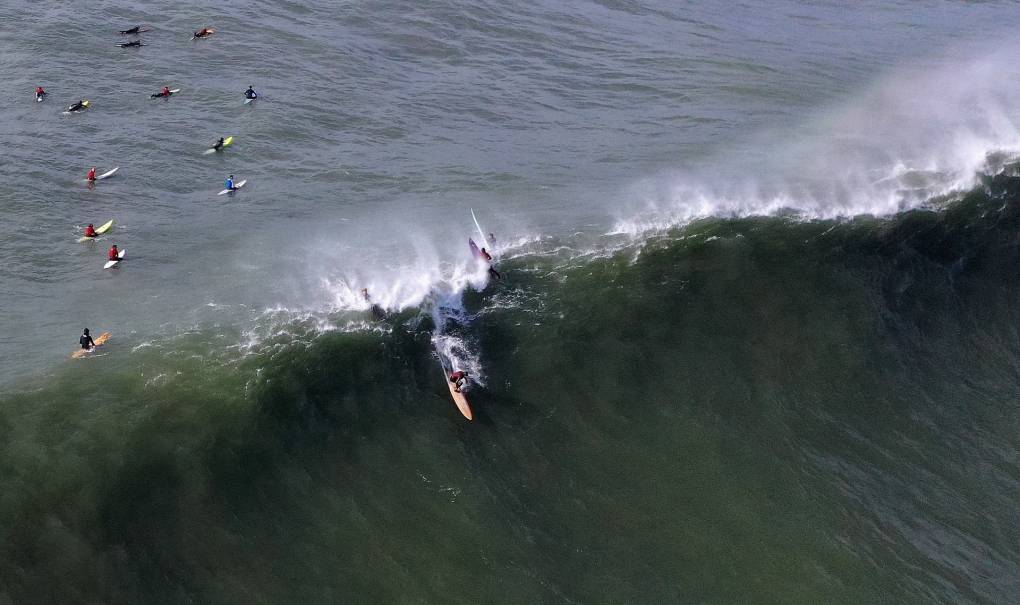
"caption": "A surfer rides a wave at Mavericks on Dec. 17, 2018, in Half Moon Bay, California.",
"description": null,
"title": "Giant Waves Hit Northern California",
"credit": "Ezra Shaw/Getty Images",
"status": "inherit",
"altTag": null,
"isLoading": false,
"fetchFailed": false
},
"science_1974959": {
"type": "attachments",
"id": "science_1974959",
"meta": {
"index": "attachments_1716263798",
"site": "science",
"id": "1974959",
"found": true
},
"parent": 1974955,
"imgSizes": {
"twentyfourteen-full-width": {
"file": "https://ww2.kqed.org/app/uploads/sites/35/2021/05/RS49530_GettyImages-1232993947-qut-1038x576.jpg",
"width": 1038,
"mimeType": "image/jpeg",
"height": 576
},
"thumbnail": {
"file": "https://ww2.kqed.org/app/uploads/sites/35/2021/05/RS49530_GettyImages-1232993947-qut-160x107.jpg",
"width": 160,
"mimeType": "image/jpeg",
"height": 107
},
"post-thumbnail": {
"file": "https://ww2.kqed.org/app/uploads/sites/35/2021/05/RS49530_GettyImages-1232993947-qut-672x372.jpg",
"width": 672,
"mimeType": "image/jpeg",
"height": 372
},
"kqedFullSize": {
"file": "https://ww2.kqed.org/app/uploads/sites/35/2021/05/RS49530_GettyImages-1232993947-qut.jpg",
"width": 1920,
"height": 1280
},
"large": {
"file": "https://ww2.kqed.org/app/uploads/sites/35/2021/05/RS49530_GettyImages-1232993947-qut-1020x680.jpg",
"width": 1020,
"mimeType": "image/jpeg",
"height": 680
},
"1536x1536": {
"file": "https://ww2.kqed.org/app/uploads/sites/35/2021/05/RS49530_GettyImages-1232993947-qut-1536x1024.jpg",
"width": 1536,
"mimeType": "image/jpeg",
"height": 1024
},
"medium": {
"file": "https://ww2.kqed.org/app/uploads/sites/35/2021/05/RS49530_GettyImages-1232993947-qut-800x533.jpg",
"width": 800,
"mimeType": "image/jpeg",
"height": 533
},
"medium_large": {
"file": "https://ww2.kqed.org/app/uploads/sites/35/2021/05/RS49530_GettyImages-1232993947-qut-768x512.jpg",
"width": 768,
"mimeType": "image/jpeg",
"height": 512
}
},
"publishDate": 1622141295,
"modified": 1622221358,
"caption": "Ford Motor Company's logo is seen on the side of the building at the unveiling of their new electric F-150 Lightning outside of their headquarters in Dearborn, Michigan, on May 19, 2021. ",
"description": null,
"title": "US-AUTOMOBILE-ENVIRONMENT-FORD",
"credit": "Jeff Kowalsky/AFP via Getty Images",
"status": "inherit",
"altTag": null,
"isLoading": false,
"fetchFailed": false
},
"science_1974949": {
"type": "attachments",
"id": "science_1974949",
"meta": {
"index": "attachments_1716263798",
"site": "science",
"id": "1974949",
"found": true
},
"parent": 1974948,
"imgSizes": {
"twentyfourteen-full-width": {
"file": "https://ww2.kqed.org/app/uploads/sites/35/2021/05/ap21146462397958_wide-9930ad5d5a6fe00f0bd53343a70b72c5579748ad-1038x576.jpg",
"width": 1038,
"mimeType": "image/jpeg",
"height": 576
},
"thumbnail": {
"file": "https://ww2.kqed.org/app/uploads/sites/35/2021/05/ap21146462397958_wide-9930ad5d5a6fe00f0bd53343a70b72c5579748ad-160x90.jpg",
"width": 160,
"mimeType": "image/jpeg",
"height": 90
},
"post-thumbnail": {
"file": "https://ww2.kqed.org/app/uploads/sites/35/2021/05/ap21146462397958_wide-9930ad5d5a6fe00f0bd53343a70b72c5579748ad-672x372.jpg",
"width": 672,
"mimeType": "image/jpeg",
"height": 372
},
"kqedFullSize": {
"file": "https://ww2.kqed.org/app/uploads/sites/35/2021/05/ap21146462397958_wide-9930ad5d5a6fe00f0bd53343a70b72c5579748ad-scaled.jpg",
"width": 2560,
"height": 1440
},
"2048x2048": {
"file": "https://ww2.kqed.org/app/uploads/sites/35/2021/05/ap21146462397958_wide-9930ad5d5a6fe00f0bd53343a70b72c5579748ad-2048x1152.jpg",
"width": 2048,
"mimeType": "image/jpeg",
"height": 1152
},
"large": {
"file": "https://ww2.kqed.org/app/uploads/sites/35/2021/05/ap21146462397958_wide-9930ad5d5a6fe00f0bd53343a70b72c5579748ad-1020x574.jpg",
"width": 1020,
"mimeType": "image/jpeg",
"height": 574
},
"1536x1536": {
"file": "https://ww2.kqed.org/app/uploads/sites/35/2021/05/ap21146462397958_wide-9930ad5d5a6fe00f0bd53343a70b72c5579748ad-1536x864.jpg",
"width": 1536,
"mimeType": "image/jpeg",
"height": 864
},
"full-width": {
"file": "https://ww2.kqed.org/app/uploads/sites/35/2021/05/ap21146462397958_wide-9930ad5d5a6fe00f0bd53343a70b72c5579748ad-1920x1080.jpg",
"width": 1920,
"mimeType": "image/jpeg",
"height": 1080
},
"medium": {
"file": "https://ww2.kqed.org/app/uploads/sites/35/2021/05/ap21146462397958_wide-9930ad5d5a6fe00f0bd53343a70b72c5579748ad-800x450.jpg",
"width": 800,
"mimeType": "image/jpeg",
"height": 450
},
"medium_large": {
"file": "https://ww2.kqed.org/app/uploads/sites/35/2021/05/ap21146462397958_wide-9930ad5d5a6fe00f0bd53343a70b72c5579748ad-768x432.jpg",
"width": 768,
"mimeType": "image/jpeg",
"height": 432
}
},
"publishDate": 1622135532,
"modified": 1622220433,
"caption": "Pictures of plaintiffs fly outside the court where Milieudefensie, the Dutch arm of the Friends of the Earth environmental organization, took Shell to court in The Hague, Netherlands, on May 26, 2021. Judges were to render their verdict in landmark legal battle of climate change activists in the Netherlands who went to court seeking an order for energy giant Shell to rein in its carbon emissions. ",
"description": null,
"title": "Pictures of plaintiffs fly outside the court in The Hague, Netherlands, before Wednesday's ruling ordering Royal Dutch Shell to rein in its carbon emissions. Thousands of citizens joined the suit charging that Shell's fossil fuel investments endanger lives.",
"credit": "AP Photo via NPR/Peter Dejong",
"status": "inherit",
"altTag": null,
"isLoading": false,
"fetchFailed": false
}
},
"audioPlayerReducer": {
"postId": "stream_live",
"isPaused": true,
"isPlaying": false,
"pfsActive": false,
"pledgeModalIsOpen": true,
"playerDrawerIsOpen": false,
"liveAudioPlayStartedAt": 0,
"liveAudioPlayContext": ""
},
"authorsReducer": {
"byline_science_1975234": {
"type": "authors",
"id": "byline_science_1975234",
"meta": {
"override": true
},
"slug": "byline_science_1975234",
"name": "Laurel Wamsley",
"isLoading": false
},
"byline_science_1974955": {
"type": "authors",
"id": "byline_science_1974955",
"meta": {
"override": true
},
"slug": "byline_science_1974955",
"name": "Tom Krisher \u003cbr />AP\u003cbr>",
"isLoading": false
},
"byline_science_1974948": {
"type": "authors",
"id": "byline_science_1974948",
"meta": {
"override": true
},
"slug": "byline_science_1974948",
"name": "Jeff Brady \u003cbr />NPR\u003cbr>",
"isLoading": false
},
"jbrooks": {
"type": "authors",
"id": "80",
"meta": {
"index": "authors_1716337520",
"id": "80",
"found": true
},
"name": "Jon Brooks",
"firstName": "Jon",
"lastName": "Brooks",
"slug": "jbrooks",
"email": "jbrooks@kqed.org",
"display_author_email": true,
"staff_mastheads": [
"science"
],
"title": "Digital Editor",
"bio": "Jon Brooks is a former Digital Editor for KQED Science. He is the former editor of KQED’s daily news blog, News Fix. In 2014, he won a California Journalism Award for his coverage of ride services like Uber and Lyft and the taxi industry. A veteran blogger, he previously worked for Yahoo! in various news writing and editing roles. Jon is also a playwright whose work has been produced in San Francisco, New York, Italy, and around the U.S. He has written about film for his own blog and studied film at Boston University.",
"avatar": "https://secure.gravatar.com/avatar/98887f7ed1c876ed414d4c915e969584?s=600&d=blank&r=g",
"twitter": "jbrooksfoy",
"facebook": null,
"instagram": null,
"linkedin": null,
"sites": [
{
"site": "arts",
"roles": [
"Contributor",
"editor"
]
},
{
"site": "news",
"roles": [
"author"
]
},
{
"site": "futureofyou",
"roles": [
"administrator"
]
},
{
"site": "mindshift",
"roles": [
"editor"
]
},
{
"site": "stateofhealth",
"roles": [
"editor"
]
},
{
"site": "science",
"roles": [
"administrator"
]
},
{
"site": "quest",
"roles": [
"editor"
]
}
],
"headData": {
"title": "Jon Brooks | KQED",
"description": "Digital Editor",
"ogImgSrc": "https://secure.gravatar.com/avatar/98887f7ed1c876ed414d4c915e969584?s=600&d=blank&r=g",
"twImgSrc": "https://secure.gravatar.com/avatar/98887f7ed1c876ed414d4c915e969584?s=600&d=blank&r=g"
},
"isLoading": false,
"link": "/author/jbrooks"
},
"cveltman": {
"type": "authors",
"id": "8608",
"meta": {
"index": "authors_1716337520",
"id": "8608",
"found": true
},
"name": "Chloe Veltman",
"firstName": "Chloe",
"lastName": "Veltman",
"slug": "cveltman",
"email": "cveltman@kqed.org",
"display_author_email": true,
"staff_mastheads": [],
"title": "Arts and Culture Reporter",
"bio": "Chloe Veltman is a former arts and culture reporter for KQED. Prior to joining the organization, she launched and led the arts bureau at Colorado Public Radio, served as the Bay Area's culture columnist for the New York Times, and was the founder, host and executive producer of VoiceBox, a national award-winning weekly podcast/radio show and live events series all about the human voice. Chloe is the recipient of numerous prizes, grants and fellowships including a Webby Award for her work on interactive storytelling, both the John S Knight Journalism Fellowship and Humanities Center Fellowship at Stanford University, the Sundance Arts Writing Fellowship and a Library of Congress Research Fellowship. She is the author of the book \"On Acting\" and has appeared as a guest lecturer at Yale University and the San Francisco Conservatory of Music among other institutions. She holds a BA in english literature from King's College, Cambridge, and a Masters in Dramaturgy from the Central School of Speech and Drama/Harvard Institute for Advanced Theater Training.\r\n\u003ca href=\"https://www.chloeveltman.com\">www.chloeveltman.com\u003c/a>",
"avatar": "https://secure.gravatar.com/avatar/55403394b00a1ddab683952c2eb2cf85?s=600&d=blank&r=g",
"twitter": "chloeveltman",
"facebook": null,
"instagram": null,
"linkedin": null,
"sites": [
{
"site": "arts",
"roles": []
},
{
"site": "news",
"roles": [
"author"
]
},
{
"site": "pop",
"roles": [
"editor"
]
},
{
"site": "science",
"roles": []
}
],
"headData": {
"title": "Chloe Veltman | KQED",
"description": "Arts and Culture Reporter",
"ogImgSrc": "https://secure.gravatar.com/avatar/55403394b00a1ddab683952c2eb2cf85?s=600&d=blank&r=g",
"twImgSrc": "https://secure.gravatar.com/avatar/55403394b00a1ddab683952c2eb2cf85?s=600&d=blank&r=g"
},
"isLoading": false,
"link": "/author/cveltman"
},
"dventon": {
"type": "authors",
"id": "11088",
"meta": {
"index": "authors_1716337520",
"id": "11088",
"found": true
},
"name": "Danielle Venton",
"firstName": "Danielle",
"lastName": "Venton",
"slug": "dventon",
"email": "dventon@kqed.org",
"display_author_email": true,
"staff_mastheads": [
"science"
],
"title": "Science reporter",
"bio": "Danielle Venton is a reporter for KQED Science. She covers wildfires, space and oceans (though she is prone to sea sickness).\r\n\r\nBefore joining KQED in 2015, Danielle was a staff reporter at KRCB in Sonoma County and a freelancer. She studied science communication at UC Santa Cruz and formerly worked at CERN in Geneva, Switzerland where she wrote about computing. She lives in Sonoma County and enjoys backpacking.",
"avatar": "https://secure.gravatar.com/avatar/37b292b5c40c8d93959c4f48d73b5286f41b7abd8588277e941905a3ed4c801c?s=600&d=blank&r=g",
"twitter": "DanielleVenton",
"bluesky": null,
"facebook": null,
"instagram": null,
"linkedin": null,
"sites": [
{
"site": "arts",
"roles": [
"contributor"
]
},
{
"site": "news",
"roles": [
"editor"
]
},
{
"site": "futureofyou",
"roles": [
"editor"
]
},
{
"site": "science",
"roles": [
"editor"
]
},
{
"site": "liveblog",
"roles": [
"contributor"
]
}
],
"headData": {
"title": "Danielle Venton | KQED",
"description": "Science reporter",
"ogImgSrc": "https://secure.gravatar.com/avatar/37b292b5c40c8d93959c4f48d73b5286f41b7abd8588277e941905a3ed4c801c?s=600&d=blank&r=g",
"twImgSrc": "https://secure.gravatar.com/avatar/37b292b5c40c8d93959c4f48d73b5286f41b7abd8588277e941905a3ed4c801c?s=600&d=blank&r=g"
},
"isLoading": false,
"link": "/author/dventon"
},
"lesleymcclurg": {
"type": "authors",
"id": "11229",
"meta": {
"index": "authors_1716337520",
"id": "11229",
"found": true
},
"name": "Lesley McClurg",
"firstName": "Lesley",
"lastName": "McClurg",
"slug": "lesleymcclurg",
"email": "lmcclurg@KQED.org",
"display_author_email": false,
"staff_mastheads": [
"news",
"science"
],
"title": "KQED Health Correspondent",
"bio": "Lesley McClurg is a health correspondent and fill-in host whose work is regularly rebroadcast on NPR and PBS programs. She’s earned multiple regional Emmy awards, a national and a regional Edward R. Murrow award, and was named Best Beat Reporter by the Association of Health Care Journalists. The Society of Professional Journalists has recognized her work several times, and the Society of Environmental Journalists spotlighted her coverage of California’s historic drought.\r\n\r\nBefore joining KQED in 2016, Lesley covered food and sustainability for Capital Public Radio, environmental issues for Colorado Public Radio, and reported for KUOW and KCTS 9 in Seattle. Away from the newsroom, she loves skiing with her daughter, mountain biking with her partner, and playing with Ollie, the family’s goldendoodle. On deadline, she runs almost entirely on chocolate chips.\r\n\r\n ",
"avatar": "https://secure.gravatar.com/avatar/bab49e972ea10c774fe0f5e29dba1722b158f7c0d58a360923d1389d380b2978?s=600&d=blank&r=g",
"twitter": "lesleywmcclurg",
"bluesky": null,
"facebook": null,
"instagram": null,
"linkedin": null,
"sites": [
{
"site": "arts",
"roles": [
"author"
]
},
{
"site": "news",
"roles": [
"editor"
]
},
{
"site": "futureofyou",
"roles": [
"editor"
]
},
{
"site": "stateofhealth",
"roles": [
"author"
]
},
{
"site": "science",
"roles": [
"editor"
]
},
{
"site": "quest",
"roles": [
"subscriber"
]
},
{
"site": "forum",
"roles": [
"administrator"
]
},
{
"site": "liveblog",
"roles": [
"author"
]
}
],
"headData": {
"title": "Lesley McClurg | KQED",
"description": "KQED Health Correspondent",
"ogImgSrc": "https://secure.gravatar.com/avatar/bab49e972ea10c774fe0f5e29dba1722b158f7c0d58a360923d1389d380b2978?s=600&d=blank&r=g",
"twImgSrc": "https://secure.gravatar.com/avatar/bab49e972ea10c774fe0f5e29dba1722b158f7c0d58a360923d1389d380b2978?s=600&d=blank&r=g"
},
"isLoading": false,
"link": "/author/lesleymcclurg"
},
"kevinstark": {
"type": "authors",
"id": "11608",
"meta": {
"index": "authors_1716337520",
"id": "11608",
"found": true
},
"name": "Kevin Stark",
"firstName": "Kevin",
"lastName": "Stark",
"slug": "kevinstark",
"email": "kstark@kqed.org",
"display_author_email": true,
"staff_mastheads": [
"science"
],
"title": "Senior Editor",
"bio": "Kevin is a senior editor for KQED Science, managing the station's health and climate desks. His journalism career began in the Pacific Northwest, and he later became a lead reporter for the San Francisco Public Press. His work has appeared in Pacific Standard magazine, the Energy News Network, the Center for Investigative Reporting's Reveal and WBEZ in Chicago. Kevin joined KQED in 2019, and has covered issues related to energy, wildfire, climate change and the environment.",
"avatar": "https://secure.gravatar.com/avatar/365aaa4b597d3a8374f67504ff0facd323d7906e8eb4be0a7efd2427408e802c?s=600&d=blank&r=g",
"twitter": "starkkev",
"bluesky": null,
"facebook": null,
"instagram": null,
"linkedin": null,
"sites": [
{
"site": "",
"roles": [
"editor"
]
},
{
"site": "news",
"roles": [
"editor"
]
},
{
"site": "science",
"roles": [
"administrator"
]
}
],
"headData": {
"title": "Kevin Stark | KQED",
"description": "Senior Editor",
"ogImgSrc": "https://secure.gravatar.com/avatar/365aaa4b597d3a8374f67504ff0facd323d7906e8eb4be0a7efd2427408e802c?s=600&d=blank&r=g",
"twImgSrc": "https://secure.gravatar.com/avatar/365aaa4b597d3a8374f67504ff0facd323d7906e8eb4be0a7efd2427408e802c?s=600&d=blank&r=g"
},
"isLoading": false,
"link": "/author/kevinstark"
},
"hmcdede": {
"type": "authors",
"id": "11635",
"meta": {
"index": "authors_1716337520",
"id": "11635",
"found": true
},
"name": "Holly McDede",
"firstName": "Holly",
"lastName": "McDede",
"slug": "hmcdede",
"email": "hmcdede@KQED.org",
"display_author_email": false,
"staff_mastheads": [],
"title": "KQED Contributor",
"bio": null,
"avatar": "https://secure.gravatar.com/avatar/999d9bf31bb3a2f0511932d99526cb3e?s=600&d=blank&r=g",
"twitter": null,
"facebook": null,
"instagram": null,
"linkedin": null,
"sites": [
{
"site": "arts",
"roles": [
"editor"
]
},
{
"site": "news",
"roles": [
"edit_others_posts",
"editor"
]
},
{
"site": "science",
"roles": [
"editor"
]
},
{
"site": "forum",
"roles": [
"editor"
]
},
{
"site": "perspectives",
"roles": [
"administrator"
]
}
],
"headData": {
"title": "Holly McDede | KQED",
"description": "KQED Contributor",
"ogImgSrc": "https://secure.gravatar.com/avatar/999d9bf31bb3a2f0511932d99526cb3e?s=600&d=blank&r=g",
"twImgSrc": "https://secure.gravatar.com/avatar/999d9bf31bb3a2f0511932d99526cb3e?s=600&d=blank&r=g"
},
"isLoading": false,
"link": "/author/hmcdede"
}
},
"pagesReducer": {
"science_category_news": {
"type": "terms",
"id": "science_40",
"meta": {
"index": "terms_1716263798",
"site": "science",
"id": "40",
"score": 10.813501
},
"featImg": null,
"name": "News",
"description": null,
"taxonomy": "category",
"headData": {
"twImgId": null,
"twTitle": null,
"ogTitle": null,
"ogImgId": null,
"twDescription": null,
"description": null,
"title": "News Archives | KQED Science",
"ogDescription": null
},
"ttid": 42,
"slug": "news",
"isLoading": false,
"title": "News",
"pageMeta": {
"site": "science",
"WpPageTemplate": "page-topic-editorial",
"currentPage": 74
},
"blocks": [
{
"blockName": "kqed/post-list",
"attrs": {
"layout": "cardArticle2",
"query": "posts/science?category=news",
"seeMore": false,
"paginated": true,
"page": 74
}
},
{
"blockName": "kqed/ad"
}
]
}
},
"pfsSessionReducer": {},
"postsReducer": {
"stream_live": {
"type": "live",
"id": "stream_live",
"audioUrl": "https://streams.kqed.org/kqedradio",
"title": "Live Stream",
"excerpt": "Live Stream information currently unavailable.",
"link": "/radio",
"featImg": "",
"label": {
"name": "KQED Live",
"link": "/"
}
},
"stream_kqedNewscast": {
"type": "posts",
"id": "stream_kqedNewscast",
"audioUrl": "https://www.kqed.org/.stream/anon/radio/RDnews/newscast.mp3?_=1",
"title": "KQED Newscast",
"featImg": "",
"label": {
"name": "88.5 FM",
"link": "/"
}
},
"science_1975362": {
"type": "posts",
"id": "science_1975362",
"meta": {
"index": "posts_1716263798",
"site": "science",
"id": "1975362",
"score": null,
"sort": [
1623778145000
]
},
"guestAuthors": [],
"slug": "young-activists-march-from-paradise-to-sf-in-100-degree-heat-to-protest-climate-crisis",
"title": "Young Activists March From Paradise to SF in 100 Degree Heat to Protest Climate Crisis",
"publishDate": 1623778145,
"format": "audio",
"headTitle": "Young Activists March From Paradise to SF in 100 Degree Heat to Protest Climate Crisis | KQED",
"labelTerm": {},
"content": "\u003cp>A climate justice march led by a small group of young activists that began in Paradise ended in San Francisco on Monday, after more than 100 climate activists from the youth-led Sunrise Movement marched across the Golden Gate Bridge.\u003c/p>\n\u003cp>The young activists are calling on California lawmakers to support the “most progressive version possible” of President Biden’s plan to retool former President Franklin Roosevelt’s Civilian Conservation Corps, a Great Depression-era program that created jobs by putting people to work building roads and bridges, installing telephone lines and establishing campgrounds.\u003c/p>\n\u003cp>The Biden administration has proposed a $10 billion revamp called the \u003ca href=\"https://www.npr.org/2021/05/11/993976948/reaching-back-to-the-new-deal-biden-proposes-a-civilian-climate-corps\" target=\"_blank\" rel=\"noopener noreferrer\">Civilian Climate Corps,\u003c/a> a program geared toward fighting climate change by employing people to restore wetlands and remove invasive species.\u003c/p>\n\u003cfigure id=\"attachment_1975380\" class=\"wp-caption alignnone\" style=\"max-width: 800px\">\u003cimg loading=\"lazy\" decoding=\"async\" class=\"size-medium wp-image-1975380\" src=\"https://ww2.kqed.org/app/uploads/sites/35/2021/06/048_SanFrancisco_YouthClimateActivists_06142021-800x533.jpg\" alt=\"\" width=\"800\" height=\"533\" srcset=\"https://cdn.kqed.org/wp-content/uploads/sites/35/2021/06/048_SanFrancisco_YouthClimateActivists_06142021-800x533.jpg 800w, https://cdn.kqed.org/wp-content/uploads/sites/35/2021/06/048_SanFrancisco_YouthClimateActivists_06142021-1020x680.jpg 1020w, https://cdn.kqed.org/wp-content/uploads/sites/35/2021/06/048_SanFrancisco_YouthClimateActivists_06142021-160x107.jpg 160w, https://cdn.kqed.org/wp-content/uploads/sites/35/2021/06/048_SanFrancisco_YouthClimateActivists_06142021-768x512.jpg 768w, https://cdn.kqed.org/wp-content/uploads/sites/35/2021/06/048_SanFrancisco_YouthClimateActivists_06142021-1536x1024.jpg 1536w, https://cdn.kqed.org/wp-content/uploads/sites/35/2021/06/048_SanFrancisco_YouthClimateActivists_06142021.jpg 1920w\" sizes=\"(max-width: 800px) 100vw, 800px\">\u003cfigcaption class=\"wp-caption-text\">Climate activists on the final leg of a march from Paradise to San Francisco on June 14, 2021. \u003ccite>(Beth LaBerge/KQED)\u003c/cite>\u003c/figcaption>\u003c/figure>\n\u003cp>Seven of the marchers began walking the 266-mile stretch \u003ca href=\"https://www.kqed.org/news/11875863/a-266-mile-walk-youth-climate-activists-march-from-paradise-to-san-francisco\">\u003cspan class=\"s1\">last month\u003c/span>\u003c/a> as part of a national campaign called \u003ca href=\"https://www.sunrisemovement.org/campaign/generation-on-fire/\">Generation on Fire\u003c/a>.\u003c/p>\n\u003cp>Their ranks swelled to more than 20 last week, with dozens more joining for the final leg, many of them beating drums and singing as they crossed from Marin to San Francisco over the iconic bridge.\u003c/p>\n\u003cp>[ad fullwidth]\u003c/p>\n\u003cp>One of the marchers, Ema Govea, a 17-year-old high school student from Santa Rosa, spoke with KQED’s Brian Watt last week. The following has been lightly edited for length and clarity.\u003c/p>\n\u003cfigure id=\"attachment_1975377\" class=\"wp-caption alignnone\" style=\"max-width: 800px\">\u003cimg loading=\"lazy\" decoding=\"async\" class=\"size-medium wp-image-1975377\" src=\"https://ww2.kqed.org/app/uploads/sites/35/2021/06/029_SanFrancisco_YouthClimateActivists_06142021-800x533.jpg\" alt=\"\" width=\"800\" height=\"533\" srcset=\"https://cdn.kqed.org/wp-content/uploads/sites/35/2021/06/029_SanFrancisco_YouthClimateActivists_06142021-800x533.jpg 800w, https://cdn.kqed.org/wp-content/uploads/sites/35/2021/06/029_SanFrancisco_YouthClimateActivists_06142021-1020x680.jpg 1020w, https://cdn.kqed.org/wp-content/uploads/sites/35/2021/06/029_SanFrancisco_YouthClimateActivists_06142021-160x107.jpg 160w, https://cdn.kqed.org/wp-content/uploads/sites/35/2021/06/029_SanFrancisco_YouthClimateActivists_06142021-768x512.jpg 768w, https://cdn.kqed.org/wp-content/uploads/sites/35/2021/06/029_SanFrancisco_YouthClimateActivists_06142021-1536x1024.jpg 1536w, https://cdn.kqed.org/wp-content/uploads/sites/35/2021/06/029_SanFrancisco_YouthClimateActivists_06142021.jpg 1920w\" sizes=\"(max-width: 800px) 100vw, 800px\">\u003cfigcaption class=\"wp-caption-text\">Santa Rosa resident Ema Govea,17, speaks before the marchers by the Golden Gate Bridge on June 14, 2021. \u003ccite>(Beth LaBerge/KQED)\u003c/cite>\u003c/figcaption>\u003c/figure>\n\u003cp>\u003cb>How did this idea come together? You’re walking from Paradise? \u003c/b>\u003c/p>\n\u003cp>\u003cem>Ema Govea:\u003c/em> We are really excited to have started in Paradise because it’s such a flashpoint for all the [conversations around] fire in California. And this idea really came together out of an urgency of really wanting to do something as big as we can. I was really excited to organize this march and participate in it. We walked so far because we have an opportunity right now politically, and as young people at this moment.\u003c/p>\n\u003cp>\u003cb>Paradise is a very important place to start a march like this. But I’m thinking about your feet. How are you feeling at this moment after all this walking?\u003c/b>\u003c/p>\n\u003cp>\u003cem>Govea:\u003c/em> The first week was over 100 degrees and I had a lot of blisters. I was really feeling it. At this point, my legs have gotten used to it. And thinking about what we’re fighting for, plans that we have for the future, and future actions has kept me going. It honestly doesn’t matter if my legs are sore or if my feet hurt, at this point.\u003c/p>\n\u003cfigure id=\"attachment_1975381\" class=\"wp-caption alignnone\" style=\"max-width: 800px\">\u003cimg loading=\"lazy\" decoding=\"async\" class=\"size-medium wp-image-1975381\" src=\"https://ww2.kqed.org/app/uploads/sites/35/2021/06/006_SanFrancisco_YouthClimateActivists_06142021-800x533.jpg\" alt=\"\" width=\"800\" height=\"533\" srcset=\"https://cdn.kqed.org/wp-content/uploads/sites/35/2021/06/006_SanFrancisco_YouthClimateActivists_06142021-800x533.jpg 800w, https://cdn.kqed.org/wp-content/uploads/sites/35/2021/06/006_SanFrancisco_YouthClimateActivists_06142021-1020x679.jpg 1020w, https://cdn.kqed.org/wp-content/uploads/sites/35/2021/06/006_SanFrancisco_YouthClimateActivists_06142021-160x107.jpg 160w, https://cdn.kqed.org/wp-content/uploads/sites/35/2021/06/006_SanFrancisco_YouthClimateActivists_06142021-768x511.jpg 768w, https://cdn.kqed.org/wp-content/uploads/sites/35/2021/06/006_SanFrancisco_YouthClimateActivists_06142021-1536x1022.jpg 1536w, https://cdn.kqed.org/wp-content/uploads/sites/35/2021/06/006_SanFrancisco_YouthClimateActivists_06142021.jpg 1920w\" sizes=\"(max-width: 800px) 100vw, 800px\">\u003cfigcaption class=\"wp-caption-text\">Students from Analy High School in Sebastopol sit at the Golden Gate Bridge Vista Point. \u003ccite>(Beth LaBerge/KQED)\u003c/cite>\u003c/figcaption>\u003c/figure>\n\u003cp>\u003cb>I imagine you’ve done some travels like this through California by car on a freeway. What did you notice about the landscape as you walked?\u003c/b>\u003c/p>\n\u003cp>\u003cem>Govea:\u003c/em> One thing that was especially amazing was talking to people in towns who I would have never met before. We walked through some of the reddest parts of the state and had really amazing conversations with a lot of people. Also, we passed hills that had burned, trees that were all black and didn’t have any growth on them — it really brought home what is at stake.\u003c/p>\n\u003cp>\u003cb>When you say walking through and meeting people in some of the reddest parts of the state, I think I know what you mean. But what kinds of feedback did you get on your march from the people you met?\u003c/b>\u003c/p>\n\u003cp>\u003cem>Govea:\u003c/em> We would walk by and we have these big flags. People would ask us: “What are you doing?” We would say: “We’re marching to San Francisco and we’re demanding good jobs to stop the climate crisis.”\u003c/p>\n\u003cp>And that would start a conversation with a lot of people. And we would talk to them about what jobs are like in their areas. A lot of times the job opportunities are not great. A lot of people, regardless of political affiliation, were really supportive of the cause.\u003c/p>\n\u003cfigure id=\"attachment_1975382\" class=\"wp-caption alignnone\" style=\"max-width: 800px\">\u003cimg loading=\"lazy\" decoding=\"async\" class=\"wp-image-1975382 size-medium\" src=\"https://ww2.kqed.org/app/uploads/sites/35/2021/06/057_SanFrancisco_YouthClimateActivists_06142021-800x533.jpg\" alt=\"\" width=\"800\" height=\"533\" srcset=\"https://cdn.kqed.org/wp-content/uploads/sites/35/2021/06/057_SanFrancisco_YouthClimateActivists_06142021-800x533.jpg 800w, https://cdn.kqed.org/wp-content/uploads/sites/35/2021/06/057_SanFrancisco_YouthClimateActivists_06142021-1020x680.jpg 1020w, https://cdn.kqed.org/wp-content/uploads/sites/35/2021/06/057_SanFrancisco_YouthClimateActivists_06142021-160x107.jpg 160w, https://cdn.kqed.org/wp-content/uploads/sites/35/2021/06/057_SanFrancisco_YouthClimateActivists_06142021-768x512.jpg 768w, https://cdn.kqed.org/wp-content/uploads/sites/35/2021/06/057_SanFrancisco_YouthClimateActivists_06142021-1536x1024.jpg 1536w, https://cdn.kqed.org/wp-content/uploads/sites/35/2021/06/057_SanFrancisco_YouthClimateActivists_06142021.jpg 1920w\" sizes=\"(max-width: 800px) 100vw, 800px\">\u003cfigcaption class=\"wp-caption-text\">The rally was the culmination of a 266-mile march from Paradise, California, to San Francisco led by seven youth activists. (Beth LaBerge/KQED)\u003c/figcaption>\u003c/figure>\n\u003cp>\u003cb>You’re in this group of seven people who are around your age. And in what way does your experience growing up in California shape how you’re doing this work for climate justice?\u003c/b>\u003c/p>\n\u003cp>\u003cem>Govea:\u003c/em> I am really grateful for this group of seven people. And now, actually, as we’re speaking, there’s an even larger group of over 20 people who are now marching with us, who have joined us along the way.\u003c/p>\n\u003cp>\u003cb>Your group grew as you walked, is what you’re telling us?\u003c/b>\u003c/p>\n\u003cp>It started with a group of seven and now we’re around 30 people.\u003c/p>\n\u003cfigure id=\"attachment_1975383\" class=\"wp-caption alignnone\" style=\"max-width: 800px\">\u003cimg loading=\"lazy\" decoding=\"async\" class=\"wp-image-1975383 size-medium\" src=\"https://ww2.kqed.org/app/uploads/sites/35/2021/06/050_SanFrancisco_YouthClimateActivists_06142021-800x533.jpg\" alt=\"\" width=\"800\" height=\"533\" srcset=\"https://cdn.kqed.org/wp-content/uploads/sites/35/2021/06/050_SanFrancisco_YouthClimateActivists_06142021-800x533.jpg 800w, https://cdn.kqed.org/wp-content/uploads/sites/35/2021/06/050_SanFrancisco_YouthClimateActivists_06142021-1020x679.jpg 1020w, https://cdn.kqed.org/wp-content/uploads/sites/35/2021/06/050_SanFrancisco_YouthClimateActivists_06142021-160x107.jpg 160w, https://cdn.kqed.org/wp-content/uploads/sites/35/2021/06/050_SanFrancisco_YouthClimateActivists_06142021-768x511.jpg 768w, https://cdn.kqed.org/wp-content/uploads/sites/35/2021/06/050_SanFrancisco_YouthClimateActivists_06142021-1536x1022.jpg 1536w, https://cdn.kqed.org/wp-content/uploads/sites/35/2021/06/050_SanFrancisco_YouthClimateActivists_06142021.jpg 1920w\" sizes=\"(max-width: 800px) 100vw, 800px\">\u003cfigcaption class=\"wp-caption-text\">The young climate activists prepare to cross the Golden Gate Bridge. \u003ccite>(Beth LaBerge/KQED)\u003c/cite>\u003c/figcaption>\u003c/figure>\n\u003cp>\u003cb>You’re doing all of this while you are a high school student. I’m kind of curious how you were thinking about this issue during the pandemic?\u003c/b>\u003c/p>\n\u003cp>\u003cem>Govea:\u003c/em> The pandemic and the recession that has come along with it has really shown the inequalities people face in this county. I have talked to a lot of people who’ve lost their jobs and who have even more instability than they had before. And there’s a need right now for good paying jobs. And the Civilian Climate Corps would be one of those things that could provide really good paying union jobs that would also benefit society.\u003c/p>\n\u003cp>\u003cb>Now, you want to end this march, crossing the Golden Gate Bridge into San Francisco — all in support of the Civilian Climate Corps. What do you make of congressional action on the issue?\u003c/b>\u003c/p>\n\u003cp>\u003cem>Govea:\u003c/em> It’s been wholly inadequate. We’re demanding that our politicians step up and be brave and pass the boldest version of the Climate Corps possible.\u003c/p>\n\u003cp>[ad floatright]\u003c/p>\n\u003cp>\u003cem>House Speaker Nancy Pelosi’s office told KQED that “congressional Democrats support the goals of the Civilian Climate Corps and look forward to working with the administration to enact it in the jobs plan.”\u003c/em>\u003c/p>\n\n",
"blocks": [],
"excerpt": "A 266-mile climate justice march led by a small group of activists that began last month ended in San Francisco on Monday.",
"status": "publish",
"parent": 0,
"modified": 1725577047,
"stats": {
"hasAudio": false,
"hasVideo": false,
"hasChartOrMap": false,
"iframeSrcs": [],
"hasGoogleForm": false,
"hasGallery": false,
"hasHearkenModule": false,
"hasPolis": false,
"paragraphCount": 26,
"wordCount": 1071
},
"headData": {
"title": "Young Activists March From Paradise to SF in 100 Degree Heat to Protest Climate Crisis | KQED",
"description": "A 266-mile climate justice march led by a small group of activists that began last month ended in San Francisco on Monday.",
"ogTitle": "",
"ogDescription": "",
"ogImgId": "",
"twTitle": "",
"twDescription": "",
"twImgId": "",
"schema": {
"@context": "https://schema.org",
"@type": "Article",
"headline": "Young Activists March From Paradise to SF in 100 Degree Heat to Protest Climate Crisis",
"datePublished": "2021-06-15T10:29:05-07:00",
"dateModified": "2024-09-05T15:57:27-07:00",
"image": "https://cdn.kqed.org/wp-content/uploads/2020/02/KQED-OG-Image@1x.png"
}
},
"source": "Climate Change",
"audioUrl": "https://traffic.omny.fm/d/clips/0af137ef-751e-4b19-a055-aaef00d2d578/ffca7e9f-6831-41c5-bcaf-aaef00f5a073/5b11b88e-6273-4d44-b2c1-ad4701224375/audio.mp3",
"sticky": false,
"path": "/science/1975362/young-activists-march-from-paradise-to-sf-in-100-degree-heat-to-protest-climate-crisis",
"audioDuration": 191000,
"audioTrackLength": null,
"parsedContent": [
{
"type": "contentString",
"content": "\u003cdiv class=\"post-body\">\u003cp>\u003cp>A climate justice march led by a small group of young activists that began in Paradise ended in San Francisco on Monday, after more than 100 climate activists from the youth-led Sunrise Movement marched across the Golden Gate Bridge.\u003c/p>\n\u003cp>The young activists are calling on California lawmakers to support the “most progressive version possible” of President Biden’s plan to retool former President Franklin Roosevelt’s Civilian Conservation Corps, a Great Depression-era program that created jobs by putting people to work building roads and bridges, installing telephone lines and establishing campgrounds.\u003c/p>\n\u003cp>The Biden administration has proposed a $10 billion revamp called the \u003ca href=\"https://www.npr.org/2021/05/11/993976948/reaching-back-to-the-new-deal-biden-proposes-a-civilian-climate-corps\" target=\"_blank\" rel=\"noopener noreferrer\">Civilian Climate Corps,\u003c/a> a program geared toward fighting climate change by employing people to restore wetlands and remove invasive species.\u003c/p>\n\u003cfigure id=\"attachment_1975380\" class=\"wp-caption alignnone\" style=\"max-width: 800px\">\u003cimg loading=\"lazy\" decoding=\"async\" class=\"size-medium wp-image-1975380\" src=\"https://ww2.kqed.org/app/uploads/sites/35/2021/06/048_SanFrancisco_YouthClimateActivists_06142021-800x533.jpg\" alt=\"\" width=\"800\" height=\"533\" srcset=\"https://cdn.kqed.org/wp-content/uploads/sites/35/2021/06/048_SanFrancisco_YouthClimateActivists_06142021-800x533.jpg 800w, https://cdn.kqed.org/wp-content/uploads/sites/35/2021/06/048_SanFrancisco_YouthClimateActivists_06142021-1020x680.jpg 1020w, https://cdn.kqed.org/wp-content/uploads/sites/35/2021/06/048_SanFrancisco_YouthClimateActivists_06142021-160x107.jpg 160w, https://cdn.kqed.org/wp-content/uploads/sites/35/2021/06/048_SanFrancisco_YouthClimateActivists_06142021-768x512.jpg 768w, https://cdn.kqed.org/wp-content/uploads/sites/35/2021/06/048_SanFrancisco_YouthClimateActivists_06142021-1536x1024.jpg 1536w, https://cdn.kqed.org/wp-content/uploads/sites/35/2021/06/048_SanFrancisco_YouthClimateActivists_06142021.jpg 1920w\" sizes=\"(max-width: 800px) 100vw, 800px\">\u003cfigcaption class=\"wp-caption-text\">Climate activists on the final leg of a march from Paradise to San Francisco on June 14, 2021. \u003ccite>(Beth LaBerge/KQED)\u003c/cite>\u003c/figcaption>\u003c/figure>\n\u003cp>Seven of the marchers began walking the 266-mile stretch \u003ca href=\"https://www.kqed.org/news/11875863/a-266-mile-walk-youth-climate-activists-march-from-paradise-to-san-francisco\">\u003cspan class=\"s1\">last month\u003c/span>\u003c/a> as part of a national campaign called \u003ca href=\"https://www.sunrisemovement.org/campaign/generation-on-fire/\">Generation on Fire\u003c/a>.\u003c/p>\n\u003cp>Their ranks swelled to more than 20 last week, with dozens more joining for the final leg, many of them beating drums and singing as they crossed from Marin to San Francisco over the iconic bridge.\u003c/p>\n\u003cp>\u003c/p>\u003c/div>",
"attributes": {
"named": {},
"numeric": []
}
},
{
"type": "component",
"content": "",
"name": "ad",
"attributes": {
"named": {
"label": "fullwidth"
},
"numeric": [
"fullwidth"
]
}
},
{
"type": "contentString",
"content": "\u003cdiv class=\"post-body\">\u003cp>\u003c/p>\n\u003cp>One of the marchers, Ema Govea, a 17-year-old high school student from Santa Rosa, spoke with KQED’s Brian Watt last week. The following has been lightly edited for length and clarity.\u003c/p>\n\u003cfigure id=\"attachment_1975377\" class=\"wp-caption alignnone\" style=\"max-width: 800px\">\u003cimg loading=\"lazy\" decoding=\"async\" class=\"size-medium wp-image-1975377\" src=\"https://ww2.kqed.org/app/uploads/sites/35/2021/06/029_SanFrancisco_YouthClimateActivists_06142021-800x533.jpg\" alt=\"\" width=\"800\" height=\"533\" srcset=\"https://cdn.kqed.org/wp-content/uploads/sites/35/2021/06/029_SanFrancisco_YouthClimateActivists_06142021-800x533.jpg 800w, https://cdn.kqed.org/wp-content/uploads/sites/35/2021/06/029_SanFrancisco_YouthClimateActivists_06142021-1020x680.jpg 1020w, https://cdn.kqed.org/wp-content/uploads/sites/35/2021/06/029_SanFrancisco_YouthClimateActivists_06142021-160x107.jpg 160w, https://cdn.kqed.org/wp-content/uploads/sites/35/2021/06/029_SanFrancisco_YouthClimateActivists_06142021-768x512.jpg 768w, https://cdn.kqed.org/wp-content/uploads/sites/35/2021/06/029_SanFrancisco_YouthClimateActivists_06142021-1536x1024.jpg 1536w, https://cdn.kqed.org/wp-content/uploads/sites/35/2021/06/029_SanFrancisco_YouthClimateActivists_06142021.jpg 1920w\" sizes=\"(max-width: 800px) 100vw, 800px\">\u003cfigcaption class=\"wp-caption-text\">Santa Rosa resident Ema Govea,17, speaks before the marchers by the Golden Gate Bridge on June 14, 2021. \u003ccite>(Beth LaBerge/KQED)\u003c/cite>\u003c/figcaption>\u003c/figure>\n\u003cp>\u003cb>How did this idea come together? You’re walking from Paradise? \u003c/b>\u003c/p>\n\u003cp>\u003cem>Ema Govea:\u003c/em> We are really excited to have started in Paradise because it’s such a flashpoint for all the [conversations around] fire in California. And this idea really came together out of an urgency of really wanting to do something as big as we can. I was really excited to organize this march and participate in it. We walked so far because we have an opportunity right now politically, and as young people at this moment.\u003c/p>\n\u003cp>\u003cb>Paradise is a very important place to start a march like this. But I’m thinking about your feet. How are you feeling at this moment after all this walking?\u003c/b>\u003c/p>\n\u003cp>\u003cem>Govea:\u003c/em> The first week was over 100 degrees and I had a lot of blisters. I was really feeling it. At this point, my legs have gotten used to it. And thinking about what we’re fighting for, plans that we have for the future, and future actions has kept me going. It honestly doesn’t matter if my legs are sore or if my feet hurt, at this point.\u003c/p>\n\u003cfigure id=\"attachment_1975381\" class=\"wp-caption alignnone\" style=\"max-width: 800px\">\u003cimg loading=\"lazy\" decoding=\"async\" class=\"size-medium wp-image-1975381\" src=\"https://ww2.kqed.org/app/uploads/sites/35/2021/06/006_SanFrancisco_YouthClimateActivists_06142021-800x533.jpg\" alt=\"\" width=\"800\" height=\"533\" srcset=\"https://cdn.kqed.org/wp-content/uploads/sites/35/2021/06/006_SanFrancisco_YouthClimateActivists_06142021-800x533.jpg 800w, https://cdn.kqed.org/wp-content/uploads/sites/35/2021/06/006_SanFrancisco_YouthClimateActivists_06142021-1020x679.jpg 1020w, https://cdn.kqed.org/wp-content/uploads/sites/35/2021/06/006_SanFrancisco_YouthClimateActivists_06142021-160x107.jpg 160w, https://cdn.kqed.org/wp-content/uploads/sites/35/2021/06/006_SanFrancisco_YouthClimateActivists_06142021-768x511.jpg 768w, https://cdn.kqed.org/wp-content/uploads/sites/35/2021/06/006_SanFrancisco_YouthClimateActivists_06142021-1536x1022.jpg 1536w, https://cdn.kqed.org/wp-content/uploads/sites/35/2021/06/006_SanFrancisco_YouthClimateActivists_06142021.jpg 1920w\" sizes=\"(max-width: 800px) 100vw, 800px\">\u003cfigcaption class=\"wp-caption-text\">Students from Analy High School in Sebastopol sit at the Golden Gate Bridge Vista Point. \u003ccite>(Beth LaBerge/KQED)\u003c/cite>\u003c/figcaption>\u003c/figure>\n\u003cp>\u003cb>I imagine you’ve done some travels like this through California by car on a freeway. What did you notice about the landscape as you walked?\u003c/b>\u003c/p>\n\u003cp>\u003cem>Govea:\u003c/em> One thing that was especially amazing was talking to people in towns who I would have never met before. We walked through some of the reddest parts of the state and had really amazing conversations with a lot of people. Also, we passed hills that had burned, trees that were all black and didn’t have any growth on them — it really brought home what is at stake.\u003c/p>\n\u003cp>\u003cb>When you say walking through and meeting people in some of the reddest parts of the state, I think I know what you mean. But what kinds of feedback did you get on your march from the people you met?\u003c/b>\u003c/p>\n\u003cp>\u003cem>Govea:\u003c/em> We would walk by and we have these big flags. People would ask us: “What are you doing?” We would say: “We’re marching to San Francisco and we’re demanding good jobs to stop the climate crisis.”\u003c/p>\n\u003cp>And that would start a conversation with a lot of people. And we would talk to them about what jobs are like in their areas. A lot of times the job opportunities are not great. A lot of people, regardless of political affiliation, were really supportive of the cause.\u003c/p>\n\u003cfigure id=\"attachment_1975382\" class=\"wp-caption alignnone\" style=\"max-width: 800px\">\u003cimg loading=\"lazy\" decoding=\"async\" class=\"wp-image-1975382 size-medium\" src=\"https://ww2.kqed.org/app/uploads/sites/35/2021/06/057_SanFrancisco_YouthClimateActivists_06142021-800x533.jpg\" alt=\"\" width=\"800\" height=\"533\" srcset=\"https://cdn.kqed.org/wp-content/uploads/sites/35/2021/06/057_SanFrancisco_YouthClimateActivists_06142021-800x533.jpg 800w, https://cdn.kqed.org/wp-content/uploads/sites/35/2021/06/057_SanFrancisco_YouthClimateActivists_06142021-1020x680.jpg 1020w, https://cdn.kqed.org/wp-content/uploads/sites/35/2021/06/057_SanFrancisco_YouthClimateActivists_06142021-160x107.jpg 160w, https://cdn.kqed.org/wp-content/uploads/sites/35/2021/06/057_SanFrancisco_YouthClimateActivists_06142021-768x512.jpg 768w, https://cdn.kqed.org/wp-content/uploads/sites/35/2021/06/057_SanFrancisco_YouthClimateActivists_06142021-1536x1024.jpg 1536w, https://cdn.kqed.org/wp-content/uploads/sites/35/2021/06/057_SanFrancisco_YouthClimateActivists_06142021.jpg 1920w\" sizes=\"(max-width: 800px) 100vw, 800px\">\u003cfigcaption class=\"wp-caption-text\">The rally was the culmination of a 266-mile march from Paradise, California, to San Francisco led by seven youth activists. (Beth LaBerge/KQED)\u003c/figcaption>\u003c/figure>\n\u003cp>\u003cb>You’re in this group of seven people who are around your age. And in what way does your experience growing up in California shape how you’re doing this work for climate justice?\u003c/b>\u003c/p>\n\u003cp>\u003cem>Govea:\u003c/em> I am really grateful for this group of seven people. And now, actually, as we’re speaking, there’s an even larger group of over 20 people who are now marching with us, who have joined us along the way.\u003c/p>\n\u003cp>\u003cb>Your group grew as you walked, is what you’re telling us?\u003c/b>\u003c/p>\n\u003cp>It started with a group of seven and now we’re around 30 people.\u003c/p>\n\u003cfigure id=\"attachment_1975383\" class=\"wp-caption alignnone\" style=\"max-width: 800px\">\u003cimg loading=\"lazy\" decoding=\"async\" class=\"wp-image-1975383 size-medium\" src=\"https://ww2.kqed.org/app/uploads/sites/35/2021/06/050_SanFrancisco_YouthClimateActivists_06142021-800x533.jpg\" alt=\"\" width=\"800\" height=\"533\" srcset=\"https://cdn.kqed.org/wp-content/uploads/sites/35/2021/06/050_SanFrancisco_YouthClimateActivists_06142021-800x533.jpg 800w, https://cdn.kqed.org/wp-content/uploads/sites/35/2021/06/050_SanFrancisco_YouthClimateActivists_06142021-1020x679.jpg 1020w, https://cdn.kqed.org/wp-content/uploads/sites/35/2021/06/050_SanFrancisco_YouthClimateActivists_06142021-160x107.jpg 160w, https://cdn.kqed.org/wp-content/uploads/sites/35/2021/06/050_SanFrancisco_YouthClimateActivists_06142021-768x511.jpg 768w, https://cdn.kqed.org/wp-content/uploads/sites/35/2021/06/050_SanFrancisco_YouthClimateActivists_06142021-1536x1022.jpg 1536w, https://cdn.kqed.org/wp-content/uploads/sites/35/2021/06/050_SanFrancisco_YouthClimateActivists_06142021.jpg 1920w\" sizes=\"(max-width: 800px) 100vw, 800px\">\u003cfigcaption class=\"wp-caption-text\">The young climate activists prepare to cross the Golden Gate Bridge. \u003ccite>(Beth LaBerge/KQED)\u003c/cite>\u003c/figcaption>\u003c/figure>\n\u003cp>\u003cb>You’re doing all of this while you are a high school student. I’m kind of curious how you were thinking about this issue during the pandemic?\u003c/b>\u003c/p>\n\u003cp>\u003cem>Govea:\u003c/em> The pandemic and the recession that has come along with it has really shown the inequalities people face in this county. I have talked to a lot of people who’ve lost their jobs and who have even more instability than they had before. And there’s a need right now for good paying jobs. And the Civilian Climate Corps would be one of those things that could provide really good paying union jobs that would also benefit society.\u003c/p>\n\u003cp>\u003cb>Now, you want to end this march, crossing the Golden Gate Bridge into San Francisco — all in support of the Civilian Climate Corps. What do you make of congressional action on the issue?\u003c/b>\u003c/p>\n\u003cp>\u003cem>Govea:\u003c/em> It’s been wholly inadequate. We’re demanding that our politicians step up and be brave and pass the boldest version of the Climate Corps possible.\u003c/p>\n\u003cp>\u003c/p>\u003c/div>",
"attributes": {
"named": {},
"numeric": []
}
},
{
"type": "component",
"content": "",
"name": "ad",
"attributes": {
"named": {
"label": "floatright"
},
"numeric": [
"floatright"
]
}
},
{
"type": "contentString",
"content": "\u003cdiv class=\"post-body\">\u003cp>\u003c/p>\n\u003cp>\u003cem>House Speaker Nancy Pelosi’s office told KQED that “congressional Democrats support the goals of the Civilian Climate Corps and look forward to working with the administration to enact it in the jobs plan.”\u003c/em>\u003c/p>\n\n\u003c/div>\u003c/p>",
"attributes": {
"named": {},
"numeric": []
}
}
],
"link": "/science/1975362/young-activists-march-from-paradise-to-sf-in-100-degree-heat-to-protest-climate-crisis",
"authors": [
"11608"
],
"categories": [
"science_31",
"science_35",
"science_40",
"science_4450",
"science_3730"
],
"tags": [
"science_194",
"science_4414"
],
"featImg": "science_1975378",
"label": "source_science_1975362"
},
"science_1975185": {
"type": "posts",
"id": "science_1975185",
"meta": {
"index": "posts_1716263798",
"site": "science",
"id": "1975185",
"score": null,
"sort": [
1623675613000
]
},
"parent": 0,
"labelTerm": {},
"blocks": [],
"publishDate": 1623675613,
"format": "image",
"title": "UFOs: SETI Astronomer, Stanford Researcher, Aerospace Expert Weigh In",
"headTitle": "UFOs: SETI Astronomer, Stanford Researcher, Aerospace Expert Weigh In | KQED",
"content": "\u003cp>Sometime this month, military and intelligence officials will dip a toe down\u003ca href=\"https://www.kqed.org/science/1975081/what-should-we-make-of-the-highly-disorienting-ufo-story\" target=\"_blank\" rel=\"noopener noreferrer\"> the UFO rabbit hole\u003c/a> by releasing a report required by Congress to include every unclassified fact the government has gleaned about UFOs — now officially called UAPs, for unidentified aerial phenomena. The analysis was mandated last year after Sen. Marco Rubio included it in a bill to fund intelligence activities. The stipulation came on the heels of publicized encounters between U.S. Navy pilots and mysterious unidentifiable objects reported to maneuver well past the limits of present technology. According to stories from \u003ca href=\"https://www.nytimes.com/2021/06/03/us/politics/ufos-sighting-alien-spacecraft-pentagon.html\" target=\"_blank\" rel=\"noopener noreferrer\">The New York Times\u003c/a>, \u003ca href=\"https://www.washingtonpost.com/national-security/report-does-not-confirm-or-rule-out-ufos-in-unexplained-aerial-events/2021/06/03/87654f70-c4d3-11eb-8c34-f8095f2dc445_story.html\" target=\"_blank\" rel=\"noopener noreferrer\">The Washington Post\u003c/a> and \u003ca href=\"https://www.cnn.com/2021/06/03/politics/intelligence-officials-navy-pilot-ufo-encounters/index.html\" target=\"_blank\" rel=\"noopener noreferrer\">CNN\u003c/a>, officials who were briefed on the upcoming report said the findings are inconclusive about what these mysterious objects are, but that a much-theorized extraterrestrial origin was not specifically ruled out.\u003c/p>\n\u003cp>[pullquote]\u003c/p>\n\u003cul>\n\u003cli>\u003ca href=\"#shostak\">Seth Shostak, SETI astronomer\u003c/a>\u003c/li>\n\u003cli>\u003ca href=\"#nolan\">Garry Nolan, Stanford researcher\u003c/a>\u003c/li>\n\u003cli>\u003ca href=\"#cook\">Nick Cook, former aviation editor, Janes Defence Weekly\u003c/a>\u003c/li>\n\u003cli>\u003ca href=\"https://www.kqed.org/science/1975081/what-should-we-make-of-the-highly-disorienting-ufo-story\" target=\"_blank\" rel=\"noopener noreferrer\">What Should We Make of the Highly Disorienting UFO Story?\u003c/a>\u003c/li>\n\u003c/ul>\n\u003cp>[/pullquote]Below are three interviews about these strange developments with professionals from different fields who have different takes on what’s going on. \u003ca href=\"https://www.seti.org/our-scientists/seth-shostak\" target=\"_blank\" rel=\"noopener noreferrer\">Seth Shostak\u003c/a> is the senior astronomer for the \u003ca href=\"https://www.seti.org/\" target=\"_blank\" rel=\"noopener noreferrer\">SETI Institute\u003c/a>, located in Mountain View, which searches for signs of intelligent alien life by scanning for radio or light signals in space. \u003ca href=\"https://web.stanford.edu/group/nolan/\" target=\"_blank\" rel=\"noopener noreferrer\">Garry Nolan \u003c/a>is a professor of microbiology and pathology at Stanford who is currently analyzing alleged UFO artifacts. And \u003ca href=\"http://www.nickcook.works/about-nick-cook/\" target=\"_blank\" rel=\"noopener noreferrer\">Nick Cook\u003c/a> is the former longtime aviation editor of Janes Defence Weekly, who specialized in covering the Pentagon’s black budget programs and made a TV documentary examining the relationship between top secret aerospace projects and UFOs. \u003ca id=\"shostak\">\u003c/a>\u003c/p>\n\u003cp>The following have been edited for length and clarity.\u003c/p>\n\u003ch3>Seth Shostak, senior astronomer, SETI Institute\u003c/h3>\n\u003cp>\u003cstrong>Let’s proceed logically. First off, how much more likely do we think it is than, say, 30 years ago, that there’s life on other planets? \u003c/strong>\u003c/p>\n\u003cp>\u003cem>Seth Shostak\u003c/em>: When you think back 30 years, that’s more or less before the big discovery of exoplanets — planets around other stars.\u003c/p>\n\u003cp>But by 1995, there were articles appearing about finding planets around normal stars, and very quickly it became obvious that essentially all stars have planets. That’s the big change that’s happened in the last 30 years. This knowledge that habitable planets are probably as common as, you know, junk food. That doesn’t mean there are a lot of aliens. Given, say, a million planets like the Earth, how many of them will ever produce a species that can build a radio transmitter? We don’t know. But there are roughly a trillion planets in the Milky Way galaxy. Buy a trillion lottery tickets, you’re going to win.\u003c/p>\n\u003cp>\u003cstrong>Has this relatively recent development become part of the \u003ca href=\"https://exoplanets.nasa.gov/news/1350/are-we-alone-in-the-universe-revisiting-the-drake-equation/\" target=\"_blank\" rel=\"noopener noreferrer\">Drake equation\u003c/a> in terms of figuring out the odds of some extraterrestrial life-forms existing that have the brainpower of humans or greater?\u003c/strong>\u003c/p>\n\u003cp>Ever since the Drake equation was written down by Frank Drake in 1961, the only term in that equation where you actually have more data now is the fraction of planets. But, you know, they were very optimistic back then and figured probably 100% of stars like the sun have a planet like the Earth. That’s actually close to what we now think is the answer. So, the Drake equation still remains totally determined by unknown quantities, parameters like the lifetime of societies and what fraction of planets with life cook up intelligence. We don’t know anything more about that than we did then.\u003c/p>\n\u003cp>\u003cb>\u003c/b>But say, well, if the dinosaurs hadn’t been wiped out 66 million years ago, we wouldn’t be having this conversation, because there was no reason that the dinosaurs couldn’t have gone on essentially forever, because they were quite successful and they were adapting; you didn’t need brainy beings. So that that’s a big uncertainty. Just because you’ve got a million worlds with life doesn’t mean that you’ve got a lot of worlds with intelligence. But nobody knows.\u003c/p>\n\u003cp>\u003cstrong>How far away might the closest habitable planet be?\u003c/strong>\u003c/p>\n\u003cp>The nearest other star is Proxima Centauri, and it has a planet in the habitable zone. The \u003ca href=\"https://seti.berkeley.edu/listen/\" target=\"_blank\" rel=\"noopener noreferrer\">Breakthrough Listen\u003c/a> people at UC Berkeley found a signal coming from the direction of it. Its most likely interference, but if it turns out that it is a real signal, then the nearest cosmic companions are only four-and-a-half light years away.\u003c/p>\n\u003cp>\u003cstrong>At our present rate of space travel, how long would that take us?\u003c/strong>\u003c/p>\n\u003cp>NASA’s fastest rocket, the one that took the New Horizons spacecraft to Pluto, went about 10 miles a second, which means you could be here in Mountain View from where you are in San Francisco in three-and a-half seconds. To take that rocket and go to Proxima Centauri would take 75,000 years.\u003c/p>\n\u003cp>\u003cstrong>Okay, given all that, are you quite certain we haven’t been visited by aliens, at least in our lifetimes?\u003c/strong>\u003c/p>\n\u003cp>Personally I am. But you know, about one-third of the population simply disagrees with me. And it’s a highly emotional issue. I get emails every day from people who are having difficulties with aliens in their personal lives. Whether we’re being visited today, sure, a lot of people believe it’s true. But you have to ask, well, how good is the evidence? I mean, you could argue that it’s very difficult to do because of the time required for interstellar travel. Or you could also ask, why are they here now? Why didn’t they visit the Romans? On its face, it doesn’t strike me as a very reasonable assumption, but in the end, it depends on the evidence, and the evidence to me is not good.\u003c/p>\n\u003cp>\u003cstrong>That brings us to the present moment, where outlets like The New York Times, The New Yorker and “60 Minutes” have covered these sightings by Navy pilots. What do you make of the latest collection of evidence?\u003c/strong>\u003c/p>\n\u003cp>I watched “\u003ca href=\"https://www.youtube.com/watch?v=ZBtMbBPzqHY\" target=\"_blank\" rel=\"noopener noreferrer\">60 Minutes\u003c/a>,” and I thought it was very one-sided. I’ve looked at the videos. They’re certainly intriguing; you see something in these infrared camera scope displays and so forth. But I’ve talked to people about that and, for example, the \u003ca href=\"https://www.youtube.com/watch?v=1THwiaXZfzA\" target=\"_blank\" rel=\"noopener noreferrer\">Tic Tac video\u003c/a>, that could just be a twin-engine aircraft in front of the Navy jet. Because it’s an infrared camera, you’re looking at heat. So you’re looking up the tailpipes of a twin engine jet and it looks like a peanut from five miles away or whatever.\u003c/p>\n\u003cp>There are two things that you really have to watch out for playing out in the whole story of the Navy videos. One is \u003ca href=\"https://www.intelligentspeculation.com/blog/argument-from-authority\" target=\"_blank\" rel=\"noopener noreferrer\">argument from authority\u003c/a>: “This is true because these guys went to flight school,” so they know what alien spacecraft look like. That’s when they bring on, you know, the \u003ca href=\"https://www.intelligentspeculation.com/blog/argument-from-authority\" target=\"_blank\" rel=\"noopener noreferrer\">former defense minister of Canada\u003c/a> or \u003ca href=\"https://www.intelligentspeculation.com/blog/argument-from-authority\" target=\"_blank\" rel=\"noopener noreferrer\">Edgar Mitchell\u003c/a> [two believers of extraterrestrial visitations]. You know, “He went to the moon.” Argument from authorities doesn’t work in science. Just because somebody says it’s true doesn’t mean it’s true. Even if it’s Einstein. I mean, look, where are the data? Show me the data.\u003c/p>\n\u003cp>The other thing is \u003ca href=\"https://www.logicallyfallacious.com/logicalfallacies/Argument-from-Ignorance\">argument from ignorance\u003c/a>. They say, look, we haven’t convinced you guys, you guys being the science community, and you tick us off by saying it’s all rubbish. But we know there is compelling evidence, proof that you would accept, other than the fact it’s being hidden by the U.S. government. You should believe us because we can’t show you the evidence. That’s a pretty weak argument.\u003c/p>\n\u003cp>\u003cstrong>Is it irksome to you that your life is dedicated to using science to try to make this very important discovery, while what you deem to be poor argumentation and a lack of evidence is being put out there to claim it’s already been discovered?\u003c/strong>\u003c/p>\n\u003cp>No, maybe because I’m used to it. I mean, I hadn’t been at the institute for more than a couple of months when a TV crew from some Fox show wanted to interview me. And I said, well, let me talk to the the boss here, who was the local NASA guy. He said, yes, it’s OK, just don’t let them ask you anything about UFOs. He was obviously sensitive to the issue. So they said fine, we’re not going to ask you about UFOs. They came down and they shot about two hours, and I thought, OK, they never asked about UFOs. But then I happened to see the show, and they had a housewife from the Midwest. And she said, “I was abducted twice by aliens,” and then they cut to me saying, “Well, we’re looking into that.” So I’ve been dealing with this for a long time. They invite me all the time to these UFO conferences; I don’t, as a rule, go. But I have spoken at, for example, at an ancient aliens conference.\u003c/p>\n\u003cp>\u003cstrong>You must be very unpopular. Do you get booed?\u003c/strong>\u003c/p>\n\u003cp>There was one guy who would write me. He’s a well-known person, you can hear him on the radio and TV often. He threatened violence. It’s very emotional. I think that’s almost more interesting than the question of whether there are aliens teasing our Navy pilots.\u003c/p>\n\u003cp>\u003cstrong>Why do you think it is so emotional?\u003c/strong>\u003c/p>\n\u003cp>My answer to that is probably not very good, but I think it’s partially empowering that Mr. and Mrs. Front Porch know something that those pointy-headed guys down at the local university don’t. Maybe that’s it. I mean, it’s certainly an interesting thing to know; it’s important, if true.\u003c/p>\n\u003cp>\u003cstrong>Let’s say when this report from the director of national intelligence comes out, it says, “We think that we have been visited.” What would be your reaction?\u003c/strong>\u003c/p>\n\u003cp>I would be totally gobsmacked, as the British like to say. I mean, honestly, I would say, you know, why don’t we see them? We’ve got all 800 satellites looking down at the Earth all the time.\u003c/p>\n\u003cp>\u003ca id=\"nolan\">\u003c/a>I honestly think that if we were hosting aliens in our atmosphere, we would know it 10 different ways from Sunday, because it isn’t that nobody ever looks up. Or that there aren’t hundreds of thousands of amateur astronomers using their telescopes on every clear night. So it would be like saying to the chief Inca in 1533, “You think we’re being visited by Europeans?” Those guys \u003cem>knew\u003c/em> they were being visited. It wasn’t up for debate.\u003c/p>\n\u003cp>\u003ca href=\"https://www.kqed.org/science/1975081/what-should-we-make-of-the-highly-disorienting-ufo-story\" target=\"_blank\" rel=\"noopener noreferrer\">\u003cem>Read ‘What Should We Make of the Highly Disorienting UFO Story?’ from KQED\u003c/em>\u003c/a>\u003c/p>\n\u003ch3>Garry Nolan, professor of microbiology and pathology, Stanford University\u003c/h3>\n\u003cp>\u003cstrong>So how did you get involved working on UFOs?\u003c/strong>\u003c/p>\n\u003cp>\u003cem>Garry Nolan\u003c/em>: I was approached by some people representing the government and an aerospace corporation to help them understand the medical harm that had come to some individuals, related to supposed interactions with an anomalous craft. I had no expectation of this, but they came primarily because they were interested in the kinds of blood analysis that my lab can do.\u003c/p>\n\u003cp>\u003cstrong>What were your findings on that? \u003c/strong>\u003c/p>\n\u003cp>It turned out there couldn’t be any findings because some of the events had happened so long ago that the signal would be lost in the noise of time, and it just wasn’t worth going into.\u003c/p>\n\u003cp>\u003cstrong>You’re now looking into some alleged artifacts that came from UFOs, including a case from\u003ca href=\"https://en.wikipedia.org/wiki/Jacques_Vall%C3%A9e\" target=\"_blank\" rel=\"noopener noreferrer\"> Jacques Vallee\u003c/a>, perhaps the most famous UFO researcher. How’s that going?\u003c/strong>\u003c/p>\n\u003cp>You can think of it as almost like investigative forensics. Somebody claims something happened or didn’t happen. And so you use whatever psychological or scientific means to investigate and document the case. And in the case of some of these materials, they’re almost all metals that are claimed to have either been dropped by these UAPs, or somehow left behind. In the case of \u003ca href=\"https://www.amazon.com/TRINITY-Best-Kept-Jacques-F-Vall%C3%A9e/dp/B094ZQ1GW5/ref=sr_1_3?dchild=1&keywords=trinity&qid=1623437335&s=books&sr=1-3&asin=B094ZQ1GW5&revisionId=&format=4&depth=1\">Trinity\u003c/a>, two boys got into what they claimed is a craft and took a piece of it. And they’ve kept it since 1945. I come to it with no preconceptions. I come to it with, well, here’s how you do the analysis. Am I the best person to do the analysis? No. Absent an actual metallurgist stepping in, I’m willing to do the groundwork, to get preliminary results that might interest a sufficiently expert metallurgist to go the next step.\u003c/p>\n\u003cp>\u003cstrong>What can you say about the results of your analysis?\u003c/strong>\u003c/p>\n\u003cp>If people are expecting a spectacular smoking gun, this is not it. But the objective is to take even some of the most blasé cases and just create a pipeline of how this should be done, to demonstrate to people that you don’t need to come up with a spectacular answer. I mean, we don’t disprove anything with this case. It’s just not a case of this being an obvious piece of technology.\u003c/p>\n\u003cp>The things that interest me the most are the cases where there are claimed changes in the isotope ratios of given elements. The point I’ve always made is we don’t know why you would do that in the first place, because it’s expensive. And so if somebody is engineering isotope ratios for a practical purpose, I’d like to understand why, because that would be evidence of an understanding of material science that we don’t currently possess.\u003c/p>\n\u003cp>And so if you put together this idea of material science understanding that we don’t possess with some of the claimed observations of craft that do things that we don’t know how to do, it’s like catnip to somebody who likes to solve problems\u003c/p>\n\u003cp>If you come to a conclusion that is not supported by the facts or anecdotal, and start pushing an agenda, you’re only going to discredit yourself, because one of the things I’ve learned in looking at this area is that it’s way too complex to come to some Hollywood conclusion about aliens. As many people have said, the majority of the so-called sightings are likely to be mistakes. And so let’s get the mistakes off the table.\u003c/p>\n\u003cp>I’ve dealt with fake cases before. People brought me things that were clearly faked trying to make money. So it’s a fraught field.\u003c/p>\n\u003cp>\u003cstrong>How have your colleagues reacted to your work in this area?\u003c/strong>\u003c/p>\n\u003cp>A little bit the usual giggles, and some have said, “Garry, you’re going to ruin your reputation.” And my response is: I’m not making a conclusion. I’m just saying that there is data here that is anomalous and that somebody needs to explain. I’m willing to take the time to explain it. What scientist takes something off the table? If the explanation is sitting there right in front of you and you decide to throw it away before you even come to a conclusion, you can’t really claim to be a scientist — you’re a cultist.\u003c/p>\n\u003cp>I think the crux of the whole issue here is: Why are we afraid of talking about it? It’s interesting that suddenly in the last year this has come to national attention. We train these pilots for tens of millions of dollars, and we entrust them with multimillion dollar pieces of equipment. Now people are coming to me who kind of giggled in the past, and they’re saying, “Garry, it looks like you might have been right. I’m really interested in this. Can you tell me more?” It’s a little bit more open now, and that’s a good thing. And if it is disproven, ultimately, I’m perfectly fine with that.\u003c/p>\n\u003cp>\u003cstrong>Are you aware of any other scientists who are working on UFO issues? \u003c/strong>\u003c/p>\n\u003cp>Dozens. And there are probably others who just don’t want to step forward. I’m the only one perhaps foolish enough to be a bit more public about it. Part of the problem is that there is no funding, so people are doing it on a nickel and a dime, paying for it themselves in their spare time. And I think that when people say, well, there’s no real results, it’s because nobody’s funded the question properly to get the results. As many people know, science is on some level capitalist in nature in that it will follow the money. If there’s money in research grants and things to be done, people will start investigating.\u003c/p>\n\u003cp>\u003cstrong> It sounds like you think there is really something to this phenomenon.\u003c/strong>\u003c/p>\n\u003cp>I think there is genuinely something interesting there. How to explain it, I don’t know. As Jacques once said, the problem with coming to conclusions is if you can come up with one counter conclusion or one counter observation, your whole set of conclusions can fall apart. So maintain your distance until you have all of the data. All I’m saying is there is data that is interesting.\u003c/p>\n\u003cp>\u003cstrong>Is it fair to say that your open-mindedness about this issue is a minority position among the scientific community?\u003c/strong>\u003c/p>\n\u003cp>\u003ca id=\"cook\">\u003c/a>I think it’s a minority position. But in my science, I always consider everything. I’m very much, “Keep it on the table.” So it might be a low probability, a 0.1% chance. If I throw it away and consider it impossible, then I might be limiting myself. That’s how I’ve succeeded, at least in my field. Not everybody works that way, and I don’t think everybody needs to. We need the skeptics. They are, in a sense, peer review. As long as they’re not pathologically skeptical. There has to come a point at which we agree there’s a proof point. We can still be proven wrong later.\u003c/p>\n\u003ch3>Nick Cook, former aviation editor, Janes Defence Weekly, author of ‘The Hunt for Zero Point Energy’\u003c/h3>\n\u003cp>\u003cstrong>What are the possibilities we might see in the U.S. intelligence report due out this month? \u003c/strong>\u003c/p>\n\u003cp>\u003cem>Nick Cook\u003c/em>: Given that we haven’t seen the report yet, there are four possible options. The first is that it will largely fudge the issue and go for “nothing to see here, please move along.” The second is that there will be some declaration perhaps that this is classified U.S. technology that’s deeply secret. The third is that it could be Russian or Chinese, near-peer adversary technology that is streets ahead of anything that has been developed in the U.S. And the fourth is that it’s none of the above and that we are truly confronted by a bizarre explanation for these phenomena which defy rational explanation.\u003c/p>\n\u003cp>\u003cstrong>For that fourth possibility, what has been mentioned or at least hinted at is extraterrestrials. Is that what you’re talking about as well? \u003c/strong>\u003c/p>\n\u003cp>Well, let me couch that with a bit of a proviso, which is that there is a lot of skirting around what the fourth one is. So if it’s none of the above and the explanation as put to Congress is not accounted for as “this is a big nothing”; or this is classified U.S. technology that we’re not prepared to discuss; or this is stuff that China or Russia is doing, we are left with “something else.” No one really wants to say, well, it’s not from here, therefore it must be extraterrestrial. But extraterrestrial itself is kind of shorthand for a much more complex explanation.\u003c/p>\n\u003cp>If this were merely visitations from entities from another planet or other planetary systems, of course that would be extremely interesting. But it doesn’t really account for the facts that these craft that are witnessed by very professional witnesses, predominantly the U.S. military, still exhibit facets which don’t really conform to just an ET explanation, that they’ve come from light years away from other star systems to here. Given the frequency with which these things appear in our airspace, it seems extremely unlikely to me and actually to a lot of other people who are having to confront this phenomenon that ET is an explanation. Does it therefore have to delve into an even more complex scenario? So, that last explanation, which is that it’s not from anything or anyone here on Earth, is replete with all kinds of bear traps, booby traps and unfortunate corollaries that Congress would then have to deal with.\u003c/p>\n\u003cp>\u003cstrong>But wouldn’t you say, given there isn’t a more mundane explanation, that it’s much more likely that this is either secret U.S. technology or adversarial technology from right here on planet Earth?\u003c/strong>\u003c/p>\n\u003cp>If I’m to be absolutely honest, it would be much more convenient if the Pentagon and the intelligence community could come up with a relatively rational down-to-Earth, so to speak, explanation for these sightings. However, that flies in the face of a lot of the data that underpins the phenomenon. These sightings, at least in the modern era, go back to 1945, sort of the end of the Second World War period. So we have a 75-year window in which this data has presented itself to us and in which people, including the Pentagon and the intelligence community, have had a chance to examine it. In order to say this has been developed by us, America, or by China or Russia, you have to acknowledge that the technology has been in existence for the last 75 years, and that is patently impossible. That is even more irrational than the ET explanation.\u003c/p>\n\u003cp>\u003cstrong>So you don’t see a possible analogue to these craft in the stealth planes that were developed in the black and went into operation before they were revealed to the public?\u003c/strong>\u003c/p>\n\u003cp>Stealth came out of conventional physics. The algorithm from which you derive stealth technology, whether that’s radar-absorbent material or the shaping of the aircraft, that is down to basic albeit clever math. If you apply that same sort of thinking to these anomalous aircraft that the Navy is coming up against, they defy our understanding of math and physics. So whilst there are similarities to the stealth story, there are also great discrepancies as well, because stealth, as weird as it was back in the early 1980s, was borne of rational physics, and the stuff these people are seeing in the skies now defies rationality if you apply it to our current understanding of physics.\u003c/p>\n\u003cp>It’s tempting to say that this has all been developed in the black. It’s so ahead of its time that you would want to keep it beyond unacknowledged. I mean, stealth was unacknowledged and deeply secret, but this would be such a quantum leap in terms of capability, you’d want to keep this buried for decades more. If we saw this stuff appearing in 100 years time, it would be soon. So whilst that is tempting, you look at what these people say they see, and these are qualified witnesses, military witnesses, to my mind, it just doesn’t conform to our understanding of technology development.\u003c/p>\n\u003cp>Technology development, broadly speaking, follows a fairly ordered pathway. And there are clues in physics and in science and technology and research and development that give even outsiders like us hints to what may be being developed in the black world. There are no hints, or there are very few hints, despite attempts by people to try and develop breakthrough physics, that this could have been developed in the black to the degree that it’s developed a performing aerospace vehicle such as are reported by these very credible witnesses.\u003c/p>\n\u003cp>\u003cstrong>So what are the attributes that these objects have reportedly exhibited that are outside the bounds of what we think of as our current level of aircraft capability?\u003c/strong>\u003c/p>\n\u003cp>The most significant attribute, I think, is that these craft, as they seem to present themselves, have no visible means of propulsion. There’s no propeller-driven source of energy; there is no jet engine attached to it. So when you look at the propulsion side of it, you are confronted by craft that just don’t have any analogues in our world. You go beyond that into other attributes that they exhibit, such as stealth and cloaking — these things, whilst plotted on radar, often vanish from it. People who are watching them occasionally say they’ve vanished before their eyes. That would not be a characteristic that you could pin to a conventional kind of aircraft. They are also capable of phenomenal speeds, in excess of Mach 25, which is the orbital velocity that a rocket needs to escape the bounds of Earth’s orbit. And they’re capable of high maneuverability and stop-start motion, so they can literally stop on a dime and then accelerate to phenomenal speeds, all of which, of course, is not recognized by any aircraft designer. And even when you apply those attributes to the classical world, where we have seen some of those things develop, such as stealth, and there have been efforts at least in the last 25 year to try and instill cloaking through clever camouflage means to aircraft, it’s the totality of all of those things that just doesn’t add up to anything that has been or could have been developed over the last few decades.\u003c/p>\n\u003cp>\u003cstrong>Have all these attributes you mention been documented by instrumentation or credible eyewitness accounts, even outside the recent sightings described on “60 Minutes” by the airmen?\u003c/strong>\u003c/p>\n\u003cp>Within the last two decades, the U.S., particularly the Navy, has fielded a new generation of sensors, particularly in the radar field and in the infrared field, which may have accounted for an increase in the sightings data. The airborne, electronically scanned array \u003ca href=\"https://www.raytheon.com/capabilities/products/apg79aesa/fa18airdom\" target=\"_blank\" rel=\"noopener noreferrer\">AESA radars of these F/A-18s\u003c/a>, which have been going up against these craft, are relatively new. The technology itself is not that new, but they’ve been fielded within the last couple of decades. So it may be an attribute of the sensor systems that they’re picking up more evidence of these things. There are other sensors like infrared search and track systems. And then there’s the fusion of data that you get from within a fleet; that is all networked now. So even if your own radar on your F-18 is blinded or blindsided, to some degree, you can tap into offboard data from ships, from airborne early warning aircraft and even satellites, to give you a sort of fused picture of the battle space. And that may be eliciting more sightings data than we’ve had than before.\u003c/p>\n\u003cp>It’s quite interesting listening to Ryan Graves, one of the pilots who has come up against these things. He said even when he couldn’t pick them up on his own radar, he was fed off-board data from the rest of the fleet, either from an airborne early warning aircraft or a ship itself that suggested these things were out there in his airspace.\u003c/p>\n\u003cp>\u003cstrong>Have you talked with people in the defense industry about this phenomenon?\u003c/strong>\u003c/p>\n\u003cp>I’m no longer a journalist, but I’m a consultant in that field, and I’ve maintained a lot of links into the aerospace and defense world. So I talk to people a lot in and around the kinds of regimes where this sort of technology would be developed, if it were being developed. And they are predominantly as baffled as everyone else. So you have several bodies of people who should know about this stuff and who remain baffled — the pilots and the operational community, and the development community, insofar as I can speak to it. Even outfits known for the development of radical technology, like \u003ca href=\"https://www.lockheedmartin.com/en-us/who-we-are/business-areas/aeronautics/skunkworks.html\" target=\"_blank\" rel=\"noopener noreferrer\">Lockheed Martin Skunk Works\u003c/a>, appear to be baffled by this technology. Now, you have to caveat that with: It’s not impossible that this has been developed in the black. But on the balance of probabilities, when after you’ve spoken to all of those people who are all equally baffled by what is going on, and then you apply that to Congress, which should have, at least in some courses, some oversight of what is going on, and they are baffled, you’ve got to sort of shrug your shoulders and go, you know, whatever this is, it’s much more interesting than anything I’ve had an opportunity to examine in the course of a 30-odd year career in aerospace and defense.\u003c/p>\n\u003cp>\u003cstrong>So far, what we’ve heard from intelligence officials who have gone public with this, and from Sen. Marco Rubio, is that they worry about this phenomena as a threat. Is it a concern that these alleged incursions are being framed almost exclusively that way?\u003c/strong>\u003c/p>\n\u003cp>I think it is incredibly important that the military does not exclusively own this narrative, because it will begin to shape it to its own ends — the threat narrative will build and build. We’ve seen this before with Soviet bombers and Soviet ICBMs during the ’50s and ’60s, and you get a massive ramp-up in defense spending.\u003c/p>\n\u003cp>But there’s a corollary to that, which is that the intelligence community has a responsibility to examine threats. Are they right to sort of dwell on that unnaturally? No, I don’t think that is particularly helpful. But I think it is good to sort of bear in mind that when you have a quantum leap in technology and you don’t have it yourself, it behooves you to find out what this is, and in as much granular detail as possible.\u003c/p>\n\u003cp>\u003cstrong>Do you find this whole set of events disorienting at all? \u003c/strong>\u003c/p>\n\u003cp>Yeah, I will confess to feeling disoriented by it, even though I’ve written books on exotic propulsion, and I’ve investigated and reported on the periphery of this sort of world. I’ve looked at highly advanced aerospace technology, the kinds of technologies that are being developed in the black. That can be a fairly discombobulating world in and of itself. It’s a world of sort of smoke and mirrors. But this is something else. When you’ve got mainstream media publications like The New York Times and The Washington Post, and we’ve got them over here in the U.K., writing about this.\u003c/p>\n\u003cp>In days gone by, I could sort of look at this stuff, read up about it, even investigate it a little bit, but then I could put it back in a box, and I could get on with my day job, and the balance of my orderly life was restored. But with so much information now coming out in the mainstream media, which has traditionally absolutely abhorred any idea of covering this topic, to see it with regularity in the headlines of those news outlets means that I cannot leave my safe, closed Pandora’s box on the side, because every day it is being opened for me by the mainstream media. And there I am having to confront these dark potential secrets, and potentially destabilizing paradigms of physics, science and reality, such as I have known them for the best part of my life. So, yes, it is disconcerting and discombobulating. And, you know, I just don’t know anymore what tomorrow will bring in terms of new headlines.\u003c/p>\n\u003cp>[ad fullwidth]\u003c/p>\n\u003cp>[ad floatright]\u003c/p>\n",
"stats": {
"hasVideo": false,
"hasChartOrMap": false,
"hasAudio": false,
"hasPolis": false,
"wordCount": 5499,
"hasGoogleForm": false,
"hasGallery": false,
"hasHearkenModule": false,
"iframeSrcs": [],
"paragraphCount": 77
},
"modified": 1704846559,
"excerpt": "SETI Institute astronomer Seth Shostak, Stanford professor Garry Nolan; and former Janes Defence aviation editor Nick Cook on the much publicized encounters of U.S. Navy pilots with unidentifed flying objects. ",
"headData": {
"twImgId": "",
"twTitle": "",
"ogTitle": "",
"ogImgId": "",
"twDescription": "",
"description": "SETI Institute astronomer Seth Shostak, Stanford professor Garry Nolan; and former Janes Defence aviation editor Nick Cook on the much publicized encounters of U.S. Navy pilots with unidentifed flying objects. ",
"title": "UFOs: SETI Astronomer, Stanford Researcher, Aerospace Expert Weigh In | KQED",
"ogDescription": "",
"schema": {
"@context": "https://schema.org",
"@type": "Article",
"headline": "UFOs: SETI Astronomer, Stanford Researcher, Aerospace Expert Weigh In",
"datePublished": "2021-06-14T06:00:13-07:00",
"dateModified": "2024-01-09T16:29:19-08:00",
"image": "https://cdn.kqed.org/wp-content/uploads/2020/02/KQED-OG-Image@1x.png"
}
},
"guestAuthors": [],
"slug": "ufos-seti-astronomer-stanford-researcher-aerospace-expert-weigh-in",
"status": "publish",
"audioUrl": "https://traffic.omny.fm/d/clips/0af137ef-751e-4b19-a055-aaef00d2d578/ffca7e9f-6831-4[…]f-aaef00f5a073/0290179e-54db-4a45-a216-ad520132f90f/audio.mp3",
"sticky": false,
"source": "UFOs",
"path": "/science/1975185/ufos-seti-astronomer-stanford-researcher-aerospace-expert-weigh-in",
"audioTrackLength": null,
"parsedContent": [
{
"type": "contentString",
"content": "\u003cdiv class=\"post-body\">\u003cp>\u003cp>Sometime this month, military and intelligence officials will dip a toe down\u003ca href=\"https://www.kqed.org/science/1975081/what-should-we-make-of-the-highly-disorienting-ufo-story\" target=\"_blank\" rel=\"noopener noreferrer\"> the UFO rabbit hole\u003c/a> by releasing a report required by Congress to include every unclassified fact the government has gleaned about UFOs — now officially called UAPs, for unidentified aerial phenomena. The analysis was mandated last year after Sen. Marco Rubio included it in a bill to fund intelligence activities. The stipulation came on the heels of publicized encounters between U.S. Navy pilots and mysterious unidentifiable objects reported to maneuver well past the limits of present technology. According to stories from \u003ca href=\"https://www.nytimes.com/2021/06/03/us/politics/ufos-sighting-alien-spacecraft-pentagon.html\" target=\"_blank\" rel=\"noopener noreferrer\">The New York Times\u003c/a>, \u003ca href=\"https://www.washingtonpost.com/national-security/report-does-not-confirm-or-rule-out-ufos-in-unexplained-aerial-events/2021/06/03/87654f70-c4d3-11eb-8c34-f8095f2dc445_story.html\" target=\"_blank\" rel=\"noopener noreferrer\">The Washington Post\u003c/a> and \u003ca href=\"https://www.cnn.com/2021/06/03/politics/intelligence-officials-navy-pilot-ufo-encounters/index.html\" target=\"_blank\" rel=\"noopener noreferrer\">CNN\u003c/a>, officials who were briefed on the upcoming report said the findings are inconclusive about what these mysterious objects are, but that a much-theorized extraterrestrial origin was not specifically ruled out.\u003c/p>\n\u003cp>\u003c/p>\u003c/div>",
"attributes": {
"named": {},
"numeric": []
}
},
{
"type": "component",
"content": "\u003c/p>\n\u003cul>\n\u003cli>\u003ca href=\"#shostak\">Seth Shostak, SETI astronomer\u003c/a>\u003c/li>\n\u003cli>\u003ca href=\"#nolan\">Garry Nolan, Stanford researcher\u003c/a>\u003c/li>\n\u003cli>\u003ca href=\"#cook\">Nick Cook, former aviation editor, Janes Defence Weekly\u003c/a>\u003c/li>\n\u003cli>\u003ca href=\"https://www.kqed.org/science/1975081/what-should-we-make-of-the-highly-disorienting-ufo-story\" target=\"_blank\" rel=\"noopener noreferrer\">What Should We Make of the Highly Disorienting UFO Story?\u003c/a>\u003c/li>\n\u003c/ul>\n\u003cp>",
"name": "pullquote",
"attributes": {
"named": {
"label": ""
},
"numeric": []
}
},
{
"type": "contentString",
"content": "\u003cdiv class=\"post-body\">\u003cp>Below are three interviews about these strange developments with professionals from different fields who have different takes on what’s going on. \u003ca href=\"https://www.seti.org/our-scientists/seth-shostak\" target=\"_blank\" rel=\"noopener noreferrer\">Seth Shostak\u003c/a> is the senior astronomer for the \u003ca href=\"https://www.seti.org/\" target=\"_blank\" rel=\"noopener noreferrer\">SETI Institute\u003c/a>, located in Mountain View, which searches for signs of intelligent alien life by scanning for radio or light signals in space. \u003ca href=\"https://web.stanford.edu/group/nolan/\" target=\"_blank\" rel=\"noopener noreferrer\">Garry Nolan \u003c/a>is a professor of microbiology and pathology at Stanford who is currently analyzing alleged UFO artifacts. And \u003ca href=\"http://www.nickcook.works/about-nick-cook/\" target=\"_blank\" rel=\"noopener noreferrer\">Nick Cook\u003c/a> is the former longtime aviation editor of Janes Defence Weekly, who specialized in covering the Pentagon’s black budget programs and made a TV documentary examining the relationship between top secret aerospace projects and UFOs. \u003ca id=\"shostak\">\u003c/a>\u003c/p>\n\u003cp>The following have been edited for length and clarity.\u003c/p>\n\u003ch3>Seth Shostak, senior astronomer, SETI Institute\u003c/h3>\n\u003cp>\u003cstrong>Let’s proceed logically. First off, how much more likely do we think it is than, say, 30 years ago, that there’s life on other planets? \u003c/strong>\u003c/p>\n\u003cp>\u003cem>Seth Shostak\u003c/em>: When you think back 30 years, that’s more or less before the big discovery of exoplanets — planets around other stars.\u003c/p>\n\u003cp>But by 1995, there were articles appearing about finding planets around normal stars, and very quickly it became obvious that essentially all stars have planets. That’s the big change that’s happened in the last 30 years. This knowledge that habitable planets are probably as common as, you know, junk food. That doesn’t mean there are a lot of aliens. Given, say, a million planets like the Earth, how many of them will ever produce a species that can build a radio transmitter? We don’t know. But there are roughly a trillion planets in the Milky Way galaxy. Buy a trillion lottery tickets, you’re going to win.\u003c/p>\n\u003cp>\u003cstrong>Has this relatively recent development become part of the \u003ca href=\"https://exoplanets.nasa.gov/news/1350/are-we-alone-in-the-universe-revisiting-the-drake-equation/\" target=\"_blank\" rel=\"noopener noreferrer\">Drake equation\u003c/a> in terms of figuring out the odds of some extraterrestrial life-forms existing that have the brainpower of humans or greater?\u003c/strong>\u003c/p>\n\u003cp>Ever since the Drake equation was written down by Frank Drake in 1961, the only term in that equation where you actually have more data now is the fraction of planets. But, you know, they were very optimistic back then and figured probably 100% of stars like the sun have a planet like the Earth. That’s actually close to what we now think is the answer. So, the Drake equation still remains totally determined by unknown quantities, parameters like the lifetime of societies and what fraction of planets with life cook up intelligence. We don’t know anything more about that than we did then.\u003c/p>\n\u003cp>\u003cb>\u003c/b>But say, well, if the dinosaurs hadn’t been wiped out 66 million years ago, we wouldn’t be having this conversation, because there was no reason that the dinosaurs couldn’t have gone on essentially forever, because they were quite successful and they were adapting; you didn’t need brainy beings. So that that’s a big uncertainty. Just because you’ve got a million worlds with life doesn’t mean that you’ve got a lot of worlds with intelligence. But nobody knows.\u003c/p>\n\u003cp>\u003cstrong>How far away might the closest habitable planet be?\u003c/strong>\u003c/p>\n\u003cp>The nearest other star is Proxima Centauri, and it has a planet in the habitable zone. The \u003ca href=\"https://seti.berkeley.edu/listen/\" target=\"_blank\" rel=\"noopener noreferrer\">Breakthrough Listen\u003c/a> people at UC Berkeley found a signal coming from the direction of it. Its most likely interference, but if it turns out that it is a real signal, then the nearest cosmic companions are only four-and-a-half light years away.\u003c/p>\n\u003cp>\u003cstrong>At our present rate of space travel, how long would that take us?\u003c/strong>\u003c/p>\n\u003cp>NASA’s fastest rocket, the one that took the New Horizons spacecraft to Pluto, went about 10 miles a second, which means you could be here in Mountain View from where you are in San Francisco in three-and a-half seconds. To take that rocket and go to Proxima Centauri would take 75,000 years.\u003c/p>\n\u003cp>\u003cstrong>Okay, given all that, are you quite certain we haven’t been visited by aliens, at least in our lifetimes?\u003c/strong>\u003c/p>\n\u003cp>Personally I am. But you know, about one-third of the population simply disagrees with me. And it’s a highly emotional issue. I get emails every day from people who are having difficulties with aliens in their personal lives. Whether we’re being visited today, sure, a lot of people believe it’s true. But you have to ask, well, how good is the evidence? I mean, you could argue that it’s very difficult to do because of the time required for interstellar travel. Or you could also ask, why are they here now? Why didn’t they visit the Romans? On its face, it doesn’t strike me as a very reasonable assumption, but in the end, it depends on the evidence, and the evidence to me is not good.\u003c/p>\n\u003cp>\u003cstrong>That brings us to the present moment, where outlets like The New York Times, The New Yorker and “60 Minutes” have covered these sightings by Navy pilots. What do you make of the latest collection of evidence?\u003c/strong>\u003c/p>\n\u003cp>I watched “\u003ca href=\"https://www.youtube.com/watch?v=ZBtMbBPzqHY\" target=\"_blank\" rel=\"noopener noreferrer\">60 Minutes\u003c/a>,” and I thought it was very one-sided. I’ve looked at the videos. They’re certainly intriguing; you see something in these infrared camera scope displays and so forth. But I’ve talked to people about that and, for example, the \u003ca href=\"https://www.youtube.com/watch?v=1THwiaXZfzA\" target=\"_blank\" rel=\"noopener noreferrer\">Tic Tac video\u003c/a>, that could just be a twin-engine aircraft in front of the Navy jet. Because it’s an infrared camera, you’re looking at heat. So you’re looking up the tailpipes of a twin engine jet and it looks like a peanut from five miles away or whatever.\u003c/p>\n\u003cp>There are two things that you really have to watch out for playing out in the whole story of the Navy videos. One is \u003ca href=\"https://www.intelligentspeculation.com/blog/argument-from-authority\" target=\"_blank\" rel=\"noopener noreferrer\">argument from authority\u003c/a>: “This is true because these guys went to flight school,” so they know what alien spacecraft look like. That’s when they bring on, you know, the \u003ca href=\"https://www.intelligentspeculation.com/blog/argument-from-authority\" target=\"_blank\" rel=\"noopener noreferrer\">former defense minister of Canada\u003c/a> or \u003ca href=\"https://www.intelligentspeculation.com/blog/argument-from-authority\" target=\"_blank\" rel=\"noopener noreferrer\">Edgar Mitchell\u003c/a> [two believers of extraterrestrial visitations]. You know, “He went to the moon.” Argument from authorities doesn’t work in science. Just because somebody says it’s true doesn’t mean it’s true. Even if it’s Einstein. I mean, look, where are the data? Show me the data.\u003c/p>\n\u003cp>The other thing is \u003ca href=\"https://www.logicallyfallacious.com/logicalfallacies/Argument-from-Ignorance\">argument from ignorance\u003c/a>. They say, look, we haven’t convinced you guys, you guys being the science community, and you tick us off by saying it’s all rubbish. But we know there is compelling evidence, proof that you would accept, other than the fact it’s being hidden by the U.S. government. You should believe us because we can’t show you the evidence. That’s a pretty weak argument.\u003c/p>\n\u003cp>\u003cstrong>Is it irksome to you that your life is dedicated to using science to try to make this very important discovery, while what you deem to be poor argumentation and a lack of evidence is being put out there to claim it’s already been discovered?\u003c/strong>\u003c/p>\n\u003cp>No, maybe because I’m used to it. I mean, I hadn’t been at the institute for more than a couple of months when a TV crew from some Fox show wanted to interview me. And I said, well, let me talk to the the boss here, who was the local NASA guy. He said, yes, it’s OK, just don’t let them ask you anything about UFOs. He was obviously sensitive to the issue. So they said fine, we’re not going to ask you about UFOs. They came down and they shot about two hours, and I thought, OK, they never asked about UFOs. But then I happened to see the show, and they had a housewife from the Midwest. And she said, “I was abducted twice by aliens,” and then they cut to me saying, “Well, we’re looking into that.” So I’ve been dealing with this for a long time. They invite me all the time to these UFO conferences; I don’t, as a rule, go. But I have spoken at, for example, at an ancient aliens conference.\u003c/p>\n\u003cp>\u003cstrong>You must be very unpopular. Do you get booed?\u003c/strong>\u003c/p>\n\u003cp>There was one guy who would write me. He’s a well-known person, you can hear him on the radio and TV often. He threatened violence. It’s very emotional. I think that’s almost more interesting than the question of whether there are aliens teasing our Navy pilots.\u003c/p>\n\u003cp>\u003cstrong>Why do you think it is so emotional?\u003c/strong>\u003c/p>\n\u003cp>My answer to that is probably not very good, but I think it’s partially empowering that Mr. and Mrs. Front Porch know something that those pointy-headed guys down at the local university don’t. Maybe that’s it. I mean, it’s certainly an interesting thing to know; it’s important, if true.\u003c/p>\n\u003cp>\u003cstrong>Let’s say when this report from the director of national intelligence comes out, it says, “We think that we have been visited.” What would be your reaction?\u003c/strong>\u003c/p>\n\u003cp>I would be totally gobsmacked, as the British like to say. I mean, honestly, I would say, you know, why don’t we see them? We’ve got all 800 satellites looking down at the Earth all the time.\u003c/p>\n\u003cp>\u003ca id=\"nolan\">\u003c/a>I honestly think that if we were hosting aliens in our atmosphere, we would know it 10 different ways from Sunday, because it isn’t that nobody ever looks up. Or that there aren’t hundreds of thousands of amateur astronomers using their telescopes on every clear night. So it would be like saying to the chief Inca in 1533, “You think we’re being visited by Europeans?” Those guys \u003cem>knew\u003c/em> they were being visited. It wasn’t up for debate.\u003c/p>\n\u003cp>\u003ca href=\"https://www.kqed.org/science/1975081/what-should-we-make-of-the-highly-disorienting-ufo-story\" target=\"_blank\" rel=\"noopener noreferrer\">\u003cem>Read ‘What Should We Make of the Highly Disorienting UFO Story?’ from KQED\u003c/em>\u003c/a>\u003c/p>\n\u003ch3>Garry Nolan, professor of microbiology and pathology, Stanford University\u003c/h3>\n\u003cp>\u003cstrong>So how did you get involved working on UFOs?\u003c/strong>\u003c/p>\n\u003cp>\u003cem>Garry Nolan\u003c/em>: I was approached by some people representing the government and an aerospace corporation to help them understand the medical harm that had come to some individuals, related to supposed interactions with an anomalous craft. I had no expectation of this, but they came primarily because they were interested in the kinds of blood analysis that my lab can do.\u003c/p>\n\u003cp>\u003cstrong>What were your findings on that? \u003c/strong>\u003c/p>\n\u003cp>It turned out there couldn’t be any findings because some of the events had happened so long ago that the signal would be lost in the noise of time, and it just wasn’t worth going into.\u003c/p>\n\u003cp>\u003cstrong>You’re now looking into some alleged artifacts that came from UFOs, including a case from\u003ca href=\"https://en.wikipedia.org/wiki/Jacques_Vall%C3%A9e\" target=\"_blank\" rel=\"noopener noreferrer\"> Jacques Vallee\u003c/a>, perhaps the most famous UFO researcher. How’s that going?\u003c/strong>\u003c/p>\n\u003cp>You can think of it as almost like investigative forensics. Somebody claims something happened or didn’t happen. And so you use whatever psychological or scientific means to investigate and document the case. And in the case of some of these materials, they’re almost all metals that are claimed to have either been dropped by these UAPs, or somehow left behind. In the case of \u003ca href=\"https://www.amazon.com/TRINITY-Best-Kept-Jacques-F-Vall%C3%A9e/dp/B094ZQ1GW5/ref=sr_1_3?dchild=1&keywords=trinity&qid=1623437335&s=books&sr=1-3&asin=B094ZQ1GW5&revisionId=&format=4&depth=1\">Trinity\u003c/a>, two boys got into what they claimed is a craft and took a piece of it. And they’ve kept it since 1945. I come to it with no preconceptions. I come to it with, well, here’s how you do the analysis. Am I the best person to do the analysis? No. Absent an actual metallurgist stepping in, I’m willing to do the groundwork, to get preliminary results that might interest a sufficiently expert metallurgist to go the next step.\u003c/p>\n\u003cp>\u003cstrong>What can you say about the results of your analysis?\u003c/strong>\u003c/p>\n\u003cp>If people are expecting a spectacular smoking gun, this is not it. But the objective is to take even some of the most blasé cases and just create a pipeline of how this should be done, to demonstrate to people that you don’t need to come up with a spectacular answer. I mean, we don’t disprove anything with this case. It’s just not a case of this being an obvious piece of technology.\u003c/p>\n\u003cp>The things that interest me the most are the cases where there are claimed changes in the isotope ratios of given elements. The point I’ve always made is we don’t know why you would do that in the first place, because it’s expensive. And so if somebody is engineering isotope ratios for a practical purpose, I’d like to understand why, because that would be evidence of an understanding of material science that we don’t currently possess.\u003c/p>\n\u003cp>And so if you put together this idea of material science understanding that we don’t possess with some of the claimed observations of craft that do things that we don’t know how to do, it’s like catnip to somebody who likes to solve problems\u003c/p>\n\u003cp>If you come to a conclusion that is not supported by the facts or anecdotal, and start pushing an agenda, you’re only going to discredit yourself, because one of the things I’ve learned in looking at this area is that it’s way too complex to come to some Hollywood conclusion about aliens. As many people have said, the majority of the so-called sightings are likely to be mistakes. And so let’s get the mistakes off the table.\u003c/p>\n\u003cp>I’ve dealt with fake cases before. People brought me things that were clearly faked trying to make money. So it’s a fraught field.\u003c/p>\n\u003cp>\u003cstrong>How have your colleagues reacted to your work in this area?\u003c/strong>\u003c/p>\n\u003cp>A little bit the usual giggles, and some have said, “Garry, you’re going to ruin your reputation.” And my response is: I’m not making a conclusion. I’m just saying that there is data here that is anomalous and that somebody needs to explain. I’m willing to take the time to explain it. What scientist takes something off the table? If the explanation is sitting there right in front of you and you decide to throw it away before you even come to a conclusion, you can’t really claim to be a scientist — you’re a cultist.\u003c/p>\n\u003cp>I think the crux of the whole issue here is: Why are we afraid of talking about it? It’s interesting that suddenly in the last year this has come to national attention. We train these pilots for tens of millions of dollars, and we entrust them with multimillion dollar pieces of equipment. Now people are coming to me who kind of giggled in the past, and they’re saying, “Garry, it looks like you might have been right. I’m really interested in this. Can you tell me more?” It’s a little bit more open now, and that’s a good thing. And if it is disproven, ultimately, I’m perfectly fine with that.\u003c/p>\n\u003cp>\u003cstrong>Are you aware of any other scientists who are working on UFO issues? \u003c/strong>\u003c/p>\n\u003cp>Dozens. And there are probably others who just don’t want to step forward. I’m the only one perhaps foolish enough to be a bit more public about it. Part of the problem is that there is no funding, so people are doing it on a nickel and a dime, paying for it themselves in their spare time. And I think that when people say, well, there’s no real results, it’s because nobody’s funded the question properly to get the results. As many people know, science is on some level capitalist in nature in that it will follow the money. If there’s money in research grants and things to be done, people will start investigating.\u003c/p>\n\u003cp>\u003cstrong> It sounds like you think there is really something to this phenomenon.\u003c/strong>\u003c/p>\n\u003cp>I think there is genuinely something interesting there. How to explain it, I don’t know. As Jacques once said, the problem with coming to conclusions is if you can come up with one counter conclusion or one counter observation, your whole set of conclusions can fall apart. So maintain your distance until you have all of the data. All I’m saying is there is data that is interesting.\u003c/p>\n\u003cp>\u003cstrong>Is it fair to say that your open-mindedness about this issue is a minority position among the scientific community?\u003c/strong>\u003c/p>\n\u003cp>\u003ca id=\"cook\">\u003c/a>I think it’s a minority position. But in my science, I always consider everything. I’m very much, “Keep it on the table.” So it might be a low probability, a 0.1% chance. If I throw it away and consider it impossible, then I might be limiting myself. That’s how I’ve succeeded, at least in my field. Not everybody works that way, and I don’t think everybody needs to. We need the skeptics. They are, in a sense, peer review. As long as they’re not pathologically skeptical. There has to come a point at which we agree there’s a proof point. We can still be proven wrong later.\u003c/p>\n\u003ch3>Nick Cook, former aviation editor, Janes Defence Weekly, author of ‘The Hunt for Zero Point Energy’\u003c/h3>\n\u003cp>\u003cstrong>What are the possibilities we might see in the U.S. intelligence report due out this month? \u003c/strong>\u003c/p>\n\u003cp>\u003cem>Nick Cook\u003c/em>: Given that we haven’t seen the report yet, there are four possible options. The first is that it will largely fudge the issue and go for “nothing to see here, please move along.” The second is that there will be some declaration perhaps that this is classified U.S. technology that’s deeply secret. The third is that it could be Russian or Chinese, near-peer adversary technology that is streets ahead of anything that has been developed in the U.S. And the fourth is that it’s none of the above and that we are truly confronted by a bizarre explanation for these phenomena which defy rational explanation.\u003c/p>\n\u003cp>\u003cstrong>For that fourth possibility, what has been mentioned or at least hinted at is extraterrestrials. Is that what you’re talking about as well? \u003c/strong>\u003c/p>\n\u003cp>Well, let me couch that with a bit of a proviso, which is that there is a lot of skirting around what the fourth one is. So if it’s none of the above and the explanation as put to Congress is not accounted for as “this is a big nothing”; or this is classified U.S. technology that we’re not prepared to discuss; or this is stuff that China or Russia is doing, we are left with “something else.” No one really wants to say, well, it’s not from here, therefore it must be extraterrestrial. But extraterrestrial itself is kind of shorthand for a much more complex explanation.\u003c/p>\n\u003cp>If this were merely visitations from entities from another planet or other planetary systems, of course that would be extremely interesting. But it doesn’t really account for the facts that these craft that are witnessed by very professional witnesses, predominantly the U.S. military, still exhibit facets which don’t really conform to just an ET explanation, that they’ve come from light years away from other star systems to here. Given the frequency with which these things appear in our airspace, it seems extremely unlikely to me and actually to a lot of other people who are having to confront this phenomenon that ET is an explanation. Does it therefore have to delve into an even more complex scenario? So, that last explanation, which is that it’s not from anything or anyone here on Earth, is replete with all kinds of bear traps, booby traps and unfortunate corollaries that Congress would then have to deal with.\u003c/p>\n\u003cp>\u003cstrong>But wouldn’t you say, given there isn’t a more mundane explanation, that it’s much more likely that this is either secret U.S. technology or adversarial technology from right here on planet Earth?\u003c/strong>\u003c/p>\n\u003cp>If I’m to be absolutely honest, it would be much more convenient if the Pentagon and the intelligence community could come up with a relatively rational down-to-Earth, so to speak, explanation for these sightings. However, that flies in the face of a lot of the data that underpins the phenomenon. These sightings, at least in the modern era, go back to 1945, sort of the end of the Second World War period. So we have a 75-year window in which this data has presented itself to us and in which people, including the Pentagon and the intelligence community, have had a chance to examine it. In order to say this has been developed by us, America, or by China or Russia, you have to acknowledge that the technology has been in existence for the last 75 years, and that is patently impossible. That is even more irrational than the ET explanation.\u003c/p>\n\u003cp>\u003cstrong>So you don’t see a possible analogue to these craft in the stealth planes that were developed in the black and went into operation before they were revealed to the public?\u003c/strong>\u003c/p>\n\u003cp>Stealth came out of conventional physics. The algorithm from which you derive stealth technology, whether that’s radar-absorbent material or the shaping of the aircraft, that is down to basic albeit clever math. If you apply that same sort of thinking to these anomalous aircraft that the Navy is coming up against, they defy our understanding of math and physics. So whilst there are similarities to the stealth story, there are also great discrepancies as well, because stealth, as weird as it was back in the early 1980s, was borne of rational physics, and the stuff these people are seeing in the skies now defies rationality if you apply it to our current understanding of physics.\u003c/p>\n\u003cp>It’s tempting to say that this has all been developed in the black. It’s so ahead of its time that you would want to keep it beyond unacknowledged. I mean, stealth was unacknowledged and deeply secret, but this would be such a quantum leap in terms of capability, you’d want to keep this buried for decades more. If we saw this stuff appearing in 100 years time, it would be soon. So whilst that is tempting, you look at what these people say they see, and these are qualified witnesses, military witnesses, to my mind, it just doesn’t conform to our understanding of technology development.\u003c/p>\n\u003cp>Technology development, broadly speaking, follows a fairly ordered pathway. And there are clues in physics and in science and technology and research and development that give even outsiders like us hints to what may be being developed in the black world. There are no hints, or there are very few hints, despite attempts by people to try and develop breakthrough physics, that this could have been developed in the black to the degree that it’s developed a performing aerospace vehicle such as are reported by these very credible witnesses.\u003c/p>\n\u003cp>\u003cstrong>So what are the attributes that these objects have reportedly exhibited that are outside the bounds of what we think of as our current level of aircraft capability?\u003c/strong>\u003c/p>\n\u003cp>The most significant attribute, I think, is that these craft, as they seem to present themselves, have no visible means of propulsion. There’s no propeller-driven source of energy; there is no jet engine attached to it. So when you look at the propulsion side of it, you are confronted by craft that just don’t have any analogues in our world. You go beyond that into other attributes that they exhibit, such as stealth and cloaking — these things, whilst plotted on radar, often vanish from it. People who are watching them occasionally say they’ve vanished before their eyes. That would not be a characteristic that you could pin to a conventional kind of aircraft. They are also capable of phenomenal speeds, in excess of Mach 25, which is the orbital velocity that a rocket needs to escape the bounds of Earth’s orbit. And they’re capable of high maneuverability and stop-start motion, so they can literally stop on a dime and then accelerate to phenomenal speeds, all of which, of course, is not recognized by any aircraft designer. And even when you apply those attributes to the classical world, where we have seen some of those things develop, such as stealth, and there have been efforts at least in the last 25 year to try and instill cloaking through clever camouflage means to aircraft, it’s the totality of all of those things that just doesn’t add up to anything that has been or could have been developed over the last few decades.\u003c/p>\n\u003cp>\u003cstrong>Have all these attributes you mention been documented by instrumentation or credible eyewitness accounts, even outside the recent sightings described on “60 Minutes” by the airmen?\u003c/strong>\u003c/p>\n\u003cp>Within the last two decades, the U.S., particularly the Navy, has fielded a new generation of sensors, particularly in the radar field and in the infrared field, which may have accounted for an increase in the sightings data. The airborne, electronically scanned array \u003ca href=\"https://www.raytheon.com/capabilities/products/apg79aesa/fa18airdom\" target=\"_blank\" rel=\"noopener noreferrer\">AESA radars of these F/A-18s\u003c/a>, which have been going up against these craft, are relatively new. The technology itself is not that new, but they’ve been fielded within the last couple of decades. So it may be an attribute of the sensor systems that they’re picking up more evidence of these things. There are other sensors like infrared search and track systems. And then there’s the fusion of data that you get from within a fleet; that is all networked now. So even if your own radar on your F-18 is blinded or blindsided, to some degree, you can tap into offboard data from ships, from airborne early warning aircraft and even satellites, to give you a sort of fused picture of the battle space. And that may be eliciting more sightings data than we’ve had than before.\u003c/p>\n\u003cp>It’s quite interesting listening to Ryan Graves, one of the pilots who has come up against these things. He said even when he couldn’t pick them up on his own radar, he was fed off-board data from the rest of the fleet, either from an airborne early warning aircraft or a ship itself that suggested these things were out there in his airspace.\u003c/p>\n\u003cp>\u003cstrong>Have you talked with people in the defense industry about this phenomenon?\u003c/strong>\u003c/p>\n\u003cp>I’m no longer a journalist, but I’m a consultant in that field, and I’ve maintained a lot of links into the aerospace and defense world. So I talk to people a lot in and around the kinds of regimes where this sort of technology would be developed, if it were being developed. And they are predominantly as baffled as everyone else. So you have several bodies of people who should know about this stuff and who remain baffled — the pilots and the operational community, and the development community, insofar as I can speak to it. Even outfits known for the development of radical technology, like \u003ca href=\"https://www.lockheedmartin.com/en-us/who-we-are/business-areas/aeronautics/skunkworks.html\" target=\"_blank\" rel=\"noopener noreferrer\">Lockheed Martin Skunk Works\u003c/a>, appear to be baffled by this technology. Now, you have to caveat that with: It’s not impossible that this has been developed in the black. But on the balance of probabilities, when after you’ve spoken to all of those people who are all equally baffled by what is going on, and then you apply that to Congress, which should have, at least in some courses, some oversight of what is going on, and they are baffled, you’ve got to sort of shrug your shoulders and go, you know, whatever this is, it’s much more interesting than anything I’ve had an opportunity to examine in the course of a 30-odd year career in aerospace and defense.\u003c/p>\n\u003cp>\u003cstrong>So far, what we’ve heard from intelligence officials who have gone public with this, and from Sen. Marco Rubio, is that they worry about this phenomena as a threat. Is it a concern that these alleged incursions are being framed almost exclusively that way?\u003c/strong>\u003c/p>\n\u003cp>I think it is incredibly important that the military does not exclusively own this narrative, because it will begin to shape it to its own ends — the threat narrative will build and build. We’ve seen this before with Soviet bombers and Soviet ICBMs during the ’50s and ’60s, and you get a massive ramp-up in defense spending.\u003c/p>\n\u003cp>But there’s a corollary to that, which is that the intelligence community has a responsibility to examine threats. Are they right to sort of dwell on that unnaturally? No, I don’t think that is particularly helpful. But I think it is good to sort of bear in mind that when you have a quantum leap in technology and you don’t have it yourself, it behooves you to find out what this is, and in as much granular detail as possible.\u003c/p>\n\u003cp>\u003cstrong>Do you find this whole set of events disorienting at all? \u003c/strong>\u003c/p>\n\u003cp>Yeah, I will confess to feeling disoriented by it, even though I’ve written books on exotic propulsion, and I’ve investigated and reported on the periphery of this sort of world. I’ve looked at highly advanced aerospace technology, the kinds of technologies that are being developed in the black. That can be a fairly discombobulating world in and of itself. It’s a world of sort of smoke and mirrors. But this is something else. When you’ve got mainstream media publications like The New York Times and The Washington Post, and we’ve got them over here in the U.K., writing about this.\u003c/p>\n\u003cp>In days gone by, I could sort of look at this stuff, read up about it, even investigate it a little bit, but then I could put it back in a box, and I could get on with my day job, and the balance of my orderly life was restored. But with so much information now coming out in the mainstream media, which has traditionally absolutely abhorred any idea of covering this topic, to see it with regularity in the headlines of those news outlets means that I cannot leave my safe, closed Pandora’s box on the side, because every day it is being opened for me by the mainstream media. And there I am having to confront these dark potential secrets, and potentially destabilizing paradigms of physics, science and reality, such as I have known them for the best part of my life. So, yes, it is disconcerting and discombobulating. And, you know, I just don’t know anymore what tomorrow will bring in terms of new headlines.\u003c/p>\n\u003cp>\u003c/p>\u003c/div>",
"attributes": {
"named": {},
"numeric": []
}
},
{
"type": "component",
"content": "",
"name": "ad",
"attributes": {
"named": {
"label": "fullwidth"
},
"numeric": [
"fullwidth"
]
}
},
{
"type": "contentString",
"content": "\u003cdiv class=\"post-body\">\u003cp>\u003c/p>\n\u003cp>\u003c/p>\u003c/div>",
"attributes": {
"named": {},
"numeric": []
}
},
{
"type": "component",
"content": "",
"name": "ad",
"attributes": {
"named": {
"label": "floatright"
},
"numeric": [
"floatright"
]
}
},
{
"type": "contentString",
"content": "\u003cdiv class=\"post-body\">\u003cp>\u003c/p>\n\u003c/div>\u003c/p>",
"attributes": {
"named": {},
"numeric": []
}
}
],
"link": "/science/1975185/ufos-seti-astronomer-stanford-researcher-aerospace-expert-weigh-in",
"authors": [
"80"
],
"categories": [
"science_28",
"science_40",
"science_4450"
],
"tags": [
"science_4414"
],
"featImg": "science_1975297",
"label": "source_science_1975185"
},
"science_1975234": {
"type": "posts",
"id": "science_1975234",
"meta": {
"index": "posts_1716263798",
"site": "science",
"id": "1975234",
"score": null,
"sort": [
1623190065000
]
},
"parent": 0,
"labelTerm": {},
"blocks": [],
"publishDate": 1623190065,
"format": "standard",
"title": "The FDA's Controversial Approval of a New Alzheimer's Drug Explained",
"headTitle": "The FDA’s Controversial Approval of a New Alzheimer’s Drug Explained | KQED",
"content": "\u003cp>The Food and Drug Administration \u003ca href=\"https://www.fda.gov/drugs/news-events-human-drugs/fdas-decision-approve-new-treatment-alzheimers-disease\">approved\u003c/a> the drug \u003ca href=\"https://www.fda.gov/drugs/postmarket-drug-safety-information-patients-and-providers/aducanumab-marketed-aduhelm-information\">aducanumab\u003c/a> to treat patients with Alzheimer’s disease on Monday. It is the first new drug approved by the agency for Alzheimer’s disease since 2003.\u003c/p>\n\u003cp>The drug is the first to show significant progress against the sticky brain plaques that are the hallmark of Alzheimer’s disease.\u003c/p>\n\u003cp>The drug has proved highly effective at reducing the plaques, called beta-amyloid, that build up in the brains of people with Alzheimer’s.\u003c/p>\n\u003cp>But does the drug actually slow the progression of the disease when it reduces the plaques? It’s not yet clear. Two large studies offered conflicting evidence about whether the treatment slows declines in memory and thinking. A panel of expert advisers to the FDA \u003ca href=\"https://www.npr.org/2020/11/06/932215023/fda-advisory-panel-rejects-controversial-alzheimers-drug\">recommended in November\u003c/a> that the agency not approve the drug.\u003c/p>\n\u003cp>As a condition of approval, the FDA is requiring Biogen, the drug’s maker, to conduct another clinical study to confirm that the reduction of amyloid plaques results in clinical improvement for patients. If the subsequent study doesn’t show a clinical improvement, the agency could move to withdraw the approval.\u003c/p>\n\u003cp>[ad fullwidth]\u003c/p>\n\u003cp>There are also concerns that the FDA’s approval will make it difficult for Biogen and Eisai, the companies marketing the drug, to find enough patients to participate in its next clinical trials as patients might not want to risk getting the placebo and can get the drug without being in a study.\u003c/p>\n\u003cp>The medicine will be marketed under the trade name Aduhelm.\u003c/p>\n\u003cp>The FDA acknowledged the controversy and attention the drug’s approval has garnered from the Alzheimer’s patient community, elected officials and others.\u003c/p>\n\u003cp>The agency opted to put Aduhelm on the FDA’s accelerated approval pathway, which is meant to speed access to potentially valuable therapies for patients with serious diseases to serve an unmet need, and where a clinical benefit is expected — even if there is still some uncertainty about that benefit.\u003c/p>\n\u003cp>“[T]he Agency concluded that the benefits of Aduhelm for patients with Alzheimer’s disease outweighed the risks of the therapy,” Patrizia Cavazzoni, director of the FDA Center for Drug Evaluation and Research, said in a statement.\u003c/p>\n\u003cp>It could take several years to conclude the clinical trials the FDA is requiring. But in the meantime, Aduhelm will be available to patients.\u003c/p>\n\u003cp>Patients will receive the drug in monthly infusions. They will also need regular brain scans to detect a rare side effect: bleeding or swelling in the brain.\u003c/p>\n\u003cp>Biogen and Eisai said Monday that the annual wholesale cost for those taking maintenance doses \u003ca href=\"https://investors.biogen.com/news-releases/news-release-details/biogen-and-eisai-launch-multiple-initiatives-help-patients\">would be $56,000\u003c/a> a year for a patient of average U.S. weight with mild cognitive impairment or mild dementia. The net price could change based on discounts and rebates.\u003c/p>\n\u003cp>Trading in Biogen shares was halted due to the announcement. After trading resumed midafternoon, shares were up more than $110, or 39%.\u003c/p>\n\u003cp>The Alzheimer’s Association, which has been pushing for approval, applauded the news.\u003c/p>\n\u003cp>“This is the first drug that slows Alzheimer’s disease. And, this is the beginning of a completely new future for Alzheimer’s treatments,” the group said in a statement. “This is a new type of Alzheimer’s treatment; it addresses the disease in a way that has never been done before, compared to currently approved drugs.”\u003c/p>\n\u003cp>But others say the drugmakers have not yet proved that aducanumab’s benefits outweigh its risks.\u003c/p>\n\u003cp>In November, an FDA advisory committee of medical experts voted that the evidence did not show the drug to be effective at slowing Alzheimer’s. One major study found that aducanumab slowed down the progress of Alzheimer’s, while the other showed it didn’t.\u003c/p>\n\u003cp>“Usually, you need two big studies finding the same thing to approve a drug,” NPR \u003ca href=\"https://www.npr.org/2020/11/06/932215023/fda-advisory-panel-rejects-controversial-alzheimers-drug\">reported\u003c/a> after the vote last year. But at that meeting, “the FDA asked its experts to focus only on the positive study, and it also presented analysis of the data that was really very favorable to the drug. All of that did not go over well with these advisers. Some of them seemed to feel like they were being railroaded by the FDA.”\u003c/p>\n\u003cp>An independent think tank also assessed the two phase 3 clinical trials of aducanumab and \u003ca href=\"https://icer.org/wp-content/uploads/2020/10/ICER_ALZ_Draft_Evidence_Report_050521.pdf\">found\u003c/a> the evidence “insufficient to conclude that the clinical benefits of aducanumab outweigh its harms or, indeed, that it reduces progression” of Alzheimer’s disease.\u003c/p>\n\u003cp>Dr. \u003ca href=\"https://www.med.upenn.edu/apps/faculty/index.php/g275/p7909\">Jason Karlawish\u003c/a>, professor of medicine and medical ethics and an Alzheimer’s expert at the University of Pennsylvania’s Perelman School of Medicine, \u003ca href=\"https://www.statnews.com/2021/05/30/if-the-fda-approves-biogens-alzheimers-treatment-i-wont-prescribe-it/\">wrote last week\u003c/a> that he would not prescribe aducanumab to his patients even with FDA approval, due to risks of small bleeds in the brain, financial cost and unclear benefits.\u003c/p>\n\u003cp>\u003c/p>\n\u003cp>“[T]he data to make this case are murky and, even if they were clear, the drug’s benefits are ambiguous at best and not worth this cost. Putting it on the market will stress Medicare’s resources,” he wrote.\u003c/p>\n\u003cdiv class=\"fullattribution\">Copyright 2021 NPR. To see more, visit https://www.npr.org.\u003cimg decoding=\"async\" src=\"https://www.google-analytics.com/__utm.gif?utmac=UA-5828686-4&utmdt=The+FDA+Has+Approved+A+New+Alzheimer%27s+Drug+%E2%80%94+Here%27s+Why+That%27s+Controversial&utme=8(APIKey)9(MDAxOTAwOTE4MDEyMTkxMDAzNjczZDljZA004)\">\u003c/div>\n\n",
"stats": {
"hasVideo": false,
"hasChartOrMap": false,
"hasAudio": false,
"hasPolis": false,
"wordCount": 874,
"hasGoogleForm": false,
"hasGallery": false,
"hasHearkenModule": false,
"iframeSrcs": [],
"paragraphCount": 24
},
"modified": 1704846568,
"excerpt": "This is the first new drug approved for Alzheimer's disease since 2003. It's the first to show significant progress against the sticky brain plaques that are the hallmark of Alzheimer's disease.",
"headData": {
"twImgId": "",
"twTitle": "",
"ogTitle": "",
"ogImgId": "",
"twDescription": "",
"description": "This is the first new drug approved for Alzheimer's disease since 2003. It's the first to show significant progress against the sticky brain plaques that are the hallmark of Alzheimer's disease.",
"title": "The FDA's Controversial Approval of a New Alzheimer's Drug Explained | KQED",
"ogDescription": "",
"schema": {
"@context": "https://schema.org",
"@type": "Article",
"headline": "The FDA's Controversial Approval of a New Alzheimer's Drug Explained",
"datePublished": "2021-06-08T15:07:45-07:00",
"dateModified": "2024-01-09T16:29:28-08:00",
"image": "https://cdn.kqed.org/wp-content/uploads/2020/02/KQED-OG-Image@1x.png"
}
},
"guestAuthors": [],
"slug": "the-fdas-controversial-approval-of-a-new-alzheimers-drug-explained",
"status": "publish",
"nprApiLink": "http://api.npr.org/query?id=1003964235&apiKey=MDAxOTAwOTE4MDEyMTkxMDAzNjczZDljZA004",
"nprStoryDate": "Mon, 07 Jun 2021 11:28:00 -0400",
"nprLastModifiedDate": "Mon, 07 Jun 2021 20:57:08 -0400",
"nprHtmlLink": "https://www.npr.org/2021/06/07/1003964235/fda-approves-controversial-alzheimers-drug-aducanumab?ft=nprml&f=1003964235",
"nprAudio": "https://ondemand.npr.org/anon.npr-mp3/npr/atc/2021/06/20210607_atc_new_memory_drug.mp3?orgId=1&topicId=1128&d=228&p=2&story=1003964235&ft=nprml&f=1003964235",
"nprImageAgency": "AP",
"source": "Medical Science",
"nprAudioM3u": "http://api.npr.org/m3u/11004141650-da30f1.m3u?orgId=1&topicId=1128&d=228&p=2&story=1003964235&ft=nprml&f=1003964235",
"nprStoryId": "1003964235",
"nprByline": "Laurel Wamsley",
"sticky": false,
"nprImageCredit": "Matt York",
"nprRetrievedStory": "1",
"nprPubDate": "Mon, 07 Jun 2021 20:17:00 -0400",
"path": "/science/1975234/the-fdas-controversial-approval-of-a-new-alzheimers-drug-explained",
"audioUrl": "https://ondemand.npr.org/anon.npr-mp3/npr/atc/2021/06/20210607_atc_new_memory_drug.mp3?orgId=1&topicId=1128&d=228&p=2&story=1003964235&ft=nprml&f=1003964235",
"audioTrackLength": null,
"parsedContent": [
{
"type": "contentString",
"content": "\u003cdiv class=\"post-body\">\u003cp>\u003cp>The Food and Drug Administration \u003ca href=\"https://www.fda.gov/drugs/news-events-human-drugs/fdas-decision-approve-new-treatment-alzheimers-disease\">approved\u003c/a> the drug \u003ca href=\"https://www.fda.gov/drugs/postmarket-drug-safety-information-patients-and-providers/aducanumab-marketed-aduhelm-information\">aducanumab\u003c/a> to treat patients with Alzheimer’s disease on Monday. It is the first new drug approved by the agency for Alzheimer’s disease since 2003.\u003c/p>\n\u003cp>The drug is the first to show significant progress against the sticky brain plaques that are the hallmark of Alzheimer’s disease.\u003c/p>\n\u003cp>The drug has proved highly effective at reducing the plaques, called beta-amyloid, that build up in the brains of people with Alzheimer’s.\u003c/p>\n\u003cp>But does the drug actually slow the progression of the disease when it reduces the plaques? It’s not yet clear. Two large studies offered conflicting evidence about whether the treatment slows declines in memory and thinking. A panel of expert advisers to the FDA \u003ca href=\"https://www.npr.org/2020/11/06/932215023/fda-advisory-panel-rejects-controversial-alzheimers-drug\">recommended in November\u003c/a> that the agency not approve the drug.\u003c/p>\n\u003cp>As a condition of approval, the FDA is requiring Biogen, the drug’s maker, to conduct another clinical study to confirm that the reduction of amyloid plaques results in clinical improvement for patients. If the subsequent study doesn’t show a clinical improvement, the agency could move to withdraw the approval.\u003c/p>\n\u003cp>\u003c/p>\u003c/div>",
"attributes": {
"named": {},
"numeric": []
}
},
{
"type": "component",
"content": "",
"name": "ad",
"attributes": {
"named": {
"label": "fullwidth"
},
"numeric": [
"fullwidth"
]
}
},
{
"type": "contentString",
"content": "\u003cdiv class=\"post-body\">\u003cp>\u003c/p>\n\u003cp>There are also concerns that the FDA’s approval will make it difficult for Biogen and Eisai, the companies marketing the drug, to find enough patients to participate in its next clinical trials as patients might not want to risk getting the placebo and can get the drug without being in a study.\u003c/p>\n\u003cp>The medicine will be marketed under the trade name Aduhelm.\u003c/p>\n\u003cp>The FDA acknowledged the controversy and attention the drug’s approval has garnered from the Alzheimer’s patient community, elected officials and others.\u003c/p>\n\u003cp>The agency opted to put Aduhelm on the FDA’s accelerated approval pathway, which is meant to speed access to potentially valuable therapies for patients with serious diseases to serve an unmet need, and where a clinical benefit is expected — even if there is still some uncertainty about that benefit.\u003c/p>\n\u003cp>“[T]he Agency concluded that the benefits of Aduhelm for patients with Alzheimer’s disease outweighed the risks of the therapy,” Patrizia Cavazzoni, director of the FDA Center for Drug Evaluation and Research, said in a statement.\u003c/p>\n\u003cp>It could take several years to conclude the clinical trials the FDA is requiring. But in the meantime, Aduhelm will be available to patients.\u003c/p>\n\u003cp>Patients will receive the drug in monthly infusions. They will also need regular brain scans to detect a rare side effect: bleeding or swelling in the brain.\u003c/p>\n\u003cp>Biogen and Eisai said Monday that the annual wholesale cost for those taking maintenance doses \u003ca href=\"https://investors.biogen.com/news-releases/news-release-details/biogen-and-eisai-launch-multiple-initiatives-help-patients\">would be $56,000\u003c/a> a year for a patient of average U.S. weight with mild cognitive impairment or mild dementia. The net price could change based on discounts and rebates.\u003c/p>\n\u003cp>Trading in Biogen shares was halted due to the announcement. After trading resumed midafternoon, shares were up more than $110, or 39%.\u003c/p>\n\u003cp>The Alzheimer’s Association, which has been pushing for approval, applauded the news.\u003c/p>\n\u003cp>“This is the first drug that slows Alzheimer’s disease. And, this is the beginning of a completely new future for Alzheimer’s treatments,” the group said in a statement. “This is a new type of Alzheimer’s treatment; it addresses the disease in a way that has never been done before, compared to currently approved drugs.”\u003c/p>\n\u003cp>But others say the drugmakers have not yet proved that aducanumab’s benefits outweigh its risks.\u003c/p>\n\u003cp>In November, an FDA advisory committee of medical experts voted that the evidence did not show the drug to be effective at slowing Alzheimer’s. One major study found that aducanumab slowed down the progress of Alzheimer’s, while the other showed it didn’t.\u003c/p>\n\u003cp>“Usually, you need two big studies finding the same thing to approve a drug,” NPR \u003ca href=\"https://www.npr.org/2020/11/06/932215023/fda-advisory-panel-rejects-controversial-alzheimers-drug\">reported\u003c/a> after the vote last year. But at that meeting, “the FDA asked its experts to focus only on the positive study, and it also presented analysis of the data that was really very favorable to the drug. All of that did not go over well with these advisers. Some of them seemed to feel like they were being railroaded by the FDA.”\u003c/p>\n\u003cp>An independent think tank also assessed the two phase 3 clinical trials of aducanumab and \u003ca href=\"https://icer.org/wp-content/uploads/2020/10/ICER_ALZ_Draft_Evidence_Report_050521.pdf\">found\u003c/a> the evidence “insufficient to conclude that the clinical benefits of aducanumab outweigh its harms or, indeed, that it reduces progression” of Alzheimer’s disease.\u003c/p>\n\u003cp>Dr. \u003ca href=\"https://www.med.upenn.edu/apps/faculty/index.php/g275/p7909\">Jason Karlawish\u003c/a>, professor of medicine and medical ethics and an Alzheimer’s expert at the University of Pennsylvania’s Perelman School of Medicine, \u003ca href=\"https://www.statnews.com/2021/05/30/if-the-fda-approves-biogens-alzheimers-treatment-i-wont-prescribe-it/\">wrote last week\u003c/a> that he would not prescribe aducanumab to his patients even with FDA approval, due to risks of small bleeds in the brain, financial cost and unclear benefits.\u003c/p>\n\u003cp>\u003c/p>\n\u003cp>“[T]he data to make this case are murky and, even if they were clear, the drug’s benefits are ambiguous at best and not worth this cost. Putting it on the market will stress Medicare’s resources,” he wrote.\u003c/p>\n\u003cdiv class=\"fullattribution\">Copyright 2021 NPR. To see more, visit https://www.npr.org.\u003cimg decoding=\"async\" src=\"https://www.google-analytics.com/__utm.gif?utmac=UA-5828686-4&utmdt=The+FDA+Has+Approved+A+New+Alzheimer%27s+Drug+%E2%80%94+Here%27s+Why+That%27s+Controversial&utme=8(APIKey)9(MDAxOTAwOTE4MDEyMTkxMDAzNjczZDljZA004)\">\u003c/div>\n\n\u003c/div>\u003c/p>",
"attributes": {
"named": {},
"numeric": []
}
}
],
"link": "/science/1975234/the-fdas-controversial-approval-of-a-new-alzheimers-drug-explained",
"authors": [
"byline_science_1975234"
],
"categories": [
"science_39",
"science_3890",
"science_40",
"science_4450"
],
"tags": [
"science_235",
"science_309"
],
"featImg": "science_1975235",
"label": "source_science_1975234"
},
"science_1975174": {
"type": "posts",
"id": "science_1975174",
"meta": {
"index": "posts_1716263798",
"site": "science",
"id": "1975174",
"score": null,
"sort": [
1623101063000
]
},
"parent": 0,
"labelTerm": {
"site": "science"
},
"blocks": [],
"publishDate": 1623101063,
"format": "audio",
"title": "Science Behind UC Berkeley Nobel Discovery Sells for Nearly $55,000 at NFT Auction",
"headTitle": "Science Behind UC Berkeley Nobel Discovery Sells for Nearly $55,000 at NFT Auction | KQED",
"content": "\u003cp>\u003cstrong>Update, June 8, 2021, 1:24 p.m.:\u003c/strong> Bidding on UC Berkeley’s NFT auction of the science behind the Nobel Prize-winning invention of cancer immunotherapy closed Tuesday at 12:24 p.m., after a short bidding war spurred two separate 15-minute extensions before the close of the day-long auction.\u003c/p>\n\u003cp>The winning bid came in at 22 ETH, which is equal to $54,940.60. The bid was placed at 12:09 p.m. by a group of bidders that go by the handle \u003ca href=\"https://twitter.com/FiatLuxDAO/status/1401963799968681989\" target=\"_blank\" rel=\"noopener noreferrer\">FiatLuxDAO\u003c/a>, a group of dozens of individuals who describe themselves as a “collective of optimistic Cal Bears building the first Alumni DAO. Let there be light.”\u003c/p>\n\u003cp>The term DAO stands for “Decentralized Autonomous Organization.” A DAO is basically a set of blockchain rules that automatically execute certain actions on behalf of the group’s members without the need for a go-between.\u003c/p>\n\u003cp>University authorities say this DAO is the first with a membership made up entirely of university alumni.\u003c/p>\n\u003cp>The final bid came in way short of some predictions. Berkeley’s Mike Alvarez Cohen, director of innovation ecosystem development at UC Berkeley’s Office of Technology Licensing, told KQED in an email not long after the auction began: “Some are saying it could get near to $1M.”\u003c/p>\n\u003cp>[ad fullwidth]\u003c/p>\n\u003cp>A few days ahead of the auction, Cohen said he expected alums, donors, philanthropists, as well as DAOs, would vie for the digital asset related to groundbreaking cancer research conducted at the university during the 1990s.\u003c/p>\n\u003cp>Besides the FiatLuxDAO group, the auction attracted a couple of other bidders.\u003c/p>\n\u003cp>“I’m pleased we cleared the $50K threshold,” said Cohen. “We tried to not set expectations, but at the same time ‘think big.’”\u003c/p>\n\u003cp>He added that the Berkeley team would debrief on Tuesday’s auction and potentially plan for more in the future.\u003c/p>\n\u003cdiv class=\"_rp_Z4\">\u003cstrong>Original post: \u003c/strong>UC Berkeley says it is the first academic institution in the world to use a non-fungible token (NFT) to \u003ca href=\"https://news.berkeley.edu/story_jump/uc-berkeleys-nobel-nft-auction-set-for-noon-pdt-on-june-7/\" target=\"_blank\" rel=\"noopener noreferrer\">auction \u003c/a>off the science and correspondence behind a Nobel discovery.\u003c/div>\n\u003cp>Bidding began at 12:03 p.m. today on “The Fourth Pillar,” which includes the scientific findings behind James P. Allison’s invention of cancer immunotherapy.\u003c/p>\n\u003cp>The first bid was for 12.00 ETH (Ether), or just over $31,000.\u003c/p>\n\u003cp>The piece includes 10 pages of disclosure documents and related correspondence from 1995 detailing the invention of the cancer treatment developed by Allison, an immunologist who was then based at Berkeley.\u003c/p>\n\u003cp>\u003ca href=\"https://www.nobelprize.org/prizes/medicine/2018/press-release/\" target=\"_blank\" rel=\"noopener noreferrer\">Allison shared the 2018 Nobel Prize in medicine\u003c/a> for this work.\u003c/p>\n\u003cp>The digital artifact documents some of Allison’s first steps in developing the groundbreaking way to treat cancer.\u003c/p>\n\u003cp>“W\u003cb>\u003c/b>e titled this NFT ‘The Fourth Pillar’ based on Allison’s statement that this his invention is the fourth pillar against cancer,” said \u003ca href=\"https://ipira.berkeley.edu/bio-michael-cohen-uc-berkeley\" target=\"_blank\" rel=\"noopener noreferrer\">Mike Alvarez Cohen\u003c/a>, director of innovation ecosystem development at \u003ca href=\"https://ipira.berkeley.edu/about-us\" target=\"_blank\" rel=\"noopener noreferrer\">UC Berkeley’s Office of Technology Licensing\u003c/a>, and the person who first came up with the idea of auctioning off university research papers as NFTs about a month ago. “There’s surgery, there’s radiation and there’s chemo. And this is now the fourth area.”\u003c/p>\n\u003cp>Allison was the subject of the documentary, which came out in 2019.\u003c/p>\n\u003cp>\u003ciframe loading=\"lazy\" title=\"Jim Allison: Breakthrough Official Trailer (2019) -- Regal [HD]\" width=\"500\" height=\"281\" src=\"https://www.youtube.com/embed/KI9X1de_XsU?feature=oembed\" frameborder=\"0\" allow=\"accelerometer; autoplay; clipboard-write; encrypted-media; gyroscope; picture-in-picture; web-share\" allowfullscreen>\u003c/iframe>\u003c/p>\n\u003cp>\u003cstrong>Highlighting Groundbreaking Research and Innovation\u003c/strong>\u003c/p>\n\u003cp>Cohen said the auction is first and foremost about\u003cb>\u003c/b> driving awareness of UC Berkeley’s proud research history and ability to innovate. But he thinks these auctions could be a potential new revenue stream for funding future scientific research, as well as a new category in the burgeoning cryptocurrency marketplace.\u003c/p>\n\u003cp>“T\u003cb>\u003c/b>his is a grand experiment,” Cohen said. “And we’re not quite sure how much this will bring in.”\u003c/p>\n\u003cp>The university, which will spend \u003cspan style=\"font-weight: 400\">close to $1 billion this academic year on all of its “sponsored research,” a sum that includes federal, industry and foundation-sponsored research grants, \u003c/span>set a reserve price at 4 ETH (Ether) for the NFT auction — a sum roughly equivalent to $10,000. (One ETH is about $2,500.)\u003c/p>\n\u003cp>With setting the price, the university tried to “strike a balance between making it accessible for people to bid on, while not undervaluing the asset,” said \u003ca href=\"https://www.linkedin.com/in/medhakothari/\" target=\"_blank\" rel=\"noopener noreferrer\">Medha Kothari\u003c/a>, a crypto-focused software engineer and UC Berkeley alum, who worked with the university to set up the NFT along with \u003ca href=\"https://www.linkedin.com/in/justine-humenansky-cfa-b1036058/\" target=\"_blank\" rel=\"noopener noreferrer\">Justine Humenansky\u003c/a>, a fellow alum and venture capitalist.\u003c/p>\n\u003cp>“Some big donors might be interested,” Humenansky said. “NFT collectors … and Berkeley has a lot of alumni that work in the crypto industry. And so we wouldn’t be surprised if we saw some participation from them.\u003ci data-stringify-type=\"italic\">”\u003c/i>\u003c/p>\n\u003cp>Berkeley will get 85% of the proceeds from the NFT auction, with the hosting platform taking 15% in fees. Humenansky said the money will be spent on research and education, and to offset the carbon footprint associated with the auction. NFTs tend to consume a lot of electricity-gobbling computer power.\u003c/p>\n\u003cp>The university could benefit financially from the sale of the NFT beyond the auction. If the piece is later resold on the secondary market, Berkeley will receive 10% of that sale.\u003c/p>\n\u003cp>\u003ci>“\u003c/i>NFTs are a very effective way that organizations, individuals, charities and nonprofits are thinking about how to fundraise for themselves,” said San Francisco-based cryptocurrency venture capitalist \u003ca href=\"https://www.linkedin.com/in/mariashen/\" target=\"_blank\" rel=\"noopener noreferrer\">Maria Shen\u003c/a>. “Not only do they receive the funds when the entity is sold, every single time that the NFT is sold afterwards, these organizations and individuals and causes are going to be able to receive a fraction of the sales, capturing a part of that secondary sales in perpetuity.”\u003c/p>\n\u003cp>\u003cstrong>The Growing Marketplace for NFTs\u003c/strong>\u003c/p>\n\u003cp>NFTs, which have stolen global headlines in recent months, are unique, one-of-a-kind digital assets that reside on a blockchain platform (a digital ledger that enables transactions to be duplicated and distributed across the entire network of computer systems on the blockchain, making the transactions visible to all and very difficult to change or hack) and can be bought and sold using cryptocurrency (a type of digital currency).\u003c/p>\n\u003cp>NFTs typically represent digital graphics, photographs, videos and sound files. They have become associated with the digital art world, most prominently, the historic $69 million auction \u003ca href=\"https://www.nytimes.com/2021/03/11/arts/design/nft-auction-christies-beeple.html\" target=\"_blank\" rel=\"noopener noreferrer\">sale\u003c/a> in March of work by South Carolina artist Mike Winkelmann, also known as Beeple.\u003c/p>\n\u003cp>But lately, other types of digital assets are starting to sell for large sums on blockchain. Three of the most prominent such examples: the $2.9 million \u003ca href=\"https://www.bbc.com/news/business-56492358#:~:text=Twitter%20founder%20Jack%20Dorsey's%20first,by%20Mr%20Dorsey%20for%20charity.\" target=\"_blank\" rel=\"noopener noreferrer\">sale\u003c/a> of the very first tweet sent by Twitter founder Jack Dorsey, New York Times columnist Kevin Roose’s \u003ca href=\"https://www.nytimes.com/2021/03/26/technology/nft-sale.html\" target=\"_blank\" rel=\"noopener noreferrer\">sale\u003c/a> of an NFT depicting an article the journalist wrote about NFTs (which garnered $560,000 for the paper’s “\u003ca href=\"https://www.nytimes.com/column/neediest-cases\" target=\"_blank\" rel=\"noopener noreferrer\">Neediest Cases Fund\u003c/a>“), and former National Security Agency employee and whistleblower Edward Snowden’s $5.5 million NFT \u003ca href=\"https://www.engadget.com/edward-snowden-nft-sold-for-55-million-080508241.html\" target=\"_blank\" rel=\"noopener noreferrer\">sale\u003c/a> in support of the Freedom of the Press Foundation.\u003c/p>\n\u003cp>But while a growing number of individuals and nonprofits are starting to see NFTs as a potential revenue stream, they’re very new to the education landscape.\u003c/p>\n\u003cp>“UC Berkeley is really ahead of the curve,” said Shen.\u003c/p>\n\u003cp>Berkeley is one of the first academic institutions in the world to use an NFT to auction an asset related to research conducted within its walls.\u003c/p>\n\u003cp>\u003ca href=\"https://news.yale.edu/2021/06/04/non-fungible-token-honors-pioneering-yale-statistician\" target=\"_blank\" rel=\"noopener noreferrer\">Yale set up a similar, though much smaller, NFT auction\u003c/a> at around the same time. The university auctioned off a digital artifact — “Anscombe’s Quartet” — paying homage to a classic piece of research from the 1970s by statistician Frances Anscombe. At the time of writing this article, with just five hours to go in the 24-hour auction, the Yale NFT had \u003ca href=\"https://foundation.app/@YaleDataScience/anscombe-s-quartet-the-first-yale-s-ds-nft-41810\" target=\"_blank\" rel=\"noopener noreferrer\">garnered only one bid\u003c/a>, equivalent to less than $1,500.\u003c/p>\n\u003cp>\u003cstrong>The Genesis of Berkeley’s NFT Auction\u003c/strong>\u003c/p>\n\u003cp>Berkeley’s Cohen said he dreamed up the idea for UC Berkeley’s first research-driven NFT after hearing friends and family discuss the Walter Isaacson recently released nonfiction book \u003ca href=\"https://www.simonandschuster.com/books/The-Code-Breaker/Walter-Isaacson/9781982115852\" target=\"_blank\" rel=\"noopener noreferrer\">“The Code Breaker,”\u003c/a> about UC Berkeley biochemist Jennifer Doudna’s work in CRISPR gene editing, which also won a Nobel Prize.\u003c/p>\n\u003cp>“A lot of my friends and family told me, ‘Wow, we didn’t realize that this amazing gene editing technology, this potential invention of the decade or century, came from Berkeley,'” Cohen said. “\u003cb>\u003c/b>And so I thought, maybe we should do a better job of marketing and bringing awareness to that.”\u003c/p>\n\u003cp>Dorsey’s and the New York Times’s auctions, both of which benefitted nonprofit organizations, served as further inspiration, Cohen added.\u003c/p>\n\u003cp>Cohen and his colleagues decided to focus on documents related to Nobel Prize-winning research. They delved through case files to find invention disclosures for Allison’s immunotherapy breakthrough and the CRISPR gene editing discovery.\u003c/p>\n\u003cp>“And that’s when I realized, there is some amazing history here and we should make this public,” Cohen said.\u003c/p>\n\u003cp>He chose 10 pages from the immunotherapy files that he thought would be of the greatest public interest, including a \u003cb>\u003c/b>fax showing key data points along with Allison’s handwritten annotation.\u003c/p>\n\u003cp>Getting UC Berkeley’s auction up and running in a matter of weeks was a major challenge. In addition to getting buy-in at the very highest level of the administration, the university, which owns the copyright to the research documents, had to work through a variety of legal, marketing and technological issues.\u003c/p>\n\u003cp>“We had to turn the 150-year-old institution into a startup,” Cohen said.\u003c/p>\n\u003cp>Cohen said UC Berkeley worked with a designer to create the digital piece, which was minted on May 27 on the \u003ca href=\"https://ethereum.org/en/\" target=\"_blank\" rel=\"noopener noreferrer\">Ethereum blockchain\u003c/a>. The sale happened on the \u003ca href=\"https://foundation.app/\" target=\"_blank\" rel=\"noopener noreferrer\">Foundation platform, \u003c/a>an NFT auction marketplace that uses the Ether cryptocurrency. (Foundation has hosted some of the most prominent auctions in the space, such as Snowden’s.)\u003c/p>\n\u003cp>Cohen added that UC Berkeley plans to launch a second NFT auction of an artwork based on CRISPR documentation.\u003c/p>\n\u003cp>Allison, the scientist who came up with the immunotherapy breakthrough upon which Berkeley’s NFT artwork is based, said he was surprised and happy when the university approached him about turning his research into cryptocurrency auction material.\u003c/p>\n\u003cp>[ad floatright]\u003c/p>\n\u003cp>“Well, I’ve always kind of been a rule breaker,” said the 70-something immunologist, who currently serves as a professor at the University of Texas. “And so I am happy that they came up with this new way to do it. I have no qualms about it. In fact, I’m thinking about bidding on a future auction myself.”\u003c/p>\n\n",
"stats": {
"hasVideo": true,
"hasChartOrMap": false,
"hasAudio": false,
"hasPolis": false,
"wordCount": 1813,
"hasGoogleForm": false,
"hasGallery": false,
"hasHearkenModule": false,
"iframeSrcs": [],
"paragraphCount": 49
},
"modified": 1704846569,
"excerpt": "The 24-hour auction, which kicked off at noon on Monday, features documents detailing the invention of a cancer treatment developed by James P. Allison, an immunologist then-based at UC Berkeley. ",
"headData": {
"twImgId": "",
"twTitle": "",
"ogTitle": "",
"ogImgId": "",
"twDescription": "",
"description": "The 24-hour auction, which kicked off at noon on Monday, features documents detailing the invention of a cancer treatment developed by James P. Allison, an immunologist then-based at UC Berkeley. ",
"title": "Science Behind UC Berkeley Nobel Discovery Sells for Nearly $55,000 at NFT Auction | KQED",
"ogDescription": "",
"schema": {
"@context": "https://schema.org",
"@type": "Article",
"headline": "Science Behind UC Berkeley Nobel Discovery Sells for Nearly $55,000 at NFT Auction",
"datePublished": "2021-06-07T14:24:23-07:00",
"dateModified": "2024-01-09T16:29:29-08:00",
"image": "https://cdn.kqed.org/wp-content/uploads/2020/02/KQED-OG-Image@1x.png"
}
},
"guestAuthors": [],
"slug": "uc-berkeley-launches-nft-auction-of-nobel-prizewinning-cancer-research",
"status": "publish",
"audioUrl": "https://traffic.omny.fm/d/clips/0af137ef-751e-4b19-a055-aaef00d2d578/ffca7e9f-6831-4[…]f-aaef00f5a073/46643dd6-3a58-40cc-a2c5-ad410121d31c/audio.mp3",
"sticky": false,
"path": "/science/1975174/uc-berkeley-launches-nft-auction-of-nobel-prizewinning-cancer-research",
"audioDuration": 166000,
"audioTrackLength": null,
"parsedContent": [
{
"type": "contentString",
"content": "\u003cdiv class=\"post-body\">\u003cp>\u003cp>\u003cstrong>Update, June 8, 2021, 1:24 p.m.:\u003c/strong> Bidding on UC Berkeley’s NFT auction of the science behind the Nobel Prize-winning invention of cancer immunotherapy closed Tuesday at 12:24 p.m., after a short bidding war spurred two separate 15-minute extensions before the close of the day-long auction.\u003c/p>\n\u003cp>The winning bid came in at 22 ETH, which is equal to $54,940.60. The bid was placed at 12:09 p.m. by a group of bidders that go by the handle \u003ca href=\"https://twitter.com/FiatLuxDAO/status/1401963799968681989\" target=\"_blank\" rel=\"noopener noreferrer\">FiatLuxDAO\u003c/a>, a group of dozens of individuals who describe themselves as a “collective of optimistic Cal Bears building the first Alumni DAO. Let there be light.”\u003c/p>\n\u003cp>The term DAO stands for “Decentralized Autonomous Organization.” A DAO is basically a set of blockchain rules that automatically execute certain actions on behalf of the group’s members without the need for a go-between.\u003c/p>\n\u003cp>University authorities say this DAO is the first with a membership made up entirely of university alumni.\u003c/p>\n\u003cp>The final bid came in way short of some predictions. Berkeley’s Mike Alvarez Cohen, director of innovation ecosystem development at UC Berkeley’s Office of Technology Licensing, told KQED in an email not long after the auction began: “Some are saying it could get near to $1M.”\u003c/p>\n\u003cp>\u003c/p>\u003c/div>",
"attributes": {
"named": {},
"numeric": []
}
},
{
"type": "component",
"content": "",
"name": "ad",
"attributes": {
"named": {
"label": "fullwidth"
},
"numeric": [
"fullwidth"
]
}
},
{
"type": "contentString",
"content": "\u003cdiv class=\"post-body\">\u003cp>\u003c/p>\n\u003cp>A few days ahead of the auction, Cohen said he expected alums, donors, philanthropists, as well as DAOs, would vie for the digital asset related to groundbreaking cancer research conducted at the university during the 1990s.\u003c/p>\n\u003cp>Besides the FiatLuxDAO group, the auction attracted a couple of other bidders.\u003c/p>\n\u003cp>“I’m pleased we cleared the $50K threshold,” said Cohen. “We tried to not set expectations, but at the same time ‘think big.’”\u003c/p>\n\u003cp>He added that the Berkeley team would debrief on Tuesday’s auction and potentially plan for more in the future.\u003c/p>\n\u003cdiv class=\"_rp_Z4\">\u003cstrong>Original post: \u003c/strong>UC Berkeley says it is the first academic institution in the world to use a non-fungible token (NFT) to \u003ca href=\"https://news.berkeley.edu/story_jump/uc-berkeleys-nobel-nft-auction-set-for-noon-pdt-on-june-7/\" target=\"_blank\" rel=\"noopener noreferrer\">auction \u003c/a>off the science and correspondence behind a Nobel discovery.\u003c/div>\n\u003cp>Bidding began at 12:03 p.m. today on “The Fourth Pillar,” which includes the scientific findings behind James P. Allison’s invention of cancer immunotherapy.\u003c/p>\n\u003cp>The first bid was for 12.00 ETH (Ether), or just over $31,000.\u003c/p>\n\u003cp>The piece includes 10 pages of disclosure documents and related correspondence from 1995 detailing the invention of the cancer treatment developed by Allison, an immunologist who was then based at Berkeley.\u003c/p>\n\u003cp>\u003ca href=\"https://www.nobelprize.org/prizes/medicine/2018/press-release/\" target=\"_blank\" rel=\"noopener noreferrer\">Allison shared the 2018 Nobel Prize in medicine\u003c/a> for this work.\u003c/p>\n\u003cp>The digital artifact documents some of Allison’s first steps in developing the groundbreaking way to treat cancer.\u003c/p>\n\u003cp>“W\u003cb>\u003c/b>e titled this NFT ‘The Fourth Pillar’ based on Allison’s statement that this his invention is the fourth pillar against cancer,” said \u003ca href=\"https://ipira.berkeley.edu/bio-michael-cohen-uc-berkeley\" target=\"_blank\" rel=\"noopener noreferrer\">Mike Alvarez Cohen\u003c/a>, director of innovation ecosystem development at \u003ca href=\"https://ipira.berkeley.edu/about-us\" target=\"_blank\" rel=\"noopener noreferrer\">UC Berkeley’s Office of Technology Licensing\u003c/a>, and the person who first came up with the idea of auctioning off university research papers as NFTs about a month ago. “There’s surgery, there’s radiation and there’s chemo. And this is now the fourth area.”\u003c/p>\n\u003cp>Allison was the subject of the documentary, which came out in 2019.\u003c/p>\n\u003cp>\u003ciframe loading=\"lazy\" title=\"Jim Allison: Breakthrough Official Trailer (2019) -- Regal [HD]\" width=\"500\" height=\"281\" src=\"https://www.youtube.com/embed/KI9X1de_XsU?feature=oembed\" frameborder=\"0\" allow=\"accelerometer; autoplay; clipboard-write; encrypted-media; gyroscope; picture-in-picture; web-share\" allowfullscreen>\u003c/iframe>\u003c/p>\n\u003cp>\u003cstrong>Highlighting Groundbreaking Research and Innovation\u003c/strong>\u003c/p>\n\u003cp>Cohen said the auction is first and foremost about\u003cb>\u003c/b> driving awareness of UC Berkeley’s proud research history and ability to innovate. But he thinks these auctions could be a potential new revenue stream for funding future scientific research, as well as a new category in the burgeoning cryptocurrency marketplace.\u003c/p>\n\u003cp>“T\u003cb>\u003c/b>his is a grand experiment,” Cohen said. “And we’re not quite sure how much this will bring in.”\u003c/p>\n\u003cp>The university, which will spend \u003cspan style=\"font-weight: 400\">close to $1 billion this academic year on all of its “sponsored research,” a sum that includes federal, industry and foundation-sponsored research grants, \u003c/span>set a reserve price at 4 ETH (Ether) for the NFT auction — a sum roughly equivalent to $10,000. (One ETH is about $2,500.)\u003c/p>\n\u003cp>With setting the price, the university tried to “strike a balance between making it accessible for people to bid on, while not undervaluing the asset,” said \u003ca href=\"https://www.linkedin.com/in/medhakothari/\" target=\"_blank\" rel=\"noopener noreferrer\">Medha Kothari\u003c/a>, a crypto-focused software engineer and UC Berkeley alum, who worked with the university to set up the NFT along with \u003ca href=\"https://www.linkedin.com/in/justine-humenansky-cfa-b1036058/\" target=\"_blank\" rel=\"noopener noreferrer\">Justine Humenansky\u003c/a>, a fellow alum and venture capitalist.\u003c/p>\n\u003cp>“Some big donors might be interested,” Humenansky said. “NFT collectors … and Berkeley has a lot of alumni that work in the crypto industry. And so we wouldn’t be surprised if we saw some participation from them.\u003ci data-stringify-type=\"italic\">”\u003c/i>\u003c/p>\n\u003cp>Berkeley will get 85% of the proceeds from the NFT auction, with the hosting platform taking 15% in fees. Humenansky said the money will be spent on research and education, and to offset the carbon footprint associated with the auction. NFTs tend to consume a lot of electricity-gobbling computer power.\u003c/p>\n\u003cp>The university could benefit financially from the sale of the NFT beyond the auction. If the piece is later resold on the secondary market, Berkeley will receive 10% of that sale.\u003c/p>\n\u003cp>\u003ci>“\u003c/i>NFTs are a very effective way that organizations, individuals, charities and nonprofits are thinking about how to fundraise for themselves,” said San Francisco-based cryptocurrency venture capitalist \u003ca href=\"https://www.linkedin.com/in/mariashen/\" target=\"_blank\" rel=\"noopener noreferrer\">Maria Shen\u003c/a>. “Not only do they receive the funds when the entity is sold, every single time that the NFT is sold afterwards, these organizations and individuals and causes are going to be able to receive a fraction of the sales, capturing a part of that secondary sales in perpetuity.”\u003c/p>\n\u003cp>\u003cstrong>The Growing Marketplace for NFTs\u003c/strong>\u003c/p>\n\u003cp>NFTs, which have stolen global headlines in recent months, are unique, one-of-a-kind digital assets that reside on a blockchain platform (a digital ledger that enables transactions to be duplicated and distributed across the entire network of computer systems on the blockchain, making the transactions visible to all and very difficult to change or hack) and can be bought and sold using cryptocurrency (a type of digital currency).\u003c/p>\n\u003cp>NFTs typically represent digital graphics, photographs, videos and sound files. They have become associated with the digital art world, most prominently, the historic $69 million auction \u003ca href=\"https://www.nytimes.com/2021/03/11/arts/design/nft-auction-christies-beeple.html\" target=\"_blank\" rel=\"noopener noreferrer\">sale\u003c/a> in March of work by South Carolina artist Mike Winkelmann, also known as Beeple.\u003c/p>\n\u003cp>But lately, other types of digital assets are starting to sell for large sums on blockchain. Three of the most prominent such examples: the $2.9 million \u003ca href=\"https://www.bbc.com/news/business-56492358#:~:text=Twitter%20founder%20Jack%20Dorsey's%20first,by%20Mr%20Dorsey%20for%20charity.\" target=\"_blank\" rel=\"noopener noreferrer\">sale\u003c/a> of the very first tweet sent by Twitter founder Jack Dorsey, New York Times columnist Kevin Roose’s \u003ca href=\"https://www.nytimes.com/2021/03/26/technology/nft-sale.html\" target=\"_blank\" rel=\"noopener noreferrer\">sale\u003c/a> of an NFT depicting an article the journalist wrote about NFTs (which garnered $560,000 for the paper’s “\u003ca href=\"https://www.nytimes.com/column/neediest-cases\" target=\"_blank\" rel=\"noopener noreferrer\">Neediest Cases Fund\u003c/a>“), and former National Security Agency employee and whistleblower Edward Snowden’s $5.5 million NFT \u003ca href=\"https://www.engadget.com/edward-snowden-nft-sold-for-55-million-080508241.html\" target=\"_blank\" rel=\"noopener noreferrer\">sale\u003c/a> in support of the Freedom of the Press Foundation.\u003c/p>\n\u003cp>But while a growing number of individuals and nonprofits are starting to see NFTs as a potential revenue stream, they’re very new to the education landscape.\u003c/p>\n\u003cp>“UC Berkeley is really ahead of the curve,” said Shen.\u003c/p>\n\u003cp>Berkeley is one of the first academic institutions in the world to use an NFT to auction an asset related to research conducted within its walls.\u003c/p>\n\u003cp>\u003ca href=\"https://news.yale.edu/2021/06/04/non-fungible-token-honors-pioneering-yale-statistician\" target=\"_blank\" rel=\"noopener noreferrer\">Yale set up a similar, though much smaller, NFT auction\u003c/a> at around the same time. The university auctioned off a digital artifact — “Anscombe’s Quartet” — paying homage to a classic piece of research from the 1970s by statistician Frances Anscombe. At the time of writing this article, with just five hours to go in the 24-hour auction, the Yale NFT had \u003ca href=\"https://foundation.app/@YaleDataScience/anscombe-s-quartet-the-first-yale-s-ds-nft-41810\" target=\"_blank\" rel=\"noopener noreferrer\">garnered only one bid\u003c/a>, equivalent to less than $1,500.\u003c/p>\n\u003cp>\u003cstrong>The Genesis of Berkeley’s NFT Auction\u003c/strong>\u003c/p>\n\u003cp>Berkeley’s Cohen said he dreamed up the idea for UC Berkeley’s first research-driven NFT after hearing friends and family discuss the Walter Isaacson recently released nonfiction book \u003ca href=\"https://www.simonandschuster.com/books/The-Code-Breaker/Walter-Isaacson/9781982115852\" target=\"_blank\" rel=\"noopener noreferrer\">“The Code Breaker,”\u003c/a> about UC Berkeley biochemist Jennifer Doudna’s work in CRISPR gene editing, which also won a Nobel Prize.\u003c/p>\n\u003cp>“A lot of my friends and family told me, ‘Wow, we didn’t realize that this amazing gene editing technology, this potential invention of the decade or century, came from Berkeley,'” Cohen said. “\u003cb>\u003c/b>And so I thought, maybe we should do a better job of marketing and bringing awareness to that.”\u003c/p>\n\u003cp>Dorsey’s and the New York Times’s auctions, both of which benefitted nonprofit organizations, served as further inspiration, Cohen added.\u003c/p>\n\u003cp>Cohen and his colleagues decided to focus on documents related to Nobel Prize-winning research. They delved through case files to find invention disclosures for Allison’s immunotherapy breakthrough and the CRISPR gene editing discovery.\u003c/p>\n\u003cp>“And that’s when I realized, there is some amazing history here and we should make this public,” Cohen said.\u003c/p>\n\u003cp>He chose 10 pages from the immunotherapy files that he thought would be of the greatest public interest, including a \u003cb>\u003c/b>fax showing key data points along with Allison’s handwritten annotation.\u003c/p>\n\u003cp>Getting UC Berkeley’s auction up and running in a matter of weeks was a major challenge. In addition to getting buy-in at the very highest level of the administration, the university, which owns the copyright to the research documents, had to work through a variety of legal, marketing and technological issues.\u003c/p>\n\u003cp>“We had to turn the 150-year-old institution into a startup,” Cohen said.\u003c/p>\n\u003cp>Cohen said UC Berkeley worked with a designer to create the digital piece, which was minted on May 27 on the \u003ca href=\"https://ethereum.org/en/\" target=\"_blank\" rel=\"noopener noreferrer\">Ethereum blockchain\u003c/a>. The sale happened on the \u003ca href=\"https://foundation.app/\" target=\"_blank\" rel=\"noopener noreferrer\">Foundation platform, \u003c/a>an NFT auction marketplace that uses the Ether cryptocurrency. (Foundation has hosted some of the most prominent auctions in the space, such as Snowden’s.)\u003c/p>\n\u003cp>Cohen added that UC Berkeley plans to launch a second NFT auction of an artwork based on CRISPR documentation.\u003c/p>\n\u003cp>Allison, the scientist who came up with the immunotherapy breakthrough upon which Berkeley’s NFT artwork is based, said he was surprised and happy when the university approached him about turning his research into cryptocurrency auction material.\u003c/p>\n\u003cp>\u003c/p>\u003c/div>",
"attributes": {
"named": {},
"numeric": []
}
},
{
"type": "component",
"content": "",
"name": "ad",
"attributes": {
"named": {
"label": "floatright"
},
"numeric": [
"floatright"
]
}
},
{
"type": "contentString",
"content": "\u003cdiv class=\"post-body\">\u003cp>\u003c/p>\n\u003cp>“Well, I’ve always kind of been a rule breaker,” said the 70-something immunologist, who currently serves as a professor at the University of Texas. “And so I am happy that they came up with this new way to do it. I have no qualms about it. In fact, I’m thinking about bidding on a future auction myself.”\u003c/p>\n\n\u003c/div>\u003c/p>",
"attributes": {
"named": {},
"numeric": []
}
}
],
"link": "/science/1975174/uc-berkeley-launches-nft-auction-of-nobel-prizewinning-cancer-research",
"authors": [
"8608"
],
"categories": [
"science_40",
"science_4450"
],
"tags": [
"science_4414",
"science_190"
],
"featImg": "science_1975198",
"label": "science"
},
"science_1975164": {
"type": "posts",
"id": "science_1975164",
"meta": {
"index": "posts_1716263798",
"site": "science",
"id": "1975164",
"score": null,
"sort": [
1623063631000
]
},
"parent": 0,
"labelTerm": {},
"blocks": [],
"publishDate": 1623063631,
"format": "standard",
"title": "California Not Doing as Well as It Thinks in Reducing Carbon, Investigation Finds",
"headTitle": "California Not Doing as Well as It Thinks in Reducing Carbon, Investigation Finds | KQED",
"content": "\u003cp>In her latest investigation, Pulitzer Prize-winning investigative journalist Lisa Song \u003ca href=\"https://www.propublica.org/article/the-climate-solution-actually-adding-millions-of-tons-of-co2-into-the-atmosphere\">\u003cspan class=\"s2\">reports\u003c/span>\u003c/a> that millions of carbon credits generated by California’s cap-and-trade program do not represent real reductions in planet-warming gas emissions.\u003c/p>\n\u003cp>Song writes that these “ghost credits” allowed the industry to emit unaccounted for emissions that are the equivalent of adding millions of cars to the road.\u003c/p>\n\u003cp>“Those ghost credits represent nearly one-in-three credits issued through California’s primary forest offset program, highlighting systemic flaws in the rules and suggesting widespread gaming of the market,” Song writes.\u003c/p>\n\u003cp>The story, which was co-reported with James Temple of MIT Technology Review, relies on \u003ca href=\"https://carbonplan.org/research/forest-offsets-explainer\">\u003cspan class=\"s2\">data\u003c/span>\u003c/a> from the Bay Area nonprofit research group Carbon Plan.\u003c/p>\n\u003cp>The group’s calculations found that because of flaws in the rules, between 20 million and 39 million carbon credits awarded to landowners don’t achieve real climate benefits.\u003c/p>\n\u003cp>[ad fullwidth]\u003c/p>\n\u003cp>Danny Cullenward, Carbon Plan’s director, told Song that California’s forest offsets program is increasing greenhouse gas emissions “despite being a large part of the state’s strategy for reducing climate pollution.”\u003c/p>\n\u003cp>“The program creates the false appearance of progress when in fact it makes the climate problem worse,” Cullenward said.\u003c/p>\n\u003cp>In a \u003ca href=\"https://www.documentcloud.org/documents/20705679-response-propublica-05102021-sy-final\">\u003cspan class=\"s2\">response\u003c/span>\u003c/a> to the ProPublica story, the California Air Resources Board aggressively defended the program, writing that the carbon credits “represent real, quantifiable, permanent, verifiable, enforceable, and additional CO2 reductions.”\u003c/p>\n\u003cp>But the board did not ask ProPublica for any corrections, as Song and Temple note in their \u003ca href=\"https://www.propublica.org/article/the-california-air-resources-board-challenges-our-carbon-credits-investigations-we-respond\">\u003cspan class=\"s2\">response\u003c/span>\u003c/a> to CARB’s complaints.\u003c/p>\n\u003cp>KQED’s Brian Watt on Thursday interviewed Song about the investigation. The following has been lightly edited for length and clarity.\u003c/p>\n\u003cp>\u003cb>First, let’s just do a quick review of how cap and trade and the carbon credits work.\u003cbr>\n\u003c/b>\u003cbr>\nCap and trade is one of the main programs that California has for reducing its carbon emissions. Every year there’s a statewide limit on the CO2 emissions allowed from major industry. Companies in those industries have to buy permits to emit a certain amount of CO2. Companies can trade those permits with each other or buy and sell them. There is flexibility company-to-company as part of the program.\u003c/p>\n\u003cp>With carbon offsets, companies are allowed to pay somebody else, to reduce CO2 emissions somewhere else, instead of reducing the emissions themselves. There’s a limit to how many offsets each industry can buy per year. This is where the forest carbon offsets come in, because landowners anywhere in the country can start an offset project where they find ways to manage their forests to store or prevent carbon emissions and quantify the carbon savings from those projects. Then those polluters in California can buy those carbon offsets and use them, theoretically, to cancel out a ton of their real CO2 emissions.\u003cbr>\n\u003cb>\u003cbr>\nWhat part of this system is going wrong? \u003c/b>\u003c/p>\n\u003cp>The problem is that the way the rules are written in how the state of California quantifies the carbon offsets, there are flaws that are allowing these projects to generate far more carbon savings than they deserve. So they’re generating a bunch of empty carbon credits that aren’t actually canceling out the real tons of emissions coming out of these polluters.\u003c/p>\n\u003cp>\u003cb>You write that it isn’t that companies are actually cheating the system, it’s flaws within the system.\u003c/b>\u003c/p>\n\u003cp>The people who buy these carbon credits are major polluters in the state, like refineries and power plants. They are not the ones cheating the system. The problem is deeper and has to do with flaws in the rules as they were written.\u003c/p>\n\u003cp>\u003cb>What rules could have been written better to make this work?\u003c/b>\u003c/p>\n\u003cp>This gets to some pretty complicated science. But essentially the way you earn credits is if you’re a landowner, you can say, here’s a forest that I have and I was going to cut it down. But now, in exchange for carbon credits, I will save the forest or reduce logging so that it is preserving more carbon than it otherwise would have. As a landowner, you calculate how much carbon per acre is stored in your forest and you compare that to the amount of carbon per acre stored in a forest that is typical — that is, one that is similar to your forest.\u003c/p>\n\u003cp>These kinds of baseline forests are called regional averages, and the Air Resources Board calculates the regional averages for many different types of forests across the country. The problem is those regional average numbers are done using very coarse data that doesn’t take into account a lot of the nuances between different types of forests. And as a result, you are seeing a pattern where a lot of projects are being done in places where the trees hold so much more carbon than the regional average. It’s inflating the carbon savings generated.\u003c/p>\n\u003cp>\u003cstrong>State officials stand by the policy and do not agree with the conclusions of your report, noting that the research hasn’t been formally peer reviewed.\u003c/strong>\u003c/p>\n\u003cp>Knowing that the study was not peer reviewed, we put in place our own peer review system. When the first completed draft of the study was done, we took it from Carbon Plan and we sent it to several independent scientists in academia. These are all people who had not worked with Carbon Plan, who didn’t know Carbon Plan, and we were able to send them the studies and get their independent analysis to make sure the study was sound and the methodology was good. And only after we got that did we then fully take on the project and the story and fully confirm that we wanted to write this story.\u003c/p>\n\u003cp>\u003cb>The state notes that its program has protected hundreds of millions of trees, and Native American tribes have used proceeds from the program to buy back traditional tribal forests. These are good things, right? \u003c/b>\u003c/p>\n\u003cp>[ad floatright]\u003c/p>\n\u003cp>These are unquestionably good things. And the study and our reporting doesn’t criticize any of that. I think it’s important to point out that with this forest offset program you are trying to achieve carbon savings and help the climate. But in the process of doing that, you are also creating good benefits for forest conservation and for many Native American tribes. The story isn’t about how you can only have one thing or the other. Our story goes into great detail about these conservation and cultural co-benefits. The real question is: Should we be more honest about the actual carbon savings coming out of these projects? We have some folks in the story quoted who are saying that it’s absolutely worthwhile to fund these conservation goals and absolutely worthwhile to bring more resources to tribes so they can do things like buy back their ancestral land. But should that be tied to a flawed program where we’re overpromising the carbon savings achieved?\u003c/p>\n\n",
"stats": {
"hasVideo": false,
"hasChartOrMap": false,
"hasAudio": false,
"hasPolis": false,
"wordCount": 1195,
"hasGoogleForm": false,
"hasGallery": false,
"hasHearkenModule": false,
"iframeSrcs": [],
"paragraphCount": 24
},
"modified": 1704846571,
"excerpt": "New reporting from ProPublica questions the impact of a key component of one of California’s signature climate change policies, even as the state’s powerful Air Resource Board defends the program. ",
"headData": {
"twImgId": "",
"twTitle": "",
"ogTitle": "",
"ogImgId": "",
"twDescription": "",
"description": "New reporting from ProPublica questions the impact of a key component of one of California’s signature climate change policies, even as the state’s powerful Air Resource Board defends the program. ",
"title": "California Not Doing as Well as It Thinks in Reducing Carbon, Investigation Finds | KQED",
"ogDescription": "",
"schema": {
"@context": "https://schema.org",
"@type": "Article",
"headline": "California Not Doing as Well as It Thinks in Reducing Carbon, Investigation Finds",
"datePublished": "2021-06-07T04:00:31-07:00",
"dateModified": "2024-01-09T16:29:31-08:00",
"image": "https://cdn.kqed.org/wp-content/uploads/2020/02/KQED-OG-Image@1x.png"
}
},
"guestAuthors": [],
"slug": "california-not-doing-as-well-as-it-thinks-in-reducing-carbon-investigation-finds",
"status": "publish",
"sticky": false,
"source": "Climate Change",
"path": "/science/1975164/california-not-doing-as-well-as-it-thinks-in-reducing-carbon-investigation-finds",
"audioTrackLength": null,
"parsedContent": [
{
"type": "contentString",
"content": "\u003cdiv class=\"post-body\">\u003cp>\u003cp>In her latest investigation, Pulitzer Prize-winning investigative journalist Lisa Song \u003ca href=\"https://www.propublica.org/article/the-climate-solution-actually-adding-millions-of-tons-of-co2-into-the-atmosphere\">\u003cspan class=\"s2\">reports\u003c/span>\u003c/a> that millions of carbon credits generated by California’s cap-and-trade program do not represent real reductions in planet-warming gas emissions.\u003c/p>\n\u003cp>Song writes that these “ghost credits” allowed the industry to emit unaccounted for emissions that are the equivalent of adding millions of cars to the road.\u003c/p>\n\u003cp>“Those ghost credits represent nearly one-in-three credits issued through California’s primary forest offset program, highlighting systemic flaws in the rules and suggesting widespread gaming of the market,” Song writes.\u003c/p>\n\u003cp>The story, which was co-reported with James Temple of MIT Technology Review, relies on \u003ca href=\"https://carbonplan.org/research/forest-offsets-explainer\">\u003cspan class=\"s2\">data\u003c/span>\u003c/a> from the Bay Area nonprofit research group Carbon Plan.\u003c/p>\n\u003cp>The group’s calculations found that because of flaws in the rules, between 20 million and 39 million carbon credits awarded to landowners don’t achieve real climate benefits.\u003c/p>\n\u003cp>\u003c/p>\u003c/div>",
"attributes": {
"named": {},
"numeric": []
}
},
{
"type": "component",
"content": "",
"name": "ad",
"attributes": {
"named": {
"label": "fullwidth"
},
"numeric": [
"fullwidth"
]
}
},
{
"type": "contentString",
"content": "\u003cdiv class=\"post-body\">\u003cp>\u003c/p>\n\u003cp>Danny Cullenward, Carbon Plan’s director, told Song that California’s forest offsets program is increasing greenhouse gas emissions “despite being a large part of the state’s strategy for reducing climate pollution.”\u003c/p>\n\u003cp>“The program creates the false appearance of progress when in fact it makes the climate problem worse,” Cullenward said.\u003c/p>\n\u003cp>In a \u003ca href=\"https://www.documentcloud.org/documents/20705679-response-propublica-05102021-sy-final\">\u003cspan class=\"s2\">response\u003c/span>\u003c/a> to the ProPublica story, the California Air Resources Board aggressively defended the program, writing that the carbon credits “represent real, quantifiable, permanent, verifiable, enforceable, and additional CO2 reductions.”\u003c/p>\n\u003cp>But the board did not ask ProPublica for any corrections, as Song and Temple note in their \u003ca href=\"https://www.propublica.org/article/the-california-air-resources-board-challenges-our-carbon-credits-investigations-we-respond\">\u003cspan class=\"s2\">response\u003c/span>\u003c/a> to CARB’s complaints.\u003c/p>\n\u003cp>KQED’s Brian Watt on Thursday interviewed Song about the investigation. The following has been lightly edited for length and clarity.\u003c/p>\n\u003cp>\u003cb>First, let’s just do a quick review of how cap and trade and the carbon credits work.\u003cbr>\n\u003c/b>\u003cbr>\nCap and trade is one of the main programs that California has for reducing its carbon emissions. Every year there’s a statewide limit on the CO2 emissions allowed from major industry. Companies in those industries have to buy permits to emit a certain amount of CO2. Companies can trade those permits with each other or buy and sell them. There is flexibility company-to-company as part of the program.\u003c/p>\n\u003cp>With carbon offsets, companies are allowed to pay somebody else, to reduce CO2 emissions somewhere else, instead of reducing the emissions themselves. There’s a limit to how many offsets each industry can buy per year. This is where the forest carbon offsets come in, because landowners anywhere in the country can start an offset project where they find ways to manage their forests to store or prevent carbon emissions and quantify the carbon savings from those projects. Then those polluters in California can buy those carbon offsets and use them, theoretically, to cancel out a ton of their real CO2 emissions.\u003cbr>\n\u003cb>\u003cbr>\nWhat part of this system is going wrong? \u003c/b>\u003c/p>\n\u003cp>The problem is that the way the rules are written in how the state of California quantifies the carbon offsets, there are flaws that are allowing these projects to generate far more carbon savings than they deserve. So they’re generating a bunch of empty carbon credits that aren’t actually canceling out the real tons of emissions coming out of these polluters.\u003c/p>\n\u003cp>\u003cb>You write that it isn’t that companies are actually cheating the system, it’s flaws within the system.\u003c/b>\u003c/p>\n\u003cp>The people who buy these carbon credits are major polluters in the state, like refineries and power plants. They are not the ones cheating the system. The problem is deeper and has to do with flaws in the rules as they were written.\u003c/p>\n\u003cp>\u003cb>What rules could have been written better to make this work?\u003c/b>\u003c/p>\n\u003cp>This gets to some pretty complicated science. But essentially the way you earn credits is if you’re a landowner, you can say, here’s a forest that I have and I was going to cut it down. But now, in exchange for carbon credits, I will save the forest or reduce logging so that it is preserving more carbon than it otherwise would have. As a landowner, you calculate how much carbon per acre is stored in your forest and you compare that to the amount of carbon per acre stored in a forest that is typical — that is, one that is similar to your forest.\u003c/p>\n\u003cp>These kinds of baseline forests are called regional averages, and the Air Resources Board calculates the regional averages for many different types of forests across the country. The problem is those regional average numbers are done using very coarse data that doesn’t take into account a lot of the nuances between different types of forests. And as a result, you are seeing a pattern where a lot of projects are being done in places where the trees hold so much more carbon than the regional average. It’s inflating the carbon savings generated.\u003c/p>\n\u003cp>\u003cstrong>State officials stand by the policy and do not agree with the conclusions of your report, noting that the research hasn’t been formally peer reviewed.\u003c/strong>\u003c/p>\n\u003cp>Knowing that the study was not peer reviewed, we put in place our own peer review system. When the first completed draft of the study was done, we took it from Carbon Plan and we sent it to several independent scientists in academia. These are all people who had not worked with Carbon Plan, who didn’t know Carbon Plan, and we were able to send them the studies and get their independent analysis to make sure the study was sound and the methodology was good. And only after we got that did we then fully take on the project and the story and fully confirm that we wanted to write this story.\u003c/p>\n\u003cp>\u003cb>The state notes that its program has protected hundreds of millions of trees, and Native American tribes have used proceeds from the program to buy back traditional tribal forests. These are good things, right? \u003c/b>\u003c/p>\n\u003cp>\u003c/p>\u003c/div>",
"attributes": {
"named": {},
"numeric": []
}
},
{
"type": "component",
"content": "",
"name": "ad",
"attributes": {
"named": {
"label": "floatright"
},
"numeric": [
"floatright"
]
}
},
{
"type": "contentString",
"content": "\u003cdiv class=\"post-body\">\u003cp>\u003c/p>\n\u003cp>These are unquestionably good things. And the study and our reporting doesn’t criticize any of that. I think it’s important to point out that with this forest offset program you are trying to achieve carbon savings and help the climate. But in the process of doing that, you are also creating good benefits for forest conservation and for many Native American tribes. The story isn’t about how you can only have one thing or the other. Our story goes into great detail about these conservation and cultural co-benefits. The real question is: Should we be more honest about the actual carbon savings coming out of these projects? We have some folks in the story quoted who are saying that it’s absolutely worthwhile to fund these conservation goals and absolutely worthwhile to bring more resources to tribes so they can do things like buy back their ancestral land. But should that be tied to a flawed program where we’re overpromising the carbon savings achieved?\u003c/p>\n\n\u003c/div>\u003c/p>",
"attributes": {
"named": {},
"numeric": []
}
}
],
"link": "/science/1975164/california-not-doing-as-well-as-it-thinks-in-reducing-carbon-investigation-finds",
"authors": [
"11608"
],
"categories": [
"science_31",
"science_35",
"science_40",
"science_4450"
],
"tags": [
"science_121",
"science_194",
"science_4417",
"science_4414"
],
"featImg": "science_1975166",
"label": "source_science_1975164"
},
"science_1975078": {
"type": "posts",
"id": "science_1975078",
"meta": {
"index": "posts_1716263798",
"site": "science",
"id": "1975078",
"score": null,
"sort": [
1622847224000
]
},
"parent": 0,
"labelTerm": {},
"blocks": [],
"publishDate": 1622847224,
"format": "audio",
"title": "Audio: Lost My Lover to AIDS, My Father to COVID",
"headTitle": "Audio: Lost My Lover to AIDS, My Father to COVID | KQED",
"content": "\u003cp>\u003cspan style=\"font-weight: 400\">When COVID started spreading last spring it was frightening for all of us. But the deadly virus was particularly unnerving for those who lived through the AIDS crisis in the 1980s and ’90s. \u003c/span>\u003c/p>\n\u003cp>\u003cspan style=\"font-weight: 400\">“When this pandemic first hit and we went into shelter in place, I was like, this is so unfair,” said Vince Crisostomo, a 60-year-old HIV survivor living in San Francisco. “I can’t do this again.”\u003c/span>\u003c/p>\n\u003cp>\u003cspan style=\"font-weight: 400\">Crisostomo lost the love of his life, Jesse Solomon, to AIDS in 1991. Now, 30 years later, another deadly virus has killed his father. Last fall, Francisco Crisostomo caught COVID-19 inside a skilled nursing facility in Alameda County. He died the day before his 87th birthday on Sept. 16, 2021. Francisco was a retired veteran in the U.S. Air Force. He is survived by his two children, Vince and Francine. \u003c/span>\u003c/p>\n\u003cp>\u003cspan style=\"font-weight: 400\">“I lost the two most significant male figures in my life to epidemics,” said Vince, choking back tears. \u003c/span>\u003c/p>\n\u003cp>\u003cspan style=\"font-weight: 400\">In the audio above, \u003c/span>Crisostomo shares an intimate portrait of the final year of his father’s life and the painful visiting rules that kept the family apart. Listen by clicking on the arrow underneath the headline above.\u003c/p>\n\u003cp>[ad fullwidth]\u003c/p>\n\u003cp>\u003c/p>\n\u003cp> \u003c/p>\n\n",
"stats": {
"hasVideo": false,
"hasChartOrMap": false,
"hasAudio": false,
"hasPolis": false,
"wordCount": 214,
"hasGoogleForm": false,
"hasGallery": false,
"hasHearkenModule": false,
"iframeSrcs": [],
"paragraphCount": 7
},
"modified": 1704846573,
"excerpt": "When COVID started spreading last spring it was frightening for all of us. But the deadly virus was particularly unnerving for those who lived through the AIDS crisis in the 1980s and '90s. Listen to one man's audio diary sharing an intimate portrait of the final years of his father's life.",
"headData": {
"twImgId": "",
"twTitle": "",
"ogTitle": "",
"ogImgId": "",
"twDescription": "",
"description": "When COVID started spreading last spring it was frightening for all of us. But the deadly virus was particularly unnerving for those who lived through the AIDS crisis in the 1980s and '90s. Listen to one man's audio diary sharing an intimate portrait of the final years of his father's life.",
"title": "Audio: Lost My Lover to AIDS, My Father to COVID | KQED",
"ogDescription": "",
"schema": {
"@context": "https://schema.org",
"@type": "Article",
"headline": "Audio: Lost My Lover to AIDS, My Father to COVID",
"datePublished": "2021-06-04T15:53:44-07:00",
"dateModified": "2024-01-09T16:29:33-08:00",
"image": "https://cdn.kqed.org/wp-content/uploads/2020/02/KQED-OG-Image@1x.png"
}
},
"guestAuthors": [],
"slug": "audio-lost-my-lover-to-aids-my-father-to-covid",
"status": "publish",
"audioUrl": "https://traffic.omny.fm/d/clips/0af137ef-751e-4b19-a055-aaef00d2d578/ffca7e9f-6831-41c5-bcaf-aaef00f5a073/171db56b-b70d-41b8-bebe-ad3d016a4be9/audio.mp3",
"sticky": false,
"source": "Coronavirus",
"path": "/science/1975078/audio-lost-my-lover-to-aids-my-father-to-covid",
"audioDuration": 446000,
"audioTrackLength": null,
"parsedContent": [
{
"type": "contentString",
"content": "\u003cdiv class=\"post-body\">\u003cp>\u003cp>\u003cspan style=\"font-weight: 400\">When COVID started spreading last spring it was frightening for all of us. But the deadly virus was particularly unnerving for those who lived through the AIDS crisis in the 1980s and ’90s. \u003c/span>\u003c/p>\n\u003cp>\u003cspan style=\"font-weight: 400\">“When this pandemic first hit and we went into shelter in place, I was like, this is so unfair,” said Vince Crisostomo, a 60-year-old HIV survivor living in San Francisco. “I can’t do this again.”\u003c/span>\u003c/p>\n\u003cp>\u003cspan style=\"font-weight: 400\">Crisostomo lost the love of his life, Jesse Solomon, to AIDS in 1991. Now, 30 years later, another deadly virus has killed his father. Last fall, Francisco Crisostomo caught COVID-19 inside a skilled nursing facility in Alameda County. He died the day before his 87th birthday on Sept. 16, 2021. Francisco was a retired veteran in the U.S. Air Force. He is survived by his two children, Vince and Francine. \u003c/span>\u003c/p>\n\u003cp>\u003cspan style=\"font-weight: 400\">“I lost the two most significant male figures in my life to epidemics,” said Vince, choking back tears. \u003c/span>\u003c/p>\n\u003cp>\u003cspan style=\"font-weight: 400\">In the audio above, \u003c/span>Crisostomo shares an intimate portrait of the final year of his father’s life and the painful visiting rules that kept the family apart. Listen by clicking on the arrow underneath the headline above.\u003c/p>\n\u003cp>\u003c/p>\u003c/div>",
"attributes": {
"named": {},
"numeric": []
}
},
{
"type": "component",
"content": "",
"name": "ad",
"attributes": {
"named": {
"label": "fullwidth"
},
"numeric": [
"fullwidth"
]
}
},
{
"type": "contentString",
"content": "\u003cdiv class=\"post-body\">\u003cp>\u003c/p>\n\u003cp>\u003c/p>\n\u003cp> \u003c/p>\n\n\u003c/div>\u003c/p>",
"attributes": {
"named": {},
"numeric": []
}
}
],
"link": "/science/1975078/audio-lost-my-lover-to-aids-my-father-to-covid",
"authors": [
"11229"
],
"categories": [
"science_40",
"science_4450"
],
"featImg": "science_1975079",
"label": "source_science_1975078"
},
"science_1975081": {
"type": "posts",
"id": "science_1975081",
"meta": {
"index": "posts_1716263798",
"site": "science",
"id": "1975081",
"score": null,
"sort": [
1622769003000
]
},
"parent": 0,
"labelTerm": {},
"blocks": [],
"publishDate": 1622769003,
"format": "standard",
"title": "What Should We Make of the Highly Disorienting UFO Story?",
"headTitle": "What Should We Make of the Highly Disorienting UFO Story? | KQED",
"content": "\u003cp>[dropcap]B[/dropcap]e very careful about delving into the world of UFOs, because you’re not just in danger of stumbling down a rabbit hole, you might find yourself in free fall down a rabbit abyss, tumbling and flailing until you’re so dizzy and disoriented that finally splatting against the bottom might actually help you get your bearings.\u003c/p>\n\u003cp>Alien abductions, crashed saucers, ancient astronauts, government conspiracies, Martian monuments, hybrid extraterrestrial-human babies, crop circles, cattle mutilations, alien autopsies, good versus bad extraterrestrials — some of these stories can make QAnon seem like straight-up reportage.\u003c/p>\n\u003cp>[pullquote citation=\"President Barack Obama\"]‘But what is true, and I’m actually being serious here, is there’s footage and records of objects in the skies that we don’t know exactly what they are, we can’t explain how they move, their trajectory. They did not have an easily explainable pattern.”[/pullquote]However — and a pretty awesome \u003cem>however\u003c/em> it is — over the decades tantalizingly mysterious cases have cropped up with enough evidence behind them to keep skeptics working overtime.\u003c/p>\n\u003cp>Sometime this month, the director of national intelligence will dip a toe down the rabbit hole by releasing a report with the mandate to include every unclassified fact the government has gleaned about these flying objects, now officially called UAPs, for unidentified aerial phenomena. The analysis was mandated by Congress after Sen. Marco Rubio last year included it in a bill to fund intelligence activities. The request came on the heels of publicized encounters between U.S. Navy pilots and mysterious unidentifiable objects that appeared to maneuver well past the limits of present technology.\u003c/p>\n\u003cp>But according to stories published Thursday in \u003ca href=\"https://www.nytimes.com/2021/06/03/us/politics/ufos-sighting-alien-spacecraft-pentagon.html\" target=\"_blank\" rel=\"noopener noreferrer\">The New York Times\u003c/a>, \u003ca href=\"https://www.washingtonpost.com/national-security/report-does-not-confirm-or-rule-out-ufos-in-unexplained-aerial-events/2021/06/03/87654f70-c4d3-11eb-8c34-f8095f2dc445_story.html\" target=\"_blank\" rel=\"noopener noreferrer\">The Washington Post\u003c/a> and \u003ca href=\"https://www.cnn.com/2021/06/03/politics/intelligence-officials-navy-pilot-ufo-encounters/index.html\" target=\"_blank\" rel=\"noopener noreferrer\">CNN\u003c/a>, all of whom talked to officials briefed on the upcoming report, the findings are inconclusive about what these mysterious objects are. Headlines like the one from the Times, “U.S. Finds No Evidence of Alien Technology in Flying Objects, but Can’t Rule It Out, Either,” are sure to inflame further speculation and debate about just what the hell is going on here.\u003c/p>\n\u003cp>\u003cspan style=\"font-weight: 400;\">[pullquote citation=\"Nick Cook, former aviaton editor, Janes Defence\"]‘The less tenable position to take now is the one that this is not a phenomenon we should be paying attention to and we need to move on … because it flies in the face of the evidence.’[/pullquote]Nick Cook, the former longtime aviation editor for \u003ca href=\"https://shop.janes.com/Magazines/Janes-Defence-Weekly-IHS/\" target=\"_blank\" rel=\"noopener noreferrer\">Janes Defence Weekly\u003c/a>, who specialized in covering the Pentagon’s black budget programs, says he doesn’t think the government will be able to dodge what he believes is significant evidence that these unexplainable objects are real craft of a type that demand scrutiny. \u003c/span>\u003c/p>\n\u003cp>\u003cspan style=\"font-weight: 400;\">“The less tenable position to take now is the one that this is not a phenomenon we should be paying attention to and we need to move on … because it flies in the face of the evidence,” said Cook, who has made documentaries examining the relationship between black world aerospace projects and UFOs. \u003c/span>\u003c/p>\n\u003cp>[dropcap]Y[/dropcap]ou can probably thank The New Yorker and The New York Times, two arbiters of what we like to call the “national conversation,” for increasingly serious interest in a subject that has long been steeped in little-green-men ridicule.\u003c/p>\n\u003cp>The New Yorker’s May 10 issue featured \u003ca href=\"//www.newyorker.com/magazine/2021/05/10/how-the-pentagon-started-taking-ufos-seriously\" rel=\"noopener noreferrer\">a 13,000-word piece on the UFO phenomenon,\u003c/a> covering the entire modern history of the topic up until the present.\u003c/p>\n\u003cp>Much of the story recounts the work of journalist Leslie Kean, a veteran of Berkeley’s KPFA, who has spent more than two decades reporting on UFOs.\u003c/p>\n\u003cp>Kean is one of the reporters whose byline appeared in a now famous New York Times \u003ca href=\"https://www.nytimes.com/2017/12/16/us/politics/pentagon-program-ufo-harry-reid.html\" target=\"_blank\" rel=\"noopener noreferrer\">front-page article\u003c/a> in 2017 about the Defense Department’s $22 million Advanced Aerospace Threat Identification Program.\u003c/p>\n\u003cp>The Times reported the program, funded at the request of now-retired Sen. Harry Reid of Nevada, investigated reports of unidentified aerial phenomena and “produced documents that describe sightings of aircraft that seemed to move at very high velocities with no visible signs of propulsion, or that hovered with no apparent means of lift.”\u003c/p>\n\u003cp>In an \u003ca href=\"https://www.nytimes.com/2017/12/16/us/politics/unidentified-flying-object-navy.html\" target=\"_blank\" rel=\"noopener noreferrer\">accompanying story\u003c/a>, the newspaper reported the account of two Navy pilots who had been sent in November 2004 to investigate unidentified aircraft off the coast of San Diego. For the previous two weeks, the objects had been tracked by a Navy cruiser, as they appeared “suddenly at 80,000 feet, and then hurtled toward the sea, eventually stopping at 20,000 feet and hovering. Then they either dropped out of radar range or shot straight back up.”\u003c/p>\n\u003cp>\u003cspan style=\"font-weight: 400;\">[pullquote citation=\"Seth Shostak, senior astronomer, SETI Institute\"]‘Just because somebody says it’s true doesn’t mean it’s true. Even if it’s Einstein. I mean, you know, look, where are the data? Show me the data.’[/pullquote]When the two F/A-18 fighter jets closed in on one of the objects, it seemed to vanish from radar. One pilot spotted the object hovering close to the ocean surface and descended to meet the craft, only to have it climb toward him before racing away. “It accelerated like nothing I’ve ever seen,” he told the Times. \u003c/span>\u003c/p>\n\u003cp>\u003cspan style=\"font-weight: 400;\">In May 2019, the Times was back with a \u003ca href=\"https://www.nytimes.com/2019/05/26/us/politics/ufo-sightings-navy-pilots.html\" target=\"_blank\" rel=\"noopener noreferrer\">follow-up\u003c/a>. The same reporting team, which included the paper’s Pentagon correspondent, \u003c/span>\u003cspan style=\"font-weight: 400;\">spoke with\u003c/span>\u003cspan style=\"font-weight: 400;\"> five Navy pilots who had reported UFO encounters during training missions off the Atlantic coast. The objects displayed extraordinary flight characteristics, capable of hypersonic speeds and making sudden midair stops and turns, all with no apparent jet engine or exhaust plume. \u003c/span>\u003c/p>\n\u003cp>The Times stories included \u003ca href=\"https://www.youtube.com/watch?v=auITEKd4sjA\" target=\"_blank\" rel=\"noopener noreferrer\">videos\u003c/a> captured by the Navy jets’ onboard infrared cameras. One includes the pilots’ amazed chatter as they watched an object speed across the surface of the ocean.\u003c/p>\n\u003cp>But it was The New Yorker story that seemed to disintegrate the wall that has proved to be a reliable bulwark between UFOs and acceptable public discourse for the last 70 years, ever since a scientific panel, in the middle of the Cold War, recommended the government \u003ca href=\"https://fas.org/sgp/library/ciaufo.html\" target=\"_blank\" rel=\"noopener noreferrer\">discourage belief in the phenomenon\u003c/a>, not because of any evidence of something unexplainable, but because reports could potentially clog communications channels and induce mass panic.\u003c/p>\n\u003cp>Since The New Yorker story,\u003cspan style=\"font-weight: 400;\"> just about every mainstream media organization has taken a bite at the UFO apple: \u003c/span>\u003ca href=\"https://www.nbcnews.com/news/us-news/leaked-navy-video-appears-show-u-f-o-california-coast-n1267688\">\u003cspan style=\"font-weight: 400;\">NBC\u003c/span>\u003c/a>\u003cspan style=\"font-weight: 400;\">, \u003c/span>\u003ca href=\"https://www.cnn.com/2021/05/17/politics/ufo-pentagon-explainer/index.html\">\u003cspan style=\"font-weight: 400;\">CNN\u003c/span>\u003c/a>\u003cspan style=\"font-weight: 400;\">, \u003c/span>\u003ca href=\"https://www.youtube.com/watch?v=wmDDofO0Ph4\">\u003cspan style=\"font-weight: 400;\">CNBC\u003c/span>\u003c/a>\u003cspan style=\"font-weight: 400;\">, \u003c/span>\u003ca href=\"https://www.cbsnews.com/news/ufo-studies-and-the-possibility-of-alien-origin/\">\u003cspan style=\"font-weight: 400;\">CBS\u003c/span>\u003c/a>\u003cspan style=\"font-weight: 400;\">,\u003c/span> \u003ca href=\"https://abcnews.go.com/ThisWeek/video/navy-videos-potential-ufos-addressed-scientific-steve-ganyard-77859243\">\u003cspan style=\"font-weight: 400;\">ABC\u003c/span>\u003c/a>\u003cspan style=\"font-weight: 400;\">, \u003c/span>\u003ca href=\"https://www.usatoday.com/story/news/nation/2021/05/17/ufo-report-include-unexplainable-sightings-former-official-says/5127064001/\">\u003cspan style=\"font-weight: 400;\">USA Today\u003c/span>\u003c/a>\u003cspan style=\"font-weight: 400;\">, \u003c/span>\u003ca href=\"https://www.usatoday.com/restricted/?return=https%3A%2F%2Fwww.usatoday.com%2Fstory%2Fnews%2Fnation%2F2021%2F05%2F30%2Fufo-sightings-spark-concern-more-than-just-conspiracy-theorists%2F7479065002%2F\">\u003cspan style=\"font-weight: 400;\">USA Today\u003c/span>\u003c/a>\u003cspan style=\"font-weight: 400;\">, \u003c/span>\u003ca href=\"https://www.washingtonpost.com/nation/2021/05/17/ufo-sightings-navy-ryan-graves/\">\u003cspan style=\"font-weight: 400;\">The Washington Post\u003c/span>\u003c/a>, \u003ca href=\"https://www.washingtonpost.com/dc-md-va/2021/05/23/ufo-report-sightings-search/\">\u003cspan style=\"font-weight: 400;\">The Washington Post\u003c/span>\u003c/a>\u003cspan style=\"font-weight: 400;\">, \u003c/span>\u003ca href=\"https://www.washingtonpost.com/local/this-fighter-pilot-and-working-mom-saw-a-ufo-for-real/2021/05/24/07210234-bc93-11eb-b26e-53663e6be6ff_story.html\">\u003cspan style=\"font-weight: 400;\">The Washington Post,\u003c/span>\u003c/a> \u003ca href=\"https://www.washingtonpost.com/national-security/2021/03/23/ufo-report-covid-bill/\">\u003cspan style=\"font-weight: 400;\">The Washington Post\u003c/span>\u003c/a>\u003cspan style=\"font-weight: 400;\"> (and \u003c/span>\u003ca href=\"https://www.washingtonpost.com/nation/2021/05/17/ufo-sightings-navy-ryan-graves/\">\u003cspan style=\"font-weight: 400;\">The Washington Post\u003c/span>\u003c/a>\u003cspan style=\"font-weight: 400;\">) among them.\u003c/span>\u003c/p>\n\u003cp>\u003cspan style=\"font-weight: 400;\">A segment on “\u003c/span>\u003ca href=\"https://www.cbsnews.com/news/ufo-military-intelligence-60-minutes-2021-05-16/\">\u003cspan style=\"font-weight: 400;\">60 Minutes\u003c/span>\u003c/a>\u003cspan style=\"font-weight: 400;\">,” though, upped the ante when it featured the pilots from both the 2004 and 2015 incidents described earlier by the Times. \u003c/span>\u003c/p>\n\u003cp>\u003cspan style=\"font-weight: 400;\">One of the pilots, former Navy Lt. Ryan Graves, told show correspondent Bill Whitaker that his squadron had begun detecting these unaccountable objects in 2014 after a radar equipment upgrade. Graves said pilots training off the Atlantic coast saw objects like this with both their radar and new infrared cameras “every day for at least a couple years.” Graves’ best guess as to origin: The objects were part of a “threat observation program” by some other nation. \u003c/span>\u003c/p>\n\u003cp>\u003cspan style=\"font-weight: 400;\">Two pilots from the 2004 incident, Cmdr. Dave Fravor and Lt. Cmdr. Alex Dietrich, were also interviewed, describing a “little white Tic Tac-looking object” moving across the surface of the water plus some incomprehensible maneuvering. \u003c/span>\u003c/p>\n\u003cp>\u003cspan style=\"font-weight: 400;\">“I don’t know who’s building it, who’s got the technology, who’s got the brains,” Fravor said. “But there’s something out there that was better than our airplane.” \u003c/span>\u003c/p>\n\u003cp>\u003cspan style=\"font-weight: 400;\">The segment also featured Luis Elizondo, the former intelligence official who ran the Defense Department’s \u003c/span>\u003cspan style=\"font-weight: 400;\">Advanced Aerospace Threat Identification Program revealed by the Times in 2017.\u003c/span>\u003c/p>\n\u003cp>\u003cspan style=\"font-weight: 400;\">Elizondo\u003c/span>\u003cspan style=\"font-weight: 400;\"> had this to say: \u003c/span>\u003cspan style=\"font-weight: 400;\">“Imagine a technology that can do 6 to 700 G-forces, that can fly at 13,000 miles an hour, that can evade radar and that can fly through air and water and possibly space. And oh, by the way, has no obvious signs of propulsion, no wings, no control surfaces and yet still can defy the natural effects of Earth’s gravity. That’s precisely what we’re seeing.”\u003c/span>\u003c/p>\n\u003cp>https://www.youtube.com/watch?v=ZBtMbBPzqHY\u003c/p>\n\u003cp>\u003cspan style=\"font-weight: 400;\">All of this seemed to crescendo, bizarrely enough, on CBS’s “Late Late Show” with James Corden, where Barack Obama was asked about the issue. After cracking wise, Obama turned a tad somber: \u003c/span>\u003c/p>\n\u003cp>\u003cspan style=\"font-weight: 400;\">“But what is true, and I’m actually being serious here, is there’s footage and records of objects in the skies that we don’t know exactly what they are, we can’t explain how they move, their trajectory. They did not have an easily explainable pattern. And so I think that people still take seriously trying to investigate and figure out what that is.”\u003c/span>\u003c/p>\n\u003cp>https://youtu.be/xp6Ph5iTIgc?t=88\u003c/p>\n\u003cp class=\"p1\">For some\u003ca href=\"https://www.reddit.com/r/aliens/comments/nfrtr7/former_us_president_barack_obama_confirms_ufos/\">\u003cspan class=\"s1\"> UFO fans\u003c/span>\u003c/a>, Obama’s admission was the Big One. An actual former president providing vindication in front of a mass audience that their interest in a phenomenon that has long been relegated to supermarket tabloids and basic cable is actually worthy of serious investigation.\u003c/p>\n\u003cp>[dropcap]S[/dropcap]o, what are we looking at, here?\u003c/p>\n\u003cp>Christopher Mellon, a deputy assistant secretary of defense for intelligence under former Presidents Bill Clinton and George W. Bush, told “60 Minutes” he “has a very high degree of confidence” that the objects are not secret U.S. technology. On CNBC, he called the incidents “a massive intelligence failure.”\u003c/p>\n\u003cp>Nick Cook, the former Jane’s Defence Weekly aviation editor, said in an interview that it’s important the military “does not exclusively own this narrative because it will begin to shape it to its own ends. The threat narrative will build and build.”\u003c/p>\n\u003cp>I asked him if the most likely scenario wasn’t that this is secret military tech that is only now being revealed to the public, a situation analogous to how stealth jets were rolled out in the late 1980s and 1990s.\u003c/p>\n\u003cp>That comparison doesn’t apply, he says, because of the capabilities some of the unidentified craft have displayed.\u003c/p>\n\u003cp>“These things appear to exhibit antigravity, no visible forms of propulsion, and obviously to make transitional speeds from stationary to hypersonic in, you know, metaphorically the blink of an eye. There’s also invisibility and cloaking,” Cook said.\u003c/p>\n\u003cp>Stealth technology, he points out, is rooted in known physics. But these craft, if verified and understood, “would trigger a sort of tech and science revolution, much more akin to the development of the atom bomb in the ’30s and ’40s.”\u003c/p>\n\u003cp>The possibility that the unidentified objects encountered by Navy fliers and others is extraterrestial has most decidedly been in the conversation, although the pilots who have gone public have done their best to tamp down the belief that what they witnessed came from outer space.\u003c/p>\n\u003cp class=\"p1\">\u003cspan class=\"s1\">“\u003c/span>Just because I’m saying that we saw this unusual thing in 2004 I am in no way implying that it was extraterrestrial or alien technology or anything like that,” said Dietrich in a San Diego Union-Tribune \u003ca href=\"https://www.sandiegouniontribune.com/san-diego-news-fix\" target=\"_blank\" rel=\"noopener noreferrer\">podcast\u003c/a>.\u003c/p>\n\u003cp class=\"p1\">Skeptics, of course, have always said there are far more prosaic explanations for UFOs, and the objects shown on this current crop of videos are no exception.\u003c/p>\n\u003cp class=\"p1\">\u003cspan class=\"s1\">Mick West, \u003c/span>a former video game designer and \u003ca href=\"https://www.usgamer.net/articles/mick-west-from-tony-hawks-pro-skater-to-debunking-conspiracies\">\u003cspan class=\"s2\">debunker of conspiracy theories\u003c/span>\u003c/a>, is not buying any of it. West believes the strange attributes the Navy videos appear to show can be accounted for by lens glare, a nonstationary and fast-traveling camera, and high zoom rate, analyses he recently laid out for the \u003ca href=\"https://www.sandiegouniontribune.com/news/military/story/2021-05-29/navy-ufo-videos-skeptics\">\u003cspan class=\"s2\">Union Tribune\u003c/span>\u003c/a>.\u003c/p>\n\u003cp class=\"p1\">West argues that two of the three sensational and widely viewed Navy videos likely captured distant jet planes. He says the third, which inspired such childlike enthusiasm from elite Navy pilots, was very likely a weather balloon. In fact, West points out, that explanation is specifically listed on a Department of Defense form authorizing release of the videos.\u003c/p>\n\u003cp class=\"p1\">https://www.youtube.com/watch?v=PLyEO0jNt6M&t=325s\u003c/p>\n\u003cp class=\"p1\">Seth Shostak, senior astronomer at the SETI Institute, which searches for signs of intelligent alien life not by watching James Corden but by scanning the heavens for r\u003cspan class=\"s1\">adio or light signals, is also of the opinion there is \u003ca href=\"https://www.nbcnews.com/think/opinion/pentagon-s-ufo-footage-obama-s-curiosity-ratchet-expectations-big-ncna1268222\">\u003cspan class=\"s2\">nothing even close\u003c/span>\u003c/a> to a smoking gun here. \u003c/span>\u003c/p>\n\u003cp class=\"p3\">Shostak acknowledges the videos are “certainly intriguing. I mean, you see something in these infrared camera scope displays and so forth.”\u003c/p>\n\u003cp class=\"p3\">But, he said, at least in the case of the 2004 encounter, “those cameras are looking at heat. … So you’re looking up the tailpipes of a twin engine jet and it looks like a peanut from five miles away or whatever.”\u003c/p>\n\u003cp class=\"p3\">Other scientists have also \u003ca href=\"https://www.nytimes.com/2021/05/30/opinion/ufo-sightings-report.html\">\u003cspan class=\"s2\">started to speak out\u003c/span>\u003c/a> about the inconclusive nature of the videos and the pilots’ accounts.\u003c/p>\n\u003cp class=\"p1\">Cook says it’s a mistake to focus on the limitations of any one piece of evidence.\u003c/p>\n\u003cp class=\"p1\">For the last 20 years or so, he said, “military systems, like fighter jets, haven’t just relied on their own sensors, like their own onboard radar, their own infrared search and track system. They get data piped to them by offboard sensors like satellites and airborne early warning systems and also some people on the ground. And all of that data in the case of that Tic Tac encounter was coming from a multiplicity of different sensors across the fleet.”\u003c/p>\n\u003cp>[ad fullwidth]\u003cbr>\n\u003cb>If Your Mother Says She Loves You …\u003c/b>\u003c/p>\n\u003cp class=\"p1\">So … who do you believe? Who do you \u003cem>want\u003c/em> to believe\u003c/p>\n\u003cp class=\"p2\">A former managing editor of mine used to cite this journalistic aphorism: “If your mother says she loves you, better check it out.”\u003c/p>\n\u003cp class=\"p2\">The public might do the same in scrutinizing the perspectives of both true believers and rationalist skeptics.\u003c/p>\n\u003cp class=\"p2\">For those who have fallen headlong in love with the idea that we are either being visited by aliens, or that the U.S. or some foreign power is in possession of technology so advanced it might as well be alien, it may be wise to keep in mind that just because the media piles onto a particular story doesn’t necessarily mean it’s true. One might even imagine a scenario in which the 2021 boom in UFO stories looks more like the \u003ca href=\"https://www.theguardian.com/commentisfree/2018/jun/03/theranos-elizabeth-holmes-media-emperors-new-startup\">\u003cspan class=\"s1\">Theranos media debacle\u003c/span>\u003c/a> come 2022.\u003c/p>\n\u003cp class=\"p1\">For one thing, the story is currently driven by a few key people. First and foremost is the journalist and author Leslie Kean, who wrote what is considered the \u003ca href=\"https://www.amazon.com/UFOs-Generals-Pilots-Government-Officials/dp/0307717089?asin=0307717089&revisionId=&format=4&depth=1\" target=\"_blank\" rel=\"noopener noreferrer\">definitive compendium\u003c/a> of the best UFO cases on record, some of which are summarized in The New Yorker article. It was Kean who got the ball rolling when she brought the story about the Pentagon secretly studying unexplained aerial phenomenon to the Times.\u003c/p>\n\u003cp class=\"p1\">Buried in The New Yorker piece is this passage:\u003c/p>\n\u003cp class=\"p1\">“Kean is unwavering in her belief that she and an insider [Louis Elizondo] exposed something formidable, but a former Pentagon official recently suggested that the story was more complicated: the program she disclosed was of little consequence compared with the one she set in motion. Widespread fascination with the idea that the government cared about U.F.O.s had inspired the government at last to care about U.F.O.s.”\u003c/p>\n\u003cp class=\"p2\">\u003cspan class=\"s2\">Kean’s follow-up book, which drew less attention, was called “\u003c/span>Surviving Death: A Journalist Investigates Evidence for an Afterlife.” In that book, Kean looks at the evidence for reincarnation, near-death experiences, and contact with the dead through mediums, and judges it to be pretty robust. In one chapter she interprets certain events as clear messages from her deceased brother; she also claims to have made contact through a medium with her late friend Budd Hopkins, himself a controversial researcher of alleged alien abductions.\u003c/p>\n\u003cp class=\"p2\">While none of this means Kean isn’t a fine reporter, it does indicate she is perhaps more open than the average journalist to esoteric interpretations of certain experiences.\u003c/p>\n\u003cp class=\"p2\">Two other people who are prominent in the current wave of UFO stories are\u003cspan class=\"Apple-converted-space\"> \u003c/span>Christopher Mellon and Louis Elizondo, former defense intelligence officials. Both have worked with the To the Stars Academy, a UFO research organization co-founded by Tom DeLonge, the former frontman of the rock band Blink-182.\u003c/p>\n\u003cp class=\"p2\">That organization also has an entertainment division, which produced a 14-episode TV series called “Unidentified: Inside America’s UFO Investigation,” shot reality-TV style and featuring Elizondo and Mellon, listed as “\u003ca href=\"https://www.history.com/shows/unidentified-inside-americas-ufo-investigation\">\u003cspan class=\"s1\">cast\u003c/span>\u003c/a>” on the show’s website. Not necessarily the most sober vehicle for revealing paradigm-shifting material.\u003c/p>\n\u003cp class=\"p1\">The New Republic recently published a \u003cspan class=\"s1\">takedown of the building excitement over the story, called\u003c/span> “\u003ca href=\"https://web.archive.org/web/20210525203358/https://newrepublic.com/article/162457/government-embrace-ufos-bad-science\" target=\"_blank\" rel=\"noopener noreferrer\">How Washington Got Hooked on Flying Saucers\u003c/a>,” delineating the chain of events leading to our national UFO moment. The tale involves Kean, Mellon, Elizondo and Nevada hotel magnate, paranormal enthusiast and would-be space entrepreneur Robert Bigelow —\u003cspan class=\"Apple-converted-space\"> \u003c/span>the last of whom is reportedly a friend of former Sen. Harry Reid, who, you’ll recall, prevailed on the Pentagon to look into UFOs in the first place.\u003c/p>\n\u003cp class=\"p1\">Viewed in this light, one might understand why some see only a nexus of nonsense in the current reporting by many mainstream media organizations.\u003c/p>\n\u003cp class=\"p1\">[dropcap]A[/dropcap]nd yet, the topic of UFOs is more complex than debunkers reflexively insist. While UFO books may be shelved in your bookstore next to those on ghosts, astrology, cryptozoology and witchcraft, none of those subjects have roused enough interest to have been \u003ca href=\"https://www.esd.whs.mil/Portals/54/Documents/FOID/Reading%20Room/UFOsandUAPs/2d_af_1.pdf\">\u003cspan class=\"s1\">investigated by the Air Force\u003c/span>\u003c/a> for two decades, not including the more recent programs.\u003c/p>\n\u003cp class=\"p1\">It wasn’t a squadron of, say, ghosts that reportedly \u003ca href=\"https://www.nytimes.com/2018/08/03/science/UFO-sightings-USA.html\">\u003cspan class=\"s1\">entered restricted airspace over the White House\u003c/span>\u003c/a> in 1952, \u003ca href=\"https://washingtoncitypaper.com/article/260860/saucers-full-of-secrets/\">\u003cspan class=\"s1\">visible to both pilots and radar\u003c/span>\u003c/a>, prompting the Air Force to hold a subsequent \u003ca href=\"https://www.youtube.com/watch?v=4-MbGYAv7Cg&t=2s\">\u003cspan class=\"s1\">press conference\u003c/span>\u003c/a> to calm the public.\u003c/p>\n\u003cp class=\"p1\">It wasn’t the Loch Ness monster that a House minority leader and future president of the United States \u003ca href=\"https://www.fordlibrarymuseum.gov/library/document/0054/4525586.pdf\">\u003cspan class=\"s1\">urged Congress\u003c/span>\u003c/a> to hold hearings on.\u003c/p>\n\u003cp class=\"p1\">It wasn’t Bigfoot that a future chairman of the Joint Chiefs of Staff was discussing when he wrote a \u003ca href=\"http://www.roswellfiles.com/FOIA/twining.htm\">\u003cspan class=\"s1\">memo\u003c/span>\u003c/a> about a phenomenon he called “something real and not visionary or fictitious.”\u003c/p>\n\u003cp class=\"p1\">And it wasn’t Santa Claus and accompanying reindeer that one of our first astronauts had in mind when he \u003ca href=\"https://www.youtube.com/watch?v=nSsX9Knl7EY\">\u003cspan class=\"s1\">talked about \u003c/span>\u003c/a>encountering strange flying objects as a fighter pilot in Europe.\u003c/p>\n\u003cp class=\"p1\">And now, we have the current band of former military and intelligence officials — plus \u003ca href=\"https://www.youtube.com/watch?v=Nf7Od0FlEN0\">\u003cspan class=\"s1\">Harry Reid\u003c/span>\u003c/a> — floating the possibility of extraterrestrials in our midst. Reid appears to be all in — or at least three-quarters of the way — on a potential blockbuster of a conclusion.\u003c/p>\n\u003cp class=\"p2\">\u003cspan class=\"s2\">“\u003c/span>It’s unclear whether the UFOs we have encountered could have been built by foreign adversaries, whether our pilots’ visual perception during some encounters was somehow distorted, or whether we truly have credible evidence of extraterrestrial visitations,” he wrote in a recent \u003ca href=\"https://www.nytimes.com/2021/05/21/special-series/harry-reid-ufo.html\">\u003cspan class=\"s1\">New York Times op-ed\u003c/span>\u003c/a>.\u003c/p>\n\u003cp class=\"p2\">He’s not alone. Last year former CIA Director John O. Brennan \u003ca href=\"https://medium.com/conversations-with-tyler/john-o-brennan-tyler-cowen-cia-government-spy-ad9092d5a47b\">\u003cspan class=\"s1\">said on a podcast that \u003c/span>\u003c/a>the current crop of videos were “eyebrow-raising.”\u003c/p>\n\u003cp class=\"p3\">\u003cspan class=\"s3\"> “\u003c/span>I think some of the phenomena we’re going to be seeing continues to be unexplained and might, in fact, be some type of phenomenon that is the result of something that we don’t yet understand and that could involve some type of activity that some might say constitutes a different form of life,” he said.\u003c/p>\n\u003cp class=\"p3\">One of his predecessors at CIA, James Woolsey, also seemed more than willing to \u003cspan class=\"s1\">go there\u003c/span> recently. “I’m not as skeptical as I was a few years ago, to put it mildly. Something is going on that is surprising to a series of intelligent aircraft experienced pilots,” he said on a \u003ca href=\"https://youtu.be/_vQF4QzUX9M?t=2105\" target=\"_blank\" rel=\"noopener noreferrer\">podcast called The Black Vault\u003c/a>.\u003c/p>\n\u003cp class=\"p4\">\u003cspan class=\"s4\">Most of these instances are what astronomer Seth Shostak characterizes as examples of a logical fallacy he believes is rife in the world of UFOs: \u003ca href=\"https://www.intelligentspeculation.com/blog/argument-from-authority\">\u003cspan class=\"s1\">argument from authority\u003c/span>\u003c/a>, i\u003c/span>n which the credentials of witnesses or purveyors of a particular point of view trump the data. As Shostak said of the pilots’ accounts of unexplainable objects, “This is true because these guys went to flight school,” is not exactly dispositive.\u003c/p>\n\u003cp class=\"p5\">“Just because somebody says it’s true doesn’t mean it’s true,” he told me. “Even if it’s Einstein. I mean, you know, look, where are the data? Show me the data.”\u003c/p>\n\u003cp class=\"p2\">We might add to that the problematic nature of having the assessment of this phenomenon now resting solely in the hands of a U.S. military-intelligence apparatus that has itself proved capable of \u003ca href=\"https://fas.org/irp/congress/2004_rpt/ssci_iraq.pdf\">\u003cspan class=\"s1\">pushing the reality of certain threats\u003c/span>\u003c/a> beyond whatever data \u003cem>it\u003c/em> has, sometimes aided by a \u003ca href=\"https://www.pbs.org/moyers/journal/btw/watch.html\" target=\"_blank\" rel=\"noopener noreferrer\">\u003cspan class=\"s1\">compliant media\u003c/span>\u003c/a>.\u003c/p>\n\u003cp class=\"p2\">Journalism, of course, pretty much runs on argument from authority. On a topic like this, almost universally scoffed at by the scientific community, all we have to go on are the accounts and opinions of credible witnesses and the limited data that’s come to light.\u003c/p>\n\u003cp class=\"p6\">But while journalists may rely on argument from authority, scientists of course don’t. And right now, the scientific consensus is overwhelmingly that whatever people \u003ci>think\u003c/i> they may have seen in the sky, they’re mistaken. To those who are insistent, they would answer like Shostak: “Show me the data.“\u003c/p>\n\u003cp>[dropcap]O[/dropcap]ne scientist who \u003cem>is\u003c/em> looking at the data is Garry Nolan, a professor of microbiology and pathology at Stanford. Nolan and other scientists pissed off certain UFOlogists a few years back after \u003ca href=\"https://med.stanford.edu/news/all-news/2018/03/mysterious-skeleton-shows-molecular-complexity-of-bone-diseases.html\" target=\"_blank\" rel=\"noopener noreferrer\">sequencing the DNA\u003c/a> of a 6-inch tall skeleton with an elongated head found in the Chilean desert, \u003ca href=\"https://med.stanford.edu/news/all-news/2018/03/mysterious-skeleton-shows-molecular-complexity-of-bone-diseases.html\" target=\"_blank\" rel=\"noopener noreferrer\">debunking\u003c/a> the notion it was extraterrestrial.\u003c/p>\n\u003cp>Nolan told me he got interested in UFOs after individuals representing the government and an aerospace corporation approached him to analyze the medical conditions of people who had come into contact “with some sort of anomalous craft.”\u003c/p>\n\u003cp>He’s currently analyzing wreckage from an alleged UFO crash in 1945, provided to him by longtime UFO researcher Jacques Vallee. But if people are “expecting a spectacular smoking gun,” he said, they’re going to be disappointed.\u003c/p>\n\u003cp>“The objective is to take even some of the most blasé cases and just create a pipeline of how this should be done to demonstrate to people that you don’t need to come up with a spectacular answer,” he said.\u003c/p>\n\u003cp>Nolan says he knows of dozens of scientists around the country working on problems related to UFOs who don’t want to go public with their involvement.\u003c/p>\n\u003cp>“People are doing it on a nickel and a dime, on their spare time, paying for it themselves,” he said. “And I think that when people say, well, there’s no real results, it’s because nobody’s funded the question properly to get the results.”\u003c/p>\n\u003cp>Nolan says that although he hasn’t yet seen anything “incontrovertible” to prove the existence of something otherworldly, he believes there is “genuinely something interesting” to study here.\u003c/p>\n\u003cp>So … what do you believe? What do you \u003cem>want\u003c/em> to believe?\u003c/p>\n\u003cp>At the end of the \u003ca href=\"https://www.newyorker.com/podcast/the-new-yorker-radio-hour/are-ufos-a-national-security-threat\" target=\"_blank\" rel=\"noopener noreferrer\">New Yorker podcast\u003c/a> about the magazine’s massive UFO story, reporter Gideon Lewis-Kraus laments: “The vast majority of the time the experience of reporting describes a familiar arc, from near complete ignorance to at least the performance of some expertise on a subject. But my experience here has been the complete opposite. That I feel like the more I look into this, the less I know about it. The more people I talk to, the more confused I become. This is a subject that my experience in reporting this piece has not been that of clearing up a mystery, but of deepening it.”\u003c/p>\n\u003cp>What we have is a highly disorienting set of events to consider, presenting what could turn out to be an epistemological dilemma of immense proportions. I only know, so far, what I \u003cem>want\u003c/em> to believe.\u003c/p>\n\u003cp>Carl Sagan famously said “extraordinary claims require extraordinary evidence.” In this case, that would seem to be not only prudent but critical.\u003c/p>\n\u003cp>If the truth is out there, we don’t have it yet.\u003c/p>\n\u003cp>Where’s the data?\u003c/p>\n\u003cp>Perhaps we’’ll get it.\u003c/p>\n\u003cp>[ad floatright]\u003c/p>\n",
"stats": {
"hasVideo": true,
"hasChartOrMap": false,
"hasAudio": false,
"hasPolis": false,
"wordCount": 4204,
"hasGoogleForm": false,
"hasGallery": false,
"hasHearkenModule": false,
"iframeSrcs": [],
"paragraphCount": 50
},
"modified": 1704846574,
"excerpt": "Be careful about delving into the world of UFOs, because you’re not just in danger of stumbling down a rabbit hole, you might find yourself in freefall down a rabbit abyss. But the mainstream media, and soon maybe the U.S. government, is dipping more than a toe into these depths.",
"headData": {
"twImgId": "",
"twTitle": "",
"ogTitle": "",
"ogImgId": "",
"twDescription": "",
"description": "Be careful about delving into the world of UFOs, because you’re not just in danger of stumbling down a rabbit hole, you might find yourself in freefall down a rabbit abyss. But the mainstream media, and soon maybe the U.S. government, is dipping more than a toe into these depths.",
"title": "What Should We Make of the Highly Disorienting UFO Story? | KQED",
"ogDescription": "",
"schema": {
"@context": "https://schema.org",
"@type": "Article",
"headline": "What Should We Make of the Highly Disorienting UFO Story?",
"datePublished": "2021-06-03T18:10:03-07:00",
"dateModified": "2024-01-09T16:29:34-08:00",
"image": "https://cdn.kqed.org/wp-content/uploads/2020/02/KQED-OG-Image@1x.png"
}
},
"guestAuthors": [],
"slug": "what-should-we-make-of-the-highly-disorienting-ufo-story",
"status": "publish",
"excludeFromSiteSearch": "Include",
"sticky": false,
"source": "UFOs",
"path": "/science/1975081/what-should-we-make-of-the-highly-disorienting-ufo-story",
"audioTrackLength": null,
"parsedContent": [
{
"type": "contentString",
"content": "\u003cdiv class=\"post-body\">\u003cp>\u003cp>\u003c/p>\u003cp>\u003cspan class=\"utils-parseShortcode-shortcodes-__dropcapShortcode__dropcap\">B\u003c/span>\u003c/p>\u003cp>e very careful about delving into the world of UFOs, because you’re not just in danger of stumbling down a rabbit hole, you might find yourself in free fall down a rabbit abyss, tumbling and flailing until you’re so dizzy and disoriented that finally splatting against the bottom might actually help you get your bearings.\u003c/p>\n\u003cp>Alien abductions, crashed saucers, ancient astronauts, government conspiracies, Martian monuments, hybrid extraterrestrial-human babies, crop circles, cattle mutilations, alien autopsies, good versus bad extraterrestrials — some of these stories can make QAnon seem like straight-up reportage.\u003c/p>\n\u003cp>\u003c/p>\u003c/div>",
"attributes": {
"named": {},
"numeric": []
}
},
{
"type": "component",
"content": "‘But what is true, and I’m actually being serious here, is there’s footage and records of objects in the skies that we don’t know exactly what they are, we can’t explain how they move, their trajectory. They did not have an easily explainable pattern.”",
"name": "pullquote",
"attributes": {
"named": {
"citation": "President Barack Obama",
"label": ""
},
"numeric": []
}
},
{
"type": "contentString",
"content": "\u003cdiv class=\"post-body\">\u003cp>However — and a pretty awesome \u003cem>however\u003c/em> it is — over the decades tantalizingly mysterious cases have cropped up with enough evidence behind them to keep skeptics working overtime.\u003c/p>\n\u003cp>Sometime this month, the director of national intelligence will dip a toe down the rabbit hole by releasing a report with the mandate to include every unclassified fact the government has gleaned about these flying objects, now officially called UAPs, for unidentified aerial phenomena. The analysis was mandated by Congress after Sen. Marco Rubio last year included it in a bill to fund intelligence activities. The request came on the heels of publicized encounters between U.S. Navy pilots and mysterious unidentifiable objects that appeared to maneuver well past the limits of present technology.\u003c/p>\n\u003cp>But according to stories published Thursday in \u003ca href=\"https://www.nytimes.com/2021/06/03/us/politics/ufos-sighting-alien-spacecraft-pentagon.html\" target=\"_blank\" rel=\"noopener noreferrer\">The New York Times\u003c/a>, \u003ca href=\"https://www.washingtonpost.com/national-security/report-does-not-confirm-or-rule-out-ufos-in-unexplained-aerial-events/2021/06/03/87654f70-c4d3-11eb-8c34-f8095f2dc445_story.html\" target=\"_blank\" rel=\"noopener noreferrer\">The Washington Post\u003c/a> and \u003ca href=\"https://www.cnn.com/2021/06/03/politics/intelligence-officials-navy-pilot-ufo-encounters/index.html\" target=\"_blank\" rel=\"noopener noreferrer\">CNN\u003c/a>, all of whom talked to officials briefed on the upcoming report, the findings are inconclusive about what these mysterious objects are. Headlines like the one from the Times, “U.S. Finds No Evidence of Alien Technology in Flying Objects, but Can’t Rule It Out, Either,” are sure to inflame further speculation and debate about just what the hell is going on here.\u003c/p>\n\u003cp>\u003cspan style=\"font-weight: 400;\">\u003c/p>\u003c/div>",
"attributes": {
"named": {},
"numeric": []
}
},
{
"type": "component",
"content": "‘The less tenable position to take now is the one that this is not a phenomenon we should be paying attention to and we need to move on … because it flies in the face of the evidence.’",
"name": "pullquote",
"attributes": {
"named": {
"citation": "Nick Cook, former aviaton editor, Janes Defence",
"label": ""
},
"numeric": []
}
},
{
"type": "contentString",
"content": "\u003cdiv class=\"post-body\">\u003cp>Nick Cook, the former longtime aviation editor for \u003ca href=\"https://shop.janes.com/Magazines/Janes-Defence-Weekly-IHS/\" target=\"_blank\" rel=\"noopener noreferrer\">Janes Defence Weekly\u003c/a>, who specialized in covering the Pentagon’s black budget programs, says he doesn’t think the government will be able to dodge what he believes is significant evidence that these unexplainable objects are real craft of a type that demand scrutiny. \u003c/span>\u003c/p>\n\u003cp>\u003cspan style=\"font-weight: 400;\">“The less tenable position to take now is the one that this is not a phenomenon we should be paying attention to and we need to move on … because it flies in the face of the evidence,” said Cook, who has made documentaries examining the relationship between black world aerospace projects and UFOs. \u003c/span>\u003c/p>\n\u003cp>\u003c/p>\u003cp>\u003cspan class=\"utils-parseShortcode-shortcodes-__dropcapShortcode__dropcap\">Y\u003c/span>\u003c/p>\u003cp>ou can probably thank The New Yorker and The New York Times, two arbiters of what we like to call the “national conversation,” for increasingly serious interest in a subject that has long been steeped in little-green-men ridicule.\u003c/p>\n\u003cp>The New Yorker’s May 10 issue featured \u003ca href=\"//www.newyorker.com/magazine/2021/05/10/how-the-pentagon-started-taking-ufos-seriously\" rel=\"noopener noreferrer\">a 13,000-word piece on the UFO phenomenon,\u003c/a> covering the entire modern history of the topic up until the present.\u003c/p>\n\u003cp>Much of the story recounts the work of journalist Leslie Kean, a veteran of Berkeley’s KPFA, who has spent more than two decades reporting on UFOs.\u003c/p>\n\u003cp>Kean is one of the reporters whose byline appeared in a now famous New York Times \u003ca href=\"https://www.nytimes.com/2017/12/16/us/politics/pentagon-program-ufo-harry-reid.html\" target=\"_blank\" rel=\"noopener noreferrer\">front-page article\u003c/a> in 2017 about the Defense Department’s $22 million Advanced Aerospace Threat Identification Program.\u003c/p>\n\u003cp>The Times reported the program, funded at the request of now-retired Sen. Harry Reid of Nevada, investigated reports of unidentified aerial phenomena and “produced documents that describe sightings of aircraft that seemed to move at very high velocities with no visible signs of propulsion, or that hovered with no apparent means of lift.”\u003c/p>\n\u003cp>In an \u003ca href=\"https://www.nytimes.com/2017/12/16/us/politics/unidentified-flying-object-navy.html\" target=\"_blank\" rel=\"noopener noreferrer\">accompanying story\u003c/a>, the newspaper reported the account of two Navy pilots who had been sent in November 2004 to investigate unidentified aircraft off the coast of San Diego. For the previous two weeks, the objects had been tracked by a Navy cruiser, as they appeared “suddenly at 80,000 feet, and then hurtled toward the sea, eventually stopping at 20,000 feet and hovering. Then they either dropped out of radar range or shot straight back up.”\u003c/p>\n\u003cp>\u003cspan style=\"font-weight: 400;\">\u003c/p>\u003c/div>",
"attributes": {
"named": {},
"numeric": []
}
},
{
"type": "component",
"content": "‘Just because somebody says it’s true doesn’t mean it’s true. Even if it’s Einstein. I mean, you know, look, where are the data? Show me the data.’",
"name": "pullquote",
"attributes": {
"named": {
"citation": "Seth Shostak, senior astronomer, SETI Institute",
"label": ""
},
"numeric": []
}
},
{
"type": "contentString",
"content": "\u003cdiv class=\"post-body\">\u003cp>When the two F/A-18 fighter jets closed in on one of the objects, it seemed to vanish from radar. One pilot spotted the object hovering close to the ocean surface and descended to meet the craft, only to have it climb toward him before racing away. “It accelerated like nothing I’ve ever seen,” he told the Times. \u003c/span>\u003c/p>\n\u003cp>\u003cspan style=\"font-weight: 400;\">In May 2019, the Times was back with a \u003ca href=\"https://www.nytimes.com/2019/05/26/us/politics/ufo-sightings-navy-pilots.html\" target=\"_blank\" rel=\"noopener noreferrer\">follow-up\u003c/a>. The same reporting team, which included the paper’s Pentagon correspondent, \u003c/span>\u003cspan style=\"font-weight: 400;\">spoke with\u003c/span>\u003cspan style=\"font-weight: 400;\"> five Navy pilots who had reported UFO encounters during training missions off the Atlantic coast. The objects displayed extraordinary flight characteristics, capable of hypersonic speeds and making sudden midair stops and turns, all with no apparent jet engine or exhaust plume. \u003c/span>\u003c/p>\n\u003cp>The Times stories included \u003ca href=\"https://www.youtube.com/watch?v=auITEKd4sjA\" target=\"_blank\" rel=\"noopener noreferrer\">videos\u003c/a> captured by the Navy jets’ onboard infrared cameras. One includes the pilots’ amazed chatter as they watched an object speed across the surface of the ocean.\u003c/p>\n\u003cp>But it was The New Yorker story that seemed to disintegrate the wall that has proved to be a reliable bulwark between UFOs and acceptable public discourse for the last 70 years, ever since a scientific panel, in the middle of the Cold War, recommended the government \u003ca href=\"https://fas.org/sgp/library/ciaufo.html\" target=\"_blank\" rel=\"noopener noreferrer\">discourage belief in the phenomenon\u003c/a>, not because of any evidence of something unexplainable, but because reports could potentially clog communications channels and induce mass panic.\u003c/p>\n\u003cp>Since The New Yorker story,\u003cspan style=\"font-weight: 400;\"> just about every mainstream media organization has taken a bite at the UFO apple: \u003c/span>\u003ca href=\"https://www.nbcnews.com/news/us-news/leaked-navy-video-appears-show-u-f-o-california-coast-n1267688\">\u003cspan style=\"font-weight: 400;\">NBC\u003c/span>\u003c/a>\u003cspan style=\"font-weight: 400;\">, \u003c/span>\u003ca href=\"https://www.cnn.com/2021/05/17/politics/ufo-pentagon-explainer/index.html\">\u003cspan style=\"font-weight: 400;\">CNN\u003c/span>\u003c/a>\u003cspan style=\"font-weight: 400;\">, \u003c/span>\u003ca href=\"https://www.youtube.com/watch?v=wmDDofO0Ph4\">\u003cspan style=\"font-weight: 400;\">CNBC\u003c/span>\u003c/a>\u003cspan style=\"font-weight: 400;\">, \u003c/span>\u003ca href=\"https://www.cbsnews.com/news/ufo-studies-and-the-possibility-of-alien-origin/\">\u003cspan style=\"font-weight: 400;\">CBS\u003c/span>\u003c/a>\u003cspan style=\"font-weight: 400;\">,\u003c/span> \u003ca href=\"https://abcnews.go.com/ThisWeek/video/navy-videos-potential-ufos-addressed-scientific-steve-ganyard-77859243\">\u003cspan style=\"font-weight: 400;\">ABC\u003c/span>\u003c/a>\u003cspan style=\"font-weight: 400;\">, \u003c/span>\u003ca href=\"https://www.usatoday.com/story/news/nation/2021/05/17/ufo-report-include-unexplainable-sightings-former-official-says/5127064001/\">\u003cspan style=\"font-weight: 400;\">USA Today\u003c/span>\u003c/a>\u003cspan style=\"font-weight: 400;\">, \u003c/span>\u003ca href=\"https://www.usatoday.com/restricted/?return=https%3A%2F%2Fwww.usatoday.com%2Fstory%2Fnews%2Fnation%2F2021%2F05%2F30%2Fufo-sightings-spark-concern-more-than-just-conspiracy-theorists%2F7479065002%2F\">\u003cspan style=\"font-weight: 400;\">USA Today\u003c/span>\u003c/a>\u003cspan style=\"font-weight: 400;\">, \u003c/span>\u003ca href=\"https://www.washingtonpost.com/nation/2021/05/17/ufo-sightings-navy-ryan-graves/\">\u003cspan style=\"font-weight: 400;\">The Washington Post\u003c/span>\u003c/a>, \u003ca href=\"https://www.washingtonpost.com/dc-md-va/2021/05/23/ufo-report-sightings-search/\">\u003cspan style=\"font-weight: 400;\">The Washington Post\u003c/span>\u003c/a>\u003cspan style=\"font-weight: 400;\">, \u003c/span>\u003ca href=\"https://www.washingtonpost.com/local/this-fighter-pilot-and-working-mom-saw-a-ufo-for-real/2021/05/24/07210234-bc93-11eb-b26e-53663e6be6ff_story.html\">\u003cspan style=\"font-weight: 400;\">The Washington Post,\u003c/span>\u003c/a> \u003ca href=\"https://www.washingtonpost.com/national-security/2021/03/23/ufo-report-covid-bill/\">\u003cspan style=\"font-weight: 400;\">The Washington Post\u003c/span>\u003c/a>\u003cspan style=\"font-weight: 400;\"> (and \u003c/span>\u003ca href=\"https://www.washingtonpost.com/nation/2021/05/17/ufo-sightings-navy-ryan-graves/\">\u003cspan style=\"font-weight: 400;\">The Washington Post\u003c/span>\u003c/a>\u003cspan style=\"font-weight: 400;\">) among them.\u003c/span>\u003c/p>\n\u003cp>\u003cspan style=\"font-weight: 400;\">A segment on “\u003c/span>\u003ca href=\"https://www.cbsnews.com/news/ufo-military-intelligence-60-minutes-2021-05-16/\">\u003cspan style=\"font-weight: 400;\">60 Minutes\u003c/span>\u003c/a>\u003cspan style=\"font-weight: 400;\">,” though, upped the ante when it featured the pilots from both the 2004 and 2015 incidents described earlier by the Times. \u003c/span>\u003c/p>\n\u003cp>\u003cspan style=\"font-weight: 400;\">One of the pilots, former Navy Lt. Ryan Graves, told show correspondent Bill Whitaker that his squadron had begun detecting these unaccountable objects in 2014 after a radar equipment upgrade. Graves said pilots training off the Atlantic coast saw objects like this with both their radar and new infrared cameras “every day for at least a couple years.” Graves’ best guess as to origin: The objects were part of a “threat observation program” by some other nation. \u003c/span>\u003c/p>\n\u003cp>\u003cspan style=\"font-weight: 400;\">Two pilots from the 2004 incident, Cmdr. Dave Fravor and Lt. Cmdr. Alex Dietrich, were also interviewed, describing a “little white Tic Tac-looking object” moving across the surface of the water plus some incomprehensible maneuvering. \u003c/span>\u003c/p>\n\u003cp>\u003cspan style=\"font-weight: 400;\">“I don’t know who’s building it, who’s got the technology, who’s got the brains,” Fravor said. “But there’s something out there that was better than our airplane.” \u003c/span>\u003c/p>\n\u003cp>\u003cspan style=\"font-weight: 400;\">The segment also featured Luis Elizondo, the former intelligence official who ran the Defense Department’s \u003c/span>\u003cspan style=\"font-weight: 400;\">Advanced Aerospace Threat Identification Program revealed by the Times in 2017.\u003c/span>\u003c/p>\n\u003cp>\u003cspan style=\"font-weight: 400;\">Elizondo\u003c/span>\u003cspan style=\"font-weight: 400;\"> had this to say: \u003c/span>\u003cspan style=\"font-weight: 400;\">“Imagine a technology that can do 6 to 700 G-forces, that can fly at 13,000 miles an hour, that can evade radar and that can fly through air and water and possibly space. And oh, by the way, has no obvious signs of propulsion, no wings, no control surfaces and yet still can defy the natural effects of Earth’s gravity. That’s precisely what we’re seeing.”\u003c/span>\u003c/p>\u003c/p>\u003cp>\u003cspan class='utils-parseShortcode-shortcodes-__youtubeShortcode__embedYoutube'>\n \u003cspan class='utils-parseShortcode-shortcodes-__youtubeShortcode__embedYoutubeInside'>\n \u003ciframe\n loading='lazy'\n class='utils-parseShortcode-shortcodes-__youtubeShortcode__youtubePlayer'\n type='text/html'\n src='//www.youtube.com/embed/ZBtMbBPzqHY'\n title='//www.youtube.com/embed/ZBtMbBPzqHY'\n allowfullscreen='true'\n style='border:0;'>\u003c/iframe>\n \u003c/span>\n \u003c/span>\u003c/p>\u003cp>\u003cp>\u003cspan style=\"font-weight: 400;\">All of this seemed to crescendo, bizarrely enough, on CBS’s “Late Late Show” with James Corden, where Barack Obama was asked about the issue. After cracking wise, Obama turned a tad somber: \u003c/span>\u003c/p>\n\u003cp>\u003cspan style=\"font-weight: 400;\">“But what is true, and I’m actually being serious here, is there’s footage and records of objects in the skies that we don’t know exactly what they are, we can’t explain how they move, their trajectory. They did not have an easily explainable pattern. And so I think that people still take seriously trying to investigate and figure out what that is.”\u003c/span>\u003c/p>\u003c/p>\u003cp>\u003cspan class='utils-parseShortcode-shortcodes-__youtubeShortcode__embedYoutube'>\n \u003cspan class='utils-parseShortcode-shortcodes-__youtubeShortcode__embedYoutubeInside'>\n \u003ciframe\n loading='lazy'\n class='utils-parseShortcode-shortcodes-__youtubeShortcode__youtubePlayer'\n type='text/html'\n src='//www.youtube.com/embed/xp6Ph5iTIgc'\n title='//www.youtube.com/embed/xp6Ph5iTIgc'\n allowfullscreen='true'\n style='border:0;'>\u003c/iframe>\n \u003c/span>\n \u003c/span>\u003c/p>\u003cp>\u003cp class=\"p1\">For some\u003ca href=\"https://www.reddit.com/r/aliens/comments/nfrtr7/former_us_president_barack_obama_confirms_ufos/\">\u003cspan class=\"s1\"> UFO fans\u003c/span>\u003c/a>, Obama’s admission was the Big One. An actual former president providing vindication in front of a mass audience that their interest in a phenomenon that has long been relegated to supermarket tabloids and basic cable is actually worthy of serious investigation.\u003c/p>\n\u003cp>\u003c/p>\u003cp>\u003cspan class=\"utils-parseShortcode-shortcodes-__dropcapShortcode__dropcap\">S\u003c/span>\u003c/p>\u003cp>o, what are we looking at, here?\u003c/p>\n\u003cp>Christopher Mellon, a deputy assistant secretary of defense for intelligence under former Presidents Bill Clinton and George W. Bush, told “60 Minutes” he “has a very high degree of confidence” that the objects are not secret U.S. technology. On CNBC, he called the incidents “a massive intelligence failure.”\u003c/p>\n\u003cp>Nick Cook, the former Jane’s Defence Weekly aviation editor, said in an interview that it’s important the military “does not exclusively own this narrative because it will begin to shape it to its own ends. The threat narrative will build and build.”\u003c/p>\n\u003cp>I asked him if the most likely scenario wasn’t that this is secret military tech that is only now being revealed to the public, a situation analogous to how stealth jets were rolled out in the late 1980s and 1990s.\u003c/p>\n\u003cp>That comparison doesn’t apply, he says, because of the capabilities some of the unidentified craft have displayed.\u003c/p>\n\u003cp>“These things appear to exhibit antigravity, no visible forms of propulsion, and obviously to make transitional speeds from stationary to hypersonic in, you know, metaphorically the blink of an eye. There’s also invisibility and cloaking,” Cook said.\u003c/p>\n\u003cp>Stealth technology, he points out, is rooted in known physics. But these craft, if verified and understood, “would trigger a sort of tech and science revolution, much more akin to the development of the atom bomb in the ’30s and ’40s.”\u003c/p>\n\u003cp>The possibility that the unidentified objects encountered by Navy fliers and others is extraterrestial has most decidedly been in the conversation, although the pilots who have gone public have done their best to tamp down the belief that what they witnessed came from outer space.\u003c/p>\n\u003cp class=\"p1\">\u003cspan class=\"s1\">“\u003c/span>Just because I’m saying that we saw this unusual thing in 2004 I am in no way implying that it was extraterrestrial or alien technology or anything like that,” said Dietrich in a San Diego Union-Tribune \u003ca href=\"https://www.sandiegouniontribune.com/san-diego-news-fix\" target=\"_blank\" rel=\"noopener noreferrer\">podcast\u003c/a>.\u003c/p>\n\u003cp class=\"p1\">Skeptics, of course, have always said there are far more prosaic explanations for UFOs, and the objects shown on this current crop of videos are no exception.\u003c/p>\n\u003cp class=\"p1\">\u003cspan class=\"s1\">Mick West, \u003c/span>a former video game designer and \u003ca href=\"https://www.usgamer.net/articles/mick-west-from-tony-hawks-pro-skater-to-debunking-conspiracies\">\u003cspan class=\"s2\">debunker of conspiracy theories\u003c/span>\u003c/a>, is not buying any of it. West believes the strange attributes the Navy videos appear to show can be accounted for by lens glare, a nonstationary and fast-traveling camera, and high zoom rate, analyses he recently laid out for the \u003ca href=\"https://www.sandiegouniontribune.com/news/military/story/2021-05-29/navy-ufo-videos-skeptics\">\u003cspan class=\"s2\">Union Tribune\u003c/span>\u003c/a>.\u003c/p>\n\u003cp class=\"p1\">West argues that two of the three sensational and widely viewed Navy videos likely captured distant jet planes. He says the third, which inspired such childlike enthusiasm from elite Navy pilots, was very likely a weather balloon. In fact, West points out, that explanation is specifically listed on a Department of Defense form authorizing release of the videos.\u003c/p>\u003c/p>\u003cp>\u003cspan class='utils-parseShortcode-shortcodes-__youtubeShortcode__embedYoutube'>\n \u003cspan class='utils-parseShortcode-shortcodes-__youtubeShortcode__embedYoutubeInside'>\n \u003ciframe\n loading='lazy'\n class='utils-parseShortcode-shortcodes-__youtubeShortcode__youtubePlayer'\n type='text/html'\n src='//www.youtube.com/embed/PLyEO0jNt6M'\n title='//www.youtube.com/embed/PLyEO0jNt6M'\n allowfullscreen='true'\n style='border:0;'>\u003c/iframe>\n \u003c/span>\n \u003c/span>\u003c/p>\u003cp>\u003cp class=\"p1\">Seth Shostak, senior astronomer at the SETI Institute, which searches for signs of intelligent alien life not by watching James Corden but by scanning the heavens for r\u003cspan class=\"s1\">adio or light signals, is also of the opinion there is \u003ca href=\"https://www.nbcnews.com/think/opinion/pentagon-s-ufo-footage-obama-s-curiosity-ratchet-expectations-big-ncna1268222\">\u003cspan class=\"s2\">nothing even close\u003c/span>\u003c/a> to a smoking gun here. \u003c/span>\u003c/p>\n\u003cp class=\"p3\">Shostak acknowledges the videos are “certainly intriguing. I mean, you see something in these infrared camera scope displays and so forth.”\u003c/p>\n\u003cp class=\"p3\">But, he said, at least in the case of the 2004 encounter, “those cameras are looking at heat. … So you’re looking up the tailpipes of a twin engine jet and it looks like a peanut from five miles away or whatever.”\u003c/p>\n\u003cp class=\"p3\">Other scientists have also \u003ca href=\"https://www.nytimes.com/2021/05/30/opinion/ufo-sightings-report.html\">\u003cspan class=\"s2\">started to speak out\u003c/span>\u003c/a> about the inconclusive nature of the videos and the pilots’ accounts.\u003c/p>\n\u003cp class=\"p1\">Cook says it’s a mistake to focus on the limitations of any one piece of evidence.\u003c/p>\n\u003cp class=\"p1\">For the last 20 years or so, he said, “military systems, like fighter jets, haven’t just relied on their own sensors, like their own onboard radar, their own infrared search and track system. They get data piped to them by offboard sensors like satellites and airborne early warning systems and also some people on the ground. And all of that data in the case of that Tic Tac encounter was coming from a multiplicity of different sensors across the fleet.”\u003c/p>\n\u003cp>\u003c/p>\u003c/div>",
"attributes": {
"named": {},
"numeric": []
}
},
{
"type": "component",
"content": "",
"name": "ad",
"attributes": {
"named": {
"label": "fullwidth"
},
"numeric": [
"fullwidth"
]
}
},
{
"type": "contentString",
"content": "\u003cdiv class=\"post-body\">\u003cp>\u003cbr>\n\u003cb>If Your Mother Says She Loves You …\u003c/b>\u003c/p>\n\u003cp class=\"p1\">So … who do you believe? Who do you \u003cem>want\u003c/em> to believe\u003c/p>\n\u003cp class=\"p2\">A former managing editor of mine used to cite this journalistic aphorism: “If your mother says she loves you, better check it out.”\u003c/p>\n\u003cp class=\"p2\">The public might do the same in scrutinizing the perspectives of both true believers and rationalist skeptics.\u003c/p>\n\u003cp class=\"p2\">For those who have fallen headlong in love with the idea that we are either being visited by aliens, or that the U.S. or some foreign power is in possession of technology so advanced it might as well be alien, it may be wise to keep in mind that just because the media piles onto a particular story doesn’t necessarily mean it’s true. One might even imagine a scenario in which the 2021 boom in UFO stories looks more like the \u003ca href=\"https://www.theguardian.com/commentisfree/2018/jun/03/theranos-elizabeth-holmes-media-emperors-new-startup\">\u003cspan class=\"s1\">Theranos media debacle\u003c/span>\u003c/a> come 2022.\u003c/p>\n\u003cp class=\"p1\">For one thing, the story is currently driven by a few key people. First and foremost is the journalist and author Leslie Kean, who wrote what is considered the \u003ca href=\"https://www.amazon.com/UFOs-Generals-Pilots-Government-Officials/dp/0307717089?asin=0307717089&revisionId=&format=4&depth=1\" target=\"_blank\" rel=\"noopener noreferrer\">definitive compendium\u003c/a> of the best UFO cases on record, some of which are summarized in The New Yorker article. It was Kean who got the ball rolling when she brought the story about the Pentagon secretly studying unexplained aerial phenomenon to the Times.\u003c/p>\n\u003cp class=\"p1\">Buried in The New Yorker piece is this passage:\u003c/p>\n\u003cp class=\"p1\">“Kean is unwavering in her belief that she and an insider [Louis Elizondo] exposed something formidable, but a former Pentagon official recently suggested that the story was more complicated: the program she disclosed was of little consequence compared with the one she set in motion. Widespread fascination with the idea that the government cared about U.F.O.s had inspired the government at last to care about U.F.O.s.”\u003c/p>\n\u003cp class=\"p2\">\u003cspan class=\"s2\">Kean’s follow-up book, which drew less attention, was called “\u003c/span>Surviving Death: A Journalist Investigates Evidence for an Afterlife.” In that book, Kean looks at the evidence for reincarnation, near-death experiences, and contact with the dead through mediums, and judges it to be pretty robust. In one chapter she interprets certain events as clear messages from her deceased brother; she also claims to have made contact through a medium with her late friend Budd Hopkins, himself a controversial researcher of alleged alien abductions.\u003c/p>\n\u003cp class=\"p2\">While none of this means Kean isn’t a fine reporter, it does indicate she is perhaps more open than the average journalist to esoteric interpretations of certain experiences.\u003c/p>\n\u003cp class=\"p2\">Two other people who are prominent in the current wave of UFO stories are\u003cspan class=\"Apple-converted-space\"> \u003c/span>Christopher Mellon and Louis Elizondo, former defense intelligence officials. Both have worked with the To the Stars Academy, a UFO research organization co-founded by Tom DeLonge, the former frontman of the rock band Blink-182.\u003c/p>\n\u003cp class=\"p2\">That organization also has an entertainment division, which produced a 14-episode TV series called “Unidentified: Inside America’s UFO Investigation,” shot reality-TV style and featuring Elizondo and Mellon, listed as “\u003ca href=\"https://www.history.com/shows/unidentified-inside-americas-ufo-investigation\">\u003cspan class=\"s1\">cast\u003c/span>\u003c/a>” on the show’s website. Not necessarily the most sober vehicle for revealing paradigm-shifting material.\u003c/p>\n\u003cp class=\"p1\">The New Republic recently published a \u003cspan class=\"s1\">takedown of the building excitement over the story, called\u003c/span> “\u003ca href=\"https://web.archive.org/web/20210525203358/https://newrepublic.com/article/162457/government-embrace-ufos-bad-science\" target=\"_blank\" rel=\"noopener noreferrer\">How Washington Got Hooked on Flying Saucers\u003c/a>,” delineating the chain of events leading to our national UFO moment. The tale involves Kean, Mellon, Elizondo and Nevada hotel magnate, paranormal enthusiast and would-be space entrepreneur Robert Bigelow —\u003cspan class=\"Apple-converted-space\"> \u003c/span>the last of whom is reportedly a friend of former Sen. Harry Reid, who, you’ll recall, prevailed on the Pentagon to look into UFOs in the first place.\u003c/p>\n\u003cp class=\"p1\">Viewed in this light, one might understand why some see only a nexus of nonsense in the current reporting by many mainstream media organizations.\u003c/p>\n\u003cp class=\"p1\">\u003c/p>\u003cp>\u003cspan class=\"utils-parseShortcode-shortcodes-__dropcapShortcode__dropcap\">A\u003c/span>\u003c/p>\u003cp>nd yet, the topic of UFOs is more complex than debunkers reflexively insist. While UFO books may be shelved in your bookstore next to those on ghosts, astrology, cryptozoology and witchcraft, none of those subjects have roused enough interest to have been \u003ca href=\"https://www.esd.whs.mil/Portals/54/Documents/FOID/Reading%20Room/UFOsandUAPs/2d_af_1.pdf\">\u003cspan class=\"s1\">investigated by the Air Force\u003c/span>\u003c/a> for two decades, not including the more recent programs.\u003c/p>\n\u003cp class=\"p1\">It wasn’t a squadron of, say, ghosts that reportedly \u003ca href=\"https://www.nytimes.com/2018/08/03/science/UFO-sightings-USA.html\">\u003cspan class=\"s1\">entered restricted airspace over the White House\u003c/span>\u003c/a> in 1952, \u003ca href=\"https://washingtoncitypaper.com/article/260860/saucers-full-of-secrets/\">\u003cspan class=\"s1\">visible to both pilots and radar\u003c/span>\u003c/a>, prompting the Air Force to hold a subsequent \u003ca href=\"https://www.youtube.com/watch?v=4-MbGYAv7Cg&t=2s\">\u003cspan class=\"s1\">press conference\u003c/span>\u003c/a> to calm the public.\u003c/p>\n\u003cp class=\"p1\">It wasn’t the Loch Ness monster that a House minority leader and future president of the United States \u003ca href=\"https://www.fordlibrarymuseum.gov/library/document/0054/4525586.pdf\">\u003cspan class=\"s1\">urged Congress\u003c/span>\u003c/a> to hold hearings on.\u003c/p>\n\u003cp class=\"p1\">It wasn’t Bigfoot that a future chairman of the Joint Chiefs of Staff was discussing when he wrote a \u003ca href=\"http://www.roswellfiles.com/FOIA/twining.htm\">\u003cspan class=\"s1\">memo\u003c/span>\u003c/a> about a phenomenon he called “something real and not visionary or fictitious.”\u003c/p>\n\u003cp class=\"p1\">And it wasn’t Santa Claus and accompanying reindeer that one of our first astronauts had in mind when he \u003ca href=\"https://www.youtube.com/watch?v=nSsX9Knl7EY\">\u003cspan class=\"s1\">talked about \u003c/span>\u003c/a>encountering strange flying objects as a fighter pilot in Europe.\u003c/p>\n\u003cp class=\"p1\">And now, we have the current band of former military and intelligence officials — plus \u003ca href=\"https://www.youtube.com/watch?v=Nf7Od0FlEN0\">\u003cspan class=\"s1\">Harry Reid\u003c/span>\u003c/a> — floating the possibility of extraterrestrials in our midst. Reid appears to be all in — or at least three-quarters of the way — on a potential blockbuster of a conclusion.\u003c/p>\n\u003cp class=\"p2\">\u003cspan class=\"s2\">“\u003c/span>It’s unclear whether the UFOs we have encountered could have been built by foreign adversaries, whether our pilots’ visual perception during some encounters was somehow distorted, or whether we truly have credible evidence of extraterrestrial visitations,” he wrote in a recent \u003ca href=\"https://www.nytimes.com/2021/05/21/special-series/harry-reid-ufo.html\">\u003cspan class=\"s1\">New York Times op-ed\u003c/span>\u003c/a>.\u003c/p>\n\u003cp class=\"p2\">He’s not alone. Last year former CIA Director John O. Brennan \u003ca href=\"https://medium.com/conversations-with-tyler/john-o-brennan-tyler-cowen-cia-government-spy-ad9092d5a47b\">\u003cspan class=\"s1\">said on a podcast that \u003c/span>\u003c/a>the current crop of videos were “eyebrow-raising.”\u003c/p>\n\u003cp class=\"p3\">\u003cspan class=\"s3\"> “\u003c/span>I think some of the phenomena we’re going to be seeing continues to be unexplained and might, in fact, be some type of phenomenon that is the result of something that we don’t yet understand and that could involve some type of activity that some might say constitutes a different form of life,” he said.\u003c/p>\n\u003cp class=\"p3\">One of his predecessors at CIA, James Woolsey, also seemed more than willing to \u003cspan class=\"s1\">go there\u003c/span> recently. “I’m not as skeptical as I was a few years ago, to put it mildly. Something is going on that is surprising to a series of intelligent aircraft experienced pilots,” he said on a \u003ca href=\"https://youtu.be/_vQF4QzUX9M?t=2105\" target=\"_blank\" rel=\"noopener noreferrer\">podcast called The Black Vault\u003c/a>.\u003c/p>\n\u003cp class=\"p4\">\u003cspan class=\"s4\">Most of these instances are what astronomer Seth Shostak characterizes as examples of a logical fallacy he believes is rife in the world of UFOs: \u003ca href=\"https://www.intelligentspeculation.com/blog/argument-from-authority\">\u003cspan class=\"s1\">argument from authority\u003c/span>\u003c/a>, i\u003c/span>n which the credentials of witnesses or purveyors of a particular point of view trump the data. As Shostak said of the pilots’ accounts of unexplainable objects, “This is true because these guys went to flight school,” is not exactly dispositive.\u003c/p>\n\u003cp class=\"p5\">“Just because somebody says it’s true doesn’t mean it’s true,” he told me. “Even if it’s Einstein. I mean, you know, look, where are the data? Show me the data.”\u003c/p>\n\u003cp class=\"p2\">We might add to that the problematic nature of having the assessment of this phenomenon now resting solely in the hands of a U.S. military-intelligence apparatus that has itself proved capable of \u003ca href=\"https://fas.org/irp/congress/2004_rpt/ssci_iraq.pdf\">\u003cspan class=\"s1\">pushing the reality of certain threats\u003c/span>\u003c/a> beyond whatever data \u003cem>it\u003c/em> has, sometimes aided by a \u003ca href=\"https://www.pbs.org/moyers/journal/btw/watch.html\" target=\"_blank\" rel=\"noopener noreferrer\">\u003cspan class=\"s1\">compliant media\u003c/span>\u003c/a>.\u003c/p>\n\u003cp class=\"p2\">Journalism, of course, pretty much runs on argument from authority. On a topic like this, almost universally scoffed at by the scientific community, all we have to go on are the accounts and opinions of credible witnesses and the limited data that’s come to light.\u003c/p>\n\u003cp class=\"p6\">But while journalists may rely on argument from authority, scientists of course don’t. And right now, the scientific consensus is overwhelmingly that whatever people \u003ci>think\u003c/i> they may have seen in the sky, they’re mistaken. To those who are insistent, they would answer like Shostak: “Show me the data.“\u003c/p>\n\u003cp>\u003c/p>\u003cp>\u003cspan class=\"utils-parseShortcode-shortcodes-__dropcapShortcode__dropcap\">O\u003c/span>\u003c/p>\u003cp>ne scientist who \u003cem>is\u003c/em> looking at the data is Garry Nolan, a professor of microbiology and pathology at Stanford. Nolan and other scientists pissed off certain UFOlogists a few years back after \u003ca href=\"https://med.stanford.edu/news/all-news/2018/03/mysterious-skeleton-shows-molecular-complexity-of-bone-diseases.html\" target=\"_blank\" rel=\"noopener noreferrer\">sequencing the DNA\u003c/a> of a 6-inch tall skeleton with an elongated head found in the Chilean desert, \u003ca href=\"https://med.stanford.edu/news/all-news/2018/03/mysterious-skeleton-shows-molecular-complexity-of-bone-diseases.html\" target=\"_blank\" rel=\"noopener noreferrer\">debunking\u003c/a> the notion it was extraterrestrial.\u003c/p>\n\u003cp>Nolan told me he got interested in UFOs after individuals representing the government and an aerospace corporation approached him to analyze the medical conditions of people who had come into contact “with some sort of anomalous craft.”\u003c/p>\n\u003cp>He’s currently analyzing wreckage from an alleged UFO crash in 1945, provided to him by longtime UFO researcher Jacques Vallee. But if people are “expecting a spectacular smoking gun,” he said, they’re going to be disappointed.\u003c/p>\n\u003cp>“The objective is to take even some of the most blasé cases and just create a pipeline of how this should be done to demonstrate to people that you don’t need to come up with a spectacular answer,” he said.\u003c/p>\n\u003cp>Nolan says he knows of dozens of scientists around the country working on problems related to UFOs who don’t want to go public with their involvement.\u003c/p>\n\u003cp>“People are doing it on a nickel and a dime, on their spare time, paying for it themselves,” he said. “And I think that when people say, well, there’s no real results, it’s because nobody’s funded the question properly to get the results.”\u003c/p>\n\u003cp>Nolan says that although he hasn’t yet seen anything “incontrovertible” to prove the existence of something otherworldly, he believes there is “genuinely something interesting” to study here.\u003c/p>\n\u003cp>So … what do you believe? What do you \u003cem>want\u003c/em> to believe?\u003c/p>\n\u003cp>At the end of the \u003ca href=\"https://www.newyorker.com/podcast/the-new-yorker-radio-hour/are-ufos-a-national-security-threat\" target=\"_blank\" rel=\"noopener noreferrer\">New Yorker podcast\u003c/a> about the magazine’s massive UFO story, reporter Gideon Lewis-Kraus laments: “The vast majority of the time the experience of reporting describes a familiar arc, from near complete ignorance to at least the performance of some expertise on a subject. But my experience here has been the complete opposite. That I feel like the more I look into this, the less I know about it. The more people I talk to, the more confused I become. This is a subject that my experience in reporting this piece has not been that of clearing up a mystery, but of deepening it.”\u003c/p>\n\u003cp>What we have is a highly disorienting set of events to consider, presenting what could turn out to be an epistemological dilemma of immense proportions. I only know, so far, what I \u003cem>want\u003c/em> to believe.\u003c/p>\n\u003cp>Carl Sagan famously said “extraordinary claims require extraordinary evidence.” In this case, that would seem to be not only prudent but critical.\u003c/p>\n\u003cp>If the truth is out there, we don’t have it yet.\u003c/p>\n\u003cp>Where’s the data?\u003c/p>\n\u003cp>Perhaps we’’ll get it.\u003c/p>\n\u003cp>\u003c/p>\u003c/div>",
"attributes": {
"named": {},
"numeric": []
}
},
{
"type": "component",
"content": "",
"name": "ad",
"attributes": {
"named": {
"label": "floatright"
},
"numeric": [
"floatright"
]
}
},
{
"type": "contentString",
"content": "\u003cdiv class=\"post-body\">\u003cp>\u003c/p>\n\u003c/div>\u003c/p>",
"attributes": {
"named": {},
"numeric": []
}
}
],
"link": "/science/1975081/what-should-we-make-of-the-highly-disorienting-ufo-story",
"authors": [
"80"
],
"categories": [
"science_40",
"science_4450"
],
"tags": [
"science_4414"
],
"featImg": "science_1975110",
"label": "source_science_1975081"
},
"science_1975054": {
"type": "posts",
"id": "science_1975054",
"meta": {
"index": "posts_1716263798",
"site": "science",
"id": "1975054",
"score": null,
"sort": [
1622754861000
]
},
"parent": 0,
"labelTerm": {
"site": "science"
},
"blocks": [],
"publishDate": 1622754861,
"format": "audio",
"title": "'The Unicorn Plant': How a Team of Scientists May Have Saved the Large-Flowered Fiddleneck",
"headTitle": "‘The Unicorn Plant’: How a Team of Scientists May Have Saved the Large-Flowered Fiddleneck | KQED",
"content": "\u003cp>\u003cspan style=\"font-weight: 400\">It’s a sunny day in April, and a group of native plant experts, wildlife officials, and others are about to hike up a steep slope in the Altamont Pass region.\u003c/span>\u003cspan style=\"font-weight: 400\"> \u003c/span>\u003c/p>\n\u003cp>\u003cspan style=\"font-weight: 400\">From the bottom of the hill, they can already see the signature, bright, bursting orange of the \u003cem>Amsinckia grandiflora\u003c/em>, the large-flowered fiddleneck. On a crease on a hill where one side is all rock, the fiddleneck stands out among the gray and brown landscape.\u003c/span>\u003c/p>\n\u003cp>This site has about 6,500 fiddleneck plants now, and the species would not be growing here if it weren’t for a a massive repopulation effort that began about a decade ago.\u003cbr>\n\u003cspan style=\"font-weight: 400\">\u003cbr>\n\u003c/span> \u003cspan style=\"font-weight: 400\">“I almost want to cry,” said David McCrory, a landscape contractor and the co-founder of Planet Horticulture, a landscape and garden design studio. “To see a site having thousands of flowers reproduce, spread, naturalizing, and happy … it’s glorious to see.”\u003cbr>\n\u003c/span>\u003c/p>\n\u003cp>The location is strictly classified because the large-flowered fiddleneck is critically endangered. In fact, the plant is so rare it’s been dubbed the California condor of botany. This group is not about to let anyone snatch these precious plants away.\u003c/p>\n\u003cp>\u003cspan style=\"font-weight: 400\">It’s a rare conservation success story about an even rarer plant. \u003c/span>\u003cspan style=\"font-weight: 400\">McCrory said the large-flowered fiddleneck is like a canary in a coal mine. \u003c/span>\u003c/p>\n\u003cp>[ad fullwidth]\u003c/p>\n\u003cp>“It’s telling us a story about how as climates change, certain species can expand while other species can retreat,” he said.\u003c/p>\n\u003cp>\u003cspan style=\"font-weight: 400\">The group has called the large-flowered fiddleneck Damn-sinckia (a play on the word \u003c/span>\u003ci>\u003cspan style=\"font-weight: 400\">Amsinckia, \u003c/span>\u003c/i>\u003cspan style=\"font-weight: 400\">get it?) because it’s seemed doomed for so long. The fiddleneck has struggled to complete with invasive grasses that arrived hundreds of years ago, and its decline has accelerated over the last century, says Roger Raiche, co-founder of Planet Horticulture.\u003c/span>\u003c/p>\n\u003cp>The climate has been getting hotter and drier since the ice age, and plants like the large-flowered fiddleneck that prefer cool, moist, shady habitats tend to lose out, he said. The fiddleneck has struggled to compete with the non-native plants dominating the landscape.\u003c/p>\n\u003cp>\u003cspan style=\"font-weight: 400\">People say Raiche has a botanical sixth sense; he’s discovered several plant species and even has four named after him. But the large-flowered fiddleneck in particular has been a part of his life for a long time. Raiche landed a job in the 1980s with the University of California Botanical Garden, where he began growing the plants in in wooden boxes in the nursery.\u003c/span>\u003c/p>\n\u003cfigure id=\"attachment_1975072\" class=\"wp-caption alignnone\" style=\"max-width: 800px\">\u003cimg loading=\"lazy\" decoding=\"async\" class=\"size-medium wp-image-1975072\" src=\"https://ww2.kqed.org/app/uploads/sites/35/2021/06/RS48487_010_Berkeley_AmsinckiaGrandiflora_04082021-qut-800x533.jpg\" alt=\"\" width=\"800\" height=\"533\" srcset=\"https://cdn.kqed.org/wp-content/uploads/sites/35/2021/06/RS48487_010_Berkeley_AmsinckiaGrandiflora_04082021-qut-800x533.jpg 800w, https://cdn.kqed.org/wp-content/uploads/sites/35/2021/06/RS48487_010_Berkeley_AmsinckiaGrandiflora_04082021-qut-1020x680.jpg 1020w, https://cdn.kqed.org/wp-content/uploads/sites/35/2021/06/RS48487_010_Berkeley_AmsinckiaGrandiflora_04082021-qut-160x107.jpg 160w, https://cdn.kqed.org/wp-content/uploads/sites/35/2021/06/RS48487_010_Berkeley_AmsinckiaGrandiflora_04082021-qut-768x512.jpg 768w, https://cdn.kqed.org/wp-content/uploads/sites/35/2021/06/RS48487_010_Berkeley_AmsinckiaGrandiflora_04082021-qut-1536x1024.jpg 1536w, https://cdn.kqed.org/wp-content/uploads/sites/35/2021/06/RS48487_010_Berkeley_AmsinckiaGrandiflora_04082021-qut.jpg 1920w\" sizes=\"(max-width: 800px) 100vw, 800px\">\u003cfigcaption class=\"wp-caption-text\">The University of California Botanical Garden has a long history with the large-flowered fiddleneck, and has displayed them for visitors in the past. \u003ccite>(Beth LaBerge)\u003c/cite>\u003c/figcaption>\u003c/figure>\n\u003cp>\u003cspan style=\"font-weight: 400\">He says seeing the fiddlenecks here today makes him feel like his whole life has circled around one plant. \u003c/span>\u003c/p>\n\u003cp>\u003cspan style=\"font-weight: 400\">“You realize you’re not moving in a linear direction. There’s patterns in your life that keep getting you involved, and plants have been that for me,” he said.\u003c/span>\u003c/p>\n\u003cp>In the 1990s, a birder and a naturalist approached him at the Botanical Garden, excited because he had stumbled on a large population of the large-flowered fiddleneck while birding along the eastern edge of the hills of the Diablo Range.\u003c/p>\n\u003cp>\u003cspan style=\"font-weight: 400\">“He said, ‘You’ve got to see this place!’” Raiche remembers. Together they drove up to the site, parked on the road, and walked through the overgrazed land of weedy grasses.\u003c/span>\u003c/p>\n\u003cp>Suddenly, he recalled, he was in a place that was “to a native plant person … like a little garden,” Raiche remembered.\u003c/p>\n\u003cp>\u003cspan style=\"font-weight: 400\">He understood how incredible that discovery was, because the quest to study and repopulate the large-flowered fiddleneck goes back to at least the 1960s.\u003c/span>\u003c/p>\n\u003cp>Researchers over the last few decades established committees, poured over maps, and spent hundreds of thousands of dollars. But when there were glimmers of hope, they didn’t last. The large-flowered fiddleneck loves steep slopes, but that can lead to problems.\u003c/p>\n\u003cp>\u003cspan style=\"font-weight: 400\">“There was a rainy winter and the whole thing slid away in a landslide,” Raiche said. “And nothing came back.”\u003c/span>\u003c/p>\n\u003cp>\u003cspan style=\"font-weight: 400\">But mapping technology has changed plant conservation. Vollmar Natural Lands Consulting specializes in using technology to create habitat models for endangered species. In 2012, Jake Schweitzer, a senior ecologist and geographic information science specialist with the company, landed a grant with the Bureau of Reclamation to repopulate the species.\u003c/span>\u003c/p>\n\u003cfigure id=\"attachment_1975067\" class=\"wp-caption alignnone\" style=\"max-width: 800px\">\u003cimg loading=\"lazy\" decoding=\"async\" class=\"wp-image-1975067 size-medium\" src=\"https://ww2.kqed.org/app/uploads/sites/35/2021/06/RS48351_008_KQED_AmsinckiaGrandiflora_04012021-qut-800x533.jpg\" alt=\"\" width=\"800\" height=\"533\" srcset=\"https://cdn.kqed.org/wp-content/uploads/sites/35/2021/06/RS48351_008_KQED_AmsinckiaGrandiflora_04012021-qut-800x533.jpg 800w, https://cdn.kqed.org/wp-content/uploads/sites/35/2021/06/RS48351_008_KQED_AmsinckiaGrandiflora_04012021-qut-1020x680.jpg 1020w, https://cdn.kqed.org/wp-content/uploads/sites/35/2021/06/RS48351_008_KQED_AmsinckiaGrandiflora_04012021-qut-160x107.jpg 160w, https://cdn.kqed.org/wp-content/uploads/sites/35/2021/06/RS48351_008_KQED_AmsinckiaGrandiflora_04012021-qut-768x512.jpg 768w, https://cdn.kqed.org/wp-content/uploads/sites/35/2021/06/RS48351_008_KQED_AmsinckiaGrandiflora_04012021-qut-1536x1024.jpg 1536w, https://cdn.kqed.org/wp-content/uploads/sites/35/2021/06/RS48351_008_KQED_AmsinckiaGrandiflora_04012021-qut.jpg 1920w\" sizes=\"(max-width: 800px) 100vw, 800px\">\u003cfigcaption class=\"wp-caption-text\">Jake Schweitzer is the senior ecologist and GIS specialist at Vollmar Natural Lands Consulting. \u003ccite>(Beth LaBerge)\u003c/cite>\u003c/figcaption>\u003c/figure>\n\u003cp>\u003cspan style=\"font-weight: 400\">If anyone could find a way to grow the plant on Mars, the team joked during the hike, Schweitzer could do it. But then the whole point, of course, is to keep the large-flowered fiddleneck here on Earth. \u003c/span>\u003c/p>\n\u003cp>\u003cspan style=\"font-weight: 400\">The team working to repopulate the species traversed tens of thousands of acres, and surveyed areas more intensely based on a habitat model Schweitzer developed to narrow down the search. The species would need to be in shade throughout most of its life cycle.\u003c/span>\u003c/p>\n\u003cp>But the majority of sites that could work were on private land. Schweitzer would need to ask ranchers for permission to grow an endangered plant on their property.\u003c/p>\n\u003cp>\u003cspan style=\"font-weight: 400\">“They care about their land. Often they start with this feeling of being suspicious of outsiders, and especially conservationists coming in and telling them what to do,” Schweitzer said. “You start out with a little bit of humility and appreciation for what they’re doing.” \u003c/span>\u003c/p>\n\u003cp>\u003cspan style=\"font-weight: 400\">The team ended up working with six landowners, but this effort was constantly threatened by severe drought conditions. And then they also needed to figure out just the right amount of cattle grazing. \u003c/span>\u003c/p>\n\u003cp>\u003cspan style=\"font-weight: 400\">Too much grazing means the plant gets trampled; not enough and weedy grasses outcompete the plant. The team would need to put up and take down fencing at precisely the right times until the new population was established.\u003c/span>\u003c/p>\n\u003cp>It was like any trial and error experiment, but eventually it paid off. Schweitzer says it’s likely that when the seeds get caught in the cow’s hooves, the cows spread them around. The cows also press the seeds into the soil, making it less likely for birds or rodents to eat them.\u003c/p>\n\u003cp>\u003cspan style=\"font-weight: 400\">By around 2018, the results were looking promising, and Schweitzer was feeling hopeful. The plants were thriving. Schweitzer remembers looking out and seeing 10,000 of them growing on a slope with big, luscious flowering branches that he knew were likely to produce a lot of seeds. \u003c/span>\u003c/p>\n\u003cp>\u003cspan style=\"font-weight: 400\">“I saw that telltale orange on the whole slope, and I jumped for joy,” he said. “All those beautiful flowers on the hill gave us hope.”\u003c/span>\u003c/p>\n\u003cp>There will be many more challenges for the large-flowered fiddleneck. Vanessa Handley, with the University of California Botanical Garden, says there were times planting the fiddlenecks last winter when there had been so little rain felt like a fool’s errand.\u003c/p>\n\u003cp>\u003cspan style=\"font-weight: 400\">“Typically, the soil has gotten moistened by the winter rains. The ground gives, you tuck the plants in, and wish them well. But this year it was almost like picking a rock,” she said. “We joked that we had developed our stabbing muscles.” \u003c/span>\u003c/p>\n\u003cp>\u003cspan style=\"font-weight: 400\">But the population seems to be doing surprisingly well, she says. The team is hoping the species now has a large enough population to hold on.\u003cbr>\n\u003c/span>\u003c/p>\n\u003cfigure id=\"attachment_1975070\" class=\"wp-caption alignnone\" style=\"max-width: 800px\">\u003cimg loading=\"lazy\" decoding=\"async\" class=\"wp-image-1975070 size-medium\" src=\"https://ww2.kqed.org/app/uploads/sites/35/2021/06/RS48405_066_KQED_AmsinckiaGrandiflora_04012021-qut-1-800x533.jpg\" alt=\"\" width=\"800\" height=\"533\" srcset=\"https://cdn.kqed.org/wp-content/uploads/sites/35/2021/06/RS48405_066_KQED_AmsinckiaGrandiflora_04012021-qut-1-800x533.jpg 800w, https://cdn.kqed.org/wp-content/uploads/sites/35/2021/06/RS48405_066_KQED_AmsinckiaGrandiflora_04012021-qut-1-1020x680.jpg 1020w, https://cdn.kqed.org/wp-content/uploads/sites/35/2021/06/RS48405_066_KQED_AmsinckiaGrandiflora_04012021-qut-1-160x107.jpg 160w, https://cdn.kqed.org/wp-content/uploads/sites/35/2021/06/RS48405_066_KQED_AmsinckiaGrandiflora_04012021-qut-1-768x512.jpg 768w, https://cdn.kqed.org/wp-content/uploads/sites/35/2021/06/RS48405_066_KQED_AmsinckiaGrandiflora_04012021-qut-1-1536x1024.jpg 1536w, https://cdn.kqed.org/wp-content/uploads/sites/35/2021/06/RS48405_066_KQED_AmsinckiaGrandiflora_04012021-qut-1.jpg 1920w\" sizes=\"(max-width: 800px) 100vw, 800px\">\u003cfigcaption class=\"wp-caption-text\">Vanessa Handley works with the University of California Botanical Garden. \u003ccite>(Beth LaBerge)\u003c/cite>\u003c/figcaption>\u003c/figure>\n\u003cp>\u003cspan style=\"font-weight: 400\">As the grant that supported this effort winds down, Schweitzer is figuring out next steps. He said he doesn’t want to impose on the landowners indefinitely without compensating them. \u003c/span>\u003c/p>\n\u003cp>\u003cspan style=\"font-weight: 400\">“We live in a capitalist society, and that’s how it works,” he said. “People are going to be more likely to protect endangered species if it not only doesn’t impact their wallet, but fattens it.” \u003c/span>\u003c/p>\n\u003cp>\u003cspan style=\"font-weight: 400\">In the meantime, the team is proud of the work they’ve done. Back in April, Raiche hiked down with the group to a nearby site where the fiddleneck has grown naturally. \u003c/span>\u003c/p>\n\u003cp>\u003cspan style=\"font-weight: 400\">“That’s where the plant wants to be,” he said, looking down at the orange in the distance. \u003c/span>\u003c/p>\n\u003cp>\u003cspan style=\"font-weight: 400\">He walked down the steep slope to see the plant again in the wild.\u003c/span>\u003c/p>\n\u003cfigure id=\"attachment_1975075\" class=\"wp-caption alignnone\" style=\"max-width: 800px\">\u003cimg loading=\"lazy\" decoding=\"async\" class=\"size-medium wp-image-1975075\" src=\"https://ww2.kqed.org/app/uploads/sites/35/2021/06/RS48415_077_KQED_AmsinckiaGrandiflora_04012021-qut-800x533.jpg\" alt=\"\" width=\"800\" height=\"533\" srcset=\"https://cdn.kqed.org/wp-content/uploads/sites/35/2021/06/RS48415_077_KQED_AmsinckiaGrandiflora_04012021-qut-800x533.jpg 800w, https://cdn.kqed.org/wp-content/uploads/sites/35/2021/06/RS48415_077_KQED_AmsinckiaGrandiflora_04012021-qut-1020x680.jpg 1020w, https://cdn.kqed.org/wp-content/uploads/sites/35/2021/06/RS48415_077_KQED_AmsinckiaGrandiflora_04012021-qut-160x107.jpg 160w, https://cdn.kqed.org/wp-content/uploads/sites/35/2021/06/RS48415_077_KQED_AmsinckiaGrandiflora_04012021-qut-768x512.jpg 768w, https://cdn.kqed.org/wp-content/uploads/sites/35/2021/06/RS48415_077_KQED_AmsinckiaGrandiflora_04012021-qut-1536x1024.jpg 1536w, https://cdn.kqed.org/wp-content/uploads/sites/35/2021/06/RS48415_077_KQED_AmsinckiaGrandiflora_04012021-qut.jpg 1920w\" sizes=\"(max-width: 800px) 100vw, 800px\">\u003cfigcaption class=\"wp-caption-text\">The steep, nearly vertical slopes are just the kind that the large-flowered fiddleneck loves. \u003ccite>(Beth LaBerge)\u003c/cite>\u003c/figcaption>\u003c/figure>\n\u003cp>The vivid oranges of the large-flowered fiddleneck looked more and more intense the closer he got. The terrain was so steep it was practically vertical, and Raiche said it felt like you could slide down and take the population with you. He was joking, but a disaster could happen. Wild pigs could come running through, or a catastrophic event could eliminate the entire species.\u003c/p>\n\u003cp>\u003cspan style=\"font-weight: 400\">The large-flowered fiddleneck population is not gone yet, but it’s still at risk. \u003c/span>\u003c/p>\n\u003cp>[ad floatright]\u003c/p>\n\u003cp>\u003cspan style=\"font-weight: 400\">“This is not the only plant that’s endangered, that’s the problem,” Raiche said. “Everything, all life forms are forced to change now. And this is just one.” \u003c/span>\u003c/p>\n\n",
"stats": {
"hasVideo": false,
"hasChartOrMap": false,
"hasAudio": false,
"hasPolis": false,
"wordCount": 1556,
"hasGoogleForm": false,
"hasGallery": false,
"hasHearkenModule": false,
"iframeSrcs": [],
"paragraphCount": 40
},
"modified": 1704846576,
"excerpt": "The large-flowered fiddleneck is a rare conservation success story about an even rarer plant.",
"headData": {
"twImgId": "",
"twTitle": "",
"ogTitle": "",
"ogImgId": "",
"twDescription": "",
"description": "The large-flowered fiddleneck is a rare conservation success story about an even rarer plant.",
"title": "'The Unicorn Plant': How a Team of Scientists May Have Saved the Large-Flowered Fiddleneck | KQED",
"ogDescription": "",
"schema": {
"@context": "https://schema.org",
"@type": "Article",
"headline": "'The Unicorn Plant': How a Team of Scientists May Have Saved the Large-Flowered Fiddleneck",
"datePublished": "2021-06-03T14:14:21-07:00",
"dateModified": "2024-01-09T16:29:36-08:00",
"image": "https://cdn.kqed.org/wp-content/uploads/2020/02/KQED-OG-Image@1x.png"
}
},
"guestAuthors": [],
"slug": "the-unicorn-plant-how-a-team-of-scientists-may-have-saved-the-large-flowered-fiddleneck",
"status": "publish",
"audioUrl": "https://www.kqed.org/.stream/anon/radio/RDnews/2021/06/McDedeFiddleneck.mp3",
"sticky": false,
"path": "/science/1975054/the-unicorn-plant-how-a-team-of-scientists-may-have-saved-the-large-flowered-fiddleneck",
"audioTrackLength": null,
"parsedContent": [
{
"type": "contentString",
"content": "\u003cdiv class=\"post-body\">\u003cp>\u003cp>\u003cspan style=\"font-weight: 400\">It’s a sunny day in April, and a group of native plant experts, wildlife officials, and others are about to hike up a steep slope in the Altamont Pass region.\u003c/span>\u003cspan style=\"font-weight: 400\"> \u003c/span>\u003c/p>\n\u003cp>\u003cspan style=\"font-weight: 400\">From the bottom of the hill, they can already see the signature, bright, bursting orange of the \u003cem>Amsinckia grandiflora\u003c/em>, the large-flowered fiddleneck. On a crease on a hill where one side is all rock, the fiddleneck stands out among the gray and brown landscape.\u003c/span>\u003c/p>\n\u003cp>This site has about 6,500 fiddleneck plants now, and the species would not be growing here if it weren’t for a a massive repopulation effort that began about a decade ago.\u003cbr>\n\u003cspan style=\"font-weight: 400\">\u003cbr>\n\u003c/span> \u003cspan style=\"font-weight: 400\">“I almost want to cry,” said David McCrory, a landscape contractor and the co-founder of Planet Horticulture, a landscape and garden design studio. “To see a site having thousands of flowers reproduce, spread, naturalizing, and happy … it’s glorious to see.”\u003cbr>\n\u003c/span>\u003c/p>\n\u003cp>The location is strictly classified because the large-flowered fiddleneck is critically endangered. In fact, the plant is so rare it’s been dubbed the California condor of botany. This group is not about to let anyone snatch these precious plants away.\u003c/p>\n\u003cp>\u003cspan style=\"font-weight: 400\">It’s a rare conservation success story about an even rarer plant. \u003c/span>\u003cspan style=\"font-weight: 400\">McCrory said the large-flowered fiddleneck is like a canary in a coal mine. \u003c/span>\u003c/p>\n\u003cp>\u003c/p>\u003c/div>",
"attributes": {
"named": {},
"numeric": []
}
},
{
"type": "component",
"content": "",
"name": "ad",
"attributes": {
"named": {
"label": "fullwidth"
},
"numeric": [
"fullwidth"
]
}
},
{
"type": "contentString",
"content": "\u003cdiv class=\"post-body\">\u003cp>\u003c/p>\n\u003cp>“It’s telling us a story about how as climates change, certain species can expand while other species can retreat,” he said.\u003c/p>\n\u003cp>\u003cspan style=\"font-weight: 400\">The group has called the large-flowered fiddleneck Damn-sinckia (a play on the word \u003c/span>\u003ci>\u003cspan style=\"font-weight: 400\">Amsinckia, \u003c/span>\u003c/i>\u003cspan style=\"font-weight: 400\">get it?) because it’s seemed doomed for so long. The fiddleneck has struggled to complete with invasive grasses that arrived hundreds of years ago, and its decline has accelerated over the last century, says Roger Raiche, co-founder of Planet Horticulture.\u003c/span>\u003c/p>\n\u003cp>The climate has been getting hotter and drier since the ice age, and plants like the large-flowered fiddleneck that prefer cool, moist, shady habitats tend to lose out, he said. The fiddleneck has struggled to compete with the non-native plants dominating the landscape.\u003c/p>\n\u003cp>\u003cspan style=\"font-weight: 400\">People say Raiche has a botanical sixth sense; he’s discovered several plant species and even has four named after him. But the large-flowered fiddleneck in particular has been a part of his life for a long time. Raiche landed a job in the 1980s with the University of California Botanical Garden, where he began growing the plants in in wooden boxes in the nursery.\u003c/span>\u003c/p>\n\u003cfigure id=\"attachment_1975072\" class=\"wp-caption alignnone\" style=\"max-width: 800px\">\u003cimg loading=\"lazy\" decoding=\"async\" class=\"size-medium wp-image-1975072\" src=\"https://ww2.kqed.org/app/uploads/sites/35/2021/06/RS48487_010_Berkeley_AmsinckiaGrandiflora_04082021-qut-800x533.jpg\" alt=\"\" width=\"800\" height=\"533\" srcset=\"https://cdn.kqed.org/wp-content/uploads/sites/35/2021/06/RS48487_010_Berkeley_AmsinckiaGrandiflora_04082021-qut-800x533.jpg 800w, https://cdn.kqed.org/wp-content/uploads/sites/35/2021/06/RS48487_010_Berkeley_AmsinckiaGrandiflora_04082021-qut-1020x680.jpg 1020w, https://cdn.kqed.org/wp-content/uploads/sites/35/2021/06/RS48487_010_Berkeley_AmsinckiaGrandiflora_04082021-qut-160x107.jpg 160w, https://cdn.kqed.org/wp-content/uploads/sites/35/2021/06/RS48487_010_Berkeley_AmsinckiaGrandiflora_04082021-qut-768x512.jpg 768w, https://cdn.kqed.org/wp-content/uploads/sites/35/2021/06/RS48487_010_Berkeley_AmsinckiaGrandiflora_04082021-qut-1536x1024.jpg 1536w, https://cdn.kqed.org/wp-content/uploads/sites/35/2021/06/RS48487_010_Berkeley_AmsinckiaGrandiflora_04082021-qut.jpg 1920w\" sizes=\"(max-width: 800px) 100vw, 800px\">\u003cfigcaption class=\"wp-caption-text\">The University of California Botanical Garden has a long history with the large-flowered fiddleneck, and has displayed them for visitors in the past. \u003ccite>(Beth LaBerge)\u003c/cite>\u003c/figcaption>\u003c/figure>\n\u003cp>\u003cspan style=\"font-weight: 400\">He says seeing the fiddlenecks here today makes him feel like his whole life has circled around one plant. \u003c/span>\u003c/p>\n\u003cp>\u003cspan style=\"font-weight: 400\">“You realize you’re not moving in a linear direction. There’s patterns in your life that keep getting you involved, and plants have been that for me,” he said.\u003c/span>\u003c/p>\n\u003cp>In the 1990s, a birder and a naturalist approached him at the Botanical Garden, excited because he had stumbled on a large population of the large-flowered fiddleneck while birding along the eastern edge of the hills of the Diablo Range.\u003c/p>\n\u003cp>\u003cspan style=\"font-weight: 400\">“He said, ‘You’ve got to see this place!’” Raiche remembers. Together they drove up to the site, parked on the road, and walked through the overgrazed land of weedy grasses.\u003c/span>\u003c/p>\n\u003cp>Suddenly, he recalled, he was in a place that was “to a native plant person … like a little garden,” Raiche remembered.\u003c/p>\n\u003cp>\u003cspan style=\"font-weight: 400\">He understood how incredible that discovery was, because the quest to study and repopulate the large-flowered fiddleneck goes back to at least the 1960s.\u003c/span>\u003c/p>\n\u003cp>Researchers over the last few decades established committees, poured over maps, and spent hundreds of thousands of dollars. But when there were glimmers of hope, they didn’t last. The large-flowered fiddleneck loves steep slopes, but that can lead to problems.\u003c/p>\n\u003cp>\u003cspan style=\"font-weight: 400\">“There was a rainy winter and the whole thing slid away in a landslide,” Raiche said. “And nothing came back.”\u003c/span>\u003c/p>\n\u003cp>\u003cspan style=\"font-weight: 400\">But mapping technology has changed plant conservation. Vollmar Natural Lands Consulting specializes in using technology to create habitat models for endangered species. In 2012, Jake Schweitzer, a senior ecologist and geographic information science specialist with the company, landed a grant with the Bureau of Reclamation to repopulate the species.\u003c/span>\u003c/p>\n\u003cfigure id=\"attachment_1975067\" class=\"wp-caption alignnone\" style=\"max-width: 800px\">\u003cimg loading=\"lazy\" decoding=\"async\" class=\"wp-image-1975067 size-medium\" src=\"https://ww2.kqed.org/app/uploads/sites/35/2021/06/RS48351_008_KQED_AmsinckiaGrandiflora_04012021-qut-800x533.jpg\" alt=\"\" width=\"800\" height=\"533\" srcset=\"https://cdn.kqed.org/wp-content/uploads/sites/35/2021/06/RS48351_008_KQED_AmsinckiaGrandiflora_04012021-qut-800x533.jpg 800w, https://cdn.kqed.org/wp-content/uploads/sites/35/2021/06/RS48351_008_KQED_AmsinckiaGrandiflora_04012021-qut-1020x680.jpg 1020w, https://cdn.kqed.org/wp-content/uploads/sites/35/2021/06/RS48351_008_KQED_AmsinckiaGrandiflora_04012021-qut-160x107.jpg 160w, https://cdn.kqed.org/wp-content/uploads/sites/35/2021/06/RS48351_008_KQED_AmsinckiaGrandiflora_04012021-qut-768x512.jpg 768w, https://cdn.kqed.org/wp-content/uploads/sites/35/2021/06/RS48351_008_KQED_AmsinckiaGrandiflora_04012021-qut-1536x1024.jpg 1536w, https://cdn.kqed.org/wp-content/uploads/sites/35/2021/06/RS48351_008_KQED_AmsinckiaGrandiflora_04012021-qut.jpg 1920w\" sizes=\"(max-width: 800px) 100vw, 800px\">\u003cfigcaption class=\"wp-caption-text\">Jake Schweitzer is the senior ecologist and GIS specialist at Vollmar Natural Lands Consulting. \u003ccite>(Beth LaBerge)\u003c/cite>\u003c/figcaption>\u003c/figure>\n\u003cp>\u003cspan style=\"font-weight: 400\">If anyone could find a way to grow the plant on Mars, the team joked during the hike, Schweitzer could do it. But then the whole point, of course, is to keep the large-flowered fiddleneck here on Earth. \u003c/span>\u003c/p>\n\u003cp>\u003cspan style=\"font-weight: 400\">The team working to repopulate the species traversed tens of thousands of acres, and surveyed areas more intensely based on a habitat model Schweitzer developed to narrow down the search. The species would need to be in shade throughout most of its life cycle.\u003c/span>\u003c/p>\n\u003cp>But the majority of sites that could work were on private land. Schweitzer would need to ask ranchers for permission to grow an endangered plant on their property.\u003c/p>\n\u003cp>\u003cspan style=\"font-weight: 400\">“They care about their land. Often they start with this feeling of being suspicious of outsiders, and especially conservationists coming in and telling them what to do,” Schweitzer said. “You start out with a little bit of humility and appreciation for what they’re doing.” \u003c/span>\u003c/p>\n\u003cp>\u003cspan style=\"font-weight: 400\">The team ended up working with six landowners, but this effort was constantly threatened by severe drought conditions. And then they also needed to figure out just the right amount of cattle grazing. \u003c/span>\u003c/p>\n\u003cp>\u003cspan style=\"font-weight: 400\">Too much grazing means the plant gets trampled; not enough and weedy grasses outcompete the plant. The team would need to put up and take down fencing at precisely the right times until the new population was established.\u003c/span>\u003c/p>\n\u003cp>It was like any trial and error experiment, but eventually it paid off. Schweitzer says it’s likely that when the seeds get caught in the cow’s hooves, the cows spread them around. The cows also press the seeds into the soil, making it less likely for birds or rodents to eat them.\u003c/p>\n\u003cp>\u003cspan style=\"font-weight: 400\">By around 2018, the results were looking promising, and Schweitzer was feeling hopeful. The plants were thriving. Schweitzer remembers looking out and seeing 10,000 of them growing on a slope with big, luscious flowering branches that he knew were likely to produce a lot of seeds. \u003c/span>\u003c/p>\n\u003cp>\u003cspan style=\"font-weight: 400\">“I saw that telltale orange on the whole slope, and I jumped for joy,” he said. “All those beautiful flowers on the hill gave us hope.”\u003c/span>\u003c/p>\n\u003cp>There will be many more challenges for the large-flowered fiddleneck. Vanessa Handley, with the University of California Botanical Garden, says there were times planting the fiddlenecks last winter when there had been so little rain felt like a fool’s errand.\u003c/p>\n\u003cp>\u003cspan style=\"font-weight: 400\">“Typically, the soil has gotten moistened by the winter rains. The ground gives, you tuck the plants in, and wish them well. But this year it was almost like picking a rock,” she said. “We joked that we had developed our stabbing muscles.” \u003c/span>\u003c/p>\n\u003cp>\u003cspan style=\"font-weight: 400\">But the population seems to be doing surprisingly well, she says. The team is hoping the species now has a large enough population to hold on.\u003cbr>\n\u003c/span>\u003c/p>\n\u003cfigure id=\"attachment_1975070\" class=\"wp-caption alignnone\" style=\"max-width: 800px\">\u003cimg loading=\"lazy\" decoding=\"async\" class=\"wp-image-1975070 size-medium\" src=\"https://ww2.kqed.org/app/uploads/sites/35/2021/06/RS48405_066_KQED_AmsinckiaGrandiflora_04012021-qut-1-800x533.jpg\" alt=\"\" width=\"800\" height=\"533\" srcset=\"https://cdn.kqed.org/wp-content/uploads/sites/35/2021/06/RS48405_066_KQED_AmsinckiaGrandiflora_04012021-qut-1-800x533.jpg 800w, https://cdn.kqed.org/wp-content/uploads/sites/35/2021/06/RS48405_066_KQED_AmsinckiaGrandiflora_04012021-qut-1-1020x680.jpg 1020w, https://cdn.kqed.org/wp-content/uploads/sites/35/2021/06/RS48405_066_KQED_AmsinckiaGrandiflora_04012021-qut-1-160x107.jpg 160w, https://cdn.kqed.org/wp-content/uploads/sites/35/2021/06/RS48405_066_KQED_AmsinckiaGrandiflora_04012021-qut-1-768x512.jpg 768w, https://cdn.kqed.org/wp-content/uploads/sites/35/2021/06/RS48405_066_KQED_AmsinckiaGrandiflora_04012021-qut-1-1536x1024.jpg 1536w, https://cdn.kqed.org/wp-content/uploads/sites/35/2021/06/RS48405_066_KQED_AmsinckiaGrandiflora_04012021-qut-1.jpg 1920w\" sizes=\"(max-width: 800px) 100vw, 800px\">\u003cfigcaption class=\"wp-caption-text\">Vanessa Handley works with the University of California Botanical Garden. \u003ccite>(Beth LaBerge)\u003c/cite>\u003c/figcaption>\u003c/figure>\n\u003cp>\u003cspan style=\"font-weight: 400\">As the grant that supported this effort winds down, Schweitzer is figuring out next steps. He said he doesn’t want to impose on the landowners indefinitely without compensating them. \u003c/span>\u003c/p>\n\u003cp>\u003cspan style=\"font-weight: 400\">“We live in a capitalist society, and that’s how it works,” he said. “People are going to be more likely to protect endangered species if it not only doesn’t impact their wallet, but fattens it.” \u003c/span>\u003c/p>\n\u003cp>\u003cspan style=\"font-weight: 400\">In the meantime, the team is proud of the work they’ve done. Back in April, Raiche hiked down with the group to a nearby site where the fiddleneck has grown naturally. \u003c/span>\u003c/p>\n\u003cp>\u003cspan style=\"font-weight: 400\">“That’s where the plant wants to be,” he said, looking down at the orange in the distance. \u003c/span>\u003c/p>\n\u003cp>\u003cspan style=\"font-weight: 400\">He walked down the steep slope to see the plant again in the wild.\u003c/span>\u003c/p>\n\u003cfigure id=\"attachment_1975075\" class=\"wp-caption alignnone\" style=\"max-width: 800px\">\u003cimg loading=\"lazy\" decoding=\"async\" class=\"size-medium wp-image-1975075\" src=\"https://ww2.kqed.org/app/uploads/sites/35/2021/06/RS48415_077_KQED_AmsinckiaGrandiflora_04012021-qut-800x533.jpg\" alt=\"\" width=\"800\" height=\"533\" srcset=\"https://cdn.kqed.org/wp-content/uploads/sites/35/2021/06/RS48415_077_KQED_AmsinckiaGrandiflora_04012021-qut-800x533.jpg 800w, https://cdn.kqed.org/wp-content/uploads/sites/35/2021/06/RS48415_077_KQED_AmsinckiaGrandiflora_04012021-qut-1020x680.jpg 1020w, https://cdn.kqed.org/wp-content/uploads/sites/35/2021/06/RS48415_077_KQED_AmsinckiaGrandiflora_04012021-qut-160x107.jpg 160w, https://cdn.kqed.org/wp-content/uploads/sites/35/2021/06/RS48415_077_KQED_AmsinckiaGrandiflora_04012021-qut-768x512.jpg 768w, https://cdn.kqed.org/wp-content/uploads/sites/35/2021/06/RS48415_077_KQED_AmsinckiaGrandiflora_04012021-qut-1536x1024.jpg 1536w, https://cdn.kqed.org/wp-content/uploads/sites/35/2021/06/RS48415_077_KQED_AmsinckiaGrandiflora_04012021-qut.jpg 1920w\" sizes=\"(max-width: 800px) 100vw, 800px\">\u003cfigcaption class=\"wp-caption-text\">The steep, nearly vertical slopes are just the kind that the large-flowered fiddleneck loves. \u003ccite>(Beth LaBerge)\u003c/cite>\u003c/figcaption>\u003c/figure>\n\u003cp>The vivid oranges of the large-flowered fiddleneck looked more and more intense the closer he got. The terrain was so steep it was practically vertical, and Raiche said it felt like you could slide down and take the population with you. He was joking, but a disaster could happen. Wild pigs could come running through, or a catastrophic event could eliminate the entire species.\u003c/p>\n\u003cp>\u003cspan style=\"font-weight: 400\">The large-flowered fiddleneck population is not gone yet, but it’s still at risk. \u003c/span>\u003c/p>\n\u003cp>\u003c/p>\u003c/div>",
"attributes": {
"named": {},
"numeric": []
}
},
{
"type": "component",
"content": "",
"name": "ad",
"attributes": {
"named": {
"label": "floatright"
},
"numeric": [
"floatright"
]
}
},
{
"type": "contentString",
"content": "\u003cdiv class=\"post-body\">\u003cp>\u003c/p>\n\u003cp>\u003cspan style=\"font-weight: 400\">“This is not the only plant that’s endangered, that’s the problem,” Raiche said. “Everything, all life forms are forced to change now. And this is just one.” \u003c/span>\u003c/p>\n\n\u003c/div>\u003c/p>",
"attributes": {
"named": {},
"numeric": []
}
}
],
"link": "/science/1975054/the-unicorn-plant-how-a-team-of-scientists-may-have-saved-the-large-flowered-fiddleneck",
"authors": [
"11635"
],
"categories": [
"science_40",
"science_4450"
],
"tags": [
"science_4414"
],
"featImg": "science_1975060",
"label": "science"
},
"science_1973196": {
"type": "posts",
"id": "science_1973196",
"meta": {
"index": "posts_1716263798",
"site": "science",
"id": "1973196",
"score": null,
"sort": [
1622253825000
]
},
"guestAuthors": [],
"slug": "the-karuk-used-fire-to-manage-the-forest-for-centuries-now-they-want-to-do-that-again",
"title": "The Karuk Used Fire to Manage the Forest for Centuries. Now They Want To Do That Again",
"publishDate": 1622253825,
"format": "image",
"headTitle": "The Karuk Used Fire to Manage the Forest for Centuries. Now They Want To Do That Again | KQED",
"labelTerm": {},
"content": "\u003cp>For thousands of years before contact with Europeans, the Karuk people, like many Native American tribes, tended their land with fire, keeping an ecological balance among plants, animals, river, and forest.\u003c/p>\n\u003cp>Situated along the Klamath River, in Humboldt and Siskyou counties, the Karuk are now struggling \u003ca href=\"https://karuktribeclimatechangeprojects.com/good-fire/\" target=\"_blank\" rel=\"noopener noreferrer\">to renew\u003c/a> their way of life.\u003c/p>\n\u003cp>Today, nearly 98% of the tribe’s ancestral land is controlled by the U.S. Forest Service. The landscape is overgrown with timber and undermanaged. Out-of-control wildfires have repeatedly decimated the area, a consequence of disallowing native people to wield the tool of intentional burning, say advocates of the practice.\u003c/p>\n\u003cp>Scot Steinbring has seen first-hand the results of what happens when wildfire meets an overgrown forest in the area inhabited by the Karuk.\u003c/p>\n\u003cp>In September 2020, as the Slater Fire torched hillsides, Steinbring, the fire management officer for the tribe, was decidedly overmatched.\u003c/p>\n\u003cfigure id=\"attachment_1974625\" class=\"wp-caption alignright\" style=\"max-width: 800px\">\u003ca href=\"https://ww2.kqed.org/app/uploads/sites/35/2029/03/IMG_1655-scaled.jpg\">\u003cimg loading=\"lazy\" decoding=\"async\" class=\"size-medium wp-image-1974625\" src=\"https://ww2.kqed.org/app/uploads/sites/35/2029/03/IMG_1655-800x533.jpg\" alt=\"\" width=\"800\" height=\"533\" srcset=\"https://cdn.kqed.org/wp-content/uploads/sites/35/2029/03/IMG_1655-800x533.jpg 800w, https://cdn.kqed.org/wp-content/uploads/sites/35/2029/03/IMG_1655-1020x680.jpg 1020w, https://cdn.kqed.org/wp-content/uploads/sites/35/2029/03/IMG_1655-160x107.jpg 160w, https://cdn.kqed.org/wp-content/uploads/sites/35/2029/03/IMG_1655-768x512.jpg 768w, https://cdn.kqed.org/wp-content/uploads/sites/35/2029/03/IMG_1655-1536x1024.jpg 1536w, https://cdn.kqed.org/wp-content/uploads/sites/35/2029/03/IMG_1655-2048x1365.jpg 2048w, https://cdn.kqed.org/wp-content/uploads/sites/35/2029/03/IMG_1655-1920x1280.jpg 1920w\" sizes=\"(max-width: 800px) 100vw, 800px\" />\u003c/a>\u003cfigcaption class=\"wp-caption-text\">Scot Steinbring, fire management officer for the Karuk. \u003ccite>(Danielle Venton/KQED)\u003c/cite>\u003c/figcaption>\u003c/figure>\n\u003cp>“In 35 years of being in the fire service,” he said, “I had never witnessed anything like that here.”\u003c/p>\n\u003cp>Driven by fierce winds, the fire tore through forests and houses. But because lots of other fires in the state were doing the same, other fire jurisdictions had precious little backup to spare.\u003c/p>\n\u003cp>“I remember getting on the radio and going, does everybody know outside what’s going on here?” Steinbring said. “I mean, we’re losing houses and they’re like, ‘We’re sorry, there’s not enough resources. It’s not a priority.'”\u003c/p>\n\u003cp>Near a road in the town of Happy Camp, where the fire roared down a hillside and destroyed homes on land belonging to the tribal trust, Will Harling was also firefighting.\u003c/p>\n\u003cp>His assessment of the situation: “There was just no chance.”\u003c/p>\n\u003cp>[aside label=\"Saved by Fire\" postID=\"science_1973138,science_1973159\"]He indicated a spot across the street where the home of another local firefighter once stood. As the Slater Fire approached, the man frantically tried to pump his pool to wet down the house in a last-ditch effort to save it.\u003c/p>\n\u003cp>“I remember we were down there,” Harling said, pointing down the hill, “engaged at the fire’s edge, and he drove back up here through the flames and came back out five minutes later, just tears streaming down his face. ‘It’s all gone, it’s all gone.'”\u003c/p>\n\u003cp>The rural community of Happy Camp, population about 850, lost a staggering 200 homes and two lives during the Slater Fire. About half of the families in the community, many of them Karuk, lost their homes.\u003c/p>\n\u003cp>“The sad thing is we had started 20 years ago preparing for this fire,” Harling said. “We knew it was going to come.”\u003c/p>\n\u003cfigure id=\"attachment_1974627\" class=\"wp-caption alignright\" style=\"max-width: 800px\">\u003ca href=\"https://ww2.kqed.org/app/uploads/sites/35/2029/03/IMG_1656-scaled.jpg\">\u003cimg loading=\"lazy\" decoding=\"async\" class=\"size-medium wp-image-1974627\" src=\"https://ww2.kqed.org/app/uploads/sites/35/2029/03/IMG_1656-800x1200.jpg\" alt=\"\" width=\"800\" height=\"1200\" srcset=\"https://cdn.kqed.org/wp-content/uploads/sites/35/2029/03/IMG_1656-800x1200.jpg 800w, https://cdn.kqed.org/wp-content/uploads/sites/35/2029/03/IMG_1656-1020x1530.jpg 1020w, https://cdn.kqed.org/wp-content/uploads/sites/35/2029/03/IMG_1656-160x240.jpg 160w, https://cdn.kqed.org/wp-content/uploads/sites/35/2029/03/IMG_1656-768x1152.jpg 768w, https://cdn.kqed.org/wp-content/uploads/sites/35/2029/03/IMG_1656-1024x1536.jpg 1024w, https://cdn.kqed.org/wp-content/uploads/sites/35/2029/03/IMG_1656-1365x2048.jpg 1365w, https://cdn.kqed.org/wp-content/uploads/sites/35/2029/03/IMG_1656-1920x2880.jpg 1920w, https://cdn.kqed.org/wp-content/uploads/sites/35/2029/03/IMG_1656-scaled.jpg 1707w\" sizes=\"(max-width: 800px) 100vw, 800px\" />\u003c/a>\u003cfigcaption class=\"wp-caption-text\">Will Harling, director of the Mid Klamath Watershed Council. \u003ccite>(Danielle Venton/KQED)\u003c/cite>\u003c/figcaption>\u003c/figure>\n\u003cp>Harling directs the \u003ca href=\"http://www.mkwc.org/\" target=\"_blank\" rel=\"noopener noreferrer\">Mid Klamath Watershed Council\u003c/a>, a nonprofit dedicated to ecologically restoring the area. He says it wasn’t just the wind working against the small band of firefighters that day. Decades of suppressing fires had left the forests overgrown and primed to burn.\u003c/p>\n\u003cp>“The time to do this work is five, ten years before that fire comes,” he said. “Do the fuels-work, follow it up with prescribed fire, get the fuels in a condition where we can actually save homes and not be in the state where we have to just fall back and watch everything burn.”\u003c/p>\n\u003cp>\u003cstrong>How to Fix the Problem\u003c/strong>\u003c/p>\n\u003cp>Local nonprofits and federal and tribal governments know what would make the situation better, because the Karuk \u003ca href=\"https://karuktribeclimatechangeprojects.com/chapter-1-traditional-knowledge-knowledge-sovereignty-and-climate-change-as-strategic-opportunity/\" target=\"_blank\" rel=\"noopener noreferrer\">kept these forests healthy\u003c/a> for thousands of years with prescribed burns.\u003c/p>\n\u003cp>“Tribal knowledge carried on in this place and it teaches us how us humans are meant to be in a place,” Harling says.\u003c/p>\n\u003cp>But native burning, used primarily to increase food supply but also to deprive the land of fuel in anticipation of a wildfire, has been outlawed or suppressed since at least the middle of the 1800s.\u003c/p>\n\u003cp>\u003cspan style=\"font-weight: 400\">In its first couple of years of statehood, California spent at least two million dollars in state funds to exterminate native people. Miners and white settlers didn’t understand the role fire played in the ecosystem. They stopped, and even shot, Karuk people who lit fires. \u003c/span>\u003c/p>\n\u003cp>\u003cspan style=\"font-weight: 400\">Also in the 1850s, the Karuk negotiated a treaty with the federal government. Under pressure from the California governor, Congress refused to ratify it, leaving the tribe without the treaty’s protections, lands and rights. \u003c/span>\u003c/p>\n\u003cp>\u003cspan style=\"font-weight: 400\">That legacy is still with the tribe.\u003c/span>\u003c/p>\n\u003cp>“Karuk people being stripped from their relationship with fire has had profound effects,” said Bill Tripp, director of the \u003ca href=\"https://www.karuk.us/index.php/departments/natural-resources\" target=\"_blank\" rel=\"noopener noreferrer\">Department of Natural Resources\u003c/a> for the Karuk. “It’s effectively still pushing us out of our ability to live in our aboriginal homelands. And it continues to function in a manner of systematic colonization.”\u003c/p>\n\u003cp>Re-establishing this \u003ca href=\"https://karuktribeclimatechangeprojects.com/good-fire/\" target=\"_blank\" rel=\"noopener noreferrer\">traditional relationship\u003c/a> with fire, the Karuk say, is the key to revitalizing the area. That’s true economically, they say, with good jobs to be had in fire and forest management in an area that’s otherwise struggling. It’s also true ecologically: Controlled fire supports salmon, elk, forage plants and the systems they are enmeshed with. And it’s true culturally and spiritually, says Tripp.\u003c/p>\n\u003cp>“We had a \u003ca href=\"https://karuktribeclimatechangeprojects.com/introduction-karuk-traditional-ecological-knowledge-climate-change-and-knowledge-sovereignty/\" target=\"_blank\" rel=\"noopener noreferrer\">culturally founded\u003c/a> fire regime in place on our landscape at one time, and we have an opportunity to put that back into place.”\u003c/p>\n\u003cp>Tripp is part of a community along the Klamath working to increase traditional burning practices on the Six Rivers and Klamath national forests. Effectively, everyone interested in the health of forests in the area agrees the land needs more management. Yet prescribed fire advocates describe frustration at the slow pace of progress.\u003c/p>\n\u003cp>Steinbring, who has state and federal burn boss qualifications, says the tribe has identified priority projects and received grants to carry them out.\u003c/p>\n\u003cp>“I’m thinking to myself, well, NGOs, the tribes, we all have the funding to do this kind of implementation work. We’re coming to the table asking, can we do it? And we’re getting shunned. And that’s the frustrating part.”\u003c/p>\n\u003cp>\u003cspan style=\"font-weight: 400\">The problem lies in how the collaboration has gone — so far — between the partners: the tribe, the non-profits and the U.S. government. \u003c/span>\u003c/p>\n\u003cp>“We wanted a level of collaboration where we were all in it together,” Harling said. “And you know, the people who control fire in California aren’t ready to share that power and that decision-making.”\u003c/p>\n\u003cp>Tripp spells it out: “When it comes to burning, itself, we can’t get past this idea that the agency is the only one that can light a fire out there in the forest.”\u003c/p>\n\u003cp>“The agency” is the one that controls most aboriginal Karuk land — the U.S. Forest Service.\u003c/p>\n\u003cp>Mike Appling, who as a fire management officer for the Klamath National Forest, agrees: Working together hasn’t been simple.\u003c/p>\n\u003cp>“You know, it’s a challenge,” Appling says. “I think it’s just a matter of putting our heads together and sitting down and figuring out how to be effective together. Because we do need to do more.”\u003c/p>\n\u003cp>\u003cstrong>Barriers Maintaining the Status Quo\u003c/strong>\u003c/p>\n\u003cp>The barriers here are deeply systemic, even with shared values of wanting to protect the forest and the people around it. Appling agrees the land does need more prescribed burns, but says the National Forest’s ability to act is constrained by the responsibilities of the agency overall.\u003c/p>\n\u003cfigure id=\"attachment_1974630\" class=\"wp-caption aligncenter\" style=\"max-width: 800px\">\u003ca href=\"https://ww2.kqed.org/app/uploads/sites/35/2029/03/IMG_0088-scaled.jpeg\">\u003cimg loading=\"lazy\" decoding=\"async\" class=\"wp-image-1974630 size-medium\" src=\"https://ww2.kqed.org/app/uploads/sites/35/2029/03/IMG_0088-800x533.jpeg\" alt=\"\" width=\"800\" height=\"533\" srcset=\"https://cdn.kqed.org/wp-content/uploads/sites/35/2029/03/IMG_0088-800x533.jpeg 800w, https://cdn.kqed.org/wp-content/uploads/sites/35/2029/03/IMG_0088-1020x680.jpeg 1020w, https://cdn.kqed.org/wp-content/uploads/sites/35/2029/03/IMG_0088-160x107.jpeg 160w, https://cdn.kqed.org/wp-content/uploads/sites/35/2029/03/IMG_0088-768x512.jpeg 768w, https://cdn.kqed.org/wp-content/uploads/sites/35/2029/03/IMG_0088-1536x1024.jpeg 1536w, https://cdn.kqed.org/wp-content/uploads/sites/35/2029/03/IMG_0088-2048x1365.jpeg 2048w, https://cdn.kqed.org/wp-content/uploads/sites/35/2029/03/IMG_0088-1920x1280.jpeg 1920w\" sizes=\"(max-width: 800px) 100vw, 800px\" />\u003c/a>\u003cfigcaption class=\"wp-caption-text\">Prescribed fire burn training, from 2019.\u003c/figcaption>\u003c/figure>\n\u003cp>“It’s a tough blend,” he says, “when you’ve got 42 million people in the state of California today and a bunch of mixed ownerships and such and a number of different contributing factors.”\u003c/p>\n\u003cp>One of those factors is that the Forest Service is fundamentally not in the business of lighting prescribed fires to prevent destructive blazes in the future. Core to its mission is putting fires out, as well as managing timber sales.\u003c/p>\n\u003cp>“These resources that we have are all funded to be available to suppress fires,” says Appling. “Oftentimes, 11 months out of the year, there are suppression needs in other parts of the state.”\u003c/p>\n\u003cp>During the last few years in late fall — normally a good time for burning — Appling has seen Forest Service management put holds on intentional burns because the necessary equipment is on standby for emergency response.\u003c/p>\n\u003cp>“They put us at our drawdown, and we have to have our engines available,” he said, “and by available that means not committed to a prescribed burn.”\u003c/p>\n\u003cp>A second contributing factor: liability. The Forest Service doesn’t bear legal responsibility if a wildfire takes out vast swaths of forest. But if a controlled burn gets out of hand — which is very rare, but still a risk — the agency can take the blame.\u003c/p>\n\u003cp>Harling says that’s the wrong way to look at it.\u003c/p>\n\u003cp>“Not managing fuels correctly is the criminal act,” he says. “And really, it’s what came down to all these homes burning down.”\u003c/p>\n\u003cp>He says the incentives all work against the \u003ca href=\"https://www.kqed.org/science/1927354/controlled-burns-can-help-solve-californias-fire-problem-so-why-arent-there-more-of-them\" target=\"_blank\" rel=\"noopener noreferrer\">proven concept\u003c/a> of prescribed fires.\u003c/p>\n\u003cp>Start a fire to protect the land and people often complain about smoke in the air. Put out a fire and people celebrate you as a hero.\u003c/p>\n\u003cp>“That’s where the money is, that’s where the promotions are, and that’s where the liability isn’t,” Harling said.\u003c/p>\n\u003cp>Until very recently, fire managers at the Six Rivers and Klamath National Forests have interpreted existing agreements between the Karuk and the U.S. Forest Service to say that a tribal burn boss must be overseen by a Forest Service burn boss. There isn’t always someone available, so this policy has repeatedly stalled approved burn projects.\u003c/p>\n\u003cp>Appling knows this has been a point of frustration for members of the tribe.\u003c/p>\n\u003cp>\u003cspan style=\"font-weight: 400\">After some meetings in recent months, the Forest Service changed its position. Officials now agree it \u003cem>is\u003c/em> \u003c/span>\u003cspan style=\"font-weight: 400\">legal \u003c/span>\u003cspan style=\"font-weight: 400\">for a federally-qualified tribal burn boss to supervise planned fires in the Klamath and Six Rivers \u003c/span>\u003cspan style=\"font-weight: 400\">— without the presence of a Forest Service burn boss.\u003c/span> \u003cspan style=\"font-weight: 400\">Appling says the agency hopes to work with the tribe to increase opportunities for planned burns. \u003c/span>\u003c/p>\n\u003cp>\u003cspan style=\"font-weight: 400\">He agrees there are still issues: Forest Service approval, liability, and resources that have to be on standby for emergencies. \u003c/span>\u003c/p>\n\u003cp>\u003cspan style=\"font-weight: 400\">And a past that stymied collaboration weighs heavily. \u003c/span>\u003c/p>\n\u003cp>\u003cspan style=\"font-weight: 400\">Steinbring says it’s been frustrating that his credentials weren’t recognized as equal to someone with the same credentials who works for the Forest Service. In other areas of the state, as well as the U.S., fire management agreements allow qualified burn bosses from one agency to share responsibility and burn on land managed by a different federal agency.\u003c/span>\u003c/p>\n\u003cp>“Okay,” Steinbring says, “so is the tribe not being recognized as a federal agency? Because according to my readings, they are.”\u003c/p>\n\u003cp>Jeremy Bailey with The Nature Conservancy has helped forge these fire management agreements under a program known as Prescribed Fire Training Exchanges or TREX.\u003c/p>\n\u003cp>“We use these agreements all over the country and in many instances we are able to support each other, getting lots of additional good fire on the ground,” Bailey said. “For some reason along the Klamath river, that is not the dynamic we are experiencing.”\u003c/p>\n\u003cp>\u003cstrong>Bringing Fire to Private Land\u003c/strong>\u003c/p>\n\u003cp>The Forest Service says it wants to increase collaboration with the Karuk. If that does happen, it could look like a fire management project at Somes Bar, near the town of Orleans.\u003c/p>\n\u003cp>The project, stretching over 5,600 acres, is on a mix of private inholdings and National Forest land.\u003c/p>\n\u003cp>It is designed to protect homes that are embedded in forested lands near the Klamath river. This is one of several projects by the \u003ca href=\"https://www.wkrp.network/\" target=\"_blank\" rel=\"noopener noreferrer\">Western Klamath Restoration Partnership\u003c/a>.\u003c/p>\n\u003cp>“This is our promise to the community — we’re going to get it right here,” Harling says of the Somes Bar initiative.\u003c/p>\n\u003cp>On a shady mountain road where sparse sunlight slants through to settle in patches on the forest floor, Harling points out a huge tan oak, the bulging base of its trunk a sign of living through a multitude of fires.\u003c/p>\n\u003cp>“It’s here because it was managed for five generations, of Karuk women lighting fires in this very spot. And if you think about all the food that that one tree could produce, it’s enough to feed a family for the wintertime with acorns.”\u003c/p>\n\u003cp>More elk are using the area, as seasonal grasses have returned. This project replicates the traditional fire regime, one that has continually rejuvenated the land. The project is also providing jobs to tribal workers instead of out-of-town contractors.\u003c/p>\n\u003cp>Harling hears the sound of chainsaws in the distance. He says it’s a tribal brushing crew funded by grants.\u003c/p>\n\u003cp>Bailey, from the Nature Conservancy, says the Western Klamath Restoration Partnership is accomplishing technically challenging burns in steep and overgrown territory.\u003c/p>\n\u003cp>“It’s really a leader in the country, and a leader in the world of prescribed fire,” he said. “These are burns that you would only want the most professional, highest quality fire practitioners to accomplish, and they’re doing it. They’re doing it year in and year out.”\u003c/p>\n\u003cp>But until there’s real change, these Klamath River communities are living with high risk.\u003c/p>\n\u003cp>“What we’re actually able to accomplish on the ground is just a minute fraction of what we need to be doing,” says Tripp.\u003c/p>\n\u003cp>That’s why people like Tripp, Harling and Steinbring continue to push for change at the Forest Service.\u003c/p>\n\u003cp>Being as Steinbring put it, “basically a thorn in their consistent daily lives to push them to get there.”\u003c/p>\n",
"blocks": [],
"excerpt": "Wildfires have decimated Karuk cultural lands in recent years, tearing through overgrown and undermanaged forests in far northern California. The solution isn't complicated. Getting it done is another story.",
"status": "publish",
"parent": 0,
"modified": 1727135402,
"stats": {
"hasAudio": false,
"hasVideo": false,
"hasChartOrMap": false,
"iframeSrcs": [],
"hasGoogleForm": false,
"hasGallery": false,
"hasHearkenModule": false,
"hasPolis": false,
"paragraphCount": 72,
"wordCount": 2352
},
"headData": {
"title": "The Karuk Used Fire to Manage the Forest for Centuries. Now They Want To Do That Again | KQED",
"description": "Wildfires have decimated Karuk cultural lands in recent years, tearing through overgrown and undermanaged forests in far northern California. The solution isn't complicated. Getting it done is another story.",
"ogTitle": "",
"ogDescription": "",
"ogImgId": "",
"twTitle": "",
"twDescription": "",
"twImgId": "",
"schema": {
"@context": "https://schema.org",
"@type": "Article",
"headline": "The Karuk Used Fire to Manage the Forest for Centuries. Now They Want To Do That Again",
"datePublished": "2021-05-28T19:03:45-07:00",
"dateModified": "2024-09-23T16:50:02-07:00",
"image": "https://cdn.kqed.org/wp-content/uploads/2020/02/KQED-OG-Image@1x.png"
}
},
"source": "Wildfire",
"audioUrl": "https://www.kqed.org/.stream/anon/radio/science/2021/05/KarukCulturalFireVentonFeature.mp3",
"sticky": false,
"path": "/science/1973196/the-karuk-used-fire-to-manage-the-forest-for-centuries-now-they-want-to-do-that-again",
"audioTrackLength": null,
"parsedContent": [
{
"type": "contentString",
"content": "\u003cdiv class=\"post-body\">\u003cp>\u003cp>For thousands of years before contact with Europeans, the Karuk people, like many Native American tribes, tended their land with fire, keeping an ecological balance among plants, animals, river, and forest.\u003c/p>\n\u003cp>Situated along the Klamath River, in Humboldt and Siskyou counties, the Karuk are now struggling \u003ca href=\"https://karuktribeclimatechangeprojects.com/good-fire/\" target=\"_blank\" rel=\"noopener noreferrer\">to renew\u003c/a> their way of life.\u003c/p>\n\u003cp>Today, nearly 98% of the tribe’s ancestral land is controlled by the U.S. Forest Service. The landscape is overgrown with timber and undermanaged. Out-of-control wildfires have repeatedly decimated the area, a consequence of disallowing native people to wield the tool of intentional burning, say advocates of the practice.\u003c/p>\n\u003cp>Scot Steinbring has seen first-hand the results of what happens when wildfire meets an overgrown forest in the area inhabited by the Karuk.\u003c/p>\n\u003cp>In September 2020, as the Slater Fire torched hillsides, Steinbring, the fire management officer for the tribe, was decidedly overmatched.\u003c/p>\n\u003cfigure id=\"attachment_1974625\" class=\"wp-caption alignright\" style=\"max-width: 800px\">\u003ca href=\"https://ww2.kqed.org/app/uploads/sites/35/2029/03/IMG_1655-scaled.jpg\">\u003cimg loading=\"lazy\" decoding=\"async\" class=\"size-medium wp-image-1974625\" src=\"https://ww2.kqed.org/app/uploads/sites/35/2029/03/IMG_1655-800x533.jpg\" alt=\"\" width=\"800\" height=\"533\" srcset=\"https://cdn.kqed.org/wp-content/uploads/sites/35/2029/03/IMG_1655-800x533.jpg 800w, https://cdn.kqed.org/wp-content/uploads/sites/35/2029/03/IMG_1655-1020x680.jpg 1020w, https://cdn.kqed.org/wp-content/uploads/sites/35/2029/03/IMG_1655-160x107.jpg 160w, https://cdn.kqed.org/wp-content/uploads/sites/35/2029/03/IMG_1655-768x512.jpg 768w, https://cdn.kqed.org/wp-content/uploads/sites/35/2029/03/IMG_1655-1536x1024.jpg 1536w, https://cdn.kqed.org/wp-content/uploads/sites/35/2029/03/IMG_1655-2048x1365.jpg 2048w, https://cdn.kqed.org/wp-content/uploads/sites/35/2029/03/IMG_1655-1920x1280.jpg 1920w\" sizes=\"(max-width: 800px) 100vw, 800px\" />\u003c/a>\u003cfigcaption class=\"wp-caption-text\">Scot Steinbring, fire management officer for the Karuk. \u003ccite>(Danielle Venton/KQED)\u003c/cite>\u003c/figcaption>\u003c/figure>\n\u003cp>“In 35 years of being in the fire service,” he said, “I had never witnessed anything like that here.”\u003c/p>\n\u003cp>Driven by fierce winds, the fire tore through forests and houses. But because lots of other fires in the state were doing the same, other fire jurisdictions had precious little backup to spare.\u003c/p>\n\u003cp>“I remember getting on the radio and going, does everybody know outside what’s going on here?” Steinbring said. “I mean, we’re losing houses and they’re like, ‘We’re sorry, there’s not enough resources. It’s not a priority.'”\u003c/p>\n\u003cp>Near a road in the town of Happy Camp, where the fire roared down a hillside and destroyed homes on land belonging to the tribal trust, Will Harling was also firefighting.\u003c/p>\n\u003cp>His assessment of the situation: “There was just no chance.”\u003c/p>\n\u003cp>\u003c/p>\u003c/div>",
"attributes": {
"named": {},
"numeric": []
}
},
{
"type": "component",
"content": "",
"name": "aside",
"attributes": {
"named": {
"label": "Saved by Fire ",
"postid": "science_1973138,science_1973159"
},
"numeric": []
}
},
{
"type": "contentString",
"content": "\u003cdiv class=\"post-body\">\u003cp>He indicated a spot across the street where the home of another local firefighter once stood. As the Slater Fire approached, the man frantically tried to pump his pool to wet down the house in a last-ditch effort to save it.\u003c/p>\n\u003cp>“I remember we were down there,” Harling said, pointing down the hill, “engaged at the fire’s edge, and he drove back up here through the flames and came back out five minutes later, just tears streaming down his face. ‘It’s all gone, it’s all gone.'”\u003c/p>\n\u003cp>The rural community of Happy Camp, population about 850, lost a staggering 200 homes and two lives during the Slater Fire. About half of the families in the community, many of them Karuk, lost their homes.\u003c/p>\n\u003cp>“The sad thing is we had started 20 years ago preparing for this fire,” Harling said. “We knew it was going to come.”\u003c/p>\n\u003cfigure id=\"attachment_1974627\" class=\"wp-caption alignright\" style=\"max-width: 800px\">\u003ca href=\"https://ww2.kqed.org/app/uploads/sites/35/2029/03/IMG_1656-scaled.jpg\">\u003cimg loading=\"lazy\" decoding=\"async\" class=\"size-medium wp-image-1974627\" src=\"https://ww2.kqed.org/app/uploads/sites/35/2029/03/IMG_1656-800x1200.jpg\" alt=\"\" width=\"800\" height=\"1200\" srcset=\"https://cdn.kqed.org/wp-content/uploads/sites/35/2029/03/IMG_1656-800x1200.jpg 800w, https://cdn.kqed.org/wp-content/uploads/sites/35/2029/03/IMG_1656-1020x1530.jpg 1020w, https://cdn.kqed.org/wp-content/uploads/sites/35/2029/03/IMG_1656-160x240.jpg 160w, https://cdn.kqed.org/wp-content/uploads/sites/35/2029/03/IMG_1656-768x1152.jpg 768w, https://cdn.kqed.org/wp-content/uploads/sites/35/2029/03/IMG_1656-1024x1536.jpg 1024w, https://cdn.kqed.org/wp-content/uploads/sites/35/2029/03/IMG_1656-1365x2048.jpg 1365w, https://cdn.kqed.org/wp-content/uploads/sites/35/2029/03/IMG_1656-1920x2880.jpg 1920w, https://cdn.kqed.org/wp-content/uploads/sites/35/2029/03/IMG_1656-scaled.jpg 1707w\" sizes=\"(max-width: 800px) 100vw, 800px\" />\u003c/a>\u003cfigcaption class=\"wp-caption-text\">Will Harling, director of the Mid Klamath Watershed Council. \u003ccite>(Danielle Venton/KQED)\u003c/cite>\u003c/figcaption>\u003c/figure>\n\u003cp>Harling directs the \u003ca href=\"http://www.mkwc.org/\" target=\"_blank\" rel=\"noopener noreferrer\">Mid Klamath Watershed Council\u003c/a>, a nonprofit dedicated to ecologically restoring the area. He says it wasn’t just the wind working against the small band of firefighters that day. Decades of suppressing fires had left the forests overgrown and primed to burn.\u003c/p>\n\u003cp>“The time to do this work is five, ten years before that fire comes,” he said. “Do the fuels-work, follow it up with prescribed fire, get the fuels in a condition where we can actually save homes and not be in the state where we have to just fall back and watch everything burn.”\u003c/p>\n\u003cp>\u003cstrong>How to Fix the Problem\u003c/strong>\u003c/p>\n\u003cp>Local nonprofits and federal and tribal governments know what would make the situation better, because the Karuk \u003ca href=\"https://karuktribeclimatechangeprojects.com/chapter-1-traditional-knowledge-knowledge-sovereignty-and-climate-change-as-strategic-opportunity/\" target=\"_blank\" rel=\"noopener noreferrer\">kept these forests healthy\u003c/a> for thousands of years with prescribed burns.\u003c/p>\n\u003cp>“Tribal knowledge carried on in this place and it teaches us how us humans are meant to be in a place,” Harling says.\u003c/p>\n\u003cp>But native burning, used primarily to increase food supply but also to deprive the land of fuel in anticipation of a wildfire, has been outlawed or suppressed since at least the middle of the 1800s.\u003c/p>\n\u003cp>\u003cspan style=\"font-weight: 400\">In its first couple of years of statehood, California spent at least two million dollars in state funds to exterminate native people. Miners and white settlers didn’t understand the role fire played in the ecosystem. They stopped, and even shot, Karuk people who lit fires. \u003c/span>\u003c/p>\n\u003cp>\u003cspan style=\"font-weight: 400\">Also in the 1850s, the Karuk negotiated a treaty with the federal government. Under pressure from the California governor, Congress refused to ratify it, leaving the tribe without the treaty’s protections, lands and rights. \u003c/span>\u003c/p>\n\u003cp>\u003cspan style=\"font-weight: 400\">That legacy is still with the tribe.\u003c/span>\u003c/p>\n\u003cp>“Karuk people being stripped from their relationship with fire has had profound effects,” said Bill Tripp, director of the \u003ca href=\"https://www.karuk.us/index.php/departments/natural-resources\" target=\"_blank\" rel=\"noopener noreferrer\">Department of Natural Resources\u003c/a> for the Karuk. “It’s effectively still pushing us out of our ability to live in our aboriginal homelands. And it continues to function in a manner of systematic colonization.”\u003c/p>\n\u003cp>Re-establishing this \u003ca href=\"https://karuktribeclimatechangeprojects.com/good-fire/\" target=\"_blank\" rel=\"noopener noreferrer\">traditional relationship\u003c/a> with fire, the Karuk say, is the key to revitalizing the area. That’s true economically, they say, with good jobs to be had in fire and forest management in an area that’s otherwise struggling. It’s also true ecologically: Controlled fire supports salmon, elk, forage plants and the systems they are enmeshed with. And it’s true culturally and spiritually, says Tripp.\u003c/p>\n\u003cp>“We had a \u003ca href=\"https://karuktribeclimatechangeprojects.com/introduction-karuk-traditional-ecological-knowledge-climate-change-and-knowledge-sovereignty/\" target=\"_blank\" rel=\"noopener noreferrer\">culturally founded\u003c/a> fire regime in place on our landscape at one time, and we have an opportunity to put that back into place.”\u003c/p>\n\u003cp>Tripp is part of a community along the Klamath working to increase traditional burning practices on the Six Rivers and Klamath national forests. Effectively, everyone interested in the health of forests in the area agrees the land needs more management. Yet prescribed fire advocates describe frustration at the slow pace of progress.\u003c/p>\n\u003cp>Steinbring, who has state and federal burn boss qualifications, says the tribe has identified priority projects and received grants to carry them out.\u003c/p>\n\u003cp>“I’m thinking to myself, well, NGOs, the tribes, we all have the funding to do this kind of implementation work. We’re coming to the table asking, can we do it? And we’re getting shunned. And that’s the frustrating part.”\u003c/p>\n\u003cp>\u003cspan style=\"font-weight: 400\">The problem lies in how the collaboration has gone — so far — between the partners: the tribe, the non-profits and the U.S. government. \u003c/span>\u003c/p>\n\u003cp>“We wanted a level of collaboration where we were all in it together,” Harling said. “And you know, the people who control fire in California aren’t ready to share that power and that decision-making.”\u003c/p>\n\u003cp>Tripp spells it out: “When it comes to burning, itself, we can’t get past this idea that the agency is the only one that can light a fire out there in the forest.”\u003c/p>\n\u003cp>“The agency” is the one that controls most aboriginal Karuk land — the U.S. Forest Service.\u003c/p>\n\u003cp>Mike Appling, who as a fire management officer for the Klamath National Forest, agrees: Working together hasn’t been simple.\u003c/p>\n\u003cp>“You know, it’s a challenge,” Appling says. “I think it’s just a matter of putting our heads together and sitting down and figuring out how to be effective together. Because we do need to do more.”\u003c/p>\n\u003cp>\u003cstrong>Barriers Maintaining the Status Quo\u003c/strong>\u003c/p>\n\u003cp>The barriers here are deeply systemic, even with shared values of wanting to protect the forest and the people around it. Appling agrees the land does need more prescribed burns, but says the National Forest’s ability to act is constrained by the responsibilities of the agency overall.\u003c/p>\n\u003cfigure id=\"attachment_1974630\" class=\"wp-caption aligncenter\" style=\"max-width: 800px\">\u003ca href=\"https://ww2.kqed.org/app/uploads/sites/35/2029/03/IMG_0088-scaled.jpeg\">\u003cimg loading=\"lazy\" decoding=\"async\" class=\"wp-image-1974630 size-medium\" src=\"https://ww2.kqed.org/app/uploads/sites/35/2029/03/IMG_0088-800x533.jpeg\" alt=\"\" width=\"800\" height=\"533\" srcset=\"https://cdn.kqed.org/wp-content/uploads/sites/35/2029/03/IMG_0088-800x533.jpeg 800w, https://cdn.kqed.org/wp-content/uploads/sites/35/2029/03/IMG_0088-1020x680.jpeg 1020w, https://cdn.kqed.org/wp-content/uploads/sites/35/2029/03/IMG_0088-160x107.jpeg 160w, https://cdn.kqed.org/wp-content/uploads/sites/35/2029/03/IMG_0088-768x512.jpeg 768w, https://cdn.kqed.org/wp-content/uploads/sites/35/2029/03/IMG_0088-1536x1024.jpeg 1536w, https://cdn.kqed.org/wp-content/uploads/sites/35/2029/03/IMG_0088-2048x1365.jpeg 2048w, https://cdn.kqed.org/wp-content/uploads/sites/35/2029/03/IMG_0088-1920x1280.jpeg 1920w\" sizes=\"(max-width: 800px) 100vw, 800px\" />\u003c/a>\u003cfigcaption class=\"wp-caption-text\">Prescribed fire burn training, from 2019.\u003c/figcaption>\u003c/figure>\n\u003cp>“It’s a tough blend,” he says, “when you’ve got 42 million people in the state of California today and a bunch of mixed ownerships and such and a number of different contributing factors.”\u003c/p>\n\u003cp>One of those factors is that the Forest Service is fundamentally not in the business of lighting prescribed fires to prevent destructive blazes in the future. Core to its mission is putting fires out, as well as managing timber sales.\u003c/p>\n\u003cp>“These resources that we have are all funded to be available to suppress fires,” says Appling. “Oftentimes, 11 months out of the year, there are suppression needs in other parts of the state.”\u003c/p>\n\u003cp>During the last few years in late fall — normally a good time for burning — Appling has seen Forest Service management put holds on intentional burns because the necessary equipment is on standby for emergency response.\u003c/p>\n\u003cp>“They put us at our drawdown, and we have to have our engines available,” he said, “and by available that means not committed to a prescribed burn.”\u003c/p>\n\u003cp>A second contributing factor: liability. The Forest Service doesn’t bear legal responsibility if a wildfire takes out vast swaths of forest. But if a controlled burn gets out of hand — which is very rare, but still a risk — the agency can take the blame.\u003c/p>\n\u003cp>Harling says that’s the wrong way to look at it.\u003c/p>\n\u003cp>“Not managing fuels correctly is the criminal act,” he says. “And really, it’s what came down to all these homes burning down.”\u003c/p>\n\u003cp>He says the incentives all work against the \u003ca href=\"https://www.kqed.org/science/1927354/controlled-burns-can-help-solve-californias-fire-problem-so-why-arent-there-more-of-them\" target=\"_blank\" rel=\"noopener noreferrer\">proven concept\u003c/a> of prescribed fires.\u003c/p>\n\u003cp>Start a fire to protect the land and people often complain about smoke in the air. Put out a fire and people celebrate you as a hero.\u003c/p>\n\u003cp>“That’s where the money is, that’s where the promotions are, and that’s where the liability isn’t,” Harling said.\u003c/p>\n\u003cp>Until very recently, fire managers at the Six Rivers and Klamath National Forests have interpreted existing agreements between the Karuk and the U.S. Forest Service to say that a tribal burn boss must be overseen by a Forest Service burn boss. There isn’t always someone available, so this policy has repeatedly stalled approved burn projects.\u003c/p>\n\u003cp>Appling knows this has been a point of frustration for members of the tribe.\u003c/p>\n\u003cp>\u003cspan style=\"font-weight: 400\">After some meetings in recent months, the Forest Service changed its position. Officials now agree it \u003cem>is\u003c/em> \u003c/span>\u003cspan style=\"font-weight: 400\">legal \u003c/span>\u003cspan style=\"font-weight: 400\">for a federally-qualified tribal burn boss to supervise planned fires in the Klamath and Six Rivers \u003c/span>\u003cspan style=\"font-weight: 400\">— without the presence of a Forest Service burn boss.\u003c/span> \u003cspan style=\"font-weight: 400\">Appling says the agency hopes to work with the tribe to increase opportunities for planned burns. \u003c/span>\u003c/p>\n\u003cp>\u003cspan style=\"font-weight: 400\">He agrees there are still issues: Forest Service approval, liability, and resources that have to be on standby for emergencies. \u003c/span>\u003c/p>\n\u003cp>\u003cspan style=\"font-weight: 400\">And a past that stymied collaboration weighs heavily. \u003c/span>\u003c/p>\n\u003cp>\u003cspan style=\"font-weight: 400\">Steinbring says it’s been frustrating that his credentials weren’t recognized as equal to someone with the same credentials who works for the Forest Service. In other areas of the state, as well as the U.S., fire management agreements allow qualified burn bosses from one agency to share responsibility and burn on land managed by a different federal agency.\u003c/span>\u003c/p>\n\u003cp>“Okay,” Steinbring says, “so is the tribe not being recognized as a federal agency? Because according to my readings, they are.”\u003c/p>\n\u003cp>Jeremy Bailey with The Nature Conservancy has helped forge these fire management agreements under a program known as Prescribed Fire Training Exchanges or TREX.\u003c/p>\n\u003cp>“We use these agreements all over the country and in many instances we are able to support each other, getting lots of additional good fire on the ground,” Bailey said. “For some reason along the Klamath river, that is not the dynamic we are experiencing.”\u003c/p>\n\u003cp>\u003cstrong>Bringing Fire to Private Land\u003c/strong>\u003c/p>\n\u003cp>The Forest Service says it wants to increase collaboration with the Karuk. If that does happen, it could look like a fire management project at Somes Bar, near the town of Orleans.\u003c/p>\n\u003cp>The project, stretching over 5,600 acres, is on a mix of private inholdings and National Forest land.\u003c/p>\n\u003cp>It is designed to protect homes that are embedded in forested lands near the Klamath river. This is one of several projects by the \u003ca href=\"https://www.wkrp.network/\" target=\"_blank\" rel=\"noopener noreferrer\">Western Klamath Restoration Partnership\u003c/a>.\u003c/p>\n\u003cp>“This is our promise to the community — we’re going to get it right here,” Harling says of the Somes Bar initiative.\u003c/p>\n\u003cp>On a shady mountain road where sparse sunlight slants through to settle in patches on the forest floor, Harling points out a huge tan oak, the bulging base of its trunk a sign of living through a multitude of fires.\u003c/p>\n\u003cp>“It’s here because it was managed for five generations, of Karuk women lighting fires in this very spot. And if you think about all the food that that one tree could produce, it’s enough to feed a family for the wintertime with acorns.”\u003c/p>\n\u003cp>More elk are using the area, as seasonal grasses have returned. This project replicates the traditional fire regime, one that has continually rejuvenated the land. The project is also providing jobs to tribal workers instead of out-of-town contractors.\u003c/p>\n\u003cp>Harling hears the sound of chainsaws in the distance. He says it’s a tribal brushing crew funded by grants.\u003c/p>\n\u003cp>Bailey, from the Nature Conservancy, says the Western Klamath Restoration Partnership is accomplishing technically challenging burns in steep and overgrown territory.\u003c/p>\n\u003cp>“It’s really a leader in the country, and a leader in the world of prescribed fire,” he said. “These are burns that you would only want the most professional, highest quality fire practitioners to accomplish, and they’re doing it. They’re doing it year in and year out.”\u003c/p>\n\u003cp>But until there’s real change, these Klamath River communities are living with high risk.\u003c/p>\n\u003cp>“What we’re actually able to accomplish on the ground is just a minute fraction of what we need to be doing,” says Tripp.\u003c/p>\n\u003cp>That’s why people like Tripp, Harling and Steinbring continue to push for change at the Forest Service.\u003c/p>\n\u003cp>Being as Steinbring put it, “basically a thorn in their consistent daily lives to push them to get there.”\u003c/p>\n\u003c/div>\u003c/p>",
"attributes": {
"named": {},
"numeric": []
}
}
],
"link": "/science/1973196/the-karuk-used-fire-to-manage-the-forest-for-centuries-now-they-want-to-do-that-again",
"authors": [
"11088"
],
"programs": [
"science_5376"
],
"categories": [
"science_35",
"science_40",
"science_5141",
"science_4450",
"science_3423",
"science_3730"
],
"tags": [
"science_182",
"science_4414",
"science_113"
],
"featImg": "science_1974622",
"label": "source_science_1973196"
},
"science_1974937": {
"type": "posts",
"id": "science_1974937",
"meta": {
"index": "posts_1716263798",
"site": "science",
"id": "1974937",
"score": null,
"sort": [
1622225817000
]
},
"parent": 0,
"labelTerm": {},
"blocks": [],
"publishDate": 1622225817,
"format": "standard",
"title": "Warming Oceans, Stronger Swells: Big Wave Surfers Ride More Powerful Waves",
"headTitle": "Warming Oceans, Stronger Swells: Big Wave Surfers Ride More Powerful Waves | KQED",
"content": "\u003cp>For roughly three decades, Grant Washburn has looked out his window each morning and considered the height of the waves crashing against California’s ragged coastline, before dutifully noting the conditions in white, wire-bound calendars.\u003c/p>\n\u003cp>His meticulous record keeping of the conditions at one famous Bay Area surf break in particular — Mavericks, near Half Moon Bay, where waves can rise to the size of a four-story apartment building — has established Washburn as a sort of elder statesman and historian among local surfers.\u003c/p>\n\u003cp>Washburn’s surf journal documents the swell conditions and wave heights at Mavericks dating back to the early 1990s. When the monster waves are breaking, Washburn etches a drawing in his calendar.\u003c/p>\n\u003cp>Washburn knows more than most about the range of conditions — tide, weather and interval between peak waves — that must align perfectly for the towering blue giants to rise above the reef.\u003c/p>\n\u003cp>“Mavericks is an example of a place that is really specifically a measuring stick for what’s going on in the deeper Pacific, because it doesn’t break unless a certain ocean swell hits it,” he said. “And when that’s happening, it’s indisputable.”\u003c/p>\n\u003cp>[ad fullwidth]\u003c/p>\n\u003cp>This past December and January, Washburn drew a hell of a lot of waves .\u003c/p>\n\u003cfigure id=\"attachment_1974961\" class=\"wp-caption alignnone\" style=\"max-width: 512px\">\u003cimg loading=\"lazy\" decoding=\"async\" class=\"wp-image-1974961 size-full\" src=\"https://ww2.kqed.org/app/uploads/sites/35/2021/05/Waves.png\" alt=\"\" width=\"512\" height=\"206\" srcset=\"https://cdn.kqed.org/wp-content/uploads/sites/35/2021/05/Waves.png 512w, https://cdn.kqed.org/wp-content/uploads/sites/35/2021/05/Waves-160x64.png 160w\" sizes=\"(max-width: 512px) 100vw, 512px\">\u003cfigcaption class=\"wp-caption-text\">Grant Washburn’s Surf Journals Chronicling Powerful Swells This Past Winter \u003ccite>(Grant Washburn)\u003c/cite>\u003c/figcaption>\u003c/figure>\n\u003cp>As they grew, so did the level of chatter among the surfers who ride them and have been observing larger and more powerful swells at spots like Mavericks.\u003c/p>\n\u003cp>Mark Sponsler, a revered surf forecaster and founder of the site \u003ca href=\"http://stormsurf.com/\">\u003cspan class=\"s4\">stormsurf.com\u003c/span>\u003c/a>, has \u003ca href=\"https://www.washingtonpost.com/sports/2019/05/09/warming-oceans-have-created-golden-age-big-wave-surfing-leaving-surfers-conflicted/\" target=\"_blank\" rel=\"noopener noreferrer\">\u003cspan class=\"s5\">described\u003c/span>\u003c/a> a “golden age” for big wave surfing caused by hotter temperatures and ocean water.\u003c/p>\n\u003cp>As temperatures and ocean waters warm, evaporation increases, which pumps more energy into the jet stream, generating more ferocious storms over the open ocean, the genesis of Mavericks towering waves.\u003c/p>\n\u003cp>Bianca Valenti, a San Franciscan and one of the best big wave surfers in the world, charged at Mavericks’ monster waves more than a dozen times this past winter.\u003c/p>\n\u003cp>“This doesn’t feel normal,” she said recently. “It’s so crazy. It feels like a tipping point, somehow. Like how the fires this season just seemed to last for so long.”\u003c/p>\n\u003cp>Oceanographers from UC Santa Cruz have actually quantified in \u003ca href=\"https://www.nature.com/articles/s41467-018-08066-0\" target=\"_blank\" rel=\"noopener noreferrer\">\u003cspan class=\"s5\">research\u003c/span>\u003c/a> published in the journal \u003ci>Nature\u003c/i> how the energy in ocean waves has increased over a period of roughly eight decades as a consequence of climate change.\u003c/p>\n\u003cp>“Upper-ocean warming, a consequence of anthropogenic global warming, is changing the global wave climate, making waves stronger,” the researchers wrote.\u003c/p>\n\u003cp>The research team, led by Borja Reguero, coastal scientist at UC Santa Cruz, used a novel indicator for rising sea levels and climate change, using the transport of potential energy from wind to waves. (In science-speak this is called “wave power.”)\u003c/p>\n\u003cp>Reguero’s research shows that global annual wave power increased by an average of 0.4% per year from 1948 to 2017, with an annual rise of 2.3% since 1994.\u003c/p>\n\u003cp>Basically, bigger storms are creating bigger waves, and Washburn’s adding more drawings to his calendar.\u003c/p>\n\u003cp>Discussion of wave power, essentially wave energy, existed in the scientific literature previously, but Reguero’s group was the first to use this parameter as a way of identifying a long-term trend as a climate change effect.\u003c/p>\n\u003cp>Reguero’s study is especially important for California, a state that doesn’t experience hurricanes but suffers from eroding cliffs, disappearing beaches, and disrupted marine ecosystems like kelp forests, all of which are exacerbated by more powerful waves battering the coastline.\u003c/p>\n\u003cp>“This is really important in California, where wave action is essentially the main driver of coastal dynamics,” Reguero said.\u003cbr>\nThese kinds of wind-driven waves contribute to coastal flooding, swamping beach cities like Del Mar in Southern California and \u003ca href=\"https://www.kqed.org/science/1973805/climate-solutions-in-east-palo-alto\" target=\"_blank\" rel=\"noopener noreferrer\">\u003cspan class=\"s5\">Bay Area shoreline cities like East Palo Alto\u003c/span>\u003c/a>, transporting sediment, reshaping headlands, bays and open coastal areas.\u003c/p>\n\u003cp>Ocean researchers looking at satellite measurements and buoys have long known that waves, particularly in the North Pacific, were changing.\u003c/p>\n\u003cp>“But we now have more concrete proof that climate change is affecting global waves,” Reguero said.\u003c/p>\n\u003cp>\u003cb>Warming Could Improve Big Wave Spots. Everywhere Else? Not So Much\u003c/b>\u003c/p>\n\u003cp>The impacts of climate change on California surfing is complicated, varied, and different from break to break. And in a lot of places, rising tides could actually drown out some surf breaks, while the changing direction of ocean waves might cause some swells to miss some breaks altogether.\u003c/p>\n\u003cp>The impact of humans could also play a part. Coastal cities might respond to rising tides by building seawalls and other protections, which could destroy the conditions in some locations.\u003c/p>\n\u003cp>It’s easy to guess where public officials would land if given the choice of balancing the need to protect coastal communities against the quality of a surf break or two. But the equation is more complicated for cities like Santa Cruz, with some of the best, most consistent waves in the world, a surf-crazed city that has built an identity around the sport.\u003c/p>\n\u003cp>Nik Strong-Cvetich, chief executive officer of Save the Waves, an organization that advocates for protecting surf ecosystems, including the local flora, fauna and surrounding communities, has been examining climate as a threat in Santa Cruz.\u003c/p>\n\u003cp>“Climate change is probably improving big wave spots,” Strong-Cvetich said. “But it’s overall probably deleterious for the sport of surfing in California. There are probably more spots that will be lost than improved, on the whole. Probably for surfing, it’s negative, even if it’s a little better for big wave surfing.”\u003c/p>\n\u003cp>Back in 2015, Dan Reineman, a surfer and environmental scientist at CSU Channel Islands, surveyed more than a thousand California surfers about the conditions that make their local breaks most optimal.\u003c/p>\n\u003cp>Using that information as input in sophisticated climate models, he estimated that more than a third of surf spots in California are endangered or threatened by rising sea levels, with only a small percentage improving.\u003c/p>\n\u003cp>“There is a really strong connection in surfing between the quality of waves, the way they break, and the depth of the water,” Reineman said. “On a day-over-day basis, the tide is what makes the biggest difference in that depth. Add climate change-driven sea level rise to that equation and everything is just going to be deeper.”\u003c/p>\n\u003cp>That’s a big deal in a state with millions of surfers. (Reineman’s research notes a 20-year-old California surfing census that counted 1.1 million surfers in the state.)\u003c/p>\n\u003cp>“Surfing waves are one of the most important resources on our coast,” \u003cspan class=\"s7\">Reineman said.\u003c/span>\u003c/p>\n\u003cp>When Ryan Seelbach, a professional surfer from San Francisco, first started engaging with Reineman’s research and other science around climate and waves, he realized Santa Cruz could be altered by climate change.\u003c/p>\n\u003cp>“With that much more water pouring over the reef, it has a big impact,” he said. “I remember thinking to myself, ‘Wow, Santa Cruz is going to get heavily impacted. There’s just not too many places you can surf there at higher tide.”\u003c/p>\n\u003cp>\u003cstrong>A Seemingly Endless Season of Pristine Surf Days With Towering Waves\u003c/strong>\u003c/p>\n\u003cp>Surfing at Mavericks this winter was unbelievable with a \u003ca href=\"https://www.kqed.org/science/1972266/the-waves-at-mavericks-this-year-were-mindblowingly-huge-video\" target=\"_blank\" rel=\"noopener noreferrer\">\u003cspan class=\"s5\">week-after-week filled with incredible surf days\u003c/span>\u003c/a>\u003cspan class=\"s2\">, thanks in part to La Niña conditions that held a ridge of high pressure over California, deflecting storms that might normally have soaked the Bay Area to the north. Wind from the storms drove swells south directly at the Northern California coast.\u003c/span>\u003c/p>\n\u003cp>https://youtu.be/3YLmURnr4oo\u003c/p>\n\u003cp>\u003cspan class=\"s2\">On a typical year, Mavericks is surfable only a handful of days.\u003c/span>\u003c/p>\n\u003cp>\u003cspan class=\"s2\">A notoriously fickle surf break near Half Moon Bay, the conditions at Mavericks are only good for surfing during a significant northwest swell, often generated by raging storms and winds on the other side of the world in the Northern Pacific, and mostly only during winter months.\u003c/span>\u003c/p>\n\u003cp>Some years, there’s nothing. Just the open ocean. Many days, the water over the rocky reef is as tranquil as a lake.\u003c/p>\n\u003cp>But on good days? When the conditions are right, waves at Mavericks rise into blue monsters, well above 50 feet, some of the largest surfable waves in the world.\u003c/p>\n\u003cp>This past winter, surfers like Valenti and Washburn had the opportunity to surf Mavericks for dozens of days, both describing the season as one of the best of their careers.\u003c/p>\n\u003cp>“Mind-blowing. This is the best winter that I can remember, ever,” Valenti said.\u003c/p>\n\u003cp>She and other surfers of her caliber are more organized, better funded and trained, and hold a brighter spotlight than at any time in the sport’s history. Talent is peaking as swells serve up taller and more powerful sets.\u003c/p>\n\u003cp>It would be overstating the case to say that Valenti and her adrenaline-chasing, sun-soaked Bay Area big wave surfing colleagues are stoked about the situation. They are, after all, land-living creatures touched by climate change in all the same ways as anyone else in the region.\u003c/p>\n\u003cp>It’s not much fun to surf when a blanket of wildfire smoke hangs over the entire coastline of California.\u003c/p>\n\u003cp>But are they excited for the opportunity to surf the biggest and most powerful waves any human has ever had the courage to paddle?\u003c/p>\n\u003cp>[ad floatright]\u003c/p>\n\u003cp>Certainly.\u003c/p>\n\n",
"stats": {
"hasVideo": false,
"hasChartOrMap": false,
"hasAudio": false,
"hasPolis": false,
"wordCount": 1611,
"hasGoogleForm": false,
"hasGallery": false,
"hasHearkenModule": false,
"iframeSrcs": [],
"paragraphCount": 49
},
"modified": 1704846583,
"excerpt": "As the waves grew bigger this winter, so did the level of chatter among the surfers who ride them and have been observing larger and more powerful swells at spots like Mavericks. A reason this happening? Climate change.",
"headData": {
"twImgId": "",
"twTitle": "",
"ogTitle": "",
"ogImgId": "",
"twDescription": "",
"description": "As the waves grew bigger this winter, so did the level of chatter among the surfers who ride them and have been observing larger and more powerful swells at spots like Mavericks. A reason this happening? Climate change.",
"title": "Warming Oceans, Stronger Swells: Big Wave Surfers Ride More Powerful Waves | KQED",
"ogDescription": "",
"schema": {
"@context": "https://schema.org",
"@type": "Article",
"headline": "Warming Oceans, Stronger Swells: Big Wave Surfers Ride More Powerful Waves",
"datePublished": "2021-05-28T11:16:57-07:00",
"dateModified": "2024-01-09T16:29:43-08:00",
"image": "https://cdn.kqed.org/wp-content/uploads/2020/02/KQED-OG-Image@1x.png"
}
},
"guestAuthors": [],
"slug": "warming-oceans-stronger-swells-big-wave-surfers-ride-more-powerful-waves",
"status": "publish",
"sticky": false,
"source": "Climate",
"path": "/science/1974937/warming-oceans-stronger-swells-big-wave-surfers-ride-more-powerful-waves",
"audioTrackLength": null,
"parsedContent": [
{
"type": "contentString",
"content": "\u003cdiv class=\"post-body\">\u003cp>\u003cp>For roughly three decades, Grant Washburn has looked out his window each morning and considered the height of the waves crashing against California’s ragged coastline, before dutifully noting the conditions in white, wire-bound calendars.\u003c/p>\n\u003cp>His meticulous record keeping of the conditions at one famous Bay Area surf break in particular — Mavericks, near Half Moon Bay, where waves can rise to the size of a four-story apartment building — has established Washburn as a sort of elder statesman and historian among local surfers.\u003c/p>\n\u003cp>Washburn’s surf journal documents the swell conditions and wave heights at Mavericks dating back to the early 1990s. When the monster waves are breaking, Washburn etches a drawing in his calendar.\u003c/p>\n\u003cp>Washburn knows more than most about the range of conditions — tide, weather and interval between peak waves — that must align perfectly for the towering blue giants to rise above the reef.\u003c/p>\n\u003cp>“Mavericks is an example of a place that is really specifically a measuring stick for what’s going on in the deeper Pacific, because it doesn’t break unless a certain ocean swell hits it,” he said. “And when that’s happening, it’s indisputable.”\u003c/p>\n\u003cp>\u003c/p>\u003c/div>",
"attributes": {
"named": {},
"numeric": []
}
},
{
"type": "component",
"content": "",
"name": "ad",
"attributes": {
"named": {
"label": "fullwidth"
},
"numeric": [
"fullwidth"
]
}
},
{
"type": "contentString",
"content": "\u003cdiv class=\"post-body\">\u003cp>\u003c/p>\n\u003cp>This past December and January, Washburn drew a hell of a lot of waves .\u003c/p>\n\u003cfigure id=\"attachment_1974961\" class=\"wp-caption alignnone\" style=\"max-width: 512px\">\u003cimg loading=\"lazy\" decoding=\"async\" class=\"wp-image-1974961 size-full\" src=\"https://ww2.kqed.org/app/uploads/sites/35/2021/05/Waves.png\" alt=\"\" width=\"512\" height=\"206\" srcset=\"https://cdn.kqed.org/wp-content/uploads/sites/35/2021/05/Waves.png 512w, https://cdn.kqed.org/wp-content/uploads/sites/35/2021/05/Waves-160x64.png 160w\" sizes=\"(max-width: 512px) 100vw, 512px\">\u003cfigcaption class=\"wp-caption-text\">Grant Washburn’s Surf Journals Chronicling Powerful Swells This Past Winter \u003ccite>(Grant Washburn)\u003c/cite>\u003c/figcaption>\u003c/figure>\n\u003cp>As they grew, so did the level of chatter among the surfers who ride them and have been observing larger and more powerful swells at spots like Mavericks.\u003c/p>\n\u003cp>Mark Sponsler, a revered surf forecaster and founder of the site \u003ca href=\"http://stormsurf.com/\">\u003cspan class=\"s4\">stormsurf.com\u003c/span>\u003c/a>, has \u003ca href=\"https://www.washingtonpost.com/sports/2019/05/09/warming-oceans-have-created-golden-age-big-wave-surfing-leaving-surfers-conflicted/\" target=\"_blank\" rel=\"noopener noreferrer\">\u003cspan class=\"s5\">described\u003c/span>\u003c/a> a “golden age” for big wave surfing caused by hotter temperatures and ocean water.\u003c/p>\n\u003cp>As temperatures and ocean waters warm, evaporation increases, which pumps more energy into the jet stream, generating more ferocious storms over the open ocean, the genesis of Mavericks towering waves.\u003c/p>\n\u003cp>Bianca Valenti, a San Franciscan and one of the best big wave surfers in the world, charged at Mavericks’ monster waves more than a dozen times this past winter.\u003c/p>\n\u003cp>“This doesn’t feel normal,” she said recently. “It’s so crazy. It feels like a tipping point, somehow. Like how the fires this season just seemed to last for so long.”\u003c/p>\n\u003cp>Oceanographers from UC Santa Cruz have actually quantified in \u003ca href=\"https://www.nature.com/articles/s41467-018-08066-0\" target=\"_blank\" rel=\"noopener noreferrer\">\u003cspan class=\"s5\">research\u003c/span>\u003c/a> published in the journal \u003ci>Nature\u003c/i> how the energy in ocean waves has increased over a period of roughly eight decades as a consequence of climate change.\u003c/p>\n\u003cp>“Upper-ocean warming, a consequence of anthropogenic global warming, is changing the global wave climate, making waves stronger,” the researchers wrote.\u003c/p>\n\u003cp>The research team, led by Borja Reguero, coastal scientist at UC Santa Cruz, used a novel indicator for rising sea levels and climate change, using the transport of potential energy from wind to waves. (In science-speak this is called “wave power.”)\u003c/p>\n\u003cp>Reguero’s research shows that global annual wave power increased by an average of 0.4% per year from 1948 to 2017, with an annual rise of 2.3% since 1994.\u003c/p>\n\u003cp>Basically, bigger storms are creating bigger waves, and Washburn’s adding more drawings to his calendar.\u003c/p>\n\u003cp>Discussion of wave power, essentially wave energy, existed in the scientific literature previously, but Reguero’s group was the first to use this parameter as a way of identifying a long-term trend as a climate change effect.\u003c/p>\n\u003cp>Reguero’s study is especially important for California, a state that doesn’t experience hurricanes but suffers from eroding cliffs, disappearing beaches, and disrupted marine ecosystems like kelp forests, all of which are exacerbated by more powerful waves battering the coastline.\u003c/p>\n\u003cp>“This is really important in California, where wave action is essentially the main driver of coastal dynamics,” Reguero said.\u003cbr>\nThese kinds of wind-driven waves contribute to coastal flooding, swamping beach cities like Del Mar in Southern California and \u003ca href=\"https://www.kqed.org/science/1973805/climate-solutions-in-east-palo-alto\" target=\"_blank\" rel=\"noopener noreferrer\">\u003cspan class=\"s5\">Bay Area shoreline cities like East Palo Alto\u003c/span>\u003c/a>, transporting sediment, reshaping headlands, bays and open coastal areas.\u003c/p>\n\u003cp>Ocean researchers looking at satellite measurements and buoys have long known that waves, particularly in the North Pacific, were changing.\u003c/p>\n\u003cp>“But we now have more concrete proof that climate change is affecting global waves,” Reguero said.\u003c/p>\n\u003cp>\u003cb>Warming Could Improve Big Wave Spots. Everywhere Else? Not So Much\u003c/b>\u003c/p>\n\u003cp>The impacts of climate change on California surfing is complicated, varied, and different from break to break. And in a lot of places, rising tides could actually drown out some surf breaks, while the changing direction of ocean waves might cause some swells to miss some breaks altogether.\u003c/p>\n\u003cp>The impact of humans could also play a part. Coastal cities might respond to rising tides by building seawalls and other protections, which could destroy the conditions in some locations.\u003c/p>\n\u003cp>It’s easy to guess where public officials would land if given the choice of balancing the need to protect coastal communities against the quality of a surf break or two. But the equation is more complicated for cities like Santa Cruz, with some of the best, most consistent waves in the world, a surf-crazed city that has built an identity around the sport.\u003c/p>\n\u003cp>Nik Strong-Cvetich, chief executive officer of Save the Waves, an organization that advocates for protecting surf ecosystems, including the local flora, fauna and surrounding communities, has been examining climate as a threat in Santa Cruz.\u003c/p>\n\u003cp>“Climate change is probably improving big wave spots,” Strong-Cvetich said. “But it’s overall probably deleterious for the sport of surfing in California. There are probably more spots that will be lost than improved, on the whole. Probably for surfing, it’s negative, even if it’s a little better for big wave surfing.”\u003c/p>\n\u003cp>Back in 2015, Dan Reineman, a surfer and environmental scientist at CSU Channel Islands, surveyed more than a thousand California surfers about the conditions that make their local breaks most optimal.\u003c/p>\n\u003cp>Using that information as input in sophisticated climate models, he estimated that more than a third of surf spots in California are endangered or threatened by rising sea levels, with only a small percentage improving.\u003c/p>\n\u003cp>“There is a really strong connection in surfing between the quality of waves, the way they break, and the depth of the water,” Reineman said. “On a day-over-day basis, the tide is what makes the biggest difference in that depth. Add climate change-driven sea level rise to that equation and everything is just going to be deeper.”\u003c/p>\n\u003cp>That’s a big deal in a state with millions of surfers. (Reineman’s research notes a 20-year-old California surfing census that counted 1.1 million surfers in the state.)\u003c/p>\n\u003cp>“Surfing waves are one of the most important resources on our coast,” \u003cspan class=\"s7\">Reineman said.\u003c/span>\u003c/p>\n\u003cp>When Ryan Seelbach, a professional surfer from San Francisco, first started engaging with Reineman’s research and other science around climate and waves, he realized Santa Cruz could be altered by climate change.\u003c/p>\n\u003cp>“With that much more water pouring over the reef, it has a big impact,” he said. “I remember thinking to myself, ‘Wow, Santa Cruz is going to get heavily impacted. There’s just not too many places you can surf there at higher tide.”\u003c/p>\n\u003cp>\u003cstrong>A Seemingly Endless Season of Pristine Surf Days With Towering Waves\u003c/strong>\u003c/p>\n\u003cp>Surfing at Mavericks this winter was unbelievable with a \u003ca href=\"https://www.kqed.org/science/1972266/the-waves-at-mavericks-this-year-were-mindblowingly-huge-video\" target=\"_blank\" rel=\"noopener noreferrer\">\u003cspan class=\"s5\">week-after-week filled with incredible surf days\u003c/span>\u003c/a>\u003cspan class=\"s2\">, thanks in part to La Niña conditions that held a ridge of high pressure over California, deflecting storms that might normally have soaked the Bay Area to the north. Wind from the storms drove swells south directly at the Northern California coast.\u003c/span>\u003c/p>\u003c/p>\u003cp>\u003cspan class='utils-parseShortcode-shortcodes-__youtubeShortcode__embedYoutube'>\n \u003cspan class='utils-parseShortcode-shortcodes-__youtubeShortcode__embedYoutubeInside'>\n \u003ciframe\n loading='lazy'\n class='utils-parseShortcode-shortcodes-__youtubeShortcode__youtubePlayer'\n type='text/html'\n src='//www.youtube.com/embed/3YLmURnr4oo'\n title='//www.youtube.com/embed/3YLmURnr4oo'\n allowfullscreen='true'\n style='border:0;'>\u003c/iframe>\n \u003c/span>\n \u003c/span>\u003c/p>\u003cp>\u003cp>\u003cspan class=\"s2\">On a typical year, Mavericks is surfable only a handful of days.\u003c/span>\u003c/p>\n\u003cp>\u003cspan class=\"s2\">A notoriously fickle surf break near Half Moon Bay, the conditions at Mavericks are only good for surfing during a significant northwest swell, often generated by raging storms and winds on the other side of the world in the Northern Pacific, and mostly only during winter months.\u003c/span>\u003c/p>\n\u003cp>Some years, there’s nothing. Just the open ocean. Many days, the water over the rocky reef is as tranquil as a lake.\u003c/p>\n\u003cp>But on good days? When the conditions are right, waves at Mavericks rise into blue monsters, well above 50 feet, some of the largest surfable waves in the world.\u003c/p>\n\u003cp>This past winter, surfers like Valenti and Washburn had the opportunity to surf Mavericks for dozens of days, both describing the season as one of the best of their careers.\u003c/p>\n\u003cp>“Mind-blowing. This is the best winter that I can remember, ever,” Valenti said.\u003c/p>\n\u003cp>She and other surfers of her caliber are more organized, better funded and trained, and hold a brighter spotlight than at any time in the sport’s history. Talent is peaking as swells serve up taller and more powerful sets.\u003c/p>\n\u003cp>It would be overstating the case to say that Valenti and her adrenaline-chasing, sun-soaked Bay Area big wave surfing colleagues are stoked about the situation. They are, after all, land-living creatures touched by climate change in all the same ways as anyone else in the region.\u003c/p>\n\u003cp>It’s not much fun to surf when a blanket of wildfire smoke hangs over the entire coastline of California.\u003c/p>\n\u003cp>But are they excited for the opportunity to surf the biggest and most powerful waves any human has ever had the courage to paddle?\u003c/p>\n\u003cp>\u003c/p>\u003c/div>",
"attributes": {
"named": {},
"numeric": []
}
},
{
"type": "component",
"content": "",
"name": "ad",
"attributes": {
"named": {
"label": "floatright"
},
"numeric": [
"floatright"
]
}
},
{
"type": "contentString",
"content": "\u003cdiv class=\"post-body\">\u003cp>\u003c/p>\n\u003cp>Certainly.\u003c/p>\n\n\u003c/div>\u003c/p>",
"attributes": {
"named": {},
"numeric": []
}
}
],
"link": "/science/1974937/warming-oceans-stronger-swells-big-wave-surfers-ride-more-powerful-waves",
"authors": [
"11608"
],
"categories": [
"science_40",
"science_2873",
"science_4450"
],
"tags": [
"science_182",
"science_4414"
],
"featImg": "science_1972267",
"label": "source_science_1974937"
},
"science_1974955": {
"type": "posts",
"id": "science_1974955",
"meta": {
"index": "posts_1716263798",
"site": "science",
"id": "1974955",
"score": null,
"sort": [
1622219297000
]
},
"parent": 0,
"labelTerm": {},
"blocks": [],
"publishDate": 1622219297,
"format": "standard",
"title": "Ford’s Electric F-150 Attracts 70,000 Customers, Signaling Market Movement Toward EVs",
"headTitle": "Ford’s Electric F-150 Attracts 70,000 Customers, Signaling Market Movement Toward EVs | KQED",
"content": "\u003cp class=\"Component-root-0-2-85 Component-p-0-2-76\">Ford expects 40% of its global sales to be battery-electric vehicles by 2030 as it adds billions to what it’s spending to develop them.\u003c/p>\n\u003cp class=\"Component-root-0-2-85 Component-p-0-2-76\">The automaker said in a presentation for investors Wednesday that it will add about $8 billion to its EV development spending from this year to 2025. That brings the total spend to nearly $20 billion as Ford begins to develop and build batteries in a joint venture with SK Innovation of South Korea.\u003c/p>\n\u003cp class=\"Component-root-0-2-85 Component-p-0-2-76\">Under former CEO Jim Hackett, Ford was criticized by analysts for moving too slowly on its turnaround and future vehicle plans. But those plans have accelerated under CEO Jim Farley, who took over in October.\u003c/p>\n\u003cp class=\"Component-root-0-2-85 Component-p-0-2-76\">“Today is show, not tell time, for the Ford team,” Farley said at the start of the presentation.\u003c/p>\n\u003cp class=\"Component-root-0-2-85 Component-p-0-2-76\">Wall Street liked what it heard and shares surged $1.09, or 8.5%, to close Wednesday at $13.90, a level not seen in about five years.\u003c/p>\n\u003cp>[ad fullwidth]\u003c/p>\n\u003cp class=\"Component-root-0-2-85 Component-p-0-2-76\">Ford announced two new electric vehicle platforms to handle pickup trucks, commercial vehicles and SUVs such as the Ford Explorer. It also said smaller vehicles in Europe would be built on underpinnings from Ford partner Volkswagen. But company executives wouldn’t give details about when the new electric vehicles will go on sale.\u003c/p>\n\u003cp class=\"Component-root-0-2-85 Component-p-0-2-76\">Much of the 40% electric vehicle sales target will come from Europe, where the company has pledged to convert its entire passenger vehicle lineup to electric power by 2030.\u003c/p>\n\u003cp class=\"Component-root-0-2-85 Component-p-0-2-76\">The global auto industry and government policymakers are trying to pivot away from internal combustion to battery power as a way to curb climate change. Some European countries, as well as California, plan to phase out petroleum-powered vehicles, while President Biden is promising to spend billions on charging stations as well as tax credits and rebates to get people to switch.\u003c/p>\n\u003cp class=\"Component-root-0-2-85 Component-p-0-2-76\">Ford crosstown rival General Motors says it hopes to stop selling combustion vehicles by 2035.\u003c/p>\n\u003cp class=\"Component-root-0-2-85 Component-p-0-2-76\">In addition, shareholders at Exxon Mobil \u003ca class=\"\" href=\"https://apnews.com/article/climate-climate-change-environment-and-nature-business-e926285af9ab2e5913453d00ebe99186\" target=\"_blank\" rel=\"noopener noreferrer\">voted Wednesday \u003c/a>to replace at least two of the company’s 12 board members with directors who are seen as better suited to fight climate change.\u003c/p>\n\u003cp class=\"Component-root-0-2-85 Component-p-0-2-76\">Farley said Ford’s financial performance hasn’t been acceptable in recent years, but it has accelerated its turnaround plan and made progress in the past few quarters. The company is now generating cash flow so it can grow the scale of its electric and commercial vehicle businesses, he said. Ford predicted it would post an 8% pretax profit margin in 2023.\u003c/p>\n\u003cp class=\"Component-root-0-2-85 Component-p-0-2-76\">The company also announced it would create a separate business called Ford Pro that will focus on commercial and government fleet buyers. It expects the business to generate $45 billion in annual revenue by 2025, up from $27 billion in 2019.\u003c/p>\n\u003cp class=\"Component-root-0-2-85 Component-p-0-2-76\">It also expects to have about 1 million vehicles capable of getting over-the-internet software updates by the end of this year. Ford says it will have more vehicles with that capability than Tesla by July 2022. This opens up the chance of added revenue through driver assist technology and digital subscription services, a $20 billion market by 2030, Ford said.\u003c/p>\n\u003cp class=\"Component-root-0-2-85 Component-p-0-2-76\">In the U.S., Ford’s largest market, electric vehicles are only 1.2% of Ford’s sales through April. Ford currently offers only one all-electric vehicle, the Mustang Mach-E SUV, but by next spring it will have an all-electric F-150 pickup and a battery-powered Transit big commercial van on the roads. The company said 70,000 customers have put down $100 deposits to reserve an electric F-150 in the week since it was unveiled. Ford’s F-Series pickup is the top-selling vehicle in the U.S.\u003c/p>\n\u003cp class=\"Component-root-0-2-85 Component-p-0-2-76\">Ford said it plans a new rear-drive, all-wheel-drive electric vehicle architecture to bring a new generation of high-sales vehicles, including an electric Ford Explorer SUV and other larger SUVs with two and three rows of seats.\u003c/p>\n\u003cp class=\"Component-root-0-2-85 Component-p-0-2-76\">The company also plans additional cargo vans and pickup trucks from the new architecture, and it expects one third of pickup truck sales to be fully electric by 2030, said Hau Thai-Tang, the company’s product development chief.\u003c/p>\n\u003cp class=\"Component-root-0-2-85 Component-p-0-2-76\">Chief Operating Officer Lisa Drake said that by making electric versions of its top-selling brands, the Mustang, F-150 and Transit van, Ford can bring bulk purchasing power to EVs that smaller startups can’t.\u003c/p>\n\u003cp class=\"Component-root-0-2-85 Component-p-0-2-76\">She said 70% of Mustang Mach-E electric SUV sales came from other auto brands, proving that EVs will help Ford increase its sales.\u003c/p>\n\u003cp class=\"Component-root-0-2-85 Component-p-0-2-76\">Ford, she said, expects to reduce battery costs from the current $140 per kilowatt hour to under $100 by 2025, and $80 by the end of this decade.\u003c/p>\n\u003cp class=\"Component-root-0-2-85 Component-p-0-2-76\">As an example of its turnaround plan taking hold, Chief Financial Officer John Lawler said international businesses, including Europe, China and South America, lost over $2 billion per year for the past two years, but in the first quarter generated a $500 million profit.\u003c/p>\n\u003cp class=\"Component-root-0-2-85 Component-p-0-2-76\">Lawler wouldn’t commit to when Ford would restore its dividend, which was suspended at the start of the coronavirus pandemic. He said the company is focused on investing in growth areas and will bring the dividend back “as soon as practicable.”\u003c/p>\n\u003cp>\u003c/p>\n\u003cp class=\"Component-root-0-2-85 Component-p-0-2-76\">The $8 billion in additional electric vehicle spending would go toward the joint venture with SK Innovation to develop and manufacture batteries announced last week. The venture will build two North American factories to make batteries for roughly 600,000 electric vehicles per year by the middle of this decade. The companies say they have signed a memorandum of understanding, but details on the ownership structure and factory locations have yet to be worked out.\u003c/p>\n\n",
"stats": {
"hasVideo": false,
"hasChartOrMap": false,
"hasAudio": false,
"hasPolis": false,
"wordCount": 958,
"hasGoogleForm": false,
"hasGallery": false,
"hasHearkenModule": false,
"iframeSrcs": [],
"paragraphCount": 2
},
"modified": 1704846585,
"excerpt": "Ford expects 40% of its global sales to be battery-electric vehicles by 2030 as it adds billions to what it’s spending to develop them.",
"headData": {
"twImgId": "",
"twTitle": "",
"ogTitle": "",
"ogImgId": "",
"twDescription": "",
"description": "Ford expects 40% of its global sales to be battery-electric vehicles by 2030 as it adds billions to what it’s spending to develop them.",
"title": "Ford’s Electric F-150 Attracts 70,000 Customers, Signaling Market Movement Toward EVs | KQED",
"ogDescription": "",
"schema": {
"@context": "https://schema.org",
"@type": "Article",
"headline": "Ford’s Electric F-150 Attracts 70,000 Customers, Signaling Market Movement Toward EVs",
"datePublished": "2021-05-28T09:28:17-07:00",
"dateModified": "2024-01-09T16:29:45-08:00",
"image": "https://cdn.kqed.org/wp-content/uploads/2020/02/KQED-OG-Image@1x.png"
}
},
"guestAuthors": [],
"slug": "fords-electric-f-150-attracts-70000-customers-signaling-market-movement-toward-evs",
"status": "publish",
"nprByline": "Tom Krisher \u003cbr />AP\u003cbr>",
"sticky": false,
"source": "AP",
"path": "/science/1974955/fords-electric-f-150-attracts-70000-customers-signaling-market-movement-toward-evs",
"audioTrackLength": null,
"parsedContent": [
{
"type": "contentString",
"content": "\u003cdiv class=\"post-body\">\u003cp>\u003cp class=\"Component-root-0-2-85 Component-p-0-2-76\">Ford expects 40% of its global sales to be battery-electric vehicles by 2030 as it adds billions to what it’s spending to develop them.\u003c/p>\n\u003cp class=\"Component-root-0-2-85 Component-p-0-2-76\">The automaker said in a presentation for investors Wednesday that it will add about $8 billion to its EV development spending from this year to 2025. That brings the total spend to nearly $20 billion as Ford begins to develop and build batteries in a joint venture with SK Innovation of South Korea.\u003c/p>\n\u003cp class=\"Component-root-0-2-85 Component-p-0-2-76\">Under former CEO Jim Hackett, Ford was criticized by analysts for moving too slowly on its turnaround and future vehicle plans. But those plans have accelerated under CEO Jim Farley, who took over in October.\u003c/p>\n\u003cp class=\"Component-root-0-2-85 Component-p-0-2-76\">“Today is show, not tell time, for the Ford team,” Farley said at the start of the presentation.\u003c/p>\n\u003cp class=\"Component-root-0-2-85 Component-p-0-2-76\">Wall Street liked what it heard and shares surged $1.09, or 8.5%, to close Wednesday at $13.90, a level not seen in about five years.\u003c/p>\n\u003cp>\u003c/p>\u003c/div>",
"attributes": {
"named": {},
"numeric": []
}
},
{
"type": "component",
"content": "",
"name": "ad",
"attributes": {
"named": {
"label": "fullwidth"
},
"numeric": [
"fullwidth"
]
}
},
{
"type": "contentString",
"content": "\u003cdiv class=\"post-body\">\u003cp>\u003c/p>\n\u003cp class=\"Component-root-0-2-85 Component-p-0-2-76\">Ford announced two new electric vehicle platforms to handle pickup trucks, commercial vehicles and SUVs such as the Ford Explorer. It also said smaller vehicles in Europe would be built on underpinnings from Ford partner Volkswagen. But company executives wouldn’t give details about when the new electric vehicles will go on sale.\u003c/p>\n\u003cp class=\"Component-root-0-2-85 Component-p-0-2-76\">Much of the 40% electric vehicle sales target will come from Europe, where the company has pledged to convert its entire passenger vehicle lineup to electric power by 2030.\u003c/p>\n\u003cp class=\"Component-root-0-2-85 Component-p-0-2-76\">The global auto industry and government policymakers are trying to pivot away from internal combustion to battery power as a way to curb climate change. Some European countries, as well as California, plan to phase out petroleum-powered vehicles, while President Biden is promising to spend billions on charging stations as well as tax credits and rebates to get people to switch.\u003c/p>\n\u003cp class=\"Component-root-0-2-85 Component-p-0-2-76\">Ford crosstown rival General Motors says it hopes to stop selling combustion vehicles by 2035.\u003c/p>\n\u003cp class=\"Component-root-0-2-85 Component-p-0-2-76\">In addition, shareholders at Exxon Mobil \u003ca class=\"\" href=\"https://apnews.com/article/climate-climate-change-environment-and-nature-business-e926285af9ab2e5913453d00ebe99186\" target=\"_blank\" rel=\"noopener noreferrer\">voted Wednesday \u003c/a>to replace at least two of the company’s 12 board members with directors who are seen as better suited to fight climate change.\u003c/p>\n\u003cp class=\"Component-root-0-2-85 Component-p-0-2-76\">Farley said Ford’s financial performance hasn’t been acceptable in recent years, but it has accelerated its turnaround plan and made progress in the past few quarters. The company is now generating cash flow so it can grow the scale of its electric and commercial vehicle businesses, he said. Ford predicted it would post an 8% pretax profit margin in 2023.\u003c/p>\n\u003cp class=\"Component-root-0-2-85 Component-p-0-2-76\">The company also announced it would create a separate business called Ford Pro that will focus on commercial and government fleet buyers. It expects the business to generate $45 billion in annual revenue by 2025, up from $27 billion in 2019.\u003c/p>\n\u003cp class=\"Component-root-0-2-85 Component-p-0-2-76\">It also expects to have about 1 million vehicles capable of getting over-the-internet software updates by the end of this year. Ford says it will have more vehicles with that capability than Tesla by July 2022. This opens up the chance of added revenue through driver assist technology and digital subscription services, a $20 billion market by 2030, Ford said.\u003c/p>\n\u003cp class=\"Component-root-0-2-85 Component-p-0-2-76\">In the U.S., Ford’s largest market, electric vehicles are only 1.2% of Ford’s sales through April. Ford currently offers only one all-electric vehicle, the Mustang Mach-E SUV, but by next spring it will have an all-electric F-150 pickup and a battery-powered Transit big commercial van on the roads. The company said 70,000 customers have put down $100 deposits to reserve an electric F-150 in the week since it was unveiled. Ford’s F-Series pickup is the top-selling vehicle in the U.S.\u003c/p>\n\u003cp class=\"Component-root-0-2-85 Component-p-0-2-76\">Ford said it plans a new rear-drive, all-wheel-drive electric vehicle architecture to bring a new generation of high-sales vehicles, including an electric Ford Explorer SUV and other larger SUVs with two and three rows of seats.\u003c/p>\n\u003cp class=\"Component-root-0-2-85 Component-p-0-2-76\">The company also plans additional cargo vans and pickup trucks from the new architecture, and it expects one third of pickup truck sales to be fully electric by 2030, said Hau Thai-Tang, the company’s product development chief.\u003c/p>\n\u003cp class=\"Component-root-0-2-85 Component-p-0-2-76\">Chief Operating Officer Lisa Drake said that by making electric versions of its top-selling brands, the Mustang, F-150 and Transit van, Ford can bring bulk purchasing power to EVs that smaller startups can’t.\u003c/p>\n\u003cp class=\"Component-root-0-2-85 Component-p-0-2-76\">She said 70% of Mustang Mach-E electric SUV sales came from other auto brands, proving that EVs will help Ford increase its sales.\u003c/p>\n\u003cp class=\"Component-root-0-2-85 Component-p-0-2-76\">Ford, she said, expects to reduce battery costs from the current $140 per kilowatt hour to under $100 by 2025, and $80 by the end of this decade.\u003c/p>\n\u003cp class=\"Component-root-0-2-85 Component-p-0-2-76\">As an example of its turnaround plan taking hold, Chief Financial Officer John Lawler said international businesses, including Europe, China and South America, lost over $2 billion per year for the past two years, but in the first quarter generated a $500 million profit.\u003c/p>\n\u003cp class=\"Component-root-0-2-85 Component-p-0-2-76\">Lawler wouldn’t commit to when Ford would restore its dividend, which was suspended at the start of the coronavirus pandemic. He said the company is focused on investing in growth areas and will bring the dividend back “as soon as practicable.”\u003c/p>\n\u003cp>\u003c/p>\n\u003cp class=\"Component-root-0-2-85 Component-p-0-2-76\">The $8 billion in additional electric vehicle spending would go toward the joint venture with SK Innovation to develop and manufacture batteries announced last week. The venture will build two North American factories to make batteries for roughly 600,000 electric vehicles per year by the middle of this decade. The companies say they have signed a memorandum of understanding, but details on the ownership structure and factory locations have yet to be worked out.\u003c/p>\n\n\u003c/div>\u003c/p>",
"attributes": {
"named": {},
"numeric": []
}
}
],
"link": "/science/1974955/fords-electric-f-150-attracts-70000-customers-signaling-market-movement-toward-evs",
"authors": [
"byline_science_1974955"
],
"categories": [
"science_31",
"science_40",
"science_4450"
],
"featImg": "science_1974959",
"label": "source_science_1974955"
},
"science_1974948": {
"type": "posts",
"id": "science_1974948",
"meta": {
"index": "posts_1716263798",
"site": "science",
"id": "1974948",
"score": null,
"sort": [
1622137753000
]
},
"parent": 0,
"labelTerm": {},
"blocks": [],
"publishDate": 1622137753,
"format": "standard",
"title": "Dutch Court First to Order an Oil Company to Slash Net Emissions",
"headTitle": "Dutch Court First to Order an Oil Company to Slash Net Emissions | KQED",
"content": "\u003cp>Climate change activists have won a big legal victory against oil giant Royal Dutch Shell. A Dutch court ruled Wednesday that the company must reduce its greenhouse gas emissions 45% by 2030, based on 2019 levels.\u003c/p>\n\u003cp>The \u003ca href=\"https://www.npr.org/2020/12/01/940717012/climate-case-against-shell-begins-in-the-netherlands\" target=\"_blank\" rel=\"noopener noreferrer\">case could set a precedent\u003c/a> for similar lawsuits against huge oil companies that operate across the globe.\u003c/p>\n\u003cp>“Our hope is that this verdict will trigger a wave of climate litigation against big polluters, to force them to stop extracting and burning fossil fuels,” said Sara Shaw of \u003ca href=\"https://www.foei.org/features/historic-victory-judge-forces-shell-to-drastically-reduce-co2-emissions\" target=\"_blank\" rel=\"noopener noreferrer\">Friends of the Earth International\u003c/a>.\u003c/p>\n\u003cp>The 2030 goal affirmed by the court is more ambitious than Shell’s target of becoming “a net-zero emissions energy business by 2050.” Shell \u003ca href=\"https://www.shell.com/energy-and-innovation/the-energy-future/our-climate-target.html#iframe=L3dlYmFwcHMvY2xpbWF0ZV9hbWJpdGlvbi8\" target=\"_blank\" rel=\"noopener noreferrer\">argues\u003c/a> the 2050 goal is in line with the Paris climate accord. But The Hague District Court determined Shell’s plans were not adequate.\u003c/p>\n\u003cp>The ruling applies to Shell and its suppliers and covers not only the companies’ emissions, but also emissions from products burned by its customers.\u003c/p>\n\u003cp>[ad fullwidth]\u003c/p>\n\u003cp>“This is a monumental victory for our planet, for our children and a big leap towards a livable future for everyone,” said Donald Pols, director of Friends of the Earth Netherlands.\u003c/p>\n\u003cp>In a statement, Shell spokesperson Anna Arata acknowledged that “urgent action is needed on climate change,” and said the company has accelerated efforts to reduce emissions. The oil giant is “investing billions of dollars in low-carbon energy, including electric vehicle charging, hydrogen, renewables and biofuels,” Arata said.\u003c/p>\n\u003cp>The decision comes after \u003ca href=\"https://unfccc.int/news/most-fossil-fuels-must-stay-in-the-ground-new-study\" target=\"_blank\" rel=\"noopener noreferrer\">scientists have said\u003c/a> most of the known fossil fuel reserves will have to be left in the ground to avoid the worst effects of climate change.\u003c/p>\n\u003cp>This month the U.S. Supreme Court \u003ca href=\"https://www.reuters.com/business/sustainable-business/us-supreme-court-backs-energy-companies-over-baltimore-climate-case-2021-05-17/\" target=\"_blank\" rel=\"noopener noreferrer\">sided with major oil companies\u003c/a> in a climate change lawsuit brought by the city of Baltimore. Justices delivered a victory to the oil giants on a technical issue — that the case should be heard in federal court instead of state court, as the city preferred. There are about a dozen similar lawsuits that U.S. state and local governments have brought.\u003c/p>\n\u003cp>Seven environmental groups filed the lawsuit against Shell, including Friends of the Earth Netherlands, or \u003ca href=\"https://en.milieudefensie.nl/\" target=\"_blank\" rel=\"noopener noreferrer\">Milieudefensie\u003c/a>, Greenpeace and Fossil Free Netherlands. The lawsuit also named 17,000 Dutch citizens as co-plaintiffs.\u003c/p>\n\u003cp>\u003c/p>\n\u003cp>Royal Dutch Shell is based in The Hague, where the case was heard. Shell can still appeal the ruling, something the company said it expects to do. The Dutch judge said the more ambitious target for the company will remain in effect while the appeals process plays out.\u003c/p>\n\u003cdiv class=\"fullattribution\">Copyright 2021 NPR. To see more, visit https://www.npr.org.\u003cimg decoding=\"async\" src=\"https://www.google-analytics.com/__utm.gif?utmac=UA-5828686-4&utmdt=In+A+Landmark+Case%2C+A+Dutch+Court+Orders+Shell+To+Cut+Its+Carbon+Emissions+Faster&utme=8(APIKey)9(MDAxOTAwOTE4MDEyMTkxMDAzNjczZDljZA004)\">\u003c/div>\n\n",
"stats": {
"hasVideo": false,
"hasChartOrMap": false,
"hasAudio": false,
"hasPolis": false,
"wordCount": 447,
"hasGoogleForm": false,
"hasGallery": false,
"hasHearkenModule": false,
"iframeSrcs": [],
"paragraphCount": 13
},
"modified": 1704846587,
"excerpt": "Thousands of Dutch citizens joined environmental groups to accuse the oil giant with endangering lives. The first-of-its-kind decision could pressure other companies to take aggressive climate action.",
"headData": {
"twImgId": "",
"twTitle": "",
"ogTitle": "",
"ogImgId": "",
"twDescription": "",
"description": "Thousands of Dutch citizens joined environmental groups to accuse the oil giant with endangering lives. The first-of-its-kind decision could pressure other companies to take aggressive climate action.",
"title": "Dutch Court First to Order an Oil Company to Slash Net Emissions | KQED",
"ogDescription": "",
"schema": {
"@context": "https://schema.org",
"@type": "Article",
"headline": "Dutch Court First to Order an Oil Company to Slash Net Emissions",
"datePublished": "2021-05-27T10:49:13-07:00",
"dateModified": "2024-01-09T16:29:47-08:00",
"image": "https://cdn.kqed.org/wp-content/uploads/2020/02/KQED-OG-Image@1x.png"
}
},
"guestAuthors": [],
"slug": "in-a-first-dutch-court-orders-shell-to-slash-its-net-emissions-nearly-in-half",
"status": "publish",
"nprApiLink": "http://api.npr.org/query?id=1000475878&apiKey=MDAxOTAwOTE4MDEyMTkxMDAzNjczZDljZA004",
"nprByline": "Jeff Brady \u003cbr />NPR\u003cbr>",
"nprStoryDate": "Wed, 26 May 2021 11:08:13 -0400",
"nprLastModifiedDate": "Wed, 26 May 2021 15:56:40 -0400",
"sticky": false,
"nprHtmlLink": "https://www.npr.org/2021/05/26/1000475878/in-landmark-case-dutch-court-orders-shell-to-cut-its-carbon-emissions-faster?ft=nprml&f=1000475878",
"nprImageAgency": "AP",
"nprImageCredit": "Peter Dejong",
"source": "NPR",
"nprStoryId": "1000475878",
"nprRetrievedStory": "1",
"nprPubDate": "Wed, 26 May 2021 15:56:00 -0400",
"path": "/science/1974948/in-a-first-dutch-court-orders-shell-to-slash-its-net-emissions-nearly-in-half",
"audioTrackLength": null,
"parsedContent": [
{
"type": "contentString",
"content": "\u003cdiv class=\"post-body\">\u003cp>\u003cp>Climate change activists have won a big legal victory against oil giant Royal Dutch Shell. A Dutch court ruled Wednesday that the company must reduce its greenhouse gas emissions 45% by 2030, based on 2019 levels.\u003c/p>\n\u003cp>The \u003ca href=\"https://www.npr.org/2020/12/01/940717012/climate-case-against-shell-begins-in-the-netherlands\" target=\"_blank\" rel=\"noopener noreferrer\">case could set a precedent\u003c/a> for similar lawsuits against huge oil companies that operate across the globe.\u003c/p>\n\u003cp>“Our hope is that this verdict will trigger a wave of climate litigation against big polluters, to force them to stop extracting and burning fossil fuels,” said Sara Shaw of \u003ca href=\"https://www.foei.org/features/historic-victory-judge-forces-shell-to-drastically-reduce-co2-emissions\" target=\"_blank\" rel=\"noopener noreferrer\">Friends of the Earth International\u003c/a>.\u003c/p>\n\u003cp>The 2030 goal affirmed by the court is more ambitious than Shell’s target of becoming “a net-zero emissions energy business by 2050.” Shell \u003ca href=\"https://www.shell.com/energy-and-innovation/the-energy-future/our-climate-target.html#iframe=L3dlYmFwcHMvY2xpbWF0ZV9hbWJpdGlvbi8\" target=\"_blank\" rel=\"noopener noreferrer\">argues\u003c/a> the 2050 goal is in line with the Paris climate accord. But The Hague District Court determined Shell’s plans were not adequate.\u003c/p>\n\u003cp>The ruling applies to Shell and its suppliers and covers not only the companies’ emissions, but also emissions from products burned by its customers.\u003c/p>\n\u003cp>\u003c/p>\u003c/div>",
"attributes": {
"named": {},
"numeric": []
}
},
{
"type": "component",
"content": "",
"name": "ad",
"attributes": {
"named": {
"label": "fullwidth"
},
"numeric": [
"fullwidth"
]
}
},
{
"type": "contentString",
"content": "\u003cdiv class=\"post-body\">\u003cp>\u003c/p>\n\u003cp>“This is a monumental victory for our planet, for our children and a big leap towards a livable future for everyone,” said Donald Pols, director of Friends of the Earth Netherlands.\u003c/p>\n\u003cp>In a statement, Shell spokesperson Anna Arata acknowledged that “urgent action is needed on climate change,” and said the company has accelerated efforts to reduce emissions. The oil giant is “investing billions of dollars in low-carbon energy, including electric vehicle charging, hydrogen, renewables and biofuels,” Arata said.\u003c/p>\n\u003cp>The decision comes after \u003ca href=\"https://unfccc.int/news/most-fossil-fuels-must-stay-in-the-ground-new-study\" target=\"_blank\" rel=\"noopener noreferrer\">scientists have said\u003c/a> most of the known fossil fuel reserves will have to be left in the ground to avoid the worst effects of climate change.\u003c/p>\n\u003cp>This month the U.S. Supreme Court \u003ca href=\"https://www.reuters.com/business/sustainable-business/us-supreme-court-backs-energy-companies-over-baltimore-climate-case-2021-05-17/\" target=\"_blank\" rel=\"noopener noreferrer\">sided with major oil companies\u003c/a> in a climate change lawsuit brought by the city of Baltimore. Justices delivered a victory to the oil giants on a technical issue — that the case should be heard in federal court instead of state court, as the city preferred. There are about a dozen similar lawsuits that U.S. state and local governments have brought.\u003c/p>\n\u003cp>Seven environmental groups filed the lawsuit against Shell, including Friends of the Earth Netherlands, or \u003ca href=\"https://en.milieudefensie.nl/\" target=\"_blank\" rel=\"noopener noreferrer\">Milieudefensie\u003c/a>, Greenpeace and Fossil Free Netherlands. The lawsuit also named 17,000 Dutch citizens as co-plaintiffs.\u003c/p>\n\u003cp>\u003c/p>\n\u003cp>Royal Dutch Shell is based in The Hague, where the case was heard. Shell can still appeal the ruling, something the company said it expects to do. The Dutch judge said the more ambitious target for the company will remain in effect while the appeals process plays out.\u003c/p>\n\u003cdiv class=\"fullattribution\">Copyright 2021 NPR. To see more, visit https://www.npr.org.\u003cimg decoding=\"async\" src=\"https://www.google-analytics.com/__utm.gif?utmac=UA-5828686-4&utmdt=In+A+Landmark+Case%2C+A+Dutch+Court+Orders+Shell+To+Cut+Its+Carbon+Emissions+Faster&utme=8(APIKey)9(MDAxOTAwOTE4MDEyMTkxMDAzNjczZDljZA004)\">\u003c/div>\n\n\u003c/div>\u003c/p>",
"attributes": {
"named": {},
"numeric": []
}
}
],
"link": "/science/1974948/in-a-first-dutch-court-orders-shell-to-slash-its-net-emissions-nearly-in-half",
"authors": [
"byline_science_1974948"
],
"categories": [
"science_31",
"science_35",
"science_40",
"science_4450"
],
"tags": [
"science_194",
"science_2936"
],
"featImg": "science_1974949",
"label": "source_science_1974948"
}
},
"podcastsReducer": {
"isFetching": false,
"fetchFailed": false,
"hasFetched": false,
"podcasts": {}
},
"radioProgramsReducer": {
"isFetching": false,
"fetchFailed": false,
"hasFetched": false,
"radioPrograms": {}
},
"radioSearchSegmentsReducer": {},
"programsReducer": {
"all-things-considered": {
"id": "all-things-considered",
"title": "All Things Considered",
"info": "Every weekday, \u003cem>All Things Considered\u003c/em> hosts Robert Siegel, Audie Cornish, Ari Shapiro, and Kelly McEvers present the program's trademark mix of news, interviews, commentaries, reviews, and offbeat features. Michel Martin hosts on the weekends.",
"airtime": "MON-FRI 1pm-2pm, 4:30pm-6:30pm\u003cbr />SAT-SUN 5pm-6pm",
"imageSrc": "https://cdn.kqed.org/wp-content/uploads/2024/04/All-Things-Considered-Podcast-Tile-360x360-1.jpg",
"officialWebsiteLink": "https://www.npr.org/programs/all-things-considered/",
"meta": {
"site": "news",
"source": "npr"
},
"link": "/radio/program/all-things-considered"
},
"american-suburb-podcast": {
"id": "american-suburb-podcast",
"title": "American Suburb: The Podcast",
"tagline": "The flip side of gentrification, told through one town",
"info": "Gentrification is changing cities across America, forcing people from neighborhoods they have long called home. Call them the displaced. Now those priced out of the Bay Area are looking for a better life in an unlikely place. American Suburb follows this migration to one California town along the Delta, 45 miles from San Francisco. But is this once sleepy suburb ready for them?",
"imageSrc": "https://cdn.kqed.org/wp-content/uploads/2024/04/American-Suburb-Podcast-Tile-703x703-1.jpg",
"officialWebsiteLink": "/news/series/american-suburb-podcast",
"meta": {
"site": "news",
"source": "kqed",
"order": 19
},
"link": "/news/series/american-suburb-podcast/",
"subscribe": {
"npr": "https://rpb3r.app.goo.gl/RBrW",
"apple": "https://itunes.apple.com/WebObjects/MZStore.woa/wa/viewPodcast?mt=2&id=1287748328",
"tuneIn": "https://tunein.com/radio/American-Suburb-p1086805/",
"rss": "https://ww2.kqed.org/news/series/american-suburb-podcast/feed/podcast",
"google": "https://podcasts.google.com/feed/aHR0cHM6Ly9mZWVkcy5tZWdhcGhvbmUuZm0vS1FJTkMzMDExODgxNjA5"
}
},
"baycurious": {
"id": "baycurious",
"title": "Bay Curious",
"tagline": "Exploring the Bay Area, one question at a time",
"info": "KQED’s new podcast, Bay Curious, gets to the bottom of the mysteries — both profound and peculiar — that give the Bay Area its unique identity. And we’ll do it with your help! You ask the questions. You decide what Bay Curious investigates. And you join us on the journey to find the answers.",
"imageSrc": "https://cdn.kqed.org/wp-content/uploads/2024/04/Bay-Curious-Podcast-Tile-703x703-1.jpg",
"imageAlt": "KQED Bay Curious",
"officialWebsiteLink": "/news/series/baycurious",
"meta": {
"site": "news",
"source": "kqed",
"order": 3
},
"link": "/podcasts/baycurious",
"subscribe": {
"apple": "https://podcasts.apple.com/us/podcast/bay-curious/id1172473406",
"npr": "https://www.npr.org/podcasts/500557090/bay-curious",
"rss": "https://ww2.kqed.org/news/category/bay-curious-podcast/feed/podcast",
"amazon": "https://music.amazon.com/podcasts/9a90d476-aa04-455d-9a4c-0871ed6216d4/bay-curious",
"stitcher": "https://www.stitcher.com/podcast/kqed/bay-curious",
"spotify": "https://open.spotify.com/show/6O76IdmhixfijmhTZLIJ8k"
}
},
"bbc-world-service": {
"id": "bbc-world-service",
"title": "BBC World Service",
"info": "The day's top stories from BBC News compiled twice daily in the week, once at weekends.",
"airtime": "MON-FRI 9pm-10pm, TUE-FRI 1am-2am",
"imageSrc": "https://cdn.kqed.org/wp-content/uploads/2024/04/BBC-World-Service-Podcast-Tile-360x360-1.jpg",
"officialWebsiteLink": "https://www.bbc.co.uk/sounds/play/live:bbc_world_service",
"meta": {
"site": "news",
"source": "BBC World Service"
},
"link": "/radio/program/bbc-world-service",
"subscribe": {
"apple": "https://itunes.apple.com/us/podcast/global-news-podcast/id135067274?mt=2",
"tuneIn": "https://tunein.com/radio/BBC-World-Service-p455581/",
"rss": "https://podcasts.files.bbci.co.uk/p02nq0gn.rss"
}
},
"californiareport": {
"id": "californiareport",
"title": "The California Report",
"tagline": "California, day by day",
"info": "KQED’s statewide radio news program providing daily coverage of issues, trends and public policy decisions.",
"imageSrc": "https://cdn.kqed.org/wp-content/uploads/2024/04/The-California-Report-Podcast-Tile-703x703-1.jpg",
"imageAlt": "KQED The California Report",
"officialWebsiteLink": "/californiareport",
"meta": {
"site": "news",
"source": "kqed",
"order": 8
},
"link": "/californiareport",
"subscribe": {
"apple": "https://podcasts.apple.com/us/podcast/kqeds-the-california-report/id79681292",
"amazon": "https://music.amazon.com/podcasts/26099305-72af-4542-9dde-ac1807fe36d5/kqed-s-the-california-report",
"npr": "https://www.npr.org/podcasts/432285393/the-california-report",
"stitcher": "https://www.stitcher.com/podcast/kqedfm-kqeds-the-california-report-podcast-8838",
"rss": "https://ww2.kqed.org/news/tag/tcram/feed/podcast"
}
},
"californiareportmagazine": {
"id": "californiareportmagazine",
"title": "The California Report Magazine",
"tagline": "Your state, your stories",
"info": "Every week, The California Report Magazine takes you on a road trip for the ears: to visit the places and meet the people who make California unique. The in-depth storytelling podcast from the California Report.",
"airtime": "FRI 4:30pm-5pm, 6:30pm-7pm, 11pm-11:30pm",
"imageSrc": "https://cdn.kqed.org/wp-content/uploads/2024/04/The-California-Report-Magazine-Podcast-Tile-703x703-1.jpg",
"imageAlt": "KQED The California Report Magazine",
"officialWebsiteLink": "/californiareportmagazine",
"meta": {
"site": "news",
"source": "kqed",
"order": 10
},
"link": "/californiareportmagazine",
"subscribe": {
"apple": "https://podcasts.apple.com/us/podcast/the-california-report-magazine/id1314750545",
"google": "https://podcasts.google.com/feed/aHR0cHM6Ly9mZWVkcy5tZWdhcGhvbmUuZm0vS1FJTkM3NjkwNjk1OTAz",
"npr": "https://www.npr.org/podcasts/564733126/the-california-report-magazine",
"stitcher": "https://www.stitcher.com/podcast/kqed/the-california-report-magazine",
"rss": "https://ww2.kqed.org/news/tag/tcrmag/feed/podcast"
}
},
"city-arts": {
"id": "city-arts",
"title": "City Arts & Lectures",
"info": "A one-hour radio program to hear celebrated writers, artists and thinkers address contemporary ideas and values, often discussing the creative process. Please note: tapes or transcripts are not available",
"imageSrc": "https://ww2.kqed.org/radio/wp-content/uploads/sites/50/2018/05/cityartsandlecture-300x300.jpg",
"officialWebsiteLink": "https://www.cityarts.net/",
"airtime": "SUN 1pm-2pm, TUE 10pm, WED 1am",
"meta": {
"site": "news",
"source": "City Arts & Lectures"
},
"link": "https://www.cityarts.net",
"subscribe": {
"tuneIn": "https://tunein.com/radio/City-Arts-and-Lectures-p692/",
"rss": "https://www.cityarts.net/feed/"
}
},
"closealltabs": {
"id": "closealltabs",
"title": "Close All Tabs",
"tagline": "Your irreverent guide to the trends redefining our world",
"info": "Close All Tabs breaks down how digital culture shapes our world through thoughtful insights and irreverent humor.",
"imageSrc": "https://cdn.kqed.org/wp-content/uploads/2025/02/CAT_2_Tile-scaled.jpg",
"imageAlt": "KQED Close All Tabs",
"officialWebsiteLink": "/podcasts/closealltabs",
"meta": {
"site": "news",
"source": "kqed",
"order": 1
},
"link": "/podcasts/closealltabs",
"subscribe": {
"apple": "https://podcasts.apple.com/us/podcast/close-all-tabs/id214663465",
"rss": "https://feeds.megaphone.fm/KQINC6993880386",
"amazon": "https://music.amazon.com/podcasts/92d9d4ac-67a3-4eed-b10a-fb45d45b1ef2/close-all-tabs",
"spotify": "https://open.spotify.com/show/6LAJFHnGK1pYXYzv6SIol6?si=deb0cae19813417c"
}
},
"code-switch-life-kit": {
"id": "code-switch-life-kit",
"title": "Code Switch / Life Kit",
"info": "\u003cem>Code Switch\u003c/em>, which listeners will hear in the first part of the hour, has fearless and much-needed conversations about race. Hosted by journalists of color, the show tackles the subject of race head-on, exploring how it impacts every part of society — from politics and pop culture to history, sports and more.\u003cbr />\u003cbr />\u003cem>Life Kit\u003c/em>, which will be in the second part of the hour, guides you through spaces and feelings no one prepares you for — from finances to mental health, from workplace microaggressions to imposter syndrome, from relationships to parenting. The show features experts with real world experience and shares their knowledge. Because everyone needs a little help being human.\u003cbr />\u003cbr />\u003ca href=\"https://www.npr.org/podcasts/510312/codeswitch\">\u003cem>Code Switch\u003c/em> offical site and podcast\u003c/a>\u003cbr />\u003ca href=\"https://www.npr.org/lifekit\">\u003cem>Life Kit\u003c/em> offical site and podcast\u003c/a>\u003cbr />",
"airtime": "SUN 9pm-10pm",
"imageSrc": "https://cdn.kqed.org/wp-content/uploads/2024/04/Code-Switch-Life-Kit-Podcast-Tile-360x360-1.jpg",
"meta": {
"site": "radio",
"source": "npr"
},
"link": "/radio/program/code-switch-life-kit",
"subscribe": {
"apple": "https://podcasts.apple.com/podcast/1112190608?mt=2&at=11l79Y&ct=nprdirectory",
"google": "https://podcasts.google.com/feed/aHR0cHM6Ly93d3cubnByLm9yZy9yc3MvcG9kY2FzdC5waHA_aWQ9NTEwMzEy",
"spotify": "https://open.spotify.com/show/3bExJ9JQpkwNhoHvaIIuyV",
"rss": "https://feeds.npr.org/510312/podcast.xml"
}
},
"commonwealth-club": {
"id": "commonwealth-club",
"title": "Commonwealth Club of California Podcast",
"info": "The Commonwealth Club of California is the nation's oldest and largest public affairs forum. As a non-partisan forum, The Club brings to the public airwaves diverse viewpoints on important topics. The Club's weekly radio broadcast - the oldest in the U.S., dating back to 1924 - is carried across the nation on public radio stations and is now podcasting. Our website archive features audio of our recent programs, as well as selected speeches from our long and distinguished history. This podcast feed is usually updated twice a week and is always un-edited.",
"airtime": "THU 10pm, FRI 1am",
"imageSrc": "https://cdn.kqed.org/wp-content/uploads/2024/04/Commonwealth-Club-Podcast-Tile-360x360-1.jpg",
"officialWebsiteLink": "https://www.commonwealthclub.org/podcasts",
"meta": {
"site": "news",
"source": "Commonwealth Club of California"
},
"link": "/radio/program/commonwealth-club",
"subscribe": {
"apple": "https://itunes.apple.com/us/podcast/commonwealth-club-of-california-podcast/id976334034?mt=2",
"google": "https://podcasts.google.com/feed/aHR0cDovL3d3dy5jb21tb253ZWFsdGhjbHViLm9yZy9hdWRpby9wb2RjYXN0L3dlZWtseS54bWw",
"tuneIn": "https://tunein.com/radio/Commonwealth-Club-of-California-p1060/"
}
},
"forum": {
"id": "forum",
"title": "Forum",
"tagline": "The conversation starts here",
"info": "KQED’s live call-in program discussing local, state, national and international issues, as well as in-depth interviews.",
"airtime": "MON-FRI 9am-11am, 10pm-11pm",
"imageSrc": "https://cdn.kqed.org/wp-content/uploads/2024/04/Forum-Podcast-Tile-703x703-1.jpg",
"imageAlt": "KQED Forum with Mina Kim and Alexis Madrigal",
"officialWebsiteLink": "/forum",
"meta": {
"site": "news",
"source": "kqed",
"order": 9
},
"link": "/forum",
"subscribe": {
"apple": "https://podcasts.apple.com/us/podcast/kqeds-forum/id73329719",
"google": "https://podcasts.google.com/feed/aHR0cHM6Ly9mZWVkcy5tZWdhcGhvbmUuZm0vS1FJTkM5NTU3MzgxNjMz",
"npr": "https://www.npr.org/podcasts/432307980/forum",
"stitcher": "https://www.stitcher.com/podcast/kqedfm-kqeds-forum-podcast",
"rss": "https://feeds.megaphone.fm/KQINC9557381633"
}
},
"freakonomics-radio": {
"id": "freakonomics-radio",
"title": "Freakonomics Radio",
"info": "Freakonomics Radio is a one-hour award-winning podcast and public-radio project hosted by Stephen Dubner, with co-author Steve Levitt as a regular guest. It is produced in partnership with WNYC.",
"imageSrc": "https://ww2.kqed.org/news/wp-content/uploads/sites/10/2018/05/freakonomicsRadio.png",
"officialWebsiteLink": "http://freakonomics.com/",
"airtime": "SUN 1am-2am, SAT 3pm-4pm",
"meta": {
"site": "radio",
"source": "WNYC"
},
"link": "/radio/program/freakonomics-radio",
"subscribe": {
"npr": "https://rpb3r.app.goo.gl/4s8b",
"apple": "https://itunes.apple.com/us/podcast/freakonomics-radio/id354668519",
"tuneIn": "https://tunein.com/podcasts/WNYC-Podcasts/Freakonomics-Radio-p272293/",
"rss": "https://feeds.feedburner.com/freakonomicsradio"
}
},
"fresh-air": {
"id": "fresh-air",
"title": "Fresh Air",
"info": "Hosted by Terry Gross, \u003cem>Fresh Air from WHYY\u003c/em> is the Peabody Award-winning weekday magazine of contemporary arts and issues. One of public radio's most popular programs, Fresh Air features intimate conversations with today's biggest luminaries.",
"airtime": "MON-FRI 7pm-8pm",
"imageSrc": "https://cdn.kqed.org/wp-content/uploads/2024/04/Fresh-Air-Podcast-Tile-360x360-1.jpg",
"officialWebsiteLink": "https://www.npr.org/programs/fresh-air/",
"meta": {
"site": "radio",
"source": "npr"
},
"link": "/radio/program/fresh-air",
"subscribe": {
"npr": "https://rpb3r.app.goo.gl/4s8b",
"apple": "https://itunes.apple.com/WebObjects/MZStore.woa/wa/viewPodcast?s=143441&mt=2&id=214089682&at=11l79Y&ct=nprdirectory",
"tuneIn": "https://tunein.com/radio/Fresh-Air-p17/",
"rss": "https://feeds.npr.org/381444908/podcast.xml"
}
},
"here-and-now": {
"id": "here-and-now",
"title": "Here & Now",
"info": "A live production of NPR and WBUR Boston, in collaboration with stations across the country, Here & Now reflects the fluid world of news as it's happening in the middle of the day, with timely, in-depth news, interviews and conversation. Hosted by Robin Young, Jeremy Hobson and Tonya Mosley.",
"airtime": "MON-THU 11am-12pm",
"imageSrc": "https://cdn.kqed.org/wp-content/uploads/2024/04/Here-And-Now-Podcast-Tile-360x360-1.jpg",
"officialWebsiteLink": "http://www.wbur.org/hereandnow",
"meta": {
"site": "news",
"source": "npr"
},
"link": "/radio/program/here-and-now",
"subsdcribe": {
"apple": "https://itunes.apple.com/WebObjects/MZStore.woa/wa/viewPodcast?mt=2&id=426698661",
"tuneIn": "https://tunein.com/radio/Here--Now-p211/",
"rss": "https://feeds.npr.org/510051/podcast.xml"
}
},
"hidden-brain": {
"id": "hidden-brain",
"title": "Hidden Brain",
"info": "Shankar Vedantam uses science and storytelling to reveal the unconscious patterns that drive human behavior, shape our choices and direct our relationships.",
"imageSrc": "https://ww2.kqed.org/radio/wp-content/uploads/sites/50/2018/05/hiddenbrain.jpg",
"officialWebsiteLink": "https://www.npr.org/series/423302056/hidden-brain",
"airtime": "SUN 7pm-8pm",
"meta": {
"site": "news",
"source": "NPR"
},
"link": "/radio/program/hidden-brain",
"subscribe": {
"apple": "https://itunes.apple.com/us/podcast/hidden-brain/id1028908750?mt=2",
"tuneIn": "https://tunein.com/podcasts/Science-Podcasts/Hidden-Brain-p787503/",
"rss": "https://feeds.npr.org/510308/podcast.xml"
}
},
"how-i-built-this": {
"id": "how-i-built-this",
"title": "How I Built This with Guy Raz",
"info": "Guy Raz dives into the stories behind some of the world's best known companies. How I Built This weaves a narrative journey about innovators, entrepreneurs and idealists—and the movements they built.",
"imageSrc": "https://ww2.kqed.org/news/wp-content/uploads/sites/10/2018/05/howIBuiltThis.png",
"officialWebsiteLink": "https://www.npr.org/podcasts/510313/how-i-built-this",
"airtime": "SUN 7:30pm-8pm",
"meta": {
"site": "news",
"source": "npr"
},
"link": "/radio/program/how-i-built-this",
"subscribe": {
"npr": "https://rpb3r.app.goo.gl/3zxy",
"apple": "https://itunes.apple.com/us/podcast/how-i-built-this-with-guy-raz/id1150510297?mt=2",
"tuneIn": "https://tunein.com/podcasts/Arts--Culture-Podcasts/How-I-Built-This-p910896/",
"rss": "https://feeds.npr.org/510313/podcast.xml"
}
},
"hyphenacion": {
"id": "hyphenacion",
"title": "Hyphenación",
"tagline": "Where conversation and cultura meet",
"info": "What kind of no sabo word is Hyphenación? For us, it’s about living within a hyphenation. Like being a third-gen Mexican-American from the Texas border now living that Bay Area Chicano life. Like Xorje! Each week we bring together a couple of hyphenated Latinos to talk all about personal life choices: family, careers, relationships, belonging … everything is on the table. ",
"imageSrc": "https://cdn.kqed.org/wp-content/uploads/2025/03/Hyphenacion_FinalAssets_PodcastTile.png",
"imageAlt": "KQED Hyphenación",
"officialWebsiteLink": "/podcasts/hyphenacion",
"meta": {
"site": "news",
"source": "kqed",
"order": 15
},
"link": "/podcasts/hyphenacion",
"subscribe": {
"apple": "https://podcasts.apple.com/us/podcast/hyphenaci%C3%B3n/id1191591838",
"spotify": "https://open.spotify.com/show/2p3Fifq96nw9BPcmFdIq0o?si=39209f7b25774f38",
"youtube": "https://www.youtube.com/c/kqedarts",
"amazon": "https://music.amazon.com/podcasts/6c3dd23c-93fb-4aab-97ba-1725fa6315f1/hyphenaci%C3%B3n",
"rss": "https://feeds.megaphone.fm/KQINC2275451163"
}
},
"jerrybrown": {
"id": "jerrybrown",
"title": "The Political Mind of Jerry Brown",
"tagline": "Lessons from a lifetime in politics",
"info": "The Political Mind of Jerry Brown brings listeners the wisdom of the former Governor, Mayor, and presidential candidate. Scott Shafer interviewed Brown for more than 40 hours, covering the former governor's life and half-century in the political game – and Brown has some lessons he'd like to share. ",
"imageSrc": "https://cdn.kqed.org/wp-content/uploads/2024/04/The-Political-Mind-of-Jerry-Brown-Podcast-Tile-703x703-1.jpg",
"imageAlt": "KQED The Political Mind of Jerry Brown",
"officialWebsiteLink": "/podcasts/jerrybrown",
"meta": {
"site": "news",
"source": "kqed",
"order": 18
},
"link": "/podcasts/jerrybrown",
"subscribe": {
"npr": "https://www.npr.org/podcasts/790253322/the-political-mind-of-jerry-brown",
"apple": "https://itunes.apple.com/us/podcast/id1492194549",
"rss": "https://ww2.kqed.org/news/series/jerrybrown/feed/podcast/",
"tuneIn": "http://tun.in/pjGcK",
"stitcher": "https://www.stitcher.com/podcast/kqed/the-political-mind-of-jerry-brown",
"spotify": "https://open.spotify.com/show/54C1dmuyFyKMFttY6X2j6r?si=K8SgRCoISNK6ZbjpXrX5-w",
"amazon": "https://music.amazon.com/podcasts/44420f75-3b0e-4301-ab3b-16da6b09e543/the-political-mind-of-jerry-brown"
}
},
"latino-usa": {
"id": "latino-usa",
"title": "Latino USA",
"airtime": "MON 1am-2am, SUN 6pm-7pm",
"info": "Latino USA, the radio journal of news and culture, is the only national, English-language radio program produced from a Latino perspective.",
"imageSrc": "https://ww2.kqed.org/radio/wp-content/uploads/sites/50/2018/04/latinoUsa.jpg",
"officialWebsiteLink": "http://latinousa.org/",
"meta": {
"site": "news",
"source": "npr"
},
"link": "/radio/program/latino-usa",
"subscribe": {
"npr": "https://rpb3r.app.goo.gl/xtTd",
"apple": "https://itunes.apple.com/WebObjects/MZStore.woa/wa/viewPodcast?s=143441&mt=2&id=79681317&at=11l79Y&ct=nprdirectory",
"tuneIn": "https://tunein.com/radio/Latino-USA-p621/",
"rss": "https://feeds.npr.org/510016/podcast.xml"
}
},
"marketplace": {
"id": "marketplace",
"title": "Marketplace",
"info": "Our flagship program, helmed by Kai Ryssdal, examines what the day in money delivered, through stories, conversations, newsworthy numbers and more. Updated Monday through Friday at about 3:30 p.m. PT.",
"airtime": "MON-FRI 4pm-4:30pm, MON-WED 6:30pm-7pm",
"imageSrc": "https://cdn.kqed.org/wp-content/uploads/2024/04/Marketplace-Podcast-Tile-360x360-1.jpg",
"officialWebsiteLink": "https://www.marketplace.org/",
"meta": {
"site": "news",
"source": "American Public Media"
},
"link": "/radio/program/marketplace",
"subscribe": {
"apple": "https://itunes.apple.com/WebObjects/MZStore.woa/wa/viewPodcast?s=143441&mt=2&id=201853034&at=11l79Y&ct=nprdirectory",
"tuneIn": "https://tunein.com/radio/APM-Marketplace-p88/",
"rss": "https://feeds.publicradio.org/public_feeds/marketplace-pm/rss/rss"
}
},
"masters-of-scale": {
"id": "masters-of-scale",
"title": "Masters of Scale",
"info": "Masters of Scale is an original podcast in which LinkedIn co-founder and Greylock Partner Reid Hoffman sets out to describe and prove theories that explain how great entrepreneurs take their companies from zero to a gazillion in ingenious fashion.",
"airtime": "Every other Wednesday June 12 through October 16 at 8pm (repeats Thursdays at 2am)",
"imageSrc": "https://cdn.kqed.org/wp-content/uploads/2024/04/Masters-of-Scale-Podcast-Tile-360x360-1.jpg",
"officialWebsiteLink": "https://mastersofscale.com/",
"meta": {
"site": "radio",
"source": "WaitWhat"
},
"link": "/radio/program/masters-of-scale",
"subscribe": {
"apple": "http://mastersofscale.app.link/",
"rss": "https://rss.art19.com/masters-of-scale"
}
},
"mindshift": {
"id": "mindshift",
"title": "MindShift",
"tagline": "A podcast about the future of learning and how we raise our kids",
"info": "The MindShift podcast explores the innovations in education that are shaping how kids learn. Hosts Ki Sung and Katrina Schwartz introduce listeners to educators, researchers, parents and students who are developing effective ways to improve how kids learn. We cover topics like how fed-up administrators are developing surprising tactics to deal with classroom disruptions; how listening to podcasts are helping kids develop reading skills; the consequences of overparenting; and why interdisciplinary learning can engage students on all ends of the traditional achievement spectrum. This podcast is part of the MindShift education site, a division of KQED News. KQED is an NPR/PBS member station based in San Francisco. You can also visit the MindShift website for episodes and supplemental blog posts or tweet us \u003ca href=\"https://twitter.com/MindShiftKQED\">@MindShiftKQED\u003c/a> or visit us at \u003ca href=\"/mindshift\">MindShift.KQED.org\u003c/a>",
"imageSrc": "https://cdn.kqed.org/wp-content/uploads/2024/04/Mindshift-Podcast-Tile-703x703-1.jpg",
"imageAlt": "KQED MindShift: How We Will Learn",
"officialWebsiteLink": "/mindshift/",
"meta": {
"site": "news",
"source": "kqed",
"order": 12
},
"link": "/podcasts/mindshift",
"subscribe": {
"apple": "https://podcasts.apple.com/us/podcast/mindshift-podcast/id1078765985",
"google": "https://podcasts.google.com/feed/aHR0cHM6Ly9mZWVkcy5tZWdhcGhvbmUuZm0vS1FJTkM1NzY0NjAwNDI5",
"npr": "https://www.npr.org/podcasts/464615685/mind-shift-podcast",
"stitcher": "https://www.stitcher.com/podcast/kqed/stories-teachers-share",
"spotify": "https://open.spotify.com/show/0MxSpNYZKNprFLCl7eEtyx"
}
},
"morning-edition": {
"id": "morning-edition",
"title": "Morning Edition",
"info": "\u003cem>Morning Edition\u003c/em> takes listeners around the country and the world with multi-faceted stories and commentaries every weekday. Hosts Steve Inskeep, David Greene and Rachel Martin bring you the latest breaking news and features to prepare you for the day.",
"airtime": "MON-FRI 3am-9am",
"imageSrc": "https://cdn.kqed.org/wp-content/uploads/2024/04/Morning-Edition-Podcast-Tile-360x360-1.jpg",
"officialWebsiteLink": "https://www.npr.org/programs/morning-edition/",
"meta": {
"site": "news",
"source": "npr"
},
"link": "/radio/program/morning-edition"
},
"onourwatch": {
"id": "onourwatch",
"title": "On Our Watch",
"tagline": "Deeply-reported investigative journalism",
"info": "For decades, the process for how police police themselves has been inconsistent – if not opaque. In some states, like California, these proceedings were completely hidden. After a new police transparency law unsealed scores of internal affairs files, our reporters set out to examine these cases and the shadow world of police discipline. On Our Watch brings listeners into the rooms where officers are questioned and witnesses are interrogated to find out who this system is really protecting. Is it the officers, or the public they've sworn to serve?",
"imageSrc": "https://cdn.kqed.org/wp-content/uploads/2024/04/On-Our-Watch-Podcast-Tile-703x703-1.jpg",
"imageAlt": "On Our Watch from NPR and KQED",
"officialWebsiteLink": "/podcasts/onourwatch",
"meta": {
"site": "news",
"source": "kqed",
"order": 11
},
"link": "/podcasts/onourwatch",
"subscribe": {
"apple": "https://podcasts.apple.com/podcast/id1567098962",
"google": "https://podcasts.google.com/feed/aHR0cHM6Ly9mZWVkcy5ucHIub3JnLzUxMDM2MC9wb2RjYXN0LnhtbD9zYz1nb29nbGVwb2RjYXN0cw",
"npr": "https://rpb3r.app.goo.gl/onourwatch",
"spotify": "https://open.spotify.com/show/0OLWoyizopu6tY1XiuX70x",
"tuneIn": "https://tunein.com/radio/On-Our-Watch-p1436229/",
"stitcher": "https://www.stitcher.com/show/on-our-watch",
"rss": "https://feeds.npr.org/510360/podcast.xml"
}
},
"on-the-media": {
"id": "on-the-media",
"title": "On The Media",
"info": "Our weekly podcast explores how the media 'sausage' is made, casts an incisive eye on fluctuations in the marketplace of ideas, and examines threats to the freedom of information and expression in America and abroad. For one hour a week, the show tries to lift the veil from the process of \"making media,\" especially news media, because it's through that lens that we see the world and the world sees us",
"airtime": "SUN 2pm-3pm, MON 12am-1am",
"imageSrc": "https://ww2.kqed.org/radio/wp-content/uploads/sites/50/2018/04/onTheMedia.png",
"officialWebsiteLink": "https://www.wnycstudios.org/shows/otm",
"meta": {
"site": "news",
"source": "wnyc"
},
"link": "/radio/program/on-the-media",
"subscribe": {
"apple": "https://itunes.apple.com/us/podcast/on-the-media/id73330715?mt=2",
"tuneIn": "https://tunein.com/radio/On-the-Media-p69/",
"rss": "http://feeds.wnyc.org/onthemedia"
}
},
"pbs-newshour": {
"id": "pbs-newshour",
"title": "PBS NewsHour",
"info": "Analysis, background reports and updates from the PBS NewsHour putting today's news in context.",
"airtime": "MON-FRI 3pm-4pm",
"imageSrc": "https://cdn.kqed.org/wp-content/uploads/2024/04/PBS-News-Hour-Podcast-Tile-360x360-1.jpg",
"officialWebsiteLink": "https://www.pbs.org/newshour/",
"meta": {
"site": "news",
"source": "pbs"
},
"link": "/radio/program/pbs-newshour",
"subscribe": {
"apple": "https://itunes.apple.com/us/podcast/pbs-newshour-full-show/id394432287?mt=2",
"tuneIn": "https://tunein.com/radio/PBS-NewsHour---Full-Show-p425698/",
"rss": "https://www.pbs.org/newshour/feeds/rss/podcasts/show"
}
},
"perspectives": {
"id": "perspectives",
"title": "Perspectives",
"tagline": "KQED's series of daily listener commentaries since 1991",
"info": "KQED's series of daily listener commentaries since 1991.",
"imageSrc": "https://cdn.kqed.org/wp-content/uploads/2025/01/Perspectives_Tile_Final.jpg",
"imageAlt": "KQED Perspectives",
"officialWebsiteLink": "/perspectives/",
"meta": {
"site": "radio",
"source": "kqed",
"order": 14
},
"link": "/perspectives",
"subscribe": {
"apple": "https://podcasts.apple.com/us/podcast/id73801135",
"npr": "https://www.npr.org/podcasts/432309616/perspectives",
"rss": "https://ww2.kqed.org/perspectives/category/perspectives/feed/",
"google": "https://podcasts.google.com/feed/aHR0cHM6Ly93dzIua3FlZC5vcmcvcGVyc3BlY3RpdmVzL2NhdGVnb3J5L3BlcnNwZWN0aXZlcy9mZWVkLw"
}
},
"planet-money": {
"id": "planet-money",
"title": "Planet Money",
"info": "The economy explained. Imagine you could call up a friend and say, Meet me at the bar and tell me what's going on with the economy. Now imagine that's actually a fun evening.",
"airtime": "SUN 3pm-4pm",
"imageSrc": "https://ww2.kqed.org/radio/wp-content/uploads/sites/50/2018/04/planetmoney.jpg",
"officialWebsiteLink": "https://www.npr.org/sections/money/",
"meta": {
"site": "news",
"source": "npr"
},
"link": "/radio/program/planet-money",
"subscribe": {
"npr": "https://rpb3r.app.goo.gl/M4f5",
"apple": "https://itunes.apple.com/us/podcast/planet-money/id290783428?mt=2",
"tuneIn": "https://tunein.com/podcasts/Business--Economics-Podcasts/Planet-Money-p164680/",
"rss": "https://feeds.npr.org/510289/podcast.xml"
}
},
"politicalbreakdown": {
"id": "politicalbreakdown",
"title": "Political Breakdown",
"tagline": "Politics from a personal perspective",
"info": "Political Breakdown is a new series that explores the political intersection of California and the nation. Each week hosts Scott Shafer and Marisa Lagos are joined with a new special guest to unpack politics -- with personality — and offer an insider’s glimpse at how politics happens.",
"airtime": "THU 6:30pm-7pm",
"imageSrc": "https://cdn.kqed.org/wp-content/uploads/2024/04/Political-Breakdown-2024-Podcast-Tile-703x703-1.jpg",
"imageAlt": "KQED Political Breakdown",
"officialWebsiteLink": "/podcasts/politicalbreakdown",
"meta": {
"site": "radio",
"source": "kqed",
"order": 5
},
"link": "/podcasts/politicalbreakdown",
"subscribe": {
"apple": "https://podcasts.apple.com/us/podcast/political-breakdown/id1327641087",
"amazon": "https://music.amazon.com/podcasts/e0c2d153-ad36-4c8d-901d-f1da6a724824/political-breakdown",
"npr": "https://www.npr.org/podcasts/572155894/political-breakdown",
"stitcher": "https://www.stitcher.com/podcast/kqed/political-breakdown",
"spotify": "https://open.spotify.com/show/07RVyIjIdk2WDuVehvBMoN",
"rss": "https://ww2.kqed.org/news/tag/political-breakdown/feed/podcast"
}
},
"possible": {
"id": "possible",
"title": "Possible",
"info": "Possible is hosted by entrepreneur Reid Hoffman and writer Aria Finger. Together in Possible, Hoffman and Finger lead enlightening discussions about building a brighter collective future. The show features interviews with visionary guests like Trevor Noah, Sam Altman and Janette Sadik-Khan. Possible paints an optimistic portrait of the world we can create through science, policy, business, art and our shared humanity. It asks: What if everything goes right for once? How can we get there? Each episode also includes a short fiction story generated by advanced AI GPT-4, serving as a thought-provoking springboard to speculate how humanity could leverage technology for good.",
"airtime": "SUN 2pm",
"imageSrc": "https://cdn.kqed.org/wp-content/uploads/2024/04/Possible-Podcast-Tile-360x360-1.jpg",
"officialWebsiteLink": "https://www.possible.fm/",
"meta": {
"site": "news",
"source": "Possible"
},
"link": "/radio/program/possible",
"subscribe": {
"apple": "https://podcasts.apple.com/us/podcast/possible/id1677184070",
"spotify": "https://open.spotify.com/show/730YpdUSNlMyPQwNnyjp4k"
}
},
"pri-the-world": {
"id": "pri-the-world",
"title": "PRI's The World: Latest Edition",
"info": "Each weekday, host Marco Werman and his team of producers bring you the world's most interesting stories in an hour of radio that reminds us just how small our planet really is.",
"airtime": "MON-FRI 2pm-3pm",
"imageSrc": "https://cdn.kqed.org/wp-content/uploads/2024/04/The-World-Podcast-Tile-360x360-1.jpg",
"officialWebsiteLink": "https://www.pri.org/programs/the-world",
"meta": {
"site": "news",
"source": "PRI"
},
"link": "/radio/program/pri-the-world",
"subscribe": {
"apple": "https://itunes.apple.com/us/podcast/pris-the-world-latest-edition/id278196007?mt=2",
"tuneIn": "https://tunein.com/podcasts/News--Politics-Podcasts/PRIs-The-World-p24/",
"rss": "http://feeds.feedburner.com/pri/theworld"
}
},
"radiolab": {
"id": "radiolab",
"title": "Radiolab",
"info": "A two-time Peabody Award-winner, Radiolab is an investigation told through sounds and stories, and centered around one big idea. In the Radiolab world, information sounds like music and science and culture collide. Hosted by Jad Abumrad and Robert Krulwich, the show is designed for listeners who demand skepticism, but appreciate wonder. WNYC Studios is the producer of other leading podcasts including Freakonomics Radio, Death, Sex & Money, On the Media and many more.",
"airtime": "SUN 12am-1am, SAT 2pm-3pm",
"imageSrc": "https://ww2.kqed.org/radio/wp-content/uploads/sites/50/2018/04/radiolab1400.png",
"officialWebsiteLink": "https://www.wnycstudios.org/shows/radiolab/",
"meta": {
"site": "science",
"source": "WNYC"
},
"link": "/radio/program/radiolab",
"subscribe": {
"apple": "https://itunes.apple.com/us/podcast/radiolab/id152249110?mt=2",
"tuneIn": "https://tunein.com/radio/RadioLab-p68032/",
"rss": "https://feeds.wnyc.org/radiolab"
}
},
"reveal": {
"id": "reveal",
"title": "Reveal",
"info": "Created by The Center for Investigative Reporting and PRX, Reveal is public radios first one-hour weekly radio show and podcast dedicated to investigative reporting. Credible, fact based and without a partisan agenda, Reveal combines the power and artistry of driveway moment storytelling with data-rich reporting on critically important issues. The result is stories that inform and inspire, arming our listeners with information to right injustices, hold the powerful accountable and improve lives.Reveal is hosted by Al Letson and showcases the award-winning work of CIR and newsrooms large and small across the nation. In a radio and podcast market crowded with choices, Reveal focuses on important and often surprising stories that illuminate the world for our listeners.",
"airtime": "SAT 4pm-5pm",
"imageSrc": "https://ww2.kqed.org/radio/wp-content/uploads/sites/50/2018/04/reveal300px.png",
"officialWebsiteLink": "https://www.revealnews.org/episodes/",
"meta": {
"site": "news",
"source": "npr"
},
"link": "/radio/program/reveal",
"subscribe": {
"apple": "https://itunes.apple.com/us/podcast/reveal/id886009669",
"tuneIn": "https://tunein.com/radio/Reveal-p679597/",
"rss": "http://feeds.revealradio.org/revealpodcast"
}
},
"rightnowish": {
"id": "rightnowish",
"title": "Rightnowish",
"tagline": "Art is where you find it",
"info": "Rightnowish digs into life in the Bay Area right now… ish. Journalist Pendarvis Harshaw takes us to galleries painted on the sides of liquor stores in West Oakland. We'll dance in warehouses in the Bayview, make smoothies with kids in South Berkeley, and listen to classical music in a 1984 Cutlass Supreme in Richmond. Every week, Pen talks to movers and shakers about how the Bay Area shapes what they create, and how they shape the place we call home.",
"imageSrc": "https://cdn.kqed.org/wp-content/uploads/2024/04/Rightnowish-Podcast-Tile-500x500-1.jpg",
"imageAlt": "KQED Rightnowish with Pendarvis Harshaw",
"officialWebsiteLink": "/podcasts/rightnowish",
"meta": {
"site": "arts",
"source": "kqed",
"order": 16
},
"link": "/podcasts/rightnowish",
"subscribe": {
"npr": "https://www.npr.org/podcasts/721590300/rightnowish",
"rss": "https://ww2.kqed.org/arts/programs/rightnowish/feed/podcast",
"apple": "https://podcasts.apple.com/us/podcast/rightnowish/id1482187648",
"stitcher": "https://www.stitcher.com/podcast/kqed/rightnowish",
"google": "https://podcasts.google.com/feed/aHR0cHM6Ly9mZWVkcy5tZWdhcGhvbmUuZm0vS1FJTkMxMjU5MTY3NDc4",
"spotify": "https://open.spotify.com/show/7kEJuafTzTVan7B78ttz1I"
}
},
"science-friday": {
"id": "science-friday",
"title": "Science Friday",
"info": "Science Friday is a weekly science talk show, broadcast live over public radio stations nationwide. Each week, the show focuses on science topics that are in the news and tries to bring an educated, balanced discussion to bear on the scientific issues at hand. Panels of expert guests join host Ira Flatow, a veteran science journalist, to discuss science and to take questions from listeners during the call-in portion of the program.",
"airtime": "FRI 11am-1pm",
"imageSrc": "https://cdn.kqed.org/wp-content/uploads/2024/04/Science-Friday-Podcast-Tile-360x360-1.jpg",
"officialWebsiteLink": "https://www.wnycstudios.org/shows/science-friday",
"meta": {
"site": "news",
"source": "npr"
},
"link": "/radio/program/science-friday",
"subscribe": {
"apple": "https://itunes.apple.com/WebObjects/MZStore.woa/wa/viewPodcast?s=143441&mt=2&id=73329284&at=11l79Y&ct=nprdirectory",
"tuneIn": "https://tunein.com/radio/Science-Friday-p394/",
"rss": "http://feeds.wnyc.org/science-friday"
}
},
"snap-judgment": {
"id": "snap-judgment",
"title": "Snap Judgment",
"tagline": "Real stories with killer beats",
"info": "The Snap Judgment radio show and podcast mixes real stories with killer beats to produce cinematic, dramatic radio. Snap's musical brand of storytelling dares listeners to see the world through the eyes of another. This is storytelling... with a BEAT!! Snap first aired on public radio stations nationwide in July 2010. Today, Snap Judgment airs on over 450 public radio stations and is brought to the airwaves by KQED & PRX.",
"airtime": "SAT 1pm-2pm, 9pm-10pm",
"imageSrc": "https://cdn.kqed.org/wp-content/uploads/2024/05/Snap-Judgment-Podcast-Tile-703x703-1.jpg",
"imageAlt": "KQED Snap Judgment",
"officialWebsiteLink": "https://snapjudgment.org",
"meta": {
"site": "arts",
"source": "kqed",
"order": 4
},
"link": "https://snapjudgment.org",
"subscribe": {
"apple": "https://podcasts.apple.com/us/podcast/snap-judgment/id283657561",
"npr": "https://www.npr.org/podcasts/449018144/snap-judgment",
"stitcher": "https://www.pandora.com/podcast/snap-judgment/PC:241?source=stitcher-sunset",
"spotify": "https://open.spotify.com/show/3Cct7ZWmxHNAtLgBTqjC5v",
"rss": "https://snap.feed.snapjudgment.org/"
}
},
"soldout": {
"id": "soldout",
"title": "SOLD OUT: Rethinking Housing in America",
"tagline": "A new future for housing",
"info": "Sold Out: Rethinking Housing in America",
"imageSrc": "https://cdn.kqed.org/wp-content/uploads/2024/04/Sold-Out-Podcast-Tile-703x703-1.jpg",
"imageAlt": "KQED Sold Out: Rethinking Housing in America",
"officialWebsiteLink": "/podcasts/soldout",
"meta": {
"site": "news",
"source": "kqed",
"order": 13
},
"link": "/podcasts/soldout",
"subscribe": {
"npr": "https://www.npr.org/podcasts/911586047/s-o-l-d-o-u-t-a-new-future-for-housing",
"apple": "https://podcasts.apple.com/us/podcast/introducing-sold-out-rethinking-housing-in-america/id1531354937",
"rss": "https://feeds.megaphone.fm/soldout",
"spotify": "https://open.spotify.com/show/38dTBSk2ISFoPiyYNoKn1X",
"stitcher": "https://www.stitcher.com/podcast/kqed/sold-out-rethinking-housing-in-america",
"tunein": "https://tunein.com/radio/SOLD-OUT-Rethinking-Housing-in-America-p1365871/"
}
},
"spooked": {
"id": "spooked",
"title": "Spooked",
"tagline": "True-life supernatural stories",
"info": "",
"imageSrc": "https://cdn.kqed.org/wp-content/uploads/2024/10/Spooked-Podcast-Tile-703x703-1.jpg",
"imageAlt": "KQED Spooked",
"officialWebsiteLink": "https://spookedpodcast.org/",
"meta": {
"site": "news",
"source": "kqed",
"order": 7
},
"link": "https://spookedpodcast.org/",
"subscribe": {
"apple": "https://podcasts.apple.com/us/podcast/spooked/id1279361017",
"npr": "https://www.npr.org/podcasts/549547848/snap-judgment-presents-spooked",
"spotify": "https://open.spotify.com/show/76571Rfl3m7PLJQZKQIGCT",
"rss": "https://feeds.simplecast.com/TBotaapn"
}
},
"tech-nation": {
"id": "tech-nation",
"title": "Tech Nation Radio Podcast",
"info": "Tech Nation is a weekly public radio program, hosted by Dr. Moira Gunn. Founded in 1993, it has grown from a simple interview show to a multi-faceted production, featuring conversations with noted technology and science leaders, and a weekly science and technology-related commentary.",
"airtime": "FRI 10pm",
"imageSrc": "https://cdn.kqed.org/wp-content/uploads/2024/04/Tech-Nation-Radio-Podcast-Tile-360x360-1.jpg",
"officialWebsiteLink": "http://technation.podomatic.com/",
"meta": {
"site": "science",
"source": "Tech Nation Media"
},
"link": "/radio/program/tech-nation",
"subscribe": {
"rss": "https://technation.podomatic.com/rss2.xml"
}
},
"ted-radio-hour": {
"id": "ted-radio-hour",
"title": "TED Radio Hour",
"info": "The TED Radio Hour is a journey through fascinating ideas, astonishing inventions, fresh approaches to old problems, and new ways to think and create.",
"airtime": "SUN 3pm-4pm, SAT 10pm-11pm",
"imageSrc": "https://ww2.kqed.org/radio/wp-content/uploads/sites/50/2018/04/tedRadioHour.jpg",
"officialWebsiteLink": "https://www.npr.org/programs/ted-radio-hour/?showDate=2018-06-22",
"meta": {
"site": "news",
"source": "npr"
},
"link": "/radio/program/ted-radio-hour",
"subscribe": {
"npr": "https://rpb3r.app.goo.gl/8vsS",
"apple": "https://itunes.apple.com/WebObjects/MZStore.woa/wa/viewPodcast?s=143441&mt=2&id=523121474&at=11l79Y&ct=nprdirectory",
"tuneIn": "https://tunein.com/radio/TED-Radio-Hour-p418021/",
"rss": "https://feeds.npr.org/510298/podcast.xml"
}
},
"thebay": {
"id": "thebay",
"title": "The Bay",
"tagline": "Local news to keep you rooted",
"info": "Host Devin Katayama walks you through the biggest story of the day with reporters and newsmakers.",
"imageSrc": "https://cdn.kqed.org/wp-content/uploads/2024/04/The-Bay-Podcast-Tile-703x703-1.jpg",
"imageAlt": "KQED The Bay",
"officialWebsiteLink": "/podcasts/thebay",
"meta": {
"site": "radio",
"source": "kqed",
"order": 2
},
"link": "/podcasts/thebay",
"subscribe": {
"apple": "https://podcasts.apple.com/us/podcast/the-bay/id1350043452",
"amazon": "https://music.amazon.com/podcasts/d800ea4c-7a2c-42f2-b861-edaf78a5db0b/the-bay",
"npr": "https://www.npr.org/podcasts/586725995/the-bay",
"stitcher": "https://www.stitcher.com/podcast/kqed/the-bay",
"spotify": "https://open.spotify.com/show/4BIKBKIujizLHlIlBNaAqQ",
"rss": "https://feeds.megaphone.fm/KQINC8259786327"
}
},
"thelatest": {
"id": "thelatest",
"title": "The Latest",
"tagline": "Trusted local news in real time",
"info": "",
"imageSrc": "https://cdn.kqed.org/wp-content/uploads/2025/05/The-Latest-2025-Podcast-Tile-703x703-1.jpg",
"imageAlt": "KQED The Latest",
"officialWebsiteLink": "/thelatest",
"meta": {
"site": "news",
"source": "kqed",
"order": 6
},
"link": "/thelatest",
"subscribe": {
"apple": "https://podcasts.apple.com/us/podcast/the-latest-from-kqed/id1197721799",
"npr": "https://www.npr.org/podcasts/1257949365/the-latest-from-k-q-e-d",
"spotify": "https://open.spotify.com/show/5KIIXMgM9GTi5AepwOYvIZ?si=bd3053fec7244dba",
"rss": "https://feeds.megaphone.fm/KQINC9137121918"
}
},
"theleap": {
"id": "theleap",
"title": "The Leap",
"tagline": "What if you closed your eyes, and jumped?",
"info": "Stories about people making dramatic, risky changes, told by award-winning public radio reporter Judy Campbell.",
"imageSrc": "https://cdn.kqed.org/wp-content/uploads/2024/04/The-Leap-Podcast-Tile-703x703-1.jpg",
"imageAlt": "KQED The Leap",
"officialWebsiteLink": "/podcasts/theleap",
"meta": {
"site": "news",
"source": "kqed",
"order": 17
},
"link": "/podcasts/theleap",
"subscribe": {
"apple": "https://podcasts.apple.com/us/podcast/the-leap/id1046668171",
"npr": "https://www.npr.org/podcasts/447248267/the-leap",
"stitcher": "https://www.stitcher.com/podcast/kqed/the-leap",
"spotify": "https://open.spotify.com/show/3sSlVHHzU0ytLwuGs1SD1U",
"rss": "https://ww2.kqed.org/news/programs/the-leap/feed/podcast"
}
},
"the-moth-radio-hour": {
"id": "the-moth-radio-hour",
"title": "The Moth Radio Hour",
"info": "Since its launch in 1997, The Moth has presented thousands of true stories, told live and without notes, to standing-room-only crowds worldwide. Moth storytellers stand alone, under a spotlight, with only a microphone and a roomful of strangers. The storyteller and the audience embark on a high-wire act of shared experience which is both terrifying and exhilarating. Since 2008, The Moth podcast has featured many of our favorite stories told live on Moth stages around the country. For information on all of our programs and live events, visit themoth.org.",
"airtime": "SAT 8pm-9pm and SUN 11am-12pm",
"imageSrc": "https://ww2.kqed.org/radio/wp-content/uploads/sites/50/2018/04/theMoth.jpg",
"officialWebsiteLink": "https://themoth.org/",
"meta": {
"site": "arts",
"source": "prx"
},
"link": "/radio/program/the-moth-radio-hour",
"subscribe": {
"apple": "https://itunes.apple.com/us/podcast/the-moth-podcast/id275699983?mt=2",
"tuneIn": "https://tunein.com/radio/The-Moth-p273888/",
"rss": "http://feeds.themoth.org/themothpodcast"
}
},
"the-new-yorker-radio-hour": {
"id": "the-new-yorker-radio-hour",
"title": "The New Yorker Radio Hour",
"info": "The New Yorker Radio Hour is a weekly program presented by the magazine's editor, David Remnick, and produced by WNYC Studios and The New Yorker. Each episode features a diverse mix of interviews, profiles, storytelling, and an occasional burst of humor inspired by the magazine, and shaped by its writers, artists, and editors. This isn't a radio version of a magazine, but something all its own, reflecting the rich possibilities of audio storytelling and conversation. Theme music for the show was composed and performed by Merrill Garbus of tUnE-YArDs.",
"airtime": "SAT 10am-11am",
"imageSrc": "https://cdn.kqed.org/wp-content/uploads/2024/04/The-New-Yorker-Podcast-Tile-360x360-1.jpg",
"officialWebsiteLink": "https://www.wnycstudios.org/shows/tnyradiohour",
"meta": {
"site": "arts",
"source": "WNYC"
},
"link": "/radio/program/the-new-yorker-radio-hour",
"subscribe": {
"apple": "https://itunes.apple.com/us/podcast/id1050430296",
"tuneIn": "https://tunein.com/podcasts/WNYC-Podcasts/New-Yorker-Radio-Hour-p803804/",
"rss": "https://feeds.feedburner.com/newyorkerradiohour"
}
},
"the-sam-sanders-show": {
"id": "the-sam-sanders-show",
"title": "The Sam Sanders Show",
"info": "One of public radio's most dynamic voices, Sam Sanders helped launch The NPR Politics Podcast and hosted NPR's hit show It's Been A Minute. Now, the award-winning host returns with something brand new, The Sam Sanders Show. Every week, Sam Sanders and friends dig into the culture that shapes our lives: what's driving the biggest trends, how artists really think, and even the memes you can't stop scrolling past. Sam is beloved for his way of unpacking the world and bringing you up close to fresh currents and engaging conversations. The Sam Sanders Show is smart, funny and always a good time.",
"airtime": "FRI 12-1pm AND SAT 11am-12pm",
"imageSrc": "https://cdn.kqed.org/wp-content/uploads/2025/11/The-Sam-Sanders-Show-Podcast-Tile-400x400-1.jpg",
"officialWebsiteLink": "https://www.kcrw.com/shows/the-sam-sanders-show/latest",
"meta": {
"site": "arts",
"source": "KCRW"
},
"link": "https://www.kcrw.com/shows/the-sam-sanders-show/latest",
"subscribe": {
"rss": "https://feed.cdnstream1.com/zjb/feed/download/ac/28/59/ac28594c-e1d0-4231-8728-61865cdc80e8.xml"
}
},
"the-splendid-table": {
"id": "the-splendid-table",
"title": "The Splendid Table",
"info": "\u003cem>The Splendid Table\u003c/em> hosts our nation's conversations about cooking, sustainability and food culture.",
"imageSrc": "https://cdn.kqed.org/wp-content/uploads/2024/04/The-Splendid-Table-Podcast-Tile-360x360-1.jpg",
"officialWebsiteLink": "https://www.splendidtable.org/",
"airtime": "SUN 10-11 pm",
"meta": {
"site": "radio",
"source": "npr"
},
"link": "/radio/program/the-splendid-table"
},
"this-american-life": {
"id": "this-american-life",
"title": "This American Life",
"info": "This American Life is a weekly public radio show, heard by 2.2 million people on more than 500 stations. Another 2.5 million people download the weekly podcast. It is hosted by Ira Glass, produced in collaboration with Chicago Public Media, delivered to stations by PRX The Public Radio Exchange, and has won all of the major broadcasting awards.",
"airtime": "SAT 12pm-1pm, 7pm-8pm",
"imageSrc": "https://ww2.kqed.org/radio/wp-content/uploads/sites/50/2018/04/thisAmericanLife.png",
"officialWebsiteLink": "https://www.thisamericanlife.org/",
"meta": {
"site": "news",
"source": "wbez"
},
"link": "/radio/program/this-american-life",
"subscribe": {
"apple": "https://itunes.apple.com/WebObjects/MZStore.woa/wa/viewPodcast?s=143441&mt=2&id=201671138&at=11l79Y&ct=nprdirectory",
"rss": "https://www.thisamericanlife.org/podcast/rss.xml"
}
},
"tinydeskradio": {
"id": "tinydeskradio",
"title": "Tiny Desk Radio",
"info": "We're bringing the best of Tiny Desk to the airwaves, only on public radio.",
"airtime": "SUN 8pm and SAT 9pm",
"imageSrc": "https://cdn.kqed.org/wp-content/uploads/2025/04/300x300-For-Member-Station-Logo-Tiny-Desk-Radio-@2x.png",
"officialWebsiteLink": "https://www.npr.org/series/g-s1-52030/tiny-desk-radio",
"meta": {
"site": "news",
"source": "npr"
},
"link": "/radio/program/tinydeskradio",
"subscribe": {
"rss": "https://feeds.npr.org/g-s1-52030/rss.xml"
}
},
"wait-wait-dont-tell-me": {
"id": "wait-wait-dont-tell-me",
"title": "Wait Wait... Don't Tell Me!",
"info": "Peter Sagal and Bill Kurtis host the weekly NPR News quiz show alongside some of the best and brightest news and entertainment personalities.",
"airtime": "SUN 10am-11am, SAT 11am-12pm, SAT 6pm-7pm",
"imageSrc": "https://cdn.kqed.org/wp-content/uploads/2024/04/Wait-Wait-Podcast-Tile-300x300-1.jpg",
"officialWebsiteLink": "https://www.npr.org/programs/wait-wait-dont-tell-me/",
"meta": {
"site": "news",
"source": "npr"
},
"link": "/radio/program/wait-wait-dont-tell-me",
"subscribe": {
"npr": "https://rpb3r.app.goo.gl/Xogv",
"apple": "https://itunes.apple.com/WebObjects/MZStore.woa/wa/viewPodcast?s=143441&mt=2&id=121493804&at=11l79Y&ct=nprdirectory",
"tuneIn": "https://tunein.com/radio/Wait-Wait-Dont-Tell-Me-p46/",
"rss": "https://feeds.npr.org/344098539/podcast.xml"
}
},
"weekend-edition-saturday": {
"id": "weekend-edition-saturday",
"title": "Weekend Edition Saturday",
"info": "Weekend Edition Saturday wraps up the week's news and offers a mix of analysis and features on a wide range of topics, including arts, sports, entertainment, and human interest stories. The two-hour program is hosted by NPR's Peabody Award-winning Scott Simon.",
"airtime": "SAT 5am-10am",
"imageSrc": "https://cdn.kqed.org/wp-content/uploads/2024/04/Weekend-Edition-Podcast-Tile-360x360-1.jpg",
"officialWebsiteLink": "https://www.npr.org/programs/weekend-edition-saturday/",
"meta": {
"site": "news",
"source": "npr"
},
"link": "/radio/program/weekend-edition-saturday"
},
"weekend-edition-sunday": {
"id": "weekend-edition-sunday",
"title": "Weekend Edition Sunday",
"info": "Weekend Edition Sunday features interviews with newsmakers, artists, scientists, politicians, musicians, writers, theologians and historians. The program has covered news events from Nelson Mandela's 1990 release from a South African prison to the capture of Saddam Hussein.",
"airtime": "SUN 5am-10am",
"imageSrc": "https://cdn.kqed.org/wp-content/uploads/2024/04/Weekend-Edition-Podcast-Tile-360x360-1.jpg",
"officialWebsiteLink": "https://www.npr.org/programs/weekend-edition-sunday/",
"meta": {
"site": "news",
"source": "npr"
},
"link": "/radio/program/weekend-edition-sunday"
}
},
"racesReducer": {},
"racesGenElectionReducer": {},
"racesGenElection2026Reducer": {},
"racesGenElection2026PresidentialReducer": {},
"radioSchedulesReducer": {},
"listsReducer": {
"posts/science?category=news": {
"isFetching": false,
"latestQuery": {
"from": 876,
"size": 12
},
"vitalsOnly": false,
"totalRequested": 12,
"isLoading": false,
"isLoadingMore": true,
"total": {
"value": 3379,
"relation": "eq"
},
"items": [
"science_1975362",
"science_1975185",
"science_1975234",
"science_1975174",
"science_1975164",
"science_1975078",
"science_1975081",
"science_1975054",
"science_1973196",
"science_1974937",
"science_1974955",
"science_1974948"
],
"complete": true
}
},
"recallGuideReducer": {
"intros": {},
"policy": {},
"candidates": {}
},
"savedArticleReducer": {
"articles": [],
"status": {}
},
"newslettersReducer": {
"isFetching": false,
"fetchFailed": false,
"hasFetched": false,
"newsletters": {},
"isSubscribing": false,
"isUnsubscribing": false,
"subscribedNewsletters": {}
},
"termsReducer": {
"about": {
"name": "About",
"type": "terms",
"id": "about",
"slug": "about",
"link": "/about",
"taxonomy": "site"
},
"arts": {
"name": "Arts & Culture",
"grouping": [
"arts",
"pop",
"trulyca"
],
"description": "KQED Arts provides daily in-depth coverage of the Bay Area's music, art, film, performing arts, literature and arts news, as well as cultural commentary and criticism.",
"type": "terms",
"id": "arts",
"slug": "arts",
"link": "/arts",
"taxonomy": "site"
},
"artschool": {
"name": "Art School",
"parent": "arts",
"type": "terms",
"id": "artschool",
"slug": "artschool",
"link": "/artschool",
"taxonomy": "site"
},
"bayareabites": {
"name": "KQED food",
"grouping": [
"food",
"bayareabites",
"checkplease"
],
"parent": "food",
"type": "terms",
"id": "bayareabites",
"slug": "bayareabites",
"link": "/food",
"taxonomy": "site"
},
"bayareahiphop": {
"name": "Bay Area Hiphop",
"type": "terms",
"id": "bayareahiphop",
"slug": "bayareahiphop",
"link": "/bayareahiphop",
"taxonomy": "site"
},
"campaign21": {
"name": "Campaign 21",
"type": "terms",
"id": "campaign21",
"slug": "campaign21",
"link": "/campaign21",
"taxonomy": "site"
},
"careers": {
"name": "Careers",
"type": "terms",
"id": "careers",
"slug": "careers",
"link": "/careers",
"taxonomy": "site"
},
"checkplease": {
"name": "KQED food",
"grouping": [
"food",
"bayareabites",
"checkplease"
],
"parent": "food",
"type": "terms",
"id": "checkplease",
"slug": "checkplease",
"link": "/food",
"taxonomy": "site"
},
"education": {
"name": "Education",
"grouping": [
"education"
],
"type": "terms",
"id": "education",
"slug": "education",
"link": "/education",
"taxonomy": "site"
},
"elections": {
"name": "Elections",
"type": "terms",
"id": "elections",
"slug": "elections",
"link": "/elections",
"taxonomy": "site"
},
"events": {
"name": "Events",
"type": "terms",
"id": "events",
"slug": "events",
"link": "/events",
"taxonomy": "site"
},
"event": {
"name": "Event",
"alias": "events",
"type": "terms",
"id": "event",
"slug": "event",
"link": "/event",
"taxonomy": "site"
},
"filmschoolshorts": {
"name": "Film School Shorts",
"type": "terms",
"id": "filmschoolshorts",
"slug": "filmschoolshorts",
"link": "/filmschoolshorts",
"taxonomy": "site"
},
"food": {
"name": "KQED food",
"grouping": [
"food",
"bayareabites",
"checkplease"
],
"type": "terms",
"id": "food",
"slug": "food",
"link": "/food",
"taxonomy": "site"
},
"forum": {
"name": "Forum",
"relatedContentQuery": "posts/forum?",
"parent": "news",
"type": "terms",
"id": "forum",
"slug": "forum",
"link": "/forum",
"taxonomy": "site"
},
"futureofyou": {
"name": "Future of You",
"grouping": [
"science",
"futureofyou"
],
"parent": "science",
"type": "terms",
"id": "futureofyou",
"slug": "futureofyou",
"link": "/futureofyou",
"taxonomy": "site"
},
"jpepinheart": {
"name": "KQED food",
"relatedContentQuery": "posts/food,bayareabites,checkplease",
"parent": "food",
"type": "terms",
"id": "jpepinheart",
"slug": "jpepinheart",
"link": "/food",
"taxonomy": "site"
},
"liveblog": {
"name": "Live Blog",
"type": "terms",
"id": "liveblog",
"slug": "liveblog",
"link": "/liveblog",
"taxonomy": "site"
},
"livetv": {
"name": "Live TV",
"parent": "tv",
"type": "terms",
"id": "livetv",
"slug": "livetv",
"link": "/livetv",
"taxonomy": "site"
},
"lowdown": {
"name": "The Lowdown",
"relatedContentQuery": "posts/lowdown?",
"parent": "news",
"type": "terms",
"id": "lowdown",
"slug": "lowdown",
"link": "/lowdown",
"taxonomy": "site"
},
"mindshift": {
"name": "Mindshift",
"parent": "news",
"description": "MindShift explores the future of education by highlighting the innovative – and sometimes counterintuitive – ways educators and parents are helping all children succeed.",
"type": "terms",
"id": "mindshift",
"slug": "mindshift",
"link": "/mindshift",
"taxonomy": "site"
},
"news": {
"name": "News",
"grouping": [
"news",
"forum"
],
"type": "terms",
"id": "news",
"slug": "news",
"link": "/news",
"taxonomy": "site"
},
"newsletters": {
"name": "newsletters",
"type": "terms",
"id": "newsletters",
"slug": "newsletters",
"link": "/newsletters",
"taxonomy": "site"
},
"perspectives": {
"name": "Perspectives",
"parent": "radio",
"type": "terms",
"id": "perspectives",
"slug": "perspectives",
"link": "/perspectives",
"taxonomy": "site"
},
"podcasts": {
"name": "Podcasts",
"type": "terms",
"id": "podcasts",
"slug": "podcasts",
"link": "/podcasts",
"taxonomy": "site"
},
"pop": {
"name": "Pop",
"parent": "arts",
"type": "terms",
"id": "pop",
"slug": "pop",
"link": "/pop",
"taxonomy": "site"
},
"pressroom": {
"name": "Pressroom",
"type": "terms",
"id": "pressroom",
"slug": "pressroom",
"link": "/pressroom",
"taxonomy": "site"
},
"quest": {
"name": "Quest",
"parent": "science",
"type": "terms",
"id": "quest",
"slug": "quest",
"link": "/quest",
"taxonomy": "site"
},
"radio": {
"name": "Radio",
"grouping": [
"forum",
"perspectives"
],
"description": "Listen to KQED Public Radio – home of Forum and The California Report – on 88.5 FM in San Francisco, 89.3 FM in Sacramento, 88.3 FM in Santa Rosa and 88.1 FM in Martinez.",
"type": "terms",
"id": "radio",
"slug": "radio",
"link": "/radio",
"taxonomy": "site"
},
"root": {
"name": "KQED",
"image": "https://ww2.kqed.org/app/uploads/2020/02/KQED-OG-Image@1x.png",
"imageWidth": 1200,
"imageHeight": 630,
"headData": {
"title": "KQED | News, Radio, Podcasts, TV | Public Media for Northern California",
"description": "KQED provides public radio, television, and independent reporting on issues that matter to the Bay Area. We’re the NPR and PBS member station for Northern California."
},
"type": "terms",
"id": "root",
"slug": "root",
"link": "/root",
"taxonomy": "site"
},
"science": {
"name": "Science",
"grouping": [
"science",
"futureofyou"
],
"description": "KQED Science brings you award-winning science and environment coverage from the Bay Area and beyond.",
"type": "terms",
"id": "science",
"slug": "science",
"link": "/science",
"taxonomy": "site"
},
"stateofhealth": {
"name": "State of Health",
"parent": "science",
"type": "terms",
"id": "stateofhealth",
"slug": "stateofhealth",
"link": "/stateofhealth",
"taxonomy": "site"
},
"support": {
"name": "Support",
"type": "terms",
"id": "support",
"slug": "support",
"link": "/support",
"taxonomy": "site"
},
"thedolist": {
"name": "The Do List",
"parent": "arts",
"type": "terms",
"id": "thedolist",
"slug": "thedolist",
"link": "/thedolist",
"taxonomy": "site"
},
"trulyca": {
"name": "Truly CA",
"grouping": [
"arts",
"pop",
"trulyca"
],
"parent": "arts",
"type": "terms",
"id": "trulyca",
"slug": "trulyca",
"link": "/trulyca",
"taxonomy": "site"
},
"tv": {
"name": "TV",
"type": "terms",
"id": "tv",
"slug": "tv",
"link": "/tv",
"taxonomy": "site"
},
"voterguide": {
"name": "Voter Guide",
"parent": "elections",
"alias": "elections",
"type": "terms",
"id": "voterguide",
"slug": "voterguide",
"link": "/voterguide",
"taxonomy": "site"
},
"guiaelectoral": {
"name": "Guia Electoral",
"parent": "elections",
"alias": "elections",
"type": "terms",
"id": "guiaelectoral",
"slug": "guiaelectoral",
"link": "/guiaelectoral",
"taxonomy": "site"
},
"science_category_news": {
"isLoading": true
},
"science_40": {
"type": "terms",
"id": "science_40",
"meta": {
"index": "terms_1716263798",
"site": "science",
"id": "40",
"found": true
},
"relationships": {},
"featImg": null,
"name": "News",
"description": null,
"taxonomy": "category",
"headData": {
"twImgId": null,
"twTitle": null,
"ogTitle": null,
"ogImgId": null,
"twDescription": null,
"description": null,
"title": "News Archives | KQED Science",
"ogDescription": null
},
"ttid": 42,
"slug": "news",
"isLoading": false,
"link": "/science/category/news"
},
"source_science_1975362": {
"type": "terms",
"id": "source_science_1975362",
"meta": {
"override": true
},
"name": "Climate Change",
"isLoading": false
},
"source_science_1975185": {
"type": "terms",
"id": "source_science_1975185",
"meta": {
"override": true
},
"name": "UFOs",
"isLoading": false
},
"source_science_1975234": {
"type": "terms",
"id": "source_science_1975234",
"meta": {
"override": true
},
"name": "Medical Science",
"isLoading": false
},
"source_science_1975164": {
"type": "terms",
"id": "source_science_1975164",
"meta": {
"override": true
},
"name": "Climate Change",
"isLoading": false
},
"source_science_1975078": {
"type": "terms",
"id": "source_science_1975078",
"meta": {
"override": true
},
"name": "Coronavirus",
"isLoading": false
},
"source_science_1975081": {
"type": "terms",
"id": "source_science_1975081",
"meta": {
"override": true
},
"name": "UFOs",
"isLoading": false
},
"source_science_1973196": {
"type": "terms",
"id": "source_science_1973196",
"meta": {
"override": true
},
"name": "Wildfire",
"isLoading": false
},
"source_science_1974937": {
"type": "terms",
"id": "source_science_1974937",
"meta": {
"override": true
},
"name": "Climate",
"isLoading": false
},
"source_science_1974955": {
"type": "terms",
"id": "source_science_1974955",
"meta": {
"override": true
},
"name": "AP",
"isLoading": false
},
"source_science_1974948": {
"type": "terms",
"id": "source_science_1974948",
"meta": {
"override": true
},
"name": "NPR",
"isLoading": false
},
"science_31": {
"type": "terms",
"id": "science_31",
"meta": {
"index": "terms_1716263798",
"site": "science",
"id": "31",
"found": true
},
"relationships": {},
"featImg": null,
"name": "Climate",
"description": null,
"taxonomy": "category",
"headData": {
"twImgId": null,
"twTitle": null,
"ogTitle": null,
"ogImgId": null,
"twDescription": null,
"description": null,
"title": "Climate Archives | KQED Science",
"ogDescription": null
},
"ttid": 33,
"slug": "climate",
"isLoading": false,
"link": "/science/category/climate"
},
"science_35": {
"type": "terms",
"id": "science_35",
"meta": {
"index": "terms_1716263798",
"site": "science",
"id": "35",
"found": true
},
"relationships": {},
"featImg": null,
"name": "Environment",
"description": null,
"taxonomy": "category",
"headData": {
"twImgId": null,
"twTitle": null,
"ogTitle": null,
"ogImgId": null,
"twDescription": null,
"description": null,
"title": "Environment Archives | KQED Science",
"ogDescription": null
},
"ttid": 37,
"slug": "environment",
"isLoading": false,
"link": "/science/category/environment"
},
"science_4450": {
"type": "terms",
"id": "science_4450",
"meta": {
"index": "terms_1716263798",
"site": "science",
"id": "4450",
"found": true
},
"relationships": {},
"featImg": null,
"name": "Science",
"description": null,
"taxonomy": "category",
"headData": {
"twImgId": null,
"twTitle": null,
"ogTitle": null,
"ogImgId": null,
"twDescription": null,
"description": null,
"title": "Science Archives | KQED Science",
"ogDescription": null
},
"ttid": 4450,
"slug": "science",
"isLoading": false,
"link": "/science/category/science"
},
"science_3730": {
"type": "terms",
"id": "science_3730",
"meta": {
"index": "terms_1716263798",
"site": "science",
"id": "3730",
"found": true
},
"relationships": {},
"featImg": null,
"name": "Wildfires",
"description": null,
"taxonomy": "category",
"headData": {
"twImgId": null,
"twTitle": null,
"ogTitle": null,
"ogImgId": null,
"twDescription": null,
"description": null,
"title": "Wildfires Archives | KQED Science",
"ogDescription": null
},
"ttid": 3730,
"slug": "wildfires",
"isLoading": false,
"link": "/science/category/wildfires"
},
"science_194": {
"type": "terms",
"id": "science_194",
"meta": {
"index": "terms_1716263798",
"site": "science",
"id": "194",
"found": true
},
"relationships": {},
"featImg": null,
"name": "climate change",
"description": null,
"taxonomy": "tag",
"headData": {
"twImgId": null,
"twTitle": null,
"ogTitle": null,
"ogImgId": null,
"twDescription": null,
"description": null,
"title": "climate change Archives | KQED Science",
"ogDescription": null
},
"ttid": 198,
"slug": "climate-change",
"isLoading": false,
"link": "/science/tag/climate-change"
},
"science_4414": {
"type": "terms",
"id": "science_4414",
"meta": {
"index": "terms_1716263798",
"site": "science",
"id": "4414",
"found": true
},
"relationships": {},
"featImg": null,
"name": "featured-science",
"description": null,
"taxonomy": "tag",
"headData": {
"twImgId": null,
"twTitle": null,
"ogTitle": null,
"ogImgId": null,
"twDescription": null,
"description": null,
"title": "featured-science Archives | KQED Science",
"ogDescription": null
},
"ttid": 4414,
"slug": "featured-science",
"isLoading": false,
"link": "/science/tag/featured-science"
},
"science_28": {
"type": "terms",
"id": "science_28",
"meta": {
"index": "terms_1716263798",
"site": "science",
"id": "28",
"found": true
},
"relationships": {},
"featImg": null,
"name": "Astronomy",
"description": "Explore the universe with KQED Science! Dive into the latest astronomy news, discover celestial events, and unravel the mysteries of outer space.",
"taxonomy": "category",
"headData": {
"twImgId": null,
"twTitle": null,
"ogTitle": null,
"ogImgId": null,
"twDescription": null,
"description": "Explore the universe with KQED Science! Dive into the latest astronomy news, discover celestial events, and unravel the mysteries of outer space.",
"title": "Astronomy Articles | KQED Science",
"ogDescription": null
},
"ttid": 30,
"slug": "astronomy",
"isLoading": false,
"link": "/science/category/astronomy"
},
"science_39": {
"type": "terms",
"id": "science_39",
"meta": {
"index": "terms_1716263798",
"site": "science",
"id": "39",
"found": true
},
"relationships": {},
"featImg": null,
"name": "Health",
"description": null,
"taxonomy": "category",
"headData": {
"twImgId": null,
"twTitle": null,
"ogTitle": null,
"ogImgId": null,
"twDescription": null,
"description": null,
"title": "Health Archives | KQED Science",
"ogDescription": null
},
"ttid": 41,
"slug": "health",
"isLoading": false,
"link": "/science/category/health"
},
"science_3890": {
"type": "terms",
"id": "science_3890",
"meta": {
"index": "terms_1716263798",
"site": "science",
"id": "3890",
"found": true
},
"relationships": {},
"featImg": null,
"name": "Medical Science",
"description": null,
"taxonomy": "category",
"headData": {
"twImgId": null,
"twTitle": null,
"ogTitle": null,
"ogImgId": null,
"twDescription": null,
"description": null,
"title": "Medical Science Archives | KQED Science",
"ogDescription": null
},
"ttid": 3890,
"slug": "medical-science",
"isLoading": false,
"link": "/science/category/medical-science"
},
"science_235": {
"type": "terms",
"id": "science_235",
"meta": {
"index": "terms_1716263798",
"site": "science",
"id": "235",
"found": true
},
"relationships": {},
"featImg": null,
"name": "alzheimer's",
"description": null,
"taxonomy": "tag",
"headData": {
"twImgId": null,
"twTitle": null,
"ogTitle": null,
"ogImgId": null,
"twDescription": null,
"description": null,
"title": "alzheimer's Archives | KQED Science",
"ogDescription": null
},
"ttid": 239,
"slug": "alzheimers",
"isLoading": false,
"link": "/science/tag/alzheimers"
},
"science_309": {
"type": "terms",
"id": "science_309",
"meta": {
"index": "terms_1716263798",
"site": "science",
"id": "309",
"found": true
},
"relationships": {},
"featImg": null,
"name": "science",
"description": null,
"taxonomy": "tag",
"headData": {
"twImgId": null,
"twTitle": null,
"ogTitle": null,
"ogImgId": null,
"twDescription": null,
"description": null,
"title": "science Archives | KQED Science",
"ogDescription": null
},
"ttid": 314,
"slug": "science",
"isLoading": false,
"link": "/science/tag/science"
},
"science_190": {
"type": "terms",
"id": "science_190",
"meta": {
"index": "terms_1716263798",
"site": "science",
"id": "190",
"found": true
},
"relationships": {},
"featImg": null,
"name": "UC Berkeley",
"description": null,
"taxonomy": "tag",
"headData": {
"twImgId": null,
"twTitle": null,
"ogTitle": null,
"ogImgId": null,
"twDescription": null,
"description": null,
"title": "UC Berkeley Archives | KQED Science",
"ogDescription": null
},
"ttid": 194,
"slug": "uc-berkeley",
"isLoading": false,
"link": "/science/tag/uc-berkeley"
},
"science_121": {
"type": "terms",
"id": "science_121",
"meta": {
"index": "terms_1716263798",
"site": "science",
"id": "121",
"found": true
},
"relationships": {},
"featImg": null,
"name": "cap and trade",
"description": null,
"taxonomy": "tag",
"headData": {
"twImgId": null,
"twTitle": null,
"ogTitle": null,
"ogImgId": null,
"twDescription": null,
"description": null,
"title": "cap and trade Archives | KQED Science",
"ogDescription": null
},
"ttid": 125,
"slug": "cap-and-trade",
"isLoading": false,
"link": "/science/tag/cap-and-trade"
},
"science_4417": {
"type": "terms",
"id": "science_4417",
"meta": {
"index": "terms_1716263798",
"site": "science",
"id": "4417",
"found": true
},
"relationships": {},
"featImg": null,
"name": "featured-news",
"description": null,
"taxonomy": "tag",
"headData": {
"twImgId": null,
"twTitle": null,
"ogTitle": null,
"ogImgId": null,
"twDescription": null,
"description": null,
"title": "featured-news Archives | KQED Science",
"ogDescription": null
},
"ttid": 4417,
"slug": "featured-news",
"isLoading": false,
"link": "/science/tag/featured-news"
},
"science_5376": {
"type": "terms",
"id": "science_5376",
"meta": {
"index": "terms_1716263798",
"site": "science",
"id": "5376",
"found": true
},
"relationships": {},
"name": "Science Podcast",
"slug": "science-podcast",
"taxonomy": "program",
"description": null,
"featImg": null,
"headData": {
"title": "Science Podcast | KQED Science",
"description": null,
"ogTitle": null,
"ogDescription": null,
"ogImgId": null,
"twTitle": null,
"twDescription": null,
"twImgId": null
},
"ttid": 5376,
"isLoading": false,
"link": "/science/program/science-podcast"
},
"science_5141": {
"type": "terms",
"id": "science_5141",
"meta": {
"index": "terms_1716263798",
"site": "science",
"id": "5141",
"found": true
},
"relationships": {},
"featImg": null,
"name": "Podcast",
"description": null,
"taxonomy": "category",
"headData": {
"twImgId": null,
"twTitle": null,
"ogTitle": null,
"ogImgId": null,
"twDescription": null,
"description": null,
"title": "Podcast Archives | KQED Science",
"ogDescription": null
},
"ttid": 5141,
"slug": "podcast",
"isLoading": false,
"link": "/science/category/podcast"
},
"science_3423": {
"type": "terms",
"id": "science_3423",
"meta": {
"index": "terms_1716263798",
"site": "science",
"id": "3423",
"found": true
},
"relationships": {},
"featImg": null,
"name": "Science Podcast",
"description": null,
"taxonomy": "category",
"headData": {
"twImgId": null,
"twTitle": null,
"socialTitle": "Bay Area Science: Stories & Insights with KQED's Science Podcasts",
"ogTitle": null,
"ogImgId": null,
"twDescription": null,
"description": "Our captivating podcasts take you on a journey through the Bay Area's vibrant scientific landscape. Discover groundbreaking research & hear expert insights.",
"title": "Bay Area Science: Stories & Insights with KQED's Science Podcasts",
"ogDescription": null
},
"ttid": 3423,
"slug": "science-podcast",
"isLoading": false,
"link": "/science/category/science-podcast"
},
"science_182": {
"type": "terms",
"id": "science_182",
"meta": {
"index": "terms_1716263798",
"site": "science",
"id": "182",
"found": true
},
"relationships": {},
"featImg": null,
"name": "climate",
"description": null,
"taxonomy": "tag",
"headData": {
"twImgId": null,
"twTitle": null,
"ogTitle": null,
"ogImgId": null,
"twDescription": null,
"description": null,
"title": "climate Archives | KQED Science",
"ogDescription": null
},
"ttid": 186,
"slug": "climate-2",
"isLoading": false,
"link": "/science/tag/climate-2"
},
"science_113": {
"type": "terms",
"id": "science_113",
"meta": {
"index": "terms_1716263798",
"site": "science",
"id": "113",
"found": true
},
"relationships": {},
"featImg": null,
"name": "wildfire",
"description": null,
"taxonomy": "tag",
"headData": {
"twImgId": null,
"twTitle": null,
"ogTitle": null,
"ogImgId": null,
"twDescription": null,
"description": null,
"title": "wildfire Archives | KQED Science",
"ogDescription": null
},
"ttid": 117,
"slug": "wildfire",
"isLoading": false,
"link": "/science/tag/wildfire"
},
"science_2873": {
"type": "terms",
"id": "science_2873",
"meta": {
"index": "terms_1716263798",
"site": "science",
"id": "2873",
"found": true
},
"relationships": {},
"featImg": null,
"name": "Oceans",
"description": null,
"taxonomy": "category",
"headData": {
"twImgId": null,
"twTitle": null,
"ogTitle": null,
"ogImgId": null,
"twDescription": null,
"description": null,
"title": "Oceans Archives | KQED Science",
"ogDescription": null
},
"ttid": 2873,
"slug": "oceans",
"isLoading": false,
"link": "/science/category/oceans"
},
"science_2936": {
"type": "terms",
"id": "science_2936",
"meta": {
"index": "terms_1716263798",
"site": "science",
"id": "2936",
"found": true
},
"relationships": {},
"featImg": null,
"name": "NPR",
"description": null,
"taxonomy": "tag",
"headData": {
"twImgId": null,
"twTitle": null,
"ogTitle": null,
"ogImgId": null,
"twDescription": null,
"description": null,
"title": "NPR Archives | KQED Science",
"ogDescription": null
},
"ttid": 2936,
"slug": "npr",
"isLoading": false,
"link": "/science/tag/npr"
}
},
"userPermissionsReducer": {
"wpLoggedIn": false
},
"eventsReducer": {},
"fssReducer": {},
"tvDailyScheduleReducer": {},
"tvWeeklyScheduleReducer": {},
"tvPrimetimeScheduleReducer": {},
"tvMonthlyScheduleReducer": {},
"userAccountReducer": {
"user": {
"email": null,
"emailStatus": "EMAIL_UNVALIDATED",
"loggedStatus": "LOGGED_OUT",
"loggingChecked": false,
"articles": [],
"firstName": null,
"lastName": null,
"phoneNumber": null,
"fetchingMembership": false,
"membershipError": false,
"memberships": [
{
"id": null,
"startDate": null,
"firstName": null,
"lastName": null,
"familyNumber": null,
"memberNumber": null,
"memberSince": null,
"expirationDate": null,
"pfsEligible": false,
"isSustaining": false,
"membershipLevel": "Prospect",
"membershipStatus": "Non Member",
"lastGiftDate": null,
"renewalDate": null,
"lastDonationAmount": null
}
]
},
"authModal": {
"isOpen": false,
"view": "LANDING_VIEW"
},
"error": null
},
"youthMediaReducer": {},
"checkPleaseReducer": {
"filterData": {
"region": {
"key": "Restaurant Region",
"filters": [
"Any Region"
]
},
"cuisine": {
"key": "Restaurant Cuisine",
"filters": [
"Any Cuisine"
]
}
},
"restaurantDataById": {},
"restaurantIdsSorted": [],
"error": null
},
"userAgentReducer": {
"userAgent": "Mozilla/5.0 AppleWebKit/537.36 (KHTML, like Gecko; compatible; ClaudeBot/1.0; +claudebot@anthropic.com)",
"isBot": true
},
"requestOutcomesReducer": {
"notFound": []
}
}